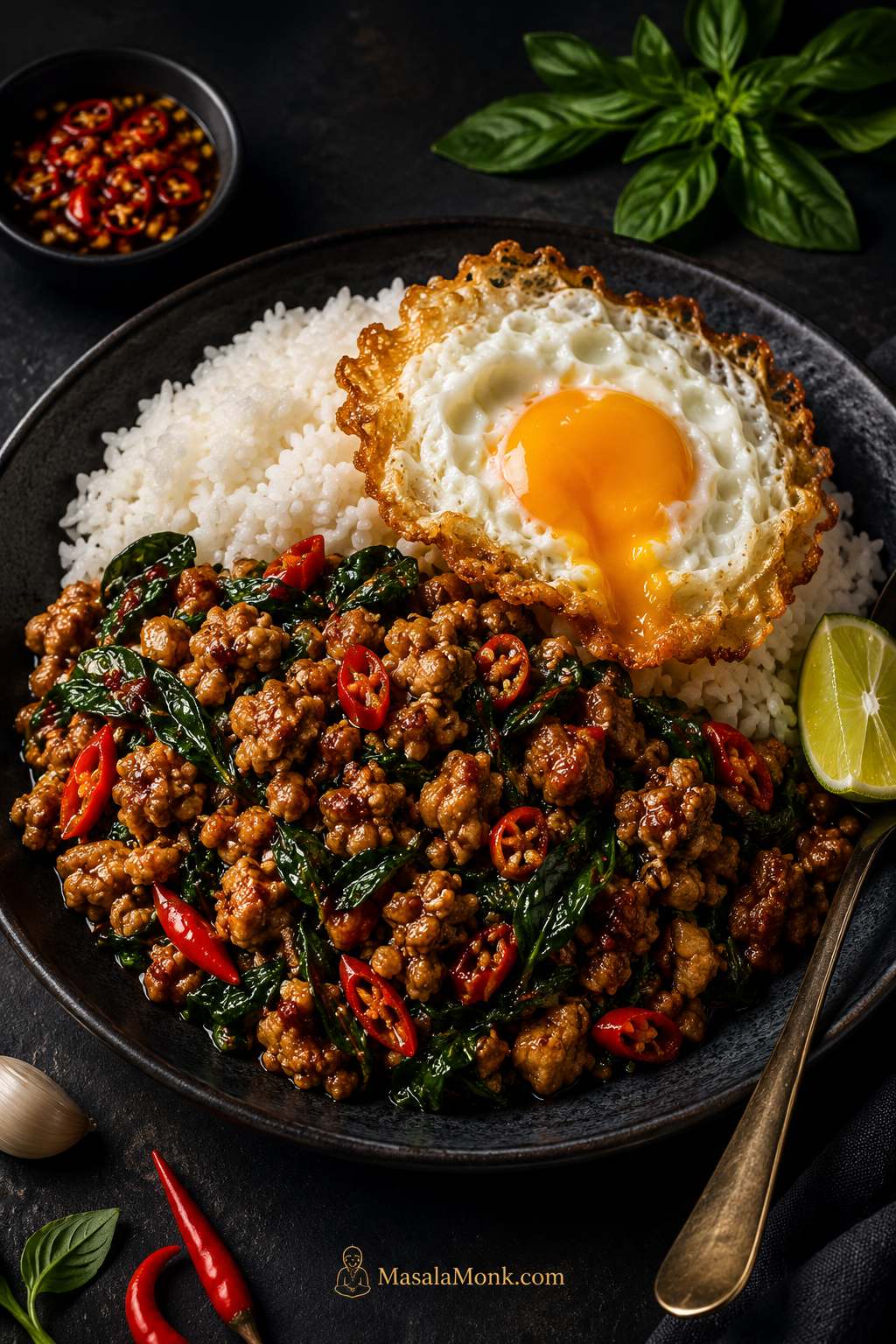
Pad Kra Pao is the Thai rice plate you want when dinner needs to be fast but still loud: garlic in hot oil, chilies, glossy minced meat, fresh basil, steamed rice, and a crispy fried egg that breaks into the sauce.
It is bold without being complicated. Once the rice is ready and the sauce is mixed, the stir-fry itself takes only a few minutes, which is why this dish works so well for weeknights, leftovers, and those “I want takeout, but I can cook” nights.
You may know this dish as Thai basil chicken, pad krapow, pad ka pow, kra pao, or holy basil chicken. The names and spellings vary, but the craving is usually the same: a spicy basil stir-fry that tastes fresh, savory, chili-hot, and glossy.
Here, you can make it with chicken, pork, or beef, then use the same base for tofu or eggplant. You will also see what to do if you only have Thai basil instead of holy basil, how to adjust the sauce, and how to fix the common problems that make homemade Pad Kra Pao taste flat, salty, or dry.
Quick Answer: What Is Pad Kra Pao?
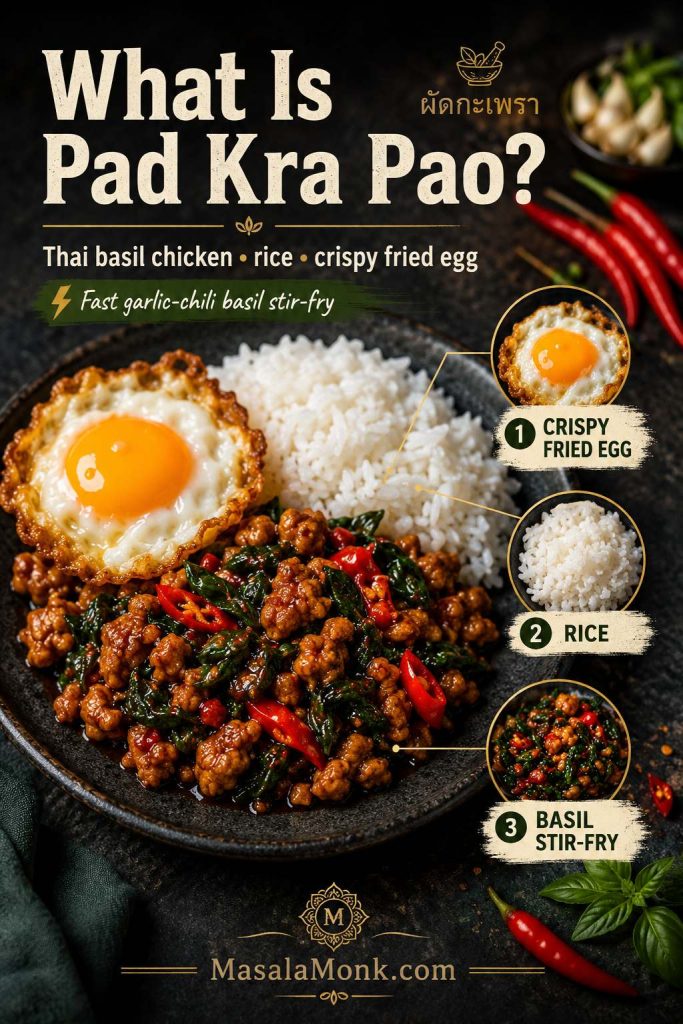
Pad Kra Pao is a Thai basil stir-fry made with garlic, chilies, meat or tofu, a salty-savory sauce, and basil. It is usually served over rice, often with a crispy fried egg on top.
If you came here looking for Thai basil chicken, this is the same dish family. Thai basil chicken is the version many people know from Thai restaurants: minced or chopped chicken stir-fried with garlic, chilies, basil, and sauce, then spooned over rice.
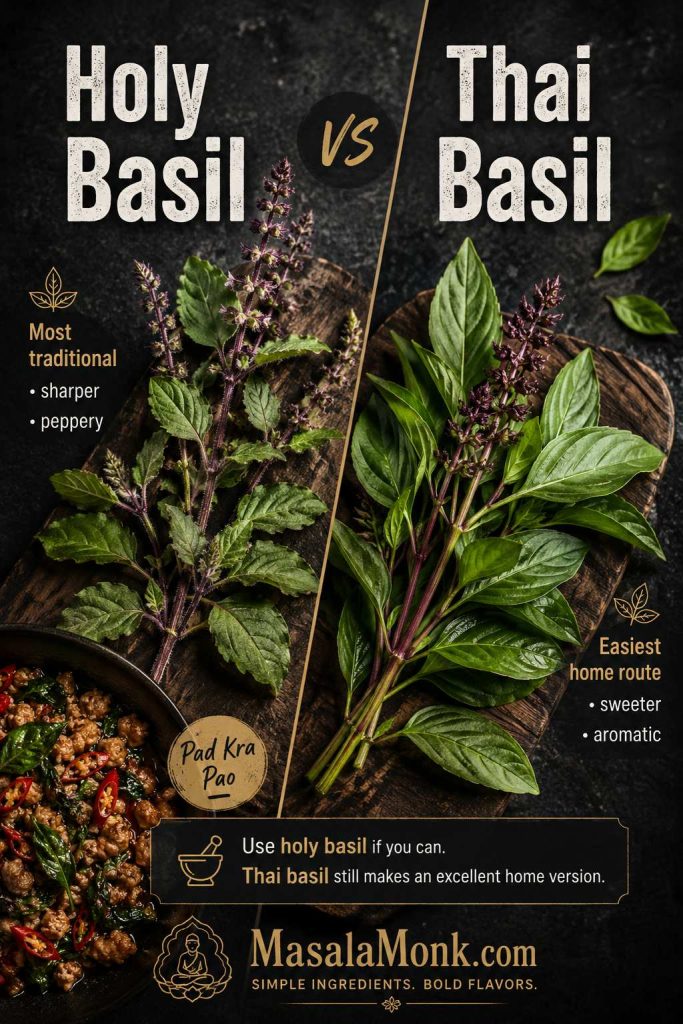
The most traditional version is made with holy basil, which has a sharper, peppery, clove-like aroma. Thai basil gives a different but still excellent home version: sweeter, more anise-like, and closer to many restaurant-style Thai basil chicken plates outside Thailand.
Need exact measurements? See the sauce ratio or jump to the recipe card.
Why This Pad Kra Pao Works
The flavor does not come from marinating or simmering. It comes from a hot pan, crushed garlic and chilies, meat that sizzles instead of steams, sauce that reduces until glossy, and basil added right at the end.
Keep those five things in place and the dish tastes bold even with practical substitutions. When it works, the pan smells sharp with garlic and chilies, the meat looks shiny instead of wet, and the basil hits at the end with a fresh, peppery lift.
That rhythm is the whole dish: hot, sharp, glossy, fresh.
Pad Kra Pao, Pad Krapow, Pad Ka Pow: Why So Many Spellings?
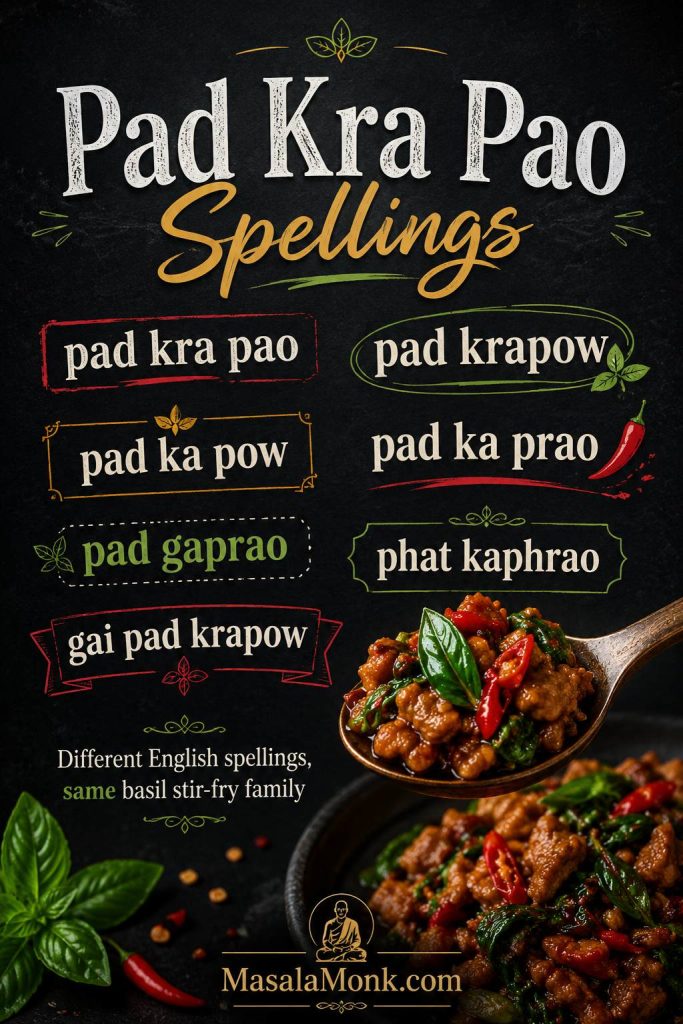
You may see this dish written as pad kra pao, pad krapow, pad ka pow, pad ka prao, pad gaprao, phat kaphrao, kra pao, or gai pad krapow. These spellings come from different ways of transliterating Thai into English.
For a home cook, the idea is simpler than the name: a hot, fast basil stir-fry with garlic, chilies, sauce, rice, and usually a fried egg. Here, we’ll call it Pad Kra Pao for consistency, but if a menu uses another spelling, you are still in the right place.
Holy Basil vs Thai Basil
The basil question matters because it changes the flavor of the dish. It should not stop you from cooking, though.
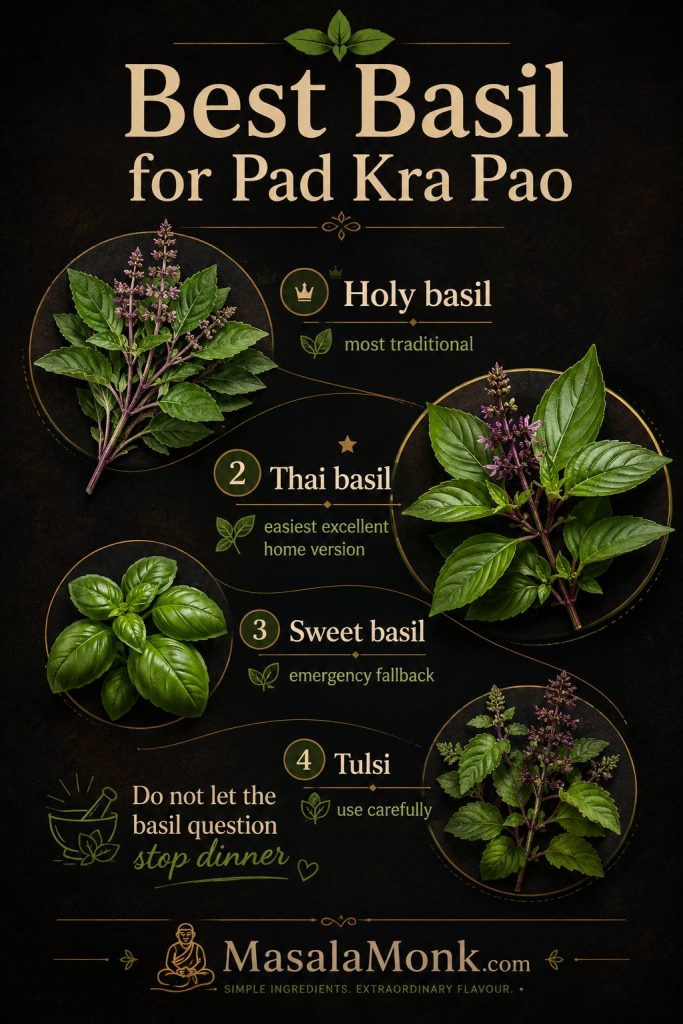
Strictly speaking, holy basil is what gives Pad Kra Pao its name and sharper, peppery character. Thai basil is the easiest excellent home-cook route: not identical, but fresh, aromatic, easy to find, and deeply satisfying in this garlic-chili rice plate. For a deeper Thai cooking perspective on the dish, see this explanation from Hot Thai Kitchen.
Holy Basil
Holy basil is the most traditional choice for Pad Kra Pao. It has a sharper, peppery, slightly clove-like flavor. If you can find Thai holy basil at an Asian grocery store, use it.
The leaves wilt quickly, so add them at the very end. Do not simmer them for several minutes or the aroma will fade.
Thai Basil
For most home cooks, Thai basil is the easiest reliable substitute. Its aroma is sweeter and more anise-like than holy basil, and it is easier to find in many places.
Many restaurant-style Thai basil chicken recipes use Thai basil, so the flavor will still feel familiar and satisfying. If you are cooking this on a normal weeknight, do not let the basil question stop dinner.
Sweet Basil
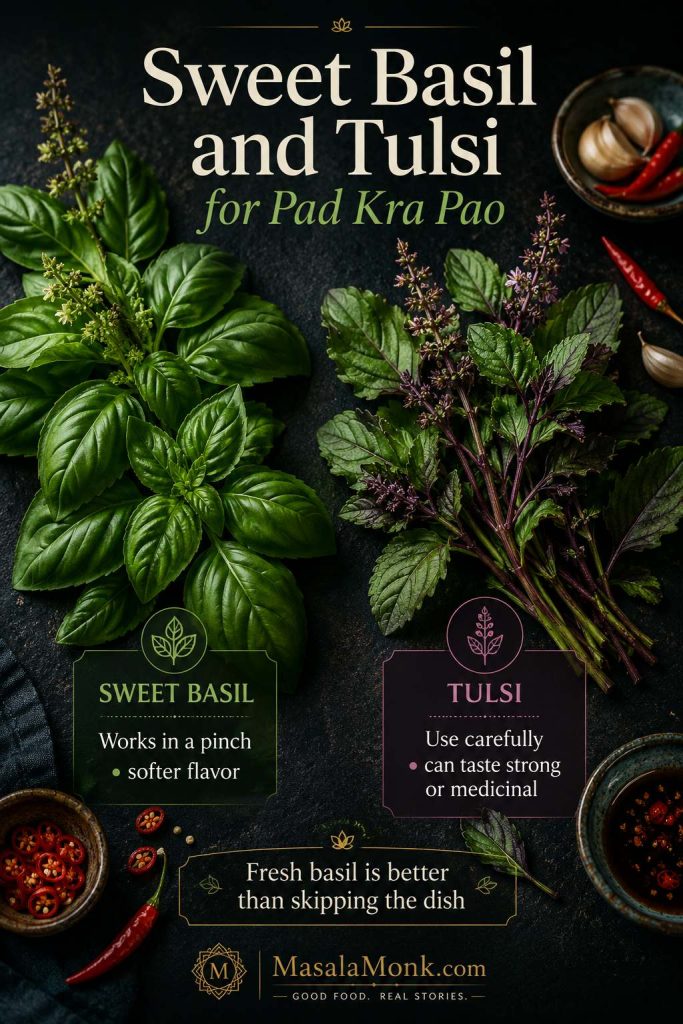
Sweet basil, also called Italian basil, will not taste the same as holy basil or Thai basil. Still, it can work when that is all you have.
The result will taste softer, sweeter, and less peppery. It may lean slightly toward a regular basil stir-fry rather than classic Pad Kra Pao, but it is better to make a good basil rice plate than to skip the dish completely.
Can You Use Tulsi?
Tulsi is related to holy basil, but it is not always a simple one-for-one replacement in cooking. Depending on the variety, it can taste medicinal, bitter, or very strong when used in large amounts.
If you want to try tulsi, use a smaller amount first and mix it with Thai basil or sweet basil if possible. Fresh basil in a hot pan is still better than waiting for the perfect herb and never cooking the dish.
Whatever basil you use, wash the leaves ahead of time and dry them well. Wet basil can splutter in the pan and add extra moisture right when you want the sauce to stay glossy.
Already know your basil choice? Go to the ingredients.
Ingredients You Need
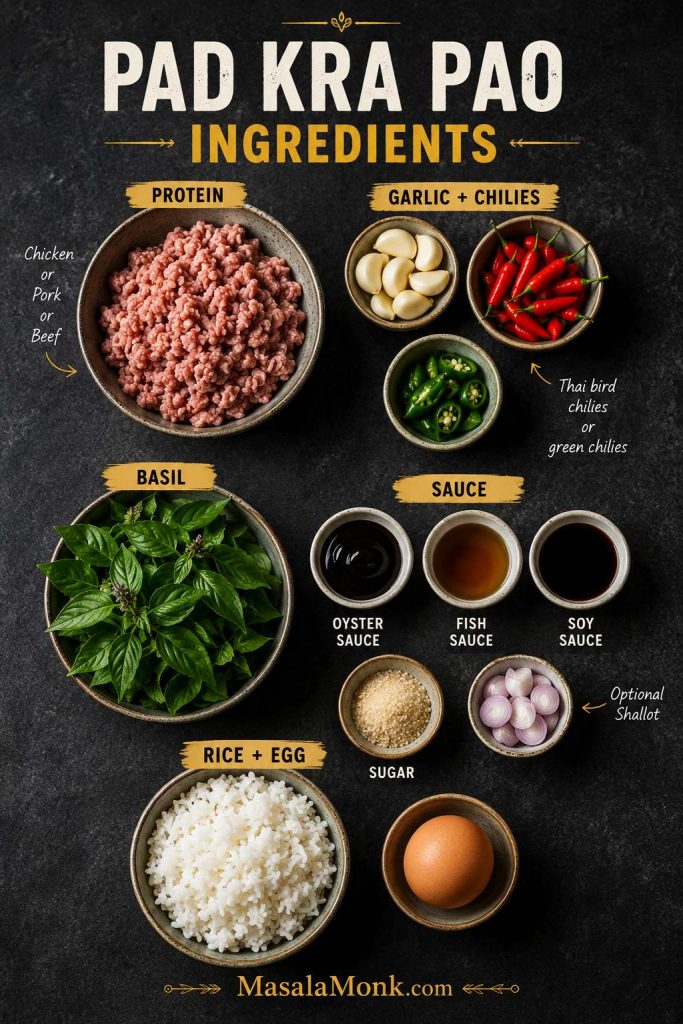
Pad Kra Pao is short on ingredients, but every ingredient has a job. Think of them in two groups: the loud things that wake up the pan — garlic, chilies, basil — and the salty-sweet sauce that makes the rice worth eating.
Chicken, Pork, Beef, Tofu, or Eggplant
Ground meat is easiest because it cooks quickly and catches the sauce well. Use ground chicken, ground pork, ground beef, or finely chopped boneless meat. Hand-chopped chicken thigh gives a slightly chunkier, more restaurant-style bite.
For the main recipe, use 450g / 1 lb meat. If your pack is 500g, that is fine. You may need a small extra handful of basil or a splash more water, but do not automatically increase every sauce ingredient.
You do not need to marinate the meat. The flavor comes from the hot garlic-chili base, the sauce reducing onto the meat, and the basil added at the end.
Pork gives the juiciest, most classic-feeling version. Chicken is the version many people recognize from Thai restaurant menus. Beef gives a deeper, richer stir-fry.
Garlic and Chilies
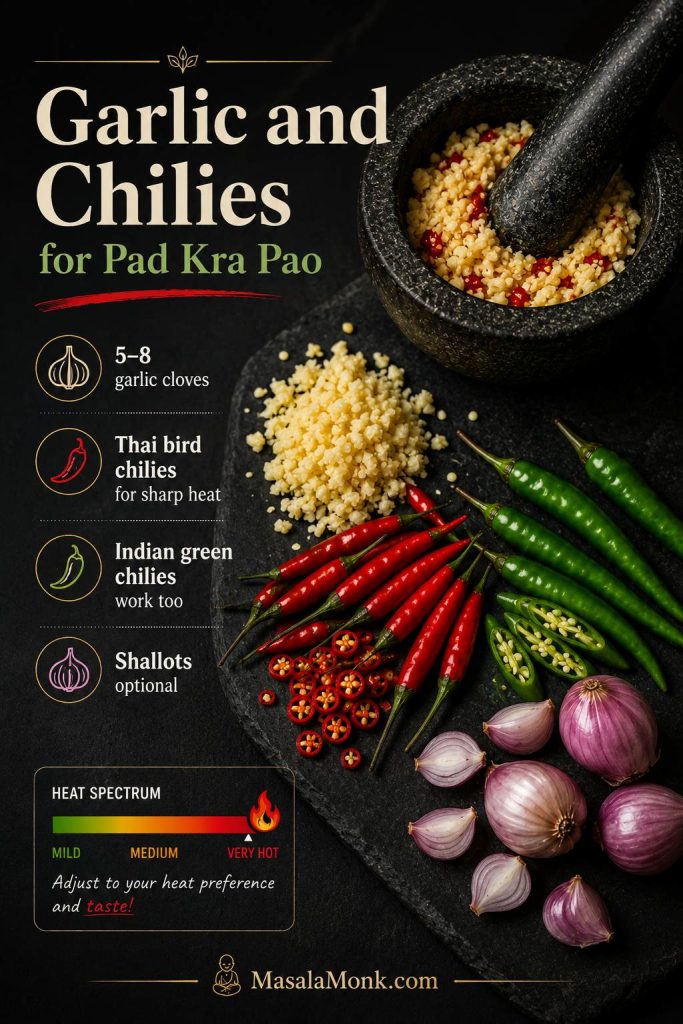
Do not be shy with garlic. Pad Kra Pao should taste bold.
Use 5–8 garlic cloves for 450g / 1 lb meat. For heat, use 3–6 Thai bird chilies, or use 2–4 Indian green chilies if that is what you have. For a mild family version, start with 1 Thai chili or 1 small green chili, then add extra chopped chilies at the table.
Shallots are optional. They add a little sweetness and body, but the dish still works without them.
A mortar and pestle gives the strongest aroma because it crushes the garlic and chilies instead of only cutting them. Finely chopping with a knife also works. The goal is rough, fragrant pieces, not a watery paste.
Sauce Ingredients
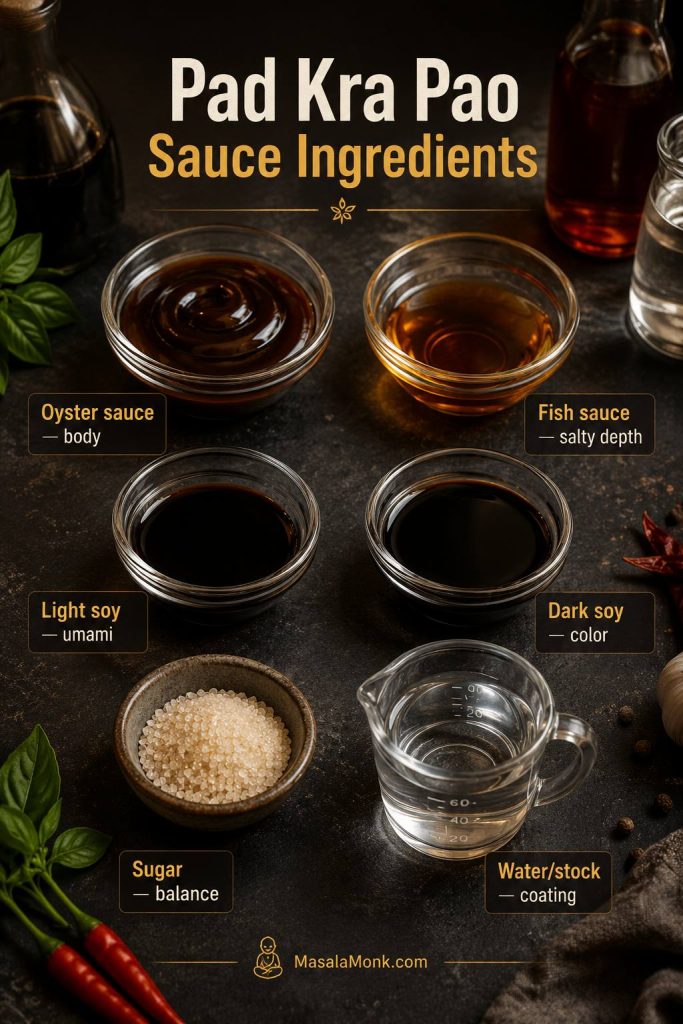
The sauce usually includes oyster sauce, fish sauce, light soy sauce, optional dark soy sauce, sugar, and a little water or stock.
Oyster sauce gives body and savory sweetness. Fish sauce gives salty depth. Light soy adds more salt and umami. Dark soy adds color, but the dish can still work without it. Sugar rounds the heat and salt.
For a vegetarian version, use vegetarian oyster sauce or mushroom sauce, replace fish sauce with light soy sauce, and keep the sugar modest because many mushroom sauces are already slightly sweet.
Rice and Crispy Fried Egg
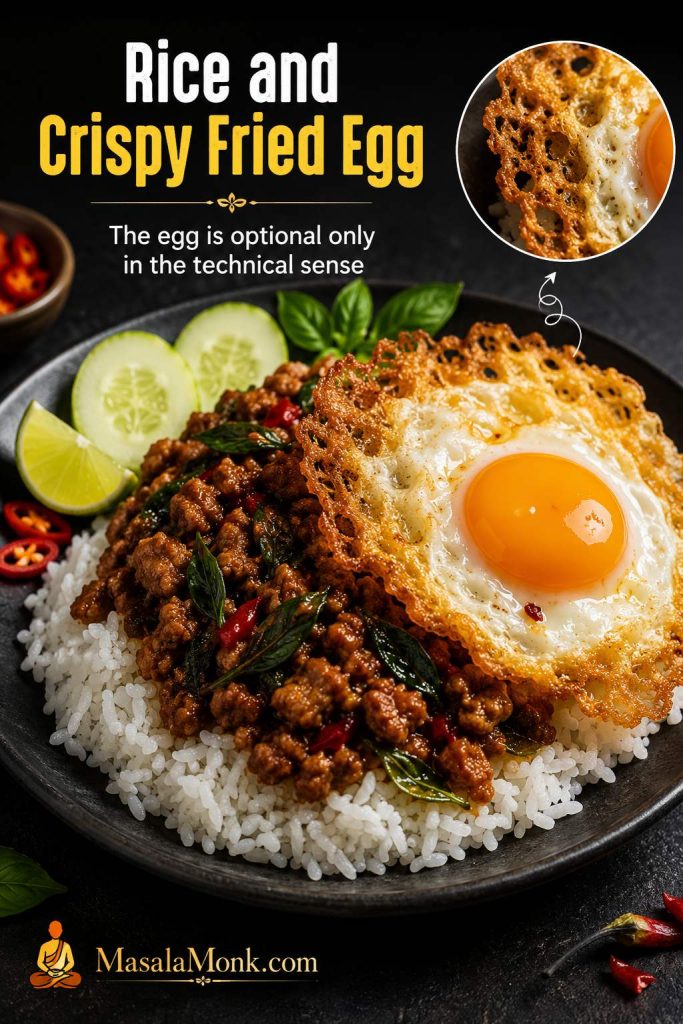
Serve it over hot rice so the sauce has somewhere to land. Jasmine rice gives the most classic feel, but plain steamed rice, basmati, or even leftover rice will still do the job.
The crispy fried egg is optional only in the technical sense. In practice, it makes the plate feel complete. The runny yolk mixes with the salty basil stir-fry and rice, while the crisp edges add texture. If the egg yolk runs into the rice, that is not a problem. That is the point.
Easy Substitutions for Indian and Everyday Kitchens
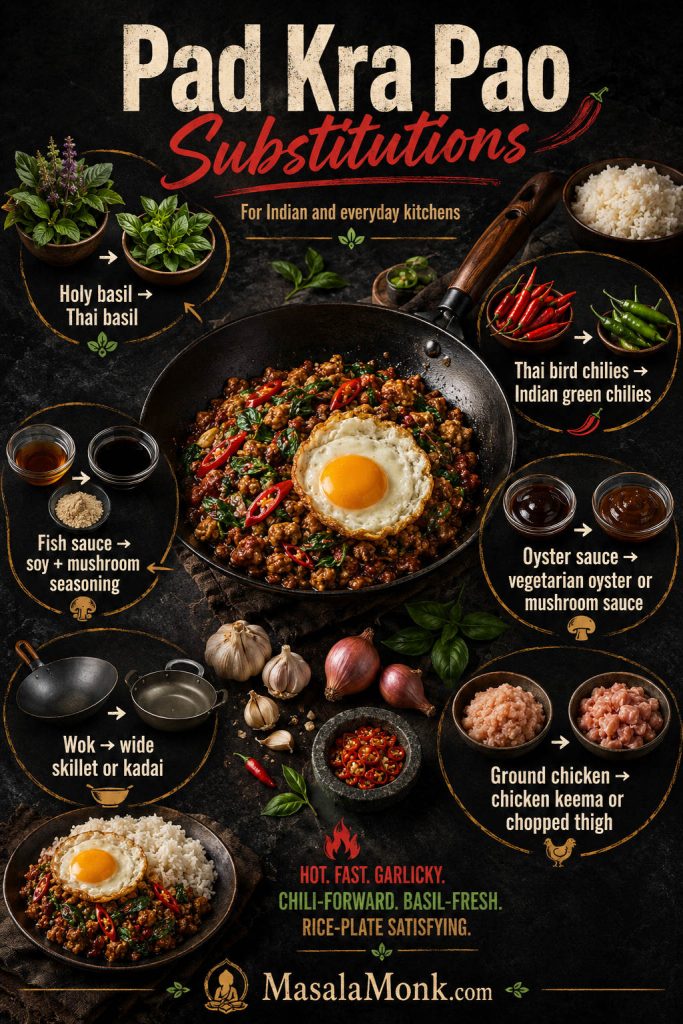
Missing one bottle should not kill the dish. Losing the garlic-chili-basil structure will.
The goal is not to fake perfection. It is to keep the core of the dish intact with what you can actually buy.
| If You Do Not Have… | Use This | What Changes |
|---|---|---|
| Holy basil | Thai basil | Sweeter and more anise-like, but still excellent |
| Thai basil | Sweet basil | Softer and less peppery; still fresh and usable |
| Thai bird chilies | Indian green chilies or serrano chilies | Heat is less sharp, but the recipe still works |
| Dark soy sauce | Skip it, or use a tiny extra splash of light soy | Less dark color, but the flavor is still good |
| Fish sauce | Light soy sauce plus a pinch of mushroom seasoning | Less funky depth, but still savory |
| Oyster sauce | Vegetarian oyster sauce or mushroom sauce | Best vegetarian replacement for body and umami |
| Jasmine rice | Plain steamed rice | Less fragrant, but perfectly usable |
| Ground chicken | Chicken keema or finely chopped boneless thigh | Similar texture; chopped thigh stays juicier |
| Wok | Wide skillet or wide kadai | Works well if the pan is hot and not crowded |
If your regular soy sauce is very dark and salty, use it like light soy sauce and skip the dark soy. Some supermarket soy sauces do not map neatly to “light soy” and “dark soy,” so taste and adjust gently.
The biggest substitution mistake is not using the “wrong” basil. It is crowding the pan and boiling the meat instead of stir-frying it. A hot, wide pan matters more than having every bottle exactly right.
Once your swaps are sorted, check the sauce ratio before you start cooking.
Best Pan and Equipment for Pad Kra Pao
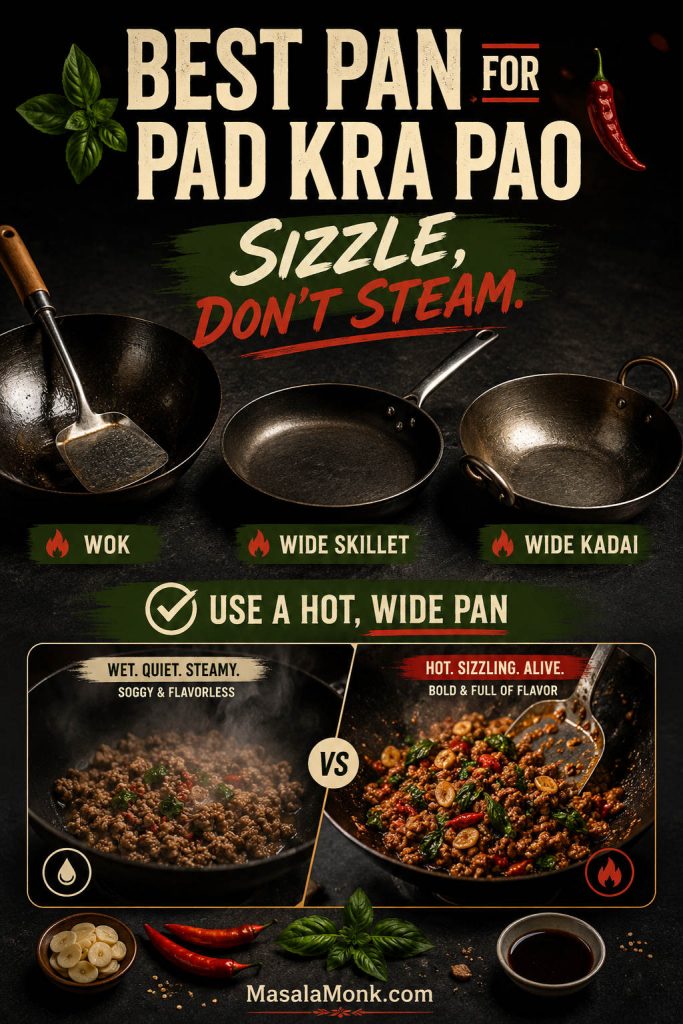
A wok gives you quick heat and fast evaporation, but a wide skillet works very well for home cooking.
Use a 12-inch / 30cm skillet if you do not have a wok. A wide kadai can also work if it gives the meat enough surface area. Avoid using a small deep pan for a full batch because the meat will steam and release liquid.
For nonstick pans, use medium-high heat instead of the highest possible heat. For a wok or stainless-steel skillet, high heat is fine as long as you keep the food moving.
You will also need a small bowl for the sauce, a knife or mortar and pestle for the garlic and chilies, and a small frying pan if you are making crispy eggs.
If your pan setup is ready, go straight to the method.
Pad Kra Pao Sauce Ratio
The sauce should cling to the meat first and season the rice second. It should look glossy, not soupy.
When the sauce hits the pan, it should bubble hard almost immediately. When it looks like the rice underneath will want a spoonful of it, but the pan is not swimming, you are in the right zone.
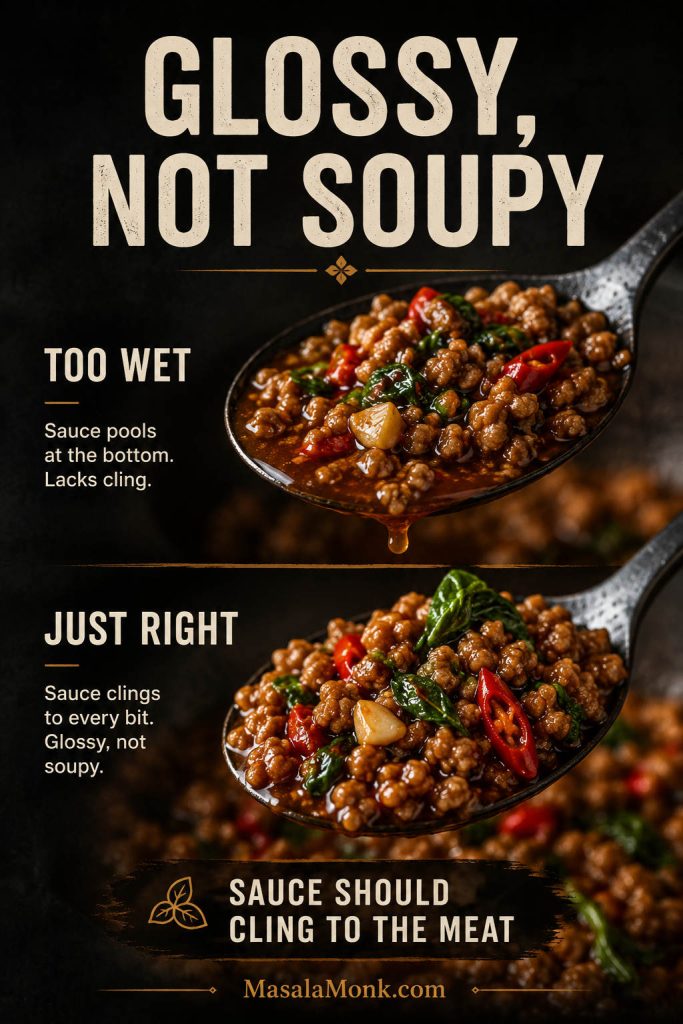
Balanced Sauce for 450g / 1 lb Meat
| Ingredient | Amount | What It Does |
|---|---|---|
| Oyster sauce | 1 tbsp / 15 ml | Adds savory body and slight sweetness |
| Fish sauce | 1 tbsp / 15 ml | Gives salty, Thai-style depth |
| Light soy sauce | 1 tbsp / 15 ml | Adds salt and umami |
| Dark soy sauce | 1–2 tsp / 5–10 ml, optional | Adds color and deeper flavor |
| Sugar | 1 tsp / about 4g | Rounds the salt and chili heat |
| Water, chicken stock, or vegetable stock | 2–3 tbsp / 30–45 ml | Helps the sauce coat the meat |
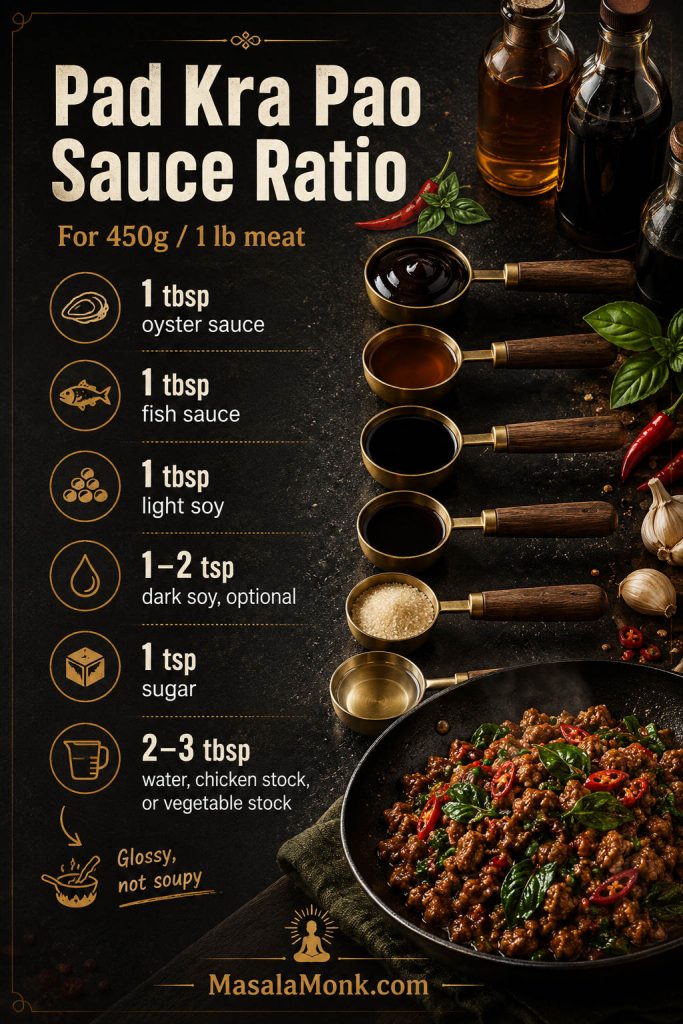
Lower-Salt Sauce Ratio
If your fish sauce, soy sauce, or oyster sauce tastes especially salty, use this version first.
| Ingredient | Amount |
|---|---|
| Oyster sauce | 1 tbsp / 15 ml |
| Fish sauce | 2 tsp / 10 ml |
| Light soy sauce | 2 tsp / 10 ml |
| Dark soy sauce | 1 tsp / 5 ml, optional |
| Sugar | 1 tsp / about 4g |
| Water, chicken stock, or vegetable stock | 2 tbsp / 30 ml |
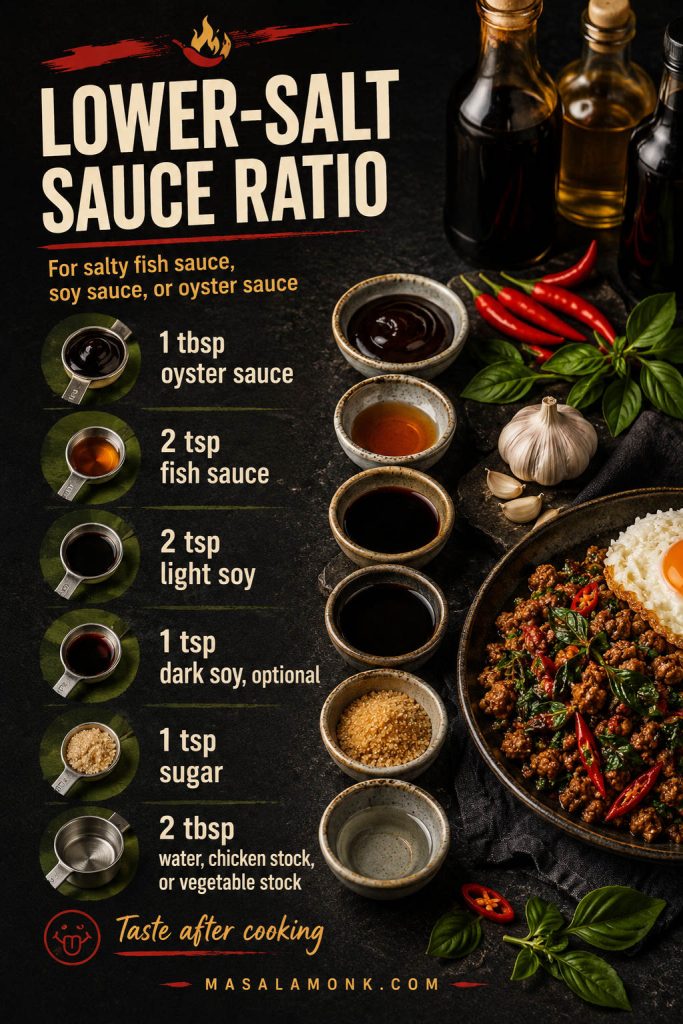
Sauce brands vary, especially oyster sauce and soy sauce. If yours tastes very salty or very sweet straight from the bottle, start with the lower-salt ratio and adjust after cooking.
Taste after cooking. If the stir-fry is too salty, serve it with more rice and reduce fish sauce next time. If it tastes flat, it may need more garlic, chili, basil, or a better salt-sugar balance.
Once the sauce is mixed, move to the cooking method.
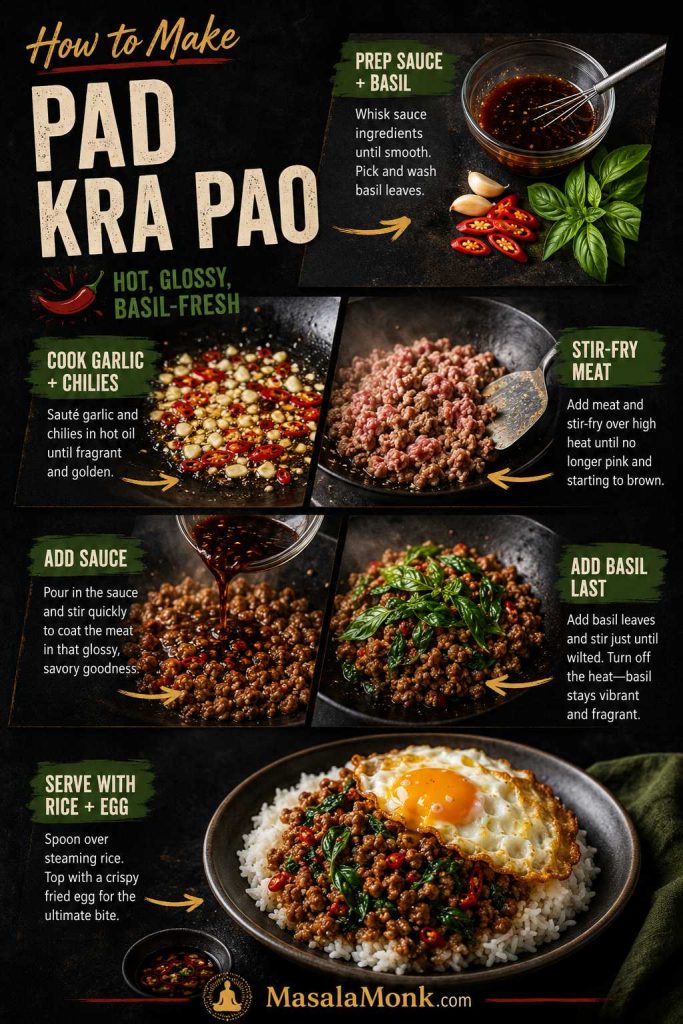
How to Make Pad Kra Pao
Pad Kra Pao cooks quickly, so the method is more about timing than difficulty. Once everything is lined up, the cooking feels fast rather than stressful.
Before turning on the stove, have the sauce mixed, basil picked and dried, garlic and chilies chopped, rice cooked, and eggs ready to fry. Once the pan is hot, there is not much time to stop and measure.
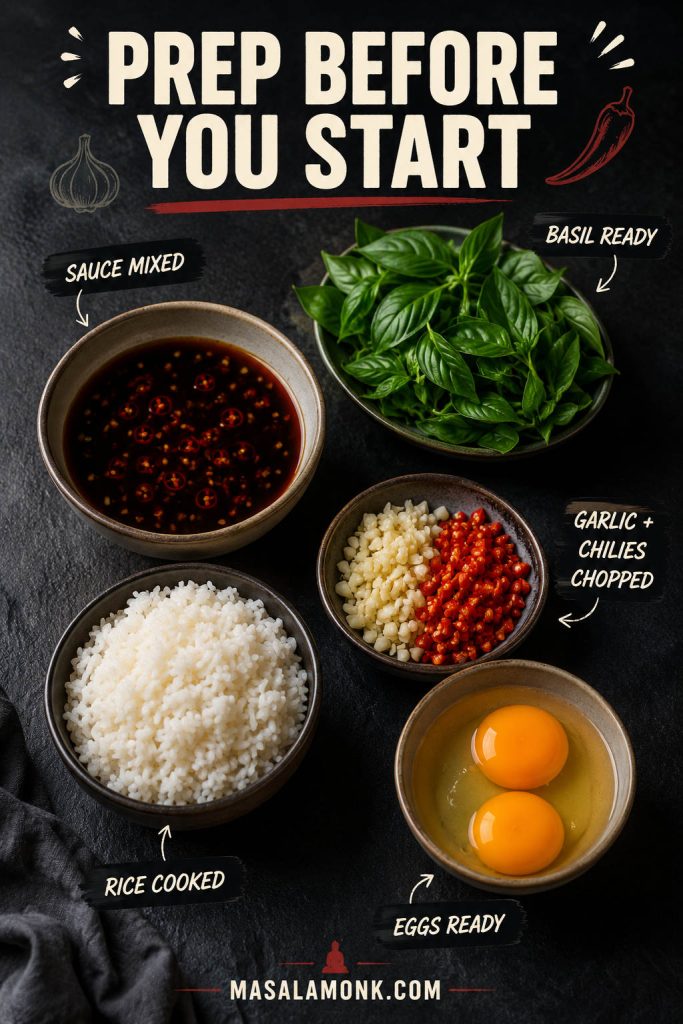
Cook the Rice First
Start the rice before you cook the stir-fry. Once the garlic and chilies hit the pan, the dish moves fast.
Jasmine rice is the classic choice, but any plain steamed rice will work. If rice timing or water ratios are the part that usually slows you down, MasalaMonk’s guide to cooking perfect rice can help you get the base ready before the stir-fry starts. Avoid heavily seasoned rice because the stir-fry already has plenty of salt, chili, garlic, and basil.
Mix the Sauce Before You Start
Stir the oyster sauce, fish sauce, soy sauces, sugar, and water or stock in a small bowl.
Measure the sauce first, because garlic can burn while you are still looking for bottles.
Pound or Chop Garlic and Chilies
For the strongest aroma, pound garlic and chilies together in a mortar and pestle until roughly crushed. You do not need a smooth paste.
If you do not have a mortar and pestle, finely chop everything with a knife. A mini chopper also works, but stop before the mixture turns wet and pasty.
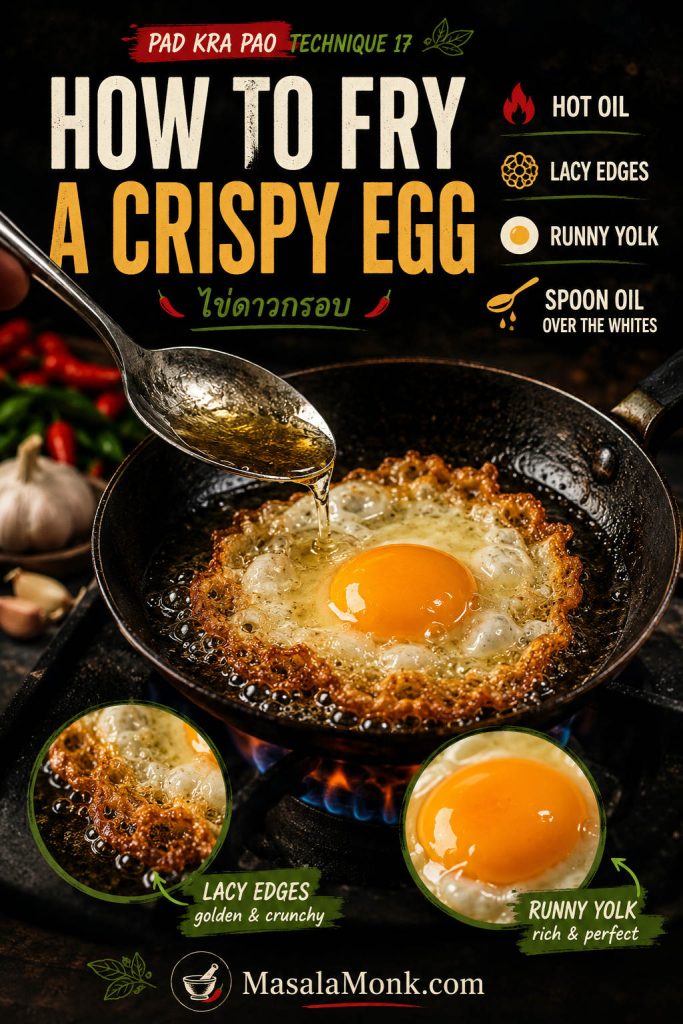
Fry the Crispy Egg
For each serving, use one egg. Heat 2–3 tablespoons of oil in a small pan, then fry the eggs one at a time or in batches. Add a little more oil between eggs only if the pan gets dry.
Crack in the egg and spoon hot oil over the whites until the edges are crisp and lacy. Keep the yolk runny if you like the classic rice-plate effect.
You can fry the eggs before the stir-fry and set them aside, or fry them right after the stir-fry if you prefer the egg hot from the pan.
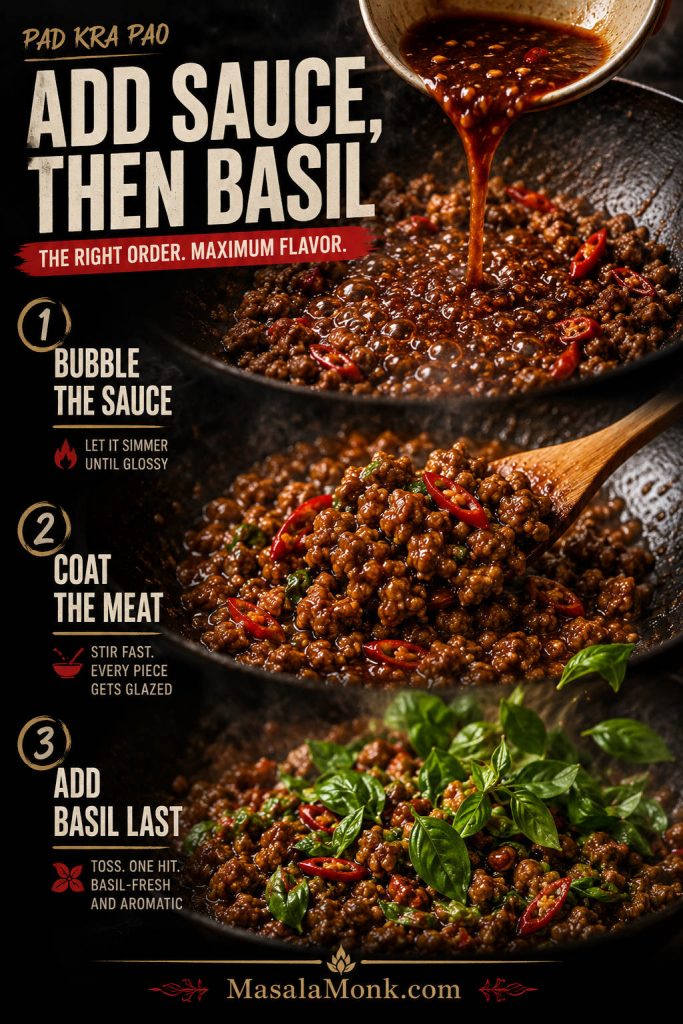
Stir-Fry the Meat Hot and Fast
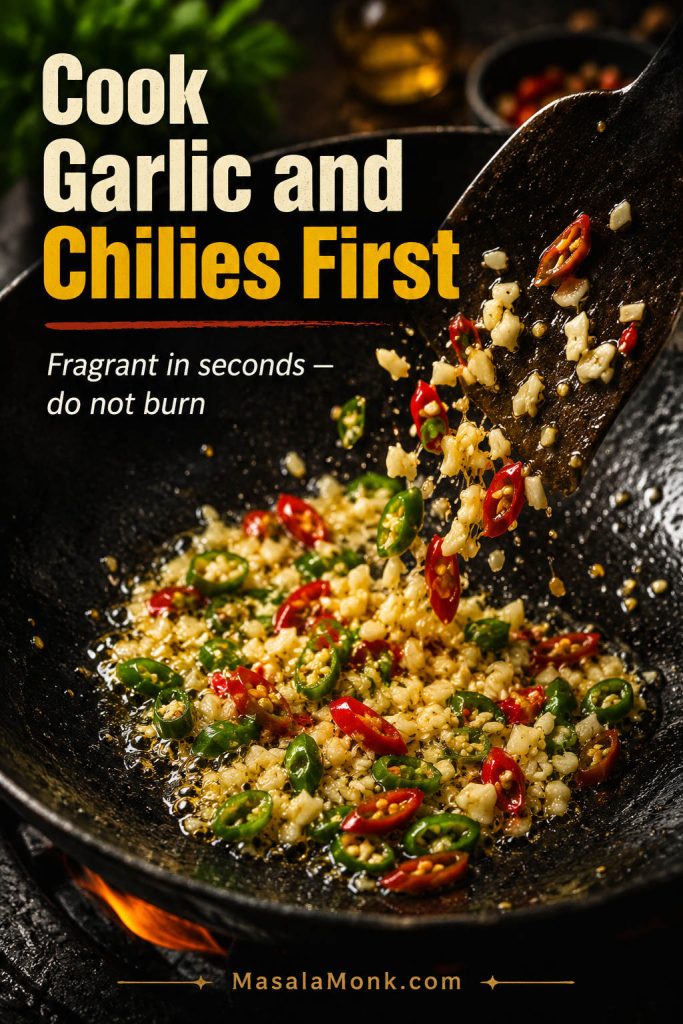
Heat a wok over high heat, or use medium-high heat if you are cooking in a nonstick skillet. Add oil, then the garlic, chilies, and optional shallots.
The garlic and chilies should become fragrant within seconds. Do not let the garlic turn dark brown. This is the point where the kitchen should smell sharp, garlicky, and a little wild.
Add the meat and break it up as it cooks. It should sizzle, not sit in liquid. If it releases moisture, spread it across the pan and keep cooking until most of that moisture evaporates.
If you add the sauce while the pan is still watery, the finished dish can taste boiled instead of stir-fried.
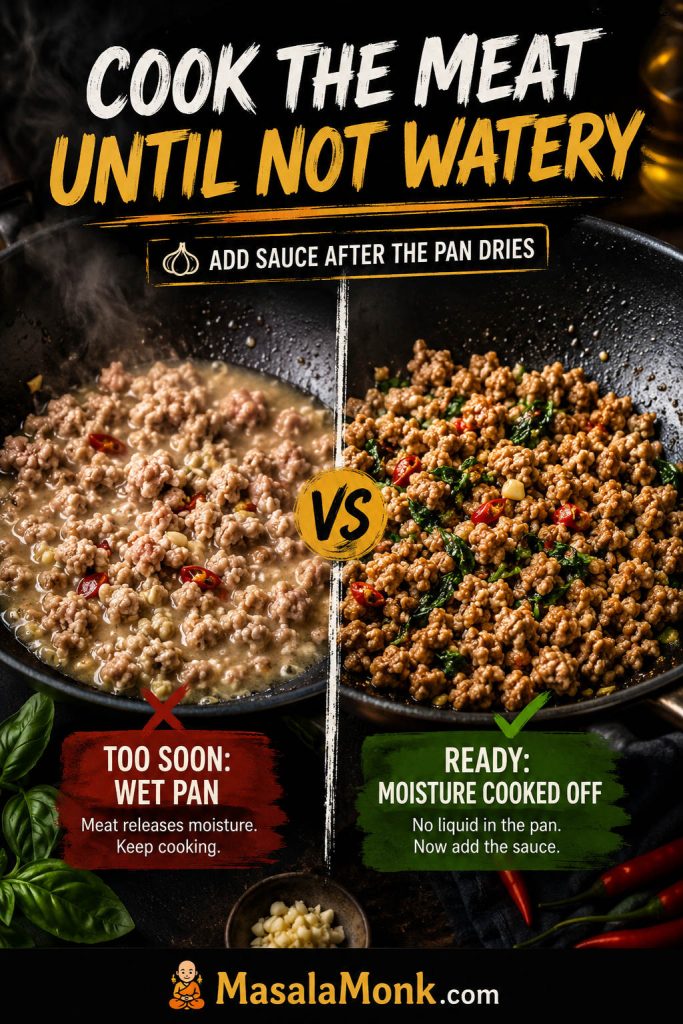
If your pan is already looking wet, jump to the troubleshooting guide before adding basil.
Add Sauce and Reduce Until Glossy
Pour in the sauce and toss well. It should bubble quickly, coat the meat, and tighten around the pieces instead of pooling underneath.
If the pan looks dry, add 1–2 tablespoons of water or stock. If the pan looks soupy, keep cooking over high heat for another minute before adding basil.
The finished meat should look shiny and loose, not wet or clumpy.
Add Basil at the End
Turn the heat down or off, then add the basil leaves. Toss just until wilted.
Once the basil hits the hot meat, the whole pan should wake up. Long cooking dulls that aroma, so let the leaves collapse into the stir-fry and stop there.
Serve Immediately
Spoon the basil stir-fry over hot rice. Add a crispy fried egg, cucumber slices, and lime if you like.
The first bite should be hot, salty, fresh, and softened by rice and yolk. This is not a dish that improves by sitting around, so serve it while the basil still smells alive.
Chicken, Pork, or Beef: Which Version Should You Make?
The same sauce and method work for chicken, pork, or beef, but each one gives the plate a different mood.
Choose chicken for the cleanest restaurant-style Thai basil chicken, pork for the juiciest street-food-style version, and beef for the darkest, most savory bowl.

Once you choose the protein, use the recipe card for exact quantities and timing.
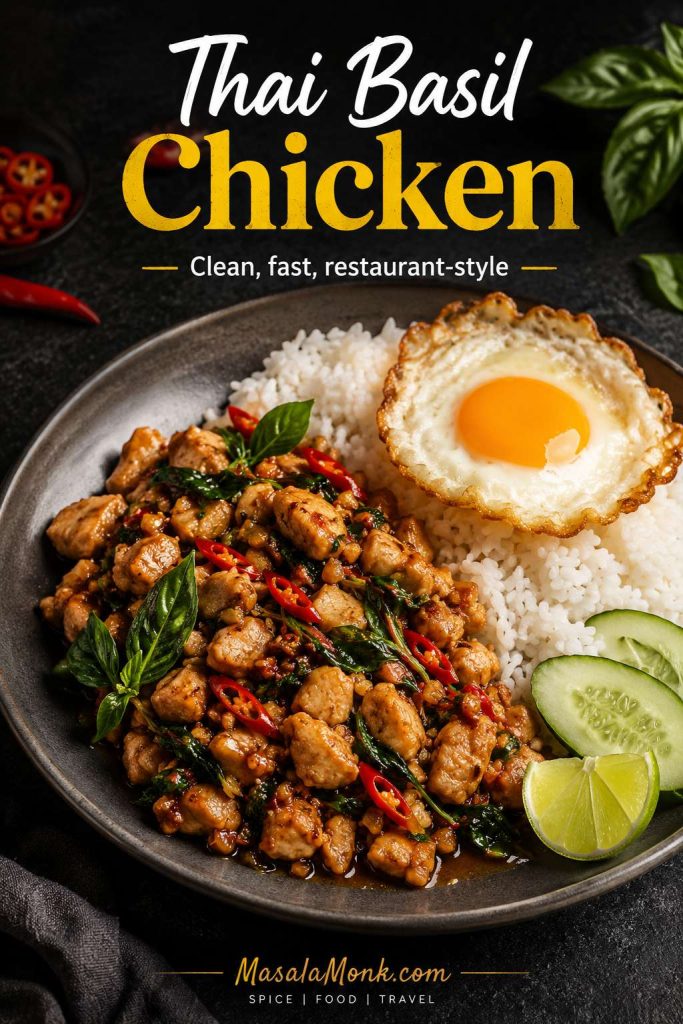
Thai Basil Chicken Version
For Thai basil chicken, use ground chicken, chicken keema, or finely chopped boneless chicken thigh.
Hand-chopped thigh gives little juicy pieces that catch the sauce, while ground chicken keeps the dish quick and familiar. Chicken breast works too, but it dries out faster, so chop it small and cook it quickly.
This is the lightest, fastest version and lets the basil come through clearly.
Pork Pad Kra Pao Version
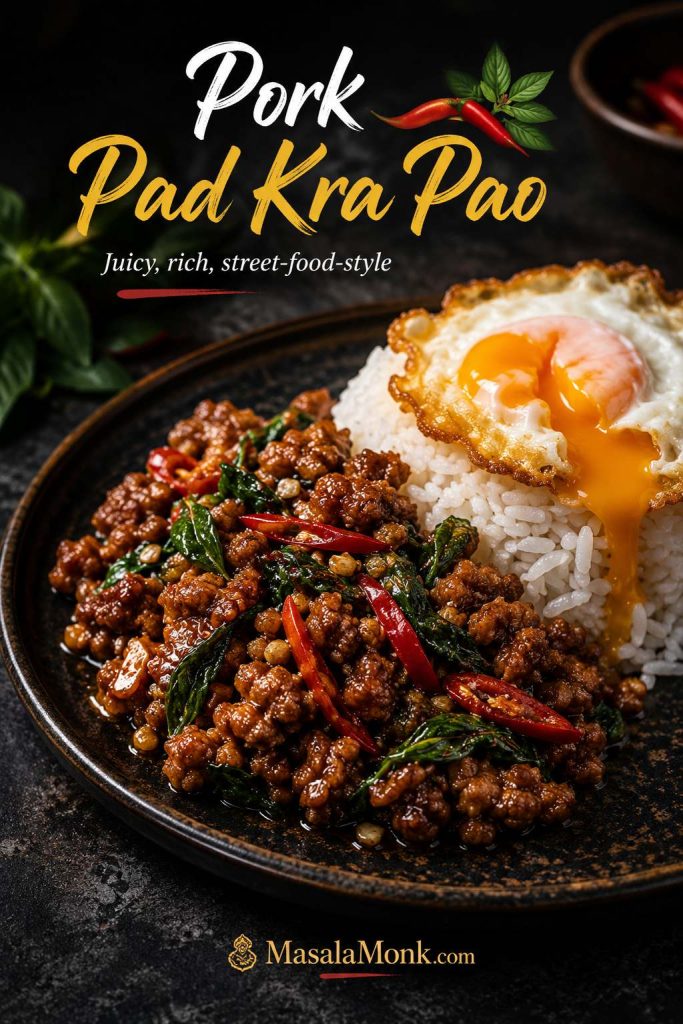
Ground pork gives the richest, juiciest Pad Kra Pao. It is the version to make when you want the dish to feel more street-food-style and deeply satisfying.
Use 450g / 1 lb ground pork. If the pork is fatty, use slightly less oil and let some edges brown before adding the sauce. If it is very lean, keep the full 2 tablespoons of oil and avoid overcooking.
The fat carries the garlic and chili beautifully, especially if you can find holy basil.
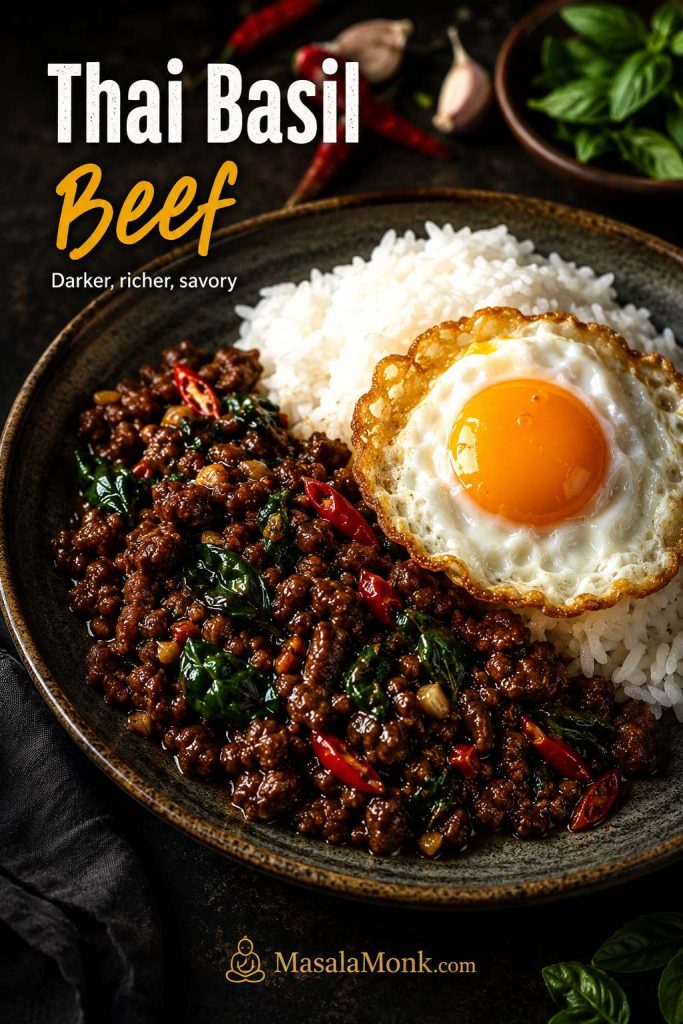
Thai Basil Beef Version
Thai basil beef gives the deepest, most savory bowl. Use ground beef, minced beef, or very thinly chopped steak.
Beef needs a hot, wide pan. If it steams instead of browns, the flavor turns flat. Cook in batches if needed, and use the higher end of the dark soy sauce range if you want a deeper color.
This is the version for a darker, richer rice plate with a strong garlic-chili base.
Vegetarian, Tofu, and Eggplant Options
You can make a vegetarian Pad Kra Pao-style stir-fry with tofu, eggplant, mushrooms, or a mix of vegetables. These versions are not exactly the same as the classic meat rice plate, but the same garlic-chili-sauce-basil structure works well if you control moisture.
The best vegetarian version still needs the same attitude as the meat version: high heat, strong aromatics, and enough basil that the pan smells alive at the end.
For tofu, use firm or extra-firm tofu. Press it if it is very wet, then crumble it into small pieces. Cook it in a hot pan until the edges look lightly browned. The goal is the same as with meat: drive off moisture first, then let the sauce cling instead of slide off.
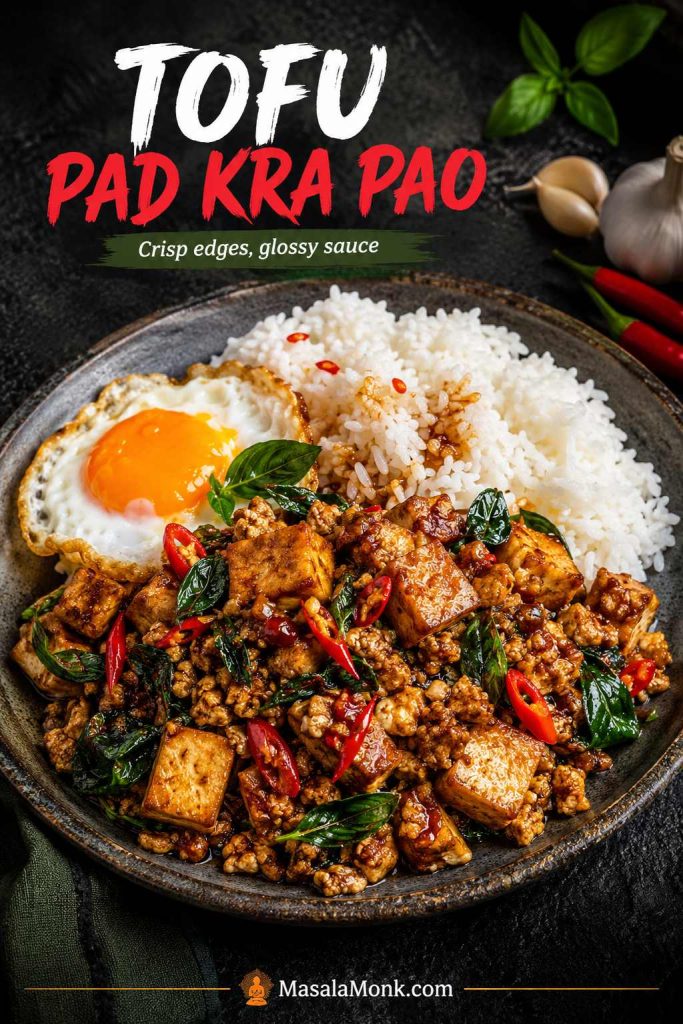
If tofu is your main protein more often than a one-time swap, MasalaMonk’s tofu meal prep ideas go deeper into pressing, browning, saucing, and building rice-box style meals that still taste good later.
For eggplant, cut it into small pieces and cook it until tender before adding the sauce. Eggplant absorbs oil, so use a wide pan and avoid stirring too aggressively once it softens.
For mushrooms, cook them until their liquid evaporates. Then add the garlic-chili base, sauce, and basil.
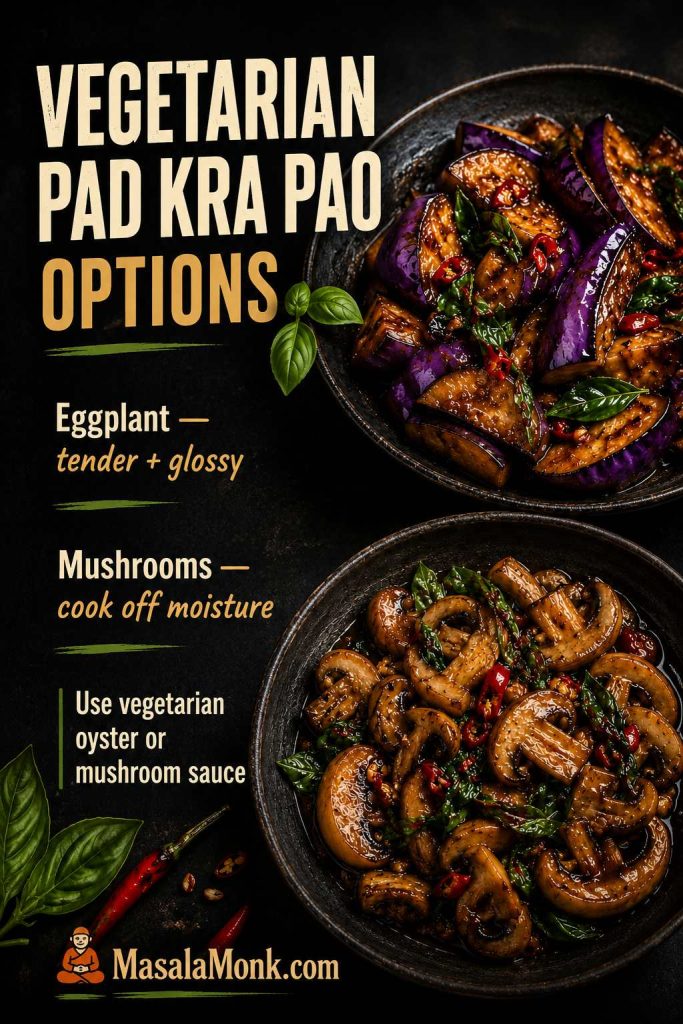
Use vegetarian oyster sauce or mushroom sauce. Replace fish sauce with soy sauce and, if you have it, a small pinch of mushroom seasoning.
For vegetarian sauce swaps, use the substitution guide before cooking.
What to Serve With Pad Kra Pao
Pad Kra Pao is usually served as a rice plate, not as a saucy curry. Keep the sides simple so the basil, garlic, chilies, and fried egg stay in focus.
- Steamed jasmine rice
- Crispy fried egg
- Cucumber slices
- Lime wedges
- Extra chopped chilies
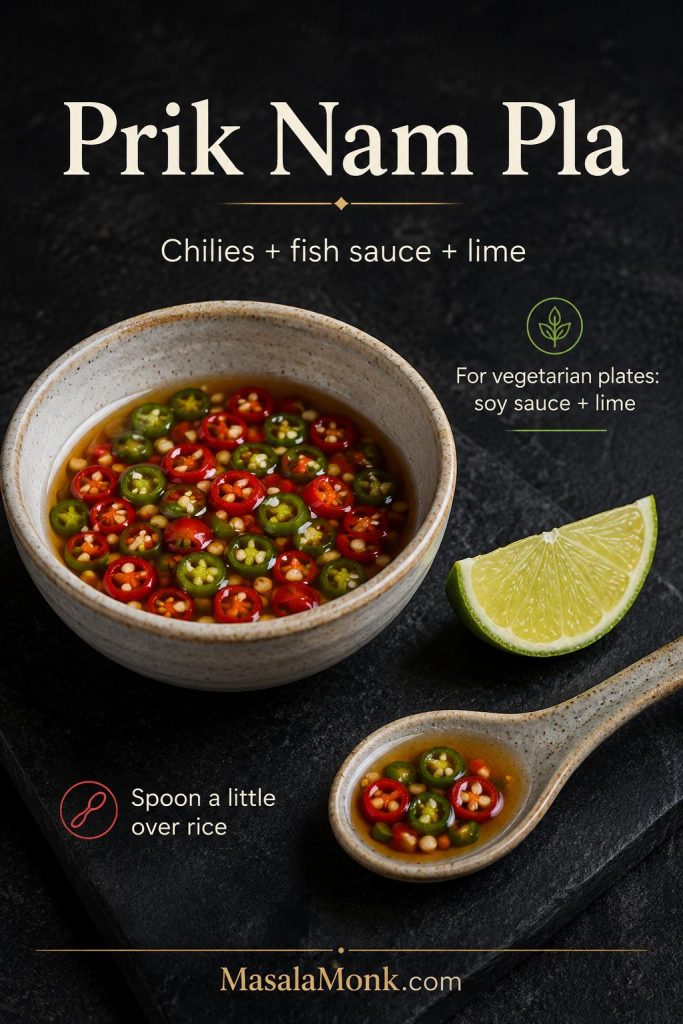
- Prik nam pla — chopped chilies in fish sauce and lime — or soy sauce and lime for a vegetarian plate
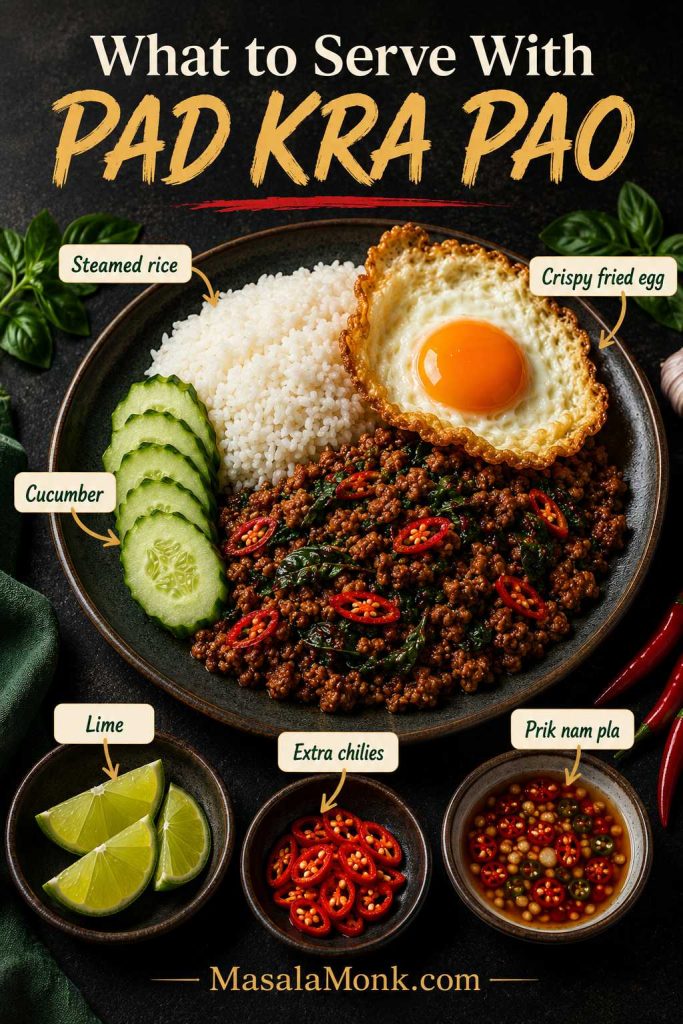
Cucumber is especially useful because it cools the heat and gives the plate a fresh crunch. If you want that cooling side to feel a little more complete, a simple cucumber salad works well beside the hot basil stir-fry.
For a brighter Thai-style side, you can also serve it with a small portion of vegan Som Tam raw papaya salad. The crunch, lime, chili, and freshness make sense next to the rich fried egg and savory basil meat.
For the table-side chili condiment, keep the spoonful small and bright rather than drowning the rice.
If you bought a large bunch of basil, use the extra leaves quickly in another fresh herb recipe rather than letting them wilt. This dish is best when the basil tastes alive, not tired.
How to Fix Pad Kra Pao
Most Pad Kra Pao problems come from heat, timing, or sauce balance. Fortunately, the fixes are usually simple once you know what happened.
Too Watery
Watery Pad Kra Pao almost always means the meat steamed before it fried.
Keep cooking until the liquid evaporates before adding basil. Next time, use a wider pan, higher heat, and do not double the recipe in one skillet. For larger batches, cook the meat in rounds.
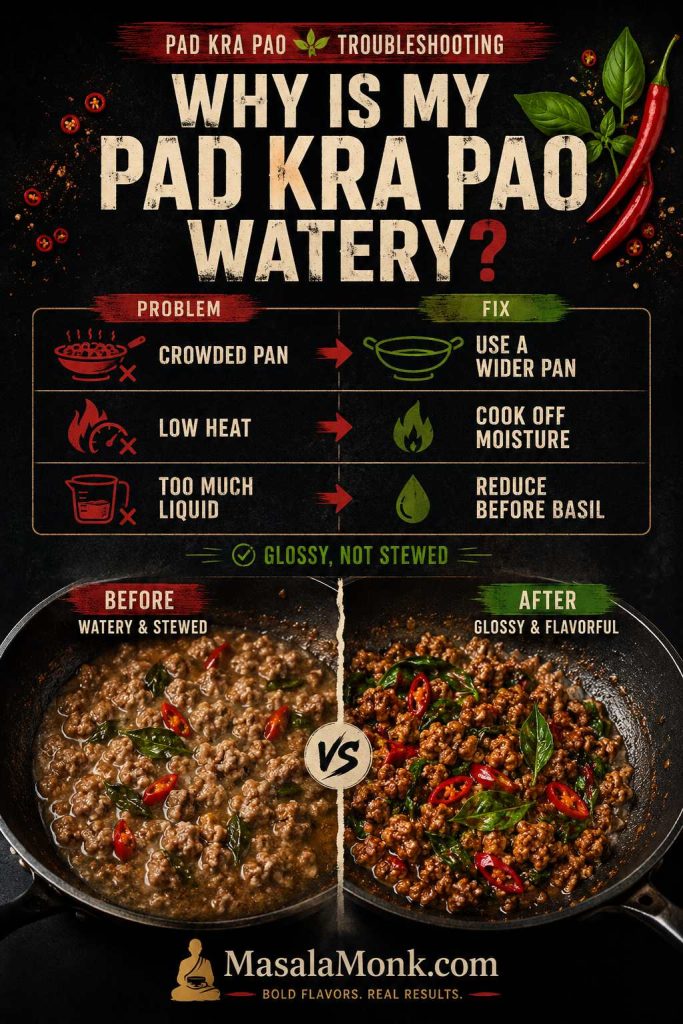
Sauce Is Pooling Under the Meat
Pooling sauce usually means the sauce went in before the pan was ready.
Keep the pan on high heat and toss until the sauce clings to the meat. Next time, start with 2 tablespoons water or stock, then add more only if the pan looks dry.
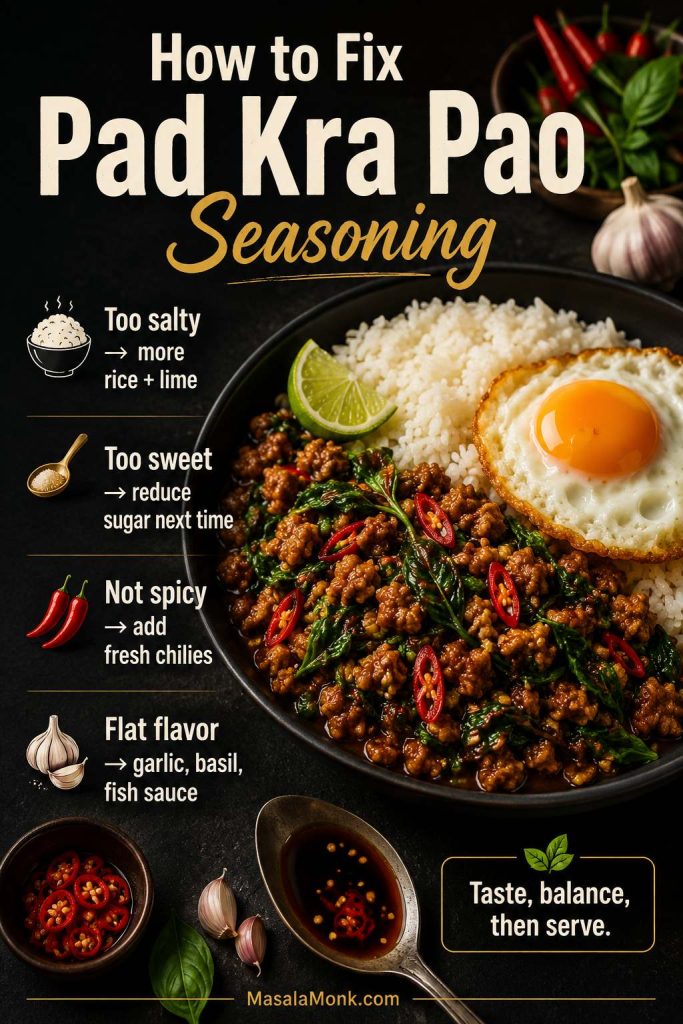
Too Salty
Salty Pad Kra Pao is usually easiest to fix on the plate, not in the pan.
Serve it with more plain rice and add a squeeze of lime. Next time, use the lower-salt sauce ratio and reduce fish sauce and light soy before reducing oyster sauce, because oyster sauce also gives body.
Too Sweet
Too much sweetness usually comes from sweet oyster sauce, dark sweet soy, or too much sugar.
To balance the current batch, add a small splash of fish sauce or light soy and serve it with plain rice. Next time, keep the added sugar modest.
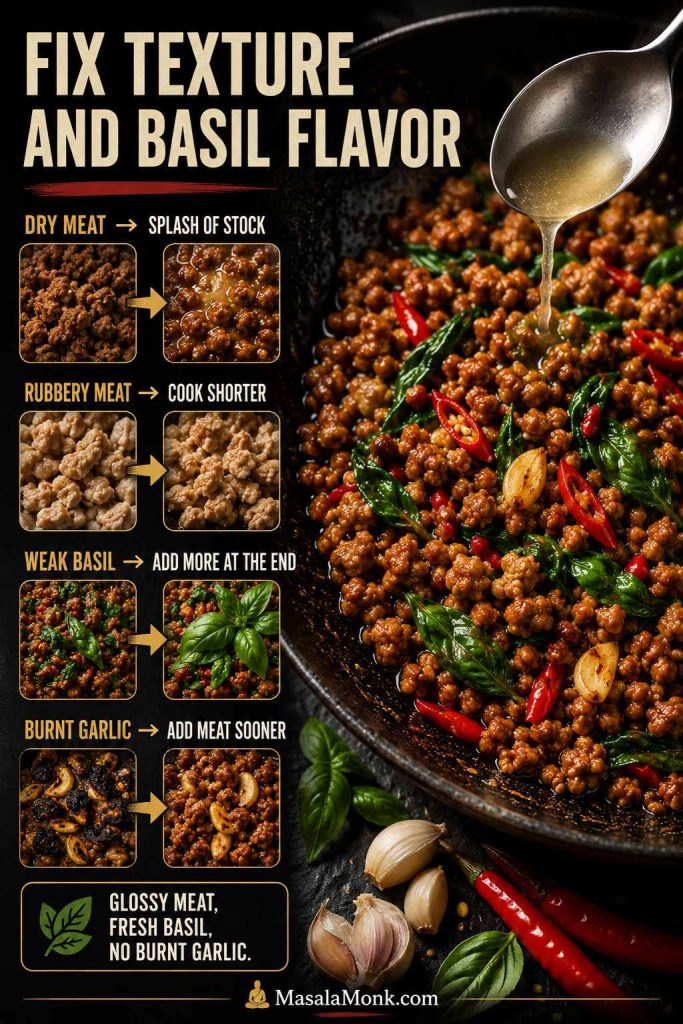
Too Dry
If the meat tastes plain and dry instead of glossy, the pan probably needed a small splash of liquid near the end.
Add 1–2 tablespoons of water or stock and toss briefly over heat. The meat should be glossy enough to season the rice, not dry like plain mince.
Not Spicy Enough
If the dish tastes warm but not lively, the chilies are probably too mild or too few.
Add more chopped fresh chili next time, or serve extra chilies on the side. Fresh chilies give sharper flavor and better aroma than chili flakes alone.
Tastes Like Generic Stir-Fry
If it tastes like a regular soy-sauce stir-fry, the sharp things have been muted: garlic, chili, fish sauce, basil, or heat.
Use enough fresh basil, add it at the end, and make sure the sauce reduces onto the meat instead of staying loose in the pan.
Not Enough Basil Flavor
Weak basil flavor usually means one of two things: too little basil, or basil added while the pan was still boiling.
Use 1½–2 cups basil leaves for 450g / 1 lb meat. Add them only at the end and toss just until wilted.
Basil Turned Dark or Lost Its Aroma
Basil turns dull when it cooks too long.
Add it after the sauce has reduced and the heat is low or off. The leaves should wilt into the meat, not simmer.
Garlic Tastes Burnt
Burnt garlic means the aromatics waited too long before the meat went in.
Next time, stir the garlic and chilies only until fragrant, then add the meat as soon as the garlic smells sharp and toasty.
Meat Turned Rubbery
Rubbery meat is usually an overcooking problem, especially with chicken breast or lean beef.
Stir-fry until just cooked, reduce the sauce quickly, then finish with basil.
For texture and basil problems, focus on timing: keep the meat glossy, keep the garlic golden, and add basil only at the end.
Need to cook another batch instead? Return to the recipe card with the fixes in mind.
Storage and Reheating
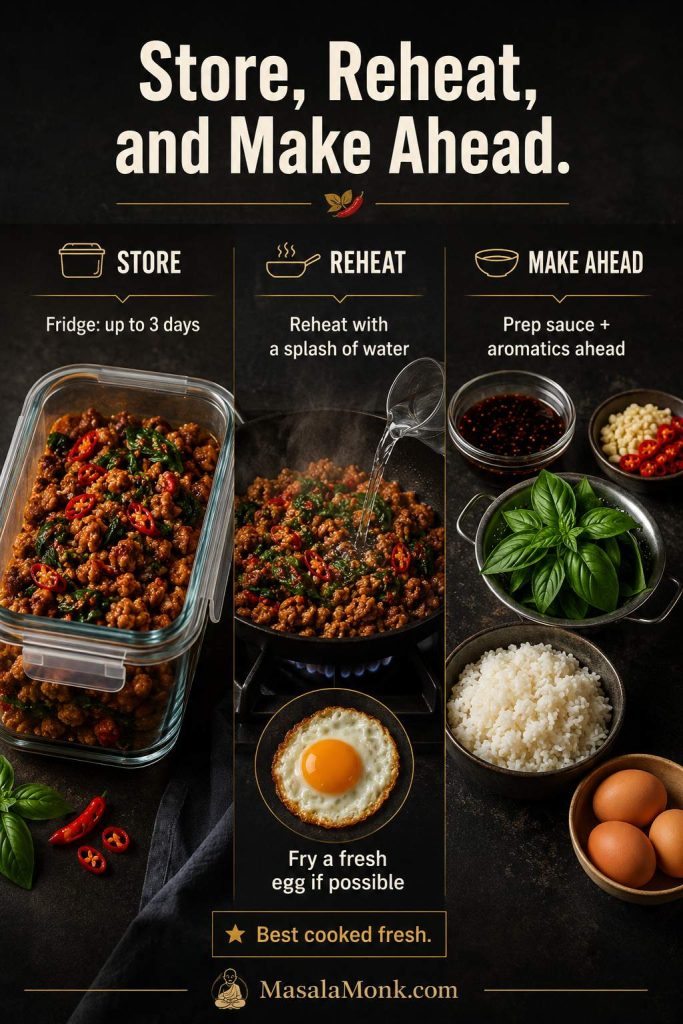
Pad Kra Pao tastes best immediately, when the basil is fresh and the egg is crisp, but leftovers are still useful.
Store the cooked stir-fry in an airtight container in the fridge for up to 3 days. That sits within the USDA’s general 3–4 day guidance for refrigerated leftovers. Store rice separately if possible. Fried eggs are best cooked fresh, but you can skip the egg when reheating and fry a new one before serving.
To reheat, warm the stir-fry in a skillet with a splash of water. Heat just until hot. Do not cook it for too long or the basil flavor will fade further.
Leftovers will not have the same just-wilted basil aroma, but they still make a very good rice bowl the next day.
If you want to prep ahead, mix the sauce, chop the garlic and chilies, wash and dry the basil leaves, and cook the rice. Leave the actual stir-fry for right before eating.
If you like salty-garlicky rice-plate dinners, MasalaMonk’s chicken adobo recipe is another strong one to cook next.
Pad Kra Pao Recipe Card
If this is your first time making it, start with the balanced sauce, use Thai basil if holy basil is hard to find, and keep the pan wide and hot. The first batch will quickly teach you your preferred salt, chili, and basil level.
Pad Kra Pao Recipe: Thai Basil Chicken, Pork, or Beef
This Pad Kra Pao recipe gives you a fast, garlicky Thai basil rice plate with chicken, pork, or beef, glossy sauce, and a crispy fried egg. Use holy basil if you can find it, or Thai basil for the easiest restaurant-style home version.
Equipment
- Wok or 12-inch / 30cm skillet
- Small bowl for mixing the sauce
- Mortar and pestle, knife, or mini chopper
- Small frying pan for eggs
- Spatula
Ingredients
For the Stir-Fry
- 450g / 1 lb ground chicken, pork, or beef
- 2 tbsp neutral oil, for the stir-fry
- 5–8 garlic cloves, finely chopped or pounded
- 3–6 Thai bird chilies, chopped, or 2–4 Indian green chilies
- 1–2 shallots, thinly sliced, optional
- 1½–2 cups holy basil or Thai basil leaves, about 30–60g depending on how tightly packed the leaves are
- Steamed jasmine rice, for serving
- 4 eggs
- 2–3 tbsp neutral oil to start, plus more as needed for frying the eggs
- Cucumber slices, optional
- Lime wedges, optional
For the Sauce
- 1 tbsp oyster sauce, 15 ml
- 1 tbsp fish sauce, 15 ml
- 1 tbsp light soy sauce, 15 ml
- 1–2 tsp dark soy sauce, 5–10 ml, optional for deeper color
- 1 tsp sugar, about 4g
- 2–3 tbsp water, chicken stock, or vegetable stock, 30–45 ml
Instructions
- Cook the rice first. Pad Kra Pao cooks quickly, so have rice ready before you start the stir-fry.
- Mix the sauce. In a small bowl, stir together oyster sauce, fish sauce, light soy sauce, optional dark soy sauce, sugar, and water or stock.
- Prepare the aromatics. Pound or finely chop the garlic and chilies. Pick the basil leaves from the stems, wash them if needed, and dry them well.
- Fry the eggs. Heat 2–3 tablespoons oil in a small pan. Fry the eggs one at a time or in batches, spooning hot oil over the whites until the edges are crisp. Add more oil only if the pan gets dry. Set aside.
- Heat the pan. Heat a wok over high heat, or a wide nonstick skillet over medium-high heat.
- Cook the garlic and chilies. Add oil, then garlic, chilies, and optional shallots. Stir briefly until fragrant, without letting the garlic burn.
- Add the meat. Add ground chicken, pork, or beef. Break it up and stir-fry until cooked through and most moisture has evaporated.
- Add the sauce. Pour in the sauce and toss until the meat is glossy and coated. It should not be soupy.
- Add basil last. Turn the heat down or off, add basil, and toss just until wilted.
- Serve immediately. Spoon over rice and top each serving with a crispy fried egg. Add cucumber and lime if you like.
Notes
- Holy basil gives the most traditional flavor; Thai basil is the easiest excellent home version.
- Use neutral oil because olive oil or strongly flavored oils can fight the basil, garlic, and fish sauce.
- You do not need to marinate the meat. The sauce and aromatics flavor it during the fast stir-fry.
- If using 500g meat instead of 450g, keep the same sauce ratio first, then adjust only if needed.
- For a less salty or milder version, reduce fish sauce and soy slightly, and start with 1 Thai chili or 1 small green chili.
- If doubling the recipe, cook the meat in batches and add the basil only at the end.
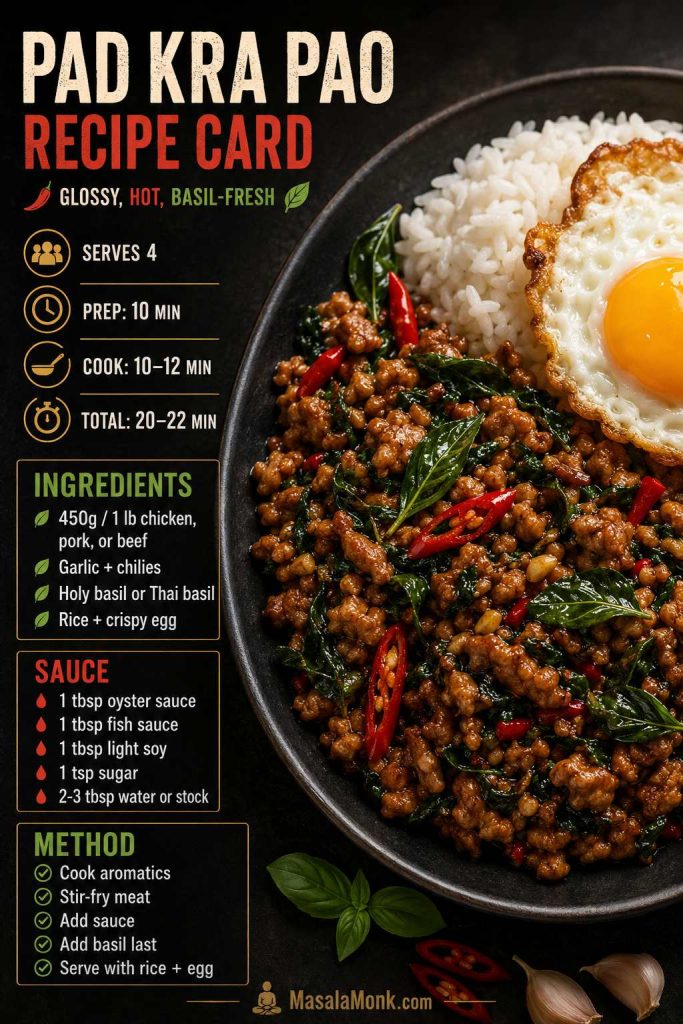
By the time the rice, basil stir-fry, and egg come together, the plate should feel hot, glossy, and immediate.
FAQs
Is Pad Kra Pao the same as Thai basil chicken?
Thai basil chicken is usually the chicken version of Pad Kra Pao. Traditionally, the dish is made with holy basil, but many restaurant and home versions use Thai basil because it is easier to find.
What does Pad Kra Pao taste like?
Pad Kra Pao tastes garlicky, salty-savory, spicy, and fresh from the basil. It should feel bold and punchy, with just enough glossy sauce to season the rice without turning the plate into curry.
What basil is best for Pad Kra Pao?
Holy basil gives the most traditional sharp, peppery flavor. Thai basil is the best practical substitute for most home kitchens. Sweet basil works only in a pinch; it makes the dish softer and less like classic Pad Kra Pao.
Can I use dried basil?
Dried basil is not a good replacement because Pad Kra Pao depends on the fresh aroma of basil added at the end. If dried basil is all you have, you can still make a garlic-chili stir-fry, but it will not taste like Pad Kra Pao or a fresh Thai basil chicken-style stir-fry.
Is Pad Kra Pao supposed to be saucy?
No, it should be glossy rather than soupy. You want enough sauce to season the rice, but not so much that the meat swims. Think juicy rice plate, not curry.
Does Pad Kra Pao need a fried egg?
The fried egg is technically optional, but it is part of the pleasure of the plate. The crisp edges add texture, and the yolk softens the salty, spicy meat into the rice.
Chicken breast, sliced chicken, or ground chicken: which works best?
Ground chicken or chopped chicken thigh is easiest and juiciest. Sliced chicken works too if you cut it small and cook it quickly. Chicken breast is usable, but it dries out faster than thigh.
What can replace fish sauce?
Use light soy sauce with a small pinch of mushroom seasoning if you have it. The flavor will be less funky and less Thai-style, but still savory.
What can replace oyster sauce?
Vegetarian oyster sauce or mushroom sauce is the best replacement. If you do not have either, use soy sauce with a little sugar, but the sauce will be thinner and less rounded.
Why did my Pad Kra Pao turn watery?
Watery Pad Kra Pao usually means the meat steamed before it fried. Use a wider pan, higher heat, and cook off moisture before adding the sauce.
Can I make Pad Kra Pao ahead?
You can prep the sauce, garlic, chilies, basil, and rice ahead of time. For the best flavor, cook the stir-fry right before eating because basil tastes freshest when added at the end.
How long does Pad Kra Pao keep in the fridge?
The cooked stir-fry keeps for up to 3 days in an airtight container. Reheat it in a skillet with a splash of water. Fry a fresh egg when serving if possible.
Once this rhythm clicks, Pad Kra Pao becomes less like a strict recipe and more like a rice-plate formula you can repeat with chicken, pork, beef, tofu, or whatever needs cooking.