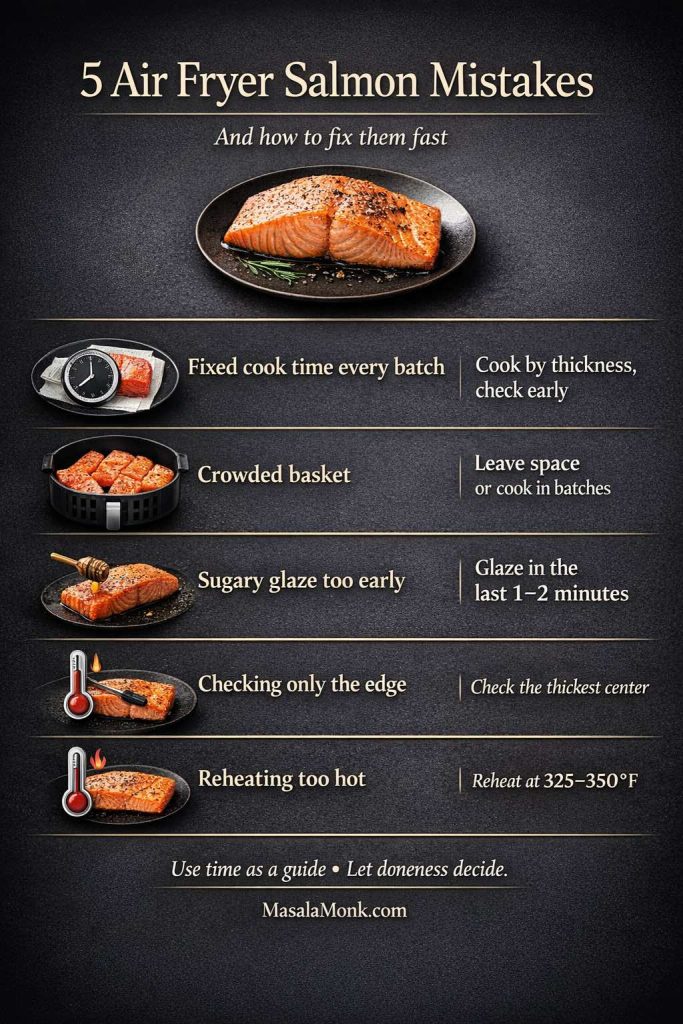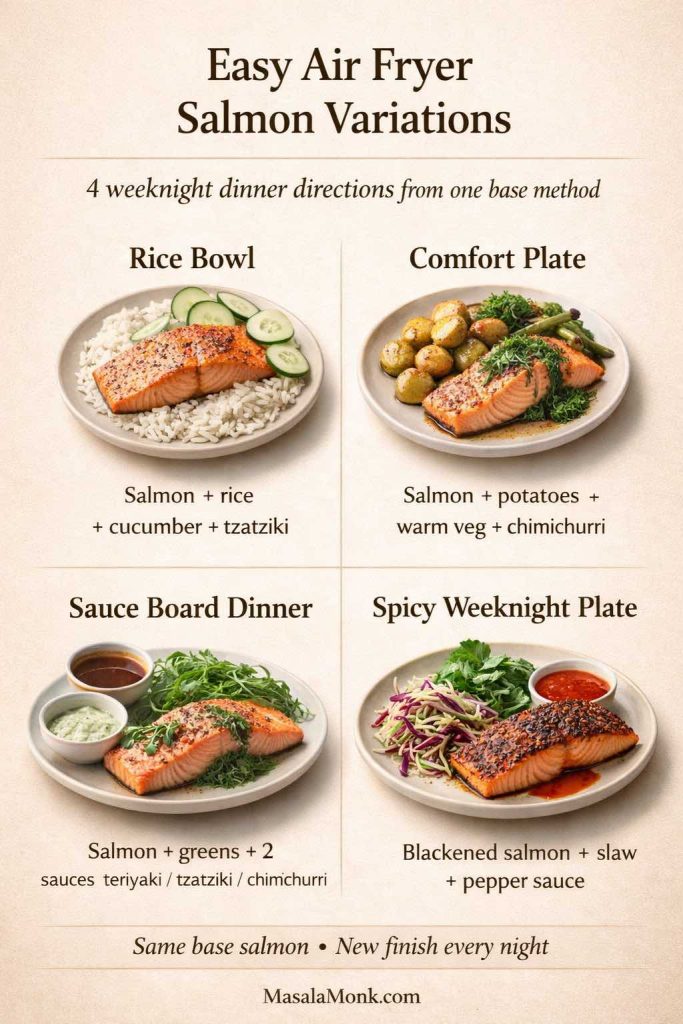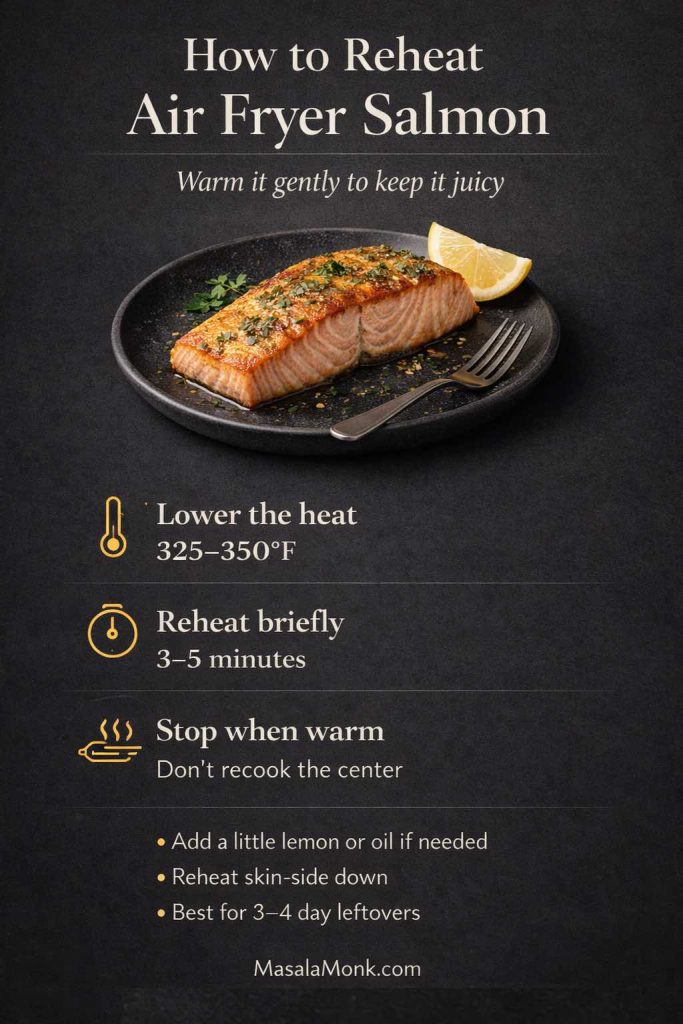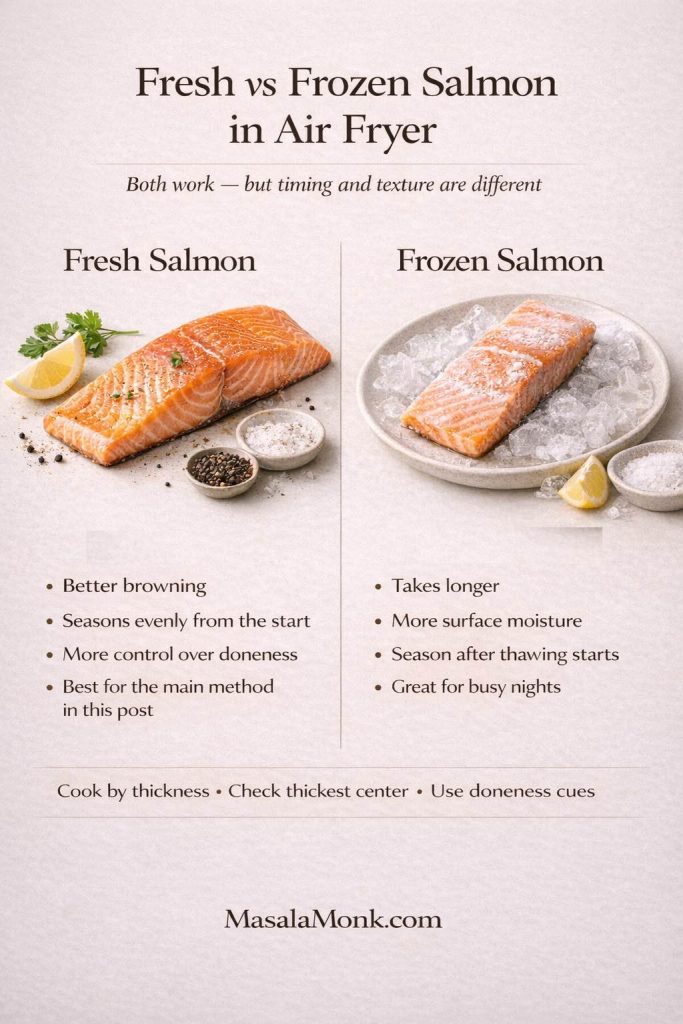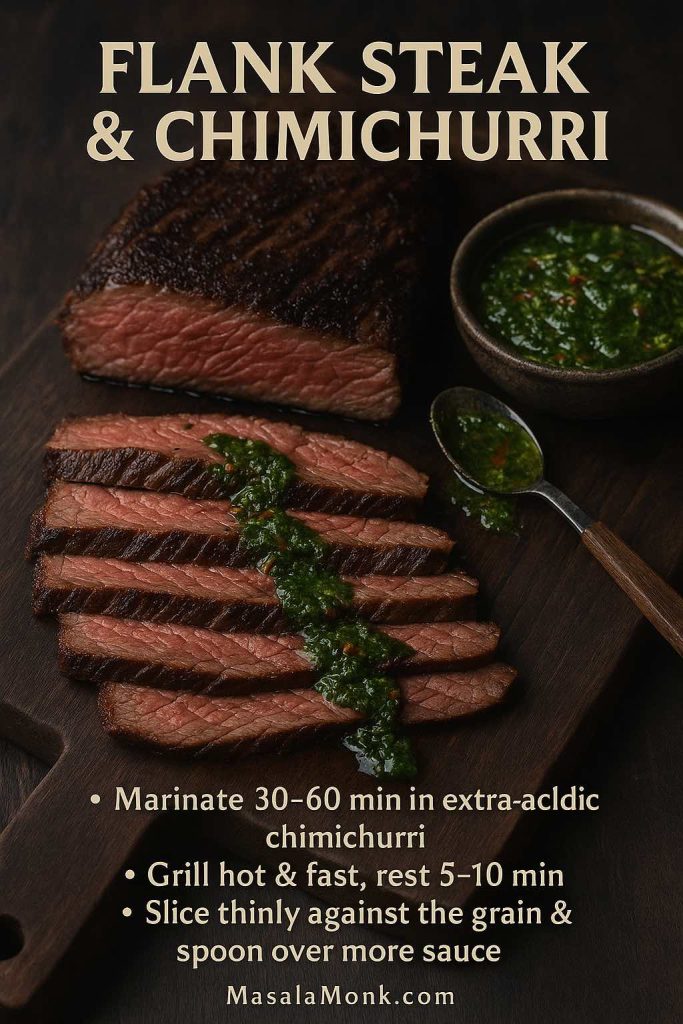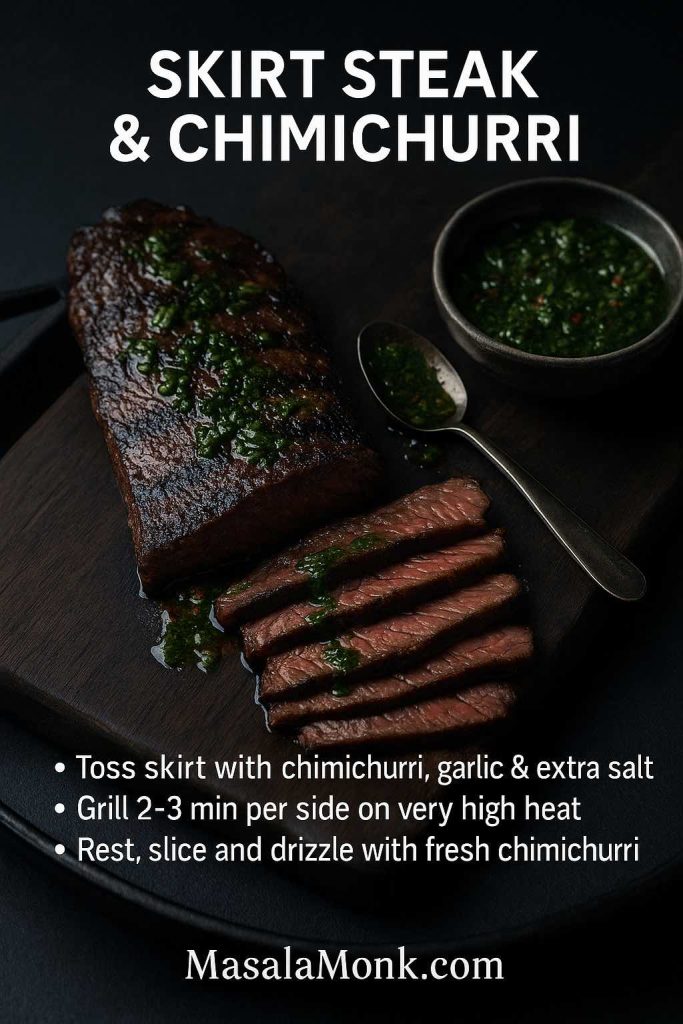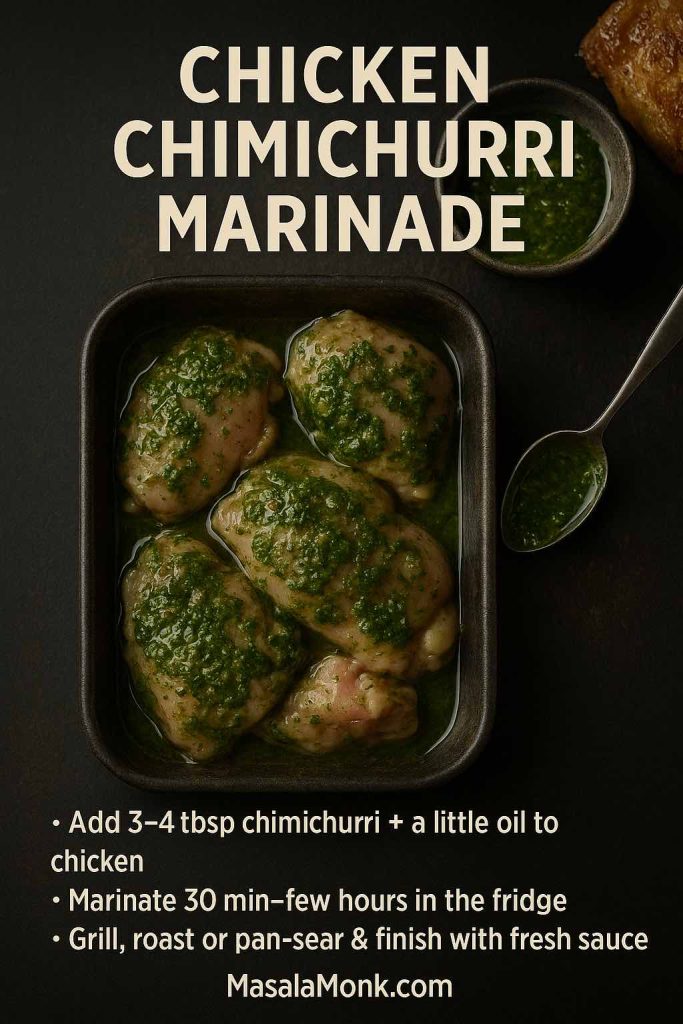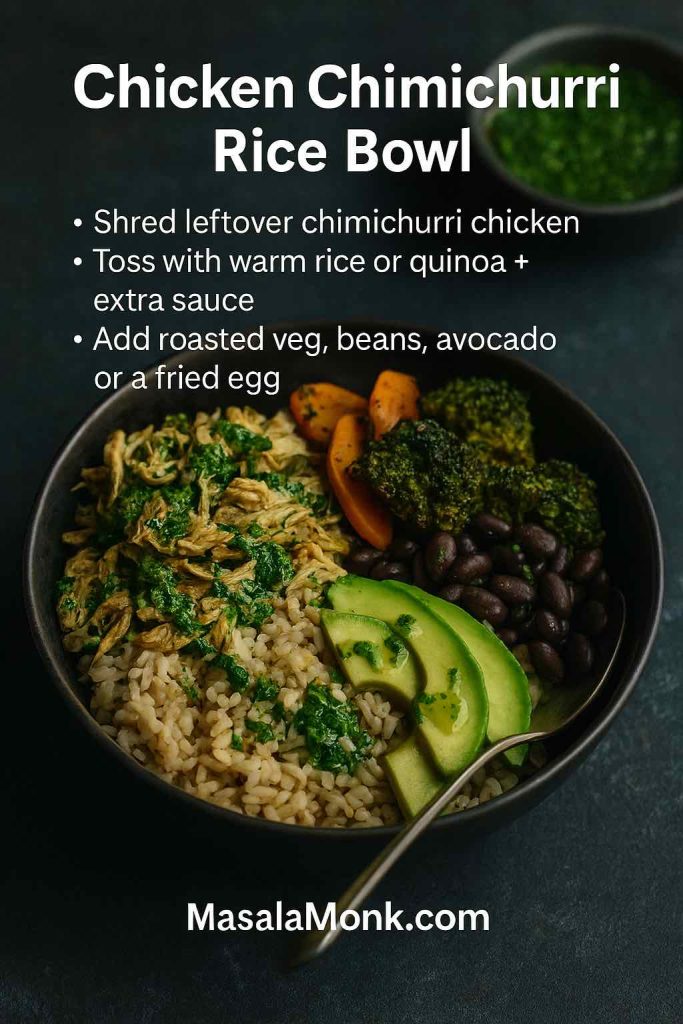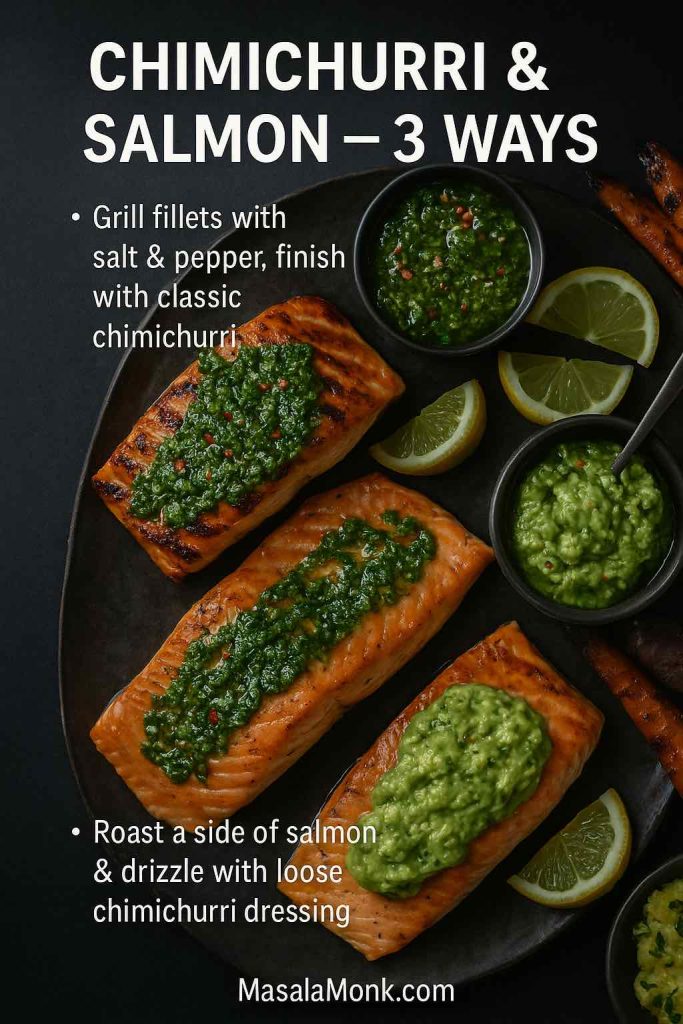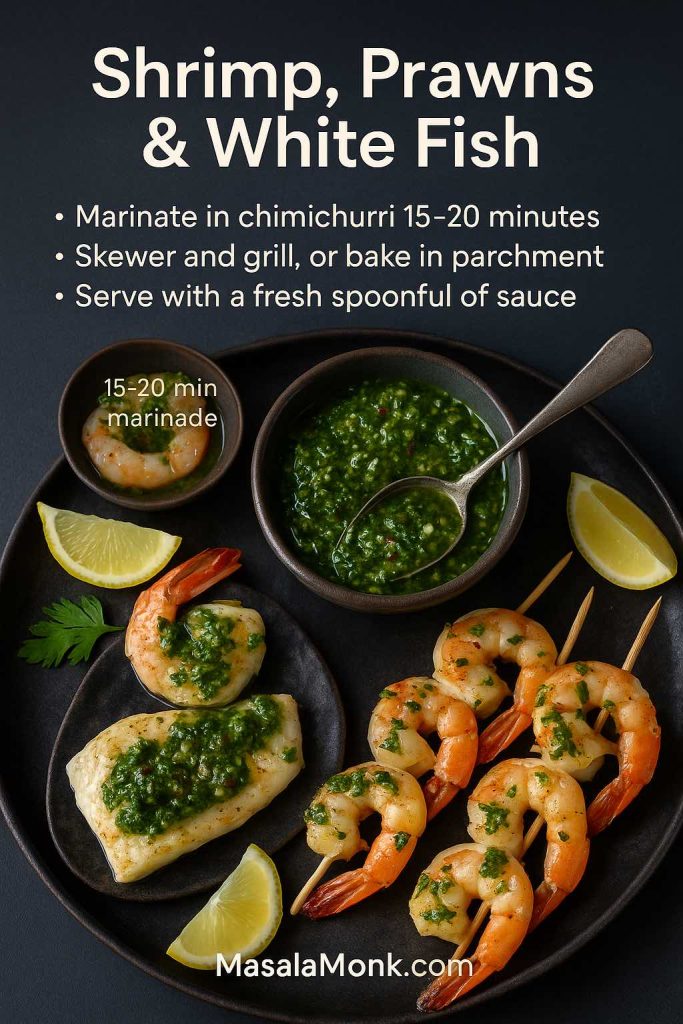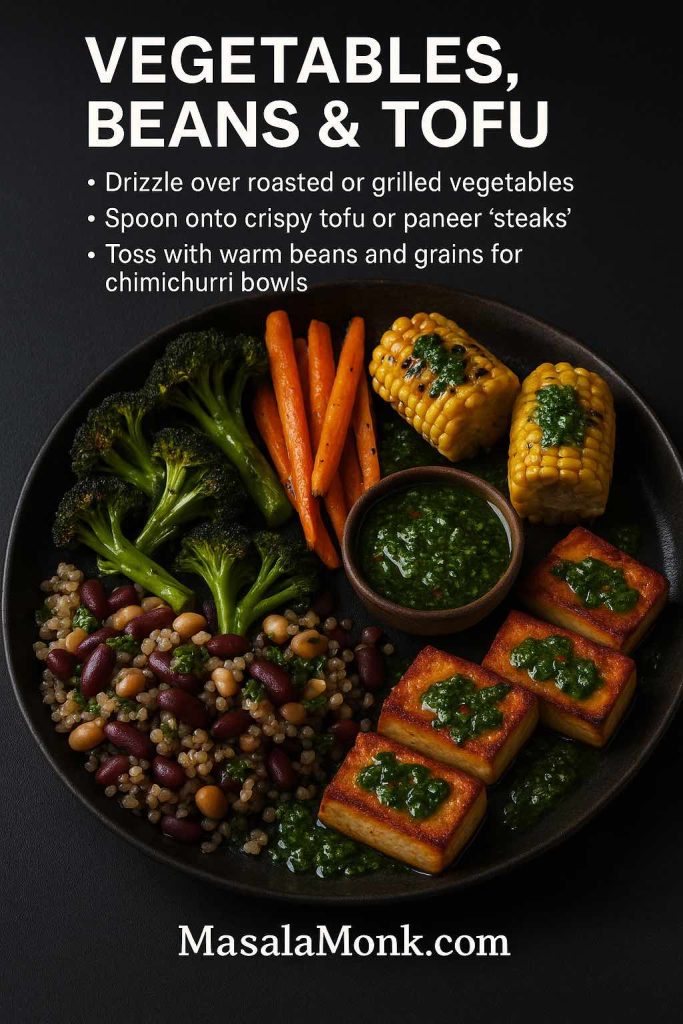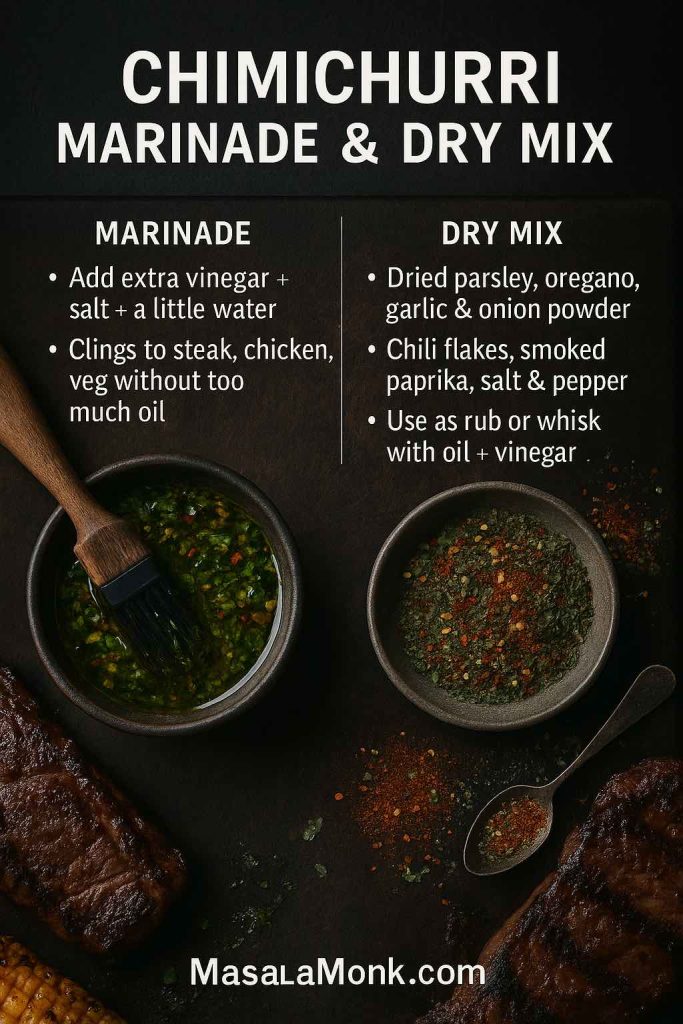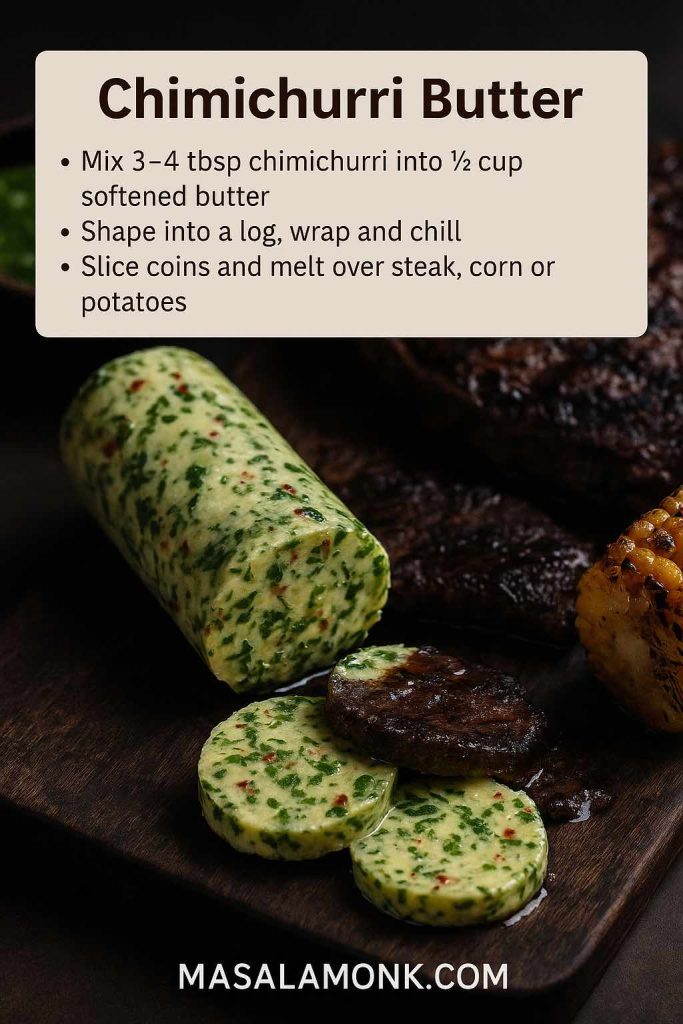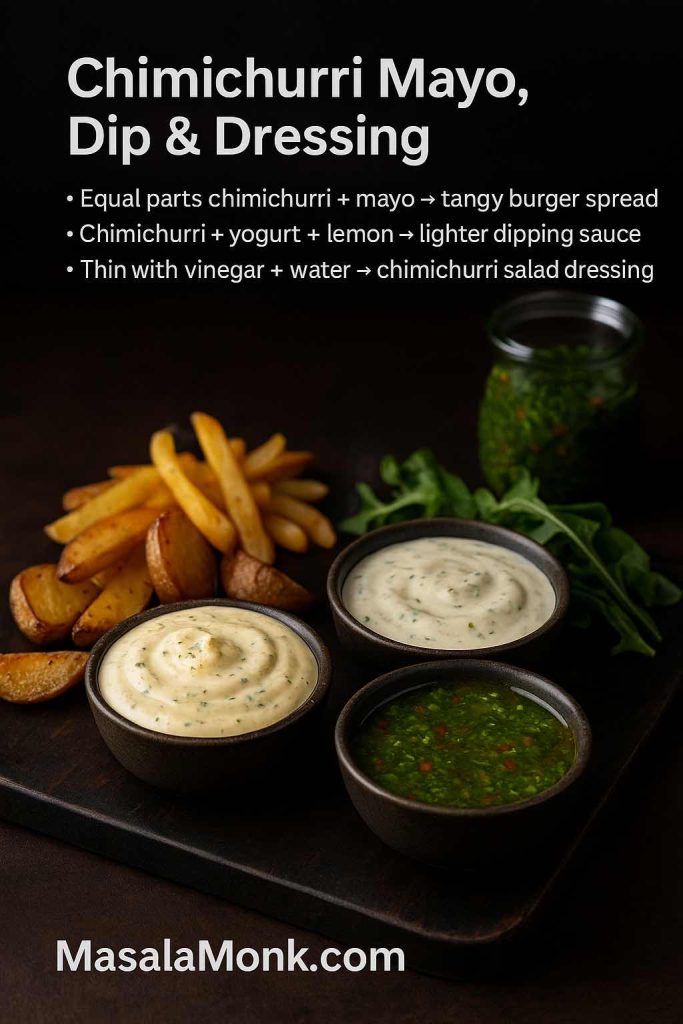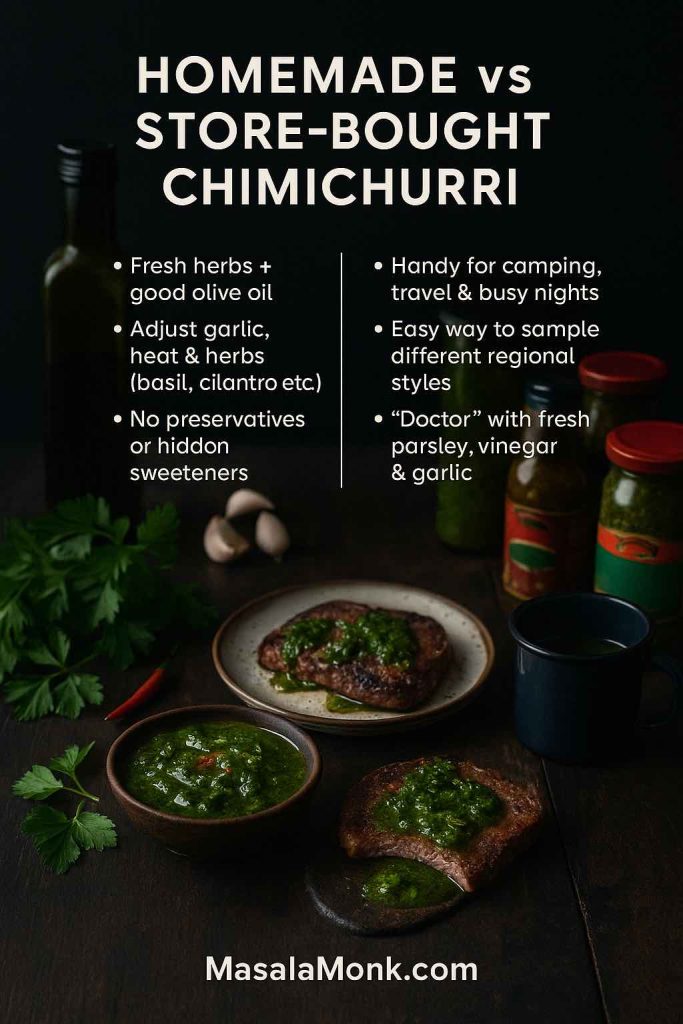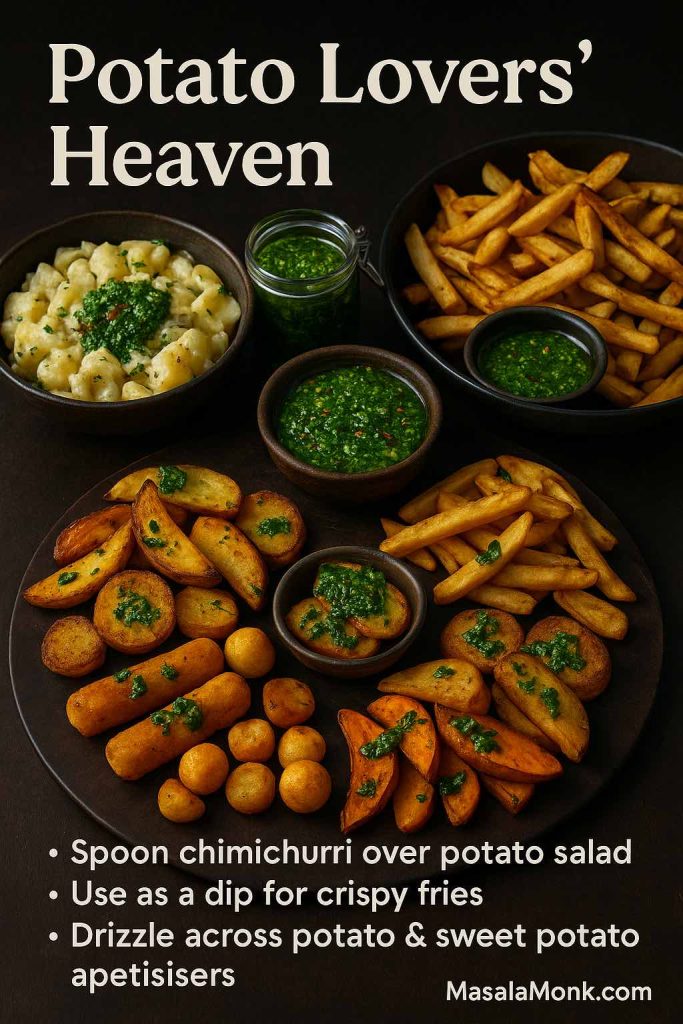
Posted on Leave a comment

Homemade Teriyaki Sauce Recipe : Classic, Thick, Sticky, Healthy & More

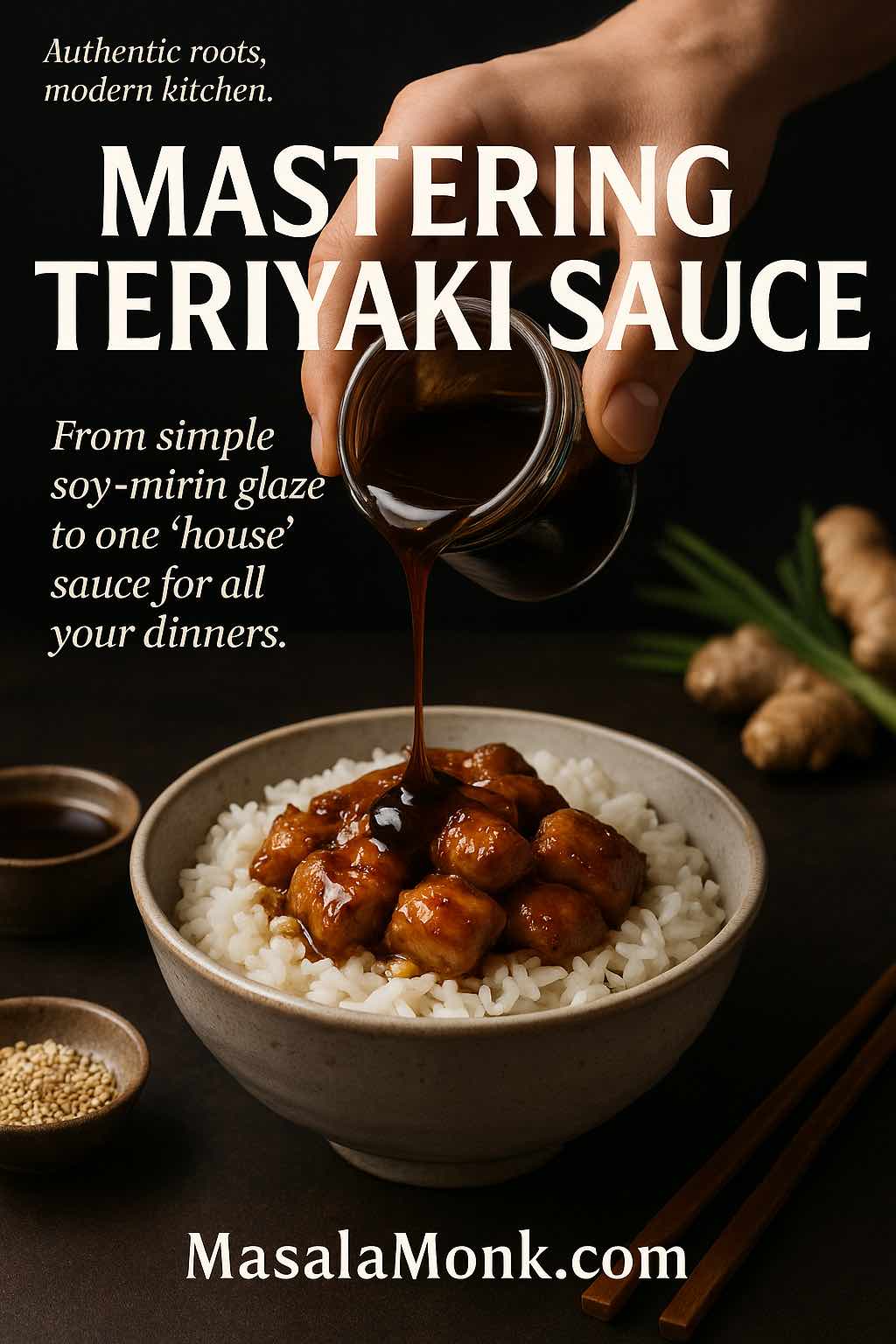
Hand pouring glossy teriyaki sauce over a bowl, with the headline ‘Mastering Teriyaki Sauce’ on a premium magazine-style cover for MasalaMonk.

Teriyaki is one of those flavours that makes plain food feel like an actual meal. A bowl of rice and vegetables is nothing special; spoon a glossy, sweet–savory teriyaki sauce over the top and suddenly it looks like something from a Japanese grill. The same happens to chicken thighs, salmon fillets, tofu cubes, even roasted potatoes. A teriyaki sauce recipe is simple at its core, but endlessly flexible in practice.

The confusion starts when you realise “teriyaki sauce” means very different things to different people. In Japan, it began as a simple glaze made with soy sauce, mirin and sugar, brushed repeatedly onto grilled fish or chicken. Outside Japan, it grew thicker, sweeter and more garlicky, eventually showing up in bottles, takeout shops and fusion recipes ranging from teriyaki pizza to teriyaki burgers. Then the health-conscious crowd arrived and the questions multiplied: low sugar teriyaki, low sodium teriyaki, keto teriyaki, vegan teriyaki, soy-free teriyaki… are those even still “teriyaki”?

This post is meant to be your one-stop answer. We’ll walk through what teriyaki actually is, how to make a reliable homemade teriyaki sauce, how to cook a more traditional Japanese-style version, and how to spin that base into marinades, stir-fry sauces, glazes, dips and dressings. After that, we’ll look at the most useful flavour variations and finish with ways to make teriyaki lighter and friendlier for everyday eating, without turning it into a completely different sauce.

Throughout, think of teriyaki as joining the same “core sauce” family as pesto, béchamel and tzatziki—sauces that MasalaMonk has already taken deep dives into in posts like the basil-packed pesto variations, classic béchamel for lasagna and refreshing Greek tzatziki recipes. Once you know the base, you can bend it in all sorts of directions.


What “Teriyaki” Really Means

The word comes from two Japanese elements: teri, which refers to shine or luster, and yaki, meaning grilling or broiling. If you look at the description on Wikipedia’s teriyaki page, you’ll see that originally it wasn’t a bottled sauce at all, but a method of cooking: fish or meat was grilled while being brushed with a mixture of soy sauce, mirin and sugar, sometimes sake as well. The sugar and mirin helped the glaze caramelise and created that characteristic glossy coat.

In that setting:

  • the focus was on the technique of basting and grilling
  • the glaze was a simple blend of soy, mirin, sugar and maybe sake
  • the sauce itself stayed fairly thin and syrupy, not thick like gravy

Classic examples include teriyaki yellowtail, teriyaki mackerel and teriyaki chicken. The glaze was cooked directly onto the surface of the food. It wasn’t something served in a ramekin on the side.

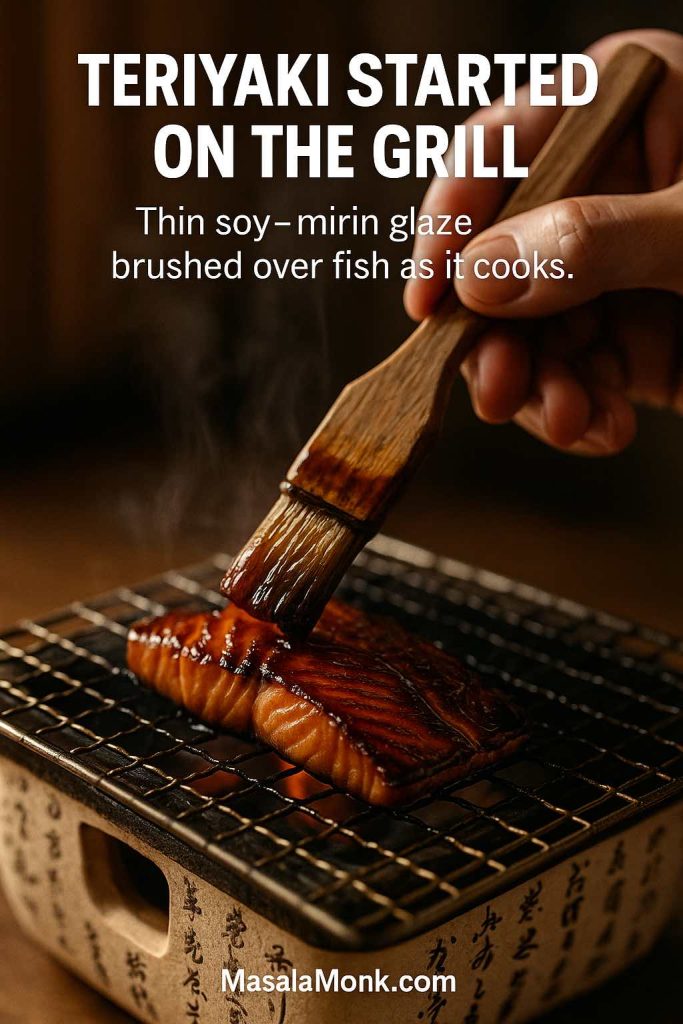
Traditional Japanese teriyaki salmon being brushed with a thin soy–mirin glaze on a tabletop grill, showing the shiny caramelised surface and steam rising.
In classic Japanese cooking, teriyaki isn’t a bottled sauce but a technique: fish or chicken is grilled while being brushed over and over with a light soy–mirin glaze until it turns glossy and caramelised.

As Japanese cooks migrated and Japanese flavours spread, teriyaki began to adapt. In Hawaii, cooks folded in brown sugar and pineapple juice. In the US, garlic and ginger started appearing in the mix. Bottled teriyaki sauces appeared on shelves, often thickened with starch and stabilisers so they’d hold up over time. Restaurant dishes like chicken teriyaki bowls, beef teriyaki skewers and salmon teriyaki became staples.

So when someone says “teriyaki sauce” today, they might be thinking of:

  • a light, traditional soy–mirin glaze
  • a thick, sweet, garlicky bottled sauce
  • or a homemade version that tries to be healthier, spicier or fruitier

Instead of treating those as completely separate things, it’s more helpful to see them as points on a spectrum, all built from the same core ingredients.

Also Read: Bolognese Sauce Recipe: Real Ragù & Easy Spag Bol


The Essential Building Blocks of Teriyaki

Every teriyaki sauce—whether it calls itself authentic, homemade, healthy, or “just like your favourite restaurant”—is some combination of a few key elements. Once you understand what each one does, creating your own version becomes much easier.

Soy Sauce: The Savoury Backbone of Any Teriyaki Sauce Recipe

The foundation of teriyaki is soy sauce. It brings salt, umami (that deep savoury dimension), and the dark, rich colour most people associate with the sauce.

The Wikipedia entry for soy sauce gives a good overview of how it’s traditionally brewed from soybeans, grain, water and salt. For our purposes, what matters is:

  • regular soy sauce is intensely salty and savoury
  • you can use low-sodium soy to make more forgiving sauces
  • tamari, made mostly from soy without wheat, is a good choice when you need a gluten-free teriyaki base

Because soy sauce is so salty, it’s very easy for teriyaki to become sodium-heavy—especially when you reduce it into a sticky glaze. That’s why a lot of people look for lower sodium approaches, which we’ll come back to later.

Mirin and Sake: Shine and Sweetness

If soy sauce is the backbone, mirin is the soul of a traditional teriyaki. Mirin is a sweet rice wine used in Japanese cooking, described in more depth on pages like this mirin overview. It brings:

  • natural sweetness
  • a mild, wine-like aroma
  • a helping hand with that glossy “teri” shine when it reduces with soy and sugar

Sake, another rice wine, sometimes joins the party, adding aroma and dimension. Put together, soy, mirin, sake and sugar form the base of the classic Japanese teriyaki glaze. No cornstarch, no garlic, no ginger—just those four building blocks simmered until they slightly thicken.

If you don’t have mirin, you can approximate it by combining a splash of sake or white wine with sugar, or by using sugar and rice vinegar together for a similar sweet-acid balance. It won’t be exact, but the overall character of the sauce will still lean toward teriyaki.

Sweeteners: Balance and Caramelisation in a Teriyaki Sauce Recipe

Teriyaki has a sweet side. That sweetness balances the saltiness of soy sauce and encourages the surface of the sauce to caramelise under high heat.

You can use:

  • white sugar, for neutral sweetness
  • brown sugar, for a deeper, caramel-like note
  • honey, for a rounder, floral sweetness

Other sweeteners—maple syrup, coconut sugar, jaggery, date syrup—can slide in comfortably as well, depending on what you have and what kind of flavour you’re chasing.

The main thing is to remember that sugar is acting as a seasoning. It’s there to keep the sauce from tasting harsh and salty and to give it that repeat-able, “lick the spoon” quality. Take it too far and you end up with something that feels like dessert on your chicken; dial it in well and you get that classic sweet–savory balance.

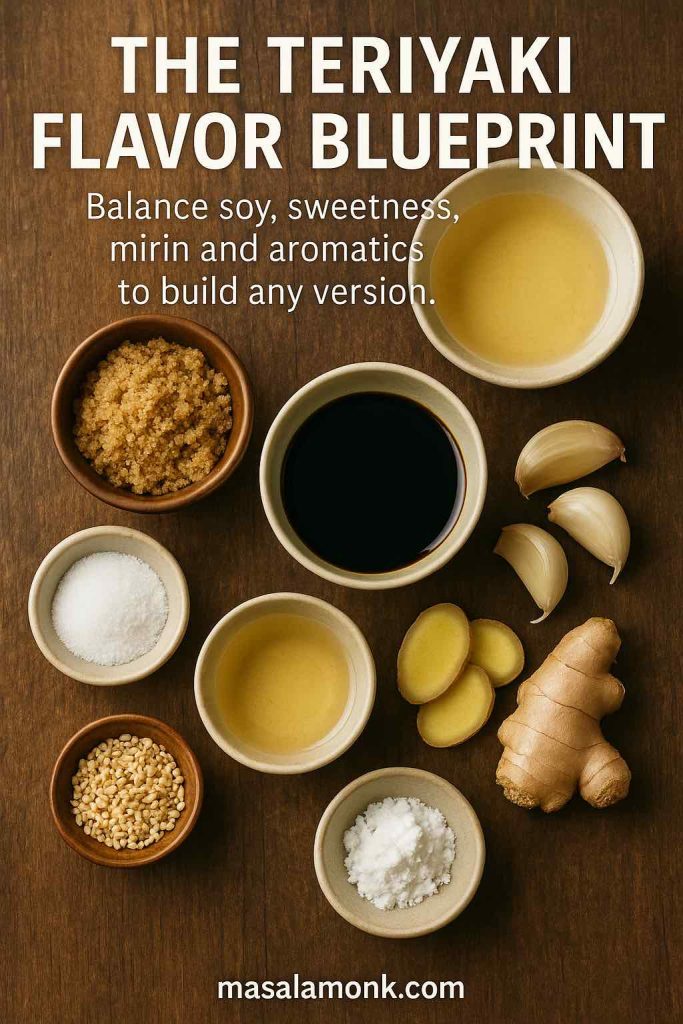
Overhead view of small bowls holding soy sauce, mirin, sugar, garlic, ginger and other seasonings on a wooden table, showing the main ingredients needed to make homemade teriyaki sauce.
Every teriyaki recipe is built from the same core pieces: soy for salt and colour, mirin or sake for shine, sugar or honey for sweetness, plus garlic and ginger for aroma. Once you understand this “flavour blueprint”, tweaking the sauce for chicken, salmon, noodles or low-sugar versions becomes simple.

Garlic and Ginger: Aromatic Extras

In strictly traditional teriyaki, you can absolutely skip garlic and ginger. Many traditional Japanese teriyaki sauce recipes don’t include them. But they’ve become so common in global teriyaki that a lot of people instinctively expect that flavour.

Garlic adds a warm, pungent note; ginger brings a slightly spicy freshness. Together, they make the sauce:

  • punchier and more aromatic
  • better suited to stir-fries and noodle dishes
  • closer to what most “teriyaki chicken” takeout tastes like

If you love ginger, you can double down and let the sauce lean into a ginger-forward profile. If you want something mellow, you can keep both garlic and ginger fairly subtle.

Thickening: Reduction, Starch or Syrup

Finally, there’s the question of texture. A teriyaki sauce recipe can be:

  • thin and brushable
  • thick and clingy
  • or sticky and syrupy

There are three easy ways to get the texture you want.

Reduction
If you simmer a soy–mirin–sugar mixture gently, water evaporates and the sauce naturally thickens. This is how traditional teriyaki glaze is usually made: no extra thickener, just time and evaporation.

Starch slurry
Mix a spoonful of cornstarch with an equal or slightly larger amount of cold water until smooth, then stir that into a gently simmering sauce. As it heats, the starch thickens the liquid, giving you a glossy, reliable coating. This is what a lot of quick “homemade teriyaki sauce” recipes use.

Thicker sweeteners
Honey and syrupy sweeteners naturally give body. If your sauce includes them and you reduce it a bit, they help you get that sticky, almost lacquered consistency without needing much starch.

Once you’re familiar with these three levers, adjusting a sauce from “light glaze” to “thick stir-fry sauce” to “sticky wing glaze” becomes a simple question of preference.

Also Read: Authentic Chimichurri Recipe (Argentine Steak Sauce)


The Everyday Homemade Teriyaki Sauce Recipe

With the fundamentals in place, let’s actually make a sauce you can use on weeknights. This version keeps the ingredient list small, uses garlic and ginger, and relies on a cornstarch slurry so you get a consistent result even if you’re new to this.

It’s exactly the kind of thing you can batch once and then keep in the fridge, the way you might keep a jar of pesto or a homemade salad dressing.

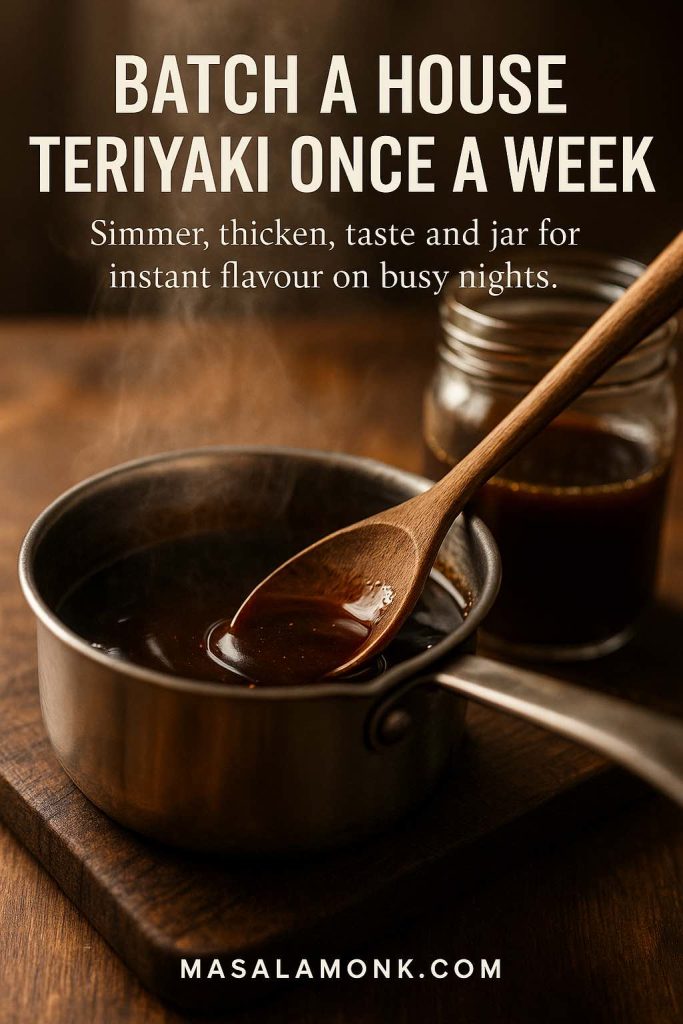
Close-up of glossy homemade teriyaki sauce being stirred with a wooden spoon in a small saucepan, with a glass jar of sauce in the background, illustrating batch cooking for easy weeknight teriyaki recipes.
Cooking one small pan of teriyaki and jarring it for the fridge turns the sauce into a “house staple” you can grab for quick dinners—brush it over chicken, drizzle on salmon, toss with vegetables or turn it into a stir-fry sauce without starting from scratch each time.

Ingredients for Teriyaki Sauce Recipe

  • ½ cup soy sauce (regular or low-sodium)
  • ½ cup water
  • ¼ cup mirin (or 2 tablespoons mirin + 2 tablespoons sake if that’s what you have)
  • ¼ cup brown sugar (you can replace part with honey for extra stickiness)
  • 1–2 cloves garlic, very finely minced
  • 1–2 teaspoons fresh ginger, grated
  • 1 tablespoon rice vinegar (optional, for brightness)
  • 1 tablespoon cornstarch
  • 2 tablespoons cold water (for the slurry)

Step-by-Step Teriyaki Sauce Recipe

Step 1: Combine the base ingredients

Pour the soy sauce, water, mirin, brown sugar, garlic, ginger and rice vinegar into a small saucepan. Stir everything together so the sugar starts to dissolve and the garlic and ginger are evenly dispersed.

Hand pouring soy sauce into a saucepan filled with liquid and brown sugar, with sliced garlic and fresh ginger on a cutting board, showing the base ingredients for homemade teriyaki sauce.
Layering soy, mirin, sugar, garlic and ginger in a cold pan lets the flavours blend before the heat hits, so your teriyaki sauce reduces evenly instead of tasting sharply salty in some spoonfuls and flat in others.

Step 2: Bring to a gentle simmer

Set the saucepan over medium heat. As it warms up, keep an eye on it and give it an occasional stir. Aim for a gentle simmer, not a furious boil. After a few minutes, the sugar will be fully dissolved and the kitchen will start to smell like teriyaki night.

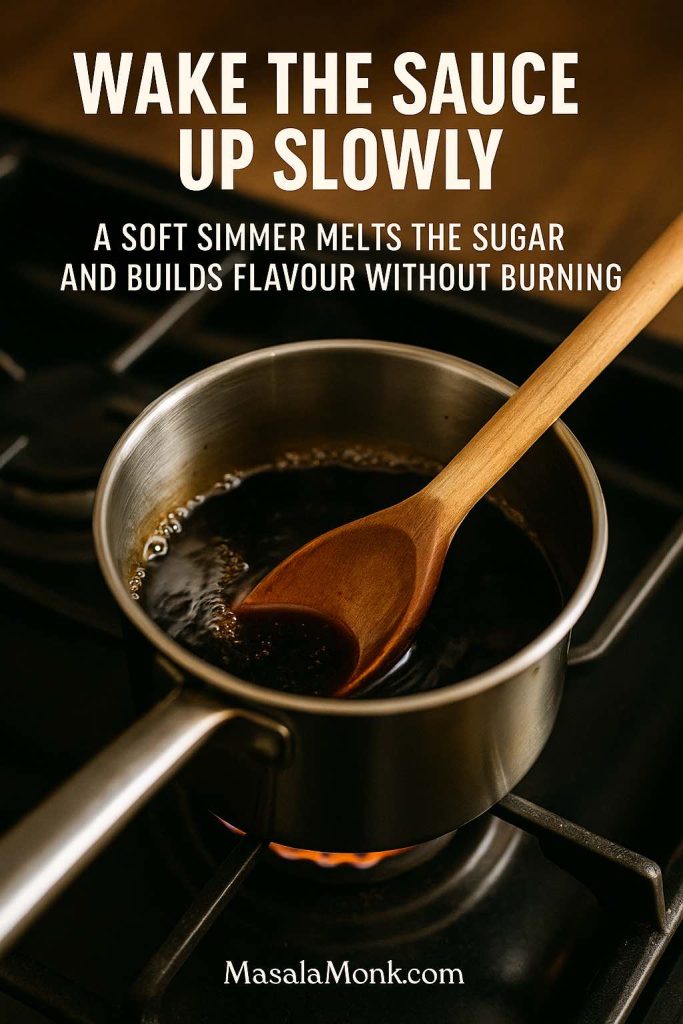
Teriyaki sauce gently simmering in a small saucepan with tiny bubbles at the edges and a wooden spoon stirring, showing how to melt the sugar and infuse flavour without boiling hard.
If the surface is jumping like a vigorous boil, turn the heat down. A quiet simmer gives you gloss and depth; too much heat can make the sauce taste harsh or slightly burnt before it ever reaches the right thickness.

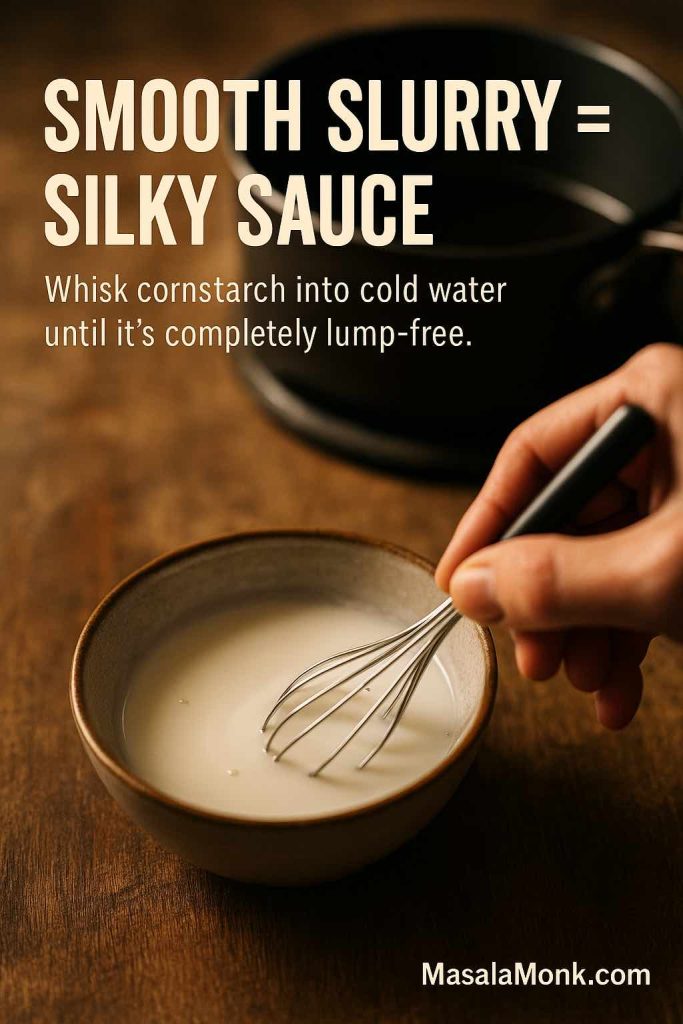
Step 3: Make the cornstarch slurry

While the sauce is heating, mix the cornstarch and cold water in a small bowl until completely smooth. Any lumps now will turn into lumps in the sauce later, so it’s worth taking ten extra seconds to get this right.

Hand whisking cornstarch and cold water into a smooth slurry in a small ceramic bowl on a wooden counter, with a saucepan blurred in the background, showing how to prepare a lump-free thickener for teriyaki sauce.
If the slurry looks chalky or grainy, keep whisking until it turns glossy and perfectly smooth. A well-made slurry disappears into the teriyaki and thickens it gently; a rushed one leaves tiny gummy blobs you’ll never quite strain out.

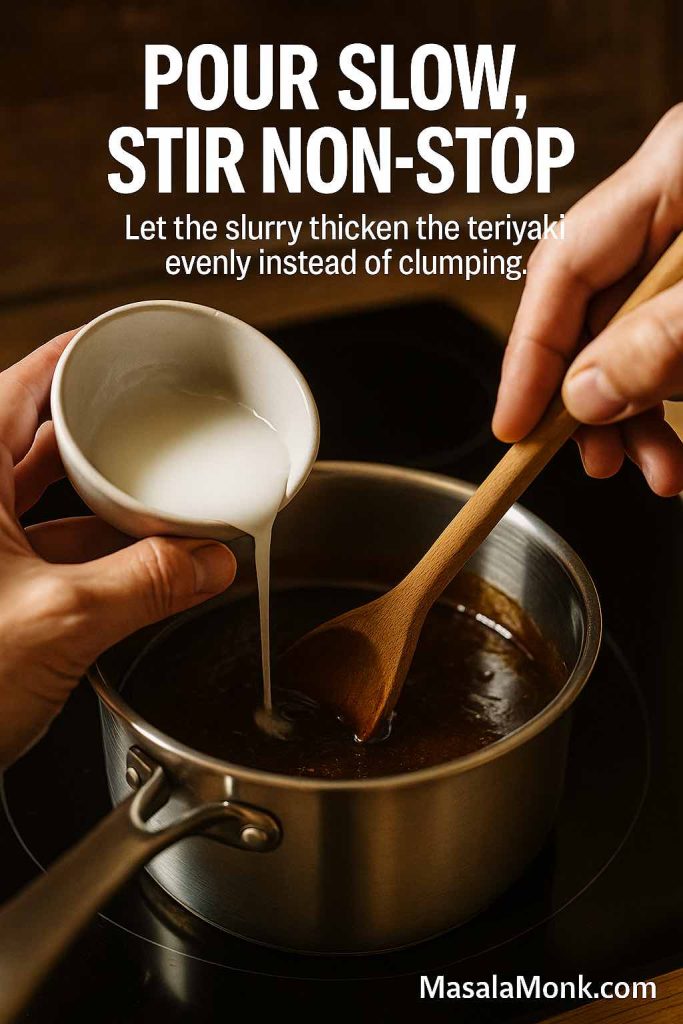
Step 4: Thicken the sauce

Once the sauce is gently simmering, turn the heat down just a notch and slowly pour in the cornstarch slurry while stirring continuously. The liquid will look cloudy at first, then begin to clear and thicken. After a minute or two, it should coat the back of a spoon and fall in a slow, steady ribbon.

Cornstarch slurry being poured in a thin stream into a simmering saucepan of teriyaki sauce while a wooden spoon stirs constantly, showing how to thicken the sauce evenly.
Add the slurry gradually and give the sauce a minute or two to come back to a gentle simmer. It should go from thin and shiny to a glaze that coats the back of a spoon and falls in a slow ribbon—ideal for brushing, tossing and drizzling.

Step 5: Taste and adjust

Now taste the sauce.
If the sauce feels too salty, add a splash of water or a teaspoon more sugar.
If it tastes too sweet, add a dash more soy sauce or a little extra rice vinegar.
And if it seems a bit flat, another pinch of ginger often wakes everything up.

Person tasting a spoonful of glossy homemade teriyaki sauce over a saucepan, with small bowls of soy sauce, brown sugar and a lemon wedge on the counter, showing how to adjust the balance of flavours.
Always adjust the sauce while it’s warm, when the flavours are most open and easy to correct. A sauce that tastes slightly too intense in the spoon will usually be perfect once it’s spread over rice, noodles or grilled meat, so keep your tweaks small and deliberate.

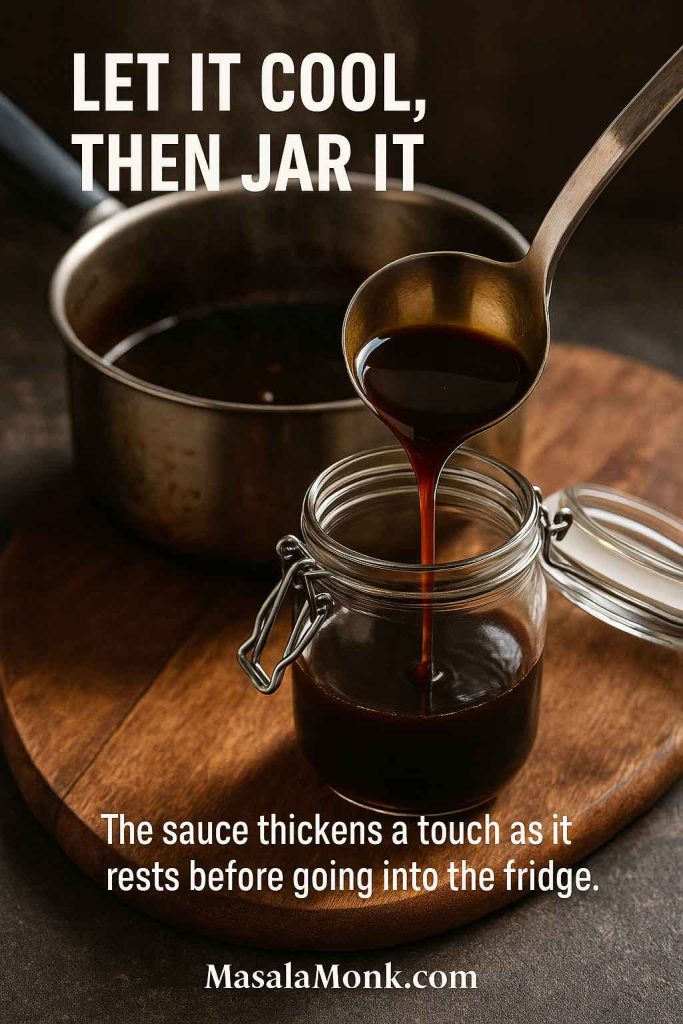
Step 6: Cool and store

When you’re happy with the flavour and texture, take the pan off the heat and let the sauce cool for a few minutes. It will thicken slightly as it stands. Pour it into a clean glass jar, let it come completely to room temperature, and then move it to the fridge.

Warm homemade teriyaki sauce being ladled from a saucepan into a glass jar on a wooden board, with steam still rising, showing how to cool and store the sauce before refrigerating.
Leaving the teriyaki uncovered for a few minutes before sealing the jar lets excess steam escape so condensation doesn’t water the sauce down. Once it’s at room temperature, close the lid and you’ve got a ready-to-use teriyaki glaze for the next several meals.

Step 7: Use your house teriyaki sauce

Your house teriyaki sauce is ready. Brush it on grilled chicken, spoon it over salmon before baking, toss it with stir-fried vegetables and noodles, or reduce it a little further into a sticky glaze for wings or meatballs.

Also Read: Upma Recipe: 10+ Easy Variations (Rava, Millet, Oats, Semiya & More)

Collage showing a jar of homemade teriyaki sauce in the centre, with glazed chicken pieces, salmon fillets being coated with sauce and a bowl of teriyaki stir-fry noodles and vegetables, illustrating different ways to use one batch of sauce.
The same jar of teriyaki can do weeknight meal prep and entertaining: whisk it into a quick marinade for chicken thighs, brush it over salmon before baking, toss it through veggie noodles, or reduce it further for ultra-sticky wings, meatballs and party skewers.

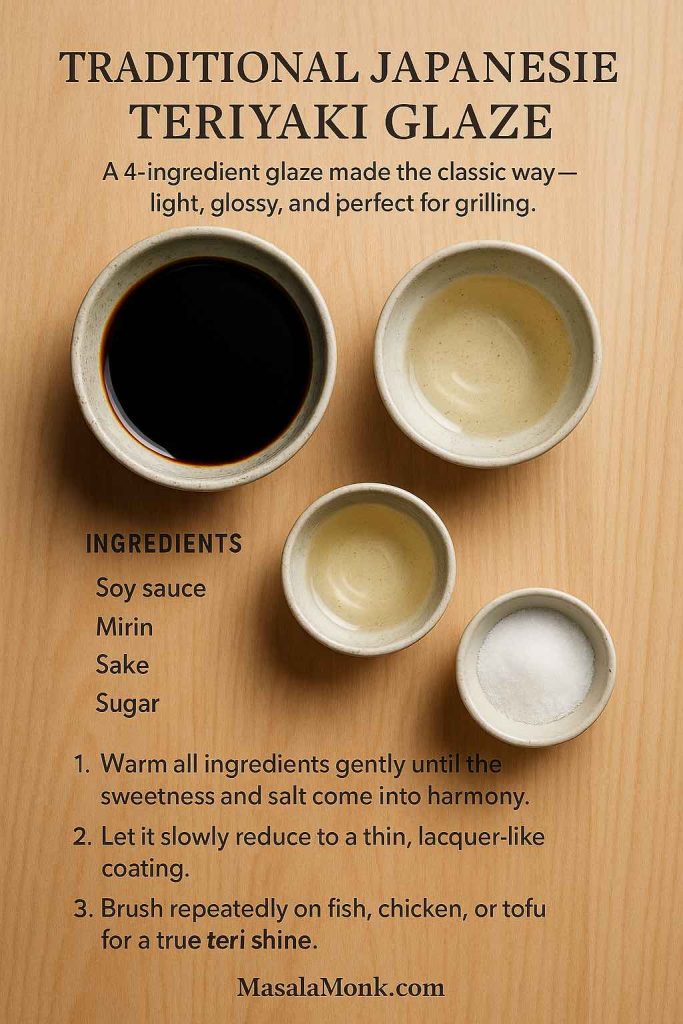
A More Traditional Japanese-Style Teriyaki Glaze Recipe

If you’re in the mood for something closer to what you might find in Japan—lighter, simpler, and without that cornstarch gloss—there’s an even more minimal version.

Here we go back to the roots: soy sauce, mirin, sake and sugar, simmered until glossy.

Ingredients

  • ½ cup soy sauce
  • ½ cup mirin
  • ¼ cup sake
  • 3–4 tablespoons sugar

Combine these in a small saucepan and stir until the sugar starts dissolving. Set the pan over medium heat and bring the mixture to a gentle simmer.

Keep it on that soft simmer for around 8–10 minutes, stirring occasionally, until the liquid has reduced by about a third. You don’t need to be exact here; what you’re looking for is a sauce that coats the back of a spoon in a thin, shiny layer, rather than running off like plain soy sauce.

This minimalist glaze is the “old-school” version of teriyaki—just soy, mirin, sake and sugar gently reduced until it can be brushed in thin layers over grilled fish, chicken skewers or tofu for a clean, restaurant-style shine.

Take the pan off the heat and let it cool slightly. This is now your traditional-leaning teriyaki glaze.

Use it to brush repeatedly over pieces of chicken, fish or tofu while they grill or broil. The sugar and mirin will take on a deeper colour and the surface will go from matte to glossy. Each pass builds another layer of flavour.

This version is especially good on salmon and on chicken skewers, where you want the glaze to complement the grilled flavour rather than smother it.

Also Read: Double Chocolate Chip Cookies – Easy Recipe with 7 Variations


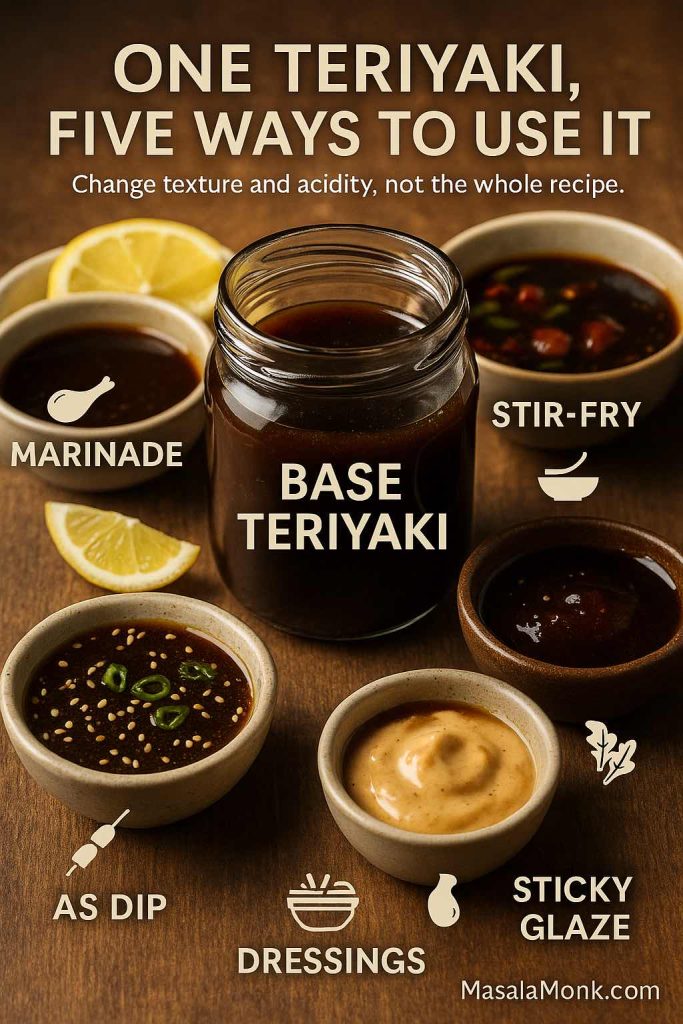
How One Sauce Becomes Many: Marinade, Stir-Fry, Glaze, Dip, Dressing

You don’t need completely different recipes for “teriyaki marinade”, “teriyaki glaze” and “teriyaki stir-fry sauce”. You just change the texture, strength and acidity in the original teriyaki sauce recipe.

Jar of base teriyaki sauce on a wooden table surrounded by five small bowls labelled marinade, stir-fry, sticky glaze, dip and dressings, illustrating different ways to use one homemade teriyaki sauce.
Once you have a basic teriyaki in a jar, you don’t need five different recipes—just thin it for marinades, loosen it slightly for stir-fries, reduce it to a sticky glaze, brighten it into a dipping sauce, or whisk it with oil or mayo for dressings and burger sauces.

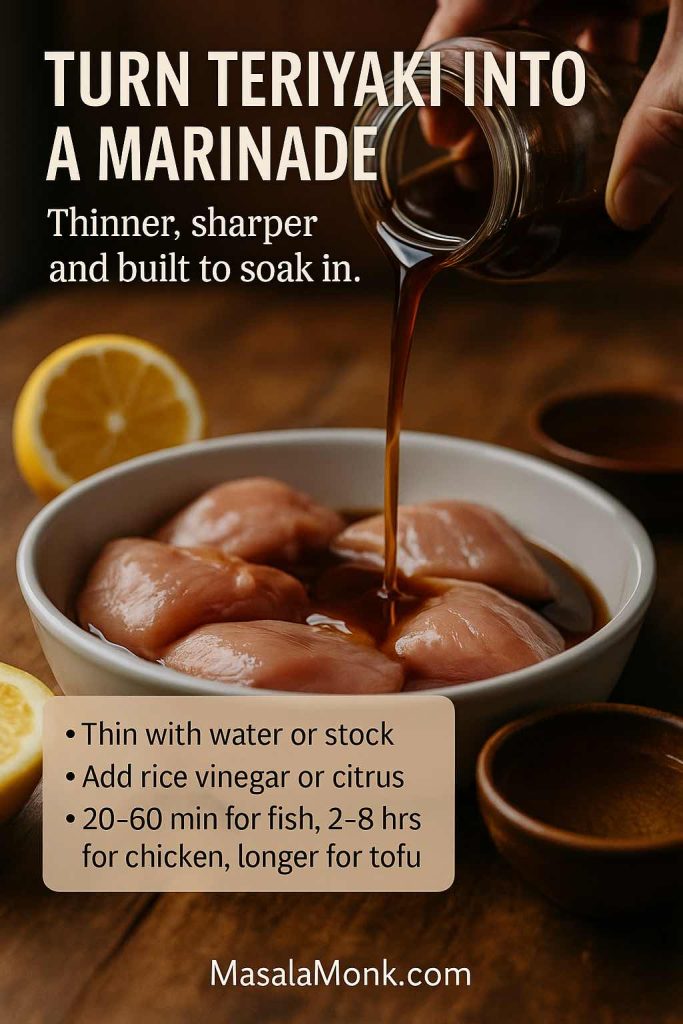
Turning It Into a Marinade

For marinating, you want the sauce thinner and usually a bit sharper. That way it coats the food easily and adds flavour without forming a heavy layer.

Take the everyday teriyaki (before thickening, or thinned slightly with water if it’s already thick) and add:

  • a little extra rice vinegar, or
  • a squeeze of lemon or lime
Close-up of teriyaki sauce being poured from a jar over raw chicken pieces in a white dish, with lemon halves and a small bowl of rice vinegar nearby and text explaining how to turn teriyaki into a marinade.
A good teriyaki marinade should feel looser and a bit brighter than your table sauce. Thinning it with water or stock helps it coat evenly, while extra vinegar or citrus keeps richer meats like chicken thighs or pork tasting fresh even after a long soak.

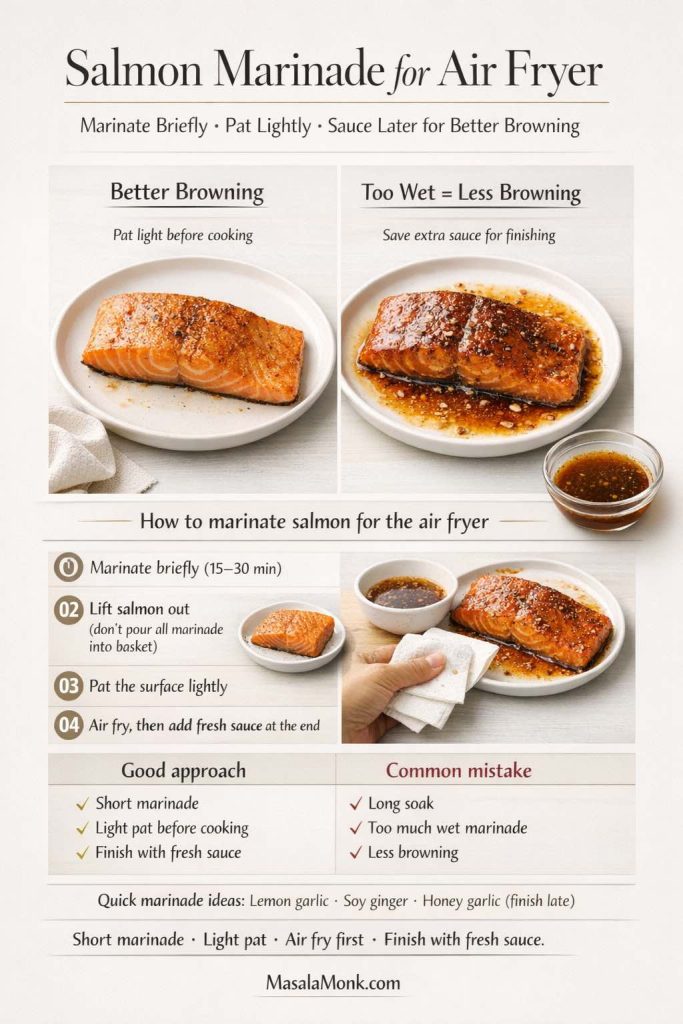
Pour this over chicken pieces, pork, tofu or sturdy vegetables and marinate in the fridge. Chicken thighs and drumsticks are happy with anywhere from half an hour to overnight. Fish does better with a shorter bath—twenty minutes to an hour—so it doesn’t go mushy. Tofu can handle long soaks, and often gets better with time.

If you want, you can boil the leftover marinade after you’ve removed the raw meat or fish and use it as a finishing sauce; just make sure it gets a good hard boil so it’s safe.

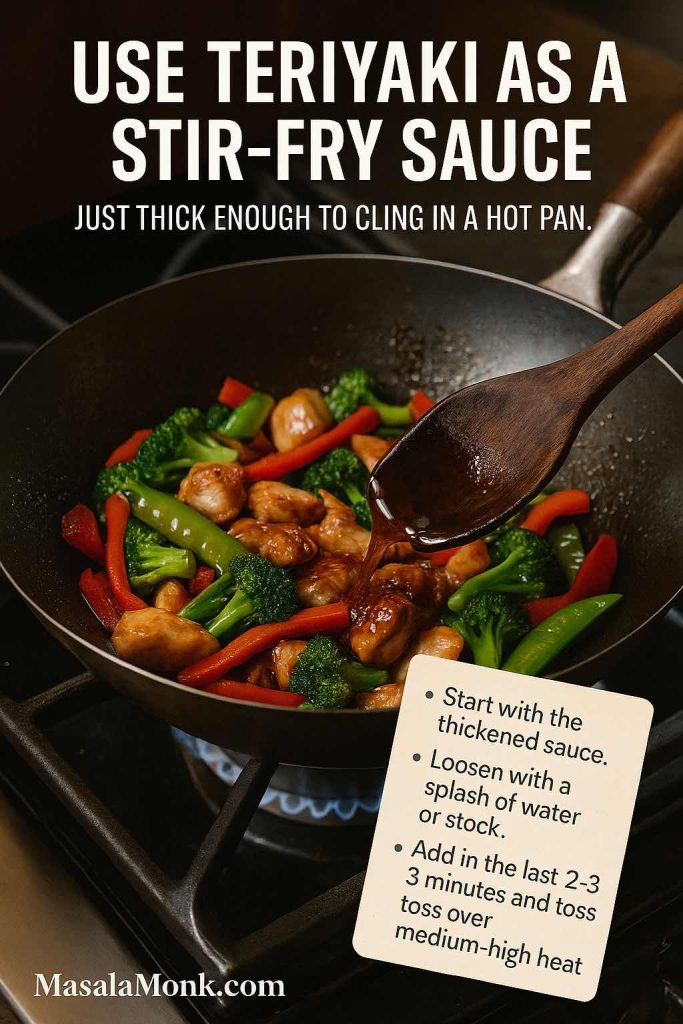
Using It as a Stir-Fry Sauce

In a stir-fry, you want the sauce to cling but still move. The cornstarch-thickened everyday teriyaki is perfect once you adjust its thickness.

If it’s too thick to pour smoothly, add a splash of water or unsalted stock. Then:

  1. Stir-fry your vegetables and protein over high heat.
  2. When everything is nearly done, reduce the heat slightly.
  3. Pour the teriyaki into the pan and toss quickly so it coats everything.
Wok on a gas stove with chicken, broccoli, red pepper and snap peas being coated in a glossy teriyaki stir-fry sauce, with on-image tips explaining how to loosen and add the sauce at the end of cooking.
The best teriyaki stir-fries start dry and finish wet: sear your protein and vegetables first, then pour in a slightly loosened sauce in the last few minutes so it thickens just enough to cling without burning on the bottom of the pan.

In a minute or two, the sauce will cling and glisten around the ingredients. Spoon this over hot rice, noodles or even quinoa. Set it next to other sharable sides—potato salads, dips, grilled vegetables—and it suddenly looks like a generous spread rather than “just a stir-fry”.

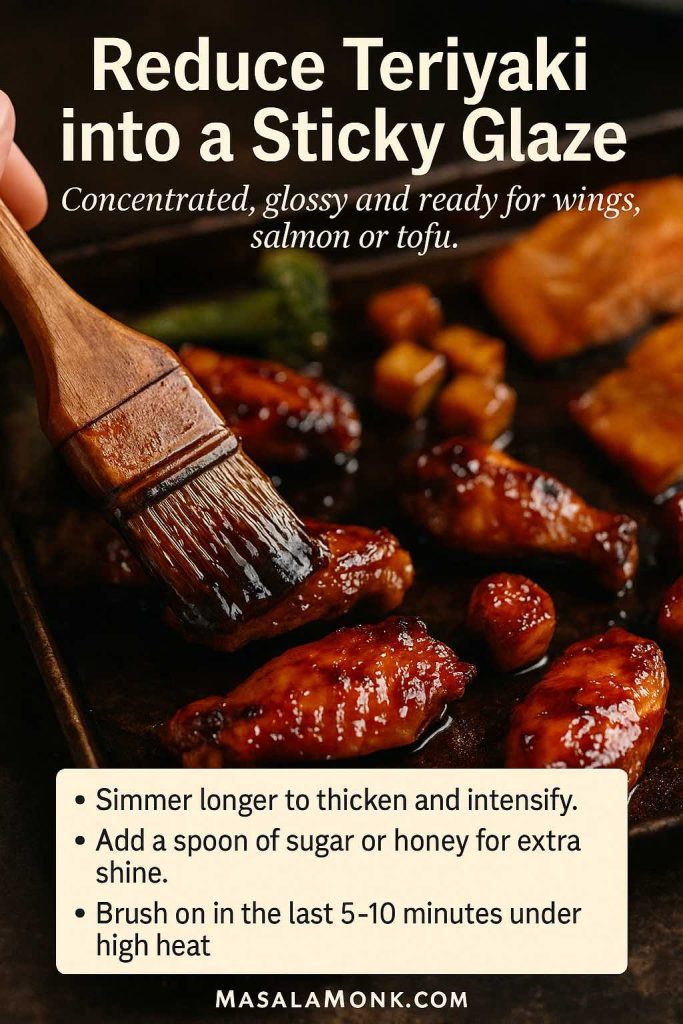
Reducing It to a Sticky Glaze

For wings, ribs, thick salmon fillets and roasted tofu cubes, you want a sauce that’s more like a glaze: sticky, intense and slightly caramelised.

You can either start with the everyday teriyaki and simmer it longer (with an extra spoonful of sugar or honey for extra sheen), or you can use the traditional soy–mirin–sake glaze and reduce it further.

Close-up of a brush coating teriyaki-glazed chicken wings on a dark baking tray, with text overlay explaining how to reduce teriyaki into a thick, sticky glaze for wings, salmon or tofu.
For that restaurant-style lacquer, let your teriyaki bubble gently until it looks almost syrupy, then brush it on near the end of cooking. The sugars caramelise in the heat, giving wings, salmon or tofu a shiny crust without burning or drying them out.

Brush thickened sauce onto food in the last stretch of cooking and let the oven or grill finish the job. If you want extra charring, give it a last-minute blast under a very hot broiler or grill, watching it closely so the sugar doesn’t burn.

Turning It Into a Dipping Sauce

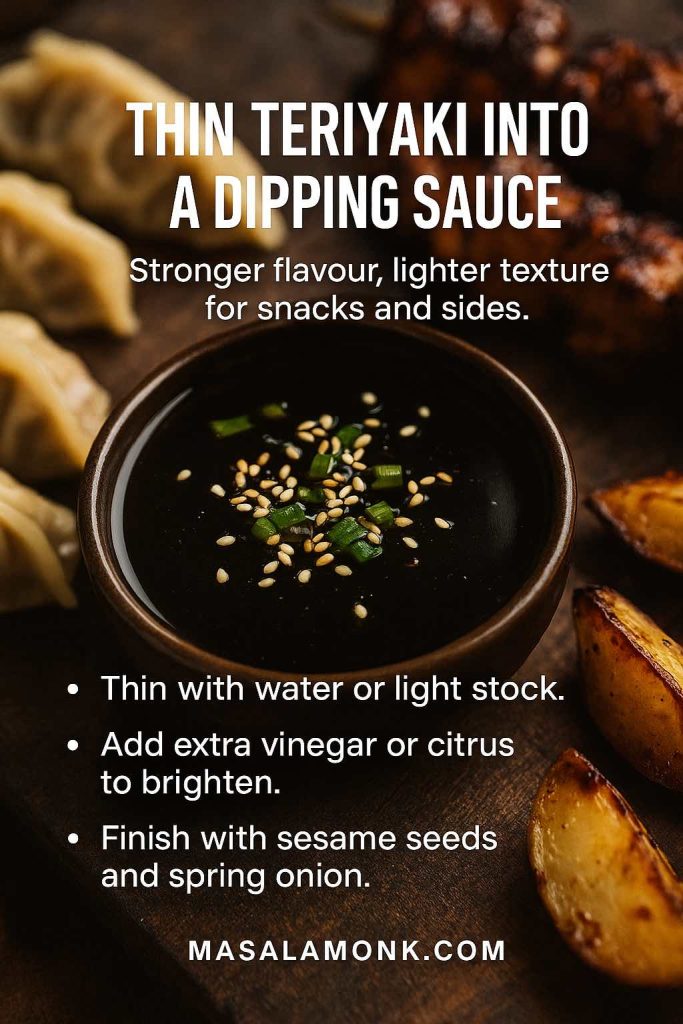
Sometimes it’s nicer to dip than to coat. If you want teriyaki as a dip for dumplings, skewers, crispy tofu, roasted vegetables or even fries, you want a sauce that’s strong in flavour but thin enough to flow easily.

Take a portion of your homemade teriyaki and thin it with a little water or light stock. Add a bit more vinegar or citrus juice to brighten things and cut the sweetness. Pour into a small bowl and top with sesame seeds and chopped spring onion.

Bowl of teriyaki dipping sauce topped with sesame seeds and chopped spring onion, surrounded by dumplings, skewers and roasted potato wedges, with text explaining how to thin and brighten teriyaki for use as a dip.
Turning teriyaki into a dip is all about contrast: a looser texture and brighter acidity so it cuts through fried dumplings, grilled skewers and roasted vegetables instead of weighing them down. A splash of stock and vinegar goes a long way.

Put that on a table alongside other dips—spinach-based ones, creamy spreads, spicy options—and suddenly teriyaki is playing in the same space as buffalo sauce and ranch, not just “stir-fry sauce”.

Using It as a Dressing or Mayo

Teriyaki also works beautifully off the heat.

For a simple dressing, whisk equal parts teriyaki sauce and neutral oil together, then add a spoon of rice vinegar or lemon juice. You get a punchy salad dressing that loves green salads, grain bowls and noodle salads. Shake it in a jar until lightly emulsified, then toss or drizzle as you like.

Jar of teriyaki salad dressing next to a green salad and a small bowl of teriyaki mayo beside a crispy chicken burger, with on-image text explaining how to make teriyaki dressings and mayo for salads, bowls and sandwiches.
A spoonful of teriyaki goes a long way off the heat: whisk it with neutral oil and a splash of vinegar for a punchy salad or grain-bowl dressing, or fold it into mayo to turn simple chicken sandwiches and burgers into full-blown “teriyaki” meals.

For a sandwich or burger sauce, stir a spoonful or two of teriyaki into mayonnaise and taste as you go. That simple mix is surprisingly good on chicken sandwiches, burgers, sliders and teriyaki-style rice bowls. If you like building stacked sandwiches with layers of texture and flavour, you can borrow structure ideas from MasalaMonk’s own chicken sandwich recipe collection and simply swap their sauce element for your teriyaki mayo.

Also Read: One-Pot Chicken Bacon Ranch Pasta (Easy & Creamy Recipe)


Playing with Flavours: Honey, Citrus, Pineapple, Miso, Spice

Once the base is second nature, you can adjust it to suit your mood or the rest of the menu. Most “special” teriyaki sauce recipes are just small nudges away from that everyday sauce.

Honey Teriyaki Sauce Recipe

Replacing some or all of the brown sugar with honey gives you a honey-teriyaki hybrid. Honey makes the sauce silkier and helps it cling to food in a particularly satisfying way.

Vertical recipe card showing honey teriyaki sauce in a saucepan with honey dripping from a wooden dipper above it, plus text explaining how to swap sugar for honey and use the sauce for wings, drumsticks, meatballs and tofu bites.
Honey doesn’t just sweeten teriyaki, it changes the texture—giving you a thicker, more elastic glaze that clings beautifully to wings, drumsticks, tofu and meatballs. Just keep the heat moderate, because honey-based sauces can go from caramelised to burnt much faster than sugar-only versions.

This version is perfect for:

  • chicken wings and drumsticks
  • sticky meatballs
  • glossy tofu bites

Just remember that honey browns faster than regular sugar, so keep an eye on oven and grill temperatures to avoid scorching.

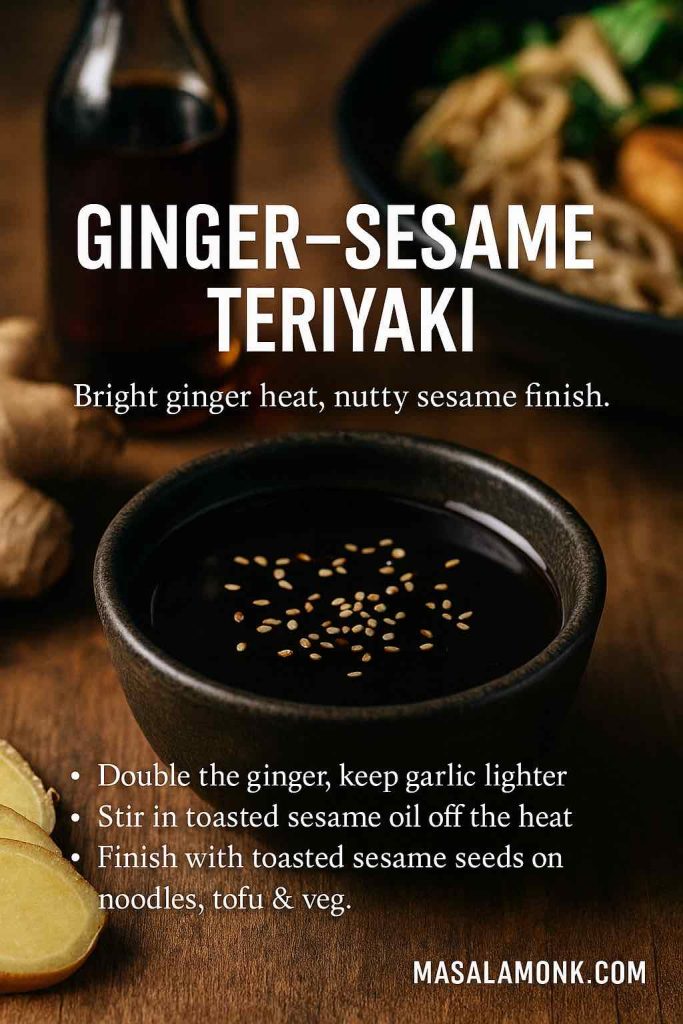
Recipe for Ginger-Sesame Teriyaki Sauce

If ginger is your favourite part, double the amount you add and keep the garlic modest in the original teriyaki sauce recipe. When the cooking is done, stir in a teaspoon of toasted sesame oil and a spoonful of toasted sesame seeds.

Recipe card showing a rustic bowl of glossy ginger–sesame teriyaki sauce topped with toasted sesame seeds, with fresh ginger, sesame oil and a noodle bowl in the background, plus text explaining how to double the ginger and finish with sesame oil and seeds.
Turning your base teriyaki into a ginger–sesame version is one of the easiest ways to make noodle bowls and tofu stir-fries taste “restaurant-level” – all you do is lean harder on fresh ginger, stir in toasted sesame oil off the heat and shower everything with sesame seeds right before serving.

What you get is a sesame–ginger teriyaki that’s ideal for:

  • tofu and vegetable stir-fries
  • soba and udon noodle bowls
  • roasted or steamed greens

It’s also a great way to make cold noodle salads feel complete without loading them up with mayonnaise.

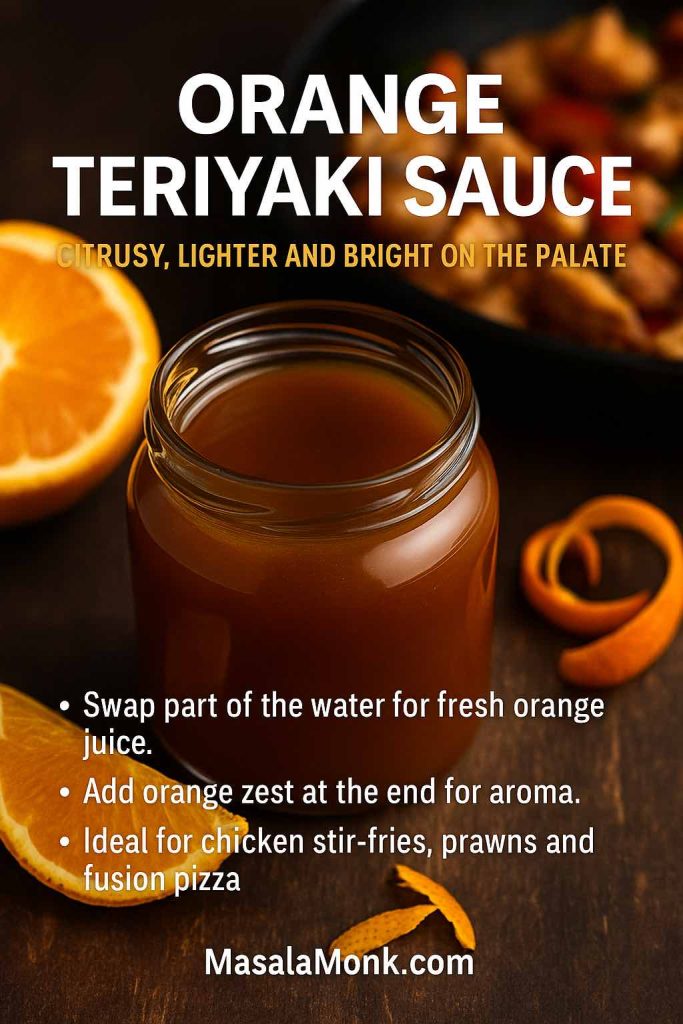
Orange Teriyaki Sauce Recipe

To bring citrus into the picture, swap part of the water in the base recipe for fresh orange juice and add grated orange zest at the end. Taste the result and adjust with extra soy or vinegar if it leans too sweet.

Vertical recipe card showing a jar of orange teriyaki sauce on a wooden table with fresh orange halves and zest beside a chicken stir-fry pan, plus text explaining how to add orange juice and zest and where to use the citrus teriyaki sauce.
Swapping part of the water for fresh orange juice gives teriyaki a lighter, brighter profile that’s perfect when you want something fresher than a straight soy glaze. It’s especially good on chicken-and-bell-pepper stir-fries, prawn skewers and fun fusion ideas like teriyaki chicken pizza.

Orange teriyaki sits beautifully on:

  • chicken stir-fries with bell peppers
  • shrimp or prawn skewers
  • fusion dishes like teriyaki chicken pizza

It’s especially useful when you want something that feels lighter and fresher than a straight soy-based glaze.

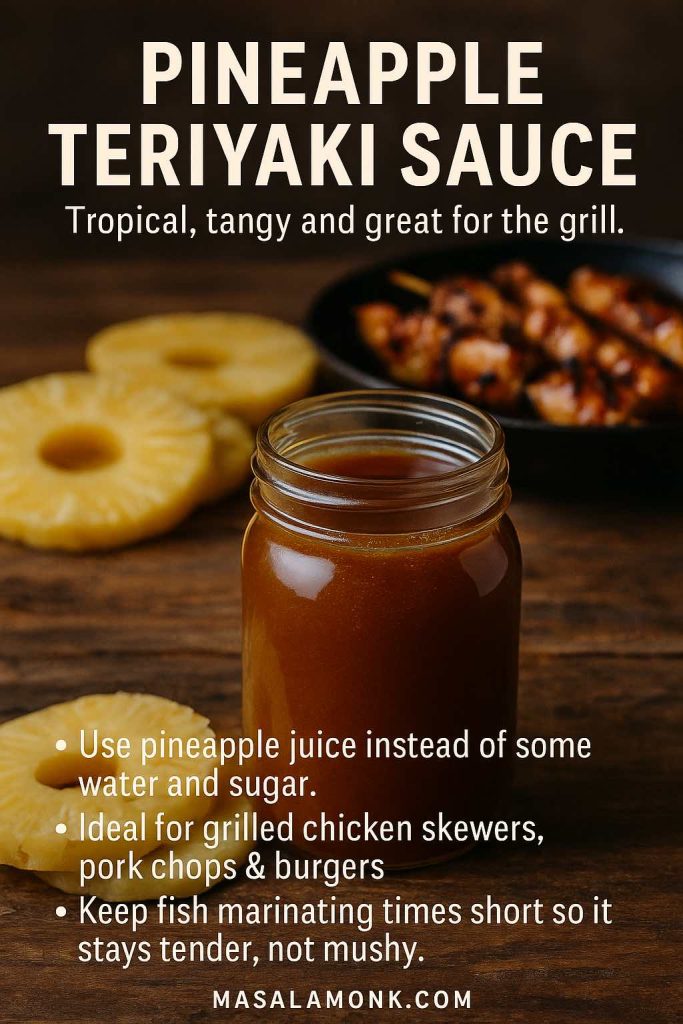
Recipe of Pineapple Teriyaki Sauce

For a more tropical character, use pineapple juice in place of some of the water and sugar. Pineapple’s natural enzymes can help tenderise meat, which is why pineapple-based marinades are so common in grill cultures.

Vertical recipe card showing a jar of pineapple teriyaki sauce on a wooden table with fresh pineapple rings and grilled chicken skewers in the background, plus text explaining how to use pineapple juice for a tropical teriyaki glaze and marinade.
Pineapple teriyaki pulls double duty as both flavour and tenderiser, which is why it shines on grilled chicken skewers, pork chops and burgers. Because the enzymes are so active, it’s best to keep marinating times short for delicate fish and seafood so they stay juicy, not mushy.

Use homemade pineapple teriyaki sauce on:

  • grilled chicken skewers
  • pork chops and pork tenderloin
  • burgers topped with grilled pineapple rings

Just go easy with marinating delicate fish in pineapple heavy mixtures for long periods; shorter times work better to preserve texture.

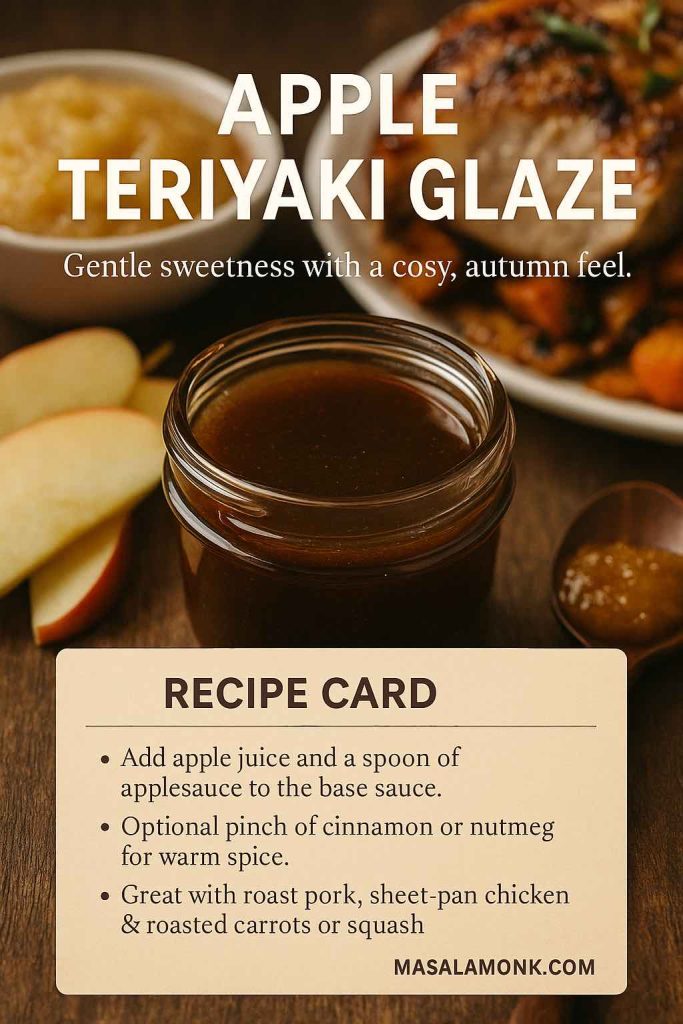
Apple-Lifted Teriyaki Sauce Recipe

Apple juice and a spoon of applesauce can soften teriyaki’s edges and give it a mild, autumnal feel. A pinch of cinnamon or nutmeg can tilt it gently toward “warm spice” without turning it into dessert.

Vertical recipe card showing a jar of apple teriyaki glaze on a wooden table with apple slices, applesauce and roasted meat in the background, plus text explaining how to add apple juice and warm spices to teriyaki sauce.
Apple teriyaki is a smart way to make salty soy-based glazes feel rounder and more comforting. A little apple juice and applesauce softens the edges, while a pinch of warm spice lets the sauce sit naturally alongside roast pork, tray-bake chicken and caramelised root vegetables.

This style of sauce suits roast pork, sheet-pan chicken dinners with onions and apples, and roasted carrots or squash.

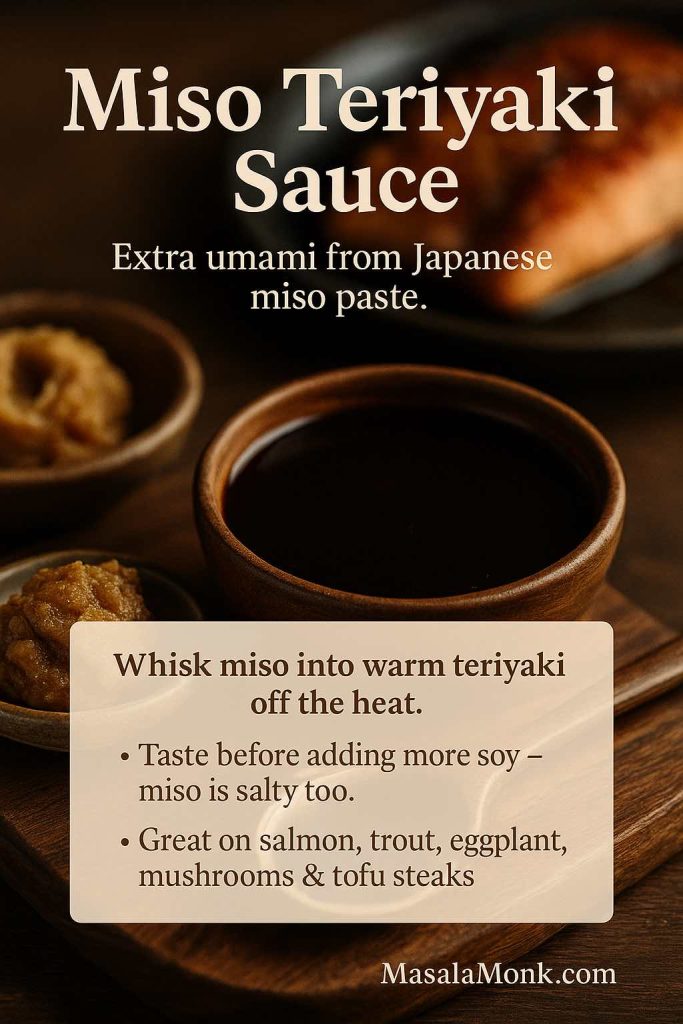
Miso Teriyaki Sauce & Its Recipe

Miso is another fermentation star in Japanese cooking, and adding a spoon of miso paste to warm teriyaki sauce deepens its savoury side.

Take the pan off the heat, whisk in a spoon of white or red miso, and taste. You might not need more soy after that; miso is salty as well.

Vertical recipe card showing a wooden bowl of dark miso teriyaki sauce with small dishes of miso paste and grilled salmon in the background, plus text explaining how to whisk miso into warm teriyaki and use it on salmon, trout, eggplant, mushrooms and tofu steaks.
White miso gives a gentler, slightly sweeter teriyaki, while red miso makes the sauce deeper and more intense. Either way, add the paste off the heat and taste before you reach for extra soy—miso itself brings plenty of salt and umami.

Miso teriyaki is particularly good on:

  • salmon or trout
  • eggplant, mushrooms and other umami-friendly vegetables
  • tofu steaks and skewers

It feels simple but layered, which is exactly what you want when the sauce is doing most of the work.

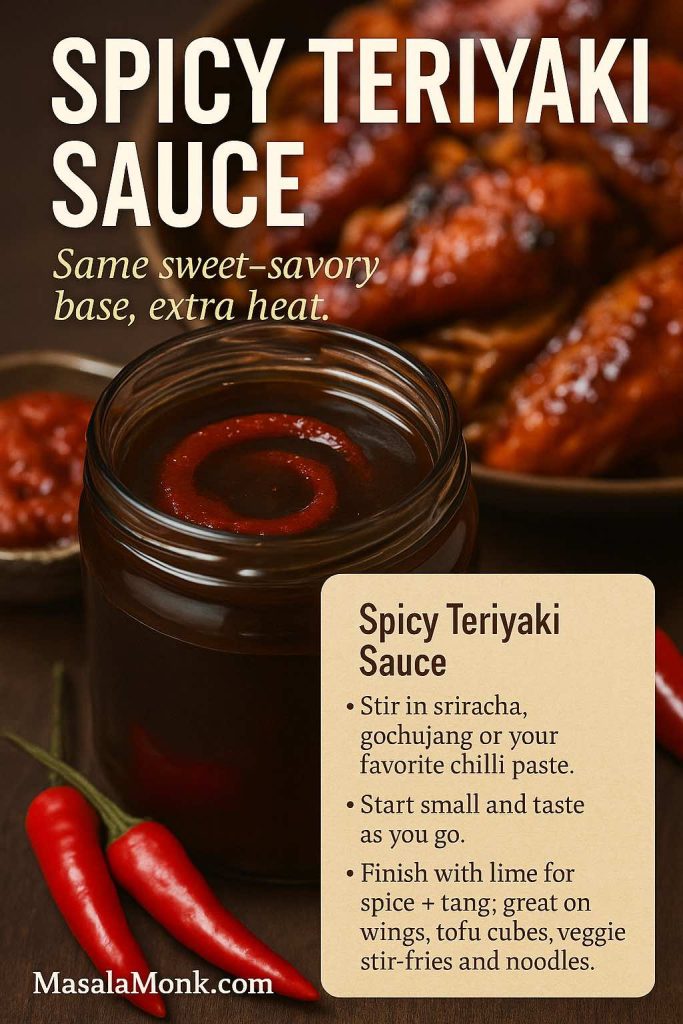
Spicy Teriyaki Sauce Recipe

For those nights when you want a little heat, add sriracha, gochujang or your favourite chilli paste to the simmering sauce. Start with a teaspoon or two, taste, and adjust. You can also finish with a squeeze of lime juice if you like spice plus tang.

Vertical recipe card showing a jar of spicy teriyaki sauce with a swirl of red chilli paste on top, fresh red chillies and teriyaki wings in the background, plus text explaining how to add sriracha or gochujang and use the sauce on wings, tofu, veggie stir-fries and noodles.
Spicy teriyaki is ideal when you want the comfort of sweet–savory sauce with proper heat. Stir in chilli paste gradually, then finish with lime to keep the flavour bright—perfect for party wings, sticky tofu cubes, veg-packed stir-fries and big noodle bowls.

Spicy teriyaki is ideal for:

  • hot wings
  • sticky tofu cubes
  • vegetable stir-fries
  • noodle dishes with a bit of a kick

It sits comfortably on a table with buffalo wings, creamy dips and crisp salads, especially if you like building mixed, “everyone grabs what they like” spreads.

Also Read: Authentic Louisiana Red Beans and Rice Recipe (Best Ever)


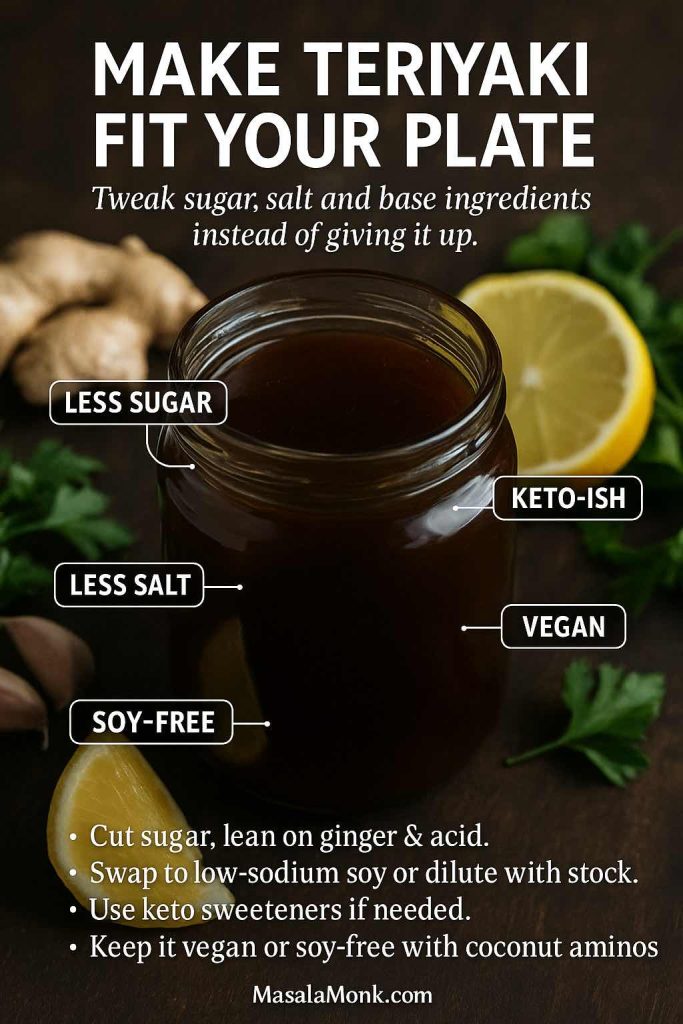
Making Teriyaki Friendlier: Less Sugar, Less Salt, Keto, Vegan, Soy-Free

Because teriyaki is built on soy sauce and sugar, it doesn’t automatically fit every eating style. But once you’re making it at home instead of relying solely on bottled versions, you have a lot more control.

Vertical guide image showing a jar of teriyaki sauce surrounded by ginger, lemon and herbs, with overlay text highlighting options such as less sugar, less salt, keto-ish, vegan and soy-free, and tips for adapting teriyaki sauce to different diets.
Instead of treating teriyaki as something you have to give up, think of it as a base you can tune: cut the sugar, dilute the soy, switch to keto sweeteners or coconut aminos and lean harder on ginger, garlic and citrus to keep the flavour big while the numbers stay friendly.

Cutting Back on Sugar in the Recipe for Teriyaki Sauce

You can usually cut the sugar in a teriyaki recipe by a third or even half without destroying the balance, especially if you:

  • keep mirin in the mix
  • lean more on ginger and garlic
  • let a bit more acidity (vinegar or citrus) balance the salt
Guide image showing a jar of low sugar teriyaki sauce with a half-filled spoon of sugar, fresh ginger and lemon on a wooden table, with text explaining how to reduce sugar and boost aromatics and acidity in teriyaki sauce.
Most teriyaki recipes can lose a third to half their added sugar without breaking; the trick is to let ginger, garlic and a bit of acid do more of the balancing work, and only bring in low-cal sweeteners if you still miss a touch of sweetness.

For more aggressive sugar reduction, you can substitute part of the sugar with low-calorie sweeteners. Just be careful with reductions: without sugar to round things out, very reduced sauces can taste sharply salty.

Making It More Keto-Friendly

For a keto-leaning teriyaki sauce recipe, you want lower net carbs:

  • use low-sodium soy or tamari, diluted with water
  • sweeten with a keto-compatible sweetener
  • thicken with a tiny pinch of xanthan gum if you need a glaze, or leave it thinner
A vertical keto teriyaki guide card showing a jar labeled “Keto-ish” with soy sauce, keto sweetener and grilled chicken in the background, along with text explaining how to make a low-carb teriyaki using tamari, keto sweeteners and xanthan gum.
Keto-style teriyaki keeps things bold without the sugar spike—tamari, ginger and garlic build the savoury base, a touch of keto sweetener rounds the edges, and a tiny pinch of xanthan gum creates that classic glossy cling without carbs.

In practice, you’ll probably use less sauce per serving and let the grilled meat, fish or tofu do more of the talking.

Lowering the Sodium Load in Teriyaki Sauce Recipe

Salt is the other big issue. It doesn’t take much teriyaki sauce to push your sodium intake up for the day, and most health guidelines suggest keeping sodium on the conservative side for heart and kidney health.

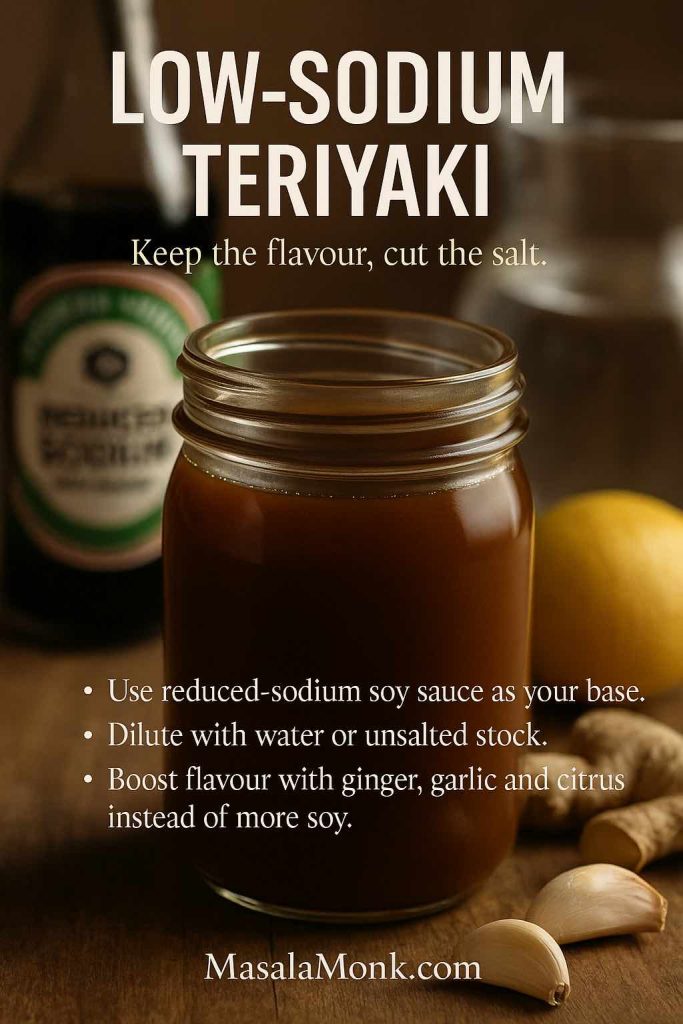
Vertical low-sodium teriyaki guide card showing a jar of teriyaki sauce on a wooden surface with a low-sodium soy bottle, lemon, ginger and garlic in the background, plus text explaining how to dilute soy sauce and boost flavour with aromatics instead of salt.
A simple way to make teriyaki easier on your daily sodium is to treat soy like a concentrate: start with reduced-sodium soy, cut it with water or stock and let ginger, garlic and citrus rebuild the flavour instead of just pouring in more soy sauce.

Instead of just accepting that, you can:

  • base your sauce on reduced-sodium soy sauce
  • dilute soy with water or unsalted stock
  • build flavour with ginger, garlic, chilli and acid instead of extra soy

You’ll still get plenty of teriyaki character, but with a much softer impact on your daily salt tally.

Keeping Your Teriyaki Sauce Recipe Vegan

Most homemade teriyaki sauces are almost vegan by default. As long as you skip honey and stick to sugar or maple syrup, the standard soy–mirin–garlic–ginger mixture is plant-based.

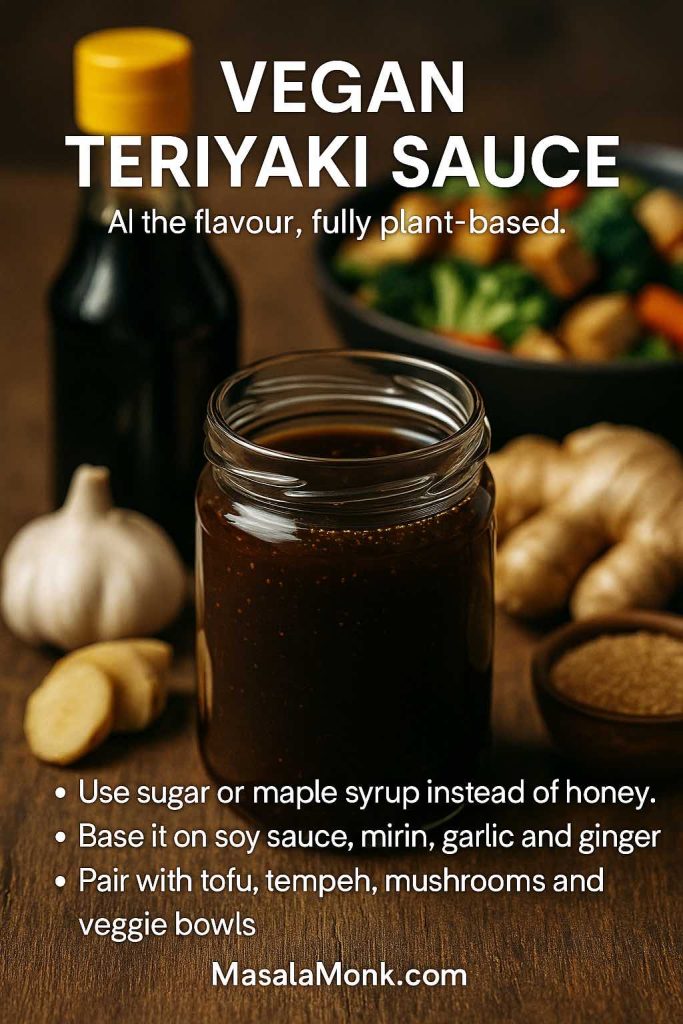
Vertical vegan teriyaki guide card showing a jar of glossy teriyaki sauce on a wooden table with soy sauce, garlic, ginger and a bowl of vegetables in the background, plus text explaining how to make a fully plant-based teriyaki using sugar or maple syrup instead of honey.
Most classic teriyaki formulas are just one swap away from being vegan—use sugar or maple syrup instead of honey, then pair the sauce with tofu, tempeh, mushrooms and veggie bowls for the same sweet–savory comfort in a fully plant-based meal.

Combine that with tofu, tempeh, mushrooms, seitan or beans and you have endless vegan teriyaki bowls and plates. You can structure them the way you’d structure high-protein salads or spreads—like the ones in MasalaMonk’s healthy tuna salad ideas—but swap the tuna for chickpeas or lentils and the mayo for teriyaki.

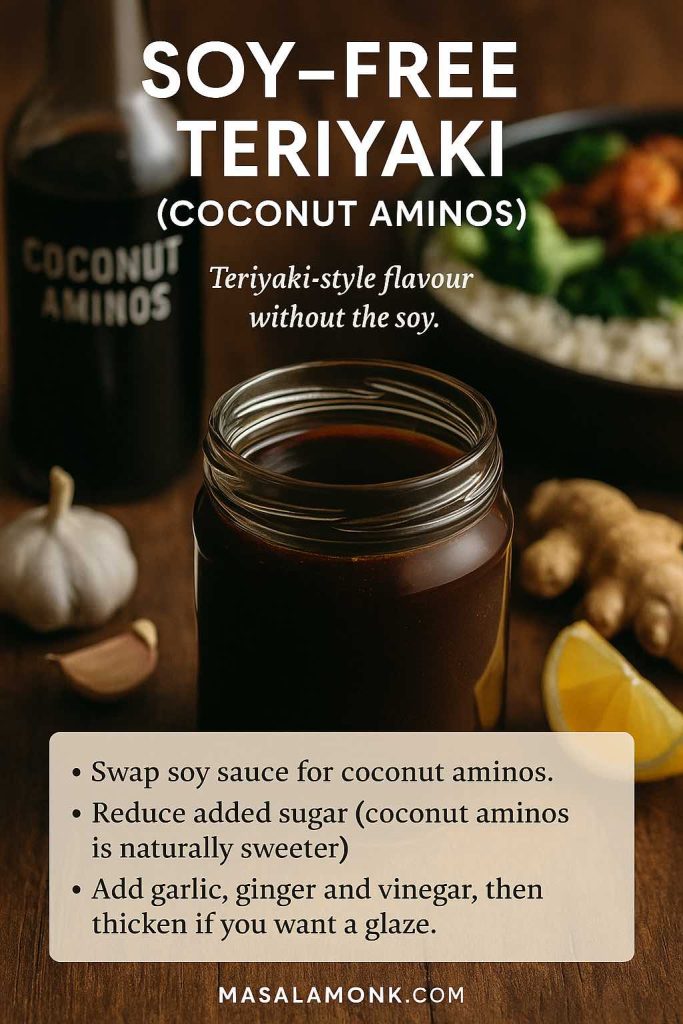
Going Soy-Free with Coconut Aminos

If you need to avoid soy, coconut aminos is your friend. It’s made from fermented coconut sap and salt, and while it tastes different from soy sauce, it still brings a dark, savoury note. It’s also generally lower in sodium and naturally gluten- and soy-free.

Vertical soy-free teriyaki guide card showing a jar of dark coconut aminos teriyaki sauce on a wooden table with a coconut aminos bottle, garlic, ginger and lemon in the background, plus text explaining how to swap soy sauce for coconut aminos and adjust sugar and acidity.
Coconut aminos already bring sweetness and savoury depth, so a good soy-free teriyaki is more about restraint than addition—use less extra sugar, lean on garlic, ginger and vinegar for balance, and reduce gently until it behaves just like your usual glaze.

To modify the recipe and make a soy-free teriyaki-style sauce:

  • use coconut aminos instead of soy sauce
  • reduce or omit extra sugar (coconut aminos is sweeter than soy)
  • add garlic, ginger and vinegar
  • reduce or lightly thicken with starch if you want a glaze

It won’t taste exactly like traditional teriyaki, but it’s recognisably in the same family and plays the same role on the plate.

Also Read: Sheet Pan Chicken Fajitas Recipe (Easy One-Pan Oven Fajitas)


Bottled Teriyaki vs Homemade: Which Has the Edge?

Bottled teriyaki has one unbeatable strength: convenience. You finish work, you’re tired, you don’t feel like measuring anything, and that bottle is right there. Pour some over chicken or vegetables, and you’re halfway to dinner.

The tradeoffs are just as clear:

  • you don’t control how salty or sweet it is
  • you’re stuck with the brand’s idea of texture and flavour balance
  • you often get stabilisers and preservatives you probably don’t need in a fresh sauce
Vertical infographic comparing a bottle of store-bought teriyaki sauce on one side and a jar of homemade teriyaki with fresh ingredients on the other, with text outlining the pros and cons of bottled versus homemade teriyaki.
Store-bought teriyaki wins on speed and predictability, but a homemade batch gives you full control over salt, sugar and thickness—and you can still use bottled sauce as a shortcut base, then upgrade it with fresh garlic, ginger, citrus, honey or miso.

A homemade teriyaki sauce recipe asks for a little more effort once, then repays you many times. There’s no single “best teriyaki sauce recipe” for everyone, but when you make it yourself you can dial in your own best version. You:

  • decide how salty, sweet and thick it should be
  • can tune it to your household’s tastes (more ginger, less garlic, citrusy, smoky, etc.)
  • can adapt it to different needs (lighter one night, sticky the next)

That does not mean you don’t have to throw away bottled sauce forever. You can also treat it as a base ingredient. Sauté garlic and ginger, add bottled teriyaki and cook it for a few minutes; thin or reduce as needed; finish with citrus, honey, chilli or miso. That’s the same philosophy MasalaMonk uses in things like their homemade coffee creamer flavour guide: start with something simple, then bend it to your will.

But if you take one thing away from this post, let it be this: the jump from “I buy teriyaki” to “I make teriyaki” is smaller than it looks.

Also Read: Cheesy Chicken Broccoli Rice – 4 Ways Recipe (One Pot, Casserole, Crockpot & Instant Pot)


Quick Teriyaki Chicken Recipe (Using This Sauce)

If you only make one dish with this teriyaki sauce recipe, let it be simple chicken teriyaki – the kind of easy teriyaki chicken recipe (stovetop, air fryer or oven) you can throw together on a weeknight. It’s the kind of weeknight meal that tastes like takeout, uses just one pan, and works with chicken thighs or breast.

Ingredients

  • 500–700 g chicken thighs or breast, cut into bite-sized pieces
  • 2 tablespoons neutral oil
  • Salt and pepper (just a pinch; the sauce is salty)
  • ½ to ¾ cup homemade teriyaki sauce (from the everyday teriyaki sauce recipe above)
  • Cooked white rice or brown rice, to serve
  • Steamed or stir-fried vegetables (broccoli, carrots, peppers, beans), to serve
High-resolution recipe card showing a bowl of quick teriyaki chicken with glossy glazed pieces, rice and green vegetables, with overlay text listing ingredients and three simple steps for a one-pan teriyaki chicken dinner.
This is the “entry level” way to use your house teriyaki: one hot pan, a handful of chicken, a scoop of sauce and you’ve got a takeout-style bowl in under half an hour—perfect for testing new flavour tweaks like honey, orange or spicy teriyaki without changing the method.
How to Cook Teriyaki Chicken

  1. Prep the chicken. Pat the chicken dry and season very lightly with salt and pepper.
  2. Sear. Heat the oil in a wide pan over medium-high heat. Add the chicken in a single layer and cook until lightly browned on both sides and just cooked through.
  3. Add the teriyaki sauce. Reduce the heat to medium, pour in the teriyaki sauce and toss so every piece is coated.
  4. Glaze. Let the sauce bubble gently for a few minutes, stirring, until it thickens into a shiny glaze and clings to the chicken. If it gets too thick, add a splash of water; if it’s too thin, simmer for another minute.
  5. Serve. Spoon the chicken teriyaki over hot rice with plenty of vegetables on the side. Drizzle over any extra sauce from the pan.

This basic chicken teriyaki recipe is easy to spin into variations. Toss cooked noodles through the pan for chicken teriyaki noodle stir fry, or pile the glazed pieces into a bun with crunchy salad for teriyaki chicken burgers.

Also Read: Whiskey Sour Recipe: Classic Cocktail, Best Whiskey & Easy Twists


Easy Teriyaki Salmon Recipe

For salmon teriyaki, the oven does most of the work. This is a simple teriyaki salmon recipe that uses the same everyday sauce.

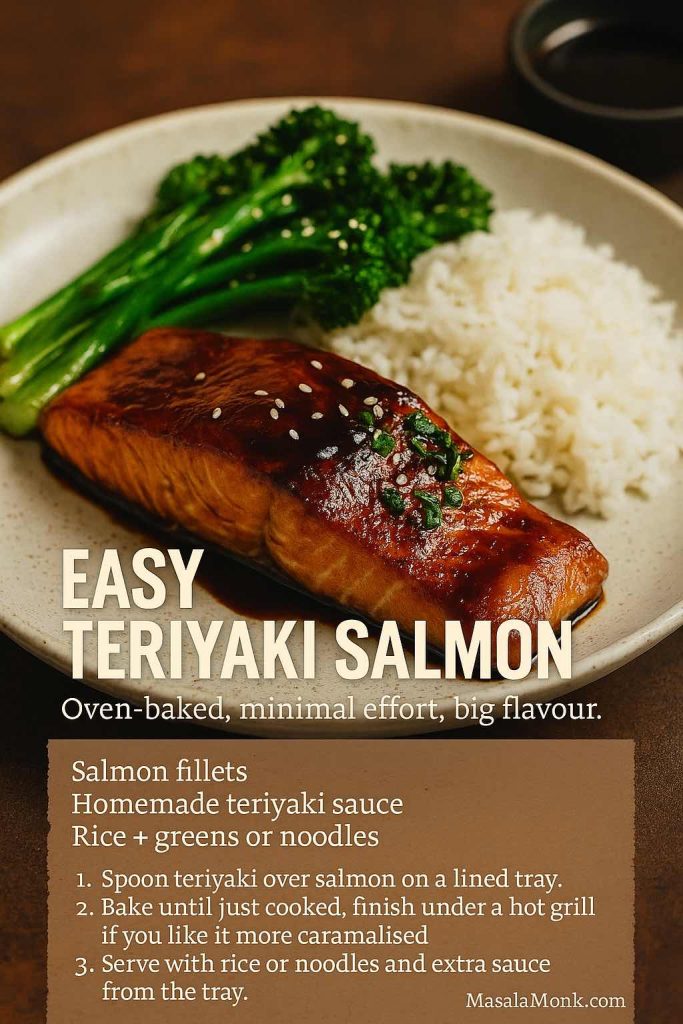
  1. Heat the oven to 200°C. Line a baking tray with parchment.
  2. Place 4 salmon fillets on the tray, skin-side down. Pat dry and season very lightly with salt and pepper.
  3. Spoon a generous layer of teriyaki sauce over each fillet.
  4. Bake for 10–12 minutes, depending on thickness, until the salmon is just cooked through.
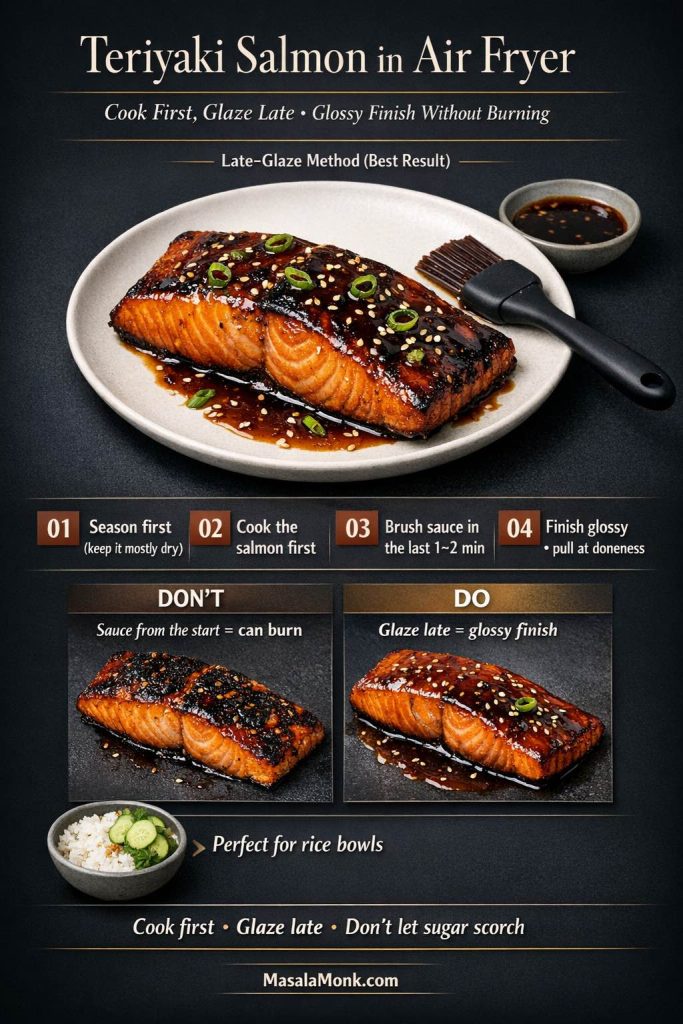
  5. For a more caramelised finish, brush with a little more sauce and give the fillets 1–2 minutes under a hot grill or broiler.
Vertical recipe card showing a plate of oven-baked teriyaki salmon with white rice and broccolini, plus text with simple steps for making easy teriyaki salmon using homemade teriyaki sauce.
Baking the salmon with teriyaki already on top does two jobs at once—the fish gently steams underneath while the sauce reduces on the surface, so you get juicy flesh, a shiny glaze and tray juices you can spoon straight over rice or noodles.

Serve the baked teriyaki salmon with rice and vegetables, or flake it over warm noodle bowls. The same method works for other firm fish fillets if you’re in the mood for fish teriyaki beyond salmon.

Also Read: Easy Lemon Pepper Chicken Wings (Air Fryer, Oven & Fried Recipe)


Simple Beef Teriyaki Stir-Fry (with rice or noodles)

Beef teriyaki is another fast, high-heat favourite. Thin slices of beef cook in minutes and soak up the teriyaki stir-fry sauce beautifully.

  • 300–400 g beef steak, sliced thinly against the grain
  • 2 cups mixed vegetables (broccoli, carrots, peppers, snap peas)
  • 2 tablespoons neutral oil
  • ½ cup teriyaki sauce, thinned with a splash of water if very thick
  • Cooked rice or noodles, to serve
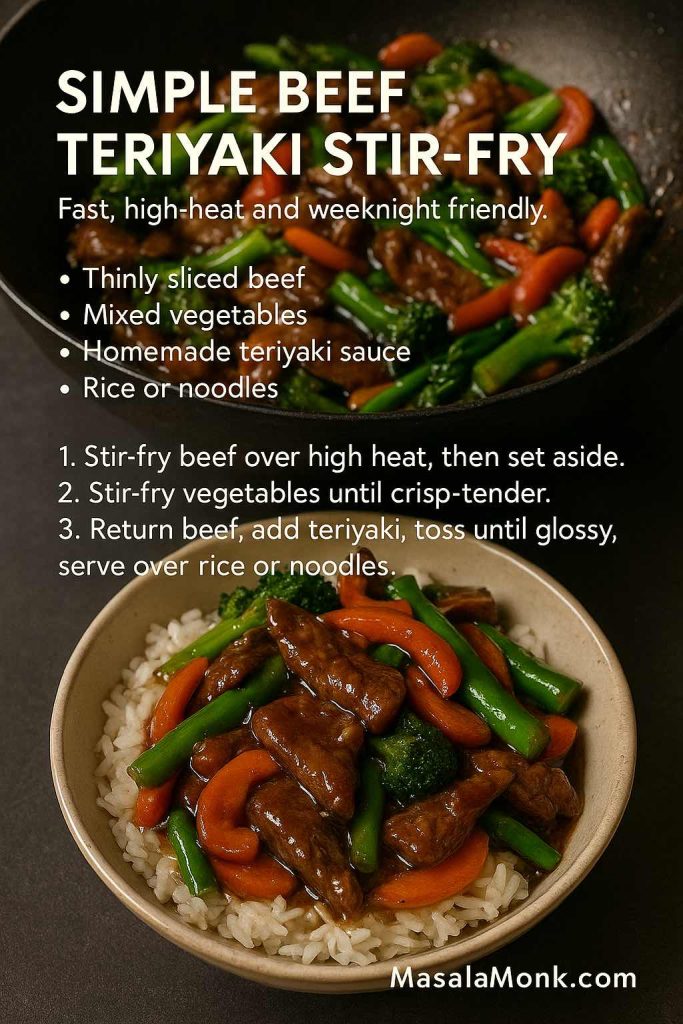
Vertical recipe card showing a bowl of simple beef teriyaki stir-fry with glossy beef strips, broccoli, carrots and green beans over rice, with a wok full of stir-fry in the background and text explaining the quick three-step method.
Because the beef is sliced thin and cooked hot and fast, this stir-fry is the perfect place to test how thick you like your teriyaki—keep it slightly looser if you’re serving over rice, or reduce it a little more if you want the sauce to cling tightly to noodles.
  1. Stir-fry the beef. Heat 1 tablespoon oil in a hot pan or wok. Add the beef and stir-fry just until browned; remove to a plate.
  2. Cook the vegetables. Add the remaining oil and the vegetables. Stir-fry over high heat until crisp-tender.
  3. Combine with sauce. Return the beef to the pan, pour in the teriyaki sauce and toss everything together. Cook for 1–2 minutes until the sauce bubbles and coats the beef and vegetables.
  4. Serve. Spoon your beef teriyaki stir-fry over rice, or toss with cooked noodles for beef teriyaki noodles.

This one pan teriyaki beef and rice or noodle dinner is an easy way to turn the same teriyaki sauce recipe into a new meal.

Also Read: Crispy Homemade French Fries From Fresh Potatoes (Recipe Plus Variations)


Bringing It All Together in Real Meals

Theory is nice, but you’re going to remember teriyaki by what you put on the table.

You might start by whisking up that everyday teriyaki sauce, then:

  • marinate chicken thighs in a thinner, more acidic version and roast them on a tray with onions and peppers, brushing with a thicker glaze in the last ten minutes
  • spoon the traditional soy–mirin–sake glaze over salmon fillets as they grill, letting it build up into a shiny layer, then serve them with rice and a crisp side from the potato salad recipes you’ve bookmarked
  • throw together a fridge-cleanout stir-fry with vegetables, tofu and a ladle of teriyaki, knowing you can adjust sweetness and salt right there in the pan
  • build warm or cold noodle bowls with soba, plenty of vegetables and a ginger-sesame teriyaki dressing
  • glaze pork chops or pork tenderloin with pineapple teriyaki and serve with a simple salad and grilled pineapple slices
  • spread pineapple-lifted teriyaki over a pizza base, add leftover chicken teriyaki and bake for an easy teriyaki chicken pizza night.
Four friends sitting around a wooden table sharing a variety of teriyaki dishes—including chicken bowls, teriyaki salmon, noodles and vegetables—with a jar of sauce in the centre and the text “One Teriyaki, A Whole Table of Meals” overlaid.
One base teriyaki sauce can turn into a whole table of food—bowls, salmon, stir-fries, wings and veggie plates—so once you’ve dialled in your “house” version, you’re only a few tweaks away from an easy teriyaki night with friends.

If you’re hosting, you can lean harder into variety. Make a platter of wings: some in honey teriyaki, some in spicy teriyaki. Put out bowls of dips—spinach dip, buffalo chicken dip, hummus—along with raw vegetables, bread and crackers. Pour drinks, maybe even something fun and fizzy from a set of mimosa ideas, and suddenly your weeknight sauce has turned into a party.

Also Read: Katsu Curry Rice (Japanese Recipe, with Chicken Cutlet)

Conclusion

Over time, you’ll find your own sweet spot: maybe a slightly less sweet, more gingery version for everyday cooking; a fruit-heavy pineapple or orange teriyaki for grilling; a miso-enriched glaze for salmon; and a low-sugar, low-sodium version when you want to keep things light but flavourful.

And at that point, “teriyaki sauce” isn’t a mysterious thing in a bottle anymore. It’s just one of your house sauces—like pesto, like chimichurri, like tzatziki—waiting in the fridge or on the stove, ready to make simple food feel like something worth sitting down for.

FAQs on Teriyaki Sauce and its Recipe

1. What is teriyaki sauce, exactly?

Teriyaki sauce is a sweet–savory Japanese-style sauce built on soy sauce, a sweetener (usually sugar or honey), and mirin or another mild cooking wine. Traditionally, it began as a glaze brushed over grilled fish or chicken, giving the surface a shiny, caramelised coating. Over time, it has evolved into a multi-use sauce for marinating, stir-frying, glazing, dipping, and even dressing salads and noodle bowls.


2. How do you make a simple homemade teriyaki sauce from scratch?

To begin with, you only need a few pantry staples. Combine soy sauce, water, mirin (or a mix of mild wine and sugar), brown sugar, minced garlic, grated ginger, and a splash of rice vinegar in a saucepan. Simmer gently until the sugar dissolves and the flavours mingle. Then, if you want it thicker, stir in a cornstarch-and-water slurry and cook for a minute or two until glossy. Taste, adjust sweetness and salt, cool it, and your homemade teriyaki sauce is ready to use or store for quick teriyaki chicken, salmon, beef or veggie stir-fries.


3. What’s the difference between authentic Japanese teriyaki and the thicker takeout-style sauce?

In authentic Japanese teriyaki, the sauce is usually just soy sauce, mirin, sake, and sugar simmered until slightly syrupy, with no garlic, no ginger, and no cornstarch. It stays light and clean, meant mainly for brushing over grilled fish or chicken. By contrast, many takeout-style or bottled teriyaki sauces are thicker, sweeter, and heavily scented with garlic and ginger, often relying on starch for that shiny, clingy texture. Both are delicious, but they serve slightly different purposes in cooking.


4. What ingredients do I really need for teriyaki sauce if my pantry is basic?

Even with a minimal pantry, you can still make a good teriyaki-style sauce. At the very least, you need soy sauce for salt and umami, sugar (or honey) for sweetness, and water to keep it from being overpowering. Whenever possible, adding something mirin-like (or a mild wine plus sugar), along with a little garlic and ginger, makes the flavour much more rounded. From there, extras like rice vinegar, sesame oil, or chilli are optional upgrades, not requirements.


5. How can I make my teriyaki sauce thicker and stickier?

If your teriyaki sauce feels too thin, there are several ways to change that. The most straightforward method is to simmer it for longer so water evaporates and the sauce naturally reduces and thickens. Alternatively, you can whisk a small amount of cornstarch into cold water, then stir this slurry into gently simmering sauce until it becomes glossy and coats the back of a spoon. For an even stickier glaze, increasing honey or another syrupy sweetener and cooking for a little longer works beautifully on wings, drumsticks, salmon and tofu.


6. Can I make teriyaki sauce without mirin or sake?

Yes, you absolutely can. When mirin or sake isn’t available, you can still get very close to that classic taste. One approach is to use a mild white wine with a little extra sugar. Another option is to mix sugar with a bit of rice vinegar and water to mimic some of mirin’s sweet–tangy balance. It won’t be perfectly traditional, yet the resulting sauce will still taste recognisably like teriyaki and work well in marinades, stir-fries and glazes.


7. Is teriyaki sauce healthy, and how can I make it lighter?

On its own, teriyaki sauce tends to be high in sodium and contains added sugar, so it’s more of a “use thoughtfully” ingredient than a neutral one. However, it can absolutely fit into a balanced way of eating. To make it lighter, you can switch to low-sodium soy sauce, dilute the soy with water, and reduce the sugar by a third to half. In addition, leaning more on ginger, garlic and a touch of vinegar keeps the flavour big while toning down the salt and sweetness. Using less sauce per serving and pairing it with plenty of vegetables also helps.


8. How do I turn teriyaki sauce into a marinade, stir-fry sauce, or dipping sauce?

Interestingly, you don’t need separate recipes for each use. For a teriyaki marinade, simply keep the sauce thinner and slightly more acidic by adding a bit more water and vinegar or citrus. Then for a stir-fry sauce, aim for medium thickness so it coats ingredients without turning gloopy—your cornstarch-thickened version is ideal here. And for a dipping sauce, thin a small amount with water or light stock, then brighten it with extra vinegar or lime so it’s punchy, pourable and perfect alongside dumplings, skewers, tofu or roasted vegetables.


9. How long does homemade teriyaki sauce last in the fridge?

Generally, homemade teriyaki sauce keeps well in a sealed jar in the refrigerator for about one week, sometimes a bit longer if it’s cooked, cooled and stored cleanly. Because it contains soy and sugar, it has some built-in preservative qualities, but it still counts as a fresh sauce. Before using leftovers, give it a sniff, a quick look and a small taste. If anything seems off—odd smell, separation that doesn’t mix back, or mould—discard it and make a fresh batch.


10. Can I freeze teriyaki sauce for later?

Absolutely. Moreover, freezing is a smart way to batch-prep. Once your teriyaki sauce has cooled completely, pour it into freezer-safe containers or small portions in ice cube trays. When frozen, you can pop the cubes into a bag for easy storage. On busy days, just thaw a few cubes in a saucepan or microwave and use them as a glaze, marinade base or stir-fry sauce. This trick also lets you make different versions—honey, ginger-heavy, spicy—and keep them ready to go.


11. How do I make a low sugar or keto-friendly teriyaki sauce?

For a lower sugar teriyaki, start by cutting the sugar in your favourite recipe in half and letting mirin, ginger, garlic and vinegar do more of the flavour work. If you’d like to go further and keep the sauce very low in carbohydrates, you can use a sugar substitute that behaves well in cooking, then taste and adjust carefully to avoid an artificial aftertaste. In addition, keeping the sauce slightly thinner and using less per serving is often enough to get that teriyaki flavour without loading up on sugar.


12. Is it possible to make vegan or soy-free teriyaki sauce?

Yes, both are quite achievable. To keep your teriyaki sauce recipe vegan, avoid honey and use plant-based sweeteners such as sugar or maple syrup, along with soy sauce, mirin, garlic and ginger. For a soy-free teriyaki-style sauce, you can swap soy sauce for coconut aminos or a similar savoury seasoning, then adjust the sweetness down a bit because those alternatives are often naturally sweeter. Finally, add garlic, ginger and a touch of vinegar, then reduce or lightly thicken the mixture until it has the shine and consistency you want.


13. Can I use bottled teriyaki sauce in these recipes?

Yes. If you already have a bottle of teriyaki sauce at home, you can absolutely use it in place of the homemade teriyaki sauce recipe here. For a quick teriyaki chicken recipe using bottled sauce, brown the chicken in a pan, pour in enough sauce to coat, and let it simmer until the chicken is cooked through and the sauce thickens slightly. If the bottled sauce is very strong or salty, thin it with a little water or stock and add fresh garlic, ginger or a squeeze of citrus to brighten it. The same approach works for slow cooker teriyaki chicken with bottled sauce or a very quick teriyaki chicken with bottled sauce on the stovetop: add the chicken and sauce, cook until tender, then thicken the juices at the end if you want a stickier finish.


14. How do I make teriyaki chicken in the air fryer?

Air fryer teriyaki chicken is basically your quick-pan recipe adapted to hot circulating air. Pat chicken thighs or breast pieces dry, toss them in a thin layer of teriyaki sauce (or marinate briefly), then arrange them in a single layer in the basket. Air fry at around 190–200°C for 10–15 minutes, turning once, until cooked through. In the last 2–3 minutes, brush with a little more teriyaki to create a sticky glaze. Serve over rice or tuck into wraps and bowls with vegetables for an easy, lower-oil version of classic teriyaki chicken.


15. What’s an easy slow cooker or crockpot teriyaki chicken recipe?

For slow cooker teriyaki chicken, the main trick is to keep the sauce thin at the start and thicken it at the end. Place boneless chicken thighs or breasts in the crockpot, pour over enough teriyaki sauce (homemade or bottled) to mostly cover, and cook on LOW for 4–6 hours or HIGH for 2–3 hours until tender. Remove the chicken and shred or slice it. Then simmer the cooking liquid in a saucepan with a cornstarch slurry until it turns into a glossy teriyaki glaze. Toss the chicken back in the thickened sauce and serve over rice, noodles or in lettuce wraps.


16. How can I use teriyaki sauce for baked chicken or salmon?

Baked teriyaki chicken and baked teriyaki salmon are both “hands-off” ways to use the same sauce. For chicken, arrange thighs or drumsticks on a lined tray, brush with teriyaki sauce and bake at 190–200°C until cooked through, brushing once or twice more during baking for extra gloss. For salmon, spoon teriyaki over fillets and bake for 10–12 minutes, then finish with a quick blast under the grill to caramelise the top. In both cases, you can reduce extra sauce on the stovetop into a thicker glaze for drizzling when you serve.


17. What are some easy teriyaki noodle and fried rice ideas?

Teriyaki sauce turns simple noodles and leftover rice into full meals. For teriyaki noodles, stir-fry vegetables and a protein of your choice, add cooked noodles (soba, udon, ramen or regular stir-fry noodles), then pour in enough teriyaki to coat everything. Toss over high heat until glossy. For teriyaki fried rice, stir-fry cold cooked rice with vegetables, scrambled egg and any leftover meat or tofu, then add a thinner teriyaki sauce and let it sizzle into the rice. Both are great ways to use up fridge odds and ends while still delivering that sweet–savory teriyaki flavour.


18. How do I make a good teriyaki chicken and broccoli or veggie bowl?

For chicken teriyaki with broccoli and other vegetables, think in three parts: base, veg and protein. Start with rice or noodles in the bowl. Stir-fry or steam broccoli, carrots, peppers and snap peas until just tender, then toss them with a little teriyaki sauce so they’re lightly coated. Cook chicken pieces in a pan until browned, add more teriyaki and let it reduce to a shiny glaze. Pile the glazed chicken and vegetables over the base, drizzle over any remaining sauce, and sprinkle with sesame seeds. It’s an easy template for healthy chicken teriyaki bowls you can repeat all week.


19. Can I use teriyaki sauce for cod, shrimp or other seafood?

Definitely. Teriyaki cod and teriyaki shrimp are both fast, flavourful options. For cod or other white fish, keep the sauce a bit lighter and don’t marinate for too long; brush or spoon teriyaki over fillets just before baking or grilling. For shrimp, a 10–15 minute marinade is usually enough before a quick stir-fry or grill, then you can finish with extra sauce in the pan. Because seafood cooks quickly, teriyaki works best as a glaze and finishing sauce rather than a long marinade that might break down the texture.


20. What are some fun, non-traditional ways to use teriyaki sauce?

Once you have a reliable teriyaki sauce recipe, you can take it far beyond the usual rice bowls. Use it as the base for teriyaki chicken pizza (spread a thicker glaze on the crust, add cooked chicken, onions and peppers, then bake with cheese), or brush burgers and meatballs with teriyaki as they grill for a sweet–savory crust. Toss roasted potatoes or sweet potatoes in a reduced teriyaki glaze for a sticky side dish, or drizzle a thinner sesame–ginger version over grain bowls and chopped salads. The same core sauce can anchor everything from party snacks to weeknight comfort food.

Posted on 3 Comments

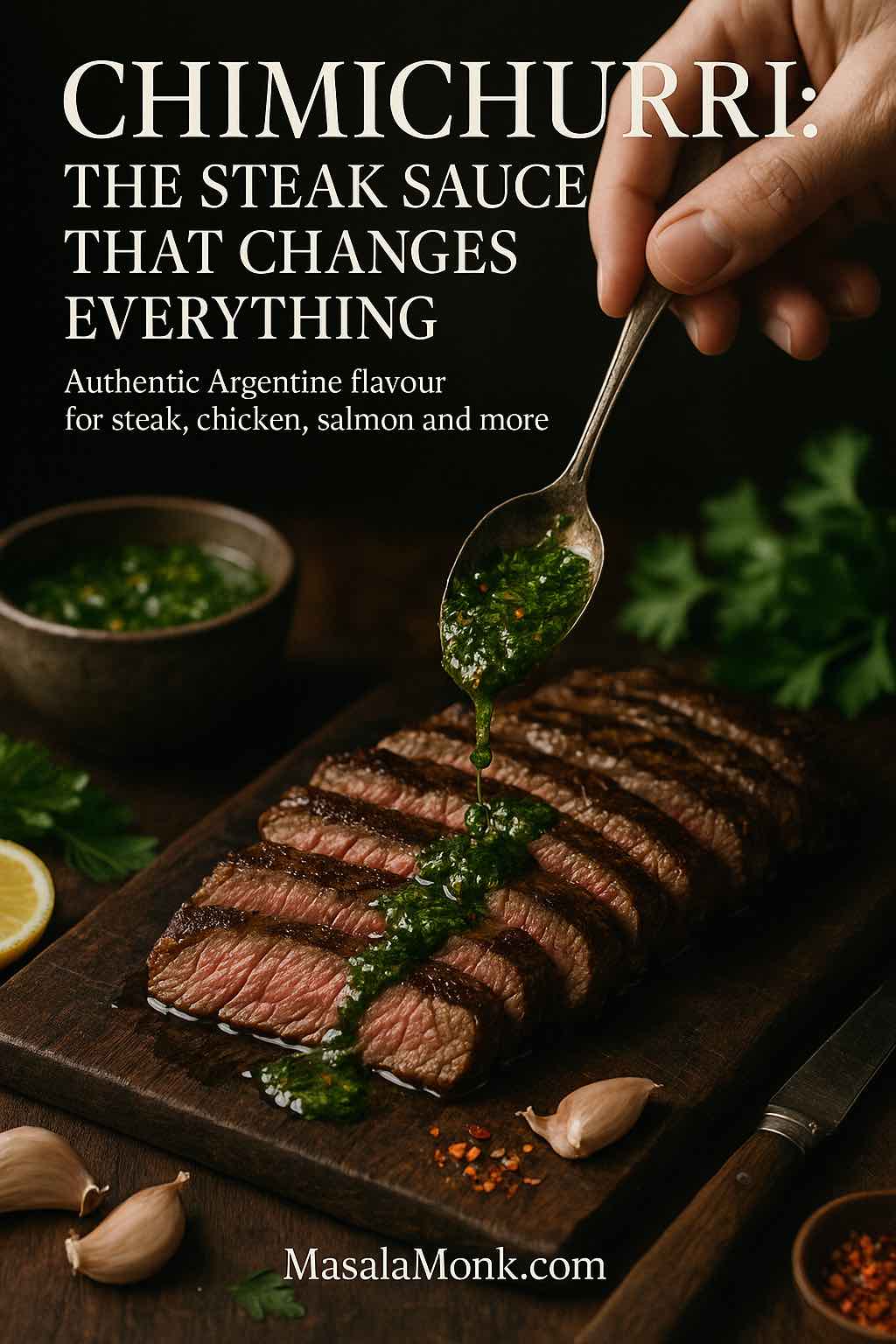
Authentic Chimichurri Recipe (Argentine Steak Sauce)

Hand pouring vibrant chimichurri sauce over sliced medium-rare steak on a wooden board, cover image for MasalaMonk chimichurri recipe.

Some sauces quietly change the way you cook. Chimichurri is one of those quiet revolutions: a small bowl of vivid green herbs, garlic and oil that suddenly makes steak, chicken, vegetables, burgers, salmon, even rice taste brighter and more alive. If you’ve ever wondered what chimichurri is, how to make an authentic Argentinian version at home, or how to turn one simple chimichurri recipe into a marinade, dry rub, salad dressing, dip, or even a compound butter, you’re in exactly the right place. We’ll walk through a classic chimichurri sauce recipe, look at red chimichurri and spicy versions, explore cilantro and basil twists, then step into all the ways to use chimichurri for steak, chicken, salmon and beyond.
Along the way, you’ll see how this humble Argentine sauce for steak connects to a whole world of dips and dressings—like basil pesto with 10 variations or Greek tzatziki sauce ideas—so you can build a complete “sauce toolbox” in your kitchen.

What Is Chimichurri?

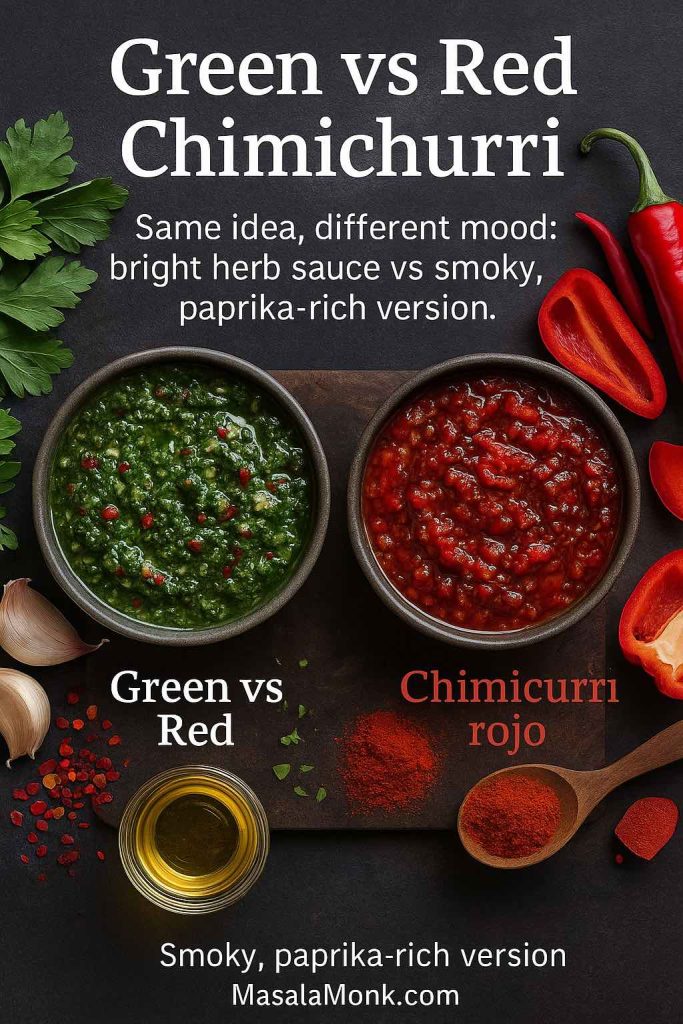
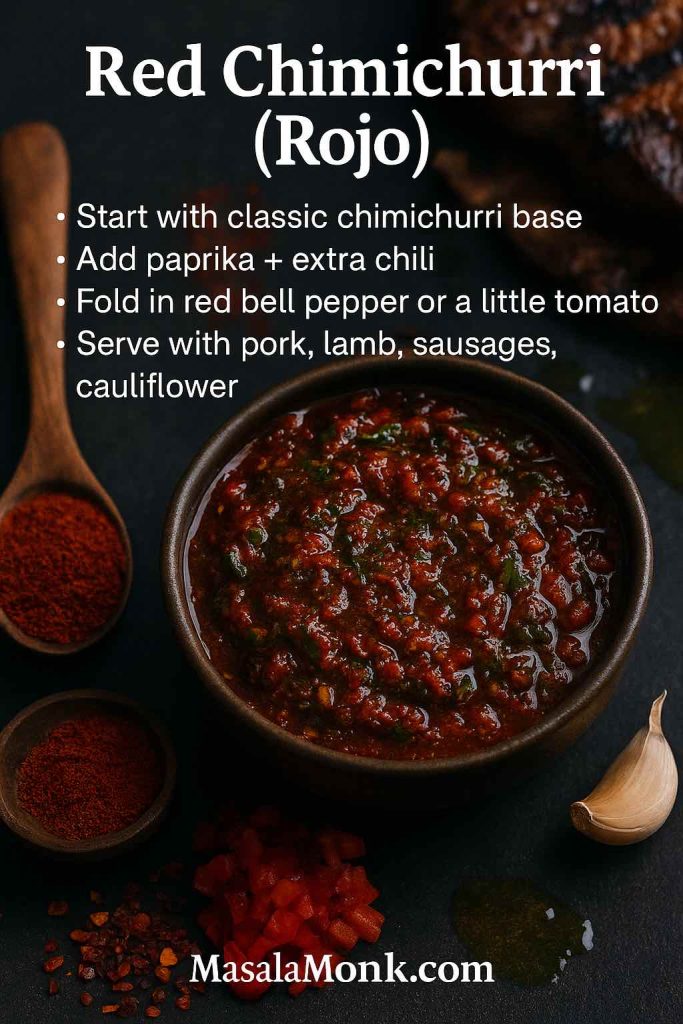
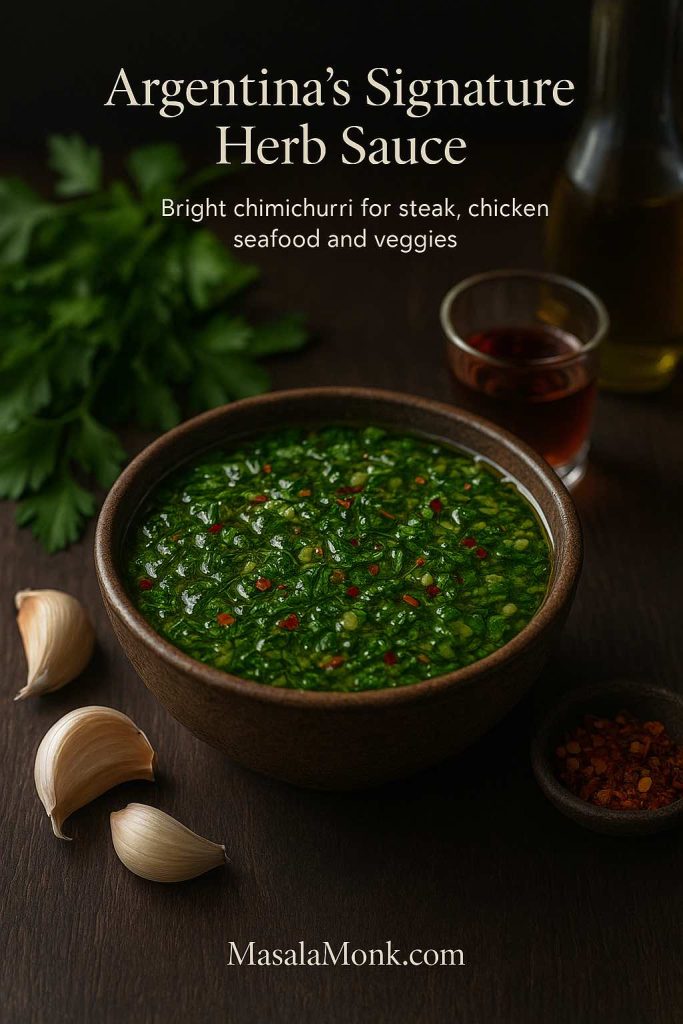
Chimichurri is a loose, uncooked herb sauce from Argentina and Uruguay, traditionally spooned over grilled meats at outdoor barbecues, or asados. According to its entry on Wikipedia, it’s typically made with parsley, garlic, oregano, vinegar, oil and chili, and it comes in both green (chimichurri verde) and red (chimichurri rojo) versions. It’s part sauce, part marinade, part all-purpose condiment.

Portrait shot of a rustic bowl filled with bright green chimichurri sauce, Argentina’s signature herb sauce, surrounded by parsley, garlic, chili flakes and red wine vinegar on a dark wooden table.
Chopped parsley, garlic, chili, vinegar and olive oil suspended in one loose, glossy chimichurri—this is the Argentinian herb sauce that turns grilled meat, seafood and vegetables from plain to unforgettable.

Unlike creamy, cooked sauces, chimichurri is raw and punchy. It behaves like a cross between a salsa and a vinaigrette: fresh herbs and garlic suspended in a tangy pool of red wine vinegar and olive oil. That’s why it works as:

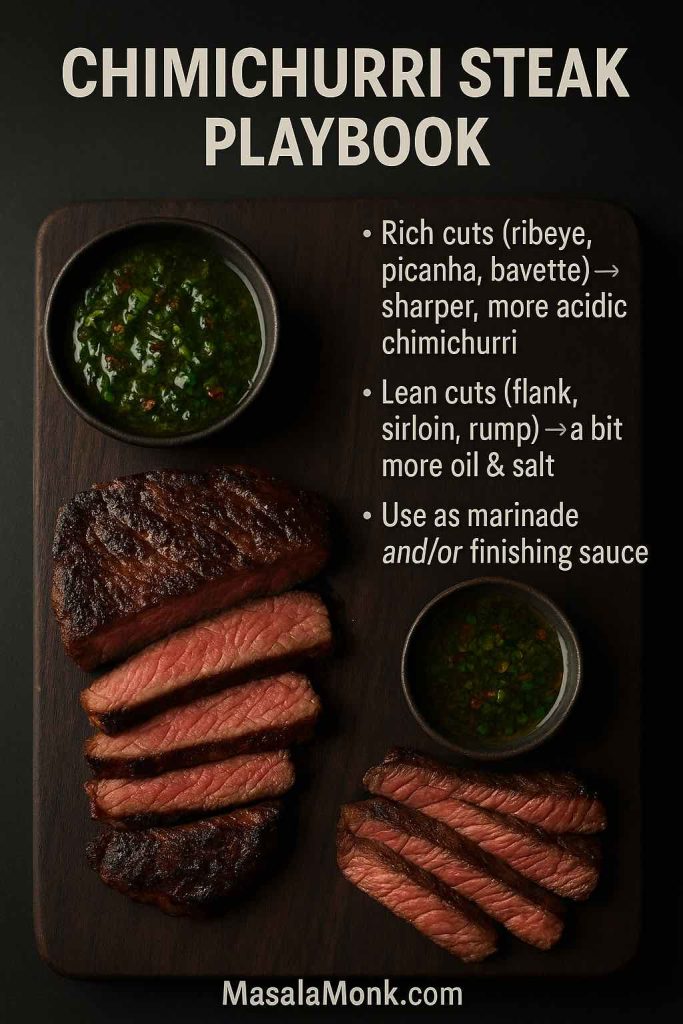
  • A bright chimichurri steak sauce, poured generously over sliced beef
  • A quick chimichurri marinade for steak, chicken, prawns or tofu
  • A zippy chimichurri dressing for salads or grain bowls
  • A lively chimichurri dip with bread, fries or roasted vegetables

In some menus and cookbooks you’ll see it called “chimi sauce” or “chimi recipe,” and occasionally people mis-hear it as “jimmy churri sauce.” No matter how you spell it, the idea is the same: finely chopped herbs, bold garlic, enough acidity to wake everything up and enough oil to soften all that intensity.

Also Read: Cranberry Sauce with Orange Juice (7 Easy Recipes & Variations)


Chimichurri Recipe Main Ingredients and Flavour Profile

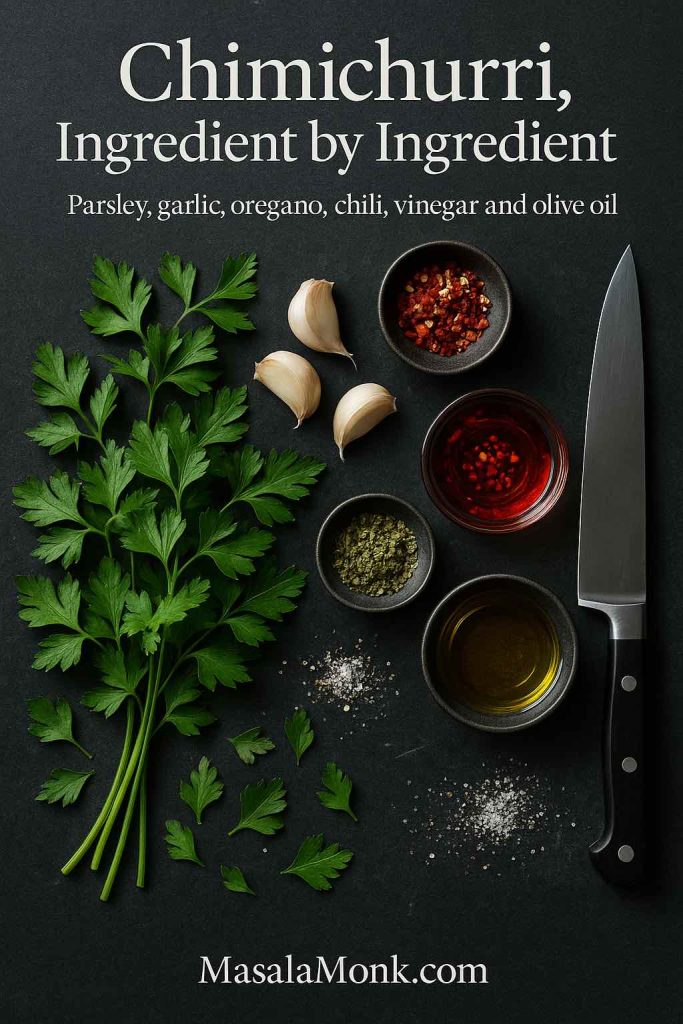
Before you learn how to make chimichurri step by step, it helps to understand its flavour structure. Most chimichurri ingredients lists share a common backbone:

  • Fresh flat-leaf parsley – the core herb in traditional chimichurri
  • Garlic – usually raw and finely minced, for deep savoury heat
  • Oregano – often dried, sometimes fresh, for that warm earthiness
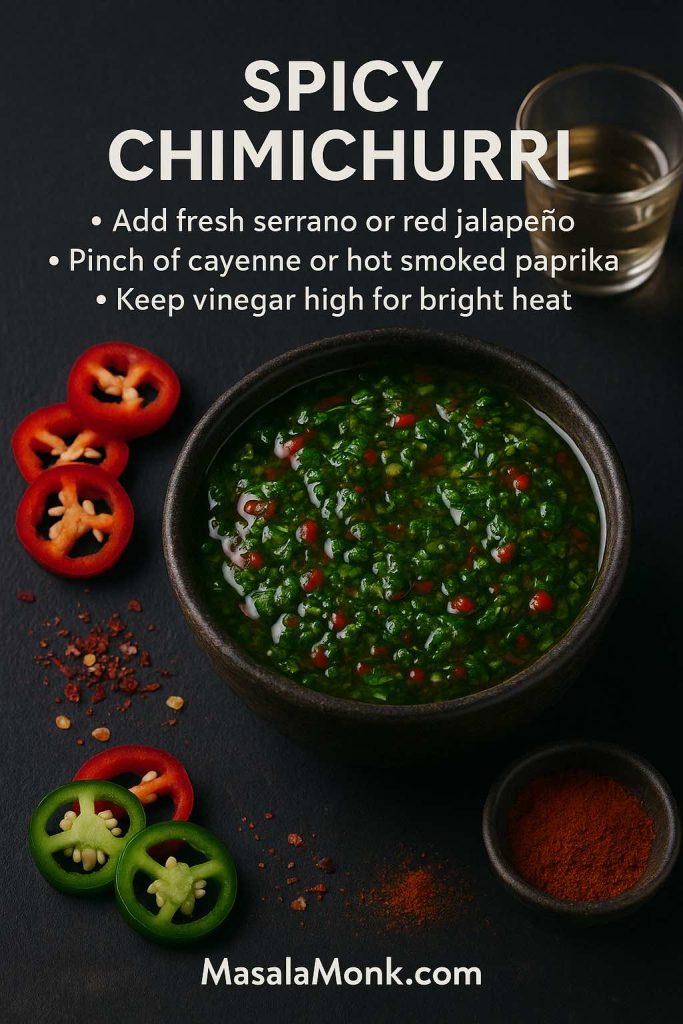
  • Red pepper flakes or fresh chili – the level that turns it into a spicy chimichurri sauce
  • Red wine vinegar – the most common acid in a classic Argentinian chimichurri sauce recipe
  • Olive oil – a good, flavourful oil to carry everything
  • Salt and black pepper – to round out and balance all the sharp edges
Overhead shot of chimichurri ingredients on a dark surface including flat-leaf parsley, garlic cloves, dried oregano, red pepper flakes, red wine vinegar and olive oil with a chef’s knife.
This is the whole story in one frame: flat-leaf parsley for freshness, garlic for heat, oregano for warmth, chili for a kick, red wine vinegar for tang and olive oil to pull everything together into classic chimichurri sauce.

Many families add tiny tweaks: a spoonful of finely chopped onion or shallot, a splash of lemon juice, or a bay leaf left to infuse the sauce, like in some Argentine home-style recipes. However, the heart of a classic chimichurri recipe remains the same.

If you picture a spectrum of green sauces:

Chimichurri sits in its own niche: all about herbs, vinegar, garlic and chili—not creamy, not cheesy, not tomato-based. It’s an Argentinian herb sauce designed to cut through the richness of grilled meat and wake up the whole plate.

Also Read: Healthy Tuna Salad – 10 Easy Recipes (Avocado, Mediterranean, No Mayo & More)


How to Make Chimichurri: The Classic Green Recipe

Let’s start with a simple, authentic-style green chimichurri sauce you can use on almost anything. This is the base that all the other variations grow from.

Serves: 6–8 as a condiment
Time: 10–15 minutes, plus resting

Ingredients for Classic Chimichurri Sauce Recipe

  • 1 cup very finely chopped flat-leaf parsley (tender stems and leaves)
  • 3–4 cloves garlic, minced into a paste
  • 1–2 tablespoons fresh oregano, chopped (or 1 teaspoon dried oregano)
  • ½–1 teaspoon red pepper flakes, to taste
  • ¼ cup red wine vinegar
  • ½–¾ cup extra-virgin olive oil
  • ½ teaspoon fine salt (plus more to taste)
  • ¼ teaspoon freshly ground black pepper
  • Optional: 1–2 tablespoons finely minced red onion or shallot
  • Optional: 1–2 tablespoons fresh lemon juice

Step-by-Step Method for Chimichurri Sauce Recipe

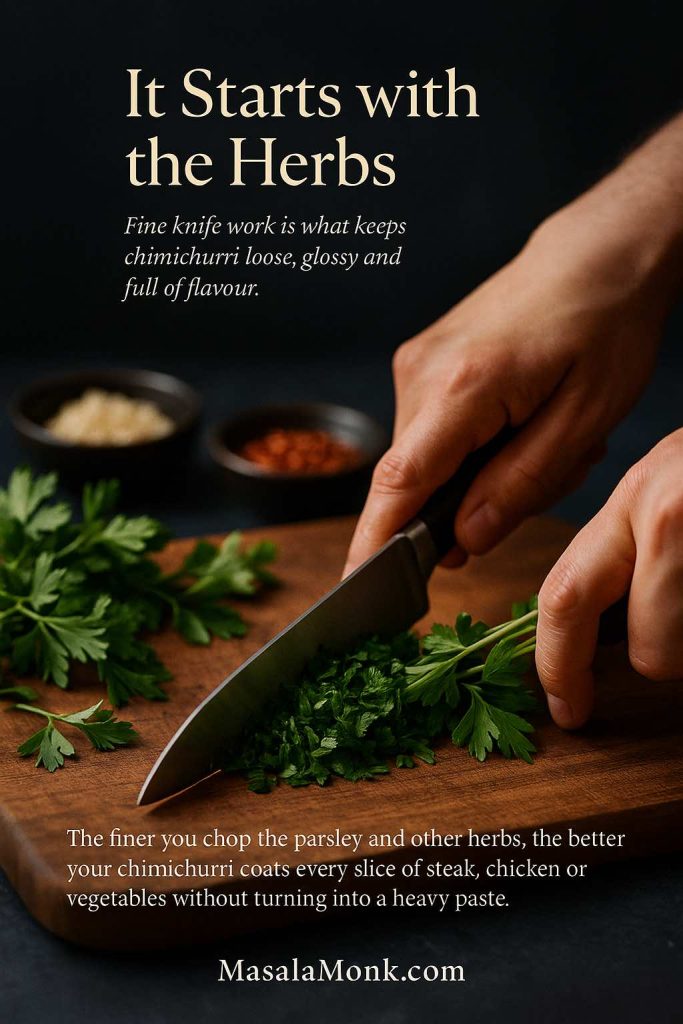
1. Chop the herbs by hand

Begin by giving the parsley and oregano a really fine chop. Lay the leaves in a loose pile, then run a sharp knife through them again and again until the pieces are tiny but still distinct. You want to see little flecks of green, not a wet paste. This is what keeps chimichurri loose, textured and almost salad-like rather than thick and gluey.

Close-up of hands using a chef’s knife to finely chop fresh flat-leaf parsley on a wooden board with small bowls of garlic and chili in the background for chimichurri sauce.
Fine, even parsley pieces help chimichurri cling lightly to steak, chicken and vegetables, instead of clumping in big leafy chunks or turning into a paste in the blender.

Instead of reaching for a blender or food processor, take a minute to enjoy the knife work. Machines tend to bruise the herbs, releasing too much moisture and turning the sauce into something closer to pesto. Hand-chopping protects the flavour, keeps the colour bright and gives that classic Argentine-style chimichurri look we want over steak, chicken and vegetables.

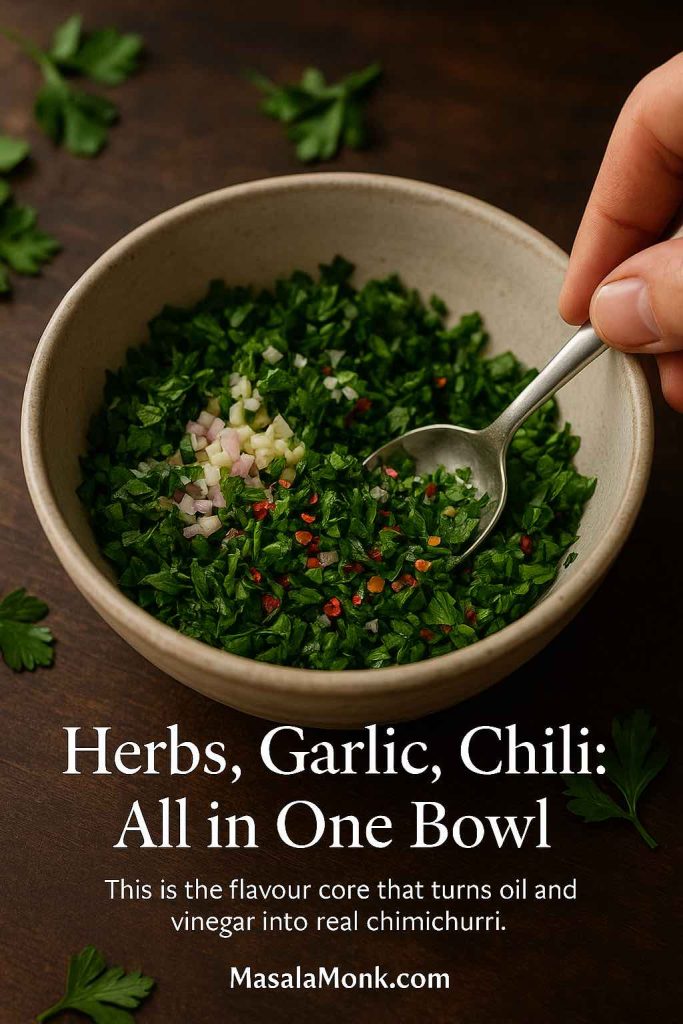
2. Build the herb base

Once the herbs are finely chopped, slide them into a medium bowl. Add the minced garlic, red pepper flakes and the tiny dice of onion or shallot if you’re using it. Sprinkle over the salt and black pepper, then gently stir everything together. You’re building the flavour foundation here, so take a moment to make sure the aromatics are evenly distributed.

Bowl filled with finely chopped parsley, minced garlic, shallots and red chili flakes being stirred together as the herb base for chimichurri sauce.
When parsley, garlic, shallots and chili come together in one bowl, you’ve built the flavour core—later the vinegar and olive oil simply carry this mix over every slice of steak, chicken, seafood or vegetables.

As the herbs, garlic and chili sit together, they start to release their oils and juices. This early mixing step helps the chimichurri taste integrated later, instead of like oil with bits floating in it. You should already catch the smell of parsley, garlic and spice lifting out of the bowl.

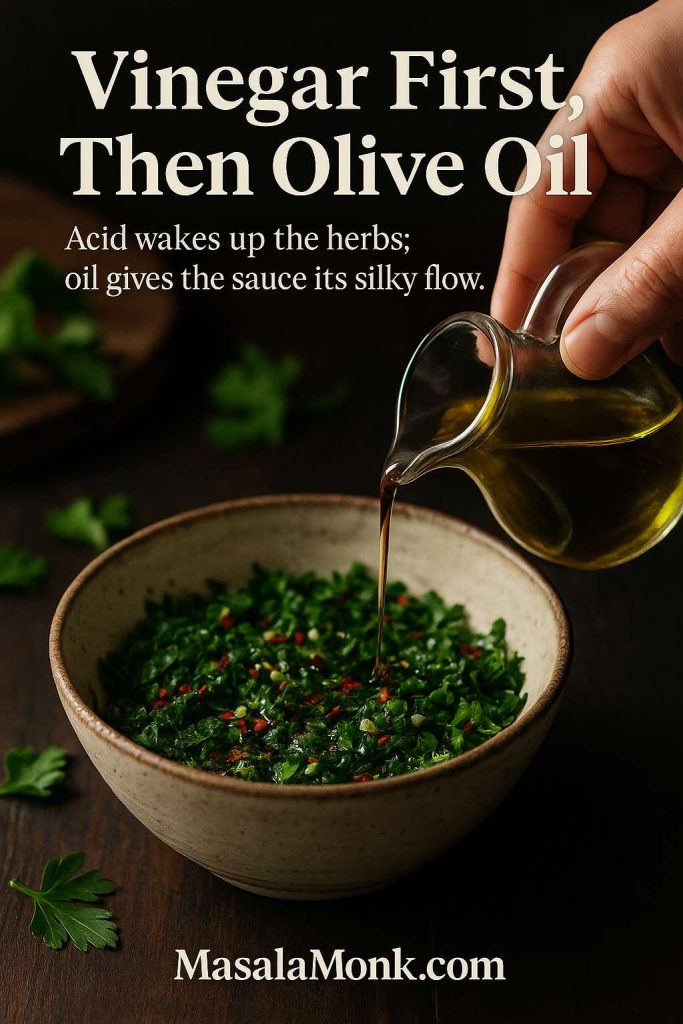
3. Add vinegar, then oil

Now it’s time to give the mixture its bite. Pour in the red wine vinegar and any lemon juice first. Stir well and let the herbs soak up that acidity for a minute; this brief pause softens the raw edge of the garlic and starts to “cook” the herbs in the best possible way.

Close-up of red wine vinegar being poured from a glass jug into a bowl of chopped parsley, garlic and chili to make chimichurri, with MasalaMonk.com text on the image.
Let the vinegar hit the herbs first so it can soften the garlic and wake up the parsley, then follow with olive oil to turn everything into a loose, silky chimichurri that runs beautifully over steak, chicken or vegetables.

Only after the vinegar has had a chance to mingle do you begin adding the olive oil. Start with about ½ cup, stirring as you pour, then gradually add more until the chimichurri looks loose, glossy and spoonable—somewhere between a chunky salsa and a vinaigrette. The herbs should be well coated but not drowning in oil. This balance is what lets the sauce cling to steak or chicken while still running slightly across the plate.

4. Taste and adjust

Before you call it done, taste a small spoonful. Ask yourself how it feels on your tongue. If the flavour is sharp or slightly aggressive, a little extra olive oil will round it out. When the sauce tastes flat or dull, reach for a pinch more salt or another drizzle of vinegar to bring it back to life.

Hand holding a spoonful of glossy green chimichurri sauce above a bowl, with salt, chili flakes and a lemon wedge on a dark table, showing the step of tasting and adjusting seasoning.
A quick taste at this stage tells you whether your chimichurri needs a pinch more salt, an extra splash of vinegar or just a little more chili to match the steak, chicken or vegetables you’re about to serve it with.

On the other hand, if the chimichurri seems too gentle, you can easily wake it up. Add a few more red pepper flakes, a touch of fresh chili or a bit more garlic until the heat and fragrance match what you like on your steak or chicken. This is where you turn a basic chimichurri into your best chimichurri recipe—tiny adjustments until the herbs, acidity, heat and richness all feel in harmony.

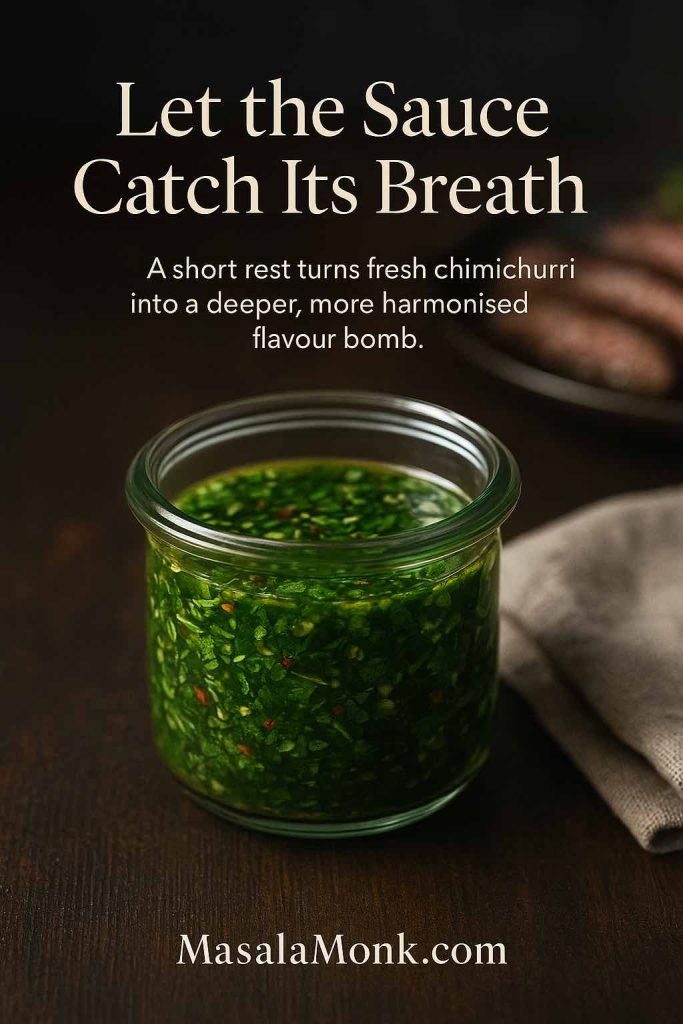
5. Let it rest

Finally, give the sauce a little time to settle. Leave your homemade chimichurri at room temperature for 20–30 minutes before serving. During this rest, the herbs hydrate in the oil and vinegar, the garlic softens, and the individual flavours relax into one another.

Glass jar filled with fresh homemade chimichurri sauce resting on a dark wooden table, vibrant green herbs and chili suspended in olive oil with a napkin beside it.
After you mix it, let chimichurri rest in a jar for a little while—the parsley softens, the garlic mellows and the whole sauce tastes deeper when it finally hits steak, chicken, seafood or vegetables.

If you’re planning ahead, you can refrigerate the chimichurri for several hours or even overnight. Just remember to bring it back to room temperature and stir well before using it. That way, when you spoon it over a freshly grilled steak, fold it into chicken and rice, or drizzle it on roasted vegetables, you get the fullest, most rounded flavour in every bite.

That’s it. You’ve just made a simple, easy chimichurri recipe you can rely on. It’s the answer to all the “how to make chimichurri,” “how do you make chimichurri,” and “how is chimichurri made” questions in one small bowl.

Also Read: Upma Recipe: 10+ Easy Variations (Rava, Millet, Oats, Semiya & More)


Authentic, Traditional and Regional Chimichurri Styles

Once you know the basic technique, you’ll see a whole family of chimichurri recipes out in the wild: authentic versions from Argentina and Uruguay, spicy riffs from Brazil, and herb-loaded sauces inspired by Mexican or Cuban cuisine.

Argentinian parrilla-style platter with sliced grilled beef and sausages arranged around a rustic bowl of green chimichurri sauce, with a hand dipping torn bread into the sauce and the words Chimichurri at the Asado on top.
At an Argentinian asado, chimichurri is the bowl everyone reaches for—passed around the table to soak grilled beef, sausages and even torn bread in sharp parsley, garlic and vinegar rather than sitting as a garnish on just one steak.

Authentic Argentinian Chimichurri Recipe

When people talk about an “authentic chimichurri recipe” or “traditional chimichurri sauce,” they usually mean one thing: heavy on parsley, simple on extras, and totally uncooked.

Recipes like this one from Cafe Delites and Hernan Dieguez’s Argentine chimichurri stick close to that idea—parsley, garlic, oregano, vinegar, chili and oil, sometimes with a bay leaf for perfume. The result is sharp, herbaceous and perfectly suited to grilled beef, sausages and skewers.

These classic versions answer the craving for:

  • Authentic chimichurri sauce
  • Chimichurri original recipe
  • Traditional chimichurri sauce recipe
  • Argentine chimichurri recipe or argentinian chimichurri sauce recipe

If you’re chasing that straight-from-the-parrilla feeling, make the basic recipe above, keep parsley as the star, and resist adding too many extras.

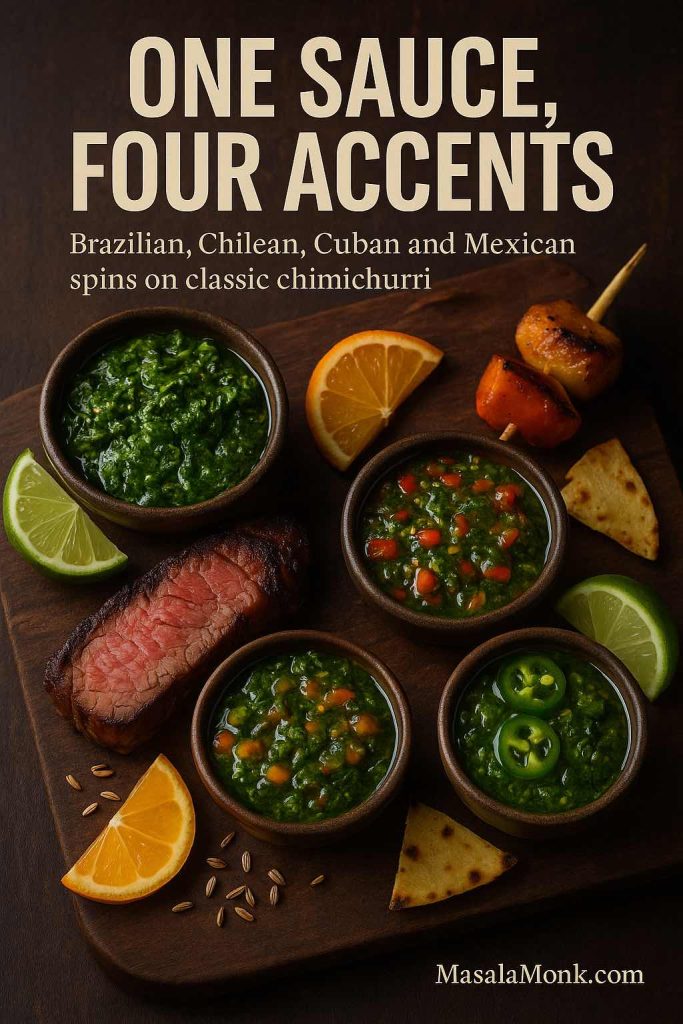
Wooden board with four small bowls of chimichurri variations styled as Brazilian, Chilean, Cuban and Mexican, surrounded by grilled beef, citrus wedges, jalapeño slices and spices, with the title One Sauce, Four Accents.
One basic chimichurri idea becomes four accents here: extra-cilantro Brazilian style with grilled beef, red pepper–flecked Chilean chimichurri, citrus-and-cumin Cuban sauce and a jalapeño-and-lime Mexican twist—all built on the same herb, garlic, vinegar and olive oil backbone.

Brazilian, Chilean, Cuban and Mexican Chimichurri Recipe Twists

As chimichurri travelled, it picked up new accents:

  • Brazilian chimichurri sauce sometimes includes more cilantro and can accompany picanha and other Brazilian steak cuts.
  • Chilean chimichurri may lean into red bell pepper and milder chilies.
  • Cuban-style chimichurri occasionally brings in citrus and a touch of cumin.
  • Mexican chimichurri sauce or “chimichurri mexicano” might introduce jalapeño, serrano or lime juice, nudging the flavour closer to salsa while keeping the herb-and-vinegar backbone.

None of these are less “real”; they’re just a different answer to the same question: how to make a herby, garlicky chimichurri sauce suit local taste and local grills.

Also Read: Double Chocolate Chip Cookies – Easy Recipe with 7 Variations


Cilantro, Basil and Avocado Chimichurri Recipe Variations

Once you’re comfortable with parsley and oregano, it’s natural to start asking “Can you make chimichurri with cilantro?” or “What about basil chimichurri?”

The short answer is yes. Quite happily.

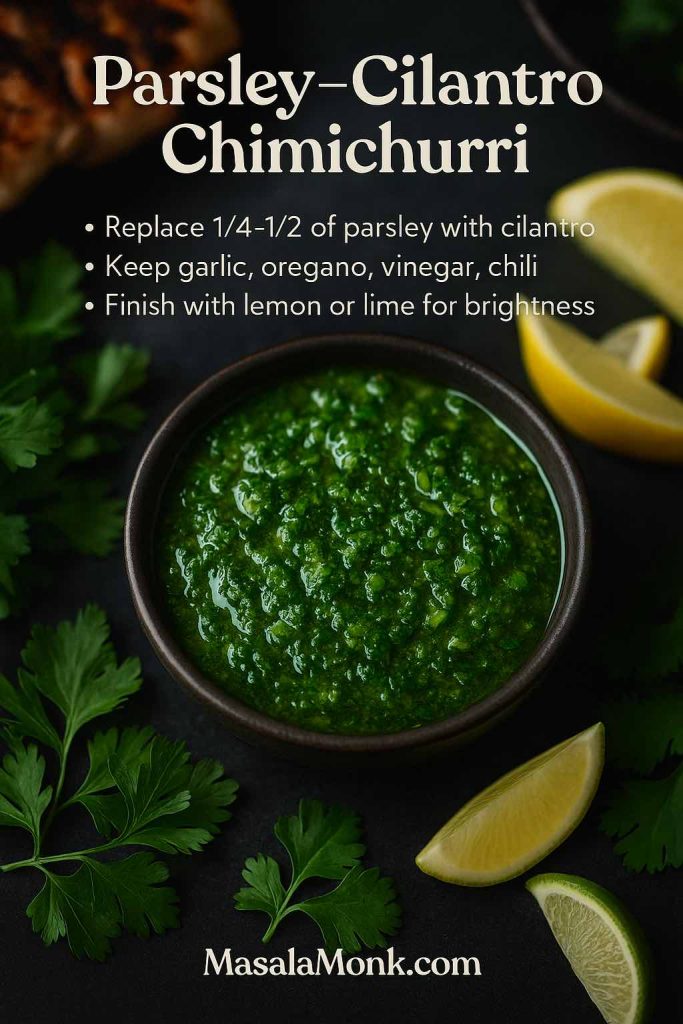
Portrait image of a bowl of bright green parsley-cilantro chimichurri sauce on a dark surface, surrounded by fresh parsley, cilantro and lemon and lime wedges, with text overlay explaining how to make parsley–cilantro chimichurri.
Parsley–cilantro chimichurri is an easy upgrade on the classic: simply replace part of the parsley with cilantro, keep the garlic, oregano, vinegar and chili the same and finish with lemon or lime juice. The result leans gently toward Mexican flavours and is unbeatable on grilled chicken, fish tacos, shrimp skewers and roasted vegetables.

Parsley–Cilantro Chimichurri Recipe

Cilantro chimichurri is probably the most popular variation right now. To make a well-balanced cilantro chimichurri:

  • Replace ¼ to ½ of the parsley with cilantro leaves.
  • Keep the oregano, garlic, vinegar and chili the same.
  • Add a little extra lemon or lime juice for brightness if the flavour feels heavy.

This version is wonderful on grilled chicken, fish tacos, shrimp skewers and roasted vegetables. It edges closer to Mexican flavours while staying clearly a chimichurri, not a salsa.

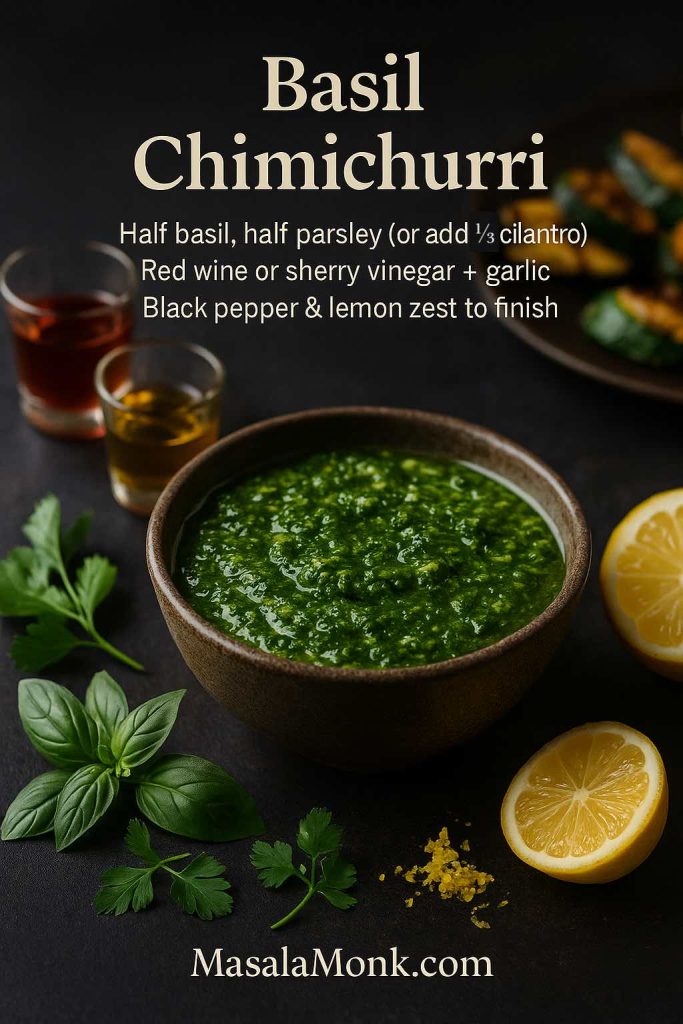
Portrait image of a bowl of basil chimichurri sauce on a dark surface, surrounded by basil and parsley leaves, lemon halves, lemon zest and small glasses of vinegar, with text overlay explaining how to make basil chimichurri.
Basil chimichurri softens the classic sauce into something a little more Italian—use plenty of basil with parsley, whisk in red wine or sherry vinegar, garlic and olive oil, then finish with black pepper and lemon zest before spooning it over roasted vegetables, grilled zucchini or simple chicken breasts.

Basil Chimichurri Recipe and Herb Mixes

Basil brings a soft, sweet edge and moves the sauce closer to an Italian profile. For a basil chimichurri:

  • Use half basil, half parsley, or a third basil, a third parsley, a third cilantro.
  • Stick with red wine vinegar, or try sherry vinegar for a rounder note.
  • Add a touch of black pepper and maybe a small grating of lemon zest.

Basil chimichurri is especially good on roasted vegetables, grilled zucchini, simple chicken breasts and even as a spread inside sandwiches. If you love this kind of herb creativity, you’ll probably also enjoy exploring pesto recipes with 10 easy variations, which cover nut-free, spicy and vegan twists on basil-based sauces.

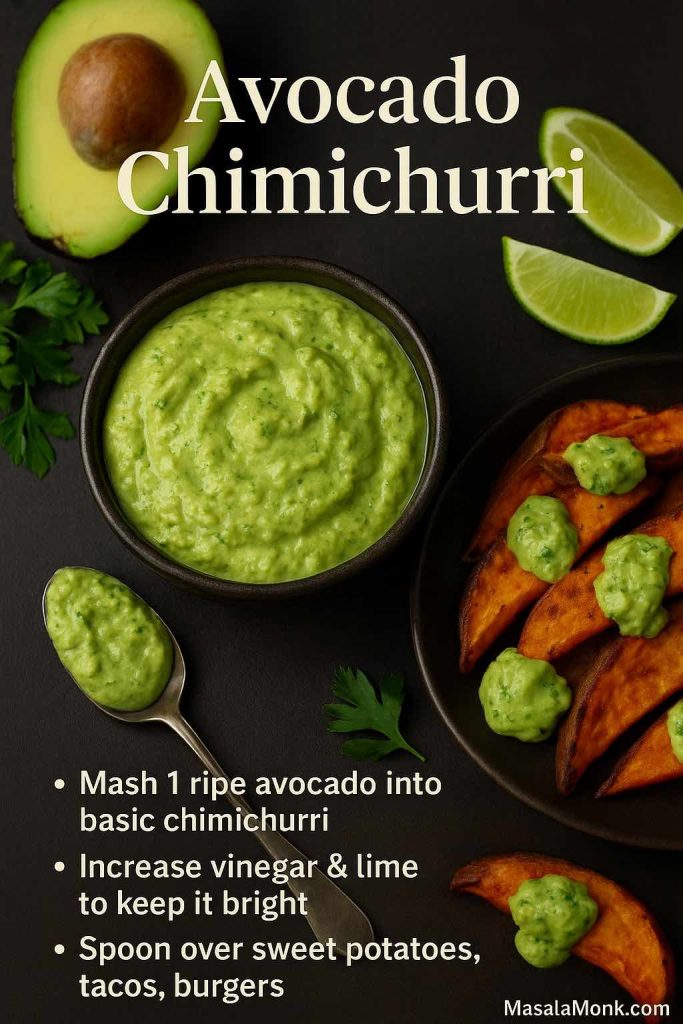
Avocado Chimichurri Sauce Recipe

If you’re craving something creamier—but still dairy-free—avocado chimichurri is a clever hybrid. You essentially make a quick chimichurri recipe in a bowl, then mash in a ripe avocado until the texture sits between a spoonable sauce and a chunky dip.

Portrait image of creamy avocado chimichurri sauce in a bowl with a spoonful beside it and roasted sweet potato wedges topped with the sauce, surrounded by avocado halves, parsley and lime wedges on a dark surface.
Avocado chimichurri starts as a regular chimichurri, then gets a ripe avocado mashed in until it turns thick and scoopable—add extra vinegar and lime to keep it bright, then spoon it over sweet potatoes, tacos, burgers or grain bowls for a creamy but still dairy-free sauce.

It’s brilliant with:

  • Grilled prawns and fish
  • Roasted sweet potatoes
  • Chip bowls, tacos and burritos
  • As a spread on burgers and sandwiches

Because avocado dulls acidity slightly, you may want to add more vinegar and lime juice to keep the flavour bright.

Also Read: One-Pot Chicken Bacon Ranch Pasta (Easy & Creamy Recipe)


Red Chimichurri, Green Chimichurri and Spicy Versions

Most people first meet a green chimichurri sauce. However, red chimichurri sauce has a strong tradition too and deserves its own moment.

Overhead image of two bowls of chimichurri sauce on a dark surface, one bright green chimichurri verde and one deep red chimichurri rojo, surrounded by parsley, garlic, red pepper flakes, paprika and red pepper with text Green vs Red Chimichurri.
Both sauces start from the same idea—herbs, garlic, vinegar and oil—but chimichurri verde stays bright and parsley-heavy, while chimichurri rojo adds paprika, extra chili and red pepper for a smokier, deeper flavour on grilled meat and vegetables.

Green Chimichurri (Chimichurri Verde)

The classic green version—chimichurri verde—is what you’ve already seen: parsley-led, olive-oil rich, with red pepper flakes scattered through. It’s the default when you see recipes for:

  • chimichurri skirt steak
  • chimichurri flank steak
  • chimichurri beef steak
  • Argentinian steak with chimichurri

The green colour signals freshness, herbal intensity and that unmistakable “asado” aroma.

Portrait recipe card showing a bowl of deep red chimichurri rojo on a dark surface, surrounded by paprika, chili flakes, diced red bell pepper and garlic, with text explaining how to make red chimichurri sauce.
Red chimichurri, or chimichurri rojo, starts with the same herb-and-garlic base as the green version, then leans into paprika, extra chili and a little red bell pepper or tomato. The result is a smokier, richer sauce that’s ideal for pork, lamb, sausages and even roasted cauliflower steaks when you want something bolder than classic chimichurri verde.

Red Chimichurri (Chimichurri Rojo)

Red chimichurri starts from the same base but adds ingredients like:

  • Sweet or hot paprika
  • Extra chili flakes or chopped fresh chilies
  • Finely diced red bell pepper
  • Sometimes a spoonful of tomato paste or sun-dried tomatoes

The result is a red chimichurri sauce for steak that feels richer, smokier and often spicier. This is the version to reach for when you want red chimichurri sauce recipe or a more fiery chimichurri hot sauce to drizzle or dip.

Red chimichurri loves grilled pork, lamb chops, spicy sausages and roasted cauliflower steaks just as much as it loves beef.

Portrait recipe card showing a dark bowl of spicy green chimichurri sauce on a black surface, surrounded by sliced red and green chilies, chili flakes, cayenne powder and a glass of vinegar, with text explaining how to make spicy chimichurri.
This is the dial-it-up version of chimichurri: fresh serrano or red jalapeño stirred into the herbs, a pinch of cayenne or hot smoked paprika and enough vinegar to keep all that heat feeling bright instead of heavy.

Turning Up the Heat: Spicy Chimichurri Sauce Recipe

If you want a chimichurri sauce spicy enough to make your lips tingle but still balanced, there are a few easy moves:

  • Swap part of the red pepper flakes for finely chopped fresh chili (serrano, red jalapeño or bird’s eye).
  • Add a pinch of cayenne or hot smoked paprika.
  • Keep the vinegar level high so it stays bright, not muddy.

At that point you’re on the border between chimichurri and a light hot sauce, and that’s a very comfortable place to be.

Also Read: Easy Lemon Pepper Chicken Wings (Air Fryer, Oven & Fried Recipe)


Chimichurri for Steak: Flank, Skirt, Ribeye, Bavette and Churrasco

Now for the main event: chimichurri and steak. This is where most people fall in love with the sauce in the first place.

High-resolution guide image showing sliced rich and lean grilled steaks on a dark wooden board with two bowls of chimichurri sauce and on-image text titled Chimichurri Steak Playbook explaining how to pair chimichurri with different steak cuts.
This quick playbook shows how chimichurri behaves with different steaks: richer cuts like ribeye, picanha and bavette shine with a sharper, more acidic sauce, while leaner steaks such as flank, sirloin or rump benefit from a touch more oil and salt, whether you use chimichurri as a marinade, a finishing sauce or both.

General Rules for Chimichurri Steak

Before we dive into specific cuts, a few guiding ideas:

  • Richer steaks (ribeye, picanha, bavette) can handle a sharper, more acidic chimichurri.
  • Leaner steaks (sirloin, rump, some flank) sometimes like a touch more oil and salt.
  • You can use chimichurri as a steak marinade, a steak sauce, or both.

If you’d like exact internal temperatures, the USDA and FoodSafety.gov charts recommend cooking whole beef steaks and roasts to at least 145°C / 63°C with a short rest for safety, even though many steak lovers prefer rarer doneness. You can aim for the safe zone while still serving juicy meat by using chimichurri generously over the top.

Flank Steak Recipe and Chimichurri

Flank steak has a strong, beefy flavour and a visible grain. It loves marinade, high heat and a sharp knife.

Portrait recipe card showing a grilled flank steak on a wooden board, sliced thinly against the grain with green chimichurri sauce spooned over the slices, a small bowl of chimichurri on the side and text explaining how to marinate and serve flank steak with chimichurri.
Marinate flank steak for 30–60 minutes in an extra-acidic chimichurri, grill it hot and fast, let it rest, then slice thinly against the grain and spoon more sauce over the top—suddenly a relatively affordable cut turns into a steak-night centrepiece.

For flank steak and chimichurri:

  1. Marinate the steak for 30–60 minutes in a slightly more acidic chimichurri marinade for steak (add extra vinegar, salt and a splash of water).
  2. Pat it dry and grill or pan-sear on high heat until it hits your preferred temperature.
  3. Rest for at least 5–10 minutes.
  4. Slice thinly against the grain and spoon chimichurri sauce flank steak generously over the slices.

This approach turns a relatively affordable cut into something that feels like a special occasion.

Skirt Steak Recipe and Chimichurri

Skirt steak, or entraña, is another classic partner. It’s thinner than flank and cooks extremely quickly, making it perfect for weeknight chimichurri dinners.

Portrait recipe card showing grilled skirt steak on a dark wooden board, sliced into thin strips and topped with green chimichurri sauce, with a small bowl of chimichurri and text explaining how to cook skirt steak with chimichurri.
For weeknights, skirt steak and chimichurri are hard to beat: toss the steak with chimichurri, garlic and a little extra salt, grill it 2–3 minutes per side on very high heat, then rest, slice and finish with a fresh spoonful of sauce for maximum flavour with minimal time.

Try this chimichurri sauce for skirt steak routine:

  • Toss skirt steak with a few spoonfuls of chimichurri, garlic and extra salt for a quick chimichurri marinade.
  • Grill on a very hot pan or barbecue, about 2–3 minutes per side.
  • Let it rest, then slice and drizzle with fresh chimichurri.

Because skirt is quite rich, this combo often feels like the best chimichurri steak you’ve had without much effort at all.

Ribeye, Bavette and Other Cuts

For thick, marbled cuts like ribeye or bavette, you might skip the marinade and simply use chimichurri as a finishing sauce. Salt the steak ahead, cook it as you like, then bathe it in chimichurri sauce for steak at the table.

The same basic idea works for:

  • Chimichurri ribeye
  • Bavette chimichurri
  • Churrasco chimichurri (thin steaks cooked hot and fast)
  • Mixed grills where several cuts share a platter and a big bowl of chimichurri in the middle

If you’d like to go all in on steak technique—two-zone grilling, resting, slicing—resources like the Serious Eats guides to grilled steak are very handy, and chimichurri slots right into those methods as the finishing touch.

Choripán, Burgers and Sandwiches

Chimichurri doesn’t stop at whole steaks. It is also the heart of the beloved choripán recipe: grilled chorizo sausage tucked into crusty bread, drenched in chimichurri. A quick version is simple:

  • Grill sausages until browned and cooked through.
  • Split crusty rolls, toast lightly, spoon in chimichurri.
  • Add sausage, then more chimichurri on top.
High-resolution image showing a choripán, a chimichurri-topped burger and a steak sandwich arranged on a dark wooden board around a bowl of green chimichurri sauce, with overlay text about using chimichurri on choripán, burgers and sandwiches.
Chimichurri turns simple sandwiches into parrilla food: drizzle it over grilled chorizo in choripán, swap it for ketchup and mayo on burgers, or spoon it into steak sandwiches with roasted peppers for a fast way to make everyday grill-night feel more Argentinian.

Similarly, you can use it to create:

  • Chimichurri burger toppings instead of ketchup and mayo
  • Steak sandwiches with herby chimichurri and roasted peppers
  • Beef skewers—essentially churrasco bites—served with chimichurri as a dipping sauce

A little bowl of sauce suddenly turns grill night into something much more Argentinian.

Also Read: Sheet Pan Chicken Fajitas Recipe (Easy One-Pan Oven Fajitas)


Chicken Chimichurri, Baked Dishes and Chicken-and-Rice Bowls

Although beef gets most of the attention, chicken and chimichurri are an extremely useful pairing for everyday cooking. The acidity brightens mild meat, while the herbs make simple meal prep feel more exciting.

Portrait recipe image showing raw chicken thighs in a dark baking dish covered in green chimichurri marinade, with a small bowl of chimichurri and a spoon on a dark background and step-by-step text for chicken chimichurri marinade.
For an easy chicken chimichurri marinade, coat thighs or breasts in a few spoonfuls of sauce with a little extra oil, let them sit for at least 30 minutes, then grill, roast or pan-sear and finish with a fresh spoonful of chimichurri at the table.

Chicken Chimichurri Marinade Recipe

For a straightforward chicken chimichurri sauce recipe:

  1. Place chicken thighs or breasts in a bowl or zip bag.
  2. Add 3–4 tablespoons of chimichurri plus a drizzle of extra oil.
  3. Marinate 30 minutes (or up to a few hours in the fridge).
  4. Grill, roast or pan-sear until fully cooked.
  5. Serve with more fresh chicken chimichurri sauce spooned over the top.

You can also bake a chicken chimichurri tray bake: scatter potatoes, onions and bell peppers in a roasting dish, nestle in the marinated chicken, and roast until everything is tender and golden. The excess chimichurri and chicken juices effectively become a built-in pan sauce.

Portrait recipe card showing a bowl of rice topped with shredded chimichurri chicken, roasted vegetables, black beans and avocado slices, drizzled with green chimichurri sauce, with text explaining how to build a chicken chimichurri rice bowl.
Turn leftover chimichurri chicken into a full meal by shredding it over warm rice or quinoa, adding roasted vegetables, beans and creamy avocado, then finishing the bowl with another bright drizzle of sauce.

Recipe for Chicken Chimichurri and Rice

Leftover chimichurri chicken becomes the base of a great chicken and chimichurri rice bowl:

  • Shred cooked chicken.
  • Toss with a spoonful of chimichurri and some cooked rice or quinoa.
  • Add roasted vegetables, beans, avocado or a fried egg.

It’s a quick route to a flavourful lunch, especially when you already have chimichurri sitting in the fridge.

For sandwich nights, use chimichurri instead of mayo in grilled chicken sandwiches and wraps, weaving it into spreads alongside ideas from MasalaMonk’s chicken sandwich recipes for an entire roster of combinations.

Also Read: Negroni Recipe: Classic Cocktail & Its Variation Drinks


Chimichurri and Salmon, Seafood, Vegetables and Plant-Based Proteins

Chimichurri is not just about beef and poultry. Its balance of herbs and acid makes it naturally comfortable with seafood, vegetables and vegetarian proteins.

Portrait guide image titled Chimichurri & Salmon – 3 Ways showing grilled salmon fillets topped with green chimichurri, pieces finished with creamy avocado chimichurri, bowls of sauce and lemon wedges on a dark platter.
Salmon is a natural partner for chimichurri—grill fillets and finish them with classic sauce, roast a side of salmon and drizzle a looser chimichurri dressing down the middle, or go richer with a creamy avocado chimichurri on top of each portion.

Chimichurri and Salmon

For chimichurri and salmon, you have a few approaches:

  • Grill or pan-sear salmon fillets with only salt and pepper, then spoon cilantro-heavy chimichurri over the top.
  • Roast a side of salmon and drizzle a looser chimichurri dressing over the whole platter.
  • Use avocado chimichurri as a creamy topping, especially if you like richer sauces.

The mild sweetness of salmon plays beautifully with the tang of vinegar, garlic and herbs.

Portrait recipe card showing chimichurri-marinated shrimp and prawn skewers with a white fish fillet topped with green chimichurri, served on a dark platter with lemon wedges and a bowl of sauce, with text explaining how to marinate and cook shrimp, prawns and white fish in chimichurri.
For shrimp, prawns and firm white fish, a short chimichurri bath is enough—marinate for 15–20 minutes, grill or bake, then finish with a fresh spoonful of sauce so the seafood stays bright and delicate instead of heavy.

Shrimp, Prawns and White Fish

Chimichurri also works well as a marinade and finishing sauce for prawns, shrimp and firm white fish:

  • Toss prawns in a chimichurri marinade for 15–20 minutes.
  • Skewer and grill, then serve with more chimichurri.
  • Or bake fish portions in parchment with a spoonful of chimichurri on top.

Because seafood is delicate, you may prefer a slightly less garlicky version for these dishes.

Vegetables, Beans and Tofu

On the plant side, chimichurri brings grilled and roasted vegetables to life: think charred broccoli, roasted carrots, grilled portobello mushrooms, corn on the cob, sweet potato wedges and crispy roast potatoes.

Portrait guide image titled Vegetables, Beans & Tofu showing a dark plate with roasted broccoli, carrots, corn on the cob, crispy tofu cubes and a quinoa-and-bean mix, all drizzled with green chimichurri sauce and served with a small bowl of chimichurri.
Chimichurri isn’t just for steak—drizzle it over roasted broccoli and carrots, spoon it onto crispy tofu or paneer ‘steaks’ and toss it through warm beans and grains to build bright, plant-forward bowls that taste like they’ve been finished at the grill.

You can also:

  • Drizzle chimichurri over crispy tofu or paneer “steaks.”
  • Stir it into warm beans and vegetables with cooked grains to make chimichurri rice bowls.
  • Use it as a dressing for a bean and grain salad, similar in spirit to classic potato or pasta salads.

If you lean heavily into plant-based cooking, it’s worth browsing MasalaMonk’s various veggie-forward ideas—like their high-protein meal prep concepts or grain-based recipes—and simply adding chimichurri as the finishing touch.


Chimichurri Marinade, Rub, Seasoning and Dry Mix Recipe

So far we’ve looked at chimichurri as a fresh sauce. However, it can also become a chimichurri seasoning or chimichurri dry rub that lives in your spice cupboard.

Recipe for Chimichurri Marinade

To convert your sauce into a marinade:

  • Increase the vinegar slightly.
  • Add more salt.
  • Thin with a tablespoon or two of water.

This looser mixture clings to meat or vegetables, tenderising gently and adding flavour without being too oily. It works especially well as a beef chimichurri marinade or as a marinade for chicken thighs and drumsticks.

Recipe infographic showing a bowl of chimichurri marinade with a basting brush on one side and a dish of dry chimichurri seasoning on the other, with grilled steak and corn around them and text explaining how to use chimichurri as a marinade and dry mix.
Use chimichurri two ways: loosen the sauce with extra vinegar, salt and a splash of water to make a marinade that clings to steak, chicken and veg without too much oil, or keep a dry chimichurri mix of herbs, chili flakes and smoked paprika in your spice jar to rub on meat or whisk with oil and vinegar for instant chimi sauce.

Dry Chimichurri Mix Recipe

A dry chimichurri mix lets you capture the essence of the sauce using dried herbs and spices. You might combine:

  • Dried parsley
  • Dried oregano
  • Garlic powder
  • Onion powder
  • Red pepper flakes
  • Smoked paprika
  • Dried basil or thyme (optional)
  • Salt and pepper

Sprinkle this chimichurri spice mix as a rub on steak, chicken, pork chops or tofu, or whisk it with vinegar and olive oil for a quick, pantry-friendly chimi sauce.

This is also an excellent answer when you want chimichurri flavour but don’t have fresh herbs on hand.

Also Read: French 75 Cocktail Recipe: 7 Easy Variations


Chimichurri Butter, Mayo, Cream Sauce and Salad Dressing

Once you’ve made a batch of chimichurri, it becomes a building block for many other condiments.

Chimichurri Butter Recipe

For steak nights, grilled corn or baked potatoes, chimichurri butter is a small luxury:

  • Stir 3–4 tablespoons of thick chimichurri into ½ cup softened butter.
  • Shape into a log, wrap and chill.
  • Cut slices and place them on hot steak or vegetables so they melt into a gorgeous herby pool.

This compound butter keeps well in the freezer and turns even plain steamed vegetables into something special.

Portrait recipe card showing a log of chimichurri compound butter on a dark wooden board with coin slices melting over grilled steak and charred corn, with text explaining how to make chimichurri butter.
Stir a few spoonfuls of chimichurri into softened butter, chill it in a log and slice coins to melt over hot steak, grilled corn or baked potatoes—one batch of chimichurri butter turns simple mains and sides into restaurant-level plates.

Chimichurri Mayo and Dipping Sauces Recipe

If you like dipping fries or roasted potatoes into sauce, you can whisk chimichurri into mayonnaise or Greek yogurt:

  • Equal parts chimichurri and mayo make a rich, tangy spread.
  • Chimichurri plus yogurt and a squeeze of lemon creates a lighter dipping sauce or salad dressing.

These are terrific alongside crispy potatoes or as alternative burger sauces. For more dip inspiration, you can explore MasalaMonk’s spinach dip recipes and adapt those serving ideas to chimichurri too.

Portrait guide image titled Chimichurri Mayo, Dip & Dressing showing three small bowls on a dark board filled with chimichurri mayo, chimichurri yogurt dip and a loose chimichurri salad dressing, surrounded by fries, roasted potatoes, salad greens and a jar of chimichurri in the background.
One batch of chimichurri turns into three new sauces: whisk it with mayo for a tangy burger spread, fold it into yogurt with lemon for a lighter dipping sauce and thin it with vinegar and water for a bright salad dressing over greens, grain bowls and grilled vegetables.

Chimichurri Salad Dressing Recipe

To transform chimichurri into a salad dressing, simply:

  • Thin with extra vinegar and a splash of water.
  • Add a pinch of sugar or honey if you like a slightly softer edge.
  • Taste to balance salt and acid.

This chimichurri dressing is gorgeous over grilled vegetable salads, steak salads, grain bowls and hearty greens.

Also Read: How to Make Churros (Authentic + Easy Recipe)


Store-Bought Chimichurri Sauce vs Homemade Recipe

Every now and again, people look for best premade chimichurri sauce that can be store bought, ready-made jars and bottles can be handy, but once you understand how to make homemade chimichurri sauce, you gain a lot of control.

Homemade chimichurri:

  • Lets you choose fresh herbs and a good olive oil.
  • Allows you to boost garlic, reduce heat or play with herbs like basil and cilantro.
  • Avoids preservatives, stabilisers and hidden sweeteners.
Comparison image showing a rustic plate of steak with bright green homemade chimichurri on one side and jars of store-bought chimichurri sauce on the other, with overlay text listing pros of homemade and premade chimichurri.
Fresh chimichurri made with good olive oil and fragrant herbs lets you control the garlic, chili and sweetness, while bottled chimichurri earns its place for travel, camping and last-minute dinners—especially if you “doctor” it with extra parsley, vinegar and garlic.

Premade chimichurri sauce and chimichurri in a bottle, on the other hand, can be:

  • Useful for camping, travel or last-minute cooking.
  • A quick way to explore different regional takes if you see interesting labels.

If you do buy a jar, you can always “doctor” it: add fresh parsley, more vinegar, extra garlic or chili to bring it closer to your taste. Over time, though, most people find that making a quick chimichurri recipe at home is faster than driving out specifically to buy chimichurri sauce.

Also Read: Simple Bloody Mary Recipe – Classic, Bloody Maria, Virgin & More


How to Store, Freeze and Make Chimichurri Ahead

Chimichurri is one of those condiments that almost improves after a day, which makes it ideal for meal prep.

  • Short term: keep it in a covered jar in the fridge for up to 3–4 days. The flavours deepen and mellow.
  • Medium term: top the jar with a thin layer of olive oil to slow oxidation and keep the herbs greener.
  • Freezing: for longer storage, spoon chimichurri into ice cube trays and freeze. Pop out cubes into a freezer bag and use them later as a quick marinade base or cooking sauce.

Before serving refrigerated or thawed chimichurri, stir it well and let it come to room temperature. You can also refresh it with a little extra parsley, vinegar and oil if it tastes tired.


Is Chimichurri Healthy?

From a nutrition angle, chimichurri looks pretty friendly. It’s essentially:

  • Fresh herbs (especially parsley and sometimes cilantro and basil)
  • Garlic and sometimes onion
  • Olive oil
  • Vinegar and lemon juice
  • Chili and spices

The bulk of the calories come from olive oil; roughly speaking, a tablespoon might sit in the 45–60 calorie range, mostly from fat. That means a modest spoonful can add big flavour for relatively few calories, especially compared to creamy, cheese-heavy or sugar-sweetened sauces.

To make a healthy chimichurri recipe:

  • Keep the oil to the lower end of the range and lean more on herbs and vinegar.
  • Use it to dress lean proteins—chicken, seafood, tofu, legumes—instead of only marbled steaks.
  • Pair it with fibre-rich sides: salads, roasted vegetables, beans, whole grains and sweet potatoes.

If you’re building a broader “healthy comfort” menu, you might also like to balance rich dinners with more gently indulgent drinks and treats—like MasalaMonk’s healthy pumpkin spice latte or a small mug of homemade hot chocolate made with real cocoa.


What to Serve with Chimichurri Steak and Chicken

A plate of chimichurri steak or chicken doesn’t need complicated sides, but thoughtful ones make the whole meal sing.

Food guide image titled Potato Lovers’ Heaven showing potato salad, crispy French fries and assorted potato and sweet potato appetisers on dark plates, all served with bowls of green chimichurri sauce and tips on using chimichurri with potatoes.
Potato salad, crispy fries and mixed potato appetisers all get a serious upgrade from chimichurri—spoon it over creamy salad, serve it as a dip for hot fries or drizzle it across roasted potato and sweet potato bites so every side on the table gets some garlicky, herb-bright heat.

Potato Lovers’ Heaven

Herby chimichurri sauce and potatoes are natural partners. You could:

Because chimichurri is both garlicky and acidic, it cuts through the richness of fried or roasted potatoes effortlessly.

High-resolution food guide titled Classic Sides & Party Bites showing green bean casserole, deviled eggs topped with a touch of chimichurri, spinach dip with vegetable sticks and a bowl of chimichurri on a dark wooden board, with a grilled steak slice at the edge of the frame.
Turn chimichurri steak or chicken into a full spread with cosy sides: a bubbling green bean casserole, deviled eggs finished with a tiny chimichurri drizzle and a dip board where spinach dip, fresh vegetables and a bowl of chimi all share the same platter.

Classic Sides and Party Bites

Beyond potatoes, there are plenty of other dishes that sit happily beside a platter of chimichurri steak:

  • A pan of green bean casserole (MasalaMonk’s green bean casserole recipes offer classic and updated versions) next to grilled meat feels festive.
  • A tray of classic deviled eggs can be dusted with a tiny drizzle of chimichurri instead of paprika for a twist.
  • For dipping boards, consider pairing chimichurri with spinach dip variations and fresh vegetables.

Finally, for nights when you’re turning chimichurri steak into a full occasion, you can round things out with a dessert or a late-night drink. An espresso martini recipe variation makes a lively after-dinner cocktail, while a simple hot chocolate or lemon-water routine will suit quieter evenings.


Chimichurri vs Other Sauces You Might Love

Once you’ve mastered one good chimichurri recipe, it’s natural to compare it to other favourites in your kitchen. Each sauce has its own personality:

  • Chimichurri is raw, herby, sharp and slightly spicy, made for grilled meat and vegetables.
  • Pesto is rich, cheesy and nutty; it loves pasta, sandwiches and roasted vegetables. You can learn more variations in MasalaMonk’s pesto guide.
  • Tzatziki is cool and creamy, based on yogurt, cucumber and garlic, perfect for wraps and mezze; MasalaMonk’s Greek tzatziki sauce recipes dive into that world.
  • Béchamel is a gentle white sauce, the base for lasagna and gratins; it’s explored in MasalaMonk’s béchamel sauce for lasagna.

Learning chimichurri alongside these other “master sauces” gives you a lot of flexibility: one night you serve flank steak with chimichurri, another you layer a vegetable lasagna with béchamel, and on another you pile grilled meat, tzatziki and salad into flatbreads. All of them start from simple, repeatable techniques.

Also Read: Katsu Curry Rice (Japanese Recipe, with Chicken Cutlet)


Bringing It All Together

By now you’ve seen chimichurri from several angles:

  • As a classic Argentine sauce for steak, originally designed for asados and grilled meats.
  • As a versatile chimichurri sauce recipe that can dress flank steak, skirt steak, ribeye, chicken, salmon, vegetables, burgers and choripán.
  • As a base for variations like cilantro chimichurri, basil chimichurri, avocado chimichurri, red chimichurri sauce and spicy chimichurri hot sauce.
  • As a building block for chimichurri butter, chimichurri marinade, chimichurri dry rub, chimichurri salad dressing and more.
High-resolution overhead image showing sliced chimichurri steak, grilled chicken, roasted potatoes and salmon arranged around a central bowl of green chimichurri sauce with smaller bowls of red and creamy chimichurri, overlaid with the title One Sauce, A Dozen Dinners and bullet points about using chimichurri on meats, vegetables and in marinades, butter, rubs and dressing.
This final feast table pulls everything together: one bowl of chimichurri becomes the finishing touch for steak, chicken and salmon, a drizzle for roasted potatoes and vegetables, and the base for red, creamy and marinade-style variations—proof that a single sauce can carry a dozen different dinners.

You’ve also seen how easily your homemade chimichurri can sit next to potato salads, green bean casseroles, French fries, deviled eggs, dips and drinks to make complete meals that feel thoughtful without being complicated.

Most importantly, you now know exactly how to make chimichurri, how to adjust it to your taste, and how to keep it in your fridge as a ready-to-go flavour bomb. The next time you’re staring at a plain steak, a tray of vegetables or a pack of chicken thighs, you’ll have a simple answer: chop some herbs, add garlic, vinegar, chili and oil, and let chimichurri do the heavy lifting.

FAQs

1. What is chimichurri sauce?

To begin with, chimichurri is an uncooked herb sauce from Argentina and Uruguay made primarily with parsley, garlic, vinegar, olive oil, oregano and chili. It’s traditionally served with grilled beef at asados, which is why so many people think of it first as an Argentinian steak sauce. However, modern cooks now use chimichurri sauce as a condiment, marinade, dressing and dip for everything from steak and chicken to salmon, vegetables, burgers and rice bowls.


2. What ingredients are used to make chimichurri?

Next, let’s talk about the chimichurri ingredients list. A classic, traditional chimichurri recipe includes:

  • Fresh flat-leaf parsley
  • Garlic
  • Dried or fresh oregano
  • Red pepper flakes or fresh chili
  • Red wine vinegar
  • Olive oil
  • Salt and black pepper

Optionally, many home cooks also add a little finely chopped onion or shallot, lemon juice, bay leaf or a hint of other herbs. These variations still fit the idea of an authentic chimichurri sauce as long as parsley, garlic, oil and vinegar remain the main ingredients.


3. How do you make chimichurri?

Moving on, the basic method for how to make chimichurri is very straightforward:

  1. Finely chop parsley (and any other fresh herbs) with a sharp knife.
  2. Mince garlic into a paste and combine it with the herbs, oregano, chili, salt and pepper.
  3. Stir in red wine vinegar and optional lemon juice.
  4. Add olive oil until you get a loose, spoonable sauce.
  5. Taste and adjust salt, acid and heat.
  6. Let your chimichurri rest at room temperature so the flavours meld.

That’s the answer behind “how do you make chimichurri” lots of chopping, no cooking and a little patience.


4. How do you make the best chimichurri recipe for steak?

After you’ve mastered the basics, the best chimichurri recipe for steak is mainly about balance. For rich cuts like ribeye, picanha, skirt steak or flank steak, it helps to:

  • Use plenty of parsley and garlic.
  • Increase vinegar slightly so the chimichurri cuts through fat.
  • Add enough salt so the sauce tastes vivid on its own.
  • Adjust chili for a gentle burn if you want a spicy chimichurri sauce.

For a classic chimichurri for steak recipe, many people follow a roughly 3:1 ratio of oil to vinegar and keep the sauce quite loose. That style works brilliantly as a finishing sauce for flank steak and chimichurri, skirt steak and chimichurri, chimichurri ribeye and other grilled beef steaks.


5. Can I use chimichurri as a marinade, rub or dry seasoning?

In many cases, yes. A basic chimichurri recipe turns into a chimichurri marinade when you simply increase vinegar and salt, then thin the sauce with a splash of water. This version clings to steak, chicken, prawns or tofu for 30–60 minutes before grilling. Furthermore, you can mix dried parsley, dried oregano, garlic powder, onion powder, chili flakes, smoked paprika, salt and pepper to create a dry chimichurri mix or chimichurri seasoning that works as a rub. That dry chimichurri rub can then be sprinkled on meat, seafood or vegetables before cooking, giving you chimichurri flavour even when fresh herbs aren’t available.


6. Is chimichurri healthy?

From a nutrition perspective, chimichurri can be a healthy addition to your meals when you use it mindfully. It’s mostly made from fresh herbs, garlic, olive oil, vinegar and chili. Consequently, you get beneficial fats from the olive oil and plenty of phytonutrients from the parsley and other herbs. Because most of the calories come from oil, a tablespoon of chimichurri sauce will usually sit around 45–60 calories. If you want a healthier chimichurri recipe, simply use more herbs and vinegar relative to oil, and drizzle it over grilled vegetables, lean steak, chicken, seafood, beans or tofu instead of heavy cream-based sauces.


7. What is the difference between authentic chimichurri and modern versions?

In practice, an authentic Argentinian chimichurri sauce recipe usually keeps things very simple: parsley, garlic, oregano, vinegar, olive oil, chili, salt and pepper. That’s the kind of traditional chimichurri recipe you’ll see served with grilled beef at asados. By contrast, modern chimichurri recipes may introduce cilantro, basil, carrot tops, lemon juice, lime juice, smoked paprika, onion, bay leaves or even avocado. These still count as chimichurri as long as the basic idea—herbs, garlic, oil and vinegar—stays intact.


8. Can you make chimichurri with cilantro?

Absolutely. Once you feel comfortable with classic parsley chimichurri, a cilantro chimichurri recipe is a natural variation. Typically, you:

  • Swap one-quarter to one-half of the parsley for cilantro.
  • Keep the oregano, garlic, vinegar and chili the same.
  • Possibly add a little lime juice or extra lemon juice for brightness.

As a result, you get chimichurri cilantro, chimichurri cilantro parsley or chimichurri with parsley and cilantro—different names for the same parsley–cilantro blend. This kind of chimichurri sauce recipe with cilantro goes especially well with chicken, salmon, prawns, fish tacos and grilled vegetables.


9. What is red chimichurri sauce?

Red chimichurri, or chimichurri rojo, is a cousin of the green version. Instead of only parsley and green herbs, red chimichurri sauce often includes:

  • Sweet or hot paprika
  • Extra chili flakes or fresh red chili
  • Sometimes finely chopped red bell pepper
  • Occasionally tomato paste or sun-dried tomato

Beyond that, the structure stays the same: herbs, garlic, vinegar, oil and salt. Therefore, “chimichurri red” or “red chimichurri sauce recipe” typically point to a smokier, slightly richer sauce. Red chimichurri is particularly good as a sauce for steak, pork chops, sausages and grilled vegetables.


10. How should I use chimichurri besides steak?

Once you have a jar of chimichurri in the fridge, it becomes a multi-use condiment. Moreover, you can:

  • Spoon chimichurri over grilled chicken, baked chicken or roast chicken pieces.
  • Drizzle cilantro-heavy chimichurri over salmon or other fish fillets.
  • Toss roasted vegetables and potatoes in chimichurri dressing.
  • Use it on burgers as a chimi sauce instead of ketchup and mayo.
  • Stir a spoonful into cooked rice or quinoa to make chimichurri rice bowls.
  • Serve chimichurri as a dip alongside fries, sweet potato wedges or crusty bread.

So when you’re wondering “how to use chimichurri” or “how to use chimichurri sauce,” the answer is simple: treat it anywhere you’d enjoy a bold herb sauce, vinaigrette or salsa.


11. How long does homemade chimichurri last and how do you store it?

For best flavour, homemade chimichurri is usually stored in an airtight jar in the refrigerator. Under normal circumstances, it keeps well for about 3–4 days. Over time, the herbs soften and the garlic mellows, which can be very pleasant. To extend its life a little, you can:

  • Cover the surface with a thin layer of olive oil.
  • Always use a clean spoon to avoid contamination.

If you’d like to store chimichurri longer, you can freeze it in small portions (for instance, in an ice cube tray). Later on, thaw a cube or two to use as a quick marinade, chimichurri sauce for steak or a base for dressings. Before serving, let it come back to room temperature and stir well.


12. Can I freeze chimichurri?

Yes, chimichurri freezes surprisingly well. Instead of discarding leftovers, you can spoon the sauce into an ice cube tray or small containers and freeze. Subsequently, each cube becomes a ready-made flavour bomb: add one to a pan sauce, melt one over grilled steak, or whisk one into extra vinegar and oil for a fast chimichurri dressing. The texture of the herbs softens slightly after freezing, yet the flavour remains intense, making frozen chimichurri ideal for marinades, skillet sauces and stews.


13. Why does my chimichurri taste bitter, too oily or too acidic?

Occasionally, a chimichurri sauce recipe can feel out of balance. If it tastes bitter, one reason might be over-processed herbs: blending parsley and oil aggressively can release bitter compounds. Another cause can be very sharp, low-quality olive oil. To fix this, chop herbs by hand when possible and consider using a milder oil or a mix of oils.

When chimichurri tastes too oily, add more vinegar, lemon juice and chopped herbs until it feels fresher and lighter. On the other hand, if your chimichurri is too acidic, stir in more olive oil, a pinch of sugar or honey and a little extra salt. In short, you can repair most “bad” chimichurri by adjusting those three dials: oil, acid and salt.


14. What is the difference between chimichurri, pesto and salsa verde?

Although they’re all green sauces, they serve different purposes. Chimichurri is a raw Argentinian herb sauce with parsley, garlic, vinegar, chili and oil, designed as a condiment and marinade for grilled meats. Pesto is a thick Italian sauce made with basil, pine nuts, Parmesan, garlic and olive oil; it’s usually tossed with pasta or spread on sandwiches. Salsa verde can refer to different sauces, but Italian salsa verde includes parsley, capers, anchovies and vinegar, while Mexican salsa verde is based on tomatillos and chilies. Consequently, when you’re searching for chimichurri sauce recipe, pesto recipe or salsa verde, you’re really choosing between three distinct personalities, even though they share herbs and garlic.


15. Is “chimi sauce,” “chimi recipe” or “jimmy churri sauce” the same as chimichurri?

Every so often, you might see people write “chimi sauce,” “chimi recipe” or even “jimmy churri sauce.” Generally, these are just informal or misspelled ways of referring to chimichurri. In some contexts, especially around Dominican street food, “chimi” can mean a specific style of burger, yet the sauce on those burgers is often inspired by chimichurri flavours. Therefore, if someone mentions chimi sauce for steak or asks how to make jimmy churri sauce, they usually want a standard chimichurri sauce recipe—parsley, garlic, vinegar, chili and olive oil—no matter how they spell it.

Posted on Leave a comment

Kurkure Karele| Crispy Bitter Gourd Recipe| Crispy Karela

Bitter gourd or Karela was enough to make my face look disgusted back then. Whenever my mom used to tell me “Aaj karele bane hain,” I would refuse to eat lunch at home and go to my aunt’s house instead. Even after living alone in a different city, whenever I made karela, I made sure it was crispy like chips. A few years back, I discovered this crispy karela recipe with a great twist, and now I cook this recipe very frequently. So let’s quickly see the ingredients and method to make this crispy karela.

Ingredients:

  • 4 medium-sized Karela (bitter gourd)
  • 1/2 teaspoon turmeric powder
  • 1 teaspoon coriander powder
  • 1 teaspoon red chili powder
  • 1 teaspoon amchoor powder (dried mango powder)
  • 2 tablespoons cornflour
  • 2 tablespoons besan (gram flour)
  • Oil for deep frying
  • Salt to taste

Method:

Cut the Karela (bitter gourd) lengthwise from the middle and remove the seeds using a knife or spoon. The Karela should be hollowed out.

In a large bowl, add water and salt. Place the Karela in the saltwater solution and let it soak for about 30 minutes. This helps reduce the bitterness of the Karela. After 30 minutes, remove the Karela from the water and pat them dry using a kitchen towel. Ensure the karela is completely dry.

In a plate spread the cut karela and combine turmeric powder, coriander powder, red chili powder, amchoor powder, cornflour, besan, and salt to make a dry spice mixture.

Take each Karela and generously mix them with the dry spice. Ensure the mixture is evenly distributed in all the Karela.

Heat oil in frying pan and carefully place the Karela into the oil one by one. Fry the Karela until they turn golden brown and crispy from both sides. This will take approximately 8-10 minutes. Flip the Karela occasionally to ensure even frying. Once the Karela is cooked and crispy, remove them from frying pan.

Serve the Kurkure Karele hot as a side dish with dal chawal or snack. They can be enjoyed with mint/ Coriander chutney or ketchup.

Note: Kurkure Karele are best enjoyed immediately after frying, as they tend to lose their crispiness with time. So, serve them fresh!

I hope you enjoyed reading this recipe. Do give this recipe a shot. If you try this recipe, do give us a shout out. Just click a picture and tag us on @masala.monk or use the hashtag #MasalaMonkRecipe and share on Instagram and Facebook. We would love to hear from you.

Posted on Leave a comment

Nutritious and Delicious: Green Moong Dal Chilla with Veggie Stuffing

As the seasons change, so does our craving for nutritious and delicious meals. Today, I’m excited to share with you a recipe that’s perfect for breakfast or a light dinner – Stuffed Green Moong Dal Chilla. This recipe is packed with protein and veggies, making it a wholesome choice for everyone in the family.

Ingredients:

For the Chilla Batter:

1 cup soaked green moong dal
2-3 garlic cloves
2 green chillies
Salt to taste

For the Stuffing:

1 carrot, grated
1 capsicum, finely chopped
1 beetroot, grated
100g paneer, grated
Instructions:

Soak the green moong dal overnight or for at least 6 hours.

Drain the soaked moong dal and add it to a blender along with garlic cloves, green chillies, and salt. Blend until you get a smooth batter. You can add a little water if needed to reach the desired consistency.

Grate the carrot, beetroot, and paneer. Finely chop the capsicum. Mix all the grated and chopped vegetables together. Add a pinch of salt if desired.

Heat a non-stick pan or griddle over medium heat and lightly grease it with oil. Pour a ladleful of the chilla batter onto the pan and spread it in a circular motion to form a thin pancake.


Cook the chilla on one side until it starts to turn golden brown. Flip it over and cook the other side.

Once both sides of the chilla are cooked, place a generous amount of the vegetable and paneer stuffing on one half of the chilla.


Fold the chilla over the stuffing to make a semi-circle. Press down gently with a spatula to ensure the stuffing is secure and the chilla is cooked through.

Serve the stuffed green moong dal chilla hot with a side of your favorite chutney or yogurt.

Health Benefits of Green Moong Dal Chilla:
Protein-Rich: Green moong dal is an excellent source of plant-based protein, essential for muscle repair and growth.

Fiber-Filled: The vegetables and dal provide a good amount of dietary fiber, aiding in digestion and keeping you full for longer.

Nutrient-Dense: Packed with vitamins and minerals from the carrots, capsicum, beetroot, and paneer, this dish supports overall health and well-being.

Give this delicious and nutritious stuffed green moong dal chilla a try, and don’t forget to share your feedback! If you have your own variations, we’d love to hear them in the comments below. Happy cooking!

Posted on 1 Comment

Healthy Wholewheat Carrot Chia Seed Pancakes- Vegetarian High Protein Recipe

These fluffy Carrot Pancakes are high protein vegetarian pancakes and are a brilliant way of incorporating vegetable or fruit in your or your child’s diet. These pancakes remind me of carrot cake, without the frosting of course. They are packed with all the healthy ingredients with inclusion of yogurt to give it more nutrition and a fluffy texture. 

They are so easy to whip up with wholesome, easy to find ingredients and you are just going to love the flavor and texture! Carrots are a great addition to pancakes because of their subtle flavor. Your child will definitely notice bits of carrots but will not mind it. You can also check out my healthy carrot cake recipe here- Wholewheat Carrot Orange Tea Cake

Ingredients you will need

  • Wholewheat flour: Wholewheat flour gives a nice nutty flavor to these pancakes. However if you want to make these pancakes gluten free, you can use buckwheat flour. It is a little more nutrient-dense, though the two work similarly. For more gluten free pancake recipes check out my Healthy Protein Packed Pancake recipe.
  • Jaggery Powder: Jaggery adds some natural caramel like sweetness. You can also try these pancakes with applesauce.
  • Plain yogurt: This adds moisture and protein. You can also use milk instead. If you want to make it vegan, you can add Almond Milk or Coconut Milk or any other nut milk. Check out the recipe of Homemade Almond Milk here
  • Coconut Oil: I used coconut oil that’s melted in the pancakes to add some moisture and richness. You can choose to add Olive Oil or Unsalted Butter too.
  • Pure Vanilla Extract: This adds lovely flavor to the pancakes batter.
  • Baking powder and Baking Soda: They are essential to give the pancakes rise, make it fluffy and light in texture
  • Cinnamon and Nutmeg: I love to add these flavors in carrot pancakes or cake. They add a nice warmth and cozy feeling to the pancakes.
  • Chia Seeds: Chia seeds will add more nutrition and protein to the pancakes since we are not using eggs here. Also, it will add more moisture. 2 tbsps of Chia Seeds contain 5 grams of protein.

Recipe: makes 7 pancakes

Ingredients 

  • 1.5 cups of Wholewheat flour
  • 1/2 tsp Baking Soda
  • 1/4th tsp Baking Powder
  • 1/2 tsp Cinnamon Powder
  • 1/4th tsp Salt
  • 1/4th tsp Nutmeg Powder
  • 4 tbsps Jaggery Powder
  • 1 cup Grated Carrot
  • 1.5 cups Yogurt
  • 2 tbsps Chia seeds soaked in 1/4th cup water for 10 minutes 
  • 2 tbsps Oil (Olive/Coconut) or Melted Unsalted Butter
  • 1/2 cup Dark Chocolate Chunks (70%)

Instructions

  • Stir together jaggery, yogurt or milk or almond milk, butter or oil and vanilla in a medium bowl.
  • Add in the flour, baking powder & soda, cinnamon, nutmeg, salt, and stir gently to combine.
  • Now add grated carrots and mix gently. Top it with chocolate chunks if using.
  • Heat a nonstick or cast iron pan or griddle over medium-heat, coat it with some butter. Add a ladle full of batter and spread it thinly. 
  • Cook per side for 2-3 minutes or till the top sets and bubbles start bursting. Flip and cook the other side.

Enjoy 😊 I hope you enjoy this recipe. It is a must try especially for your child if he/she is a picky eater. Do let me know in the comments if you try this recipe and want more of such healthy recipes.