Posted on Leave a comment

Easy Peanut Butter Fudge Recipe

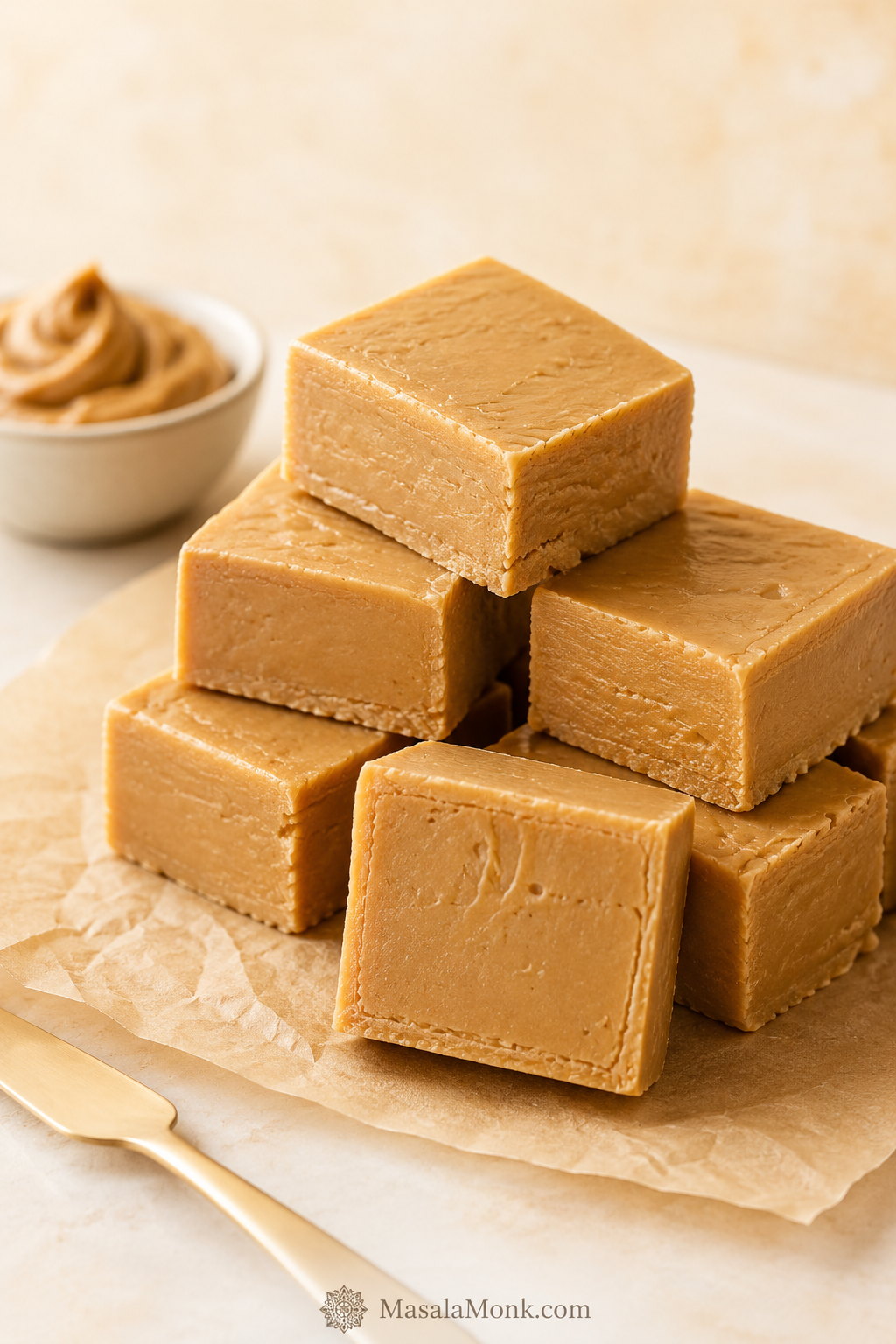
Stacked peanut butter fudge squares on parchment with smooth cut edges and a creamy interior.

This easy peanut butter fudge recipe is built for creamy, sliceable squares without a candy thermometer, bubbling sugar syrup, or a long ingredient list. The goal is simple: rich peanut butter flavor, a smooth bite, and a slab that sets firmly without turning dry, greasy, or crumbly.

The result is deeply peanut-buttery, buttery, and sweet in that old-school homemade candy way, but still sturdy enough to cut into neat little pieces. You melt, stir, press, chill, and slice — no guessing at candy stages and no hovering over a bubbling pot.

The mixture thickens into a soft peanut butter dough before it goes into the pan, so you can see when it is ready instead of hoping it sets later.

It is the kind of fudge that works for holiday tins, bake-sale boxes, office trays, or the small after-dinner square that somehow disappears from the fridge. Cut it small, and it feels rich instead of heavy.

Start here if you want the simple version first. When you are ready to compare condensed milk, marshmallow fluff, old-fashioned, frosting, or keto versions, MasalaMonk’s full peanut butter fudge methods guide walks through those separately.

Quick Answer: Easy Peanut Butter Fudge

For easy peanut butter fudge, melt 1 cup creamy peanut butter with 1 cup butter, stir in 3 cups powdered sugar, press the thick mixture into a lined 8×8-inch pan, and refrigerate for 2–3 hours, until firm enough to cut. Vanilla and salt are optional, but they make the flavor rounder and less one-note.

Because this is a no-bake peanut butter fudge, the only heat you need is enough to melt the peanut butter and butter together. Powdered sugar gives the mixture body, butter keeps the bite smooth, and peanut butter brings the salty-sweet richness.

The best pieces should taste like the peanut butter center of a peanut butter cup: salty-sweet, dense, smooth, and rich enough that one small square feels satisfying.
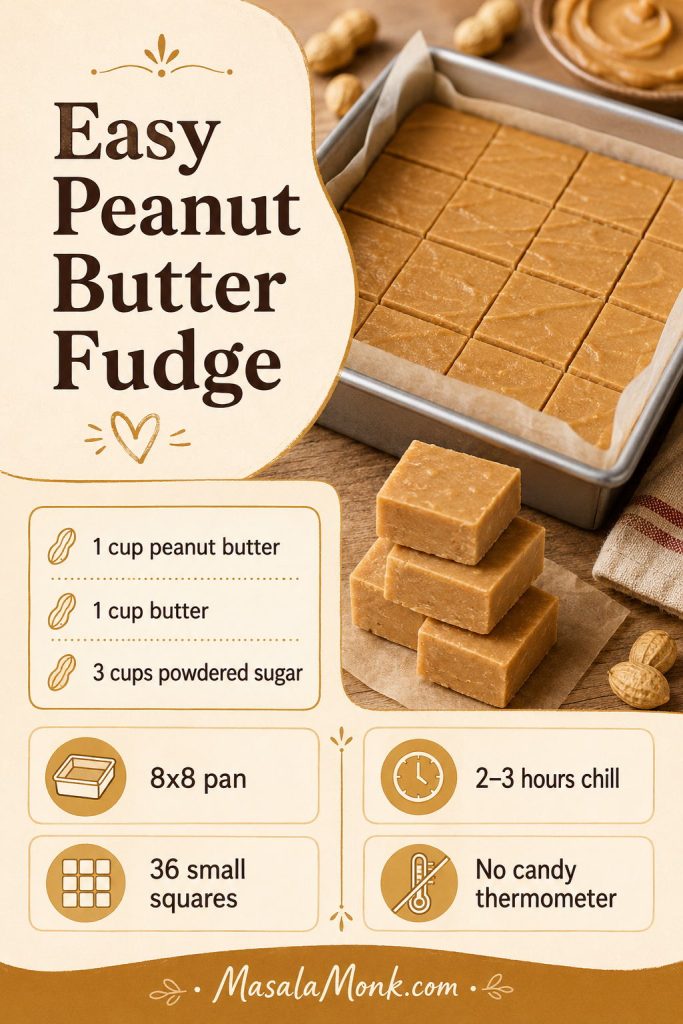
Best first batch: Use regular creamy no-stir peanut butter, sift the powdered sugar if it is clumpy, and chill until the slab lifts cleanly from the pan before slicing.
At-a-glance peanut butter fudge guide with peanut butter, butter, powdered sugar, pan size, chill time, yield, and no thermometer note.
When you want the quick version, this is the whole easy peanut butter fudge formula: three core ingredients, an 8×8 pan, and a full chill before slicing.

Ready to make it? Jump to the full recipe card for the exact measurements, method, notes, and storage details.

At a Glance

DetailBest Answer
Main ingredientsPeanut butter, butter, powdered sugar
Optional flavor helpersVanilla extract and fine salt
Best pan8×8-inch / 20 cm square pan
Backup pan9×9-inch / 23 cm works, but the pieces will be thinner
TextureCreamy, firm, smooth, and sliceable
Chill time2–3 hours in the refrigerator
Candy thermometerNot needed
YieldAbout 36 small squares

A 9×9-inch pan also works, but the pieces will be thinner and may firm up a little faster. For thicker, gift-style squares, use an 8×8-inch pan.

For party trays, 36 small squares is usually better than 16 large pieces. Peanut butter fudge is dense, so smaller pieces look neater and eat better.

What Good Peanut Butter Fudge Texture Looks Like

Use this texture cue before you start: the finished fudge should look smooth and dense inside, with clean edges that hold their shape once chilled.
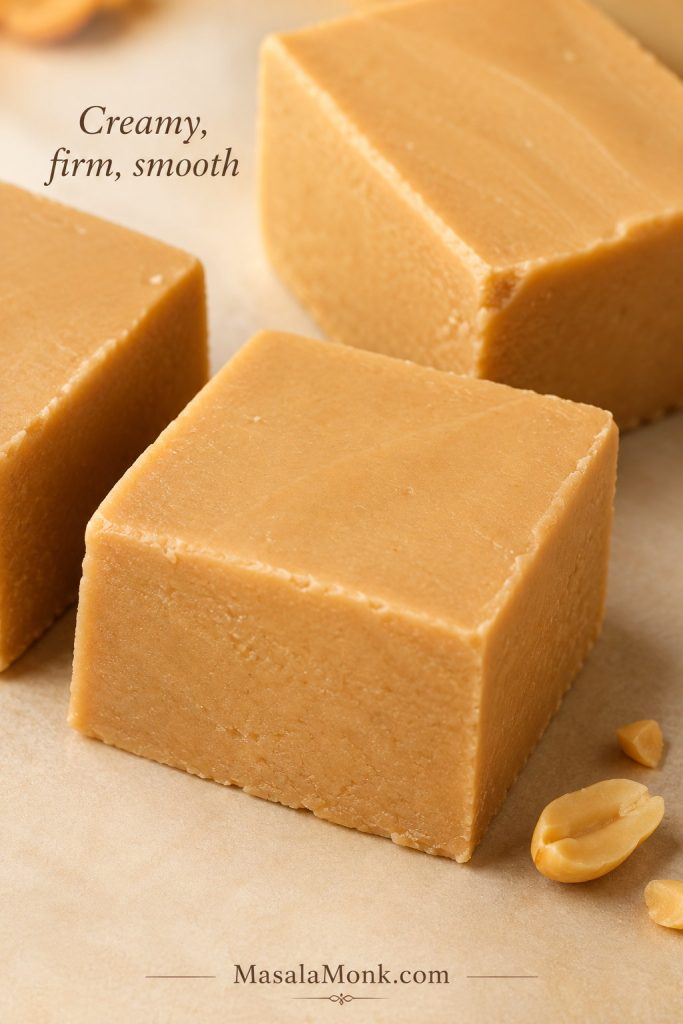
Close-up of peanut butter fudge squares showing smooth interiors, clean edges, and firm texture.
Before you make a batch, notice the texture goal: dense and smooth in the center, firm at the edges, and never dry, greasy, or crumbly.

Why This Peanut Butter Fudge Works

This fudge sets because powdered sugar thickens the warm peanut butter-butter mixture while the refrigerator firms the slab enough to slice. You get a creamy bite without boiling sugar or trying to catch a candy stage at the exact right moment.

Powdered sugar helps the fudge hold together. It blends more smoothly than granulated sugar, especially when you add it while the mixture is still warm.

Butter gives the fudge richness and a softer bite. It makes the peanut butter base glossy and smooth before the powdered sugar goes in.

Creamy no-stir peanut butter gives the most predictable result. Natural peanut butter can work if it is thick and very well stirred, but it can change the set because some jars are oily, loose, or dry at the bottom.

The balance matters. Too little powdered sugar gives a soft slab, but too much pushes the texture toward dry candy instead of creamy fudge. This recipe gives a base amount first, then a small adjustment range if your mixture needs it.

Chilling finishes the texture. The mixture may look thick as soon as you press it into the pan, but it needs time in the refrigerator to hold its shape for tidy pieces.

Ingredients You Need

This recipe has a short ingredient list, so the details matter. The image below shows the base ingredients and the two optional flavor helpers that make the fudge taste more balanced.
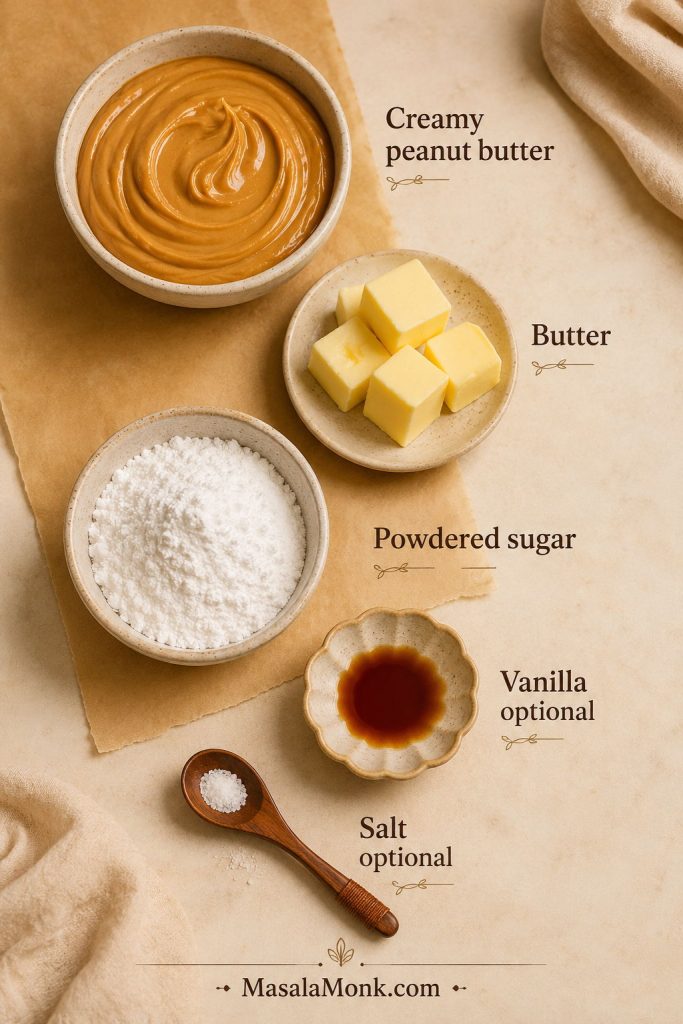
Peanut butter fudge ingredient guide showing creamy peanut butter, butter, powdered sugar, optional vanilla, and optional salt.
Because the ingredient list is short, there is not much room to hide mistakes; the peanut butter, butter, and powdered sugar each need to pull their weight.

Creamy Peanut Butter

Use creamy peanut butter for the smoothest fudge. A regular no-stir peanut butter gives the most reliable texture because it is already stable and well blended. If you like making pantry staples from scratch, MasalaMonk’s homemade peanut butter guide is useful, but for this recipe, make sure any homemade or natural peanut butter is thick, smooth, and extremely well stirred before measuring.

Butter

Unsalted butter gives you the most control. Salted butter also works; just skip or reduce the added salt. Cut the butter into pieces so it melts evenly with the peanut butter.

Why This Peanut Butter Fudge Uses Powdered Sugar

Powdered sugar is what turns the warm peanut butter mixture into fudge. If it is clumpy, sift it first so you do not get dry spots or grainy pockets in the finished candy.
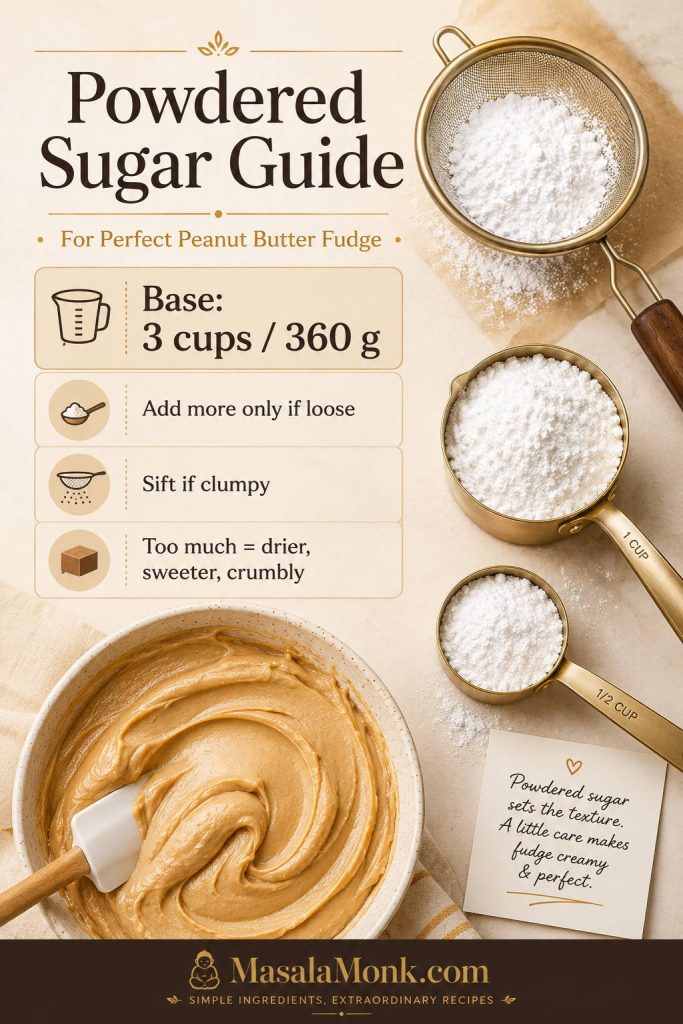
Powdered sugar guide for peanut butter fudge showing a sieve, measuring cup, peanut butter mixture, and tips for amount and texture.
Since powdered sugar gives this no-thermometer fudge its structure, start with 3 cups and add more only if the mixture still looks loose.

This version uses 3 cups / 360 g powdered sugar as the base because it keeps the fudge creamy while still giving the slab enough body to set. If the mixture still looks loose after resting for 2 minutes, increase the powdered sugar by 2 tablespoons at a time, up to 3 1/4 cups / about 390 g.

If you measure by cups, spoon the powdered sugar into the cup and level it instead of packing it down. This style is sweet by design because powdered sugar is part of the structure, not just the flavor; salt, vanilla, and smaller pieces make it taste more balanced without weakening the set.

If your fudge turns soft, crumbly, oily, or grainy, the troubleshooting section walks through the most common causes and fixes.

Vanilla and Salt

Vanilla and salt are optional, but they make the candy taste more complete. The vanilla rounds out the sweetness, while a small pinch of salt sharpens the peanut butter flavor. For a true 3 ingredient peanut butter fudge, leave both out; for the best-tasting version, use them.

Best Peanut Butter to Use for Fudge

The peanut butter you choose changes the bite more than almost anything else in this recipe. For a first batch, choose regular creamy no-stir peanut butter. It gives the best balance of smoothness, body, and neat cutting.
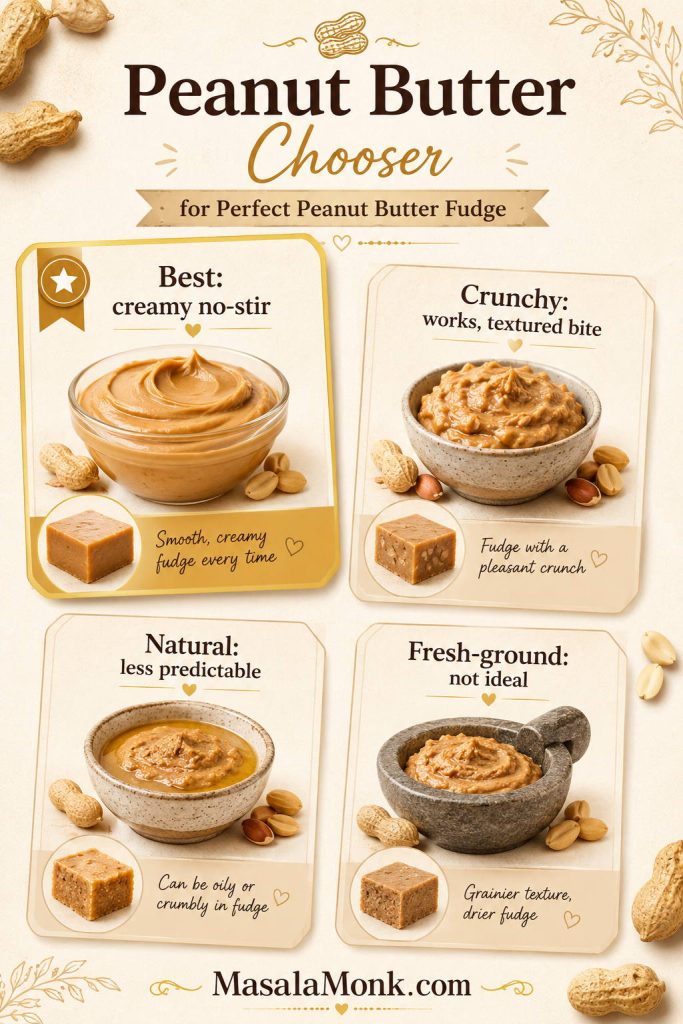
Peanut butter comparison board showing creamy no-stir, crunchy, natural, and fresh-ground peanut butter for fudge.
For the most reliable peanut butter fudge texture, creamy no-stir peanut butter is the safest first choice because it blends smoothly and sets predictably.

Natural peanut butter is not impossible, but it often explains those “same recipe, different result” batches. One jar may be thick and stable, while another may be oily, loose, or dry at the bottom.

Peanut Butter TypeUse It?What to Expect
Regular creamy no-stir peanut butterBest choiceSmooth, stable, creamy, and reliable for tidy squares.
Crunchy peanut butterYesWorks well, but the pieces will have a textured bite instead of a smooth finish.
Natural stir peanut butterUse carefullyCan work if thick and fully stirred, but may turn oily, softer, or crumbly.
Fresh-ground peanut butterNot idealOften too coarse or oily for the neatest fudge texture.
Salted peanut butterYesUse it, but reduce or skip the added salt.
Peanut butter tip: For your first batch, avoid runny natural peanut butter, fresh-ground peanut butter, dry bottom-of-the-jar peanut paste, and very oily separated jars. If your peanut butter has visible oil, stir it completely smooth before measuring; do not pour off all the oil or scoop only the dry paste.

No-Stir vs Natural Peanut Butter for Fudge

Natural peanut butter can work, but the jar-to-jar variation is exactly why some batches turn soft, oily, or crumbly.
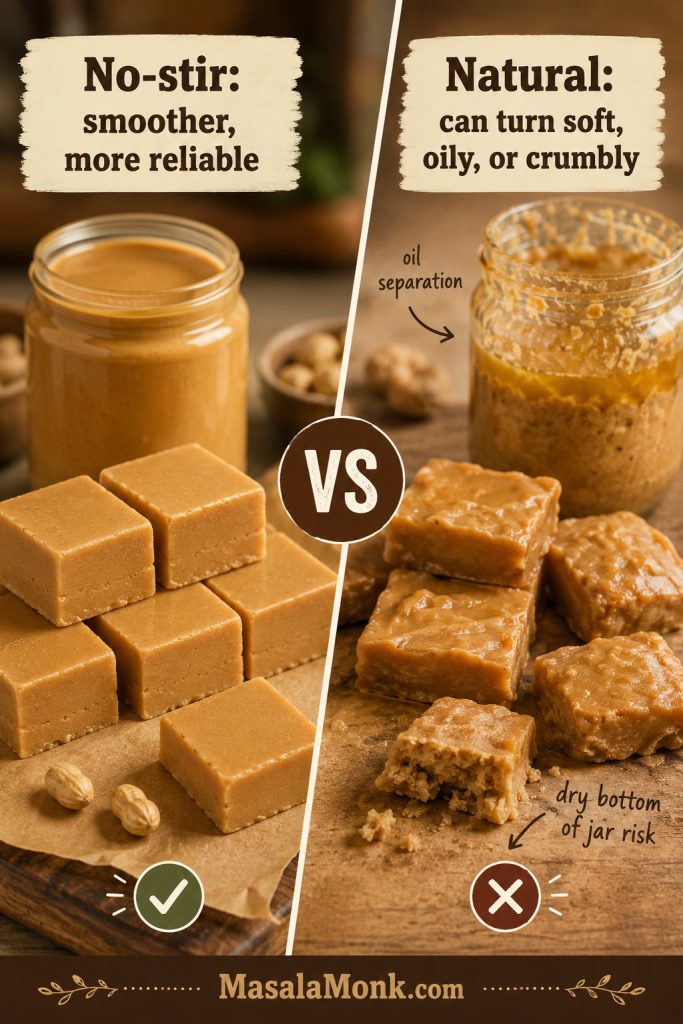
Split comparison of no-stir peanut butter and natural peanut butter showing reliable smooth fudge versus softer or oilier results.
When two batches behave differently, the peanut butter is often the reason; natural jars can vary in oil, thickness, and bottom-of-jar dryness.

Once your peanut butter is chosen, use the success cues to check whether the mixture looks ready before chilling.

Success Cues: What Peanut Butter Fudge Should Look Like Before It Sets

Before chilling, the mixture should look thick, matte, and scoopable, almost like a soft peanut butter dough. It should not pour like sauce. After chilling, the slab should lift from the pan in one piece and cut without smearing through the center.
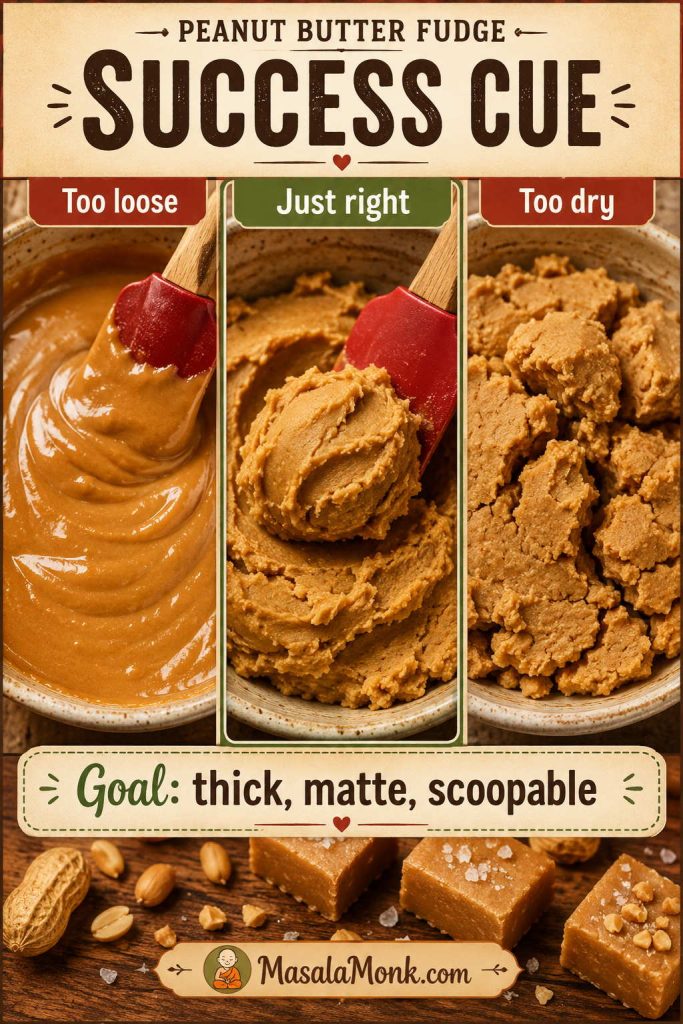
Three-panel texture guide showing peanut butter fudge mixture that is too loose, just right, and too dry before chilling.
Before chilling, the mixture should look thick, matte, and scoopable; if it pours like sauce or cracks into dry clumps, adjust before pressing it into the pan.
Good sign: If the mixture gathers around the spatula and presses into the pan without spreading back out, you are on the right track.

How to Make Easy Peanut Butter Fudge

The method is simple, and the order is what keeps it easy. Measure the powdered sugar before you start so you can stir it in while the peanut butter mixture is still warm.

Using the microwave instead? Go straight to the microwave peanut butter fudge method.
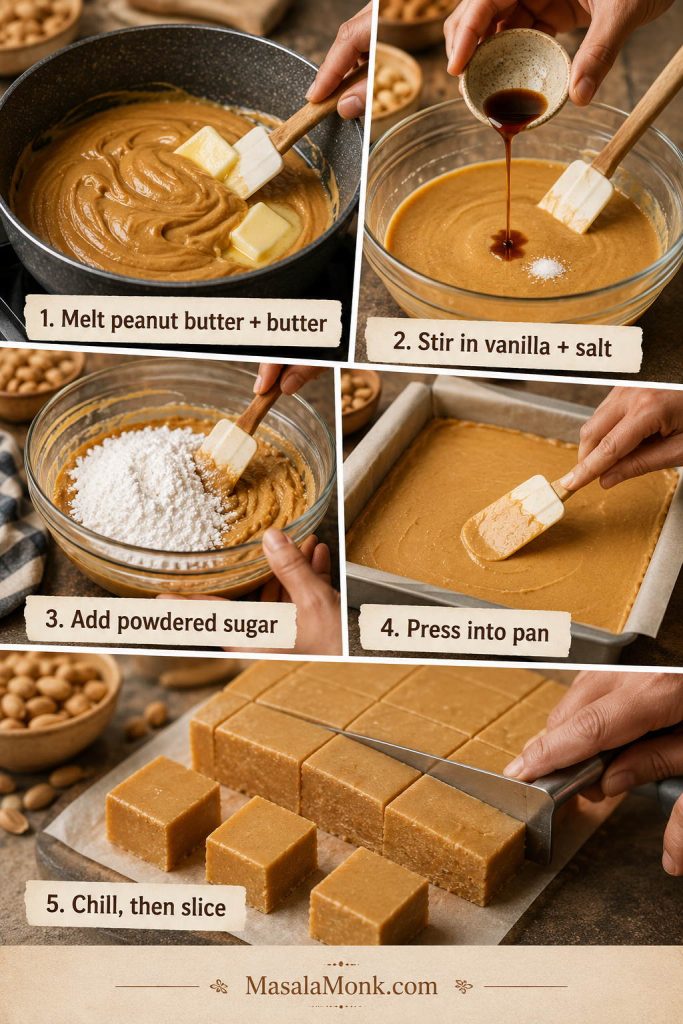
Step-by-step peanut butter fudge process showing melting, mixing, adding powdered sugar, pressing into a pan, chilling, and slicing.
Once the peanut butter and butter are melted, work while the mixture is warm so the powdered sugar blends in smoothly before the fudge firms up.

Step 1: Line the Pan

Line an 8×8-inch square pan with parchment paper, leaving overhang on two sides. This gives you a sling so you can lift the whole slab out later for cleaner cutting.

Step 2: Melt the Peanut Butter and Butter

Add the peanut butter and butter to a medium saucepan over low heat. Stir often until the butter melts and the mixture looks smooth and glossy. Do not boil it. You only want to melt and combine.

Step 3: Add Vanilla and Salt

Remove the pan from the heat. Stir in the vanilla and salt if using. The mixture should still be warm and fluid.

Step 4: Mix in the Powdered Sugar

Add the powdered sugar in batches, stirring after each addition. The mixture will thicken quickly. Keep stirring until no dry streaks remain. It should look like a thick, soft dough.

At this point, the mixture should no longer pour like a sauce. It should gather into a thick, matte, scoopable mass that can be pressed into the pan. If it still looks glossy and loose after all the sugar is mixed in, let it sit for 2 minutes and stir again before adding more sugar.

Step 5: Press Into the Pan

Transfer the fudge mixture to the lined pan. Press it firmly into the corners and smooth the top with a spatula. If it sticks, place a small piece of parchment over the top and press gently with your hands.

Do not worry if the top is not perfectly smooth yet. Once the slab chills, small spatula marks are much less noticeable, and you can always trim the edges before serving or gifting.

Step 6: Chill Until Firm

Refrigerate for 2–3 hours, or until the slab is sturdy enough to lift and slice. For faster setting, you can use the freezer for 45–60 minutes, but the refrigerator gives a more even texture.

Step 7: Slice

Lift the fudge out using the parchment overhang. Use a sharp knife to cut it into 36 small squares. For extra-neat edges, warm the knife under hot water, wipe it dry, cut, then wipe between cuts.

Microwave Peanut Butter Fudge Method

You can also make this peanut butter fudge in the microwave when you want the quickest no-stove version. Use a large microwave-safe bowl and short bursts instead of one long microwave time, because microwave strength varies and overheating can make the mixture oily.
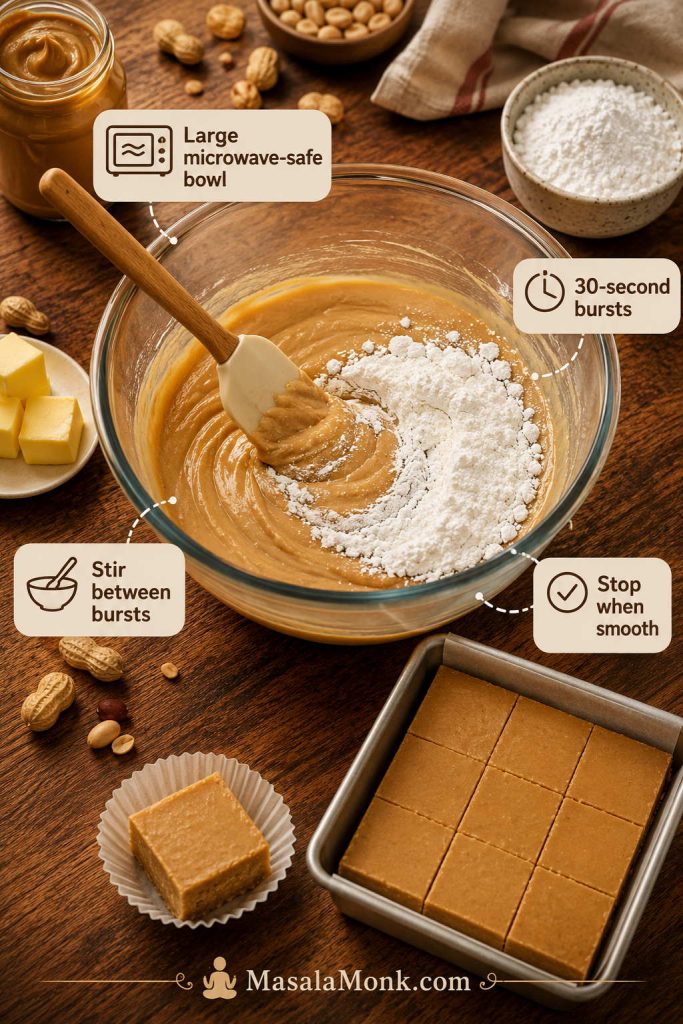
Microwave peanut butter fudge guide showing a large bowl, melted peanut butter mixture, powdered sugar, and finished fudge.
Although the microwave method is fast, short bursts matter because overheating can make the peanut butter mixture oily before the powdered sugar goes in.
  1. Add peanut butter and butter to a large microwave-safe bowl.
  2. Microwave for 30 seconds, then stir.
  3. Repeat in 30-second bursts until the butter is melted and the mixture is smooth.
  4. Stir in vanilla and salt if using.
  5. Add the powdered sugar in batches and mix until thick.
  6. If the mixture looks loose, let it rest briefly and stir again before adding more powdered sugar.
  7. Press into the lined pan and chill until firm.
Most common mistake: Judging the fudge while it is still warm. Let it cool briefly before adding extra sugar, and stop heating as soon as the peanut butter and butter are smooth.

3 Ingredient Peanut Butter Fudge

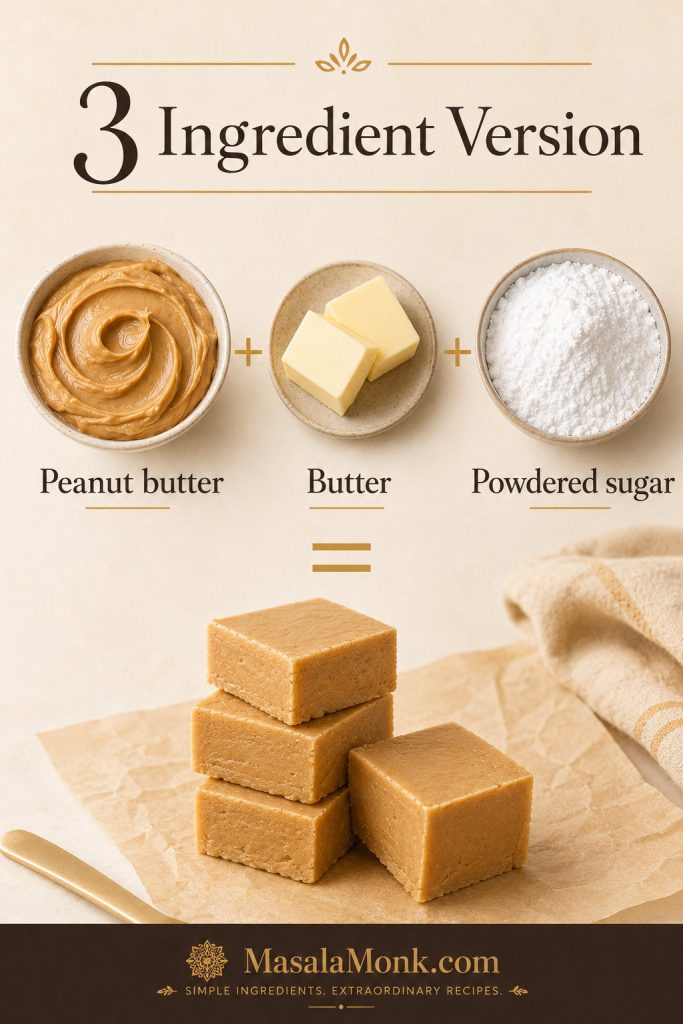
To make this as a true 3 ingredient peanut butter fudge, use only:

  • 1 cup creamy peanut butter
  • 1 cup butter
  • 3 cups powdered sugar
Three ingredient peanut butter fudge board showing peanut butter, butter, powdered sugar, and finished fudge squares.
Even a true 3 ingredient peanut butter fudge depends on balance: peanut butter for flavor, butter for smoothness, and powdered sugar for structure.

Peanut butter brings the flavor, butter softens the bite, and powdered sugar helps the mixture hold together once it chills.

If you are not strictly trying to keep the ingredient count at three, add vanilla and salt. They do not change the method, but they make the fudge taste more balanced. Without them, the candy is still good, just simpler and sweeter.

If you like short ingredient-list peanut butter desserts, MasalaMonk’s peanut butter cookies are another easy option, with classic, 3-ingredient, chocolate chip, and oatmeal variations.

4 Ingredient Peanut Butter Fudge

For most readers, the best version is technically a 4 ingredient peanut butter fudge: peanut butter, butter, powdered sugar, and vanilla. Vanilla does not help the fudge set, but it makes the sweetness taste warmer and less flat.
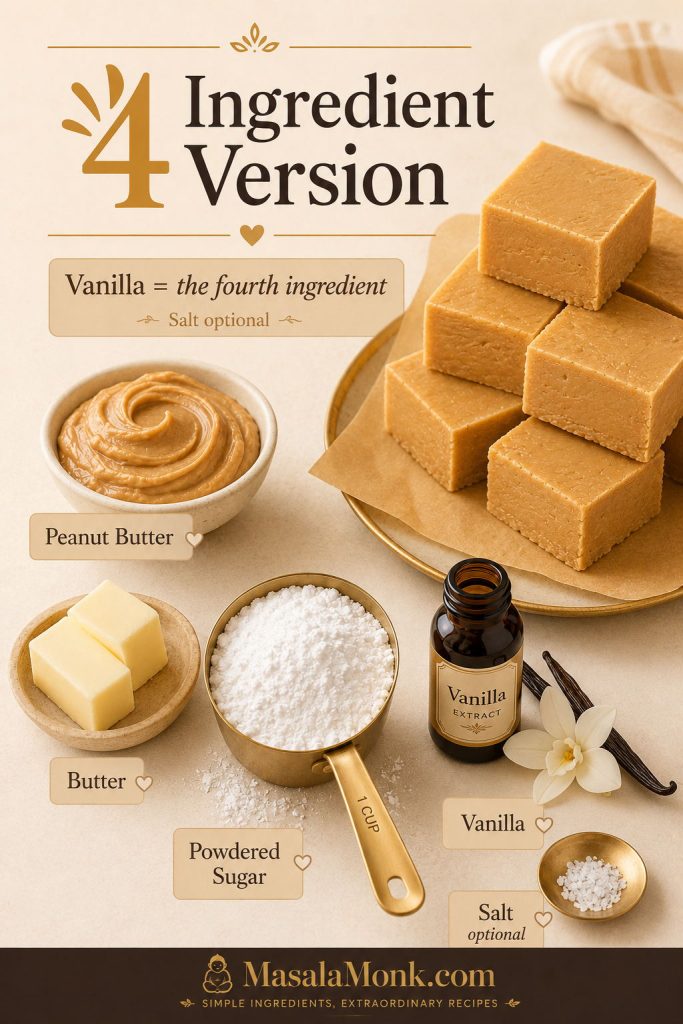
Four ingredient peanut butter fudge board showing peanut butter, butter, powdered sugar, vanilla, optional salt, and finished squares.
With 4 ingredient peanut butter fudge, vanilla is the quiet upgrade that makes the sweetness taste warmer and less flat.

If you count salt as a fifth ingredient, use it as a flavor adjuster rather than a structural ingredient. Vanilla makes the fudge taste warmer; salt makes it taste more peanut-buttery. Neither one helps the fudge set, so the base ratio stays the same.

How Long Does Peanut Butter Fudge Take to Set?

The slab usually needs 2–3 hours in the refrigerator before it is ready to cut. It may look finished sooner, but slicing too early can make the edges smear and the center slump.
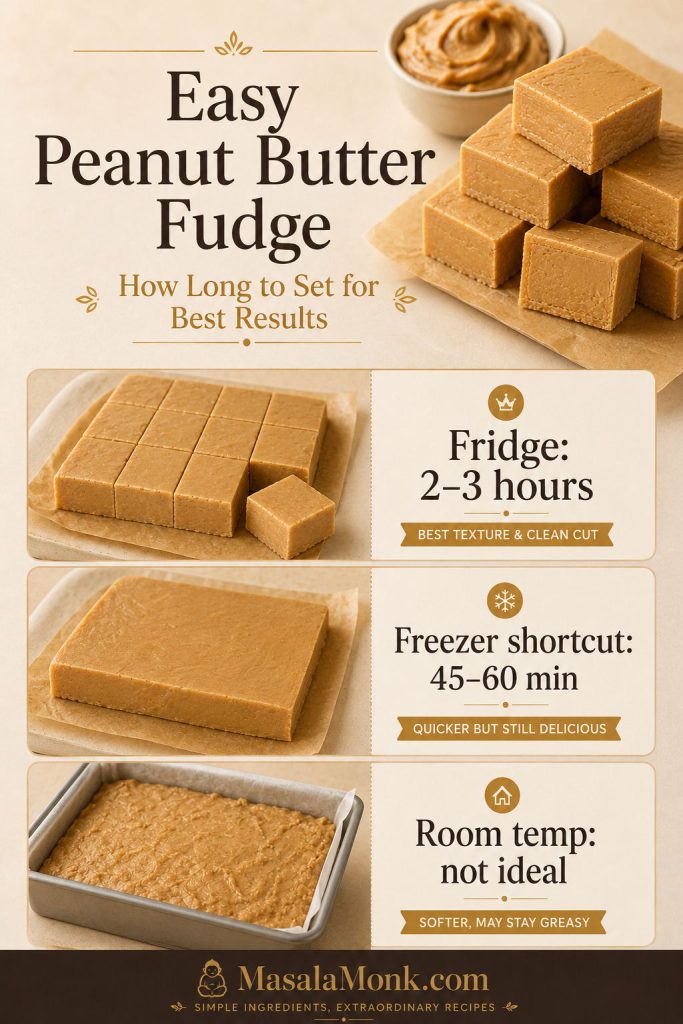
Peanut butter fudge setting time guide showing refrigerator, freezer shortcut, and room temperature options with fudge slabs.
Although the top may look firm sooner, the center needs enough chill time for clean slices and a stable peanut butter fudge texture.
Setting MethodApproximate TimeBest Use
Refrigerator2–3 hoursBest texture and neatest slices.
Freezer shortcut45–60 minutesUseful when you are in a hurry, but do not forget it there.
Room temperatureSeveral hoursNot ideal for a quick, firm set.

For the best pieces, chill the fudge until firm, slice it, then let the squares sit at room temperature for a few minutes before serving. That gives you sharp edges and a softer bite.

Serving tip: Cold fudge cuts neatly, but slightly softened fudge tastes creamier. Store it chilled, then let the squares sit out for 5–10 minutes before serving.

Best Serving Temperature for Peanut Butter Fudge

Cut the fudge while it is cold, then give the squares a few minutes at room temperature if you want the creamiest bite.
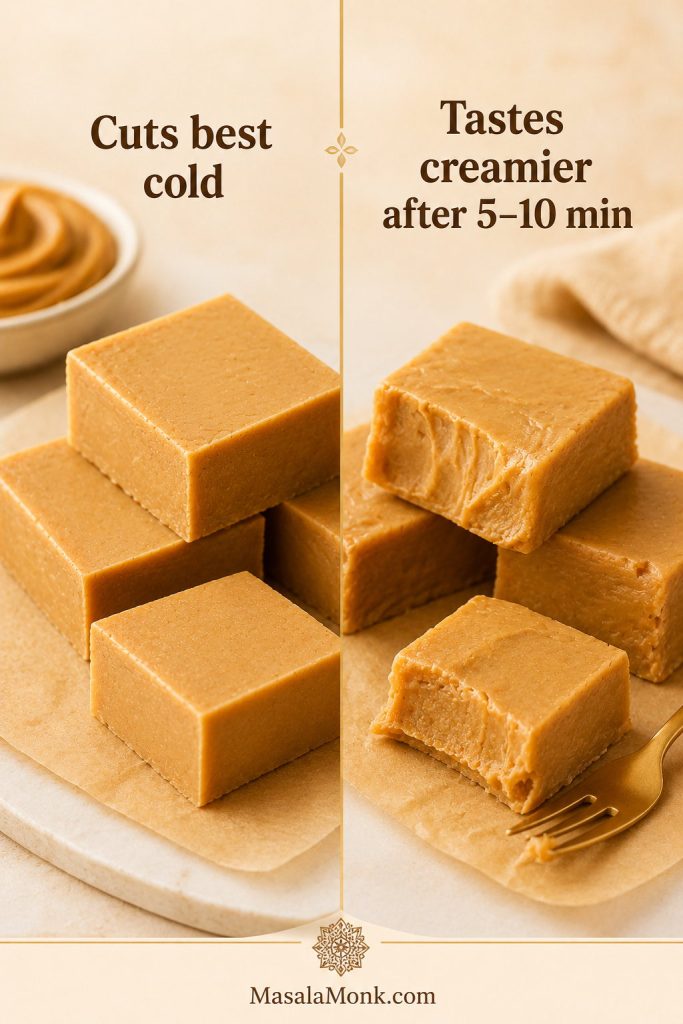
Comparison of cold peanut butter fudge with clean edges and slightly softened fudge with a creamier bite.
Cold fudge cuts cleanly; however, a few minutes at room temperature makes each square taste creamier and less stiff.

Once the slab is fully chilled, the clean-cutting tips will help you get neater squares for trays and gifts.

Why Didn’t My Peanut Butter Fudge Set?

If your peanut butter fudge is too soft, crumbly, grainy, or oily, the issue is usually one of four things: peanut butter type, powdered sugar amount, mixing temperature, or chill time.

Most problems are easier to fix than they look. If the fudge tastes good but feels too soft, start with more chill time before changing the recipe.

How to Fix Soft Peanut Butter Fudge

Start with the least disruptive fix first. Many soft batches only need more time in the refrigerator before you change the ratio.
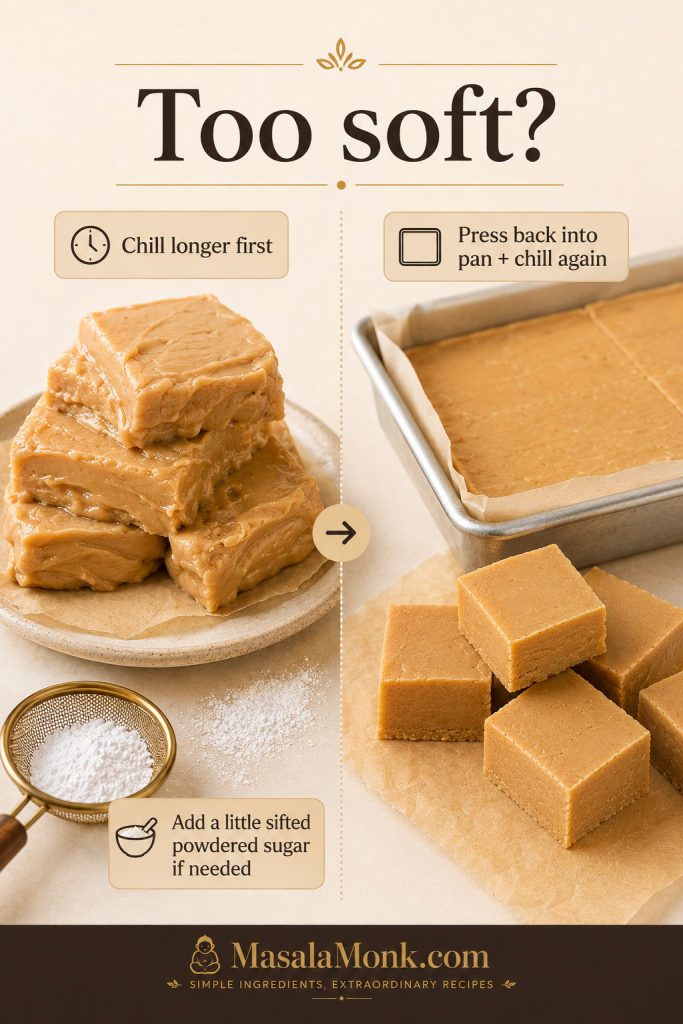
Soft peanut butter fudge rescue guide showing unset fudge, sifted powdered sugar, and corrected firm fudge squares.
If peanut butter fudge is too soft, chill it longer first; after that, use only a small amount of sifted powdered sugar if the slab still will not firm up.
ProblemLikely CauseHow to Fix It
Fudge is too softNot enough powdered sugar, oily peanut butter, or not enough chill time.Chill longer first. If it is still too soft after several hours, let it soften at room temperature, scrape it back into a bowl, and work in a little more sifted powdered sugar. Press it back into the pan and chill again.
Fudge is crumblyToo much powdered sugar, dry peanut butter, or over-chilling.Let it sit at room temperature for 10 minutes before cutting. Next time, reduce the powdered sugar slightly or use creamier peanut butter.
Fudge is grainyClumpy powdered sugar or sugar added after the mixture cooled too much.Sift powdered sugar and add it while the peanut butter mixture is still warm.
Fudge looks oilyNatural peanut butter separated, or the mixture was overheated.Use no-stir peanut butter for the most reliable batch. Melt gently and avoid boiling.
Fudge will not cut cleanlyNot chilled enough, or the knife is dragging through the fudge.Chill longer. Use a warm, dry knife and wipe between cuts.

Peanut Butter Fudge Troubleshooting Guide

Use the visual guide below to match the texture problem to the most likely cause before making a bigger adjustment.
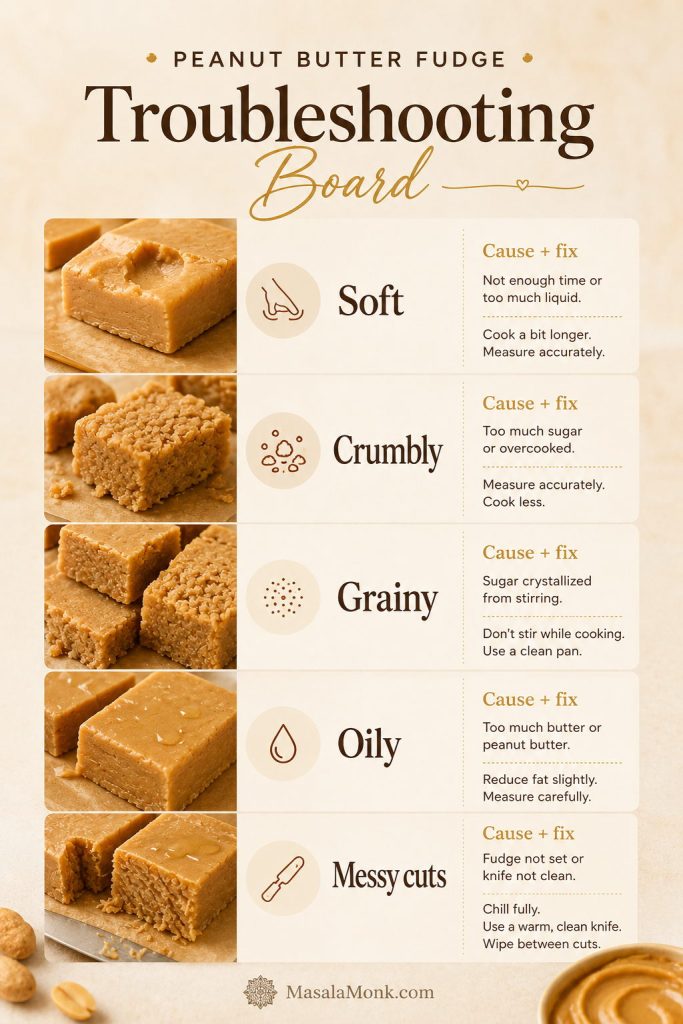
Troubleshooting guide for peanut butter fudge with examples of soft, crumbly, grainy, oily, and messy-cut fudge.
Rather than guessing, match the problem to the texture: soft, crumbly, grainy, oily, and messy-cut fudge each points to a different fix.
Most common fix: If the fudge is soft but tastes good, give it more fridge time before changing anything. Warm fudge often seems failed before it has actually finished setting.

If you are starting a fresh batch, the recipe card keeps the base ratio and method in one place.

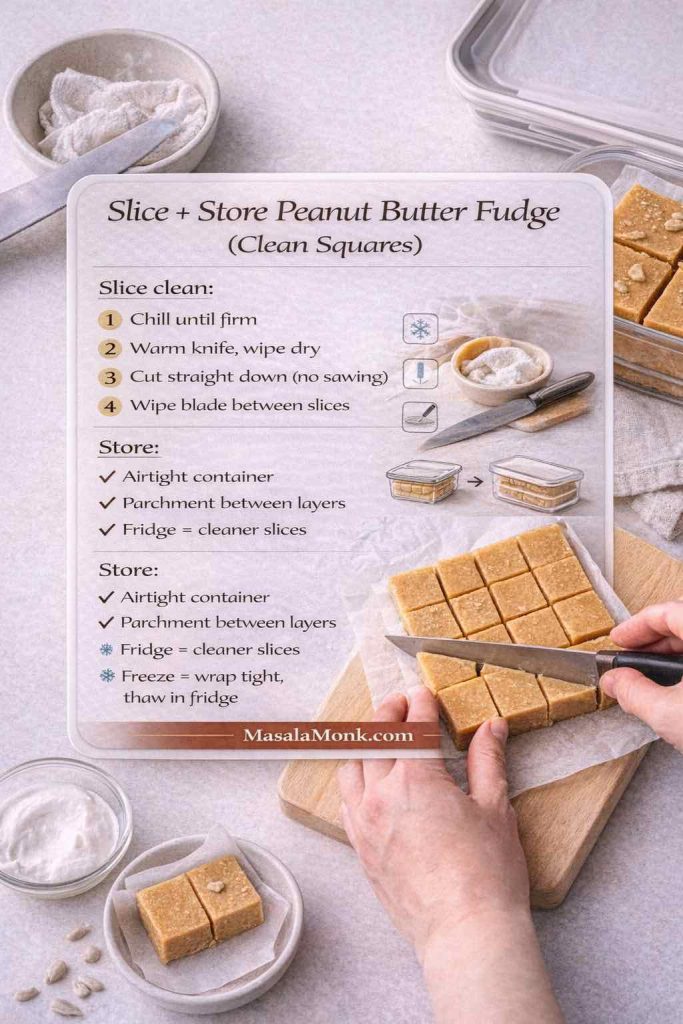
How to Cut Clean Peanut Butter Fudge Squares

Neat squares make homemade fudge look more polished, especially if you are gifting it. The trick is to chill the slab fully, lift it from the pan, and cut with a warm, dry knife instead of dragging a dull blade through the fudge.
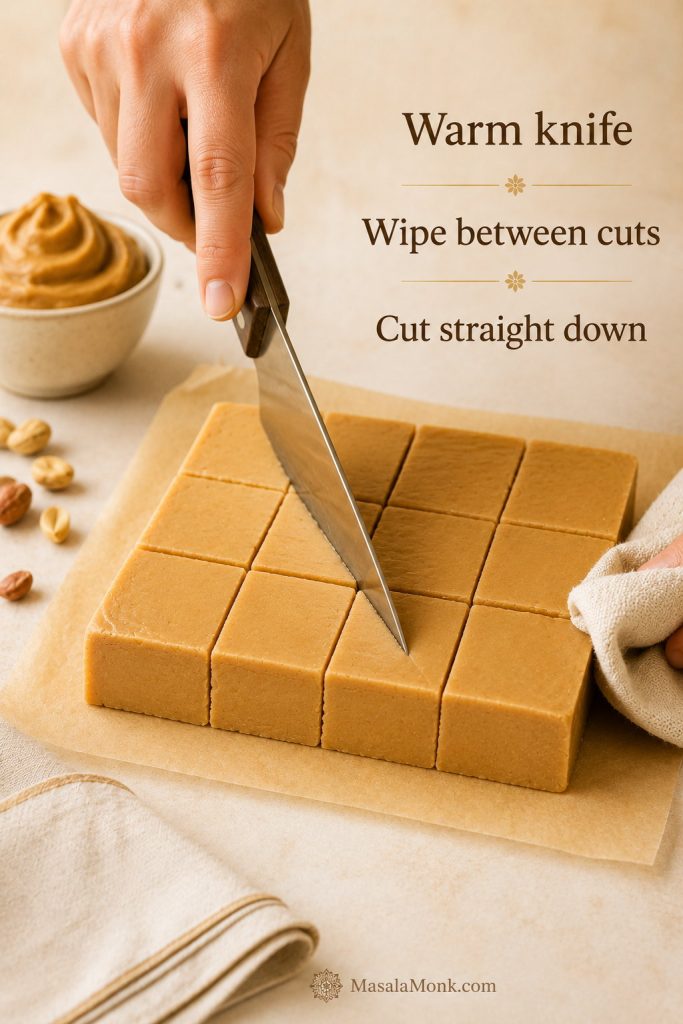
Hand using a knife to cut chilled peanut butter fudge into neat squares with clean edges.
For clean peanut butter fudge squares, chill the slab fully, cut straight down, and wipe a warm dry knife between slices.
  1. Chill the fudge until fully firm.
  2. Lift the slab out of the pan using the parchment overhang.
  3. Place it on a cutting board.
  4. Use a long, sharp knife.
  5. Warm the knife under hot water and wipe it dry.
  6. Cut straight down instead of sawing back and forth.
  7. Wipe the knife between cuts.

If the slab feels rock-hard straight from the refrigerator, let it sit for 5–10 minutes before cutting. Very cold fudge can crack at the edges, while slightly softened fudge cuts more neatly.

For 36 pieces, cut the slab into a 6×6 grid. For smaller holiday-box pieces, cut it into a 7×7 grid for 49 smaller squares.

Best Cutting Grid for Peanut Butter Fudge

Use the cutting grid based on how you plan to serve the fudge: slightly larger pieces for dessert plates, smaller pieces for tins, trays, and gifts.
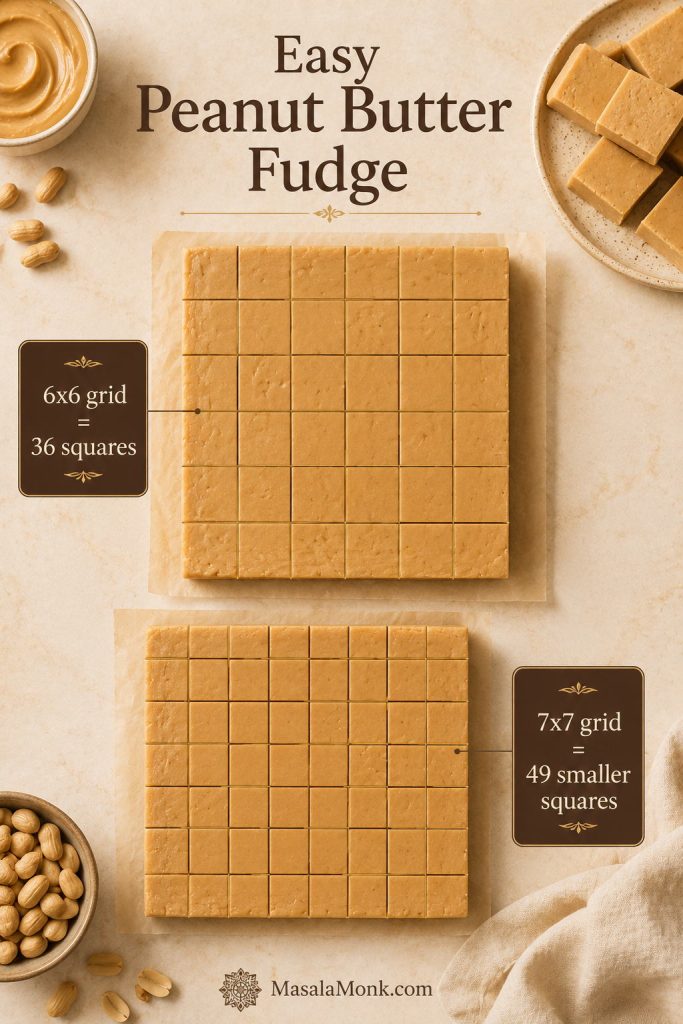
Top-down peanut butter fudge cutting grid showing 6x6 and 7x7 portion options for small squares.
Because peanut butter fudge is rich, smaller squares usually look better on trays, fit better in tins, and feel easier to serve.
Gifting tip: The center pieces are the prettiest for tins and boxes. Save the trimmed edges for snacking.

Easy Peanut Butter Fudge Recipe

A creamy, no-thermometer peanut butter fudge made with peanut butter, butter, and powdered sugar. Use regular creamy no-stir peanut butter for the smoothest, most reliable texture.
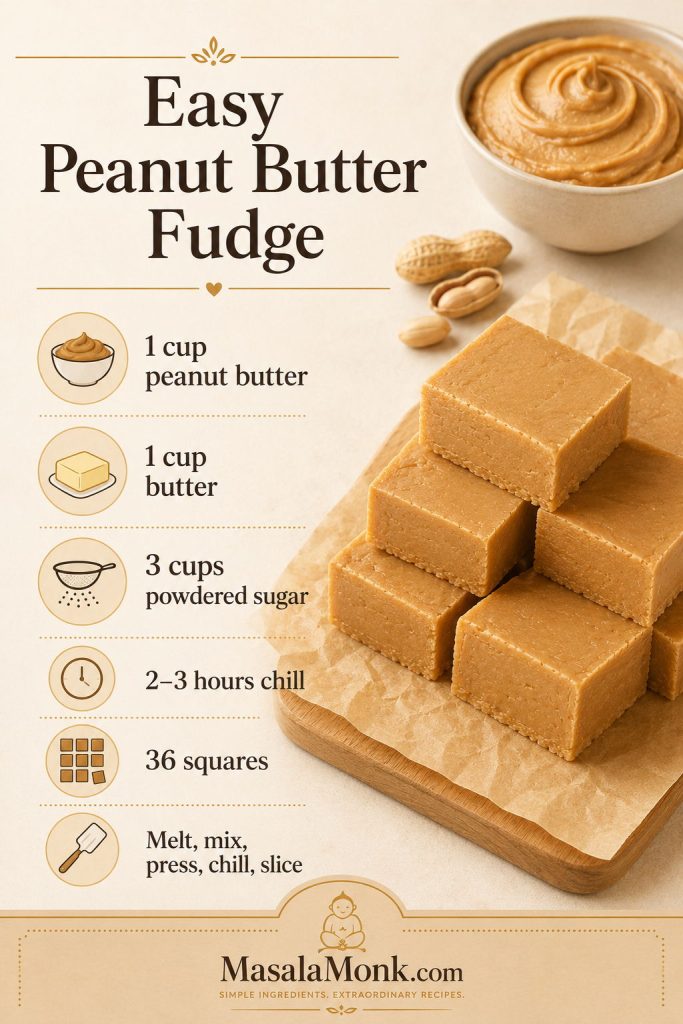
Saveable peanut butter fudge recipe card showing peanut butter, butter, powdered sugar, chill time, yield, and short method.
Use this recipe card as the quick memory version: melt gently, mix while warm, press firmly, chill fully, and slice once the slab holds.
Prep Time10 minutes
Melt Time3–5 minutes
Chill Time2–3 hours
Yield36 squares

Total Time: About 2 hours 15 minutes, including chill time.

Texture: Creamy, firm, smooth, and sliceable without smearing.

Equipment

  • 8×8-inch / 20 cm square pan
  • Parchment paper
  • Medium saucepan or microwave-safe bowl
  • Heatproof spatula or wooden spoon
  • Fine-mesh sieve, optional but useful for clumpy powdered sugar
  • Sharp knife

Ingredients

  • 1 cup creamy no-stir peanut butter, 250 g
  • 1 cup unsalted butter, 226 g / 2 sticks
  • 3 cups powdered sugar, sifted if clumpy, 360 g
  • 1–2 teaspoons vanilla extract, optional, 5–10 ml
  • 1/4 teaspoon fine salt, optional

Instructions

  1. Line an 8×8-inch square pan with parchment paper, leaving overhang on two sides.
  2. Add peanut butter and butter to a medium saucepan over low heat.
  3. Stir until the butter is melted and the mixture is smooth. Do not boil.
  4. Remove from the heat. Stir in vanilla and salt if using.
  5. Add powdered sugar in batches, stirring until no dry streaks remain. The mixture will become thick.
  6. If the mixture still looks loose, rest 2 minutes, stir again, then add 1–2 tablespoons more powdered sugar only if needed.
  7. Transfer to the lined pan and press firmly into an even layer.
  8. Refrigerate for 2–3 hours, or until sturdy enough to slice.
  9. Lift from the pan, cut into 36 squares, and serve chilled or slightly softened at room temperature.

Microwave Method

Add peanut butter and butter to a large microwave-safe bowl. Microwave in 30-second bursts, stirring after each burst, until smooth. Stir in vanilla and salt, then mix in powdered sugar. Press into the lined pan and chill until firm.

Notes

  • Serving size is 1 small square when cut into 36 pieces.
  • A 9×9-inch / 23 cm pan works, but the pieces will be thinner and may chill faster.
  • To double the recipe, use a 9×13-inch pan. The pieces will be close to the same thickness as the 8×8-inch batch.
  • For true 3 ingredient peanut butter fudge, skip vanilla and salt.
  • For firmer gift-box squares, add powdered sugar 2 tablespoons at a time, up to 3 1/4 cups / about 390 g total.
  • If the fudge is too soft, chill it longer before adding more sugar.
  • For neat cuts, use a warm knife and wipe between slices.

Storage

Store in an airtight container in the refrigerator for about 1 week, or freeze well-wrapped pieces for 2–3 months. Place parchment between layers if stacking.

How to Store Peanut Butter Fudge

Store peanut butter fudge in an airtight container. Place parchment between layers if stacking. The refrigerator is the best everyday storage choice because it keeps the squares firm and tidy.
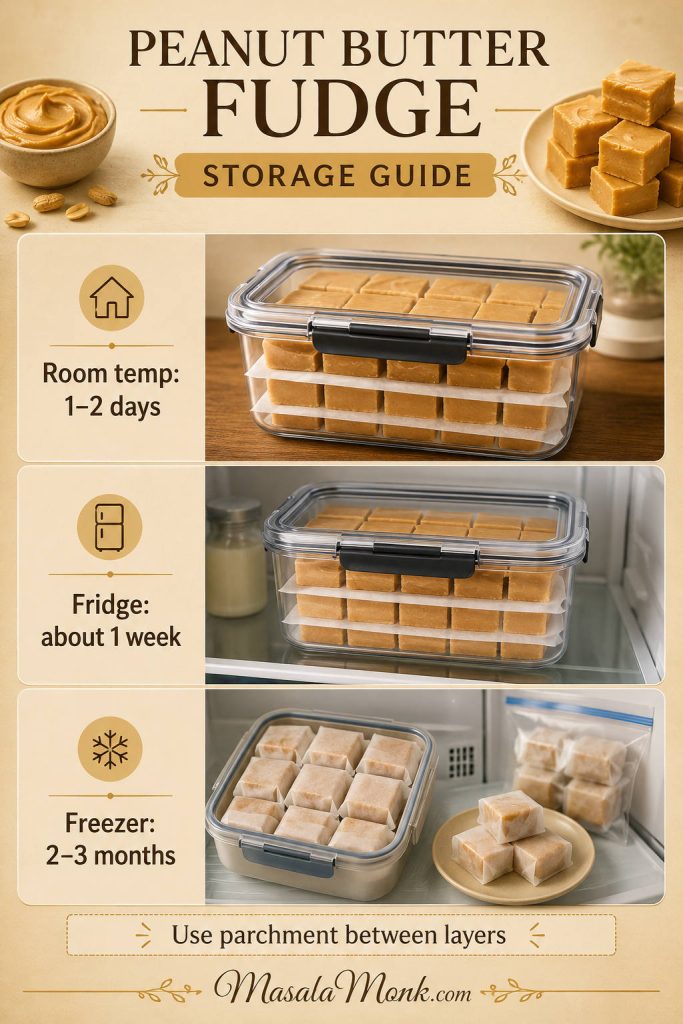
Peanut butter fudge storage guide showing airtight containers, parchment layers, refrigerator storage, and freezer-safe pieces.
In storage, parchment between layers is the small step that keeps peanut butter fudge squares from sticking, smearing, or losing their clean edges.
Storage MethodHow LongNotes
Room temperature1–2 days in a cool roomBest only if your kitchen is not warm.
RefrigeratorAbout 1 weekBest everyday storage for a firmer texture.
Freezer2–3 monthsWrap well, then thaw in the fridge before serving.

How to Gift Peanut Butter Fudge

This is one of the easiest homemade candies to gift because the pieces look polished without frosting, sprinkles, or extra decoration. Chill the slab well, cut it small, and it feels instantly giftable.
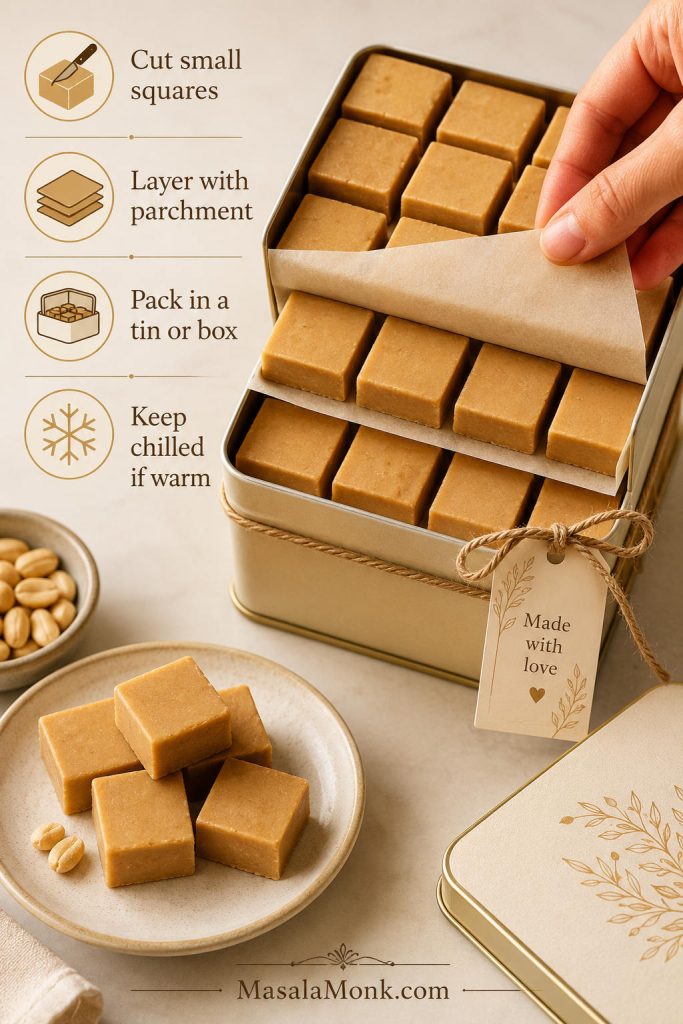
Peanut butter fudge packed in a parchment-lined tin with small squares, parchment layers, and a gift tag.
For gifting, small squares packed between parchment layers look tidier, travel better, and feel more polished than oversized blocks.

It is also the kind of treat that looks more impressive than the work it takes. Small, tidy pieces tucked between layers of parchment feel like a proper homemade gift without making the process fussy.

A small tin of peanut butter fudge feels personal without being fragile, which is why it works so well for neighbors, teachers, office trays, or a last-minute holiday sweet.

For a second make-ahead peanut butter sweet on the same dessert tray, these peanut butter rice crispy treats bring a softer, chewy contrast to the richer fudge squares.

  • Cut into small squares rather than large blocks.
  • Let the pieces firm fully before packing.
  • Use parchment between layers.
  • Pack in a tin, box, or airtight container.
  • Keep chilled if the weather is warm.

If you are packing the fudge ahead, check the storage guide first so the pieces stay firm and tidy.

For a cleaner gift box, trim the edges of the slab first and save the trimmings for snacking. The center pieces will look the neatest.

Which Peanut Butter Fudge Method Should You Choose?

Use this powdered sugar method when you want the easiest sliceable fudge without boiling sugar. Choose another method only if you want a different texture, a different sweetener, or a shortcut built around condensed milk, frosting, or marshmallow creme.
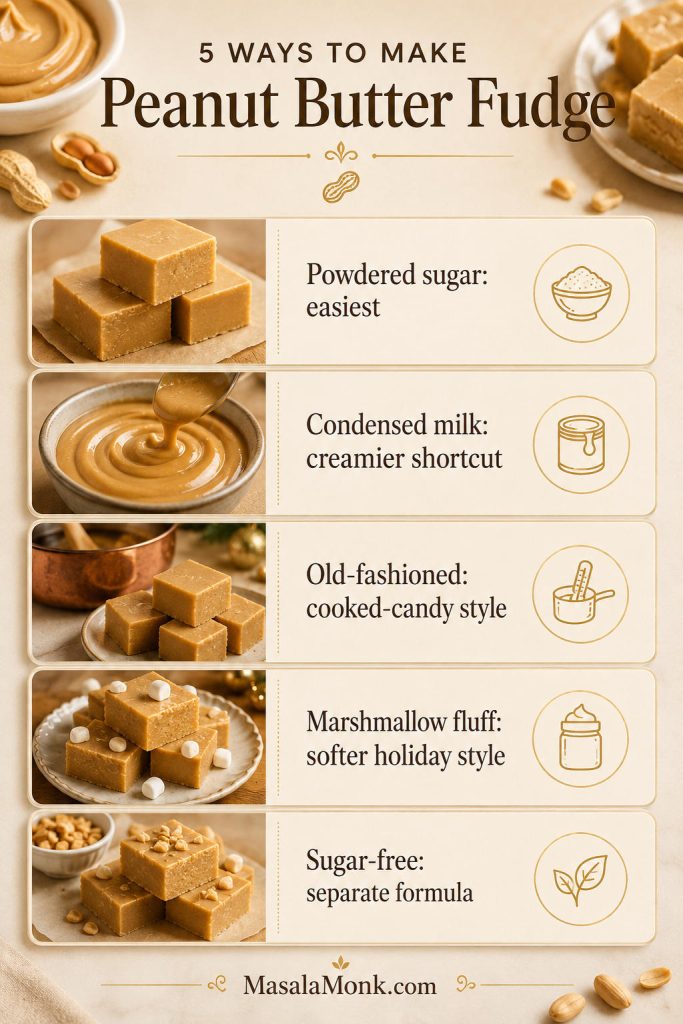
Peanut butter fudge method chooser comparing powdered sugar, condensed milk, old-fashioned, marshmallow fluff, and sugar-free versions.
Once you know the difference between powdered sugar, condensed milk, old-fashioned, marshmallow fluff, and sugar-free fudge, choosing the right method gets easier.
MethodBest ForTradeoff
Powdered sugar peanut butter fudgeEasy, sliceable, no-thermometer fudgeSweet and rich, so small pieces are best.
2 ingredient peanut butter fudgeThe fastest shortcut versionUsually uses frosting or condensed milk, so the flavor is sweeter and less classic.
Condensed milk peanut butter fudgeCreamier shortcut fudgeUsually needs chocolate, white chocolate, peanut butter chips, or another setting partner. See MasalaMonk’s sweetened condensed milk fudge recipes.
Old-fashioned peanut butter fudgeNostalgic cooked-candy textureMore temperature-sensitive because it depends on cooked sugar concentration and crystallization.
Marshmallow fluff peanut butter fudgeSofter, plush holiday-style fudgeSweeter and made by a different method.
Chocolate peanut butter fudgePeanut-butter-cup flavorBest as a swirl or chocolate layer unless you are following a dedicated chocolate fudge formula.
Sugar-free peanut butter fudgeLow-carb or keto needsRequires a recipe built for sugar-free sweeteners; do not swap powdered sugar 1:1.

For keto, frosting, marshmallow creme, corn syrup, peanut-free, and other peanut butter fudge variations, MasalaMonk’s full peanut butter fudge methods guide is the better next step.

If you want to understand the cooked-candy difference behind old-fashioned fudge, the Exploratorium’s candy-making stages guide explains the soft-ball stage used for traditional fudge.

FAQs

Do you need a candy thermometer for peanut butter fudge?

No. This recipe does not use boiled sugar syrup, so there is no candy stage to measure. Powdered sugar helps the peanut butter mixture thicken and hold its shape once chilled.

What are the 3 ingredients in peanut butter fudge?

The three core ingredients are creamy peanut butter, butter, and powdered sugar. Vanilla and salt are optional flavor helpers.

Does natural peanut butter work in fudge?

It can, but it is less predictable. Natural peanut butter must be very well stirred before measuring. If it is oily, runny, coarse, or dry, the fudge may turn soft, oily, grainy, or crumbly.

Why is my peanut butter fudge soft?

It may need more chill time, or the mixture may not have enough powdered sugar. Oily peanut butter can also make fudge softer. Chill it longer first; if it still does not firm up, mix in a little more sifted powdered sugar.

Why did my peanut butter fudge turn crumbly?

Crumbly fudge usually has too much powdered sugar or peanut butter that is too dry. Let it sit at room temperature for 10 minutes before cutting. Next time, reduce the powdered sugar slightly or use creamier peanut butter.

Microwave or stovetop: which method is easier?

The microwave method is fastest, but the stovetop gives you more control. Either works as long as you heat gently, stop once the mixture is smooth, and avoid overheating.

Is condensed milk a direct swap for powdered sugar?

No. Condensed milk peanut butter fudge is a different method and usually needs chocolate, white chocolate, or peanut butter chips to help it set.

How do you double peanut butter fudge?

Double all ingredients and press the mixture into a 9×13-inch pan. The slab will be close to the same thickness as the 8×8-inch version, which makes it useful for holiday trays, parties, or gifting.
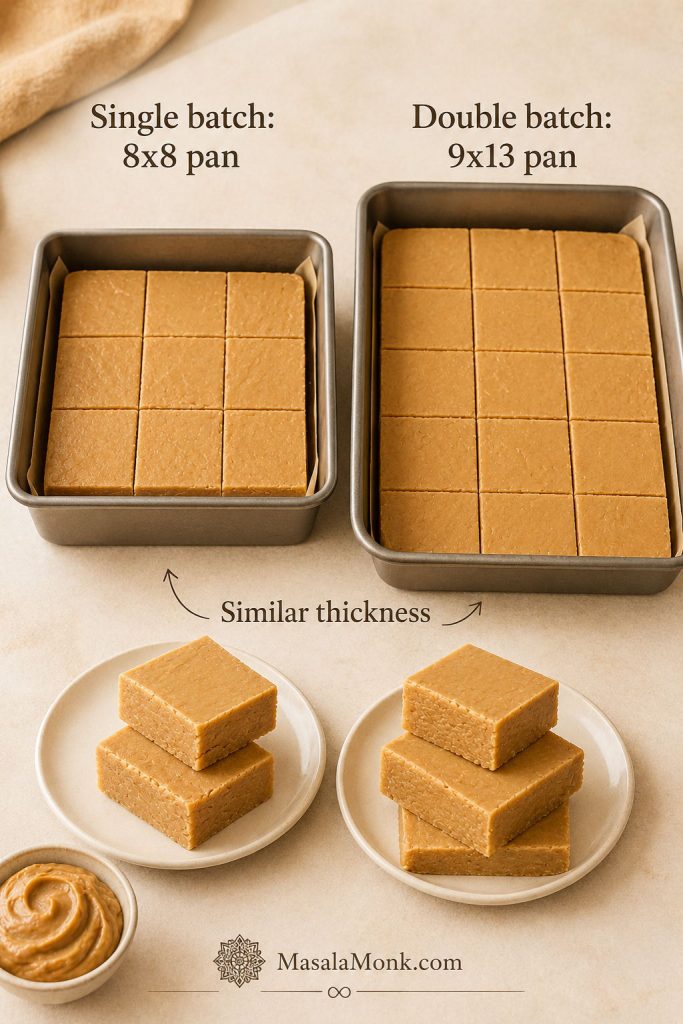
Pan size comparison showing a single batch of peanut butter fudge in an 8x8 pan and a double batch in a 9x13 pan.
When you double the recipe, a 9×13 pan keeps the fudge close to the same thickness as the original 8×8 batch.

Freezing peanut butter fudge: what works best?

Wrap the pieces well, place them in an airtight container, and freeze for 2–3 months. Thaw in the refrigerator before serving.

How do you make peanut butter fudge less sweet?

Use the optional salt, choose unsalted butter, and avoid frosting-based shortcut versions. This style will always be sweet because powdered sugar helps it hold together, but salt, vanilla, and smaller pieces make the richness feel more balanced.
Back to top

Posted on 8 Comments

Peanut Butter Fudge: Recipes & Guide (8 Methods + Easy Variations)

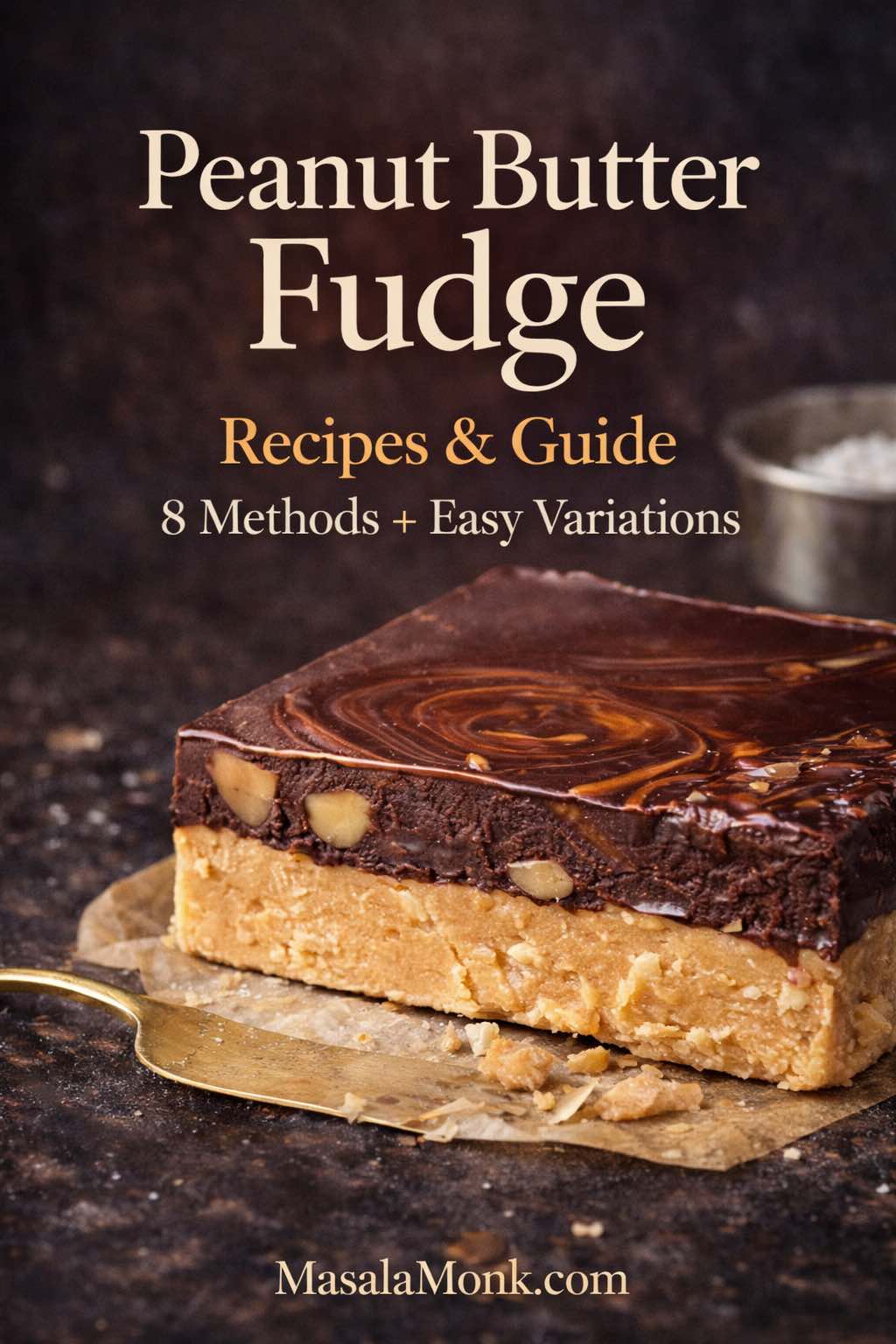
Peanut butter fudge cover image with a thick buckeye-style layered fudge square and text “Peanut Butter Fudge: Recipes & Guide – 8 Methods + Easy Variations.”

Some desserts feel like a project. This one, thankfully, doesn’t have to. A peanut butter fudge recipe can be a two-minute stir-and-chill treat, a creamy slice that tastes like it came from a candy counter, or an old-fashioned cooked confection with that unmistakable “holiday tray” vibe. Even better, it adapts: you can turn it into chocolate-and-peanut swirls, a buckeye-style slab with a glossy cap, a peanut-free version for allergy-friendly sharing, or a sugar-alternative batch that still scratches the same sweet itch.

Because there are so many ways to make it, the smartest approach is simple: pick the style that matches your mood, then follow the steps. Along the way, you’ll also learn how to troubleshoot grainy texture, fix a too-soft set, and store slices so they stay tender instead of drying out.

Choose your peanut butter fudge style

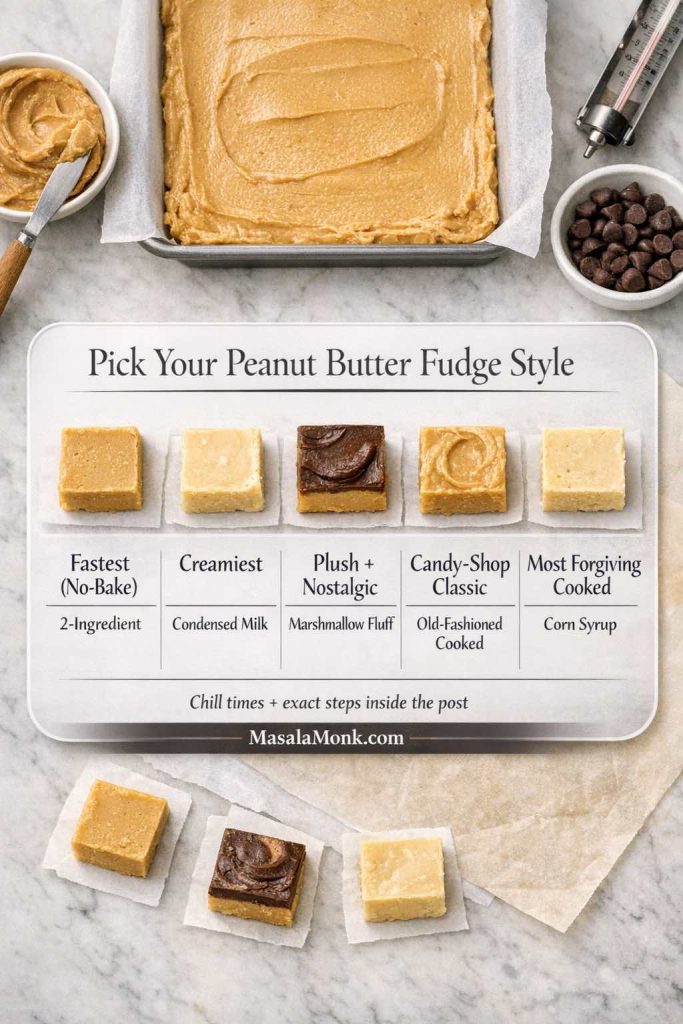
If you want the shortest path, start with the 2-ingredient version. If you prefer a creamier bite that rarely crumbles, go for the condensed milk method. Meanwhile, marshmallow creme delivers that plush, classic texture that many people associate with “fantasy” style fudge. On the other hand, if you’re craving a true candy-shop finish, the cooked soft-ball stage method is the one.

Quick chooser infographic for peanut butter fudge styles. Shows five options with fudge squares: 2-ingredient no-bake (fastest), condensed milk (creamiest), marshmallow fluff (plush nostalgic), old-fashioned cooked (candy-shop classic), and corn syrup method (most forgiving cooked). Includes MasalaMonk.com branding.
Not sure which peanut butter fudge recipe to make first? Use this quick chooser to match your mood to the right method—2-ingredient no-bake for speed, condensed milk for extra creaminess, marshmallow fluff for classic ‘fantasy’ texture, old-fashioned cooked for candy-shop flavor, or corn syrup for a smoother cooked set.
  • Fastest: 2-ingredient easy peanut butter fudge
  • Creamiest: peanut butter fudge with sweetened condensed milk
  • Plush/nostalgic: marshmallow fluff peanut butter fudge
  • Candy-shop: old fashioned peanut butter fudge (soft-ball stage)
  • Most forgiving cooked: peanut butter fudge with corn syrup
  • Shortcut: frosting and peanut butter fudge
  • Low-sugar: keto peanut butter fudge / sugar free peanut butter fudge
  • Allergy-friendly: peanut free fudge (seed butter swap)

No matter which route you take, great results begin with great peanut butter. If you like controlling the texture from the start—ultra smooth, slightly chunky, or deeply roasted—this guide on how to make peanut butter at home is a useful foundation.


Ingredients and tools that make everything easier

Before jumping into specific methods, it helps to set yourself up for a smooth run. Even when a recipe is “easy,” small choices can make the difference between creamy slices and a crumbly pan.

Pan size and lining

An 8-inch square pan is the sweet spot for thick, giftable squares. For thinner pieces (or if you want more servings), use a 9-inch square pan.

Line the pan with parchment paper, leaving overhang on two sides. That overhang becomes handles, so you can lift the slab out cleanly and slice without gouging the pan.

Peanut butter choice

You can use either stabilized peanut butter (the kind that doesn’t separate much) or natural peanut butter. However, natural versions vary a lot: some are oily and loose; others are stiff and dry.

  • If your peanut butter is very stiff, you’ll often need a touch more fat (butter or coconut oil) to keep the mixture from crumbling.
  • If it’s very runny, you may need a bit more structure (powdered sugar, a little extra chill time, or a firmer method like condensed milk).
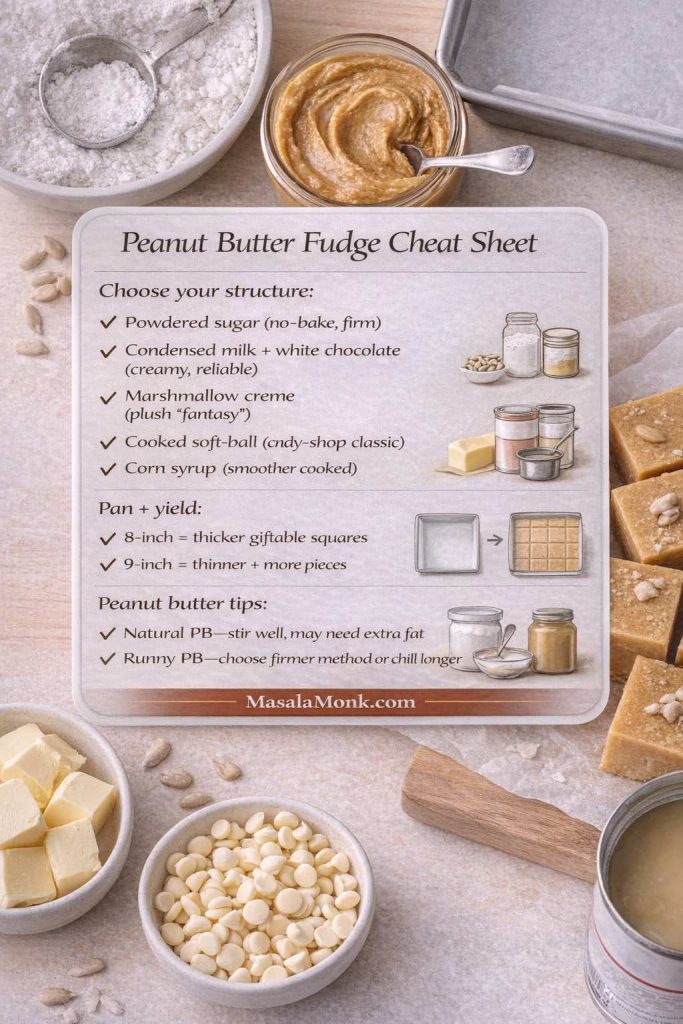
Photorealistic ‘Peanut Butter Fudge Cheat Sheet’ infographic. Lists how to choose a peanut butter fudge method: powdered sugar no-bake, condensed milk with white chocolate, marshmallow creme ‘fantasy’ style, cooked soft-ball, and corn syrup for smoother cooked fudge. Includes pan size guidance (8-inch thicker squares, 9-inch thinner more pieces) and peanut butter tips for natural vs runny peanut butter. MasalaMonk.com branding.
Save this peanut butter fudge cheat sheet to pick the right method fast—no-bake powdered sugar for speed, condensed milk + white chocolate for the creamiest reliable set, marshmallow creme for classic ‘fantasy’ texture, soft-ball cooked for candy-shop fudge, or corn syrup for a smoother cooked finish. It also shows the best pan size (8-inch vs 9-inch) and quick peanut butter tips so your batch sets the way you want.

Salt and vanilla in a peanut butter fudge recipe

Salt is the quiet hero here. Even salted peanut butter usually benefits from a pinch more. Vanilla is optional, yet it rounds the flavor and makes the final result taste more “finished.”

Optional tools

  • A sturdy silicone spatula (best for thick mixtures)
  • A heavy saucepan (for heated methods)
  • A candy thermometer (strongly recommended for cooked styles)

Storage and food safety

Fudge lasts well when protected from air. Still, many versions include dairy (butter, milk, condensed milk). For safe handling basics, the USDA’s guidance on leftovers and food safety is a solid reference.

Also Read: 10 Vegan Chocolate Cake Recipes (Easy, Moist, & Dairy-Free)


Method 1: Two ingredient easy peanut butter fudge (fast, firm, classic recipe)

This is the “I need something sweet right now” method. It’s also the simplest way to get that peanut-butter-candy vibe without turning on the stove.

What this style of fudge with peanut butter is like

The texture is firm and sliceable, with a sweetness that hits quickly and then fades into roasted peanut flavor. Because it sets through dry structure rather than cooking, the bite feels a bit like old-fashioned peanut butter candy—dense and satisfying.

Ingredients (8-inch pan)

  • 1 cup peanut butter (creamy works best)
  • 2 to 2½ cups powdered sugar
  • Optional: ½ teaspoon vanilla
  • Optional: pinch of salt
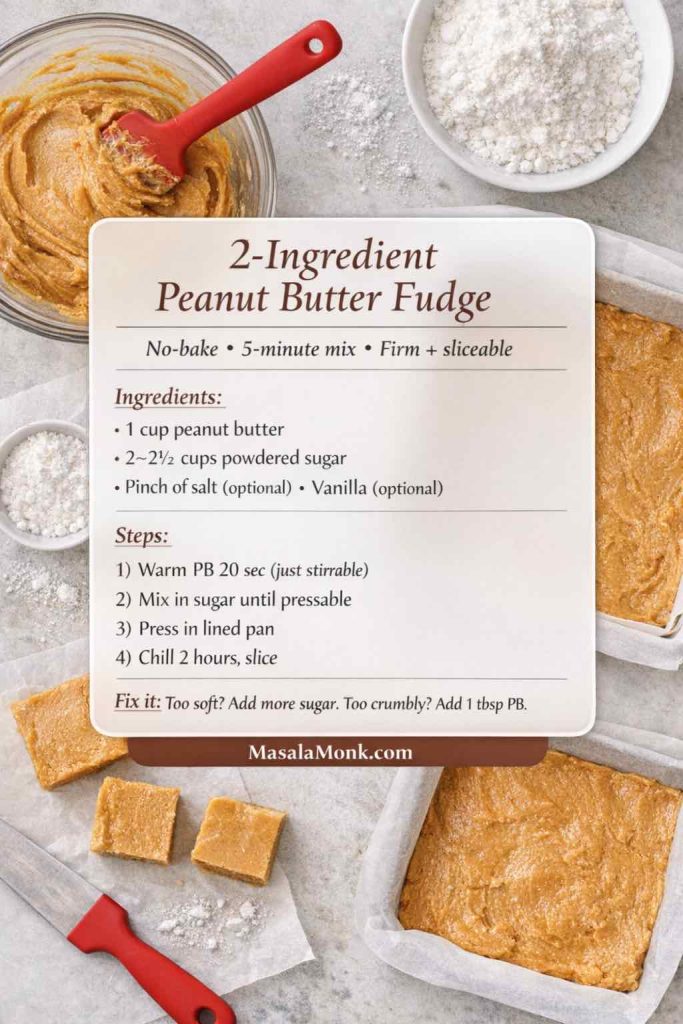
Photorealistic recipe card for 2-ingredient peanut butter fudge (no-bake). Shows ingredients (1 cup peanut butter, 2–2½ cups powdered sugar, optional salt and vanilla) and quick steps to mix, press into a lined pan, chill 2 hours, and slice. Includes tips to fix fudge that’s too soft or crumbly, with MasalaMonk.com branding.
This 2-ingredient peanut butter fudge is the fastest no-bake method: warm the peanut butter just until stirrable, mix in powdered sugar until pressable, then chill and slice. Save this card for those ‘need something sweet now’ moments—and use the quick fix tips if your batch turns out too soft or a little crumbly.

Step-by-step recipe

  1. Line the pan. Set it aside so it’s ready.
  2. Soften the peanut butter. Warm it gently—about 20 seconds in the microwave, or briefly in a small saucepan—just until it stirs easily. Avoid making it hot.
  3. Season it. Stir in vanilla and a pinch of salt if you’re using them.
  4. Add powdered sugar gradually. Start with 2 cups and stir until the mixture thickens into a soft dough.
    Next, add more powdered sugar a few tablespoons at a time until it holds together and feels pressable.
  5. Press into the pan. Use your spatula to compress it firmly. The tighter you press, the cleaner your slices will be.
  6. Chill until firm. Refrigerate at least 2 hours, then lift out and slice.

If it’s not perfect, fix it

  • Crumbly or dry: Warm 1–2 tablespoons of peanut butter and knead it into the mixture. Alternatively, add 1 tablespoon melted butter and mix again.
  • Too soft: Add a bit more powdered sugar and chill longer.

Also Read: Kahlua Drinks: 10 Easy Cocktail Recipes (Milk, Vodka, Coffee)


Method 2: Three ingredient peanut butter fudge (creamier and more forgiving)

This version keeps the no-bake ease, yet feels smoother and richer than the 2-ingredient batch. Because butter adds silkiness and helps binding, the texture often lands in that “creamy peanut butter fudge” zone.

Ingredients (8-inch pan)

  • 1 cup peanut butter
  • ¼ cup butter, melted
  • 2 to 2½ cups powdered sugar
  • Optional: ½ teaspoon vanilla
  • Optional: pinch of salt
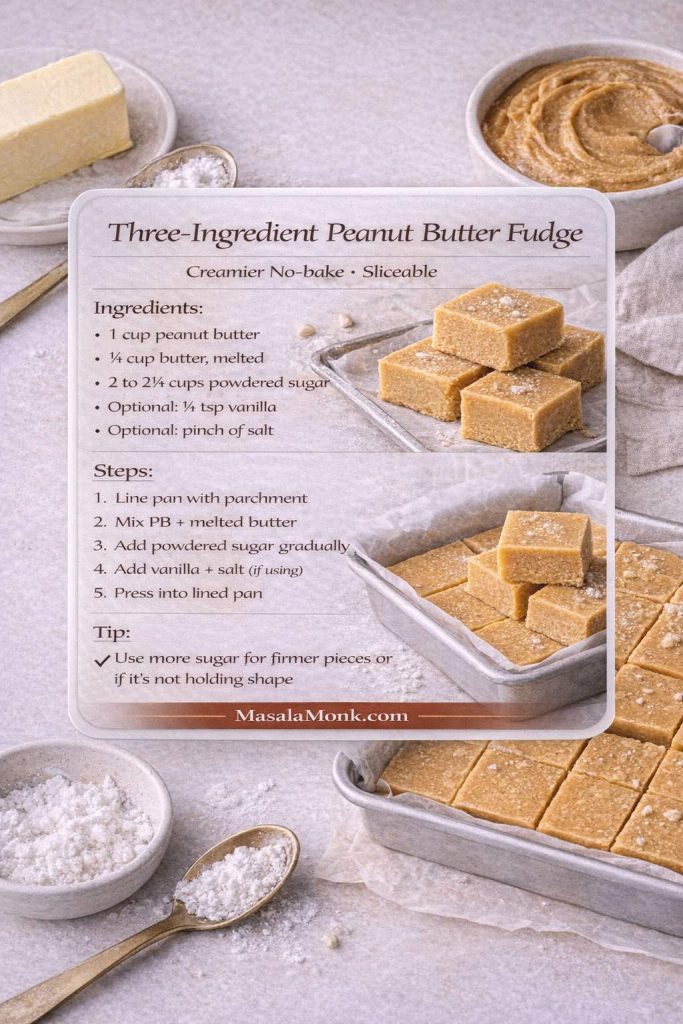
Photorealistic recipe card for three ingredient peanut butter fudge (no-bake). Shows ingredients: 1 cup peanut butter, ¼ cup melted butter, 2 to 2½ cups powdered sugar, optional vanilla, and a pinch of salt. Includes steps to line an 8-inch pan, mix peanut butter with melted butter, add powdered sugar gradually, press into the pan, and chill 2–3 hours until sliceable. MasalaMonk.com branding.
This 3-ingredient peanut butter fudge is the creamier, more forgiving upgrade from the 2-ingredient version—melted butter adds silkiness so the texture stays smooth and sliceable. Save this card for a quick no-bake fudge that sets reliably in the fridge and tastes extra peanut-forward with a bigger pinch of salt.

Step-by-step recipe

  1. Prepare your pan. Line it with parchment and set aside.
  2. Melt the butter. Let it cool for a minute so it’s warm, not scalding.
  3. Combine peanut butter and butter. Stir until glossy and unified.
  4. Add vanilla and salt if using.
  5. Stir in powdered sugar gradually. Begin with 2 cups, then adjust. The mixture should be thick but still spreadable.
  6. Press and smooth. Push it firmly into the pan and level the surface.
  7. Chill 2–3 hours until sliceable.

Flavor upgrades for 3 Ingredient peanut butter fudge

A slightly larger pinch of salt makes this taste more peanut-forward. Additionally, a spoonful of finely chopped roasted peanuts gives a satisfying crunch without making slicing difficult.

Also Read: Cranberry Moscow Mule Recipe: A Festive Holiday Cocktail With Easy Variations


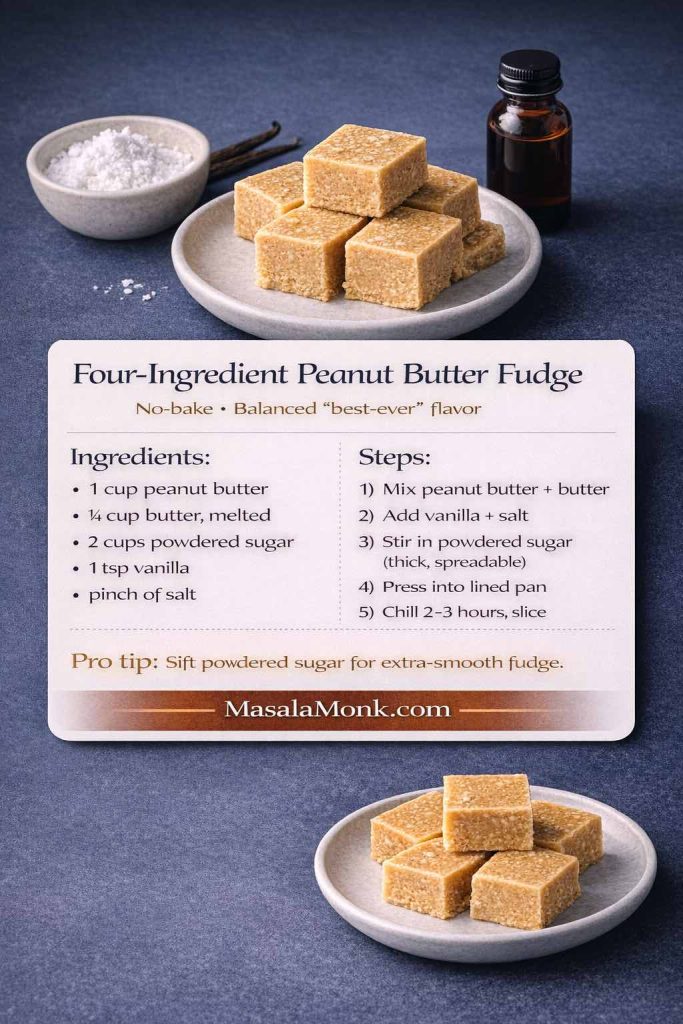
Method 3: Four ingredient peanut butter fudge (balanced, “best-ever” flavor)

Four-ingredient versions are popular because that extra ingredient—often vanilla—makes the fudge taste more intentional. Moreover, the method is still just stir, press, chill.

Ingredients (8-inch pan)

  • 1 cup peanut butter
  • ¼ cup butter, melted
  • 2 cups powdered sugar (plus extra only if needed)
  • 1 teaspoon vanilla
  • Pinch of salt (highly recommended)
Photorealistic recipe card for four-ingredient peanut butter fudge (no-bake). Shows fudge squares on a plate with a navy background and an overlay listing ingredients (1 cup peanut butter, ¼ cup melted butter, 2 cups powdered sugar, 1 tsp vanilla, pinch of salt) and steps to mix, add vanilla and salt, stir in powdered sugar until thick, press into a lined pan, and chill 2–3 hours. Includes pro tip to sift powdered sugar for extra-smooth fudge. MasalaMonk.com branding.
Save this four-ingredient peanut butter fudge recipe card for a balanced, ‘best-ever’ no-bake batch that slices clean. The vanilla + salt make it taste more intentional, and the pro tip (sift the powdered sugar) helps keep the texture extra smooth instead of gritty.

Step-by-step

  1. Line the pan and set it nearby.
  2. Stir peanut butter and melted butter until smooth.
  3. Add vanilla and salt. Mix thoroughly.
  4. Add powdered sugar and stir until thick and spreadable.
  5. Press into the pan firmly; smooth the top.
  6. Chill 2–3 hours, then slice.

A simple cocoa twist in 4 Ingredient peanut butter fudge

If you want a quick chocolate-peanut vibe without adding a full layer, stir 1–2 tablespoons cocoa into half the mixture and swirl it through before chilling. For an easy drizzle at serving time, this quick homemade chocolate syrup works beautifully on top of a slice.

Also Read: Iced Coffee: 15 Drink Recipes—Latte, Cold Brew, Frappe & More


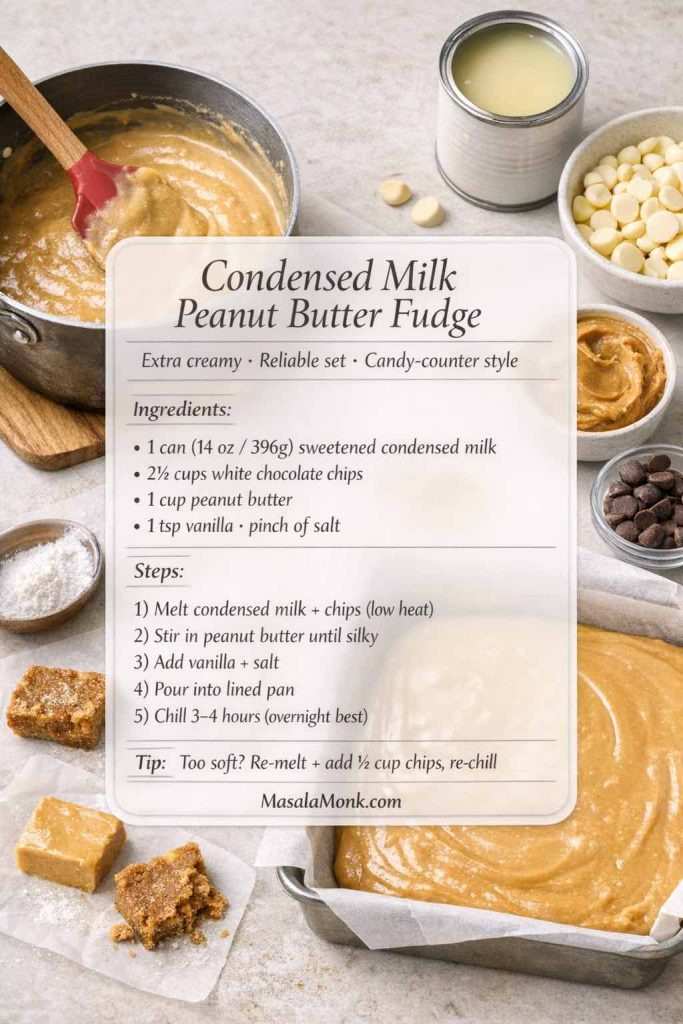
Method 4: Peanut Butter Fudge with Sweetened Condensed Milk (extra creamy, very reliable)

This is the candy-counter style: smooth, rich, and easy to slice. To guarantee a firm set, this condensed milk version uses white chocolate chips for structure. Without a setting ingredient, the classic “condensed milk + peanut butter” combo can stay too soft—especially in warmer kitchens.

Ingredients (for an 8-inch pan)

  • 1 can (14 oz / 396g) sweetened condensed milk
  • 2½ cups white chocolate chips
  • 1 cup peanut butter (creamy is easiest)
  • 1 teaspoon vanilla
  • Pinch of salt
Photorealistic recipe card for condensed milk peanut butter fudge with a reliable set. Shows ingredients: 1 can (14 oz/396g) sweetened condensed milk, 2½ cups white chocolate chips, 1 cup peanut butter, vanilla, and salt. Includes steps to melt condensed milk with chips on low heat, stir in peanut butter, pour into a lined pan, and chill 3–4 hours (overnight best). Tip included for fixing fudge that’s too soft. MasalaMonk.com branding.
This condensed milk peanut butter fudge is the ‘candy-counter’ version—extra creamy, smooth, and reliably sliceable thanks to white chocolate chips for structure. Save this card if you want a gift-worthy batch with minimal effort: melt, stir, pour, chill, then cut clean squares.

Step-by-step

  1. Prep the pan: Line an 8-inch square pan with parchment paper, leaving overhang.
  2. Melt gently: In a heavy saucepan over low heat, warm the condensed milk and white chocolate chips, stirring constantly until smooth and glossy (about 3–6 minutes). Keep the heat low to avoid scorching.
  3. Add peanut butter: Stir in the peanut butter until fully unified and silky.
  4. Finish the flavor: Remove from heat and stir in vanilla and salt.
  5. Pour and smooth: Scrape into the pan, level the top, and tap the pan lightly to settle it.
  6. Chill to set: Refrigerate 3–4 hours (overnight is best for super-clean slices). Lift out and slice.

If it’s not perfect, fix it

  • Too soft: Chill longer first. If it still won’t set, re-melt gently and stir in ½ to 1 cup more white chocolate chips, then re-chill.
  • Too firm: Let slices sit at room temperature for 5–10 minutes before serving.

Condensed milk peanut butter fudge without white chocolate (works, but a different texture)

If you’d rather skip the chips, you can still use condensed milk—just add dry structure so it sets sliceable:

  • Warm 1 can condensed milk + 1 cup peanut butter over low heat until glossy.
  • Remove from heat and stir in 2 to 2½ cups powdered sugar until thick and spreadable.
  • Press into the pan and chill 3–4 hours.

This version is more “peanut butter candy” in texture than candy-shop fudge, but it’s still delicious and reliable when you want a no-chip option.

Also Read: Marinara Sauce Recipe: Classic Homemade Marinara


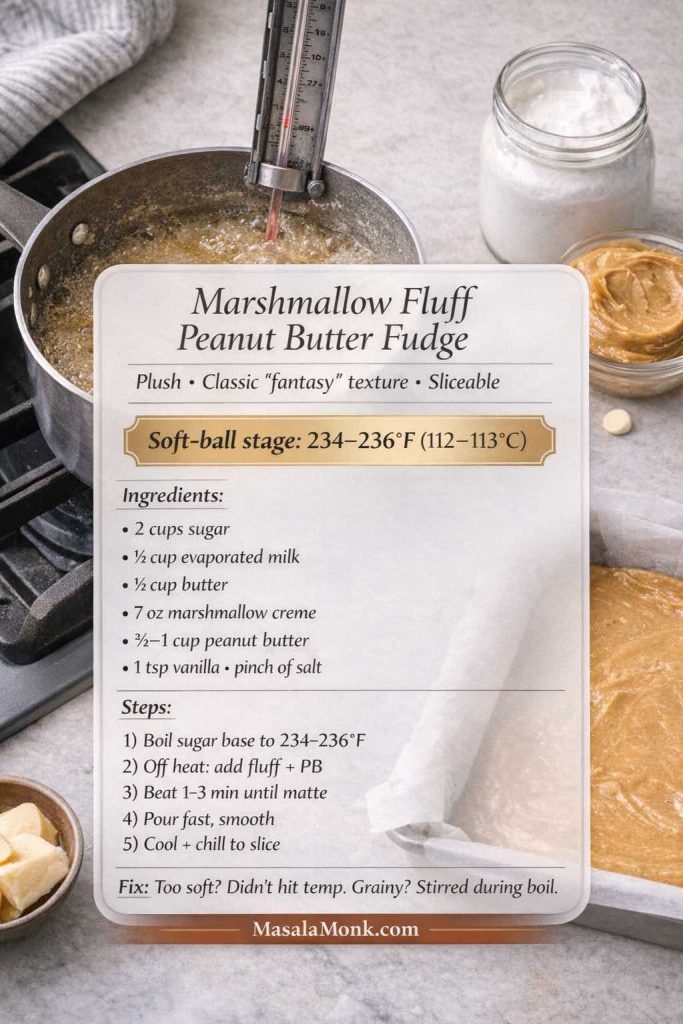
Method 5: Marshmallow Fluff Peanut Butter Fudge (plush, classic, nostalgic)

This is the classic “fantasy-style” approach: you cook the sugar base, then beat in marshmallow creme and peanut butter for that plush, sliceable, old-school texture. It’s much more reliable than simply mixing fluff and peanut butter and hoping it sets.

Ingredients (for an 8-inch pan)

  • 2 cups sugar
  • ½ cup evaporated milk (or whole milk)
  • ½ cup butter
  • 1 jar (7 oz / ~200g) marshmallow creme or marshmallow fluff
  • ¾ to 1 cup peanut butter
  • 1 teaspoon vanilla
  • Pinch of salt
Photorealistic recipe card for marshmallow fluff peanut butter fudge (fantasy-style). Shows a bubbling sugar base in a saucepan with a candy thermometer and lists the soft-ball stage temperature (234–236°F / 112–113°C). Includes ingredients (sugar, evaporated milk, butter, marshmallow creme, peanut butter, vanilla, salt) and steps to boil to temp, add fluff and peanut butter off heat, beat until matte, pour, cool, and chill. MasalaMonk.com branding.
This marshmallow fluff peanut butter fudge is the classic ‘fantasy-style’ version—plush, nostalgic, and sliceable when you hit the soft-ball stage (234–236°F). Save this card if you want that old-school candy-shop texture, plus the quick fixes for batches that turn out too soft or grainy.

Step-by-step

  1. Line your pan with parchment and keep it close by. This mixture sets quickly once it’s beaten.
  2. Start the base: In a heavy saucepan, combine sugar, evaporated milk, and butter. Heat over medium, stirring until everything is dissolved and uniform.
  3. Boil to soft-ball stage: Bring to a steady boil and cook until the mixture reaches 234–236°F (112–113°C). Once it’s boiling, avoid stirring—if needed, gently swirl the pan instead.
  4. Finish off-heat: Remove from heat. Immediately add the marshmallow creme, peanut butter, vanilla, and salt.
  5. Beat until it turns matte: Stir vigorously (with a wooden spoon or a mixer on low) until the mixture thickens, loses some shine, and starts holding soft shape—usually 1–3 minutes.
  6. Pour and smooth fast: Transfer to the pan right away and smooth the top. Let it cool until set, then refrigerate for cleaner slices.

If Marshmallow Fluff Peanut Butter Fudge is not perfect, fix it

  • Grainy: Usually from sugar crystals or too much stirring while boiling. Next time, stop stirring once it boils and brush down the sides of the pan early with a little water.
  • Too soft: It likely didn’t reach soft-ball temperature. You can re-melt the batch gently, bring it back to 234–236°F, then beat again and reset.
  • Too firm/crumbly: It likely cooked a bit too hot or was beaten too long. Next time, stop beating as soon as it thickens and turns slightly matte.

Also Read: Hot Chocolate Coffee: 3 Easy Recipes (Cocoa, Mix, or Espresso)


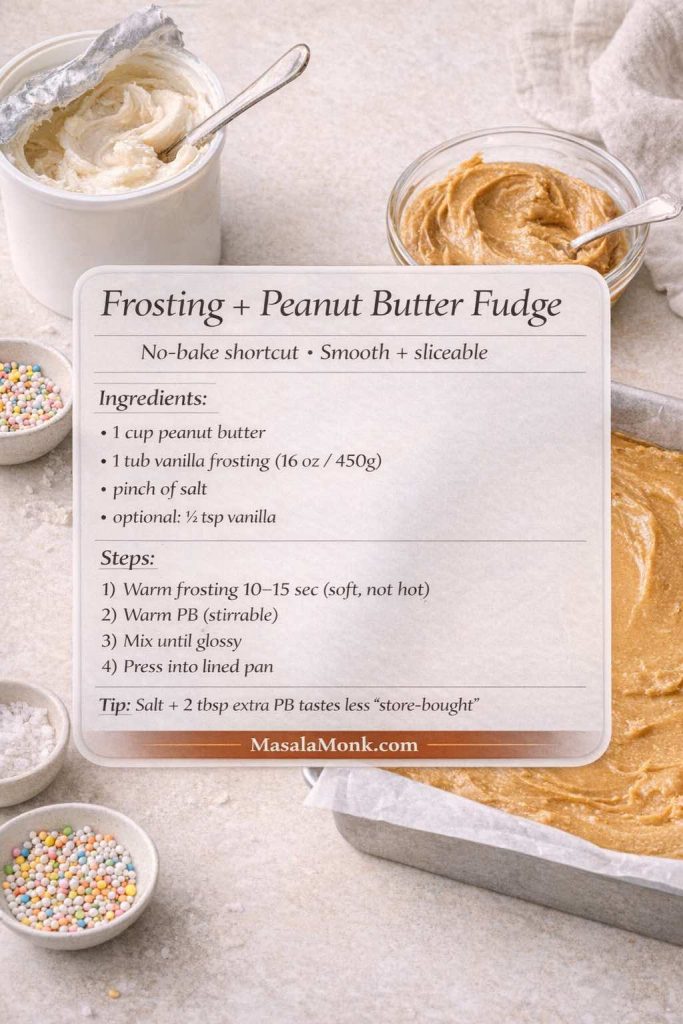
Method 6: Frosting and peanut butter fudge (icing shortcut that actually works)

This method is almost unfairly easy. Because frosting already contains sugar and fat in a stable ratio, combining it with peanut butter creates a fudge-like base that sets in the fridge.

Ingredients (8-inch pan)

  • 1 cup peanut butter
  • 1 container frosting (about 16 oz / 450g), vanilla preferred
  • Pinch of salt
  • Optional: ½ teaspoon vanilla (if your frosting is bland)
Photorealistic recipe card for frosting and peanut butter fudge (no-bake icing shortcut). Shows ingredients—peanut butter, vanilla frosting (16 oz/450g), pinch of salt, optional vanilla—and quick steps to warm frosting and peanut butter, mix until glossy, press into a lined pan, chill until set, and slice. Includes tip to add extra peanut butter and salt for better flavor. MasalaMonk.com branding.
This frosting and peanut butter fudge is the easiest no-bake shortcut—just warm, mix, press, and chill for smooth, sliceable squares. Save this card for last-minute dessert trays, and use the salt + extra peanut butter tip to make it taste less ‘store-bought.

Step-by-step

  1. Line your pan with parchment.
  2. Warm the frosting briefly. Microwave 10–15 seconds to soften it.
  3. Soften the peanut butter the same way—just enough to stir.
  4. Combine frosting and peanut butter until completely smooth.
    At first, it may resist; keep mixing and it will turn glossy.
  5. Season with salt (and vanilla if using).
  6. Spread into the pan and smooth the top.
  7. Chill 2–3 hours until set.

Make it taste less “store-bought”

Salt is essential here. Also, a little extra peanut butter (2–3 tablespoons) pushes the flavor forward and keeps it from tasting like frosting with peanuts.

Also Read: Strawberry Smoothie Recipes (12 Easy Blends + Bowls & Protein Shakes)


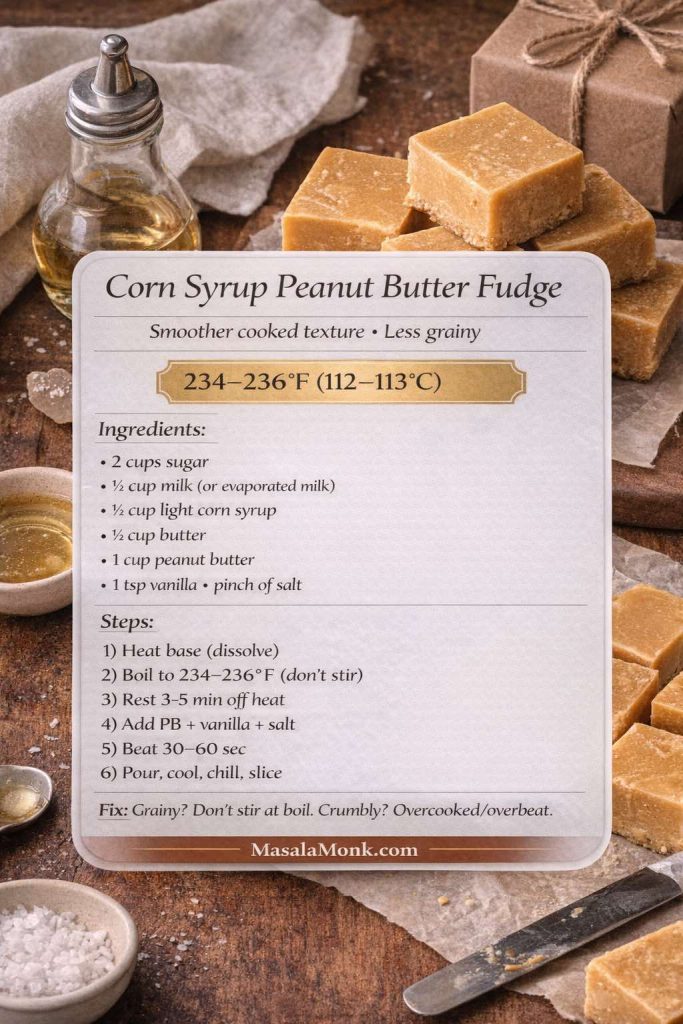
Method 7: Corn Syrup Peanut Butter Fudge (smoother cooked texture, less grainy)

Corn syrup is the quiet helper in cooked fudge. It makes the batch more forgiving by lowering the chances of that gritty, grainy texture that can sneak into candy. If you want old-fashioned flavor with a smoother finish and a little extra insurance, this is the cooked method to start with.

Ingredients (for an 8-inch pan)

  • 2 cups granulated sugar
  • ½ cup milk or evaporated milk
  • ½ cup light corn syrup
  • ¼ cup butter
  • 1 cup peanut butter (creamy is easiest)
  • 1 teaspoon vanilla
  • Pinch of salt
Photorealistic recipe card for corn syrup peanut butter fudge (Karo syrup style). Shows soft-ball stage temperature 234–236°F (112–113°C), ingredients (sugar, milk/evaporated milk, light corn syrup, butter, peanut butter, vanilla, salt) and steps to dissolve, boil without stirring, rest 3–5 minutes, stir in peanut butter, beat briefly, pour, cool, chill, and slice. MasalaMonk.com branding.
This corn syrup peanut butter fudge is the most forgiving cooked method—corn syrup helps reduce sugar crystallization so the texture stays smoother and less grainy. Save this card for the key cues: boil to 234–236°F, don’t stir at the boil, rest briefly off heat, then beat just until it turns slightly matte for clean slices.

Step-by-step

  1. Prep the pan first. Line an 8-inch square pan with parchment paper and leave overhang so you can lift the fudge out later.
  2. Start the base. In a heavy saucepan, combine sugar, milk, corn syrup, and butter. Heat over medium, stirring until the mixture is fully uniform and the sugar looks mostly dissolved.
  3. Boil without stirring. Bring it to a steady boil. Once it’s boiling, stop stirring (stirring encourages crystals). If needed, gently swirl the pan instead.
  4. Cook to soft-ball stage. Continue boiling until the mixture reaches 234–236°F (112–113°C) on a candy thermometer. (This range is where you get creamy fudge—not syrupy-soft and not crumbly.)
  5. Rest briefly. Remove from heat and let the pan sit undisturbed for 3–5 minutes.
  6. Add the peanut butter and flavorings. Stir in peanut butter, vanilla, and salt until completely smooth.
  7. Beat just until it thickens. Keep stirring for about 30–60 seconds, until it looks slightly thicker and loses some shine. Don’t keep going once it starts to resist—overbeating can make it crumbly.
  8. Pour and smooth fast. Scrape into the prepared pan immediately and smooth the top.
  9. Set and slice. Let it cool until firm at room temperature, then refrigerate for cleaner slices.

What makes this Corn Syrup Peanut Butter Fudge different

It’s still real cooked fudge, but the corn syrup helps keep the texture smoother and reduces the “grainy surprise” factor.

If it’s not perfect, fix it

  • Grainy: Next time, stop stirring once it boils, and brush down the sides of the pan early with a little water to remove sugar crystals.
  • Too soft: It likely didn’t reach temperature. You can gently reheat, bring back to 234–236°F, then finish again.
  • Crumbly: Usually cooked a touch too hot or beaten too long. Pull it off closer to 234°F next time and beat less.

Also Read: Sandwich for Breakfast: Breakfast Sandwich Recipe + 10 Variations


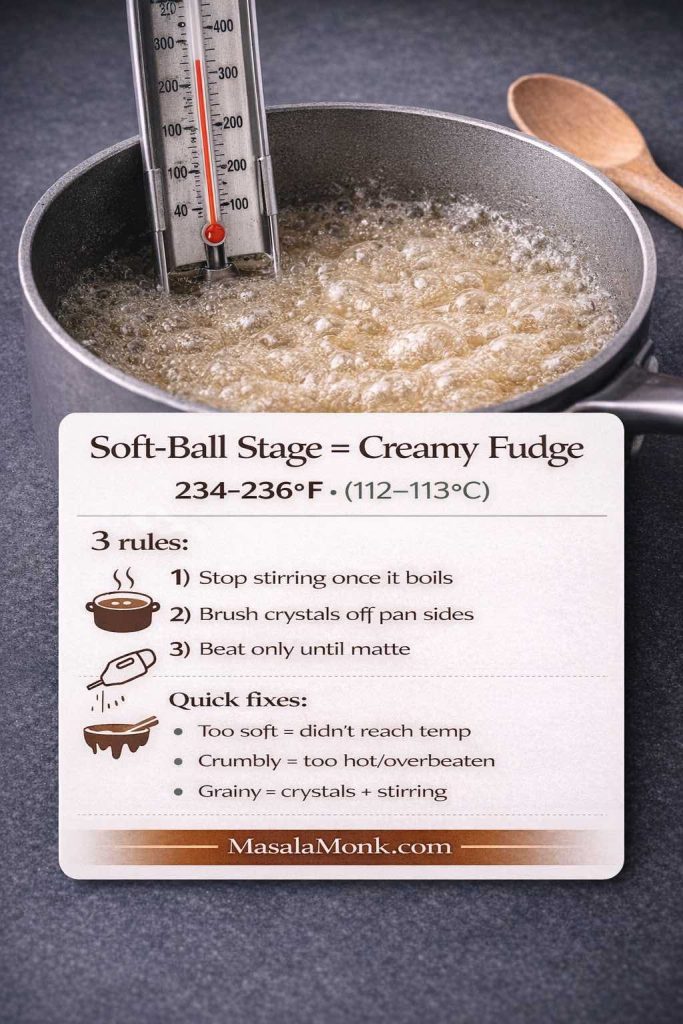
Photorealistic fudge-making cheat sheet showing soft-ball stage temperature for creamy fudge: 234–236°F (112–113°C). Background shows a saucepan of bubbling sugar syrup with a candy thermometer reading about 235°F and a wooden spoon nearby. Overlay lists three rules (stop stirring once it boils, brush crystals off pan sides, beat only until matte) and quick fixes for too soft, crumbly, or grainy fudge. MasalaMonk.com branding.
Save this soft-ball stage fudge temperature guide if you’re making old fashioned peanut butter fudge or any cooked fudge. Hitting 234–236°F (112–113°C) is the difference between creamy slices and a batch that’s too soft, crumbly, or grainy—and the quick rules here show exactly when to stop stirring and when to beat.

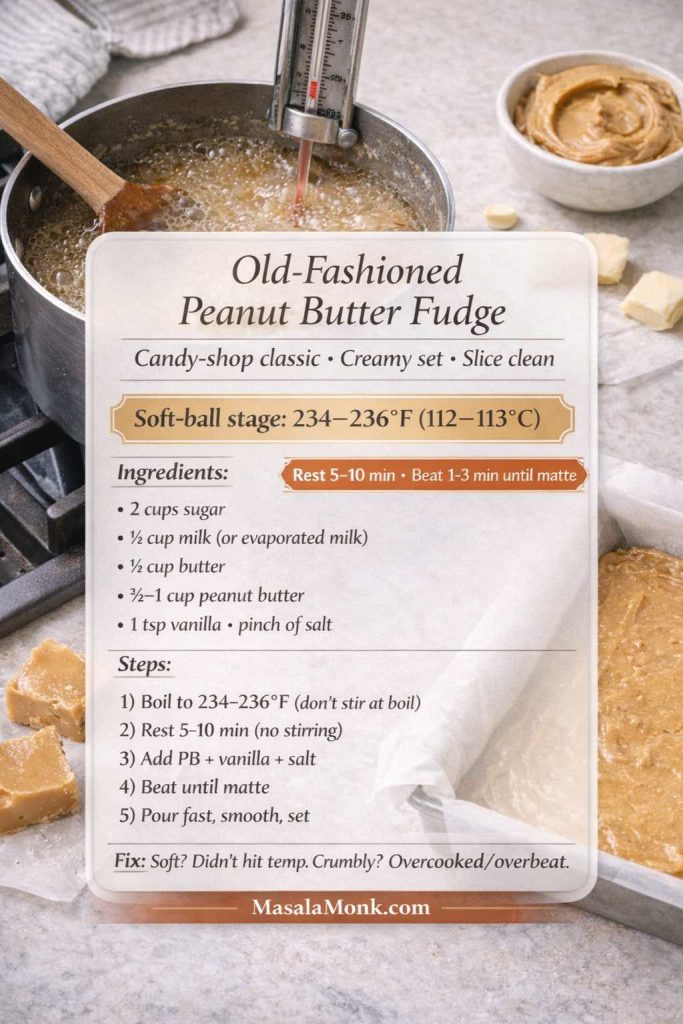
Method 8: Old-Fashioned Cooked Peanut Butter Fudge (classic soft-ball stage, candy-shop feel)

This is the true old-fashioned version—the one that smells like holidays and tastes like it came from a tiny candy shop. It’s a little more hands-on than the corn syrup method, but the payoff is big: a creamy, structured set and that classic “homemade fudge” character people remember.

Ingredients (for an 8-inch pan)

  • 2 cups granulated sugar
  • ½ cup milk or evaporated milk
  • ¼ cup butter
  • ¾ to 1 cup peanut butter (use 1 cup for bold peanut flavor)
  • 1 teaspoon vanilla
  • Pinch of salt
Photorealistic recipe card for old-fashioned peanut butter fudge. Includes soft-ball stage temperature (234–236°F / 112–113°C), timing cues to rest 5–10 minutes and beat 1–3 minutes until matte, plus ingredients and step-by-step instructions for a creamy candy-shop style set. MasalaMonk.com branding.
This old-fashioned peanut butter fudge is the classic candy-shop method: cook to the soft-ball stage (234–236°F), rest briefly, then beat until matte for that creamy, slice-clean set. Save this card if you want traditional holiday-tray fudge with the key timing cues that prevent grainy or crumbly batches.

Step-by-step

  1. Prep the pan. Line an 8-inch pan with parchment and set it right beside the stove. Timing matters later.
  2. Dissolve the sugar. In a heavy saucepan, combine sugar, milk, and butter. Heat over medium, stirring until the mixture is smooth and the sugar is dissolved.
  3. Boil hands-off. Bring to a steady boil. Once boiling, stop stirring. If you see sugar crystals on the sides early on, brush them down with a little water.
  4. Cook to soft-ball stage. Cook until the mixture reaches 234–236°F (112–113°C).
  5. Cool undisturbed. Remove from heat and let it sit 5–10 minutes without stirring. This short rest helps you land on creamy instead of gritty.
  6. Add peanut butter + finishers. Add peanut butter, vanilla, and salt. Stir until smooth.
  7. Beat until it turns matte. Stir vigorously until it thickens, loses gloss, lightens slightly, and starts holding its shape. This usually takes 1–3 minutes. Stop as soon as it reaches a thick, pourable stage—overbeating can make it crumble.
  8. Pour immediately. Scrape into the pan right away and smooth the top quickly.
  9. Set and slice. Let it set at room temperature, then refrigerate if you want extra clean edges when slicing.

Why this Cooked Peanut Butter Fudge is “classic”

The cooling pause and the beating step create tiny crystals that make fudge taste creamy and slice cleanly. The timing is the whole game.

If it’s not perfect, fix it

  • Too soft: It likely didn’t reach temperature. Reheat gently, bring back to 234–236°F, then finish again.
  • Grainy: Usually caused by stirring while boiling or crystals on the pan sides. Next time: hands off once boiling + brush down sides early.
  • Crumbly: Usually cooked too hot or beaten too long. Pull it off a touch earlier (closer to 234°F) and beat less.

Also Read: Paper Plane Cocktail Recipe + Best Amaro Substitutes & Tips


Chocolate peanut butter fudge and buckeye-style recipes

Chocolate turns a good batch into something that feels gift-worthy. Fortunately, you can add chocolate in several ways, depending on the mood.

If you want help choosing cocoa or chocolate types, MasalaMonk’s explainer on cacao vs chocolate vs dark chocolate is a handy read.

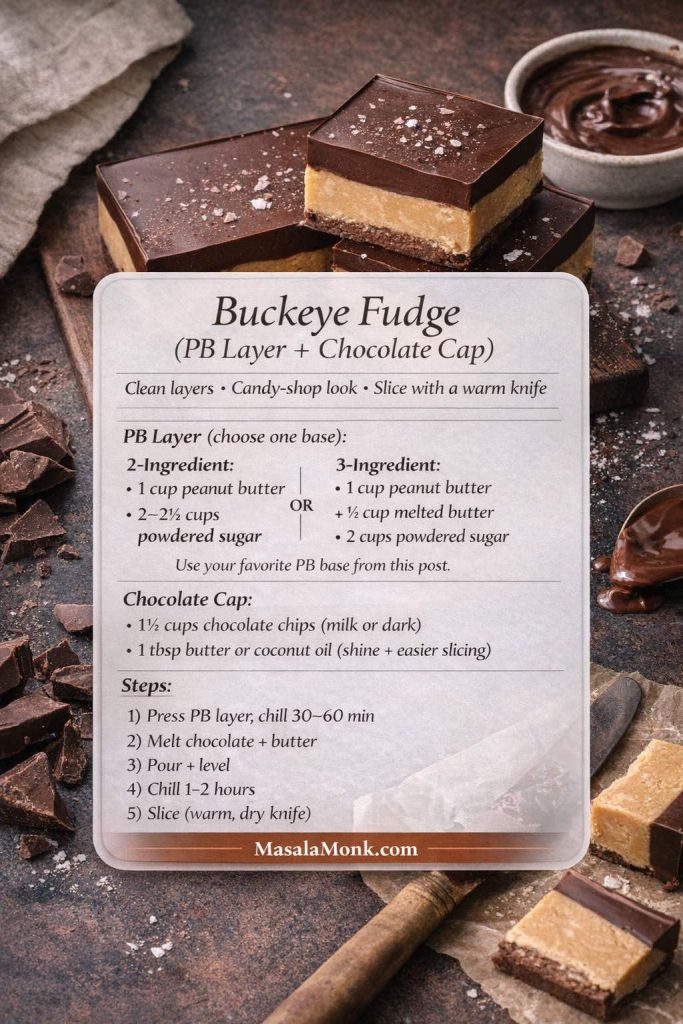
Photorealistic recipe card for buckeye fudge (chocolate peanut butter fudge with layers). Shows a peanut butter fudge base with a glossy chocolate cap and lists ingredients for the PB layer (2-ingredient or 3-ingredient base) plus chocolate topping (chocolate chips and butter/coconut oil). Includes steps to chill the PB layer, pour melted chocolate, chill again, and slice with a warm knife. MasalaMonk.com branding.
Buckeye fudge is the gift-worthy upgrade: a firm peanut butter fudge base topped with a smooth, glossy chocolate layer. Save this card for clean layers every time—chill the PB layer first, pour the melted chocolate cap, then slice with a warm, dry knife for sharp edges.

Variation A: Cocoa in the base (simple chocolate-peanut flavor)

Best for: a unified chocolate peanut fudge taste.

How to do it

  1. Make any base you like (no-bake, condensed milk, or marshmallow).
  2. Stir 2–4 tablespoons cocoa powder into the mixture.
    If it thickens too much, add 1–2 tablespoons warm peanut butter to loosen.
  3. Press, chill, slice.

Variation B: Buckeye fudge (peanut layer + chocolate cap)

Best for: clean layers and candy-shop vibes.

Chocolate cap ingredients

  • 1½ cups chocolate chips (milk or dark)
  • 1 tablespoon butter or coconut oil (for shine and easier slicing)

Step-by-step

  1. Make and set your peanut butter base fully.
  2. Melt chocolate chips with butter until smooth.
  3. Pour over the set layer and tilt the pan to spread evenly.
  4. Chill until firm, then slice with a warm knife.

Variation C: Swirl (marbled look with minimal effort)

Best for: an impressive finish without extra work.

Step-by-step

  1. Prepare your peanut layer, then spread it into the pan.
  2. Melt chocolate separately (or use a thick chocolate syrup).
  3. Spoon chocolate over the top and drag a knife through for swirls.
  4. Chill until set.

For a fast drizzle that looks elegant on a serving plate, this 3-minute chocolate syrup is an easy option.

Also Read: Katsu Curry Rice (Japanese Recipe, with Chicken Cutlet)


Keto peanut butter fudge (low-sugar direction, still rich)

Keto-style batches depend on the sweetener you choose. Because sugar alternatives vary, the texture can shift—sometimes firmer, sometimes softer. Still, a good base formula delivers a sliceable, satisfying result.

For a helpful overview of sweetener types, the American Diabetes Association’s PDF guide to sugar substitutes provides useful context. If you’re deciding on monk fruit specifically, Cleveland Clinic’s overview of monk fruit sweetener is a clear introduction.

Ingredients (8-inch pan)

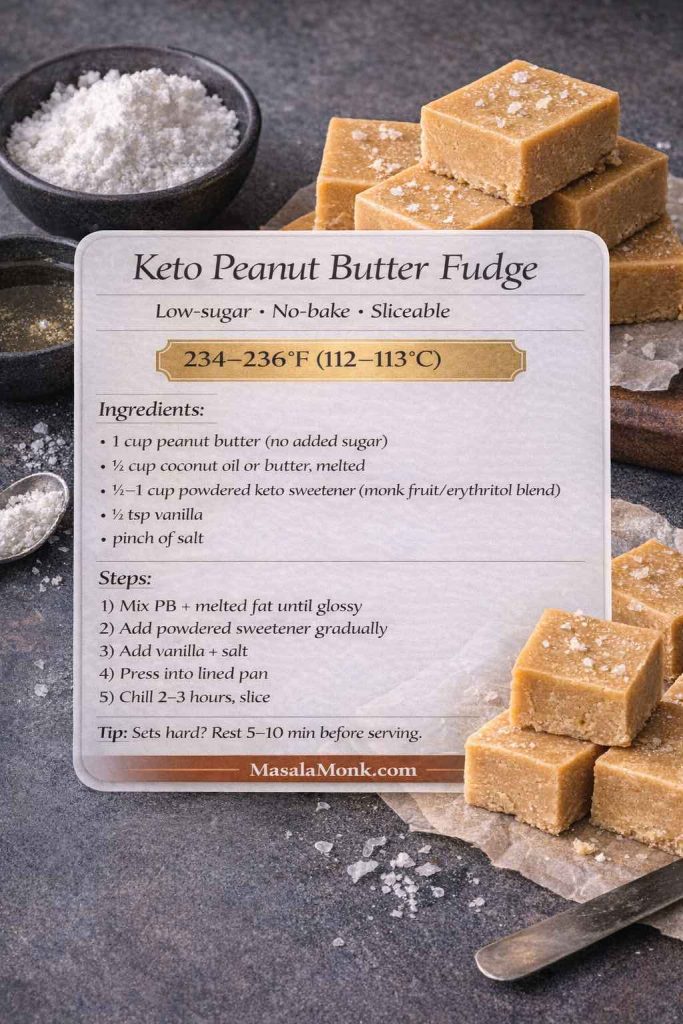
  • 1 cup peanut butter (no added sugar)
  • ½ cup coconut oil or butter, melted
  • ¾ to 1 cup powdered-style keto sweetener blend
  • ½ teaspoon vanilla
  • Pinch of salt
Photorealistic recipe card for keto peanut butter fudge (low-sugar, no-bake, sliceable). Shows ingredients: peanut butter with no added sugar, melted coconut oil or butter, powdered keto sweetener (monk fruit/erythritol blend), vanilla, and salt. Includes steps to mix until glossy, add sweetener, press into a lined pan, chill 2–3 hours, and slice, plus a tip to rest pieces 5–10 minutes if they set hard. MasalaMonk.com branding.
This keto peanut butter fudge is a simple no-bake, low-sugar method that still tastes rich and slices clean. Save this card if you’re making sugar-free peanut butter fudge with monk fruit/erythritol—use powdered sweetener for the smoothest texture, then chill until firm and let pieces rest briefly before serving if they set extra hard.

Step-by-step recipe

  1. Line your pan with parchment.
  2. Stir peanut butter and melted fat until glossy and smooth.
  3. Add sweetener gradually and mix until thickened.
    Taste as you go; sweetness builds quickly with some blends.
  4. Add vanilla and salt, mixing thoroughly.
  5. Press into the pan firmly and smooth the surface.
  6. Chill 2–3 hours until set.

Texture note for keto peanut butter fudge

If it sets very hard, let slices sit at room temperature for 5–10 minutes. Conversely, if it stays too soft, add a bit more powdered-style sweetener next time.

Also Read: Almond Flour Pancakes (Easy Recipes) Fluffy, High-Protein, Keto & More


Sugar-free peanut butter fudge and candy-style squares

Sugar-free versions often feel closer to “peanut butter candy” than traditional cooked fudge. That’s not a downside—rather, it’s a different texture expectation. The goal is a cohesive, sliceable slab with clean sweetness and strong peanut flavor.

For a grounded take on sweeteners, the NHS overview on whether sweeteners are safe is a practical read. If you prefer a research-focused summary, Harvard’s Nutrition Source page on low-calorie sweeteners adds nuance.

Ingredients (8-inch pan)

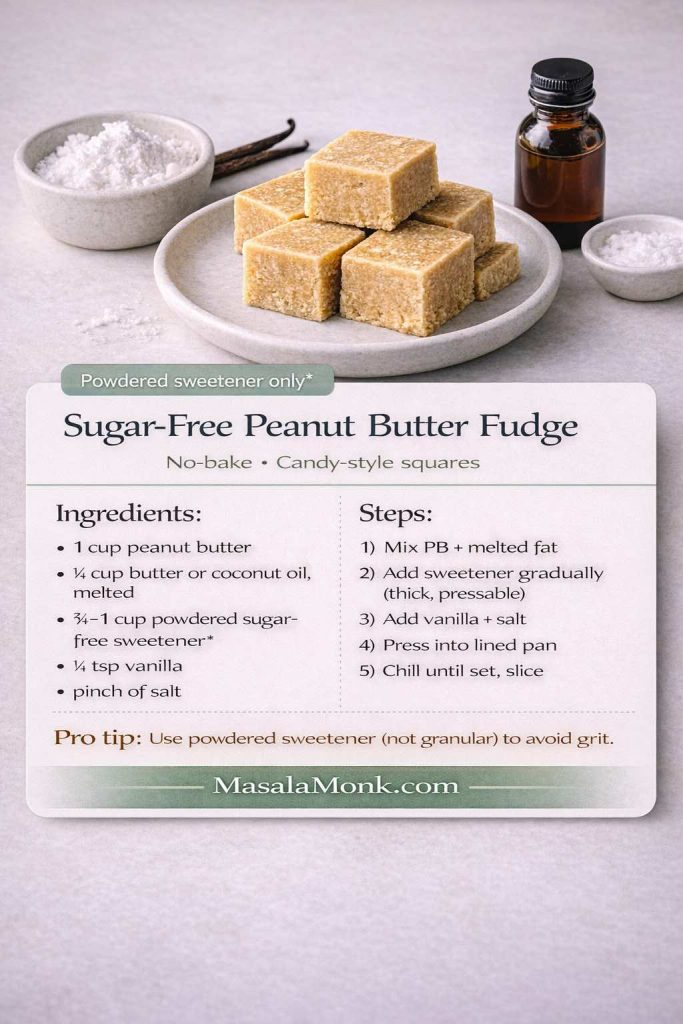
  • 1 cup peanut butter
  • ½ cup butter or coconut oil, melted
  • ¾ to 1 cup powdered sugar-free sweetener blend
  • ½ teaspoon vanilla
  • Pinch of salt
Recipe card image for sugar-free peanut butter fudge (no-bake, candy-style squares). Shows stacked peanut butter fudge squares on a plate with ingredients in the background (powdered sugar-free sweetener, melted butter or coconut oil, vanilla, and salt). Text overlay lists ingredients (1 cup peanut butter, ½ cup melted butter or coconut oil, ¾–1 cup powdered sugar-free sweetener, ½ tsp vanilla, pinch of salt) and steps to mix, add sweetener gradually, press into a lined pan, and chill until set. Pro tip: use powdered sweetener (not granular) to avoid grit. MasalaMonk.com footer.
Save this sugar-free peanut butter fudge recipe card for an easy no-bake, candy-style treat that still slices clean. The key to a smooth bite is using a powdered sugar-free sweetener (granular can taste gritty). Mix, press into a lined pan, chill, and you’ve got quick peanut butter fudge squares without the sugar.

Step-by-step

  1. Line the pan with parchment.
  2. Combine peanut butter and melted fat until smooth.
  3. Add sweetener gradually until the mixture becomes thick and pressable.
  4. Stir in vanilla and salt to finish.
  5. Press into the pan firmly.
  6. Chill until set and slice.

Avoiding grit

Powdered-style sweeteners generally work better than granular ones in no-bake candy squares. Additionally, mixing thoroughly helps eliminate pockets of sweetness that can feel sharp.

Also Read: How to Cook Tortellini (Fresh, Frozen, Dried) + Easy Dinner Ideas


Peanut-free fudge (allergy-friendly recipe, still sliceable)

Peanut-free fudge is completely doable when you swap the spread. The method stays the same; the flavor shifts. For substitution ideas, Food Allergy Research & Education has a helpful list of peanut butter alternatives, including sunflower seed butter and soy nut butter.

Ingredients (8-inch pan, no-bake style)

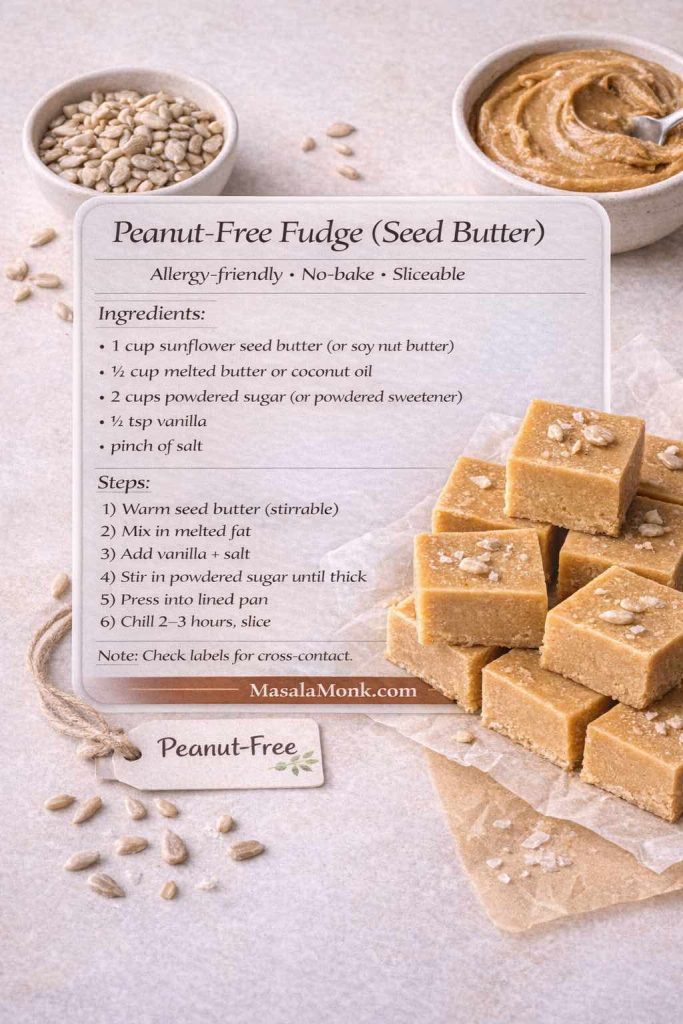
  • 1 cup sunflower seed butter (or another peanut-free alternative)
  • ¼ cup melted butter (or coconut oil)
  • 2 cups powdered sugar (or suitable alternative)
  • ½ teaspoon vanilla
  • Pinch of salt
Photorealistic recipe card for peanut-free fudge made with seed butter. Shows sunflower seed butter (or soy nut butter) fudge squares and lists ingredients (seed butter, melted butter or coconut oil, powdered sugar or powdered sweetener, vanilla, salt) and steps to warm, mix, press into a lined pan, and chill 2–3 hours. Includes safety note to check labels for cross-contact. MasalaMonk.com branding.
This peanut-free fudge uses sunflower seed butter for an allergy-friendly, no-bake treat that still slices clean. Save this card for school events, parties, and potlucks—same easy method, different spread. Always check labels for cross-contact if you’re cooking for peanut allergies.

Step-by-step

  1. Line your pan with parchment.
  2. Warm the seed butter slightly so it stirs smoothly.
  3. Mix in melted butter until glossy.
  4. Add vanilla and salt.
  5. Stir in powdered sugar gradually until thick and spreadable.
  6. Press into the pan and chill until set.

Important reminder

Even when you use peanut-free ingredients, always check labels for cross-contact warnings if you’re cooking for someone with severe allergies.

Also Read: How to Cook Bacon in the Oven (Crispy, No-Mess, Crowd-Ready Recipe)


Troubleshooting: fix texture issues without panic

Even when you follow directions, fudge can surprise you. Fortunately, most problems have straightforward fixes.

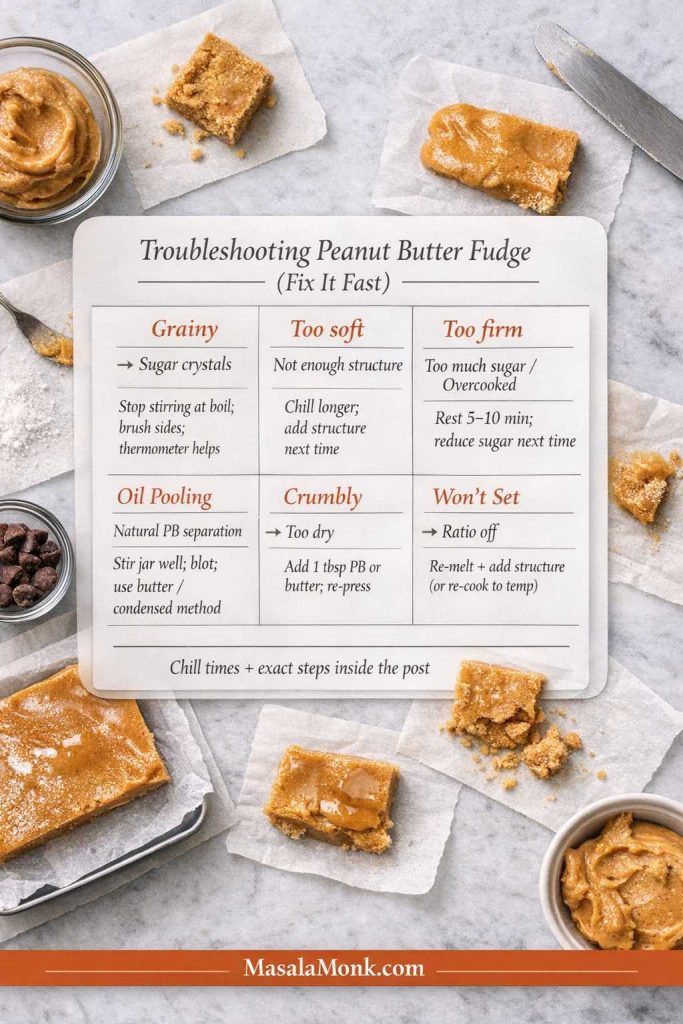
Troubleshooting infographic for peanut butter fudge with quick fixes for common problems: grainy texture (sugar crystals), fudge too soft, too firm, oil pooling from natural peanut butter separation, crumbly/dry fudge, and fudge that won’t set. Includes simple solutions like chilling longer, adjusting structure, stirring techniques for cooked fudge, and re-pressing, with MasalaMonk.com branding.
Fudge didn’t turn out the way you wanted? Save this quick troubleshooting guide for peanut butter fudge—fix grainy batches, rescue fudge that’s too soft or too firm, handle oil pooling (common with natural peanut butter), and recover crumbly or won’t-set slabs without starting over.

If it’s grainy

Graininess usually comes from sugar crystallization in cooked batches. To reduce the chance:

  • Avoid stirring while the mixture boils.
  • Use a clean pastry brush and water to wash sugar crystals from the sides early.
  • Consider the corn syrup method if you want extra insurance. King Arthur’s explanation of corn syrup’s role is helpful for understanding why it works.

Your Peanut butter fudge is too soft

  • Chill longer first; many slabs firm up with time.
  • For no-bake versions, add a bit more powdered sugar (or powdered sweetener) next time.
  • For condensed milk versions, slightly increase peanut butter or reduce condensed milk a touch.

If it’s too firm

  • Let it sit at room temperature for several minutes before serving.
  • In future batches, reduce powdered sugar slightly, or add a bit more fat (butter/coconut oil).

And If oil pools on top of your peanut butter fudge

This happens most often with natural peanut butter that separates easily.

  • Stir the peanut butter extremely well before measuring.
  • Chill the slab, then blot any surface oil gently with paper towel.
  • Next time, use the 3-ingredient method or a condensed milk base for a more stable set.

If it crumbles when slicing

Crumbly no-bake fudge usually needs more binding:

  • Add a spoonful of warmed peanut butter and mix again.
  • Alternatively, add a tablespoon of melted butter and re-press.

Also Read: Benefits of Nuts and Seeds – Protein-Packed Superfoods


Slicing, serving, and pairing ideas

Slicing goes best when the slab is cold and firm. Use a long knife, warm it under hot water, wipe dry, and slice in decisive downward cuts. Then, wipe the blade between slices for clean edges.

Step-by-step infographic showing how to slice and store peanut butter fudge for clean squares. Includes tips to chill until firm, warm and dry the knife, cut straight down (no sawing), and wipe the blade between slices. Storage guidance includes using an airtight container, parchment between layers, refrigerating for cleaner slices, and freezing by wrapping tightly and thawing in the fridge. MasalaMonk.com branding.
Want clean, sharp peanut butter fudge squares? Save this slicing + storage guide: chill the slab, warm and dry your knife, cut straight down, and wipe between slices. It also shows the best way to store peanut butter fudge (airtight + parchment layers) and how to freeze it without the surface getting messy when thawed.

For a peanut-butter-themed dessert plate, pairing squares with cookies makes everything feel intentional. MasalaMonk’s peanut butter cookies fit naturally alongside any of these methods. Meanwhile, if you want a lighter contrast, these healthy oat cookies balance rich fudge nicely. Finally, for something bright and fruity on the same spread, MasalaMonk’s mango dessert ideas bring a fresh counterpoint.


A closing thought (and a simple way to pick your winner)

If you’re short on time, start with the 2-ingredient batch. If you’re after creamy reliability, choose the condensed milk method. And if you want plush nostalgia, marshmallow creme is the move. When you want true candy-shop character, go cooked soft-ball stage. After that, chocolate turns any version into a showpiece—especially buckeye-style with a glossy cap.

Once you’ve made two or three styles, you’ll notice something: the “best” one changes depending on the day. Sometimes you want the easiest pan imaginable. Other times you want a softer melt, a deeper cooked flavor, or an allergy-friendly swap so everyone can share. Luckily, all of those are within reach—one method at a time.

Also Read: High Protein Overnight Oats | 5 Recipes (Low Calorie, Vegan, Bulking & More)


FAQs

1. What is the best peanut butter fudge recipe for beginners?

If you’re new to fudge, start with a no-bake peanut butter fudge that uses powdered sugar (the 2-, 3-, or 4-ingredient styles). It’s straightforward, doesn’t require a thermometer, and sets firmly in the fridge. After that, try the condensed milk or cooked soft-ball versions when you want a more candy-shop finish.

2. What are the ingredients in peanut butter fudge?

Peanut butter fudge usually needs peanut butter + a sweetener/structure. Depending on the method, that structure can be powdered sugar, sweetened condensed milk, marshmallow creme, or a cooked sugar base. In addition, many recipes include butter, vanilla, and salt to improve texture and flavor.

3. How do you make two ingredient peanut butter fudge?

Two-ingredient peanut butter fudge is typically peanut butter + powdered sugar. Warm the peanut butter just until stirrable, then mix in powdered sugar until the mixture becomes thick and pressable. Finally, press it into a lined pan and chill until firm.

4. How do you make three ingredient peanut butter fudge?

Three-ingredient versions usually add melted butter to peanut butter and powdered sugar. The butter makes the mixture creamier and easier to spread. Once combined, chill until sliceable.

5. What makes four ingredient peanut butter fudge taste “best ever”?

Four-ingredient peanut butter fudge often includes vanilla (plus peanut butter, butter, and powdered sugar). Vanilla and salt make the flavor taste more complete, while the butter keeps the bite smoother. As a result, it reads more like a finished candy than a quick mix.

6. Can I make peanut butter fudge with sweetened condensed milk?

Yes. For a reliable, creamy set, condensed milk versions usually need an additional “setting” ingredient (commonly white chocolate chips) or extra dry structure (like powdered sugar). Otherwise, condensed milk and peanut butter alone can stay too soft, especially in warmer kitchens.

7. What is marshmallow creme or fluff peanut butter fudge?

Marshmallow creme (or fluff) versions are often called fantasy-style peanut butter fudge. Typically, you cook a sugar base to the soft-ball stage, then beat in marshmallow creme and peanut butter. Consequently, the texture turns plush, cohesive, and sliceable for days.

8. How do you make old fashioned peanut butter fudge?

Old fashioned peanut butter fudge is a cooked method that usually requires reaching the soft-ball stage (about 234–236°F / 112–113°C). After cooking, you cool it briefly, then beat until it thickens and loses some shine before pouring into the pan. That timing is what creates the classic creamy bite.

9. What is corn syrup peanut butter fudge, and why use it?

Corn syrup versions are cooked fudge with an extra helper ingredient. Corn syrup helps reduce crystallization, which can lead to a smoother texture. In other words, it’s a more forgiving route when you want cooked fudge flavor without as much risk of graininess.

10. How do you make chocolate peanut butter fudge?

You can add chocolate in three easy ways: mix cocoa into the base, swirl melted chocolate through before chilling, or add a top layer for a buckeye-style finish. Meanwhile, using milk chocolate chips gives a softer, sweeter “candy bar” vibe, while dark chocolate makes the peanut flavor pop.

11. What is buckeye fudge?

Buckeye fudge is a peanut butter fudge base topped with a firm chocolate layer. Once the peanut butter layer is set, pour melted chocolate (often with a little butter or coconut oil for shine) over the top. Then chill again and slice with a warm knife for neat layers.

12. Can I make no bake peanut butter fudge?

Definitely. No-bake peanut butter fudge usually sets by using powdered sugar or a structured base like frosting. Because there’s no cooking stage, it’s faster and less fussy. Still, measuring and mixing thoroughly matters for a clean set.

13. Why is my peanut butter fudge grainy?

Graininess usually comes from sugar crystallization in cooked fudge, or from undissolved granules. To prevent it, avoid stirring once the mixture boils, keep crystals off the sides of the pan, and use a thermometer for accuracy. Conversely, if it’s a no-bake sweetener issue, switching to a powdered-style sweetener often helps.

14. Why is my peanut butter fudge too soft?

First, give it more chill time—many batches firm up as they cool fully. If it’s still soft, the mixture likely needs more structure: add a bit more powdered sugar (or powdered sweetener) next time. For cooked versions, it may not have reached soft-ball temperature, so a thermometer is the quickest fix.

15. Why is my peanut butter fudge crumbly or dry?

This usually means there’s too much dry structure or not enough fat. Add a spoonful of warmed peanut butter (or a little melted butter) and mix again, then press firmly into the pan. Next time, use slightly less powdered sugar or choose the condensed milk or marshmallow method for a creamier set.

16. Why did oil pool on top of my peanut butter fudge?

This happens most often with natural peanut butter that separates easily. Stir the jar extremely well before measuring, then chill and blot any surface oil if needed. Additionally, choosing a method with more stability (butter, condensed milk, or cooked fudge) can reduce pooling.

17. Can I make sugar free peanut butter fudge?

Yes, as long as you use a powdered-style sugar-free sweetener for the smoothest texture. Granular sweeteners can feel gritty in no-bake candy squares. Also, sweetness levels vary by brand, so taste as you go and adjust slowly.

18. Can I make keto peanut butter fudge?

Keto peanut butter fudge typically uses peanut butter with no added sugar, a fat like butter or coconut oil, and a powdered keto sweetener. If it sets very hard, let it sit at room temperature briefly before serving. On the other hand, if it stays too soft, add a little more powdered sweetener next time.

19. How do you make peanut free fudge?

To make peanut-free fudge, swap peanut butter for a safe alternative like sunflower seed butter or soy nut butter, then follow the same no-bake method. However, if you’re baking for allergies, always check labels and watch for cross-contact warnings.

20. How long does peanut butter fudge last and how should I store it?

For the best texture, store peanut butter fudge in an airtight container with parchment between layers. In a cool room, it can last several days; in the fridge, it lasts longer and slices cleaner. Furthermore, freezing works well—wrap tightly and thaw in the fridge so the surface doesn’t sweat.