Posted on Leave a comment

Beet Juice Recipe

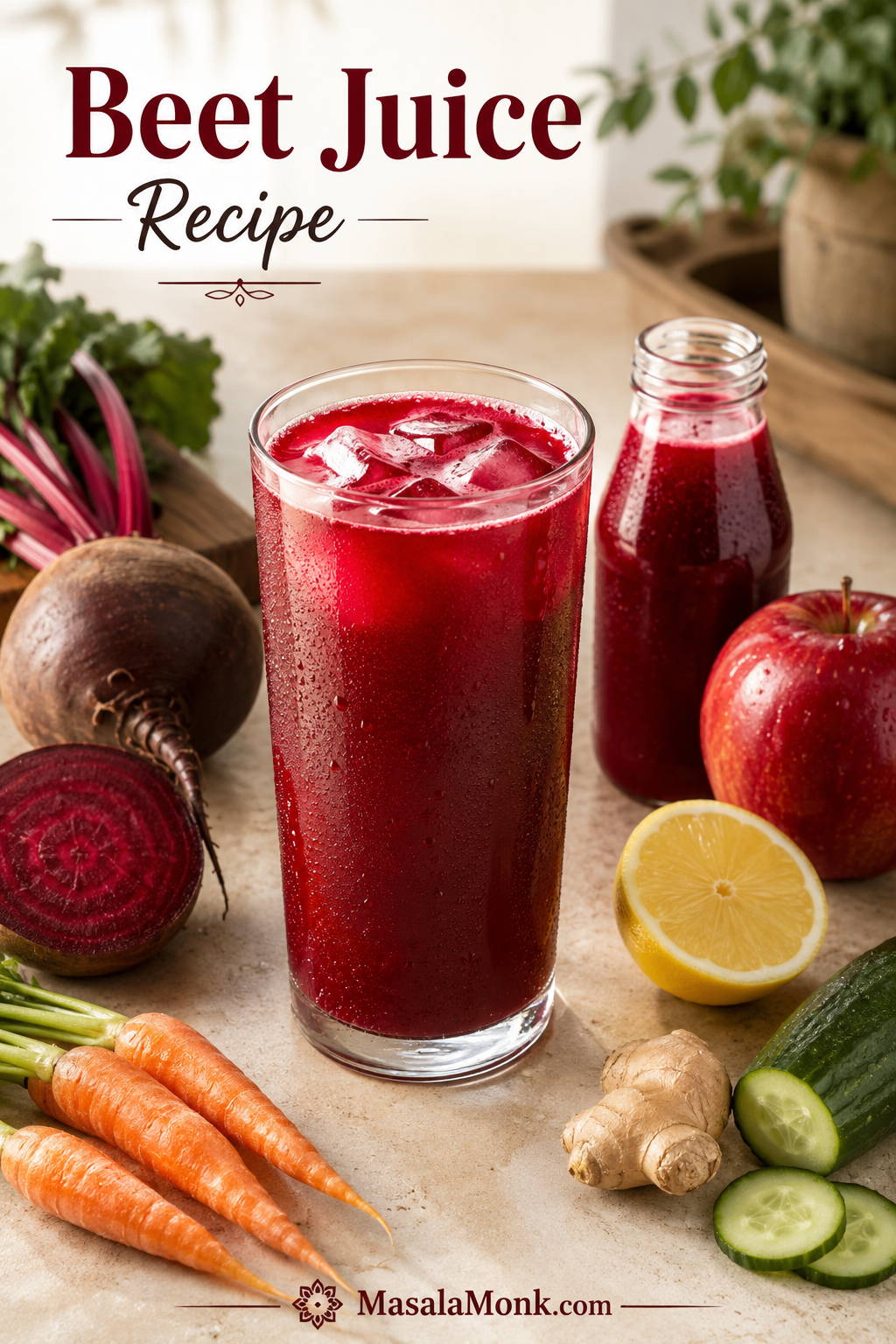
Chilled glass of ruby-red homemade beet juice with ice, a small bottle of juice, and fresh beetroot, carrots, apple, lemon, ginger, and cucumber on a light kitchen surface.

Beet juice can go one of two ways. Made carelessly, it tastes earthy, heavy, and a little too close to drinking a glass of soil. Made with the right balance, it turns into a chilled, ruby-red juice that tastes lively, lightly sweet, tart, and just spicy enough from ginger.

This beet juice recipe is for that second version. It uses raw beetroot for color and depth, carrot and apple for natural sweetness, lemon for brightness, ginger for lift, and optional cucumber to make the whole glass easier to sip. The first taste should feel clear and awake, not muddy.

This is not straight beetroot juice. It is a balanced beet-carrot-apple juice designed to taste cool, tart, lightly sweet, and easy to finish.

You can make this beetroot juice recipe in a juicer for the smoothest texture, or in a blender if you do not own a juicer. The blender version needs water and proper straining, but it still works beautifully when you know what the mixture should look and feel like. It is especially helpful if you are making it for the first time, dislike plain beetroot juice, or want a balanced glass without added sugar.

No juicer at home? Skip to the blender method. Already ready to make it? Jump to the full recipe card.

Start with the quick recipe, then come back to the sections below when you want to adjust the flavor, make it without a juicer, store it safely, or understand what the health claims actually mean.

Beet Juice Recipe Guide

Use this as a quick recipe first, then as a troubleshooting guide whenever you want a smoother blender batch, a less earthy glass, or a safer way to store leftovers.

Quick Answer: How to Make Beet Juice

To make beet juice, juice or blend raw beetroot with carrot, apple, lemon, ginger, and optional cucumber. If using a juicer, feed the produce through the machine, then stir in the lemon juice and serve over ice. If using a blender, add cold water, blend until smooth, then strain through a nut milk bag, cheesecloth, or fine mesh strainer.

This beetroot juice recipe makes about 16–18 oz / 475–530 ml, enough for 2 standard 8 oz / 240 ml glasses or 3 smaller 5 oz / 150 ml servings. It takes about 10 minutes, uses no added sugar, and tastes brightest right after making. Here, beet juice and beetroot juice mean fresh juice made from raw red beetroot, not pickled beet brine, canned beet liquid, or beet powder mixed into water.
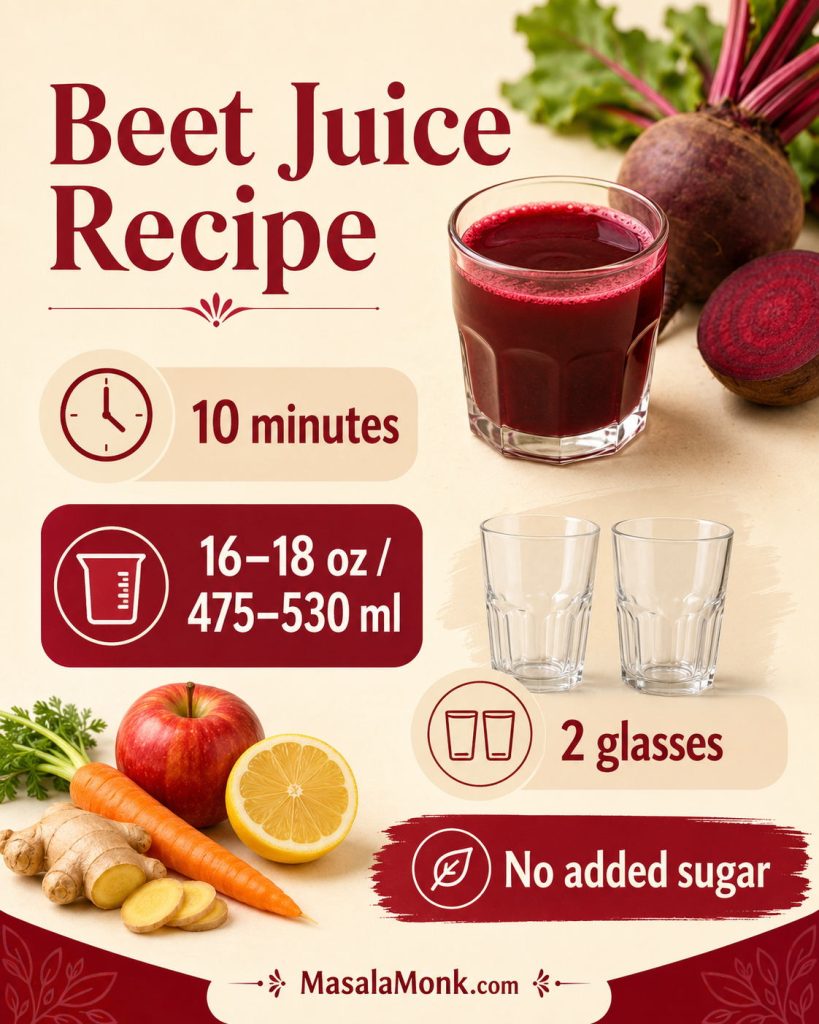
At-a-glance beet juice recipe graphic showing a glass of beet juice, 10 minutes, 16–18 ounces, two glasses, and no added sugar.
Since this fresh beet juice takes about 10 minutes and makes two glasses, it works best as a quick just-made drink rather than a big storage batch.

Easiest first glass: if your first memory of beet juice is something thick, muddy, or aggressively earthy, do not start with straight beetroot. Make the apple-beet-carrot version first, serve it over ice, then adjust lemon, cucumber, or ginger after tasting.
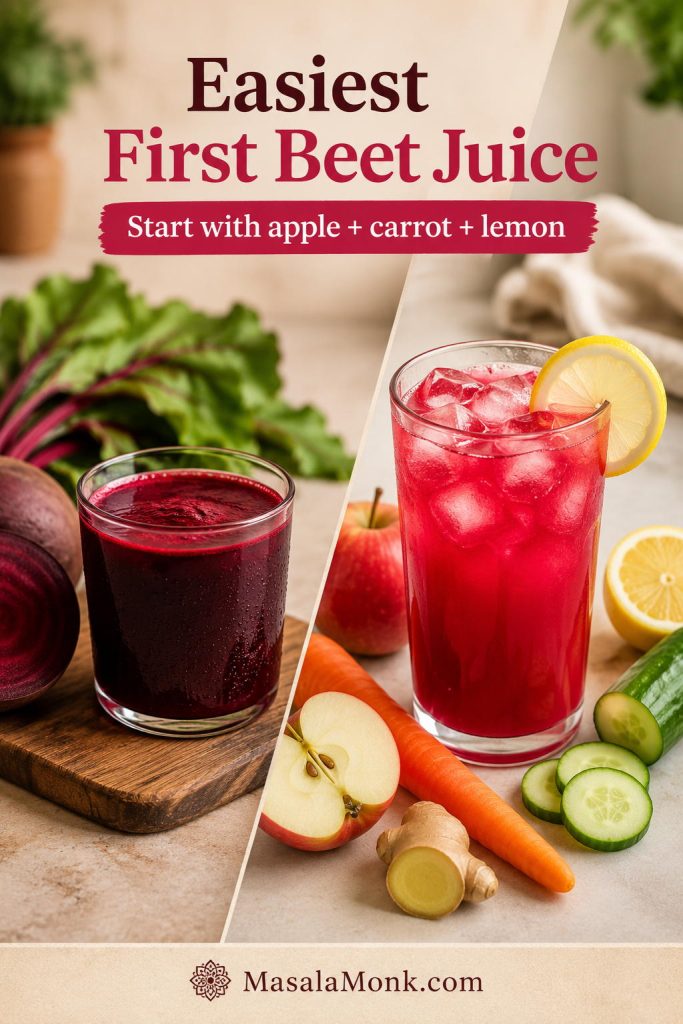
Split image comparing a darker straight beetroot juice with a brighter beginner-friendly apple, beet, carrot, lemon, ginger, and cucumber juice over ice.
When plain beetroot juice tastes too earthy, apple and carrot make the first glass gentler; then lemon, ginger, cucumber, and ice help it feel refreshing.

Still worried about the earthy flavor? See the taste fixes before you make your first batch.

Quick Beet Juice Formula

  • Base: 1 medium-large beetroot or 2 small beets, about 225–250 g / 8–9 oz
  • Balance: 2 carrots and 1 large apple for natural sweetness
  • Brightness: ½ lemon, about 15–20 ml juice
  • Lift: ½–1 inch fresh ginger, about 5–10 g
  • Lightness: ½ cucumber, optional, about 75–100 g / 3–4 oz
  • Blender only: ½–1 cup / 120–240 ml cold water
  • Serve: over ice, right after making

The 10-Minute Version

Juice or blend 1 beetroot, 2 carrots, 1 apple, ½ lemon, ½–1 inch ginger, and optional cucumber. If blending, add ½ cup / 120 ml cold water, blend for 45–60 seconds, strain well, and serve over ice. Add more water only if the blender needs help.

Serve it with breakfast, as an afternoon caffeine-free drink, or as a small pre-workout glass after you know how your body handles it.

Why This Beet Juice Recipe Works

The trick is not hiding the beetroot. It is balancing it. Beetroot gives the drink its deep color, earthy sweetness, and unmistakable flavor, but it needs the right supporting ingredients so the glass does not taste flat or muddy.

Carrot is the quiet helper here: it softens beetroot’s rooty edge without making the glass taste like fruit punch. Apple makes the drink more beginner-friendly. Lemon is the difference between a dull beet juice and one that tastes like it belongs in a glass with ice. Ginger adds a bright, spicy finish. Cucumber is the ingredient to add when the juice feels a little too serious, dense, or beet-forward.

For a beginner-friendly glass, keep beetroot to roughly one-third of the total produce volume and let carrot, apple, cucumber, and citrus do the balancing. If your batch tastes too rooty or heavy, it usually does not need sugar first. It needs acid, coldness, dilution, or a better mix.

Temperature matters too. Room-temperature juice tastes flatter and heavier than a chilled glass, so use refrigerated produce when possible or serve the finished glass over plenty of ice. The final drink should pour easily, taste lightly sweet and tart, and finish with gentle ginger warmth.

What Does Beet Juice Taste Like?

The drink tastes earthy, lightly sweet, mineral-like, and bold. That rooty note is the part people either love or struggle with. Straight beetroot juice can feel intense, especially if you are new to it.

The first sip of this version should be cool and lightly tart, with apple-carrot sweetness in the middle and gentle ginger warmth at the end. Juicer beet juice will feel thinner and clearer. The blender version, even after straining, may feel slightly fuller. Both should still pour like juice, not spoon like a smoothie.

Best beginner version: Use 1 small beet, 2 carrots, 1 apple, ½ lemon, ½ inch ginger, and ½ cucumber. This keeps the beet flavor present but not overpowering.

Once you like the base, adjust one thing at a time: more lemon for tartness, more apple for sweetness, more cucumber for lightness, or more ginger for heat.

Ingredients for the Best Beet Juice

The best glass needs contrast. You want enough beetroot for color and flavor, enough natural sweetness to soften the mineral notes, enough citrus to keep it crisp, and enough chill or cucumber to make it easy to sip.
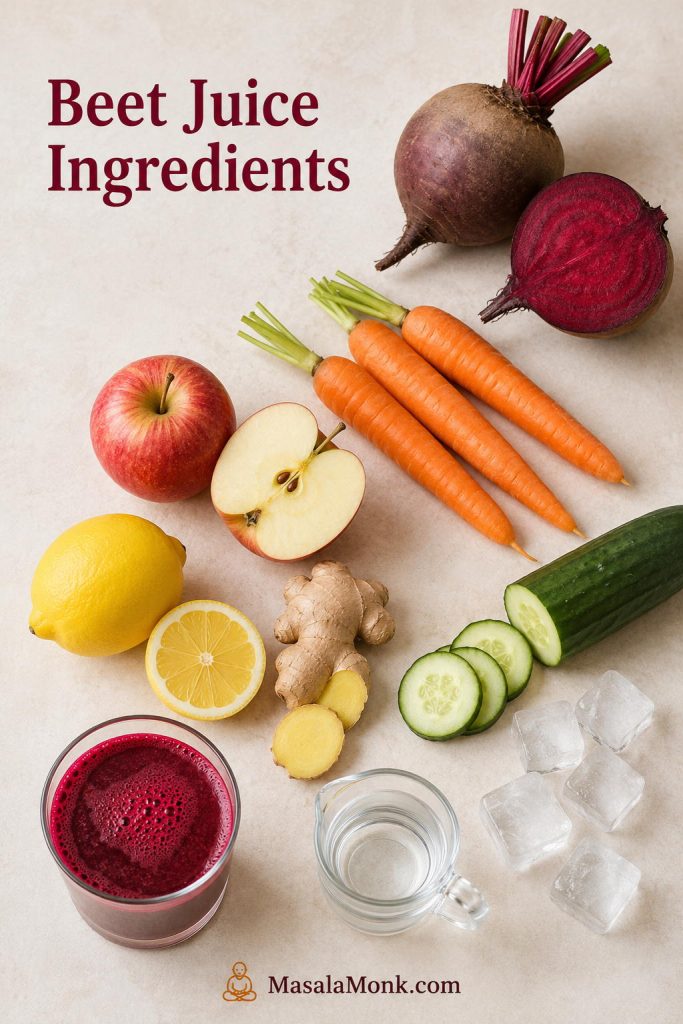
Overhead layout of beet juice ingredients including cut beetroot, carrots, apple, lemon, ginger, cucumber, ice, and water for the blender method.
Each ingredient has a purpose: beetroot adds depth, carrot and apple soften the flavor, lemon lifts it, and ginger gives the juice a cleaner finish.
IngredientAmountWhy it matters
Raw red beetroot1 medium-large or 2 small beets, about 225–250 g / 8–9 ozThe base of the juice; gives color, earthy sweetness, and the classic beet flavor.
Carrots2 medium, about 120–150 g / 4–5 ozAdds natural sweetness and helps round out beetroot’s deeper edge.
Apple1 large, about 170–200 g / 6–7 ozMakes the juice more beginner-friendly and naturally sweet without added sugar.
Lemon½ lemon, about 15–20 ml juiceBrightens the juice and keeps the beet flavor from tasting flat.
Fresh ginger½–1 inch, about 5–10 gAdds warmth, sharpness, and a lively finish.
Cucumber, optional½ small cucumber, about 75–100 g / 3–4 ozLightens the flavor and makes the juice more refreshing.
Cold water½–1 cup / 120–240 ml, blender method onlyHelps the blender move and controls thickness. Do not add it when using a juicer.
IceAs neededMakes the finished glass more refreshing.

Juice yield varies by beet size, carrot freshness, apple variety, juicer type, and how firmly you press the pulp in the blender method. The amounts above usually make about 16–18 oz / 475–530 ml strained juice. A juicer usually gives the clearest yield without added water, while the blender version may make a little more volume because of the water, but with a slightly softer flavor.

Beetroot

Use raw red beets for the brightest color and crispest flavor. Scrub them well because beets grow in soil and often carry grit around the root end. Peeling is optional if the beets are tender-skinned and scrubbed well, but peel them if the skin is rough, bitter, waxed, or hard to clean.

How to Choose Beets for Juice

Choose firm, heavy beets with smooth skin and no soft, wrinkled, moldy, or badly bruised spots. Small to medium beets often taste sweeter and less woody than very large ones. If the beets come with greens attached, trim the greens off before storing, then scrub the roots well before peeling or cutting.
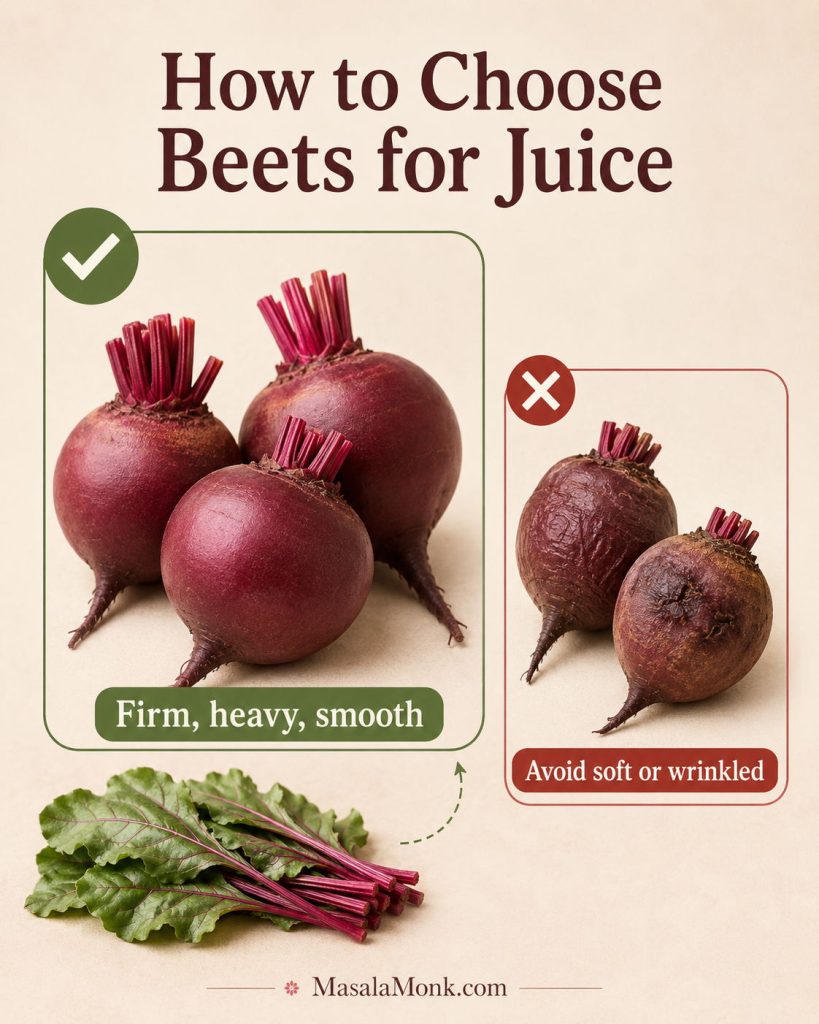
Produce guide showing firm fresh beets for juicing next to softer or wrinkled beets to avoid, with beet greens trimmed nearby.
Better beetroot juice starts before you juice anything, so choose firm, heavy, smooth roots and skip soft or wrinkled beets that can taste woody.

If your beets come with greens, save the tender leaves for cooking rather than adding a large handful to this juice. Beet greens can make the drink taste more grassy and bitter.

Carrot

Carrot is one of the easiest ways to make this drink taste better. It brings mellow sweetness without turning the glass into a fruit-heavy juice, and it also works beautifully in apple beet carrot juice, often called ABC juice. MasalaMonk’s guide to vitamins in carrots goes deeper into carrot juice, raw carrots, cooked carrots, and their key nutrients.

Apple

A crisp sweet-tart apple is ideal. Gala, Fuji, Honeycrisp, Pink Lady, or any good eating apple will work. Green apple gives a sharper, less sweet result. Red apple gives a softer, sweeter glass.

Lemon or Lime

Citrus makes the beet taste awake. Stir lemon juice in at the end if you are using a juicer, or peel the lemon and blend it with the produce if you are using a blender. Avoid blending too much white pith because it can make the drink bitter.

Ginger

Fresh ginger makes the flavor lighter and less heavy. Start with ½ inch if you are sensitive to heat. Use the full inch if you want a stronger beet ginger juice with a spicy finish.

Cucumber or Celery

Cucumber is optional, but it is one of the most useful ways to make the glass easier to drink. It increases the yield, cools the flavor, and gives the juice a more refreshing finish. Celery works too, though it tastes more savory and slightly salty. If you like the cucumber-lemon-ginger side of this recipe but want something lighter than juice, MasalaMonk’s guide to cucumber, lemon, and ginger water is a good companion.

Raw Beets vs Cooked Beets for Juice

Use raw beets for the most refreshing beet juice. Raw beetroot gives the drink a crisp, earthy-sweet flavor. Cooked beets are softer and sweeter, but they make the drink taste more like cooked beet puree than just-made juice.
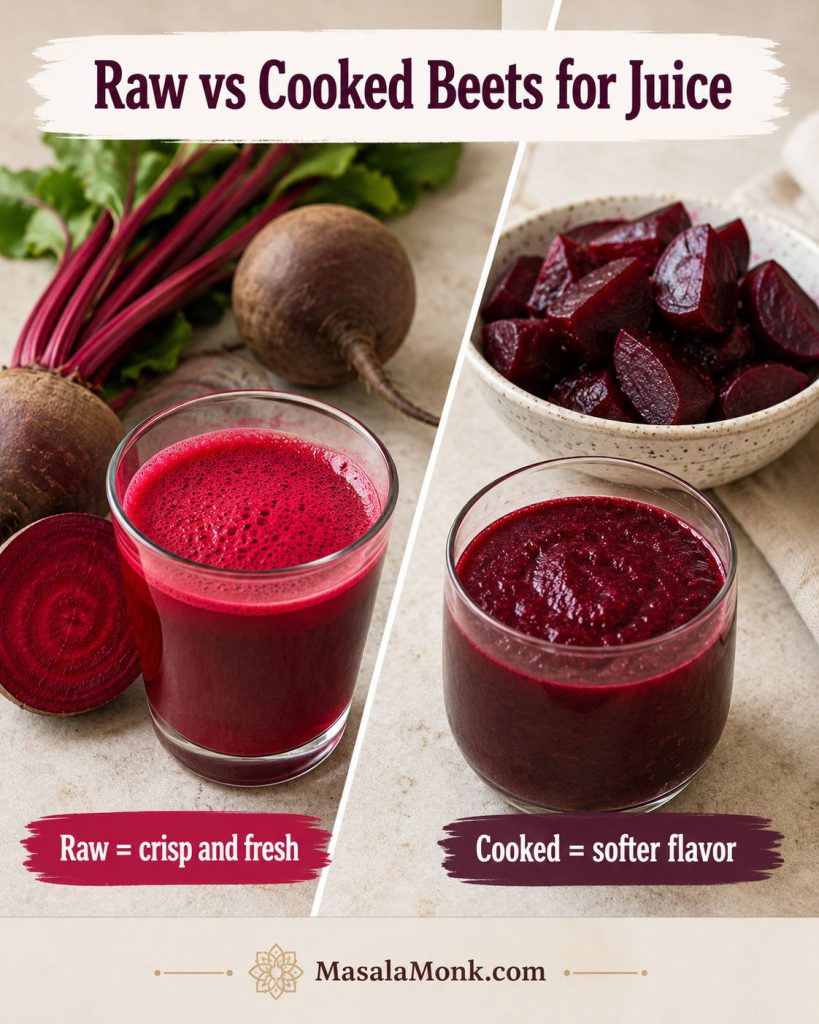
Comparison image showing raw beets with bright beet juice and cooked beets with a softer, thicker blended beet drink.
Raw beets make the crispest beet juice, whereas cooked beets create a softer blended drink that tastes closer to beet puree.

If you only have cooked beets, you can blend them with apple, lemon, ginger, and cold water, then strain the mixture. However, cooked beets do not work well in most juicers, and they will not give the same lively flavor as raw beetroot.

Avoid pickled beets for this recipe unless you specifically want a vinegar-heavy drink. Pickled beet juice has a completely different flavor profile because it usually contains vinegar, salt, and sometimes sugar.

How to Make Beet Juice in a Juicer

The juicer method is the fastest way to make a smooth, clear glass. It gives you the crispest flavor because you do not need to dilute the produce with water.
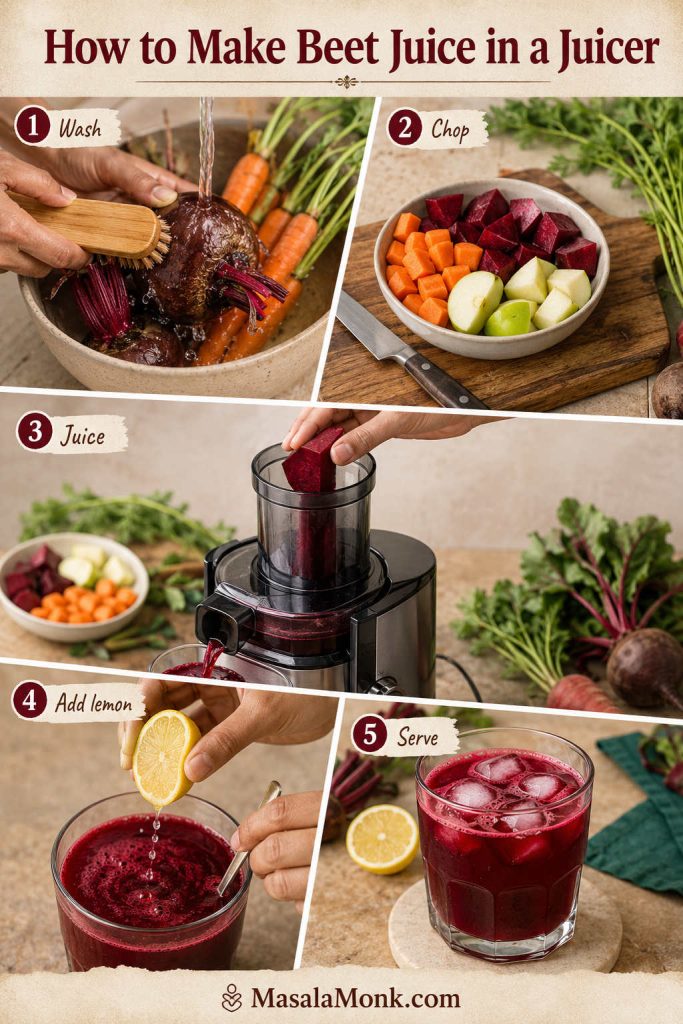
Step-by-step juicer method showing beets and carrots being washed, chopped produce, beetroot going into a juicer, lemon added to juice, and beet juice served over ice.
Because the juicer presses the produce directly, this method gives a smoother, more concentrated glass without needing blender water.
  1. Wash and scrub the produce. Pay special attention to the beetroot and carrots.
  2. Trim the beetroot. Cut off the root end and any rough top area.
  3. Peel if needed. Peeling is optional for tender-skinned beets that have been scrubbed well. Peel rough, waxed, or dirty beets.
  4. Cut everything to fit the juicer chute. Do not force oversized beet chunks through the machine.
  5. Juice the beet, carrots, apple, cucumber, and ginger. Alternate hard and softer produce so the juicer runs smoothly.
  6. Stir in lemon juice. Adding lemon at the end keeps the citrus flavor lively.
  7. Serve over ice. Drink right away for the brightest taste.

The finished juice should pour easily and look deep ruby-red, not thick like puree. Fresh juice naturally separates as it sits, so stir or shake it before drinking. If the flavor tastes flat, add a little more lemon. If it feels too heavy, pour it over extra ice or add cucumber next time.

How to Make Beet Juice in a Blender Without a Juicer

If you came here wondering how to make beetroot juice without a juicer, the blender method is the easiest place to start. It asks for one extra step — straining — but that step is what turns a thick beet puree into something you actually want to sip.
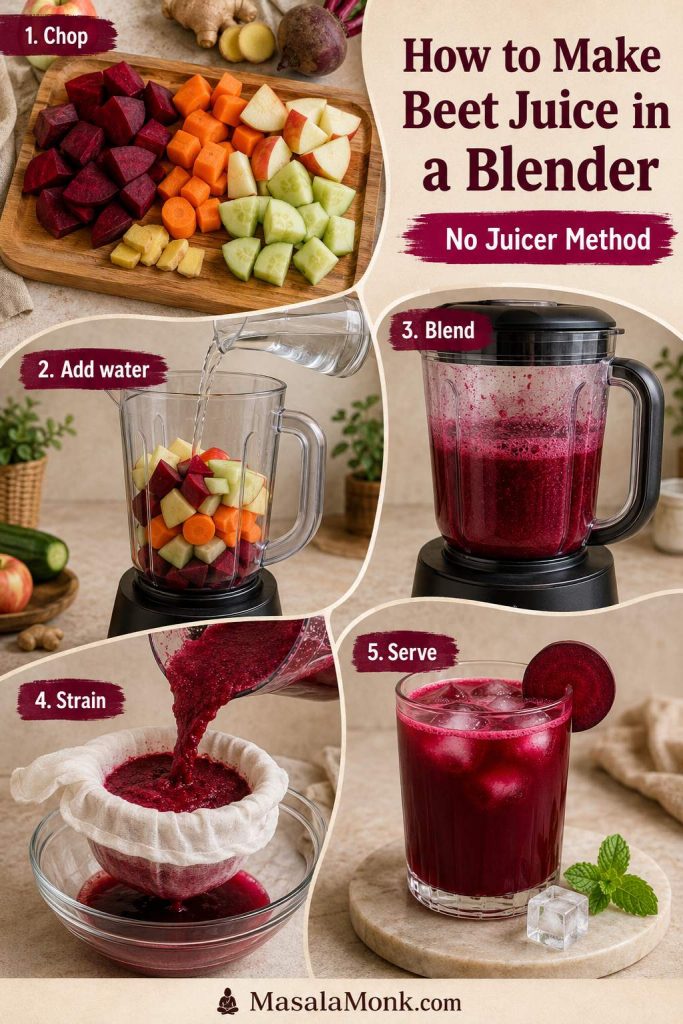
Step-by-step blender method showing chopped beetroot, carrot, apple, cucumber, and ginger, water added to a blender, blended beet puree, straining, and a final glass of juice.
For the no-juicer method, the goal is not a thick smoothie; use just enough water to blend, then strain until the juice pours cleanly.

Still deciding between tools? Compare juicer vs blender beet juice before choosing your method.

  1. Chop the produce smaller than you would for a juicer. Dice the beetroot, carrot, apple, cucumber, and ginger so the blender can handle them.
  2. Add ½ cup / 120 ml cold water first. This helps the blades move without making the juice weak.
  3. Blend on high for 45–60 seconds. The mixture should look like a smooth, thick ruby puree.
  4. Add more water only if needed. If the blender stalls or groans, pause, scrape down the sides, and add water 2 tablespoons / 30 ml at a time, up to 1 cup / 240 ml total.
  5. Strain the mixture. Pour it into a nut milk bag, cheesecloth-lined strainer, or fine mesh strainer set over a bowl or jug.
  6. Let it sit briefly, then squeeze. Give it 2–5 minutes to drain, then press or squeeze to extract as much juice as possible.
  7. Serve over ice. Drink while the flavor is still lively.

How to Strain Beet Juice Smoothly

For blender beet juice, the straining step is where the texture changes from thick puree to a lighter drink. Give the pulp a few minutes to drain before squeezing, especially if you are using a nut milk bag.
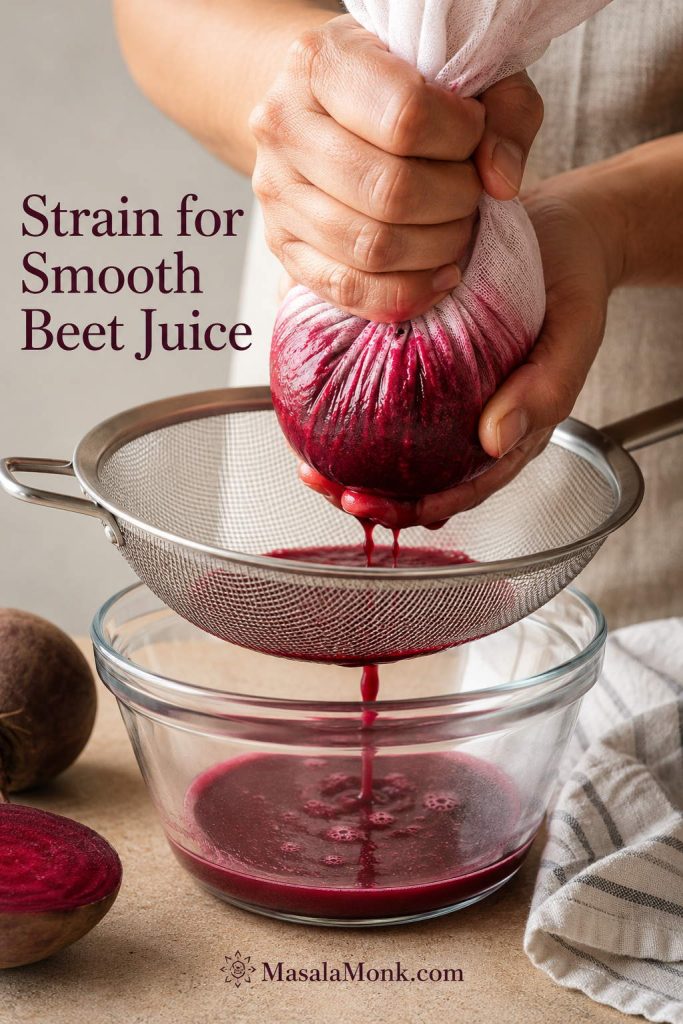
Close-up of hands straining blended beet juice through a nut milk bag or fine mesh strainer into a bowl.
Straining is the step that turns blended beet puree into a lighter, smoother glass of drinkable beet juice.

Blender note: If your first batch looks more like a thick smoothie than juice, you have not failed. It just needs better straining, smaller beet pieces, or a little more patience while the pulp drains. If your blender is not very powerful, use the full 1 cup / 240 ml water and blend in two rounds if needed.

For a little more yield, add 2–3 tablespoons / 30–45 ml cold water to the squeezed pulp, stir or briefly blend again, then strain once more. Skip this second press if you want the strongest flavor.

If your batch is already too thick, watery, or sharp, jump to the troubleshooting guide.

Equipment Needed

Beet juice is simple, but it is not tidy. A little setup saves you from pink fingers, stained towels, and a blender that refuses to move. A juicer gives the smoothest glass, while a blender works well as long as you give it enough liquid and strain properly.
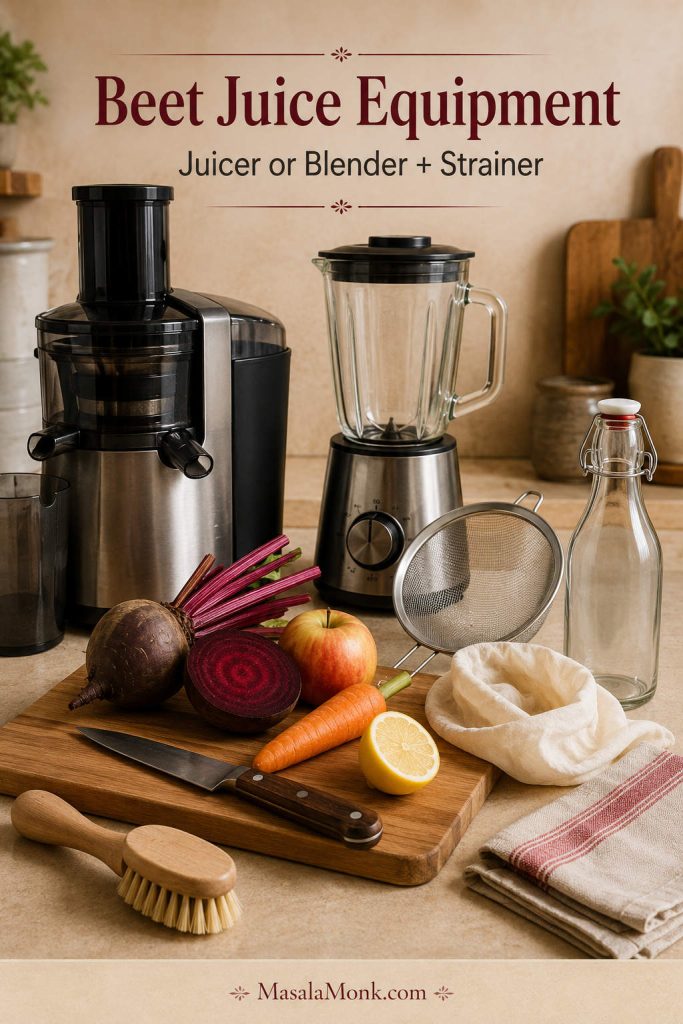
Kitchen counter with beet juice equipment including a juicer, blender, strainer, knife, cutting board, vegetable brush, glass bottle, towel, and fresh produce.
Set up the juicer or blender, strainer, cutting board, and bottle before you start; as a result, beet juice prep stays cleaner and faster.
  • Juicer: best for thin, smooth juice with no added water.
  • Blender: useful if you do not own a juicer; you will need water and a strainer.
  • Nut milk bag, cheesecloth, or fine mesh strainer: needed for the blender method.
  • Vegetable brush: helpful for scrubbing raw beets and carrots.
  • Washable cutting board and knife: important because beet juice stains.
  • Glass bottle or jar: useful if refrigerating leftovers.

Stain warning: Beet juice is beautiful in the glass and ruthless on white towels. Wipe spills quickly, rinse tools right away, and use gloves if you do not want pink fingers.

Juicer vs Blender: Which Method Is Better?

Both methods work, but they do not produce exactly the same drink. A juicer gives you a clearer, lighter result. A blender gives you more flexibility if you do not own a juicer, but you need water and straining.
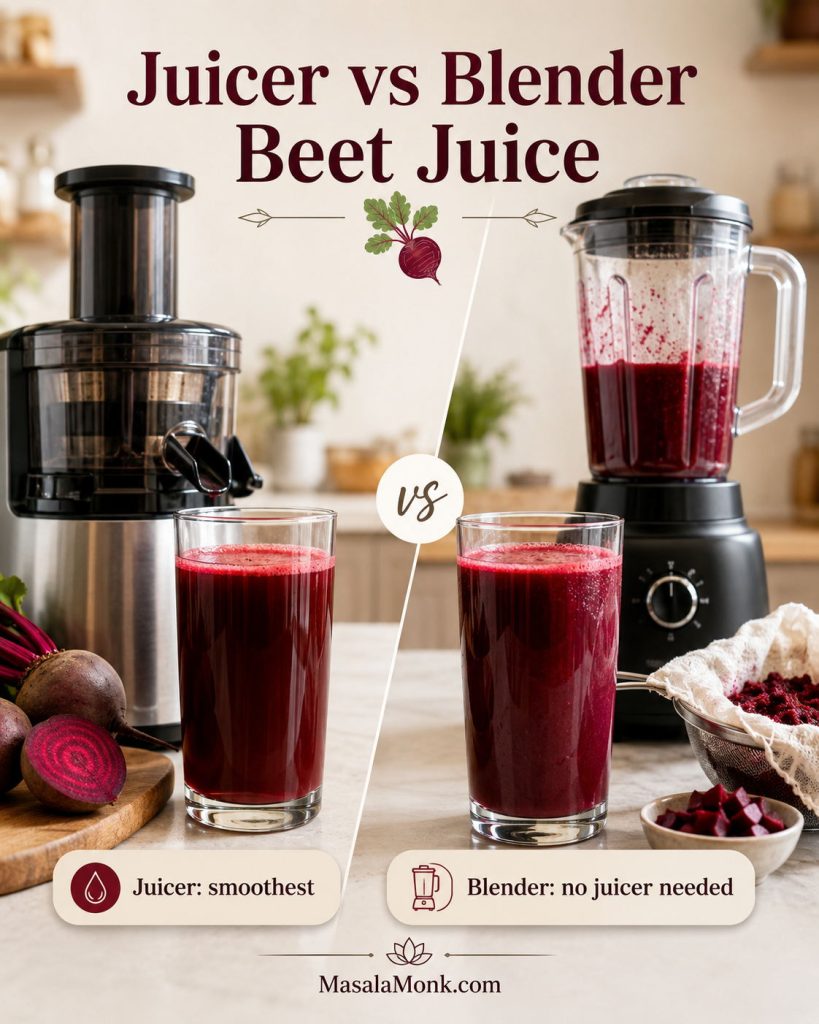
Side-by-side comparison of beet juice made in a juicer and beet juice made in a blender with a strainer nearby.
Choose the juicer when you want the clearest texture, or use the blender when accessibility matters more than a perfectly light finish.
MethodBest forTextureProsCons
JuicerSmooth beet juiceThin, smooth, brightFast, no added water, smoothest juice textureRequires a juicer
Blender + strainerNo-juicer homesSlightly thicker but still juice-likeAccessible, flexible, works with common equipmentNeeds water and straining
Blender, unstrainedThicker blended drinkPulpy, smoothie-likeKeeps more fiber, less wasteNot a true clear juice
Beet powderConvenienceDepends on brand and mixingFast, shelf-stableNot the same flavor or texture as fresh beet juice

If you are deciding whether to buy a juicer, a cold press juicer is often preferred for fresh juice quality, while centrifugal juicers are usually faster and more affordable. MasalaMonk’s guide to cold press vs centrifugal juicers explains the difference in more detail.

Common Beet Juice Mistakes to Avoid

Most disappointing batches come from a few simple mistakes. Before you start, avoid these and the drink becomes much easier to love.
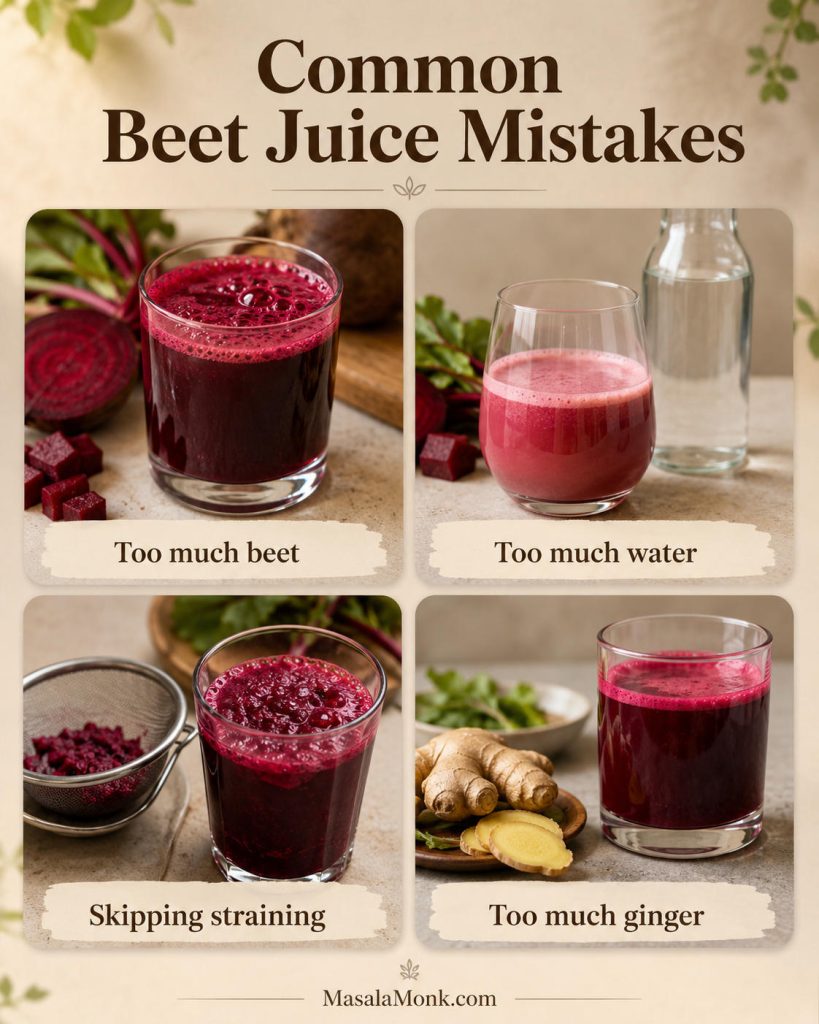
Four-panel beet juice mistakes graphic showing too much beet, too much water, skipping straining, and too much ginger.
Most disappointing batches come from balance issues: too much beet, water, pulp, or ginger can make the glass taste heavy, weak, thick, or harsh.
  • Using only beetroot as a beginner: a pure beetroot batch can taste too intense. Start with apple, carrot, lemon, and ginger.
  • Adding too much blender water: begin with ½ cup / 120 ml and add more only if the blender needs help.
  • Skipping the strainer: unstrained blender juice will be thick and pulpy, closer to a smoothie.
  • Overdoing sharp ingredients: too much ginger or citrus pith can make the juice harsh or bitter, so start small and use lemon juice or peeled citrus.

How to Make Beet Juice Taste Better

The main reason people give up on this drink is not the color or the effort. It is the taste. Beetroot is naturally earthy, so it needs brightness, sweetness, chill, or dilution to feel balanced.
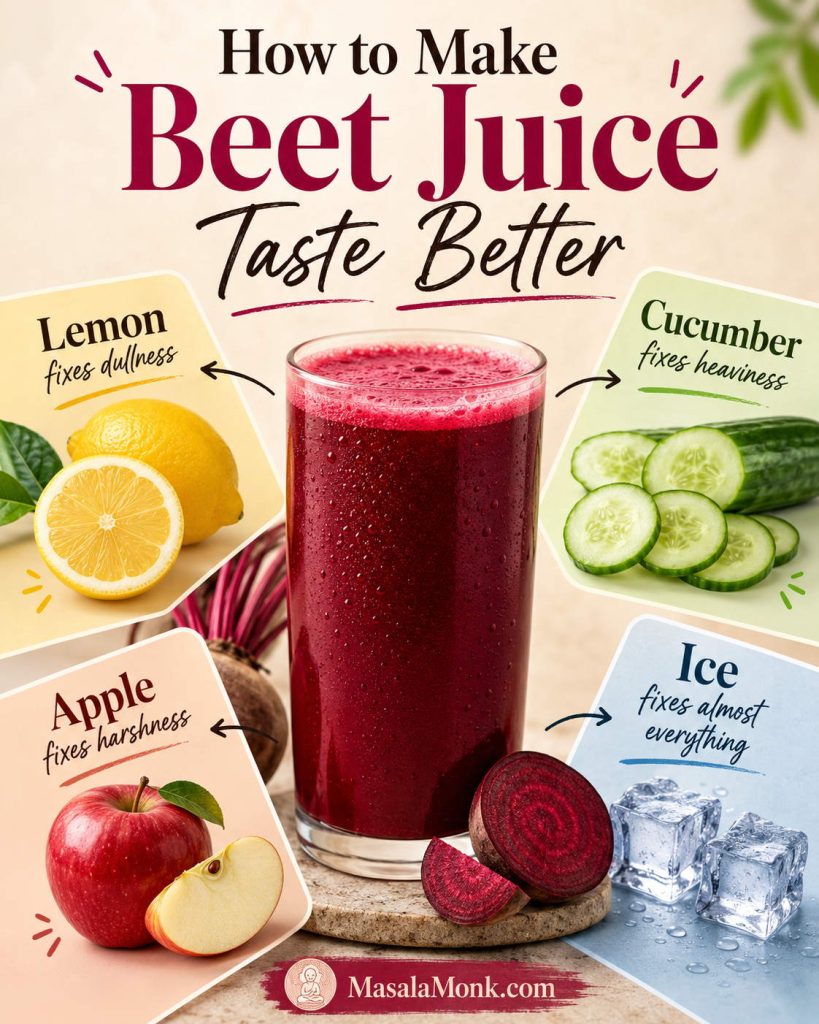
Beet juice taste-fix graphic with lemon, cucumber, apple, and ice around a glass of beet juice.
A strong beet flavor usually needs contrast, not sugar; citrus, cucumber, apple, or ice can shift the drink from heavy to refreshing.
ProblemFix
Too earthyAdd more apple, orange, lemon, cucumber, or carrot.
Too sweetAdd lemon or lime, cucumber, celery, or a little extra ginger.
Too sharp from gingerUse ½ inch ginger instead of 1 inch next time. Dilute this batch with more apple, carrot, or cucumber juice.
Too thickUse a nut milk bag or cheesecloth and squeeze well. Add a little cold water if needed.
Too wateryUse less water next time. Start with ½ cup / 120 ml for blender juice and add only as needed.
Too bitterPeel citrus fully and avoid blending too much white pith.
Too strong for beginnersUse half a beet and increase the carrot or apple.
Not refreshingServe over ice or chill the juice before drinking.

The easiest beginner version is beetroot with both apple and carrot. The crispest version adds cucumber and lemon. The punchiest version leans on ginger and citrus. If the glass tastes flat, it almost always needs lemon. If it tastes heavy, it needs cucumber, ice, or less beet next time.

Remember this flavor rule: lemon fixes dullness, cucumber fixes heaviness, apple fixes harshness, and ice fixes almost everything.

Once the basic glass tastes right, the variations become much easier. You are not guessing anymore; you are choosing whether you want the drink sweeter, sharper, lighter, or stronger.

For the gentlest first variation, try the apple beet carrot juice version.

Best Beet Juice Variations

Once you know the base formula, this juice is easy to adjust. Use these variations as mini-recipes. The juicer method works as written. For the blender method, add ½–1 cup / 120–240 ml cold water and strain unless the variation says it is a smoothie.

Easy Beet Juice Combinations

VariationMini formulaBest for
Apple Beet Carrot Juice / ABC Juice1 beet + 1 apple + 2 carrots + ½ lemon + optional ½ inch gingerBeginner-friendly sweetness and a softer beet flavor
Beet Ginger Lemon Juice1 beet + 1 apple + ½ lemon + 5–10 g ginger + optional cucumberA sharper, livelier juice
Beet Orange Juice1 beet + 1 peeled orange + 1 carrot + 5 g gingerA citrusy breakfast-style glass
Beet Pineapple Juice1 beet + 1 cup pineapple chunks + ½ cucumber + ½ lemonA sweeter tropical version
Beet Pomegranate Juice1 beet + ½–¾ cup unsweetened pomegranate juice + ½ lemonA tart, deep red juice
Low-Sugar Beet Juice½–1 beet + ½ cucumber + 1 celery stalk + ½ lemon + ½ inch gingerA lighter vegetable-forward version
Beet Turmeric Ginger Juice1 beet + ½ inch ginger + small piece fresh turmeric or ¼ tsp ground turmeric + ½ lemonA strong, spicy flavor
Beet Juice ShotBeet + lemon + ginger + small apple piece if neededSmall 2–3 oz / 60–90 ml servings
Beet Juice SmoothieBeet juice or blended beet + banana or berries + yogurt or plant milkA thicker, more filling drink

Apple Beet Carrot Juice / ABC Juice

This is the safest first version if beetroot usually tastes too strong to you. Use a sweet apple for a softer drink or green apple for a sharper one. The carrot keeps the juice mellow, so the beet still shows up without taking over the glass. For more beetroot drink ideas, including beet-ginger-turmeric and ABC-style combinations, see MasalaMonk’s guide to the power of beetroot and beet juice.
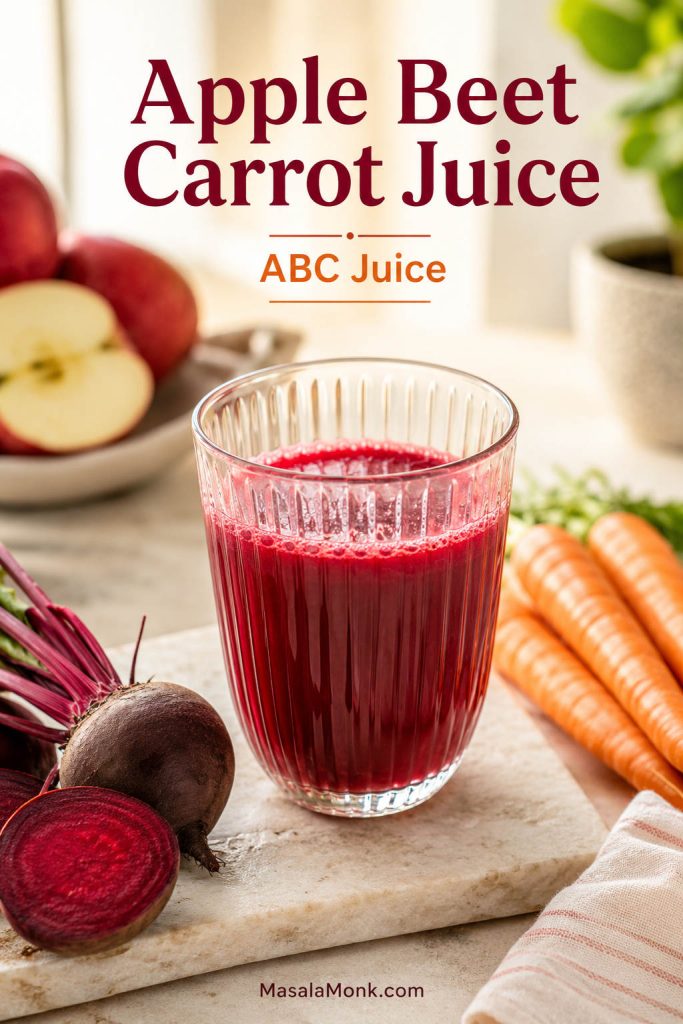
Glass of apple beet carrot juice with fresh apple, beetroot, and carrots on a bright breakfast-style kitchen surface.
Apple beet carrot juice, often called ABC juice, is the gentlest variation because carrot and apple mellow beetroot’s earthy edge.

Beet Ginger Lemon Juice

This version is sharper and less sweet. It is the one to make when you want beet ginger juice with a brighter, spicier finish. Start with less ginger unless you already know you like the heat.
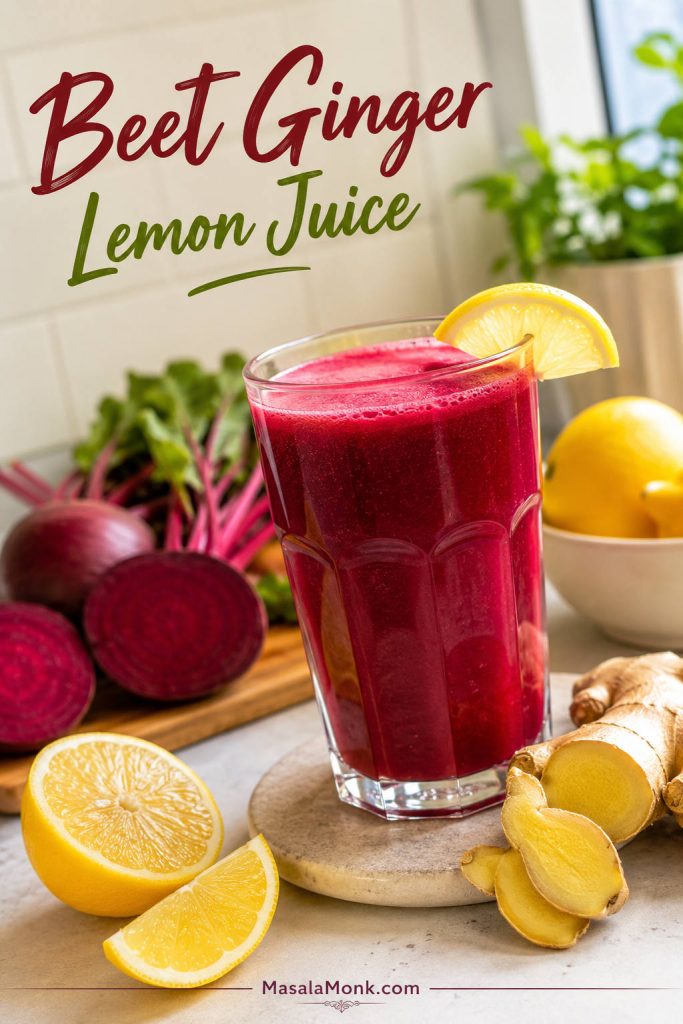
Glass of beet ginger lemon juice with fresh lemon wedges, lemon half, ginger slices, and beetroot nearby.
Beet ginger lemon juice is the sharper variation, so it works well when you want more citrus brightness and a warmer ginger finish.

Beet Orange Juice

Orange makes the drink rounder and more breakfast-friendly. Peel the orange well so the white pith does not make it bitter. This is a good choice when you want something sweeter than lemon but brighter than apple alone.

Beet Pineapple Juice

Pineapple gives this variation tropical sweetness that helps soften the deep beet flavor. Cucumber keeps the drink from becoming too syrupy. This is especially useful when you want the juice to taste more fruity and less vegetable-heavy.

Beet Pomegranate Juice

Pomegranate makes the juice tart, deep, and bold. For the easiest version, use unsweetened pomegranate juice. If using fresh pomegranate arils, blend gently and strain very well, or juice them only if your juicer handles pomegranate arils cleanly.

Low-Sugar Beet Juice

This version skips most of the fruit and uses cucumber, celery, lemon, and ginger for a cleaner vegetable-forward flavor. It will not taste as sweet as the apple-carrot version, but it is lighter and more refreshing.
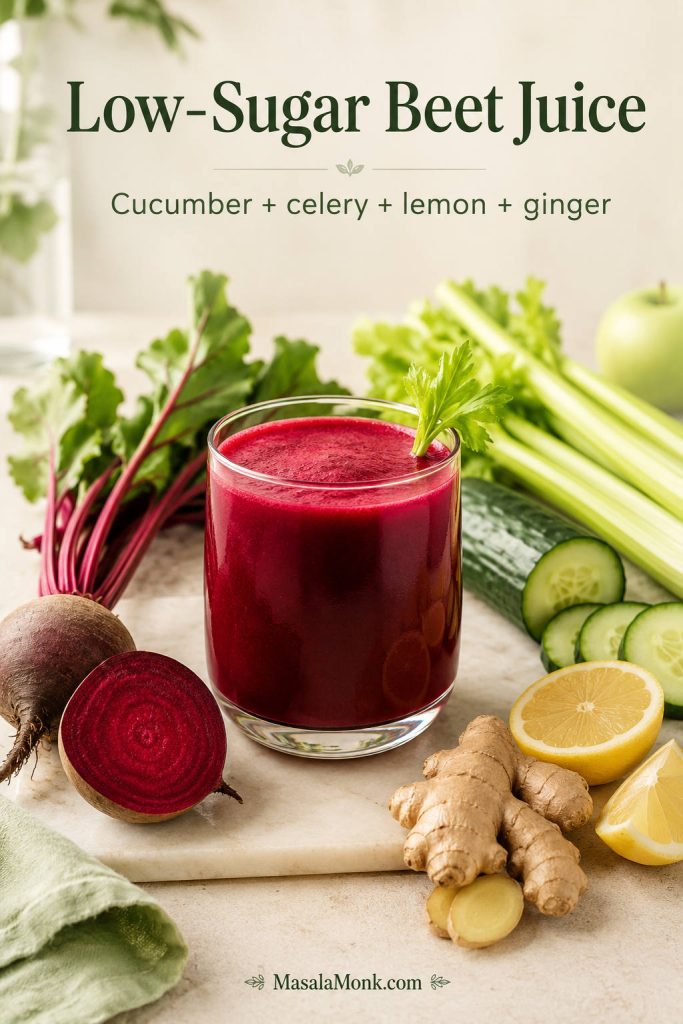
Glass of low-sugar beet juice with beetroot, cucumber, celery, lemon, ginger, and a small green apple in a light kitchen scene.
For low-sugar beet juice, lean on cucumber, celery, lemon, and ginger; that way, the drink stays vegetable-forward without tasting flat.

Beet Turmeric Ginger Juice

This has a strong, spicy flavor. Use turmeric carefully because it can dominate the drink. Add black pepper only if you already like that taste; it is not needed for the recipe to work.

Beet Juice Shot

A beet shot is stronger and smaller than a full glass. Keep the beet, lemon, and ginger more concentrated, then use just enough apple to soften the edge if needed. Serve 2–3 oz / 60–90 ml at a time.

Beet Juice Smoothie

To turn this into a smoothie, do not strain the blended mixture. Add banana, berries, yogurt or plant milk, and a little ginger. A smoothie keeps more pulp and fiber, so it will be thicker and more filling than strained beet juice. For more smoothie-style ideas, MasalaMonk’s guide to high-iron smoothies and shakes includes beetroot-friendly combinations that lean more filling than juiced.

Flavor comes first. Once the drink is something you actually enjoy, then it makes sense to talk about where it fits in a routine.

Beet Juice Benefits, Without the Hype

Once the flavor is right, the next question is usually what this drink actually does for you. The honest answer is that beet juice can be useful, but it works best when you treat it as food, not as a miracle shot.

Think of this as a bright vegetable drink with a few smart use cases: a small pre-workout serving, a lower-sugar vegetable-forward version, or an occasional way to enjoy beets when you do not feel like eating them.
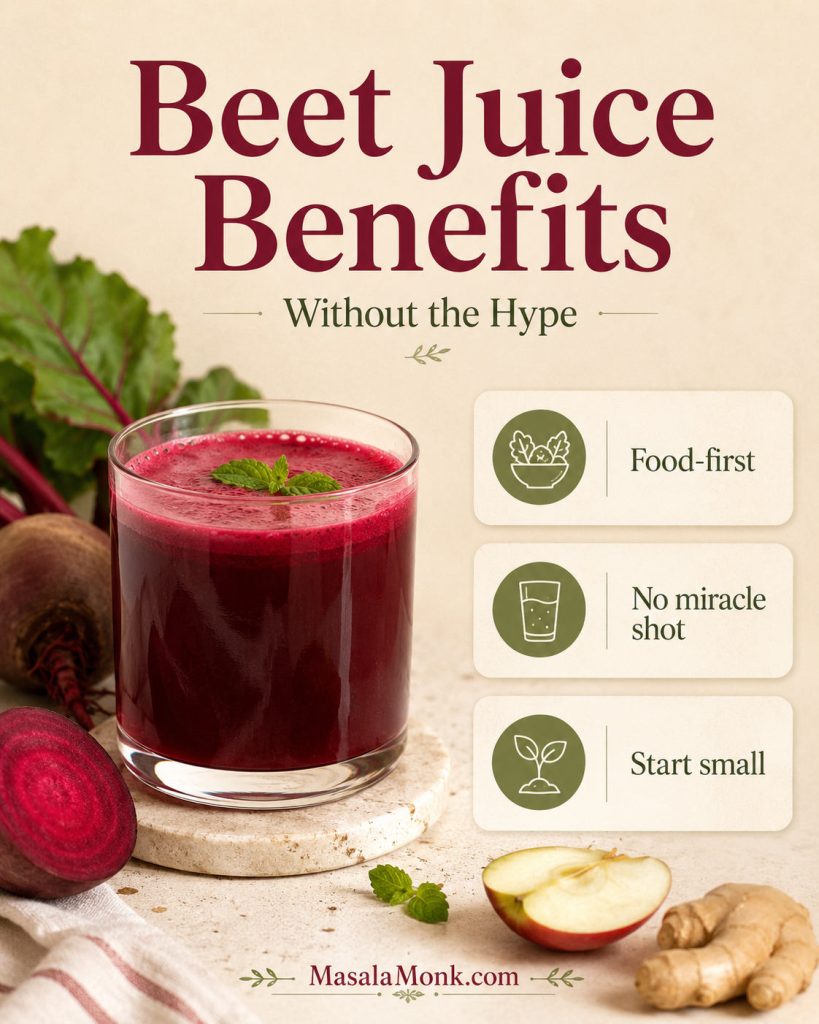
Calm beet juice benefits graphic with a glass of beet juice, beetroot, and cards reading food-first, no miracle shot, and start small.
Beet juice can fit into a healthy routine, although it is still best treated as a food-first drink rather than a miracle wellness shortcut.

Planning to drink it often? Read the safety notes before making beet juice a daily habit.

Beetroot is naturally colorful, plant-rich, and known for dietary nitrates. Much of the research interest comes from those nitrates and their possible effects on cardiovascular markers. You can read more about that research background on PubMed.

At the same time, juice is not the same as eating whole beets. When you juice and strain beets, carrots, and apples, you remove much of the fiber. That makes the drink lighter and easier to sip, but it also means it is less filling than whole vegetables or a smoothie.

If you care about…Best way to use this juice
Blood pressure interestKeep servings moderate and check with a qualified professional if you take medication or tend to run low.
Workout useTry a small strained serving first, not a huge pulpy glass right before training.
Weight-conscious drinkingUse cucumber, celery, lemon, ginger, less fruit, and no added sugar.
Daily nutritionRotate it with whole vegetables, smoothies, meals, and other drinks instead of making it your only “healthy” habit.
Detox-style flavorUse cucumber, celery, lemon, and ginger for a crisp, light glass without treating it as a cleanse.

For a broader look at whole beets beyond juice, MasalaMonk’s guide to what beets are good for covers beetroot as a food, not just as a drink.

Is Beet Juice Good for Weight Loss?

For weight-conscious readers, the most useful approach is a moderate, vegetable-forward drink — especially when you keep fruit lower and skip added sugar. It is not a fat-loss shortcut, but it can fit into a balanced routine when the portion and ingredients make sense.

The same idea applies to other “weight loss drink” combinations too. MasalaMonk’s article on pineapple, cucumber, and ginger for weight loss separates useful habits from miracle claims without treating the drink as a shortcut.

Lighter Beet Juice Formula

  • ½–1 beetroot
  • ½ cucumber
  • 1 celery stalk
  • ½ lemon
  • ½ inch ginger
  • Optional: ½ green apple if you need a little sweetness

This version is less sweet and more vegetable-forward. For more fullness, choose an unstrained beet smoothie instead of strained juice because the smoothie keeps more fiber.

Beet Juice and Blood Pressure

Beetroot contains dietary nitrates, which is why this drink often comes up in blood pressure conversations. Still, drinking it once in a while is different from turning it into a daily habit; regular use matters more if you already take medication or tend to run low.

Beetroot’s dietary nitrates can be converted in the body into nitric oxide, a compound involved in blood-vessel relaxation and blood flow, which is why beet juice appears in blood pressure research.
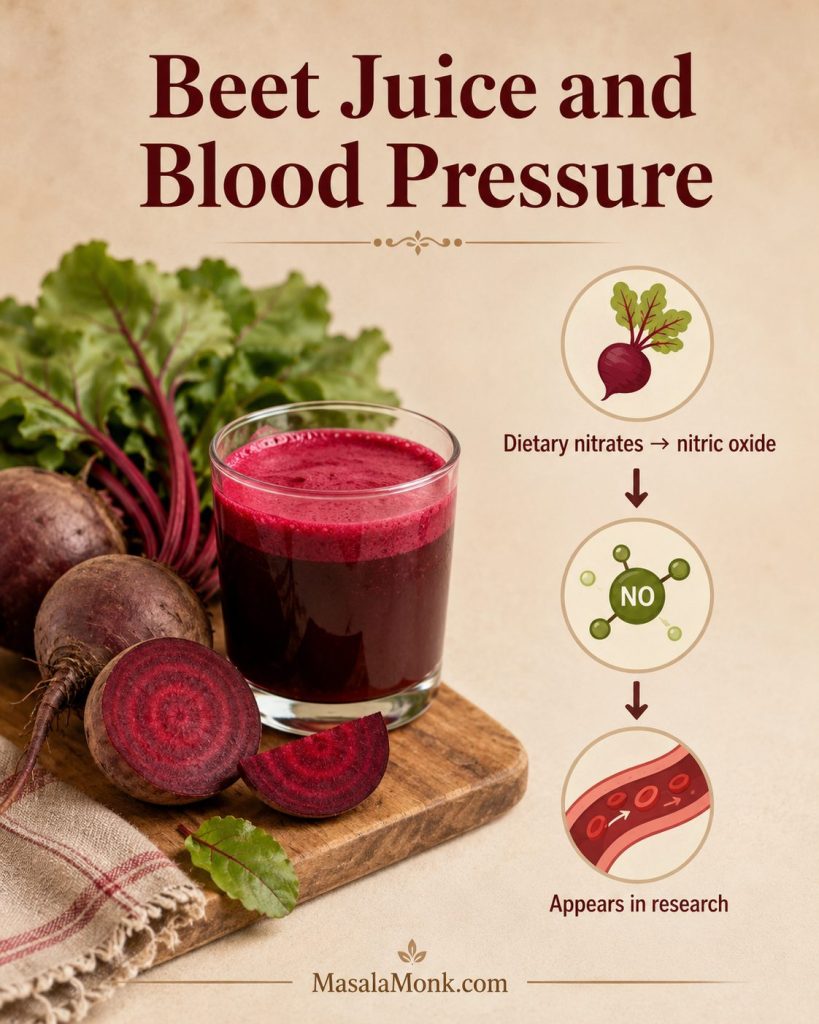
Educational graphic showing beet juice, beetroot, dietary nitrates converting to nitric oxide, and a simple blood-flow research cue.
The blood-pressure conversation around beetroot juice starts with dietary nitrates, so this is a research-aware food habit rather than a cure claim.

Any blood-pressure effect can vary by person, serving size, timing, and overall diet, so treat this as a food habit to discuss if it overlaps with medication or a medical condition.

If you have low blood pressure, take blood pressure medication, have kidney concerns, or manage a medical condition, treat regular beet juice as something to discuss with your healthcare professional rather than a casual daily habit.

For the broader caution list, see side effects and safety notes.

MasalaMonk has a deeper article on beets and blood pressure if you want a more focused discussion of fresh, canned, pickled, and juiced beets.

Is Beet Juice a Detox or Liver Cleanse?

If you like the word “detox” because you mean light, cold, vegetable-forward, and refreshing, beet juice can fit that mood. If you mean a drink that cleanses the liver, flushes toxins, or resets the body, it does not work that way.

Your liver and kidneys already do the work of filtering and processing waste. A glass of beet juice can be colorful and refreshing, but it should not be treated as a liver cleanse or cure.

For a detox-style flavor without the misleading promise, use beetroot, cucumber, celery, lemon, and ginger. It will taste crisp and clean, but it is still just a drink.

Beet Juice for Energy or Pre-Workout

Runners, cyclists, and workout-focused readers often pay attention to beet juice because of beetroot’s natural nitrate content. If you want to try it before exercise, start with a small serving first. Some people tolerate it easily; others find that a large or pulpy drink feels too heavy before movement.
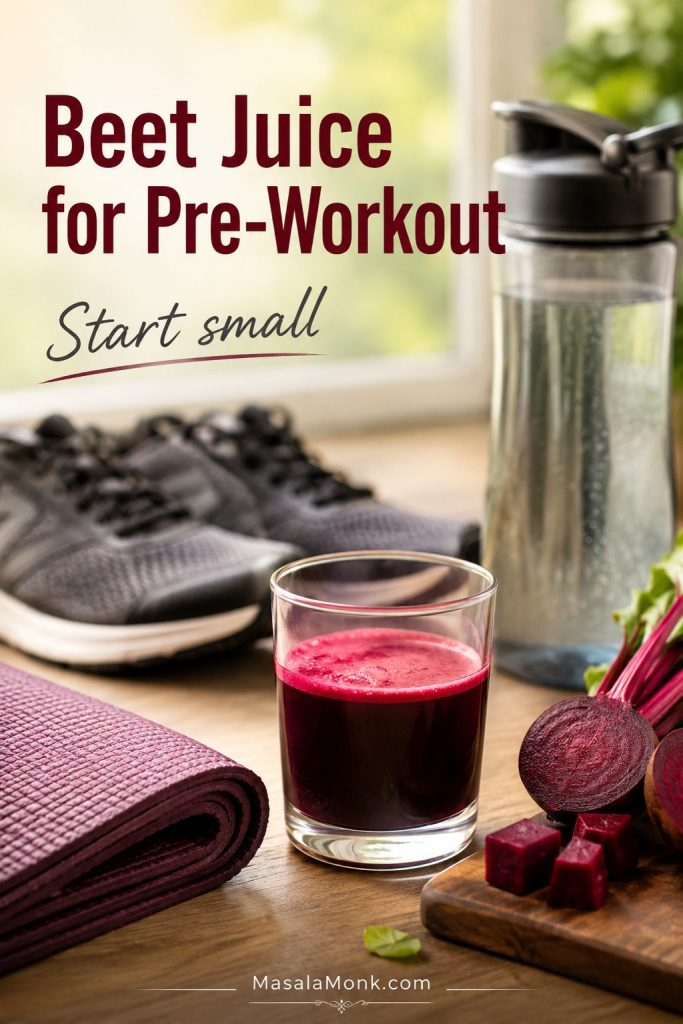
Small glass of beet juice near running shoes, a water bottle, a workout mat, and fresh beetroot in natural morning light.
Before using beet juice as a pre-workout drink, try a small strained serving first so you can see how your stomach handles it.

For a pre-workout style version, keep the flavor bright and the texture light: beetroot, orange or apple, lemon, and ginger works well. If you are using the blender method, strain it thoroughly so the drink is easier to sip before exercise.

For performance use, many beetroot juice studies focus on nitrate dose and timing rather than casual sipping, so treat a small pre-workout glass as an experiment, not a guaranteed effect.

When to Drink Beet Juice and How Much to Start With

There is no single perfect time to drink beet juice. Choose the moment that fits how you want to use it and how your body responds. If you are new to this drink, start with a smaller serving because the flavor, color, and digestive effect can surprise people, especially if the glass is strong or ginger-heavy.
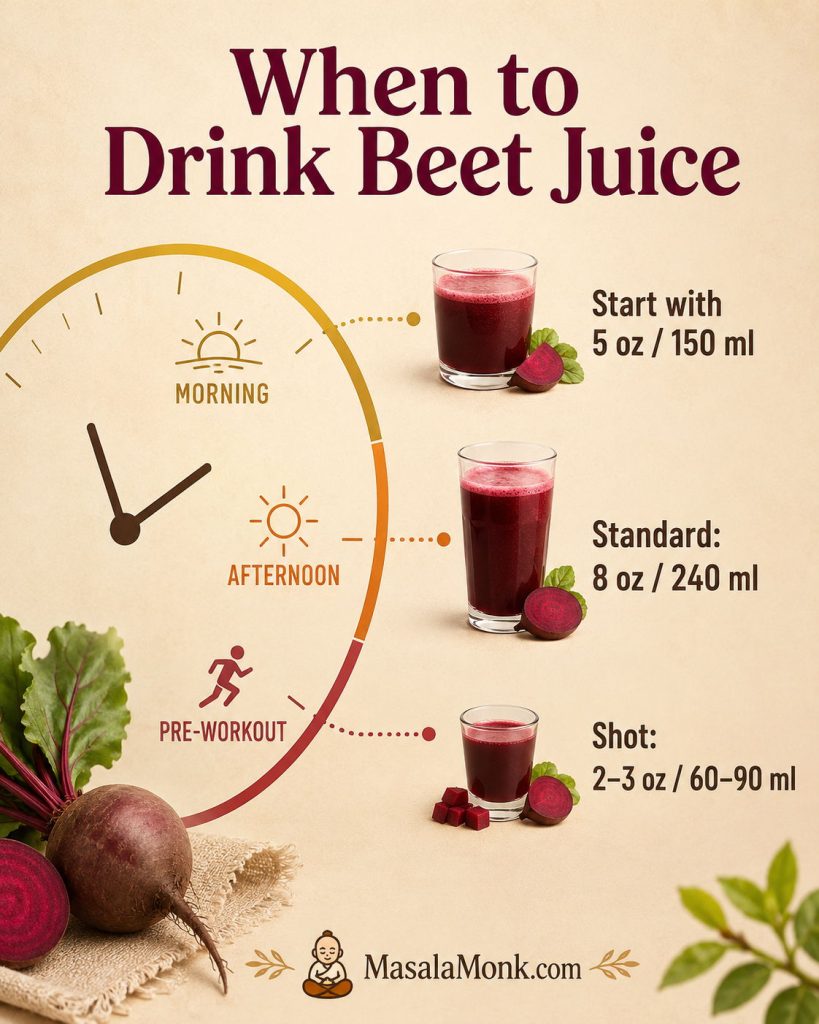
Timing and serving-size guide for beet juice with morning, afternoon, pre-workout cues and 5 ounce, 8 ounce, and 2–3 ounce serving sizes.
Start with 5 oz of beet juice, then adjust the timing and portion based on your routine, taste, digestion, and reason for drinking it.
  • Morning: a simple option with or after breakfast, especially if raw juice bothers your stomach on its own.
  • Afternoon: useful when you want something cool, colorful, and caffeine-free.
  • Before a workout: try a small strained serving first; avoid a large pulpy glass right before training.
  • Night: fine for many people, but skip it late if it bothers your digestion or makes you wake up to use the bathroom.
  • Daily: keep portions reasonable and rotate with whole vegetables, fruits, smoothies, meals, and other drinks.
  • Small serving: 5 oz / 150 ml
  • Standard serving: 8 oz / 240 ml
  • This recipe yield: about 16–18 oz / 475–530 ml
  • Beet shot: 2–3 oz / 60–90 ml

You do not need to turn beet juice into a daily project to enjoy it; a good glass now and then still counts. Occasional beet juice and daily beet juice are not the same decision, especially if you have blood pressure, kidney-stone, digestive, or blood sugar concerns.

After drinking beet juice, some people notice pink or red urine or stool. This is often called beeturia and can happen after eating or drinking beets. It is usually harmless, but if you are unsure whether the color is from beets or something else, or if you have pain or unusual symptoms, seek medical advice.

The sections below cover storage and safety because homemade beet juice is raw, deeply pigmented, and more concentrated than eating a few slices of beetroot.

Fresh Beets vs Canned Beets vs Beet Powder

Fresh raw beetroot gives the best glass: brighter color, clearer flavor, and a more refreshing finish. Canned, cooked, pickled, and powdered beets can help in a pinch, but they each move the drink away from that just-made taste.
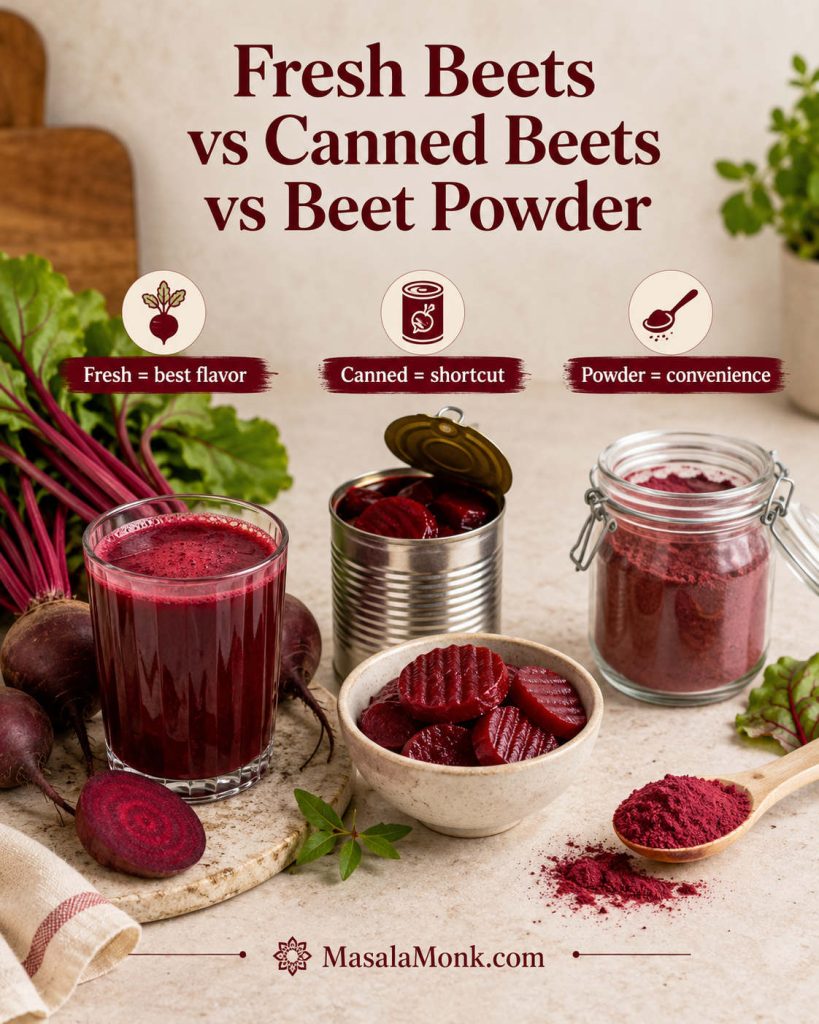
Comparison of fresh beets with beet juice, canned beets in a can and bowl, and beet powder in a jar and wooden spoon.
Fresh beets give homemade beet juice the brightest flavor; however, canned beets and beet powder can still work when convenience matters more.
OptionCan you use it?Best use
Fresh raw beetsYes, best choiceMain beet juice recipe
Cooked beetsYes, blender onlyEmergency shortcut, softer flavor
Canned beetsPossibleBlended shortcut; check salt, sugar, and additives
Pickled beetsNot idealOnly if you want a vinegar-style drink
Beet powderDifferent productConvenience drink, not the same as fresh juice

If you use canned beets, drain them well and check the label. Some canned beets contain added salt or sugar, and pickled beets contain vinegar that will completely change the flavor. If you use beet powder, treat it as a separate convenience drink rather than a true fresh beet juice recipe.

What to Do With Beet Juice Pulp

Beet pulp is not glamorous, but it does not have to go straight into the bin. If you use a juicer or strain the blender mixture, you will have pulp left behind. It is fibrous and deeply colored, so use it in small amounts where the color and earthiness make sense. Think of it as a small add-in, not the main event.

  • Add small amounts to veggie patties or fritters.
  • Stir into soups or stews where the color makes sense.
  • Mix into muffins, quick breads, or pancakes.
  • Blend into hummus or bean dips.
  • Freeze in small portions for later cooking.
  • Compost it if you do not want to cook with it.

Remember that beet pulp stains. If the pulp includes ginger and lemon, use it in recipes where those flavors will not feel out of place.

How to Store Beet Juice

Just-made beet juice loses its sparkle quickly, so treat leftovers gently. It tastes best right after making, when the lemon is sharp, the ginger still tastes lively, and the beet flavor has not dulled. Because homemade raw juice is not pasteurized, it also needs careful storage if you are not drinking it right away.
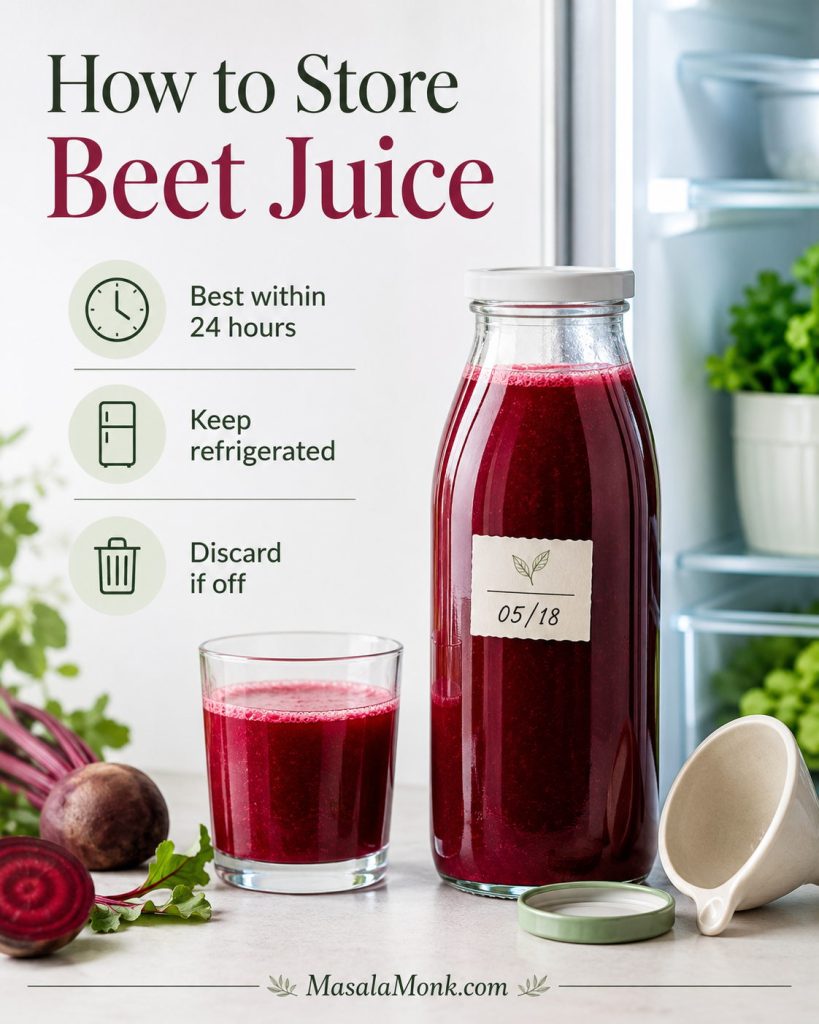
Storage guide showing beet juice in a sealed glass bottle with a date label beside a glass of juice near an open refrigerator.
Since homemade raw juice is not pasteurized, the safest flavor window is short: chill it quickly, seal it well, and drink it soon.
  • Best flavor: drink immediately.
  • Best refrigerated quality: within 24 hours.
  • Maximum practical home storage: 24–48 hours in a clean airtight glass bottle in the refrigerator.
  • Room temperature: do not leave fresh juice out for more than 2 hours.
  • Refrigerator temperature: keep chilled at 40°F / 4°C or colder.
  • Serving after storage: shake or stir before drinking.
  • Discard if: it smells sour, fizzy, fermented, moldy, or off.

You can wash and chop the beetroot, carrot, apple, and cucumber a few hours ahead and refrigerate them in a covered container. Juice or blend just before serving for the liveliest flavor.

The FDA has a useful overview of fresh juice safety, especially because homemade raw juice is not pasteurized.

You can freeze beet juice in ice cube trays or small containers, but the flavor and texture will be less crisp after thawing. Frozen beet juice cubes are better for smoothies than for drinking plain.

Side Effects and Who Should Be Careful

For most people, a moderate glass is simply a colorful way to enjoy beetroot. Still, start small the first time, especially if you plan to drink it often. Beet juice has a strong color, strong flavor, and for some people, a strong digestive effect too.
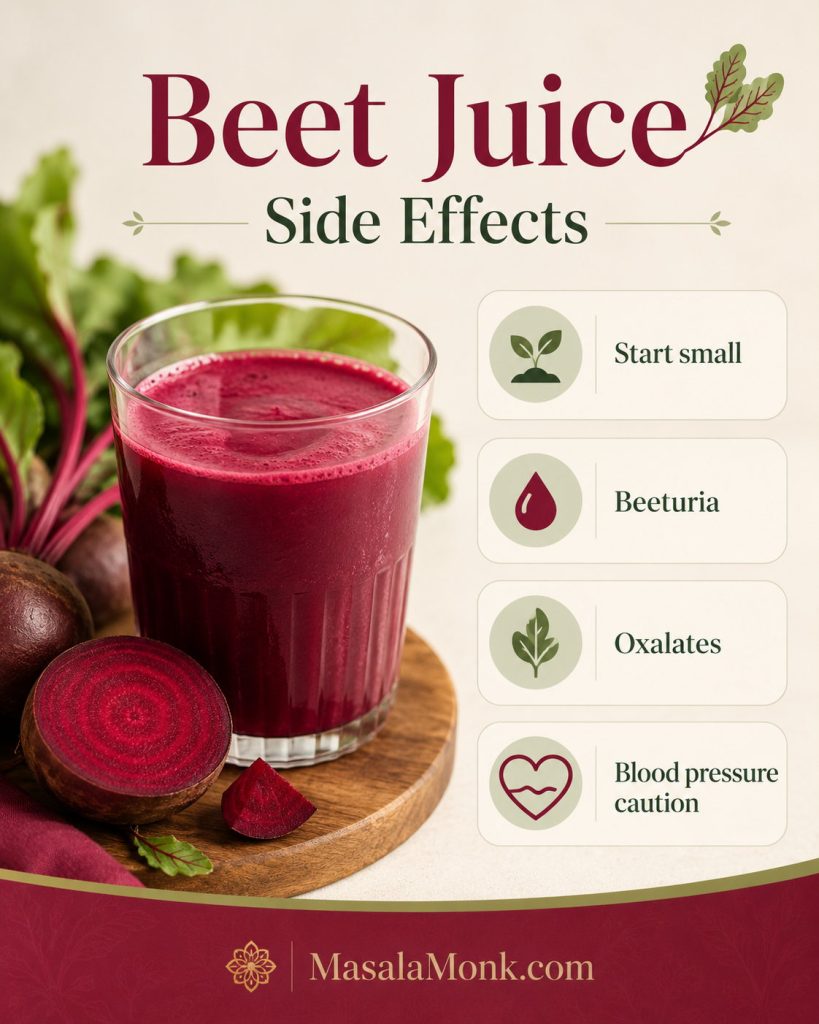
Beet juice side effects graphic with a glass of beet juice and safety cards for start small, beeturia, oxalates, and blood pressure caution.
Start with a modest serving if beet juice is new to you, especially if oxalates, digestion, beeturia, or blood pressure changes are concerns.
  • Red or pink urine/stool: Beet juice can cause beeturia, a temporary red or pink color change after eating or drinking beets.
  • Kidney-stone concerns: Beets contain oxalates, so people prone to certain kidney stones should be cautious.
  • Low blood pressure or medication: If you take blood pressure medication or have low blood pressure, ask a healthcare professional before drinking beet juice regularly.
  • Digestive sensitivity: Start with a smaller serving if raw juices bother your stomach.
  • Blood sugar management: If you manage blood sugar, fruit-heavy beet juices may need smaller portions or more vegetable-forward formulas.

For more detail on oxalates and beetroot, see MasalaMonk’s guide to beetroot and kidney health.

Beet Juice Troubleshooting

Beet juice is forgiving if you know what to adjust. If the batch did not taste the way you expected, do not throw it out yet. Most problems are fixable with lemon, cucumber, ice, apple, or another pass through the strainer.
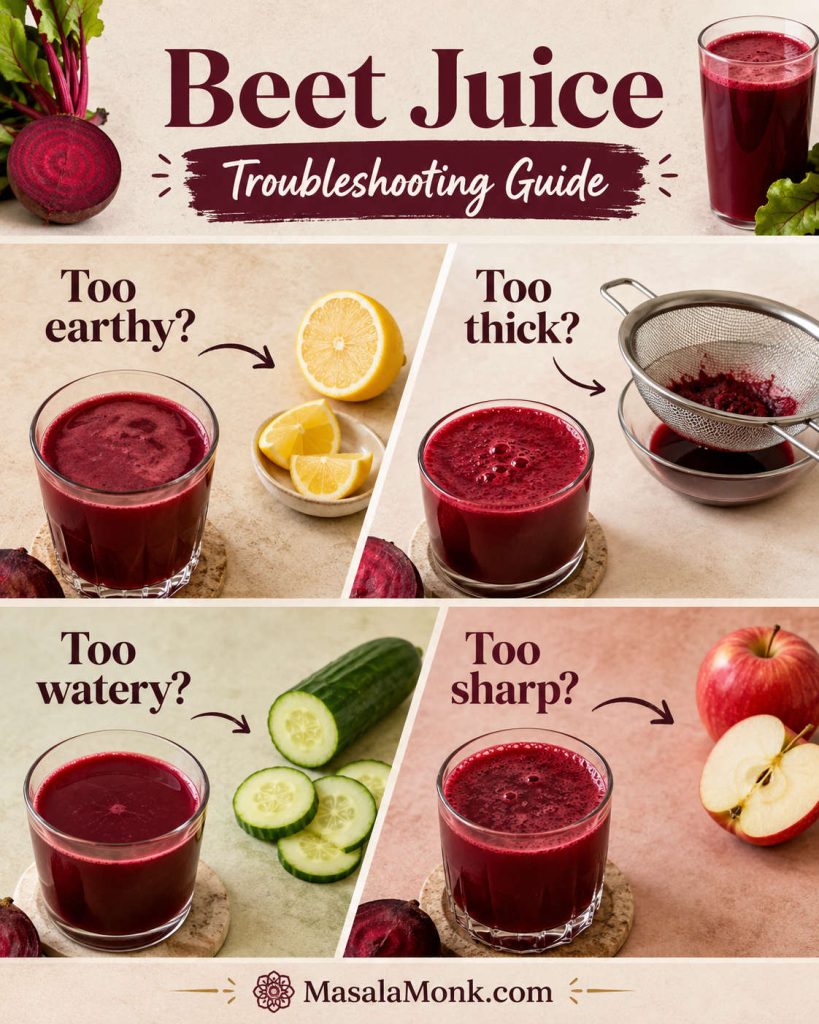
Troubleshooting guide for beet juice with panels for too earthy, too thick, too watery, and too sharp, plus lemon, cucumber, apple, and strainer cues.
A failed batch is usually adjustable: sharpen a dull glass, lighten a heavy one, dilute harsh ginger, or strain again for smoother texture.
IssueWhy it happenedFix nowFix next time
Too earthyToo much beet or not enough acid/sweetnessAdd lemon, orange, apple, or cucumber juiceUse less beet and more carrot/apple
Too thickBlender juice was not strained enoughStrain again through cheesecloth or a nut milk bagChop smaller, blend smoother, and squeeze pulp well
Too wateryToo much water in the blenderAdd lemon, ginger, or a little more fresh juiceStart with ½ cup / 120 ml water only
Too sharpToo much ginger or lemonDilute with apple, carrot, cucumber, or iceStart with ½ inch ginger
Too sweetToo much apple, orange, pineapple, or pomegranateAdd lemon, cucumber, celery, or gingerUse the low-sugar variation
Separates in the glassFresh juice naturally separatesStir or shakeThis is normal

FAQs About Beet Juice

These are the small questions that usually come up after the first batch.

Juicer or blender: which is better for beet juice?

A juicer makes lighter, smoother juice without added water. A blender works well if you do not own a juicer, but the juice needs water and straining.

How much water do you add when making beet juice in a blender?

Start with ½ cup / 120 ml cold water. Add more only if the blender needs help, up to 1 cup / 240 ml total. Too much water makes the juice taste thin.

How do you make beet juice without a juicer?

Blend chopped beetroot, carrot, apple, lemon, ginger, and cold water until smooth. Then strain through a nut milk bag, cheesecloth, or fine mesh strainer and squeeze the pulp well.

Should you use raw or cooked beets for juice?

Raw beets are best for fresh juice. Cooked beets can be blended in a pinch, but they taste softer and less crisp. They are not ideal for juicing.

Do you need to peel beetroot before juicing?

Peeling is optional if the beetroot is fresh, tender-skinned, and scrubbed very well. Peel it if the skin is rough, dirty, waxed, or bitter.

How many beets make one glass of juice?

One medium-large beet, about 225–250 g / 8–9 oz, combined with carrot, apple, lemon, and ginger usually makes about two standard glasses of mixed beet juice. A medium beet on its own may give roughly ⅓–½ cup juice in many home juicers, though freshness, size, and machine efficiency can change that noticeably.

Why does beet juice taste earthy?

Beetroot naturally has an earthy, mineral-like flavor. Apple, carrot, lemon, ginger, cucumber, orange, and pineapple all help balance that flavor.

How do you make beet juice sweeter without sugar?

Add apple, carrot, orange, pineapple, or pomegranate. Apple and carrot are the easiest everyday choices because they sweeten the drink without overpowering the beetroot.

Is it okay to drink beet juice every day?

You can drink it regularly if it suits you, but you do not need to make it a daily habit to enjoy the recipe. Keep portions moderate, especially if you have kidney-stone risk, low blood pressure, digestive sensitivity, blood sugar concerns, or take blood pressure medication.

What is the best time to drink beet juice?

Morning is simple, afternoon works when you want something cool and caffeine-free, and pre-workout use is best tested with a small strained serving before you make it a routine.

Why does beet juice turn urine or stool red?

Beets can turn urine or stool pink or red. This is common after eating or drinking beetroot. If you are unsure whether the color is from beets, or if you have pain or unusual symptoms, seek medical advice.

What should you know about beet juice and blood pressure?

Beetroot contains dietary nitrates, so occasional juice is one thing; a daily habit is worth discussing with your healthcare professional if you take blood pressure medication or tend to run low.

How long does homemade beet juice keep?

Homemade beet juice tastes best immediately. Refrigerate it in a clean airtight bottle and drink within 24 hours for best flavor, or within 24–48 hours at most.

Can you use canned beets in beet juice?

You can blend canned beets with water, apple, lemon, and ginger in a pinch, but the flavor will be softer and less fresh than raw beetroot. Check the can for added salt, sugar, or vinegar.

How do you turn this recipe into a beet juice shot?

For a beet shot, use less apple and cucumber, keep the beet, lemon, and ginger more concentrated, and serve just 2–3 oz / 60–90 ml at a time. Beet shots are intense, so start small.

Tried it with apple, orange, cucumber, or ginger? Share which version finally made beet juice work for you — the best fixes often come from small adjustments.

Beet Juice Recipe

This is the balanced base version: beetroot for color, carrot and apple for sweetness, lemon for brightness, ginger for lift, and cucumber if you want a cooler, easier sip.

Make it in a juicer for crisp, smooth juice, or use a blender and strain it. Once you like the base, adjust lemon, apple, cucumber, or ginger to make the glass sharper, sweeter, lighter, or spicier.

The finished juice should pour easily, taste sweet-earthy and tart, and finish with gentle ginger warmth.
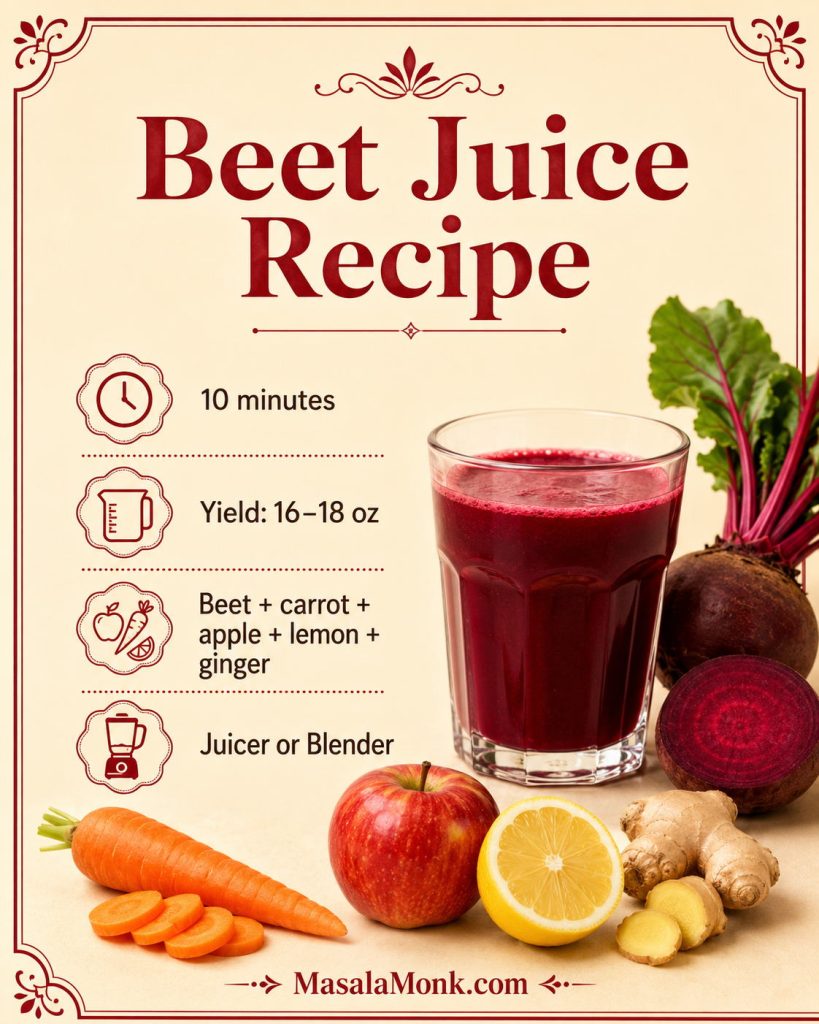
Saveable beet juice recipe card with a glass of beet juice, beetroot, carrot, apple, lemon, ginger, 10 minutes, 16–18 ounce yield, and juicer or blender method.
Save this beet juice recipe formula for the essentials: beetroot, carrot, apple, lemon, and ginger, made in either a juicer or a blender.
Prep Time10 minutes
Total Time10 minutes
Servings2 glasses
YieldAbout 16–18 oz / 475–530 ml

Estimated nutrition: One 8 oz / 240 ml serving is roughly 135–150 calories, with about 32–36 g carbohydrates depending on produce size and juicing method. Most sweetness comes naturally from the apple, carrot, and beetroot. Strained juice has much less fiber than whole produce or an unstrained smoothie.

Equipment: juicer or blender, fine mesh strainer or nut milk bag, knife, cutting board, and a clean bottle or jar if storing.

Ingredients

  • 1 medium-large raw beetroot or 2 small beets, about 225–250 g / 8–9 oz
  • 2 medium carrots, about 120–150 g / 4–5 oz
  • 1 large apple, about 170–200 g / 6–7 oz
  • ½ lemon, about 15–20 ml juice
  • ½–1 inch fresh ginger, about 5–10 g
  • ½ small cucumber, optional, about 75–100 g / 3–4 oz
  • ½–1 cup cold water, blender method only, 120–240 ml
  • Ice, to serve

Juicer Method

  1. Wash and scrub the beetroot, carrots, apple, cucumber, lemon, and ginger.
  2. Trim the beetroot and peel it if the skin is rough, waxed, or not fully clean.
  3. Cut the beetroot, carrots, apple, cucumber, and ginger to fit your juicer chute.
  4. Juice the beetroot, carrots, apple, cucumber, and ginger, alternating hard and soft produce as needed.
  5. Stir in the lemon juice.
  6. Pour over ice and drink immediately.

Blender Method

  1. Chop the beetroot, carrots, apple, cucumber, and ginger into small pieces.
  2. Add them to a blender with ½ cup / 120 ml cold water and the lemon juice.
  3. Blend on high for 45–60 seconds, until smooth. Add more water only if needed, up to 1 cup / 240 ml total.
  4. Pour the mixture through a nut milk bag, cheesecloth-lined strainer, or fine mesh strainer.
  5. Let it drain for 2–5 minutes, then press or squeeze the pulp to extract the juice.
  6. Optional: add 2–3 tablespoons / 30–45 ml cold water to the squeezed pulp, stir or briefly blend, then strain once more for a little extra yield.
  7. Serve over ice.

Notes

  • For a milder glass, use half a beet and increase the apple or carrot.
  • Use green apple for a sharper juice or red apple for a sweeter one.
  • For a lighter flavor, add cucumber.
  • For a sharper flavor, use the full inch of ginger and extra lemon.
  • If using a blender, strain the mixture for true beet juice. Unstrained beet juice will be thicker and smoothie-like.
  • Drink immediately for best flavor, or refrigerate in a clean airtight glass bottle for 24–48 hours.
  • For regular use or medical concerns, read the safety section above.

Once the recipe is made, serve the juice cold, taste before adjusting, and keep the glass balanced enough that it feels like a drink you chose — not a health chore.
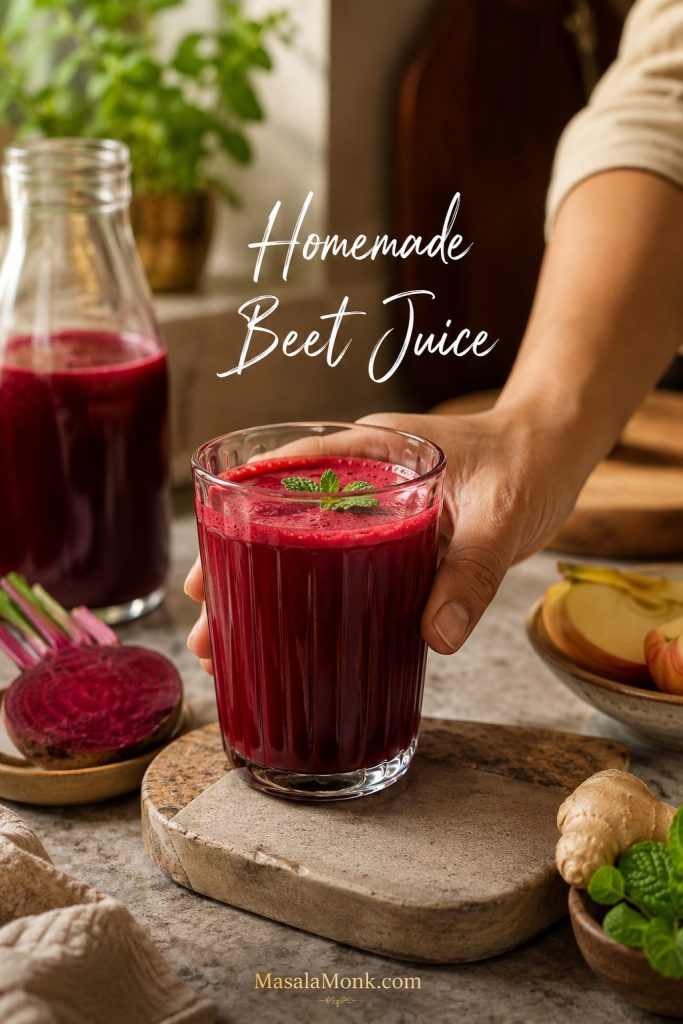
Hand placing a glass of homemade beet juice on a kitchen counter with a bottle of juice, beetroot, apple slices, ginger, and herbs nearby.
A good homemade beet juice should taste balanced enough to sip slowly, not like something you have to force down for health reasons.

Back to top

Posted on Leave a comment

Cold Press Juicers vs Centrifugal Juicers: Which is Best?

Cold Press vs Centrifugal Juicers

Juicing is no longer just a wellness trend—it’s a kitchen staple for many health-focused homes. But if you’re just getting started or looking to upgrade your juicer, you’ve probably faced the classic dilemma:
Should you get a Cold Press (Masticating) Juicer or a Centrifugal Juicer?

This isn’t just a tech comparison—it’s about what’s best for your lifestyle, health goals, and taste buds. In this guide, I’ll break down the differences, bust a few myths, and help you choose with confidence.


What’s the Difference, Really?

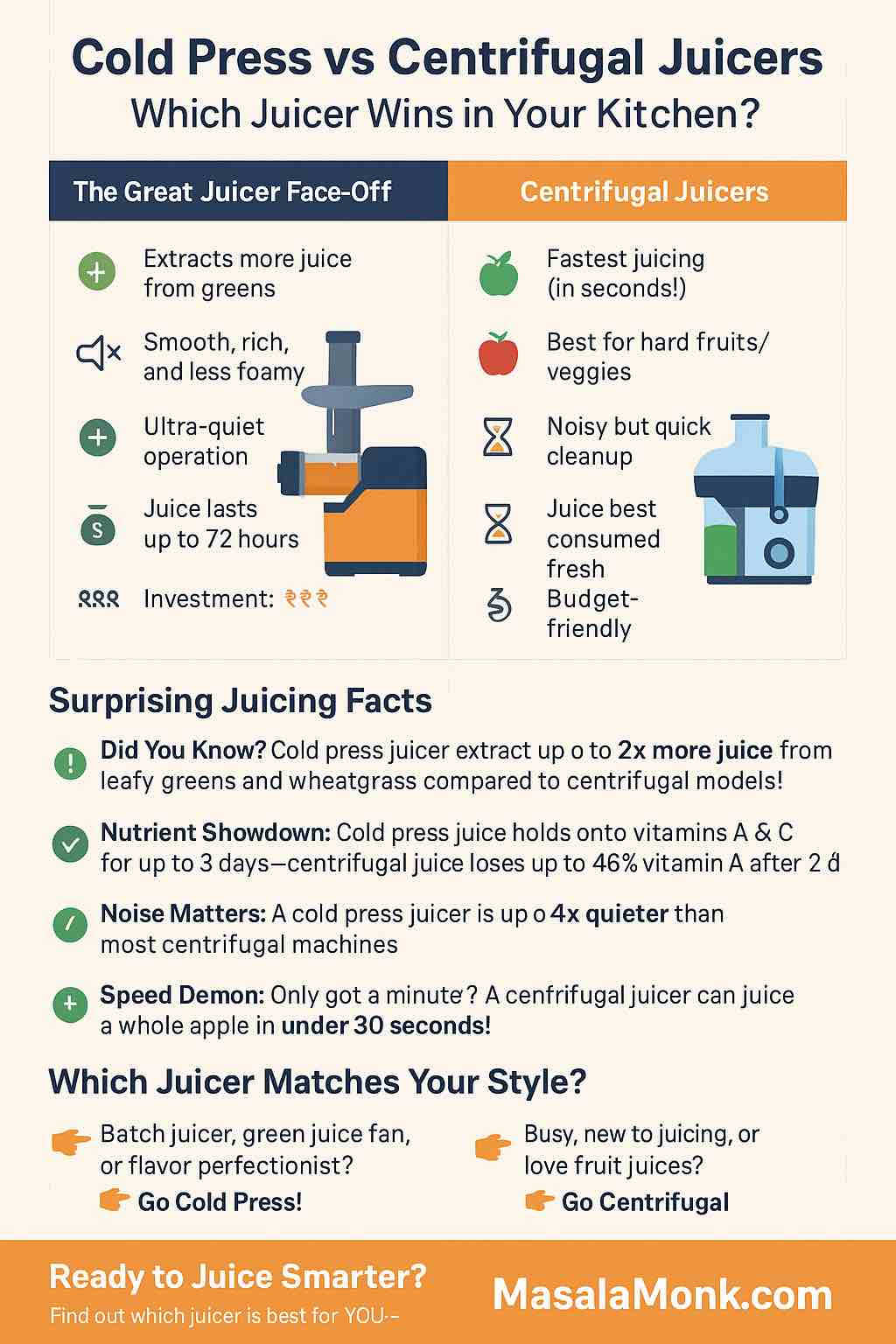
Centrifugal juicers are the “classic” juicers you see in most stores. They’re fast, loud, and use a rapidly spinning blade to pulverize fruits and veggies, extracting juice via centrifugal force.

Cold Press (Masticating) juicers work differently. They “chew” produce at a low speed with an auger, gently crushing and pressing out juice. This slow process creates little heat, hence the term “cold press.”


How Does This Affect Your Juice?

Let’s get practical. Here’s how these two styles shape your daily juice routine:

1. Juice Quality & Nutrition

  • Cold Press Juicers
    • Higher juice yield. Get more juice (especially from leafy greens, wheatgrass, and soft fruits).
    • Richer flavor. Juice is smoother, less foamy, and has deeper color.
    • More nutrients—especially over time. Scientific studies show cold press juice retains more vitamins (notably A and C) after 48–72 hours. If you like to batch juice, this matters!
    • Minimal oxidation. Juice stays fresh longer (up to 3 days refrigerated) and separates less.
  • Centrifugal Juicers
    • Fast, fresh juice in seconds. Best for “drink it now” types.
    • Slightly less nutrient retention. Lab studies show only ~10–15% difference at the moment of juicing, but nutrients degrade much faster in storage.
    • More foam, faster separation. Texture can be frothier, and you’ll see layers form in your glass if you wait.

Bottom line: For best flavor and nutrition—especially with leafy greens or if you batch juice—cold press wins. If you drink juice immediately and don’t mind a little foam, centrifugal works just fine.


2. Speed & Convenience

  • Centrifugal Juicers
    • Fastest option by far!
      Whole apple? No problem—done in under a minute.
    • Large feeding chute. Minimal chopping needed.
    • Ideal for busy mornings or families on the go.
  • Cold Press Juicers
    • Slower extraction—usually 2–5 minutes for a glass.
    • Smaller feeding chute. Chopping is often required.
    • More parts to assemble/disassemble.

Bottom line: If you want juice NOW and minimal prep, centrifugal is hard to beat.


3. Noise Level

  • Centrifugal Juicers: Like a blender. Loud.
  • Cold Press Juicers: Whisper-quiet. Perfect for early risers or shared homes.

4. Cleaning

  • Centrifugal:
    • Fewer parts, wide openings—quick rinse and done.
  • Cold Press:
    • More components (auger, mesh, chute). Takes a few extra minutes and a brush to keep clean.

TIP: If you dread cleaning, check reviews—some newer cold press models have improved, but centrifugal remains the simplest.


5. Cost

  • Centrifugal Juicers:
    • Great entry models for $40–$150.
  • Cold Press Juicers:
    • Usually $150–$500+. High-end models can reach $700+.

Pro tip: Don’t just buy the cheapest! A sturdy $120 centrifugal or a $250–$350 cold press will outlast and outperform bargain-bin options.


6. Produce Types

  • Leafy Greens, Herbs, Wheatgrass:
    • Cold press is far superior. Centrifugal juicers struggle and waste produce.
  • Hard Fruits (apples, carrots, beets):
    • Both work well, but centrifugal is faster.
  • Soft Fruits (berries, tomatoes, kiwi):
    • Cold press gives higher yield and less mess.

Myths & Misconceptions: What Science Says

  • “Centrifugal juicers destroy nutrients!”
    Not exactly. The heat is modest (juice rarely gets above 50°C/122°F). Studies show a slight difference (10–15%) in vitamin retention at extraction, but the real gap is in storage: cold press juice stays nutritious much longer.
  • “Cold press juice is always healthier.”
    Not always. For some nutrients (like lycopene in tomatoes), gentle heat from centrifugal juicers can actually improve absorption. The overall difference for most people is modest if you drink the juice immediately.
  • “Cold press is only for the obsessed.”
    Nope! If you love greens, want to prep juice ahead, or value taste/texture, you’ll love cold press. But centrifugal makes great juice too—especially for fruit-focused recipes.

Which Should You Choose? A Practical Guide

Get a Cold Press Juicer if:

  • You juice leafy greens, herbs, or wheatgrass often.
  • You want to batch juice for 2–3 days.
  • Taste, texture, and nutrient retention matter to you.
  • You don’t mind a slower, quieter process (and a bit more cleanup).
  • Budget isn’t your biggest concern.

Get a Centrifugal Juicer if:

  • You’re new to juicing and want something quick, easy, and affordable.
  • You mainly juice hard fruits and veggies.
  • You’ll drink juice right away.
  • Speed and simplicity matter most.
  • You want less cleanup.

Real-World Examples

  • Busy Parent:
    You want fresh apple-carrot juice every morning, with minimal hassle. A good centrifugal juicer lets you prep, juice, and clean in 5 minutes.
  • Wellness Enthusiast:
    You juice kale, ginger, celery, and batch prep for the week. A cold press model gives you better taste, higher yield, and juice that lasts up to 72 hours in the fridge.
  • On a Budget:
    Start with a solid centrifugal juicer. If you fall in love with juicing, upgrade later!

Popular Models (2025 Recommendations)

Best Centrifugal Juicers

  • Breville Juice Fountain Plus: Fast, reliable, wide chute.
  • Hamilton Beach Big Mouth: Budget pick, easy cleanup.

Best Cold Press (Masticating) Juicers

  • Omega NC900HDC: High yield, superb for greens.
  • Nama J2: Newer, auto-feeding, minimal prep.
  • Hurom H-AA: Compact, very quiet.

Final Thoughts: What’s Right for You?

The “best” juicer is the one that fits your habits, kitchen, and goals. Both types can deliver delicious, healthful juice at home.

If you want the most juice from every spinach leaf and care about longevity—go cold press. If you crave convenience, drink juice right away, and want a smaller upfront investment—centrifugal is perfect.

Remember:
The healthiest juice is the one you’ll actually make and drink!


Practical Tips for Better Juicing (No Matter the Juicer)

  • Prep produce ahead: Chop, wash, and bag portions for the week.
  • Alternate soft and hard produce: This helps both juicer types avoid clogs.
  • Clean immediately: Rinse parts right after use for easy cleanup.
  • Drink soon: Even cold press juice is best within 48 hours for flavor and nutrients.
  • Experiment: Try both methods at a juice bar before you buy—or borrow a friend’s machine.

Have Questions or a Juicer Story?

Drop a comment below! Which juicer do you use? What surprised you about your first juicing experience? Let’s share real-world tips and favorite recipes!


Happy juicing—whatever you choose!

10 Frequently Asked Questions (FAQs) About Cold Press vs Centrifugal Juicers

1. Which juicer is better for leafy greens and wheatgrass?
Cold press (masticating) juicers are far superior for leafy greens, wheatgrass, and herbs. They extract significantly more juice and nutrients, whereas centrifugal juicers often leave these types of produce almost dry and wasteful.


2. Can I store juice from both juicers, and for how long?
Cold press juice can be stored in the refrigerator for up to 72 hours with minimal loss of nutrients and flavor. Juice from centrifugal juicers should ideally be consumed within 24 hours due to faster nutrient degradation and oxidation.


3. Is there a big difference in nutrition between the two types?
There is a modest difference—cold press juicers retain about 10–15% more vitamins and antioxidants, especially after storing. For immediate drinking, the nutritional gap is small, but it widens if you batch juice.


4. Are cold press juicers really that much quieter?
Yes, cold press juicers operate at low speeds and are much quieter than centrifugal juicers, which are about as loud as a blender. This makes cold press ideal for early mornings or shared spaces.


5. What are the main cleaning differences?
Centrifugal juicers usually have fewer parts and are quicker to clean, often taking just a couple of minutes. Cold press juicers have more components, including a mesh screen and auger, and can take a few extra minutes and a brush to clean thoroughly.


6. Why are cold press juicers so much more expensive?
Cold press juicers use more complex, durable mechanisms and often yield more juice per produce—saving money in the long run if you juice regularly. You’re paying for higher juice quality, better yield, and longer juice shelf life.


7. Do centrifugal juicers work with soft fruits?
They can, but you’ll often get a thinner, more separated juice and less yield. Cold press juicers are much better for soft fruits like berries, tomatoes, and kiwi.


8. Is it true centrifugal juicers destroy enzymes and nutrients with heat?
Not really. The heat generated is minimal and doesn’t destroy nutrients outright. However, the oxidation from the fast spinning can reduce some sensitive nutrients and shortens shelf life, especially for vitamins A and C.


9. Which type of juicer is best for beginners?
Centrifugal juicers are best for beginners—they’re affordable, fast, and easy to use. They’re great for occasional or fruit-focused juicing. If you become a regular juicer or want to maximize yield from greens, you can upgrade to cold press later.


10. Can I use both types of juicers together?
While not necessary for most people, some serious juicers do use both: centrifugal for fast, everyday fruit juices and cold press for batch-prepped or green juices. If budget and space allow, having both gives ultimate flexibility.

Posted on Leave a comment

Top 10 Juicers of 2024: Unbiased AI & Web-Researched Guide

Introduction:

In an era where health and wellness are at the forefront of our daily lives, the quest for the perfect juicing companion has become more prevalent than ever. Juicing is no longer just a trend; it’s a lifestyle choice for many, seeking the purest extraction from fruits and vegetables. With an overwhelming array of options in the market, selecting the right juicer can be as intricate as it is crucial.

This comprehensive guide is the result of extensive, unbiased research conducted through AI algorithms and meticulous web analysis. Our objective is simple yet profound: to provide you with an honest and thorough overview of the best juicers available in 2024. We delved deep into expert reviews, consumer feedback, and technical specifications to bring you a list that stands apart in its integrity and reliability.

Unlike many reviews, our approach is uniquely unbiased. We’re not swayed by brand partnerships or affiliate links. Our focus is solely on delivering a guide that is as objective and informative as possible. We understand that a juicer is not just an appliance; it’s a gateway to a healthier lifestyle. Therefore, our selections are based on factors like efficiency, durability, ease of use, and quality of juice extraction.

As you navigate through this guide, we encourage you to consider what matters most to you in a juicer. Is it the speed of extraction, the quietness of operation, or the ease of cleaning? Perhaps you’re looking for a model that handles leafy greens as adeptly as it does hard fruits. Whatever your criteria may be, we’re confident that our guide will illuminate the path to finding your ideal juicing partner.

In the following sections, you’ll find a detailed buying guide that underscores critical aspects to consider before making your purchase. Following that, each juicer will be showcased in its own section, highlighting its features, benefits, and why it made our top 10 list for 2024.

Embark on this journey with us as we explore the world of juicing, and discover the perfect juicer that aligns with your lifestyle and wellness goals.


Buying Guide: Key Factors to Consider When Choosing a Juicer

When embarking on the journey to find the perfect juicer, there are several key factors you should consider to ensure that your choice aligns with your lifestyle, preferences, and health goals. This buying guide aims to illuminate those critical aspects, providing you with the knowledge needed to make an informed decision.

Type of Juicer: Masticating vs Centrifugal

  • Masticating Juicers: Also known as cold-press juicers, they slowly crush and press fruits and vegetables to extract juice. Ideal for those who prioritize nutrient retention and efficiency with leafy greens.
  • Centrifugal Juicers: These juicers use a fast-spinning blade to cut produce and are typically faster than masticating juicers. They are perfect for individuals seeking speed and convenience.

Ease of Cleaning

  • Cleaning a juicer can be a tedious task. Look for models with dishwasher-safe parts and those that come with specialized cleaning tools. A juicer that’s easy to clean will likely encourage regular use.

Juice Quality and Yield

  • The quality of juice varies significantly between juicers. Masticating juicers generally produce a higher quality juice with less foam and better preservation of nutrients. If juice quality is your priority, a masticating juicer might be the right choice.

Noise Level

  • Juicer noise levels can vary. If you prefer a quieter environment, especially in the morning, consider a masticating juicer, which generally operates more quietly than its centrifugal counterparts.

Size and Footprint

  • Consider the amount of counter space you have available. Some juicers can be quite bulky, while others have a more compact design.

Speed Settings

  • Multiple speed settings allow you more control over the juicing process, especially when dealing with different types of produce. A slower speed is better for soft fruits, while a faster speed is ideal for harder vegetables.

Price

  • Juicers range from budget-friendly to high-end models. Determine your budget beforehand but remember, sometimes investing a bit more can lead to better longevity and juice quality.

Additional Features

  • Some juicers come with extra features such as built-in pulp collectors, reverse functions, and various attachments. Consider what additional features could enhance your juicing experience.

Warranty and After-Sales Service

  • A good warranty can give you peace of mind. Look for brands that offer extended warranties and reliable customer service.

Remember, the best juicer for you is one that suits your specific needs and lifestyle. Whether it’s a quick morning juice or a comprehensive nutritional regimen, your juicer should be your ally in health and wellness.

In the next sections, we will dive into the specifics of each top-rated juicer, providing detailed insights into their features, benefits, and why they deserve a spot in our top 10 list for 2024.


Detailed Reviews: Top 10 Juicers of 2024

In this section, we delve deep into the specifics of each juicer that has made it to our top 10 list. These reviews are crafted to provide you with a clear understanding of what each model offers, helping you to pinpoint the juicer that aligns perfectly with your needs.


1. Breville Juice Fountain Cold Plus: A Comprehensive Review

Overview:
The Breville Juice Fountain Cold Plus emerges as a standout performer in the world of juicing. This centrifugal juicer is designed for those who seek a perfect blend of speed, efficiency, and quality. It’s particularly noted for its ability to minimize heat transfer during juicing, thus preserving the essential nutrients and enzymes in your juice.

Key Features:

  • Cold Spin Technology: This unique feature ensures that the juice stays cool during the extraction process, which is vital for maintaining the nutritional integrity of the juice.
  • Extra-large Feed Chute: The 3.5-inch wide chute allows for whole fruits and vegetables to be juiced without pre-cutting, saving valuable prep time.
  • Custom Designed Juice Nozzle: Perfect for mess-free juicing directly into a glass. For larger batches, the nozzle can be flipped upwards to avoid spillage.
  • High Capacity Jug: A large 70 oz jug makes this juicer suitable for family use or for those who like to juice in bulk.
  • Dual Speed Control: Tailor the juicing experience with two speed options – a lower speed for soft fruits and leafy greens, and a higher speed for harder fruits and vegetables.

Benefits:

  • Quick and Efficient: The powerful motor and innovative design allow for rapid juice extraction without sacrificing quality.
  • Reduced Prep Time: Thanks to the extra-large feed chute, you can juice whole fruits and vegetables, significantly cutting down on prep time.
  • Nutrient-Rich Juice: The Cold Spin Technology ensures that heat-sensitive vitamins and enzymes are not lost during juicing.
  • Versatility: With dual speed settings, you can juice a wide variety of produce, from soft berries to tough root vegetables.
  • Ease of Cleaning: The juicer features removable parts that are dishwasher safe, making cleanup a breeze.

Price Range: About $300

Why It’s a Top Pick:
The Breville Juice Fountain Cold Plus is not just a juicer; it’s a testament to thoughtful design and technological innovation. Its ability to extract juice quickly while preserving nutritional quality makes it a top pick for health-conscious individuals and busy families alike. Its robust construction, ease of use, and cleaning efficiency add to its appeal, making it a worthwhile investment for anyone serious about juicing.

User Reviews:
Users often rave about the convenience and efficiency of the Breville Juice Fountain Cold Plus. They appreciate the minimal prep time due to the large feed chute and the quality of the juice produced. The ease of cleaning is also a frequently mentioned benefit, making this juicer a popular choice for daily juicers.

Conclusion:
If you’re looking for a high-quality, efficient, and user-friendly juicer, the Breville Juice Fountain Cold Plus is an excellent choice. Its combination of speed, efficiency, and innovative features place it at the forefront of juicing technology, making it a top contender in the juicer market of 2024.


2. Hamilton Beach Premium Big Mouth Centrifugal Juicer: An In-Depth Review

Overview: The Hamilton Beach Premium Big Mouth Centrifugal Juicer stands as an ideal choice for those venturing into the world of juicing and seasoned juicers alike. It combines affordability with performance, offering a straightforward, efficient juicing experience without the hefty price tag.

Key Features:

  • Large Feed Chute: The juicer’s 3-inch wide chute accommodates whole fruits and vegetables, reducing prep time significantly.
  • Powerful Motor: Equipped with a robust motor, it can easily handle hard produce like carrots and beets.
  • Easy Assembly and Cleaning: Designed with simplicity in mind, it features intuitive assembly and includes dishwasher-safe parts for hassle-free cleaning.
  • Adjustable Spout: This feature helps in preventing drips and spills, keeping your countertop clean.
  • High Juice Yield: Thanks to its efficient extraction process, you get the maximum amount of juice from your produce.

Benefits:

  • Cost-Effective: Offers high-end juicing capabilities at a more accessible price point.
  • Time-Saving: The large chute minimizes the need for chopping fruits and vegetables.
  • User-Friendly: Its simple design and easy assembly make it ideal for beginners.
  • Easy to Clean: Removable, dishwasher-safe parts ensure a quick and easy clean-up process.
  • Versatile: Effective with a variety of produce, from soft fruits to hard vegetables.

Price Range: Around $120

Why It’s a Top Pick: The Hamilton Beach Premium Big Mouth Centrifugal Juicer is celebrated for striking the perfect balance between affordability and functionality. It’s a go-to option for those who want a no-fuss, efficient juicing experience without breaking the bank. Its ease of use and cleaning makes it a practical choice for everyday juicing.

User Reviews: Customers often highlight the juicer’s ease of use and cleaning as major advantages. The efficiency in juicing a wide range of produce, coupled with its affordability, makes it a popular choice among budget-conscious consumers.

Conclusion: For anyone seeking an affordable, efficient, and easy-to-use juicer, the Hamilton Beach Premium Big Mouth Centrifugal Juicer is an excellent choice. It’s an ideal entry-point into the juicing world or a reliable option for regular juicers looking for a hassle-free experience.


3. Omega VSJ843: A Thorough Review

Overview:
The Omega VSJ843 stands out in the realm of masticating juicers, renowned for its exceptional efficiency and the high quality of juice it produces. It’s designed for health enthusiasts who are serious about extracting the maximum nutritional value from fruits and vegetables, including leafy greens and wheatgrass.

Key Features:

  • Slow Masticating Technology: Operates at a low speed of 43 RPM, minimizing heat build-up and oxidation, which helps preserve nutrients and enzymes in the juice.
  • Automatic Pulp Ejection: Allows for continuous juicing and easier cleanup.
  • Quiet Operation: Its low-speed, quiet motor makes it one of the most silent juicers available, ideal for early mornings or noise-sensitive environments.
  • Dual-Stage Juicing System: Ensures maximum efficiency in juice extraction, resulting in drier pulp and more juice.
  • Compact Design: The juicer’s vertical design saves counter space while offering the full functionality of larger, horizontal models.

Benefits:

  • Nutrient-Rich Juice: Slow masticating process ensures a high-quality juice rich in vitamins, enzymes, and antioxidants.
  • Versatile Juicing: Efficiently juices a wide range of produce, including tougher ingredients like leafy greens and fibrous vegetables.
  • Ease of Cleaning: Features parts that are easy to disassemble and clean.
  • Long Shelf Life of Juice: The juice produced has less foam and can be stored for longer periods due to reduced oxidation.
  • Quiet and User-Friendly: Operates quietly and is easy to use, making it a comfortable addition to any kitchen.

Price Range: Approximately $322

Why It’s a Top Pick:
The Omega VSJ843 is a top pick for its superior juice quality and efficiency in extracting every last nutrient from produce. It’s favored by health-conscious individuals and those who prefer a quieter, more serene juicing experience. The juicer’s durability and comprehensive warranty further solidify its position as a premium choice.

User Reviews:
Users frequently praise the Omega VSJ843 for its ability to produce exceptionally high-quality juice. Its quiet operation and ease of cleaning are also commonly appreciated features. Many regard it as a long-term investment in their health due to its robust build and efficient juicing capabilities.

Conclusion:
If premium juice quality and efficient, quiet operation are your priorities, the Omega VSJ843 is an unparalleled choice. Its ability to handle a diverse range of produce with ease, combined with its nutrient-preserving technology, makes it a standout model in the masticating juicer category.


4. Tribest Shine: An Extensive Review

Overview: The Tribest Shine juicer is a compact and efficient masticating juicer, perfect for those with limited kitchen space or who require a portable option. Despite its smaller size, it does not compromise on the quality of juice or the variety of produce it can handle. It’s a great choice for individuals who are new to juicing or for those who need a secondary, more compact juicer.

Key Features:

  • Compact Design: The Tribest Shine’s small footprint makes it an ideal choice for smaller kitchens or for travel.
  • Slow Masticating Process: Operates at 40 RPM, ensuring minimal heat build-up and oxidation, which is crucial for preserving nutrients.
  • Stainless Steel Auger and Strainer: These durable components are designed to extract high-quality juice efficiently.
  • Easy to Assemble and Disassemble: Its simple design allows for quick assembly, use, and disassembly, which is great for busy lifestyles.
  • BPA-Free Materials: Ensures that the juice is free from any harmful chemicals leaching from the parts.

Benefits:

  • Space-Saving: Its small size is perfect for kitchens with limited counter space.
  • High-Quality Juice: Produces juice that retains most of its nutrients, enzymes, and flavor.
  • Versatile: Effective with various produce, including leafy greens and hard vegetables.
  • Easy to Clean: Simple design and fewer parts make cleaning a hassle-free process.
  • Durability: Built with sturdy materials, offering longevity and reliability.

Price Range: Around $118

Why It’s a Top Pick: The Tribest Shine is a top pick for those seeking a compact, yet efficient juicer. Its ability to provide high-quality juice, coupled with its ease of use and cleaning, makes it a favored choice among minimalists or those with space constraints. It’s an excellent entry-level juicer that doesn’t overwhelm with complexity.

User Reviews: Users often appreciate the Tribest Shine for its ease of use, straightforward cleaning, and the quality of juice it produces. Its compact size is frequently mentioned as a key benefit for small kitchens or for taking the juicer on trips.

Conclusion: For those in need of a compact, efficient, and easy-to-use juicer, the Tribest Shine is an outstanding option. It offers the benefits of masticating juicing technology in a smaller, more manageable package. This juicer is ideal for those who are short on space but don’t want to compromise on the quality of their juice.


5. Cuisinart Easy Clean Slow Juicer: A Detailed Analysis

Overview: The Cuisinart Easy Clean Slow Juicer is a testament to convenience and efficiency in the world of slow juicing. This model stands out for its unique combination of user-friendly features and powerful performance, all while ensuring the highest quality of juice. It’s tailored for those who value ease of use and cleaning as much as the nutritional quality of their juice.

Key Features:

  • Slow Juicing Technology: Operates at a reduced speed to minimize heat and oxidation, preserving vital nutrients and enzymes in the juice.
  • Easy Clean Design: Features parts that are not only simple to detach but also designed for hassle-free cleaning, some being dishwasher-safe.
  • Quiet Operation: Its motor works quietly, making it ideal for use at any time without causing disturbance.
  • High-Efficiency Mesh Filter: Ensures maximum juice extraction and provides a smooth, pulp-free juice.
  • Compact and Elegant Design: The juicer sports a sleek design that fits well in modern kitchens, without taking up too much counter space.

Benefits:

  • Nutrient-Rich Juice: The slow juicing process yields juice that is rich in flavor and nutrients.
  • Ease of Maintenance: The easy-to-clean feature significantly reduces the effort and time required for post-juicing cleanup.
  • Quiet and Convenient: Ideal for households where noise is a concern, and its compact size makes it suitable for smaller kitchens.
  • Versatility: Efficient in juicing a variety of fruits and vegetables, including leafy greens and tougher produce.
  • Stylish Appearance: Adds a touch of elegance to your kitchen with its modern design.

Price Range: About $125

Why It’s a Top Pick: The Cuisinart Easy Clean Slow Juicer earns its place for its commitment to making juicing as effortless as possible. It appeals to those who are looking for a no-fuss juicing process, from preparation to cleanup, without compromising on the quality of the juice produced.

User Reviews: Many users commend this juicer for its ease of cleaning and assembly, stating that it encourages more frequent use. They also appreciate the quality of juice it produces, and its quiet operation is frequently highlighted as a significant advantage.

Conclusion: The Cuisinart Easy Clean Slow Juicer is an excellent choice for those who prioritize ease and convenience in their juicing routine. It offers a perfect blend of functionality, style, and performance, making it a valuable addition to any kitchen. Its ability to deliver high-quality juice with minimal effort makes it a standout choice in the slow juicer category.


6. Chef’n Juicester: An Exhaustive Review

Overview: The Chef’n Juicester is a remarkable innovation in the world of citrus juicers, designed to cater to those who specifically enjoy fresh citrus juices. This model distinguishes itself with its simplicity, efficiency, and affordability, making it an excellent choice for users who prefer a straightforward, no-frills juicing experience.

Key Features:

  • Dual-Sized Reamers: Includes two reamers of different sizes, making it versatile for juicing various citrus fruits from limes to grapefruits.
  • Built-in Measuring Cup: The integrated cup measures juice output and can hold up to 1 cup, ideal for recipes requiring precise juice amounts.
  • Anti-Slip Base: Ensures stability during juicing, preventing spills and accidents.
  • Easy-Pour Spout: Allows for a mess-free transfer of juice into glasses or containers.
  • Dishwasher-Safe Parts: All components are safe for dishwasher cleaning, simplifying the post-juicing cleanup process.

Benefits:

  • User-Friendly Design: Simple and intuitive to use, even for those new to juicing.
  • Efficient Juice Extraction: The reamers are designed for maximum juice yield with minimal effort.
  • Compact and Lightweight: Easy to store and handle, perfect for small kitchens or on-the-go.
  • Cost-Effective: Offers great value for its functionality and durability.
  • Easy Cleanup: The dishwasher-safe feature makes it one of the easiest juicers to clean.

Price Range: Approximately $17

Why It’s a Top Pick: The Chef’n Juicester is chosen for its exceptional focus on user convenience and practicality. Its affordability, coupled with efficient performance, makes it a must-have for citrus juice lovers. It’s the epitome of simplicity, doing its job well without any unnecessary complications.

User Reviews: Users often praise the Chef’n Juicester for its effective juice extraction, ease of use, and easy cleaning process. Its compact size and the convenience of the measuring cup are also highly appreciated. Many regard it as an essential kitchen tool for everyday use.

Conclusion: If you’re looking for an efficient, straightforward, and affordable way to enjoy fresh citrus juices, the Chef’n Juicester is an excellent choice. It embodies practicality and efficiency, making it a top contender for the best citrus juicer in the market.


7. Hurom H200 Easy Clean Slow Juicer: An In-Depth Exploration

Overview: The Hurom H200 Easy Clean Slow Juicer represents a significant advancement in the realm of slow juicing technology. This model is engineered for those who seek the utmost convenience without compromising on the quality of juice. It stands out for its innovative design that prioritizes ease of cleaning and efficient juicing, making it a top choice for busy individuals and health enthusiasts.

Key Features:

  • Self-Feeding Hopper: The innovative hopper design allows for easier feeding of fruits and vegetables, reducing prep time.
  • Easy Clean Technology: Features a pulp outlet that opens fully, allowing for quick and effortless cleaning.
  • Slow Squeezing Technology: Operates at a slow speed to ensure minimal heat and oxidation, maximizing nutrient retention.
  • Versatile Juicing Capabilities: Efficiently handles a wide range of produce, from soft fruits to tough greens.
  • Quiet Motor: The motor operates quietly, making it suitable for use at any time without disturbing the peace.

Benefits:

  • Time-Saving Design: The self-feeding hopper and easy-clean features significantly cut down juicing and cleaning time.
  • High-Quality Juice: Produces juice that is rich in nutrients, flavor, and color.
  • Convenient and User-Friendly: Simplifies the juicing process, making it accessible even for beginners.
  • Durable and Stylish: Built to last with a sleek design that complements modern kitchen aesthetics.
  • Quiet Operation: Ideal for those who prefer a calm and serene juicing environment.

Price Range: Pricing details to be confirmed

Why It’s a Top Pick: The Hurom H200 stands out for its revolutionary approach to juicing, combining state-of-the-art technology with user convenience. Its unique self-feeding and easy-clean features set a new standard in the juicing industry, making it a preferred choice for those who value time efficiency and quality.

User Reviews: Users consistently highlight the ease of use and cleaning as the juicer’s standout features. The quality of juice, along with its ability to handle a variety of produce, is also widely praised. Many appreciate its quiet operation and elegant design, adding to its overall appeal.

Conclusion: The Hurom H200 Easy Clean Slow Juicer is an exemplary choice for anyone seeking a high-end juicing experience with the convenience of easy operation and maintenance. Its innovative features and reliable performance make it a worthwhile investment for those committed to a healthy lifestyle.


8. Tribest Shine SJX Easy Juicer: A Comprehensive Review

Overview: The Tribest Shine SJX Easy Juicer emerges as an exceptional choice for those seeking a compact yet powerful masticating juicer. This model is especially suited for small households or individuals with limited kitchen space who do not want to compromise on the quality of their juice. It is acclaimed for its ease of use, efficient operation, and space-saving design.

Key Features:

  • Compact and Lightweight: Its small footprint and portability make it an ideal choice for smaller kitchens or for those who frequently move.
  • Masticating Technology: Operates at a low speed to minimize heat build-up and oxidation, thereby preserving the essential nutrients and enzymes in the juice.
  • Easy Assembly and Disassembly: Designed for straightforward setup and cleaning, making the juicing process hassle-free.
  • High-Efficiency Juicing: Capable of extracting a high yield of juice from a variety of fruits and vegetables, including leafy greens.
  • Durable Ultem Auger: The auger is made from strong Ultem material, ensuring long-lasting performance and resistance to wear.

Benefits:

  • Space-Efficient Design: Perfect for small living spaces without sacrificing juicing capabilities.
  • Nutrient-Rich Juice: Its slow juicing process ensures a high-quality juice that is rich in vitamins and minerals.
  • Ease of Use and Cleaning: Simplifies the juicing routine, encouraging more regular use.
  • Quiet Operation: Its motor is designed to operate quietly, adding to the comfort of your juicing experience.
  • Versatility: Efficiently juices a wide range of produce, offering flexibility in your juicing choices.

Price Range: Pricing details to be confirmed

Why It’s a Top Pick: The Tribest Shine SJX Easy Juicer is favored for its perfect balance between compact design and efficient juicing. It is particularly appealing to those with limited space who do not wish to compromise on the quality of their juice. Its durability and ease of use make it a practical and long-lasting investment for health-conscious individuals.

User Reviews: Users often commend the Tribest Shine SJX for its compact size and efficiency, noting that it performs comparably to larger, more expensive models. The ease of cleaning and assembly is frequently highlighted, making it a popular choice for daily use.

Conclusion: The Tribest Shine SJX Easy Juicer is an excellent option for anyone looking for a small, efficient, and easy-to-use masticating juicer. It stands out for its ability to provide high-quality juice in a compact and user-friendly design, making it a top contender in the space-efficient juicer category.


9. Hamilton Beach Big Mouth: An Extensive Analysis

Overview:
The Hamilton Beach Big Mouth emerges as a highly efficient centrifugal juicer, perfect for those who value speed and ease in their juicing process. It is designed for users who are looking for a quick, no-fuss juicing experience without compromising on juice quality. This model is especially popular among busy individuals or families who want to incorporate fresh juice into their daily routine effortlessly.

Key Features:

  • Extra-Wide Feed Chute: Accommodates whole fruits and vegetables, significantly reducing prep time.
  • Powerful Motor: Equipped with a robust motor, it can quickly and easily juice a wide range of produce, from soft fruits to hard vegetables.
  • Easy to Assemble and Clean: Features a simple design for quick assembly and disassembly, and includes dishwasher-safe parts for convenient cleaning.
  • Large Pulp Bin: Allows for longer juicing sessions without the need to stop and empty the pulp.
  • Durable Stainless Steel Cutter and Strainer: Ensures efficient juice extraction and long-lasting performance.

Benefits:

  • Time-Efficient Juicing: Rapid juice extraction makes it ideal for those with busy lifestyles.
  • Minimal Preparation Required: The large feed chute cuts down on the need for extensive chopping and slicing.
  • User-Friendly: Simple design and straightforward operation make it suitable for beginners and experienced juicers alike.
  • High Juice Yield: Extracts a high amount of juice, leaving behind a dry pulp.
  • Easy Maintenance: Hassle-free cleaning process encourages regular use.

Price Range: Pricing details to be confirmed

Why It’s a Top Pick:
The Hamilton Beach Big Mouth is a top pick for its exceptional combination of speed, convenience, and efficiency. It is highly regarded for its ability to handle various types of produce quickly, making it a versatile addition to any kitchen. The ease of cleaning and maintenance further enhances its appeal.

User Reviews:
Users frequently praise the Hamilton Beach Big Mouth for its fast juicing capabilities and ease of use. The wide chute and powerful motor are often highlighted as key features that simplify the juicing process. Many appreciate its reliability and durability, making it a favored choice for daily juicers.

Conclusion:
If you’re looking for a juicer that combines speed, efficiency, and ease of use, the Hamilton Beach Big Mouth is an excellent choice. It is well-suited for anyone who wants to enjoy fresh juice without spending a lot of time on preparation and cleanup, making it a valuable asset in a fast-paced kitchen environment.


10. Zulay Kitchen 3-in-1 Citrus Juicer: A Thorough Evaluation

Overview: The Zulay Kitchen 3-in-1 Citrus Juicer is an innovative appliance that excels in versatility and efficiency. Designed for citrus juice lovers, this model is perfect for those who appreciate the simplicity and purity of fresh citrus juices. It stands out for its multi-functional design, allowing users to juice different sizes of citrus fruits effortlessly.

Key Features:

  • 3-in-1 Design: Equipped with interchangeable reamers, it is suitable for juicing lemons, limes, oranges, and even grapefruits.
  • Manual Operation: Offers a hands-on juicing experience, allowing for control over the extraction process.
  • Sturdy and Durable Build: Constructed with high-quality, durable materials to withstand regular use.
  • Compact and Easy to Store: Its sleek design takes up minimal counter space and is easy to store in kitchen cabinets.
  • Easy to Clean: All components are detachable and dishwasher-safe, simplifying the cleaning process.

Benefits:

  • Versatile Juicing: Capable of efficiently juicing various sizes of citrus fruits.
  • Direct Control: Manual operation provides a satisfying and controlled juicing experience.
  • High-Quality Juice: Extracts pure, pulp-free citrus juice, ideal for cooking, baking, or beverages.
  • Durability and Longevity: Built to last, offering consistent performance over time.
  • Convenient Cleaning and Storage: Easy to disassemble for cleaning and compact enough for easy storage.

Price Range: Approximately $20

Why It’s a Top Pick: The Zulay Kitchen 3-in-1 Citrus Juicer is a top choice for its practicality and versatility in handling different types of citrus fruits. It’s ideal for those who prefer manual juicing and are looking for a durable, efficient, and easy-to-use tool for everyday use.

User Reviews: Users highly rate this juicer for its ease of use, efficient juice extraction, and easy cleaning process. Many appreciate its versatility in accommodating various citrus sizes and the quality of juice it produces. The sturdy construction and long-lasting performance also receive positive feedback.

Conclusion: The Zulay Kitchen 3-in-1 Citrus Juicer is an excellent option for anyone looking for a simple, efficient, and versatile citrus juicer. Its manual operation, combined with effective juice extraction and ease of cleaning, makes it a practical and valuable addition to any kitchen, especially for those who enjoy fresh citrus juices regularly.

In-Depth Comparison Chart

To help you easily compare the top 10 juicers of 2024, here’s an in-depth comparison chart that outlines their key features, price ranges, and unique selling points:

Juicer ModelTypeKey Feature(s)Price RangeUnique Selling Point
Breville Juice Fountain Cold PlusCentrifugalCold Spin Technology, Large Chute~$300Quick extraction with minimal nutrient loss
Hamilton Beach Premium Big MouthCentrifugalLarge Feed Chute, Powerful Motor~$120Great value, fast, and easy to use
Omega VSJ843MasticatingSlow Masticating, Quiet Operation~$322High juice yield, nutrient-rich juice
Tribest ShineMasticatingCompact, Easy Assembly~$118Space-efficient, ideal for small kitchens
Cuisinart Easy Clean Slow JuicerMasticatingEasy Clean Design, Quiet Motor~$125User-friendly, stylish, and efficient
Chef’n JuicesterCitrusDual-Sized Reamers, Anti-Slip Base~$17Simple, efficient for citrus fruits
Hurom H200 Easy Clean Slow JuicerMasticatingSelf-Feeding Hopper, Easy CleanTBARevolutionary easy cleaning and usage
Tribest Shine SJX Easy JuicerMasticatingCompact, Durable Ultem AugerTBACompact and efficient with durable build
Hamilton Beach Big MouthCentrifugalExtra-Wide Chute, High Juice YieldTBASpeedy, efficient with minimal prep
Zulay Kitchen 3-in-1 Citrus JuicerCitrus3-in-1 Design, Manual Operation~$20Versatile and manual for hands-on control

This chart provides a quick overview of each juicer’s main attributes, helping you to identify the model that best suits your specific needs and preferences. Whether you prioritize speed, juice quality, ease of cleaning, or price, this comparison chart is a handy tool for making an informed decision.


Conclusion: Finding Your Perfect Juicing Companion

As we reach the end of our comprehensive guide to the Top 10 Juicers of 2024, it’s clear that the perfect juicer for you depends on a harmonious blend of your personal needs, lifestyle preferences, and what you value most in

a juicing experience. Whether it’s the efficiency and speed of a centrifugal juicer, the nutrient-rich output of a masticating juicer, or the specialized simplicity of a citrus juicer, there’s a model out there that’s tailor-made for your kitchen.

Our journey through various models, from the high-tech Breville Juice Fountain Cold Plus to the efficient and straightforward Chef’n Juicester, underscores the diversity and innovation present in today’s juicer market. We’ve explored the nuances of each model, examining their features, benefits, and unique selling points, all through an unbiased and thorough lens. Our goal was to provide you with the most comprehensive and balanced information, free from the influence of affiliations or brand biases.

Remember, the ideal juicer is not just about the price tag or the brand name. It’s about how well it aligns with your daily routine, how it meets your nutritional goals, and how it fits into your personal kitchen space. It’s about finding that perfect kitchen ally that makes juicing an enjoyable and rewarding part of your day.

We hope this guide has illuminated the path to finding your ideal juicer, one that will not only meet but exceed your expectations, enriching your health and lifestyle. As you make your decision, keep in mind your juicing habits, the types of produce you most frequently use, and the features that will make juicing a seamless and enjoyable experience for you.

Thank you for joining us on this detailed exploration of the best juicers of 2024. Here’s to a healthier, happier, and juice-filled life!


FAQs: Everything You Need to Know About Juicers

1. How often should I clean my juicer, and what is the best way to do it?

  • It’s best to clean your juicer immediately after use to prevent pulp and residue from hardening. Most juicers have removable parts that are dishwasher safe, but a thorough rinse and a gentle scrub with a brush is also effective.

2. What kind of warranty can I expect with these juicers?

  • Warranties vary by manufacturer and model. Typically, higher-end juicers offer longer warranties, sometimes up to 10-15 years for the motor. Always check the warranty details before purchasing.

3. Can all these juicers handle leafy greens and wheatgrass effectively?

  • Masticating juicers are generally better suited for leafy greens and wheatgrass due to their slow crushing mechanism. Centrifugal juicers can process these too, but the yield and nutrient extraction may be less efficient.

4. Are expensive juicers really worth the investment?

  • Higher-priced juicers often offer better juice quality, more features, and longer warranties. If you juice regularly and are concerned about nutrient extraction, a higher-end juicer may be a worthwhile investment.

5. How do I prevent my juicer from clogging?

  • Alternate between juicing hard and soft ingredients, and avoid overfeeding the chute. Cutting produce into smaller pieces can also help prevent clogging.

6. Is there a significant taste difference between juice from a masticating and a centrifugal juicer?

  • Some connoisseurs believe masticating juicers retain more of the produce’s original flavor and nutrients, resulting in a richer taste. However, this can be subjective and varies based on produce and personal preference.

7. How long can I store juice from these juicers?

  • Juice from masticating juicers can generally be stored for up to 72 hours due to reduced oxidation. For centrifugal juicers, it’s best to consume the juice immediately or within 24 hours.

8. What should I do if my juicer starts making a loud noise or vibrating excessively?

  • First, turn off and unplug the juicer. Check if it’s assembled correctly and that no foreign objects are stuck inside. If the problem persists, consult the user manual or contact the manufacturer.

9. Can I use these juicers to make nut milk or baby food?

  • Some masticating juicers come with attachments for making nut milk or baby food. Check the product specifications or contact the manufacturer to confirm.

10. How do I choose between a masticating and a centrifugal juicer?

  • Consider your priorities: Masticating juicers are better for nutrient retention and versatility, while centrifugal juicers offer speed and convenience. Your choice should align with your lifestyle and juicing needs.

Posted on Leave a comment

Best Juicers in 2023 for Celery 🥒🥦

green celery on blue background

Are you on the hunt for the perfect juicer to make your daily glass of celery juice? 🧐 Look no further! Celery juice has taken the health world by storm and for good reason. It’s packed with essential nutrients like vitamin K, vitamin C, potassium, and folate. But to unlock all these health benefits, you need a juicer that can effectively extract these nutrients. Here are our top picks for the best juicers for celery in 2023.

🏆 Omega NC900HDC Juicer Extractor 🏆

The Omega NC900HDC Juicer Extractor is our top pick and the gold standard of celery juicers. This masticating juicer operates at a low speed of 80 RPM, minimizing heat build-up and oxidation. This slow and steady process helps to preserve the nutrients in your celery juice, ensuring you get the most out of every glass. 🥤

Why we recommend it for celery 🥬: The slow masticating process is perfect for extracting juice from fibrous vegetables like celery. It ensures you get every last drop of nutrient-rich juice, leaving behind very dry pulp.

Cons 😕: The Omega NC900HDC is a bit on the expensive side, and its large footprint may not be suitable for smaller kitchens.

💰 Aobosi Slow Masticating Juicer Extractor 💰

If you’re on a budget, the Aobosi Slow Masticating Juicer Extractor is a fantastic option. Despite its lower price point, this juicer doesn’t skimp on performance. It operates at a slow speed of 80 RPM, which helps to preserve the nutrients in your celery juice.

Why we recommend it for celery 🥬: This juicer is designed to extract a high yield of juice from celery, leaving behind very dry pulp. This means you’re getting the most juice for your money! 💸

Cons 😕: Some users have reported that this juicer can struggle with harder fruits and vegetables.

⏱️ Breville BJE430SIL The Juice Fountain Cold ⏱️

If you’re all about speed and convenience, the Breville BJE430SIL The Juice Fountain Cold is the juicer for you. This centrifugal juicer is equipped with a powerful 850-watt motor that can juice large quantities of celery quickly and efficiently.

Why we recommend it for celery 🥬: If you’re juicing large quantities of celery and don’t want to spend a lot of time, this juicer is a great choice. Its large chute also reduces prep time as it can accommodate whole stalks of celery.

Cons 😕: As a centrifugal juicer, it may not extract as much juice as a masticating juicer. Some users have also reported that it can be a bit noisy.

In conclusion, the best juicer for celery depends on your specific needs and preferences. If you value nutrient preservation and maximum juice yield, a masticating juicer like the Omega NC900HDC or the Aobosi Slow Masticating Juicer Extractor would be a great choice. If speed and convenience are more important to you, the Breville BJE430SIL The Juice Fountain Cold would be a suitable option.

Remember, the perfect juicer for you is one that you’ll use regularly. So consider factors such as ease of use, cleaning, noise level, and price when choosing a juicer. Happy juicing! 🥳🎉

P.S. If you’re passionate about healthy eating and love sharing tips and recipes, we invite you to join our Facebook group, Eatlo. It’s a community of food lovers and health enthusiasts just like you. Come share your juicing experiences and learn from others. We can’t wait to see you there! 🙌🍏🍓🍊🥕🥦

Posted on 1 Comment

Best Juicers in 2023? Comparing the Nama J2 and Kuvings Revo 830 Juicers

crop person pouring fresh orange juice

Hello, juice enthusiasts! 🍊🍏🥕

Today, we’re diving into a detailed comparison of two high-end juicers that are currently making waves in the market – the Nama J2 and the Kuvings Revo 830. This comparison is based on a comprehensive review by John Kohler, a juicing expert who shares his insights on his YouTube channel DiscountJuicers.com. Let’s get started! 🚀

The Contenders 🥊

The Nama J2 and Kuvings Revo 830 are both top-of-the-line juicers produced in South Korea. They are designed to provide the highest quality juice extraction, ensuring you get the most out of your fruits and vegetables. 🍎🥦

Nama J2 🌟

The Nama J2 is a hands-off juicer that allows you to load up the hopper, shut the lid, and walk away. The processing blade and the hopper do all the work for you, making it a great option for those who prefer a more effortless juicing experience. It also produces a tad bit more juice and puts less pulp in the juice overall. However, it falls short on warranty with only two years on the juicing parts.

Kuvings Revo 830 🌟

The Kuvings Revo 830, on the other hand, requires a bit more hands-on approach but offers a longer warranty of 15 years on the motor body. It also comes with a coarse screen for fruit juicing and smoothie making. However, it does not currently have a blank screen for making sorbets.

The Verdict 🏆

John Kohler’s verdict? It’s a close call. Both juicers have their own pros and cons, and the choice between the two comes down to your specific needs and preferences. If you prefer a more hands-off juicing experience and don’t mind a bit more pulp in your juice, the Nama J2 might be the one for you. But if you want a longer warranty and the ability to make smoothies, the Kuvings Revo 830 could be a better fit.

Join the Conversation 🗣️

If you’re passionate about juicing and want to join a community of like-minded individuals, we invite you to join our Facebook group Eatlo. Here, you can share your experiences, ask questions, and learn more about the world of juicing. We look forward to seeing you there! 😊

Credits 🙏

This blog post is based on the video ‘Nama J2 vs Kuvings Revo 830 – Which is the Best High End Juicer?‘ by John Kohler on his YouTube channel DiscountJuicers.com. We highly recommend checking out his channel for more detailed reviews and comparisons of various juicers.