Posted on Leave a comment

Blackberry Jam Recipe That Sets | No Pectin, Seedless, Frozen Berries & Canning Notes

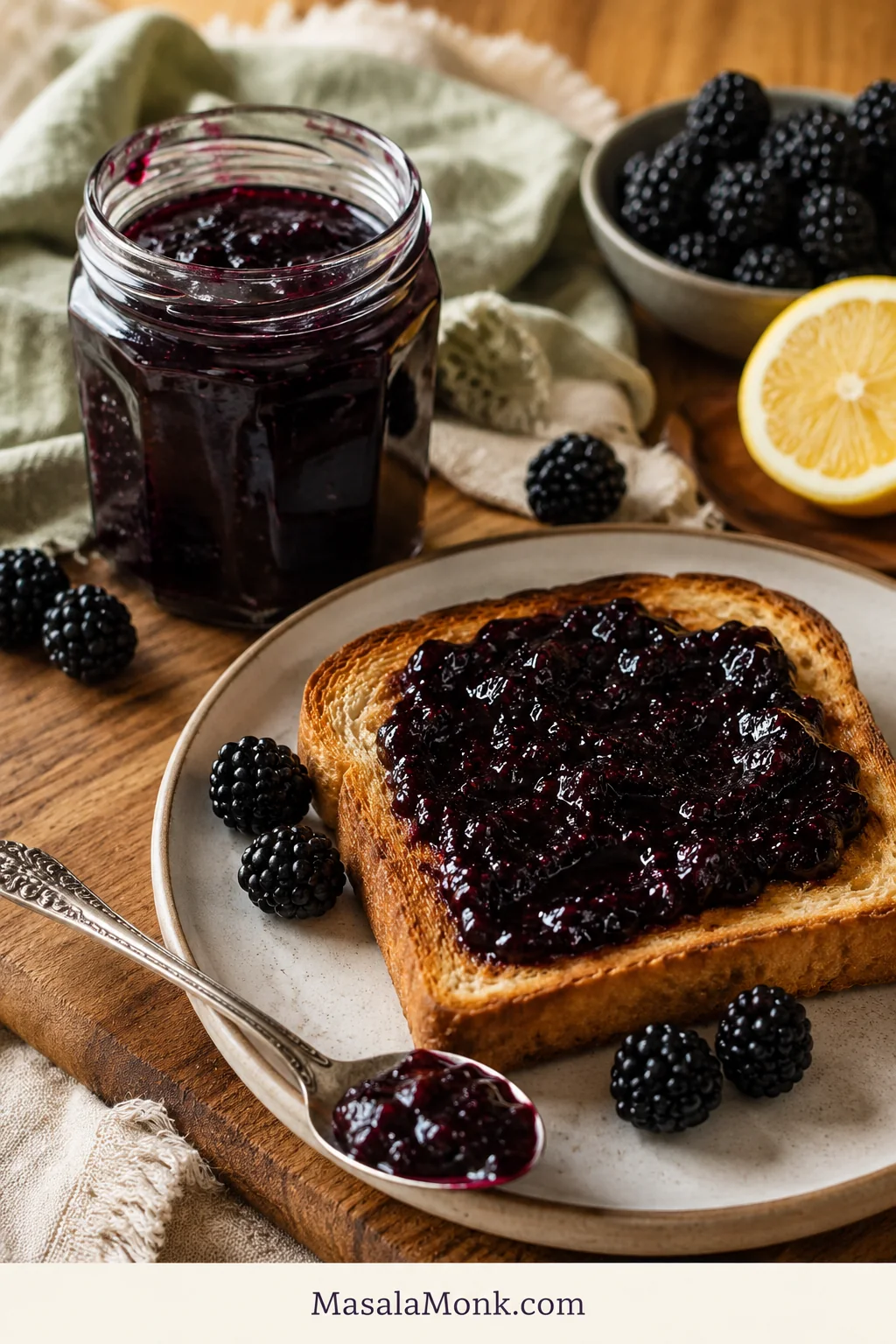
Homemade blackberry jam spread on golden toast with an open jar, spoon, and fresh blackberries on a wooden board.

Blackberry jam sounds simple until the berries hit the pan. Then the real questions begin: will it set, should you use pectin, what about the seeds, can frozen blackberries work, and what changes if you want pantry jars?

This blackberry jam recipe is for the bowl of berries from the market, the frozen bag you forgot about, the wild blackberries that came home with leaves still attached, and the cook who wants jam that tastes like fruit instead of just sugar.

The main method is a no-pectin blackberry jam with deep berry flavor, a spoonable set, and clear cues for when to stop cooking. Make the main cold-storage version first, then use the seedless, pectin, canning, freezer, low-sugar, and troubleshooting sections only as needed.

The best blackberry jam is glossy, dark, and just loose enough to spread. It should taste like the berries first: tart at the edges, sweet through the middle, and rich enough to make plain toast feel like something special.

Most of all, it should be the kind of jar you reach for again the next morning, even if all you have is toast.

Quick Answer: Blackberry Jam That Sets

To make blackberry jam without pectin, cook crushed blackberries with sugar and lemon juice in a wide pan until the mixture turns glossy, darker, and thick enough to pass the cold plate test. At sea level, jam usually sets around 105°C / 220–221°F, but the cold plate test is often the easiest way to judge texture at home.

MasalaMonk’s best default path: use 1 kg blackberries, 600 g sugar, 2 tablespoons lemon juice, a wide pan, and the cold plate test. Strain half the berries if you want fewer seeds without losing jammy body.

For a flexible no-pectin batch, use about 1 kg / 6½–7 cups blackberries, 500–650 g / 2½–3¼ cups sugar, and 2 tablespoons lemon juice. Use the lower sugar range for a sharper cold-storage jam and the higher range for a sweeter, firmer, more classic set.

Fresh blackberries give the brightest result, but thawed frozen blackberries also work. Frozen berries may give a slightly softer set or smaller yield because they release more liquid. For shelf-stable jars, switch to a proper canning method with the correct jar size, headspace, processing time, and altitude adjustment.

If this is your first batch, do not worry about every variation yet. Make the main no-pectin version, store it in the fridge or freezer, and remember this: stop when the cooled spoonful wrinkles, not when the bubbling pot looks thick.

Best Default Blackberry Jam Path

If you are unsure where to begin, start with the default path: a balanced fruit-to-sugar ratio, a wide pan, and a cold plate test.
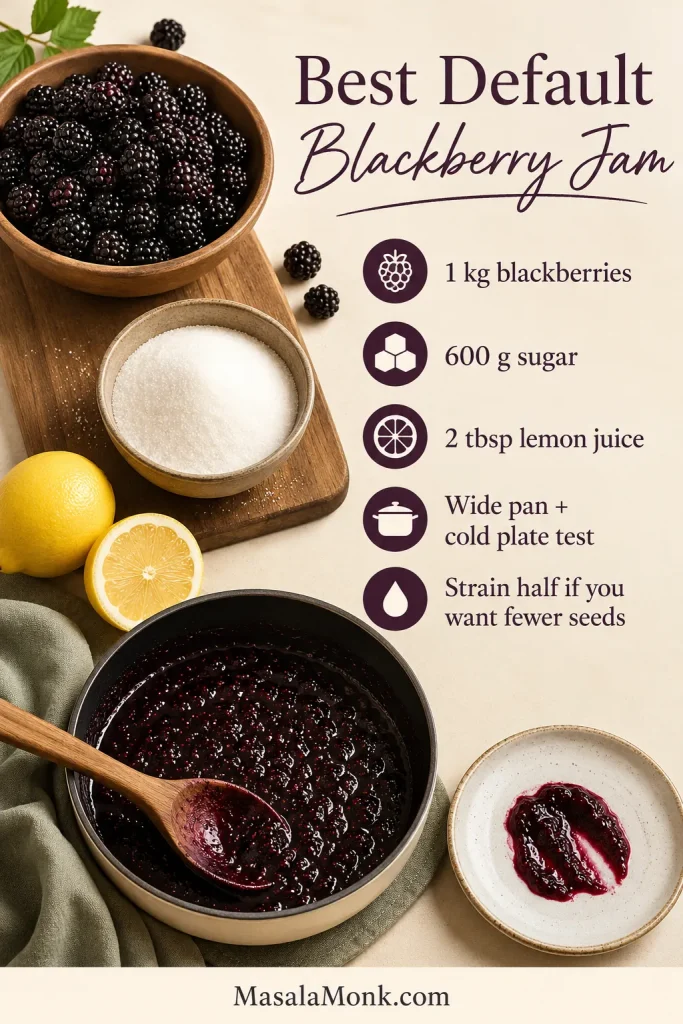
Blackberry jam ingredient board showing blackberries, sugar, lemon juice, a wide pan, and a cold plate test with the ratio 1 kg blackberries, 600 g sugar, and 2 tablespoons lemon juice.
For the easiest first batch, begin with the balanced blackberry jam ratio shown here: fruit, sugar, lemon, a wide pan, and a cold plate test.

Blackberry Jam Recipe

Blackberry Jam Without Pectin

This is the main stovetop version: ripe blackberries cooked with sugar and lemon juice until glossy, thick, and spreadable. It is written as a cold-storage jam unless you follow a shelf-stable canning recipe.

Recipe Details

Prep time10 minutes
Optional rest10 minutes
Cook time25–40 minutes after the sugar dissolves
Total time45–60 minutes, including optional rest
YieldAbout 720–960 ml / 3–4 cups / 3–4 half-pint jars, depending on cook-down and straining
Set cue105°C / 220–221°F or cold plate wrinkle test
StorageRefrigerate or freeze unless using shelf-stable canning instructions

Ingredients

  • 1 kg / about 6½–7 cups blackberries, fresh or thawed frozen
  • 500–650 g / about 2½–3¼ cups granulated sugar
  • 30 ml / 2 tablespoons lemon juice
  • Pinch of salt, optional

Best beginner version: Use 600 g sugar, strain half the softened berries if seeds bother you, and stop cooking when a chilled spoonful wrinkles softly instead of running back like syrup.

Texture cue: Finished blackberry jam should be thick enough to mound on a spoon once cooled, but still soft enough to spread without tearing toast.

Sugar note: Use 500 g sugar for a sharper, softer cold-storage jam. Use 650 g for a sweeter, firmer, more classic set. Berry cup measurements are approximate because blackberries vary in size; weight is more reliable.

Instructions

  1. Sort and rinse the berries. Remove stems, leaves, spoiled berries, and anything moldy. Rinse gently and drain well.
  2. Crush the fruit. Add the blackberries to a wide, heavy-bottomed pan. Mash with a potato masher until juicy but not completely smooth.
  3. Add sugar and lemon juice. Stir in the sugar, lemon juice, and optional pinch of salt. Let the mixture sit for 10 minutes if you have time.
  4. Dissolve the sugar gently. Warm over medium heat, stirring often, until the sugar dissolves and the mixture looks syrupy rather than gritty. This helps prevent grainy jam.
  5. Boil the jam. Increase the heat and bring the mixture to a lively boil. Stir often, scraping the bottom and sides as it thickens. Lower the heat slightly near the end if the jam starts catching on the bottom.
  6. Watch the texture. The jam will foam first, then darken and turn glossy. Near the end, the bubbles look slower and heavier.
  7. Test for set. Start testing after 20–25 minutes. Use a cold plate or cook to about 105°C / 220–221°F at sea level. Do not wait for the hot jam to look as thick as cooled jam.
  8. Jar and cool. Remove from heat. Skim foam if desired. Ladle into clean jars, let the jam cool until no longer steaming, then cover and refrigerate or freeze.

For seedless jam: strain half or all of the softened fruit before the final cook-down. See the seedless section below for details.

Do not miss: Use a wide pan, make two batches instead of doubling in one pot, and treat this as cold-storage jam unless you follow a proper shelf-stable canning method.

What the Finished Blackberry Jam Should Look Like

Use this cooled spoon cue as your texture target: the jam should mound, drip slowly, and still spread softly after the boil is over.
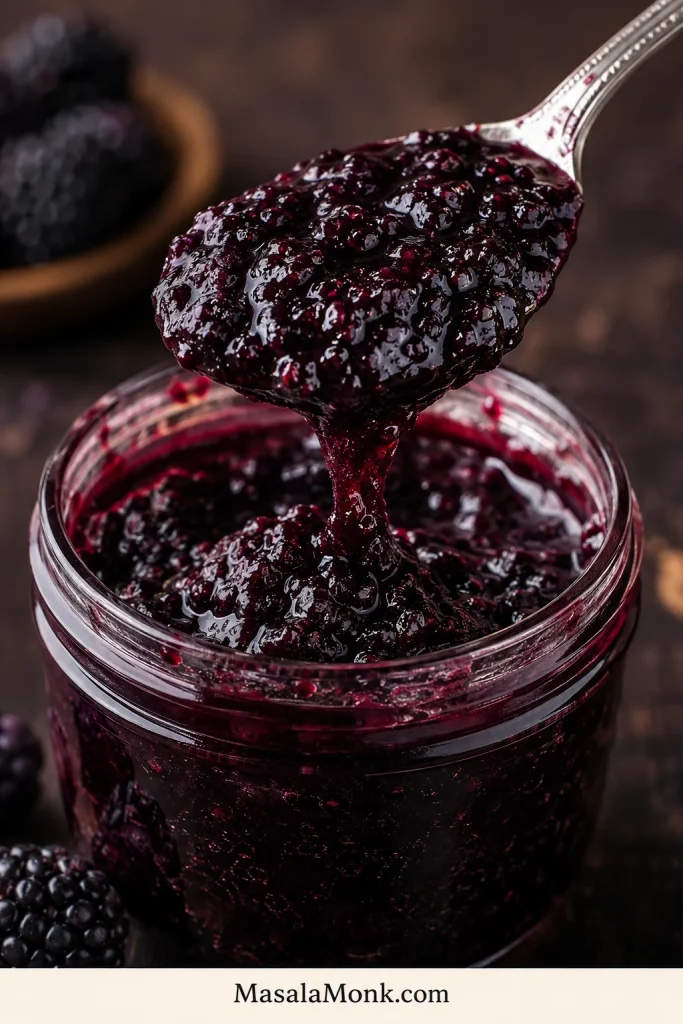
Spoon lifting thick glossy blackberry jam from a glass jar, showing a soft mound and slow drip.
The spoon tells you what the jar should feel like after cooling: thick enough to mound, yet soft enough to spread without turning rubbery.

Find What You Need

The recipe above gives you the basic batch. Below, the no-pectin fridge/freezer version can be adjusted for texture, sweetness, storage, pectin, jelly, or canning needs.

At a Glance: Choose Your Blackberry Jam Version

DecisionBest Choice
Want classic no-pectin jamStart with the main recipe above
Want a good first-batch sugar levelUse 600 g sugar per 1 kg blackberries
Want fewer seedsStrain half the cooked berries for the best balance
Using frozen berriesThaw first and expect a slightly longer cook time
Want a firmer, sweeter setUse the higher sugar range
Want less sugarTreat it as cold-storage jam unless using a canning-safe low-sugar method
Want pantry storageFollow a proper canning method with full processing instructions
Want clear jellyA clear jelly needs a separate strained-juice method

Pick the Best Path for Your Batch

Before choosing your version, separate flexible jam from pantry-safe jam. A fridge or freezer batch gives you room to adjust sweetness and texture; a shelf-stable jar needs a proper canning method.

This recipe is for the flexible no-pectin version. If your goal is clear jelly, sugar-free pantry storage, brand-specific pectin jam, or full shelf-stable canning, use a dedicated method built for that purpose.

Use This Recipe For

  • Blackberry jam without pectin
  • Fresh or frozen blackberries
  • Rustic, half-strained, or seedless texture
  • Fridge or freezer storage
  • Learning the cold plate set test
  • A flexible sweetness range

Use a Separate Method For

  • A clear blackberry jelly with no pulp
  • A sugar-free pantry jam without a tested low/no-sugar method
  • A commercial-style firm gel
  • A pectin-brand recipe with exact packet instructions
  • A pantry-stable canning recipe with full processing instructions
  • Any wax-sealed or paraffin-sealed jar method

Blackberry Jam Rules That Matter

You do not need perfect berries or special pectin to make a good jar. Most blackberry jam problems come from the same few things: a crowded pan, undissolved sugar, judging the jam while it is still hot, or trying to make a flexible batch behave like a canned preserve.

Do ThisNot This
Use a wide panDo not crowd a deep pot
Dissolve sugar before boiling hardDo not rush into a hard boil while the mixture is still gritty
Test on a cold plateDo not judge hot jam by thickness alone
Make two batches if neededDo not double everything in one pot
Use cold storage for flexible ratiosDo not pantry-store an improvised low-sugar jam
Strain half for balanced textureDo not strain all the fruit unless you want a very smooth jar

Ingredients You Need

The base is simple, but every ingredient has a job: berries bring flavor, sugar builds body, lemon brightens, and a tiny pinch of salt deepens the fruit.
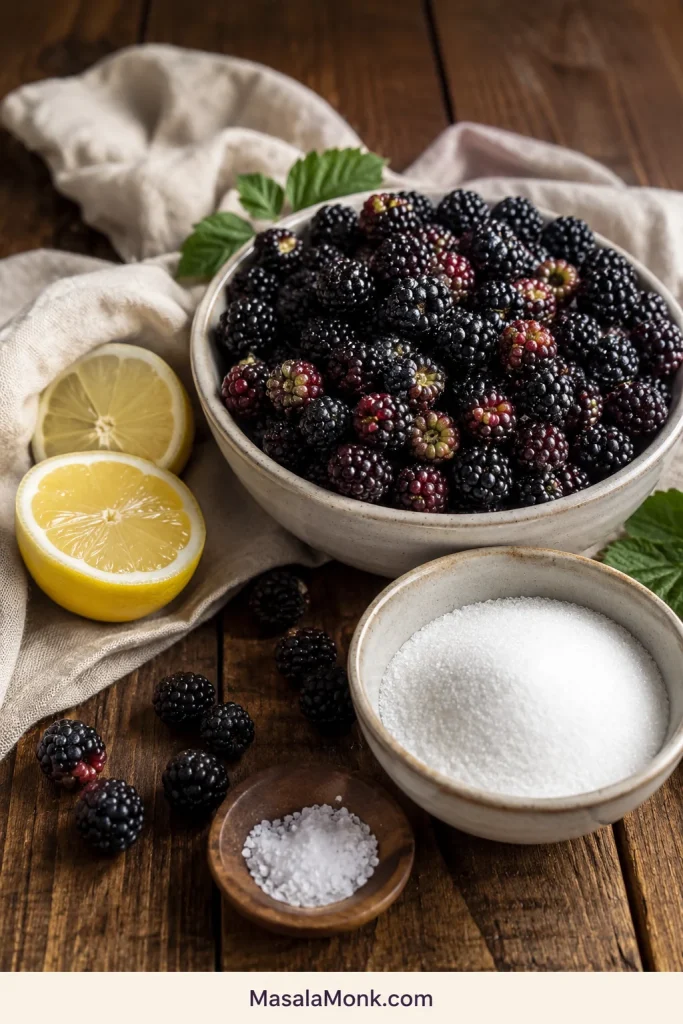
Fresh blackberries, sugar, lemon halves, and a small bowl of salt arranged on a wooden surface for making blackberry jam.
Before the jam boils, the flavor is already taking shape: ripe blackberries bring depth, while sugar and lemon help with shine, balance, and set.

Blackberries

Use ripe blackberries that taste sweet-tart and smell fruity. Fully ripe berries give the best flavor. A few slightly underripe berries can help the jam set because underripe fruit usually has more natural pectin.

Good jam starts before the stove. If the berries taste flat in your hand, they will taste flat in the jar. Avoid moldy, fermented, or collapsing berries because cooking concentrates both the good flavor and the tired one.

If you bought extra blackberries and want more ways to use them beyond jam, MasalaMonk’s blackberry nutrition guide is a useful follow-up beyond the jam pot.

Sugar

Sugar sweetens the jam, but it also helps with body, shine, and set. Reducing sugar can be useful, especially for a sharper fridge or freezer batch, but the texture will usually be softer and the yield smaller.

The goal is not the least sugar possible; it is enough sugar to help the berries become jam without burying their tartness. For this no-pectin version, the most useful range is 500–650 g sugar per 1 kg blackberries.

Lemon Juice

Lemon juice brightens the flavor and helps the jam set. Fresh lemon juice is fine for fridge and freezer jam. For canning recipes, follow the recipe’s specified acid. Many tested recipes use bottled lemon juice because its acidity is consistent.

Salt

A small pinch of salt is optional. It does not make the jam salty; it simply rounds the sweetness and makes the blackberry flavor taste deeper.

Equipment for Blackberry Jam

The jam itself is simple, but a wide pan and a way to test the set make the whole process calmer, especially the first time you watch a loose purple pot slowly turn into jam.

  • Wide heavy-bottomed pan: helps water cook off quickly, so the jam reaches set before the fruit tastes dull or overcooked.
  • Potato masher: crushes the berries while keeping some fruit texture.
  • Wooden spoon or silicone spatula: helps you stir and scrape the bottom as the jam thickens.
  • Cold plates or thermometer: help you test the set instead of relying only on time.
  • Fine mesh sieve, food mill, or chinois: useful if you want seedless blackberry jam.
  • Clean jars: needed for fridge or freezer storage.
  • Canning tools: needed only for a proper shelf-stable canning process.

Fresh vs Frozen Blackberries

This comparison matters before cooking because frozen berries bring extra liquid into the pan, which changes timing more than the basic method.
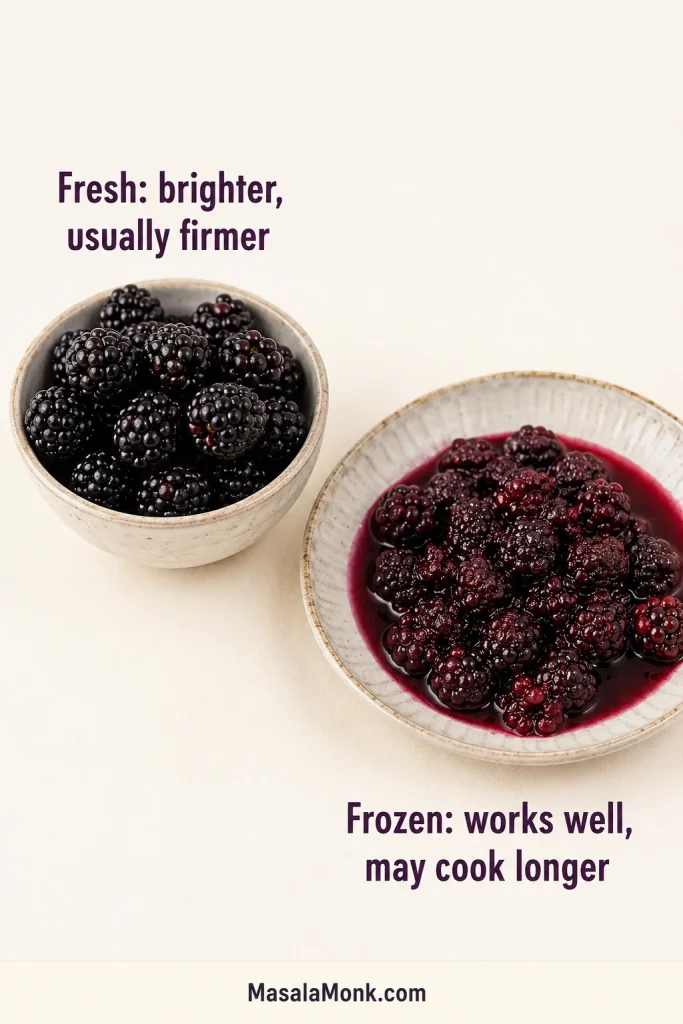
Fresh blackberries compared with thawed frozen blackberries that have released juice, with labels about fresh berries being brighter and frozen berries cooking longer.
Peak-season fresh blackberries usually give the brightest flavor; however, frozen fruit still makes good jam once its extra juice has time to reduce.

During peak season, fresh blackberries make beautiful jam when they are ripe but still firm. The flavor is bright, and the berries usually cook down evenly.

Frozen blackberries work too. Thaw them first, then use the berries and their juices unless they release a large amount of watery liquid. Frozen fruit breaks down faster in the pan, but because it releases more moisture, the batch may take a few extra minutes before the bubbles turn glossy and heavy.

When thawed berries taste mild, use the higher end of the sugar and lemon range. If they taste sharp and concentrated, start lower and adjust after the fruit warms.

Leftover frozen berries can go into a thick berry smoothie recipe instead of being thawed for more jam than you need.

Best Blackberry Jam Ratio

The best ratio depends on how you want the jam to taste and how you plan to store it. Traditional jam uses more sugar and sets more firmly. Lower-sugar jam tastes fruitier but may cook longer and set softer.

Blackberry Jam Ratio Guide

The ratio guide turns the sugar range into practical choices: a small test batch, the balanced default batch, or a softer low-sugar jar.
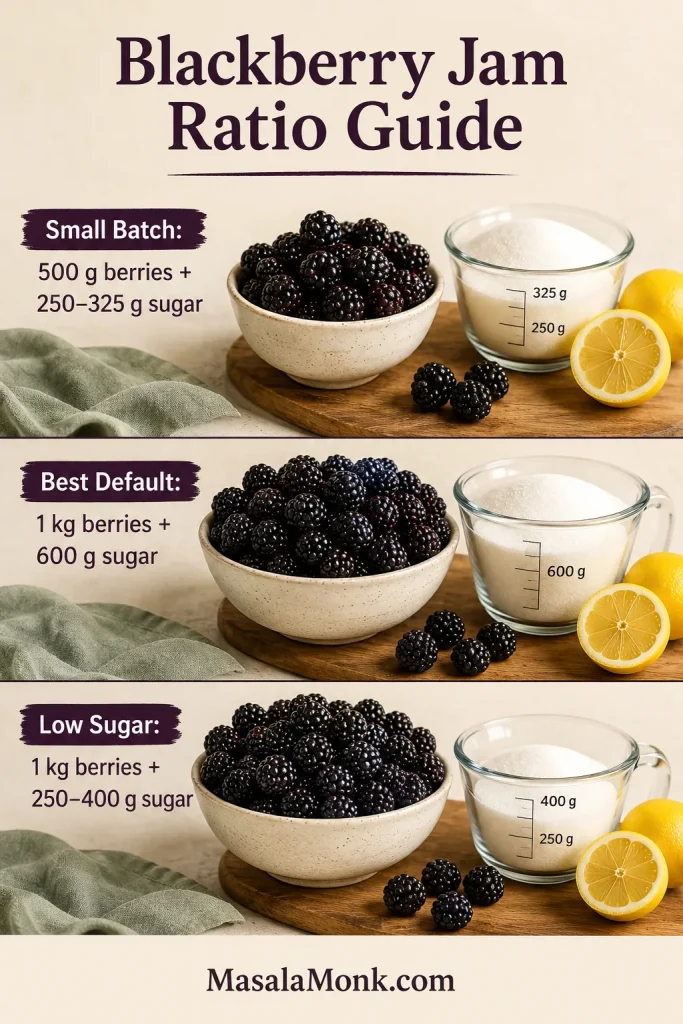
Blackberry jam ratio guide showing small batch, best default, and low-sugar versions with bowls of blackberries, sugar, and lemon.
Match the ratio to the jar you want: small batch for testing, the default ratio for balance, or less sugar for softer cold-storage blackberry jam.
Batch StyleBlackberriesSugarLemon JuiceBest Use
Small batch500 g / about 3¼–3½ cups250–325 g / about 1¼–1⅝ cups1 tbspTesting the recipe or making 1–2 jars
Main batch1 kg / about 6½–7 cups500–650 g / about 2½–3¼ cups2 tbspBalanced no-pectin jam
Best default1 kg / about 6½–7 cups600 g / about 3 cups2 tbspFirst batch with balanced flavor and set
Traditional sweeter set1 kg / about 6½–7 cupsUp to 1 kg / about 5 cups2–3 tbspClassic firmer jam
Low-sugar fridge/freezer style1 kg / about 6½–7 cups250–400 g / about 1¼–2 cups2 tbspSofter, fruit-forward cold-storage jam

For a small batch, use the higher end of the sugar range if you want a firmer, more classic set.

Do not double casually: Need more jam? Make two smaller batches instead of crowding one pot. A crowded pan slows evaporation, stretches the cooking time, and can leave you with jam that is runny, scorched, or overcooked before it sets.

Low-sugar reminder: Reducing sugar does not only change sweetness. It changes how fast the jam sets, how glossy it looks, how much it yields, and how long it keeps.

Why This Blackberry Jam Works

  • A wide pan speeds up evaporation. The batch sets faster when excess water can cook off efficiently.
  • Lemon keeps the flavor bright. It balances the sugar and helps the fruit’s natural gel structure.
  • Moderate sugar keeps the berry flavor alive. The recipe is sweet enough to set but not so sweet that the fruit disappears.
  • A cold plate test prevents guessing. It shows how the jam behaves once cooled, not just how it looks while boiling.
  • Seed control is built in. You can leave the spread rustic, strain half for balance, or strain all for a smoother jar.
  • The method fits blackberries. Blackberries are naturally seedy and tart, so the recipe builds in both seed control and acid balance.

The same fridge/freezer-first logic also works well in MasalaMonk’s fig jam recipe, where the flexible no-pectin method stays separate from canning-safe notes.

How to Make Blackberry Jam Without Pectin

The no-pectin method is less about complicated ingredients and more about watching the pan. The mixture begins loose and syrupy, then foams, reduces, darkens, and finally moves more slowly as the water cooks off.

1. Sort and Crush the Berries

Pick through the blackberries and remove leaves, stems, spoiled berries, or anything moldy. Rinse gently and drain well. Place the berries in a wide pan and crush them with a potato masher until the juices release.

2. Add Sugar and Lemon Juice

Stir in the sugar and lemon juice. Let the mixture sit for about 10 minutes if time allows. This short rest pulls juice from the berries and helps the sugar dissolve more evenly.

3. Dissolve the Sugar Gently

Warm the mixture over medium heat, stirring often. The goal is to dissolve the sugar before the jam reaches a hard boil. If sugar crystals remain on the sides of the pan, try not to scrape them back into the pot.

4. Boil Until the Jam Thickens

Increase the heat and bring the mixture to a lively boil. Stir regularly, especially once it begins to thicken. The bubbles will look light and foamy at first. Later, they become slower, glossier, and heavier.

5. Test Before You Stop

Start testing after 20–25 minutes for a main batch, sooner for a small batch. Do not rely only on time. Frozen berries, watery berries, low sugar, and narrow pans can all change the cooking time.

What the Jam Looks Like as It Cooks

This is the part that makes many first batches feel uncertain. Early on, the jam looks too loose before it looks right, and that does not mean anything has gone wrong.

  • At first, the berries look loose, purple, juicy, and foamy. This is normal because the fruit is releasing water.
  • In the middle, the bubbles rise quickly, the fruit softens, and the color deepens. The pan may still look more like syrup than jam.
  • Near the set point, the bubbles slow down, the surface looks glossier, and a spoon begins to leave a brief trail through the mixture.
  • If it goes too far, the jam starts looking dull, sticky, and heavy. It may drag across the pan instead of bubbling freely.

The pot does not go from syrup to jam all at once. It changes in small signs: the bubbles slow, the color deepens, the spoon drags, and the chilled spoonful finally wrinkles.

Early Foamy Boil

The early boil looks messy because water is cooking off; keep stirring, then watch for darker, heavier bubbles as the jam reduces.
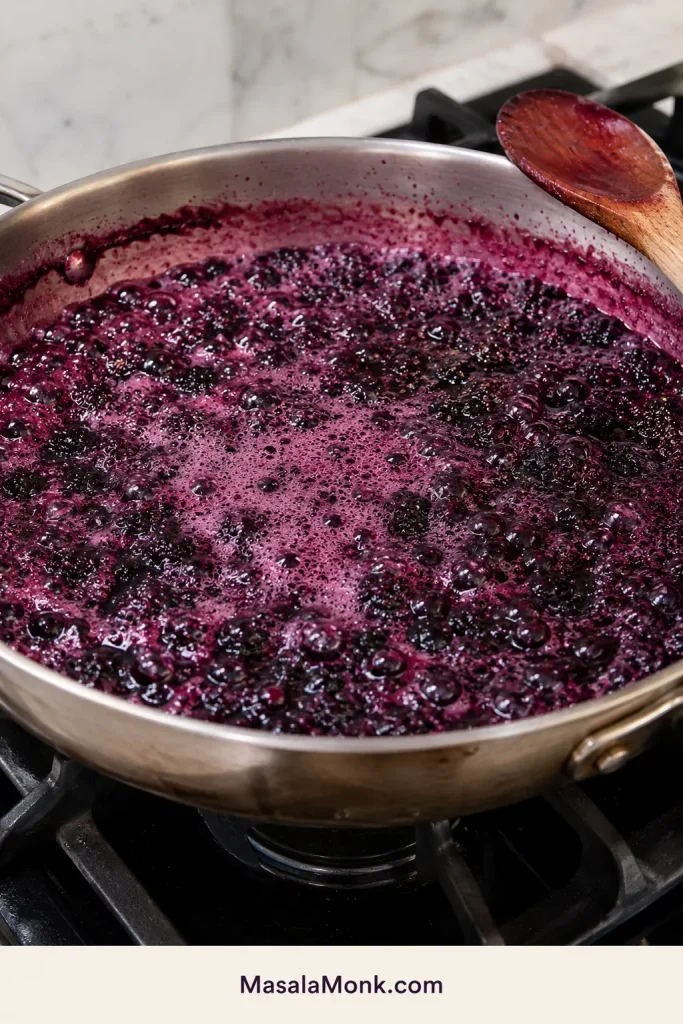
Blackberry jam bubbling loosely and foaming in a wide pan during the early cooking stage.
Foam at this stage is normal because the berries are giving off water; next, the loose bubbles reduce into a darker, heavier blackberry jam.

Glossy Bubbles Near Set

After the foam settles, darker and slower bubbles tell you the jam is close enough to test.
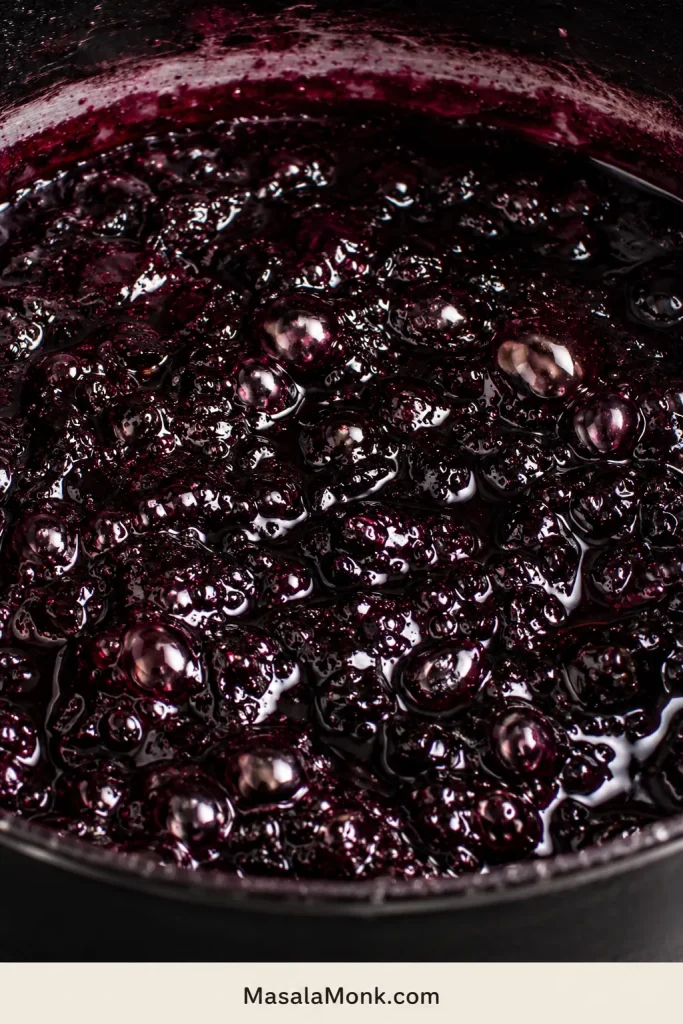
Close-up of dark glossy blackberry jam bubbles near the setting point in a pan.
When the bubbles slow down, darken, and look glossy, the jam is close enough to test instead of cooking blindly by the clock.

Spoon Trail Before Testing

Treat the spoon trail as a warning light, not the finish line; it tells you the jam is close enough to test, not automatically done.
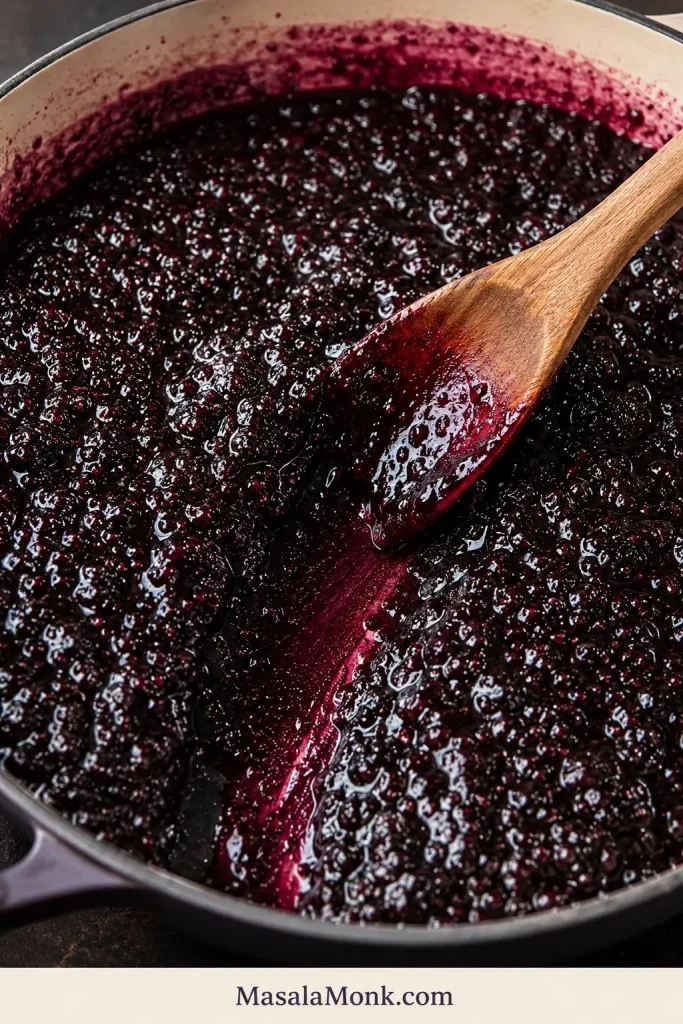
Spoon pulled through thickening blackberry jam in a wide pan, leaving a visible trail through the mixture.
A spoon trail is a useful thickening cue; still, the cold plate test gives the final answer because hot jam always looks looser in the pan.

As the jam gets close, the kitchen starts to smell darker and more berry-rich, not just sweet. The color deepens from bright purple to a glossy blackberry wine shade, and the spoon feels a little more resistance as you stir.

This is the moment many beginners are tempted to keep cooking. Test first.

You are not waiting for the jam to look solid in the pot. The goal is a jam that cools into a spread.

How to Know Blackberry Jam Is Set

Jam thickens as it cools, so it will not look completely finished while it is bubbling in the pan. Use a test instead of waiting until it looks stiff. By then, it may already be overcooked.

Cold Plate Test

Put two small plates in the freezer before cooking. To test, remove the pan from the heat, spoon a little jam onto a chilled plate, and wait 30–60 seconds. Push the jam with your finger. If it wrinkles, mounds, or moves slowly instead of flooding back like syrup, the jam is ready.
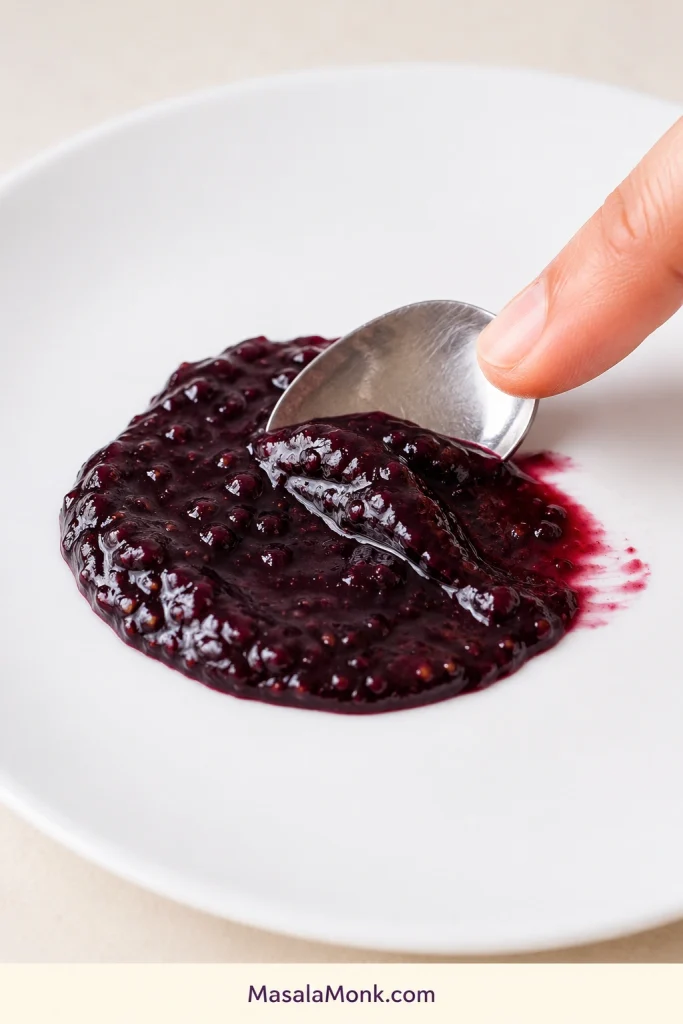
Cold plate wrinkle test showing cooled blackberry jam being pushed on a white plate until it wrinkles and mounds.
This little wrinkle matters: it shows how the blackberry jam will set after cooling, before you accidentally cook it too thick.

When the spoonful on the cold plate wrinkles for the first time, the whole batch suddenly makes sense. That is the moment you stop guessing and start trusting the jam.

Thermometer Test

At sea level, blackberry jam usually sets around 105°C / 220–221°F. This number is useful, but not perfect for every kitchen. Altitude, sugar level, batch size, and berry moisture can all affect the final texture.

Spoon Test

Lift a spoonful of jam and let it fall back into the pan. Early in cooking, it drips quickly. As it gets close to set, it falls more slowly in thicker drops or sheets.

Better slightly soft than overcooked: If you are unsure, stop a little early and test again. Runny jam can often be simmered longer. Jam that has cooked into a stiff, rubbery paste is harder to rescue.

The first batch teaches you what the bubbles look like. After that, blackberry jam becomes much less mysterious.

Seedless Blackberry Jam

Blackberry seeds are part of the fruit, but they do not have to dominate the jar. This is where homemade jam becomes personal: some people love the old-fashioned seediness, while others want the fruit without the crunch.

For most readers, straining half the berries is the best default. It reduces grit while keeping enough pulp and body for real jam texture. Half-strained jam is often the sweet spot because it still feels homemade without making every bite about seeds.

Seed MethodResultBest For
Leave all seeds inRustic, thick, full fruit textureFastest old-fashioned jam
Strain half the berriesSmoother but still jammyBest balance for most people
Strain all the cooked berriesVery smooth seedless jamPeople who dislike blackberry seeds
Drain through a jelly bag without pressingClear blackberry jellyJelly, not jam

Seedless Straining Step

For seedless jam with real body, press the softened fruit firmly enough to capture thick pulp, not just thin juice.
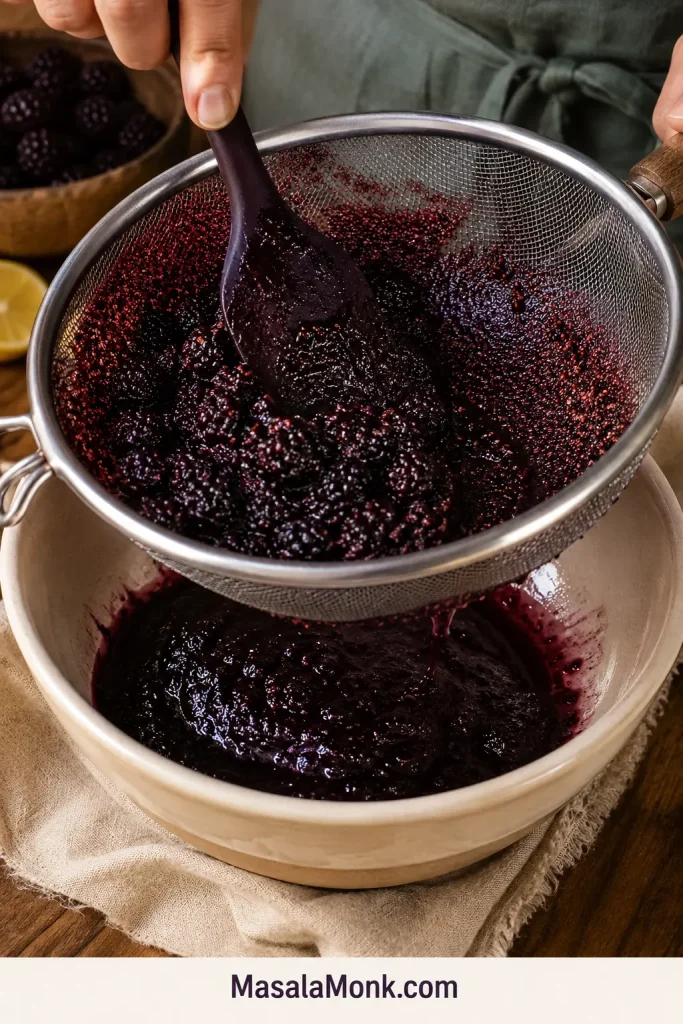
Cooked blackberries being pressed through a fine mesh sieve into a bowl, with seeds and pulp visible in the sieve.
Straining changes the eating experience: seeds stay in the sieve, while the thick berry pulp below keeps seedless blackberry jam from feeling thin.

To strain half, cook the berries until softened, then press half the fruit through a fine mesh sieve, food mill, or chinois. Return the strained pulp and juice to the pan with the unstrained half. This keeps the jam thick and fruity without letting the seeds take over.

If you strain all the berries, press firmly enough to capture pulp, not just juice. For clear blackberry jelly, do not press the bag. Let the juice drip naturally so the jelly stays clearer.

Rustic, Half-Strained, or Seedless Texture

Compare the textures before straining all the fruit, because rustic, half-strained, and fully seedless jam each eat differently.
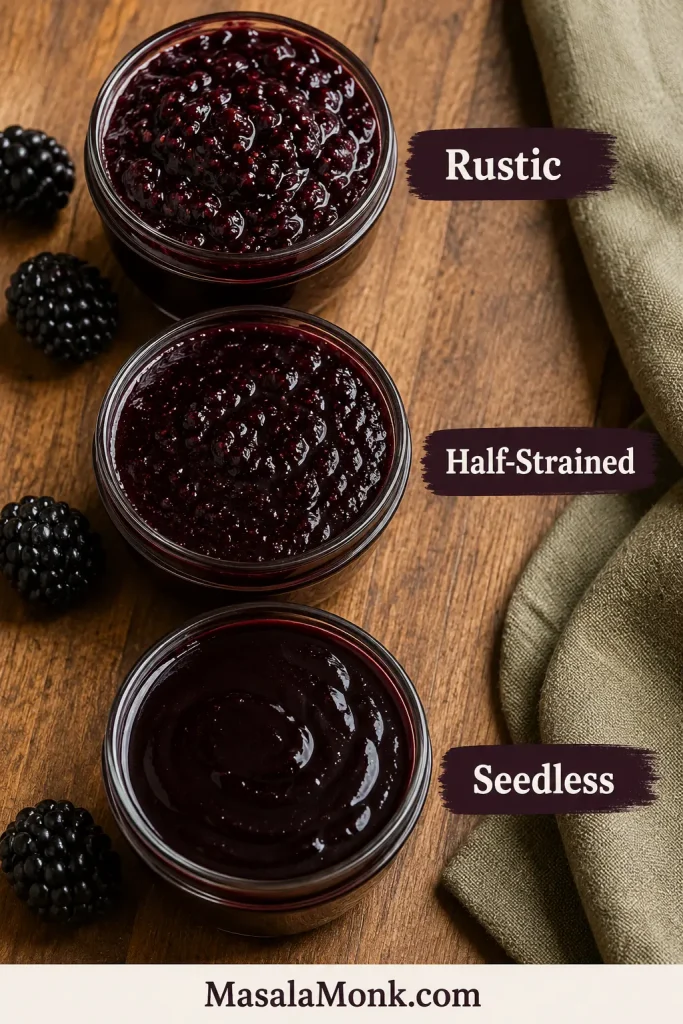
Three jars of blackberry jam labeled Rustic, Half-Strained, and Seedless, showing chunky, smoother, and fully smooth textures.
Texture is not one-size-fits-all: rustic jam keeps crunch, half-strained jam keeps body, and seedless jam gives the smoothest spoonful.

What Is Blackberry Jam?

Blackberry jam is crushed fruit cooked with sugar until it thickens into a spread. Unlike jelly, jam keeps some fruit body. Compared with preserves, it is usually less chunky and more evenly spreadable.

The best jar keeps the berry’s natural tartness. If it is undercooked, it runs like syrup. When overcooked, it can turn stiff and sticky. The sweet spot is glossy, spoonable, and thick enough to mound softly on toast.

Blackberry Jam vs Jelly vs Preserves

Once you start removing seeds, this distinction becomes important. Seedless jam still keeps fruit pulp, while blackberry jelly is built from strained juice.
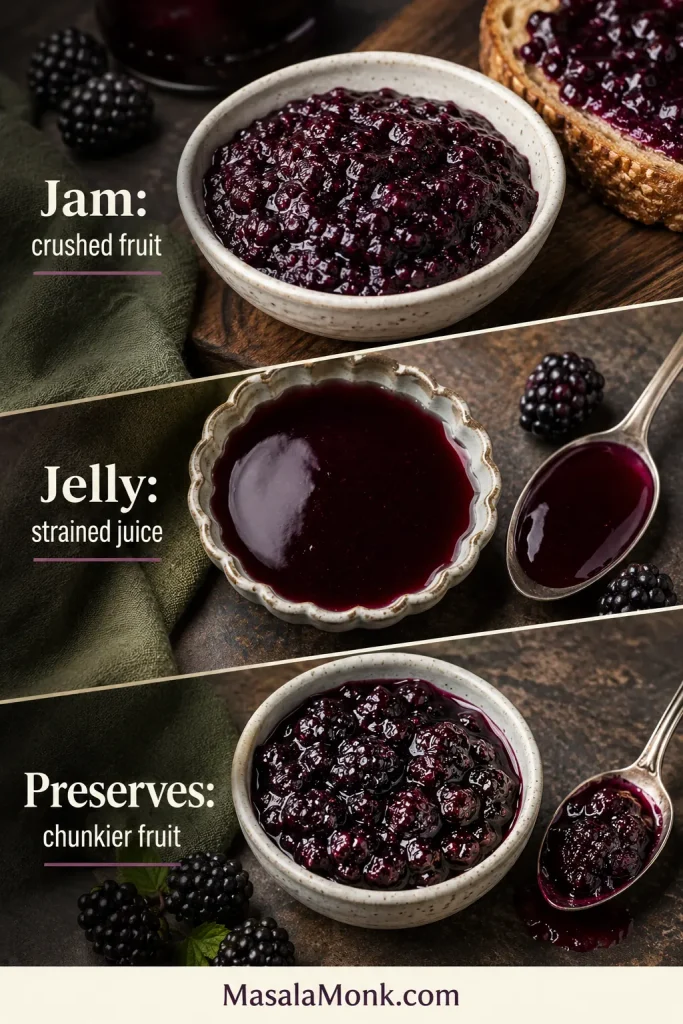
Blackberry jam, blackberry jelly, and blackberry preserves compared by texture, showing crushed fruit, strained juice, and chunkier fruit pieces.
Look at the fruit first: blackberry jam has pulp, blackberry jelly is strained smooth, and preserves keep larger berry pieces.
TypeWhat It IsTextureBest Use
Blackberry jamCrushed fruit cooked with sugarThick, spreadable, fruit textureToast, biscuits, cakes, yogurt
Blackberry jellyStrained blackberry juice cooked to gelSmooth, clear, no seeds or pulpToast, glazing, clean seedless texture
Blackberry preservesLarger fruit pieces in a syrupy setChunkier and looserDesserts, spooning, cheese boards
Blackberry freezer jamJam stored frozen instead of cannedUsually softer and fresherBeginners, small batches, quick storage

For another fruit-spread example, MasalaMonk’s pineapple jam and preserves shows how a smoother jam and chunkier preserve can come from the same fruit but eat very differently.

A smooth, clear, seedless spread may be better as blackberry jelly. Jam keeps fruit pulp; jelly starts with strained juice. For clear jelly, strain the cooked berries through a jelly bag or damp cheesecloth and avoid pressing the solids. With seedless jam, you can press softened fruit through a sieve or food mill because pulp belongs in the jar.

Blackberry Jam With Pectin

Pectin is useful when you want a faster, more predictable set, especially with very ripe, watery, or low-pectin berries. It is not better or worse than no-pectin jam; it is simply a less flexible method with its own order and ratios.

No-pectin jam gives deeper cooked-berry flavor and more flexibility, while pectin recipes trade that flexibility for speed and predictability. If you are using Sure-Jell, Ball, Certo, Pomona, or another pectin brand, follow that product’s fruit amount, sugar amount, acid, pectin type, and boiling order. In many pectin recipes, the order matters as much as the ingredients.

  • Use pectin if you want a faster, more predictable set.
  • Skip pectin if you want a deeper cooked berry flavor and do not mind a longer cook.
  • Use low/no-sugar pectin if you want reduced sugar with a more reliable set.
  • Do not guess conversions between liquid, powdered, regular, and low-sugar pectin.

Pectin can help with texture, but it does not replace safe canning steps. Pantry storage is a separate decision.

Canning Blackberry Jam Safely

If your jars are going into the fridge or freezer, the recipe can stay flexible. Pantry shelves are different: storage becomes part of the recipe.

Safety note: The main no-pectin recipe is written for fridge or freezer storage. For shelf-stable blackberry jam, use a tested canning recipe and follow the correct jar size, headspace, processing time, and altitude adjustment.

Can you can this exact lower-sugar recipe? Not as written. Use it for the fridge or freezer, or switch to a tested canning formula.

Canning is where jam-making becomes less flexible. That is not because canning is scary; it is because room-temperature storage needs a recipe built for it.

In other words, the jar is not the safety step; the full process is.

Tested No-Pectin Berry Jam Reference

For shelf-stable berry jam without added pectin, the National Center for Home Food Preservation gives a tested berry jam formula using 9 cups crushed berries and 6 cups sugar, yielding about 7–8 half-pint jars. The hot jam is packed into hot sterile jars with ¼ inch headspace and processed in a boiling-water canner with timing adjusted by altitude.

That canning ratio is different from the flexible lower-sugar fridge/freezer recipe in this post. This reference is included to show how shelf-stable jam differs; it is not a substitute for following full canning instructions from start to finish.

  • Use half-pint / 8 oz / about 240 ml jars unless the canning recipe says otherwise.
  • Choose proper canning jars and new lids.
  • Fill hot jam into hot jars.
  • Leave ¼ inch headspace for canned jam or jelly.
  • Wipe rims before adding lids.
  • Process in a boiling-water canner.
  • Adjust processing time for altitude.
  • Use low/no-sugar pectin instructions written for canning if preserving reduced-sugar jam.
  • Do not use paraffin or wax seals for modern home-canned jam.

For detailed safety guidance, use a trusted home-preservation source such as the National Center for Home Food Preservation’s jam and jelly canning guidance. If you specifically want a tested berry jam method, their berry jams without pectin guidance is the better reference than improvising a pantry-stable version from a flexible fridge jam.

For many small batches, freezing is the easier answer. You still get homemade jam, but you do not have to turn it into a pantry-stable preserve.

Blackberry Freezer Jam

Blackberry freezer jam is the low-stress route when you want the homemade jar without the full canning afternoon. It is stored in the freezer instead of the pantry, so the process is more forgiving.

This post uses the cooked-jam route. Classic pectin freezer jam follows the pectin package method instead, so use those instructions if you are working from a freezer-pectin recipe.

Freezer jam is usually softer and fresher-tasting than canned jam. Some versions use pectin, while others are simply cooked down and frozen. Either way, use freezer-safe jars or containers and leave about ½ inch headspace so the jam can expand as it freezes.

  • Cool jam before freezing.
  • Use freezer-safe containers.
  • Leave expansion space at the top.
  • Thaw in the refrigerator.
  • Keep thawed jam refrigerated.

Low-Sugar, No-Sugar, and Sugar-Free Blackberry Jam

Low-sugar blackberry jam can taste wonderfully fruit-forward. This is often the version people want when the berries are especially good and they do not want sugar to cover them up.

Low sugar is not just less sweet. It is a different texture. Less sugar usually means a softer set, longer cooking time, smaller yield, and shorter storage unless you use a reliable low-sugar canning method.

  • Low sugar: less sugar, softer set, and fridge/freezer storage unless you follow a canning-safe method.
  • No sugar or sugar-free: usually needs special pectin, chia seeds, or cold storage.
  • Pantry-safe low sugar: requires a tested low/no-sugar canning method with its own processing instructions.

For fridge or freezer jam, start with 250–400 g sugar per 1 kg blackberries if you want a sharper, less sweet spread. Cook it until thickened, then rely on the cold plate test rather than the clock.

No-sugar or sugar-free blackberry jam usually needs special low/no-sugar pectin, chia seeds, or refrigerator/freezer storage. Do not assume a sugar-free jam is pantry-safe just because it looks thick; use the canning notes if shelf storage is the goal.

For a softer, small-batch preserve idea with apple and berries, MasalaMonk’s quick strawberry and apple preserve is a useful comparison.

Blackberry Jam Variations

These are flavor ideas for small fridge/freezer batches unless you are following a tested canning recipe for that exact combination.

Apple Blackberry Jam or Bramble Jam

Apple softens blackberry’s sharp edge and gives the jam a cozy autumn feel, especially when the berries are very ripe. In the UK, blackberry jam is often discussed as bramble jam, especially when made with foraged berries.

Blackberry Rhubarb Jam

Rhubarb pushes the jar brighter and sharper, which is lovely if you like tart jam. It also changes acidity, water content, and texture, so use a dedicated tested recipe if you want to can it.

Blackberry Jalapeño Jelly

Blackberry jalapeño jelly belongs on the savory-sweet side: cheese boards, crackers, sandwiches, and holiday appetizers. Treat it as its own jelly recipe rather than a small tweak to breakfast jam.

Blackberry Chia Jam

Blackberry chia jam is the quick breakfast version, soft-set and refrigerator-only. It uses berries, a little sweetener, lemon, and chia seeds instead of a traditional jam set.

Blackberry Vanilla Jam

Vanilla turns blackberry jam into more of a dessert spooning jam, especially for yogurt, cheesecake, oatmeal, and cake layers. Add vanilla near the end so it stays fragrant instead of cooked away.

Blackberry Lemon Jam

Blackberry lemon jam is the brighter jar. Lemon zest gives the fruit a fresher edge, as long as you use only the yellow zest and avoid the bitter white pith.

If your jam is not perfect the first time, you probably still have something useful: syrup, sauce, cake filling, yogurt topping, or a batch that just needs a few more minutes.

Troubleshooting Blackberry Jam

Most jam problems are not disasters; they usually come from water, sugar, heat, or patience falling slightly out of balance.
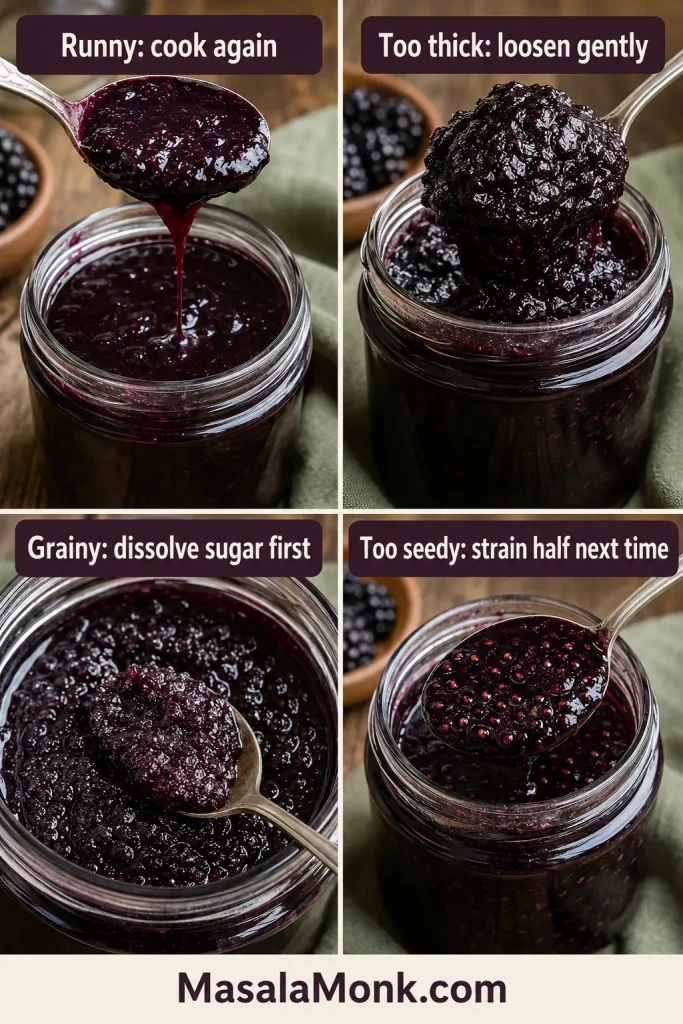
Blackberry jam troubleshooting guide showing runny jam, too-thick jam, grainy jam, and too-seedy jam with suggested fixes.
Soft, stiff, grainy, or seedy jam does not have to be wasted; with the right fix, it can still become a spread, sauce, filling, or topping.

Why Is My Blackberry Jam Runny?

Runny blackberry jam usually means it needed more cooking, the berries were watery, the sugar was reduced too much, or the batch was too large. Frozen berries and low-sugar batches often need extra time.

To fix soft fridge jam, return it to a wide pan and simmer again. Stir often and use the cold plate test. If it stays loose, use it as blackberry syrup for pancakes, yogurt, oatmeal, or desserts.

Why Is My Jam Too Thick?

Jam becomes too thick when it is overcooked or cooked too aggressively near the end. For immediate use, warm it gently with a spoonful of water or lemon juice to loosen it. Do not casually re-can adjusted jam without safe canning guidance.

Why Is My Jam Grainy?

Grainy jam often comes from undissolved sugar or sugar crystals. Warm the fruit, sugar, and lemon gently at first, and stir until the sugar dissolves before boiling hard.

Why Is My Jam Foamy?

Foam is normal when berries and sugar boil. Skim it near the end if you want a cleaner-looking jar. A tiny amount of butter is sometimes used in pectin recipes to reduce foam, but it is not needed for this no-pectin version.

Why Is My Jam Too Seedy?

Blackberries are naturally seedy. Next time, strain half the cooked fruit for a balanced texture or strain all of it for smoother seedless blackberry jam. For clear jelly, drain the juice without pressing the pulp.

Why Did My Jam Scorch?

Jam can scorch if the heat is too high near the end, the pan is too thin, or the batch is too large. Use a wide heavy pan, stir more often as the jam thickens, and avoid oversized batches.

Storage and Freezing

Storage depends on how the jam was made. Flexible no-pectin and low-sugar batches belong in cold storage unless they were prepared with a tested canning process.
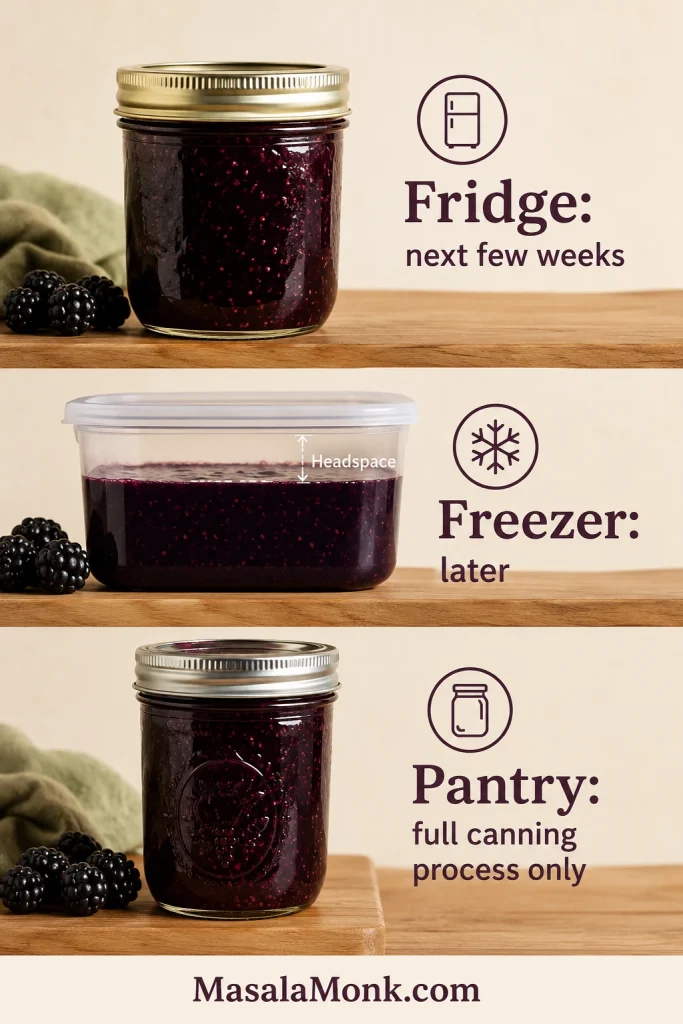
Blackberry jam storage guide showing a fridge jar, a freezer container with headspace, and a pantry jar for full canning process only.
Fridge and freezer jars suit flexible jam, while pantry storage needs a recipe and process built for safe canning.
Storage TypeHow to StoreNotes
Fridge jamCool, cover, and refrigerateBest within 2–3 weeks
Freezer jamUse freezer-safe jars or containersBest within 3–6 months for flavor; leave ½ inch headspace
Canned jamStore sealed jars in a cool, dark placeFollow the canning recipe’s shelf-life guidance
Opened canned jarRefrigerate after openingUse within a few weeks
Moldy or fermented jamDiscardDo not scrape mold off jam and keep eating

A fridge jar is for the next few breakfasts, a freezer jar is for later, and a pantry jar only belongs on the shelf when the full canning process was built for it.

Once the jar has cooled, the real reward is how easily it fits into breakfast, dessert, and the small snacks in between.

How to Use Blackberry Jam

Blackberry jam is sweet enough for breakfast but tart enough for desserts and cheese boards. A good jar cuts through creamy, buttery, and sweet foods instead of tasting flat.

It is especially good anywhere you want something sweet but not flat: buttery toast, plain yogurt, sharp cheese, or a simple cake that needs a little fruit.
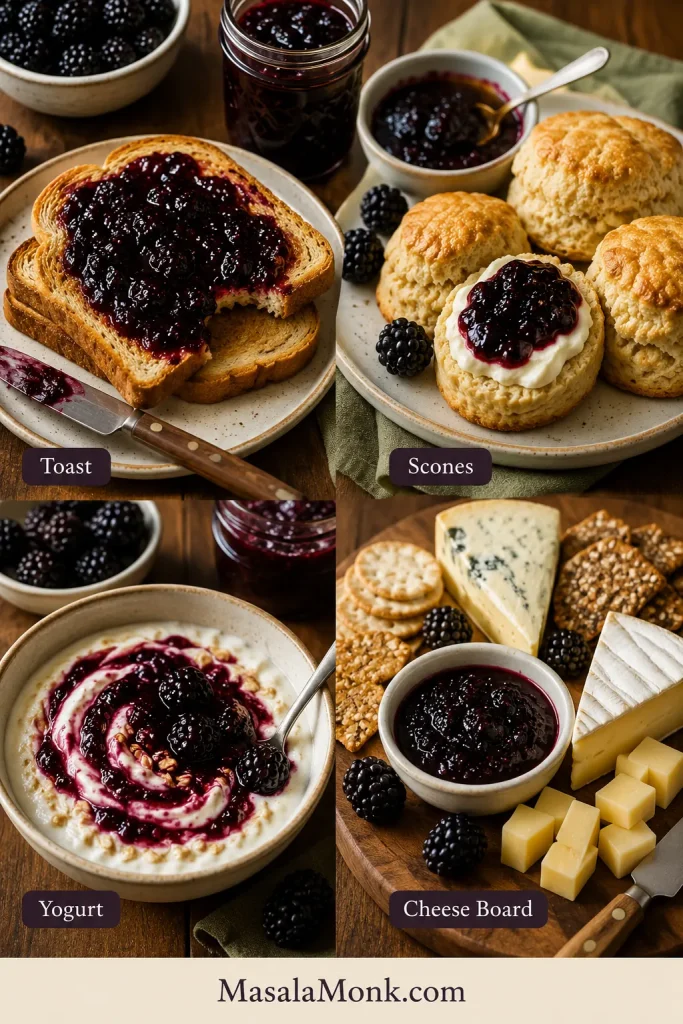
Blackberry jam served on toast, scones, yogurt, and a cheese board in four labeled serving scenes.
Once the jar is ready, use that tart blackberry flavor beyond toast: scones, yogurt, oats, cheese boards, and simple desserts all benefit from it.
  • Spread on toast, biscuits, croissants, or easy English scones.
  • Spoon over Japanese pancakes, waffles, oatmeal, yogurt, or ice cream.
  • Swirl a spoonful into overnight oats or layer it with plain yogurt and granola.
  • Use as a cake filling, cheesecake topping, or spooned dessert sauce with homemade whipped cream.
  • Swirl into thumbprint cookies or shortbread bars.
  • Serve with sharp cheddar, goat cheese, crackers, or warm biscuits.
  • Warm gently and brush over a simple cake as a berry glaze.
  • Stir into sparkling water, mocktails, or cocktails for a berry syrup effect.

FAQ

Most of the big decisions happen before the jar cools. These quick answers cover the questions that usually come up while cooking, storing, or planning the next batch.

Does blackberry jam need pectin?

No. It can set without added pectin when cooked with sugar and lemon juice until thick enough. Use the cold plate test or thermometer test instead of relying only on time.

Do frozen blackberries work for jam?

Yes. Thaw them first, then use the berries and their juices unless the liquid looks thin and watery. Frozen berries may take a little longer to cook down.

How long should blackberry jam cook?

A main batch usually takes 25–40 minutes after the sugar dissolves. Small batches cook faster; frozen, watery, or low-sugar batches often take longer.

What temperature makes blackberry jam set?

At sea level, it usually sets around 105°C / 220–221°F. Because altitude and sugar level affect the exact set point, the cold plate test is still useful.

Why did my blackberry jam stay runny?

It may need more cooking, or the berries may be watery, low in pectin, low in sugar, or crowded in the pan. Return soft fridge jam to a wide pan and cook again, testing often.

What is the best way to make seedless blackberry jam?

Cook the berries until soft, then press some or all of the fruit through a fine mesh sieve, food mill, or chinois. Straining half gives a smoother jam while keeping enough body.

Should blackberry seeds be removed?

No. Leave them in for rustic jam, or strain some of the fruit if you prefer a smoother texture.

How much sugar can be reduced?

For fridge or freezer jam, you can reduce the sugar to about 250–400 g per 1 kg blackberries. The jam will usually set softer and keep for less time.

Is low-sugar blackberry jam safe for canning?

Only when made with a tested low-sugar canning recipe or a low/no-sugar pectin method with its own processing instructions.

Blackberry jam or blackberry jelly: what is the difference?

Jam uses crushed fruit, so it has body and texture. Jelly uses strained juice, so it is smoother, clearer, and seedless.

How are blackberry preserves different?

Preserves are usually chunkier and looser than jam, with more whole or partial berries in the spread.

How long does homemade blackberry jam last?

Fridge jam is best within 2–3 weeks. Freezer jam is best within 3–6 months for flavor. Canned jam depends on proper processing and a good seal.

Does blackberry jam freeze well?

Yes. Cool it first, use freezer-safe containers, leave about ½ inch space for expansion, and thaw in the refrigerator.

Which pectin works best?

The best pectin is the one your recipe was written for: powdered, liquid, regular, or low/no-sugar. They are not always interchangeable, so follow that product’s order and ratios.

Should this recipe be doubled?

No. Make two separate batches. Doubling in one pot slows evaporation and can make the final set less reliable.

What tastes good with blackberry jam?

Toast, scones, pancakes, yogurt, oatmeal, cakes, cheesecake, ice cream, cheese boards, and whipped cream all work well.

Final Thought

A good blackberry jam should taste like the fruit led the recipe and the sugar only helped it along.

Once you learn the signs — glossy bubbles, a slower spoon, and that little wrinkle on a cold plate — the process stops feeling like guesswork. Then every batch becomes your choice: rustic or seedless, soft or firm, fresh or frozen, fridge jam or properly canned. That is when blackberry jam becomes less of a guessing game and more of a jar you know how to make again.

Back to top · Jump to recipe card · Find what you need

Posted on Leave a comment

Lemonade Scones Recipe

Tall golden lemonade scones on a light tea table, with one scone split open and filled with jam and cream beside a teacup.

This lemonade scones recipe is the shortcut bake you make when you want warm, tender scones without rubbing butter into flour. You only need self-raising flour, cream, and fizzy lemonade, and the dough is supposed to look soft, rough, and a little messy before it bakes into tall, split-open scones.

The point is not just speed. The real win is a batch of scones that rise properly, pull apart easily, and stay soft enough for jam, cream, butter, or lemon curd instead of turning dry, flat, or doughy. If regular scones have ever felt fussy, this version is a good place to rebuild confidence.

If you have seen recipes for scones using lemonade and wondered how they work, the idea is simple: cream brings richness, self-raising flour brings lift, and lemonade adds moisture, gentle sweetness, and fizz. This guide keeps the recipe easy while showing you the small details that help lemonade scones rise tall instead of turning dense, sticky, pale, or dry.

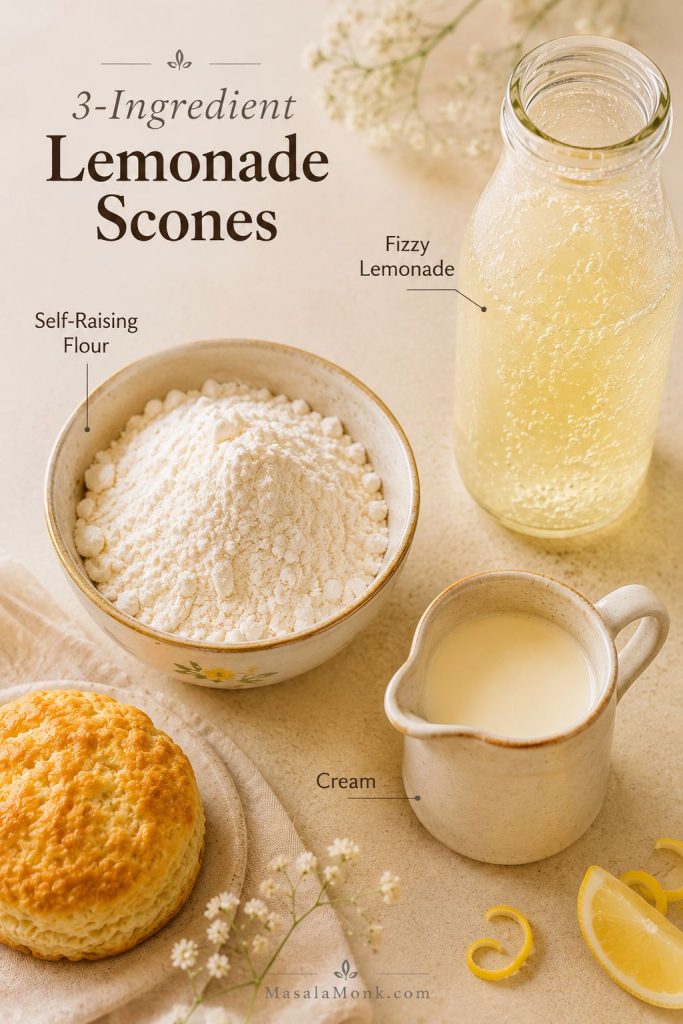
The 3-Ingredient Shortcut

Before you start, it helps to see why this shortcut works. The recipe looks unusually simple, but the flour, cream, and fizzy lemonade each replace a step from a more traditional scone method.

Self-raising flour in a bowl, cream in a small jug, and fizzy lemonade beside a finished scone on a light work surface.
Three ingredients can work beautifully when each one does its job. Self-raising flour gives lift, cream replaces the butter-rubbing step, and fizzy lemonade adds the moisture and gentle sweetness that bring the dough together.

Quick Answer: How to Make Lemonade Scones

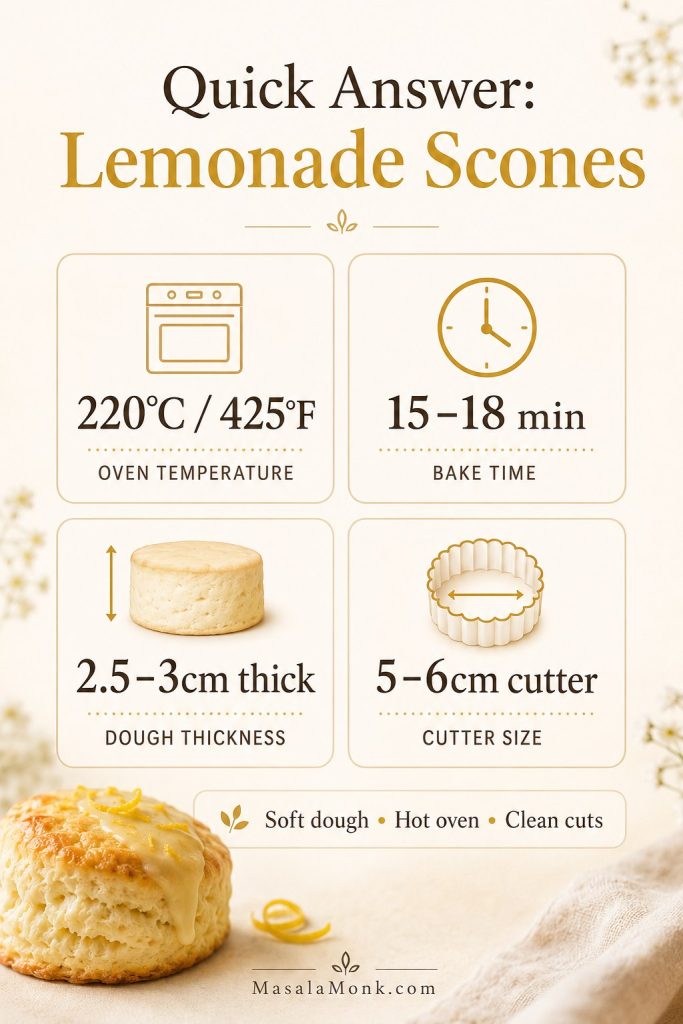
To make this lemonade scones recipe, mix self-raising flour, chilled cream, and chilled fizzy lemonade into a soft, slightly sticky dough. Pat the dough to about 2.5–3cm / 1–1¼ inches thick, cut cleanly with a floured round cutter, place the scones just touching on a tray, brush the tops with milk or cream, and bake at 220°C / 425°F for about 15–18 minutes.

Use this quick visual guide as the fast check before you mix: temperature, bake time, dough height, and cutter size are the details that control most of the final result.

Quick guide image for lemonade scones showing oven temperature, bake time, dough thickness, and cutter size beside a baked scone.
Keep these numbers close before you start: 220°C / 425°F, 15–18 minutes, 2.5–3cm dough thickness, and a 5–6cm cutter. Together, they give the dough enough heat, height, and structure to rise properly.

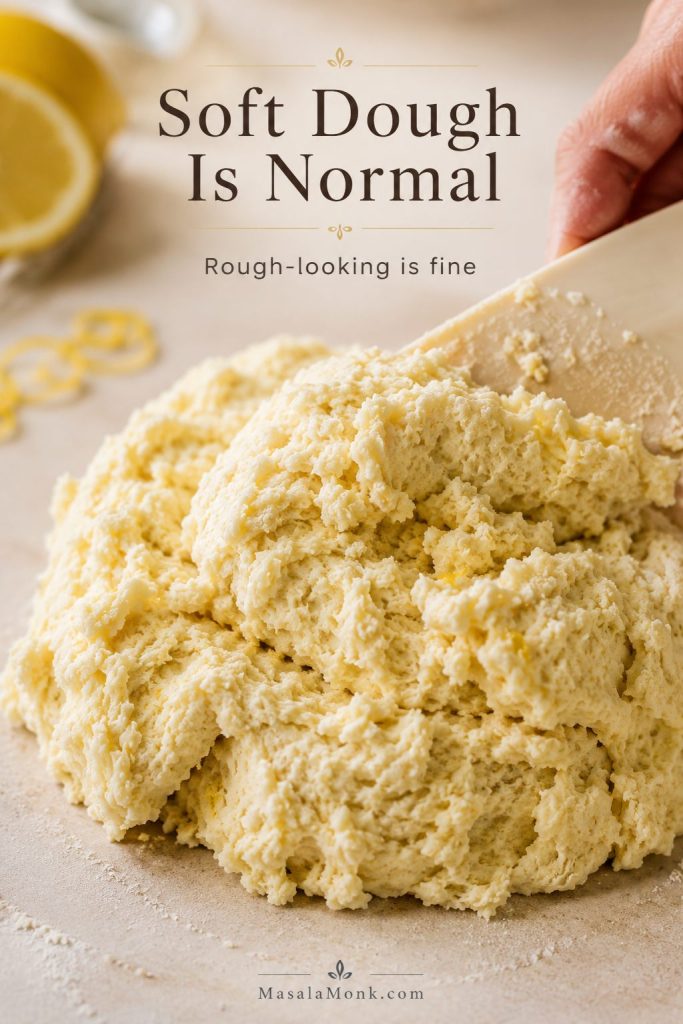
If the dough looks a little shaggy, do not panic. Lemonade scone dough is meant to feel softer than regular scone dough. That loose, slightly tacky texture is part of what keeps the centers tender after baking.

Recipe Detail Best Starting Point
Main ingredients Self-raising flour, chilled cream, fizzy lemonade
Oven temperature 220°C / 425°F, or 200°C fan
Bake time 15–18 minutes
Dough thickness 2.5–3cm / 1–1¼ inches
Cutter size 5–6cm / 2–2½ inches
Texture goal Tall, tender, lightly golden scones that split open easily

Before You Mix the Dough

Before you start: cold cream, fizzy lemonade, a thick dough, and light handling do most of the work. The dough does not need to look perfect. If it is soft, rough-looking, and just holding together, you are probably on the right track.

For the best rise, bake the scones soon after mixing. The dough comes together quickly, and it performs best while the cream is cold and the lemonade is still lively.

The dough cue matters more than a perfectly tidy bowl. If it looks soft and rough at this stage, that is usually a good sign.

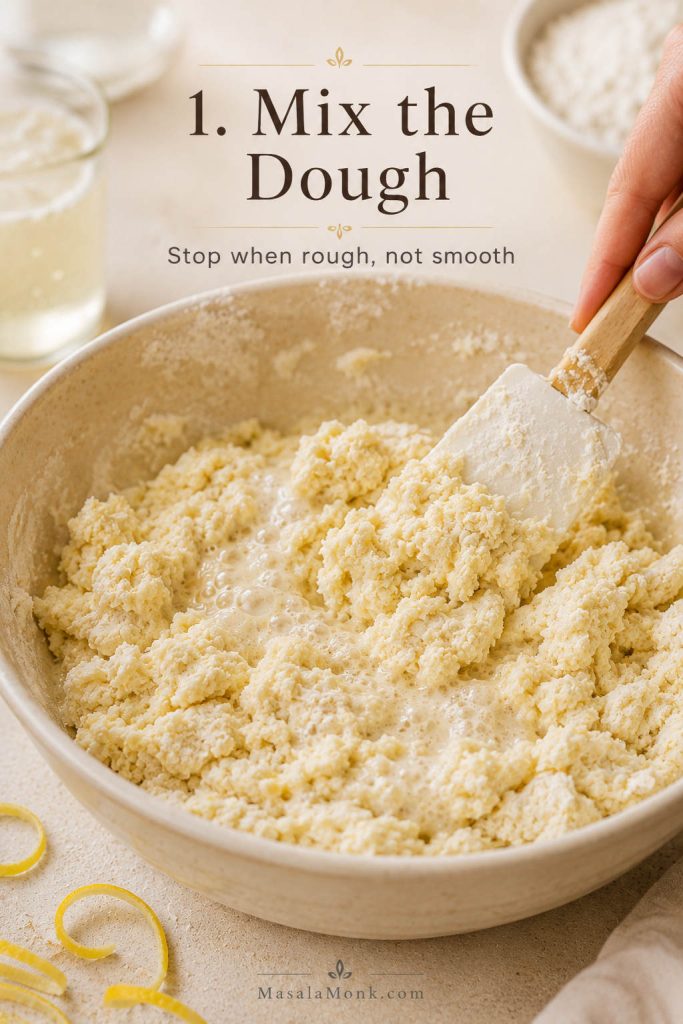
Soft rough lemonade scone dough in a mixing bowl with a spatula, showing a slightly messy texture rather than a smooth dough ball.
This is the moment many bakers worry the dough is wrong. However, lemonade scone dough should look rough and slightly tacky, because a too-smooth dough usually means it has been handled more than it needs.

If Your Oven Runs Hot

Oven note: a hot oven helps scones rise quickly. If your oven runs hot or the tops brown before the centers cook through, use 200°C / 390°F or 180°C fan and bake a few minutes longer.

Already know the basics? Skip to the full recipe card, or go straight to fixes for flat, dense, or sticky scones.

What Are Lemonade Scones?

Lemonade scones are shortcut scones made with self-raising flour, cream, and carbonated lemonade. They are especially associated with Australian-style home baking: quick, practical, generous, and usually served warm with jam and cream.

Traditional scones usually start by rubbing cold butter into flour. Here, cream brings the fat, so you skip that step. The lemonade adds liquid, gentle sweetness, and fizz, while the self-raising flour helps the dough rise.

For a more traditional butter-rubbed afternoon tea version, see our easy English scone recipe. This cream-and-lemonade version is the faster option when you want warm scones without cutting butter into flour.

A quick naming note: in this recipe, “lemonade” means the clear, fizzy British/Australian-style soft drink, not flat homemade lemon juice lemonade.

Fizzy Lemonade vs Flat Lemonade

This is the most important naming difference in the whole recipe. The lemonade needs to be carbonated, because flat homemade lemonade behaves more like a sweet lemon drink than the fizzy liquid this dough is built around.

Comparison image showing fizzy lemonade on one side and flat homemade lemonade on the other for use in scones.
For this recipe, fizzy lemonade is the shortcut ingredient, not flat homemade lemonade. The bubbles are not the only source of rise, but they help keep the dough lighter when combined with fresh self-raising flour and a hot oven.

The word “lemonade” can mean different things depending on where you live. For these scones, use a sweet carbonated lemon drink, Sprite-style soda, or 7Up-style soda. This difference in meaning is exactly why the clarification matters.

Using Sprite, 7Up, or lemon-lime soda? Jump to the soda swap notes.

Despite the name, the finished scones do not taste sharply lemony. They are mild, creamy, and gently sweet. For brighter lemon flavor, serve them with lemon curd, add a little lemon zest to the dough, or finish with a light lemon glaze.

Ingredients for Lemonade Scones

Because the ingredient list is short, each ingredient has a real job. Once you understand those jobs, this lemonade scones recipe becomes much easier to adjust without losing the soft texture.

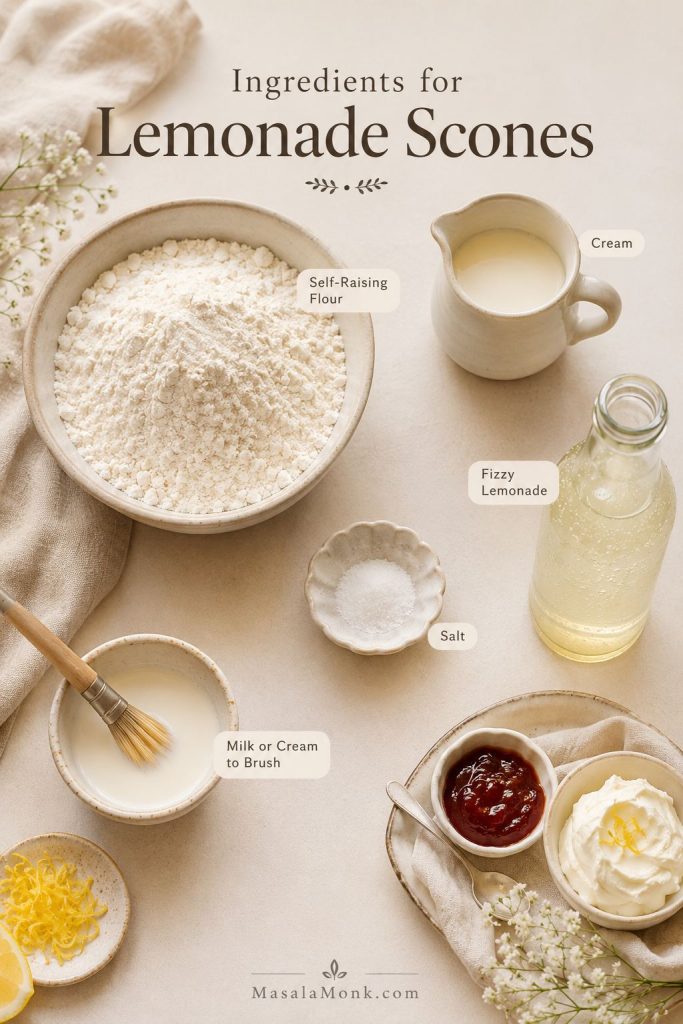
Here is the full working set before the recipe starts: the three main ingredients, plus the small extras that help with flavor, brushing, and serving.

Ingredient spread for lemonade scones showing self-raising flour, cream, fizzy lemonade, salt, and a small brushing liquid on a light surface.
Because this recipe has so few ingredients, stale flour or flat lemonade shows up quickly in the final texture. Start with fresh self-raising flour, cold cream, and newly opened fizzy lemonade for the best rise.

Self-Raising Flour

Self-raising flour gives the scones structure and lift. If your flour has been open for a long time, the raising agent may be weaker, which can lead to flatter scones. For the tallest result, use a fresh bag and measure carefully.

The most reliable measurement is 500g self-raising flour. Cup measurements can vary by country and measuring style, so use grams if you can. As a rough guide, 500g is about 3⅓ metric cups or about 4 loosely spooned-and-levelled US cups.

Cream

Use chilled heavy cream, thickened cream, or whipping cream. Cream is what makes this shortcut work because it brings the richness you would normally get from butter, without asking you to rub cold butter into flour.

Start with 250ml / 1 cup cream in the dough. Keep a little extra nearby for brushing the tops or loosening the mixture if dry flour remains in the bowl.

No cream at home? Check the no-cream options before you start mixing.

Fizzy Lemonade

Use chilled, carbonated lemonade or a clear lemon-lime soda. Open the bottle or can right before mixing, while it still has plenty of fizz. Flat lemonade will not give the same lightness.

Optional Salt

A small pinch of salt keeps the scones from tasting flat, especially if your self-raising flour is very plain. You only need about ¼ teaspoon.

Jam, Cream, Lemon Curd, or Fruit Topping

Jam and cream are classic, especially with a cup of tea. Clotted cream, whipped cream, butter, lemon curd, or warm fruit topping all work well too. A spoonful of thick homemade apple pie filling turns these into quick dessert scones, especially if the scones are still warm enough for the topping to soften into the split center.

Equipment You Need

You do not need special equipment. The most useful “tool” is actually a light hand, but these basics make the dough easier to handle and help the scones rise evenly.

  • Large mixing bowl
  • Digital scale or measuring cups
  • Flat-bladed knife, spatula, or fork for mixing
  • Lightly floured work surface
  • 5–6cm / 2–2½ inch round cutter, or a floured knife for squares
  • Baking tray
  • Parchment paper
  • Pastry brush
  • Wire rack
  • Clean tea towel for softer tops after baking

A round cutter gives the classic look, but squares are easier for beginners because you do not have to re-roll scraps. Either shape works as long as the dough stays thick and lightly handled.

How to Make Lemonade Scones

The main rule in this lemonade scones recipe is simple: stop mixing as soon as the dough comes together. You are not trying to make it smooth. A rough, lightly handled dough gives a softer scone than one that has been kneaded into a tidy ball.

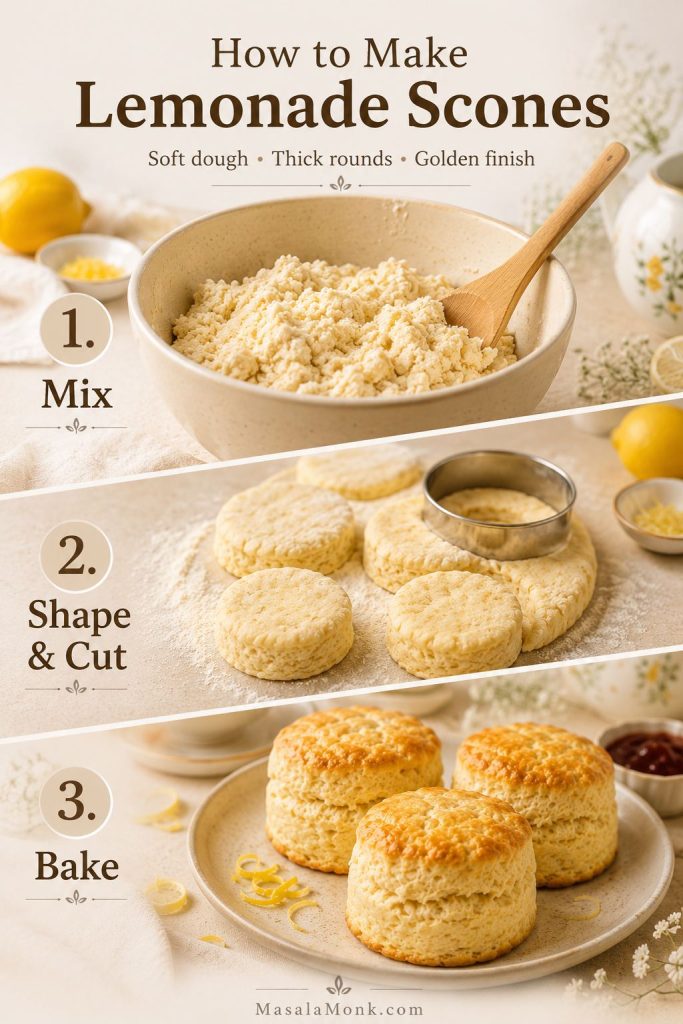
The method breaks into three simple stages: mix the rough dough, shape and cut it gently, then bake while the dough is still cool and lively.

Three-step guide showing how to mix lemonade scone dough, shape and cut the dough, and bake the scones until golden.
The method is shorter than regular scones: mix a rough dough, pat it thick, cut straight down, and bake while the dough is still cool. Those small choices matter more than making the dough look perfect.

1. Mix the Dough

Preheat the oven to 220°C / 425°F, or 200°C fan. Line a large baking tray with parchment paper.

Add the self-raising flour to a large mixing bowl and stir in the salt if using. Pour in 250ml chilled cream and 250ml chilled fizzy lemonade, then mix gently with a flat-bladed knife, spatula, or fork until a rough dough forms.

If dry flour remains at the bottom of the bowl, add extra cream 1 tablespoon at a time. The dough should come together, but it should still look soft, rough, and a little messy.

Lemonade scone dough being gently mixed in a bowl with visible flour and liquid still coming together.
Stop mixing once the dough just comes together. At this stage, a few rough edges are better than a polished dough ball, because overmixing can make the baked scones tight instead of light.

2. Shape and Cut the Scones

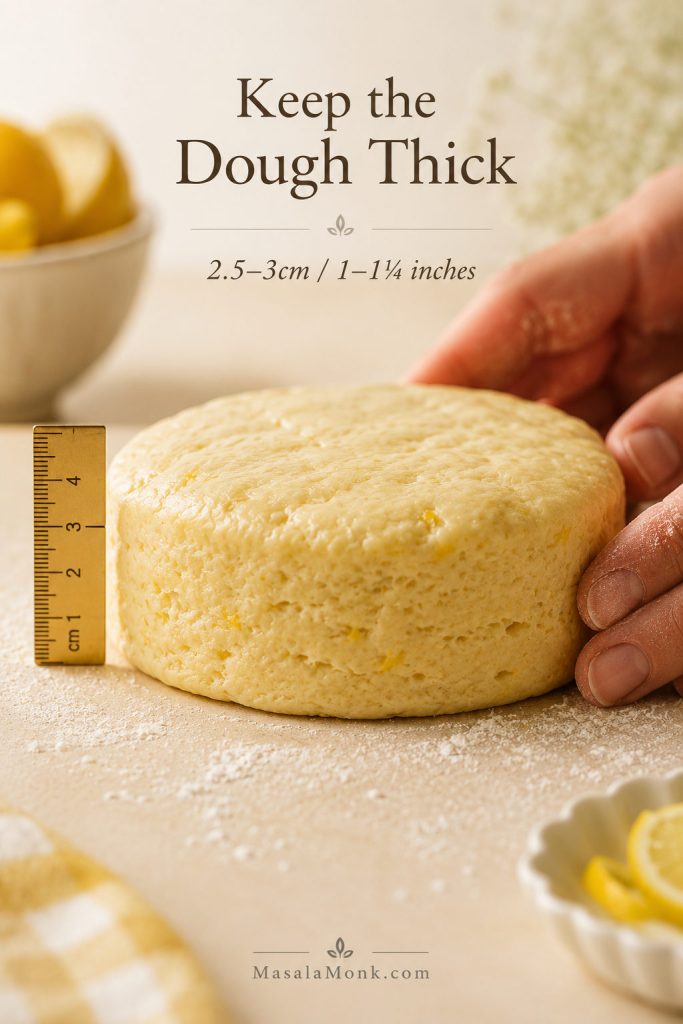
Lightly flour the bench and your hands. Turn the dough out, bring it together gently, and pat it to about 2.5–3cm / 1–1¼ inches thick so the scones have room to rise.

Dough Thickness

This is one of the easiest places to lose height. The dough should be patted thick enough that the scones have room to rise, rather than rolled or pressed thin like cookie dough.

Side view of lemonade scone dough patted thick on a floured surface with a ruler showing about 2.5 to 3 centimetres in height.
Dough thickness is one of the easiest ways to control the final height. If you pat the dough too thin, the scones may bake up wide and flat even if the ingredients are right.

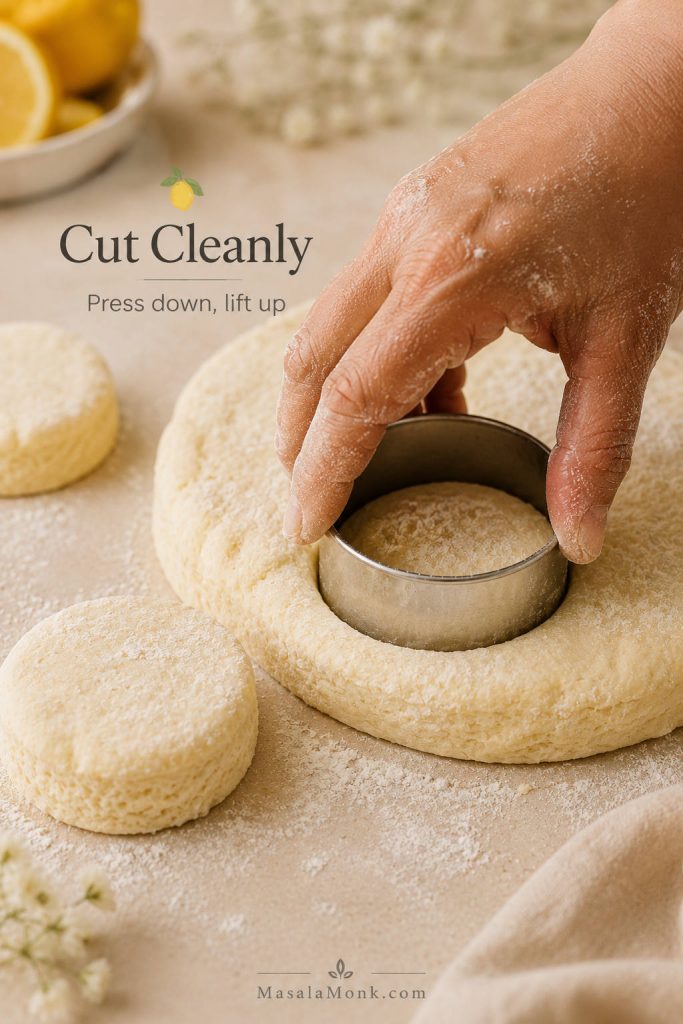
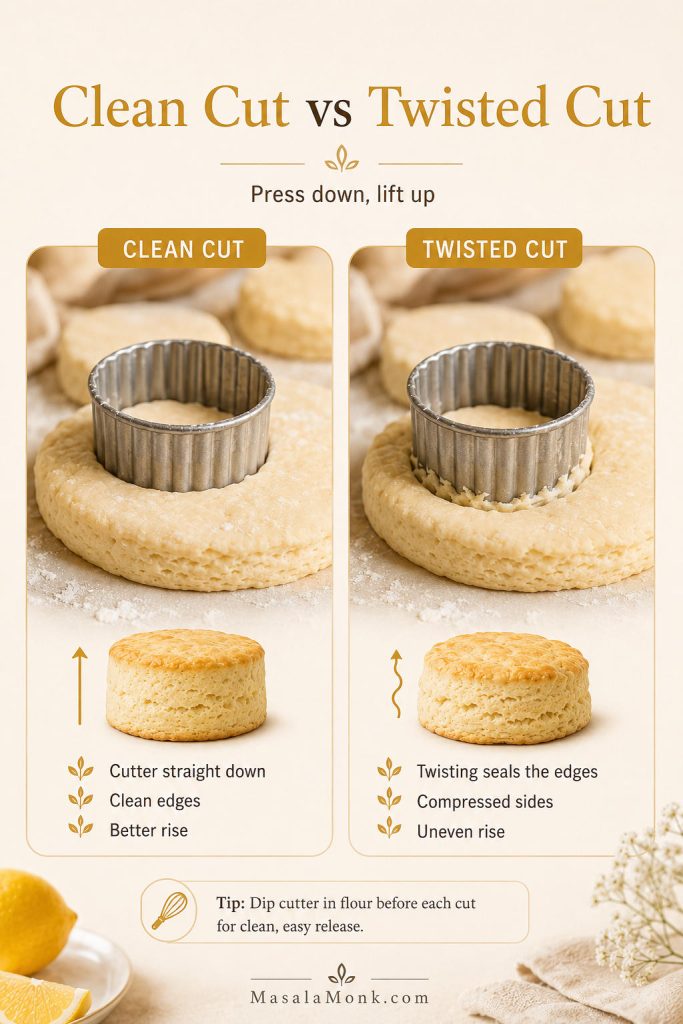
Dip a 5–6cm / 2–2½ inch round cutter in flour, press down cleanly, and lift back up. If you re-roll scraps, press them together gently rather than kneading them smooth. Second-cut scones may be a little less tall, but they will still be tender if you handle them lightly.

A hand pressing a round cutter straight down into thick lemonade scone dough on a lightly floured surface.
Pressing straight down keeps the cut edges open. As a result, the scones can rise more evenly instead of sealing at the sides and leaning in the oven.

Arrange the scones on the prepared tray so they are just touching or nearly touching. This helps them rise upward instead of spreading outward.

Tray Spacing

The tray should look a little closer than you might expect. Lemonade scones rise better when they can support each other, so place them just touching or nearly touching instead of spreading them far apart.

Unbaked lemonade scone rounds arranged close together on a parchment-lined baking tray.
Close spacing is not a mistake here. When the scones sit just touching, they support one another as they bake, which helps them rise upward and keeps the sides softer.

3. Bake Until Risen and Golden

Brush only the tops with a little milk or cream. Try not to drip down the sides because that can seal the edges.

Bake for 15–18 minutes, or until the scones are risen, lightly golden, and sound hollow when tapped on top. For softer tops, cover the hot scones loosely with a clean tea towel for a few minutes after baking.

Freshly baked lemonade scones with lightly golden tops on a tray or cooling rack.
Look for risen scones with lightly golden tops rather than deep browning. Since ovens vary, checking height, color, and the center texture is more reliable than using color alone.

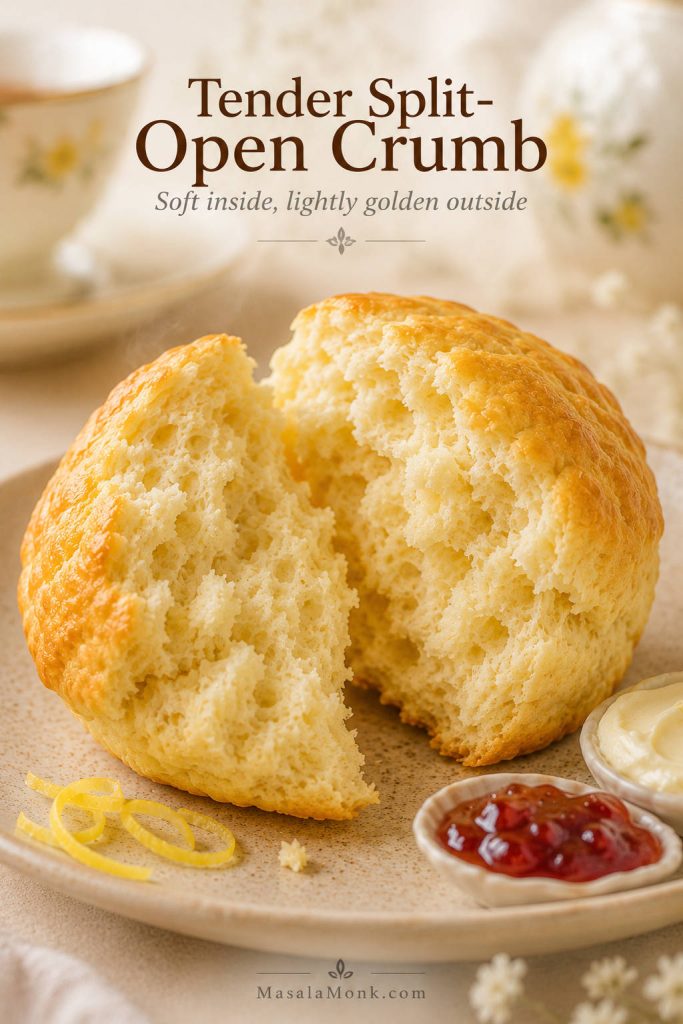
What the Baked Crumb Should Look Like

Once the scones are baked, the inside tells you more than the outside alone. A good lemonade scone should split open easily, with a soft center that can hold jam, cream, butter, or lemon curd without feeling dry or heavy.

Split-open lemonade scone showing a soft tender crumb, with jam and cream nearby.
The crumb is the real test. A well-made lemonade scone should open easily, look soft inside, and feel ready for jam, cream, butter, or lemon curd without turning dry or heavy.

What the Dough Should Look Like

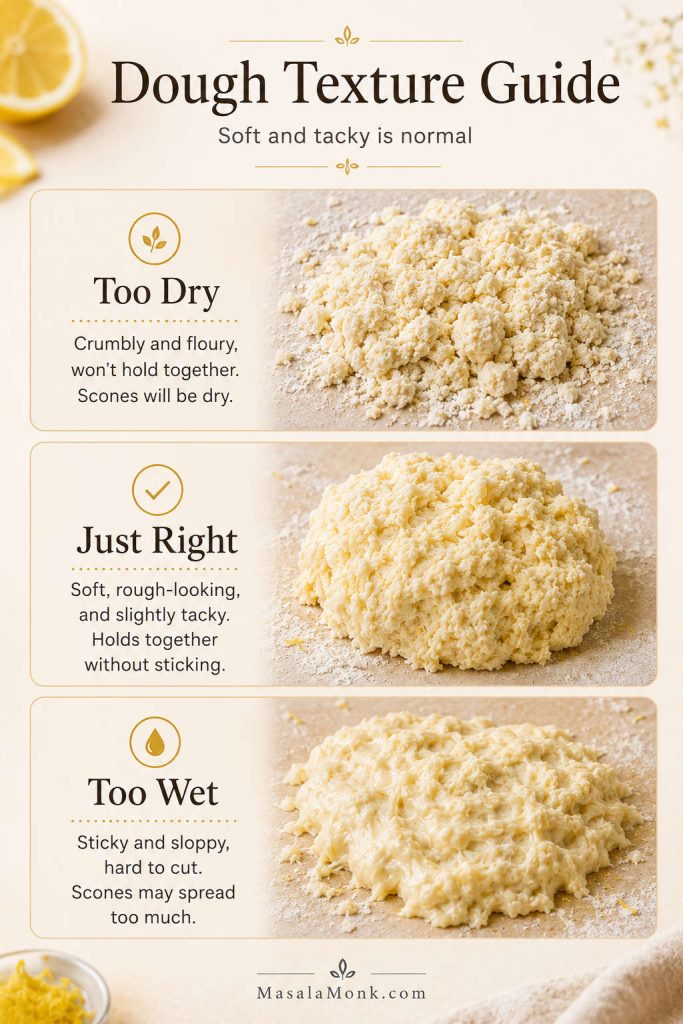
Think soft and rough-looking, not smooth and tidy. The dough should hold together when you pat it, but it may still feel tacky under your hands. This is the stage where many people second-guess the recipe, but a soft dough is normal for lemonade scones.

The mistake is not stickiness. The mistake is adding so much extra flour that the dough becomes dry, firm, and heavy. Lightly flour your hands and the bench, bring the dough together gently, and stop once it can be patted into shape.

Use the comparison below as a quick check before you add more flour. The best dough is soft enough to feel tacky, but firm enough to shape and cut.

Three-panel dough texture guide for lemonade scones showing dough that is too dry, just right, and too wet.
This dough should be tacky, not stiff. If you keep adding flour until it feels tidy and dry, the scones are more likely to turn heavy, so use just enough flour to shape and cut cleanly.

If the dough feels too sticky, too dry, or hard to cut, check the troubleshooting table before working in lots of extra flour.

Cut Cleanly for a Better Rise

Dip the cutter in flour, press down cleanly, and lift it back up. Twisting can smear the sides of the dough, which may make the scones lean or rise unevenly. If you do not have a round cutter, cut the dough into squares with a floured knife instead.

Side-by-side comparison of a clean scone cutter cut versus a twisted cut in thick dough.
Twisting the cutter can seal and drag the dough edges. Instead, press down and lift straight up, especially if you want taller lemonade scones with a more even rise.

Does the Dough Need to Chill?

For this quick version, you do not need to chill the dough if your cream and lemonade are cold and you work quickly. If the dough becomes warm, slack, or difficult to cut, chill it for 15–20 minutes before baking. Chilling is a rescue move here, not a required one-hour wait.

For tall, tender scones: use fizzy lemonade, keep the dough thick, handle it lightly, and press the cutter straight down. If you do those four things, you are already most of the way there.

Using an air fryer instead of the oven? Use the air fryer timing and spacing notes.

Why Lemonade Works in Scones

Lemonade scones work because the three ingredients cover the jobs that butter, sugar, liquid, and raising agents usually do in a standard scone recipe. The shortcut feels unusual, but the logic is simple.

Ingredient or Step What It Does
Self-raising flour Provides flour structure and built-in raising agent for lift.
Cream Adds fat and richness, replacing the butter-rubbing step.
Fizzy lemonade Adds liquid, gentle sweetness, and carbonation, which helps keep the shortcut dough light when it is handled gently.
Hot oven Gives the dough a fast lift before the outside sets.
Gentle handling Keeps the crumb tender instead of tough or dense.

The bubbles alone do not do all the work. The full system matters: fresh self-raising flour, cold cream, newly opened lemonade, a loose dough, minimal handling, and a properly hot oven.

Self-Raising Flour Substitute

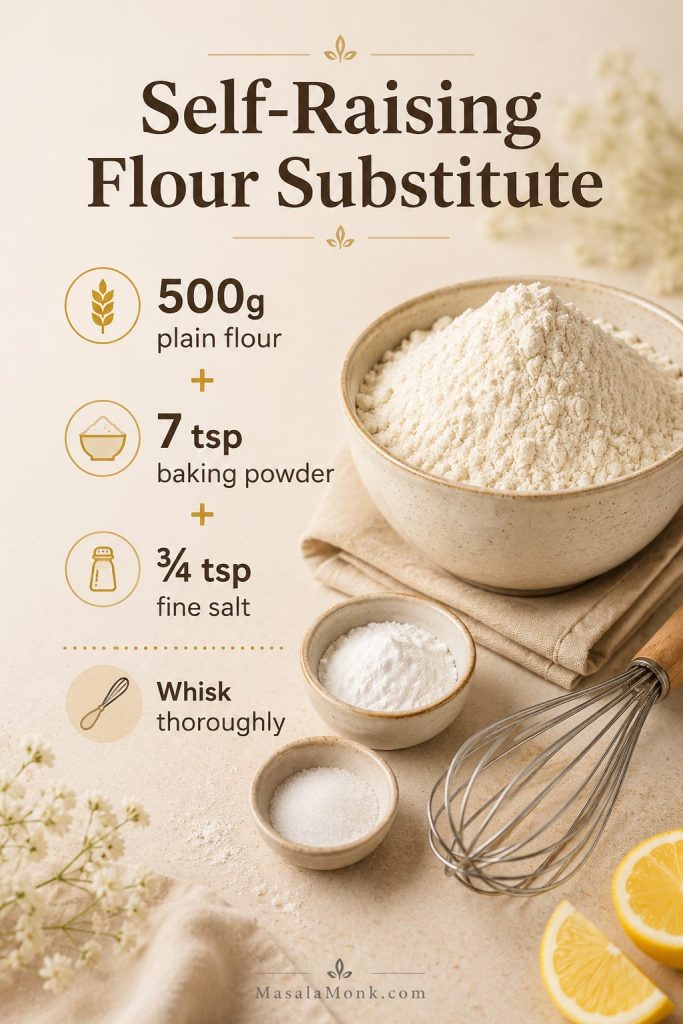
If you do not have self-raising flour, you can make a substitute with plain flour or all-purpose flour, baking powder, and salt.

The full-recipe substitute is easiest to follow by weight. Once the flour, baking powder, and salt are evenly whisked, you can use it in place of self-raising flour in the main recipe.

Plain flour, baking powder, salt, and a whisk arranged as a self-raising flour substitute guide for scones.
Homemade self-raising flour works best when the baking powder is evenly mixed through the flour. Therefore, whisk the substitute thoroughly before adding cream and lemonade, so every scone has the same chance to rise.
For This Recipe Use
Instead of 500g self-raising flour 500g plain/all-purpose flour + 7 teaspoons baking powder + ¾ teaspoon fine salt

Whisk the flour, baking powder, and salt very well before adding the cream and lemonade, so the raising agent is evenly distributed. For smaller batches, use about 2 teaspoons baking powder per 150g / 1 metric cup flour, then add a small pinch of salt.

Because this recipe depends on lift, fresh flour and fresh baking powder matter. Self-raising flour formulas vary slightly by country and brand, but the ratio above is a reliable starting point for this high-rise scone dough. For a more general homemade self-rising flour reference, King Arthur Baking uses flour, baking powder, and salt in a slightly gentler ratio.

Sprite, 7Up, and Lemon-Lime Soda Swaps

Sprite, 7Up, and similar clear lemon-lime sodas can work in lemonade scones. The scones care more about fizz and sweetness than the name on the bottle, so open it right before mixing.

If you are outside Australia or the UK, this is the part that matters most: use Sprite, 7Up, or a clear fizzy lemon-lime soda, not flat homemade lemonade made with lemon juice, sugar, and water.

Drink Works? Notes
Fizzy lemonade Yes Best default for this recipe.
Sprite or 7Up-style soda Yes Good substitute, especially for US readers.
Flat homemade lemonade Not ideal Missing the fizz that helps lighten the dough.
Sugar-free lemonade Possible, not best May brown less and can leave an aftertaste.
Strongly flavored soda Only as a variation May change the color and flavor of the scones.

If you try a local lemon-lime soda, pay attention to sweetness and fizz first. Those two things matter more than the brand name, and they are useful details to remember for your next batch.

Guide showing clear fizzy lemon-lime soda options for lemonade scones, including generic lemon-lime soda and fizzy lemonade.
Sprite-style or 7Up-style lemon-lime soda is a practical swap when British or Australian-style fizzy lemonade is not available. The key is freshness: open it right before mixing so the soda is still lively.

Lemonade Scones Without Cream

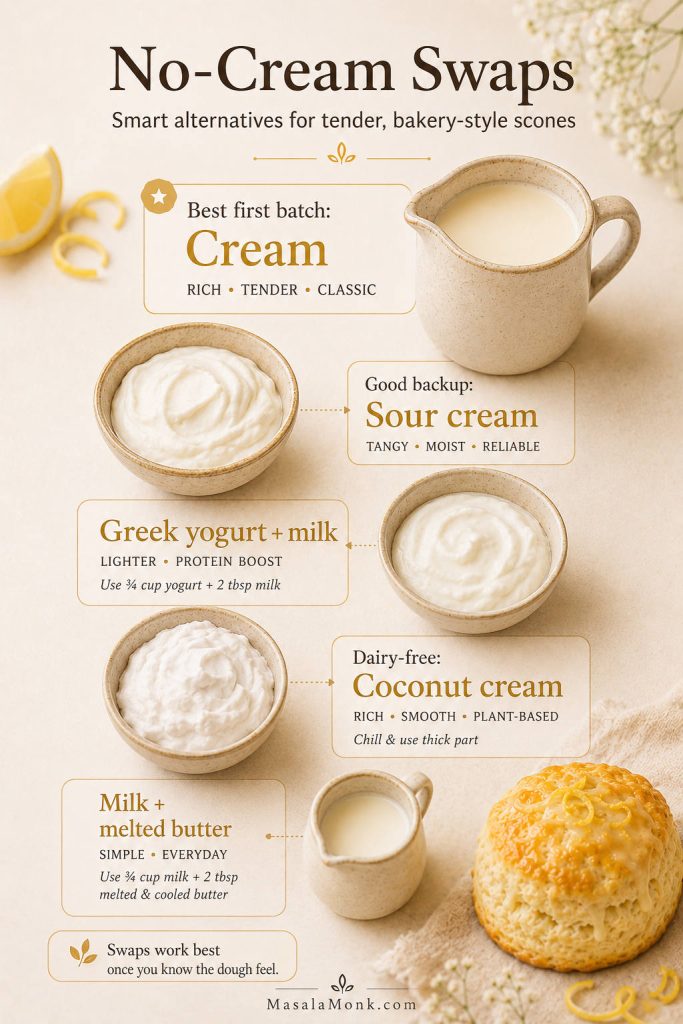
The cream version is the best first batch because cream brings both liquid and fat. No-cream swaps can work, but they are easier once you have felt the original dough.

If you remove the cream, the dough still needs richness from somewhere; otherwise the scones can turn dry, tough, or bread-like. Start with slightly less of the swap than the full cream amount, then add more only if dry flour remains in the bowl.

Swap Best Use
Sour cream Good backup when you still want richness and tenderness.
Greek yogurt + splash of milk Useful if you want body and tang, but the dough may be slightly less rich.
Full-fat coconut cream Best dairy-free direction, though it may add mild coconut flavor.
Milk + melted butter Workable, but no longer the same simple 3-ingredient shortcut.
Plain milk alone Least ideal; the scones usually taste less rich and more bread-like.
Comparison board showing cream, sour cream, Greek yogurt with milk, coconut cream, and milk with butter as no-cream swap options for lemonade scones.
Cream is still the most reliable first choice because it brings fat and liquid together. Once you know the original dough texture, sour cream, yogurt with milk, or coconut cream become easier to judge.

The same cold-fat principle shows up in other baking projects too. In our apple pie crust recipe, cold butter helps create flaky layers; here, chilled cream gives the shortcut dough richness without the rubbing-in step.

Best advice: if this is your first time making the recipe, use full-fat cream. Once you know how the dough should feel, the swaps are much easier to judge.

Air Fryer Lemonade Scones

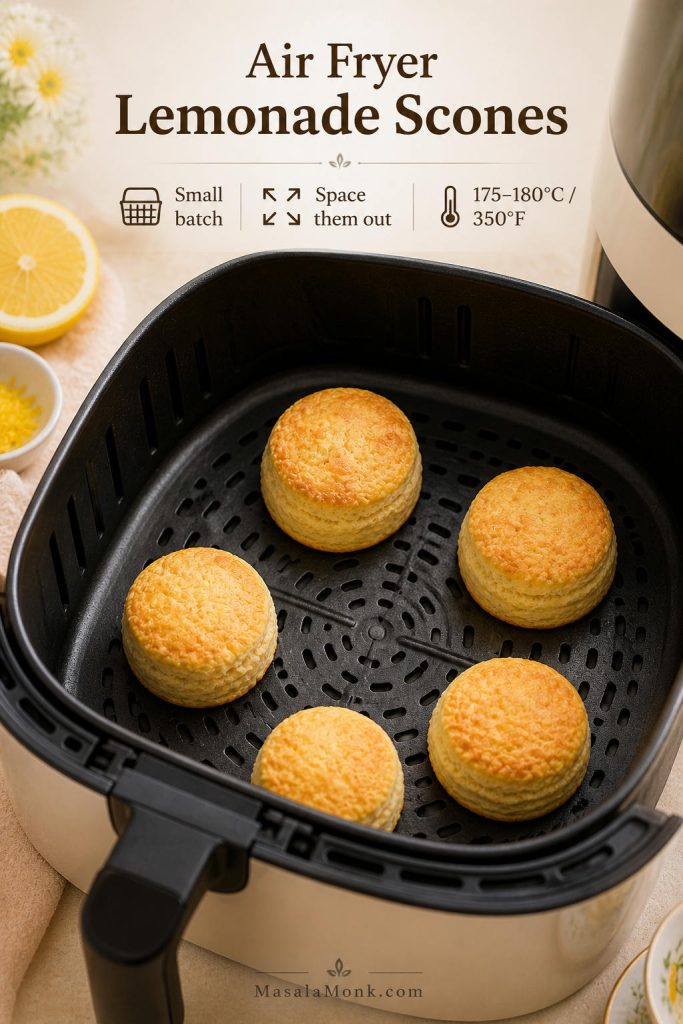
You can adapt this lemonade scones recipe for the air fryer, but think small batch rather than crowded basket. Air fryer scones can work beautifully when they have enough space for the heat to move around them.

For most basket-style air fryers, a half batch is easier to manage. Crowding traps steam, browns the tops too quickly, and can leave the centers underdone.

Small batch of lemonade scones spaced apart in an air fryer basket, with a temperature note for air fryer baking.
Air fryer lemonade scones need space more than they need a full basket. Because the heat is concentrated, smaller batches help the centers cook through before the tops brown too quickly.
  1. Preheat the air fryer to 175–180°C / 350°F.
  2. Make the dough as directed, then cut slightly smaller scones so the centers cook through.
  3. Place the scones in a single layer with space around them.
  4. Brush the tops with milk or cream.
  5. Air fry for 8–12 minutes, checking at 8 minutes. Larger scones may need 12–14 minutes.
  6. Cool briefly, then serve warm with jam and cream.

If your air fryer runs hot, start at the lower end of the time range and check the center of one scone before serving.

Lemonade Scone Variations

Keep variations modest the first time you make the recipe. This dough is designed to be light, so too much fruit, zest, extra liquid, or heavy add-ins can make the scones spread, lean, or bake up dense.

Lemonade Scones with Lemon Curd

Lemon curd is the best move if you expected a stronger lemon flavor from the lemonade itself. You can also add a little finely grated lemon zest to the dough, but keep the amount modest so the dough does not become wet or bitter.

If you like bright citrus desserts, you may also enjoy this orange olive oil cake, which has a softer cake-style crumb and deeper orange flavor than these mild lemonade scones.

Fruit Lemonade Scones

Fold in a small handful of sultanas, raisins, currants, blueberries, or raspberries after the dough starts to come together. Keep the amount to about ½ cup for the first batch. If using juicy berries, handle the dough gently so the fruit does not bleed too much into the crumb.

Gluten-Free Lemonade Scones

Use a gluten-free self-raising flour blend designed for baking. The dough may feel more delicate, so handle it gently and avoid adding too much extra flour. Gluten-free scones often dry out faster, so serve them warm or reheat briefly before serving.

If the gluten-free dough feels fragile, pat it into a disc and cut it into wedges instead of re-rolling rounds. That reduces handling and helps the scones hold together.

Vegan Lemonade Scones

For a vegan direction, use a dairy-free cream alternative with enough fat, such as full-fat coconut cream or a thick plant-based cream. Check that the lemonade is vegan-friendly and use plant milk for brushing the tops.

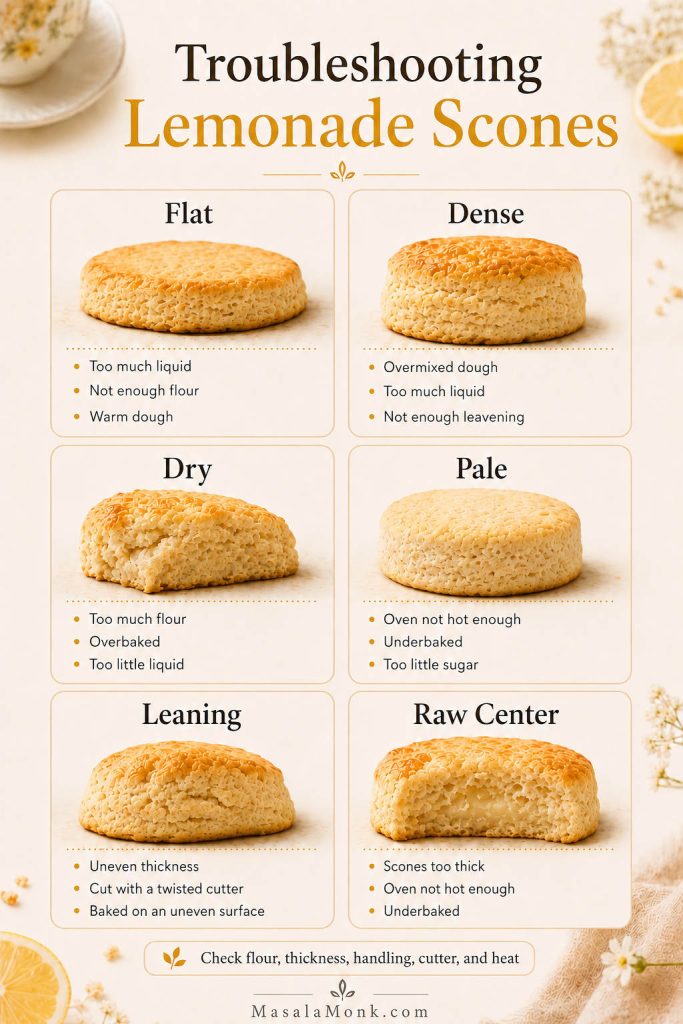
How to Fix Lemonade Scones

If your first batch is not perfect, the fix is usually easy to spot. Lemonade scones are sensitive to a few small things: fresh flour, dough thickness, light handling, and oven heat. Once you know which one went wrong, the next batch is much easier.

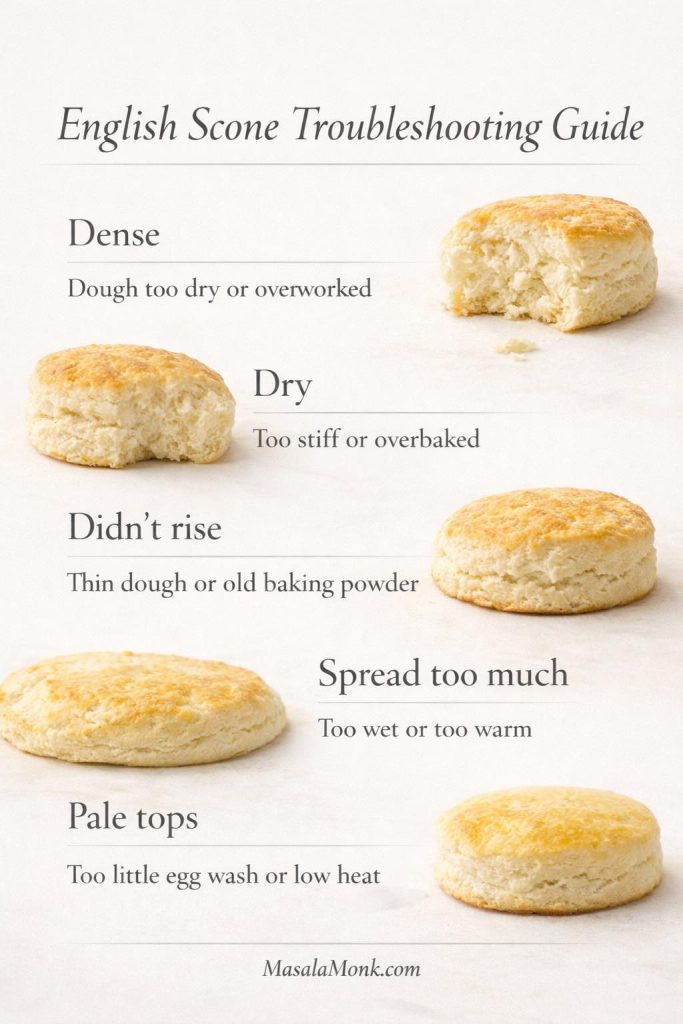
Troubleshooting guide for lemonade scones showing examples of flat, dense, dry, pale, leaning, and raw-centre scones.
Most lemonade scone problems point back to one of five things: flour freshness, dough thickness, handling, cutter technique, or heat. Use the visual clues here before changing the whole recipe.
Problem Likely Cause Best Fix
Dough is very sticky The dough is naturally soft, or there is slightly too much liquid. Flour your hands and bench lightly. Add extra flour only a little at a time.
Scones are flat Old self-raising flour, dough too thin, oven too cool, or cutter twisted. Use fresh flour, keep the dough 2.5–3cm thick, preheat fully, and press the cutter down cleanly.
Scones are dense The dough was mixed or handled too much. Mix only until rough and just combined, then bring together gently with floured hands.
Scones are dry Too much flour was added on the bench, or the scones were overbaked. Keep the dough soft and bake only until risen, lightly golden, and cooked through.
Tops are pale No milk or cream brush, or oven not hot enough. Brush the tops lightly and bake in a properly preheated oven.
Scones lean sideways Cutter was twisted or scraps were overworked. Dip cutter in flour, cut cleanly, and handle re-rolled scraps gently.
Centers are raw Scones are too thick, too large, or baked too quickly on the outside. Cut slightly smaller scones or bake a few minutes longer at a slightly lower temperature.
Crust is too firm Scones cooled uncovered. Cover hot scones loosely with a clean tea towel for a few minutes after baking.

Storage, Freezing, and Reheating

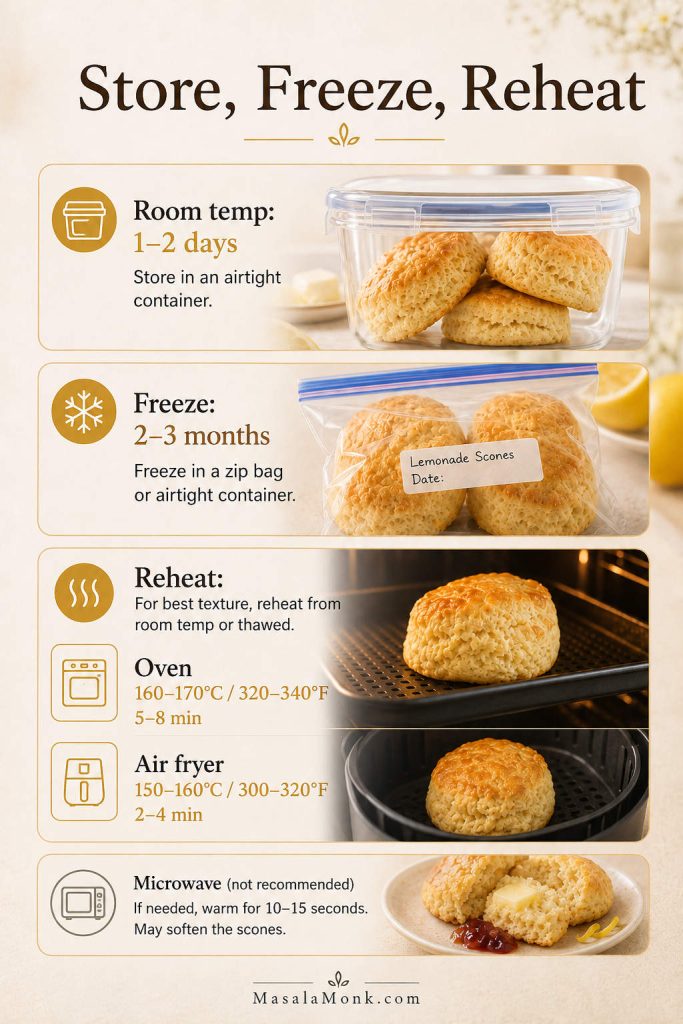
These scones are best on the day they are baked, especially while still warm. Like most scones, they become firmer as they cool and sit.

Storage and reheating guide showing lemonade scones in an airtight container, freezer storage, and gentle oven or air fryer reheating.
Lemonade scones are best warm on the day they are baked, but they are not useless the next day. Store them airtight, freeze extras early, and reheat gently so the crumb does not dry out.
  • Room temperature: store cooled scones in an airtight container for 1–2 days.
  • Freezer: freeze baked scones for up to 2–3 months. Wrap well to prevent freezer dryness.
  • Reheating in oven: warm at 160–170°C / 320–340°F for 5–8 minutes.
  • Reheating in air fryer: warm at 150–160°C / 300–320°F for 2–4 minutes.
  • Microwave: use only a short burst, around 10–15 seconds, because long microwaving can make scones rubbery.

You can also freeze cut, unbaked scones. Freeze them on a tray first, then transfer to a freezer bag. Bake from frozen, adding a few extra minutes to the bake time.

If you are building out easy comfort desserts for the week, this rice pudding with cooked rice is another low-effort recipe that turns simple leftovers into something warm and creamy.

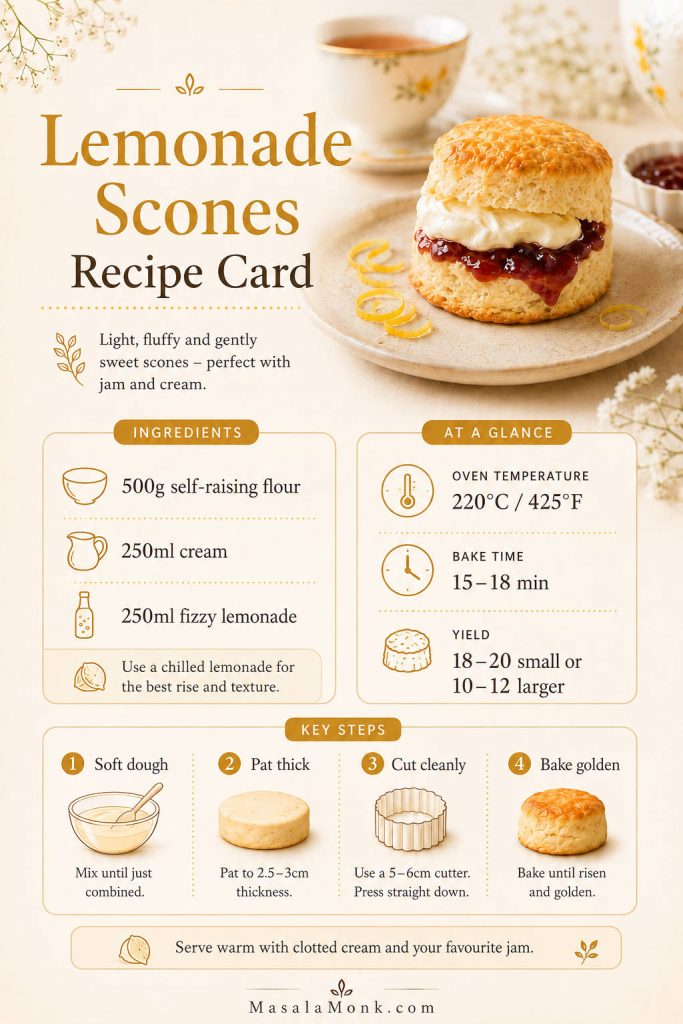
Lemonade Scones Recipe Card

This lemonade scones recipe makes soft, tender 3-ingredient scones with self-raising flour, cream, and fizzy lemonade. They are best served warm, split open, and topped with jam and cream, clotted cream, butter, or lemon curd.

Prep Time10–15 minutes
Bake Time15–18 minutes
Total Time25–35 minutes
Yield18–20 small scones with a 5cm cutter, or 10–12 larger scones with a 6cm cutter

Ingredients

  • 500g self-raising flour — about 3⅓ metric cups or roughly 4 loosely spooned-and-levelled US cups, plus extra for dusting
  • 250ml chilled heavy cream, thickened cream, or whipping cream — about 1 cup, plus up to 50ml extra for brushing or adjusting the dough
  • 250ml chilled fizzy lemonade — about 1 cup
  • ¼ teaspoon fine salt, optional
  • 1–2 tablespoons milk or cream, for brushing the tops if not using the extra cream above
  • Jam, cream, clotted cream, butter, or lemon curd, for serving

Instructions

  1. Preheat the oven to 220°C / 425°F, or 200°C fan. Line a large baking tray with parchment paper.
  2. Add the self-raising flour to a large mixing bowl. Stir in the salt if using.
  3. Pour in 250ml chilled cream and 250ml chilled fizzy lemonade.
  4. Use a flat-bladed knife, spatula, or fork to mix gently until a soft, rough, slightly sticky dough forms. If there is dry flour left in the bowl, add extra cream 1 tablespoon at a time.
  5. Lightly flour the bench and your hands. Turn the dough out and bring it together gently.
  6. Pat the dough to 2.5–3cm / 1–1¼ inches thick.
  7. Dip a 5–6cm / 2–2½ inch round cutter in flour. Press down cleanly and lift straight back up so the sides can rise evenly.
  8. Place the scones on the prepared tray so they are just touching or nearly touching.
  9. Brush the tops lightly with milk or cream.
  10. Bake for 15–18 minutes, or until risen, lightly golden on top, hollow-sounding when tapped, and no longer wet or doughy in the center when gently pulled apart.
  11. Cover the hot scones loosely with a clean tea towel for a few minutes if you want softer tops.
  12. Serve warm with jam and cream, clotted cream, butter, or lemon curd.

Notes

  • The dough should be soft and a little tacky, not dry and smooth.
  • Use newly opened fizzy lemonade for the best lift.
  • If using plain flour, use 500g flour + 7 teaspoons baking powder + ¾ teaspoon fine salt.
  • For taller scones, keep the dough thick and cut cleanly.
  • If your oven browns quickly, bake at 200°C / 390°F or 180°C fan and add a few extra minutes.
  • For air fryer lemonade scones, cook smaller scones at 175–180°C / 350°F for 8–12 minutes, checking early.
Saveable recipe card for lemonade scones showing ingredient quantities, oven temperature, bake time, yield, and key method notes.
Save the core formula before you bake: 500g self-raising flour, 250ml cream, 250ml fizzy lemonade, thick dough, clean cuts, and a hot oven. That simple system is what makes the recipe work.

FAQs

Here are the questions that usually come up once people realise “lemonade” can mean something different depending on where they live.

What kind of lemonade works best for lemonade scones?

Use a clear, sweet, fizzy lemonade or lemon-lime soda, opened right before mixing. The fizz matters more than the brand.

Do lemonade scones taste like lemonade?

Not strongly. They taste more like mild cream scones with gentle sweetness. For more lemon flavor, serve them with lemon curd, add a little lemon zest, or drizzle with a light lemon glaze.

Why is my lemonade scone dough so sticky?

A little stickiness is normal. Lemonade scone dough should feel softer than regular scone dough, so lightly flour your hands and bench instead of working lots of extra flour into the dough.

Why did my lemonade scones not rise?

The most common reasons are old self-raising flour, a cool oven, dough patted too thin, overworked dough, or a twisted cutter. Fresh flour, thick dough, clean cutting, and a hot oven make the biggest difference.

Sprite or 7Up: which one works better?

Both can work. Choose a clear, fizzy lemon-lime soda with a clean flavor, and open it right before mixing the dough.

What cream should I use?

Use heavy cream, thickened cream, or whipping cream. Full-fat cream gives the best texture because it replaces the butter used in traditional scones.

How thick should the dough be?

Pat the dough to about 2.5–3cm / 1–1¼ inches thick. Thinner dough usually means flatter scones.

Should lemonade scones touch while baking?

Yes, place them just touching or nearly touching. This encourages the scones to rise upward and keeps the sides softer.

Is sugar-free lemonade okay?

It can work, but regular fizzy lemonade gives better sweetness, browning, and flavor. Some sugar-free versions can also leave an aftertaste.

How do I make lemonade scones without cream?

Use a richer replacement such as sour cream, Greek yogurt with a splash of milk, full-fat coconut cream, or milk plus melted butter. Plain milk alone usually makes the scones less rich and more bread-like.

Are lemonade scones the same as regular scones?

They are similar in shape and serving style, but the method is different. Regular scones usually use butter rubbed into flour; lemonade scones use cream and fizzy lemonade to make a faster shortcut dough.

How do I reheat lemonade scones without drying them out?

Warm them gently in a low oven at 160–170°C / 320–340°F for 5–8 minutes, or in the air fryer at 150–160°C / 300–320°F for 2–4 minutes. Long microwaving can make them rubbery.

For another shortcut bake with a cozy, serve-warm feel, try this apple cinnamon roll bake with apple pie filling.

If you make these lemonade scones, notice how the dough felt before baking: soft and tacky, dry and crumbly, or almost too wet to cut? Share that detail with your result, especially if you used Sprite, 7Up, gluten-free flour, or a no-cream swap. Those real-batch notes are genuinely helpful for other readers trying the same version.

Back to top

Posted on 4 Comments

Easy English Scone Recipe

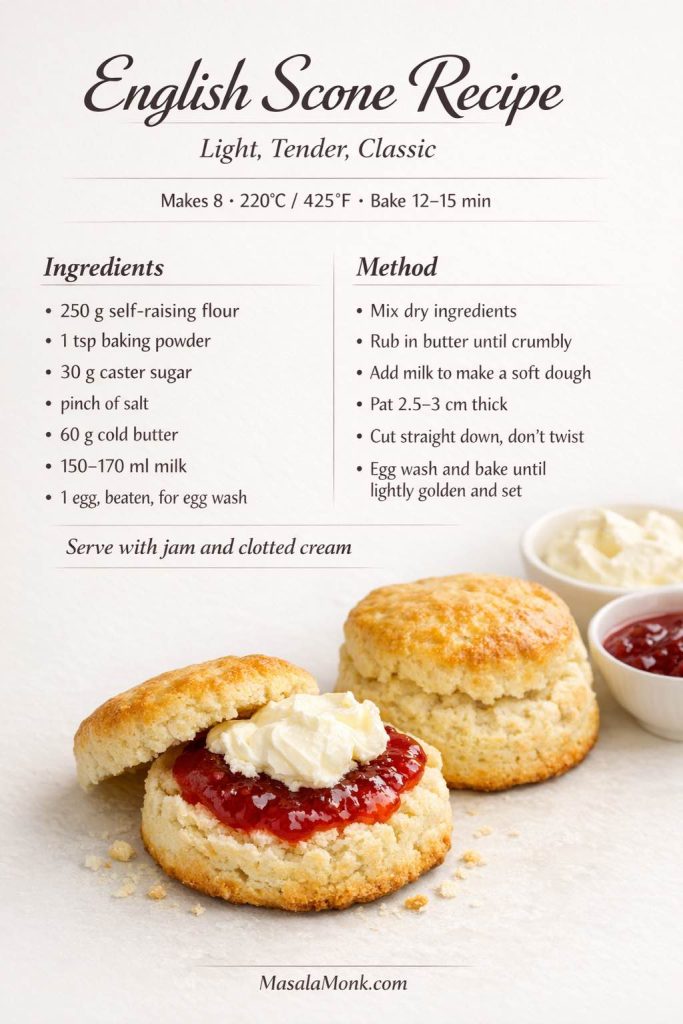
Split English scone topped with strawberry jam and clotted cream for an easy English scone recipe cover image.

This English scone recipe is built for the classic result: round scones with a light, tender crumb, gently golden tops, and just enough sweetness to work beautifully with jam and clotted cream. If you want an easy English scone recipe that stays close to the traditional style, this is the version to make.

The charm of English scones is that they do not ask for much. They ask for a dough that stays soft, handling that stays light, and shaping that gives them enough height to rise properly in the oven. Get those choices right, and the result feels balanced, familiar, and unmistakably classic.

Served warm or at room temperature with strawberry jam and clotted cream, these scones feel instantly at home on an afternoon tea table. They are especially lovely with masala chai recipes if you want a warmer spiced pairing, or with a cappuccino recipe if you are serving them for breakfast or brunch.

English Scone Recipe Ingredients

The ingredient list is short on purpose. Nothing here is decorative, and each ingredient has a clear job in the finished bake.

Dry Ingredients for English Scones

You will need:

  • 250 g self-raising flour
  • 1 tsp baking powder
  • 30 g caster sugar
  • 1 pinch salt

Self-raising flour keeps the method simple and gives the dough the kind of lift that suits classic English scones especially well. The extra baking powder adds support and helps keep the rise reliable. The sugar stays modest because this is not meant to be a sugary café pastry. It is meant to leave room for jam and cream at the table.

If you do not have self-raising flour, use 250 g plain flour plus 3 tsp baking powder in total for a close substitute. That will get you much nearer the intended texture than trying to improvise the swap.

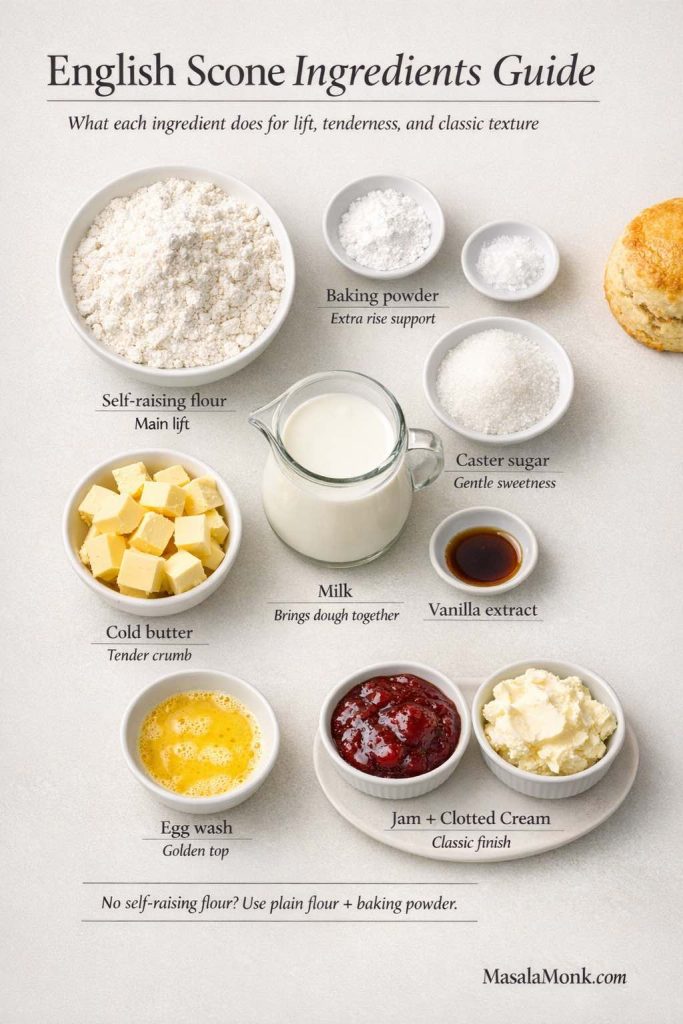
English scone ingredients guide showing self-raising flour baking powder sugar butter milk egg wash jam and clotted cream with ingredient role notes.
The structure of a good English scone starts here: flour and baking powder for lift, cold butter for tenderness, milk for a soft dough, and a finishing setup built around jam and clotted cream rather than extra sweetness in the base.

Butter, Milk, and Egg

You will need:

  • 60 g cold unsalted butter, cubed
  • 150 to 170 ml whole milk
  • 1 tsp vanilla extract, optional
  • 1 egg, beaten, for egg wash

Cold butter helps create the tender crumb that makes a good scone feel light rather than heavy. It should be rubbed into the flour until the mixture looks airy and crumbly, not greasy or paste-like. The milk brings the dough together, though the exact amount can vary slightly depending on your flour and your kitchen conditions. The egg does not go into the dough here. Instead, it is brushed over the tops so the scones bake with a soft shine and a gentle golden finish.

Classic English Scone Toppings: Jam and Clotted Cream

For the classic serving style, use:

  • strawberry jam
  • clotted cream

That pairing is not just a serving suggestion. It is part of the logic of the bake itself. English scones stay plainer and less sweet because they are designed to be completed at the table rather than to carry all the richness on their own.

Traditional cream tea is built around scones, jam, clotted cream, and tea, which is one reason this style remains so restrained and balanced. For a more useful reference point than a generic explainer, the protected Cornish clotted cream specification shows why it is treated as a distinct product, while the National Trust’s fruit scones recipe reflects the same classic jam-and-clotted-cream serving tradition.

If clotted cream is difficult to find where you live, mascarpone is the neatest substitute. Thick lightly whipped cream also works, though it gives a looser and less traditional finish.

Small Variations That Still Keep Them English-Style

If you want a little variation without changing the character of the recipe too much, keep it restrained. A small handful of currants or sultanas fits naturally, and a little lemon zest can work well too.

What does not belong in this version is a heavy fruit load, thick glaze, chocolate chips, or any shortcut that turns the bake into something else altogether.

Also Read: Punjabi Mutton Bhuna – Amritsari Village-Style Gosht Recipe

Easy English Scones Recipe Card

Yield: 8 scones
Prep time: 15 minutes
Bake time: 12 to 15 minutes
Total time: about 30 minutes
Oven temperature: 220°C / 425°F

Ingredients

  • 250 g self-raising flour
  • 1 tsp baking powder
  • 30 g caster sugar
  • 1 pinch salt
  • 60 g cold unsalted butter, cubed
  • 150 to 170 ml whole milk
  • 1 tsp vanilla extract, optional
  • 1 egg, beaten, for egg wash
  • strawberry jam, for serving
  • clotted cream, for serving
English scone recipe card showing ingredients, quick method, and classic scones served with jam and clotted cream.
Use this recipe card when you want the ingredient list, bake temperature, and quick method in one place. It is most useful once you know the flow and want to make a batch without scrolling through the full guide.

How to Make English Scones Step by Step

The method is simple, but the small cues matter. Most disappointing batches trace back to dough that was too dry, too heavily handled, or shaped too thin before baking.

1. Heat the Oven and Prepare the Tray

Heat the oven to 220°C / 425°F and line a baking tray with parchment paper. A fully preheated oven matters here because the scones need strong early heat to rise before the structure sets.

Step 1 English scone recipe graphic showing a lined baking tray and oven preheated to 220C 425F before baking.
Starting with a fully heated oven gives English scones a better chance of rising quickly before the structure sets. That early burst of heat matters more than many people expect when the goal is a lighter, taller result.

Use a middle rack unless your oven runs unusually hot at the top.

2. Mix the Dry Ingredients

In a large bowl, whisk together the self-raising flour, baking powder, caster sugar, and salt. This takes almost no time, but it helps distribute the lift evenly before the butter goes in.

Step 2 English scone recipe graphic showing flour, baking powder, sugar, and salt being mixed in a bowl before the butter is added
A quick whisk here helps distribute the baking powder, sugar, and salt more evenly through the dough, which gives the scones a more consistent start.

3. Rub in the Butter

Add the cold butter cubes and rub them into the flour mixture with your fingertips until the texture looks like coarse crumbs.

You want a mixture that feels sandy and airy, with a few tiny buttery pieces still visible. If you squeeze a little in your hand, it should briefly clump, then fall apart again. Once the butter turns greasy or starts smearing into the flour, you have gone too far. If large cubes remain untouched, keep working a little longer.
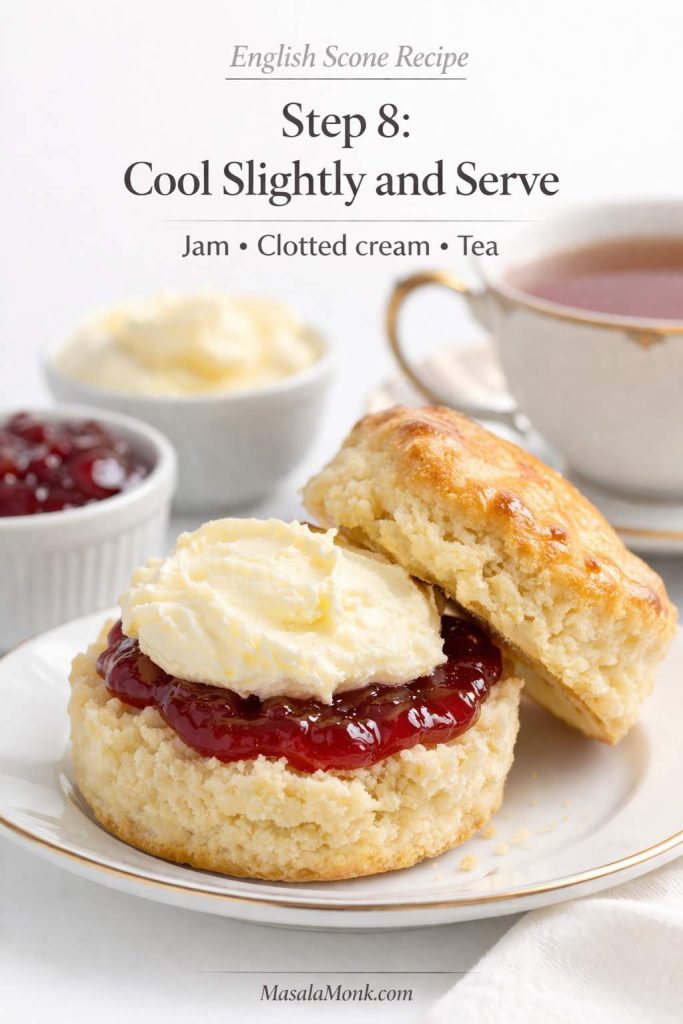
Step 3 English scone recipe graphic showing cold butter being rubbed into flour until the mixture looks sandy and crumbly.
The butter should be rubbed in only until the mixture looks sandy and crumbly, with a few tiny buttery pieces still visible. That is what helps the finished scones stay tender instead of turning heavy or tight.

4. Add the Milk and Bring the Dough Together Gently

Pour in 150 ml milk and the vanilla, if using. Stir with a butter knife, fork, or spatula until the mixture starts to gather into a dough. Add more milk only if needed, a little at a time.

The dough should feel soft, slightly tacky, and easy to press together. It should not feel dry and stubborn, and it should not slump like batter either.

Step 4 English scone recipe dough guide showing too dry, just right, and too wet dough after adding milk.
This is the most important texture check in the recipe. The dough should look soft, rough, and cohesive enough to hold together without becoming sticky or slumped.

This is where many batches go wrong. People often stop early because they are nervous about stickiness, then end up with a dough that seems tidy but bakes up heavier than it should. In practice, slightly softer is usually safer than slightly dry.

5. Pat the Dough Thick Without Kneading

Turn the dough onto a lightly floured surface. With lightly floured hands, bring it together with a few gentle presses, then pat it into a round or rectangle about 2.5 to 3 cm thick.

Step 5 English scone recipe graphic showing dough patted 2.5 to 3 cm thick before cutting the scones.
Patting the dough thick gives the scones room to rise upward instead of baking flatter than you want. That one choice changes the final look more than many people expect.

Do not knead the dough like bread. Do not press it into a smooth, tight disc. It only needs to come together neatly enough to cut.

6. Cut Out the Scones

Use a 5 to 6 cm round cutter dipped lightly in flour. Press straight down, then lift cleanly.

Do not twist the cutter. Twisting compresses the edge and makes a clean rise harder. It seems like a small detail, but it shows up clearly in the oven.

Step 6 English scone recipe graphic showing a round cutter pressed straight down into thick dough without twisting.
A straight downward cut keeps the edges cleaner than a twisting motion, which gives the scones a better chance of rising neatly in the oven.

Place the cut scones on the lined tray with a little space between them. Gather the scraps gently, pat them together once, and cut again. The last few may look slightly less neat than the first ones, but they will still bake well if you do not keep reworking the dough.

If the cut rounds look soft or slightly slack at this stage, chill them for 10 minutes before baking. That short rest can help them hold their shape better.

7. Egg Wash and Bake

Brush only the tops with beaten egg. Try not to let the egg wash run down the sides, because that can limit the rise by sealing the edges.

Step 7 English scone recipe graphic showing scones on a lined tray with egg wash and the correct lightly golden baked finish.
Do not judge doneness by color alone. The best batch should have lightly golden tops, sides that look set rather than damp, and bottoms that feel dry and baked through without turning hard.

Bake for 12 to 15 minutes. They are done when the tops are lightly golden, the sides look set rather than damp, and the bottoms look dry and lightly colored rather than pale and wet.

If they still look slightly heavy after 12 minutes, give them another minute or two and check again. When in doubt, break open the least tidy one from the batch. The center should look tender and set, not wet or gummy.

8. Cool Slightly and Serve

Let the scones cool for about 10 minutes before splitting and serving. They are excellent still slightly warm, when the crumb feels especially soft and the contrast with jam and clotted cream is at its best.

Step 8 English scone recipe graphic showing a split scone served with jam clotted cream and tea.
A short cooling time helps the crumb settle before serving, and it also keeps the jam and clotted cream from sliding around too much on a steaming-hot scone. This last pause improves the final experience more than it seems.

For a colder-day pairing, they also work beautifully with homemade hot chocolate with cocoa powder.

Why These English Scones Stay Light and Tender

The result stays light because the method avoids the three mistakes that most often drag scones down: dry dough, heavy handling, and shaping that is too thin.
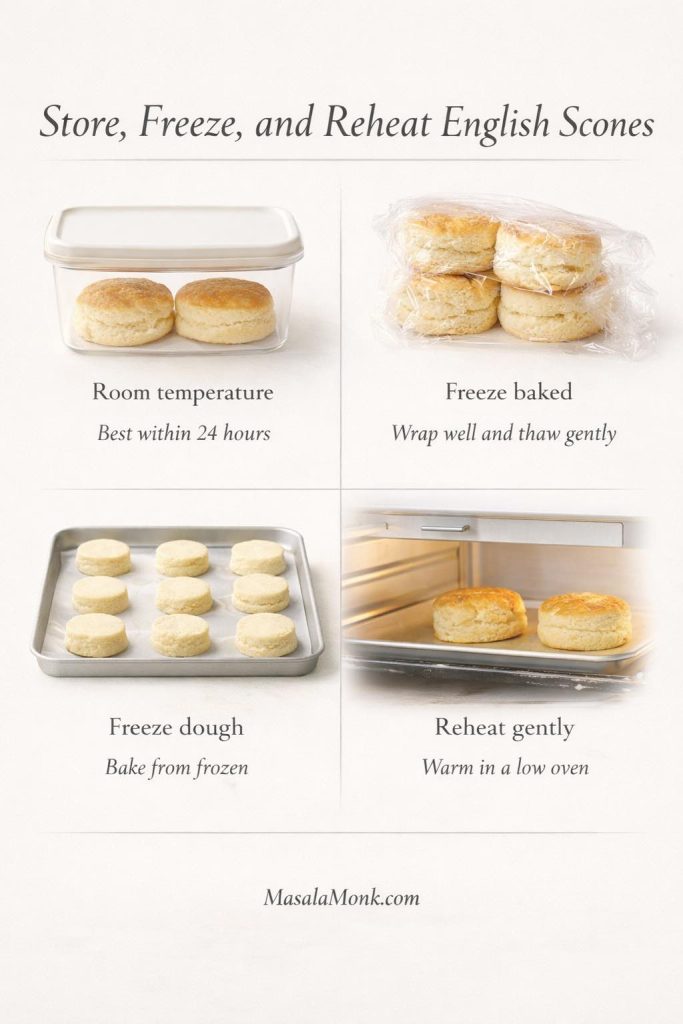
A dough that feels slightly soft will usually bake better than one that feels overly tidy and controlled. Extra pressing and rerolling tighten the crumb. Thin shaping leaves less room for upward lift. Add those problems together, and even a good ingredient list can still produce a disappointing batch.

That is why the method stays restrained. It gives the dough enough structure to hold shape, but not so much handling that the finished scones lose their tenderness.

English Scones vs American Scones

Although they share a name, English scones and American scones usually aim for very different results. English scones are typically round, lightly sweet, and softer in character, while American scones are often larger, richer, more heavily flavored, and shaped in wedges.

In the English style, the scones are usually served as part of afternoon tea, split and spread with jam and clotted cream. On their own, they are modest by design.
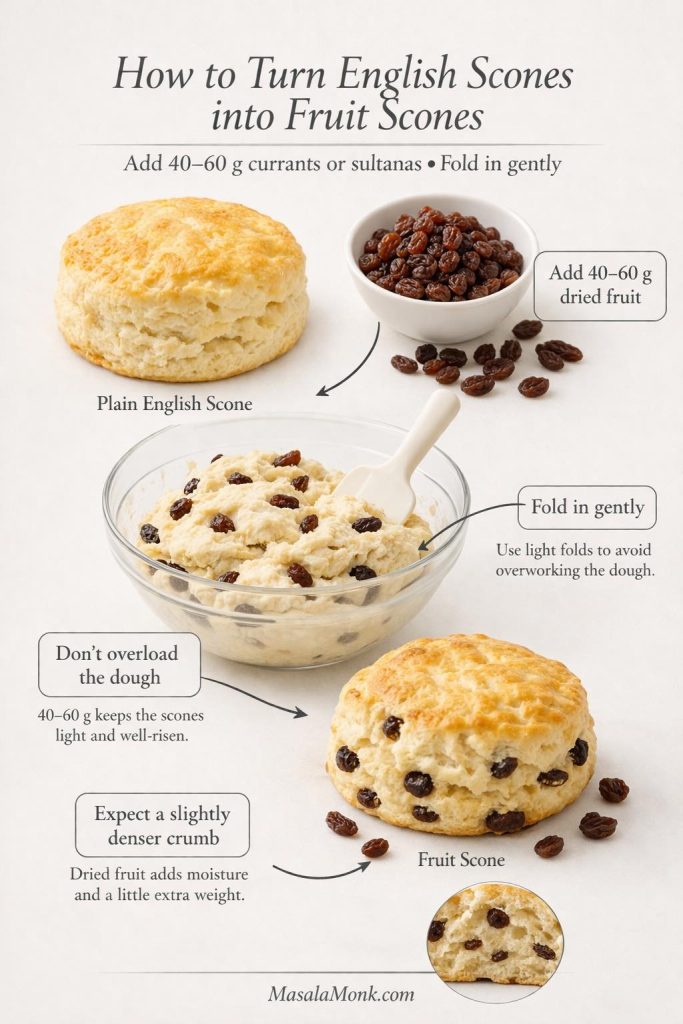
Comparison graphic showing English scones with jam and clotted cream beside sweeter glazed American scones with key differences in shape texture and serving style.

This side-by-side guide shows why this post stays firmly in the English-scone lane. English scones are rounder, lighter, and built for jam and clotted cream, while American scones are usually sweeter, wedge-shaped, and more pastry-like.

American scones, by contrast, tend to be larger, sweeter, and richer. They are more likely to include chocolate, berries, glaze, nuts, citrus, or stronger mix-ins, and they are often treated as a standalone pastry to eat with coffee rather than as part of a cream-tea table.

That difference is exactly why this recipe stays deliberately restrained. The goal is not to make the richest or most dramatic scone possible. The goal is to make one that feels unmistakably English-style and succeeds on those terms.

Also Read: Cookie Pie Recipe: 10 Best Flavors, Fillings and Variations

How to Serve English Scones with Jam and Clotted Cream

The classic serving style is part of the point, not an afterthought. These scones feel most like themselves when they are split and served with strawberry jam and clotted cream, whether you arrange them before serving or set everything out so people can build their own.

Serving guide for English scones showing how to split the scone, add strawberry jam, top with clotted cream, and serve with tea.
Classic English scones are meant to be finished at the table, not treated like a sweeter standalone pastry. Use this guide to see the traditional flow clearly: split the scone, add jam, top with clotted cream, and serve with tea.

Split them gently rather than crushing them flat, then add the jam and clotted cream just before serving. If you are building a full cream-tea setup, keep the tea hot and the scones lightly warm or fully cooled rather than steaming, so the toppings sit neatly instead of sliding off.

Slightly warm scones are often the most satisfying because the crumb feels softer and the butteriness comes through more clearly. Room-temperature scones are just as traditional and often more practical for a fuller afternoon tea spread. What matters most is that they still feel fresh enough to split cleanly and tender enough inside to welcome jam and cream.

This is also where the restrained sweetness of the dough proves its value. A heavily sweetened scone would compete with the toppings, while a classic English scone leaves room for them and lets the full serving feel balanced rather than overdone. For a more heritage-led British reference point, the National Trust’s traditional fruit scones recipe follows the same broader jam-and-clotted-cream serving direction.

Tea is the obvious partner, though coffee works beautifully too. If you want something warm alongside them, masala chai recipes and a cappuccino recipe both fit naturally.

English Scone Troubleshooting Guide

If your batch turns out dense, dry, flat, or uneven, the cause is usually easier to trace than it first seems.

English scone troubleshooting guide showing common problems like dense dry flat and pale scones with quick causes and fixes.
Keep this troubleshooting guide nearby when a batch turns out dense, dry, flat, or pale. Most problems trace back to dough texture, thickness, cutter technique, or baking cues, so spotting the likely cause makes the next batch much easier to fix.

Why Did My Scones Turn Out Dense?

Dense scones usually come from dough that was too dry or too heavily worked. If the mixture felt stiff before baking, cracked when pressed, or needed force to come together, that is the clearest clue.

Keep the dough softer next time, stop mixing earlier, and handle the scraps as little as possible. Also make sure the oven is fully hot before the tray goes in.

Why Are My English Scones Dry?

Dry scones are usually the result of dough that began too stiff or baking that ran too long. If the tops went deeper brown than intended, the crumb may have dried out before you pulled them.

Use enough milk to keep the dough soft, and take them out when they are lightly golden rather than deeply browned. Once they are fully cool, store them promptly instead of leaving them exposed on the counter.

Why Didn’t My Scones Rise Properly?

Poor rise usually points to one of four things: old baking powder, dough patted too thin, a cutter twisted instead of pressed straight down, or an oven that was not fully hot.

Use fresh raising ingredients, keep the dough thick, cut cleanly, and bake in a properly preheated oven.

Why Did They Spread Instead of Rising Tall?

Spreading is usually a sign that the dough was too warm, too wet, or too thin. If the cut rounds looked soft and a little slack on the tray before baking, that is your clue.

Hold back some of the milk until you know the dough needs it, keep the thickness at 2.5 to 3 cm, and chill the cut scones briefly if they seem very soft.

Why Are the Tops Pale or Uneven?

Pale tops usually mean the egg wash was too light, the oven heat was a little low, or the dough thickness varied across the batch. Uneven tops can also happen when the scraps are handled more roughly than the first cuts.

Brush the tops carefully, keep the dough even, and make sure the oven is fully hot.

How Do I Keep English Scones Soft After Baking?

Do not overbake them, let them cool only as long as needed, then store them airtight once fully cool. A brief reheat before serving helps a lot.

Also Read: White Russian Recipe: 7 Variants to Try, From Classic to Frozen

How to Store, Freeze, and Reheat English Scones

English scones are best the day they are baked, when the crumb is softest and the structure still feels freshest. Even so, they store and freeze better than many people expect if you handle them properly.

If freshness matters most to you, freezing shaped unbaked scones is usually the better move than storing baked ones for too long. That way you keep more of the just-baked texture and get much closer to the original result.

Storage guide for English scones showing room temperature storage, freezing baked scones, freezing dough, and reheating in a low oven.
Use this guide to keep English scones worth eating after the first bake. Room-temperature storage works best for the short term, freezing baked scones helps with leftovers, freezing shaped dough gives you the freshest later result, and gentle reheating brings back more of the soft crumb.

Room-Temperature Storage for English Scones

Once fully cool, store the scones in an airtight container at room temperature. They are best within 24 hours and still pleasant on day two if gently rewarmed.

Should You Refrigerate Them?

Refrigeration is usually not the best choice for plain baked scones because it can make them feel firmer and less fresh. Room temperature for a short window or freezing for longer storage is usually the better route.

How to Freeze a Baked English Scone

Let the baked scones cool completely, then wrap them well and freeze them in an airtight container or freezer bag. Thaw them, then warm them gently until just heated through.

How to Freeze Unbaked English Scone Dough

Freezing shaped dough is often the better option if you want fresh-baked scones later. Cut the scones, place them on a tray until firm, then transfer them to a freezer-safe container or bag. Bake from frozen, giving them about 2 to 4 extra minutes as needed.

How to Reheat English Scones Without Drying Them Out

Warm the scones in a low oven just until heated through. Do not blast them with high heat or leave them in too long. Gentle reheating brings back some softness without drying out the crumb.

How to Turn These English Scones Into Fruit Scones

If you want to adapt this recipe into a fruit version, fold in a small handful of currants or sultanas after the butter has been rubbed in and before the milk goes in. If you enjoy bakes that lean more fruit-forward and comforting, peach cobbler with canned peaches is another good one to bookmark.

Variation guide showing how to turn English scones into fruit scones with currants or sultanas without overloading the dough.
A fruit-scone variation works best when it stays restrained. Adding about 40 to 60 grams of currants or sultanas gives the dough a classic fruit note without weighing it down too much, though the crumb will be slightly denser than the plain version.

The key is restraint. A little dried fruit works beautifully. Too much starts to weigh the dough down and changes the balance of the bake. As a guide, around 40 to 60 g is enough for this quantity of dough.

Fold the fruit through gently so it spreads evenly without overworking the dough. You want enough in each scone to taste it, but not so much that the mixture turns heavy, patchy, or harder to cut cleanly.

Final Thoughts

A good English scone recipe does not need extra drama. It needs the right decisions at the right moments.

Keep the dough soft, shape it thick enough to rise well, cut it cleanly, and bake it in a properly heated oven. Do that, and you end up with the kind of scone people actually want: tender, gently risen, lightly sweet, and ready for jam and clotted cream.

That is why this version stays so focused. It is not trying to cover every possible style. It is trying to help you make one classic batch well, and that clarity is what makes a recipe worth returning to. If you enjoy classic bakes that reward small technique choices, sourdough English muffins are another strong next bake.

Also Read: White Russian Recipe: 7 Variants to Try, From Classic to Frozen

English Scone FAQs

1. Can I make English scones without self-raising flour?

Yes. For this recipe, use 250 g plain flour plus 3 tsp baking powder in total for the closest substitute. That will get you much nearer the intended texture than trying to guess the swap.

2. What can I use instead of clotted cream?

Mascarpone is the neatest substitute if clotted cream is hard to find. Thick lightly whipped cream also works, though it gives a softer, looser, and less traditional finish.

3. Why didn’t my English scones rise properly?

The most common causes are dough that was patted too thin, old baking powder, twisting the cutter instead of pressing straight down, or putting the tray into an oven that was not fully preheated. Keeping the dough thick and the oven properly hot makes a big difference.

4. Can I freeze English scone dough?

Yes. Shape and cut the scones first, freeze them until firm, then transfer them to a freezer-safe container or bag. Bake them from frozen and add about 2 to 4 extra minutes as needed.