Posted on 3 Comments

Easy English Scone Recipe

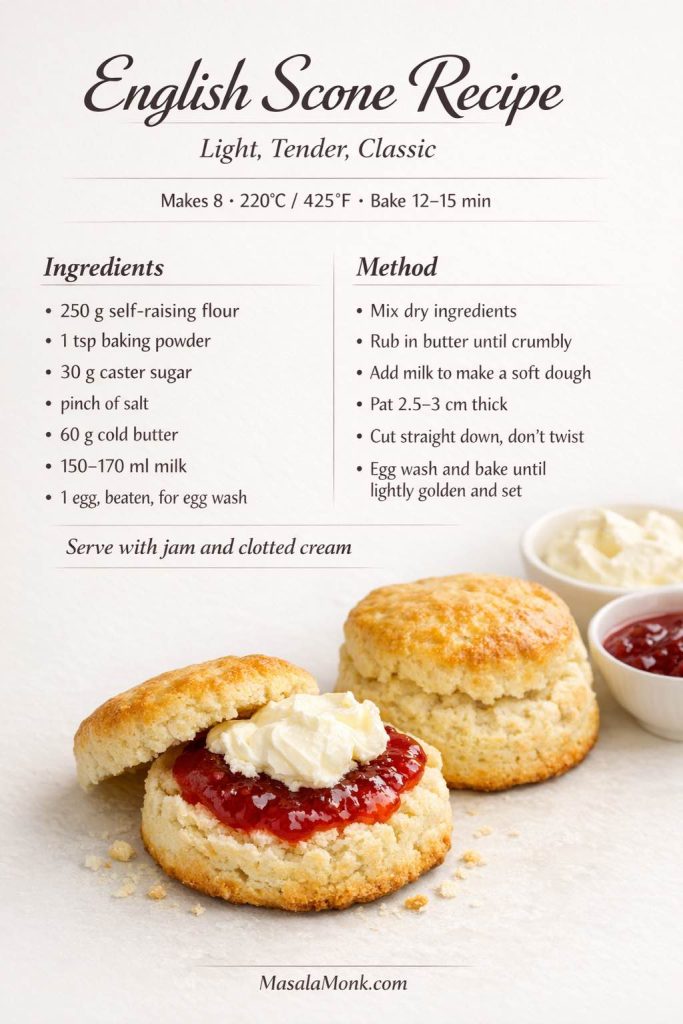
Split English scone topped with strawberry jam and clotted cream for an easy English scone recipe cover image.

This English scone recipe is built for the classic result: round scones with a light, tender crumb, gently golden tops, and just enough sweetness to work beautifully with jam and clotted cream. If you want an easy English scone recipe that stays close to the traditional style, this is the version to make.

The charm of English scones is that they do not ask for much. They ask for a dough that stays soft, handling that stays light, and shaping that gives them enough height to rise properly in the oven. Get those choices right, and the result feels balanced, familiar, and unmistakably classic.

Served warm or at room temperature with strawberry jam and clotted cream, these scones feel instantly at home on an afternoon tea table. They are especially lovely with masala chai recipes if you want a warmer spiced pairing, or with a cappuccino recipe if you are serving them for breakfast or brunch.

English Scone Recipe Ingredients

The ingredient list is short on purpose. Nothing here is decorative, and each ingredient has a clear job in the finished bake.

Dry Ingredients for English Scones

You will need:

  • 250 g self-raising flour
  • 1 tsp baking powder
  • 30 g caster sugar
  • 1 pinch salt

Self-raising flour keeps the method simple and gives the dough the kind of lift that suits classic English scones especially well. The extra baking powder adds support and helps keep the rise reliable. The sugar stays modest because this is not meant to be a sugary café pastry. It is meant to leave room for jam and cream at the table.

If you do not have self-raising flour, use 250 g plain flour plus 3 tsp baking powder in total for a close substitute. That will get you much nearer the intended texture than trying to improvise the swap.
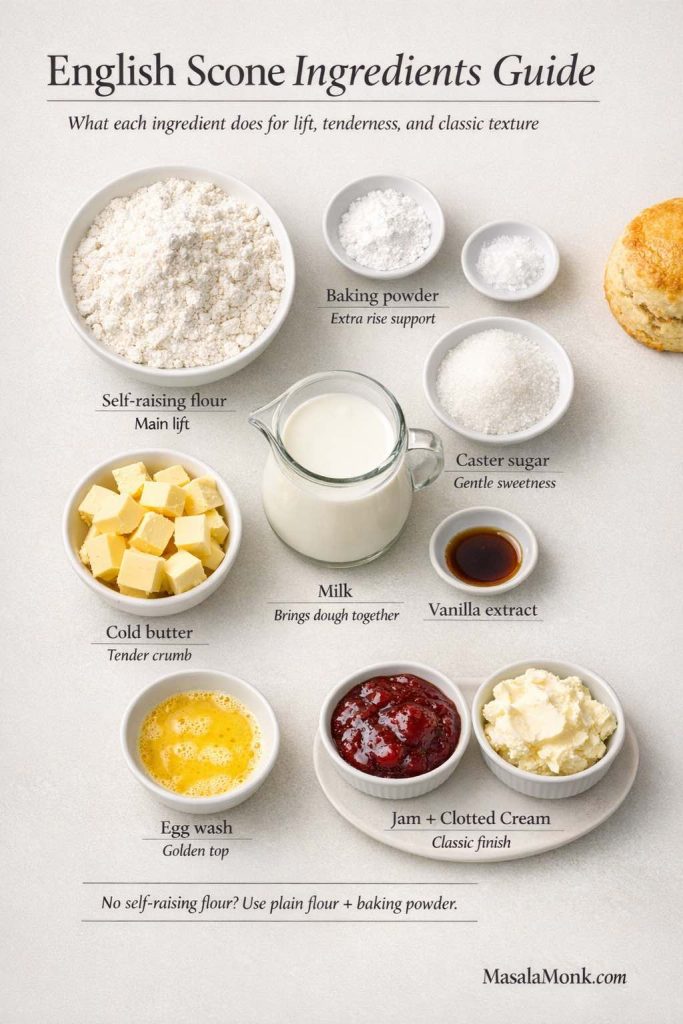
English scone ingredients guide showing self-raising flour baking powder sugar butter milk egg wash jam and clotted cream with ingredient role notes.
The structure of a good English scone starts here: flour and baking powder for lift, cold butter for tenderness, milk for a soft dough, and a finishing setup built around jam and clotted cream rather than extra sweetness in the base.

Butter, Milk, and Egg

You will need:

  • 60 g cold unsalted butter, cubed
  • 150 to 170 ml whole milk
  • 1 tsp vanilla extract, optional
  • 1 egg, beaten, for egg wash

Cold butter helps create the tender crumb that makes a good scone feel light rather than heavy. It should be rubbed into the flour until the mixture looks airy and crumbly, not greasy or paste-like. The milk brings the dough together, though the exact amount can vary slightly depending on your flour and your kitchen conditions. The egg does not go into the dough here. Instead, it is brushed over the tops so the scones bake with a soft shine and a gentle golden finish.

Classic English Scone Toppings: Jam and Clotted Cream

For the classic serving style, use:

  • strawberry jam
  • clotted cream

That pairing is not just a serving suggestion. It is part of the logic of the bake itself. English scones stay plainer and less sweet because they are designed to be completed at the table rather than to carry all the richness on their own.

Traditional cream tea is built around scones, jam, clotted cream, and tea, which is one reason this style remains so restrained and balanced. For a more useful reference point than a generic explainer, the protected Cornish clotted cream specification shows why it is treated as a distinct product, while the National Trust’s fruit scones recipe reflects the same classic jam-and-clotted-cream serving tradition.

If clotted cream is difficult to find where you live, mascarpone is the neatest substitute. Thick lightly whipped cream also works, though it gives a looser and less traditional finish.

Small Variations That Still Keep Them English-Style

If you want a little variation without changing the character of the recipe too much, keep it restrained. A small handful of currants or sultanas fits naturally, and a little lemon zest can work well too.

What does not belong in this version is a heavy fruit load, thick glaze, chocolate chips, or any shortcut that turns the bake into something else altogether.

Also Read: Punjabi Mutton Bhuna – Amritsari Village-Style Gosht Recipe

Easy English Scones Recipe Card

Yield: 8 scones
Prep time: 15 minutes
Bake time: 12 to 15 minutes
Total time: about 30 minutes
Oven temperature: 220°C / 425°F

Ingredients

  • 250 g self-raising flour
  • 1 tsp baking powder
  • 30 g caster sugar
  • 1 pinch salt
  • 60 g cold unsalted butter, cubed
  • 150 to 170 ml whole milk
  • 1 tsp vanilla extract, optional
  • 1 egg, beaten, for egg wash
  • strawberry jam, for serving
  • clotted cream, for serving
English scone recipe card showing ingredients, quick method, and classic scones served with jam and clotted cream.
Use this recipe card when you want the ingredient list, bake temperature, and quick method in one place. It is most useful once you know the flow and want to make a batch without scrolling through the full guide.

How to Make English Scones Step by Step

The method is simple, but the small cues matter. Most disappointing batches trace back to dough that was too dry, too heavily handled, or shaped too thin before baking.

1. Heat the Oven and Prepare the Tray

Heat the oven to 220°C / 425°F and line a baking tray with parchment paper. A fully preheated oven matters here because the scones need strong early heat to rise before the structure sets.
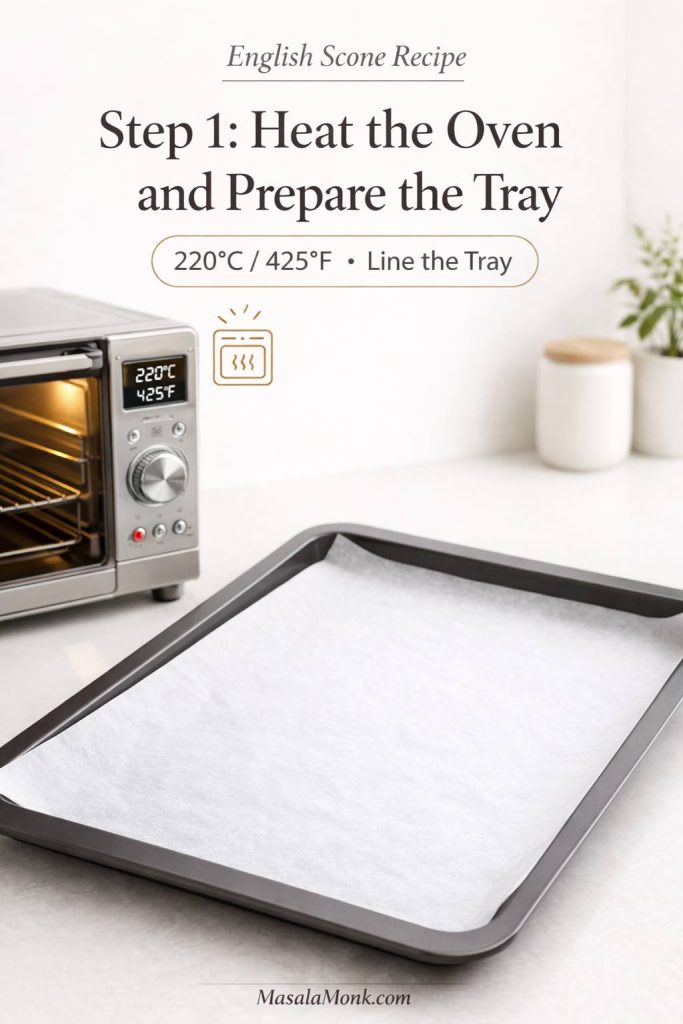
Step 1 English scone recipe graphic showing a lined baking tray and oven preheated to 220C 425F before baking.
Starting with a fully heated oven gives English scones a better chance of rising quickly before the structure sets. That early burst of heat matters more than many people expect when the goal is a lighter, taller result.

Use a middle rack unless your oven runs unusually hot at the top.

2. Mix the Dry Ingredients

In a large bowl, whisk together the self-raising flour, baking powder, caster sugar, and salt. This takes almost no time, but it helps distribute the lift evenly before the butter goes in.
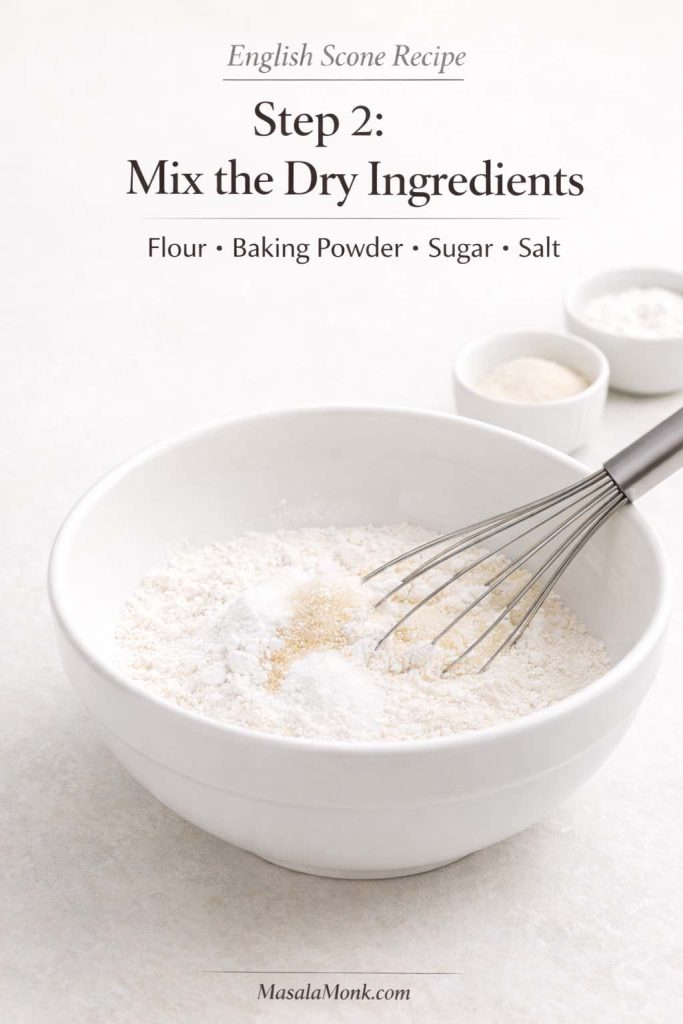
Step 2 English scone recipe graphic showing flour, baking powder, sugar, and salt being mixed in a bowl before the butter is added
A quick whisk here helps distribute the baking powder, sugar, and salt more evenly through the dough, which gives the scones a more consistent start.

3. Rub in the Butter

Add the cold butter cubes and rub them into the flour mixture with your fingertips until the texture looks like coarse crumbs.

You want a mixture that feels sandy and airy, with a few tiny buttery pieces still visible. If you squeeze a little in your hand, it should briefly clump, then fall apart again. Once the butter turns greasy or starts smearing into the flour, you have gone too far. If large cubes remain untouched, keep working a little longer.
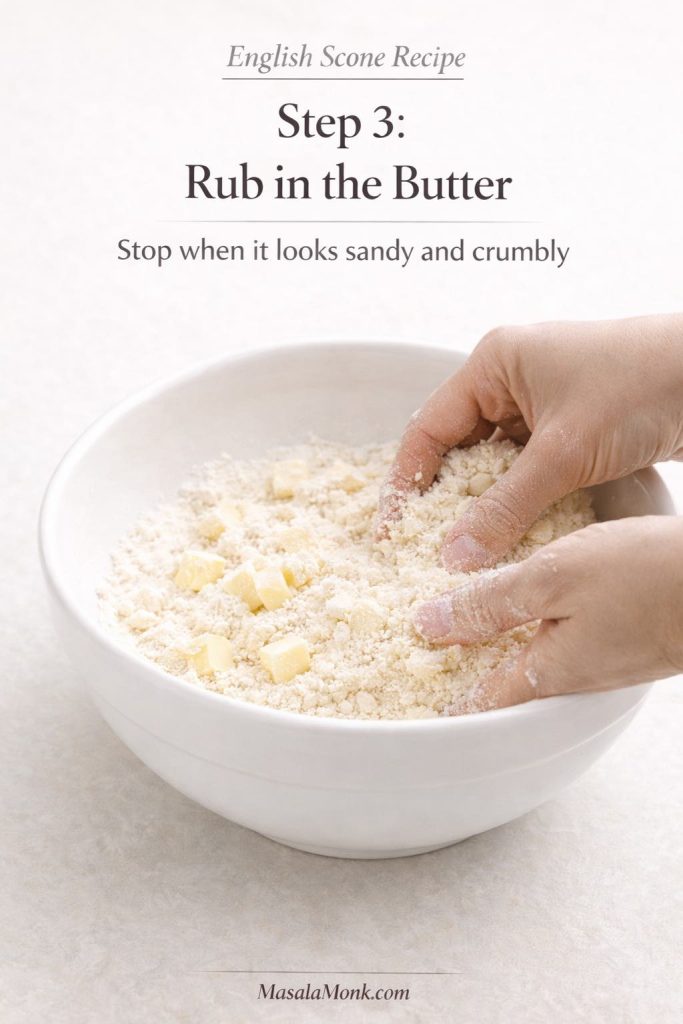
Step 3 English scone recipe graphic showing cold butter being rubbed into flour until the mixture looks sandy and crumbly.
The butter should be rubbed in only until the mixture looks sandy and crumbly, with a few tiny buttery pieces still visible. That is what helps the finished scones stay tender instead of turning heavy or tight.

4. Add the Milk and Bring the Dough Together Gently

Pour in 150 ml milk and the vanilla, if using. Stir with a butter knife, fork, or spatula until the mixture starts to gather into a dough. Add more milk only if needed, a little at a time.

The dough should feel soft, slightly tacky, and easy to press together. It should not feel dry and stubborn, and it should not slump like batter either.
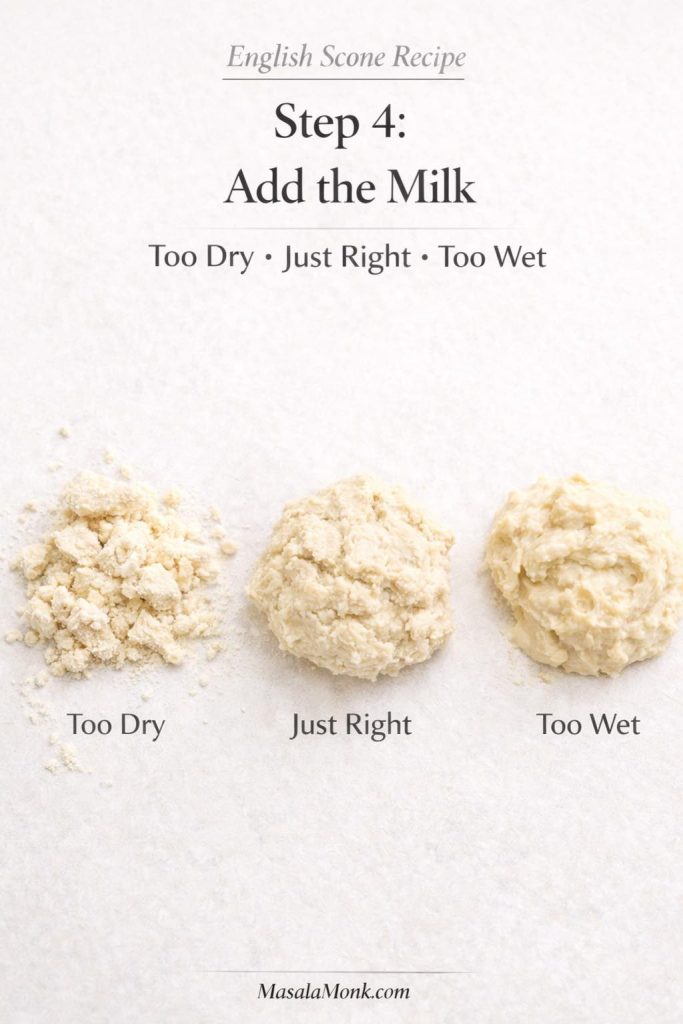
Step 4 English scone recipe dough guide showing too dry, just right, and too wet dough after adding milk.
This is the most important texture check in the recipe. The dough should look soft, rough, and cohesive enough to hold together without becoming sticky or slumped.

This is where many batches go wrong. People often stop early because they are nervous about stickiness, then end up with a dough that seems tidy but bakes up heavier than it should. In practice, slightly softer is usually safer than slightly dry.

5. Pat the Dough Thick Without Kneading

Turn the dough onto a lightly floured surface. With lightly floured hands, bring it together with a few gentle presses, then pat it into a round or rectangle about 2.5 to 3 cm thick.
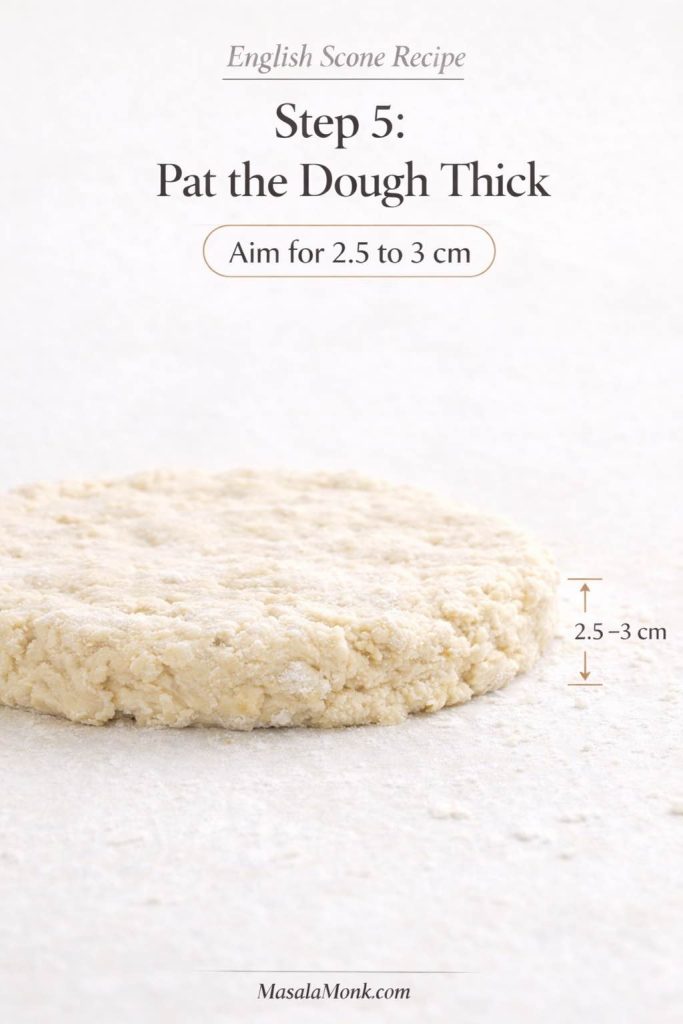
Step 5 English scone recipe graphic showing dough patted 2.5 to 3 cm thick before cutting the scones.
Patting the dough thick gives the scones room to rise upward instead of baking flatter than you want. That one choice changes the final look more than many people expect.

Do not knead the dough like bread. Do not press it into a smooth, tight disc. It only needs to come together neatly enough to cut.

6. Cut Out the Scones

Use a 5 to 6 cm round cutter dipped lightly in flour. Press straight down, then lift cleanly.

Do not twist the cutter. Twisting compresses the edge and makes a clean rise harder. It seems like a small detail, but it shows up clearly in the oven.
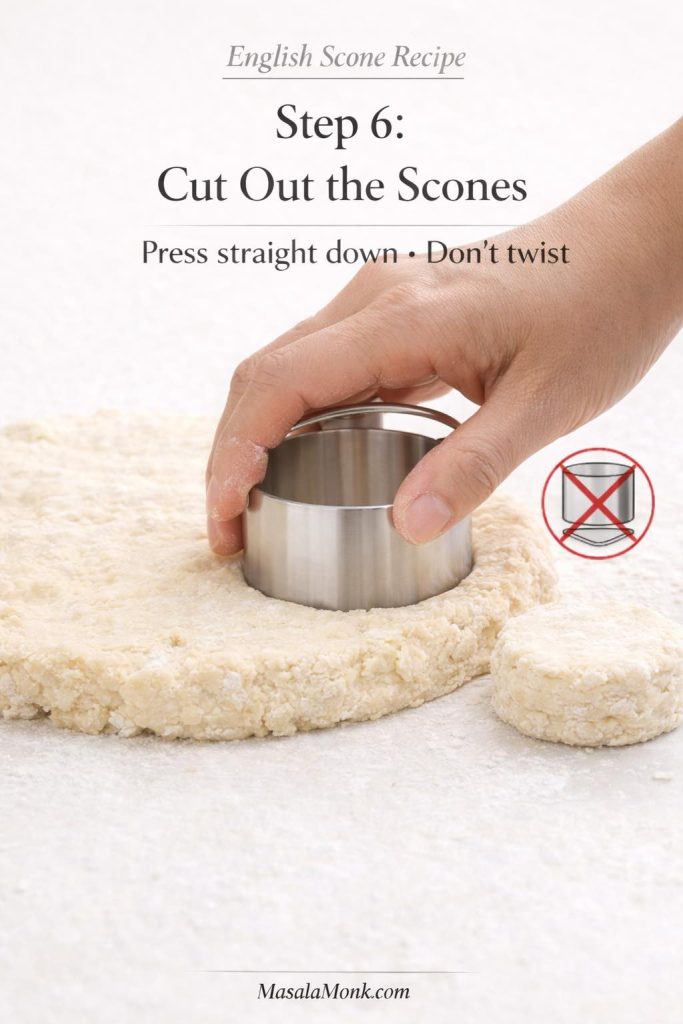
Step 6 English scone recipe graphic showing a round cutter pressed straight down into thick dough without twisting.
A straight downward cut keeps the edges cleaner than a twisting motion, which gives the scones a better chance of rising neatly in the oven.

Place the cut scones on the lined tray with a little space between them. Gather the scraps gently, pat them together once, and cut again. The last few may look slightly less neat than the first ones, but they will still bake well if you do not keep reworking the dough.

If the cut rounds look soft or slightly slack at this stage, chill them for 10 minutes before baking. That short rest can help them hold their shape better.

7. Egg Wash and Bake

Brush only the tops with beaten egg. Try not to let the egg wash run down the sides, because that can limit the rise by sealing the edges.

Step 7 English scone recipe graphic showing scones on a lined tray with egg wash and the correct lightly golden baked finish.
Do not judge doneness by color alone. The best batch should have lightly golden tops, sides that look set rather than damp, and bottoms that feel dry and baked through without turning hard.

Bake for 12 to 15 minutes. They are done when the tops are lightly golden, the sides look set rather than damp, and the bottoms look dry and lightly colored rather than pale and wet.

If they still look slightly heavy after 12 minutes, give them another minute or two and check again. When in doubt, break open the least tidy one from the batch. The center should look tender and set, not wet or gummy.

8. Cool Slightly and Serve

Let the scones cool for about 10 minutes before splitting and serving. They are excellent still slightly warm, when the crumb feels especially soft and the contrast with jam and clotted cream is at its best.

Step 8 English scone recipe graphic showing a split scone served with jam clotted cream and tea.
A short cooling time helps the crumb settle before serving, and it also keeps the jam and clotted cream from sliding around too much on a steaming-hot scone. This last pause improves the final experience more than it seems.

For a colder-day pairing, they also work beautifully with homemade hot chocolate with cocoa powder.

Why These English Scones Stay Light and Tender

The result stays light because the method avoids the three mistakes that most often drag scones down: dry dough, heavy handling, and shaping that is too thin.

A dough that feels slightly soft will usually bake better than one that feels overly tidy and controlled. Extra pressing and rerolling tighten the crumb. Thin shaping leaves less room for upward lift. Add those problems together, and even a good ingredient list can still produce a disappointing batch.

That is why the method stays restrained. It gives the dough enough structure to hold shape, but not so much handling that the finished scones lose their tenderness.

English Scones vs American Scones

Although they share a name, English scones and American scones usually aim for very different results. English scones are typically round, lightly sweet, and softer in character, while American scones are often larger, richer, more heavily flavored, and shaped in wedges.

In the English style, the scones are usually served as part of afternoon tea, split and spread with jam and clotted cream. On their own, they are modest by design.

Comparison graphic showing English scones with jam and clotted cream beside sweeter glazed American scones with key differences in shape texture and serving style.
This side-by-side guide shows why this post stays firmly in the English-scone lane. English scones are rounder, lighter, and built for jam and clotted cream, while American scones are usually sweeter, wedge-shaped, and more pastry-like.

American scones, by contrast, tend to be larger, sweeter, and richer. They are more likely to include chocolate, berries, glaze, nuts, citrus, or stronger mix-ins, and they are often treated as a standalone pastry to eat with coffee rather than as part of a cream-tea table.

That difference is exactly why this recipe stays deliberately restrained. The goal is not to make the richest or most dramatic scone possible. The goal is to make one that feels unmistakably English-style and succeeds on those terms.

Also Read: Cookie Pie Recipe: 10 Best Flavors, Fillings and Variations

How to Serve English Scones with Jam and Clotted Cream

The classic serving style is part of the point, not an afterthought. These scones feel most like themselves when they are split and served with strawberry jam and clotted cream, whether you arrange them before serving or set everything out so people can build their own.

Serving guide for English scones showing how to split the scone, add strawberry jam, top with clotted cream, and serve with tea.
Classic English scones are meant to be finished at the table, not treated like a sweeter standalone pastry. Use this guide to see the traditional flow clearly: split the scone, add jam, top with clotted cream, and serve with tea.

Split them gently rather than crushing them flat, then add the jam and clotted cream just before serving. If you are building a full cream-tea setup, keep the tea hot and the scones lightly warm or fully cooled rather than steaming, so the toppings sit neatly instead of sliding off.

Slightly warm scones are often the most satisfying because the crumb feels softer and the butteriness comes through more clearly. Room-temperature scones are just as traditional and often more practical for a fuller afternoon tea spread. What matters most is that they still feel fresh enough to split cleanly and tender enough inside to welcome jam and cream.

This is also where the restrained sweetness of the dough proves its value. A heavily sweetened scone would compete with the toppings, while a classic English scone leaves room for them and lets the full serving feel balanced rather than overdone. For a more heritage-led British reference point, the National Trust’s traditional fruit scones recipe follows the same broader jam-and-clotted-cream serving direction.

Tea is the obvious partner, though coffee works beautifully too. If you want something warm alongside them, masala chai recipes and a cappuccino recipe both fit naturally.

English Scone Troubleshooting Guide

If your batch turns out dense, dry, flat, or uneven, the cause is usually easier to trace than it first seems.
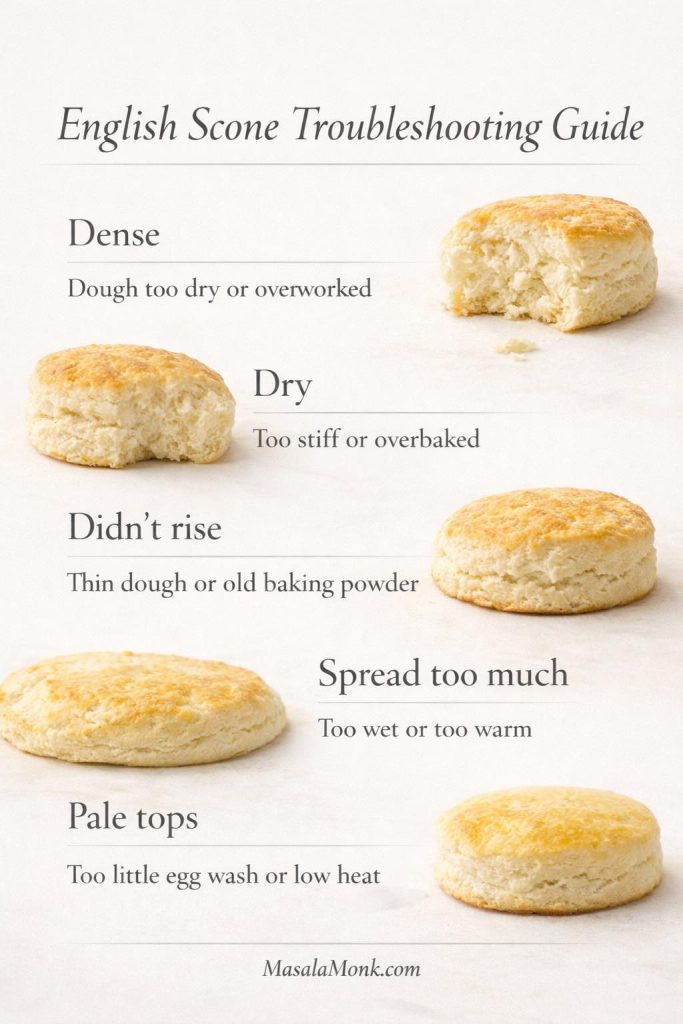
English scone troubleshooting guide showing common problems like dense dry flat and pale scones with quick causes and fixes.
Keep this troubleshooting guide nearby when a batch turns out dense, dry, flat, or pale. Most problems trace back to dough texture, thickness, cutter technique, or baking cues, so spotting the likely cause makes the next batch much easier to fix.

Why Did My Scones Turn Out Dense?

Dense scones usually come from dough that was too dry or too heavily worked. If the mixture felt stiff before baking, cracked when pressed, or needed force to come together, that is the clearest clue.

Keep the dough softer next time, stop mixing earlier, and handle the scraps as little as possible. Also make sure the oven is fully hot before the tray goes in.

Why Are My English Scones Dry?

Dry scones are usually the result of dough that began too stiff or baking that ran too long. If the tops went deeper brown than intended, the crumb may have dried out before you pulled them.

Use enough milk to keep the dough soft, and take them out when they are lightly golden rather than deeply browned. Once they are fully cool, store them promptly instead of leaving them exposed on the counter.

Why Didn’t My Scones Rise Properly?

Poor rise usually points to one of four things: old baking powder, dough patted too thin, a cutter twisted instead of pressed straight down, or an oven that was not fully hot.

Use fresh raising ingredients, keep the dough thick, cut cleanly, and bake in a properly preheated oven.

Why Did They Spread Instead of Rising Tall?

Spreading is usually a sign that the dough was too warm, too wet, or too thin. If the cut rounds looked soft and a little slack on the tray before baking, that is your clue.

Hold back some of the milk until you know the dough needs it, keep the thickness at 2.5 to 3 cm, and chill the cut scones briefly if they seem very soft.

Why Are the Tops Pale or Uneven?

Pale tops usually mean the egg wash was too light, the oven heat was a little low, or the dough thickness varied across the batch. Uneven tops can also happen when the scraps are handled more roughly than the first cuts.

Brush the tops carefully, keep the dough even, and make sure the oven is fully hot.

How Do I Keep English Scones Soft After Baking?

Do not overbake them, let them cool only as long as needed, then store them airtight once fully cool. A brief reheat before serving helps a lot.

Also Read: White Russian Recipe: 7 Variants to Try, From Classic to Frozen

How to Store, Freeze, and Reheat English Scones

English scones are best the day they are baked, when the crumb is softest and the structure still feels freshest. Even so, they store and freeze better than many people expect if you handle them properly.

If freshness matters most to you, freezing shaped unbaked scones is usually the better move than storing baked ones for too long. That way you keep more of the just-baked texture and get much closer to the original result.

Storage guide for English scones showing room temperature storage, freezing baked scones, freezing dough, and reheating in a low oven.
Use this guide to keep English scones worth eating after the first bake. Room-temperature storage works best for the short term, freezing baked scones helps with leftovers, freezing shaped dough gives you the freshest later result, and gentle reheating brings back more of the soft crumb.

Room-Temperature Storage for English Scones

Once fully cool, store the scones in an airtight container at room temperature. They are best within 24 hours and still pleasant on day two if gently rewarmed.

Should You Refrigerate Them?

Refrigeration is usually not the best choice for plain baked scones because it can make them feel firmer and less fresh. Room temperature for a short window or freezing for longer storage is usually the better route.

How to Freeze a Baked English Scone

Let the baked scones cool completely, then wrap them well and freeze them in an airtight container or freezer bag. Thaw them, then warm them gently until just heated through.

How to Freeze Unbaked English Scone Dough

Freezing shaped dough is often the better option if you want fresh-baked scones later. Cut the scones, place them on a tray until firm, then transfer them to a freezer-safe container or bag. Bake from frozen, giving them about 2 to 4 extra minutes as needed.

How to Reheat English Scones Without Drying Them Out

Warm the scones in a low oven just until heated through. Do not blast them with high heat or leave them in too long. Gentle reheating brings back some softness without drying out the crumb.

How to Turn These English Scones Into Fruit Scones

If you want to adapt this recipe into a fruit version, fold in a small handful of currants or sultanas after the butter has been rubbed in and before the milk goes in. If you enjoy bakes that lean more fruit-forward and comforting, peach cobbler with canned peaches is another good one to bookmark.
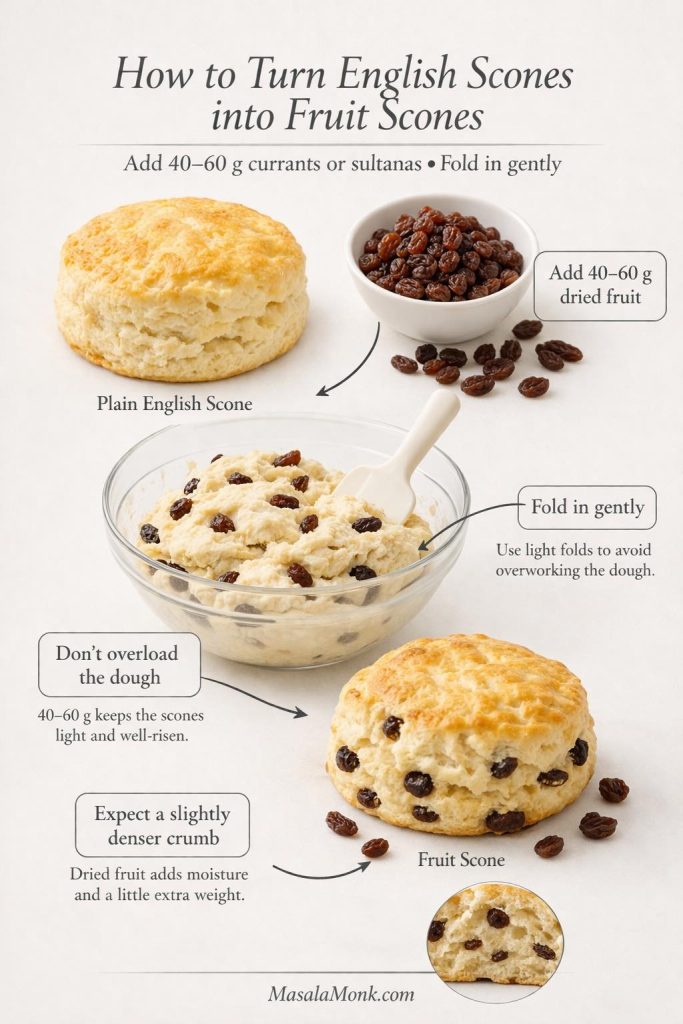
Variation guide showing how to turn English scones into fruit scones with currants or sultanas without overloading the dough.
A fruit-scone variation works best when it stays restrained. Adding about 40 to 60 grams of currants or sultanas gives the dough a classic fruit note without weighing it down too much, though the crumb will be slightly denser than the plain version.

The key is restraint. A little dried fruit works beautifully. Too much starts to weigh the dough down and changes the balance of the bake. As a guide, around 40 to 60 g is enough for this quantity of dough.

Fold the fruit through gently so it spreads evenly without overworking the dough. You want enough in each scone to taste it, but not so much that the mixture turns heavy, patchy, or harder to cut cleanly.

Final Thoughts

A good English scone recipe does not need extra drama. It needs the right decisions at the right moments.

Keep the dough soft, shape it thick enough to rise well, cut it cleanly, and bake it in a properly heated oven. Do that, and you end up with the kind of scone people actually want: tender, gently risen, lightly sweet, and ready for jam and clotted cream.

That is why this version stays so focused. It is not trying to cover every possible style. It is trying to help you make one classic batch well, and that clarity is what makes a recipe worth returning to. If you enjoy classic bakes that reward small technique choices, sourdough English muffins are another strong next bake.

Also Read: White Russian Recipe: 7 Variants to Try, From Classic to Frozen

English Scone FAQs

1. Can I make English scones without self-raising flour?

Yes. For this recipe, use 250 g plain flour plus 3 tsp baking powder in total for the closest substitute. That will get you much nearer the intended texture than trying to guess the swap.

2. What can I use instead of clotted cream?

Mascarpone is the neatest substitute if clotted cream is hard to find. Thick lightly whipped cream also works, though it gives a softer, looser, and less traditional finish.

3. Why didn’t my English scones rise properly?

The most common causes are dough that was patted too thin, old baking powder, twisting the cutter instead of pressing straight down, or putting the tray into an oven that was not fully preheated. Keeping the dough thick and the oven properly hot makes a big difference.

4. Can I freeze English scone dough?

Yes. Shape and cut the scones first, freeze them until firm, then transfer them to a freezer-safe container or bag. Bake them from frozen and add about 2 to 4 extra minutes as needed.


Posted on Leave a comment

Vegan Stuffed Portobello Mushroom Recipes in an Air Fryer

white and black wooden blocks

Welcome to a world where vegan food is not just about salads and smoothies! Today, we’re exploring the delicious realm of stuffed Portobello mushrooms, all cooked to perfection in an air fryer. These recipes are perfect for a cozy dinner at home, a fancy dinner party, or even a weekend brunch. Pair them with a fresh salad, a side of roasted vegetables, or even a glass of your favorite vegan wine. Ready to make your taste buds dance? Let’s get started!

1. Vegan Stuffed Portobello Mushrooms with Spinach

The Twist: This recipe is a beautiful blend of the earthy flavors of Portobello mushrooms, the nutritional powerhouse of spinach, and the creamy delight of vegan cheese. It’s a perfect dish to serve at brunch or a light dinner. You can also experiment with different types of vegan cheese for a variety of flavors.

Ingredients:

  • Large Portobello mushroom caps
  • Sautéed spinach
  • Your favorite vegan cheese

How to: Start by cleaning your large Portobello mushroom caps. Stuff them with a hearty mixture of sautéed spinach and your favorite vegan cheese. Pop them into the air fryer and cook until the cheese is bubbly and golden. Drizzle some balsamic glaze on top for an extra kick of flavor. Voila! A simple yet delicious vegan meal is ready!

2. Vegan Cream Cheese Stuffed Portobello Mushrooms

The Twist: This recipe is a vegan take on the classic cream cheese stuffed mushrooms. The creaminess of the vegan cream cheese pairs perfectly with the meaty texture of the mushrooms. Serve it with a side of crusty bread or a fresh salad for a complete meal.

Ingredients:

  • Vegan cream cheese
  • Portobello mushrooms

How to: Fill your Portobello mushrooms with vegan cream cheese and a sprinkle of fresh herbs. Air fry until the mushrooms are cooked and the cream cheese is warm and creamy. This recipe is a surefire way to impress your guests!

3. Big Mushroom Recipe

The Twist: This recipe is perfect for those days when you want a filling yet healthy vegan meal. The quinoa, black beans, and corn provide a good dose of protein, while the Portobello mushroom adds a burst of flavor.

Ingredients:

  • Big Portobello mushrooms
  • Cooked quinoa
  • Black beans
  • Corn

How to: For a filling vegan meal, stuff big Portobello mushrooms with a mixture of cooked quinoa, black beans, and corn. Air fry until the mushrooms are tender. This recipe is perfect for those days when you want a filling yet healthy meal!

4. Grilled Stuffed Portobello Mushrooms

The Twist: This recipe brings the smoky flavor of the grill to your kitchen. The grilled mushrooms are then stuffed with a colorful mixture of grilled vegetables and vegan cheese. You can also add some grilled corn or black beans for an extra layer of flavor.

Ingredients:

  • Portobello mushrooms
  • Grilled vegetables
  • Vegan cheese

How to: For a smoky flavor, grill your Portobello mushrooms first. Then stuff them with a colorful mixture of grilled vegetables and vegan cheese. Finish in the air fryer for a deliciously crispy top. This recipe is a fusion of grilling and air frying that results in a flavor-packed meal!

5. Healthy Portobello Mushroom Recipes

The Twist: This recipe is a powerhouse of nutrition. The brown rice provides a good dose of fiber, while the bell peppers add a burst of freshness. The nutritional yeast adds a cheesy flavor that complements the other ingredients perfectly.

Ingredients:

  • Portobello mushrooms
  • Cooked brown rice
  • Bell peppers
  • Nutritional yeast

How to: Stuff your Portobello mushrooms with a nutritious mixture of cooked brown rice, bell peppers, and a sprinkle of nutritional yeast for a cheesy flavor. Air fry until the mushrooms are tender and the tops are slightly crispy. This recipe is not just healthy but also incredibly tasty!

Remember, the cooking times will vary depending on the size of the mushrooms and the specific air fryer model. Always check the mushrooms for doneness before serving. So, what are you waiting for? Get your apron on and start cooking these delicious vegan stuffed Portobello mushroom recipes! Happy cooking!

FAQs

1. Can I use other types of mushrooms for these recipes? Yes, you can use other large-cap mushrooms like shiitake or white button mushrooms. However, Portobello mushrooms are preferred due to their large size and meaty texture.

2. Can I prepare the stuffed mushrooms ahead of time? Absolutely! You can prepare the stuffed mushrooms and store them in the refrigerator. When you’re ready to eat, just pop them in the air fryer.

3. What can I serve with these stuffed mushrooms? These stuffed mushrooms pair well with a fresh salad, roasted vegetables, or a grain of your choice. You can also serve them with a dipping sauce of your choice.

4. What’s the best way to clean mushrooms? The best way to clean mushrooms is to use a damp paper towel to wipe off any dirt. Avoid washing them under running water as they can absorb water and become soggy.

Blog Tags: Vegan Recipes, Air Fryer Recipes, Stuffed Portobello Mushrooms, Healthy Eating, Easy Dinner Ideas, Meal Prep, Gluten-Free, Dairy-Free Options.

Posted on 1 Comment

Vegetarian Portobello Mushroom Recipes in an Air Fryer

happy asian women cooking oriental noodles in kitchen

Welcome to the world of culinary delights where health meets taste! Today, we’re diving headfirst into the realm of stuffed Portobello mushrooms, cooked to perfection in an air fryer. These recipes are not just perfect for a cozy dinner at home, but they’re also fancy enough to impress at your next dinner party. Pair them with a fresh salad, a side of garlic bread, or even a glass of your favorite wine. Ready to make your taste buds dance? Let’s get started!

1. Air Fryer Portobello Mushrooms with Spinach and Cheese

The Twist: This recipe is a beautiful marriage of the earthy flavors of Portobello mushrooms, the nutritional powerhouse of spinach, and the creamy delight of cheese. It’s a perfect dish to serve at brunch or a light dinner. You can also experiment with different types of cheese like mozzarella, cheddar, or even vegan cheese for a dairy-free alternative.

Ingredients:

  • Large Portobello mushroom caps
  • Sautéed spinach
  • Your favorite cheese

How to: Start by cleaning your large Portobello mushroom caps. Stuff them with a hearty mixture of sautéed spinach and your favorite cheese. Pop them into the air fryer and cook until the cheese is bubbly and golden. Drizzle some balsamic glaze on top for an extra kick of flavor. Voila! A simple yet delicious meal is ready!

2. Spinach Artichoke Stuffed Portobello Mushrooms

The Twist: This recipe is a vegetarian take on the classic spinach and artichoke dip. The creaminess of the filling pairs perfectly with the meaty texture of the mushrooms. Serve it with a side of crusty bread or a fresh salad for a complete meal.

Ingredients:

  • Cream cheese
  • Spinach
  • Artichoke hearts
  • Portobello mushrooms

How to: Combine cream cheese, spinach, and artichoke hearts to create a rich and creamy filling. Stuff this delightful mixture into your Portobello mushrooms and air fry until the tops are slightly crispy. This recipe is a surefire way to impress your guests!

3. Grilled Stuffed Portobello Mushrooms

The Twist: This recipe brings the smoky flavor of the grill to your kitchen. The grilled mushrooms are then stuffed with a colorful mixture of bell peppers, onions, and cheese. You can also add some grilled corn or black beans for an extra layer of flavor.

Ingredients:

  • Portobello mushrooms
  • Bell peppers
  • Onions
  • Cheese

How to: For a smoky flavor, grill your Portobello mushrooms first. Then stuff them with a colorful mixture of bell peppers, onions, and cheese. Finish in the air fryer for a deliciously crispy top. This recipe is a fusion of grilling and air frying that results in a flavor-packed meal!

4. Stuffed Portobello Mushroom Caps with Healthy Ingredients

The Twist: This recipe is a powerhouse of nutrition. The quinoa provides a good dose of protein, while the cherry tomatoes add a burst of freshness. The feta cheese adds a tangy flavor that complements the other ingredients perfectly.

Ingredients:

  • Portobello mushroom caps
  • Quinoa
  • Cherry tomatoes
  • Feta cheese

How to: Stuff your Portobello mushroom caps with a nutritious mixture of cooked quinoa, cherry tomatoes, and feta cheese. Air fry until the cheese is melted and the mushrooms are tender. This recipe is not just healthy but also incredibly tasty!

5. Large Stuffed Mushroom Recipes

The Twist: This recipe is perfect for those days when you want a filling yet healthy meal. The lentils provide a good dose of protein, while the onions and cheese add a burst of flavor. You can also add some chopped nuts for a crunchy texture.

Ingredients:

  • Large Portobello mushrooms
  • Cooked lentils
  • Onions
  • Cheese

How to: For a hearty meal, stuff large Portobello mushrooms with a mixture of cooked lentils, onions, and cheese. Air fry until the mushrooms are cooked through and the cheese is melted. This recipe is perfect for those days when you want a filling yet healthy meal!

Remember, the cooking times will vary depending on the size of the mushrooms and the specific air fryer model. Always check the mushrooms for doneness before serving. So, what are you waiting for? Get your apron on and start cooking these delicious vegetarian stuffed Portobello mushroom recipes! Happy cooking!

FAQs

1. Can I use other types of mushrooms for these recipes? Yes, you can use other large-cap mushrooms like shiitake or white button mushrooms. However, Portobello mushrooms are preferred due to their large size and meaty texture.

2. Can I prepare the stuffed mushrooms ahead of time? Absolutely! You can prepare the stuffed mushrooms and store them in the refrigerator. When you’re ready to eat, just pop them in the air fryer.

3. What can I serve with these stuffed mushrooms? These stuffed mushrooms pair well with a fresh salad, garlic bread, or roasted vegetables. You can also serve them with a dipping sauce of your choice.

4. Can I make these recipes vegan? Yes, you can substitute the cheese with vegan cheese or nutritional yeast to make these recipes vegan.

5. What’s the best way to clean mushrooms? The best way to clean mushrooms is to use a damp paper towel to wipe off any dirt. Avoid washing them under running water as they can absorb water and become soggy.

Blog Tags: Vegetarian Recipes, Air Fryer Recipes, Stuffed Portobello Mushrooms, Healthy Eating, Easy Dinner Ideas, Meal Prep, Vegan Options, Gluten-Free, Dairy-Free Options.

Posted on Leave a comment

Demystifying Keto-Friendly Yogurt Options: Finding Balance in Your Low-Carb Journey

scrabble tiles surrounded by white flowers on a marbled surface

Greetings, keto enthusiasts! Today, we’re diving into the world of yogurt and exploring the options available for those following a ketogenic lifestyle. While yogurt is typically associated with higher carbohydrate content, there are keto-friendly alternatives that allow you to enjoy this creamy and nutritious treat while staying within your low-carb parameters. Join us as we demystify keto-friendly yogurt options, discuss their benefits, and provide guidance on finding balance in your low-carb journey.🥛🥣

Understanding Carbohydrate Content in Yogurt 🥛

Traditional yogurt often contains a moderate to high amount of carbohydrates due to the natural sugars present in milk. However, with increasing demand for low-carb alternatives, the market now offers various yogurt options suitable for keto dieters. These options are typically made from low-carb milk sources or undergo specific processing methods to reduce carbohydrate content while maintaining a creamy and flavorful product.

Keto-Friendly Yogurt Options 🥣

  1. Greek Yogurt: 🇬🇷🥛 Greek yogurt is a popular choice among keto enthusiasts due to its lower carbohydrate content and higher protein content compared to regular yogurt. It undergoes a straining process that removes excess whey, resulting in a thicker consistency and reduced lactose content. Greek yogurt can be a versatile addition to your keto meals, serving as a base for dressings, dips, or enjoying it as is with some keto-friendly toppings.
  2. Coconut Milk Yogurt: 🥥🥛 For those following a dairy-free or plant-based keto diet, coconut milk yogurt is an excellent option. Made from the rich and creamy coconut milk, this yogurt alternative offers a delightful tropical flavor and texture. It is typically lower in carbohydrates and provides healthy fats, making it a satisfying choice for keto dieters.
  3. Almond Milk Yogurt: 🌰🥛 Almond milk yogurt is another dairy-free alternative suitable for keto. It is made by fermenting almond milk with probiotics to create a creamy and tangy yogurt-like product. Almond milk yogurt is often lower in carbohydrates and can be enjoyed plain or with keto-friendly add-ins like nuts, seeds, or low-carb berries.
  4. Full-Fat Yogurt: 🥛 For those who can tolerate dairy and prefer the richness of traditional yogurt, full-fat options can be incorporated into a keto diet in moderation. Full-fat yogurt can provide a satisfying and creamy texture, along with essential nutrients like calcium and vitamins. It’s important to check the nutrition labels and choose options with minimal added sugars or flavorings.

Finding Balance in Your Low-Carb Journey ⚖️

When incorporating yogurt into your keto diet, it’s essential to find the right balance that aligns with your macronutrient goals and individual preferences. Here are a few tips to help you make informed choices:

  1. Check the Nutrition Labels: 📊 Before purchasing yogurt, examine the nutrition facts to determine the carbohydrate content. Look for options that are low in net carbs, which are calculated by subtracting fiber from the total carbohydrates.
  2. Choose Unsweetened Varieties: 🚫🍯 Opt for plain, unsweetened yogurt or those sweetened with keto-friendly alternatives like stevia or erythritol. Avoid yogurts with added sugars or artificial sweeteners that may hinder your keto progress.
  3. Portion Control: 🥣⚖️ While yogurt can fit into a keto diet, it’s crucial to be mindful of portion sizes. Enjoy yogurt in moderation and consider measuring your servings to ensure you stay within your daily carbohydrate limits.
  4. Personalize with Keto-Friendly Toppings: 🥜🍓 Customize your yogurt to enhance flavor and add variety without significantly increasing carb intake. Incorporate toppings such as crushed nuts, seeds, low-carb berries like raspberries or blackberries, unsweetened coconut flakes, or a drizzle of sugar-free syrup to elevate the taste experience.
  5. Experiment with Homemade Yogurt: 🏡🥣 Consider making your own keto-friendly yogurt at home using low-carb milk alternatives and probiotic cultures. This allows you to have full control over the ingredients and flavorings, ensuring they align with your keto goals.
Posted on Leave a comment

Hemp Seeds for Plant-Based Diets: 5 Nutrient-Packed Smoothie Ideas

Welcome, dear smoothie enthusiasts! 🍹

Today, we invite you to embark on a journey into the realm of plant-based nutrition, where we will explore the incredible benefits of hemp seeds. These tiny, nutritional powerhouses are an exceptional addition to any plant-based diet, boasting a wealth of essential fatty acids, complete proteins, fiber, and a wide range of vitamins and minerals. When incorporated into your morning smoothies, hemp seeds provide a nourishing boost that supports your overall well-being. So, grab your blender and prepare to discover a world of delicious and nutrient-packed smoothie ideas! 🌱

1. Creamy Banana Hemp Delight 🍌 – If you’re seeking a smoothie that combines creamy indulgence with natural sweetness, look no further. Begin with ripe bananas, add a generous handful of nutrient-rich hemp seeds, and blend them together with your choice of plant-based milk. The result is a luscious, velvety smoothie that not only satisfies your taste buds but also provides a healthy dose of essential nutrients to kick-start your day.

2. Berry Blast with Hemp Power 🍓 – Energize your mornings with a vibrant burst of berries paired with the power of hemp seeds. Combine your favorite assortment of berries—such as strawberries, blueberries, and raspberries—with a handful of hemp seeds, plant-based yogurt, and a touch of natural sweetener if desired. This delightful smoothie strikes a perfect balance between fruity flavors and plant-based protein, ensuring that you start your day on a nutritious and flavorful note.

3. Green Goodness Hemp Reviver 🍃 – Refresh and rejuvenate your body with a revitalizing green smoothie enhanced by the nutritional benefits of hemp seeds. Blend a handful of leafy greens such as spinach or kale, a ripe banana for natural sweetness, a scoop of hemp seeds, and a splash of coconut water or your preferred plant-based milk. This invigorating concoction is packed with vitamins, minerals, and fiber, providing a nourishing boost to keep you fueled throughout the day.

4. Tropical Hemp Paradise 🏝️ – Allow your taste buds to wander off to a tropical oasis with this exotic smoothie creation. Combine the tropical flavors of pineapple, mango, and coconut water with a generous sprinkling of hemp seeds. The result is a taste of paradise in every sip—a refreshing blend that not only nourishes your body but also transports your senses to sun-kissed shores and the gentle sway of palm trees.

5. Chai Spice Hemp Elixir ☕ – Indulge in a warm and comforting smoothie that embraces the aromatic flavors of chai spice. Begin by brewing a cup of your favorite herbal chai tea and letting it cool. Then, blend the tea with a scoop of hemp seeds, a ripe banana, and a touch of cinnamon and nutmeg. This delightful smoothie not only satisfies your craving for warm, cozy beverages but also provides a nutritious boost with the goodness of hemp seeds.

These smoothie ideas merely scratch the surface of the possibilities that hemp seeds present. Feel free to unleash your creativity and tailor these recipes to suit your taste preferences and nutritional goals. Add a handful of leafy greens for an extra nutrient punch, experiment with different fruits to discover new flavor combinations, or even incorporate a spoonful of nut butter for added creaminess. The canvas is yours to explore, and the power to create your perfect plant-based smoothie lies in your hands! 👩‍🍳👨‍🍳

We invite you to share your experiences, adaptations, and your very own hemp seed smoothie recipes in the comments below. Let’s inspire and support each other on this plant-based journey, as we continue to explore the incredible world of smoothies together! Your creativity may spark new ideas and help someone else on their quest for flavorful and nutritious smoothie options. 🎈

So, let us raise our glasses (or rather, our smoothie-filled blenders) to a future filled with vibrant plant-based nutrition, tantalizing flavors, and the mighty power of hemp seeds. Cheers to a healthy and delicious start to your day! 🥂