Posted on — Leave a comment

Pad Thai Recipe: Easy, Chewy & Full of Flavor

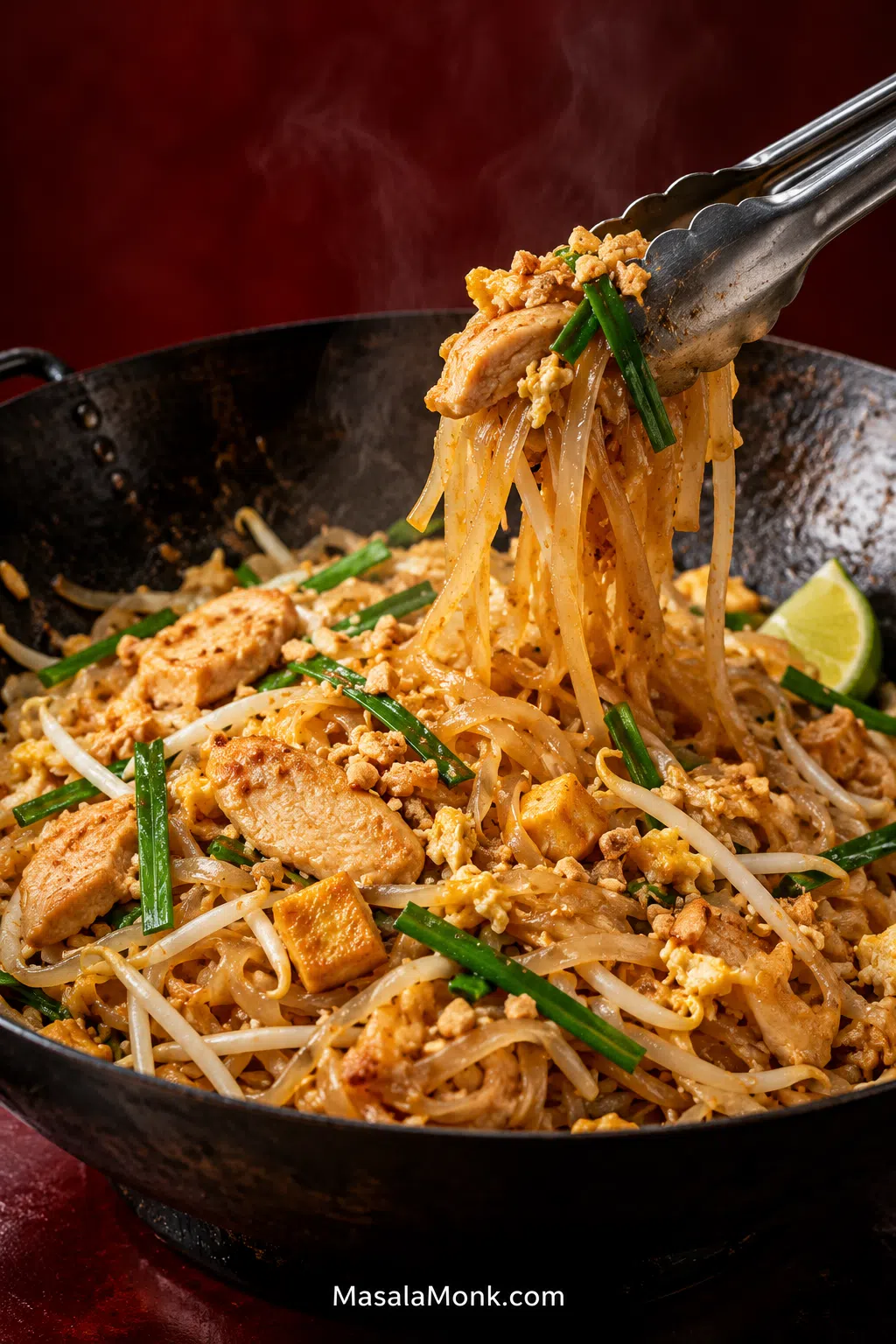
Chicken Pad Thai in a black wok with glossy brown-gold flat rice noodles lifted by metal tongs, with sliced chicken, egg, tofu, mung bean sprouts, garlic chives, crushed peanuts and lime.

Good Pad Thai is all about contrast: chewy rice noodles glazed with tamarind sauce, tender chicken and egg, crisp bean sprouts, roasted peanuts and fresh lime. Nothing should feel drowned or heavy. You want chew in the noodles, crunch in the sprouts, and sauce that clings rather than pools.

Most trouble starts before the noodles even hit the pan. Soak them too far and they turn soft or gummy. Use an unexpectedly strong tamarind and the sauce can become painfully sour. Crowd the skillet and everything starts steaming together.

Soak the noodles short of done. Let the tamarind, fish sauce and palm sugar season them in the pan. Once the flavor is right, switch to water if they need more cooking.

What to Look For as You Cook Pad Thai

The clock is only a rough guide. These are the cues that matter.

WatchWhat you want
Soaked noodlesFlexible enough to bend around a finger, with a firm center that is not ready to eat yet.
CrowdingRoom to lift and turn the noodles without piling them into a steaming heap.
SauceClinging to glossy noodles, with very little loose liquid underneath.
Finished noodlesTender through with a pleasant chew.
Sprouts & chivesWarmed and lightly wilted, with fresh crunch left.
Close-up of glossy brown-gold Pad Thai rice noodles with separate strands, small pieces of egg, garlic chives and crushed peanuts, with no visible pool of sauce underneath.
After tossing, pull a small patch of noodles aside and look at the pan. If sauce immediately floods the gap, it still needs time to absorb; when the gap stays mostly clear, the glaze is where you want it.

Pad Thai Recipe

Chewy rice noodles, chicken, tofu and egg tossed with tamarind, fish sauce and palm sugar, then finished with crisp mung bean sprouts, garlic chives, roasted peanuts and lime.

Serves
2 generous or 3 lighter servings

Active prep
About 25 minutes, mostly during the soak

Noodle soak
Brand-dependent; go by texture

Cook
About 10 minutes

Elapsed time: about 40–70 minutes, depending on the noodles.

A home stove is enough. Use a wide 12-inch skillet or roughly 14-inch wok and keep the batch small enough to stay lively and sizzling.

Ingredients

Noodles & chicken

  • 4½ oz (125 g) dried medium flat rice noodles, preferably about 2–3 mm wide
  • 5¼ oz (150 g) boneless skinless chicken breast or thigh, thinly sliced
  • 1 tsp fish sauce, for the chicken
  • 1 tsp cornstarch, optional, especially useful with chicken breast to help it stay tender through the fast sear

Pad Thai sauce

  • 1¼ oz (35 g) palm sugar, about 3 tbsp tightly packed when finely chopped or grated; 35 g light brown sugar may be substituted
  • 3 tbsp (45 ml) water
  • 2 tbsp (30 ml) fish sauce
  • 3–4 tbsp (45–60 ml) brown, pourable ready-to-use Thai or Vietnamese cooking tamarind, according to strength

For the stir-fry

  • 2–3 tbsp neutral high-heat cooking oil, divided, plus more only if needed
  • ¼ cup (35–40 g) finely chopped shallot
  • 3 cloves garlic, finely chopped
  • 2½–3 oz (75–85 g) pressed or super-firm tofu, cut into small pieces; if using water-packed extra-firm tofu, press and pat it dry first
  • 2 large eggs
  • 2½ cups (about 120 g) fresh mung bean sprouts
  • 2–2½ oz (60–70 g) garlic chives (Chinese chives), cut into roughly 2-inch pieces
  • ¼ cup (about 30 g) roasted unsalted peanuts, coarsely crushed, divided
  • 1–2 limes, cut into wedges
  • Thai chile flakes or crushed red pepper, for serving, optional

Classic extras — optional

  • 2 tbsp finely chopped Thai sweet preserved radish
  • 1–2 tbsp dried shrimp, quickly rinsed, drained and finely chopped

Instructions

Before you heat the pan: Have the sauce, tofu, shallot, garlic, eggs, sprouts, chives, peanuts and lime ready, plus the preserved radish and dried shrimp if using. Once stir-frying starts, there is very little downtime.
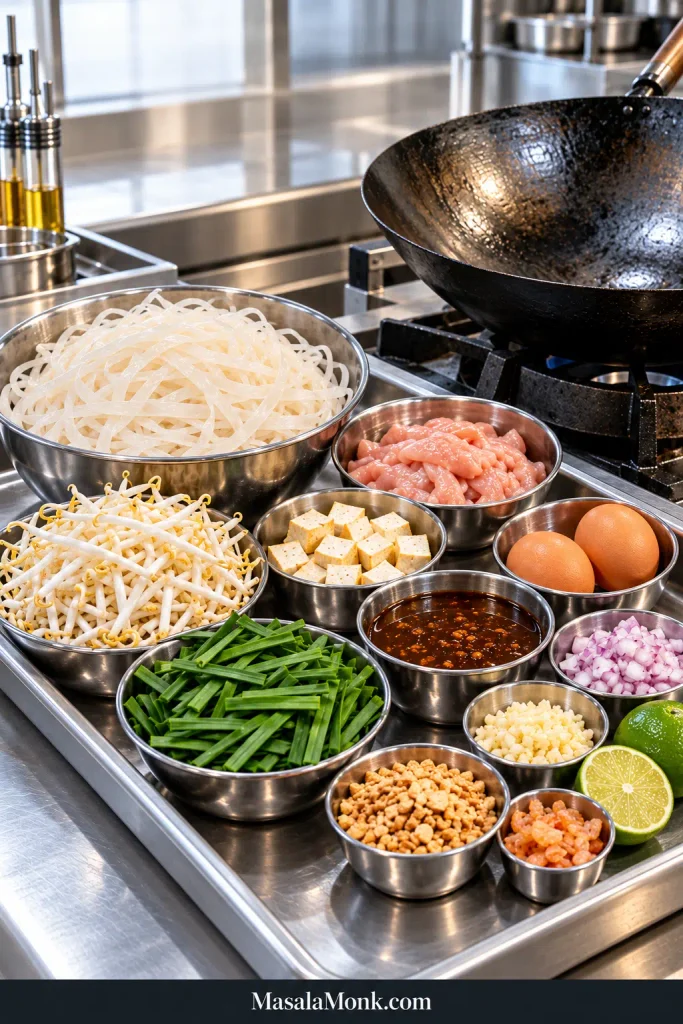
Stainless-steel tray beside an empty black wok with soaked rice noodles, sliced raw chicken, tofu, whole eggs, mung bean sprouts, garlic chives, Pad Thai sauce, shallot, garlic, peanuts, lime and dried shrimp.
Set up Pad Thai in the order you will cook it. Chicken comes first, then aromatics and tofu, followed by noodles and sauce, eggs, and finally sprouts, garlic chives and peanuts—so the tray becomes a map once the wok gets hot.

Prepare the noodles, sauce & chicken

  1. Hydrate the noodles. Cover the dried rice noodles with room-temperature water. Medium noodles often take roughly 30–60 minutes, though thinner brands can soften sooner. Go by the noodle, not the clock: it should bend freely without snapping but remain noticeably too firm to eat. Drain very well.
  2. Make the sauce. Stir the palm sugar and 3 tbsp (45 ml) water over medium-low heat until the sugar dissolves. Remove from the heat and mix in 2 tbsp (30 ml) fish sauce and 3 tbsp (45 ml) ready-to-use tamarind. Once cool enough to sample, add the final tablespoon of tamarind only if yours is relatively mild.
  3. Season the chicken. Toss the sliced chicken with 1 tsp fish sauce and the optional cornstarch.
  4. Sear the chicken. For a wok, stainless-steel or cast-iron skillet, heat the pan over high heat and then add about 1 tbsp oil. With nonstick, add the oil before heating and use medium to medium-high heat. Spread in the chicken, sear until lightly browned and almost cooked through, then transfer to a plate.

Build the wok base & coat the noodles

  1. Build the savory base. Add another tablespoon of oil if the pan looks dry. Stir-fry the shallot and garlic until the shallot starts to soften and the garlic smells fragrant. Add the tofu, then the preserved radish and dried shrimp if using. Keep tossing until the tofu is hot with a little color around the edges.
  2. Add the noodles and sauce. Tip in the drained noodles followed by the sauce. It should sizzle as it hits the hot pan and start disappearing into the noodles as you toss. Lift and fold the strands instead of chopping down through them.
  3. Check the noodle. When most of the loose sauce has disappeared and the noodles look glossy, bite into one. If the seasoning is right but the center is too firm, add water 1 tbsp (15 ml) at a time. Toss until absorbed and check again.

Finish the Pad Thai

  1. Add the eggs. Push the noodles to one side. Add a little oil to the exposed pan if it looks dry, then crack in the eggs. Break the yolks and let the eggs begin setting for 20–30 seconds before folding the noodles back through them.
  2. Finish the chicken. Return the chicken and toss until completely cooked through. If checking with a thermometer, the thickest piece should reach 165°F / 74°C.
  3. Finish off the heat. Turn off the heat. Add the mung bean sprouts, garlic chives and about half the peanuts, then toss briefly. The residual heat warms them without taking away the fresh snap of the sprouts.
  4. Serve immediately. Divide between plates and scatter over the remaining peanuts. Put lime wedges and chile flakes on the table for anyone who wants more brightness or heat.
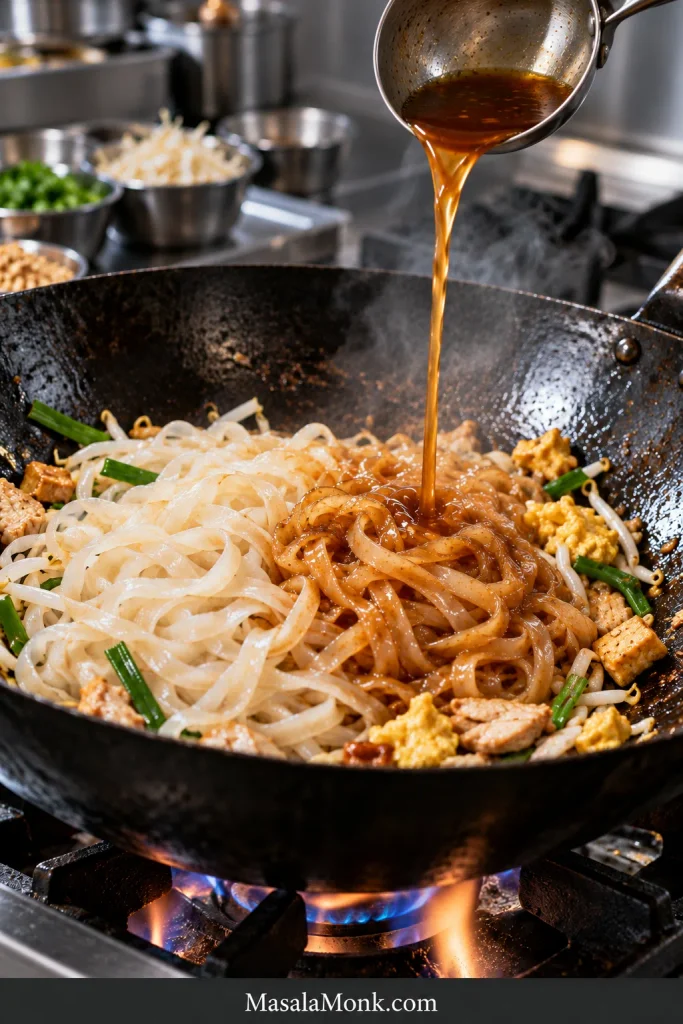
Brown Pad Thai sauce being poured over pale and brown-gold rice noodles in a black wok with chicken, egg, tofu, mung bean sprouts and garlic chives.
Use this as a coating cue rather than an exact ingredient-order snapshot. Even once chicken, egg, sprouts and garlic chives are in the wok, the rice noodles should look glossy and distinct instead of sitting in a pool of loose sauce.

Recipe Notes

  • Research note: This recipe is research-derived and has not been independently kitchen-tested by MasalaMonk. Rice noodles and tamarind vary considerably between brands, so use the texture and taste cues alongside the measurements.
  • No tofu? In the chicken or shrimp version, simply leave it out; no sauce adjustment is needed.
  • No garlic chives? Use a smaller amount of thinly sliced scallions to taste. Scallions are stronger, so do not replace the chives gram-for-gram.
  • No preserved radish or dried shrimp? Leave them out.

The Details That Make Pad Thai Work

Noodles for Pad Thai: The Texture Starts Here

Do not boil dried Pad Thai noodles first. Soak them until flexible but undercooked at the center, then let them finish with the sauce in the pan.

Medium flat dried rice noodles around 2–3 mm wide give you a useful margin between chewy and overdone. Wider noodles can become fragile after soaking, while very thin noodles move through that sweet spot quickly.

Treat soak time as a rough guide and check the noodle itself. Pick one up and bend it around a finger. It should flex without snapping; bite into it and the center should remain firm.

That’s exactly where you want it. The noodle still has sauce and hot-pan time ahead.
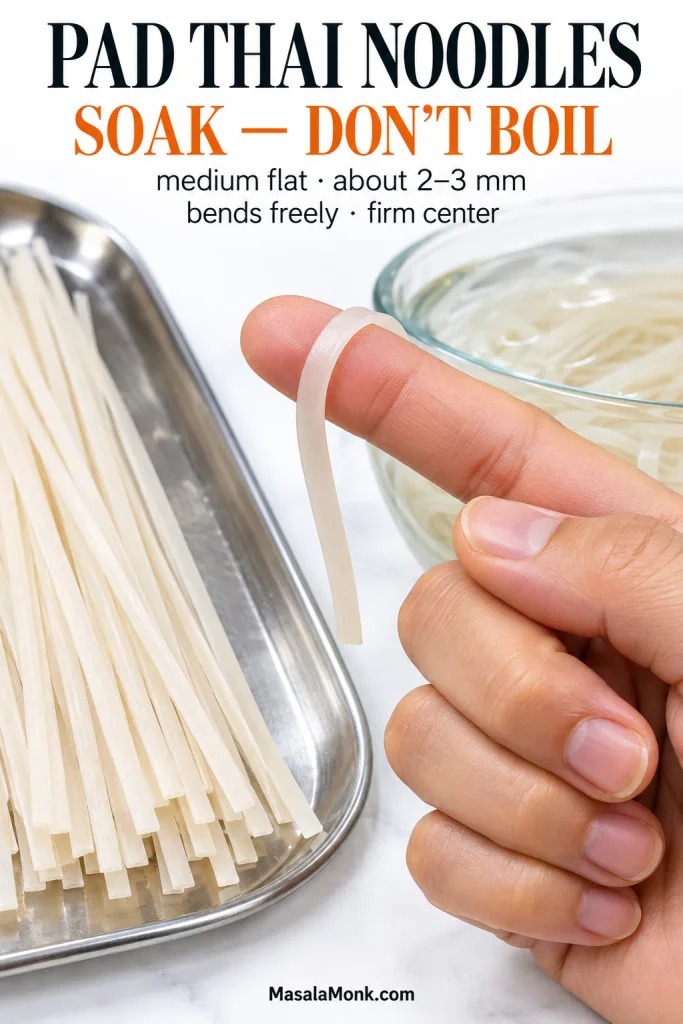
Hand bending a soaked flat rice noodle around a finger beside dry rice noodles and a bowl of soaking noodles, showing a flexible noodle that still holds its shape.
Once Pad Thai rice noodles bend easily but still have structure, drain them thoroughly rather than letting them sit wet. Excess surface water can cool the pan and weaken the sauce before the stir-fry even begins.

When the sauce is gone but the noodle is still firm

Resist reaching for more sauce. Once the noodles are properly seasoned, extra sauce brings more salt, sugar and tamarind when they may only need moisture.

Add 1 tablespoon (15 ml) water, toss until absorbed and check again. Repeat as needed.
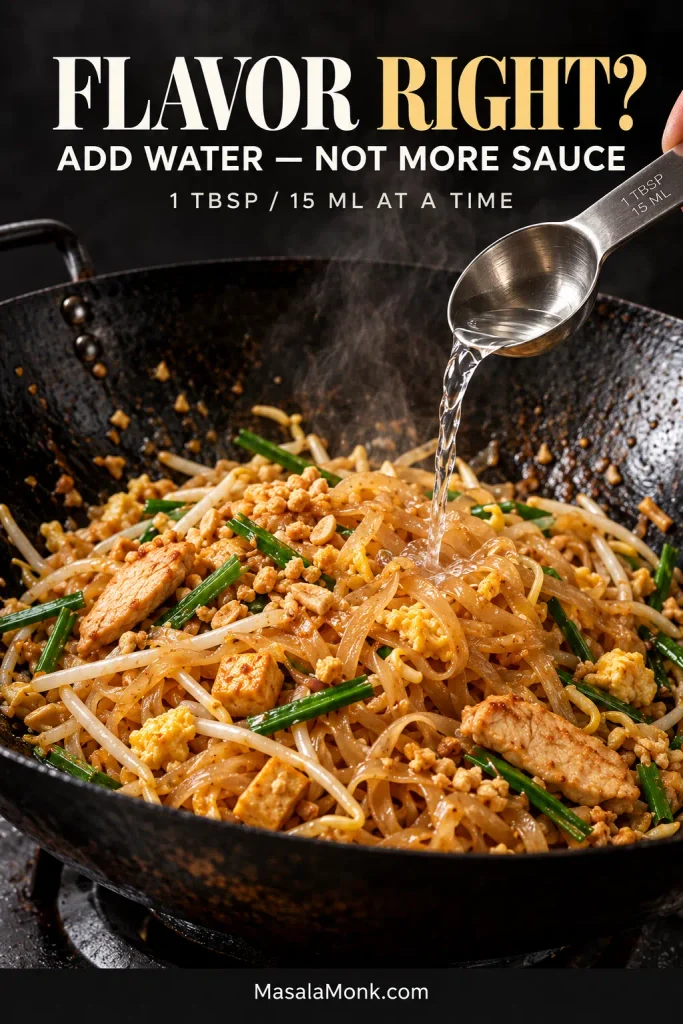
Metal tablespoon marked 1 tablespoon and 15 milliliters pouring a small amount of water into a wok of chicken Pad Thai with rice noodles, sprouts, garlic chives, egg and peanuts.
Think of the added water as cooking liquid, not seasoning. Small additions soften the noodle center while preserving the sweet-sour-salty balance you have already built.

If the noodles are showing a different problem, jump to Fix Your Pad Thai for the symptom-by-symptom guide.

Pad Thai Sauce: Build It Around Your Tamarind

Pad Thai sauce is built from tamarind, fish sauce and palm sugar. Tamarind gives it a tart, fruity edge. Fish sauce brings salty savoriness, while palm sugar rounds out the sharper edges.
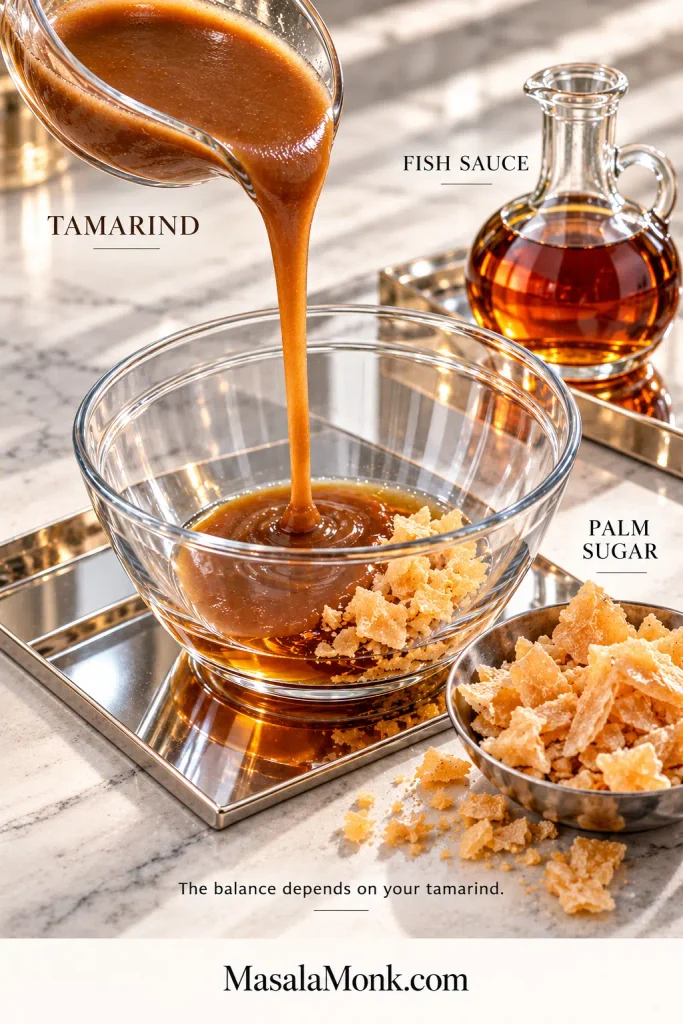
Pourable brown tamarind, amber fish sauce and irregular golden pieces of palm sugar arranged around a clear mixing bowl.
For smoother Pad Thai sauce, dissolve the palm sugar first, then stir in fish sauce and tamarind off the heat. That sequence gives you a fully dissolved base before you judge the sweet, sour and salty balance.

Tamarind labels are frustratingly inconsistent. Paste, puree and concentrate can mean very different strengths from one brand to another.

What kind of tamarind should you buy?

For these measurements, look for a brown, pourable ready-to-use Thai or Vietnamese cooking tamarind. Dense black tamarind concentrate is much stronger and should not be measured at the same volume.
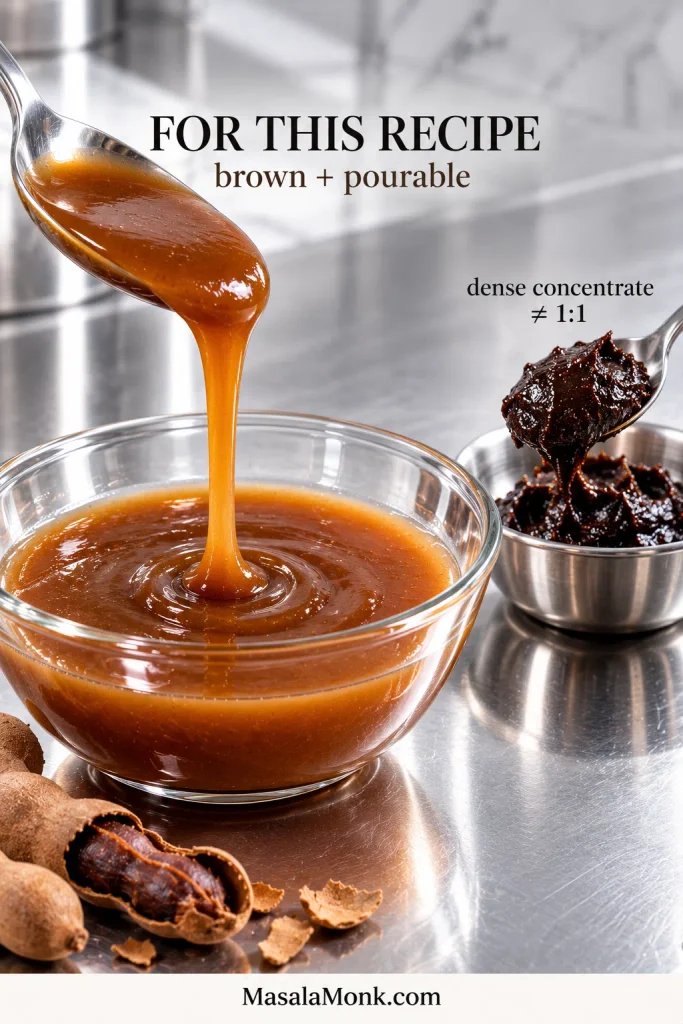
Side-by-side tamarind comparison showing loose brown cooking tamarind flowing from a spoon and very dark dense tamarind concentrate holding as a sticky mound.
Use the spoonful as a final check before you measure. If the tamarind holds a dense mound instead of flowing back into the container, pause before using the recipe’s 3–4 tablespoon range; you may have a stronger concentrate.

Try a tiny bit of the ready-to-use tamarind before making the sauce. If it makes you pucker sharply, begin with 3 tablespoons (45 ml). When it is pleasantly tart rather than fierce, use up to 4 tablespoons (60 ml).

Sweet tamarind sauce or chutney is not a direct substitute here; it is already sweetened and seasoned.

Using a tamarind block? Choose unsweetened sour tamarind pulp rather than sweet tamarind sold for snacking. Soften some pulp in warm water, massage it free, then strain away the seeds, shell and tough fibers. Aim for a loose, spoonable puree similar to ready-to-use tamarind, then judge its strength before working within the same 3–4 tablespoon range.

What should Pad Thai sauce taste like?

On its own, the sauce should taste a little stronger than you want the finished noodles to taste. Chicken, tofu, egg and sprouts will soften it once everything comes together. Sweet, sour and salty should all register without one wiping out the others.

An aggressively sour sauce usually points back to the tamarind itself. Check the product and concentration before trying to bury that acidity under extra sugar.

Why isn’t my Pad Thai bright red? Brown-gold Pad Thai is completely normal. Some restaurant-style versions use ketchup or chile sauce, while others use paprika to deepen the red-orange color. This version stays with tamarind, fish sauce and palm sugar.
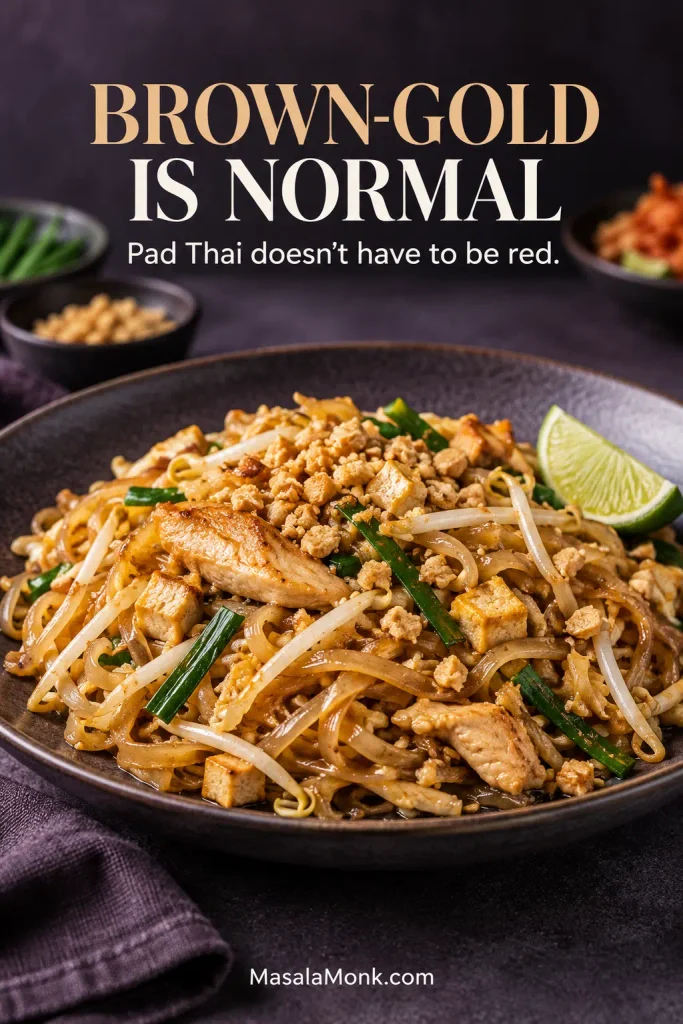
Plate of brown-gold chicken Pad Thai with flat rice noodles, sliced chicken, tofu, egg, mung bean sprouts, garlic chives, crushed peanuts and a lime wedge.
Look for a translucent amber glaze rather than a specific shade of red. You should still be able to see the rice noodles beneath the sauce; color alone cannot tell you whether the sweet, sour and salty balance is right.

Give the Noodles Room to Move

Use a wide 12-inch skillet or roughly 14-inch wok and keep the batch small enough to stay sizzling. The extra surface area gives moisture somewhere to escape instead of collecting underneath the noodles.

A deep heap of noodles surrounded by liquid is the warning sign. The pan cools, steam builds and the strands begin sticking together.
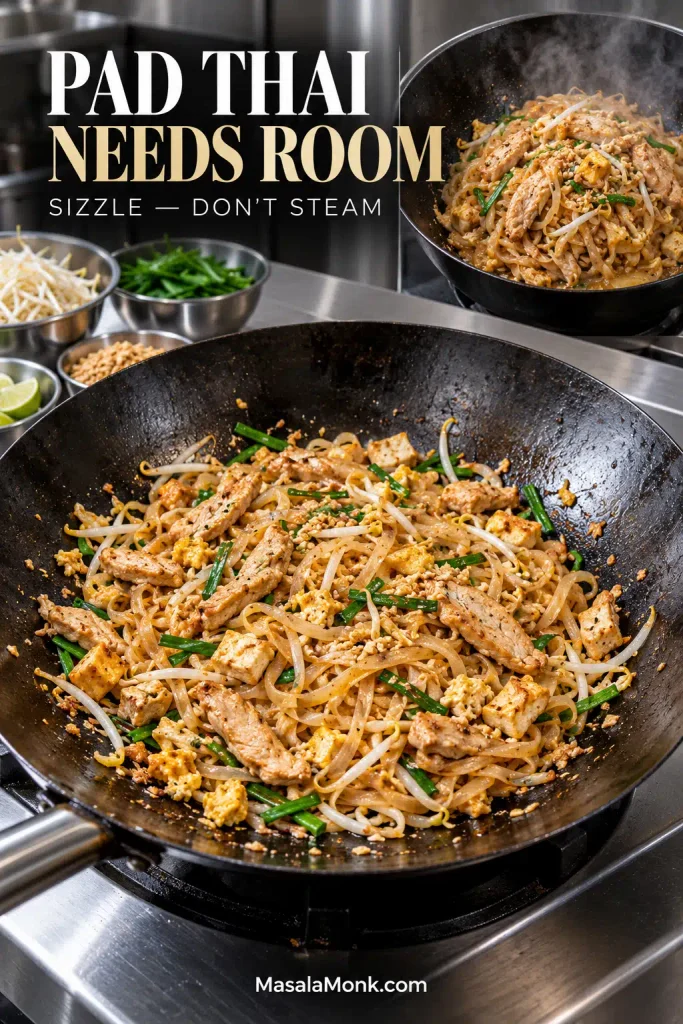
Two wok views comparing Pad Thai spread across a wide pan with visible open surface against a crowded mound of noodles producing more steam.
Visible pan around the noodles is the useful crowding cue. Open patches of hot metal give moisture somewhere to escape as you toss, while a smaller batch keeps that escape route open.

Scaling rule: Double the ingredients if you need more food, then cook two batches. Four to six servings are usually better split across the pan than forced through it all at once.

Pad Thai Ingredients Worth Seeking Out

You don’t need to hunt down every specialist ingredient. Garlic chives are worth seeking out if you can; preserved radish and dried shrimp add more classic savory detail, but they aren’t reasons to postpone dinner.
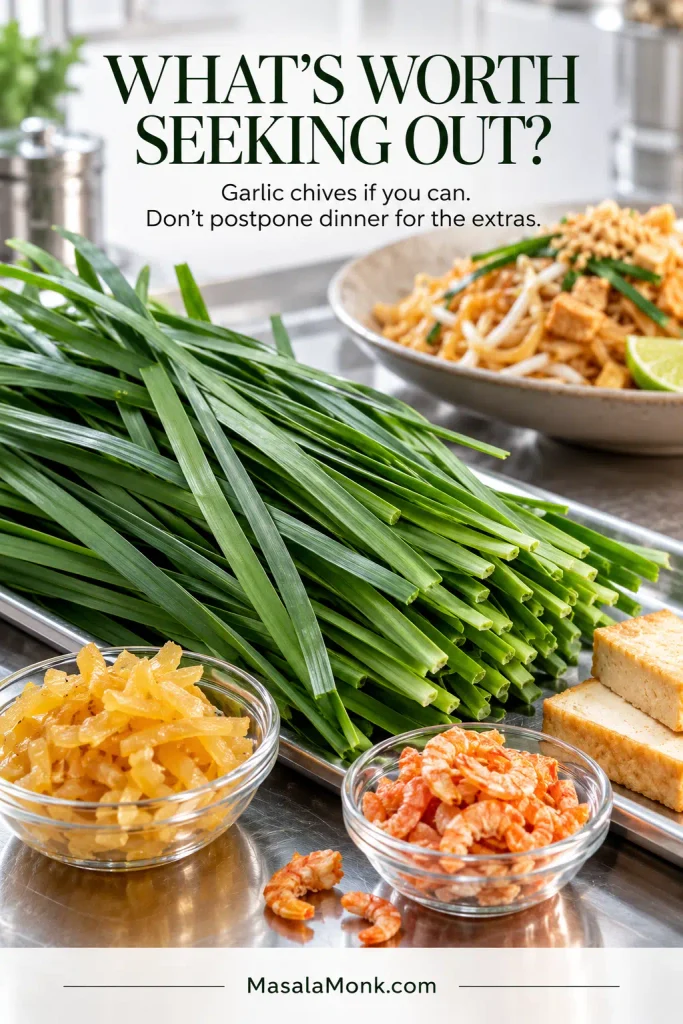
Fresh flat garlic chives on a stainless tray with small bowls of preserved radish and dried shrimp, pieces of tofu and a finished plate of Pad Thai in the background.
At the market, garlic chives are easy to spot by their long, flat blades rather than hollow scallion tubes. Finely chopped preserved radish and dried shrimp then spread their savory flavor more evenly through the Pad Thai.

Pressed or super-firm tofu can sit alongside chicken or shrimp and survives the tossing well. Thai sweet preserved radish adds salty-sweet flecks through the noodles; Japanese takuan is not identical, but it is a reasonable fallback. Can’t find either one? Move on.

Dried shrimp brings another savory layer. Give it a quick rinse, drain it well and chop it finely so that flavor is distributed through the noodles rather than concentrated in one overwhelmingly fishy bite.

Roasted peanuts belong at the finish, adding crunch against the softer noodles and egg. The tamarind-based sauce itself does not need peanut butter.

If what you really want is the creamy peanut direction, Peanut sauce is better suited to noodles, spring rolls, tofu, chicken and satay-style meals.

Missing tofu, garlic chives, preserved radish or dried shrimp? Find the simplest substitutions and omissions together in the Recipe Notes.

Chicken, Shrimp & Tofu Options

The base recipe uses chicken plus a small amount of tofu. Use the options below when you want cooked chicken, shrimp, tofu-only, vegetarian or vegan Pad Thai.

Chicken thigh is the easiest choice here because it stays forgiving through a fast sear. Breast works too; slice it thinly and use the optional cornstarch if you want a little more protection from drying out.
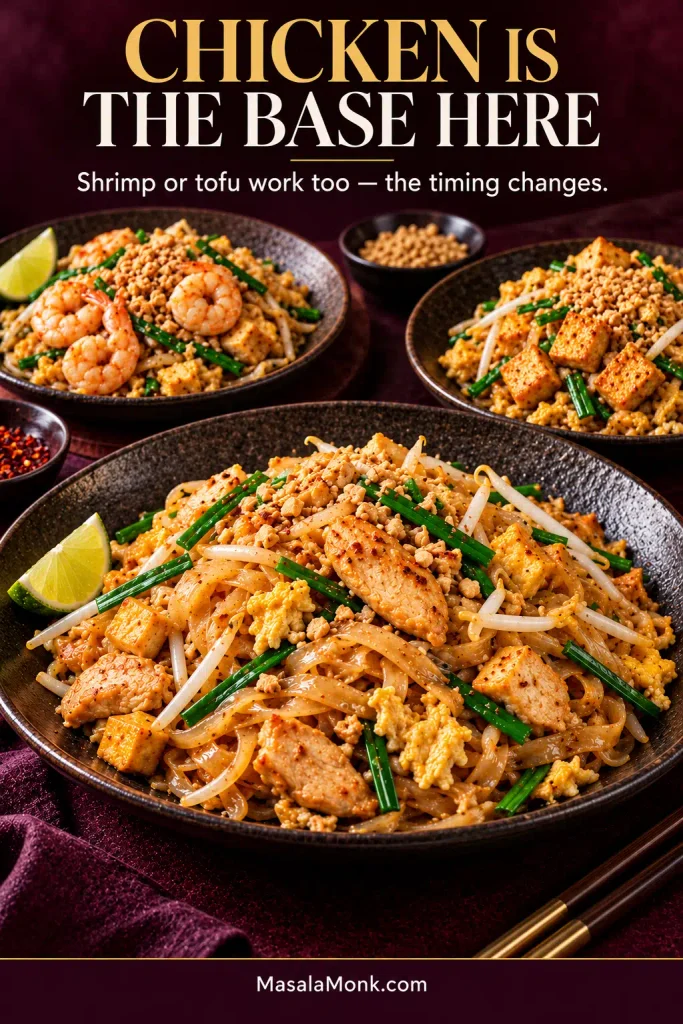
Three plates of Pad Thai showing a large chicken version in front, a shrimp version behind it and a tofu-forward version to the side, all with rice noodles, sprouts and garlic chives.
Keep the Pad Thai base the same and change the protein timing instead. Shrimp needs only a quick sear, while tofu needs a larger portion when it becomes the main protein rather than a supporting ingredient.

Cooked or rotisserie chicken: Skip Steps 3 and 4 for the chicken. Add about the same amount in Step 9, just long enough to heat through.

Shrimp: Skip the chicken seasoning and cornstarch. Use 5–6 oz (140–170 g) peeled shrimp. In Step 4, sear them until just shy of done, remove from the pan, then return them in Step 9 just long enough to finish cooking.

Tofu as the main protein: Increase it to about 6–7 oz (170–200 g), leave out the chicken, and skip Steps 3, 4 and 9.

Vegetarian: Leave out the chicken and dried shrimp, increase the tofu to 6–7 oz (170–200 g), and skip Steps 3, 4 and 9. Use vegan fish sauce in about the same amount as the regular fish sauce, then adjust if your brand runs especially salty. Keep the eggs if you like.

Vegan: Make the vegetarian version and leave out the eggs too.

Without peanuts: Omit them; the sauce needs no adjustment.

Fix Your Pad Thai

Most Pad Thai problems leave clues in the pan.

Noodle & Pan Problems

Start with strand separation before choosing a fix.
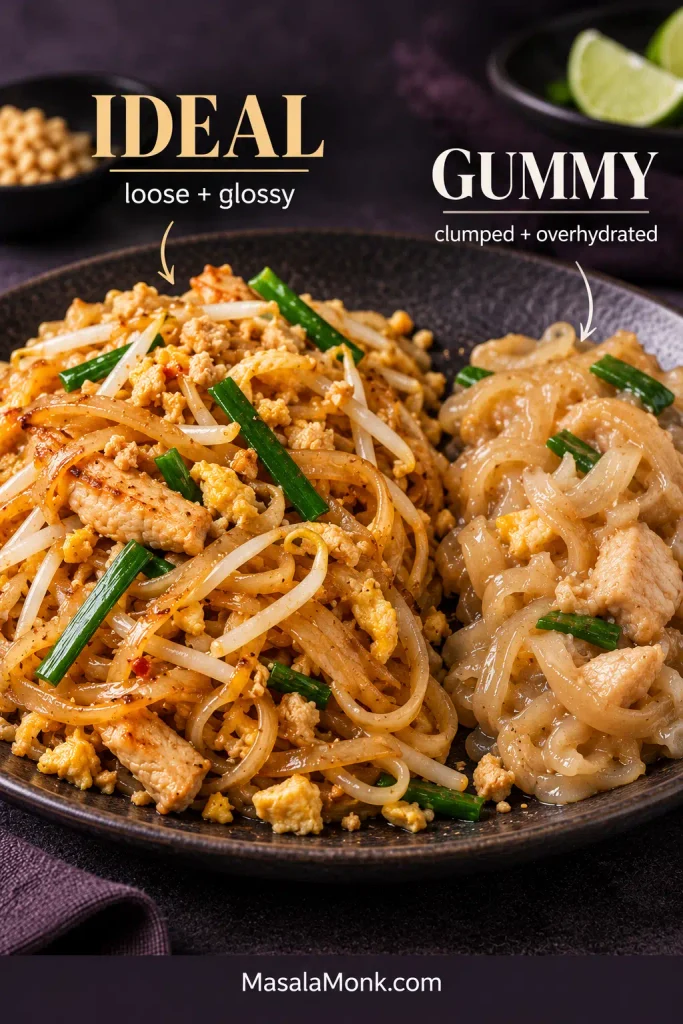
Side-by-side plate comparing loose glossy Pad Thai noodles with distinct strands against pale gummy noodles that are visibly clumped and overhydrated.
Glossy and gummy are not the same thing: properly cooked Pad Thai noodles can shine while still separating into distinct strands. Once overhydrated, the strands lose definition and begin lifting in clumps.
ProblemLikely cause & what to do
Noodles are mushyCause: They entered the pan too hydrated. Right now: If they’re only a little soft, stop cooking and serve them now. Next time: Start with firmer soaked noodles and let them finish in the pan.
Noodles are gummy or stickyCause: Overhydration, released starch, low heat or crowding. Right now: Stop cooking; extra oil will not undo overcooked rice starch. Next time: Start firmer and use a smaller, hotter batch.
Noodles are still hardCause: The seasoning is ready before hydration is complete. Do now: Add water 1 tbsp (15 ml) at a time, toss until absorbed and check again.
Noodles keep breakingCause: They were too soft, especially fragile or handled roughly. Right now: Toss as little as possible and get them out of the pan. Next time: Hydrate less and lift or fold instead of chopping down with the spatula.
Pad Thai is wet or soupyCause: The pan is too cool, too crowded or carrying too much liquid. If the noodles are firm, keep tossing briefly over suitable heat so the loose sauce can absorb. Once they are already soft, stop cooking rather than boiling away the sauce and making them mushier. Next time, use a smaller batch.
Sauce is scorchingCause: The liquid has cooked away and the sugar is catching. If the noodles need more cooking, add a small splash of water and keep them moving. When they are done, get the pan off the heat.

Flavor & Sauce Problems

ProblemLikely cause & what to do
Pad Thai is too sourCause: The tamarind is stronger than expected. If the dish is only a little sharp, extra plain noodles, tofu or sprouts can dilute it if you have them ready. A badly over-soured dish has no clean instant fix; use less of that tamarind next time.
Pad Thai is too sweetCause: Too much sugar or too little sour and salty balance. If it is only slightly sweet, lime at the table can sharpen the finished dish. For a strongly sweet batch, fix the sauce balance next time rather than trying to cover it with more seasoning.
Pad Thai tastes too fishyCause: The fish sauce or dried shrimp is especially assertive. Lime and extra sprouts can make a mildly fishy batch taste fresher at the table; reduce one of those ingredients next time.
Pad Thai tastes flatCause: Too many noodles or too much protein for the amount of sauce, or the sauce was under-seasoned. Check the finished dish before adding anything: a little fish sauce may supply salt and savoriness, while lime can wake up a dull plate.

How to Serve Pad Thai

Pad Thai is substantial enough to serve as a one-dish meal. Get it onto the plates while the noodles are loose and glossy, then add the remaining roasted peanuts.

Pad Thai does not need to be spicy. Put lime wedges and Thai chile flakes or crushed red pepper on the table so everyone can add brightness and heat to taste. Extra mung bean sprouts and a few fresh garlic chives can go alongside for more crunch.
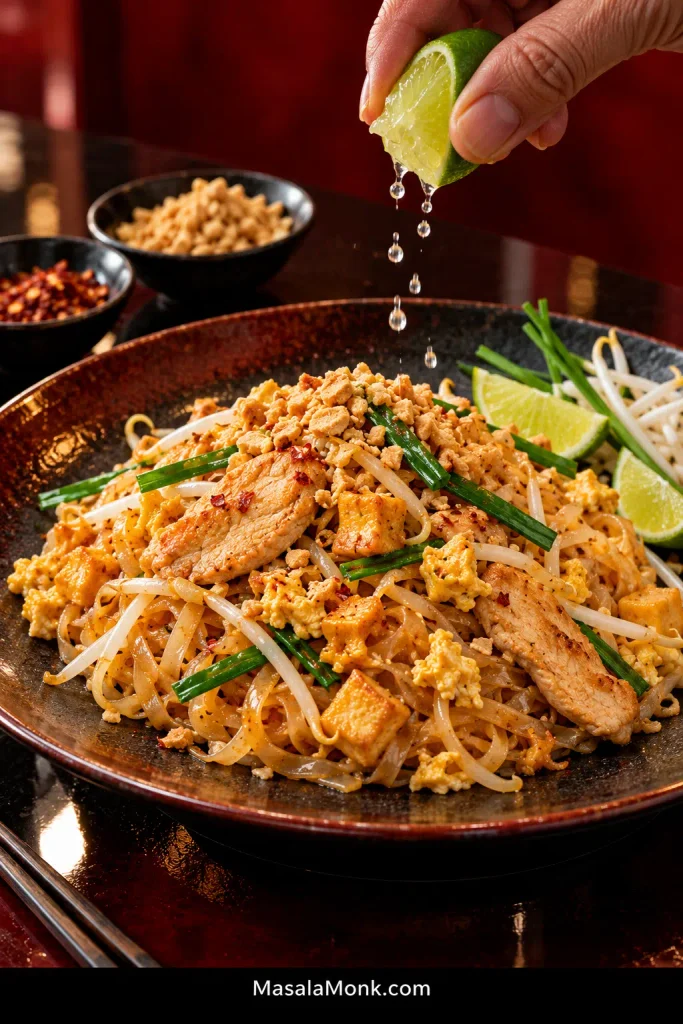
Hand squeezing a lime wedge over a plate of chicken Pad Thai with rice noodles, sliced chicken, tofu, egg, mung bean sprouts, garlic chives and crushed peanuts.
Finish the peanuts after plating so they keep their dry crunch, then squeeze lime over the Pad Thai at the table. That last-minute contrast stays sharper than cooking either finish into the sauce.

A cold Cucumber Salad makes an easy contrast, especially with lime, chile and herbs.

Make-Ahead Pad Thai: Do the Slow Work Before Dinner

Prep the components ahead, but cook the finished Pad Thai just before serving whenever possible.
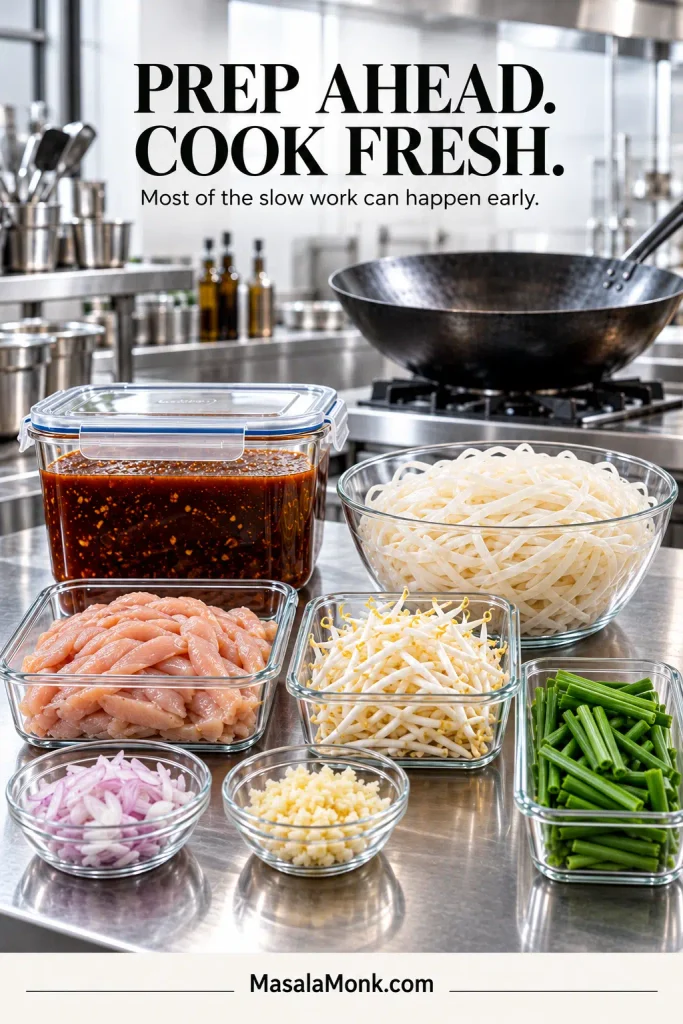
Prepared Pad Thai ingredients in clear containers beside an empty wok, including sauce, soaked rice noodles, sliced raw chicken, mung bean sprouts, garlic chives, sliced shallot and chopped garlic.
Keep the make-ahead components separate until the wok is hot. Drain the soaked noodles well, keep the sprouts and garlic chives dry, and store the sauce on its own so the final stir-fry still starts with distinct textures.

Make the sauce up to 3 days ahead and keep it covered in the refrigerator. The noodles are best soaked the same day, but they can be prepared up to 1 day ahead: drain them thoroughly, spread them briefly on a clean towel until they are no longer dripping, then refrigerate in a covered container.

Slice the chicken up to 1 day ahead and keep it refrigerated. The shallot, garlic, tofu and garnishes can be prepared ahead too. Wash and dry the sprouts and chives, crush the peanuts and cut the lime before dinner.

Store & Reheat Pad Thai

Pad Thai is at its best straight from the pan. Rice noodles firm up and stick together as they cool, so leftovers lose some of that freshly tossed texture.

For the best texture, eat leftover Pad Thai within 1–2 days. Broader USDA guidance allows 3–4 days for properly refrigerated leftovers, but the noodles will continue becoming firmer and more prone to sticking.

Reheat it more gently than the original stir-fry. Add a small splash of water and warm the noodles in a covered skillet over moderate heat or in short microwave intervals. Still dry? Add another teaspoon or two of water instead of another dose of sauce.

Once you know what a properly soaked rice noodle feels like, Pad Thai becomes a much more relaxed dish to cook. Get it onto the table while the noodles are glossy, the egg is tender, the sprouts have crunch and the lime is waiting.
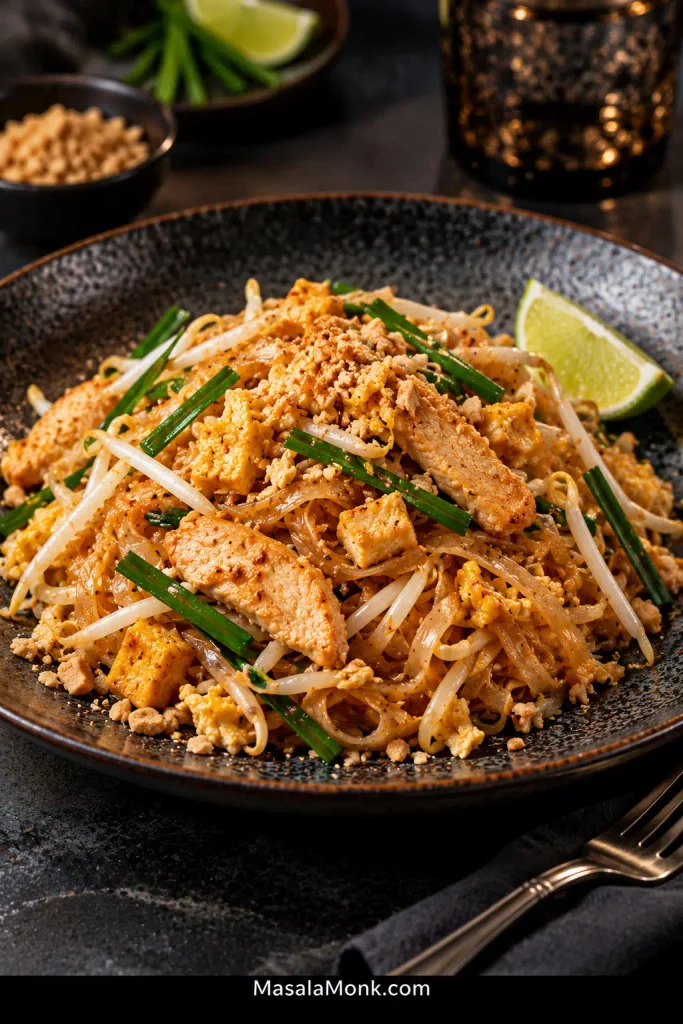
Finished chicken Pad Thai on a dark ceramic plate with brown-gold rice noodles, sliced chicken, tofu, egg, mung bean sprouts, garlic chives, crushed peanuts and a lime wedge.
A finished plate should feel integrated rather than assembled. Chicken, egg, tofu, sprouts and garlic chives should appear throughout the glossy noodles, so no single ingredient dominates the final bite.
Posted on — Leave a comment

Beef Tips and Gravy Recipe: Tender, Rich & Easy

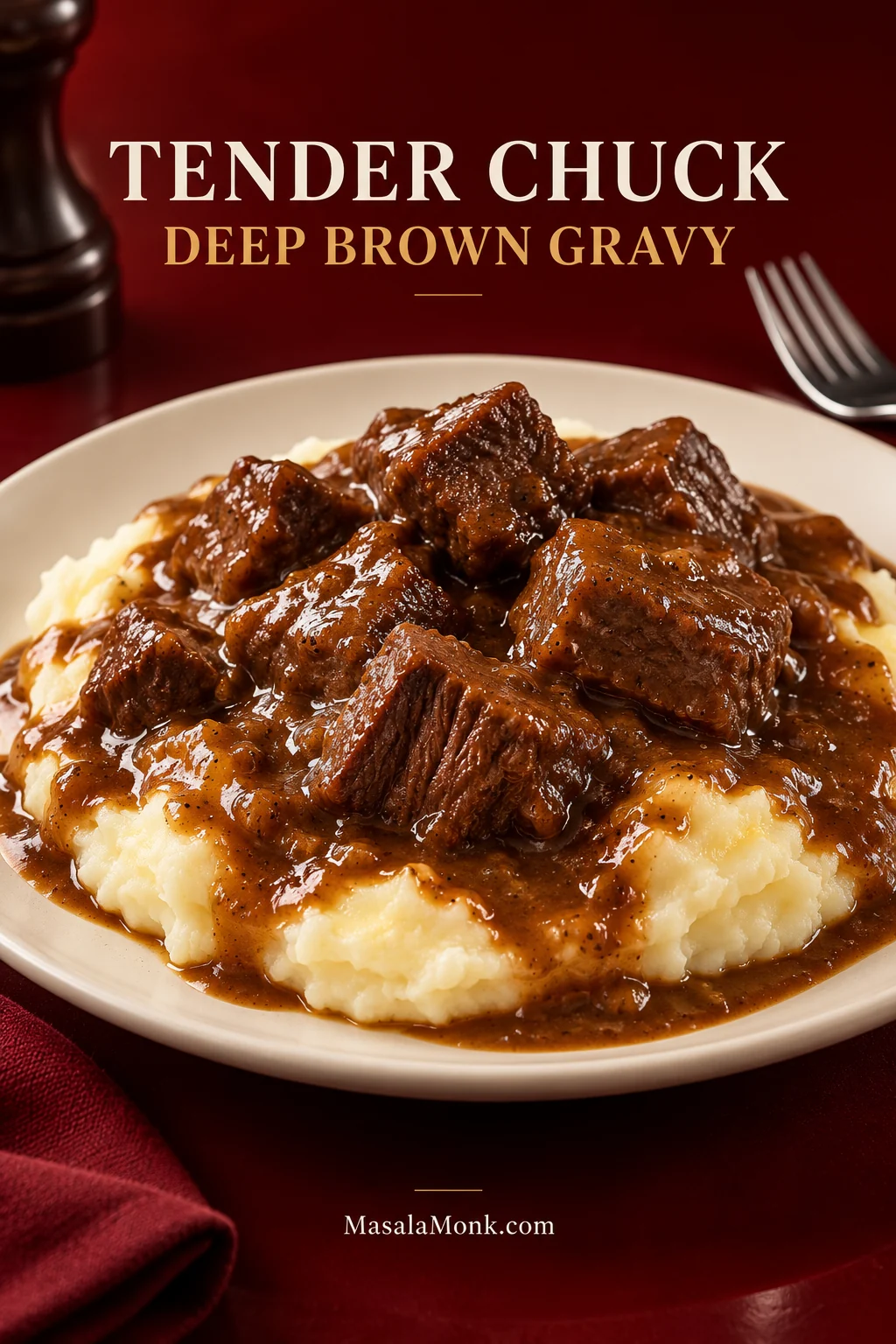
Tender braised beef tips covered with deep brown gravy and served over ridged mashed potatoes on a light plate.

This stovetop beef tips and gravy recipe turns boneless chuck into tender, distinct pieces with plenty of deep brown gravy for mashed potatoes, rice or egg noodles. The sauce comes from the same pot: browned beef, onion, garlic, broth and a butter-flour paste, with no canned soup or gravy packet needed.

The parts worth watching are simple but important. Give the beef room to brown, keep the braise gentle and stop once the chuck is tender rather than cooking by the clock. By then, evaporation and gelatin will already have given the liquid some body, so you can thicken the gravy only as much as it actually needs.

How to cook beef tips: Brown the chuck in uncrowded batches, then braise gently until fork-tender—usually about 1¾ to 2¼ hours. Remove the beef while you finish the gravy, then return it just long enough to warm through.

Beef Tips and Gravy Recipe

Boneless chuck is browned in a Dutch oven, braised until fork-tender, then returned to a deep brown gravy.

Prep Time
20 minutes

Cook Time
About 2½–3 hours

Total Time
About 3–3½ hours

Yield
6 servings

Active cooking: about 40–45 minutes. Most of the remaining time is the covered braise.

Equipment

  • 5- to 6-quart heavy Dutch oven or other heavy lidded pot
  • Tongs
  • Whisk

Ingredients

  • 2 lb (900 g) boneless chuck roast, trimmed of large hard pieces of exterior fat and cut into 1¼- to 1½-inch (3- to 4-cm) pieces
  • 1¼ teaspoons (about 7 g) fine sea salt, plus more to taste
  • 1 teaspoon freshly ground black pepper, plus more to taste
  • 2 tablespoons (30 ml) neutral high-heat oil, divided as needed
  • 1 large yellow onion (about 7 oz / 200 g), diced
  • 1 tablespoon (16 g) tomato paste
  • 4 garlic cloves (about 12 g), finely chopped or minced
  • 1 teaspoon dried thyme
  • Up to 3 cups (710 ml) low-sodium beef broth, divided
  • 1 tablespoon (15 ml) Worcestershire sauce
  • 1 bay leaf
  • 2 tablespoons (28 g) unsalted butter, softened
  • 3 tablespoons (about 24 g) all-purpose flour
  • Up to 1 teaspoon (5 ml) apple cider vinegar or fresh lemon juice, optional, added ¼ teaspoon at a time if needed

Instructions

Prep and brown the beef

  1. Prepare the beef. Cut the chuck into 1¼- to 1½-inch (3- to 4-cm) pieces. Pat thoroughly dry, then season with the salt and black pepper.
  2. Brown in batches. Heat 1 tablespoon oil over medium-high heat. Add one uncrowded layer of beef and leave it alone until the underside is dark chestnut-brown in spots. Turn and brown another side or two, then transfer to a bowl. Repeat with the remaining beef, adding oil if the pot looks dry. The browned bits on the bottom—called fond—should stay deep brown. If they start turning black, deglaze with a splash of the measured broth and save that liquid with the beef.
  3. Build the base. Reduce the heat to medium. Add the onion and cook for 5 to 7 minutes, stirring often, until softened and beginning to color. Stir in the tomato paste and cook for 1 minute. Add the garlic and thyme and cook for another 30 seconds.

Start and finish the braise

  1. Deglaze and start the braise. Pour in ½ cup (120 ml) broth and scrape the bottom thoroughly. Return the beef and its juices to the pot. Add the Worcestershire sauce, bay leaf and enough of the remaining broth for the liquid to come halfway to two-thirds up the beef. Keep any leftover broth nearby. Bring just to a gentle simmer.
  2. Braise gently. Cover and lower the heat to maintain a very gentle simmer. When you lift the lid to check, you should see only occasional small bubbles, not a hard boil. Start checking at 1½ hours; most batches take 1¾ to 2¼ hours. If the beef feels firm, continue in 15- to 20-minute intervals. Add some of the reserved broth whenever the liquid drops well below halfway up the beef. Stop when a fork slides in easily and the pieces remain whole.
  3. Reduce the liquid. Transfer the beef to a clean bowl and discard the bay leaf. Skim off an obvious layer of surface fat. If the liquid looks thin, simmer uncovered for 5 to 10 minutes. Taste after reducing before adding more salt.

Finish the gravy and serve

  1. Make the gravy. Mash the softened butter and flour together until smooth. Whisk small pieces of the paste into the simmering liquid, letting each addition disappear before adding another. Stop when the gravy coats a spoon and flows easily; you may not need all of the paste. Simmer for another 4 to 5 minutes so the flour cooks through.
  2. Return the beef. Add the beef and its juices back to the pot and warm gently for 2 to 3 minutes. Taste before adjusting anything. If the gravy needs salt or more savory depth, add a little salt or a small splash of Worcestershire. When the salt level is right but the flavor seems flat or heavy, try black pepper or ¼ teaspoon cider vinegar or lemon juice. Taste again before adding more.
  3. Rest and serve. Take the pot off the heat and leave it for 5 to 10 minutes. The gravy will tighten slightly as it settles. Spoon generously over mashed potatoes, rice or egg noodles.

Recipe Note

Timing here is for chuck. Stew meat can soften unevenly, while top sirloin needs the shorter method below.

This is a research-developed recipe based on established beef-braising techniques and published cooking guidance. MasalaMonk has not independently kitchen-tested it.

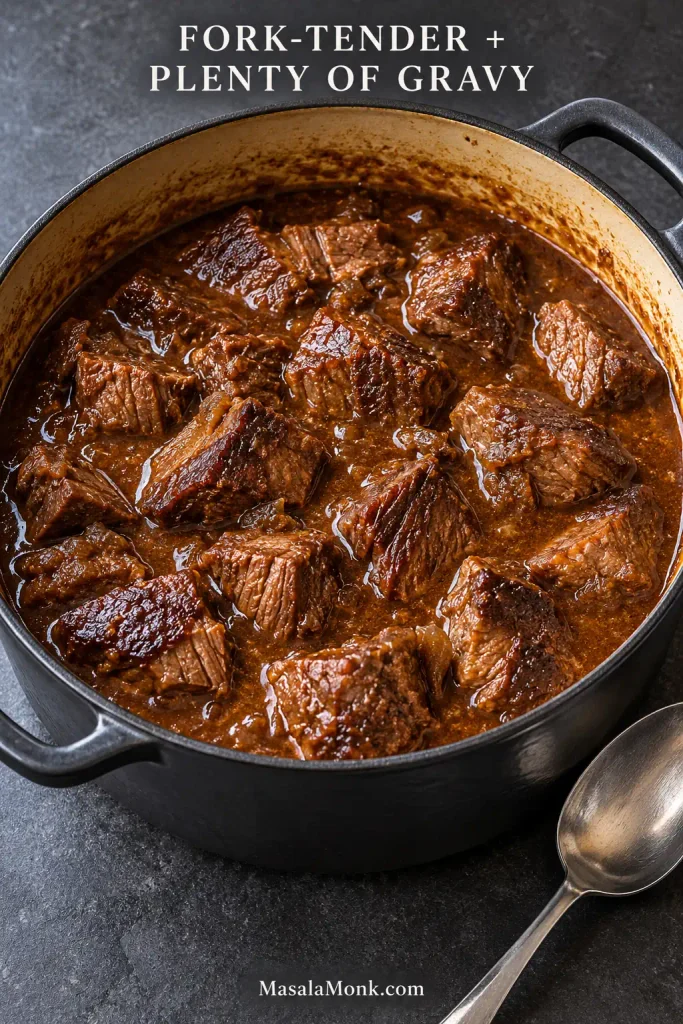
What should the finished pot look like? The beef should still be distinct, with enough flowing gravy around the pieces to spoon generously over whatever you serve underneath.

Large intact pieces of braised beef tips surrounded by brown gravy in a heavy Dutch oven.
Leave the finished pot a little saucier than seems necessary. Mashed potatoes, rice and noodles all take up gravy quickly once the beef reaches the plate.

What Are Beef Tips? Chuck, Stew Meat or Top Sirloin?

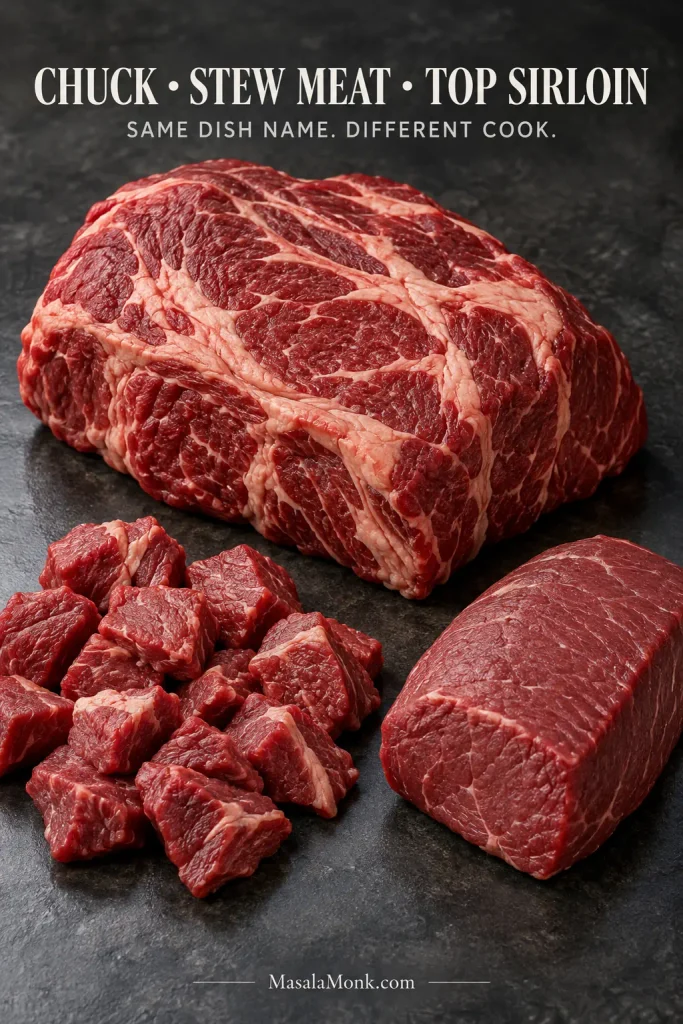
“Beef tips” describes the pieces and dish more than one universally defined retail cut. Depending on the butcher, store or recipe, the beef may come from chuck, top sirloin or mixed stew meat.

Raw boneless chuck roast, irregular stew meat pieces and a leaner top sirloin cut arranged together for comparison.
The cuts give visual clues before cooking begins: chuck has more marbling and connective seams, stew meat tends to be irregular, while top sirloin looks leaner and more uniform.

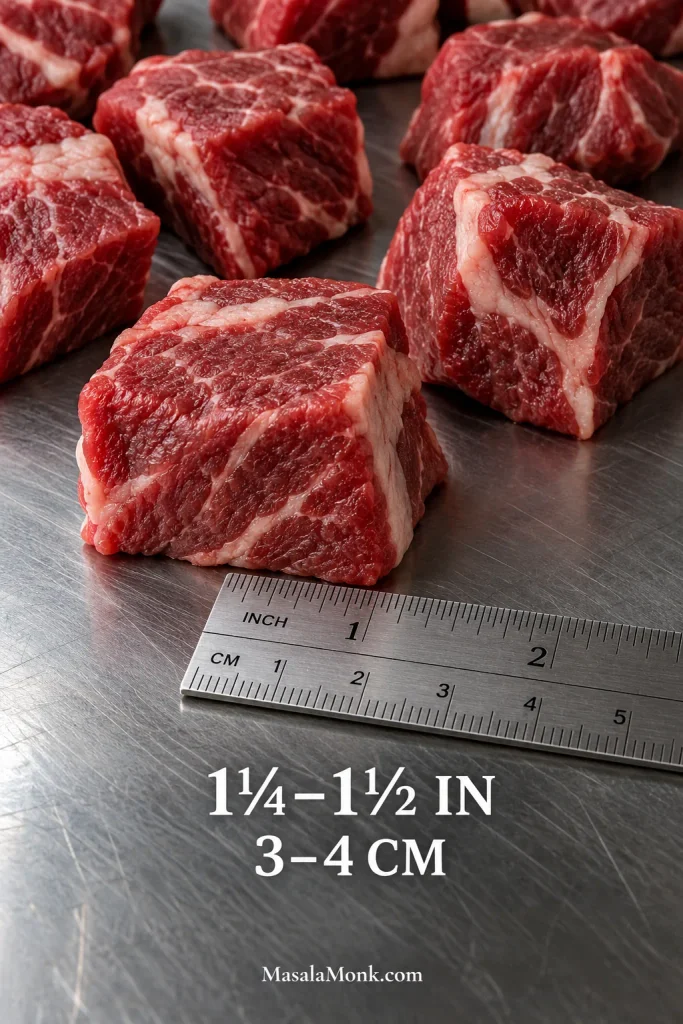
For this recipe, boneless chuck roast is the most reliable choice. It has enough marbling and connective tissue for a long braise, and buying a whole roast lets you cut the pieces yourself. Aim for roughly 1¼- to 1½-inch (3- to 4-cm) pieces so they stay substantial as they cook.

Raw chuck beef pieces beside a metal ruler showing pieces about 1¼ to 1½ inches, or 3 to 4 centimeters, across.
Pieces around 1¼–1½ inches (3–4 cm) keep enough mass to stay substantial through braising. Smaller chunks have more exposed surface and can move from tender to dry sooner.

If stew meat is what you already have, use it. Just expect some pieces to soften sooner than others because one package can contain more than one cut.

If you bought top sirloin, don’t give it the two-hour chuck treatment. Top sirloin starts tender. Sear it quickly, let the gravy develop, then put the beef back in only long enough to finish cooking. For exact quantities and timing, go straight to the faster top sirloin method.

Brown the Beef Without Steaming It—or Burning the Fond

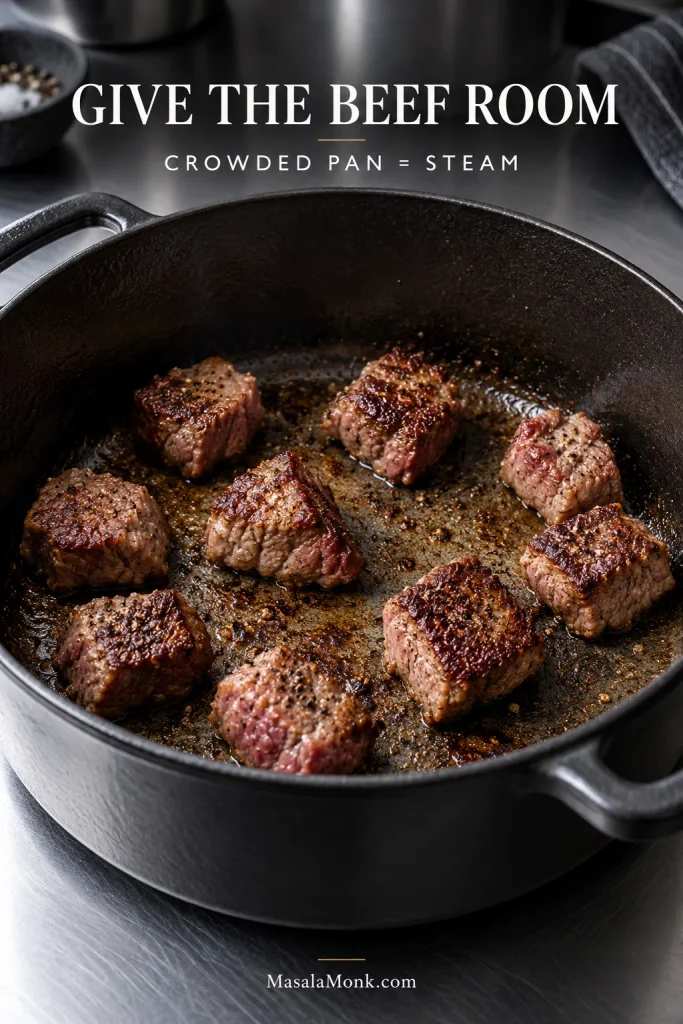
Don’t crowd the pot. Dry beef with a little room around each piece browns much more readily than beef packed into a wet pan.

Chuck beef pieces spaced apart in a hot pan with visible cooking surface between them as the contact sides brown.
Watch the pan rather than the clock: if liquid starts collecting around the beef, the batch is steaming instead of searing. More exposed pan surface usually brings the browning back.

Look for a dark chestnut-brown crust in spots. Simply changing from red to gray-brown is not enough. Two or three well-browned sides are plenty.

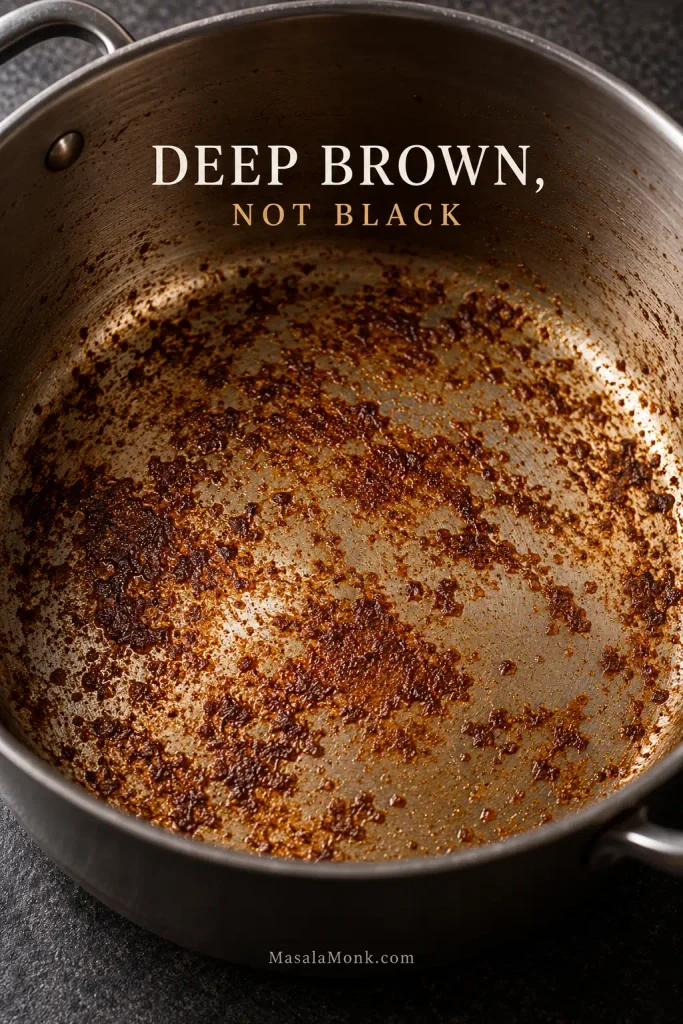
Deep brown fond builds the gravy; black fond tastes burnt. If the bottom starts heading toward black, deglaze with a splash of broth before continuing.

Deep brown beef fond adhered to the bottom of a metal cooking pot, with visible metal between the browned deposits.
Good beef fond is patchy, dry-looking and chestnut to mahogany, with some metal still visible between deposits. Once the surface turns uniformly black, bitterness becomes the bigger risk.

Read the Braise, Not Just the Clock

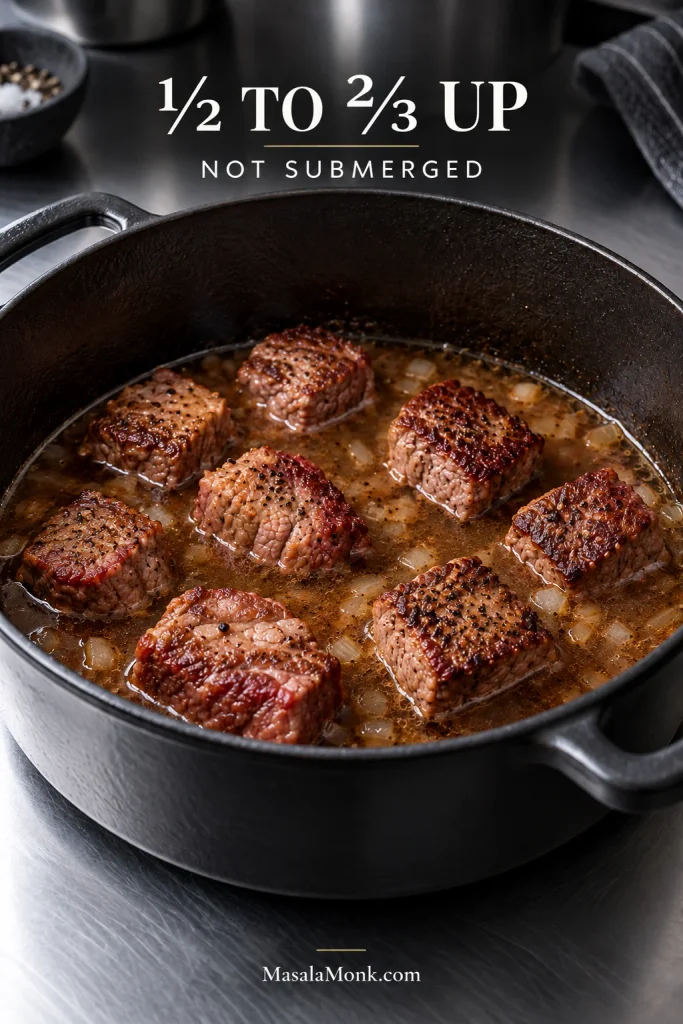
With the broth in, patience matters more than extra heat. Keep the liquid roughly halfway to two-thirds up the beef, then hold the braise at a gentle simmer rather than racing along at a boil.

Browned beef pieces in a Dutch oven with thin brown braising liquid reaching about halfway to two-thirds up the meat.
Use the pot as the final measuring tool. Because Dutch ovens vary in width, the useful amount of broth is the amount that reaches roughly halfway to two-thirds up the beef.

Tough at this stage doesn’t mean you’ve ruined it. Chuck can feel stubborn before its connective tissue has softened, so firm resistance usually means it needs more time at the same gentle simmer. If you are unsure what the pot needs next, use the troubleshooting table.

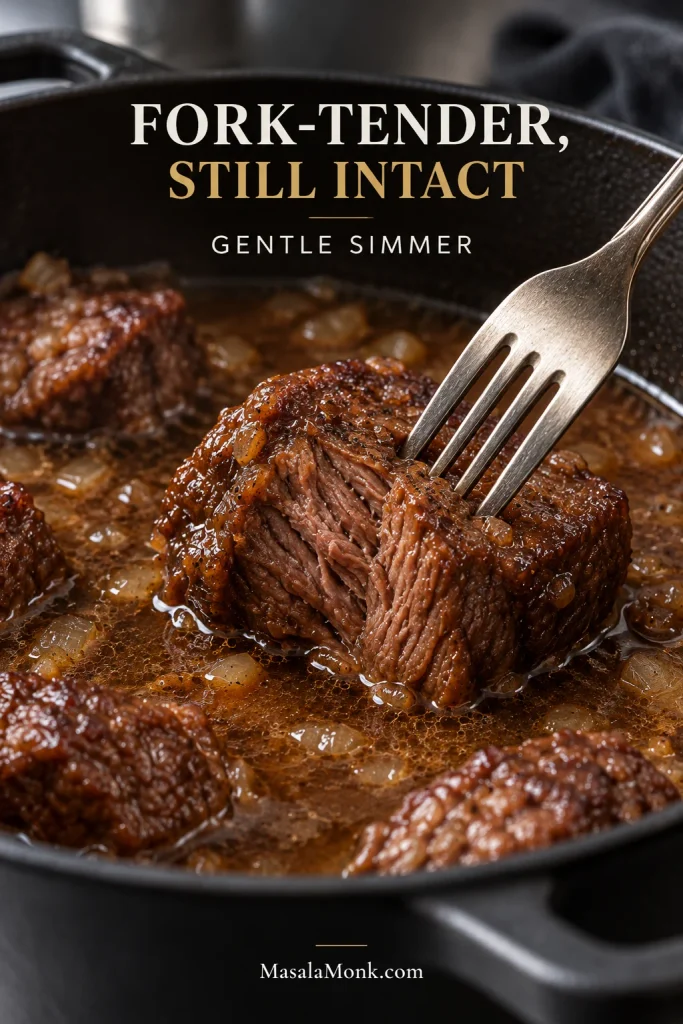
When the beef yields easily and the pieces hold together, you’re there. Small pieces of chuck can turn stringy or dry if they cook long after softening. Once it’s tender, stop.

Fork entering a fully cooked braised chuck piece with moist brown fibers while the surrounding braising liquid gently simmers.
A fork entering easily is only half the test; the beef should also lift in one piece. If it breaks into dry strings, the chuck has moved past the tender-but-intact stage.

Finish the Gravy

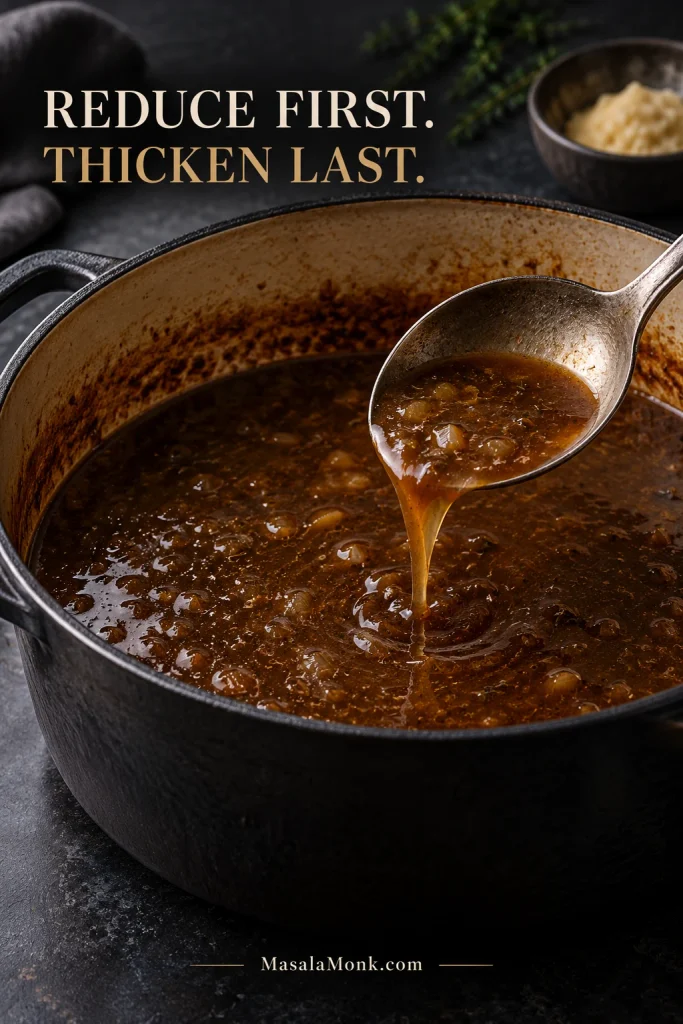
Don’t decide the final thickness while the chuck is braising. By the time the beef is tender, evaporation and gelatin from the meat may already have given the cooking liquid much more body.

Reduced brown braising liquid in a pot after the beef has been removed, still visibly looser than finished gravy.
Reduction concentrates seasoning along with texture, so taste the cooking liquid again after it reduces and before adding more salt or the butter-flour paste.

Remove the beef first, skim any obvious surface fat and reduce the liquid only if it looks loose. Add the butter-flour paste gradually until the gravy has the body you want. There is no prize for using every bit of thickener.

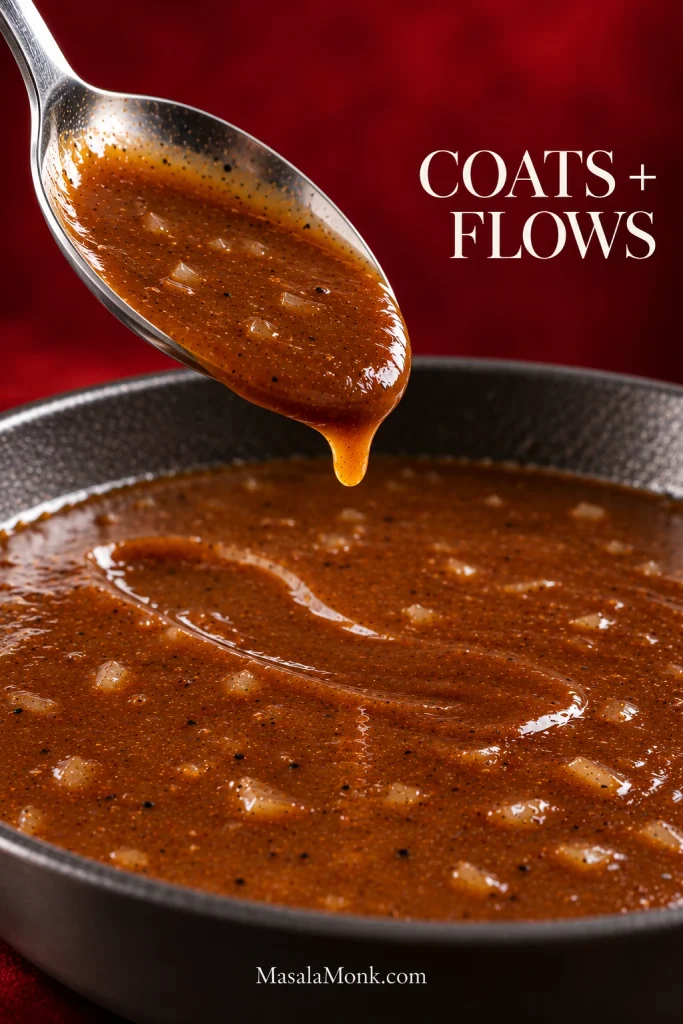
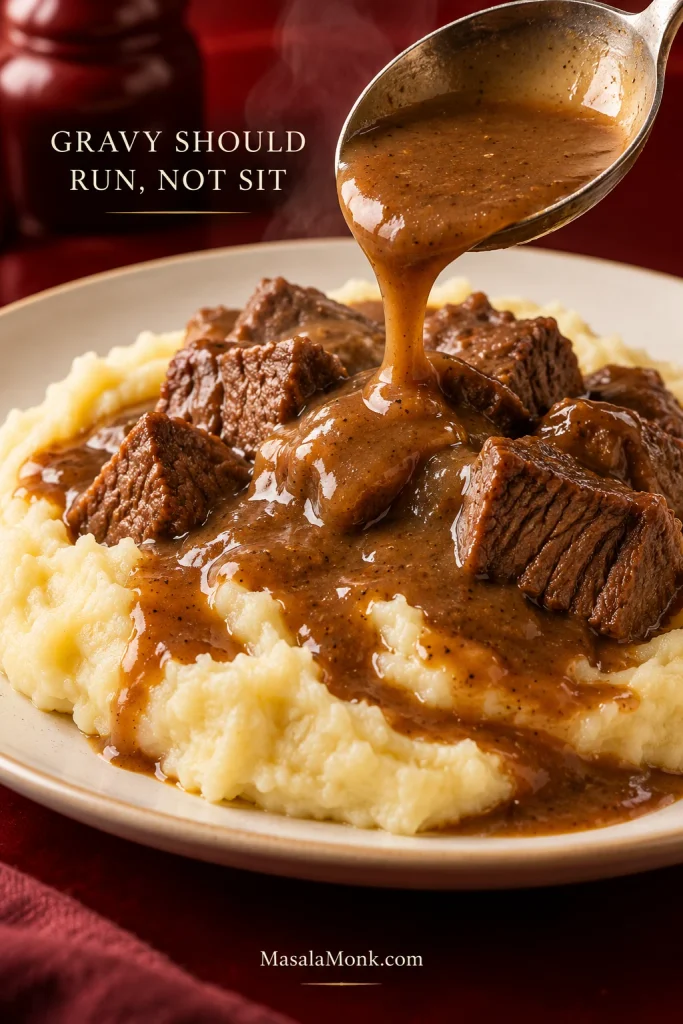
The gravy should taste beefy, not floury. It should coat the meat but run from the spoon. If you can taste raw flour, simmer it another minute or two. For a texture that still seems off, jump to the gravy fixes.

Brown beef gravy coating a stainless spoon above a shallow pan, with a soft trail visible across the gravy surface.
Tilt the spoon and watch what happens next: properly finished beef gravy leaves a light coating, then moves back into the pan instead of holding a stiff ridge.

If you like gravy built from browned pan flavor, try our smothered pork chops with onion gravy next.

Fix the Pot: Tough Beef, Thin Gravy & Other Problems

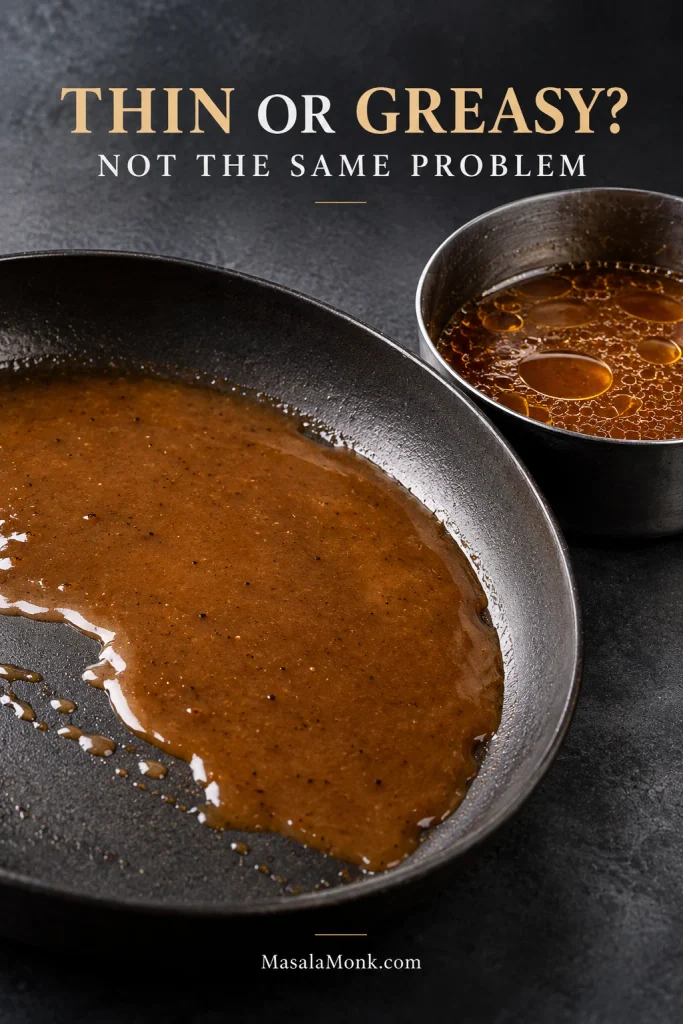
Most problems here are recoverable. Tough chuck usually needs more time; thin or greasy gravy is easier to correct once the beef is out of the pot.

Thin brown gravy spread across one pan beside gravy with distinct droplets of separated fat floating on the surface.
Thin gravy looks uniformly loose, while greasy gravy shows separate fat droplets or a surface slick. That distinction matters because thickness and excess fat are not the same problem.

Quick fixes by symptom

Problem What to do
Beef will not brown Pat it dry and leave more room between pieces. If liquid pools in the pot, use smaller batches.
Fond is getting too dark Deglaze before it burns. Save that browned liquid with the beef and continue on a cleaner surface.
Chuck is still tough Keep the simmer gentle and check again in 15 to 20 minutes. Chuck often just needs more time.
Beef is dry or stringy You can’t make overcooked beef juicy again, but plenty of gravy will make it better to eat. Next time, stop while the pieces are tender and still hold their shape.
Gravy is watery Remove the beef first, then simmer the gravy uncovered. Add more thickener only after excess liquid has had time to reduce.
Gravy is too thick Whisk in low-sodium broth 1 to 2 tablespoons (15 to 30 ml) at a time until it loosens.
Gravy looks greasy Skim excess fat from the surface. More flour will make the gravy thicker without removing the extra fat.
Gravy tastes flat Taste for salt first. If it is underseasoned, add a little salt or Worcestershire. When the salt level is right, try black pepper or ¼ teaspoon cider vinegar or lemon juice instead.
Gravy is too salty Dilute gradually with unsalted broth or water. If that makes the gravy too loose, simmer only briefly; a long reduction will concentrate the salt again.

Mushrooms, Red Wine and a Faster Top Sirloin Version

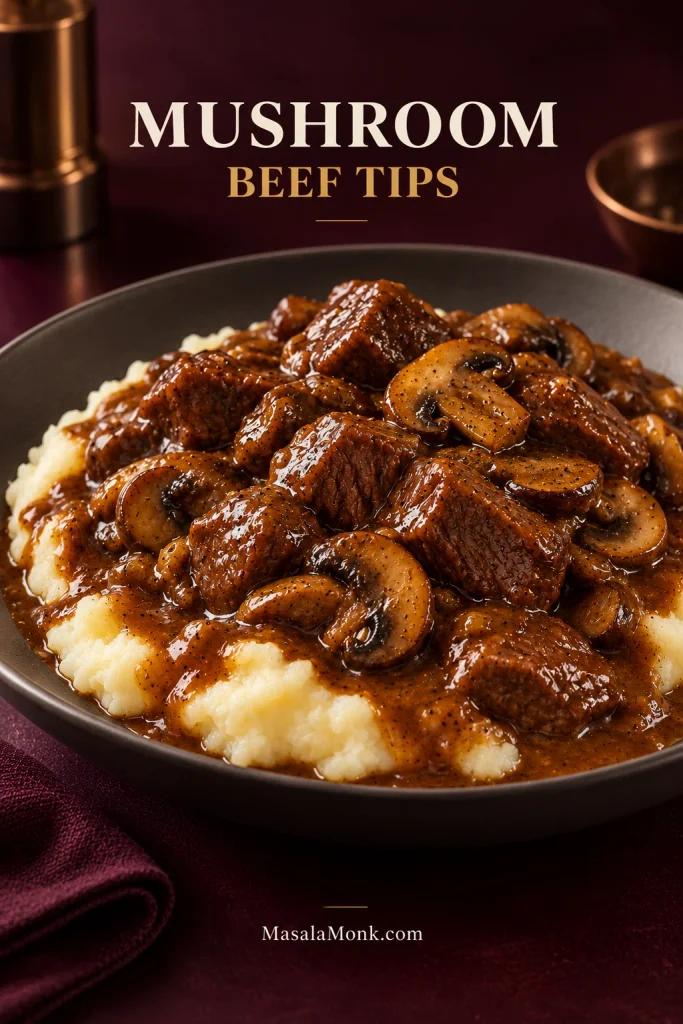
Mushrooms

Use 8 oz (225 g) sliced cremini or white mushrooms. Brown them after the beef until their released moisture has mostly evaporated and the slices begin to take on color.

Set them aside while the chuck braises, then add them back with the beef at the end so they keep some of their browned flavor and texture.

Braised beef tips in brown gravy with browned sliced mushrooms served over creamy mashed potatoes.
Mushrooms need room just like the beef does. If the pan is crowded, they steam and stay pale instead of developing the browned edges that make this variation worth adding.

Red wine

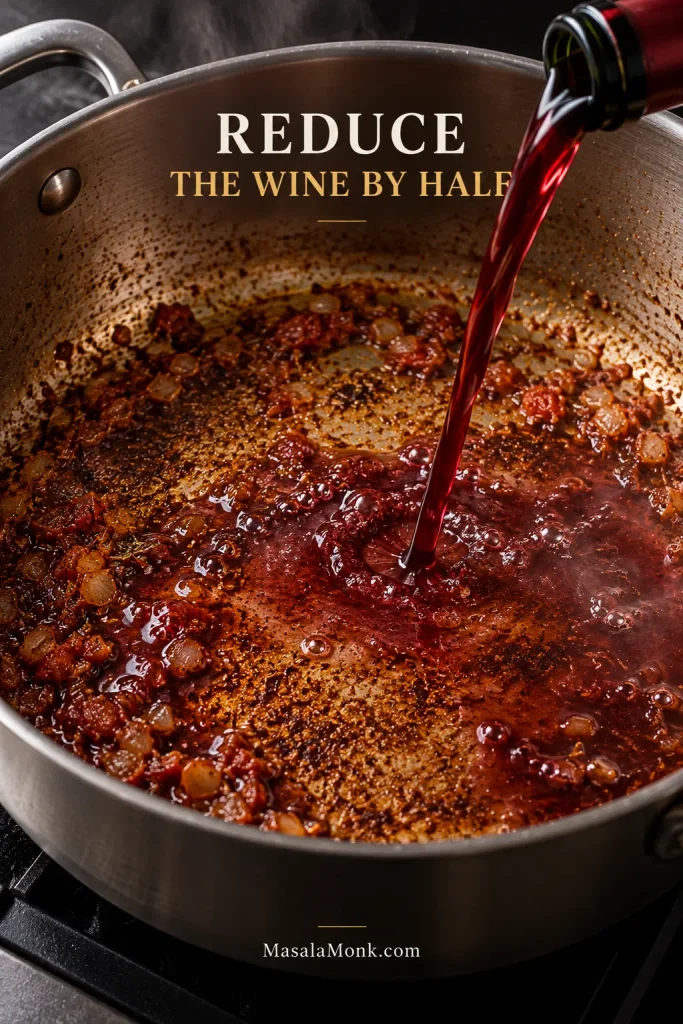
Add ½ cup (120 ml) dry red wine after the tomato paste, garlic and thyme. Scrape up the fond and let the wine reduce by half, then add only enough beef broth for the braising liquid to come halfway to two-thirds up the beef.

Red wine being poured into a hot metal pan with browned fond, cooked onion and tomato paste during deglazing.
As the red wine hits the pan, watch the browned fond begin to release and expose cleaner metal underneath. That visible change is the best sign the deglaze is doing its job.

Top sirloin instead of chuck

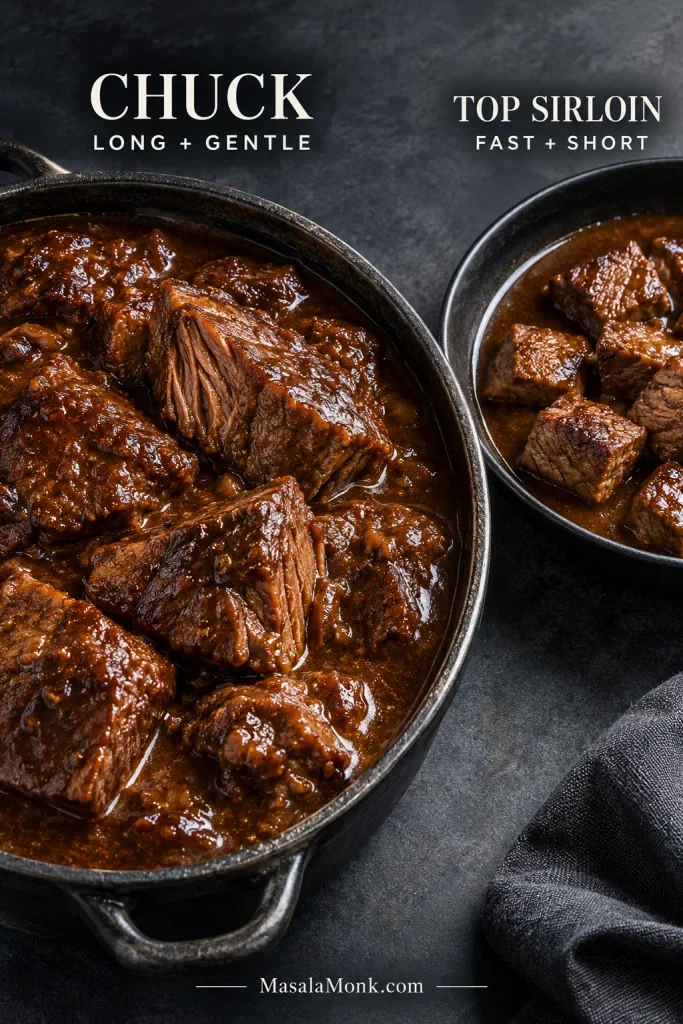
Top sirloin makes this a much quicker, slightly smaller batch. Use 1½ lb (680 g), cut into 1-inch (2.5-cm) pieces, and season with 1 teaspoon fine sea salt and ¾ teaspoon black pepper. Sear in batches for 30 to 60 seconds on each broad side, then remove before the centers are fully cooked.

Cook the onion, tomato paste, garlic and thyme as above. Add 2 cups (475 ml) low-sodium broth with the Worcestershire and simmer for about 10 minutes. Mash together 1 tablespoon (14 g) softened butter and 1½ tablespoons (about 12 g) flour, then whisk it in gradually. Return the top sirloin and its juices and start checking after 2 to 3 minutes. Once the thickest pieces reach at least 145°F (63°C), take the pot off the heat and let the dish stand for 3 minutes before serving.

Large braised chuck pieces in brown gravy beside smaller, leaner top sirloin pieces in a separate pan for comparison.
Even after cooking, the cuts should look different: chuck stays more fibrous and irregular, while top sirloin remains neater and leaner. That difference is why their cooking times cannot simply be swapped.

For another quick-cooking top sirloin dinner, our Beef Stroganoff recipe keeps the beef’s time in the sauce short.

Prefer the Crock-Pot? Our Slow Cooker Beef Tips and Gravy Recipe uses liquid levels and timing designed for the slow cooker.

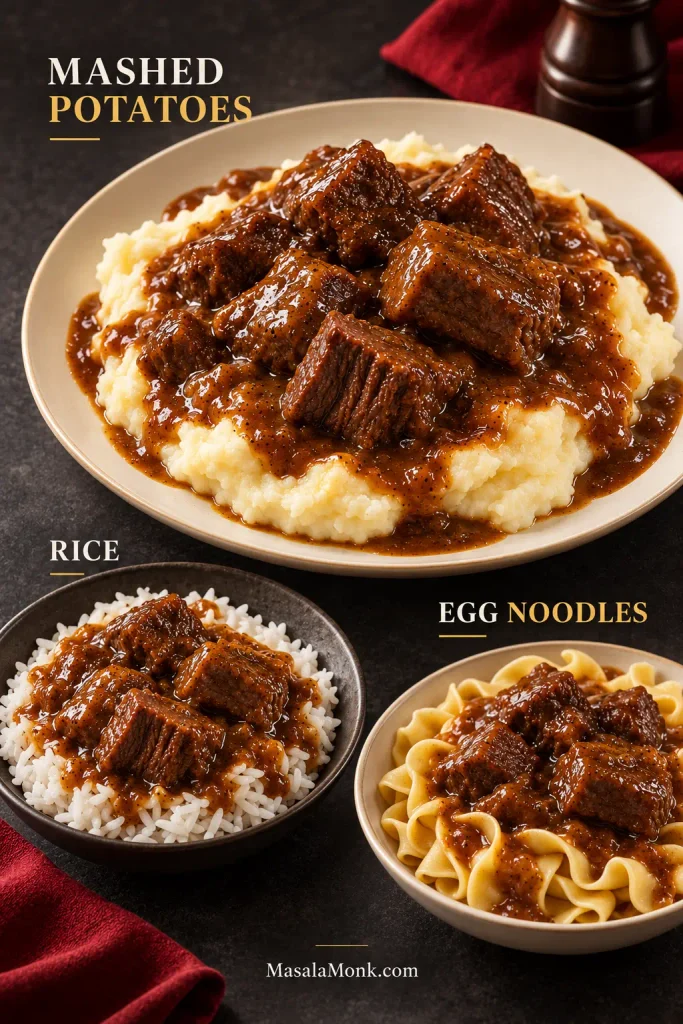
Mashed Potatoes, Rice or Egg Noodles?

Creamy mashed potatoes are especially good here because the gravy can run into the ridges instead of sitting on top like paste. This is the kind of dinner where making enough gravy really matters.

Brown gravy being spooned over intact beef tips and creamy ridged mashed potatoes on a light plate.
A shallow pool of gravy around the beef is useful here, not messy. It keeps each bite saucy without burying the texture of the potatoes or the browned beef.

For rice, keep the gravy on the looser side so it can run through the grains. If you’re making it alongside dinner, our guide to how to cook perfect rice covers the stovetop method and common rice varieties.

Egg noodles work best with gravy that is a touch more clingy.

Choosing among all three? Keep the beef the same and make only small adjustments to the final gravy so it suits what is underneath.

Beef tips and brown gravy served three ways over mashed potatoes, white rice and broad egg noodles.
Look at what happens after the gravy hits the base: it should remain visible around rice, cling lightly to egg noodles and settle into the ridges of mashed potatoes rather than disappearing completely.

Green beans almondine bring toasted almonds and a little lemon, which is especially welcome beside the rich beef and gravy.

Make Ahead, Store and Reheat

The finished beef tips and gravy can be made 1 to 2 days ahead and reheated together gently. To prep ingredients ahead, cut the chuck and chop the onion the day before, then refrigerate them separately.

Cool leftovers promptly and refrigerate them in covered containers. USDA recommends using refrigerated leftovers within 3 to 4 days and reheating leftovers to 165°F (74°C). Count that window from the day the beef was originally cooked, including when the dish was made ahead.

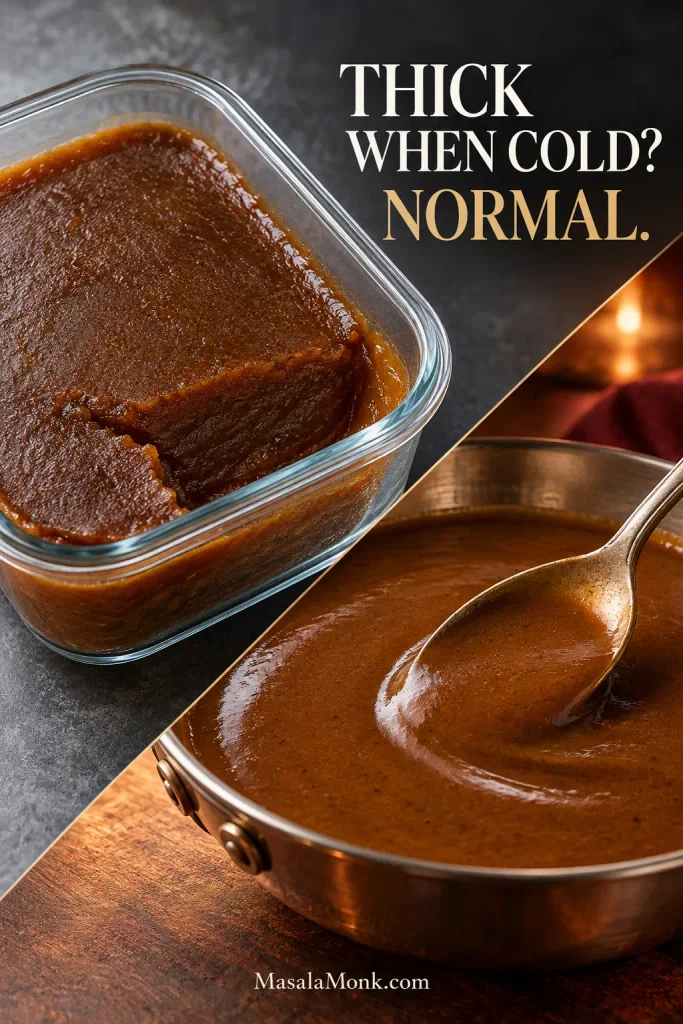
After chilling, the gravy may look very thick or almost set. That is normal. Gelatin from the chuck and the flour both firm as they cool.

Firm chilled beef gravy in a glass container beside the same brown gravy reheated until smooth in a metal pan.
Judge leftover beef gravy only after it is warm. Chilled gravy can look almost solid, so reheating first prevents you from adding broth to a sauce that would have loosened on its own.

Reheat gently on the stovetop, stirring often, until the gravy has warmed enough to loosen. If it still seems too thick, add low-sodium broth or water 1 tablespoon at a time. Continue until the beef reaches 165°F (74°C) throughout and the gravy comes briefly to a boil, then take the pot off the heat so the already-tender beef does not keep cooking.

Freeze the cooled beef and gravy in an airtight freezer-safe container for 2 to 3 months for best quality. Thaw in the refrigerator, reheat slowly and add a little broth if the gravy needs loosening.

Posted on — Leave a comment

Baked Potato Recipe: Crispy Skin, Fluffy Inside & Easy

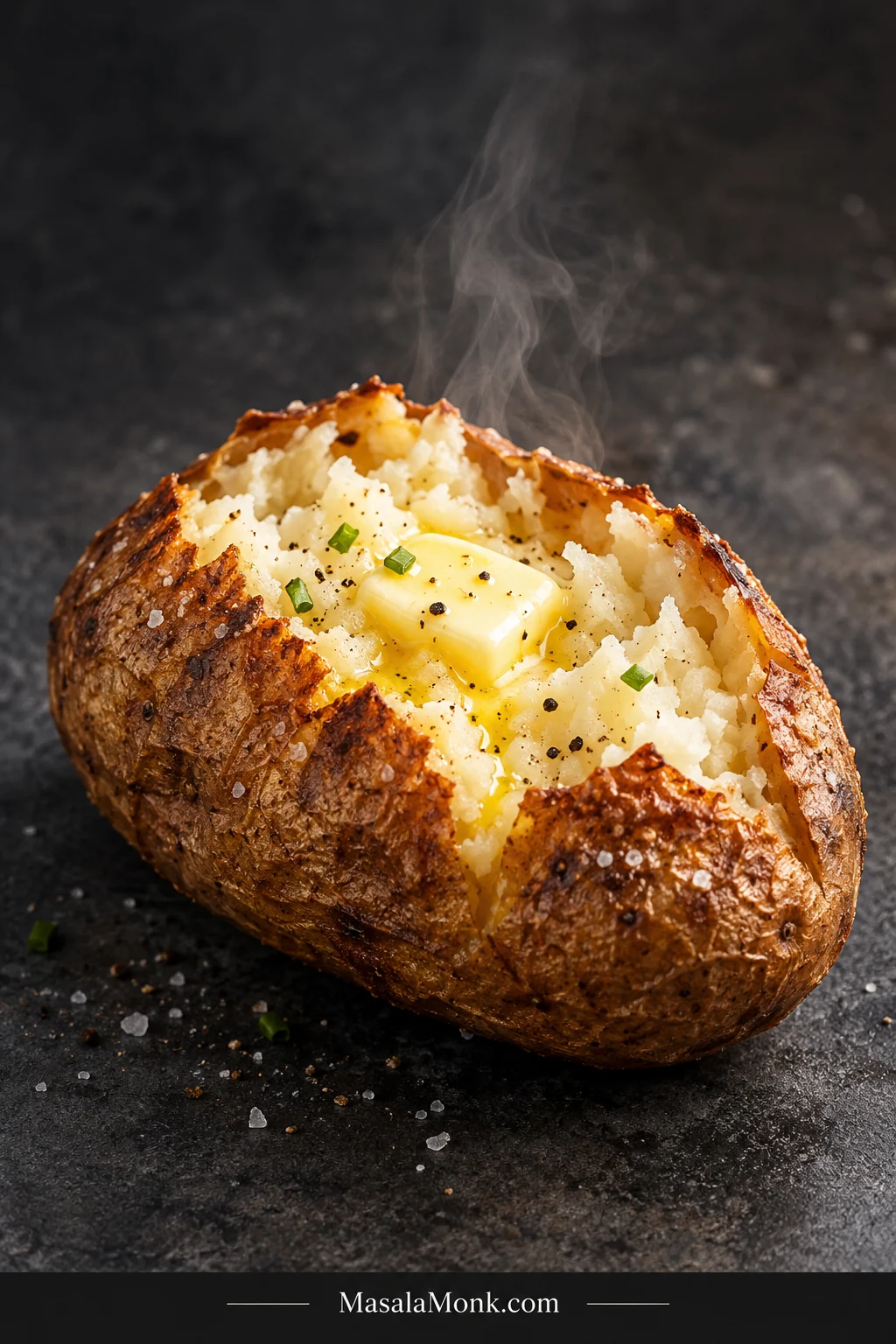
Baked Russet potato opened to reveal a fluffy white center with melting butter, black pepper and a few chives inside crisp browned skin.

A great baked potato should make the skin worth eating. It should come out crisp and salty on the outside, then split open to reveal a hot, loose, fluffy center rather than a firm white core that somehow survived an hour in the oven.
For crisp skin and a fluffy middle, use medium-large Russet potatoes, rub them lightly with oil and salt, and bake them uncovered at 425°F / 220°C for roughly 50–70 minutes.

A 7-ounce potato and a 15-ounce potato may both be sold as “baking potatoes,” but they do not belong on the same timer. For the potatoes used in this baked potato recipe, start checking around 50 minutes. If a fork still meets a firm middle, keep baking.
Crispy-Skin Baked Potato Recipe

Russet potatoes baked uncovered until the skins are crisp and the centers are soft, steaming and easy to fluff with a fork.

Prep10 min
Cook50–70 min
TotalAbout 60–80 min
Servings4 potatoes
Potato Size8–10 oz / 225–285 g
Oven425°F / 220°C

Equipment

You need a fork, a rimmed baking sheet and an oven mitt or clean kitchen towel. An oven-safe wire rack and instant-read thermometer are useful but optional.

Ingredients

  • 4 firm medium-large Russet potatoes, about 8–10 oz (225–285 g) each, similar in size and without soft spots or obvious green areas
  • 2 teaspoons (10 mL) olive oil or neutral cooking oil
  • 1–1½ teaspoons coarse kosher salt, enough for a light coating; use less if your salt is fine
  • Butter, black pepper and a little extra salt, for serving, optional
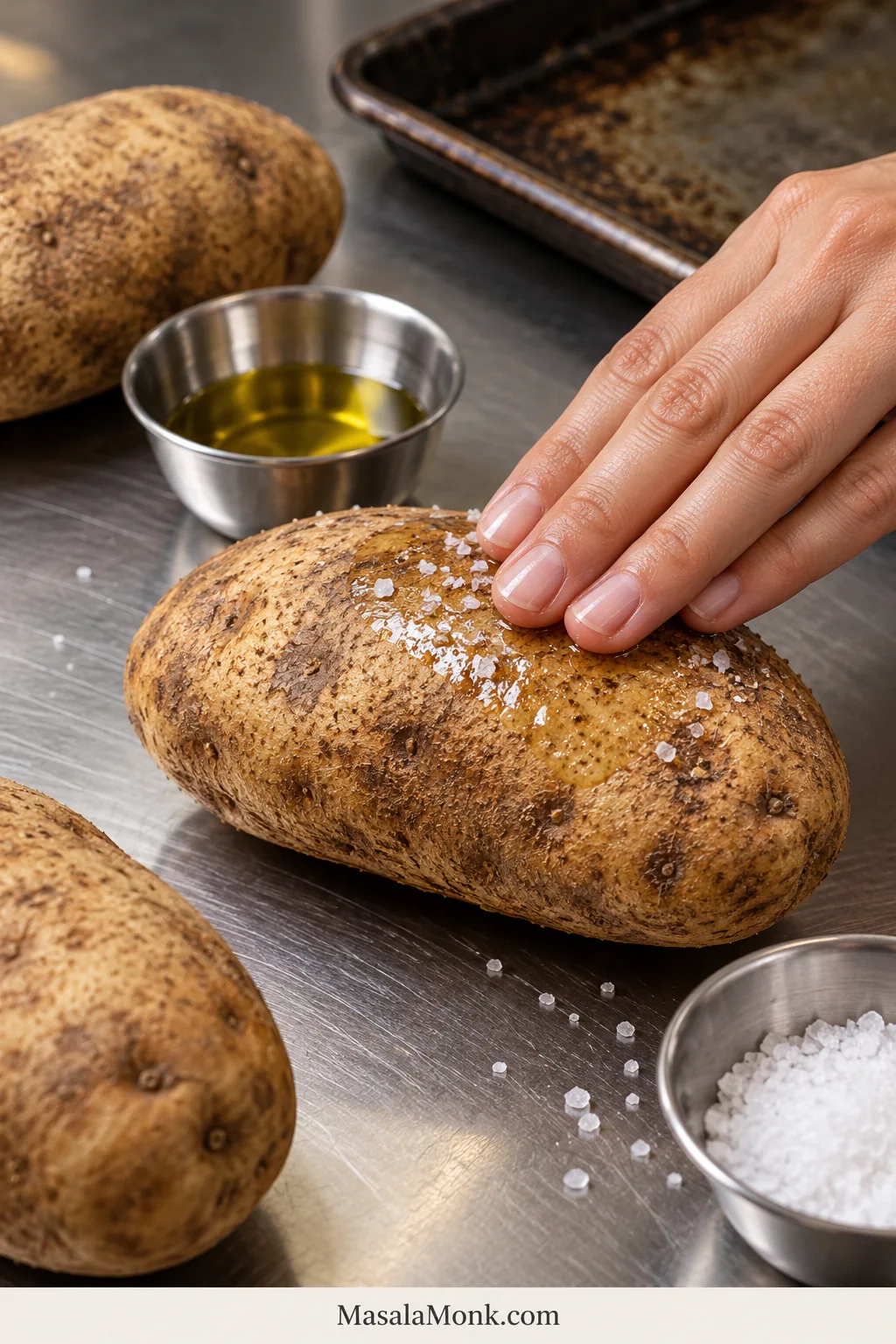
Hand rubbing a thin coating of oil and coarse salt over a raw Russet potato on a stainless-steel work surface beside a baking sheet.
Rub the measured oil directly over the dry Russet instead of pouring it onto the pan; that keeps the coating even, helps coarse salt cling, and leaves less excess oil to drip or smoke.

Before you start: choose potatoes close in size and weight. The largest one will usually set the pace.

Instructions

  1. Heat the oven. Preheat a conventional oven to 425°F / 220°C. For a fan or convection oven, about 400°F / 200°C is a useful starting point. Set a wire rack over a rimmed baking sheet if you are using one.
  2. Scrub and dry. Wash the potatoes well, then towel them completely dry. A wet skin has to lose that moisture before it can crisp.
  3. Pierce them. Prick each potato about 5–6 times with a fork so steam has several escape routes as the potato heats.
  4. Add oil and salt. Rub the potatoes with just enough oil to leave a thin film, then scatter the coarse salt over the skins. They should look lightly coated, not wet or heavily slicked with oil.
  5. Bake uncovered. Put the potatoes on the wire rack. No rack? Place them directly on the oven rack with the rimmed baking sheet below to catch drips, or use the baking sheet itself and turn them once. Begin testing at about 50 minutes; many potatoes this size finish somewhere in the 50–70 minute range.
  6. Test the middle. Press gently through an oven mitt. The potato should give under your fingers, and a fork should slide through the thickest part without suddenly meeting a firm core. If you like using a thermometer, aim for about 210°F / 99°C in the center.
  7. Open and fluff while hot. With a fork, prick a short line across the top, then a second line across it to make a small cross. Press the ends gently toward the center so the potato opens and the fluffy flesh pushes upward. Rough it up with the fork, season with a little salt and black pepper, and add butter or your chosen toppings while everything is still steaming.
Recipe Notes

  • Very large potatoes: expect them to need longer than the recipe range. Let the middle decide when they are done.
  • For even crisper skin: use the short finishing method in Crisp Skin Without Turning Tough.
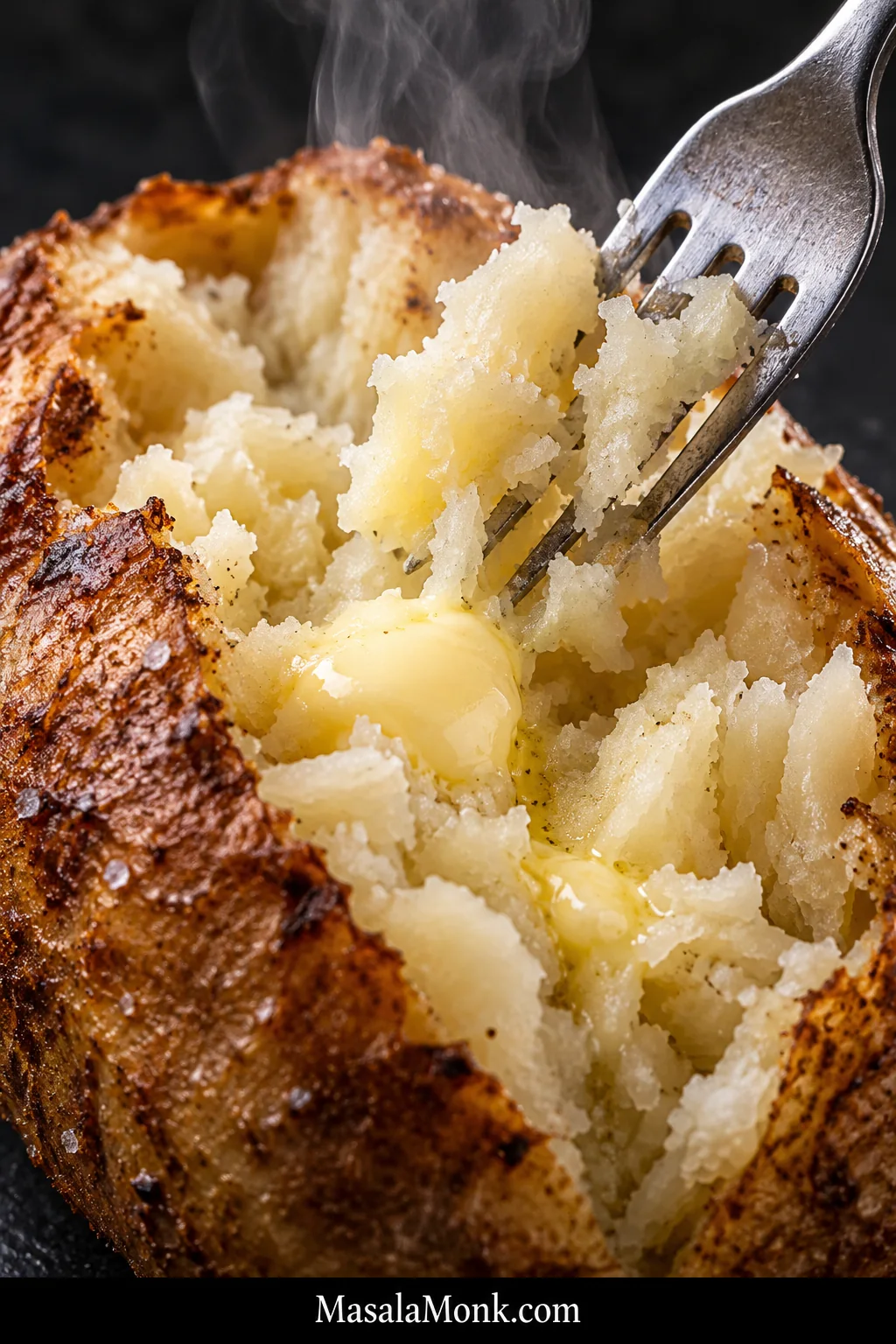
Close-up of a fork lifting and separating fluffy baked potato flesh while melted butter runs into the rough interior.
Because fork-fluffing exposes more surface area, melted butter and seasoning can spread through the center instead of collecting in one narrow slit. Keep the flesh rough and loose rather than smoothing it.

Best Potatoes for Baking and Why Size Matters

Russets are the best choice for the classic fluffy baked potato. Their high-starch, relatively dry flesh breaks into a light, loose center, while the thicker skin handles a hot oven well. That is one reason the Idaho Potato Commission recommends Russet-type potatoes for baking.
Yukon Gold and red potatoes bake perfectly well too, but their flesh stays naturally creamier and denser. That same starch difference matters in mashed potatoes, where Russets turn lighter and Yukon Golds stay naturally creamier.
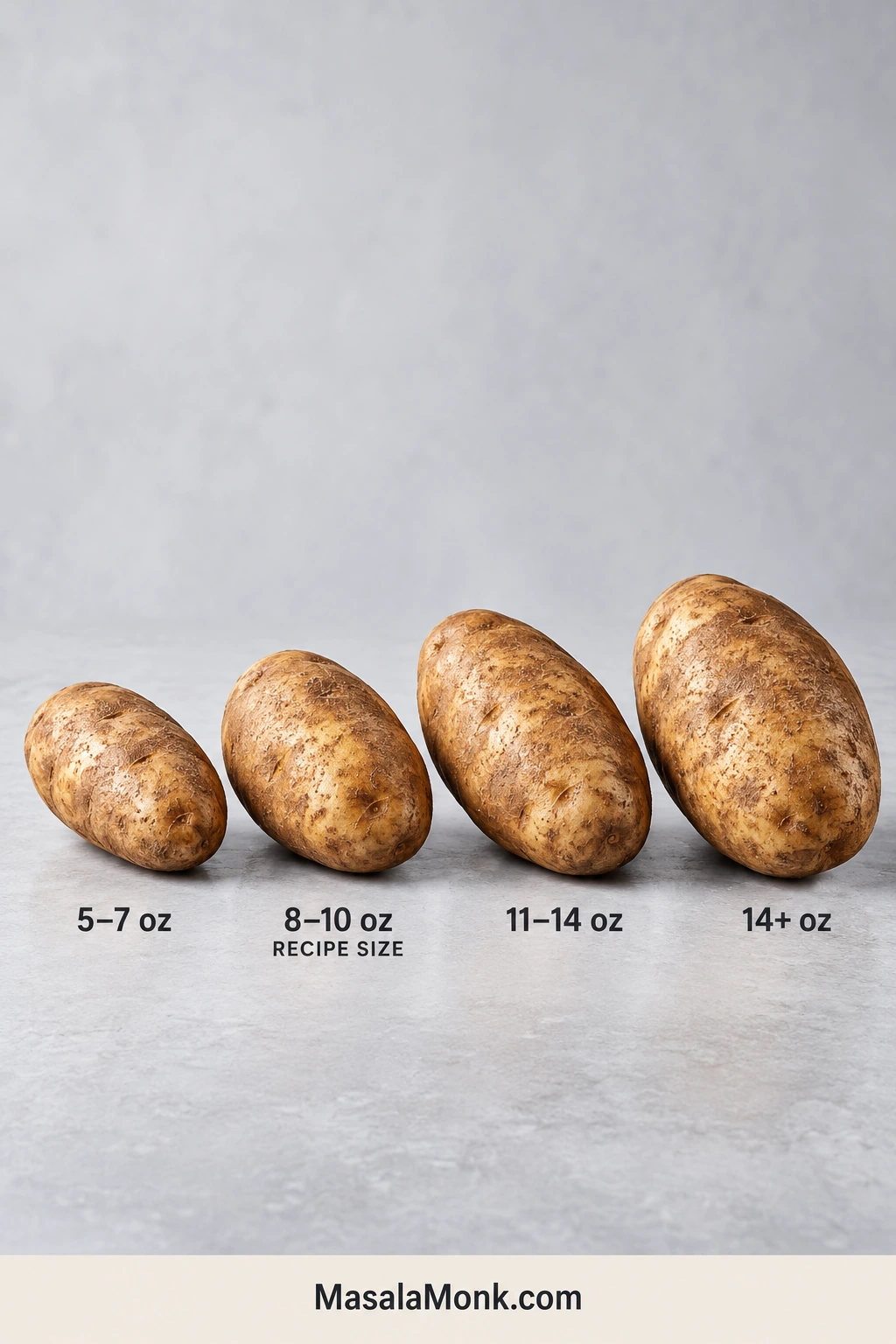
A supermarket “baking potato” might weigh 6 ounces or well over a pound, which is why one fixed cooking time causes so much frustration.

Potato sizeApproximate weightAt 425°F / 220°C
Smaller5–7 oz / 140–200 gCheck from about 40–45 minutes
Recipe size8–10 oz / 225–285 gCheck from about 50 minutes
Large11–14 oz / 310–400 gStart looking around 60 minutes
JumboMore than 14 oz / 400 gPlan on considerably longer

These are checking points, not deadlines. Your potato may still need another 10 or 15 minutes.

Four Russet potatoes increasing in size and labeled 5–7 oz, 8–10 oz recipe size, 11–14 oz and 14+ oz.
For this baked potato recipe, weigh Russets when size matters; a shorter, thicker potato can weigh as much as a longer one. That means visual length alone is a poor guide to baking time.

How Long to Bake a Potato

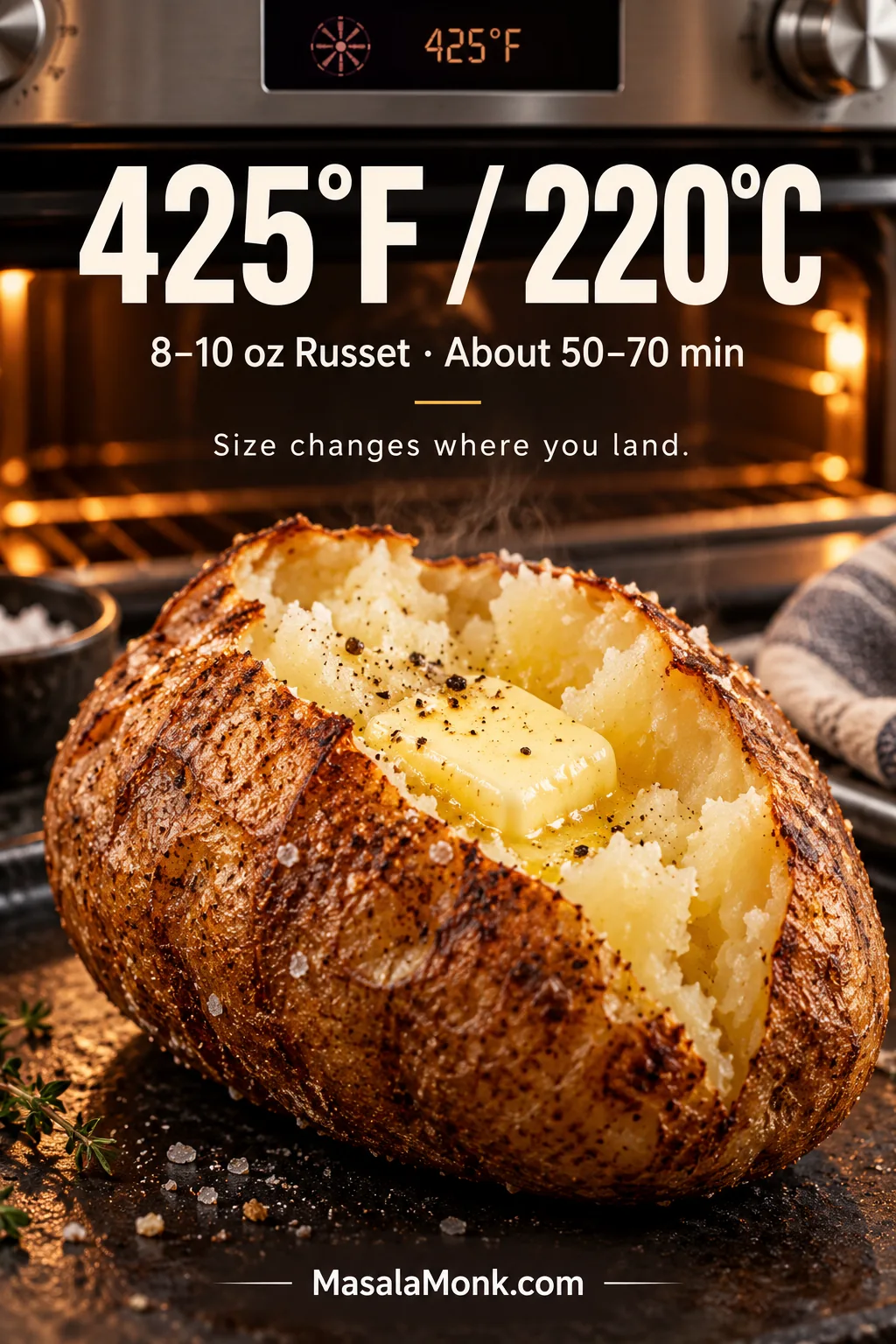
For the 8–10 oz Russets used here, 425°F / 220°C usually means about 50–70 minutes total. At other temperatures, use the ranges below as a starting point.

If something else is already in the oven, use the temperature you have. The potato can work around dinner; our baked chicken breast, for example, also cooks at 425°F / 220°C, although the chicken will finish much sooner.

  • 350°F / 175°C: plan on roughly 75–90 minutes, sometimes longer.
  • 375°F / 190°C: roughly 65–80 minutes.
  • 400°F / 205°C: roughly 55–70 minutes.
  • 450°F / 230°C: start checking around 45 minutes; the skin cooks more aggressively at this heat.
  • About 400°F / 200°C fan or convection: begin checking earlier than in a conventional oven, often from about 45–50 minutes.
Baked Russet potato with text showing 425°F or 220°C, an 8–10 oz potato, about 50–70 minutes, and a note that size affects timing.
Oven temperature changes more than the clock: higher heat browns the skin sooner, while lower heat stretches the bake. For an 8–10 oz Russet, 425°F / 220°C balances both.

How to Tell When a Baked Potato Is Done

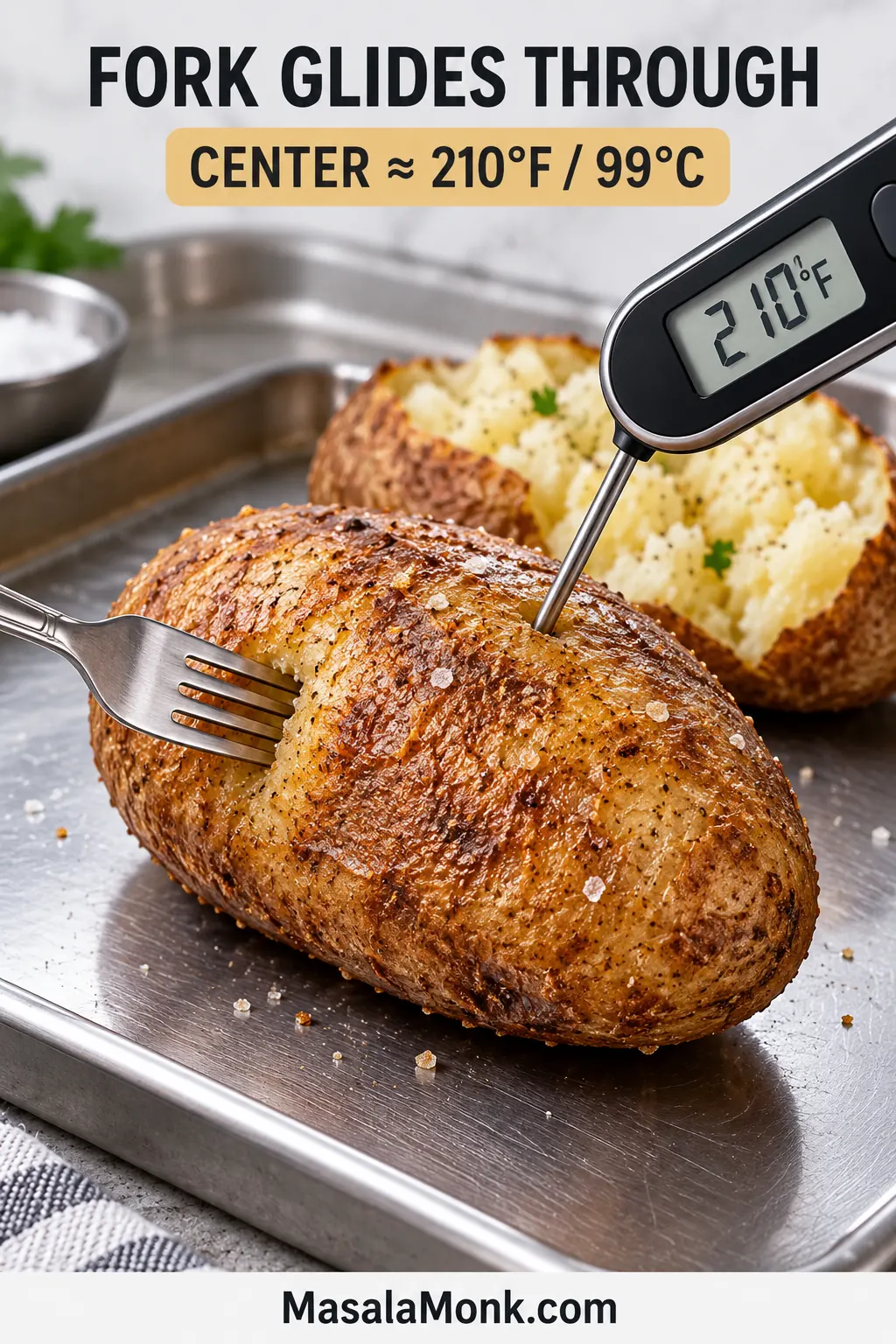
If you like using a thermometer, a fully baked Russet is usually around 210°F / 99°C in the center. You do not need one, though. The potato should feel soft and offer almost no resistance through the middle.

  • Squeeze: use an oven mitt and press gently. The potato should give under your fingers.
  • Probe: a fork should slide through the thickest part without suddenly meeting a firm white core.
Whole baked Russet potato being checked through the thickest part with a fork and instant-read thermometer reading 210°F, with an opened fluffy potato behind it.
A 210°F / 99°C reading is useful only when the probe reaches the thickest central part of the baked potato. Then confirm with a fork: the center should offer almost no resistance.

If the fork stops in the middle, it needs more oven. Give it another 10 minutes and try again. If the outside is already deeply browned while the center stays firm, use the troubleshooting guide below.

When it is truly ready, the opened center should separate easily under a fork. Butter will melt into those rough, fluffy edges instead of sitting on top of a dense slab of potato.

Foil Makes a Different Potato

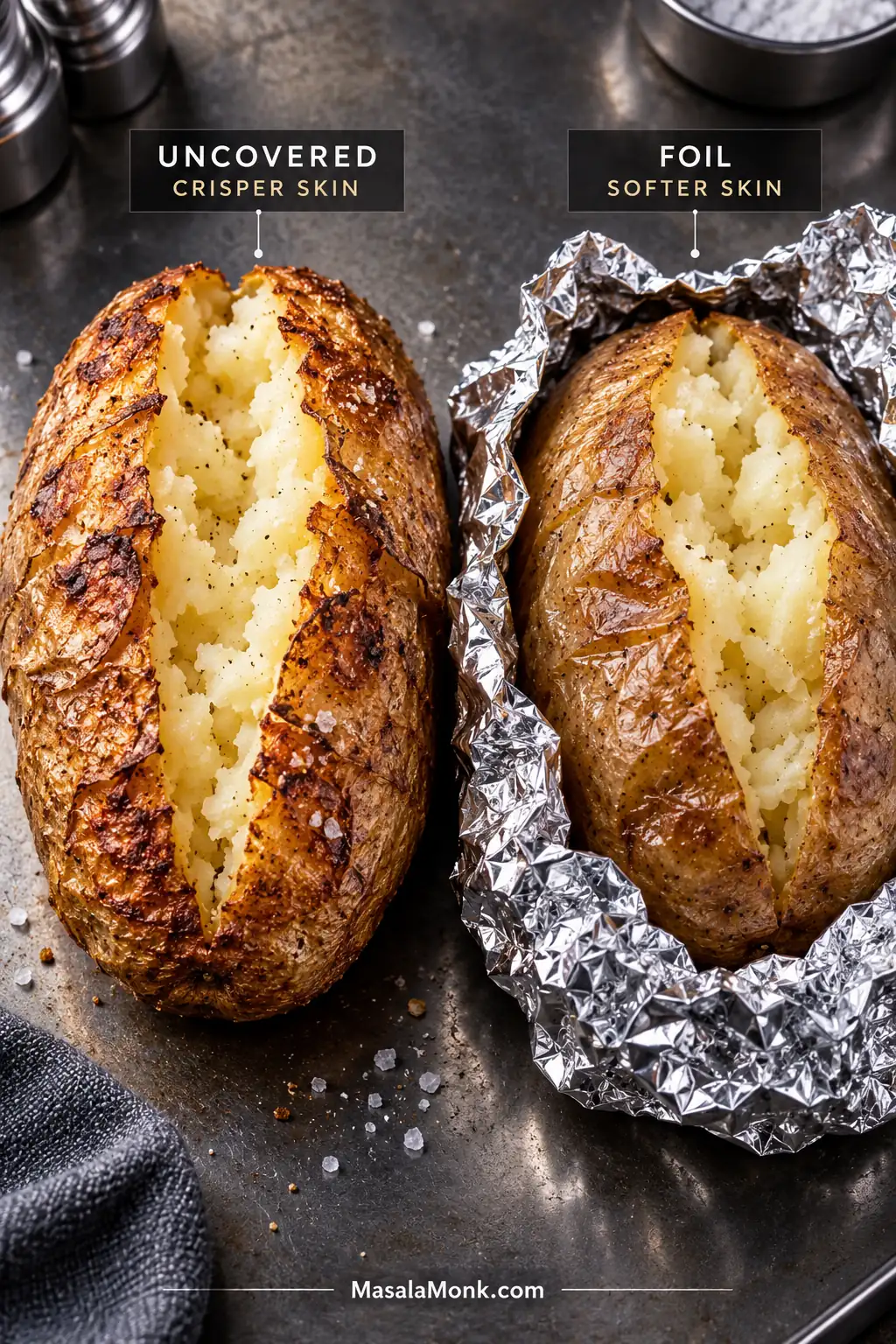
No—do not wrap a baked potato in foil if you want crisp skin. Foil traps steam around the surface and keeps the skin softer.

Prefer soft skin? Foil will give you that. It will not make a very large potato cook through faster.

Side-by-side baked Russet potatoes comparing dry crisp uncovered skin with softer skin on a potato resting in opened aluminum foil.
You can see the foil effect at the skin edge: uncovered skin stays drier and crisper, while foil-softened skin bends and clings more closely to the flesh.

If you prefer the softer skin that foil gives, serve the potatoes promptly. If they are not being served soon, do not leave them wrapped at room temperature; loosen or remove the foil and refrigerate them promptly.

Crisp Skin Without Turning Tough

Soft skin is usually a moisture problem. Tough skin is usually a time problem.

A potato that went into the oven damp, was wrapped in foil or sat covered after baking is likely to stay soft. Leathery skin usually means the potato stayed under heat too long after the center was already cooked.

A wire rack helps hot air reach the underside. On a regular baking sheet, turn the potatoes once and keep going. When the skin is right, it should feel dry and crisp rather than damp or tacky. Serve it fairly soon and leave it uncovered so trapped steam does not soften that surface again.

Extra-crisp finish: when the center is ready but the skin is not, brush on a very thin film of oil and return the potato to the hot oven for about 5 minutes. Check the skin, then give it a few more minutes only if needed.

Hasselback potatoes take the crisp-edge idea further, with thin roasted ridges surrounding a soft center.

Baked Potato Troubleshooting

Something went wrong? Start with what the potato is doing, not what the clock says. Use the symptom that matches it below.

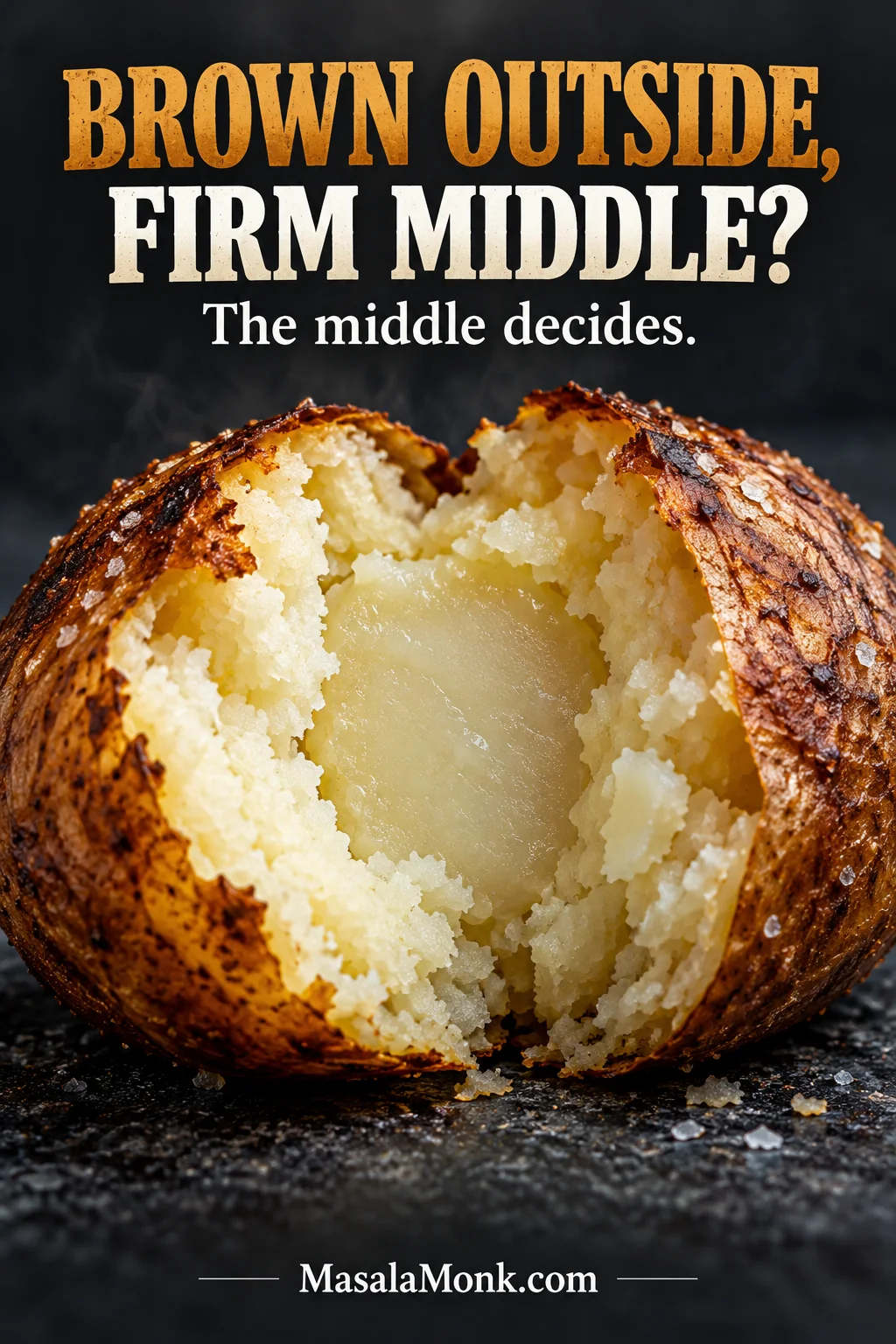
Browned baked potato opened to show cooked outer flesh surrounding a pale, dense and visibly underdone center.
Exterior color is a poor doneness test. When a baked potato still has a pale, dense core, the center has not cooked through enough to loosen and fluff; keep cooking until that compact plug disappears.
What happenedWhat it usually means — and what to do
Hard centerThe potato is undercooked or larger than expected. Give it another 10 minutes, then probe the thickest part again.
Brown skin, firm middleThe potato may be larger than expected, or the oven may be running hot. Keep cooking until the middle is tender; if ordinary-size potatoes repeatedly brown too early, check the oven temperature.
Tender but not fluffyThe potato may simply be lower in starch or higher in moisture. More oven time will not turn waxy flesh into a floury Russet.
Soft or soggy skinLook for trapped moisture: damp skin, foil or prolonged covered holding.
Leathery skinThe potato may have baked too long or stayed hot after the center was already ready.
Soft bottomLong contact with a solid baking sheet can do this. Turn the potato once next time or use a wire rack.
Smoking ovenThere is probably too much oil dripping from the potatoes. They only need a thin film.
One potato finishes much earlierTake it out. Potatoes vary, even when they look similar. The others can keep cooking.
Everything takes much longer than expectedCheck the potato weight first. If ordinary-size potatoes consistently run late, an inexpensive oven thermometer can tell you whether your oven is actually reaching the temperature on the dial.

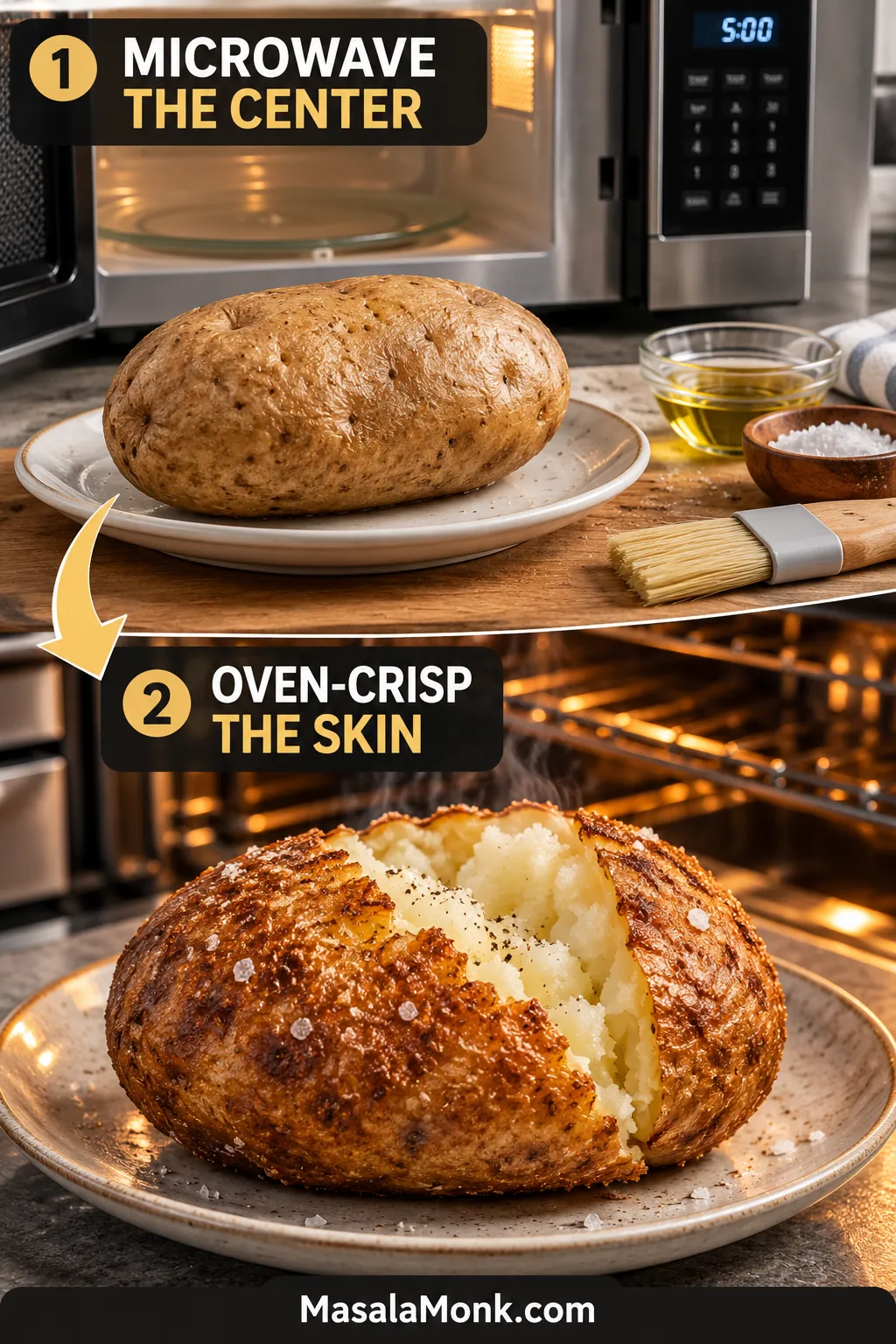
Quick Microwave-to-Oven Method

For a faster baked potato, let the microwave cook most of the center, then let the oven crisp the skin.

  1. Pierce the potato several times with a fork.
  2. Microwave on high for about 5 minutes, turn it, then continue in 1–2 minute bursts until the middle has begun to soften but is not fully tender. Feel the potato between bursts; microwave power varies.
  3. Dry the skin, then add a thin coat of oil and salt.
  4. Finish in a 425°F / 220°C oven until the skin is crisp and the center is soft, usually another 15–25 minutes depending on how far the microwave took it.
Two-stage baked potato method showing a whole microwaved Russet first and a browned, crisp, fluffy oven-finished potato afterward.
After microwaving, dry off any surface condensation before adding oil and salt; otherwise that moisture has to evaporate before the oven can crisp the baked potato skin.

A microwave-only potato is faster still, but the skin stays softer. The oven finish is what brings the contrast back. For the conventional oven route, compare the full baking times and temperatures.

Baking Potatoes for a Crowd

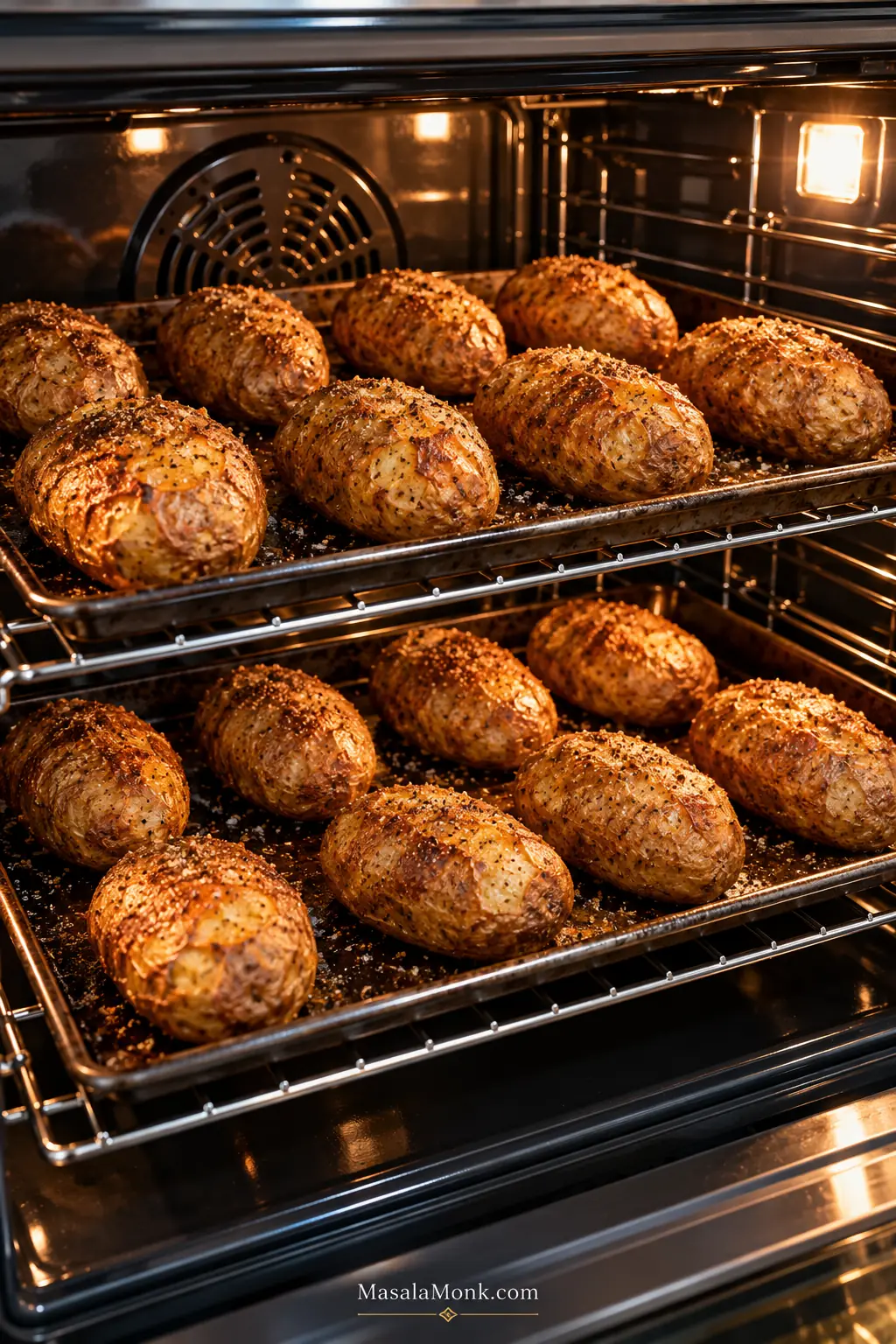
Twenty potatoes do not bake like four. Loading the oven with that many cold potatoes temporarily pulls down the temperature and leaves less room for hot air to circulate. A large batch can take quite a bit longer, so if the potatoes need to be on the table at a fixed time, start earlier rather than relying on the four-potato timing.

Choose potatoes close in weight and keep them in single layers with space around them; do not pile or stack them in a deep pan. Rotate pans between racks if your oven heats unevenly. There is no reliable “add 10 minutes per tray” rule, so check the potatoes and remove them individually as they finish.

Two oven racks holding many evenly spaced Russet potatoes in single layers while baking for a large batch.
When baking potatoes for a crowd, air gaps matter more than fitting an exact number on each tray. Even with similar-size Russets, pull finished potatoes individually rather than waiting for the whole batch.

If service will stretch over a long window, bake in waves instead of holding every finished potato hot for hours; crisp skin and freshly fluffed centers both deteriorate as they sit. For a self-serve spread, the topping ideas below work well. With a very large batch, a twice baked potato casserole can also be easier to serve than dozens of individual potatoes.

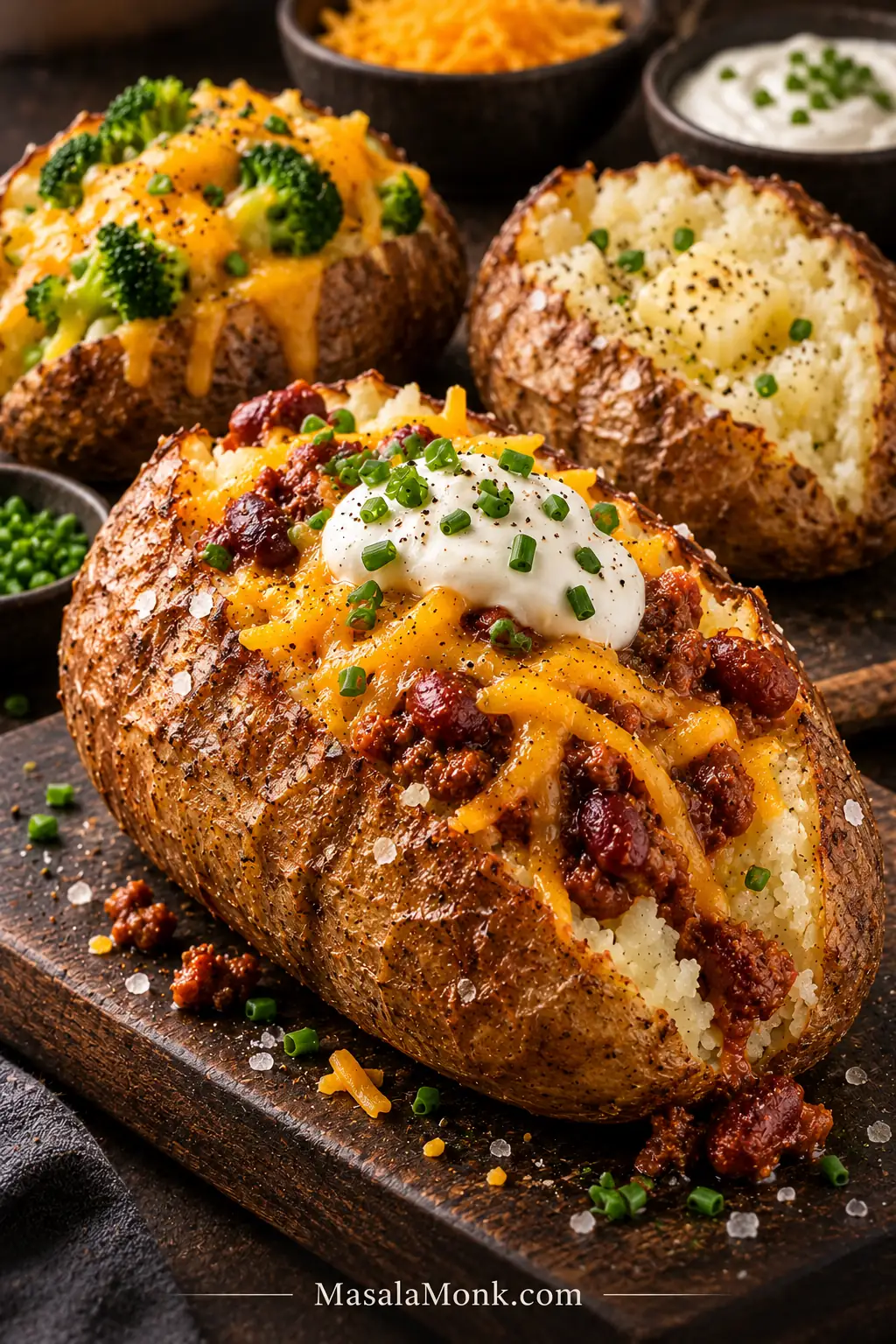
Baked Potato Toppings

Add butter while the potato is still steaming, then season the fluffy center before piling anything else on top.

Keep It Classic

  • Butter + black pepper
  • Sour cream + chives
  • Sharp cheddar + scallions
  • Bacon + sour cream + chives

Make It Dinner

  • Crockpot chili + sharp cheddar + sour cream
  • Broccoli + cheddar + black pepper
  • Shredded chicken + cheese + scallions
  • Seasoned beans + salsa or pico de gallo
Loaded baked Russet potato topped with chili, melted cheddar, sour cream and chives, with broccoli-cheddar and buttered baked potatoes behind it.
For loaded baked potatoes, keep most toppings over the opened center and leave some skin exposed; that way the crisp edges stay distinct instead of sitting beneath hot, moist toppings.

As a side, baked potatoes work with steak, roast chicken, salmon and pork. Something with sauce is especially good: the onion gravy from these smothered pork chops runs straight into the fluffed center.

Storage and Reheating

For leftovers, refrigerate the potatoes promptly rather than leaving them on the counter until completely cold. If they were wrapped in foil, loosen or remove it before refrigerating so the potatoes are not stored tightly wrapped.

USDA leftovers guidance recommends refrigerating cooked food within 2 hours and generally using refrigerated leftovers within 3–4 days.

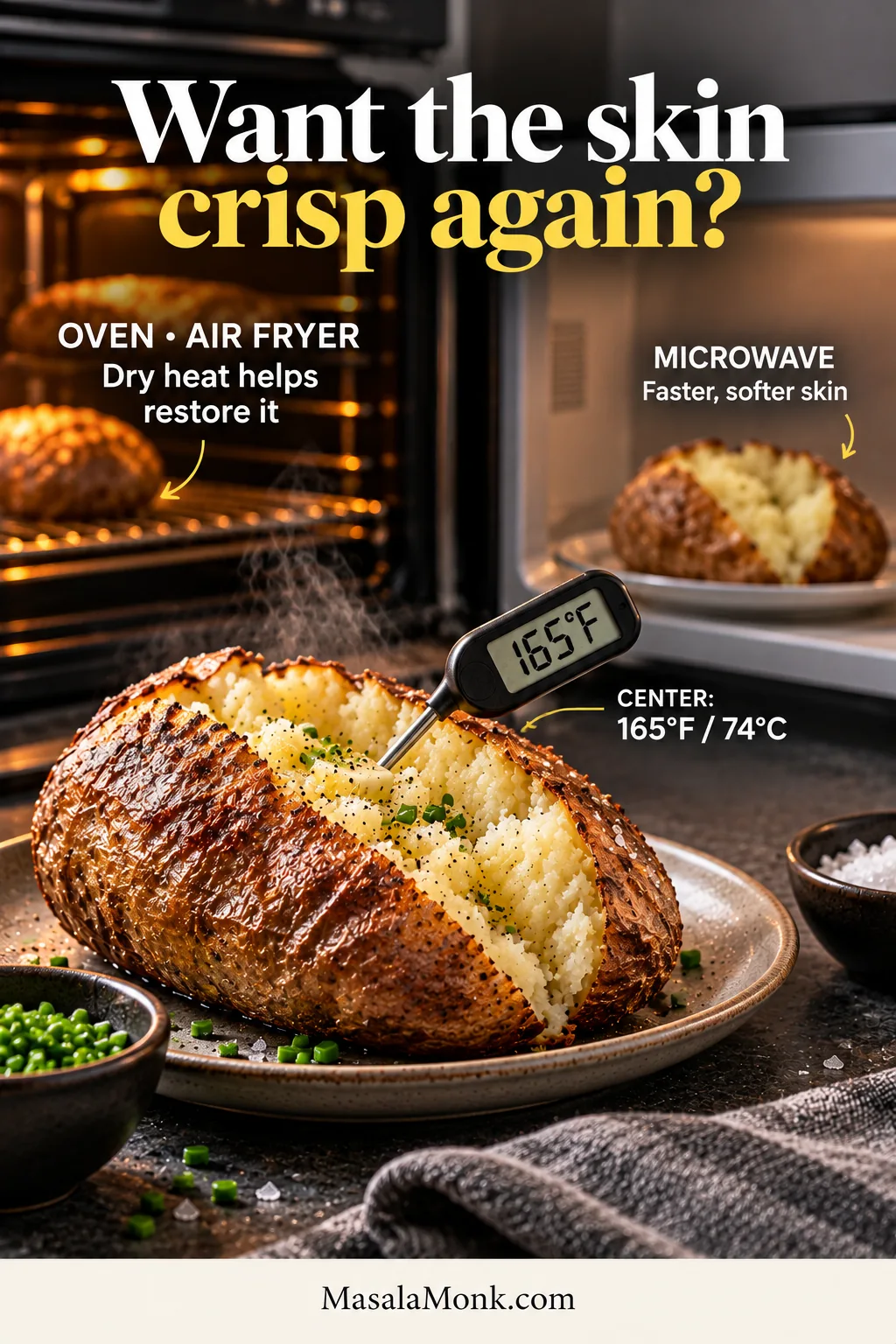
  • Best for the skin: reheat a whole medium potato unwrapped at 350°F / 175°C for about 15–20 minutes, then check the center.
  • Faster with some crispness: use an air fryer at 350°F / 175°C and begin checking around 5 minutes. Larger potatoes will need longer.
  • Fastest: use the microwave. It heats the potato quickly, but the skin will soften.
Reheated baked potato with a thermometer reading 165°F, with labels comparing oven or air-fryer reheating for crisper skin against microwave reheating for softer skin.
For crisper leftovers, reheat the baked potato unwrapped so steam can escape. Meanwhile, judge safety at the thickest center—not the hot surface—and bring that center to 165°F / 74°C.

Whichever method you use, reheat the center to 165°F / 74°C rather than relying on the clock alone.

A leftover potato also gives you another option: scoop out the center, season the filling and turn it into twice baked potatoes instead of trying to recreate the first night’s skin.


Once the texture is right, a baked potato does not need much. Crack open the crisp skin while it is hot, rough up the center with a fork, add butter and let the potato do the rest. If the middle is fluffy and the skin is worth eating, you have done the important part.

Posted on — Leave a comment

Shepherd’s Pie Recipe: Easy, Hearty & Comforting

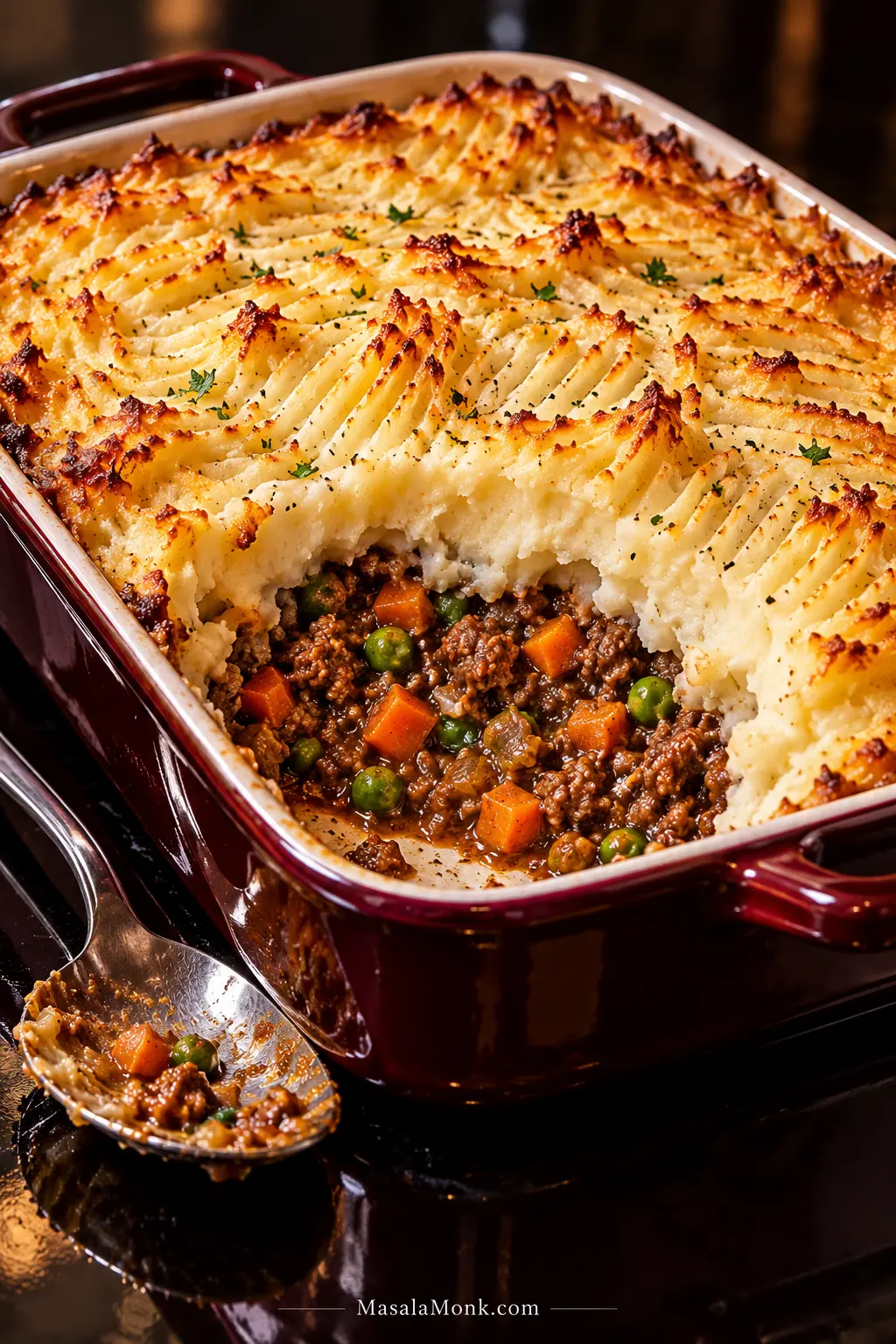
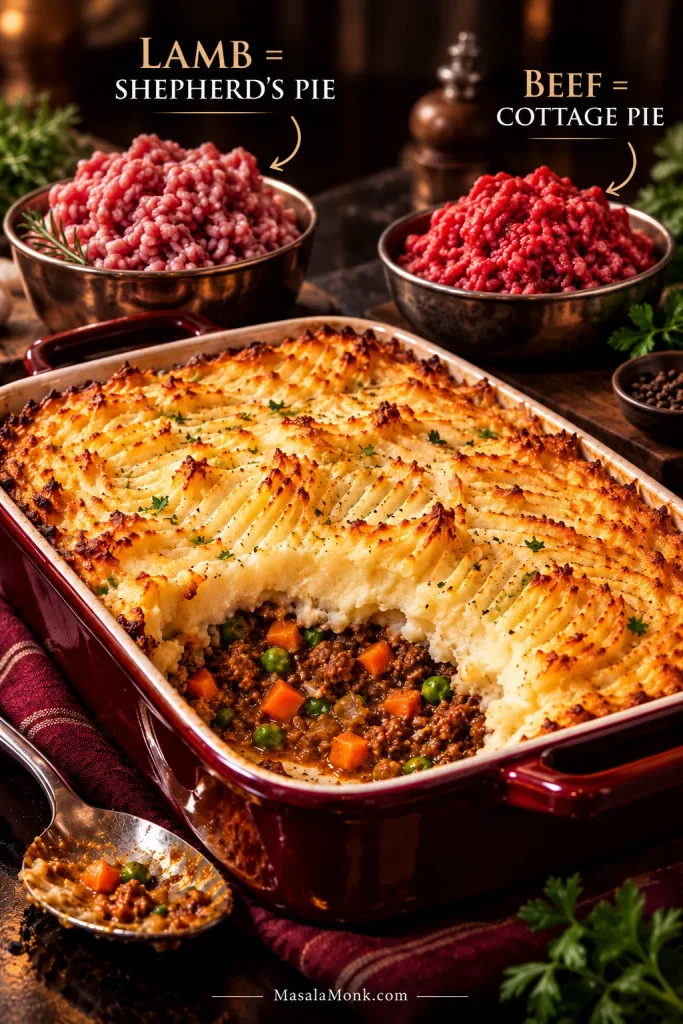
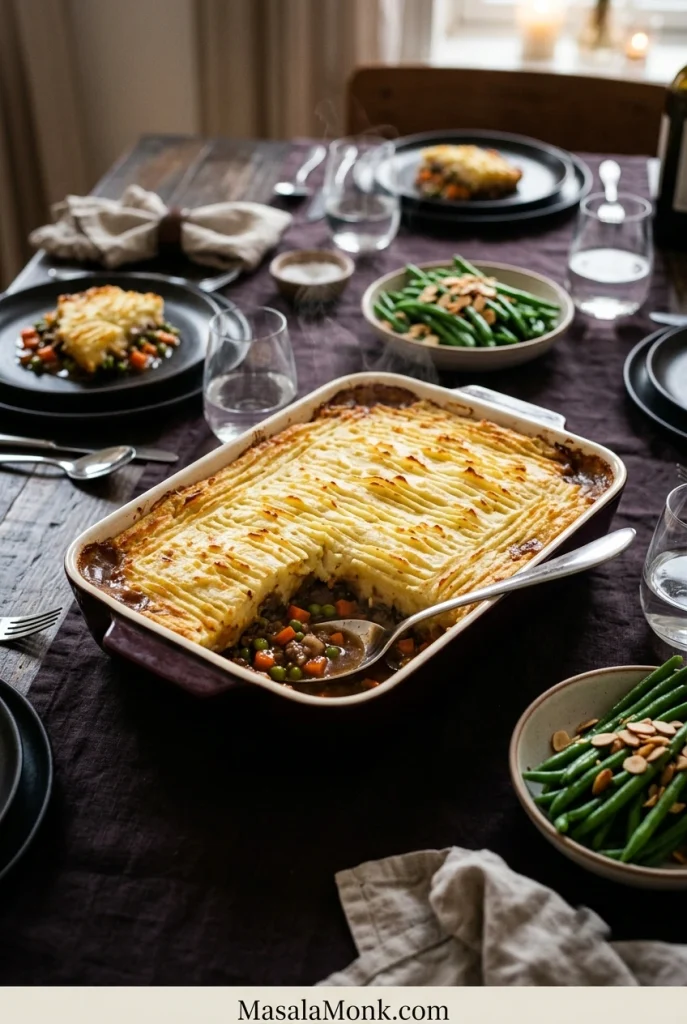
Shepherd’s pie in a glossy black-cherry casserole with golden fork-ridged mashed potatoes over ground lamb filling with carrots and peas, with a serving removed to show the layers.

A good spoonful of shepherd’s pie gives you creamy mashed potatoes, crisp golden ridges and rich lamb gravy that stays with the meat and vegetables underneath. The topping should hold its place without becoming stiff, while the filling stays saucy without running across the plate.

This easy shepherd’s pie recipe uses ground lamb, carrots and peas in a savory gravy, finished with a generous layer of buttery mashed potatoes. Most of the important work happens before the casserole reaches the oven: give the lamb some real color, let the gravy reduce, and keep the mash creamy without making it loose.

Shepherd’s pie traditionally uses lamb; make the same style of dish with ground beef and it becomes cottage pie.

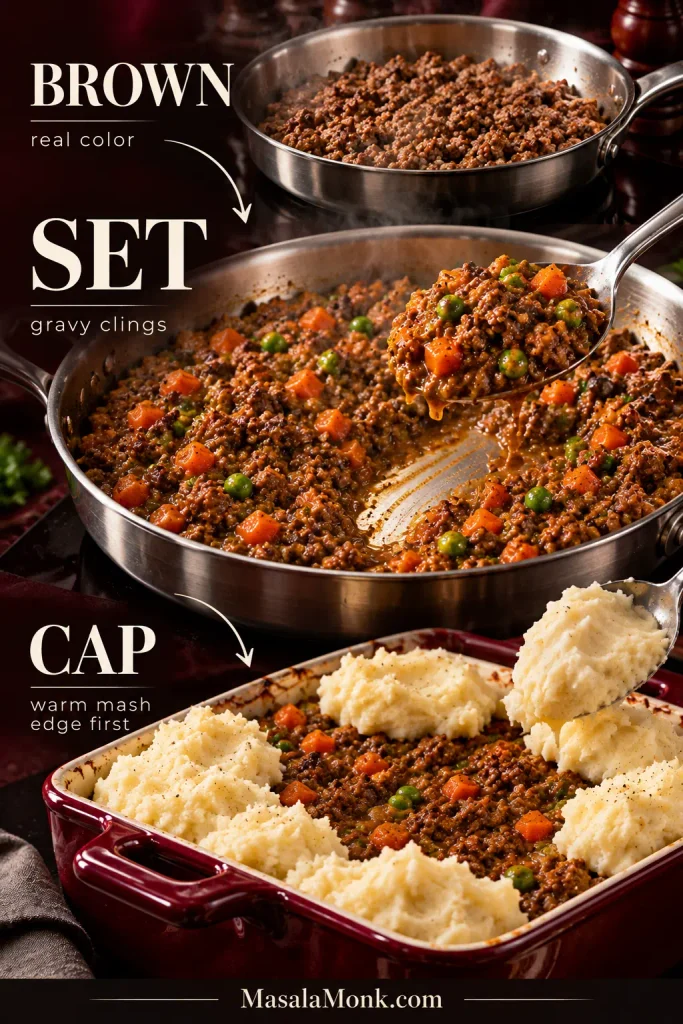
Brown. Set. Cap.

Three stages make the biggest difference to the finished pie.

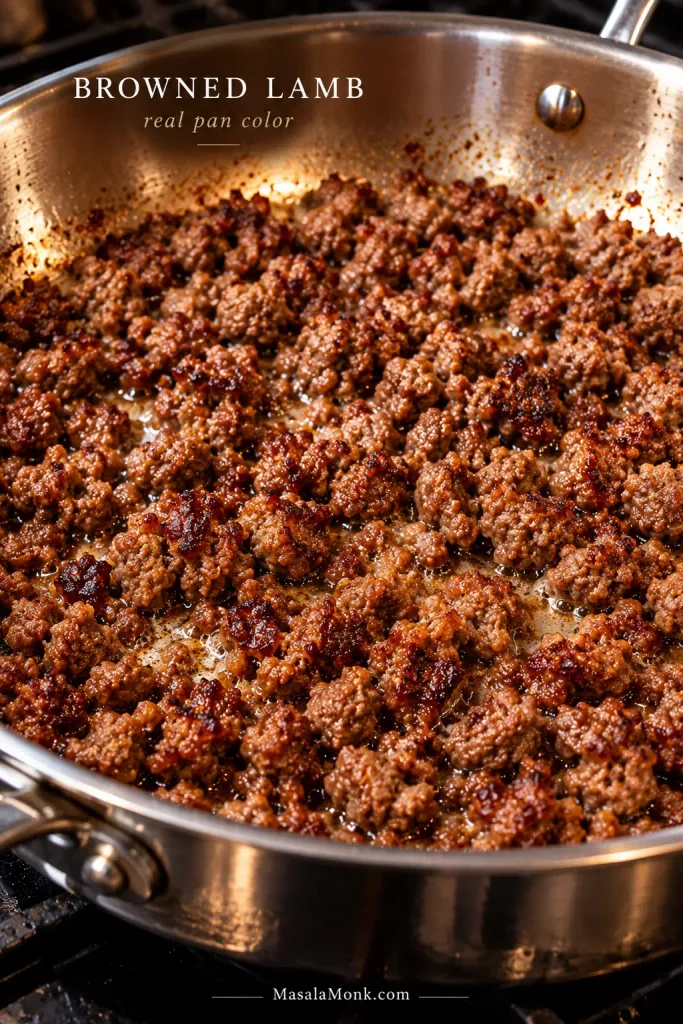
  • Brown: give the lamb enough uninterrupted pan contact to develop real color. Stir it constantly and it is more likely to steam.
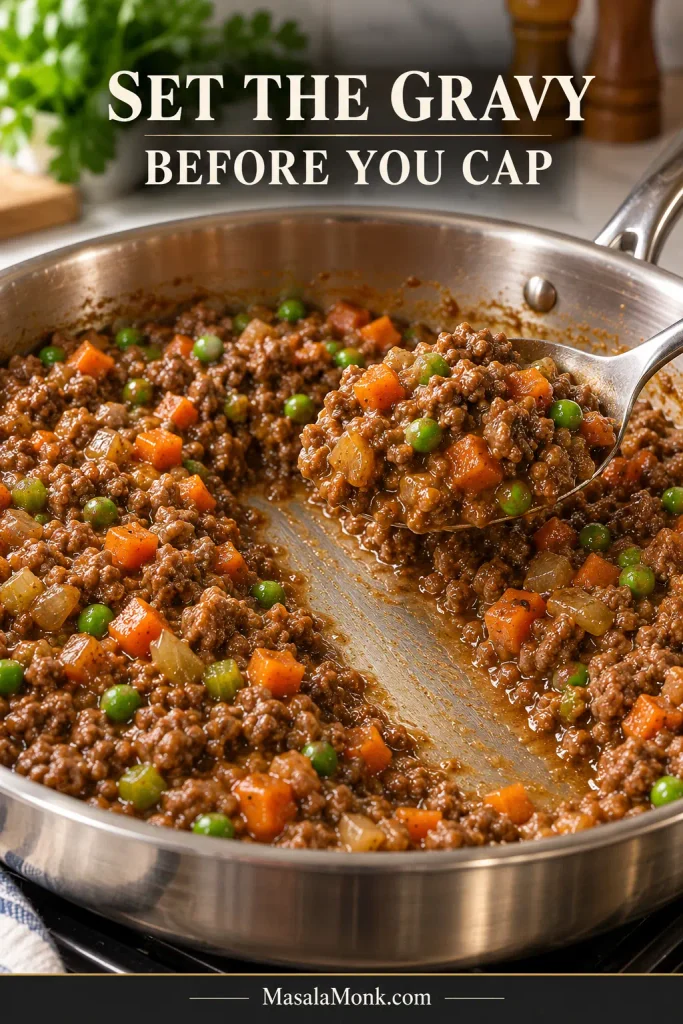
  • Set: finish the filling on the stovetop. The gravy should stay with the lamb and vegetables, with no loose liquid gathering underneath.
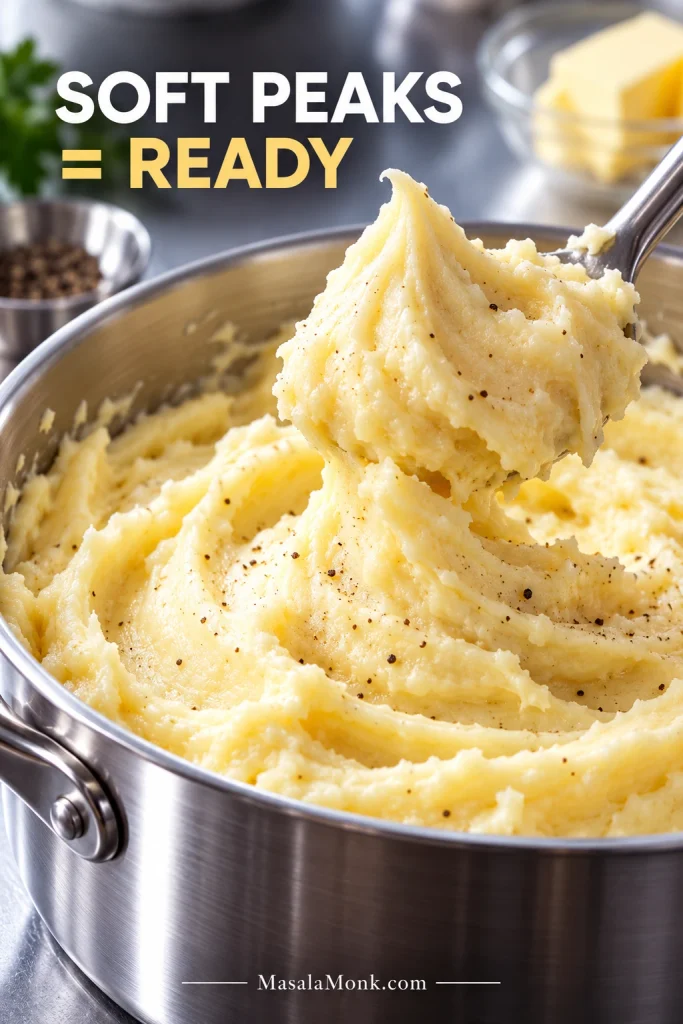
  • Cap: use warm mashed potatoes that spread easily but still hold their shape. Add them in smaller spoonfuls so you do not push them down into the filling.

Get those moments in place and the rest is mostly assembly, oven time and the patience to let the finished pie rest before you spoon into it.

Editorial cooking guide labeled Brown, Set and Cap, showing browned ground lamb, reduced lamb-and-vegetable gravy, and mashed potatoes being added around the casserole edge.
Use these as stop/go checks: pale lamb needs more pan time, loose gravy needs more reduction, and a very hot filling benefits from a brief pause before the mash goes on.

Ready to cook? Jump to the Shepherd’s Pie recipe.

Shepherd’s Pie Recipe

Easy Lamb Shepherd’s Pie

Ground lamb, carrots and peas in thick savory gravy, topped with creamy Russet potatoes and baked at 400°F / 200°C / 180°C fan for 25–30 minutes, until the filling bubbles and the top turns golden.

Serves
6 generous portions

Before Baking
About 40–45 minutes

Bake
25–30 minutes

Total
About 1 hour 15–30 minutes, including rest

Equipment

  • 12-inch / 30 cm skillet or wide sauté pan; if yours is smaller, brown the lamb in two batches
  • Large saucepan for the potatoes
  • Colander
  • Potato masher or ricer
  • 2½- to 3-quart / 2.4- to 2.8-L baking dish, such as a deep 9×9-inch casserole or another dish of similar capacity
  • Rimmed sheet pan if the casserole dish is fairly full

Lamb Filling

  • 1½ lb / 24 oz / 680 g ground lamb
  • 1 teaspoon olive oil, only if the skillet is dry after browning
  • 1 large yellow onion, finely diced
  • 2 medium carrots, diced small
  • 1 large celery rib, diced small
  • 3 garlic cloves, minced
  • 2 tablespoons / about 30 g tomato paste
  • 2 tablespoons / about 16 g all-purpose flour
  • ½ cup / 4 fl oz / 120 ml dry red wine, optional
  • 1¼ cups / 10 fl oz / 300 ml low-sodium beef or lamb stock
  • Additional ½ cup / 120 ml stock if omitting the wine
  • 1 tablespoon / 15 ml Worcestershire sauce
  • 1 teaspoon dried thyme
  • ½ teaspoon dried rosemary, crushed between your fingers
  • ¾ teaspoon fine salt, divided, plus more if needed
  • ½ teaspoon freshly ground black pepper, plus more to taste
  • 1 cup / about 140 g frozen peas

Mashed Potato Topping

  • 2 lb / 32 oz / 900 g Russet potatoes, weighed before peeling, peeled and cut into roughly 1½-inch / 4 cm chunks
  • 4 tablespoons / 2 oz / 57 g unsalted butter
  • ⅓ to ½ cup / 80–120 ml whole milk, warmed
  • ¾ teaspoon fine salt, plus salt for the cooking water and more if needed
  • Freshly ground black pepper
  • Optional: ¼ cup / about 25 g finely grated Parmesan or 1 tablespoon melted butter for the top

Instructions

Start the Potatoes and Brown the Lamb
  1. Start the potatoes. Put the potato chunks in a large saucepan and cover with cold water by about 1 inch / 2.5 cm. Salt the water generously. Bring to a boil, lower to a steady simmer and cook until a knife passes easily through the center, usually about 15–18 minutes once boiling. As soon as the potatoes are tender, drain them. Return them to the warm saucepan off the heat with the lid slightly ajar until you are ready to finish the mash.
  2. Brown the lamb. While the potatoes cook, heat a 12-inch / 30 cm skillet over medium-high heat. Add the lamb and spread it across the pan. Leave some areas alone long enough to develop brown patches, then break the meat apart and continue cooking until no raw meat remains. If the pan is crowded or the lamb is simmering in its own liquid, brown it in two batches.
  3. Adjust the fat. If a noticeable pool of lamb fat collects in the skillet, spoon off the excess and leave a thin coating behind. If the pan looks dry instead, add up to 1 teaspoon olive oil.
Build and Reduce the Lamb Filling
  1. Cook the vegetables. Add the onion, carrots, celery and ½ teaspoon of the filling salt. Cook for 6–8 minutes, stirring occasionally, until the onion is translucent and the carrots have started to soften. Add the garlic and cook for another 30 seconds.
  2. Build the base. Stir in the tomato paste, thyme and rosemary. Cook for about 2 minutes, until the paste darkens, smells sweeter and begins clinging to the lamb and vegetables. Sprinkle over the flour and cook for another minute.
  3. Add the liquids. If using wine, pour it in and scrape up the browned bits from the skillet. Let it bubble for 2–3 minutes, until the volume has reduced and the sharp wine smell has softened. Add the stock, Worcestershire sauce and black pepper. If you skipped the wine, add the extra ½ cup / 120 ml stock instead.
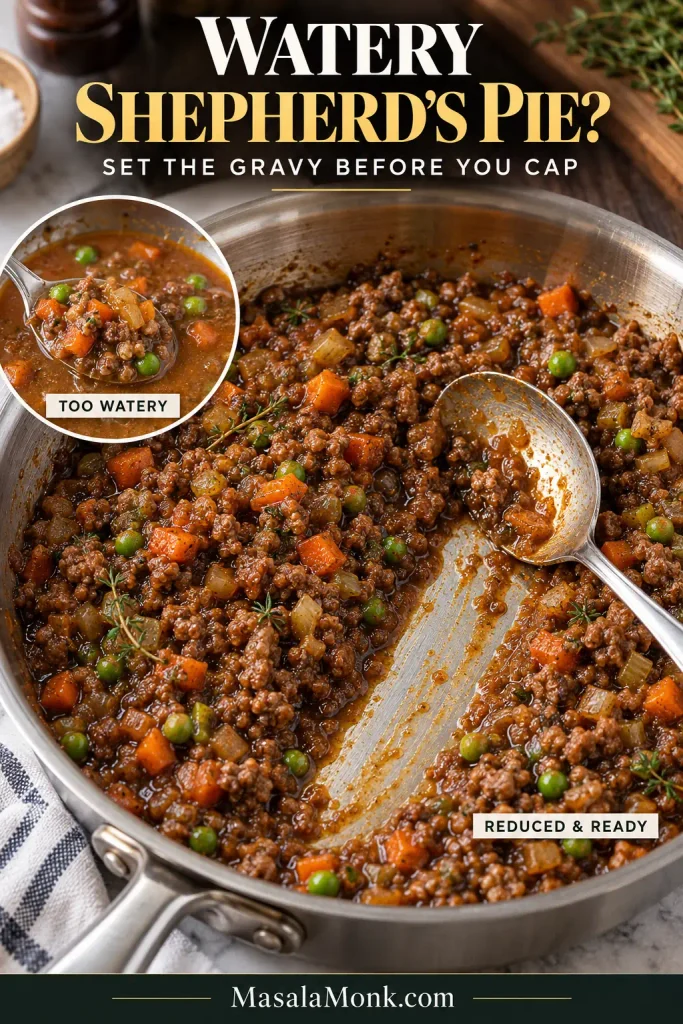
  4. Reduce the gravy and preheat the oven. Heat the oven to 400°F / 200°C / 180°C fan. Simmer the lamb mixture uncovered over medium to medium-low heat for roughly 8–12 minutes, stirring from time to time. A spoonful should sit in a soft mound, with the gravy staying around the meat and vegetables instead of quickly spreading into a watery ring. If it goes too far and starts looking dry, stir in stock 1–2 tablespoons / 15–30 ml at a time.
  5. Finish the filling. Stir in the frozen peas and cook for about 1 minute. Taste after the gravy has reduced and add the remaining ¼ teaspoon salt if needed, plus more pepper to taste. Transfer the filling to the baking dish if necessary and leave it to settle while you finish the potatoes. Once the gravy looks right, the hardest part is done.
Finish the Mash, Assemble and Bake
  1. Steam-dry the potatoes. Set the saucepan back over low heat for 1–2 minutes, shaking gently, until obvious surface moisture has steamed away.
  2. Make the mash. Add the butter, ¾ teaspoon salt and black pepper. Mash until smooth. Pour in the first ⅓ cup / 80 ml warm milk, then add more only if needed. Stop when the potatoes are creamy and spreadable but still hold soft peaks. If the mash feels stiff, add warm milk a tablespoon at a time.
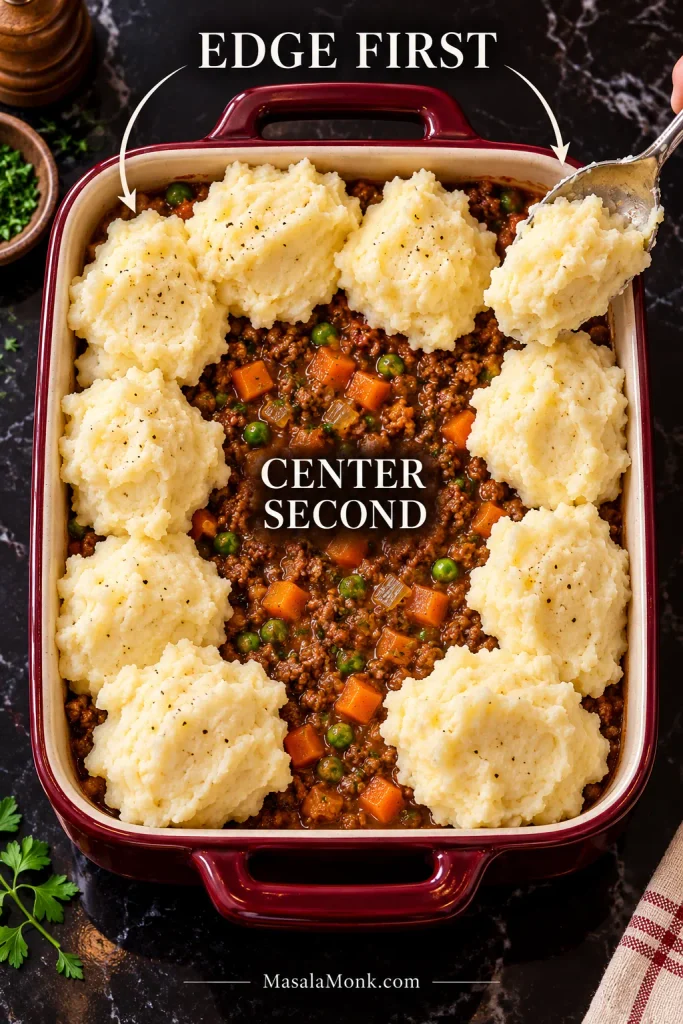
  3. Add the potato topping. Spoon small amounts of warm mash around the outside edge of the filling first, then distribute the rest across the center. Gently join the spoonfuls into a complete layer without pressing hard into the lamb. Run a fork over the surface to make ridges. Sprinkle with Parmesan, or lightly brush or drizzle the ridges with melted butter, if using.
  4. Bake. Set the casserole on a rimmed sheet pan if it is fairly full. Bake for 25–30 minutes, until the edges are bubbling, the center is thoroughly hot and the potato top is lightly golden. A little gravy bubbling up at one corner is fine. For more color, broil the top for 1–3 minutes if your baking dish is broiler-safe, watching constantly; otherwise leave it in the regular oven a few minutes longer.
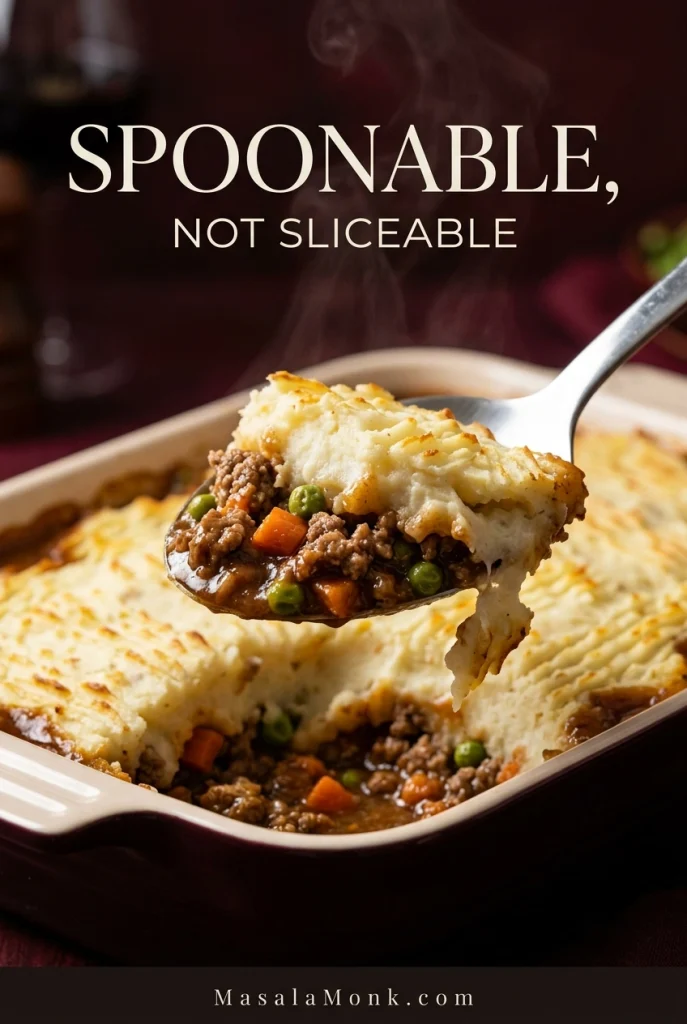
  5. Rest. Give the shepherd’s pie 10–15 minutes before serving. The bubbling settles and the gravy tightens just enough for the potato and lamb to come up together on the spoon. Do not expect perfectly cut squares; shepherd’s pie should still be softly spoonable.

Need help with texture or assembly? Read the Shepherd’s Pie Guide · Fix a problem.

Shepherd’s Pie Guide

The recipe gives you the method. What follows focuses on the choices that can actually change the finished pie—and the places where you have room to adapt.

Broad serving spoon lifting an irregular soft portion of shepherd’s pie, with golden mashed potato folding into ground lamb filling with carrots, peas and onions.
A slight slump is a good sign. The potato and lamb should travel together, then relax naturally on the spoon without leaving a watery puddle behind.

Lamb, Beef and What Makes It Shepherd’s Pie

In the traditional distinction, shepherd’s pie uses lamb and cottage pie uses beef. The cooking method is otherwise very similar.

American recipes often use “shepherd’s pie” more loosely for the beef version, so both names turn up for very similar casseroles. Lamb is the first choice here because its richer flavor works particularly well with rosemary, thyme and Worcestershire.

Side-by-side comparison of shepherd’s pie made with ground lamb and cottage pie made with ground beef, each finished with a golden mashed potato topping.
The meat changes the name, but the same pan checks still matter. Whether you use lamb for shepherd’s pie or beef for cottage pie, check the rendered fat after browning and reduce the gravy until it clings to the meat.

If ground beef is what you have, use the same amount. For a beef-first version built around the slow cooker, try our slow cooker cottage pie.

Shepherd’s Pie Ingredients

Ground lamb gives the pie its identity. Onion, carrot, celery and garlic build the savory base. Use ground or minced lamb here; whole lamb shoulder is better suited to a slow cook such as Irish stew.

Tomato paste adds concentration without turning the filling into tomato sauce. Worcestershire sauce deepens the lamb gravy, while rosemary and thyme suit the meat without overwhelming it.

Two tablespoons of flour help give the gravy body. The rest comes from simmering until the liquid has reduced around the lamb. The wine is optional; stock works perfectly well in its place. Add the peas once the gravy is ready—they only need time to heat through.

For the topping, Russet potatoes are the better fit because they cook up fluffy and keep the mash relatively light. Yukon Golds still work if you prefer a denser, naturally buttery topping. Butter adds richness; add the milk gradually to control the texture. Parmesan is optional, adding saltiness and helping the top brown.

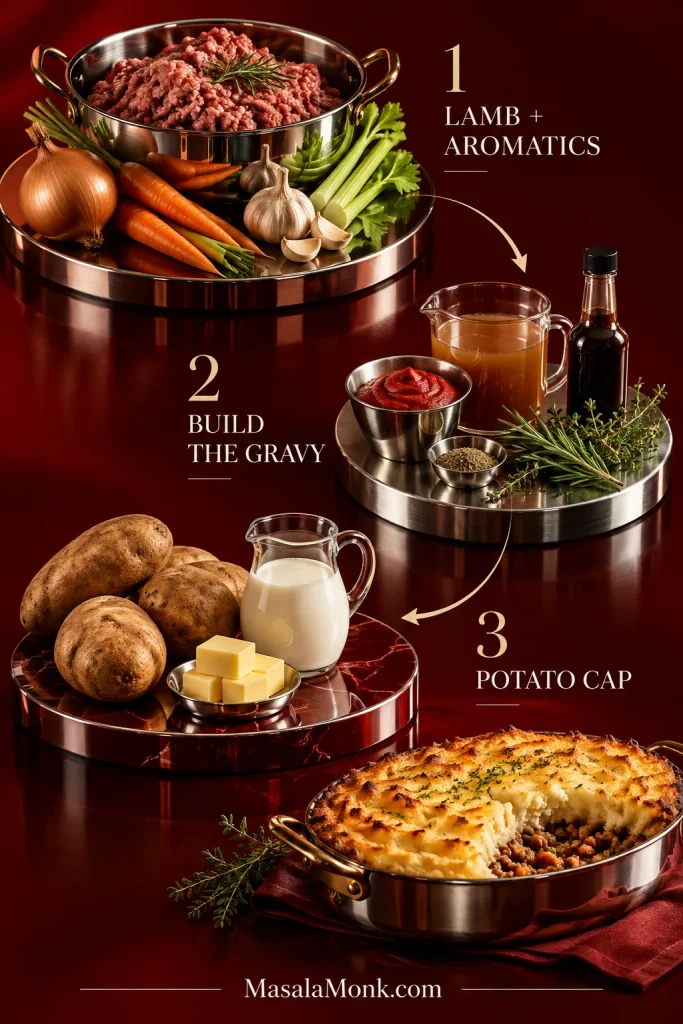
Editorial ingredient layout showing ground lamb with onion, carrot, celery and garlic; gravy ingredients including tomato paste, stock and herbs; and potatoes with butter and milk.
Not every shepherd’s pie ingredient has the same job. Lamb and aromatics build the savory base, flour plus reduction control the gravy’s body, and potatoes, butter and milk create the cap. Wine mainly changes flavor, while Parmesan adds saltiness and can help the ridges brown.

Build a Filling That Can Hold the Mash

Pan width changes how quickly moisture escapes. A crowded skillet makes lamb simmer; a wide one gives the meat room to brown and makes the gravy easier to control. The lamb and vegetables also release different amounts of liquid from batch to batch, so resist adding extra stock simply for “more gravy.”

Small irregular ground lamb crumbles browning in a stainless-steel skillet, with darker caramelized patches on meat touching the pan.
Brown patches are enough; every crumble does not need to turn dark. When the wet simmering sound gives way to a drier sizzle and caramelized spots appear, move on while the lamb is still tender.

When the Gravy Is Ready

What the filling looks likeWhat to do
Loose gravy gathers around the meatKeep simmering uncovered.
The lamb is coated in glossy gravy and a spoonful holds togetherReady for the baking dish.
The mixture looks dull or crumblyStir in a small splash of stock.
Ground lamb, carrots, peas and onions in reduced mahogany gravy, with a spoon trail exposing the stainless-steel skillet and a cohesive spoonful lifted above it.
Tilt the skillet slightly. Properly reduced shepherd’s pie filling should move as a cohesive mass while the gravy stays with the lamb instead of racing toward the low side. That movement is often a better stopping cue than the clock.

Keep enough gravy to stay rich beneath the potatoes when you spoon into the pie.

Mash That Spreads Without Slumping

The topping needs to spread easily while still holding soft peaks. Steam-drying the potatoes matters because surface water loosens the mash before any milk goes in; from there, add warm milk gradually and stop while the potatoes still hold their shape.

Creamy mashed potatoes in a metal saucepan holding a soft curved peak, showing the spreadable consistency used for shepherd’s pie topping.
Drop a spoonful of mash back into the pan. It should mound, then bend gently at the tip rather than spreading flat. That texture is soft enough to cover the filling but firm enough to hold fork ridges.

Use a masher or ricer. A blender or food processor can overwork the starch and turn the potatoes gluey.

For more detail on potato varieties, dairy and texture, see our guide to creamy mashed potatoes.

You should now have two good things on their own: rich lamb filling and warm, buttery mash. Assembly is gentle rather than technical.

Assembling and Baking the Pie

Let the filling settle while you finish the mash, and keep the potatoes warm. Cold mash gets stiff and needs more pressure to spread.

Place smaller spoonfuls around the perimeter first, then cover the center. Join them gently with the back of a spoon or spatula and take the potatoes right to the edge of the dish.

Warm mashed potatoes being spooned around the outside edge of a black-cherry casserole filled with ground lamb, carrots and peas while the center remains uncovered.
The first ring of mash gives you something to work against. Join the center with a lighter touch and the lamb stays underneath instead of streaking through the potatoes.

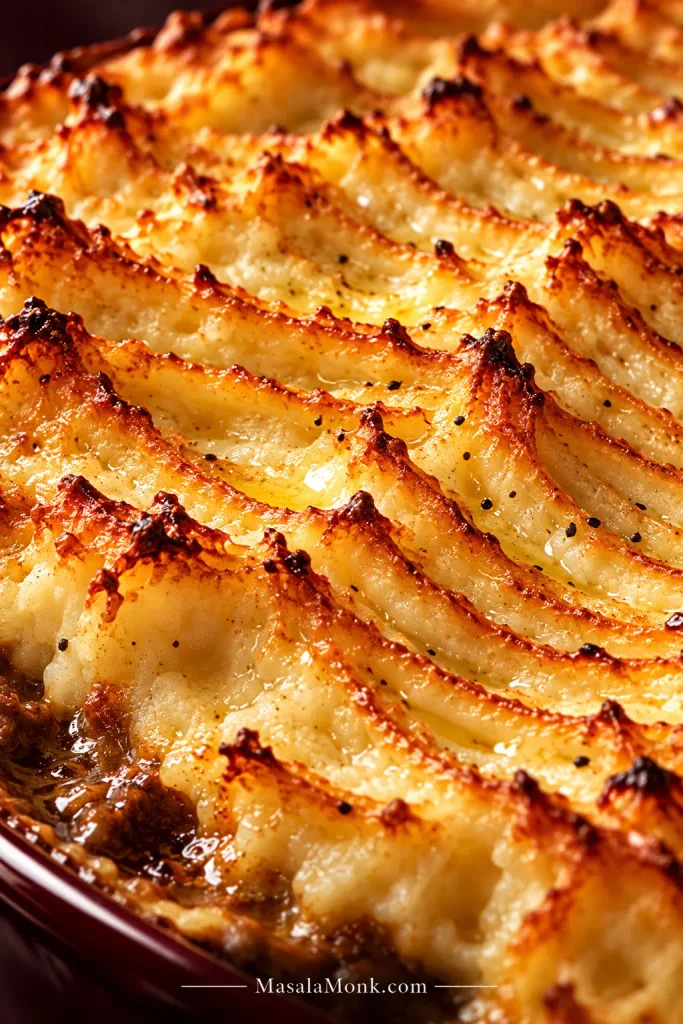
Do not chase a perfectly smooth top. Fork ridges give you more golden, toasted edges while the mash underneath stays creamy.

Close view of mashed potato topping with overlapping dinner-fork grooves, golden-brown raised ridges and pale creamy valleys on baked shepherd’s pie.
Deeper grooves leave creamy valleys while the thin raised peaks catch more heat, giving you toasted edges without drying the mash underneath.

Leave enough room at the top of the casserole for the filling to bubble. A 2½- to 3-quart / 2.4- to 2.8-L dish gives this batch the space it needs without being packed right to the rim.

What the Finished Layers Should Look Like

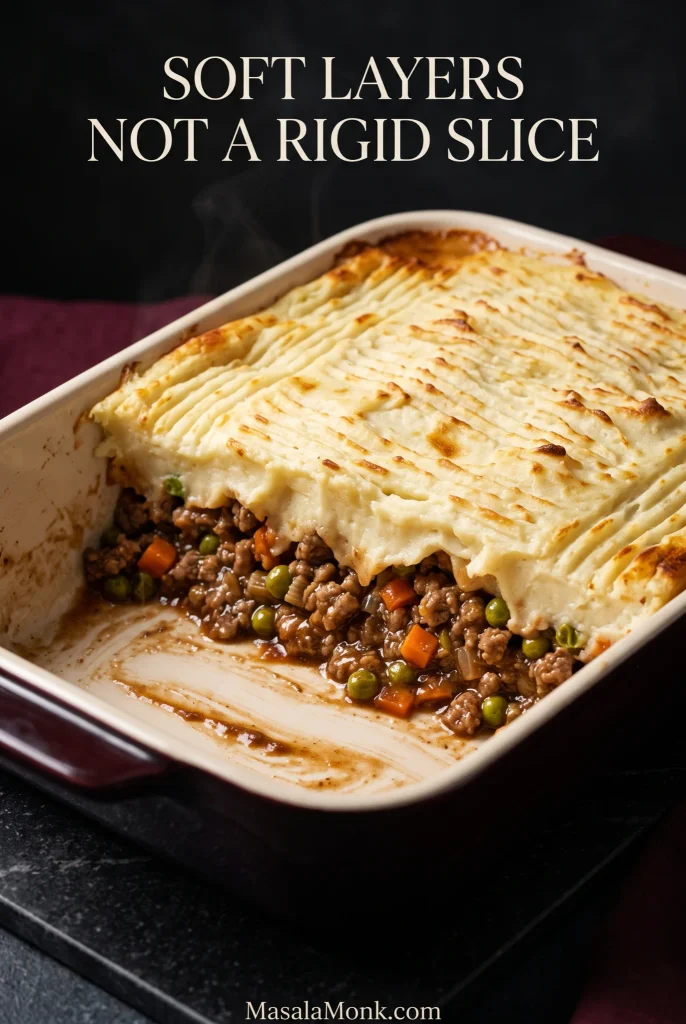
A finished serving should show a generous potato cap with slightly more lamb filling underneath. The layers should stay recognizable, but the mash should relax over the cut edge rather than stand like a rigid wall.

Open serving cavity in a black-cherry shepherd’s pie casserole showing creamy mashed potato above a deeper ground lamb filling with carrots and peas.
Look for a substantial potato cap over a generous layer of lamb filling. The mash should relax at the cut edge rather than stand like a rigid wall.

Shortcuts and Substitutions

For a faster weeknight version, replace the carrots and peas with a frozen peas-and-carrots mix and start with leftover or refrigerated mashed potatoes. You still make the lamb gravy from scratch, but you skip the potato prep and some of the chopping.

Shortcut or swapWhat to change
Ground beefUse the same amount and method. The finished dish is cottage pie.
No wineReplace the ½ cup / 120 ml wine with the same amount of additional stock.
Frozen peas and carrotsUse about 2 cups frozen peas and carrots in place of the fresh carrots and frozen peas. Add them during the final 4–5 minutes of filling preparation and simmer until the carrots are hot and tender and any extra water has cooked away.
Leftover or refrigerated mashed potatoesWarm until spreadable; add only a small splash of milk if stiff.
Instant mashed potatoesPrepare them slightly firmer than you would for serving on the side.
Oven-safe skilletSkip the transfer if the skillet is deep enough to hold the filling and mash with some headroom left at the top.

Ground Lamb or Leftover Roast Lamb

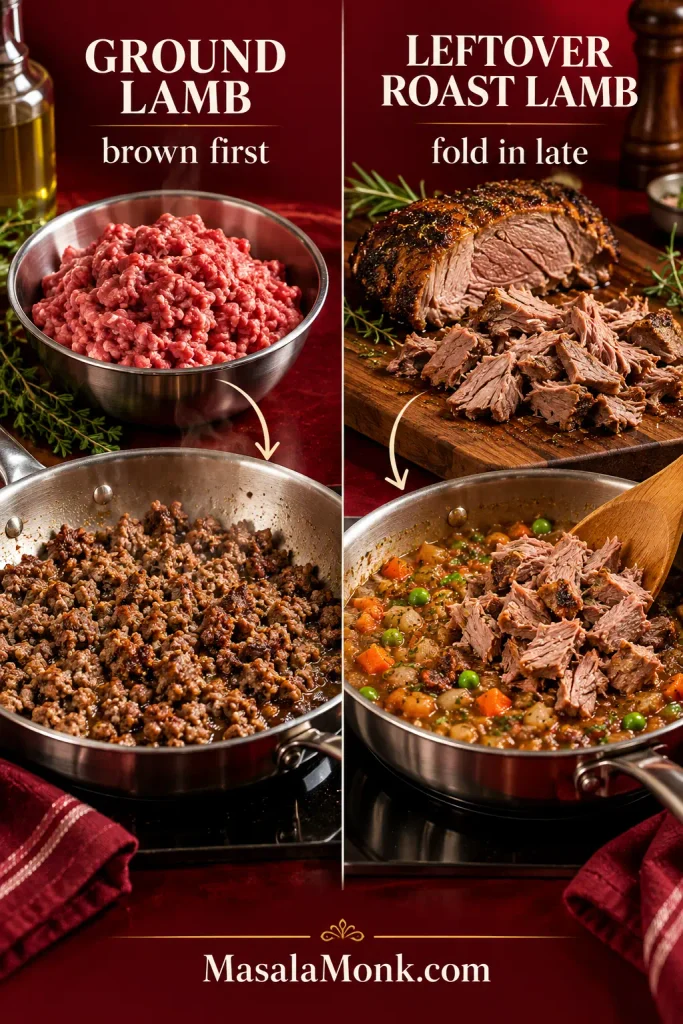
Already-cooked lamb needs a gentler route. Start the vegetables in about 1 tablespoon olive oil, build and reduce the gravy, then fold in 18–21 oz / 500–600 g chopped or shredded cooked lamb near the end. Leftover roast leg of lamb works particularly well; there is no need to brown the cooked meat again.

Comparison showing raw ground lamb becoming browned crumbles in a skillet and chopped cooked roast lamb being folded into an already-prepared vegetable gravy.
Raw ground lamb needs its browning stage; cooked roast lamb has already had that heat. Build and reduce the gravy first, then fold leftovers in only long enough to warm through.

For a meat-free version, do not replace the lamb with dry lentils and leave everything else unchanged. Lentils absorb liquid differently and need their own cooking method. Our lentil shepherd’s pie is built around that balance.

Make Ahead, Freeze and Reheat

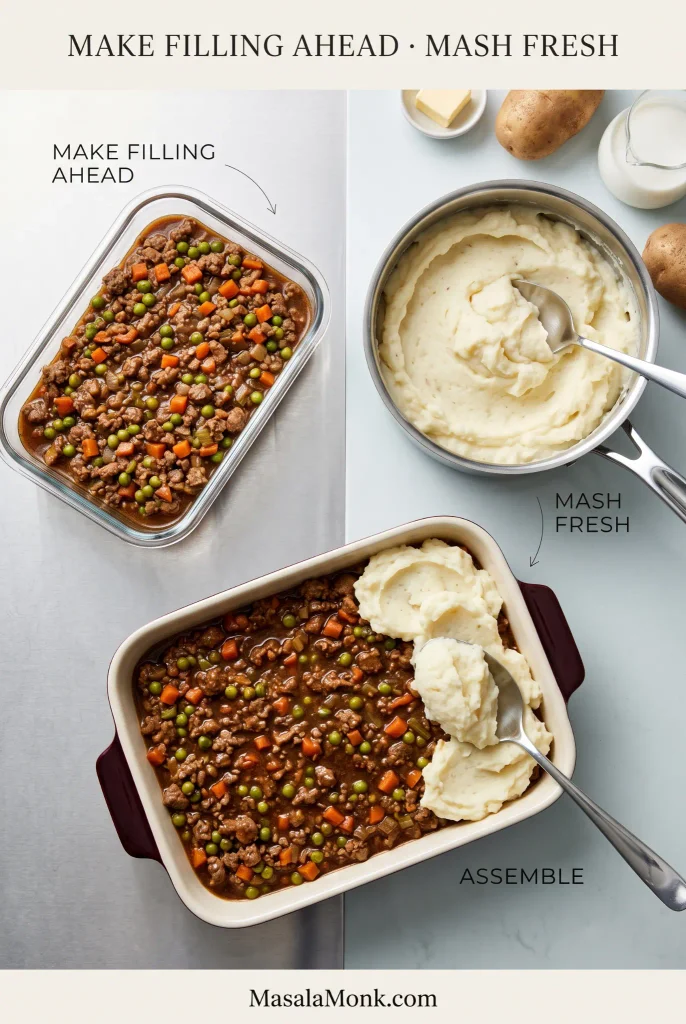
For the best texture, make the filling ahead and the mash fresh. Transfer the cooked lamb filling to a shallow container and refrigerate it promptly rather than leaving it on the counter to reach room temperature. When you are ready to eat, make the mashed potatoes, assemble the pie and bake. Starting with cold filling usually adds about 10–15 minutes; use bubbling edges and a center that reaches 165°F / 74°C as the final cues.

Overhead workflow showing cooled ground lamb filling in a shallow glass container, fresh mashed potatoes in a stainless saucepan, and mash being added to a black-cherry casserole.
For the best make-ahead texture, chill the cooked filling promptly, then make the potatoes fresh when you are ready to assemble. You get the convenience of advance prep without storing the finished potato cap overnight.

Assembled Pie, Freezer and Leftovers

If dinner is tomorrow, cool the filling promptly in a shallow container first. Once chilled, assemble the pie with the mashed potatoes, cover and refrigerate for up to a day. Bake from chilled, allowing roughly 10–15 extra minutes and using bubbling edges plus a 165°F / 74°C center as the final cues. Use bakeware rated for refrigerator-to-oven temperature changes, or follow the manufacturer’s instructions.

For longer storage, freeze before the final bake. Cool the filling promptly in a shallow container, assemble the pie, then refrigerate until cold. Wrap well and freeze for up to about 2 months for the best potato texture. Thaw overnight in the refrigerator and bake as a chilled assembled pie. Freezing can soften the mash somewhat, so refrigeration is the better choice when you only need to work a day ahead.

Leftovers: refrigerate promptly in a covered container and use within about 3–4 days. Microwave individual portions, or reheat a larger amount covered in the oven until the center reaches 165°F / 74°C. For oven reheating, uncover near the end to dry the potato top and regain some color. The USDA recommends reheating leftovers to 165°F / 74°C.

Troubleshooting Shepherd’s Pie

Watery Filling: Check the Movement

Before changing the heat or adding more thickener, look at how the gravy moves around the lamb. The pan itself gives you a quick consistency check.

Troubleshooting image comparing loose watery shepherd’s pie filling with reduced ground lamb filling that holds together and leaves a defined spoon trail in the skillet.
If the sauce runs ahead of the lamb, keep simmering uncovered until the gravy moves with the filling. Judge that change in the pan rather than adding more thickener simply because the clock says it should be ready.

Other Shepherd’s Pie Problems

What you seeLikely reasonWhat to do
Sinking potato toppingThe filling was very hot or loose, or the mash was too soft.Let the filling settle for a few minutes and use mash that still holds soft peaks.
Gravy breaking through the topThe filling is loose or there are gaps in the potato layer.Reduce the gravy fully and spread the mash right to the edge of the dish.
Greasy fillingThe lamb released more fat than the filling needed.Spoon off obvious pooling fat after browning.
Gluey mashThe potatoes were overworked.Use a masher or ricer instead of a blender or food processor.
Pale toppingThe surface is very smooth or needs stronger top heat.Add fork ridges. If the dish is broiler-safe, broil for 1–3 minutes once the casserole is already hot.
Pie spreads when servedThe filling may be loose, or the pie was served immediately.Give it the full 10–15 minute rest. It should be softly spoonable, not stiff enough to cut like lasagna.
Cold center when reheatingThe center is heating more slowly than the surface.Thaw frozen pies overnight when possible and cover the top loosely with foil while the middle catches up.

If the Pie Is Already Baking

If the pie is already in the oven and you realize the filling was looser than it should have been, do not keep turning up the heat. Let it finish and give it the full resting time. It may be softer on the plate, but dinner is hardly ruined.

Problem solved? Back to the recipe · Back to the top.

What to Serve with Shepherd’s Pie

Good sides for shepherd’s pie include green beans, roasted Brussels sprouts, broccoli or a sharp leafy salad. Because the pie already brings meat, potatoes, vegetables and gravy to the plate, a lighter side usually works better than another rich dish.

Finished shepherd’s pie in a glossy black-cherry casserole on an elegant dinner table with golden mashed potato topping, serving spoon, green beans, plates and glassware.
Push a broad spoon through the potato to the base, then scoop underneath. Each serving gets browned ridges, creamy mash and rich lamb filling instead of mostly potato from the surface.

Green Beans Almondine are a particularly good match because the beans keep some bite while lemon and toasted almonds cut through the lamb and potatoes.

Roasted Brussels Sprouts bring crisp browned edges and a slight bitterness that works well beside the lamb gravy.

For something lighter, a simple leafy salad with a sharp vinaigrette is plenty.

After the rest, bring the casserole to the table while the potato ridges are still crisp at the edges and the lamb gravy underneath is rich and steaming.

Brown the lamb. Set the gravy. Cap it gently. Get those three stages right and the gravy stays with the meat, the potatoes stay on top, and every spoonful gets a little of both.

↑ Back to the recipe · ↑ Back to the top

Posted on — Leave a comment

Meatball Recipe: Juicy, Tender & Easy

Four baked beef meatballs sitting in chunky red marinara, lightly topped with grated Parmesan and chopped parsley in a dark shallow bowl.

A good meatball has to survive quite a bit of handling. You scoop it, roll it, move it to the pan and often add sauce later. After all that, you still want a savory meatball with a juicy, fork-tender middle.

This meatball recipe uses 80/20 ground beef, milk-softened panko, grated onion, Parmesan, garlic and herbs for easy homemade meatballs with a familiar Italian-American flavor. The all-beef mixture bakes at 400°F / 205°C on one sheet pan, with no need to fry the meatballs in batches.

Quick texture check: the raw beef mixture is soft enough to scoop but stays together when gently pressed. Once shaped, each meatball stays round without feeling hard. After baking to 160°F / 71°C, look for a moist middle that yields easily to a fork.

Juicy, Tender Baked Meatballs

Tender all-beef meatballs baked together on one sheet pan, with a juicy center and enough structure to hold up in sauce.

Yield
About 16 meatballs

Portion
About 42 g / 1½ oz each

Prep
About 20 minutes

Oven
400°F / 205°C

Bake
16–22 minutes

Total
35–45 minutes

What You’ll Need

Use a large mixing bowl, rimmed metal baking sheet and parchment paper. For prep, have a box grater with large holes for the onion, a fine grater or Microplane for the garlic, a cookie scoop or spoon, and an instant-read thermometer. A digital kitchen scale makes evenly sized meatballs especially easy, but it is optional.

Ingredients

  • ½ cup plain panko breadcrumbs — about 30 g
  • ¼ cup whole milk — 60 ml
  • 1 large egg
  • ¼ cup grated yellow onion — about 40 g, including its juice
  • 2 garlic cloves — about 6 g, finely grated or minced
  • ⅓ cup finely grated Parmesan — about 30–35 g
  • 2 tablespoons finely chopped fresh parsley — about 8 g
  • 1 teaspoon dried oregano or Italian seasoning
  • 4.5 g salt — roughly 1½ teaspoons Diamond Crystal kosher salt, 1 teaspoon Morton kosher salt, or ¾ teaspoon fine salt
  • ½ teaspoon freshly ground black pepper
  • 1 lb / 16 oz / 454 g 80/20 ground beef

Method

Prep and Mix the Meatball Base

  1. Heat the oven. Set a rack in the center and preheat to 400°F / 205°C. Line a large rimmed metal baking sheet with parchment paper.
  2. Soften the panko. Stir the breadcrumbs and milk together in the mixing bowl. Leave them for about 5 minutes, until evenly softened with no puddle of loose milk underneath.
  3. Build the flavor base. Mix in the egg, grated onion and its juice, garlic, Parmesan, parsley, oregano, salt and black pepper.
  4. Add the beef last. Mix with clean hands or a fork just until the softened breadcrumbs and flavorings are evenly distributed and the mixture comes together enough to portion. Stop there. It should still look like ground beef, not a smooth paste.

Unsure about the seasoning? Cook a teaspoon-size piece of the mixture through in a small skillet before shaping the rest. Taste it and adjust the bowl while you still can.

Portion, Shape and Bake

  1. Divide into about 16 portions. Aim for roughly 42 g / 1½ oz each. Without a scale, divide the mixture into four rough sections and then divide each section into four.
  2. Shape the meatballs. Lightly dampen your hands if needed, then roll each portion a few times until it is round and stable. Avoid squeezing it into a hard ball.
  3. Arrange them on the pan. Leave roughly 1–2 inches / 2.5–5 cm between the meatballs so hot air can move around them.
  4. Bake and start checking at 15–16 minutes. Meatballs this size usually finish in 16–22 minutes at 400°F / 205°C, depending on your oven and how cold the mixture was when it went in. There is no need to flip them.
  5. Check one of the larger meatballs. Insert an instant-read thermometer into the center. Ground-beef meatballs are safely cooked when they reach 160°F / 71°C. The timer tells you when to check; the thermometer tells you when to stop.
  6. Serve while hot. If fully cooked meatballs are going into sauce, fold them through gently and avoid another long simmer.

Recipe Notes

  • 85/15 ground beef also works. If you go leaner than that, pay especially close attention to the internal temperature.
  • A little stickiness is normal. When a scooped portion stays together, use damp hands before reaching for more breadcrumbs.
  • For a mixture that truly will not hold its shape, chill it for 15–20 minutes. If it remains unusually loose, add plain panko about 1 tablespoon at a time.
Unsauced baked beef meatballs spaced apart on parchment paper in a rimmed metal baking sheet, showing varied golden-brown surfaces and small rendered-juice marks.
A few darker ridges and lighter patches are normal across a sheet pan of baked meatballs. What matters more for even cooking is keeping the portions close in size.

Cut One Open Before You Add the Sauce

After one of the larger meatballs reaches 160°F / 71°C, cut it in half while it is still hot. The center should look moist and juicy, with the irregular crumb of ground meat instead of a tight, sausage-like texture.

Try a piece with a fork. It gives easily but stays together as you lift it. Then taste it plain. Savory beef comes first, followed by Parmesan, garlic, onion and herbs—not a meatball waiting for sauce to rescue it.

Baked meatball cut open to show a fully cooked, moist, irregular ground-beef crumb, with a fork lifting a tender piece; text reads “Juicy, not dense.”
An uneven cut face is a good sign here: small pockets and irregular strands can still form a meatball that stays intact when lifted. In other words, tender does not mean loose, mushy or falling apart.

Most of that tender texture was decided before the pan ever reached the oven.

If the center looks tight, jump back to mixing and shaping. For a doneness question, see meatball size, oven temperature and doneness.

Why These Meatballs Stay Tender

Tender meatballs start with enough fat, softened breadcrumbs and a light hand with the beef.

The Beef and Breadcrumbs Do Different Jobs

80/20 ground beef brings enough fat to keep an all-beef meatball rich and forgiving. An 85/15 grind works too; leaner beef gives you less room to overcook the center without noticing dryness.

The panko has a different job: holding moisture in the mixture. Softening it with milk before the beef goes in means the crumbs are already hydrated instead of acting like dry filler. We use the same milk-softened breadcrumb idea in our meatloaf recipe.

Grated Onion Melts Into the Meatball

Larger pieces of raw onion can stay crunchy during a short bake. Grating the onion on the large holes of a box grater spreads its juice and flavor through the beef, where it softens into the meat instead of leaving noticeable chunks.

Softened panko in a bowl beside yellow onion grated on the large holes of a box grater, with wet grated onion and its juice visible; instructional text explains the two techniques.
Look for two different prep textures: panko that is evenly damp but still recognizable as breadcrumbs, and onion that is wet and pulpy from the box grater. Once both are ready, they blend into the beef far more evenly.

Season the Meatball, Not Just the Sauce

Parmesan, garlic, onion, parsley and oregano give the meatballs their familiar savory flavor. Marinara should add tomato and acidity to a meatball that already tastes good on its own, not provide all of the flavor.

Mixing and Shaping Without Making Them Dense

The goal is simple: spread the softened breadcrumbs and flavorings through the beef without working it into a smooth paste. Stop while the mixture still has the loose, irregular look of ground meat.

Use the same light touch when shaping. Scoop a portion, roll it a few times between damp palms and put it on the sheet pan. It only needs enough pressure to stay round and make the trip to the oven intact.

Hands gently rounding a raw beef meatball beside a digital kitchen scale reading 42 g; text reads “42 g / 1½ oz” and “Round it—don’t pack it.”
Use the first 42 g / 1½ oz portion as a visual reference for the rest of the homemade meatballs. After that, matching by eye is faster than weighing every piece while still keeping the batch in a similar cooking range.

Meatball Size, Oven Temperature and Doneness

Even portions matter more than one exact minute count. Treat the times below as a checking window, then use the center temperature to decide when the batch is done.

For this batchTarget
PortionAbout 42 g / 1½ oz
Oven400°F / 205°C
Start checking15–16 minutes
Typical window16–22 minutes
Ground-beef center160°F / 71°C
Instant-read thermometer inserted from the side into the center of an unsauced baked meatball on parchment, with a reading of 160°F / 71°C.
Insert the thermometer from the side toward the thickest center of one of the larger baked meatballs. That angle makes it easier to measure the meat rather than the hot baking pan, while 160°F / 71°C gives you the ground-beef endpoint.

Smaller meatballs finish sooner; larger ones need more time for heat to reach the middle. Oven calibration, pan material and how cold the mixture is can shift the timing too.

USDA ground-beef guidance specifically includes meatballs among foods that should reach 160°F / 71°C. A thermometer is more reliable than judging doneness by color.

When Meatballs Fall Apart—and Other Fixes

Where the problem appears tells you a lot. A portion that falls apart in your hands can have a different problem from a baked meatball that only begins to crumble after it reaches the sauce.

What happensWhat to check
Falls apart while shapingMake sure the beef has been mixed enough for a portion to stay together. If it feels unusually loose, chill it before adding more breadcrumbs.
Breaks during frying or raw-in-sauce cookingThe outside may be getting moved before it has had time to set. Leave the first surface alone a little longer.
Breaks after entering sauceHandle the cooked meatballs gently. Spoon sauce around them instead of repeatedly stirring the pot.
Dry or crumblyVery lean beef, too many dry breadcrumbs or cooking well beyond the target temperature are the first things to check.
Dense or springyThe beef may have been mixed until very smooth or the portions packed too firmly.
Good texture but blandCheck the salt first, followed by Parmesan, onion, garlic and herbs. A cooked tester lets you adjust the bowl before shaping the rest.
Two cooked meatball halves compared side by side: the tender half has a more irregular open crumb, while the dense half has a tighter compact interior; both are labeled.
The cut face tells you more about handling than the crust does. A tender meatball keeps an irregular, slightly open structure, whereas a dense one looks noticeably finer and more compressed from edge to center.

What If the Meatballs Are Pale?

A properly cooked meatball does not need a dark crust to be good. Parchment, spacing, pan material and individual ovens all affect how much browning you see.

Two unsauced baked meatballs on a light metal surface, one pale golden-brown and one more deeply browned, with text explaining that pale meatballs can still be done.
Both meatballs can be properly cooked even when one develops much more color. Use browning as a clue about surface flavor and roasting—not as proof that the middle has reached a safe temperature.

If stronger color matters, move the meatballs to an unlined broiler-safe metal pan near the end of cooking and broil them very briefly while watching closely. Check the center again afterward. Once the meatballs are fully cooked, there is little reason to keep heating them simply to make the outside darker.

Browning is a finish—not a rescue.

Other Ways to Cook and Sauce Meatballs

Baking remains the easiest default because the whole batch cooks together with very little handling. For a classic red-sauce dinner, heat the sauce separately and spoon it over the meatballs, or fold them through just before serving. Our marinara sauce recipe gives you a simple homemade option.

Pan-fry them if you want a deeper crust; the tradeoff is oil, batches and more turning. Let the first side set before trying to move the meatballs.

You can also cook raw meatballs directly in gently simmering sauce. They are especially delicate at the beginning, so give them time to set before moving them around and verify doneness with a thermometer.

Fork lifting a baked meatball partly coated in chunky red marinara above more sauced meatballs, finished lightly with Parmesan and parsley.
The craggy baked surface gives marinara plenty of places to cling, so the sauce can coat the meatball without completely masking its browned exterior. As a result, you still get both roasted beef flavor and tomato in the same bite.

Useful Variations

Beef and pork: replace 4–8 oz / 115–225 g of the beef with ground pork while keeping the total ground-meat weight at 1 lb / 454 g. Pork changes the flavor and can add richness depending on its fat content; the all-beef version does not depend on pork for tenderness.

Other breadcrumbs: fine dry or gluten-free breadcrumbs may work, but they do not absorb milk exactly like panko. Do not assume a straight volume swap. Soften them first, then add crumbs or milk in small amounts if the mixture is clearly too loose or too stiff. Panko remains the most predictable choice for this version.

Egg-free and poultry versions need their own adjustments. Removing the egg changes both moisture and structure. Ground chicken and turkey have different fat and moisture profiles from 80/20 beef and work better in recipes designed around poultry; ground poultry must reach 165°F / 74°C.

What to Serve With Meatballs

Serve them with marinara and spaghetti, tuck them into a toasted roll with sauce and melted cheese, or spoon them over creamy mashed potatoes. A simple vegetable or salad is plenty alongside.

Toasted split roll filled with three baked beef meatballs, marinara and melted cheese, finished with a little grated Parmesan and parsley.
Toast the roll before building a meatball sub; the crisp interior gives the bread more time before hot marinara begins to soften it. Then add enough sauce to coat the meatballs without flooding the bottom of the sandwich.

Make Ahead, Freeze and Reheat

Make ahead or freeze raw: shape the meatballs, cover the tray and refrigerate for up to 1 day before baking. For longer storage, freeze the shaped meatballs on a parchment-lined tray until firm, then transfer them to an airtight freezer container. Thaw them in the refrigerator before baking for the most predictable timing.

Refrigerate cooked meatballs: cool leftovers promptly and store them in an airtight container. USDA leftovers guidance recommends using most refrigerated cooked leftovers within 3–4 days.

Freeze cooked meatballs: cool them first, freeze them on a tray until firm, then transfer them to a freezer bag or airtight container. Aim to use them within about 3 months for the best texture and flavor. Keeping them plain also leaves you the option of turning them into grape jelly meatballs later.

Cooked meatballs spaced individually on a parchment-lined tray, with frozen meatballs in a clear storage container and a separate bowl of marinara; text reads “Freeze plain → sauce later.”
Once firm, the meatballs separate easily instead of freezing into one clump. Besides letting you pull out only what dinner needs, keeping them plain leaves the sauce decision open for later.

To reheat: warm the meatballs gently in sauce, in a covered baking dish or in the microwave until the center reaches 165°F / 74°C.

Once the mixture feels right in your hands and you know when to stop cooking, meatballs stop being fussy. After that, the rest is dinner.