Posted on 4 Comments

Belgian Waffle Recipe + 5 Indian Twists on a Breakfast Classic

Magazine-style cover image of Belgian waffles with an Indian twist—stacked waffles drizzled with jaggery syrup, topped with caramelized peanuts, with chai and spices in the background.

A Belgian waffle recipe has a particular kind of charm. To begin with, it’s the sound: the soft click of the waffle maker closing, the gentle hiss as batter hits heat, the tiny pause while steam builds. Then comes the moment the lid lifts and a golden grid appears—crisp at the edges, tender at the center, and made for whatever you’re craving: syrup, fruit, chocolate, chutney, even spicy chicken.

If you’ve been looking for a recipe that feels dependable and still leaves room for playful Indian flavours, you’re in exactly the right place. We’ll start with a classic Belgian waffle batter you’ll want to keep forever. After that, we’ll take five Indian detours that feel completely natural rather than forced: a coconut–jaggery waffle recipe without milk, peanut butter waffles with chikki-style crunch, a “paneer-style” protein waffle recipe using cottage cheese, soft yogurt waffles with dahi and elaichi, and finally a bold tandoori chicken and waffles sandwich that turns brunch into a proper event.

Before long, you’ll also have a simple waffle mix recipe you can stash in a jar for quick mornings, plus a handful of desi-leaning drizzles and toppings that make every plate feel intentional. So, with that in mind, let’s warm up the waffle iron and get into it.


Belgian Waffle Recipe, Desi Edition: Why This Waffle Recipe Works Every Time

A great waffle is all about contrast. On one hand, you want a crisp exterior that holds its shape and tastes lightly toasted. On the other, you want a soft interior that feels comforting—almost like cake, but lighter. Meanwhile, you also want pockets deep enough to catch every last drop of syrup, sauce, or chutney, so each bite tastes complete.

Torn Belgian waffle showing a crisp golden edge and fluffy interior with syrup pouring into deep pockets; Indian pantry accents like cardamom, yogurt, and peanut butter in the background; text overlay about texture with MasalaMonk.com footer.
Pro tip for that iconic Belgian waffle contrast: cook until deep golden (a shade darker than pancakes), then rest on a wire rack so steam escapes and the pockets stay crisp for syrups, chutneys, and sauces.

That balance is why a classic Belgian waffle recipe is such a keeper. Better still, it’s one of those bases that welcomes small, smart changes. Swap milk for coconut milk and suddenly you’ve got a no milk waffle recipe that tastes like dessert. Stir in peanut butter and the waffle turns richer and more filling. Add yogurt and the crumb gets tender with a pleasant tang. Fold in cottage cheese and it becomes a true protein waffle recipe without tasting “diet.” Push it into savoury territory and it becomes a full waffle breakfast sandwich experience.

In other words, you’re not learning five different recipes. Instead, you’re learning one waffle batter and then remixing it with purpose.

If you like comparing your fundamentals to well-known technique sources, this classic approach to waffles from King Arthur Baking is a steady reference point for ratios and method: classic waffles. Likewise, if you enjoy the “why” behind crispness, browning, and texture, Serious Eats explains waffle mechanics beautifully here: buttermilk vanilla waffles.

Now, let’s build the foundation.

Also Read: Mayo Recipe: 15+ Homemade Mayonnaise Variations


Belgian Waffle Recipe Batter: Ingredients for Belgian Waffle Batter

This Belgian waffle batter is your master key. Even though the twists will change the flavour, the structure stays steady.

Belgian waffle batter ingredients (makes about 6–8 waffles)

  • 2 cups (260 g) all-purpose flour
  • 2 tbsp sugar
  • 2 tsp baking powder
  • 1/2 tsp baking soda
  • 1/2 tsp salt
  • 2 large eggs
  • 1 3/4 cups milk
  • 1/2 cup melted butter (or neutral oil)
  • 1 tsp vanilla extract

At first glance, it’s simple. Nevertheless, each ingredient has a job—especially once we start making variations like waffle recipe without milk, vegan waffle batter, or oat flour waffles.

Belgian waffle batter ingredients arranged with milk, eggs, flour, sugar, leaveners and swap ideas like coconut milk, dahi, peanut butter and cottage cheese for Indian-style Belgian waffles.
Use this as your ‘base batter map’: keep the dry mix constant, then change one wet ingredient (coconut milk / dahi / peanut butter / cottage cheese) to control texture—crisp outside, tender inside—without rewriting the recipe.

What each ingredient is doing in this Belgian waffle recipe

Flour gives structure. Without enough structure, waffles tear when you lift them out or collapse under toppings. With too much, they turn bready.

Baking powder gives the main lift. That lift creates the light interior that makes Belgian waffles so satisfying.

Baking soda supports browning and helps the waffle colour evenly, particularly when the batter includes something slightly acidic (like yogurt later on).

Eggs bring richness and help the waffle set. They also support browning and help waffles hold together when you’re building bigger plates like a chicken and waffles sandwich.

Milk provides moisture, flavour, and tenderness. Still, it’s also one of the easiest ingredients to swap—coconut milk makes a dreamy no milk waffle recipe.

Butter (or oil) helps the exterior crisp while keeping the interior tender. Butter brings flavour. Oil brings practicality. Both work.

Sugar isn’t just sweetness. It encourages browning and that faint caramel flavour that makes waffles taste “toasted” instead of pale.

Vanilla and salt are the quiet heroes. Vanilla adds warmth. Salt sharpens everything so the waffle tastes alive rather than flat.

With the ingredients ready, it’s time to cook.

Also Read: Whole Chicken in Crock Pot Recipe (Slow Cooker “Roast” Chicken with Veggies)


How to Make Waffles: Belgian Waffle Recipe Method in a Waffle Maker or Waffle Iron

The method stays the same for every twist. Consequently, once you learn this rhythm, all the variations feel easy.

Step 1: Preheat the waffle maker properly

Start by turning on your waffle maker (or waffle iron) and letting it fully preheat. If it has a readiness light, wait for it. Even so, don’t rush—give it another minute after it signals hot.

Why? Because heat is the secret behind crispness. When the iron is truly hot, the batter sets quickly at the surface, creating that crisp shell. When the iron is only “kind of warm,” the batter steams and stays soft.

Preheating a Belgian waffle maker with steam rising for crispy Belgian waffles; tip to wait 60–90 seconds after the ready light for better texture.
Extra crisp hack: once the light says ‘ready,’ give the iron another minute—high heat sets the outside fast, so the inside stays fluffy instead of turning steamy.

Step 2: Whisk the dry ingredients

In a large bowl, whisk together flour, sugar, baking powder, baking soda, and salt. This isn’t busywork. Rather, it spreads the leavening evenly so every waffle rises and browns consistently.

Whisking dry ingredients for Belgian waffle batter to evenly distribute baking powder and baking soda for consistent rise and crisp waffles.
Pro tip: whisk the dry mix thoroughly so baking powder/soda don’t clump—uneven mixing can cause bitter pockets and patchy browning.

Step 3: Whisk the wet ingredients

In a second bowl, whisk eggs, milk, melted butter (or oil), and vanilla until smooth. If your butter is very hot, let it cool slightly first—warm is fine, scorching is not.

Whisking eggs, milk and vanilla for Belgian waffle batter while pouring cooled melted butter to prevent scrambled eggs and keep waffles tender.
Pro move: let melted butter cool slightly, then whisk it in slowly—your batter stays smooth, your waffles stay light, and the iron won’t steam out a gummy center.

Step 4: Combine gently

Pour wet into dry. Stir until you don’t see dry flour. Then stop. A few small lumps are fine. In fact, chasing perfectly smooth batter often leads to overmixing—and overmixing is the fastest route to dense waffles.

Close-up of Belgian waffle batter being folded in a bowl with a spatula, showing small lumps for lighter, fluffier waffles.
Pro texture move: fold just until the dry flour disappears. A few lumps = steam pockets + lift; overmixing develops gluten and makes waffles bread-like.

Step 5: Rest the waffle batter briefly

Let the batter rest for 5–10 minutes. Meanwhile, keep the waffle maker hot. During the rest, flour hydrates and the batter settles into a better consistency.

Covered bowl of Belgian waffle batter resting for 5–10 minutes with a timer and cardamom, showing why resting batter helps crisp edges and reduces sticking.
Pro tip: resting lets flour hydrate and bubbles stabilize—your batter spreads more evenly in the iron, releases cleaner, and the waffle browns more uniformly (especially helpful for eggless and coconut-milk versions).

Step 6: Cook until deep golden

Lightly grease the plates if your waffle iron tends to stick. Pour in batter, close the lid, and cook until the waffle is richly golden and smells toasted. Don’t pull it out too pale. In contrast to pancakes, waffles often benefit from deeper colour.

Belgian waffle releasing cleanly from a hot waffle iron as steam slows—tip for crisp waffles and preventing sticking.
Pro cue: when the steam drops from a heavy hiss to a light wisp, the waffle has set—this is when it lifts cleanly and stays crisp.

Step 7: Cool on a rack

Move each waffle onto a wire rack, not a plate. Otherwise, steam trapped underneath softens the crust. On a rack, air circulates and the waffle stays crisp longer.

Belgian waffles cooling on a wire rack vs a plate to prevent sogginess and keep edges crispy, with airflow tip overlay.
Pro move: cool waffles on a rack for 1–2 minutes before topping—steam escapes instead of soaking back in, so the pockets stay crisp for syrups and chutneys.

That’s the base. Before we get into crisp vs fluffy, let’s cover two common situations: making waffles without a waffle maker, and making eggless waffles without losing texture. Even without a waffle iron—or if you’re cooking egg-free—you can still use the same batter ideas. Here are two practical routes that work beautifully in an Indian kitchen.

Also Read: Air Fryer Hard-Boiled Eggs (No Water, Easy Peel Recipe)


How to Make Waffles Without a Waffle Maker (Skillet / Pan Method)

No waffle iron? You can still make a satisfying waffle-style breakfast at home using a heavy skillet or tawa. You won’t get the deep grid pattern, yet you can still achieve crisp edges and a soft center.

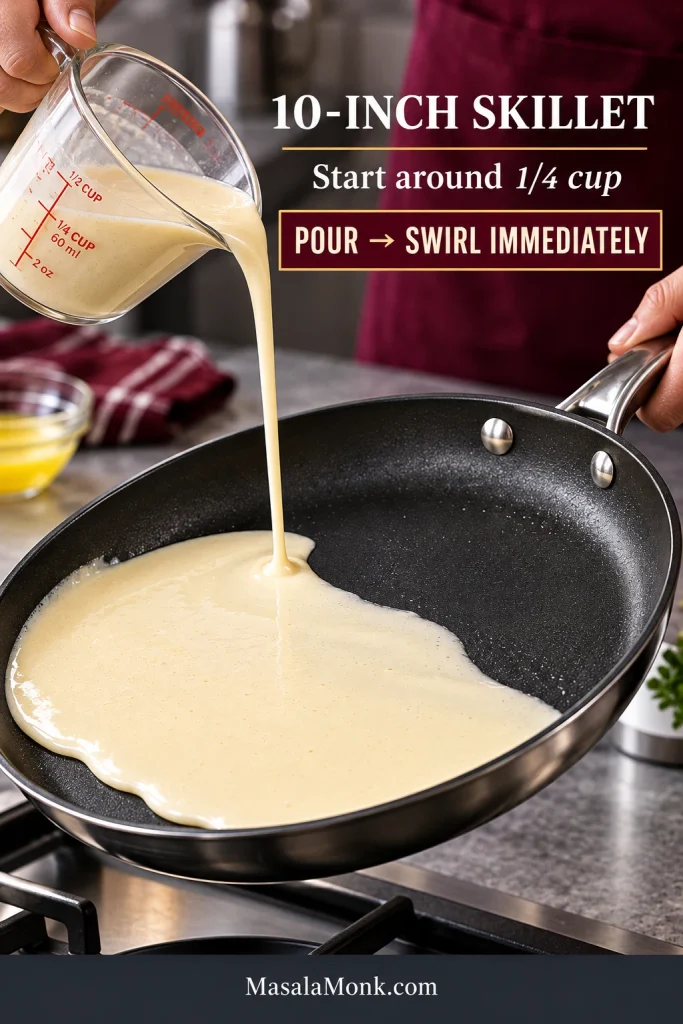
Use your regular waffle batter (the Belgian waffle batter works here too). Aim for a slow-pouring consistency: thicker than crepe batter, but not so thick it sits in a lump. If it feels runny, whisk in 1–2 tablespoons flour. If it feels too thick, loosen it with a small splash of milk, coconut milk, or water.

Tawa waffles cooking on a cast-iron skillet with a lid to steam-cook the center, showing a no-waffle-maker waffle method with pour-cover-flip-rack steps.
Pro tip for better texture: keep the flame medium-low and cover for 2–3 minutes so the middle sets before browning; then flip and finish, and cool on a rack so the crust stays crisp instead of steaming soft.

Quick skillet checklist (waffles in a skillet):

  • Heat a heavy pan/tawa on medium-low for 2–3 minutes
  • Grease lightly (too much oil can fry the surface)
  • Pour batter, spread to about ½ inch thick
  • Cover with a lid so the center cooks through
  • Flip once set, cook until deep golden
  • Rest on a wire rack for crisp edges

Now cook it: heat the pan, grease lightly, then pour about ⅓ to ½ cup batter into the center. Spread into a round about ½ inch thick and cover with a lid immediately. The lid matters because trapped heat helps the center cook through without burning the base.

Cook for 2–3 minutes until the underside is deep golden and the top looks mostly set. Flip carefully and cook the second side for 1–2 minutes until it smells toasted. If you want extra crispness, flip once more for 20–30 seconds per side.

Finally, rest it on a wire rack for a minute instead of a plate. That quick step helps waffles without a waffle iron stay crisp instead of steaming soft. Serve like a classic pan waffle with jaggery drizzle, yogurt, peanut butter, fruit, or a savoury filling.

Also Read: Authentic Louisiana Red Beans and Rice Recipe (Best Ever)


Eggless Waffles (Waffle Recipe Without Egg)

Eggless waffles are a natural fit for Indian kitchens. The goal is to replace what eggs usually do—binding and structure—so your waffle recipe without egg still holds together, tastes rich, and cooks up golden.

Keep your dry ingredients exactly the same as the base recipe. Then choose one of these eggless methods depending on what you have.

Option A: Dahi method (most “desi”, very dependable)

In your wet bowl:

  • Skip the 2 eggs
  • Add ½ cup thick dahi/curd (plain yogurt)
  • Add 2 tablespoons extra melted butter or oil (to bring back richness)
  • Keep milk the same, or reduce milk by ¼ cup if your curd is very thick
  • Add an extra ½ teaspoon baking powder for lift
Eggless waffle batter made with thick dahi (curd) being whisked in a bowl, showing the “dahi method” for a waffle recipe without egg.
Pro tip: Eggless batters need a slightly longer cook for clean release—wait for deeper golden edges, then rest the waffle on a rack for 1–2 minutes to firm up and stay crisp.

Whisk until smooth, combine wet into dry gently, and rest the batter for 10 minutes. Cook until the waffles are a deeper golden than usual—eggless batters often need that extra minute to set firmly and release cleanly.

Option B: Flax method (eggless and vegan-leaning)

Replace 2 eggs with 2 flax eggs:

  • Mix 2 tbsp ground flaxseed + 6 tbsp water
  • Let it sit 8–10 minutes until gel-like
  • Whisk it into the wet ingredients
Spoon lifting gelled flax egg (ground flaxseed + water) from a glass bowl with ratio text overlay—easy binder for eggless waffle batter; MasalaMonk.com footer.
Fast egg substitute for waffles: 2 tbsp ground flax + 6 tbsp water, rest 8–10 min until gelled. Use this to replace 2 eggs (best for peanut butter, coconut–jaggery, and oat-flour waffle variations).

This option pairs especially well with coconut–jaggery, peanut butter waffles, and oat flour swaps.

One last tip: once cooked, rest waffles on a wire rack for 1–2 minutes. That short pause helps eggless waffles firm up and keeps the edges crisp. For a straightforward reference recipe style, you can look at vegan waffles.

Now that you can make waffles with or without eggs—and even without a waffle iron—let’s talk texture and choose your ideal finish.

Also Read: Double Chocolate Chip Cookies – Easy Recipe with 7 Variations


How to Make Belgian Waffles Crispy or Fluffy: Crispy Waffle Method vs Fluffy Waffle Method

Different mornings call for different waffles. Sometimes you want a crispy waffle recipe style bite with crackly edges. Other times, you want a fluffy waffle recipe feel—soft, tender, and comforting.

Side-by-side Belgian waffles showing crispy vs fluffy texture—one cooled on a rack for crunch, one plated to highlight a soft, airy crumb.
Quick texture cheat: darker color = more crunch, and a wire rack prevents steam from softening the crust—pick your finish based on toppings (syrup-heavy plates love the crispier side).

Crispy waffle method (for crisp outside, tender inside)

  • Preheat the waffle maker thoroughly
  • Cook to deep golden brown
  • Cool on a wire rack
  • Avoid stacking waffles on a plate

Fluffy waffle method (for soft, cake-like tenderness)

  • Mix gently and stop early
  • Rest the batter
  • Cook until golden (not too dark)
  • Serve soon after cooking

The sweet spot (what most people love)

Cook until richly golden, then let the waffle sit on a rack for a moment. The crust sets. The interior stays tender. You get the classic Belgian waffle contrast without effort.

Now we can start the Indian twists.

Also Read: Negroni Recipe: Classic Cocktail & Its Variation Drinks


Homemade Waffle Mix Recipe: DIY Waffle Mix for Quick Mornings

Sometimes the craving hits, but you don’t want to measure five powders while half awake. That’s when a jar of homemade waffle mix makes life easier. Additionally, it keeps your base consistent, which means your flavour experiments taste more controlled.

Portrait photo of a labeled glass jar filled with homemade waffle mix on a kitchen counter, surrounded by flour and measuring spoons, with text overlay showing the dry mix ratios and wet add-ins for quick Belgian waffles; MasalaMonk.com in the footer.
Meal-prep win: label the jar with the date and batch size—then you only measure wet ingredients on waffle mornings. Store airtight and keep the jar away from humidity so the leavening stays effective.

DIY waffle mix (dry)

Whisk together and store airtight:

  • 2 cups flour
  • 2 tbsp sugar
  • 2 tsp baking powder
  • 1/2 tsp baking soda
  • 1/2 tsp salt

How to use waffle mix in a waffle maker

For every 2 cups of dry mix, whisk:

  • 2 eggs
  • 1 3/4 cups milk
  • 1/2 cup melted butter or oil
  • vanilla (optional)

Then combine wet into dry, rest briefly, and cook as usual.

From here, you can transform the batter by changing only the wet bowl: coconut milk, yogurt, peanut butter, cottage cheese, jaggery. As a result, you can create a full waffle spread without making five separate batters.

Also Read: Béchamel Sauce for Lasagna: Classic, Vegan & Ricotta Sauce Recipe


Waffle Recipe Without Milk: Coconut–Jaggery Belgian Waffles

If you’ve ever needed a waffle recipe without milk, you already know the risk: some no-milk batters taste thin. Coconut milk fixes that immediately. It adds richness and aroma, while jaggery brings that deep caramel warmth that feels unmistakably Indian.

If you’d like a simple explanation of jaggery for anyone unfamiliar, this is a clean reference: jaggery.

Dairy-free coconut–jaggery Belgian waffle batter being poured into a hot waffle iron, with coconut milk, grated jaggery and desiccated coconut shown for a no-milk waffle variation.
Coconut milk keeps the crumb rich even without dairy, while jaggery browns faster than sugar—cook a shade deeper golden, then cool on a rack for crisp edges.

Dairy-free waffle batter variation (coconut–jaggery)

Start with the base Belgian waffle batter, then swap and add:

  • Replace milk with coconut milk (same quantity)
  • Replace butter with neutral oil or melted coconut oil
  • Replace sugar with grated jaggery (2–4 tbsp, to taste)
  • Add 1/2 tsp cardamom
  • Optional: 2 tbsp desiccated coconut

Cooking coconut–jaggery waffles

Because jaggery browns quickly, trust aroma and colour. Wait until the waffle is deep golden and smells toasted, almost like caramelised coconut. Then cool it on a rack so crispness sets.

Coconut jaggery waffle topping ideas

  • Quick jaggery syrup (jaggery warmed with a splash of water until glossy)
  • Toasted coconut + chopped cashews
  • A tiny pinch of salt to sharpen sweetness
  • Thick curd on the side if you enjoy sweet-tang contrast

If this flavour feels like your comfort zone, you’ll probably love the coconut dessert world too—these traditional coconut ladoos share a similar coconut-forward warmth.


Peanut Butter Waffles With Chikki Crunch: Peanut Butter Waffle Recipe Twist

Peanut butter waffles are comforting on their own. However, once you bring in jaggery and roasted peanuts, the flavour becomes distinctly Indian—like chikki in waffle form.

If readers want context for the “chikki” idea, this quick reference works neatly: chikki.

Peanut butter waffles topped with roasted peanuts, jaggery drizzle, and chikki crunch—Indian-style Belgian waffle variation.
Pro tip: warm the jaggery with a splash of water for 30–45 seconds so it turns glossy and pours into the waffle pockets; finish with a pinch of salt to make the peanut flavour pop.

Peanut butter waffle batter add-ins

Start with the base batter and add:

  • 3 tbsp peanut butter (creamy works best)
  • 1–2 tbsp jaggery or brown sugar (optional)
  • 1/4 tsp cardamom or cinnamon (choose one)

Peanut butter thickens batter. If it seems too stiff, add a splash of milk or coconut milk until it pours smoothly.

Cooking peanut butter waffles

Cook until deeply golden. Peanut butter tastes best when it’s a little toasted, so let the waffle develop colour. Afterward, cool it on a rack for a minute so the surface stays crisp.

Chikki-style topping for waffles

  • Crushed roasted peanuts
  • Warm jaggery drizzle
  • Pinch of salt

If you like a sweet-and-spicy plate, peanut flavours pair surprisingly well with chutney too. This spicy peanut chutney (no onion, no garlic) is a punchy companion, especially when you want contrast.


Protein Waffle Recipe: Cottage Cheese Belgian Waffles, Paneer-Style

A protein waffle recipe doesn’t have to feel like a compromise. Cottage cheese makes waffles tender and rich, with a mild flavour that takes beautifully to cardamom, nuts, and honey. If you’ve ever loved paneer-based sweets, this “paneer-style” direction will feel familiar in the best way.

This twist also fits naturally with what many people look for when they want cottage cheese waffles: satisfying, filling, and still delicious.

Protein waffle recipe made with blended cottage cheese (paneer-style), topped with yogurt, honey and pistachios, with tips for crisp edges.
Quick texture fix: blend cottage cheese until smooth, then cook 1–2 minutes longer than usual—this gives you a crisp shell with a soft, high-protein center.

Cottage cheese waffle batter (paneer-style)

Add to the base batter:

  • 1/2 cup cottage cheese, blended smooth
  • 1/2 tsp cardamom
  • 2 tbsp chopped pistachios or cashews
  • Optional: 1 tbsp honey or sugar if you like it sweeter

Blend the cottage cheese first; otherwise, the batter can feel bumpy rather than creamy. Then whisk it into the wet ingredients before combining wet and dry.

Cooking protein waffles without losing crispness

Because cottage cheese adds moisture, cook until deep golden and let the waffle rest on a rack. That extra browning helps the outside stay crisp while the inside stays tender.
High-protein waffle toppings (still indulgent)

  • Thick yogurt + honey + pistachios
  • Saffron honey drizzle
  • Mango slices when in season
  • A spoon of something creamy and fragrant

If you enjoy protein-focused breakfast ideas beyond waffles, you might also like these high-protein plant-based breakfast ideas.


Yogurt Waffles: Dahi–Elaichi Belgian Waffle Recipe, Waffle Yogurt Variation

Yogurt waffles are quietly wonderful. They come out tender, lightly tangy, and perfect with fruit and nuts. Using dahi keeps it familiar; adding cardamom keeps it fragrant.

This is also a natural home for what people mean by “waffle yogurt” or “yogurt waffle batter,” except we’re leaning into Indian pantry logic rather than forcing an imported style.

Dahi–elaichi yogurt Belgian waffle variation topped with thick curd, honey drizzle, and crushed pistachios, with quick batter-thickness tips and MasalaMonk.com footer.
Pro tip: if your dahi is very thick, whisk it smooth first, then loosen with 1 tbsp water at a time—this keeps the batter pourable and helps the waffle cook through without losing crisp edges.

Yogurt waffle batter (dahi–elaichi)

Start with the base batter, then adjust:

  • Replace 1/2 cup of milk with thick yogurt/curd
  • Add 1/2 tsp cardamom
  • Optional: lemon zest for brightness
  • Optional: 1 tbsp sugar if the yogurt is very tangy

Whisk yogurt into the wet ingredients until smooth, then combine gently with the dry bowl.

Cooking yogurt waffles

Since yogurt adds moisture, cook slightly longer for a crisp exterior. Even so, the inside stays plush and soft, which is exactly what you want in this variation.

Mango shrikhand topping for waffles

When mangoes are in season, this combination is hard to beat: warm waffle + chilled creamy topping + pistachios. If you want inspiration for that topping, this mango shrikhand direction is perfect for waffles.


Chicken and Waffles Sandwich, Tandoori Style: Waffle Breakfast Sandwich

Now we go savoury, and not subtly.

Classic chicken and waffles works because it’s built on contrast: crisp waffles, juicy chicken, savoury seasoning, and a sauce that pulls everything together. The Indian version keeps that logic and changes the flavour language—tandoori spice, chutney, yogurt, onions, lemon.

For a simple reference on the classic pairing, this is unobtrusive: chicken and waffles.

Step-by-step tandoori chicken and waffles sandwich assembly guide with chutney base, sliced onions, lemon squeeze, and yogurt sauce drizzle on Belgian waffles.
Build order matters: spread chutney first (it protects the waffle from sogginess), keep onions thin, squeeze lemon before the yogurt drizzle, and finish with a light zig-zag so the waffle stays crisp.

What you need for a chicken and waffles sandwich

  • 2 waffles (smaller waffles are easiest as a sandwich)
  • Cooked tandoori-style chicken, sliced thin
  • Thin onion slices
  • Lemon wedge
  • Yogurt sauce: yogurt + salt + pinch of chaat masala
  • Chutney

For a bold chutney option that brings heat and depth, this kara chutney works beautifully with chicken.

Waffle breakfast sandwich assembly

Spread chutney on the first waffle. Layer chicken. Add onions. Drizzle yogurt sauce. Squeeze lemon. Close with the second waffle and press gently.

Tandoori chicken and waffles sandwich cut in half with green chutney, onion, and yogurt sauce; text overlay shows the build order and a honey-in-yogurt flavor hack; MasalaMonk.com footer.
Keep the waffle crisp: toast the waffle for 30–45 seconds after cooking, then assemble fast. For a cleaner bite, spread chutney thick (not runny) and drizzle yogurt sauce last.

Variations that keep the same spirit

  • Paneer tikka waffle sandwich for a vegetarian version
  • Butter chicken filling for a richer, saucier plate—this butter chicken recipe is a natural fit
  • Add cucumber slices for freshness
  • Add a tiny honey drizzle to the yogurt sauce if you love sweet-savoury contrast

Belgian Waffle Recipe Variants: Chocolate Waffles, Banana Waffles, Cinnamon Comfort

Once your base Belgian waffle recipe is second nature, classic flavours become easy. Besides, they’re perfect when you want variety without planning a whole new list of twists.

Portrait triptych showing Belgian waffle recipe variants—chocolate waffle, banana waffle, and cinnamon waffle—with quick mix-in tips and MasalaMonk.com footer.
Use this as your quick decision chart: cocoa + a little extra sugar for chocolate, 1 mashed banana (reduce liquid slightly) for banana, and a cinnamon-spice dry-mix boost for cozy, bakery-style waffles.

Chocolate waffles: Belgian waffle recipe with cocoa and warm spice

To make chocolate waffles, add to the dry ingredients:

  • 1/4 cup cocoa powder
  • 2 tbsp extra sugar (cocoa needs balance)
  • Pinch of cardamom or cinnamon

Cook until deep golden, then top with chocolate sauce, nuts, or fruit. Alternatively, add a jaggery-cocoa drizzle for a deeper sweetness that feels less “candy” and more “grown-up dessert.”

Banana waffles: Belgian waffle recipe with jaggery and cinnamon

Mash 1 ripe banana into the wet ingredients, then add:

  • 1/2 tsp cinnamon
  • Optional: swap some sugar for jaggery

These banana waffles are especially good with peanut butter, roasted nuts, and honey. In fact, they’re a natural bridge between comfort and indulgence.

Cinnamon waffle recipe comfort, without rewriting the batter

Add 1 tsp cinnamon to the dry mix and finish with butter and cinnamon sugar. On cooler mornings, this tastes like instant coziness.

Also Read: Greek Tzatziki Sauce Recipe (1 Master Sauce + 10 Easy Variations)


Oat Flour Waffles and Oatmeal Flour Waffles: Belgian Waffle Recipe With a Hearty Swap

Oat flour waffles are popular because they taste hearty and pair beautifully with bananas, peanut butter, and honey. Still, oat flour can weaken structure if you swap too much at once. So, rather than going all in immediately, start gently.

Side-by-side comparison of oat flour waffles (1/3 flour swap) versus classic Belgian waffles, showing texture differences and tips for crisp edges.
Quick oat-flour swap guide: start with ⅓ oat flour, loosen batter with 1–2 tbsp liquid if needed, and cook one shade darker for crisp edges.

Oat flour waffle batter approach

Replace one-third of the all-purpose flour with oat flour. Keep the rest the same. Then cook until deep golden and cool on a rack.
Once you like the result, you can increase the oat flour portion. Either way, the flavour pairs naturally with jaggery, cinnamon, banana, and nuts—so it fits perfectly with the Indian direction of this post.

Also Read: Healthy Oat Protein Bars – 5 Easy No Sugar Recipes for Snacks


Waffle Recipe Without Milk, Again: No Milk Waffle Recipe Shortcuts That Still Taste Rich

If you’re returning to the waffle recipe without milk idea on busy mornings, coconut milk is the easiest win. Yet there are other workable no-milk directions too.

Portrait infographic with three no-milk waffle batter options—coconut milk, dahi + water, and water with extra oil + vanilla—plus MasalaMonk.com footer.
Quick swap guide for dairy-free waffles: choose coconut milk for richness, dahi + water when you need body + gentle tang, or water + extra oil + vanilla when you’re improvising—then cook a shade darker and cool on a rack for crisp edges.
  • If you have coconut milk, use it.
  • If you only have water, add a little extra fat (oil) and a touch more vanilla to keep flavour rounded.
  • If you have yogurt but no milk, use yogurt plus water to thin it slightly, then whisk until smooth.

Even when you’re improvising, the key is to keep batter pourable and cook until the waffle is deeply golden so it tastes toasted, not pale.

Also Read: 10 High Calorie Protein Shakes & Smoothie Recipes for Healthy Weight Gain


Waffle Batter Confidence: How to Tell When Waffle Batter Is “Right” Without Overthinking

Batter consistency matters, yet it doesn’t need to become stressful. A good waffle batter should pour, but not run like water. It should settle into the grid when you close the lid, not explode out the sides immediately.

Waffle batter consistency guide showing the 10-second ribbon test—too thick, just right, and too thin—with quick fixes for Belgian waffle batter.
Quick fix guide: if your batter drops in clumps, loosen with 1 tbsp milk/coconut milk; if it runs like water, add 1 tbsp flour—aim for a slow ribbon that disappears in ~2 seconds.

If your batter is too thick, add liquid one splash at a time. If it’s too thin, add a spoon of flour and whisk gently. Then, once you cook one waffle, you’ll know exactly what to adjust.

With that settled, let’s make toppings feel as exciting as the waffles themselves.

Also Read: Simple Bloody Mary Recipe – Classic, Bloody Maria, Virgin & More


Waffle Syrup and Waffle Toppings, Desi Style: From Jaggery Drizzle to Saffron Honey

Waffles exist for toppings. The pockets practically demand syrup. Maple is lovely, of course, but Indian pantry drizzles can feel even more exciting with coconut, jaggery, peanut butter, yogurt, and cardamom.

Triptych showing three Indian waffle toppings—jaggery syrup, saffron honey, and rose-lemon drizzle—poured over Belgian waffles, with MasalaMonk.com footer.
Quick rule: warm your syrup for 15–20 seconds so it flows into the pockets. Finish with a tiny pinch of salt (especially with jaggery) to make the flavours pop.

Jaggery waffle syrup

Warm jaggery with a splash of water until glossy. Then add cardamom and a pinch of salt. This syrup is perfect for coconut–jaggery waffles, banana waffles, and peanut chikki waffles.

Saffron honey drizzle

Warm honey gently and steep saffron strands for a few minutes. This tastes especially good on yogurt waffles and cottage cheese protein waffles.

Rose drizzle

Rose syrup with lemon and a tiny pinch of cardamom turns waffles into something festive—especially with pistachios.

Ice cream and waffle dessert plates

If you want a dessert moment, warm waffles plus ice cream is always a win. For mango season inspiration, these mango kulfi ideas are brilliant as waffle toppings too.


Bubble Waffles and Hong Kong Waffles: Street-Style Filling Ideas That Feel Indian

Bubble waffles—often called bubble waffles, bubbles waffles, or Hong Kong waffle—are lighter, snack-like, and made for stuffing and folding.

If you want a quick reference for the style, this explains it clearly: egg waffle. For a baseline recipe format, this is approachable: bubble waffles.

Pro tip for bubble waffles: keep the waffle warm, build with one cold element (kulfi/ice cream), and always drizzle sauces at the end—your “egg waffle” stays crisp longer instead of turning cakey.

Bubble waffle filling ideas (Indian street-dessert style)

  • Kulfi scoop + nuts + rose syrup
  • Rabri-like drizzle + pistachios + saffron
  • Chocolate + banana + crushed biscuits
  • Mango ice cream + cardamom sugar + toasted coconut

Even if you don’t have a bubble waffle maker, the flavour ideas still work with Belgian waffles. Make smaller waffles, fold them like cones, fill them, and eat them like street food.

Also Read: Peanut Butter Cookies (Classic Recipe & 3 Variations)


Belgian Waffle Recipe, One Base, Endless Plates

Ultimately, the reason to keep a Belgian waffle recipe in your back pocket is simple: one batter, many moods.

Sometimes you want coconut–jaggery comfort from a waffle recipe without milk. Other times you want peanut butter waffles with chikki crunch. On busy days, a “paneer-style” protein waffle recipe feels like a gift. When you want soft and fragrant, yogurt waffles deliver. And when brunch needs to be bold, a tandoori chicken and waffles sandwich becomes the centerpiece.
If you want another India-leaning waffle idea to explore next, these sabudana waffles are a fun companion read—especially if you enjoy Indian pantry twists.

FAQs

1) What is a Belgian waffle recipe, and how is it different from regular waffles?

A Belgian waffle recipe typically makes waffles that are thicker, airier, and built with deeper pockets. As a result, they hold syrup, sauces, and toppings more generously than thinner, “regular” waffles.

2) Can I make a Belgian waffle recipe without a Belgian waffle maker?

Yes. Even if your waffle iron makes thinner waffles, the same batter still works; the main change is that cook time may be shorter and the waffles may turn out crispier rather than thick.

3) How do I make waffles crispy on the outside and soft inside?

For that classic contrast, preheat the waffle maker thoroughly, cook until deep golden, and place cooked waffles on a rack instead of stacking them. That combination helps the crust stay crisp while the center remains tender.

4) Why are my waffles turning out soggy after cooking?

Most often, waffles go soft because steam gets trapped—especially when waffles are stacked on a plate. Instead, let them cool briefly on a rack so moisture can escape.

5) What’s the best waffle batter consistency for a Belgian waffle recipe?

The ideal waffle batter should pour easily but still feel slightly thick—similar to a smooth pancake batter. If it runs like water, it may spread too fast and steam; if it’s too stiff, it may cook unevenly.

6) Can I make waffle batter ahead of time for breakfast?

You can mix the dry ingredients ahead, and you can also whisk the wet ingredients ahead. However, once everything is combined, it’s usually best to cook within a few hours so the leavening stays effective.

7) What is a waffle mix, and can I make waffle mix at home?

Waffle mix is a pre-mixed dry blend (flour, sugar, salt, leavening) that you combine with wet ingredients later. Homemade waffle mix works well and makes weekday waffles much faster.

8) How do I make a waffle recipe without milk that still tastes rich?

Use coconut milk, oat milk, or another creamy plant milk, and include enough fat (oil or dairy-free butter). In addition, vanilla and a pinch of salt help round out flavor.

9) Are dairy-free waffles the same as vegan waffles?

Not always. Dairy-free waffles avoid milk and butter, but they can still include eggs. Vegan waffles avoid all animal products, so you’ll replace both dairy and eggs.

10) How do I make vegan waffles that don’t fall apart?

Use a good binder such as a flax “egg” (ground flax mixed with water) and cook waffles until fully set and golden. Also, avoid opening the waffle maker too early.

11) Can I make eggless waffles that still rise properly?

Yes. Eggless waffles can rise well with fresh baking powder and a binder like flax, yogurt alternatives, or fruit puree. Even so, slightly longer cooking helps them set firmly.

12) What’s the easiest way to make gluten-free waffles?

A reliable gluten-free flour blend is the simplest option because it’s designed for structure. If you’re experimenting, start with a blend before trying single flours.

13) Can I make oat flour waffles with a Belgian waffle recipe?

Absolutely. Replace part of the all-purpose flour with oat flour to keep structure. Gradually increasing oat flour works better than swapping all flour at once.

14) How do I make protein waffles that still taste good?

A protein waffle recipe tastes best when the “protein” comes from ingredients that also improve texture, like cottage cheese or yogurt. Furthermore, balanced sweetness and vanilla keep flavor pleasant.

15) Are cottage cheese waffles the same as paneer-style waffles?

They’re not identical, yet cottage cheese waffles can feel “paneer-style” in spirit—mild, creamy, and perfect with cardamom, nuts, and honey.

16) Can I add peanut butter to waffle batter?

Yes, peanut butter waffles are a popular variation. Since peanut butter thickens batter, add a splash of milk (or plant milk) if the batter becomes too dense.

17) How can I make peanut butter waffles taste more “Indian”?

Try adding jaggery and cardamom, then top with roasted peanuts for a chikki-like finish. This approach creates a warm, nutty profile rather than a plain “PB” taste.

18) What are yogurt waffles, and why add yogurt to waffle batter?

Yogurt waffles use curd or yogurt in the batter to add tenderness and a gentle tang. Consequently, they pair especially well with fruit, honey, and nuts.

19) Can I use thick curd (dahi) instead of milk in waffles?

Yes. You can replace a portion of milk with thick curd, then whisk until smooth. If the batter becomes too thick, thin it with a small splash of water.

20) What toppings go best with Indian-style waffles?

Jaggery syrup, saffron honey, rose drizzle, chopped nuts, coconut, shrikhand-style toppings, and fresh fruit all work beautifully. Additionally, savory waffles pair well with chutneys and yogurt sauces.

21) What is the best syrup for waffles if I don’t have maple syrup?

Jaggery syrup is a great alternative, and honey works well too. For a more festive vibe, saffron-infused honey or rose-lemon drizzle can feel special.

22) Can I make a chicken and waffles sandwich at home?

Definitely. Use waffles as the “bun,” then layer spiced chicken, onions, and a yogurt-based sauce. For extra punch, add a chutney spread.

23) What kind of chicken works best for chicken and waffles?

Crispy fried chicken is classic, yet grilled or tandoori-style chicken works beautifully with Indian flavors. The key is juicy chicken with bold seasoning.

24) Can I make a vegetarian version of chicken and waffles?

Yes. Paneer tikka, crispy tofu, or spiced potato patties can stand in for chicken, especially when paired with chutney and a creamy sauce.

25) What are bubble waffles, and how are they different from Belgian waffles?

Bubble waffles (often called Hong Kong egg waffles) are lighter and designed to be folded and filled. By comparison, Belgian waffles are thicker with deeper pockets meant for syrup and toppings.

26) Can I make bubble waffles with Belgian waffle batter?

Not exactly. Bubble waffles usually use a different batter and a different waffle maker. Nonetheless, you can mimic the “filled-and-folded” idea using smaller Belgian waffles.

27) How do I stop waffles from sticking to the waffle iron?

Preheat fully, grease lightly if needed, and cook until the waffle releases easily. Often, sticking happens when waffles are undercooked and tear during removal.

28) Why do my waffles taste bland even when they look good?

Bland waffles usually need more salt, vanilla, or sweetness. Also, cooking a bit longer to deepen browning can intensify flavor noticeably.

29) Can I freeze waffles and reheat them later?

Yes. Let waffles cool completely, freeze in a single layer first, then store in a bag. Later, reheat in a toaster or oven so they crisp up again.

30) What’s the best way to reheat waffles so they stay crispy?

Use a toaster or an oven rather than a microwave. The microwave adds moisture; meanwhile, dry heat restores crisp edges and keeps the center warm.

Posted on 8 Comments

3 Minutes Homemade Chocolate Syrup- Dairy and Gluten free

Homemade Chocolate Syrup is incredibly easy to make and trust me it rivals or dare I say doesn’t come even close to anything you’ll buy at the store. You can literally whip up chocolate syrup using this recipe in 5 minutes and that includes prep time. That’s how quick and easy this Homemade Chocolate Syrup recipe is.

God knows how much I hate those store-bought chocolate syrups. With less than 5% cocoa, it is just full of artificial flavors, emulsifiers, liquid glucose, thickeners, artificial colours and as if liquid glucose was not enough, the second main ingredient in these syrups is Inverted sugar. What a whole lot of crap! And they don’t even taste authentic.

I made this chocolate syrup some 4 years back because I wanted something chocolatey to go with my waffles. I was surprised to see how unbelievably delicious, smooth, sweet and chocolate-y it turned out to be. I just couldn’t stop myself from licking it from the spoon. 

When I found this recipe, it was just too simple to believe. No fancy ingredients required. It is dairy free and gluten free. Looks like store bought syrup but tastes way better. It is perfect to add to a plate of Fluffy Buttermilk Pancakes.

Difference between Chocolate Syrup and Chocolate Sauce

If you find yourself confused between the two, you are clearly not alone. They have a lot in common from their appearances and use, whether drizzled over sundaes, pancakes, waffles or bread pudding. They both are often used interchangeably. It all comes down to viscosity. Chocolate syrup is thinner than chocolate sauce. Syrup is mostly created with cocoa powder, water and sugar whereas sauce has cream, butter and sugar, giving it more richness.

Recipe: makes 90 ml or 3 ounces

Ingredients: 

  • Unsweetened Cocoa/Cacao powder: 1/4th cup
  • Sugar: 3 tbsps or as per taste
  • Water: 100 ml
  • Instant Coffee: 1 tsp
  • Pure Vanilla extract: 1/2 tsp
  • Coconut oil: 1 tbsp
  • Salt: a pinch 
  • Dark Chocolate (70%): 25 grams

Method: 

  • In a pan mix together cocoa powder, sugar, salt and instant coffee. Now add water and bring it to boil while whisking continuously till everything incorporates. Use a wire whisk.
  • Cook for 2 minutes on low flame while stirring continuously. Stirring is important to avoid grainy syrup.
  • Take it off flame. Then add coconut oil, vanilla extract and dark chocolate and whisk till chocolate melts. 
  • Allow it to cool. Transfer it in a glass jar. Refrigerate for 30 minutes before using. It tastes even better the next day.

Notes: 

  • The chocolate syrup will be thin when it finishes boiling. But it will thicken quite a bit on cooling and even more after refrigeration.
  • It will last you a week or 10 days in refrigerator.
  • The taste of this sauce will depend on the quality of cocoa powder and dark chocolate you will use. So use good quality cocoa powder & dark chocolate. 
  • This recipe gives 3 ounces but it can easily be doubled or tripled.
  • You can add more sugar if you like. I like it bitter sweet.

How you can use it

  • Pour it over icecream, pancakes or waffles
  • Stir it in milk
  • Drizzle it over brownies
  • Make chocolate trifle 
  • Use it as a dip for fruits

Enjoy. 😊

Posted on Leave a comment

Calamondin Orange Marmalade- Simple Quick Recipe

I have a plant of this gorgeous beauty in my garden. I planted calamondin oranges as a mere ornamental beauty. Little did I know that they are a remarkable member of the citrus family. Calamondins originated in China and the Philippines. But this fruit soon gained popularity across the world for its versatility. This fruit is a hybrid between a mandarin orange and a kumquat.

The fruits are sour and slightly sweet, resembling a tarter version of traditional oranges. The peel of this fruit tastes sweet and the inside is sour but very flavorful. Despite its sour taste, the calamondin orange is a culinary delight. It’s widely used in marmalades, jams, and as a flavor enhancer in beverages and desserts. In Southeast Asian cuisine, it’s a common condiment, adding zest to dishes.

This fruit yields fabulous marmalade. The distinct aroma and sweet taste of the peels makes this marmalade quite different from the regular orange marmalade you had. And dare I say tastes so much better! If you personally ask me, this is best citrus food marmalade I have ever made.

This vital little fruit is also known for it’s healthy benefits. One of the most common applications is in the treatment of respiratory ailments such as coughs and phlegm. The fruit’s juice, when consumed, can help in loosening and expelling phlegm, making it easier to clear congested airways.

The fruit’s acidity can aid in digestion and help alleviate gastrointestinal discomfort such as bloating and indigestion. Its mild laxative effect can also be beneficial in regulating bowel movements.

I think I have given you enough insight about this fruit. Now coming to the recipe. You only need 3 ingredients to make this marmalade. The entire recipe will take you no time since you don’t require much cooking unlike other citrus marmalades because the peels are very soft.

Recipe

Prep time: 15 minutes Cook time: 12 minutes 
Yields: 700 grams

Ingredients

  • 500 grams Calamondin Orange
  • 500 grams sugar
  • 1/2 tsp Salt
  • 1 tbsp Lemon juice
  • 1 tbsp minced Ginger (optional, but adds flavor)

Instructions

  • Before starting the recipe, put a plate in a freezer for later testing the marmalade.
  • Cut the calamondins into half and take out all the seeds. This might take you 10 to 12 minutes but as soon as you are done with this step, this recipe is a piece of cake.
  • Now blend all the calamondins in a blender. 500 grams of this fruit will roughly give you 2 cups pulp.
  • Bring a heavy bottom pan to a medium heat. Add the pulp and cook it for 3-4 minutes.
  • Now add sugar and cook the pulp for 7-8 minutes. After 7 minutes of cooking, do the plate test.
  • Pour a tsp of marmalade on a chilled plate and try to wriggle it using your fingers. If the liquid starts getting wrinkles and it resembles a set jelly, you know that your marmalade is ready.
  • Pour the marmalade in a sterilized glass jar. Now add a tbsp of lemon juice and mix well. It will last you months at room temperature. Refrigerate for longer shelf life.

Enjoy this delicious treat!!! 🙂

Notes:

  • Never try to cook this marmalade beyond 10-12 minutes. Do the plate test precisely after 7 minutes. The marmalade might appear loose but as it cools, it will become thick. If you are still unsure, then once the marmalade coats the back of your spoon, it is time to take it off heat. If you keep cooking it beyond that time, your marmalade on cooling will become like a solid mass.
  • Do not reduce the sugar. Since calamondin is a sour fruit, you will have to add equal amount of sugar to balance the tartness.
  • Always take the ripest calamondins for better flavor.
  • Always store the marmalade in a glass jar due to its acidic nature.
Posted on 4 Comments

Wholewheat Carrot Orange Tea Cake- Kid Friendly Easy Recipe

Carrot cake is my and my child’s all time favourite. There’s something so heartwarming about a good carrot cake. As soon as those orange carrots hit the Indian market, this is one thing I crave. 

Why did I add orange to this cake? Well, I think it gives it that special subtle finesse that makes it stand out. Orange flavor goes beautifully with carrots. It gives a burst of citrus flavour along with a bright punch.

One bite of this can even convert those silly people who don’t like carrot cake 😄 Who are these people anyway!

My child loves to carry a slice of cake or a muffin in his school snack box. So I had to make it healthy and equally delicious for my child. This is the recipe that I mastered after a few failed attempts. Well, not exactly failed though. Those failed attempts were edible too but this one comes out to be perfectly soft, moist and fluffy

It is made using Wholewheat flour and Jaggery. Now baking with wholewheat flour can be a little tricky. It can make the texture of the cake dense. To ensure that your cake remains light and fluffy, the trick is to sieve wholewheat flour 3-4 times. This will add more air and the cake will not come out dense.

This recipe is actually so easy to make that anyone who hasn’t tried baking before will be able to crack it. Being a mother I understand how busy days get and trying those time consuming recipes can be quite daunting at times. To save you from all that hassle, all you have to do is put everything in a blender and Viola! Your batter is ready in less than 5 minutes. This will also save you from washing too many bowls which is quite a task when you have to bake.

Do try out this recipe and let me know. Trust me it will not disappoint you. 🙂 You can frost this cake with your favourite cream cheese frosting. This recipe is a make-ahead cake recipe whose taste and texture will not be compromised.

This cake is not overly sweet. I don’t prefer too sweet desserts. Feel free to add more jaggery if you like.

Recipe: cup measurement 250 ml

Prep time: 15 minsCook time: 30 mins


Ingredients

  • 2 medium size Carrots, shredded
  • 3 heaped tbsps Orange Marmalade 
  • 60 grams softened unsalted Butter or any non-fragrant oil
  • 1/2 cup Jaggery powder
  • 1 1/2 cup Wholewheat flour
  • A generous pinch Salt
  • 2 small Eggs
  • 1/2 cup Milk 
  • 1/2 tsp Vanilla extract
  • 1/2 tsp Baking soda
  • 1 tsp Baking powder
  • Handful of Chopped Walnuts (optional)

Method

  • In a blender, add butter, jaggery, lightly beaten eggs, milk, shredded carrots, marmalade & vanilla extract. Blend well on high speed till everything comes together. Take it out in a large bowl.
  • In another bowl, sieve wholewheat flour, baking powder, baking soda and salt. Add walnuts now if using and combine everything well. 
  • Add dry ingredients to wet ingredients in 2 to 3 batches. Gently cut & fold each time till everything incorporates well and there are no lumps. Don’t mix rigorously or over mix the batter. This will lead to a dense cake texture.
  • Preheat oven at 180C 10 minutes prior to baking. Grease a 7 inches diameter round pan or 11x7x2 inches rectangular baking pan with butter and line it with parchment paper or alternatively you can dust it with some flour. 
  • Add the batter. Tap the pan on the shelf 2-3 times to clear out all the air bubbles. Now, bake for 30 minutes on the middle rack of your oven or till a toothpick inserted at the center comes out clean. 
  • Allow it to cool for 15 minutes in the pan and then transfer it on a wire rack to cool completely. If you find that the cake is sticking to the bottom of the pan, leave the cake upside down for sometime and let gravity do it’s thing.

My Pro Tips:

  1. Use fresh baking soda. It looses it potency after 6 months of opening it.
  2. When measuring dry ingredients, level it off using the straight edge of a spoon or a butter knife.
  3. This recipe makes 12 muffins. Bake them for 14 to 18 minutes and allow the muffins to cool completely on wire rack.
  4. You can add cinnamon and ginger powder to this recipe to add a warm touch to it.
  5. If you want this cake to be perfectly moist, use fresh carrots and shred them. DO NOT USE packaged pre-shredded carrots for this recipe. This is the prime moisture for your cake and you don’t want to miss it.
  6. In case you want to bake this cake for yourself and are feeling fancy, I would highly recommend adding Orange Whiskey Marmalade. Orange and whiskey combination can lift your simple cake to something gourmet. You can buy it here-

Substitutes:

  • Eggs: You can either use flaxmeal or 1/4th cup Greek yogurt for every egg. For flaxmeal, take 1 tbsp flaxseeds for every egg. Coarsely ground them. Add 4 tbsps of water and let it sit for 15 minutes. It will become like a slimy gel like mixture. Use this as a substitute for one egg.
  • Orange Marmalade: If you don’t want to use Orange Marmalade, you can use 1/4th cup of freshly squeezed orange juice along with a tsp of orange zest instead. If using orange juice, you might have to adjust sugar accordingly. Add 1 or 2 tbsps of extra jaggery powder.
  • Jaggery: In case you don’t have jaggery powder, you can use any unprocessed sugar like palm sugar, coconut sugar etc.
Posted on Leave a comment

Easy Festive Irish Rum Truffles- The Best Truffles

Irish Rum Truffles are a classic holiday treat. Chocolatey and rich. It is a French confectionery traditionally made with chocolate ganache centre and coated with cocoa powder, coconut or chopped nuts. It’s sweet, slightly bitter, fudgy and of course intensely boozy. These are my favourite indulgent sweets. I am absolutely certain that after trying this recipe, you will ditch the boxed truffles which doesn’t even come close to the homemade ones.

Irish Rum Truffles are quite easy to make. They are perfect when you are craving a treat but don’t want to turn on the oven. 

One of the qualities I find most important in food is the taste it leaves in my mouth. It should leave a memory on my taste buds that makes me want the next one. And, these truffles do exactly that.

My husband and I cut a small cake together at midnight on our anniversary each year. This is our moment together before we celebrate the day with our family and friends. 

So for our 5th anniversary I wanted to treat my husband with something different and not the usual midnight cake. That’s when I thought of making Irish rum truffles. I sat down and scrolled through many recipes, adding and omitting what I like and don’t like and finally came up with this recipe. I had my fingers crossed. 

When the clock struck midnight, I surprised him with these. He had a confused expression on his face because it was not the usual stuff. Skeptically, he took the first bite and the wide eyed expression said it all. 😄

They turned out to be so good. It has been 6 years now since I have been making this. I didn’t realise how good these were until one year I didn’t make them.

Not only are these holiday classics or a perfect gifting treats but you can make them whenever you like. It will lift your mood when you are sad. When you are happy, it will just make you happier. 😊

Although if rum or bailey’s isn’t your favourite liquor, you could try making them with bourbon, cointreau, cognac or kahlúa instead.

The taste will depend on the chocolate you are using. I used a total of 100 grams chocolate. 60 grams was Green & Black Dark Chocolate (70%) and 40 grams was a mix of Lindors and Lindt Milk chocolate. 

Pro Tips:

  • Do not use Chocolate chips or cheap bars because they will not melt in truffle consistency leaving you with grainy bits. Chocolate chips are great for recipes like cookies and tea cakes. 
  • Do not use half-and-half or any other liquid because the truffles won’t set properly.
  • Pure vanilla extract adds exceptional flavor to your chocolate truffles.
  • Coffee will accentuate the taste of the chocolate, so do not skip it. 

Truffles are too firm with less liquid. So stick to this recipe for truffle success!

Recipe: makes 12-13 truffles

Ingredients

Chocolate: 100 gms

Fresh cream: 60 ml (25% fat)

Coconut oil/Unsalted butter: 3 tbsps

Rum: 10 ml

Bailey’s Irish cream: 30 ml

Instant coffee: 1/2 tsp mixed in 1 tbsp water

Vanilla extract: 1/2th tsp

Sieved unsweetened Cocoa powder

Some coarsely crushed nuts. I went with Pistachios. 

Method:

  • Finely chop chocolate and keep aside in a big glass bowl. 
  • Heat cream. DO NOT BOIL IT. Remove from heat just when you see bubbles forming on the edges. Add coconut oil or butter. 
  • Pour the hot cream over the chocolate in batches, mixing well each time so that the chocolate doesn’t split. Use a wire whisk. If the chocolate splits, just add a splash of boiling water. 
  • Now, in goes the rum, bailey’s, instant coffee and vanilla extract.
  • Whisk it well for couple of minutes to incorporate some air and till everything mixes well.
  • Cover it with a cling and put it in the refrigerator for 3 hours to set. 
  • Once set, line a plate with butter paper. 
  • Take one tbsp scoop and scoop out to make small balls. You will have to shape really quickly because the heat from your hand might melt the chocolate. 
  • Keep the topping handy in a plate. 
  • Roll the truffle in the topping of your choice and place it one by one on the butter paper. 
  • Refrigerate for one hour or till it is set. It will last you about 2 weeks in a refrigerator. 

Troubleshooting

  • The chocolate is separating: This is one of the biggest concerns while making truffles. If your chocolate splits then your cream was too hot. So make sure you don’t boil it. 
  • The chocolate doesn’t melt: There can be two issues here, either your cream is too cold or you didn’t chop the chocolate into very small pieces. The finer the chocolate chunks, the quicker it will melt. If the chocolate doesn’t melt, craft a double boiler setting and heat the mixture in a heat proof bowl for a few seconds. 
  • Trying to scoop too-warm ganache: Once the cream and chocolate are whisked together, you will have a thick, smooth mixture known as ganache. You might think that it’s scoopable right out of the bowl, but you’ll need to cool it properly before scooping and rolling. Refrigerate it before scooping.