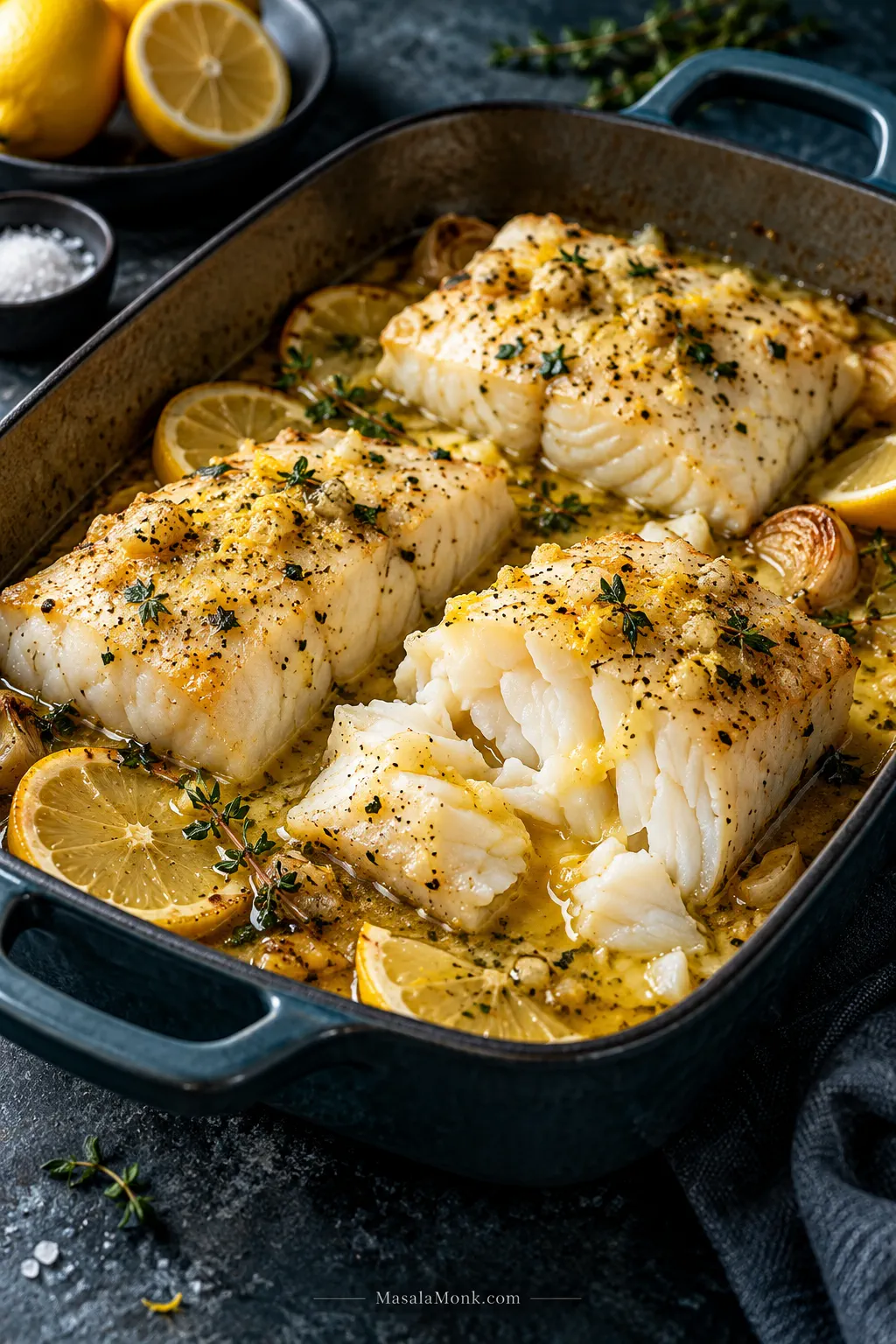
Tender white flakes, warm lemon garlic butter and a squeeze of fresh lemon just before you eat. That’s what this baked cod recipe is about. A handful of familiar ingredients, one baking dish and plenty of buttery pan juices to spoon over the fish.
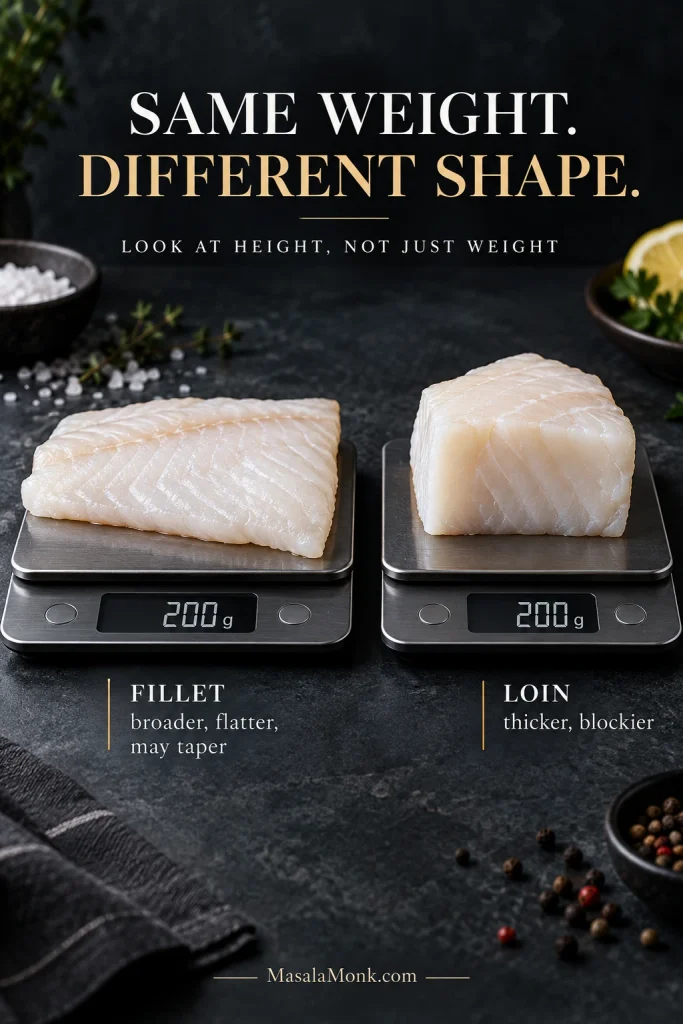
The only tricky part is the cod itself. It doesn’t always come in neat, matching pieces, and two portions of the same weight can cook quite differently when one is broad and thin and the other is a thick loin. This recipe gives you the lemon-garlic butter; the useful bit is knowing how to read the piece of fish you actually bought.
Cod is mild and lean, with large, tender flakes when it’s cooked well. Pat it dry, season it directly and bake it uncovered at 400°F / 205°C. There’s no breading, flipping or skillet sear to manage. The timer tells you when to start paying attention; the thickest part tells you when dinner is ready.
Choose four portions that are reasonably similar in thickness and a shallow baking dish that holds them comfortably in one layer.
Serves 4
Prep About 10 minutes
Cook About 10–20 minutes for most portions
Total About 20–30 minutes
Oven 400°F / 205°C
Typical Thickness About ¾–1¼ in / 2–3 cm
Doneness 145°F / 63°C
Equipment: shallow 9×13-inch / 23×33-cm baking dish or similarly sized pan, small bowl, paper towels and an instant-read thermometer.
Ingredients
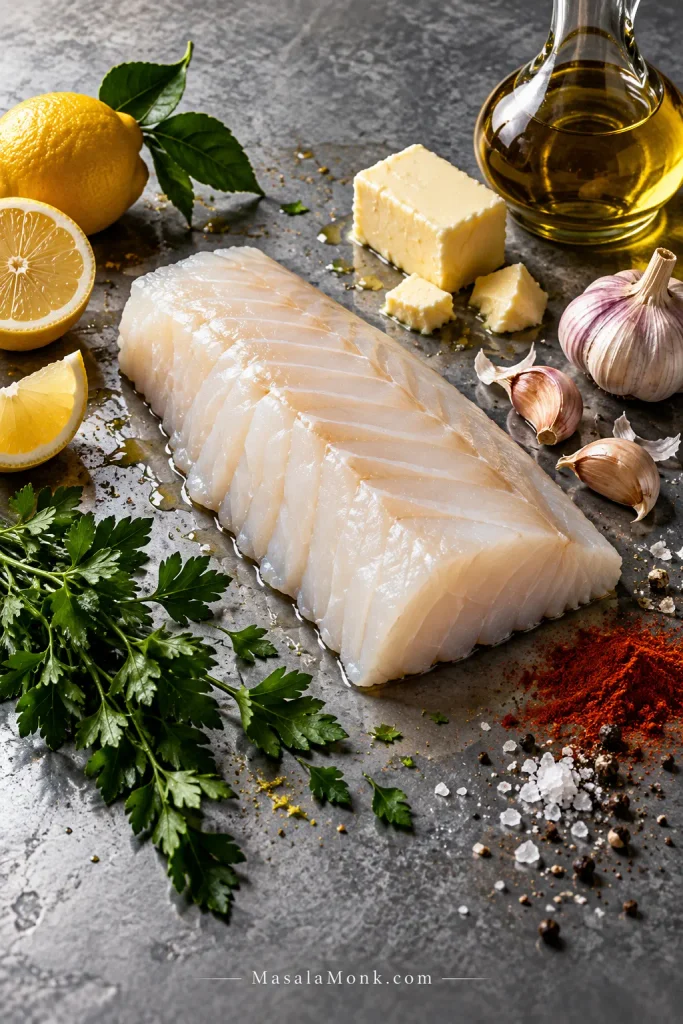
1½ lb / 680 g skinless cod fillets or loins, divided into 4 portions of about 6 oz / 170 g each
3 tbsp / 42 g unsalted butter, melted
1 tbsp / 15 ml olive oil
3 medium garlic cloves, finely minced or grated
1½ tbsp / 22 ml fresh lemon juice, divided, plus lemon wedges for serving
1 tsp finely grated lemon zest
¾ tsp fine sea salt
½ tsp sweet paprika
¼ tsp freshly ground black pepper
2 tbsp chopped fresh parsley
Each ingredient has a different job here: zest brings aroma, juice brings acidity, butter carries the garlic, and paprika adds gentle warmth without overwhelming the mild cod.
Check the package before adding salt. Some frozen cod may contain added salt or brine. If yours does, start with less.
How to Make It
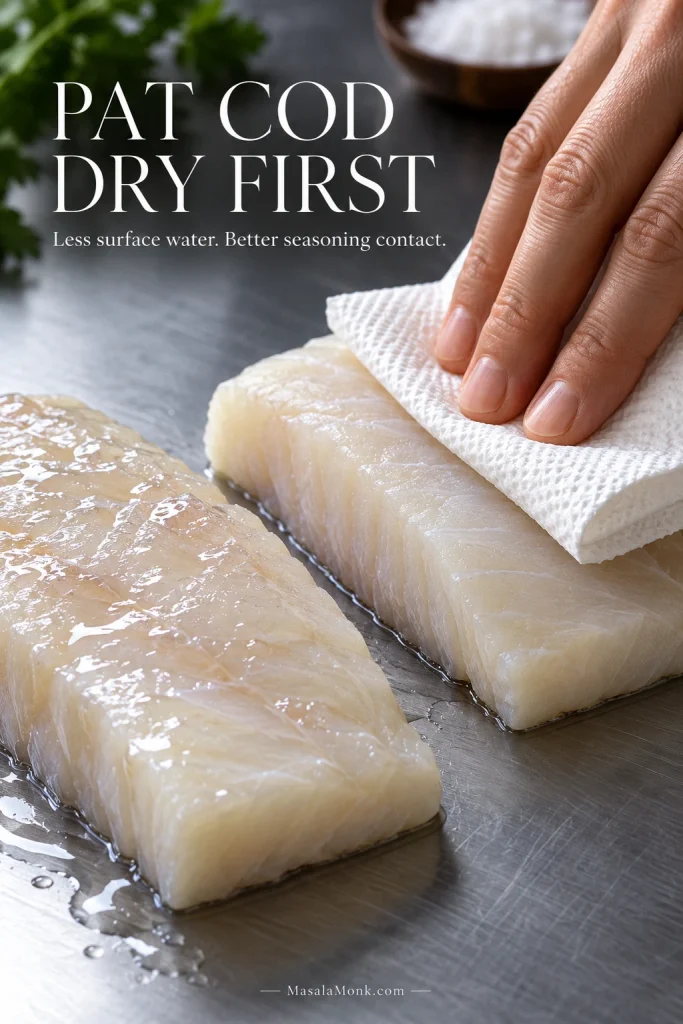
Preheat and dry. Heat the oven to 400°F / 205°C and lightly grease the baking dish. Remove any obvious pin bones, then pat the cod thoroughly dry on every side.
First, dry until the surface loses its wet shine. That gives the seasoning direct contact with the cod and reduces the amount of stray water entering the baking dish.
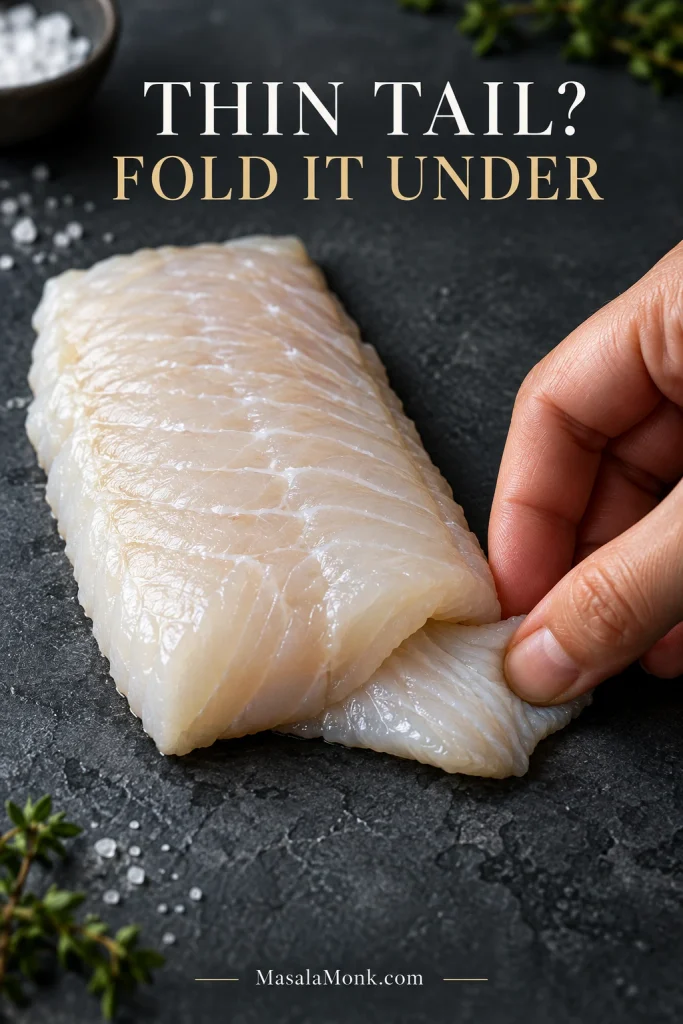
Arrange and season. Set the portions in a single layer with a little room between them. Fold a very thin tail underneath itself so it doesn’t dry out before the thicker part is done. Season the fish directly with salt, paprika and black pepper.
If only the last inch or two becomes dramatically thinner, tuck just that section underneath. The goal is a more even profile, not a doubled-up lump of fish.
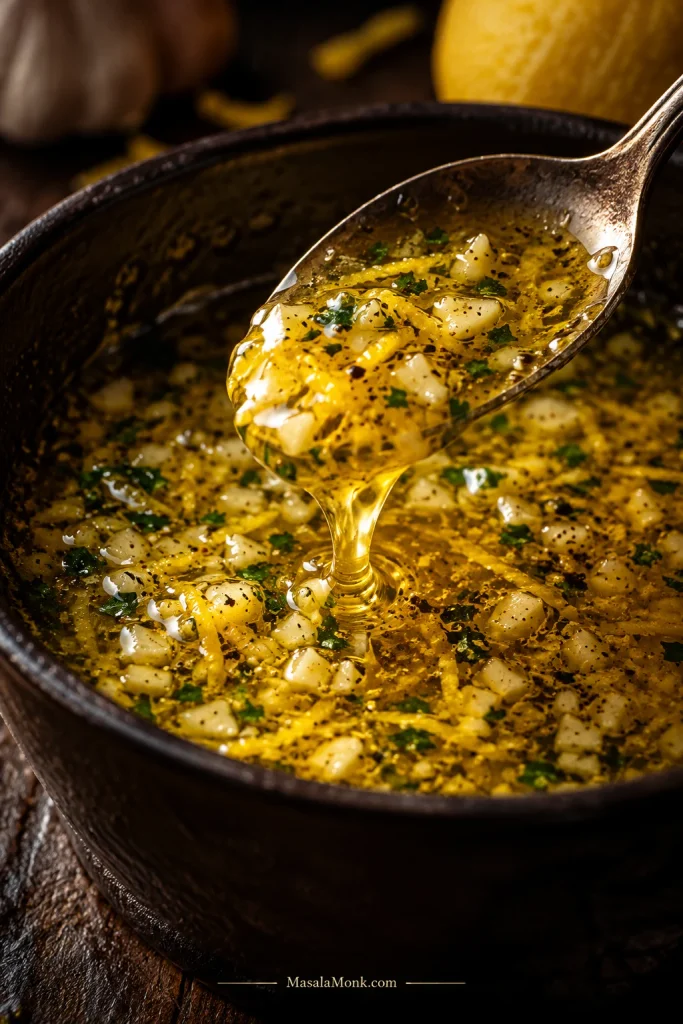
Mix the butter. Stir together the melted butter, olive oil, garlic, lemon zest and 1 tbsp / 15 ml of the lemon juice.
For even flavor, disperse the garlic and lemon zest through the melted butter before spooning it over the fish; otherwise the aromatics tend to collect unevenly between portions.
Spoon it over. Coat each piece with the lemon-garlic butter, letting a little run into the dish. Leave the pan uncovered.
Bake, Check and Finish
Bake and check. Begin checking according to the thickness guide below. Uneven pieces may be ready at different times.
Finish. Take each portion out when the center reaches 145°F / 63°C. Add the remaining ½ tbsp / 7 ml lemon juice and scatter with parsley.
No flipping needed. Cod becomes delicate as it cooks. Leave it alone in the oven, then slide a broad spatula underneath each piece when you’re ready to serve.
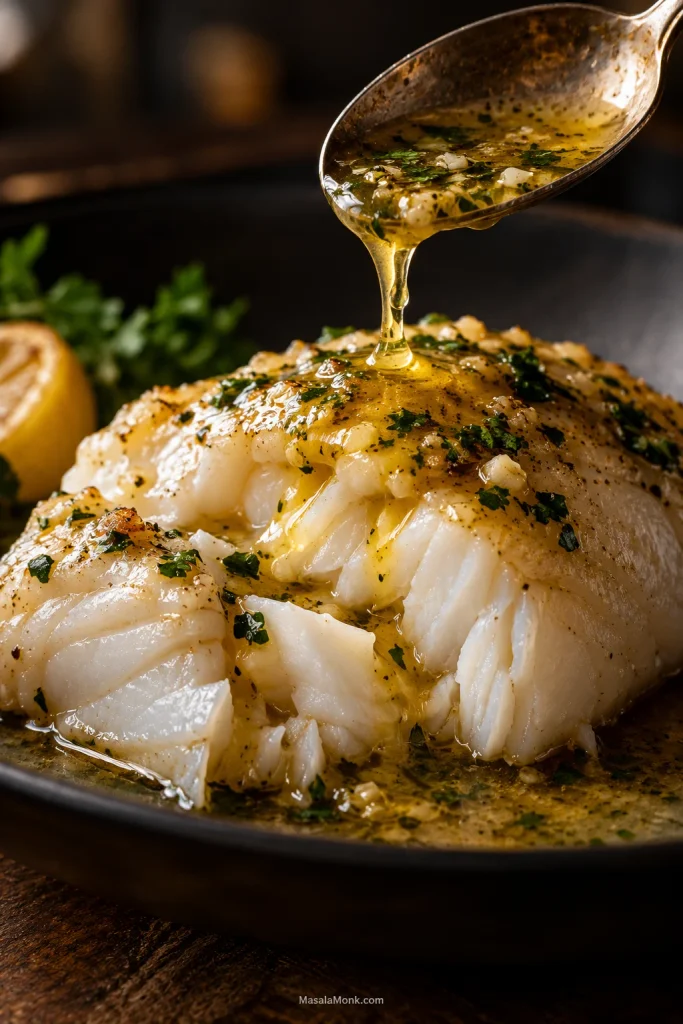
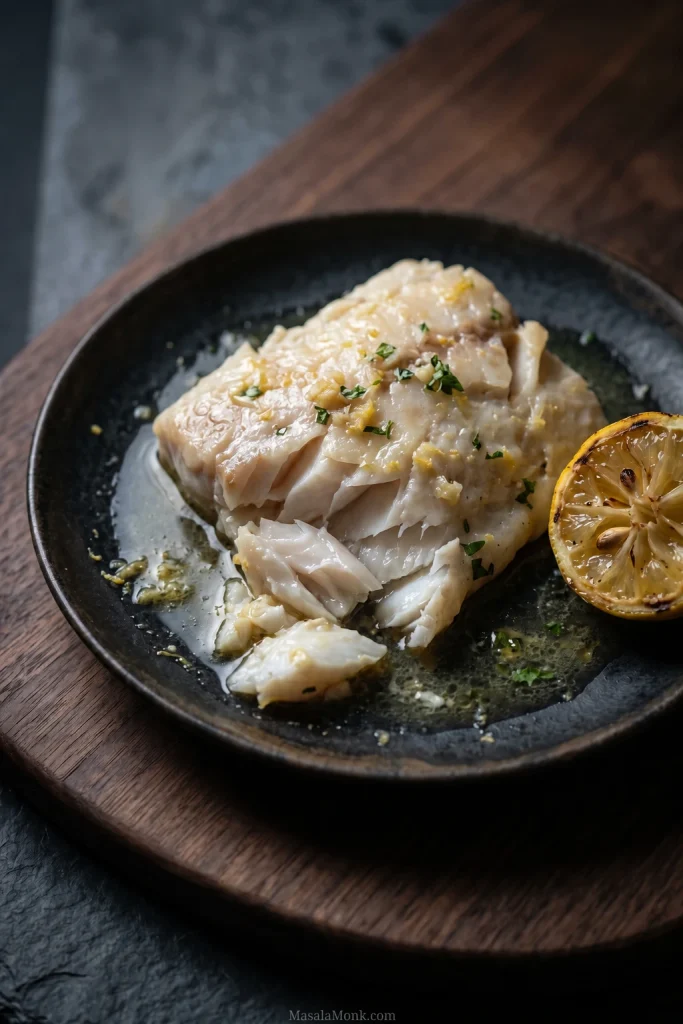
Don’t leave the butter behind. Spoon those warm, garlicky juices over the flakes before the plates reach the table.
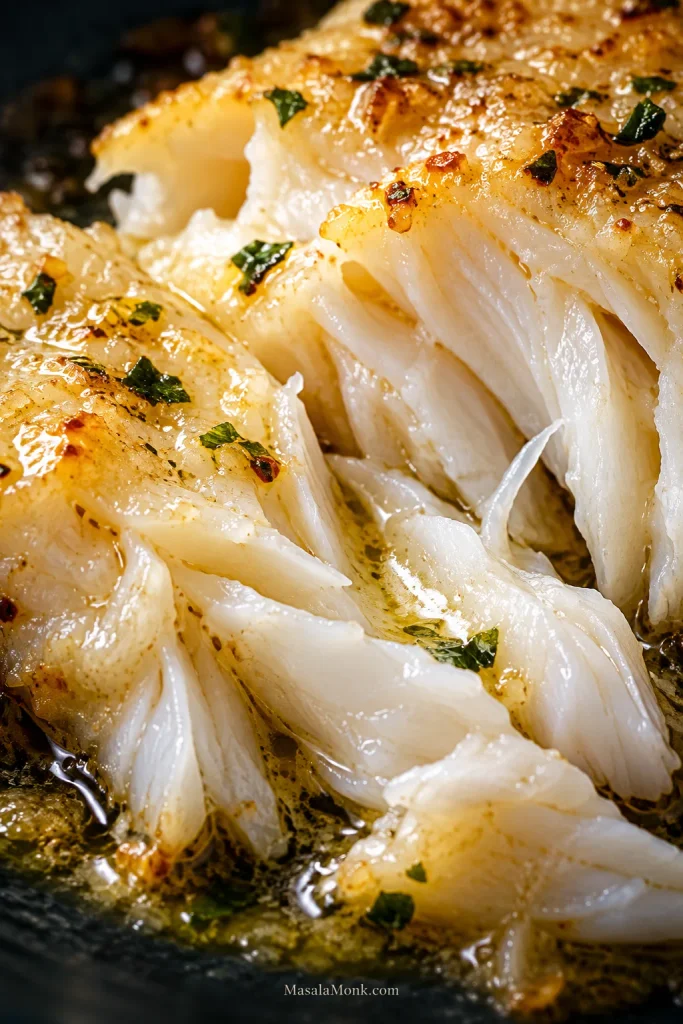
Warm pan butter slips into the opened flakes instead of sitting only on the surface.
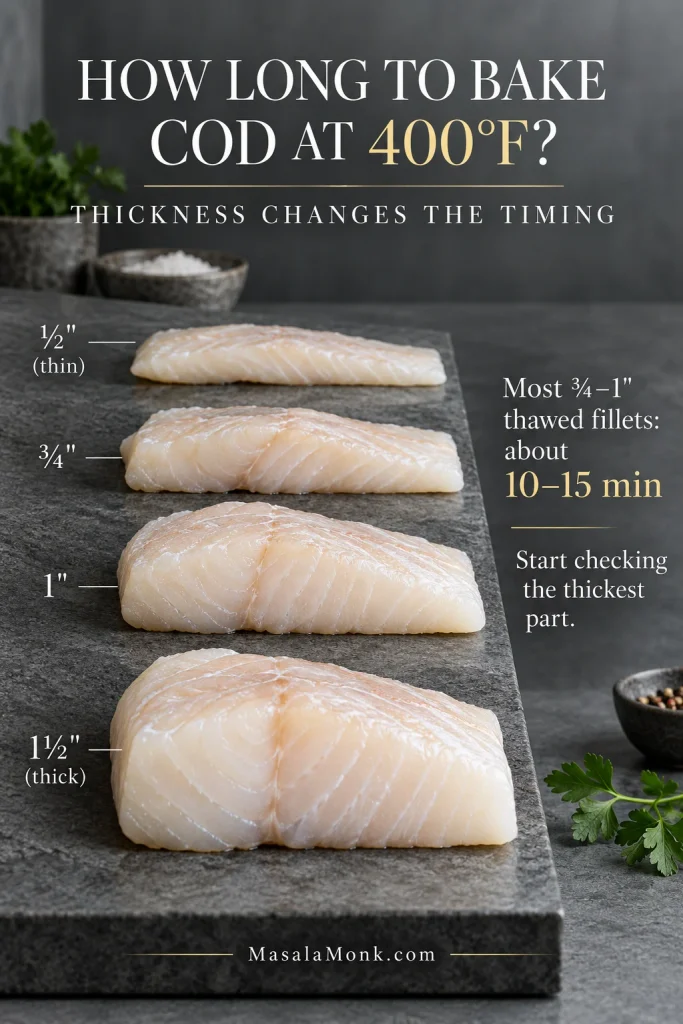
At 400°F / 205°C, most fully thawed cod fillets around ¾–1 inch thick take approximately 10–15 minutes. A thin tail may finish sooner; a substantial loin can need 15–20 minutes or more.
Thickness
Typical piece
Start checking
Approximate bake time
½ in / 1.3 cm
Thin fillet or tail
About 7 min
About 7–10 min
¾ in / 2 cm
Regular fillet
About 9 min
About 9–13 min
1 in / 2.5 cm
Thick fillet
About 11 min
About 11–15 min
1¼–1½ in / 3–4 cm
Thick loin
About 14 min
About 15–20+ min
You don’t need to predict the exact finishing minute. Start checking at the first number in the table. If you’re not sure how your piece compares, see how fillet and loin shape change the timing.
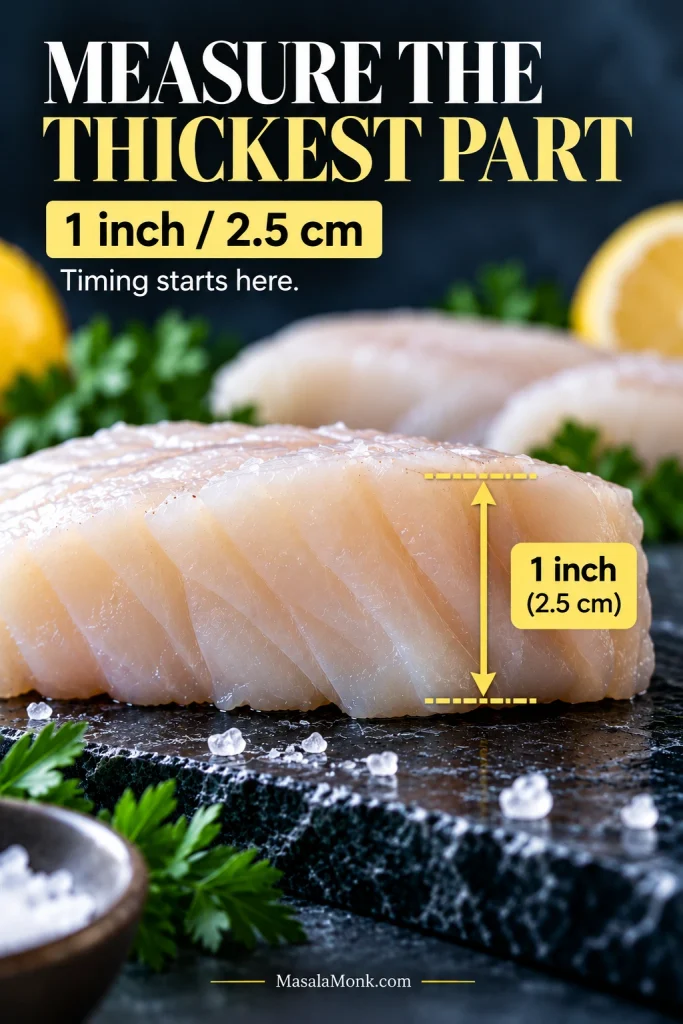
At 400°F, the height of the fish is more useful than its weight for deciding when to start checking. Use the thickest part of the fillet as your guide.
Measure the fish at its thickest point before you compare it with the timing guide.
Take the thickness vertically through the deepest section of flesh; width, length and the sloping top surface do not tell you how far heat must travel to reach the center.
Cod Fillet vs Loin: Look at the Shape
These equal-weight pieces illustrate why cod loin and cod fillet timing can diverge: the blockier loin concentrates the same mass into a deeper center.
That’s why shape matters as much as the label. A loin is usually the thick, blockier center cut. A fillet may be broad and flat or taper sharply toward the tail. At the fish counter, look at height as much as weight. If you’re cooking several pieces together, choosing similar thicknesses makes the timing much easier.
What About 375°F or 425°F?
The timing above assumes 400°F / 205°C, the temperature this version is built around. At 375°F / 190°C the fish cooks more slowly; at 425°F / 220°C, begin checking earlier.
How to Tell When Cod Is Done
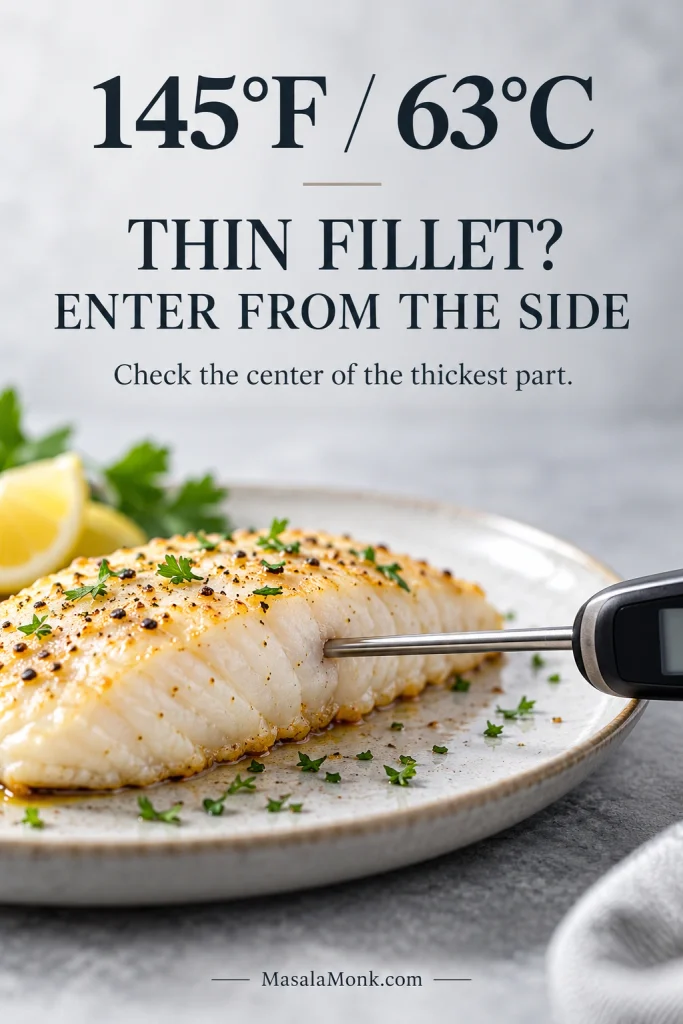
Whatever shape you’re cooking, the center settles the question. For food safety, cook fin fish to 145°F / 63°C in the center, following the USDA safe temperature guidance.
Keep the thermometer tip inside the center of the thickest flesh and clear of the hot baking dish; touching the pan can give a misleadingly high reading.
For a thin fillet, insert the thermometer from the side. That makes it easier to place the tip in the middle instead of passing straight through.
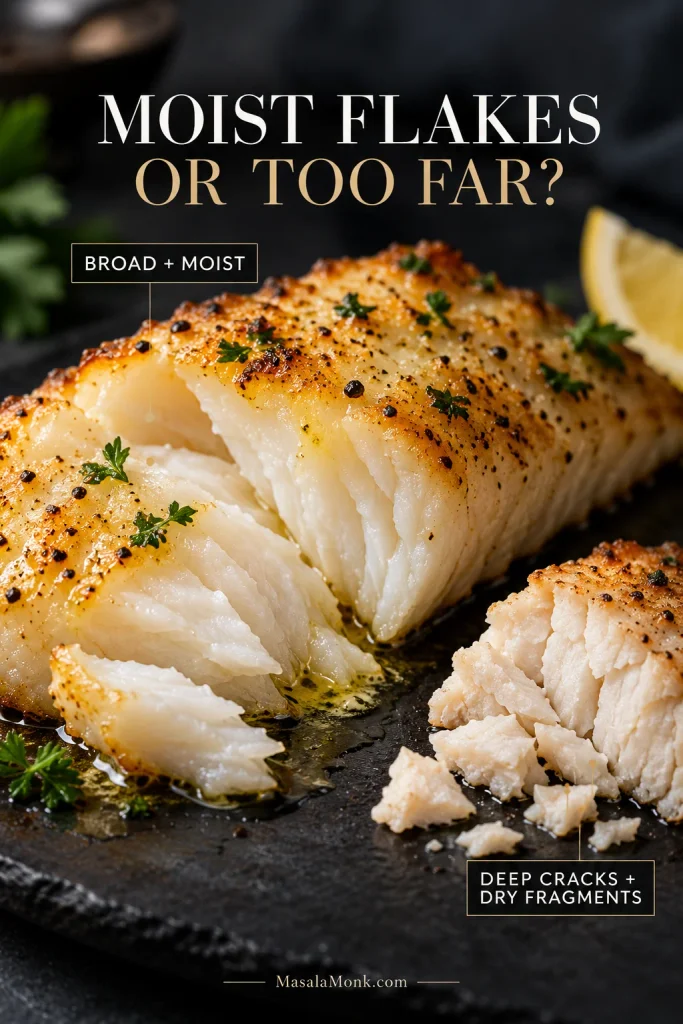
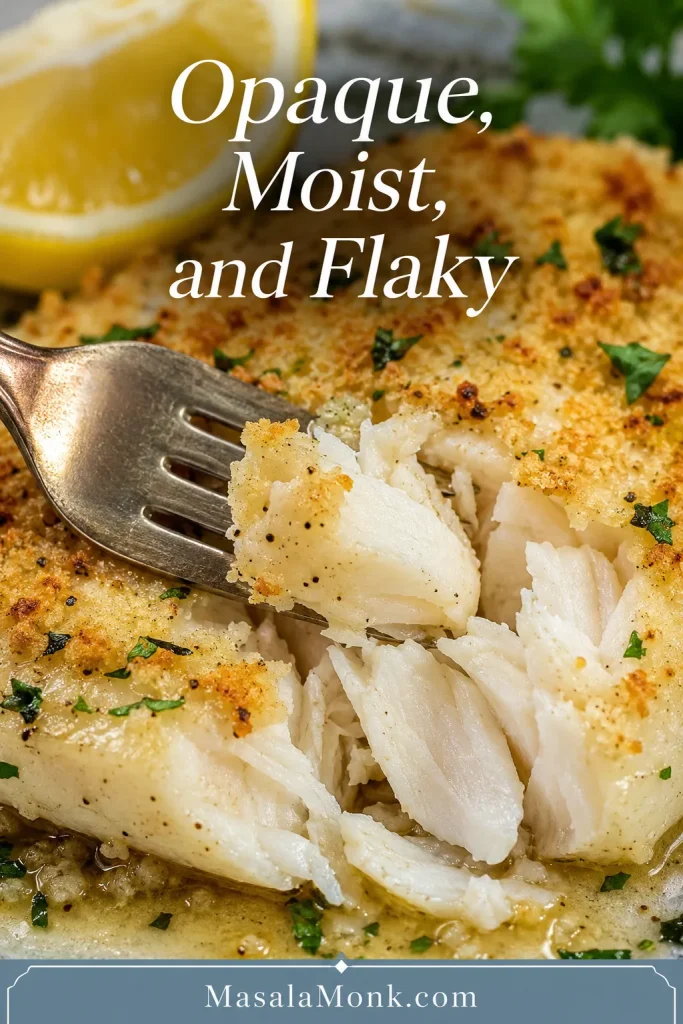
When it’s ready, the flesh should look opaque and open into broad, moist flakes with gentle pressure from a fork. Deep cracks, a chalky surface or lots of small dry fragments mean it has gone too far.
By contrast, doneness should be judged from the center, not the driest edge. Thin areas can look overcooked even while the thickest part still needs another moment.
As those flakes separate, spoon a little of the hot garlic butter into the openings. It slips between the layers while the fish is still warm instead of simply sitting on top.
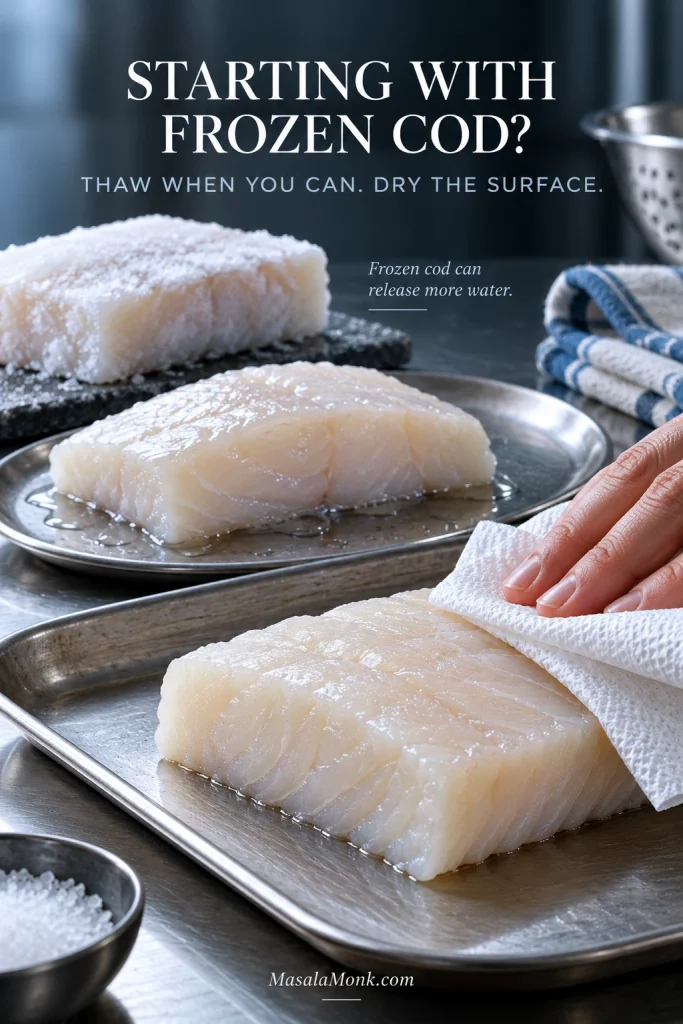
Frozen cod works here too. The complication is water. A puddle in the baking dish doesn’t automatically mean you overcooked the fish; sometimes that water arrived with the cod.
Thaw first when you can. It makes the timing easier to judge and lets you dry the surface properly before the butter goes on. If thawing is not practical tonight, jump to the straight-from-frozen guidance.
When thawing frozen cod, moisture often collects underneath the fillet and between natural folds. Check those hidden areas before seasoning, not just the exposed top surface.
Thawing Cod Safely
The FDA’s seafood-handling guidance recommends thawing frozen seafood in the refrigerator. When you need it faster, use cold water and a leakproof bag according to the product’s handling directions, then cook the fish promptly. Counter thawing isn’t a safe shortcut.
Vacuum-packed cod needs a label check. Follow the package directions carefully. Some reduced-oxygen packaged fish must be removed from the original packaging before thawing.
Can You Bake Cod Straight From Frozen?
Yes, but frozen cod needs its own timing. Remove loose surface ice, season the fish and follow the package’s cooking directions where provided. The center will take longer to heat and the fish may release more water, so check it with a thermometer rather than adding an arbitrary number of minutes.
Should You Cover Cod When Baking?
Not for this recipe. Leave the dish uncovered so some released moisture can escape. A sealed foil or parchment packet traps steam and gives you softer, steam-cooked fish—a different style of cod with different timing.
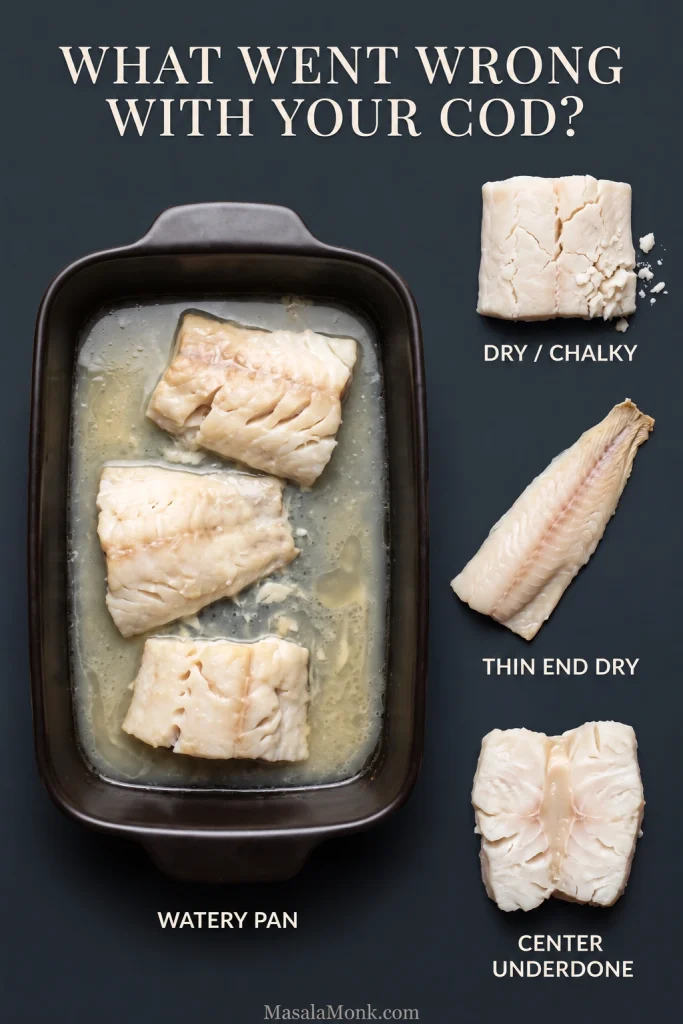
If the Cod Didn’t Come Out Right
Don’t change five things at once. Find the symptom that looks most like yours and start there.
One clue can prevent the wrong fix: a watery pan does not necessarily mean undercooked cod, and dry fish can still sit in excess liquid if it released a lot of moisture.
What happened?
Likely reason
What to do
Dry or rubbery
It cooked too long for its thickness.
You can’t put moisture back into overcooked cod. Add fresh lemon and begin checking earlier next time.
Watery pan
The cod was wet, crowded or released a lot of water.
Dry it thoroughly, give the portions some room and bake uncovered.
Mushy or mealy
Excess moisture or damage from freezing and thawing.
Check how it was thawed. If the same product repeatedly disappoints, try another source.
Bland
The fish wasn’t seasoned directly.
Season the cod itself before the lemon-garlic mixture goes on.
Thin end dry
The tail finished before the thicker part.
Fold it underneath before baking, or remove smaller pieces as soon as they’re done.
Outside cooked, center translucent
A substantial or partly frozen center needs longer.
Return it to the oven briefly, then check the center again.
Cooking took much longer
A thick loin, cold center or oven variation.
Keep cooking in short intervals and judge the center, not the clock.
Fish broke apart
Cooked cod is delicate and was handled too much.
Lift it from underneath with a broad spatula. Already have loose flakes? Turn them into fish tacos.
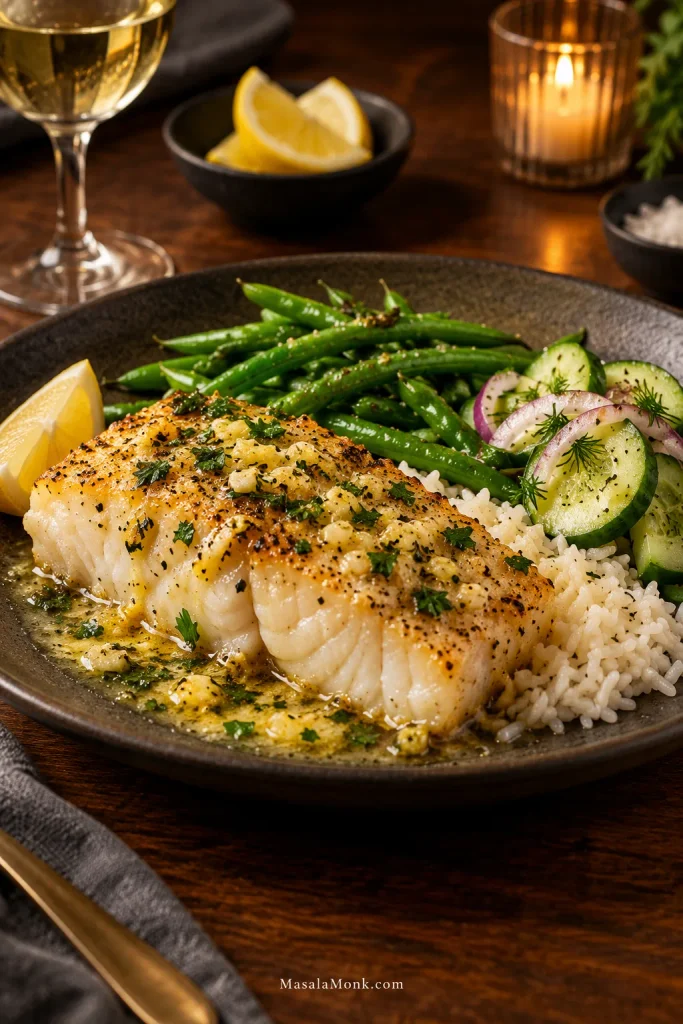
Hot rice may be the easiest answer. Start it first; the cod cooks quickly, and the rice gives all that lemon-garlic butter somewhere to go. If you want the timing sorted before the fish goes into the oven, use our guide to cooking rice.
For a balanced cod dinner, pair one element that absorbs the lemon butter with another that adds crunch, acidity or coolness; that keeps the plate from becoming uniformly soft and rich.
For something green, green beans almondine add toasted-almond crunch beside the soft fish. A crisp cucumber salad goes the other way: cool and sharp against the warm cod.
Potatoes work beautifully too. Our Greek lemon potatoes need a much longer head start, so get them well underway before the cod goes into the oven.
Small Changes That Work
Want it brighter? Swap the parsley for fresh dill and lean on the lemon wedges at the table. Want something warmer and smokier? Use smoked paprika instead of sweet. Two garlic cloves make the flavor gentler; four bring the garlic forward.
The zest and juice do different jobs. Lemon zest brings citrus aroma without adding much liquid; the final squeeze gives the hot fish its sharper citrus edge.
For a dairy-free version, replace the 3 tbsp butter with 3 tbsp additional olive oil. That version won’t have quite the same richness, but the garlic, paprika, zest and finishing lemon still carry plenty of flavor.
The same seasoning also works with other mild white fish; just reset the timing for the fish you choose. For a crisp, browned topping rather than lemon-garlic butter, our baked haddock recipe is built around that style.
Storing and Using Leftover Cod
Refrigerate leftover cod promptly in a shallow, covered container and use it within 3–4 days. When reheating, bring leftovers to 165°F / 74°C, following USDA food-safety guidance.
Because cod is lean, stop once the leftovers are safely heated through; prolonged reheating dries the flakes quickly.
If the fish is already in pieces, don’t try to reconstruct the fillet. Fold the flakes into fish cakes and let that become tomorrow’s dinner.
For tonight, serve the cod while the butter is still warm and loose in the dish. Spoon it over the fish, squeeze fresh lemon across the top and let the tender flakes do the rest.
This baked haddock recipe gives you tender, flaky white fish with a golden buttery topping in about 25 minutes. It is simple oven fish, but with the small details that keep haddock from turning dry, watery, bland, or hidden under soggy crumbs.
Haddock cooks quickly, which can feel a little unforgiving at first. The rhythm is simple: dry the fish, season it directly, add a buttery topping, and stop baking when the fish is done. After that, it becomes one of the easiest weeknight seafood dinners.
Quick Answer: Bake Time, Temperature, and Doneness
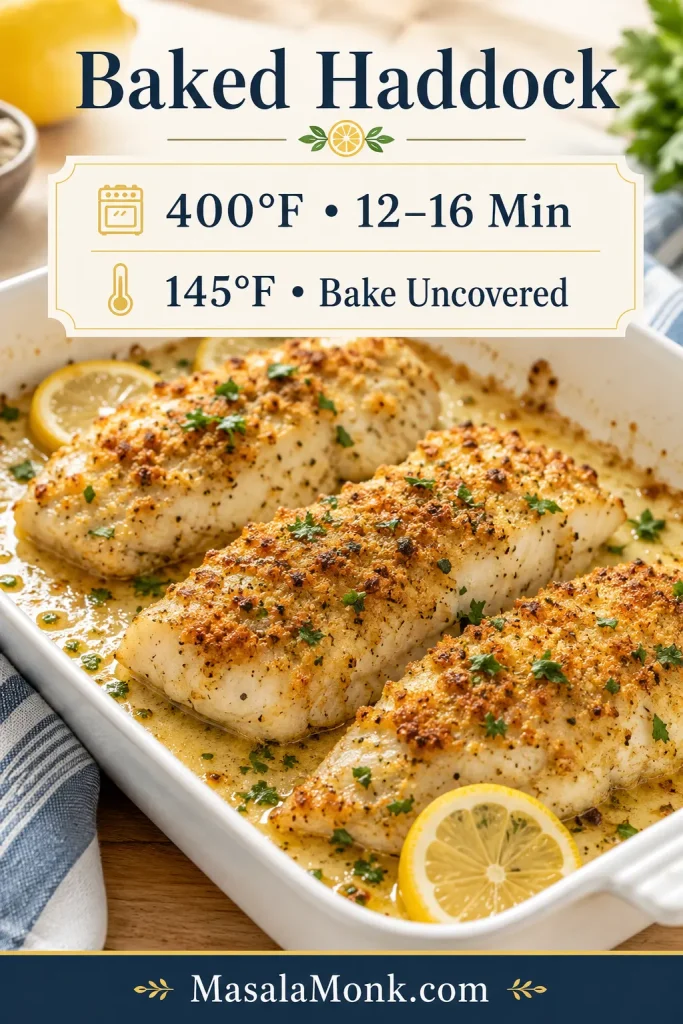
Bake haddock fillets at 400°F / 200°C for 12 to 16 minutes, depending on thickness. The fish is done when it turns opaque, flakes easily with a fork, and reaches 145°F / 63°C in the thickest part.
400°F / 200°C is the easiest everyday temperature for quick, flaky baked haddock.
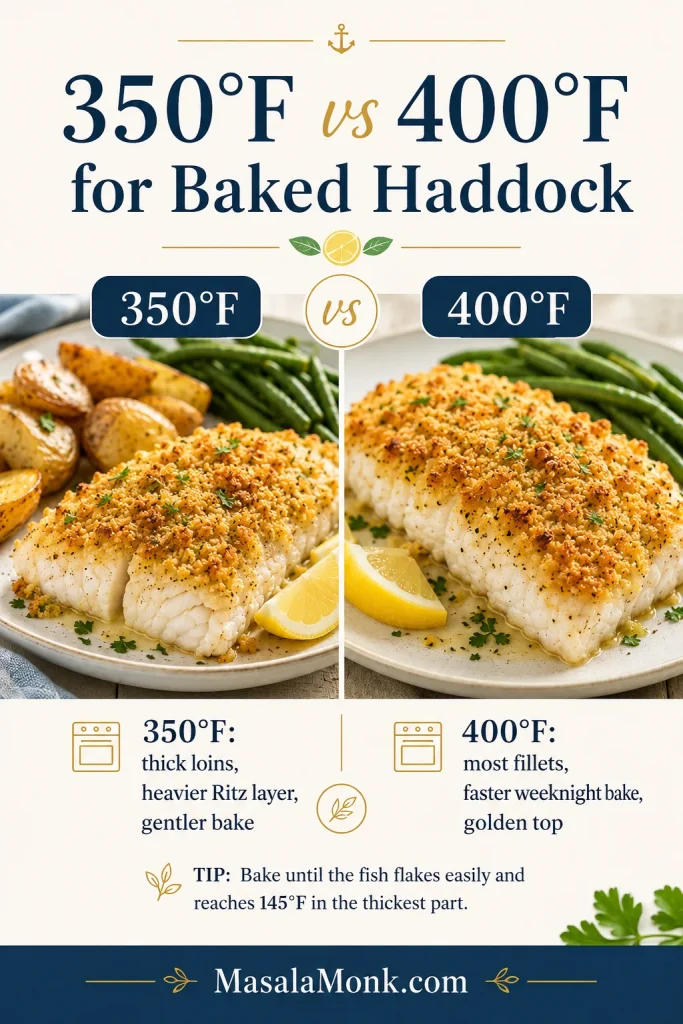
350°F / 175°C is gentler for thick haddock loins, a heavier Ritz cracker topping, or a more traditional New England-style bake.
Bake uncovered when using panko, breadcrumbs, or Ritz crackers.
The fish comes first. The crumbs come second. Pull the haddock when it is done; the broiler can finish a pale surface in a minute.
A pale topping can be fixed. Overcooked fish cannot. That one idea makes this recipe much easier.
For most haddock fillets, 400°F gives a fast oven bake; then 145°F confirms the center is cooked without drying out.
Easy Baked Haddock Recipe
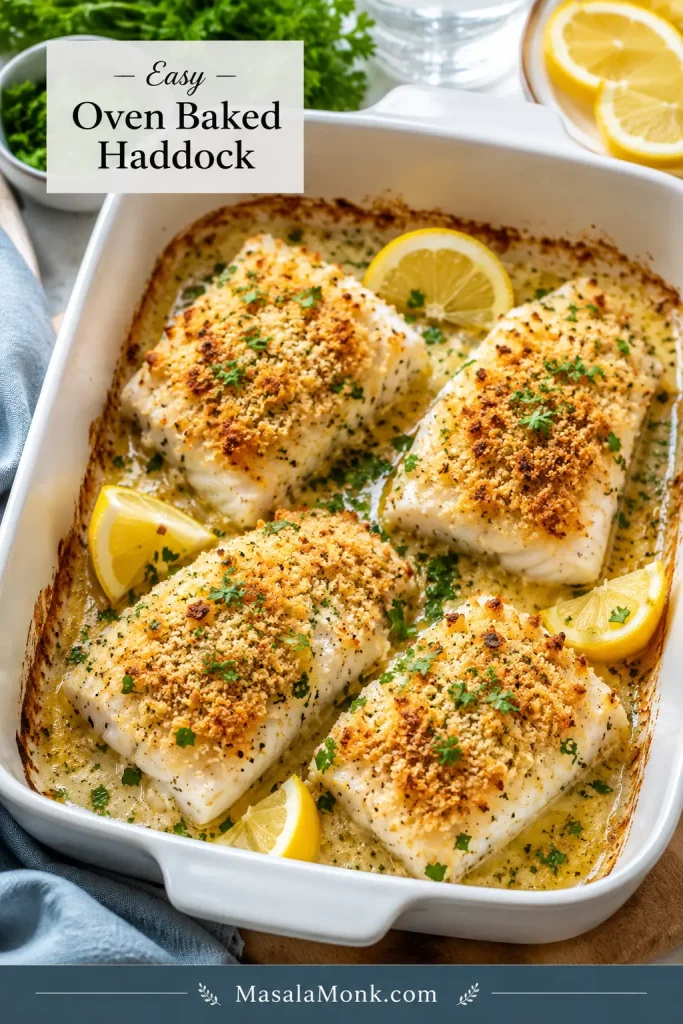
Easy Baked Haddock with Buttery Ritz or Panko Topping
Mild haddock fillets baked with lemon, butter, herbs, and your choice of panko, breadcrumbs, or crushed Ritz crackers. The fish turns soft and flaky while the surface becomes golden and savory.
Prep Time
10 minutes
Cook Time
12 to 16 minutes
Total Time
About 25 minutes
Servings
4
Yield
4 baked haddock fillets
Oven Temperature
400°F / 200°C
Doneness
145°F / 63°C, opaque, and flaky
Ingredients
4 skinless boneless haddock fillets, about 6 oz / 170 g each, or about 1 1/2 lb / 680 g total
1 tablespoon olive oil or melted butter, for the baking dish and fish
Fine salt, to taste: about 3/4 teaspoon for plain crumbs, or 1/4 to 1/2 teaspoon for Ritz crackers, salted butter, or Parmesan
1/4 teaspoon black pepper
1 tablespoon lemon juice / 15 ml, plus lemon wedges for serving
1 teaspoon lemon zest, optional but excellent in the topping
1/2 teaspoon garlic powder
1/2 teaspoon paprika
2 tablespoons chopped parsley, plus more for serving
For a Breadcrumb or Panko Topping
3/4 to 1 cup panko or breadcrumbs
4 tablespoons melted butter / 56 g
1/4 cup grated Parmesan / about 22 g, optional
For a Ritz Cracker Topping
1 sleeve Ritz crackers, about 34 crackers / roughly 90 to 100 g, crushed
3 to 4 tablespoons melted butter / 42 to 56 g
1/4 to 1/2 teaspoon fine salt total, added only after tasting the cracker mixture
Instructions
Preheat the oven. Heat the oven to 400°F / 200°C. Lightly grease a 9×13-inch / 23×33 cm baking dish.
Dry the haddock. Pat the fillets very dry with paper towels. Dry fish before the oven means better texture after the oven.
Season the fish. Arrange the fillets in one layer. Brush lightly with olive oil or melted butter, then season with salt, pepper, lemon juice, garlic powder, and paprika.
Make the topping. Mix panko, breadcrumbs, or crushed Ritz crackers with melted butter, lemon zest, parsley, and Parmesan if using. The mixture should look like damp sand, not wet paste.
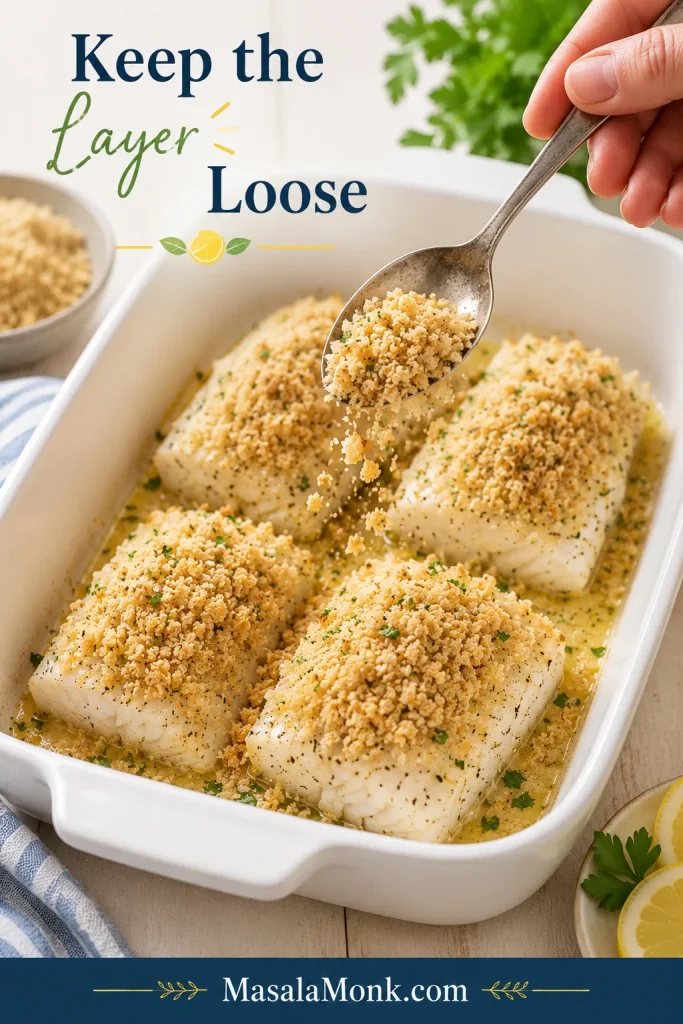
Top the fillets. Spoon the mixture over the fish and press gently so it sticks. Keep the layer loose rather than packed down.
Bake uncovered. Bake for 12 to 16 minutes, depending on thickness, until the fish is opaque and flakes easily.
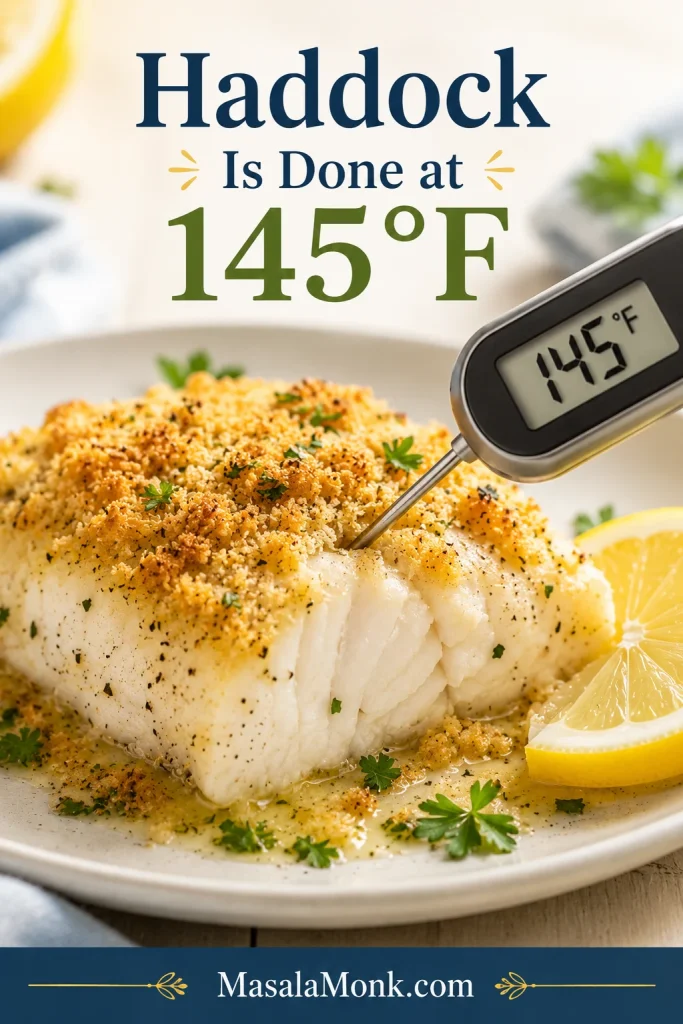
Check doneness. For the most reliable result, check the thickest part with an instant-read thermometer. Haddock is done at 145°F / 63°C.
Brown only if needed. If the fish is done but the topping is pale, broil, or use the oven grill, for 1 to 2 minutes. Watch closely.
Rest and serve. Let the fish rest for 2 minutes, then serve with lemon wedges and more parsley.
When it is right, the fish should lift in soft flakes, the center should look opaque and moist, and the buttery layer should be golden without feeling greasy.
Recipe Notes
For thicker haddock loins or a heavier Ritz layer, bake at 350°F / 175°C for 18 to 25 minutes instead.
Thin fillets may be done in less than 12 minutes, so start checking early.
If using a fan or convection oven, begin checking 2 to 3 minutes early.
Mixed-size fillets need mixed timing: lift out thinner pieces first and let thicker ones finish.
Serve soon after baking. The fish stays moist, but the golden layer is best while warm and fresh.
Baking the fillets uncovered helps the topping toast while the haddock underneath stays tender, moist, and easy to lift from the dish.
Start with the dinner you want, then choose the topping. Ritz gives you buttery New England comfort, panko gives you crunch, breadcrumbs keep it classic, and lemon butter keeps the plate lighter.
Once you know the style you want, this guide helps you choose between Ritz, panko, no breadcrumbs, or a from-frozen method.
Best Topping by Dinner Style
What You Want
Use
Best Temperature
Why It Works
New England baked haddock
Crushed Ritz crackers
350°F or 400°F
Buttery, cozy, and classic with lemon and parsley.
Crispy baked haddock without frying
Panko and Parmesan
400°F
Light crunch without a pot of oil.
Soft classic baked fish
Plain breadcrumbs
375°F or 400°F
Gentler texture and familiar flavor.
Baked haddock without breadcrumbs
Lemon, butter or olive oil, herbs
400°F
Clean, bright, and lighter.
Thick center-cut haddock
Haddock loins
350°F or longer 400°F timing
Thicker fish needs gentler timing.
Baked haddock from frozen
Emergency frozen method
400°F
Bake briefly first, blot moisture, then season.
Use this topping comparison to choose the texture you want before you bake: buttery Ritz, crisp panko, or softer breadcrumbs.
Choose Ritz for buttery New England baked haddock, panko for a crisp finish, or breadcrumbs for a softer classic crust.
For a first try, choose Ritz if you want the coziest fish dinner and panko if you want the crispest finish. Both make mild haddock feel more complete than plain baked fish.
Craving fried fish instead of baked fish? This fish batter recipe is the better path.
Haddock needs three things: a dry surface, seasoning on the fish itself, and the confidence to stop baking before the fillets turn firm. The buttery layer adds flavor and comfort, but the fish is still the main event.
If baked fish has disappointed you before, it was probably not because you did anything dramatic wrong. Delicate white fish simply rewards early checking. Once you learn that, this recipe feels relaxed instead of risky.
The buttered surface protects the fish, the lemon keeps the flavor bright, and the broiler gives you a backup plan when the fish is done before the surface looks perfect.
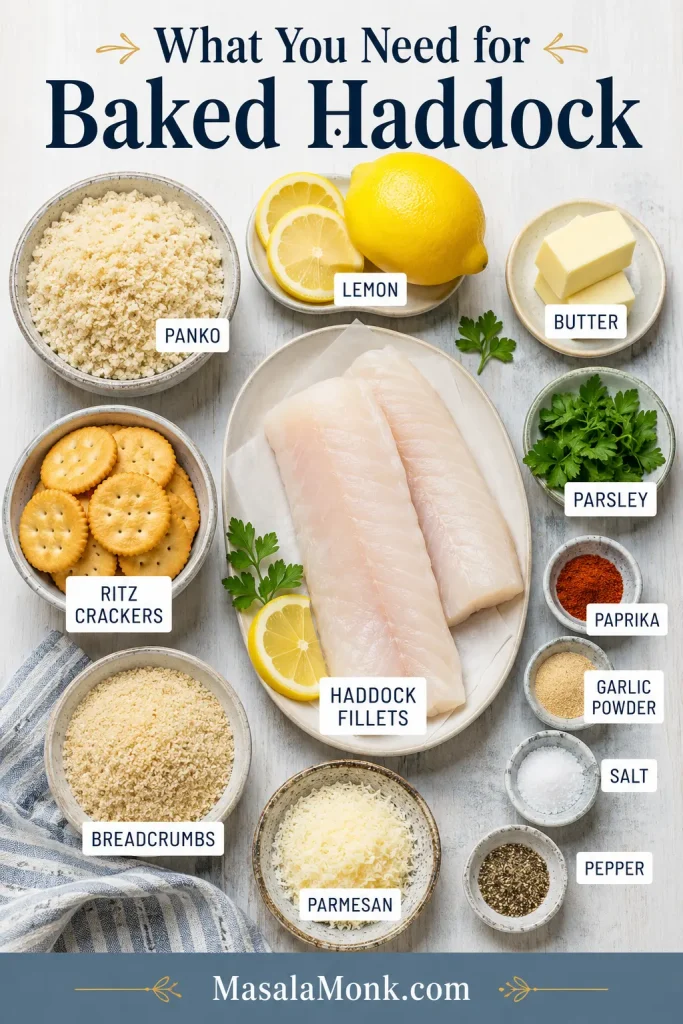
Ingredients You’ll Need
The ingredient list is short, so balance matters. Haddock is mild; it needs direct seasoning and enough butter in the topping to brown without turning greasy.
Before choosing your topping, gather the essentials: mild haddock, lemon, butter, herbs, and either Ritz crackers, panko, or breadcrumbs.
Haddock Fillets
Skinless boneless haddock fillets are easiest. Four fillets, about 6 oz / 170 g each, fit well in a 9×13-inch baking dish. Thinner pieces cook quickly; thick haddock loins need more time. Skin-on haddock can still be baked skin-side down.
Butter or Olive Oil
Butter gives the most classic flavor and helps the surface turn golden and savory. Olive oil works when you want a lighter plate, especially with plenty of lemon and herbs.
Panko, Breadcrumbs, or Ritz Crackers
Panko gives the lightest crunch. Fine breadcrumbs make a softer classic crust. Ritz crackers bring buttery New England comfort and need a lighter hand with salt.
Crush Ritz crackers into coarse pieces, not powder. You want little buttery bits that toast on top of the fish.
Lemon, Garlic, Paprika, and Herbs
Lemon brightens the fish, garlic powder seasons evenly, paprika adds color, and parsley keeps the plate fresh. For a seafood-seasoning flavor, replace the paprika with a small pinch of seafood seasoning and reduce the salt.
Parmesan
Parmesan is optional, but it works beautifully with panko. It adds savory depth and helps the panko crust taste more finished.
Step-by-Step Tips for Better Baked Haddock
The recipe card gives you the fast version. These cues help with thin fillets, thick loins, frozen fish, and heavier toppings.
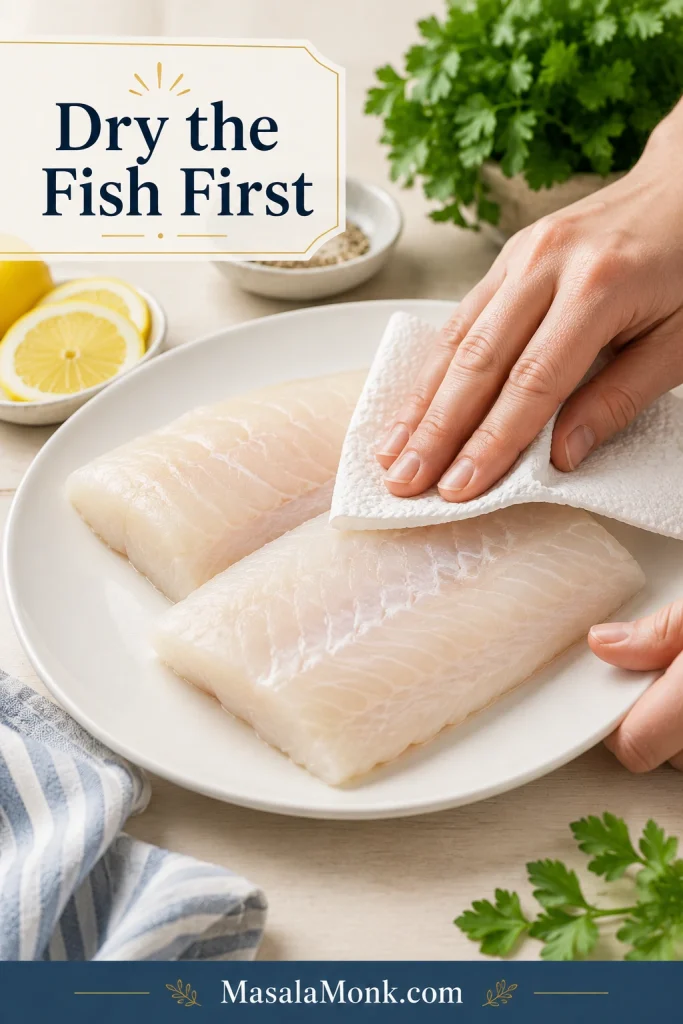
1. Start with dry fillets
Pat both sides of the fish with paper towels. This one step helps seasoning stick and keeps the dish from turning watery.
First, pat the haddock dry; otherwise, extra surface moisture can make the fish steam and soften the topping.
2. Season the fish, not just the topping
Add salt, pepper, lemon juice, garlic powder, and paprika before the topping goes on. The golden layer should support the fish, not carry all the flavor by itself.
Next, season the haddock itself with lemon, salt, pepper, garlic, and paprika so the fish tastes good beneath the topping.
3. Keep the topping loose
Mix the panko, breadcrumbs, or crushed crackers with melted butter until the texture looks like damp sand. Spoon it over the fish, press gently, and stop there. A loose layer browns better than a packed one.
The topping should feel like damp sand because that texture browns better than dry crumbs or a greasy butter paste.
After mixing the crumbs, keep the layer loose on top of the fillets so the heat can move through the fish.
Spoon the topping on lightly instead of pressing it down, because a loose layer leaves room for heat to cook the fish evenly.
4. Bake uncovered
An uncovered dish gives the surface a chance to toast. Covering traps steam, which is useful for some foods but not for buttery topping on delicate fish.
5. Let the fish win
Pull the haddock when it flakes, even if the top is not quite as golden as you hoped. A minute under the broiler can fix the color.
If the haddock is done but the surface looks pale, broil the topping briefly instead of extending the bake time.
Once the topping choice is clear, the only real timing question is temperature.
A middle path when the topping browns quickly but the fish is thick
14 to 20 minutes
400°F / 200°C
Most everyday baked haddock fillets
12 to 16 minutes
425°F / 220°C
Very thin fillets or quick browning at the end
8 to 12 minutes
For most weeknight dinners, 400°F / 200°C is the easiest default. For a thicker loin or a heavy Ritz layer, 350°F / 175°C gives the fish more time to cook gently.
Use 400°F for most weeknight haddock fillets; however, thicker loins or a heavier Ritz layer often bake better at 350°F.
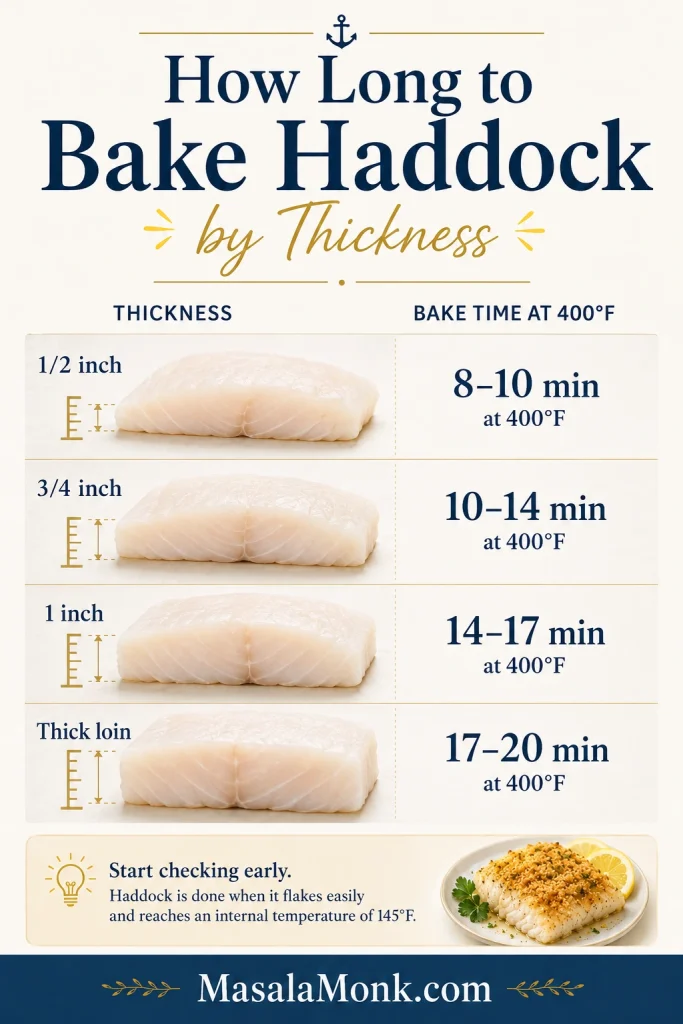
How Long to Bake Haddock by Thickness
Thickness matters more than weight. A thin 6 oz fillet can cook faster than a smaller but thicker haddock loin.
Fillets vs Loins
Haddock fillets are usually thinner and cook quickly, while haddock loins are thicker center-cut pieces that need more time and often do better with gentler heat.
If your dish has mixed sizes, remove the thinner fillets as soon as they are done and let the thicker pieces finish. This simple move prevents dry edges and underdone centers.
Haddock Thickness
At 400°F / 200°C
At 350°F / 175°C
Thin fillet, about 1/2 inch
8 to 10 minutes
12 to 15 minutes
Medium fillet, about 3/4 inch
10 to 14 minutes
15 to 18 minutes
Thick fillet, about 1 inch
14 to 17 minutes
18 to 22 minutes
Very thick haddock loin
17 to 20 minutes
22 to 25 minutes
Start checking at the early end of the range. Haddock rewards early checking more than extra oven time.
Because thickness changes bake time more than weight, thin fillets need early checking while thick haddock loins need extra minutes.
How to Know When Haddock Is Done
Haddock is done when the center is opaque, moist-looking, and flakes with gentle pressure. The most reliable check is an instant-read thermometer in the thickest part.
Temperature: 145°F / 63°C in the thickest part
Fork test: soft flakes separate without force
Visual cue: opaque center, not translucent or glossy
The first time, a thermometer is helpful. After that, you will start recognizing the soft flakes and opaque center by sight.
When the center turns opaque and separates into soft flakes, pull the haddock from the oven before the delicate fish overcooks.
A thermometer gives the clearest first-time answer: haddock is done when the thickest part reaches 145°F.
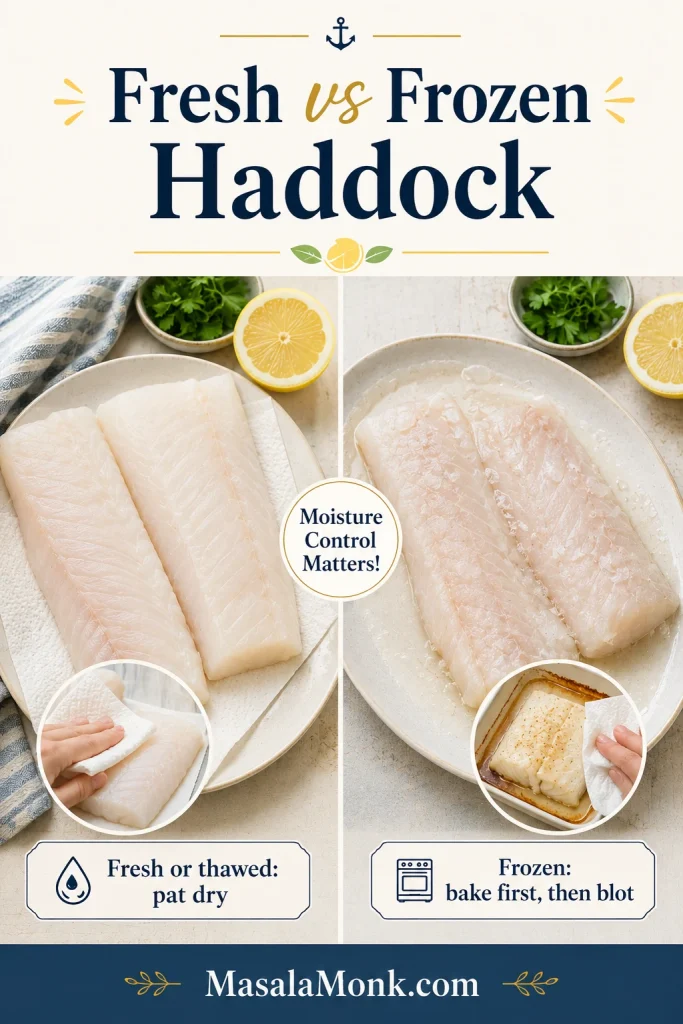
Fresh haddock is easiest, but frozen haddock works well when it is thawed and dried properly. Crumb-topped fish needs a dry surface more than extra liquid in the dish.
Fresh or thawed haddock needs a dry surface; for frozen haddock, a short first bake and a quick blot help control moisture.
Best Method: Thaw First
Thaw frozen haddock overnight in the refrigerator. For a faster method, keep the fish sealed and thaw it in cold water, changing the water every 30 minutes. The USDA describes refrigerator thawing, cold-water thawing, and microwave thawing as safe defrosting methods. Fish thawed by cold water or microwave should be cooked right away.
After thawing, unwrap the fillets and pat them dry before seasoning. That is the difference between a golden top and a wet crust.
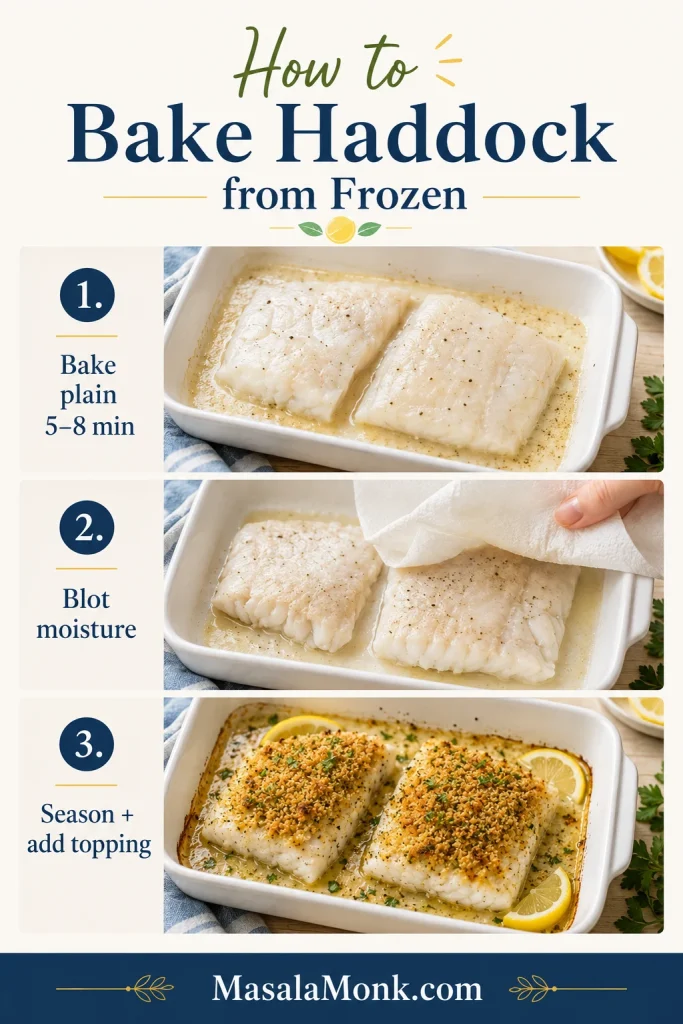
Emergency Method: Baking Haddock from Frozen
Thawed fish gives the best texture, but frozen fillets can still become dinner. Keep the topping off at first.
Heat the oven to 400°F / 200°C.
Place frozen fillets in a lightly greased baking dish.
Bake plain for 5 to 8 minutes, just until surface ice melts and moisture starts to release.
Blot or drain the dish carefully.
Season the fish, add the topping, and continue baking until the center reaches 145°F / 63°C.
This will get dinner on the table, but thawed fish gives you a drier surface and a better topping.
When baking haddock from frozen, bake it plain first, blot the released moisture, and only then add seasoning and topping.
Choose one flavor direction and keep it simple. Haddock is mild, so it does not need a crowded topping.
New England Baked Haddock with Ritz Crackers
This is the buttery comfort version: crushed Ritz crackers, melted butter, lemon, and parsley over mild white fish. Bake at 350°F for a gentler old-school feel, or 400°F when you want dinner faster. Keep the salt light and let the crackers do their job.
Crushed Ritz crackers give this New England baked haddock its buttery comfort, while lemon and parsley keep each bite balanced.
Panko Parmesan Baked Haddock
Panko and Parmesan give you the crunch of fried fish without pulling out a pot of oil. This version is best at 400°F so the panko crust can toast while the fish stays tender.
Panko and Parmesan add crispness without frying, so this baked haddock version works well when you want crunch with less mess.
Lemon Butter Haddock
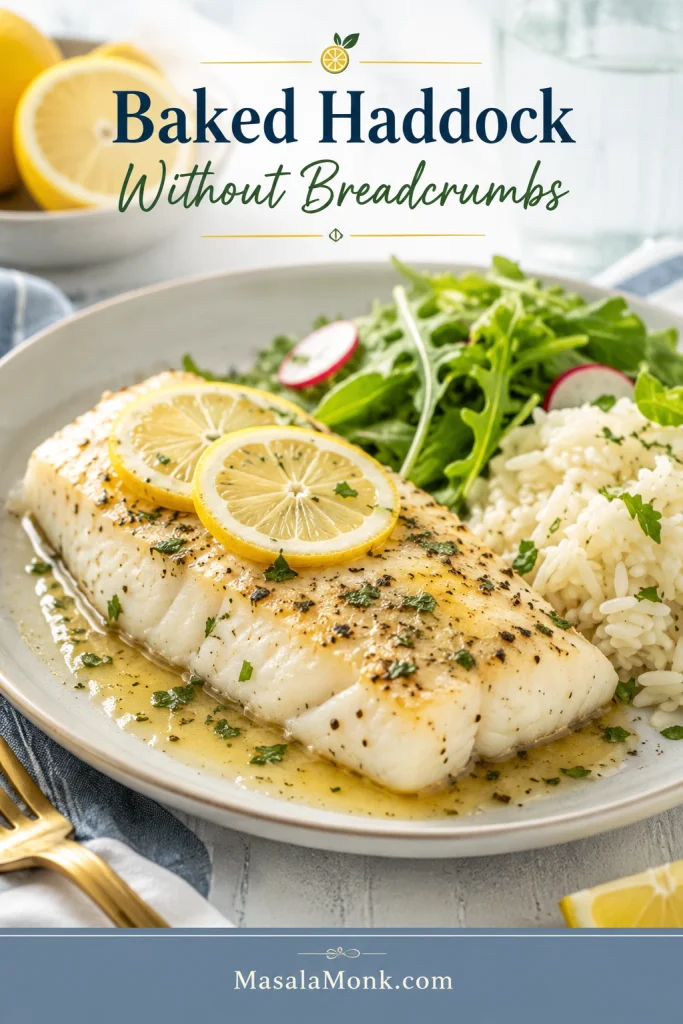
Skip the crumbs and let lemon butter lead. This is the lightest path, especially when the fish is fresh and you want a clean, bright dinner.
For a lighter baked haddock variation, skip the crumbs and let lemon butter, herbs, and gentle oven heat carry the flavor.
Garlic Butter Haddock
Add garlic powder or a little finely grated garlic to the melted butter, then finish with parsley and lemon. Fresh garlic can burn under the broiler, so use a light hand.
Warm Paprika or Chili Crumb Haddock
Add a small pinch of smoked paprika, mild chili powder, or Kashmiri chili powder to the buttered crumbs. Keep the warmth gentle; haddock tastes best when the spice supports the fish instead of taking over.
Healthy Baked Haddock
Use olive oil instead of some of the butter, keep the topping thin, and add lemon, herbs, and quick-cooking vegetables around the fish. The plate stays lighter, but the golden finish still makes it feel like dinner.
Cod or Another White Fish
This method also works with cod, pollock, hake, or another mild white fish. Cod is often thicker and meatier than haddock, so use the thickness chart instead of only the clock.
For a crisp battered dinner instead, save this fish and chips recipe for another night.
What to Serve with Baked Haddock
For the easiest comfort plate, serve the haddock with roasted potatoes, green beans, lemon wedges, and a spoonful of tartar sauce. It feels classic, but still light enough for a weeknight.
To make baked haddock feel like a full dinner, pair the flaky fish with roasted potatoes, green beans, lemon, and tartar sauce.
Keep the sides simple so the fish still feels like the center of the plate. For something brighter than tartar sauce, spoon a little mango salsa over the lemon-butter version, especially with rice or salad.
Troubleshooting
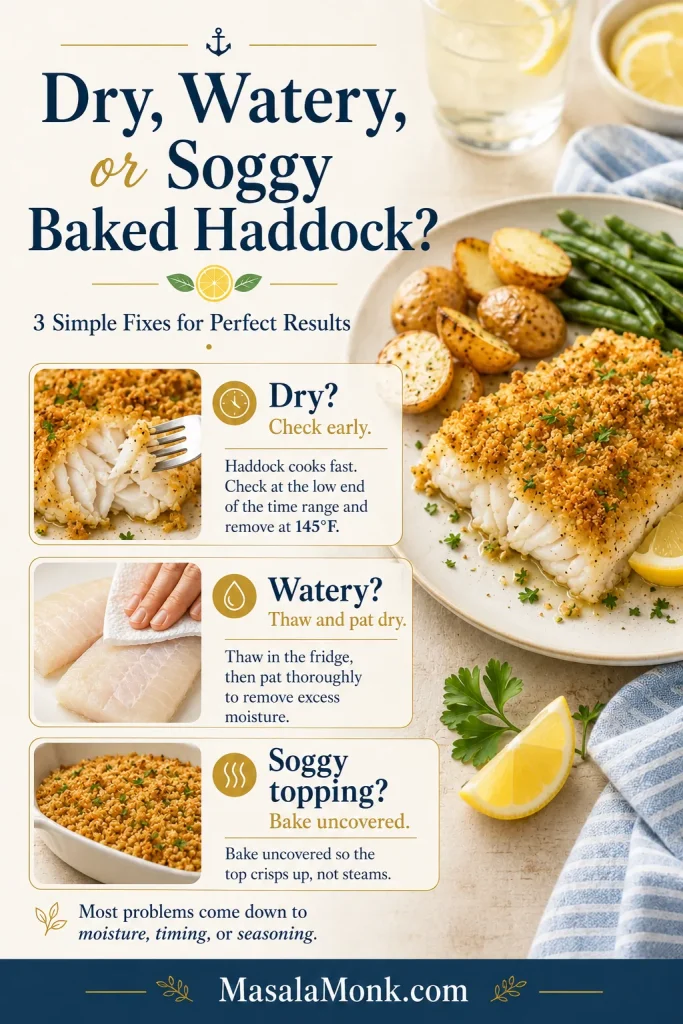
Most baked haddock problems come down to moisture, timing, or seasoning. The fix is usually simple.
Three things to remember: Start with dry fillets, bake uncovered when using a topping, and pull the fish when it is done. The surface can always be browned for one more minute.
If baked haddock turns dry, watery, or soggy, adjust the timing, dry the fillets better, and bake uncovered next time.
Problem
Likely Cause
How to Fix It
Haddock is dry
It baked too long or the fillets were thin.
Check early and pull the fish when it reaches 145°F / 63°C.
Fish is watery
The fish was frozen, not fully thawed, or crowded in the dish.
Thaw fully, pat dry, and leave space between fillets.
Topping is soggy
Too much moisture or a covered dish.
Bake uncovered and avoid adding extra liquid under the topping.
Topping is pale
The fish cooked before the surface browned.
Broil for 1 to 2 minutes after the fish is done.
Fish tastes bland
Only the topping was seasoned.
Season the fish directly before adding the top layer.
Fish fell apart
It was overcooked or lifted too roughly.
Rest for 2 minutes and use a thin fish spatula.
Topping is greasy
Too much butter, especially with crackers.
Use less butter with Ritz and keep the layer loose.
Fish smells too strong
The fish may not be fresh or was stored too long after thawing.
Use fresh-smelling fish and cook soon after thawing.
Assemble this recipe right before baking. You can thaw the fish ahead and mix the dry topping ahead, but add butter, seasoning, and the final layer close to oven time.
How to Store Leftovers
Store leftovers in an airtight container in the refrigerator for up to 2 days. Keep extra lemon wedges separate and add fresh lemon after reheating.
Flaked leftovers are useful, not wasted. Fold them into potato and herbs for simple fish cakes, or tuck them into fish tacos with slaw, lime, and a creamy sauce.
Leftover baked haddock still has options: flake it into bowls, shape it into fish cakes, or tuck it into tacos with slaw and lime.
How to Reheat It
Reheat gently in a low oven or air fryer until warmed through. The microwave works in a pinch, but it softens the topping and can make fish smell stronger.
Can You Freeze Cooked Haddock?
Cooked crumb-topped haddock does not freeze beautifully. The fish can turn watery and the topping usually softens. For best texture, freeze raw haddock, thaw it safely, and bake it fresh.
FAQ
What temperature is best for baked haddock?
For most fillets, 400°F / 200°C is the easiest everyday temperature. It cooks the fish quickly while giving the topping time to turn golden. For thicker loins or a heavier Ritz cracker topping, 350°F / 175°C gives a gentler bake.
How long does haddock take in the oven?
Most medium fillets take 12 to 16 minutes at 400°F / 200°C. Thin pieces may be ready in 8 to 10 minutes, while thick loins may need 17 to 20 minutes or more.
Should baked haddock be covered or uncovered?
Bake it uncovered when using a crumb topping. Covering traps steam, which helps some dishes but makes buttery crumbs soft instead of golden.
Can I bake frozen haddock?
Yes, but thawing first gives a drier surface and a better topping. For a frozen emergency, bake the plain fish briefly, blot the released moisture, season, add the topping, and continue baking until done.
Can I use cod instead of haddock?
Yes — cod works well here, but it is often thicker and meatier than haddock. Use the thickness chart and doneness cues instead of relying only on the clock.
Is haddock done at 145°F?
Yes. For safety, fish should reach 145°F / 63°C in the thickest part. It should also look opaque and flake easily with a fork.
Why did my baked haddock turn watery?
Watery haddock usually means the fish carried too much moisture into the oven. Fully thaw frozen fillets, pat them dry, and leave space in the dish so the fish bakes instead of steaming.
Can I make baked haddock without breadcrumbs?
Yes. Use melted butter or olive oil, lemon juice, lemon zest, parsley, salt, and pepper. Bake just until the fish is opaque and flaky. It will be lighter and softer, more lemon-butter fish than crisp-topped fish.
What is the best topping for baked haddock?
Ritz crackers give the buttery New England-style finish. Panko gives the crispest bite. Plain breadcrumbs give a softer, classic baked-fish texture.
Can I use smoked haddock for this recipe?
You can, but reduce the salt because smoked haddock is already salty and stronger in flavor. Smoked haddock is also excellent in chowder, Cullen skink, fish pie, and kedgeree.
A Few Last Tips Before You Bake
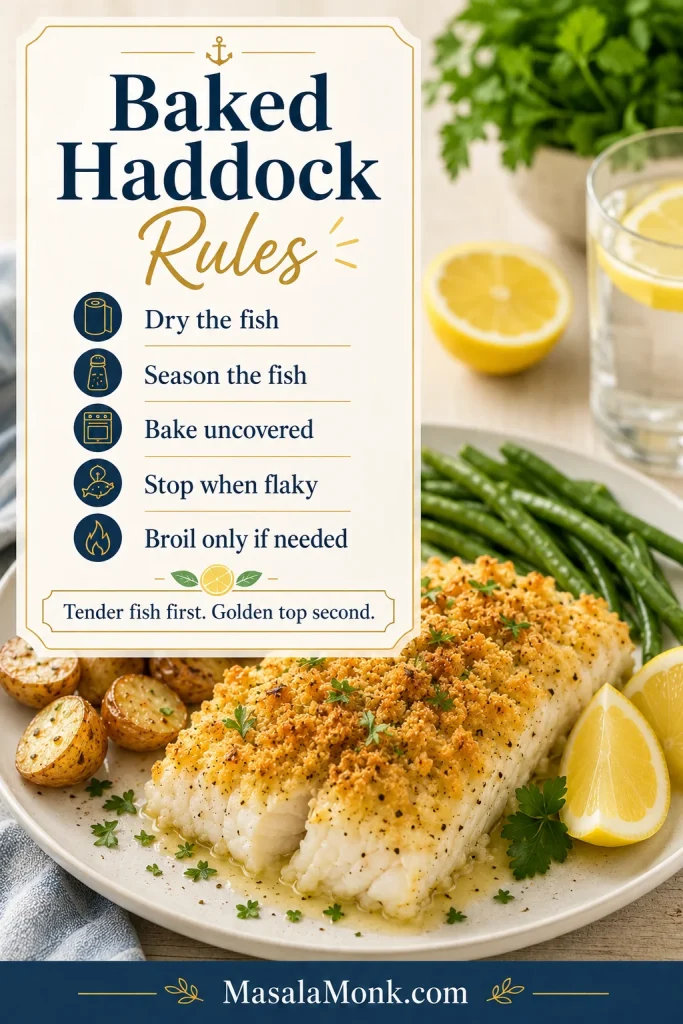
Baked haddock should feel simple, not stressful. Dry the fish, season the fish, bake it uncovered, and stop when the center is flaky and moist. The surface can always get one more minute under the broiler; the fish cannot be uncooked.
Finally, remember the core baked haddock rules: dry the fish, season it directly, bake uncovered, stop when flaky, and broil only if needed.
Whether you choose buttery Ritz crackers, crisp panko, plain breadcrumbs, or lemon butter, the goal is the same. You want tender haddock with enough golden flavor on top to make it feel like a proper dinner.
If you make this baked haddock, leave a comment and tell us which version you chose: Ritz, panko, breadcrumbs, or lemon butter. Also mention whether you used thin fillets, thick loins, or frozen haddock. Your notes help other readers choose their own path.