Posted on 6 Comments

Foods to Eat During 16:8 Intermittent Fasting

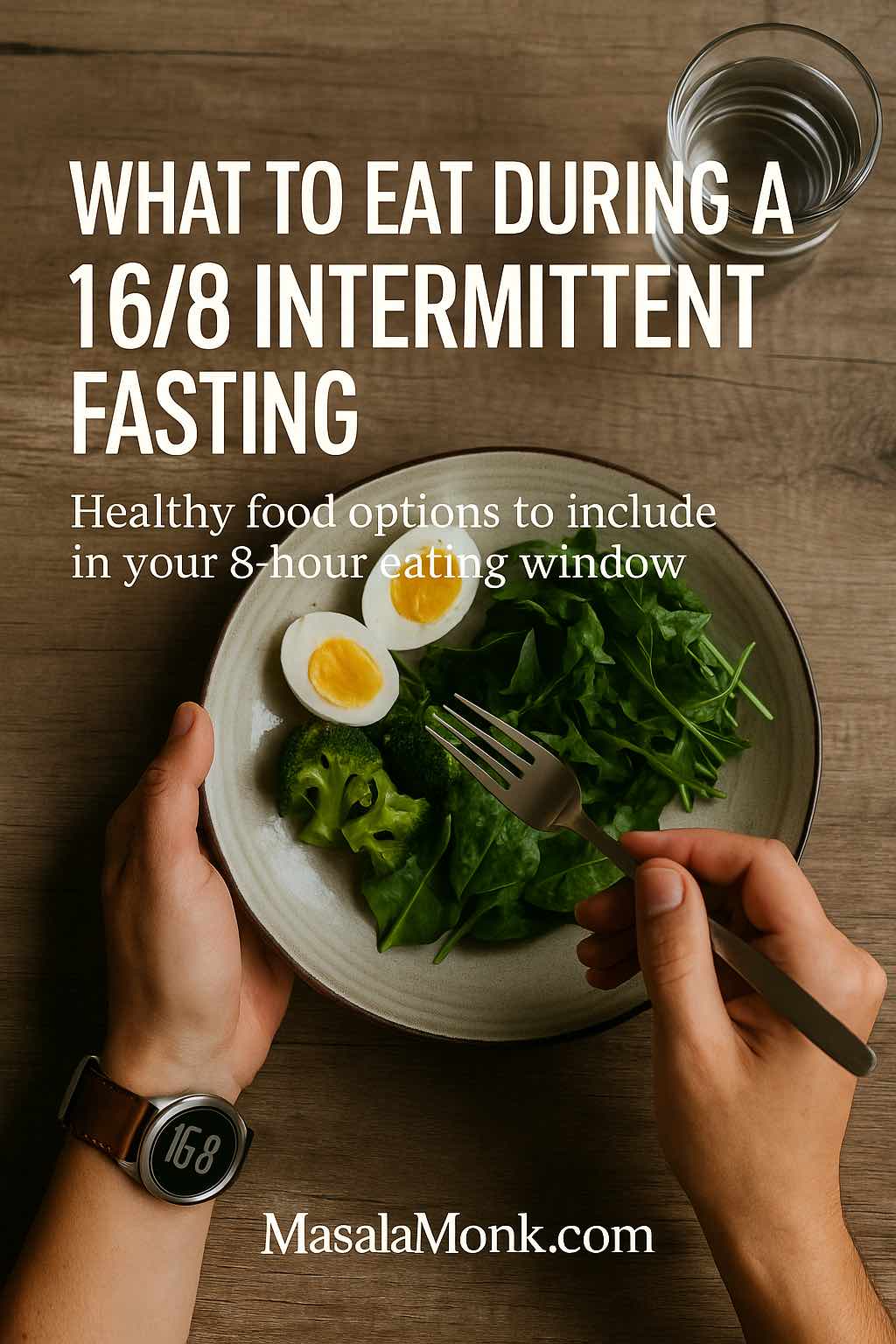
16/8 intermittent fasting first plate: boiled eggs, leafy greens and broccoli with water—simple foods to eat while fasting 16/8.

When you type foods to eat while fasting 16/8 into a search bar, you’re really asking two practical questions at once: what to drink during the 16-hour fasting window so you stay in a true fast, and what to place on your plate during the eight-hour eating window so you feel satisfied, energized, and consistent. Right from the start, the answer is refreshingly simple: build every plate around protein, high-fiber carbohydrates, and healthy fats, using mostly minimally processed, Mediterranean-leaning foods. That template is easy to shop, effortless to rotate, and—crucially—sustainable. For a quick primer on that food pattern, the American Heart Association’s Mediterranean overview and the practical Oldways Mediterranean Pyramid are both excellent, real-world starting points.


What to Drink While Fasting (and Why It Matters)

During the 16-hour fast, calories count; hydration does too. Consequently, choose plain water, sparkling or mineral water, black coffee, and unsweetened tea—all of which hydrate without adding energy. You can explore our post on Homemade Electrolytes for Fasting to get more ideas on what to drink. If you like simple “how much” rules of thumb, benchmarks from the Academy of Nutrition and Dietetics are helpful, while it is important to stay hydrated, however it’s important to remind you to favor lower-sugar beverages most of the time. For a public-health reminder on swapping out sugary beverages, see CDC: water and healthier drinks.

Of course, context matters. On hot days or after workouts, a pinch of electrolytes can help without breaking your fast—as long as your drink remains unsweetened. If you prefer real-food flavors, try these refreshing Cooling Cucumber Electrolyte Quenchers or explore DIY electrolyte drink ideas and simply omit sweeteners during the fast.

A quick nuance on sweeteners: the WHO’s guideline on non-sugar sweeteners advises against relying on them for weight control. Nevertheless, some people tolerate a small amount in coffee without cravings; others do not. Test gently, observe your appetite, and use minimally.

Also Read: Tea and Intermittent Fasting


The Best First Plate to Break Your Fast (Start Gentle, Then Build)

Once you open your window, your first bites set the tone for the rest of the day. Therefore, begin with a gentle, balanced “first plate” that combines protein + easy-to-digest carbs + a little fat. After 45–90 minutes, follow with your main meal. For instance:

  • A small bowl of lentil or vegetable soup with tofu or paneer and a slice of whole-grain bread.
  • Eggs with sautéed spinach plus a thin chapati or sourdough wedge.
  • Yogurt/curd (or fortified soy yogurt) with berries and a handful of nuts.
  • A smoothie based on milk/curd (or fortified soy) with fruit and a spoon of nut butter.

If you enjoy browsing options, you’ll like this compact collection of gentle, protein-forward fast-breaking ideas you can rotate all week.

Also Read: Coffee and Fasting: All Your Questions Answered


Foods to Eat While Fasting 16/8 (Inside the Window): The Core Building Blocks

Although timing is the hallmark of intermittent fasting, food quality is what shapes energy, fullness, and results. Thus, the most practical foods to eat while fasting 16/8 (meaning during your eating window) fall into three friendly buckets:

  • Protein anchors: eggs; Greek yogurt/curd; cottage cheese/paneer; fish and poultry; tofu and tempeh; dals, chickpeas, kidney beans; edamame; soy milk; nuts and seeds.
  • Smart carbs (fiber-forward): oats, quinoa, brown rice, millets, whole-wheat roti, sweet potatoes, beans and lentils, and plenty of fibrous vegetables—plus fruit like berries, apples, citrus, or bananas.
  • Healthy fats: extra-virgin olive oil, avocado, nuts/seeds; optionally, fatty fish if that suits your diet.

To make that even more concrete, here’s a beginner’s plate rule borrowed from public guidelines: fill half your plate with fruit/veg, and divide the other half between protein and smart carbs—a practical visual reinforced by USDA MyPlate. For specifics, the MyPlate pages for the Vegetable Group and Protein Foods Group offer quick, visual refreshers.

Finally, fruit definitely belongs. Pair it with protein or fat to smooth the glucose curve—think yogurt with berries, apple with peanut butter, banana with paneer or tofu. For ideas that go beyond the usual pairings, try our fruit-during-IF guide.

Also Read: Can We eats Peanuts while Intermittent Fasting?


7-Day Intermittent Fasting Meal Plan (16:8 Window Examples You Can Repeat)

Below is a complete intermittent fasting meal plan for a 12:00–8:00 pm window. Shift earlier (11–7) or later (1–9) as life demands. Each day includes a first plate to break your fast, a main meal, and a compact second plate/snack. You’ll also see vegetarian/vegan swaps and lower-carb variations so the week fits different goals. Use this as a beginner intermittent fasting meal plan, scale portions to your appetite and activity, and repeat favorites.

Portions vary by body size and training load; nevertheless, keep protein, fiber, and minimally processed ingredients at the center.

Day 1 — Mediterranean-Leaning Kickoff (foods to eat while fasting 16/8)

  • 12:00 First plate: Greek yogurt/curd with berries + 1 tbsp mixed nuts.
    Vegan swap: fortified soy yogurt with berries + chia.
  • 1:30 Main meal: Chickpea and vegetable stew in olive oil; side of quinoa; big lemony salad.
    Lower-carb swap: extra veg; smaller quinoa or cauliflower “rice.”
  • 6:30 Second plate/snack: Grilled paneer or tofu with peppers and onions + one orange.

Helpful visual for this style of eating: the Oldways Mediterranean beginner list is clear and friendly.

Day 2 — Indian Comfort, Balanced (foods to eat while fasting 16/8)

  • 12:00 First plate: Two besan chillas with curd and kachumber (or soy yogurt if vegan).
    Recipe inspiration: paneer-stuffed besan chilla (use your favorite version).
  • 2:00 Main meal: Rajma or chole over brown rice or millets; sautéed greens.
    Lower-carb swap: halve rice, double greens and cucumber salad.
  • 7:30 Second plate/snack: Fruit bowl (berries/papaya/banana) + almonds or walnuts.

Day 3 — High-Protein Emphasis (foods to eat while fasting 16/8)

  • 12:00 First plate: Eggs (omelette or boiled) with sautéed spinach + a thin sourdough wedge.
    Vegan swap: chickpea “omelette” (besan) with spinach.
  • 2:00 Main meal: Tandoori chicken or paneer/tofu tikka; roasted vegetables; small portion of brown rice or a roti.
    Lower-carb swap: skip grain, double vegetables; add avocado.
  • 6:45 Second plate/snack: Cottage cheese/paneer or tofu cubes with cherry tomatoes and olives.

Also Read: Best Nuts for Intermittent Fasting: Maximizing Satiety and Nutritional Benefits

Day 4 — Power Bowls (foods to eat while fasting 16/8)

  • 12:00 First plate: Smoothie bowl—milk/curd (or fortified soy), banana/berries, flax or peanut butter; sprinkle seeds.
    Lower-carb tweak: more berries, less banana; tofu on the side.
  • 1:45 Main meal: Lentil-quinoa bowl with roasted cauliflower/carrots; tahini-lemon dressing.
    Vegan/veg by default.
  • 7:00 Second plate/snack: Mixed sprouts chaat with tomato, onion, coriander, lemon, and a dash of chaat masala.
    How-to: sprouted moong overnight—step by step.

Day 5 — Fish or Tofu Friday (foods to eat while fasting 16/8)

  • 12:00 First plate: Miso soup with tofu and greens; small fruit.
  • 2:00 Main meal: Grilled fish with olive oil, herbed potatoes, and a large salad; or tofu steaks if plant-based.
    Lower-carb swap: roasted zucchini/broccoli in place of potatoes.
  • 7:15 Second plate/snack: Greek yogurt/curd parfait with apple and cinnamon; or soy yogurt for vegan.

Day 6 — Comfort Curry, Light Finish (foods to eat while fasting 16/8)

  • 12:00 First plate: Small bowl of moong dal + steamed veggies + lemon.
  • 2:00 Main meal: Coconut-milk vegetable curry (or chicken curry) over brown rice/millets; cucumber-tomato salad.
    Lower-carb swap: less rice, extra salad; add olives or avocado.
  • 6:30 Second plate/snack: Peanut chaat or roasted chana; sliced guava or pear.

Day 7 — Social Sunday, Still Smart (foods to eat while fasting 16/8)

  • 12:00 First plate: Yogurt/curd + low-sugar granola + berries.
    Vegan swap: soy yogurt + homemade nut-seed granola.
  • 2:00 Main meal: Pizza-style whole-grain flatbread with tomato, mushrooms, peppers, olives, mozzarella (or tofu ricotta), olive oil; side salad.
    Lower-carb swap: portobello “pizza” caps or eggplant slices.
  • 7:00 Second plate/snack: Paneer/tofu stir-fry with sesame and greens; or a small hummus plate with crudités.

How to rotate and prep: batch-cook two proteins (dal/chana and tofu/paneer or chicken/fish), one smart carb (quinoa, brown rice, or millets), and a tray of roasted vegetables every 3–4 days. If you need variety within the carb bucket, have a look at Quinoa for Weight Loss: Benefits, Nutrition, and How to Cook Ideas.


Vegetarian, Vegan, and Low-Carb Tracks (Fast Customization, Same Principles)

To craft a vegetarian intermittent fasting meal plan, anchor each eating occasion with paneer/cottage cheese, yogurt/curd, eggs (if you eat them), and legumes (chana, rajma, dal). Layer olive oil, nuts, and seeds for healthy fats. To build a vegan intermittent fasting meal plan, swap dairy for fortified soy yogurt/milk, use tofu or tempeh as daily proteins, and rotate edamame and beans. If you’re curious about tempeh’s texture and flavor, this quick primer on tempeh as a versatile vegan protein will help you get started.

For a low-carb intermittent fasting plan, there’s no need for extremes. Emphasize non-starchy vegetables, lean or plant proteins, olive oil/avocado/nuts, and smaller portions of grains or starchy veg. That plant-forward approach is still compatible with the Mediterranean pattern and, frankly, more livable than strict keto for most people. If you want a broader view of how to begin this style of eating, Cleveland Clinic’s Mediterranean food list and starter plan is grounded and usable.

Also Read: Yogic Meal Plan and Intermittent Fasting – Insights from Sadhguru


What to Eat While Intermittent Fasting for Weight Loss (Tactics That Compound)

Because many readers pursue 16:8 for fat loss, it helps to connect the dots between intermittent fasting and diet quality. To that end, use this checklist inside the window:

  1. Front-load protein at every eating occasion—yogurt/curd, eggs, tofu/tempeh, dal or chana, fish or poultry, plus nuts/seeds.
  2. Fill half your plate with plants—non-starchy vegetables plus fruit. The plate visual from USDA MyPlate keeps this effortless.
  3. Choose slow carbs most of the time: oats, quinoa, brown rice, whole-wheat roti, sweet potato, legumes.
  4. Use fats intentionally: extra-virgin olive oil, avocado, nuts, seeds. Measure pours and handfuls.
  5. Drink during the fast: water, coffee, and tea. For a simple refresher, see the Cleveland Clinic drinks guide.
  6. Break the fast gently: see the first-plate ideas above or browse fast-breaking suggestions.
  7. Batch-cook so your defaults are strong: try high-protein vegetarian meal prep or vegan meal prep ideas to save time during the week.

For a sane, evidence-aware perspective on weight and diet quality (and why extremes backfire), the British Dietetic Association’s plate guidance for weight loss and notes on fad diets are both sensible and easy to skim.


Foods to Avoid (or Save for Occasional Treats)

Even within a flexible intermittent fasting food plan, certain choices make timing harder rather than easier:

  • Sugary beverages and ultra-processed snacks—they spike appetite and can trigger rebound eating.
  • Very high-fat “first meals” right after fasting—greasy, heavy foods often feel rough on the stomach and push you toward grazing later.
  • Mindless nibbling in the window—if your plate lacks protein and fiber, you’ll snack soon after.

By contrast, treating richer items as occasional—and positioning them inside a complete meal with protein and vegetables—preserves the rhythm that makes 16:8 work. For a quick, friendly reminder on lower-sugar beverage choices, visit Nutrition.gov’s hydration and beverage tips.


Troubleshooting Your 16:8 Schedule (Common Hurdles, Easy Fixes)

  • If hunger hits hard mid-morning: sip water or unsweetened tea first; if you still feel low, shift your window earlier (e.g., 11–7) for a week.
  • If you crash after your first plate: increase protein (yogurt + nuts, eggs, tofu) and choose easy digesting carbs (fruit, soup with pulses) before your main meal.
  • If evenings get snacky: make dinner more substantial—double vegetables, keep protein steady, and add a measured spoon of olive oil or a quarter avocado for satisfaction.
  • If weekends derail you: keep timing flexible (e.g., 14:10 on social days) and return to 16:8 on Monday—consistency beats rigidity.
  • If coffee jitters you on an empty stomach: consider delaying coffee by an hour and keep it plain; the nuance around stimulants and stress is covered here: Coffee + cortisol.

Foods to Eat While Fasting 16/8: Shopping Lists You Can Copy

Because shopping clarity makes or breaks adherence, these condensed lists keep decisions simple:

Proteins to rotate: eggs; Greek yogurt/curd; cottage cheese/paneer; tofu/tempeh; chicken/fish; dals, chickpeas, kidney beans; edamame; soy milk; nuts and seeds.
Smart carbs to prefer: oats; quinoa; brown rice; millets; whole-wheat roti; sweet potatoes; legumes; fruit; plus loads of leafy, cruciferous, and colorful vegetables.
Healthy fats to include: extra-virgin olive oil; avocado; almonds, walnuts, pistachios, peanuts; seeds like flax, chia, sesame, and sunflower.

To make legumes especially appealing, remember that pulses are naturally rich in fiber and nutrients—reasons the UN’s Food and Agriculture Organization highlights in their notes on the nutritional benefits of pulses and this broader 2025 celebration of the power of pulses. Consequently, dals, chana, and rajma deserve a regular place on your table.

Also Read: Are Lentils Good for Weight Loss? Benefits, Recipes, and Science Explained


Intermittent Fasting Diet Plan for Beginners (Routine That Fits Real Life)

To live with the 16:8 rhythm comfortably, set up a routine that survives busy weeks:

  • Pick a consistent window most days (e.g., 12–8). Flex for social plans; return to baseline the next day.
  • Prep “fast-breakers” you enjoy: soup portions in the freezer, yogurt/curd cups, chopped fruit, roasted nuts.
  • Keep two fallback plates on standby: eggs + veg + toast; or tofu/paneer tikka + salad + one roti.
  • Hydrate preemptively—first thing in the morning and mid-afternoon—even before you feel thirsty. When you want variety, revisit cooling cucumber electrolytes and DIY hydration recipes for unsweetened options during the fast and low-sugar ideas during the window.
  • Meal prep smartly: for plant-forward weeks, browse high-protein vegetarian meal prep or vegan meal prep ideas; for omnivore weeks, batch-roast chicken/fish and tray-bake vegetables for effortless mix-and-match plates.

If you like evidence windows, it’s worth noting that time-restricted eating research continues to evolve. For a balanced perspective, you can read a randomized trial in the New England Journal of Medicine comparing calorie restriction with/without TRE (summary here), or a more applied brief from the NIH on TRE in metabolic syndrome. Nevertheless, regardless of study headlines, diet quality and routine are the levers you actually control each day.


Special Notes for Women, PCOS, Menopause & Diabetes

Some readers do better with 14:10 or even 12:12 during demanding phases. Women navigating perimenopause, anyone with PCOS, and readers with diabetes (particularly those on glucose-lowering medication) should tailor fasting and meal timing with their clinician. All the same, the meal fundamentals in this guide—protein at each eating occasion, plant-rich plates, slow carbs, and measured healthy fats—remain widely applicable. If you want a gentle on-ramp, glance at vegan meal prep ideas or high-protein vegetarian prep to see how easy it is to keep protein and fiber high without complex rules.


Example Day Revisited: Foods to Eat While Fasting 16/8 (Vegetarian Window)

To connect everything, here’s a compact vegetarian day that mirrors the template:

  • 12:00Yogurt/curd with berries and crushed nuts (or fortified soy yogurt with chia).
  • 3:00Fruit + almonds (apple with almonds, banana with peanut butter, or berries with paneer/tofu cubes).
  • 7:30Paneer tikka or chole with quinoa or whole-wheat roti; mixed salad with olive oil.

Notice how every moment includes protein, plants, and a bit of fat—a simple combination that makes the difference between a plan you can follow and a plan that unravels when life gets busy.

Also Read: The Science of Protein: Maximizing Muscle Growth and Recovery


What to Eat During Intermittent Fasting 16/8: The Weekly Rhythm in One Line

At this point, it should be clear that foods to eat while fasting 16/8 are not about restriction; they’re about focus. Protein first, plants plentiful, fats thoughtful, carbs mostly slow. Rotate different legumes, swap in seasonal vegetables, choose grains you enjoy, and keep fruit in the mix. As a result, you’ll feel fuller on fewer calories, stabilize energy, and make the plan feel less like a “diet” and more like a habit.

And if you ever need a quick nudge, open a friendly visual like the Oldways Mediterranean Pyramid or a basic plate reminder such as USDA MyPlate. They’re simple for a reason: when your defaults are this good, 16:8 becomes far easier to keep—meal after meal, week after week.

Also Read: What is the Mediterranean Diet? Free PDF Meal Plan Inside

FAQs

1) What are the best foods to eat while fasting 16/8 during the eating window?

Build plates around lean or plant proteins (eggs, curd/yogurt, paneer/tofu/tempeh, fish or chicken, dals/beans), high-fiber carbs (oats, quinoa, brown rice, whole-wheat roti, lentils, sweet potato, fruit), and healthy fats (olive oil, avocado, nuts, seeds). This simple mix keeps you full, supports weight loss, and makes foods to eat while fasting 16/8 easy to repeat.

2) What can I eat during intermittent fasting 16/8 as a beginner?

Start with a gentle first meal (yogurt + berries + nuts; eggs + fruit; dal soup + roti) and one main plate (protein + veggies + smart carbs). Add one small snack if needed (paneer/tofu pieces; fruit + almonds). This beginner intermittent fasting meal plan is fuss-free and sustainable.

3) What can I drink while fasting (no calories)?

Stick to water (still or sparkling), black coffee, and unsweetened tea. Zero-calorie electrolytes are fine if truly unsweetened. Save milky coffee, juice, smoothies, and shakes for the eating window.

4) What can you eat during the 8 hours of intermittent fasting?

Prioritize protein at every eating occasion, fill half the plate with vegetables and fruit, and choose slow-digesting carbs. Consequently, your foods to eat while fasting 16/8 list becomes: protein + plants + measured fats.

5) What is the best food to break a fast?

Go gentle: protein + easy carbs + a little fat. Examples: lentil/veg soup with tofu or paneer; eggs with a slice of whole-grain; yogurt/curd with berries and nuts; or a milk/curd + fruit smoothie with nut butter. Then, after 45–90 minutes, eat your main meal.

6) Which foods should I avoid while intermittent fasting?

Limit sugary drinks, ultra-processed snacks, and very greasy “first meals” right after fasting. These can spike hunger and derail your window.

7) Can I eat fruit during intermittent fasting 16/8?

Yes—inside the 8-hour window. Pair fruit with protein or fat (yogurt + berries, apple + peanut butter, banana + paneer/tofu) to improve satiety.

8) Does bone broth break a fast?

Yes. Bone broth contains calories and protein; therefore, it breaks the strict fasting period. Use it inside your eating window.

9) What can you consume during intermittent fasting if you’re hungry?

Hydrate first (water, black coffee, plain tea). If hunger persists daily, shift your window earlier, increase protein at the first meal, and ensure enough fiber and volume from vegetables.

10) Is there a simple intermittent fasting food list I can follow?

Absolutely:

  • Protein: eggs, yogurt/curd, paneer/tofu/tempeh, chicken/fish, dals/beans, edamame, nuts/seeds.
  • Carbs (fiber-forward): oats, quinoa, brown rice, whole-wheat roti, millets, lentils, sweet potato, fruit, veg.
  • Fats: olive oil, avocado, nuts/seeds.

11) What to eat during intermittent fasting 16/8 for weight loss?

Emphasize protein (at every meal), large servings of vegetables, and mostly slow carbs; measure fats. As a result, your calorie deficit becomes easier without strict tracking.

12) What to eat during intermittent fasting 16/8 for vegetarians?

Anchor meals with paneer, curd/yogurt, dals/chana/rajma, tofu/tempeh, eggs (if you eat them), plus whole grains and vegetables. Hence, foods to eat while fasting 16/8 stay protein-rich and plant-forward.

13) What to eat during intermittent fasting 16/8 for vegans?

Rely on tofu/tempeh, edamame/soy milk, legumes (dal, chana, rajma), nuts/seeds, and whole grains. Add plenty of vegetables and fruit for fiber and micronutrients.

14) Can I combine keto with intermittent fasting (keto + 16/8)?

You can, yet it’s optional. A low-carb intermittent fasting plan—with lots of non-starchy veg, olive oil/avocado/nuts, and steady protein—often feels more livable than strict keto while still supporting fat loss.

15) What is a high-protein, low-carb 16/8 day?

First plate: eggs or tofu + sautéed veg.
Main meal: paneer/tofu/chicken/fish + big salad + small portion of quinoa or none.
Snack: yogurt/curd or soy yogurt with nuts.
This structure keeps foods to eat while fasting 16/8 focused on protein and fiber.

16) What to eat during intermittent fasting 16/8 for PCOS?

Prioritize protein at each meal, fiber-rich carbs (legumes, whole grains, vegetables, fruit), and healthy fats; keep sugary drinks minimal. Consider a consistent window and balanced plates to support appetite and energy.

17) What is the best intermittent fasting for menopause or perimenopause?

Many feel better with 14:10 or flexible 16:8. Regardless, protein at every meal, vegetables and fruit at half the plate, and slow carbs with healthy fats often help with steadier energy and satiety.

18) What to eat during intermittent fasting for diabetes?

Coordinate with your clinician. Generally, prioritize protein, vegetables, pulses, and slow carbs while spacing meals in the 8-hour window. Monitor blood glucose closely when adjusting timing.

19) What to eat in the 16/8 window if I work out?

Around training, keep the first plate light but protein-anchored (yogurt + fruit + nuts, or tofu/egg scramble). Post-workout, add slow carbs (quinoa, brown rice, millets, sweet potato) with lean protein and vegetables.

20) What is the best intermittent fasting schedule and meal plan for beginners?

Choose a stable window (12–8 or 11–7). Break the fast gently, eat one main balanced plate, and add one small protein-rich snack if needed. Repeat a few favorite meals so foods to eat while fasting 16/8 become automatic.

21) What can you eat and drink while fasting if you get headaches?

First, hydrate with water or plain tea; consider unsweetened electrolytes. Then, during the eating window, emphasize protein, vegetables, and slow carbs to stabilize energy.

22) Do zero-calorie sweeteners break a fast?

Most are effectively non-caloric, yet they may increase cravings for some. If you use them, keep amounts small during the fasting period and assess your personal response.

23) What’s the best food to break a fast for sensitive stomachs?

Start with soup (dal/veg) or yogurt/curd with fruit and a few nuts; after that, move to your main plate. This gentler sequence helps digestion.

24) Can I follow OMAD instead of 16/8?

You could, but many people find 16/8 easier for performance, digestion, and sustainability. If trying OMAD, ensure the one meal still covers protein, plants, and slow carbs.

25) What’s the difference between 16/8 and 5:2?

16/8 limits when you eat daily; 5:2 limits how much on two days per week. Either can work, though foods to eat while fasting 16/8 typically emphasize daily routine and balanced plates.

26) Does coffee with milk break a fast?

Yes—milk adds calories and breaks a strict fast. Therefore, save lattes/capuccinos for the eating window; keep coffee black while fasting.

27) What should I eat during intermittent fasting 16/8 if I’m frequently hungry?

Increase protein at the first plate, add more vegetables for volume, and choose slow carbs. Additionally, check sleep, stress, and hydration; consistency often fixes mid-window hunger.

28) What is a simple intermittent fasting meal plan free of complicated recipes?

Use a three-part template:

  • First plate: yogurt/curd + fruit + nuts or eggs/tofu + veg.
  • Main plate: protein + big salad/veg + slow carb.
  • Snack (optional): cottage cheese/paneer, soy yogurt, tofu/paneer cubes, or fruit + almonds.

29) What are “16/8 diet power foods” I should stock weekly?

Eggs; Greek yogurt/curd; paneer/tofu/tempeh; dals/chana/rajma; leafy and colorful vegetables; oats/quinoa/brown rice/millets; olive oil/avocado; mixed nuts and seeds; berries/apples/bananas. These are the backbone of foods to eat while fasting 16/8.

30) How do I stay in a calorie deficit while fasting?

Keep protein high, pack plates with vegetables, pick mostly slow carbs, and measure fats. Batch-cook basics and repeat meals you like; the combination quietly maintains a modest deficit without micromanaging.

Posted on Leave a comment

Best Herbs for PMS (and PMDD): Evidence, Dosages & Safety

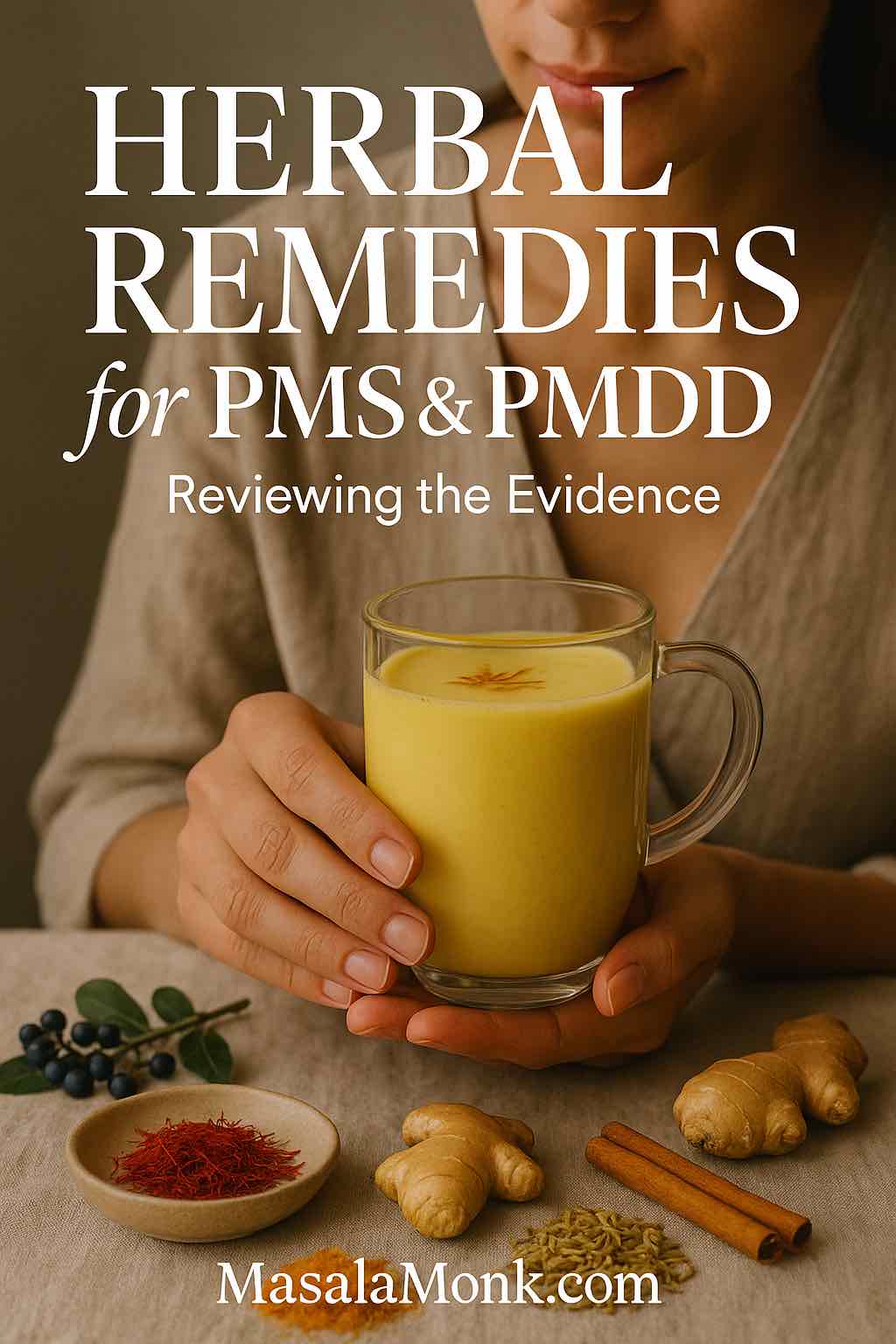
Woman holding saffron golden milk beside saffron threads, fresh ginger, cinnamon sticks and fennel seeds—elegant cover visual for best herbs for PMS & PMDD

PMS and PMDD don’t just nudge mood; they can reshape sleep, appetite, focus, and even how social you feel. Although quick fixes rarely last, a small circle of botanicals and time-tested formulas actually show human data for relief. In this guide, we zero in on the best herbs for PMS—and where a few of them fit for PMDD—while staying practical about dosing, timelines, and safety. If symptoms are severe or disabling, fold any natural plan into clinician-guided care as outlined in the ACOG clinical guideline on premenstrual disorders.

Before you dive in: “natural” doesn’t equal “risk-free.” Most people do well with thoughtful choices and realistic timelines; however, pregnancy and lactation are special cases, and medication interactions matter. With that in mind, let’s begin with the best-supported options and then move into traditional remedies that may help in specific situations.


The best herbs for PMS: start where evidence is strongest

Chasteberry (Vitex agnus-castus) for PMS Relief

If you’re ranking the best herbs for PMS, chasteberry nearly always makes the podium. Randomized controlled trials and meta-analyses suggest standardized Vitex extracts ease global PMS—breast tenderness, irritability, headaches—when taken daily and evaluated over two to three cycles. For an accessible overview of uses, dosing, and cautions, skim the NCCIH chasteberry fact sheet. Because Vitex may interact with hormone-sensitive conditions and contraceptive regimens, it’s smart to touch base with your clinician before starting.

How people use it: standardized extract 20–40 mg once daily, usually in the morning; reassess after 2–3 cycles. For more granular safety and lactation details, the NIH pharmacology monographs (e.g., LactMed/monograph detail) are useful.

Everyday support while you trial Vitex: round out your routine with colorful food. Our practical primer—For Women: The Rainbow Diet for PMS Relief—maps satisfying plates to symptom patterns.


Saffron (Crocus sativus) in PMS and PMDD

When mood leads the picture—or PMDD features are prominent—saffron is compelling. In a double-blind randomized trial, saffron reduced PMS severity by cycles three to four; in another controlled study, it improved PMDD symptoms with good tolerability. Many protocols use 15 mg twice daily or 30 mg once daily, often focused on the luteal phase, with a fair evaluation after about two cycles. If you like reading primary sources, see the PMS RCT’s abstract at BJOG via PubMed and the PMDD trial available on PubMed Central.

How to bring it into daily life: capsules are convenient, but you can also integrate saffron in the kitchen. Start with a clear, friendly explainer—What is Saffron?—and then try a calming evening ritual like saffron-infused milk.


Ginger (Zingiber officinale) – one of the Best Herbs for PMS

If cramps hijack days one to three, ginger is one of the simplest, best-studied options. Systematic reviews and meta-analyses indicate that 750–2,000 mg/day of powdered ginger, taken during the first 3–4 days of bleeding, reduces dysmenorrhea pain—sometimes performing comparably to NSAIDs in head-to-head trials. For a readable overview, check the open-access meta-analysis on PubMed Central; for a more clinical snapshot, browse a recent PubMed abstract as well.

Practical ways to use it: capsules make adherence easy, but there’s nothing wrong with going culinary—strong ginger tea or a spiced smoothie can help. For a kitchen-first approach try Ginger & Herbal Teas: 5 Blends for Morning Sickness Relief.


Turmeric / Curcumin (Curcuma longa) as a PMS Relief Remedy

While not every trial agrees, the trend line for curcumin looks promising. A recent double-blind RCT reported improvements in both PMS scores and dysmenorrhea; several reviews echo a benefit signal, although heterogeneity exists. Because plain curcumin absorbs poorly, many study products include bioavailability enhancers—so labels matter. Typical research dosing lands around 500–1,000 mg/day, assessed after one to two cycles. You can read a 2025 RCT free in BMC Primary Care, then cross-check with a 2024 synthesis for broader context.

A simple habit to start: add a small, steady dose via food—pair turmeric with fat and a pinch of black pepper. Our Turmeric & Magnesium-Rich Smoothies show how to make this painless.


Cinnamon (Cinnamomum spp.) & Fennel (Foeniculum vulgare) in PMS

Two traditional antispasmodics deserve attention if cramps dominate. In randomized trials with students, cinnamon reduced pain, bleeding, and nausea over the first three days of menses; study dosing often looked like ~500–1,000 mg capsules, three times daily during days 1–3. You can read an open-access trial on menstrual bleeding and systemic symptoms on PubMed Central. Meanwhile, systematic reviews suggest fennel reduces primary dysmenorrhea pain compared with controls or NSAIDs, though study quality varies—see the clinical snapshot via PubMed and a broader 2020 review in Nutrients.

How to weave them in: for quick relief, mirror trial patterns during early menses; for gentler days, make a mild cinnamon-ginger tea with a pinch of fennel for sweetness. If you enjoy a heritage angle, our saffron series—culinary uses and a traditional medicine lens—connects kitchen rituals to modern evidence.

Also Read: The Benefits of Turmeric Ginger Cinnamon Tea for Weight Loss and Overall Well-being


Beyond the top tier: traditional botanicals worth a cautious look

Not every remedy earns a first-line spot; nonetheless, several traditional plants have small but intriguing human studies. Consider these as second-line experiments after you’ve tried the best herbs for PMS above.

Ginkgo (Ginkgo biloba)

Some randomized, placebo-controlled trials in students found reductions in PMS symptom scores with standardized ginkgo extracts (e.g., EGb 761 variants). Dosing across studies varies, but 40–120 mg twice daily for two cycles is a rough pattern to emulate. Because ginkgo may increase bleeding risk—particularly with anticoagulants or antiplatelets—review medications carefully. For a quick look at the trial evidence, browse the PubMed entry for a classic student-population RCT.

Chamomile (Matricaria chamomilla)

Used both as tea and in extract form, chamomile appears helpful for emotional symptoms of PMS in several small studies; some trials compare favorably to mefenamic acid for pain, though methods differ. If you appreciate a gentle, calming routine, a nightly chamomile tea during the luteal phase is low-effort and inexpensive. A broad review on PubMed Central pulls together the main threads if you’d like a deeper read.

Valerian (Valeriana officinalis)

Thanks to antispasmodic properties, valerian shows a reduction signal for primary dysmenorrhea across a mix of RCTs and meta-analyses. Protocols usually start at pain onset and continue through the first days of menses; capsule strengths differ widely, so follow product labels. Do note: heterogeneity is high, expectations should be moderate, and daytime drowsiness is possible.

Lavender (Lavandula angustifolia) — aromatherapy

Inhaled lavender oil isn’t an ingestible herb, yet it’s a traditional approach with supportive data for PMS-related anxiety and emotional tension. Randomized and crossover trials show small-to-moderate mood improvements when used during the luteal phase over ~three cycles. If you enjoy ritual, a short evening inhalation session pairs nicely with sleep hygiene.

Xiao Yao San / Jia-Wei Xiao Yao San (Traditional Chinese Medicine)

For readers drawn to formula-based traditions, Xiao Yao San (and its “augmented” variant, Jia-Wei Xiao Yao San) has a long history in patterns that include irritability, breast distension, and cycle irregularities. Reviews and meta-analyses suggest symptom relief in PMS/PMDD cohorts, but study quality and formula standardization vary considerably. If you explore this path, work with a qualified TCM practitioner and coordinate with your clinician. A helpful entry point is this overview in BMC Complementary Medicine and Therapies: effects and treatment methods of acupuncture and herbal medicine for PMS.

St. John’s wort (Hypericum perforatum) — not first-line

A few RCTs show a signal for physical/behavioral PMS symptoms; however, mood effects are inconsistent and the interaction profile is enormous (SSRIs/SNRIs, oral contraceptives, anticoagulants, transplant drugs, and more). Unless you’re under close medical supervision, prioritize other options. If you’re evaluating it academically, the PubMed overview is a fine starting place.


PMDD relief: where herbs genuinely fit—and where medicine leads

PMDD isn’t “PMS turned up to 11.” It can be disabling and is best approached as a multimodal condition. Botanicals with the most promise include saffron (best RCT signal) and chasteberry (adjunctive for global symptoms). Nevertheless, frontline treatments—such as SSRIs used continuously or intermittently, specific combined oral contraceptives, and psychotherapy—form the backbone of care. To anchor decisions in reputable guidance, revisit the ACOG premenstrual disorders guideline. While your clinician fine-tunes treatment, consider gentle daily supports—a cup of saffron-infused milk in the late evening, for instance—to ease transitions into sleep.


Using the best herbs for PMS wisely (so you can actually tell if they work)

Rather than starting five things at once, choose one or two that match your pattern:

  • Global PMS with breast tenderness and irritability → chasteberry.
  • Mood-dominant PMS or PMDD features → saffron first; Vitex second.
  • Cramps and low-back ache on days 1–3 → ginger per menses; optionally layer cinnamon or fennel.

Then, commit to a fair trial: 2–3 cycles for chasteberry; about two cycles for saffron; per-menses dosing for ginger/cinnamon/fennel. Throughout, track symptoms briefly once a week (0–10 for pain; 0–10 for mood; 0–10 for energy/sleep; one line on function). After the trial window, decide—continue, adjust dose/timing, or pivot.

Meanwhile, cushion the plan with simple lifestyle anchors. A few minutes of movement on more days than not helps cramps and energy; our quick guide, Women’s Wellness: Exercise and PMS, shows how to ease in without overwhelm. On the plate, shoot for color and fiber; if you want a single, sustainable habit, start by adding one vividly colored veg and one omega-rich food per day, guided by the Rainbow Diet for PMS Relief.


Safety first (natural ≠ risk-free)

  • Pregnancy & lactation: avoid herbs unless specifically cleared by your clinician.
  • Bleeding tendency: take care combining higher-dose ginger, cinnamon, or fennel with anticoagulants or antiplatelets; pause around procedures when advised.
  • Hormonal meds: discuss chasteberry if you use hormonal contraception; consider hormone-sensitive conditions. The NCCIH chasteberry overview is a practical primer.
  • Interactions minefield: St. John’s wort can reduce the effectiveness of many medications, including oral contraceptives and antidepressants; it’s rarely a first choice.
  • Product quality: pick standardized, single-herb products from reputable brands; avoid “mystery blends” with undisclosed amounts.
  • Red flags: escalate care for disabling mood symptoms, thoughts of self-harm, sudden severe pelvic pain, fever, very heavy bleeding, or symptoms that feel “different from your normal.”

Best Ways to use these Herbs for PMS Relief

Consistency matters more than intensity. A realistic week might look like this:

  • Morning: take chasteberry with breakfast; jot a two-second note on breast tenderness and irritability by evening.
  • Luteal phase: add saffron (15 mg twice daily or 30 mg once daily). Create a simple nightly ritual—perhaps that warm cup of saffron-infused milk—to cue sleep and soften mood spikes.
  • Days 1–3 (sometimes 4): use ginger capsules (or strong tea), and if cramps are stubborn, layer cinnamon or fennel for the first three days, mirroring study patterns. If you like checking sources, skim the cinnamon RCT and the fennel meta-analysis abstract.
  • Anytime: reinforce with food-based anti-inflammatory choices. If you prefer sipping your support, the Turmeric & Magnesium-Rich Smoothies are an easy starting place.

What about other spice-drawer ideas?

Traditions also mention cloves, coriander, and cardamom for comfort. The clinical evidence is thinner, so position them as flavor and ritual, not primary therapy. If you’re spice-curious, here’s a gentle primer on cloves for menstrual pain relief and a broader look at women-centric herb lore in our saffron series; enjoy the heritage stories, but keep expectations modest until robust trials arrive.


When to pivot—and when to escalate

After a fair trial window, step back and reflect: did pain drop at least 30–50%? Is irritability less sharp? Are you sleeping more soundly? If results are only “meh,” either change the match (for example, swap from a Vitex-first approach to a saffron-led plan if mood is the main issue) or adjust dose/timing. For cramps, you might move from ginger alone to ginger plus cinnamon during days one to three. If PMDD features are clear—work impact, relationship strain, or safety concerns—prioritize medical care; herbs can still support edges of mood and energy, but the backbone of treatment shifts. Bookmark the ACOG guideline for that conversation.


FAQs

1) What are the best herbs for PMS?

The best herbs for PMS include chasteberry (Vitex) for overall symptom relief, saffron for mood and global scores, ginger for period cramps, turmeric/curcumin for PMS and dysmenorrhea, and—situationally—cinnamon and fennel for early-cycle pain. Start with one or two, then reassess after a fair trial.

2) How long before these remedies start working?

Chasteberry typically needs 2–3 cycles. Saffron often shows benefits after ~2 cycles. Ginger, cinnamon, and fennel are taken during days 1–3 (sometimes 4) of bleeding and work per-menses. Curcumin usually warrants 1–2 cycles.

3) Which herb helps most with mood swings and irritability?

Saffron is a strong first choice for mood-dominant PMS and PMDD features. Chasteberry can support overall mood changes as well, especially alongside lifestyle routines like sleep and movement.

4) What’s a sensible dosing plan to try first?

Begin with chasteberry 20–40 mg once daily for global PMS and add saffron 15 mg twice daily (or 30 mg once daily) in the luteal phase. For cramps, use ginger 750–2,000 mg/day during days 1–3. Evaluate before changing anything.

5) Are there fast, natural options for severe period pain?

Yes—ginger is the quickest botanical option and pairs well with heat and gentle movement. For stubborn cramps, layer cinnamon or fennel during the first three days of the cycle.

6) Do “best herbs for PMS” differ from herbs for PMDD?

Often, overlap exists. Saffron shows particularly helpful signals for PMDD mood symptoms, while chasteberry may assist overall. Nevertheless, PMDD commonly needs clinician-guided care (e.g., SSRIs or specific contraceptives) with herbs as adjuncts.

7) Can turmeric or curcumin actually help PMS?

Curcumin has emerging evidence for reducing PMS scores and cramp severity. Use enhanced-bioavailability forms around 500–1,000 mg/day and reassess after 1–2 cycles.

8) Is cinnamon good for more than flavor?

Yes. In multiple trials with students, cinnamon reduced pain, bleeding, and nausea during early menses. It’s best used on days 1–3, alongside ginger if needed.

9) What about fennel for cramps and bloating?

Fennel, a traditional antispasmodic, can ease primary dysmenorrhea and may feel soothing for gas and bloating. Dose per product; start at pain onset.

10) Do ginkgo, chamomile, valerian, or lavender help PMS?

They can, though evidence is smaller. Ginkgo has signals for overall PMS scores; chamomile may calm emotional symptoms; valerian can reduce cramp intensity; lavender aromatherapy supports tension and sleep in the luteal phase.

11) Are Chinese herbal formulas like Xiao Yao San useful?

They’re traditional mainstays with encouraging but variable study quality. If you choose this route, work with a qualified practitioner and keep your physician in the loop.

12) Which herbs are safest to combine?

Commonly combined, saffron + chasteberry (mood + global), or ginger + cinnamon/fennel (pain-focused). Introduce one change at a time, then layer a second after you’ve confirmed tolerance.

13) What should I avoid while testing herbs?

During pregnancy or lactation, skip botanicals unless cleared by a clinician. Be cautious with anticoagulants/antiplatelets when using higher-dose ginger, cinnamon, or fennel. Discuss chasteberry if you use hormonal contraception. Avoid mystery blends with undisclosed amounts.

14) What’s the best way to judge progress?

Track weekly scores (0–10) for pain, mood, energy, sleep, and daily function. After the trial window—2–3 cycles for chasteberry, ~2 for saffron, per-menses for ginger/cinnamon/fennel—continue only if you see meaningful improvement.

15) Can teenagers try natural remedies for PMS?

Yes—begin conservatively with food-first strategies (sleep, hydration, color-rich meals), then consider ginger for cramps. Herbs aimed at hormones (e.g., chasteberry) should be discussed with a clinician, especially in younger teens.

16) What helps most with PMS bloating?

Focus on gentle movement, steady hydration, and salt awareness. For botanicals, fennel may ease fullness; curcumin can support comfort via anti-inflammatory effects. Reassess after one to two cycles.

17) Are there “best herbs for PMS” if headaches or breast tenderness dominate?

Chasteberry is often preferred where breast soreness and cyclical headaches are part of the pattern. Pair with sleep hygiene and consistent meals to reduce triggers.

18) How do I choose a quality product?

Select standardized, single-herb extracts from reputable brands. Look for clear milligram amounts, batch testing, and straightforward ingredient lists. When in doubt, keep the formula simple.

19) What if nothing changes after a fair trial?

Switch strategy: mood-heavy cycles might move from chasteberry to saffron; pain-heavy cycles might add cinnamon or fennel to ginger. If PMDD features are evident or daily life is impaired, prioritize medical care and use botanicals as supportive additions.

20) Final take: what’s the smartest starting combo?

For most readers, the smartest entry is chasteberry for global symptoms plus ginger during days 1–3 for pain. If mood is the main issue, rotate saffron into the luteal phase. Keep it simple, stay consistent, and measure what matters.


External References – Best Herbs of PMS Relief


Internal reads


Posted on 1 Comment

Gin-Soaked (Drunken) Raisins for Arthritis

Hand closing lid on jar of gin-soaked golden raisins with a small gin bottle—Gin-Soaked Raisins for Arthritis.

Many readers come to this topic with a simple question and a hopeful heart. Gin-Soaked Raisins for Arthritis sound like something a wise grandparent might pass down: a small jar on the kitchen shelf, a handful of golden fruit, a splash of gin, and a calm daily ritual. The story is warm and memorable. Nevertheless, tradition is one thing; dependable relief is another. This article respects the charm of the practice, explains how to prepare a jar properly, clarifies what evidence does—and does not—support it, and offers practical, evidence-based ways to care for your joints alongside any personal rituals you keep.

Also Read: What are the 5 Worst Foods to Eat if you have Arthritis?


What Makes Gin-Soaked Raisins for Arthritis a Folk Ritual

Stories like this survive because they feel human. They are tactile, flavorful, and easy to remember. You cover golden raisins with gin, you wait, and you eat a modest portion every day. Some people report comfort. Others simply enjoy the taste and the habit. Even so, authoritative sources describe the remedy as unproven. The Arthritis Foundation: 10 arthritis food myths groups gin-soaked raisins with other popular ideas that lack clinical backing. Independent overviews reach similar conclusions; see Healthline’s review of gin-soaked raisins and Medical News Today on gin-soaked raisins for balanced summaries.

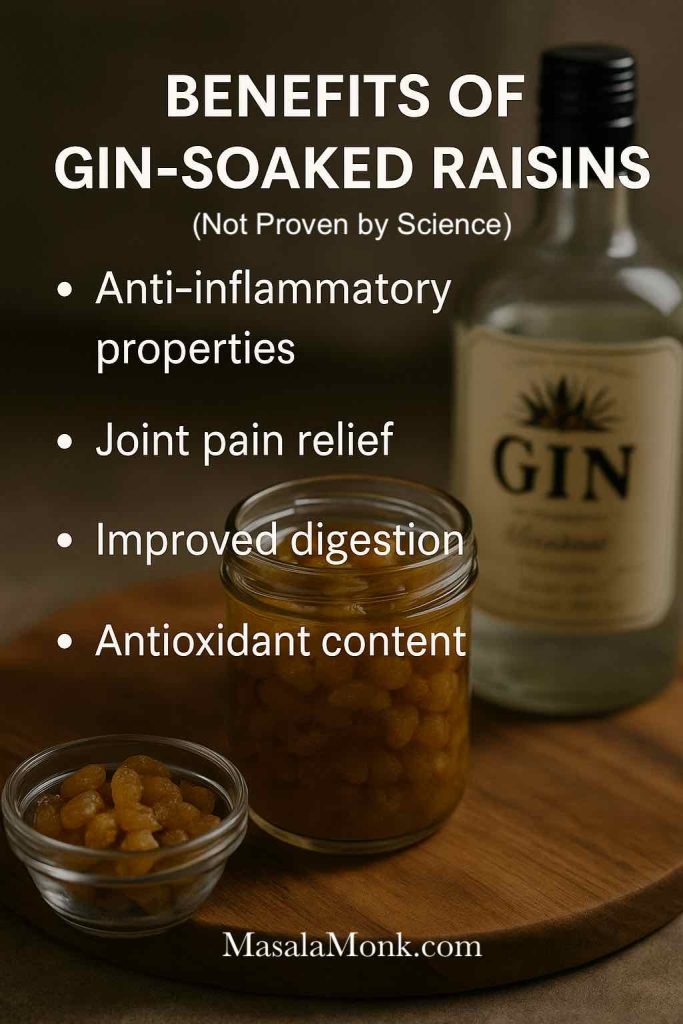
Claims about gin-soaked raisins including anti-inflammatory and digestion benefits with note not proven by science.
What people often report — and the reminder that these are claims, not clinical evidence. Use for context, not promises.

Even so, the appeal is understandable. First, the ritual itself can feel soothing. Second, laboratory work on juniper—the botanical that defines gin—has noted anti-inflammatory signals in models. Interesting, yes. Conclusive for daily life, no. Consequently, Gin-Soaked Raisins for Arthritis should be seen as culture, not cure. With that frame in mind, you can still make a tidy batch, enjoy it safely, and keep expectations realistic.

Also Read: Probiotics and Gut Health: Their Role in Reducing Inflammation


Preparing Gin-Soaked Raisins for Arthritis: A Calm, Step-by-Step Method

You’ll need

  • 1 cup golden raisins (often labeled yellow or white raisins; also called sultanas)
  • Enough gin to just cover the fruit (a juniper-forward London Dry works well)
  • A clean glass jar with a lid

Method

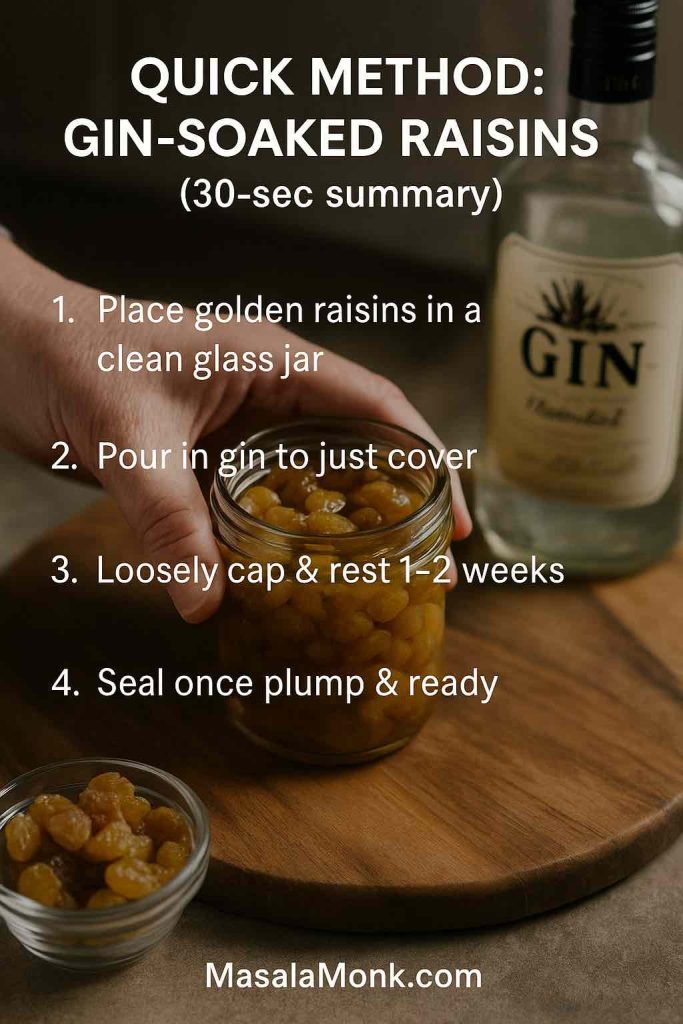
  1. Add the fruit. Tip the golden raisins into a clean, dry glass jar.
  2. Pour the gin. Add just enough gin to barely submerge the raisins. Avoid a deep pool; a light cover is ideal.
  3. Let them rest. Cover loosely and place the jar out of direct sunlight at room temperature. Leave it for 1–2 weeks. Stir every few days so surface alcohol dissipates evenly while the raisins plump.
  4. Seal the jar. Once the aroma softens and the fruit looks full, seal the lid.
  5. Use modestly. The folk pattern suggests about 7–10 raisins per day with food. That number comes from tradition rather than science, so treat it as a guideline, not a dose.
Quick method steps for gin-soaked raisins: add golden raisins, cover with gin, rest 1–2 weeks, seal when plump.
One-glance recipe: the classic four-step method for preparing gin-soaked raisins without guesswork.

This gentle pace suits most home kitchens. If you prefer to test the practice without committing to a large amount, halve or quarter the ingredients and keep the same steps. Meanwhile, resist the urge to rush evaporation with heat or sun; gentler conditions keep flavor more balanced and reduce risk.

Also Read: What Is Inflammation? Body’s Double-Edged Sword


Choosing Fruit: Golden, Yellow, “White,” or Dark Raisins?

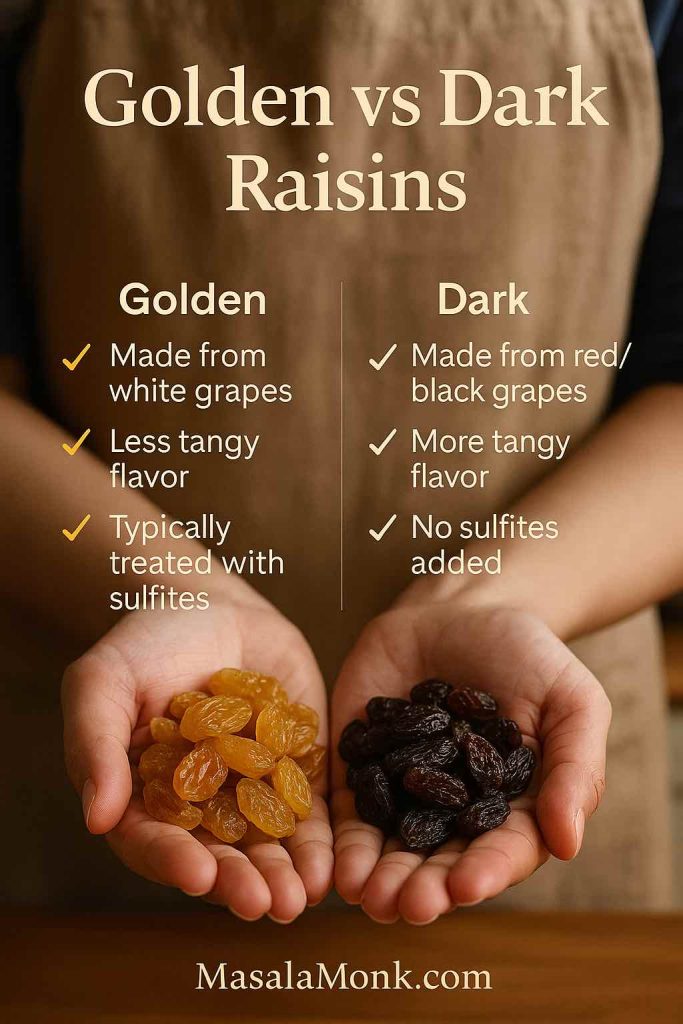
Supermarket labels can be confusing. “Golden,” “yellow,” and sometimes “white” all refer to sultanas, which are processed a bit differently from classic dark raisins. They are typically treated with sulfur dioxide to preserve their lighter color and a soft, fruit-forward character. For a clear, kitchen-friendly explainer, see Martha Stewart: golden vs. regular raisins. By contrast, dark raisins are usually sun-dried, which deepens color and intensifies a toffee-like note. You can use either style for Gin-Soaked Raisins for Arthritis; however, the classic version favors golden raisins because the texture plumps attractively and the flavor stays bright.

Golden vs dark raisins comparison: golden sultanas with sulfites and softer flavor; dark raisins tangier without sulfites.
Choosing raisins: golden sultanas give the traditional texture; dark raisins work too but taste richer and are typically sulfite-free.

If you enjoy exploring dried-fruit nutrition more broadly, these two deep dives move away from pain claims and back toward everyday health: black raisins (munakka) benefits and soaked black raisins benefits.


Picking a Spirit: Which Gin Style Works Best?

Here the rule is simple. Choose a juniper-forward London Dry. That style brings a clean pine-citrus profile that pairs well with the raisin’s honeyed sweetness. The brand is your call. Use something you’d happily drink in a gin and tonic. The goal is flavor, not pharmacology, so there’s no need to chase rare bottles.


Storing Gin-Soaked Raisins for Arthritis Safely and Sensibly

Once the fruit has plumped and the jar is sealed, storage matters. Keep the jar cool, dark, and dry. In temperate weather, a pantry cupboard is fine. In hot or humid conditions, shift the jar to the refrigerator. These habits echo established guidelines for shelf-stable foods; for reference values used in institutional settings, consult USDA FNS dry-storage guidance.

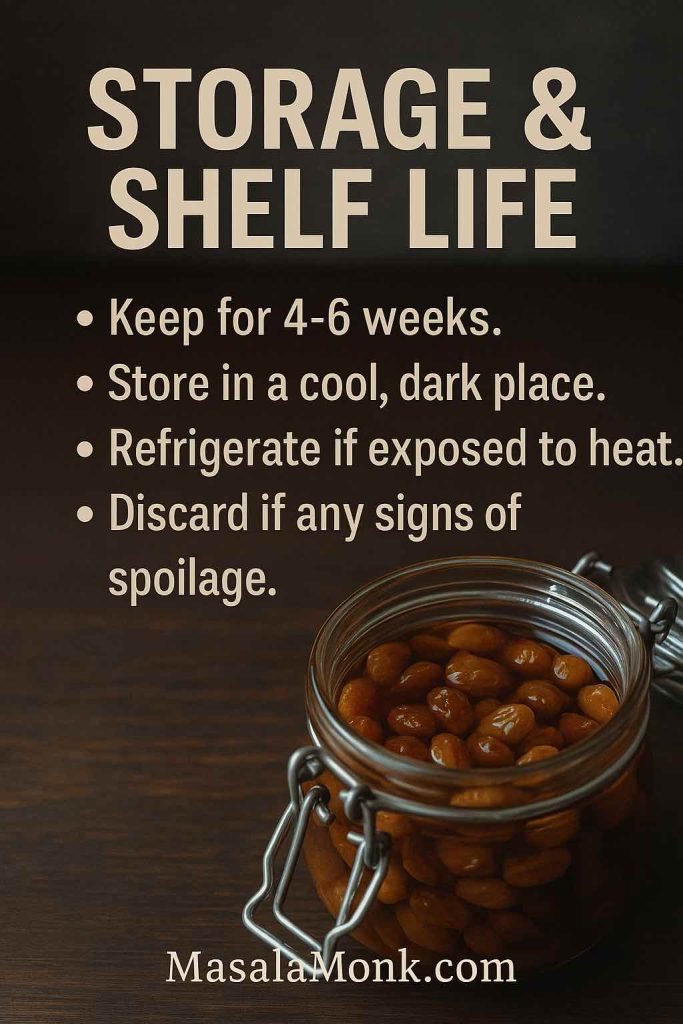
Storage tips for gin-soaked raisins: keep 4–6 weeks, cool and dark, refrigerate if warm, discard if spoiled.
Best results: store sealed in a cool, dark spot (or refrigerate in heat) and use within 4–6 weeks; toss at any sign of spoilage.

How long should a homemade batch last? As a home project, it will never have the controls of a commercial product, so plan to enjoy it within about 4–6 weeks. Industry standards for raisin moisture help explain why drier fruit stores better; if you’re curious about the background, read USDA raisin grades & moisture limits. If the jar ever fizzes, smells off, or shows visible mold, discard it without tasting. Conversely, if the fruit gradually dries out, add a splash of gin, close the lid, and let it rest for 24 hours before eating.

Also Read: Cherries and Arthritis: Are Cherries Good for Arthritis?


How Evidence Frames Gin-Soaked Raisins for Arthritis

Good decisions start with clear information. Major organizations do not recommend Gin-Soaked Raisins for Arthritis as treatment. The Arthritis Foundation: 10 arthritis food myths explains the lack of clinical support in plain language. Independent editors echo this view in Healthline’s review of gin-soaked raisins and Medical News Today on gin-soaked raisins, noting that controlled trials are missing and that anecdotal reports cannot confirm cause and effect.

So what about the chemistry? Juniper contains compounds with anti-inflammatory activity in lab and animal models. That remains interesting academic work, yet it does not prove that raisins briefly soaked in gin will reduce joint pain in daily life. Accordingly, the remedy can be appreciated as a culinary custom, while clinical care continues on sturdier ground.


Potential Upsides Without Over-Promising

Let’s be fair. Gin-Soaked Raisins for Arthritis offer a few gentle positives unrelated to cure claims. The ritual is simple. The flavor can be delightful. A small, predictable habit sometimes supports consistency with other good choices: regular walks, light mobility exercises, and steadier meal patterns. Moreover, a friendly kitchen project can reduce anxiety around health changes by giving the day a small anchor. These are meaningful lifestyle benefits, even though they are not the same as pain relief.

That distinction matters. It keeps the joy of the jar and the strength of a medical plan in healthy balance.


Side Effects and Who Should Avoid Gin-Soaked Raisins for Arthritis

Because the method merges dried fruit and alcohol, a few cautions are essential.

Who should avoid gin-soaked raisins: pregnant or breastfeeding, liver disease, certain medications, sulfite allergy.
Safety first: these groups should skip gin-soaked raisins due to alcohol exposure and sulfites. When unsure, choose a non-alcohol alternative.
  • Alcohol exposure. Even after resting, traces of alcohol can remain. Avoid this preparation if you are pregnant, in alcohol recovery, on certain medications, or if alcohol is otherwise contraindicated for your health.
  • Sugar load. Raisins are naturally high in sugar. If you live with diabetes or track carbohydrates, count the raisins and monitor your response.
  • Sulfites. Golden raisins often list sulfur dioxide on their labels. Ingredient lines vary by brand, but a common example is shown here: Sun-Maid golden raisins ingredients. If you have sulfite sensitivity or certain forms of asthma, this matters.
  • Juniper caution (theoretical). Concentrated juniper preparations raise questions in some herbal contexts; your kitchen jar is a very different exposure, yet sensitivity varies. When uncertain, skip the remedy and seek professional guidance.

If you’re evaluating other widely shared ideas about food and joint pain, these explainers help separate custom from consensus: apple cider vinegar for arthritis & joint pain and tomatoes and arthritis: the truth.


Building a Stronger Everyday Plan Around Your Joints

Rituals can live beside robust care, but they shouldn’t replace it. In practice, a durable plan tends to rest on four pillars:

Movement you can maintain. Gentle activity decreases stiffness, protects function, and lifts mood. Short, regular sessions beat rare, heroic efforts.

Medication as prescribed. From anti-inflammatories to DMARDs and biologics, work with your clinician to find the right regimen. Adjustments take time, and steady follow-up matters.

Nutrition with a long view. Favor whole foods, adequate protein, and sources of healthy fats—especially omega-3s. For accessible guidance, start with how omega-3 fatty acids help fight chronic inflammation and build menus with unpacking the health benefits of oily fish. If you prefer a stepwise approach, how to follow an anti-inflammatory diet lays out simple swaps.

Recovery habits. Sleep and stress skills amplify everything else. A regular wind-down routine, a brief stretch, or a warm shower can nudge the nervous system toward calm. If you enjoy a soothing mug in the evening, turmeric-ginger-cinnamon tea benefits offers a kitchen-friendly option with a pleasant, cozy flavor.

With these anchors in place, Gin-Soaked Raisins for Arthritis can remain what they are: a small cultural practice, folded into a wider, evidence-based rhythm.

Also Read: Best Fish Oil Supplements on Amazon India


When Curiosity Meets Caution: A Practical Way to Try the Jar

If you remain curious, approach the project as a mindful tasting rather than a treatment. Make a half batch. Store it correctly. Eat a few raisins with a meal. Notice how you feel over several weeks while keeping your regular care unchanged. If you observe no benefit, thank the jar for the experiment and move on without regret. If you enjoy the flavor and the ritual, you can keep a small jar in the pantry or the refrigerator and treat it like any other homemade preserve you rotate now and again.

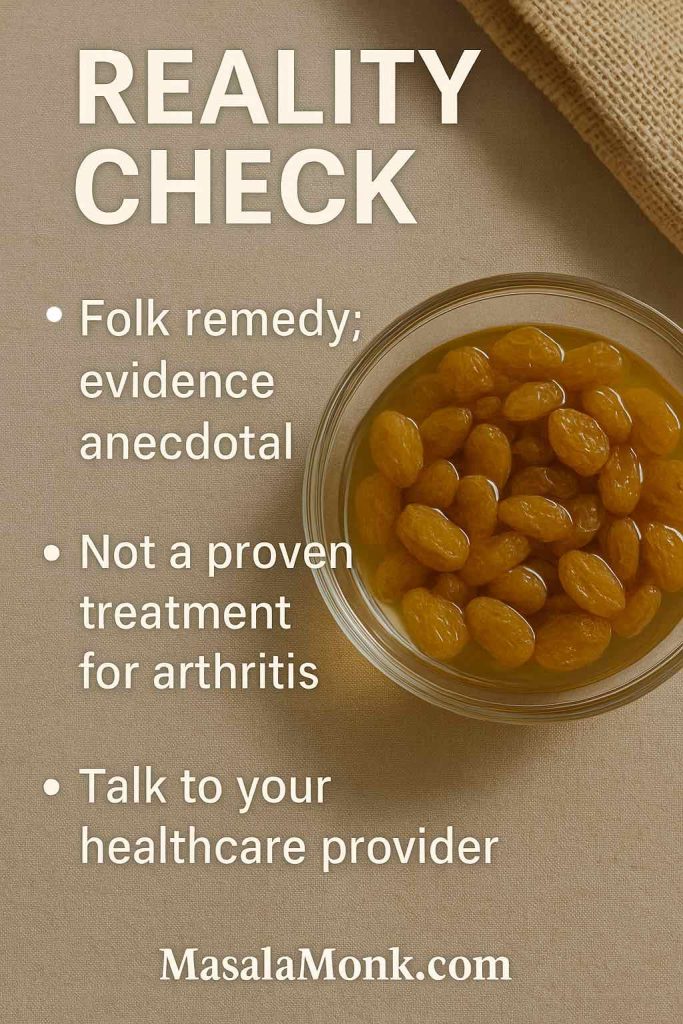
Reality check about gin-soaked raisins: folk remedy with anecdotal evidence; not a proven arthritis treatment.
Keep expectations steady: this is a folk ritual with anecdotal reports, not a substitute for medical care.

For a broader perspective on dietary patterns that may aggravate symptoms, explore foods to avoid with arthritis. It’s practical, not preachy, and it pairs well with the gradual upgrades suggested in how to follow an anti-inflammatory diet.


Closing Thought: Keep the Warmth, Protect the Future

Kitchens carry memories. A grandparent’s jar of Gin-Soaked Raisins for Arthritis may stand beside pickles, preserves, and spice blends that define a family table. Honor that history. At the same time, protect your future comfort with habits that have stood up to careful scrutiny. Move often. Eat in a way that calms inflammation over many months, not just one. Sleep enough to heal. Work with your clinician the way you’d maintain a garden—patiently, consistently, and with a willingness to adjust.

If you want one small action today, plan two fish meals this week using ideas from unpacking the health benefits of oily fish. Or remove a common trigger using foods to avoid with arthritis. If a gentle evening drink helps you unwind, brew a mug guided by turmeric-ginger-cinnamon tea benefits. Then, if curiosity still calls, prepare a small jar of Gin-Soaked Raisins for Arthritis, store it well, and enjoy it for what it is: a pleasant ritual living peacefully beside proven care.


FAQs

1) What exactly are Gin-Soaked Raisins for Arthritis?

They’re simply golden raisins covered with a small amount of gin, left to rest until plump, and then eaten in tiny daily portions. It’s a long-standing kitchen tradition—more about comfort and ritual than clinical treatment.

2) Do Gin-Soaked Raisins for Arthritis actually help with joint pain?

Evidence is mostly anecdotal. Some people feel better; others notice no change. In practice, treat the jar as a gentle ritual you may enjoy, not as a replacement for medical care.

3) How do I make a reliable first batch?

For starters, place golden raisins in a clean glass jar and pour in just enough gin to barely cover them. Loosely cap the jar and rest it at room temperature, away from sunlight, for 1–2 weeks. When the aroma softens and the raisins look plump, seal the jar.

4) How many should I eat per day?

As a rule, people take 7–10 raisins daily with food. Begin on the low end, notice how you feel, and adjust—or stop—accordingly.

5) How long should the raisins soak in gin?

Typically 1–2 weeks. Meanwhile, stir every few days so surface alcohol disperses and the texture evens out. Seal once they’re pleasantly plump.

6) What kind of gin works best?

Choose a juniper-forward London Dry style. It keeps the flavor bright and classic. Brand matters less than that clean, pine-citrus character.

7) Must I use golden raisins, or can I swap in dark ones?

Golden raisins (often called sultanas) are traditional because they plump softly and taste light. That said, dark raisins will work; the flavor will simply be deeper and the bite chewier.

8) Are “golden,” “yellow,” and “white” raisins different for this method?

They’re usually names for the same style of sultana. Labels vary, yet the preparation—cover, rest, and seal—stays the same for Gin-Soaked Raisins for Arthritis.

9) What’s the serving routine that people follow?

Many eat a small portion once daily, often in the morning with breakfast or in the evening with a snack. Consistency matters more than the exact time.

10) How long do Gin-Soaked Raisins for Arthritis keep?

In most home kitchens, plan on 4–6 weeks. Keep the jar sealed, cool, and dark. In warm or humid weather, refrigeration is the safer choice.

11) How do I store them to avoid waste?

After sealing, place the jar in a cool cupboard; if the room feels hot or damp, move it to the fridge. Always use a clean spoon and close the lid promptly.

12) What are the signs I should throw the batch away?

If you notice fizzing, an off smell, or any visible mold, discard immediately. When in doubt, it’s better to be cautious.

13) Can I revive raisins that seem dry after a few weeks?

Yes. Add a small splash of gin, reseal the jar, and let it rest for about 24 hours. Then reassess the texture before eating.

14) Are there side effects I should consider?

Possibly. Even after resting, trace alcohol may remain. Raisins are naturally high in sugar, and golden raisins often contain sulfites. If you’re sensitive to alcohol, sugar, or sulfites, proceed carefully—or skip the practice.

15) Who should avoid Gin-Soaked Raisins for Arthritis altogether?

Anyone who is pregnant, in alcohol recovery, advised to avoid alcohol, or sensitive to sulfites should avoid them. Likewise, if you have concerns about interactions or conditions, talk with your clinician first.

16) Can this ritual replace my current arthritis treatment?

No. Gin-Soaked Raisins for Arthritis are a cultural custom. Keep following your prescribed plan, and view the jar—if you use it—as an optional add-on for enjoyment only.

17) How can I try them without overcommitting?

Make a half or quarter batch. Taste a few raisins with a meal for a couple of weeks. If you enjoy the ritual and feel fine, continue; otherwise, let it go without regret.

18) What if I want the flavor but less sugar?

Keep portions small, pair your raisins with protein or fiber (like yogurt or nuts), and track how your body responds. Conversely, if sugar is a major concern, it’s reasonable to skip the jar.

19) Why do some people swear by Gin-Soaked Raisins for Arthritis?

Ritual itself can be soothing. Moreover, the flavor is pleasant, the routine is simple, and feeling in control helps. Still, personal stories aren’t the same as proof, so keep expectations modest.

20) Any last guidance for a calm, sensible approach?

Start small. Store carefully. Pay attention to how you feel. Most importantly, keep Gin-Soaked Raisins for Arthritis in their lane—as a warm, easy ritual that can live alongside, not instead of, the treatments that truly support your long-term comfort.


Further Reading (References and Sources)

  • Arthritis Foundation: 10 arthritis food myths — Start here to see how leading clinicians frame popular nutrition claims, including gin-soaked raisins, with plain-language explanations and practical takeaways.
  • Healthline’s review of gin-soaked raisins — Next, examine a concise, medically reviewed overview that summarizes what’s known (and unknown), plus common questions people ask before trying the remedy.
  • Medical News Today on gin-soaked raisins — Then, scan a balanced breakdown of anecdotal reports versus clinical evidence, along with safety notes and alternatives you can discuss with your clinician.
  • Martha Stewart: golden vs. regular raisins — Afterward, dig into a clear kitchen explainer on how golden (sultana) raisins differ from dark raisins—processing, texture, and flavor—so your jar turns out as expected.
  • USDA FNS dry-storage guidance — Meanwhile, ground your storage routine in official recommendations for cool, dry conditions, with handy temperature ranges and moisture tips for pantry items.
  • USDA raisin grades & moisture limits — When you want context for shelf life, this standard outlines how moisture and quality are defined in the trade—useful background for judging homemade batches.
  • Sun-Maid golden raisins ingredients — To verify sulfites in real labels, glance at a typical ingredient list so you know what “sulfur dioxide” looks like on packaging if sensitivity is a concern.

Related Reading on MasalaMonk

Posted on 5 Comments

Top 10 Foods for Gut Health (+ Pre/Probiotics, Best Drinks, Gut-Reset Plan)

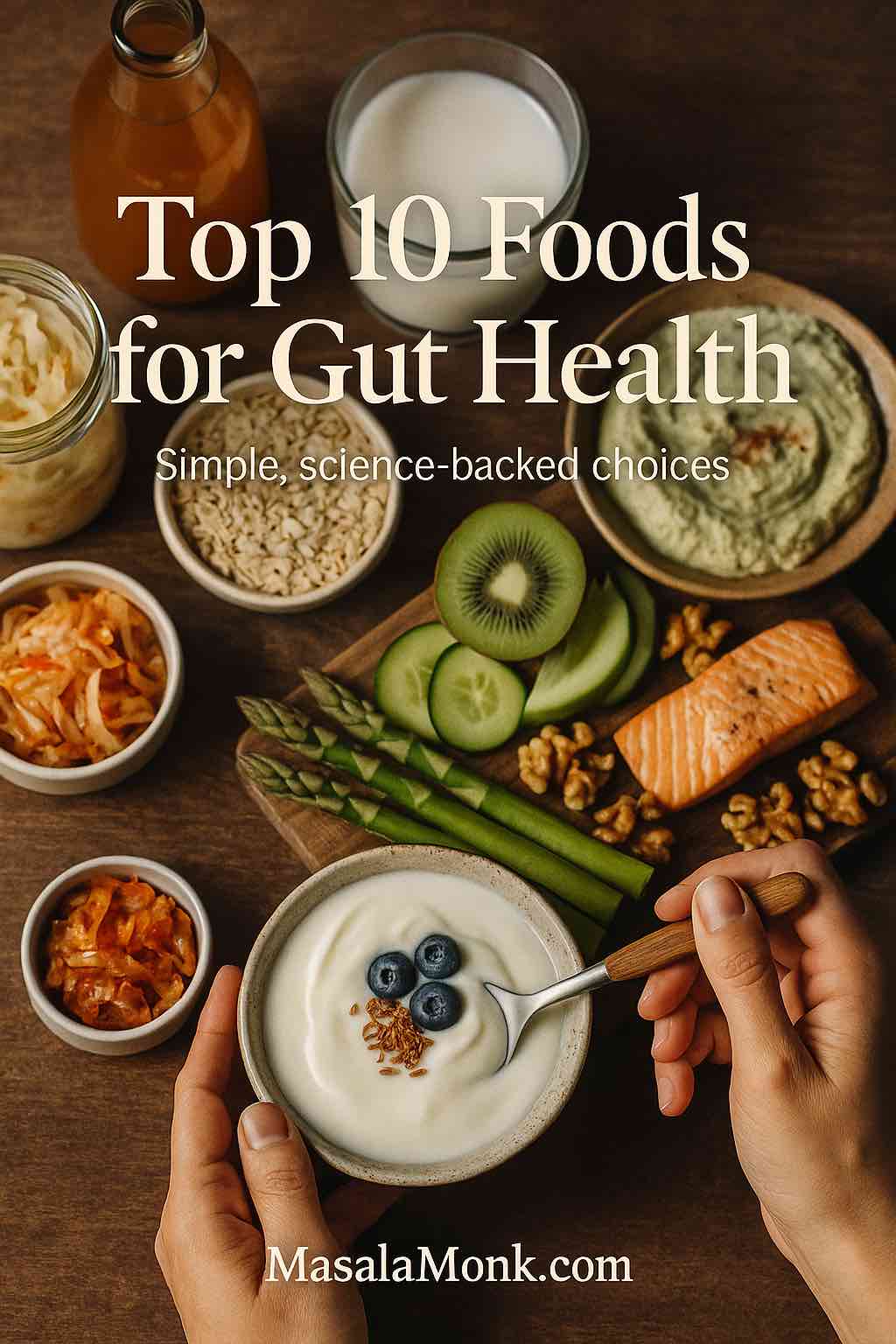
Top-down photo of foods for gut health—yogurt with blueberries and flax, kimchi, sauerkraut, kefir, asparagus, salmon, kiwi, walnuts—on a rustic table.

Some days your gut feels calm and steady; other days it’s… not. Fortunately, a handful of everyday choices can quietly nudge things back into balance—easing discomfort, supporting regularity, and, over time, fostering a more resilient microbiome. Below you’ll find ten dependable foods for gut health, each with simple ways to use them, gentle portion ideas, and credible sources woven naturally into the text. Try one or two this week, notice how you feel, and keep the habits that actually fit your life.


Fermented foods for gut health: kefir, live-culture yogurt, kimchi, sauerkraut, miso

Let’s begin with the heavy hitters. Fermented foods deliver living microbes that can shift the ecosystem in your gut toward greater diversity and calmer immune signaling. In a 10-week randomized diet trial, adults following a fermented-food pattern showed increases in microbiome diversity and reductions in multiple inflammatory proteins—real, human outcomes reported in Cell and summarized by Stanford Medicine. For everyday life, start with ½ cup plain kefir or live-culture yogurt at breakfast, or 2–4 tablespoons of kimchi or sauerkraut alongside lunch. Begin small, observe how you feel, and build gradually.

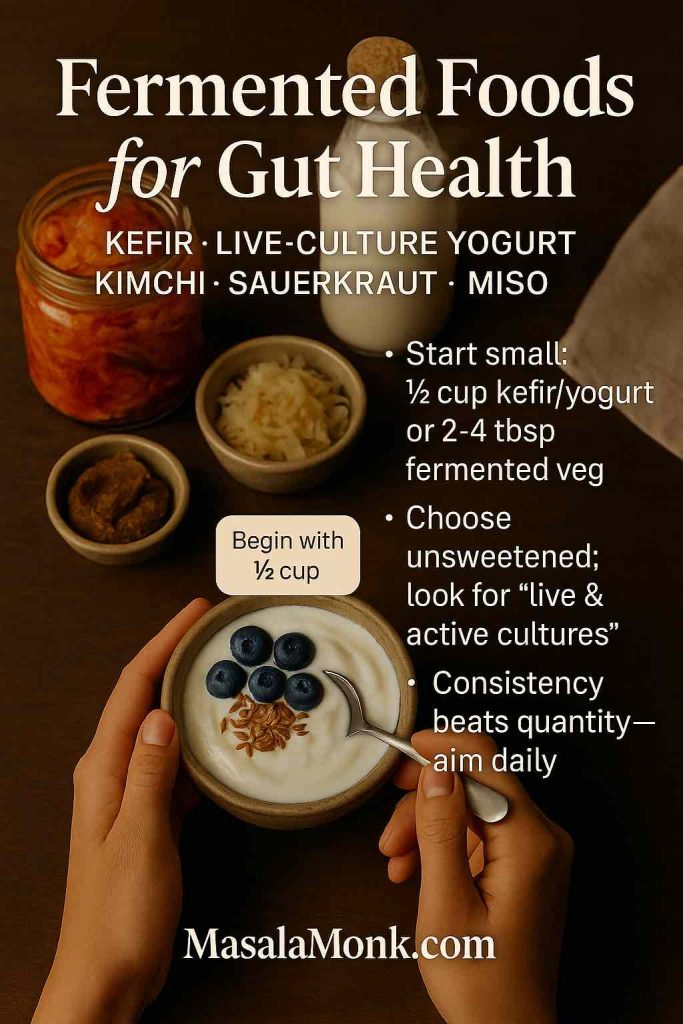
Hands holding live-culture yogurt beside kefir, kimchi, sauerkraut and miso—natural probiotics for gut health with starter portions.
Fermented foods act like natural probiotics: begin with ½ cup kefir/yogurt or 2–4 tbsp fermented veg, unsweetened and labeled “live & active cultures.”

Meanwhile, a quick shopper’s cue helps: choose plain, unsweetened yogurt or kefir and look for “live & active cultures.” Harvard’s Nutrition Source has a straightforward guide to choosing yogurt wisely. And because not every fermented food is automatically a probiotic, professionals lean on the ISAPP consensus for clear definitions; if you like digging into the “why,” the prebiotic/probiotic framework is outlined in this Nature Reviews Gastroenterology consensus paper.

How to use today: stir kimchi through fried rice, whisk miso into a warm broth, or blend kefir with berries and a spoon of oats for a quick, gut-friendly smoothie.

Also Read: Hemorrhoids High Fiber Diet: Best Foods, What to Avoid, and a 7-Day Plan


Whole-grain staples as foods for gut health: oats, barley, quinoa

Next, whole grains act like long-game allies. Their fermentable fibers are broken down by your microbes into short-chain fatty acids (SCFAs)—including butyrate, which helps maintain the integrity of the gut lining and keeps immune crosstalk on an even keel. For a readable primer that connects dietary fiber to SCFAs and gut function in humans, see this open-access review: “Short-Chain Fatty Acids and Human Health”.

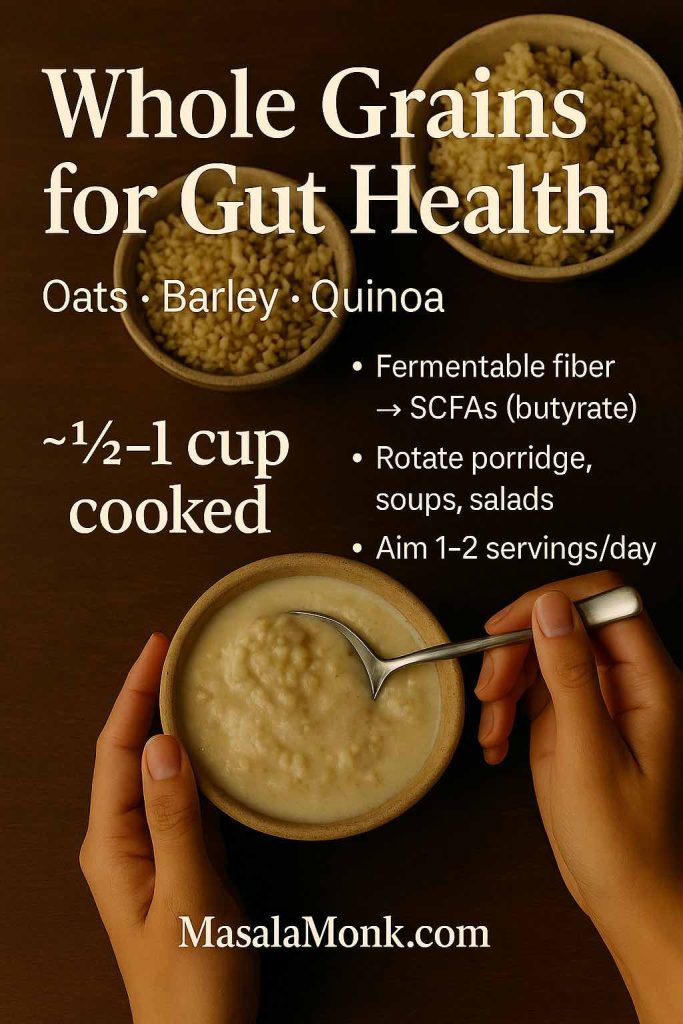
Bowls of oats, barley and quinoa with warm porridge—high-fiber foods for gut health that feed prebiotic bacteria and support SCFAs like butyrate.
Rotate oats, barley, quinoa—about ½–1 cup cooked per serving. Their prebiotic fiber ferments to SCFAs (incl. butyrate) that support the gut lining.

Practically speaking, rotate oats (comforting and quick), barley (hearty in soups), and quinoa (light yet satisfying). If you’re deciding which base suits a given day, here’s a plain-spoken comparison of quinoa vs rice that covers texture, fiber, and when each shines. Consistency matters more than perfection; even one grain swap most days can move the needle.

Easy wins: overnight oats with ground flax; barley-vegetable soup on batch-cook day; quinoa salad with cucumber, lemon, and herbs for packable lunches.

Also Read: Guide to Oats: Types, Nutrition, and Differences Explained


Resistant-starch foods for gut health: slightly green bananas & cooked-then-cooled potatoes/rice

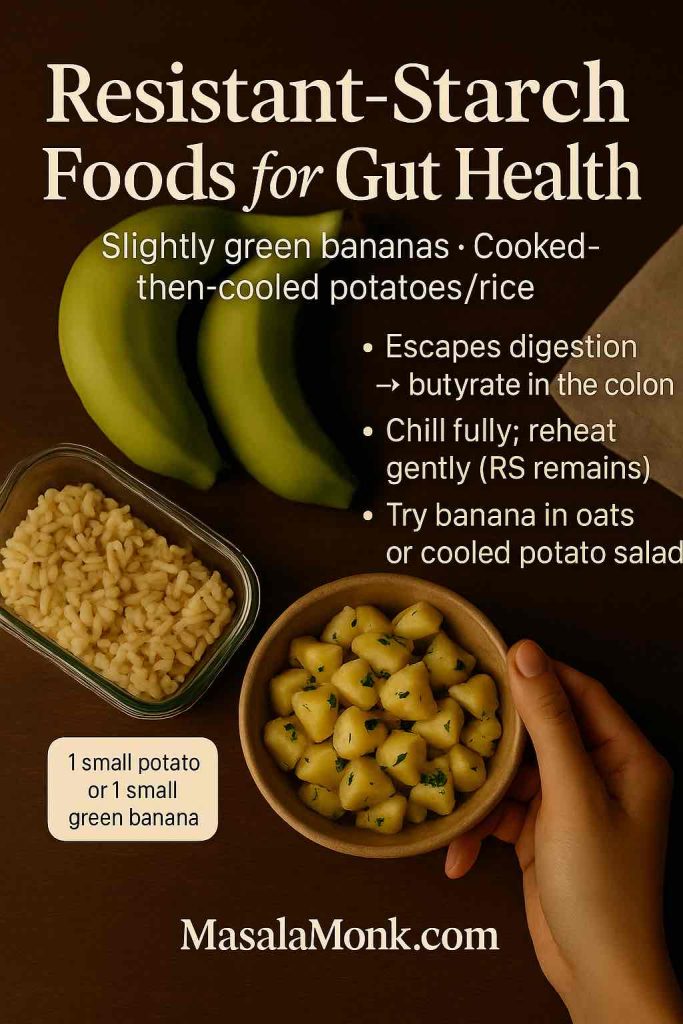
Now for a small tweak with outsized benefits. Resistant starch (RS) behaves like fiber: it escapes digestion in the small intestine, reaches the colon, and is fermented into SCFAs—especially butyrate. Two everyday RS moves stand out:

  1. Slightly green bananas you can blend into kefir or slice over oats.
  2. Cooked-then-cooled potatoes or rice you can enjoy as a salad or reheat gently—some RS remains even after warming.
Green bananas, cooled rice and a bowl of herbed cooled potatoes—resistant starch foods that feed gut bacteria and increase butyrate.
Cook, cool fully, then serve or gently reheat potatoes/rice—or add a slightly green banana to oats. Resistant starch reaches the colon and ferments into SCFAs (esp. butyrate).

For the “why,” see a clear narrative review on RS and the microbiome (e.g., this overview on National Library of Medicine): “Resistant Starch as a Prebiotic and Its Effects on the Gut Microbiota”. And for the practical detail that cooling rice increases RS and can blunt post-meal glycemia compared with freshly cooked rice, this 2021 review in Science Direct discusses times, temperatures, and reheating implications: “Rice Processing and Resistant Starch Formation”.

If bananas confuse you because sometimes they help and sometimes they don’t, ripeness is the missing variable. Our blog post and guide to bananas for constipation: ripe vs green explains when each makes sense and how to use both.

Tonight’s idea: roast a tray of potatoes, chill them completely, then fold into a lemon-olive-oil salad with herbs. Keep some chilled for quick add-ins all week.

Also Read: Teas for Digestion, Bloating, and Gut Health


Legumes as everyday prebiotic foods: lentils, chickpeas, beans

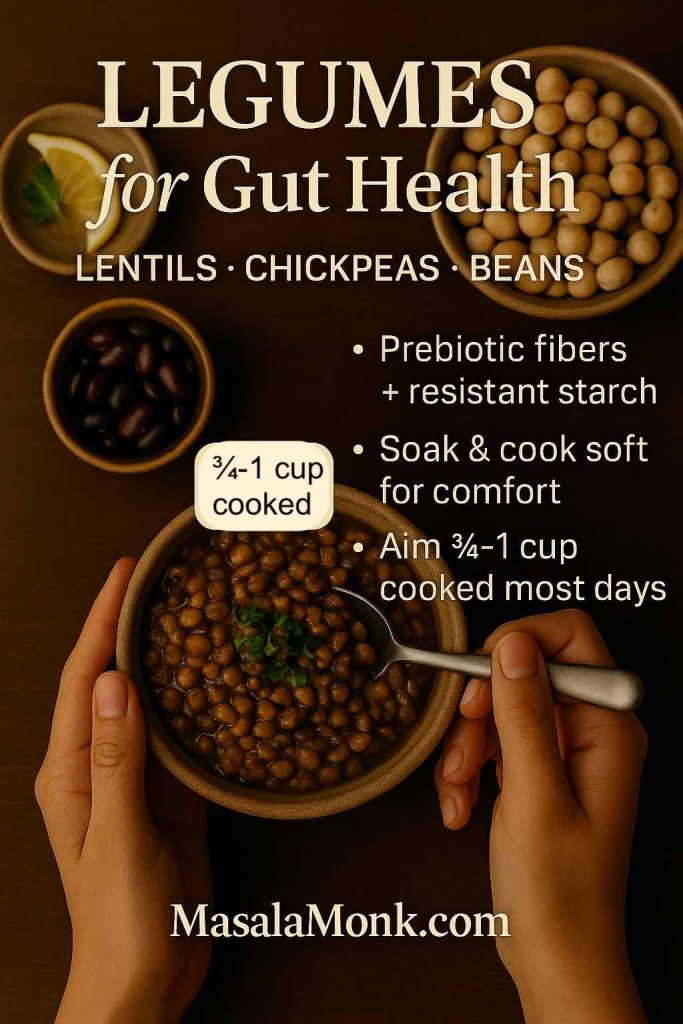
Moving on, legumes combine soluble fiber, resistant starch, and plant protein in one budget-friendly package—and they behave like prebiotics, i.e., substrates selectively utilized by host microorganisms to confer benefit (see the ISAPP definition in Nature Reviews Gastroenterology & Hepatology). Importantly, beyond mechanism, recent human work points to meaningful outcomes. A 2025 randomized controlled trial reported that a legume-enriched diet improved metabolic health via gut-microbiome mediation in adults at risk (summary in the Proceedings of the Nutrition Society). While the endpoint is metabolic, the pathway ran through microbial changes—another nudge to fold pulses into regular rotation.

Hands holding a bowl of soft cooked lentils with bowls of chickpeas and beans—prebiotic legumes for gut health and regularity.
Lentils, chickpeas and beans deliver prebiotic fibers plus resistant starch. Start soft and small—about ¾–1 cup cooked for steady comfort.

If beans feel tricky at first, soak thoroughly and cook until very soft. Red lentils are often gentler; hummus on whole-grain toast makes an easy entry; and black-bean-quinoa bowls work beautifully for dinner.

How to use now: dal with ginger-garlic; chickpea salad with lemon and herbs; or quick bean tacos with avocado and salsa.

Also Read: How to Make Lentil Patties that Are Better Than Meat? Vegan Protein-Rich Recipe


Allium & spear heroes: garlic, onions, leeks, asparagus, artichokes (prebiotic foods for gut health)

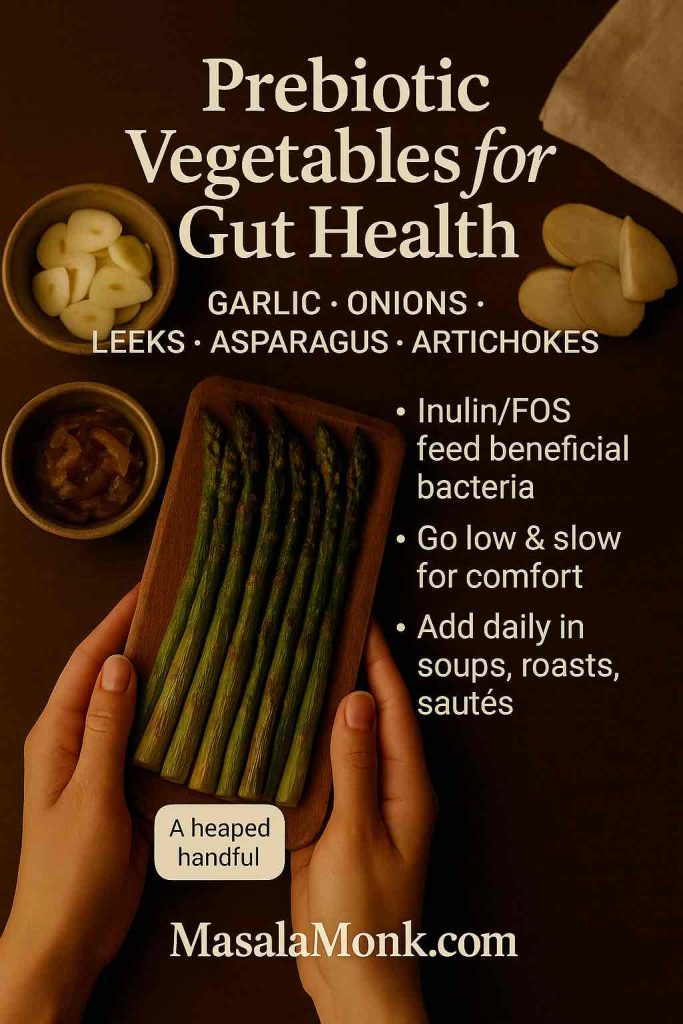
Here’s where we feed your beneficial microbes more directly. Inulin and fructo-oligosaccharides (FOS)—rich in onions, garlic, leeks, asparagus, and Jerusalem artichokes—are classic prebiotic fibers by the field’s gold-standard definition. If you’d like the professional framing (useful when filtering marketing claims), skim the ISAPP prebiotic consensus and you’ll see these foods listed repeatedly in both research and practice.

Roasted asparagus with bowls of onions, leeks, garlic and artichokes—prebiotic vegetables rich in inulin/FOS for gut health.
Allium and spear veggies supply inulin/FOS—classic prebiotic fibers. Start small, cook gently, and use a heaped handful daily.

To improve tolerance, build up slowly. Sauté onions and leeks low and slow for sweetness without sharpness; roast asparagus with olive oil and lemon; stir garlicky yogurt sauce through cooked grains for a creamy, friendly finish.


Walnuts: a small habit that supports butyrate-friendly taxa

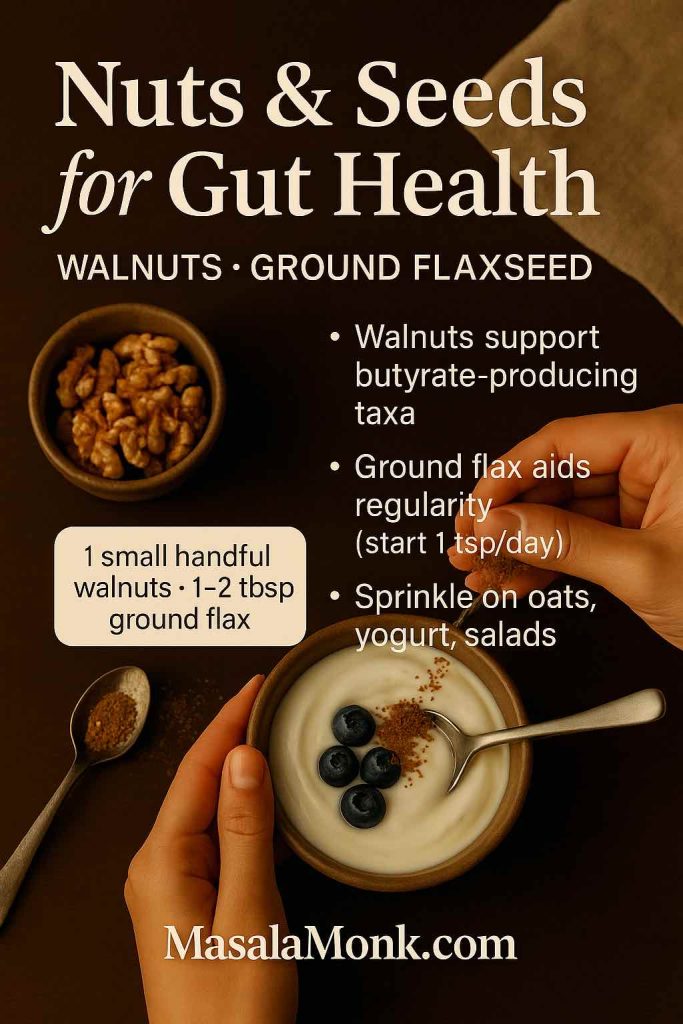
A simple handful of walnuts (about 28–43 g) can matter more than it looks. In an eight-week randomized, controlled feeding trial, daily walnut intake increased butyrate-producing taxa such as Faecalibacterium and Roseburia and favorably shifted microbial metabolites. You can scan the study via PubMed or read the full methods in The Journal of Nutrition. As for the kitchen: sprinkle chopped walnuts onto oats or live-culture yogurt; toss them into grain salads; or blend into a parsley-lemon pesto.

Tip: store nuts in the fridge or freezer to keep their fats fresh.

Also Read: Flax Seeds and Walnuts: 5 Omega-3 Boosting Morning Smoothies for Better Health


Hands sprinkling ground flax over yogurt beside walnut halves—nuts and seeds for gut health supporting butyrate producers and regularity.
A small handful of walnuts can favor butyrate-producing bacteria; 1–2 tbsp ground flax daily supports stool frequency and is an easy add-in.

Flaxseed for digestive comfort: regularity support with real-world outcomes

Because comfort counts, ground flaxseed earns a spot for clinically meaningful, GI-specific outcomes. In randomized trials with constipated adults, flaxseed improved bowel movement frequency and stool consistency versus common comparators. One open-access example appears in Nutrition & Metabolism (“Flaxseed dietary fibers lower cholesterol and increase fecal fat excretion”), and there are more trials, that offer similar results in functional constipation. Start with 1 teaspoon daily, then build to 1–2 tablespoons as tolerated; drink water alongside. Stir into oats, yogurt, smoothies, or pancake batter.

Why flax vs. psyllium? There’s room for both; flax brings lignans, omega-3 ALA, and a gentler texture many people enjoy.

Also Read: Psyllium Husk (Isabgol/Ispaghula) Side Effects: Risks, Benefits & How to Take It Safely


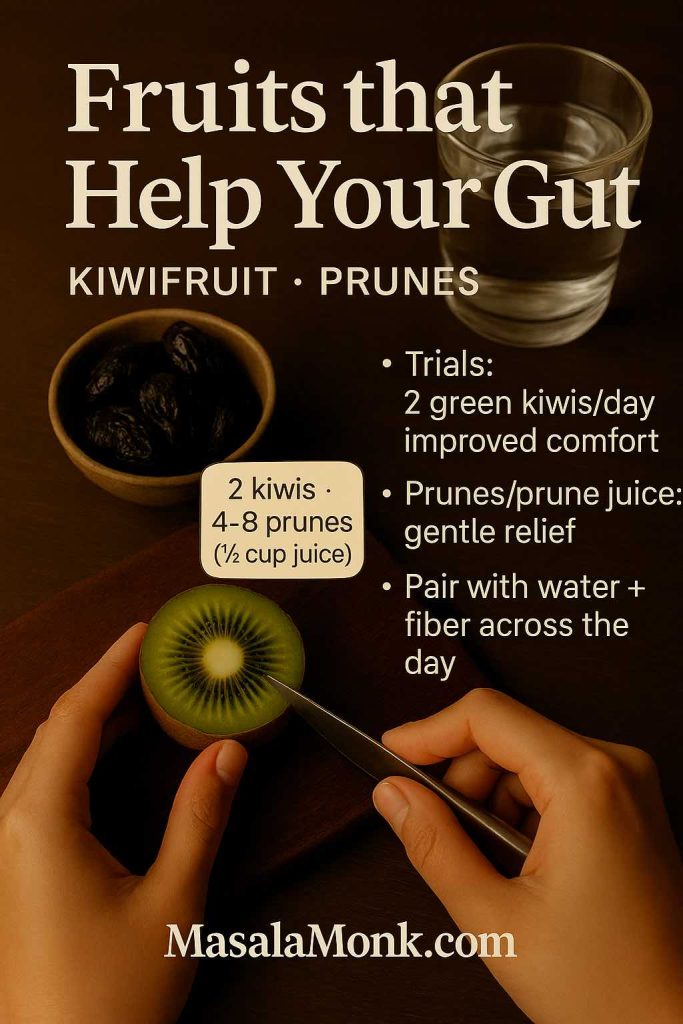
Kiwifruit (green): small, sweet, and surprisingly effective for gut health

Some foods punch above their weight. In a multicenter randomized, cross-over trial across New Zealand, Japan, and Italy, eating two green kiwifruits per day improved constipation symptoms and abdominal comfort in constipated adults (including IBS-C) and compared favorably with psyllium. You can read the study by The American College of GastroenterologyKiwifruit-A Specific Food to Improve Stool Frequency in Patients With Mild Constipation”. Slice kiwi over yogurt, cube it into a citrusy fruit bowl, or blend into kefir; the enzyme actinidin plus soluble fiber makes it a gentle, practical add-in.

Serving note: the “two per day” dose comes from trials; many people feel fine benefits at one, especially when the rest of the day is fiber-forward.

Also Read: The Kiwi – Nutrition, Benefits, and 5 Practical Ways for Weight Loss


Sliced green kiwifruit with a bowl of prunes and water—fruit choices for gut health and gentle constipation relief.
Evidence-backed duo: two green kiwis/day or 4–8 prunes (or ½ cup diluted prune juice) can ease constipation without harshness.

Prunes & prune juice: fast, food-first relief that fits a gut-friendly pattern

When you need a quick nudge toward normal, prunes and prune juice are unusually dependable. A double-blind, randomized, placebo-controlled trial showed prune juice improved stool form and constipation symptoms without provoking diarrhea (see NIH: “Effect of Prune Juice on Chronic Constipation”). Earlier, a head-to-head trial found dried plums outperformed psyllium in mild–moderate constipation (Alimentary Pharmacology & Therapeutics, 2011: “Dried plums vs psyllium”). For straightforward dosing and timing, this practical walkthrough on prune juice & prunes for constipation keeps things simple.

How to use: 4–8 prunes as an afternoon snack, or ½ cup prune juice diluted with water in the evening—then reassess the next day.

Also Read: Optimize Digestion with These 5 Fruit Juice Recipes


Omega-3-rich fish as foods for digestive health: a savory nudge toward SCFA-producers

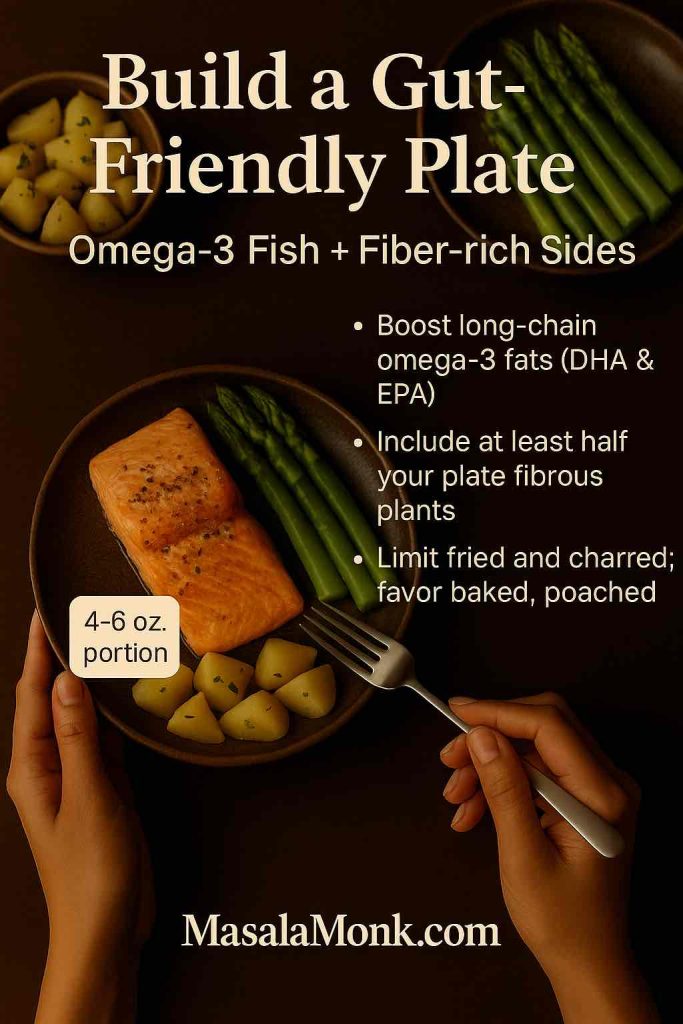
Lastly, think pattern, not pills. Omega-3-rich fish (salmon, sardines, mackerel) slot neatly into a gut-friendly week. In a human randomized trial, omega-3 PUFA intake increased several SCFA-producing bacteria, complementing the effects of fiber and ferments. For a quick understanding, skim the trial abstract here “n-3 PUFA and gut microbiota: human RCT evidence”. Then, build meals around fish plus fiber: grilled salmon with roasted asparagus and a cooled-then-reheated potato; sardine-lemon mash over brown rice; or mackerel flaked into a warm quinoa salad.

Baked salmon with asparagus and cooled potatoes on a dark plate—omega-3 fish paired with fiber sides to support SCFA-producing bacteria.
Pair omega-3 fish with greens + cooled starch to encourage SCFA-producers; keep portions modest (about 4–6 oz fish) and favor baked/poached.

Sustainable rhythm: one to two fish meals weekly is plenty for most people—and easier to maintain.

Also Read: Best Fish Oil Supplements on Amazon India


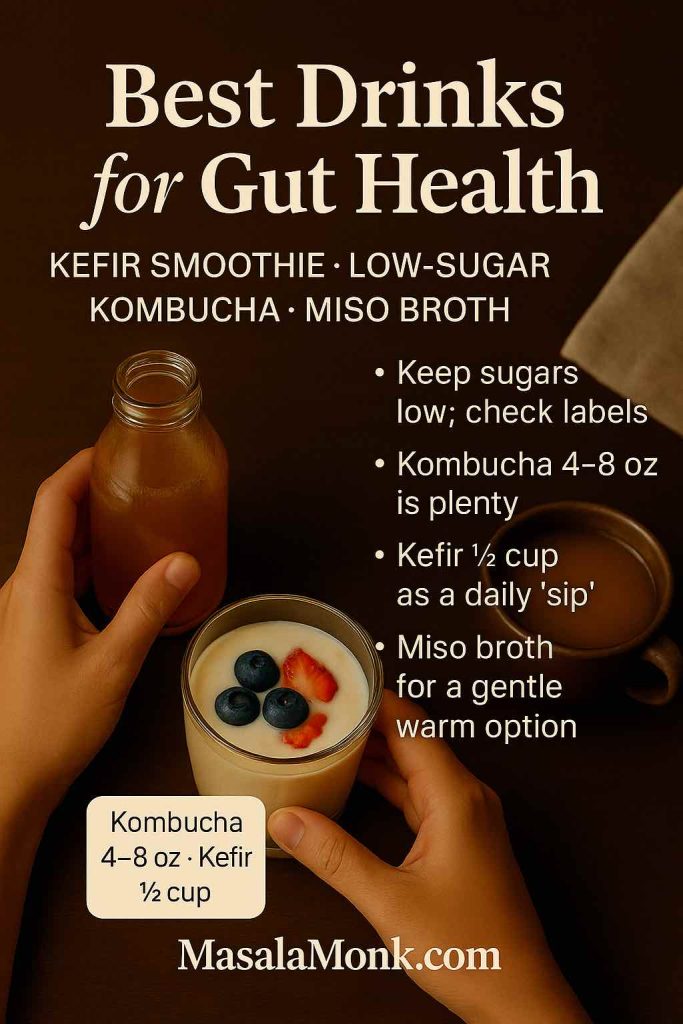
Drinks for gut health: simple sips, low sugar, steady benefits

Even modest adjustments in your glass can make the day feel better—especially when sugar stays low.

  • Diluted kefir or a kefir-berry smoothie gives you a fermented “sip” that delivers live microbes without a sugar dump, echoing the fermented-foods trial noted earlier.
  • Unsweetened kombucha can be enjoyable in small servings, yet brands vary widely in sugar. The U.S. military’s Human Performance Resource Center offers pragmatic guidance on kombucha benefits and risks—choose low-sugar options and keep portions modest. For label sticklers, the U.S. Alcohol and Tobacco Tax and Trade Bureau explains when kombucha crosses 0.5% alcohol and becomes regulated as an alcoholic beverage; their page on kombucha regulation clarifies the cutoff.
  • Water, herbal tea, and miso broth round out a calm, low-sugar trio anyone can manage on a busy day.

Also Read: Health Benefits of Kombucha

Kefir smoothie, small glass of low-sugar kombucha and a cup of miso broth—best drinks for gut health with portion guidance.
Small, steady sips beat sugar hits: kefir ½ cup, kombucha 4–8 oz, or miso broth. Hydrate and keep sugars low to support a calmer gut.

How to combine these foods for gut health into a week that actually works

Rather than overhaul everything at once, stitch together a rhythm you’ll keep.

To begin with, anchor most days with one ferment. A tablespoon or two of sauerkraut or kimchi, or ½ cup of kefir or live-culture yogurt, is enough to start. If you’re picking yogurt quickly, Harvard’s piece on how to choose yogurt is worth bookmarking.

Next, add one resistant-starch move per day. Stir slices of a slightly green banana into oats; make a cooled potato salad with olive oil and herbs; or pack leftover cooled rice for lunch. For the science of why cooling matters, the resistant starch reviews above offer a helpful explainer.

After that, build a legume habit. A scoop of hummus, a bowl of dal, or quick black beans folded into quinoa count. Over time, the combination of prebiotic fibers you’ll be eating—legumes plus the alliums/asparagus you’re cooking with—does the quiet daily work (the ISAPP prebiotic definition keeps your filter sharp).

Meanwhile, keep snack time strategic. For something you’ll actually repeat, mix chopped walnuts through live-culture yogurt and top with kiwi; or make a small bowl of oats with ground flax and cinnamon. The walnut trial (butyrate-producing taxa ↑), the flax constipation data, and the kiwifruit study mean these aren’t just “healthy vibes”—they’re practical, evidence-tied swaps.

Finally, have a plan for “those days.” If you’re backed up, prunes and prune juice remain the most reliable, food-first nudge—and yes, randomized trials support that. For dosing and timing you can actually use, this plain guide to prune juice and prunes keeps things simple.

Also Read: Fermented Garlic Honey: Benefits, Safety, and How to Use This Ancient Remedy


A gentle 3-day reset built around foods for gut health (no gimmicks, just calm structure)

This isn’t a cleanse; it’s a practical way to gather these gut-friendly foods into a few quiet days so your system can settle. Adjust portions to your needs and preferences.

Day 1 of the Gut Health Reset Meal Plan

  • Breakfast: Plain live-culture yogurt or kefir with two kiwifruits and a spoon of ground flax.
  • Lunch: Lentil-quinoa bowl with cucumbers, herbs, olive oil, and lemon.
  • Snack: 2–4 tablespoons of sauerkraut with a small handful of walnuts.
  • Dinner: Salmon; roasted asparagus; a cooled-then-reheated small potato for resistant starch.
  • If needed: ½ cup prune juice diluted with water in the evening; reassess tomorrow.

Day 2 of the Gut Health Reset Meal Plan

  • Breakfast: Oats cooked with ground flax; top with slightly green banana coins.
  • Lunch: Hummus on whole-grain toast with mixed leafy greens.
  • Snack: Warm miso broth; sip slowly.
  • Dinner: Black-bean and quinoa tacos with salsa and avocado.
  • Evening: Ginger-lemon herbal tea; lights out on time.

Day 3 of the Gut Health Reset Meal Plan

  • Breakfast: Kefir smoothie (kefir + spinach + frozen berries).
  • Lunch: Chickpea-vegetable soup with leeks and garlic simmered until sweet.
  • Snack: A small bowl of prunes or a few slices of kiwifruit.
  • Dinner: Sardines mashed with lemon and herbs over cooled brown rice; quick cucumber salad.
  • Later: A few ounces of unsweetened kombucha if you enjoy it—check the label and keep sugars modest.

Also Read: The Art of Fermented Fruit Juices: 5 DIY Recipes to Try at Home


A few plain-spoken caveats (because real life matters)

Go slow. Ferments, legumes, and prebiotic fibers are potent—especially if your baseline diet has been low in fiber. Start with tablespoons, not cups, and increase every few days as comfort allows. Your notes beat generic rules; if raw veg bothers you, cook it soft and keep flavors simple for now. On supplements, food first; if you experiment with probiotics or prebiotic powders, choose products that transparently list strains (for probiotics) or fiber types (for prebiotics), and introduce them gradually. When in doubt about terminology, the ISAPP prebiotic consensus is the simplest way to sanity-check marketing claims.


The take-home

You don’t need perfection; you need repetition. Pick one ferment you’ll eat most days, one resistant-starch move you enjoy, and one legume dish you’ll actually cook. Add allium-rich aromatics, rotate in asparagus, snack on walnuts, sprinkle ground flax, and keep kiwifruit and prunes on hand for the weeks that go sideways. Over time, these foods for gut health stop feeling like a plan and start feeling like your normal—and your gut will thank you for it.

FAQs

1) What are the best foods for gut health right now?

First, think in patterns: a small daily serving of fermented foods (kefir, live-culture yogurt, kimchi, sauerkraut, miso), plenty of fiber-rich plants (oats, barley, quinoa, beans, lentils, leafy greens), and consistent prebiotic vegetables (onions, garlic, leeks, asparagus, artichokes). Additionally, add resistant-starch options like slightly green bananas and cooked-then-cooled potatoes or rice, plus nuts and seeds (walnuts, flax, chia).

2) What exactly are prebiotics, probiotics, and postbiotics—and how do they relate to foods for gut health?

Put simply: prebiotics are fibers and plant compounds your good microbes love to eat; probiotics are beneficial live microbes you ingest (often from fermented foods); and postbiotics are the helpful compounds those microbes make (like short-chain fatty acids, including butyrate). Altogether, they form a supportive loop for digestion and gut lining integrity.

3) Can you share a simple prebiotic foods list I can use today?

Certainly. Start with onions, garlic, leeks, asparagus, Jerusalem artichokes, slightly green bananas, oats, barley, legumes (chickpeas, lentils, beans), and seeds (flax, chia). Moreover, rotate several in the same day for fiber diversity.

4) Which fermented foods and probiotics are most practical for everyday gut health?

Begin with plain kefir or live-culture yogurt (½ cup is enough to start). Next, add 2–4 tablespoons of kimchi or sauerkraut with meals, and occasionally whisk miso into warm broth. Meanwhile, keep sugars low and servings modest, then slowly increase if you feel comfortable.

5) What are butyrate foods—and why do they matter?

Strictly speaking, butyrate is produced by your microbes when they ferment certain fibers. Consequently, “butyrate foods” means foods that help you make it: oats, barley, legumes, nuts and seeds, green bananas, and cooled starches (potatoes/rice). In turn, steady butyrate production supports a healthy gut barrier.

6) Best drink for gut health—what should I actually sip?

Start simple: water (still or sparkling), ginger-lemon herbal tea, diluted kefir, miso broth, and modest amounts of unsweetened kombucha. Additionally, keep sugars low and aim for consistency over cleverness.

7) What’s a healthy gut breakfast that won’t bloat me?

Try kefir or yogurt with kiwi and a spoon of ground flax; or warm oats topped with a few walnut pieces and slices of slightly green banana. Alternatively, a savory option like eggs with sautéed greens and a side of kimchi works beautifully.

8) I’m dealing with bloating—what foods for gut health are gentler at first?

Go with cooked vegetables (carrots, zucchini, spinach), tender grains (oats, quinoa), and smaller portions of ferments. Furthermore, introduce prebiotics gradually: start with well-cooked onions/leeks and increase over several days.

9) What are the worst foods for gut health to dial back?

Ultra-processed choices, frequent high-sugar treats, heavy alcohol, and your known trigger foods. However, approach changes kindly: crowd the plate with fiber-rich, minimally processed options rather than focusing only on restriction.

10) Is there a gut reset diet or meal plan that actually helps?

Yes—think “calm structure,” not extremes. For 3 days, include one ferment daily, one resistant-starch move (cooled potatoes/rice or a slightly green banana), and at least one legume meal. Additionally, keep drinks low in sugar and season foods with gentle herbs like ginger.

11) How does a plant-forward gut health diet compare with other approaches?

Broadly, plant-forward patterns offer fiber and polyphenol diversity that microbes thrive on. Nevertheless, include quality proteins and healthy fats, and adjust textures (more cooked than raw) when your gut feels sensitive.

12) Do mushrooms, seeds, and nuts contribute meaningfully to gut health?

Absolutely. Mushrooms add fiber and umami; seeds (flax, chia) bring gel-forming fibers that aid regularity; nuts—especially walnuts—support a friendly microbial profile. Even so, start with small amounts if your gut is reactive.

13) Greek yogurt vs regular yogurt—does the choice matter for digestive health?

Both can fit. Greek yogurt simply has more protein and a thicker texture. Crucially, pick unsweetened varieties with live cultures; then add fruit or cinnamon for flavor rather than sugar.

14) What’s the difference between prebiotic fiber and resistant starch?

Prebiotic fiber (like inulin/FOS) is a broad category selectively used by beneficial microbes; resistant starch is a particular type that resists digestion and reaches the colon intact. Interestingly, both can be in the same meal: cooled potatoes (RS) topped with garlicky yogurt sauce (prebiotic).

15) Are psychobiotic foods a real thing or just hype?

They’re an emerging area. In essence, foods that nurture a resilient microbiome—ferments plus prebiotic-rich plants—may influence mood-relevant pathways. While the term sounds trendy, the practical advice remains the same: diversify fibers and include a small daily ferment.

16) What about a leaky gut diet plan—where should I begin?

Begin gently: emphasize minimally processed foods, steady fiber diversity, a small daily ferment, and omega-3-rich choices like salmon or sardines. Additionally, reduce alcohol and added sugars, and reintroduce potential triggers one at a time to spot patterns.

17) I’ve heard about akkermansia and other “next-gen” probiotics—should I chase them?

For most people, no. Instead, support Akkermansia and other beneficial taxa indirectly with consistent fiber, polyphenols (berries, greens, cocoa nibs), and moderate ferments. Later, discuss targeted supplements with a professional if symptoms persist.

18) How can I choose a probiotic with prebiotic (a synbiotic) without overcomplicating it?

Look for transparent strain names (e.g., Lactobacillus rhamnosus GG), clear CFU counts, and a well-tolerated prebiotic (like PHGG or inulin) in modest doses. Moreover, add it after you’ve established food basics, not before.

19) Are gummies, powders, or capsules better for digestive health?

It depends on tolerance and sugar. Powders often allow flexible dosing; capsules are convenient; gummies can hide added sugars. Therefore, if you try gummies, choose low-sugar versions and keep portions conservative.

20) What are easy gut-friendly snacks I can keep on repeat?

Think Greek yogurt with chia and berries; a few prunes with walnuts; hummus on whole-grain toast; or a spoonful of kimchi with a small omelet. Likewise, mini oat bowls with ground flax and cinnamon make a soothing evening option.

21) How do I increase fiber without feeling miserable?

Gradually. Add one fiber move at a time—say, 1 teaspoon of ground flax daily—then scale up every 3–4 days. In the meantime, drink enough water, cook vegetables soft, and spread fiber across meals rather than loading up at once.

22) Is there a best greens-for-gut-health rotation?

Variety wins: spinach, kale, arugula, and herbs like parsley or coriander. Crucially, alternate raw and cooked textures; for sensitive days, wilted greens or blended soups tend to feel calmer.

23) Can fish oil or omega-3-rich fish genuinely support the microbiome?

Yes—indirectly. Omega-3-rich fish appear to favor SCFA-producing bacteria when eaten consistently. Nevertheless, the real magic happens when you pair fish with fiber-rich sides, not when you rely on supplements alone.

24) What’s the smartest way to start—today?

Choose one ferment you’ll actually eat, one resistant-starch habit you enjoy, and one legume dish you can cook on autopilot. Then, sprinkle in prebiotic vegetables and a nut-or-seed boost. Gradually, these foods for gut health become your normal—not a temporary fix.

25) Finally, how do I know it’s working?

Notice trends, not one-off days: more regularity, less urgent bloating, steadier energy after meals, and a generally calmer belly. If progress stalls despite consistent changes, jot notes and adjust portions, textures, and timing—your gut’s feedback is the best guide.

Posted on 7 Comments

Healthy Pumpkin Spice Latte (Low Cal, Real Pumpkin)

Portrait of a healthy pumpkin spice latte topped with foam and spice; real pumpkin, low calorie; hot or iced recipe from MasalaMonk

When the air turns crisp and mornings get slower, a Healthy Pumpkin Spice Latte is exactly the kind of cozy you can feel good about. Right from the start, this recipe prioritizes real pumpkin purée, balanced spice, and smart sweeteners, so your Healthy Pumpkin Spice Latte tastes indulgent while staying light. For even better iced results, you might glance at our post on iced coffee methods; understanding cold brew vs. iced espresso vs. shaken lattes instantly upgrades texture.


Why This Version Is a Truly Healthy Pumpkin Spice Latte

To begin with, we build flavor from real pumpkin and a precise spice blend (cinnamon, ginger, nutmeg, clove) rather than relying on multiple pumps of syrup. As a result, your Healthy Pumpkin Spice Latte delivers warmth, body, and aroma without a sugar crash. Additionally, you can steer calories by milk choice—unsweetened almond for the leanest profile, skim for dairy protein without fat, or oat for extra creaminess. For context and honest comparisons, the official café baselines are here: Starbucks hot PSL nutrition and Starbucks iced PSL nutrition (starbucks.com). You’ll see how quickly sugar and calories climb with standard builds.

Moreover, using real pumpkin gives you a little fiber and micronutrients with very modest sugars. If you like specifics, skim the canned pumpkin nutrition profile (MyFoodData, USDA-based). Put simply: the Healthy Pumpkin Spice Latte approach leans on whole ingredients and method control, not just “less syrup.”


Ingredients for a Healthy Pumpkin Spice Latte (1 Serving, ~12 oz / 355 ml)

Before we begin, gather everything in one place; preparation makes the pour seamless. Then, follow the lists below—organized so you can choose quickly without second-guessing. Choose one milk and one sweetener; the rest stays the same.

Core base (must-have)

  • Espresso: 30–60 ml (1–2 shots) or ~90 ml strong brewed coffee
    Tip: Start with 1 shot for balance; add a second if you prefer a bolder Healthy Pumpkin Spice Latte.
  • Pumpkin purée: 30 g (2 Tbsp), 100% pumpkin (not pie filling)
  • Vanilla extract: ½ tsp
  • Fine salt: a small pinch (it rounds sweetness and spice)

Milk (pick one)

  • Unsweetened almond milk — 200 ml (¾ cup + 1 Tbsp): ultra-light and lowest in calories.
  • Skim milk — 200 ml: lean dairy with extra protein and a clean latte finish.
  • Unsweetened oat milk — 200 ml: naturally creamy; slightly higher calories but luxurious texture.

Preferably, choose cold milk for iced versions; otherwise, any works.

To get precise control of ingredients, additives, macros and quality of your milk we have couple of posts that explain How to make Almond Milk at Home and then Easy Homemade Oats Milk with just One Ingredient- Non Slimy, at last.

Pumpkin spice blend (balanced & bright)

Use 1 tsp total, mixed as:

  • ⅝ tsp ground cinnamon
  • ⅛ tsp ground ginger
  • ⅛ tsp ground nutmeg
  • A tiny pinch clove (go easy—clove dominates quickly)

For a precise recipe and some of the variants you can make at home, read our post on Pumpkin Spice, Your Way: Master Blend, Variations & Real-World Recipes. Alternatively, use 1 tsp of a quality pre-mixed pumpkin pie spice.

Sweetener (to taste—choose one)

  • Zero-calorie: liquid stevia, monk-fruit drops, or erythritol/monk-fruit blend (start light; add gradually).
  • Natural: 1–2 tsp maple syrup or honey for classic café sweetness.
  • Low-glycemic twist (optional): 1–2 tsp allulose for clean sweetness without a cooling aftertaste.

Because pumpkin softens bitterness, you’ll often need less sweetener than you expect.

For iced Healthy Pumpkin Spice Latte

  • Ice: ~200 g (heaping cup), plus extra for the glass
  • Optional cold foam: 60 ml milk (of your choice), frothed separately

Flavor extras (optional, but lovely)

  • Citrus spark: the faintest whisper of orange zest (⅛ tsp) brightens the spices.
  • Caramel note: ¼ tsp molasses introduces depth without much sugar.
  • Saffron warmth: a few strands steeped in a splash of your milk add aromatic complexity.

Equipment (simple is fine)

  • Whisk or handheld frother (for hot microfoam)
  • Shaker or jar with lid (for the iced, frothy finish)
  • Small saucepan (if making the hot version)

Quick metric/US snapshot

  • Espresso 30–60 ml = 1–2 shots
  • Milk 200 ml = ~¾ cup + 1 Tbsp
  • Pumpkin purée 30 g = 2 Tbsp
  • Spice blend = 1 tsp total

Finally, to keep your Healthy Pumpkin Spice Latte consistent day after day, pre-mix a small jar of the spice blend and store it airtight; subsequently, each cup becomes a simple “scoop and whisk.” Do not miss our full post on how to make how to make pumpkin pie spice blend, and its variants.


Method: Hot Healthy Pumpkin Spice Latte (≈10 Minutes)

First, warm the base: in a small saucepan over medium-low, whisk milk, pumpkin purée, spice blend, vanilla, sweetener, and a pinch of salt for 3–4 minutes until steaming—avoid a rolling boil to preserve aroma. Next, froth to a latte-like texture using a whisk, handheld frother, or (carefully) a heat-safe jar. Meanwhile, pull 1–2 shots of espresso into a mug (or pour in hot strong coffee). Finally, combine by topping the coffee with your pumpkin milk. Taste; adjust sweetness or spice. Because pumpkin adds body and softens bitterness, you may need less sweetener than expected—another reason this is a Healthy Pumpkin Spice Latte you’ll actually crave daily.


Method: Iced Healthy Pumpkin Spice Latte (Shaker Method)

First, brew and cool: pull espresso and let it stand 1–2 minutes, or use a cold espresso concentrate. Then, shake: in a cocktail shaker or jar, combine espresso, cold milk, pumpkin purée, spice, vanilla, sweetener, and ice; shake 10–15 seconds until chilled and lightly frothy. Afterward, strain over fresh ice to avoid extra dilution. For a café-style finish, top with cold foam; see How to Make Cold Foam (Better Homes & Gardens) and a clever, low-cost option in Why I Love the French Press (Serious Eats). As a result, your iced Healthy Pumpkin Spice Latte will have the silky cap you love—no special machine needed. And if you want to go deeper on cold methods, circle back to our post on iced coffee methods.


Quick Recipe Card for Healthy Pumpkin Spice Latte (Hot or Iced)

Yield: 1 serving · Time: 10 minutes (hot) / 5 minutes (iced)

Ingredients

  • 30–60 ml espresso (1–2 shots) or ~90 ml strong coffee
  • 30 g (2 Tbsp) pumpkin purée (100% pumpkin)
  • 1 tsp pumpkin spice blend (see notes)
  • 1/2 tsp vanilla extract
  • Pinch fine salt
  • 200 ml milk of choice (almond/skim/oat)
  • Sweetener to taste (zero‑cal or 1–2 tsp maple/honey)
  • For iced: ~200 g ice, plus more for glass; optional 60 ml cold‑foam milk

Instructions (Hot)

  1. In a small saucepan over medium‑low, whisk milk, pumpkin, spice, vanilla, sweetener, and salt 3–4 min until steaming. Do not boil.
  2. Froth to microfoam.
  3. Brew espresso into a mug.
  4. Pour spiced milk over espresso; taste and adjust.

Instructions (Iced, Shaken)

  1. Pull espresso; let stand 1–2 min (or use cold concentrate).
  2. In a shaker, combine espresso, cold milk, pumpkin, spice, vanilla, sweetener, and ice. Shake 10–15 sec.
  3. Strain over fresh ice; top with cold foam if desired.

Notes

  • Spice mix: 5/8 tsp cinnamon, 1/8 tsp ginger, 1/8 tsp nutmeg, tiny pinch clove.
  • Flavor extras: 1/8 tsp orange zest; 1/4 tsp molasses; a few saffron strands (steeped).
  • Grande (~16 oz): scale by 1.3–1.4×.

Estimated nutrition (almond milk base): ~90 kcal; ~10 g carbs; ~4 g sugar; ~3 g fat; ~2 g protein.


Macros, Comparisons, and Sensible Tweaks for a Healthy Pumpkin Spice Latte

Because milk choice drives most of the calories, start there. Per ~12 oz serving (with 30 g pumpkin purée and zero-cal sweetener), expect roughly:

  • Unsweetened almond milk: ~90 kcal, ~10 g carbs, ~4 g sugar, ~3 g fat, ~2 g protein
  • Skim milk: ~135 kcal, ~21 g carbs, ~14 g sugar, ~0 g fat, ~9 g protein
  • Unsweetened oat milk: ~170 kcal, ~22 g carbs, ~7 g sugar, ~6 g fat, ~3 g protein

If you add 2 tsp maple syrup, plan for about +34 kcal and +~9 g sugar. Even so, maple is assertive, so a small amount provides plenty of flavor. Meanwhile, remember that pumpkin purée adds a little fiber and body with modest sugars; for numbers, keep this canned pumpkin nutrition page (MyFoodData) handy.

For perspective, compare your Healthy Pumpkin Spice Latte to Starbucks hot PSL nutrition or Starbucks iced PSL nutrition (starbucks.com). On balance, the homemade cup stays lean because you control milk and sweetener instead of defaulting to multiple syrup pumps.


Variations That Keep Your Healthy Pumpkin Spice Latte Fresh

Keto / Low-Carb Healthy Pumpkin Spice Latte: Choose unsweetened almond milk and a zero-cal sweetener. If you also track caffeine, try one espresso shot and adjust later. For a cozy non-coffee day, our vegan keto smoothie kick-start echoes fall spice while staying low in sugar.

Vegan Healthy Pumpkin Spice Latte: Pick almond or oat milk and sweeten with monk fruit or maple. Oat brings café-style creaminess; almond keeps calories lean. Either way, the pumpkin + spice profile remains the star.

No-Coffee / Decaf Healthy Pumpkin Spice Latte: Swap espresso for strong chai or rooibos, or simply use steamed milk. Brew a small tea concentrate and treat it like espresso in the method; the spices harmonize beautifully.


Troubleshooting and Pro Tips for Your Healthy Pumpkin Spice Latte

  • Spice settling: Before heating, whisk the spice into the pumpkin purée; the purée helps suspend fine particles so they don’t sink.
  • Too thin: Add 1–2 tsp more pumpkin purée or reduce milk by 20–30 ml to concentrate texture.
  • Not pumpkiny enough: Increase purée to 40 g and add ¼ tsp more cinnamon; if the flavor turns “muddy,” reduce clove first—it’s potent.
  • No frother, no problem: A French press makes quick microfoam; see this French press overview (Serious Eats).
  • Iced texture matters: Shake vigorously to produce tiny bubbles and a creamier sensation, even with almond milk. Additionally, always strain over fresh ice.
  • Batching for guests: Prepare a larger batch of the spiced milk base and keep it warm. For safety, stay out of the “danger zone.” Review USDA slow-cooker tips (usda.gov) and the simple keep-hot guideline ≥ 140°F / 60°C (FoodSafety.gov). Then add espresso to each mug just before serving so the coffee stays vibrant.

How to Slot a Healthy Pumpkin Spice Latte Into Your Week

Realistically, most of us want easy repetition. Consequently, try this cadence:

  • Weekdays: Unsweetened almond milk + zero-cal sweetener; make the hot version in the morning and the iced version in the afternoon.
  • Weekends: Switch to oat milk, add a small splash of maple, and treat it like dessert—no apology needed.
  • Meal prep: Mix a three-day base (milk + pumpkin + spice + vanilla + sweetener) and refrigerate. Before each cup, re-shake or whisk, then add espresso and heat or shake over ice. In practice, this keeps your Healthy Pumpkin Spice Latte consistent without fuss.

By the way, when you want a thicker, post-workout option that still hits fall notes, peek at our pumpkin seed smoothie ideas. It’s not a latte, certainly, but it’s seasonally aligned and satisfying.


Why This Healthy Pumpkin Spice Latte Keeps Working

At any rate, the magic is simple: whole ingredients and deliberate technique. Because you aren’t locked into fixed syrup pumps, you can adjust sweetness in tiny steps. Because you froth (or shake) properly, you can dial creaminess regardless of milk. And because you use pumpkin purée, you add body and color without runaway sugar. In short, the Healthy Pumpkin Spice Latte respects flavor and goals.

Meanwhile, it’s flexible. Prefer perfumey spice? Increase cinnamon and nutmeg while easing clove. Want more body without extra calories? Froth a small portion of milk into cold foam and spoon it on top. Need stronger coffee presence? Use two shots, then balance with 1–2 extra teaspoons of pumpkin. Finally, if you want to fine-tune the iced path, revisit our post on iced coffee methods. And keep these two official references nearby for honest comparisons as you tweak: Starbucks hot PSL nutrition and Starbucks iced PSL nutrition (starbucks.com).


FAQs

1) What exactly makes this a Healthy Pumpkin Spice Latte?

Because we build flavor from real pumpkin purée and a balanced spice blend—rather than multiple syrup pumps—you get body, aroma, and warmth with fewer added sugars. Additionally, you control milk and sweetener, so calories and carbs stay in check.

2) How many calories are in one serving of Pumpkin Spice Latte?

Typically, 12 oz lands around ~90 kcal with unsweetened almond milk, ~135 kcal with skim, and ~170 kcal with unsweetened oat. Of course, add 30–40 kcal if you stir in 2 teaspoons of maple syrup.

3) Can I make a Healthy Pumpkin Spice Latte without coffee?

Absolutely. Instead of espresso, use strong chai or rooibos, or simply steamed milk. Consequently, you keep the cozy pumpkin-spice profile while skipping caffeine.

4) How do I make a vegan Pumpkin Spice Latte?

Simply choose almond or oat milk and a plant-based sweetener (e.g., monk fruit or maple). As a result, the texture remains creamy while the drink stays dairy-free.

5) How do I keep my Pumpkin Spice Latte keto / low-carb?

First, select unsweetened almond milk. Then, sweeten with a zero-calorie option like stevia or a monk-fruit blend. Therefore, you’ll reduce net carbs while keeping flavor intact.

6) Does this recipe of Pumpkin Spice Latte use real pumpkin?

Yes—each serving uses about 30 g (2 Tbsp) of 100% pumpkin purée. Accordingly, you get a touch of fiber and body with modest sugars, unlike syrups alone.

7) Can I make an iced Healthy Pumpkin Spice Latte that still tastes rich?

Definitely. Shake the drink with ice for 10–15 seconds; that agitation adds tiny bubbles and creaminess. Then, for café-style texture, crown it with a small spoonful of cold foam.

8) What’s the best milk for a Healthy Pumpkin Spice Latte?

It depends. Unsweetened almond milk is leanest, skim milk adds protein with minimal fat, and oat milk yields the lushest mouthfeel. In short, pick based on goals: calories, protein, or creaminess.

9) How can I cut sugar but keep flavor in Pumpkin Spice Latte?

Start with zero-calorie sweeteners and rely on pumpkin + spice for depth. Moreover, a small pinch of salt and a splash of vanilla round perception of sweetness so you can use less.

10) How do I prevent spices from sinking to the bottom of Pumpkin Spice Latte?

Before heating, whisk the spice directly into the pumpkin purée; the purée suspends fine particles. Likewise, give the finished drink a quick swirl before the final sip.

11) Can I batch this for guests or meal prep?

Yes. Prepare the spiced milk base (milk, pumpkin, spice, vanilla, sweetener) and keep it warm for serving or chill up to 3 days. Afterwards, add espresso to each cup to keep the coffee vibrant.

12) Is there a slow-cooker version of Healthy Pumpkin Spice Latte?

Certainly. For gatherings, warm the spiced milk base on Low, then hold on Warm. Subsequently, pour espresso into each mug and top with the hot base. Stir before each pour so spices stay even.

13) What’s the right espresso dose—one shot or two?

Begin with one shot for balance. Then, if you prefer stronger coffee notes, add a second shot and, if needed, slightly increase pumpkin purée (by 1–2 tsp) to keep harmony.

14) Can I make a grande-size Healthy Pumpkin Spice Latte?

Yes—scale ingredients by 1.3–1.4× for ~16 oz. Nevertheless, taste as you go and adjust sweetness gradually; it’s easier to add than to dial back.

15) How do I get thicker body of Pumpkin Spice Latte without extra calories?

First, froth a small portion of your milk to create microfoam; next, spoon it on top. Additionally, bump pumpkin purée by 1–2 teaspoons for natural viscosity.

16) What if I want a pumpkin spice chai instead of a coffee latte?

Simply swap the espresso for strong chai concentrate. Consequently, you’ll get a spiced, tea-forward variation that pairs beautifully with pumpkin and vanilla.

17) Which sweetener tastes closest to café sweetness?

For most palates, a monk-fruit/erythritol blend reads clean. Alternatively, 1–2 teaspoons of maple syrup deliver classic café character—just budget the added calories.

18) How should I store leftovers?

Cool the spiced milk base quickly and refrigerate in an airtight jar for up to 3 days. Then, shake before using and add fresh espresso when serving hot or iced.

19) Can I use pumpkin pie spice instead of a custom blend?

Yes. Use 1 teaspoon of a quality pumpkin pie spice. However, if clove dominates, reduce the total to ¾ teaspoon and compensate with a pinch of extra cinnamon.

20) Any tips for a copycat café feel at home?

Indeed. Froth milk (or make cold foam), strain iced drinks over fresh ice, and dust the top lightly with cinnamon. Furthermore, serve in a pre-warmed mug (hot) or a chilled glass (iced) for a professional finish.