Posted on 3 Comments

All About Gluten: Symptoms, Testing, Diet & 7-Day Gluten-Free Meal Plan

Portrait cover image for a gluten sensitivity diet: gluten-free millet salad on rustic table with text “Symptoms, Testing & 7-Day Plan” – MasalaMonk

If you’re wondering whether a gluten sensitivity diet could finally calm the bloating, brain fog, fatigue, or stubborn skin issues—you’re far from alone. Yet the landscape can be confusing: is it celiac disease, non-celiac gluten sensitivity (NCGS), or a wheat allergy? And once you figure that out, what exactly should you eat? This guide clears the path step by step—so you can move from guesswork to a steady routine that supports your gut, your energy, and your everyday life.

Before we dive into testing, food lists, and meal plans, a brief refresher helps. If you’re new to the topic, start with our quick primer on what gluten actually is—it’ll make everything else easier to follow.

⚠️ Disclaimer: This article is for educational purposes only and is not medical advice. It does not diagnose, treat, cure, or prevent any condition. Always consult a qualified healthcare professional for personalized guidance, especially before starting a gluten sensitivity diet, changing medications, or interpreting tests. If you have urgent or severe symptoms, seek medical care immediately.


Celiac, NCGS, or Wheat Allergy—Why Your Diagnosis Shapes the Gluten Sensitivity Diet

Although the symptoms can overlap, these conditions aren’t the same—and the plan you follow depends on which one you have.

  • Celiac disease (CeD) is an autoimmune condition: gluten triggers immune damage in the small intestine. Left untreated, it can lead to nutrient deficiencies, anemia, bone loss, and more.
  • Non-celiac gluten sensitivity (NCGS) involves gluten-related symptoms without celiac’s intestinal damage and without wheat-allergy markers. Interestingly, a subset of people with NCGS-like symptoms may actually be reacting to fructans (fermentable carbohydrates found in wheat) rather than gluten itself; Monash’s overview explains how wheat is rich in fructans, and a randomized trial explored whether fructans—not gluten—trigger symptoms in some. See Monash on wheat and fructans and the study via PubMed.
  • Wheat allergy is an IgE-mediated allergy to wheat proteins (not just gluten). Reactions can include hives, wheezing, and—rarely—anaphylaxis, which clearly requires a different approach.

Because treatment and strictness differ, testing first—and only then committing to a gluten sensitivity diet—is the smartest move.


Gluten Sensitivity Symptoms: What to Watch For

If you’re considering a gluten sensitivity diet, it helps to recognize the most common gluten intolerance symptoms first. Although everyone’s experience differs, the patterns below appear consistently in clinical summaries and patient reports.

Core digestive signs of Gluten Sensitivity

To begin with, keep an eye on:

  • Bloating and gas (often within hours)
  • Abdominal pain or cramping
  • Diarrhea, constipation, or an alternating pattern
  • Nausea and early fullness
  • Reflux/heartburn after wheat-heavy meals

For a clear, medical overview of GI complaints (including how they differ by age), see the NIDDK symptom summary and the Celiac Disease Foundation symptoms list.

Extra-intestinal symptoms of Gluten Sensitivity (the sneaky ones)

Meanwhile, many people notice issues outside the gut: persistent fatigue, brain fog or headaches, mood changes, joint or muscle aches, and skin flares. For accessible detail, skim Mayo Clinic’s celiac symptoms page.

Possible nutrient-deficiency clues of Gluten Sensitivity

Over time, malabsorption can show up as iron-deficiency signs (dizziness, brittle nails), mouth ulcers, or even hair thinning. Notably, dental enamel defects in kids can be an early clue—dentists are encouraged to refer when they spot tell-tale enamel patterns. Start with the NIDDK note on enamel defects and CDF’s oral-health overview.

In children (additional pointers on Gluten Sensitivity )

By contrast, kids may present with growth faltering, frequent tummy aches, loose stools, or irritability—sometimes long before anyone suspects gluten. A concise digest for families appears in CDF’s symptoms page and the NIDDK children overview.

Timing, dose, and patterns

Just as important, symptoms can spike within 30 minutes up to 48 hours after eating gluten. Some people notice a dose–response (bigger portions → bigger flares). Others discover that wheat’s fructans—a FODMAP, not gluten—drive bloating and gas; in that case, a short low-FODMAP strategy (not lifelong strict GF) may help. For context, read Monash on avoiding wheat during the low-FODMAP phase and their brief fructan/oligos explainer.

When to seek care (don’t DIY this part)

However, certain red flags need prompt medical evaluation rather than diet trials: unintentional weight loss, blood in stool, persistent vomiting, fever, severe dehydration, or night sweats. A reliable, plain-English checklist appears in Mayo Clinic’s guidance.

Quick self-audit before you change everything

Before you overhaul your routine, keep a 3–5 day food & symptom log (time eaten, portion, symptoms 0–10). Note oats, sauces/spice blends, and possible cross-contact (shared fryers, toasters, or boards). Bring the log to your appointment; clinicians can then decide on testing first—and only afterward a tailored gluten sensitivity diet. For accuracy, remember you should be on gluten before serology; the rationale is laid out in the NIDDK provider handout.


Testing First (Then Diet): How to Avoid False Negatives and Frustration

Here’s the crucial rule many people miss: don’t remove gluten before screening, or blood tests can turn falsely negative.

  • First-line bloodwork typically includes tissue transglutaminase IgA (tTG-IgA) with a total IgA to check for IgA deficiency. Some clinicians add deamidated gliadin (DGP) antibodies, particularly in younger children. For approachable, trustworthy guidance, see the American College of Gastroenterology’s celiac disease overview and the NIDDK’s clear explainer for clinicians and patients on celiac testing.
  • Confirmation: when screens are positive, specialists usually confirm celiac disease with an endoscopy and small-bowel biopsies.
  • Why “stay on gluten” matters: the NIDDK’s provider handout is explicit—patients should be consuming gluten before testing to ensure accuracy. Skipping this step risks months of confusion. See the NIDDK PDF guidance: Provider Points—Celiac Disease.

Once you’re properly screened, you can commit to the right path—be it a strict celiac protocol or a carefully structured gluten sensitivity diet for non-celiac cases.

⚠️ Disclaimer: This article is for educational purposes only and is not medical advice. It does not diagnose, treat, cure, or prevent any condition. Always consult a qualified healthcare professional for personalized guidance, especially before starting a gluten sensitivity diet, changing medications, or interpreting tests. If you have urgent or severe symptoms, seek medical care immediately.


“Is It Gluten-Free?”—Clear Answers You Can Trust (So Labels Don’t Drive You Mad)

Label reading gets overwhelming quickly; nevertheless, a few rules of thumb dramatically reduce stress.

  • Oats / Oatmeal: Oats are naturally gluten-free, but they’re frequently contaminated with wheat, barley, or rye during harvesting and processing. Choose certified gluten-free oats and introduce them gradually if you’re sensitive; a small subset of people reacts to avenin (the oat protein). For a balanced overview, see the Celiac Disease Foundation’s explainer on oats and contamination. Meanwhile, the FDA clarifies that gluten-free claims generally mean <20 ppm gluten—use their resources to understand labels: FDA gluten & food labeling and the consumer piece, Gluten-Free Means What It Says.
    For kitchen-level practicality, compare our quick primers on rolled vs old-fashioned oats and quick vs instant oats.
  • Sourdough bread: Despite the buzz, regular wheat sourdough is not gluten-free or celiac-safe. Only sourdough made entirely with gluten-free grains and a gluten-free starter is safe. For clarity, see Beyond Celiac—Is sourdough bread gluten-free?.
  • Quinoa: Naturally gluten-free, higher in protein than most grains, and fantastic for pulao, upma, bowls, and salads.
  • Coffee: Plain black coffee is gluten-free; flavored products may vary—check labels.
  • Ezekiel bread: The classic sprouted version contains wheat; it’s not gluten-free. If you love the texture, look specifically for GF-labeled sprouted breads.

Meanwhile, many Indian staples are naturally GF. To diversify your pantry (and your recipes), explore our primer on millets—the gluten-free superfood.


The Core of a Gluten Sensitivity Diet (So You Feel Satiated, Not Deprived)

A sustainable gluten sensitivity diet leans on naturally gluten-free foods, treats packaged items with care, and prioritizes satisfaction (so you’ll actually stick with it).

Build your plate around:

  • Protein: dal, chickpeas, rajma, tofu/tempeh, paneer, eggs, fish, chicken.
  • High-fiber carbs: rice, millets (jowar, bajra, ragi), quinoa, potatoes, sweet potatoes, buckwheat (kuttu).
  • Colorful plants: as many vegetables and fruits as you’ll enjoy daily.
  • Healthy fats: olive oil, ghee (if tolerated), avocado, nuts and seeds.
  • Smart pantry swaps: GF tamari (instead of soy sauce), GF pasta when you want convenience, chickpea flour (besan), tapioca, and cornstarch for binding and crisping.

Label-reading shortcut: Prefer products clearly marked “gluten-free.” In many markets, that aligns with the <20 ppm rule; the FDA pages above are handy to link inside your shopping sections so readers can fact-check in one tap.

Treats, thoughtfully: A little joy helps long-term adherence. Keep a couple of easy add-ons—like our quick dairy- and gluten-free chocolate syrup for pancakes, fruit, or yogurt (or dairy-free alt).


Pantry Setup and Batch-Cooking: The Secret Sauce of Consistency

Because weeknights are busy, a gluten sensitivity diet works best when your kitchen is prepped for “grab-and-combine.”

Your weekend hour, well spent:

  1. Cook two grains (say, quinoa and rice or millet) and refrigerate in clear containers.
  2. Pressure-cook two legumes (moong/masoor or chickpeas/rajma) and freeze in meal-size portions.
  3. Prep sauces you love—tahini-lemon, mint-yogurt (or coconut yogurt), and a jar of GF tamari-ginger.
  4. Wash and chop a big tray of vegetables; store in zip bags or boxes for stir-fries, upma, khichdi, bowls, and quick sides.

As a result, dinner becomes assembly: grain + protein + veg + sauce. Ten minutes, tops.

Also Read: How to Make Lentil Patties that Are Better Than Meat? Vegan Protein-Rich Recipe.


Your 7-Day Gluten Sensitivity Diet Meal Plan (Flexible, Flavor-First, and Realistic)

This plan favors batch cooking and repeats pantry staples to lower effort. Nevertheless, it remains varied—so you won’t feel boxed in. Wherever helpful, we’ve linked to MasalaMonk ideas you can plug in immediately.

Day 1

  • Breakfast: Certified GF oats porridge with chia + berries (add cinnamon)
  • Lunch: Millet khichdi (moong + carrots/peas) with a squeeze of lemon
  • Dinner: Lemon rice + sautéed paneer/veg or chicken tikka (check spice blends are GF)
  • Snack: Roasted chana; seasonal fruit

Day 2

  • Breakfast: Ragi dosa + coconut chutney
  • Lunch: Quinoa pulao with peas and carrots
  • Dinner: Grilled fish (or tandoori chicken), herbed potatoes, kachumber salad
  • Snack: Yogurt (or coconut yogurt) with seeds and a drizzle of honey

Day 3

  • Breakfast: Millet pancakes with a light drizzle of our gluten-free chocolate syrup recipe.
  • Lunch: Brown rice + rajma (verify masala blends are GF)
  • Dinner: Stir-fried tofu/veg with GF tamari; top with sesame seeds (for more plant-based swap ideas, see our lentil-forward meal prep guide)
  • Snack: Peanut chaat with lemon

Day 4

  • Breakfast: Besan chilla + mint chutney
  • Lunch: Kuttu (buckwheat) rotis + mixed sabzi
  • Dinner: Baked sweet potato, black beans, salsa, avocado (squeeze of lime)
  • Snack: A small handful of nuts + dates

Day 5

  • Breakfast: Poha (confirm GF processing) with peanuts and coriander
  • Lunch: Quinoa upma with mixed vegetables
  • Dinner: Rice, dal tadka, cucumber salad
  • Snack: Roasted makhana, lightly spiced

Day 6

  • Breakfast: Smoothie (banana, spinach, peanut butter, milk or plant milk)
  • Lunch: Millet bowl—jowar, chickpeas, roasted veg, tahini-lemon dressing
  • Dinner: GF pasta aglio e olio with tomatoes and basil; side salad
  • Snack: Dark chocolate (check label)

Day 7

  • Breakfast: Scramble (eggs or tofu) with peppers and onions
  • Lunch: Rice paper rolls (shrimp or tofu) + peanut dip (GF)
  • Dinner: Slow-cooked dal + jeera rice + kachumber
  • Snack: Hummus with veggie sticks

Dairy-free tweaks: Swap yogurt/milk for coconut or almond options; use olive oil or ghee if tolerated. Additionally, consider a calcium source (tofu set with calcium, leafy greens, fortified plant milks) if you’re dairy-free long-term.


Shopping Made Simple (Copy This to Notes Before You Head Out)

Grains & starches: basmati + parboiled rice, quinoa, millets (jowar, bajra, ragi), certified GF oats, buckwheat flour, potatoes, sweet potatoes, GF pasta.
Proteins: eggs, chicken/fish, paneer/tofu/tempeh, moong, masoor, chickpeas, rajma.
Pantry & swaps: besan, cornstarch, tapioca, GF tamari, tomato paste, coconut milk, tahini, seeds (chia/linseed), nuts, extra-virgin olive oil.
Spices: prefer single-ingredient spices; double-check blends for wheat fillers.
Treats & condiments: dark chocolate (check label), honey, nut butters, etc.

When deciding between brands, opt for those clearly marked “gluten-free,” which (in many regions) aligns with the <20 ppm standard; the FDA’s resources are concise and dependable: Gluten & Food Labeling and Gluten-Free Means What It Says.


Cross-Contact: The Invisible Gotcha (and How to Avoid It)

Even with perfect shopping, cross-contact can undo your efforts—especially if someone at home still eats gluten. Therefore:

  • Divide utensils and surfaces: dedicate a toaster, cutting board, and strainer for GF foods.
  • Handle flour carefully: airborne flour can linger; keep GF prep separate in time and space.
  • Fryers and oil: avoid shared fryers; batter residues contaminate oil.
  • Sauces and spreads: use squeeze bottles or separate knives; crumbs are sneaky.

These small systems are the backbone of a reliable gluten sensitivity diet at home.


Eating Out Without Anxiety (And Actually Enjoying It)

Restaurants vary widely in their knowledge and kitchen setup; cross-contact can happen in shared fryers, toasters, or chopping boards. Nevertheless, you can dine out more confidently by calling ahead, asking about separate prep areas, and clarifying sauces, marinades, and dessert toppings.

For discovery, use tools that crowdsource experience and certification. Apps like Find Me Gluten Free are a practical starting point, while the National Celiac Association’s restaurant resources can point you toward vetted venues and programs.


Troubleshooting Symptoms on a Gluten Sensitivity Diet (When You’re Still Not Feeling Great)

Sometimes, even after removing gluten, symptoms linger. In that case, consider a short, structured audit:

  1. Hidden gluten: re-check spice blends, sauces, and “natural flavors.” If in doubt, switch to single-ingredient spices and brands that explicitly label GF.
  2. Cross-contact: scrutinize toasters, fryers, wooden spoons, cutting boards, and baking trays.
  3. Oats tolerance: even certified GF oats can bother a subset of people; remove oats for 2–3 weeks and reassess. For background on why certified oats matter, read the CDF oats explainer above and the FDA labeling resources.
  4. FODMAP overlap: if gas, bloating, or pain are dominant, consider whether fructans and other FODMAPs might be the bigger trigger; Monash’s guidance is especially practical for this. See Monash on wheat/fructans.
  5. Nutrition review: check iron, B12, folate, vitamin D if fatigue persists—speak with your clinician about labs and tailored supplementation.

When in doubt, circle back to your clinician, share your food log, and refine from there.


Weight Loss—or Gain—on a Gluten Sensitivity Diet

Going gluten-free doesn’t automatically cause weight change; energy balance and satiety still rule. However, a gluten sensitivity diet that’s rich in protein, fiber, and minimally processed foods tends to stabilize appetite.

  • If your goal is weight loss: base meals around protein (dal, chickpeas, tofu, fish/chicken) and high-fiber carbs (millets, quinoa), load up on vegetables, and keep sauces simple.
  • If your goal is healthy weight gain: fold in energy-dense but nutrient-rich picks—tahini, nut butters, olive oil, avocado—and, for to find other great options for a weight gain diet, read our post on Best Weight Gain Foods for Fast, Healthy Gains.

Either way, consistency beats perfection; the plan you repeat wins.


Bringing It Together: Your Next Three Steps

  1. Finish testing (if pending), then commit: after proper screening, decide with your clinician whether you need a strict celiac protocol or a flexible gluten sensitivity diet. Start with the ACG’s overview and NIDDK’s testing guidance to feel confident in the process: ACG—Celiac Disease and NIDDK—Diagnosis.
  2. Stock your pantry and prep once: set up two grains, two legumes, and two sauces every weekend. For variety—especially at breakfast—lean on millets as a gluten-free superfood and customize with oats if you tolerate certified GF oats (use our oat primers on rolled vs old-fashioned and quick vs instant).
  3. Batch-cook and repeat favorites: pick two days from the 7-day plan and double them next week. Consequently, you’ll eat well without starting from scratch each evening.

Final Word (and Why This Works)

A gluten sensitivity diet doesn’t have to feel restrictive. Instead, by emphasizing naturally gluten-free foods, verifying labels, and building meals you actually enjoy, you can reduce symptoms while staying satisfied. Furthermore, the framework above keeps decisions simple: protein + fiber-rich carbs + plants + a little fat. Over time, that combination steadies digestion, improves energy, and makes “eating gluten-free” feel like a normal, delicious routine—not a medical chore.

And remember: your best plan is the one you’ll gladly follow. Start small, iterate weekly, and keep it tasty.


⚠️ Disclaimer: This article is for educational purposes only and is not medical advice. It does not diagnose, treat, cure, or prevent any condition. Always consult a qualified healthcare professional for personalized guidance, especially before starting a gluten sensitivity diet, changing medications, or interpreting tests. If you have urgent or severe symptoms, seek medical care immediately.


FAQs

1) What is a gluten sensitivity diet—and who needs it?

A gluten sensitivity diet is an eating pattern that removes gluten (proteins in wheat, barley, and rye) to reduce symptoms like bloating, brain fog, fatigue, and skin issues. It’s used by people with diagnosed celiac disease, suspected non-celiac gluten sensitivity (NCGS), or those advised by a clinician to trial gluten removal. Importantly, test for celiac disease before starting the diet to avoid false negatives.

2) What are the most common signs and symptoms of gluten intolerance?

Typical symptoms include abdominal pain, bloating, gas, diarrhea or constipation, nausea, headaches, brain fog, fatigue, and sometimes skin rashes. Additionally, some notice joint pain or mood changes. However, symptoms alone can’t confirm the cause—proper testing is key.

3) How is gluten intolerance different from celiac disease and wheat allergy?

Celiac disease is an autoimmune condition that damages the small intestine when gluten is eaten. NCGS causes symptoms without that autoimmune damage or IgE allergy markers. Meanwhile, wheat allergy is an IgE-mediated response to wheat proteins (not just gluten) and may involve hives, wheezing, or, rarely, anaphylaxis. Consequently, each requires a different management plan.

4) Which blood tests are used to check for celiac disease?

Common first-line tests include tTG-IgA plus a total IgA check. In certain cases (for example, young children), DGP antibodies may be used. Nevertheless, you must be eating gluten for a period before testing; otherwise, results may be inaccurate.

5) What does a strict gluten-free diet actually include?

Focus on naturally gluten-free foods: rice, millets (jowar, bajra, ragi), quinoa, potatoes, sweet potatoes, legumes, eggs, poultry, fish, meat, fruits, vegetables, and most dairy (if tolerated). Additionally, keep pantry swaps handy—GF pasta, chickpea flour (besan), cornstarch, tapioca, and gluten-free tamari.

6) Are oats gluten free?

Oats are naturally gluten-free; however, they’re often contaminated during farming or processing. Choose certified gluten-free oats and introduce slowly. A small subset of people may still be sensitive to avenin (oat protein), so monitor how you feel.

7) Is sourdough bread gluten free?

Regular wheat sourdough is not gluten-free, even though fermentation reduces some gluten. Only loaves made entirely with gluten-free flours and starters are safe on a gluten sensitivity diet.

8) Is quinoa gluten free—and is it a good substitute?

Yes. Quinoa is naturally gluten-free, high in protein, and versatile. Moreover, it cooks quickly and works in pulao, upma, salads, and warm bowls, making it a smart staple for beginners.

9) What about Ezekiel bread, spaghetti, and coffee?

Traditional Ezekiel bread (sprouted grains) contains wheat and is not gluten-free. Choose GF-labeled breads instead. As for spaghetti, select gluten-free versions made from rice, corn, quinoa, or legumes. Plain coffee is naturally gluten-free; flavored products may vary, so always check labels.

10) Can a gluten sensitivity diet be both gluten-free and dairy-free?

Absolutely. Many people also remove lactose or dairy to troubleshoot symptoms. Consequently, use alternatives like almond or coconut yogurt, lactose-free milk, or tofu/paneer swaps if tolerated. Still, prioritize balanced meals with protein, fiber-rich carbs, healthy fats, and plenty of vegetables.

11) How do I handle eating out or “gluten-free near me” situations?

Call ahead and ask about separate prep areas, dedicated fryers, and ingredient lists. Additionally, explain cross-contact (shared toasters, cutting boards, or oil) and request simple grilled or steamed options with sauces on the side. Ultimately, clear questions lead to safer plates.

12) What is cross-contact—and why does it matter so much?

Cross-contact happens when gluten-containing foods or crumbs touch gluten-free items. Even tiny amounts can trigger symptoms for sensitive individuals. Therefore, at home, keep separate toasters, strainers, cutting boards, and knives for GF foods; in restaurants, ask about shared fryers and prep surfaces.

13) Can a gluten sensitivity diet help with weight loss—or weight gain?

It can support either goal when you structure meals well. For weight loss, anchor plates around protein and high-fiber carbs (millets, quinoa) and keep sauces light. For healthy weight gain, add energy-dense options—nut butters, tahini, olive oil, avocado—while still avoiding gluten. Ultimately, consistency beats perfection.

14) Do I need supplements on a gluten-free plan?

Maybe. Some people benefit from iron, B12, folate, vitamin D, or calcium depending on labs and intake. However, don’t self-supplement blindly. Instead, review symptoms, diet quality, and testing with a healthcare professional for a tailored plan.

15) What are the effects of gluten sensitivity if I don’t change my diet?

You might experience ongoing GI issues, fatigue, headaches, or skin flare-ups. In celiac disease specifically, continued gluten exposure can damage the small intestine and affect absorption. Consequently, accurate testing and an appropriate dietary plan are essential.

16) Can millets and other traditional grains fit into a gluten sensitivity diet?

Yes—beautifully. Millets like jowar, bajra, and ragi are naturally gluten-free and fiber-rich. Additionally, they’re easy to batch-cook and pair well with dals, veggies, and lean proteins, keeping meals satisfying and diverse.

17) How do I start a beginner-friendly gluten-free meal plan?

Begin with a simple 7-day rotation: two grains (say, rice and millet), two legumes (moong/rajma), and two sauces (tahini-lemon and a GF tamari mix). Batch-cook on the weekend. Consequently, weeknights become quick assemblies—grain + protein + veg + sauce—in under 15 minutes.

18) Will going gluten-free help hypothyroidism or Hashimoto’s?

Some individuals report symptom improvements, but evidence is mixed. Nevertheless, if you have Hashimoto’s and persistent symptoms, discuss a supervised trial with your clinician—especially to ensure adequate nutrients (selenium, iodine, iron, vitamin D) and to avoid unnecessary restriction.

19) What’s the best gluten intolerance or sensitivity test I can take at home?

Home kits exist, yet they can’t replace clinical evaluation. Moreover, interpretation is tricky, and some tests aren’t validated for diagnosis. Ideally, coordinate testing with your clinician, remain on gluten beforehand, and follow up with appropriate confirmation if results are positive.

20) What does a “strict gluten-free diet” look like day to day?

It means avoiding wheat, barley, rye, and cross-contact—every day. Additionally, you’ll read labels for hidden gluten in sauces, spice blends, and processed foods; choose clearly GF-labeled items; and set up separate kitchen tools where needed. Ultimately, it becomes routine—and much easier than it sounds.


Posted on 11 Comments

Pumpkin Spice, Your Way: Master Blend, Variations & Real-World Recipes

Hand sprinkling homemade pumpkin pie spice over a steaming latte with pumpkin and cinnamon on the table; warm autumn, portrait cover.

As the air turns crisp and kitchens come alive again, a reliable homemade pumpkin pie spice becomes your most versatile fall tool. Instead of chasing labels, you’ll craft a balanced DIY pumpkin spice blend once and, subsequently, use it confidently in pies, breakfasts, drinks, and even savory sides. Moreover, we’ll cover why to toast or bloom spices for fuller aroma; we’ll also clarify tricky ingredients—especially allspice—so first-timers feel right at home.


What Is Homemade Pumpkin Pie Spice (and Why It Works)?

At its core, pumpkin pie spice is a warm baking blend—no actual pumpkin required. Typically, cinnamon provides body; ginger adds lift; nutmeg rounds the flavor; allspice and cloves deepen the base. Historically, cooks have paired these spices with pumpkin and other squashes for generations; for a readable lens on how the blend evolved, see The Food Historian’s look at the secret history of pumpkin pie spice. Meanwhile, if you’ve ever wondered whether pumpkin products contain pumpkin or simply the spice profile, this quick explainer clarifies the distinction: Is there actual pumpkin in pumpkin spice?

Allspice, defined: Despite the name, allspice is not a mixture. Rather, it’s the dried unripe berry of Pimenta dioica, often described as naturally echoing cinnamon, nutmeg, and clove. For a concise primer, see Wikipedia: Allspice; for a friendly culinary explainer, glance at Food & Wine: What Is Allspice?.


The Master Mix for Homemade Pumpkin Pie Spice (Volume + Weight)

Before we branch into chai pumpkin spice, ginger-forward, or clove-light variants, let’s establish a balanced base you can scale anywhere.

By volume (about 6 Tbsp total)

  • 3 Tbsp cinnamon
  • 2 tsp ginger
  • 2 tsp nutmeg
  • 1½ tsp allspice
  • 1½ tsp cloves

By weight (for precision)

  • Cinnamon 30 g · Ginger 8 g · Nutmeg 8 g · Allspice 4 g · Cloves 4 g

Stir thoroughly and store airtight. For a 9-inch pie filling, use 1–1½ tsp; for batters, beverages, and oats, start with ½–1 tsp per cup and adjust to taste. Even so, for bolder aroma, consider the technique below.


Technique That Matters: Toast or Bloom Your Spice Blend

First, toasting whole spices amplifies volatile aromatics; second, blooming ground spices in a little fat or syrup dissolves fat-soluble flavor compounds so they perfume the dish rather than taste dusty. Practically speaking, warm whole spices gently in a dry skillet just until fragrant; cool; then grind and blend. Alternatively, in wet recipes, bloom the spice mix 30–60 seconds in melted butter or warm syrup before adding the rest. For the why and how, see Blooming Spices (Serious Eats).


Variations of Homemade Pumpkin Pie Spice You’ll Actually Use

Because palates vary—and because different recipes benefit from different accents—use the master mix as a base and nudge it thoughtfully:

  • Chai-leaning pumpkin spice — add ½ tsp cardamom and a pinch of black pepper to each 6-Tbsp batch for cozy tea-house vibes; for extraction cues (blooming/tempering), borrow method ideas from MasalaMonk’s chai recipes.
  • Ginger-forward pumpkin spice — increase ginger by 25–50% for snappier cookies and quick breads.
  • Clove-light pumpkin spice — halve cloves; slightly increase allspice for warmth without intensity.
  • Savory pumpkin spice — omit cloves and allspice; add a whisper of coriander and white pepper for squash soups and roasted vegetables (see a primer on toasting seeds in MasalaMonk’s coriander insights).
  • Apple-pie crossover — reduce nutmeg and boost cinnamon; this leans more fruit-forward while staying familiar.

Furthermore, remember: many seasonal items rely on the spice blend alone; actual pumpkin purée is optional depending on the recipe.


Classic Pumpkin Pie from Scratch (Using Your DIY Blend)

Makes one 9-inch pie · Bake 45–55 minutes

Filling (one 9-inch pie)

  • 2 large eggs + 1 yolk
  • 1⅔ cups pumpkin purée
  • ¾ cup evaporated milk or cream (full-fat coconut milk works, too)
  • ½ cup brown sugar + ¼ cup white sugar
  • 1½ tsp homemade pumpkin pie spice
  • ½ tsp fine salt
  • 1 tsp vanilla (optional)

Method (precise yet simple)

  1. Whisk filling until smooth.
  2. Pour into a partially baked crust.
  3. Bake at 190 °C / 375 °F until edges set and the center softly quivers. For a silky custard, pull around 65–70 °C / 150–160 °F (yes, a thermometer helps). See ThermoWorks: Secrets to Silky Pumpkin Pie for doneness cues.

Tip: Many “pumpkin” pies benefit from sweet squashes; if you enjoy a denser, slightly sweeter profile, try a butternut-forward purée.


Everyday Uses: Breakfasts, Snacks, Drinks (Easy Wins)

Because the blend is flexible—and because busy mornings demand shortcuts—mix it into simple templates you can repeat all season. Additionally, the internal guides below help with ratios, texture, and make-ahead strategies.

  • Overnight oats with pumpkin spice — stir ½ tsp spice + 2 tsp maple per cup of oats; for method fundamentals and ratios, see Harnessing the Power of Oats and Chia.
  • Chia pudding (pumpkin spice twist) — use ½ tsp spice per cup of liquid; whisk, rest, whisk again, then chill. For variations and ratio reminders, try Keto Chia Pudding with Almond Milk or this fruit-first angle: Chia-Seed Mango Pudding.
  • Pumpkin spice granola — toss 2 tsp spice per ~8 cups of oats/nuts before baking. Because DIY granola lets you control sweetness and oil, skim Weight-Loss-Friendly Granola Tips.
  • Pumpkin spice syrup for coffee or tea — bloom 1–2 tsp spice in simple syrup; then use 1–2 Tbsp per cup of coffee, tea, or steamed milk. For spice-first extraction cues (very chai-adjacent), see MasalaMonk’s chai methods.
  • Roasted squash & roasted pumpkin seeds — for 500 g squash: 1 tsp blend + ½ tsp salt; for seeds: 1 tsp blend per 2 cups seeds, roast low and slow.
  • Smoothies — for additional fall flavor, fold the blend into pumpkin-seed smoothies; start with these pumpkin seed smoothie ideas.

Nutrition Notes

Pumpkin—and its close cousins like butternut and kabocha—naturally brings fiber and beta-carotene to the table, so every slice or spoonful feels a little more nourishing. Meanwhile, roasted pepitas (pumpkin seeds) add gentle protein, useful minerals, and satisfying crunch, which means your pies, oats, and salads can taste indulgent yet still feel balanced.

If you’re curious about exact numbers, you can quickly verify them. First, head to USDA FoodData Central; then, use its FoodData Central search to look up specific entries like pumpkin purée or roasted seeds. For faster snapshots, you might also check MyFoodData’s canned pumpkin and MyFoodData’s roasted pepitas; however, when you need the most authoritative citation, it’s still best to reference USDA.

Finally, as you fold this homemade pumpkin pie spice into breakfasts or desserts, consider a small sprinkle of pepitas on top. Not only do they add texture, but they also gently boost protein—so your cozy fall treats feel just a bit more sustaining.


Storage & Freshness (So Your Blend Stays Vibrant)

Because ground spices fade, store your homemade pumpkin pie spice in an airtight jar away from light and heat; label it and use within several months for best aroma. Whenever possible, buy whole spices, toast lightly, and grind just before blending; consequently, you’ll extend flavor and control texture. Curious about the chemistry? Revisit the blooming/tempering guide to see how gentle heat unlocks fat-soluble aromatics.


FAQs about Homemade Pumpkin Pie Spice

1) What is homemade pumpkin pie spice made of?

A classic DIY pumpkin spice blend usually includes cinnamon, ginger, nutmeg, allspice, and cloves. Moreover, you can tweak ratios—for instance, go ginger-forward for snap or clove-light for a gentler finish.

2) How much pumpkin spice should I use in a 9-inch pumpkin pie?

As a rule of thumb, start with 1–1½ teaspoons of your homemade pumpkin pie spice per pie filling; then, adjust to taste after a quick test bake or by spoon-testing a warm sample of the custard.

3) How much should I add to coffee, tea, or lattes?

Begin with ¼–½ teaspoon per cup. For even fuller aroma, first bloom the spice in a spoon of hot syrup or milk, and then stir it into the drink.

4) Can I make a chai-leaning pumpkin spice?

Absolutely. Simply add a pinch of black pepper and ½ teaspoon cardamom per small batch; consequently, you’ll get cozy chai vibes without overpowering sweetness.

5) What if I find cloves too strong?

However tasty cloves are, they can dominate. Halve the cloves and, if you like, nudge up allspice slightly to keep warmth without harshness.

6) What exactly is allspice—is it a mix?

Despite the name, allspice is not a blend. Instead, it’s the dried berry of Pimenta dioica that tastes like a natural echo of cinnamon, nutmeg, and clove.

7) How long does homemade pumpkin pie spice stay fresh?

Generally, ground blends are most vibrant for 3–6 months in an airtight jar kept cool, dark, and dry. Beyond that, flavor slowly fades—so, label the date and mix smaller batches.

8) Should I toast or bloom the spices?

Yes—first toast whole spices lightly before grinding for deeper aroma; second, bloom ground spice 30–60 seconds in warm fat or syrup. Consequently, your recipes taste rounder and less “dusty.”

9) Can I make a savory pumpkin spice for soups and roasted veg?

Certainly. Omit cloves and allspice; meanwhile, add a whisper of coriander and a pinch of white pepper. Then, use about 1 teaspoon per 500 g of squash or veg plus salt.

10) What’s the difference between pumpkin pie spice and apple pie spice?

Both are warmly spiced; nevertheless, apple-pie blends often lean heavier on cinnamon and lighter on nutmeg/clove. If you want a crossover, simply reduce nutmeg a touch and keep cinnamon prominent.

11) Can I substitute mace for nutmeg or skip allspice?

Yes. Use ½ the amount of mace for nutmeg to start (mace is potent). If you’re out of allspice, replace it with equal parts cinnamon and nutmeg, then taste and adjust.

12) Is the blend vegan and gluten-free?

By default, yes—the spices are plant-based and gluten-free. Still, check for cross-contamination warnings if allergies are a concern, and, importantly, avoid anti-caking additives if you need a very clean label.

13) Should I use fresh pumpkin purée or canned for pie?

Either works. Canned is consistent and convenient; meanwhile, fresh (or sweet winter squash like butternut) can taste slightly sweeter and denser. In any case, drain watery purée to avoid a loose custard.

14) How do I fix a too-spicy or clove-heavy mix?

First, dilute by adding more cinnamon and a pinch of ginger. Next, retest in a small batch (e.g., oatmeal) before using it in a full pie. In short, balance intensity before you scale up.

15) What are smart storage practices for maximum flavor?

Store your DIY blend in a small, opaque, airtight jar; furthermore, keep it away from heat, light, and moisture. If possible, grind just what you need monthly and top up in small increments.

16) Can I use the blend beyond desserts—say, in breakfasts?

Definitely. Try overnight oats, granola, chia pudding, and smoothies. Subsequently, you’ll get cozy flavor with little effort—start around ½–1 teaspoon per cup of base and refine from there.


Internal Reads

External Reads

Posted on 7 Comments

Homemade & DIY Coffee Creamer: 16 Flavor Recipes (French Vanilla, Pumpkin Spice & More)

Homemade & DIY coffee creamer cover—cream pouring into hot coffee; French Vanilla, Pumpkin Spice, Zero-Sugar; MasalaMonk.com footer

Great coffee should be calm, fragrant, and unmistakably yours. A homemade coffee creamer—tuned for sweetness, body, and aroma—makes that happen fast. Instead of guessing what’s inside a bottle, you’ll build café-level creaminess from pantry staples, then layer flavors like bright French vanilla, cozy pumpkin spice, nostalgic Italian sweet cream, and week-day workhorses such as zero-sugar and powdered mixes. Because readers arrive with varied goals—DIY coffee creamer, coffee creamer with condensed milk, powdered non-dairy creamer, healthy homemade creamer, and zero-sugar French vanilla creamer—this guide covers each path clearly, while keeping the tone natural and the methods dependable. Moreover, every recipe includes metric + imperial measurements so scaling remains painless.

You’ll move from a flexible base to flavor riffs deliberately; meanwhile, you’ll see internal how-tos for almond, coconut, and oat milks, plus technique articles that actually teach (brew methods, iced coffee vs. cold brew), not sales pages. When a regulatory definition or nutrition reference helps, you’ll get an authoritative link (for example: the legal standard for “half-and-half”, USDA FoodData Central for macros, and FDA guidance on allulose). Ultimately, whether you’re optimizing for cost, nutrition, or pure indulgence, you’ll get a blueprint that adapts to your routine. So whisk a batch, chill it, and pour a cup that tastes exactly the way you like it—every single morning.


Can’t Buy “Half-and-Half”? Easy Global Equivalents (and Why It Matters)

Because “half-and-half” is a North American product name rather than a global staple, you might not see it on shelves. In practice, it’s a light dairy blend around 10–12% milk fat; that fat level gives coffee body without heaviness. If you want the formal definition, see the U.S. standard of identity for half-and-half (fat %, optional ingredients, and processing) here: What “half-and-half” means.

Mix your own anywhere (choose what you have):

  • 36% cream + whole milk = 1:3 ratio → ~12% fat.
    Example: 120 ml / 4 oz cream + 360 ml / 12 oz milk → 480 ml / 16 oz “half-and-half.”
  • 18–20% single cream + whole milk = 3:2 ratio → ~12% fat.
    Example: 300 ml / 10 oz single cream + 200 ml / 6.8 oz milk → 500 ml / 17 oz equivalent.
  • India (~25% cream): ~40% cream : 60% milk lands close to 12%.
  • No cream around? Use evaporated milk as a stop-gap; it’s legally defined and richer than milk, though not identical: What “evaporated milk” is.

Plant-based equivalents (any country):

  • Coconut “half-and-half”: 1 part coconut cream : 3 parts almond or oat milk.
  • Cashew “half-and-half”: Blend 100 g raw cashews + 180–200 ml water silky; then mix 1 part cashew cream : 2 parts plant milk.
  • Barista oat milk: often works straight, since it’s pre-emulsified.

If you’re adjusting your macros, it helps to verify numbers for your exact milk or plant base: USDA FoodData Central (nutrition search).


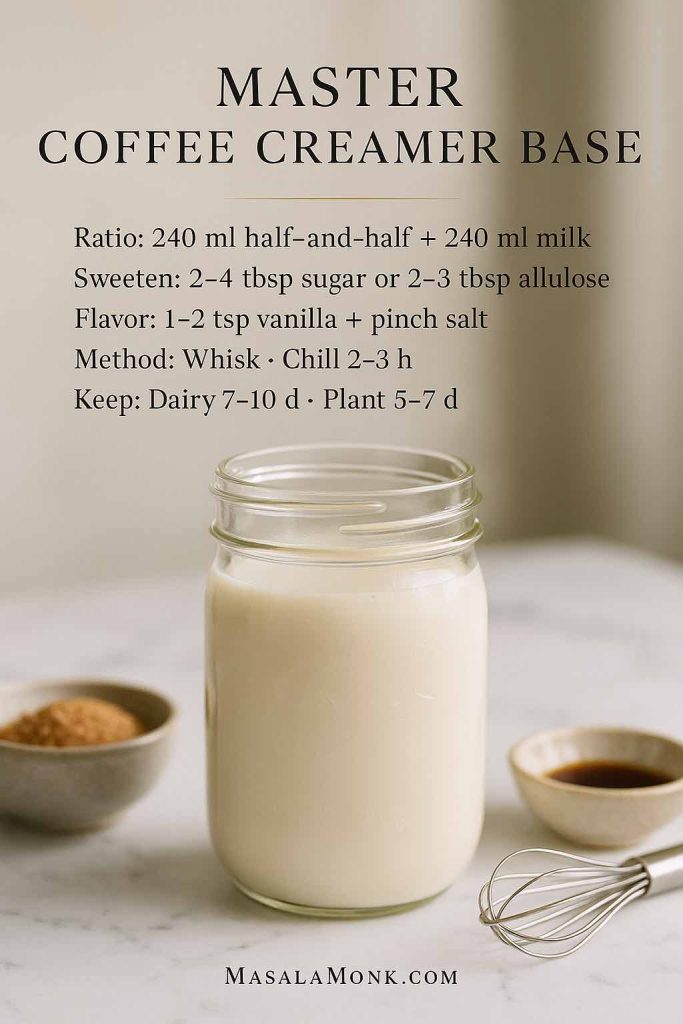
Master DIY Coffee Creamer Base (Reusable, Flexible, Keyword-Friendly)

A dependable base unlocks every variation—from French vanilla coffee creamer to pumpkin spice creamer and zero-sugar options. Crucially, this blend balances body, sweetness, and pourability so it disperses evenly in hot coffee and iced coffee alike. Furthermore, you can swap dairy for plants without sacrificing texture.

Yield: ~480 ml / 16 oz (about 2 cups)
Active time: 5 minutes

Ingredients

  • Half-and-half (or your local equivalent) — 240 ml / 8 oz
  • Milk (dairy or plant) — 240 ml / 8 oz
  • Sweetener — 24–48 g / 2–4 tbsp sugar or maple; or 18–24 g / 2–3 tbsp allulose/erythritol for zero-sugar
  • Pure vanilla extract — 5–10 ml / 1–2 tsp
  • Fine salt — ~0.5 g / pinch
Homemade coffee creamer base in a jar on marble with whisk, sugar, and vanilla—master ratio for DIY coffee creamer, dairy or plant-based.
Start here for any homemade coffee creamer—use the base ratio, then riff into French vanilla, pumpkin spice, zero-sugar, or powdered non-dairy versions.

Method
Whisk until dissolved (or shake in a jar). Then chill 2–3 hours so flavors round out and the mouthfeel relaxes.

How to use & store
Dairy versions keep 7–10 days; plant versions keep 5–7 days. Shake before each pour. Prefer a healthy homemade coffee creamer? Use 360 ml / 12 oz unsweetened almond milk + 120 ml / 4 oz coconut cream for body. If you love true DIY, you can make almond milk at home, make coconut milk at home, or even make oat milk at home. For a primer on fat levels and texture tradeoffs with coconut, skim our internal overview of coconut milk nutrition facts.


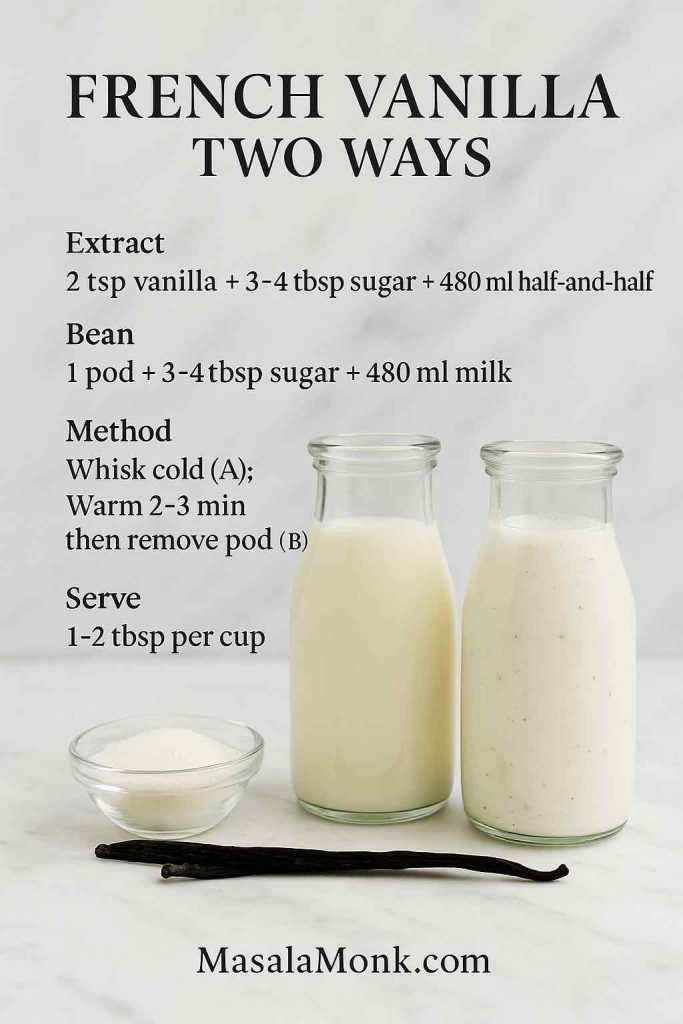
French Vanilla Coffee Creamer (Two Ways)

Because vanilla should taste soft and present—not fake—this flavor remains the gateway to homemade coffee creamer. The extract version is perfect for weekdays; the bean version brings speckles and perfume.

Yield: ~480 ml / 16 oz
Active: 5–10 minutes

French vanilla coffee creamer two ways—smooth extract and vanilla-bean speckled versions in glass bottles on white marble.
Weekday fast: extract. Luxe brunch: vanilla bean coffee creamer. Both pour cleanly into hot coffee or iced lattes—start with 1–2 tbsp per cup.

A) Fast Extract Version

  • Half-and-half — 480 ml / 16 oz
  • Sugar or maple — 36–45 g / 3–4 tbsp
  • Pure vanilla extract — 10 ml / 2 tsp

Whisk cold; chill.

B) Vanilla-Bean Version

  • Whole milk (or full-fat coconut milk) — 480 ml / 16 oz
  • Sugar — 36–45 g / 3–4 tbsp
  • Vanilla bean — 1 pod / 5–6 g, split & scraped (steep pod)

Warm on low 2–3 minutes to infuse gently. Remove pod, cool, bottle.

Serve & keep
Use 15–30 ml / 1–2 tbsp per 240 ml / 8 oz cup. If you need to hit a sweetness target precisely, cross-check your milk’s macros in USDA FoodData Central and adjust sugar a touch so your DIY coffee creamer stays consistent week after week.


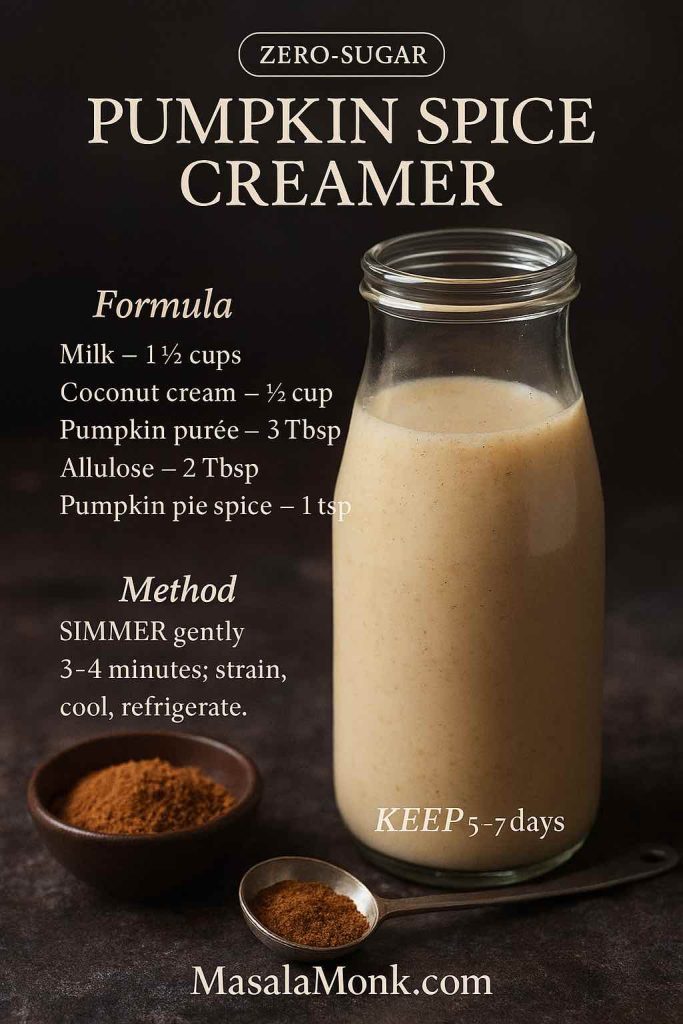
Pumpkin Spice Coffee Creamer (Dairy, Vegan & Powdered)

Real pumpkin purée adds color and silk; a brief simmer blooms the spice. Consequently, this pumpkin spice creamer tastes like a latte from a friendly café, not a candle. And in case you want to make your pumpkin spice, do not forget to browse our post on Pumpkin Spice, Your Way: Master Blend, Variations & Real-World Recipes.

Yield: ~480 ml / 16 oz
Active: 8–12 minutes

Pumpkin spice coffee creamer made with real pumpkin purée, simmered and strained, in a glass pitcher on dark wood with star anise.
Bloom spices for café-smooth pumpkin spice creamer—no candle flavor. Great for iced coffee; strain for a silkier finish.

Stovetop Version

  • Milk (dairy or almond) — 360 ml / 12 oz
  • Half-and-half (or coconut cream) — 120 ml / 4 oz
  • Pumpkin purée — 45 g / 3 tbsp
  • Maple syrup — 30–40 ml / 2–2½ tbsp, or sugar 24 g / 2 tbsp + vanilla 2–3 ml / ½ tsp
  • Pumpkin pie spice — 2.5–3 g / 1–1¼ tsp

Simmer very gently 3–4 minutes; strain for silk. Cool and refrigerate.

Zero-sugar pumpkin spice coffee creamer sweetened with allulose in a glass bottle beside bowls of spice on dark stone surface.
Clean-tasting zero sugar pumpkin spice creamer—allulose keeps sweetness with fewer sugar calories; refrigerate 5–7 days and shake well.

Zero-Sugar Pumpkin Spice Homemade Coffee Creamer
Swap maple for 24–30 g / 2 tbsp allulose; raise vanilla to 5 ml / 1 tsp. The FDA recognizes allulose differently on labels—excluded from “Total/Added Sugars” and counted at ~0.4 kcal/g—so sweetness perception stays high with minimal impact: FDA on allulose.

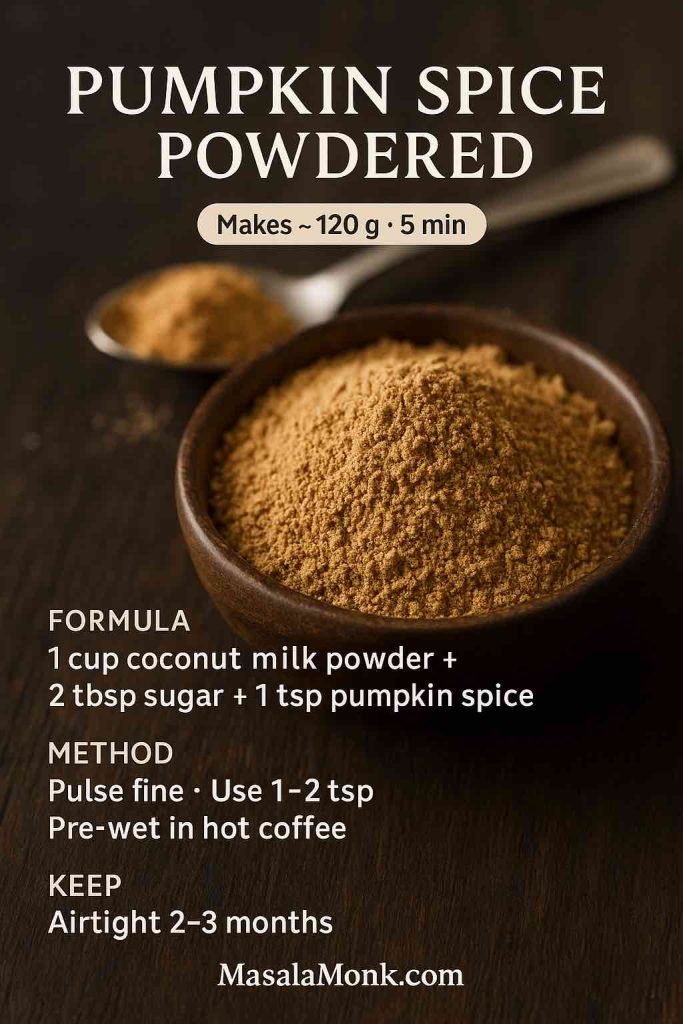
Powdered pumpkin spice coffee creamer—coconut milk powder blend in a wooden bowl with spoon; pantry-friendly non-dairy mix.
Travel-ready powdered non-dairy creamer: pulse ultra-fine and pre-wet in hot coffee for lump-free pumpkin spice flavor anywhere.

Powdered Pumpkin Spice Creamer (Pantry-Friendly)

  • Coconut milk powder — 100 g / ~1 cup
  • Sugar — 24 g / 2 tbsp, or allulose 18–24 g / 1½–2 tbsp
  • Pumpkin pie spice — 2.5 g / 1 tsp

Pulse until talc-fine. Use 3–6 g / 1–2 tsp per cup; dissolve in a splash of hot coffee first.

Pour & store
Liquid versions keep 5–7 days; powder stays airtight 2–3 months. If you’re brewing iced drinks, remember that cold brew vs. iced latte behave differently with spice and fat; this post helps you learn about different bases: cold brew vs. iced latte.


Italian Sweet Cream (Sweet Cream Bliss, Copycat-Friendly)

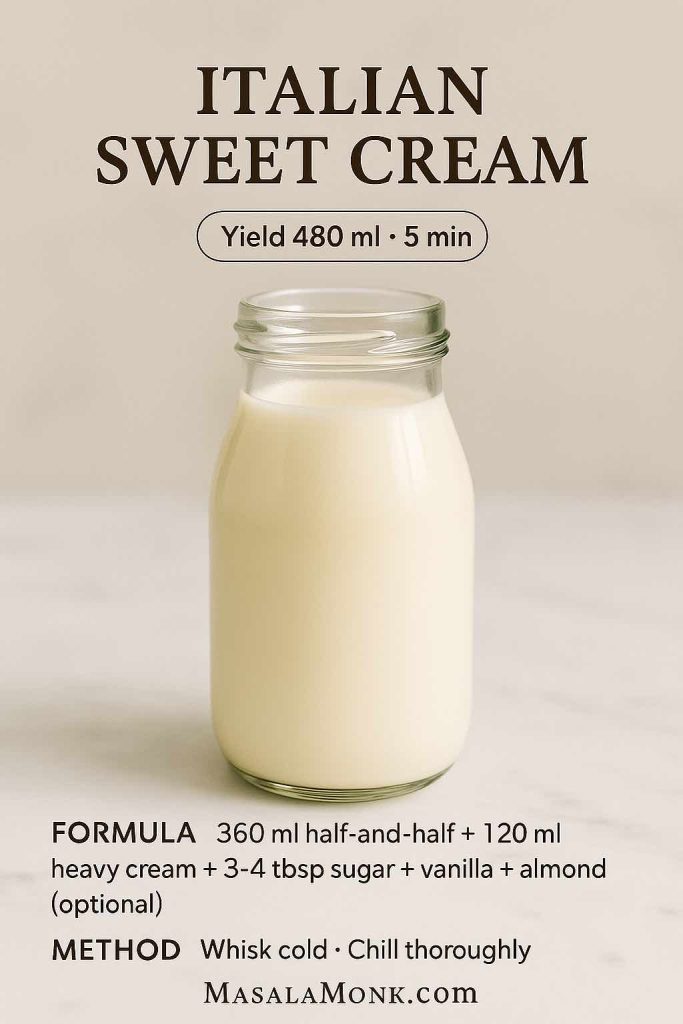
When you want a plush, dessert-leaning DIY coffee creamer that still pours cleanly, Italian sweet cream delivers. Because a micro-dose of almond extract echoes icing, the cup feels luxurious without being heavy.

Yield: ~480 ml / 16 oz
Active: 5 minutes

Italian sweet cream coffee creamer in a glass bottle on light marble; rich half-and-half and heavy cream blend with vanilla and a hint of almond.
Plush, dessert-leaning Italian sweet cream—a copycat-friendly coffee creamer that pours cleanly. Whisk cold, chill, and use a light pour; ideal for hot coffee, iced coffee, or microfoam at 55–65 °C.

Ingredients

  • Half-and-half — 360 ml / 12 oz
  • Heavy cream — 120 ml / 4 oz
  • Sugar — 36–48 g / 3–4 tbsp
  • Vanilla extract — 5 ml / 1 tsp
  • Almond extract — 1–1.25 ml / ¼ tsp (optional)

Whisk until dissolved; chill thoroughly.

Enjoy & adapt
Use a light pour; it’s rich. If you prefer barista-style foam, steam or heat to 55–65 °C / 139–149 °F—the sweet spot for stable microfoam often taught in SCA-aligned training. Exceed ~70 °C / 158 °F and proteins denature, killing foam.


Condensed-Milk Coffee Creamer (Ultra-Silky, 2–3 Ingredients)

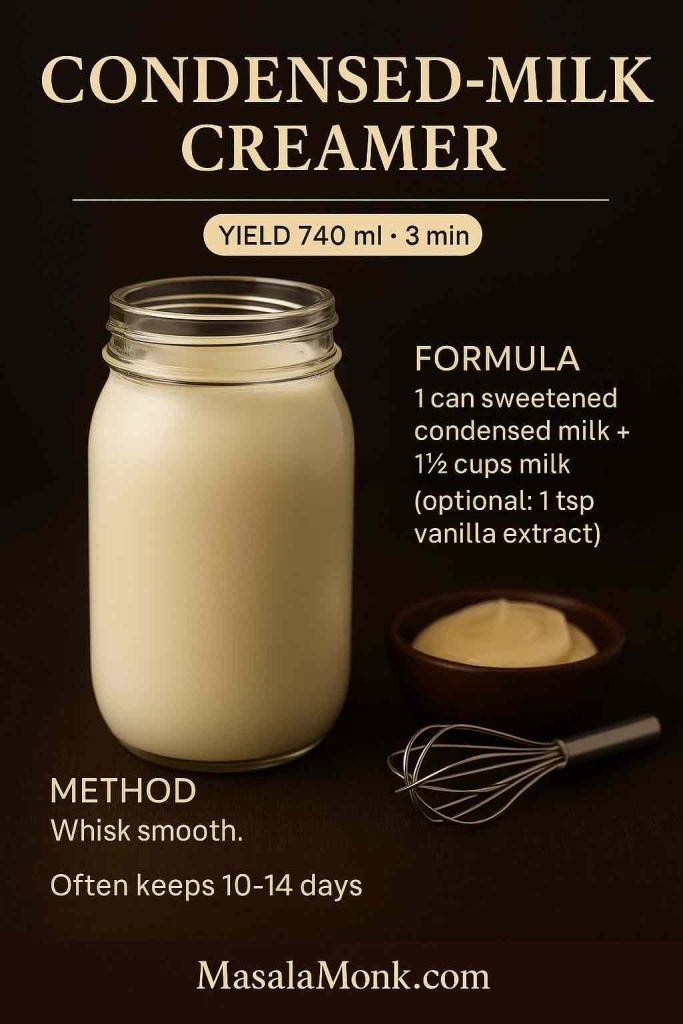
When you want velvet texture with long-lasting sweetness, homemade coffee creamer with sweetened condensed milk wins. Besides gloss, it resists separation in iced drinks.

Yield: ~740 ml / 25 oz
Active: 3 minutes

Condensed-milk coffee creamer in a glass jar on dark wood with whisk and bowl of sweetened condensed milk; ultra-silky DIY creamer.
Velvet-smooth coffee creamer with sweetened condensed milk—whisk with milk (or water + coconut cream for dairy-free). Keeps 10–14 days; start with 1–2 tbsp per cup.

Ingredients

  • Sweetened condensed milk — 395 g / 14 oz can
  • Milk — 360 ml / 12 oz, or water 300 ml / 10 oz + coconut cream 60 ml / 2 oz (dairy-free)
  • Vanilla extract — 5 ml / 1 tsp (optional)

Whisk smooth.

How to use & store
Often keeps 10–14 days. Start with 15–30 ml / 1–2 tbsp per cup. If you’re exploring other cold formats, this concise overview of coffee brewing methods helps you pick the right base and grind for creamier results: coffee brewing methods.


Powdered Non-Dairy Coffee Creamer (Travel-Ready)

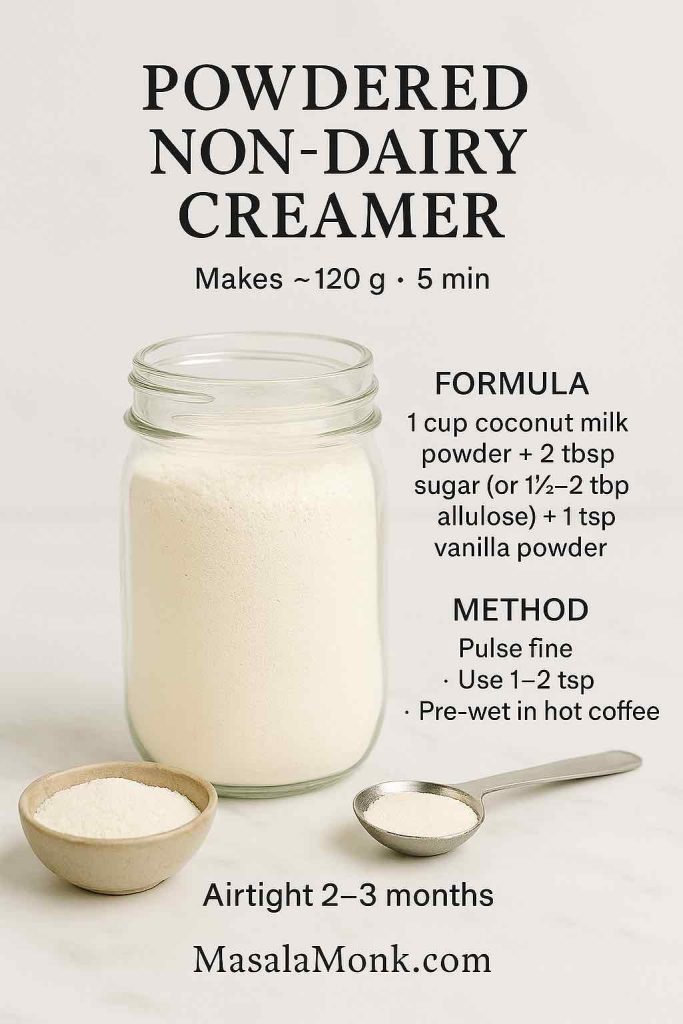
Because desk drawers, carry-ons, and camping exist, a powdered coffee creamer earns its keep. Pre-wetting in a teaspoon of hot coffee makes it dissolve flawlessly.

Yield: ~120 g (small jar)
Active: 5 minutes

Powdered non-dairy coffee creamer made with coconut milk powder in a jar on white marble, with bowl and spoon—travel-ready DIY mix.
Packable powdered coffee creamer: coconut milk powder, a touch of sugar or allulose for zero-sugar, and vanilla powder. Pulse extra fine and pre-wet in hot coffee for smooth, lump-free cups; stores airtight 2–3 months.

Ingredients

  • Coconut milk powder — 100 g / ~1 cup
  • Sugar — 24 g / 2 tbsp, or allulose 18–24 g / 1½–2 tbsp
  • Vanilla powder — 2 g / 1 tsp (or ground vanilla 0.5–1 g / ¼–½ tsp)

Pulse until talc-fine.

Serving & shelf life
Use 3–6 g / 1–2 tsp per cup. Store airtight 2–3 months. If you prefer a lighter macro profile, compare plant-milk powders in FoodData Central before you stock up.


Almond-Milk Vanilla DIY Coffee Creamer (Light, Everyday)

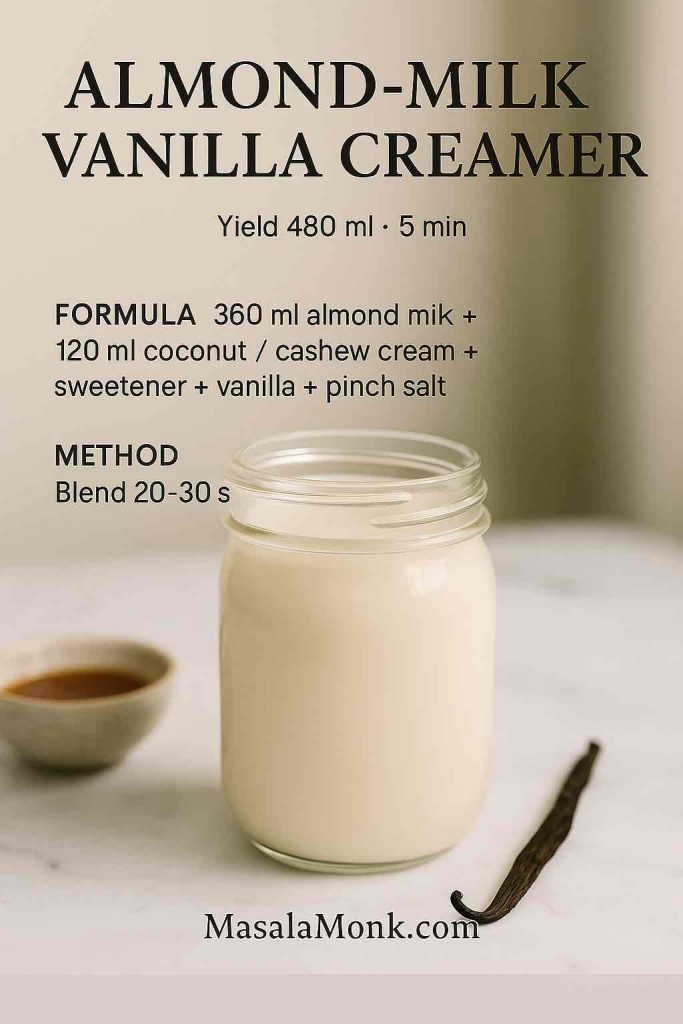
For a healthy homemade creamer that still drinks creamy, almond milk plus a small amount of fat provides body without heaviness. Because cashew is neutral, it’s a great swap if coconut notes aren’t your thing.

Yield: ~480 ml / 16 oz
Active: 5 minutes

Almond-milk vanilla coffee creamer in a glass jar on marble with vanilla bean and sweetener—light, dairy-free-friendly homemade creamer.
Everyday almond milk coffee creamer with coconut or cashew cream for body; blend 20–30 seconds until glossy. Sweeten with maple or allulose for a zero-sugar version; keep 5–7 days refrigerated.

Ingredients

  • Unsweetened almond milk — 360 ml / 12 oz
  • Coconut cream or thick cashew cream — 120 ml / 4 oz
  • Maple syrup — 30 ml / 2 tbsp, or allulose 18–24 g / 1½–2 tbsp
  • Vanilla extract — 7.5 ml / 1½ tsp
  • Fine salt — 0.5 g / pinch

Blend 20–30 seconds until glossy.

How to use & store
Keeps 5–7 days. If you want the base from scratch, here’s a fast tutorial to make almond milk at home. For diet-angle readers who ask, these pieces are helpful context: almond milk for diabetics and almond milk during pregnancy.


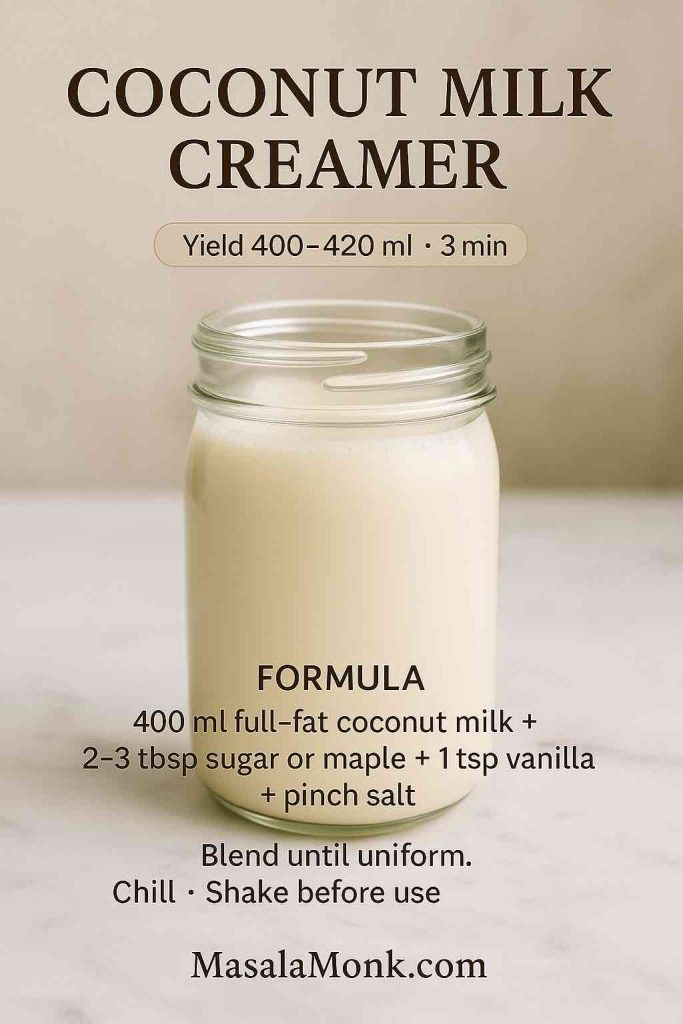
Coconut Milk Coffee Creamer (Rich, Dairy-Free & Froth-Friendly)

Whenever you want dairy-free coffee creamer with true body, full-fat coconut milk performs reliably. A micro-pinch of salt softens edges and increases perceived sweetness.

Yield: ~400–420 ml / 13.5–14 oz
Active: 3 minutes

Coconut milk coffee creamer in a glass jar on marble—full-fat coconut milk with sugar or maple, vanilla, and a pinch of salt; dairy-free creamer.
Rich, dairy-free coconut milk coffee creamer that froths well; chill and shake before use. If coconut tastes strong, cut with 2–4 oz oat milk.

Ingredients

  • Full-fat coconut milk — 400 ml / 13.5 oz can
  • Sugar or maple — 24–36 g / 2–3 tbsp
  • Vanilla extract — 5 ml / 1 tsp
  • Fine salt — 0.5 g / pinch

Blend until uniform.

Use & keep
Chill and shake before pouring. If coconut feels dominant, cut with 60–120 ml / 2–4 oz oat milk. For fat-level tradeoffs and texture expectations, see our internal overview: coconut milk nutrition facts.


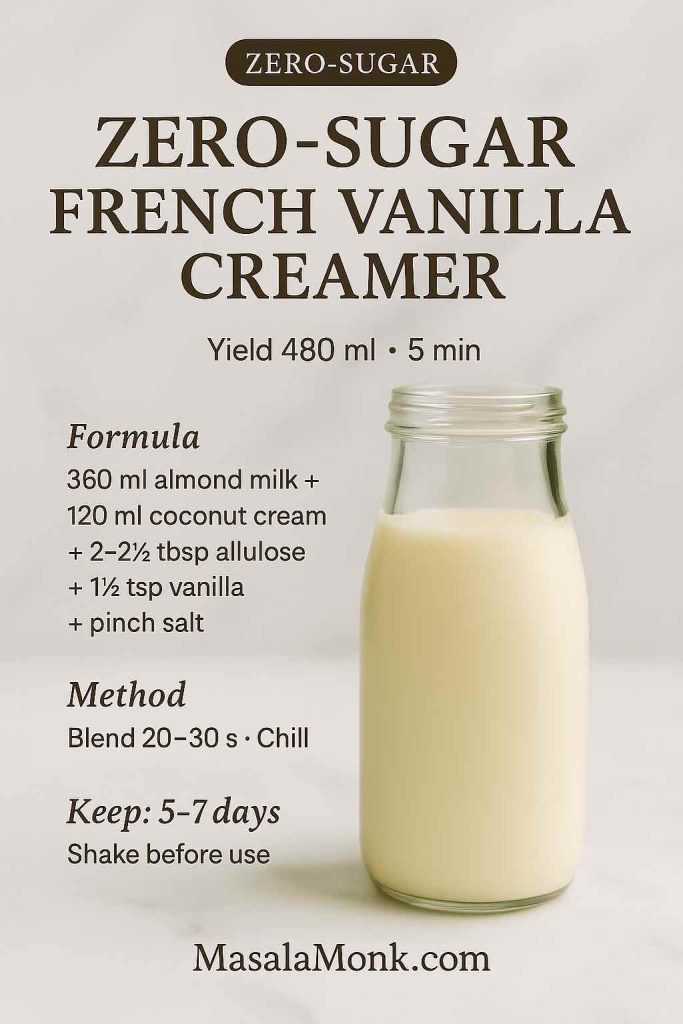
Zero-Sugar French Vanilla DIY Creamer (Copycat Texture, Clean Finish)

Because zero-sugar French vanilla creamer is frequently requested, this version uses allulose for clean sweetness and coconut cream for body—therefore avoiding grit or aftertaste.

Yield: ~480 ml / 16 oz
Active: 5 minutes

Zero-sugar French vanilla coffee creamer in a glass bottle on light marble—almond milk, coconut cream, allulose, vanilla; DIY creamer recipe card.
Copycat-smooth zero sugar French vanilla creamerallulose for clean sweetness and coconut cream for body. Blend 20–30 s, chill, and shake before use; keeps 5–7 days.

Ingredients

  • Unsweetened almond milk — 360 ml / 12 oz
  • Coconut cream — 120 ml / 4 oz
  • Allulose — 24–30 g / 2–2½ tbsp, or stevia 15–20 drops
  • Vanilla extract — 7.5 ml / 1½ tsp
  • Fine salt — 0.5 g / pinch

Blend; chill.

Why it works & how to store
Allulose integrates cleanly and, as noted by the FDA, is treated differently in labeling. Consequently, you can maintain sweetness perception with fewer sugar calories: FDA on Allulose. Shake before each use and keep 5–7 days.


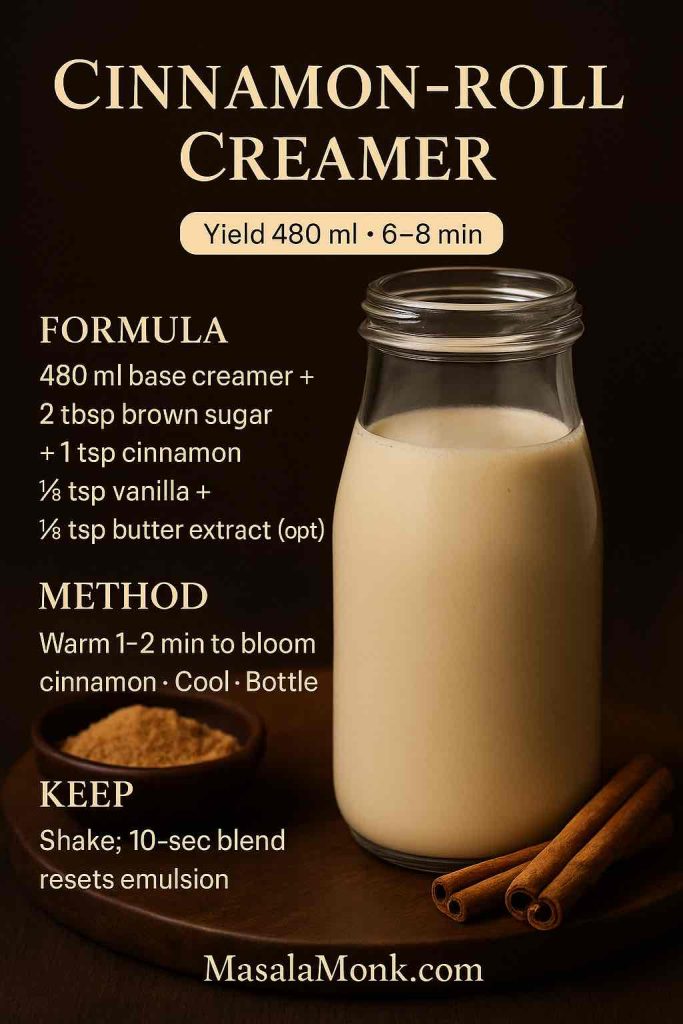
Cinnabon-Style Cinnamon-Roll Coffee Creamer

Warm spice plus a hint of “icing” makes even a simple brew feel special. Because cinnamon can settle, a brief warm-up helps it bloom and disperse.

Yield: ~480 ml / 16 oz
Active: 6–8 minutes

Cinnamon-roll coffee creamer in a glass bottle on dark wood with brown sugar and cinnamon sticks—bloomed cinnamon, vanilla, optional butter extract.
Warm-spice cinnamon roll coffee creamer—bloom cinnamon for 1–2 minutes for bakery aroma, then cool and bottle. Shake before pouring; a quick 10-second blend re-emulsifies for iced coffee.

Ingredients

  • Base creamer (dairy or almond) — 480 ml / 16 oz
  • Brown sugar — 27 g / 2 tbsp, or maple 30 ml / 2 tbsp
  • Ground cinnamon — 2 g / 1 tsp
  • Vanilla extract — 2.5 ml / ½ tsp
  • Butter extract — 0.6 ml / ⅛ tsp (optional)

Warm 1–2 minutes to bloom cinnamon; cool and bottle.

Serving note & storage
Shake before pouring; a 10-second blend resets the emulsion for cold foam. Notably, the aroma intensifies on day two, so resist over-sweetening on day one.


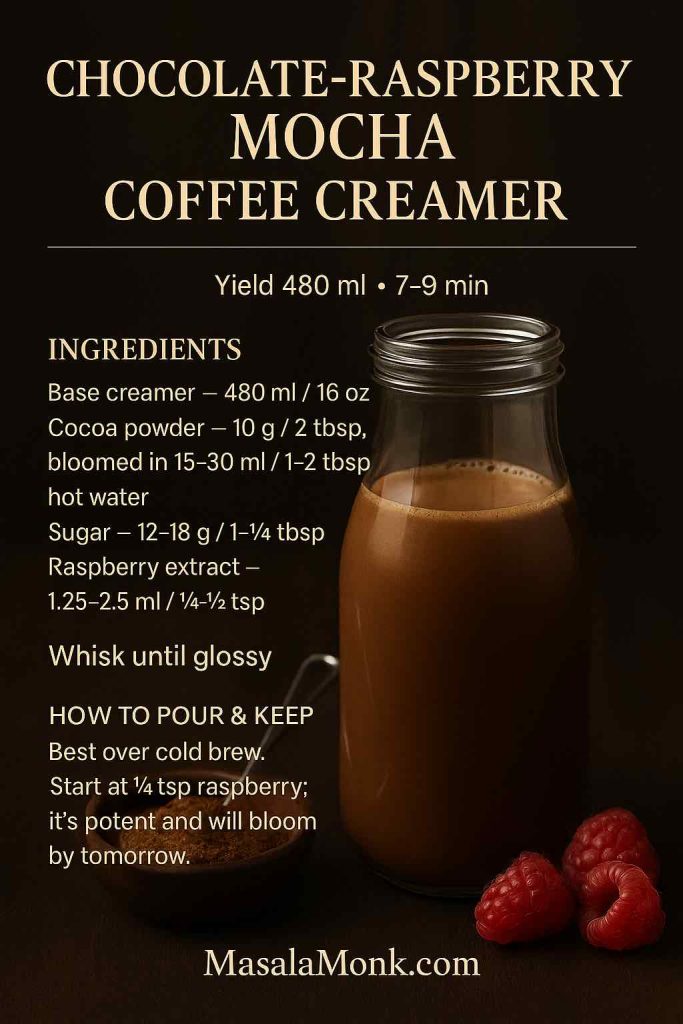
Chocolate-Raspberry Mocha Coffee Creamer

When you want patisserie vibes, homemade chocolate-raspberry coffee creamer balances cocoa’s bitter edge with bright berry perfume. Consequently, iced coffee suddenly drinks like a specialty café treat.

Yield: ~480 ml / 16 oz
Active: 7–9 minutes

Chocolate-raspberry mocha coffee creamer in a glass bottle on dark wood with raspberries and cocoa—DIY creamer made by blooming cocoa and adding raspberry extract.
Pâtisserie-style chocolate coffee creamer with a bright raspberry finish—bloom cocoa powder in hot water for gloss, then whisk into the base. Start at ¼ tsp raspberry extract; flavors deepen by day two, perfect for cold brew.

Ingredients

  • Base creamer — 480 ml / 16 oz
  • Cocoa powder — 10 g / 2 tbsp, bloomed in 15–30 ml / 1–2 tbsp hot water
  • Sugar — 12–18 g / 1–1½ tbsp
  • Raspberry extract — 1.25–2.5 ml / ¼–½ tsp

Whisk until glossy.

How to pour & keep
Best over cold brew. Start at ¼ tsp raspberry; it’s potent and will bloom by tomorrow. If you prefer less sweetness overall, reduce sugar by 4–6 g and extend the bloom time a minute for better cocoa dispersion.


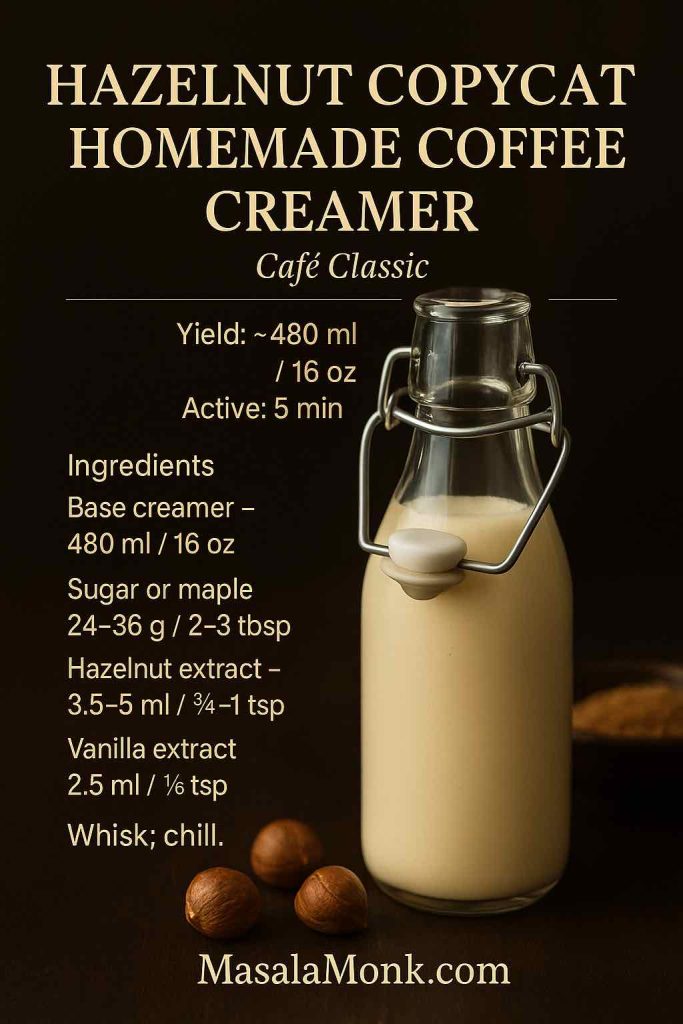
Hazelnut Copycat Homemade Coffee Creamer (Café Classic)

A hazelnut profile reads cozy and familiar, especially in cappuccino-style drinks. Because extracts vary widely, begin conservatively.

Yield: ~480 ml / 16 oz
Active: 5 minutes

Hazelnut coffee creamer copycat in a swing-top bottle on dark wood with whole hazelnuts—DIY base creamer, sugar or maple, hazelnut extract, vanilla.
Cozy hazelnut coffee creamer—start light on hazelnut extract (¾ tsp), then adjust on day two. Pours cleanly in cappuccino-style drinks; chill after whisking.

Ingredients

  • Base creamer — 480 ml / 16 oz
  • Sugar or maple — 24–36 g / 2–3 tbsp
  • Hazelnut extract — 3.5–5 ml / ¾–1 tsp
  • Vanilla extract — 2.5 ml / ½ tsp

Whisk; chill.

Flavor targeting & storage
Flavors intensify overnight, so taste again on day two before adjusting. If acidity bothers you with flavored lattes, consider using cold brew; it’s naturally lower in acid and can be gentler for some readers with reflux: low-acid cold brew note.


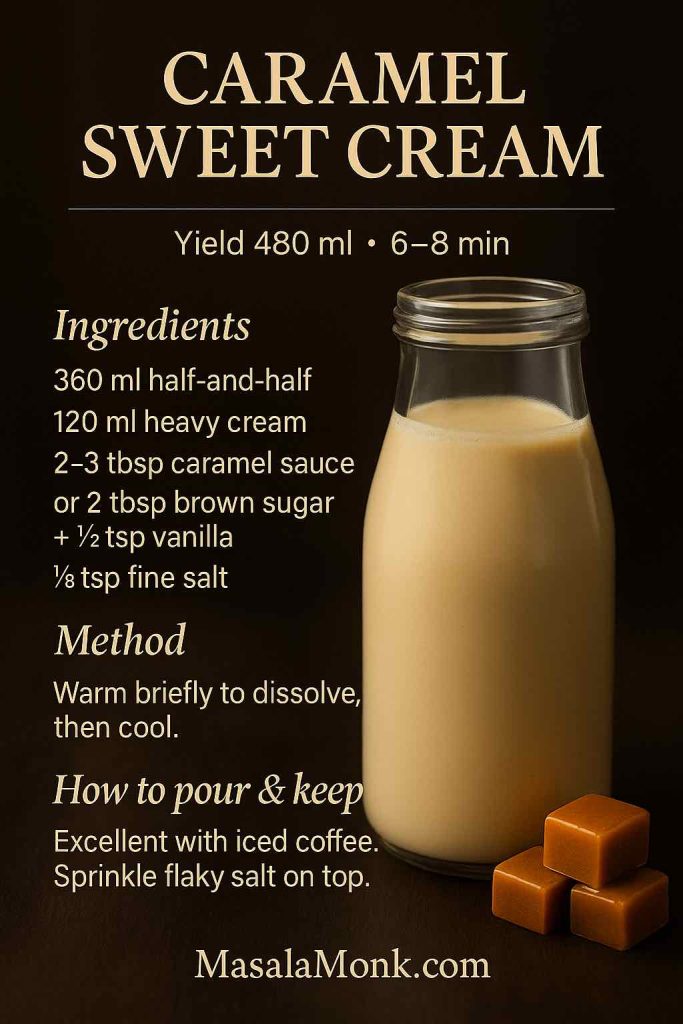
Caramel Sweet Cream Coffee Creamer (Salt-Kissed)

Silky caramel turns an ordinary mug into a treat. Nevertheless, a pinch of salt matters; it punctuates sweetness and sharpens flavor.

Yield: ~480 ml / 16 oz
Active: 6–8 minutes

Caramel sweet cream coffee creamer in a glass bottle on dark wood with soft caramel cubes—half-and-half, heavy cream, caramel sauce, pinch of salt.
Salt-kissed caramel coffee creamer—warm briefly to dissolve caramel, then cool. Pours like cream for iced coffee; add a tiny sprinkle of flaky salt to sharpen flavor.

Ingredients

  • Half-and-half — 360 ml / 12 oz
  • Heavy cream — 120 ml / 4 oz
  • Caramel sauce — 30–45 ml / 2–3 tbsp, or brown sugar 24 g / 2 tbsp + vanilla 2.5 ml / ½ tsp
  • Fine salt — 0.75 g / ⅛ tsp

Warm briefly to dissolve, then cool.

How to pour & keep
Excellent with iced coffee and a tiny sprinkle of flaky salt on top. If your caramel is thick, loosen the batch with a splash more milk until it pours like cream.


Baileys / Kahlúa-Style Notes (Family-Friendly & Adult)

Queries for coffee and Baileys or Kahlúa coffee creamer spike every winter. Consequently, here are two safe approaches.

Yield: ~480 ml / 16 oz
Active: 2–3 minutes

Baileys and Kahlúa-style coffee creamer notes in a portrait recipe card—non-alcoholic mock Kahlúa with espresso powder and rum extract, plus adult Baileys add-in; keep 5–7 days.
Two safe options for winter searches: Non-Alcoholic Kahlúa-style (instant espresso + rum extract in vanilla creamer) and Adult Baileys (2–3 Tbsp stirred in). Label clearly; refrigerate 5–7 days.

Non-Alcoholic “Kahlúa-Style”

  • Add 1 tsp instant espresso + ¼ tsp rum extract to any vanilla creamer; blend briefly.

Adult Batch

  • Stir 30–45 ml / 2–3 tbsp Baileys into your jar. Label clearly and refrigerate.

Use & keep
Always keep chilled and consume within 5–7 days. If you want festive mugs beyond coffee, these quick reads help you experiment responsibly: coffee + Baileys mix ideasKahlúa cocktail starters


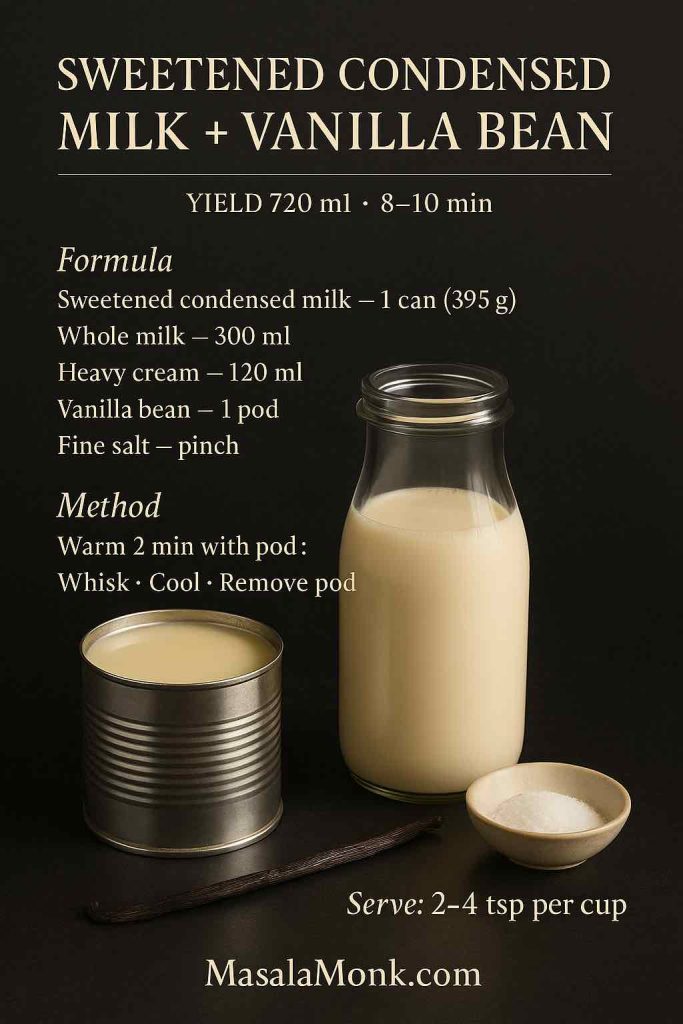
Sweetened Condensed Milk + Vanilla Bean (Luxury Latte Mix)

Because condensed milk gives unmatched silk while vanilla bean adds perfume, this hybrid of a homemade coffee creamer bridges weekday ease and weekend decadence. Additionally, it stands up well to darker roasts.

Yield: ~720 ml / 24 oz
Active: 8–10 minutes

Sweetened condensed milk and vanilla bean coffee creamer in a glass bottle on dark stone with open condensed milk can and vanilla pod—luxury latte mix recipe card.
Ultra-silky coffee creamer with sweetened condensed milk plus vanilla bean for aroma; warm 2 minutes with the pod, whisk, cool, and remove. Rich enough that 2–4 tsp per cup is plenty—great with darker roasts and iced lattes.

Ingredients

  • Sweetened condensed milk — 395 g / 14 oz
  • Whole milk — 300 ml / 10 oz
  • Heavy cream — 120 ml / 4 oz
  • Vanilla bean — 1 pod / 5–6 g, split & scraped
  • Fine salt — 0.5 g / pinch

Warm 2 minutes with the pod; whisk, cool, remove pod, bottle.

How to serve & store
Because the base is rich, start with 10–20 ml / 2–4 tsp per cup. The long finish means a little goes a long way, especially in iced lattes where dilution can mask subtle flavors.


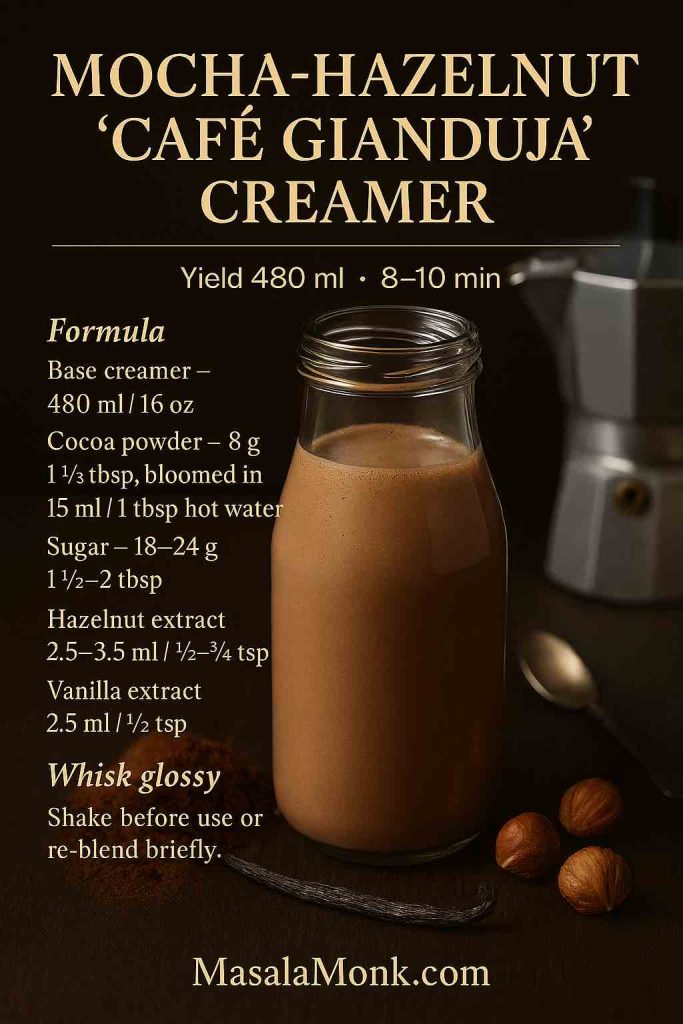
Mocha-Hazelnut “Café Gianduja” Creamer

Inspired by chocolate-hazelnut spreads, this homemade coffee creamer pairs especially well with iced Americanos and moka-pot shots. Meanwhile, it doubles as a quick dessert sauce when warmed a touch.

Yield: ~480 ml / 16 oz
Active: 8–10 minutes

Mocha-hazelnut “Café Gianduja” coffee creamer in a glass bottle on dark wood with cocoa and hazelnuts—DIY creamer made by blooming cocoa and adding hazelnut and vanilla extracts.
Chocolate-forward mocha hazelnut coffee creamer inspired by gianduja; bloom cocoa powder for gloss, then whisk with the base. Shake before use or re-blend for cold foam; brilliant over iced Americanos and moka-pot shots.

Ingredients

  • Base creamer — 480 ml / 16 oz
  • Cocoa powder — 8 g / 1½ tbsp, bloomed in 15 ml / 1 tbsp hot water
  • Sugar — 18–24 g / 1½–2 tbsp
  • Hazelnut extract — 2.5–3.5 ml / ½–¾ tsp
  • Vanilla extract — 2.5 ml / ½ tsp

Whisk until glossy.

How to use & keep
Pour over ice and add espresso for instant mocha vibes. Because cocoa settles, shake before use or re-blend briefly for cold foam.


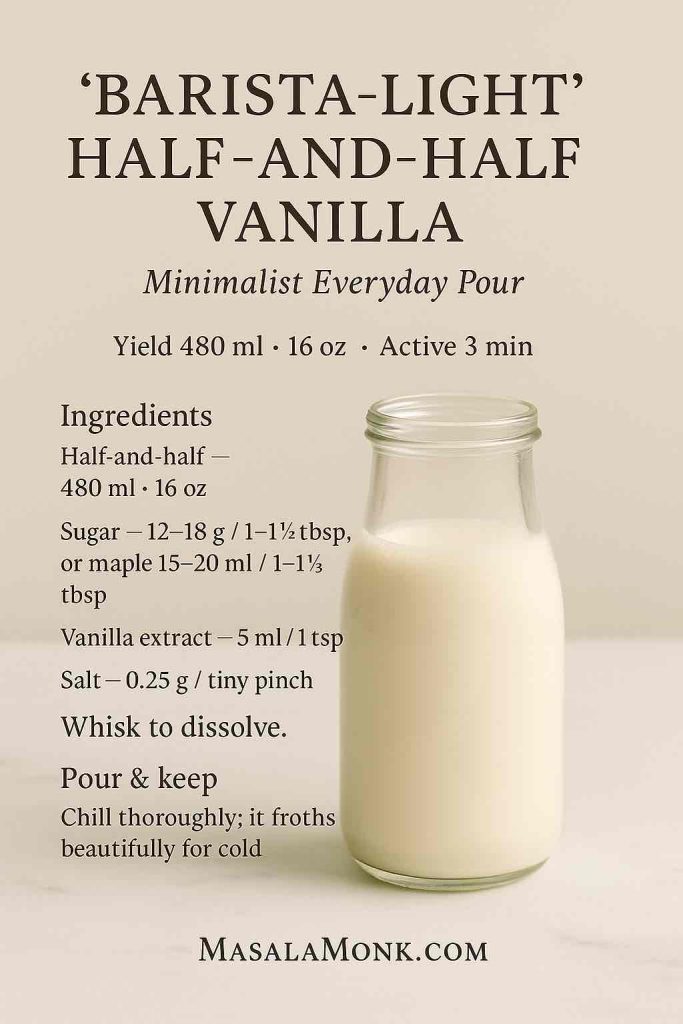
“Barista-Light” Half-and-Half Vanilla (Minimalist Everyday Pour)

Some days you want a barely sweet, highly pourable DIY & Homemade coffee creamer that plays nicely with any roast. Therefore, this minimalist mix stays versatile.

Yield: ~480 ml / 16 oz
Active: 3 minutes

Barista-light half-and-half vanilla coffee creamer in a glass bottle on light marble—barely sweet DIY creamer with sugar or maple, vanilla, and a pinch of salt.
Minimalist half-and-half vanilla coffee creamer—just sweet enough and highly pourable. Whisk to dissolve, chill thoroughly, and enjoy silky cold-foam at 55–65 °C if you steam.

Ingredients

  • Half-and-half — 480 ml / 16 oz
  • Sugar — 12–18 g / 1–1½ tbsp, or maple 15–20 ml / 1–1⅓ tbsp
  • Vanilla extract — 5 ml / 1 tsp
  • Salt — 0.25 g / tiny pinch

Whisk to dissolve.

Pour & keep
Chill thoroughly; it froths beautifully for cold foam. If you need less sweetness, drop sugar by 4 g and add a dash more vanilla for aroma lift.


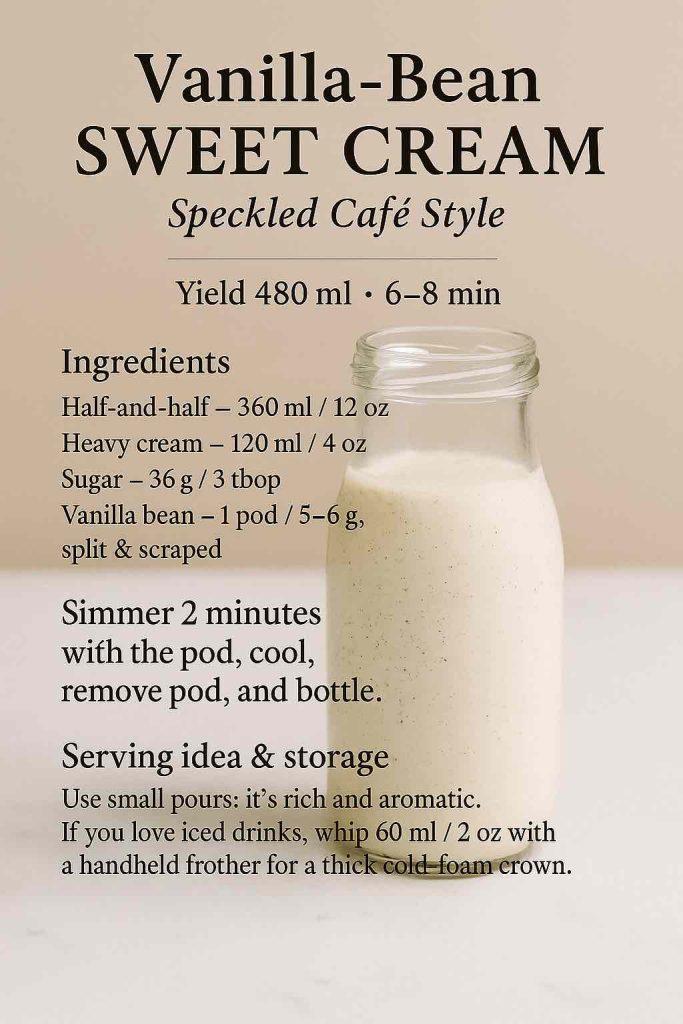
Vanilla-Bean Sweet Cream (Speckled Café Style)

A showpiece for brunches, speckled vanilla-bean sweet cream lands squarely in “treat” territory yet still stirs cleanly into hot or iced coffee.

Yield: ~480 ml / 16 oz
Active: 6–8 minutes

Vanilla-bean sweet cream coffee creamer in a glass bottle on light marble—speckled vanilla bean, half-and-half, heavy cream, sugar; café-style treat recipe card.
Speckled vanilla bean coffee creamer with café-level richness; simmer briefly with the pod, then cool and remove. Use small pours or whip 2 oz into thick cold foam for iced drinks.

Ingredients

  • Half-and-half — 360 ml / 12 oz
  • Heavy cream — 120 ml / 4 oz
  • Sugar — 36 g / 3 tbsp
  • Vanilla bean — 1 pod / 5–6 g, split & scraped

Simmer 2 minutes with the pod, cool, remove pod, and bottle.

Serving idea & storage
Use small pours; it’s rich and aromatic. If you love iced drinks, whip 60 ml / 2 oz with a handheld frother for a thick cold-foam crown.


Storage, Frothing & Troubleshooting (Smooth Results, Every Time)

  • Separation happens, especially in homemade dairy-free coffee creamer. Consequently, shake before each pour. For a more stable emulsion, blend in 5 ml / 1 tsp neutral MCT or 15 g / 1 tbsp cashew butter, then chill.
  • Shelf life: Dairy bases generally last 7–10 days; plant bases 5–7 days. Nevertheless, trust your senses—sour smell, fizzing, or curdling after shaking means discard.
  • Frothing temps: Aim for 55–65 °C / 139–149 °F for stable microfoam; much hotter and proteins collapse the foam.
  • Sweetness strategy: Start lower; coffee amplifies sweetness. If you need to keep macros tight, compare your exact milk or plant base in FoodData Central before standardizing a weekly batch.
  • Iced coffee tips: Bloom dry powders (cocoa, spices) in a teaspoon of hot coffee before filling the cup; lumps disappear and flavors disperse evenly.
  • Batching & gifts: Double recipes and use swing-top bottles; label with flavor and date. Friends will ask for refills—inevitably.

Helpful Internal Links

External References


Final Sip

Ultimately, crafting a homemade coffee creamer means choosing your ingredients, calibrating sweetness, and embracing seasonality—without relying on additives. Because the DIY coffee creamer base takes five calm minutes, you can rotate French vanilla for weekday comfort, pumpkin spice for crisp mornings, Italian sweet cream for bakery nostalgia, and zero-sugar options for mindful sipping. Furthermore, you can pivot instantly: condensed-milk for silk, powdered for travel, coconut milk for dairy-free richness, or hazelnut + mocha for café drama at home. In other words, you’re building a small, delicious habit that improves every cup—day after day, season after season.

FAQs

1) What is homemade coffee creamer, and why make it yourself?

A homemade coffee creamer is a simple milk-and-flavor blend you build at home; therefore, you control sweetness, texture, and ingredients. Consequently, you can create French vanilla, pumpkin spice, or even zero-sugar French vanilla creamer without additives. Moreover, it’s cheaper per serving and scales beautifully.

2) How long does a DIY coffee creamer last in the fridge?

Generally, dairy-based homemade coffee creamer keeps 7–10 days, while plant-based versions keep 5–7 days. However, always sniff and shake; if it smells sour or separates irreversibly after shaking, discard it. Additionally, label jars with the make date to stay consistent.

3) I can’t buy half-and-half—what’s the global substitute?

Because “half-and-half” is regional, just mix 1 part cream : 3 parts whole milk to land near 10–12% fat. Alternatively, if you have single/light cream (18–20%), combine 3 parts single cream : 2 parts milk. For plant options, blend 1 part coconut cream : 3 parts almond or oat milk for similar body.

4) Can I make a healthy homemade creamer that’s still creamy?

Absolutely. For a healthy homemade creamer, use unsweetened almond milk plus coconut cream (or cashew cream) for body. Furthermore, sweeten with allulose or a few stevia drops; the mouthfeel stays lush while sugars stay low.

5) What’s the easiest homemade coffee creamer recipe for beginners?

Start with the master base: milk + half-and-half, a touch of sugar (or allulose), vanilla, and a pinch of salt. Then, whisk, chill, and adjust sweetness in the cup. Afterwards, branch into a coffee creamer recipe like French vanilla coffee creamer or pumpkin spice creamer recipe.

6) How do I make a zero sugar French vanilla creamer that isn’t gritty?

Use allulose (dissolves cleanly) and add a little coconut cream for body. Meanwhile, a pinch of salt and pure vanilla round the flavor. Consequently, you get a smooth zero sugar French vanilla creamer with a classic café finish.

7) What’s the difference between coffee creamer and half-and-half?

Half-and-half is simply milk and cream; it’s unsweetened and unflavored. Coffee creamer, however, is a flavored, sweetened mix—dairy or non-dairy—designed to disperse easily. Therefore, if you want flavor (vanilla bean, hazelnut, pumpkin), choose a DIY coffee creamer; if you want neutral richness, use half-and-half.

8) Which milk works best for almond-milk or coconut-milk coffee creamer?

For almond milk coffee creamer, pick unsweetened and add a spoon of coconut cream or cashew cream so it doesn’t taste watery. Conversely, for coconut milk coffee creamer, use full-fat cans for stable texture; then, thin with oat milk if coconut notes feel strong.

9) Can I make a coffee creamer with condensed milk?

Yes—coffee creamer condensed milk is ultra-silky and nearly foolproof. Simply whisk sweetened condensed milk with milk (or water + coconut cream) and, optionally, vanilla. As a result, the sweetness is built-in, so start with a small pour.

10) How do I make powdered coffee creamer for travel or the office?

Blend coconut milk powder with a little sugar (or allulose) and vanilla powder. Then, store it airtight and use 1–2 teaspoons per cup. For lump-free results, dissolve the powdered coffee creamer in a splash of hot coffee first; afterwards, top up with more coffee or ice.

11) What’s the best way to stop separation in non-dairy creamer?

First, chill thoroughly and shake before each pour. Next, for extra stability, briefly blend the batch with 1 teaspoon neutral oil or 1 tablespoon cashew butter. Consequently, the emulsion tightens and stays smooth in hot coffee as well as iced coffee.

12) How do I keep spices from clumping in pumpkin spice creamer?

Warm the mixture gently and whisk; spices bloom and disperse. Alternatively, if you’re adding to iced coffee, pre-bloom spices (or cocoa) in 1 tablespoon hot water, then stir into your pumpkin spice creamer. Therefore, you’ll avoid gritty cups.

13) Can I froth homemade coffee creamer for cold foam?

Definitely. For reliable microfoam, aim for 55–65 °C (139–149 °F) for dairy bases. Meanwhile, barista-style oat milk or almond-oat blends froth well for non-dairy foam. Nevertheless, avoid overheating; beyond ~70 °C, foam collapses.

14) Does heavy whipping cream in coffee replace creamer?

It can—heavy cream is rich and unsweetened. However, because it’s dense, start with 1–2 teaspoons per cup and, if needed, thin with milk. Alternatively, whisk heavy cream into the master base to create a sweet cream style homemade creamer.

15) What flavors should I try after French vanilla and pumpkin spice?

Go broad: Italian sweet cream, hazelnut, chocolate-raspberry mocha, vanilla bean sweet cream, and caramel sweet cream. Moreover, for seasonal fun, rotate egg-nog style (holiday) or cinnamon-roll in colder months; consequently, mornings never feel repetitive.

16) Can I make a dairy-free, sugar-free creamer that still tastes indulgent?

Yes—blend almond milk with coconut cream (or cashew cream) and sweeten with allulose. Then, add vanilla bean or cinnamon for aroma. In short, you’ll get a dairy-free, zero-sugar homemade coffee creamer that still feels café-rich.

17) Is it safe to freeze homemade coffee creamer?

You can, although texture may change slightly after thawing. Consequently, freeze in ice-cube trays; later, drop cubes into iced coffee so it stays cold and creamy. However, for best flavor, use frozen creamer within 1 month.

18) How do I scale a coffee creamer recipe for weekly prep?

Double (or triple) the coffee creamer recipe and store in two smaller bottles instead of one large jar; thus, you open less often and preserve freshness. Additionally, keep a sticky note with the ratio you love—e.g., 20 ml (4 tsp) per 240 ml (8 oz) cup—so you hit your sweet spot every time.

19) My creamer tastes flat—how do I fix it quickly?

Add a pinch of salt to round bitter edges, then bump vanilla by ¼ teaspoon. If it’s still dull, add 1–2 teaspoons maple (or ½ teaspoon allulose) and taste again. Finally, if texture’s thin, blend 1–2 teaspoons coconut cream for immediate body.

20) Which is better for iced coffee: powdered, condensed-milk, or classic homemade creamer?

Each shines differently. Powdered non-dairy creamer is convenient and mixes cleanly (once pre-wetted). Condensed-milk creamer brings lush sweetness that survives dilution. Meanwhile, classic homemade coffee creamer is the most flexible—especially when you want vanilla bean coffee creamer or a pumpkin spice creamer recipe with adjustable sweetness.

Posted on 1 Comment

Metabolism Boosting Spices: 10 Best Options + Easy Mixes

Hands arranging small wooden bowls of metabolism boosting spices - turmeric, ground ginger, cayenne, cinnamon sticks, cumin seeds, fenugreek, saffron, and black peppercorns on a wooden table—ingredients for simple spice mixes that support satiety and steady energy.

Sometimes the smallest changes do the most. Metabolism boosting spices won’t remake a meal on their own; however, they can gently steady appetite, nudge post-meal thermogenesis, and smooth out energy across the day. When you season consistently—and when you pair flavor with simple routines—those quiet nudges begin to add up. Moreover, you’ll find they slot into foods you already enjoy, which means adherence feels natural rather than forced.


How metabolism boosting spices actually help

To begin with, think of spices as adjustable dials rather than switches. Some, like cayenne, appear to slightly increase energy expenditure after eating; others, like cinnamon, help blunt post-meal glucose bumps; still others, like fennel and saffron, tend to soften snack impulses. In other words, these aren’t fireworks; they’re guardrails. Furthermore, a pinch at breakfast, another at lunch, and something warm in the evening often leads to fewer crashes, fewer “is there anything sweet?” moments, and—eventually—more predictable days.


Cayenne (Capsaicin): a warm spark among metabolism boosting spices

There’s a particular magic to cayenne: a little warmth, a little color, and suddenly a simple plate feels vibrant. Within the world of metabolism boosting spices, cayenne earns its place because a tiny pinch can lift thermogenesis without requiring you to set your tongue on fire.

Use it today. Stir ⅛–¼ teaspoon into scrambled eggs; alternatively, whisk a pinch into lemon-ginger tea on cool mornings; or dust roasted carrots, sweet potato, or chickpeas right before they leave the oven. Additionally, finish dal tadka with a whisper of cayenne so the aroma stays lively. If you’re spice-sensitive, pair it with tomato or yogurt to soften the heat.

Keep it delicious. Cayenne loves citrus, garlic, and creamy textures. Consequently, olive oil + cayenne + lemon zest on grain bowls tastes intentional with almost no work.

Why it belongs here. A meta-analysis in the British Journal of Nutrition associated capsaicin with modest but significant reductions in body weight, BMI, and waist circumference in adults with overweight or obesity (Zhang et al., 2023). Moreover, mechanistic reviews describe capsaicin’s thermogenic pathways in detail (Zheng et al., 2017, Bioscience Reports).

Related MasalaMonk read: Cayenne Pepper for Weight Loss: Spicing Up Your Diet Plan! 🌶️ and then balance warmth and brightness with Cinnamon & Lemon for Belly Fat: Benefits, Evidence & Usage Tips.


Ginger: cozy, versatile, and quietly powerful for metabolism boosting spices

Ginger is the weekday friend that always shows up. Because it slips into tea, stir-fries, soups, chutneys, and smoothies, you can lean on it repeatedly without getting bored. Meanwhile, many people notice that ginger’s gentle heat calms “just a bite” impulses between meals.

Use it today. Grate ½–1 tsp fresh ginger into quick sautés; or simmer slices with water and lemon for a pre-lunch tea; or blend ¼ tsp ground ginger into a curd-and-berry smoothie; finally, stir a little into tomato curries or lentil soups right before serving.

Flavor pairings. Ginger brightens citrus; it mellows beautifully with honey; and, notably, it pairs seamlessly with soy-garlic-chili profiles. In Indian-style broths, ginger + black pepper + turmeric deliver warmth without heaviness.

What to expect. A synthesis in Nutrition Reviews pooling 27 randomized trials found ginger associated with reductions in body weight (~1.5 kg), BMI, waist circumference, and body-fat percentage compared with control (Rafieipour et al., 2024).

Keep going: build a comforting ritual with Turmeric, Ginger & Cinnamon Tea for Weight Loss and explore everyday uses in Ginger and Its Stunning Health Benefits.


Cinnamon (prefer Ceylon): breakfast’s best friend in metabolism boosting spices

Open a jar of cinnamon and the morning changes. Suddenly, oats, yogurt, and coffee feel like a plan rather than a scramble. In practice, cinnamon’s cozy sweetness helps many people steady the first half of the day; consequently, snacking tends to cool down.

Use it today. Stir ¼–½ tsp into oats or curd; additionally, dust it over coffee; or blend into a protein-and-fiber smoothie (banana + curd + ground flax); or simmer with stewed apples/pears and spoon over yogurt. In savory cooking, add a tiny pinch to tomato gravies or slow-cooked beans.

Smart notes. If you use cinnamon daily, prefer Ceylon (lower coumarin). Cassia, by contrast, works well in bolder dishes in smaller amounts.

What to expect. Controlled-trial syntheses report small but significant improvements in weight, BMI, and waist–hip ratio with cinnamon compared with control (Yazdanpanah et al., 2020, Clinical Obesity; Mousavi et al., 2020, Clinical Nutrition ESPEN).

Next steps: kitchen-level ideas live in Cinnamon for Weight Loss and Cinnamon Water to Reduce Belly Fat.


Turmeric + Black Pepper: the absorption duo of metabolism boosting spices

Turmeric has a reputation; yet, without pepper, much of it doesn’t land. Because piperine in black pepper dramatically improves curcumin absorption, this partnership is the rare “1 + 1 = 3” in seasoning.

Use it today. Stir ½ tsp turmeric into dals, soups, scrambled eggs, or golden milk; subsequently, finish with freshly cracked pepper and a little fat (ghee, olive oil, or coconut milk). Add pepper at the end so aromatics—and piperine—stay vivid.

Why the pairing matters. An umbrella review with updated analyses in the American Journal of Clinical Nutrition linked curcumin with reductions in BMI, weight, and waist circumference, with bioavailability-enhanced forms performing best (Unhapipatpong et al., 2023). Additionally, classic pharmacokinetic work showed 20 mg piperine increased curcumin bioavailability roughly twenty-fold in humans (Shoba et al., 1998, Planta Medica).

More ideas: practical pairing notes appear in Exploring the Science Behind Turmeric & Ginger for Effective Weight Loss.


Cumin (Jeera): a subtle cornerstone of metabolism boosting spices

Some flavors are so foundational that you miss them only when they’re absent. Cumin is that flavor. Freshly toasted and ground, it makes food taste “finished,” which—interestingly—often encourages smaller, more satisfying portions.

Use it today. Toast whole cumin seeds until fragrant; then cool, grind, and keep the jar beside your salt. Sprinkle ½ tsp on raita or chopped salads; fold into chickpea salads and lemony rice; or simmer jeera water in the morning and sip slowly.

Keep it bright. A squeeze of lime over cumin-forward dishes keeps them lively. Likewise, a handful of herbs (cilantro, mint) makes the same bowl feel new.

What to expect. In a three-month study within a reduced-calorie plan, 3 g/day cumin powder mixed into yogurt improved weight, BMI, waist, fat mass, and lipids versus control (Complementary Therapies in Clinical Practice: Zare et al., 2014). Related work in Annals of Nutrition & Metabolism reported benefits for weight-management markers in overweight adults (Taghizadeh et al., 2015).

Build a morning rhythm: sip ideas from Morning Metabolism Boost: 5 Green Tea & Spice Infusions.


Fenugreek (Methi): fullness first in metabolism boosting spices

Fenugreek is the quiet nudge toward “that’s enough.” Because its subtle bitterness gently raises satiety, it’s perfect for moments when second helpings usually appear out of nowhere.

Use it today. Soak a spoon of whole seeds overnight and chew before lunch; alternatively, whisk ½ tsp powdered methi into chapati flour; or temper a pinch in tadkas, sambars, and rustic tomato gravies. Additionally, a light fenugreek tea 20–30 minutes before your usual snack window can take the edge off.

Balance the taste. If bitterness feels new, add lemon or a touch of honey in drinks; in curries, rely on onion-tomato bases and a little fat to round it out.

What to expect. In a randomized, placebo-controlled, three-way crossover trial, fenugreek tea reduced short-term appetite ratings in overweight women versus control (Clinical Nutrition Research: Bae et al., 2015). Although the trial was brief, the satiety signal is practically useful.

Pair with brightness: a morning start using Lemon–Ginger–Turmeric Water complements methi beautifully. Also more about it in our post Fenugreek: An Appetite Suppressant for Weight Management.


Saffron: a graceful curb on grazing within metabolism boosting spices

Saffron doesn’t shout; it elevates. Because it turns simple sips into something special, it often softens the “I need a snack” itch without feeling punitive.

Use it today. Steep 3–4 strands in hot water; then add to milk with a hint of cardamom; or crumble into delicate broths; or fold into basmati rice with peas and toasted nuts. Notably, the luxury of saffron makes small portions feel complete.

What to expect. A double-blind trial linked a standardized saffron extract with less snacking and greater weight loss over eight weeks among mildly overweight women versus placebo (Nutrition Research: Gout et al., 2010). For broader context—and supplement-quality notes—see the overview by Mashmoul et al., 2013 (Journal of Nutrition & Food Sciences).

Also Read: Saffron: The Golden Spice for Weight Loss and Appetite Control


Ajwain (Carom): digestive support in the family of metabolism boosting spices

Ajwain is the friend you invite to keep things comfortable. Although it’s not a direct fat-loss driver in human trials yet, its digestive profile makes heavier meals feel lighter; therefore, it helps you stay consistent.

Use it today. Dry-roast and grind; add a tiny pinch to buttermilk, raita, or the jeera–ajwain–saunf mix below; sprinkle over roasted cauliflower with lemon and cilantro; or fold into paratha dough for a delicate, minty-herbal edge.

Evidence status. Weight-change trials in humans are limited. Nevertheless, a broad review describes thymol-rich seeds, digestive support, and antimicrobial notes (Boskabady et al., 2014, Iranian Journal of Basic Medical Sciences).

Also Read: Ajwain Benefits for Weight Loss: Unraveling the Secrets


Fennel (Saunf): a gentle evening finish among metabolism boosting spices

Fennel tastes like dessert’s cousin—sweetly herbal, soothing, and perfect for closing the kitchen. No wonder, many people find that a fennel ritual reduces night-time rummaging.

Use it today. Chew 1 tsp after dinner; or brew a light tea; or crush lightly and add to spice mixes; or bloom in oil for tomato-based sauces. Furthermore, fennel tea plus a slow 10-minute walk is a remarkably effective “day is done” signal.

What to expect. In the same crossover work that tested fenugreek tea, fennel tea lowered short-term hunger ratings in overweight women compared with control (Clinical Nutrition Research: Bae et al., 2015). Because the study was brief, consider fennel appetite support rather than a primary driver.

Also Read: Guide to Fennel Seeds and Weight Loss


Black Pepper (Piperine): the multiplier inside metabolism boosting spices

Freshly cracked pepper is habit-forming—in the best way. While it doesn’t appear to raise 24-hour energy expenditure on its own, it does multiply turmeric’s usefulness; therefore, it’s the “always add” move whenever curcumin is in the picture.

Use it today. Grind pepper over any turmeric dish—dal, soups, eggs, or golden milk—right at the end. Additionally, finish salads, eggs, and roasted veg with a quick crack to tie flavors together.

What to expect. Whole-room calorimetry found no change in 24-hour energy expenditure with black pepper alone (Functional Foods in Health & Disease: O’Connor et al., 2013). Conversely, piperine boosted curcumin bioavailability roughly twenty-fold in humans (Shoba et al., 1998, Planta Medica), which is why pepper belongs in every turmeric recipe.

Do Read: 8 Benefits of Black Pepper for Weight Loss


Two metabolism boosting spices blends you’ll actually use all week

Jeera–Ajwain–Saunf Powder (all-purpose, digestion-forward)

You’ll need: cumin (2 tbsp), ajwain (1 tbsp), fennel (1 tbsp)
Method: First, dry-roast each spice separately over medium heat until fragrant. Next, cool completely. Then grind to a fine powder and store airtight.
How to use: Stir ½ tsp into raita; sprinkle over cucumber–tomato salads; whisk ¼ tsp into warm water after meals 1–2×/day; add a pinch to paratha dough or khichdi.
Variations: Prefer a softer finish? Tilt the blend toward fennel. Want a minty nip? Nudge the ajwain slightly higher. If reflux flares, keep ajwain modest and pair with yogurt or buttermilk.

Turmeric–Ginger Tea (pepper-boosted)

You’ll need: water (250 ml), grated ginger (½ tsp or ¼ tsp powder), turmeric (½ tsp), a pinch of black pepper, optional cinnamon stick, lemon
Method: Simmer water with ginger and turmeric for 5 minutes. Then turn off heat, add pepper, steep 1 minute, strain, and finish with lemon.
How to use: One cup with breakfast or before a brisk walk works well. If evenings are your soft spot, let this be your “kitchen is closed” cue.
Why pepper matters: as noted earlier, piperine multiplies curcumin’s availability in humans, which is exactly why this pairing belongs in a plan built around metabolism boosting spices.


A 14-day, zero-overwhelm rotation (to make metabolism boosting spices stick)

Swap freely as life happens; nevertheless, this structure keeps momentum while steadily weaving metabolism boosting spices into everyday meals.

Day 1

Breakfast: Oats with curd, chia, and cinnamon; additionally, finish with a light crack of black pepper on top if you swirl in turmeric.
Lunch: Lemon-cumin cucumber salad alongside dal tempered with turmeric + pepper; moreover, add a squeeze of lime for lift.
Evening: Fennel tea; consequently, the gentle sweetness helps close the kitchen without cravings.

Day 2

Breakfast: Soft ginger scramble with a whisper of cayenne; alternatively, fold ginger into besan for a quick chilla.
Lunch: Chickpea salad dressed with toasted cumin, garlic, and lemon; furthermore, scatter herbs for freshness.
Dinner: Turmeric–ginger tea (pepper-boosted); meanwhile, keep portions calm with a small side of yogurt.

Day 3

Breakfast: Curd, banana, and cinnamon with ground flax; consequently, the combo rides steady till lunch.
Lunch: Tomato–ginger soup finished with ghee infused with turmeric + pepper; likewise, add a side of steamed veg.
Evening: Warm saffron milk with a hint of cardamom; afterward, lights low to signal “day is done.”

Day 4

Breakfast: Avocado toast with cayenne and cracked black pepper; additionally, a squeeze of lemon brightens the heat.
Lunch: Khichdi sprinkled with jeera–ajwain–saunf powder; meanwhile, a carrot salad adds crunch.
Dinner: Fennel tea and a slow 10-minute walk; consequently, late-night snacking fades.

Day 5

Breakfast: Smoothie (curd, berries, ginger, cinnamon); besides that, add chia for extra fiber.
Lunch: Grilled vegetables tossed with cumin and lemon; alternatively, serve over quinoa.
Evening: Turmeric–ginger tea (pepper-boosted); then, kitchen closed.

Day 6

Breakfast: Masala omelette (tomato, onion, ginger) finished with turmeric + pepper; likewise, a side of fruit.
Lunch: Lentil soup brightened with lime and toasted cumin; additionally, a cucumber salad cools things down.
Dinner: Light saffron broth; consequently, you end satisfied, not stuffed.

Day 7

Breakfast: Warm curd bowl with stewed apples and cinnamon; meanwhile, walnuts add crunch.
Lunch: Dal–rice with ghee infused with turmeric + pepper; furthermore, sprinkle fresh coriander.
Evening: Ginger–fennel tea; finally, an easy book instead of screens.

Day 8

Breakfast: Ginger-spiked besan chilla; subsequently, a spoon of mint raita.
Lunch: Raita seasoned with jeera–ajwain–saunf alongside a mixed-veg pulao; in the end, finish with lemon.
Dinner: Saffron tea; nonetheless, if hungry, add a few almonds.

Day 9

Breakfast: Overnight oats with cinnamon and orange zest; consequently, a bright, steady start.
Lunch: Tomato dal tempered with turmeric + pepper; likewise, a quick salad with toasted cumin.
Evening: Fennel tea; additionally, a short stretch helps digestion.

Day 10

Breakfast: Poha with grated ginger and a pinch of cayenne; alternatively, swap cayenne for extra lemon if sensitive.
Lunch: Quinoa salad with cumin–garlic–lemon dressing; moreover, toss in chickpeas.
Dinner: Turmeric–ginger tea (pepper-boosted); then, kitchen lights off.

Day 11

Breakfast: Curd with berries and cinnamon; meanwhile, pumpkin seeds add texture.
Lunch: Mixed beans with warm cumin vinaigrette; additionally, chopped onions and herbs for bite.
Evening: Saffron milk; consequently, dessert cravings soften.

Day 12

Breakfast: Savory masala oats with ginger; finally, a last-minute dusting of black pepper.
Lunch: Simple dal with a cucumber–onion salad dusted with jeera–ajwain–saunf; furthermore, add lemon.
Dinner: Fennel tea; alternatively, brew fenugreek tea if evenings are your snack window.

Day 13

Breakfast: Smoothie (curd, spinach, ginger, cinnamon); moreover, a teaspoon of flax keeps it satisfying.
Lunch: Roasted cauliflower with ajwain + cumin + lemon; likewise, a spoon of yogurt steadies spice.
Evening: Turmeric–ginger tea (pepper-boosted); consequently, appetite winds down naturally.

Day 14

Breakfast: Eggs with tomatoes and turmeric, finished at the table with black pepper; additionally, toast on the side.
Lunch: Chickpea curry rounded with cumin and coriander; meanwhile, a fresh salad for crunch.
Evening: Ginger–fennel tea to close the day; finally, a calm bedtime routine seals the habit.


How to keep it flexible: If a day runs long, simply swap the evening sip (fennel, saffron, or turmeric–ginger with pepper) for whichever you can make fastest; meanwhile, carry forward the skipped choice to tomorrow. Consequently, you maintain rhythm while continuing to layer metabolism boosting spices into meals you already cook.


Buying, storing, grinding: the unsexy wins behind metabolism boosting spices

First, buy whole (cumin, fennel, pepper) and grind weekly; aroma—and satisfaction—jump immediately. Second, toast before grinding: a minute in a dry pan releases oils and multiplies flavor; cool fully before grinding. Third, store smartly: dark jars, cool cupboards, tight lids; heat, light, and air steal flavor. Finally, finish smart: add pepper and delicate aromatics near the end so volatile compounds don’t vanish into steam.


Troubleshooting (and effortless swaps)

  • Too hot? Swap cayenne for cinnamon or cumin; keep ginger mostly in tea rather than dry rubs.
  • Too bitter? Temper fenugreek with lemon or a touch of honey; in curries, lean on onion-tomato bases and a little fat.
  • Bored already? Rotate regions: dal one night, cumin-lemon salad the next, ginger-miso broth later in the week.
  • No time? Keep toasted-ground cumin on the counter, fennel by the kettle, and a pepper mill next to the salt—one twist, one pinch, done.
  • No progress yet? Revisit sleep, protein, and steps; metabolism boosting spices make good habits easier, but they don’t replace fundamentals.

Safety and comfort come first

Because your kitchen should make life easier, adjust spices to your context. If you’re pregnant or breastfeeding, on anticoagulants or glucose-lowering medication, or managing reflux or gallbladder issues, tailor doses and check with your clinician as needed. Generally speaking:

  • With reflux, go lighter on cayenne and ginger; lean on cinnamon, fennel, and cumin.
  • On blood thinners, be cautious with turmeric + pepper and avoid concentrated curcumin supplements unless advised.
  • When adjusting glucose-lowering meds, introduce fenugreek carefully and watch for appetite or glycemic shifts.
  • For any spice, start tiny (⅛ tsp), then step up slowly.

Keep exploring (reader-friendly companions)

A closing nudge

None of these is a miracle on its own. Together—and, above all, repeatedly—they tilt your meals in the right direction. A little heat here, a calmer morning there, a cup that closes the kitchen at night: that’s how change actually looks. Pick two ideas that feel easy this week, make them yours, and keep going. The rest will follow.

FAQs

1) Do metabolism boosting spices actually work for fat loss?

Yes—just not like magic. Firstly, spices such as cayenne, ginger, cinnamon, turmeric (with black pepper), cumin, and saffron can nudge thermogenesis, tame appetite, and smooth post-meal energy. Secondly, these nudges are modest; however, they compound when you use them daily alongside balanced meals and movement. Consequently, think “steady assist,” not “instant fat burner.”

2) What spice boosts metabolism the most?

It depends on what you’ll use consistently. Cayenne (capsaicin) offers a gentle thermogenic lift; meanwhile, ginger and cinnamon help with appetite and post-meal comfort. Moreover, turmeric plus black pepper improves curcumin’s impact, while cumin and saffron support satiety and portions. In short, the “best” metabolism boosting spice is the one you’ll enjoy multiple times a week.

3) Which spices burn belly fat specifically?

No spice targets belly fat directly. Nevertheless, fat burning spices can help reduce overall body fat by supporting better adherence—fewer snack attacks, steadier energy, and more satisfying meals. Consequently, belly fat often decreases as part of overall loss when routines stay consistent.

4) What spices increase metabolism for beginners?

Start simple: cinnamon at breakfast, turmeric + black pepper at lunch, and ginger or fennel tea in the evening. Additionally, keep cumin nearby to finish salads and lentils. Importantly, begin with tiny amounts, then scale by taste; meanwhile, track how your appetite and energy respond.

5) Is there a single “spice that burns fat” fast?

Not really. However, a cayenne pinch can warm meals immediately; ginger can curb grazing; and saffron may lower snack urges. Moreover, cinnamon pairs well with protein and fiber for steadier mornings. Ultimately, sustainability beats speed—choose what you can repeat.

6) Do spicy foods boost metabolism more than mild ones?

Often, yes—capsaicin from chilies can increase thermogenesis a bit. Even so, intensely spicy food isn’t required. Instead, a modest sprinkle of cayenne or a mildly spiced curry can be enough. Furthermore, comfort matters: if heat bothers you, choose cinnamon, cumin, turmeric + pepper, ginger, fennel, or saffron for gentler support.

7) How should I use turmeric for weight loss?

Use turmeric with black pepper and a little fat. Firstly, stir ½ tsp turmeric into dal, soup, or eggs; secondly, finish with freshly cracked pepper; finally, include ghee/olive oil/coconut milk so curcumin absorbs better. Additionally, a small turmeric-ginger tea (pepper-boosted) works as an easy daily ritual.

8) Does turmeric speed up your metabolism on its own?

Turmeric helps more when paired with black pepper; otherwise, much of its curcumin isn’t absorbed well. Consequently, you’ll see better results from the duo. Meanwhile, if you’re sensitive to pepper, start with a very small pinch and build up gradually.

9) Is cinnamon good for losing weight?

Cinnamon pairs wonderfully with breakfast protein and fiber, which can reduce rebound hunger. Moreover, it makes oats, curd, and smoothies feel satisfying. Nevertheless, use modest doses and favor Ceylon cinnamon if you use it daily. In short, cinnamon supports the routine that supports the result.

10) What about cumin (jeera) for weight loss?

Cumin is the quiet over-achiever. Toast, grind, and sprinkle ½ tsp on raita, salads, chickpeas, or lentils. Additionally, jeera water in the morning can become a calming habit. While results are modest, the flavor makes portions feel complete; consequently, grazing often drops.

11) Can ginger help with metabolism and fat loss?

Ginger adds cozy warmth and, for many, reduces snack urges. For example, grate it into stir-fries or brew a quick tea 20–30 minutes before your “danger window.” Furthermore, pair ginger with a short walk; together, they often quiet that “just a bite” loop.

12) Are saffron and appetite suppressant spices useful?

Saffron can help some people snack less. A few strands in warm milk or tea feel luxurious; therefore, smaller portions still feel satisfying. Meanwhile, appetite-calming spices like fennel or fenugreek can also help you pause, reassess hunger, and stop earlier—especially at night.

13) Which spices boost metabolism without causing acidity?

Choose cinnamon, cumin, fennel, and saffron first. Additionally, turmeric + black pepper can work if you keep doses small and add fat. Conversely, go lightly with cayenne or strong ginger if you’re reflux-prone; nonetheless, tiny amounts folded into moist dishes are often tolerated.

14) What’s the simplest “weight loss spice mix” I can make at home?

Try a jeera–ajwain–saunf blend. To begin, dry-roast cumin (2 tbsp), ajwain (1 tbsp), and fennel (1 tbsp) separately, then grind and store airtight. Next, use ½ tsp in raita or ¼ tsp in warm water after meals. Moreover, adjust ajwain down if you prefer gentler digestion support.

15) Is black pepper itself a metabolism booster?

Alone, black pepper doesn’t seem to raise 24-hour energy expenditure meaningfully. However—and this is crucial—piperine enhances turmeric’s curcumin absorption, which makes the turmeric + pepper duo a practical everyday move. Consequently, keep a grinder beside your salt and finish dishes at the table.

16) Do “fat burning spices” help if my diet isn’t perfect?

They help most when the basics are steady. Even so, spices can reduce cravings, steady energy, and improve meal satisfaction, which, in turn, makes better choices easier. Additionally, they require almost no time: one pinch, one stir, done. Therefore, think of them as low-effort momentum.

17) How many times per day should I use metabolism boosting spices?

Twice is great; three times is excellent. For instance, cinnamon at breakfast, turmeric + pepper at lunch, and ginger or fennel in the evening. Moreover, keep cumin handy to finish salads or lentils. Importantly, small amounts used daily beat large doses used rarely.

18) Can I lose weight with spices but without exercise?

You can make progress with food habits alone; however, movement amplifies your effort. Meanwhile, even short walks—5 to 10 minutes after meals—improve how you feel and how your body handles food. Consequently, pair your spice routine with light activity whenever possible.

19) Are there side effects or people who should be cautious?

Yes, and it’s wise to personalize. For example, if you’re pregnant or breastfeeding, on blood thinners or glucose-lowering meds, or dealing with reflux/gallbladder issues, start small and check with your clinician. Additionally, listen to comfort: if something feels off, scale back and swap to gentler options.

20) What’s a realistic timeline to notice changes?

Give it 2–4 weeks of consistent seasoning to feel steadier energy and fewer snack impulses. Subsequently, look for small changes: slightly smaller portions, calmer afternoons, and easier evenings. Eventually, as meals feel “enough,” overall intake trends down—and results follow.

21) Which spices suppress appetite most naturally?

Different people respond to different cues. Nevertheless, saffron, fennel, and fenugreek stand out for many. Meanwhile, ginger helps when used before a walk or as a pre-meal tea. Additionally, cinnamon with protein/fiber at breakfast often reduces mid-morning grazing.

22) What’s the best bedtime spice routine for late-night cravings?

Go gentle and soothing. For instance, fennel tea after dinner is light and sweetly herbal; alternatively, saffron milk feels special without being heavy. Furthermore, a turmeric–ginger tea (pepper-boosted) can be calming if you tolerate it well. Consequently, late-night nibbling usually fades.

23) Which spices should I focus on for belly fat and metabolism if I only choose three?

Choose what fits your day:

  • Cinnamon for breakfast stability and fewer sugar crashes.
  • Turmeric + black pepper for a lunch or dinner anchor.
  • Ginger (or fennel at night) for snack control.
    Moreover, add a cumin sprinkle where you can—it’s an easy bonus.

24) What’s the easiest way to keep this going long-term?

Anchor habits to cues you already have. For example, crack pepper whenever you see turmeric; meanwhile, keep cinnamon by your coffee canister; additionally, place fennel near the kettle. Consequently, you’ll season on autopilot and stick with metabolism boosting spices without thinking.

Posted on Leave a comment

Apple Cider Vinegar & Cayenne Pepper: Weight Loss, Benefits, and Results

Woman holding an apple cider vinegar and cayenne pepper drink in a modern kitchen—magazine-style Pinterest cover.

If you’ve been wondering whether mixing apple cider vinegar and cayenne pepper is actually worth doing, you’re not alone. The tart-meets-spicy combo pops up in kitchen lore, wellness routines, and the occasional bottled “cleanse.” However, beyond the buzz, there’s a slower, steadier story to tell—one about repeatable habits that make meals feel calmer, appetite feel friendlier, and energy feel a little more even. This guide gives you a simple ACV + cayenne drink, several variations you’ll genuinely enjoy, and a grounded explanation of what the research suggests (and what it doesn’t). It also folds in safety tips that protect your teeth and your gut, plus practical day-by-day ideas so the habit sticks.

Take a breath. Instead of chasing miracles, let’s build a ritual you’ll actually repeat.


Why people mix apple cider vinegar and cayenne pepper

To set the stage, it helps to know what’s in the glass. Apple cider vinegar (ACV) contains acetic acid, which in controlled settings can slow gastric emptying and blunt post-meal glucose spikes. Consequently, some people experience steadier energy and an easier time stopping at comfortable portions. Cayenne pepper, for its part, brings capsaicin and related capsinoids, compounds associated with a small thermogenic bump and, in several trials, a gentle reduction in perceived appetite. None of this makes the drink a magic bullet; nevertheless, it can become a before-meal cue that nudges you toward mindful pacing and balanced plates.

Taste matters, too. The sip is tangy and gently hot, which many find satisfying. As a result, they approach the next meal more calmly—often enough to shift portions down a notch without white-knuckling.


The everyday apple cider vinegar and cayenne pepper drink (base recipe)

Serves: 1 | Time: 2 minutes

  • 250 ml (1 cup) warm or room-temperature water
  • 1–2 tsp (5–10 ml) raw, unfiltered apple cider vinegar (with the “mother”)
  • A pinch (1/16–1/8 tsp) ground cayenne pepper
  • Optional: 1–2 Tbsp fresh lemon juice; 1–2 tsp honey or maple; a few thin slices of fresh ginger; a pinch of turmeric; or 1/8 tsp cinnamon

Method:
Pour the water first. Then add ACV, sprinkle in cayenne, and stir. Finally, fold in any add-ins and sip before or with a meal. Begin with 1 tsp ACV for a few days and notice how you feel.

Why this version works:
It’s fast, repeatable, and flexible. Moreover, it’s simple to tailor—more lemon on warm afternoons, a whisper of cinnamon when evenings cool, or ginger when you want something soothing yet bright.


Apple cider vinegar and cayenne pepper for weight loss: realistic expectations

Let’s keep this honest. Drinks don’t melt fat. Even so, certain sips can change how you approach food, and that’s where the leverage lives. Taken just before or with a meal, apple cider vinegar and cayenne pepper may help you feel satisfied sooner; consequently, portions often shrink gently without a sense of deprivation. Additionally, ACV’s acetic acid can smooth post-meal glucose waves—something many notice as fewer energy dips and less frantic snacking. Meanwhile, capsaicin’s heat adds a small thermogenic nudge.

That said, the effects are modest in the literature. Meta-analyses and randomized trials suggest that ACV and capsaicin can support small improvements across weight or waist measures over several weeks, particularly when the rest of the day—protein, fiber, movement, sleep—pulls in the same direction. If you want receipts, here are two plain-English starting points: a systematic review on ACV and body metrics in the journal Nutrients (systematic review on ACV) and a meta-analysis on capsaicin and weight outcomes in the British Journal of Nutrition (capsaicin meta-analysis).


When to sip the ACV and cayenne pepper drink (and how often)

Rituals stick when they’re simple. Many people sip the drink 10–15 minutes before lunch; others prefer it with a meal. Start with 1 tsp (5 ml) ACV in a full glass of water plus a tiny pinch of cayenne, once daily. After a week—if everything feels fine—move to 2 tsp (10 ml); later, if you wish, try 1 Tbsp (15 ml). Consistency matters more than bravado.

If an empty stomach feels harsh, place the drink alongside a meal. Comfort drives adherence; adherence shapes results.


Variations people actually stick with (since taste keeps habits alive)

Apple cider vinegar and cayenne pepper with lemon

When you want freshness, add 1–2 Tbsp lemon juice to the base. The flavor brightens immediately, and the sip begins to feel almost like a wellness mocktail. For a deeper dive into this duo—timing, tweaks, and flavor ideas—see Apple Cider Vinegar and Lemon Juice for Weight Loss.

Apple cider vinegar and cayenne pepper with honey

Sometimes, a touch of sweetness makes the ritual inviting. Stir in 1–2 tsp honey, taste, and adjust. It’s smoother and easier for beginners. Nevertheless, measure the honey so the drink stays light. For balanced, non-hype guidance, read Lemon, Cayenne Pepper, and Honey for Detox.

“Bragg-style” at home

Prefer the bottled vibe—ACV + lemon + cayenne + honey—but want control? Make it yourself. The ingredient lineup on Bragg Honey Cayenne Wellness Cleanse provides a useful taste map; afterward, dial sweetness to your preference and keep the drink well-diluted. For a quick check, here are straightforward ingredient references: Bragg’s product page and a neutral retailer listing like Good Eggs.

Ginger–turmeric comfort

On cooler evenings, add a few ginger slices and a pinch of turmeric; let it steep for three to five minutes so the aromatics bloom. If you want to understand how turmeric and ACV fit together more broadly, explore Turmeric and Apple Cider Vinegar for Weight Loss.

Cinnamon whisper

When you crave warmth without extra heat, whisk in 1/8 tsp cinnamon. Stir well—cinnamon clumps. For more spice-led kitchen tweaks, browse 10 Metabolism-Boosting, Fat-Burning, Weight-Loss Inducing Spices.


A day built around apple cider vinegar and cayenne pepper (without diet drama)

Morning: Hydrate first. If you already love warm lemon water, keep it; then slide your ACV drink closer to lunch.

Before lunch: Sip your apple cider vinegar and cayenne pepper drink. Build your plate around protein (eggs, curd/Greek yogurt, paneer/tofu, legumes, fish, or chicken) plus vegetables and fiber-rich carbs. Furthermore, season generously; flavor makes restraint easier.

After lunch: Take a short walk—ten to twenty minutes resets energy more than you’d expect.

Dinner: If appetite swells at night, begin with a salad dressed in an ACV vinaigrette to echo the theme while slowing the meal’s pace. On days you want variety, try switchel (a vinegar-ginger classic); the tradition feels old-school, yet it fits perfectly in modern kitchens.

Evening: Rinse with plain water after acidic drinks and wait 30–60 minutes before brushing so enamel can re-harden. Dental organizations and clinicians consistently recommend this timeline; for quick reads, see Mayo Clinic’s brushing-after-acid advice and a concise ADA newsroom explainer.


Apple cider vinegar and cayenne pepper benefits (tempered, practical, and honest)

Since nuance matters, here are the main points, calmly stated:

  • Satiety & portions: With meals, ACV can help some people feel content with slightly less; over time, that can gently reduce calorie intake.
  • Post-meal steadiness: By smoothing glucose spikes, ACV often translates to fewer crashes and steadier focus. For background, skim a short clinical overview of vinegar’s effect on postprandial glucose and a nutrition review abstract.
  • Thermogenic nudge: Capsaicin’s heat effect is small yet real, especially with balanced meals and regular movement. For perspective, here’s a broad capsaicin review in addition to the meta-analysis above.
  • Habit stack: Most importantly, the drink becomes a cue for better choices—protein, vegetables, and reasonable pacing. In practice, that’s where sustainable change comes from.

Safety first: how to enjoy ACV and cayenne while protecting teeth and digestion

ACV is acidic and cayenne is spicy; dilution is non-negotiable. In addition, consider a straw and always rinse with plain water afterward. Crucially, wait at least 30 minutes (up to an hour) before brushing so saliva can buffer acids and enamel can re-harden—guidance echoed by clinicians and dental groups (see the Mayo Clinic note and the ADA item once more).

If you have reflux, ulcers, or a sensitive stomach, place the drink with food, reduce the ACV amount, or skip the cayenne entirely. Moreover, if you use diuretics or diabetes medications, or you manage kidney disease, talk to your clinician about ACV’s potassium and glycemic effects. Personal thresholds vary; prudence keeps the habit comfortable.


Apple cider vinegar and cayenne pepper drink: recipes you’ll actually repeat

Although one size never fits all, the following options cover most palates:

Everyday base (unsweetened)

Water 250 ml + ACV 1–2 tsp + tiny pinch cayenne. Optionally, add lemon. Sip before or with a meal.

Gentle honey-lemon

Base + 1–2 tsp honey + 1–2 Tbsp lemon. Still dilute, still simple, noticeably smoother. For balancing sweetness and spice, here’s the internal guide: Lemon, Cayenne Pepper, and Honey for Detox.

Ginger-turmeric steam

Base + fresh ginger slices + pinch turmeric; let it sit three to five minutes. For broader context, read Turmeric and Apple Cider Vinegar for Weight Loss.

Cinnamon comfort

Base + 1/8 tsp cinnamon; whisk well to avoid clumps. For more spice-first strategies, skim Metabolism-Boosting Spices.


Beyond the glass: simple ways to make apple cider vinegar and cayenne pepper work in real life

  • Lead with protein. Breakfasts built around eggs, yogurt, paneer/tofu, or dal steady appetite; evenings feel far less chaotic.
  • Add fiber and color. Vegetables, pulses, whole grains, and fruit deliver fullness on fewer calories; as a result, the day feels more even.
  • Walk after meals. Even brief strolls improve post-meal glucose; consequently, energy steadies.
  • Keep rituals flexible. If mornings are rushed, move the drink to lunch. Conversely, if lunch is unpredictable, sip before dinner.
  • Swap when needed. On days the drink doesn’t appeal, toss a salad with a bright ACV vinaigrette; the theme remains, the texture changes.

If you want a wider beverage bench, these sit nicely alongside your ACV habit: 5 Green Tea & Spice Infusions for Weight Loss and a friendly intro to switchel, the classic vinegar-ginger refresher.


What about bottled blends, pills, or gummies?

Convenience tempts everyone. Bottled ACV + lemon + cayenne + honey tastes familiar and travels well. Nevertheless, homemade versions let you adjust acidity and sweetness, which can be kinder to teeth and digestion, and they’re typically cheaper. For quick ingredient snapshots, cross-check the Bragg Honey Cayenne Wellness Cleanse or a neutral retailer page like Good Eggs.

As for pills or gummies, doses vary and labels aren’t standardized. Furthermore, some people report throat irritation from capsules. For these reasons, many prefer the drink for control and timing—especially when pairing it with meals rather than taking it in isolation.


Apple cider vinegar and cayenne pepper with lemon: where it shines

When brightness motivates you, the lemon variation really sings. Lemon’s aroma wakes the palate; you often pace yourself at the next meal. Additionally, vitamin C adds a small perk. For recipes and nuance, head to Apple Cider Vinegar and Lemon Juice for Weight Loss. If you enjoy morning rituals, pair that with The Morning Ritual: Warm Lemon Water—no need to force ACV on an empty stomach if that doesn’t suit you.


Apple cider vinegar and cayenne pepper with honey: when smoothness keeps you consistent

Not everyone loves sharp, unsweetened drinks. If a teaspoon or two of honey keeps you showing up, that’s a win. Measure it, taste, and adjust. Sustainability beats perfection every time. For more mix-and-match ideas, revisit Lemon, Cayenne Pepper, and Honey for Detox.


Bottom line

At the end of the day, apple cider vinegar and cayenne pepper can be a low-effort, high-consistency ritual. It’s quick to mix, easy to personalize, and grounded enough to respect your body’s pace. As you keep it diluted, sip it before or with meals, and give your teeth a little care, you may notice that meals feel calmer and energy feels steadier. From there, it’s much easier to make choices you’re proud of—day after day.

Ultimately, the habit is the hero. The drink is just how you start.


External sources

FAQs

1) Can I mix cayenne pepper with apple cider vinegar?

Absolutely. However, always dilute the combo in water. Start with 250 ml water + 1 tsp ACV + a tiny pinch of cayenne. Consequently, you’ll reduce enamel/gut irritation while keeping the flavor pleasant. If it’s too spicy, alternatively scale the cayenne down to a “dusting.”

2) Apple cider vinegar and cayenne pepper for weight loss—does it actually help?

Yes, but modestly. Moreover, the real benefit arrives when you pair the drink with protein-rich meals, fiber, movement, and sleep. Therefore, treat it as a helpful ritual, not a miracle.

3) What are the benefits of apple cider vinegar and cayenne pepper?

In brief: potential appetite control, smoother post-meal energy, and a small thermogenic nudge. Additionally, the habit itself cues mindful eating. Nonetheless, results build gradually over weeks, not days.

4) How to drink cayenne pepper for weight loss (timing and dose)?

Sip 10–15 minutes before a main meal (or with it). Begin with 1 tsp ACV in 250 ml water + a tiny pinch of cayenne once daily. Subsequently, if you tolerate it well after a week, increase to 2 tsp, and, if desired, later to 1 Tbsp.

5) Apple cider vinegar and cayenne pepper drink—what’s the simplest recipe?

Mix 250 ml water + 1–2 tsp raw ACV + a pinch of cayenne. Optionally, add lemon (1–2 Tbsp) or honey (1–2 tsp). Consequently, you’ll get a bright, sippable base you can repeat daily.

6) Apple cider vinegar, lemon and cayenne pepper—any extra advantages?

Lemon adds freshness and vitamin C; meanwhile, the core effects remain modest. Importantly, this variation tends to improve adherence because it tastes better, which ultimately matters most.

7) Apple cider vinegar, cayenne pepper and honey—is honey OK?

Yes—in moderation. However, honey adds calories, so measure 1–2 tsp. Alternatively, swap honey for a zero-calorie sweetener if you’re strictly counting.

8) What is the benefits of apple cider vinegar with lemon and cayenne pepper (as searched)?

Primarily, a tastier apple cider vinegar and cayenne pepper base with similar satiety and post-meal steadiness; plus, lemon’s aroma can slow your pace at meals. Nevertheless, keep expectations realistic.

9) Can this drink burn belly fat or “spot-reduce”?

No drink can target belly fat specifically. Instead, think whole-body change: consequently, consistent meals, steps, sleep, and this pre-meal ritual together move the needle.

10) Apple cider vinegar weight-loss recipe with cayenne pepper—what’s a friendly starter?

Try 250 ml water + 1 tsp ACV + a tiny pinch of cayenne + 1 Tbsp lemon. Subsequently, as tolerance grows, move up to 2 tsp ACV. If needed, 1 tsp honey can smooth the edges.

11) Apple cider vinegar and cayenne pepper drink with lemon—morning or night?

Either. However, if your stomach is sensitive in the morning, alternatively place it before lunch. Consistency, therefore, beats perfect timing.

12) ACV and cayenne vs pills/capsules—what’s better?

The drink is easier to titrate and pair with meals; moreover, it avoids some throat irritation reported with capsules. Capsules, meanwhile, are convenient but vary in dose/quality. Ultimately, choose what you’ll repeat.

13) Can I take apple cider vinegar and cayenne while fasting?

Plain ACV + water is very low-calorie; some fasting styles allow it. Honey, however, breaks a fast. Consequently, follow the rules of your chosen protocol.

14) Side effects of apple cider vinegar and cayenne pepper?

Undiluted ACV can affect enamel and the throat; cayenne can irritate reflux-prone stomachs. Therefore, always dilute, consider a straw, rinse with water afterward, and wait 30 minutes before brushing. Additionally, if you have GERD, ulcers, kidney disease, or take diuretics/diabetes meds, consult your clinician first.

15) ACV and cayenne pepper drink—can I use warm water?

Yes. In fact, slightly warm (not hot) water helps flavors meld. Nevertheless, avoid boiling water; it’s unnecessary and may taste harsh with ACV.

16) Apple cider vinegar and cayenne pepper with cinnamon—worth trying?

Definitely, if you enjoy warmth without extra heat. Add 1/8 tsp cinnamon; whisk well so it doesn’t clump. Alternatively, swap cinnamon for fresh ginger slices.

17) ACV, turmeric and cayenne pepper—is that combo fine?

Yes—start with a pinch of turmeric plus ginger slices. Meanwhile, let it steep 3–5 minutes for aroma. Consequently, many find this evening-friendly and soothing.

18) Apple cider vinegar and cayenne pepper drink—how long until results?

Give it 3–8 weeks alongside balanced plates and regular steps. Importantly, track appetite, portions, and energy rather than only the scale; progress, therefore, feels more obvious.

19) Can I mix apple cider vinegar and cayenne pepper with lemon water I already drink?

Sure. Moreover, it’s an easy habit stack: keep your lemon water ritual and, subsequently, fold ACV + a tiny pinch of cayenne into one serving per day.

20) How much cayenne is too much in an ACV drink?

Stay at a pinch (about 1/16–1/8 tsp). If you feel throat or gut irritation, consequently cut it in half—or skip cayenne and keep only ACV + lemon.

21) Apple cider vinegar and cayenne pepper drink recipe—can I batch-prep?

You can pre-mix ACV + water in a bottle (refrigerated) for 24 hours. However, add lemon, cayenne, or honey right before drinking; flavors and potency hold better that way.

22) ACV and cayenne pepper for weight loss—should I take it twice a day?

Once daily is sufficient for most. Nevertheless, if tolerance is good, you could split your usual ACV amount across two small pre-meal drinks. Ultimately, let comfort and consistency guide you.

23) Apple cider vinegar and cayenne pepper drink—does brand matter?

Choose raw, unfiltered ACV with the “mother.” As for cayenne, any reputable, fresh, bright-red ground cayenne works. Additionally, check best-by dates for potency.

24) Apple cider vinegar, cayenne pepper and lemon—can I sweeten without honey?

Yes. Alternatively, use a few drops of stevia/monk fruit, or even a thin apple slice muddled in the glass. Consequently, you’ll keep calories low while softening the tang.

25) Vinegar and cayenne pepper for weight loss—can I use white vinegar?

Technically yes, though apple cider vinegar is the focus here and tends to be gentler in flavor. If you swap, subsequently start at an even smaller dose and assess taste/tolerance.

26) Apple cider vinegar and cayenne—is a “shot” better than a drink?

No—avoid straight shots. Instead, always dilute in a full glass of water. Consequently, you’ll protect teeth and reduce throat discomfort while getting the same practical effect.

27) How do I scale the recipe without overdoing acid or heat?

Keep a simple ratio: per 250 ml water, use 1–2 tsp ACV + a pinch of cayenne. Moreover, if you want a larger glass (500 ml), simply double the water and lemon first; then, cautiously increase ACV.

28) Apple cider vinegar and cayenne pepper—which meal is best?

Whichever meal you overeat most. For many, that’s lunch. Alternatively, use it before dinner if evenings are your challenge. Therefore, align timing with the moment of highest payoff.

29) Apple cider vinegar and cayenne pepper benefits—will this affect my workouts?

Possibly. Some experience steadier energy and fewer cravings post-workout. Conversely, if spicy drinks bother you before training, simply have it with a different meal.

30) Final guide: what’s the smartest starting plan?

Week 1: 250 ml water + 1 tsp ACV + tiny pinch cayenne once daily before a main meal. Week 2: if comfortable, 2 tsp ACV. Meanwhile, keep meals protein-forward with veggies and fiber; add lemon for taste, and honey only if needed. Ultimately, consistency beats intensity.