Posted on Leave a comment

Gluten Free Sourdough Bread Recipe

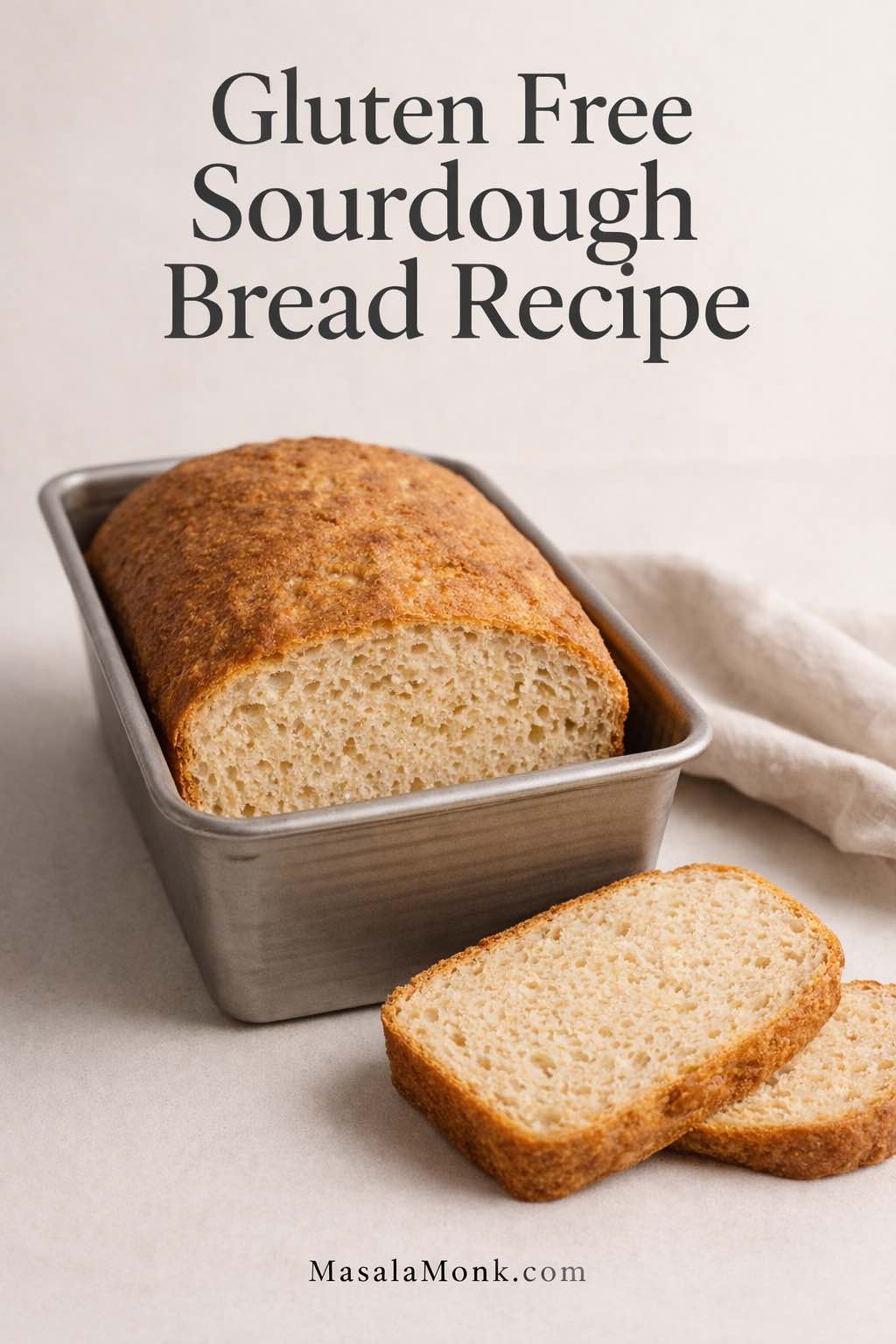
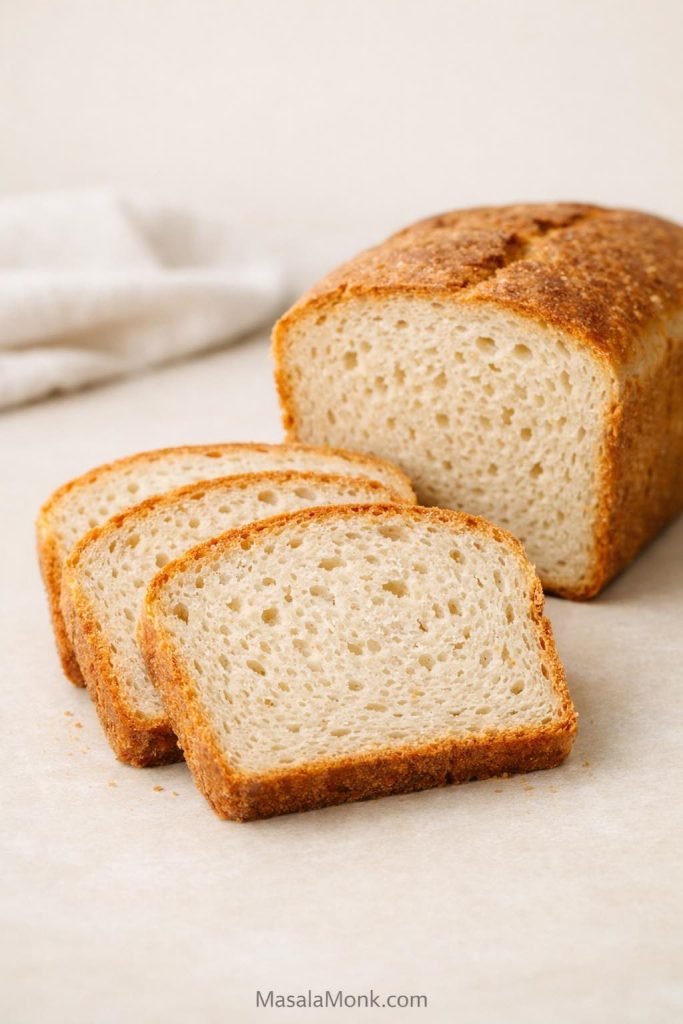
Gluten free sourdough bread recipe loaf in a pan with sliced crumb visible.

A good gluten free sourdough bread recipe should give you a loaf that feels properly baked, slices cleanly, and tastes like real bread rather than a compromise. This version is built as a loaf-pan, psyllium-supported, custom-blend method because that is the most dependable way to get structure, flavor, and repeatable home results without asking the dough to behave like a dramatic free-form boule.

Gluten free sourdough can still be frustrating, though. Some loaves bake up dense, some stay gummy in the middle, and some look promising right until you cut into them too early. So this guide does more than hand you a formula. It shows you what the dough should look like, how to judge the starter, when to move forward, and what to fix if the loaf falls short.

If your culture still feels unpredictable, pause and strengthen that first with the sourdough starter guide before you bake a full loaf. A better starter solves more problems than most flour tweaks ever will.

Quick Answers for This Gluten Free Sourdough Bread Recipe

Best default route: custom flour blend, active starter, loaf pan. This is the safest place to start.

Best pan: an 8½ x 4½-inch loaf pan. It gives the most forgiving path to a well-set loaf.

Main proof cue: bake when the loaf looks modestly puffy and lighter than before, not dramatically doubled.

Main bake cue: the loaf should reach about 205°F to 210°F internally and look fully set, not pale and soft.

Expected dough feel: soft, sticky, cohesive, and more like a sculptable paste than kneadable wheat dough.

Biggest mistake: misreading a soft dough as “wrong” or slicing too early and blaming the recipe for a crumb that has not finished setting.

Also Read: Sourdough Focaccia Recipe

Who This Loaf Is For

  • Best for: readers making their first serious gluten free sourdough loaf and wanting a dependable pan bread for toast, sandwiches, and everyday slicing.
  • Best for: bakers who want visible dough cues, practical proofing guidance, and a method that prioritises consistency over drama.
  • Less ideal for: anyone chasing a lofty free-form artisan boule on the first try. This method is built around reliability first.

Tested direction: this loaf is written for an 8½ x 4½-inch metal loaf pan, whole psyllium husk, and a 100% hydration gluten free starter, with room-temperature fermentation in a normal home oven.

What Kind of Gluten Free Sourdough Bread to Expect

This loaf is meant to give you bread that feels genuinely useful at the table: a crust that looks properly baked, a crumb that stays moist without turning pasty, and slices sturdy enough for toast, sandwiches, or simple buttered bread. The sourness is usually present but not aggressively sharp, especially if your starter is healthy but your fermentation stays moderate.

It also helps to set one expectation early. This is not wheat dough, and it is not trying to behave like wheat dough. The loaf usually rises more modestly, the dough stays softer, and the best texture often shows up only after the bread has cooled completely. In many kitchens, day-two slices toast especially well.

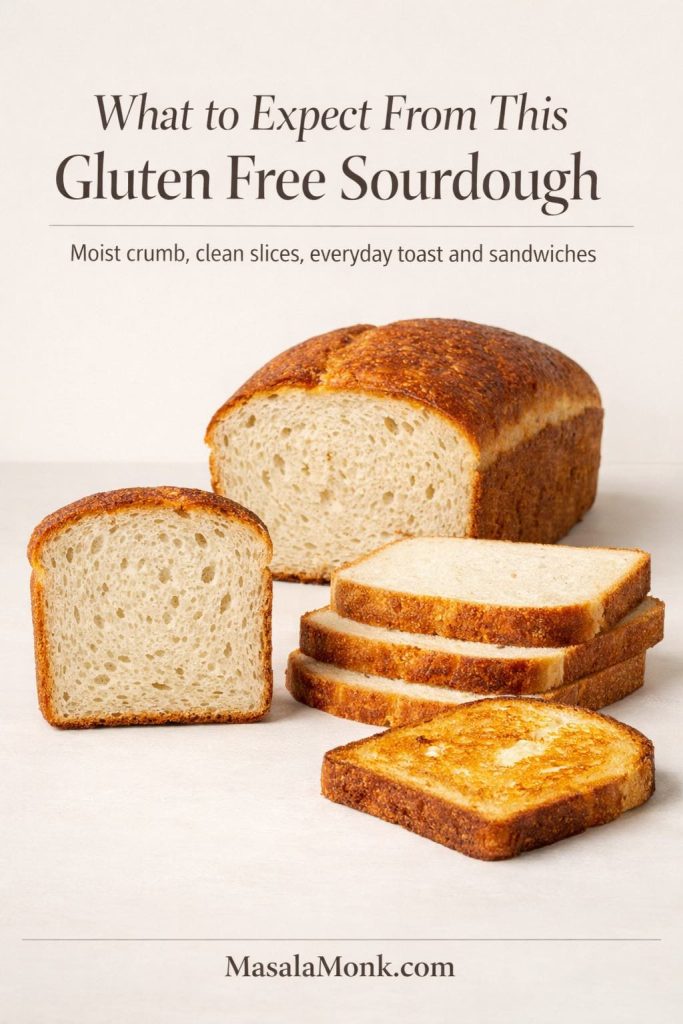
Finished gluten free sourdough loaf with a moist crumb, clean slices, and a toasted slice, showing the everyday texture and use this bread is meant to have.
This gluten free sourdough is meant to bake up with a moist, properly set crumb and slices that work well for toast or everyday sandwiches, so this image shows the kind of loaf you should expect rather than a dramatic wheat-style boule.

Why Gluten Free Sourdough Bread Behaves Differently

In wheat sourdough, gluten gives the dough much of its stretch, gas-holding power, and structural resilience. Once fermentation begins, that network helps the loaf expand and keep shape. Gluten free dough does not have that advantage, so the bread has to build structure another way.

That does not mean a good rise is impossible. It means the loaf depends more heavily on flour balance, hydration, starter activity, binder support, proofing, and bake setup. As a result, gluten free bread tends to reveal mistakes faster. If the starter is weak, the dough is too tight, the hydration is too high for the blend, or the loaf is underbaked, the crumb usually tells on you.

That is why it should not be judged against wheat-dough cues. The dough often looks softer. The rise can be subtler. The shaping is gentler. The success markers are different.

For readers who want a quick refresher on the bigger picture, MasalaMonk’s what gluten is explainer makes the rest of this loaf easier to understand.

Structure comes from hydration, fermentation, and binders

Once gluten is out of the picture, hydration starts doing far more than people expect. Water is not just there to bring the dough together. It helps the flours absorb fully, supports fermentation, activates psyllium, and shapes the final crumb.

Fermentation matters just as much. A lively starter does more than add tang. It lightens the dough, brings internal aeration, and gives the loaf a better chance of baking into something open enough to feel like bread rather than a dense substitute.

Then there is the binder. In this loaf, psyllium husk is the quiet structural engine. When hydrated properly, it creates a gel that helps hold water, improves cohesion, and supports gas retention. It does not recreate gluten, yet it does give the dough enough internal support to rise and set more convincingly.

Gluten free dough should not feel like wheat dough

This is one of the most important mindset shifts in the whole recipe. Gluten free sourdough dough often feels softer, stickier, and more paste-like than wheat dough. That can be completely normal.

The best mental model is this: think sticky, sculptable paste rather than kneadable wheat dough. After mixing, it should not run like batter, yet it should not feel firm enough to knead confidently either. This is exactly where many readers panic and start adding flour they did not need.

The opposite mistake happens too. Some readers assume a very loose dough must be right because gluten free dough is “supposed to be wet,” and they end up with more hydration than the flour system can hold. So the goal is not to force this dough into a wheat template. The goal is to learn what it looks like when it is on track, then trust those cues.

What success looks like

A successful loaf is not defined by one dramatic sign. It is a combination of smaller, more dependable ones.

Before baking, the dough should look more aerated and lighter than it did after mixing. It may not double dramatically, and that is fine. After baking, the loaf should feel set rather than damp and heavy. The crumb should be moist but not wet, tender but not fragile, and structured enough to slice without tearing into paste. Finally, the flavor should have real development. Even a mild loaf should taste deeper than a fast yeast bread made from the same flour.

That is the standard here: not “good for gluten free,” but genuinely good bread.

Also Read: Easy English Scone Recipe

Choose the Right Flour Path for Gluten Free Sourdough Bread

Gluten free sourdough recipes vary widely because they often start from very different flour systems. Some use a 1:1 blend for convenience. Others build a custom blend for control. Both routes can work. They simply reward different priorities.

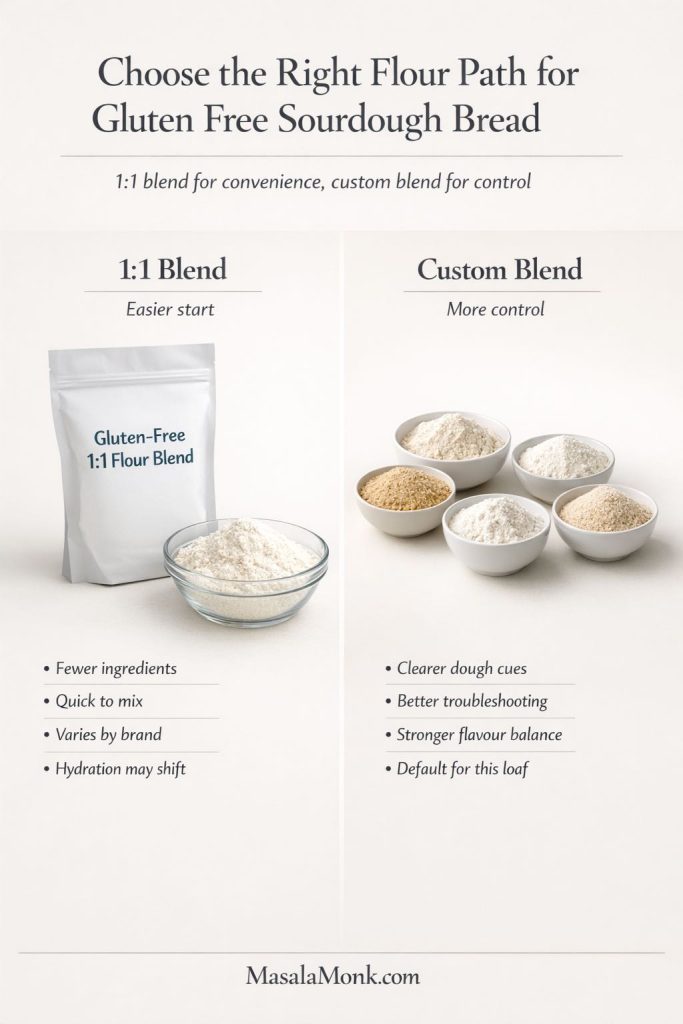
Comparison guide for gluten free sourdough bread showing 1:1 flour blend versus custom blend, with the 1:1 route framed as easier to start and the custom blend framed as offering more control.
Choosing between a 1:1 blend and a custom mix changes how predictable your dough feels, so this side-by-side guide helps you decide whether you want maximum convenience or better control before you start baking.

Route A: Use a 1:1 blend for convenience

A 1:1 gluten free flour blend is the easier place to start. It cuts down the shopping list, simplifies measuring, and gets you to mixing faster. For some readers, that simplicity matters enough to make it the right choice.

Even so, convenience comes with trade-offs. One 1:1 blend may absorb water beautifully. Another may turn gummy with the same hydration. Some contain gums already. Others lean starch-heavy and stay pale or under-set unless everything else is dialed in. The first thing that usually shifts is hydration and handling, which is why a dough made with one blend can feel noticeably different from the same formula made with another.

Route B: Use a custom blend for more control

A custom blend asks more from you at the start, yet it gives more control in return. You can decide how much whole-grain body, softness, absorbency, and starch support the loaf gets instead of inheriting a generic mix with unknown priorities.

That matters in sourdough because fermentation interacts with each flour differently. One flour may add flavor but weigh the loaf down when overused. Another can make the dough feel stronger. Others tighten more during resting than readers expect. A custom blend turns those variables into recipe decisions instead of accidental surprises.

Which route this recipe uses

This recipe uses a custom blend as the default because it produces a more dependable, brand-agnostic result. It also makes the dough cues easier to teach. When I tell you what the dough should feel like after mixing, after resting, or after proofing, those cues mean more when the flour system is built deliberately rather than borrowed from an unknown premade blend.

That does not mean you cannot adapt this loaf to a 1:1 blend later. It means the cleanest way to learn the method is to make it once as written in a loaf pan, then adjust from there once you understand how the dough should behave.

Also Read: White Russian Recipe: 7 Variants to Try, From Classic to Frozen

Ingredients That Matter Most in Gluten Free Sourdough Bread

In a strong gluten free sourdough loaf, some ingredients build structure, some drive fermentation, and some only refine the final result. Knowing which is which makes substitutions much safer.

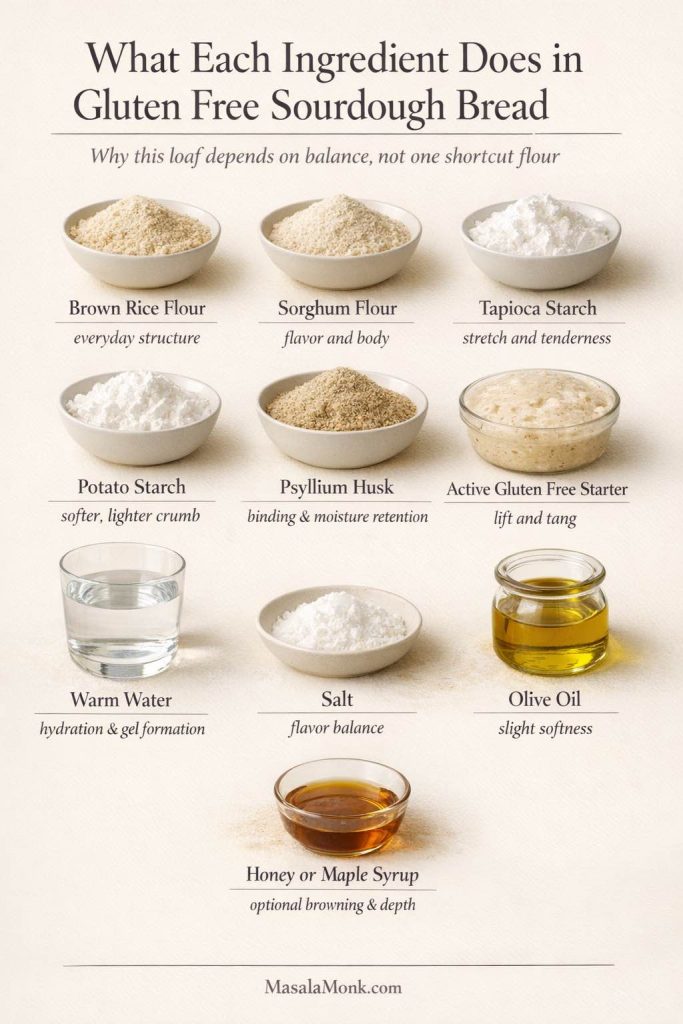
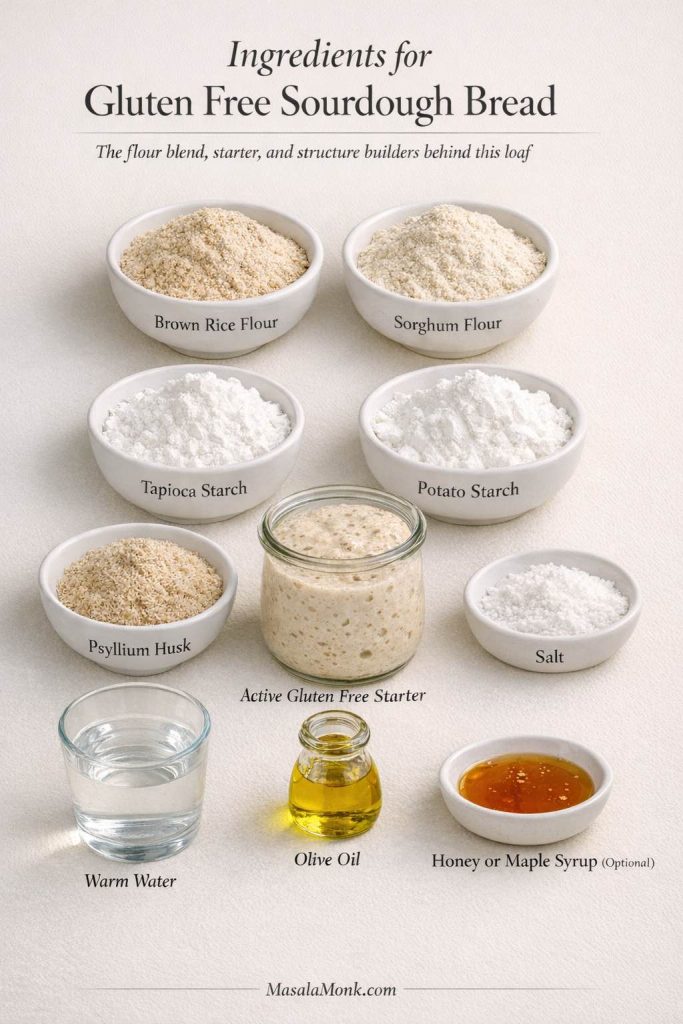
Ingredient roles card for gluten free sourdough bread showing how brown rice flour, sorghum flour, tapioca starch, potato starch, psyllium husk, starter, water, salt, olive oil, and optional honey or maple syrup support the loaf.
A good loaf comes from balance: the whole-grain flours build body, the starches lighten the crumb, psyllium holds moisture, and the starter brings the lift and tang that make the bread feel alive.

The flour blend

This loaf uses brown rice flour, sorghum flour, tapioca starch, and potato starch.

Brown rice flour gives dependable everyday structure without pushing the flavor too dark. Sorghum adds more character and helps the bread taste like bread instead of starch. Tapioca starch adds flexibility and tenderness, which helps keep the crumb from feeling rigid once cooled. Potato starch softens the blend further and supports a lighter eating texture.

The ratio matters. Too much whole-grain flour and the loaf can turn heavy. Too much starch and the crumb can become too soft or stay under-set in the middle. The point of this blend is balance: enough body to taste satisfying, enough lightness to avoid density, and enough structure to slice well.

The starter behind a good loaf

The starter is both the flavor engine and the lift source. In gluten free sourdough, that matters even more because the dough has fewer structural advantages to hide a weak culture.

A strong starter helps lighten the dough, deepen the flavor, and create the internal activity that keeps the loaf from baking into a compact block. A sluggish starter often leaves readers adjusting proof times, flour amounts, and oven settings when the real problem was the culture from the start.

For this loaf, use an active 100 percent hydration gluten free starter that has clearly risen after feeding, shows bubbles throughout the jar, and smells pleasantly sour rather than harsh. If your culture still feels inconsistent, go back to the sourdough starter guide before changing the bread formula.

Hydration

Hydration shapes nearly everything here. It influences how the flours absorb, how psyllium sets, how fermentation moves through the dough, and whether the crumb bakes up moist or gummy.

Because gluten free flour systems vary so much, hydration is never one-size-fits-all. It also changes during resting. A dough that seems slightly soft right after mixing can become far better behaved after the flours and psyllium absorb water fully. On the other hand, a dough that already feels very stiff at mixing usually tightens more as it rests.

That is why this recipe includes a deliberate short rest before you judge the dough too harshly.

Psyllium husk

Psyllium is the structural key in this formula. Once hydrated, it helps the dough hold water, improves cohesion, supports gas retention, and makes the finished loaf much easier to slice cleanly.

Without enough binder support, a loaf may ferment and still spread too much, collapse, or cool into a crumb that feels wet and fragile. With a good psyllium gel, the dough behaves with much more confidence.

Because psyllium quality varies, color can vary too. Some brands produce a slightly darker or faintly purple-gray crumb. That can look strange the first time, but it does not automatically mean the loaf failed.

Salt and optional additions

Salt does more than season the loaf. It sharpens flavor and helps keep fermentation balanced. Without enough salt, the bread can taste dull even when the starter is healthy. Too much, on the other hand, can make the dough feel tighter and less balanced.

A little olive oil softens the crumb slightly and rounds out the eating texture. A small amount of honey or maple syrup can help with browning and add a little flavor depth. These are fine-tuning ingredients, though, not rescue ingredients. They only help once the flour, starter, hydration, and binder are already doing their jobs.

Also Read: Mango Sorbet Recipe: Healthy & Plant Based Dessert

Gluten Free Sourdough Bread Formula and Why It Works

This loaf is built around a simple but deliberate balance: enough whole-grain flour to taste like bread, enough starch to keep the crumb from turning heavy, and enough psyllium support to hold that hydration together in a loaf pan.

The full measured ingredient list appears in the recipe card, but the logic matters here just as much as the numbers. Brown rice flour gives dependable structure, sorghum brings more flavor, tapioca and potato starch keep the crumb lighter, and psyllium helps the dough hold moisture and slice cleanly once baked.

The water level is generous because gluten free sourdough needs more moisture than many readers expect, yet it is still restrained enough to work reliably in a loaf pan. That pan matters too. A free-form loaf or Dutch oven can work later, but the loaf pan is the smartest route when consistency is the priority.

Why this recipe is written in grams

This recipe is written in grams because gluten free flour blends vary too much by volume for cups to stay dependable. Measuring by weight gives you a far better shot at repeating the same dough texture, the same fermentation behavior, and the same loaf structure next time.

Equipment That Improves Your Gluten Free Sourdough Bread Results

You do not need a professional bakery setup to make good gluten free sourdough, but a few tools genuinely improve consistency.

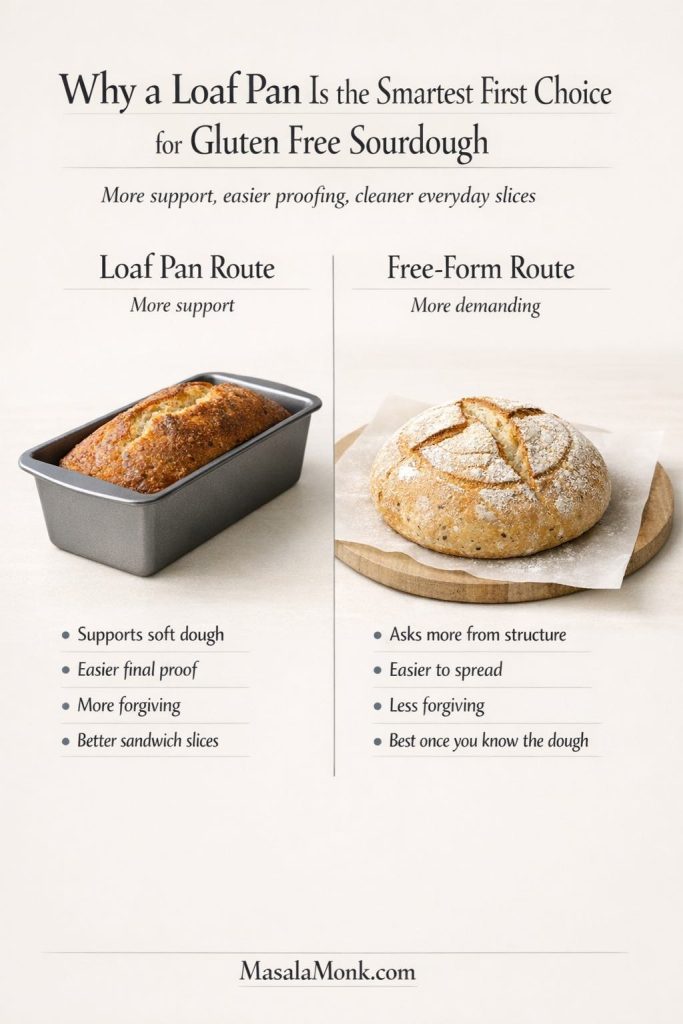
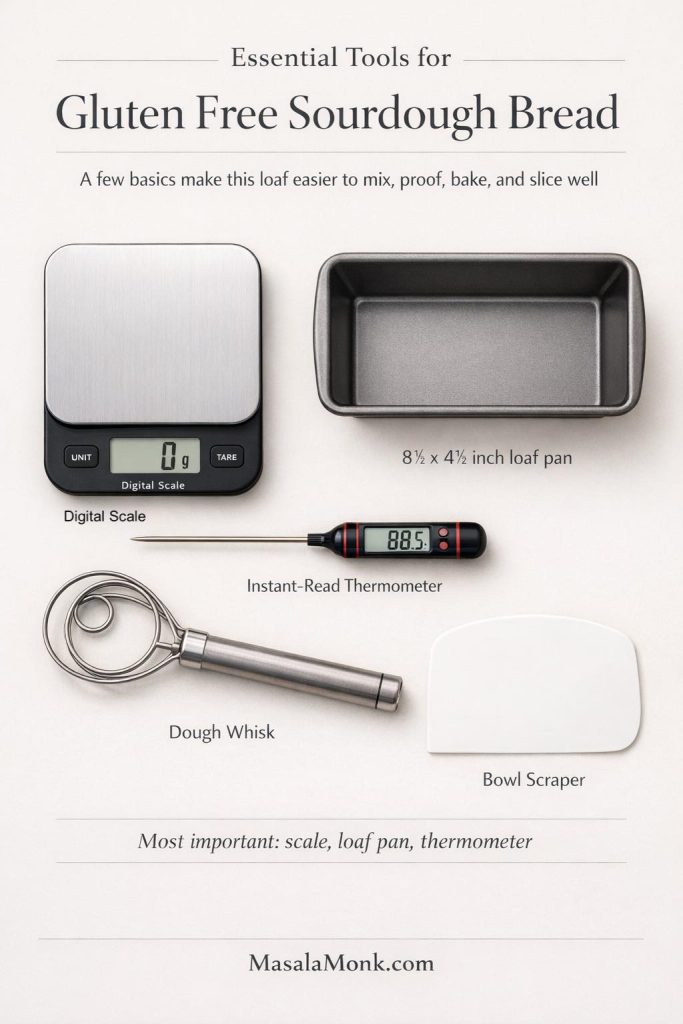
A digital scale is essential, not optional. Gluten free flours vary too much by volume for cups to stay dependable. An 8½ x 4½-inch loaf pan is the most forgiving format for most readers because it supports the dough during proofing and baking. A Dutch oven can work, yet it asks more from the dough and from your handling. If your goal is a repeatable first success, the loaf pan is the smarter default.

Comparison guide showing loaf pan route versus free-form route for gluten free sourdough bread, with the loaf pan framed as more supportive and forgiving for beginners.
A loaf pan gives gluten free sourdough more support during proofing and baking, so this comparison helps show why it is the more reliable first choice before you move on to a less forgiving free-form loaf.

A sturdy spatula or dough whisk helps with mixing. A bowl scraper makes transfer neater. Most importantly, an instant-read thermometer gives you a much clearer finish line than crust color alone. Gluten free loaves can look done before the center has fully set, so temperature is one of the best protections against gumminess.

Essential tools guide for gluten free sourdough bread showing a digital scale, 8½ x 4½-inch loaf pan, instant-read thermometer, dough whisk, and bowl scraper.
Gluten free sourdough gets much easier to repeat when you rely on a scale, a loaf pan, and an instant-read thermometer, because those three tools do more for consistent mixing, proofing, and doneness than extra gear ever will.

Also Read: Protein Ice Cream Recipe: 10 Creamy Homemade Recipes

Starter Readiness for Gluten Free Sourdough Bread

“Use an active starter” sounds straightforward until you realize how loosely that phrase gets used. For this loaf, active needs to mean something visible.

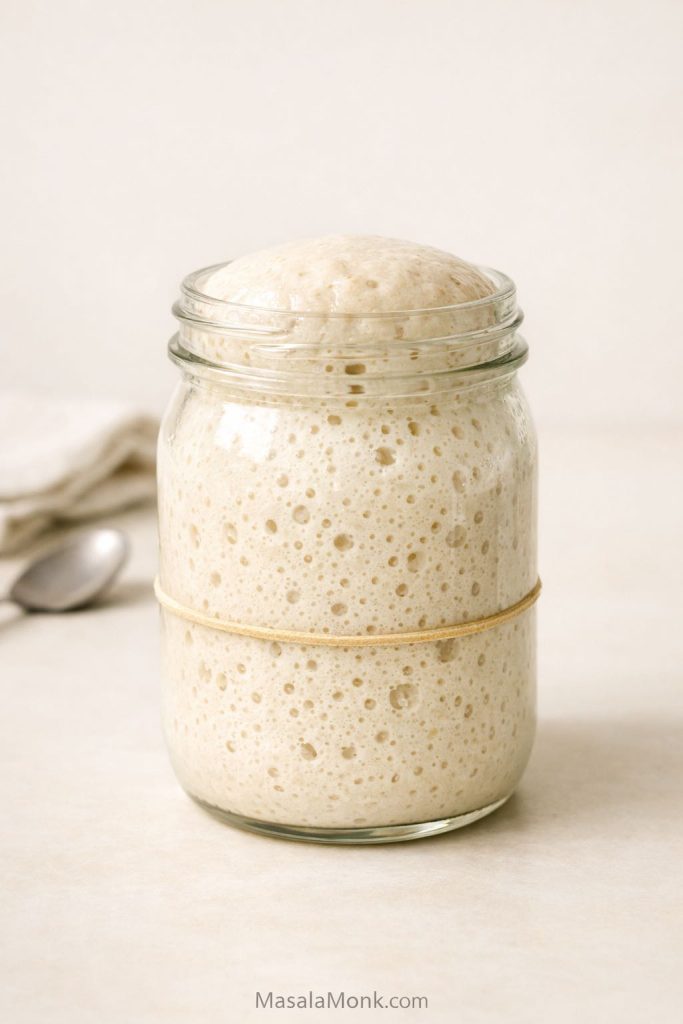
Active gluten free sourdough starter in a glass jar with visible bubbles and rise.
A starter like this should look clearly risen and bubbly through the jar, because visible activity matters more than guessing whether it is “probably ready.”

What an active starter should look like

A ready starter should look aerated throughout the jar, not just bubbly on top. After feeding, it should rise clearly enough that you do not have to guess whether anything happened. If your starter usually doubles, great. If it does not fully double but reliably rises, loosens, and fills with bubbles after feeding, that can still be enough. What matters most is clear activity, not dramatic performance.

Visually, you want a jar that looks clearly lifted, bubbly through the middle rather than just foamy at the top, and still strong rather than flat or separated. If the top has fully collapsed and the starter looks slack, refresh it before baking.

A sourdough starter is a live culture of wild yeast and lactic acid bacteria, so visible rise, bubbles, and recovery after feeding matter more than starter myths or wishful thinking.

The best times to use it

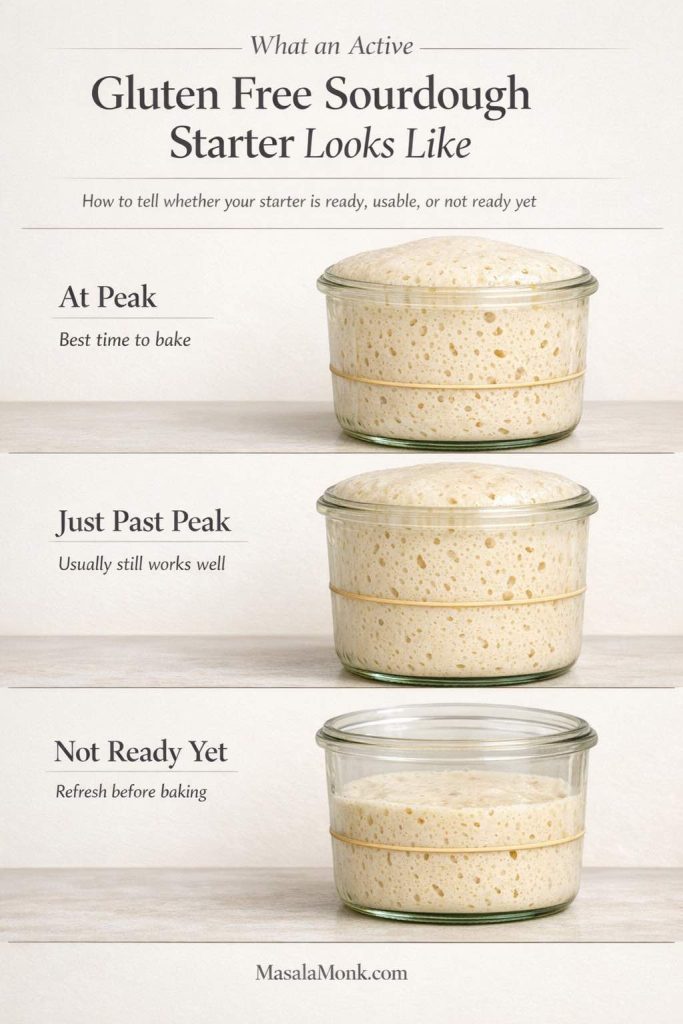
There are three especially useful starter states to understand here.

Guide showing peak, just-past-peak, and not-ready gluten free sourdough starter in glass jars.
A gluten free starter can look active, usable, or still too weak within a fairly short window, so reading the jar correctly is often what separates a lively loaf from a disappointing one.
  • At peak: the starter has risen clearly, still looks domed or almost domed, and feels lively throughout. This is the easiest and safest state to use.
  • Just past peak: the starter still looks active and aerated, but the top may be starting to flatten slightly rather than sit high and rounded. This can still work very well, especially if it remains strong and bubbly.
  • Straight from the fridge: sometimes workable if the culture was strong before refrigeration, but far less dependable if there is any sign of weakness. When in doubt, refresh it first.

When your starter is not ready yet

What should make you stop? Weak bubbling, sluggish recovery after feeding, a starter that separates badly, or a culture that smells more harsh than pleasantly sour. In those cases, the problem is rarely the bread formula. The culture simply is not ready yet.

Also Read: Homemade Mango Ice Cream Recipe

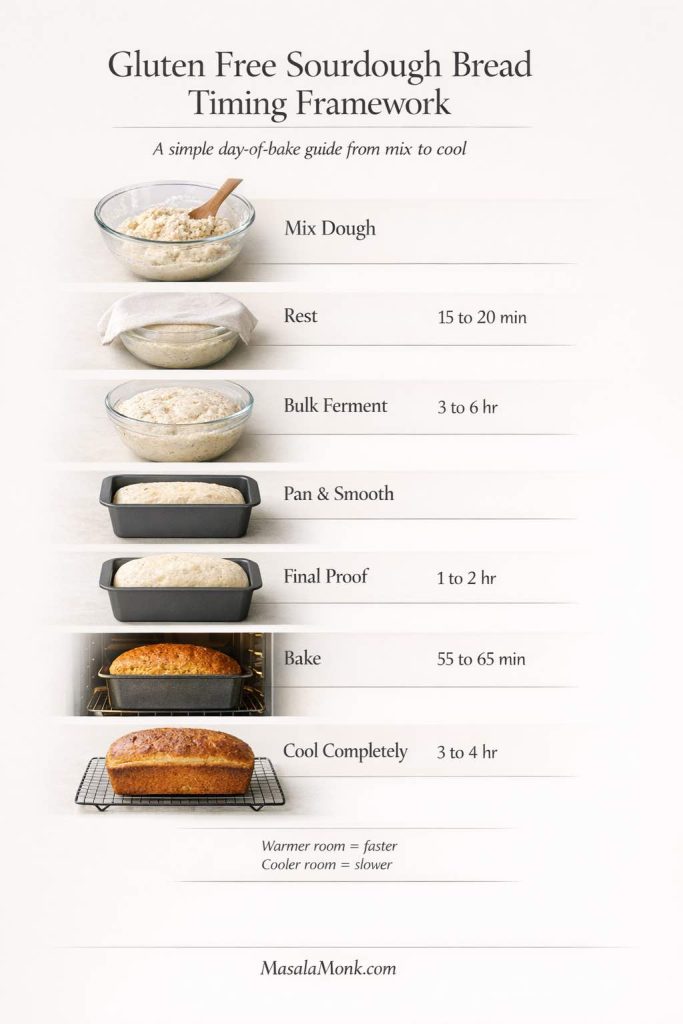
Timing Framework: What This Process Usually Looks Like

Times vary by starter strength, room temperature, and flour behavior, so use these as orientation points rather than strict rules.

Timing framework guide for gluten free sourdough bread showing mix dough, rest, bulk ferment, pan and smooth, final proof, bake, and cool completely.
A good gluten free sourdough loaf gets easier to manage when you can see the full rhythm of the bake, so this timeline helps you plan the day from mixing and proofing through baking and full cooling.

Warm kitchen: roughly 26°C to 28°C / 79°F to 82°F

If your kitchen runs warm, bulk fermentation may move along in about 3 hours, and the final proof may be ready in roughly 1 hour. Watch the dough closely so it does not overproof.

Moderate kitchen: roughly 22°C to 24°C / 72°F to 75°F

In a moderate room, bulk fermentation often lands around 4 to 5 hours, with a final proof of about 1 to 2 hours.

Cooler kitchen: roughly 18°C to 20°C / 64°F to 68°F

If your room runs cool, bulk fermentation may need 5 to 6 hours or even a bit more, and the final proof may take closer to 2 hours.

Optional overnight route

For a slightly more developed flavor, you can refrigerate the shaped loaf after a modest room-temperature start to the final proof, then bake the next day once it no longer feels cold and inert. This is best used after you have already made the loaf once and understand what the dough looks like when it is on track.

Also Read: Cookie Pie Recipe: 10 Best Flavors, Fillings and Variations

Ingredients for This Gluten Free Sourdough Bread Recipe

Before you start mixing, gather everything first. This loaf uses a custom flour blend, active starter, psyllium husk, water, salt, olive oil, and an optional small amount of honey or maple syrup. For the full recipe card with yield, timing, and notes, you can also jump to the recipe card here.

One-glance formula snapshot

  • Pan: 8½ x 4½-inch loaf pan
  • Starter: active gluten free starter at 100% hydration
  • Expected dough feel: soft, sticky, cohesive, and smoothable
  • Bake target: 205°F to 210°F internal temperature
  • Proof target: modestly puffy and lighter than before, not dramatically doubled
  • Cooling minimum: 3 to 4 hours before slicing
Labeled ingredients for gluten free sourdough bread including brown rice flour, sorghum flour, tapioca starch, potato starch, psyllium husk, starter, salt, water, olive oil, and honey.
This loaf works best when the flour blend, psyllium, starter, and hydration are treated as a system, which is why getting the ingredients lined up correctly matters before you start mixing.
  • 150 g active gluten free sourdough starter, 100% hydration
  • 220 g brown rice flour
  • 120 g sorghum flour
  • 80 g tapioca starch
  • 40 g potato starch
  • 14 g whole psyllium husk
  • 10 g fine sea salt
  • 430 g warm water
  • 15 g olive oil
  • 10 g honey or maple syrup, optional

How to Make Gluten Free Sourdough Bread Step by Step

Step 1: Make the psyllium gel

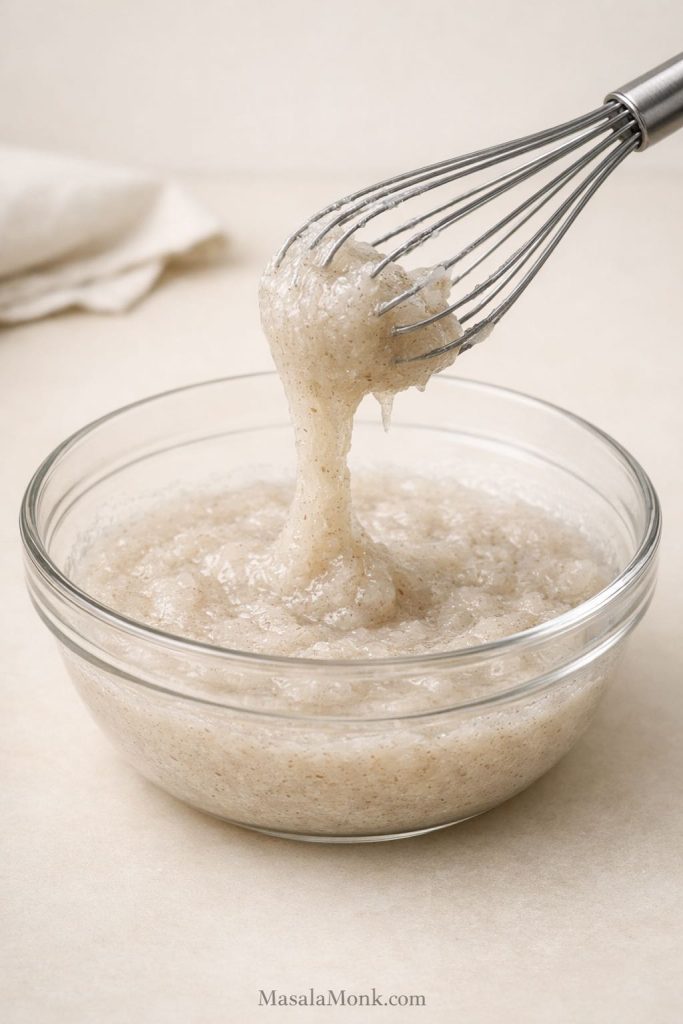
Whisk the warm water and psyllium husk together in a medium bowl. Leave it for 2 to 3 minutes until it thickens into a gel.

Psyllium husk gel for gluten free sourdough bread thickened in a bowl before mixing
Psyllium should look thickened, cloudy, and easy to whisk through at this stage, because that hydrated gel is what helps the dough hold water and bake into a loaf that slices more cleanly.

This step does more than hydrate the binder. It helps distribute psyllium evenly through the dough, which improves cohesion and reduces the chance of dry patches later.

The gel should look thickened but still stirrable. It should not look watery, yet it should not feel like a solid rubber mass either.

Step 2: Mix the dough

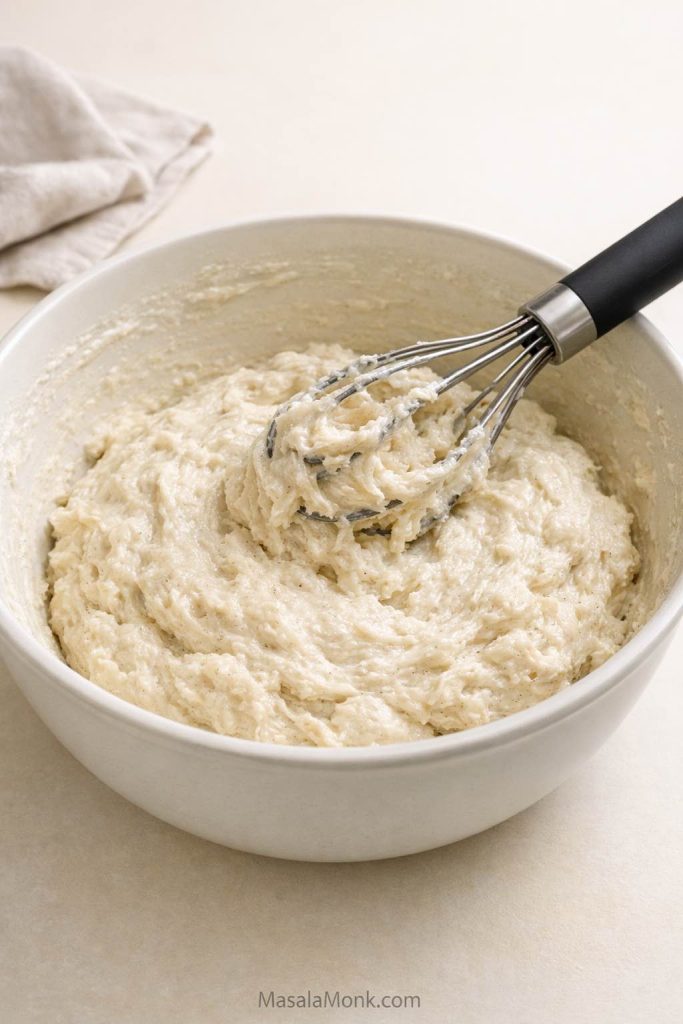
In a large bowl, whisk together the brown rice flour, sorghum flour, tapioca starch, potato starch, and salt. Add the psyllium gel, active starter, olive oil, and optional honey or maple syrup. Mix thoroughly until no dry pockets remain.

At this stage, the dough should look sticky, soft, and cohesive. Think thick, supple paste leaning toward very soft dough rather than anything you would knead like wheat bread. It should hold together, but it should not feel firm.

Gluten free sourdough dough after mixing in a bowl with soft sticky texture.
Right after mixing, the dough should look soft, sticky, and cohesive, so this is the stage where adding extra flour too quickly usually does more harm than good.

If it resists mixing and feels stubbornly tight, it is probably too stiff already. If it pours or sloshes like batter, it has likely gone too far in the wet direction.

Step 3: Rest the dough

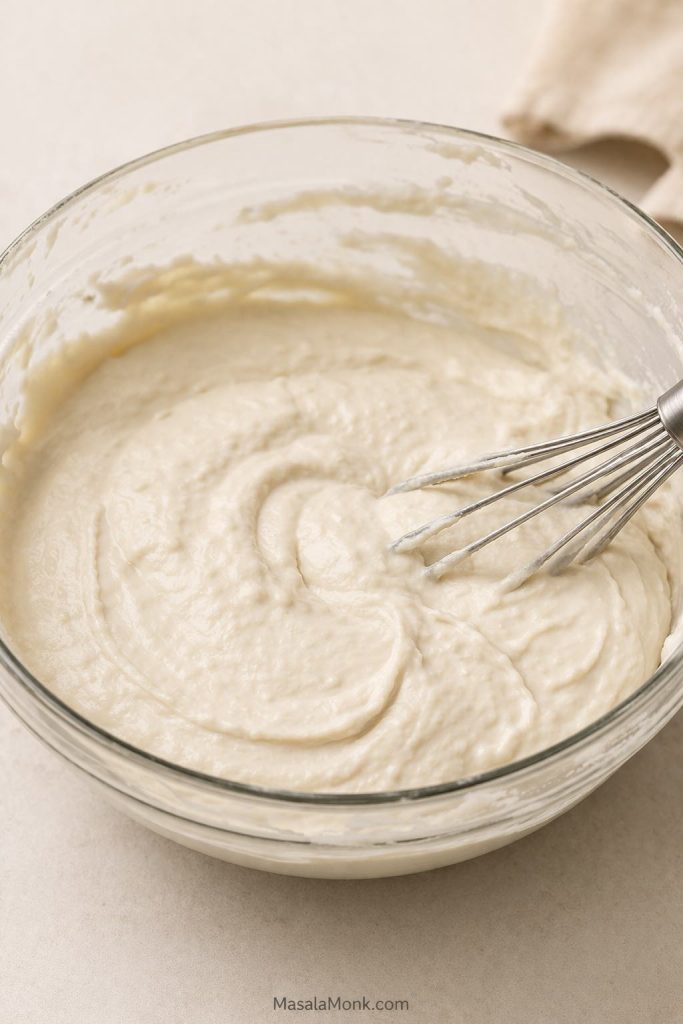
Cover the bowl and leave the dough for 15 to 20 minutes. This short rest gives the flours and psyllium time to absorb water more fully before you judge the texture.

After resting, the dough should feel smoother, more organised, and slightly stronger. It should still be soft, but it should no longer feel shapeless. This is often the point where readers realise the dough was not “wrong” after all; it simply needed time to hydrate.

Gluten free sourdough dough after resting in a bowl with smoother more settled texture.
After the short rest, the dough should still look soft, but it should feel more settled and slightly better organised than it did right after mixing.

If it becomes dramatically tighter than expected, add a small splash of water. If it still looks unusually loose, continue with the loaf-pan format and note that the blend may need slight adjustment next time.

Step 4: Bulk ferment

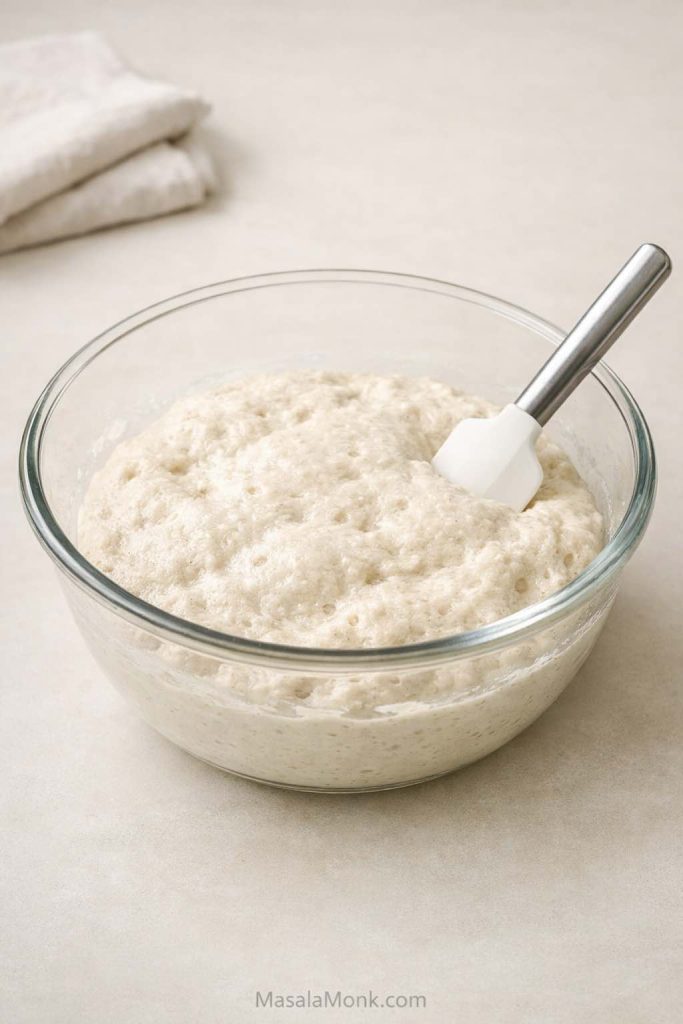
Leave the dough covered at room temperature until it looks visibly aerated and somewhat lighter. In many kitchens this takes 3 to 5 hours, but room temperature and starter strength matter more than the clock.

You are not waiting for dramatic doubling. Instead, look for a dough that seems about 50 to 75 percent more lively rather than massively larger. It should look puffier, hold a bit more internal air, and feel less heavy than when it started.

Gluten free sourdough dough after bulk fermentation looking lighter and more aerated in a bowl.
After bulk fermentation, the dough should look a little lighter and more aerated, but not dramatically doubled the way wheat dough often does.

If the dough still looks almost exactly the same several hours later, the starter is usually the first thing to question.

Step 5: Transfer to the pan

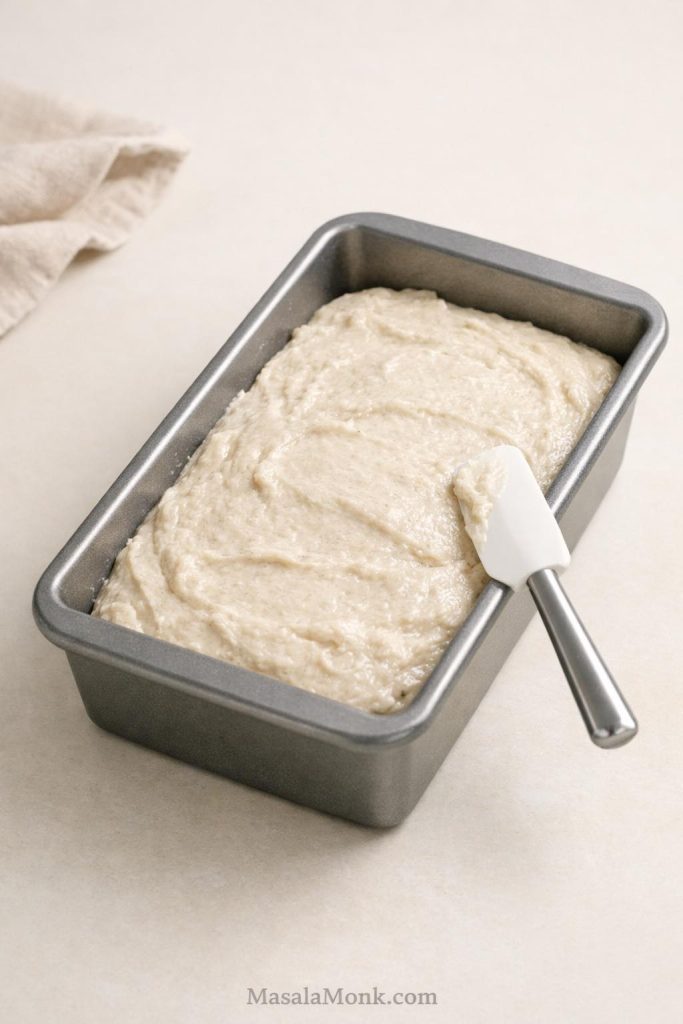
Scrape the dough into a parchment-lined or well-greased loaf pan. Smooth the top with wet fingers or a spatula. Add seeds on top here if you want them.

Gluten free sourdough dough smoothed into a loaf pan before final proof.
Once the dough is in the pan, it should still look soft and hydrated, but the pan gives it the support that makes this loaf much easier to handle well.

This is not a dramatic shaping step. You are guiding the dough into place and preserving whatever lightness fermentation created. Gluten free sourdough rewards calm handling more than aggressive shaping.

The dough should smooth willingly, even if it remains soft. It should not fight you like stiff dough, and it should not look like it has no internal support at all.

Step 6: Final proof

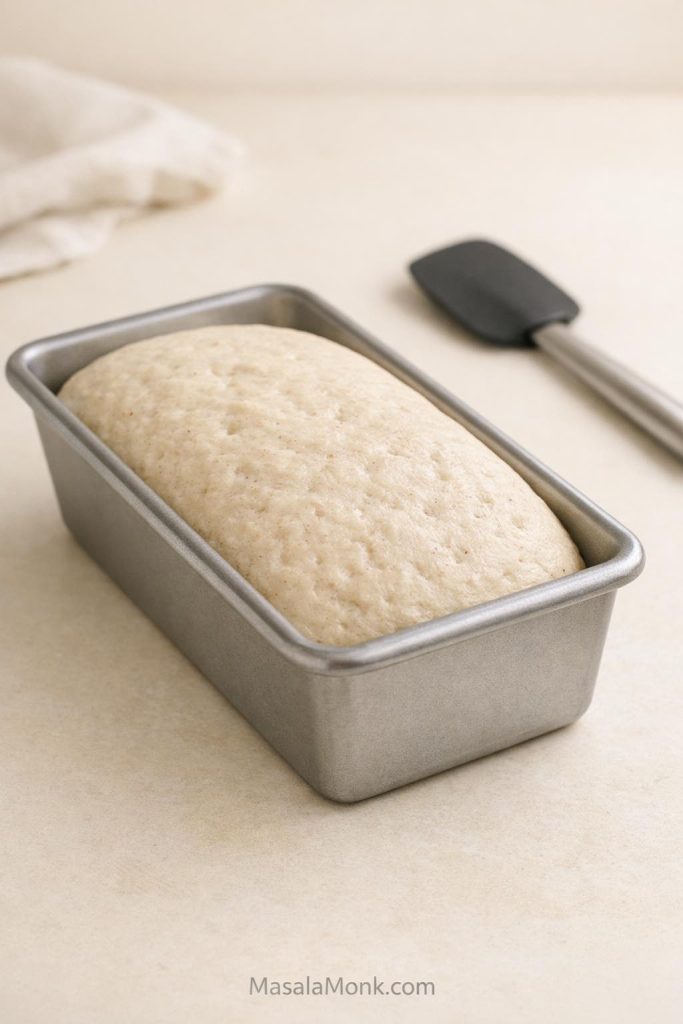
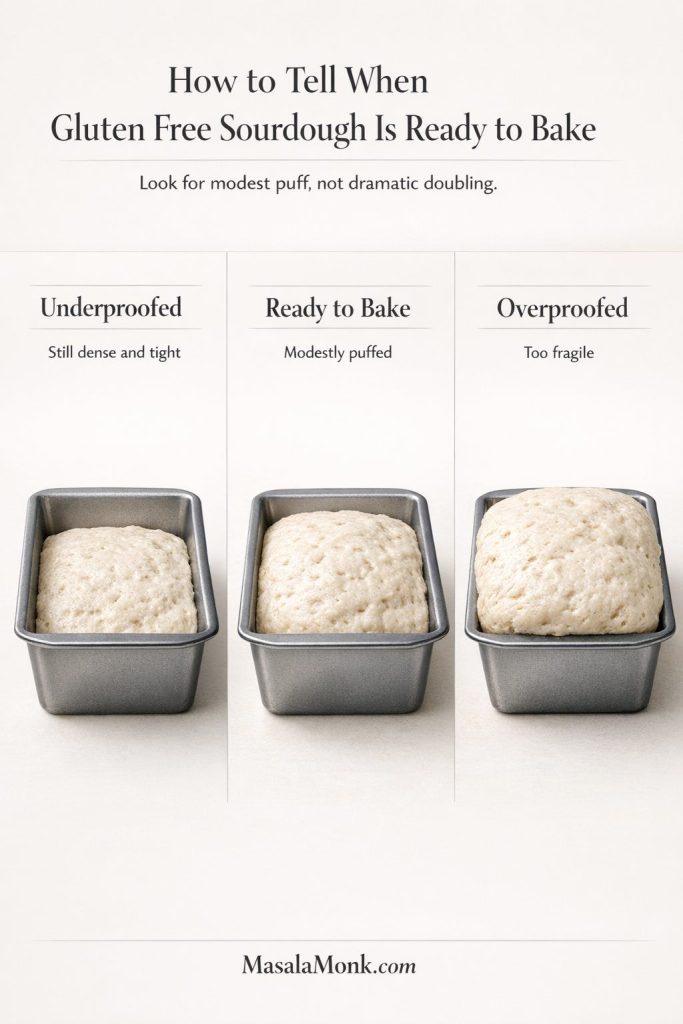
Cover the pan and let the loaf proof until it looks slightly expanded, a little airy, and visibly lighter than when it first went into the pan. In many kitchens this takes about 1 to 2 hours.

What does ready look like? The loaf should seem modestly puffed, not dramatically tall. The surface should look a little more alive, and if you gently touch it, it should not feel dense and immovable. What you are chasing here is a loaf that looks ready, not maxed out.

Proofed gluten free sourdough loaf in a loaf pan ready to bake.
A properly proofed loaf should look lightly puffed and a little more alive, not dramatically doubled or fragile.

Bake now if: the loaf looks modestly puffed, lighter than before, and softly aerated without seeming fragile.

Wait longer if: it still looks dense, heavy, flat, or almost unchanged from when it first went into the pan.

You have probably gone too far if: it starts looking fragile, overexpanded, or slightly unstable, as though it might sink rather than hold itself.

Step 7: Bake

While the loaf proofs, preheat the oven to 230°C / 445°F.

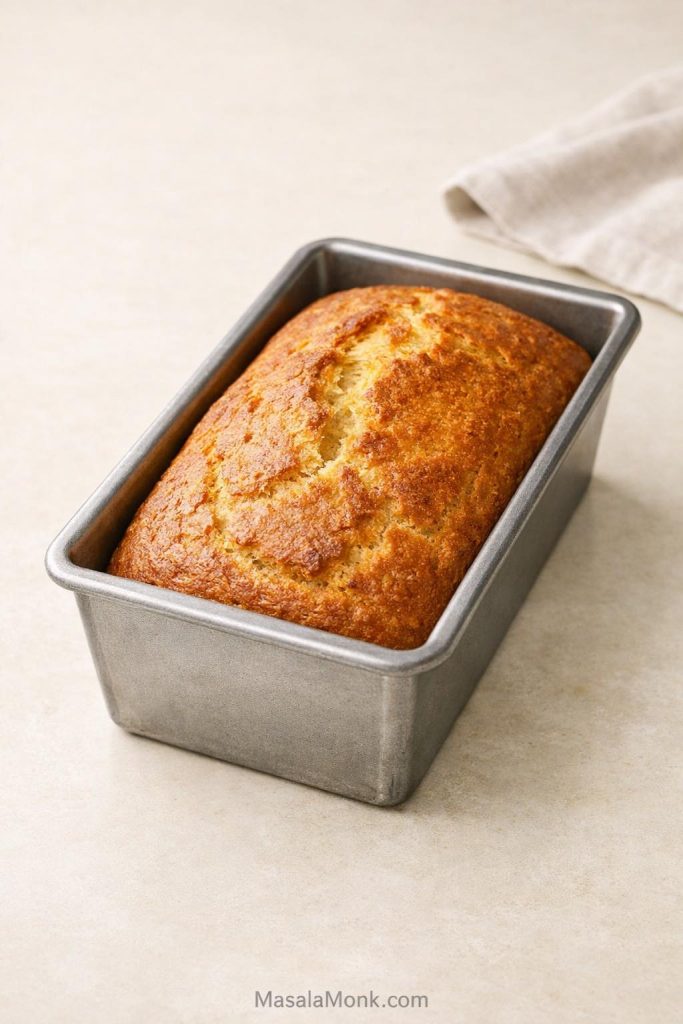
Bake the loaf for 20 minutes at 230°C / 445°F. Then lower the oven to 210°C / 410°F and bake for another 35 to 45 minutes, until the crust is deep golden and the internal temperature reaches about 96°C to 99°C / 205°F to 210°F.

Freshly baked gluten free sourdough loaf in a metal loaf pan with deep golden crust.
A fully baked loaf should look well set and deeply golden in the pan, because crust color and internal temperature together tell you much more than color alone.

If the top darkens too quickly, tent it loosely with foil during the second part of the bake.

The loaf should look fully set when done, not pale and soft. It should also feel lighter than a wet, underbaked loaf of the same size. When you tap the top gently, it should feel firm rather than damp and delicate.

Step 8: Cool completely

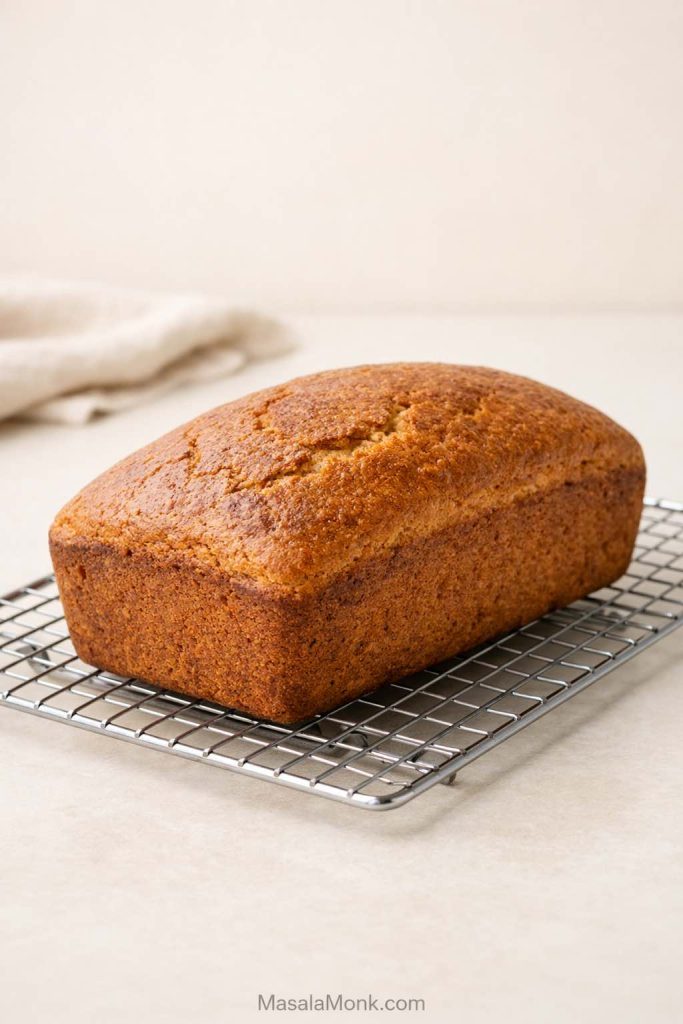
Leave the loaf in the pan for about 10 minutes, then move it to a rack and cool completely, ideally for at least 3 to 4 hours.

Gluten free sourdough loaf cooling on a wire rack after baking.
Cooling is part of the bake, so letting the loaf rest fully on a rack helps the crumb finish setting before you slice into it.
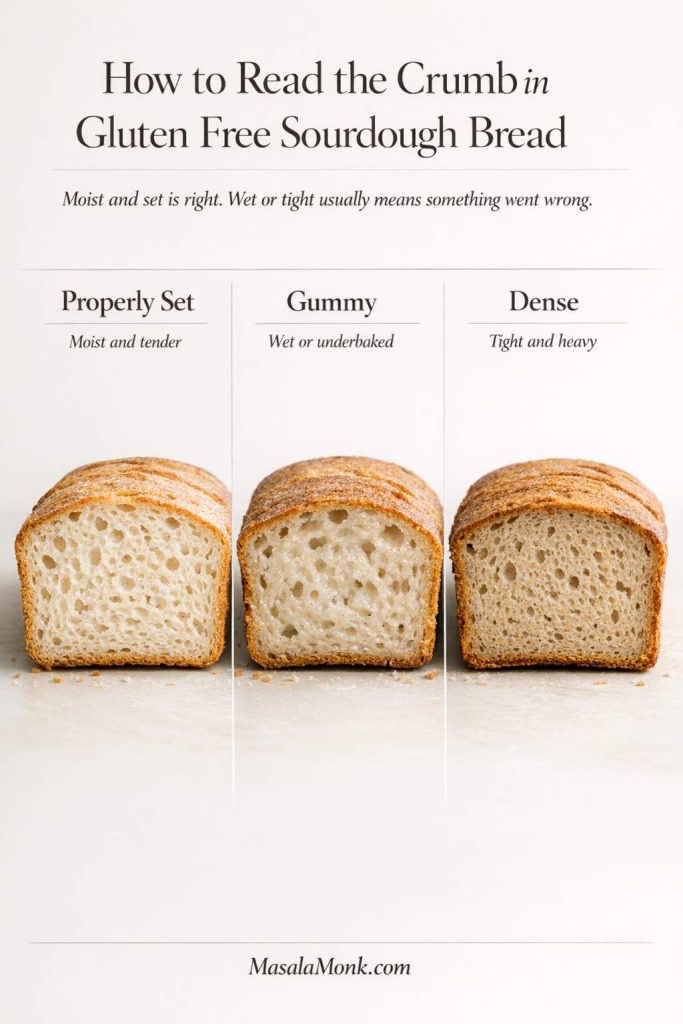
Crumb guide for gluten free sourdough bread comparing a properly set loaf, a gummy underbaked loaf, and a dense tight loaf.
A good gluten free sourdough crumb should look moist and tender rather than wet or tight, so this side-by-side guide helps you tell the difference between a properly set loaf, a gummy center, and a denser result.

This is not a fussy extra step. Cooling is part of the bake. Slice too early and even a properly baked loaf can seem falsely gummy because the crumb has not finished setting.

Fully cooled gluten free sourdough bread sliced to show a moist tender crumb.
Once the loaf has cooled fully, the crumb should look moist, tender, and properly set, with slices that hold together cleanly instead of turning gummy or pasty.

Also Read: Punjabi Mutton Bhuna – Amritsari Village-Style Gosht Recipe

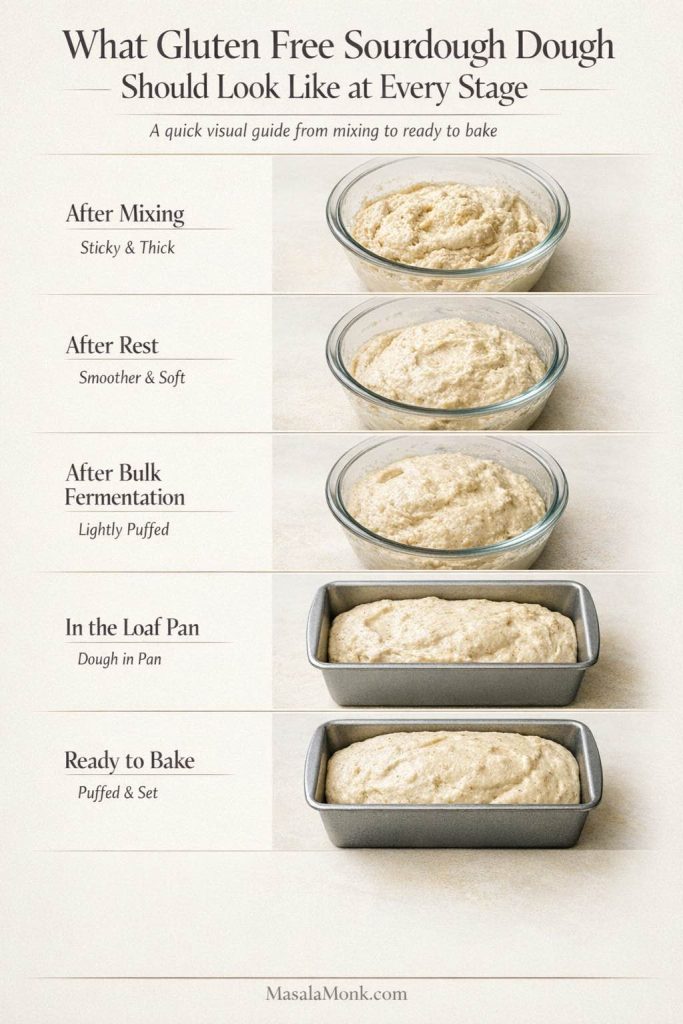
What Gluten Free Sourdough Bread Dough Should Look Like at Every Stage

Timing helps, yet appearance and feel matter more.

Visual guide showing gluten free sourdough dough from mixing through ready-to-bake stage.
Gluten free sourdough usually changes more through texture, structure, and slight puffing than through dramatic rise, which is why these stage cues are more useful than the clock.
  • After mixing: the dough should look fully hydrated, sticky, and cohesive. It should not have dry flour pockets. It should not pour like cake batter either.
  • After the short rest: the dough should feel smoother, slightly stronger, and more organised. It should still be soft, but less sloppy than it looked at first.
  • During bulk fermentation: look for dough that seems lighter, more aerated, and a little puffy rather than one that is simply sitting in the bowl unchanged.
  • Ready to proof in the pan: after transfer, the surface should smooth out easily. The dough should still be soft, yet it should not look like it has no internal support at all.
  • Ready to bake: the loaf should look modestly expanded and clearly lighter than before. Think “puffy and ready,” not “maxed out and fragile.”
  • Fully baked and fully cooled: the crust should feel set. The loaf should not feel suspiciously heavy for its size. When sliced, the crumb should look moist and tender, not wet and sticky.

How to Tell If Gluten Free Sourdough Bread Needs More Proofing

Proofing is where many loaves succeed or fail, so it helps to separate the three most common states clearly.

Proofing guide for gluten free sourdough bread showing underproofed, ready-to-bake, and overproofed dough in loaf pans.
Gluten free sourdough is usually ready when the loaf looks modestly puffed and lighter than before, so this side-by-side guide helps you avoid baking too early or waiting until the dough turns fragile.
  • Underproofed: the dough still looks dense, heavy, and only faintly active. It may bake into a loaf with a tight crumb and weak lift.
  • Properly proofed: the loaf looks modestly puffy, lighter than before, and softly aerated without seeming fragile. This is the target.
  • Overproofed: the loaf starts to look too delicate, overexpanded, or a little unstable. It may sink, spread, or lose structure in the oven.

When in doubt, remember that gluten free sourdough usually rewards restraint. You are not waiting for an enormous rise. You are looking for a loaf that seems clearly more alive than before, but still stable.

Also Read: Peach Cobbler with Canned Peaches (Dessert Recipe)

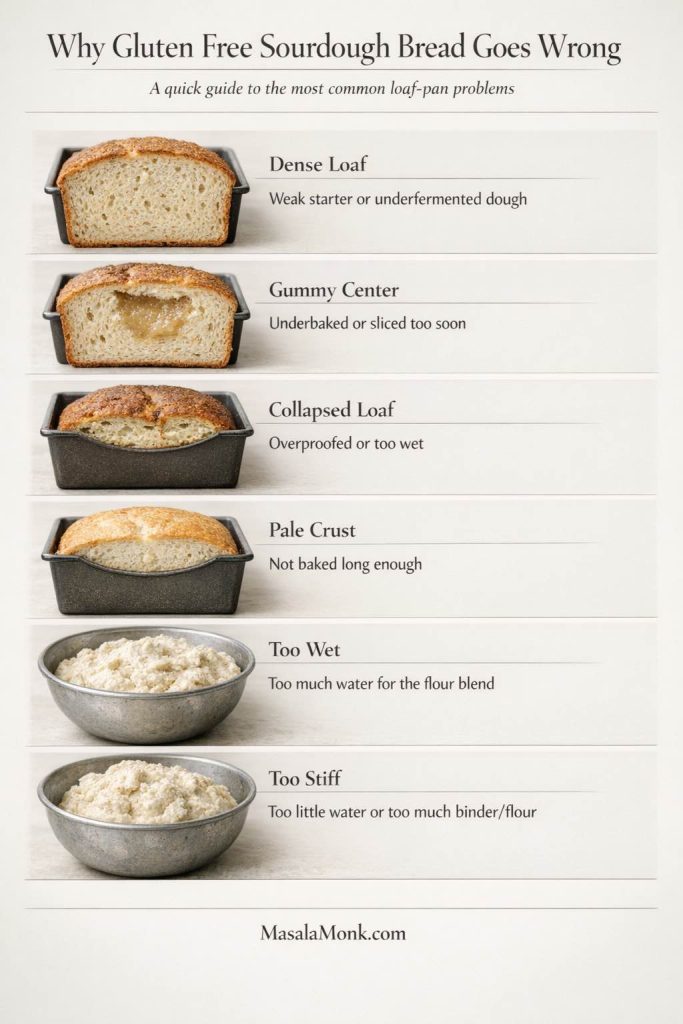
Troubleshooting by Symptom

Most gluten free sourdough problems come back to a few repeated causes: weak starter, mismatched hydration, unbalanced flour, overproofing, underbaking, or slicing too soon.

Troubleshooting card for dense gummy collapsed pale wet and stiff gluten free sourdough bread.
Most problems come back to starter strength, hydration, proofing, or bake time, so reading the symptom correctly is usually the fastest way to fix the next loaf.

Why is my loaf dense?

Most likely cause: weak starter, dough that was too stiff, or fermentation that never got far enough.

What you likely saw before baking: the dough barely changed during bulk fermentation and still looked heavy when it went into the pan.

How to confirm it: the crumb came out tight and heavy without much internal openness.

What to change next time: strengthen the starter first, then check whether the dough tightened too much during resting. If it did, increase hydration slightly.

Why is the center gummy?

Most likely cause: underbaking, too much hydration for the chosen flour system, or slicing too early.

What you likely saw before baking: the loaf may have looked fine in the oven and browned reasonably well, but it still felt heavier than it should for its size.

How to confirm it: the center still felt wet, sticky, or pasty even after cooling.

What to change next time: trust the thermometer, extend the bake if needed, and cool the loaf fully before slicing. If the problem persists, reduce hydration slightly or revisit flour absorption.

Why did the loaf spread or collapse?

Most likely cause: overproofing, excessive hydration, or weak binder support.

What you likely saw before baking: the loaf looked puffy but also a little fragile, overinflated, or unstable in the pan.

How to confirm it: it sank or spread instead of holding shape in the oven.

What to change next time: shorten the final proof slightly, keep the loaf pan as the default format, and check whether the dough looked too loose even after resting.

Why is the crust pale or underbaked?

Most likely cause: insufficient bake time or weak preheating.

What you likely saw before baking: the loaf entered the oven looking fine, but the oven itself may not have been thoroughly heated or the bake may have been cut short once the top gained some colour.

How to confirm it: the loaf colours slowly, the crust stays soft, or the bottom feels under-set even when the top looks done.

What to change next time: preheat more thoroughly, keep the loaf in longer, and use the thermometer rather than crust color alone.

Why is the dough too wet?

Most likely cause: flour variability or slightly excessive hydration.

What you likely saw before baking: even after the short rest, the dough still looked unusually loose and hard to smooth into the pan cleanly.

How to confirm it: the dough feels overly slack rather than soft and cohesive.

What to change next time: reduce water slightly next time, or revisit whether a flour swap changed how the blend absorbs moisture.

Why is the dough too stiff?

Most likely cause: too little water, overly absorbent flour, or too much binder.

What you likely saw before baking: the dough felt stubbornly tight early on and became even tighter during resting instead of smoothing out.

How to confirm it: it resists mixing, smoothing, and expansion more than it should.

What to change next time: increase hydration a little, and avoid adding extra flour just because the dough does not feel like wheat dough.

Why is the flavor not sour enough?

Most likely cause: a mild starter or a fermentation schedule that moved too quickly.

What you likely saw before baking: the dough rose reasonably well, but fermentation stayed efficient rather than especially long or flavour-building.

How to confirm it: the loaf performs reasonably well but tastes gentler than you wanted.

What to change next time: extend fermentation modestly where appropriate or use the optional overnight route once you know the dough well.

Why does the crumb look purple or gray?

Most likely cause: psyllium color reaction rather than a failed loaf.

What you likely saw before baking: nothing especially alarming in the dough itself, but the final crumb later showed an odd tint.

How to confirm it: the structure and taste are otherwise fine, but the crumb carries an unusual hue.

What to change next time: try a different psyllium brand if the appearance bothers you.

Also Read: Avocado Chocolate Mousse Recipe

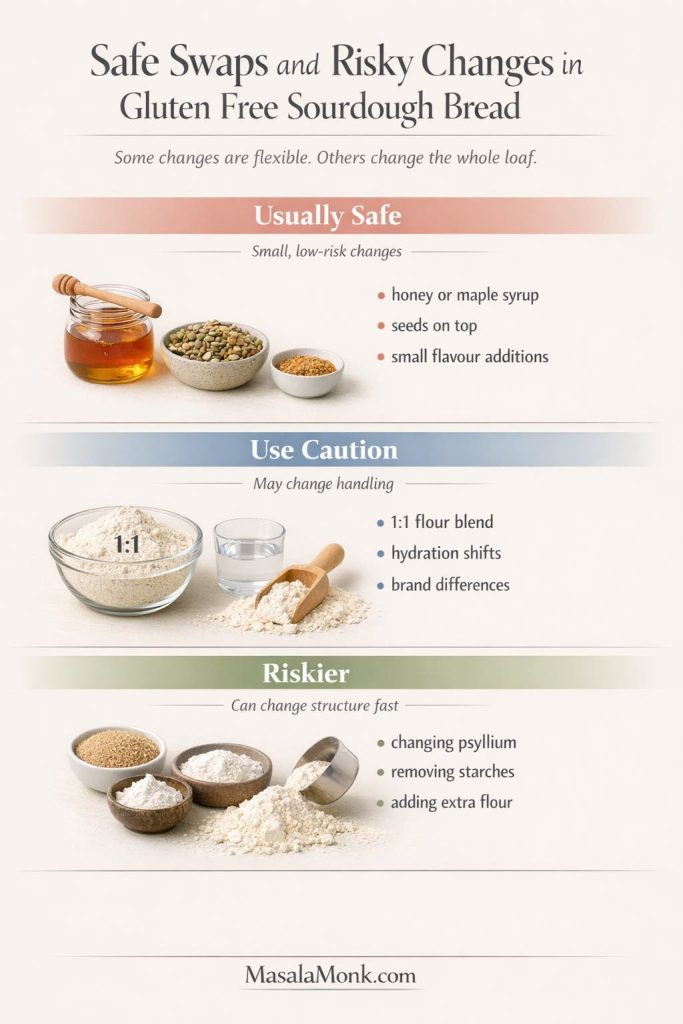
Substitutions: What Is Usually Safe and What Is Risky

Once a loaf works, it is tempting to start swapping ingredients casually. Some changes are manageable. Others can change structure, hydration, or proofing enough to make the dough feel like an entirely different recipe.

Guide to safe swaps and risky changes in gluten free sourdough bread showing usually safe changes, caution swaps, and riskier changes like changing psyllium, removing starches, or adding extra flour.
Not every gluten free sourdough swap carries the same risk, so this guide helps you separate small flexible changes from the ones that can quickly alter hydration, structure, and the feel of the loaf.
  • Usually safer: swapping honey for maple syrup, adding seeds on top, or making small flavor additions that do not change the dough’s structure much.
  • Use caution: replacing the custom blend with a 1:1 blend. This can work, but hydration may need adjustment and blends with added gums may handle differently.
  • Riskier: changing psyllium casually, removing starches wholesale, or adding extra flour just to make the dough feel more familiar.
  • Best first-bake rule: make the loaf once as written in the loaf pan, then experiment after you know what the dough should look like.

If you do adapt the flour route later, change one variable at a time. That makes it much easier to tell whether the difference came from flour absorption, starter behavior, proofing, or bake time.

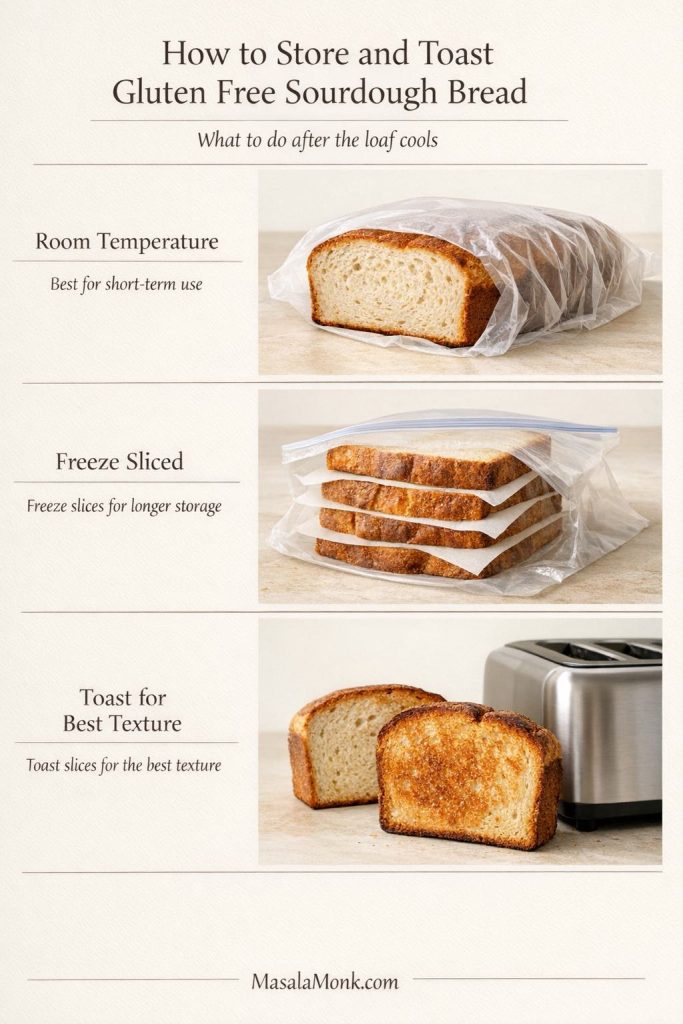
How to Store and Freeze Gluten Free Sourdough Bread

Gluten free sourdough changes noticeably over time, so storage matters more than many readers expect.

Storage guide for gluten free sourdough bread showing room-temperature storage, freezing sliced bread, and toasting for best texture.
Gluten free sourdough usually keeps best when you treat it in stages: short room-temperature storage for immediate use, sliced freezing for longer holding, and toasting later to bring the crumb back to its best texture.

The loaf is often at its best once fully cool and settled, then again the next day when sliced and toasted. Store it wrapped at room temperature for short-term use if your kitchen is cool and dry. For longer holding, sliced freezing is the better option.

Freeze slices individually or with parchment between them so you can toast only what you need. Toasting or reheating slices usually restores the texture more effectively than letting the loaf sit on the counter for days. In many kitchens, this is where it tastes most convincing.

Also Read: Mango Margarita Recipe (Frozen or On the Rocks)

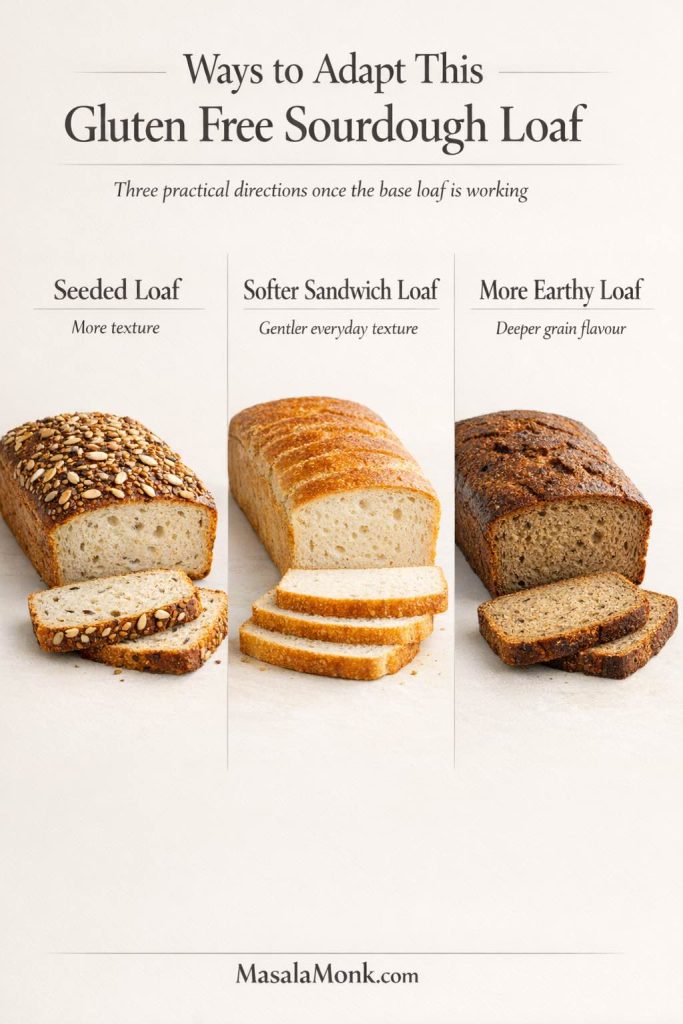
Variations That Make Sense

Once the base loaf works, small changes can make it more useful without rewriting the whole method.

Variation guide for gluten free sourdough bread showing a seeded loaf, a softer sandwich loaf, and a more earthy loaf.
Once the base gluten free sourdough loaf is working well, you can take it in a few practical directions by adding seeds for more texture, leaning softer for everyday sandwich slices, or going a little darker for a more earthy grain-forward loaf.

A seeded version adds texture and extra flavor to the crust. A softer sandwich-style loaf can be encouraged with a bit more oil and a gentler baking finish. For a more earthy whole-grain direction, adjust the darker flours thoughtfully rather than replacing the starches wholesale.

Once your starter is reliable, sourdough pizza dough is also an excellent next bake. Sourdough English muffins make another good follow-up when you want a different texture payoff without leaving the sourdough rhythm behind.

Frequently Asked Questions About Gluten Free Sourdough Bread

Can I make this without psyllium husk?

Not without rebuilding the formula. Psyllium is doing real structural work here, so removing it changes cohesion, hydration, and final texture all at once.

Can I use a 1:1 flour blend?

Yes, though hydration may need adjustment and the dough may behave differently depending on the blend. Some premade mixes also contain gums, which changes handling.

Can I use starter straight from the fridge?

Sometimes. A very healthy starter can still perform well after refrigeration, but refreshing it first is the safer choice when consistency matters.

Why didn’t my loaf double in size?

Because gluten free sourdough often does not need dramatic doubling to work well. Look for visible aeration and moderate expansion instead of a huge rise.

Why is it gummy even though it looks done?

The loaf may still be underbaked, or it may have been sliced too early. In this category, crust color alone is not enough. Internal temperature and full cooling matter.

Is sourdough bread gluten free?

Regular wheat sourdough is not automatically gluten free just because it ferments longer. For anyone managing celiac disease or a medically necessary gluten-free diet, this loaf needs to be made entirely with gluten free ingredients and handled carefully to avoid cross-contact. Packaged ingredients labeled gluten free and careful kitchen handling both matter.

Also Read: Falafel Recipe: Crispy Homemade, Air Fryer and Baked Falafel

Gluten Free Sourdough Bread Recipe Card

Gluten Free Sourdough Bread Recipe

Yield: 1 medium loaf
Prep time: about 20 minutes active work
Bulk fermentation: about 3 to 5 hours in many kitchens
Final proof: about 1 to 2 hours
Bake time: about 55 to 65 minutes
Cooling time: at least 3 to 4 hours

Tested format: 8½ x 4½-inch metal loaf pan, whole psyllium husk, active 100% hydration gluten free starter.

Ingredients

  • 150 g active gluten free sourdough starter, 100% hydration
  • 220 g brown rice flour
  • 120 g sorghum flour
  • 80 g tapioca starch
  • 40 g potato starch
  • 14 g whole psyllium husk
  • 10 g fine sea salt
  • 430 g warm water
  • 15 g olive oil
  • 10 g honey or maple syrup, optional

Method

  1. Whisk the warm water and psyllium husk together and let it thicken into a gel.
  2. Mix the flours, starches, and salt in a large bowl.
  3. Add the psyllium gel, starter, oil, and optional sweetener. Mix until no dry patches remain.
  4. Rest the dough for 15 to 20 minutes.
  5. Bulk ferment until visibly aerated and somewhat lighter, usually 3 to 5 hours.
  6. Transfer the dough to a prepared loaf pan and smooth the top.
  7. Proof until slightly expanded and modestly puffy, usually 1 to 2 hours.
  8. Bake at 230°C / 445°F for 20 minutes, then at 210°C / 410°F for 35 to 45 minutes more, until the loaf reaches about 96°C to 99°C / 205°F to 210°F internally.
  9. Cool completely before slicing.

Notes

  • A loaf pan is the most reliable format for this recipe.
  • This recipe is written in grams for consistency and easier troubleshooting.
  • Let the dough rest before deciding it is too wet or too stiff.
  • When the loaf seems unusually sluggish, fix the starter before changing the entire formula.
  • The loaf is ready to bake when it looks modestly puffy and lighter than before, not dramatically doubled.
  • The bread is fully baked when the crust looks set and the center reaches about 205°F to 210°F.

Final Notes for Making the Best Gluten Free Sourdough Bread

The best loaves usually come down to three things.

  • Use a genuinely ready starter.
  • Judge the dough by its own cues instead of by wheat expectations.
  • Bake and cool the loaf fully before slicing.

Once that rhythm is in place, this gluten free sourdough bread recipe becomes much less intimidating and much more repeatable. The next natural step is either strengthening your culture with the sourdough starter guide or branching into another starter bake such as sourdough pizza dough, Sourdough English muffins, or the broader sourdough bread recipes collection.

Posted on 3 Comments

All About Gluten: Symptoms, Testing, Diet & 7-Day Gluten-Free Meal Plan

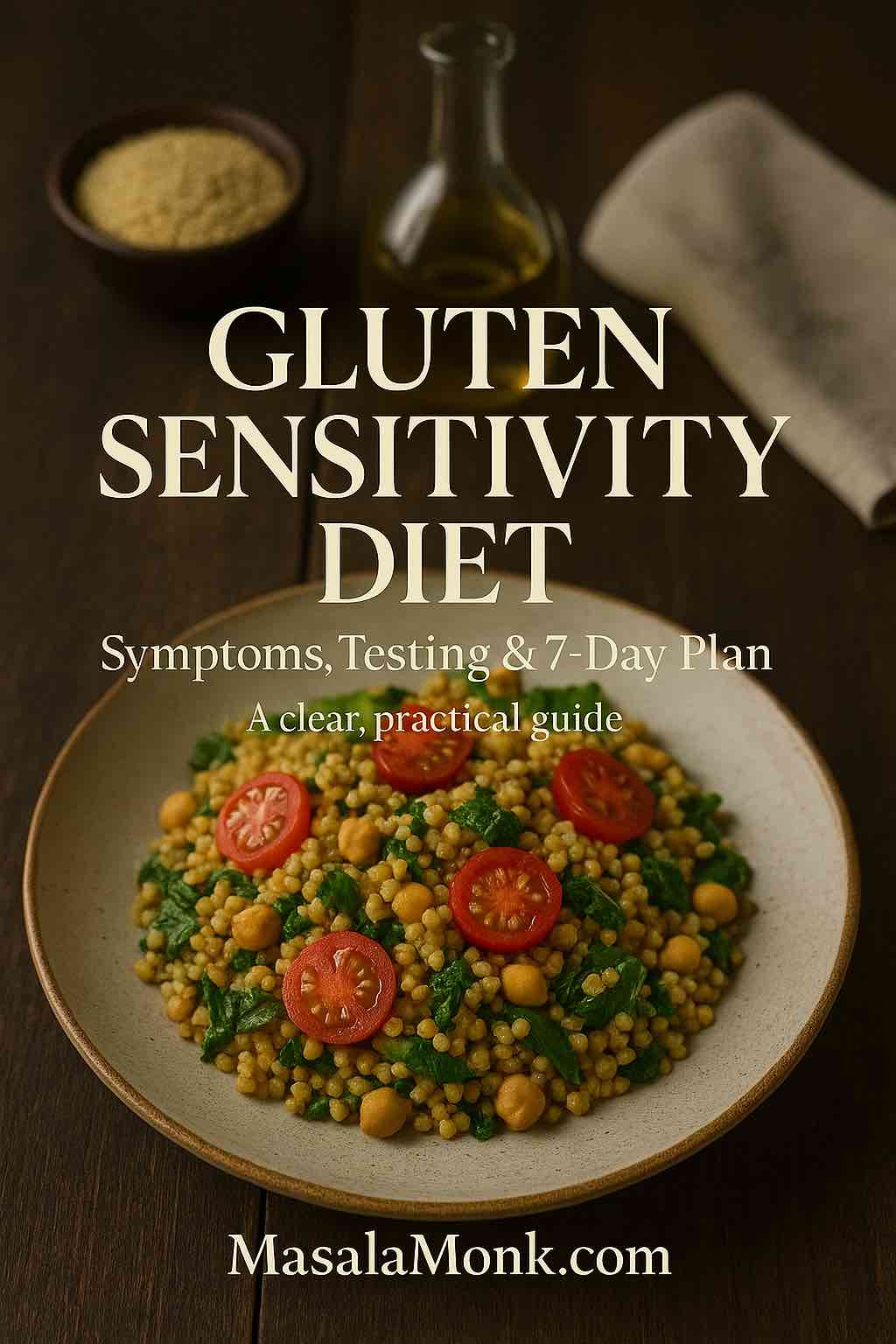
Portrait cover image for a gluten sensitivity diet: gluten-free millet salad on rustic table with text “Symptoms, Testing & 7-Day Plan” – MasalaMonk

If you’re wondering whether a gluten sensitivity diet could finally calm the bloating, brain fog, fatigue, or stubborn skin issues—you’re far from alone. Yet the landscape can be confusing: is it celiac disease, non-celiac gluten sensitivity (NCGS), or a wheat allergy? And once you figure that out, what exactly should you eat? This guide clears the path step by step—so you can move from guesswork to a steady routine that supports your gut, your energy, and your everyday life.

Before we dive into testing, food lists, and meal plans, a brief refresher helps. If you’re new to the topic, start with our quick primer on what gluten actually is—it’ll make everything else easier to follow.

⚠️ Disclaimer: This article is for educational purposes only and is not medical advice. It does not diagnose, treat, cure, or prevent any condition. Always consult a qualified healthcare professional for personalized guidance, especially before starting a gluten sensitivity diet, changing medications, or interpreting tests. If you have urgent or severe symptoms, seek medical care immediately.


Celiac, NCGS, or Wheat Allergy—Why Your Diagnosis Shapes the Gluten Sensitivity Diet

Although the symptoms can overlap, these conditions aren’t the same—and the plan you follow depends on which one you have.

  • Celiac disease (CeD) is an autoimmune condition: gluten triggers immune damage in the small intestine. Left untreated, it can lead to nutrient deficiencies, anemia, bone loss, and more.
  • Non-celiac gluten sensitivity (NCGS) involves gluten-related symptoms without celiac’s intestinal damage and without wheat-allergy markers. Interestingly, a subset of people with NCGS-like symptoms may actually be reacting to fructans (fermentable carbohydrates found in wheat) rather than gluten itself; Monash’s overview explains how wheat is rich in fructans, and a randomized trial explored whether fructans—not gluten—trigger symptoms in some. See Monash on wheat and fructans and the study via PubMed.
  • Wheat allergy is an IgE-mediated allergy to wheat proteins (not just gluten). Reactions can include hives, wheezing, and—rarely—anaphylaxis, which clearly requires a different approach.

Because treatment and strictness differ, testing first—and only then committing to a gluten sensitivity diet—is the smartest move.


Gluten Sensitivity Symptoms: What to Watch For

If you’re considering a gluten sensitivity diet, it helps to recognize the most common gluten intolerance symptoms first. Although everyone’s experience differs, the patterns below appear consistently in clinical summaries and patient reports.

Core digestive signs of Gluten Sensitivity

To begin with, keep an eye on:

  • Bloating and gas (often within hours)
  • Abdominal pain or cramping
  • Diarrhea, constipation, or an alternating pattern
  • Nausea and early fullness
  • Reflux/heartburn after wheat-heavy meals

For a clear, medical overview of GI complaints (including how they differ by age), see the NIDDK symptom summary and the Celiac Disease Foundation symptoms list.

Extra-intestinal symptoms of Gluten Sensitivity (the sneaky ones)

Meanwhile, many people notice issues outside the gut: persistent fatigue, brain fog or headaches, mood changes, joint or muscle aches, and skin flares. For accessible detail, skim Mayo Clinic’s celiac symptoms page.

Possible nutrient-deficiency clues of Gluten Sensitivity

Over time, malabsorption can show up as iron-deficiency signs (dizziness, brittle nails), mouth ulcers, or even hair thinning. Notably, dental enamel defects in kids can be an early clue—dentists are encouraged to refer when they spot tell-tale enamel patterns. Start with the NIDDK note on enamel defects and CDF’s oral-health overview.

In children (additional pointers on Gluten Sensitivity )

By contrast, kids may present with growth faltering, frequent tummy aches, loose stools, or irritability—sometimes long before anyone suspects gluten. A concise digest for families appears in CDF’s symptoms page and the NIDDK children overview.

Timing, dose, and patterns

Just as important, symptoms can spike within 30 minutes up to 48 hours after eating gluten. Some people notice a dose–response (bigger portions → bigger flares). Others discover that wheat’s fructans—a FODMAP, not gluten—drive bloating and gas; in that case, a short low-FODMAP strategy (not lifelong strict GF) may help. For context, read Monash on avoiding wheat during the low-FODMAP phase and their brief fructan/oligos explainer.

When to seek care (don’t DIY this part)

However, certain red flags need prompt medical evaluation rather than diet trials: unintentional weight loss, blood in stool, persistent vomiting, fever, severe dehydration, or night sweats. A reliable, plain-English checklist appears in Mayo Clinic’s guidance.

Quick self-audit before you change everything

Before you overhaul your routine, keep a 3–5 day food & symptom log (time eaten, portion, symptoms 0–10). Note oats, sauces/spice blends, and possible cross-contact (shared fryers, toasters, or boards). Bring the log to your appointment; clinicians can then decide on testing first—and only afterward a tailored gluten sensitivity diet. For accuracy, remember you should be on gluten before serology; the rationale is laid out in the NIDDK provider handout.


Testing First (Then Diet): How to Avoid False Negatives and Frustration

Here’s the crucial rule many people miss: don’t remove gluten before screening, or blood tests can turn falsely negative.

  • First-line bloodwork typically includes tissue transglutaminase IgA (tTG-IgA) with a total IgA to check for IgA deficiency. Some clinicians add deamidated gliadin (DGP) antibodies, particularly in younger children. For approachable, trustworthy guidance, see the American College of Gastroenterology’s celiac disease overview and the NIDDK’s clear explainer for clinicians and patients on celiac testing.
  • Confirmation: when screens are positive, specialists usually confirm celiac disease with an endoscopy and small-bowel biopsies.
  • Why “stay on gluten” matters: the NIDDK’s provider handout is explicit—patients should be consuming gluten before testing to ensure accuracy. Skipping this step risks months of confusion. See the NIDDK PDF guidance: Provider Points—Celiac Disease.

Once you’re properly screened, you can commit to the right path—be it a strict celiac protocol or a carefully structured gluten sensitivity diet for non-celiac cases.

⚠️ Disclaimer: This article is for educational purposes only and is not medical advice. It does not diagnose, treat, cure, or prevent any condition. Always consult a qualified healthcare professional for personalized guidance, especially before starting a gluten sensitivity diet, changing medications, or interpreting tests. If you have urgent or severe symptoms, seek medical care immediately.


“Is It Gluten-Free?”—Clear Answers You Can Trust (So Labels Don’t Drive You Mad)

Label reading gets overwhelming quickly; nevertheless, a few rules of thumb dramatically reduce stress.

  • Oats / Oatmeal: Oats are naturally gluten-free, but they’re frequently contaminated with wheat, barley, or rye during harvesting and processing. Choose certified gluten-free oats and introduce them gradually if you’re sensitive; a small subset of people reacts to avenin (the oat protein). For a balanced overview, see the Celiac Disease Foundation’s explainer on oats and contamination. Meanwhile, the FDA clarifies that gluten-free claims generally mean <20 ppm gluten—use their resources to understand labels: FDA gluten & food labeling and the consumer piece, Gluten-Free Means What It Says.
    For kitchen-level practicality, compare our quick primers on rolled vs old-fashioned oats and quick vs instant oats.
  • Sourdough bread: Despite the buzz, regular wheat sourdough is not gluten-free or celiac-safe. Only sourdough made entirely with gluten-free grains and a gluten-free starter is safe. For clarity, see Beyond Celiac—Is sourdough bread gluten-free?.
  • Quinoa: Naturally gluten-free, higher in protein than most grains, and fantastic for pulao, upma, bowls, and salads.
  • Coffee: Plain black coffee is gluten-free; flavored products may vary—check labels.
  • Ezekiel bread: The classic sprouted version contains wheat; it’s not gluten-free. If you love the texture, look specifically for GF-labeled sprouted breads.

Meanwhile, many Indian staples are naturally GF. To diversify your pantry (and your recipes), explore our primer on millets—the gluten-free superfood.


The Core of a Gluten Sensitivity Diet (So You Feel Satiated, Not Deprived)

A sustainable gluten sensitivity diet leans on naturally gluten-free foods, treats packaged items with care, and prioritizes satisfaction (so you’ll actually stick with it).

Build your plate around:

  • Protein: dal, chickpeas, rajma, tofu/tempeh, paneer, eggs, fish, chicken.
  • High-fiber carbs: rice, millets (jowar, bajra, ragi), quinoa, potatoes, sweet potatoes, buckwheat (kuttu).
  • Colorful plants: as many vegetables and fruits as you’ll enjoy daily.
  • Healthy fats: olive oil, ghee (if tolerated), avocado, nuts and seeds.
  • Smart pantry swaps: GF tamari (instead of soy sauce), GF pasta when you want convenience, chickpea flour (besan), tapioca, and cornstarch for binding and crisping.

Label-reading shortcut: Prefer products clearly marked “gluten-free.” In many markets, that aligns with the <20 ppm rule; the FDA pages above are handy to link inside your shopping sections so readers can fact-check in one tap.

Treats, thoughtfully: A little joy helps long-term adherence. Keep a couple of easy add-ons—like our quick dairy- and gluten-free chocolate syrup for pancakes, fruit, or yogurt (or dairy-free alt).


Pantry Setup and Batch-Cooking: The Secret Sauce of Consistency

Because weeknights are busy, a gluten sensitivity diet works best when your kitchen is prepped for “grab-and-combine.”

Your weekend hour, well spent:

  1. Cook two grains (say, quinoa and rice or millet) and refrigerate in clear containers.
  2. Pressure-cook two legumes (moong/masoor or chickpeas/rajma) and freeze in meal-size portions.
  3. Prep sauces you love—tahini-lemon, mint-yogurt (or coconut yogurt), and a jar of GF tamari-ginger.
  4. Wash and chop a big tray of vegetables; store in zip bags or boxes for stir-fries, upma, khichdi, bowls, and quick sides.

As a result, dinner becomes assembly: grain + protein + veg + sauce. Ten minutes, tops.

Also Read: How to Make Lentil Patties that Are Better Than Meat? Vegan Protein-Rich Recipe.


Your 7-Day Gluten Sensitivity Diet Meal Plan (Flexible, Flavor-First, and Realistic)

This plan favors batch cooking and repeats pantry staples to lower effort. Nevertheless, it remains varied—so you won’t feel boxed in. Wherever helpful, we’ve linked to MasalaMonk ideas you can plug in immediately.

Day 1

  • Breakfast: Certified GF oats porridge with chia + berries (add cinnamon)
  • Lunch: Millet khichdi (moong + carrots/peas) with a squeeze of lemon
  • Dinner: Lemon rice + sautéed paneer/veg or chicken tikka (check spice blends are GF)
  • Snack: Roasted chana; seasonal fruit

Day 2

  • Breakfast: Ragi dosa + coconut chutney
  • Lunch: Quinoa pulao with peas and carrots
  • Dinner: Grilled fish (or tandoori chicken), herbed potatoes, kachumber salad
  • Snack: Yogurt (or coconut yogurt) with seeds and a drizzle of honey

Day 3

  • Breakfast: Millet pancakes with a light drizzle of our gluten-free chocolate syrup recipe.
  • Lunch: Brown rice + rajma (verify masala blends are GF)
  • Dinner: Stir-fried tofu/veg with GF tamari; top with sesame seeds (for more plant-based swap ideas, see our lentil-forward meal prep guide)
  • Snack: Peanut chaat with lemon

Day 4

  • Breakfast: Besan chilla + mint chutney
  • Lunch: Kuttu (buckwheat) rotis + mixed sabzi
  • Dinner: Baked sweet potato, black beans, salsa, avocado (squeeze of lime)
  • Snack: A small handful of nuts + dates

Day 5

  • Breakfast: Poha (confirm GF processing) with peanuts and coriander
  • Lunch: Quinoa upma with mixed vegetables
  • Dinner: Rice, dal tadka, cucumber salad
  • Snack: Roasted makhana, lightly spiced

Day 6

  • Breakfast: Smoothie (banana, spinach, peanut butter, milk or plant milk)
  • Lunch: Millet bowl—jowar, chickpeas, roasted veg, tahini-lemon dressing
  • Dinner: GF pasta aglio e olio with tomatoes and basil; side salad
  • Snack: Dark chocolate (check label)

Day 7

  • Breakfast: Scramble (eggs or tofu) with peppers and onions
  • Lunch: Rice paper rolls (shrimp or tofu) + peanut dip (GF)
  • Dinner: Slow-cooked dal + jeera rice + kachumber
  • Snack: Hummus with veggie sticks

Dairy-free tweaks: Swap yogurt/milk for coconut or almond options; use olive oil or ghee if tolerated. Additionally, consider a calcium source (tofu set with calcium, leafy greens, fortified plant milks) if you’re dairy-free long-term.


Shopping Made Simple (Copy This to Notes Before You Head Out)

Grains & starches: basmati + parboiled rice, quinoa, millets (jowar, bajra, ragi), certified GF oats, buckwheat flour, potatoes, sweet potatoes, GF pasta.
Proteins: eggs, chicken/fish, paneer/tofu/tempeh, moong, masoor, chickpeas, rajma.
Pantry & swaps: besan, cornstarch, tapioca, GF tamari, tomato paste, coconut milk, tahini, seeds (chia/linseed), nuts, extra-virgin olive oil.
Spices: prefer single-ingredient spices; double-check blends for wheat fillers.
Treats & condiments: dark chocolate (check label), honey, nut butters, etc.

When deciding between brands, opt for those clearly marked “gluten-free,” which (in many regions) aligns with the <20 ppm standard; the FDA’s resources are concise and dependable: Gluten & Food Labeling and Gluten-Free Means What It Says.


Cross-Contact: The Invisible Gotcha (and How to Avoid It)

Even with perfect shopping, cross-contact can undo your efforts—especially if someone at home still eats gluten. Therefore:

  • Divide utensils and surfaces: dedicate a toaster, cutting board, and strainer for GF foods.
  • Handle flour carefully: airborne flour can linger; keep GF prep separate in time and space.
  • Fryers and oil: avoid shared fryers; batter residues contaminate oil.
  • Sauces and spreads: use squeeze bottles or separate knives; crumbs are sneaky.

These small systems are the backbone of a reliable gluten sensitivity diet at home.


Eating Out Without Anxiety (And Actually Enjoying It)

Restaurants vary widely in their knowledge and kitchen setup; cross-contact can happen in shared fryers, toasters, or chopping boards. Nevertheless, you can dine out more confidently by calling ahead, asking about separate prep areas, and clarifying sauces, marinades, and dessert toppings.

For discovery, use tools that crowdsource experience and certification. Apps like Find Me Gluten Free are a practical starting point, while the National Celiac Association’s restaurant resources can point you toward vetted venues and programs.


Troubleshooting Symptoms on a Gluten Sensitivity Diet (When You’re Still Not Feeling Great)

Sometimes, even after removing gluten, symptoms linger. In that case, consider a short, structured audit:

  1. Hidden gluten: re-check spice blends, sauces, and “natural flavors.” If in doubt, switch to single-ingredient spices and brands that explicitly label GF.
  2. Cross-contact: scrutinize toasters, fryers, wooden spoons, cutting boards, and baking trays.
  3. Oats tolerance: even certified GF oats can bother a subset of people; remove oats for 2–3 weeks and reassess. For background on why certified oats matter, read the CDF oats explainer above and the FDA labeling resources.
  4. FODMAP overlap: if gas, bloating, or pain are dominant, consider whether fructans and other FODMAPs might be the bigger trigger; Monash’s guidance is especially practical for this. See Monash on wheat/fructans.
  5. Nutrition review: check iron, B12, folate, vitamin D if fatigue persists—speak with your clinician about labs and tailored supplementation.

When in doubt, circle back to your clinician, share your food log, and refine from there.


Weight Loss—or Gain—on a Gluten Sensitivity Diet

Going gluten-free doesn’t automatically cause weight change; energy balance and satiety still rule. However, a gluten sensitivity diet that’s rich in protein, fiber, and minimally processed foods tends to stabilize appetite.

  • If your goal is weight loss: base meals around protein (dal, chickpeas, tofu, fish/chicken) and high-fiber carbs (millets, quinoa), load up on vegetables, and keep sauces simple.
  • If your goal is healthy weight gain: fold in energy-dense but nutrient-rich picks—tahini, nut butters, olive oil, avocado—and, for to find other great options for a weight gain diet, read our post on Best Weight Gain Foods for Fast, Healthy Gains.

Either way, consistency beats perfection; the plan you repeat wins.


Bringing It Together: Your Next Three Steps

  1. Finish testing (if pending), then commit: after proper screening, decide with your clinician whether you need a strict celiac protocol or a flexible gluten sensitivity diet. Start with the ACG’s overview and NIDDK’s testing guidance to feel confident in the process: ACG—Celiac Disease and NIDDK—Diagnosis.
  2. Stock your pantry and prep once: set up two grains, two legumes, and two sauces every weekend. For variety—especially at breakfast—lean on millets as a gluten-free superfood and customize with oats if you tolerate certified GF oats (use our oat primers on rolled vs old-fashioned and quick vs instant).
  3. Batch-cook and repeat favorites: pick two days from the 7-day plan and double them next week. Consequently, you’ll eat well without starting from scratch each evening.

Final Word (and Why This Works)

A gluten sensitivity diet doesn’t have to feel restrictive. Instead, by emphasizing naturally gluten-free foods, verifying labels, and building meals you actually enjoy, you can reduce symptoms while staying satisfied. Furthermore, the framework above keeps decisions simple: protein + fiber-rich carbs + plants + a little fat. Over time, that combination steadies digestion, improves energy, and makes “eating gluten-free” feel like a normal, delicious routine—not a medical chore.

And remember: your best plan is the one you’ll gladly follow. Start small, iterate weekly, and keep it tasty.


⚠️ Disclaimer: This article is for educational purposes only and is not medical advice. It does not diagnose, treat, cure, or prevent any condition. Always consult a qualified healthcare professional for personalized guidance, especially before starting a gluten sensitivity diet, changing medications, or interpreting tests. If you have urgent or severe symptoms, seek medical care immediately.


FAQs

1) What is a gluten sensitivity diet—and who needs it?

A gluten sensitivity diet is an eating pattern that removes gluten (proteins in wheat, barley, and rye) to reduce symptoms like bloating, brain fog, fatigue, and skin issues. It’s used by people with diagnosed celiac disease, suspected non-celiac gluten sensitivity (NCGS), or those advised by a clinician to trial gluten removal. Importantly, test for celiac disease before starting the diet to avoid false negatives.

2) What are the most common signs and symptoms of gluten intolerance?

Typical symptoms include abdominal pain, bloating, gas, diarrhea or constipation, nausea, headaches, brain fog, fatigue, and sometimes skin rashes. Additionally, some notice joint pain or mood changes. However, symptoms alone can’t confirm the cause—proper testing is key.

3) How is gluten intolerance different from celiac disease and wheat allergy?

Celiac disease is an autoimmune condition that damages the small intestine when gluten is eaten. NCGS causes symptoms without that autoimmune damage or IgE allergy markers. Meanwhile, wheat allergy is an IgE-mediated response to wheat proteins (not just gluten) and may involve hives, wheezing, or, rarely, anaphylaxis. Consequently, each requires a different management plan.

4) Which blood tests are used to check for celiac disease?

Common first-line tests include tTG-IgA plus a total IgA check. In certain cases (for example, young children), DGP antibodies may be used. Nevertheless, you must be eating gluten for a period before testing; otherwise, results may be inaccurate.

5) What does a strict gluten-free diet actually include?

Focus on naturally gluten-free foods: rice, millets (jowar, bajra, ragi), quinoa, potatoes, sweet potatoes, legumes, eggs, poultry, fish, meat, fruits, vegetables, and most dairy (if tolerated). Additionally, keep pantry swaps handy—GF pasta, chickpea flour (besan), cornstarch, tapioca, and gluten-free tamari.

6) Are oats gluten free?

Oats are naturally gluten-free; however, they’re often contaminated during farming or processing. Choose certified gluten-free oats and introduce slowly. A small subset of people may still be sensitive to avenin (oat protein), so monitor how you feel.

7) Is sourdough bread gluten free?

Regular wheat sourdough is not gluten-free, even though fermentation reduces some gluten. Only loaves made entirely with gluten-free flours and starters are safe on a gluten sensitivity diet.

8) Is quinoa gluten free—and is it a good substitute?

Yes. Quinoa is naturally gluten-free, high in protein, and versatile. Moreover, it cooks quickly and works in pulao, upma, salads, and warm bowls, making it a smart staple for beginners.

9) What about Ezekiel bread, spaghetti, and coffee?

Traditional Ezekiel bread (sprouted grains) contains wheat and is not gluten-free. Choose GF-labeled breads instead. As for spaghetti, select gluten-free versions made from rice, corn, quinoa, or legumes. Plain coffee is naturally gluten-free; flavored products may vary, so always check labels.

10) Can a gluten sensitivity diet be both gluten-free and dairy-free?

Absolutely. Many people also remove lactose or dairy to troubleshoot symptoms. Consequently, use alternatives like almond or coconut yogurt, lactose-free milk, or tofu/paneer swaps if tolerated. Still, prioritize balanced meals with protein, fiber-rich carbs, healthy fats, and plenty of vegetables.

11) How do I handle eating out or “gluten-free near me” situations?

Call ahead and ask about separate prep areas, dedicated fryers, and ingredient lists. Additionally, explain cross-contact (shared toasters, cutting boards, or oil) and request simple grilled or steamed options with sauces on the side. Ultimately, clear questions lead to safer plates.

12) What is cross-contact—and why does it matter so much?

Cross-contact happens when gluten-containing foods or crumbs touch gluten-free items. Even tiny amounts can trigger symptoms for sensitive individuals. Therefore, at home, keep separate toasters, strainers, cutting boards, and knives for GF foods; in restaurants, ask about shared fryers and prep surfaces.

13) Can a gluten sensitivity diet help with weight loss—or weight gain?

It can support either goal when you structure meals well. For weight loss, anchor plates around protein and high-fiber carbs (millets, quinoa) and keep sauces light. For healthy weight gain, add energy-dense options—nut butters, tahini, olive oil, avocado—while still avoiding gluten. Ultimately, consistency beats perfection.

14) Do I need supplements on a gluten-free plan?

Maybe. Some people benefit from iron, B12, folate, vitamin D, or calcium depending on labs and intake. However, don’t self-supplement blindly. Instead, review symptoms, diet quality, and testing with a healthcare professional for a tailored plan.

15) What are the effects of gluten sensitivity if I don’t change my diet?

You might experience ongoing GI issues, fatigue, headaches, or skin flare-ups. In celiac disease specifically, continued gluten exposure can damage the small intestine and affect absorption. Consequently, accurate testing and an appropriate dietary plan are essential.

16) Can millets and other traditional grains fit into a gluten sensitivity diet?

Yes—beautifully. Millets like jowar, bajra, and ragi are naturally gluten-free and fiber-rich. Additionally, they’re easy to batch-cook and pair well with dals, veggies, and lean proteins, keeping meals satisfying and diverse.

17) How do I start a beginner-friendly gluten-free meal plan?

Begin with a simple 7-day rotation: two grains (say, rice and millet), two legumes (moong/rajma), and two sauces (tahini-lemon and a GF tamari mix). Batch-cook on the weekend. Consequently, weeknights become quick assemblies—grain + protein + veg + sauce—in under 15 minutes.

18) Will going gluten-free help hypothyroidism or Hashimoto’s?

Some individuals report symptom improvements, but evidence is mixed. Nevertheless, if you have Hashimoto’s and persistent symptoms, discuss a supervised trial with your clinician—especially to ensure adequate nutrients (selenium, iodine, iron, vitamin D) and to avoid unnecessary restriction.

19) What’s the best gluten intolerance or sensitivity test I can take at home?

Home kits exist, yet they can’t replace clinical evaluation. Moreover, interpretation is tricky, and some tests aren’t validated for diagnosis. Ideally, coordinate testing with your clinician, remain on gluten beforehand, and follow up with appropriate confirmation if results are positive.

20) What does a “strict gluten-free diet” look like day to day?

It means avoiding wheat, barley, rye, and cross-contact—every day. Additionally, you’ll read labels for hidden gluten in sauces, spice blends, and processed foods; choose clearly GF-labeled items; and set up separate kitchen tools where needed. Ultimately, it becomes routine—and much easier than it sounds.

Posted on Leave a comment

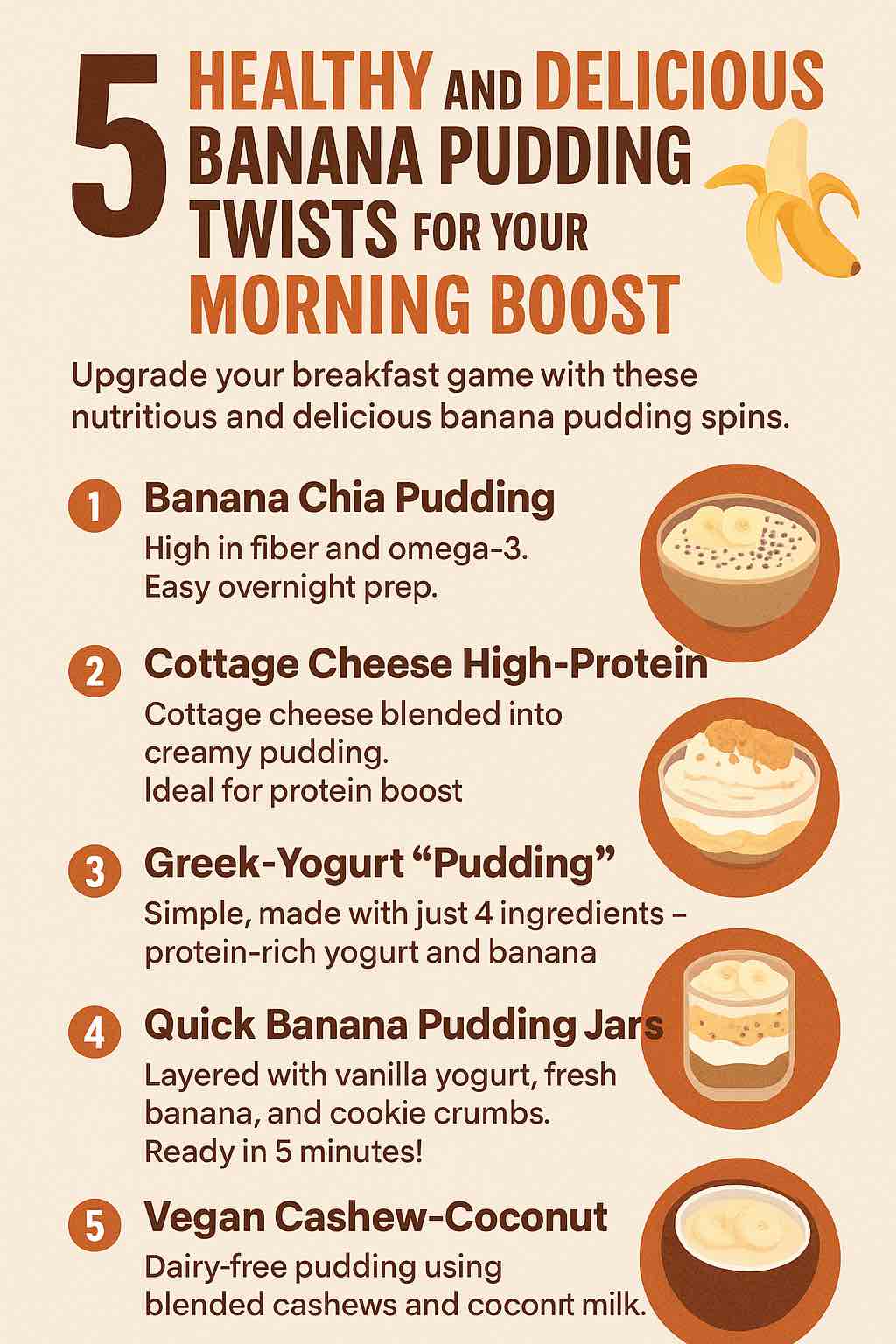
How to Make Banana Pudding? 5 Healthy Breakfast Twists

BANANA PUDDING TWISTS FOR YOUR MORNING BOOST

Banana pudding is more than just a Southern dessert classic. With the right ingredients and a little creativity, it can be transformed into a nourishing, energy-packed breakfast. Whether you’re rushing out the door or looking for a slow, satisfying morning, these five healthy twists on banana pudding bring all the comfort and sweetness you crave without the sugar crash.


1. Banana-Chia Power Pudding

Why it works: Packed with fiber, omega-3s, and antioxidants, chia seeds pair beautifully with bananas to create a naturally sweet, pudding-like breakfast that feels indulgent but is totally guilt-free.

Ingredients:

  • 2 ripe bananas (mashed)
  • 2 cups unsweetened almond or oat milk
  • 6 tbsp chia seeds
  • 1 tsp vanilla extract
  • Optional: pinch of cinnamon or nutmeg

Instructions:

  1. Mash bananas in a bowl until smooth.
  2. Stir in milk, chia seeds, and vanilla extract.
  3. Let sit for 15 minutes, stir again to prevent clumps.
  4. Cover and refrigerate overnight.
  5. Serve with berries or crushed nuts in the morning.

Prep Tip: Stir again after 30 minutes to help the chia gel evenly.

Nutrition Per Serving: Approx. 180 calories, 6g protein, 9g fiber


2. Banana Pudding Overnight Oats

Why it works: Oats make this a hearty, slow-digesting option that keeps you full all morning. The banana and vanilla combo adds natural sweetness, and layering gives it that pudding parfait feel.

Ingredients:

  • 1 ripe banana (mashed)
  • 1/2 cup rolled oats
  • 1/2 cup Greek yogurt or plant-based yogurt
  • 1/2 cup almond milk
  • 1 tsp vanilla extract
  • Optional: chopped walnuts, honey, or cinnamon

Instructions:

  1. Mix all ingredients together in a mason jar or container.
  2. Refrigerate overnight.
  3. In the morning, stir and add desired toppings.

Meal Prep Friendly: Make 2–3 jars ahead for the week.

Nutrition Per Serving: Approx. 250 calories, 10g protein, 5g fiber


3. High-Protein Cottage Cheese Banana Pudding

Why it works: This twist brings a creamy texture and a big protein punch. Perfect post-workout or when you’re craving something richer without being heavy.

Ingredients:

  • 1 cup low-fat cottage cheese
  • 1 ripe banana
  • 1/2 tsp vanilla extract
  • 1 scoop vanilla protein powder (optional)
  • Optional: sweetener of choice (e.g. maple syrup, stevia)

Instructions:

  1. Blend all ingredients until smooth.
  2. Chill for 30 minutes for a thicker consistency.
  3. Top with crushed whole-grain wafers, sliced bananas, or nuts.

Quick Hack: No blender? Just mash banana and stir in the rest.

Nutrition Per Serving: Approx. 300 calories, 20–25g protein


4. Vegan Cashew-Coconut Banana Pudding

Why it works: This creamy, dairy-free version uses healthy fats from cashews and coconut milk for richness and a subtle tropical flavor.

Ingredients:

  • 1/2 cup soaked cashews (4–6 hours)
  • 1 ripe banana
  • 1/2 cup coconut milk
  • 1 tbsp maple syrup
  • 1/2 tsp vanilla extract
  • 1 tsp lemon juice

Instructions:

  1. Blend all ingredients until creamy.
  2. Chill for 1 hour or overnight.
  3. Top with toasted coconut flakes or berries.

Vegan Delight: A crowd-pleaser for plant-based diets.

Nutrition Per Serving: Approx. 290 calories, 4g protein, healthy fats


5. Banana Pudding Breakfast Jars (5-Minute Meal Prep)

Why it works: The fastest, most customizable version. Use Greek yogurt or Skyr, banana, and crunchy toppings for a pudding-meets-parfait hybrid.

Ingredients:

  • 1/2 cup Greek yogurt or Skyr
  • 1 ripe banana (sliced or mashed)
  • 1 tbsp nut butter (optional)
  • Crushed whole-grain crackers, seeds, or granola

Instructions:

  1. Layer yogurt, banana, and crunch toppings in a jar.
  2. Eat immediately or refrigerate for up to 2 days.

On-the-Go Bonus: Great for kids and adults alike.

Nutrition Per Serving: Approx. 250–300 calories, depending on toppings


Final Thoughts

Banana pudding doesn’t need to be a sugar-laden dessert. With these five variations, you can turn this comforting favorite into a nutritious, protein-rich, and fiber-packed breakfast. From overnight oats to vegan delights, there’s a banana pudding twist for every palate and dietary need.

Tip: Always use ripe bananas—they’re sweeter and easier to digest. Add texture with nuts, seeds, and spices like cinnamon or cardamom.

Let breakfast be something you look forward to, not just another task. Try one of these banana pudding twists tomorrow morning—and fuel your day with something as good for your body as it is for your taste buds.


Have a favorite banana pudding recipe or twist? Share it in the comments below or tag us with your creations! #BananaPuddingBreakfast

FAQs

  1. Can I make these banana pudding breakfasts ahead of time?
    Yes! Most of these recipes (especially chia pudding and overnight oats) are ideal for meal prep. They stay fresh in the fridge for 3–5 days.
  2. Are these recipes suitable for kids?
    Absolutely. Kids love the natural sweetness of bananas. Just skip added sweeteners if desired and use nut-free toppings for school safety.
  3. Can I use frozen bananas?
    Yes, thaw them first. Frozen bananas work great for blended recipes like the cottage cheese or vegan cashew pudding.
  4. How ripe should the bananas be?
    Use ripe bananas with brown spots—they’re sweeter, easier to mash/blend, and better for digestion.
  5. What can I substitute for chia seeds if I don’t have them?
    You can use ground flaxseed or just skip them and increase oats or thick yogurt depending on the recipe.
  6. Are these recipes gluten-free?
    Most are naturally gluten-free—just ensure toppings (like granola or wafers) are certified gluten-free if needed.
  7. Which recipe is highest in protein?
    The Cottage Cheese Banana Pudding (with optional protein powder) and Greek Yogurt Jars offer 20g+ protein per serving.
  8. What non-dairy milk works best?
    Unsweetened almond, oat, or coconut milk are great options depending on your flavor preference.
  9. Can I use these recipes for weight loss?
    Yes. They are high in fiber, protein, and healthy fats—great for satiety. Portion control and balanced toppings help optimize them for weight goals.
  10. How can I add crunch or texture to these puddings?
    Add nuts, seeds (like pumpkin or sunflower), toasted coconut, granola, or crushed crackers for contrast and extra nutrients.
Posted on 3 Comments

Fermented RAGI (Finger Millet) IDLIS- Gluten Free | Gut Friendly | Breakfast Recipe

At home Idlis is our favourite breakfast. Ragi idli is a nutritious wholesome South Indian meal. They are light, easy on stomach and have tremendous health benefits. Idlis are like steamed cakes made with lentils and idli rice. Ragi idli is just another variation where ragi is replaced by rice. The batter of these ragi idlis will also be beneficial for making dosas the next day. I like to serve these millet idlis with Coconut Chutney or Kara Chutney.

Ragi idli is made using idli rice, flattened rice (poha), ragi flour, urad dal and fenugreek seeds. The ingredients are first soaked and then the batter is prepared by grinding the ingredients followed by fermentation, then the batter is steamed to make idlis. This batter yields consistent results. The idlis will always be pillowy soft and totally melt in mouth.

Not just Ragi idlis or dosas, if you are a pancake lover, you can also try these, Ragi Pancakes or these Millet Cutlets which you can easily make at home in 10 minutes using minimal oil. They come out absolutely delicious and are so healthy.

Given the health benefits of ragi, these steamed cakes become a superfood which not only has benefits of whole grains, but it is also fermented. 

Why fermented food is good for you? 

Fermented foods like idli, dhokla, dosa are a fabulous addition to your diet.

  • It helps in increasing immunity and improves digestion. 
  • It also increases the bio availability of minerals. It breaks down proteins, carbohydrates and other minerals in a way making it easily available to our body. 
  • Also a lot of good bacterias are at play when your food is fermenting. All fermented foods are natural probiotic. It’ll strengthen your immune system making you disease resistant.
  • The lactic acid bacteria which helps in fermentation also creates omega 3 fatty acids, essential for the immune system. It will help to remove toxins and helps your body build a healthy gut flora. 

Here are 5 excellent reasons why this millet should be in your diet.

  1. High fibre content: Ragi is high in dietary fibre which will help to promote proper digestion and keep your bowel movements in check. 
  2. Rich in Calcium: It is an ultimate non-dairy source of calcium. Just 100 grams of Ragi can give you 344 mg of calcium.
  3. Supports Gluten- Free Diet: Ragi is a great choice if you are on a gluten-free diet – it’s naturally gluten-free! No need to worry about hidden gluten as it’s a safe and delicious way to enjoy your meals.
  4. Child Nutrition: It helps to fulfil child’s nutritional needs. It is rich in protein, calcium, iron, zinc and other essential nutrients.
  5. Treats Anaemia: Since Ragi is an excellent source of iron too, which is essential for producing red blood cells, it helps to fight off anaemia.

With all such goodness and nutrition packed in this humble dish, let’s get to the recipe now

Recipe: serves 4

Ingredients: measuring cup size 250 ml

  1. Ragi flour: 1 cup
  2. Idli Rice/Parboiled Rice or Broken Rice: 1 cup
  3. White Split Urad dal: 1/2 cup
  4. Flattened Rice/Poha: 1/4th cup
  5. Fenugreek seeds/Methi dana: 1/4th tsp
  6. Rock Salt or any non-iodised salt: As per taste
  7. Oil/ghee for greasing
  8. Water as required for making batter and steaming 

Method: 

  • Wash rice and poha 3 to 4 times. Soak them in enough water for 5 hours. 
  • Wash urad dal and fenugreek seeds 3 to 4 times and soak for 5 hours. 
  • Drain the water from dal and rice. First grind urad dal to a smooth and fluffy batter. Add little water at a time to get a smooth paste. Do not add too much water in one go. 
  • Then grind rice and poha to a smooth batter using water as required. Again, don’t add too much water. Add little at a time. 
  • In large steel bowl, mix together both dal and rice batter. 
  • Add roughly 3/4th cup of water to ragi flour and make a smooth consistency batter. Make sure there are no lumps. 
  • Mix Ragi batter with rice and dal batter till it completely incorporates. 
  • Add rock salt as per taste. Cover the bowl with a lid and keep the batter in dark warm place for 9 hours or more. I had to keep it for 12 hours.
  • The batter will double and become fluffy and airy. Give a gentle mix before making the idlis. Do not mix rigorously or you will lose the airiness of the batter. 
  • In an idli maker, bring water (roughly 3″ above) to boil. Grease idli moulds with oil/ghee. Fill in the cavities with the batter.
  • Now, steam the idlis in idli maker for 10 to 12 minutes or till toothpick inserted at the centre comes out clean. It shouldn’t be sticky.

Tips for fermentation: – 

  1. Add rock salt to the batter before fermenting. Salt helps in fermentation. Do not use iodised salt. 
  2. Do not skip Fenugreek seeds. It helps the batter to get bubble like texture. Also, it’s makes dosa crispier. 
  3. Add enough water while grinding dal and rice to get smooth and fluffy batter. Do not add water in one go. Keep adding little at a time. This will give you soft idlis. 
  4. Mix the final batter with your hands for a minute and then keep it at a warm place. The warmth in your hand will help in fermentation. 

I hope you enjoyed reading this recipe and will give it a try. Do let me know if you do. I would love to hear from you guys. Here’s to healthy eating! 🙂