
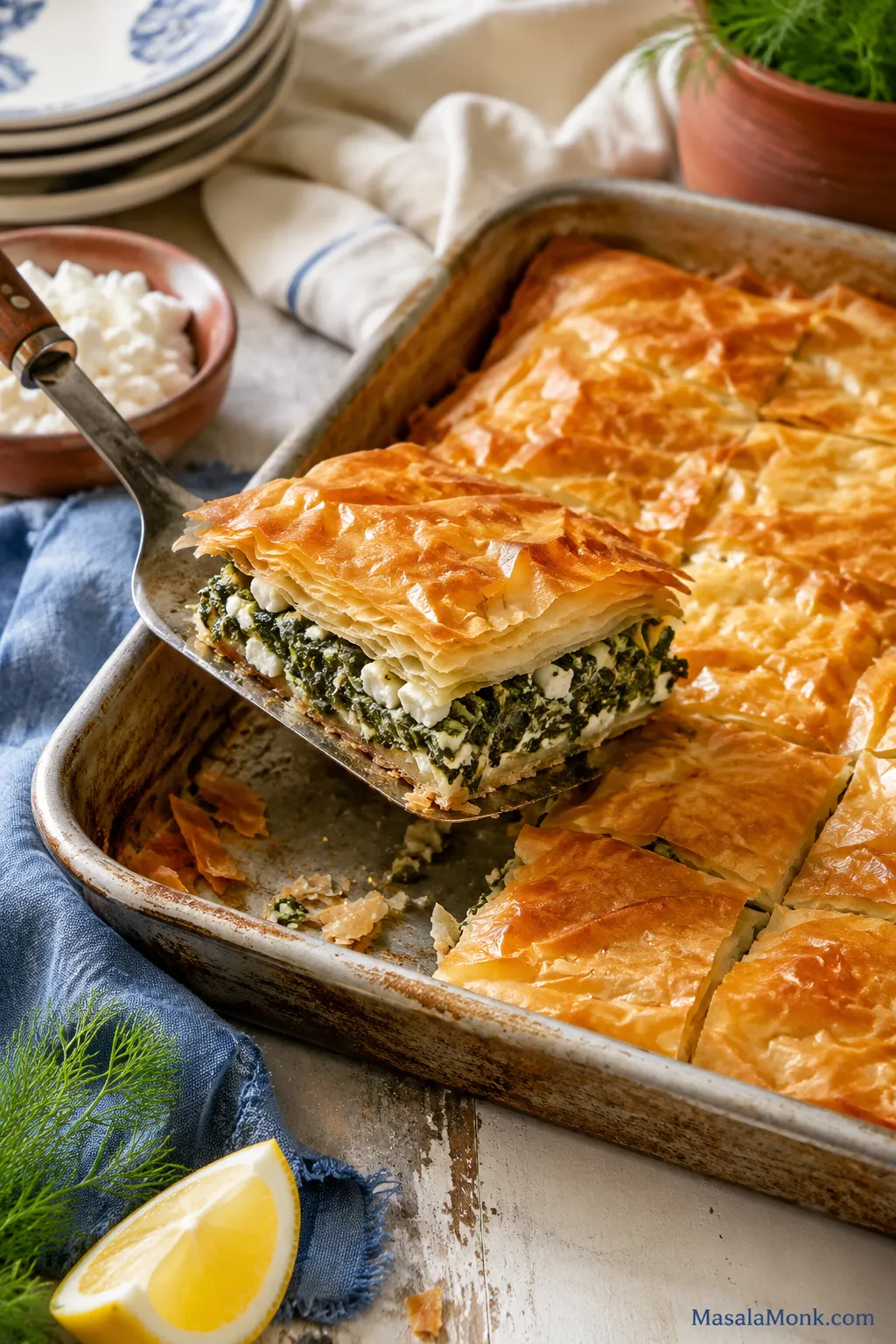
You know spanakopita is right when the knife crackles through the golden top and the first corner lifts cleanly from the pan. Under those flaky phyllo layers should be warm spinach, salty feta, fresh herbs, and enough structure to slice without the bottom turning wet.
This is a practical home-kitchen spanakopita: store-bought phyllo, a well-drained spinach-feta filling, clear success cues, and a crisp base that does not depend on perfect pastry work. You still get the drama of a flaky Greek spinach pie, but the process stays manageable: dry the greens, mix the filling, layer, bake, rest, and slice.
If phyllo makes you nervous, you are in good company. It tears, dries, and wrinkles, but this pie does not need perfect sheets. The hidden layers can be patchwork, the top can be a little rustic, and the tray will still bake into something golden, flaky, and shareable.
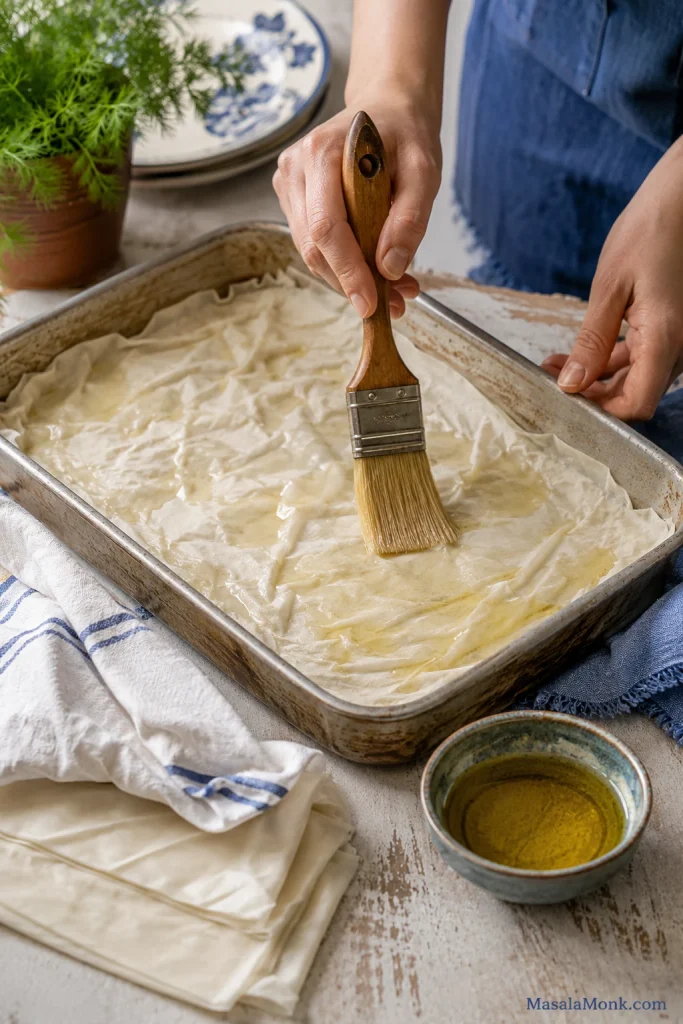
Fastest reliable path: use frozen spinach, block feta, 14 phyllo sheets, and a 9 x 13 inch pan. Fresh spinach works too, but frozen keeps the filling easier to control for a first tray.
This is the version for the cook who wants spanakopita to feel doable before it feels impressive.
Spanakopita Recipe Snapshot
| Recipe type | Greek spinach pie / spinach and feta phyllo pie |
| Prep time | 35–45 minutes with frozen spinach; longer with fresh bunch spinach |
| Cook time | 45–55 minutes |
| Total time | 1 hour 20 minutes to 1 hour 40 minutes, not including phyllo thawing |
| Advance step | Thaw frozen phyllo overnight in the refrigerator |
| Yield | 10–12 pieces |
| Pan size | 9 x 13 inch / 23 x 33 cm baking dish or pan |
| Oven temperature | 350°F / 180°C |
| Oven rack | Lower-middle rack |
| Spinach | 500 g / 16 oz frozen spinach or 700–900 g / 1½–2 lb fresh spinach |
| Resting time | 15–20 minutes, uncovered, before slicing |
Jump to the full recipe, or keep reading for the spinach, phyllo, and crisp-bottom tips that make the tray work.
Table of Contents
- Why this spanakopita works
- What is spanakopita?
- Ingredients and substitutions
- Fresh or frozen spinach
- How to make spanakopita
- How to keep the bottom crisp
- If phyllo makes you nervous
- How to tell when it is done
- Troubleshooting spanakopita
- Variations and shortcuts
- Make it ahead without losing the crisp layers
- Reheating frozen or leftover spanakopita
- What to serve with spanakopita
- Full spanakopita recipe
- FAQs
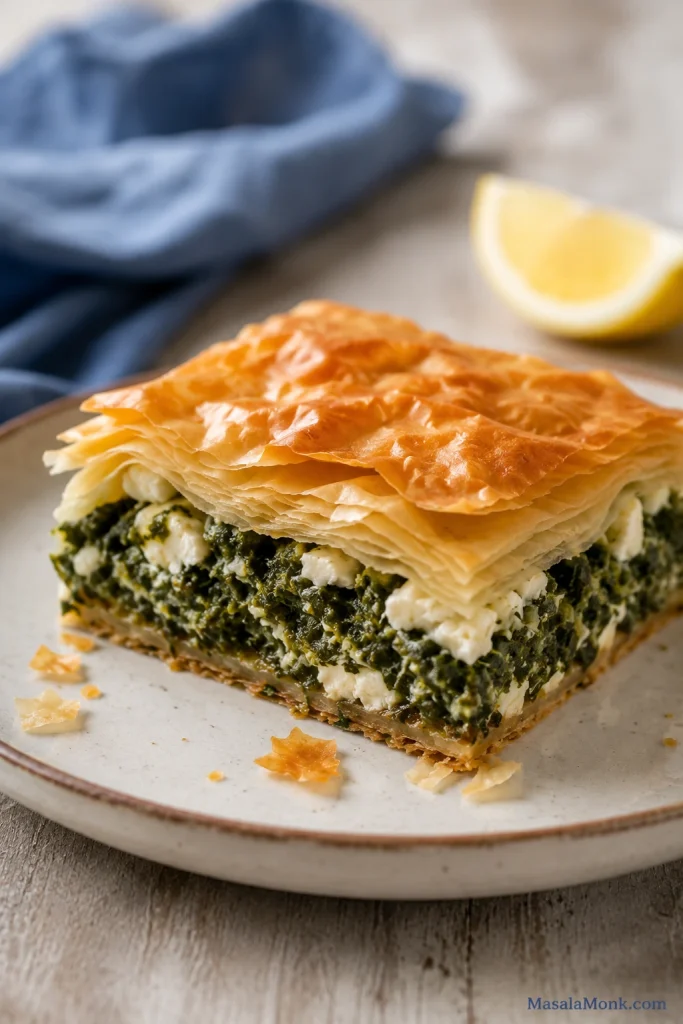
Before we get into the details, this is the texture you are aiming for: crisp pastry outside, green spinach through the middle, and small feta pieces that stay visible after baking.
Why This Spanakopita Works
The goal here is not perfect pastry work. It is a tray that lifts cleanly, tastes generous, and gives you flaky layers without asking you to baby every sheet. Frozen spinach takes one variable off your hands, block feta gives better texture, seven bottom phyllo sheets create structure, and the lower-middle rack helps the base bake through before the top gets too dark.
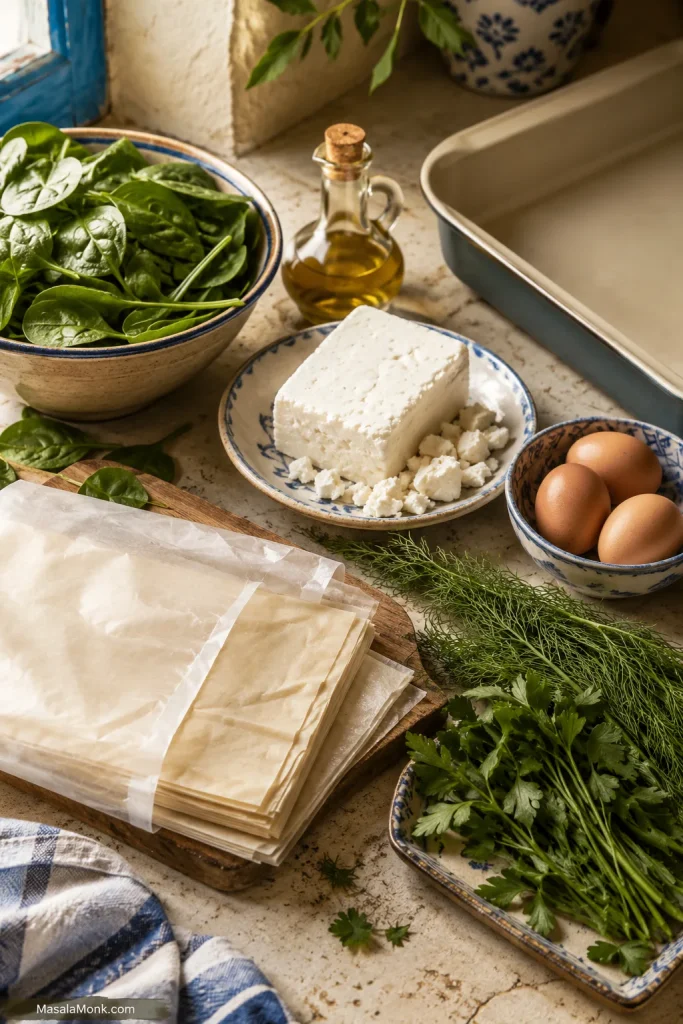
This is the practical spanakopita setup: filling ingredients ready, phyllo still protected, and the pan waiting before assembly begins.
- Frozen spinach makes the filling easier to control. Fresh works too, but frozen is already wilted, so once it is pressed well, the tray becomes more predictable.
- Block feta gives creamy, salty pockets. It tastes fuller than very dry pre-crumbled feta.
- Seven bottom sheets support the filling. They help the pie slice cleanly.
- The lower-middle rack helps the base cook. This is especially useful in glass or ceramic pans.
- A short rest finishes the texture. The filling settles, the pastry stays flaky, and the pieces cut cleaner.
The tray format is forgiving in a way triangles are not. Torn sheets disappear inside, the filling spreads evenly, and the lower layers have enough time to firm up before slicing.
You still get the flavor of a classic Greek spinach pie, just with store-bought phyllo, a forgiving tray format, and enough structure that the first slice does not collapse.
What Is Spanakopita?
Spanakopita is a Greek spinach pie made with thin phyllo pastry and a savory filling of spinach, feta cheese, herbs, and often eggs.
You may see the pastry spelled as phyllo or filo. They are the same thing: paper-thin pastry sheets that bake into crisp, flaky layers when brushed with olive oil or melted butter.
Greek spinach pies vary by family and region. Some use leeks, some add more herbs, some use homemade phyllo, and some keep the filling very simple. Here, the spirit is classic — greens, feta, herbs, olive oil, and crisp phyllo — while the handling is modern and practical: store-bought pastry, clear texture cues, and a tray format that gives the filling room to settle.
For dinner and clean slices, the tray version is the easiest path; triangles are better when you want appetizers, lunch boxes, or party bites.
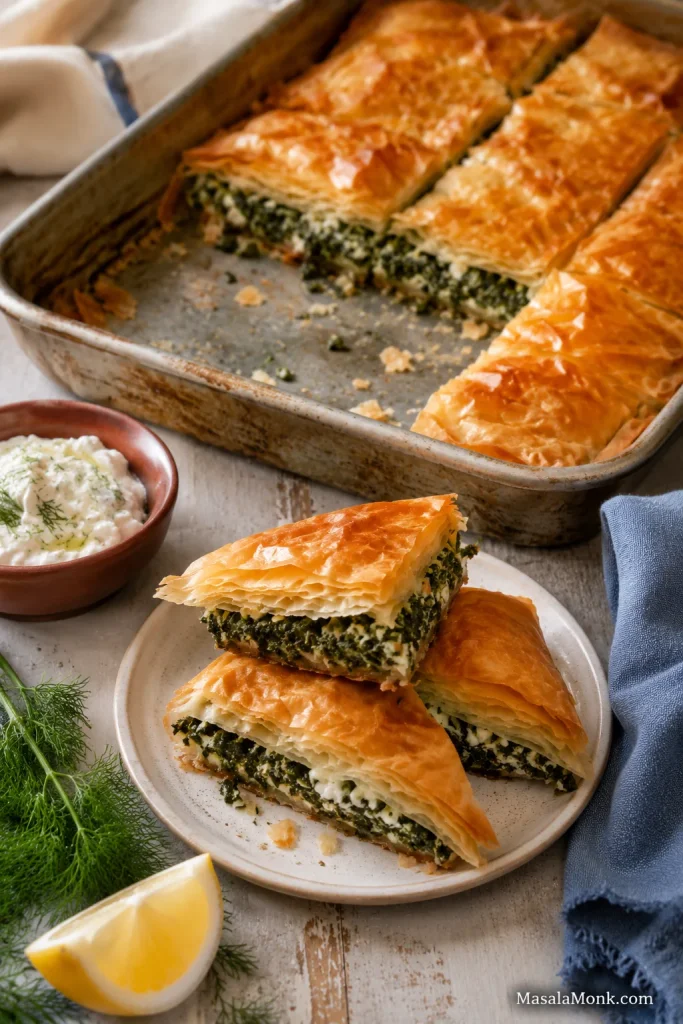
Spanakopita is not meant to be creamy like spinach dip. The filling should be savory, herby, and moist enough to taste generous, but firm enough that the phyllo bakes into layers instead of steaming from underneath.
In either shape, the best pieces have contrast: brittle golden corners, soft salty feta tucked into the greens, and a herby filling that smells good before the tray even reaches the oven.
Ingredients and Substitutions
The filling is simple, which is why the details show up in the finished slice. Good feta gives salty pockets, fresh herbs keep the spinach lively, and well-prepared greens let the phyllo stay flaky instead of heavy. If spinach is your main question, jump to the fresh vs frozen spinach guide before mixing.
Spinach and feta are the two ingredients that matter most. Spinach controls texture; feta controls flavor. Loose spinach weakens the pastry, while bland feta makes the whole filling taste flat.
This amount gives a generous but sliceable filling: enough spinach and feta to taste full, but not so much that the lower layers steam. If you add extra greens, keep the final squeezed amount close to the recipe amount.
Spanakopita Ingredient Amounts
| Ingredient | Amount | Notes |
|---|---|---|
| Frozen chopped spinach | 500 g / 16 oz | Thaw fully and press well. |
| OR fresh spinach | 700–900 g / 1½–2 lb | Wilt in batches, cool, chop if needed, then squeeze well. |
| Feta cheese | 300 g / about 10½ oz | Block feta gives better flavor and texture than very dry pre-crumbled feta. |
| Large eggs | 2 | Help bind the filling so the pieces slice more cleanly. |
| Phyllo sheets | 14 sheets | Use 7 sheets on the bottom and 7 on top. |
| Olive oil, divided | 120 ml / ½ cup for brushing, plus 1–2 tablespoons for cooking | You may not use all of it. Sheets should look lightly glossy, not heavy. |
| Onion or scallions | 1 small onion or 4–6 scallions | Adds sweetness and depth. |
| Garlic | 1–2 cloves, minced, optional | Adds extra savory depth. |
| Dill, fresh | ¼ cup chopped | Classic fresh herb flavor. |
| Parsley, fresh | ¼ cup chopped | Adds brightness. |
| Mint, fresh | 1–2 tablespoons, optional | Adds a brighter, more aromatic note. |
| Lemon zest | ½ teaspoon, optional | Adds brightness if your feta is mild or the filling tastes flat. |
| Black pepper | To taste | Use generously if your feta is mild. |
| Nutmeg | Pinch, optional | Works well with spinach and cheese. |
Before the eggs go in, taste the filling so you can judge the feta’s saltiness. Some feta needs no added salt at all.
Feta Cheese
Most of the salt and tang comes from the feta, so it matters. Block feta is the better choice if you can get it. Crumble it yourself for a softer, creamier texture. Pre-crumbled feta works, but it can be drier.
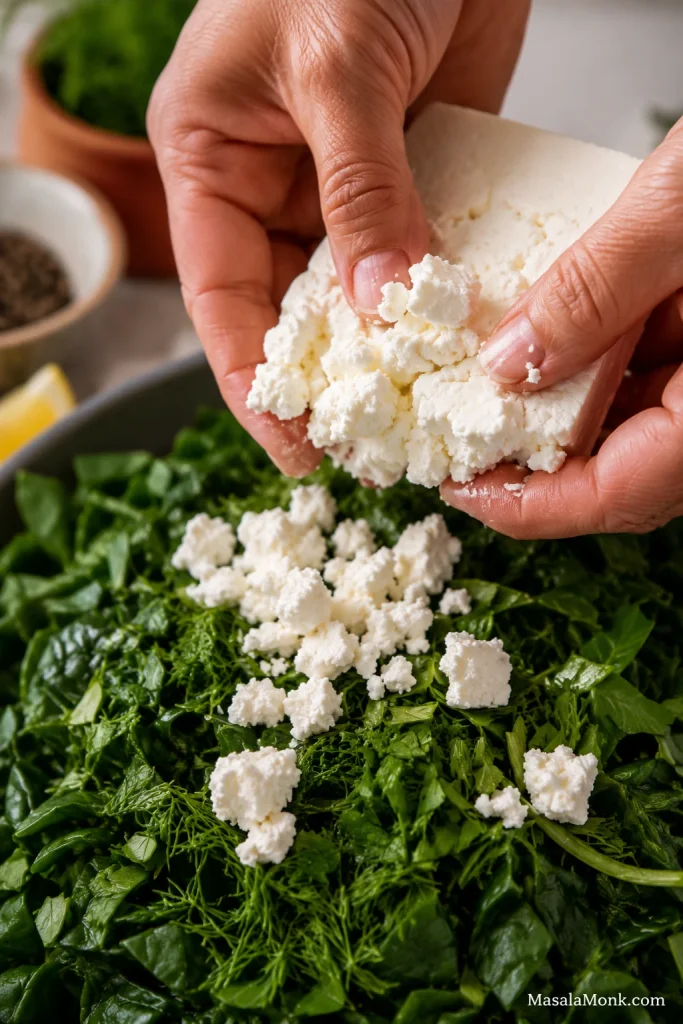
Use 300 g / about 10½ oz as the default. If your feta is very salty, use a little less and skip extra salt. If your feta is mild, lean on black pepper, herbs, and a little lemon zest before adding more salt.
Olive Oil or Butter?
Olive oil gives the pie a more classic Greek flavor. Melted butter makes the pastry richer and more golden. Both work, and you can also use half olive oil and half melted butter.
Brush lightly. The pastry needs enough fat to crisp, but it should not feel soaked or heavy.
Can You Add Ricotta, Cream Cheese, or Yogurt?
You can add a little ricotta, cream cheese, or Greek yogurt for a creamier filling, but use a light hand. Too much soft cheese makes the mixture wetter and heavier. It should mound softly on a spoon, not spread like dip. If what you really want is a creamy spinach appetizer, MasalaMonk’s spinach dip recipes are a better fit.
Fresh Herbs and Dried Herb Substitutes
Fresh dill and parsley give the filling its best flavor. If using dried dill, start with about 1 teaspoon dried dill for every 1 tablespoon fresh dill. Dried parsley is milder, so fresh parsley is better when possible. Dried mint can be strong, so use only a small pinch.
Leeks, Chard, and Other Greens
Leeks add sweetness and depth. Chard or silverbeet can replace part of the spinach, especially if you like a stronger green flavor. Kale, mushrooms, artichokes, and pine nuts can work too, but treat them as variations. For the cleanest first tray, keep the filling simple: spinach, feta, herbs, onion, and eggs.
Fresh or Frozen Spinach: Which Works Better?
Best spinach for spanakopita: frozen chopped spinach is the most reliable choice for a first tray because it is already wilted and easier to drain evenly. Fresh spinach gives brighter flavor, but it takes more prep and still needs to be cooked, cooled, chopped, and pressed before mixing.
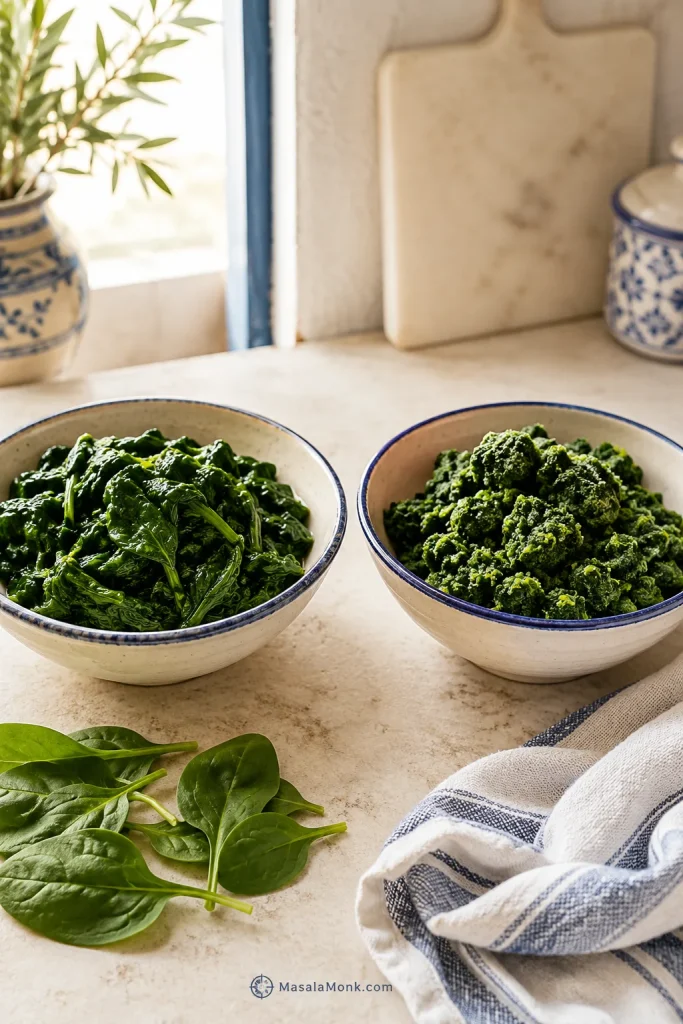
| Use this | Best when | Watch out for |
|---|---|---|
| Frozen spinach | You want the most reliable first tray. | It must be fully thawed and pressed well. |
| Fresh bunch spinach | You want brighter flavor and a more traditional fresh-greens feel. | It takes longer and cooks down heavily. |
| Baby spinach | You want faster fresh spinach prep. | The filling can be softer and milder. |
| Chard or silverbeet | You want a deeper greens flavor. | Stems need chopping finely or removing. |
Use about 700 g for tender baby spinach and closer to 900 g for mature bunch spinach with stems. After wilting and squeezing, you want roughly the same packed amount you would get from 500 g / 16 oz thawed frozen spinach.
Fresh spinach always looks like too much at first. Then it wilts down dramatically, which is exactly why the recipe starts with such a large amount.
Spinach Dryness Test
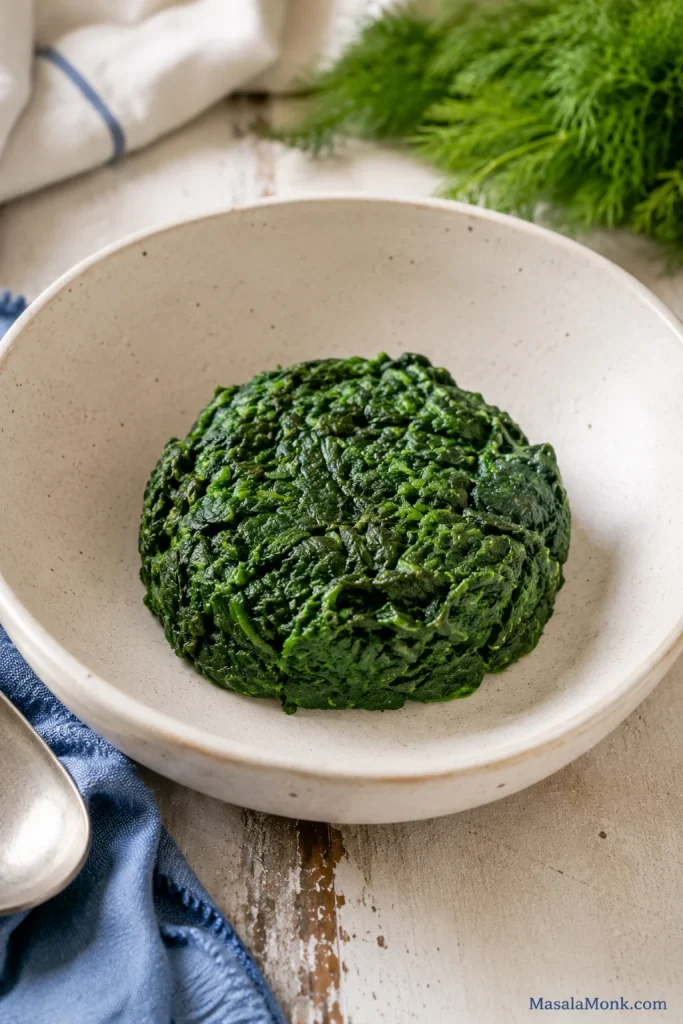
After squeezing, press the spinach with your hand or the back of a spoon. It should hold together in a soft mound, but the bowl should stay dry. If green liquid gathers at the bottom, squeeze again.
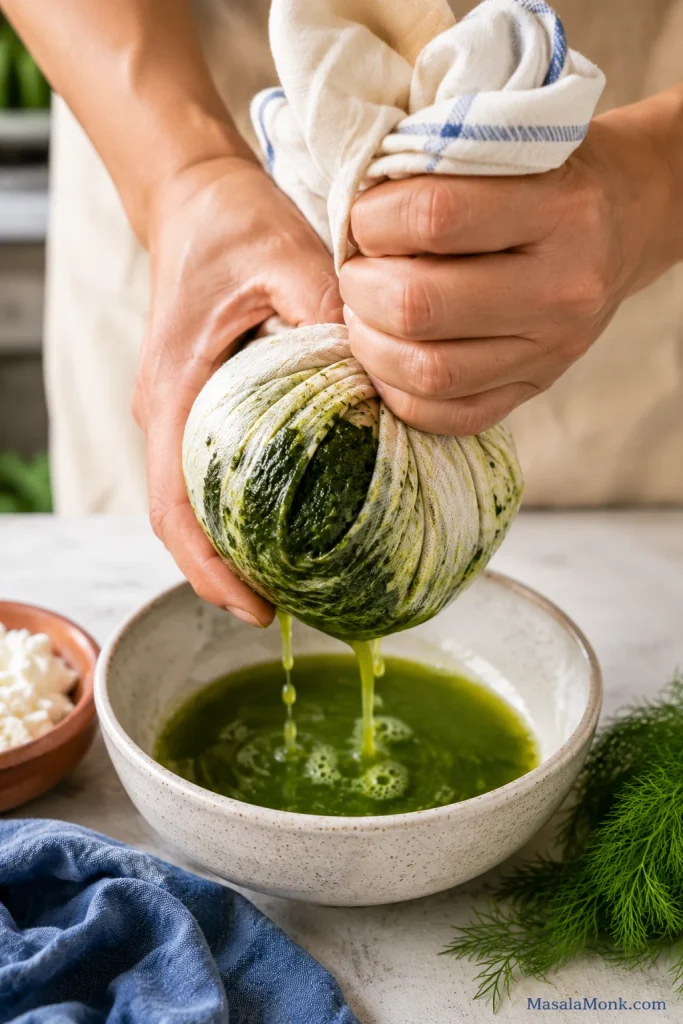
For frozen spinach, squeeze it in a clean kitchen towel in small handfuls rather than one large mass; it is easier to remove more liquid that way.
The Dry-Bowl Cue
Here, the greens stop being watery and become a proper filling. Spanakopita can handle moist spinach. It cannot handle dripping spinach.
How to Make Spanakopita
Once the spinach is ready and the filling tastes good, assembly is straightforward. The prep work is what makes the tray easy; now it comes together quickly. If the phyllo is the stressful part, the phyllo help section has the calmer fixes.
This method makes one large 9 x 13 inch / 23 x 33 cm Greek spinach pie. It is easier than folding triangles and gives you generous pieces with firm edges, flaky tops, and warm spinach-feta filling.
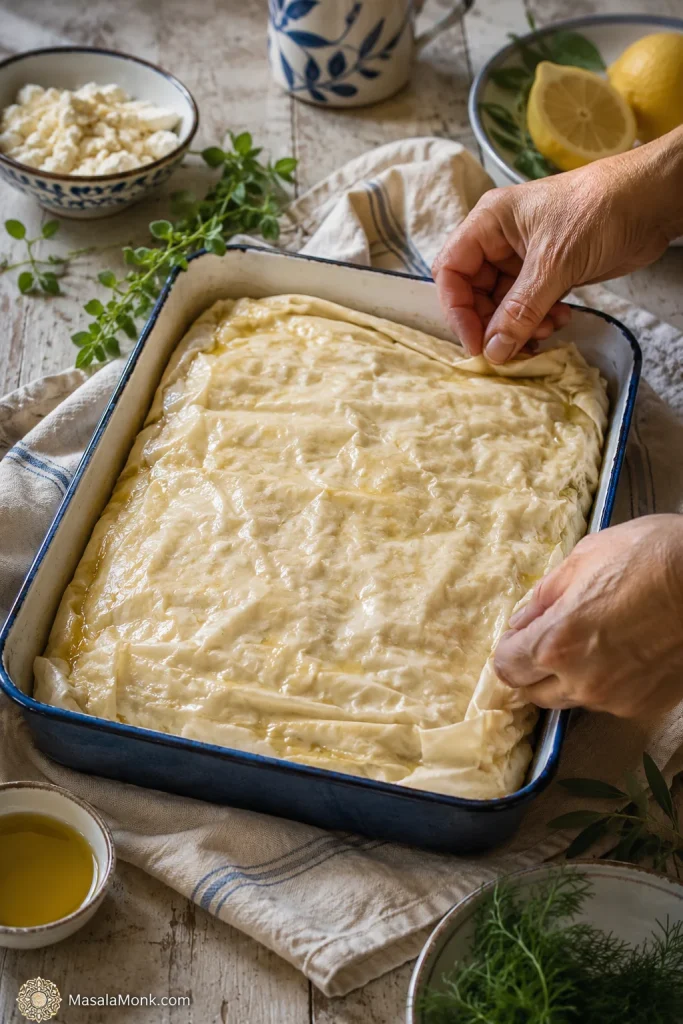
The tray may look a little untidy before baking. That is normal. Phyllo has a way of looking chaotic in the pan and beautiful after heat does its work.
Step 1: Thaw the Phyllo
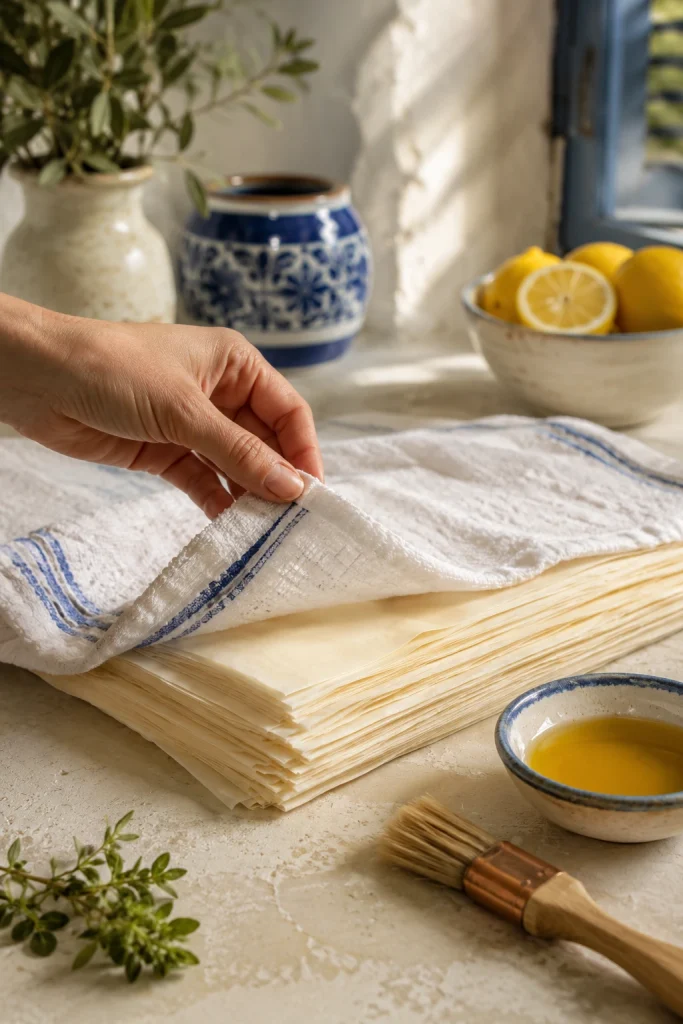
Thaw frozen phyllo overnight in the refrigerator, or according to package directions. Before assembling, let the sealed package sit briefly at room temperature so the sheets are easier to unroll. Open the package only when the filling and pan are ready.
Step 2: Prepare the Spinach
For frozen spinach, thaw it completely and press out as much liquid as possible. For fresh spinach, wilt it in batches in a large pan, let it cool, chop it if the leaves are large, and squeeze well. If liquid gathers in the bowl after squeezing, press it again.
Step 3: Cook the Aromatics
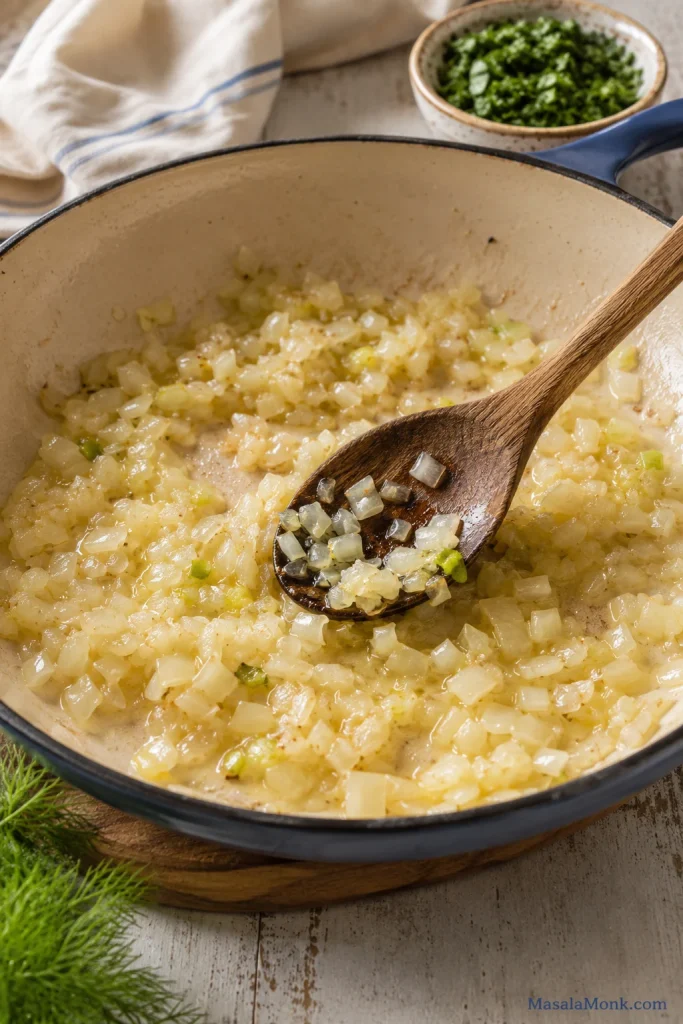
Warm 1–2 tablespoons olive oil in a skillet. Add the onion or scallions and cook until softened. Add optional garlic and cook briefly until fragrant. Let the mixture cool slightly.
The onion should smell sweet and mellow, not sharp, before it goes into the spinach.
Step 4: Mix and Taste the Filling Before Adding Eggs
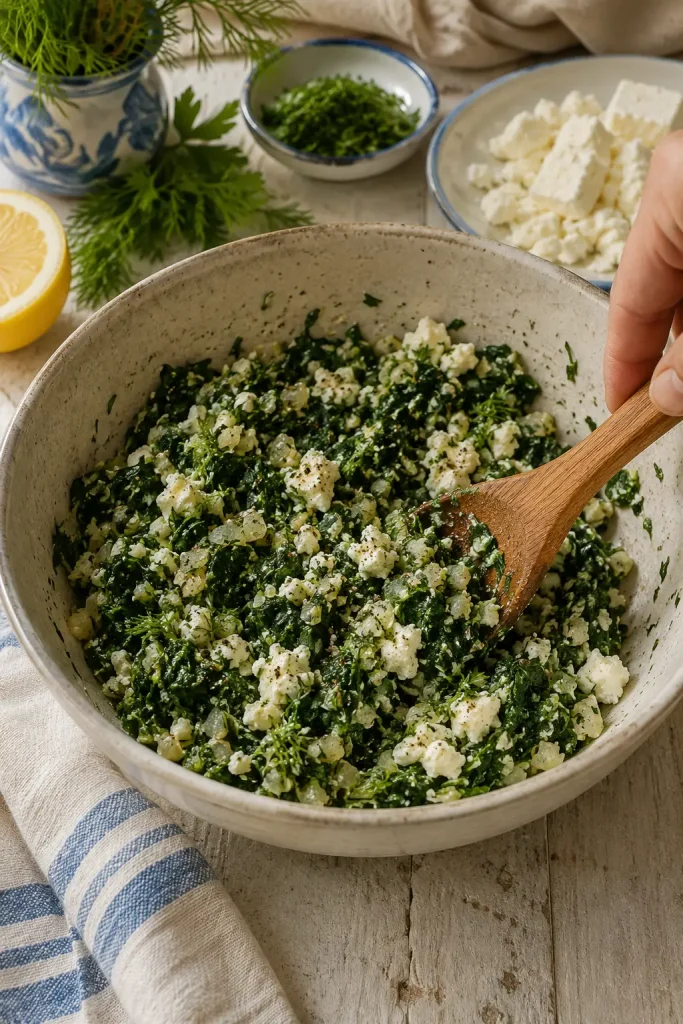
In a large bowl, combine the squeezed spinach, cooked aromatics, crumbled feta, dill, parsley, black pepper, optional lemon zest, and any optional mint or nutmeg. Taste this mixture before adding salt, because feta can be very salty. Once the seasoning tastes right, mix in the eggs.
The Filling Texture Test
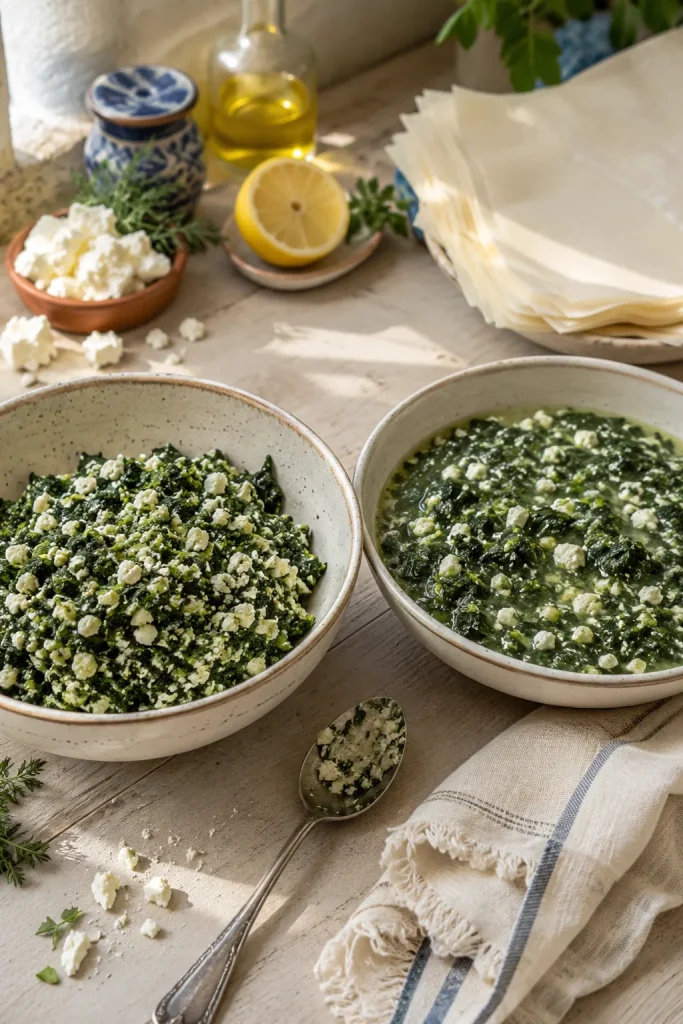
You should have a generous bowl of filling that looks clumpy and spoonable, with little white pieces of feta still visible in the greens. When you drag a spoon through it, it should not leave watery liquid behind.
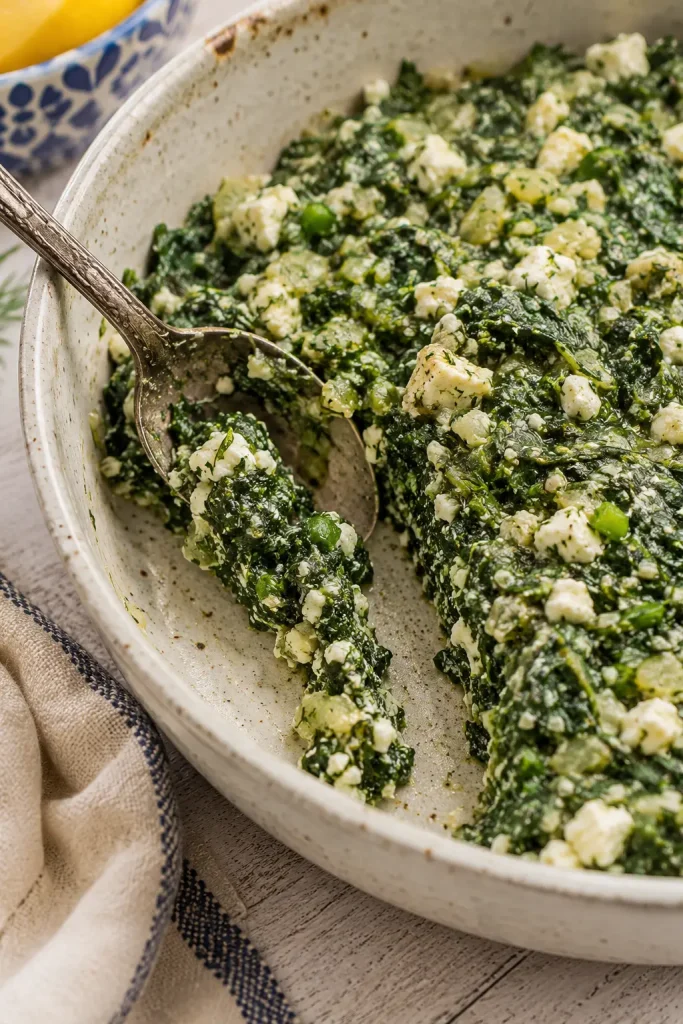
By this point, the bowl should already smell like the finished pie: salty feta, green herbs, softened onion, and clean spinach.
Step 5: Heat the Oven and Ready the Pan
Heat the oven to 350°F / 180°C and place a rack in the lower-middle position. Brush a 9 x 13 inch / 23 x 33 cm baking dish or pan with olive oil.
For a fan or convection oven, start around 170°C and check a little early, since the top may brown faster.
Step 6: Layer the Bottom Phyllo
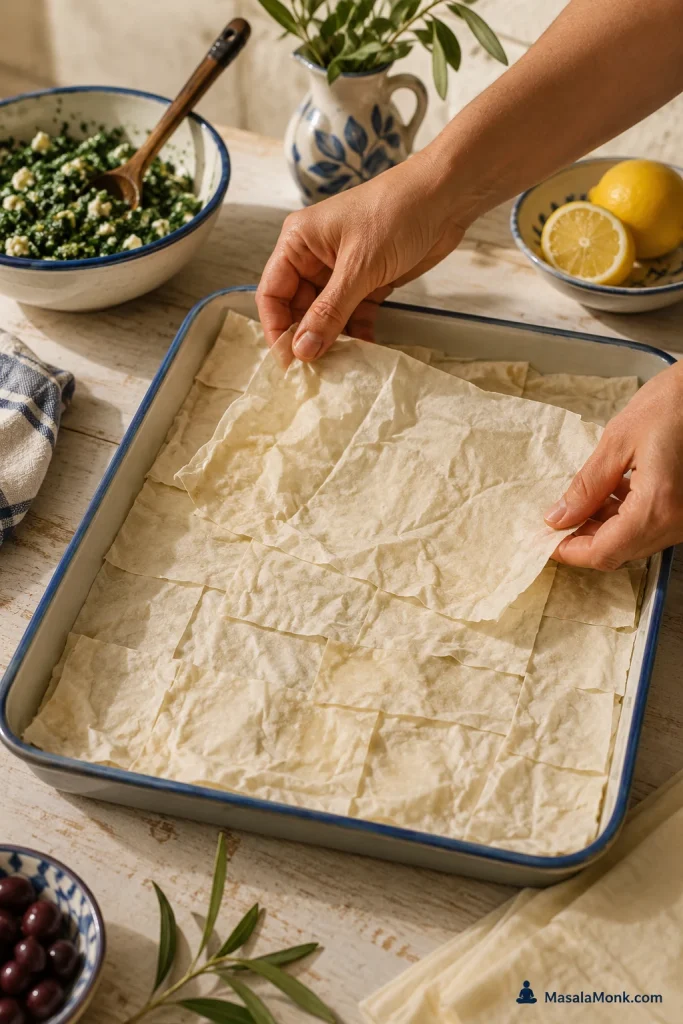
Now comes the part that looks fancier than it is. Open the phyllo and keep the unused sheets covered with a barely damp towel. Place one sheet in the dish and brush lightly with olive oil. Repeat until you have 7 bottom sheets. Torn or wrinkled sheets can go here; save the neatest ones for the top.
Patchwork the Hidden Layers
Use torn or smaller phyllo pieces where they will be hidden. Overlapping the gaps gives the filling support without requiring perfect sheets.
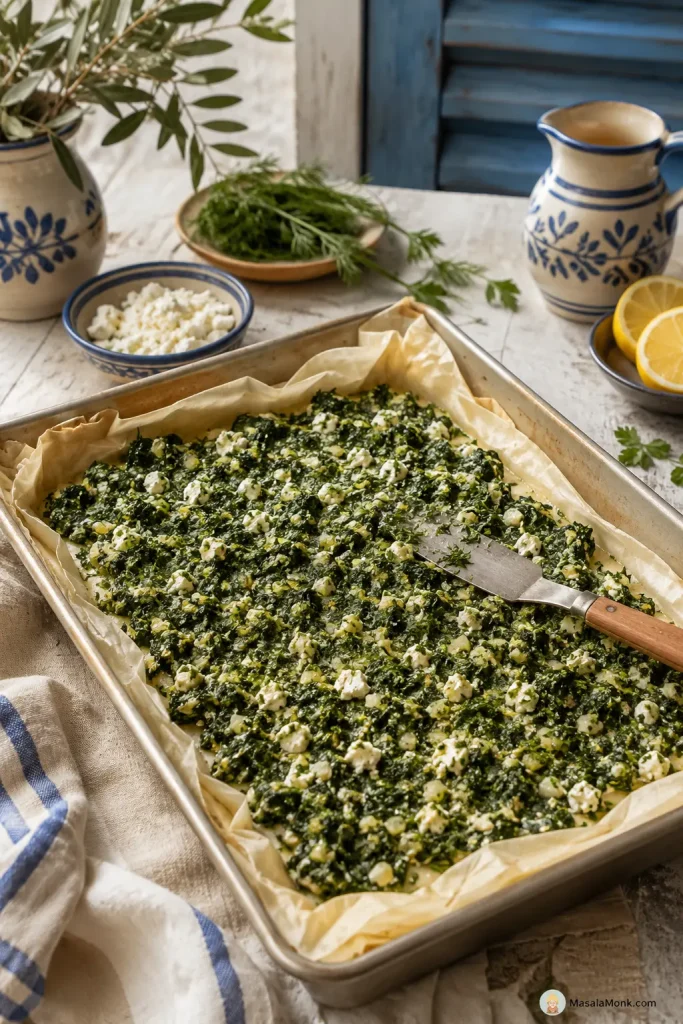
Step 7: Add the Filling
Spread the spinach-feta filling evenly over the phyllo. Keep it loose and even rather than pressing it down hard. The filling should sit in a generous layer, not a compacted block.
Step 8: Add the Top Phyllo
Layer 7 more phyllo sheets over the filling, brushing each sheet lightly with olive oil. Tuck or fold the edges into the pan. The sheets should look lightly glossy in spots. They do not need to shine like they are soaked.
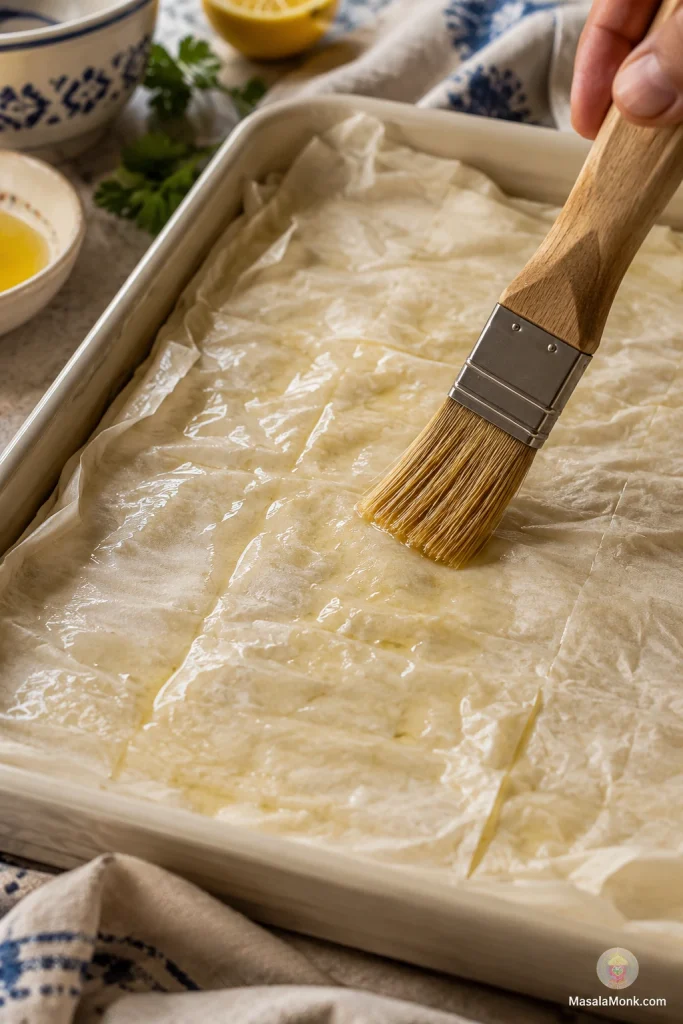
Tuck the Top Edges
Fold the overhanging sheets inward so the top looks tidy and the corners have enough pastry to crisp.
Step 9: Score the Top
Use a sharp knife to score the top layers into squares, rectangles, or diamonds. You do not need to cut all the way through the filling before baking. Scoring now makes the finished pie easier to slice without shattering the top.
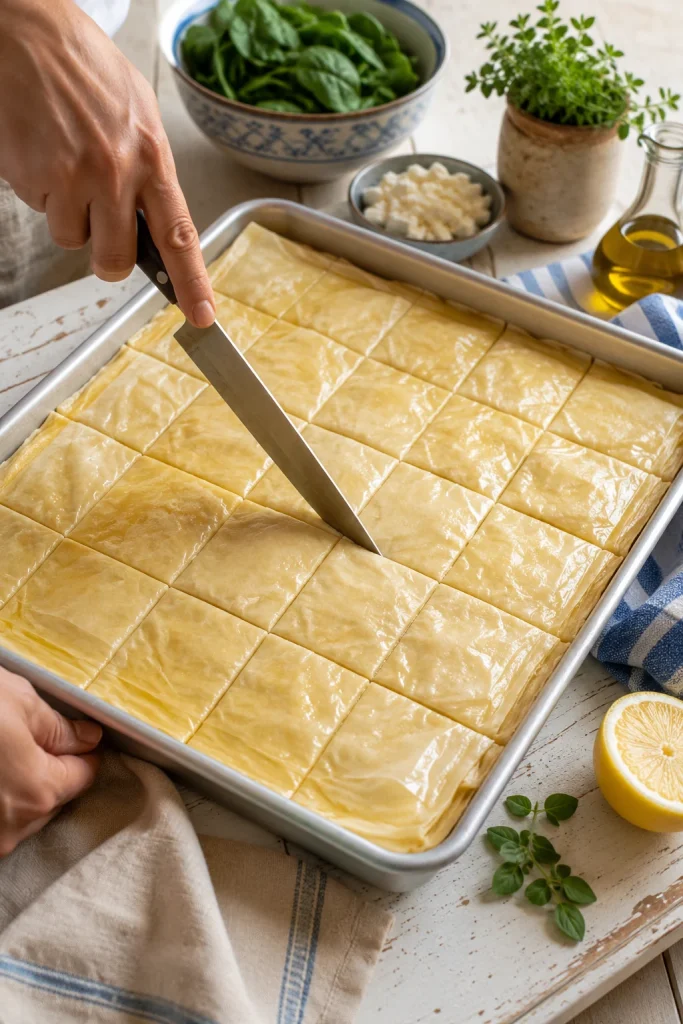
Squares are easiest for weeknights. Diamonds make the same tray look instantly party-ready once the golden top opens along the scored lines.
Step 10: Bake Until Golden-Brown and Crisp
Bake for 45–55 minutes, until the top is golden-brown, the edges are firm, and the filling is hot and set. Start checking at 45 minutes, but trust the pastry more than the clock. If the top browns too quickly, tent it loosely with foil and keep baking. Not sure yet? Compare it with the doneness cues before pulling the tray.
Step 11: Rest, Then Slice
Let the spanakopita rest uncovered for 15–20 minutes before cutting fully through the scored lines. The wait is annoying, but it is what turns a hot, loose filling into clean pieces with flaky tops and edges that hold.
If you only follow the method above, you can make a good tray. The next sections are for the moments that make cooks nervous: a soft base, fussy phyllo, loose filling, make-ahead timing, and slices that need to hold together.
How to Keep the Bottom Crisp
To keep spanakopita from getting soggy: remove excess spinach moisture, avoid loose or creamy filling, use enough bottom phyllo, bake until the pastry is fully golden, and rest the pie uncovered before slicing.
If the bottom turns soft, the pie is usually telling you one of two things: the filling was too wet, or the base needed more heat and time. For specific fixes, use the troubleshooting table.
What Actually Keeps the Bottom Crisp
- Moisture first: no liquid pooling in the filling.
- Structure second: enough bottom phyllo to support the greens and feta.
- Heat third: lower-middle rack so the base bakes before the top over-browns.
- Rest last: 15–20 minutes so the filling settles before slicing.
If the filling looks wet, drain off any visible liquid before layering. If the mixture still looks loose, stir in 1–2 tablespoons breadcrumbs, fine semolina, or crushed crackers to absorb extra moisture. This is a rescue trick, not something you should need every time.
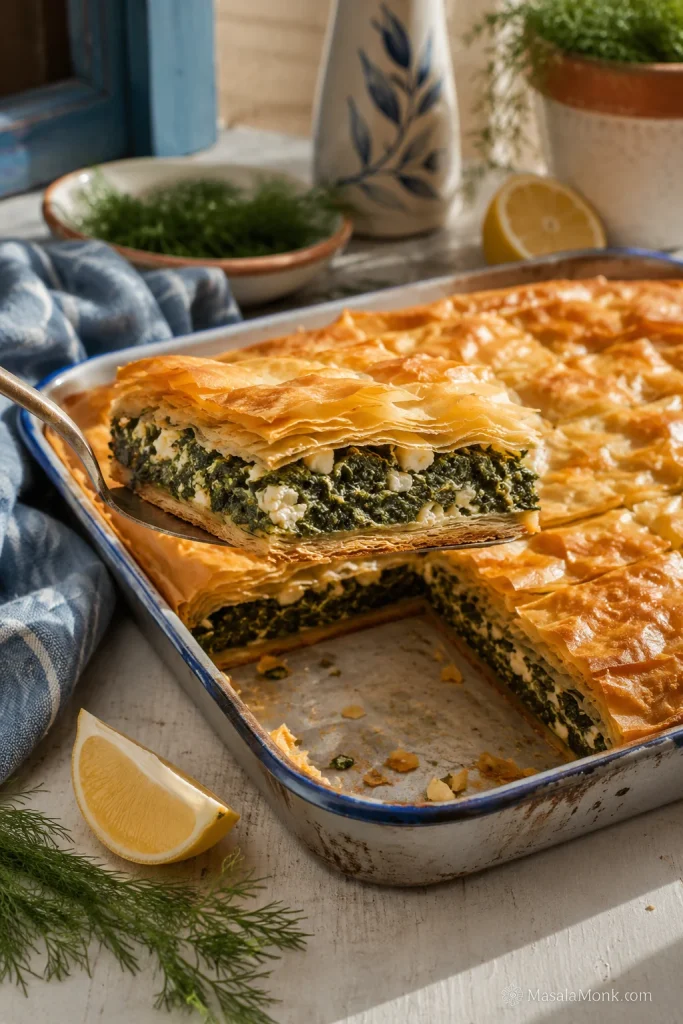
Clean First Corner Lift
When the bottom is right, the first corner lifts cleanly instead of slumping, and that is the moment you know the tray worked.
If Phyllo Makes You Nervous
The method above is enough for most cooks, but these small phyllo habits make the first tray feel calmer. Most of the fear disappears once you stop trying to keep every sheet perfect.
Thaw phyllo overnight in the refrigerator, then let the sealed package sit at room temperature until pliable. Rushing the thaw can make sheets crack, stick, or turn damp in patches. Once opened, keep unused sheets covered with a barely damp towel.
For this recipe, 14 sheets is the default: 7 on the bottom and 7 on top. Very thin brands can take up to 16 sheets.
Smaller phyllo sheets can be overlapped to make one layer. Larger sheets can climb the sides of the pan and fold inward. The goal is layered coverage, not perfect single-sheet geometry.
If a sheet tears, use it in the bottom or middle layers and overlap the gaps. If a sheet dries out, discard it or tuck it into the middle rather than forcing it across the top.
Think of the inner sheets as patchwork. Nobody will see them, and they still bake beautifully. Once the first few sheets are down, the rest feels much less precious.
Since phyllo brands vary, follow your package first. For a deeper handling reference, Athens Foods has a practical guide to phyllo storage, thawing, and handling.
How to Tell When Spanakopita Is Done
For a 9 x 13 inch / 23 x 33 cm tray, bake at 350°F / 180°C for 45–55 minutes. Your oven and pan matter, but the pastry will tell you when it is ready.
A pale top usually means the lower layers need more time too. A deeply golden top, dry scored lines, and a firm first corner matter more than hitting exactly 50 minutes.
Golden Tray Doneness
Look for a tray that reads crisp before you cut into it: browned edges, dry scoring lines, and a top that no longer looks soft or steamed.
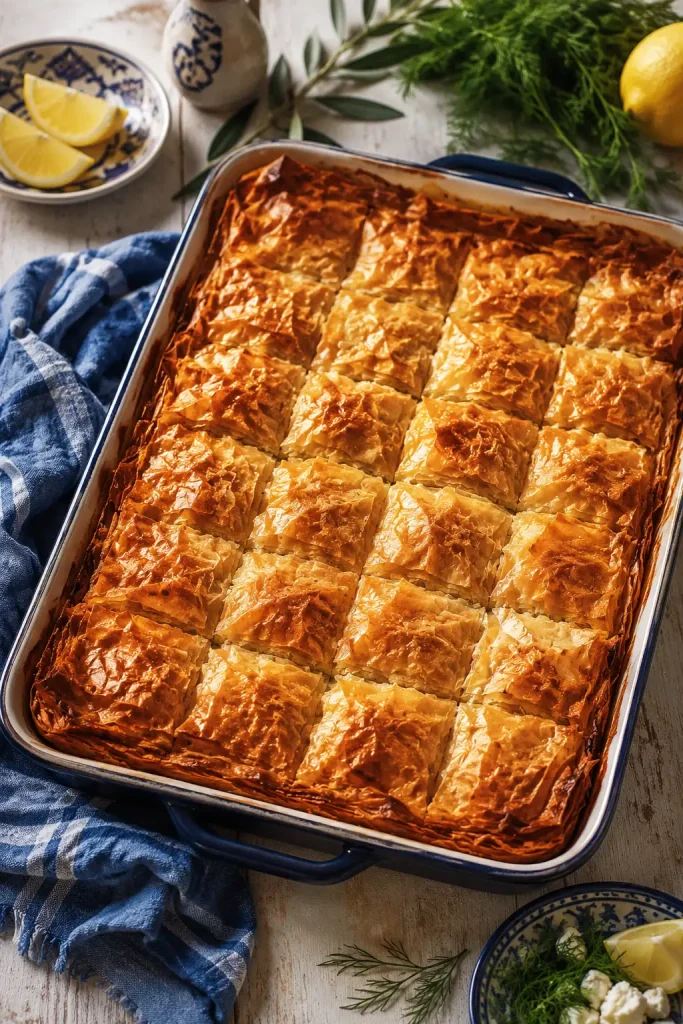
- Top: deeply golden and crisp, not pale.
- Edges: flaky, browned, and firm.
- Scored lines: dry-looking, not wet.
- Filling: hot and set, not leaking.
- Bottom: firm enough that a corner lifts with a spatula instead of drooping back into the pan.
When the pie is close, the kitchen starts to smell like toasted pastry, herbs, and warm feta.
A metal pan gives the crispest bottom. Glass or ceramic works too; just give the base a few extra minutes if it still looks soft. If using a metal baking pan, setting it on a preheated sheet pan can help the bottom crisp. If using glass or ceramic, avoid sudden temperature changes, especially if the dish is cold from the refrigerator.
Spanakopita Success Cues
- Before assembly: the filling smells herby and salty, with no liquid pooling in the bowl.
- While layering: the phyllo looks lightly glossy, not wet or heavy.
- Before baking: the top is scored and the edges are tucked into the pan.
- After baking: the top is deeply golden and the scored lines look dry.
- After resting: the first corner lifts cleanly instead of collapsing.
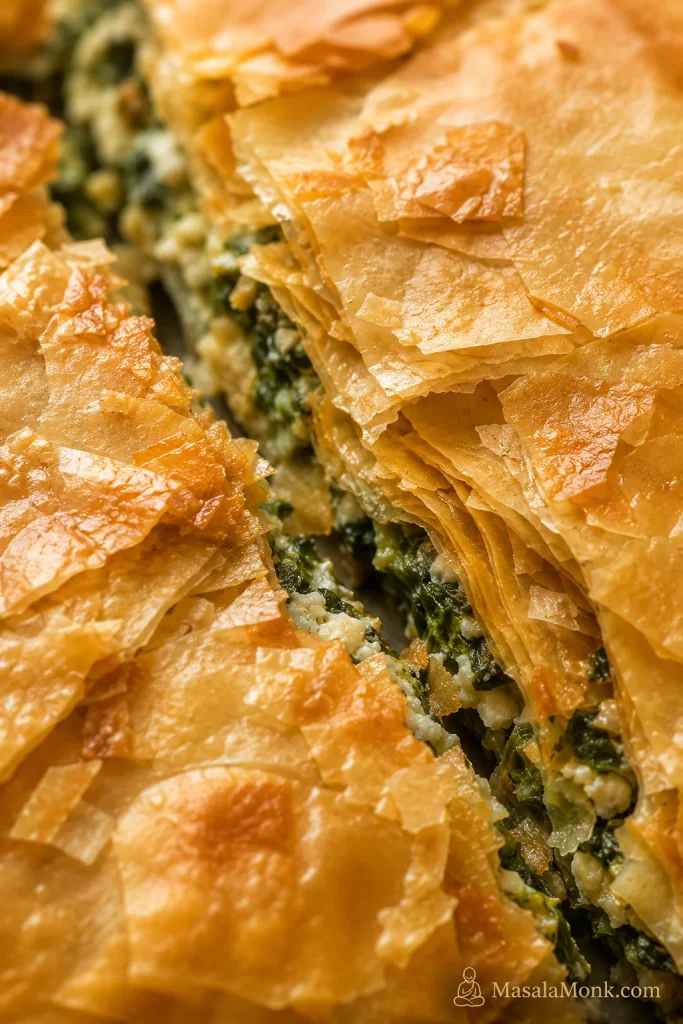
Crisp Flaky Phyllo Layers
Close up, the finished pastry should look brittle and layered, with small shards breaking away from the spinach-feta filling beneath.
Troubleshooting Spanakopita
Most spanakopita problems are not mysterious. A soggy bottom, leaking filling, or shattered top usually comes from one of three things: too much moisture, not enough baking time, or slicing before the filling has settled.
Correct Filling vs Loose Filling
Before assembly, compare the filling texture instead of guessing. A clumpy mixture protects the pastry; a loose mixture brings too much steam and moisture into the tray.
| Problem | Likely cause | Fix |
|---|---|---|
| Soggy bottom | Wet filling or underbaked base | Press more moisture from the spinach, bake longer, and use a lower rack. |
| Top browns too fast | Oven runs hot or tray is too high | Tent loosely with foil and continue baking. |
| Bottom is soft but top is done | Weak bottom heat | Move lower and bake 10 more minutes with foil over the top. |
| Phyllo tears | Sheets are dry, cold, or handled slowly | Keep covered and use torn sheets inside. |
| Leaking filling | Too much moisture or overfilling | Drain the filling better and keep the layer even. |
| Bland filling | Mild feta or not enough herbs | Add dill, parsley, black pepper, or a little lemon zest. |
| Too-salty filling | Very salty feta | Add more spinach or herbs if available; serve with yogurt sauce or a lemony salad. |
| Dense filling | The spinach layer was packed down too hard | Spread loosely next time; do not compress the spinach layer. |
| Top shatters badly when slicing | Not scored before baking or cut too soon | Score before baking, rest 15–20 minutes, then cut through the same lines. |
| Slices fall apart | Cut too soon or filling too loose | Rest 15–20 minutes before slicing fully. |
| Pastry soft after storage | Fridge moisture or trapped steam | Reheat uncovered in the oven or air fryer. |
Variations and Shortcuts
The large tray is the main recipe. Once you understand that filling and layering method, these variations become easy to judge.
Spanakopita Triangles
Once the filling is made, triangles are just a folding project. They are great for appetizers, mezze platters, lunch boxes, and party trays. The first triangle is usually the clumsiest. By the third or fourth, your hands understand the fold.
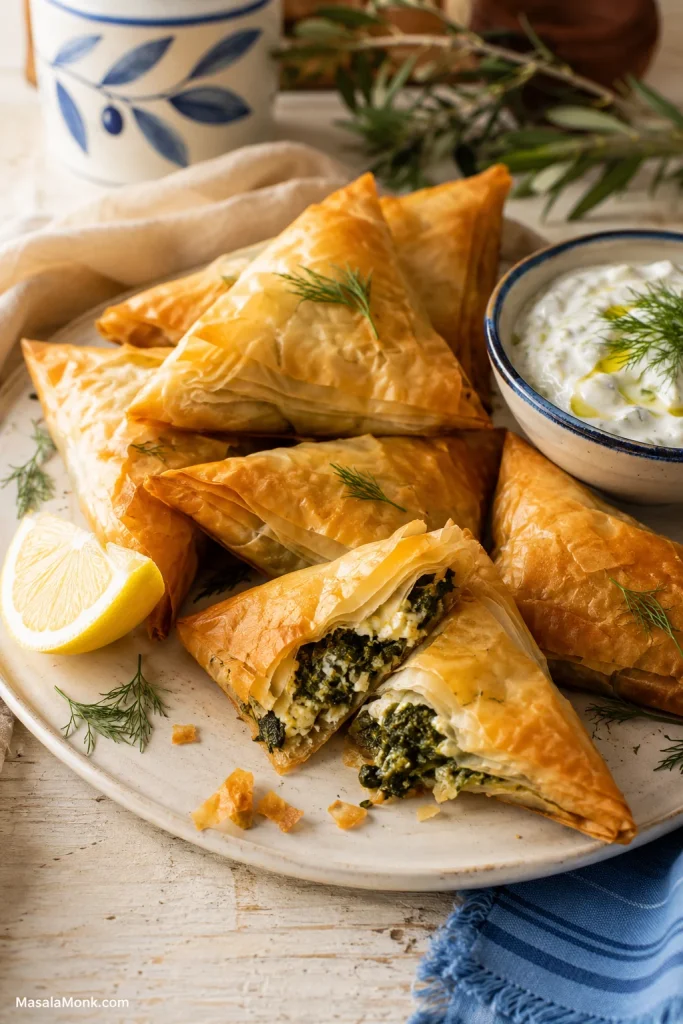
They are especially good with a bowl of Greek tzatziki sauce and crisp bites like homemade falafel.
- Phyllo strip width: 2½–3 inches / 6–7.5 cm.
- Layers: 2 phyllo sheets per strip.
- Filling: ½–1 tablespoon per triangle.
- Fold: like folding a flag.
- Oven: 375°F / 190°C.
- Small appetizer triangles: 15–18 minutes.
- Medium triangles: 20–25 minutes.
If the filling squeezes out as you fold, use less. A neat triangle needs less filling than you think. The triangles are done when the seams look dry, the corners are golden, and the pastry feels crisp enough to pick up. For dips and sides, jump to the serving ideas.
Puff Pastry Shortcut
Puff pastry makes a delicious shortcut, though the texture is thicker and more buttery than classic phyllo. It is a good option when you want a spinach-feta pie without layering many thin sheets.
Puff pastry should be pliable but still cold; once it warms too much, it gets sticky and bakes less cleanly. Use the same filling, place one puff pastry sheet on the bottom, add the spinach mixture, cover with a second sheet, seal the edges, and cut a few slits in the top so steam can escape.
For a full puff pastry pie, start checking around 35 minutes and expect 40–50 minutes depending on the thickness of the filling and pastry. For small puff pastry parcels, start checking around 20–25 minutes.
Gluten-Free Spanakopita
Use gluten-free phyllo if available, or gluten-free puff pastry as a shortcut. If neither is available, make a crustless spinach-feta bake with the same filling flavors.
Vegan or Dairy-Free Spanakopita
Use olive oil for brushing and replace feta with a salty vegan feta or a firm tofu-cashew mixture. Keep the filling well-seasoned because feta normally provides both salt and tang.
Egg-Free Spanakopita
You can skip the eggs, but the slices will be looser. Keep the spinach very well pressed, avoid wet cheeses, and rest the pie before cutting.
Make It Ahead Without Losing the Crisp Layers
Spanakopita is one of those recipes you can do in pieces. For the best make-ahead texture, assemble it unbaked, refrigerate it for up to 24 hours, then bake until golden and crisp. For longer storage, freeze it unbaked.
- Make the filling ahead: Prepare up to 1 day ahead and refrigerate. Drain off any liquid before assembling.
- Assemble unbaked: Refrigerate the covered tray for up to 24 hours, then bake from chilled with a few extra minutes if needed.
- Freeze unbaked: Score the top while the phyllo is still soft, wrap tightly, and freeze.
- Bake from frozen: Add 15–25 minutes and cover loosely with foil if the top browns early.
- Store leftovers: Cool fully, refrigerate for 3–4 days, and reheat uncovered in the oven or air fryer.
If making the filling ahead, check it again before assembling. Spinach can release more liquid in the fridge, so drain or squeeze off any liquid before layering it with phyllo. Use the filling texture comparison if it looks loose.
For a party, serve the pie warm after a 15–20 minute rest, or at room temperature on a mezze table. Let hot spanakopita breathe; trapped steam softens the pastry. Room temperature is fine for serving, but refrigerate leftovers rather than leaving them out for a long time.
This is the kind of dish that solves more than one meal: dinner tonight, brunch tomorrow, party squares on a platter, or a cold leftover piece eaten straight from the fridge.
Reheating Frozen or Leftover Spanakopita
Best way to reheat spanakopita: reheat pieces uncovered in the oven or air fryer. Dry heat helps the phyllo crisp again, while covered reheating traps steam and softens the pastry. The microwave is fast, but it will not bring back the flaky texture.
| Situation | Method | Time |
|---|---|---|
| Frozen spanakopita triangles | Air fryer at 350°F / 177°C | 8–12 minutes |
| Frozen spanakopita | Oven at 400°F / 200°C | 17–20 minutes |
| Leftover homemade slice | Oven at 350°F / 175°C | 8–13 minutes |
| Leftover homemade slice | Air fryer at 325–350°F / 160–177°C | 4–7 minutes |
| Microwave | Fastest, but softens pastry | Use only if needed |
For frozen or store-bought spanakopita, follow the package instructions first because sizes vary. If using a thermometer, the center should reach 165°F / 74°C. FoodSafety.gov gives the same 165°F / 74°C target for reheated leftovers in its safe minimum internal temperature chart.
These general notes can help with Costco, Trader Joe’s, Aldi, or other frozen spanakopita, but start checking early because every brand and size cooks differently.
What to Serve with Spanakopita
A good tray of spanakopita does not need much ceremony. Cut it warm, let the flaky shards fall where they want, and serve it with something cold and lemony.
It is the kind of food that does not need to be piping hot to be loved; even warm or room temperature, the salty filling and flaky edges still do their job.
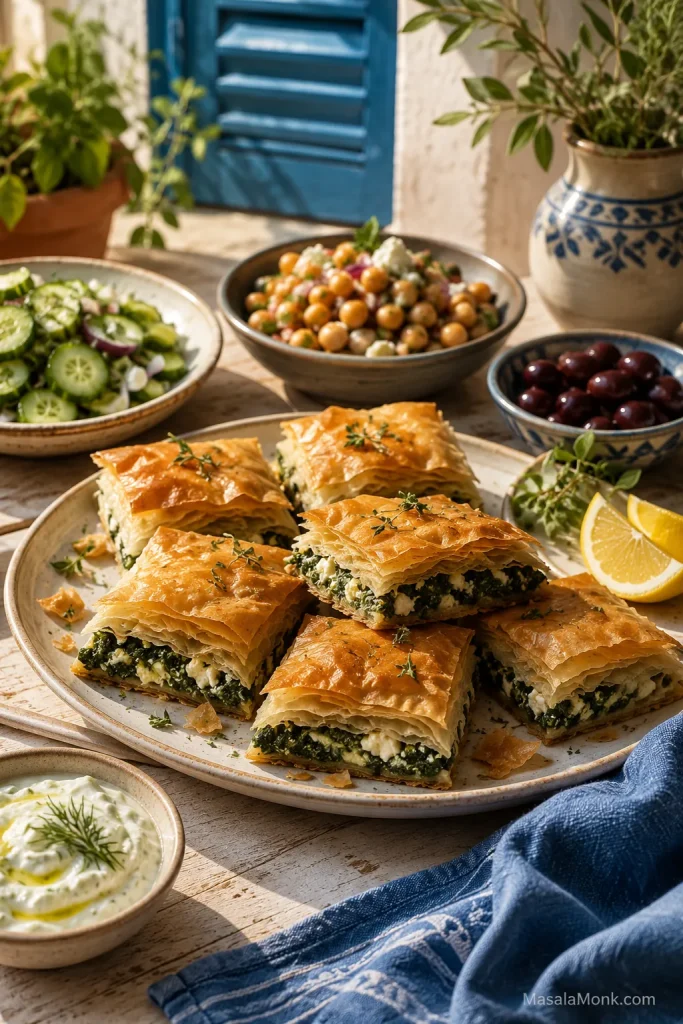
For a full Greek-inspired spread, keep the sides cool, bright, and simple so they balance the rich phyllo instead of competing with it.
Greek-Inspired Dinner
Serve warm pieces with Greek salad, roasted potatoes, red lentil soup, baked chicken breast, fish, lamb, olives, and lemon wedges.
Vegetarian Mezze Table
Cut smaller pieces and serve with tzatziki, hummus, pita, roasted vegetables, olives, cucumber salad, and homemade falafel.
Brunch or Lunch Boxes
Room-temperature pieces are excellent with cucumber salad, chickpea salad, yogurt sauce, eggs, fresh fruit, or a tomato cucumber salad.
Tabbouleh is also a strong side because the lemon, parsley, mint, and tomato cut through the rich pastry.
Quick lemon-dill yogurt sauce: Mix Greek yogurt with lemon juice, minced garlic, chopped dill, a little olive oil, salt, and black pepper. It is especially good with warm triangles.
Full Spanakopita Recipe
This tray-style spanakopita gives you flaky top layers, a firm base, and a spinach-feta filling that settles into clean pieces after resting.
Recipe name: Spanakopita Recipe: Greek Spinach Pie with Feta and Phyllo
Description: A generous Greek spinach pie recipe with crisp golden phyllo, salty feta, fresh herbs, and a spinach filling that slices cleanly after resting.
Yield: 10–12 pieces
Prep time: 35–45 minutes with frozen spinach, longer with fresh bunch spinach. This does not include overnight phyllo thawing.
Cook time: 45–55 minutes
Total time: 1 hour 20 minutes to 1 hour 40 minutes, plus phyllo thawing
Equipment: 9 x 13 inch / 23 x 33 cm baking dish or pan, large skillet, mixing bowl, colander, clean kitchen towel or cheesecloth, pastry brush, sharp knife, barely damp towel for phyllo.
Before you start: Make sure the spinach is pressed well, the phyllo is fully thawed, and the filling is mixed before you open the phyllo package. Once phyllo is exposed to air, the recipe moves much faster.
Ingredients
- 500 g / 16 oz frozen chopped spinach, thawed and squeezed well or 700–900 g / 1½–2 lb fresh spinach, wilted, cooled, and squeezed well
- 300 g / about 10½ oz feta cheese, crumbled
- 2 large eggs
- 14 sheets phyllo pastry, thawed
- Olive oil, divided: 120 ml / ½ cup for brushing, plus 1–2 tablespoons for cooking the onion
- 1 small onion, finely chopped, or 4–6 scallions, sliced
- 1–2 garlic cloves, minced, optional
- ¼ cup chopped fresh dill
- ¼ cup chopped fresh parsley
- 1–2 tablespoons chopped fresh mint, optional
- ½ teaspoon lemon zest, optional
- Black pepper, to taste
- Pinch of nutmeg, optional
- Salt, only if needed after tasting the filling before adding eggs
Instructions
Prepare the Filling
- Thaw the phyllo. Thaw frozen phyllo overnight in the refrigerator, or according to package directions. Let the sealed package sit briefly at room temperature before opening. Open the phyllo only when the filling is mixed, the oil is ready, and the pan is brushed.
- Prepare the spinach. If using frozen spinach, thaw completely and press out as much liquid as possible. If using fresh spinach, wilt it in batches in a large pan, cool it, chop if needed, and squeeze well. The bowl should not show liquid pooling when pressed.
- Cook the aromatics. Heat 1–2 tablespoons olive oil in a skillet. Add onion or scallions and cook until softened. Add optional garlic and cook briefly until fragrant. Let cool slightly.
- Mix and taste before adding eggs. In a large bowl, mix spinach, cooked aromatics, feta, dill, parsley, optional mint, optional lemon zest, black pepper, and optional nutmeg. Taste and add salt only if needed. Then mix in the eggs. The filling should hold together without liquid pooling at the bottom of the bowl.
Layer the Spanakopita
- Prepare the pan and oven. Heat oven to 350°F / 180°C. Place a rack in the lower-middle position. Brush a 9 x 13 inch / 23 x 33 cm baking dish or pan with olive oil.
- Layer the bottom phyllo. Open the phyllo and cover unused sheets with a barely damp towel. Place one sheet in the dish and brush lightly with olive oil. Repeat until you have 7 bottom sheets. Use torn or wrinkled sheets here if needed.
- Add the filling. Spread the spinach-feta filling evenly over the phyllo. Keep it loose and even rather than pressing it down hard.
- Add the top phyllo. Layer 7 more sheets over the filling, brushing each sheet lightly with olive oil. Tuck or fold the edges into the pan. The sheets should look lightly glossy, not soaked.
Bake, Check, and Rest
- Score the top. Use a sharp knife to score the top layers into squares, rectangles, or diamonds. You do not need to cut all the way through the filling yet.
- Bake. Bake for 45–55 minutes, until the top is golden-brown, the edges are firm, and the filling is hot and set. If the top browns too quickly, tent loosely with foil and keep baking.
- Check for doneness. The top should be golden and crisp, the scored lines should look dry, and a corner should lift without sagging. If the top is brown but the bottom feels soft, cover loosely with foil and bake 5–10 minutes longer.
- Rest and slice. Let the spanakopita rest uncovered for 15–20 minutes. Cut fully through the scored lines and serve warm or at room temperature.
Recipe Notes
- Block feta gives better flavor and texture. Use slightly less if it is very salty, or up to 340 g / 12 oz for a cheesier filling.
- Lemon zest is optional but useful if your feta is mild or the filling tastes flat. Avoid adding much lemon juice because extra liquid can loosen the filling.
- If your phyllo sheets are very thin, use up to 16 sheets total.
- You may not use all the oil. The phyllo should look lightly glossy, not soaked.
- A metal pan gives the crispest bottom. Glass or ceramic works too, but may need a few extra minutes.
- For a fan/convection oven, start around 170°C and check a little early because the top can brown faster.
- If the filling looks wet, drain visible liquid and mix in 1–2 tablespoons breadcrumbs, fine semolina, or crushed crackers.
- Let hot spanakopita breathe. Steam softens the pastry if it is covered tightly.
Frequently Asked Questions
These are the questions that usually come up the first time you make spanakopita.
Spanakopita Basics
Is spanakopita the same as Greek spinach pie?
Yes. Spanakopita is Greek spinach pie made with phyllo pastry and a filling of spinach, feta, herbs, and often eggs.
Is it phyllo or filo?
Both spellings refer to the same thin pastry sheets. Phyllo is common in the US, while filo is common in the UK and other places.
Ingredients, Spinach, and Phyllo
Fresh spinach or frozen spinach: which is better for spanakopita?
Frozen spinach is easier and more predictable because it is already chopped and wilted. Fresh spinach gives brighter flavor, but it takes more prep and still needs to be pressed well before mixing.
Should fresh spinach be cooked before adding it to spanakopita?
Yes. Fresh spinach should be wilted, cooled, chopped if needed, and pressed well before mixing. Raw spinach releases too much moisture as it bakes and can make the filling loose.
How many phyllo layers should spanakopita have?
Use 14 sheets as a reliable default: 7 on the bottom and 7 on top. If your phyllo is very thin, you can use up to 16 sheets.
Do torn phyllo sheets matter?
No. Use torn sheets in the bottom or middle layers and save the neatest sheets for the top. Once baked, the inner patchwork still turns flaky.
Why did my spanakopita turn soggy?
The most common cause is excess spinach moisture or underbaking. Press the spinach well, keep the filling moundable instead of loose, and bake until the pastry is fully golden-brown.
What cheese can I use besides feta?
Feta gives spanakopita its classic salty tang, so keep it as the main cheese if possible. For a milder filling, replace a small portion with ricotta or cottage cheese, but keep the mixture firm and well-drained so the phyllo does not soften.
Make-Ahead, Freezing, and Reheating
How far ahead can I assemble spanakopita?
You can assemble it unbaked and refrigerate it for up to 24 hours. Check for released liquid before baking and add a few extra minutes if baking from chilled.
Does spanakopita freeze better baked or unbaked?
Unbaked usually gives the best texture because the phyllo crisps for the first time in the oven. Score the top before freezing while the sheets are still soft, wrap tightly, and bake from frozen with extra time. Baked leftovers can also be frozen, but the pastry is more likely to soften after reheating.
What is the best way to reheat spanakopita?
Reheat it uncovered in the oven or air fryer. Dry heat helps the phyllo crisp again. The microwave works for speed, but it softens the pastry.
Diet and Serving Questions
Should spanakopita be served hot or room temperature?
Spanakopita is good warm or at room temperature. Let it rest after baking so the filling settles and the pieces slice more cleanly.
Can spanakopita be made without eggs?
Yes, but the filling will be looser. Keep the spinach especially well pressed, avoid wet cheeses, and rest the pie before cutting.
Puff pastry or phyllo: which is better for spanakopita?
Phyllo is better for classic spanakopita because it bakes into thin, crisp, flaky layers. Puff pastry works as a shortcut, but it gives a thicker, buttery crust and a less traditional texture.
Is classic spanakopita gluten-free?
No. Classic spanakopita uses wheat-based phyllo, so it is not usually gluten-free. For a gluten-free version, use gluten-free phyllo if available, gluten-free puff pastry as a shortcut, or make a pastryless spinach-feta bake inspired by the same flavors.
If you make it, I would love to know which route you took: frozen spinach tray, fresh spinach tray, triangles, or puff pastry shortcut.
The first tray may look a little rustic before it goes into the oven, and that is part of the charm. Once the phyllo turns golden and the spinach-feta filling settles, you get the kind of pie people keep returning to, knife in hand, promising they are cutting “just one more” piece.








