Posted on Leave a comment

How to make No-Bake Banana Pudding: No Oven Required Recipe

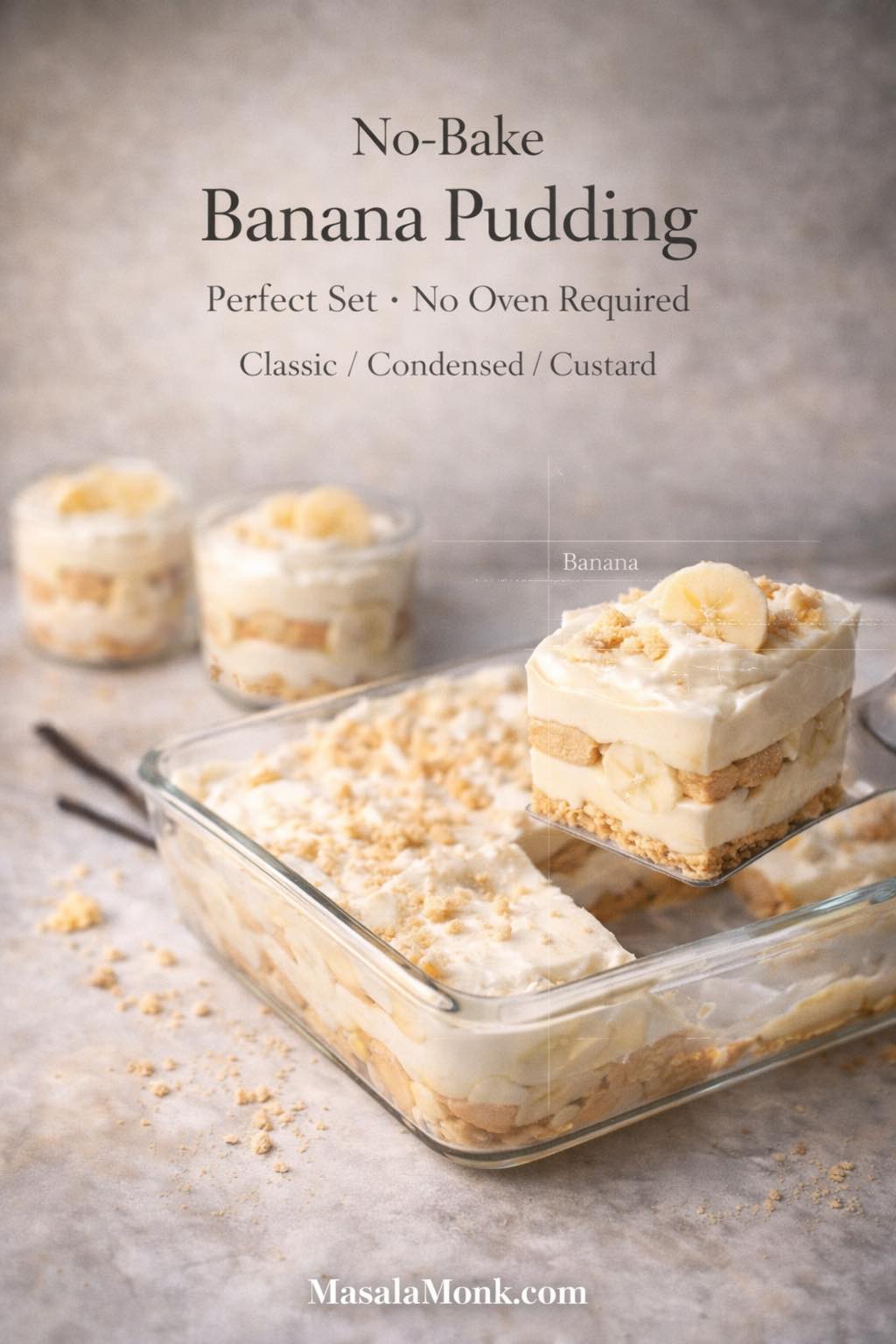
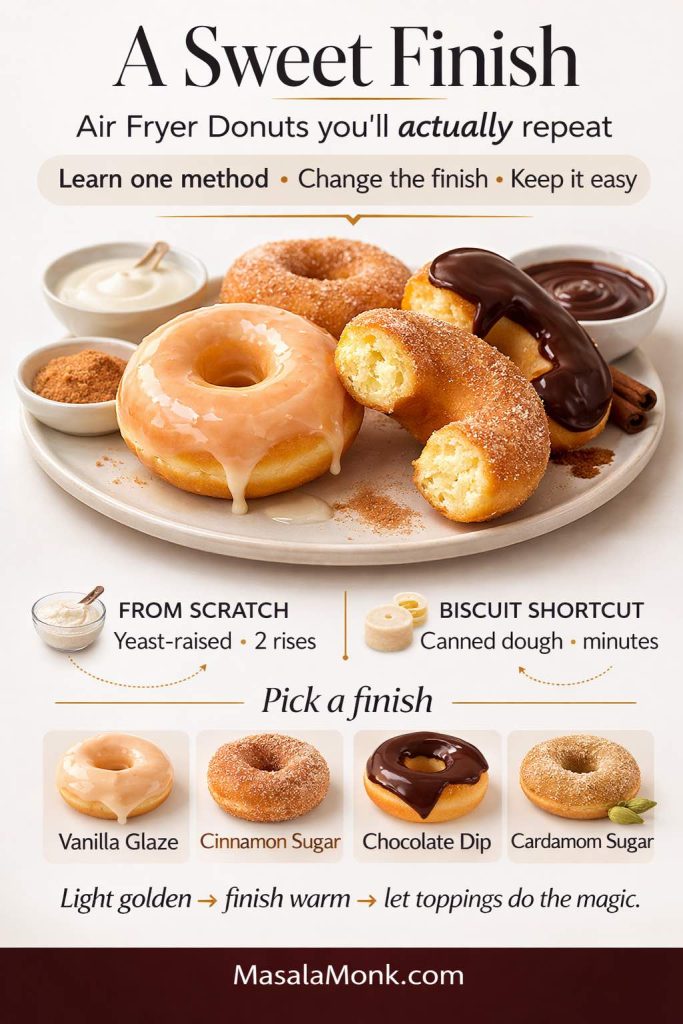
A square slice of no-bake banana pudding is lifted from a glass baking dish, showing neat layers of creamy vanilla pudding, banana slices, and vanilla wafers with cookie crumble on top. Text overlay reads “No-Bake Banana Pudding,” “Perfect Set • No Oven Required,” and “Classic / Condensed / Custard,” with MasalaMonk.com in the footer.

Some desserts ask you to measure, mix, bake, cool, frost, and pray nothing cracks. Banana pudding doesn’t demand that kind of ceremony. Instead, it leans into a simpler rhythm: slice bananas, whip something creamy, stack it with cookies, and let the fridge do the patient work. By the time you come back, the layers have transformed—cookies soften into cake-like sheets, bananas mellow into perfume, and the pudding turns thicker, silkier, and somehow more “finished” than it had any right to be.

That’s the heart of banana pudding (no bake). It’s comforting without being fussy, familiar without feeling boring, and flexible enough to match whatever your pantry—and mood—happen to be today. You can keep it classic with vanilla wafers and pudding mix, push it richer with sweetened condensed milk, go fully homemade with a stovetop custard (still no oven required), or make a dairy-free version that doesn’t taste like a compromise.

If you’re building a no-oven dessert lineup, you can round out the table with something bright and tangy like this no-bake blueberry cheesecake or something spiced and crunchy like these Lotus Biscoff dessert cups. Still, banana pudding is the one that disappears first—because it feels like home in a bowl.


No-bake banana pudding, five recipes (pick the vibe before you start)

Before you pull out a dish, decide what you want your banana pudding to be: airy and light, thick and tangy, extra creamy, old-fashioned, or plant-based. Once you choose, everything else—milk amount, cookie choice, chill time—falls neatly into place.

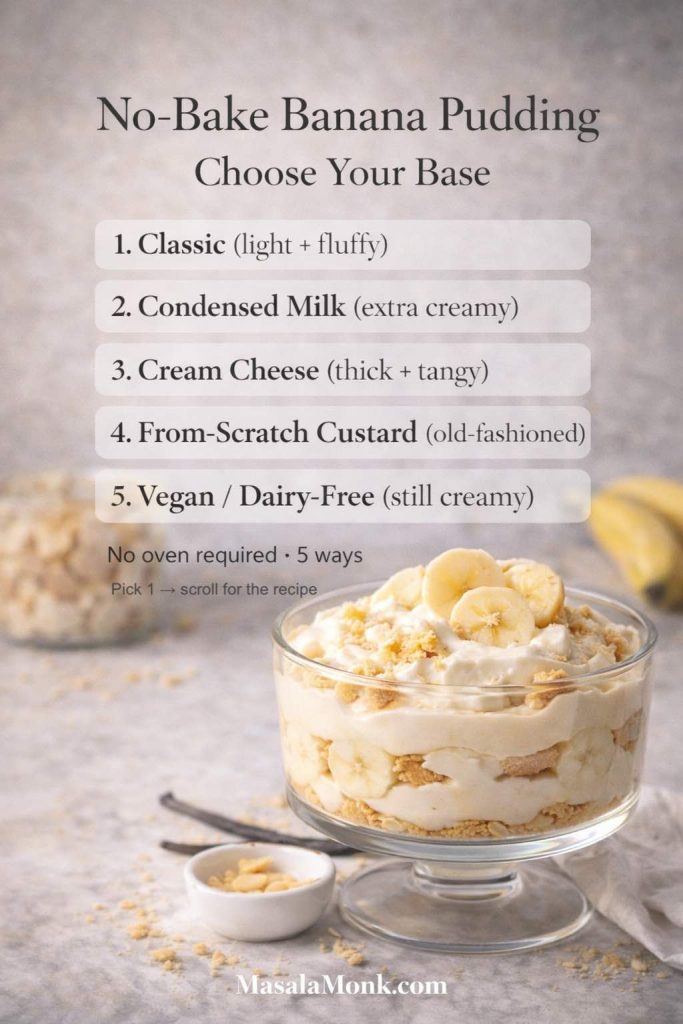
No-bake banana pudding in a glass dessert dish with layered bananas, vanilla wafers, and creamy pudding. Text overlay reads “No-Bake Banana Pudding – Choose Your Base” with five options: classic, condensed milk, cream cheese, from-scratch custard, and vegan/dairy-free. No oven required.
Not sure which no-bake banana pudding to make? Start here—pick your base (classic, condensed milk, cream cheese, custard, or vegan) and the rest falls into place. Scroll down & get the full step-by-step options in this blog post.

The classic (light, fluffy banana pudding, reliably set)

This is the “banana pudding recipe” most people picture: instant vanilla pudding, whipped cream, bananas, and vanilla wafers. It’s easy, and it still tastes like a celebration.

The condensed milk version (extra creamy banana pudding, no-cook)

If you love a richer spoon and a dessert that holds up longer at gatherings, banana pudding with sweetened condensed milk is the move. It’s no-bake, no oven, and still feels indulgent.

The cream cheese banana pudding recipe (thick, tangy, cheesecake-style)

Cream cheese makes the layers sturdier and adds a gentle tang that keeps the sweetness from feeling heavy. It also nods toward a banana pudding cheesecake no bake style without turning the whole thing into a separate dessert.

The from-scratch custard (homemade, old-fashioned, no oven required)

This one tastes the most “made.” You’ll cook a simple stovetop custard, chill it, then layer as usual. The payoff is deeper vanilla flavor and a silkier texture that feels unmistakably homemade.

The vegan/dairy-free banana pudding (still creamy, still classic recipe)

A well-made vegan banana pudding can be every bit as satisfying. The secret is a pudding base that sets firmly, plus a chill long enough to knit the layers together.

Also Read: Sweetened Condensed Milk Fudge: 10 Easy Recipes


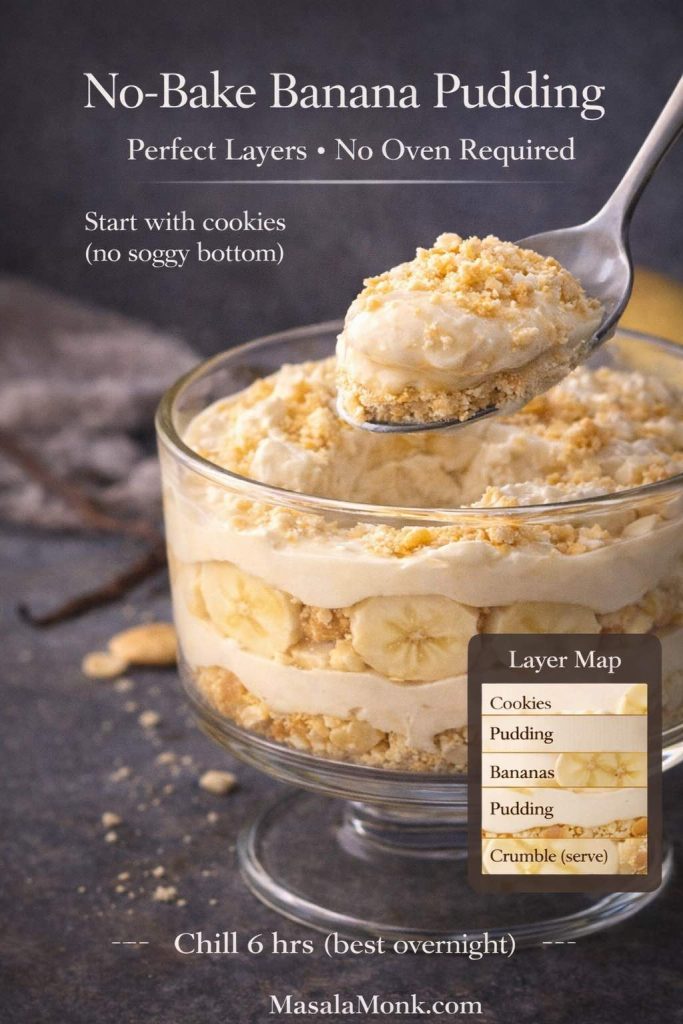
Close-up of a spoon lifting a creamy bite of no-bake banana pudding from a glass dessert bowl. The pudding shows layers of vanilla pudding, banana slices, and crushed cookie crumbs. Text overlay reads “No-Bake Banana Pudding,” “Perfect Layers • No Oven Required,” and “Start with cookies (no soggy bottom),” plus a small “Layer Map” inset listing cookies, pudding, bananas, pudding, and crumble (serve). Bottom text says “Chill 6 hrs (best overnight)” and “MasalaMonk.com.”
If your no-bake banana pudding ever turns watery at the bottom, this is the fix: start with a cookie layer, then build upward so the crumbs absorb slowly instead of collapsing fast. Keep bananas tucked under pudding, chill long enough for everything to set, and you’ll get thick, scoopable layers that taste richer and look far more “finished” when you serve.

The ingredients that matter (and why each one changes the texture)

Banana pudding can look like a simple list on paper, yet a few small choices decide whether you end up with clean, scoopable layers or a soft, slumped bowl of sweetness. Luckily, the fixes are straightforward.

Bananas: ripe, but not collapsing

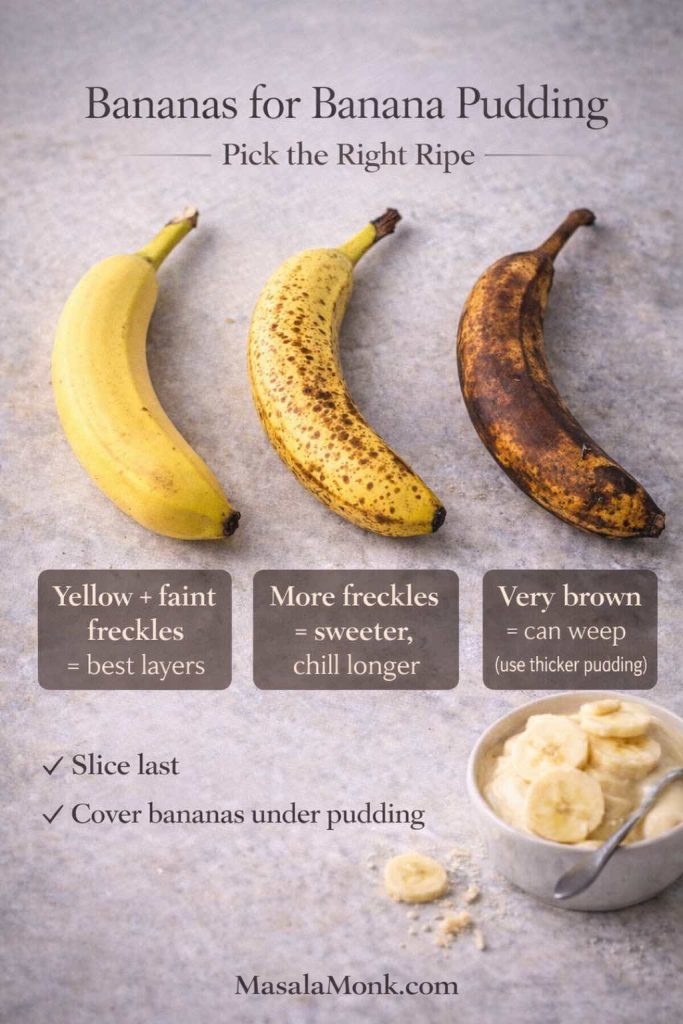
Aim for bananas that are yellow with light freckles—fragrant, sweet, and tender without being watery. If they’re very ripe (lots of brown), they’ll still taste great; however, they can release more moisture as they sit. In that case, you’ll want a thicker pudding base and a little more chill time.

Three bananas in different ripeness stages on a light gray surface with labels for banana pudding: yellow with faint freckles for best layers, more freckles for sweeter flavor, and very brown bananas that can weep (use thicker pudding). Includes tips to slice bananas last and keep slices covered under pudding. MasalaMonk.com footer.
The easiest way to keep no-bake banana pudding thick (not watery) is choosing the right banana. Yellow with light freckles gives the cleanest layers, while extra-freckled bananas taste sweeter but benefit from a longer chill. Very brown bananas can release more moisture—so if you use them, keep your pudding base thicker and don’t rush the fridge time. Slice bananas last, then cover the layer fully with pudding to slow browning and keep the bottom from “swimming.”

Creamy base: pudding mix, custard, or condensed milk

  • Instant pudding mix gives a consistent set and keeps the method truly no-cook.
  • Stovetop custard brings the “homemade banana pudding” depth, and it still stays no oven required.
  • Condensed milk adds body and richness, which helps the pudding stay thick even after hours in the fridge.

Cream: optional, but it changes everything

Whipped cream folded into the pudding base makes the texture lighter, almost mousse-like. It also softens the sweetness so each bite feels more balanced. If you’ve ever wondered about the difference between heavy cream and whipping cream for desserts, this quick explainer on heavy cream is a helpful reference—especially when you’re deciding what will whip most reliably.

Cookies: the quiet backbone of the whole dessert

Cookies aren’t just garnish here. They’re structure. They’re sponge. And then they’re the reason banana pudding becomes cohesive instead of just “bananas with pudding.”

Also Read: Kahlua Drinks: 10 Easy Cocktail Recipes (Milk, Vodka, Coffee)


Cookies for banana pudding (vanilla wafers, plus the best swaps)

If you want the most classic finish, vanilla wafers are hard to beat. They soften into tidy layers rather than dissolving instantly, and their gentle vanilla flavor keeps the dessert focused on bananas and cream.

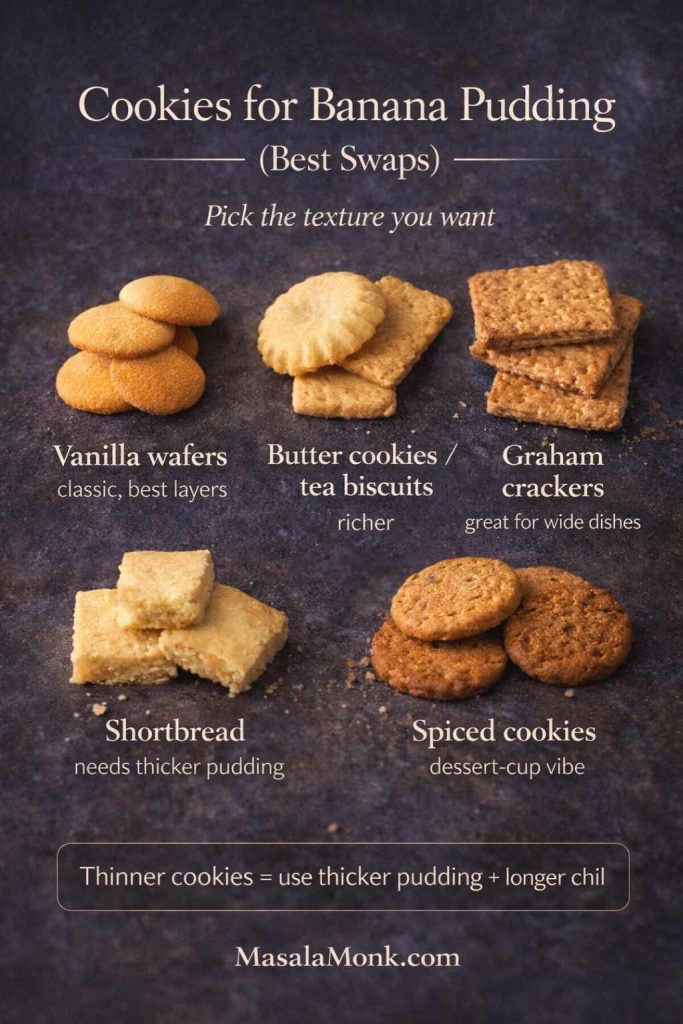
Cookie guide for no-bake banana pudding showing five options: vanilla wafers (classic), butter cookies/tea biscuits (richer), graham crackers (great for wide dishes), shortbread (needs thicker pudding), and spiced cookies (dessert-cup vibe). Note at bottom: thinner cookies need thicker pudding and a longer chill. MasalaMonk.com footer.
Cookies are the backbone of banana pudding. Vanilla wafers give the most classic, tidy layers, while butter cookies make it taste more bakery-rich. Graham crackers are great in wider dishes, shortbread holds up best with a thicker pudding base, and spiced cookies turn jars into cozy dessert cups. If your layers ever go too soft, it’s usually not “your fault”—it’s a cookie thickness + chill-time mismatch.

Banana pudding with vanilla wafers (the classic layering cookie)

Vanilla wafers create that signature texture: soft, cake-like, and spoonable, yet still layered. They also look beautiful through glass if you serve banana pudding in jars.

Vanilla wafer alternatives that still behave well in banana pudding

Sometimes you want a different cookie, either for flavor or because you’re working with what you have.

  • Butter cookies or tea biscuits: richer, more “bakery” tasting
  • Graham crackers: slightly honeyed; great for wide dishes and jars
  • Shortbread: dense and buttery; best paired with a thicker pudding base
  • Spiced cookies: cozy, dramatic, and excellent in dessert cups

If you lean toward delicate cookies, keep your pudding thicker and don’t rush the chill. Otherwise, the layers can turn too soft before serving.

Also Read: Sourdough Recipe: 10 Easy Bread Bakes (Loaves, Rolls & Bagels)

No-bake banana pudding: the classic recipe (vanilla wafers + whipped pudding)

This is the version to make when you want the most reliable outcome with the least effort. It also gives you the cleanest foundation for variations later.

Ingredients (serves 8–10)

  • 3–4 medium ripe bananas
  • 1 box instant vanilla pudding mix (about 90–100 g)
  • Cold milk (use the amount on the box as your starting point)
  • 250–350 ml whipping cream, chilled
  • 1–2 teaspoons vanilla extract (optional)
  • Vanilla wafers (or your cookie choice)
  • A small pinch of salt (optional, but surprisingly important)
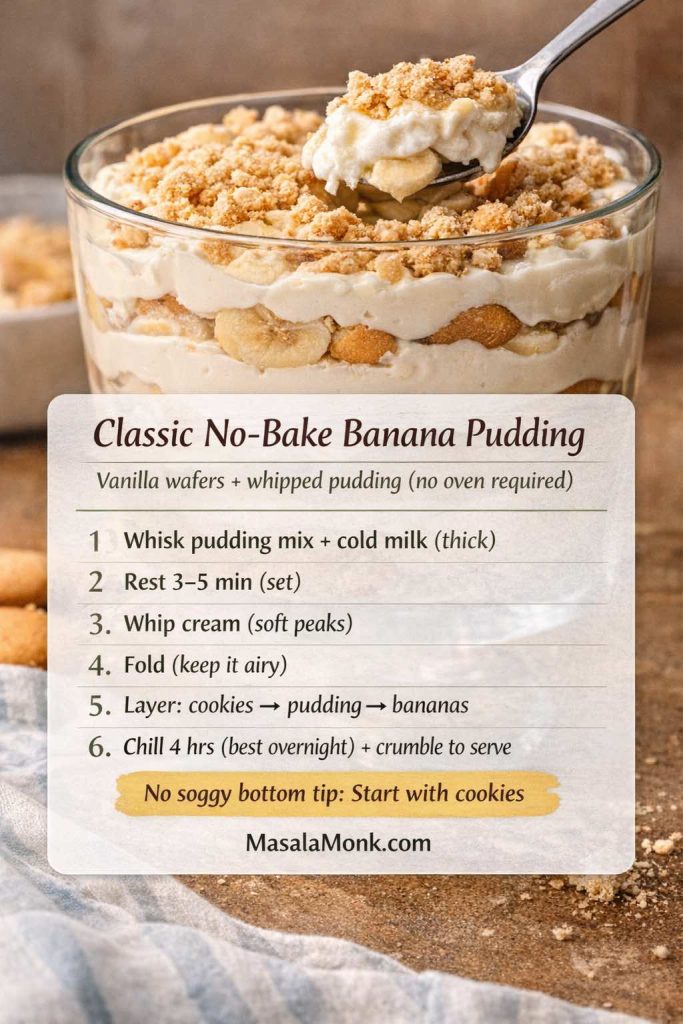
Classic no-bake banana pudding in a glass dish with visible layers of vanilla wafers, banana slices, and creamy pudding, topped with cookie crumble and a spoon lifting a bite. Text overlay shows a 6-step recipe: whisk pudding mix with cold milk, rest 3–5 minutes, whip cream, fold, layer cookies–pudding–bananas, then chill 4 hours (best overnight). Tip: start with cookies.
This is the most reliable no-bake banana pudding—classic vanilla wafers, fluffy whipped pudding, and clean layers that hold. The quick 6-step card makes it easy to build: whisk, fold, layer, then let the fridge do the magic (overnight = bakery-level texture). If you’ve ever had a soggy bottom, the one change that fixes it is right here: start with cookies.

Method

  1. Make the pudding base. Whisk pudding mix with cold milk until it thickens, then let it stand for a few minutes so it sets properly.
  2. Whip the cream. Beat chilled cream until soft peaks. Add vanilla if you want a warmer, dessert-shop aroma.
  3. Fold gently. Fold whipped cream into the pudding base until it looks airy and uniform. Don’t stir aggressively; instead, turn the mixture over itself so you keep the lift.
  4. Slice bananas at the last moment. This keeps them fresher and helps reduce browning.
  5. Layer. In a dish: cookies → pudding → bananas. Repeat until you run out, finishing with pudding on top.
  6. Chill. Refrigerate for at least 4 hours. Overnight is even better because the cookies soften evenly and the pudding tightens into a more cohesive slice-and-scoop texture.

A small finishing move that changes the whole dessert

Right before serving, crumble a handful of cookies over the top. The contrast—soft layers underneath, crunchy crumb on top—makes each bite feel more alive.

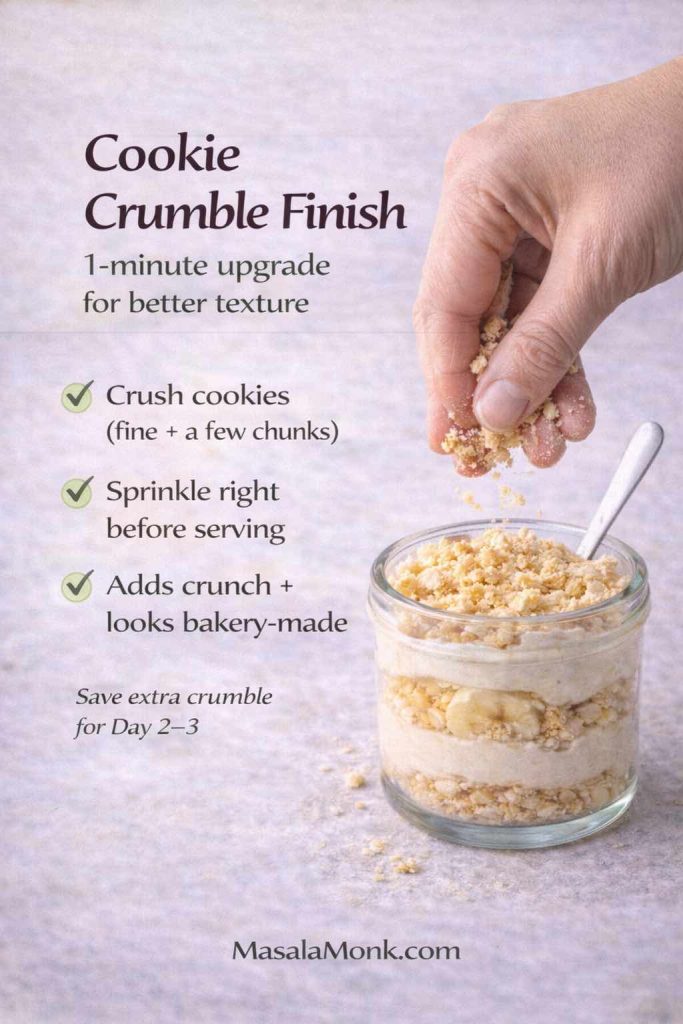
Instructional graphic titled “Cookie Crumble Finish” showing a hand sprinkling crushed vanilla wafer crumbs over a jar of no-bake banana pudding with visible layers. Text overlay says it’s a 1-minute upgrade for better texture: crush cookies (fine plus a few chunks), sprinkle right before serving, and it adds crunch and looks bakery-made. It also notes to save extra crumble for Day 2–3. Footer reads MasalaMonk.com.
If you want banana pudding to feel more “finished” without adding new ingredients, this is the move: a fresh cookie crumble right before serving. Crushing wafers into a mix of fine crumbs and a few bigger chunks gives you contrast—soft cake-y layers underneath, crisp texture on top. It also makes the dessert look bakery-made in seconds. If you’re storing leftovers, keep a small bowl of crumble aside and add it at serving time; it brings Day 2 (and even Day 3) right back to life.

If you enjoy layered puddings and want another “simple but elegant” idea, this savoiardi chocolate vanilla pudding has a similarly satisfying spoon texture, just with a more dramatic chocolate-and-cream vibe.

Also Read: Cold Brew Espresso Martini: How to Make It (Step-by-Step Recipe)


No-cook banana pudding with sweetened condensed milk (extra creamy, no oven required)

When you want banana pudding that tastes richer and holds up longer—especially if it’s sitting out for a while at a gathering—condensed milk is the shortcut that feels like a secret.

This variation also makes it easier to keep the pudding thick even after chilling, which is helpful if you’re using cookies that soften quickly.

Ingredients

  • 1 can sweetened condensed milk (about 395–400 g)
  • 1 box instant vanilla pudding mix (about 90–100 g)
  • Cold milk (start with slightly less than the box suggests)
  • Whipped cream (optional but recommended)
  • Bananas
  • Vanilla wafers or other cookies
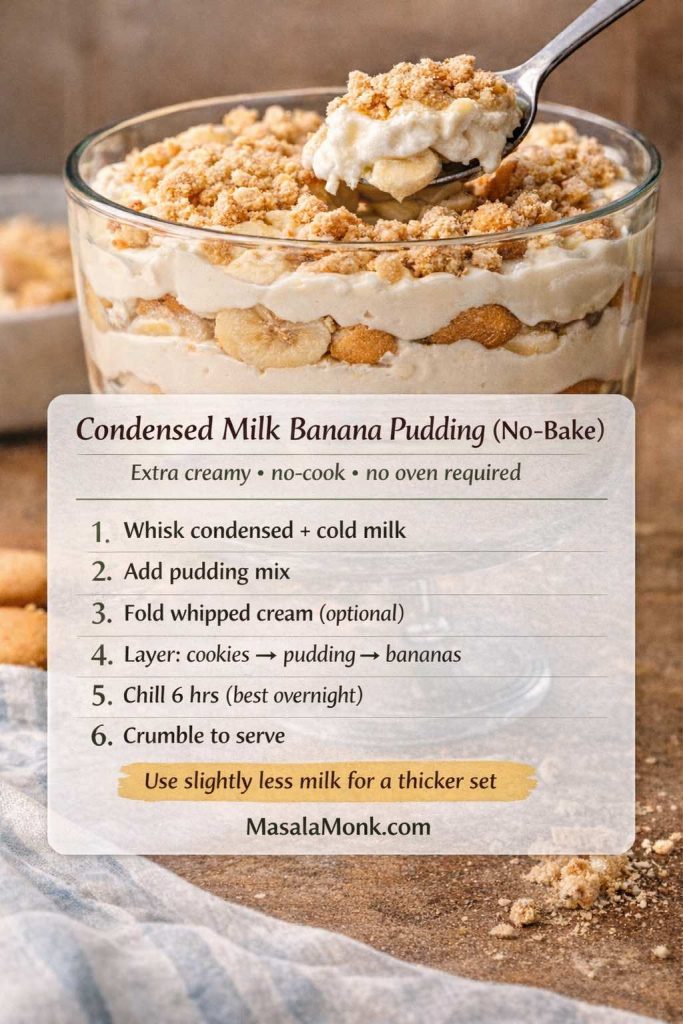
Condensed milk banana pudding (no-bake) in a glass dish with visible layers of bananas, vanilla wafers, and creamy pudding, topped with cookie crumble and a spoon lifting a bite. Text overlay shows a simple 6-step method: whisk sweetened condensed milk with cold milk, add pudding mix, fold in whipped cream (optional), layer cookies–pudding–bananas, chill 6 hours (best overnight), then crumble to serve. Tip: use slightly less milk for a thicker set.
If you want banana pudding that tastes richer and holds its shape longer, this sweetened condensed milk version is the upgrade. The condensed milk adds body, which helps the layers stay thick after chilling—especially useful if your cookies soften quickly. One small move makes it even more reliable: start with slightly less milk than your pudding box suggests, then let it rest overnight so the wafers turn cake-y without the bottom getting watery.

Method

  1. Whisk condensed milk and cold milk until smooth and glossy.
  2. Add the pudding mix and whisk until thickened.
  3. Fold in whipped cream if you want a lighter finish.
  4. Layer cookies, bananas, pudding, repeating until the dish is full.
  5. Chill longer than the classic—aim for 6 hours or overnight—so the layers become neatly sliceable.

If you’re the type who loves make-ahead fridge sweets, you might also enjoy peanut butter fudge. It’s a different texture entirely, yet it hits that same “chill, slice, share” convenience.

Also Read: 10 Vegan Chocolate Cake Recipes (Easy, Moist, & Dairy-Free)


Cream cheese no-bake banana pudding (thick, tangy, cheesecake-style recipe)

Cream cheese changes the personality of banana pudding. The dessert becomes thicker and slightly tangy, with a richer mouthfeel that feels closer to a cheesecake filling. It’s a wonderful choice if you like desserts that scoop cleanly and don’t slump.

Ingredients (serves 8–10)

  • 225 g cream cheese, softened
  • 1 box instant vanilla pudding mix
  • Cold milk (use a little less to keep it thick)
  • 250–350 ml whipping cream, whipped to soft peaks
  • Optional: 1 can sweetened condensed milk for extra richness
  • Bananas
  • Cookies (vanilla wafers are perfect here)
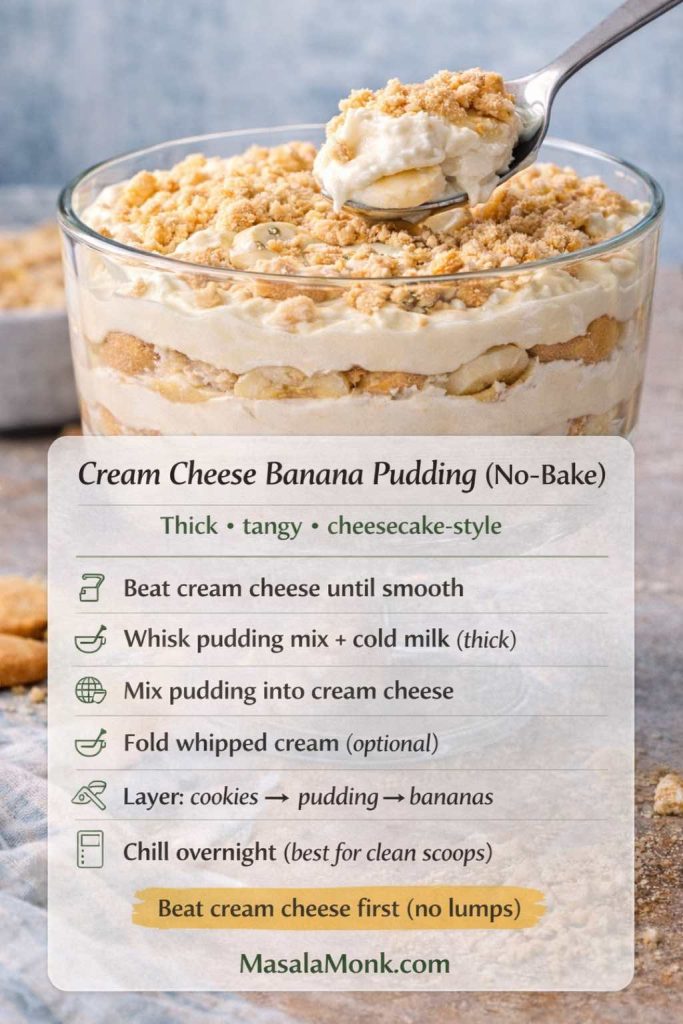
Cream cheese banana pudding (no-bake) in a glass dish with layered bananas, vanilla wafers, and thick creamy pudding, topped with cookie crumble and a spoon lifting a bite. Text overlay lists steps: beat cream cheese until smooth, whisk pudding mix with cold milk until thick, mix pudding into cream cheese, fold in whipped cream (optional), layer cookies–pudding–bananas, then chill overnight for clean scoops. Tip: beat cream cheese first to avoid lumps.
This is the banana pudding to make when you want thick, scoop-clean layers with a gentle cheesecake tang. Cream cheese adds structure, so the dessert slumps less and holds up better on a table. The only non-negotiable is texture: beat the cream cheese until completely smooth before anything else goes in—once lumps hide in the base, they’re hard to fix. After an overnight chill, the layers tighten, the wafers turn cake-y, and every spoonful stays creamy instead of runny.

Method

  1. Beat the cream cheese until completely smooth. Take your time—lumps are stubborn once you add everything else.
  2. Blend in condensed milk if using, until creamy and glossy.
  3. Whisk pudding mix with cold milk separately until thick, then fold or beat it into the cream cheese mixture.
  4. Fold in whipped cream to lighten the base.
  5. Layer with bananas and cookies, then chill overnight for the best structure.

If you want to lean into the cheesecake mood, serve this version alongside no-bake blueberry cheesecake for a dessert table that feels intentional rather than accidental.

Also Read: Cranberry Moscow Mule Recipe: A Festive Holiday Cocktail With Easy Variations


Homemade banana pudding from scratch (stovetop custard, still no oven needed)

This is the method that turns banana pudding into something you might proudly bring to a holiday dinner. It tastes deeper, it feels silkier, and it carries a quiet confidence that instant mix can’t quite replicate.

Even so, it’s still simple. You’re making a vanilla custard thickened with egg yolks and cornstarch, then chilling it until cold and spoonable. After that, you layer it exactly the same way.

For a dependable reference on how stovetop pudding thickens, King Arthur’s simple stovetop vanilla pudding is a useful baseline. If you enjoy understanding the “why” behind the method, Serious Eats has a clear explanation in their guide to vanilla pastry cream, which shares many of the same principles.

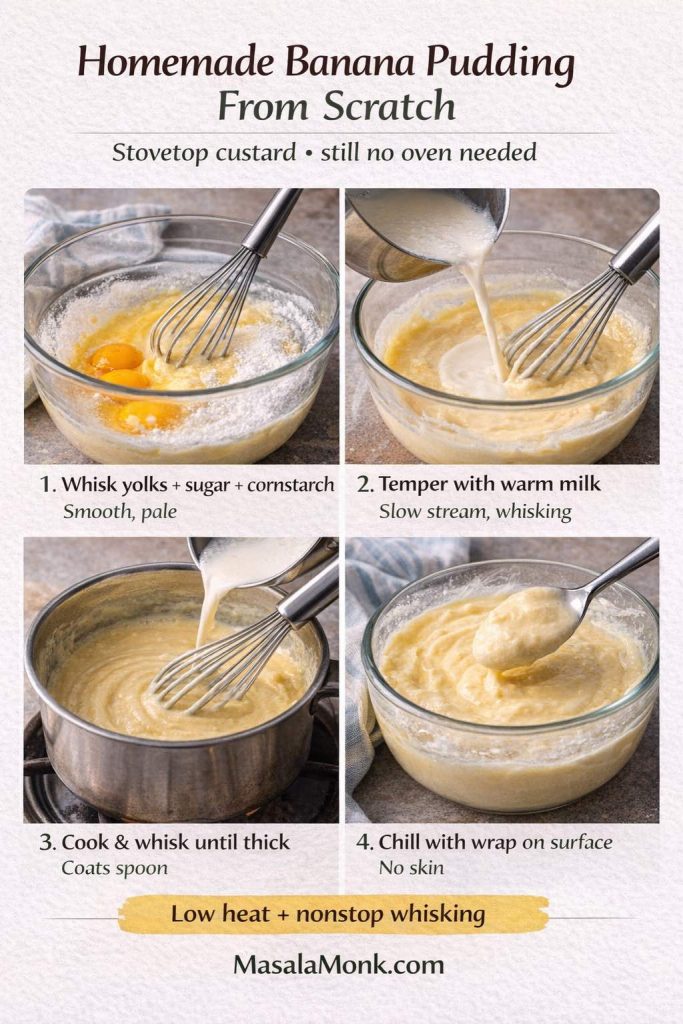
Step-by-step infographic titled “Homemade Banana Pudding From Scratch” showing a 2x2 grid of stovetop custard steps: whisk egg yolks with sugar and cornstarch until smooth, temper with warm milk while whisking, cook and whisk on low heat until thick and coating a spoon, then chill with plastic wrap pressed on the surface to prevent a skin. Note reads “Low heat + nonstop whisking.” MasalaMonk.com appears in the footer.
If you want banana pudding that tastes unmistakably homemade, the stovetop custard is the difference—and it’s easier than it sounds once you see the rhythm. This quick guide covers the two make-or-break moments: tempering (so yolks don’t scramble) and steady whisking on low heat (so the custard thickens smoothly instead of turning lumpy). Finish by chilling with wrap pressed directly on the surface to prevent a skin, then layer with bananas and wafers once it’s fully cold for the cleanest, most “old-fashioned” texture.

Ingredients (serves 8–10)

  • 500 ml milk (2 cups)
  • 90–120 g sugar (adjust to taste)
  • 3 egg yolks
  • 20–25 g cornstarch (about 3 tablespoons)
  • Pinch of salt
  • 2 teaspoons vanilla extract
  • 25–30 g butter (optional, for extra silkiness)
  • Bananas
  • Vanilla wafers (or cookie of choice)

Method

  1. Whisk the yolks, sugar, cornstarch, and salt until smooth and slightly thickened. This mixture should look pale and glossy.
  2. Warm the milk in a saucepan until steaming. Do not boil—you want it hot enough to temper the eggs, not hot enough to scramble them.
  3. Temper slowly. Whisk a little warm milk into the yolk mixture, then a little more, building the temperature gradually.
  4. Return to the pan and cook. Pour the tempered mixture back into the saucepan and cook on medium heat, whisking constantly. In a few minutes, it will shift from thin to thick. Keep whisking until it’s pudding-like and coats the back of a spoon.
  5. Finish off the heat. Remove the pan from the heat and stir in butter (if using) and vanilla.
  6. Cool correctly. Press a sheet of plastic wrap directly onto the surface so a skin doesn’t form. Let it cool to room temperature, then refrigerate until fully cold.
  7. Layer and chill again. Once the custard is cold and thick, layer cookies, bananas, and custard. Chill at least 4–6 hours, ideally overnight.

To make it “old fashioned” banana pudding without an oven

Keep the custard thicker and skip folding in whipped cream. The result is dense, silky, and unmistakably homemade—very much the old-fashioned homemade banana pudding feeling, while still staying no oven required.

Also Read: Baked Ziti Recipe Collection: 15 Easy Variations


Vegan and dairy-free banana pudding (no-bake, no oven, still satisfying)

A dairy-free banana pudding shouldn’t feel like a side quest. It should taste like banana pudding—fragrant bananas, vanilla warmth, and a creamy base that sets properly.

The key is choosing a plant milk that thickens well (oat and soy are excellent), then cooking a quick pudding base with cornstarch. After that, you chill it fully before layering.

If you like fridge-set desserts, you might also enjoy the textures in this collection of chia pudding recipes. The flavors differ, yet the “make it, chill it, enjoy it” rhythm is beautifully similar.

Ingredients (serves 6–8)

  • 500 ml plant milk (oat or soy recommended)
  • 50–70 g sugar (adjust to taste)
  • 20–25 g cornstarch (about 3 tablespoons)
  • Pinch of salt
  • 2 teaspoons vanilla extract
  • 1–2 tablespoons vegan butter (optional)
  • Bananas
  • Vegan-friendly cookies (vanilla-style if possible)
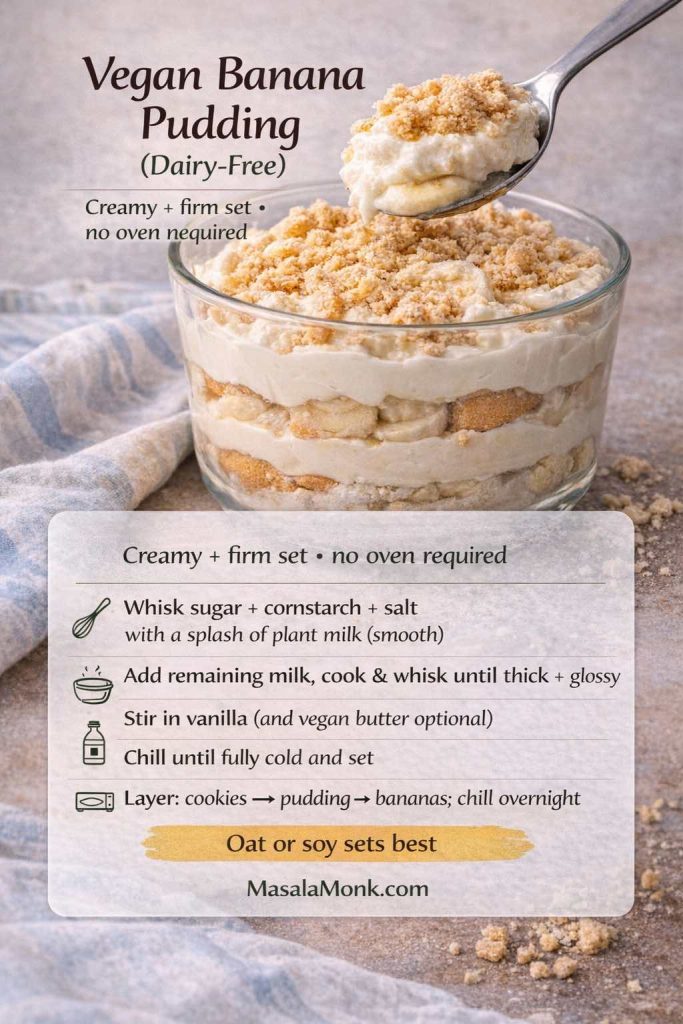
Vegan banana pudding (dairy-free) in a clear glass bowl with layered bananas, cookies, and creamy plant-based pudding, topped with cookie crumble and a spoon lifting a bite. Text overlay shows steps: whisk sugar, cornstarch, and salt with a splash of plant milk, add remaining milk and cook while whisking until thick and glossy, stir in vanilla (and vegan butter optional), chill until fully cold and set, then layer cookies–pudding–bananas and chill overnight. Tip: oat or soy sets best. MasalaMonk.com footer.
A dairy-free banana pudding only feels “compromised” when the base doesn’t set. This version fixes that by cooking a quick cornstarch pudding until it turns thick and glossy, then chilling it fully before you build the layers. Oat or soy milk tends to set more reliably than thinner plant milks, and the overnight rest does double duty: it firms the pudding and softens the cookies into that classic cake-y texture. Assemble once, chill, and you’ll get clean scoops that still taste like real banana pudding.

Method

  1. Make a slurry. Whisk cornstarch, sugar, and salt with a splash of the plant milk until smooth.
  2. Add the remaining milk and cook in a saucepan on medium heat, whisking constantly.
  3. Cook until thick. Once it turns glossy and pudding-like, remove from the heat.
  4. Stir in vanilla and vegan butter if using.
  5. Cool with wrap on the surface, then refrigerate until cold and set.
  6. Layer with bananas and cookies, then chill overnight so the cookie layers soften and the pudding becomes cohesive.

Also Read: Rob Roy Drink Recipe: Classic Scotch Cocktail (Perfect + Dry + Sweet Variations)


Banana pudding cheesecake no-bake style (a variation without changing the whole plan)

If you love cheesecake desserts but still want the nostalgic banana pudding texture, you can build a banana pudding cheesecake no bake variation by combining the cream cheese base with a crumb layer.

  • Crush cookies and press them into the bottom of your dish (a little melted butter helps, though it’s optional if your cookie crumbs are already buttery).
  • Add a thick cream cheese pudding layer, then bananas, then more pudding, then cookies.
  • Chill overnight so it slices cleanly.

For another easy, fruit-forward no-bake dessert that feels “party ready,” keep no-bake blueberry cheesecake in your back pocket—it complements banana pudding beautifully without competing for the same flavor space.

Also Read: Green Chutney Recipe (Coriander–Mint / Cilantro Chutney)


How to layer no-bake banana pudding so it turns cake-y, not soggy

Layering seems obvious until you scoop and realize the cookies dissolved too fast or the bananas slid around like they were on ice. A few simple habits fix that.

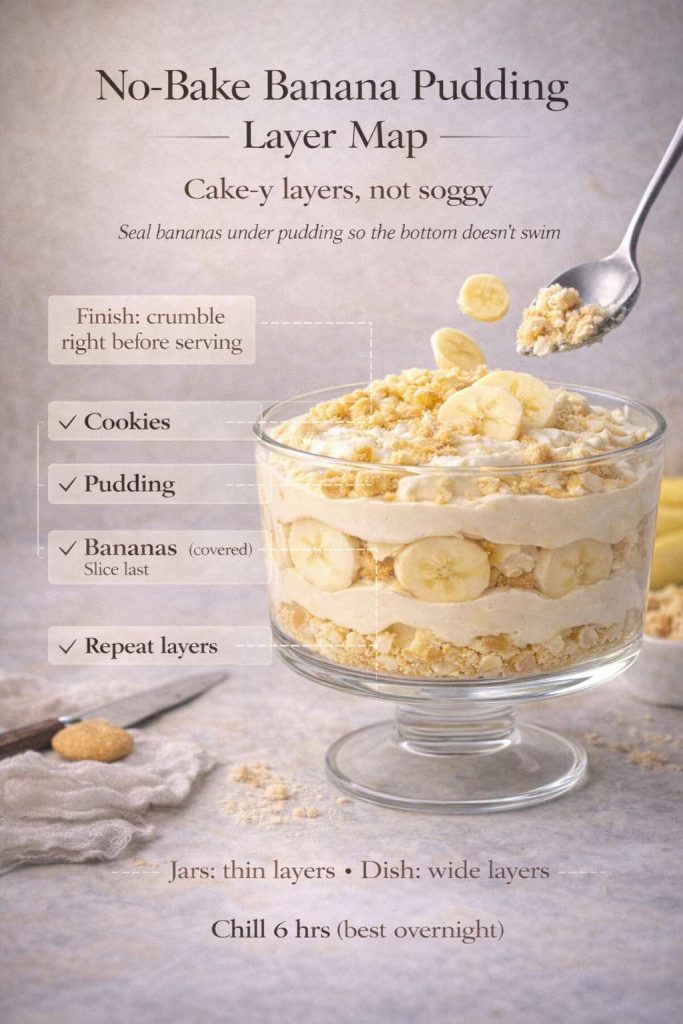
No-bake banana pudding in a clear glass trifle bowl with visible layers of cookies, creamy vanilla pudding, and banana slices. Text overlay reads “No-Bake Banana Pudding Layer Map” and “Cake-y layers, not soggy,” with callouts showing the order: cookies, pudding, bananas (covered—slice last), repeat layers, and finish with cookie crumble right before serving. Bottom note says “Chill 6 hrs (best overnight)” and “MasalaMonk.com.”
This quick no-bake banana pudding layer map is the difference between neat, cake-y layers and a soggy bottom. Start with cookies, seal the bananas under pudding (slice them last), then repeat until the dish is full. Finish with a fresh cookie crumble right before serving, and give it a long chill (overnight is the real upgrade) so every scoop stays thick, creamy, and clean.

Start with cookies, not pudding

Cookies at the base give the dessert structure. They also absorb moisture from the pudding gradually, which helps the bottom layer set rather than swim.

Keep banana slices medium-thick

Thin slices vanish into the pudding; thick slices can feel slippery. Aim for coins that hold their identity without taking over.

Seal bananas under pudding

Bananas brown when exposed to air. Covering them with pudding slows that down while keeping the layers tidy.

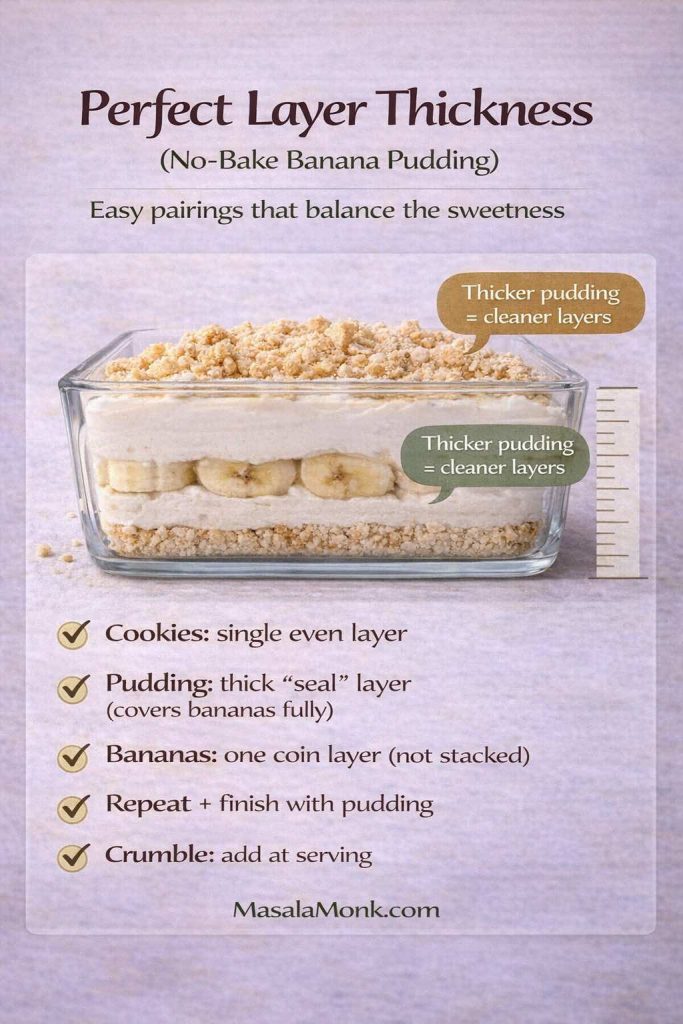
Instructional graphic titled “Perfect Layer Thickness (No-Bake Banana Pudding)” showing a glass dish with visible cookie, pudding, and banana layers plus a ruler-style guide. Text explains: cookies should be a single even layer; pudding should be a thick “seal” layer that fully covers bananas; bananas should be one coin layer, not stacked; repeat layers and finish with pudding; add crumble at serving. Notes say thicker pudding gives cleaner layers. Footer: MasalaMonk.com.
Layer order matters, but layer thickness is what keeps banana pudding from turning soft and messy. Think of pudding as a “seal”: it should be thick enough to fully cover the bananas so they don’t brown quickly or leak moisture into the cookie base. Keep banana slices to a single coin layer (no stacking), then repeat and finish with pudding so the top stays smooth. Save the cookie crumble for serving time—this one step gives you that perfect contrast between cake-y layers underneath and a crisp finish on top.

Chill longer than you think you need

Four hours works. Overnight is better. The difference isn’t subtle: cookies soften evenly, the pudding firms, and the flavors knit into a single, harmonious spoonful.

If you’re serving in jars, build thinner layers. That way, every bite picks up banana, cookie, and pudding together.

Also Read: Paper Plane Cocktail Recipe + Best Amaro Substitutes & Tips


No-bake banana pudding in jars (dessert cups that look as good as they taste)

Banana pudding served in a dish feels nostalgic. Banana pudding served in jars feels modern and intentional—especially if you’re bringing dessert to a gathering or setting up a dessert table.

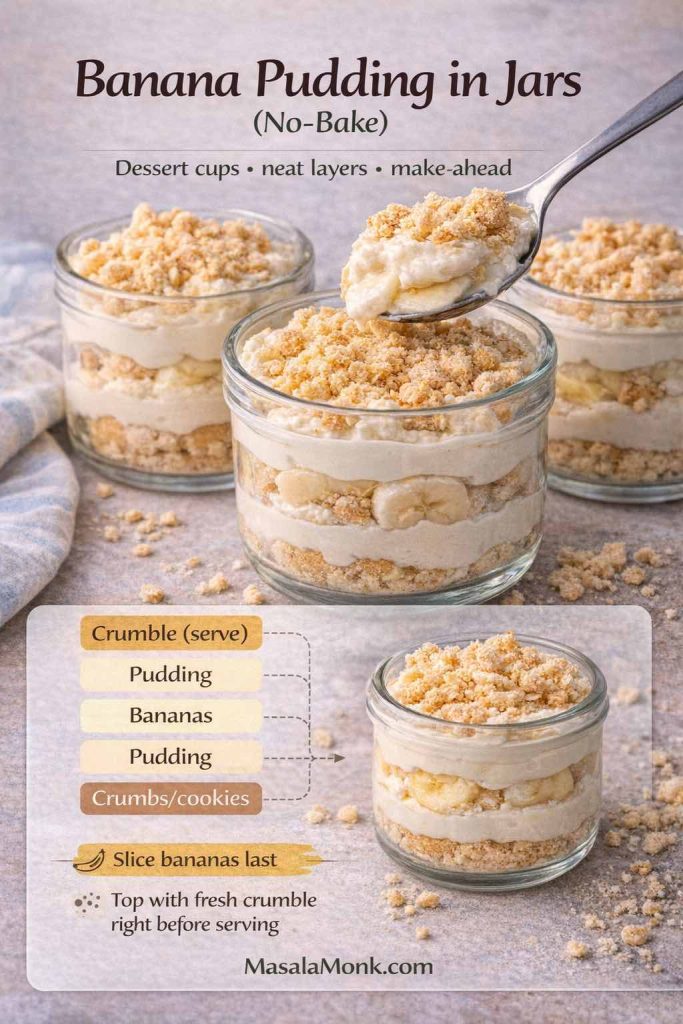
Infographic titled “Banana Pudding in Jars (No-Bake)” showing three glass dessert jars filled with layered banana pudding and cookie crumbs, plus a spoon lifting a bite. A layering guide lists: crumbs/cookies, pudding, bananas, pudding, and crumble to serve. Tips say “Slice bananas last” and “Top with fresh crumble right before serving.” Footer reads MasalaMonk.com.
Jars make banana pudding feel instantly more “party-ready,” and they also protect the layers so each serving stays neat. Use this simple jar layer order—crumbs/cookies → pudding → bananas → pudding → crumble (serve)—and you’ll get the best texture in every bite. Two small details matter most: slice bananas right before assembling (so they stay fresher) and save the final crumble for the last minute so the top stays crisp instead of turning soft in the fridge.

Why jars work so well

  • They protect the layers so the pudding stays neat
  • They’re easy to portion and transport
  • They look beautiful through the glass

If you love the “dessert cup” presentation, you’ll also like the vibe of these Lotus Biscoff dessert cups. They’re different in flavor, yet they share the same layered, chilled charm.

Jar layering rhythm

Cookies (or crumbs) → pudding → bananas → pudding → cookie crumble on top.
Then chill.
Just before serving, add fresh crumble again so the top stays crisp.

Also Read: Sandwich for Breakfast: Breakfast Sandwich Recipe + 10 Variations


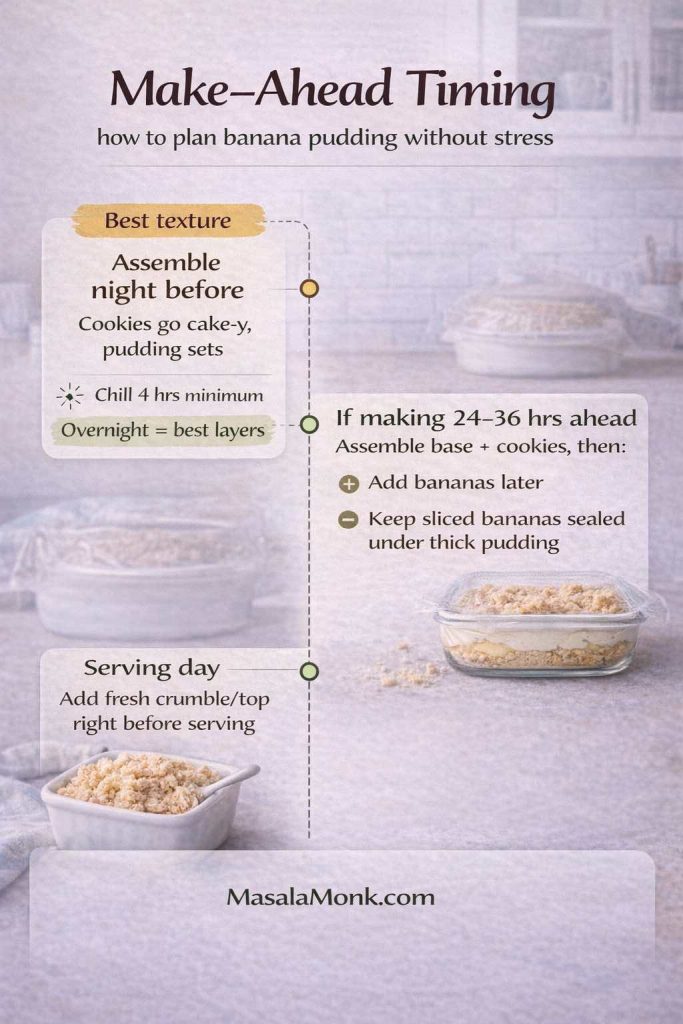
Make-ahead timing (how to plan banana pudding without stress)

Banana pudding is at its best when it has time to rest, which makes it a natural make-ahead dessert. Still, timing matters—especially if you want bananas to look good and layers to hold.

Vertical infographic titled “Make-Ahead Timing: how to plan banana pudding without stress” with a timeline. It recommends assembling banana pudding the night before for best texture, chilling at least 4 hours (overnight best) so cookies turn cake-y and pudding sets. If making 24–36 hours ahead, assemble base and cookies, then add bananas later or keep bananas sealed under thick pudding. On serving day, add fresh crumble/topping right before serving. Footer: MasalaMonk.com.
Banana pudding is one of those desserts that actually improves with a little planning. The simplest win is assembling it the night before: the pudding firms, the cookies soften into that cake-y layer, and the whole dish scoops more cleanly. If you need to make it farther ahead, treat bananas as the variable—either add them closer to serving or keep them fully covered under a thicker pudding layer to reduce browning and excess moisture. Right before serving, add a fresh crumble on top so the finish stays crisp.

The sweet spot: assemble the night before

When you assemble banana pudding the evening before, you get the best of everything: the cookies soften, the pudding sets, and the bananas mellow without turning watery.

If you need to assemble earlier

If you’re making it more than a day in advance, consider one small adjustment: assemble the pudding and cookies first, then add bananas closer to serving time. Alternatively, you can keep bananas protected under thicker pudding layers so air exposure stays minimal.

Food safety basics for fridge desserts

Since banana pudding contains dairy—and sometimes eggs, if you make custard—good refrigeration habits matter. The general guidance on keeping perishable foods safe (including cooling and refrigeration) from FoodSafety.gov is a solid reference to follow. For egg-based custards in particular, the FDA’s overview of egg safety is worth a quick read if you want extra peace of mind.

For leftovers, the USDA’s advice on leftovers and food safety is a reliable guide for how long chilled desserts typically stay safe in the fridge.

Also Read: Classic Rum Punch + 9 Recipes (Pitcher & Party-Friendly)


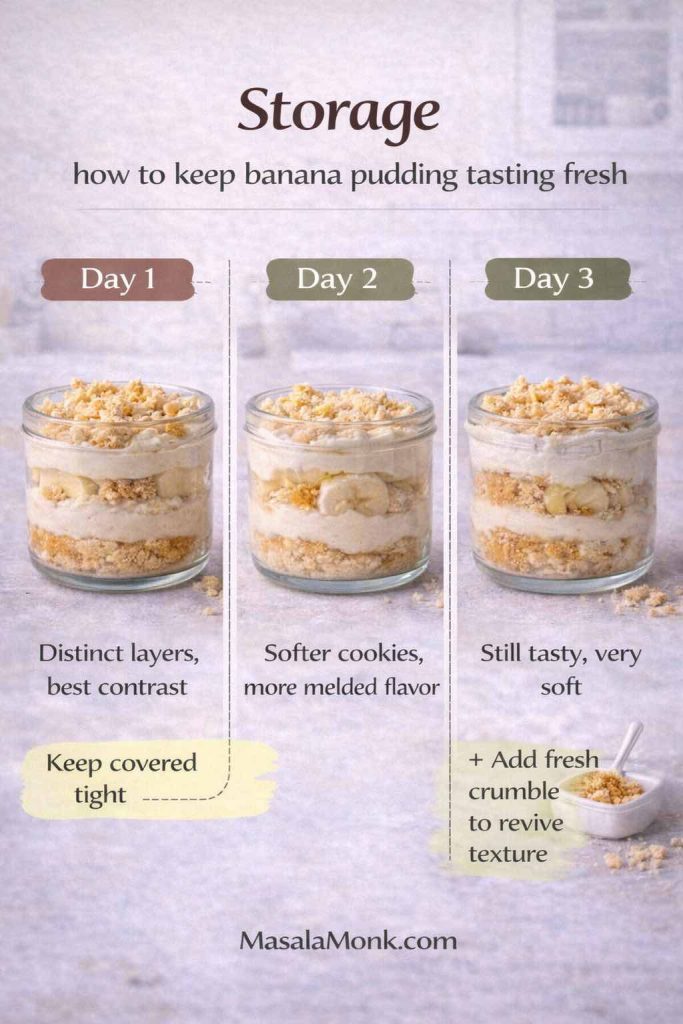
Storage (how to keep banana pudding tasting fresh)

Cover it tightly

Banana pudding absorbs fridge odors easily. A tight lid or well-sealed wrap keeps the flavor clean and keeps the top from drying out.

Triptych infographic titled “Storage: how to keep banana pudding tasting fresh” showing banana pudding in a jar over three days. Day 1 notes distinct layers and best contrast; Day 2 notes softer cookies and more melded flavor; Day 3 notes still tasty but very soft, with a tip to add fresh crumble to revive texture. Another tip says “Keep covered tight.” Footer reads MasalaMonk.com.
Banana pudding changes as it sits, and that’s normal—not a mistake. On day one, the layers are the most distinct and the contrast is strongest. By day two, the cookies soften further and everything tastes more blended (often the sweet spot). By day three, it’s still delicious, just much softer overall. The easiest way to keep it tasting “fresh” is sealing it tightly so it doesn’t pick up fridge odors—and saving a little cookie crumble to sprinkle right before serving for a crisp finish.

Keep it cold, consistently

Avoid leaving the pudding out for long stretches, especially in warm rooms. Serve what you need, then return the dish to the fridge.

Expect the texture to evolve

On day one, layers are distinct. By day two, the cookies soften further. By day three, it’s still delicious—just more uniformly soft. If you like a bit of crunch, save extra cookie crumble to add at the end.


Serving ideas that make banana pudding feel “new” again

Banana pudding is classic for a reason, yet it also welcomes a few thoughtful finishing touches.

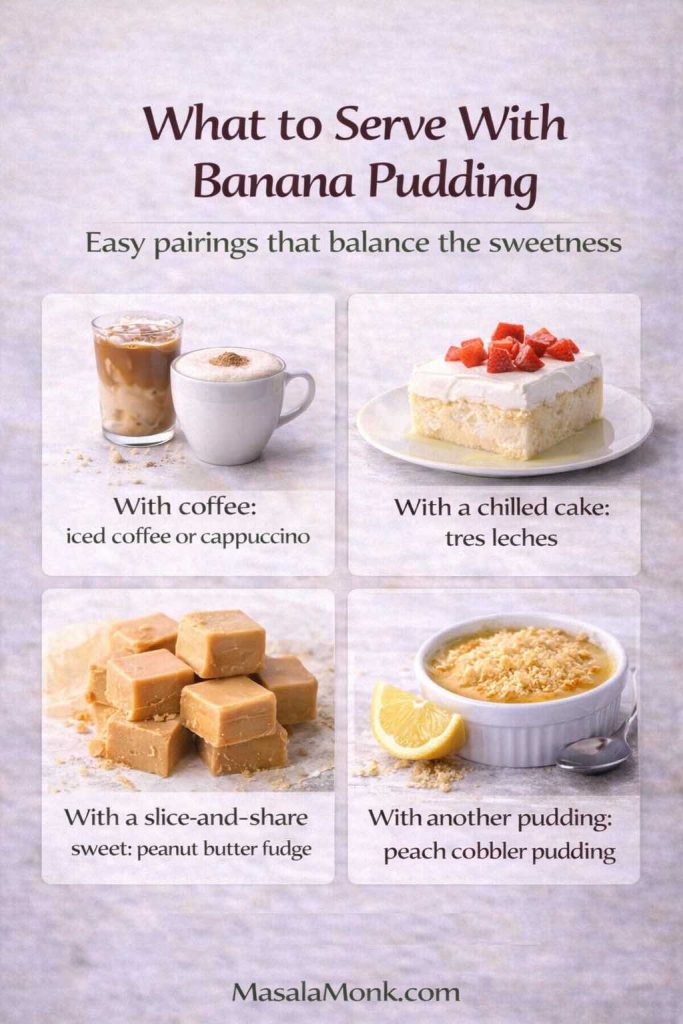
Infographic titled “What to Serve With Banana Pudding” with the subtitle “Easy pairings that balance the sweetness.” A four-tile grid shows: iced coffee or cappuccino, tres leches (chilled cake), peanut butter fudge (slice-and-share sweet), and peach cobbler pudding (another pudding dessert). Each tile includes a photo and a short label. Footer reads MasalaMonk.com.
Banana pudding is rich and soft, so it shines brightest next to something that adds contrast—either bitterness, chill, or a different texture. Coffee (iced coffee or cappuccino) cuts the sweetness and makes dessert feel café-like. A chilled cake such as tres leches turns the table into a “real dessert spread” without extra work. If you want something sliceable and giftable, peanut butter fudge is a great partner. And if you’re keeping the theme cozy, peach cobbler pudding gives a warm-spiced counterpoint while staying in the same spoon-dessert lane.

A light drizzle (without turning it into a chocolate dessert)

A small drizzle can make the surface look glossy and special, particularly when you’re serving guests. This 3-minute chocolate syrup works beautifully if you keep it subtle—just enough to accent the bananas and vanilla, not drown them.

A cookie “snow” finish

Crumble cookies over the top right before serving. It’s simple, yet it adds crunch and makes the presentation more inviting.

A dessert table that feels balanced

If you’re putting together multiple sweets, pair banana pudding with something that contrasts its creamy softness:

For even more ideas in the same cozy category, this Pudding Palooza dessert roundup is a fun way to keep the theme going without repeating the same flavors.

Pair it with coffee (cold or foamy)

Banana pudding loves coffee. The sweetness and vanilla play nicely against roasted notes, especially after a meal.

  • If you want something refreshing, browse these iced coffee recipes and pick a cold brew or latte-style option.
  • If you’d rather keep it warm and classic, a homemade cappuccino makes the whole dessert moment feel café-like.

Strawberry Smoothie Recipes (12 Easy Blends + Bowls & Protein Shakes)Also Read:


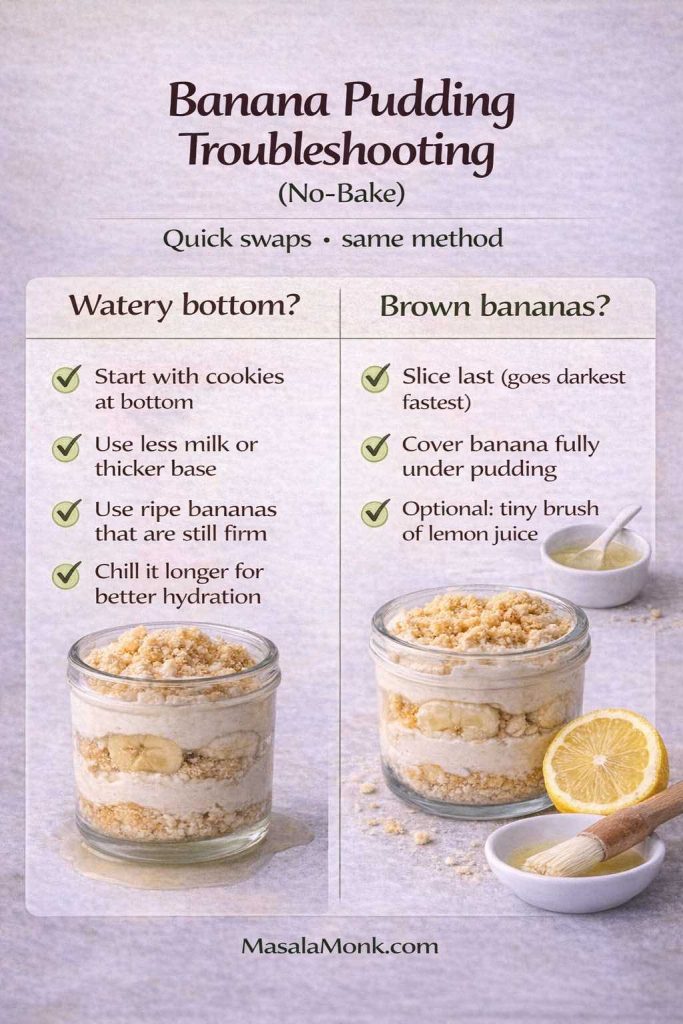
Troubleshooting (so your banana pudding turns out thick, creamy, and layered)

Even a simple dessert can misbehave. Fortunately, banana pudding is forgiving, and the fixes are usually quick.

Infographic titled “Banana Pudding Troubleshooting (No-Bake)” with two columns: “Watery bottom?” and “Brown bananas?” The watery-bottom tips say to start with cookies, use less milk or a thicker base, choose ripe bananas that are still firm, and chill longer. The browning tips say to slice bananas last, cover them fully under pudding, and optionally brush lightly with lemon juice. Two jar photos illustrate the layers. Footer reads MasalaMonk.com.
Most banana pudding “problems” come down to two things: moisture and air. If you see liquid pooling at the bottom, it usually means the bananas were very ripe or the pudding base was a bit thin—starting with a cookie layer and using a thicker base (often just slightly less milk) helps the dessert set into clean, scoopable layers. If bananas turn brown, it’s simply exposure: slice them right before layering and keep them fully covered under pudding so air can’t reach the fruit. A tiny brush of lemon juice is optional, but keep it subtle so the pudding still tastes purely vanilla-banana.

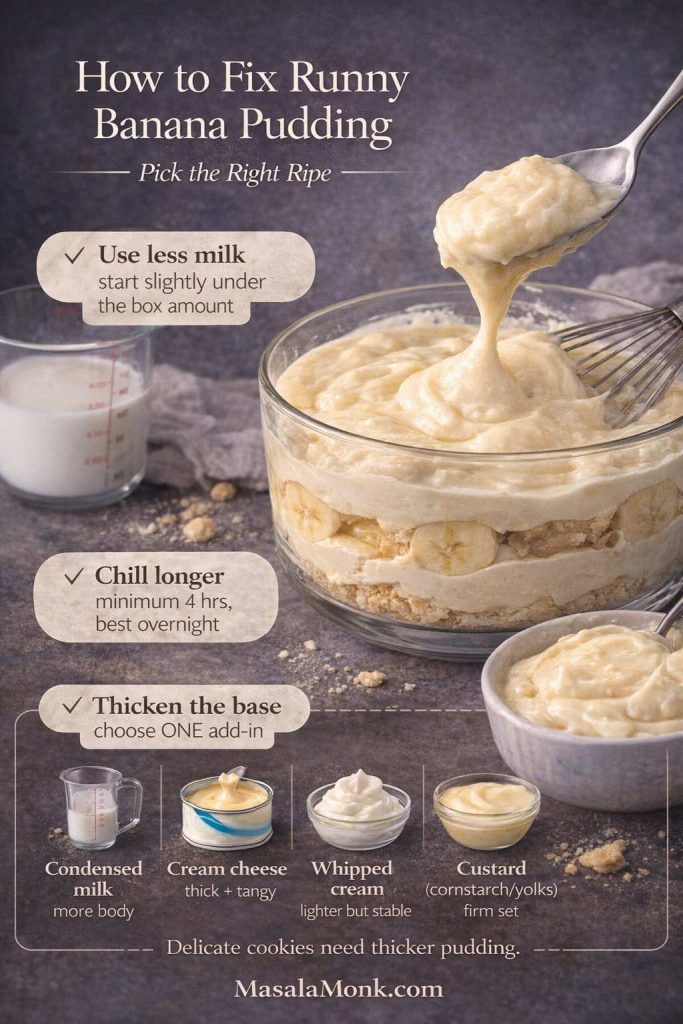
If the pudding feels runny

Most often, it’s too much milk or not enough time in the fridge. Next time, reduce the milk slightly. For now, chill it longer—covered—so it can finish setting properly.

If a watery layer appears at the bottom

Overripe bananas can release moisture, and thin pudding can’t hold it. Use slightly firmer ripe bananas and make a thicker pudding base, especially if you’re layering with delicate cookies.

If the cookies dissolved into mush

That’s usually a thickness issue. Thicker pudding slows down cookie breakdown. Vanilla wafers, butter cookies, and shortbread also hold up better than delicate biscuits.

Infographic titled ‘How to Fix Runny Banana Pudding’ showing a spoon lifting loose banana pudding over a bowl. It lists three fixes: use slightly less milk than the pudding box amount, chill longer (minimum 4 hours, best overnight), and thicken the base by choosing one add-in—sweetened condensed milk, cream cheese, whipped cream, or a cooked custard with cornstarch/yolks. Note says delicate cookies need thicker pudding. MasalaMonk.com at bottom.
Runny banana pudding is almost always a ratio + chill-time problem—not a failure. Start with slightly less milk, then give it a proper fridge rest (overnight is the real glow-up). If you want a thicker, cleaner scoop, pick one base booster: condensed milk for body, cream cheese for thick + tangy, whipped cream for lighter stability, or a simple custard for the firmest set. (Perfect for the Troubleshooting section when your layers feel too soft.)

If the bananas browned

Slice bananas right before layering, then cover them with pudding so air can’t reach them. If you need extra protection, a very light brush of lemon juice can help; keep it subtle so the pudding doesn’t taste citrusy.

If your from-scratch custard turned lumpy

Heat was likely too high, or whisking paused. You can strain the custard through a fine sieve, then return it to gentle heat briefly while whisking to smooth it out. After that, chill as usual.

Also Read: Daiquiri Recipe (Classic, Strawberry & Frozen Cocktails)


A few variations that keep the banana pudding recipe feeling fresh

Once you’ve made banana pudding once, it becomes dangerously easy to make it again—so it helps to rotate small changes that make it feel new.

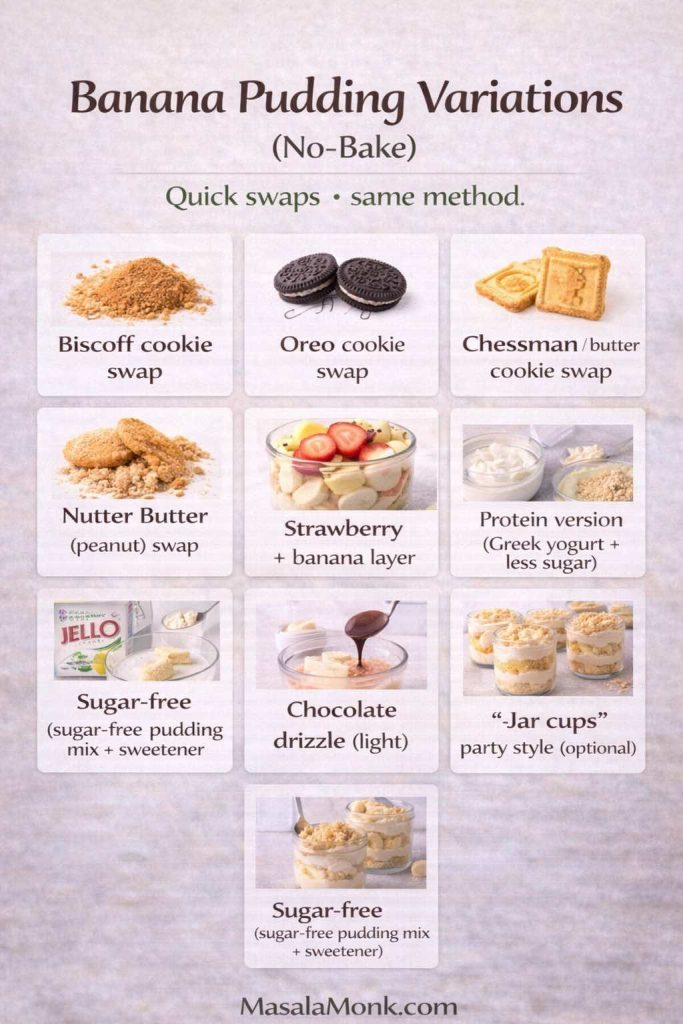
Infographic titled “Banana Pudding Variations (No-Bake)” with the subtitle “Quick swaps • same method.” A grid lists easy add-ins and swaps for no-bake banana pudding: Biscoff cookie swap, Oreo cookie swap, Chessman or butter cookie swap, Nutter Butter (peanut) swap, strawberry + banana layer, protein version (Greek yogurt + less sugar), sugar-free option (sugar-free pudding mix + sweetener), a light chocolate drizzle, and optional jar cups party style. Footer reads MasalaMonk.com.
Once you know the basic layering rhythm, banana pudding becomes a template you can remix. This quick variation board helps you choose a direction without rewriting the whole recipe: swap cookies for Biscoff, Oreo, Chessman, or Nutter Butter; add a strawberry layer for a fruitier twist; or go lighter with a protein-friendly version using Greek yogurt and less sugar. If you’re serving guests, a small chocolate drizzle or jar-cup presentation makes the same pudding feel brand new—without changing the method that keeps it thick and reliable.

Make it more “vanilla-forward”

Use a little extra vanilla extract, and add a pinch of salt to sharpen the flavor. It’s still banana pudding, just brighter and more aromatic.

Make it more “cookie-forward”

Double down on the cookie layers and finish with a generous crumble on top. You’ll get more contrast between soft and crisp.

Make it richer without adding fuss

Use sweetened condensed milk in the base. It adds richness and a thicker finish without requiring custard-making.

Make it more homemade (without using an oven)

Go the stovetop custard route. It takes a little longer, yet the flavor payoff is worth it—especially when you want a truly homemade banana pudding from scratch feeling.

Make it plant-based

Use a thick dairy-free pudding base and vegan-friendly cookies. Given enough chill time, the dessert becomes cohesive and satisfying.

Also Read: Oat Pancakes Recipe (Healthy Oatmeal Pancakes)


Bringing it all together (the no-oven dessert you’ll make again and again)

No-bake banana pudding is one of those desserts that meets you where you are. It can be a quick weeknight treat made from a banana pudding mix and a box of wafers. Then can be a party-ready dish made with sweetened condensed milk for extra creaminess. And it can even be an old-fashioned, homemade banana pudding from scratch with stovetop custard—still no oven required, still wonderfully simple once you learn the rhythm.

Most importantly, it’s the kind of dessert that invites seconds without demanding perfection. So make it classic, make it creamy, make it tangy, or make it dairy-free. Either way, give it time in the fridge, spoon it generously, and let the layers do what they do best: turn a few humble ingredients into something that feels like comfort you can share.

Also Read: What to Mix with Jim Beam: Best Mixers & Easy Cocktails


FAQs

1) Can I make banana pudding with no oven required?

Yes. Banana pudding is naturally a no-oven dessert because the pudding sets in the fridge. Whether you use instant pudding mix, a no-cook condensed milk base, or a stovetop custard, you can still finish the entire dish without turning on the oven.
2) What’s the difference between no-bake banana pudding and no-cook banana pudding?

No-bake banana pudding simply means you don’t bake it. Meanwhile, no-cook banana pudding usually means you also skip stovetop cooking—so you rely on instant pudding mix (and sometimes sweetened condensed milk) to thicken everything.

3) How long does banana pudding need to chill to set properly?

In most cases, banana pudding needs at least 4 hours to set; however, overnight chilling gives the best texture. As it rests, the pudding firms up and the cookies soften into a cake-like layer.

4) How do I keep bananas from turning brown in banana pudding?

First, slice bananas right before layering. Next, cover the banana layer completely with pudding so less air reaches the fruit. If you want extra protection, lightly brushing banana slices with a tiny amount of lemon juice can help—just use it sparingly so the pudding doesn’t taste citrusy.

5) What are the best bananas for banana pudding?

Choose bananas that are yellow with a few brown freckles. They’re sweet and aromatic, yet still firm enough to hold their shape. On the other hand, bananas that are very brown can release more moisture, which may thin the layers.

6) What are the best cookies for banana pudding?

Vanilla wafers are the classic choice because they soften evenly and keep the layers structured. That said, butter cookies, graham crackers, and shortbread also work well—especially if you prefer a richer, more buttery base.

7) Can I make banana pudding with vanilla wafers and still keep it from getting soggy?

Absolutely. Use a thicker pudding base, layer cookies evenly, and chill long enough so the moisture absorbs gradually rather than flooding the cookies. Additionally, adding a fresh cookie crumble on top right before serving brings back a crisp contrast.

8) Can I make banana pudding with sweetened condensed milk?

Yes, and it’s one of the creamiest no-oven options. Sweetened condensed milk adds richness and body, so the pudding holds its shape more reliably. Even so, it’s best to chill it longer—ideally 6 hours or overnight—for the cleanest scoops.

9) Can I make banana pudding from scratch without baking?

You can. Instead of baking, you cook a quick stovetop custard (milk, sugar, egg yolks, and cornstarch), then chill it until thick. After that, you layer it with bananas and cookies just like any banana pudding (no bake) version.
10) Why is my banana pudding runny?

Usually, it comes down to one of three things: too much milk, not enough chill time, or a pudding base that didn’t fully thicken before layering. To fix it next time, reduce the milk slightly and let the pudding stand a few minutes before assembling.

11) Why does banana pudding get watery at the bottom?

Most often, very ripe bananas release liquid as they sit. Similarly, a thinner pudding base can’t “hold” that moisture. Therefore, using slightly firmer ripe bananas and a thicker pudding base helps keep the layers stable.

12) Can I make banana pudding ahead of time?

Yes—banana pudding is one of the best make-ahead desserts. In fact, making it the night before usually improves the texture because the cookies soften evenly and the flavors meld.

13) How long does banana pudding last in the fridge?

Typically, banana pudding tastes best within 24–48 hours. After that, it’s still enjoyable, though the cookies can become very soft and the bananas may darken slightly. Keep it tightly covered to maintain freshness.

14) Can I freeze banana pudding?

Freezing isn’t ideal. Although it may be safe, the texture often suffers because pudding can separate when thawed, and bananas can become mushy. Instead, it’s better to refrigerate and enjoy within a couple of days.

15) How do I make banana pudding thicker without changing the flavor?

Start by using a little less milk, then chill longer. Moreover, folding in whipped cream after the pudding thickens can help the dessert feel thicker and more stable. For an even denser option, try the cream cheese variation.

16) Can I make banana pudding with cream cheese?

Yes. Cream cheese makes banana pudding thicker, slightly tangy, and more “cheesecake-like.” As a result, it holds its shape well and scoops cleanly, especially after an overnight chill.

17) What’s the easiest banana pudding recipe for beginners?

A classic no-bake banana pudding using instant vanilla pudding mix, milk, whipped cream, bananas, and vanilla wafers is the easiest. Since it’s no-cook and no oven required, it’s also the most forgiving.

18) Can I make vegan banana pudding that still tastes creamy?

Yes. A dairy-free banana pudding can be creamy if the pudding base is thickened properly (often with cornstarch) and chilled until fully set. Also, choosing a vanilla-style vegan cookie keeps the flavor closer to traditional banana pudding.

19) Can I make banana pudding without vanilla wafers?

Definitely. You can use butter cookies, graham crackers, shortbread, or similar crisp cookies. Just keep in mind that thinner cookies soften faster, so a thicker pudding base and a longer chill can make a big difference.

20) How do I layer banana pudding so every scoop has all the layers?

Use evenly spaced cookie layers, slice bananas to a similar thickness, and spread pudding all the way to the edges each time. Finally, let it chill long enough so the layers settle—then scoop straight down to capture cookie, banana, and pudding in one bite.

Posted on 13 Comments

Tres Leches – Mexican 3 Milk Cake Recipe

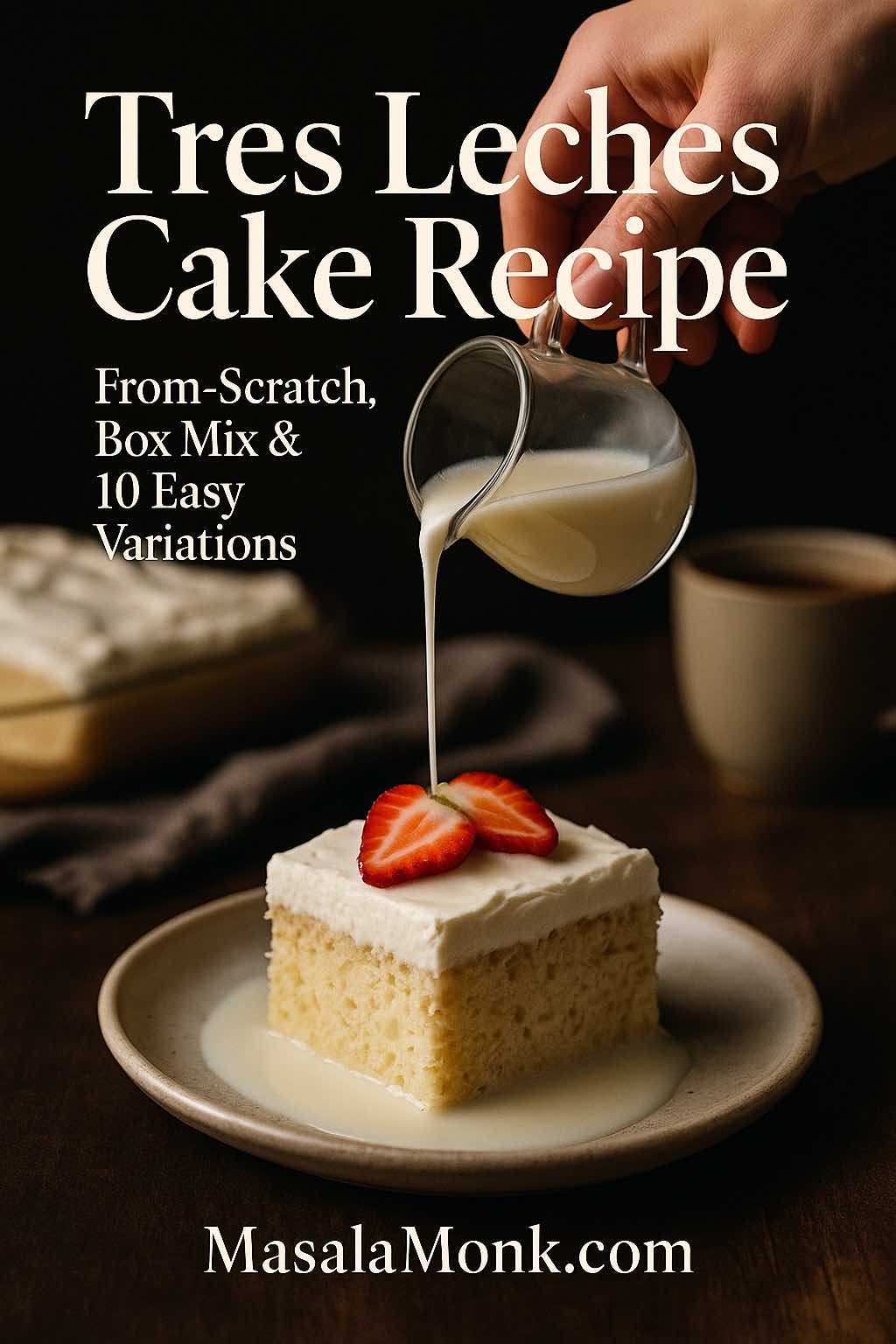
Hand pouring sweet milk over a slice of tres leches cake topped with fresh strawberries on a plate, with the text Tres Leches Cake Recipe – From-Scratch, Box Mix & 10 Easy Variations

If you’ve ever cut into a slice of tres leches cake and watched the fork slide through like it’s cutting clouds, you already know why this dessert has fans for life. It’s soft, cool, milky and somehow rich and light at the same time. This post walks you through a reliable tres leches cake recipe from scratch, then shows you how to turn the same base into an easy box-mix version, a party sheet cake, and a whole line-up of flavours like strawberry, chocolate, pistachio, Biscoff, cupcakes, cheesecake style, eggless and more.

No hunting around ten different posts. One base, many ways to play.


What Is Tres Leches Cake, Really?

At its heart, tres leches is a sponge cake soaked in three kinds of milk until it’s luxuriously moist, then finished with a blanket of whipped cream. Most versions use:

  • Sweetened condensed milk
  • Evaporated milk
  • Whole milk or heavy cream

Those three milks are where the name comes from: tres leches = three milks. The idea is simple, but the texture is unique: a cake that’s drenched yet not stodgy. The Simple English Wikipedia entry on tres leches cake describes it as a sponge cake soaked in evaporated milk, condensed milk and whole milk, and that’s exactly what you’re aiming for here.

Where it comes from is a little more tangled. Many Latin American countries claim it with pride. A piece in Food52, “The Long, Winding Origin Story of Tres Leches Cake”, traces how similar soaked cakes were made in Europe, then evolved through Latin America, with Nicaragua, Mexico and others all laying some claim to the modern version. However you slice the history, tres leches has settled into the “comfort dessert” category across the region and now far beyond it.

If you want another take on the basics, you can peek at the classic tres leches cake article, but you don’t need it to get baking. Let’s set you up with everything you need right here.


The Backbone of a Good Tres Leches Cake Recipe

Before diving into the step-by-step, it helps to understand what makes this cake work so well.

A good tres leches cake recipe has three pillars:

  1. A strong but airy sponge
    The cake needs a structure with enough air bubbles to drink in liquid without collapsing. Think of it a bit like the logic behind tiramisu or trifle.
  2. A balanced milk mixture
    Too much condensed milk and it’s cloying, too much plain milk and it’s bland. You want sweet, creamy and milky in harmony.
  3. Time to soak and chill
    Tres leches isn’t an impatient dessert. It tastes much better once the milks have had hours to seep into the crumb.

Other recipes – like Natasha’s Kitchen’s popular tres leches cake or this authentic version on Hola Jalapeño – follow a similar pattern: airy sponge, three-milk soak, whipped cream topping. You’ll be doing the same, just adapted to your kitchen.


Ingredients for the Classic Tres Leches Cake Recipe

You can make this in a 9×13 inch (23×33 cm) pan for a crowd-pleasing sheet cake or in a slightly smaller dish for a taller, more dramatic dessert.

For the sponge cake

  • All-purpose flour
  • Baking powder
  • Fine salt
  • Eggs, separated into whites and yolks
  • Granulated sugar
  • Vanilla extract
  • A splash of whole milk

This composition is similar to many sponge-style tres leches recipes, including the long-trusted tres leches (milk cake) recipe on Allrecipes, which keeps the batter light but sturdy enough to soak.

For the three-milk mixture

  • Sweetened condensed milk
  • Evaporated milk
  • Whole milk or heavy cream (or a mix of the two)

You can adjust the balance slightly according to how rich you like your cake, but this trio is non-negotiable if you want that classic flavour.

For the topping

  • Heavy whipping cream
  • Icing sugar or fine caster sugar
  • Vanilla extract
  • Ground cinnamon (optional)

Fresh fruit – strawberries, mango, berries, cherries – is optional but excellent.


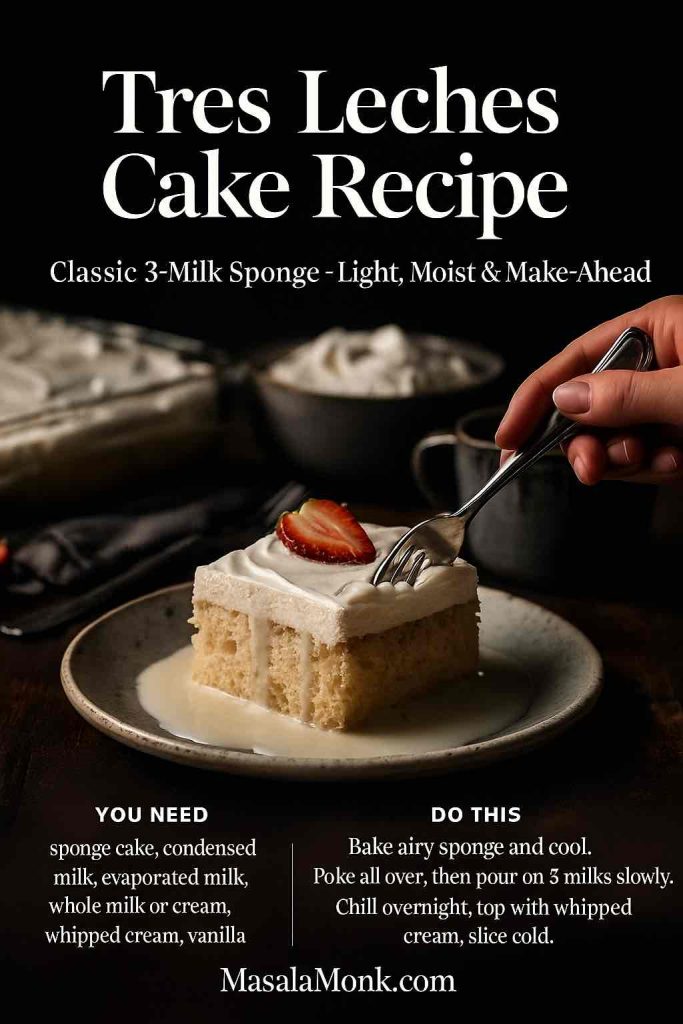
Recipe card showing a slice of classic tres leches cake topped with whipped cream and a strawberry, with a hand holding a fork and overlay text listing ingredients and simple steps for a light, moist 3-milk sponge
Classic Tres Leches Cake Recipe – a light, moist 3-milk sponge with whipped cream, shown here as a quick recipe card so you can see the ingredients and key steps at a glance on MasalaMonk.com.

Step-by-Step: Classic Tres Leches Cake Recipe From Scratch

Take it one stage at a time and the process feels very straightforward.

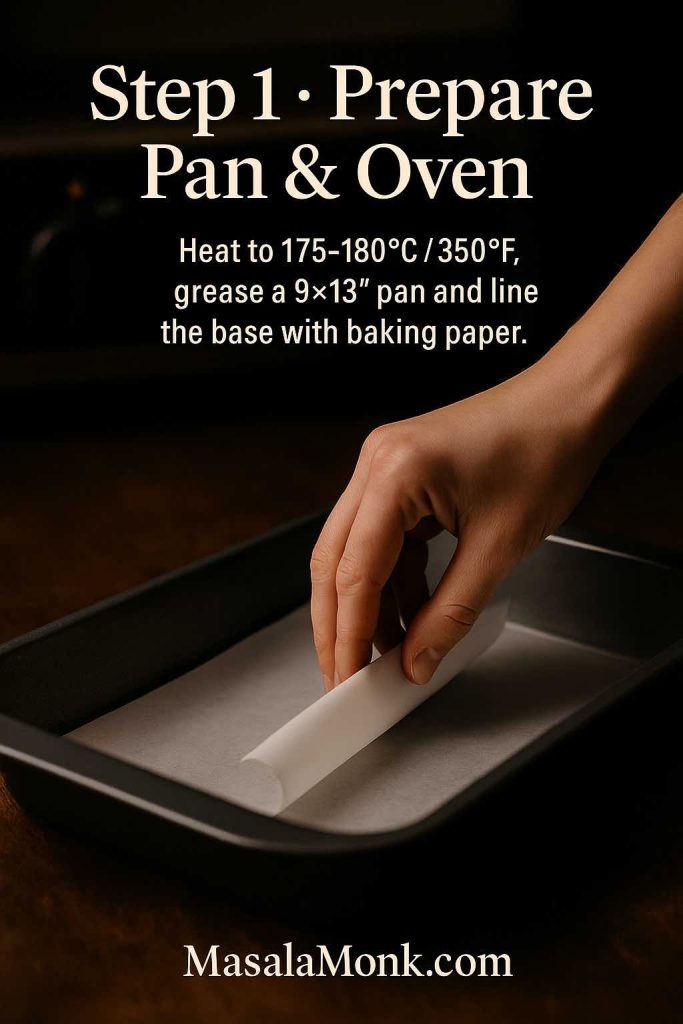
1. Prepare the pan and oven

First, heat your oven to the temperature your recipe specifies, usually around 175–180°C (350°F). Grease your 9×13 inch pan lightly and line the bottom with baking paper. That simple step makes the cake easier to slice neatly later, especially once it’s soaked.

Step 1 photo for a classic tres leches cake recipe showing a hand lining a greased 9x13 inch baking pan with parchment paper beside a preheated oven, with text overlay saying Prepare Pan & Oven
Step 1 – Prepare your pan and oven: lightly grease a 9×13 inch tin, line the base with baking paper and preheat the oven so your tres leches sponge bakes evenly and releases cleanly.

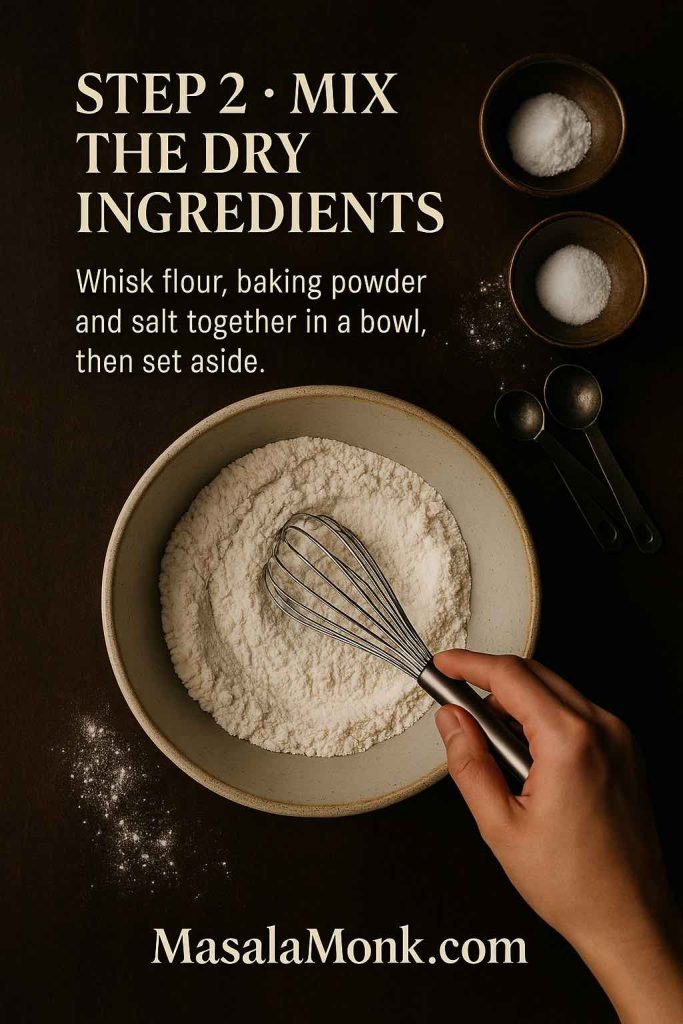
2. Mix the dry ingredients

In a medium bowl, whisk together:

  • Flour
  • Baking powder
  • Salt

Set this aside so it’s ready to fold into your egg mixture without over-mixing.

Step 2 photo for a tres leches cake recipe showing a hand whisking flour, baking powder and salt together in a ceramic bowl on a dark kitchen counter with small ingredient bowls and measuring spoons around it
Step 2 – Mix the dry ingredients: whisk flour, baking powder and salt together in a bowl and set aside so they’re ready to fold gently into your tres leches sponge batter.

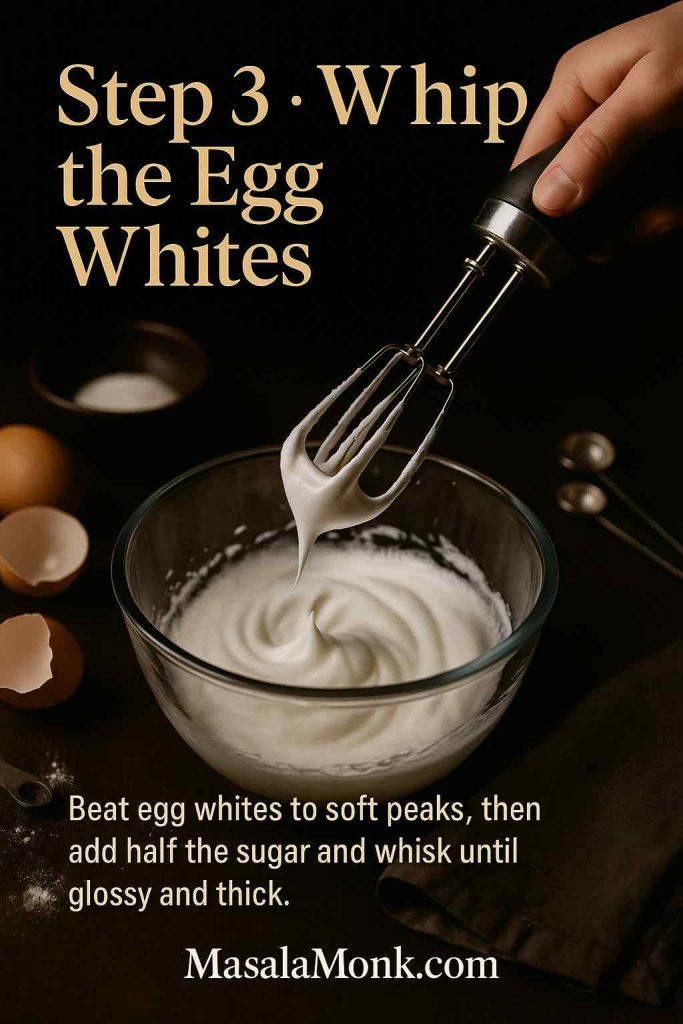
3. Whip the egg whites

In a clean, grease-free bowl, beat the egg whites until soft peaks form. Then, slowly add about half the sugar while continuing to whisk until glossy and thick. This meringue gives your tres leches sponge its lift and delicate crumb.

Once you get the hang of airy, moist cakes, you might enjoy experimenting with others that rely on good structure and moisture too – MasalaMonk’s orange olive oil cake is a great example of a simple cake that stays beautifully tender, using fat instead of milk soak for its softness.

Step 3 photo for a tres leches cake recipe showing a hand lifting a mixer whisk with soft peaks of whipped egg whites over a glass bowl, with eggshells, sugar and measuring spoons on a dark counter
Step 3 – Whip the egg whites: beat the whites to soft peaks, then add half the sugar and whisk until the meringue is glossy and thick so your tres leches sponge gets maximum lift.

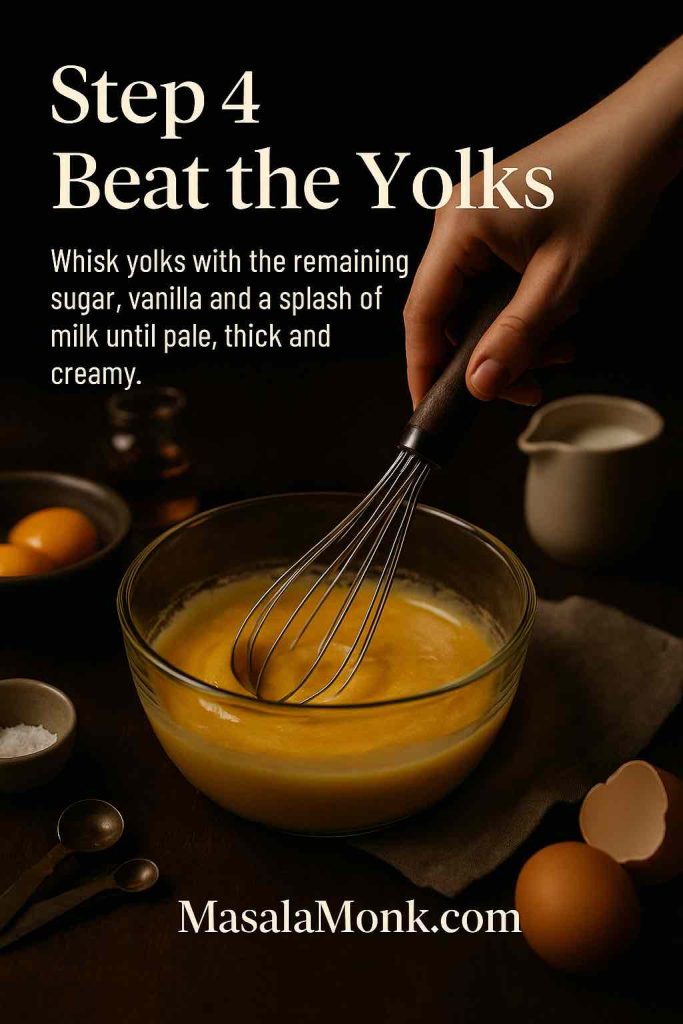
4. Beat the yolks

In another bowl, whisk the egg yolks with the remaining sugar until the mixture turns pale and thick. Add vanilla and a splash of milk. This forms a rich, flavourful base that will blend into your meringue.

Step 4 photo for a tres leches cake recipe showing a hand whisking egg yolks with sugar, vanilla and milk in a bowl on a dark counter, with text overlay explaining to beat until pale and thick
Step 4 – Beat the yolks: whisk the egg yolks with the remaining sugar, vanilla and a splash of milk until the mixture turns pale, thick and creamy, ready to be folded into the whipped whites for your tres leches sponge.

5. Combine gently

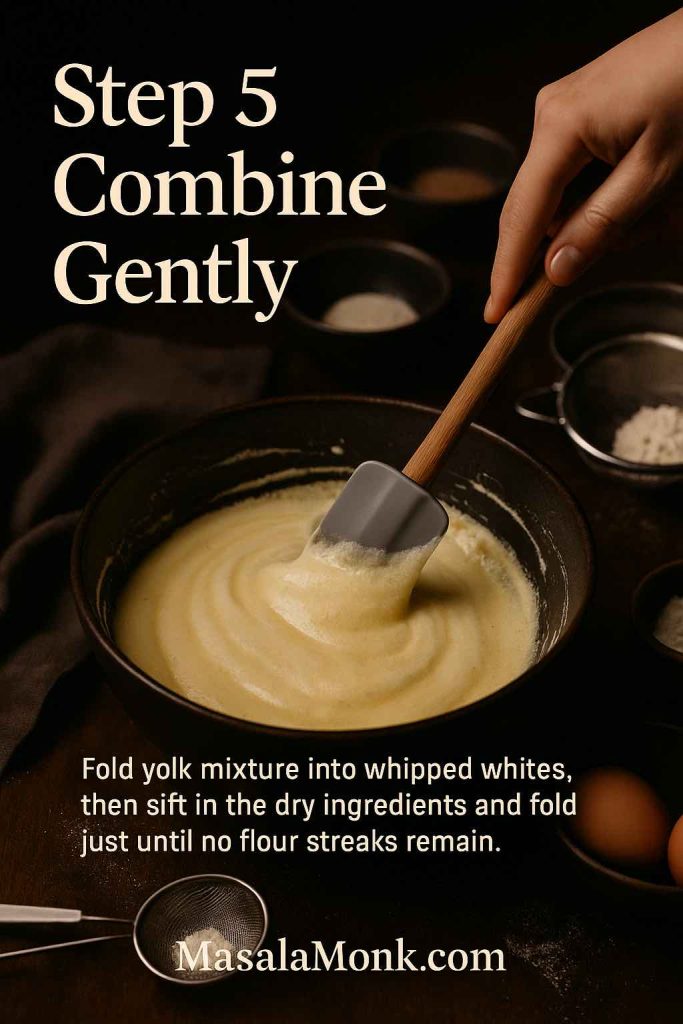
Now, pour the yolk mixture into the whipped whites and fold gently with a spatula. Try to keep as much air in the mixture as you can.

Once combined, sift the dry ingredients over the top in two or three additions, folding carefully after each one. Stop as soon as there are no visible streaks of flour; over-mixing here will deflate the batter.

Step 5 – Combine gently: fold the yolk mixture into the whipped whites, then sift in the dry ingredients and fold only until you no longer see flour streaks, keeping the batter light so your tres leches sponge bakes up tall and airy.

6. Bake the sponge

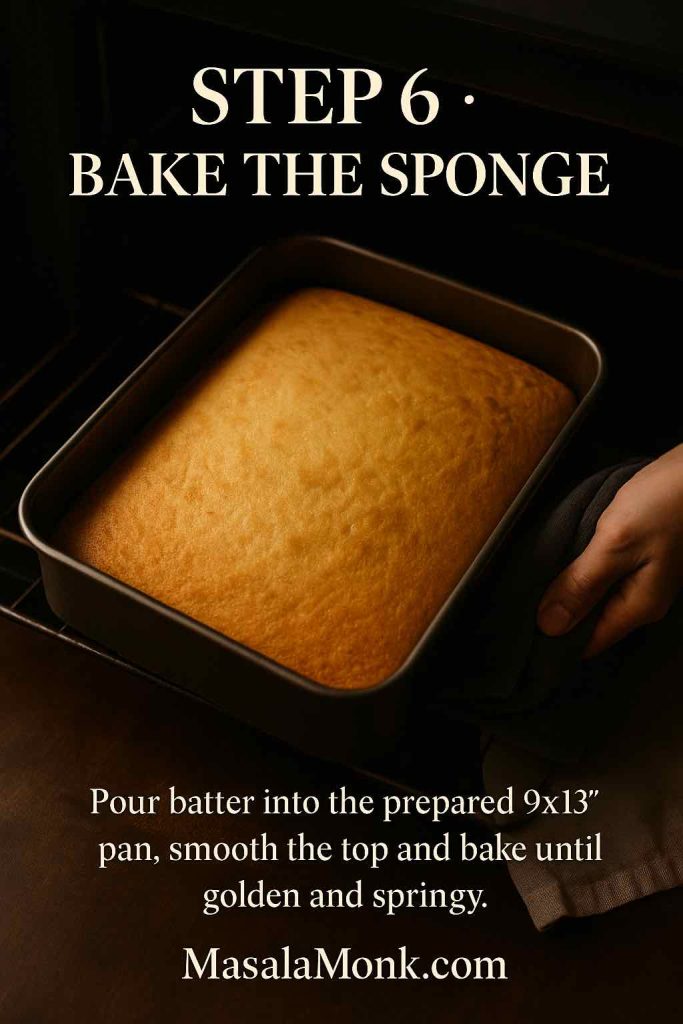
Pour the batter into your prepared pan and smooth the top lightly. Bake until the cake is golden and springs back when touched lightly in the centre, or a skewer inserted comes out clean.

As it bakes, your kitchen will start to smell like a promise: something simple now that will become something luxurious later.

Step 6 photo for a tres leches cake recipe showing a golden sponge cake in a 9x13 inch pan being pulled out of the oven with a cloth, with text overlay saying Bake the Sponge and instructions to bake until golden and springy
Step 6 – Bake the sponge: pour the batter into your prepared 9×13 inch pan, smooth the top and bake until the cake is risen, golden and springy to the touch so it’s ready to soak up the three milks.

Mixing the Three Milks for Tres Leches Cake Recipe

While the cake is cooling slightly, you’ll prepare the soaking mixture that turns it into tres leches.

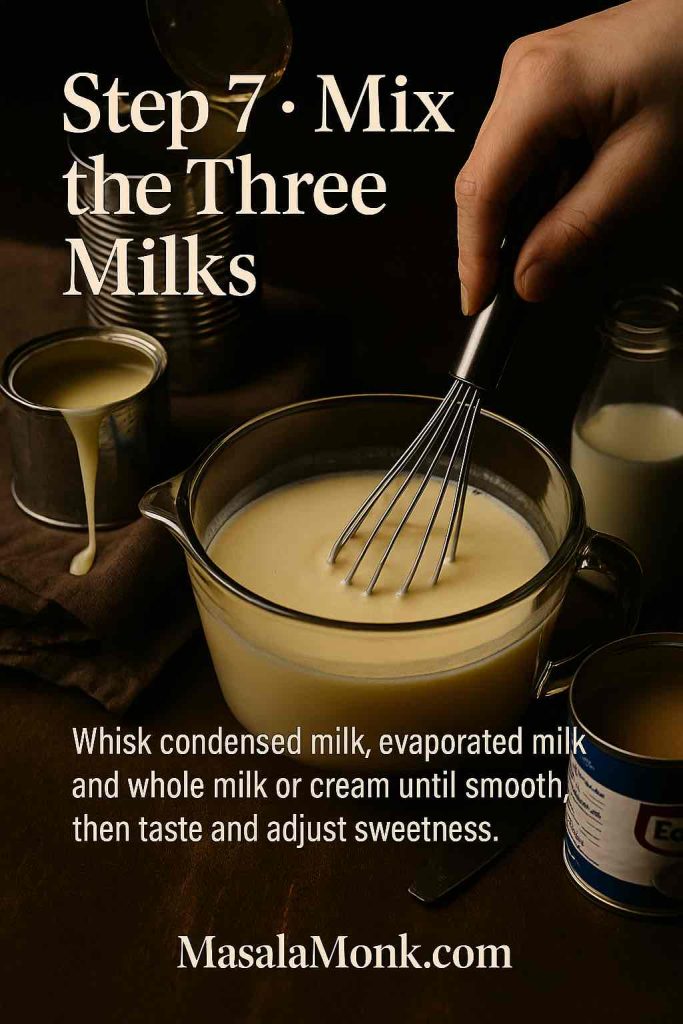
In a jug or bowl with a spout, whisk together:

  • 1 part sweetened condensed milk
  • 1 part evaporated milk
  • 1 part whole milk or a mix of milk and cream
Step 7 photo for a tres leches cake recipe showing a hand whisking a mixture of condensed milk, evaporated milk and whole milk or cream in a glass jug, with open milk cans and a bottle on a dark counter and text saying Mix the Three Milks
Step 7 – Mix the three milks: whisk condensed milk, evaporated milk and whole milk or cream together until smooth, then taste and adjust the sweetness before you pour it over the warm sponge for your tres leches cake.

Different recipes tweak those ratios – the tres leches cake on A Cozy Kitchen and Natasha’s version are good examples – but the idea is the same: a sweet, pourable mixture that’s rich but not gluey.

Taste as you go. If it feels too sweet for your liking, thin it with a little extra whole milk. If it seems too thin, a splash more condensed milk usually does the trick.

This is also the moment to decide whether you’d like to bring in flavours later: strawberry, chocolate, pistachio, Biscoff and more. For now, though, keep it classic.


Soaking the Cake Without Turning It to Mush

The key to a successful tres leches cake recipe is soaking without shredding.

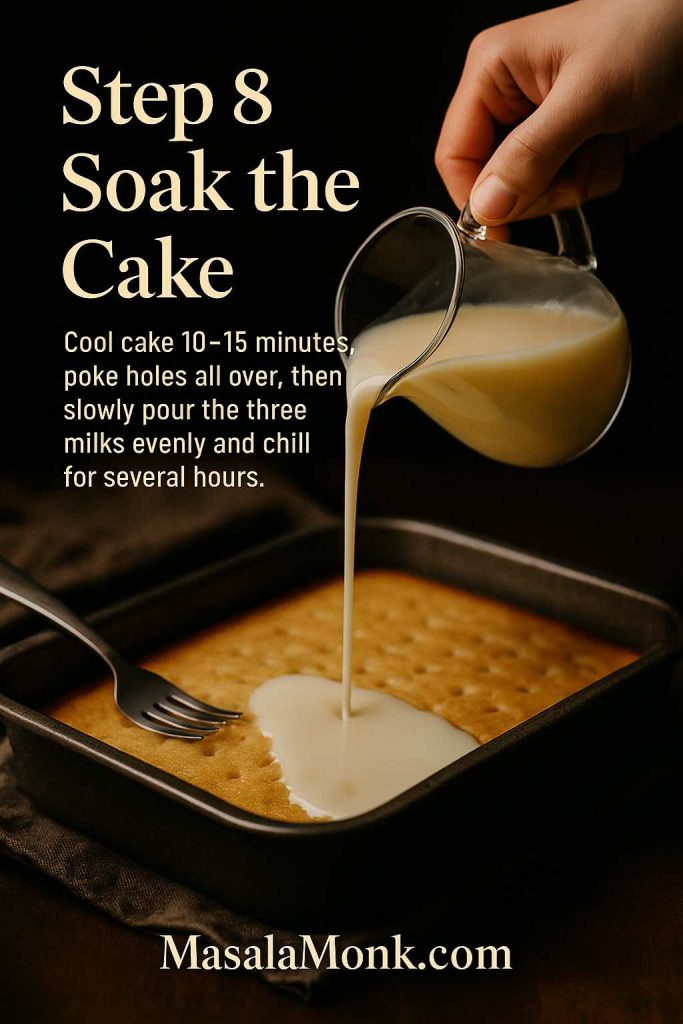
  1. Let the cake cool for 10–15 minutes once it comes out of the oven. It should be warm, not piping hot.
  2. Use a skewer or fork to poke holes all across the surface. Go right to the edges and corners so the milks can travel.
  3. Slowly pour the milk mixture evenly over the cake. Give the liquid time to sink in rather than flooding one spot.
  4. Tilt the pan gently if needed to help the milks travel into drier areas.
Step 8 photo for a tres leches cake recipe showing a hand pouring a creamy three-milk mixture from a glass jug over a fork-poked sponge cake in a metal pan, with text overlay explaining to cool, poke, pour and chill
Step 8 – Soak the cake: let the sponge cool for 10–15 minutes, poke holes all over, then slowly pour the three-milk mixture evenly across the surface and chill for several hours so every bite is moist but not mushy.

Some recipes, like The Pioneer Woman’s tres leches cake, use almost all the milk and hold back just a little if it starts to pool excessively. You can follow the same instinct: you want a well-soaked cake, not a cake floating in a pond.

Once you’re satisfied, cover the pan and slide it into the fridge for at least 4 hours. Overnight is even better; the milks mellow, the crumb relaxes, and the flavours get cozy.


Topping: The Soft Cloud on Top

When you’re close to serving time, it’s topping time.

  1. Pour chilled heavy cream into a bowl.
  2. Add sugar and vanilla.
  3. Beat until you get soft to medium peaks – you want the cream to hold its shape, but still look smooth and billowy.
Step 9 photo for a tres leches cake recipe showing a hand using an offset spatula to spread whipped cream over a chilled cake in a pan, with bowls of cream, sugar and cinnamon on a dark counter and text explaining to whip the cream and finish the cake
Step 9 – Whip the cream and finish: beat cold cream with sugar and vanilla to soft–medium peaks, spread it over the chilled tres leches cake in swoops and add a light dusting of cinnamon if you like before slicing and serving.

Spread the whipped cream over the chilled cake in swoops and swirls. If you like, dust with ground cinnamon for a gentle warmth.

At this point, you’ve nailed a classic tres leches cake. If that’s all you wanted, you can stop here, cut generous slices, and pour coffee or chai. A plate of this alongside a cup of masala chai for a rainy day is as comforting as dessert gets.

But the fun is only just starting.


Easy Tres Leches Cake Recipe with Box Mix

Maybe you love baking, but sometimes you just don’t have the energy to whip egg whites and fold flour. That’s when a box of cake mix becomes your best friend.

Plenty of bakers have proven that a tres leches cake recipe with cake mix can be just as satisfying. If you want to see how others do it, check out this easy tres leches cake with cake mix or this tres leches cake with a cake mix. The approach below follows a similar path, tailored to the same milk mixture and topping you already made.

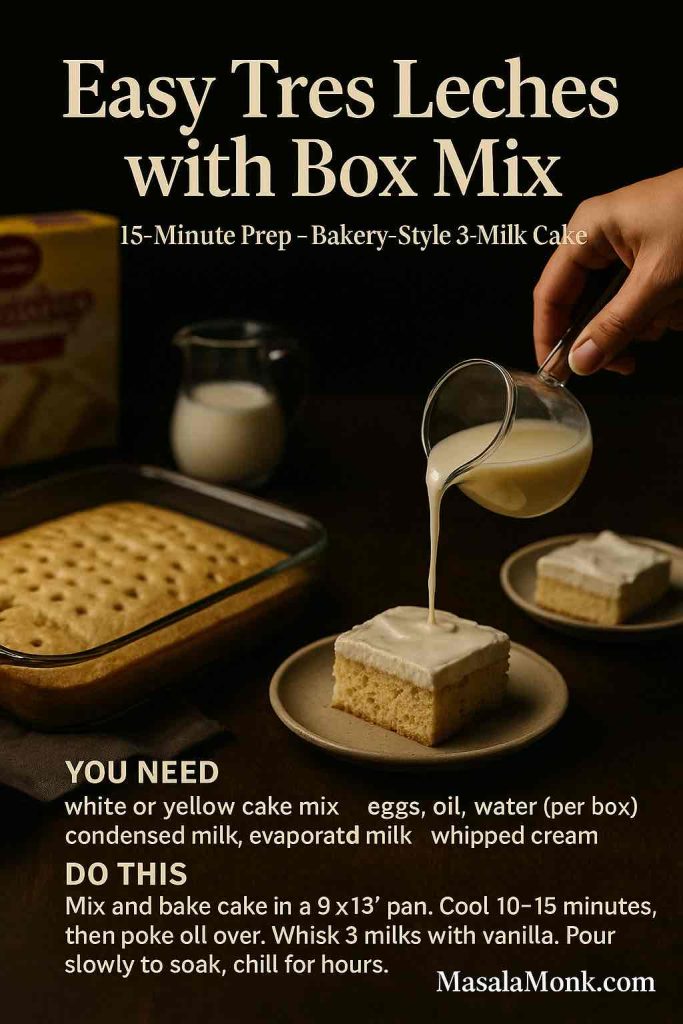
Recipe card for Easy Tres Leches Cake with Box Mix, showing a hand pouring three-milk mixture over a slice beside a poked sheet cake, with overlay text listing ingredients and simple step-by-step instructions
Easy Tres Leches with Box Mix – a quick 15-minute prep recipe where a simple boxed cake is soaked in a rich three-milk mixture, then chilled and topped with whipped cream for bakery-style results at home.

Step 1: Bake the box-mix base

Choose a white or yellow cake mix. Follow the package instructions to make the batter, using the eggs, oil and water it asks for. Bake it in the same 9×13 inch pan.

A couple of small adjustments help:

  • If the box gives a range of baking times, pull the cake out on the earlier side so it stays soft.
  • Avoid over-mixing the batter; just stir until combined.

Step 2: Soak like the classic Tres Leches Cake Recipe

Once the cake has cooled for 10–15 minutes:

  1. Poke all over with a fork or skewer.
  2. Pour your three-milk mixture slowly and evenly over the surface.
  3. Let the cake cool to room temperature, then cover and refrigerate for several hours.

Because box-mix cakes are often a little softer and sweeter, they actually take to the milk mixture beautifully. The result is a super easy tres leches cake recipe that tastes like you put in much more effort than you did.

Step 3: Finish with whipped cream

Top the chilled cake with whipped cream exactly as you would with the scratch version. Add fruit or sprinkles and you’re done.

This is the version to tuck away for weeknights, office potlucks, or days when you want dessert but your energy is on strike.


Strawberry Tres Leches Cake Recipe: Sweet, Fruity and Pretty

Once you’ve mastered the base tres leches cake recipe, strawberry is usually the first variation people ask for. It adds freshness, colour and a little tartness to balance all the cream.

There are many ways to bring strawberries in. One lovely approach is using strawberry milk in the soak, like in A Cozy Kitchen’s strawberry milk tres leches. You can borrow that idea and adapt it to your own cake.

Dark and moody recipe card for Strawberry Tres Leches Cake, showing a slice of soaked three-milk sponge with a strawberry layer and whipped cream while a hand places fresh strawberry slices on top, with text listing key ingredients and simple instructions
Strawberry Tres Leches Cake – a classic three-milk sponge upgraded with a bright strawberry layer, fresh berries and whipped cream, shown here as a quick-reference recipe card from MasalaMonk.com.

Here are a few ways to strawberry-fy your tres leches:

  • In the milk mixture: Swap some of the whole milk for strawberry milk or blend fresh strawberries with milk, strain, and use that in the mix.
  • Between layers: Spread a thin layer of sliced strawberries over the soaked cake before adding whipped cream.
  • In the topping: Fold finely chopped strawberries or a spoonful of puree into the whipped cream for a pale pink cloud.

Finish with extra slices on top. It becomes the kind of dessert that looks like it belongs at a spring party without being fussy to make.

If you enjoy fruity desserts in general, you might later wander into the world of mango – MasalaMonk has an addictive mango cheese mousse cake and a fun round-up of mango dessert recipes that play with fruit and cream in different ways.


Chocolate Tres Leches Cake Recipe: For Cocoa Lovers

Chocolate fans don’t have to sit this one out. There are two simple routes to a chocolate tres leches:

  1. Cocoa in the sponge
    Replace a few tablespoons of flour with cocoa powder in your scratch batter, or use a chocolate box mix as your base.
  2. Chocolate in the topping and finish
    Keep the milk mixture classic, then:
    • Dust cocoa powder over the whipped cream,
    • Grate dark chocolate on top, or
    • Drizzle melted chocolate in thin lines.
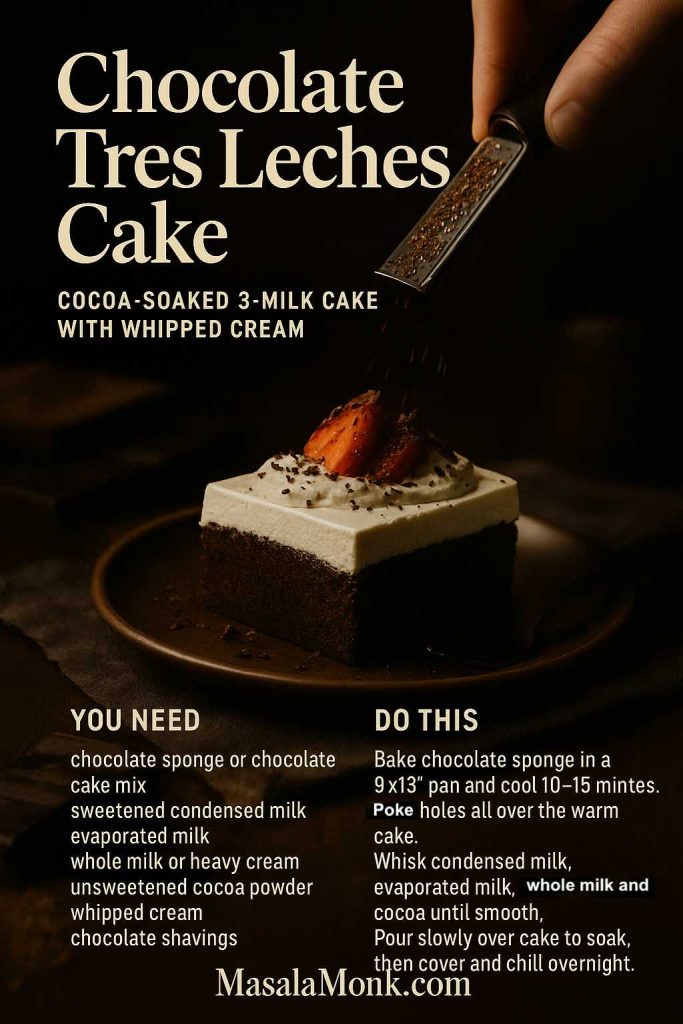
Recipe card for Chocolate Tres Leches Cake, showing a slice of cocoa-soaked three-milk sponge topped with whipped cream and strawberries while a hand grates chocolate over it, with ingredients and step-by-step instructions listed below
Chocolate Tres Leches Cake – a rich cocoa sponge soaked in three milks, chilled, then topped with whipped cream and grated chocolate, captured here as a quick-reference recipe card from MasalaMonk.com.

The result is something like a cross between a classic tres leches and a light chocolate mousse cake – rich, but not heavy. For another soaked-texture dessert with chocolate notes, you can look at MasalaMonk’s savoiardi chocolate vanilla pudding; it’s not tres leches, but it plays with similar comfort-dessert vibes.


Pistachio & Biscoff Tres Leches Cake Recipe: Crowd-Pleasers

Beyond strawberry and chocolate, pistachio and Biscoff (Lotus biscuit) variations have become internet favourites.

Pistachio tres leches cake recipe

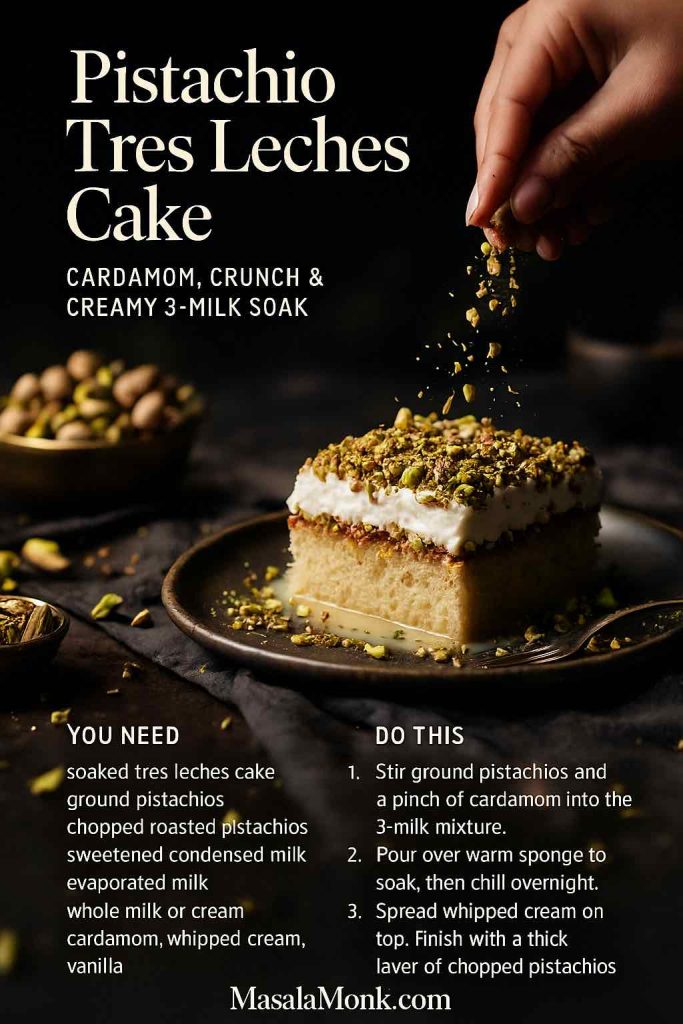
Recipe card for Pistachio Tres Leches Cake, showing a square slice of three-milk sponge topped with whipped cream and a thick layer of chopped pistachios while a hand sprinkles more nuts, with ingredients and simple instructions below
Pistachio Tres Leches Cake – a classic three-milk sponge infused with cardamom and finished with a generous pistachio crunch, presented as a quick-reference recipe card from MasalaMonk.com.

For a nutty, elegant twist:

  • Add a little ground pistachio to the sponge batter.
  • Stir a pinch of cardamom into the milk mixture.
  • Scatter chopped roasted pistachios generously over the whipped cream.

The pale green and white look beautiful on a table, and the flavour leans gently into Middle Eastern dessert territory without losing its tres leches soul.

Biscoff tres leches cake recipe

Recipe card for Biscoff Tres Leches Cake showing a slice of three-milk sponge topped with whipped cream while a spoon drizzles warm Biscoff spread over it, with crushed biscuits on the plate and ingredients and instructions written below
Biscoff Tres Leches Cake – a soft three-milk sponge soaked and chilled, then finished with whipped cream, warm Biscoff drizzle and crunchy biscuit crumbs, captured here as a quick-reference recipe card from MasalaMonk.com.

This one practically sells itself:

  • Warm a few spoonfuls of Biscoff spread until it’s pourable.
  • Swirl some into the milk mixture, keeping a portion back for drizzling.
  • After topping the cake with whipped cream, drizzle the remaining Biscoff on top and crumble Lotus biscuits over everything.

It’s sweet, nostalgic and guaranteed to disappear quickly.

Also Read: French Toast Sticks (Air Fryer + Oven Recipe) — Crispy Outside, Custardy Inside


Tres Leches Cupcakes, Jars and Mini Desserts

Sometimes you don’t want to deal with slicing a large cake, or you’re feeding a crowd who will be walking around with plates. That’s where mini formats come in.

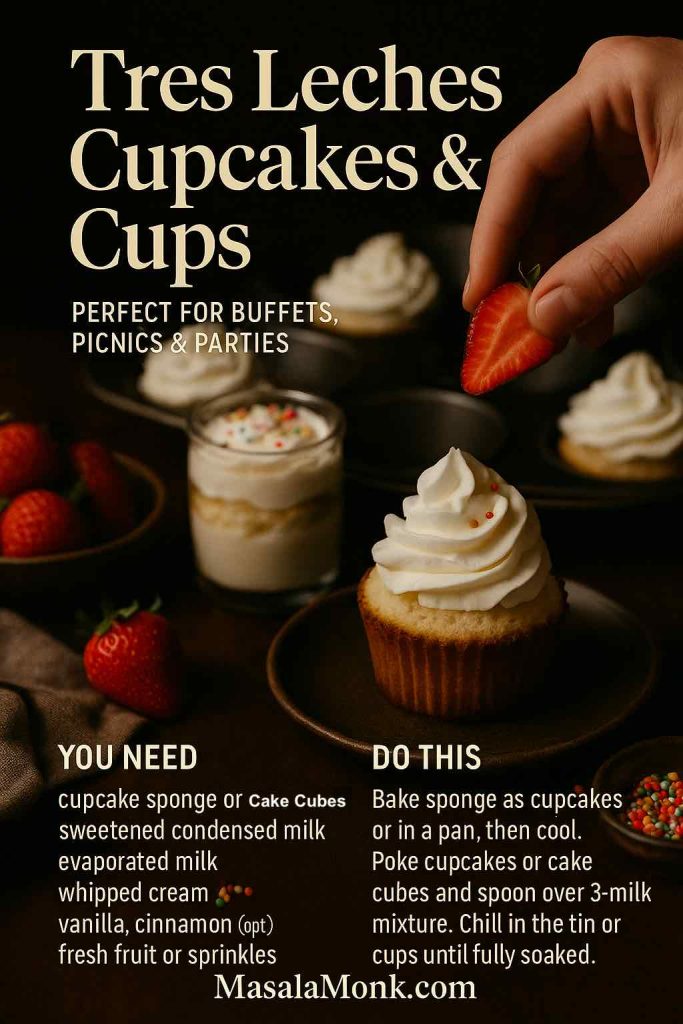
Recipe card for Tres Leches Cupcakes and Cups showing a cupcake topped with whipped cream and a strawberry, glass cups layered with soaked cake and cream, and text listing ingredients and simple party-friendly instructions
Tres Leches Cupcakes & Cups – bite-sized three-milk sponge desserts topped with whipped cream, strawberries and sprinkles, perfect for buffets, picnics and parties, presented here as a quick-reference recipe card from MasalaMonk.com.

Cupcakes

Use the same batter (scratch or box mix) but bake it in a lined muffin tin. Once cooled:

  • Poke each cupcake several times with a skewer.
  • Spoon the milk mixture over the top of each one until it’s nicely soaked.
  • Chill the cupcakes in the tin (to contain any escaping milk) and then top them individually with whipped cream.

They’re perfect for buffets, potlucks and birthdays where everyone wants their own little treat.

Dessert cups or jars

Alternatively, bake the cake in a pan, cut it into cubes and layer it in dessert glasses or jars:

  1. Cake cubes
  2. Spoonful of milk mixture
  3. Whipped cream
  4. Fruit, nuts or Biscoff crumbs

Repeat the layers. These can be sealed and transported easily, making them ideal for picnics or potluck dinners.

Also Read: Peanut Butter Cookies (Classic Recipe & 3 Variations)


Cheesecake-Style Tres Leches

If you love creamy, chilled desserts, consider a cheesecake-inspired tres leches.

Recipe card for Cheesecake-Style Tres Leches showing a slice with cookie crumb crust, soaked sponge layer and creamy topping drizzled with caramel, with ingredients and simple step-by-step instructions below
Cheesecake-Style Tres Leches – a layered dessert with biscuit crust, soaked sponge and a silky cream topping, drizzled with caramel and presented as a quick-reference recipe card from MasalaMonk.com.

One way to play it:

  • Press a simple biscuit or cookie crust into the bottom of your pan (like you would for a cheesecake).
  • Bake your sponge layer on top of this crust.
  • Soak the sponge layer only, then chill.
  • Finish with a slightly thicker topping, such as whipped cream with a little cream cheese folded in.

The cookie base adds a pleasant crunch, and the cream-cheese-boosted topping makes it feel closer to a mash-up between tres leches and cheesecake. If that idea excites you, you may enjoy MasalaMonk’s no-bake blueberry cheesecake, which uses similar chilled, creamy textures in a different direction.


Eggless and Gluten-Free Tres Leches Ideas

Tres leches is naturally adaptable for different diets because most of the magic lives in the milk mixture and topping.

Eggless variations

To go egg-free:

  • Use an eggless sponge cake recipe you already trust, or
  • Pick an eggless box mix as your base.
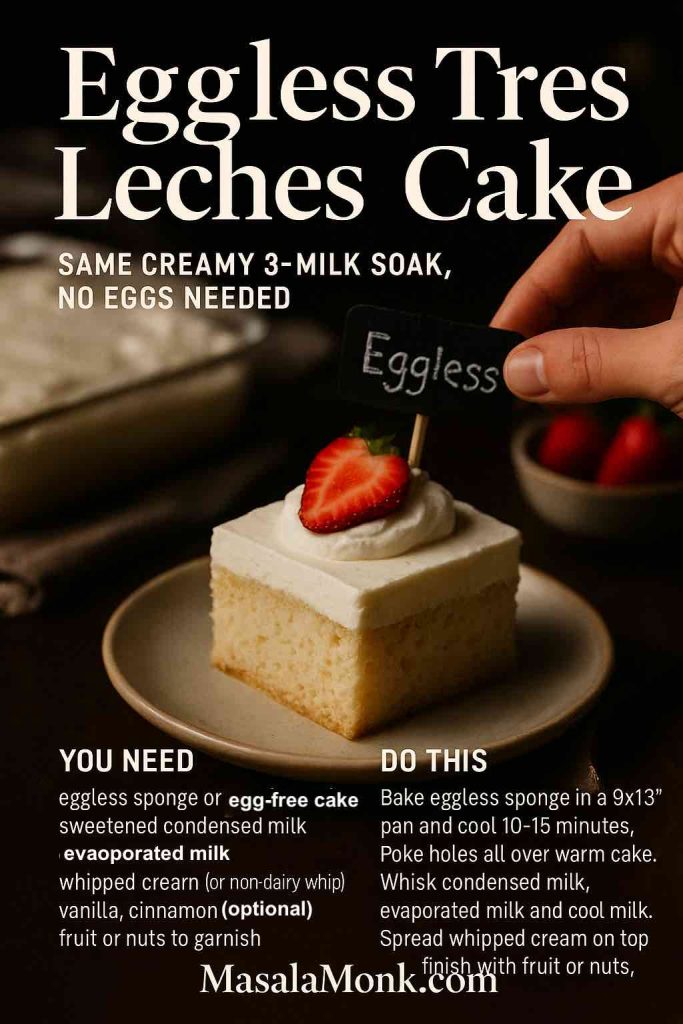
Recipe card for Eggless Tres Leches Cake showing a slice of three-milk sponge topped with whipped cream and a strawberry while a hand places an Eggless sign, with ingredients and simple step-by-step instructions below
Eggless Tres Leches Cake – a soft, three-milk soaked sponge made without eggs, topped with whipped cream and fresh fruit, presented as a quick-reference recipe card from MasalaMonk.com.

Once baked, you treat it exactly like the classic: poke holes, soak with the three milks, chill, top with whipped cream. Because eggs are responsible for much of the structure in traditional sponge, it’s important to choose an eggless base that doesn’t crumble easily.

Gluten-free versions

For gluten-free:

  • Swap the base for a gluten-free cake mix that you know bakes up well, or
  • Use a home-made gluten-free sponge recipe you like.
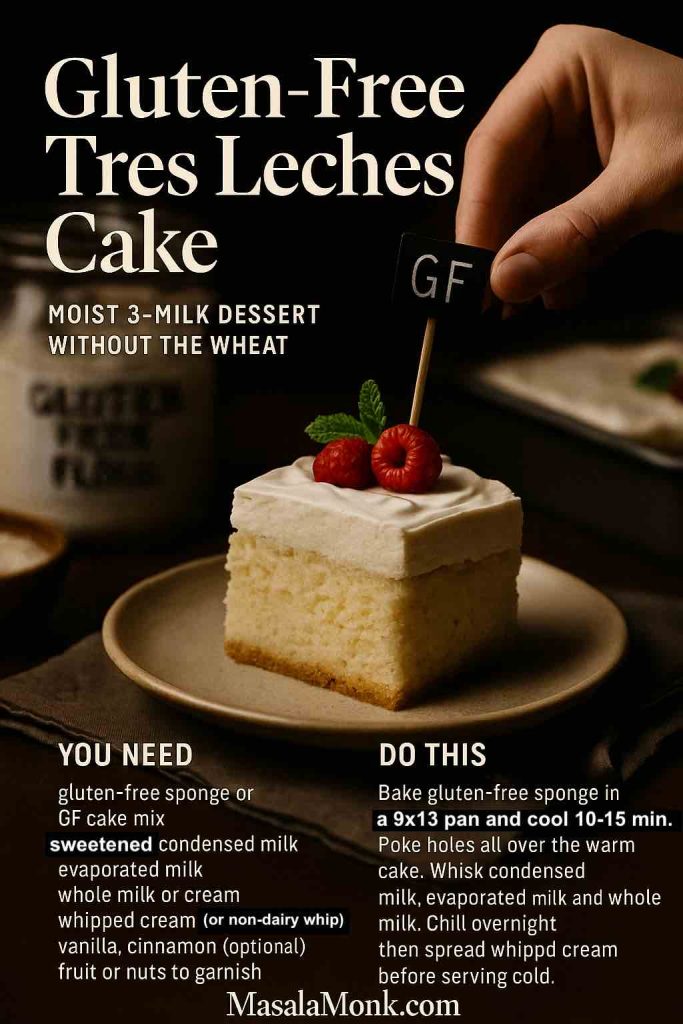
Recipe card for Gluten-Free Tres Leches Cake showing a slice of three-milk sponge topped with whipped cream, raspberries and a small GF flag, with ingredients and step-by-step gluten-free instructions written below
Gluten-Free Tres Leches Cake – a moist three-milk sponge made with a gluten-free base, chilled and finished with whipped cream and fresh berries, presented as a quick-reference recipe card from MasalaMonk.com.

Again, everything else stays the same: soak, chill, top. The milk mixture and cream are already wheat-free, so the main challenge is getting a cake that’s sturdy enough to handle the soak without falling apart.

Also Read: Vegan French Toast: 6 Easy Recipes (Pan, Air Fryer, GF & High-Protein)


Turning Tres Leches into a Birthday or Celebration Cake

A well-made tres leches cake is a brilliant birthday cake because it stays moist for days and feels like a treat without heavy frosting.

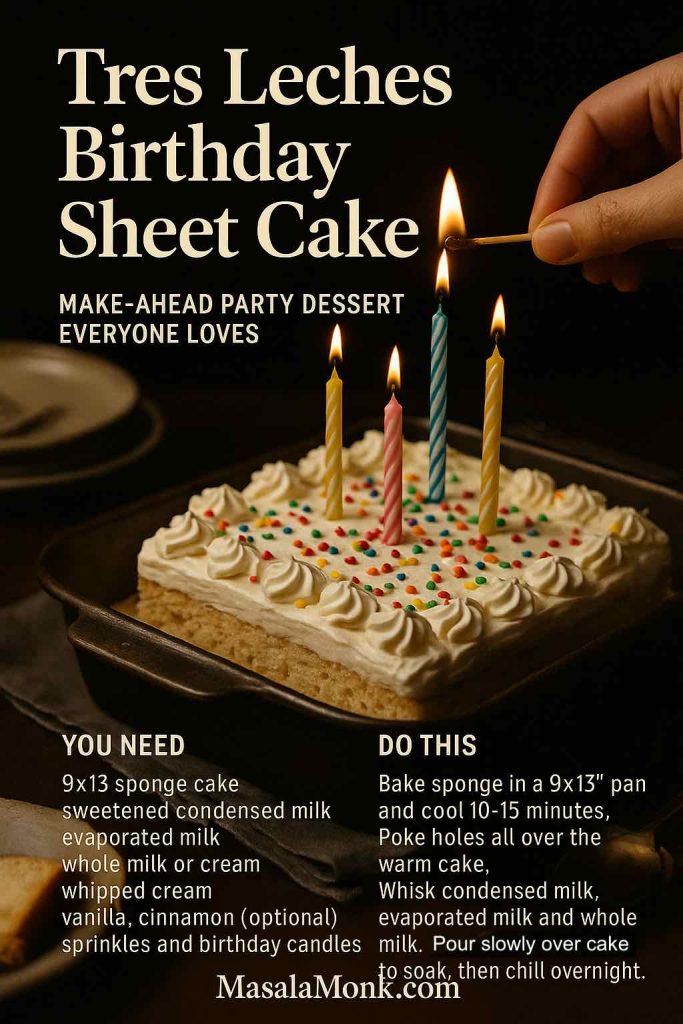
Recipe card for Tres Leches Birthday Sheet Cake showing a 9x13 three-milk cake topped with whipped cream, sprinkles and lit candles while a hand lights one candle, with ingredients and step-by-step instructions written below
Tres Leches Birthday Sheet Cake – a 9×13 three-milk sponge you can soak and chill the day before, then finish with whipped cream, sprinkles and candles for an easy make-ahead party dessert from MasalaMonk.com.

Here are some ways to lean into that:

  • Use a sheet pan: A 9×13 inch cake feeds a crowd comfortably and slices into neat squares.
  • Decorate with intention: Pipe whipped-cream rosettes around the edges, add sprinkles or edible flowers, and arrange fruit in patterns.
  • Write on it: Once the cake is fully chilled, you can pipe “Happy Birthday” or a message using melted chocolate or coloured whipped cream.

If you’re planning a full meal around it, you can keep the main course homely and satisfying. For instance, a hearty vegetable dish like kathal ki Bihari style sabzi with rice makes a lovely dinner that doesn’t overshadow dessert. And if rice tends to intimidate you, MasalaMonk’s guide on how to cook rice perfectly every time is a handy reference.

For an adult celebration, you can happily serve tres leches alongside a classic cocktail. A chilled slice next to a well-balanced whiskey sour with easy twists hits that sweet spot between indulgent and grown-up.


Serving, Storage and Leftovers

Tres leches is one of those desserts that rewards patience and planning.

Serving

  • Serve it chilled or just slightly cooler than room temperature. Warm tres leches tends to feel heavy; cold tres leches feels refreshing.
  • Cut with a sharp knife, wiping the blade between slices if you want picture-perfect edges.

Because it’s rich, smaller pieces often satisfy, especially after a filling meal. That said, people frequently go back for seconds.

Storage

  • Keep the cake covered in the fridge. It generally stays good for 2–3 days, sometimes longer if your kitchen is cool and everything was fresh to begin with.
  • If you’ve decorated with very juicy fruit, you may notice the fruit softening after a day or two, but the cake itself will still taste wonderful.

Leftovers

Leftover tres leches is a happy problem. You can:

  • Eat it as is, straight from the fridge – it tastes even better the next day.
  • Turn small squares into layered dessert cups with extra fruit.

While you’re thinking about using up bits and pieces, you might enjoy how cleverly savoury leftovers can be transformed too – the paneer sabji sandwich on MasalaMonk is a great example of giving yesterday’s curry a fresh life.

If you know a heavy dessert is coming after dinner, you can balance your day with lighter choices earlier on: something like high protein overnight oats with five flavour variations for breakfast or one of these high-calorie protein shakes and smoothies if you’re trying to gain weight in a more intentional way than just eating all the cake.


Bringing It All Together

A good tres leches cake recipe is less about fancy techniques and more about respecting a few simple rules:

  • Build a sponge that can hold its shape.
  • Mix milks that taste good even before they touch the cake.
  • Give everything time to soak and soften in the fridge.

Once you have that foundation, you can go in almost any direction:
from classic vanilla to strawberry-studded, chocolate-dusted, pistachio-sprinkled or Biscoff-swirled; from a tall birthday centrepiece to neat cupcakes and dessert jars; from scratch-baked weekends to weeknight box-mix shortcuts.

The next time you’re craving something creamy and celebratory, you’ll have a tres leches game plan ready – and all the tools to make it your own.

Also Read: Homemade Hot Chocolate with Cocoa Powder Recipe

FAQs

1. What exactly is tres leches cake and how is it different from regular milk cake?

Tres leches cake is a very light sponge that gets soaked in a mixture of three milks (usually evaporated milk, sweetened condensed milk and whole milk or cream). After soaking, it’s topped with whipped cream and often finished with fruit or cinnamon.

A regular “milk cake” or plain milk-based dessert might simply use milk in the batter or syrup, but a proper tres leches cake recipe is built around that deep soak in three milks. The texture should be moist all the way through, yet still sliceable, almost like a hybrid between cake and pudding.


2. What are the three milks in a traditional tres leches cake recipe?

In a classic tres leches cake recipe, the three milks are:

  1. Sweetened condensed milk
  2. Evaporated milk
  3. Whole milk or heavy cream

Together, they create a pourable mixture that’s sweet, creamy and rich without feeling heavy. Occasionally, people switch the whole milk for half-and-half or cream for extra indulgence, but the idea stays the same: one very sweet milk, one cooked-down milk, and one fresh milk to balance everything.


3. How do I make the milk mixture for tres leches cake?

To make the milk mixture for your tres leches cake recipe, whisk together equal parts condensed milk and evaporated milk, then add enough whole milk or cream until it’s pourable but still luxurious. Taste as you go.

If it’s too sweet, add a splash more regular milk. If it feels thin, trickle in a little extra condensed milk. The mixture should coat the back of a spoon and taste delicious on its own, because that flavour is what will soak into every crumb of your cake.


4. Is tres leches cake Mexican and what does “pastel de tres leches” mean?

Tres leches cake is loved across Latin America, and you’ll often see it in Mexican bakeries and restaurants. That’s why many people search for Mexican tres leches cake or authentic pastel de tres leches.

“Pastel de tres leches” simply means “three milks cake” in Spanish. Different countries have their own versions and small tweaks, but the foundation is the same: a sponge, three milks, and a creamy topping. Your tres leches cake recipe will feel right at home on a Mexican-inspired menu, yet it’s flexible enough to fit into almost any cuisine.


5. Can I make an easy tres leches cake recipe at home if I’m a beginner?

Absolutely. Even if you’re new to baking, you can make an easy tres leches cake recipe without stress. There are two straightforward paths:

  1. From-scratch sponge: You’ll whip eggs, fold in flour and bake a simple sponge, then soak it in the three milks.
  2. Box-mix shortcut: You bake a plain box cake (white or yellow), poke holes in it and pour the same milk mixture on top.

In both cases, the whipped cream topping is very forgiving, and the long chill in the fridge actually hides small mistakes. As long as the cake is baked through and the milk mixture tastes good, you’re already most of the way there.


6. Can I use a box cake mix for a tres leches cake recipe?

Yes, a box mix works beautifully and it’s one of the most searched-for shortcuts. To adapt a mix:

  1. Bake a white or yellow box cake in a 9×13 inch pan according to package directions.
  2. Let it cool slightly, then poke holes all over with a fork or skewer.
  3. Pour your three-milk mixture slowly over the top so it soaks in evenly.
  4. Chill for several hours and finish with whipped cream.

This method turns an ordinary box cake into a moist, impressive dessert, and it’s a great option for busy days, office parties or last-minute celebrations.


7. Can I make tres leches cake with yellow cake mix or other flavours?

You can use yellow cake mix, white cake mix or even chocolate cake mix as the base of a tres leches cake recipe. Each one brings a slightly different personality:

  1. Yellow cake mix: Richer flavour, slightly denser crumb, great for birthdays.
  2. White cake mix: Lighter and more neutral, ideal for fruit toppings like strawberries or mango.
  3. Chocolate cake mix: Perfect for a chocolate tres leches with cocoa, chocolate shavings or chocolate sauce on top.

The important thing is to bake the cake just until done, avoid drying it out, and then soak it patiently with the milk mixture.


8. How do I make a simple chocolate tres leches cake?

To turn your tres leches cake recipe into a chocolate version, you can:

  1. Replace a few tablespoons of flour with cocoa powder in your scratch batter, or start with a chocolate box mix.
  2. Keep the three-milk mixture the same or add a spoonful of cocoa for an extra chocolate hint.
  3. Dust cocoa powder over the whipped cream and add chocolate curls, chips or shavings on top.

This approach gives you a cake that tastes like a cross between chocolate sponge and creamy pudding, without changing the basic method too much.


9. How can I make a strawberry tres leches cake at home?

Strawberry tres leches is a favourite twist, and it’s easier than it looks. To start:

  1. Prepare your usual tres leches cake recipe and soak the sponge as normal.
  2. Layer sliced fresh strawberries over the soaked cake before adding whipped cream.
  3. Stir chopped strawberries or a little strawberry puree into the whipped cream for a soft pink tint.
  4. Decorate the top with extra strawberries.

For even more flavour, you can swap some of the plain milk in the soak for strawberry milk or a blend of milk and strawberry puree.


10. Can I make tres leches cake eggless?

Yes, you can make an eggless tres leches cake by switching the base cake rather than the milk mixture:

  1. Use a reliable eggless sponge cake recipe you already like, or
  2. Choose an eggless box cake mix from the store.

After baking, poke holes, soak with the same three-milk mixture, chill, and top with whipped cream. Because eggs provide structure in traditional sponges, it helps to pick an eggless base that doesn’t crumble easily and holds together when soaked.


11. Is there a gluten-free version of tres leches cake?

A gluten-free tres leches cake recipe is absolutely possible. The three milks and whipped cream are naturally gluten-free, so the only change you need is the base cake:

  1. Choose a gluten-free cake mix that bakes up light and sturdy, or
  2. Use a home-made gluten-free sponge cake recipe that you trust.

Once baked, soak it in the milk mixture exactly as you would with a regular cake. The key is avoiding a gluten-free cake that’s too crumbly or fragile, because it still needs to hold its shape after the soak.


12. How do I turn a tres leches cake recipe into a birthday cake?

Tres leches makes an excellent birthday cake because it’s moist, creamy and not overly sweet. To turn it into a celebration centrepiece:

  1. Bake the cake in a 9×13 inch pan or slightly larger if you’re feeding many people.
  2. Chill the soaked cake overnight so it’s firm enough to handle.
  3. Pipe whipped cream swirls around the edges and add sprinkles, fruit or chocolate decorations.
  4. Write your birthday message on top using a small piping bag filled with frosting, chocolate or coloured whipped cream.

Because the cake is served cold, it’s refreshing even after a big meal and holds up well on a buffet table.


13. How long should I soak tres leches cake and can I make it ahead of time?

To let the milks really work their magic, a tres leches cake recipe needs time in the fridge:

  1. After pouring the milk mixture over the cake, let it sit at room temperature until it cools down.
  2. Then, cover it and chill for at least 4 hours.
  3. For the best texture and flavour, aim for an overnight rest (8–12 hours).

Tres leches is a perfect make-ahead dessert; you can prepare it the day before an event and simply add the whipped cream topping a few hours before serving.


14. How long does tres leches cake keep in the fridge?

Generally, a tres leches cake keeps well for about 2–3 days in the refrigerator. The milk mixture continues to keep the crumb moist, and the flavour often improves by the next day.

To store it properly:

  1. Cover the cake tightly so it doesn’t absorb fridge smells.
  2. If you’ve added fresh fruit, expect the fruit to soften slightly over time, even though the cake itself will still taste lovely.

After three days, the texture may become too soft and the whipped cream can start to lose its shape, so it’s best enjoyed within that window.


15. Can I freeze a tres leches cake?

Freezing a fully-soaked tres leches cake isn’t ideal because the texture can change once it thaws. The milk mixture and whipped cream may separate slightly, and the crumb can become unevenly soggy.

Instead, if you need to plan far ahead:

  1. Bake the sponge cake and let it cool completely.
  2. Wrap the un-soaked sponge well and freeze it.
  3. On the day before serving, thaw the sponge, soak it with the three milks and let it chill in the fridge.
  4. Finally, add the whipped cream topping on the day you plan to serve.

This way, you get the convenience of advance prep without sacrificing the smooth, creamy texture that makes a tres leches cake recipe so special.

Posted on 16 Comments

How to Make Churros (Authentic + Easy Recipe)

Person dipping a cinnamon-sugar churro into thick chocolate, with churro cheesecake and dips on a tray—cover image for how to make churros.

If the thought of crisp, cinnamon-sugar ridges dunked into warm chocolate makes you grin, you’re in the right kitchen. Today you’ll learn how to make churros from start to finish—no stress, no special machine, and plenty of variations so you can serve a crowd or spoil yourself on a quiet evening. We’ll move from the classic egged dough most home cooks adore to the iconic egg-free style you’ll find in Spanish churrerías. Along the way, we’ll fold in sauces, swaps for vegan and gluten-free eaters, reheating that actually works, and party strategies so everyone gets a hot, snappy bite.

Before we heat the oil, a quick bit of context. Churros are a beloved fried-dough pastry with deep Spanish and Portuguese roots, typically paired with a thick hot chocolate for dunking. If you enjoy a brief origin story, you can peek at a balanced overview of the tradition here: what churros are and how they’re served. That heritage explains why texture matters so much: ridges for crunch, a tender center for contrast, and a dip that clings.

Meanwhile, because you’ll want a sauce the instant the first batch comes out, it helps to make one now. For pure convenience, whisk up this quick, glossy homemade chocolate syrup (dairy- and gluten-free); it’s ready in minutes and happens to suit most dietary preferences. Alternatively, for a richer, classic pairing that nods to Spain, a simple ganache-style dip such as this reliable churros + chocolate sauce method stays silky on the table and feels wonderfully old-world.

Also Read: 10 Creative Chia Pudding Recipes for Every Taste


The Ingredients That Build Crunch and Contrast

Although churros are famously uncomplicated, little details swing the result from “fine” to “can’t stop eating.” You’ll use water, butter (or oil), flour, and eggs for the plush home-style dough. You’ll also mix cinnamon sugar so it’s ready the moment draining finishes; coating while warm ensures every ridge gets a sparkly jacket. In addition, you’ll want a large open-star tip because the sharp edges carve channels into the dough as you pipe, increasing the surface area that crisps in the oil. If you’ve ever wondered why that tip matters, this brief, practical recipe explainer shows the benefit clearly: why a star tip improves texture. For an exact model, here’s the spec page for a sturdy favorite, the Ateco 829 open-star tip.

Stack of cinnamon-sugar churros on a plate with a small glass of thick chocolate; “What Are Churros?” cover graphic.
Churros are a Spanish fried-dough classic—crisp ridges for crunch, a tender center for contrast, and traditionally served with thick hot chocolate.

As for sugar and spice, classic cinnamon never fails. Still, you can nudge the flavor profile in gentle, memorable ways—cardamom for warmth, a whisper of clove for depth, or even chai-leaning blends inspired by riffs like these aromatic Indian-style waffle ideas. Those seasonings ride beautifully on fried dough.

Also Read: How to Cook Bacon in the Oven (Crispy, No-Mess, Crowd-Ready Recipe)


How to Make Churros: The Reliable Step-by-Step

You’ll start with a simple panade, cool it briefly, beat in eggs, and then fry in a steady temperature window. That’s all. Nevertheless, paying attention to two visual cues—the ribbon test and the color of the crust—takes your results from “good” to “repeatable and great.”

1) Simmer and stir (the panade). In a medium saucepan, bring water, sugar, salt, and butter to a gentle simmer. Remove from the heat, dump in the flour in one go, and stir with a firm spoon until the mixture becomes a smooth, cohesive ball and leaves a thin film on the bottom of the pan. That film tells you the starches have gelatinized enough to hold structure.

2) Cool just enough. Spread the dough up the sides of the pan to vent steam. The goal is warm—not hot—so the eggs incorporate without scrambling. Five minutes usually does it.

Hands performing the ribbon test, lifting glossy churro dough from a mixing bowl with a spatula so it falls in a slow V-shaped ribbon.
Stop mixing when the dough falls in a slow, glossy ribbon—too stiff causes splitting; too loose leads to greasy, faint ridges.

3) Beat in eggs to the right texture. Add eggs one at a time, beating thoroughly after each addition. The moment the dough turns glossy and falls from the spatula in a slow V-shaped ribbon that eventually “snaps,” you’re there. If it’s too stiff to pipe, a teaspoon or two of water relaxes it; if it’s slumping, a spoonful of flour tightens things.

4) Heat the oil to a dependable window. Aim for 350–375°F (180–190°C). That range is forgiving: too cool and the dough drinks oil; too hot and the ridges scorch while the center lags. This approach tracks with test-kitchen guidance you’ll see in solid technique pieces like this practical step-by-step churros guide.

5) Pipe and fry with control. Fit your piping bag with the open-star tip and load it with warm dough. Pipe 15–18 cm (6–7 in) lengths directly into the oil and snip cleanly with kitchen shears. Keep batches modest so the temperature doesn’t plunge. Turn once; pull when they’re deep golden, not pale. The ridges should look distinctly crisp.

6) Drain and coat while warm. Give each batch a quick rest on a rack, then toss in cinnamon sugar before heat fully leaves the crust. Serve at once, while the contrast between crackle and tenderness is dramatic.

Close-up of a large open-star piping tip (1M/829) extruding churro dough into hot oil with plated churros and chocolate in the background.
Pipe with a large open-star tip (1M/829) for sharp grooves—faster, even frying and better cinnamon-sugar adhesion with fewer splits.

At this point, you’ve made celebratory churros. However, there’s more to explore—authentic dough variations, sauces, desserts that borrow churro flavors, and methods that take the pressure off when you’re hosting.

Also Read: Baked Jalapeño Poppers (Oven) — Time, Temp & Bacon Tips


Authentic vs Easy: Two Ways to Shape Your Style

In many home kitchens, the egged method above wins on reliability and texture; it’s soft-centered without being cakey, and it pipes effortlessly. Conversely, the authentic egg-free style travels closer to what you’ll find in Madrid and beyond. Without eggs, the water-flour dough is firmer to pipe and fries to an even snappier crust with a slightly drier interior—perfect for dunking in sip-able chocolate.

To switch tracks, skip the eggs and increase the water slightly in the panade so it’s pipeable while still warm. Because this dough relies entirely on gelatinized starch for structure, it benefits from assertive ridges, which you’ll get from the same open-star tip mentioned earlier. For the dip, the more classic, thick chocolate aligns with the cultural pairing; a trustworthy rendition sits here: traditional-leaning churros with chocolate. If you’re serving a late-night crowd, that rich sauce keeps spirits high long after the platter is empty.

Comparison of pale and deep golden churros in hot oil with tongs lifting the correctly fried stick.
Pull when ridges are deep golden; pale blonde fries up greasy and soft.

Also Read: 10 Best Chicken Sandwich Recipes (BBQ, Parm, Buffalo & More)


Dough, Batter, and Mixes: Getting the Feel Right

Although recipes give grams and cups, churros reward cooks who watch consistency. Imagine the finished dough as thick, glossy, and obedient: it holds the ridges the tip creates yet flows just enough to avoid seams or splits. Should you be using a store-bought mix, no problem—simply fry a miniature test churro first. If it bulges oddly or bursts along the sides, the dough is likely too stiff; add a teaspoon of water and test again. If it emerges greasy with soft ridges, add a tablespoon of flour to strengthen the structure. The “test and tweak” approach pays off quickly.

On equipment, you genuinely don’t need much: a heavy pot or countertop fryer, a thermometer, and a star tip. The quiet hero, of course, is the open-star. For a quick rationale and home-cook visuals, this short explainer shows how the edges help heat penetrate evenly: star-tip texture basics. If you’re buying a single tip that will do the job for years, you can check dimensions and sizing on the Ateco 829 product page.

Also Read: 10 Best Espresso Martini Recipe Variations (Bar-Tested)

Fresh churros tossed in cinnamon sugar while warm on a rack.
Coat while still warm so the cinnamon sugar adheres to every ridge—wait too long and it slides off.

Sauces and Seasonings: From Classic to Playful

Once you nail how to make churros, sauces become the playground. Start with one dependable chocolate and then add something bright or creamy so every plate gets choice.

Fast and glossy. If you’re chasing speed without sacrificing shine, this ultra-quick chocolate syrup is a winner. It happens to be dairy- and gluten-free, which is convenient when guests are reading labels.

Ganache-style richness. For a sit-down dessert with candles on the table, ganache offers a silkier cling. The method is low-stress and consistent, as shown in this reliable chocolate dip approach.

Spice sugar, not just cinnamon. Cardamom delivers perfume without heat, while a little clove deepens the aroma. You can take even more cues from Indian-leaning flavors—masala chai, saffron, pistachio—using these playful waffle spice riffs as a starting point and adapting them to your sugar bowl.

Three churro dips on a wooden board: quick syrup, silky ganache, and thick Spanish-style chocolate with a spoon.
Pick your dip: quick pourable syrup for speed, silky two-ingredient ganache for gloss, or thick Spanish chocolate for classic dunking.

A quick dipping bar. For relaxed hosting, place two chocolates and one fruit-forward sauce on the counter. If you need shelf-stable helpers because your stovetop is busy, browse a few jars from the Sauces, Spreads & Dips shop selection and let guests choose their path.

Also Read: Macaroni & Cheese Recipe: Creamy Stovetop, Baked & Southern


Variations and Desserts: More Than One Way to Churro

Because the dough is so versatile, you can remold it into snacks, plated desserts, and party bites. Furthermore, you can borrow the churro profile—cinnamon, sugar, chocolate—and apply it to other forms when frying isn’t practical.

Churro bites. Pipe 2–3 cm nuggets directly into the oil for snackable, one-bite pieces. They fry quickly and hold beautifully in a warm oven while you cycle batches.

Churro waffles. Prefer less oil or serving brunch? Press the egged dough in a hot, lightly greased waffle iron until crisp, then shower with cinnamon sugar. The spirit matches clever “no deep-fry” approaches that trade crunch for convenience; if you like reading about technique, this broader churros walk-through offers smart frying cues you can adapt for waffle-iron timing too.

Churros and ice cream. Fry short sticks, let them cool just enough to avoid melt-down, and assemble ice-cream sandwiches. Vanilla and dulce de leche are obvious; mango ice cream with cardamom sugar is electric.

Festival twists. Embrace warm spices and garnish with pistachios or rose petals. For flavor inspiration, raiding the chai-and-saffron ideas in those Indian-style waffle riffs gives you a shortcut to a spectacular dessert board.

Party-table alternates. When you need an additional tray that eats like a cousin to churros, these finger-friendly French Toast Sticks (Air Fryer + Oven) echo the same cinnamon-sugar joy and pace perfectly with a chocolate dip.

Also Read: Vegan French Toast: 6 Easy Recipes (Pan, Air Fryer, GF & High-Protein)


Dietary Swaps -How to make GF and Vegan Churros

Delicious churros don’t need to exclude anyone. With a couple of adjustments, the signature texture and flavor can shine just as brightly for gluten-free and vegan eaters.

Gluten-free. A straightforward mix of rice flour and tapioca starch produces a crisp exterior and a tender crumb. Because gluten-free dough tends to brown more quickly, stay on the lower end of the temperature window and test a mini first. For dairy-free pairing, that quick chocolate syrup is both shiny and dependable. If you want more plant-based dessert ideas—especially fruity sauces that love cinnamon sugar—flip through this sunny collection of vegan dessert recipes with mango at the center; several of the sauces double as churro dips.

Vegan. The authentic, egg-free path is tailor-made for vegan churros. Use neutral oil instead of butter in the panade, and pipe while the dough is still warm and pliable. If you’re curious about techniques that replace eggs in sweet dishes, this friendly set of swaps—silken tofu, aquafaba, and plant milks—translates well into batter and coating ideas: vegan French toast strategies. Borrowing those tricks makes the rest of your menu harmonize.

Also Read: Pumpkin Spice, Your Way: Master Blend, Variations & Real-World Recipes


How to Make Churros for a Party (Scaling, Holding, Reheating)

Whether it’s a movie night or a birthday, how to make churros at scale comes down to organization. You’ll portion accurately, stagger batches, and keep everything crisp without frantic multitasking.

Plan quantities without guesswork. Count on 2–3 full-size churros per adult or 3–4 minis per kid. If you’re mixing ages and appetites, minis offer the most flexibility—guests take what they want and dips go further.

Stage the sugar and the rack. Set two sheet trays: one with a wire rack for draining, one with a deep bowl of cinnamon sugar. Churros hop from oil to rack to sugar in about a minute; you never want to be searching for bowls while the first batch cools.

Hold smart, not long. Keep finished churros on a rack in a 95–105°C / 200–220°F oven for up to 15 minutes. Right before serving, toss briefly in fresh cinnamon sugar for that sparkling finish. Holding any longer softens the crust.

Reheat efficiently. If you’re cooking earlier in the day, refrigerate loosely covered, then return to snappy in an air fryer at 190°C / 375°F for 2–3 minutes. Oven reheating at a similar temperature works as well; just spread them on a rack-lined tray so air circulates.

Split image showing churros held on a rack in a warm oven and reheated in an air fryer; “Hold 200–220°F, Reheat 375°F.”
For parties, hold churros on a rack at 200–220°F to keep them crisp, then reheat at 375°F in the air fryer just before serving.

Build a small dipping station. Put out two chocolates—one classic, one bittersweet—and one fruit option. If your schedule is packed, let a couple of jars do the heavy lifting; the Sauces, Spreads & Dips collection makes setup painless.

Offer an alternate tray for balance. A second, cinnamon-sugar-friendly option such as these French Toast Sticks slots in seamlessly and keeps guests nibbling while you finish the last batch of churros.

Also Read: Lemon Drop Martini Recipe (Classic, 3-Ingredient, & More)


Texture Cues and Troubleshooting While You Learn How to Make Churros

Even confident cooks appreciate a quick triage guide. If something looks off, small tweaks usually snap everything back into line.

Greasy or pale. The oil is cooler than you think, or the pot is overcrowded. Reduce batch size and keep the thermometer honest. You’ll see guidance around the 350–375°F / 180–190°C window echoed in solid testing like this practical churros walkthrough.

Scorched ridges, raw centers. That’s the flip side: oil too hot or pieces too thick. Drop back toward 350°F / 180°C and pipe slightly thinner lengths.

Splitting along the sides. Typically the dough is too stiff or your bag is too flimsy. Add a teaspoon of water to the dough and use a sturdy piping bag with a sharp-edged star tip. If you want a quick nudge on why the star matters, revisit this clear, home-cook-friendly explainer; for a durable tool, check the Ateco 829 open-star tip details.

Sugar won’t stick. Coating relies on warmth. If you’ve held churros in the oven, give them a whisper of moisture (a barely damp pastry brush works) and re-toss in sugar just before serving.

Bland sweetness. Cinnamon is standard, yet you can deepen flavor with cardamom or a tiny dash of clove. For delightfully fragrant spins, borrow ideas from these chai-inspired waffle notes and pull them into your sugar mix.

Also Read: Piña Colada: Classic Recipe + 10 Variations (Virgin & On the Rocks)


A Smooth Kitchen Flow From Prep to Plate

A graceful service feels almost like choreography. First, measure sugar and cinnamon into a large bowl; whisk to combine and set beside the stove. Next, assemble your piping bag and tip before turning on the burner. Then, as the panade cools, set your thermometer and line the sheet trays—one with a rack, one for sugaring. After that, pipe your first test churro to confirm oil temperature and dough texture. Immediately you’ll know whether to tweak with a teaspoon of water or a touch of flour. Consequently, every subsequent batch behaves.

If you’re cooking solo for guests, it helps to alternate between piping and sugaring rather than trying to do both at once. In practice, you’ll pipe six or seven lengths, snip them quickly, then rest the bag, flip the frying batch, and ready the sugar bowl. Because churros move from oil to rack to sugar in a rhythm, you’ll find your cadence by the time the second batch lands. Ultimately, you end up with a platter that looks abundant without the cook looking flustered.

Also Read: 6 Wellness Shot Recipes to Boost Your Immune System


Flavor Roadmap: Small Changes, Big Personality

Once you’ve mastered how to make churros, you can tweak elements like you would a favorite brownie recipe—tiny changes, outsized delight.

Sugars. Swap some white sugar for light brown to bring in a hint of molasses. Alternatively, pulse granulated sugar briefly to fine it down; a finer grain coats more evenly and glitters.

Citrus. Toss in zest to the sugar bowl. Orange is classic with chocolate; lime surprises in the best way, especially if your dip leans toward dark, bittersweet notes like the BBC Good Food chocolate sauce.

Nuts. Dust the finished churros with finely chopped pistachio or almond for texture and color. If you’ve leaned into saffron or rose in your sugar, pistachio makes the whole board look composed.

Fruit dips. Mango purée folded into chocolate is sunshine on a spoon. For vegan gatherings, several sauces in this mango-forward dessert collection double as gorgeous churro dips.

Caramel. Salted caramel is both expected and irresistible. To keep service smooth, warm it gently until it ribbons rather than gloops. A caramel next to a darker chocolate lets guests mix dips to taste.

Also Read: Coconut Water Cocktails: 10 Easy, Refreshing Drinks


From Brunch to Late-Night: When and How to Serve

Churros aren’t just a dessert; they’re a mood. Serve them at brunch with strong coffee and a fruit salad; plate them after dinner with candlelight and a thick chocolate; bring them out at midnight during a game and watch the platter disappear.

For brunch, the waffle direction might suit your stove space more generously. If you’d like to stick with the fried version, present minis in paper cones for easy munching. For dinner parties, line them up on a warm platter, dust with fresh sugar at the table, and pass two dips in small pitchers. When the clock pushes late, an effortless sauce keeps things moving; that’s where the quick chocolate syrup earns its place. If you’re populating a dessert buffet, a balancing tray of cinnamon-sugar cousins—these French Toast Sticks—spreads the work and keeps the energy lively.

Also Read: How to Cook Bacon in the Oven (Crispy, No-Mess, Crowd-Ready Recipe)


A Gentle Nod to Tradition

Although we’re cooking at home with practical gear, it’s gratifying to remember that churros are part of a larger ritual: late-night stops at a chocolatería; mornings begun with coffee and a twist of dough; conversations around a shared plate. If that spirit appeals to you, a single classic reference grounds your table in that world—start with this concise cultural sketch: what churros are and how they’re served. Then bring that feeling into your kitchen by serving your chocolate in small cups, not just bowls, so the first dunk feels ceremonial.

Also Read: Easy and Healthy Oat Cookies- No Sugar | No Butter | No Refined Flour


Recap: How to Make Churros, Your Way

Make the panade, cool briefly, beat in eggs until the ribbon falls slowly, and keep the oil heat honest as you fry. Pipe through a large open-star tip for pronounced ridges—a detail championed in approachable guides like this one—and drain on a rack before sugaring while warm. Choose the style: plush egged dough for ease or crisp, egg-free authenticity for that old-world snap. Pair with something simple and shiny, perhaps the 3-minute chocolate syrup, or luxuriate with a thick, classic dip like this ganache-style sauce. For flavor play, follow your nose—chai-spiced sugar, citrus zest, pistachio dust, mango-kissed chocolate—and for the table, balance the platter with a friendly alternate such as French Toast Sticks.

Once you see how easily the dough comes together and how quickly batches cycle, churros shift from “special project” to “Why don’t we?” dessert. And that’s the real secret to how to make churros at home: a short list of ingredients, a handful of trustworthy cues, and a kitchen full of people ready to dunk, laugh, and reach for just one more.

Also Read: Mango Martini + 5 Variants of Classic Cocktail

FAQs

1) How to make churros at home step-by-step?

To begin with, simmer water, sugar, salt, and fat, then stir in flour off heat to form a smooth panade. After that, cool slightly, beat in eggs until the dough ribbons, and pipe with a star tip into 180–190°C oil. Finally, fry to deep golden, drain briefly, and coat in cinnamon sugar.

2) How do you make churros from scratch without eggs (authentic)?

Conversely, for an authentic, egg-free version, increase the water a touch, work the warm dough through a sturdy star nozzle, and fry immediately. Thus, you’ll get extra-crisp ridges and a drier crumb perfect for thick chocolate.

3) What is the easiest way to make churros for beginners?

Notably, the easiest route is the egged dough: it pipes smoothly, tolerates small mistakes, and stays tender inside. Moreover, keep batches small and the thermometer honest, and success follows.

4) What’s the best churros recipe temperature and timing?

Importantly, aim for 350–375°F (180–190°C). Subsequently, most sticks cook in 2–3 minutes per batch; pull when the ridges are deep golden rather than pale blonde.

5) Which piping tip is best for churros?

Likewise, a large open star works beautifully—think Ateco 829 or Wilton 1M. Hence, sharp ridges increase surface area, reduce splitting, and hold cinnamon sugar better.

6) What’s the best piping bag for churros?

Beyond that, pick a heavy-duty disposable or a reinforced cloth bag. Otherwise, thinner bags may burst under the warm, stiff dough’s pressure.

7) Can I use a churro piping nozzle, pastry tip, or star nozzle interchangeably?

Indeed, you can; they’re simply different ways of saying “open-star tip.” Nevertheless, wider openings create sturdier ridges and a more classic look.

8) How to make churros dough (and fix it if it’s off)?

For starters, target a thick, glossy dough that falls in a slow ribbon. If too stiff (splits when frying), add 1–2 teaspoons water; if too loose (greasy, faint ridges), knead in a spoon of flour.

9) Is churro batter the same as churro dough?

Meanwhile, recipes often say “batter,” but churros rely on a cooked dough (panade) similar to pâte à choux. Therefore, expect a pipeable paste, not a pourable batter.

10) Can I use a churro mix or churro batter mix?

Absolutely. However, mixes vary; consequently, always fry one tester, then adjust with a teaspoon of water or flour until the ridges hold and the centers set.

11) How to make churros easy in the oven or air fryer?

Instead of deep-frying, pipe onto parchment and bake at 220°C until golden, brushing with butter before sugaring. Alternatively, air-fry at 200°C until crisp; texture is lighter but still delightful.

12) What chocolate sauce for churros pairs best?

Generally, three styles shine: a quick syrup for speed, a ganache for silk, and a thick, Spanish-style cocoa for nostalgia. Consequently, keep one dark and one milk/bittersweet to please everyone.

13) How to make cinnamon churros extra fragrant?

Subsequently, bloom the cinnamon in warm sugar by stirring while the churros fry. Additionally, a whisper of cardamom or clove adds depth without stealing the spotlight.

14) How to keep churros crispy for a party?

Crucially, drain on a rack, hold in a 95–105°C oven for up to 15 minutes, then re-toss in fresh cinnamon sugar just before serving. Ultimately, avoid covering tightly, which traps steam.

15) How many churros for a crowd?

As a rule, plan 2–3 full-size per adult or 3–4 minis per child. Consequently, for 20 guests, budget ~45 full-size or ~60 minis.

16) What are churro minis, churro bites, and churro twists?

Broadly, minis are shortened sticks, bites are 2–3 cm nuggets, and twists are spiraled lengths. Furthermore, each fries faster; test at 60–90 seconds per side for bites.

17) Can churros be stuffed?

Certainly. After frying, inject pastry cream, dulce de leche, or chocolate using a filling tip. Alternatively, wrap dough around a dowel to create a hollow before frying.

18) How to reheat churros without turning them soggy?

Preferably, air-fry at 190°C for 2–3 minutes or bake at 190°C on a rack-lined tray for 5–7 minutes. In short, skip the microwave, which softens ridges.

19) Are gluten free churros possible?

Yes. Use a blend such as rice flour plus tapioca, and add a pinch of binder if needed. Additionally, keep to the lower end of the fry range because GF dough browns quickly.

20) What about churro gluten free mixes?

Go ahead; just expect different water ratios. Hence, fry a tester, then tweak hydration so the star-cut ridges remain defined.

21) Are vegansk churros (vegan churros) different?

Functionally, vegan churros mirror authentic egg-free ones: water, flour, oil, and salt. Moreover, pipe while warm for easier shaping and a clean snap.

22) How to make churros at home with minimal gear?

Fortunately, a heavy pot, thermometer, sturdy piping bag, and star tip are enough. Apart from that, kitchen shears and a wire rack streamline the workflow.

23) What’s a good churro dessert recipe beyond the classic sticks?

Consider churro waffles, cupcake churros, churro cake layers dusted with cinnamon sugar, or churro cheesecake bars topped with mini sticks. Thus, the flavor profile stretches across formats.

24) Is churro cheesecake worth the effort?

Undoubtedly. Build a cinnamon-sugar base, pour in a creamy filling, and finish with a churro crumble or mini churro garnish. Consequently, texture and aroma sing together.

25) Can I make churros and ice cream as sandwiches?

Absolutely; fry short sticks, cool slightly, and sandwich with vanilla or dulce de leche. Additionally, roll edges in pistachios for crunch.

26) What is a snowy churro or sweet churro?

Colloquially, “snowy” refers to a powdered-sugar finish, while “sweet” often just means cinnamon-sugar heavy. Nevertheless, both benefit from pronounced ridges for better adhesion.

27) What’s the difference between churros and cream vs. churro cream?

Typically, “churros and cream” means pairing with whipped or pastry cream, whereas “churro cream” can be a cinnamon-sugar custard used for filling. Consequently, choose based on serving style.

28) Are frozen churros, pre made churros, or churros to buy worth it?

They’re convenient for volume. However, reheating properly—in a hot oven or air fryer on a rack—matters; otherwise, texture suffers.

29) Where do frozen churros show up most often?

Frequently, supermarkets and warehouse clubs carry them; product names vary by region. Additionally, bakeries sometimes sell par-fried sticks you can finish at home.

30) What’s the simplest churro seasoning beyond cinnamon sugar?

Besides the classic, try cardamom-vanilla sugar, orange-zest sugar, or espresso sugar for moody, late-night boards. Consequently, a small tweak transforms the whole plate.

31) What size star tip for churros yields the best ridges?

Generally, larger open stars (around 8–12 mm opening) create bold grooves. Furthermore, wider tips reduce internal pressure, which helps prevent splitting.

32) Do I need a churros fryer machine, churro cooker, or churros making kit?

Not necessarily. Instead, a heavy pot and thermometer do the job. Kits can be handy for frequent batches, yet they aren’t required for excellent results.

33) How to pipe churros neatly if I’m new?

Firstly, hold the bag at a slight angle, squeeze steadily, and snip with shears for a clean end. Secondly, practice over parchment before piping into oil for confidence.

34) How to make churros easy with kids helping?

Safest of all, let kids roll warm churros in sugar and measure ingredients, while adults handle frying. Consequently, everyone participates without worry.

35) What’s a good churro dessert lineup for parties?

Ideally, serve cinnamon churros, churro bites, a churro cheesecake tray, and a chocolate-plus-caramel dip duo. Moreover, add a fruit sauce to brighten the spread.

36) How to package a bag of churros or churros in a bag?

Prefer paper over plastic so steam escapes. Additionally, sugar just before bagging and keep the top slightly open to preserve crunch.

37) Can I make cupcake churros or cake churros?

Certainly; fold cinnamon sugar into a simple batter, then crown cupcakes with mini fried sticks. Consequently, you get bakery-style drama without fuss.

38) What are churro chips or churro twists?

They’re thin, crunchy variations—either cut from dough or made from flat extrusions—dusted with cinnamon sugar. Meanwhile, they store better than classic sticks for snacking.

39) How to choose a good churro mix or churro mixture at the store?

Look for clear directions, a star-tip recommendation, and consistent reviews about crispness. Additionally, prioritize mixes that specify oil temperature ranges.

40) What qualifies as the best churros recipe for me?

Ultimately, the one that fits your kitchen flow: egged for plush interiors and easy piping, or egg-free for classic snap and dunk-able texture. Thus, pick based on mouthfeel, not hype.