Posted on — Leave a comment

Chicken Lo Mein Recipe: Easy, Saucy Takeout-Style Noodles

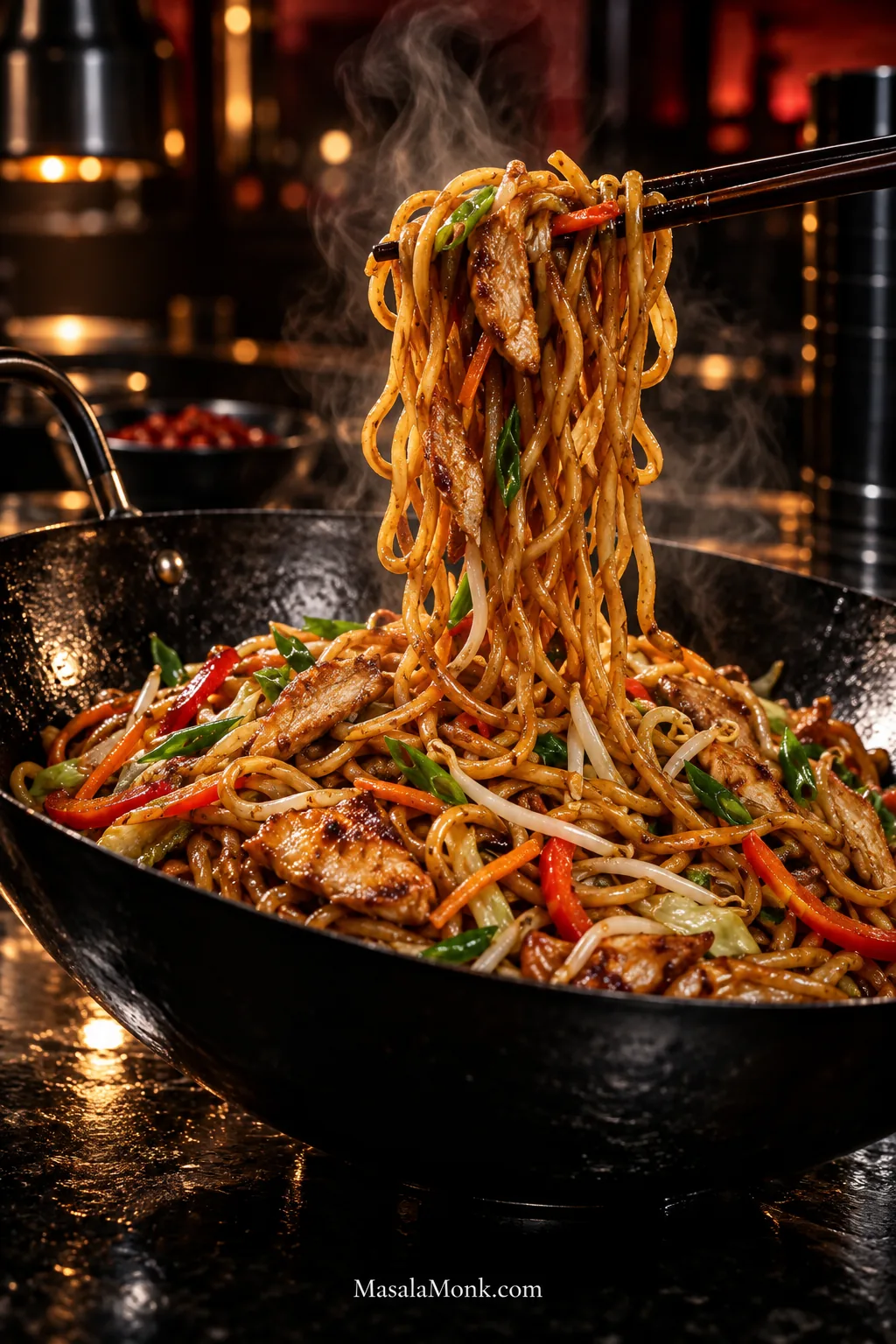
Dark chopsticks lift steaming chicken lo mein noodles from a black wok with thin sliced chicken, red bell pepper, carrots, bean sprouts and scallions.

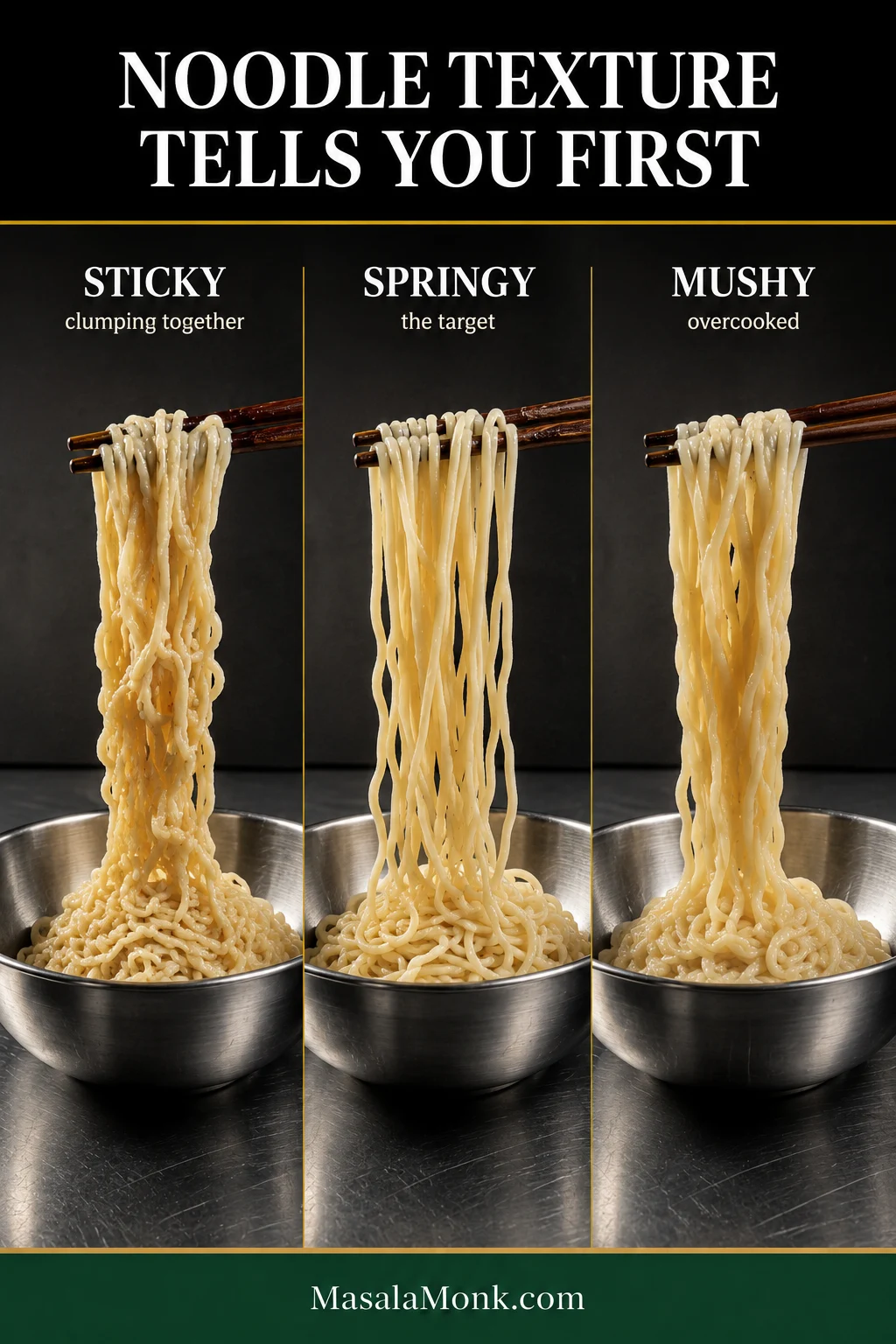
Lift a tangle of chicken lo mein from the bowl and the strands should separate as they rise, carrying their brown sauce with them instead of dragging up one sticky mass. The noodles bend easily but still push back when you bite, the chicken stays tender, and the vegetables keep enough snap to break up all that soft, slippery noodle texture.

Homemade lo mein can miss that mark in several directions at once. Noodles cooked until completely tender can soften too far during the final toss. Adding regular soy sauce just to make the pan darker can leave dinner overwhelmingly salty. Wet noodles and an overcrowded skillet cool everything down just when the sauce should be tightening around the strands.

This version takes about 30–35 minutes and gives you the saucier Chinese-American takeout-style lo mein many people are trying to recreate at home. A wide skillet works; you do not need a restaurant wok burner. What matters most is the state of the noodles you bought, how much water reaches the pan, and how much sauce you want those strands to carry.

Before You Start

Stop the noodles while they still have some chew, drain them exceptionally well, and do not create a saucier bowl by pouring in extra soy. Those three decisions matter more than owning a wok.

The chicken’s 10–15 minute marinade happens while you cut the vegetables and get the noodle water ready, so it does not add another quarter-hour to dinner. Fresh and dried noodles are not a gram-for-gram swap; the recipe gives separate quantities for each.

Chicken Lo Mein Recipe

The ingredient list looks longer than the actual cooking. Most of it gets mixed or chopped before the skillet is hot; once cooking starts, you are mostly adding prepared things in order.

The base recipe lands in the takeout-saucy middle of the range. Cook it this way the first time. The variations farther down are for anyone who already knows they prefer the noodles more lightly coated or noticeably wetter.

Easy Chicken Lo Mein

Yield4 main-dish servings
PrepAbout 20 minutes
CookAbout 10–12 minutes
TotalAbout 30–35 minutes
Pan13–14 inches / 33–36 cm preferred; a 12-inch / 30-cm skillet is workable but gives you less tossing room

Equipment

  • Wide skillet or wok
  • Pot and colander for the noodles
  • Tongs, chopsticks or two spatulas

For the Chicken

  • 12 oz / 340 g boneless skinless chicken breast or thighs
  • 2 teaspoons / 10 ml low-sodium soy sauce
  • 1 tablespoon / 15 ml Shaoxing wine or dry sherry
  • 2 teaspoons / about 5 g cornstarch
  • 1 tablespoon / 15 ml water
  • 1 teaspoon / 5 ml neutral cooking oil
  • ¼ teaspoon ground white pepper

For the Lo Mein Sauce

  • 2 tablespoons / 30 ml low-sodium soy sauce
  • 2 teaspoons / 10 ml dark soy sauce
  • 2 tablespoons / 30 ml oyster sauce
  • 2 tablespoons / 30 ml Shaoxing wine or dry sherry
  • ¼ cup / 60 ml unsalted or low-sodium chicken stock or water
  • 2 teaspoons / about 8 g sugar
  • 1½ teaspoons / about 4 g cornstarch
  • 1 teaspoon / 5 ml toasted sesame oil
  • ¼ teaspoon ground white pepper
  • ¼ teaspoon MSG, optional

For the Noodles and Vegetables

  • 12 oz / 340 g fresh Chinese lo mein or egg noodles or 7 oz / 200 g dried Chinese wheat or egg noodles
  • 2 tablespoons / 30 ml neutral high-heat cooking oil, divided, plus another teaspoon only if needed
  • 2 cups / about 140 g thinly shredded green or napa cabbage
  • 1 medium carrot, about 3½ oz / 100 g, cut into fine matchsticks
  • 1 medium bell pepper, about 5 oz / 140–150 g, thinly sliced
  • 1 cup / about 3½ oz / 100 g bean sprouts
  • 3 scallions, sliced, white and green parts separated
  • 3 garlic cloves, about 9 g, finely chopped
  • 2 teaspoons / about 4 g finely grated or minced fresh ginger

Set yourself up before the skillet gets hot. Mix the sauce, start the chicken marinating and cut the vegetables first. Prepare and drain the noodles as your final prep job so they spend as little time as possible sitting around warm.
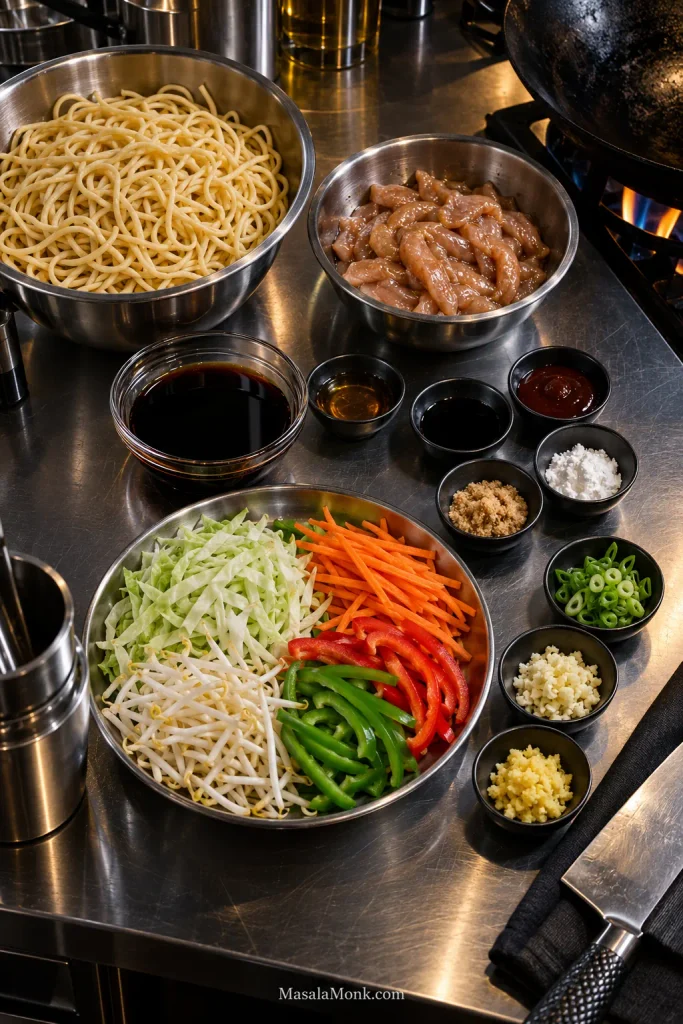
Professional stainless-steel prep station with separate bowls of lo mein noodles, sliced marinated chicken, sauce ingredients, cabbage, carrots, bell pepper, bean sprouts, scallions, garlic and ginger.
For chicken lo mein, group ingredients by when they enter the pan—not just by type. Once cooking starts, that simple setup keeps you moving without stopping to measure, chop or untangle noodles.

How to Make Chicken Lo Mein

1. Mix the Sauce

Whisk together all of the sauce ingredients. Stir again just before using because the cornstarch settles as it sits.

2. Marinate the Chicken

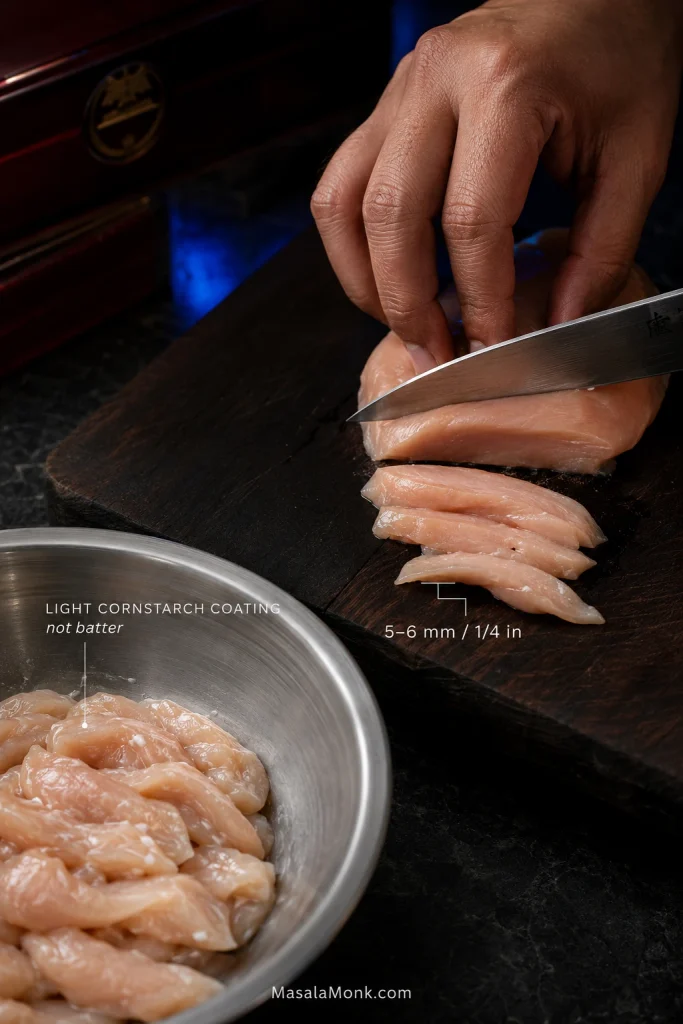
Slice the chicken across the grain about ¼ inch / 6 mm thick. Mix with the soy sauce, Shaoxing wine, cornstarch, water, oil and white pepper. Stir until the pieces look lightly slick and there is no puddle of thin marinade. Rest 10–15 minutes while you prepare the vegetables.

3. Prepare the Vegetables

Shred the cabbage, cut the carrot into fine matchsticks and slice the bell pepper. Keep the bean sprouts and scallion greens aside for the end.

4. Prepare the Noodles Last

Cook dried noodles until just shy of tender. Raw fresh noodles usually need much less time; already cooked or oily noodles may need only loosening or a brief hot-water treatment.

Floury fresh noodles often arrive pressed into a stubborn block. Loosen the bundle gently before boiling, then tease the strands apart as soon as they hit the water.

Drain extremely well and keep the strands loose in the colander. They should be a little firmer than you ultimately want. Move on to the skillet without leaving them packed together while warm.
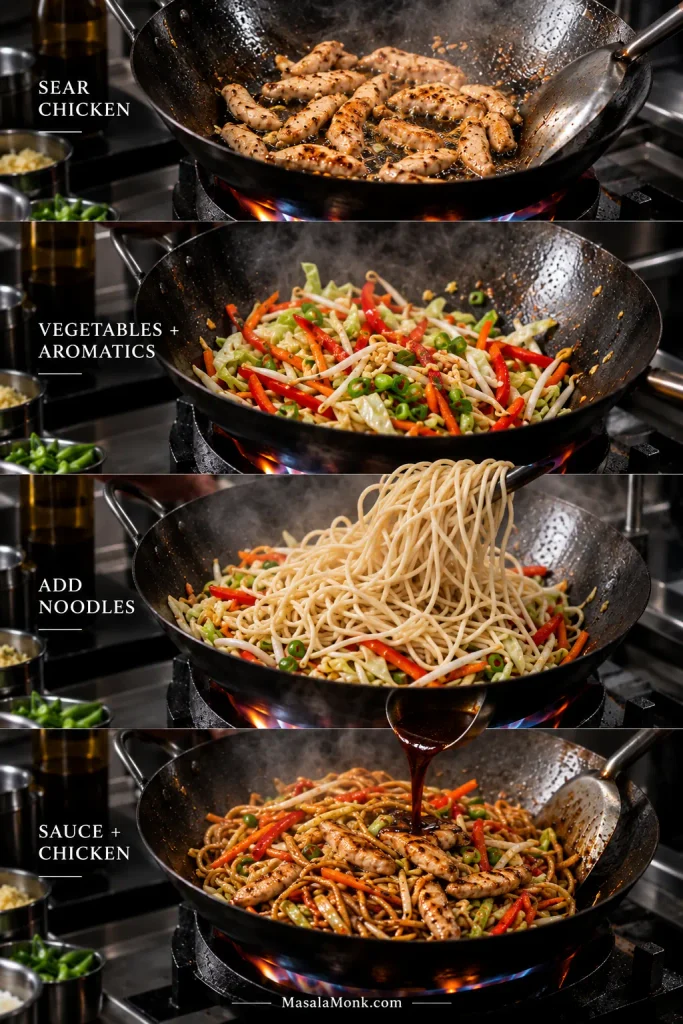
Four-stage wok sequence showing sliced chicken searing, vegetables and aromatics cooking, pale drained noodles being added, then sauce and chicken tossed through the noodles.
Notice that the sauce waits until the drained noodles are already in the pan. Adding it later lets the hot skillet turn thin liquid into a coating instead of making the vegetables and noodles simmer in it.

5. Sear the Chicken

Heat the skillet or wok over medium-high to high heat. Add 1 tablespoon / 15 ml oil. When it shimmers, add the chicken in a loose layer. Let it sit about 30 seconds, then stir-fry another 1½–2 minutes, until mostly opaque with some browning at the edges.

Transfer to a clean plate. Heavy overlap means two quick batches.

6. Cook the Vegetables and Aromatics

Add the remaining tablespoon / 15 ml oil, carrot, bell pepper and cabbage. Stir-fry about 2 minutes. The cabbage should begin to soften while the pepper stays bright and the carrot keeps some bite.

Add the scallion whites, garlic and ginger. Twenty or thirty seconds is enough. The aroma should sharpen almost immediately.

Visible water in the pan needs another moment to cook away.

7. Add the Noodles

Add the drained noodles and toss for about 30 seconds. Lift and turn them so the strands start slipping past one another instead of sitting in one dense mound.

8. Add the Sauce and Return the Chicken

Stir the sauce again, pour it into the pan, and return the chicken. Toss for 1–2 minutes. The noodles should deepen in color and the thin liquid should turn into a coating that moves with the strands.

9. Finish With Bean Sprouts and Scallion Greens

Add the bean sprouts and scallion greens and toss for 30–60 seconds, until heated through while the sprouts retain some crunch. Chicken should reach at least 165°F / 74°C; see the USDA safe minimum temperature chart for food-safety guidance.

Bean sprout safety: for anyone at higher risk of serious foodborne illness, cook the sprouts thoroughly until steaming hot or leave them out instead of serving them lightly cooked.

10. Taste, Then Stop When the Sauce Coats

Taste a noodle before changing anything. Flat flavor needs a little more seasoning; start with low-sodium soy a teaspoon at a time. A sauce that tastes good but feels too concentrated needs liquid instead—add 1 tablespoon / 15 ml stock or water.

Lift a few strands. They should separate easily and still push back a little when you bite. Drag a spatula through the bottom of the pan: a little sauce may slowly creep back into the gap, but watery liquid should not flood it.
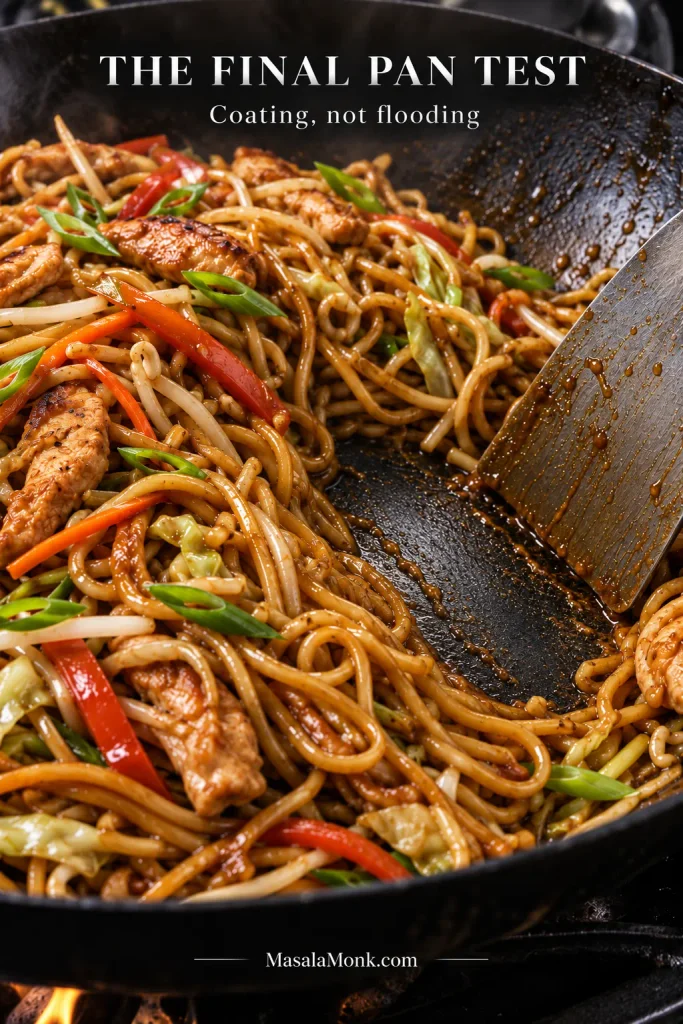
Close-up of chicken lo mein in a dark wok with a metal spatula clearing a channel through the noodles and exposing a thin layer of glossy sauce on the pan.
Judge the speed of the sauce, not its color. A channel that closes slowly suggests coating; one that floods immediately tells you free liquid is still sitting in the pan.

That’s the finish you’re looking for.

Serve immediately.

Doubling the recipe? Cook two batches unless you have an unusually large pan and powerful burner. A skillet can physically hold all the food and still be too crowded to cook it well.

Chicken Lo Mein or Chicken Chow Mein?

Chicken lo mein is tossed with sauce; chicken chow mein gets more direct frying.

In the Chinese-American takeout context we’re using here, lo mein starts with cooked or softened wheat or egg noodles that are tossed with chicken, vegetables and sauce. The strands stay springy, slippery and sauce-forward.

Chow mein generally gives the noodles more contact with the hot pan, producing a drier, toastier texture that can turn crisp around the edges. The terminology varies across regions and traditions, but that practical difference is useful when deciding which bowl you actually want.
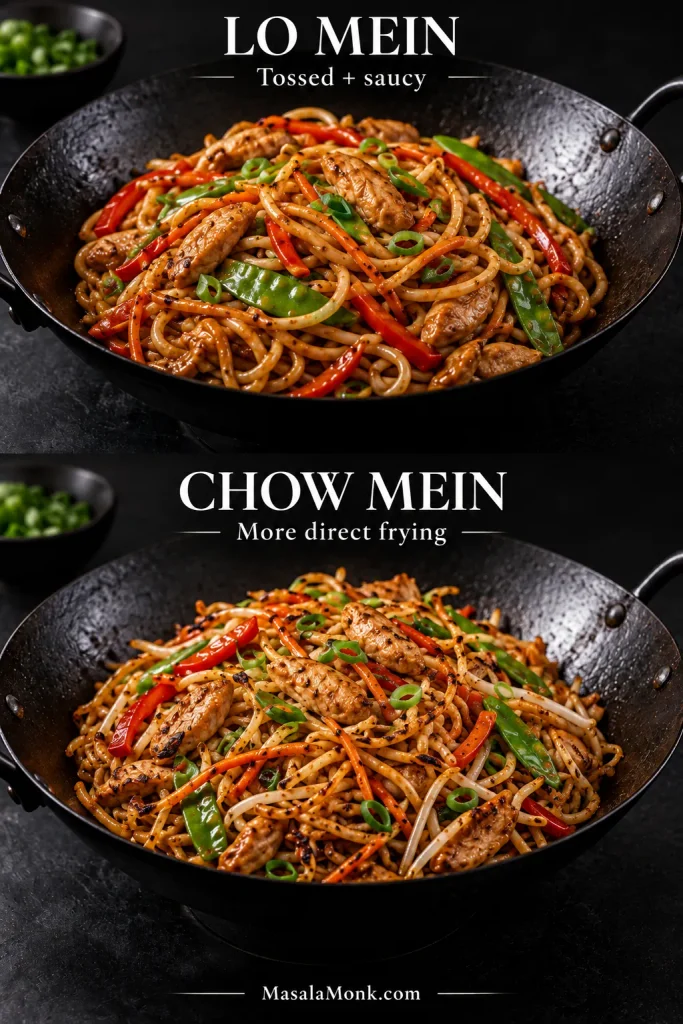
Two matched wok photos compare glossy chicken lo mein with drier chicken chow mein showing more browned and toasted areas on the noodles.
The noodle surface gives another clue in the lo mein vs. chow mein comparison: lo mein looks more uniformly coated, while chow mein tends to show more irregular toasted spots where strands have contacted the hot pan.

For the fried, toastier version, use the Chicken Chow Mein Recipe.

Which Noodles Should You Use for Chicken Lo Mein?

Fresh Chinese wheat or egg noodles are the best fit for takeout-style chicken lo mein. Look for them in the refrigerated or freezer section of an Asian grocery. Dried Chinese wheat or egg noodles are the easiest shelf-stable substitute and work very well.

Noodle packages are frustratingly inconsistent. Some tell you exactly what you’ve bought; others barely tell you whether the noodles are raw.
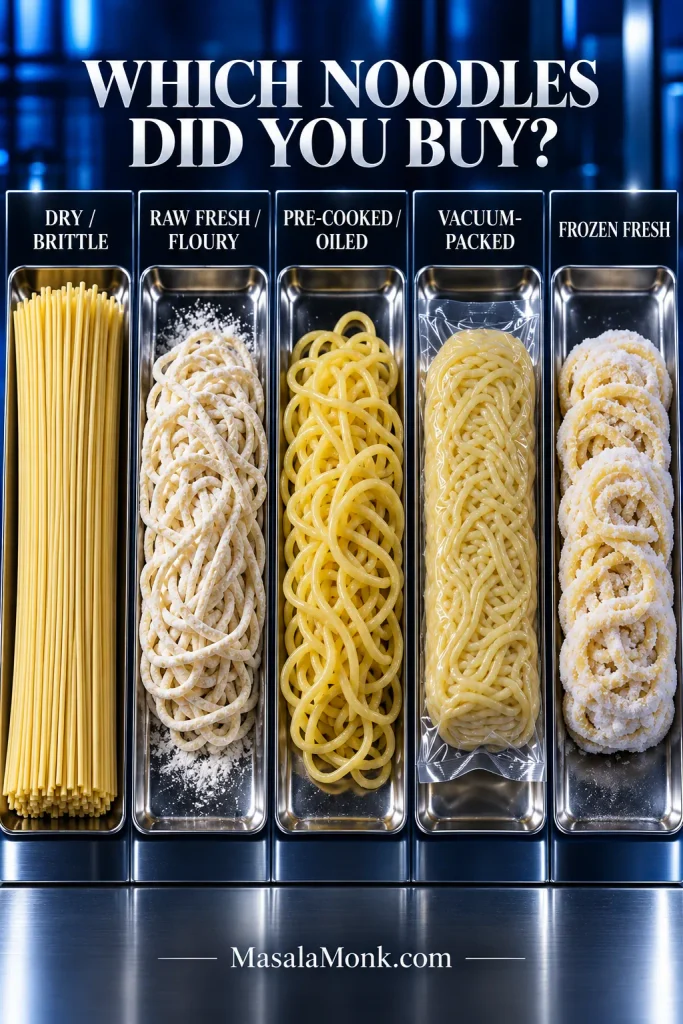
Five noodle types displayed in metal trays and labeled dry and brittle, raw fresh and floury, pre-cooked and oiled, vacuum-packed, and frozen fresh.
When a noodle package tells you very little, check three things first: dry or hydrated, raw or pre-cooked, loose or compressed. Those clues usually tell you more about handling than the product name does.
What you seeWhat you probably haveBest way to handle it
Dry, brittle strandsDried Chinese wheat or egg noodlesBoil until just shy of fully tender
Soft but dusty or flouryRaw fresh noodlesLoosen first; cook briefly and check early
Soft, shiny or lightly oilyPre-cooked or oil noodlesUsually need loosening or a short hot-water treatment
Compressed vacuum-packed noodlesPartially cooked shelf-stable noodlesFollow the package and separate gently
Frozen noodle bundleFrozen fresh noodlesUse the package directions instead of dried-noodle timing

Raw fresh noodles deserve the most attention. A floury, compressed bundle can move from pleasantly chewy to doughy very quickly, so loosen it first and start checking early.

Fresh and Dried Noodles Are Not a Gram-for-Gram Swap

Fresh noodles already contain much more water. For this recipe, use about 12 oz / 340 g fresh noodles or 7 oz / 200 g dried noodles. Using the same dry weight as fresh would produce far more cooked noodle than this sauce and pan are designed to handle.
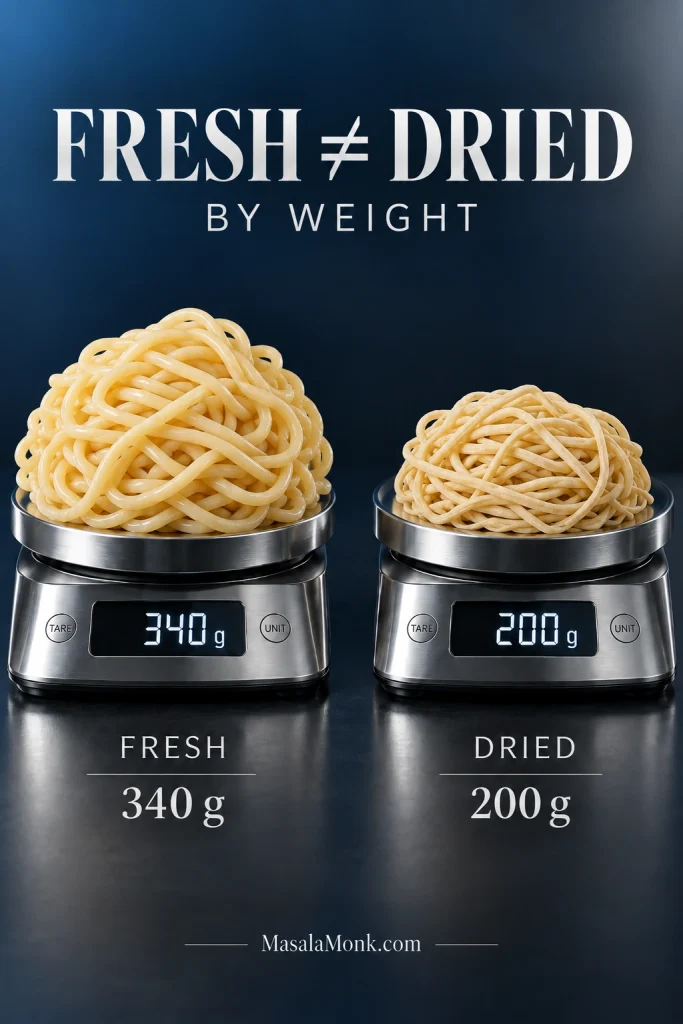
Fresh lo mein noodles weighing 340 grams and dried noodles weighing 200 grams on matching stainless-steel digital scales.
Treat 340 g fresh and 200 g dried as two separate starting points, not a conversion formula. Once either noodle is cooking, texture—not the number on the packet—still decides when it leaves the water.

Thin or Thick Lo Mein Noodles?

There is no single correct width. Medium Chinese wheat or egg noodles are an easy takeout-style choice. Thin strands soften quickly; thicker noodles need longer and can carry a little more sauce.

Cook the noodle in front of you.

No Lo Mein Noodles? Use What You Can Find

NoodleHow well it worksWhat to expect
Fresh Chinese wheat or egg noodlesBest fitSpringy, chewy and closest to familiar takeout texture
Dried Chinese wheat or egg noodlesExcellentFirm, dependable and easy to store
Yakisoba or Hokkien-style noodlesVery goodConvenient; check whether they are already cooked
RamenGoodUsually thinner and springier; discard the seasoning packet
Spaghetti or linguineUseful supermarket fallbackDifferent chew but still makes a satisfying lo mein-style dinner
Rice noodlesPossibleThe sauce works, but the finished texture is distinctly different

Spaghetti is a perfectly sensible supermarket fallback when that’s what you can actually buy. The chew is different, but cooking it firm and finishing it in the skillet gets you much closer than abandoning dinner because the specialty noodles aren’t there.

For another noodle dinner built around flexibility, Peanut Noodles can work with spaghetti, ramen, udon and several other noodles.

What the Noodles Should Feel Like Before the Skillet

Forget another universal minute count. Bite one strand.

Too firm: the middle still feels chalky or distinctly raw.

Ready: the noodle bends easily and is already edible, but the center has some chew left. Drain it here.

Too soft: there is almost no resistance left before the noodle even reaches the skillet.
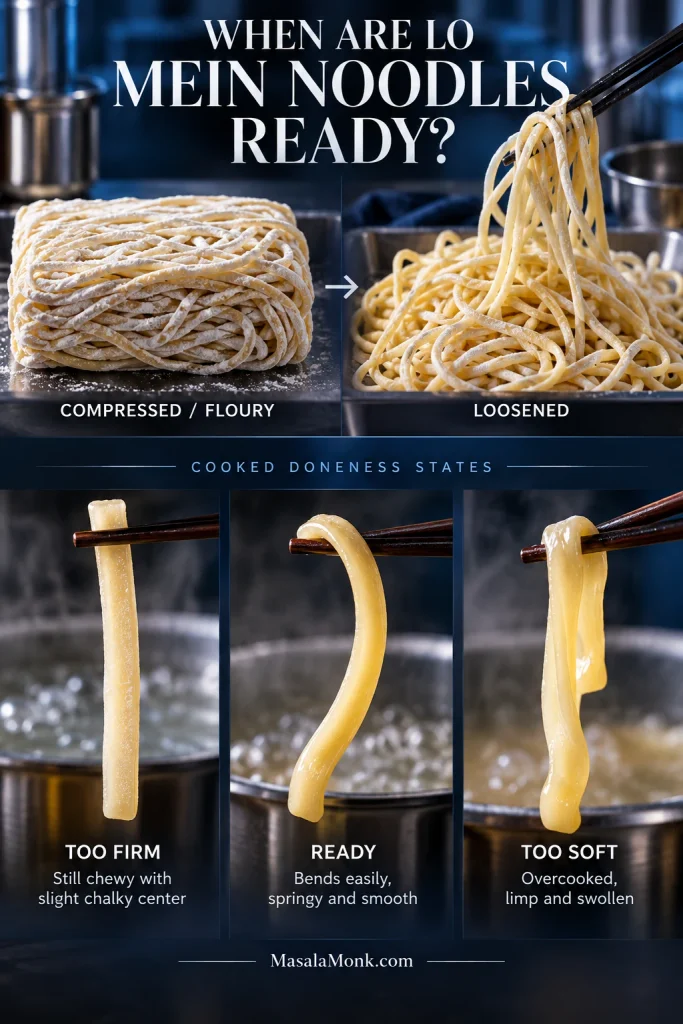
Fresh noodle guide showing a compressed floury noodle block, loosened strands, and cooked noodles labeled too firm, ready and too soft.
Drain at the ready stage because the skillet is part of the cooking process too. A noodle that feels perfectly soft in the pot has little room left for the final toss with hot sauce.

Shake the colander firmly. Water dripping freely from the noodles is water that would otherwise land in the skillet and thin the sauce.
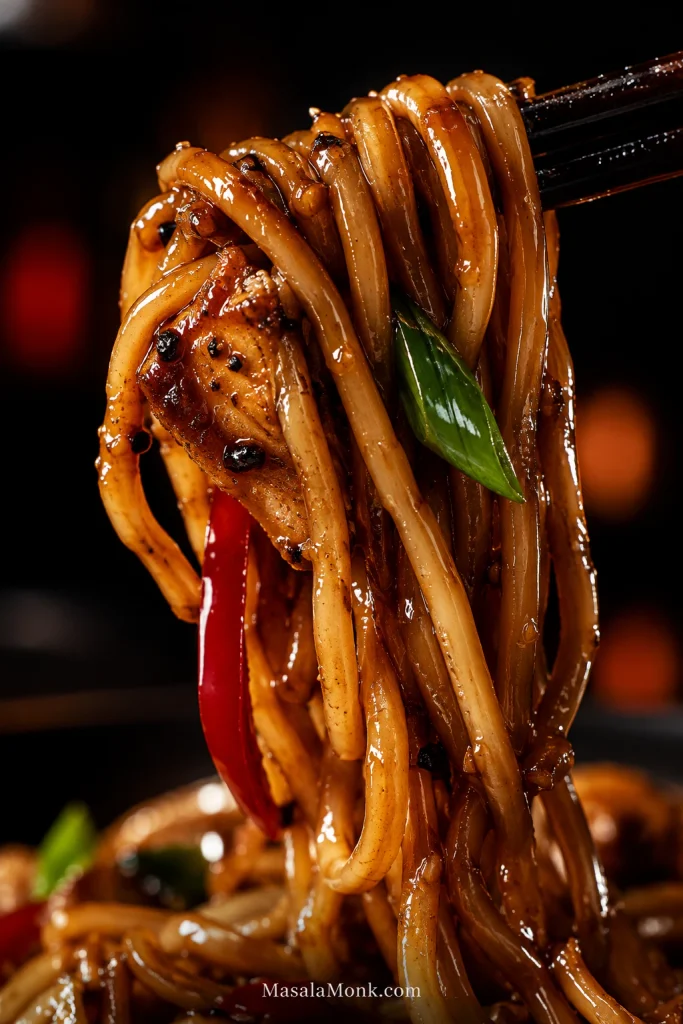
Extreme close-up of glossy brown-sauced lo mein noodles lifted with dark chopsticks beside a browned chicken slice, red pepper and scallion.

Chicken Lo Mein Sauce: How Saucy Do You Want It?

Chicken lo mein sauce is a savory brown sauce built from soy sauce, oyster sauce, Shaoxing wine, stock and sesame oil; dark soy deepens the color while cornstarch helps the sauce stay on the noodles.

Some people want the noodles lightly coated with almost nothing underneath. Others want the last forkful dragging a little sauce up from the bottom of the bowl.
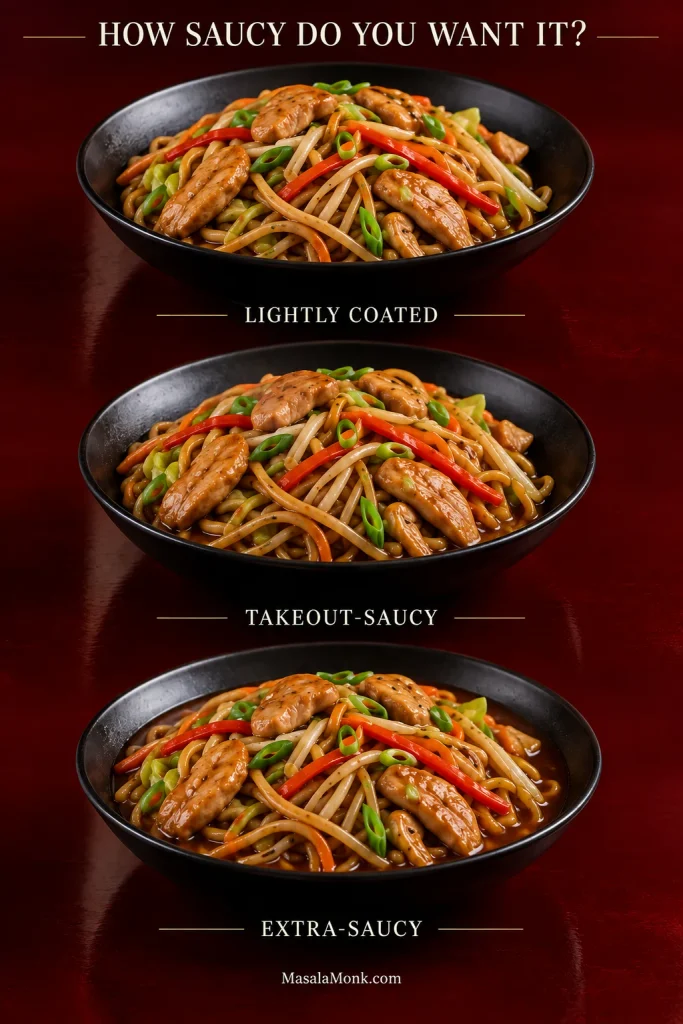
Three matching black bowls compare lightly coated, takeout-saucy and extra-saucy chicken lo mein against a dark red background.
A saucier chicken lo mein needs more volume, not simply more seasoning. Stock, oyster sauce and a little extra body can increase the coating while keeping soy from doing all the work.
StyleWhat it looks likeAdjustment
Lightly CoatedEvery strand coated; almost no loose sauceUse 2 tbsp / 30 ml stock instead of ¼ cup / 60 ml and reduce sauce cornstarch to 1 tsp
Takeout-SaucyGenerous coating with a little sauce moving between the noodlesUse the recipe exactly as written
Extra-SaucyNoticeably wetter but still clearly a noodle dishAdd the extra-sauce mixture below

For Extra-Saucy Lo Mein

  • ¼ cup / 60 ml additional unsalted or low-sodium chicken stock or water
  • 1 tablespoon / 15 ml additional oyster sauce
  • 1 teaspoon / 5 ml additional low-sodium soy sauce
  • ½ teaspoon / about 1.5 g additional cornstarch

This gives you more sauce without simply doubling the concentrated seasonings. A loose-looking pan often needs another 20–30 seconds of heat before it needs more starch.

What Actually Changes the Sauce

Stock is the easiest lever for sauce volume: more makes the noodles wetter, less gives you a tighter coating. Cornstarch controls how readily that liquid clings once it gets hot. Toasted sesame oil is there for fragrance, so adding more will not make the sauce richer in the same way that oyster sauce or stock will.

Hoisin isn’t required in this version. Some takeout-style recipes use it for extra sweetness and body. Oyster sauce plus a little sugar keeps this one more savory.

For other combinations of meat, tofu and vegetables, the Stir Fry Sauce Recipe goes further into adjusting sauce around whatever is actually in the pan.

Keep the Salt and Color in Balance

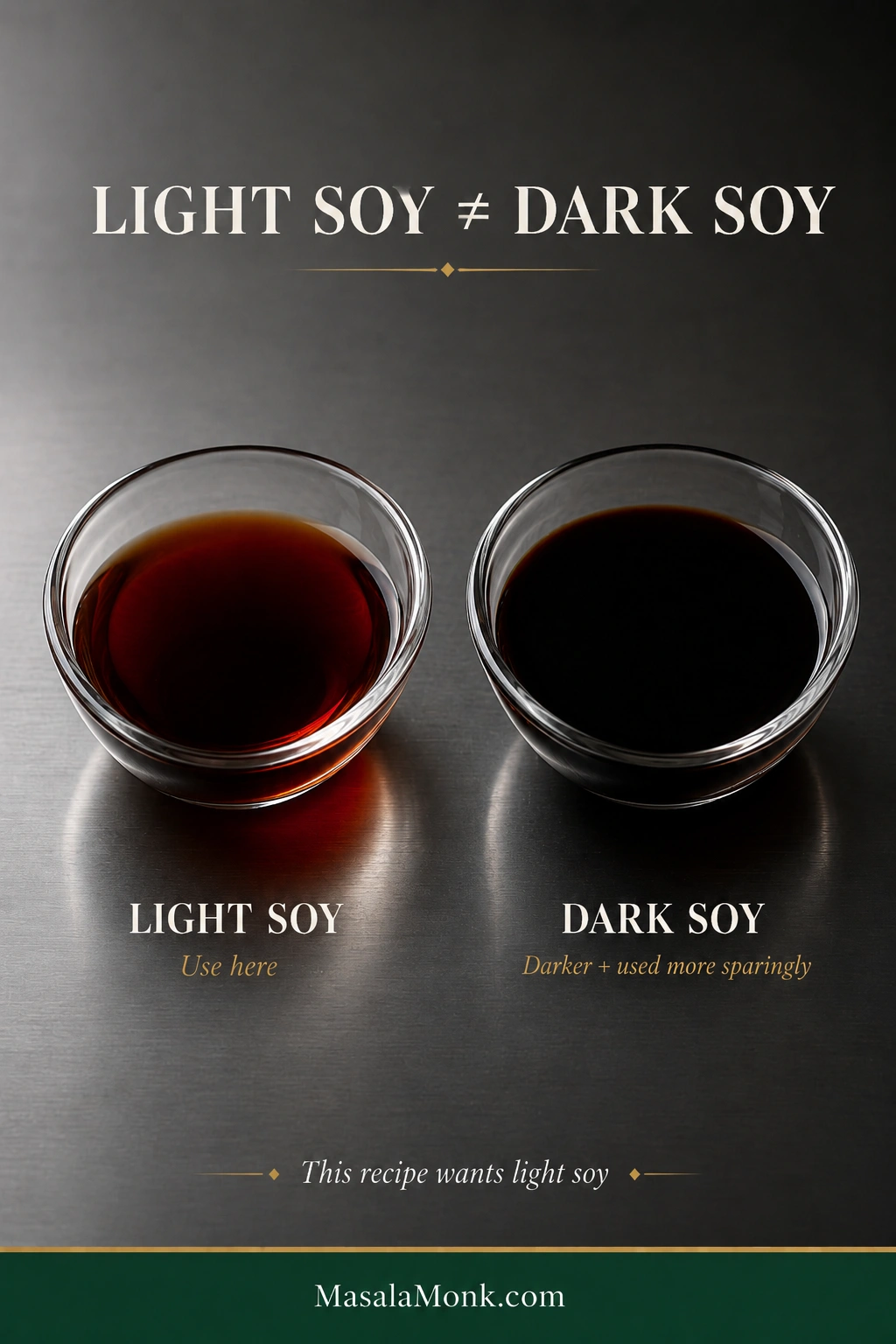
Don’t sacrifice a properly seasoned bowl just to make it browner. A small amount of dark soy gives the noodles much deeper color, so regular soy does not need to carry that job.

Light soy does not mean low-sodium soy. In Chinese cooking, “light soy sauce” generally distinguishes the thinner everyday seasoning soy from dark soy; it does not mean reduced sodium. A full-sodium Chinese light soy may need a smaller starting quantity than the low-sodium soy used here. This guide to Chinese soy sauces is useful when the labels in the store are confusing.

Shaoxing cooking wine deserves a label check too because some bottles contain added salt. Leave the noodle water unsalted or only very lightly salted; plenty of seasoning arrives later.

About MSG: the ¼ teaspoon in the recipe is optional. A small amount can deepen the savory flavor without requiring another splash of soy sauce.

Keep the Chicken Tender While the Noodles Finish

Thin slicing, a short cornstarch marinade and removing the chicken before the final toss keep lo mein chicken tender. Slice it about ¼ inch / 6 mm thick, marinate for 10–15 minutes, then sear it quickly and take it out before it finishes cooking.
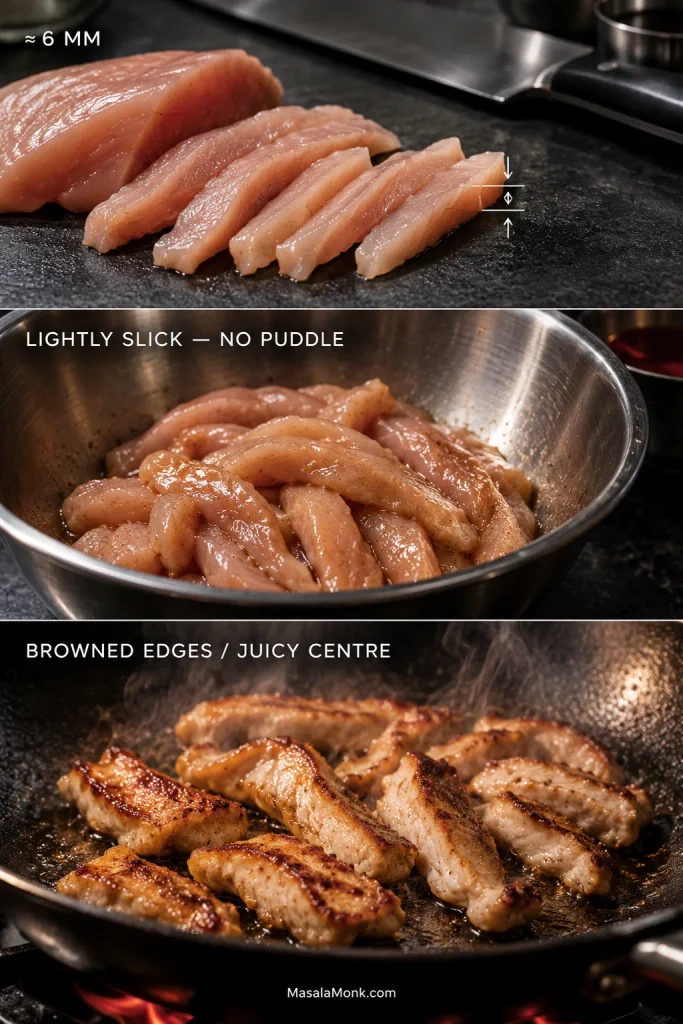
Three-stage chicken preparation showing thin raw slices measured at about six millimeters, lightly marinated glossy chicken and browned strips searing in a dark skillet.
Uniform thickness is the hidden advantage here. When the chicken strips are close to the same size, the thin pieces do not dry out while thicker ones are still waiting to brown.

Thighs stay juicy a little longer when the timing runs over. Breast works beautifully too; it simply has less patience for an extra few minutes in the skillet.

Look for browned edges while the center is still juicy. The chicken comes back with the sauce, so the first sear is not the moment to chase complete doneness.

The same broad technique works in Chicken Fried Rice, where the chicken also leaves the pan while the rest of dinner catches up.

Baking soda isn’t necessary here. Carefully measured baking soda can tenderize meat, but excess leaves an alkaline or soapy taste. Thin slicing and the short cornstarch marinade are more forgiving.

Best Vegetables for Chicken Lo Mein: Add Them by Cooking Speed

Cabbage, carrot, bell pepper and bean sprouts make a balanced default. Half a bell pepper left in the fridge, a handful of broccoli, mushrooms or snow peas can all join in. The order matters more than matching one prescribed vegetable list.

When it goes inGood choicesTypical time
Needs a head startThicker carrot slices, broccoli stems, firm green beansAbout 3–4 minutes depending on size
MiddleFine carrot matchsticks, broccoli florets, mushrooms, bell peppers, onionAbout 2–3 minutes
Almost doneCabbage, snow peas, bok choy stemsAbout 1–2 minutes
Last minuteBean sprouts, spinach, bok choy leaves, scallion greensAbout 30–60 seconds

A good bowl has contrast: cabbage softened around the edges, peppers still lively, sprouts with enough snap to be noticed against the noodles.
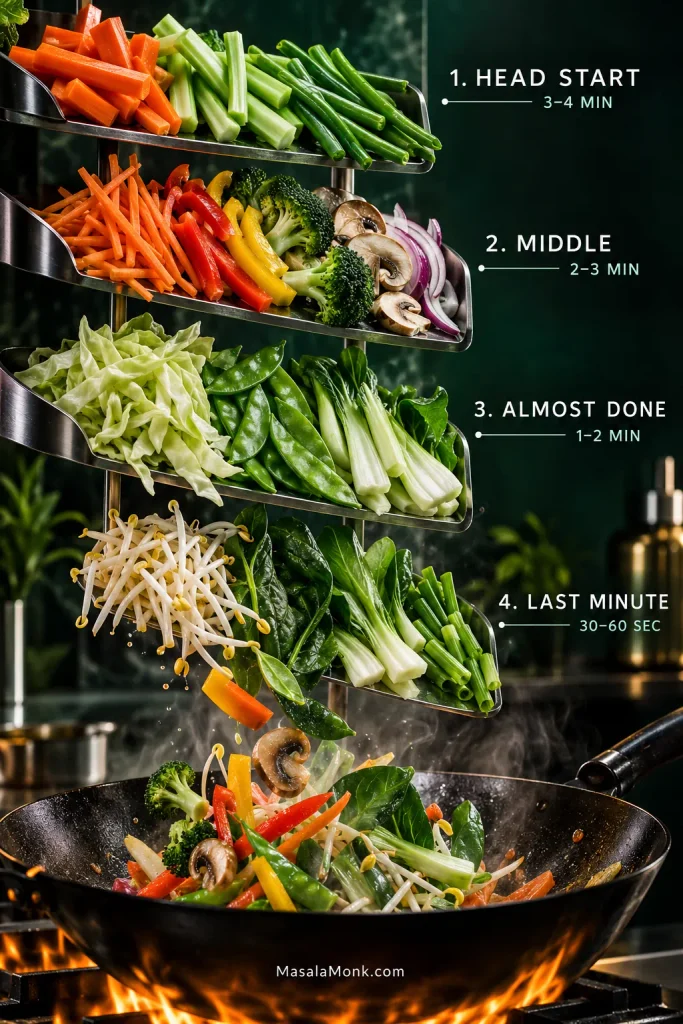
Four descending metal trays group stir-fry vegetables by cooking time, from thick carrots and firm green vegetables to cabbage, bean sprouts, leafy greens and scallions above a hot wok.
Cut size changes timing too: fine carrot matchsticks can cook with peppers, while thicker pieces need the earlier head start.

Broccoli works especially well. Keep the florets fairly small and give them a head start so the stems become crisp-tender before the noodles are finished.

For a dinner where broccoli really is the point, Beef and Broccoli goes deeper into keeping stalks and florets crisp-tender while the brown sauce stays concentrated.

Adding another couple of cups of vegetables? Mix up to 25% extra sauce and keep it beside the stove. Add only as much as the finished noodles need; mushrooms, spinach, cabbage and broccoli all change the pan differently.

Frozen Vegetables and Mushrooms

Frozen stir-fry vegetables are completely workable, but they release more water. Give that water time to disappear before adding the noodles and sauce.

Mushrooms are worth watching. They can dump enough liquid into the skillet to undo otherwise good work. Let them cook until the pan looks lively again and their flavor has deepened.

Why Doesn’t Homemade Chicken Lo Mein Taste Like Takeout?

Homemade lo mein often tastes flatter than takeout because the home skillet gets wetter and cooler: wet noodles, crowded ingredients and weak heat recovery dilute the sauce before it can properly coat the strands.

Water Dilutes More Than the Sauce

Water clinging to noodles or released by vegetables cools the skillet before it ever weakens the seasoning. A pan can contain all the right ingredients and still taste flat because the heat is busy boiling off water.

Give the Pan Room to Recover

A 12-inch skillet can make good lo mein; it just gives you less room than a 13- or 14-inch pan.

Listen to the pan. The active sizzle should return as you cook. A skillet buried under too much cold food stays quiet and steamy.
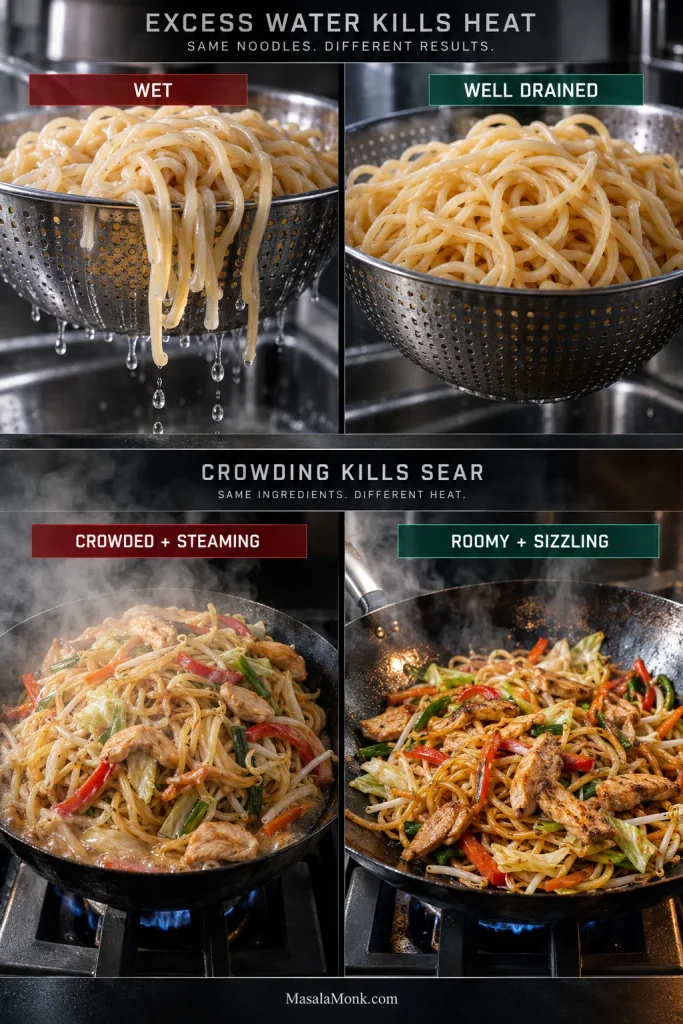
Four-panel comparison showing wet dripping noodles beside well-drained noodles, then a crowded steaming pan beside a wider, roomier sizzling pan of chicken lo mein.
A burst of steam is normal; steam replacing the sizzle is the warning sign. When excess water and crowding keep the pan quiet, browning and sauce concentration both slow down.

A Pale Batch Isn’t Necessarily Underseasoned

A pale pan that already tastes properly seasoned does not need another pour of regular soy. Use a small amount of dark soy next time if you want deeper color—or let the noodles stay a little paler.

High Heat Helps; Smoke Is Not the Goal

A very hot wok can add toasted aroma, but convincing lo mein does not require a smoke-filled kitchen. Properly drained noodles, enough cooking surface and fast tossing matter far more on an ordinary home stove.

When the sauce hits a properly hot pan, the smell should become richer almost at once—soy, ginger, scallion and toasted sesame carried by the steam coming off the noodles.

Fix Your Lo Mein

Find the problem that looks like yours and make the smallest correction first.

Mushy, Sticky or Gummy Noodles

Mushy: get them off the heat and serve. Next time, stop cooking the noodles earlier.

Sticking together: loosen them gently with tongs or chopsticks. A very starchy noodle may benefit from a brief rinse next time, followed by thorough draining.

Gummy after the sauce went in: toss with a tablespoon or two of hot stock or water. Noodles that were tacky before the skillet were already too soft or starchy.

Dry Noodles

Add 1–2 tablespoons / 15–30 ml unsalted stock or water and toss over heat. Strands that immediately loosen and shine again simply needed more free liquid.

Prefer that wetter finish? Start with the extra-saucy formula next time.
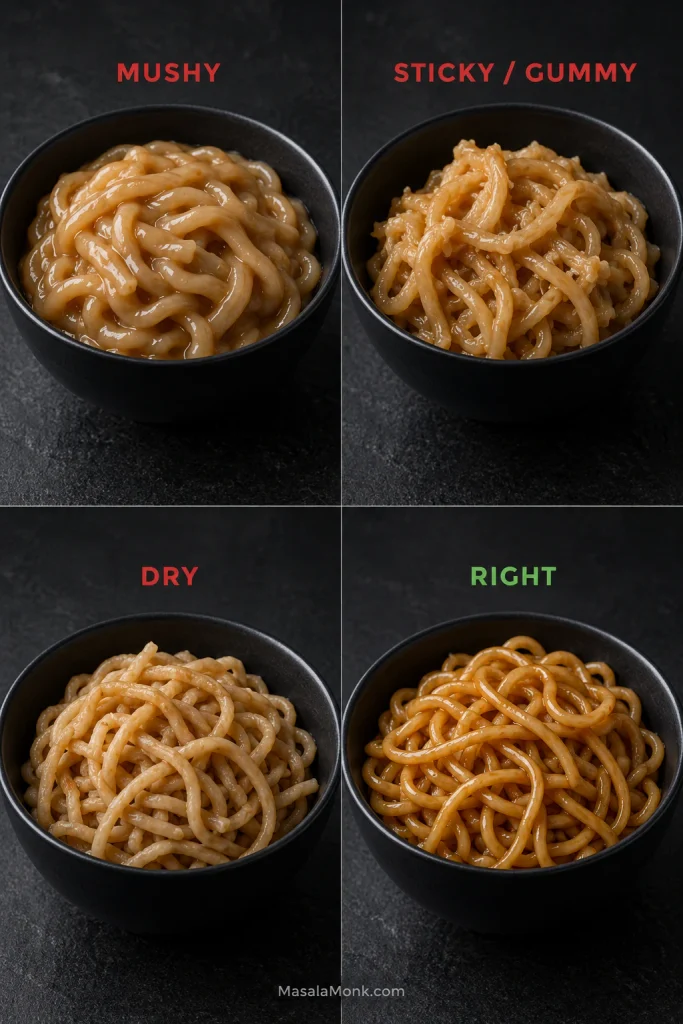
Four matching black bowls compare mushy noodles, sticky or gummy noodles, dry noodles and properly cooked loose glossy lo mein noodles.
Do not treat every clump as overcooked noodles. Mushy strands lose structure, gummy strands can still hold their shape but stick through tackiness, while dry noodles look tight and dull rather than sticky.

Too Salty—or Pale but Already Salty

Too salty: add a little unsalted stock or water and extra plain noodles or vegetables when available.

Pale but already salty: stop adding seasoning soy. Color and seasoning are separate problems.

Sauce Too Thin, Too Thick or Pooling

Too thin: keep the pan hot and uncovered for another 20–30 seconds. A tiny cornstarch slurry can help after obvious excess water is gone.

Too thick: add stock or water 1 tablespoon / 15 ml at a time while tossing.

Pooling underneath: toss briefly over heat. A puddle that quickly becomes a coating needed another moment; persistent watery liquid points to excess moisture in the pan.

The Noodles Taste Plain or the Whole Pan Is Watery

Thick sauce sitting unevenly on the noodles: add 1 tablespoon / 15 ml stock or water and toss again.

Sauce moves freely but tastes flat: add a teaspoon of low-sodium soy or a small spoonful of reserved sauce.

Watery and bland: evaporate first. Keep the skillet uncovered and hot for 30–60 seconds, then taste again.
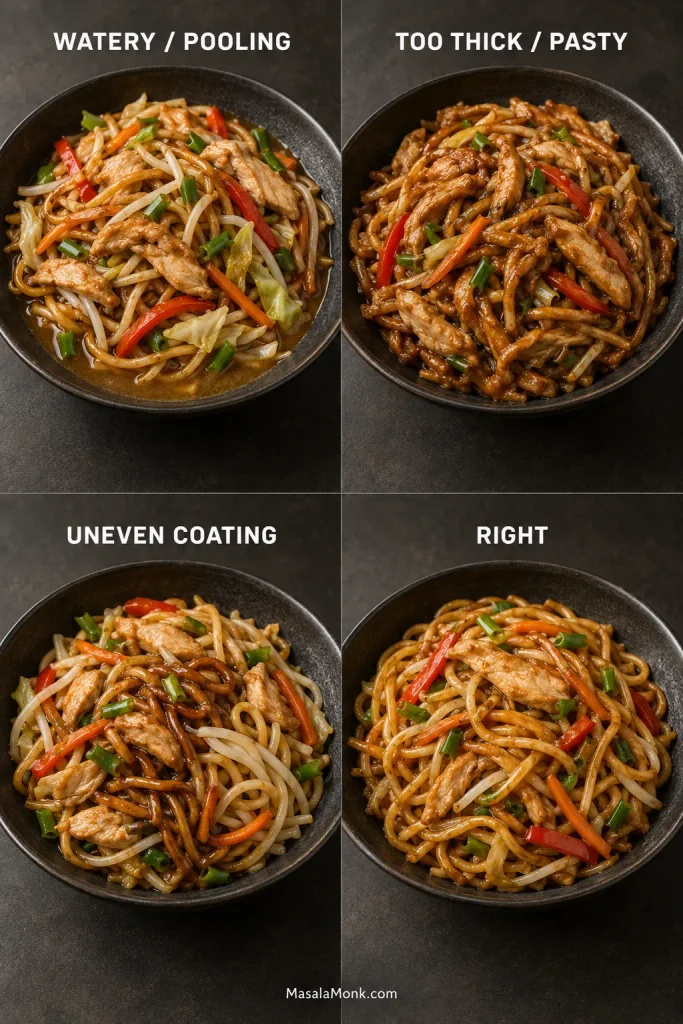
Four matching bowls compare chicken lo mein with watery pooled sauce, overly thick pasty sauce, uneven patchy coating and an evenly coated glossy finish.
Look at where the sauce is, not only how dark the noodles are. Pooling points to free liquid, a pasty film points to excessive thickness, and pale patches reveal coating that never distributed evenly.

Dry Chicken or Limp Vegetables

Dry chicken: use the tender-chicken technique: slice it about ¼ inch / 6 mm thick, shorten the first sear, and get it out of the skillet earlier.

Limp vegetables: return to the vegetable cooking-order guide: give firm vegetables their head start and keep sprouts, leafy greens and scallion tops for the end.

Baking Soda Taste or an Oily Finish

Alkaline or soapy chicken: skip the baking soda next time and rely on thin slicing plus the cornstarch marinade.

Greasy noodles: use less neutral cooking oil. Toasted sesame oil is there for aroma, not as the main frying fat.

Practical Ingredient Swaps

If you don’t have…Use…What changes
Shaoxing wineDry sherry or plain sake; unsalted stock/water for alcohol-freeSherry is the closest easy substitute; stock loses some aromatic depth
Oyster sauceMushroom-based vegetarian oyster-style sauceClosest swap for savory body; hoisin is sweeter and changes the profile more
Dark soy sauceLeave it out instead of replacing all of it with regular soyThe noodles will be paler but easier to keep properly seasoned
Toasted sesame oilOmit itThe recipe still works, with less nutty aroma at the finish
Bean sproutsExtra cabbage, snow peas or bok choyYou lose some juicy crunch but not the structure of the dish

Missing bean sprouts or one specialty bottle shouldn’t stop dinner. These swaps change the edges of the dish, not its basic shape.

Making It Gluten-Free

Use gluten-free noodles, tamari or another certified gluten-free soy sauce, plus verified gluten-free dark soy and oyster-style sauces. Many Shaoxing wines contain wheat, so replace the bottle with a verified gluten-free dry sherry or another gluten-free cooking wine.

Gluten-free noodles vary enormously in how quickly they soften. Their texture gets the final vote on timing.

For a sweeter, stickier direction: changing the sauce makes more sense than adding extra sugar to this one. Homemade Teriyaki Sauce deliberately moves toward a sweeter, shinier glaze.

Adding shrimp: cook it separately until just shy of done, remove it, then return it near the end. Shrimp spends far less time in the pan than chicken.

Make Ahead, Store and Reheat

The easiest make-ahead wins are the sauce and vegetables. Mix the sauce and refrigerate it covered, then stir or shake it before cooking because the cornstarch settles. Slice the vegetables ahead and keep them chilled. The chicken can be cut in advance too; its marinade only needs 10–15 minutes.

Cooking the noodles ahead: possible, but not ideal. Stop them while they are still firm, cool them promptly and keep the strands loose instead of pressing them into one warm mound. If you are unsure where to stop, use the noodle doneness guide. A very small amount of neutral oil can help a particularly sticky batch.

Store and Reheat

Refrigerate leftovers promptly—within 2 hours—in an airtight container and use them within 3–4 days.

The next-day skillet version can be excellent. Add 1–2 tablespoons / 15–30 ml water or unsalted stock, cover briefly to loosen the cold noodles, then uncover and toss until everything is steaming hot. Reheated leftovers should reach 165°F / 74°C.
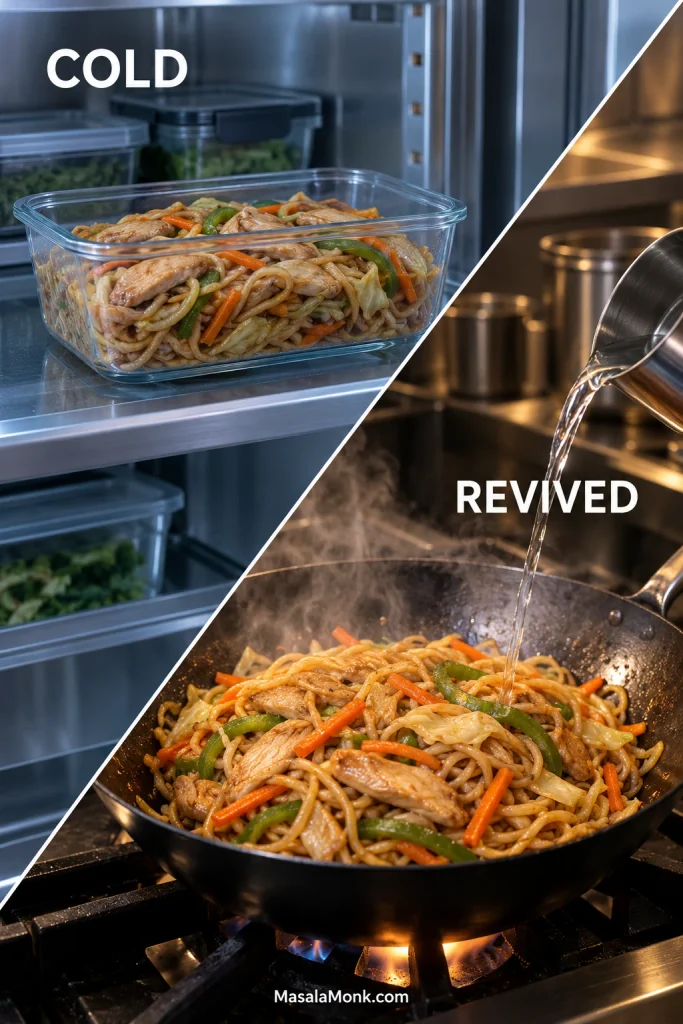
Split image showing cold chicken lo mein in a glass refrigerator container and the same noodles steaming in a wok while a small amount of water is added.
When reheating chicken lo mein, the goal is separation rather than more sauce. A little steam loosens chilled starch so the original coating can move with the noodles again.

For the microwave, add a small splash of water, cover loosely and heat in short intervals, stirring between them, until the food reaches 165°F / 74°C throughout.

Freezing: possible, though not preferred. Noodles soften further after thawing and crisp vegetables lose much of their bite. Refrigeration gives you a much better second bowl.

What to Serve With It

Chicken lo mein already brings noodles, meat and plenty of vegetables to the bowl. It doesn’t need a parade of sides.

For something cold and crisp, Cucumber Salad makes a refreshing contrast. Its rice-vinegar, sesame, ginger and scallion variation sits especially well beside the warm savory noodles.

A small bowl of Egg Drop Soup takes the meal in the other direction: warm broth, soft egg ribbons and no extra heavy starch.
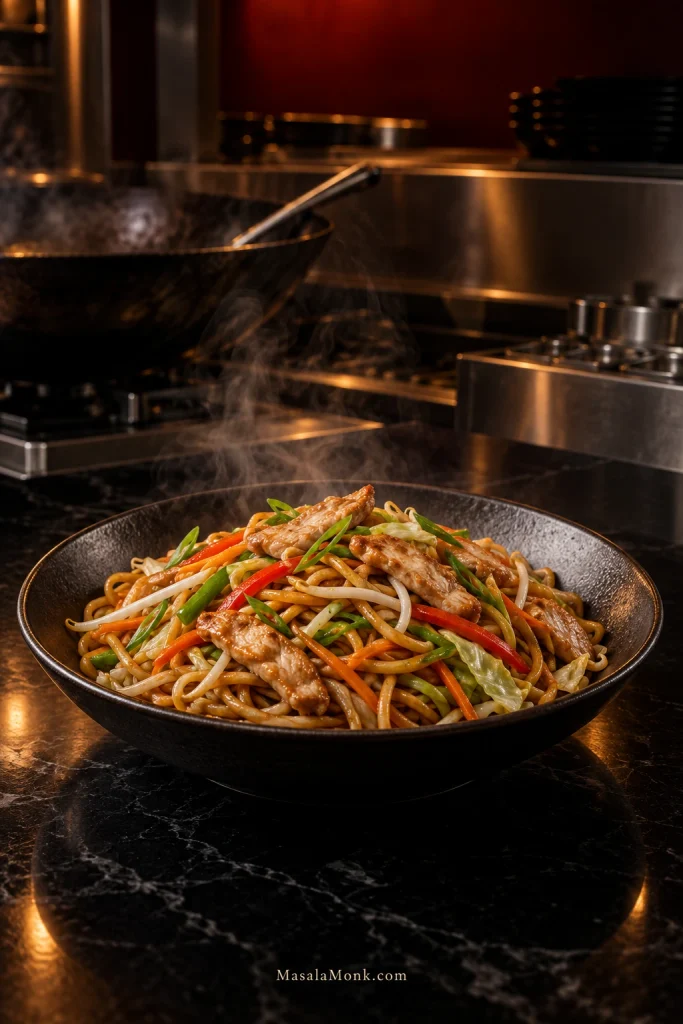

Finished chicken lo mein in a dark bowl on polished black stone, gently steaming in front of a wok and stainless-steel equipment in a dim professional kitchen.

Serve the lo mein straight from the pan while the strands are loose and shining, the vegetables still have bite and the bean sprouts still crunch. Once you recognize that finish—the sauce riding with the noodles, the center still springy—you do not need a restaurant burner or one perfect brand of noodle to find your way back to it.
Posted on — Leave a comment

Chicken Chow Mein Recipe: Easy Takeout-Style Noodles With Homemade Chow Mein Sauce

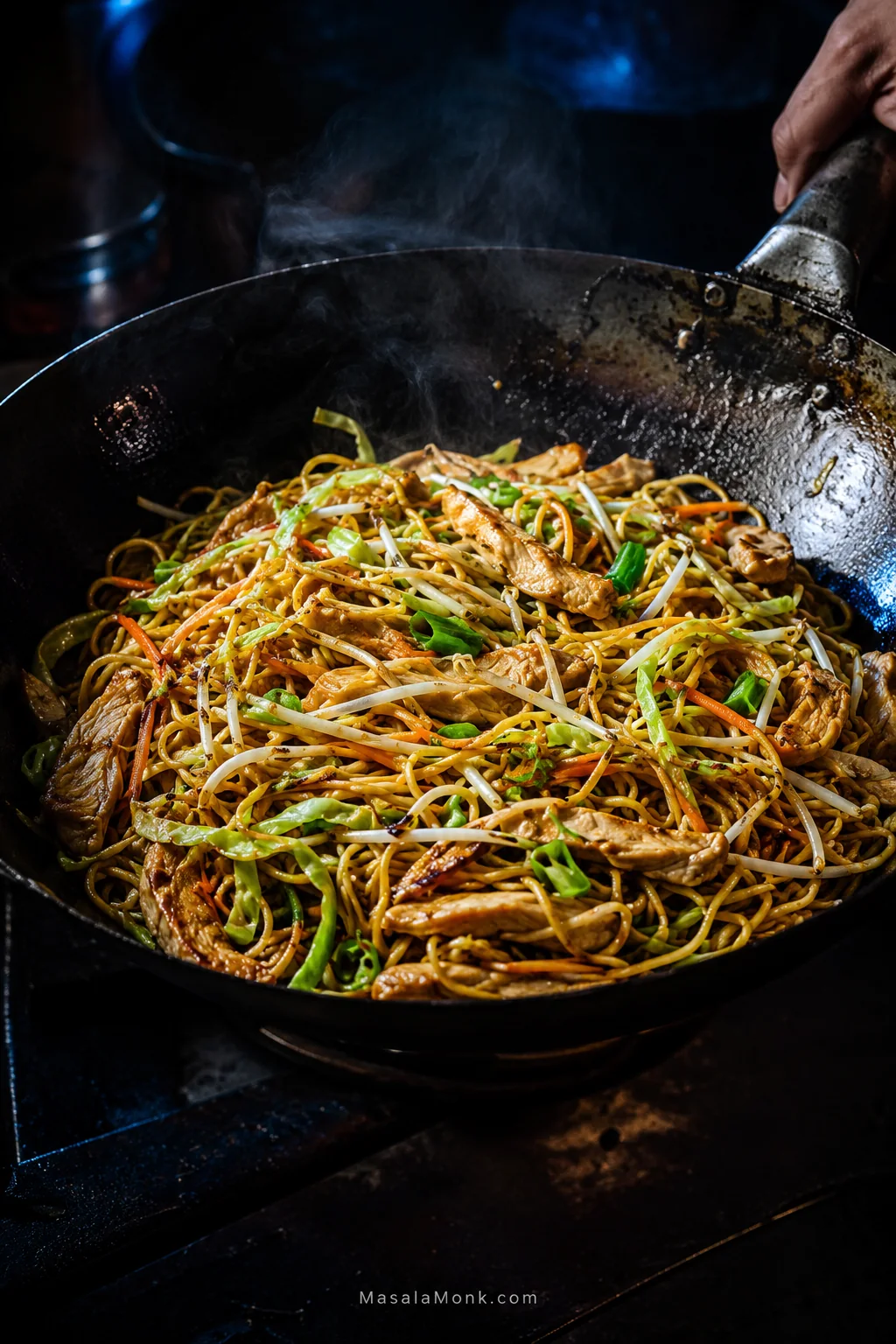
Chicken chow mein in a dark carbon-steel wok with thin chicken strips, medium-thin noodles, green cabbage, bean sprouts, carrots and scallions, with glossy strands and scattered browned edges.

Chow mein does not give you much time to think once the pan is hot. Chicken comes out, vegetables go in, noodles hit the hot surface, and the sauce has only a minute or two to turn everything glossy before dinner is ready.

That speed is part of the appeal—and the reason homemade chicken chow mein can unravel so quickly. Noodles go in wet. Cabbage cools the pan. Chicken keeps cooking while everything else catches up. A little more sauce seems like the answer, and suddenly the noodles are soft instead of fried.

When it goes right, you can smell the difference before the pan reaches the table: toasted noodles, hot garlic and ginger, the savory edge of soy and oyster sauce. The chicken stays juicy, the vegetables snap, and a few noodle strands catch darker around the edges while the rest remain springy.

This recipe gets there by keeping the jobs separate. Thin strips of chicken get a short cornstarch marinade, the vegetables cook and come out, and the noodles get a mostly empty pan. Everything meets again only when each part is ready.

A wok is excellent, but you do not need restaurant equipment. A wide skillet works too.

Quick Answer

Good chow mein depends on timing and space as much as ingredients. The useful cue is simple: noodles should bend, separate and arrive at the wok without dripping. Anything already cooked can then make room for the next stage.


How to Make Chicken Chow Mein

Recipe card: servings, timings, ingredients, equipment and the complete method are below.

The chicken and vegetables come out before the noodles go in. It can look fussy on paper, but it makes the cooking easier: nothing sits around overcooking while you fight for space. It is one pan, just not one pile.

Once everything is sliced and the sauce is mixed, the actual stir-frying is only a handful of short stages.

Serves4 as a generous main course
DifficultyEasy, but fast-moving once the pan is hot
PrepAbout 20–25 minutes
CookingAbout 12–15 minutes
TotalAbout 35–40 minutes
Best pan14-inch / 35 cm wok; a roomy 12-inch / 30 cm skillet also works with batching

Chicken and Quick Marinade

  • 450 g / 1 lb boneless skinless chicken thighs or chicken breast
  • 1 tablespoon / 15 ml Chinese light soy sauce or regular/all-purpose soy sauce
  • 1 tablespoon / 15 ml Shaoxing wine
  • 1 tablespoon / about 8 g cornstarch (cornflour in the UK)
  • 1 tablespoon / 15 ml water
  • 1 teaspoon / 5 ml neutral cooking oil
  • ¼ teaspoon white pepper

Cut the chicken about 5–6 mm / ¼ inch thick and roughly 5 cm / 2 inches long where practical. Slice chicken breast across the grain.

Thin strips of raw chicken being sliced for chow mein beside a small bowl of marinade on a dark kitchen work surface.
For cleaner, thinner chicken strips, start with meat that is very cold and slightly firm. Consistent pieces cook at a similar pace, which matters once a fast stir-fry leaves little time to chase individual pieces for doneness.

Sauce Ingredients

  • 2 tablespoons / 30 ml Chinese light soy sauce or regular/all-purpose soy sauce
  • 2 teaspoons / 10 ml dark soy sauce
  • 2 tablespoons / 30 ml oyster sauce
  • 1 tablespoon / 15 ml Shaoxing wine
  • 2 teaspoons / about 8 g sugar
  • ¼ teaspoon white pepper
  • 1 teaspoon / 5 ml toasted sesame oil
  • 1 teaspoon / about 3 g cornstarch (cornflour in the UK)
  • ¼ cup / 60 ml water or unsalted chicken stock
  • ¼ teaspoon MSG or ½ teaspoon chicken powder, optional

Keep another 2 tablespoons / 30 ml water beside the stove in case the noodles need loosening at the end.

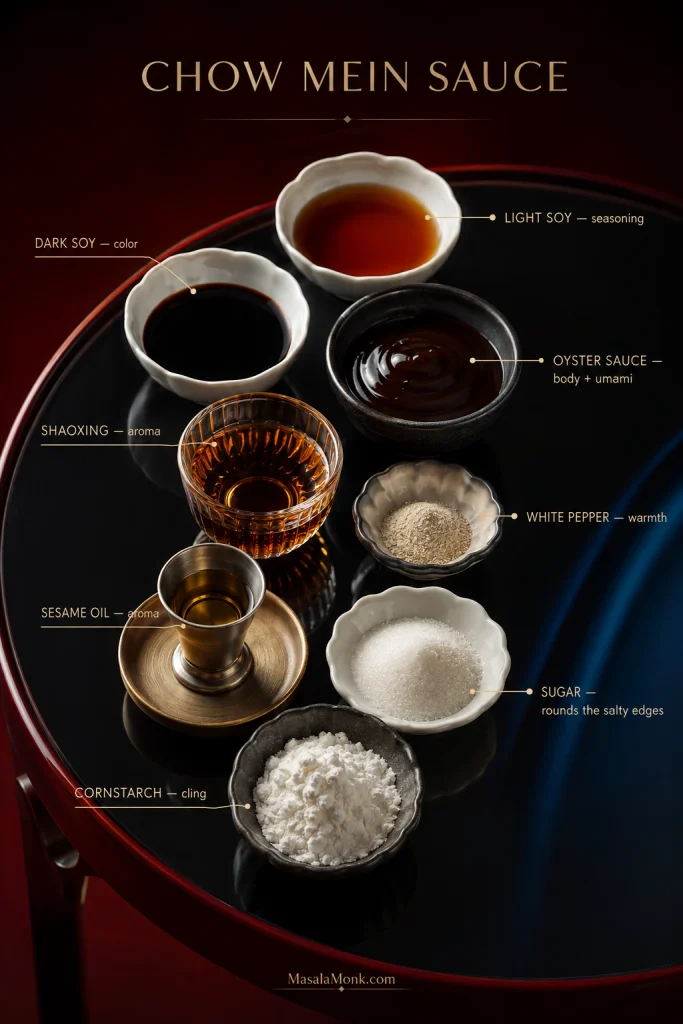
Measured ingredients for homemade chow mein sauce arranged in small bowls and vessels, including soy-based sauces, seasonings and liquid ingredients.
Give the sauce one final stir before it hits the wok. That keeps the seasoning and cornstarch evenly dispersed, so the sauce behaves consistently from the first splash to the last.

Noodles, Vegetables and Aromatics

  • 250 g / 9 oz dried Chinese egg or dried chow mein noodles
  • Using fresh noodles? Use the package amount intended for about 4 servings. Fresh noodle products vary too much in hydration and cooking state for one reliable gram-for-gram conversion from dried noodles.
  • 3 tablespoons / 45 ml neutral high-heat oil such as peanut, canola, grapeseed or rice-bran oil, divided
  • 1 teaspoon neutral oil for drained noodles only if they are prone to sticking
  • 250 g / 9 oz green cabbage, thinly shredded
  • 1 medium carrot, about 100 g / 3½ oz, cut into fine matchsticks
  • 150 g / 5 oz bean sprouts
  • 4 scallions (spring onions), cut into 2.5–5 cm / 1–2 inch lengths
  • 3 garlic cloves, finely chopped
  • 15 g / ½ oz fresh ginger, finely grated or minced

Instructions

Have Everything Ready Before the Wok Gets Hot

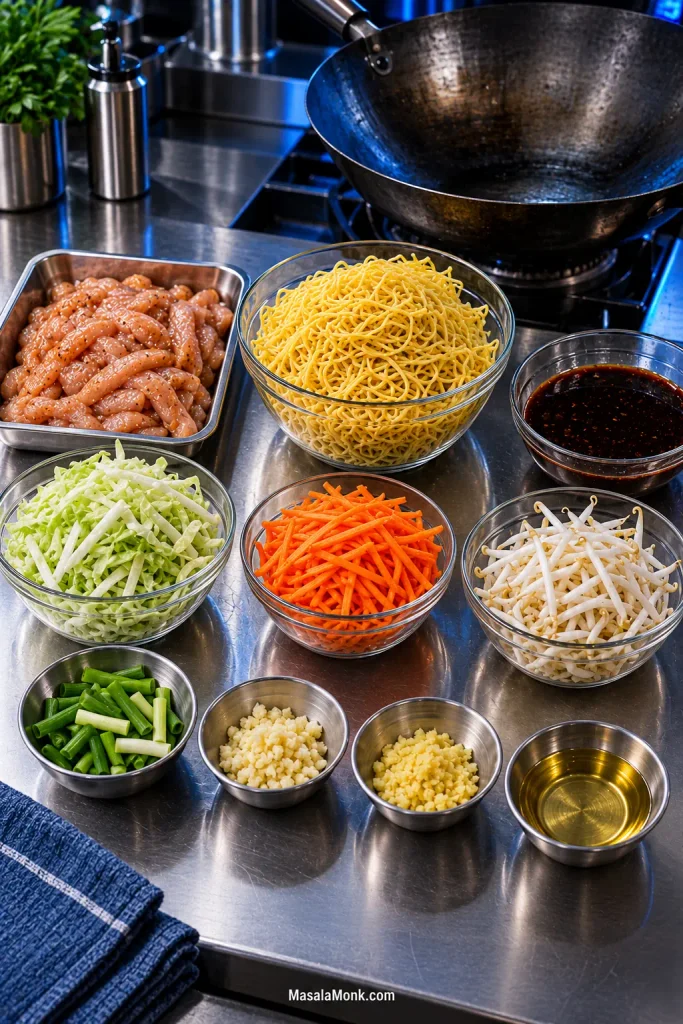
Prepared chicken chow mein ingredients beside an empty wok, including marinated chicken, noodles, sauce, cabbage, carrots, bean sprouts, scallions, garlic, ginger and cooking oil.
Arrange the station in cooking order: keep the quick finishing ingredients separate so they can hit the wok only when the final texture needs them.

Prep Before the Wok

  1. Mix the sauce. Whisk the light soy, dark soy, oyster sauce, Shaoxing wine, sugar, white pepper, sesame oil, cornstarch, water or stock, and optional MSG or chicken powder until smooth. Set it aside and stir again just before it goes into the pan; the cornstarch will settle.
  2. Cut the vegetables, then marinate the chicken. Prepare the cabbage, carrot, scallions, garlic and ginger first. On a separate or thoroughly cleaned board, slice the chicken and mix it with the marinade ingredients. Wash your hands and clean the knife, board and anything else that touched the raw chicken immediately. Leave the chicken for 10–15 minutes while you prepare the noodles.
  3. Prepare the noodles last. Start checking dried noodles about a minute before the package’s full cooking time. Stop when the strands bend and separate easily but feel firmer than you want to eat. Drain and briefly rinse under cool water, then shake the colander firmly. Spread the noodles loosely for a couple of minutes. Lift a small handful; dripping noodles need more draining or a gentle blot with a clean kitchen towel. Toss with 1 teaspoon oil only when the strands are prone to sticking.

Cook in Stages

  1. Partially cook the chicken. Heat the wok or skillet over medium-high heat until hot. Add 1 tablespoon oil and spread the chicken into a loose layer. An immediate sizzle is what you want. Cook in two batches when the pieces would otherwise heavily overlap. Stir-fry for about 2 minutes, until most surfaces are opaque with a little browning. Transfer to a clean plate or bowl; the thickest pieces may remain slightly underdone inside.
  2. Cook the cabbage and carrot. Add another tablespoon oil and stir-fry for about 1½–2 minutes. The cabbage should soften at the edges while keeping some bite; the carrot should bend but not flop. Add the garlic and ginger for the final 20–30 seconds, just until their raw sharpness disappears and the aroma turns strong and savory. Let obvious liquid evaporate, then transfer everything to a bowl.
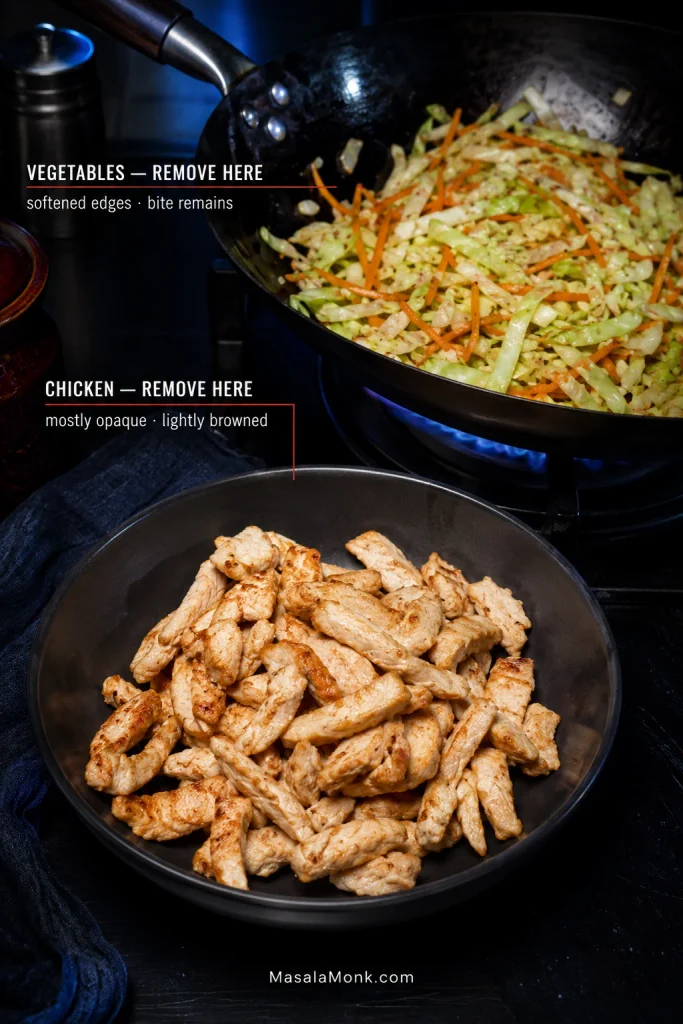
Lightly browned chicken strips and briefly stir-fried cabbage, carrots and other vegetables in a hot wok, with the vegetables still bright and structured.
Let excess cooking juices stay behind. The chicken and vegetables have already done their job; bringing that liquid back can make the final noodle toss wetter than intended.
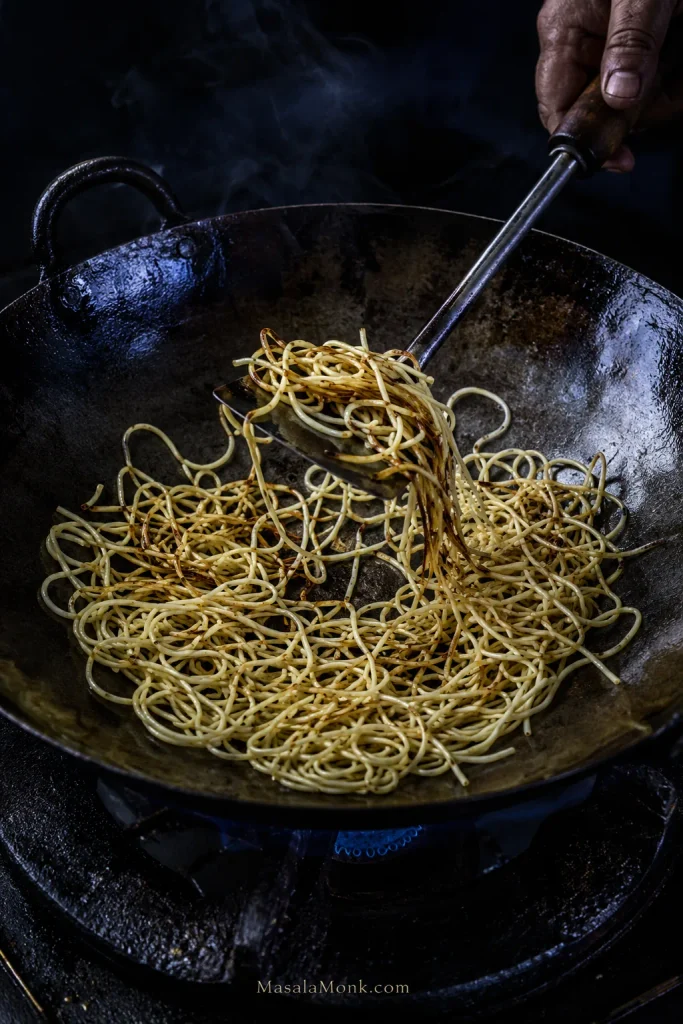
  1. Give the noodles the pan. Add the final tablespoon of oil and spread the noodles across as much hot surface as possible. Leave them alone for 30–45 seconds, then lift and turn. Continue for about 2 minutes. The pan should sound like frying, not simmering. Some strands will curl, wrinkle or darken while others stay pale. Uneven browning is fine. Those toasted patches give the noodles a deeper, nuttier edge that comes through after the sauce goes in.
Medium-thin yellow chow mein noodles spread across a dark wok with exposed metal and scattered golden-brown toasted patches, without chicken, vegetables or sauce.
Lift and turn the noodles in broad sections instead of stirring constantly. More strands get direct pan contact, so you build toasted edges without sacrificing the softer noodles underneath.

Finish and Serve

  1. Finish the stir-fry. Stir the sauce again and pour it over the noodles. Immediately return the chicken and vegetables. Leave behind any noticeable puddle of thin watery liquid on the chicken plate. Toss for 1–2 minutes, adding the reserved water 1 tablespoon at a time only when the noodles need loosening. A crowded 12-inch skillet is easier to handle as two half-batches.
  2. Add the bean sprouts and scallions. Give them 30–60 seconds. The sprouts should be hot, juicy and crisp. The thickest piece of chicken should reach 165°F / 74°C.
  3. Taste one forkful. It should be savory first, with mild sweetness and white-pepper warmth behind it. No single flavor component should dominate. The best forkful has chicken, cabbage or a crisp bean sprout tangled through noodles that are soft in places and toasted in others. Very little sauce should remain at the bottom. Turn off the heat and serve immediately.
Prefer softer noodles? Shorten the dedicated noodle-frying stage a little. For more browned edges, give them another 30–60 seconds of pan contact before the sauce goes in.

A Little Uneven Is Fine

The noodles should pull apart easily, the chicken should stay juicy, and some crunch should remain in the vegetables. Broken strands, darker patches and slightly softer cabbage are normal.

Finished chicken chow mein in a wok with separate glossy noodles, thin chicken strips, cabbage, bean sprouts, carrots and scallions, with little visible liquid underneath.
Use appearance and movement as the final check: glossy strands, little loose liquid, visible vegetables and chicken spread through the noodles. When those cues line up, turn off the heat and serve.

If this does not look like the chow mein you grew up ordering, you’re probably not misremembering it.
Why Chicken Chow Mein Looks Different Depending Where You Live

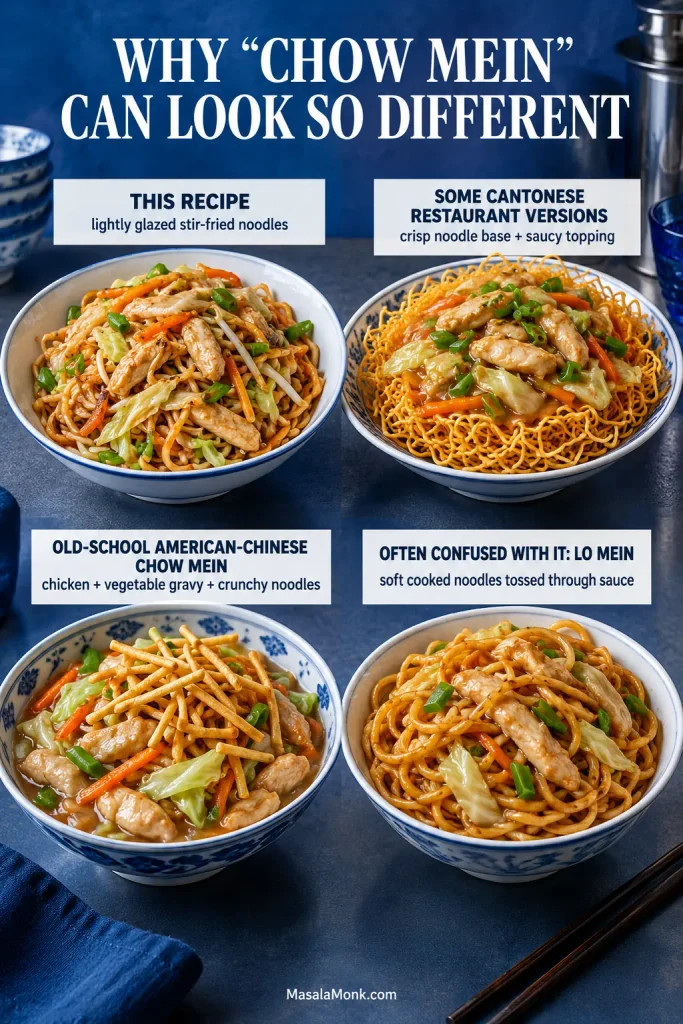
At its broadest, chow mein refers to noodles that are fried or stir-fried, but the dish can look very different depending on region and restaurant tradition. This recipe is the lightly glazed stir-fried-noodle style, with chicken and vegetables folded back through noodles that have had direct contact with the pan.

Some Cantonese restaurant versions use a crisp noodle base topped with saucy meat and vegetables. Some old-fashioned American-Chinese or Subgum-style chow mein is a chicken-and-vegetable gravy dish served with crunchy fried noodles.

Lo mein usually starts with cooked noodles that are tossed through sauce rather than deliberately fried for browned edges. It tends to be softer and more sauce-forward; this chow mein puts more emphasis on direct pan contact and noodle texture.

Here, the target is springy noodles, scattered browned edges, crisp vegetables and tender chicken.

Four noodle dishes compare lightly glazed stir-fried chicken chow mein, crisp noodles with a saucy topping, American-Chinese chow mein with gravy and crunchy noodles, and soft sauce-tossed lo mein.
Menu wording can hint at the expected texture: “crispy,” “pan-fried” or “lo mein” often point toward different noodle treatments. Regional usage varies, though, so the dish description matters more than the name alone.

The Chow Mein Noodle Guide

If you’ve ever followed the noodle packet perfectly and ended up with a sticky heap in the wok, you may not have cooked the noodles “wrong.” They may simply have been too soft—or too wet—for another round of heat.
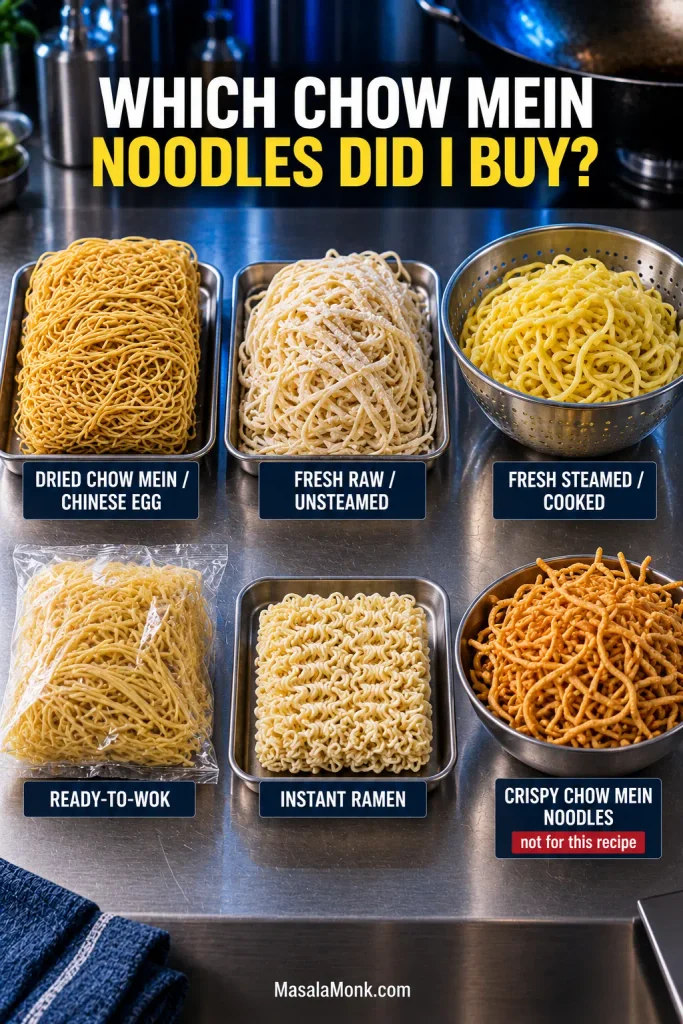
Open the packet before the water boils and see what you actually bought. Raw noodles, steamed noodles and ready-to-wok noodles can look remarkably similar while starting at very different stages of cooking.
Which Chow Mein Noodles Did I Buy?

Guide comparing several noodle products used or sold for chow mein, including fresh or steamed noodles, dried noodles and crisp fried noodles, with the crispy product identified separately.
Package names are clues, not guarantees. Two products labeled “chow mein noodles” may have undergone very different amounts of cooking, so the preparation directions on an unfamiliar packet are often more useful than the product name itself.
If the package says…What you probably haveWhat to do
Dried chow mein / Chinese egg noodlesDry and uncookedBoil until flexible but firmer than serving doneness, then cool and drain thoroughly.
Fresh raw / unsteamed egg noodlesFresh but uncookedCook according to the package, often with a brief boil or blanch. Stop while they retain some firmness.
Fresh steamed / cooked noodlesAlready substantially cookedUsually loosen or briefly blanch rather than giving them a full boil.
Ready-to-wok / straight-to-wok noodlesHydrated and prepared for quick pan cookingLoosen as directed and avoid unnecessary boiling. Watch for extra surface moisture.
Instant ramenDry and very quick-cookingDiscard the seasoning packet and cook only until barely flexible.
Crispy chow mein noodlesAlready fried and crunchyNot the noodle for this recipe.

A note on “Hong Kong-style” noodles: the name describes a noodle style, not one universal preparation state. They may be sold raw, steamed or dried, so the package directions matter more than the words “Hong Kong-style” on the front.

Fresh noodle labels can be maddeningly vague. One yellow packet wants several minutes in boiling water; the packet beside it wants to go almost straight into the wok. The Woks of Life’s Chinese noodle guide (opens in a new tab) is useful when the refrigerated case looks like a wall of nearly identical noodles.

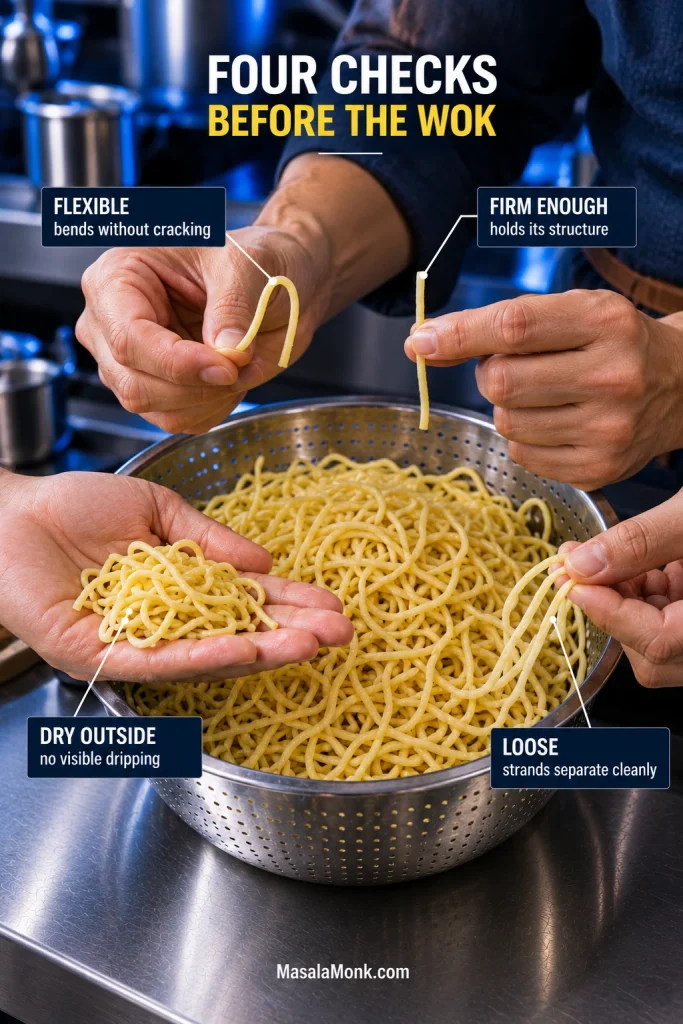
Four Things to Check Before the Wok

  1. Flexible: the noodle bends and separates without cracking.
  2. Firm enough: noodles you boil yourself should remain slightly underdone; pre-cooked noodles need enough firmness to handle another brief cook.
  3. Dry outside: the strands are not carrying obvious water into the pan.
  4. Loose: the noodles are separate instead of compressed into one warm, starchy block.
Four noodle readiness checks labeled Flexible, Firm Enough, Dry Outside and Loose, showing a bent strand, an intact strand, surface-dry noodles and separated strands.
Each noodle check guards against a different failure: flexibility limits breakage, firmness survives the second cook, a dry exterior protects pan heat, and loose strands expose more noodle surface to the wok. Together, they predict behavior rather than merely doneness.

Doneness and dryness are separate problems. A noodle can be cooked correctly and still be wet enough to cool the pan. It can also be dry and separate but already too soft to handle another few minutes of heat.

If water drips when you lift a handful, give the noodles more time in the colander or blot them gently. Wet noodles steal heat.

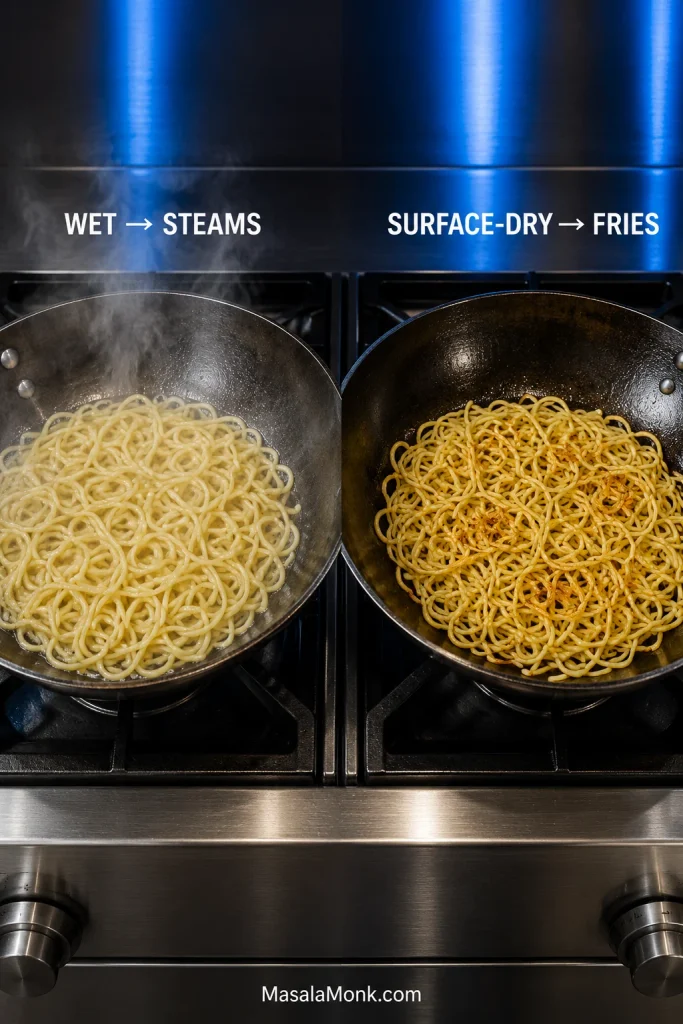
Two woks compare wet noodles producing heavy steam with surface-dry noodles making direct pan contact and developing browned patches; labels read “Wet → Steams” and “Surface-Dry → Fries.”
“Surface-dry” does not mean dehydrated, cold or stiff. Chow mein noodles can still be warm and flexible; the useful difference is that free water is no longer coating them and consuming the wok’s heat before frying can begin.

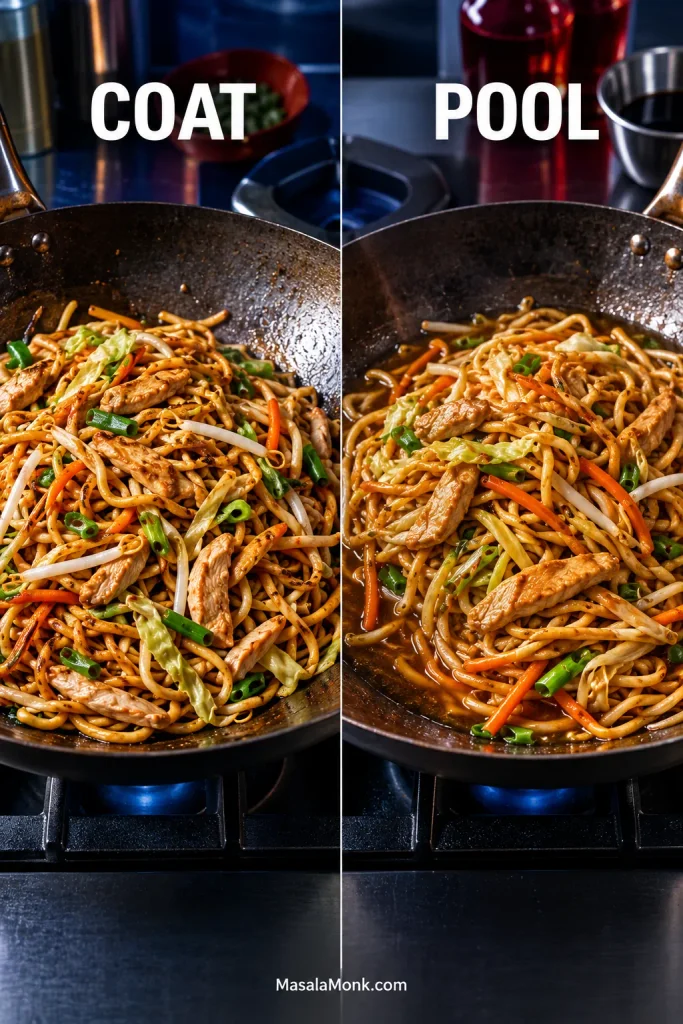
Homemade Chow Mein Sauce: Coat, Don’t Pool

For this version, a good chow mein sauce is almost invisible once dinner is finished. You should taste it everywhere without seeing much of it underneath.

Matched pans labeled Coat and Pool compare glossy separated chicken chow mein with little liquid underneath against wetter noodles sitting in visible dark sauce.
Judge chow mein sauce after it has been tossed over heat for a moment, not at the instant it enters the wok. Cornstarch thickens as it heats, while chicken and vegetables can release moisture of their own, changing the final consistency.

If the noodles taste salty but flat, more soy only pushes the salt higher. Deeper flavor also comes from oyster sauce, Shaoxing wine, white pepper, aromatics and the browning the noodles picked up in the pan.

Light or all-purpose soy does most of the seasoning. Dark soy is there mainly for color and deeper soy flavor. Oyster sauce gives the noodles body and a little sweetness; Shaoxing brings an aromatic note that suits this version. White pepper adds warm, earthy background heat.

One label is worth checking closely here: Shaoxing products sold specifically as cooking wine sometimes contain added salt. That can push an otherwise balanced sauce much farther than expected.

Toasted sesame oil goes into the sauce for aroma, not into the wok as the main frying oil. Sugar softens the salty edges, while the small amount of cornstarch helps the sauce cling. MSG or chicken powder is optional for extra savory depth. You do not need a separate seasoning packet; this sauce already does that job.

The homemade stir-fry sauce guide (opens in a new tab) uses many of the same building blocks for other stir-fries.

When the balance is right, the noodles remain the main event—only darker, fuller and more savory, with an occasional toasted edge coming through.

Tender Chicken, Vegetables With Some Bite

Chicken thigh gives you a little more margin before it dries out. Breast works well too, especially when thinly sliced across the grain. The cornstarch leaves a light coating around either cut during both trips through the heat; baking soda is not necessary for this method.

Keep the vegetables long and fairly thin. Cabbage works well in narrow ribbons, carrots in matchsticks and scallions in 1–2 inch lengths. Once everything comes back together, the chicken and vegetables should weave through the noodles rather than sitting in separate piles on top.

Wok or Skillet?

On a normal home stove, listen to the pan. A sharp sizzle means the food is frying; a wet, quiet simmer means moisture is taking over.

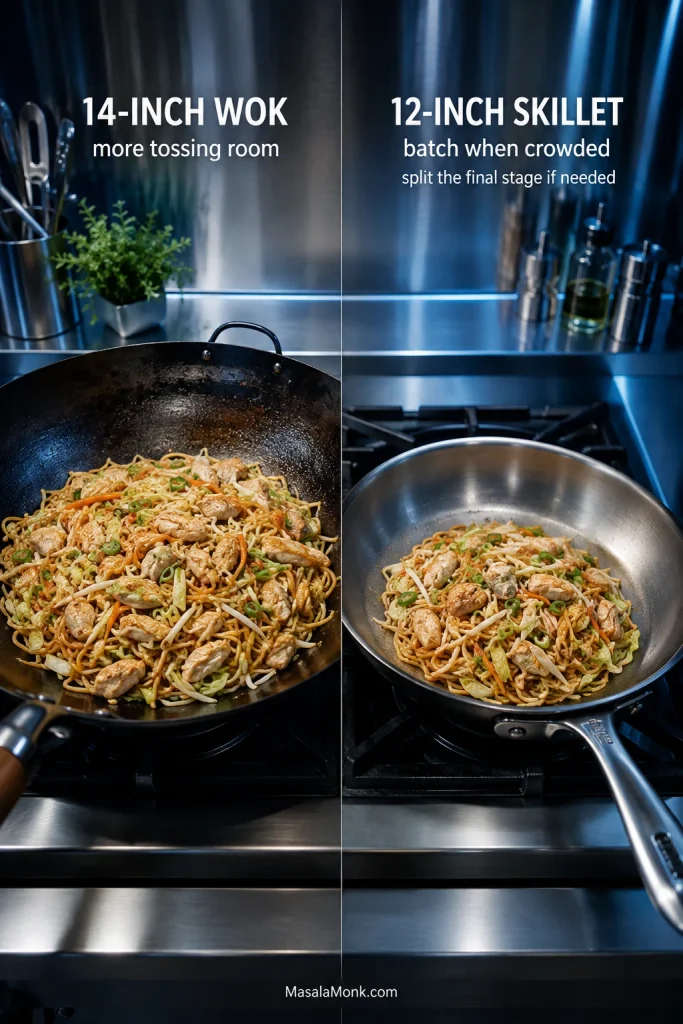
  • 14-inch / 35 cm flat-bottom carbon-steel wok: the best size for the full recipe. Wok shape and burner strength vary, so split the final stage if it feels cramped.
  • 12-inch / 30 cm large skillet: completely workable. Batch the chicken when needed and expect two half-batches when everything goes back in if the skillet is shallow.
  • Coated nonstick pan: usable, but follow the manufacturer’s heat guidance rather than automatically heating it until it smokes.
Large carbon-steel wok holding chicken chow mein beside a 12-inch stainless skillet with a smaller batch, illustrating the difference in usable cooking and tossing space.
A wok gives you more vertical room to move food; a skillet depends more on its flat cooking surface. That makes spreading and batching especially useful as the pan fills.

A home burner will not give you exactly the same smoky char and aroma as very high-heat restaurant wok cooking. That’s fine. Good direct pan contact gives the noodles plenty of toasted character.

Cooking for more people? Make two complete batches. Double the ingredients, not the pan load.

Chicken Chow Mein Troubleshooting

If dinner is already in the pan, don’t start over. Find the problem that looks familiar and fix that first. You can analyze dinner later.

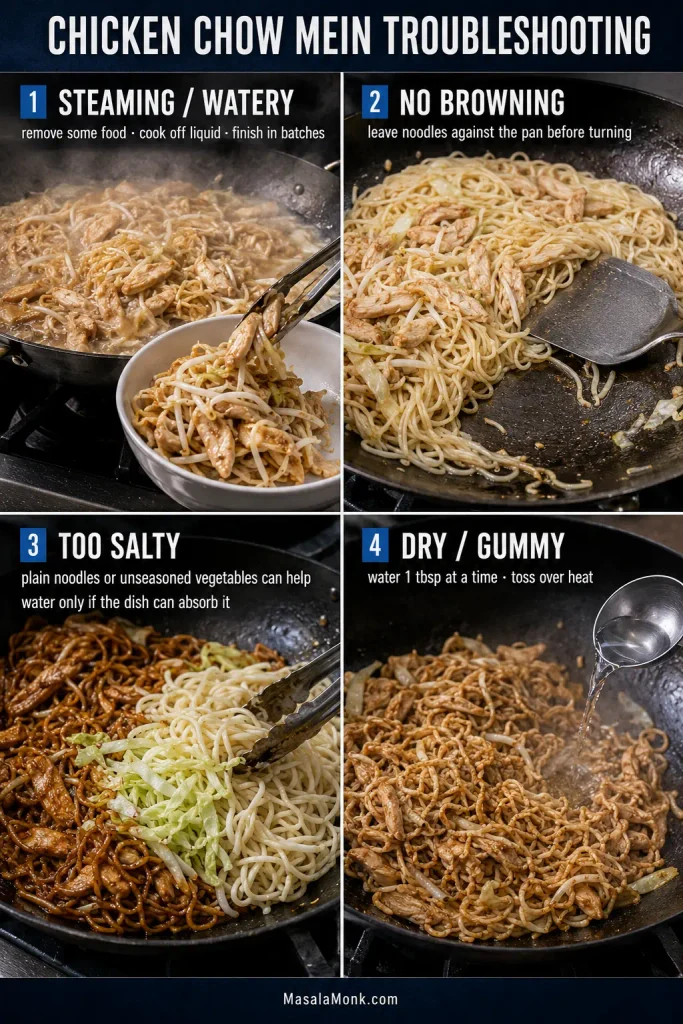
Four troubleshooting scenes show watery steaming chow mein with food being removed, pale noodles resting against the pan, plain noodles and cabbage added to an overly seasoned batch, and water added to dry clumped noodles.
Before changing the seasoning, identify the actual failure: too much moisture, poor pan contact, too much salt or dry/tight noodles. Fix the physical problem first; otherwise one rescue can create another.

Before the wok

ProblemFix
Noodles already too softCool and drain immediately. Keep their later frying and saucing brief.
Noodles stuck in one blockLoosen gently. A quick cool rinse can help boiled dried noodles; drain and dry them again afterward.
Vegetables dripping wetPat them dry before they enter the pan.
Sauce tastes far too saltyDilute it slightly with water before cooking. Check the stock, chicken powder and cooking wine too.
Cornstarch lumpyWhisk the lumps smooth with a small amount of liquid before mixing them back into the sauce.

While frying

ProblemFix
Pan filling with water / everything steamingStop adding food. Remove some if needed and let the liquid cook off before continuing; finish in batches.
Noodles stickingCheck crowding and moisture before adding more liquid. Lift gently instead of scraping hard.
No noodle browningGive the strands 30–45 seconds of contact before turning instead of stirring continuously.
Chicken cooking too fastTake it out and return it near the end.
Noodles and vegetables will not mixLift and toss. Loosen clumps gently instead of chopping through the strands.

After the sauce goes in

ProblemFix
Too saltyAdd plain noodles or extra unseasoned vegetables if you have them, or a small splash of water if the dish can absorb it. Sugar will not remove salt.
Too sweetAdd a small splash of water and toss. Extra plain noodles or vegetables help even more.
BlandCheck salt first. Then try a little oyster sauce, white pepper or optional MSG/chicken powder. Add soy only a teaspoon at a time.
Too dry or sauce gummyAdd water 1 tablespoon at a time and toss over heat until the noodles loosen and regain their gloss.
Too wetKeep the pan uncovered and reduce the liquid. Remove some food first if necessary.
Chicken toughNext time, slice it thinner and remove it sooner during the first fry.

Substitutions and Variations

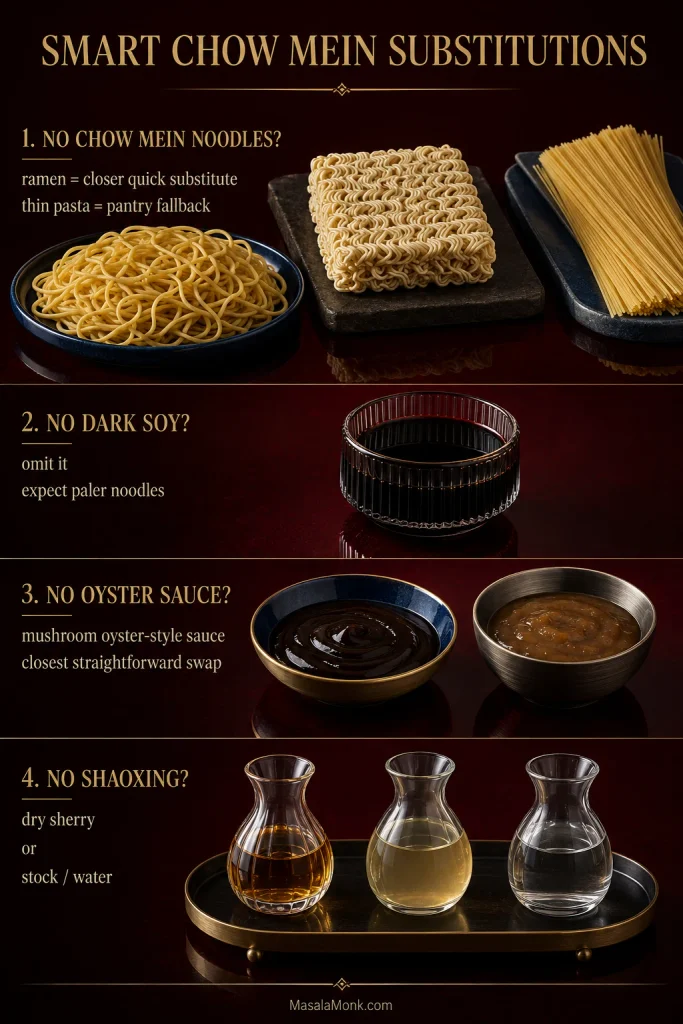
Chow mein substitution guide showing Chinese noodles with instant ramen and thin pasta, dark soy sauce, oyster-style sauces and small vessels representing Shaoxing wine alternatives.
When using instant ramen, the noodle block is the useful substitute—not the seasoning packet. The packet can push the dish far saltier than the homemade sauce is designed to be.
Instead of…Try…Expect…
Chow mein / Chinese egg noodlesInstant ramen — the closer quick substituteThinner, softer noodles. Discard the seasoning packet and cook only until barely flexible.
Chow mein / Chinese egg noodlesThin spaghetti or angel hair — a pantry fallbackA firmer, more pasta-like chew.
Dark soy sauceOmit it rather than replacing it volume-for-volume with regular soyThe noodles will be paler, but the sauce balance stays closer to the original.
Oyster sauceVegetarian mushroom oyster-style sauceThe closest straightforward replacement.
Oyster sauceHoisin sauceNot a neutral swap; the result will be sweeter. Reduce or omit the sugar.
Shaoxing wineDry sherryA similar aromatic role.
Shaoxing wineStock or waterLess aromatic depth, but the method works.
Bean sproutsExtra cabbage, bok choy or another crisp vegetableA different crunch without changing the basic method.

For chicken and mushroom chow mein: add about 150 g / 5 oz sliced mushrooms and reduce the cabbage to about 150 g / 5 oz. Cook the mushrooms until most of the water they release has evaporated. Keeping the full cabbage quantity as well works better when the mushrooms get their own turn in the pan.

Make it spicy

Add chili crisp, chili oil, sliced fresh chili or a little chili-garlic sauce at the end. Sweet chili sauces change the balance, so use less sugar in the chow mein sauce when needed.

Dietary adjustments

Lower sodium: use lower-sodium soy sauce and unsalted stock, skip the chicken powder, and compare the sodium on the noodles, oyster sauce and cooking wine. Some Shaoxing cooking wines contain added salt.

Gluten-free: use noodles labeled for a gluten-free diet, certified gluten-free tamari or soy sauce, and a gluten-free oyster-style sauce. Check the Shaoxing wine and optional chicken powder too; many Shaoxing products are not gluten-free. Use a verified gluten-free dry sherry or sake, or replace the wine with stock or water when needed.

Halal: use halal-certified chicken and check the noodles, sauces and stock according to the requirements you follow. Replace Shaoxing wine with stock, water or an appropriate certified alcohol-free cooking seasoning.

Using leftover cooked chicken: skip the raw-chicken marinade and add sliced cooked chicken near the end, giving it enough time to reheat fully to 165°F / 74°C. Adding it much earlier usually dries it out.

Make-Ahead, Storage and Reheating

The sauce, cabbage and carrot can be prepared up to a day ahead and refrigerated separately. Raw chicken can be sliced ahead too, but keep it covered and completely separate from the vegetables. Leave the bean sprouts and scallions until close to cooking time.

If you need to boil the noodles ahead, cool them promptly, drain and surface-dry them well, toss with a very small amount of neutral oil and refrigerate them separately.

Cool leftover chicken chow mein promptly and refrigerate it in a covered container for up to 3–4 days. The USDA’s food-safety guidance (opens in a new tab) recommends reheating leftovers to 165°F / 74°C.

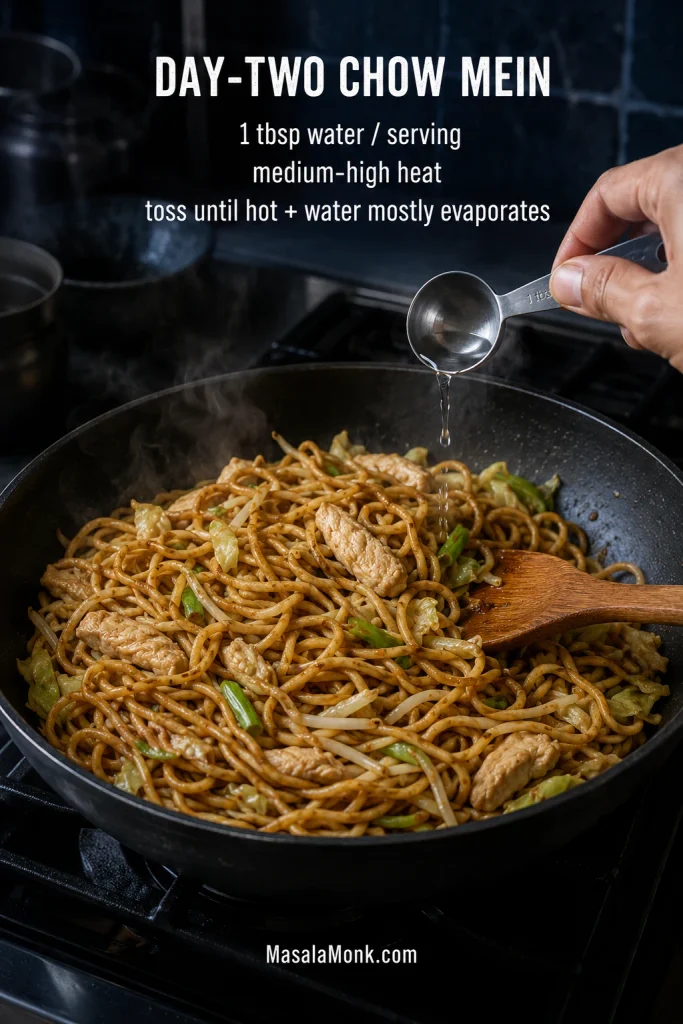
A skillet or wok gives chilled noodles the best chance of loosening without turning mushy. Add about 1 tablespoon water per serving and toss over medium-high heat until steaming hot and the added water has mostly evaporated.

Leftover chicken chow mein reheating in a dark skillet while a hand adds a tablespoon of water near the pan edge, with steam rising from noodles, chicken and vegetables.
Let steam loosen cold noodle clumps first rather than forcing them apart with a spatula. Once the strands relax, gentle tossing reheats them with less tearing.

For the microwave, cover loosely and heat in short intervals, stirring between them.

Freezing is possible but not ideal. The noodles soften and bean sprouts lose much of their crunch after thawing.

What to Serve With Chicken Chow Mein

Chicken chow mein is already a full meal, so sides work best when they bring a different texture or temperature rather than more heaviness. A small bowl of egg drop soup (opens in a new tab) keeps things light and broth-based, while a cool cucumber salad (opens in a new tab) gives the hot, savory noodles a crisp, sharp contrast.


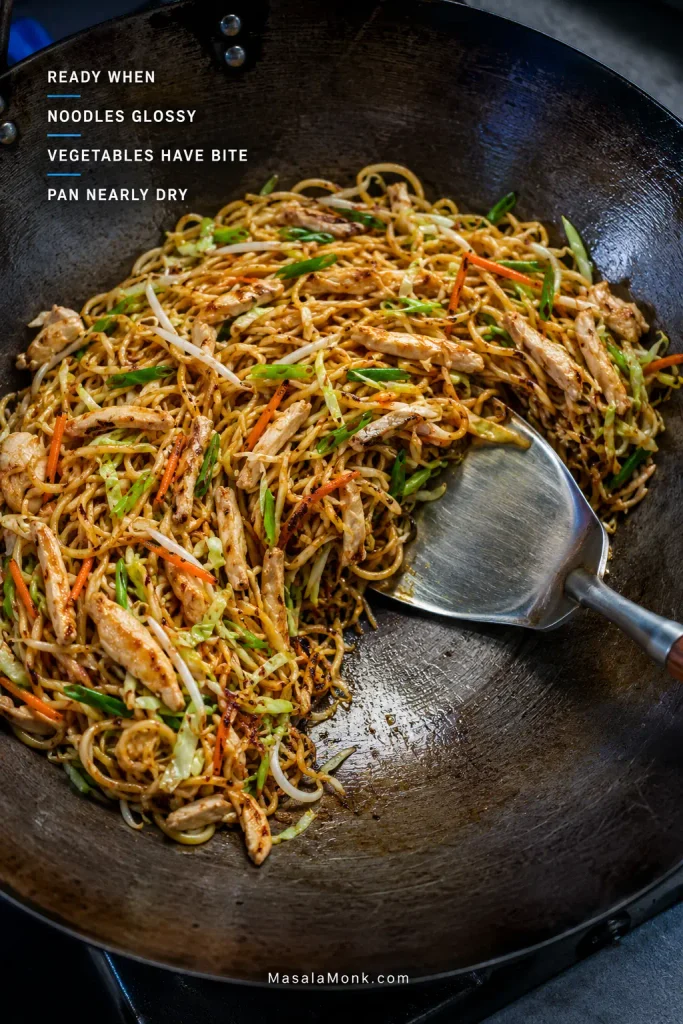
Once the noodles are glossy, the vegetables still have some bite and the pan is nearly dry, dinner is done.

Get the chow mein onto plates while it still looks a little unruly. Browned strands, crisp bean sprouts and chicken tucked through the noodles are exactly where they should be.

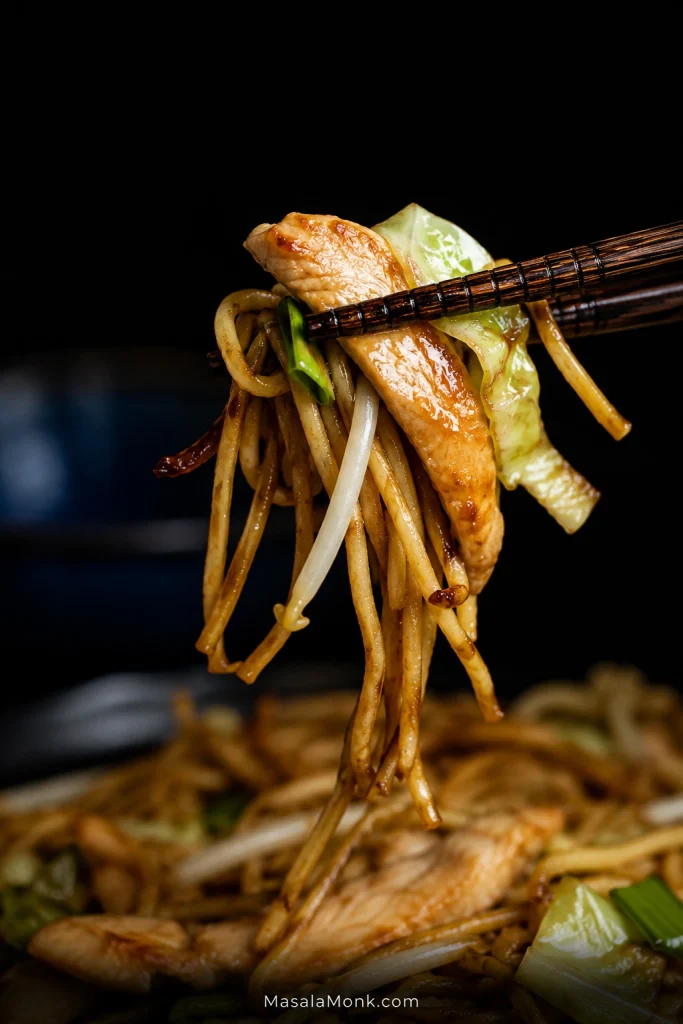
Close-up chopsticks lifting glossy chow mein noodles with a thin browned chicken strip, cabbage, bean sprout and scallion against a dark background.
The best bite is intentionally varied: toasted noodle edges beside softer strands, tender chicken and a crisp sprout. Serve immediately, while those contrasts are still distinct.
Posted on — Leave a comment

Dan Dan Noodles Recipe: Spicy Sichuan Noodles With Pork & Chili Oil

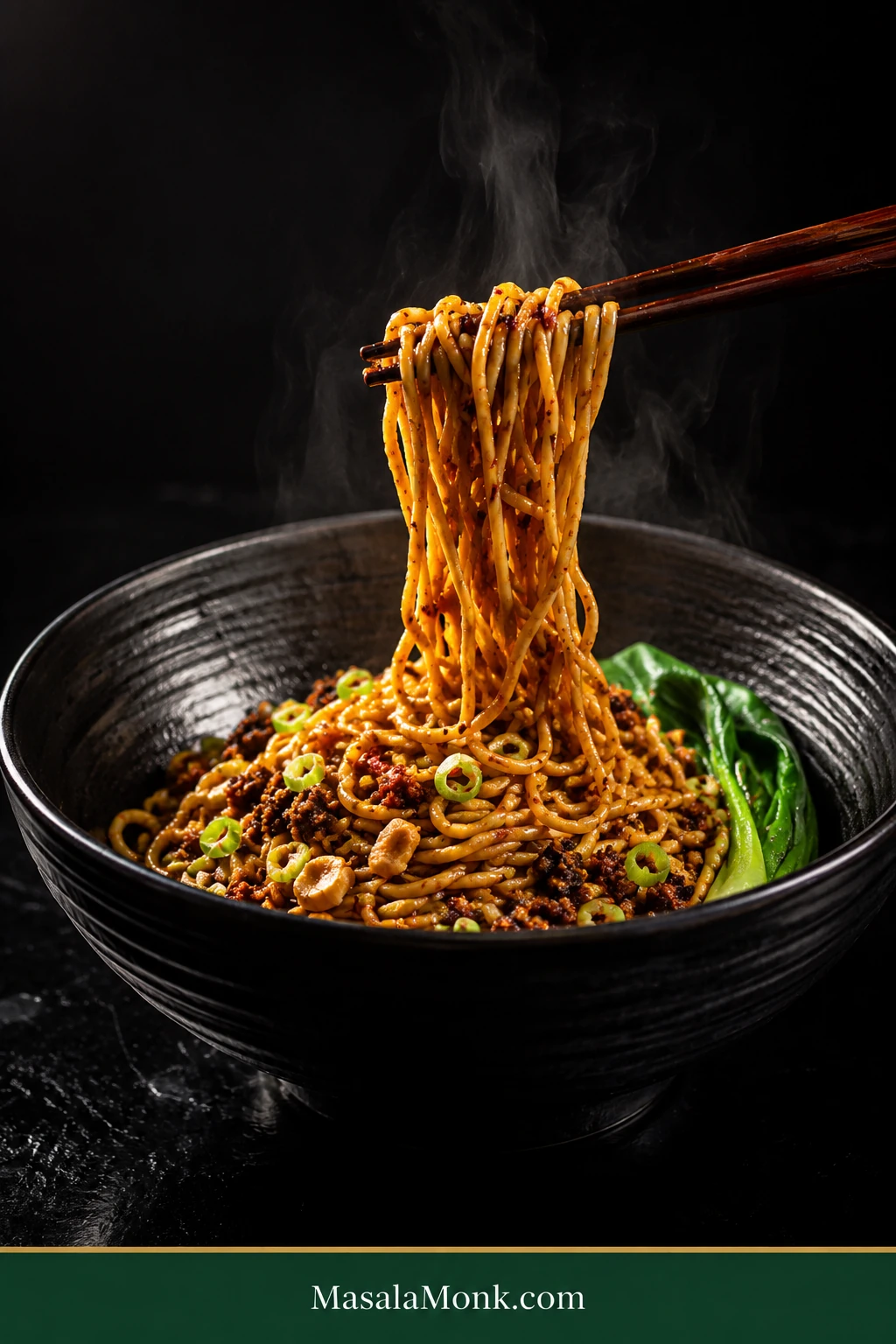
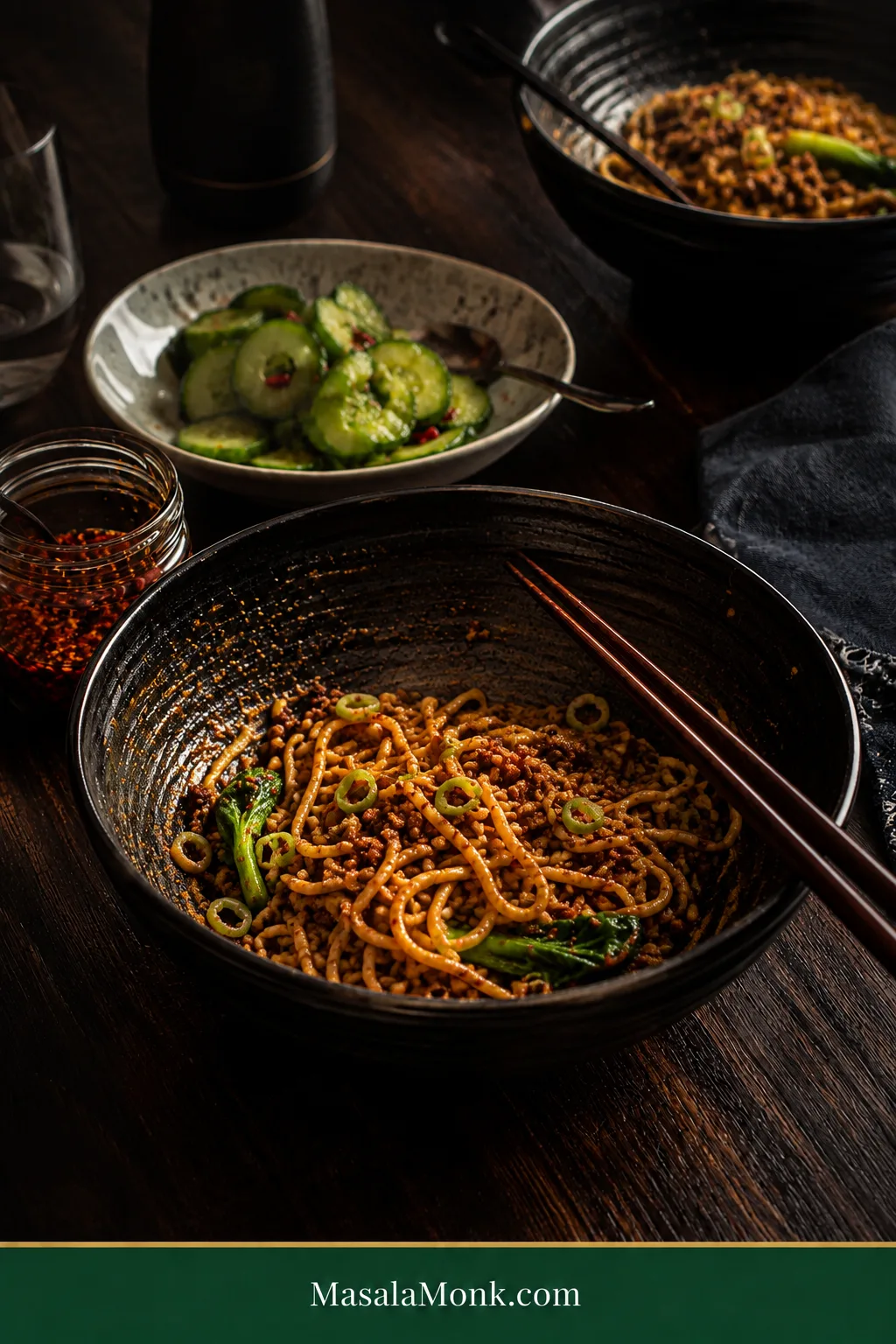
Bowl of Dan Dan noodles with thin sauce-coated wheat noodles, browned ground pork, ya cai, scallions and greens, with a small bundle lifted by chopsticks.

Good Dan Dan noodles should make you want the next bite before the first one has quite finished: springy wheat noodles slicked with a rusty-red sesame-chili sauce, crisp pieces of pork, salty-fermented mustard greens, scallions, and enough Sichuan pepper to leave a citrusy tingle on your lips.

Dan Dan noodles—dàndàn miàn (担担面)—are rooted in Sichuan street food: wheat noodles, chili oil, Sichuan pepper, preserved vegetables, and usually a modest savory pork topping, all packed into an intensely flavored serving.

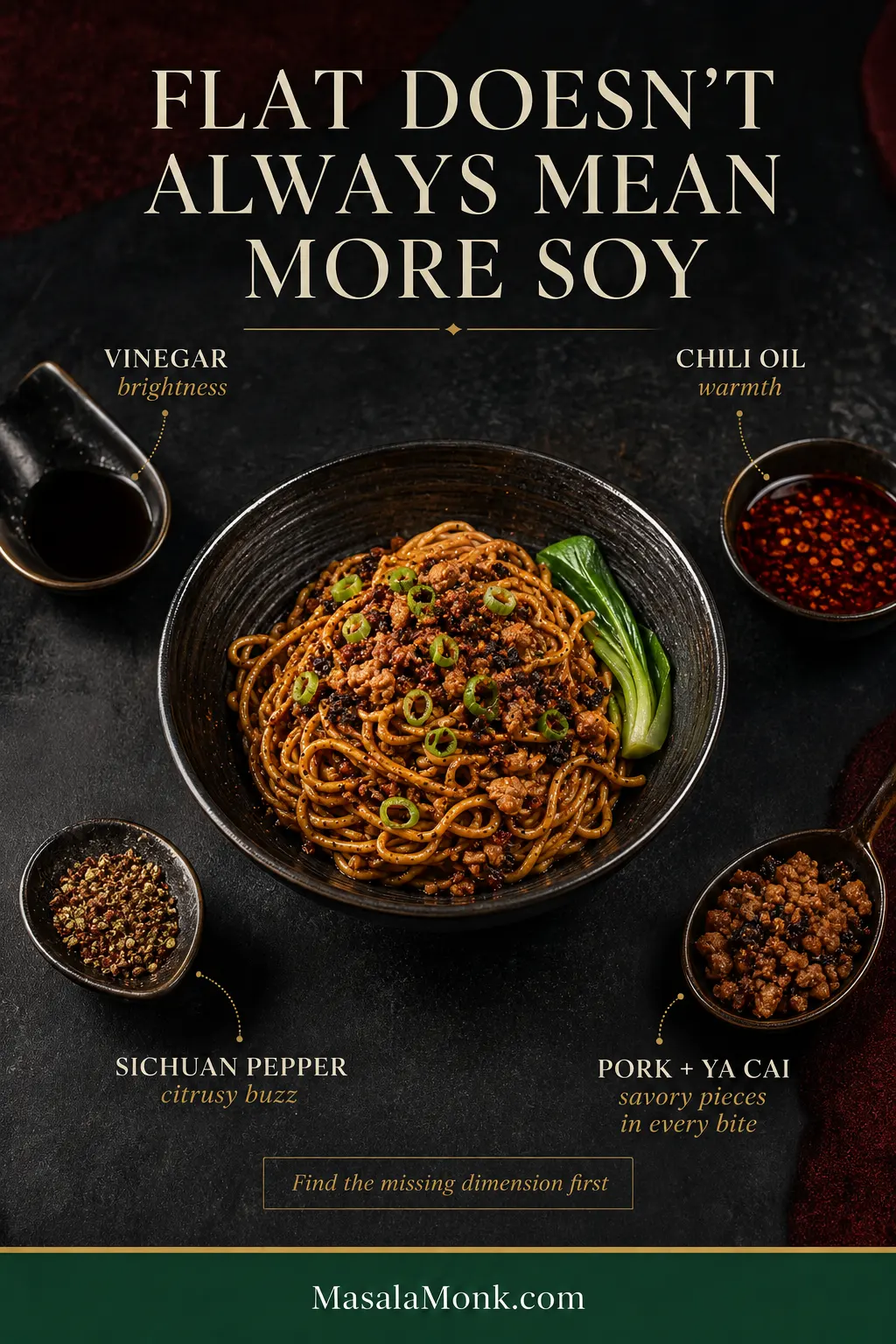
A good bite changes as you eat it. Chili and dark vinegar arrive first; pork and ya cai bring the deep savory middle; roasted sesame softens the sharper edges; then Sichuan pepper leaves that unmistakable buzz behind after you’ve swallowed.

The ingredient list may contain a few unfamiliar jars, but once they’re in the pantry, this becomes a 30–35 minute dinner. This version keeps the bowl concentrated and sauce-clinging, uses prepared chili oil to keep the work manageable, and uses just enough sesame paste to round the sauce without hiding the black vinegar, ya cai, chili, or Sichuan pepper.

Coat the noodles, don’t drown them. The measurements get you close; the final toss tells you when to stop.

Bowl of Dan Dan noodles with thin sauce-coated wheat noodles, browned ground pork, ya cai, scallions and greens, with a small bundle lifted by chopsticks.
Before serving, give the bowl one last deep toss. Dan Dan noodles eat better when pork and ya cai are threaded through the strands instead of sitting as a decorative cap.

Quick Answer: How to Make Dan Dan Noodles

For 4 bowls in about 30–35 minutes, brown 225 g / 8 oz ground pork until its released moisture disappears and the crumbles begin frying. Season with Shaoxing wine, a little soy sauce, and 25–30 g / about 1 oz sui mi ya cai while you whisk the sesame-chili sauce.

Cook 500 g / about 18 oz fresh Chinese wheat noodles or 300–325 g / about 10½–11½ oz dried noodles until springy. Put sauce into four bowls, start each with 1 tbsp / 15 ml hot noodle water, add the noodles, and toss. Add more water only a teaspoon at a time if needed, then finish with pork, greens, scallions, chili oil, and Sichuan pepper.

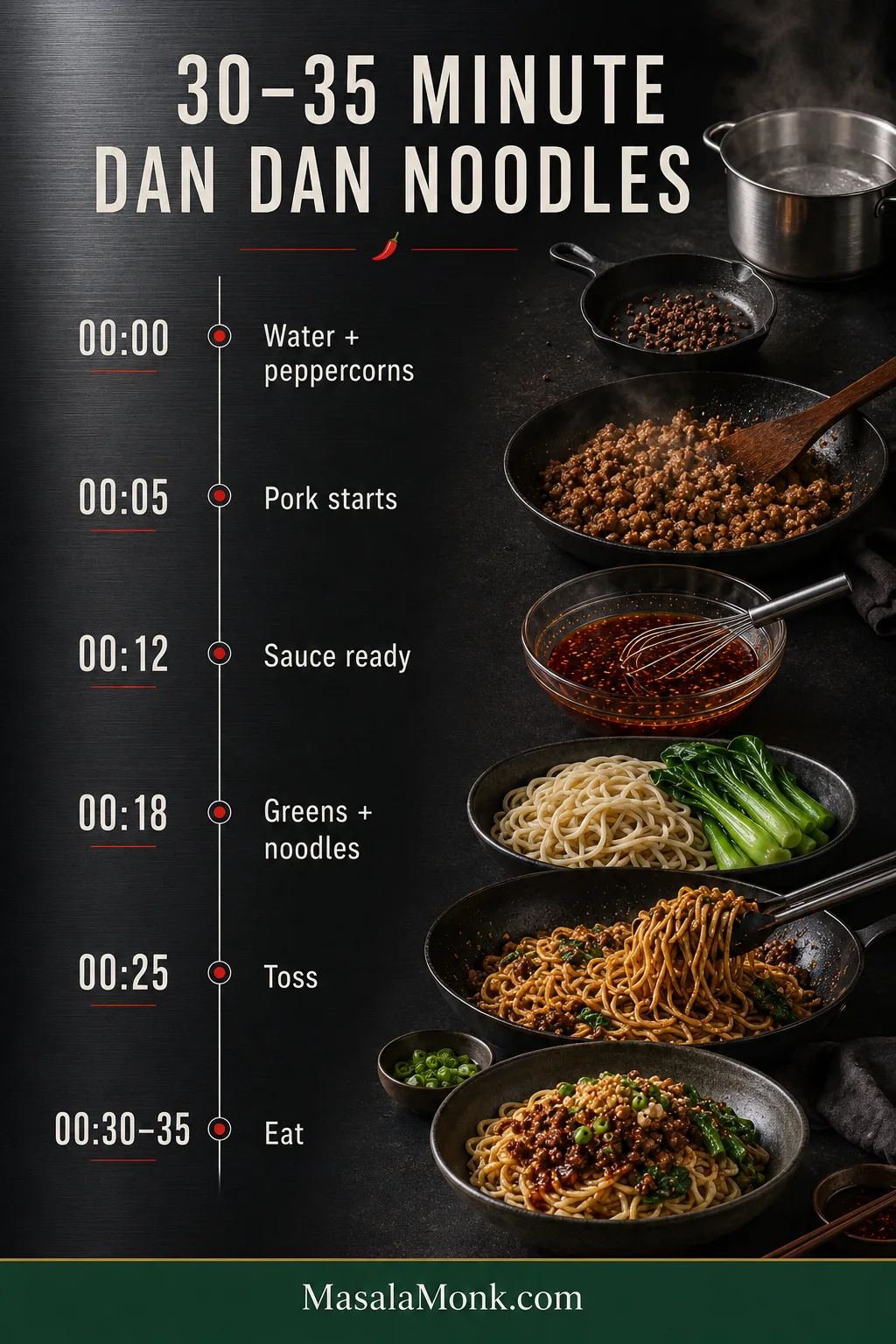
Timeline for 30–35 minute Dan Dan noodles showing water heating and peppercorn toasting, pork cooking, sauce mixing, noodles and greens, tossing and serving.
Use the water-heating window instead of waiting on it: toast the Sichuan pepper, brown the pork and mix the sauce before the noodles ever need your full attention.

Dan Dan Noodles Recipe

Spicy Sichuan wheat noodles with tangy sesame-chili sauce, browned pork, preserved mustard greens, and heat you can adjust at the table.

There are really only three main jobs here: brown the pork, mix the sauce, and cook the noodles.

Prep15 minutes
Cook15–20 minutes
Total30–35 minutes
Serves4

Serving note: With several other dishes on the table, this batch can make about 6 smaller portions. For six bowls, start with about 2 tsp / 10 ml noodle water per bowl, then adjust only as needed.

Heat: moderate as a starting point, with extra chili oil and Sichuan pepper available for individual bowls.

Equipment

  • Large pot for the noodles
  • 12-inch / 30 cm skillet or wok
  • Medium mixing bowl
  • Four serving bowls
  • Strainer, spider, or tongs
  • Mortar and pestle or spice grinder

Ingredients

Noodles & Finishing

  • 500 g / about 18 oz fresh thin-to-medium Chinese wheat noodles, preferably alkaline if available
    OR 300–325 g / about 10½–11½ oz dried Chinese wheat noodles
  • 150 g / about 5 oz baby bok choy, choy sum, or another tender Asian green, optional
  • 2 scallions, thinly sliced
  • 2 tbsp roasted peanuts, roughly chopped, optional
  • Extra chili oil, for serving
  • Extra freshly ground Sichuan pepper, for serving
  • 1 cup / 240 ml hot noodle water, reserved before draining; you probably won’t use all of it

Pork & Ya Cai

  • 225 g / 8 oz ground pork
  • 1 tsp neutral oil, only if the pork is particularly lean or the pan needs it
  • 1 tbsp / 15 ml Shaoxing wine — Shaoxing cooking wine is fine; dry sherry also works
  • 1 tsp / 5 ml Chinese light soy sauce
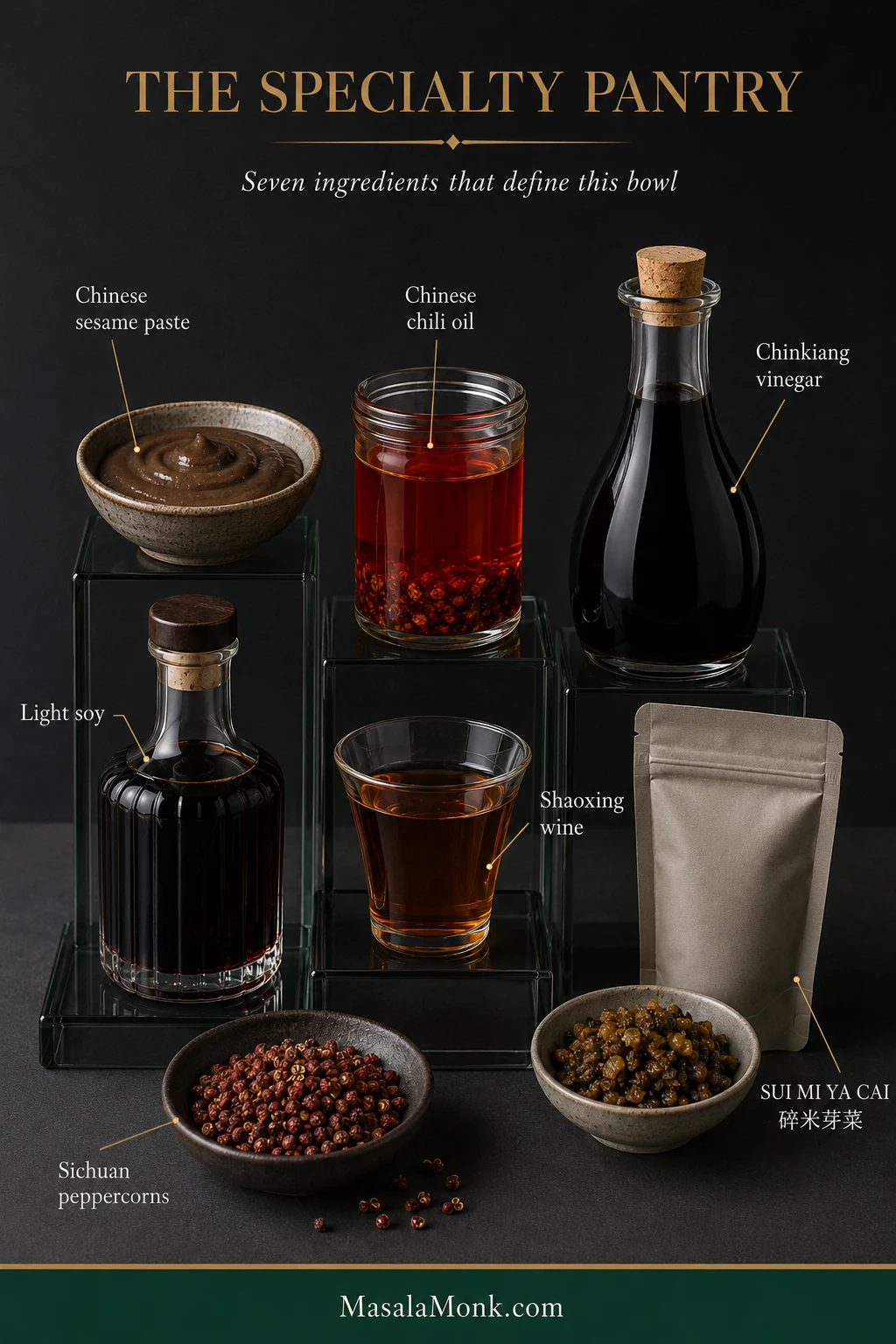
  • 25–30 g / about 1 oz sui mi ya cai (Sichuan preserved mustard greens), finely chopped
  • 1 tsp finely grated fresh ginger, optional but recommended

Dan Dan Sauce

  • 2 tbsp / about 32 g Chinese sesame paste, stirred smooth before measuring
  • 3 tbsp / 45 ml Chinese light soy sauce
  • 2 tbsp / 30 ml Chinkiang black vinegar
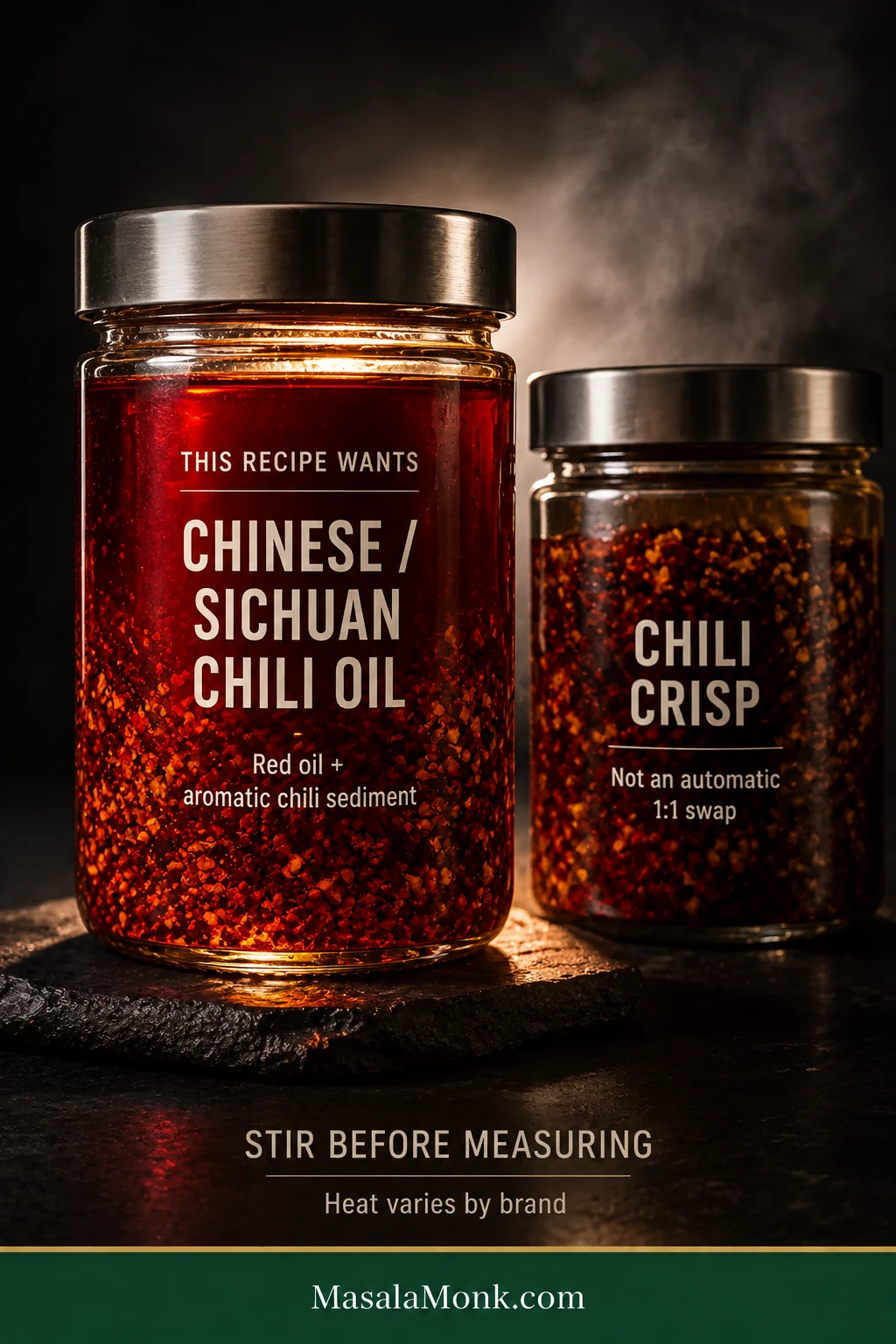
  • 3 tbsp / 45 ml Chinese chili oil, stirred before measuring, plus more to taste
  • 1½ tsp sugar
  • 2 garlic cloves, finely grated or minced
  • 1½ tsp whole Sichuan peppercorns

Before you cook, check three things.

  • Ya cai: pleasantly salty is fine; aggressively salty needs a brief rinse and a very good squeeze.
  • Chili oil: one jar may be mostly aromatic while another is genuinely fierce.
  • Sesame paste: stir the separated oil completely back into the paste before measuring.

There’s usually no need to salt the noodle water. The soy sauce, preserved vegetables, and many bottles of Shaoxing cooking wine already bring plenty of seasoning.

Instructions

Prep the Pepper and Brown the Pork

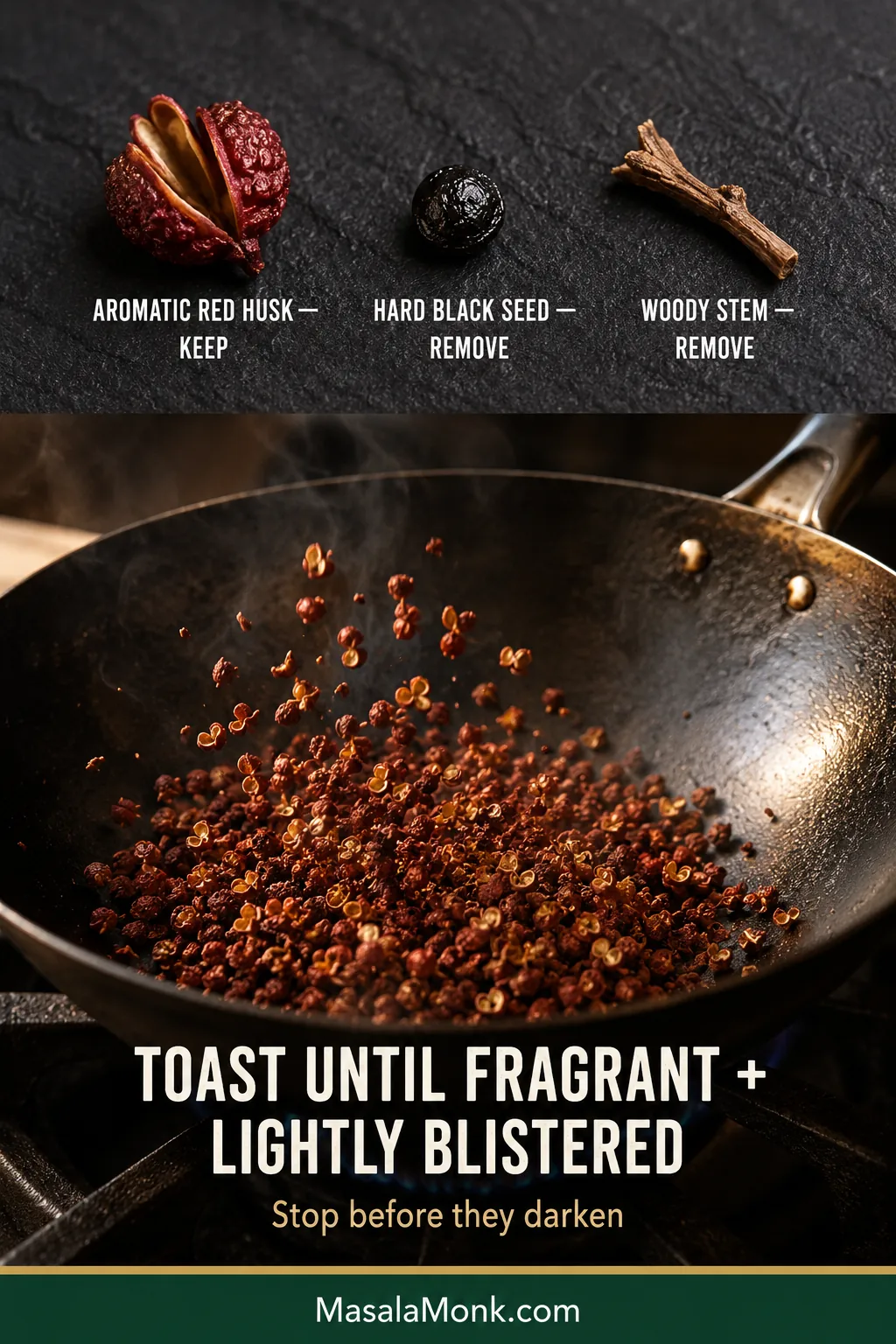
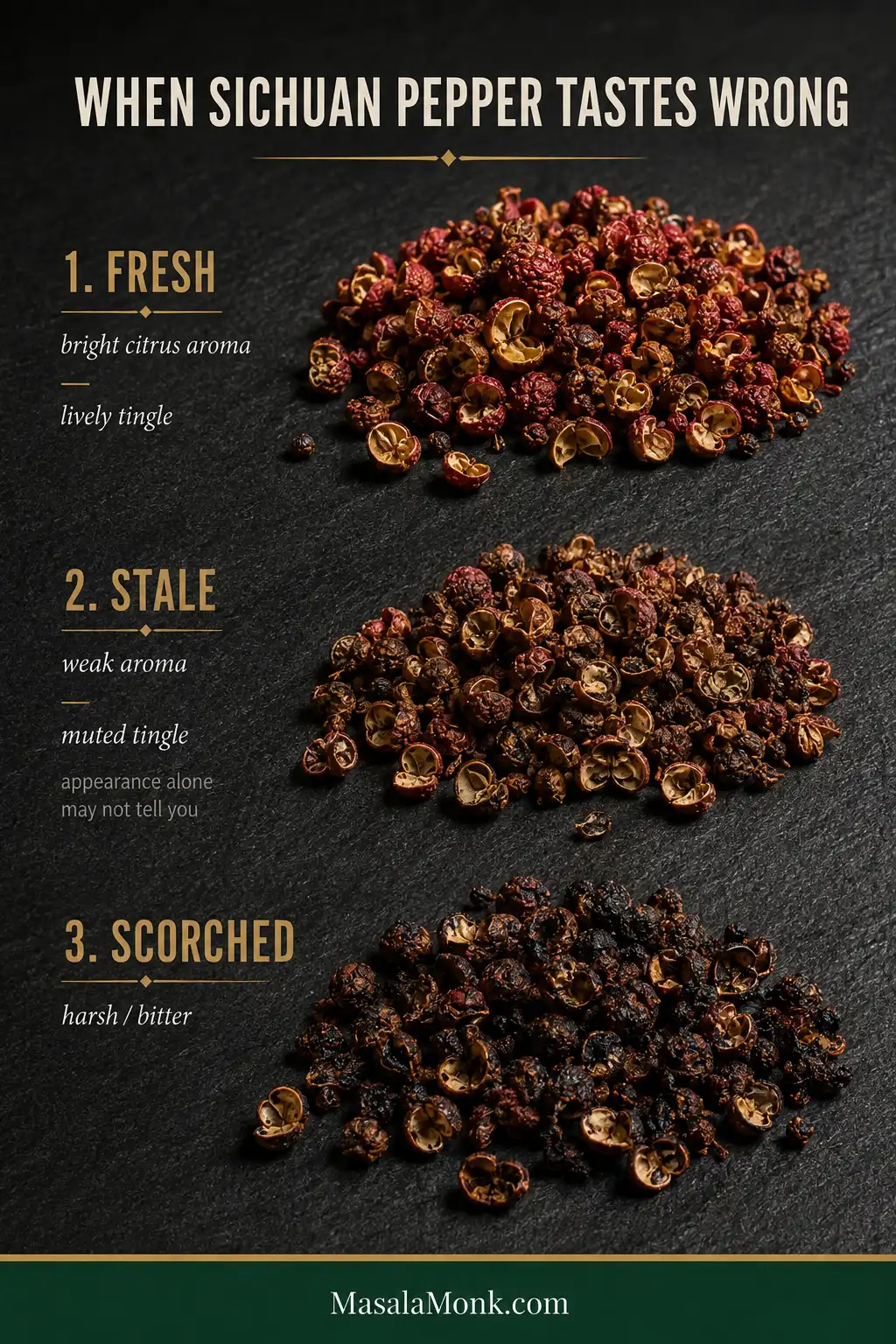
Sichuan pepper guide showing red aromatic husks to keep, hard black seeds and woody stems to remove, followed by husks gently toasting in a skillet.
If the citrus aroma becomes vivid before the peppercorns look dramatically darker, trust your nose. Sichuan pepper can cross from fragrant to scorched faster than its color suggests.
  1. Start the noodle water and toast the Sichuan peppercorns. Fill the noodle pot and set it over high heat. While the water comes toward a boil, pick out any obvious hard black seeds or woody stems from the peppercorns, then put the aromatic husks in the dry skillet you’ll later use for the pork. Toast over medium-low to medium heat for about 1–2 minutes, shaking frequently, until intensely citrusy and lightly blistered. Tip them out before they darken, grind reasonably fine, and reserve about half for the table.
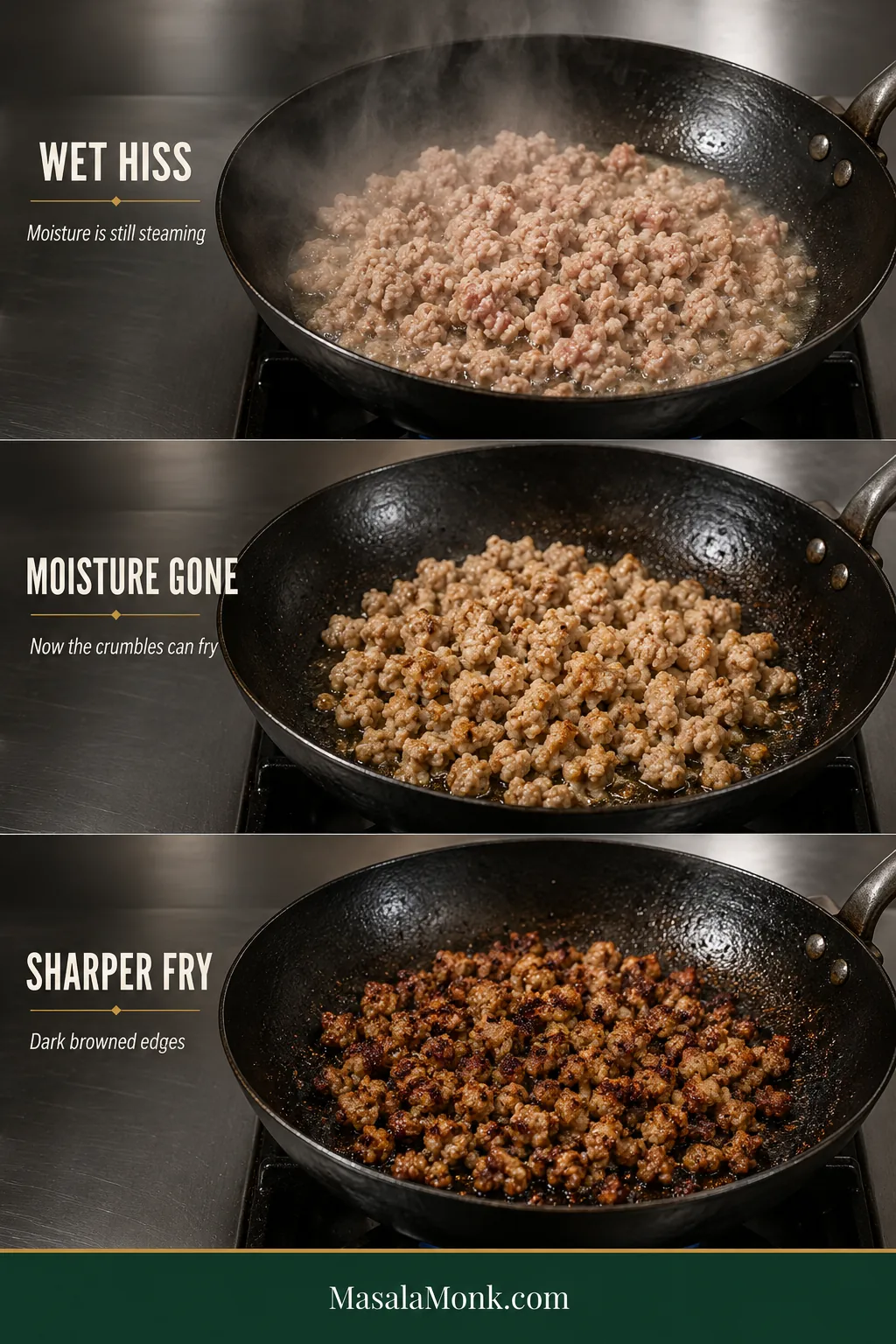
  2. Brown and season the pork. Return the skillet to medium-high heat. Add oil only if needed, then spread in the pork and break it into small irregular crumbles. At first you’ll hear a wet hiss. Keep cooking until the visible moisture disappears and the sound changes to a sharper fry. Continue until you see dark browned spots and crisp edges, usually 6–8 minutes total. Add the ginger for about 20 seconds, pour the Shaoxing wine around the hot edge of the pan, and add the teaspoon of soy sauce. Once that liquid has nearly disappeared, stir in the ya cai and fry for another 1–2 minutes. Ground pork should reach at least 160°F / 71°C; the finished topping should also look browned and relatively dry.
Three stages of ground pork cooking: pale and wet with steam, drier after moisture evaporates, then browned with crisp edges.
Pour in the Shaoxing wine only after the pan sounds like frying rather than steaming. That timing helps preserve the crisp browned pork edges you just worked to create.

Mix the Sauce and Cook the Noodles

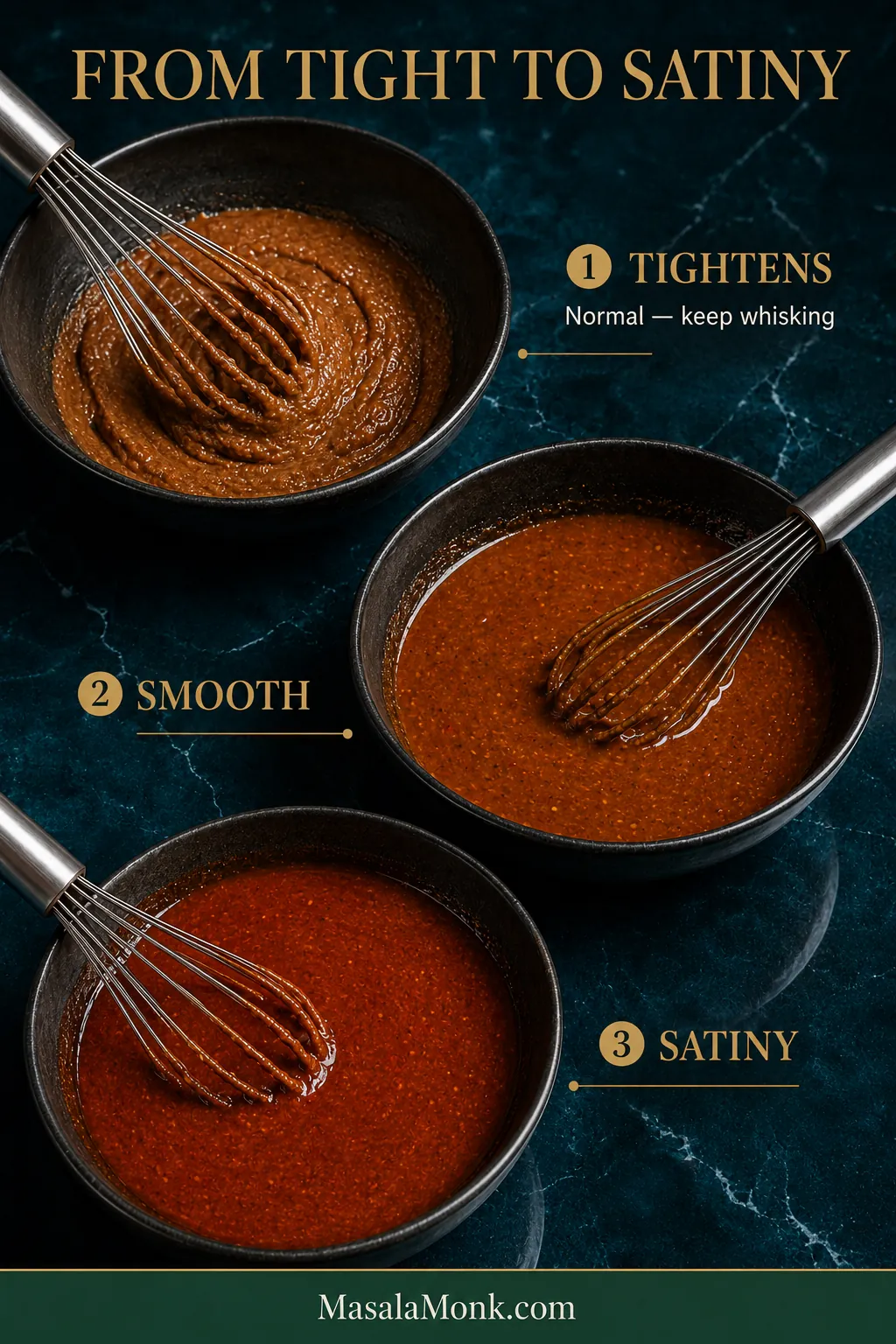
Three Dan Dan sauce stages showing a thick tightened sesame mixture, a smoother blended sauce and a final glossy reddish-brown satiny sauce.
Let the concentrated Dan Dan sauce finish coming together before you loosen it. Noodle water is a final-fit adjustment, not a remedy for sesame paste tightening temporarily.
  1. Mix and taste the sauce. Put the sesame paste in a medium bowl and gradually whisk in the 3 tablespoons soy sauce. The paste may tighten briefly; keep whisking until it becomes smooth. Add the Chinkiang vinegar, sugar, garlic, and about half of the ground Sichuan pepper, then whisk in the chili oil until the sauce looks satiny and even. Taste a tiny dab. It should seem deliberately intense but balanced because the plain noodles will soften every flavor.
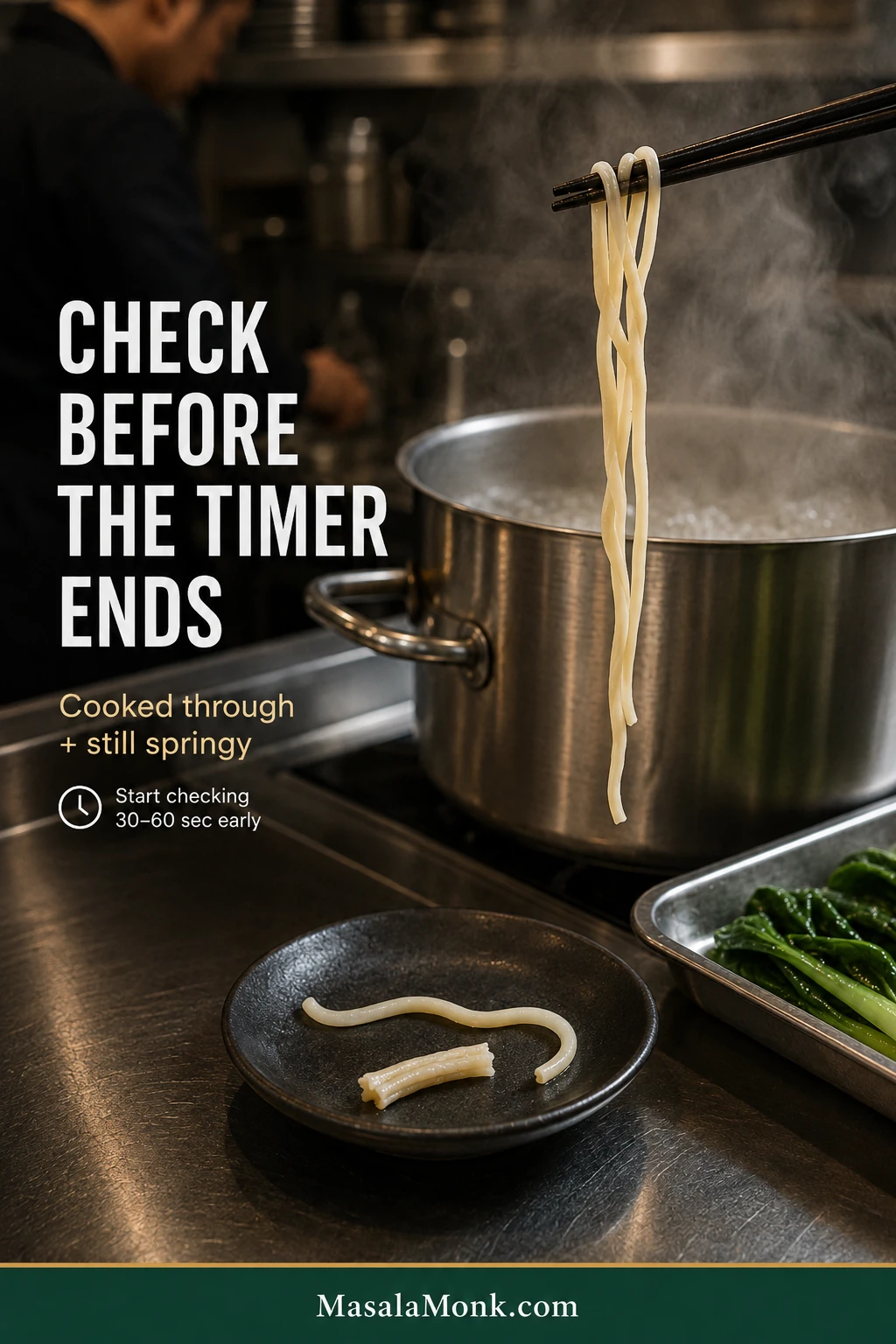
  2. Cook the greens and noodles. Blanch tender leafy greens for about 30–45 seconds; halved baby bok choy may need closer to 60–90 seconds. Lift them out when the leaves are bright and the stems crisp-tender. Add the noodles and begin checking 30–60 seconds before the package time ends. Bite one: it should be cooked through but still push back slightly between your teeth. Reserve 1 cup / 240 ml noodle water before draining.
Chinese wheat noodles lifted from boiling water for a doneness check, with cooked samples showing the springy texture to look for.
Pull one noodle early and bite it. Residual heat plus tossing will finish the job, while softness gained from overcooking in the pot cannot really be taken back.

Assemble and Finish

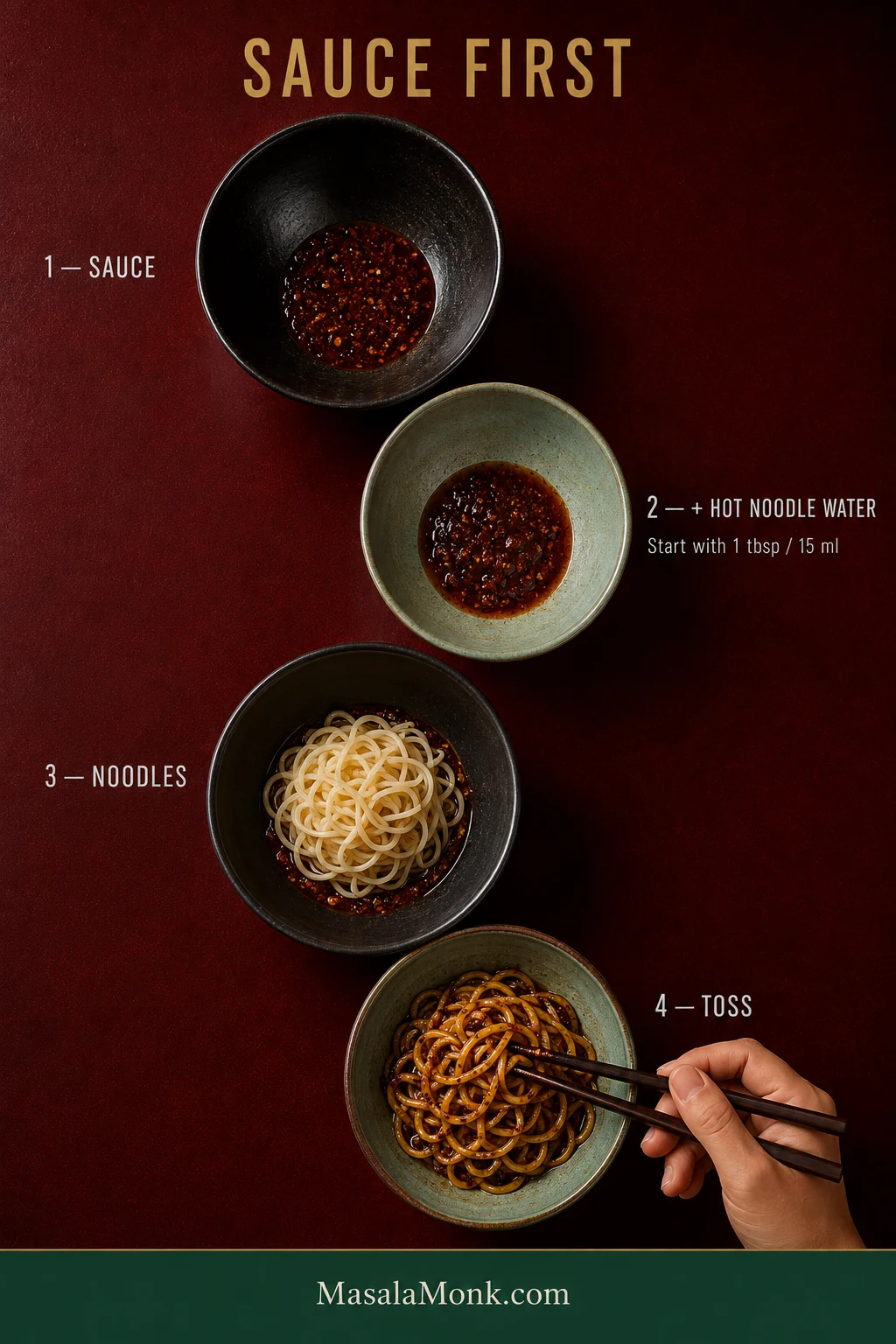
Four-step Dan Dan noodle assembly showing concentrated sauce, a small amount of hot noodle water, drained noodles added and noodles tossed until coated.
Different noodles absorb sauce differently. Starting small with hot noodle water lets each bowl find its own ideal consistency instead of forcing every batch to the same hydration.
  1. Sauce the noodles bowl by bowl. Divide the concentrated sauce among four bowls and whisk about 1 tbsp / 15 ml hot noodle water into each. Drain the noodles well, divide them among the bowls, and toss thoroughly from the bottom. If the strands remain heavy or clumped, add more hot water only 1 tsp / 5 ml at a time. They’re ready when the noodles lift cleanly and the sauce comes with them.
  2. Top, toss, and adjust. Add the pork and ya cai, greens, scallions, and peanuts if using. Toss enough topping through the noodles that pork and preserved greens show up throughout the serving. Taste. More chili oil increases the burn; freshly ground Sichuan pepper increases the citrusy buzz; a few drops of Chinkiang vinegar can wake up a bowl that feels heavy. Eat while the noodles are hot and lively.

Recipe Notes

  • Use the listed fresh or dried noodle weight. Fresh noodles carry substantially more water, so equal package weights produce different amounts of noodle.
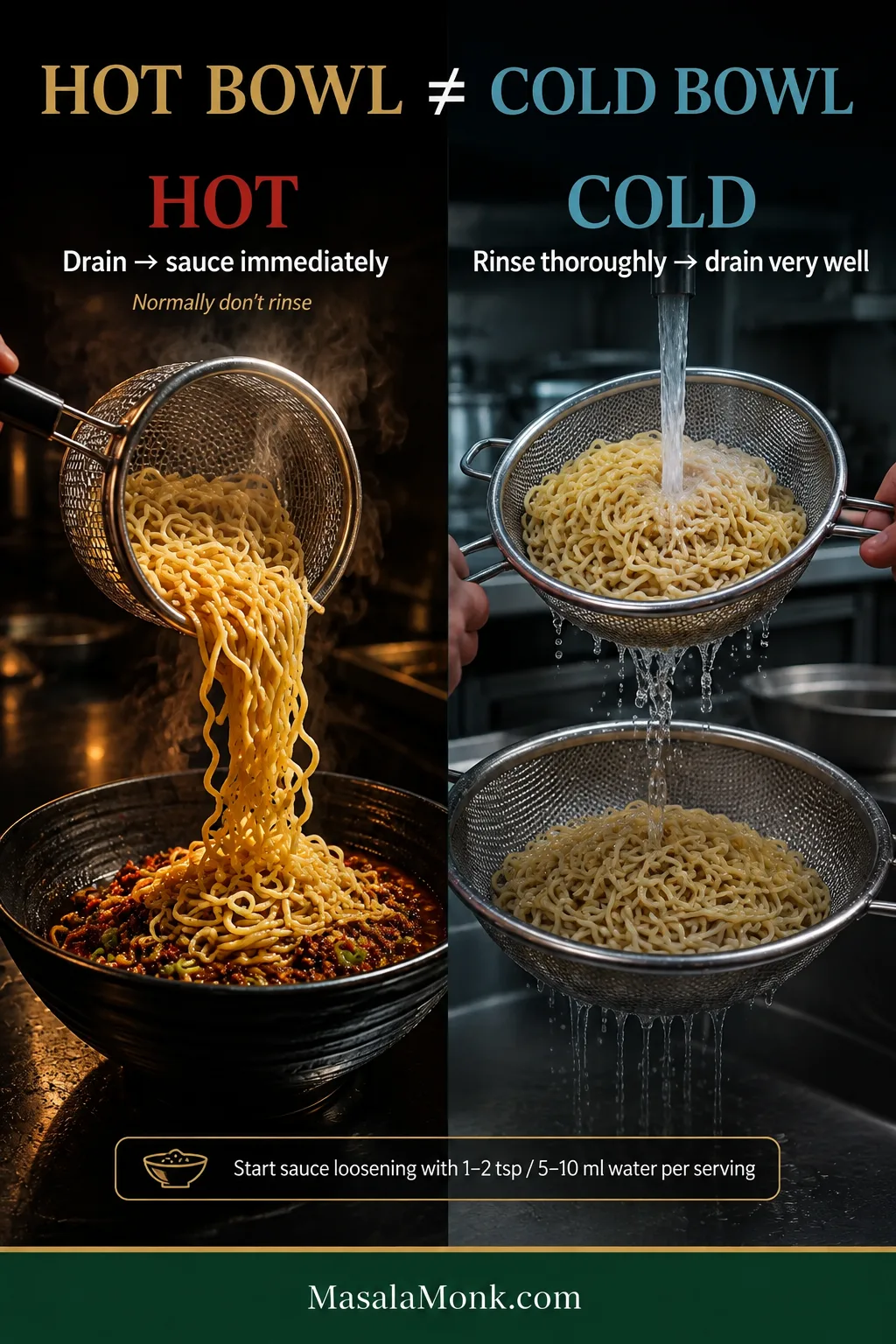
  • For this hot version, drain and sauce the noodles immediately. An unusually starchy fresh noodle that begins sticking can have a very quick rinse; shake it extremely dry and move straight to the sauce.
  • Prepared chili oil keeps this weeknight-friendly. Homemade oil is excellent when you already have it.
  • Start modestly with Sichuan pepper. Anyone who wants a stronger buzz can add more to their own serving.

The Finished Noodles: What You’re Looking For

  • Noodles: springy and easy to lift in separate strands.
  • Sauce: clinging to the strands with no thin pool underneath.
  • Pork: dark in spots, relatively dry, and crisp around some of the smaller edges.
  • Flavor: layered and lively, without one ingredient flattening everything else.
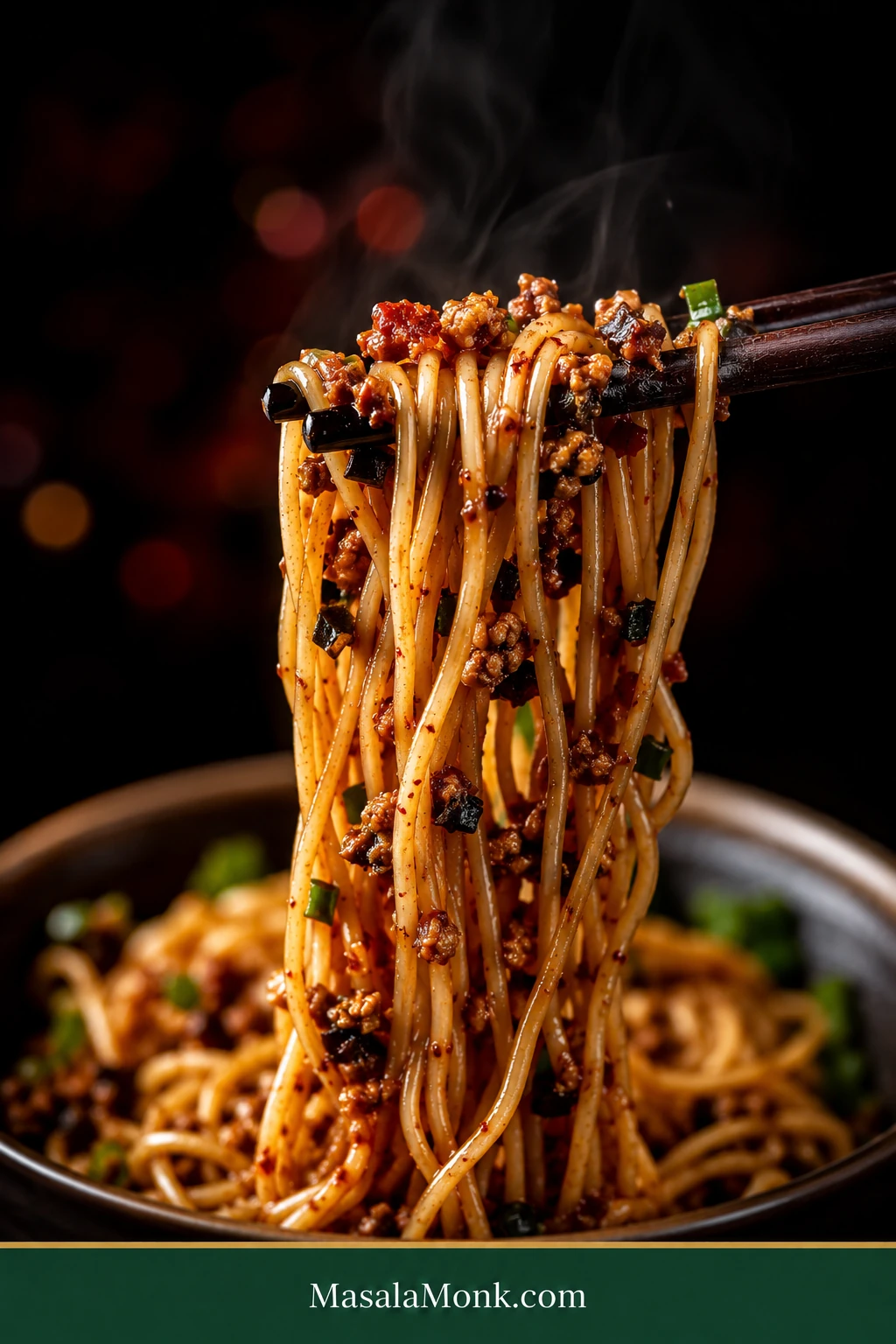
Close-up of thin Dan Dan noodles lifted with chopsticks, showing separated strands evenly coated with sauce and small pieces of browned pork and ya cai.
Use the lift as a distribution test: if sauce, little pork crumbles and ya cai rise with the noodles, the savory topping has made its way through the bowl.

Now take a bite. The noodles should be hot and slippery, black vinegar should give the first mouthful a quick acidic snap, browned pork and ya cai should keep appearing between strands, and the peppercorn tingle should build gradually, leaving the vinegar, pork, sesame, and preserved mustard easy to notice.

Something cold and crisp is especially good beside all that richness. A simple cucumber salad gives the meal an easy vinegary counterpoint.

Cooking right now? You can stop here. Everything below is for choosing ingredients, understanding why versions differ, or fixing something that didn’t behave as expected.

Explore the Dan Dan Noodles Guide

What Are Dan Dan Noodles? Name, Street-Food Roots & Variations

Dan Dan noodles are a Sichuan wheat-noodle dish traditionally associated with street vendors and a concentrated mix of chili, Sichuan pepper, preserved vegetables, and savory toppings. The name dàndàn miàn comes from the dàn, or carrying pole, associated with vendors who sold the noodles.

You may also see Szechuan Dan Dan noodles. Szechuan is an older English romanization that remains common on menus and in recipe searches.

How Traditional Is This Version?

Dan Dan noodles vary considerably from cook to cook and shop to shop, so there isn’t one modern formula that defines every Sichuan bowl. Some servings are drier, others carry more seasoned liquid; sesame paste appears in some versions and not others, and pork quantities range from a light topping to much more substantial portions.

This version keeps wheat noodles, chili oil, Sichuan pepper, preserved mustard greens, Chinkiang vinegar, and dry-fried pork at the center while making the portions substantial enough for a main meal.

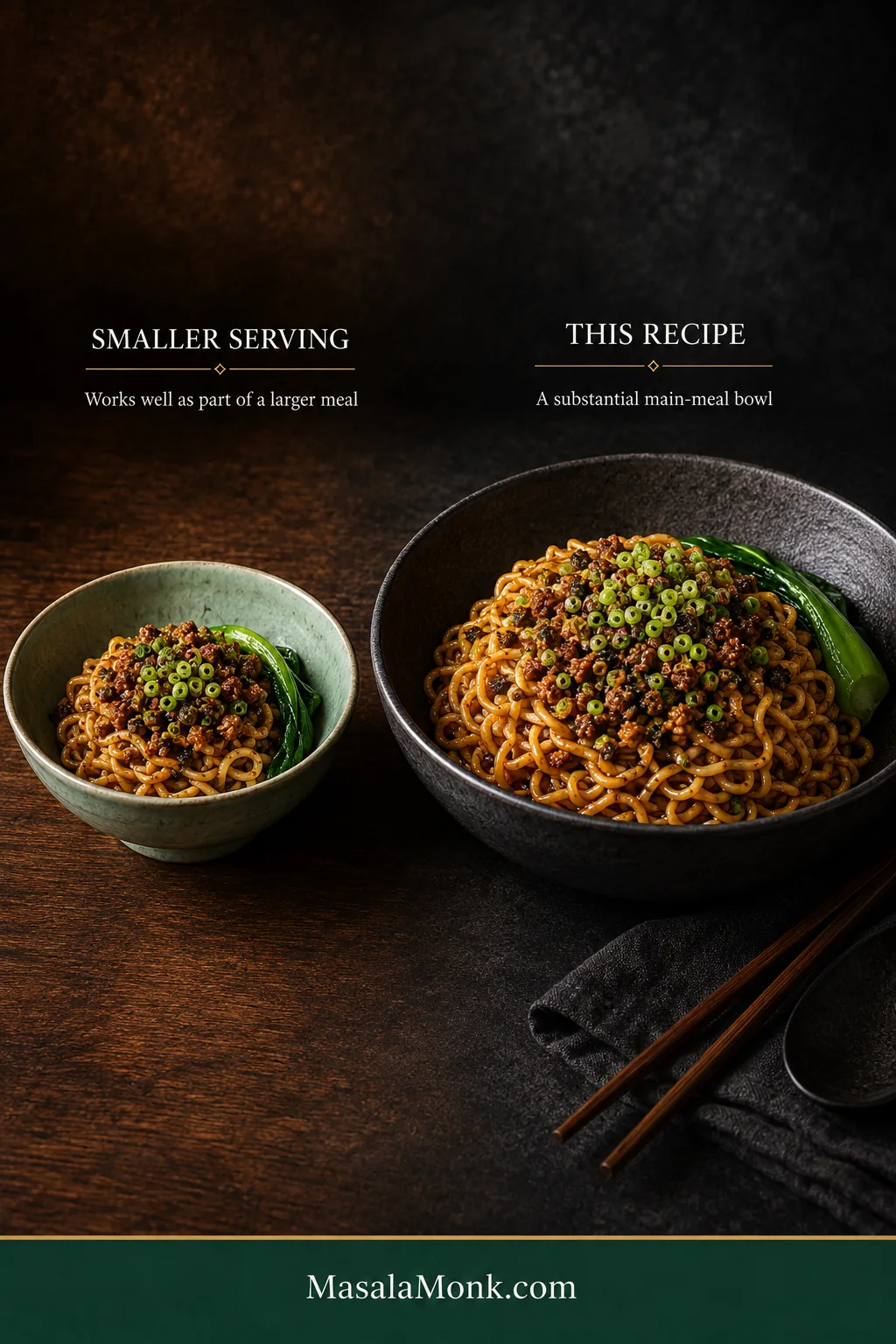
Two servings of Dan Dan noodles side by side, comparing a smaller bowl for a shared meal with a more substantial main-meal portion.
Portion size changes the role of the noodles more than the identity of the dish: a smaller bowl joins a larger spread, while this recipe turns the same concentrated flavors into dinner.

For broader context on Sichuan cooking and the many forms dishes like Dan Dan noodles can take, Fuchsia Dunlop’s The Food of Sichuan is an excellent English-language reference.

Why Good Dan Dan Recipes Look So Different

Compare a few good recipes and you’ll quickly run into doubanjiang, fermented black beans, sweet bean sauce or hoisin, dark soy, five-spice, sesame paste, peanuts, stock—or none of the above.

The variations are not random. Different cooks build fermented depth, sweetness, savoriness, heat, and richness in different ways.

Here, the pork stays fairly simple so chili oil, Sichuan pepper, ya cai, black vinegar, and roasted sesame remain easy to pick out. Doubanjiang adds another powerful fermented-bean note and more salt. It belongs comfortably in other versions; this one gets its fermented depth elsewhere.

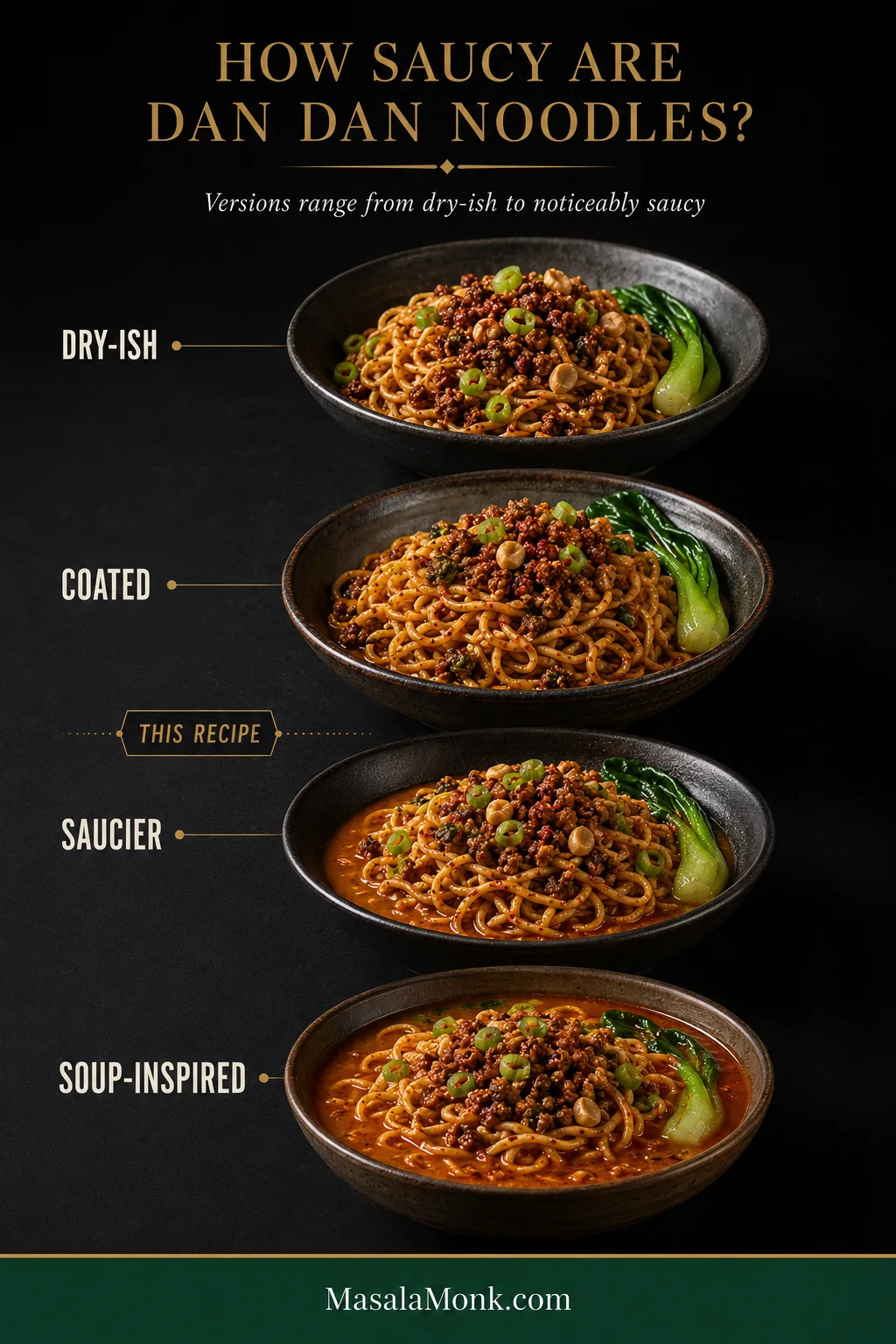
Are Dan Dan Noodles Dry or Soupy?

Dan Dan noodles range from quite dry to noticeably more saucy. Many Sichuan and Chengdu-style bowls use only a modest amount of intensely seasoned liquid, while other traditional versions are looser.

Four bowls showing Dan Dan noodles progressing from dry-ish to coated, saucier and brothy, with this recipe marked near the coated end.
The useful distinction is coating versus broth. A Dan Dan bowl can look glossy and still be fairly dry when the seasoned liquid stays on the noodles instead of surrounding them.

Even a dry-ish bowl still carries plenty of chili oil and concentrated seasoning. Japanese tantanmen and Dan Dan-inspired noodle soups take this flavor family much farther toward a full broth, which produces a distinctly different eating experience.

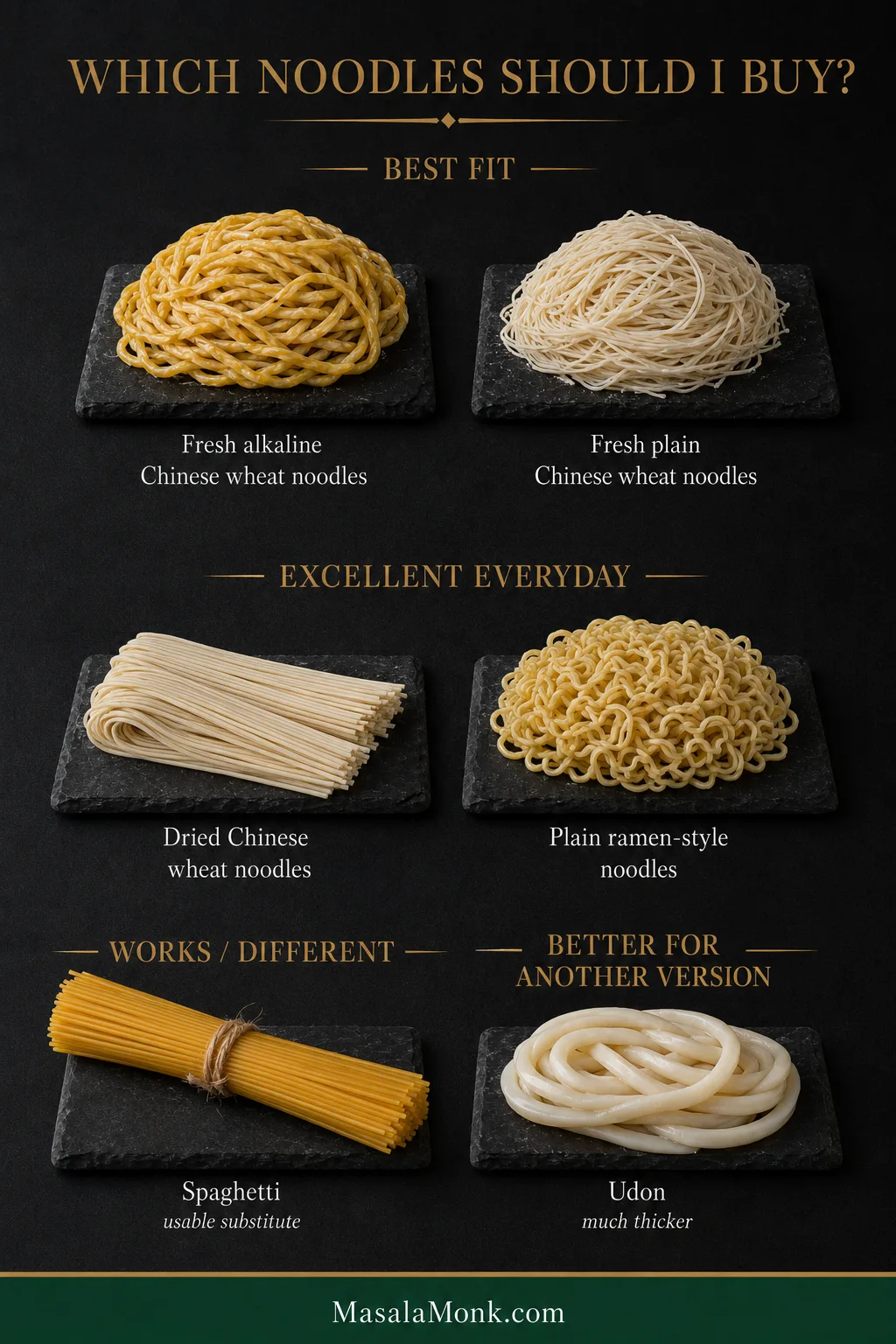
What Noodles Are Best for Dan Dan Noodles?

Thin-to-medium Chinese wheat noodles are the best fit. Fresh alkaline noodles are especially springy, while dried Chinese wheat noodles make an excellent pantry option.

In a Chinese or well-stocked Asian grocery, look for fresh noodles in the refrigerated case. The strands should be thin enough to tangle easily around chopsticks, with much less heft than udon.

Comparison of fresh alkaline wheat noodles, fresh plain Chinese wheat noodles, dried Chinese wheat noodles, ramen-style noodles, spaghetti and thick udon.
When package names are vague, compare the strands themselves. Thin-to-medium wheat noodles with some resilience are a better shopping clue than chasing one supposedly perfect label.
Noodle How it behaves Verdict
Fresh alkaline wheat noodles Springy, slippery, resilient Excellent when available
Fresh plain Chinese wheat noodles Slightly softer chew Excellent
Dried Chinese wheat noodles Reliable and easy to keep in the pantry Excellent everyday option
Plain ramen-style noodles Good chew and enough structure for the sauce Good substitute
Spaghetti Less springy, but carries the sauce surprisingly well Use it if that’s what you have
Rice noodles Different absorption and texture A bigger departure
Udon Much thicker and asks for a different sauce balance Better saved for another version

If all you can find is spaghetti, make dinner. The noodles didn’t come from the Chinese aisle, but the sauce still has plenty to hold onto.

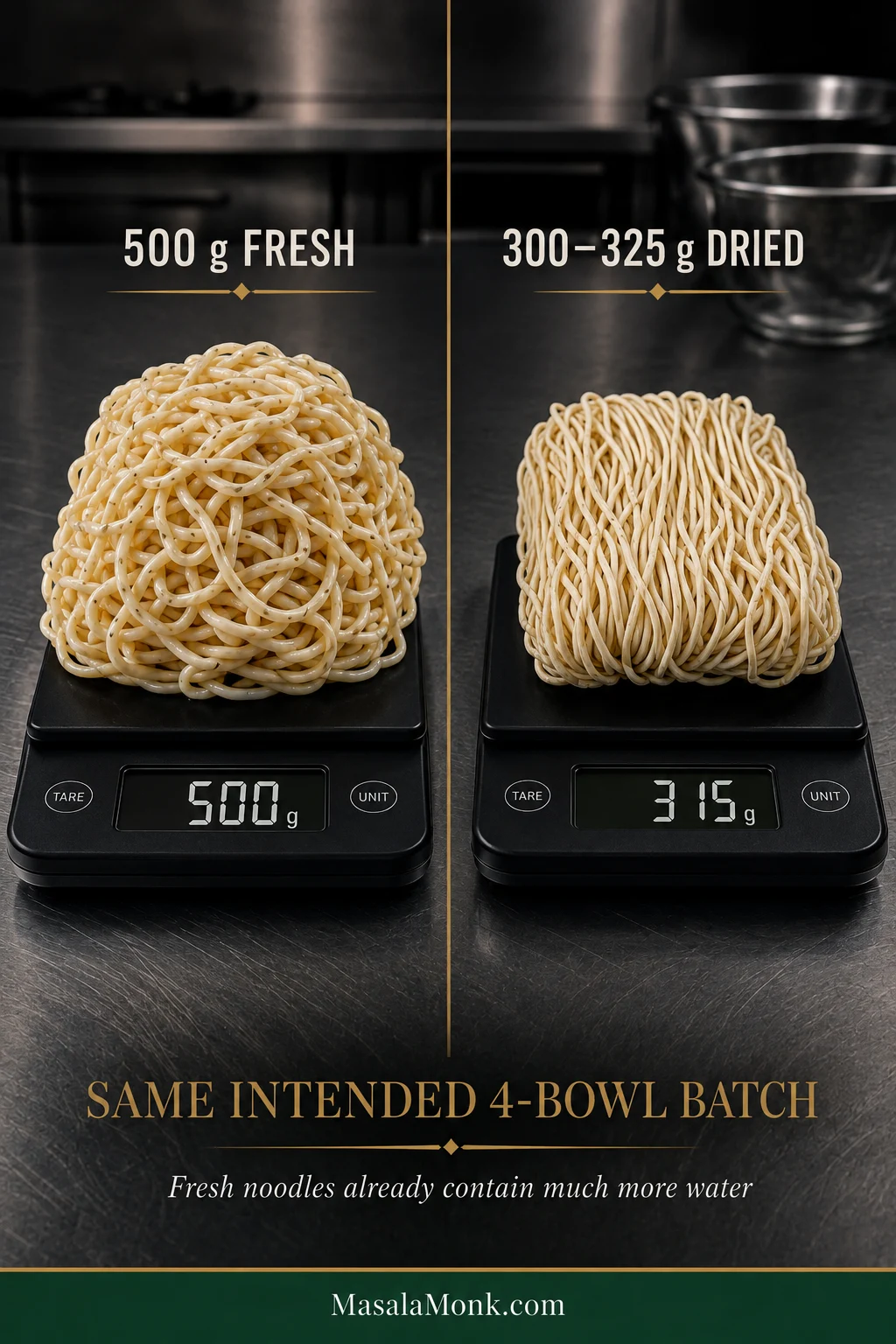
Why Fresh and Dried Noodles Need Different Weights

About 500 g / 18 oz fresh or 300–325 g / 10½–11½ oz dried gives you the intended four-bowl batch. Fresh noodles already carry substantial water weight, so equal package weights produce very different amounts of actual noodle.

Fresh Chinese wheat noodles measured at 500 grams beside about 300–325 grams of dried wheat noodles, both intended to make four servings.
Fresh and dried Chinese wheat noodles are not interchangeable package weights. Keep the recipe’s separate gram amounts, then let texture—not the number on the bag—decide when cooking is finished.

Whatever you buy, begin checking before the printed cooking time ends. Let the clock tell you when to check; let the noodle decide when it’s done.

Get the Dan Dan Sauce Right

Dan Dan sauce is built from chili oil, soy sauce, Sichuan pepper, black vinegar and, in this version, Chinese sesame paste, garlic, and a little sugar.

It starts concentrated because the noodles soften both flavor and texture. Sesame paste also varies considerably from jar to jar, which makes noodle water more useful as a final adjustment than as a fixed quantity.

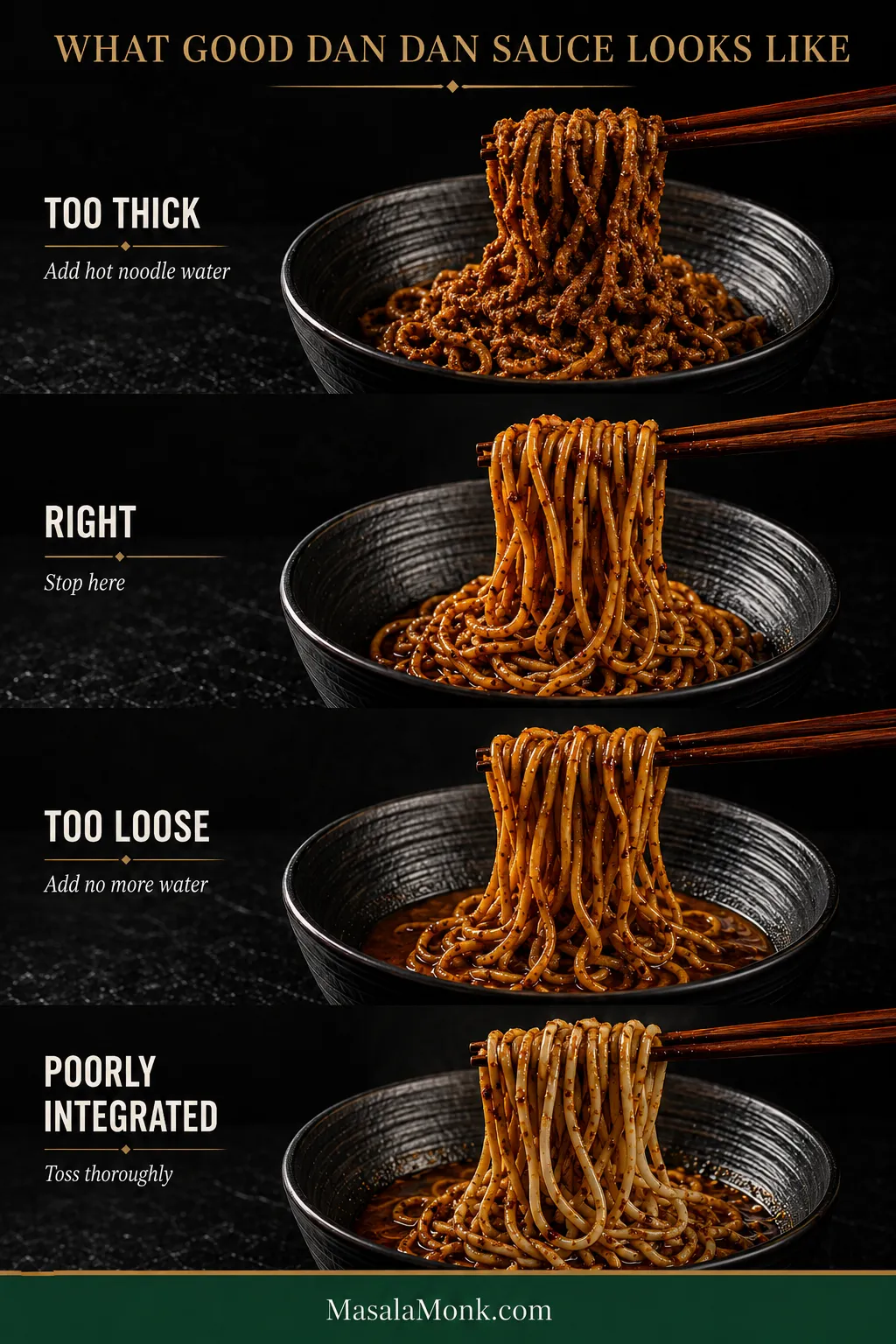
Start each serving with about a tablespoon of hot noodle water. Toss completely, then add another teaspoon only when the strands still feel heavy.

What you see What’s happening What to do
Strands stick in a heavy clump and sauce sits in thick patches Too thick Add hot noodle water a teaspoon at a time
The sauce coats the strands and lifts cleanly with them Right Put the measuring spoon down
Thin liquid slips off the strands and gathers underneath Too loose Add no more water; toss thoroughly
An oil slick surrounds noodles that still seem poorly coated Poorly integrated Toss vigorously and let the sauce come together
Four sauce states on noodles: too thick and clumped, correctly glossy and separated, too loose with liquid pooling below, and poorly integrated with uneven oil.
Dan Dan sauce consistency belongs to the toss. A sauce that seems thick by itself may become exactly right once hot noodles and a little noodle water enter the equation.

What the Concentrated Sauce Should Taste Like

Before the noodles go in, the sauce should taste deliberately bold: roasted sesame underneath, clear black-vinegar acidity, aromatic chili warmth, assertive saltiness, and a noticeable Sichuan-pepper hum. None of those flavors should erase the others.

An obvious imbalance is easiest to correct now. A heavy sauce often needs brightness; a nearly heatless one may simply be meeting a mild chili oil. Sesame should round the sharper flavors, not become the whole story.

That roasted richness comes from a deliberately modest amount of Chinese sesame paste.

Chinese Sesame Paste vs Tahini vs Peanut Butter

Sesame paste is common in many Dan Dan noodle versions, but it isn’t universal across Sichuan. This recipe uses enough to add roasted depth while leaving room for chili, black vinegar, ya cai, and Sichuan pepper.

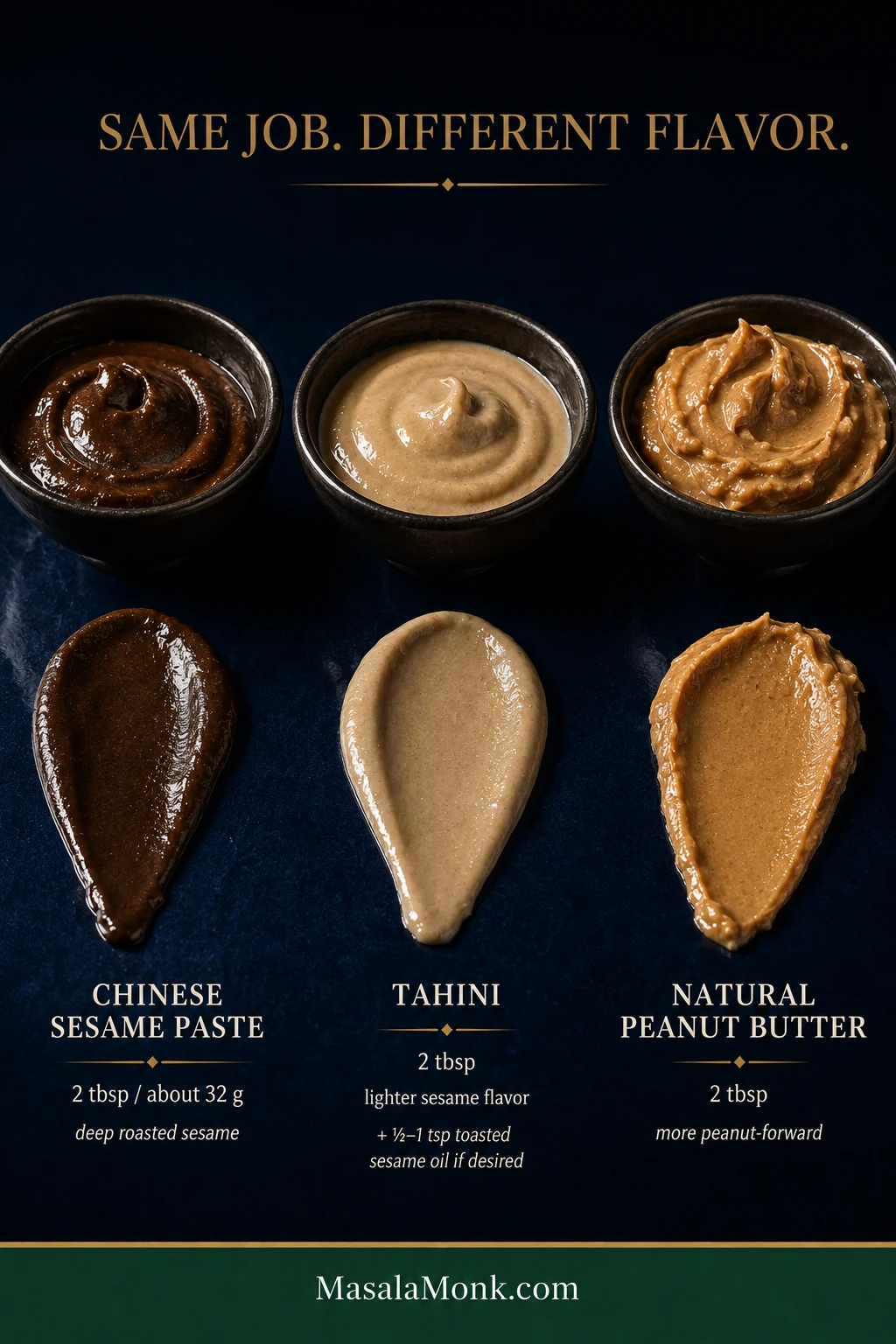
Chinese sesame paste has a darker, toastier character than most tahini because its sesame seeds are roasted more deeply. A substitute still makes excellent noodles without requiring a large dose of extra sesame oil.

Chinese sesame paste, tahini and natural peanut butter compared side by side, showing different colors, textures and starting amounts.
A substitution changes the personality of the bowl: tahini keeps the flavor sesame-led, while peanut butter makes the peanut note more obvious. Neither needs to be disguised.
What you have Starting point Expect
Chinese sesame paste 2 tbsp / about 32 g Deep roasted sesame flavor
Tahini 2 tbsp tahini; optionally add about ½–1 tsp toasted sesame oil A lighter sesame flavor
Natural unsweetened peanut butter 2 tbsp A clearer peanut note; extra sesame oil isn’t required
Sweetened peanut butter Start with no added sugar; add some only after tasting the finished sauce Sweeter, more peanut-forward noodles

No Chinese sesame paste today? Dinner is still very much on. These are starting points, and the finished sauce gets the final say.

Make Sure the Jar Is Actually Sesame Paste

Imported labels can be confusing. A jar translated as “sesame sauce” may contain plain sesame paste, or it may already include soy, sugar, vinegar, and other seasonings.

Check the ingredient list. A pre-seasoned sesame sauce changes the salt, sweetness, and acidity of the recipe before you add anything else.

Prefer a creamier noodle where peanut butter is meant to lead? Our peanut noodles recipe starts from that balance.

Pork & Ya Cai: Get the Topping Right

How to Get Crisp Pork Instead of Gray Pork

If the pork still sounds wet, it isn’t really browning yet.

Ground pork normally goes through a steamy stage first. Then the visible moisture disappears, the sound becomes sharper, and the crumbles begin frying in their own rendered fat. That’s when the color deepens and crisp edges start to appear.

Add Shaoxing wine and soy after browning begins. The hot pan reduces them quickly around the meat and preserves those fried edges.

For food safety, ground pork should reach at least 160°F / 71°C. The temperature tells you the meat is safe; the browned dry edges tell you it has reached the texture worth putting on the noodles.

Once those crumbles are browned and dry around the edges, ya cai gives them the salty-fermented bite that makes the topping much more than plain ground pork.

What Is Sui Mi Ya Cai?

Sui mi ya cai is a Sichuan preserved mustard vegetable with salty, fermented, slightly sweet depth. Its chewy-crisp pieces are especially good tucked among the browned pork.

Sui mi ya cai shown in a generic packet, a small dish and close-up, revealing its finely chopped dark brown preserved mustard-vegetable texture.
Shopping shortcut: sui mi ya cai should already look finely chopped and preserved. Long stems or large leafy pickles usually mean you’ve found a different mustard vegetable.

At a Chinese grocery, look for Sui Mi Ya Cai, Yibin preserved vegetable, or 碎米芽菜, often in small vacuum-sealed packets. No Chinese grocery nearby? Search those exact names online; generic “pickled mustard greens” can lead to several different preserved vegetables.

Should You Rinse Ya Cai?

Do not make rinsing automatic. Make tasting automatic. Packets differ in saltiness and seasoning. Use pleasantly salty ya cai as it is. Aggressively salty ya cai gets a brief rinse and a thorough squeeze before chopping.

Best Substitutes for Sui Mi Ya Cai

Four preserved vegetables compared: finely chopped ya cai, firmer zha cai, Tianjin preserved vegetable and wetter red kimchi as increasingly different substitutes.
Choose the substitute by moisture as well as flavor. Zha cai mainly needs fine chopping; kimchi, however, benefits from draining and extra pan time before it joins the pork.
  • Zha cai: the closest practical substitute here. Chop it finely and account for its saltiness.
  • Tianjin preserved vegetable or another Chinese preserved mustard: different in character, but still useful for salty fermented depth.
  • Kimchi: changes the flavor noticeably but works in an emergency. Drain or squeeze it very well, chop finely, and cook off the remaining moisture after adding it to the pork.
  • Nothing: the noodles still work, but you’ll lose one of the salty-fermented notes that makes Dan Dan noodles immediately recognizable.

How Spicy Are Dan Dan Noodles? Má vs Là

Dan Dan noodles range from moderately spicy to fiercely hot depending on the chili oil and Sichuan pepper. More importantly, they contain two distinct sensations: là is chili heat, while má is the citrusy, lightly numbing effect of Sichuan peppercorns.

Má and là flavor map showing chili heat increasing horizontally and Sichuan pepper tingle vertically, with gentle, chili-led, pepper-led and full málà zones.
Change one dial at a time. More chili oil answers “not hot enough”; more Sichuan pepper answers “not tingly enough.” That makes málà much easier to control.
  • Less heat overall: reduce both chili oil and Sichuan pepper.
  • More burn with roughly the same tingle: add chili oil.
  • More citrusy tingle with roughly the same chili heat: add freshly ground Sichuan pepper at the table.
  • Full-on málà: increase both gradually.

The first proper hit of Sichuan pepper can be surprising. That electric, citrusy sensation is part of the pleasure. A dull, woody pepper may simply be stale; harsh bitterness more often points to scorching, an excessive amount, or too much hard dark seed material in the grind.

Sichuan peppercorns compared as fresh reddish husks, duller stale pepper and dark scorched pepper, with aroma and flavor cues for each condition.
Crush a Sichuan pepper husk between your fingers before cooking. A vivid citrus aroma is a stronger freshness clue than color alone.

Part of what makes the bowl so satisfying is the contrast: slippery noodles, dry-crisp pork, chewy preserved mustard, and a red chili-oil sheen carrying all that heat and aroma through the strands.

Shaoxing Wine, Vinegar, Soy Sauce & Chili Oil

These aren’t one-recipe purchases. Chinkiang vinegar, Shaoxing wine, chili oil, and Sichuan pepper all earn their place quickly if Chinese food appears regularly in your kitchen.

Seven specialty ingredients for Dan Dan noodles: Chinese sesame paste, chili oil, Chinkiang vinegar, light soy, Shaoxing wine, sui mi ya cai and Sichuan peppercorns.
Once these seven Sichuan pantry ingredients are stocked, most future Dan Dan noodle nights begin with measuring rather than shopping. The unfamiliar part gets familiar surprisingly quickly.

Shaoxing Cooking Wine

A bottle labeled “Shaoxing cooking wine” is completely normal. Many inexpensive cooking versions contain added salt, which is one reason this recipe doesn’t automatically add salt to the pork or noodle water.

No Shaoxing wine? Use dry sherry in the same 1 tbsp / 15 ml amount.

Chinkiang Black Vinegar

Use another dark Chinese rice vinegar in the same starting amount. Chinkiang has a particularly deep, malty character, so the flavor will change slightly, but the sauce will still have the acidity it needs.

Light Soy vs Dark Soy

Chinese light soy sauce is ideal. Start with the same quantity of ordinary all-purpose soy sauce when that’s what you have, keeping in mind that some bottles are noticeably saltier than others.

Light soy sauce and dark soy sauce compared in matching dishes, showing translucent reddish-brown light soy beside much darker, more opaque dark soy.
If Chinese light soy is unavailable, ordinary all-purpose soy is usually a closer direction than dark soy. Because brands vary in saltiness, taste before making any further correction.

Dark soy is much deeper in color and normally used more sparingly. It changes both the appearance and balance of the sauce, so use light or all-purpose soy here when possible.

Choosing the Chili Oil

Look for a fragrant Chinese or Sichuan-style red chili oil with visible chili sediment. Stir the jar before measuring so some of those aromatic solids reach the sauce too.

Chinese Sichuan chili oil with mostly red oil and chili sediment beside a solids-heavy jar of chili crisp, showing why they are not automatic substitutes.
Use the spoon test, not just the jar: mostly red oil with some sediment suits this Dan Dan sauce well; a spoon packed with crunchy solids behaves more like chili crisp.

Heat varies enormously by brand. Three tablespoons of one can be pleasantly warm; three tablespoons of another can be an entirely different evening.

Homemade Sichuan chili oil is another option. The Sichuan chili oil section in our pepper sauce guide gives you the from-scratch route when you want it.

Chili crisp needs a more conservative starting amount. Its garlic, sweetness, salt, oil-to-solids ratio, and heat vary too much between brands for a dependable spoon-for-spoon swap. Add some, toss the noodles, then decide whether the bowl wants more.

Dan Dan Noodles Troubleshooting

Already tossed everything together and something tastes wrong? Don’t start throwing ingredients at it. Find the problem first. Most of these are fixable.

Flavor Problems

Problem Save it now Next time
Too salty Add unseasoned noodles or greens; a little hot water can soften the intensity Check the ya cai, soy sauce, and cooking wine before adding extra salt
Too sour Add more noodles or a little sesame component; use a tiny pinch of sugar only if needed Use slightly less vinegar if your bottle is particularly sharp
Too sweet Add a little vinegar and chili oil Reduce the sugar, especially with sweetened peanut butter
Too spicy Add noodles, greens, and a little sesame component Use less of a particularly hot chili oil in the base
Too numbing, bitter, or medicinal Dilute with more noodles or sauce without extra Sichuan pepper Use less pepper and toast gently; avoid scorching it
Too sesame- or peanut-heavy Add noodles, vinegar, and chili to restore balance Measure the paste instead of using a heaped spoonful
Flat or bland Don’t assume it needs more soy; use the diagnostic below Build the bowl from fresh peppercorns, flavorful chili oil, and properly seasoned pork

Texture Problems

Three controlled noodle lifts comparing sticky clumped noodles, springy separated noodles as the target and limp swollen noodles that are overcooked.
Sticky can still be rescued; mushy cannot. If the noodles retain structure, loosen and toss them. If the strands have collapsed, serve promptly and adjust the cooking time next round.
Problem Save it now Next time
Sticky noodles Loosen gently and toss immediately; add only as much water as necessary Start checking the noodles earlier and sauce them promptly
Mushy noodles Serve immediately; the texture cannot really be reversed Pull them 30–60 seconds earlier
Gray, soft pork Keep frying until released moisture disappears and browning develops Use a wider hot pan and add liquid seasonings later

Before You Reach for More Soy Sauce

A bowl can taste flat without needing more salt. A few drops of Chinkiang vinegar may supply the missing brightness. Fresh Sichuan pepper brings back the citrusy buzz; chili oil restores warmth; tossing the pork and ya cai properly through the noodles can bring the savory pieces into every bite.

Dan Dan noodle bowl surrounded by Chinkiang vinegar, chili oil, Sichuan pepper and pork with ya cai, each labeled for the flavor dimension it adds.
Name the missing sensation before adding anything: brightness, warmth, citrusy tingle or savory depth. That one-word diagnosis is more useful than automatically reaching for more soy sauce.

Make Ahead, Store & Reheat

Planning to cook right now instead? Jump back to the recipe card; the storage section is here when you want the make-ahead route.

For fast Dan Dan noodles later in the week, make the pork topping and a garlic-free sauce base ahead. Another serving then comes down to fresh noodles, a quick blanch of greens, warmed pork, a spoonful of sauce, and the final chili-oil/Sichuan-pepper adjustment.

Keep the components separate when possible. Pork and sauce wait much more gracefully than cooked noodles do.

Make-ahead Dan Dan noodle components stored separately: pork with ya cai, reddish-brown sauce base, fresh uncooked noodles and an assembled bowl marked least ideal for storage.
Think in order of texture loss: pork and sauce wait well, uncooked noodles wait better than cooked ones, and a fully assembled Dan Dan bowl should be last in line.
  • Chili oil: store according to the jar label or the instructions for the homemade chili-oil recipe you used.
  • Sauce base: refrigerate for up to about 3–4 days. Leave the raw garlic out and stir it in shortly before serving.
  • Pork and ya cai: refrigerate promptly in a covered container and use within about 3–4 days.
  • For longer storage: freeze the cooked pork topping separately, thaw it in the refrigerator, then reheat it in a skillet. Cook fresh noodles for serving.
  • Noodles: cook near serving whenever possible. Refrigerated noodles lose their spring and separation sooner than the other components.
  • Fully assembled noodles: least ideal for make-ahead because the strands continue absorbing sauce as they sit.

How to Reheat Dan Dan Noodles

Already assembled: Cover one leftover bowl loosely with a damp paper towel and microwave in short bursts, tossing once or twice. Add a teaspoon of water only if the noodles seem dry.

Components stored separately: Warm the pork in a skillet, loosen the cold sauce with a small splash of warm water, and combine everything with freshly cooked noodles when possible. This gives you the best texture.

Whichever route you use, wake the serving back up with fresh scallions, chili oil, vinegar, or Sichuan pepper as needed. Reheat leftovers to 165°F / 74°C.

Easy Ways to Change the Recipe

Ground Chicken

Ground chicken gives you a lighter topping. Its lower fat content often benefits from a little neutral oil. Cook away the released moisture before adding the Shaoxing wine and soy, and bring ground chicken to at least 165°F / 74°C.

Four Dan Dan noodle topping options shown separately: crisp ground pork, lighter browned chicken, deeper-brown beef, and browned tofu with mushrooms.
Changing the topping also changes the pan strategy: chicken may need extra fat, beef needs rendered-fat control, while tofu and mushrooms need stronger browning to build savory depth.

Ground Beef

Ground beef brings deeper meat flavor and more richness. Choose a fairly lean grind so rendered beef fat doesn’t overwhelm the chili oil. Brown it until relatively dry before adding the liquid seasonings, and cook ground beef to at least 160°F / 71°C.

Tofu & Mushrooms

Finely chopped firm tofu and mushrooms make a good meatless topping. Cook the mushrooms until their moisture is gone, then give the tofu time to pick up some color before seasoning. Browning and mushroom savoriness supply some of the depth that pork normally contributes.

A full 1 lb / 454 g package of pork will leave roughly half for another meal. That’s an excellent excuse to make Pad Kra Pao another night: browned pork, garlic, chili, basil, and rice.

Make It Milder

Use less chili oil and Sichuan pepper in the base sauce, then put both on the table. One person can keep their serving gentle while somebody else adds another spoonful of chili oil and a fresh pinch of pepper.

A Cold Dan Dan Noodle Adaptation

This particular recipe is at its best hot, when the sauce is fluid and the pork is at its crispest, but it also adapts well to a cool or room-temperature bowl.

Hot bowl: normally leave the noodles unrinsed. Cold bowl: rinse deliberately. For the cold version, cook until just springy, rinse thoroughly under cool water to stop the cooking and remove excess surface starch, then drain extremely well.

Split guide showing hot noodles drained directly into sauce and cold noodles rinsed under cool water before being thoroughly drained.
Rinsing is not an automatic anti-stick trick. Instead, it is a deliberate cooling step for cold Dan Dan noodles; the hot version keeps its surface starch and goes straight toward sauce.

Loosen the sauce with cooled reserved noodle water or room-temperature water. Start with roughly 1–2 tsp / 5–10 ml per serving, toss, and add a little more only when the sauce still feels heavy.

For a larger spread, vegetable spring rolls add another crisp texture alongside the noodles.

Made these? Tell us which noodles and chili oil you used—and whether you kept the bowl gentle or pushed the málà.

The first batch may have you reading labels on sesame paste, ya cai, and black vinegar. By the second, those jars are already familiar and your attention has moved where it belongs—to the pork in the pan and the noodles in the bowl.

Partly eaten bowl of Dan Dan noodles on a dark dinner table with chopsticks, chili oil, cucumber salad and a second bowl in the background.
By this point, the specialty jars have done their job. What remains is dinner: a bowl worth eating while it is lively rather than another problem to solve.

↑ Back to Recipe Back to Top

If the noodles still have spring and those crisp pork-and-ya-cai bits keep turning up between bites, stop tinkering and eat.