
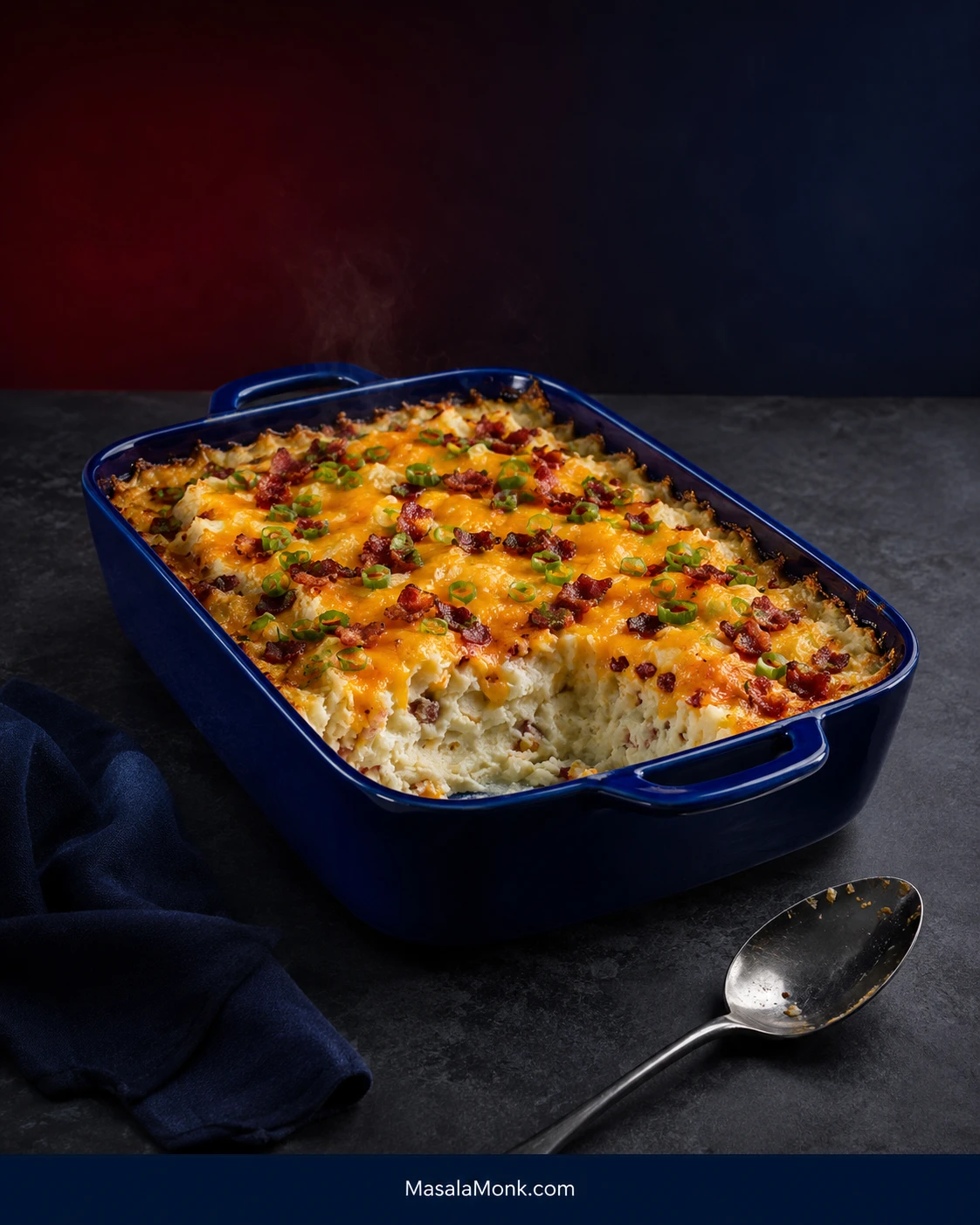
Individual twice-baked potatoes are wonderful when you’re making a few. For a crowded table, all that scooping, refilling and balancing fragile potato shells on a tray becomes work nobody misses once the cheese is bubbling.
This twice baked potato casserole keeps the same bake-scoop-enrich-bake idea but moves the filling into one dish. It has everything you’d expect in a loaded baked potato casserole—sharp cheddar, bacon, sour cream and green onion—while starting with whole baked russets, which keeps the finished casserole closer to a true baked potato than a loaded mash.
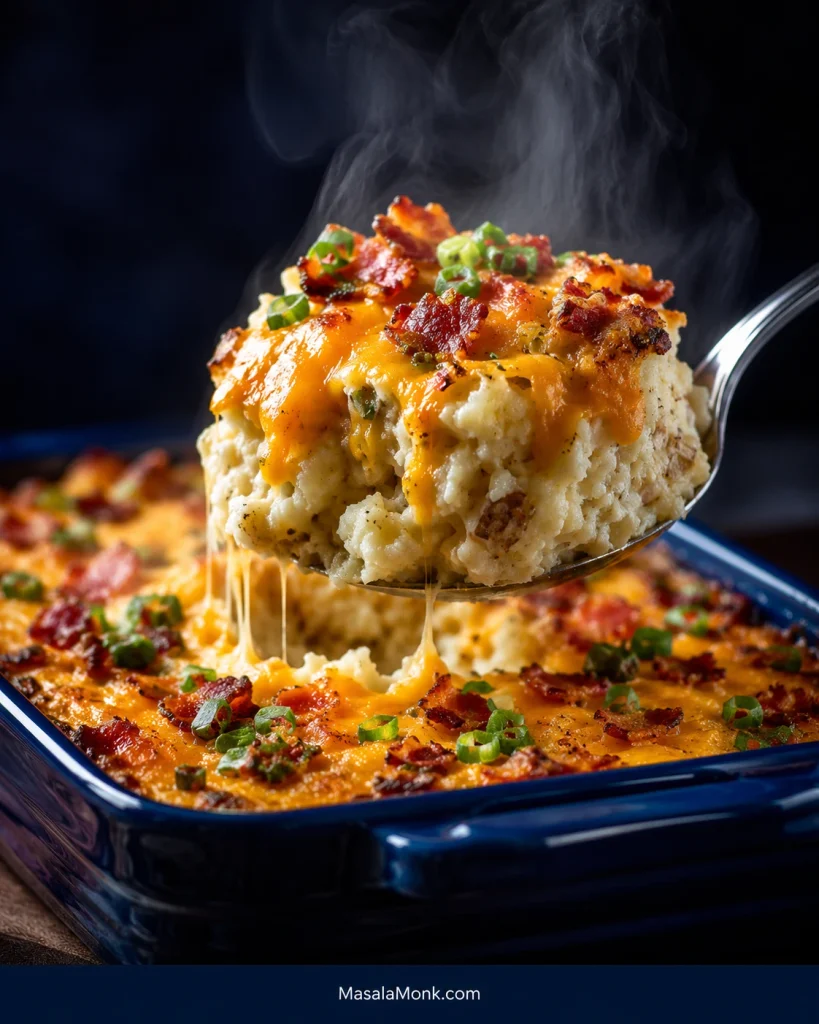
The cheddar on top melts into deeper golden patches while the potato underneath stays light, creamy and easy to scoop. Bacon runs through the middle for smoky flavor, with another crisp handful saved for the top.
The full recipe fills a 9×13-inch / 23×33-cm dish and serves about 10 to 12 as a side. You can assemble it up to two days ahead, scale it down for two or three people, or double it into two pans for a bigger table.
Quick Answer: How to Make Twice Baked Potato Casserole
Bake 5 lb / 2.27 kg russet potatoes at 425°F / 220°C until a thin knife slides easily through the centers. Scoop the flesh while it is still warm and gently rice or mash it.
Fold in butter, cream cheese, sour cream and enough warm milk to make the potatoes creamy but still thick enough to hold soft ridges. Add sharp cheddar, crisp bacon and green onion, spread everything into a 9×13-inch / 23×33-cm dish, top with more cheddar and bacon, and bake at 375°F / 190°C for 25–30 minutes.
Same day: bake while the filling is still warm. Making it ahead: assemble while warm and refrigerate for up to 2 days. Baking from cold: heat it covered first, then uncover so the top can brown.
Make It Now: Twice Baked Potato Casserole
Serves: 10–12 side servings · Active time: about 25–35 minutes · Same-day total: about 1 hr 45 min–2 hr 15 min
Pan: 9×13 in / 23×33 cm, about 3 qt / 2.8 L · First bake: 50–70 min · Second bake: 25–30 min · Make ahead: up to 2 days
Equipment: rimmed sheet pan · large skillet · large bowl · potato ricer or hand masher · 9×13-inch / 23×33-cm baking dish
Ingredients
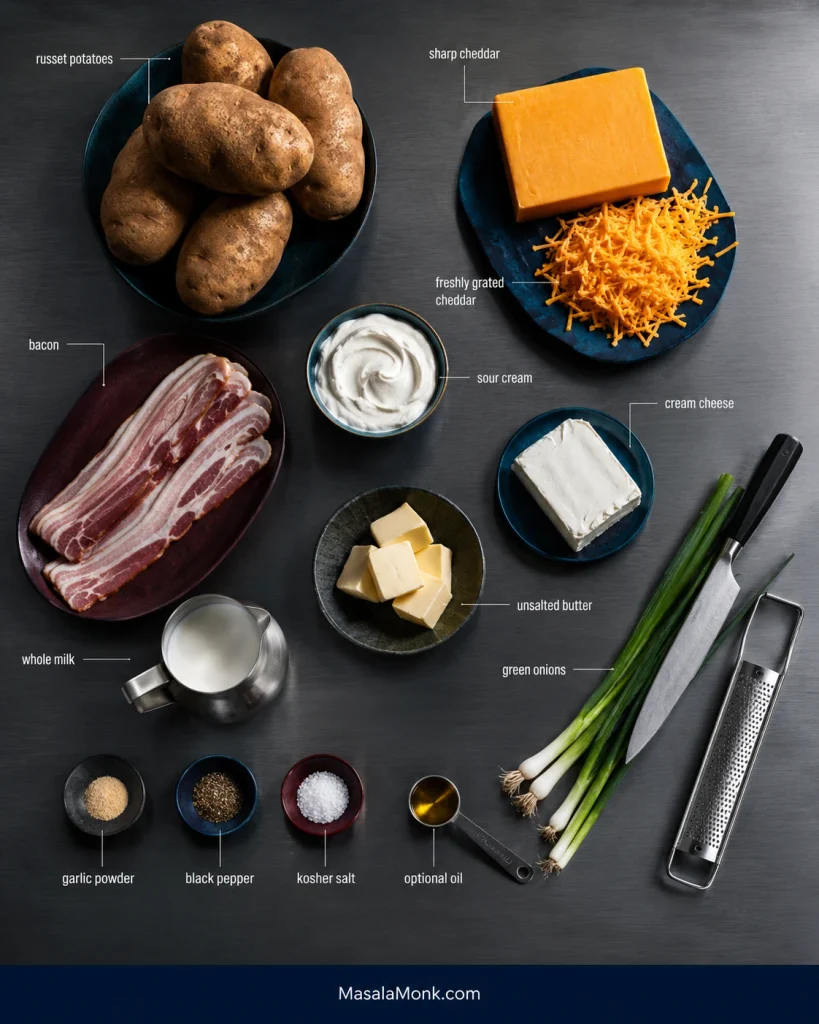
- 5 lb / 2.27 kg russet potatoes, roughly 6–8 large; use the weight if possible
- 1 tbsp / 15 ml olive or neutral oil, optional, if you want seasoned or crisp potato skins
- ½ cup / 113 g unsalted butter
- 4 oz / 113 g cream cheese
- 1 cup / about 225 g sour cream
- ¾–1 cup / 180–240 ml whole milk, warmed and added as needed
- 12 oz / 340 g sharp cheddar, about 3 cups shredded, divided
- 12 oz / 340 g bacon, raw weight
- 6 green onions, thinly sliced; keep the darker green tops separate
- 1½ tsp garlic powder
- ½ tsp freshly ground black pepper, plus more to taste
- ½–1 tsp kosher salt to start, depending on the brand; if using fine table salt, start with ½ tsp, then taste again after the bacon and cheddar are mixed in
Cheddar grated from a block melts a little more smoothly, but good pre-shredded cheddar is completely fine here.
How to Make It
1. Bake the potatoes and cook the bacon
Heat the oven to 425°F / 220°C. Take the butter, cream cheese and sour cream out of the refrigerator so they can lose some of their chill while the potatoes bake. Warm the milk just before you need it.
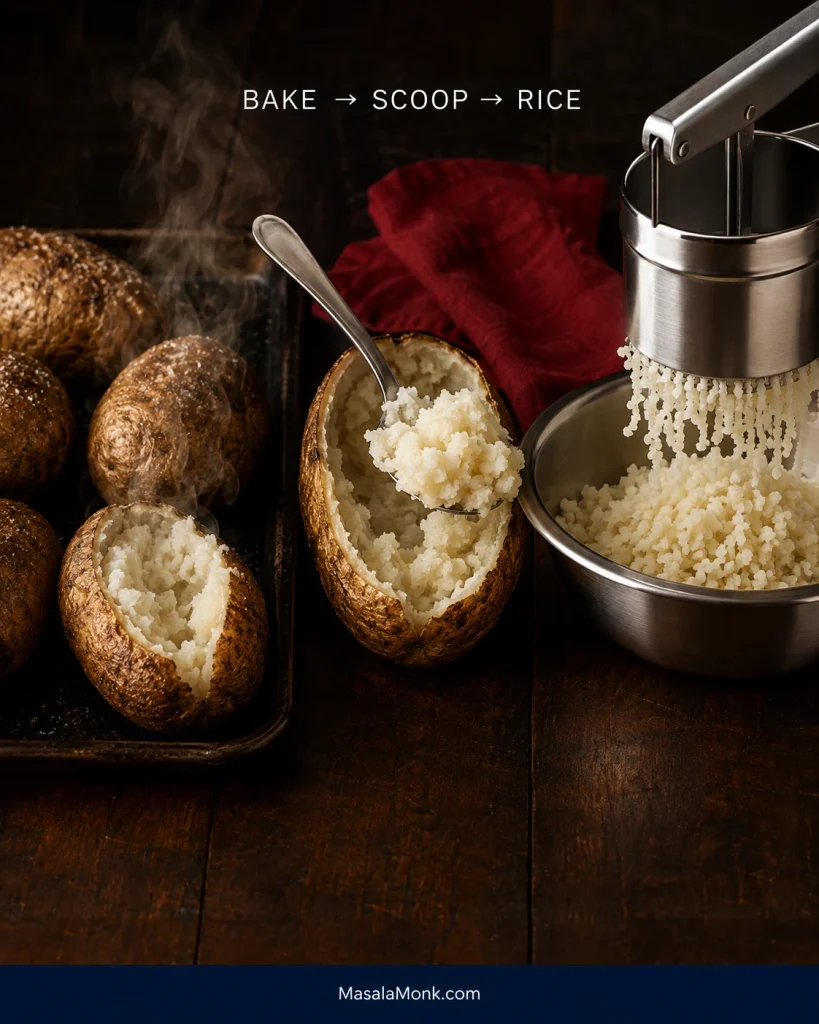
Scrub and dry the russets, then prick each one several times with a fork. Don’t wrap them in foil; dry oven heat gives us the baked-potato texture we’re after. Rub with a little oil and salt only if you plan to eat or fold in some of the skins.
Arrange the potatoes on a rimmed sheet pan with a little room between them and bake for about 50 to 70 minutes, depending on size. Start checking the smaller potatoes first.
While they bake, cook the bacon in a large skillet over medium heat until browned and crisp. Transfer it to paper towels or a rack to drain, then chop or crumble it. If keeping the stovetop clear would help, air-frying the bacon works here too.
The potatoes are ready when a thin knife or skewer slides through the center with almost no resistance. Don’t stop at “the fork technically went in.” Hard potato pieces now will still be hard after the second bake.
2. Scoop and process while warm
Let the potatoes cool only until they are comfortable enough to handle. Split them and scoop the flesh into a large bowl.
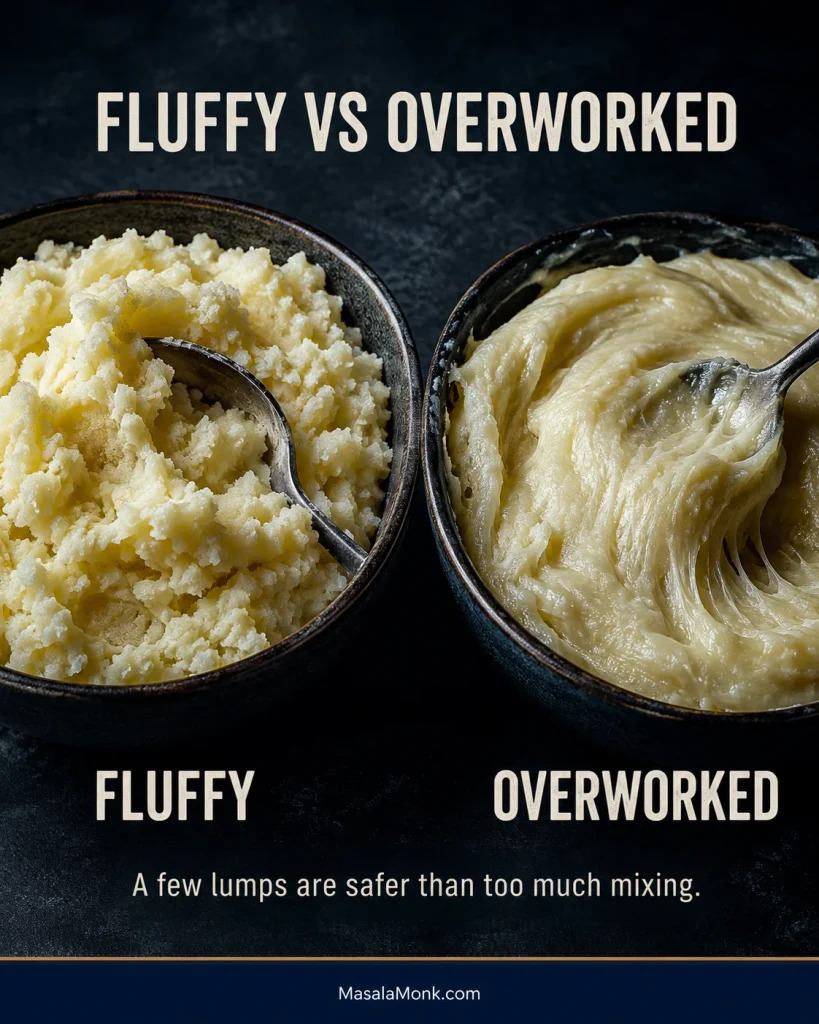
Pass the warm potato through a ricer, or mash gently by hand until the large pieces are gone. If three stubborn little lumps are still there, leave them. The urge to keep mixing until everything looks perfectly smooth causes far more trouble than those little pieces ever will.
3. Add the dairy and check the consistency
Fold the ½ cup / 113 g butter into the warm potatoes first, then add the 4 oz / 113 g cream cheese and 1 cup / about 225 g sour cream. Mix only until everything is distributed.
Add ¾ cup / 180 ml warm milk. Keep the remaining ¼ cup / 60 ml nearby and add more only if the potatoes still feel stiff.
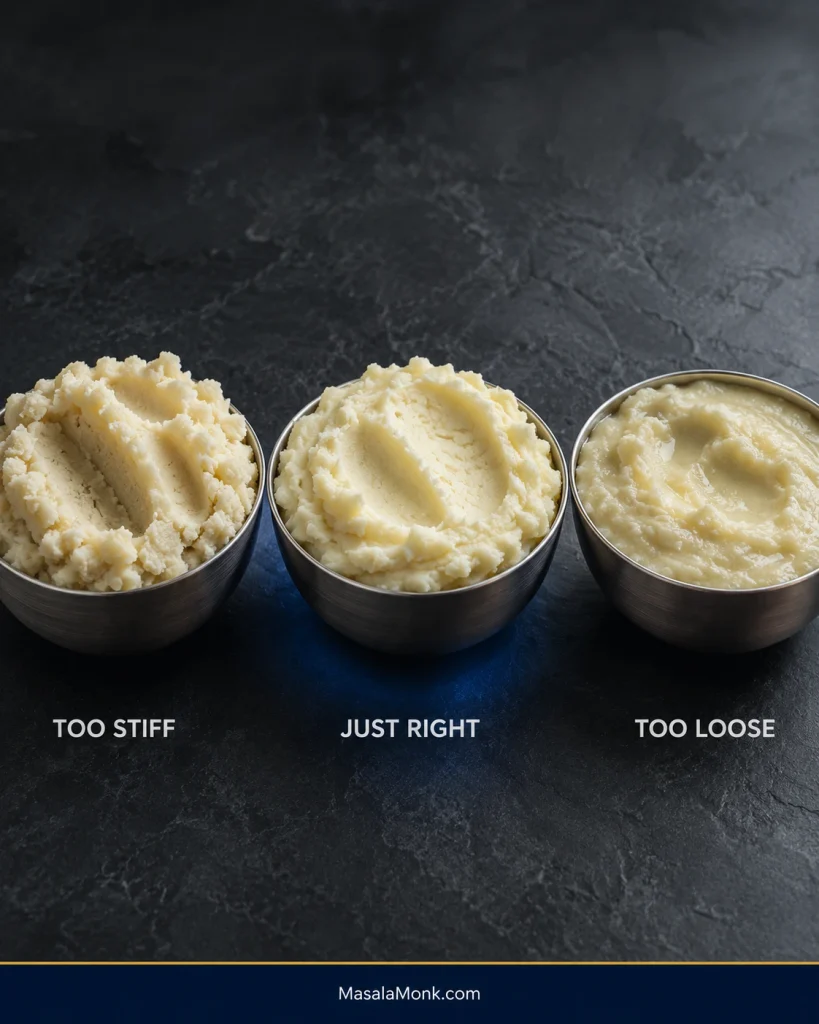
Check the consistency before adding the cheese:
Too stiff: the potatoes break into firm ridges and fight the spoon. Add warm milk 1 tbsp / 15 ml at a time.
Right: creamy and easy to spread, with soft ridges that stay visible when you drag a spoon through it.
Too loose: the mixture slumps flat and the spoon groove immediately disappears. Stop adding liquid.
4. Add the cheddar, bacon and seasoning
Reserve about 1 cup / roughly 110 g cheddar for the top. Fold the remaining cheddar into the potatoes with about two-thirds of the cooked bacon, the white and pale-green parts of the green onions, garlic powder, black pepper and the starting amount of salt.
Taste before adding more salt. Bacon and cheddar vary enough from brand to brand that the bowl may already have all it needs.
Bacon mixed through the potatoes seasons every scoop; bacon added at the end still crunches.
5. Assemble gently
Reduce the oven to 375°F / 190°C. Lightly grease a 9×13-inch / 23×33-cm baking dish, spoon in the potatoes and spread them into an even layer without packing them firmly into the dish.
Scatter over the reserved cheddar and roughly half of the remaining bacon. Save the last handful for serving.
6. Give it the second bake
Bake uncovered for 25 to 30 minutes, until the middle is hot, the cheese is completely melted and the edges are just beginning to bubble.
7. Brown the top and finish
For deeper color, broil for 1 to 3 minutes—or use your oven’s top-grill setting—only if the baking dish is suitable for direct top heat. You’re looking for melted cheddar with a few deeper golden patches rather than a hard, dark crust.
If the dish isn’t suitable for broiling, raise the oven to 425°F / 220°C for about 3–5 minutes instead and watch the cheese closely.
Let the casserole rest for 5 to 10 minutes so the potatoes settle slightly and scoop more cleanly. Finish with the last crisp bacon and the dark-green onion tops or fresh chives.
The Casserole Guide
If dinner is already moving, everything you need to cook the casserole is above. The rest is for the moments when the plan changes: different potatoes, tomorrow’s dinner, leftover mash, a smaller table, a packed schedule, or a casserole that isn’t behaving quite the way you expected.
Traditional twice-baked potatoes are baked, scooped, enriched and baked again. This version keeps that method but moves the enriched potato into one casserole dish; starting with whole baked russets is what separates it from a loaded mashed-potato casserole.
Technique: potato choice · bake vs boil · dairy balance · gummy potatoes
Planning: make ahead · troubleshooting · substitutions · leftovers · scaling · storage · reheating · serving
Russet or Yukon Gold?
| Potato | Texture | Best use here |
|---|---|---|
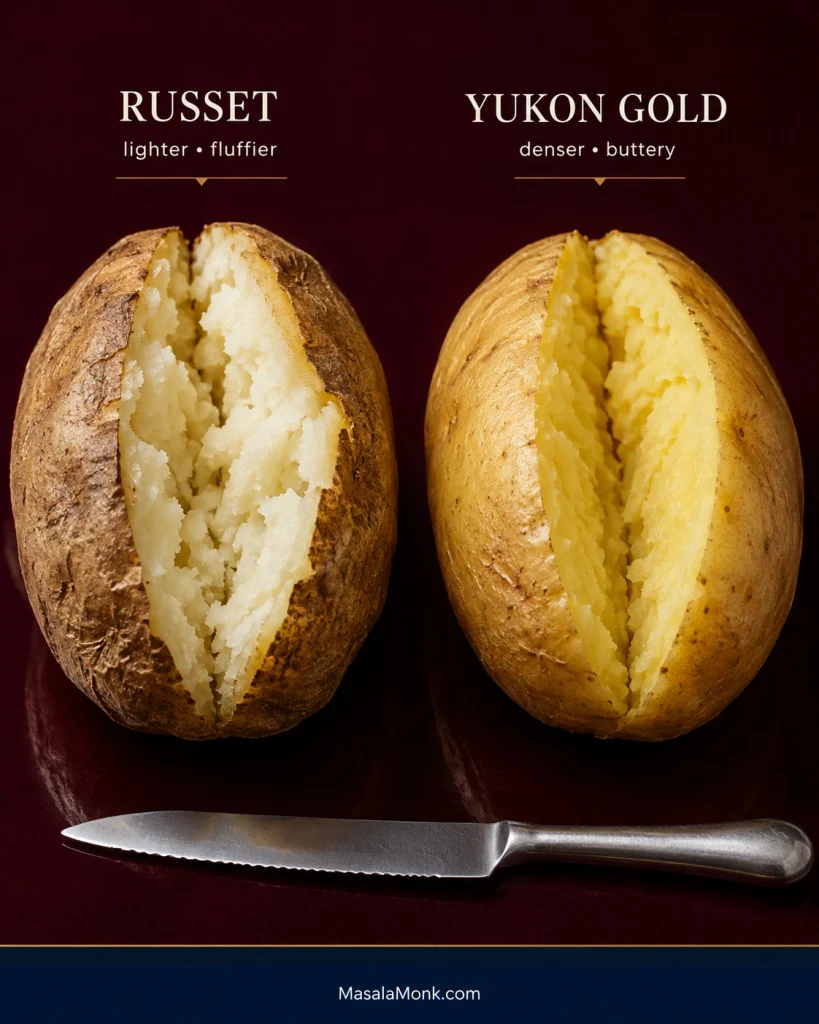
| Russet | Dry, high-starch, light when baked | Best choice for this recipe |
| Yukon Gold | Denser, buttery and naturally creamy | Use when you prefer a tighter casserole |
| Red or other waxy potatoes | Firm and waxier | Better for chunkier potato dishes |
Love the skin? Save the crispest skin from one or two russets, chop it fairly small and fold it through the potatoes. Using every skin can make an otherwise creamy casserole surprisingly chewy.
Bake or Boil?
Bake the potatoes when baked-potato flavor matters most. The oven lets moisture escape and leaves the centers drier, giving the butter and dairy somewhere to go without making the casserole feel wet.
Boiling is quicker, but the result lands closer to loaded mashed potatoes. If speed wins today, jump to the shortcut potato options.
Getting the Dairy Balance Right
The dairy should make the potatoes richer and easier to scoop without turning them into cheese sauce with potato underneath. At the right balance, each serving is buttery and tangy but still unmistakably russet.
Milk is the part to judge rather than measure blindly. Potato size, moisture and baking time all change how much the bowl needs.
Why Potatoes Turn Gummy
Those few lumps were never the problem; too much mixing is. Cooked potato starch becomes sticky when the potatoes are worked too aggressively, which is why a ricer or hand masher is safer than electric beaters or a food processor.
Once the potatoes become elastic and gluey, there isn’t a reliable way to beat them back into fluffiness. A few harmless lumps disappear under melted cheddar much more easily.
If you want to go deeper on ricer vs masher, potato varieties and starch handling, the MasalaMonk mashed potatoes guide covers those techniques in more detail.
Once the texture is right, the next question is usually timing: are you baking it now or tomorrow?
Making It Ahead
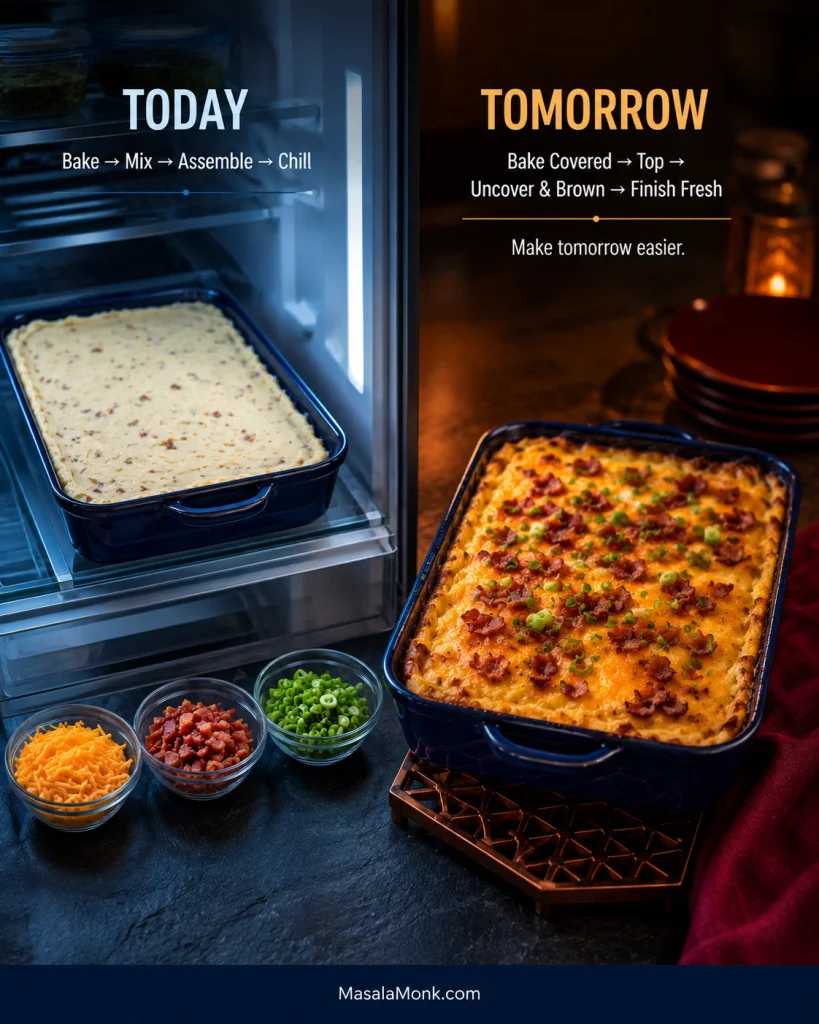
Assemble the casserole while the potatoes are still warm, then refrigerate it for up to 2 days. This is a better stopping point than chilling whole baked potatoes and trying to mash them cold the next day.
A make-ahead casserole should make tomorrow easier. Finish the filling while everything is easy to work with, spread it into the dish and let the heaviest steam subside briefly, then refrigerate promptly. Cover loosely while the casserole finishes cooling in the refrigerator, then cover tightly once chilled.
Keep the final cheddar, some of the bacon and the dark-green onion tops separate. Chilled potatoes firm up; when the mixture looks unusually dry the next day, loosen it gently with 1–3 tbsp / 15–45 ml milk or cream. Saving those final toppings also means the finished casserole still gets fresh crunch and color.
Using a chilled glass or ceramic dish? Check the manufacturer’s instructions before putting it straight from the refrigerator into a hot oven.
Baking the Casserole From Cold
A cold casserole can fool you: the cheese looks finished, the edges are bubbling, and the first scoop from the middle is barely warm. Give the center a head start under foil.
- Heat the oven to 375°F / 190°C.
- Cover loosely with foil and bake for about 30 minutes.
- Uncover, add or refresh the cheddar and some bacon, then bake another 15–20 minutes.
- Check the center. A casserole that was assembled, chilled and is now being reheated should reach 165°F / 74°C.
- Use the broiler/top-grill briefly only if the dish is suitable for it.
- Finish with the reserved crisp bacon and fresh green onion or chives.
What Went Wrong?
Most problems come down to one of three things: the potatoes were worked too hard, the moisture is off, or the middle simply needs more heat. Some can be corrected immediately; a few are much easier to prevent next time.
| Problem | Fix now | Next time |
|---|---|---|
| Gummy or gluey | Stop mixing; badly overworked potato is difficult to reverse. | Use a ricer or masher and stop sooner. |
| Runny | Stop adding wet ingredients. Extra cooked potato can rescue a badly loose batch. | Add milk gradually. |
| Dry | Add warm milk 1 tbsp / 15 ml at a time. | Judge the potatoes before using all the milk. |
| Dry after refrigeration | Loosen gently with 1–3 tbsp milk or cream. | Expect chilled potato to firm up. |
| A few small lumps | Leave them alone. | Use a ricer if you prefer something smoother. |
| Hard potato pieces | There is little you can do once everything is assembled. | Bake the potatoes completely during the first cook. |
| Too salty | Extra plain cooked potato can dilute a badly oversalted batch. | Taste after the bacon and cheddar go in before adding more salt. |
| Brown top, cool center | Cover and continue heating. | Use the bake-from-cold method. |
| Soft bacon | Add fresh crisp bacon before serving. | Reserve some bacon from the oven. |
Once the potatoes feel right, most of the swaps below change the flavor more than the texture.
Substitutions & Faster Routes
Plain Greek yogurt can replace the sour cream; start with roughly the same amount and hold back some of the milk because yogurt thickness varies. Cream cheese can simply be omitted. For the milk, half-and-half works directly; with heavy cream, start with less and loosen the potatoes only as needed.
Making it without bacon? Leave it out, then taste again because you’re also losing salt, smoke and crunch. Smoked paprika can return some smoky flavor, while crisp fried onions make a good optional topping.
Monterey Jack or Colby Jack keep things mild and creamy, Pepper Jack adds some heat, and extra-sharp cheddar gives you stronger cheese flavor without simply adding more cheese.
Shortcut Potato Options
| Shortcut | How to use it | Main tradeoff |
|---|---|---|
| Boiled potatoes | Cut evenly, simmer until soft through the center, drain well and steam-dry briefly in the warm pot before mashing. | Faster, but less baked-potato character. |
| Microwaved russets | Prick and microwave whole until a knife slides easily through. Split and let steam escape before scooping. | Fastest whole-potato route; centers can be slightly wetter. |
| Frozen mashed potatoes | Heat according to the package, then fold in cheddar, bacon and green onion. Add sour cream for tang if you want it, then add any other dairy only as needed. | Butter, milk, cream or seasoning may already be included. |
| Frozen potato chunks | Cook until soft through the center, drain or dry well, then mash. | Moisture varies by product. |
| Instant mashed potatoes | Prepare first, then add the loaded-potato ingredients to taste. | Fastest dinner-now option, but a different texture. |
Frozen shredded hash browns behave differently enough that a hashbrown casserole is the better route.
Starting With Leftover Potatoes
Plain leftover baked potatoes work well. Warm them until the centers soften enough to rice or mash, then use the scaling table as a starting point for the butter, sour cream, cheddar and bacon. Just as in the main recipe, hold back some of the milk until you see what the potato actually needs.
If you’re working through more baked potatoes than this casserole needs, the leftover baked potatoes guide has more ways to use them.
Leftover mashed potatoes need a different approach because their butter, milk, salt and seasoning are already there. Warm the mash, fold in cheddar, bacon, green onion and garlic, then loosen only when the texture asks for it.
For Two, Half Batches & Crowds
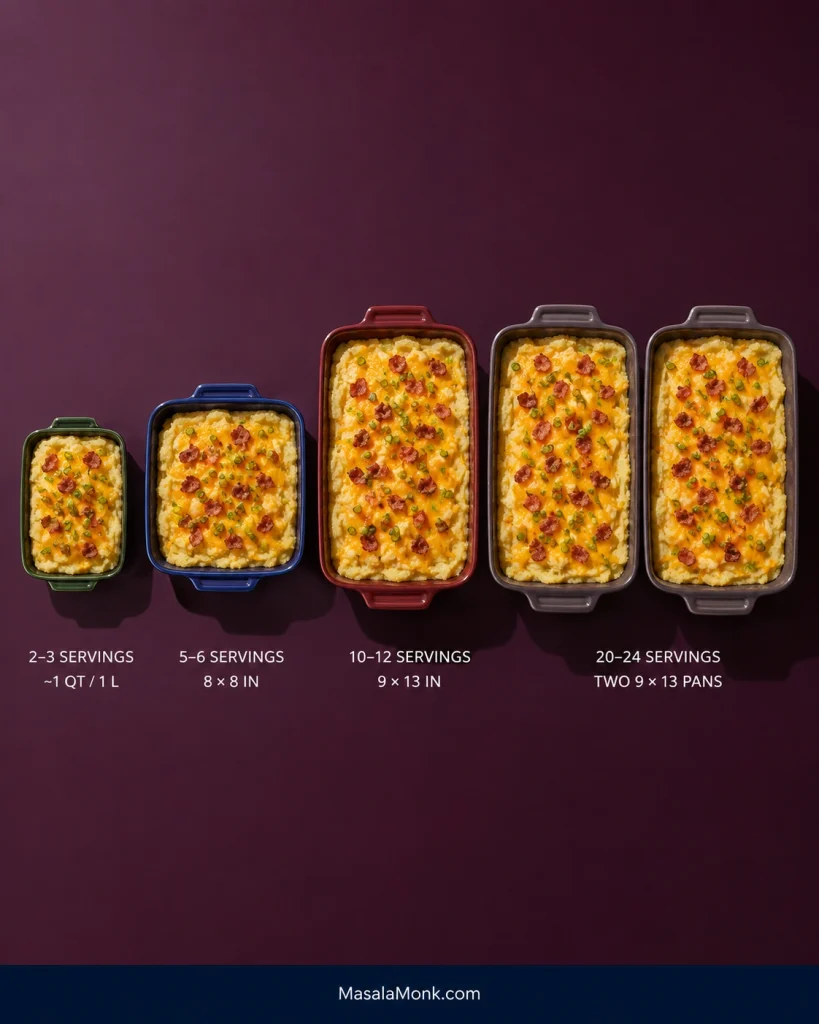
You don’t need a holiday crowd to make this. The same casserole works nicely in a small dish for two or three, and it scales more cleanly into two ordinary pans than one enormous one when the guest list grows.
| Side servings | Potatoes | Dish |
|---|---|---|
| 2–3 | About 1¼ lb / 570 g | About 1 qt / 1 L |
| 5–6 | About 2½ lb / 1.1 kg | 8×8 in / 20×20 cm |
| 10–12 | 5 lb / 2.27 kg | 9×13 in / 23×33 cm |
| 20–24 | About 10 lb / 4.5 kg | Two 9×13 pans |
A Small Batch for 2–3
- 1¼ lb / 570 g russet potatoes
- 2 tbsp / 28 g butter
- 1 oz / 28 g cream cheese
- ¼ cup / about 55–60 g sour cream
- 3 tbsp / 45 ml warm milk, plus up to 1 tbsp / 15 ml more if needed
- 3 oz / 85 g sharp cheddar, about ¾ cup shredded
- 1–2 green onions
- 3 oz / 85 g bacon, raw weight
- ⅜ tsp garlic powder, or ¼ tsp plus a generous pinch
- ⅛ tsp black pepper, then more to taste
- ⅛ tsp kosher salt to start, then taste after the bacon and cheddar are mixed in
Use roughly a 1-qt / 1-L baking dish and start checking the second bake around 15–20 minutes.
Half batch: halve the ingredients and use an 8×8-inch / 20×20-cm baking dish. Start checking around 20 minutes.
Doubling it: use two standard 9×13 pans instead of one heroic, overfilled dish. Two pans heat more predictably, give you more browned surface and are much easier to chill, transport and serve.
Working through roughly 10 lb / 4.5 kg potatoes? Mix them in two batches too. One enormous bowl usually means more stirring just to get everything combined.
Keeping It Warm for Serving
Can a slow cooker keep it warm? Yes—once the casserole is already properly hot. Don’t use a slow cooker to slowly bring a refrigerator-cold casserole or cold leftovers up to temperature.
For cooked leftovers, reheat first to 165°F / 74°C. After that, a slow cooker or other suitable hot-holding setup can keep the casserole at 140°F / 60°C or above. The USDA’s reheating guidance advises against reheating cold leftovers in a slow cooker.
Taking It to a Potluck
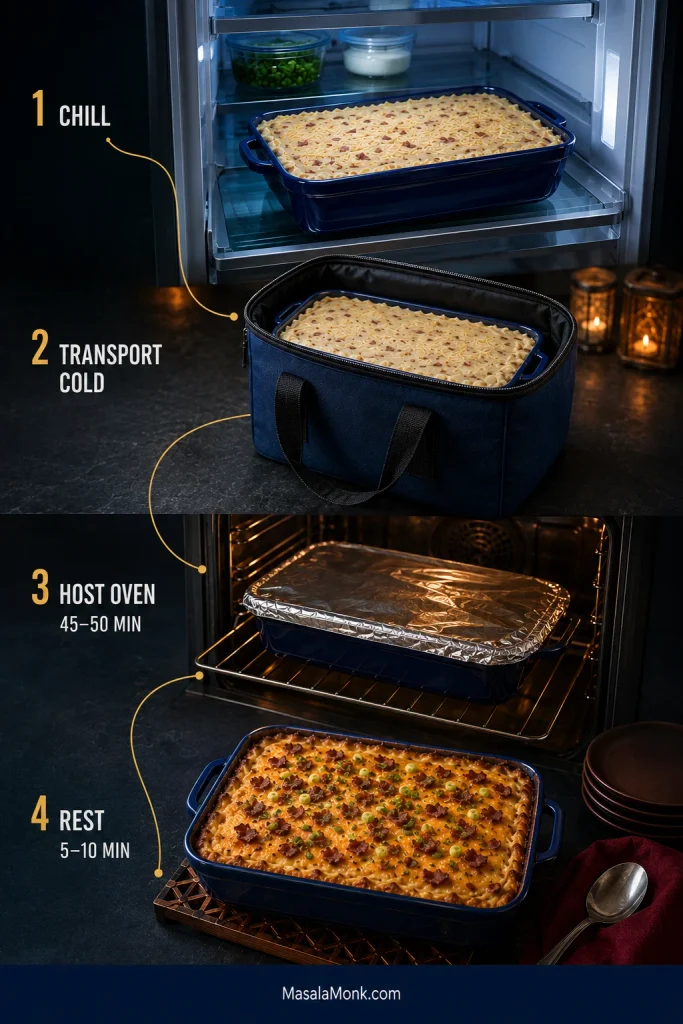
If the casserole has to ride in a car before dinner, baking it at the destination is usually easier than trying to keep a finished pan properly hot for the whole trip.
Assemble it, refrigerate it, transport it cold and refrigerate it again when you arrive. Plan on needing roughly 45–50 minutes of oven time at the destination, plus 5–10 minutes of resting time before serving.
For a longer trip, keep cold food at 40°F / 4°C or below with a chilled cooler or cold packs, and keep hot food at 140°F / 60°C or above. Put perishable food back under refrigeration within 2 hours, or within 1 hour when it’s hotter than 90°F / 32°C where the food is being held.
Storage & Freezing
Refrigerate cooked leftovers promptly and use them within 3–4 days.
Freezing the Casserole
Freezing works, but it isn’t texture-neutral. For eating quality, think freshly made > assembled and refrigerated > frozen. After freezing and thawing, potato can become slightly watery, grainy or mealy.
When freezing is the practical option, assemble before the final bake, wrap tightly and freeze for about 1 month for best quality. Thaw in the refrigerator and use the cold-bake method. A slightly wet-looking surface after thawing doesn’t automatically need more dairy; let the casserole heat first.
How to Reheat Twice Baked Potato Casserole
For cooked leftovers, reheat until the center reaches 165°F / 74°C. The times below are starting points; portion size, dish depth and microwave power all change the timing.
| Amount | Method | Start checking |
|---|---|---|
| 1 serving | Cover loosely and microwave; continue in short bursts as needed. | 60–90 seconds |
| Several servings | Cover and reheat at 350°F / 175°C. | 15–20 minutes |
| Whole casserole | Cover loosely with foil and reheat at 350°F / 175°C. | About 30 minutes; a deep, fully chilled pan may need 35–45 minutes |
A teaspoon or two of milk, butter or sour cream can help a small portion that has dried slightly. Uncover oven-reheated portions near the end when the cheese needs refreshing.
This is where the reserved bacon pays off: add it with fresh green onion to bring back the crunch and contrast when yesterday’s topping has softened.
What to Serve With It
This is already a substantial side, so something fresh, green or sharp keeps the meal from feeling too heavy. A cold vinegar cucumber salad is particularly good when you want crispness against the cheese and bacon.
With steak or roast beef, add green beans, asparagus or a sharp salad. The casserole also sits naturally beside Salisbury steak with mushroom gravy.
For a holiday meal, turkey or ham pair easily with roasted Brussels sprouts or another simply cooked green vegetable. Beside brisket, pulled pork or grilled chicken, something cold and crunchy such as tangy coleslaw gives the plate some relief from all that richness.
The scoop to look for is the one near the edge: browned cheddar on top, fluffy potato underneath, a piece of bacon that still cracks instead of bending, and enough green onion to brighten the whole thing.
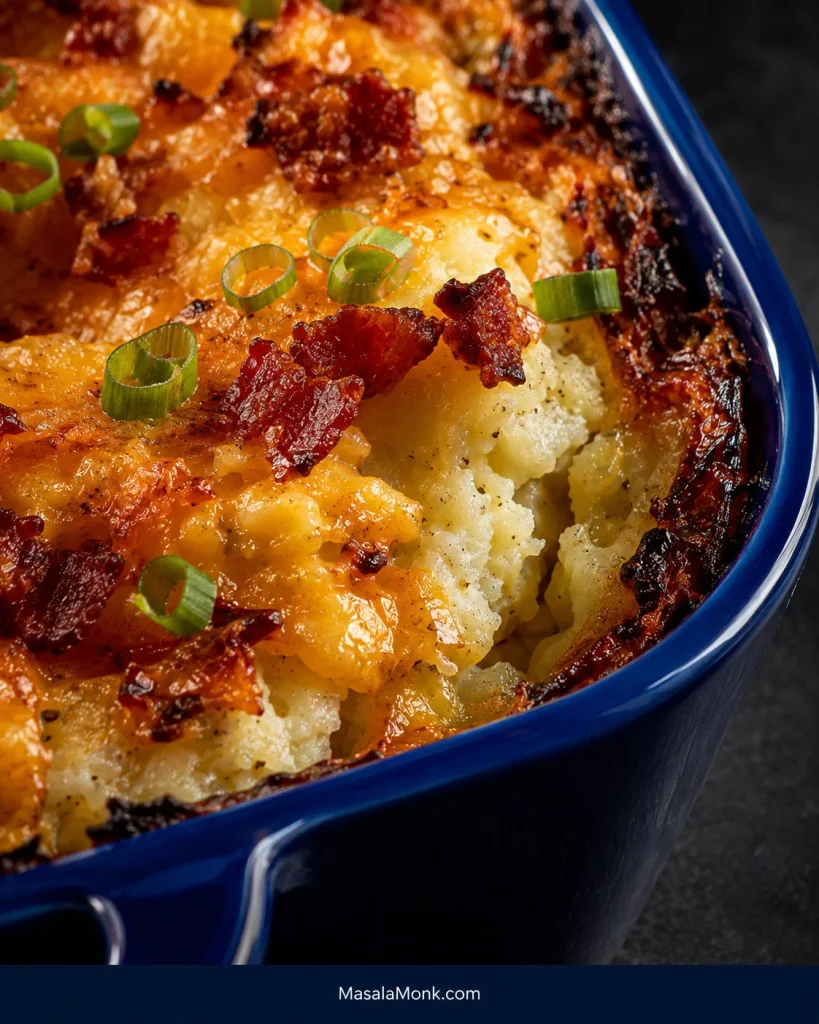
That’s the trade you’re making with the casserole version. You lose the individual potato shells, but when several people are waiting for dinner, one bubbling dish and a serving spoon are usually a much better arrangement.








