Posted on 4 Comments

Peanut Butter Fudge: Recipes & Guide (8 Methods + Easy Variations)

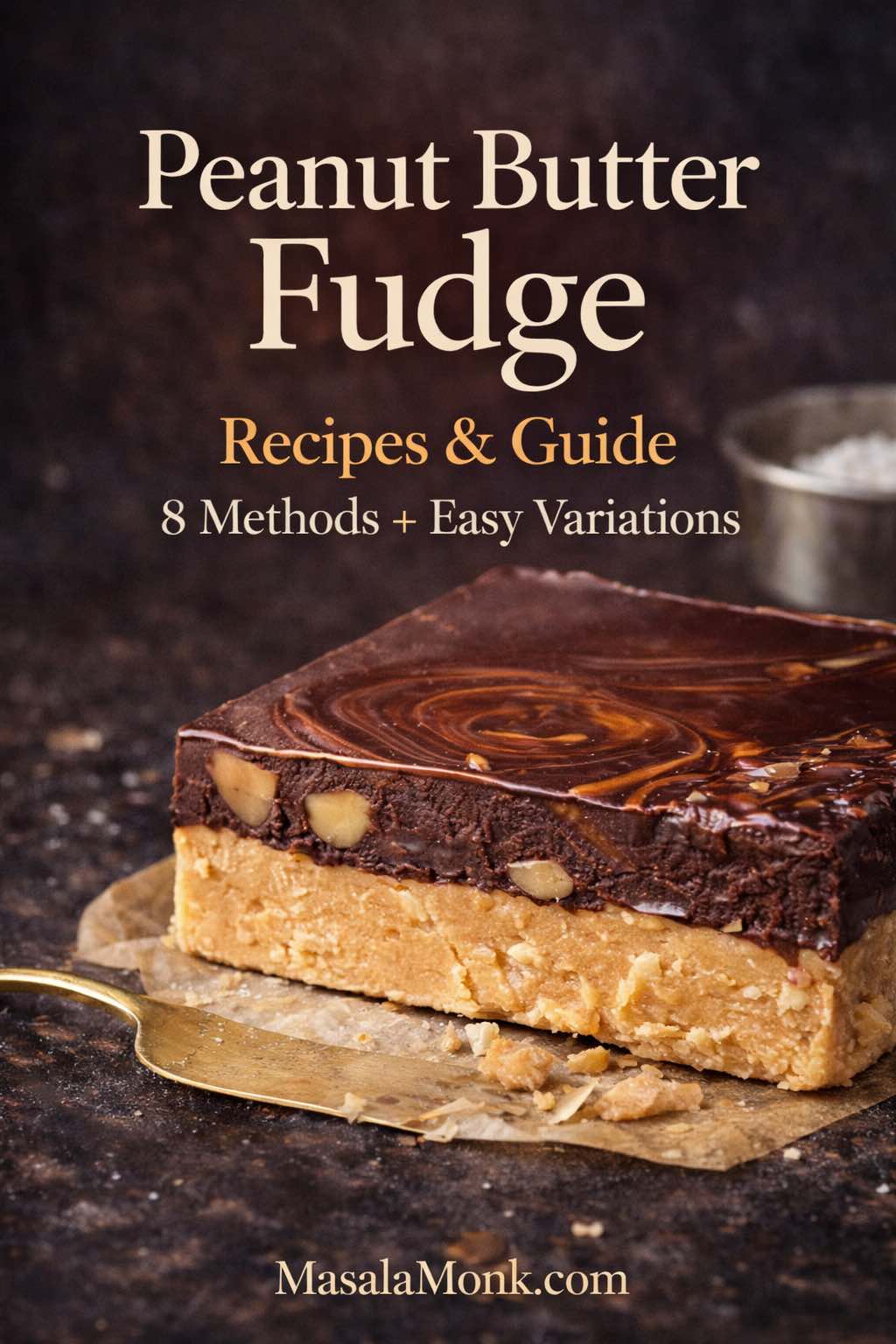
Peanut butter fudge cover image with a thick buckeye-style layered fudge square and text “Peanut Butter Fudge: Recipes & Guide – 8 Methods + Easy Variations.”

Some desserts feel like a project. This one, thankfully, doesn’t have to. A peanut butter fudge recipe can be a two-minute stir-and-chill treat, a creamy slice that tastes like it came from a candy counter, or an old-fashioned cooked confection with that unmistakable “holiday tray” vibe. Even better, it adapts: you can turn it into chocolate-and-peanut swirls, a buckeye-style slab with a glossy cap, a peanut-free version for allergy-friendly sharing, or a sugar-alternative batch that still scratches the same sweet itch.

Because there are so many ways to make it, the smartest approach is simple: pick the style that matches your mood, then follow the steps. Along the way, you’ll also learn how to troubleshoot grainy texture, fix a too-soft set, and store slices so they stay tender instead of drying out.

Choose your peanut butter fudge style

If you want the shortest path, start with the 2-ingredient version. If you prefer a creamier bite that rarely crumbles, go for the condensed milk method. Meanwhile, marshmallow creme delivers that plush, classic texture that many people associate with “fantasy” style fudge. On the other hand, if you’re craving a true candy-shop finish, the cooked soft-ball stage method is the one.
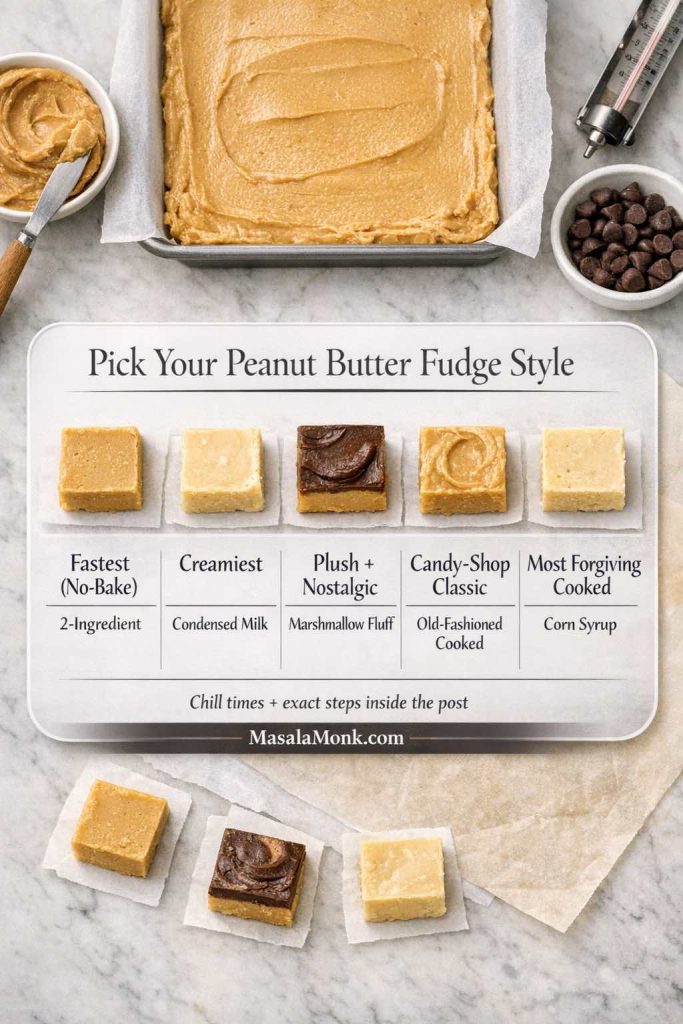
Quick chooser infographic for peanut butter fudge styles. Shows five options with fudge squares: 2-ingredient no-bake (fastest), condensed milk (creamiest), marshmallow fluff (plush nostalgic), old-fashioned cooked (candy-shop classic), and corn syrup method (most forgiving cooked). Includes MasalaMonk.com branding.
Not sure which peanut butter fudge recipe to make first? Use this quick chooser to match your mood to the right method—2-ingredient no-bake for speed, condensed milk for extra creaminess, marshmallow fluff for classic ‘fantasy’ texture, old-fashioned cooked for candy-shop flavor, or corn syrup for a smoother cooked set.
  • Fastest: 2-ingredient easy peanut butter fudge
  • Creamiest: peanut butter fudge with sweetened condensed milk
  • Plush/nostalgic: marshmallow fluff peanut butter fudge
  • Candy-shop: old fashioned peanut butter fudge (soft-ball stage)
  • Most forgiving cooked: peanut butter fudge with corn syrup
  • Shortcut: frosting and peanut butter fudge
  • Low-sugar: keto peanut butter fudge / sugar free peanut butter fudge
  • Allergy-friendly: peanut free fudge (seed butter swap)

No matter which route you take, great results begin with great peanut butter. If you like controlling the texture from the start—ultra smooth, slightly chunky, or deeply roasted—this guide on how to make peanut butter at home is a useful foundation.


Ingredients and tools that make everything easier

Before jumping into specific methods, it helps to set yourself up for a smooth run. Even when a recipe is “easy,” small choices can make the difference between creamy slices and a crumbly pan.

Pan size and lining

An 8-inch square pan is the sweet spot for thick, giftable squares. For thinner pieces (or if you want more servings), use a 9-inch square pan.

Line the pan with parchment paper, leaving overhang on two sides. That overhang becomes handles, so you can lift the slab out cleanly and slice without gouging the pan.

Peanut butter choice

You can use either stabilized peanut butter (the kind that doesn’t separate much) or natural peanut butter. However, natural versions vary a lot: some are oily and loose; others are stiff and dry.

  • If your peanut butter is very stiff, you’ll often need a touch more fat (butter or coconut oil) to keep the mixture from crumbling.
  • If it’s very runny, you may need a bit more structure (powdered sugar, a little extra chill time, or a firmer method like condensed milk).
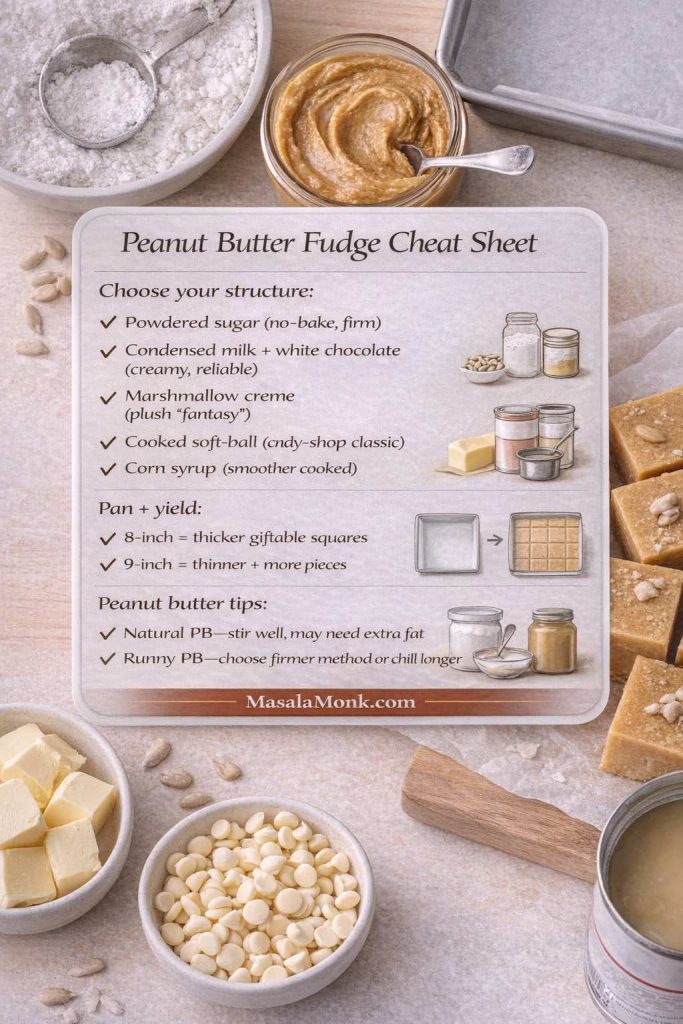
Photorealistic ‘Peanut Butter Fudge Cheat Sheet’ infographic. Lists how to choose a peanut butter fudge method: powdered sugar no-bake, condensed milk with white chocolate, marshmallow creme ‘fantasy’ style, cooked soft-ball, and corn syrup for smoother cooked fudge. Includes pan size guidance (8-inch thicker squares, 9-inch thinner more pieces) and peanut butter tips for natural vs runny peanut butter. MasalaMonk.com branding.
Save this peanut butter fudge cheat sheet to pick the right method fast—no-bake powdered sugar for speed, condensed milk + white chocolate for the creamiest reliable set, marshmallow creme for classic ‘fantasy’ texture, soft-ball cooked for candy-shop fudge, or corn syrup for a smoother cooked finish. It also shows the best pan size (8-inch vs 9-inch) and quick peanut butter tips so your batch sets the way you want.

Salt and vanilla in a peanut butter fudge recipe

Salt is the quiet hero here. Even salted peanut butter usually benefits from a pinch more. Vanilla is optional, yet it rounds the flavor and makes the final result taste more “finished.”

Optional tools

  • A sturdy silicone spatula (best for thick mixtures)
  • A heavy saucepan (for heated methods)
  • A candy thermometer (strongly recommended for cooked styles)

Storage and food safety

Fudge lasts well when protected from air. Still, many versions include dairy (butter, milk, condensed milk). For safe handling basics, the USDA’s guidance on leftovers and food safety is a solid reference.

Also Read: 10 Vegan Chocolate Cake Recipes (Easy, Moist, & Dairy-Free)


Method 1: Two ingredient easy peanut butter fudge (fast, firm, classic recipe)

This is the “I need something sweet right now” method. It’s also the simplest way to get that peanut-butter-candy vibe without turning on the stove.

What this style of fudge with peanut butter is like

The texture is firm and sliceable, with a sweetness that hits quickly and then fades into roasted peanut flavor. Because it sets through dry structure rather than cooking, the bite feels a bit like old-fashioned peanut butter candy—dense and satisfying.

Ingredients (8-inch pan)

  • 1 cup peanut butter (creamy works best)
  • 2 to 2½ cups powdered sugar
  • Optional: ½ teaspoon vanilla
  • Optional: pinch of salt
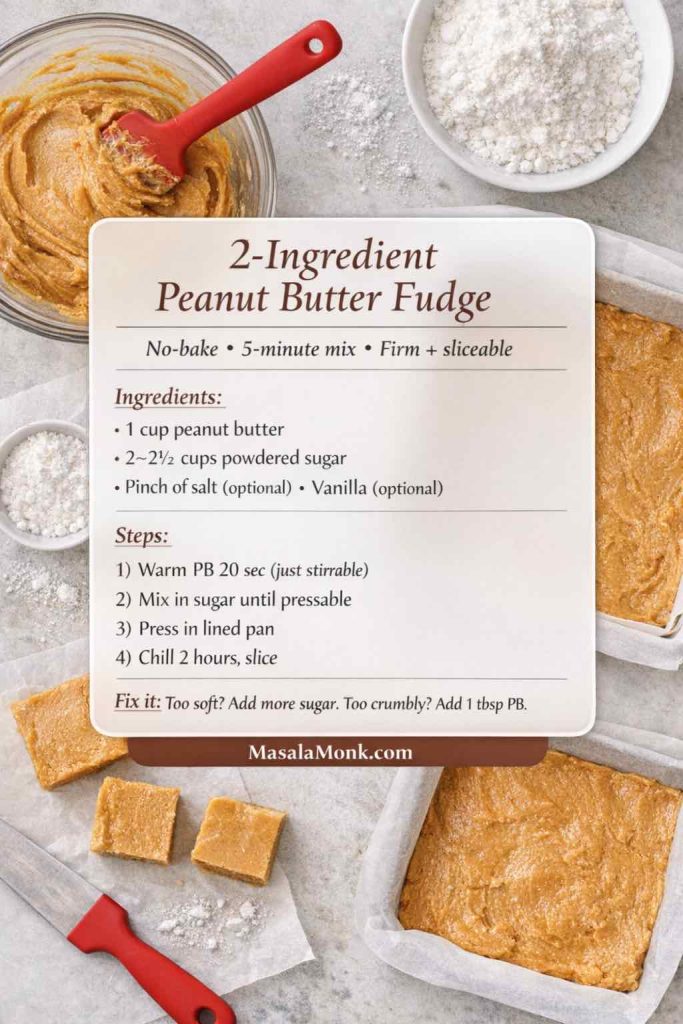
Photorealistic recipe card for 2-ingredient peanut butter fudge (no-bake). Shows ingredients (1 cup peanut butter, 2–2½ cups powdered sugar, optional salt and vanilla) and quick steps to mix, press into a lined pan, chill 2 hours, and slice. Includes tips to fix fudge that’s too soft or crumbly, with MasalaMonk.com branding.
This 2-ingredient peanut butter fudge is the fastest no-bake method: warm the peanut butter just until stirrable, mix in powdered sugar until pressable, then chill and slice. Save this card for those ‘need something sweet now’ moments—and use the quick fix tips if your batch turns out too soft or a little crumbly.

Step-by-step recipe

  1. Line the pan. Set it aside so it’s ready.
  2. Soften the peanut butter. Warm it gently—about 20 seconds in the microwave, or briefly in a small saucepan—just until it stirs easily. Avoid making it hot.
  3. Season it. Stir in vanilla and a pinch of salt if you’re using them.
  4. Add powdered sugar gradually. Start with 2 cups and stir until the mixture thickens into a soft dough.
    Next, add more powdered sugar a few tablespoons at a time until it holds together and feels pressable.
  5. Press into the pan. Use your spatula to compress it firmly. The tighter you press, the cleaner your slices will be.
  6. Chill until firm. Refrigerate at least 2 hours, then lift out and slice.

If it’s not perfect, fix it

  • Crumbly or dry: Warm 1–2 tablespoons of peanut butter and knead it into the mixture. Alternatively, add 1 tablespoon melted butter and mix again.
  • Too soft: Add a bit more powdered sugar and chill longer.

Also Read: Kahlua Drinks: 10 Easy Cocktail Recipes (Milk, Vodka, Coffee)


Method 2: Three ingredient peanut butter fudge (creamier and more forgiving)

This version keeps the no-bake ease, yet feels smoother and richer than the 2-ingredient batch. Because butter adds silkiness and helps binding, the texture often lands in that “creamy peanut butter fudge” zone.

Ingredients (8-inch pan)

  • 1 cup peanut butter
  • ¼ cup butter, melted
  • 2 to 2½ cups powdered sugar
  • Optional: ½ teaspoon vanilla
  • Optional: pinch of salt
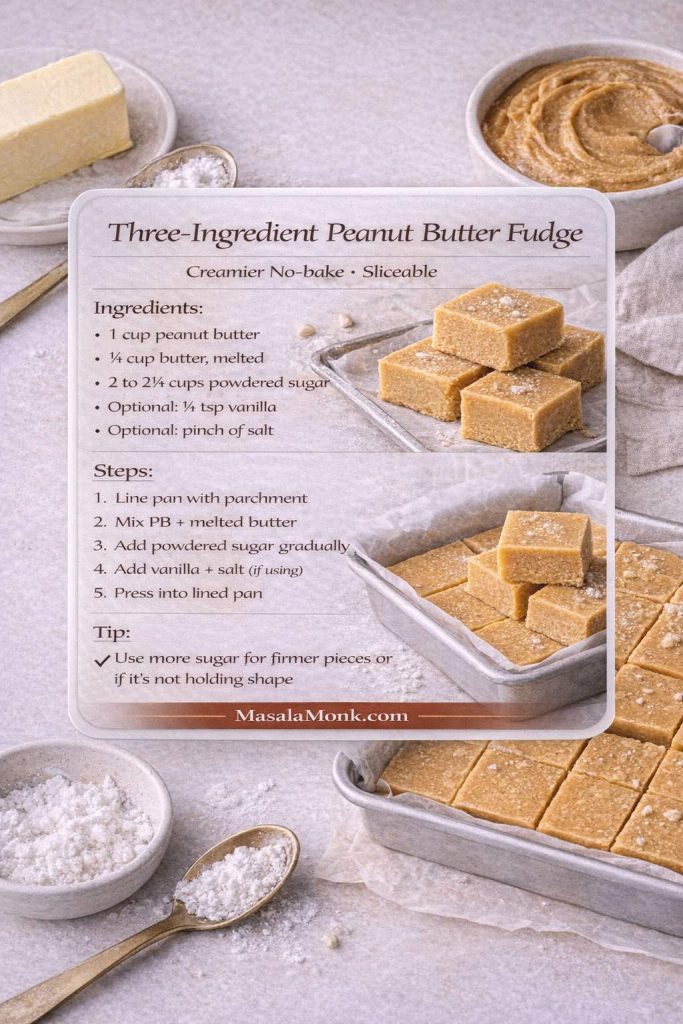
Photorealistic recipe card for three ingredient peanut butter fudge (no-bake). Shows ingredients: 1 cup peanut butter, ¼ cup melted butter, 2 to 2½ cups powdered sugar, optional vanilla, and a pinch of salt. Includes steps to line an 8-inch pan, mix peanut butter with melted butter, add powdered sugar gradually, press into the pan, and chill 2–3 hours until sliceable. MasalaMonk.com branding.
This 3-ingredient peanut butter fudge is the creamier, more forgiving upgrade from the 2-ingredient version—melted butter adds silkiness so the texture stays smooth and sliceable. Save this card for a quick no-bake fudge that sets reliably in the fridge and tastes extra peanut-forward with a bigger pinch of salt.

Step-by-step recipe

  1. Prepare your pan. Line it with parchment and set aside.
  2. Melt the butter. Let it cool for a minute so it’s warm, not scalding.
  3. Combine peanut butter and butter. Stir until glossy and unified.
  4. Add vanilla and salt if using.
  5. Stir in powdered sugar gradually. Begin with 2 cups, then adjust. The mixture should be thick but still spreadable.
  6. Press and smooth. Push it firmly into the pan and level the surface.
  7. Chill 2–3 hours until sliceable.

Flavor upgrades for 3 Ingredient peanut butter fudge

A slightly larger pinch of salt makes this taste more peanut-forward. Additionally, a spoonful of finely chopped roasted peanuts gives a satisfying crunch without making slicing difficult.

Also Read: Cranberry Moscow Mule Recipe: A Festive Holiday Cocktail With Easy Variations


Method 3: Four ingredient peanut butter fudge (balanced, “best-ever” flavor)

Four-ingredient versions are popular because that extra ingredient—often vanilla—makes the fudge taste more intentional. Moreover, the method is still just stir, press, chill.

Ingredients (8-inch pan)

  • 1 cup peanut butter
  • ¼ cup butter, melted
  • 2 cups powdered sugar (plus extra only if needed)
  • 1 teaspoon vanilla
  • Pinch of salt (highly recommended)
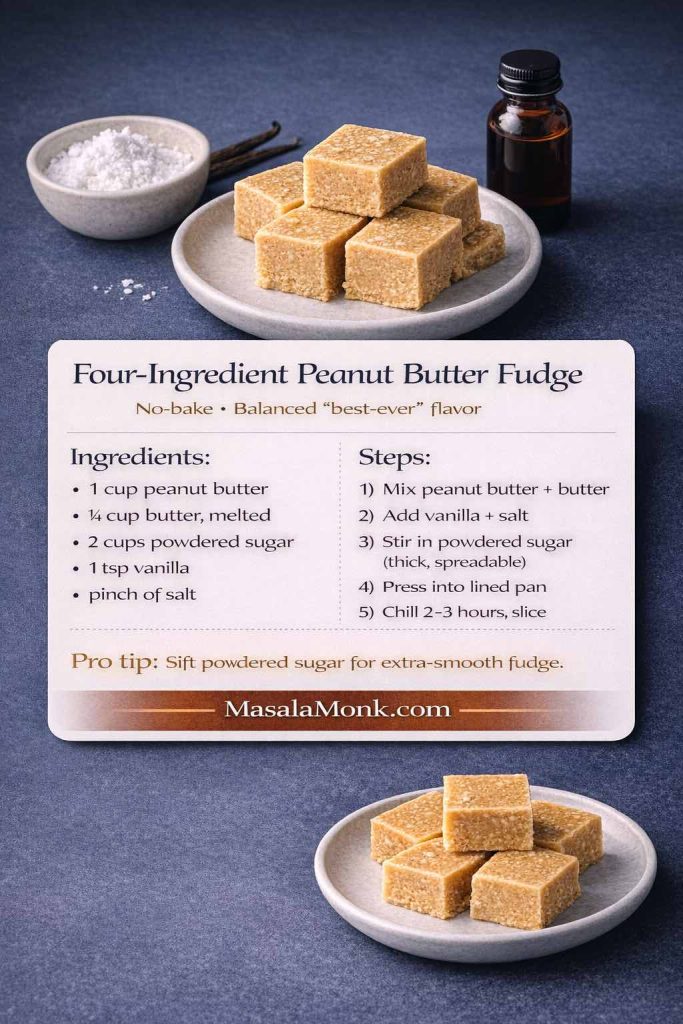
Photorealistic recipe card for four-ingredient peanut butter fudge (no-bake). Shows fudge squares on a plate with a navy background and an overlay listing ingredients (1 cup peanut butter, ¼ cup melted butter, 2 cups powdered sugar, 1 tsp vanilla, pinch of salt) and steps to mix, add vanilla and salt, stir in powdered sugar until thick, press into a lined pan, and chill 2–3 hours. Includes pro tip to sift powdered sugar for extra-smooth fudge. MasalaMonk.com branding.
Save this four-ingredient peanut butter fudge recipe card for a balanced, ‘best-ever’ no-bake batch that slices clean. The vanilla + salt make it taste more intentional, and the pro tip (sift the powdered sugar) helps keep the texture extra smooth instead of gritty.

Step-by-step

  1. Line the pan and set it nearby.
  2. Stir peanut butter and melted butter until smooth.
  3. Add vanilla and salt. Mix thoroughly.
  4. Add powdered sugar and stir until thick and spreadable.
  5. Press into the pan firmly; smooth the top.
  6. Chill 2–3 hours, then slice.

A simple cocoa twist in 4 Ingredient peanut butter fudge

If you want a quick chocolate-peanut vibe without adding a full layer, stir 1–2 tablespoons cocoa into half the mixture and swirl it through before chilling. For an easy drizzle at serving time, this quick homemade chocolate syrup works beautifully on top of a slice.

Also Read: Iced Coffee: 15 Drink Recipes—Latte, Cold Brew, Frappe & More


Method 4: Peanut Butter Fudge with Sweetened Condensed Milk (extra creamy, very reliable)

This is the candy-counter style: smooth, rich, and easy to slice. To guarantee a firm set, this condensed milk version uses white chocolate chips for structure. Without a setting ingredient, the classic “condensed milk + peanut butter” combo can stay too soft—especially in warmer kitchens.

Ingredients (for an 8-inch pan)

  • 1 can (14 oz / 396g) sweetened condensed milk
  • 2½ cups white chocolate chips
  • 1 cup peanut butter (creamy is easiest)
  • 1 teaspoon vanilla
  • Pinch of salt
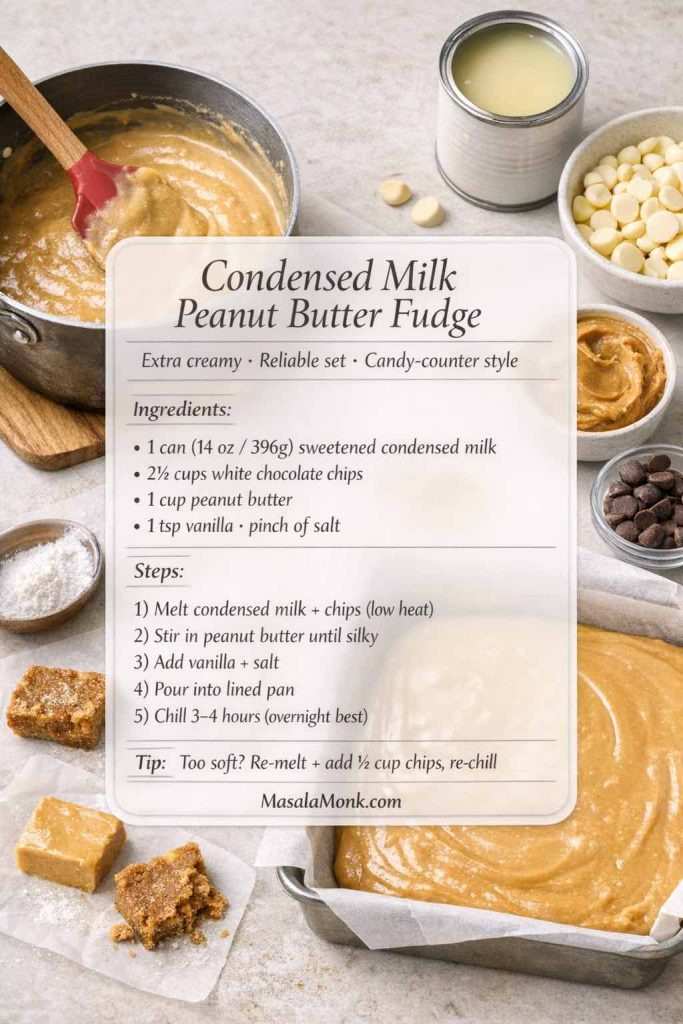
Photorealistic recipe card for condensed milk peanut butter fudge with a reliable set. Shows ingredients: 1 can (14 oz/396g) sweetened condensed milk, 2½ cups white chocolate chips, 1 cup peanut butter, vanilla, and salt. Includes steps to melt condensed milk with chips on low heat, stir in peanut butter, pour into a lined pan, and chill 3–4 hours (overnight best). Tip included for fixing fudge that’s too soft. MasalaMonk.com branding.
This condensed milk peanut butter fudge is the ‘candy-counter’ version—extra creamy, smooth, and reliably sliceable thanks to white chocolate chips for structure. Save this card if you want a gift-worthy batch with minimal effort: melt, stir, pour, chill, then cut clean squares.

Step-by-step

  1. Prep the pan: Line an 8-inch square pan with parchment paper, leaving overhang.
  2. Melt gently: In a heavy saucepan over low heat, warm the condensed milk and white chocolate chips, stirring constantly until smooth and glossy (about 3–6 minutes). Keep the heat low to avoid scorching.
  3. Add peanut butter: Stir in the peanut butter until fully unified and silky.
  4. Finish the flavor: Remove from heat and stir in vanilla and salt.
  5. Pour and smooth: Scrape into the pan, level the top, and tap the pan lightly to settle it.
  6. Chill to set: Refrigerate 3–4 hours (overnight is best for super-clean slices). Lift out and slice.

If it’s not perfect, fix it

  • Too soft: Chill longer first. If it still won’t set, re-melt gently and stir in ½ to 1 cup more white chocolate chips, then re-chill.
  • Too firm: Let slices sit at room temperature for 5–10 minutes before serving.

Condensed milk peanut butter fudge without white chocolate (works, but a different texture)

If you’d rather skip the chips, you can still use condensed milk—just add dry structure so it sets sliceable:

  • Warm 1 can condensed milk + 1 cup peanut butter over low heat until glossy.
  • Remove from heat and stir in 2 to 2½ cups powdered sugar until thick and spreadable.
  • Press into the pan and chill 3–4 hours.

This version is more “peanut butter candy” in texture than candy-shop fudge, but it’s still delicious and reliable when you want a no-chip option.

Also Read: Marinara Sauce Recipe: Classic Homemade Marinara


Method 5: Marshmallow Fluff Peanut Butter Fudge (plush, classic, nostalgic)

This is the classic “fantasy-style” approach: you cook the sugar base, then beat in marshmallow creme and peanut butter for that plush, sliceable, old-school texture. It’s much more reliable than simply mixing fluff and peanut butter and hoping it sets.

Ingredients (for an 8-inch pan)

  • 2 cups sugar
  • ½ cup evaporated milk (or whole milk)
  • ½ cup butter
  • 1 jar (7 oz / ~200g) marshmallow creme or marshmallow fluff
  • ¾ to 1 cup peanut butter
  • 1 teaspoon vanilla
  • Pinch of salt
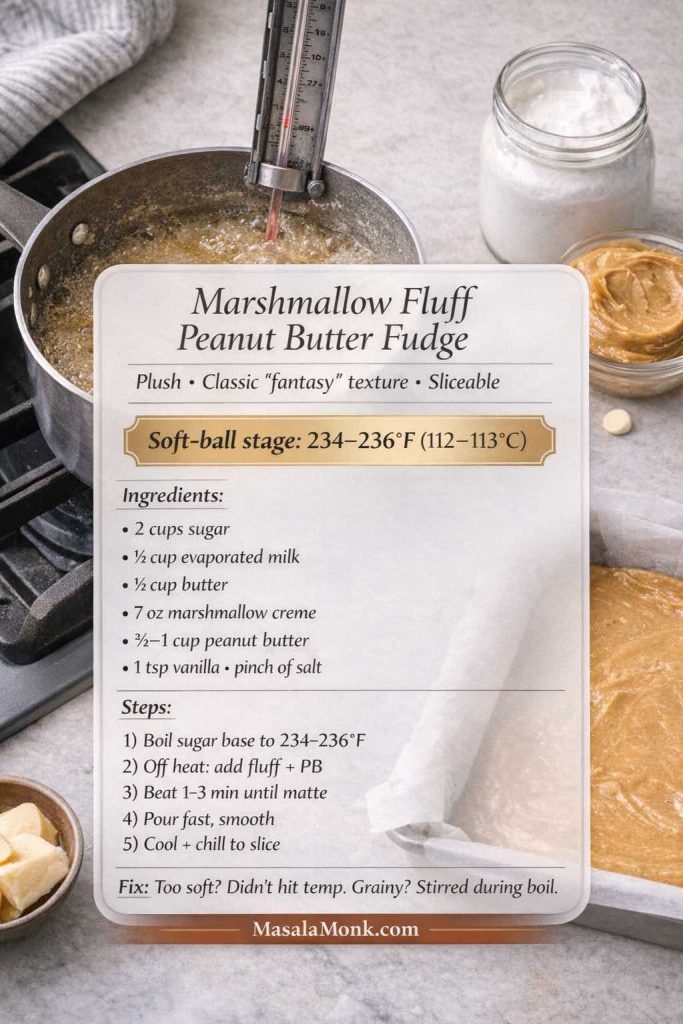
Photorealistic recipe card for marshmallow fluff peanut butter fudge (fantasy-style). Shows a bubbling sugar base in a saucepan with a candy thermometer and lists the soft-ball stage temperature (234–236°F / 112–113°C). Includes ingredients (sugar, evaporated milk, butter, marshmallow creme, peanut butter, vanilla, salt) and steps to boil to temp, add fluff and peanut butter off heat, beat until matte, pour, cool, and chill. MasalaMonk.com branding.
This marshmallow fluff peanut butter fudge is the classic ‘fantasy-style’ version—plush, nostalgic, and sliceable when you hit the soft-ball stage (234–236°F). Save this card if you want that old-school candy-shop texture, plus the quick fixes for batches that turn out too soft or grainy.

Step-by-step

  1. Line your pan with parchment and keep it close by. This mixture sets quickly once it’s beaten.
  2. Start the base: In a heavy saucepan, combine sugar, evaporated milk, and butter. Heat over medium, stirring until everything is dissolved and uniform.
  3. Boil to soft-ball stage: Bring to a steady boil and cook until the mixture reaches 234–236°F (112–113°C). Once it’s boiling, avoid stirring—if needed, gently swirl the pan instead.
  4. Finish off-heat: Remove from heat. Immediately add the marshmallow creme, peanut butter, vanilla, and salt.
  5. Beat until it turns matte: Stir vigorously (with a wooden spoon or a mixer on low) until the mixture thickens, loses some shine, and starts holding soft shape—usually 1–3 minutes.
  6. Pour and smooth fast: Transfer to the pan right away and smooth the top. Let it cool until set, then refrigerate for cleaner slices.

If Marshmallow Fluff Peanut Butter Fudge is not perfect, fix it

  • Grainy: Usually from sugar crystals or too much stirring while boiling. Next time, stop stirring once it boils and brush down the sides of the pan early with a little water.
  • Too soft: It likely didn’t reach soft-ball temperature. You can re-melt the batch gently, bring it back to 234–236°F, then beat again and reset.
  • Too firm/crumbly: It likely cooked a bit too hot or was beaten too long. Next time, stop beating as soon as it thickens and turns slightly matte.

Also Read: Hot Chocolate Coffee: 3 Easy Recipes (Cocoa, Mix, or Espresso)


Method 6: Frosting and peanut butter fudge (icing shortcut that actually works)

This method is almost unfairly easy. Because frosting already contains sugar and fat in a stable ratio, combining it with peanut butter creates a fudge-like base that sets in the fridge.

Ingredients (8-inch pan)

  • 1 cup peanut butter
  • 1 container frosting (about 16 oz / 450g), vanilla preferred
  • Pinch of salt
  • Optional: ½ teaspoon vanilla (if your frosting is bland)
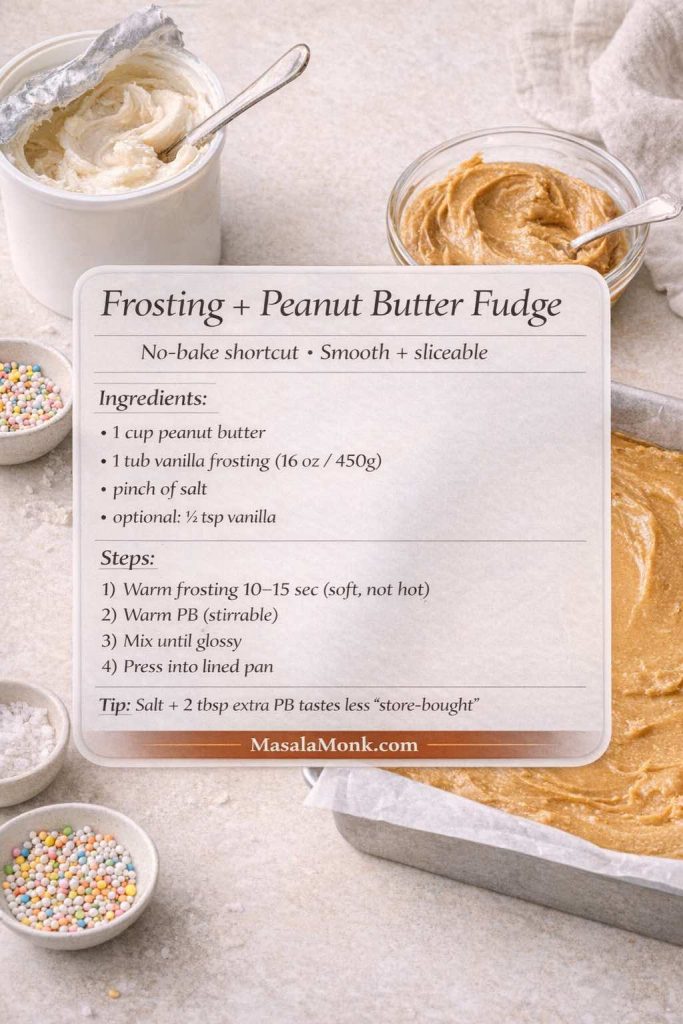
Photorealistic recipe card for frosting and peanut butter fudge (no-bake icing shortcut). Shows ingredients—peanut butter, vanilla frosting (16 oz/450g), pinch of salt, optional vanilla—and quick steps to warm frosting and peanut butter, mix until glossy, press into a lined pan, chill until set, and slice. Includes tip to add extra peanut butter and salt for better flavor. MasalaMonk.com branding.
This frosting and peanut butter fudge is the easiest no-bake shortcut—just warm, mix, press, and chill for smooth, sliceable squares. Save this card for last-minute dessert trays, and use the salt + extra peanut butter tip to make it taste less ‘store-bought.

Step-by-step

  1. Line your pan with parchment.
  2. Warm the frosting briefly. Microwave 10–15 seconds to soften it.
  3. Soften the peanut butter the same way—just enough to stir.
  4. Combine frosting and peanut butter until completely smooth.
    At first, it may resist; keep mixing and it will turn glossy.
  5. Season with salt (and vanilla if using).
  6. Spread into the pan and smooth the top.
  7. Chill 2–3 hours until set.

Make it taste less “store-bought”

Salt is essential here. Also, a little extra peanut butter (2–3 tablespoons) pushes the flavor forward and keeps it from tasting like frosting with peanuts.

Also Read: Strawberry Smoothie Recipes (12 Easy Blends + Bowls & Protein Shakes)


Method 7: Corn Syrup Peanut Butter Fudge (smoother cooked texture, less grainy)

Corn syrup is the quiet helper in cooked fudge. It makes the batch more forgiving by lowering the chances of that gritty, grainy texture that can sneak into candy. If you want old-fashioned flavor with a smoother finish and a little extra insurance, this is the cooked method to start with.

Ingredients (for an 8-inch pan)

  • 2 cups granulated sugar
  • ½ cup milk or evaporated milk
  • ½ cup light corn syrup
  • ¼ cup butter
  • 1 cup peanut butter (creamy is easiest)
  • 1 teaspoon vanilla
  • Pinch of salt
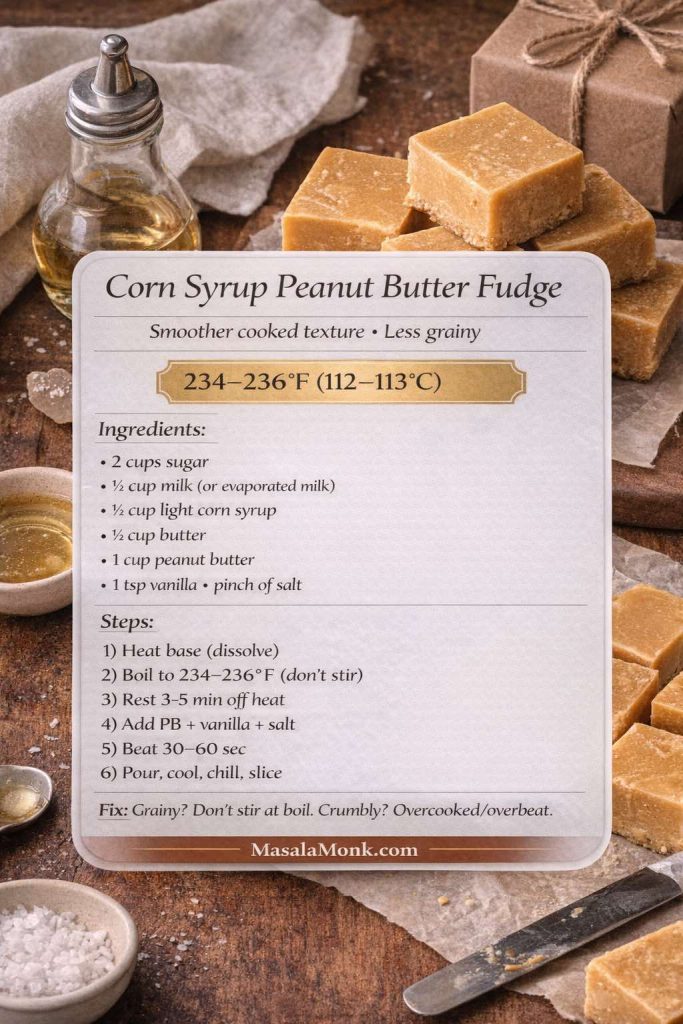
Photorealistic recipe card for corn syrup peanut butter fudge (Karo syrup style). Shows soft-ball stage temperature 234–236°F (112–113°C), ingredients (sugar, milk/evaporated milk, light corn syrup, butter, peanut butter, vanilla, salt) and steps to dissolve, boil without stirring, rest 3–5 minutes, stir in peanut butter, beat briefly, pour, cool, chill, and slice. MasalaMonk.com branding.
This corn syrup peanut butter fudge is the most forgiving cooked method—corn syrup helps reduce sugar crystallization so the texture stays smoother and less grainy. Save this card for the key cues: boil to 234–236°F, don’t stir at the boil, rest briefly off heat, then beat just until it turns slightly matte for clean slices.

Step-by-step

  1. Prep the pan first. Line an 8-inch square pan with parchment paper and leave overhang so you can lift the fudge out later.
  2. Start the base. In a heavy saucepan, combine sugar, milk, corn syrup, and butter. Heat over medium, stirring until the mixture is fully uniform and the sugar looks mostly dissolved.
  3. Boil without stirring. Bring it to a steady boil. Once it’s boiling, stop stirring (stirring encourages crystals). If needed, gently swirl the pan instead.
  4. Cook to soft-ball stage. Continue boiling until the mixture reaches 234–236°F (112–113°C) on a candy thermometer. (This range is where you get creamy fudge—not syrupy-soft and not crumbly.)
  5. Rest briefly. Remove from heat and let the pan sit undisturbed for 3–5 minutes.
  6. Add the peanut butter and flavorings. Stir in peanut butter, vanilla, and salt until completely smooth.
  7. Beat just until it thickens. Keep stirring for about 30–60 seconds, until it looks slightly thicker and loses some shine. Don’t keep going once it starts to resist—overbeating can make it crumbly.
  8. Pour and smooth fast. Scrape into the prepared pan immediately and smooth the top.
  9. Set and slice. Let it cool until firm at room temperature, then refrigerate for cleaner slices.

What makes this Corn Syrup Peanut Butter Fudge different

It’s still real cooked fudge, but the corn syrup helps keep the texture smoother and reduces the “grainy surprise” factor.

If it’s not perfect, fix it

  • Grainy: Next time, stop stirring once it boils, and brush down the sides of the pan early with a little water to remove sugar crystals.
  • Too soft: It likely didn’t reach temperature. You can gently reheat, bring back to 234–236°F, then finish again.
  • Crumbly: Usually cooked a touch too hot or beaten too long. Pull it off closer to 234°F next time and beat less.

Also Read: Sandwich for Breakfast: Breakfast Sandwich Recipe + 10 Variations
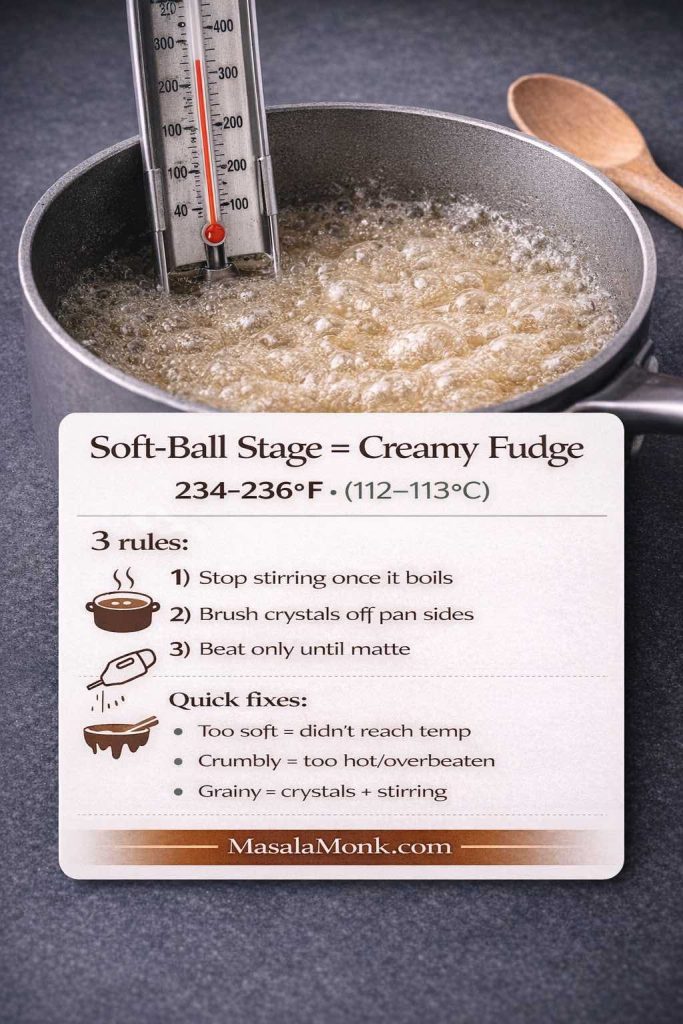

Photorealistic fudge-making cheat sheet showing soft-ball stage temperature for creamy fudge: 234–236°F (112–113°C). Background shows a saucepan of bubbling sugar syrup with a candy thermometer reading about 235°F and a wooden spoon nearby. Overlay lists three rules (stop stirring once it boils, brush crystals off pan sides, beat only until matte) and quick fixes for too soft, crumbly, or grainy fudge. MasalaMonk.com branding.
Save this soft-ball stage fudge temperature guide if you’re making old fashioned peanut butter fudge or any cooked fudge. Hitting 234–236°F (112–113°C) is the difference between creamy slices and a batch that’s too soft, crumbly, or grainy—and the quick rules here show exactly when to stop stirring and when to beat.

Method 8: Old-Fashioned Cooked Peanut Butter Fudge (classic soft-ball stage, candy-shop feel)

This is the true old-fashioned version—the one that smells like holidays and tastes like it came from a tiny candy shop. It’s a little more hands-on than the corn syrup method, but the payoff is big: a creamy, structured set and that classic “homemade fudge” character people remember.

Ingredients (for an 8-inch pan)

  • 2 cups granulated sugar
  • ½ cup milk or evaporated milk
  • ¼ cup butter
  • ¾ to 1 cup peanut butter (use 1 cup for bold peanut flavor)
  • 1 teaspoon vanilla
  • Pinch of salt
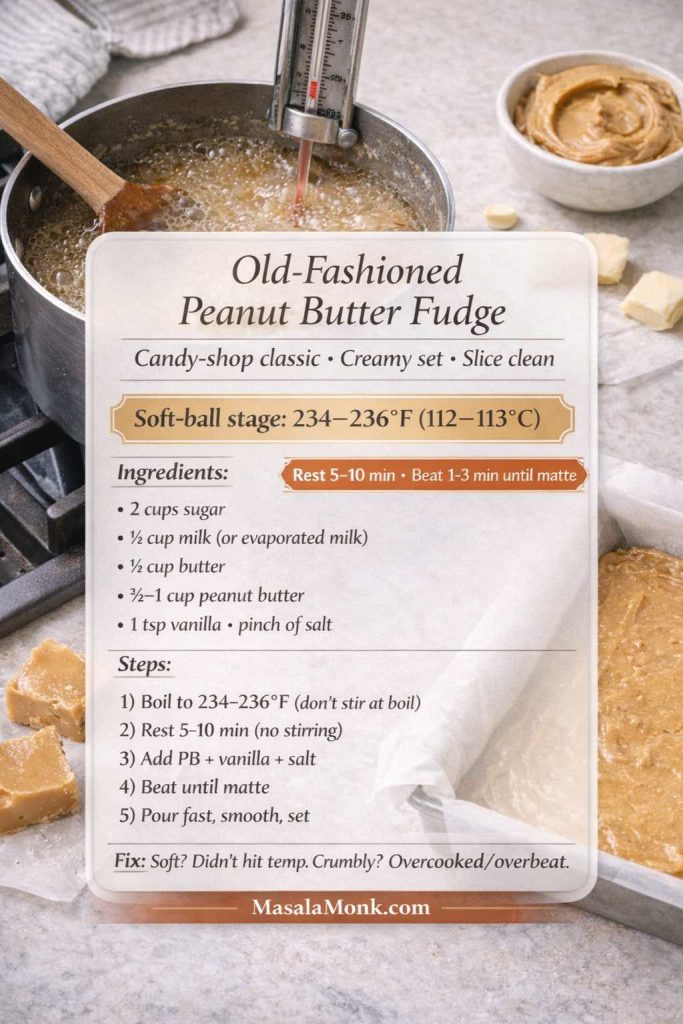
Photorealistic recipe card for old-fashioned peanut butter fudge. Includes soft-ball stage temperature (234–236°F / 112–113°C), timing cues to rest 5–10 minutes and beat 1–3 minutes until matte, plus ingredients and step-by-step instructions for a creamy candy-shop style set. MasalaMonk.com branding.
This old-fashioned peanut butter fudge is the classic candy-shop method: cook to the soft-ball stage (234–236°F), rest briefly, then beat until matte for that creamy, slice-clean set. Save this card if you want traditional holiday-tray fudge with the key timing cues that prevent grainy or crumbly batches.

Step-by-step

  1. Prep the pan. Line an 8-inch pan with parchment and set it right beside the stove. Timing matters later.
  2. Dissolve the sugar. In a heavy saucepan, combine sugar, milk, and butter. Heat over medium, stirring until the mixture is smooth and the sugar is dissolved.
  3. Boil hands-off. Bring to a steady boil. Once boiling, stop stirring. If you see sugar crystals on the sides early on, brush them down with a little water.
  4. Cook to soft-ball stage. Cook until the mixture reaches 234–236°F (112–113°C).
  5. Cool undisturbed. Remove from heat and let it sit 5–10 minutes without stirring. This short rest helps you land on creamy instead of gritty.
  6. Add peanut butter + finishers. Add peanut butter, vanilla, and salt. Stir until smooth.
  7. Beat until it turns matte. Stir vigorously until it thickens, loses gloss, lightens slightly, and starts holding its shape. This usually takes 1–3 minutes. Stop as soon as it reaches a thick, pourable stage—overbeating can make it crumble.
  8. Pour immediately. Scrape into the pan right away and smooth the top quickly.
  9. Set and slice. Let it set at room temperature, then refrigerate if you want extra clean edges when slicing.

Why this Cooked Peanut Butter Fudge is “classic”

The cooling pause and the beating step create tiny crystals that make fudge taste creamy and slice cleanly. The timing is the whole game.

If it’s not perfect, fix it

  • Too soft: It likely didn’t reach temperature. Reheat gently, bring back to 234–236°F, then finish again.
  • Grainy: Usually caused by stirring while boiling or crystals on the pan sides. Next time: hands off once boiling + brush down sides early.
  • Crumbly: Usually cooked too hot or beaten too long. Pull it off a touch earlier (closer to 234°F) and beat less.

Also Read: Paper Plane Cocktail Recipe + Best Amaro Substitutes & Tips


Chocolate peanut butter fudge and buckeye-style recipes

Chocolate turns a good batch into something that feels gift-worthy. Fortunately, you can add chocolate in several ways, depending on the mood.

If you want help choosing cocoa or chocolate types, MasalaMonk’s explainer on cacao vs chocolate vs dark chocolate is a handy read.
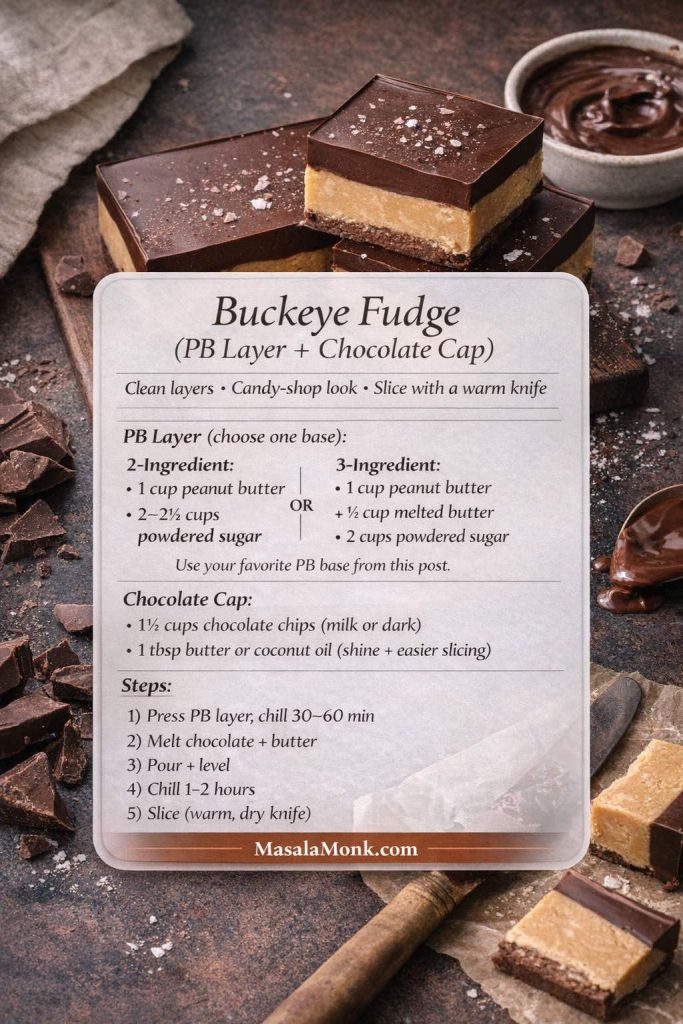
Photorealistic recipe card for buckeye fudge (chocolate peanut butter fudge with layers). Shows a peanut butter fudge base with a glossy chocolate cap and lists ingredients for the PB layer (2-ingredient or 3-ingredient base) plus chocolate topping (chocolate chips and butter/coconut oil). Includes steps to chill the PB layer, pour melted chocolate, chill again, and slice with a warm knife. MasalaMonk.com branding.
Buckeye fudge is the gift-worthy upgrade: a firm peanut butter fudge base topped with a smooth, glossy chocolate layer. Save this card for clean layers every time—chill the PB layer first, pour the melted chocolate cap, then slice with a warm, dry knife for sharp edges.

Variation A: Cocoa in the base (simple chocolate-peanut flavor)

Best for: a unified chocolate peanut fudge taste.

How to do it

  1. Make any base you like (no-bake, condensed milk, or marshmallow).
  2. Stir 2–4 tablespoons cocoa powder into the mixture.
    If it thickens too much, add 1–2 tablespoons warm peanut butter to loosen.
  3. Press, chill, slice.

Variation B: Buckeye fudge (peanut layer + chocolate cap)

Best for: clean layers and candy-shop vibes.

Chocolate cap ingredients

  • 1½ cups chocolate chips (milk or dark)
  • 1 tablespoon butter or coconut oil (for shine and easier slicing)

Step-by-step

  1. Make and set your peanut butter base fully.
  2. Melt chocolate chips with butter until smooth.
  3. Pour over the set layer and tilt the pan to spread evenly.
  4. Chill until firm, then slice with a warm knife.

Variation C: Swirl (marbled look with minimal effort)

Best for: an impressive finish without extra work.

Step-by-step

  1. Prepare your peanut layer, then spread it into the pan.
  2. Melt chocolate separately (or use a thick chocolate syrup).
  3. Spoon chocolate over the top and drag a knife through for swirls.
  4. Chill until set.

For a fast drizzle that looks elegant on a serving plate, this 3-minute chocolate syrup is an easy option.

Also Read: Katsu Curry Rice (Japanese Recipe, with Chicken Cutlet)


Keto peanut butter fudge (low-sugar direction, still rich)

Keto-style batches depend on the sweetener you choose. Because sugar alternatives vary, the texture can shift—sometimes firmer, sometimes softer. Still, a good base formula delivers a sliceable, satisfying result.

For a helpful overview of sweetener types, the American Diabetes Association’s PDF guide to sugar substitutes provides useful context. If you’re deciding on monk fruit specifically, Cleveland Clinic’s overview of monk fruit sweetener is a clear introduction.

Ingredients (8-inch pan)

  • 1 cup peanut butter (no added sugar)
  • ½ cup coconut oil or butter, melted
  • ¾ to 1 cup powdered-style keto sweetener blend
  • ½ teaspoon vanilla
  • Pinch of salt
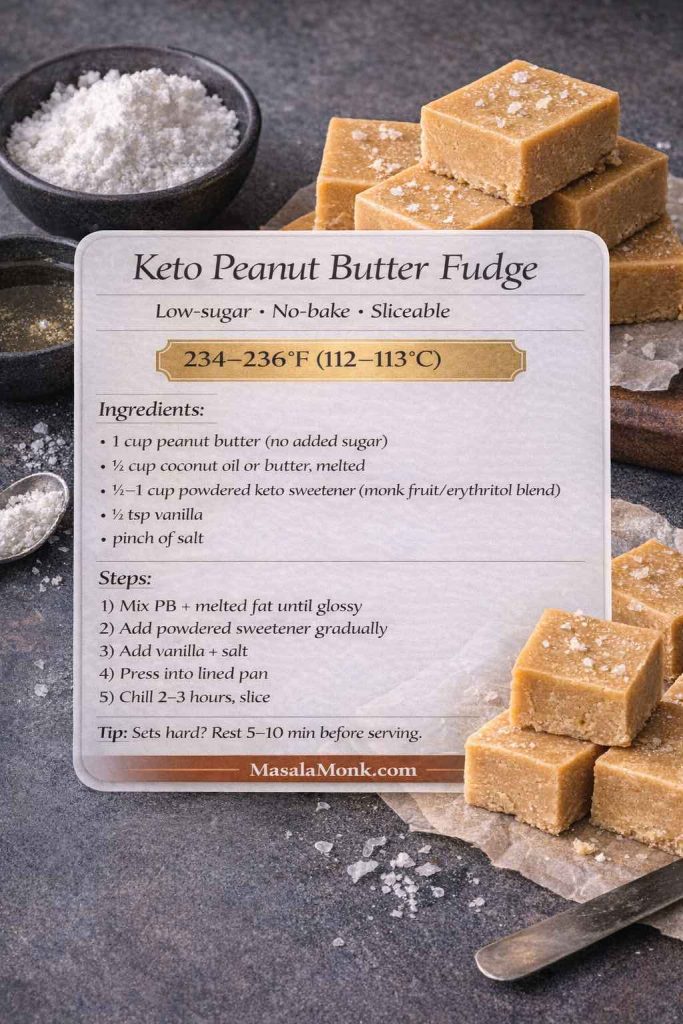
Photorealistic recipe card for keto peanut butter fudge (low-sugar, no-bake, sliceable). Shows ingredients: peanut butter with no added sugar, melted coconut oil or butter, powdered keto sweetener (monk fruit/erythritol blend), vanilla, and salt. Includes steps to mix until glossy, add sweetener, press into a lined pan, chill 2–3 hours, and slice, plus a tip to rest pieces 5–10 minutes if they set hard. MasalaMonk.com branding.
This keto peanut butter fudge is a simple no-bake, low-sugar method that still tastes rich and slices clean. Save this card if you’re making sugar-free peanut butter fudge with monk fruit/erythritol—use powdered sweetener for the smoothest texture, then chill until firm and let pieces rest briefly before serving if they set extra hard.

Step-by-step recipe

  1. Line your pan with parchment.
  2. Stir peanut butter and melted fat until glossy and smooth.
  3. Add sweetener gradually and mix until thickened.
    Taste as you go; sweetness builds quickly with some blends.
  4. Add vanilla and salt, mixing thoroughly.
  5. Press into the pan firmly and smooth the surface.
  6. Chill 2–3 hours until set.

Texture note for keto peanut butter fudge

If it sets very hard, let slices sit at room temperature for 5–10 minutes. Conversely, if it stays too soft, add a bit more powdered-style sweetener next time.

Also Read: Almond Flour Pancakes (Easy Recipes) Fluffy, High-Protein, Keto & More


Sugar-free peanut butter fudge and candy-style squares

Sugar-free versions often feel closer to “peanut butter candy” than traditional cooked fudge. That’s not a downside—rather, it’s a different texture expectation. The goal is a cohesive, sliceable slab with clean sweetness and strong peanut flavor.

For a grounded take on sweeteners, the NHS overview on whether sweeteners are safe is a practical read. If you prefer a research-focused summary, Harvard’s Nutrition Source page on low-calorie sweeteners adds nuance.

Ingredients (8-inch pan)

  • 1 cup peanut butter
  • ½ cup butter or coconut oil, melted
  • ¾ to 1 cup powdered sugar-free sweetener blend
  • ½ teaspoon vanilla
  • Pinch of salt
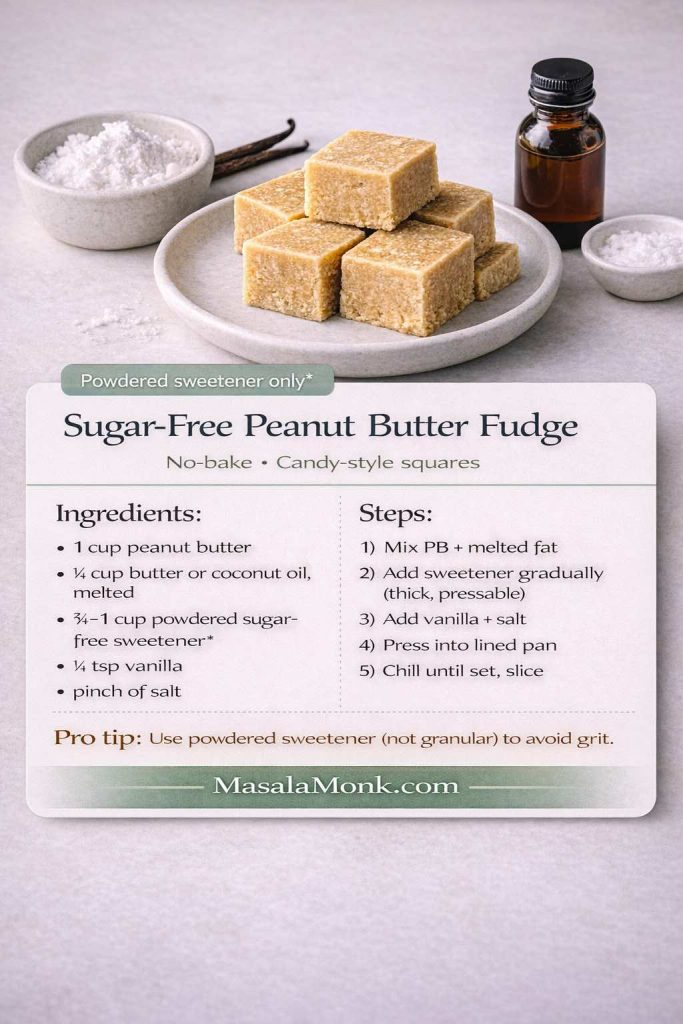
Recipe card image for sugar-free peanut butter fudge (no-bake, candy-style squares). Shows stacked peanut butter fudge squares on a plate with ingredients in the background (powdered sugar-free sweetener, melted butter or coconut oil, vanilla, and salt). Text overlay lists ingredients (1 cup peanut butter, ½ cup melted butter or coconut oil, ¾–1 cup powdered sugar-free sweetener, ½ tsp vanilla, pinch of salt) and steps to mix, add sweetener gradually, press into a lined pan, and chill until set. Pro tip: use powdered sweetener (not granular) to avoid grit. MasalaMonk.com footer.
Save this sugar-free peanut butter fudge recipe card for an easy no-bake, candy-style treat that still slices clean. The key to a smooth bite is using a powdered sugar-free sweetener (granular can taste gritty). Mix, press into a lined pan, chill, and you’ve got quick peanut butter fudge squares without the sugar.

Step-by-step

  1. Line the pan with parchment.
  2. Combine peanut butter and melted fat until smooth.
  3. Add sweetener gradually until the mixture becomes thick and pressable.
  4. Stir in vanilla and salt to finish.
  5. Press into the pan firmly.
  6. Chill until set and slice.

Avoiding grit

Powdered-style sweeteners generally work better than granular ones in no-bake candy squares. Additionally, mixing thoroughly helps eliminate pockets of sweetness that can feel sharp.

Also Read: How to Cook Tortellini (Fresh, Frozen, Dried) + Easy Dinner Ideas


Peanut-free fudge (allergy-friendly recipe, still sliceable)

Peanut-free fudge is completely doable when you swap the spread. The method stays the same; the flavor shifts. For substitution ideas, Food Allergy Research & Education has a helpful list of peanut butter alternatives, including sunflower seed butter and soy nut butter.

Ingredients (8-inch pan, no-bake style)

  • 1 cup sunflower seed butter (or another peanut-free alternative)
  • ¼ cup melted butter (or coconut oil)
  • 2 cups powdered sugar (or suitable alternative)
  • ½ teaspoon vanilla
  • Pinch of salt
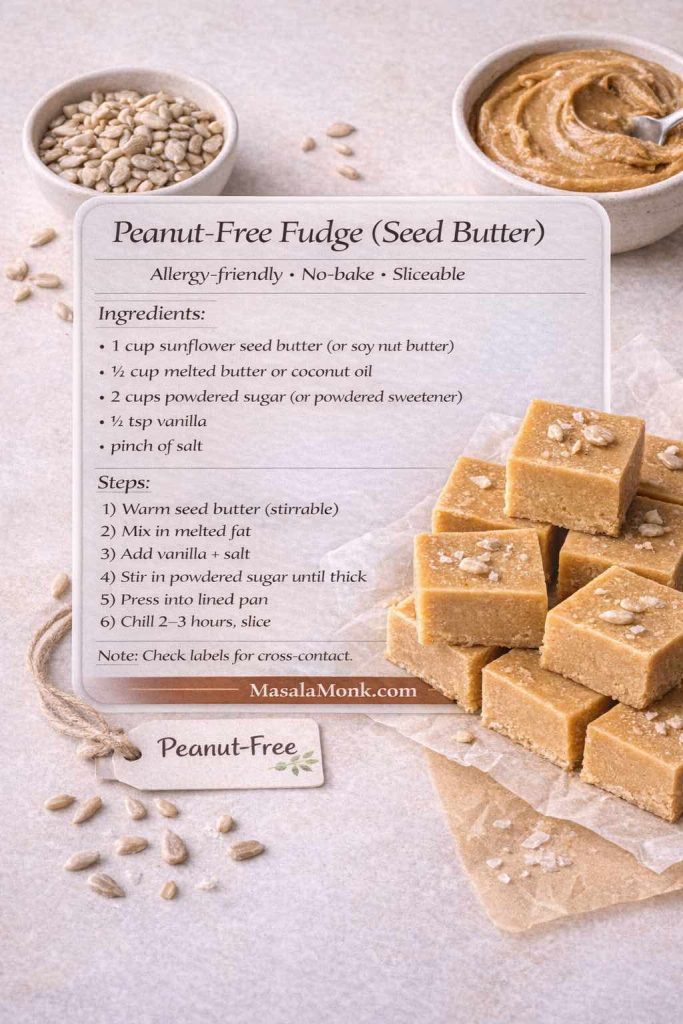
Photorealistic recipe card for peanut-free fudge made with seed butter. Shows sunflower seed butter (or soy nut butter) fudge squares and lists ingredients (seed butter, melted butter or coconut oil, powdered sugar or powdered sweetener, vanilla, salt) and steps to warm, mix, press into a lined pan, and chill 2–3 hours. Includes safety note to check labels for cross-contact. MasalaMonk.com branding.
This peanut-free fudge uses sunflower seed butter for an allergy-friendly, no-bake treat that still slices clean. Save this card for school events, parties, and potlucks—same easy method, different spread. Always check labels for cross-contact if you’re cooking for peanut allergies.

Step-by-step

  1. Line your pan with parchment.
  2. Warm the seed butter slightly so it stirs smoothly.
  3. Mix in melted butter until glossy.
  4. Add vanilla and salt.
  5. Stir in powdered sugar gradually until thick and spreadable.
  6. Press into the pan and chill until set.

Important reminder

Even when you use peanut-free ingredients, always check labels for cross-contact warnings if you’re cooking for someone with severe allergies.

Also Read: How to Cook Bacon in the Oven (Crispy, No-Mess, Crowd-Ready Recipe)


Troubleshooting: fix texture issues without panic

Even when you follow directions, fudge can surprise you. Fortunately, most problems have straightforward fixes.
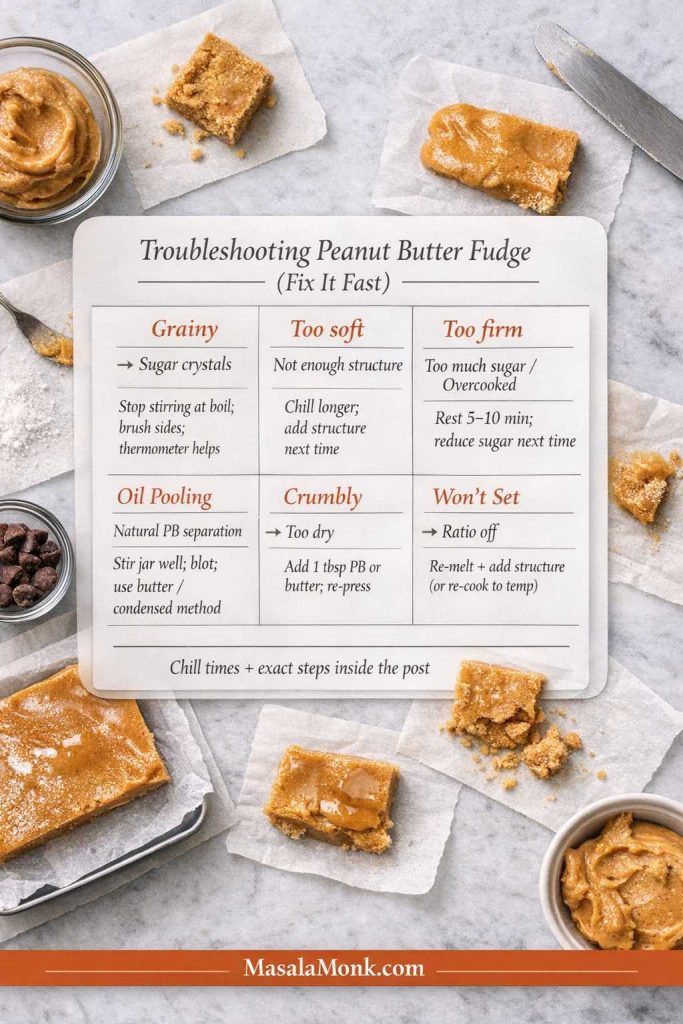
Troubleshooting infographic for peanut butter fudge with quick fixes for common problems: grainy texture (sugar crystals), fudge too soft, too firm, oil pooling from natural peanut butter separation, crumbly/dry fudge, and fudge that won’t set. Includes simple solutions like chilling longer, adjusting structure, stirring techniques for cooked fudge, and re-pressing, with MasalaMonk.com branding.
Fudge didn’t turn out the way you wanted? Save this quick troubleshooting guide for peanut butter fudge—fix grainy batches, rescue fudge that’s too soft or too firm, handle oil pooling (common with natural peanut butter), and recover crumbly or won’t-set slabs without starting over.

If it’s grainy

Graininess usually comes from sugar crystallization in cooked batches. To reduce the chance:

  • Avoid stirring while the mixture boils.
  • Use a clean pastry brush and water to wash sugar crystals from the sides early.
  • Consider the corn syrup method if you want extra insurance. King Arthur’s explanation of corn syrup’s role is helpful for understanding why it works.

Your Peanut butter fudge is too soft

  • Chill longer first; many slabs firm up with time.
  • For no-bake versions, add a bit more powdered sugar (or powdered sweetener) next time.
  • For condensed milk versions, slightly increase peanut butter or reduce condensed milk a touch.

If it’s too firm

  • Let it sit at room temperature for several minutes before serving.
  • In future batches, reduce powdered sugar slightly, or add a bit more fat (butter/coconut oil).

And If oil pools on top of your peanut butter fudge

This happens most often with natural peanut butter that separates easily.

  • Stir the peanut butter extremely well before measuring.
  • Chill the slab, then blot any surface oil gently with paper towel.
  • Next time, use the 3-ingredient method or a condensed milk base for a more stable set.

If it crumbles when slicing

Crumbly no-bake fudge usually needs more binding:

  • Add a spoonful of warmed peanut butter and mix again.
  • Alternatively, add a tablespoon of melted butter and re-press.

Also Read: Benefits of Nuts and Seeds – Protein-Packed Superfoods


Slicing, serving, and pairing ideas

Slicing goes best when the slab is cold and firm. Use a long knife, warm it under hot water, wipe dry, and slice in decisive downward cuts. Then, wipe the blade between slices for clean edges.
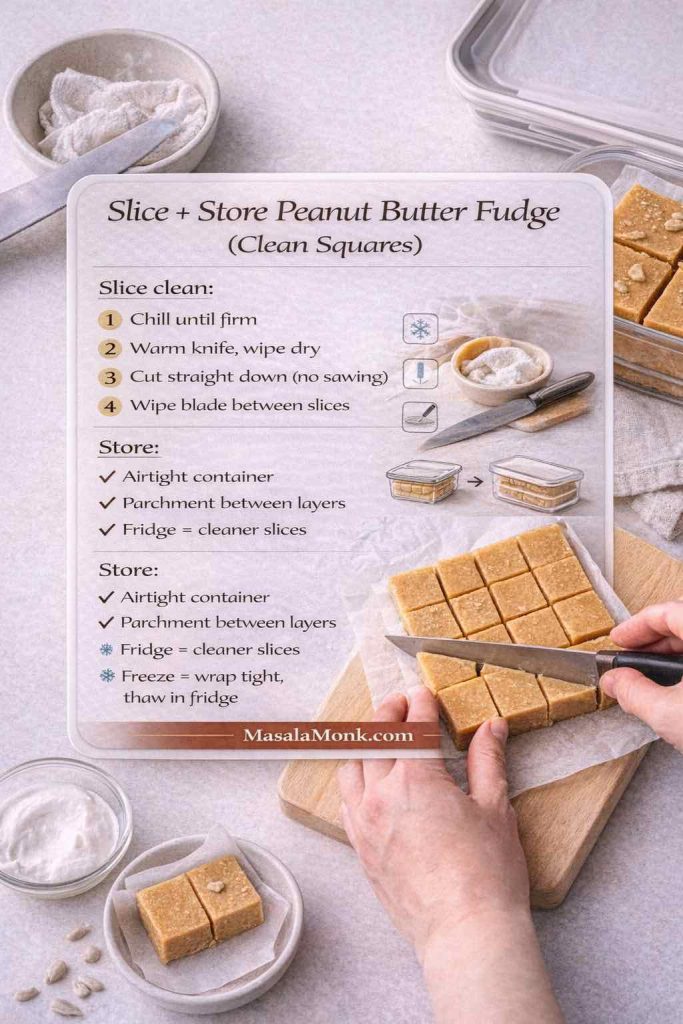
Step-by-step infographic showing how to slice and store peanut butter fudge for clean squares. Includes tips to chill until firm, warm and dry the knife, cut straight down (no sawing), and wipe the blade between slices. Storage guidance includes using an airtight container, parchment between layers, refrigerating for cleaner slices, and freezing by wrapping tightly and thawing in the fridge. MasalaMonk.com branding.
Want clean, sharp peanut butter fudge squares? Save this slicing + storage guide: chill the slab, warm and dry your knife, cut straight down, and wipe between slices. It also shows the best way to store peanut butter fudge (airtight + parchment layers) and how to freeze it without the surface getting messy when thawed.

For a peanut-butter-themed dessert plate, pairing squares with cookies makes everything feel intentional. MasalaMonk’s peanut butter cookies fit naturally alongside any of these methods. Meanwhile, if you want a lighter contrast, these healthy oat cookies balance rich fudge nicely. Finally, for something bright and fruity on the same spread, MasalaMonk’s mango dessert ideas bring a fresh counterpoint.


A closing thought (and a simple way to pick your winner)

If you’re short on time, start with the 2-ingredient batch. If you’re after creamy reliability, choose the condensed milk method. And if you want plush nostalgia, marshmallow creme is the move. When you want true candy-shop character, go cooked soft-ball stage. After that, chocolate turns any version into a showpiece—especially buckeye-style with a glossy cap.

Once you’ve made two or three styles, you’ll notice something: the “best” one changes depending on the day. Sometimes you want the easiest pan imaginable. Other times you want a softer melt, a deeper cooked flavor, or an allergy-friendly swap so everyone can share. Luckily, all of those are within reach—one method at a time.

Also Read: High Protein Overnight Oats | 5 Recipes (Low Calorie, Vegan, Bulking & More)


FAQs

1. What is the best peanut butter fudge recipe for beginners?

If you’re new to fudge, start with a no-bake peanut butter fudge that uses powdered sugar (the 2-, 3-, or 4-ingredient styles). It’s straightforward, doesn’t require a thermometer, and sets firmly in the fridge. After that, try the condensed milk or cooked soft-ball versions when you want a more candy-shop finish.

2. What are the ingredients in peanut butter fudge?

Peanut butter fudge usually needs peanut butter + a sweetener/structure. Depending on the method, that structure can be powdered sugar, sweetened condensed milk, marshmallow creme, or a cooked sugar base. In addition, many recipes include butter, vanilla, and salt to improve texture and flavor.

3. How do you make two ingredient peanut butter fudge?

Two-ingredient peanut butter fudge is typically peanut butter + powdered sugar. Warm the peanut butter just until stirrable, then mix in powdered sugar until the mixture becomes thick and pressable. Finally, press it into a lined pan and chill until firm.

4. How do you make three ingredient peanut butter fudge?

Three-ingredient versions usually add melted butter to peanut butter and powdered sugar. The butter makes the mixture creamier and easier to spread. Once combined, chill until sliceable.

5. What makes four ingredient peanut butter fudge taste “best ever”?

Four-ingredient peanut butter fudge often includes vanilla (plus peanut butter, butter, and powdered sugar). Vanilla and salt make the flavor taste more complete, while the butter keeps the bite smoother. As a result, it reads more like a finished candy than a quick mix.

6. Can I make peanut butter fudge with sweetened condensed milk?

Yes. For a reliable, creamy set, condensed milk versions usually need an additional “setting” ingredient (commonly white chocolate chips) or extra dry structure (like powdered sugar). Otherwise, condensed milk and peanut butter alone can stay too soft, especially in warmer kitchens.

7. What is marshmallow creme or fluff peanut butter fudge?

Marshmallow creme (or fluff) versions are often called fantasy-style peanut butter fudge. Typically, you cook a sugar base to the soft-ball stage, then beat in marshmallow creme and peanut butter. Consequently, the texture turns plush, cohesive, and sliceable for days.

8. How do you make old fashioned peanut butter fudge?

Old fashioned peanut butter fudge is a cooked method that usually requires reaching the soft-ball stage (about 234–236°F / 112–113°C). After cooking, you cool it briefly, then beat until it thickens and loses some shine before pouring into the pan. That timing is what creates the classic creamy bite.

9. What is corn syrup peanut butter fudge, and why use it?

Corn syrup versions are cooked fudge with an extra helper ingredient. Corn syrup helps reduce crystallization, which can lead to a smoother texture. In other words, it’s a more forgiving route when you want cooked fudge flavor without as much risk of graininess.

10. How do you make chocolate peanut butter fudge?

You can add chocolate in three easy ways: mix cocoa into the base, swirl melted chocolate through before chilling, or add a top layer for a buckeye-style finish. Meanwhile, using milk chocolate chips gives a softer, sweeter “candy bar” vibe, while dark chocolate makes the peanut flavor pop.

11. What is buckeye fudge?

Buckeye fudge is a peanut butter fudge base topped with a firm chocolate layer. Once the peanut butter layer is set, pour melted chocolate (often with a little butter or coconut oil for shine) over the top. Then chill again and slice with a warm knife for neat layers.

12. Can I make no bake peanut butter fudge?

Definitely. No-bake peanut butter fudge usually sets by using powdered sugar or a structured base like frosting. Because there’s no cooking stage, it’s faster and less fussy. Still, measuring and mixing thoroughly matters for a clean set.

13. Why is my peanut butter fudge grainy?

Graininess usually comes from sugar crystallization in cooked fudge, or from undissolved granules. To prevent it, avoid stirring once the mixture boils, keep crystals off the sides of the pan, and use a thermometer for accuracy. Conversely, if it’s a no-bake sweetener issue, switching to a powdered-style sweetener often helps.

14. Why is my peanut butter fudge too soft?

First, give it more chill time—many batches firm up as they cool fully. If it’s still soft, the mixture likely needs more structure: add a bit more powdered sugar (or powdered sweetener) next time. For cooked versions, it may not have reached soft-ball temperature, so a thermometer is the quickest fix.

15. Why is my peanut butter fudge crumbly or dry?

This usually means there’s too much dry structure or not enough fat. Add a spoonful of warmed peanut butter (or a little melted butter) and mix again, then press firmly into the pan. Next time, use slightly less powdered sugar or choose the condensed milk or marshmallow method for a creamier set.

16. Why did oil pool on top of my peanut butter fudge?

This happens most often with natural peanut butter that separates easily. Stir the jar extremely well before measuring, then chill and blot any surface oil if needed. Additionally, choosing a method with more stability (butter, condensed milk, or cooked fudge) can reduce pooling.

17. Can I make sugar free peanut butter fudge?

Yes, as long as you use a powdered-style sugar-free sweetener for the smoothest texture. Granular sweeteners can feel gritty in no-bake candy squares. Also, sweetness levels vary by brand, so taste as you go and adjust slowly.

18. Can I make keto peanut butter fudge?

Keto peanut butter fudge typically uses peanut butter with no added sugar, a fat like butter or coconut oil, and a powdered keto sweetener. If it sets very hard, let it sit at room temperature briefly before serving. On the other hand, if it stays too soft, add a little more powdered sweetener next time.

19. How do you make peanut free fudge?

To make peanut-free fudge, swap peanut butter for a safe alternative like sunflower seed butter or soy nut butter, then follow the same no-bake method. However, if you’re baking for allergies, always check labels and watch for cross-contact warnings.

20. How long does peanut butter fudge last and how should I store it?

For the best texture, store peanut butter fudge in an airtight container with parchment between layers. In a cool room, it can last several days; in the fridge, it lasts longer and slices cleaner. Furthermore, freezing works well—wrap tightly and thaw in the fridge so the surface doesn’t sweat.
Posted on 15 Comments

Peanut Butter Cookies (Classic Recipe & 3 Variations)

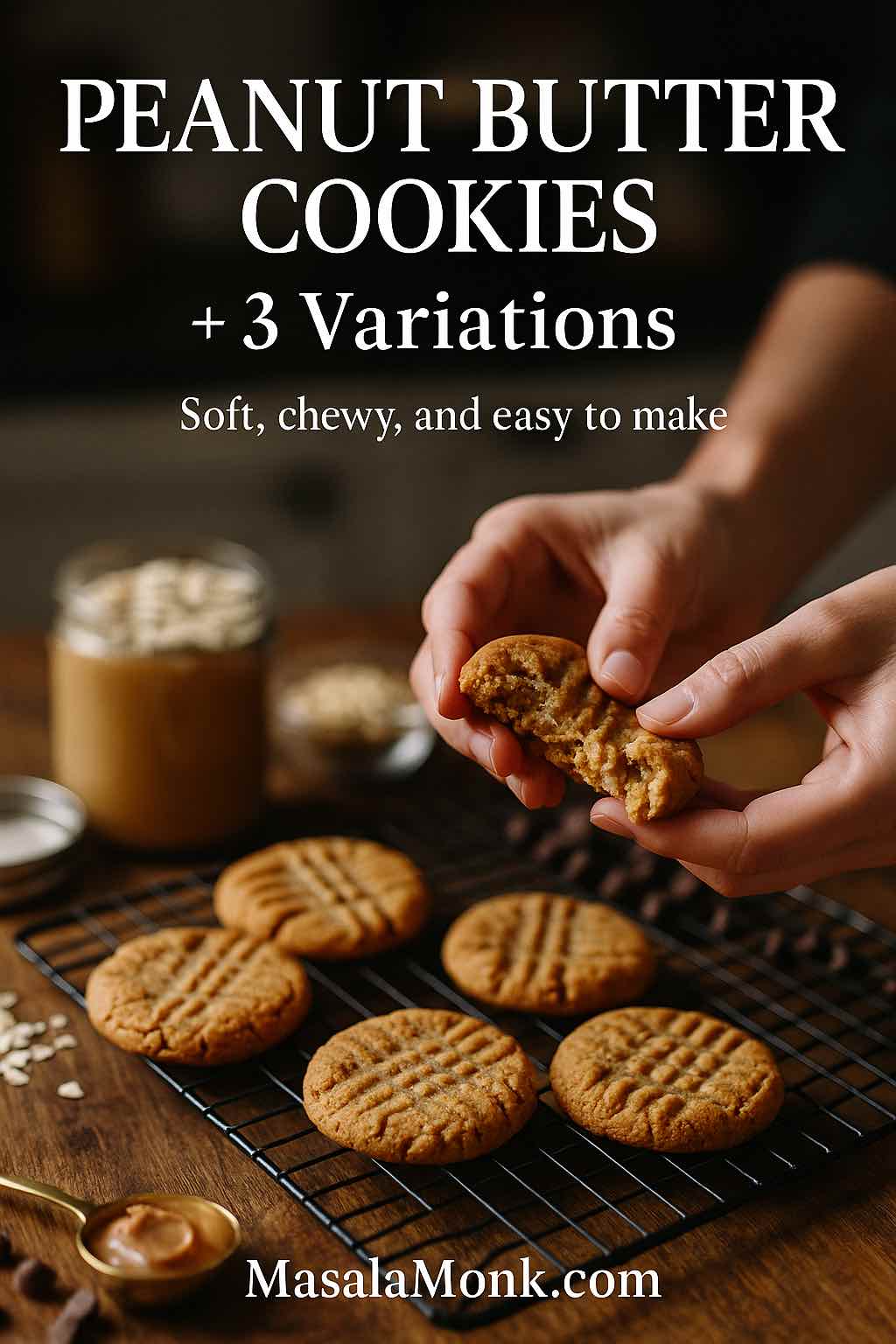
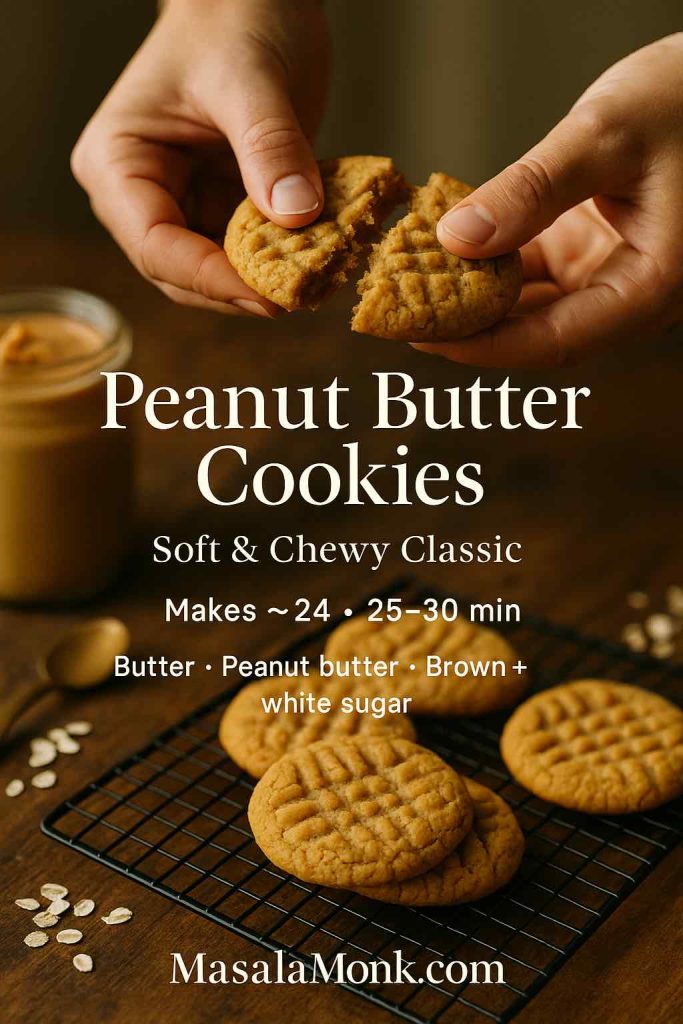
Hands breaking a soft, chewy peanut butter cookie over a cooling rack with classic crosshatch; jar of peanut butter and oats in the background—peanut butter cookies with 3 variations.

Some cookies are a craving; peanut butter cookies are a promise. A promise of soft centers, a hint of salt, and that crosshatch pattern that whispers, “You’ve come to the right kitchen.” If you’ve been hunting for a reliable peanut butter cookies recipe that you can memorize, customize, and bake on a weeknight without fuss, this is the one. We’ll start with the classic base, then—without complicating your life—branch into three popular riffs: 3-ingredient (flourless and naturally gluten-free), peanut butter chocolate chip (for the days you want pockets of melty sweetness), and peanut butter oatmeal (chewier, heartier, still quick).

Along the way, you’ll see natural, reader-friendly links if you want to go deeper on technique and ingredients—like making homemade peanut butter or choosing the right kind of oats with this guide to oats: types and differences. Use them as reference points; skip them if you’re already preheating the oven.


The Baseline Peanut Butter Cookies Recipe (Soft & Chewy)

At its heart, a dependable peanut butter cookies recipe does a few simple things really well:

  • Creams fat and sugar thoroughly (so the cookies lift rather than spread into puddles).
  • Balances white and brown sugar (for crisp edges and tender middles).
  • Uses just enough flour (to hold structure without becoming cakey).
  • Bakes quickly, then finishes on the sheet (carryover heat equals soft centers).

If you like a technical north star for ratios and method, the classic peanut butter cookies from King Arthur Baking mirror this approach—same gentle oven temp, same creaming logic, same quick bake.

Ingredients, at a glance

  • Creamy peanut butter (no-stir works most predictably; more on that below)
  • Butter, softened (unsalted lets you control salt)
  • Granulated sugar + light brown sugar (structure + moisture + caramel notes)
  • Egg + vanilla (binding + aroma)
  • All-purpose flour, baking soda, baking powder, salt (structure + lift + clarity of flavor)

Why “no-stir” peanut butter behaves so nicely

Natural peanut butter can absolutely work, and many bakers love its purer peanut flavor. Nevertheless, if consistency is your priority, stabilized (emulsified) peanut butter is a smart choice: it doesn’t separate, it creams smoothly with butter, and it yields less graininess in tender batters. If you’re curious about the “why,” this Serious Eats piece makes the case in practical, baker-friendly terms: best peanut butter for baking (emulsified vs natural).

Prefer to control every ingredient? You can skip added sugars and oils entirely and make homemade peanut butter in minutes; it’s just roasted peanuts and a pinch of salt blitzed until glossy.

How to Make Peanut Butter Cookies

  1. Cream the butter, peanut butter, and both sugars until light and fluffy. You’re dissolving some sugar and trapping air; it should look pale and seem a bit billowy.
  2. Beat in the egg and vanilla until the mixture looks silky.
  3. Fold in your whisked dry ingredients (flour, baking soda, baking powder, salt) until just combined—no streaks, no overmixing.
  4. Scoop 1 to 1½-tablespoon portions, roll in a little sugar if you like delicate crunch, then crosshatch each ball gently with a fork.
  5. Bake at 175°C / 350°F until the edges set and tops are faintly matte—usually 9–11 minutes.
  6. Rest on the sheet for 5 minutes before moving to a rack; they finish cooking to that soft-chewy sweet spot.

And yes—this single bowl of dough is your on-ramp to all three variations below.

Also Read: Baked Jalapeño Poppers (Oven) — Time, Temp & Bacon Tips


Ingredient Notes You’ll Actually Use

Because small choices make big differences, here are the handful that matter—nothing fussy, just reality-tested tweaks that improve your peanut butter cookies recipe immediately.

Peanut butter: natural, no-stir, or homemade?

  • No-stir (emulsified) peanut butter is drama-free: it mixes evenly and bakes dependably. If a batter tends to feel sandy or seize when you add chips or cocoa, emulsified PB helps. See this walkthrough on baking with emulsified PB for texture reasons and examples.
  • Natural PB (peanuts, maybe salt) brings bold peanut flavor. If the jar has separated, stir thoroughly. When using it in cookie dough, a 15–30 minute chill tightens the fat matrix and helps control spread. If you want to minimize separation in your everyday jar, this test-driven guide is handy: how to prevent nut butter separation.
  • DIY PB gives you total control. If you prefer a short, clean ingredient list, whip up homemade peanut butter and season it to taste.

Flour, mixing, and that just-right bake

The most common cause of crumbly PB cookies is too much flour or overbaking. Use the spoon-and-level method (or weigh flour), stop mixing once the last streak disappears, and remove the cookies when their edges set but centers still look soft. King Arthur’s classic method is an excellent cue card for timing and texture checks.

Storage and food-safety basics

Baked cookies keep well in an airtight tin at room temp. Dough is a little different: the USDA suggests 2–4 days in the fridge and about 2 months in the freezer for homemade cookie dough. If you love prep-ahead baking days, portion dough balls, freeze solid on a tray, then bag and label: cookie dough storage guidelines. If you’re wondering about peanut butter itself (pantry vs. fridge), here’s a practical explainer on storage differences between conventional and natural styles: does peanut go bad?

Also Read: How to Make Churros (Authentic + Easy Recipe)


Classic Peanut Butter Cookies Recipe (Primary Method)

Because clarity is kindness, here’s the base peanut butter cookies recipe laid out cleanly, ready to riff.

You’ll need

  • ½ cup (113g) unsalted butter, softened
  • ½ cup (120g) creamy peanut butter (no-stir recommended for most consistent texture)
  • ½ cup (100g) granulated sugar
  • ½ cup (110g) light brown sugar, packed
  • 1 large egg (room temperature)
  • 1 teaspoon vanilla extract
  • 1¼ cups (150g) all-purpose flour
  • ½ teaspoon baking soda
  • ¼ teaspoon baking powder
  • ¼ teaspoon fine salt
Soft and chewy peanut butter cookies recipe—hands breaking a crosshatched cookie over a cooling rack with a jar of peanut butter in the background.
Soft & Chewy Classic Peanut Butter Cookies — ready in 25–30 minutes and makes about 24; a dependable base for 3-ingredient, chocolate chip, and oatmeal variations.

Step-by-step

  1. Preheat oven to 175°C / 350°F. Line two baking sheets.
  2. Cream butter, peanut butter, and both sugars on medium speed for 2–3 minutes, until pale and slightly fluffy.
  3. Beat in egg and vanilla until glossy and smooth.
  4. Whisk flour, baking soda, baking powder, and salt; fold into the wet ingredients just until combined.
  5. Scoop 1 to 1½ tablespoons of dough per cookie. Optionally roll in granulated sugar. Place on trays with space to spread.
  6. Crosshatch each ball lightly with a fork (two perpendicular presses). Flatten to roughly 1 cm thickness.
  7. Bake 9–11 minutes until edges are set and tops look just dry.
  8. Cool on the tray for 5 minutes, then move to a rack. Enjoy when fully set (they’ll be extra soft while warm).

Make it yours, gently: For thicker cookies, chill 30–60 minutes before baking. For slightly crisp edges, extend the bake by 30–60 seconds. For heightened peanut flavor, use salted PB and reduce added salt a touch.

Also Read: Green Tea Shot with Jameson | Recipe & 10 Variations


3-Ingredient Peanut Butter Cookies (Flourless, Naturally GF)

Sometimes you want cookies now. Not in an hour—now. This minimalist peanut butter cookies recipe uses just three ingredients, and yet it nails the essential soft-chewy PB experience. Because there’s no flour, these stay naturally gluten-free with clean, bold peanut flavor.

What goes in

  • 1 cup (250g) creamy peanut butter (no-stir is the safest choice here)
  • ¾ cup (150g) granulated sugar (or ½ cup granulated + 2 Tbsp brown for deeper chew)
  • 1 large egg
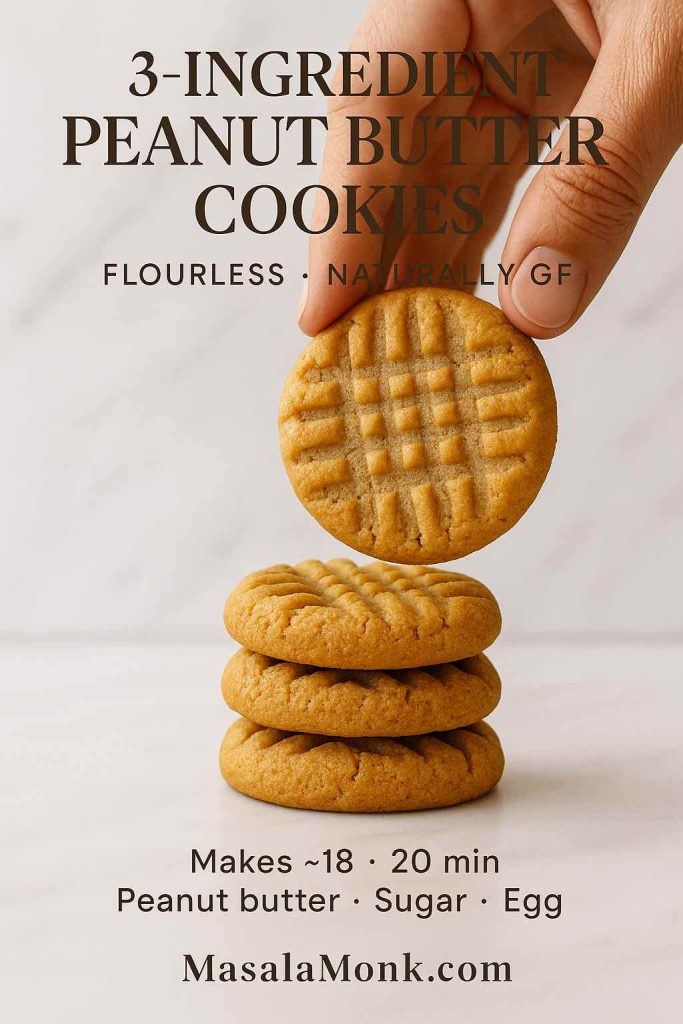
3-ingredient peanut butter cookies recipe, flourless and naturally gluten-free, hand placing a crosshatched cookie on a stack on marble.
3-Ingredient Peanut Butter Cookies — flourless, naturally gluten-free; ready in 20 minutes and makes about 18.

What to do

  1. Heat oven to 175°C / 350°F and line a tray.
  2. Stir peanut butter, sugar, and egg until glossy and cohesive; the dough will thicken as you stir.
  3. Scoop 1-tablespoon portions, crosshatch lightly, and bake 8–10 minutes until edges set.
  4. Cool fully before lifting—flourless cookies are delicate when hot but turn fudgy as they set.

If you prefer a flour-based gluten-free option that mimics the classic’s crumb more closely, you can adapt ratios from gluten-free peanut butter cookies, which use a GF blend or self-rising flour for lift and bite.

Also Read: Vegan French Toast: 6 Easy Recipes (Pan, Air Fryer, GF & High-Protein)


Peanut Butter Chocolate Chip Cookies (Simple Add-In, Big Payoff)

On some days, a little chocolate turns good into irresistible. Happily, you don’t need a separate peanut butter cookies recipe for this: the classic dough above is sturdy enough to carry chips without turning greasy or fragile—especially if you used a no-stir PB or thoroughly mixed natural PB.

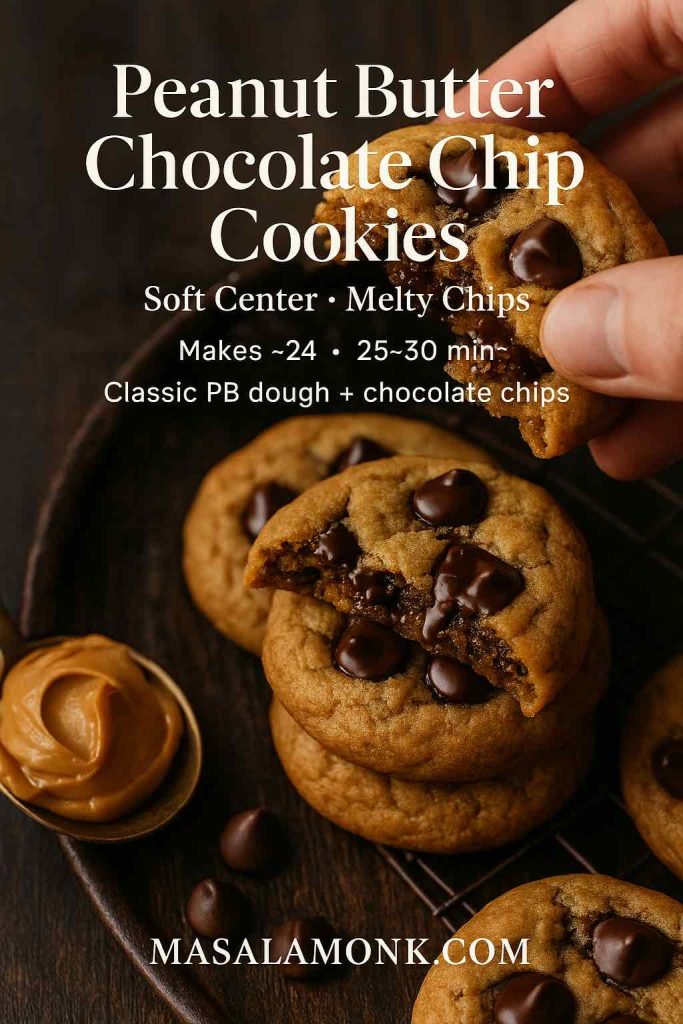
Peanut butter chocolate chip cookies with gooey melted chips—hand breaking a warm cookie on a rustic wood surface, soft center visible.
Peanut Butter Chocolate Chip Cookies — soft-centered with melty chips; makes about 24 in 25–30 minutes using the classic PB dough plus chocolate chips.

How to adapt the base

  • Mix-in: Fold 1 to 1½ cups chocolate chips into the finished classic dough.
  • Scoop & bake as usual—same crosshatch, same time frame.
  • Finish: If you like, dot a few extra chips on top right out of the oven for an artisanal look.

Because emulsified peanut butter blends seamlessly with butter, you’ll notice fewer sandy spots once chips are in the mix; if you’re curious about why that texture holds, this explainer is a good read: best PB for baking (why emulsifiers help).

Also Read: Béchamel Sauce for Lasagna: Classic, Vegan & Ricotta Sauce Recipe


Peanut Butter Oatmeal Cookies (Chewy, Hearty, Still Fast)

When you want a cookie that eats a bit like an afternoon snack, oats are your secret weapon. They add chew, fiber, and a warm cereal note that loves peanut butter. You can make this variation two ways—rolled oats for chew or quick oats for a softer, more uniform bite. If you’re deciding which bag to buy (or which jar to open), skim MasalaMonk’s practical explainer on oat types: guide to oats: types and differences and this compact refresher, oats vs oatmeal: what’s the difference?

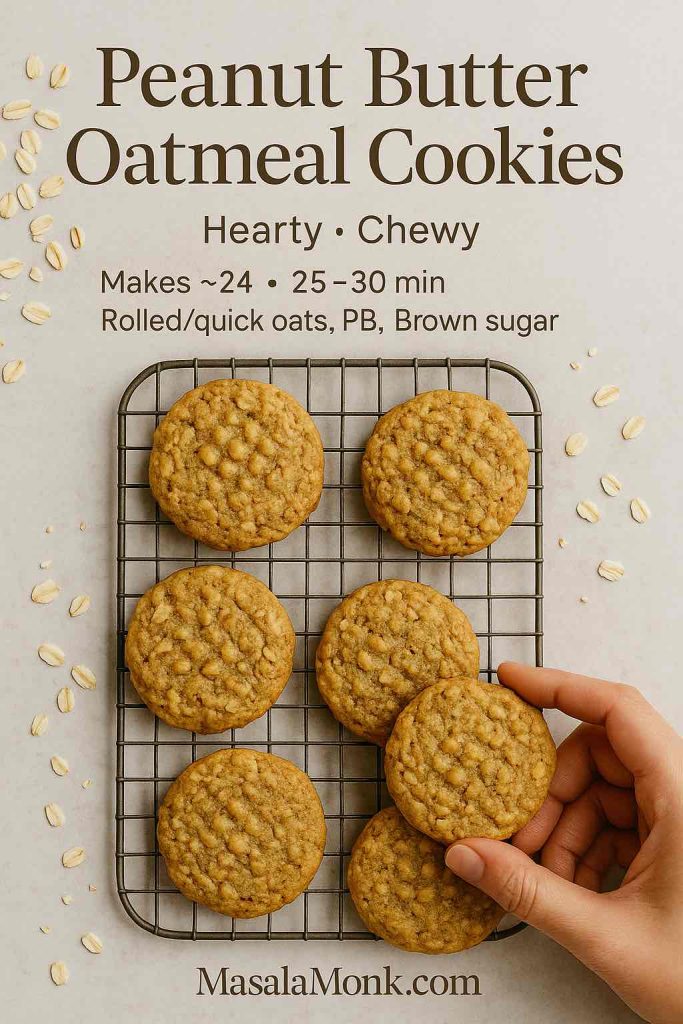
Chewy peanut butter oatmeal cookies on a cooling rack—hand lifting one cookie with scattered rolled oats; hearty texture, makes about 24 in 25–30 minutes.
Chewy Peanut Butter Oatmeal Cookies — hearty and satisfying with rolled or quick oats and brown sugar; ready in 25–30 minutes and yields roughly 24.

How to adapt the base

  • Add: Fold 1 cup oats into the finished classic dough.
  • Balance: If the dough seems stiff, splash in 1 tablespoon milk to keep the crumb tender.
  • Choose your texture:
    • Rolled (old-fashioned) oats → more chew and visible oat flakes.
    • Quick oats → softer, more uniform crumb.
    • Skip steel-cut for cookies; they stay too hard. See the why here: steel-cut vs rolled oats

Want to keep the oat momentum going during the week? Bake a tray of healthy oat cookies (no sugar, no butter) or tuck a pan of oat protein bars into the fridge for grab-and-go breakfasts.

Also Read: Crock Pot Lasagna Soup (Easy Base + Cozy Slow-Cooker Recipes)


Texture Tuning Peanut Butter Cookies: Softer, Chewier, Thicker

Because you’re the baker, you get to decide the cookie you want today. Here’s how to steer the same peanut butter cookies recipe toward different textures—without rewriting the ingredient list.

  • Extra soft: Pull them at the first hint of set edges and let them finish on the tray.
  • Chewier: Increase the brown sugar by 1–2 tablespoons and decrease white sugar by the same; brown sugar’s molasses boosts moisture retention.
  • Thicker: Chill the portioned dough 30–60 minutes, then bake. Cold fat slows spread.
  • Crispier edges: Bake 30–60 seconds longer and cool completely on a rack.
  • Stronger peanut impact: Use salted PB or add a tiny pinch of fine salt to the dough.

If you’re using natural PB and want to minimize separation over time (both in the jar and in your batter), experiment with the methods in this separation-prevention test. It’s a small upstream fix that yields smoother creaming and more even crumb.

Also Read: Cottage Cheese Lasagna Recipe | Chicken, Spinach, & Ricotta


Ingredient Swaps That Actually Work

Yes, you can tweak things. No, you don’t have to guess. Use these swaps when your pantry is half full—or when you’re leaning toward a dietary preference.

  • No brown sugar today? Use all white sugar and add 1 teaspoon honey or a drizzle of molasses for depth.
  • No butter handy? Use the same weight of neutral oil; chill the dough 30 minutes to re-firm the fat for better edges.
  • Egg-free mood? Make a flax egg (1 tablespoon ground flax + 3 tablespoons water; sit 5 minutes). Expect a touch more tenderness.
  • Gluten-free route: Choose the 3-ingredient variation (naturally GF) or adapt a 1:1 GF flour blend following ratios like these GF PB cookies.
  • Less sweet overall? Drop total sugar by 2 tablespoons in the classic; cookies will be slightly drier, so don’t overbake.

Also Read: How to Cook Bacon in the Oven (Crispy, No-Mess, Crowd-Ready Recipe)


The Pantry Question: Where to Store Peanut Butter and Dough

Because you’ll be baking this peanut butter cookies recipe more than once, it helps to know where everything should live between batches.

  • Peanut butter storage: Conventional (stabilized) PB is pantry-friendly; natural PB benefits from the fridge to prevent rancidity. For a practical, no-alarm-bells overview of why, read does peanut butter go bad?
  • Dough storage: Homemade cookie dough is happiest in an airtight container 2–4 days in the refrigerator or about 2 months in the freezer, per USDA guidance.
  • Bake straight from frozen: Add 1–3 minutes to the baking time and watch the edges; no other changes needed.

Also Read: French Toast Sticks (Air Fryer + Oven Recipe) — Crispy Outside, Custardy Inside


Troubleshooting Peanut Butter Cookies Recipe

You don’t need a helpline; you just need a short list.

  • Crumbly cookies: Usually too much flour or overbaking. Weigh flour if possible; pull the pan as soon as edges set.
  • Greasy look after cooling: Either over-measured fat or natural PB with separation. Stir natural PB thoroughly and consider a short chill for the dough.
  • Too thick, not spreading: Dough too cold or flour slightly high. Let portions warm a few minutes, or press the crosshatch a bit deeper.
  • Dry bite: Over-baked by a minute or two. Next round, check a minute earlier; aim for matte tops but tender centers.
  • Oat “hard bits”: Steel-cut oats will never soften fully in this bake; use rolled or quick oats instead. If you’re weighing options, skim rolled vs steel-cut before you scoop.

Also Read: 10 Best Chicken Sandwich Recipes (BBQ, Parm, Buffalo & More)


Variation Playbook: When and Why to Use Each One

Bake the classic when you’re feeding a mixed crowd and want predictable results with pantry ingredients.
Choose 3-ingredient when time is tight, gluten-free guests are coming, or you simply love the clean peanut punch.
Pick peanut butter chocolate chip if you’re sending a care package or want little bursts of chocolate in each bite.
Go peanut butter oatmeal when you’re after a sturdier afternoon snack that pairs well with tea or coffee.

If you wind up with extra oats, keep the baking train rolling with healthy oat cookies (no sugar, no butter) or stash oat protein bars for after-gym snacks. And if you’re feeling especially peanut-forward another day, King Arthur’s nostalgic peanut-butter-centered treats like Magic in the Middles pair beautifully with this dough’s flavor profile.


Your Baking Rhythm, Simplified

There’s an easy weekly cadence that turns this peanut butter cookies recipe into a stress-free habit:

  • Sunday: Make a double batch of the classic dough; bake one tray for now, then portion the rest into balls and freeze.
  • Midweek: On a busy evening, bake the 3-ingredient version while dinner rests—10 minutes of oven time and dessert is done.
  • Friday: Turn leftover classic dough into peanut butter chocolate chip cookies with a quick handful of chips; same bake, instant variety.
  • Weekend: Fold oats into the remaining dough to make peanut butter oatmeal cookies for a hike, a movie night, or a potluck.

Because the base is so forgiving—and because you now know exactly how to store dough and peanut butter safely (see cookie dough storage basics and PB storage pointers)—you can keep the rhythm without wasting a single scoop.

Also Read: 10 Best Espresso Martini Recipe Variations (Bar-Tested)


Classic + 3 Variations: Quick Reference for Peanut Butter Cookies

Classic Peanut Butter Cookies
Cream butter, PB, and sugars; beat in egg/vanilla; fold in dry; scoop, crosshatch, bake 9–11 minutes. Soft centers, lightly crisp edges. Use this classic method for timing and texture cues.

3-Ingredient (Flourless)
PB + sugar + egg. Stir, scoop, crosshatch, bake 8–10 minutes. Naturally GF, deeply peanutty. For a flour-based GF path, adapt this self-rising/GF framework.

Peanut Butter Chocolate Chip
Fold 1 to 1½ cups chips into the classic dough. Same scoop, same bake. For reliably smooth batters, see why emulsified PB helps.

Peanut Butter Oatmeal
Fold 1 cup oats into the classic dough (rolled for chew, quick for softness). If stiff, add 1 Tbsp milk. Skip steel-cut; they don’t soften enough—rolled vs steel-cut explained. Keep the oat theme going with healthy oat cookies or oat protein bars.


A Last Word Before You Preheat

Recipes are roadmaps, not handcuffs. Bake the classic once as written so you have a feel for texture and timing, then adjust—sweeter or less sweet, thicker or thinner, with or without oats, with chocolate or without. The goal is a peanut butter cookies recipe that feels like yours, not a script you’re afraid to edit.

And because a dependable source is a baker’s best friend, here are the few links you’ll probably return to most:

Now—scoop, crosshatch, bake. And if your first tray disappears while the second is still in the oven, well, that’s exactly how peanut butter cookie nights are supposed to go.

Also Read: 6 Wellness Shot Recipes to Boost Your Immune System

FAQs

1) What makes a peanut butter cookies recipe soft and chewy?

Soft, chewy results come from balanced fat and sugar, minimal mixing after flour goes in, and a brief bake. Moreover, pull the tray when edges just set; carryover heat finishes the centers without drying them out.

2) How do I keep peanut butter cookies from spreading too much?

First, chill portioned dough for 20–30 minutes if your kitchen is warm or you’re using natural peanut butter. Additionally, measure flour accurately and avoid over-creaming butter (too much air can cause excessive spread).

3) Can I use natural peanut butter in this peanut butter cookies recipe?

Yes. Nevertheless, stir it thoroughly to recombine oil and solids. For extra insurance, chill the dough briefly so the fat firms up, resulting in cleaner edges and better lift.

4) Why do we press the classic crosshatch on top?

The dough is dense; consequently, the crosshatch flattens it for even baking. It also signals the signature texture and helps achieve that crisp rim with a tender middle.

5) How do I make thicker peanut butter cookies without changing ingredients?

Simply chill scooped dough 30–60 minutes, then bake. Conversely, if you want thinner, slightly crisper cookies, skip chilling and press the crosshatch a bit deeper.

6) What’s the best sugar ratio for chew?

Light brown sugar adds moisture and chew; granulated provides structure. Furthermore, a small tilt toward brown sugar (by a tablespoon or two) deepens flavor without turning the cookie cakey.

7) Can I reduce the sweetness but keep texture?

Certainly. Reduce total sugar by 1–2 tablespoons; as a result, don’t extend bake time. Otherwise, they may lean dry. For balance, a tiny pinch of extra salt can sharpen the peanut flavor.

8) Do I need baking soda and baking powder, or just one?

Use both in small amounts. Soda encourages spread and browning; powder supports gentle lift. Similarly, combining them yields those classic crackles with soft interiors.

9) How do I prevent crumbly cookies?

Measure flour precisely and stop mixing once the flour disappears. Beyond that, avoid overbaking; even 30–60 seconds too long can make the texture sandy instead of fudgy.

10) Can I make a peanut butter cookies recipe without butter?

Absolutely. Substitute an equal weight of neutral oil. However, chill the dough afterwards so it doesn’t over-spread, and watch the final minute closely.

11) How do I adapt the recipe for gluten-free baking?

Two routes work well. First, the flourless 3-ingredient version is naturally gluten-free. Alternatively, a quality 1:1 gluten-free blend can replace all-purpose; nevertheless, mix gently to maintain tenderness.

12) What’s the simplest 3-ingredient version—and does it taste like the classic?

Peanut butter, sugar, and egg—stir, scoop, and bake. Notably, it’s peanut-forward and slightly denser. Even so, the chew is excellent when you avoid overbaking and let the cookies cool fully.

13) How can I make the flavor more peanut-forward?

Use salted peanut butter or add a small extra pinch of fine salt. Additionally, underbake by about 30 seconds for a creamier center that amplifies the peanut aroma.

14) What’s the ideal thickness before baking?

After scooping, press to about 1 cm with the crosshatch. Consequently, you’ll get even doneness: crisp rims, soft centers, and consistent texture across the batch.

15) Why did my cookies look greasy after cooling?

Oil separation in natural peanut butter or over-measured fat can cause sheen. Instead, stir natural peanut butter thoroughly and weigh ingredients; a short chill also helps stabilize the dough.

16) How do I keep edges crisp but centers soft?

Bake until edges turn just matte while centers still look slightly pale. Then, let the cookies rest on the sheet for 5 minutes. Ultimately, this sequence preserves the contrast you’re after.

17) Can I freeze the dough for later?

Yes—portion into balls, freeze on a tray, then bag. Additionally, bake straight from frozen and add 1–3 minutes, watching the edges rather than the clock.

18) What’s the best way to store baked cookies?

Airtight container at room temperature does the job. Conversely, if your climate is very humid, tuck a small piece of parchment between layers to discourage sticking.

19) How do I make egg-free peanut butter cookies?

Use a flax egg (1 tablespoon ground flax mixed with 3 tablespoons water, rested 5 minutes). Moreover, avoid overbaking, since egg-free doughs can firm up faster as they cool.

20) Can I add oats without drying the cookie?

Certainly. Fold in about 1 cup of oats per batch; if the dough feels stiff, add 1 tablespoon milk. Similarly, rolled oats give more chew, while quick oats create a softer, uniform crumb.

21) My cookies didn’t spread—what went wrong?

Likely the dough was too cold or flour ran high. Otherwise, the crosshatch press was too light. Let the scoops warm a few minutes or press slightly more before baking.

22) Does the peanut butter brand matter?

Not particularly; however, style does. Emulsified (no-stir) peanut butter is more predictable; natural works too, though it benefits from thorough stirring and a quick chill.

23) How can I boost aroma without extra sweetness?

Add ½ teaspoon vanilla and, if desired, a tiny pinch of espresso powder. Additionally, a light sprinkle of flaky salt after baking intensifies the peanut note without more sugar.

24) What oven rack and pan work best?

Middle rack with light-colored metal sheets promotes even browning. Meanwhile, line with parchment for consistent spread; dark trays brown faster, so shorten the bake slightly.

25) Can I double the peanut butter for stronger flavor?

Go cautiously. Increasing peanut butter too much can make cookies heavy and fragile. Instead, nudge flavor with a touch of salt, a hint more vanilla, and precise baking to keep centers plush.

26) How do I make small-batch peanut butter cookies?

Halve the ingredients. Furthermore, weigh everything for accuracy; smaller batches are less forgiving, and precise measurements keep texture identical to the full recipe.

27) What’s the best way to get uniform cookies?

Use a #40 or #50 scoop for even portions. Consequently, the batch bakes consistently, and every cookie finishes at the same moment.

28) Can I make a dairy-free peanut butter cookies recipe?

Yes—swap butter for equal weight of dairy-free baking sticks or neutral oil. Additionally, chill dough to maintain shape, and keep an eye on the edges to avoid overbaking.

29) How do I avoid a sandy or gritty texture?

Cream thoroughly at the start, but stop once flour is added. Beyond that, ensure sugars dissolve slightly during creaming, and don’t skip the brief rest on the tray after baking.

30) What’s the simplest way to refresh day-old cookies?

Warm a few on a tray at 150°C / 300°F for 3–4 minutes. As a result, the edges regain delicate crispness while the centers relax back to chewy.