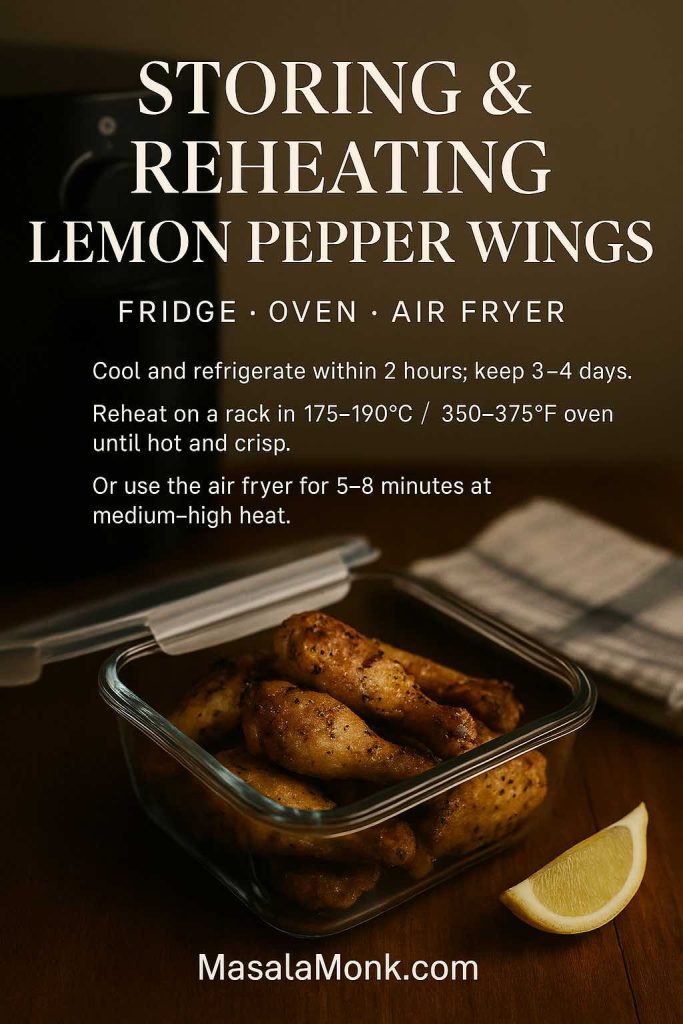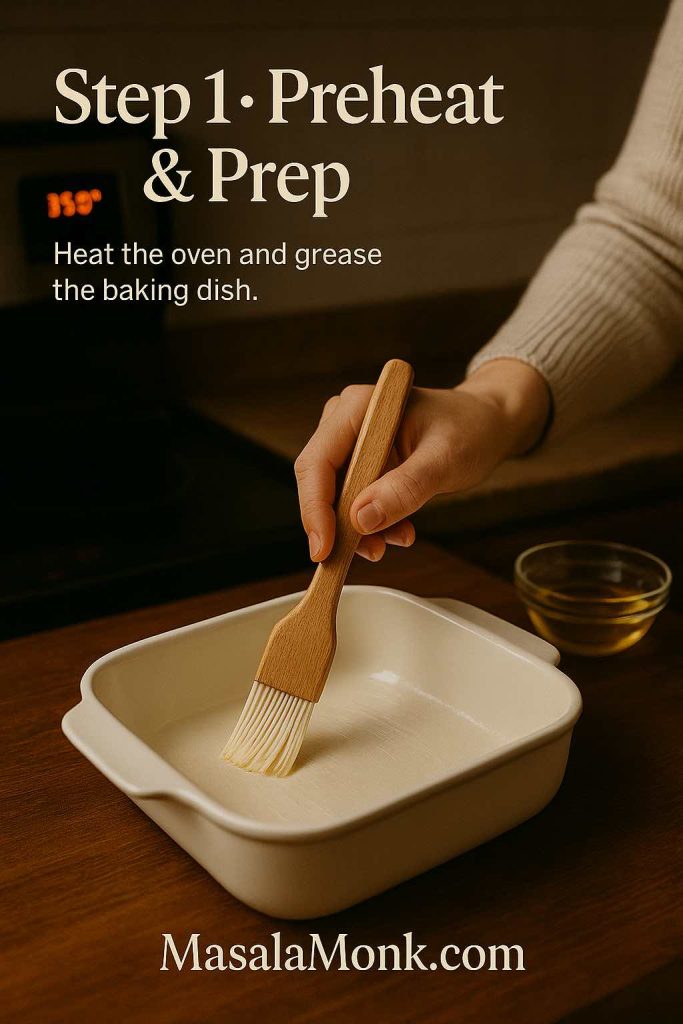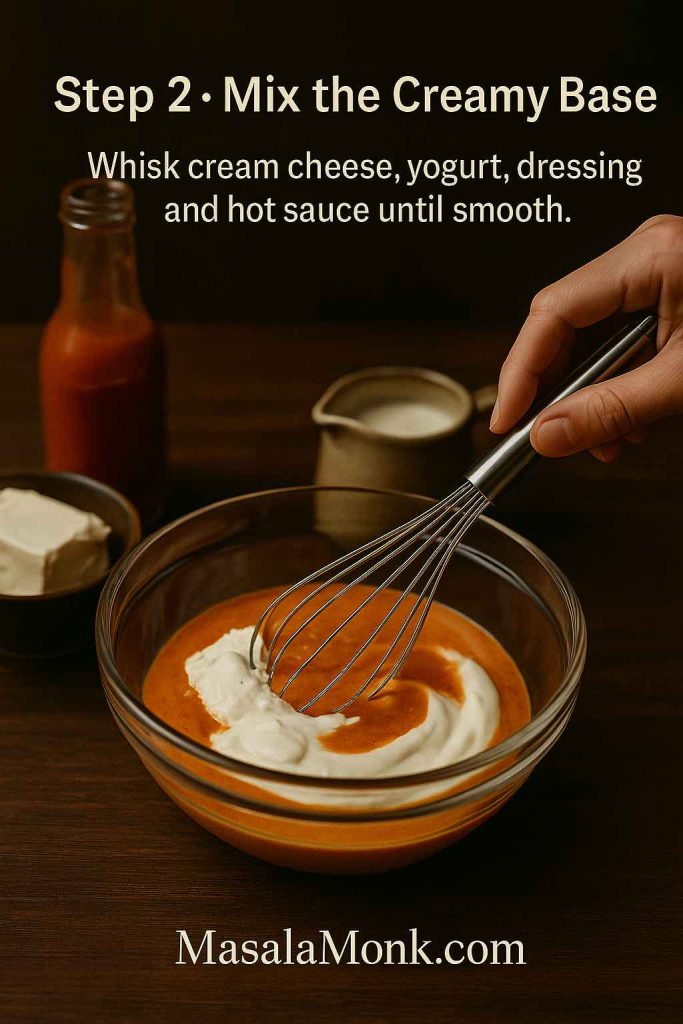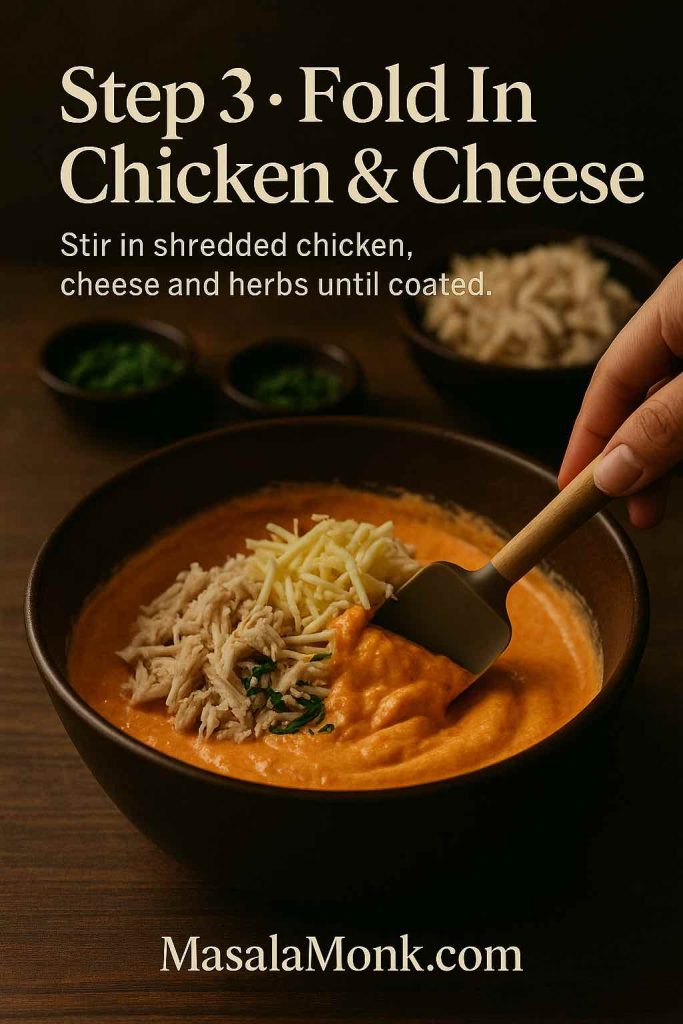
Posted on Leave a comment

Frozen Chicken Wings in Air Fryer (No Thaw) — Crispy From Frozen + Time & Temp

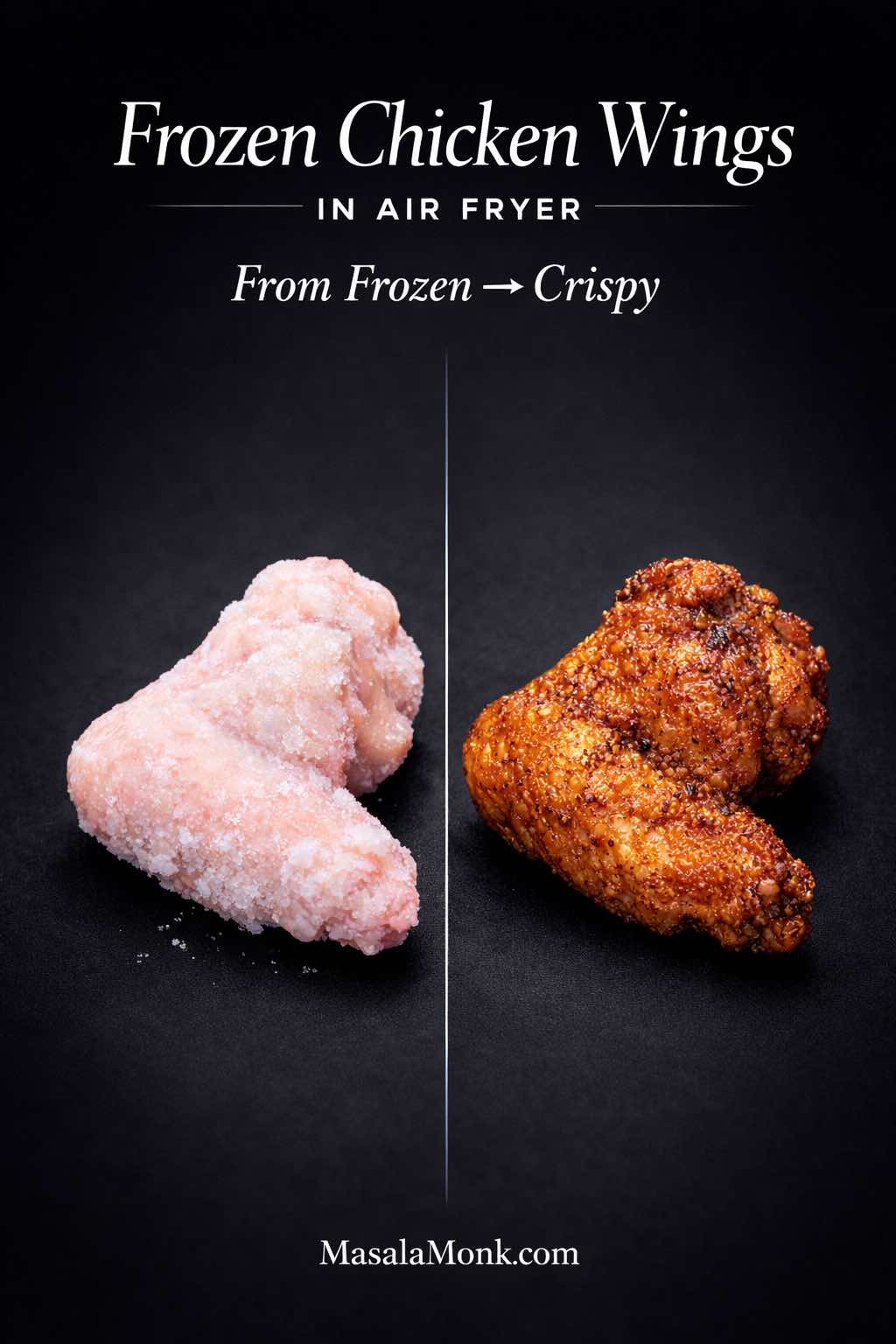
Split “before and after” cover image: a frosty frozen chicken wing on the left and a golden, crispy air-fried chicken wing on the right, separated by a thin vertical line on a smooth black background. Text overlay reads “Frozen Chicken Wings in Air Fryer” and “From Frozen → Crispy,” with “MasalaMonk.com” in the footer.

Cooking frozen chicken wings in an air fryer should feel effortless. Still, the first time you try wings straight from the freezer, they can come out pale, soggy, or oddly chewy—like the outside never decided whether it wanted to crisp or steam. Fortunately, the fix isn’t complicated. In fact, once you understand what’s happening inside the basket, you can turn almost any bag of frozen wings into crispy, juicy wings you’d happily serve at a party.

Because this method starts with frozen wings, you won’t need thawing or any fussy steps that only work in one specific model. Along the way, you’ll see how to handle raw frozen chicken wings in the air fryer versus pre cooked wings in the air fryer, how to get time and temperature right without second-guessing, and how to finish with Buffalo, hot, garlic-parm, or dry-rub flavors without sacrificing crispiness.

Quick answer (no thaw): cook frozen wings in 2 stages for crisp skin.

  • Raw frozen wing sections (drumettes + flats): 360°F / 182°C for 14–16 min, then 400°F / 205°C for 8–12 min (total 22–28 min). Cook to 165°F / 74°C in the thickest piece.
  • Fully cooked frozen wings: 360°F / 182°C for 10–12 min, then 400°F / 205°C for 6–10 min (total 16–22 min).

Tip: If wings are stuck together, run the first stage for 6–8 minutes, then separate and continue.

If you ever want a “fresh wings” method with extra technique and seasoning ideas, you’ll also like this related MasalaMonk recipe: Air Fryer Chicken Wings. It complements what you’re doing here, especially when you’re working with thawed wings in the air fryer.

Also Read: Mozzarella Sticks Recipe (Air Fryer, Oven, or Fried): String Cheese, Shredded Cheese, and Every Crunchy Variation


Start here: what kind of frozen wings do you have?

Before you press Start, it helps to identify what’s in the bag. This one detail decides your timing, your doneness check, and your crisping strategy.
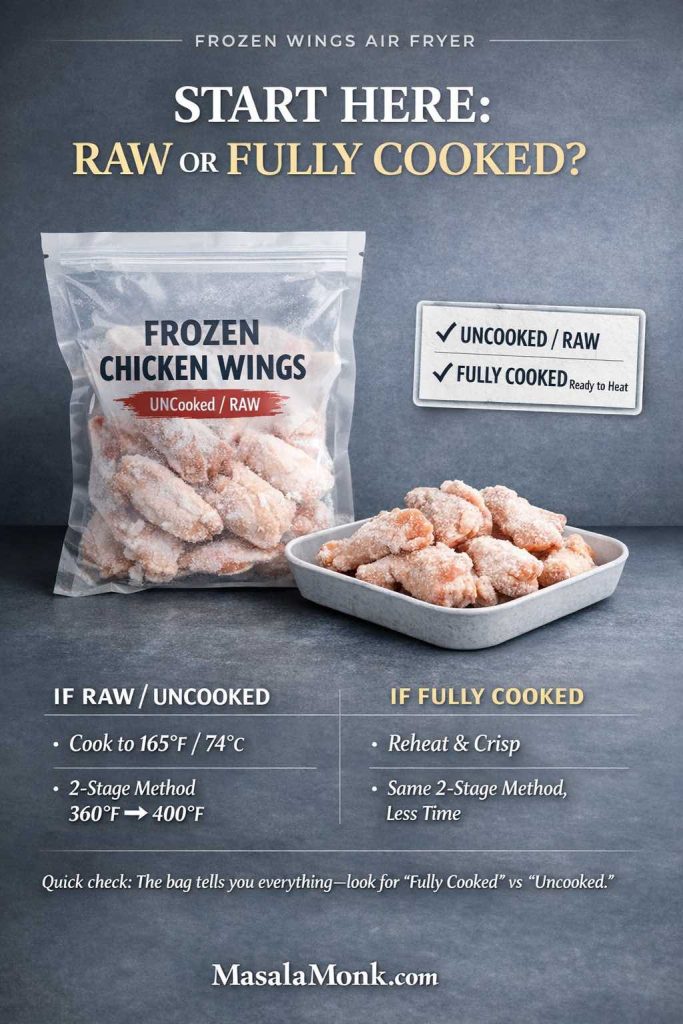
Start-here guide for frozen wings in an air fryer: check the bag for “raw/uncooked” vs “fully cooked.” Raw wings use a 2-stage cook (360°F then 400°F) and must reach 165°F/74°C. Fully cooked wings use the same two-stage method with less time for reheating and crisping.
Not sure if your frozen wings are raw or fully cooked? This one check saves you from pale, soggy wings (or undercooked chicken). Look for “uncooked/raw” vs “fully cooked” on the bag, then use the same 2-stage air-fryer method: start at 360°F to de-ice/render, finish at 400°F to crisp. Raw wings must hit 165°F / 74°C in the thickest piece. Save this graphic for quick reference and share it for your next wing night.

Raw frozen chicken wings

These are uncooked wings that have been frozen. They might be labeled “uncooked,” “raw,” or “ready to cook.” They must reach a safe internal temperature of 165°F / 74°C in the thickest part. For a clear, authoritative reference, the USDA FSIS safe temperature chart is the standard. If the packaging is gone and you truly can’t tell, treat them like raw: use the raw timing, then confirm 165°F / 74°C in the thickest piece before serving.

Pre-cooked frozen wings

These are already cooked, then frozen. They might say “fully cooked” or “ready to heat.” Your goal becomes reheating and re-crisping, not cooking through from raw. As a result, they usually finish faster, and they’re more forgiving—unless they’re heavily sauced, which can soften the skin if you don’t crisp first.
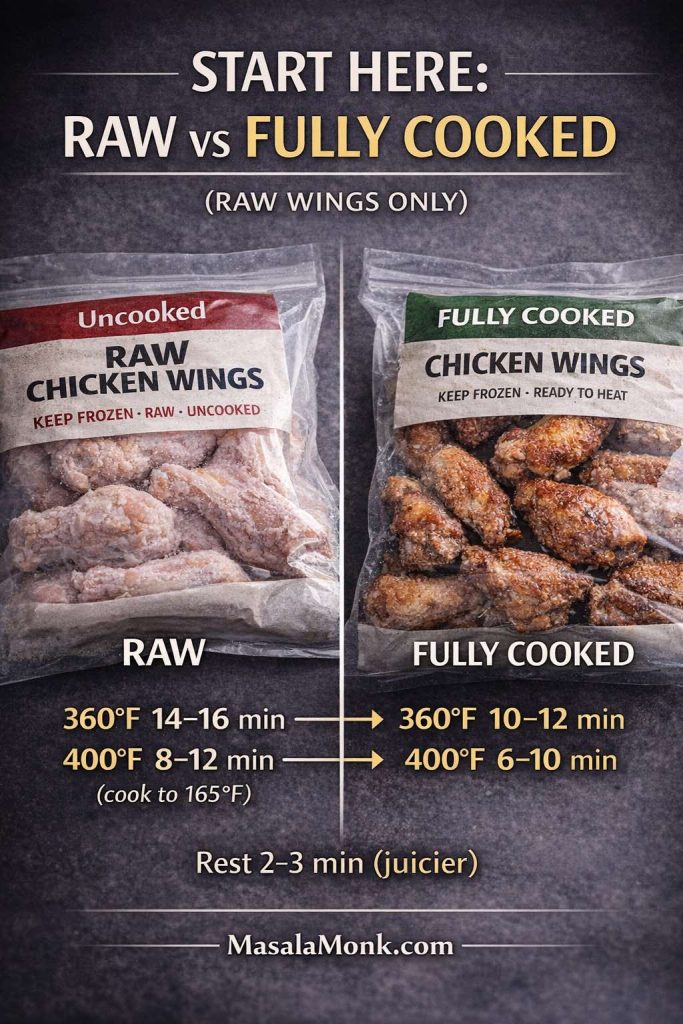
Split comparison graphic showing bagged frozen chicken wings: raw/uncooked on the left and fully cooked/ready-to-heat on the right. It lists a two-stage air fryer method. Raw wings: 360°F for 14–16 minutes, then 400°F for 8–12 minutes (cook to 165°F). Fully cooked wings: 360°F for 10–12 minutes, then 400°F for 6–10 minutes. Rest 2–3 minutes. MasalaMonk.com footer.
Not sure if your frozen wings are raw or fully cooked? This one detail changes everything. Use this quick visual to pick the right air fryer time + temperature: raw wings need a longer first stage and must hit 165°F / 74°C, while fully cooked wings finish faster because you’re mainly reheating + crisping. Save it for busy nights, then follow the full method below for the crispy two-stage finish (and Buffalo, hot, garlic-parm, and dry-rub options). If this helped, save/share/pin it so you’ve got the timings when you need them.

Sauced “Buffalo” or “hot wings” frozen

Some bags are fully cooked and pre-sauced. They’re convenient, although the sauce can trap moisture. That doesn’t mean you’re stuck with soggy wings—rather, it means you’ll do a crisp stage first, then sauce again at the end (or at least “reset” the sauce so it clings).

Wingettes/drumettes vs whole wings

Frozen wing sections (flats and drumettes) cook more evenly than whole wings. Whole wings can still work, although they often need a little more time because the thickest parts are larger and the joints hold moisture.

One more reassurance, since it comes up constantly: cooking from frozen is considered safe when done correctly, and the USDA discusses safe defrosting methods and the “cook without thawing” approach in its guide, The Big Thaw.

Bagged frozen wings (premade): what to check first

If you’re using a store bag (including Perdue), check the label for “fully cooked” vs “uncooked/raw.” That one line decides everything.

• If fully cooked: follow the fully cooked times (your goal is heat-through + crisp).
• If raw/uncooked: treat them like raw chicken and cook to 165°F / 74°C in the thickest piece. Cook raw wings to 165°F / 74°C in the thickest piece; a thermometer is the most reliable check.

If the bag is heavily sauced, crisp first and re-sauce at the end so the skin doesn’t go soggy.

Also Read: Sourdough Starter Recipe: Make, Feed, Store & Fix Your Starter (Beginner Guide)


The core method: how to cook frozen chicken wings in an air fryer so they turn crispy

There’s a reason “crispy frozen chicken wings” can be elusive: frozen wings release water as they heat, and that water turns into steam. Steam is the enemy of crisp skin. So the method that works best is a deliberate two-stage approach: first you melt away the surface ice and render fat, then you crank the heat to drive off moisture and crisp the skin.

This is the foundation for almost every variation in this post—whether you’re making frozen buffalo wings in the air fryer, air fried wings from frozen with dry rub, or even an air fryer recipe for frozen chicken wings that you toss in garlic-parm.

Step 1: Preheat the Air Fryer

Preheat to 360°F / 182°C for 3–5 minutes.
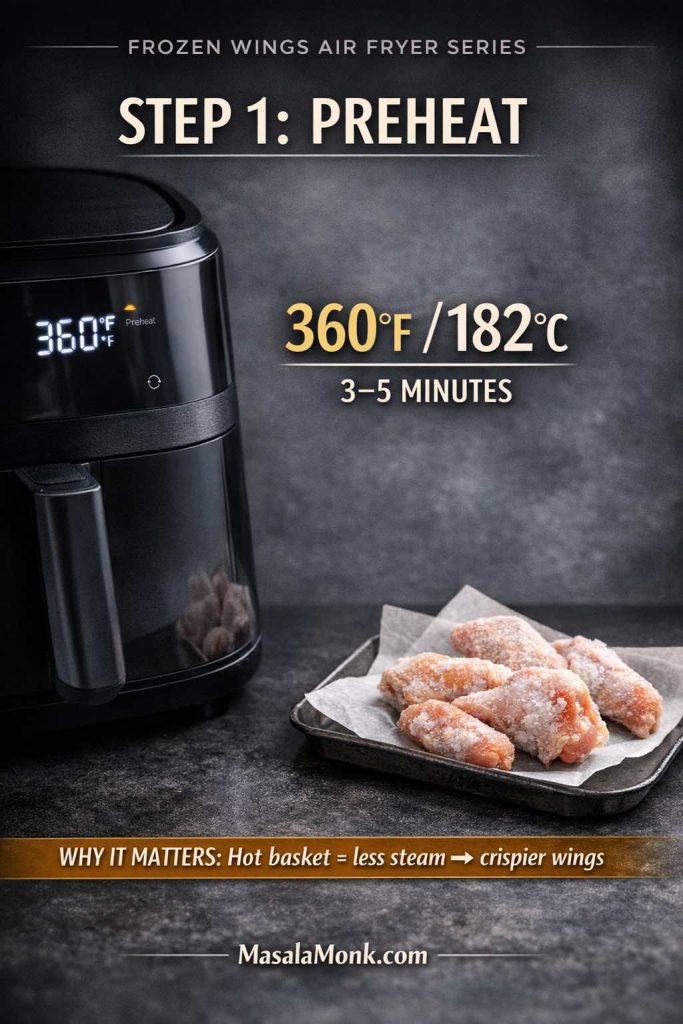
Step 1 graphic for frozen chicken wings in an air fryer: a black air fryer shows 360°F with “Preheat,” raw frozen wing sections sit on a tray, and the overlay reads “360°F / 182°C for 3–5 minutes” plus “Hot basket = less steam → crispier wings,” with MasalaMonk.com in the footer.
Step 1 (Preheat): Start frozen chicken wings at 360°F / 182°C for 3–5 minutes so the basket is already hot when the wings go in. That quick preheat reduces early steam (the #1 reason frozen wings turn pale or soggy), which sets you up for crisp skin in the final 400°F stage—whether you’re cooking raw frozen wings or reheating fully cooked frozen wings. Save/share this step for a repeatable frozen-wings routine.

Even if your air fryer “doesn’t require” preheating, a short preheat improves consistency. It gives you a predictable starting point, so your first minutes aren’t spent slowly warming the basket while the wings leak water.

Step 2: Arrange wings in a single layer

Put the wings in the basket in one layer. If you have a big pile, cook in batches. Crowding is the fastest way to turn crisping into steaming.
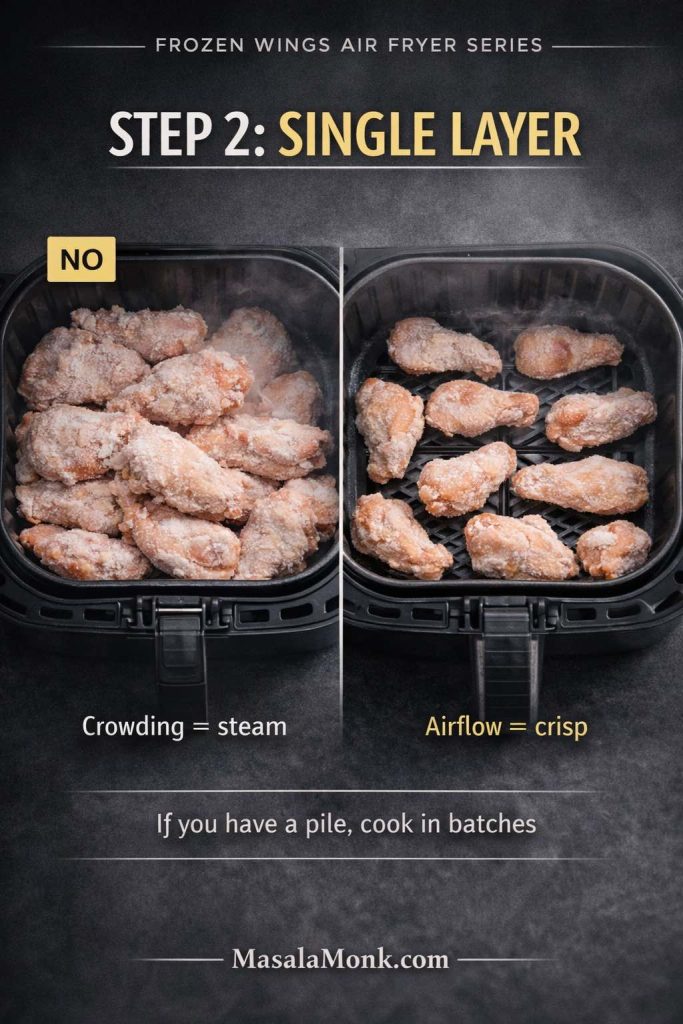
Split comparison photo of frozen chicken wings in an air fryer basket: left side shows wings piled/crowded with “NO” label and note “Crowding = steam”; right side shows wings spaced in a single layer with note “Airflow = crisp.” Headline reads “Step 2: Single Layer,” with tip “If you have a pile, cook in batches,” and MasalaMonk.com footer.
Single layer is the difference between crispy wings and steamy wings. If your frozen wings come out pale or soggy, it’s usually crowding—not your air fryer. Use this quick visual: pile = trapped steam, space = airflow + crunch. Cook in batches if needed (it’s faster than re-cooking soft wings later). Keep going for the exact time + temperature stages that turn frozen wings into real “game-day crisp.”

If you’ve ever had a batch come out uneven—some wings crisp, others soft—this is usually why. For a helpful deep dive on airflow issues (and other common problems), you can check MasalaMonk’s guide on air fryer mistakes to avoid.

Step 3: First cook at 360°F / 182°C (the “de-ice + render” stage)

Cook at 360°F / 182°C:

  • Pre cooked chicken wings in air fryer (from frozen): 10–12 minutes
  • Raw frozen chicken wings in air fryer: 14–16 minutes
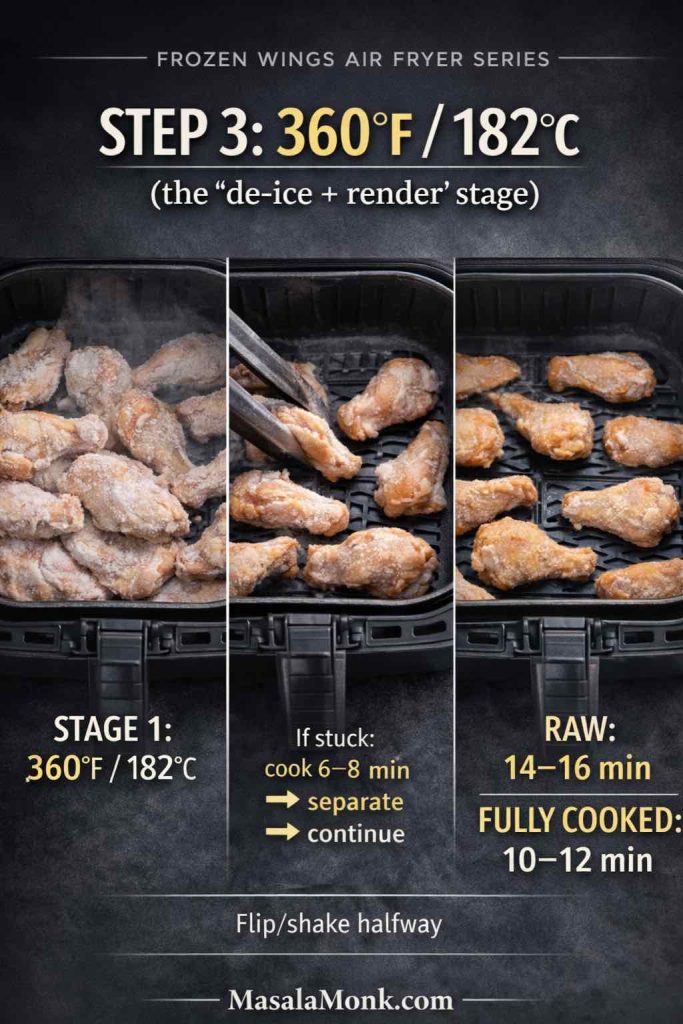
Three-panel photo shows frozen chicken wings in an air fryer basket during Step 3 at 360°F / 182°C. Left: wings still icy and clumped. Middle: tongs separating wings after 6–8 minutes if stuck. Right: wings spaced in a single layer. Overlay lists timing: raw frozen wings 14–16 minutes; fully cooked frozen wings 10–12 minutes; flip or shake halfway. Footer reads MasalaMonk.com.
Step 3 is where frozen wings stop “steaming” and start getting on track for crisp skin. Cook at 360°F / 182°C to melt surface ice and begin rendering fat—then separate any stuck wings at 6–8 minutes so airflow can hit every side. Use the timing that matches your bag (raw: 14–16 min; fully cooked: 10–12 min) and flip/shake halfway. This sets you up perfectly for the high-heat crisp stage next.

Halfway through, open the basket, separate any wings that have frozen together, then flip or shake gently.

If you see a lot of water collecting in the bottom, that’s normal. If your model has a pull-out drawer, carefully empty the liquid once during the first stage, then continue. It helps to carefully drain it off if your air fryer design makes that easy. Otherwise, the wings sit in moisture and soften instead of browning.

Step 4: Dry the surface quickly

This step sounds small, yet it changes everything.
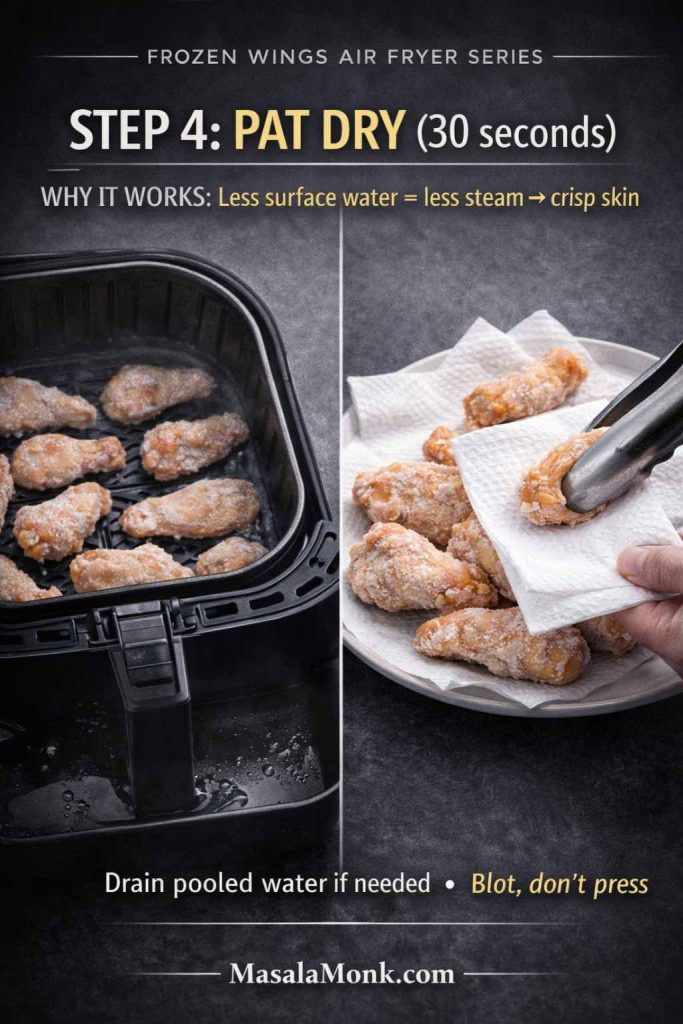
Split-screen instructional photo for frozen chicken wings in an air fryer. Left: air fryer basket with frozen drumettes and pooled water underneath after the first cook stage. Right: wings on a paper-towel-lined plate being gently blotted with tongs. Text overlay explains: less surface water = less steam = crisp skin; “drain pooled water if needed” and “blot, don’t press.” MasalaMonk.com in footer.
Step 4 is the crunch “switch.” Frozen wings release water as they heat—if that moisture stays on the surface, it turns into steam and the skin stays soft. After the first 360°F stage, quickly drain any pooled water, then pat/blot the wings for 30 seconds (don’t press). Now your 400°F crisp stage actually crisps. This tiny move is the difference between rubbery freezer wings and crispy frozen chicken wings in the air fryer—especially for drumettes, wing sections, and pre-cooked bagged wings.

Pull the basket and use tongs to move wings onto a plate lined with paper towels. Pat the top lightly. You’re not trying to crush anything; you’re simply removing the layer of moisture that would otherwise re-steam in the crisp stage.

If your wings are pre-sauced, you can still blot gently. You’ll keep plenty of flavor, while giving the skin a better shot at crisping.

Step 5: Season (or wait, depending on the style)

Now decide your flavor direction:
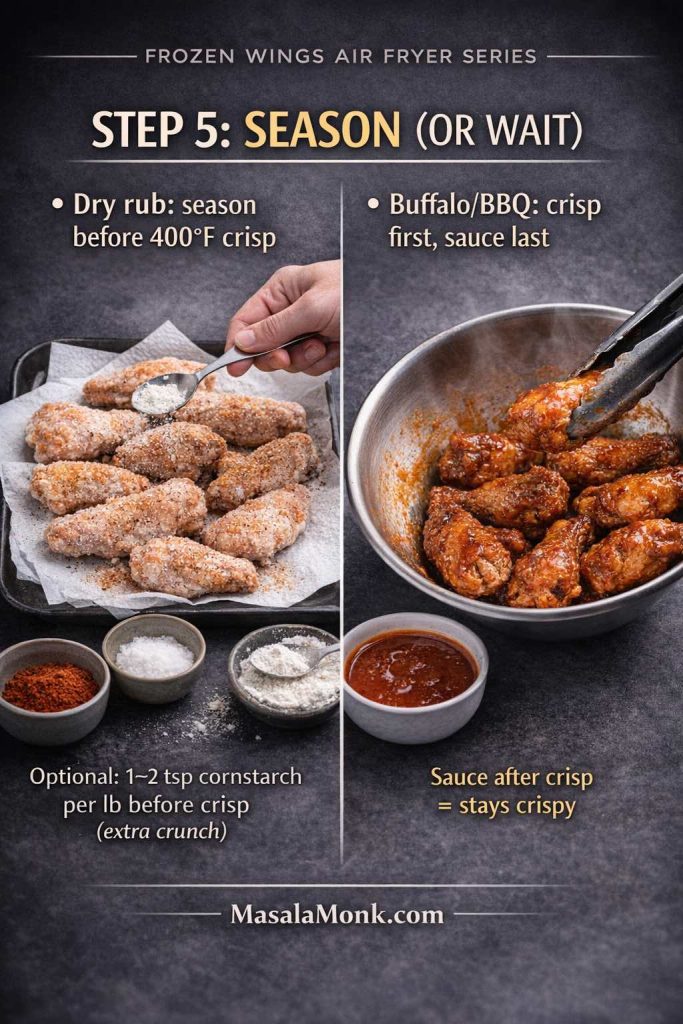
Step 5 seasoning guide for frozen chicken wings in an air fryer: split image shows wings being dusted with dry rub/cornstarch before the 400°F crisp stage on the left, and crispy wings being tossed in Buffalo/BBQ sauce after cooking on the right. Text highlights “season now for dry rub” and “crisp first, sauce last” for best crunch, with MasalaMonk.com footer.
Step 5 is where most “frozen wings” go wrong: timing. If you’re doing a dry rub (salt, pepper, garlic, paprika, lemon pepper), season right after the blot-dry step so it grabs and crisps at 400°F. If you’re going Buffalo, hot wings, or BBQ, hold the sauce until AFTER the crisp stage—sauce too early traps steam and softens the skin. Optional crunch boost: toss with 1–2 tsp cornstarch per lb before the final crisp. Save this as your quick “season vs sauce” rulebook for crispy frozen chicken wings every time.
  • For dry rub wings, season now.
  • For classic salt-and-pepper wings, season now.
  • For Buffalo/hot wings, wait until after crisping for the best texture.
  • For sweet BBQ, wait until after crisping so sugars don’t burn.

Optional crisp booster: toss wings with 1–2 teaspoons cornstarch per pound right before the 400°F stage (especially helpful for wings that look wet after blotting).

Step 6: Final crisp for frozen chicken wings in air fryer: 400°F / 205°C

Turn the air fryer up to 400°F / 205°C and cook:

  • Pre cooked frozen wings in air fryer: 6–10 minutes
  • Raw frozen wings in air fryer: 8–12 minutes
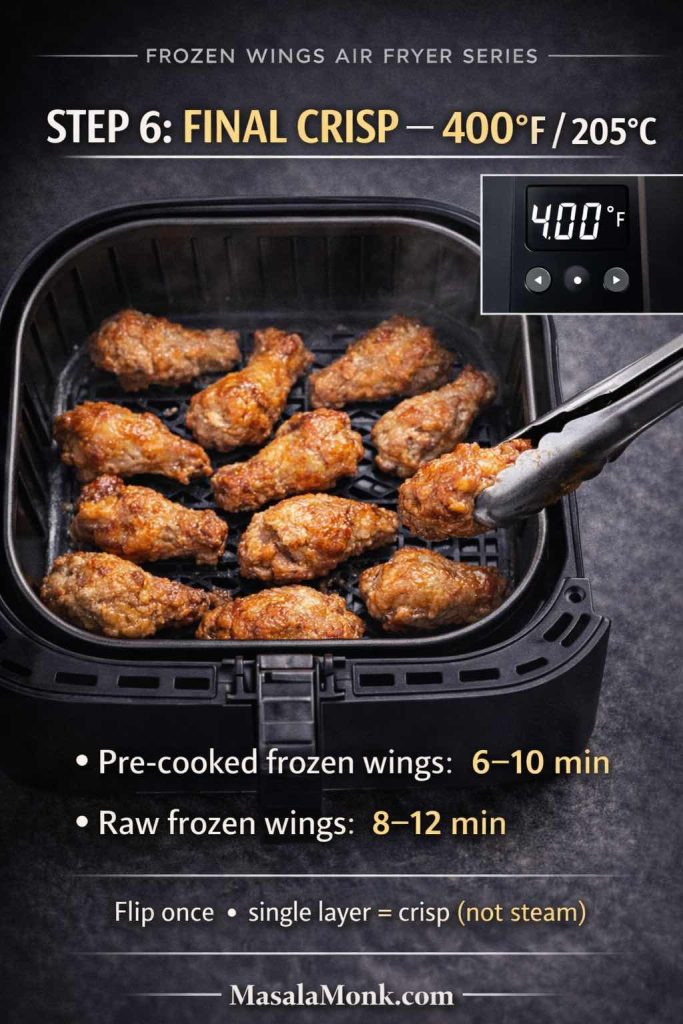
Step 6 of a frozen wings air fryer guide: cooked wings in an air fryer basket being flipped with tongs, with an inset showing 400°F / 205°C. Text notes final crisp timing: pre-cooked frozen wings 6–10 minutes and raw frozen wings 8–12 minutes, single layer for crisp skin. MasalaMonk.com in footer.
Final crisp is where frozen wings turn from “heated” to actually crispy: raise the air fryer to 400°F / 205°C, keep wings in a single layer, and flip once. Use 6–10 minutes for pre-cooked frozen wings and 8–12 minutes for raw frozen wings after the first stage—this is the moisture-drive-off step that gives you crackly skin instead of steam-soft wings.

Flip once during this stage. You’re looking for a deeper golden color, a tighter skin, and edges that look slightly blistered.

Step 7: Check doneness (raw wings only)

For raw wings, measure internal temperature in the thickest part of the drumette without touching bone. As metioned earlier, you’re aiming for 165°F / 74°C as that is considered a safe point.
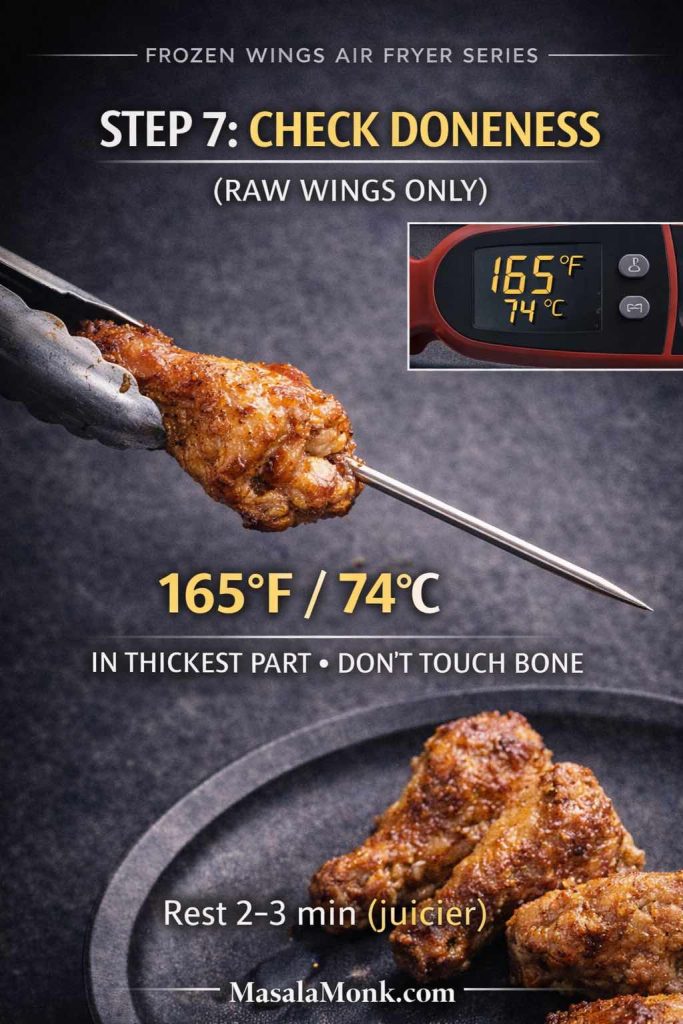
Step 7 “Check Doneness” graphic for frozen chicken wings in an air fryer: a cooked wing held with tongs while an instant-read thermometer probes the thickest part of a drumette. The display shows 165°F / 74°C with the note “don’t touch bone” and “rest 2–3 min,” plus MasalaMonk.com in the footer.
Raw frozen wings aren’t “done” when they look brown—they’re done when the thickest drumette hits 165°F / 74°C. Use an instant-read thermometer, insert it into the meatiest part, and avoid touching bone (bone can give a false reading). Once you hit temp, rest 2–3 minutes so juices settle and the skin stays crisp. This one check removes guesswork and makes your frozen chicken wings in the air fryer reliably juicy every time. Save or pin this quick safety check so you never have to second-guess wing doneness again—full timings + crisp stages are in this blog post.

Once you hit that number, rest the wings for 2–3 minutes. During that short pause, the surface stays crisp while juices settle.

Also Read: How to make No-Bake Banana Pudding: No Oven Required Recipe


Frozen chicken wings in air fryer: how long do they take?

The exact time depends on wing size, air fryer power, and whether the wings are raw or pre-cooked. Still, you can rely on a range and then adjust using visual cues and (for raw wings) a thermometer. If you’re cooking more than a single layer (or your basket is small), plan on adding 2–4 minutes to the crisp stage—or cook in batches for better crunch.
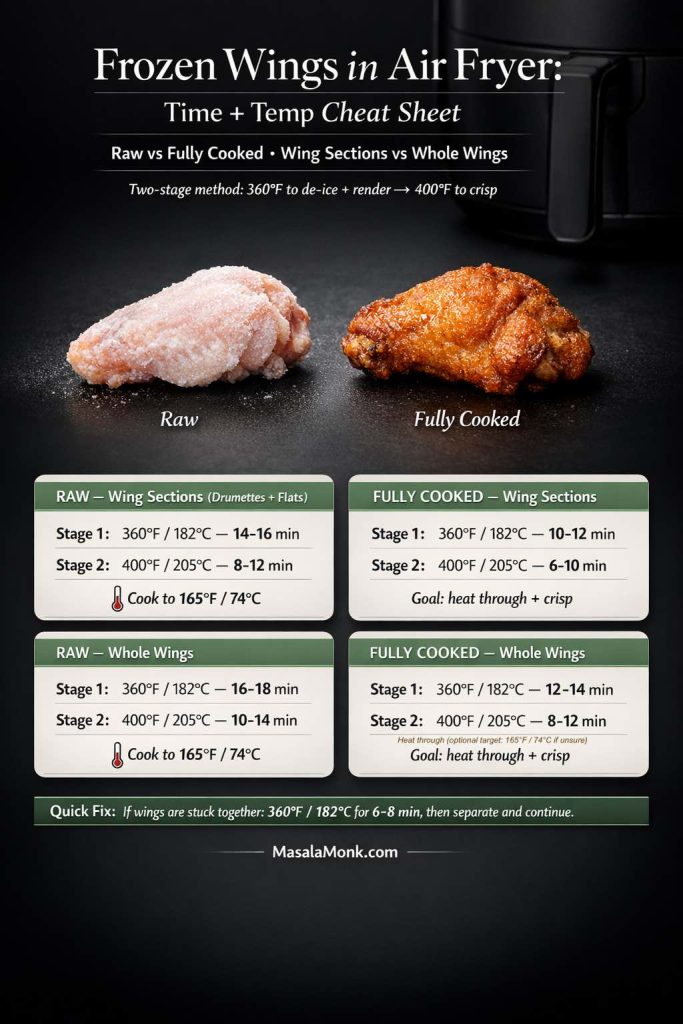
Frozen wings in air fryer time and temperature cheat sheet showing two-stage method: 360°F (182°C) then 400°F (205°C), with timings for raw vs fully cooked and wing sections vs whole wings, plus cook-to 165°F (74°C) note and quick fix for stuck wings. MasalaMonk.com
Frozen Wings Air Fryer Time + Temp Cheat Sheet: Use the two-stage method—360°F / 182°C to de-ice + render, then 400°F / 205°C to crisp. This chart breaks down exact ranges for raw vs fully cooked and wing sections vs whole wings, plus the quick fix for wings stuck together.

Frozen chicken wings in air fryer time & temperature (ranges by type)

Sections of frozen chicken wings (drumettes + flats), raw:

  • 360°F / 182°C for 14–16 minutes
  • then 400°F / 205°C for 8–12 minutes
    Total: about 22–28 minutes

Frozen wing sections, pre-cooked:

  • 360°F / 182°C for 10–12 minutes
  • then 400°F / 205°C for 6–10 minutes
    Total: about 16–22 minutes

Whole frozen wings (larger), raw:

  • 360°F / 182°C for 16–18 minutes
  • then 400°F / 205°C for 10–14 minutes
    Total: about 26–32 minutes

Whole frozen wings, pre-cooked:

  • 360°F / 182°C for 12–14 minutes
  • then 400°F / 205°C for 8–12 minutes
    Total: about 20–26 minutes

If you’re thinking “that’s a wide range,” you’re right. The key is to treat the time like a starting point and use the crisp stage to dial in texture.

Moreover, if your air fryer is smaller (or you’re cooking a lot), you’ll likely need batches. On the other hand, if you have a large basket that fits wings in a single layer comfortably, you’ll finish faster because airflow is stronger.

Frozen wings at 400°F: how long?

Using 400°F for the entire cook can over-brown the outside before the inside heats evenly (especially with raw wings). The best use of 400°F is as the final crisp stage:

  • Fully cooked frozen wings: 6–10 minutes at 400°F / 205°C
  • Raw frozen wings (after a 360°F start): 8–12 minutes at 400°F / 205°C

If wings still look pale or feel soft, add 2–4 minutes at 400°F, but only if they’re in a single layer.

Also Read: Chicken Adobo — Step-by-Step Recipe — Classic Filipino Adobong Manok


Cooking frozen wings in an air fryer: the small details that make a big difference

Crispy wings are rarely about one magic trick. Instead, it’s a handful of small choices that stack in your favor.
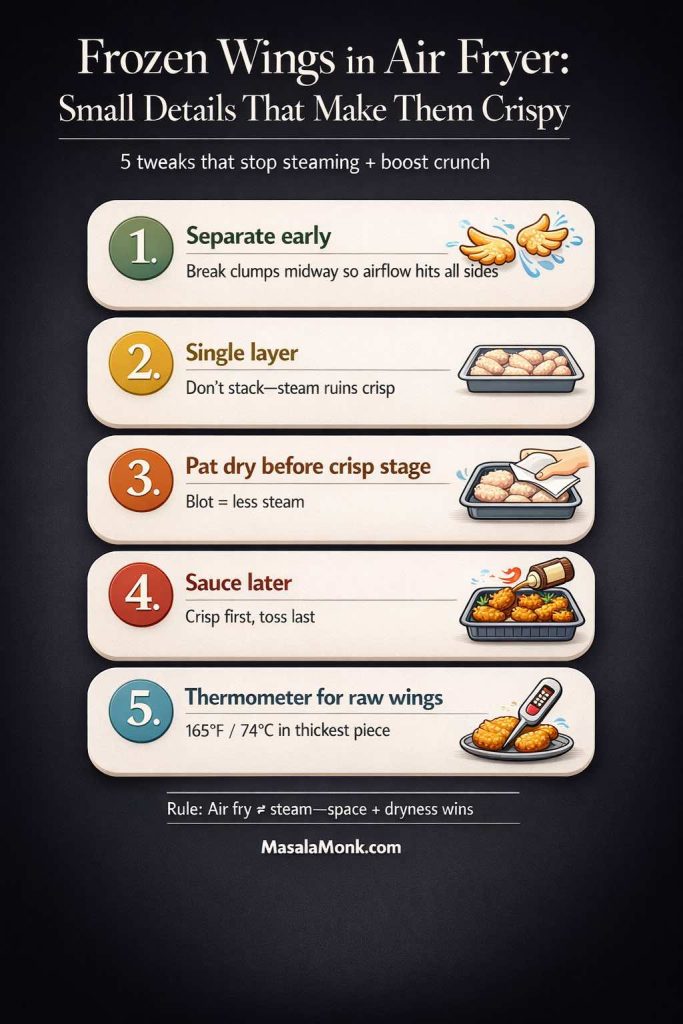
Infographic titled “Frozen Wings in Air Fryer: Small Details That Make Them Crispy” showing 5 tweaks: separate wings early so airflow hits all sides, cook in a single layer (don’t stack), pat dry before the crisp stage to reduce steam, sauce after crisping, and use a thermometer for raw wings (165°F / 74°C in the thickest piece). MasalaMonk.com branding at bottom.
Frozen wings in the air fryer: 5 tiny tweaks that stop steaming and boost crunch. Separate clumps, keep a single layer, blot before the crisp stage, sauce last, and use 165°F / 74°C for raw wings—then jump back to the full guide for exact times, temps, and troubleshooting.

Separate wings early

Frozen wings often clump. If you let them stay glued together too long, the interior sides won’t crisp because they never get exposed to airflow. So, midway through the first stage, use tongs to separate them.

Don’t stack

This is worth repeating because it’s the difference between “air fry” and “steam.”

If you’re tempted to pile them high, cook two batches instead. You’ll end up with wings that are actually crisp, which is the whole point of making wings in air fryer frozen in the first place.

Pat dry before the crisp stage

Water on the surface becomes steam. Steam softens skin. Therefore, blotting is not optional if you want reliable crunch.

Sauce later

If you want sticky wings, you can still get them. You just have to crisp first, then sauce. That sequencing keeps the outside crisp while still delivering the “saucy wing” experience.

Use a thermometer for raw wings

Visual cues aren’t dependable for safety. Wings can brown before they’re done. Conversely, they can look pale while they’ve already reached temperature. The simplest standard is to cook to 165°F / 74°C, as per USDA, and a thermometer is the most reliable check.

Also Read: Sweetened Condensed Milk Fudge: 10 Easy Recipes


Chicken wings in air fryer from frozen: two paths depending on raw vs pre-cooked

At this point, you can follow the core method and succeed. Still, it helps to see the two most common cases written out clearly—because these are the questions people run into when they’re standing in front of the air fryer trying to decide whether to add five minutes or ten.

Raw frozen chicken wings in air fryer (clear step-by-step recipe)

  1. Preheat to 360°F / 182°C.
  2. Cook wings 14–16 minutes (single layer), flipping once.
  3. Separate wings, drain moisture if needed, and blot dry.
  4. Season with salt, pepper, garlic powder, paprika, or your favorite dry rub.
  5. Crisp at 400°F / 205°C for 8–12 minutes, flipping once.
  6. Check 165°F / 74°C in the thickest piece.
  7. Rest 2–3 minutes, then sauce or serve.
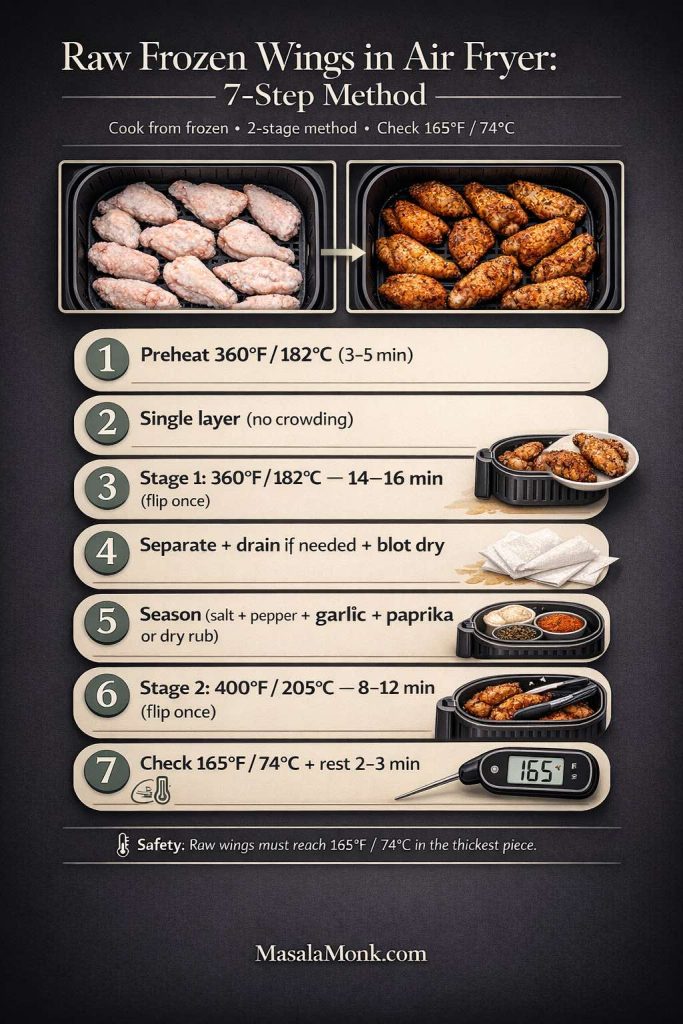
Infographic showing raw frozen chicken wings in an air fryer with a 7-step method: preheat 360°F/182°C, cook in a single layer 14–16 min (flip once), separate/drain/blot dry, season, crisp at 400°F/205°C for 8–12 min (flip once), then check 165°F/74°C and rest 2–3 min.
Raw frozen wings, simplified: follow this 7-step two-stage air fryer method (360°F cook → blot + season → 400°F crisp) and always confirm 165°F / 74°C in the thickest piece for safe, truly crispy wings.

Because these are raw, treat them like raw chicken from start to finish. If you want a quick safety refresh—especially about cross-contamination and why rinsing isn’t recommended—the CDC’s chicken food safety guidance is straightforward and practical.

Pre cooked chicken wings in air fryer (from frozen, crisp-first approach)

  1. Preheat to 360°F / 182°C.
  2. Cook wings 10–12 minutes, flipping once.
  3. Blot gently to remove surface moisture.
  4. Crisp at 400°F / 205°C for 6–10 minutes.
  5. Toss with sauce or finish with seasoning.
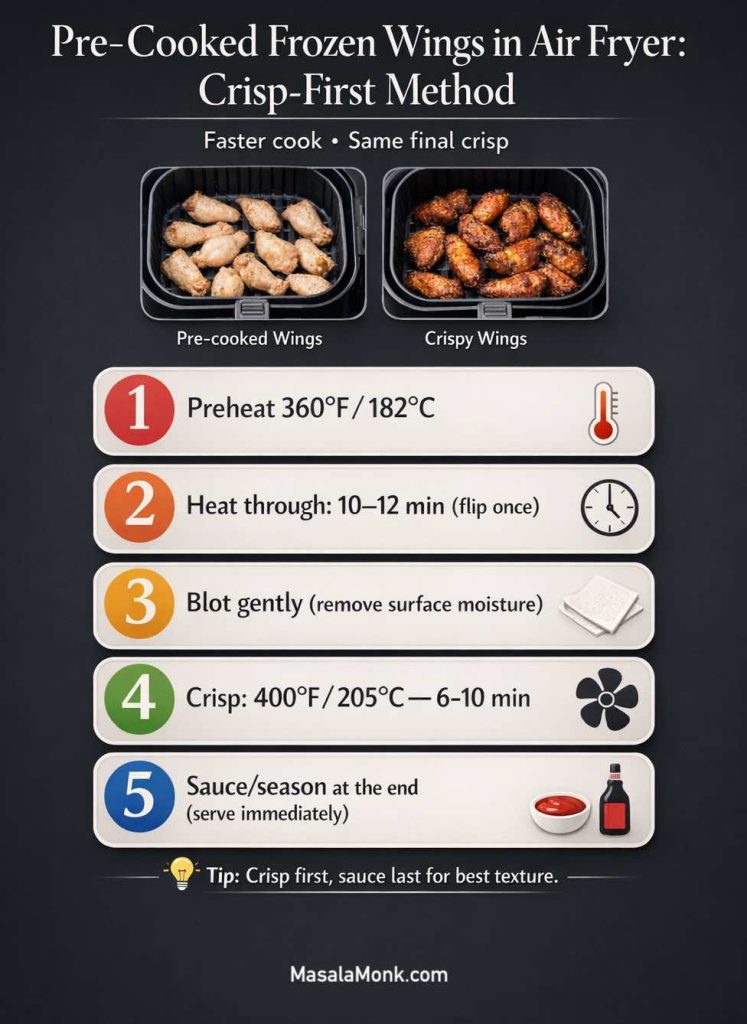
Pre-cooked frozen chicken wings in an air fryer, crisp-first method infographic. Steps: preheat to 360°F/182°C; heat through 10–12 minutes flipping once; blot gently to remove surface moisture; crisp at 400°F/205°C for 6–10 minutes; sauce or season at the end and serve immediately. Tip: crisp first, sauce last for best texture.
Pre-cooked frozen wings don’t need the long “ice-melt” stage—just heat through, blot off surface moisture, then finish with a high-heat crisp. This crisp-first sequence keeps the skin snappy and stops wings from tasting like reheated freezer food. Use 360°F/182°C to warm them evenly, then 400°F/205°C to lock in crunch, and toss with sauce only at the very end.

Pre-cooked wings are especially good for quick weeknights. Even so, they benefit from that crisp stage—otherwise they can taste like reheated freezer food instead of something you actually crave.

Also Read: Sourdough Recipe: 10 Easy Bread Bakes (Loaves, Rolls & Bagels)


Frozen buffalo wings in air fryer: crisp, then sauce (so they stay snappy)

Buffalo wings are a classic for a reason. Yet, when you start from frozen, the biggest risk is sauce + steam turning the skin soft.

So here’s the pattern: crisp first, then sauce, then a short “set” step if you want extra cling.
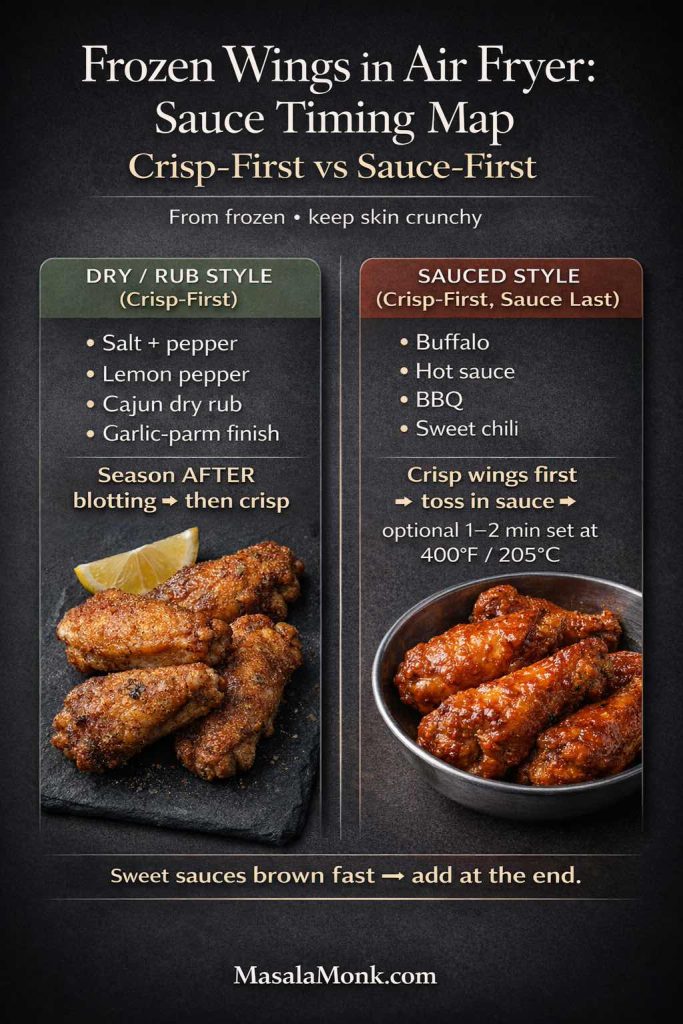
Infographic titled ‘Frozen Wings in Air Fryer: Sauce Timing Map: Crisp-First vs Sauce-First.’ Left panel: dry/rub style (crisp-first) with salt + pepper, lemon pepper, Cajun dry rub, garlic-parm finish; note says ‘Season AFTER blotting → then crisp.’ Right panel: sauced style (crisp-first, sauce last) with Buffalo, hot sauce, BBQ, sweet chili; note says crisp wings first, toss in sauce, optional 1–2 minutes at 400°F/205°C to set. Footer: MasalaMonk.com.
Sauce timing is the #1 reason frozen wings turn soggy. Use this quick map: dry rub = season after blotting, then crisp; Buffalo/BBQ/sweet chili = crisp first, sauce last (and if you want the sauce to cling, give it 1–2 minutes at 400°F / 205°C to “set”). Save this graphic for wing nights—then use the exact time + temp ranges above for your wing type.

Buffalo finish for frozen chicken wings in air fryer (crisp, then sauce)

  1. Cook and crisp using the core method.
  2. Meanwhile, warm hot sauce with a little butter until glossy.
  3. Toss wings quickly, coating evenly.
  4. For extra adhesion, put sauced wings back in the air fryer for 1–2 minutes at 400°F / 205°C.

Now you get the best of both worlds: saucy wings that still have bite.

To serve Buffalo wings the classic way, the tangy cooling dip matters just as much as the sauce. This MasalaMonk roundup is perfect for pairing: blue cheese dip for wings.

Also Read: Peanut Butter Fudge: Recipes & Guide (8 Methods + Easy Variations)


Frozen hot wings recipe: a simple way to make them taste bold without getting soggy

“Hot wings” can mean a lot of things. Sometimes it’s a spicier Buffalo. Other times it’s a sticky hot glaze. In either case, the approach remains similar: get the wings crisp first, then add heat.
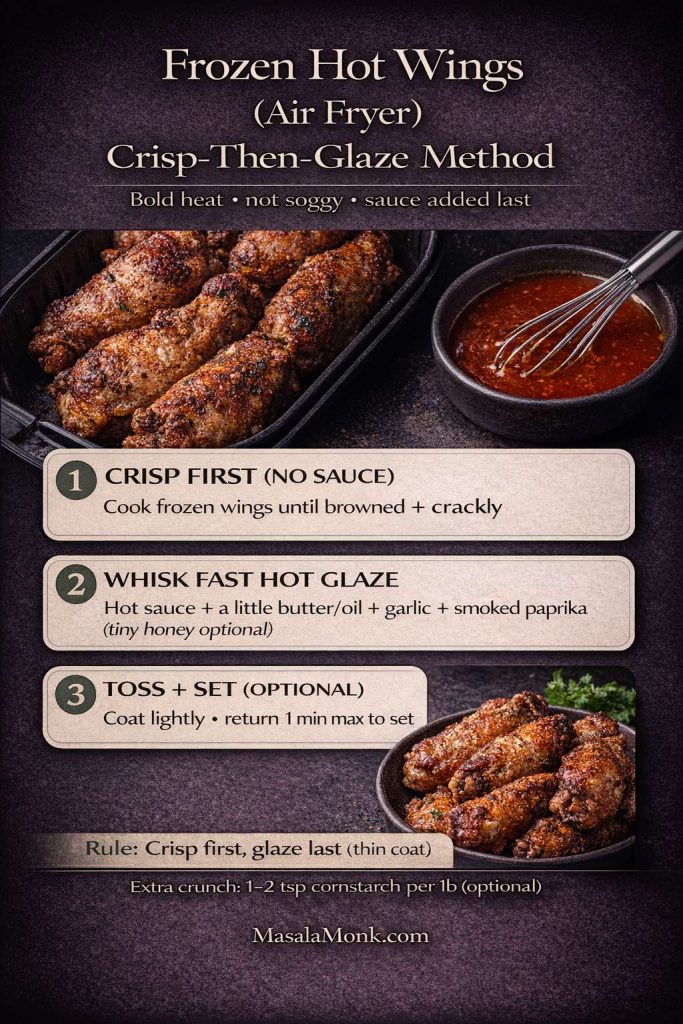
Infographic showing frozen hot wings in an air fryer using a crisp-then-glaze method: 1) Crisp frozen wings first with no sauce until browned and crackly. 2) Whisk a fast hot glaze (hot sauce, a little butter/oil, garlic, smoked paprika; tiny honey optional). 3) Toss lightly and return to air fryer up to 1 minute to set. Rule: crisp first, glaze last.
Frozen hot wings in the air fryer taste best when you crisp first and sauce last. This quick “crisp-then-glaze” method keeps wings bold and spicy without turning the skin soggy—plus you can set the glaze for just 1 minute max. Optional: a light cornstarch dusting (1–2 tsp per lb) can boost crunch. Use this as your fast game-day shortcut, then follow the full MasalaMonk frozen wings guide for timings, temps, and sauce variations.

Fast hot glaze (spicy, glossy, not too sweet)

  • Hot sauce
  • A touch of butter or oil
  • Garlic powder
  • A pinch of smoked paprika
  • Optional: a tiny amount of honey (keep it minimal so it doesn’t burn)

Toss wings after crisping, then return them for a minute to set. Because the glaze is thin, it clings without drowning the skin.

If you’re building a game-day spread, another wing-adjacent crowd-pleaser is a warm dip. MasalaMonk’s Buffalo chicken dip fits naturally next to wings on the table.

Also Read: 10 Vegan Chocolate Cake Recipes (Easy, Moist, & Dairy-Free)


Air fryer wings frozen: dry-rub and “no-sauce” styles that stay crisp longer

Sauced wings are great. Still, if you want wings that stay crisp for longer—especially if you’re serving a crowd—dry rub wings are the easiest win. They also travel better, hold better, and reheat better.
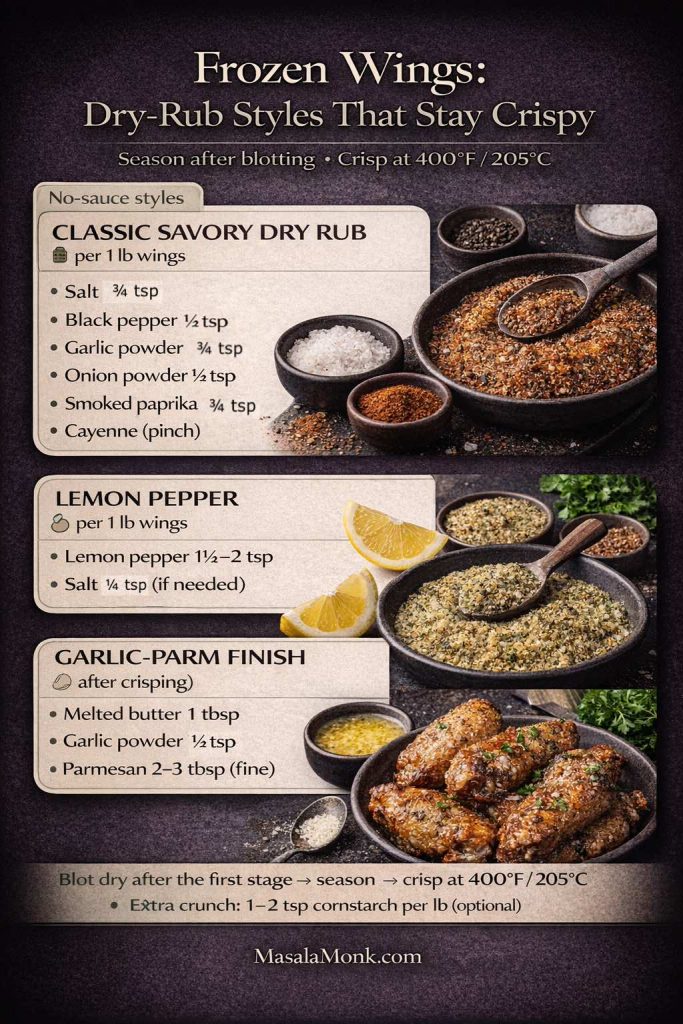
Vertical infographic titled “Frozen Wings: Dry-Rub Styles That Stay Crispy.” It says to season after blotting and crisp at 400°F / 205°C. It lists 3 no-sauce options per 1 lb wings: Classic savory dry rub (salt 3/4 tsp, black pepper 1/2 tsp, garlic powder 3/4 tsp, onion powder 1/2 tsp, smoked paprika 3/4 tsp, cayenne pinch), Lemon pepper (1 1/2–2 tsp plus optional salt), and Garlic-parm finish after crisping (butter, garlic powder, parmesan).
Want wings that stay crispy longer (and hold up for batches)? Use these low-moisture “no-sauce” finishes: a classic savory dry rub, a bright lemon-pepper hit, or a garlic-parm finish added after crisping. The key is simple: blot dry after the first stage, then season, then crisp at 400°F / 205°C—so flavor sticks without steaming the skin. Optional pro move: a tiny cornstarch dusting for extra crunch.

Classic savory dry rub

  • Salt
  • Black pepper
  • Garlic powder
  • Onion powder
  • Smoked paprika
  • Optional: pinch of cayenne

Season after the first stage (when you blot dry), then crisp at 400°F / 205°C.

Lemon pepper style (bright and punchy)

Lemon pepper seasoning works beautifully on wings because it tastes big without needing sauce. Add it after blotting so it adheres, then crisp.

Garlic-parmesan finish (crispy + rich)

Crisp the wings first. Then toss in:

  • A little melted butter
  • Garlic powder (or minced garlic, quickly warmed)
  • Finely grated parmesan

Because the finish is low-moisture, the wings stay crunchy instead of turning soft.

Also Read: Kahlua Drinks: 10 Easy Cocktail Recipes (Milk, Vodka, Coffee)


Best way to cook frozen chicken wings: what to do when your air fryer behaves differently

Some air fryers run hot. While some run cool. Then some have strong fans. And some have weaker airflow. Instead of fighting your machine, use these adjustments.
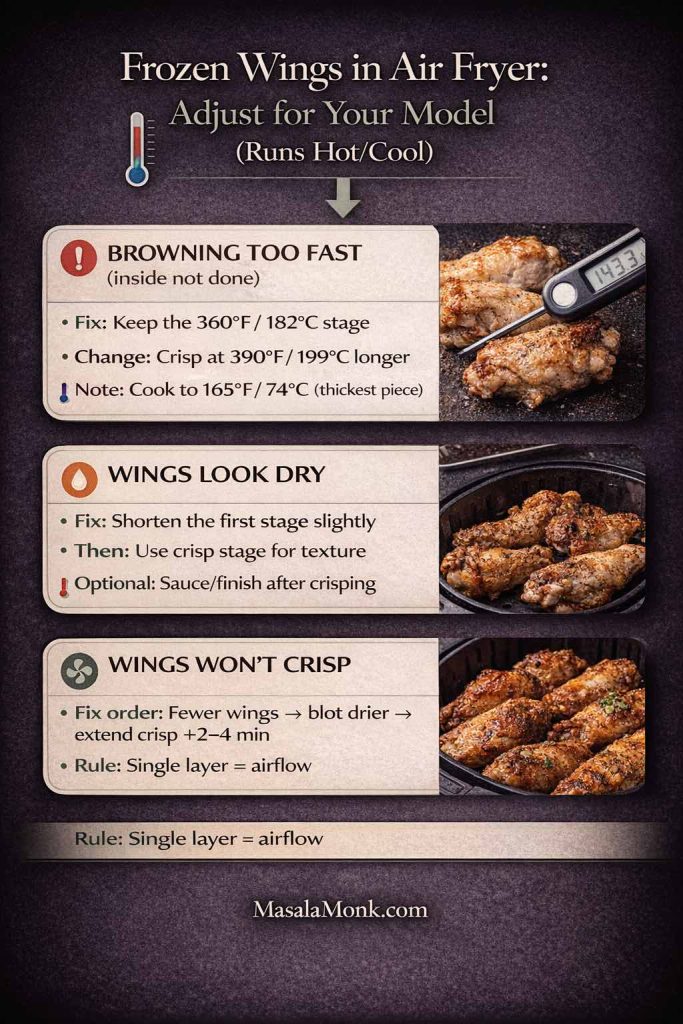
Vertical infographic: ‘Frozen Wings in Air Fryer—Adjust for Your Model (Runs Hot/Cool)’. Three fixes: (1) Browning too fast (inside not done): keep 360°F/182°C stage, crisp longer at 390°F/199°C; cook raw wings to 165°F/74°C. (2) Wings look dry: shorten first stage slightly, rely on crisp stage; sauce/finish after crisping. (3) Wings won’t crisp: fewer wings, blot drier, extend crisp +2–4 min; single layer = airflow. MasalaMonk.com footer.
When your air fryer runs hot, cool, or has weaker airflow, this quick guide stops the guesswork: adjust the crisp stage (390°F vs 400°F), fix dryness, and force crisping with the right order (fewer wings → blot drier → extend crisp). Save this troubleshooting card for the next batch—then follow the full method in this post for timings, flavors, and doneness checks.

If wings are browning too fast but not done inside (raw wings)

Lower the crisp stage slightly: do 390°F / 199°C instead of 400°F / 205°C, and add a few minutes. Meanwhile, keep the first stage the same so fat renders properly.

If wings look dry

Oddly enough, overly long cooking can dry the meat even if the skin isn’t that crisp. In that case, shorten the first stage a little and rely on the crisp stage for texture.

If wings won’t crisp

This usually comes down to moisture and crowding. First, reduce how many wings are in the basket. Next, blot more thoroughly after the first stage. Finally, extend the crisp stage by 2–4 minutes.

Also Read: Hot Chocolate Coffee: 3 Easy Recipes (Cocoa, Mix, or Espresso)


Frozen party wings in air fryer: how to keep batches consistent

Party wings are where the air fryer shines—because you can cook in batches while keeping quality high. Still, consistency matters.
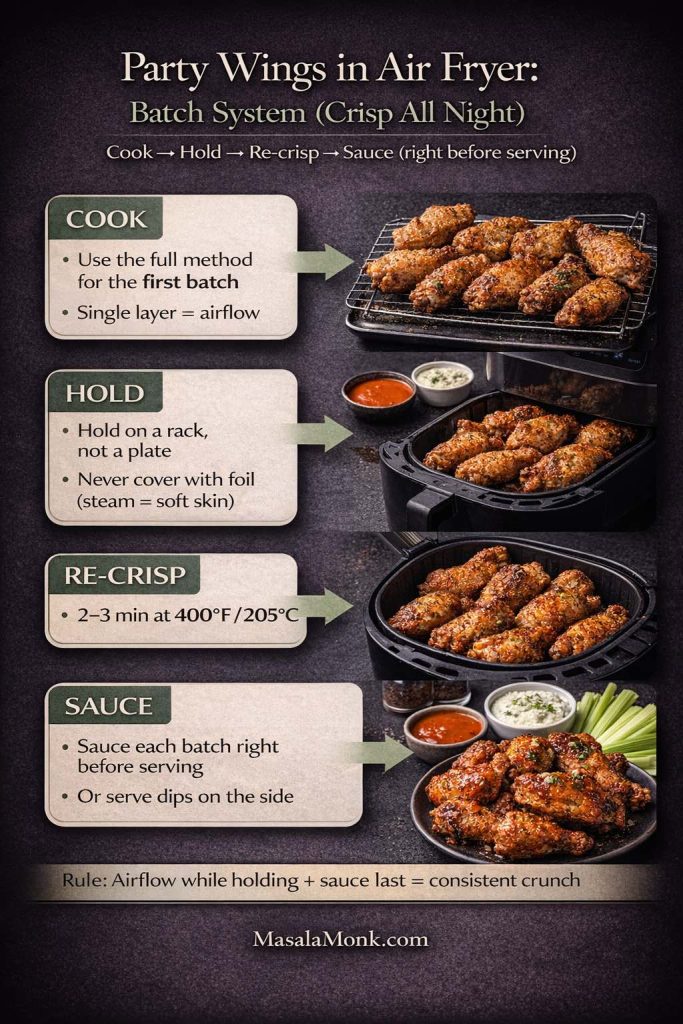
Vertical infographic titled “Party Wings in Air Fryer: Batch System (Crisp All Night).” It shows a 4-step flow: Cook first batch in a single layer for airflow, Hold wings on a rack (not a plate) and don’t cover with foil, Re-crisp 2–3 minutes at 400°F/205°C, then Sauce right before serving or offer dips on the side. Footer: MasalaMonk.com.
Cooking wings for a crowd? Use this “Cook → Hold → Re-crisp → Sauce” batch system so every round stays crunchy. The key is airflow while holding (rack, not a plate), then a quick 2–3 minute re-crisp at 400°F/205°C—sauce goes on at the very end. Save/pin this for game day.

Batch strategy

  • Cook the first batch using the full method.
  • Hold finished wings on a rack (not a plate) so airflow keeps them crisp.
  • When you’re ready to serve, do a quick 2–3 minute re-crisp at 400°F / 205°C.

Avoid covering hot wings with foil while holding—trapped steam will soften the skin fast.

Sauce strategy

Sauce each batch right before serving. That way, wings don’t sit in sauce and soften. Alternatively, offer sauces on the side and let people dip.

If you want a “dip-friendly” base that you can turn into garlic mayo, spicy mayo, or creamy herb dip, MasalaMonk’s eggless mayonnaise is an excellent starting point. If you prefer plant-based, vegan mayo also works beautifully as a wing dip base.

Also Read: Cappuccino Recipe: How to Make a Perfect Cappuccino at Home


Thawed wings in air fryer: what changes if you already thawed them?

Sometimes you planned ahead. Other times the wings thawed in the fridge because plans changed. Either way, the method is similar, yet timing changes because you’re no longer melting ice first.
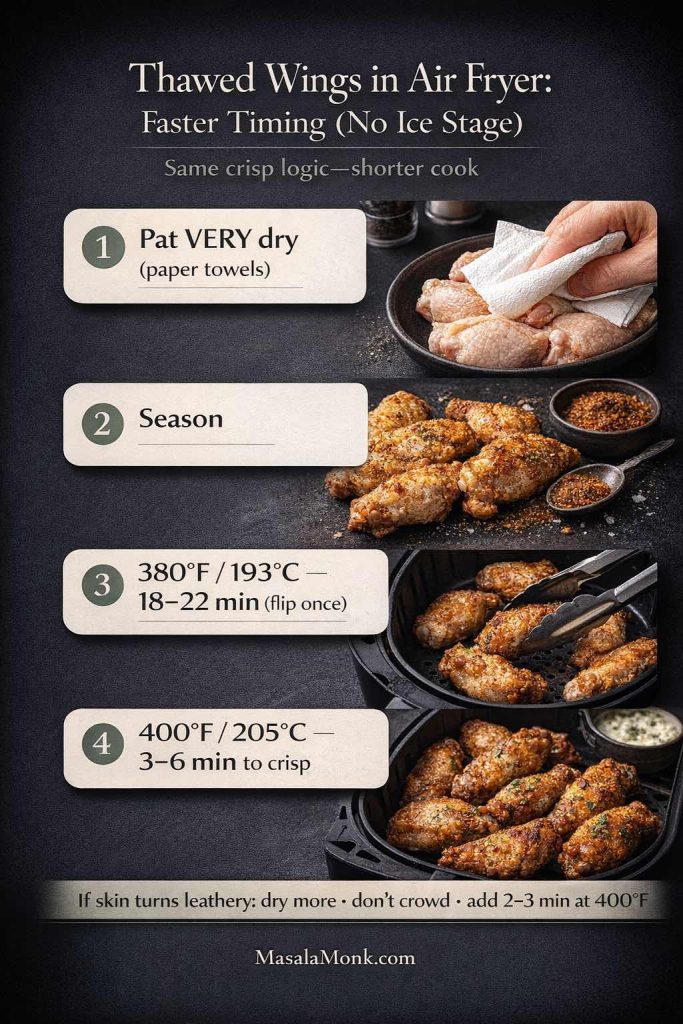
Thawed chicken wings in an air fryer timing guide (no ice stage): 1) Pat wings very dry with paper towels, 2) Season, 3) Air fry at 380°F / 193°C for 18–22 minutes, flipping once, 4) Crisp at 400°F / 205°C for 3–6 minutes. Tip shown: if skin turns leathery, dry more, don’t crowd, and add 2–3 minutes at 400°F. MasalaMonk.com
Thawed wings cook faster because there’s no ice stage—but crisp skin still depends on drying and airflow. Use this quick timing card: 380°F (18–22 min) to cook through, then 400°F (3–6 min) to crisp. If the skin turns leathery, the fix is simple: pat drier, don’t crowd, and extend the final crisp a couple minutes. Save this graphic for wing night, and scroll this post for the full frozen-vs-thawed method + sauce ideas.

Thawed chicken wings in air fryer (baseline method)

  1. Pat wings very dry.
  2. Season.
  3. Cook at 380°F / 193°C for 18–22 minutes, flipping once.
  4. Crisp at 400°F / 205°C for 3–6 minutes.

Because thawed wings release less water upfront, you can often start a bit higher than the frozen method. Still, blotting matters. Otherwise, the skin can turn leathery instead of crisp.

For a full fresh-wing technique and seasoning inspiration, MasalaMonk’s Air Fryer Chicken Wings is a natural next read.

Also Read: Cold Brew Espresso Martini: How to Make It (Step-by-Step Recipe)


Frozen chicken wings in the air fryer: serving ideas that make the meal feel complete

Wings are often the main event. Yet, what you serve alongside them changes the whole vibe. Moreover, sides and dips give you variety without additional work.

Classic dip pairings

  • Blue cheese dip (especially for Buffalo)
  • Ranch-style dips (easy to build from mayo)
  • Garlic-herb dip

For a quick ranch-style dip, stir dried herbs (dill/parsley), garlic powder, black pepper, lemon, and a pinch of salt into mayo or vegan mayo—then thin with a splash of water until it’s pourable. For a dedicated dip lineup, this MasalaMonk guide to blue cheese dip for wings is a perfect guide to explore.

Fresh, herby “sauce direction” (lighter than Buffalo)

If you want a change from butter-and-hot-sauce flavors, go herby. Toss wings with a spoonful of chimichurri after crisping, or serve it on the side for dipping. MasalaMonk’s chimichurri recipe is ideal for that.

Pesto-style finishes

A small drizzle of pesto (or pesto mayo) can turn wings into something that feels restaurant-y. If you want variations, MasalaMonk’s pesto recipes and variations can give you multiple directions without adding complexity.

Also Read: Iced Coffee: 15 Drink Recipes—Latte, Cold Brew, Frappe & More


Cooking frozen buffalo wings and other sauced wings: how to avoid burning sugars

Many store-bought sauces contain sugar. Sugar browns fast. Consequently, if you cook heavily sauced wings at high heat for too long, you can end up with scorched spots before the wing is crisp.
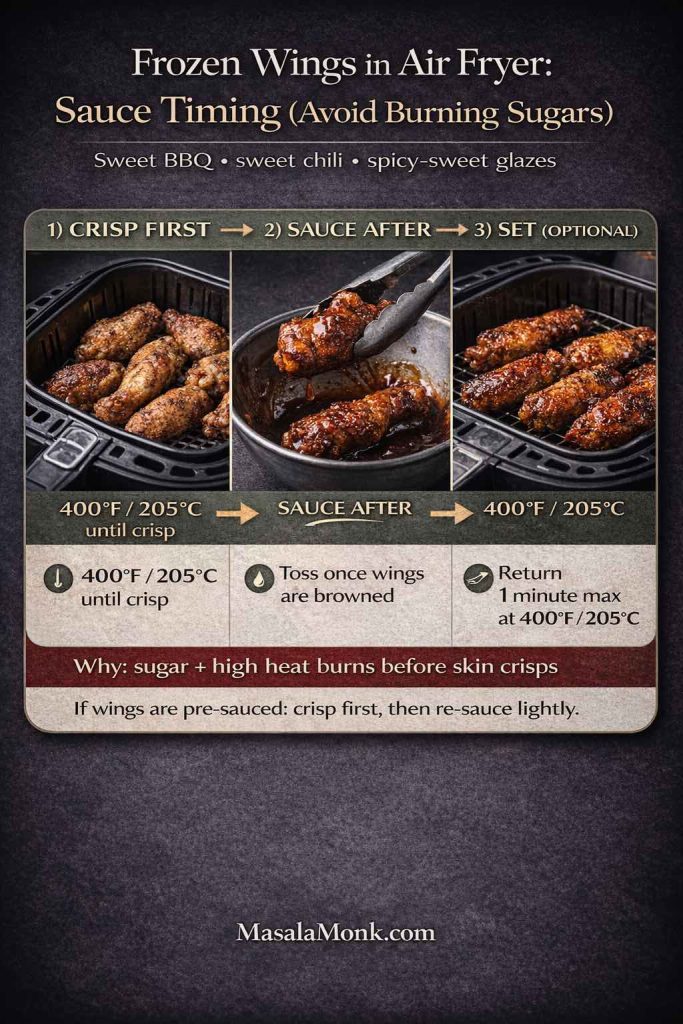
Frozen wings in air fryer sauce timing guide to avoid burning sugars: crisp wings first at 400°F / 205°C, toss in sweet BBQ or sweet chili sauce after browning, then return to the air fryer for 1 minute max at 400°F / 205°C to set (optional).
Sauce timing is the #1 fix for sweet BBQ, sweet chili, and spicy-sweet frozen wings. Crisp the wings first (no sauce) so the skin can actually brown. Then toss in sauce after crisping—this prevents sugar from scorching before the wings get crunchy. Want extra cling? Do a 1-minute max “set” back in the air fryer at 400°F / 205°C. Save/pin this graphic for instant “no-burn” wing nights.

The safer approach for sweet or sticky sauces

  • Crisp the wings first with no sauce at 400°F / 205°C.
  • Toss with sauce after crisping.
  • Return for 1 minute only if you want it set and tacky.

This works for BBQ wings, sweet chili wings, and spicy-sweet glazes.

Also Read: Cranberry Moscow Mule Recipe: A Festive Holiday Cocktail With Easy Variations


Frozen wings in air fryer time: how to tell when they’re “done” beyond the clock

Time is useful, yet doneness is more reliable when you combine a few signals.
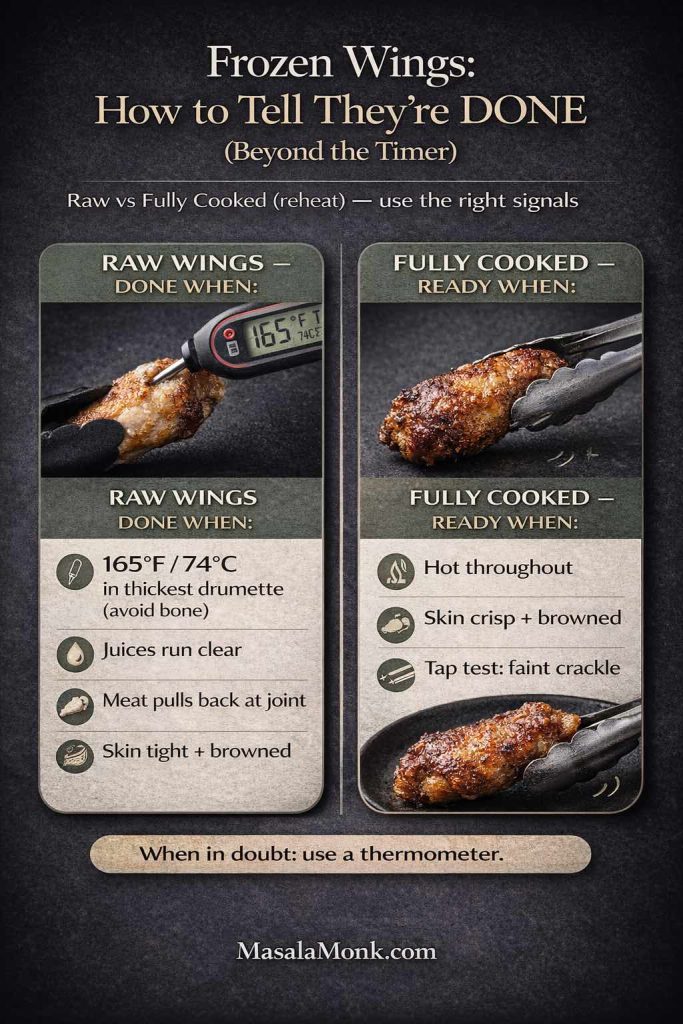
Portrait infographic titled “Frozen Wings: How to Tell They’re DONE (Beyond the Timer).” Two columns compare doneness signals for raw vs fully cooked frozen wings (reheat). Raw wings: thermometer reads 165°F/74°C in thickest drumette (avoid bone), juices run clear, meat pulls back at joint, skin tight and browned. Fully cooked wings: hot throughout, skin crisp and browned, tap test gives a faint crackle. Footer: MasalaMonk.com.
Beyond the clock: use the right doneness signals for frozen wings based on what you have—raw vs fully cooked (reheat). Raw wings are only “done” when the thickest piece hits 165°F / 74°C (avoid bone for accurate readings), then confirm the skin is tight + browned. Fully cooked wings don’t need a safety temp check—your goal is hot throughout + crisp skin, and the “tap test” (faint crackle) is the quickest cue. Save this as your frozen chicken wings doneness checklist for consistently crispy results.

For raw wings

  • Thermometer reads 165°F / 74°C in the thickest part (refer to USDA temperature guidance)
  • Juices run clear when pierced
  • The meat pulls slightly from the bone at the joint
  • The skin looks tightened and browned

For pre-cooked wings

  • Wings are hot throughout
  • Skin is crisped and browned
  • You hear a faint crackle when you tap the surface with tongs

If you’re unsure whether your frozen wings are raw or pre-cooked, treat them like raw and check temperature. It’s the simplest way to remove doubt.

Also Read: Baked Ziti Recipe Collection: 15 Easy Variations


Best frozen wings for air fryer: what actually matters when choosing a bag

Different brands vary, yet the most important factor for results is often not the brand—it’s the wing style.
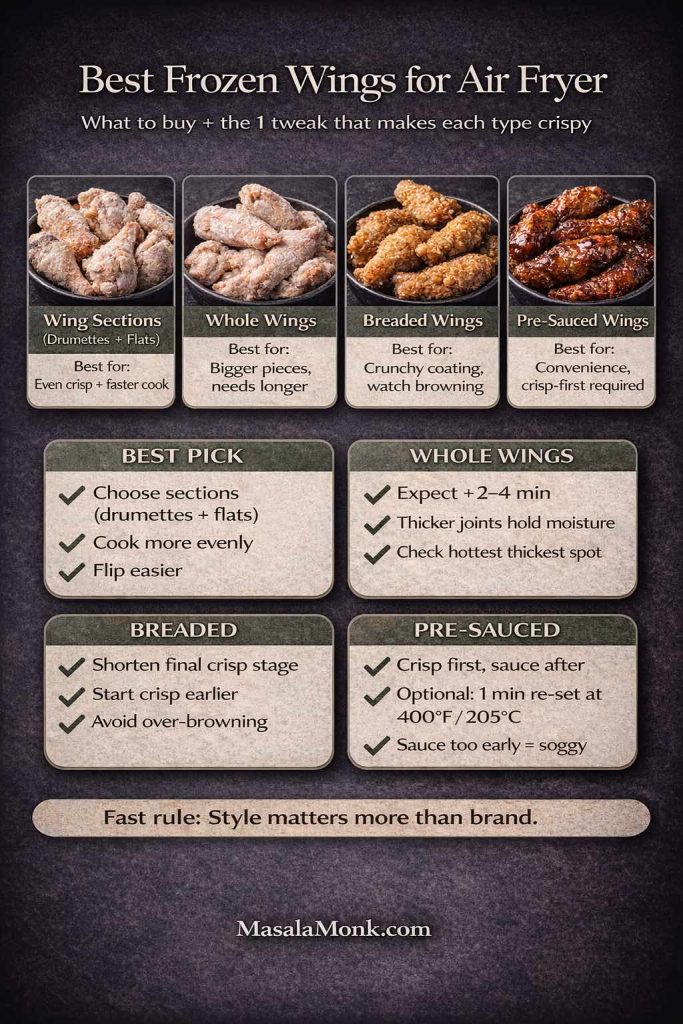
Vertical infographic titled “Best Frozen Wings for Air Fryer” showing four frozen wing types—wing sections (drumettes + flats), whole wings, breaded wings, and pre-sauced wings—with what each is best for. Notes: sections cook evenly and flip easier; whole wings may need +2–4 minutes and thicker joints hold moisture; breaded wings brown fast so shorten the final crisp stage; pre-sauced wings should be crisped first, sauced after, with an optional 1-minute reset at 400°F / 205°C. Footer: MasalaMonk.com.
Best Frozen Wings for Air Fryer (what to buy): Wing style matters more than brand. For the crispiest results, choose wing sections (drumettes + flats)—they cook more evenly and flip easier. Using whole wings? Expect +2–4 minutes since thicker joints hold moisture. Breaded wings brown fast, so shorten the final crisp stage. Pre-sauced wings stay best when you crisp first, sauce last (optional: 1 minute at 400°F / 205°C to “set” sauce). Keep reading for the full timing chart + the two-stage crisp method.

Wing sections usually outperform whole wings

Wingettes/drumettes crisp more evenly, fit better, and flip more easily.

Breaded wings can be great, but need careful timing

Breaded wings brown quickly. That’s fine, although it means the crisp stage might be shorter to prevent scorching.

Pre-sauced wings can be convenient, but crisp-first still wins

They’ll taste much better if you crisp them first, then refresh sauce at the end.

If you’re building a broader air-fryer setup and want a practical list of machines, MasalaMonk has a roundup of best-selling air fryers. It’s a useful internal reference if you’re comparing sizes and baskets.

Also Read: Manhattan Cocktail Recipe (Classic + 6 Variations)


Frozen chicken wings in air fryer troubleshooting (the real fixes)

Even with a good method, a few problems show up again and again. Here’s what to do when they do.
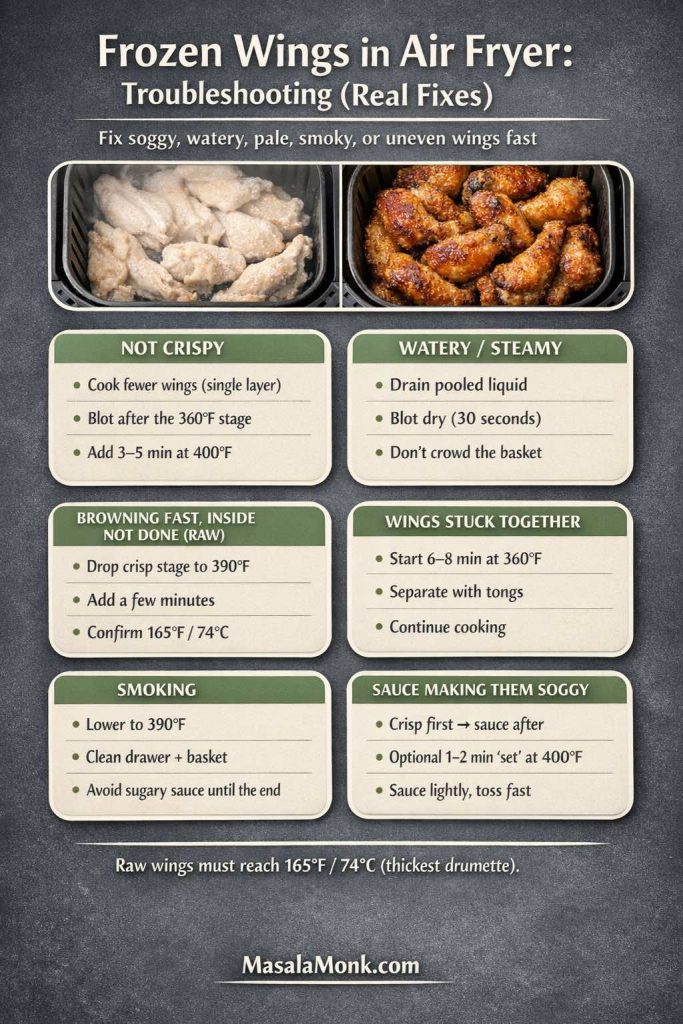
Infographic titled ‘Frozen Wings in Air Fryer: Troubleshooting (Real Fixes)’ with a top photo strip showing pale steamed wings vs browned crispy wings. Six tip boxes: Not Crispy (single layer, blot after 360°F stage, add 3–5 min at 400°F); Watery/Steamy (drain liquid, blot 30 sec, don’t crowd); Browning fast inside not done (raw) (390°F + time, confirm 165°F/74°C); Wings stuck together (start 6–8 min at 360°F, separate, continue); Smoking (390°F, clean basket, avoid sugary sauce); Sauce soggy (crisp first, optional 1–2 min set). Footer: MasalaMonk.com.
Wings coming out soggy, watery, smoky, or uneven? Save this quick troubleshooting guide. It shows the real fixes that work with frozen wings: single-layer airflow (no steaming), drain + blot after the 360°F stage, then finish hot at 400°F for crisp skin. If you’re using raw frozen wings, the chart reminds you to confirm 165°F / 74°C in the thickest drumette before serving. And if sauce keeps ruining crunch, the rule is simple: crisp first → sauce after (optional 1–2 minutes to “set”). Keep this handy for wing night—and scroll for the full step-by-step method, times, and flavor options.

“My wings are still not crispy”

  • Cook fewer wings at once.
  • Blot more thoroughly after the first stage.
  • Extend the 400°F / 205°C crisp stage by 3–5 minutes.

“My wings are watery”

This often happens with frozen wings that release a lot of moisture early.

  • Drain the basket if water collects.
  • Blot thoroughly.
  • Give the wings a longer crisp stage.

“My wings are browned but the inside feels underdone”

This is most common with larger raw wings.

  • Add time at 360°F / 182°C first, then crisp again.
  • Confirm doneness with a thermometer and aim for 165°F / 74°C (USDA guidance).
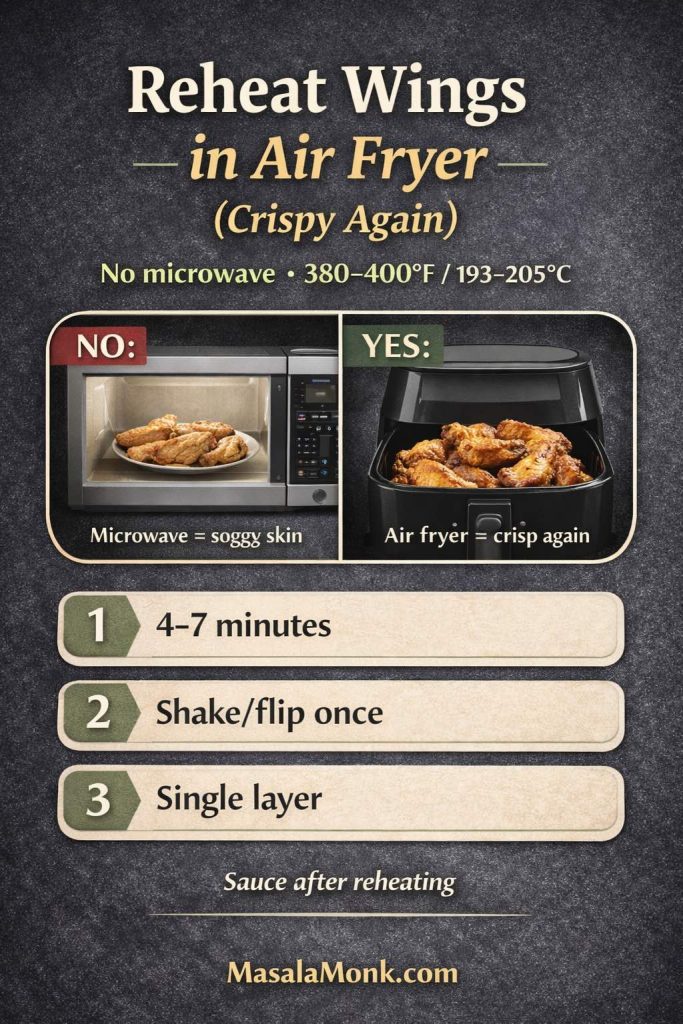
Reheating chicken wings in an air fryer: avoid the microwave. Reheat at 380–400°F (193–205°C) for 4–7 minutes, shake or flip once, keep wings in a single layer, and sauce after reheating for crisp skin.
Leftover wings? Skip the microwave. Reheat in the air fryer at 380–400°F (193–205°C) for 4–7 minutes, flip once, and keep them in a single layer so the skin turns crisp again. Sauce after reheating to avoid soggy wings.

“My wings are smoking”

Rendered chicken fat can smoke, especially at 400°F. If your model smokes easily:

  • Reduce crisp stage to 390°F / 199°C and cook slightly longer.
  • Clean the basket and drawer regularly.
  • Avoid sugary sauces until the end.

Also Read: Rob Roy Drink Recipe: Classic Scotch Cocktail (Perfect + Dry + Sweet Variations)


Baked chicken wings from frozen: a solid oven backup when you’re cooking a lot

Sometimes you need volume. In that case, the oven is convenient because you can do a full sheet pan at once. Even so, the same crisping logic applies: airflow and moisture control.
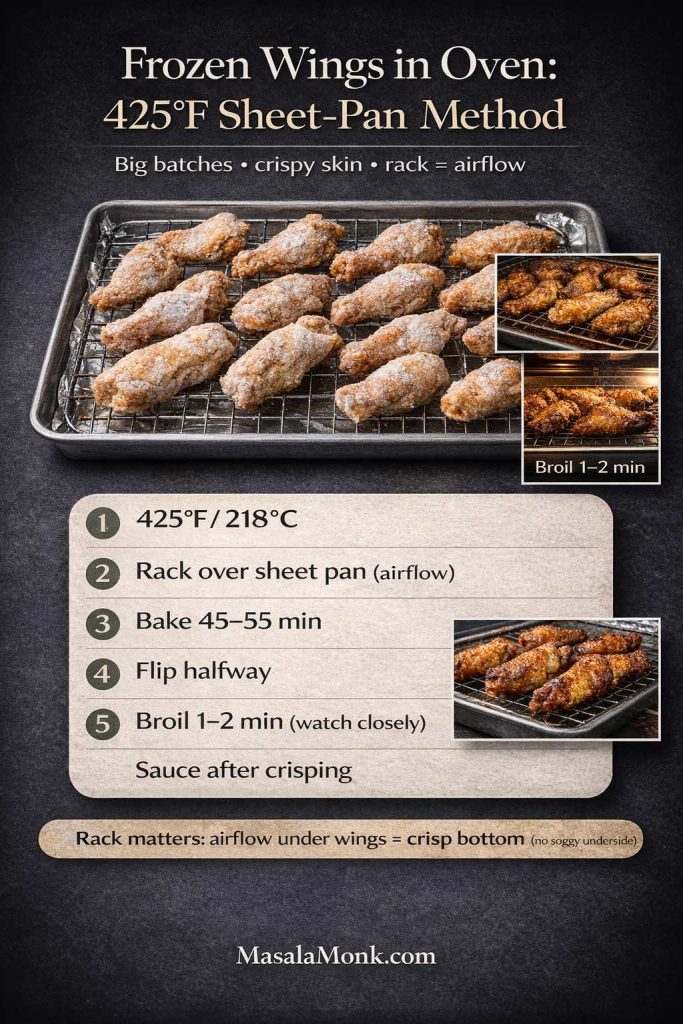
Frozen chicken wings baked in the oven using a rack-over-sheet-pan method: bake at 425°F / 218°C for 45–55 minutes, flip halfway, then broil 1–2 minutes for extra crisp skin. Includes a visual reminder that the rack improves airflow so the bottoms don’t turn soggy. MasalaMonk.com footer.
Oven backup for big batches: When you need volume, this rack-over-sheet-pan method nails the same goal as air frying—airflow + moisture control. Bake frozen wings at 425°F / 218°C for 45–55 minutes, flip halfway, then broil 1–2 minutes right at the end for that last crisp hit. The rack is the difference-maker: it keeps the undersides from steaming against the pan. Sauce after crisping so you don’t soften the skin.

Oven method for frozen wings

  1. Heat oven to 425°F / 218°C.
  2. Place wings on a rack set over a sheet pan.
  3. Bake 45–55 minutes, flipping halfway.
  4. For extra crispness, broil 1–2 minutes at the end (watch closely).
  5. Sauce after crisping.

The rack matters because it lets hot air circulate around the wings. Without it, the underside can soften from contact with the pan.

Also Read: Best Vermouth for a Negroni Cocktail Drink Recipe


Fried chicken wings from frozen: what to know before you do it

Deep frying from frozen can be done, although it’s messy and can be risky if you aren’t careful. Frozen surfaces can cause oil splatter. Additionally, wing pieces that are stuck together can create uneven cooking.
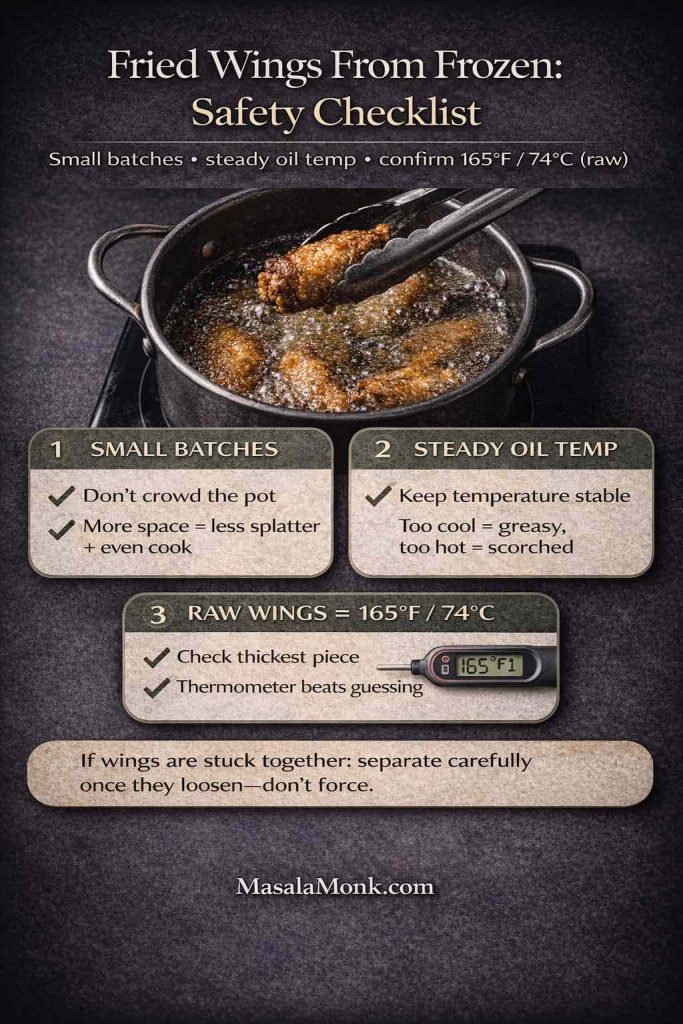
Fried wings from frozen safety checklist graphic: deep-frying pot with wings and tongs. Key tips: fry in small batches (don’t crowd—less splatter, more even cooking), keep oil temperature steady (too cool = greasy, too hot = scorched), and for raw wings confirm 165°F / 74°C in the thickest piece with a thermometer. Note: if wings are stuck together, separate gently once loosened.
Deep-frying frozen wings can work, but it’s the easiest way to create a splattery mess (or uneven cooking) if you rush it. Use this quick safety checklist: small batches + steady oil temp + thermometer to 165°F / 74°C for raw wings. If wings are stuck together, let them loosen in the oil first—don’t force them apart. (Save/pin this so you don’t have to guess next time.)

If you include this method, keep it cautious:

  • Fry in small batches
  • Maintain steady oil temperature
  • Confirm raw wings reach 165°F / 74°C

For most people, an air fryer gives you enough crunch without the mess—especially when you follow the two-stage crisping method.

Also Read: Paper Plane Cocktail Recipe + Best Amaro Substitutes & Tips


A few flavorful ways to keep wings exciting (without turning the kitchen into a project)

Wings get repetitive only when you repeat the same sauce. Instead, rotate finishes that don’t add work.

Creamy dips that pair with everything

If you want a dip you can customize endlessly, start with a mayo base. MasalaMonk’s eggless mayonnaise is perfect for classic creamy dips, while the vegan mayo recipe gives you a plant-based option that still tastes rich.

From there, you can build:

  • Garlic mayo (garlic + lemon + salt)
  • Spicy mayo (hot sauce + paprika)
  • Herb dip (dill/parsley + lemon)

Fresh sauces for contrast

Chimichurri turns wings bright and herby. It feels lighter than Buffalo and adds a restaurant-style edge. Use MasalaMonk’s chimichurri recipe either as a toss after crisping or as a side dip.

A “sauce library” approach

If you like having options ready, a sauce hub helps. MasalaMonk’s pizza sauce collection and pesto variations can inspire new wing finishes beyond the usual lineup, while still staying practical.

Also Read: Green Chutney Recipe (Coriander–Mint / Cilantro Chutney)


Handling and safety, especially for raw frozen wings

Raw frozen wings behave like raw chicken once they start thawing in the basket. So it’s worth treating them with the same kitchen habits you’d use for fresh poultry:

  • Use separate tongs or wash them after touching raw wings
  • Wash hands after handling
  • Sanitize the cutting board if you use one
  • Avoid rinsing raw chicken (it spreads bacteria around the sink)

The CDC summarizes these basics clearly in its guide to chicken and food safety.

Meanwhile, for doneness, keep it simple: 165°F / 74°C at the thickest point is the standard, and the USDA safe temperature chart lays it out cleanly.

Also Read: 19 Essential Kitchen Tools That Make Cooking Easier


Bringing it all together: a simple “from frozen” wing routine you can repeat

If you want a routine you can memorize, use this:

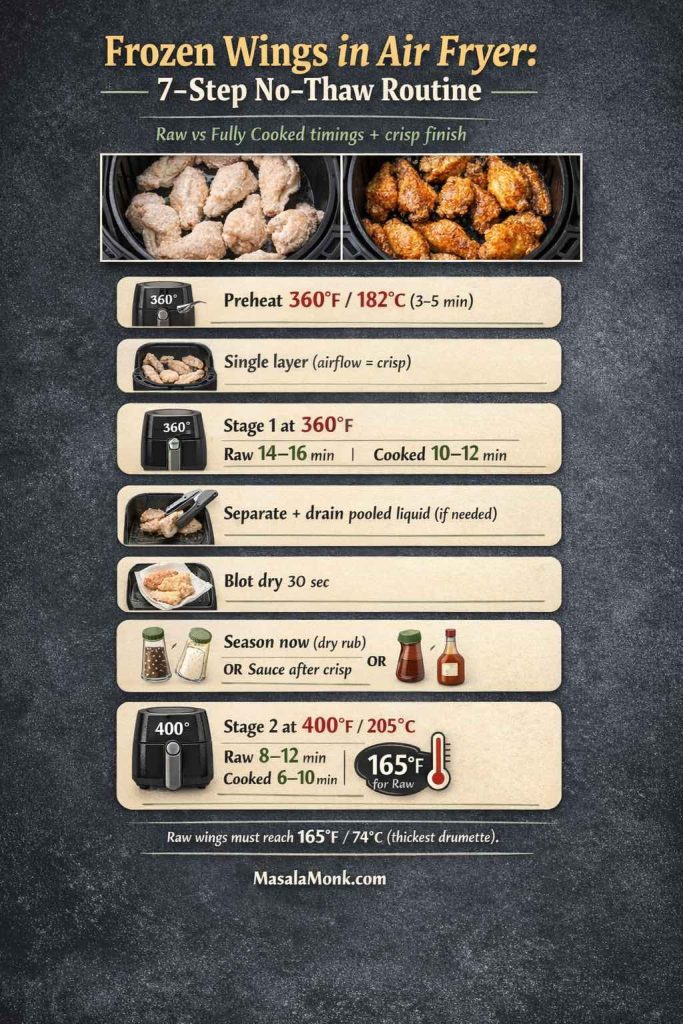
  1. Preheat 360°F / 182°C
  2. Cook frozen wings (raw: 14–16 min, pre-cooked: 10–12 min)
  3. Separate + blot dry
  4. Season (or wait if saucing)
  5. Crisp 400°F / 205°C (raw: 8–12 min, pre-cooked: 6–10 min)
  6. Sauce after crisping
  7. For raw wings, confirm 165°F / 74°C
Infographic titled “Frozen Wings in Air Fryer: 7-Step No-Thaw Routine” showing raw vs fully cooked frozen wing timings. Steps: preheat 360°F/182°C for 3–5 minutes, cook in a single layer, Stage 1 at 360°F (raw 14–16 min, cooked 10–12 min), separate wings and drain liquid, blot dry 30 seconds, season now for dry rub or sauce after crisp, then Stage 2 at 400°F/205°C (raw 8–12 min, cooked 6–10 min). Raw wings must reach 165°F/74°C.
Use this 7-step no-thaw routine any time you’re making frozen chicken wings in the air fryer. It shows the exact two-stage method (360°F → 400°F), the correct time ranges for raw vs fully cooked wings, and the one doneness rule that matters for raw wings: 165°F / 74°C in the thickest drumette. Save this as your quick “wing night” checklist—then follow the steps above in this blog post for the full method and flavor options.

From there, you can go Buffalo with blue cheese dip, hot wings with a spicy glaze, dry rub for maximum crunch, or chimichurri for a bright twist—without changing your cooking method every time.

And if you want to explore the fresh-wing version later—especially for thawed wings, bigger seasoning ideas, or extra technique—MasalaMonk’s Air Fryer Chicken Wings is a natural next step.

Also Read: How to Cook Tortellini (Fresh, Frozen, Dried) + Easy Dinner Ideas


FAQs: Frozen Chicken Wings in Air Fryer

1) How long do frozen chicken wings take in an air fryer?

Most frozen chicken wings in an air fryer take 16–22 minutes if they’re pre-cooked and 22–30 minutes if they’re raw, depending on size and how full your basket is. As a rule of thumb, cook in two stages: a lower-temp warm/render stage, followed by a higher-temp crisp stage. That combination is usually more reliable than trying to blast them at one temperature the whole time.

2) What temperature should I use for frozen chicken wings in the air fryer?

A practical approach is 360°F / 182°C first, then 400°F / 205°C to crisp. The first temperature melts surface ice and helps fat render; afterward, the higher heat drives off moisture so the skin can brown and tighten.

3) Can I cook chicken wings in the air fryer from frozen without thawing?

Yes—chicken wings in air fryer from frozen work well when you leave space for airflow and finish with a high-heat crisp. In other words, the key is not thawing; it’s managing moisture and giving the wings enough room to brown rather than steam.

4) How do I make crispy frozen chicken wings in an air fryer?

To get crispy frozen chicken wings, avoid stacking, flip at least once, and use a brief crisp finish at 400°F / 205°C. Also, blotting the wings after the first stage helps, because it removes moisture that would otherwise soften the skin during the final minutes.

5) What’s the best air fryer wings from frozen method if my wings are stuck together?

Start the first stage at 360°F / 182°C for several minutes, then open the basket and separate them with tongs once the ice loosens. Afterward, continue cooking as normal. Trying to pry them apart while they’re rock-solid often tears skin and slows crisping later.

6) Can I air fry raw frozen chicken wings in the air fryer?

You can air fry raw frozen chicken wings, but you must ensure they’re cooked through. Use the two-stage method and check the thickest drumette for doneness. If you’re uncertain, extend the lower-temp stage slightly, then crisp at the end so texture doesn’t suffer.

7) How long should I air fry frozen wings at 400°F?

As a crisp stage, 400°F / 205°C is perfect: fully cooked wings usually need 6–10 minutes, while raw wings typically need 8–12 minutes after a 360°F start. If you try 400°F the entire time, the outside can brown before the inside heats evenly—so use it mainly for the final crisp.

8) What’s the frozen chicken wings air fryer time and temperature for drumettes or wing sections?

For frozen chicken wing sections (drumettes and flats), many batches do well with 360°F / 182°C for 14–16 minutes (raw) or 10–12 minutes (pre-cooked), then 400°F / 205°C for 6–12 minutes to crisp. However, larger pieces may require a few extra minutes, especially if the basket is crowded.

9) Can I cook pre cooked chicken wings in air fryer straight from frozen?

Absolutely. Pre cooked chicken wings in air fryer are ideal from frozen because your job is mainly reheating and crisping. Nevertheless, you’ll get the best bite if you crisp first and add sticky sauces afterward.

10) How do I make frozen buffalo wings in the air fryer without soggy skin?

Crisp the wings first, then toss in Buffalo sauce after they’re browned. If you want the sauce to cling, return the sauced wings to the basket for 1–2 minutes—just enough to set the coating without steaming the skin.

11) Can I stack frozen wings in an air fryer basket?

It’s possible, yet it usually sacrifices crispiness. When wings overlap, steam gets trapped and browning becomes patchy. Instead, cook in batches or use a rack accessory if your air fryer supports it, keeping space between pieces as much as possible.

12) Why are my air fried frozen wings not crispy?

Usually it comes down to one of three issues: too many wings at once, too much surface moisture, or not enough high-heat time at the end. Consequently, reduce the batch size, blot after the first stage, and extend the final crisp stage by a few minutes.

13) What if my frozen wings are already sauced or breaded?

For sauced wings, crisp them first and refresh sauce at the end. For breaded frozen wings, keep a close eye during the high-heat stage, because breading can brown quickly. In that case, shorten the final crisp stage slightly and rely on airflow (single layer) for texture.

14) How long do frozen wings take in an air fryer if they’re thawed first?

If they’re thawed, they usually cook faster because you’re no longer melting ice. Often, thawed wings take 18–24 minutes total, depending on size. Even so, drying them well before cooking remains important, because damp skin tends to turn rubbery rather than crisp.

15) What’s the best way to cook frozen wings if I’m making a lot for a party?

When you’re cooking for a crowd, batch cooking is the most consistent approach. Cook each batch until crisp, then hold wings on a rack so air can circulate. Right before serving, re-crisp for a couple minutes to restore crunch, then sauce or season immediately.

16) Can I cook frozen chicken wings in the oven if I don’t have an air fryer?

Yes. While an air fryer is faster, the oven works well for bigger batches. Typically, bake wings on a rack at 425°F / 218°C until browned and cooked through, flipping halfway. For extra crispness, finish with a short broil—watching closely so they don’t burn.

17) Is it better to air fry frozen wings at one temperature or two?

Two temperatures are usually better. First, a moderate heat helps thaw the surface and render fat; afterward, higher heat crisps. As a result, you get wings that are both juicy inside and properly crisp outside, instead of wings that are dark in spots and soft elsewhere.

18) How do I know whether my frozen wings are raw or pre-cooked?

Check the packaging for phrases like “fully cooked” or “uncooked.” If you’ve already tossed the bag and you’re not sure, treat them like raw wings and cook until fully done, then crisp at the end. That approach removes doubt while still giving you good texture.

19) Why are my frozen wings chewy or rubbery?

This usually happens when moisture never fully evaporates (crowded basket, no blotting, or too short a high-heat finish). Cook in a single layer, blot after the first stage, then extend the 400°F crisp stage by 2–5 minutes until the skin tightens and browns.

20) How do I reheat leftover wings so they stay crispy?

Air fry at 380–400°F / 193–205°C for 4–7 minutes, shaking once. Don’t microwave first—microwaving steams the skin and makes it soft.

Posted on 6 Comments

Easy Lemon Pepper Chicken Wings (Air Fryer, Oven & Fried Recipe)

Easy lemon pepper chicken wings on a plate with fries and creamy dip, glass of white wine and a woman in the background, styled like a premium magazine cover with the title Easy Lemon Pepper Chicken Wings – Crispy & Flavorful.

There’s a very particular kind of happiness that comes from a tray of lemon pepper chicken wings landing on the table. The first thing you notice is the smell: hot chicken, citrus, and black pepper all hitting your nose at once. Then you see the skin, blistered and golden, flecked with tiny bits of lemon zest and coarse pepper. And finally there’s that crunch when you bite in, followed by juicy meat and a bright, salty, lemony finish that makes your fingers impossible not to lick.

You do not need a restaurant fryer or a game-day catering budget to make wings like that at home. With a bag of wings, a couple of lemons, and a bit of patience, you can build your own version that’s just as addictive—maybe more, because you can tweak it exactly the way you like.

In this long, detailed guide, you’ll walk through:

  • A flexible base recipe for lemon pepper chicken wings
  • Three cooking methods: air fryer, oven-baked, and shallow-fried
  • A fresh homemade lemon pepper seasoning you can keep in a jar
  • A buttery “lemon pepper wet” sauce for glossy, saucy wings
  • Variations like honey lemon pepper, spicy three-pepper wings, and lemon pepper ranch
  • Side dishes, dips, and drinks that turn wings into a full spread
  • How to store and reheat leftovers safely while keeping them crisp

Grab a drink, skim once to see which method you’ll use, and then dive back in with your wings and spices ready to go.

Also Read: What to Mix with Jim Beam: Best Mixers & Easy Cocktails


Why Lemon Pepper Chicken Wings Hit So Hard

Before getting into the practical stuff, it helps to understand what we’re chasing.

Texture: Crispy Outside, Juicy Inside

The dream lemon pepper chicken wing is all about contrast:

  • Skin: tight, dry, and crisp enough that you hear it crackle
  • Meat: tender and still juicy, never stringy or overcooked
  • Coating: light enough to cling, bold enough to taste in every bite

That combination comes from a few small habits: drying the wings, seasoning them well, and cooking them with enough heat and airflow that the skin really dehydrates and browns. Certain techniques, like using a little baking powder in the dry rub, are popular because they raise the pH of the skin and help it crisp more deeply, a trick explored in depth in testing-focused cooking articles.

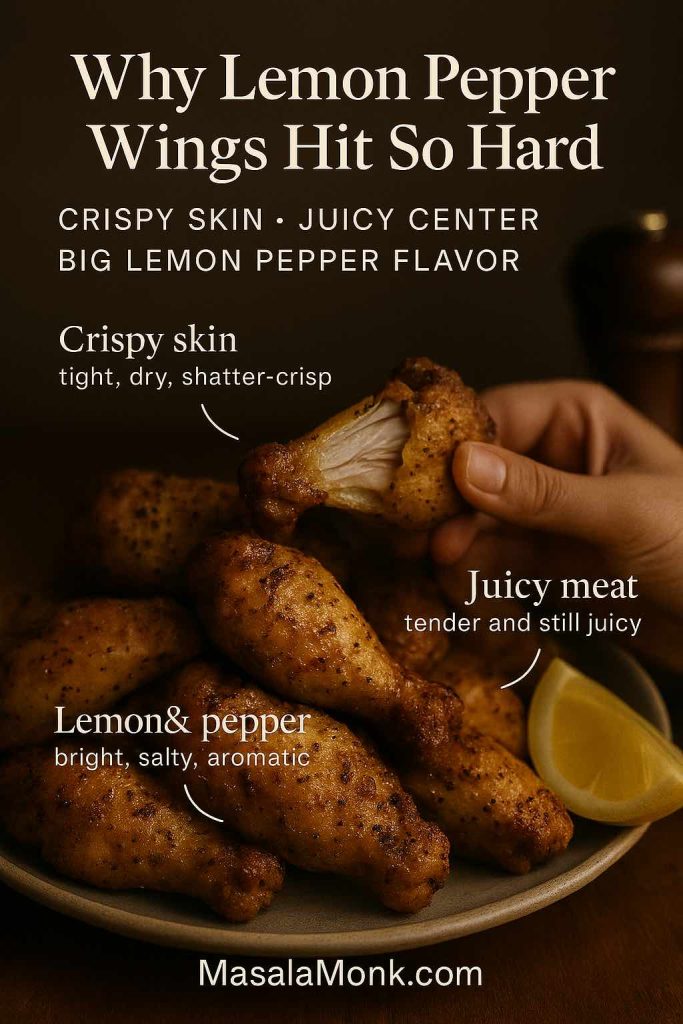
Portrait graphic showing lemon pepper chicken wings with text callouts for crispy skin, juicy meat and bright lemon and pepper seasoning, explaining why the wings are so addictive.
This is what a great lemon pepper wing should look and feel like: crackly skin that gives way with a snap, juicy meat that stays tender all the way to the bone, and a bold mix of lemon and black pepper that lingers just enough to make you reach for another. It’s the kind of balance that works whether you’re eating over the kitchen counter on a Friday night or passing a platter around on game day.

Flavor: Bright, Salty, Peppery

Then there’s the flavor profile:

  • Lemon: zesty and fresh, with just enough juice to be tangy
  • Pepper: freshly cracked and slightly floral, not just dusty heat
  • Salt: present but balanced, never harsh
  • Butter or oil: there in the background, carrying all the other flavors

A good lemon pepper seasoning hits those notes cleanly. In its traditional form, lemon pepper is made by infusing dried lemon zest into cracked black pepper and then combining it with salt and optional aromatics. When you build your own version at home, you can decide how lemony, how peppery, and how salty you want it.

Comfort: Casual but Special

Finally, wings have that special status of being both casual and celebratory. They fit into:

  • Friday-night snacks
  • Game-day spreads
  • Lazy family dinners
  • Potluck tables where everybody grabs with their fingers

Lemon pepper in particular has a kind of “grown-up” flavor profile—more sharp and aromatic than heavily sweet sauces—while still being totally approachable.

That’s what we’re aiming for: wings that feel like something you’d order from a favorite place, only made at home, exactly to your taste.

Also Read: Katsu Curry Rice (Japanese Recipe, with Chicken Cutlet)


Ingredients for Lemon Pepper Chicken Wings

To keep things painless, let’s group everything into four parts: the wings, the base seasoning, the lemon pepper blend, and the optional wet sauce.

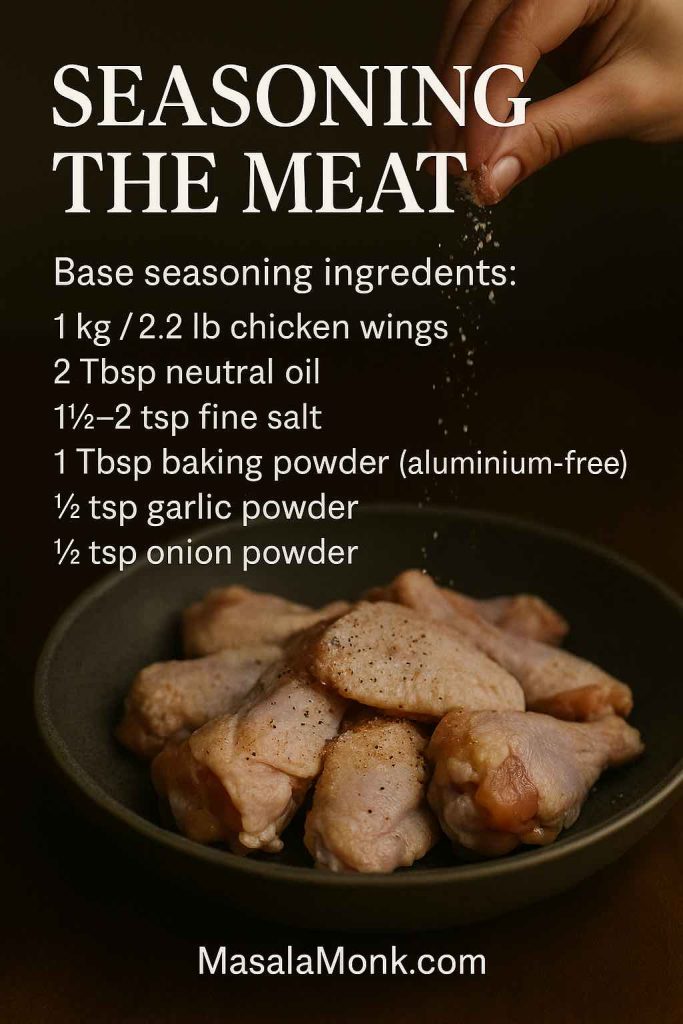
The Wings and Base Seasoning

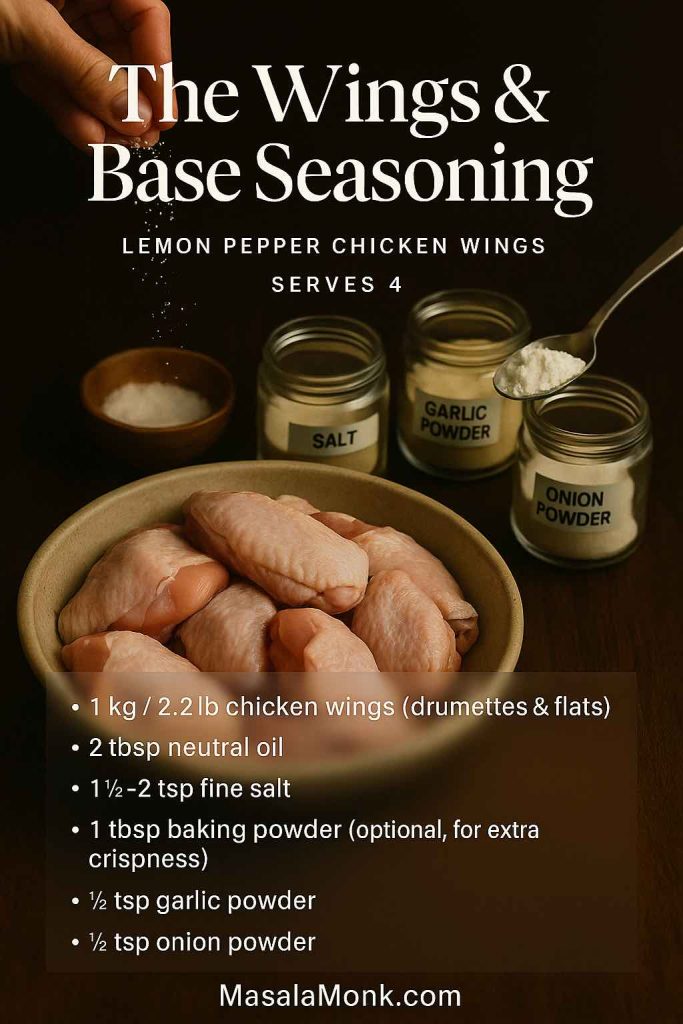
For roughly 4 servings (or fewer, if everyone is wing-obsessed), you’ll want:

  • 1 kg / 2.2 lb chicken wings, split into drumettes and flats, wing tips removed
  • 2 tablespoons neutral oil (such as avocado, sunflower, or canola)
  • 1½–2 teaspoons fine salt, adjusted according to your lemon pepper blend
  • 1 tablespoon baking powder (aluminium-free; optional but excellent for crispness)
  • ½ teaspoon garlic powder
  • ½ teaspoon onion powder

This base seasoning gives the wings a solid, savory foundation. If you’ve ever wondered why some baked or air-fried wings feel a bit flabby, it’s often because the skin never really dries out or because there isn’t enough salt on the meat itself.

Recipe card style image showing raw chicken wings in a bowl with jars of salt, garlic powder and onion powder, plus text listing the base seasoning ingredients for lemon pepper chicken wings.
Everything that goes into the base rub for these wings: chicken, neutral oil, salt, baking powder and a mix of garlic and onion powder to build that savory crunch before the lemon pepper even hits.

The baking powder is a small but powerful addition. Tests on crispy poultry have shown that an alkaline coating encourages browning and crunch, which is why this trick shows up again and again in recipes for crispy baked wings and roasted chicken skin.

If you’d rather skip it, you absolutely can; just make a point of drying the wings very thoroughly and not overcrowding them during cooking.

Also Read: Simple Bloody Mary Recipe – Classic, Bloody Maria, Virgin & More


Homemade Lemon Pepper Seasoning

There are many store-bought lemon pepper seasonings available, and some are genuinely tasty. However, they also vary hugely in saltiness and lemon intensity, and quite a few are mostly salt with a faint citrus scent.

Making your own gives you control. You can keep it bright, adjust the salt, and even decide how fine or coarse the pepper should be.

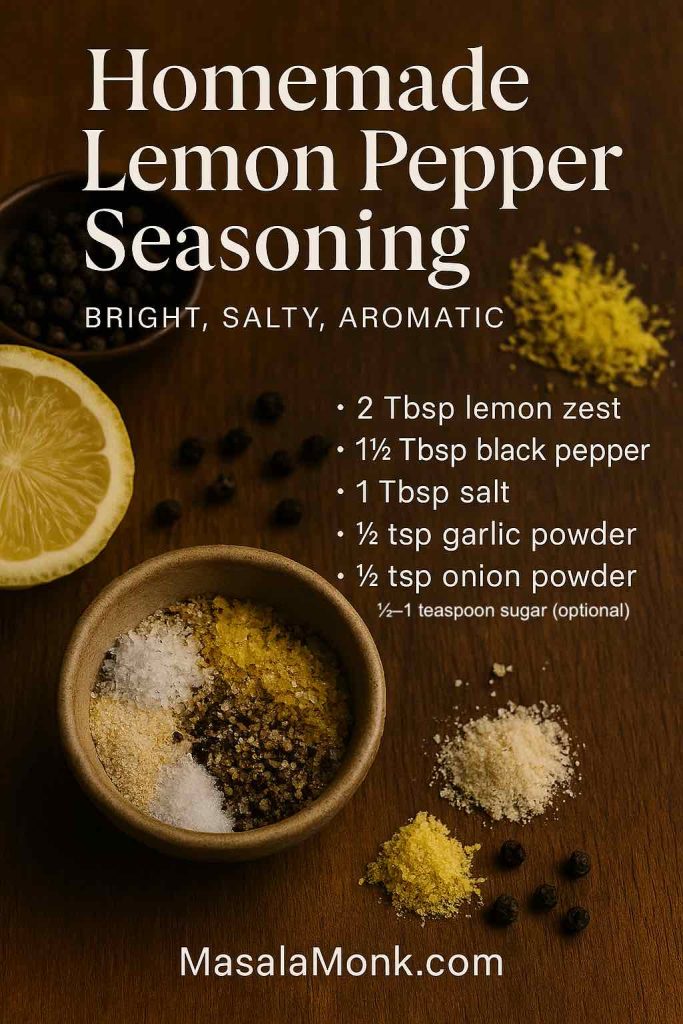
For a small jar:

  • 2 tablespoons finely grated lemon zest (preferably from unwaxed lemons)
  • 1½ tablespoons freshly cracked black pepper
  • 1 tablespoon flaky or coarse salt
  • ½ teaspoon garlic powder
  • ½ teaspoon onion powder
  • ½–1 teaspoon sugar (optional, but it rounds off any bitterness and helps browning)
Portrait recipe card showing a small bowl of homemade lemon pepper seasoning with visible lemon zest, black pepper and salt on a wooden surface, surrounded by peppercorns and lemon, plus text listing the seasoning ingredients.
A small batch of homemade lemon pepper seasoning—lemon zest, cracked black pepper, salt, garlic and onion powder—so you can control exactly how bright, salty and peppery your wings taste.

To prepare it:

  1. Spread the lemon zest in a thin layer on a plate or small tray.
  2. Let it air-dry for a few hours, or place it in a very low oven until it’s no longer wet to the touch.
  3. Combine the dried zest with the pepper, salt, and other seasonings, then stir thoroughly.
  4. Store in an airtight jar away from direct heat and light.

If you’d like reassurance on the proportions or want another perspective, you can glance at a similar homemade lemon pepper seasoning recipe that uses dried lemon zest, black pepper, and salt as its backbone.

For each kilo of wings, plan on 1½–2 tablespoons of this seasoning, plus more at the table for anyone who likes an extra sprinkle.

Also Read: Air Fryer Hard-Boiled Eggs (No Water, Easy Peel Recipe)


Lemon Pepper “Wet” Sauce

Some people love their lemon pepper chicken wings dry and crisp, with the seasoning clinging directly to the skin. Others adore the “wet” style: glossy, buttery, and intensely lemony.

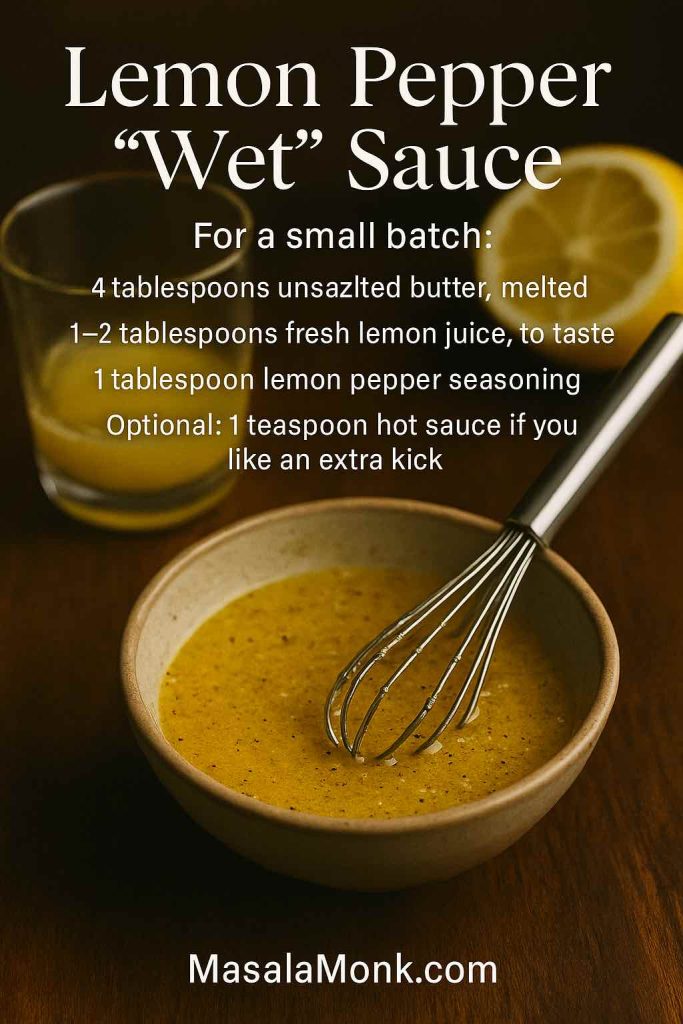
For a small batch of wet sauce:

  • 4 tablespoons unsalted butter, melted
  • 1–2 tablespoons fresh lemon juice, to taste
  • 1 tablespoon lemon pepper seasoning
  • Optional: 1 teaspoon hot sauce if you like an extra kick
Portrait recipe card showing a bowl of lemon pepper wet sauce with a whisk, plus text listing melted butter, fresh lemon juice, lemon pepper seasoning and optional hot sauce for coating lemon pepper chicken wings.
This quick lemon pepper “wet” sauce—melted butter whisked with lemon juice, seasoning and a touch of heat—turns crisp wings into the glossy, intensely lemony style you’d usually only get from a good wing joint.

Whisk it all together until smooth. Taste and adjust the lemon, salt, and heat. If it feels too sharp, a pinch more butter or a drop of honey will smooth things out. If it tastes flat, a bit more lemon juice or seasoning will wake it up.

You’ll toss fresh-cooked wings in this sauce to make them “lemon pepper wet”.

Also Read: Tres Leches – Mexican 3 Milk Cake Recipe


Optional Extras

Depending on your mood, you can also have these on standby:

  • Extra fresh lemon wedges for squeezing
  • A little more freshly cracked black pepper at the table
  • Honey for quick honey lemon pepper wings
  • Cayenne pepper or chili flakes for a spicier batch
  • Ranch dressing or yogurt-based sauces for dipping

Now that everything’s assembled, it’s time to get the wings ready to cook.


Prepping the Wings Properly

Spending ten minutes on prep makes a huge difference later. Instead of jumping straight into cooking, take a moment to set the wings up for success.

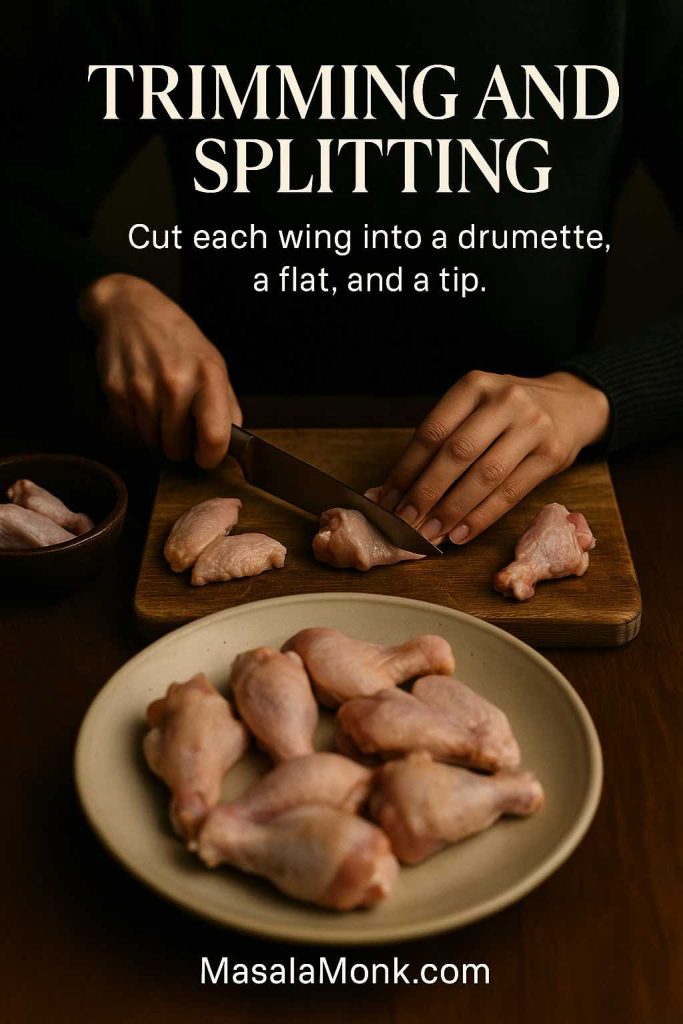
Portrait image showing hands cutting raw chicken wings on a wooden board into drumettes, flats and tips, with text overlay titled Trimming and Splitting.
Start strong by trimming and splitting each wing into a drumette, a flat and a tip so everything cooks evenly and is easy to eat.

Trimming and Splitting

If your wings aren’t already separated, start by cutting each whole wing into:

  • The drumette (the meaty piece that looks like a tiny drumstick)
  • The flat (the two-boned middle section)
  • The tip (which you can save for stock if you like)

Sharp kitchen shears work well; a small chef’s knife is also fine. Once you’ve separated them, discard any stray feathers or bits of skin.

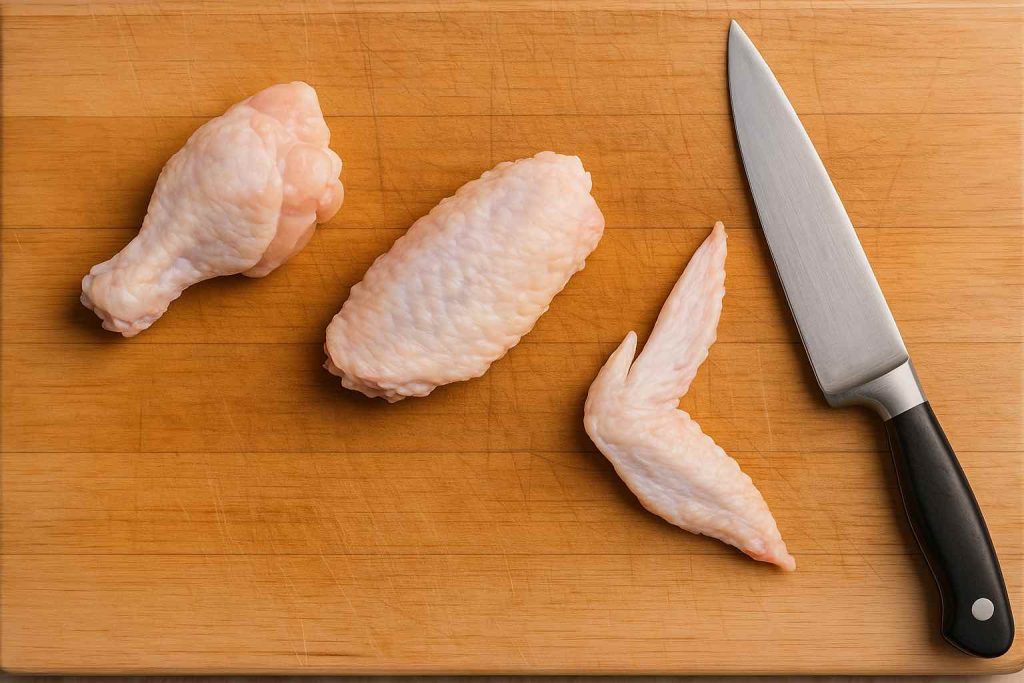
Picture of Chicken Wings separated into 3 parts - the drumette, the flat and the Tip.
This is how the wing would look like after proper cutting – Chicken Wings separated into 3 parts – the Drumette, the Flat and the Tip.

Drying the Skin

Next, lay the pieces out on a tray or large plate lined with paper towels. Pat every side dry. Flip them and pat again. It may feel a little tedious, but this step is one of the keys to crisp wings later, especially in the oven or air fryer.

If you’re planning ahead, you can put the tray of dried wings into the fridge, uncovered, for an hour or two. The circulating air helps dry the skin even further. Some cooks even leave them overnight.

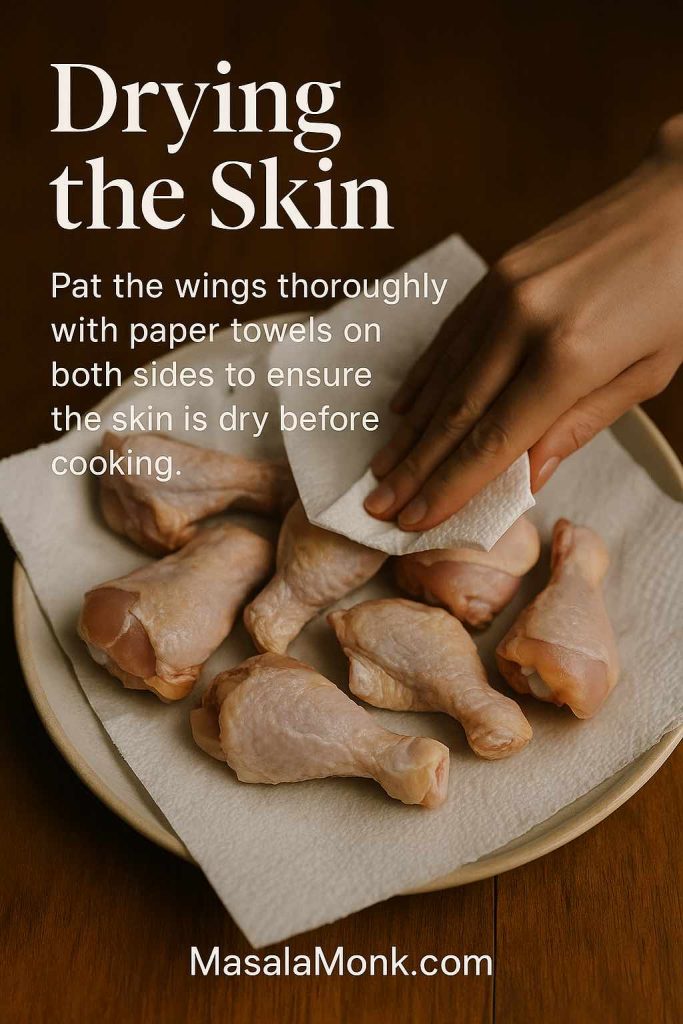
Portrait image of chicken wings on a plate lined with paper towels while a hand pats them dry, with text overlay titled Drying the Skin.
Patting the wings bone-dry with paper towels is the small prep step that pays off later in ultra-crispy skin.

Seasoning the Meat

Once the wings are dry, slide them into a big bowl. Sprinkle over base seasoning or:

  • The oil
  • Salt
  • Baking powder
  • Garlic powder
  • Onion powder

Using your hands or a spatula, toss everything until the wings are evenly coated. Make sure the baking powder doesn’t clump; it should be completely mixed into the other seasonings.

At this stage you can cook right away, or you can let the wings sit in the fridge for about half an hour to absorb the salt and spices. That short rest is a kind of mini dry brine; it helps season the meat all the way through and encourages a beautiful, even color on the skin.

Portrait image showing a hand sprinkling seasoning over raw chicken drumettes on a plate, with text overlay titled Seasoning the Meat.
A generous, even coating of salt and spices or use the base seasoning we create earlier in the post – on the wings sets up deep flavor before the lemon pepper ever goes on.

Notice that we still haven’t added the lemon pepper seasoning. That comes later, once the wings are cooked and still hot. Adding it at the end protects the lemon zest from burning and keeps the flavor bright.

Also Read: Peanut Butter Cookies (Classic Recipe & 3 Variations)


Base Method: From Raw Wings to Golden and Ready

Although the details differ from method to method, the basic flow is always the same:

  1. Prep and season the wings
  2. Cook using air fryer, oven, or oil
  3. Toss hot wings in lemon pepper seasoning and/or wet sauce
  4. Check internal temperature
  5. Serve and enjoy

With that structure in mind, you can choose the cooking approach that fits your kitchen and mood.


Air Fryer Lemon Pepper Chicken Wings

If you own an air fryer, this is likely to become your favorite method. It’s fast, fairly clean, and makes crisp wings with very little oil.

Preheating and Setup

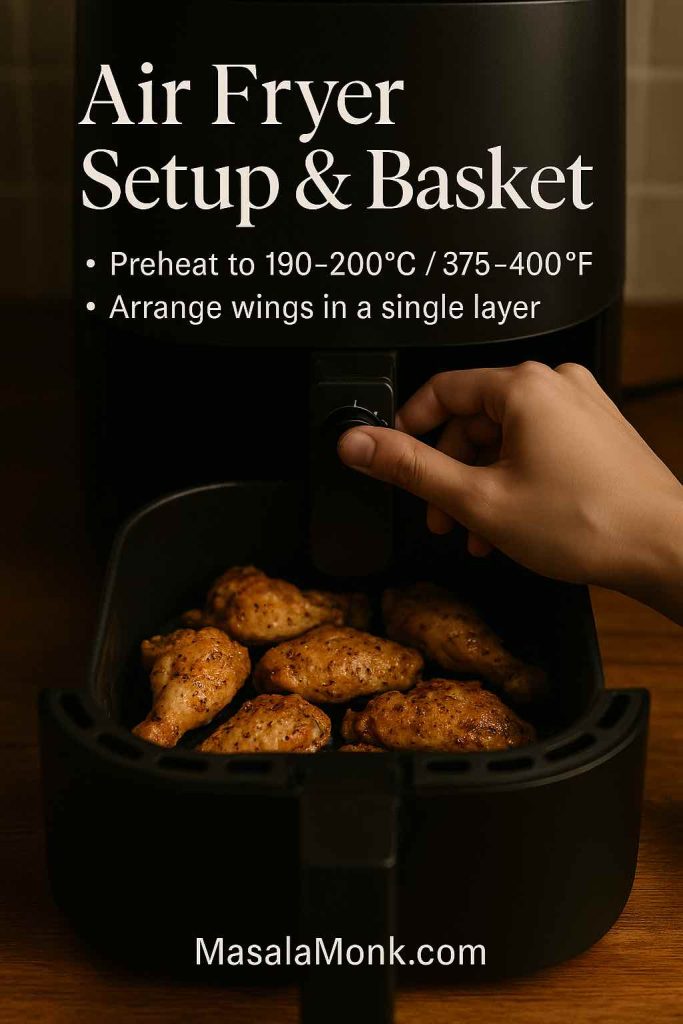
Begin by preheating your air fryer to 190–200°C / 375–400°F. Preheating ensures the wings start crisping immediately, rather than steaming while the machine warms up.

While it heats, lightly oil the basket if things tend to stick, and double-check that the air vents are clear. Basic air fryer safety guidelines, such as keeping the unit on a heat-resistant surface and avoiding obstructed vents, help everything cook evenly and safely.

Portrait image of an air fryer with a hand adjusting the dial while seasoned chicken wings sit in the basket in a single layer, with text overlay about preheating to 190–200°C and arranging the wings properly.
Preheat the air fryer fully, then slide in the wings in a single, uncrowded layer so the hot air can crisp every side instead of steaming them.

Arranging the Wings

Place the seasoned wings into the basket in a single layer. It’s okay if they’re a little close, but try to avoid stacking them. Air fryers crisp food by blasting it with hot moving air; when air can’t circulate, you get pale, soft spots instead of even browning. Overcrowding is one of the most common reasons for disappointing results.

If you have more wings than comfortably fit in one layer, plan on cooking them in batches rather than forcing everything in at once.

Cooking Time and Turning

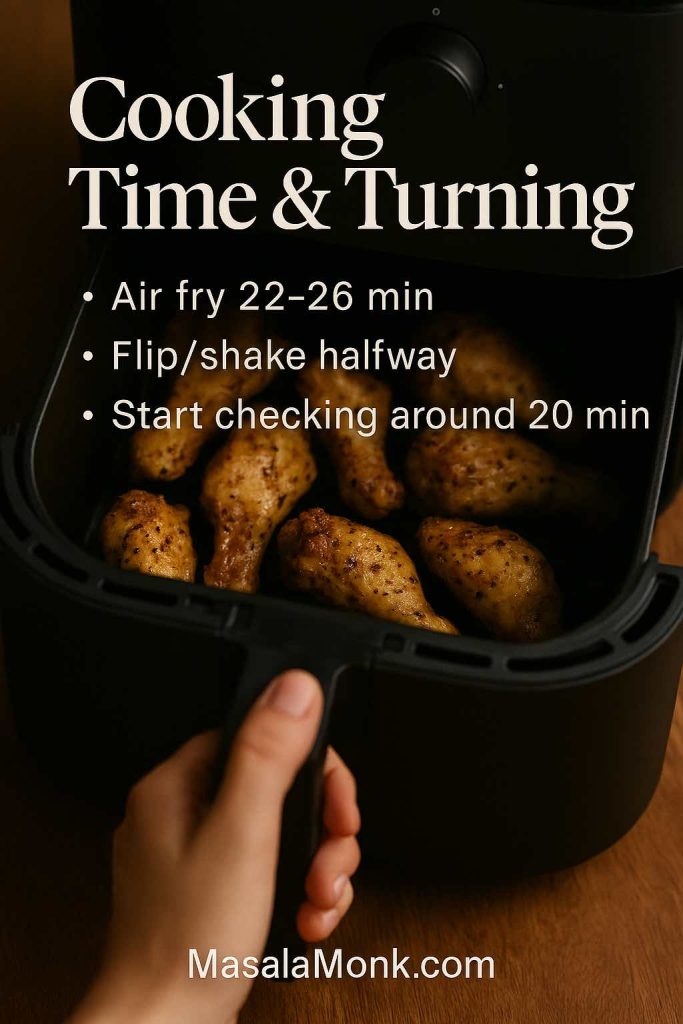
Slide the basket in and air fry the wings for about 22–26 minutes, flipping or shaking them halfway through. The exact time depends on:

  • The size of your wings
  • Your specific air fryer model
  • How packed the basket is
Portrait image of an air fryer basket filled with golden lemon pepper chicken wings being pulled out by hand, with overlay text listing cooking time, flipping halfway and checking doneness around 20 minutes.
Once the basket is loaded, let the wings go for 22–26 minutes, giving them a shake halfway through so every side gets blasted with hot air instead of sitting in one spot.

Around the 20-minute mark, start checking their color and texture. The skin should look golden to deep brown and feel firm when you tap it with tongs.

Seasoning While Hot

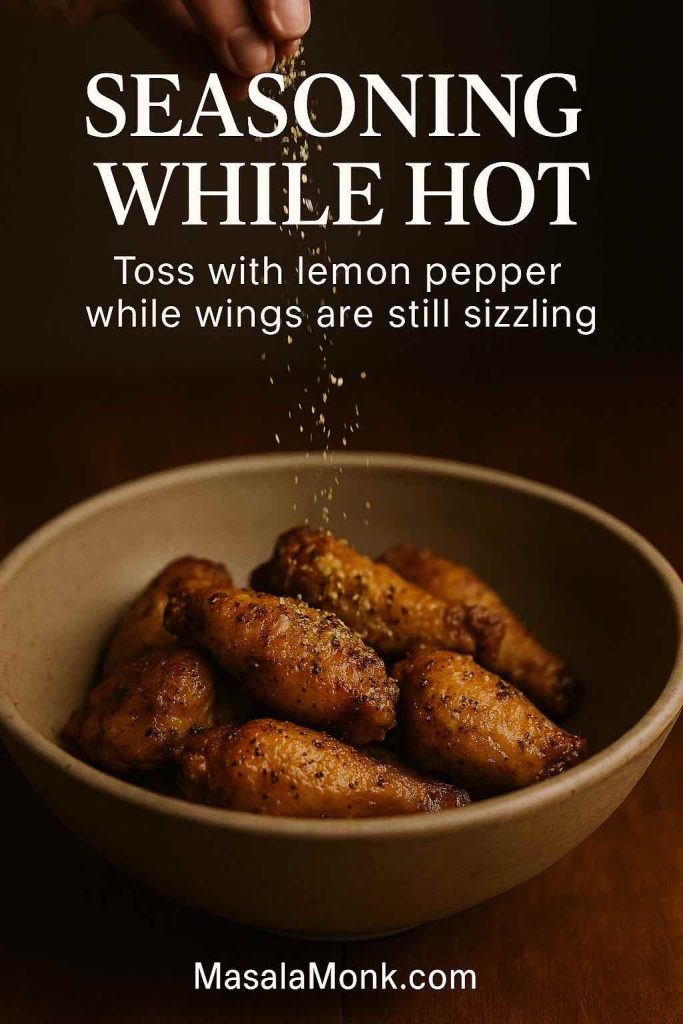
As soon as the wings are cooked, transfer them to a clean bowl while they’re still sizzling. Sprinkle over 1½–2 tablespoons lemon pepper seasoning and toss until every piece looks speckled with zest and pepper.

If you’re going for air-fried lemon pepper wet wings, drizzle in some of the butter–lemon sauce and toss again. The residual heat helps the flavors sink in and the butter cling without separating.

Portrait image of hot lemon pepper chicken wings in a bowl while a hand sprinkles seasoning over them, showing how to toss the wings with lemon pepper while they are still sizzling.
As soon as the wings come out of the air fryer or oven, shower them with lemon pepper and toss while they’re still sizzling so the zest, pepper and butter lock onto every piece.

Pile the wings onto a platter, garnish with fresh lemon wedges for squeezing, and bring them straight to the table.

Also Read: Homemade Hot Chocolate with Cocoa Powder Recipe


Oven-Baked Lemon Pepper Chicken Wings

When you’re feeding more than a couple of people, the oven suddenly becomes your best friend. A single large tray can handle a mountain of wings at once.

Preheating the Oven

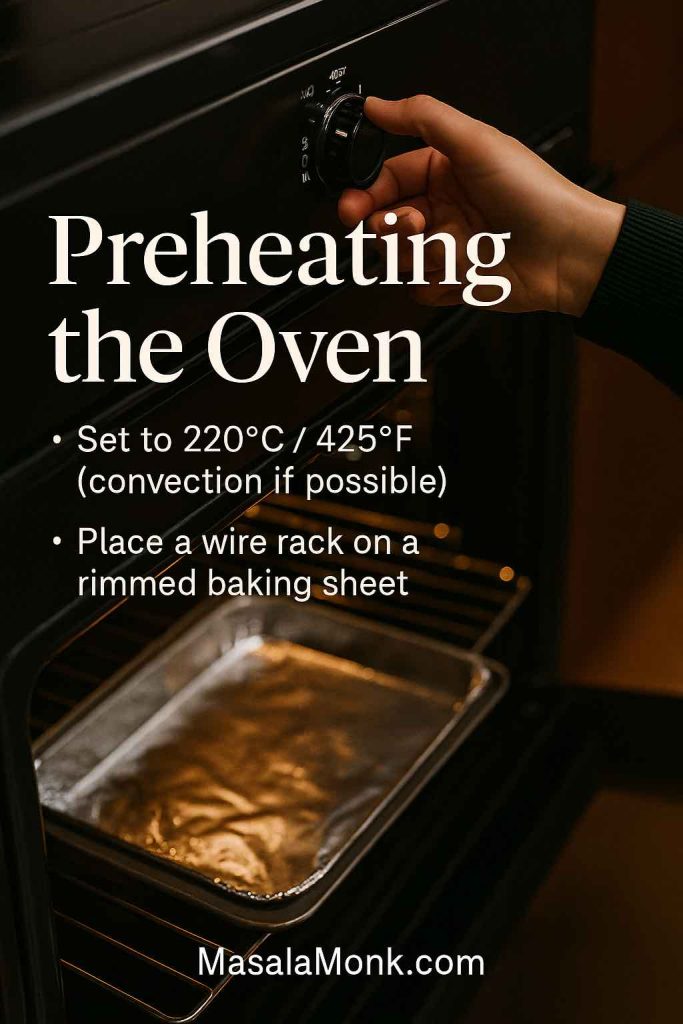
Set your oven to 220°C / 425°F. If it has a convection (fan) option, switch it on; that extra air movement mimics the air fryer effect and encourages crisp skin.

Portrait image of a hand turning the oven dial to 220°C / 425°F with the door open, showing a foil-lined baking sheet and wire rack inside, with text overlay titled Preheating the Oven.
Crank the oven up to 220°C / 425°F and drop a rack over a lined tray before you even think about the wings—high heat and airflow are what turn seasoned chicken into proper oven-crisp lemon pepper wings.

Place a wire rack on a rimmed baking sheet and line the sheet with foil or parchment for easier cleanup. The rack keeps wings elevated, allowing hot air to circulate underneath, which is especially helpful when the sheet is crowded.

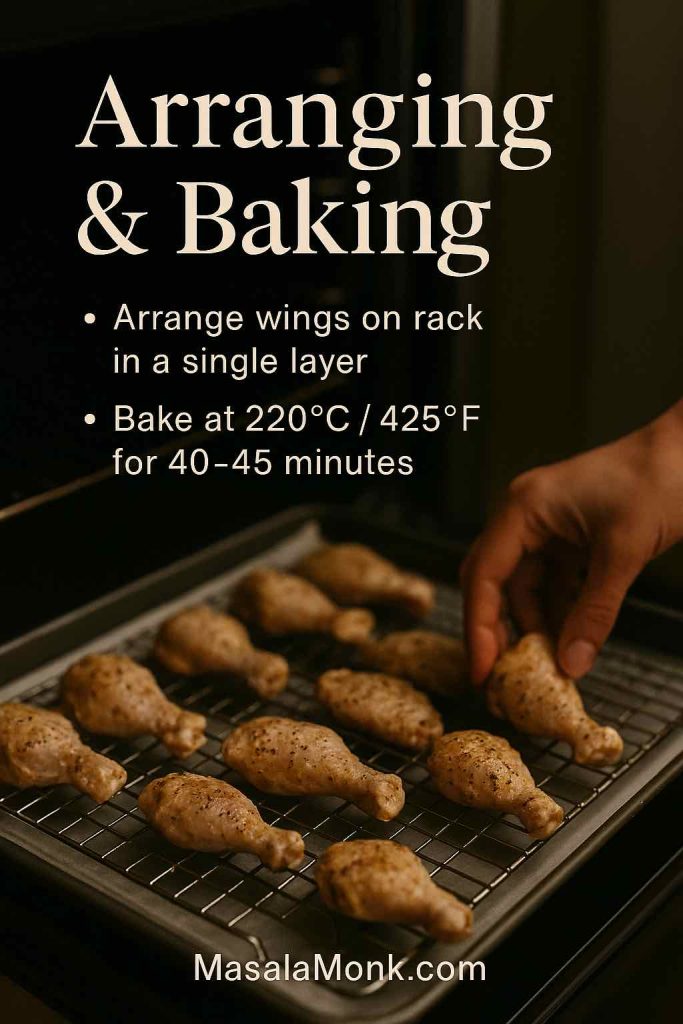
Arranging and Baking

Spread the seasoned wings out in a single layer on the rack. Avoid stacking them; if necessary, use two trays and swap their positions halfway through baking.

Slide the tray into the hot oven and bake for 40–45 minutes, turning the wings once in the middle of the cooking time. As they roast, the skin will gradually tighten and brown, and the fat will drip down onto the tray.

Portrait image of raw seasoned chicken wings laid in a single layer on a wire rack set over a baking sheet, being slid toward the oven, with text overlay titled Arranging & Baking.
Spread the wings out on a rack in one even layer and let the oven do its thing for 40–45 minutes—no stacking, no crowding, just steady heat working on every side.

If, towards the end, they look well-cooked but not quite crisp enough for your taste, you can switch on the broiler for the last 2–3 minutes. Watch carefully at this stage; the lemon and pepper can go from perfect to scorched very quickly under direct heat.

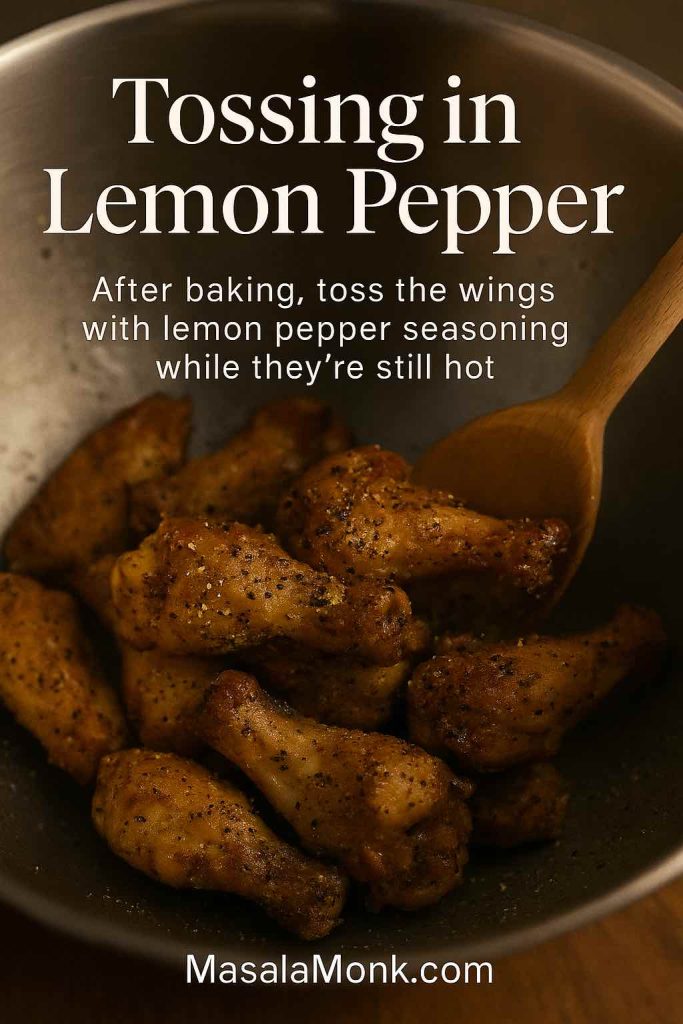
Tossing in Lemon Pepper

Once they’re sizzling and golden, transfer the wings to a mixing bowl. Immediately dust them with lemon pepper seasoning and toss gently but thoroughly. If you’d like some of them wetter, move half to another bowl and toss those in your butter–lemon sauce.

Portrait image of freshly baked chicken wings in a metal mixing bowl being tossed with lemon pepper seasoning using a wooden spoon, with text overlay titled Tossing in Lemon Pepper.
As soon as the tray comes out, scrape the hot wings into a bowl and toss them in lemon pepper so the citrus, salt and cracked pepper cling to the crust while it’s still sizzling.

The baked method gives you lemon pepper chicken wings with a little less hands-on time than frying, plenty of crunch, and the satisfaction of pulling a huge, steaming tray from the oven.

Also Read: Watermelon Daiquiri: A Refreshing Twist on a Classic Cocktail


Fried Lemon Pepper Chicken Wings

There’s something undeniably satisfying about fried wings. The oil helps create that deeply blistered, crunchy skin that many people associate with their favorite wing spots.

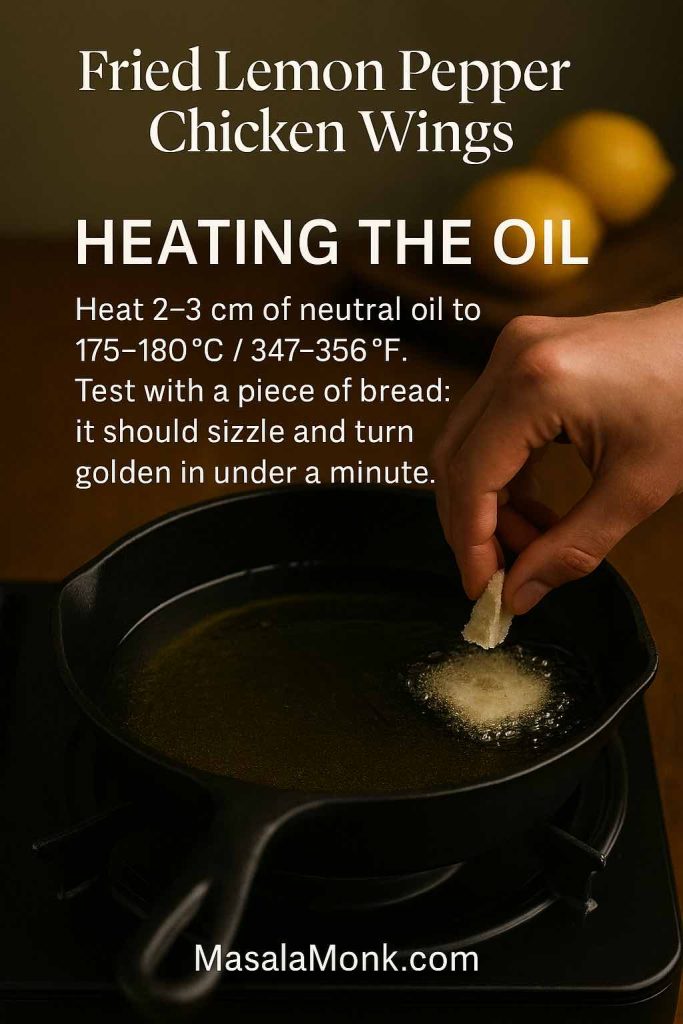
Heating the Oil

Choose a wide, heavy pan—a deep skillet or Dutch oven works well—and pour in 2–3 cm of neutral oil. Heat it to 175–180°C / 347–356°F. If you don’t have a thermometer, you can use the old bread test: a small piece of bread should sizzle and turn golden in under a minute.

Portrait image of a cast iron skillet filled with hot oil on the stove, with a hand dipping a small piece of bread in to test the temperature, and text overlay titled Heating the Oil for fried lemon pepper wings.
Heat a shallow pool of neutral oil until a scrap of bread sizzles and turns golden in under a minute—that’s the sweet spot for blistered, crunchy fried lemon pepper wings.

Keep the handle turned inward and the pan on a stable burner. Having a splatter guard or lid nearby is handy, just in case.

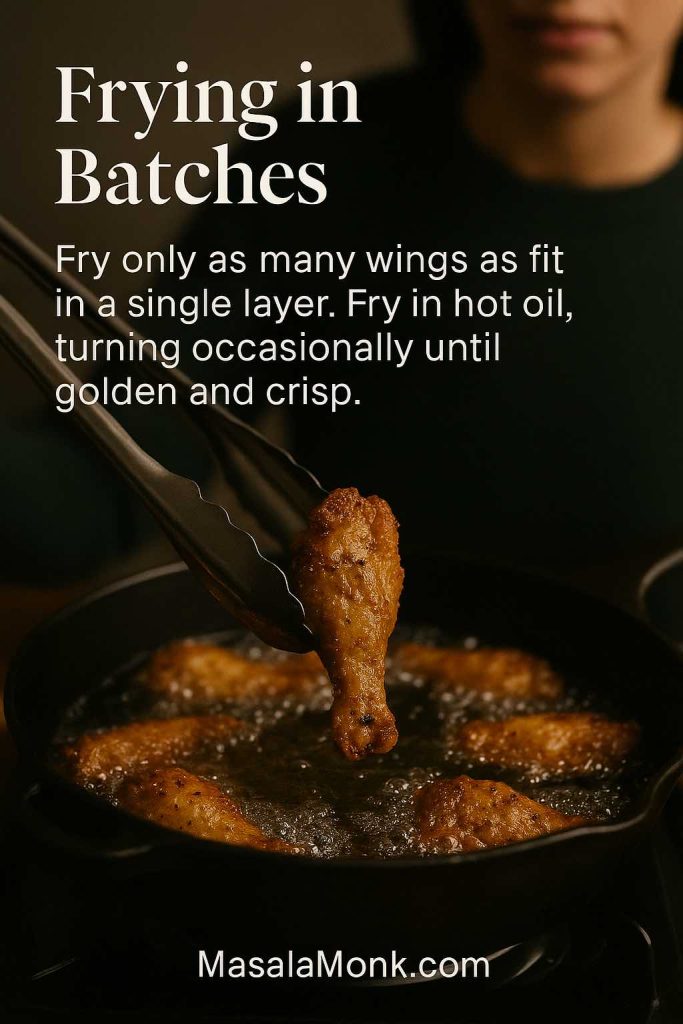
Frying in Batches

Lower the wings into the oil carefully, placing them away from you to minimize splashes. Fry only as many as fit comfortably in a single layer; crowding cools the oil and leads to greasy, unevenly cooked wings.

Let them sizzle for 10–12 minutes, turning occasionally so they brown on all sides. Heavier wings may need a little longer. The skin should be deeply golden and crisp, and the meat cooked through.

Portrait image of chicken wings frying in hot oil in a skillet while a pair of tongs lifts a golden drumette above the surface, with text overlay titled Frying in Batches.
Work in small batches so each wing has room to move in the oil, turning them until every side is deep golden and crisp instead of greasy and uneven.

Check the internal temperature of a few wings with an instant-read thermometer; it should read at least 165°F / 74°C, matching the recommended safe minimum temperature for chicken.

Transfer cooked wings to a wire rack set over a tray or to paper towels to drain.

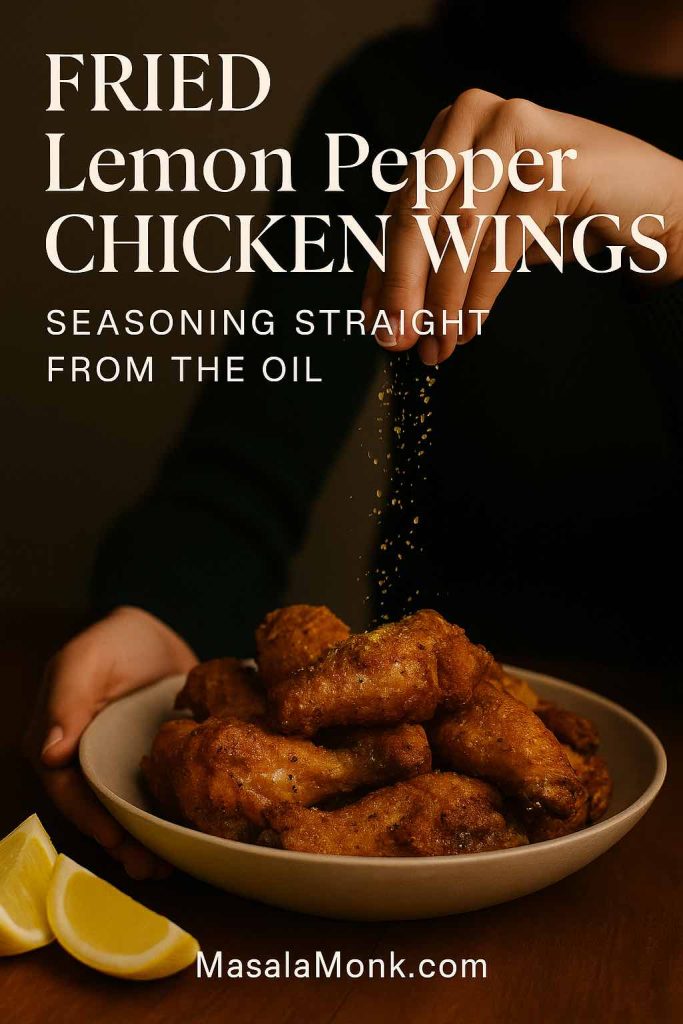
Seasoning Straight from the Oil

While the wings are still hot and glistening, move them into a bowl and shower them with lemon pepper seasoning. Any residual oil on the surface helps the spices cling and bloom. For a truly indulgent batch, pour in some of the buttery lemon mixture too and toss until everything looks shiny.

Portrait image of a plate piled with fried chicken wings while a hand sprinkles lemon pepper seasoning over them, with lemon wedges on the table and text overlay titled Fried Lemon Pepper Chicken Wings – Seasoning Straight from the Oil.
As soon as the wings leave the oil, hit them with lemon pepper so the hot, glistening crust grabs every speck of citrus, salt and black pepper.

If you’re cooking several rounds of fried wings, you can hold finished ones in a low oven (around 140°C / 285°F) for a short time. Just remember the usual game-day safety guidance: cooked foods shouldn’t sit in the “danger zone” between cold and hot for extended periods.

Also Read: Authentic Butter Chicken Recipe (Murgh Makhani) Creamy and Flavorful


Lemon Pepper Chicken Wings Variations

Once you’ve done a straightforward batch, it’s hard to resist playing. Fortunately, the base lemon pepper chicken wings recipe is like a blank canvas that welcomes small tweaks.

Honey Lemon Pepper Chicken Wings

To turn a portion into honey lemon pepper wings:

  1. Stir 2–3 tablespoons honey into your melted butter–lemon sauce.
  2. Toss a batch of hot wings in this mixture until they’re evenly coated and shining.
  3. Taste one and adjust with another splash of lemon juice or a pinch of salt if needed.
Portrait image of honey lemon pepper chicken wings piled on a plate, glistening with a sticky honey–lemon glaze, with text overlay explaining to stir honey into warm lemon-butter sauce and toss the hot wings.
Honey lemon pepper wings take the same crispy base and wrap it in a glossy honey–lemon glaze that softens the sharp edges and makes every bite a little bit sticky, sweet and impossible to stop at one.

The honey softens the sharp edges of the lemon and pepper, so this variation is especially popular with people who like a gentler, slightly sweet wing.


Spicy Lemon Pepper Chicken Wings

If your crowd enjoys a bit more heat, you can make spicy lemon pepper wings by layering in a few extra flavors.

For the dry rub, add:

  • ½–1 teaspoon cayenne pepper, chili powder, or a mix of your favorite hot spices

For the finishing sauce, consider:

  • A spoonful of hot sauce
  • Extra cracked black pepper on top
Portrait image of spicy lemon pepper chicken wings on a plate, coated in a fiery three-pepper glaze with visible chili flakes and black pepper, with text overlay explaining to add cayenne to the rub and hot sauce to lemon-butter before tossing the wings.
Spicy lemon pepper wings layer heat from black pepper, cayenne and hot sauce over that same bright citrus base, so you get proper three-pepper fire without losing the lemony punch.

The idea is to pull heat from three places: the black pepper, the cayenne or chili, and the hot sauce. That way, you get a “three-pepper” style intensity without losing the citrusy brightness that makes lemon pepper wings so distinctive.

Also Read: Kali Mirch Paneer | Black Pepper Paneer- Kid Friendly Recipe


Lemon Pepper Ranch Chicken Wings

When you want to lean toward creamy, herby flavors without giving up the lemon-pepper backbone, ranch steps in.

There are a couple of simple routes:

  1. Lemon Pepper Ranch Dip
    Stir some lemon pepper seasoning into a bowl of thick ranch. Use it as a dip for classic lemon pepper wings, vegetable sticks, and maybe some potato wedges.
  2. Ranch-Coated Lemon Pepper Wings
    Thin ranch with a bit of lemon juice until it’s just pourable. Toss freshly cooked, lightly lemon-peppered wings in a small amount of this dressing so they get a light ranch glaze.
Portrait image of lemon pepper ranch chicken wings on a rustic plate, drizzled with creamy ranch, with a bowl of herby ranch dip and lemon wedges in the background, plus text overlay explaining how to make lemon pepper ranch dip or a light ranch glaze for the wings.
Lemon pepper ranch wings take the same crisp, citrusy base and finish it with cool, herby ranch—either as a thick dip on the side or a light glaze over the hot wings.

Either way, you keep the zing of lemon and the bite of black pepper, while adding the familiar tang and herbs of ranch.


Extra Twists to Try

As you get comfortable, you might experiment with:

  • Garlic Lemon Pepper Wings – Add minced garlic to the butter sauce or increase the garlic powder in the base rub.
  • Smoky Lemon Pepper Wings – Add a little smoked paprika or chipotle powder to the seasoning mix.
  • Herby Lemon Pepper Wings – Finish with chopped parsley or thyme for fresh, green notes.

Small changes can dramatically shift the personality of your wings without requiring a completely new recipe.


Dips, Sides, and Extras for Wing Night

A platter of lemon pepper chicken wings is already a good time, yet pairing them with a few well-chosen sides turns everything into a proper event. You don’t need to go overboard; two or three complementary dishes go a long way.

Portrait image of a wing night spread with lemon pepper chicken wings in the center, surrounded by fries, creamy dip, jalapeño poppers and churros on a dark wooden table, with text overlay asking what to serve with lemon pepper wings and suggesting dips, potatoes, comfort sides and something sweet.
Turn a simple tray of lemon pepper wings into a full wing night by adding a creamy dip, a hot potato side, a cheesy bite like jalapeño poppers and an easy dessert to finish.

Cool and Creamy Dips

First, let’s talk dips. Wings love anything creamy or tangy that cools the palate.

A versatile approach is to offer more than one option:

  • A selection pulled from spinach dip recipes gives you both cold and hot spinach-based dips, including a classic spinach-artichoke style that is fantastic with salty, zesty chicken.
  • When the wings are bright and peppery, a chilled bowl of yogurt, cucumber, lemon, and garlic based on a Greek tzatziki sauce recipe brings a cooling, refreshing contrast and feels lighter than a traditional ranch.

You can also keep a simple blue cheese dip or herbed mayonnaise around, especially if you’re making a spicy batch.


All the Potato Things

Next come the potatoes, because wings and potatoes are a classic duo.

For a straightforward side that always disappears, a big tray of crispy homemade French fries does the job. You can season them simply with salt or play around with variations: garlic-parmesan, chili, or even a light dusting of lemon pepper to echo the wings.

If you feel like branching out, take a look at 10 easy potato appetizers. There you’ll find ideas like smashed potatoes, loaded bites, and other crispy snacks that sit happily beside a wing platter and give people something else to nibble between drumettes.


Comfort Sides That Make It a Meal

Sometimes you want the wings to feel like the centerpiece of a hearty dinner rather than just snacks. In that case, adding one or two warm, substantial dishes helps.

A bubbling pan of macaroni and cheese brings creamy comfort to the table. Next to lemon pepper chicken wings, the rich cheese sauce and soft pasta respond beautifully to the tangy, crisp chicken.

For an additional spicy, creamy bite, baked jalapeño poppers fit right in. They have their own crunch and heat, yet they don’t duplicate the exact flavors of the wings, which keeps the spread interesting.

And if you want a sweet finish without getting too formal, you might end with churros. Using the method from how to make churros, you can fry or bake ridged sticks of dough, roll them in cinnamon sugar, and serve them with chocolate or caramel sauce. They feel playful and shareable, which matches the whole mood of wing night.


Drinks That Pair with Lemon Pepper Chicken Wings

Although you can absolutely just set out a cooler of cold drinks and call it a day, matching your beverages to lemon pepper wings is surprisingly fun.

Because lemon is already a star here, citrusy drinks are natural partners. A chilled lemon drop martini style drink echoes the lemon while bringing a sweet-tart edge that works nicely with salty, peppery chicken. You can make a non-alcoholic version using lemon juice, simple syrup, and sparkling water served in glasses with sugared rims.

During cooler months, you might also lean into autumnal flavors by offering a pumpkin-spice-flavored latte or dessert built from your own spice blend, especially if you already have the oven and stove busy with wings and sides.


Storing and Reheating Lemon Pepper Chicken Wings

With a big batch, you’ll often have a few wings left over. Stored and reheated properly, they make an easy next-day lunch or snack that’s almost as good as the original round.

Portrait image showing cooked lemon pepper chicken wings in a glass container beside an air fryer, with text overlay explaining how to store them in the fridge and reheat in the oven or air fryer to keep the skin crispy.
Once wing night is over, cool the leftovers, tuck them into the fridge and bring them back to life in the oven or air fryer so the skin crisps up again instead of going limp.

Storing Safely

After everyone has eaten, let the wings cool down briefly, then transfer them into an airtight container. Try to get them into the refrigerator within two hours of cooking. Game-day food safety advice consistently emphasizes this 2-hour window for hot foods like wings, to avoid letting them sit in the temperature range where bacteria grow fastest.

In the fridge, cooked wings will usually keep well for 3–4 days.

Reheating in the Oven

For a fairly large batch or whenever you want the most uniform results, the oven is a good choice:

  1. Bring the wings out of the fridge while the oven preheats to 175–190°C / 350–375°F.
  2. Arrange them on a wire rack set over a baking sheet.
  3. Warm them for 8–12 minutes, turning once if necessary, until they’re hot, the skin has re-crisped, and a thermometer reads at least 165°F / 74°C in the thickest part.

Comparisons of reheating methods often find that the oven returns the best combination of juicy meat and crisp skin, while the microwave tends to make the coating soft.
Reheating in the Air Fryer

If you only have a handful of wings to reheat, the air fryer shines:

  1. Preheat to about 175–180°C / 350–360°F.
  2. Place the wings in a single layer in the basket.

  3. Heat for 5–8 minutes, shaking once, until they’re sizzling again and the skin feels crisp.
The air fryer works quickly and restores a nice crunch without needing much effort. Guides on reheating wings in an air fryer recommend similar temperatures and timings, with the same target internal temperature for safety.

Once more, the microwave is best kept as a last resort. It will heat the meat, but it tends to steam the skin, undoing all your crisping work.

Also Read: French Toast Sticks (Air Fryer + Oven Recipe) — Crispy Outside, Custardy Inside


Using Leftover Lemon Pepper Chicken Wings in New Ways

Interestingly, leftover lemon pepper chicken wings don’t have to stay wings. If you strip the meat from the bones, you suddenly have a bowl of tender, lemony chicken that’s perfect for other dishes.

For instance, you can:

  • Toss the meat with a little mayonnaise or yogurt, chopped celery, and herbs for a quick lemon pepper chicken salad.
  • Sprinkle it over greens with cherry tomatoes, cucumbers, and a light vinaigrette for an easy lunch.
  • Layer it into sandwiches or sliders, using ideas from chicken sandwich recipes—anything from Buffalo to BBQ styles can overlap nicely with the lemon pepper flavor, especially if you add cheese, lettuce, and pickles.

In this way, one batch of wings can stretch into multiple meals without feeling repetitive.


Bringing It All Together

By now you’ve seen that making excellent lemon pepper chicken wings at home isn’t complicated; it’s just a series of small, thoughtful steps:

  • Drying and seasoning the wings so they’re flavorful before they ever hit the heat
  • Choosing the cooking method that matches your gear and your crowd
  • Finishing with a fresh, lively lemon pepper seasoning and, if you’re in the mood, a buttery wet sauce
  • Adding simple variations—honey, spice, ranch—to keep things interesting
  • Surrounding the wings with dips, potatoes, and a few extras to turn them into a full occasion
  • Handling leftovers in a way that keeps them both safe and delicious

Whether you’re planning a game-night spread, a relaxed weekend dinner, or just a kitchen experiment on a random afternoon, this approach lets you take a humble pack of wings and transform it into something everyone reaches for.

Next time you see a pile of wings at the shop, you’ll know exactly what to do: grab a couple of lemons, check your pepper grinder, and give yourself permission to fill your kitchen with the smell of hot, crackling, lemon pepper chicken wings.

FAQs about Lemon Pepper Chicken Wings

1. What are the ingredients for lemon pepper chicken wings?

For classic lemon pepper chicken wings, you usually need chicken wings, oil, salt, black pepper, lemon zest or lemon pepper seasoning, and a few simple pantry spices. Typically, the ingredients for lemon pepper chicken include wings, garlic powder, onion powder, a small amount of baking powder for crispiness, and either a homemade or store-bought lemon pepper blend. For saucy versions, you simply add butter and a splash of lemon juice to turn the dry rub into a glossy coating.

2. How do I make lemon pepper chicken wings crispy?

Firstly, pat the wings very dry with paper towels before you season them. Then, toss them with a little oil, salt, and a light dusting of baking powder along with your spices. After that, cook the lemon pepper wings in a hot oven or air fryer without crowding the tray or basket, so the skin has room to dry and blister. Finally, toss them in lemon pepper once they’re cooked and still hot; this way, you get crisp skin plus a fresh coating of seasoning instead of burnt lemon.

3. Can I cook lemon pepper chicken wings in the air fryer?

Absolutely, air fryer lemon pepper wings are one of the easiest options. First, preheat your air fryer so the wings start cooking in hot air right away. Next, arrange the wings in a single layer and cook them until the skin is golden and crisp, flipping once. Afterward, toss the hot wings in lemon pepper seasoning or a butter-lemon sauce to finish. Because the air fryer circulates hot air around each piece, air fryer chicken wings lemon pepper usually turn out very crispy with minimal oil.

4. How do I bake lemon pepper wings in the oven?

To make baked lemon pepper wings, start by preheating the oven to a high temperature, usually around 220°C / 425°F. Place the seasoned wings on a rack set over a baking sheet so air can circulate underneath. Then bake until the wings are brown and crisp, turning once halfway. Right after they come out of the oven, toss them in lemon pepper seasoning or melted butter with lemon and pepper, and you’ll have oven baked lemon pepper chicken with a satisfying crunch and bright flavor.

5. Can I use frozen wings for lemon pepper chicken wings?

Yes, you can, although the process changes slightly. Ideally, you thaw frozen wings in the fridge overnight so you can dry and season them properly. If you must cook from frozen, you can start them plain in the oven or air fryer until they’re mostly cooked, then drain off any excess moisture, pat them as dry as you can, and season them before finishing. This method works, but thawed wings still give the crispiest lemon pepper chicken wings.

6. What is the best way to make lemon pepper wet wings?

For lemon pepper wet wings, you cook the wings until the skin is crisp, then toss them in a butter-based sauce. Typically, the sauce includes melted butter, lemon juice, and lemon pepper seasoning; sometimes a little garlic or hot sauce goes in as well. Once the wings are done, you immediately coat them in this mixture, creating shiny, saucy lemon pepper wings that still have a bit of crunch underneath the glaze.

7. How can I make honey lemon pepper wings?

To create honey lemon pepper wings, you start with regular lemon pepper chicken wings and simply sweeten the finishing sauce. Melt butter, stir in lemon juice, lemon pepper seasoning, and then add honey until the balance of sweet and tangy feels right. When the wings are finished cooking, toss them in this honey-lemon mixture. As a result, you get sticky, glossy honey lemon pepper wings that keep the citrus and pepper bite but add a gentle caramel sweetness.

8. Are lemon pepper chicken wings spicy?

On their own, most lemon pepper chicken wings are more tangy and peppery than truly spicy. Black pepper brings a mild heat and a floral bite, while the lemon makes everything feel bright. If you enjoy spice, you can turn them into spicy lemon pepper wings by adding cayenne, chili flakes, or hot sauce to the dry rub or finishing butter. Conversely, if you prefer a milder flavor, you can reduce the pepper and let the lemon and garlic stand out more.

9. Can I make salt and pepper chicken wings using the same method?

Yes, the same base technique works beautifully for salt and pepper chicken wings. Instead of finishing with lemon pepper, you season the wings with salt, black pepper, and sometimes garlic, spring onions, or chopped chilies after cooking. In other words, you follow the same steps for drying, seasoning, and crisping the wings, then swap the lemon for extra aromatics. This way, you can easily make both salt and pepper chicken and lemon pepper chicken in one session.

10. What are the ingredients for lemon pepper chicken breast or boneless lemon pepper wings?

The ingredients for lemon pepper chicken breast are almost identical to those for wings. You need chicken breast or boneless pieces, oil, salt, garlic powder, onion powder, and lemon pepper seasoning, plus optional butter and lemon juice for a sauce. For boneless lemon pepper wings, you cut boneless chicken into chunks or strips, coat them lightly, cook them until golden, and then toss them in lemon pepper seasoning or a lemon-butter sauce. Essentially, you’re using the same flavors, just on boneless pieces instead of whole wings.

11. How long should I marinate or season lemon pepper chicken wings?

Interestingly, you don’t have to marinate lemon pepper chicken wings for hours to get good flavor. Usually, it’s enough to season the wings with salt, spices, and oil, then let them rest in the fridge for 30–60 minutes. That short rest works like a dry brine and helps the meat absorb the salt. Later, you finish with lemon pepper seasoning or a wet sauce after cooking, which keeps the lemon taste bright. If you want to marinate longer, you can, but it’s better to keep strong acids like lemon juice for the end so they don’t toughen the meat.

12. How do I keep lemon pepper wings from drying out?

To keep lemon pepper wings juicy, start by not overcooking them. Use a thermometer and aim for an internal temperature of 165°F / 74°C, then pull them from the heat. Additionally, try not to trim away too much skin or fat, because those help keep the meat moist while it crisps. Finally, avoid long, harsh marinating in pure lemon juice; instead, add most of the acid at the end in a sauce or final seasoning so you get flavor without dryness.

13. Can lemon pepper chicken wings be made gluten-free or dairy-free?

In many cases, lemon pepper chicken wings are naturally gluten-free if you avoid flour or breadcrumb coatings and choose a gluten-free lemon pepper seasoning. If you’re sensitive, double-check that your baking powder and spices are labeled safe. For a dairy-free version, you simply skip the butter and use oil instead when you make the finishing sauce, or you stick to a dry lemon pepper rub. Consequently, you can still enjoy lemon pepper wings even with gluten-free or dairy-free needs.

14. Can I prepare lemon pepper chicken wings ahead of time?

Yes, preparing ahead is very practical. First, you can season the wings with the base spices and refrigerate them, uncovered or loosely covered, for a few hours or overnight; this helps the skin dry and the meat absorb salt. Then, you cook them close to serving time so they’re fresh and crisp. Alternatively, you can fully cook the lemon pepper chicken wings, chill them, and reheat them later in the oven or air fryer. As long as you cool and store them properly and heat them back to a safe temperature, they keep their flavor and much of their crunch.

15. How do I reheat lemon pepper wings so they stay crispy?

To reheat lemon pepper wings without losing texture, avoid the microwave whenever possible. Instead, use a hot oven or air fryer. In an oven, place the wings on a rack set over a baking sheet and warm them at a moderate temperature until they’re hot through and the skin re-crispens. When using an air fryer, reheat them in a single layer at a medium-high setting for a few minutes, shaking once. In short, dry, circulating heat restores crispiness far better than steaming or microwaving does.

16. Can I turn this recipe into black pepper chicken or black pepper chicken sauce?

You can absolutely borrow the same flavor base for black pepper chicken or a simple black pepper chicken sauce. Instead of focusing on lemon, you boost the pepper and add soy sauce, garlic, and maybe a little stock or water to create a glossy stir-fry sauce. Then you cook sliced chicken pieces and vegetables, such as onions and peppers, in that mixture. Although the result is different from lemon pepper chicken wings, it uses the same balance of savory, peppery heat and can be a nice way to enjoy similar flavors in a completely new dish.

Posted on 9 Comments

Buffalo Chicken Dip | Healthy, Crockpot & Veg Recipes

Hand dipping a celery stick into a bubbling buffalo chicken dip in a cast iron skillet on a wooden table

There are some recipes people like, and then there are recipes people hover around. This creamy buffalo chicken wing dip definitely belongs in the second group. It has everything you love about hot wings—heat, tang, salty richness—folded into a scoopable, shareable spread that works for game days, house parties, holiday evenings or the most low-key movie night.

Once you understand the basic structure of this hot wing chicken dip, you can twist it into a baked version, a crockpot buffalo-style chicken dip, a quick skillet batch, high-protein or low-carb options, and even vegetarian or vegan “buffalo chicken” style dips. You can then build a whole menu around it, with wings, jalapeño poppers, creamy side dishes, and even a couple of cocktails to cut through all that glorious richness.


Why This Creamy Wing Dip Works So Well

Every good buffalo-style chicken dip—no matter how fancy it looks in the photo—comes down to a few simple ideas:

  1. Shredded chicken for texture and savoriness
    Tender chicken brings the “wing” part of the flavor. When you shred it finely, each bite of dip feels meaty without being chunky or awkward to scoop.
  2. A smooth, tangy base
    Cream cheese, sour cream or yogurt and a little creamy dressing (usually ranch or blue cheese) give the dip its body. This mixture softens the heat, spreads the flavor and makes the whole thing feel luxurious.
  3. Buffalo-style hot sauce for fire and acidity
    A generous amount of hot sauce delivers that familiar wing flavor. The trick is balancing it with the creamy base so the dip stays bold but still pleasant to eat by the spoonful.
  4. Melty cheese for comfort
    A handful of shredded cheese melts through the mixture, giving the wing dip extra body and those stretchy strings everyone secretly chases with their chips.

When you keep these four pillars in mind—chicken, creamy base, buffalo-style sauce, and cheese—you can replace individual components and still end up with something delicious. That’s why one basic buffalo chicken wing dip recipe can morph into dozens of variations without ever feeling repetitive.

Also Read: Simple Bloody Mary Recipe – Classic, Bloody Maria, Virgin & More


Core Ingredients for Buffalo Chicken Dip

To give you a solid starting point, here’s a flexible list you can reuse across several methods: baked, slow cooker, stovetop, and more.

Choosing the chicken

You can use almost any cooked chicken:

  • Leftover roast or grilled chicken
  • Poached chicken breasts or thighs
  • Rotisserie chicken from the store
  • Even canned chicken in a pinch

For a party-sized batch of buffalo style chicken dip, aim for 2 cups (250–300 g) of shredded chicken. Finely shredded meat blends into the creamy base much more easily than large chunks, so it is worth taking an extra minute with your forks.

Building the creamy base

A reliable base ratio looks like this:

  • 225 g cream cheese, softened
  • ½ cup thick plain yogurt or sour cream
  • ½ cup ranch or blue cheese dressing

This gives you a mixture that’s rich, tangy and thick enough to feel substantial, yet still soft enough to scoop. Yogurt brings a little extra protein and a more pronounced tang, while sour cream gives a slightly silkier feel.

If you like to keep an eye on nutrition, it helps to know that plain Greek yogurt tends to be lower in fat and calories but higher in protein than sour cream, as shown in comparisons that use USDA data.(foodess.com) That makes it a handy ingredient when you want your hot chicken dip to be a bit lighter but still creamy.

Hot sauce and cheese

For that signature buffalo wing taste:

  • ½ cup buffalo-style hot sauce, or to taste
  • 1 cup shredded cheese (cheddar, mozzarella, Colby Jack or a blend)

The hot sauce brings heat and acidity; the cheese melts through and anchors everything. A small pinch of garlic powder and onion powder (about ¼ teaspoon each) rounds out the flavor and pushes the dip closer to what you’d get at a pub or sports bar.

Also Read: Tres Leches – Mexican 3 Milk Cake Recipe


Oven-Baked Buffalo Style Chicken Dip

The most straightforward way to make this dish is in the oven. Baked buffalo style chicken dip comes out bubbling around the edges with a lightly bronzed top, and it feels slightly more special than a dip made in the microwave.

Hand dipping toasted bread into classic baked buffalo chicken dip with golden cheese crust, served with wings and veggie sticks
Classic baked buffalo chicken dip with a bubbling cheesy top—ready in about 30 minutes and perfect as the base recipe for every variation in this guide.

Step-by-step baked buffalo chicken wing dip

Ingredients

  • 2 cups cooked shredded chicken
  • 225 g cream cheese, softened
  • ½ cup plain yogurt or sour cream
  • ½ cup ranch or blue cheese dressing
  • ½ cup buffalo-style hot sauce
  • 1 cup shredded cheese (plus extra for topping)
  • 2 tbsp chopped spring onion or chives (optional)
  • ¼ tsp garlic powder
  • ¼ tsp onion powder
  • Salt and pepper

1. Preheat and prep

First, preheat your oven to 180°C / 350°F. Lightly grease an 8×8 inch (20×20 cm) baking dish or a similar small casserole. A shallow dish gives you more golden top; a deeper one gives you a softer center.

Hand brushing oil inside a square baking dish for buffalo chicken dip with a preheated oven and bowl of oil in the background
Step 1 – Preheat the oven to 180°C / 350°F and lightly grease your baking dish so the buffalo chicken dip bakes evenly and releases cleanly.

2. Mix the creamy buffalo base

Next, combine the softened cream cheese, yogurt or sour cream, ranch or blue cheese dressing, hot sauce, garlic powder and onion powder in a bowl. Whisk until the mixture is completely smooth.

At this stage, take a little taste:

  • If it feels too mellow, add another splash of hot sauce.
  • If it tastes sharper than you’d like, stir in a spoonful of cream cheese or yogurt.
  • If it seems flat, a pinch of salt helps other flavors pop.

Recipes like the oven-baked buffalo chicken dip at Taste of Home follow almost exactly this pattern: a short list of creamy ingredients plus hot sauce, chicken and cheese, baked until hot and bubbly.

Hand whisking cream cheese, yogurt, dressing and buffalo-style hot sauce in a mixing bowl to make the creamy base for buffalo chicken dip.
Step 2 – Mix the creamy base by whisking softened cream cheese, yogurt or sour cream, ranch or blue cheese dressing, and buffalo-style hot sauce until completely smooth and well seasoned.

3. Fold in chicken and cheese

Then, add the shredded chicken, ¾ of your shredded cheese and the chopped herbs. Stir until the chicken is fully coated and you don’t see any dry pockets.

The mixture should be thick but spreadable. If it feels overly stiff, another spoonful of dressing or yogurt will loosen it.

Hand folding shredded chicken, shredded cheese and chopped herbs into a creamy orange buffalo sauce in a mixing bowl.
Step 3 – Fold in shredded chicken, cheese and herbs until every piece is coated in the creamy buffalo sauce and the dip looks thick and spreadable.

4. Bake until bubbling

Spread the mixture evenly in your prepared baking dish. Sprinkle the remaining cheese over the top.

Bake for 20–25 minutes, or until:

  • The edges are bubbling
  • The cheese topping has melted and turned golden in places

If you love a browned crust, you can finish the dish under a hot grill or broiler for 2–3 minutes, keeping a close eye so the cheese doesn’t burn.

Hand wearing an oven mitt sliding a baking dish of buffalo chicken dip with melted cheese into a hot oven
Step 4 – Bake the buffalo chicken dip for 20–25 minutes until the cheese on top is melted, bubbling around the edges and lightly golden.

5. Rest and serve

Finally, let the baked chicken wing dip rest for about 5–10 minutes. During this pause, it thickens slightly and becomes easier to scoop.

Scatter extra herbs or a handful of crumbled blue cheese over the top if you like. Then carry it straight to the table with vegetables, crackers and bread.

A second, milder dip—perhaps one from the spinach dip recipes collection—looks beautiful next to this fiery, cheesy dish and gives your guests another flavor to explore.

Hand dipping a celery stick into baked buffalo chicken dip with a golden cheese crust, surrounded by baguette slices and veggie sticks on a wooden table
Step 5 – Let the buffalo chicken dip rest for a few minutes, garnish with herbs, then serve with crunchy veggie sticks and toasted bread for dipping.

Make-ahead tips for baked buffalo chicken wing dip

You can assemble this oven-baked buffalo chicken wing dip a day ahead:

  • Mix the base, chicken and cheese.
  • Spread it in the dish, cover tightly and refrigerate.
  • When you’re ready to serve, uncover, add the final layer of cheese and bake.

Because the mixture starts cold, it may need an extra 5–10 minutes in the oven. Check that the center is hot and the edges are bubbling before you bring it out.

Also Read: How to Cook Perfect Rice Every Time (Recipe)


Slow Cooker Buffalo Chicken Wing Dip for Parties

When you’re planning a game day or a long evening with friends, a slow cooker version—often called buffalo wing dip or buffalo style chicken dip in the slow cooker—is incredibly practical. You can prep everything earlier, then simply let the crockpot keep it warm while people graze.

There are two main approaches:

  1. Using chicken that is already cooked and shredded.
  2. Starting with raw chicken breasts, which cook in the slow cooker before becoming dip.

Crockpot buffalo wing dip with cooked chicken

For this crockpot method, use the same ingredient list as the baked version.

1. Load the slow cooker

Place the cream cheese (cut into cubes), yogurt or sour cream, ranch or blue cheese dressing, hot sauce, chicken, shredded cheese and seasonings into the slow cooker. Stir them together roughly.

2. Cook on LOW

Cover the crockpot and cook on LOW for about 2–3 hours, stirring once or twice. The aim is to gently melt the cheese and cream cheese until you have a smooth, hot wing dip.

3. Keep warm

Once the mixture is fully melted and bubbling around the edges, switch the slow cooker to WARM. This keeps the dip scoopable for hours without scorching it.

Hand ladling slow cooker buffalo chicken wing dip from a black crockpot, with veggie sticks, wings and dip bowls on a wooden table
Slow cooker buffalo chicken wing dip simmering in a crockpot—a hands-off, crowd-sized party batch you can keep warm for hours on game day.

Many popular recipes follow this rhythm almost exactly, such as slow cooker buffalo chicken dips from Allrecipes and Taste of Home that layer chicken, hot sauce, cheese and dressing, then cook on LOW before switching to WARM for serving.

Slow cooker method with raw chicken

If you prefer to start with raw chicken, you can do that as well:

  1. Place 2 small chicken breasts into the bottom of the slow cooker.
  2. Pour over your hot sauce, dressing and a splash of water or stock.
  3. Cook on LOW for 3–4 hours, until the chicken is tender.
  4. Shred the chicken directly in the pot using two forks or a hand mixer.
  5. Add cream cheese, yogurt or sour cream and shredded cheese. Stir to combine.
  6. Cook on LOW for another 30–45 minutes, then switch to WARM.

This approach is especially handy if you’re starting from frozen or raw meat and don’t want to dirty any extra pans.

Also Read: Crock Pot Lasagna Soup (Easy Base + Cozy Slow-Cooker Recipes)


Quick Stovetop and Skillet Buffalo Chicken Wing Dip

Sometimes turning on the oven or hauling out the slow cooker feels like too much. On a hot afternoon or in a tiny kitchen, a stovetop buffalo-style chicken dip is just easier.

Hand dipping a celery stick into skillet buffalo chicken dip with melted cheese in a cast iron pan on a wooden table
Skillet buffalo chicken dip made on the stovetop in one pan—quick hot wing–style flavor with a gooey cheese pull, ready fast for last-minute cravings.

Simple skillet method

  1. In a large skillet, gently heat the cream cheese, yogurt or sour cream, hot sauce and dressing over low to medium-low heat.
  2. Stir constantly until the mixture becomes smooth and creamy.
  3. Add the shredded chicken, cheese and seasonings.
  4. Continue to cook, stirring, until the cheese melts and the dip is piping hot.
  5. If your skillet is oven-safe, you can sprinkle extra cheese on top and slide it under the grill or broiler for a couple of minutes for a lightly browned finish.

Skillet versions often show up in slow-cooker recipes too; for instance, some Allrecipes methods start with a creamy mixture on the stove before moving to the slow cooker.(Allrecipes) In everyday life, though, you can simply stop once the dip is melted and serve it straight from the pan.

Also Read: High Protein Overnight Oats | 5 Recipes (Low Calorie, Vegan, Bulking & More)


Using Canned or Rotisserie Chicken

Realistically, you won’t always have perfectly poached or roasted chicken waiting in the fridge. Fortunately, this spicy chicken dip is very forgiving.

Canned chicken for speed

Canned chicken makes a surprisingly good base for buffalo style chicken dip when you’re short on time:

  • Use two 170 g (6 oz) cans, drained well.
  • Flake the meat with a fork to remove clumps.
  • Stir it into your creamy buffalo base just as you would fresh chicken.

Because canned chicken is lean and a bit drier, you might want to:

  • Add a spoonful or two of extra yogurt or dressing.
  • Increase the cheese slightly for more richness.

Recipes like Allrecipes’ baked buffalo dip with canned chicken use exactly this trick to turn pantry items into a party-ready hot dip with minimal effort.

Rotisserie chicken for extra flavor

Rotisserie chicken is ideal when you want the wing dip to feel extra luxurious with minimal extra work:

  • Pull the meat off the bones while it is still slightly warm.
  • Shred it finely, chopping any very large pieces.
  • Avoid large skin or cartilage pieces, though a little chopped crispy skin can add delicious flavor.

With rotisserie chicken, the rest of the recipe stays exactly the same, but the taste becomes deeper and more complex. That makes this approach wonderful for holidays or any time you want your buffalo style chicken dip to feel a notch above the usual.

Also Read: Homemade Hot Chocolate with Cocoa Powder Recipe


Lighter, High-Protein and Low-Carb Variations

A classic buffalo chicken wing dip is undeniably indulgent. Even so, you can nudge it toward healthier territory without sacrificing the flavors you love.

Greek yogurt hot wing dip

For a lighter yet creamy chicken wing dip, Greek yogurt is a star:

  • Use ½ block cream cheese instead of a full block.
  • Increase Greek yogurt to ¾–1 cup.
  • Keep hot sauce and cheese the same.
Hand dipping a carrot stick into high-protein buffalo chicken dip made with Greek yogurt, served with veggie sticks and toasted bread.
High-protein buffalo chicken dip made with Greek yogurt—lighter than the classic version, still extra creamy and perfect with crunchy veggie dippers.

Because Greek yogurt is typically lower in fat and higher in protein than sour cream, according to nutrition comparisons based on USDA data, it turns this into more of a high-protein buffalo chicken dip without feeling “diet” in the slightest.(foodess.com)

When you taste the mixture, you may find it a little tangier than the original. In that case, an extra tablespoon of cream cheese or a tiny drizzle of honey can round out the flavor.

Cottage cheese for a protein boost

For a really protein-dense spicy chicken dip:

  1. Blend 1 cup cottage cheese until completely smooth.
  2. Use that in place of half the cream cheese and half the yogurt or sour cream.
  3. Season generously with salt, pepper, garlic powder and extra hot sauce to keep the flavor bold.

This style of hot chicken dip is ideal when you want something that feels like a treat but works within a higher-protein eating plan.

Hand dipping a wholegrain cracker into protein buffalo chicken dip made with cottage cheese, with extra crackers, cottage cheese, and veggie sticks on a wooden board.
Protein buffalo chicken dip made with cottage cheese for a macro-friendly twist—extra creamy, high in protein, and still perfect with crackers or veggie sticks.

Lower-carb, keto-friendly chicken wing dip

Because the base ingredients are mostly meat, cheese and dairy, this hot wing chicken dip is already relatively low in carbohydrates. To keep it firmly in low-carb or keto territory:

  • Choose full-fat cream cheese, yogurt or sour cream and cheese.
  • Avoid any sweet sauces or sugary dressings.
  • Serve with low-carb dippers such as:
    • Celery sticks
    • Cucumber slices
    • Bell pepper strips
    • Lightly steamed broccoli florets
Hand dipping an orange bell pepper strip into keto buffalo chicken dip topped with golden cheese, surrounded by fresh veggie sticks on a wooden table.
Keto buffalo chicken dip with a golden, bubbly cheese crust—low-carb, high-fat, and perfect served with crunchy veggie sticks instead of chips or bread.

Meanwhile, guests who aren’t counting carbs can happily spoon their portion next to something extra cosy, like a bowl of creamy macaroni and cheese that covers stovetop, baked and Southern-style versions.


Vegetarian and Vegan Buffalo-Style Dip

Not everyone at the table eats meat or dairy, but that doesn’t mean they should miss the fun. You can borrow the same buffalo wing flavors and package them into vegetarian and vegan versions.

Meat-free buffalo ranch dip

For a vegetarian take:

  • Replace shredded chicken with roasted cauliflower florets, chopped into bite-sized pieces.
  • Or sauté a mix of white beans and finely chopped mushrooms until golden and fold them into the creamy base.
Hand dipping crusty bread into vegetarian buffalo cauliflower dip with roasted cauliflower and veggie sticks on a wooden table.
Vegetarian buffalo cauliflower dip made with roasted florets and a creamy, cheesy base—all the heat and comfort of classic buffalo dip, just without the chicken.

The result is a hearty, buffalo ranch dip that’s full of texture and spice but completely meat-free. It also sits nicely alongside actual wings, so vegetarians and omnivores can share the table without anyone feeling left out.

Dairy-free and vegan version

To go fully plant-based:

  • Swap cream cheese for a thick vegan cream cheese or blended cashew cream.
  • Use unsweetened plant yogurt instead of dairy yogurt or sour cream.
  • Choose a vegan cheese that melts well.
  • Stir in roasted cauliflower or soy-based “chicken” strips.
Hand dipping a celery stick into vegan buffalo “chicken” dip made with cashew cream, served with veggie sticks on a light surface.
Vegan buffalo “chicken” dip made with cashew cream and plenty of heat—fully plant-based, dairy-free, and perfect with crunchy veggie dippers.

Bake it just as you would the classic buffalo-style chicken dip, keeping an eye on how your plant-based cheese behaves. After one or two tries, you’ll know exactly how long it needs for a perfectly melty texture.

Also Read: Peanut Butter Cookies (Classic Recipe & 3 Variations)


What to Serve with Spicy Chicken Dip

A good hot wing chicken dip needs the right cast of supporting characters. With a few well-chosen sides and dippers, you can turn one bubbling dish into a whole buffet.

Classic dippers and fresh crunch

Start with a mix of crisp and neutral options:

  • Celery and carrot sticks
  • Cucumber rounds
  • Simple crackers
  • Pita triangles or toasted baguette slices
  • Soft bread cubes

The vegetables bring freshness and crunch, while the breads and crackers offer a mild base for that bold buffalo flavor.

Wings, poppers and creamy sides

To lean fully into a game-day vibe, build a spread around the dip:

  • Crispy chicken wings
    A batch of air fryer chicken wings gives you crunchy, shatteringly crisp wings without deep-frying, which pair naturally with any buffalo-inspired dish.
  • Baked jalapeño poppers
    A tray of baked jalapeño poppers echoes the spicy, cheesy theme and disappears just as fast as the dip itself.
  • A second creamy dip
    For guests who prefer milder flavors, something from the spinach dip recipes collection works beautifully—especially a cool spinach artichoke dip or yogurt-based variation.
  • Comforting vegetable side
    During the holidays, green bean casserole recipe ideas make a cosy partner for this spicy, cheesy dish.
  • Potato bites and other nibbles
    Air-fried potatoes are a natural match. Chilli garlic potato bites bring crunch, spice and a bit of smoky flavor without deep-frying, and they’re perfect for scooping up the dip.

Cool dips and drinks to tame the heat

Rich, spicy food almost always tastes better with something bright or cooling alongside it:

  • A big bowl of blue cheese dip from the blue cheese dip for wings guide gives people a way to mix tangy and spicy flavors.
  • A chilled platter of chopped vegetables with a simple yogurt ranch dressing offers a refreshing break from all the cheese.

For drinks, bubbles and citrus cut through the richness beautifully:

  • A batch of cocktails from the French 75 cocktail recipe post—gin, lemon and sparkling wine—feel festive but still sharp and refreshing.
  • Meanwhile, the creative gin cocktail recipes guide offers pineapple, lychee, coffee and other twists that hold up well against strong savory flavors.

Naturally, you can offer non-alcoholic options alongside these: sparkling water with lemon, iced tea or citrusy sodas all make sense next to a tray of hot wings and dips.


Storing, Reheating and Food Safety

Whenever you make a creamy buffalo-style chicken dip, it helps to treat it like any other dish containing cooked meat and dairy.

How long can spicy chicken dip sit out?

Food safety guidance from organizations such as the USDA and FoodSafety.gov generally recommends that perishable foods, including leftovers with meat and dairy, should not sit at room temperature for more than about two hours, or just one hour if the room is very hot.(Food Safety and Inspection Service) After that, bacteria can multiply quickly.

Practically speaking, that means:

  • If your dip is in a slow cooker on WARM, you can leave it out for the duration of a normal gathering.
  • If it is in a regular dish and has cooled down on the table for a couple of hours, it’s better to wrap it, chill it promptly, and then reheat portions later rather than letting it sit all evening.

Storing and reheating leftovers

To store leftovers:

  1. Transfer any remaining dip to shallow, airtight containers.
  2. Allow it to cool slightly on the counter, but move it to the fridge within that 2-hour window.
  3. Keep it chilled and aim to eat it within 3–4 days, as suggested in general leftover guidelines.(Food Safety and Inspection Service)

To reheat, you can:

  • Warm small portions in the microwave, stirring between bursts.
  • Reheat larger amounts in a small baking dish at 160–175°C / 325–350°F until hot and bubbling.
  • Gently melt it in a saucepan over low heat, adding a spoonful of yogurt or milk if it seems too thick.

Once leftovers have been reheated, it is safest to eat them right away and avoid reheating the same portion multiple times.

Also Read: How to Make Churros (Authentic + Easy Recipe)


Leftover Ideas: Sandwiches, Stuffed Potatoes and More

When you’ve made a generous batch, leftovers of this buffalo style chicken dip turn into a secret stash of ready-to-go, seasoned chicken filling. Instead of spooning it back into a bowl, you can transform it into new dishes with very little extra work.

Buffalo chicken dip leftovers turned into four easy meals including a sandwich, stuffed potato, quesadilla wedge and mac and cheese, arranged on a wooden board.
Buffalo chicken dip leftovers turned into four easy meals—sandwiches, stuffed potatoes, quesadillas and mac and cheese—so one batch of dip stretches far beyond game day.

Spicy chicken sandwiches and sliders

Warm the leftover dip until soft and spreadable, then pile it onto toasted buns:

  • Add crisp lettuce and slices of tomato for freshness.
  • Layer in pickles, sliced onion or shredded cabbage for crunch.
  • Drizzle a little extra ranch or blue cheese dressing if you’d like things saucier.

For more ideas on toppings, breads and flavor combinations, you can borrow structures from the chicken sandwich recipes guide, which includes buffalo, BBQ and other styles.

Loaded baked potatoes

A few spoonfuls of leftover spicy chicken ranch dip are fantastic in baked potatoes:

  1. Bake potatoes until tender inside and crisp outside.
  2. Split and fluff the insides with a fork.
  3. Stir in warm dip and a little extra cheese.
  4. Return them to the oven or under the grill until the tops bubble and brown.

Top with chopped spring onions, jalapeño slices or even a dollop of yogurt for a complete meal.

Quesadillas and wraps

Spread leftover wing dip across a tortilla, sprinkle with a bit more cheese and top with another tortilla. Toast it in a skillet until crisp on both sides and slice into wedges. Serve with carrot sticks, celery and extra hot sauce.

Alternatively, spoon the heated dip into soft tortillas with shredded lettuce, cucumber and tomatoes, then roll into wraps for an easy lunch.

Buffalo mac and cheese mash-up

For the ultimate comfort combo, swirl warm dip through a bowl of creamy macaroni and cheese. The result is a mash-up that tastes like pub food in the best way—rich, cheesy pasta with pockets of spicy chicken running through it.


Build a Full Game-Day Spread Around Wing Dip

Once you’ve cooked this creamy wing dip a couple of times, it starts to feel natural to build entire menus around it. A simple, satisfying spread might look like this:

With a layout like that, people can move around the table, build plates that suit their mood and come back to the creamy wing dip whenever they like. It becomes the friendly constant in the middle of everything else.


A Simple Hot Wing Dip Formula You Can Adapt Forever

Underneath all the variations—baked, slow cooker, skillet, high-protein, keto, vegetarian or extra-rich—the structure of this buffalo style chicken dip stays the same:

Cooked chicken + creamy base + buffalo-style hot sauce + cheese

Once you remember that formula, you’re free to improvise:

  • Swap canned chicken, rotisserie chicken or leftover roast.
  • Adjust the base with more Greek yogurt, a little cottage cheese or extra cream cheese.
  • Choose cheddar for a sharper bite, mozzarella for extra stretch or a blend for balance.
  • Dial the heat up or down according to the crowd.
  • Fold the dip into sandwiches, wraps, potatoes and pasta when you have leftovers.

After a few rounds, you won’t really need to check measurements anymore. You’ll glance into your fridge, see chicken, hot sauce, a block of cream cheese and some shredded cheese, and know exactly what to do.

That’s when this creamy buffalo chicken wing dip—whatever version you land on—stops being just another recipe and quietly becomes your signature party dish.

Also Read: Béchamel Sauce for Lasagna: Classic, Vegan & Ricotta Sauce Recipe

FAQs about Buffalo Chicken Dip

1. Can I make buffalo chicken dip ahead of time?

Absolutely. Firstly, you can assemble the entire spicy chicken dip up to a day in advance. Mix the cooked chicken, creamy base, hot sauce, and cheese, then spread it in your baking dish, cover tightly, and refrigerate. When you’re ready to serve, uncover it, add the final layer of cheese, and bake until hot and bubbling. As a result, you get the ease of a make-ahead recipe with the taste and texture of a freshly baked buffalo wing dip. Just remember it may need a few extra minutes in the oven because it starts cold from the fridge.


2. Can I use canned chicken in this chicken wing dip?

Yes, you can. To begin with, canned chicken is a brilliant shortcut when you want a quick buffalo chicken dip recipe with minimal prep. Drain the cans very well, then flake the meat with a fork so there are no large clumps. After that, stir it into your creamy buffalo mixture just as you would shredded roast or rotisserie chicken. The flavor will still be rich and tangy, especially once it bakes with hot sauce and cheese. If it seems a bit dry, simply add a spoonful of extra yogurt, sour cream, or dressing to loosen the dip.


3. How do I make buffalo chicken dip with rotisserie chicken?

Rotisserie chicken works beautifully here. First, strip the meat from the bones while it’s still slightly warm; this makes shredding easier. Next, chop or shred the meat into small pieces so it blends evenly into the buffalo ranch chicken dip. You can use a mix of breast and thigh for the best flavor. Then, fold the shredded chicken into your creamy base and cook using your favorite method—baked, slow cooker, or stovetop. Because rotisserie meat already has plenty of seasoning, the final chicken wing dip tends to taste extra savory and satisfying.


4. What’s the best way to make buffalo chicken wing dip in a slow cooker?

For a crock pot version, start by adding cream cheese, yogurt or sour cream, ranch or blue cheese dressing, hot sauce, shredded chicken, and cheese to the slow cooker. Then, stir everything roughly to combine. Cook the dip on LOW for about 2–3 hours, stirring once or twice, until it’s smooth and melted. Afterwards, switch the setting to WARM so your buffalo style chicken dip stays hot and scoopable for the whole party. If you’re starting with raw chicken breasts, cook them first with the sauce on LOW until tender, shred the meat in the pot, and then add the remaining ingredients.


5. Can I make Instant Pot buffalo chicken dip?

Definitely. Initially, place chicken breasts, hot sauce, a splash of water or stock, and a bit of dressing in the Instant Pot. Pressure cook on HIGH for a short cycle (often around 10 minutes, depending on thickness) and allow a brief natural release. Once you open the pot, shred the chicken directly inside using forks or a mixer. After that, stir in cream cheese, yogurt or sour cream, dressing, and shredded cheese. Finally, use the sauté function on LOW to melt everything together into a creamy, spicy chicken dip. Keep stirring so the bottom doesn’t scorch.


6. How can I make this spicy chicken dip healthier or higher in protein?

There are several easy tweaks. For one thing, you can replace part of the cream cheese and sour cream with thick Greek yogurt, which usually has more protein and less fat. In addition, blending cottage cheese until smooth and using it for a portion of the base gives you an ultra-creamy, high-protein chicken ranch dip. You might also choose leaner chicken breast instead of darker meat, and use reduced-fat cheese if you prefer. Even with these adjustments, the hot chicken dip stays satisfying thanks to the spices and buffalo-style sauce.


7. Is buffalo chicken dip okay for low-carb or keto diets?

Generally, yes. The main ingredients—chicken, cream cheese, full-fat yogurt or sour cream, cheese, and hot sauce—are naturally low in carbohydrates. Nevertheless, you’ll want to check your dressing and sauces for hidden sugars if you’re strict about carbs. To keep this buffalo wing dip recipe keto-friendly, use full-fat dairy and serve it with low-carb dippers such as celery sticks, cucumber rounds, bell pepper strips, and broccoli florets. As long as you skip bread and crackers, this cheesy chicken dip fits neatly into many low-carb meal plans.


8. Can I make buffalo chicken dip without cream cheese?

You can, although the texture changes a little. Instead of cream cheese, you may use a combination of thick Greek yogurt, sour cream, and a bit of grated cheese to help the dip set as it bakes. Alternatively, blending cottage cheese until velvety creates a surprisingly rich base. Moreover, you can add a small amount of mayonnaise or extra shredded cheese for body. The result is still a creamy, hot wing dip recipe, just with a slightly lighter and less dense mouthfeel than the classic cream cheese version.


9. How do I make a dairy-free or vegan buffalo-style dip?

To create a dairy-free version, swap each creamy element for a plant-based counterpart. Use vegan cream cheese or cashew cream for the base, then add unsweetened plant yogurt instead of sour cream. Furthermore, choose a vegan cheese that melts well to mimic the gooey texture. For the “chicken,” roasted cauliflower florets or a soy-based chicken alternative work well. Season everything with hot sauce, garlic and onion powder, then bake or warm on the stove until thick and bubbly. This way, you get a vegan buffalo-style dip that still hits those familiar wing flavors.


10. Can I make a vegetarian buffalo cauliflower dip instead of chicken?

Yes, and it’s delicious. First roast bite-sized cauliflower florets with a drizzle of oil, a pinch of salt and a little hot sauce until they’re tender and lightly browned. Once they cool slightly, chop them into small pieces and fold them into your creamy base just as you would shredded chicken. Additionally, you can mix in a handful of white beans for extra protein. When you bake this vegetarian buffalo cauliflower dip, it delivers the same spicy, tangy flavor but with a completely meat-free twist that even non-vegetarians tend to enjoy.


11. How long should I bake chicken wing dip in the oven?

For a basic baked buffalo wing dip recipe, a good guideline is 20–25 minutes at 180°C / 350°F in a small baking dish. Usually, you’ll know it’s ready when the edges are bubbling enthusiastically and the cheese on top has melted and begun to brown in spots. However, if your dish is deeper or the mixture was very cold from the fridge, it might need an extra 5–10 minutes. On the other hand, if you’re using a wide, shallow skillet, the dip may heat through more quickly, so keep an eye on it.


12. How long can buffalo-style chicken dip sit out, and how should I store it?

Because this hot chicken dip contains cooked meat and dairy, it’s considered perishable. Generally, it’s wiser not to leave it out at room temperature for more than about two hours. After that, transfer leftovers to shallow, airtight containers, allow them to cool slightly, then refrigerate. As a rule of thumb, try to eat refrigerated leftovers within three to four days. When reheating, warm the dip until piping hot and bubbling—whether in the oven, on the stove, or in short bursts in the microwave—so the texture recovers and the flavor stays vibrant.


13. Can I freeze buffalo chicken dip?

Freezing is possible, though the texture changes a little. Cream cheese and yogurt or sour cream can turn slightly grainy after thawing. Even so, many people are happy with the result for casual gatherings. To freeze, cool the cooked dip completely, then pack it into a freezer-safe container, leaving a little room at the top. Later, thaw it overnight in the fridge. Then, reheat it gently in the oven or on the stove, stirring in a splash of fresh cream, milk, or yogurt if it seems thick. Although not perfect, it’s a convenient way to avoid wasting leftovers.


14. What can I serve with this spicy chicken dip besides chips?

There are countless options. Besides tortilla chips, crackers and bread, you can offer crisp vegetables such as celery, carrots, cucumbers, bell peppers and cherry tomatoes. In addition, toasted baguette slices, pita wedges, soft pretzels and breadsticks all pair nicely with a creamy buffalo ranch chicken dip. For a more substantial spread, you might add wings, jalapeño poppers, potato bites, or even simple roasted vegetables. That way, guests who want something lighter can focus on fresh dippers, while others indulge in the more decadent bites alongside the hot wing chicken dip.


15. How can I adjust the heat level in my buffalo wing dip recipe?

Tuning the spice is easy. To make a milder chicken wing dip, reduce the amount of hot sauce and increase the creamy components slightly—more yogurt, sour cream or dressing will soften the heat. Conversely, to make the dip hotter, you can add extra buffalo-style sauce, a pinch of cayenne or some finely chopped fresh chili. Additionally, stirring in more blue cheese or ranch dressing often balances a mixture that feels too fiery. Taste the dip before baking when it’s still in the mixing bowl; tweaking the seasoning at that stage is much simpler.


16. What should I do with leftover chicken wing dip?

Leftovers are extremely versatile. You can turn them into fillings for sandwiches, sliders or wraps by gently reheating the dip and spooning it into buns or tortillas with fresh lettuce and crunchy vegetables. Moreover, you can stuff baked potatoes with the warm mixture and a little extra cheese, then grill or broil until golden. Another fun idea is to spread the leftover spicy chicken dip between tortillas and toast them into quesadillas. Finally, stirring a spoonful into hot mac and cheese creates a richly flavored pasta dish that tastes like pub food in the best possible way.

Posted on 6 Comments

Air Fryer Chicken Wings (Super Crispy, No Baking Powder)

Magazine-style portrait of super crispy air fryer chicken wings with a cook’s hand sprinkling parsley; dip bowl and air fryer in background; no baking powder.

Crispy air fryer chicken wings don’t need a vat of oil or a dusting of baking powder. This method relies on a simple dry brine, generous airflow, and a two-stage cook that renders fat first and crisps the skin second. The result: shatteringly crisp wings with juicy meat—and a base technique that welcomes multiple finishes without sacrificing crunch. For serving, a tangy blue cheese dip for wings is the classic counterpoint that cools the heat and amplifies the texture (blue cheese dip for wings).

Before we dive in, a quick safety note: wings are ready when the thickest part reaches 165°F / 73.9°C. Use an instant-read thermometer and let them rest briefly before saucing (source: USDA safe minimum internal temperatures).

Ingredients For Air Fryer Chicken Wings (Base)

  • 2 lb (900 g) chicken wings, whole or separated into flats and drumettes
  • 1¼ tsp fine kosher salt (or ¾ tsp table salt)
  • 1 tsp garlic powder
  • 1 tsp paprika (sweet or smoked)
  • ½ tsp black pepper
  • 1 tsp onion powder (optional)
  • 1–1½ tbsp neutral oil (avocado, canola, or light olive)

Keep the base seasoning restrained; the fireworks happen after crisping when you finish with a sauce or dry rub so the skin stays glassy.

Method: Two-Stage Air Fryer Chicken Wings (Crisp Without Baking Powder)

  1. Dry Brine (Optional But Powerful). Pat wings very dry, toss with only the salt, and refrigerate uncovered for 8–24 hours. This lightly dehydrates the skin and seasons the meat end-to-end.
  2. Season And Oil. Blot any surface moisture, then add oil, garlic, paprika, pepper, and onion powder if you like.
  3. Preheat. Warm the air fryer to 190°C / 375°F for 3–5 minutes.
  4. Stage 1 — Render. Cook 190°C / 375°F for 16–18 minutes, flipping halfway; keep a single layer with air gaps so steam never softens the skin.
  5. Stage 2 — Finish. Increase to 205–210°C / 400–410°F and cook 6–10 minutes more, flipping once, until deep golden and blistered.
  6. Safety Check And Rest. Confirm 165°F / 73.9°C, then rest 2 minutes before saucing (see USDA poultry temperature).

Why This “No Baking Powder” Approach Still Crisps

Some recipes raise skin pH with baking powder; if readers want the science, this explainer clarifies how alkalinity affects browning (why baking powder crisps poultry skin). Here, a truly dry surface plus high, moving heat renders subcutaneous fat and blisters the skin—clean flavor, stellar texture, zero metallic notes.

Doneness & Texture Guide

  • Golden but not fully crisp: add 3–5 mins at 205°C/400°F.
  • Uneven browning: rotate basket or swap tray positions in tray-style models.
  • Skin blistering but meat drying: reduce finishing temp to 200°C/392°F and extend 2–4 mins.

Time & Temperature Chart (Reference)

Wings TypeStarting StateStage 1Stage 2Total Time
Flats & Drumettes (standard, 2–2.5 lb)Raw, patted dry190°C/375°F × 16–18 min (flip at 8–9)205–210°C/400–410°F × 6–10 min (flip once)22–28 min
Whole wings (tips on)Raw, patted dry190°C/375°F × 18–20 min205–210°C/400–410°F × 8–12 min26–32 min
Wingettes (small)Raw, patted dry190°C/375°F × 14–16 min205–210°C/400–410°F × 5–8 min19–24 min

Frozen method: Times differ and require an initial thaw-render stage.

Flavor Finishes: Five Ways To Sauce Or Season Air Fryer Chicken Wings

Start with the base method above; then finish after crisping so the coating clings without softening the crust.

Buffalo (Hot)

Toss wings with ¼ cup hot sauce + 2 tbsp melted butter + ½ tsp garlic powder. Serve immediately with crisp celery and a cooling dip. If you want a parallel take to reference, this tested guide to air-fryer Buffalo wings offers a useful comparison while you keep the core technique intact (air-fryer Buffalo wings). For pairing, put a creamy blue cheese dip for wings front and center (blue cheese dip for wings).

Lemon Pepper

Stir 1 tbsp melted butter with 1–1½ tsp lemon pepper seasoning, then add a squeeze of fresh lemon; a little zest adds bright lift without extra salt. Toss, plate, and sprinkle with chopped parsley.

Garlic Parmesan

Bloom 2 minced garlic cloves in 1 tbsp butter + 1 tbsp olive oil for 30–45 seconds over low heat. Toss the wings in that garlicky fat, then finish with 2–3 tbsp finely grated Parmesan and parsley. Finely grated cheese clings better than coarse shreds, preserving the crackly shell.

Honey BBQ

Warm ⅓ cup BBQ sauce with 1–1½ tbsp honey. If the sauce is thick, whisk in 1–2 teaspoons of water so it coats evenly; for a tackier set, return the sauced wings to the basket for 1 minute.

All-Purpose Dry Rub

Mix 1 tsp paprika, ½ tsp garlic powder, ½ tsp onion powder, ½ tsp brown sugar, ¼ tsp cayenne, ½ tsp kosher salt, ¼ tsp black pepper. Dust immediately after cooking so the residual surface fat grabs the spices.

Pro Tips That Keep Air Fryer Chicken Wings Ultra-Crispy

  • Don’t Crowd. Airflow is everything; cook in batches if necessary. For quick fixes to pale skin, smoke, or uneven browning, read this practical guide to common air fryer mistakes (common air fryer mistakes).
  • Flip And Rotate. Basket models often brown harder on the bottom; tray-style machines benefit from a mid-cook tray swap.
  • Mind Your Model. Capacity, wattage, and basket shape influence timing.
  • Sauce Late. Toss after the high-heat finish to protect the glassy crust. If someone prefers an oven method, here’s a respected oven-fried wings approach for context (oven-fried wings).

What “Air Fryer” Really Means (And Why Airflow Matters For Wings)

An air fryer is essentially a compact convection oven: a heating element and a powerful fan drive hot air across food in a tight chamber. That setup excels at blasting moisture from skin while rendering fat—a perfect match for air fryer chicken wings. For readers new to the appliance, this primer explains basket versus oven-style designs in plain English (what is an air fryer).

Because airflow is central, basket shape and chamber width affect results. Wide, shallow baskets often brown more evenly and handle wings without stacking, which means fewer batches and better texture. Narrow, tall baskets can work well too, but they demand stricter spacing and more flipping for even color.

Gear Notes: Choosing The Best Air Fryer For Wings (Capacity, Basket Shape, Airflow)

When readers are shopping, steer them toward capacity and shape before bells and whistles. A broad, shallow basket encourages airflow; sufficient wattage helps the unit recover heat after you add cold wings. For current, test-driven picks, here’s an expert shortlist of the best air fryers. And for airflow-focused designs that cook faster and more evenly, this in-depth review showcases why a wide, shallow basket can be a game-changer (Typhur Dome 2 review).

Multi-rack countertop ovens can get close to basket-style results—just rotate trays halfway and keep wings in a single layer on each rack to maintain airflow.

Serve And Pair

Classic Buffalo begs for contrast—so put that blue cheese dip for wings front and center and add crunchy celery and carrot sticks for texture (blue cheese dip for wings). If you’re making Lemon Pepper or Garlic Parmesan, a squeeze of lemon at the table adds a bright top note without dampening the crust. Keep sauces warm—not scorching—so they don’t tighten the skin when they hit it. For a simple appetizer board, pair the wings with pickled peppers, crisp radishes, and a crunchy salad.

Troubleshooting In Real Kitchens

If a batch smokes, fat likely pooled under the basket or residue baked on from a previous cook; add a small splash of water to the drawer and clean between rounds. Then if the wings look pale, extend the finishing phase or rotate the basket/tray to expose different sides to the hottest zones. And if some pieces crisp while others lag, you may have mixed sizes—separate wingettes and drumettes so smaller pieces don’t overcook while larger ones catch up. For a quick refresher on pitfalls and fixes, this guide to common air fryer mistakes is a solid reference (common air fryer mistakes).

From Base Technique To Brand-Specific Tweaks

Different machines run hot or gentle, and presets can mislead. We encourage readers to watch color and texture—not only the timer—on the first run. Owners of compact units like the Philips HD9252/90 will benefit from stricter spacing; larger baskets such as the Inalsa 5.5L or Sous Chef 6.5L can spread wings wider and finish faster at the same settings.

Scaling Air Fryer Chicken Wings For A Crowd

Cooking for a party? Rather than cramming more into one batch, repeat the process in batches. Hold finished wings on a rack over a sheet pan in a low oven (95–115°C / 200–240°F) to keep them crisp while you cook the next round; then toss everything with warm sauce right before serving. Larger machines with wide baskets naturally reduce the number of rounds, which makes entertaining easier and keeps the wings crisp.

Also, spice blends with sugar can darken early during the finishing phase. If you’re running sweet rubs, drop the finishing temperature by about 5–10°C (10–15°F) and extend the time slightly to avoid scorching. Conversely, salt-forward rubs thrive at the higher finish: the surface dries faster, fat renders more completely, and the bite stays delicate.

Storing And Reheating Leftover Air Fryer Chicken Wings

Wings reheat beautifully if you protect the surface. Refrigerate in a shallow layer, leave uncovered for 30 minutes to off-gas steam, then cover. Reheat at 180°C / 356°F for 5–7 minutes, shaking once; if the skin needs a boost, go 1–2 minutes at 200°C / 392°F to refresh the crust. Avoid microwaving unless you immediately re-crisp in the air fryer.

Quick Recap for Air Fryer Chicken Wings Recipe

  • Dry brine if you can; otherwise, pat very dry.
  • Cook in two stages: render at 190°C / 375°F, then finish at 205–210°C / 400–410°F.
  • Hit 165°F / 73.9°C internal; rest briefly. (USDA temperature)
  • Sauce or season after crisping.
  • Keep airflow sacred: space pieces, flip, and rotate as needed. For fast fixes, see common air fryer mistakes (common air fryer mistakes).

FAQs

1) How long do air fryer chicken wings take to cook?

Generally, 22–28 minutes total. Start at 190°C/375°F for 16–18 minutes (flip once), then finish at 205–210°C/400–410°F for 6–10 minutes until the skin is deeply golden and crackly.

2) What internal temperature should air fryer chicken wings reach?

Aim for 165°F/73.9°C in the thickest part of the meat (not touching bone). Let the wings rest a couple of minutes before saucing so the crust stays crisp.

3) Can I make air fryer chicken wings from frozen?

Yes. Cook longer and in stages: begin at a lower temp to thaw/render, separate any stuck pieces, then increase the heat to crisp. Expect roughly 28–35 minutes depending on size and model.

4) Do I need baking powder for crispy air fryer chicken wings?

No. A dry brine, thorough surface drying, proper spacing, and a hot finish deliver shatteringly crisp skin without baking powder or a metallic aftertaste.

5) How much oil should I use on air fryer chicken wings?

Use about 1–1½ tablespoons per 2 lb (900 g)—enough to help browning without greasiness. Too much oil can inhibit crisping and cause smoke.

6) Should I preheat the air fryer for wings?

Yes. A 3–5 minute preheat helps jump-start browning and keeps timing consistent across batches.

7) Do I flip air fryer chicken wings while cooking?

Absolutely. Flip halfway through Stage 1, and once during the hot finish. Also rotate trays in oven-style units to even out hot spots.

8) Can I stack wings to save time?

Avoid stacking during the main cook. Overlap traps steam and softens skin. If you must, separate pieces after a few minutes and finish in a single layer.

9) What’s the best seasoning base for air fryer chicken wings?

Keep it simple: salt, garlic powder, paprika, pepper. Then, after crisping, finish with Buffalo, Lemon Pepper, Garlic Parmesan, Honey BBQ, or a Dry Rub so the crust stays crunchy.

10) How do I stop smoke when cooking wings?

Clean the drawer/basket between batches and avoid excess oil. If needed, add a small splash of water beneath the basket to catch drips and minimize smoking.

11) Why aren’t my air fryer chicken wings crispy?

Common culprits: crowded basket, damp skin, no preheat, or skipping the high-heat finish. Spread wings out, pat dry thoroughly, and finish hotter for blistered skin.

12) Whole wings or flats & drumettes—which is better?

Either works. Separated pieces (flats/drumettes) generally cook more evenly and crisp faster; whole wings may need a few extra minutes.

13) Can I marinate wings before air frying?

Yes, though pat very dry before cooking. For sticky marinades, cook first, then toss in sauce to prevent soft skin and burnt sugars.

14) Is parchment or foil okay under air fryer chicken wings?

Only if your manufacturer allows it and never during preheat. Perforated liners are better for airflow; solid liners can block circulation and reduce crispness.

15) What’s the best way to reheat leftover wings?

Air fry at 180°C/356°F for 5–7 minutes until hot, then 200°C/392°F for 1–2 minutes to re-crisp. Avoid microwaving unless you finish in the air fryer.

16) How many wings can I cook at once?

As many as fit in a single layer with gaps. For parties, cook in batches and hold finished wings on a rack in a low oven so they stay crisp.

17) Do different air fryers change timing?

Yes. Basket size, wattage, and chamber shape matter. Start with the suggested ranges, then watch color and texture and adjust a minute or two as needed.

18) Can I use flour or cornstarch on air fryer chicken wings?

You can, sparingly. However, the dry-brine + hot finish method already crisps beautifully; extra starch may dull the clean, glassy texture.

19) When should I sauce air fryer chicken wings?

After they’re fully crisp. Toss quickly and serve right away so the skin stays snappy.

20) What side dishes pair best with air fryer chicken wings?

Celery sticks, carrot sticks, and a creamy dip are classics. Additionally, light salads, pickled vegetables, or coleslaw cut through richness without softening the crust.