Posted on 1 Comment

How to Make a Flax Egg (Recipe & Ratio for Vegan Baking)

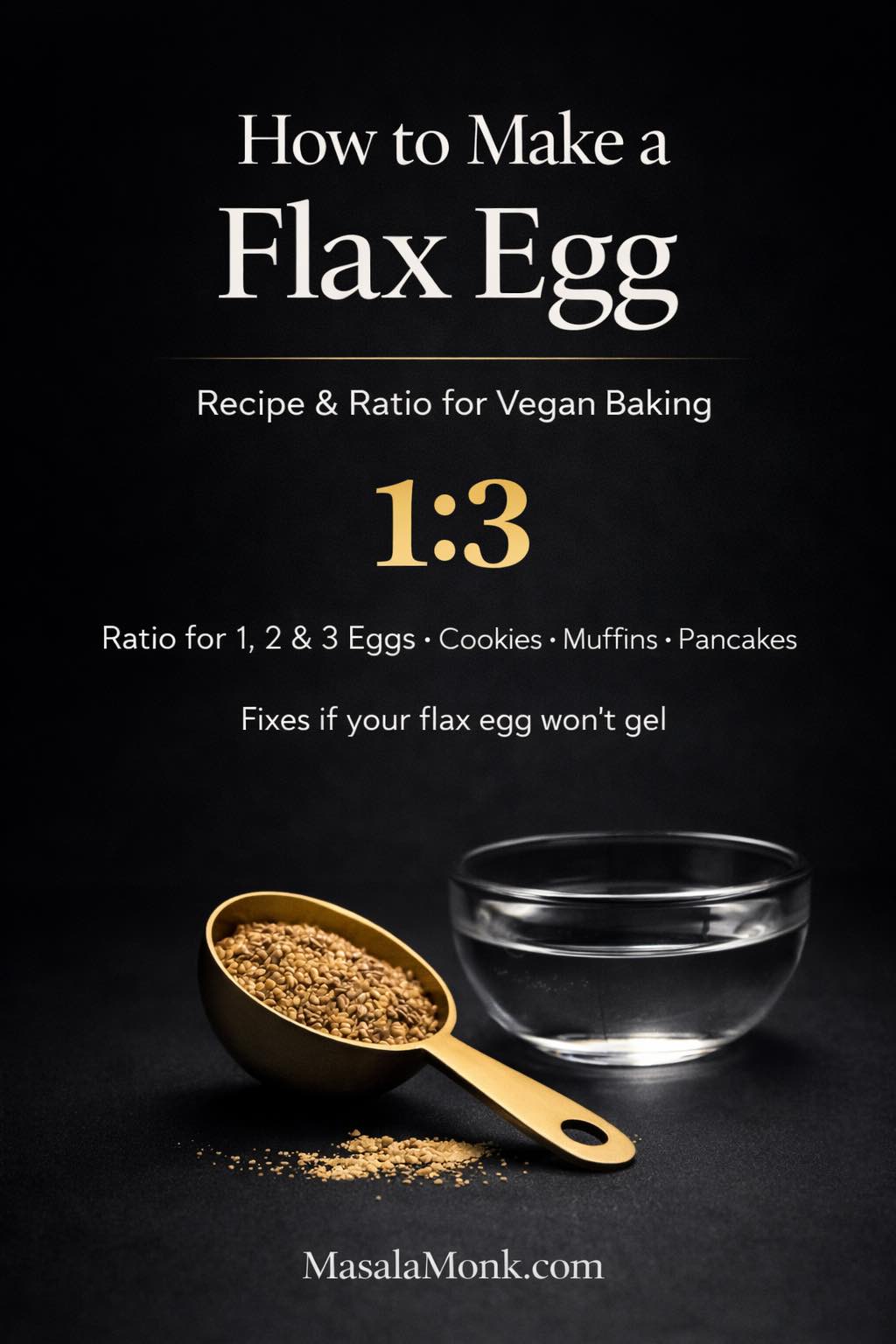
Magazine-style cover for “How to Make a Flax Egg” showing the flax egg recipe and ratio for vegan baking, including 1–3 egg conversions, best uses for cookies, muffins, and pancakes, plus fixes if a flax egg won’t gel, with MasalaMonk.com in the footer.

You know the moment: you’re halfway through a cookie dough, you reach for the egg carton, and it’s empty. Alternatively, you’re baking for someone who avoids eggs—whether for vegan eating, allergies, or simply preference—and you want a solution that doesn’t feel like a compromise. That’s exactly where a flax egg comes in.

Once you learn how to make a flax egg, you’ll have a reliable, pantry-friendly answer for a huge range of recipes—especially the kind of everyday bakes most of us actually make: cookies, muffins, quick breads, pancakes, and waffles. Even better, it’s simple enough to memorize, yet flexible enough to scale for two eggs, three eggs, or more.

Ahead, you’ll get the classic flax egg ratio, easy flaxseed meal to egg conversion for bigger batches, and a few small adjustments that make the gel set reliably in real-world baking. You’ll also see what to use when you need a substitute for flax egg, plus when a different egg replacement makes more sense.


How to Make a Flax Egg (Step-by-Step)

At its core, a flax egg is just ground flaxseed mixed with water. After a short rest, it thickens into a gel. That gel helps bind ingredients together, which is why flaxseed is such a popular egg substitute in baking.

How to Make 1 Flax Egg (the classic flax egg recipe)

For one flax egg:

  • 1 tablespoon ground flaxseed (flax meal)
  • 3 tablespoons water
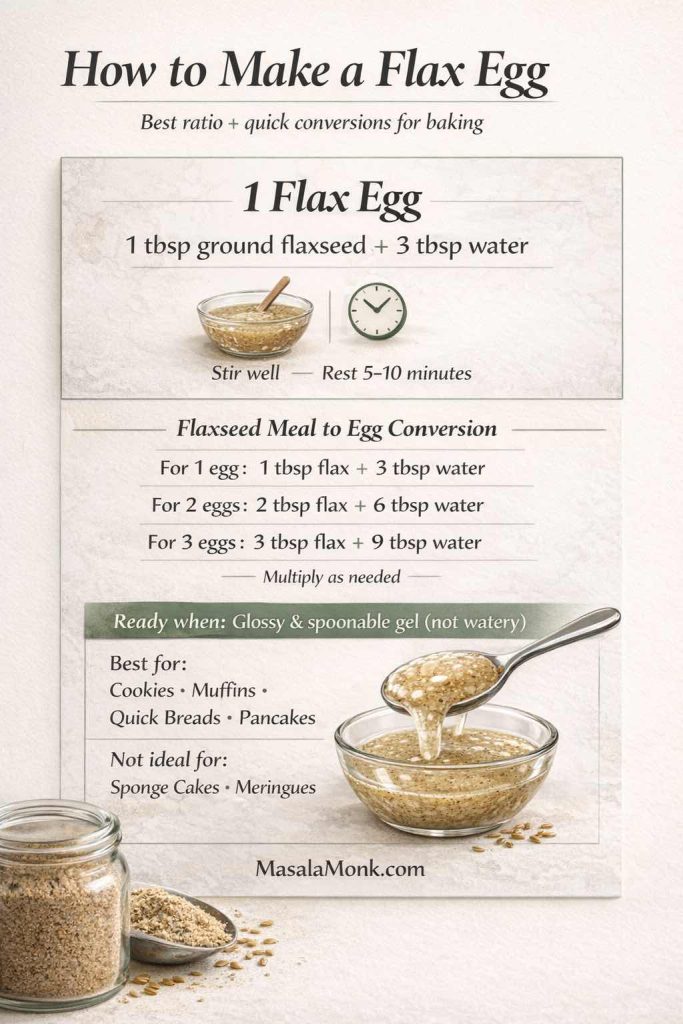
Photorealistic infographic showing how to make a flax egg: mix 1 tablespoon ground flaxseed with 3 tablespoons water, stir well, and rest 5–10 minutes until a glossy, spoonable gel forms. Includes flaxseed meal to egg conversion for 1, 2, and 3 eggs and notes best uses like cookies, muffins, quick breads, and pancakes.
How to make a flax egg at a glance: use the classic flax egg ratio (1 tbsp ground flaxseed + 3 tbsp water), rest 5–10 minutes until glossy and spoonable, then scale the same flaxseed meal to egg conversion for 2 or 3 eggs when you’re baking cookies, muffins, quick breads, or pancakes.

Stir them together until the mixture looks evenly combined. Then, set it aside for about 5–10 minutes. As it sits, it thickens into a gel-like texture. If it still looks watery after 10 minutes, jump to the troubleshooting section—usually it’s a grind or freshness issue, and it’s easy to fix.

The same simple method shows up in everyday baking advice for a reason: it works. If you’d like more practical ways to use ground flax—both as a flaxseed egg substitute and in everyday meals—see Benefits of Flax Seeds and How to Incorporate Them into the Indian Diet.

Now, if you’re thinking, “That’s it?”—yes, that’s basically it. However, the details matter, and those details are what separate “it sort of worked” from “I can swap this confidently.”

How to make a flax egg with ground flax (what actually matters)

Use ground flaxseed, not whole seeds. Whole flax often stays stubbornly seed-like, even after sitting, and the mixture won’t gel properly. Ground flaxseed (flax meal) hydrates more evenly, which is the whole point.
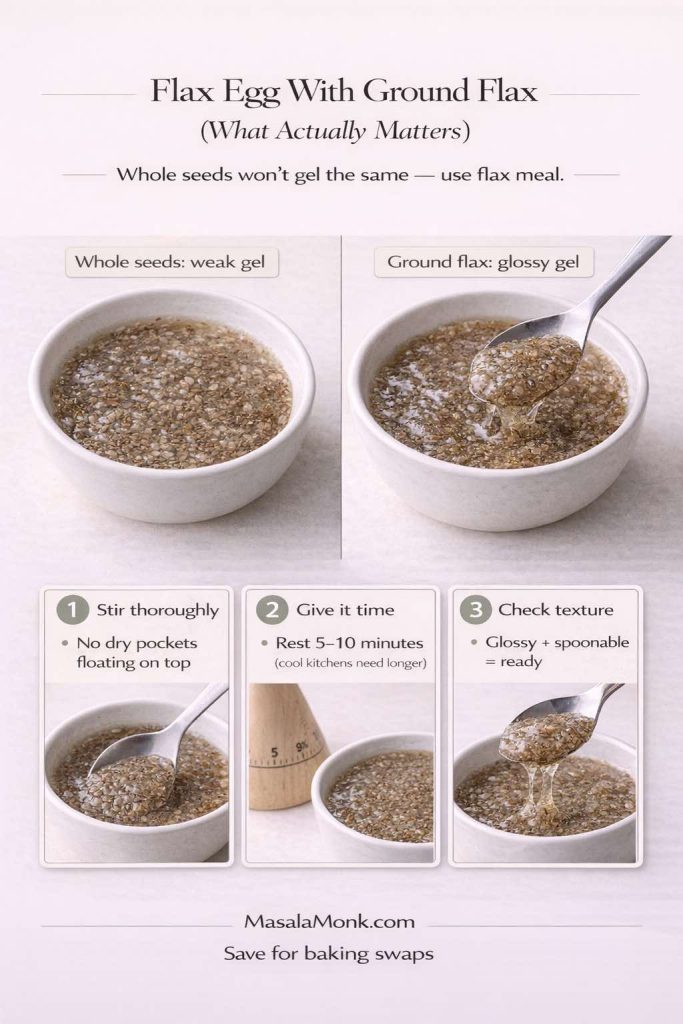
Vertical infographic titled “Flax Egg With Ground Flax (What Actually Matters)” showing a side-by-side comparison: whole flax seeds mixed with water labeled “weak gel” versus ground flax/flax meal mixed with water labeled “glossy gel,” with a spoon lift showing the gel texture. Three step cards explain: stir thoroughly so no dry pockets float on top, let it rest 5–10 minutes (cool kitchens need longer), and check texture—glossy and spoonable means ready. MasalaMonk.com footer.
If your flax egg won’t gel, the fix is usually simple: use ground flaxseed (flax meal), not whole seeds. This step-by-step guide shows the texture you’re aiming for—glossy and spoonable—plus the three things that actually matter in real baking: stir thoroughly, rest 5–10 minutes, and check the gel before adding it to your batter.

Ground flax is also the better pick nutritionally and practically, since whole seeds can pass through without breaking down much. Mayo Clinic explains why ground flax is generally preferred in Flaxseed: Is ground better than whole?.

Stir thoroughly. A quick swirl is rarely enough. Instead, stir until you don’t see dry pockets of flax floating on top.

Give it time. Some flax thickens in five minutes. Other batches need closer to ten, particularly if your kitchen is cool.

Check the texture. A ready flax egg should look glossy and slightly thick—somewhere between loose gel and a lightly thickened sauce. If it’s still watery, a couple quick tweaks usually thicken it up (see troubleshooting below).

Is a flax egg the right substitute for your recipe?

Now that you’ve got the flax egg ratio down, the next question is the one that actually saves batches: will it work in this recipe? The simplest way to decide is to think about what the egg was doing in the first place.
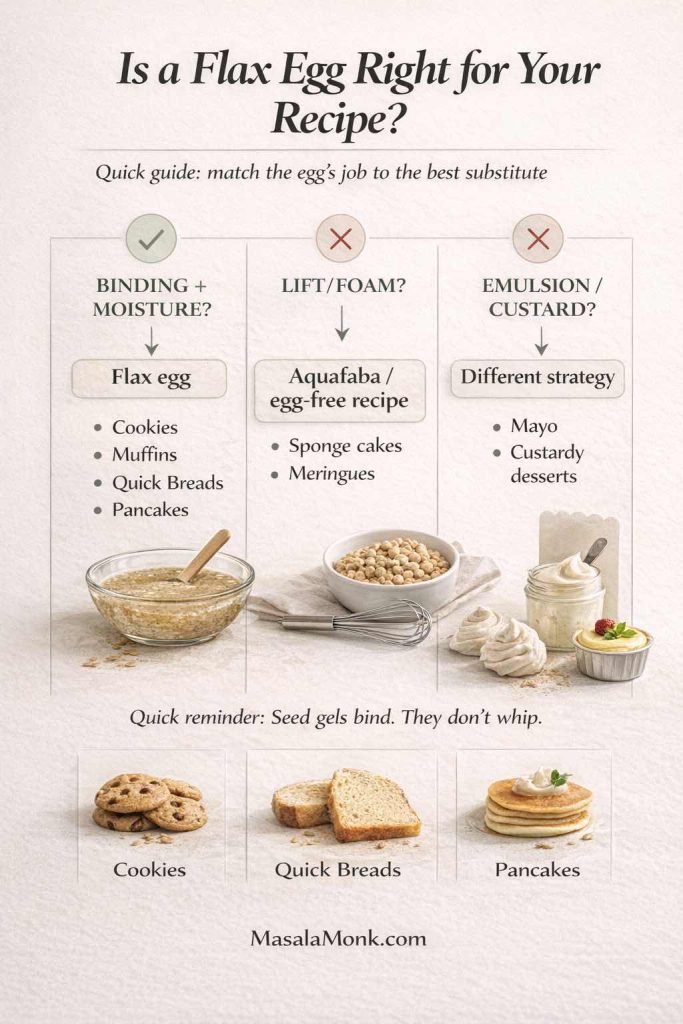
Photorealistic infographic titled “Is a Flax Egg Right for Your Recipe?” showing how to choose an egg substitute based on the egg’s job. It recommends a flax egg for binding and moisture (cookies, muffins, quick breads, pancakes), aquafaba or an egg-free recipe for lift/foam (sponge cakes, meringues), and a different strategy for emulsion or custard-style recipes (mayo, custardy desserts).
Not every egg substitute works the same way—this quick guide helps you decide when a flax egg substitute is the best choice for baking (binding + moisture), when aquafaba is better for lift and foam, and when you’ll want a different approach for emulsions or custard-style desserts.
  • Use a flax egg when the egg is mostly a binder. This is where flax shines: cookies, brownies, muffins, quick breads, pancakes, and waffles—recipes where you want the batter to hold together and stay pleasantly moist.
  • Skip flax when the egg is doing the heavy lifting for lift. If the recipe relies on whipped eggs or airy structure—think sponge cakes, angel-food style bakes, meringues, or anything “foam-based”—a seed gel won’t recreate that height.
  • Be cautious when the recipe calls for several eggs. Replacing one egg is usually straightforward. Replacing two can still work in sturdier bakes. However, once you’re replacing three or more, the texture can drift toward heavier and denser unless the recipe was designed for egg-free baking.
  • When in doubt, pick the more forgiving path. If you’re experimenting, start with cookie doughs and quick breads first. They’re easier to read and adjust, so you learn the “flax egg feel” without risking a fragile cake.

Also Read: Croquettes Recipe: One Master Method + 10 Popular Variations


Flax Egg Ratio (and the flax seed to egg ratio people actually use)

“Flax egg ratio” is one of the most common questions for a reason. Everyone wants a clean answer they can plug into any recipe.

So here it is:

  • 1 flax egg = 1 tablespoon ground flaxseed + 3 tablespoons water
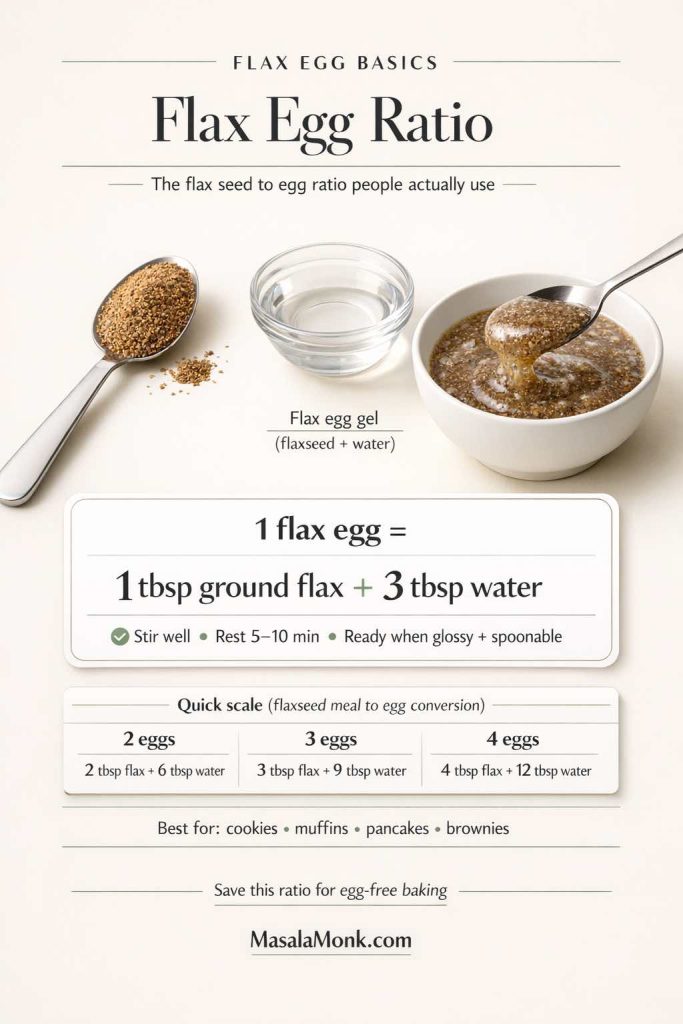
Vertical infographic titled “Flax Egg Ratio” showing a tablespoon of ground flax, a small bowl of water, and a bowl labeled “Flax egg gel (flaxseed + water)” with a spoon lift. It states: 1 flax egg = 1 tbsp ground flax + 3 tbsp water, with steps “stir well, rest 5–10 minutes, ready when glossy and spoonable.” A quick scale table shows conversions for 2 eggs (2 tbsp flax + 6 tbsp water), 3 eggs (3 tbsp flax + 9 tbsp water), and 4 eggs (4 tbsp flax + 12 tbsp water). It notes “Best for: cookies, muffins, pancakes, brownies” and includes MasalaMonk.com branding.
Save this flax egg ratio for fast egg-free baking: 1 flax egg = 1 tablespoon ground flaxseed + 3 tablespoons water (rest until glossy and spoonable). The quick scale makes it easy to convert 2, 3, or 4 eggs in a recipe, and it’s most reliable in cookies, muffins, pancakes, and brownies where eggs are mainly binding.

That’s the standard flax seed egg substitute ratio you’ll see repeated across many reputable sources. Healthline, for example, describes using 1 tablespoon ground flaxseed (or chia) with 3 tablespoons water as a replacement for one egg in baking. You can see that ratio in the ground flax/chia section of 13 Effective Substitutes for Eggs.

Minimalist Baker also teaches the same basic approach for how to make flax eggs for baking—mix, rest, then use in place of one egg—while noting that it isn’t a perfect 1:1 match for every recipe. That nuance is important, and it’s explained well in this post here.

Even so, baking isn’t only about ratios; it’s also about what the recipe needs from the egg. That’s why, beyond the classic ratio, it helps to think about how “tight” or “loose” your flax egg should be.

A useful tweak: the “tight gel” vs “looser gel” approach

Most of the time, 1:3 works perfectly. Still, if you’re making something that already spreads easily—certain cookies, for example—you may prefer a slightly tighter gel. Meanwhile, for muffins and quick breads where moisture is welcome, the classic ratio is ideal.
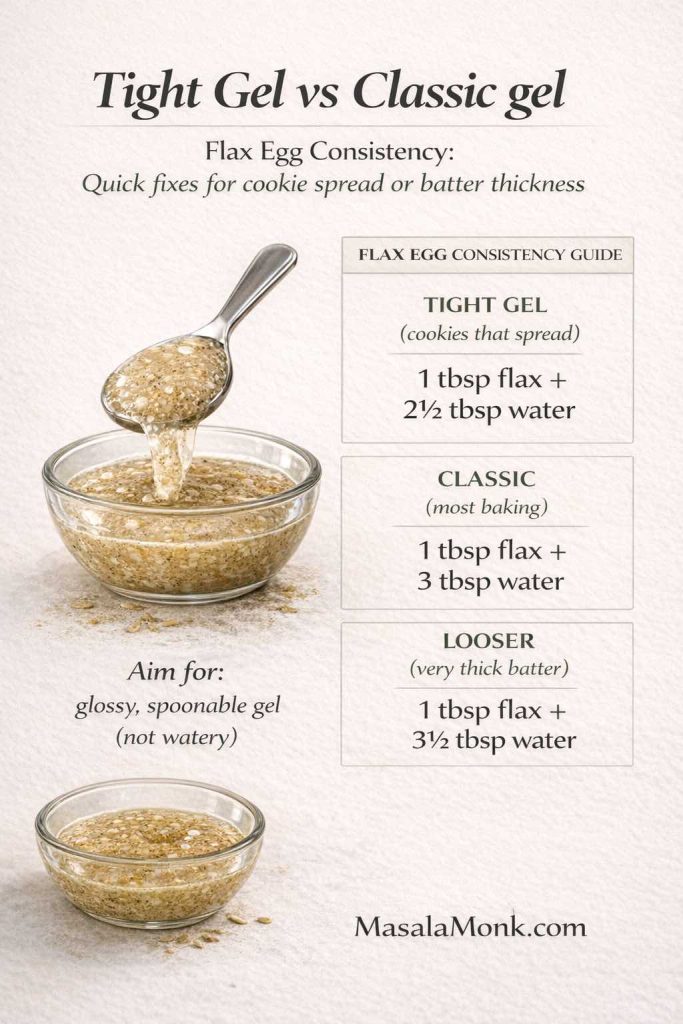
Vertical infographic titled “Tight Gel vs Classic Gel” explaining flax egg consistency for baking. It shows three flax egg ratios: tight gel for cookies that spread (1 tbsp flax + 2½ tbsp water), classic gel for most baking (1 tbsp flax + 3 tbsp water), and a looser mix for very thick batter (1 tbsp flax + 3½ tbsp water). Includes texture cue “glossy, spoonable gel” and MasalaMonk.com branding.
If your flax egg substitute is throwing off cookie spread or batter thickness, adjust the water—not the whole recipe. Use the tight gel ratio for spread-prone cookies, stick with the classic flax egg ratio for most baking, and only loosen the mix when the batter is unusually thick. Aim for a glossy, spoonable gel every time.

You don’t need to overcomplicate this. Just remember the direction:

  • For spread-prone cookies, use a slightly tighter gel: 1 tablespoon flax meal + 2½ tablespoons water.
  • For muffins and quick breads, stick with the classic: 1 tablespoon flax meal + 3 tablespoons water.
  • If your batter is unusually thick, loosen it gently: 1 tablespoon flax meal + 3½ tablespoons water.

That small shift is often enough to reduce cookie spread or keep a loaf from feeling heavy. No matter which version you choose, the goal is the same: a cohesive, spoonable gel—never watery.

Also Read: Ravioli Recipe Reinvented: 5 Indian-Inspired Twists on the Italian Classic


Flaxseed Meal to Egg Conversion (1 egg, 2 eggs, 3 eggs)

Once you’re comfortable with one flax egg, scaling becomes easy. Because it’s linear, you can multiply it without a calculator.

Flaxseed meal to egg conversion: quick scale

  • For 1 egg: 1 tablespoon flax meal + 3 tablespoons water
  • For 2 eggs: 2 tablespoons flax meal + 6 tablespoons water
  • For 3 eggs: 3 tablespoons flax meal + 9 tablespoons water

This is the flax egg conversion you’ll rely on most.
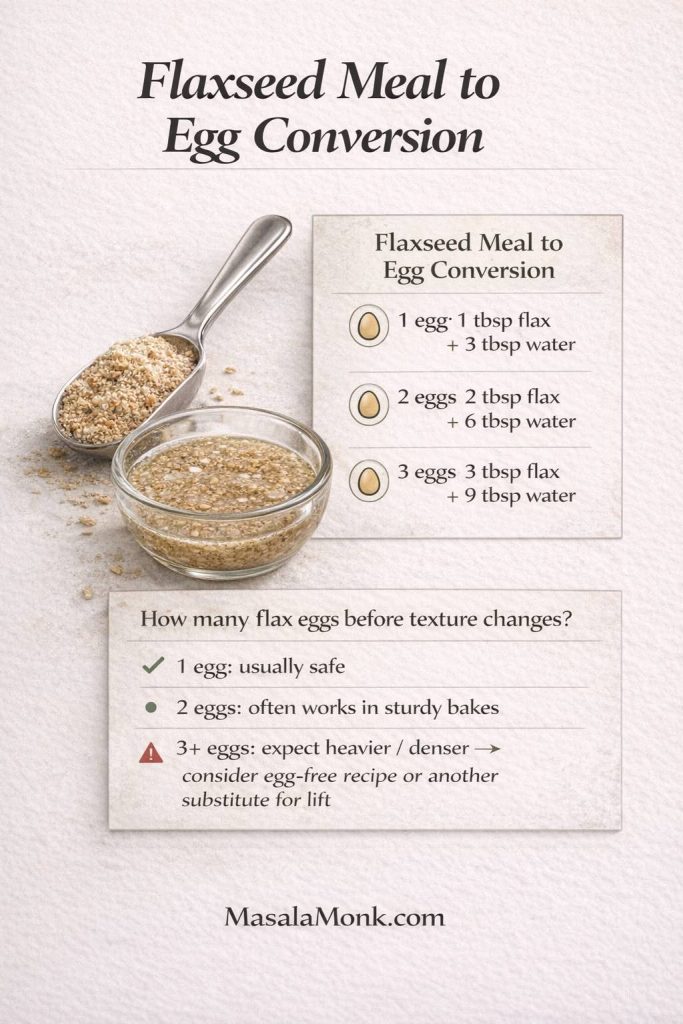
Photorealistic infographic titled “Flaxseed Meal to Egg Conversion” showing flax egg ratios for baking: 1 egg = 1 tbsp ground flaxseed + 3 tbsp water, 2 eggs = 2 tbsp flax + 6 tbsp water, and 3 eggs = 3 tbsp flax + 9 tbsp water. Includes guidance on how many flax eggs to use before texture changes: 1 egg usually safe, 2 eggs often works in sturdy bakes, 3+ eggs may turn heavier/denser.
Scaling a flax egg substitute is simple: use the classic flax egg ratio (1 tbsp ground flaxseed + 3 tbsp water per egg) and multiply for 2 or 3 eggs. This conversion guide also shows when texture can shift—replacing 1 egg is usually easy, 2 often works in sturdy bakes, and 3+ eggs may turn heavier unless the recipe is designed to be egg-free.

However, there’s a practical caution: the more eggs you replace, the more your baked good may drift away from the original texture. King Arthur Baking is direct about this: some egg-heavy recipes simply won’t behave the same with substitutions, and even in everyday bakes, the results depend on what the eggs were doing in the original formula. Their breakdown in Guide for substituting eggs is a helpful reality check.

How many flax eggs can you use before texture changes?

Scaling the flaxseed meal to egg conversion is easy. Still, the results don’t always scale as neatly as the math. The more eggs you replace, the more likely the final texture shifts—especially in recipes where eggs were doing more than just binding.
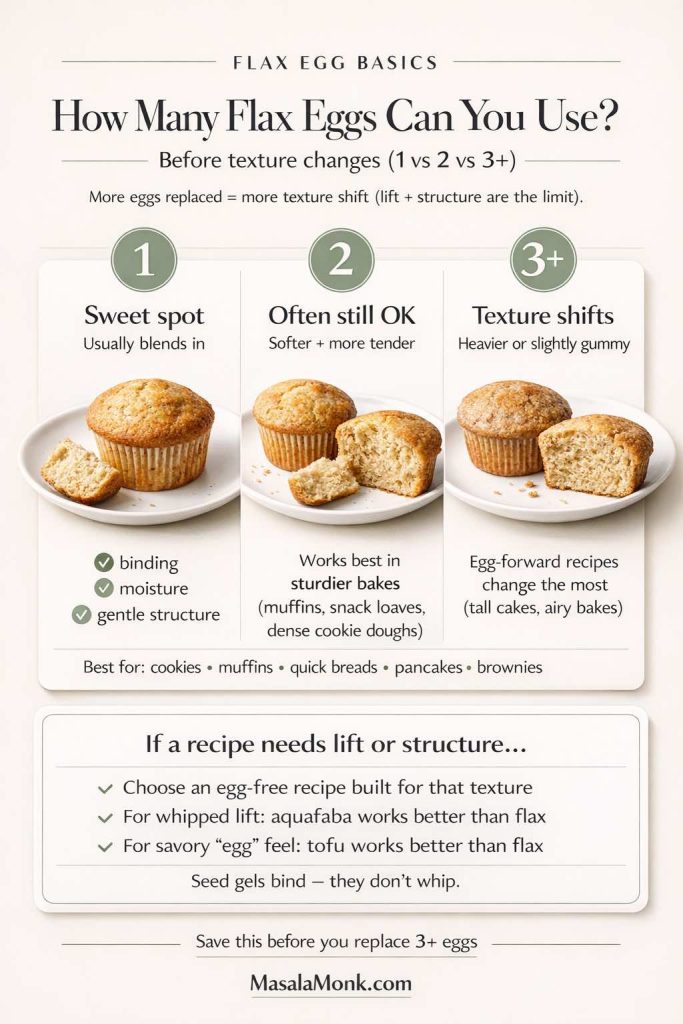
Vertical infographic titled “How Many Flax Eggs Can You Use?” with a 1 vs 2 vs 3+ comparison before texture changes. It shows muffins on plates for each level: 1 flax egg is the sweet spot (usually blends in) supporting binding, moisture, and gentle structure; 2 flax eggs are often still OK (softer and more tender) best in sturdier bakes like muffins, snack loaves, and dense cookie doughs; 3+ flax eggs cause texture shifts (heavier or slightly gummy) especially in egg-forward recipes like tall cakes and airy bakes. A box suggests: choose egg-free recipes for structure, use aquafaba for whipped lift, and tofu for savory “egg” feel. “Seed gels bind — they don’t whip.” MasalaMonk.com footer.
Before you scale flax eggs, save this quick threshold guide. Replacing 1 egg with a flax egg is usually the sweet spot in cookies, muffins, quick breads, pancakes, and brownies. Two flax eggs often still work in sturdier bakes, but once you hit 3+ eggs, expect bigger texture changes—heavier or slightly gummy—because flax can bind and hold moisture, but it can’t replace lift and structure. For airy bakes, switch strategies (aquafaba for whipped lift, or choose an egg-free recipe built for that texture).
  • Replacing 1 egg: This is usually the sweet spot. In cookies, muffins, quick breads, pancakes, and brownies, one flax egg tends to blend in without drama.
  • Replacing 2 eggs: Often still successful in sturdier bakes, particularly muffins, snack cakes, and denser cookie doughs. The crumb may be a little more tender and moist, yet it should still feel “right” if the recipe isn’t egg-forward.
  • Replacing 3 eggs or more: This is where you’ll notice bigger changes. At that point, bakes can start to feel heavier or slightly gummy, not because flax is “bad,” but because it can’t replicate the lift and structure multiple eggs provide.

If a recipe calls for several eggs and the texture matters—think tall cakes or anything meant to be airy—your best bet is either choosing an egg-free recipe built for that style or switching to a different substitute that matches the job the eggs were doing.

Also Read: Oat Pancakes Recipe (Healthy Oatmeal Pancakes)


Using Flaxseed Instead of Eggs (what flax does well, and what it doesn’t)

The reason flax works as an egg substitute ground flaxseed method is simple: when hydrated, it becomes gel-like. That gel helps hold ingredients together and keeps moisture in the bake.
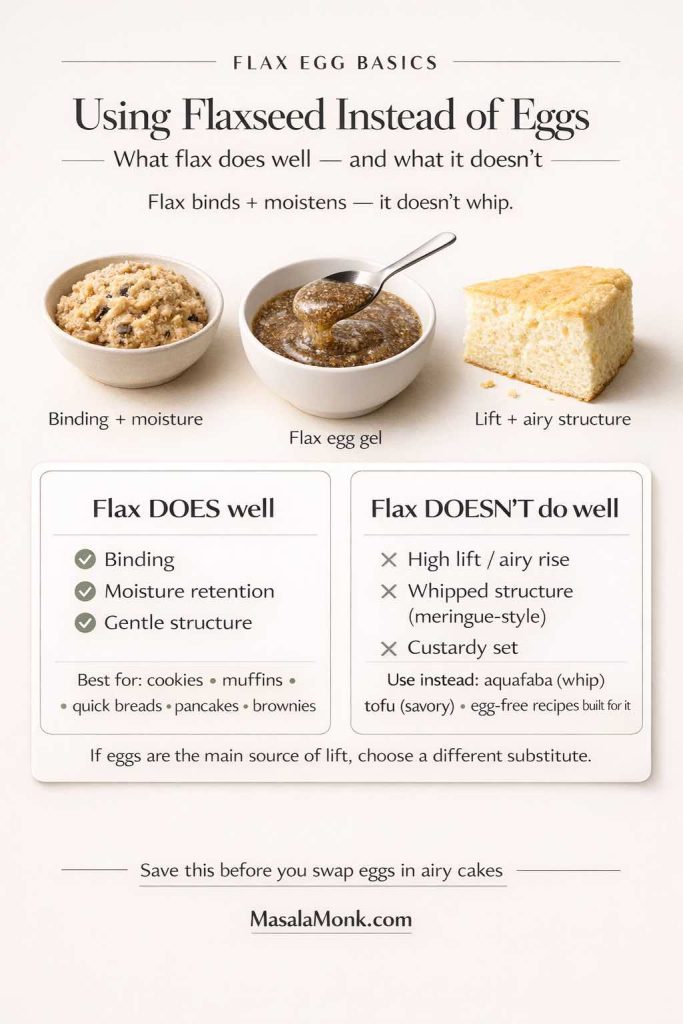
Vertical infographic titled “Using Flaxseed Instead of Eggs” with the subtitle “What flax does well — and what it doesn’t” and the line “Flax binds + moistens — it doesn’t whip.” It shows three photos: a bowl labeled “Binding + moisture,” a bowl of “Flax egg gel” with a spoon lift, and a cake slice labeled “Lift + airy structure.” Two cards explain: flax does well for binding, moisture retention, and gentle structure (best for cookies, muffins, quick breads, pancakes, brownies). Flax doesn’t do well for high lift/airy rise, whipped structure, or custardy set; use aquafaba for whipping, tofu for savory, or egg-free recipes built for that texture. MasalaMonk.com footer.
Using flaxseed instead of eggs works best when eggs are mainly acting as a binder. This quick guide shows the “egg jobs” flax can handle—binding and moisture retention—and what it can’t replicate, like airy lift, whipped structure, or a custardy set. When you need lift, switch to a better match (aquafaba for whipped bakes) or choose an egg-free recipe built for the texture you want.

Yet eggs are not just “one job.” Eggs can bind, emulsify, add moisture, contribute structure, and help with lift depending on the recipe. Consequently, no single substitute perfectly replaces every egg function in every context. Because of that, the best substitute changes from recipe to recipe. If you enjoy that practical way of thinking, Eater’s guide from vegan pastry chefs explains how to match substitutes to the job eggs were doing.

Now, here’s the practical translation:

  • Flax excels at binding and moisture
  • Flax is weaker at adding lift and airy structure

So, when you’re looking for a flaxseed egg substitute baking solution, flax is best in recipes where eggs are not the main source of volume.

Also Read: Keto Flour: Guide to Low-Carb Flours That Bakes Like the Real Thing


Baking With Flax Eggs (what works best, and why)

A flax egg can be surprisingly “invisible” in the right recipe. On the other hand, it can be noticeably dense or gummy in the wrong one. Let’s talk about where it usually performs beautifully.

Flax egg for cookies (one of the best use cases)

If you’re specifically wondering about a flax egg for cookies, you’re in luck. Cookies tend to benefit from binding and moisture; they don’t usually require eggs to create high lift.

Serious Eats tested multiple egg substitutes in cookies, muffins, and pancakes and found that flaxseed stood out particularly in cookies, delivering a chewy texture and a result that didn’t taste obviously “substituted.” That outcome is part of the testing roundup in Out of eggs? The best replacement might already be in your pantry.
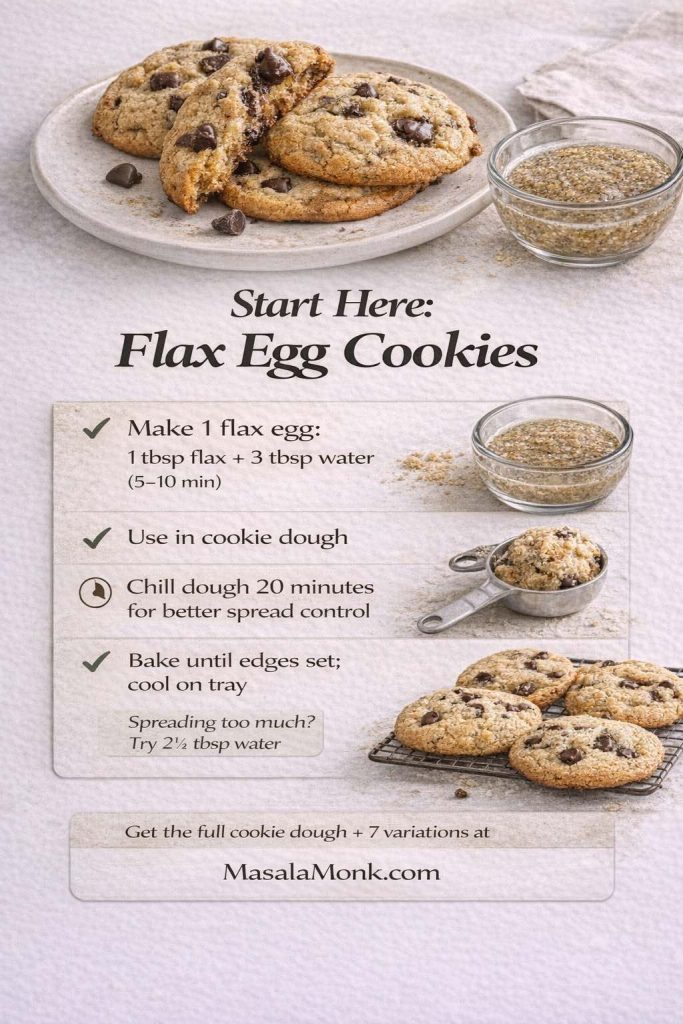
Photorealistic vertical recipe-card infographic titled “Start Here: Flax Egg Cookies” showing chocolate chip cookies and a bowl of flax egg gel. It explains how to make 1 flax egg (1 tbsp ground flaxseed + 3 tbsp water, rest 5–10 minutes), use it in cookie dough, chill dough 20 minutes for better spread control, and bake until edges are set then cool on the tray. Includes tip: “spreading too much? try 2½ tbsp water” and MasalaMonk.com branding.
New to baking with flax eggs? Start with cookies—flax is an excellent egg substitute for binding and chew. Make 1 flax egg (1 tbsp ground flaxseed + 3 tbsp water), let it gel, then chill the dough briefly for better spread control. This quick guide shows the simplest way to get reliable flax egg cookies, plus a small tweak if your dough spreads too much.

If you want to see flax eggs at their best, start with cookies. In many doughs, the swap gives you a cohesive mix and a pleasantly chewy bite—without making the cookie taste “egg-free.” For a flexible base you can riff on, try Double Chocolate Chip Cookies Recipe – One Dough, 7 Ways and use a flax egg in place of one egg in the base dough.

As you bake cookies with flax eggs, a few patterns tend to show up:

  • The texture often leans chewier rather than ultra-crisp
  • The dough may feel slightly softer at first
  • The cookies can benefit from a brief rest so the flour hydrates

Instead of fighting those traits, work with them. If you want crispness, you can often adjust bake time, sugar ratios, or resting/chilling. Still, the easiest win is choosing cookie styles where chew is the goal.

Flax egg for muffins and quick breads (quietly reliable)

Muffins, banana-style quick breads, and snack loaves are where flax eggs often feel effortless. These bakes typically want moisture and cohesion, and flax provides both.
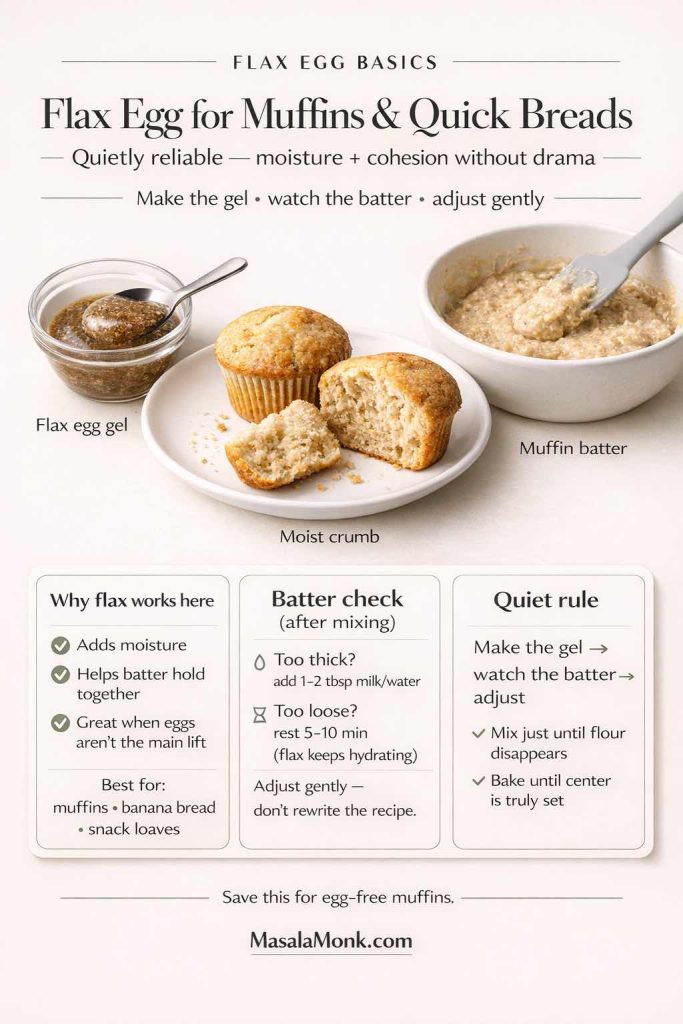
Vertical infographic titled “Flax Egg for Muffins & Quick Breads” with the subtitle “Quietly reliable — moisture + cohesion without drama.” It shows a bowl labeled “Flax egg gel” with a spoon, a plate with muffins (one cut open) labeled “Moist crumb,” and a bowl labeled “Muffin batter.” Three cards explain: why flax works (adds moisture, helps batter hold together, best when eggs aren’t the main lift); a batter check (if too thick add 1–2 tbsp milk or water, if too loose rest 5–10 minutes as flax hydrates); and a “quiet rule” (make the gel, watch the batter, adjust; mix just until flour disappears; bake until center is truly set). MasalaMonk.com footer.
Flax egg for muffins and quick breads is one of the easiest egg swaps because these bakes mainly need moisture and cohesion—not whipped lift. Use this batter-check guide right after mixing: if the batter feels too thick, add 1–2 tablespoons milk/water; if it feels loose, rest 5–10 minutes so the flax gel keeps hydrating. Then keep it simple—mix only until the flour disappears and bake until the center is truly set for a reliably tender, moist crumb.

Moreover, quick breads are usually forgiving. If your batter is slightly thicker than expected, you can add a splash of the recipe’s liquid. Conversely, if it’s looser, give it a minute—flax continues to hydrate, and batters often thicken slightly as they sit.

At this point, it’s worth repeating a helpful mindset: don’t treat flax eggs like a lab experiment. Make the gel, watch the batter, then adjust gently.

Flax egg for pancakes (and why timing matters)

Pancakes are another common destination for flax eggs. The gel helps bind, while the batter’s chemistry (baking powder or baking soda) still delivers lift. Even so, pancakes can swing from fluffy to dense depending on how they’re mixed and rested. So, if you’re using flaxseed instead of eggs, it helps to keep the batter calm:

  • Mix until just combined
  • Rest the batter briefly so the flour hydrates
  • Cook on a steady, medium heat
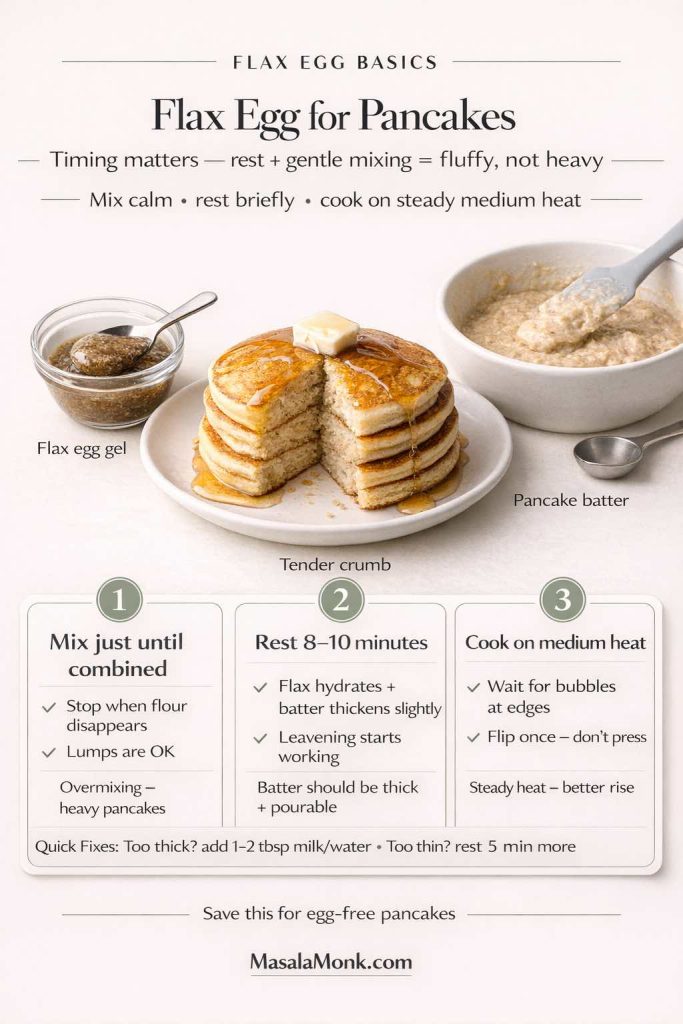
Vertical infographic titled “Flax Egg for Pancakes” with the subtitle “Timing matters — rest + gentle mixing = fluffy, not heavy.” It shows a bowl labeled “Flax egg gel,” a stack of pancakes with a slice removed labeled “Tender crumb,” and a bowl labeled “Pancake batter.” Three numbered cards say: 1) Mix just until combined (stop when flour disappears, lumps are OK; overmixing makes heavy pancakes). 2) Rest 8–10 minutes (flax hydrates and batter thickens slightly; leavening starts working; batter should be thick and pourable). 3) Cook on medium heat (wait for bubbles at edges; flip once, don’t press; steady heat gives better rise). Quick fixes note: too thick add 1–2 tbsp milk/water; too thin rest 5 minutes more. MasalaMonk.com footer.
Flax egg for pancakes works best when you treat it like a timing swap, not just an ingredient swap. Mix only until the flour disappears (lumps are fine), then rest the batter 8–10 minutes so the flax egg gel hydrates and the leavening starts working. Finally, cook on steady medium heat and flip once—no pressing—so you get a tender crumb that’s fluffy instead of heavy.

Once you’re comfortable swapping eggs in pancakes, it’s worth trying sturdier batters that benefit from extra binding. Millet-based pancakes, for instance, pair well with a flax egg because the gel helps the batter hold together while still cooking up tender. If you’d like a solid recipe to start with, make Healthy Millet Protein Packed Pancakes and replace the egg with a flax egg.

Flax eggs to real eggs (what to expect in texture)

Many people want flax eggs to behave exactly like eggs. Sometimes the match is close. Other times, the difference is obvious. Rather than promising perfection, it’s better to know what you’re trading.
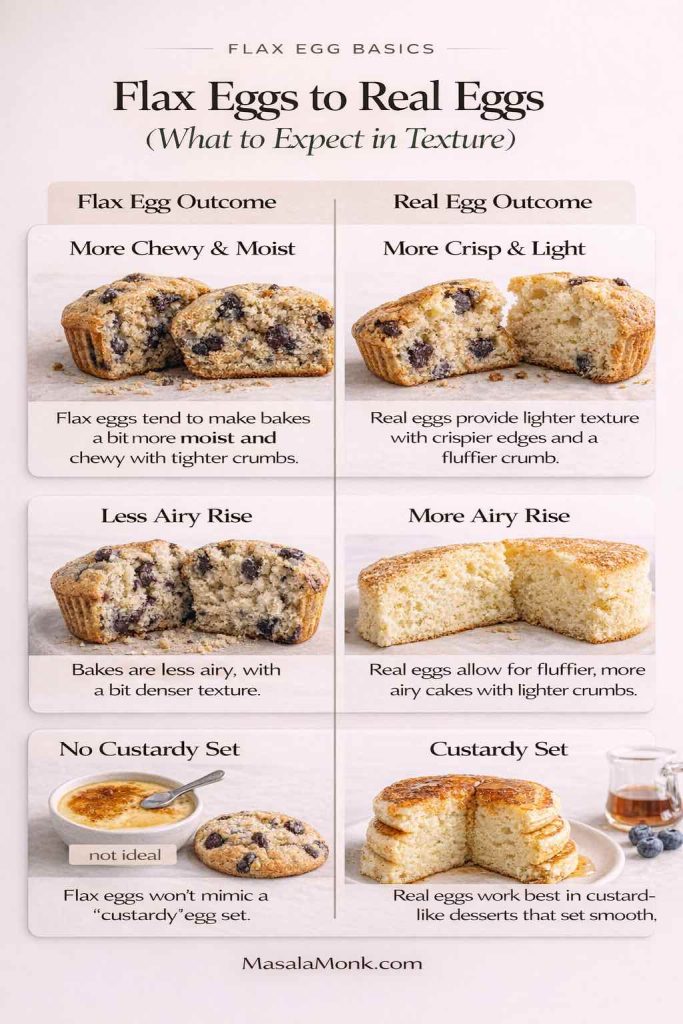
Photorealistic infographic titled “Flax Eggs to Real Eggs (What to Expect in Texture)” comparing baking results. Left column shows flax egg outcome: more chewy and moist, less airy rise, and no custardy set. Right column shows real egg outcome: more crisp and light, more airy rise, and custardy set. Includes photos of muffins, cake, and custard-style desserts plus MasalaMonk.com branding.
A flax egg substitute doesn’t bake exactly like a real egg—and that’s okay once you know what to expect. This texture guide shows the most common differences: flax eggs tend to create a slightly chewier, moister crumb with less airy rise, while real eggs give lighter lift and can create a custardy set in certain desserts.

In general:

  • Flax eggs tend to give a slightly more tender, moist crumb
  • They can produce a bit more density than eggs in airy bakes
  • They rarely create the same “egg set” feel you get in custardy textures

Therefore, the best results come from using flax eggs in recipes where eggs are primarily binders, not the backbone.

Also Read: 10 Vegetarian And High Protein Meal Prep Ideas from Indian Cuisine


Flax eggs with different flours (why results vary)

Even with the right flax egg ratio, flour choice can change the outcome. That’s because some flours absorb more water, while others rely on extra binders for structure.
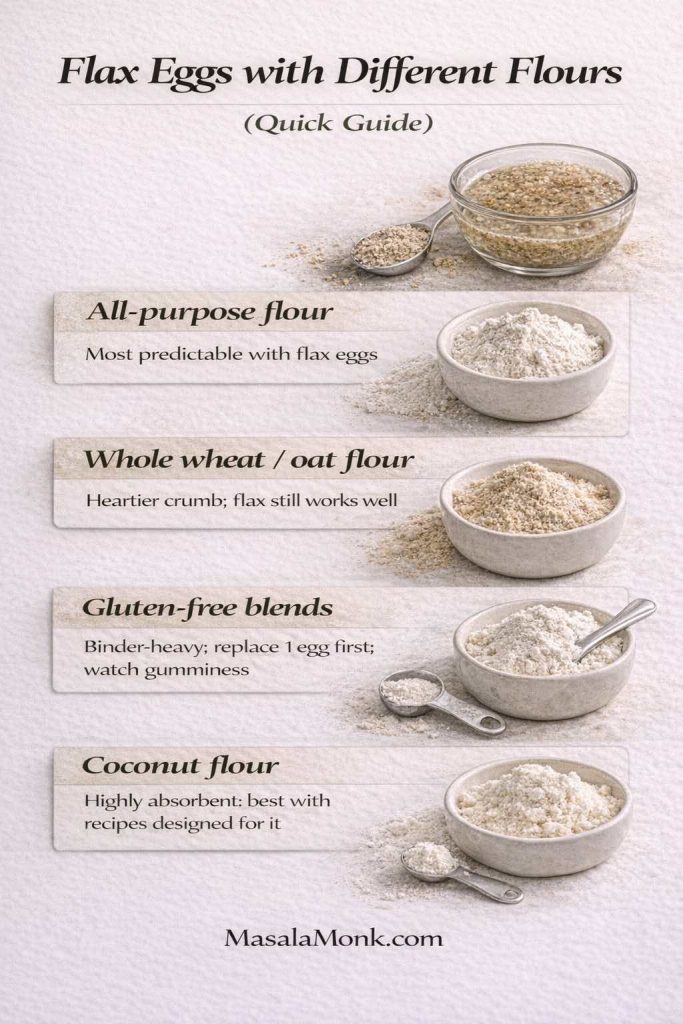
Photorealistic infographic titled “Flax Eggs with Different Flours (Quick Guide)” showing how flax eggs behave with common flours: all-purpose flour (most predictable), whole wheat or oat flour (heartier crumb), gluten-free blends (binder-heavy; replace 1 egg first and watch gumminess), and coconut flour (highly absorbent; best with recipes designed for it). Includes a bowl of flax egg gel and MasalaMonk.com branding.
Flax eggs don’t behave the same with every flour. Use this quick guide to choose the best flour match for a flax egg substitute—most predictable with all-purpose flour, a heartier crumb with whole wheat or oat flour, extra caution with binder-heavy gluten-free blends, and coconut flour only when the recipe is built for its high absorption.
  • All-purpose flour: Flax eggs are typically most predictable here, especially in cookies, muffins, and quick breads.
  • Whole wheat and oat flour: Expect a slightly heartier crumb. Flax usually still works well, yet you may notice a bit more density—especially if the recipe already leans “sturdy.”
  • Gluten-free blends: Many gluten-free mixes already include binders and starches. Adding flax can sometimes tip the texture toward heavier or a little gummy, so it’s smart to start by replacing only one egg and see how the batter behaves.
  • Coconut flour: This flour drinks liquid aggressively. A flax egg may not provide enough structure on its own, and the batter can swing from thick to dry quickly. For coconut-flour baking, you’ll usually get the best result from recipes designed specifically for that flour rather than trying a simple swap.

The takeaway is simple: when flours are highly absorbent or binder-heavy, flax eggs may need a lighter hand—or a recipe that’s already built for egg-free structure.

Also Read: Fish and Chips Reimagined: 5 Indian Twists (Recipe + Method)


Egg Substitute Ground Flaxseed: choosing the best flax meal (and why freshness matters)

A flax egg is easy, but the flax itself can make or break it.

Ground flax vs whole flax (and why it matters)

Ground flax hydrates quickly and forms the gel you need. Whole flax often doesn’t, at least not in a way that works as an egg replacer.

From a nutrition standpoint, Mayo Clinic recommends ground flax because it’s easier to digest; from a baking standpoint, ground flax is also what gives you reliable gelling. That point is covered succinctly in Flaxseed: Is ground better than whole?.

Storage is a real issue (because ground flax can go stale)

Ground flax has more exposed surface area, which means it can spoil faster than whole seeds. If your flax smells bitter, paint-like, or unpleasantly sharp, it’s not going to improve your cookies.
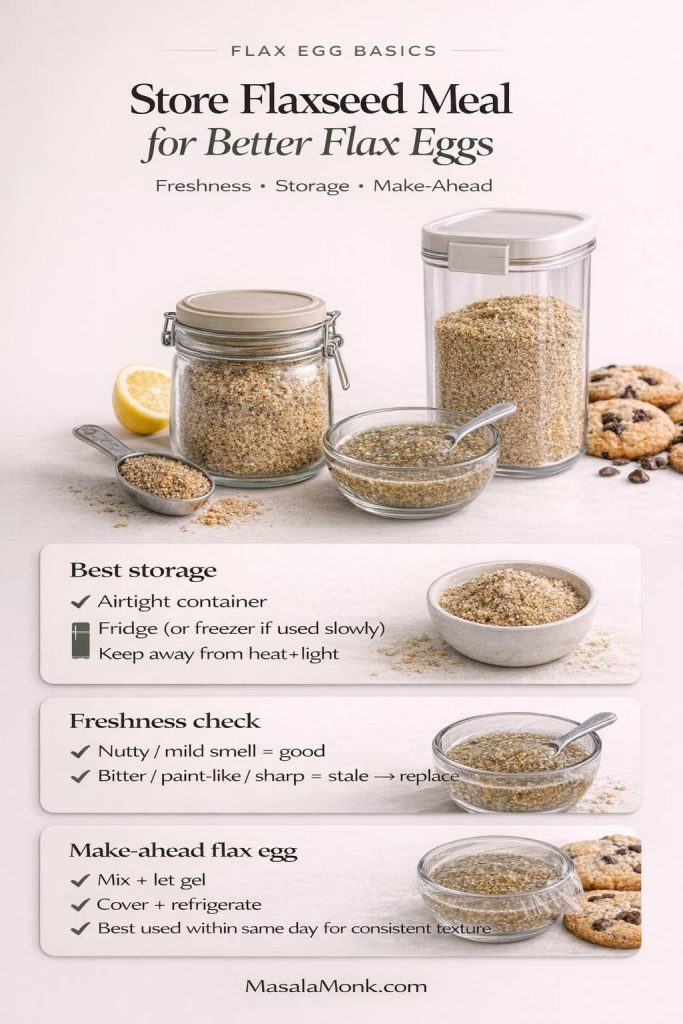
Photorealistic infographic titled “Store Flaxseed Meal for Better Flax Eggs” showing a jar and airtight container of ground flaxseed meal, a bowl of flax egg gel, measuring spoon, and cookies as a baking cue. It explains best storage (airtight container; fridge or freezer; keep away from heat and light), a freshness smell check (nutty/mild is good; bitter/paint-like/sharp means stale), and make-ahead flax egg tips (mix and let gel; cover and refrigerate; best used the same day). MasalaMonk.com branding.
Fresh flax makes a better flax egg substitute. Use this storage guide to keep ground flaxseed meal tasting clean and gelling reliably: store it airtight in the fridge (or freezer), use the quick smell test to spot stale flax, and if you prep a make-ahead flax egg, refrigerate it and use it the same day for the most consistent baking results—especially for cookies and quick breads.

Mayo Clinic Health System notes practical storage guidance for flaxseed meal—keeping it refrigerated in an airtight container to prevent spoiling—in Flaxseed is nutritionally powerful.

That’s not meant to scare you. It’s simply the difference between a flax egg that disappears into the bake and one that leaves a lingering bitter aftertaste.

Also Read: Dirty Martini Recipe (Classic, Extra Dirty, No Vermouth, Spicy, Blue Cheese, Tequila + Batched)


Flaxseed Egg Substitute Baking: why your results vary (and how to make them consistent)

If you’ve tried flax eggs once and felt underwhelmed, it usually comes down to one of three things:

  1. the flax didn’t gel properly
  2. the recipe needed lift rather than binding
  3. too many eggs were replaced in a recipe that depends on eggs for structure

Instead of guessing, you can diagnose your result and adjust.
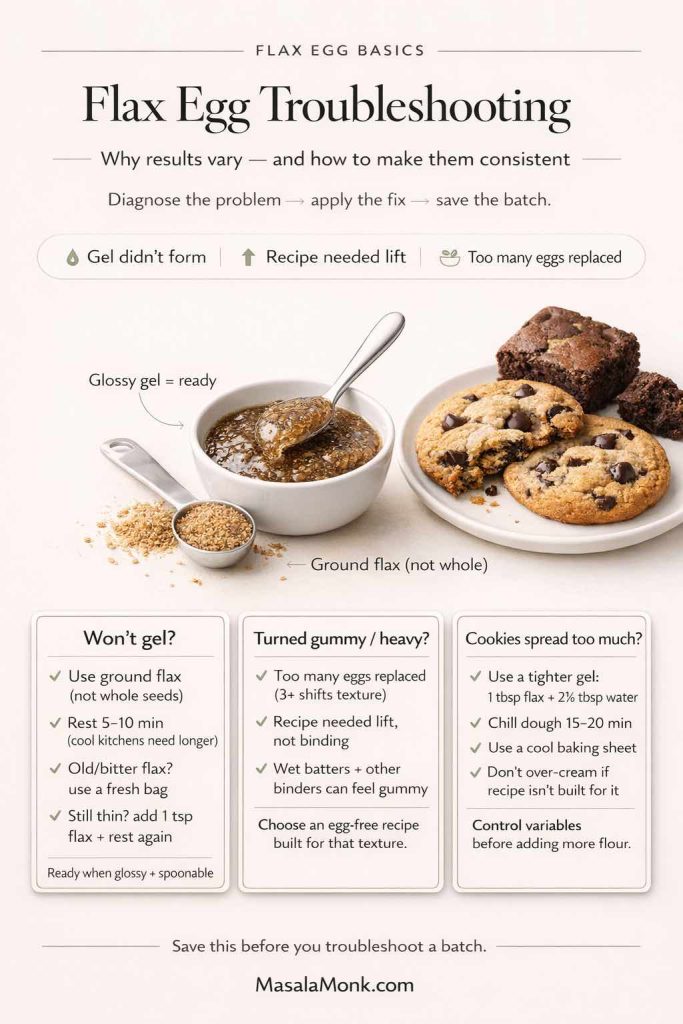
Vertical infographic titled “Flax Egg Troubleshooting: Why results vary — and how to make them consistent.” It shows a bowl of glossy flax egg gel with a spoon lift, a measuring spoon of ground flax labeled “Ground flax (not whole),” and a plate with cookies and brownie pieces. A strip lists three causes: gel didn’t form, recipe needed lift, too many eggs replaced. Three cards provide fixes: “Won’t gel?” (use ground flax, rest 5–10 min, use fresh flax, add 1 tsp flax and rest again), “Turned gummy/heavy?” (too many eggs replaced, recipe needed lift, wet batters/other binders), and “Cookies spread too much?” (tighter gel 1 tbsp flax + 2½ tbsp water, chill dough 15–20 min, cool baking sheet, don’t over-cream). Footer reads MasalaMonk.com.
If flaxseed egg substitute baking ever goes sideways, this cheat sheet saves the batch. First, confirm you’re using ground flax (not whole seeds) and wait for a glossy, spoonable gel. Next, match the fix to the problem: thin gel usually needs more time (or fresher flax), gummy/heavy bakes often mean you replaced too many eggs or the recipe needed lift, and spreading cookies usually improve with a tighter flax egg ratio plus a short chill. Save this as your quick “diagnose → fix” guide for flax eggs.

If your flax egg won’t gel

This is common, yet fixable.

  • If you used whole seeds, grind them and try again.
  • If your flax is old, try a fresher bag.
  • If you didn’t wait long enough, give it a few more minutes.
  • If it’s still thin, stir in a little extra ground flax and rest again.

Even with the same flax egg ratio, the gel can vary depending on how finely the flax is ground. A finer meal thickens faster, while a coarser grind may need a little extra time to hydrate. If you’d like another baked example where flax swaps in smoothly, see Wholewheat Carrot Orange Tea Cake.

If your bake turned gummy

Gumminess often happens when flax is asked to do too much—especially when replacing multiple eggs or when the recipe already has other gel-formers (certain gluten-free blends, heavy starches, or very wet batters).

At that point, switching strategies is often wiser than forcing the swap. King Arthur’s substitution guide is helpful because it gives you multiple options and also explains when egg substitutions simply won’t deliver the intended results. That perspective is in Guide for substituting eggs.

Eater’s pastry-chef framing adds another layer: sometimes recipe reformulation makes more sense than substitution, because you can adjust leavening, acid, and structure intentionally rather than trying to mimic an egg in a context where eggs do too much. That discussion is in Of course you can bake without eggs. Vegan pastry chefs tell us how.

If your cookies spread too much

When cookies spread, most people assume they need more flour. Occasionally that’s true, although it’s not the only solution.

Instead, try these gentle adjustments:

  • Use a slightly tighter flax gel (a bit less water)
  • Chill the dough briefly
  • Ensure your baking sheet isn’t warm
  • Don’t over-cream fat and sugar if the recipe isn’t built for it

In other words, control the variables that affect spread before you start changing the recipe’s foundation.

Also Read: Keto Hot Chocolate Recipe (Sugar-Free Hot Cocoa) + Best Homemade Mix


Vegan Egg Substitute Flaxseed: when flax is the right choice—and when it isn’t

Flax is a strong vegan egg substitute because it’s easy, cheap, and consistent when used appropriately. Still, it isn’t the universal answer.

When flax is a great vegan egg substitute

Choose flax when the recipe needs:

  • binding
  • moisture retention
  • gentle structure

That’s why flax eggs are so popular for cookies, muffins, pancakes, and brownies.
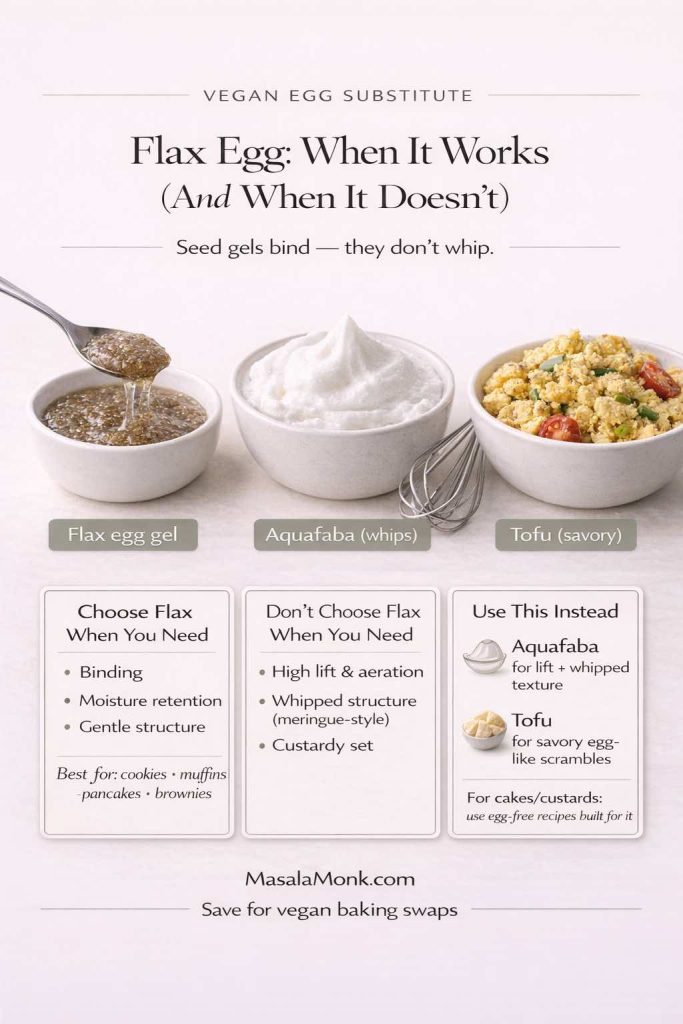
Vertical infographic titled “Flax Egg: When It Works (And When It Doesn’t)” with the line “Seed gels bind — they don’t whip.” It shows three labeled bowls: flax egg gel, aquafaba (whips), and tofu (savory). Three cards explain: choose flax for binding, moisture retention, and gentle structure (best for cookies, muffins, pancakes, brownies); don’t choose flax for high lift/aeration, whipped structure, or custardy set; use aquafaba for lift and whipped texture, and tofu for savory egg-like scrambles. MasalaMonk.com footer.
Wondering when a flax egg is the right vegan egg substitute? Save this quick decision guide: flaxseed “eggs” are best when you need binding and moisture (cookies, muffins, pancakes, brownies), but they won’t create lift or whipped structure. For airy bakes, aquafaba is usually the better choice; for savory breakfast swaps, tofu gives a more satisfying egg-like texture.

When you should use a different egg substitute

Choose something else when the recipe needs:

  • high lift and aeration
  • whipped structure (like meringues)
  • a custardy set

If you want a fast way to remember this: seed gels bind, but they don’t whip.

When a recipe needs lift—think lighter cakes or anything that benefits from a whipped, airy structure—a seed gel won’t deliver the same result. In those cases, aquafaba (the liquid from cooked chickpeas or a can of chickpeas) is often the better option because it can be whipped and folded in like egg whites.

Flax eggs shine in baking-style mixtures—batters, doughs, and quick breads. On the other hand, if you’re craving a savory breakfast where you’d normally scramble eggs, tofu is usually the better choice because it can be seasoned and cooked into a satisfying egg-like texture. If you want ideas that go beyond baking, start with ‘Tofu’ Instead of ‘Eggs’: 5 High Protein Plant-Based Breakfast Ideas.

Also Read: Garlic & Paprika Cabbage Rolls (Keto-Friendly Recipes) – 5 Bold Savory Twists


Substitute for Flax Egg (when you don’t have flaxseed)

Eventually, you’ll run into the exact opposite problem: you want to bake egg-free, but the flax jar is empty. Luckily, you have options.

A close cousin: chia seed “egg”

Chia works in a similar way to flax because it gels when hydrated. However, it can behave differently in texture, sometimes creating denser or crunchier results depending on the recipe.

Serious Eats’ testing found chia produced denser outcomes in certain bakes compared to flax, which is a useful heads-up if you’re aiming for a soft crumb. That comparison appears in Out of eggs? The best replacement might already be in your pantry.

If you keep chia seeds around as well, they’re useful far beyond baking—think meal prep puddings, overnight oats, and quick add-ins for smoothies. For simple ideas that make chia easy to use week to week, check out The Power of Chia Seeds: 5 Plant-Based High-Protein Meal Prep Ideas.
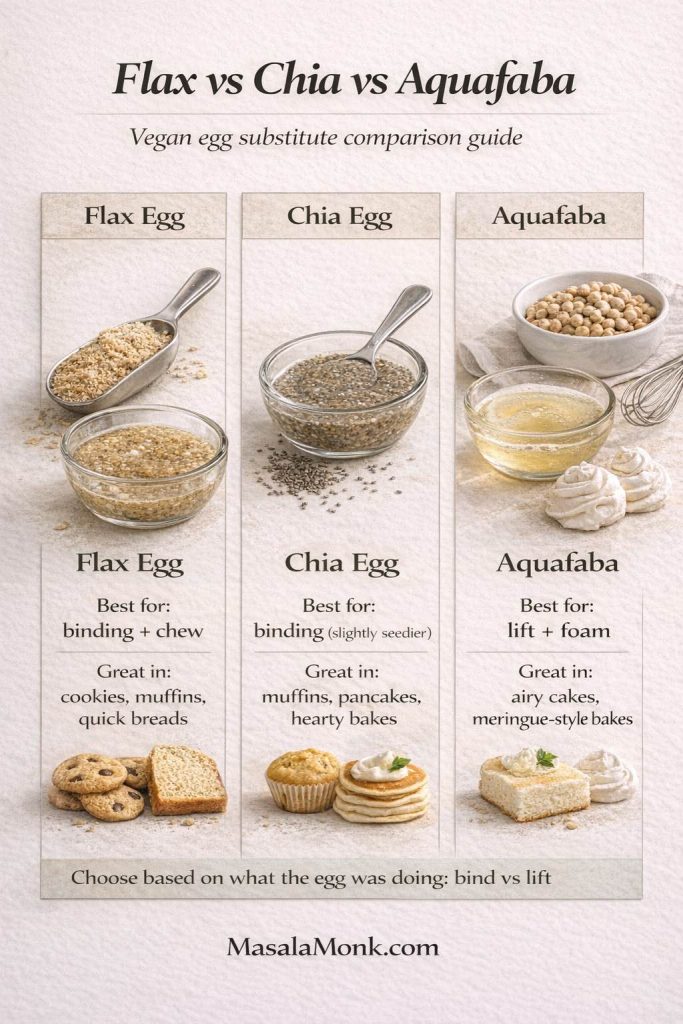
Photorealistic infographic titled “Flax vs Chia vs Aquafaba” comparing vegan egg substitutes. It shows flax egg as best for binding and chew (cookies, muffins, quick breads), chia egg as best for binding with a slightly seedier texture (muffins, pancakes, hearty bakes), and aquafaba as best for lift and foam (airy cakes, meringue-style bakes). Includes a reminder to choose based on whether the recipe needs binding or lift and MasalaMonk.com branding.
Not sure what to use when you’re out of eggs—or when flax isn’t the best fit? This quick vegan egg substitute guide compares flax egg, chia egg, and aquafaba so you can choose the right egg replacement for baking: flax and chia for binding, and aquafaba when you need lift and foam.

When you’re not trying to be “neutral”: fruit purées and other options

Sometimes you don’t need an egg substitute that disappears. Instead, you want moisture + softness, and you’re totally fine if the swap brings a little personality with it. That’s where fruit purées shine.

Quick rule of thumb: what fruit purées actually replace

Fruit purées are best when the egg’s job is mostly moisture and tenderness, not lift. In other words, they can help keep bakes soft and cohesive, yet they won’t give you the same airy structure eggs can.
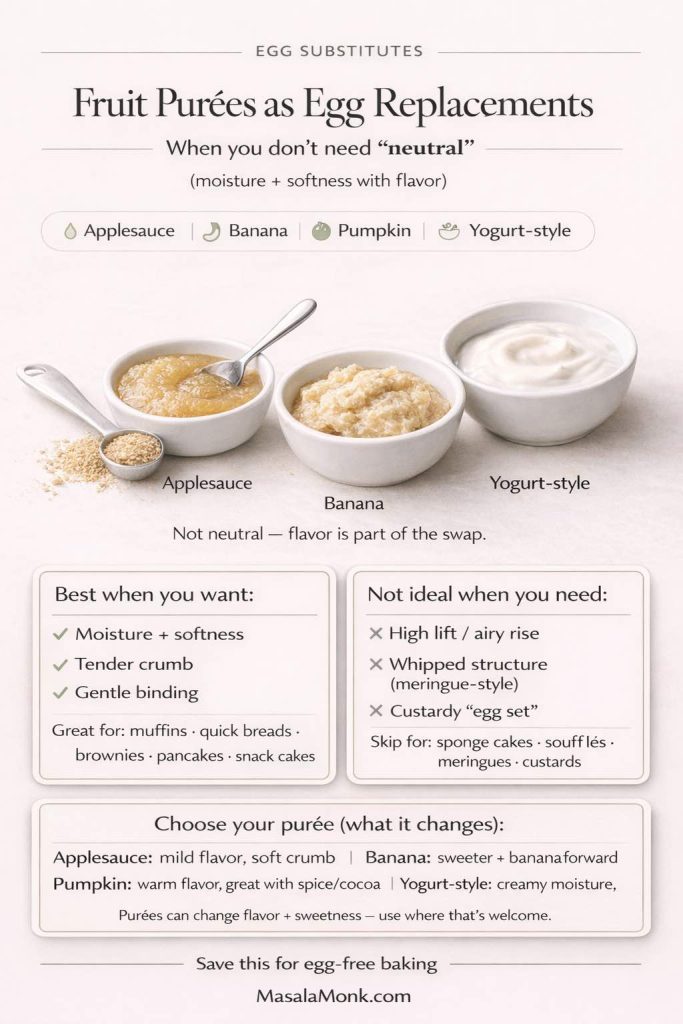
Fruit purées as egg replacements infographic showing applesauce, mashed banana, pumpkin purée, and yogurt-style substitute, plus when to use them for moisture and softness and when not to (lift, whipped structure, custardy set).
Out of eggs—or just not chasing “neutral”? This cheat-sheet shows when fruit purées make the best egg substitute (moisture + softness) and when they won’t work (lift, whipped structure, custardy set). Use it to choose between applesauce, banana, pumpkin purée, or a yogurt-style swap based on the bake you’re making.

Best picks (and what each one changes)

  • Applesauce: Mild flavor, adds moisture, keeps crumb tender. Great when you want the swap to stay relatively subtle.
  • Mashed banana: Stronger flavor and aroma, adds sweetness, can make bakes taste “banana-forward.” Use when that’s a plus.
  • Pumpkin purée: Moisture + gentle structure with a warm, earthy flavor. Works beautifully with spices, cocoa, and autumn-style bakes.
  • Yogurt-style substitutes: Creamy moisture and richness; tends to keep cakes and muffins soft. (If you’re keeping it vegan, use plant-based yogurt.)

Where they work best

Because they change flavor and sweetness, fruit purées are most reliable in bakes that welcome that shift: muffins, snack cakes, quick breads, brownies, pancakes, and spiced loaves.

On the other hand, if a recipe is meant to be light and airy—or the egg is doing major structure work—these swaps can turn the texture heavier than you wanted. In that case, flax egg, aquafaba, or an egg-free recipe designed for the result will usually be a better fit.

A practical alternative mindset: different substitutes for different “egg jobs”

Not every egg substitute behaves the same, so the best choice depends on the texture you’re trying to get. Sometimes they bind; other times they add moisture, help with lift, or create structure. That’s why one substitute can work beautifully in cookies yet fall flat in a sponge cake. If you like this recipe-by-recipe approach, Eater’s guide from vegan pastry chefs breaks down how to choose an egg substitute based on what the recipe actually needs.

How to Replace Egg With Flax (recipe-by-recipe instincts)

By now you know the method. Next, you want confidence. This section is about building instincts so you can look at a recipe and know whether flax is likely to work.

Cookies: usually yes

If the recipe calls for one egg in a batch of cookies, flax is usually a safe bet. If it calls for multiple eggs, you can still try, but your texture may drift more.

For a cookie recipe that’s easy to adapt, try Double Chocolate Chip Cookies Recipe – One Dough, 7 Ways. It’s a great place to swap in a flax egg because the dough is sturdy, forgiving, and designed for variations—so you can focus on texture and bake time without stressing about the structure.
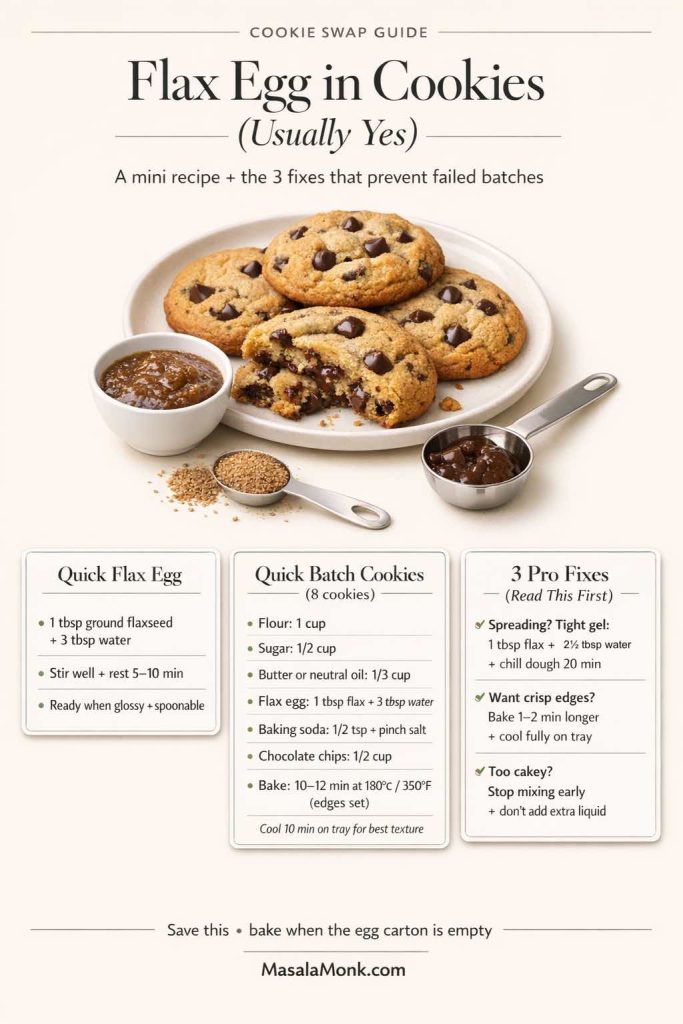
Vertical “Cookie Swap Guide” infographic titled “Flax Egg in Cookies (Usually Yes)” with photorealistic chocolate chip cookies, a bowl of flax gel, and measuring spoons. It includes: Quick Flax Egg (1 tbsp ground flaxseed + 3 tbsp water; rest 5–10 minutes), Quick Batch Cookies recipe for 8 cookies (flour 1 cup, sugar 1/2 cup, butter/oil 1/3 cup, baking soda 1/2 tsp + salt, chips 1/2 cup; bake 10–12 min at 180°C/350°F), and 3 pro fixes for spreading, crisp edges, and cakey cookies. MasalaMonk.com footer.
This cookie swap guide makes baking with a flax egg simple: use the classic flax egg ratio (1 tbsp ground flaxseed + 3 tbsp water), then follow the quick 8-cookie mini recipe and the three pro fixes for common problems—spreading dough, soft cookies, or a cakey texture. Save it for the next time you need an egg substitute for cookies.

Muffins and quick breads: often yes

These bakes are where flax eggs feel effortless—especially when replacing one or two eggs. Because the recipe already contains baking powder or baking soda, you’re not depending on eggs for lift.
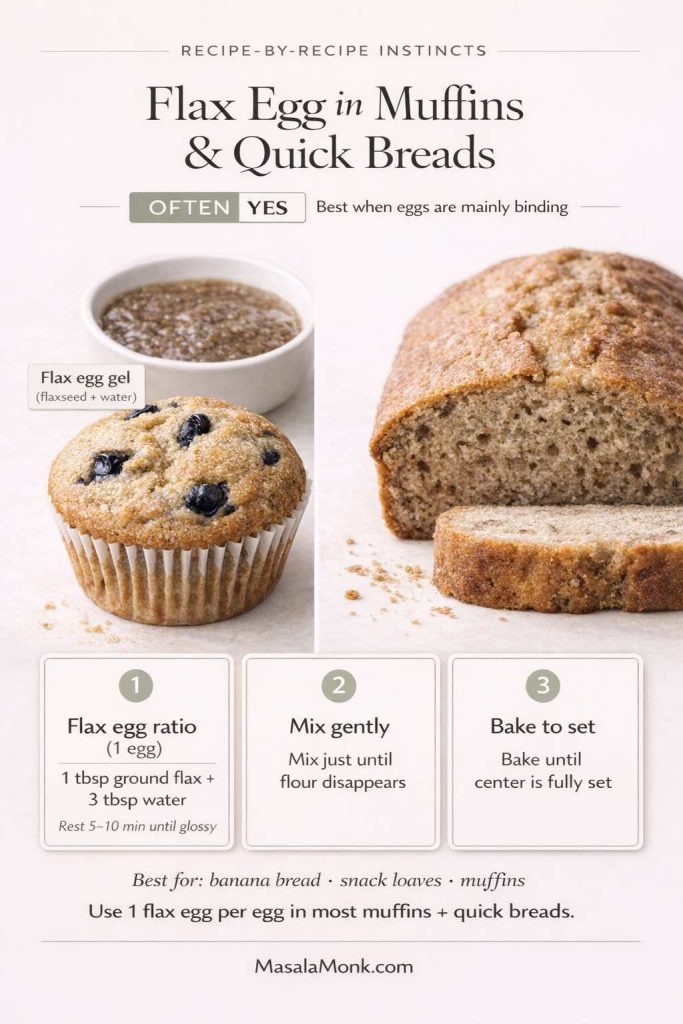
Vertical infographic titled “Flax Egg in Muffins & Quick Breads” labeled “Often Yes” with photoreal images of a blueberry muffin, sliced quick bread, and a bowl labeled “Flax egg gel (flaxseed + water).” It lists the flax egg ratio for 1 egg (1 tbsp ground flax + 3 tbsp water; rest 5–10 minutes until glossy), plus tips to mix gently until flour disappears and bake until the center is fully set. It notes best uses (banana bread, snack loaves, muffins) and says to use 1 flax egg per egg in most muffins and quick breads. MasalaMonk.com footer.
This “often yes” guide makes it easy to use a flax egg in muffins and quick breads. Follow the classic flax egg ratio (1 tbsp ground flaxseed + 3 tbsp water, rest until glossy), then mix gently and bake until the center is fully set. It’s a reliable egg substitute for banana bread, snack loaves, and muffins when eggs are mainly binding—not the main source of lift.

Pancakes: frequently yes, but mixing matters

Pancakes can be forgiving, although they’re sensitive to overmixing and batter thickness. If your pancakes feel heavy, rest the batter briefly and cook on steady heat.
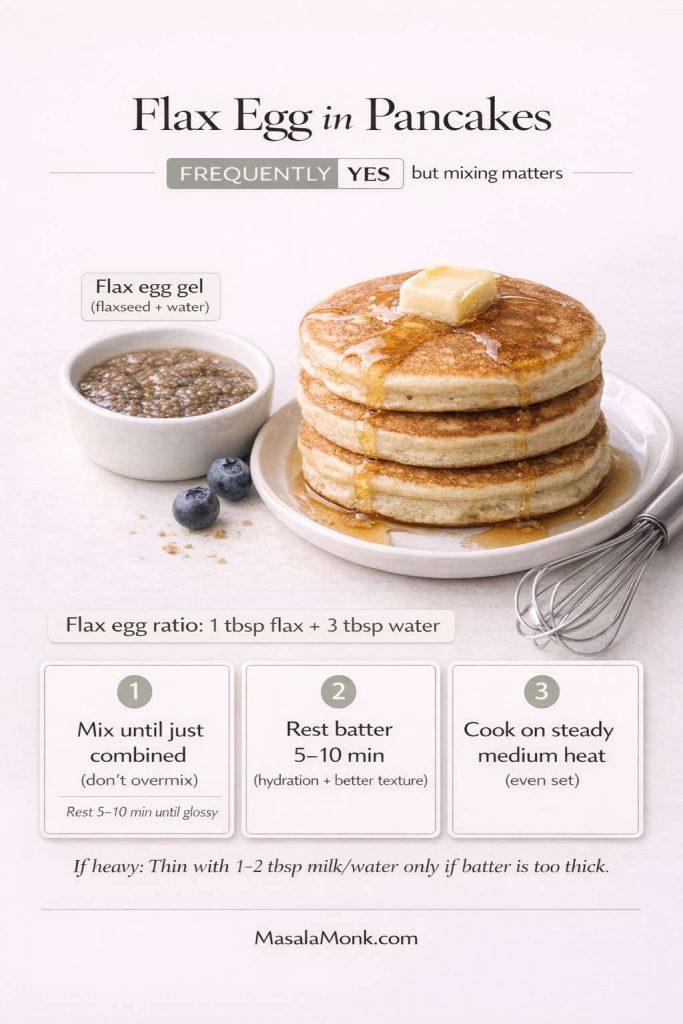
Vertical infographic titled “Flax Egg in Pancakes” with a “Frequently Yes” label and photoreal stack of pancakes with butter and syrup. A bowl labeled “Flax egg gel (flaxseed + water)” sits beside the pancakes. The graphic lists the flax egg ratio (1 tbsp flax + 3 tbsp water) and three tips: mix until just combined (don’t overmix), rest batter 5–10 minutes for hydration and better texture, and cook on steady medium heat for an even set. It adds: if heavy, thin with 1–2 tbsp milk/water only if batter is too thick. MasalaMonk.com branding.
This flax egg pancake guide makes the swap easy: use the classic flax egg ratio (1 tbsp ground flaxseed + 3 tbsp water), then keep the batter gentle—mix just until combined, rest 5–10 minutes for better texture, and cook on steady medium heat for an even set. If pancakes feel heavy, thin the batter only slightly if it’s truly too thick.

If you want to try the flax-egg swap in a sturdier batter, Healthy Millet Protein Packed Pancakes is a satisfying option—the flax gel helps the pancakes hold together while keeping the inside tender.

Egg-heavy bakes: proceed carefully

Soufflés, quiche-like bakes, or anything where eggs are the main structure will not behave like the original with flax. This is exactly the limitation King Arthur points out in Guide for substituting eggs.
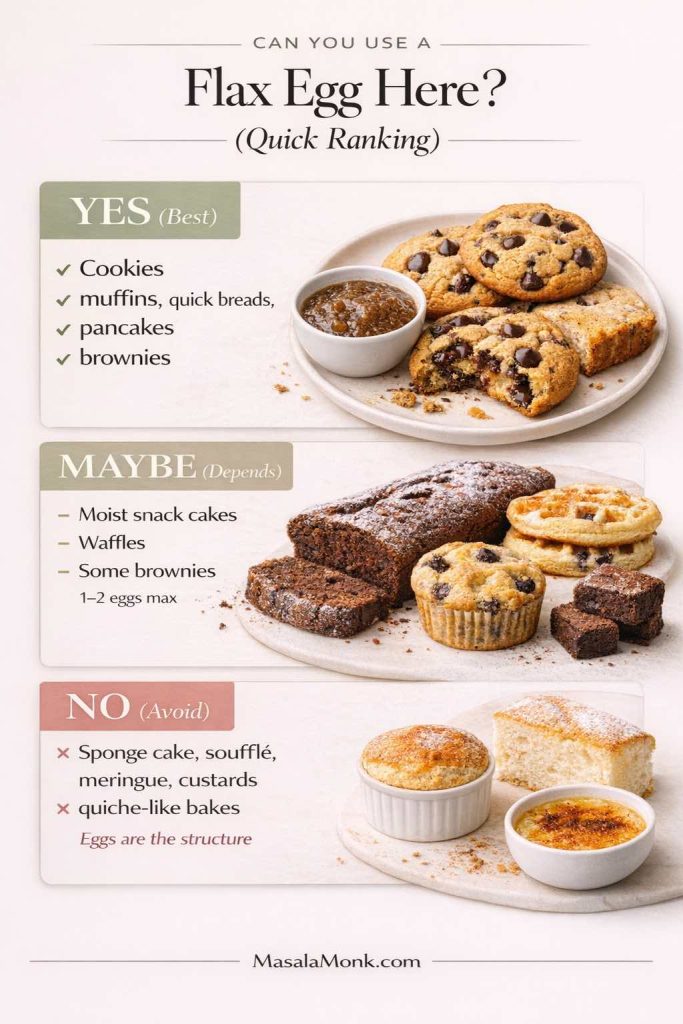
Vertical infographic titled “Can You Use a Flax Egg Here? (Quick Ranking)” with three sections: YES (Best) listing cookies, muffins/quick breads, pancakes, and brownies; MAYBE (Depends) listing moist snack cakes, waffles, and some brownies (1–2 eggs max); and NO (Avoid) listing sponge cake, soufflé, meringue, custards, and quiche-like bakes, noting “eggs are the structure.” Includes photoreal food images for each category and MasalaMonk.com branding.
Not every recipe wants the same thing from an egg. Use this flax egg ranking guide to choose the right swap fast: flax eggs work best as a binder in cookies, muffins/quick breads, pancakes, and brownies; they’re “maybe” for some moist cakes and waffles; and they’re not a good match for egg-structured bakes like sponge cake, soufflé, meringue, custards, or quiche-style recipes.

Instead of forcing a flax swap, choose an egg-free recipe that’s built for that texture.

Also Read: Crock Pot Chicken Breast Recipes: 10 Easy Slow Cooker Dinners (Juicy Every Time)


Flax meal as egg substitute: small upgrades that make a big difference

A flax egg is already simple. Still, a few small upgrades can make it more consistent, especially if you bake egg-free regularly.
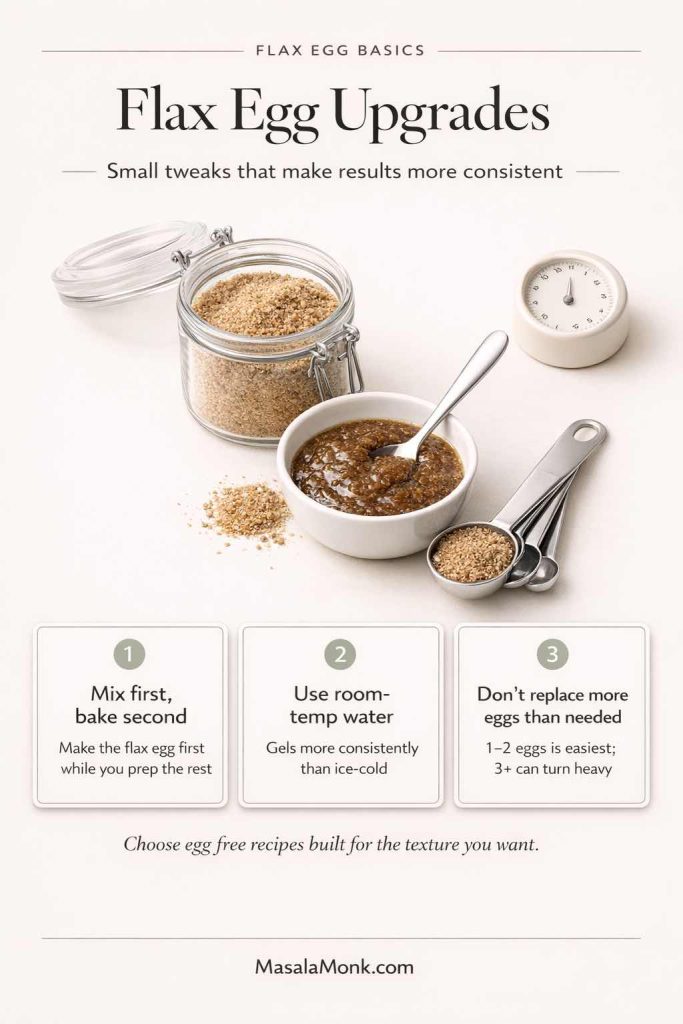
Vertical infographic titled “Flax Egg Upgrades” showing a jar of ground flaxseed meal, a bowl of flax egg gel with a spoon, a timer, and measuring spoons on a clean background. Three tip cards explain: mix the flax egg first while prepping ingredients, use room-temperature water so it gels consistently, and don’t replace more eggs than needed (1–2 eggs is easiest; 3+ can turn heavy). Includes the reminder “Choose egg-free recipes built for the texture you want” and MasalaMonk.com branding.
These flax egg upgrades make baking with flax eggs more consistent: mix the flax egg first (so it has time to gel), use room-temperature water for a reliable set, and avoid replacing too many eggs in egg-heavy recipes. When you need a dependable egg substitute, these small tweaks help your muffins, quick breads, pancakes, and cookies turn out closer to what you expect.

Mix flax eggs first, then start your recipe

This is the easiest improvement. Make your flax and water mixture, stir, then set it aside. While it gels, measure your dry ingredients, prep your pan, and set up your mixing bowl.

By the time you’re ready to mix, the flax egg will be ready too. As a result, you’re not rushing or guessing.

Use room-temperature water (or at least not ice-cold)

Cold water can slow down gelling. Room-temperature water helps the gel form more consistently.

Don’t replace more eggs than you need to

If your goal is to avoid eggs entirely, flax eggs can get you far. Still, replacing three or four eggs in a recipe designed around eggs can lead to dense results. At that point, switching to a recipe designed to be egg-free is often the cleaner path.

Sometimes the best move is choosing an egg-free recipe built for the texture you want rather than forcing a swap into a formula that depends heavily on eggs. If you like this recipe-first approach, Eater’s guide explains why it often works better.

Also Read: Eggless Yorkshire Pudding (No Milk) Recipe


A short detour: flax beyond baking (because many people use it both ways)

Interestingly, ground flax tends to earn a permanent spot in the kitchen once you start baking with it. Beyond flax eggs, you can stir a spoonful into oats, blend it into smoothies, or mix it into yogurt bowls for an easy boost—without changing the flavor much. If you’d like more everyday ideas, Benefits of Flax Seeds and How to Incorporate Them into the Indian Diet walks through simple, practical ways to use flax regularly. Also, if you’re aiming for meals that are higher in protein and fiber, flax fits nicely into that routine too—How Does a High Protein, High Fiber Diet Support Weight Loss? explains why that combination can be helpful and where ingredients like seeds come in.


Troubleshooting: common flax egg problems and fixes

Even good bakers occasionally get weird results with flax eggs. Fortunately, the fixes are usually simple.

“My flax egg didn’t thicken”

Start with the obvious:

  • Was the flax ground?
  • Was it fresh enough to smell pleasantly nutty?
  • Did it sit long enough?
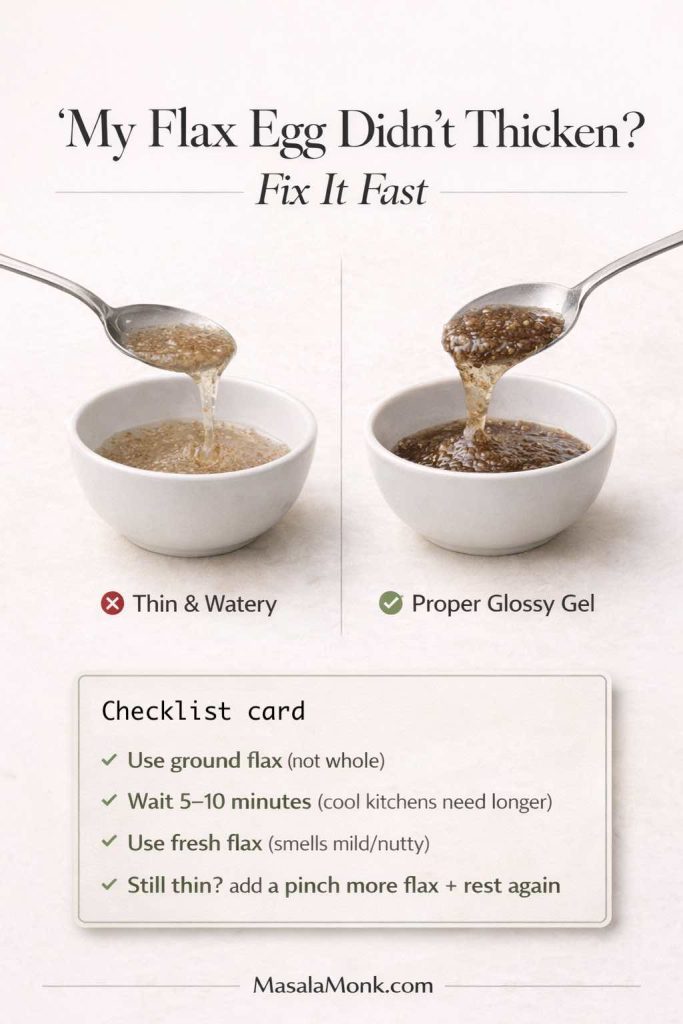
Vertical troubleshooting infographic titled “My Flax Egg Didn’t Thicken? Fix It Fast” showing a side-by-side comparison of a thin, watery flax and water mixture versus a proper glossy flax egg gel. A checklist explains quick fixes: use ground flax (not whole), wait 5–10 minutes, use fresh flax that smells mild/nutty, and if still thin add a pinch more flax and rest again. MasalaMonk.com branding.
If your flax egg won’t gel, you don’t need to scrap the bake—use this quick troubleshooting checklist. It shows the texture you’re aiming for (glossy, spoonable gel) and the fastest fixes: ground flaxseed, enough rest time, fresh flax meal, and a small pinch more flax if the mixture stays thin.

If everything looks right and it still seems thin, stir again and wait a little longer. If it remains watery, add a small pinch more flax meal and rest again.

Even when you follow the standard flax egg ratio, the gel can vary depending on how finely the flax is ground. A finer meal thickens faster, whereas a coarser grind may need a little more time to hydrate fully. For another egg-swap example that uses flax in a baked recipe, see Wholewheat Carrot Orange Tea Cake.

“My bake turned dense”

Density usually means the recipe needed lift, or the eggs were doing more structure work than flax can replicate.
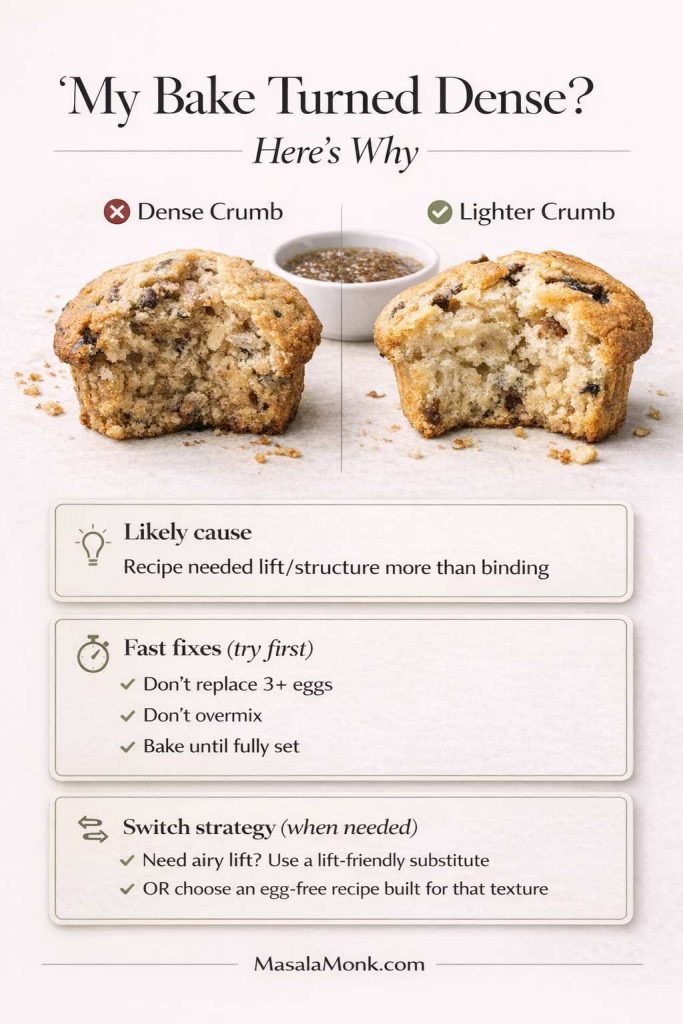
Vertical infographic titled “My Bake Turned Dense? Here’s Why” showing a comparison of dense crumb versus lighter crumb muffins, with a bowl of flax gel in the background. It explains the likely cause: the recipe needed lift/structure more than binding. It lists fast fixes: don’t replace 3+ eggs, don’t overmix, and bake until fully set. It also suggests switching strategy when needed by using a lift-friendly substitute or choosing an egg-free recipe designed for that texture. MasalaMonk.com branding.
If your flax egg bake turned out dense, the problem is usually lift—not the flax egg ratio. This troubleshooting guide shows what’s happening (the recipe needed more structure than a binder can provide), the three fastest fixes (avoid replacing 3+ eggs, don’t overmix, bake until fully set), and when it’s smarter to switch to a lift-friendly substitute or an egg-free recipe built for a lighter crumb.

In that case, your best move is to choose a different substitute based on what the bake needs. King Arthur’s guide is useful for this because it outlines multiple options and also explains the limits of substitutions in egg-forward bakes. That’s in Guide for substituting eggs.

“My muffins are sinking”

If your muffins rise, then collapse as they cool, it’s usually not the flax egg alone. More often, the batter was either too wet or overmixed, so it couldn’t hold the structure once steam escaped.
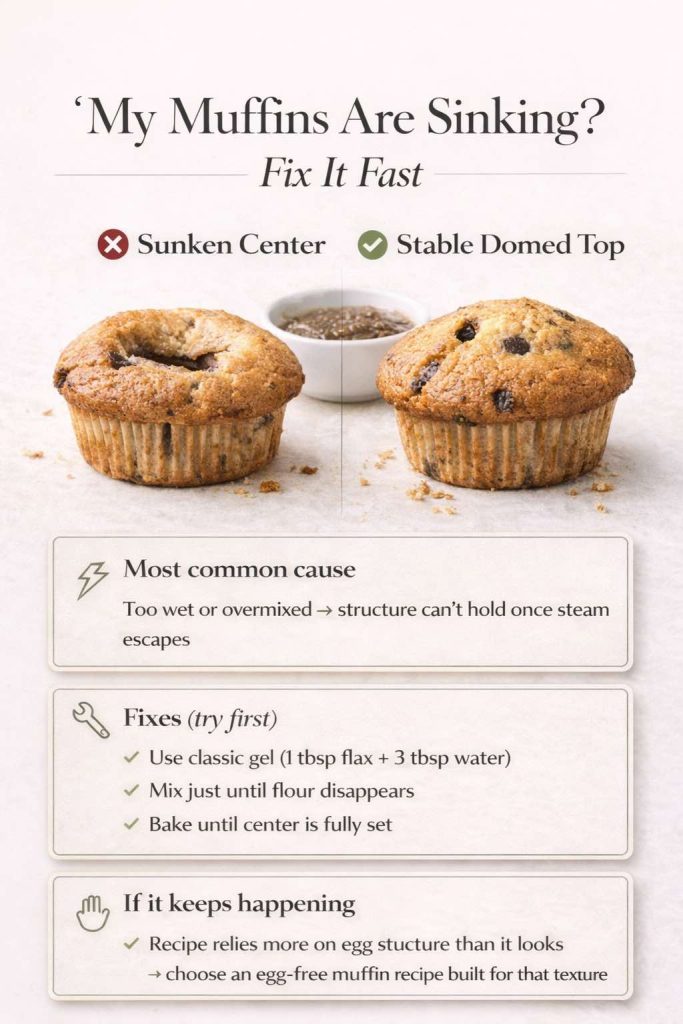
Vertical troubleshooting infographic titled “My Muffins Are Sinking? Fix It Fast” showing a side-by-side comparison of a muffin with a sunken center versus a stable domed top, with a bowl of flax gel behind. It explains the most common cause (too wet or overmixed so the structure can’t hold once steam escapes) and lists fixes: use the classic flax gel (1 tbsp ground flaxseed + 3 tbsp water), mix only until flour disappears, and bake until the center is fully set. It adds that repeated sinking can mean the recipe relies on egg structure and an egg-free muffin recipe may work better. MasalaMonk.com branding.
If your flax-egg muffins rise and then collapse, it’s usually a batter and bake issue—not the flax egg itself. Use this quick fix guide: stick to the classic flax egg ratio, mix only until the flour disappears, and bake until the center is truly set. If sinking keeps happening, the recipe may rely more on egg structure than it seems, so an egg-free muffin recipe built for that texture can be the smarter move.

Start with these fixes:

  • Use the classic gel (1 tablespoon flax + 3 tablespoons water) instead of a looser mix, especially for fruity or very moist batters.
  • Mix only until the flour disappears—overmixing makes muffins tunnel and weaken.
  • Bake until the center is truly set. If the tops look done but the middles feel soft, give them a few more minutes; flax-based batters often need that “fully set” finish.

If sinking keeps happening, it’s a sign the recipe depends more on egg structure than it seems. In that case, an egg-free muffin recipe (built for the texture) often performs better than forcing a swap.

“My cookies came out soft when I wanted crisp”

Flax tends to hold moisture. So, rather than blaming the flax, adjust the cookie strategy:

  • bake a little longer (without burning)
  • cool fully on the tray before moving
  • aim for cookie recipes designed for crispness if that’s your priority
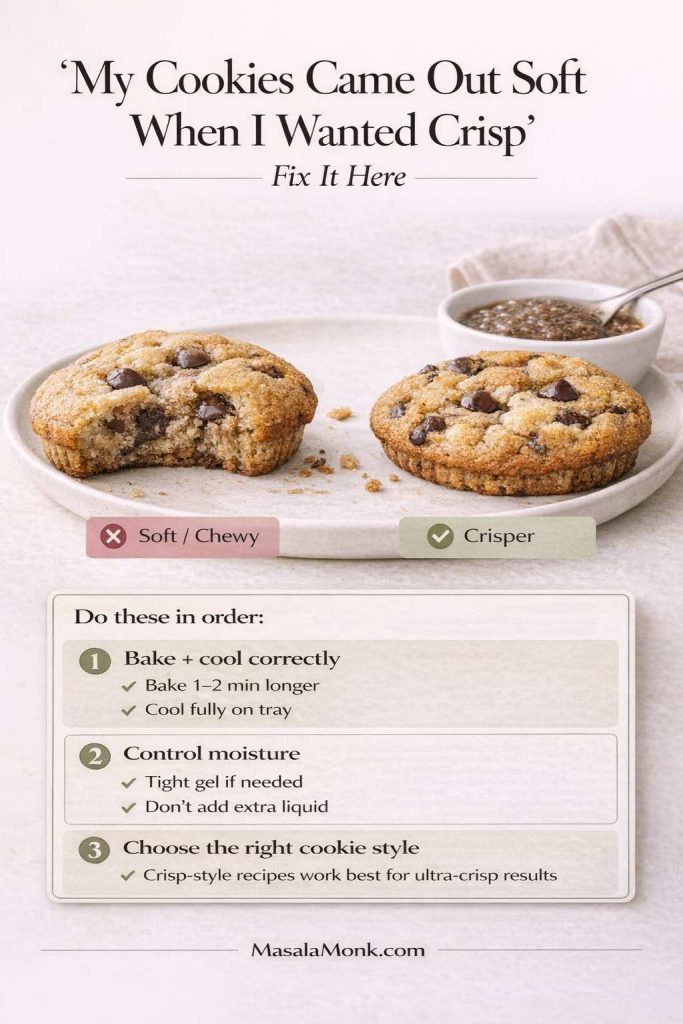
Vertical troubleshooting infographic titled “My Cookies Came Out Soft When I Wanted Crisp” showing two cookie textures labeled Soft/Chewy and Crisper, with a bowl of flax gel in the background. A ranked checklist says: (1) bake 1–2 minutes longer and cool fully on the tray, (2) control moisture by using a tighter flax gel if needed and not adding extra liquid, and (3) choose a crisp-style cookie recipe for ultra-crisp results. MasalaMonk.com branding.
Flax eggs hold moisture, so egg-free cookies often lean chewy unless you manage bake time and cooling. Use this step-by-step crispness fix guide: bake 1–2 minutes longer, cool fully on the tray, control moisture with a tighter flax gel (if needed), and choose crisp-style cookie recipes when you want true crunch.

If crispness is a must, you can still bake egg-free; it just may not be flax’s strongest lane.

“My cookies are too cakey”

Cakey cookies are usually a moisture-and-mix issue. Flax holds moisture, so if the dough is already soft, the final texture can tilt more “puffy” than “chewy.”
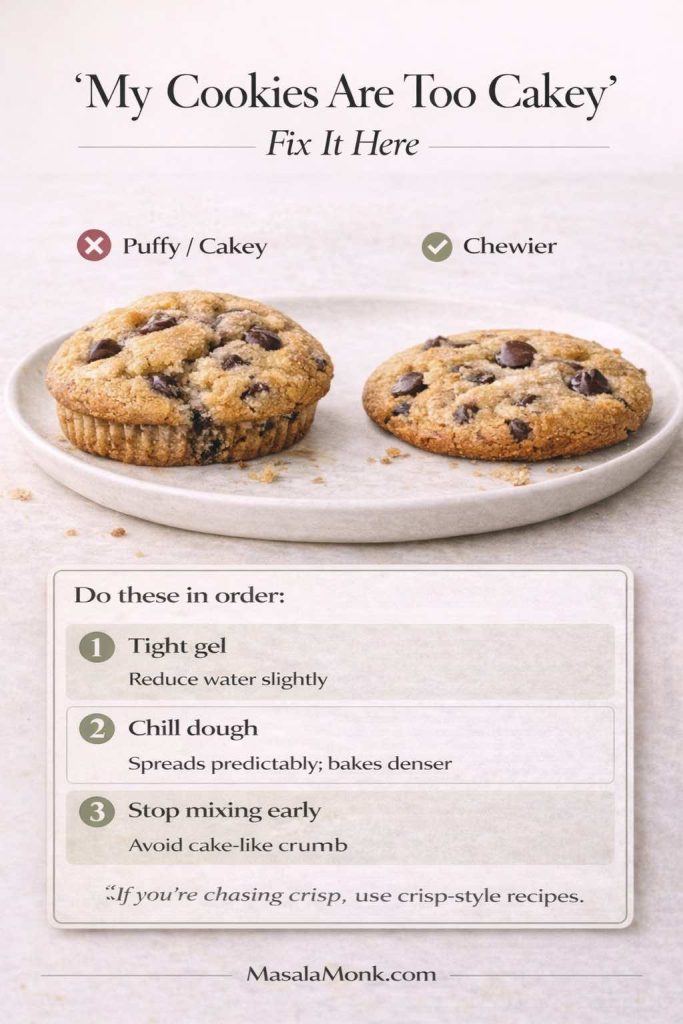
Vertical troubleshooting infographic titled “My Cookies Are Too Cakey” comparing a puffy/cakey cookie versus a flatter, chewier cookie. It provides a ranked fix list: (1) use a tighter flax gel by reducing water slightly, (2) chill the dough so it spreads predictably and bakes denser, and (3) stop mixing early to avoid a cake-like crumb. A note adds: if aiming for crisp cookies, use crisp-style recipes. MasalaMonk.com branding.
If your flax-egg cookies are turning puffy and cakey, it’s usually a moisture + mixing issue. Use this quick fix order: tighten the flax gel (slightly less water), chill the dough for more predictable spread, and stop mixing as soon as everything comes together. You’ll get a denser, chewier cookie texture without rewriting the whole recipe.

Try these small changes before you rewrite the recipe:

  • Use a slightly tighter flax gel (a little less water) so you’re not adding extra moisture.
  • Chill the dough briefly; colder dough spreads more predictably and bakes up denser rather than cakey.
  • Stop mixing as soon as everything comes together—overmixing encourages a more cake-like crumb.

If you’re aiming for crisp cookies, flax can still work, but it’s easier with cookie styles that are already designed for crispness rather than softness.

“The flavor feels off”

To keep flax meal tasting fresh, store it airtight in the fridge (or freezer if you use it slowly). Mayo Clinic Health System covers simple storage tips in Flaxseed is nutritionally powerful.
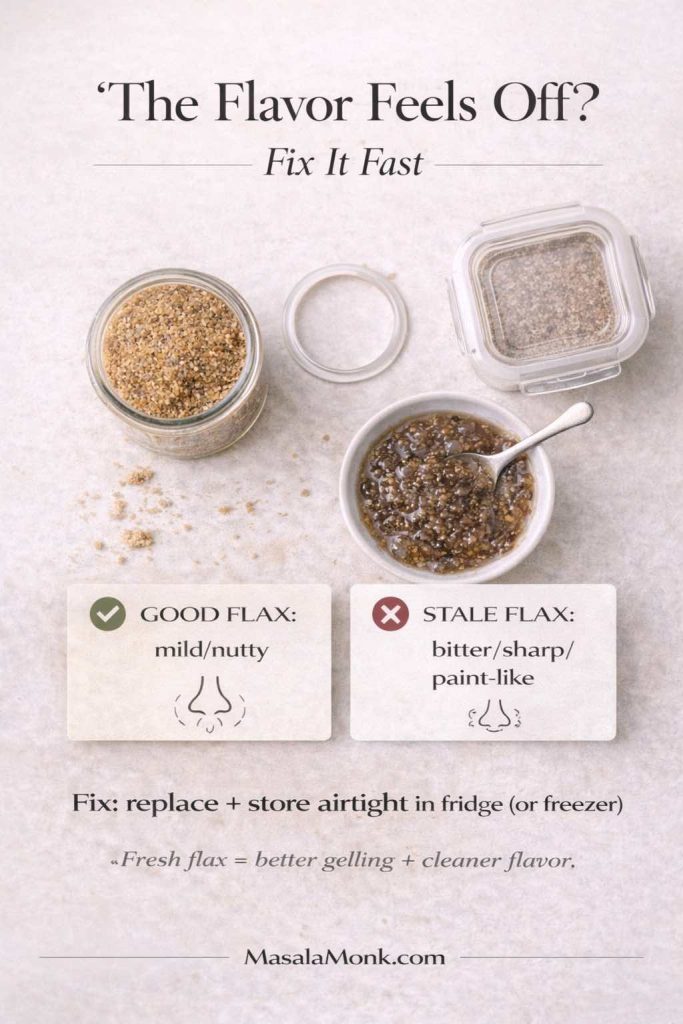
Vertical troubleshooting infographic titled “The Flavor Feels Off? Fix It Fast” showing a jar of ground flaxseed meal, a bowl of flax gel with a spoon, and an airtight container on a light background. It explains a quick smell test: GOOD flax smells mild/nutty, while STALE flax smells bitter/sharp/paint-like. It advises to replace stale flax and store flax meal airtight in the fridge or freezer for cleaner flavor and better gelling. MasalaMonk.com branding.
If your flax egg tastes bitter or “off,” it’s usually stale flaxseed meal. Use this quick smell test: fresh flax smells mild and nutty, while stale flax can smell sharp or paint-like. The fix is simple—replace the flax and store flax meal airtight in the fridge (or freezer) so your flax egg gels better and your baking tastes clean.

Sometimes, the fix is simply buying a fresh bag.

Also Read: Sourdough Starter Recipe: Make, Feed, Store & Fix Your Starter (Beginner Guide)


Bringing it all together: a simple, confident flax egg approach

If you want one clean routine you can follow every time, do this:

  1. Use ground flaxseed (flax meal)
  2. Mix 1 tablespoon flax meal with 3 tablespoons water for one egg
  3. Rest 5–10 minutes until gel-like
  4. Use it as your egg replacement in batter-based baking

Then, as you gain confidence, add the two “pro instincts”:

  • If the batter is already very loose, use a slightly tighter gel
  • If the recipe relies heavily on eggs for lift or structure, choose a different substitute or an egg-free recipe

That’s it. No drama, no panic, no wasted batch.

If you want flax eggs to feel effortless, use them in recipes you’ll repeat. Cookies are a straightforward place to begin—try Double Chocolate Chip Cookies Recipe – One Dough, 7 Ways for an easy batch that welcomes substitutions. For everyday, non-baking ways to use ground flax, Benefits of Flax Seeds and How to Incorporate Them into the Indian Diet is full of practical ideas. Then, whenever you want a savory, egg-free breakfast, ‘Tofu’ Instead of ‘Eggs’: 5 High Protein Plant-Based Breakfast Ideas is a great option.

Once you bake with flax eggs a few times, it stops feeling like a workaround. Instead, it just becomes another dependable method—one you can reach for whenever you need an egg substitute, whether it’s a single egg replacement or a batch conversion for two eggs or three.

Also Read: 19 Essential Kitchen Tools That Make Cooking Easier
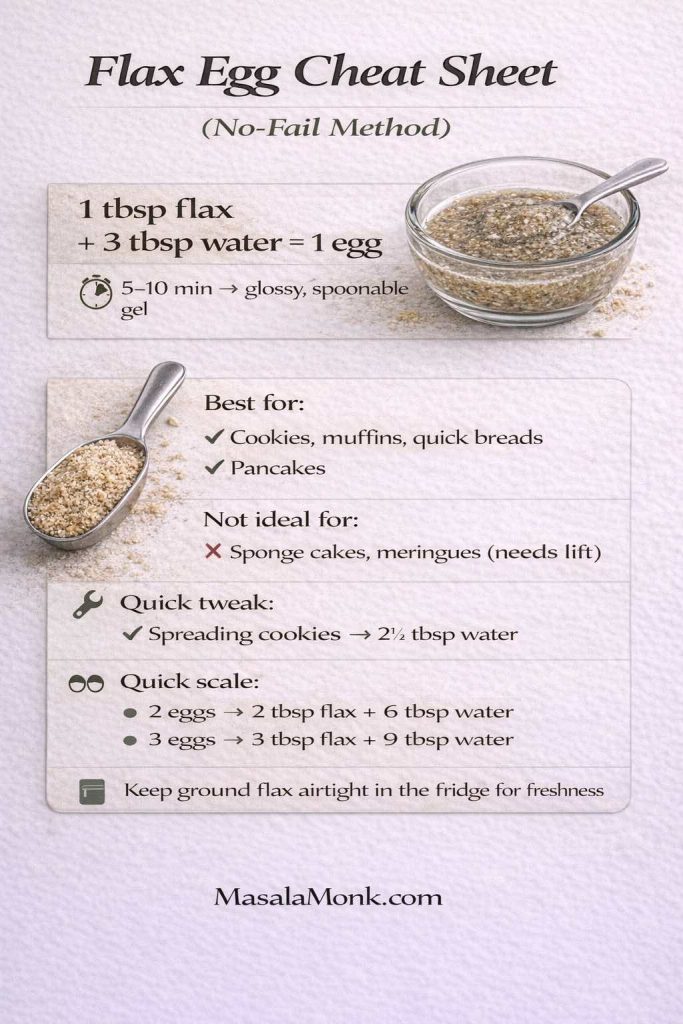
Photorealistic infographic titled “Flax Egg Cheat Sheet (No-Fail Method)” showing the flax egg ratio: 1 tablespoon ground flaxseed plus 3 tablespoons water equals 1 egg, resting 5–10 minutes until a glossy, spoonable gel. It lists best uses (cookies, muffins, quick breads, pancakes), not-ideal uses (sponge cakes, meringues), a cookie spread tweak (2½ tbsp water), quick scale for 2 and 3 eggs, and a storage tip to keep ground flax airtight in the fridge. MasalaMonk.com branding.
Save this flax egg cheat sheet for fast, consistent baking: use the classic flax egg ratio (1 tbsp ground flaxseed + 3 tbsp water), let it gel until glossy and spoonable, then scale for 2–3 eggs when needed. It also shows where a flax egg substitute works best (cookies, muffins, quick breads, pancakes), when to avoid it for lift-heavy bakes, and a quick tweak if cookie dough spreads too much.

FAQs

1) How do I make a flax egg?

Combine 1 tablespoon ground flaxseed (flax meal) with 3 tablespoons water, stir well, and let it sit until it thickens into a gel—usually 5 to 10 minutes. Once it looks glossy and spoonable, use it right away as your egg replacement in baking.

2) How to make a flax egg with ground flaxseed (step-by-step)?

First, add ground flaxseed to a small bowl. Next, pour in water and whisk until no dry pockets remain. Then, rest the mixture briefly so it can gel. Finally, stir once more and add it to your batter where the egg would normally go.

3) What is the flax egg ratio for 1 egg?

The most common flax egg ratio for 1 egg is 1 tablespoon ground flaxseed to 3 tablespoons water. That’s the standard flax seed to egg ratio most bakers use for muffins, quick breads, pancakes, and many cookie recipes.

4) What is the flax egg ratio for 2 eggs?

For two eggs, double the base ratio: 2 tablespoons ground flaxseed plus 6 tablespoons water. After mixing, allow enough time for the gel to develop before adding it to the bowl with your other wet ingredients.

5) How do I make 3 flax eggs (or more) for a bigger batch?

Scale the flaxseed meal to egg conversion by multiplying the standard ratio. In other words, for three eggs, use 3 tablespoons ground flaxseed with 9 tablespoons water. For larger batches, mix thoroughly and give it a slightly longer rest so the gel thickens evenly.

6) How much flaxseed for egg substitute in baking if I’m using flax meal?

Use 1 tablespoon flax meal per egg, paired with 3 tablespoons water. Even so, if your batter is already very loose, slightly less water can help the texture stay balanced rather than overly soft.

7) Can I use whole flax seeds instead of ground flaxseed for an egg substitute?

Whole seeds usually don’t gel the same way because the water can’t fully hydrate the interior. Therefore, for the most reliable flaxseed egg replacement, use ground flaxseed or flax meal, not whole seeds.

8) My flax egg won’t gel—what should I do?

Start by waiting a few extra minutes, because some flax takes longer to hydrate. If it still looks watery, stir again and add a small pinch more ground flaxseed, then rest it a second time. Additionally, very old flax meal can perform poorly, so freshness matters more than people expect.

9) Can I make a flax egg ahead of time?

Yes, you can make a flax egg shortly ahead—often 30 to 60 minutes is fine—then cover and refrigerate it. However, for best consistency, many bakers prefer mixing it fresh right before baking, since the gel can thicken more as it sits.

10) How do I use flaxseed instead of eggs in recipes—do I add it with wet or dry ingredients?

Typically, add the prepared flax and water mixture with the wet ingredients. That way, it disperses smoothly and doesn’t clump. Meanwhile, keep the dry mix unchanged unless your batter looks noticeably too thick or too thin once everything is combined.

11) Is flaxseed meal to egg conversion always a 1:1 swap?

It’s a 1:1 swap in quantity (one flax egg replaces one egg), yet it’s not always a perfect swap in function. Since flax acts mainly as a binder and moisture holder, it works best when eggs aren’t the primary source of lift or structure.

12) When is a flax egg substitute for baking the best choice?

Flax eggs usually work best in cookies, brownies, muffins, quick breads, pancakes, and waffles—basically, recipes where binding matters more than a lofty rise. As a result, they’re a favorite vegan egg substitute for everyday baking.

13) Does a flax egg work for cookies?

Yes, a flax egg for cookies is often a strong match, especially for chewy styles. Still, if you want a very crisp cookie, you may need to tweak bake time or choose a cookie recipe designed to crisp up without relying on eggs.

14) Can I use flaxseed instead of eggs in cakes?

Sometimes, yes—particularly in moist, oil-based cakes and snack cakes. Nonetheless, in very airy sponge-style cakes, eggs provide lift that flax can’t replicate, so the result may be denser than the original.

15) What’s the difference between ground flax as egg substitute and chia as egg substitute?

Both form a gel with water, so both can replace eggs as binders. However, chia can feel slightly more “seedy” in texture depending on grind and soak time, whereas flax meal tends to blend in more smoothly.

16) What is a good substitute for flax egg if I don’t have flaxseed?

If you’re out of flax, you can often use a chia “egg” (chia seeds + water) as a close alternative. Otherwise, options like applesauce, mashed banana, yogurt-style substitutes, or commercial egg replacers can work depending on the recipe and whether you’re aiming for a vegan substitute.

17) How do I substitute flax for eggs without making the batter gummy?

Avoid replacing too many eggs in recipes that depend heavily on eggs for structure. Also, measure carefully, allow the gel to form, and don’t overmix the batter. If gumminess keeps happening, try a different egg replacement better suited to the recipe style.

18) Can I use flax eggs in gluten-free baking?

You can, although results vary because gluten-free batters often already rely on binders and starches. Consequently, flax may make some gluten-free bakes feel heavier. In that case, using a smaller amount, improving leavening, or choosing a different egg substitute can help.

19) Is flax seed as egg substitute the same as egg replacement flaxseed meal?

They’re used similarly, yet flaxseed meal (ground flaxseed) is the form that works most reliably for a flaxseed egg substitute baking method. Whole flax seeds can work only if they’re finely ground first.

20) How many flax eggs can I use in one recipe?

It depends on the recipe. Replacing one egg is usually straightforward; replacing two often works in muffins and cookies; replacing three or more can noticeably change texture, especially in cakes. If the original recipe is very egg-forward, consider an alternative to flax egg or an egg-free recipe built for that outcome.
Posted on 2 Comments

Keto Flour: Guide to Low-Carb Flours That Bakes Like the Real Thing

A reliable keto flour isn’t one ingredient—it’s the right flour (or blend) for the job. Use this guide to choose low-carb flours that behave like “real” flour in the oven, so bread slices clean, bakes stay tender, and pie crust holds together without turning dry or crumbly.

There’s a moment in low carb baking that feels almost universal: you pull something warm from the oven—maybe a tray of brownies, maybe a “simple keto bread,” maybe a batch of cookies—and the first bite tells you the truth. Keto flour can still deliver something genuinely delicious, yet the texture often feels different at first. Drier than you hoped. More fragile than you expected. Sometimes oddly eggy. Occasionally too dense, as if the batter never learned how to lift.

That moment isn’t failure. It’s feedback.

Regular flour is predictable because gluten does so much of the heavy lifting. Keto flour, on the other hand, asks you to be a little more intentional. Once you understand what each flour brings—bulk, tenderness, moisture, chew, browning—your results get calmer and more repeatable. In fact, you can go from “random experiments” to a pantry that reliably turns out low carb brownies, keto pancakes, keto pie crust, muffins, and even sandwich-style bread that doesn’t crumble into confetti.

So think of this as your reset: not a lecture, not a set of rules, but a cooking-minded guide to choosing a keto flour substitute that actually works.

Also Read: A Guide to Keto Diet for Beginners


Keto flour basics: why low carb baking plays by different rules

Traditional wheat flour is a whole system. When it meets liquid and mixing, gluten forms a stretchy network that traps air, holds moisture, and gives bread that familiar tear. Consequently, even a “just okay” recipe can still turn out fine because gluten forgives a lot.

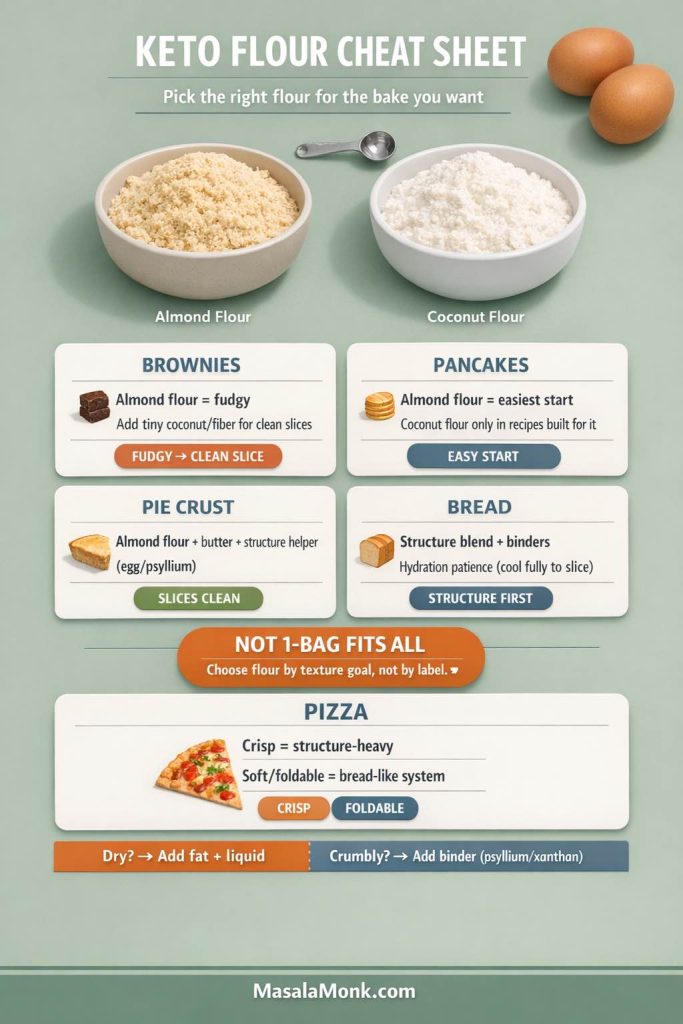
Keto flour cheat sheet comparing almond flour and coconut flour for baking. Shows two bowls labeled almond flour and coconut flour with guidance for brownies, pancakes, pie crust, bread, and pizza. Notes almond flour works well for fudgy brownies and easy-start pancakes, while coconut flour is best only in recipes built for it. Reminds flours aren’t one-bag-fits-all and gives fixes: dry add fat/liquid, crumbly add binder like psyllium or xanthan.
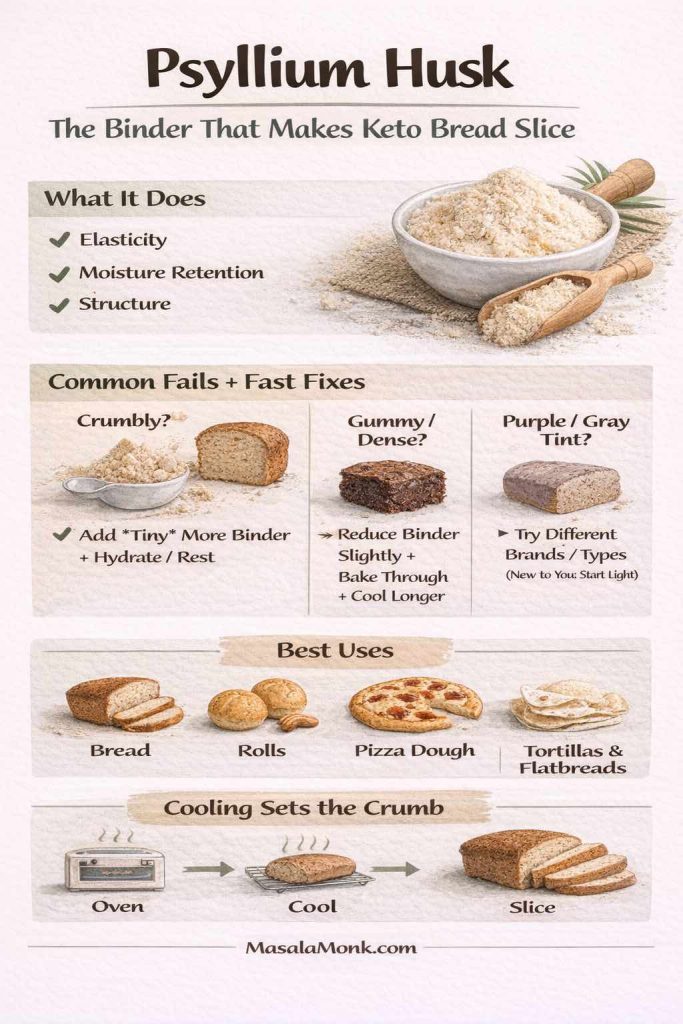
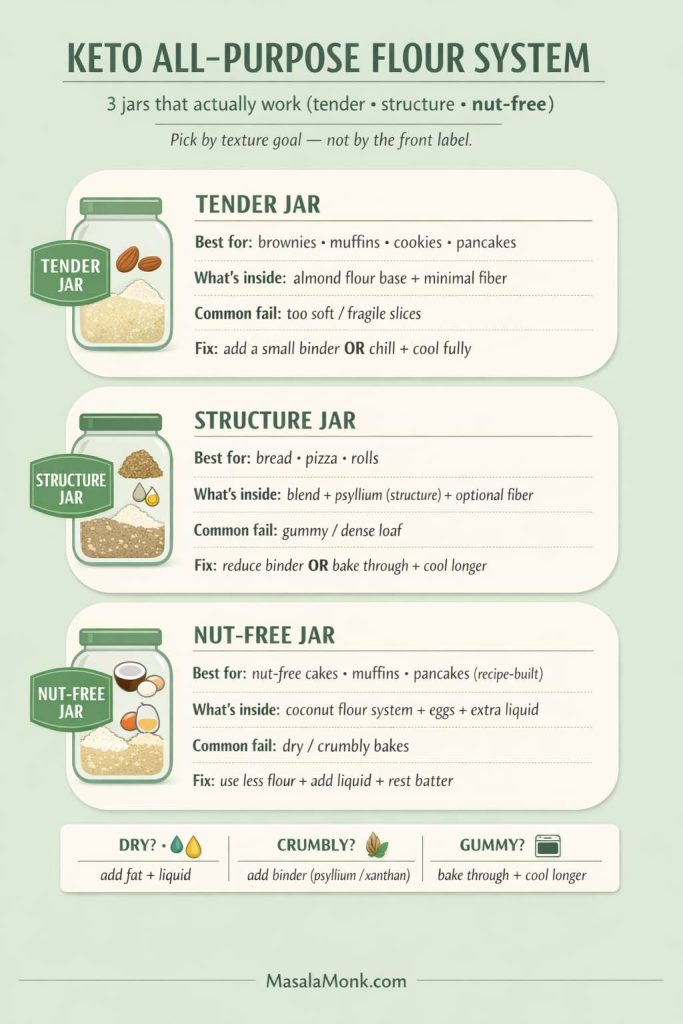
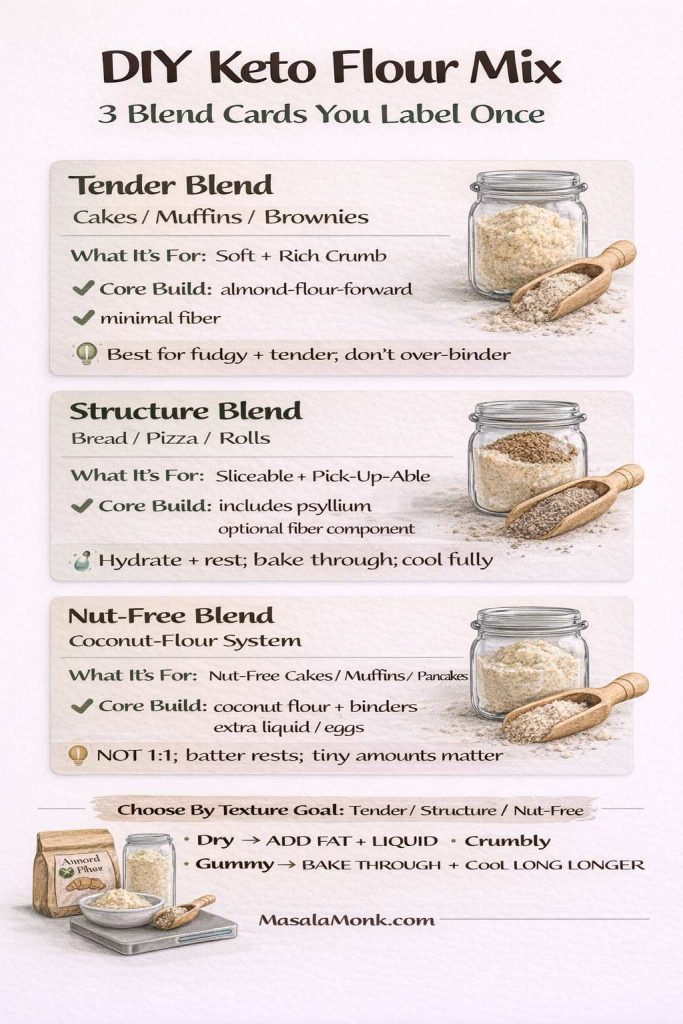
Choosing keto flour gets easier when you pick by texture, not the label. This cheat sheet shows when almond flour shines (fudgy brownies, easiest-start pancakes, buttery pie crust) and when coconut flour should only be used in recipes designed for it. It also covers the “structure first” mindset for bread and the crisp vs foldable decision for pizza. Keep the bottom fixes handy too: if it turns dry, add fat + liquid; if it crumbles, add a binder like psyllium or xanthan. Save this for your next bake.

Keto flour alternatives rarely have that safety net. Instead, low carb baking is built from smaller pieces that you assemble on purpose:

  • A base for bulk and tenderness (almond flour, coconut flour, some wheat-based keto blends, or a low carb all purpose flour mix)
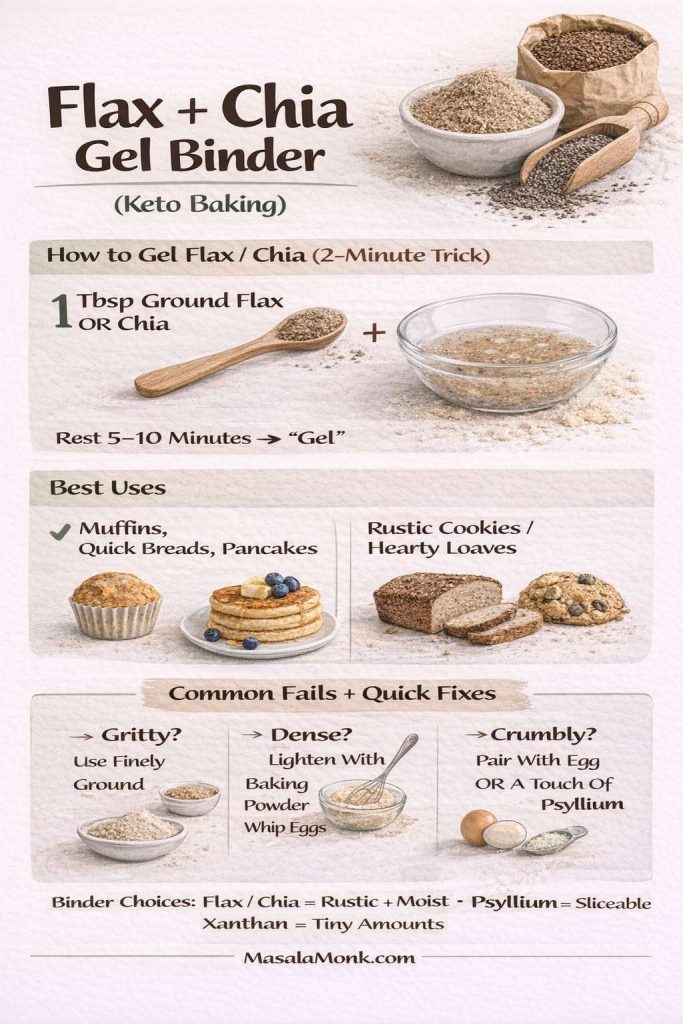
  • A binder for structure (eggs, psyllium husk, flax, xanthan/guar)
  • A moisture plan (fat, dairy, extra liquid, or a sweetener that helps retain softness)
  • A lift plan (fresh baking powder, baking soda plus acid, or whipped egg whites)
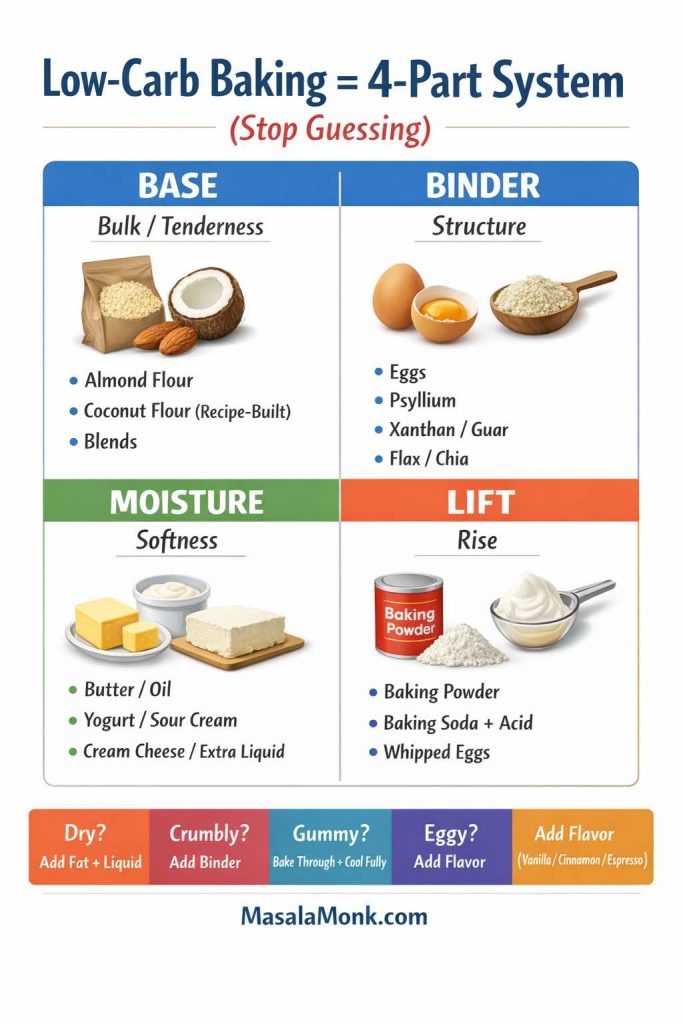
Infographic titled “Low-Carb Baking = 4-Part System (Stop Guessing).” A 2x2 grid explains the keto flour “system”: Base (almond flour, coconut flour—recipe-built, blends) for bulk/tenderness; Binder (eggs, psyllium, xanthan/guar, flax/chia) for structure; Moisture (butter/oil, yogurt/sour cream, cream cheese/extra liquid) for softness; Lift (baking powder, baking soda + acid, whipped eggs) for rise. Bottom strip shows quick fixes for dry, crumbly, gummy, and eggy results. MasalaMonk.com footer.
Low-carb baking gets way easier when you stop treating “keto flour” like one magic bag. Think in four parts: a base for tenderness, a binder for structure, a moisture plan to keep bakes soft, and a lift plan so they don’t turn dense. The bottom row is your rescue kit for the most common problems (dry, crumbly, gummy, eggy). Save this as your “preheat-the-oven checklist” before brownies, muffins, pancakes, pie crust, or keto bread.

That’s why one “keto flour” doesn’t do everything. A flour that makes an incredible cookie can make a sad loaf. Similarly, a bread-focused mix can feel tough in brownies. Once you accept that each bake wants a slightly different toolkit, your kitchen gets easier.

Also Read: The Must-Have Condiment for Keto: Mustard – Flavorful, Low-Carb, and Versatile


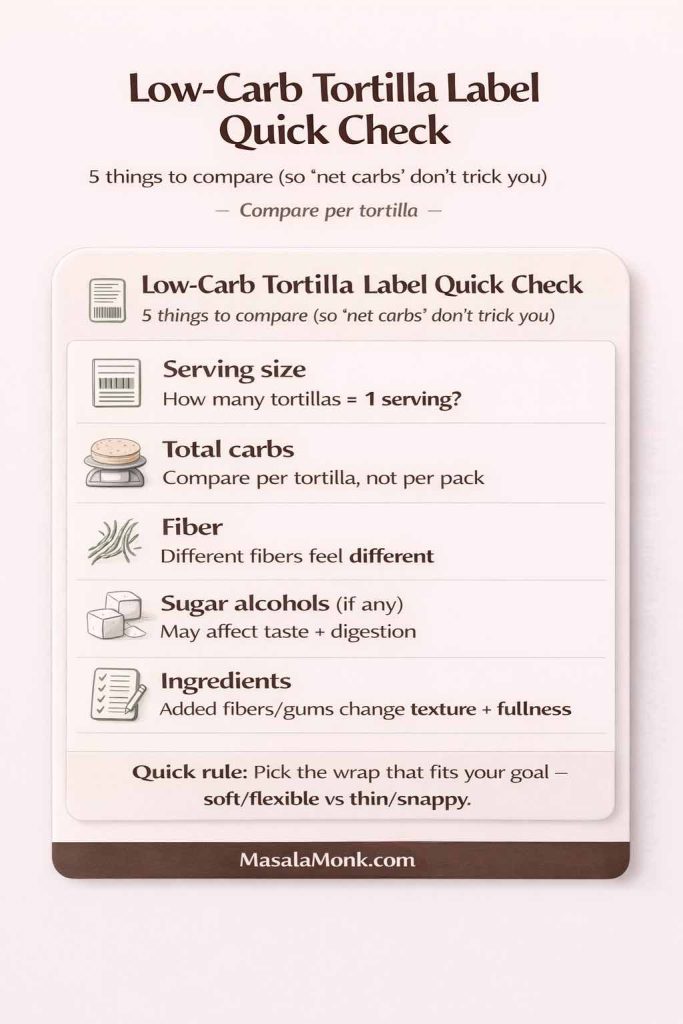
Keto flour labels: how to read carbs on mixes, tortillas, and “net carb” claims

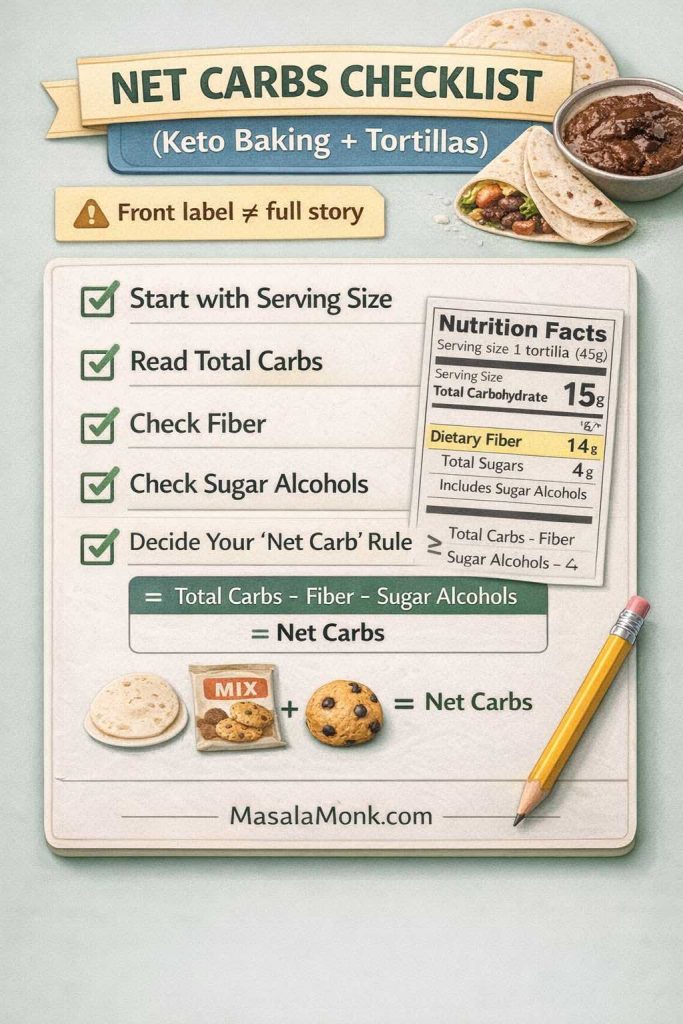
Low carb packaged products—especially tortillas, wraps, and baking mixes—often lean on “net carbs.” Net carbs can be a useful shorthand, but it isn’t a standardized number on the Nutrition Facts label. The label gives you total carbohydrate, and under that, it breaks down fiber and sugars; your “net” number is a calculation people do from the label.

A “Net Carbs Checklist (Keto Baking + Tortillas)” infographic showing a checklist: start with serving size, read total carbs, check fiber, check sugar alcohols, and choose your net-carb rule. A nutrition label example and a simple formula are shown: total carbs minus fiber minus sugar alcohols equals net carbs. MasalaMonk.com is printed at the bottom.
Net carbs look simple… until you flip the package around. This checklist is a quick way to read tortillas, baking mixes, and “keto” cookies without getting tricked by the front label. Start with serving size, then total carbs, then fiber and sugar alcohols — but here’s the key: net carbs aren’t officially standardized, and sugar alcohols aren’t all the same (maltitol often hits harder than erythritol). When in doubt, check the ingredient list + type of sugar alcohol, and trust the full nutrition panel over the bold claims. Save this for your next grocery run. MasalaMonk.com

The FDA explains how to interpret the Nutrition Facts label and why serving size matters, because every number on the label is tied to that serving size. That alone changes the story more than most people realize. See: How to understand and use the Nutrition Facts label.

Meanwhile, the American Diabetes Association notes that net carbs are commonly calculated by subtracting fiber and sugar alcohols from total carbohydrate; however, that calculation isn’t always accurate because different fibers and sugar alcohols can be partially absorbed and still affect blood glucose in some people. See: ADA: Get to know carbs.

If you’re counting carbs for any reason—keto goals, blood sugar management, or simple preference—this is the practical takeaway:

Use the label as the source of truth, then decide how you personally interpret it. Don’t let marketing language do the math for you.

For additional clarity, the FDA’s Interactive Nutrition Facts Label PDF on “Total Carbohydrate” breaks down what that line includes and how fiber fits into the definition: Interactive Nutrition Facts Label: Total Carbohydrate (PDF).

Also Read: How to make No-Bake Banana Pudding: No Oven Required Recipe


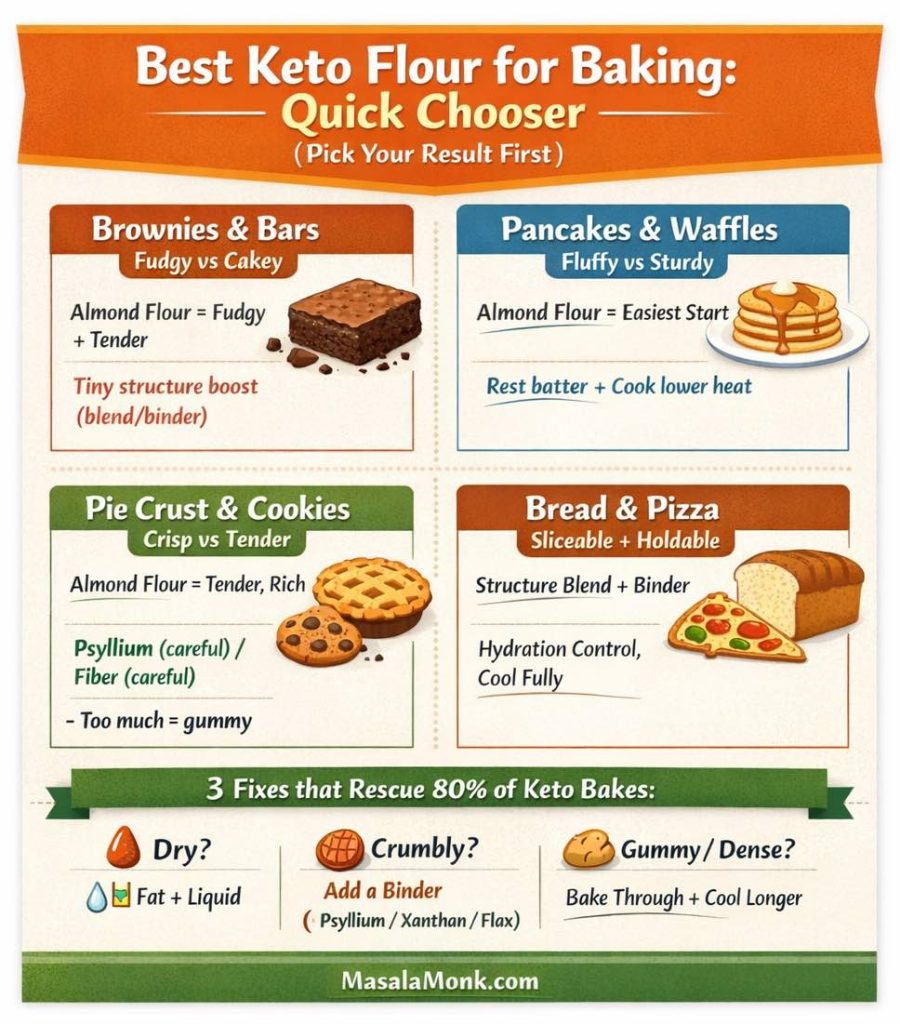
Best keto flour for baking: a quick chooser by what you’re making

Before you choose any low carb flour substitute, pick the result you want. Then you can choose the flour that behaves that way.

Infographic titled “Best Keto Flour for Baking: Quick Chooser.” Four panels: Brownies & bars (almond flour = fudgy; blends = cakey); Pancakes & waffles (almond flour easiest; coconut flour only in recipes built for it); Pie crust & cookies (almond flour tender; coconut flour in small doses; binders add structure); Bread & pizza (use a flour system with binders). Bottom fixes: dry add fat+liquid; crumbly add binder; gummy bake through+cool longer. MasalaMonk.com footer.
This “pick your result first” cheat sheet is the fastest way to stop guessing with keto flour. Choose the quadrant that matches what you’re baking (brownies & bars, pancakes & waffles, pie crust & cookies, or bread & pizza), then follow the one-line rule for the texture you want. The bottom strip is your rescue plan: dry = add fat + liquid, crumbly = add a binder (psyllium/xanthan/flax), gummy/dense = bake through + cool longer. Save it to your keto baking board so the next batch turns out calm and repeatable.

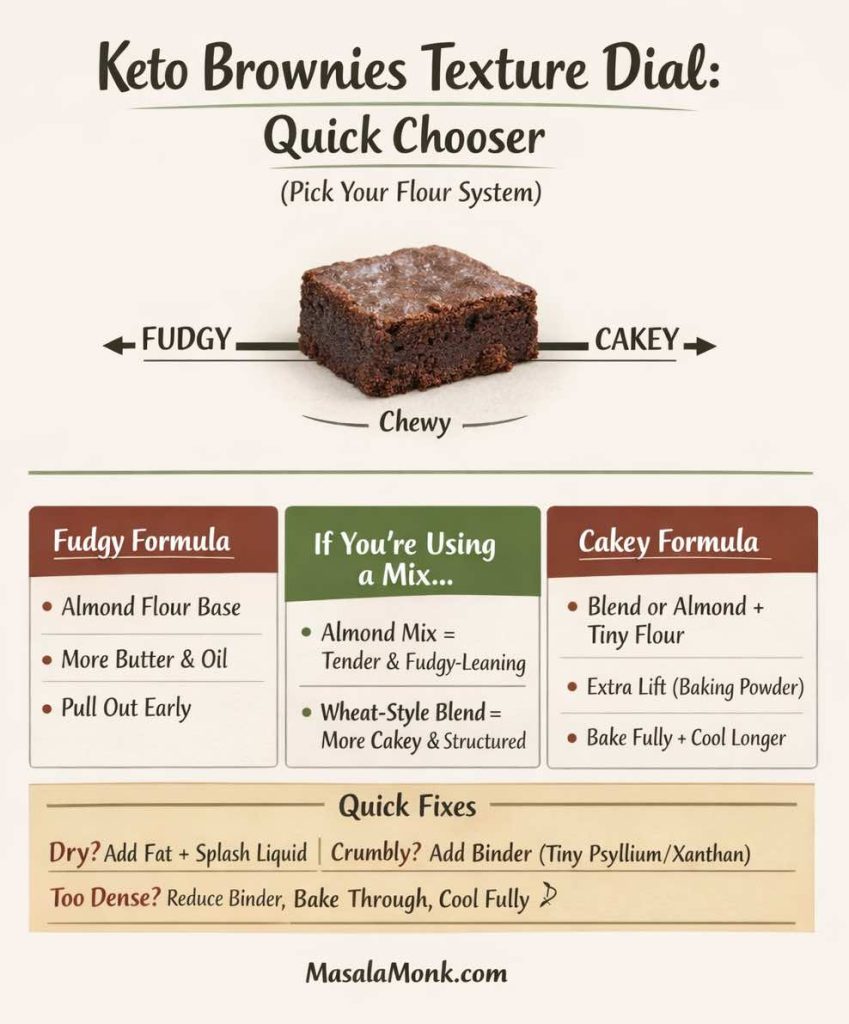
Brownies and bars: fudgy vs cakey

Brownies are where keto baking can feel either magical or tragic.

  • If you want fudgy brownies, you typically want a flour that stays tender and doesn’t drink every drop of moisture. Almond flour often shines here.
  • If you want a more cakey brownie, you’ll usually need more structure—either from a blend designed to mimic wheat flour, or from careful binder choices (and sometimes a touch of coconut flour).
When keto brownies turn out too dry, too crumbly, or weirdly dense, it’s usually a flour-system issue—not “bad baking.” This quick chooser helps you decide fudgy vs cakey first, then pick the right approach: almond-flour-forward for tender/fudgy brownies, or a more structured blend for cakey, clean-slice bars. The bottom “quick fixes” strip is the real lifesaver: dry = add fat + a splash of liquid; crumbly = add a tiny binder (psyllium/xanthan); too dense = reduce binder and cool fully before judging texture.

If you’re using a keto brownies mix or low carb brownie mix, the best question isn’t “Is it good?” but “What kind of flour system is it?” Almond-based mixes and wheat-style keto blends can both work, yet they produce different textures.

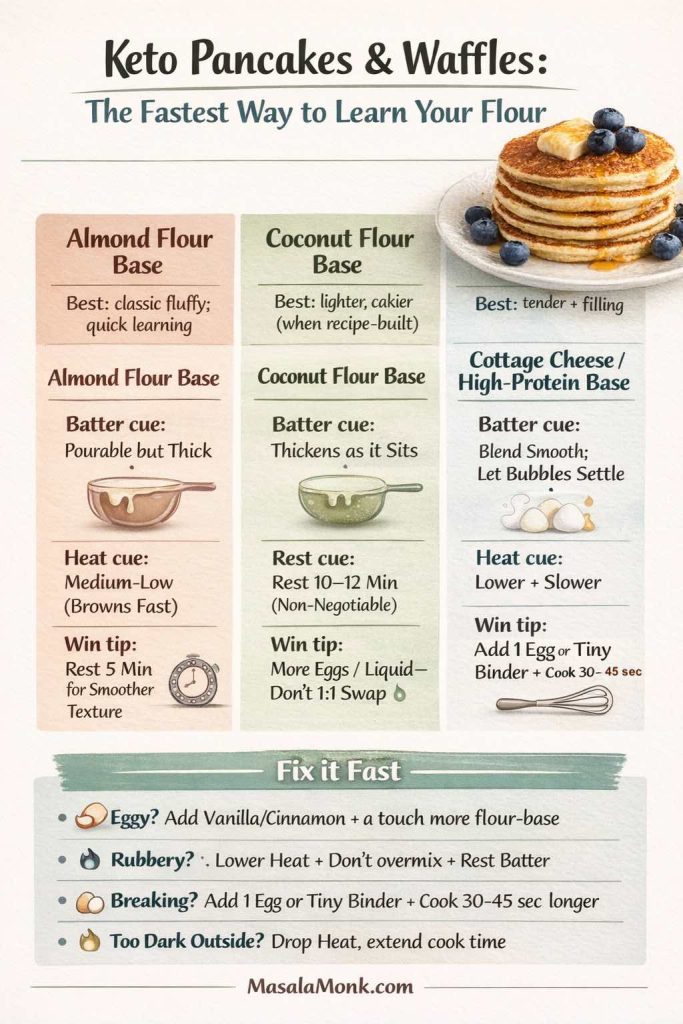
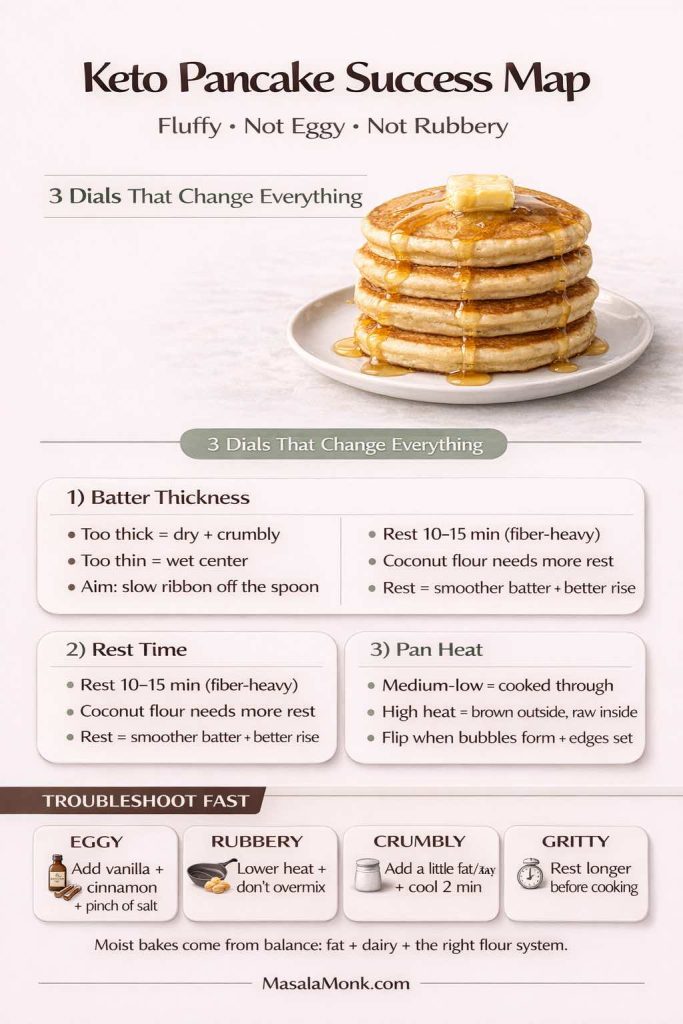
Pancakes and waffles: the fastest way to learn your flour

Waffles & Pancakes are a low-risk training ground: quick feedback, easy to tweak, forgiving enough to repeat.

Infographic titled “Keto Pancakes & Waffles: The Fastest Way to Learn Your Flour” comparing three bases: almond flour (pourable but thick; medium-low heat; browns fast), coconut flour (thickens as it sits; rest 10–12 minutes; not a 1:1 swap; needs more eggs/liquid), and cottage cheese/high-protein (blend smooth; lower, slower heat; add 1 egg or tiny binder). Includes “Fix it fast” tips for eggy, rubbery, breaking, and too-dark results. MasalaMonk.com footer.
Pancakes (and waffles) are the quickest way to “feel” how keto flour behaves—because you get instant feedback. This one-page guide helps you choose the right base (almond, coconut, or cottage-cheese/high-protein), spot the key batter cues, and cook with the right heat so you don’t end up with an eggy, rubbery stack. Keep the “Fix it fast” strip in mind too: it gives simple, realistic tweaks for the most common failures—breaking, over-browning, or a texture that tightens up as it cools.

If you want a gentle on-ramp, start with a dependable keto approach like Keto Pancakes: almond flour, coconut flour, and cottage cheese methods.
Then, if you want a broader “this is how pancakes behave with different bases” baseline, Blueberry Pancakes (6 recipes + homemade pancake mix) gives you a useful reference point for batter rest, browning, and texture.

Pie crust and cookies: crisp vs tender

A keto pie crust needs to slice cleanly, so structure matters. On the cookie side, you may want crisp edges and a tender middle, or you may want chewy softness. Those are different jobs.

  • Almond flour tends to give a tender, rich crumb.
  • Coconut flour can firm and tighten texture, but it can also dry things out if you push it too far.
  • Psyllium husk and certain fibers can help crusts hold together, although too much can make things gummy.

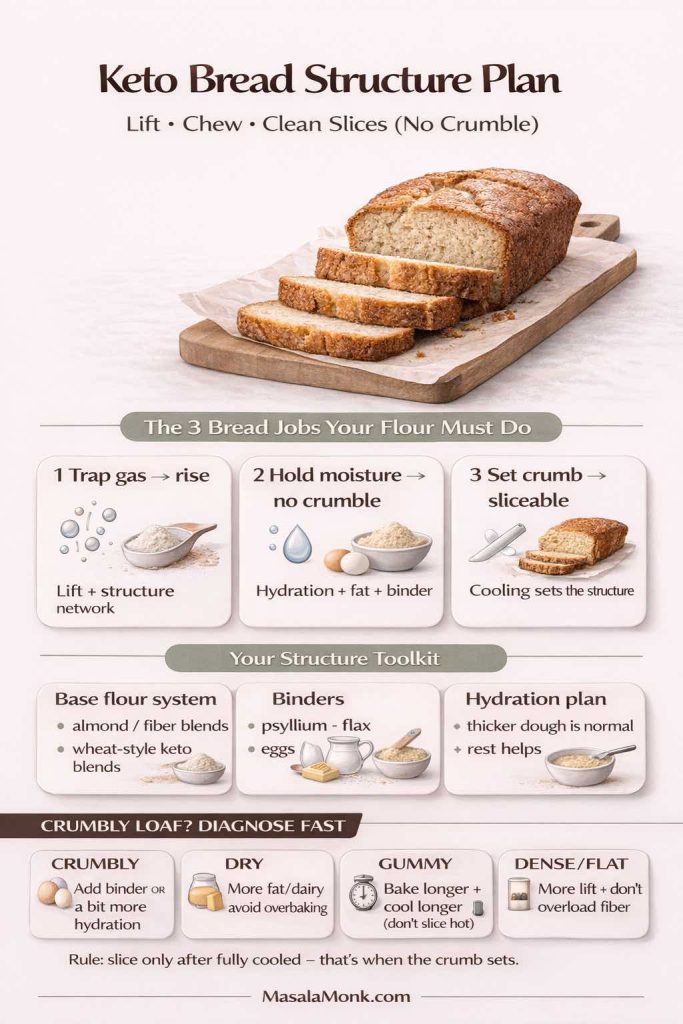
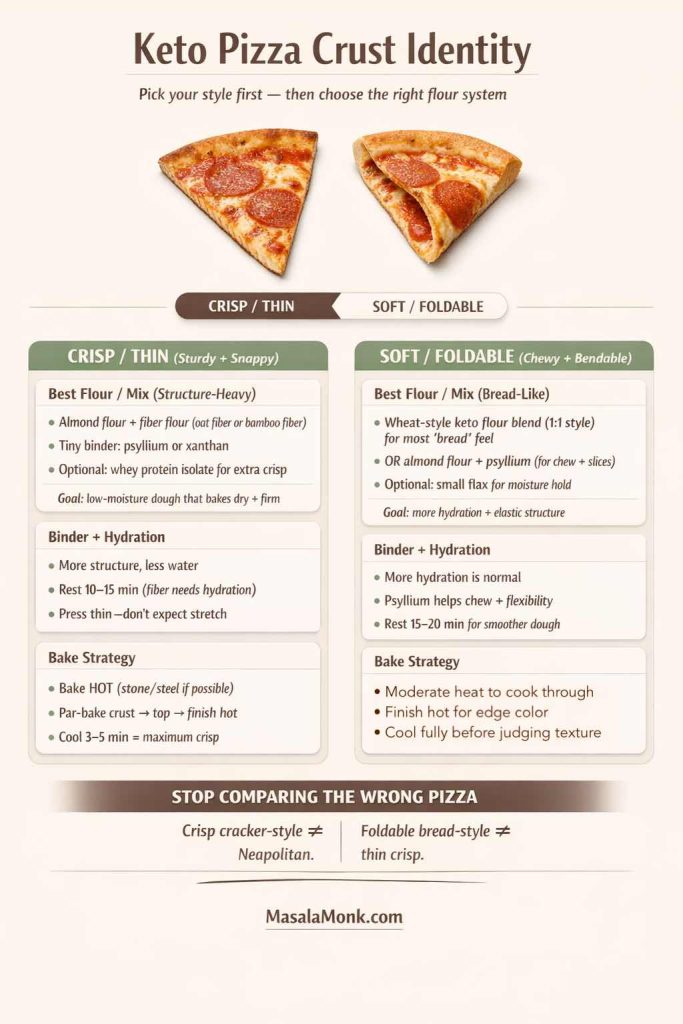
Bread and pizza: structure first, tenderness second

Bread is where low carb baking stops being “swap flour, hope for the best” and becomes “choose a system.” Keto bread usually needs binders, hydration control, and a flour blend that can hold gas.

For a reminder of how much structure matters in conventional bread, Sourdough Bread Recipes: 10 easy bread bakes (loaves, rolls & bagels) is a helpful example of how fermentation, hydration, and timing shape the crumb—even if you’re not baking sourdough on keto.

Also Read: Chicken Adobo — Step-by-Step Recipe — Classic Filipino Adobong Manok


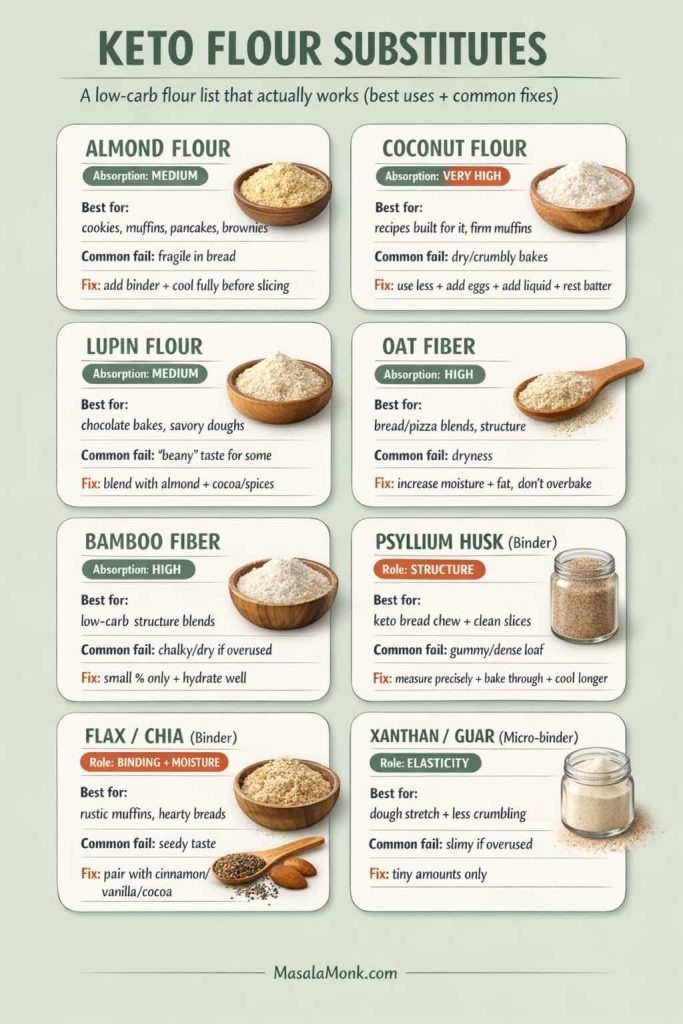
Keto flour substitutes: the low carbohydrate flour list that actually earns its space

You’ll see endless “low carb flour” lists online. The problem is that many of them treat these flours as interchangeable. They aren’t.

Here’s the kitchen-reality version—what each keto flour does well, what it does poorly, and how to use it without wasting a weekend.

Keto flour substitutes infographic comparing almond flour, coconut flour, lupin flour, oat fiber, bamboo fiber, psyllium husk, flax/chia, and xanthan/guar. Each card lists absorption or role, best uses, common baking failures (dry, crumbly, gummy, strong taste), and quick fixes like adding eggs/liquid, resting batter, measuring binders carefully, and cooling fully before slicing. MasalaMonk.com footer.
Keto baking gets easier when you stop forcing one “keto flour” to do every job. Save this cheat sheet for the moment a bake turns dry, crumbly, or gummy—it shows what each option is best for (brownies, muffins, bread, pizza, doughs) and the simplest fix to try next (rest the batter, add moisture, use a binder, cool longer). Coconut flour is powerful but picky, almond flour is the easiest all-rounder, and psyllium/xanthan are the quiet heroes for clean slices and structure. Full keto flour guide on MasalaMonk.com.

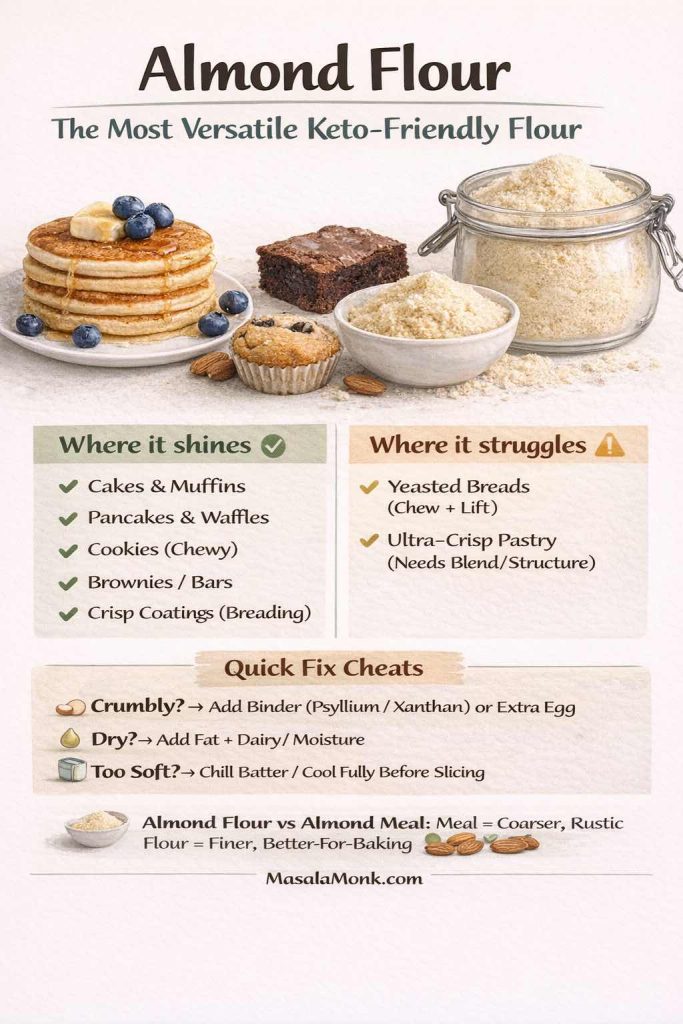
Almond flour: the most versatile keto friendly flour

Almond flour is popular for a reason: it’s forgiving. It browns nicely, tastes rich, and tends to produce tender baked goods without advanced technique.

Where it shines

  • Cakes, muffins, pancakes, waffles
  • Cookies (especially chewy styles)
  • Brownies, bars, crumb toppings
  • Coating and breading jobs (especially when you want a crisp outside)

Where it struggles

  • Yeasted breads that need chew and lift
  • Ultra-crisp pastry unless you blend for more structure
Infographic titled “Almond Flour: The Most Versatile Keto-Friendly Flour.” Shows almond flour in a jar and bowl with keto bakes (pancakes, brownie, muffin). Lists where almond flour shines: cakes and muffins, pancakes and waffles, chewy cookies, brownies and bars, crisp breading/coatings. Lists where it struggles: yeasted breads needing chew and lift, ultra-crisp pastry needing added structure. Includes quick fixes: if crumbly add binder (psyllium or xanthan) or extra egg; if dry add fat plus dairy/moisture; if too soft chill batter and cool fully before slicing. Notes almond flour vs almond meal: meal is coarser and rustic; flour is finer and better for baking. MasalaMonk.com at bottom.
Almond flour is usually the easiest “starter” keto flour because it browns well, tastes rich, and stays tender—especially in pancakes, muffins, cookies, and brownies. Use this card as a quick chooser: if your bake turns crumbly, add a binder (psyllium/xanthan) or an extra egg; if it turns dry, add fat + dairy/moisture; if it’s too soft, chill the batter and let the bake cool completely before slicing. Bottom reminder: almond flour vs almond meal matters—meal is coarser and rustic, while fine almond flour is smoother and more reliable for baking.

If you want a practical internal guide that frames almond flour in everyday cooking (including a diabetes/blood sugar perspective), Almond Flour and Diabetes: a low-carb swap for better blood sugar is a relevant read.

And if you want a straightforward “make it taste good fast” use case, Almond Flour Pancakes is an easy entry point for batter thickness, browning control, and fluffiness without turning it into a science project.

A note on almond flour vs almond meal
Almond meal is coarser, which can make bakes feel heavier or more rustic. Sometimes that’s exactly what you want. Other times, it’s the reason your cookie feels gritty. When in doubt, choose almond flour for baking and save almond meal for breading and hearty muffins.

Two bowls on a sage background labeled “Almond Flour” and “Coconut Flour.” Almond flour shows medium absorption and “moist + tender”; coconut flour shows high absorption and “light but can dry out.” Center box says “Not 1:1 swap rule” with tips for swapping between them. Bottom tips: “Dry? add fat + liquid” and “Crumbly? add binder (psyllium/xanthan).” MasalaMonk.com footer.
Almond flour vs coconut flour in keto baking isn’t a 1:1 swap—this quick guide shows why coconut flour absorbs far more, how that changes texture, and what to fix when bakes turn dry or crumbly. Use it as a fast reference before making low carb brownies, muffins, pancakes, or pie crust.

Coconut flour: extremely absorbent, powerful in small doses

Coconut flour is one of the most misunderstood keto flour alternatives. People love it because it’s compact and can be very low net carb in small quantities. Then they treat it like all-purpose flour and wonder why everything turns to sand.

Coconut flour is high in fiber, which means it absorbs a lot of liquid during baking. Bob’s Red Mill emphasizes that you should follow coconut flour recipes closely and not make additional substitutions, because dough will often be much thicker than expected—and the absorbency changes everything. See: Bob’s Red Mill on coconut flour baking.

Iowa State University Extension notes that coconut flour shouldn’t be substituted 1:1 for wheat flour and can hold up to four times its weight in liquid, which helps explain why “just swap it” usually fails. See: Coconut flour (Iowa State Extension PDF).

Infographic titled “Coconut Flour: The Absorbency Rules” explaining that coconut flour is highly absorbent and not a 1:1 swap. Shows an absorbency meter (high), a bowl of coconut flour, where it shines (cake-like quick breads, firmer muffins, small amounts in blends), where it struggles (chewy bakes without binders, free-form cookies), and quick fixes for sandy/dry, dense, or crumbly results. MasalaMonk.com footer.
Coconut flour is powerful because it’s extremely absorbent—so the biggest mistake is treating it like all-purpose flour. This quick card shows when coconut flour works best (recipe-built quick breads, firmer muffins, and small amounts in blends), when it tends to disappoint (chewy bakes without binders, free-form cookies), and the first fixes to try if your batter turns sandy, tight, or crumbly. Use it as a “before you bake” reference so your results feel intentional.

Where coconut flour shines

  • “Cake-like” quick breads when the recipe is designed for it
  • Muffins that need a firmer set
  • Blends, where a small amount adds structure

Where coconut flour struggles

  • Anything you want chewy unless you pair it with the right binders
  • Free-form cookies (it can over-tighten and dry)

If you love coconut flour, treat it like a concentrated ingredient. Use it with intention, not as a general-purpose low carb flour replacement.

Lupin flour: protein-forward structure with a distinct personality

Lupin flour can be a useful keto flour substitute because it brings protein and structure. It can also bring a flavor that some people notice more than others, especially in lightly flavored bakes.

Where lupin flour shines

  • Chocolate bakes (the flavor hides well)
  • Savory bakes and crackers
  • Blends designed for more structure

Where lupin flour struggles

  • Delicate cakes unless blended thoughtfully
  • Light, buttery cookies where you want clean sweetness

Oat fiber, bamboo fiber, and other fiber flours: bulk without traditional starch

If you’ve seen “0 carb flour,” “zero net carb flour,” or “carb free flour substitute,” it’s often tied to fiber-heavy ingredients. These can be helpful, particularly in bread and pizza systems where you want bulk and structure without starch. Still, they can also turn baked goods dry if you overdo them.

Fiber choices vary widely, and not all “added fiber” behaves the same. If you want a grounded, label-oriented reminder that fiber type matters, it’s useful to keep the ADA’s note about net carb calculations in mind: ADA: net carbs aren’t always fully accurate.


Where fiber flours shine

  • Bread and pizza systems when paired with binders and hydration
  • Thick batters (mug cakes, pancakes) where you can control moisture

Where fiber flours struggle

  • Cookies and cakes when they’re used as the primary “flour”
  • Anything where you want a soft, bouncy crumb without gumminess

Psyllium husk: the binder that makes keto bread behave like bread

Psyllium isn’t “flour” in the classic sense, yet in keto baking it functions like architecture. It can provide elasticity, moisture retention, and a more bread-like chew, especially when paired with eggs and the right hydration.

Vertical infographic titled “Psyllium Husk: The Binder That Makes Keto Bread Slice.” Shows what psyllium does (elasticity, moisture retention, structure), common fails with fixes (crumbly: add a tiny bit more binder + rest; gummy/dense: reduce binder slightly + bake through + cool longer; purple/gray tint: try different brands/types), best uses (bread, rolls, pizza dough, tortillas/flatbreads), and a reminder that cooling sets the crumb before slicing. MasalaMonk.com footer.
If keto bread keeps crumbling or turning gummy, psyllium husk is usually the missing “structure” piece. This quick card shows exactly what it does (elasticity + moisture retention), where it works best (bread, rolls, pizza dough, tortillas), and the fastest fixes when things go wrong—especially the underrated step: cool fully before slicing. Save it as your binder reference the next time a loaf feels fragile.

The trick is balance. Too little and your loaf crumbles. Too much and the texture can turn dense or slightly gummy. When it’s right, though, it’s one of the main reasons keto bread can slice.

Flax meal and chia: binding, moisture, and a rustic crumb

Flax and chia add structure and moisture control. They also add flavor, so they’re often better in spiced bakes, nutty muffins, and hearty breads than in a delicate vanilla cake.

Flax + chia gel binder infographic for keto baking. Shows how to make a flax/chia “egg” (1 tbsp ground flax or chia + water, rest 5–10 minutes), best uses (muffins, quick breads, pancakes; rustic cookies/hearty loaves), and common fails with fixes (gritty = grind finer, dense = add lift/whip eggs, crumbly = pair with egg or a touch of psyllium). MasalaMonk.com footer.
Flax and chia aren’t “flour,” but they’re powerful structure tools in low carb baking—especially when you want moisture + binding without turning a batter into rubber. Use this card as a quick reference: gel your flax/chia first, then choose the right bake (pancakes, muffins, rustic cookies). If the result goes gritty, dense, or crumbly, the bottom fixes tell you what to adjust next—so you don’t waste a whole batch.

“Pork rind flour” and seed crumbs: the crunch category

Sometimes you don’t need flour at all—you need texture. For breading, coating, and crisp topping jobs, pork rind crumbs and crushed seeds can do what flour would do, without pretending to be something else.

That’s how you keep keto cooking satisfying: by choosing the tool that matches the task.

Also Read: Keto Mocktails: 10 Low-Carb Recipes for Guilt-Free Happy Hour Indulgence


Keto all purpose flour: what it can do, and what it can’t

A keto all purpose flour sounds like a dream: one bag, every bake, no guesswork. In practice, it depends on what that “all purpose” blend is made to mimic.

Some blends aim to behave like wheat flour in a one-to-one swap. Others aim for a gluten-free style. Some focus on fiber bulk. Each approach can work. The only problem is expecting a cookie blend to behave like a bread blend.

Infographic titled “Keto All-Purpose Flour System” showing 3 jars: Tender Jar (best for brownies, muffins, cookies, pancakes; almond flour base + minimal fiber; common fail fragile slices; fix add small binder or chill + cool fully), Structure Jar (best for bread, pizza, rolls; blend + psyllium + optional fiber; common fail gummy/dense; fix reduce binder or bake through + cool longer), and Nut-Free Jar (best for nut-free cakes, muffins, pancakes; coconut flour system + eggs + extra liquid; common fail dry/crumbly; fix use less flour + add liquid + rest batter). Bottom: dry add fat+liquid; crumbly add binder; gummy bake through + cool longer. MasalaMonk.com footer.
If you’ve ever bought a “keto flour” and still ended up with dry muffins, crumbly slices, or a gummy loaf—this is the shortcut. Instead of chasing one magic bag, build three simple jars based on the texture you want: Tender (brownies/cookies/pancakes), Structure (bread/pizza/rolls), and Nut-Free (coconut-flour bakes made recipe-built). The bottom strip is your quick fix: dry = add fat + liquid, crumbly = add a binder, gummy = bake through + cool longer. Save this for your next bake.

Store-bought wheat-style keto blends (the “1:1” promise)

A well-known example is King Arthur’s Keto Wheat Flour, described as a 1:1 swap for recipes calling for all-purpose flour, with a traditional wheat taste and low net carbs per serving. See: King Arthur Keto Wheat Flour.

That kind of flour can be appealing if you want wheat-like structure for bread, rolls, or yeasted bakes, and you’re not aiming for gluten-free baking.

DIY low carb flour mix: why it’s often better

Even if you love a store blend, it’s worth having a simple DIY approach, because your baking goals change. Some days you want brownies that stay fudgy. Other days you want a pizza crust that can be picked up. Those are different recipes, so it helps to have different “default blends.”

DIY Keto Flour Mix infographic showing three labeled blend cards: “Tender Blend” for cakes/muffins/brownies (almond-flour-forward, minimal fiber), “Structure Blend” for bread/pizza/rolls (includes psyllium, optional fiber; hydrate + rest; bake through; cool fully), and “Nut-Free Blend” coconut-flour system (coconut flour + binders, extra liquid/eggs; not 1:1; batter rests; tiny amounts matter). Bottom notes: choose by texture goal; dry add fat + liquid; gummy bake through + cool longer. MasalaMonk.com footer.
If “keto flour” keeps giving you random results, this is the fix: stop chasing one magic bag and build three simple blends you label once—Tender (brownies/muffins/cakes), Structure (bread/pizza/rolls), and Nut-Free (coconut-flour recipes built for absorbency). Use it like a decision card: pick the texture goal first, then choose the blend that behaves that way. And keep the bottom strip handy—dry = add fat + liquid, gummy = bake through + cool longer—because most keto baking “fails” are just hydration + structure mismatches.

A practical way to think about DIY blends is:

  • Tender blend for cakes, muffins, and brownies: almond flour-forward, minimal fiber
  • Structure blend for bread and pizza: includes psyllium and/or fiber components, with careful hydration
  • Nut-free blend when needed: coconut flour plus binders, used in recipes designed around its absorbency

Once you label your jars that way—tender, structure, nut-free—you stop expecting one bag to do everything. Then your baking suddenly feels easier.

Also Read: Creamy Cauliflower Soup—Keto-Friendly, Ultra-Comforting (Vegan Option)


Keto baking mixes and keto flour blends: what changes in the bake

Keto baking products have expanded quickly. There are keto baking mixes for brownies, pancakes, biscuits, cakes, and even “shake and bake” style coatings. You’ll also see brand-specific products such as Atkins bake mixes, Carbquik baking mix, Lakanto baking mix, and specialty companies offering cookies and brownie mixes.

Vertical infographic titled “Keto Baking Mix Decoder” with a keto flour bag illustration and the subtitle “4 Things to Check Before You Buy/Bake.” Four numbered panels explain: (1) Primary flour system—almond-based = tender, coconut-based = firms fast, wheat-style = more breadlike; (2) What provides structure—fiber/gums need rest time; egg-heavy can taste eggy unless flavored; (3) Sweetener profile—affects aftertaste, browning, moisture, and “stays soft” factor; (4) Serving size reality check—net carbs depend on serving size plus fiber/sugar alcohols. Bottom “Fix It Fast” strip: Dry add fat/dairy; Gritty rest batter longer; Eggy add vanilla + salt + cocoa/espresso; Dense bake through + cool fully. MasalaMonk.com at the footer.
Keto mixes can be great—when the mix matches the texture you want. Use this “decoder” before you bake: identify the primary flour system, how the mix gets structure, what the sweetener is likely to do, and whether the serving size makes the “net carb” claim feel realistic. The bottom “Fix It Fast” strip is your quick rescue guide for the most common outcomes (dry, gritty, eggy, dense) so you can adjust once and get a better second bake.

These products can be helpful, especially when you want consistency or when you’re new to low carb baking. Still, mixes vary hugely in results, so it helps to evaluate them using a simple lens:

  1. What’s the primary flour system?
    Almond flour-based mixes tend to be tender. Coconut flour-based mixes tend to firm quickly. Wheat-style keto blends tend to mimic flour-like structure.
  2. What’s providing structure?
    If the mix relies on added fiber and gums, it may need extra resting time for hydration. If it relies heavily on egg, it may risk an eggy finish unless flavor is boosted.
  3. What’s the sweetener profile?
    Sweetener choice affects aftertaste, browning, moisture, and how soft the bake stays after cooling.
  4. How is “serving size” defined?
    The FDA’s label guidance is useful here because serving sizes can make products look more “carb friendly” than they feel in real life. See: FDA Nutrition Facts Label basics.

If you’ve tried a few mixes and felt disappointed, it’s often not because keto baking is doomed. Instead, it’s because the mix wasn’t designed for the texture you wanted.

Also Read: Green Tea for Weight Loss: The No-Hype, Done-For-You Guide


Keto flour for brownies: how to get that rich, not-dry finish

Brownies are the emotional center of keto baking. They’re what people want to feel “normal” again. The good news is that brownies are also one of the easiest places to win—provided you choose the right flour approach.

Vertical infographic titled “Keto Brownie Mix Makeover.” Shows a brownie pan photo and three columns: Flavor Boosters (vanilla + pinch of salt, espresso powder ½–1 tsp, extra cocoa), Moisture Boosters (1–2 tbsp melted butter/oil, 2 tbsp sour cream or Greek yogurt, optional chopped nuts), and Texture Control (rest batter 10–15 min, don’t overbake, cool fully). Bottom section lists doneness cues and quick fixes.
If your keto brownie mix turns out dry, eggy, or dense, this quick “makeover” card gives you the simplest upgrades that actually change texture. Use vanilla + a pinch of salt for a fuller chocolate flavor, add a little espresso powder for depth, and boost moisture with a small spoon of butter/oil or sour cream/Greek yogurt. Then control texture the smart way: rest fiber-heavy batters, pull brownies when the edges are set but the center is still slightly soft, and cool fully for clean, fudgy slices. (Save-worthy, but also meant to be used mid-bake.)

Pick your brownie style first

A “best keto brownies” goal can mean three different things:

  • Fudgy and dense (almost truffle-like)
  • Soft and cakey (more like a snack cake)
  • Chewy with crisp edges (classic pan brownie energy)

Each style wants a different flour strategy.

The fudgy path: almond flour plus moisture control

Almond flour tends to be your friend here because it stays tender. To keep brownies from drying out, focus on:

  • Enough fat (butter, coconut oil, or a neutral oil)
  • A sweetener that doesn’t turn the crumb dusty
  • Not overbaking—pull them when the center is set but still soft

If you like learning by contrast, it can help to taste a conventional brownie and pay attention to what flour contributes: structure, yes, but also how it holds moisture in place. Keto brownies replicate that by balancing almond flour with eggs and fat, then keeping bake time gentle.

The “clean slice” path: tiny amounts of coconut flour or fiber support

If your almond flour brownies feel too soft or fall apart, you can add a small amount of coconut flour or a touch of fiber/binder support. This is where restraint matters. Coconut flour is powerful; too much turns brownies dry. Used lightly, it tightens the structure and helps slices hold.

Mixes: how to make a keto brownie mix taste homemade

A low carb brownie mix can be excellent, although it often benefits from a few simple upgrades:

  • Add a pinch of salt if it tastes flat
  • Add vanilla or espresso powder for depth
  • Add extra fat if the mix bakes up dry
  • Rest the batter briefly if it includes fiber-heavy ingredients

In other words, treat the mix like a base. You’re still the baker.

Also Read: A Guide to Choosing Keto-Friendly Milk Alternatives: Exploring Nutritional Profiles and Tips for Selection


Keto flour for pie crust: the butter + structure balance

Pie crust is the place where people chase unicorns: “no carb pie crust,” “sugar free low carb pie crust,” “keto pie crust that tastes like bakery pastry.” You can get close, but only if you accept what makes classic crust work.

Classic crust is about fat layers, controlled hydration, and just enough structure to hold a slice.

Keto crusts often use almond flour because it tastes good and handles butter well. However, almond flour crust can be fragile, particularly when warm. That fragility is not a flaw; it’s a clue that you need a bit more structure.

Vertical infographic titled “Keto Pie Crust Blueprint” with subtitle “Butter + Structure = Clean Slices (No Crumble).” Shows a slice of pie and a crisp vs tender finish toggle. Explains almond flour for tenderness, butter for flake and flavor, plus structure helpers: egg for cleaner slices, psyllium for strongest hold, and a tiny amount of coconut flour to firm quickly. Includes crisp (cookie-like) vs tender (pastry-like) tips, best-use notes, and troubleshooting: crumbly add structure or chill and press; dry add butter/dairy and don’t overbake; too soft bake longer and cool fully; flat add salt. MasalaMonk.com footer.
If your keto pie crust tastes great but falls apart the moment you slice it, this is the fix: almond flour for tenderness + butter for flavor + a small “structure helper” for clean slices. Use the crisp vs tender guide to match your crust to the filling (cookie-like for creamy pies, pastry-like for fruit/custard), then lean on the quick troubleshooting strip when something turns crumbly, dry, or too soft. Bookmark this “keto pie crust blueprint” before your next bake.

A reliable keto pie crust strategy

  • Almond flour for tenderness and richness
  • Butter for flavor and flake-like feel
  • A small structure helper for sliceability (egg, psyllium, or a small amount of coconut flour, depending on your preferred texture)
  • Salt, always—otherwise the crust tastes like “health food,” even when it isn’t

Crisp vs tender crust: choose your finish

If you want a crisp, cookie-like crust, you can lean more toward almond flour plus sweetener and bake it like a shortbread base. On the other hand, if you want a more pastry-like crust, you’ll usually prefer a less sweet, more structured approach that can be rolled or pressed without cracking.

This is also where your sweetener choice matters. Some sweeteners keep crusts softer; others crisp more readily. Either can be good—it just depends on what you’re making.

Also Read: Navigating Beans on the Keto Diet: Which Varieties Are Suitable?


Keto flour for muffins, banana bread, and “quick breads” that stay moist

Muffins and banana bread are deceptively tricky on keto because the classic versions rely on sugar and starch for moisture retention. When you remove both, you need a new plan.

The win here is simple: build moisture on purpose, then choose a flour that supports it.

Vertical infographic titled “Keto Quick Breads That Stay Moist.” Shows a sliced keto quick bread loaf and a “Moisture Map” with three levers: moisture builders (Greek yogurt/sour cream, cream cheese, butter/coconut oil, extra yolk), flour behavior (almond flour is tender; coconut flour absorbs and works best in recipe-built batters), and bake + cool rules (don’t overbake, rest batter 10–15 minutes, cool fully, wrap after cooling). Bottom troubleshoot boxes: dry, eggy, gritty, crumbly.
Keto quick breads stay tender when you treat moisture like a plan, not a hope. Use this “Moisture Map” to choose the right add-ins (yogurt, cream cheese, extra yolk), match the flour to the texture you want (almond flour for tender crumb, coconut flour only in recipe-built batters), and follow the two rules that matter most: don’t overbake and cool fully before slicing. If your loaf turns dry, eggy, gritty, or crumbly, the bottom strip gives the fastest fix to try next.

Almond flour muffins: soft, rich, forgiving

Almond flour muffins tend to stay tender, especially if they include yogurt, sour cream, or a bit of cream cheese. They also reheat well, which matters more than you’d think. Warmed muffins taste fresher; chilled muffins can taste drier than they are.

Coconut flour muffins: light, structured, but easy to dry out

Coconut flour muffins can be excellent when the recipe is designed for them, because they can set into a neat crumb and feel pleasantly cakey. The danger is treating coconut flour as a 1:1 substitute. As Bob’s Red Mill notes, coconut flour absorbs a lot of liquid and requires careful recipe adherence; it also often calls for more eggs to compensate. See: Bob’s Red Mill coconut flour baking guidance.

Banana bread on keto: pick your “banana” strategy

“Keto banana bread” usually means one of two things:

  • A banana-flavored bread with extracts/spices (banana without the carbs)
  • A low-carb “banana-ish” bread that uses a small amount of banana, portioned carefully

Either can work. The point is to decide what you mean by “banana bread” first: aroma and comfort, or literal banana content.

A non-keto but useful comparison: why “no refined flour” baking still teaches you something

Even when you’re staying keto, it can be useful to look at how other styles of baking build sweetness and moisture without relying on refined ingredients. For example, Easy and healthy cookies (no sugar, no butter, no refined flour) uses a whole-food approach to sweetness and softness—different macros, yes, but still a reminder that texture is often created by technique and ingredient roles, not just flour.

Also Read: 5 Keto-Friendly Salami Dishes That Promote Weight Loss


Keto pancakes and low carb pancakes: how to avoid the eggy, rubbery trap

Pancakes are where people either fall in love with keto baking or swear it off forever. The main complaint is usually the same: “Why does this taste like an omelet pretending to be breakfast?”

That eggy taste happens when the batter is built mainly from eggs and dairy without enough flour-like bulk and flavor support.

A strong approach is to choose a base that actually behaves like a flour system, then cook with gentler heat so the pancake sets without overbrowning. Both Keto Pancakes and Almond Flour Pancakes lean into practical texture cues like resting batter, controlling browning, and choosing the right thickness.

Why almond flour pancakes brown faster

Almond flour has fat and fine particles that brown quickly. That’s why a medium-low heat approach often gives better results: slower setting inside, less overbrowning outside. The almond flour pancakes guide calls this out directly as a common issue and solution.

“Keto Pancake Success Map” infographic showing a stack of keto pancakes with butter and syrup. It explains 3 key dials: batter thickness (too thick = dry/crumbly, too thin = wet center; aim for slow ribbon), rest time (10–15 minutes; coconut flour needs more), and pan heat (medium-low; flip when bubbles form and edges set). Includes troubleshoot fixes for eggy, rubbery, crumbly, and gritty pancakes. MasalaMonk.com.
Fluffy keto pancakes come down to three controllable dials: batter thickness, rest time, and pan heat. Use this quick map to avoid the usual traps—eggy flavor, rubbery texture, crumbly edges, or gritty coconut-flour batter. The bottom troubleshooting row is your fast fix when a batch goes sideways, and the flipping cue (bubbles + set edges) is the simplest “don’t guess” rule. Save it as your weekday pancake reference.

Why coconut flour pancakes need a different mindset

Coconut flour pancakes can be excellent, yet they often want more resting time because hydration changes the batter dramatically. If you cook too soon, the batter can feel grainy or tight. If you rest, it smooths out and sets more evenly.

A quick way to keep pancakes interesting without turning them into dessert

One of the most practical ways to stick with low carb baking is to keep flavors rotating. Berries, citrus zest, cinnamon, and vanilla all pull attention away from “this is a substitute” and toward “this is breakfast.”

If you want a general pancake playground (keto or not), Blueberry Pancakes (6 variations) is useful for mix upgrades and batter handling tips.

Also Read: Katsu Curry Rice (Japanese Recipe, with Chicken Cutlet)


Keto flour for bread: how to build lift, chew, and clean slices

Bread is the most emotionally loaded category in keto baking, and understandably so. Bread isn’t just food; it’s a format—sandwiches, toast, grilled cheese, wraps, “something you can hold.”

To make bread without traditional flour, you need a structure plan.

Keto Bread Structure Plan infographic showing a sliced keto sandwich loaf and a simple framework for better texture: three bread jobs (trap gas for rise, hold moisture to prevent crumble, set crumb for sliceable loaf after cooling). Includes a structure toolkit (base flour systems like almond/fiber/wheat-style keto blends; binders such as psyllium, flax, eggs; hydration with rest time; bake through and cool 60–120 minutes). Bottom troubleshooting strip covers crumbly, dry, gummy, and dense/flat loaves with quick fixes. MasalaMonk.com.
Bread is the toughest “keto flour” test because it needs rise, moisture retention, and a crumb that sets cleanly when cooled. Use this structure plan as your quick reference: pick a base flour system, build structure with binders (psyllium/flax/eggs), expect thicker dough and let it rest, then bake fully and cool before slicing. If your loaf turns crumbly, dry, gummy, or dense, the bottom strip gives the fastest fix to try next.

The three bread jobs your flour must do

A good bread flour system—keto or not—must do these things:

  1. Trap gas so the loaf rises
  2. Hold moisture so it doesn’t crumble
  3. Set into a sliceable crumb when cooled

Gluten does all three in wheat bread. Keto bread recreates them through binders and careful hydration.

That’s why a conventional bread roadmap like Sourdough Bread Recipes: 10 easy bakes is still useful as a learning lens: it reinforces that bread texture is shaped by hydration, timing, and structure—not just ingredients.

The “crumbly loaf” fix: binders and patience

If your keto loaf crumbles, it’s usually one of these:

  • Not enough binder support (psyllium/flax/eggs)
  • Too dry (coconut flour pushed too far, or fiber flours without enough hydration)
  • Overbaked (keto breads dry out quickly)
  • Sliced too early (cooling sets the crumb)

Cooling is underrated. Even wheat bread slices better once it’s fully cooled. Keto bread often needs that time even more.

Wheat-style keto flour blends for bread and yeasted bakes

If you’re using a wheat-style keto blend like King Arthur Keto Wheat Flour, the promise is that you can swap 1:1 for all-purpose flour while keeping a more traditional wheat taste and texture.

That may be attractive if you’re aiming for a more classic bread feel and gluten-free isn’t your goal. Even then, treat it like any flour: test once, adjust once, then keep notes. Bread rewards repetition.

Also Read: Beyond Chicken: 5 Tofu-Tastic Keto-Friendly Dinner Meal Prep Ideas, Chicken-Free and Protein-Rich


Keto pizza flour and crusts: crisp edges, tender center, sturdy slice

Pizza is another category where “best keto flour” depends entirely on the style you want.

Keto Pizza Crust Identity infographic comparing two styles. Left: CRISP/THIN crust with best flour mix (almond flour + fiber flour like oat or bamboo fiber, psyllium or xanthan, optional whey protein isolate), binder/hydration tips, and hot bake strategy with par-bake and cooling for crisp. Right: SOFT/FOLDABLE crust with wheat-style keto flour blend (1:1 style) or almond flour + psyllium, higher hydration, rest time, and moderate bake approach. Footer: MasalaMonk.com.
If your keto pizza crust keeps “failing,” it’s usually a style mismatch—you’re judging a crisp thin base like it should fold, or expecting a foldable slice to snap. This quick visual shows the two best keto pizza crust paths (CRISP/THIN vs SOFT/FOLDABLE), the flour system that fits each one, plus the bake strategy that makes the texture actually happen. Save it as your “pizza reset” card—then pick your crust identity first and your results get way more consistent.
  • If you want a thin, crisp crust, you’ll likely choose a structure-heavy approach (often with binders and a bake-hot strategy).
  • If you want a soft, foldable slice, you’ll usually lean into a more bread-like system with moisture and chew.

In either case, the same principle applies: choose your crust identity first. Otherwise, you’ll keep judging a “crisp cracker crust” as if it was a Neapolitan base, and nothing will feel right.

Also Read: Carbs in Cheese: Keto Diet Perspective


Keto flour tortillas and low carb flour tortillas: how to make the section genuinely useful

Tortillas and wraps are where “low carb” becomes everyday. A tortilla can be breakfast, lunch, dinner, and a quick snack format—so it makes sense to include a real section that isn’t just a brand list.

Infographic checklist for choosing low carb flour tortillas: check serving size, total carbs per tortilla, fiber amount and type, sugar alcohols if present, and ingredient list (added fibers/gums) to compare wraps realistically.
Use this 5-point label check when buying low carb tortillas: start with serving size, compare total carbs per tortilla, review fiber and sugar alcohols, then scan the ingredients (added fibers/gums change texture and how filling a wrap feels). Save this quick guide for your next grocery run.

Store-bought low carb wraps: what actually matters

If you’re using packaged low carb tortillas, focus on:

  • Serving size (and how many you actually eat)
  • Total carbohydrate and fiber (then decide how you interpret net carbs)
  • Sugar alcohols, if present
  • Ingredient list, especially added fibers

The FDA’s label guidance is the clearest reference point for serving size and how numbers are presented: How to understand and use the Nutrition Facts label.
Additionally, the ADA notes that net carb math can be imperfect because fiber and sugar alcohol absorption varies: ADA: Get to know carbs.

In practical terms, that means one “mission carb balance tortilla” style product may feel different from another depending on fiber type and serving size, even when the front label looks similar.

Make tortillas useful even when you don’t want to rely on packaged wraps

The easiest way to keep this part of the guide valuable is to offer wrap-format meal ideas that work whether you use low carb tortillas, lettuce wraps, or bowls.

For example, Sheet Pan Chicken Fajitas is a perfect “build-your-own” filling that adapts to any wrap format.

In other words, even if your tortilla choice changes week to week, the meal stays consistent.

Also Read: Keto Indulgence: Decadent Cheesecake Fat Bombs with Irresistible Spice Variations!


Keto baking sweeteners: how to choose a keto sugar substitute for baking without ruining texture

Flour gets most of the attention, yet sweetener can make or break low carb baking. Sweeteners affect:

  • Moisture retention (soft brownies vs dry brownies)
  • Browning (some brown faster)
  • Crispness (cookies that snap vs cookies that bend)
  • Aftertaste and flavor clarity
“Keto Sweetener Pick (By Bake Result)” infographic showing three choices for low carb baking: Allulose for soft and chewy bakes like brownies, cakes, and chewy cookies (browns faster—use slightly lower heat); Erythritol blend for crisp, snappy cookies and firm bars (can cool gritty—powder or dissolve better); Monk fruit blend for general baking (check the base—if erythritol-based, same grit risk). Bottom tip: fix grittiness by powdering or dissolving better and judge texture after cooling.
Keto sweeteners change texture as much as flour does. Use this quick picker based on the result you want: allulose for softer, chewier brownies/cakes, erythritol blends for crisp cookies and firmer bars, and monk fruit blends for everyday baking (always check what it’s blended with). If a bake turns gritty, the fix is usually simple: powder the sweetener or dissolve it better — and judge texture only after cooling.

Stevia blends, erythritol blends, and “baking” sweeteners

If you’ve used a sweetener that left your cookies gritty or your brownies dry, you’re not imagining it. Some sweeteners recrystallize as they cool, which can change mouthfeel.

For a general reference on what Truvia is and how it compares, What is Truvia sweetener? offers a clear overview of common formulations and comparisons.

If you’re choosing between stevia and aspartame in a broader sugar-free context, Stevia vs Aspartame provides a readable comparison and notes key considerations (including PKU cautions for aspartame).

Allulose: why bakers like it

Allulose is often discussed as a sugar-like option because it can behave more like sugar in recipes. Cleveland Clinic explains what allulose is and why people use it as a sugar substitute, including for diets that aim to reduce sugar intake. See: Cleveland Clinic: What is allulose?.

Oregon State University Extension also describes allulose as about 70% as sweet as sugar with far fewer calories and notes it’s relatively new on the market with limited research on long-term health effects: OSU Extension: Sweeteners (allulose section).

From a baking standpoint, the practical note is this: allulose can brown faster and keep things softer, which is great in some recipes and requires slight temperature awareness in others.

Also Read: Mozzarella: A Keto-Friendly Cheese Powerhouse for Your Low-Carb Journey


Keto baking powder, lift, and why “resting batter” matters more with low carb flour

Keto baking often leans on baking powder because it creates lift in batters that don’t have gluten. Two simple habits improve results dramatically:

  1. Use fresh baking powder. Old leavening gives flat, dense results, and you’ll blame your flour when it wasn’t the flour.
  2. Let fiber-heavy batters rest. Resting allows hydration to stabilize thickness, which improves rise and prevents a grainy finish.
Infographic titled “Keto Lift Checklist” showing two fixes for flat, dense keto bakes: test baking powder freshness with ½ tsp baking powder plus 2 tbsp hot water (fast foam = good; weak bubbles = replace) and rest fiber-heavy batters 10–15 minutes (coconut flour often 15–20) so batter thickens and rises better with less grainy texture. Includes a quick diagnose strip: flat, gritty, dense, dry.
Keto Lift Checklist: If your low-carb muffins, pancakes, or quick breads keep baking up flat, dense, or gritty, it’s usually not “bad keto flour.” Start with two high-impact habits: (1) use fresh baking powder (quick foam test) and (2) rest fiber-heavy batters 10–15 minutes so hydration stabilizes thickness for a better rise. This is especially helpful with coconut flour and fiber-forward blends.

This rest-and-hydrate approach shows up in practical pancake guidance too—both in keto pancake methods and in broader pancake mix handling tips.

Also Read: Are Lentils Keto-Friendly?


Putting it into a kitchen rhythm: a simple way to stop guessing

Once you’ve read enough about keto flour, the real win is building a routine you can repeat. Here’s a calm, practical way to get there:

Keto Baking Rhythm infographic showing a repeatable routine: choose 2 anchor bakes (fast: pancakes/mug cake/cookies; slow: bread/pizza crust/pie crust), build two default flour jars (Tender Jar: almond flour-forward, minimal fiber; Structure Jar: binder + fiber support for bread/pizza), and keep flavor boosters ready (vanilla, cinnamon, espresso powder, citrus zest, pinch of salt). Includes a simple loop: anchor bake → adjust once → repeat → write it down.
Stop guessing with a simple keto baking routine: repeat two “anchor bakes,” keep two default flour systems on hand (a Tender Jar for soft bakes and a Structure Jar for bread/pizza), and rely on a small set of flavor boosters (vanilla, cinnamon, espresso, citrus zest, salt) to make low-carb baking taste complete. Use this as your quick reference whenever you’re testing a new keto flour blend or troubleshooting texture.

Step 1: Choose two “anchor bakes” you’ll repeat until they’re easy

Pick:

  • One fast bake (pancakes, mug cake, or simple cookies)
  • One slow bake (bread, pizza crust, or pie crust)

For pancakes, use Keto Pancakes and/or Almond Flour Pancakes as your baseline so you’re not reinventing the wheel every time.

Step 2: Build a “tender jar” and a “structure jar”

  • Tender jar: almond flour-forward, minimal fiber
  • Structure jar: includes psyllium and/or fiber support, tuned for bread/pizza

Even if you still buy a keto baking mix now and then, these jars give you control when you want it.

Step 3: Keep flavor boosters ready

Low carb baking tastes better when flavor is intentional. Cinnamon, vanilla, espresso powder, citrus zest, and a pinch of salt are not optional extras—they’re how you make the bake taste complete.

Also Read: Keto Vegan Indulgences: 5 Dessert Recipes with Hemp Seeds, Walnuts, and Ginger


A broader, useful perspective: flour choices that aren’t strictly keto, but teach you technique

A strong guide doesn’t pretend only one eating style exists. It gives you perspective.

If you bake for a household where not everyone eats keto all the time, it’s helpful to understand how other flour systems behave—because it sharpens your intuition. Oat-based pancakes, for example, teach you about batter hydration and tenderness in a way that directly carries over to almond and coconut flour batters. See: Oat Pancakes Recipe (healthy oatmeal pancakes + variations).

Technique Transfer (Beyond Keto) infographic showing how non-keto flour systems teach keto baking skills: oat pancakes teach hydration and tenderness (batter thickness, rest, moisture strategy), wheat/buttermilk pancakes teach gluten bounce and structure (structure creates rise, don’t overmix), and no-refined-flour cookies teach moisture and method (softness from fat/binders, cooling changes texture). Bottom line: hydrate → rest → structure → cool → judge. MasalaMonk.com
Other flour systems sharpen keto instincts: oats teach hydration and resting, wheat pancakes teach structure and the cost of overmixing, and “no refined flour” cookies remind you that method + moisture often matter as much as ingredients. Translate the skills: hydrate → rest → build structure → cool → judge.

Likewise, a classic wheat-flour pancake recipe highlights how gluten and starch create a certain bounce, which is exactly what you’re rebuilding in keto baking through different tools. See: Fluffy Buttermilk Pancakes.

And if you want the “whole-food sweetness” approach (different macros, but helpful technique), Easy and healthy cookies (no refined flour) is a reminder that texture often comes from method and moisture strategy, not just flour choice.

Also Read: Celery: The Keto Superfood You Didn’t Know About! Boosting Nutrition, Flavor, and Versatility


The quiet truth about “no carb flour,” “0 carb flour,” and “carb free flour”

It’s tempting to chase a mythical flour with zero carbs that behaves like wheat. In practice, “no carb flour” language usually points to fiber-heavy ingredients or specialized blends. Those can be useful, particularly in bread and pizza systems, yet they can also create digestive discomfort for some people, and they don’t behave like wheat flour in every recipe.

Infographic titled “No-Carb Flour Reality Check” explaining what “0 carb flour” usually means (fiber-heavy ingredient or blend), a 60-second label check (serving size, total carbs + fiber, sugar alcohols), and how to use it (best for bread/pizza structure mixes, rest 10–20 minutes, start small). Includes rule: chase taste, texture, and your tolerance.
“0 carb flour” and “carb free flour” claims usually mean fiber-heavy blends—useful for keto bread and keto pizza crust structure, but not a perfect wheat 1:1 in every recipe. Save this quick label-check cheat sheet: start with serving size, then total carbs + fiber, and note sugar alcohols if present (net carbs can vary by fiber type). Best move: use these blends in structure recipes, rest the dough/batter 10–20 minutes to hydrate, and start small.

This is where label literacy matters again. Total carbohydrate and fiber are defined on the label, and what counts as “fiber” can vary by type. The FDA’s Interactive Nutrition Facts Label on total carbohydrate is a grounded reference point for what that line means: Interactive Nutrition Facts Label: Total Carbohydrate (PDF).
Meanwhile, the ADA’s note about net carb calculations explains why subtracting fiber and sugar alcohols isn’t always perfectly accurate across products: ADA: Get to know carbs.

So rather than chasing a slogan, chase results: a flour system that tastes good, bakes well, and fits your preferences.

Also Read: is Aspartame Keto Friendly? Aspartame and Ketosis


A simple “starter kit” pantry for keto baking that actually covers real life

If you want a keto pantry that makes you feel capable on a random Tuesday, not just inspired on a Sunday, aim for a kit that supports multiple outcomes.

Infographic titled “Keto Baking Starter Kit Pantry” showing a simple pantry checklist: base flours (almond flour, coconut flour), binders/structure (psyllium husk, optional flax meal, optional xanthan or guar), moisture and flavor (butter or coconut oil, vanilla, cinnamon, unsweetened cocoa, salt), and lift (fresh baking powder). Bottom line: “What you can bake with this kit—pancakes, brownies, muffins, cookies, crusts (pizza/pie).” MasalaMonk.com.
A “random Tuesday” keto baking pantry that actually makes you capable, not just inspired: almond flour + coconut flour, psyllium (plus optional flax/xanthan), everyday flavor builders (vanilla, cinnamon, cocoa, salt), and fresh baking powder for lift. With this kit you can reliably make pancakes, brownies, muffins, cookies, and simple pizza/pie crusts—without waiting on a specialty mix. Save this checklist, then use it alongside the full keto flour guide above, in this post.

Base flours

  • Almond flour (fine, for baking)
  • Coconut flour (for recipes designed around it; small doses in blends)

Binders and structure

  • Psyllium husk
  • Flax meal (optional, but useful)
  • Xanthan or guar gum (optional, in tiny amounts)

Moisture and flavor

  • Butter or coconut oil
  • Vanilla
  • Cinnamon
  • Unsweetened cocoa
  • Salt (always)

Lift

  • Fresh baking powder

Flexible add-ons

  • Sugar-free chocolate options for baking (choose based on your sweetener preference)
  • Nuts, seeds, and shredded coconut for texture

When you have that kit, the question “What can I bake?” becomes practical. You’re no longer waiting for a specialized product to arrive. You can make pancakes, brownies, and a basic crust without drama.

Also Read: How to Keto – 5 Ways Butter Chicken can be Made Keto-Friendly


If keto bakes feel inconsistent, use this Keto Bake Notes Card like a tiny experiment log. Track your flour system (tender vs structure), sweetener, binder, rest time, and bake settings—then change one variable next time. This is the fastest way to dial in clean slices, better lift, and better texture with almond flour, coconut flour, and fiber-heavy blends.

Closing: keto flour gets easier when you stop asking it to be one thing

Keto baking feels hard when you keep asking one flour to behave like every flour. It becomes surprisingly approachable when you treat keto flour as a set of tools:

  • Almond flour for tenderness and comfort
  • Coconut flour for structure, used carefully
  • Psyllium and binders for bread-like results
  • Thoughtful sweeteners for moisture and flavor
  • Good label reading habits so products don’t confuse you

Start with one bake you’ll repeat—pancakes are perfect for that—and let the results teach you what your flour wants. From there, move into brownies, crusts, and bread with a calmer hand. If you want a strong baseline for that first step, Keto Pancakes and Almond Flour Pancakes are both reliable starting points.

And when you’re choosing packaged foods or mixes, keep the label grounding close. The FDA’s Nutrition Facts label guide and the ADA’s net carb explanation we have linked earlier in this ost – are two references worth returning to whenever something feels “too good to be true.”

Also Read: Pepperoni: The Keto-Friendly Pizza Topping You Love

Infographic titled “Keto Baking Decision Card” showing a 3-step flow: pick bake outcome (soft/chewy, crisp/snappy, bread-like, tender crumb), choose flour system (tender jar almond-forward, structure jar with binder/fiber, coconut flour recipe-built, wheat-style 1:1 keto blend), then run 3 checks—rest 10–20 minutes if fiber-heavy, test baking powder for lift if flat, and judge only when fully cooled. MasalaMonk.com.
Stop guessing with keto flour: pick your desired texture first, then match the right flour system (tender jar vs structure jar), and run the 3 checks that fix most fails—rest, lift, cool. Save this card for your next batch so you only change one thing at a time and get consistent results.

FAQs

1) Is keto flour the same as low carb flour?

Not always. “Keto flour” usually implies a flour or blend that can fit stricter carb targets, while “low carb flour” can include options that are lower than wheat flour yet still too high for many keto plans. Because labels and serving sizes vary, it helps to treat them as overlapping categories rather than identical ones.

2) Can you eat flour on keto?

Yes—if it’s a keto-friendly flour substitute. Instead of regular wheat flour, many people use almond flour, coconut flour, or a keto all purpose flour blend. Even so, the best choice depends on what you’re baking and how you count carbs.

3) What flour has the least carbs?

There isn’t one universal winner. Some fiber-forward “carb free flour” style products can be extremely low net carb per serving, whereas almond flour and coconut flour are low-carb staples with more predictable baking behavior. Rather than chasing a single “0 carb flour,” aim for the option that gives you the best texture for the bake you’re making.

4) Is there a true zero carb flour?

In practical kitchen terms, “zero carb flour” is usually shorthand for fiber-heavy ingredients or specialty blends that calculate very low net carbs per serving. However, those ingredients may behave differently than regular flour, so results can range from excellent to oddly dry if the recipe isn’t designed for them.

5) What is the best keto flour for baking overall?

If you want one starting point, almond flour is often the easiest because it’s forgiving and produces tender cakes, cookies, muffins, and pancakes. That said, coconut flour can be fantastic when used correctly, while blends can outperform both for bread-like structure.

6) What’s the best keto flour substitute for all-purpose flour?

A keto all purpose flour blend is usually the closest substitute, especially if it’s designed for 1:1 swapping. Still, “closest” depends on the recipe: brownies want tenderness, whereas bread wants structure, so a single substitute won’t be perfect in every bake.

7) Almond flour vs coconut flour: which is better for keto baking?

Almond flour tends to be richer and more tender, so it shines in brownies, cookies, muffins, and pancakes. Coconut flour, on the other hand, is much more absorbent, which means it can create a lighter, cake-like crumb when the liquid and eggs are adjusted properly.

8) Why does coconut flour make recipes dry?

Because coconut flour absorbs a lot of moisture. Consequently, recipes that use coconut flour usually need more eggs, more liquid, and often a short resting time so the batter can hydrate fully before baking.

9) Can I swap coconut flour for almond flour 1:1?

Usually not. Coconut flour is far more absorbent, so a direct swap often leads to a stiff batter and a dry final bake. Instead, use coconut flour recipes as written, or use it in small amounts to help firm up a blend.

10) Why does my keto bread crumble?

Most often, it’s a structure issue. Either the loaf needs more binder support (like psyllium or flax), more moisture, or a gentler bake. Additionally, slicing too soon can make the crumb fall apart, so cooling fully can help a lot.

11) What is keto bread and pastry flour used for?

Keto bread and pastry flour blends are typically designed to mimic flour-like structure in doughs and batters. As a result, they’re often used for sandwich-style loaves, rolls, pizza crust, and bakes where you want a more “traditional” bite.

12) What’s the best keto flour for bread?

Bread usually benefits from a blend that prioritizes structure, not just tenderness. For that reason, many bakers use a keto flour mix that includes binders such as psyllium, plus a base flour that supports a sliceable crumb.

13) What is a low carb flour mix?

A low carb flour mix is a blended “system” meant to behave more predictably than a single flour. Typically, it combines a base flour (for bulk), a binder (for structure), and sometimes fiber ingredients (for texture and lower net carbs).

14) What’s the best keto flour for brownies?

For fudgy brownies, almond flour is often the easiest path because it stays tender and rich. If you prefer a more cake-like brownie, a more structured keto flour blend—or a tiny amount of coconut flour used carefully—can help the bars set neatly.

15) Are keto brownies mix products worth it?

They can be, especially if you want convenience. Even so, mixes vary in texture depending on whether they’re almond-based, coconut-based, or built from a more flour-like blend. Therefore, it’s smart to pick a mix that matches your preferred brownie style.

16) What’s the difference between low carb brownie and keto brownie?

Often, it’s about how strict the carb target is and how the product is labeled. In practice, both can be made with similar ingredients, yet serving size and sweetener choice can change the final numbers dramatically.

17) What’s the best flour for keto pie crust?

Almond flour is the classic choice for a tender, buttery crust. However, if you want cleaner slices and less crumbling, a small amount of binder or a carefully measured blend can make the crust sturdier without making it tough.

18) Can you make a sugar free low carb pie crust?

Yes. Many low carb pie crusts use almond flour plus butter, then rely on a keto baking sweetener only if you want a sweeter, cookie-like base. Otherwise, you can keep it savory and let the filling provide sweetness.

19) Is there a no carb pie crust?

Some “no carb” claims refer to fiber-heavy crust approaches or very small serving-size calculations. Even if a crust is extremely low net carb, it still needs a solid texture plan; otherwise, it can turn either brittle or gummy.

20) What’s the best keto sugar substitute for baking?

It depends on the bake. Some sweeteners create crisp cookies but drier cakes, while others keep brownies softer yet brown faster. Accordingly, it helps to match your sweetener to your goal—crisp, chewy, cakey, or fudgy.

21) Why do keto cookies sometimes turn out gritty?

That grit usually comes from a sweetener that recrystallizes as the cookies cool. If that happens, try a different sweetener blend, adjust baking time slightly, or use recipes designed for that sweetener’s behavior.

22) What are keto baking chips and do they melt like chocolate?

Keto baking chips vary based on sweetener and fat composition. Some melt smoothly, while others soften but hold their shape more. If you want gooey pockets, choose chips known for melting well; if you want defined chips, pick a variety that stays intact.

23) Can I use keto baking chocolate in brownies and frosting?

Yes, although the sweetness level and texture can vary. For brownies, it can deepen flavor without adding extra sweetness. For frosting, it helps to balance with enough fat so the finish stays smooth rather than stiff.

24) What is carbquik and how is it used?

Carbquik is a low carb baking mix often used for biscuit-style doughs and quick bakes. Since mixes differ by formula, results can range from fluffy to dense depending on liquid ratios and baking time.

25) Where can I buy keto bread mixes or low carb bread mixes?

Keto bread mix and low carb bread mixes are commonly sold online and at larger grocery retailers. Still, before buying, compare serving sizes and ingredients to make sure the mix matches your preferences for taste, texture, and carbs.

26) Are keto baked goods from an online keto bakery always low carb?

Not automatically. “Keto bakery online” offerings vary in ingredients and portion sizes, so it’s worth checking how they calculate carbs, what sweeteners they use, and how large each serving is.

27) Are low carb flour tortillas keto friendly?

Sometimes, yes—depending on serving size, fiber content, and how you count net carbs. Because wraps can be easy to overeat, it helps to decide in advance whether you’re having one tortilla, two, or building a bowl instead.

28) What are Mission Carb Balance tortillas and how many carbs do they have?

Mission Carb Balance tortillas are marketed as reduced net-carb tortillas, yet the exact carbs depend on the variety and serving size. Therefore, check the label for the specific package you’re buying rather than assuming all versions match.

29) Are “no carb tortillas” or “zero net carb wraps” too good to be true?

They can be very low net carb on paper; however, fiber type and portion size still matter. If you feel better with a conservative approach, treat them as an occasional convenience rather than an unlimited staple.

30) Can I make keto flour tortillas at home?

Yes. Homemade versions often use almond flour, coconut flour, or binder-based doughs that roll and cook like tortillas. The main advantage is control: you can tune thickness, softness, and flavor to your liking.

31) What can I use instead of flour for keto bread crumbs?

Almond flour, almond meal, crushed seeds, and pork rind crumbs are popular substitutes. Depending on the dish, each can deliver crispness, although seed-based crumbs add a nuttier flavor.

32) What’s the best low carb flour substitute for thickening sauces?

Instead of wheat flour, many people use small amounts of xanthan gum, psyllium, or even a reduced cream-based approach. The key is to add slowly, because a little goes a long way and can thicken quickly.

33) Is lupin flour keto friendly?

Often, yes, and it can add helpful structure because it’s protein-forward. Still, taste varies by person, so it’s usually best to try it first in chocolate bakes or blended recipes.

34) What is bamboo flour keto baking used for?

Bamboo fiber-style ingredients are typically used to add bulk and help reduce net carbs in certain blends. Since they can be drying, they usually work best when paired with enough moisture and binders.

35) Is there a keto alternative to wheat flour for chapati or roti?

Many people try low carb atta blends or nut-and-fiber based doughs. Results vary, though, because chapati texture depends heavily on gluten. A more realistic goal is a soft flatbread that satisfies the role of roti, even if it isn’t identical.

36) Why does keto cake sometimes sink in the middle?

This can happen when batter is under-structured, over-leavened, or baked at too high a temperature. Additionally, opening the oven early can cause a fragile keto cake to collapse before it sets.

37) How do I store keto baked goods so they don’t dry out?

Because low carb bakes can lose moisture quickly, store them tightly wrapped. Also, many keto breads and muffins taste better after a brief rewarm, since heat softens fats and improves texture.

38) What’s the best way to start keto baking if I’m new?

Begin with a simple bake that teaches you how the flour behaves—pancakes or brownies are ideal. Then, once you understand your preferred base flour and sweetener, move into pie crust and bread with more confidence.

39) Can keto baking be nut-free?

Yes. Coconut flour is the most common nut-free keto flour option, and some blends avoid nuts entirely. Even so, nut-free keto baking often requires more careful moisture and binder balance to avoid dryness.

40) What’s the “ultimate guide to keto baking” mindset?

Think in systems, not swaps. Choose the flour and binder that fit the bake, control moisture on purpose, and treat texture as feedback. Over time, keto baking becomes less experimental and far more reliable.