Posted on 1 Comment

Avocado Chocolate Mousse Recipe

This avocado chocolate mousse is all about texture: dark, glossy, silky, and deeply chocolatey without feeling heavy. The close-up spoon shot shows exactly what makes this dessert so appealing—a rich no-bake mousse that feels luxurious while still being easy to make. If you are wondering how creamy avocado chocolate mousse can really be, this image gives the answer before the first bite. Read on for the full avocado chocolate mousse recipe, texture tips, keto and vegan variations, and the small details that make it turn out beautifully.

Avocado chocolate mousse has a way of sounding unexpected until the first spoonful makes the whole idea feel obvious. With avocado chocolate mousse, the avocado melts quietly into the chocolate, the texture turns almost impossibly smooth, and the dessert lands somewhere between a classic mousse, a rich pudding, and a dark chocolate cream that happens to come together with very little effort. Once you make it properly, it stops feeling like a novelty and starts feeling like one of those recipes you quietly return to whenever you want something deeply chocolatey without pulling out a mixer, turning on the oven, or building an elaborate dessert from scratch.

That ease, however, is only part of the appeal. What makes avocado chocolate mousse so satisfying is the balance between richness and restraint. It tastes luxurious, yet it is built from a short ingredient list. It feels indulgent, yet it can shift naturally into a healthy avocado chocolate mousse, a vegan avocado chocolate mousse, or a keto avocado chocolate mousse without losing the creamy, dessert-first character that makes it worth craving in the first place.

Why avocado chocolate mousse fits so many moods

In one kitchen, it becomes a dark, bittersweet avocado mousse dessert served in little glasses after dinner. In another, it leans toward a softer avocado chocolate pudding for an afternoon sweet bite from the fridge. On another day, it turns into an avocado banana chocolate mousse that feels gentler, sweeter, and more familiar. That range is part of its charm. It can be polished enough for guests, easy enough for a weekday craving, and flexible enough to move with whatever kind of chocolate dessert feels right in the moment.

That adaptability is exactly why this recipe deserves more than a quick blend-and-hope approach. A rushed version can still taste good, but the best avocado chocolate mousse recipe depends on understanding a few quiet details: how ripe the avocado should be, how cocoa behaves differently from cacao or melted dark chocolate, why sweetness matters for more than sweetness alone, and how a tiny splash of liquid can shift the dessert from firm mousse into spoon-soft pudding. Once those details become clear, the entire recipe opens up.
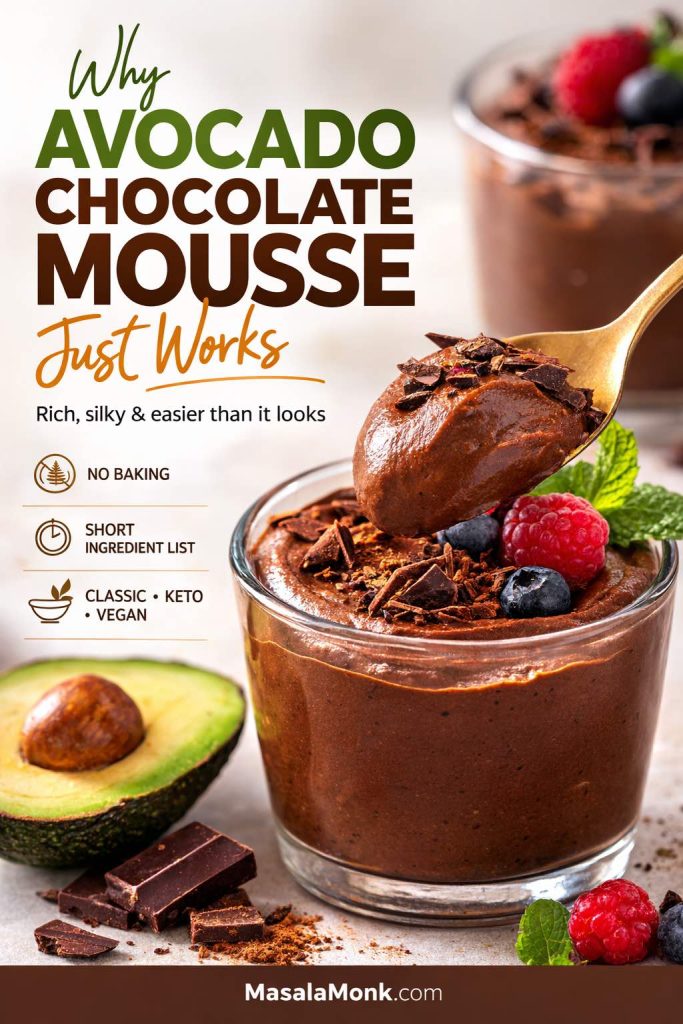
Avocado chocolate mousse in a glass with a spoonful lifted, showing the rich silky texture of this easy no-bake chocolate dessert made with avocado.
If avocado chocolate mousse sounds unusual at first, this is the texture that changes people’s minds. Rich, smooth, and deeply chocolatey, it shows exactly why this dessert feels far more indulgent than its short ingredient list suggests — and why it keeps earning a place as an easy no-bake chocolate dessert for classic, healthy, vegan, and keto versions alike.

Why the best avocado chocolate mousse recipe is more than a shortcut

Suddenly, you are not just following one formula. You are learning how to make avocado chocolate mousse in a way that suits your mood, your pantry, and the kind of dessert you actually want to eat. That difference matters because this is not merely a recipe to complete once. It is the kind of dessert structure you can return to and reshape depending on whether you want something darker, lighter, sweeter, silkier, firmer, or more relaxed.

There is another reason this recipe wins people over so quickly. It does not ask you to compromise on pleasure in order to feel clever about ingredients. The point of avocado and chocolate mousse is not to trick anyone into eating avocado. The point is to make something genuinely delicious. Ripe avocado simply happens to bring a buttery body that works beautifully with chocolate. It gives the dessert structure, fullness, and that velvety glide that makes each spoonful feel richer than the ingredient list would suggest.

Why it keeps surprising people

If you have ever wanted a chocolate dessert that feels lush without becoming heavy, this is where avocado mousse earns its place. It does not rely on spectacle. Instead, it wins on texture, balance, and the quiet satisfaction of a dessert that tastes more luxurious than its effort level suggests. That is why it tends to convert skeptics so quickly. The idea may sound unusual, yet the result feels familiar in all the best ways: creamy, dark, spoonable, and deeply comforting.

Also Read: Mango Margarita Recipe (Frozen or On the Rocks)

Why avocado chocolate mousse works so well

At first glance, avocado and chocolate may seem like an odd pair. Then again, when you think about what avocado really contributes, the pairing starts to make perfect sense. Avocado is mild, creamy, and full-bodied. Chocolate is bold, aromatic, and naturally suited to smooth textures. Put them together, and the avocado becomes less of a flavor and more of a structural advantage. That is why chocolate mousse using avocado can taste so complete even when the ingredient list stays relatively short.

It works because avocado supports rather than dominates

In other words, avocado is there to support the dessert rather than dominate it. When the fruit is ripe, it blends into something almost buttery, giving the mousse a dense silkiness that would otherwise require cream, egg yolks, or another rich base. Serious Eats makes a similar point in its avocado chocolate mousse recipe, noting that ripe avocados provide rich, buttery body while a small amount of liquid helps the mixture blend smoothly into a velvety dessert.

That is exactly the strength of this recipe: the avocado does not announce itself. Instead, it creates the texture that allows the chocolate to feel more luxurious. For that reason, the dessert often feels more familiar than people expect. You taste chocolate, depth, softness, and a gently creamy finish. The avocado is doing important work, yet it is doing it quietly.
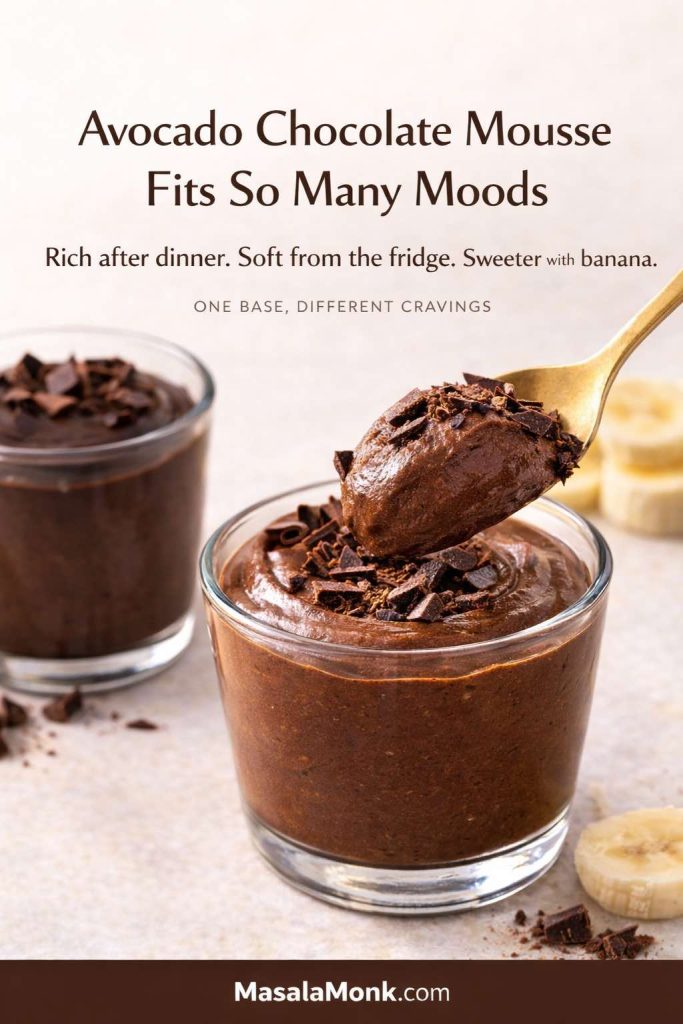
Editorial avocado chocolate mousse image showing a rich glossy chocolate mousse in a glass with a spoon lifting a silky scoop, with subtle banana and chocolate cues to show how the dessert can shift between richer, softer, and sweeter moods.
Avocado chocolate mousse is one of those rare desserts that can shift with your craving without losing what makes it special. This image supports the idea that the same creamy chocolate base can feel polished enough for after-dinner dessert, soft enough for a chilled fridge treat, or gentler and sweeter with banana — which is exactly why avocado chocolate mousse keeps earning a place as a flexible, easy, deeply satisfying no-bake chocolate dessert.

Why it tastes fuller than many quick desserts

Moreover, avocado has enough fat to round out the sharper edges of cocoa. A cocoa-only dessert can sometimes feel dry on the palate or slightly harsh if the sweetness is low. By contrast, avocado and chocolate mousse tends to feel softer and fuller, with the bitterness of the cocoa tucked into a creamier frame. That is one reason even a simple avocado cocoa mousse can taste far more finished than its ingredient list might suggest.

That versatility is one of the biggest strengths of the dessert. In a healthy avocado chocolate mousse, the avocado keeps the texture creamy even when the sweetness is dialed back. A keto avocado chocolate mousse benefits from that same richness, especially when sugar is no longer doing part of the heavy lifting. Meanwhile, in a vegan avocado chocolate mousse, avocado gives the dessert body and silkiness without relying on cream or eggs. In every case, the same ingredient solves a slightly different problem.

The texture is its real secret

Texture matters every bit as much as flavor here. A classic mousse often depends on trapped air. Avocado mousse works differently. It is not airy in the same whipped sense, yet it still feels elegant because the texture is dense, glossy, and smooth rather than flat or stodgy. That difference is important. This is not trying to mimic a French mousse exactly. Instead, it offers its own style of richness—quietly thick, spoonable, and satisfying in a more immediate way.

Why it is such a practical dessert

There is also a practical reason the recipe works so well. Because avocado is already soft and creamy, the path from ingredients to dessert is short. You do not need to temper eggs, whip cream, or set gelatin. You do not even need a stovetop. With a blender or food processor, the mixture comes together in minutes. That ease is part of why avocado mousse recipe variations show up in so many kitchens, from quick weekday desserts to low-carb meal-prep sweets to plant-based chocolate treats that do not feel like substitutes.

Also Read: Sourdough Pizza Dough Recipe (Crispy Crust & Easy Pizza Base)

What avocado adds to chocolate mousse

Avocado brings three main gifts to this dessert: body, balance, and calm. Those gifts may sound understated, yet together they are exactly what make the dessert work. Without avocado, the mixture could still taste chocolatey. What it would lack is that quiet sense of completeness—the feeling that the mousse is not merely blended, but beautifully held together.
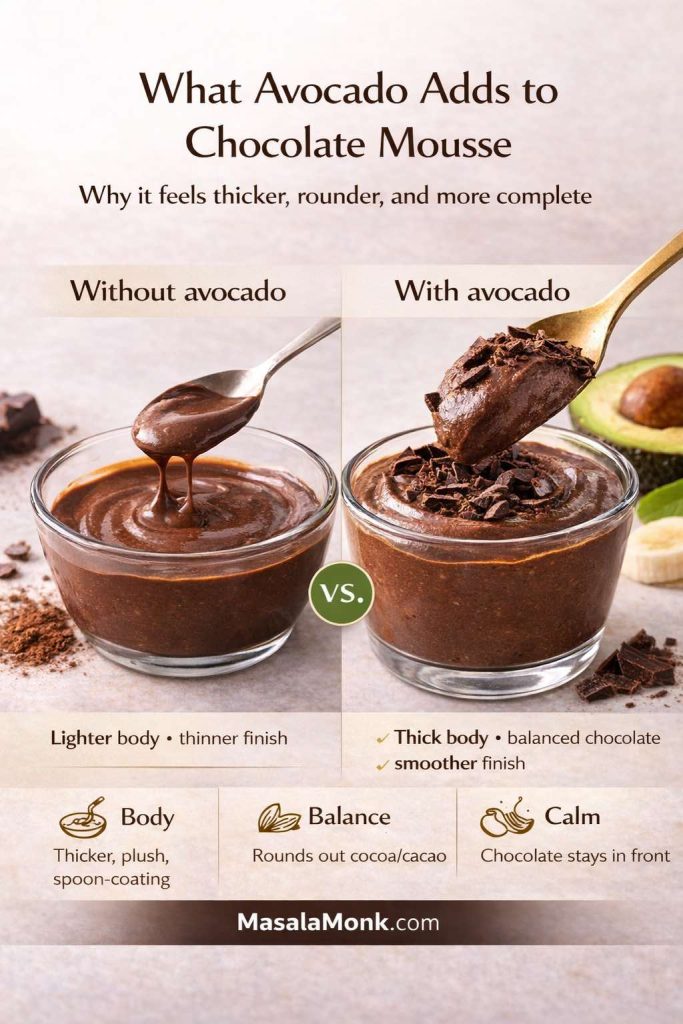
This visual shows why avocado chocolate mousse feels more complete than a simple chocolate cream. Without avocado, the mixture stays thinner and lighter in body. With avocado, the mousse becomes thicker, silkier, and more spoon-coating, while also helping cocoa or cacao taste rounder and less harsh. It is a useful quick-reference image for readers who want to understand what avocado actually adds to chocolate mousse beyond novelty: body, balance, and a calmer chocolate-first finish.

Body: why this mouse feels so plush

The body is obvious the moment the mixture starts blending. Ripe avocado thickens the dessert almost immediately. It gives the mousse that plush, spoon-coating texture that makes the chocolate linger rather than disappear too fast. Without it, cocoa and sweetener mixed with a little milk would taste more like a drinkable chocolate cream. With avocado, the mixture becomes mousse.

That body is also why avocado chocolate mousse can feel generous even in small portions. It does not need a huge bowl to satisfy. A few spoonfuls already feel rich, which makes it a particularly nice dessert when you want something intense but not overwhelming.

Balance: why avocado softens cocoa and cacao

Balance is the less visible part. Chocolate, especially dark cocoa or cacao, can sometimes feel one-dimensional when it is not paired with enough fat or enough sweetness. Avocado fills that gap. It softens the harsher notes and spreads the flavor more evenly across the palate. That is why even a healthy chocolate mousse can still feel lush when avocado is doing the heavy lifting.

This becomes especially useful when you start experimenting with avocado and cacao mousse or darker chocolate versions. The stronger the chocolate note becomes, the more helpful that avocado balance feels. It turns the dessert from merely intense into genuinely pleasurable.

Calm: why this recipe does not taste aggressively fruity

Then there is the calm avocado brings to the flavor. Avocado is gentle. It does not carry a strong perfume or a bright fruit acidity. It stays soft around the edges. That softness is exactly what allows chocolate to sit in front. In fact, when the avocado is ripe and the proportions are right, the dessert reads as chocolate first, avocado almost not at all.

Sugar Free Londoner makes the same reassurance central to its version, saying that you cannot taste the avocado when the ingredients are balanced properly. That promise sounds bold until you actually make a good batch and realize how true it is. The avocado is present, certainly, but more as texture and background than as a leading flavor.

A gentle nutrition bonus

From a nutrition standpoint, avocado also contributes fiber and unsaturated fat. Harvard’s avocado overview notes that avocados are rich in monounsaturated fat and fiber, two reasons they are often included in meals that aim to be both satisfying and balanced. The USDA’s avocado entries similarly show the fruit’s broader nutrient profile. Still, the real reason to choose avocado in this recipe is not to turn dessert into a lecture. It is to make the dessert creamy in a way that feels natural.

Why avocado chocolate mousse feels luxurious without becoming heavy

That last point matters because it gets to the heart of why this dessert is so appealing. Plenty of chocolate desserts are rich. Fewer manage to feel rich and light on effort at the same time. Avocado mousse finds that balance beautifully. It delivers the sensation of indulgence without the heaviness that can follow more cream-laden desserts. As a result, it feels both comforting and surprisingly clean on the palate.

Also Read: Balti Paneer Gravy (Restaurant-Style, Creamy + Bold Recipe)

Ingredients for avocado chocolate mousse

The beauty of this dessert lies in how few ingredients it asks from you. Nonetheless, each one has a precise role. Remove one or choose carelessly, and the mousse can become dull, bitter, or oddly thick. Get them right, and the result is the kind of avocado chocolate mousse recipe you can memorize after one or two rounds.

Ripe avocado

Everything begins with the avocado. It needs to be ripe, but not tired. When gently pressed, it should yield slightly rather than fight back. The flesh inside should look clean and mostly green, with no tough strings and no sour smell. If the avocado is underripe, the mousse will taste greener, blend less smoothly, and stubbornly hold onto a vegetable-like edge no amount of cocoa can completely hide. If it is overripe, the flavor becomes muddy and the freshness disappears.

The California Avocado Commission offers practical advice for choosing a ripe avocado, recommending fruit that yields to gentle pressure without feeling mushy. That is the exact sweet spot you want here. If you have ever wondered why one avocado mousse healthy recipe tastes elegant while another feels rough and vaguely grassy, ripeness is often the missing answer.
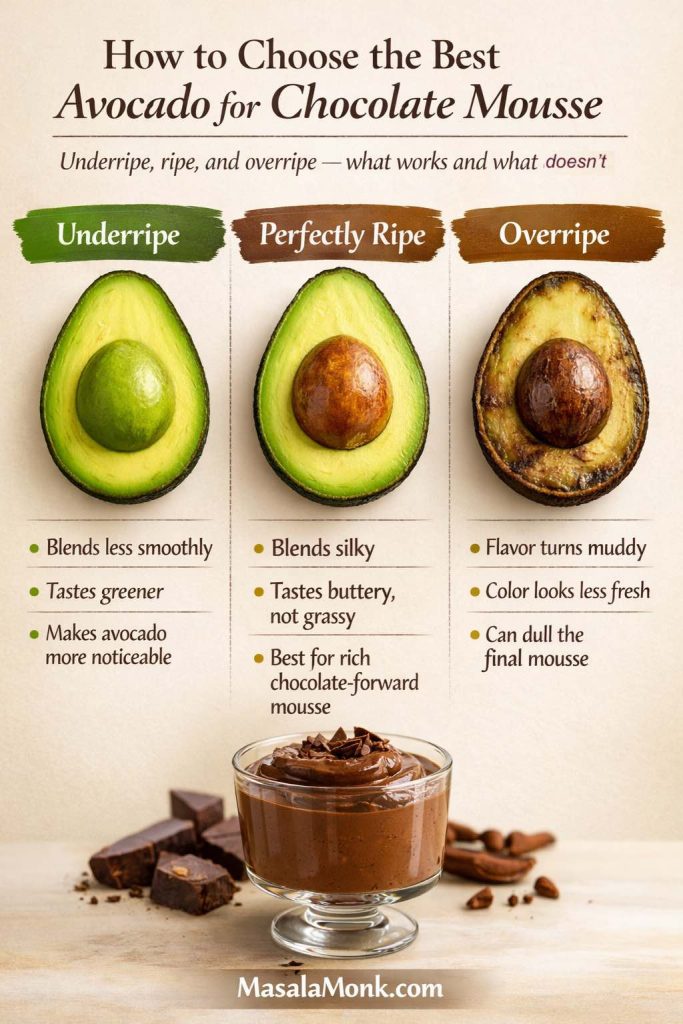
Ingredient guide infographic showing how to choose the best avocado for avocado chocolate mousse by comparing underripe, perfectly ripe, and overripe avocados, with notes on blending, flavor, and how ripeness affects mousse texture and chocolate-forward taste.
Choosing the right avocado is one of the biggest reasons avocado chocolate mousse turns out silky, rich, and chocolate-forward instead of grassy or uneven. A perfectly ripe avocado blends smoothly, tastes buttery rather than green, and gives the mousse its best texture from the start, while underripe or overripe fruit can pull the dessert off balance.

Cocoa, cacao, or dark chocolate

Next comes the chocolate element, and this is where the personality of the dessert starts to reveal itself. Cocoa powder gives the mousse a clean, direct chocolate character. It keeps the ingredient list short and lets the avocado handle the bulk of the texture. Cacao powder can be used in much the same way, although it often tastes a little earthier and more intense. That makes avocado and cacao mousse especially appealing if you like a darker, slightly less sweet finish.
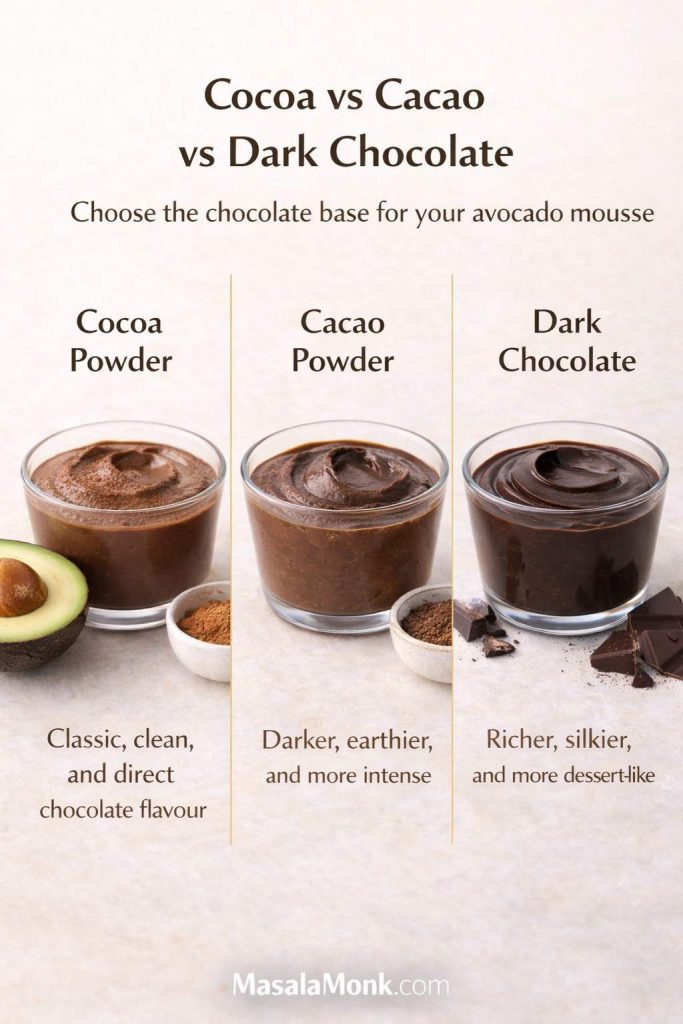
This avocado chocolate mousse comparison card helps you choose the chocolate base that fits the kind of dessert you want to make. Cocoa powder gives a classic, clean chocolate flavour, cacao powder makes the mousse darker and more intense, and dark chocolate creates the richest, silkiest, most dessert-like finish. It is a useful visual guide for readers deciding between avocado cocoa mousse, avocado cacao mousse, or a richer avocado dark chocolate mousse before they start blending.

Melted dark chocolate, on the other hand, changes the entire mood. The mousse becomes fuller, smoother, and more dessert-shop-like. It reads as more decadent, more polished, and a touch less wholesome in the best possible sense. Feel Good Foodie takes that route by using melted dark chocolate in its version, creating a mousse that leans closer to a classic chocolate dessert while still relying on avocado for creaminess.

If you enjoy understanding the difference between these chocolate paths, the MasalaMonk guide on cacao vs chocolate vs dark chocolate is a useful companion. Likewise, homemade hot chocolate with cocoa powder is a good reminder that cocoa intensity can vary more than people expect. Serious Eats also has a helpful explanation of Dutch vs natural cocoa powder, which matters because cocoa type influences not only bitterness and depth but also the final color of the mousse.

Sweetener options for avocado chocolate mousse

Sweetener does far more than make the mousse sweet. It balances bitterness, softens the green edge of the avocado, and helps determine whether the dessert feels sleek or heavy.

Maple syrup is one of the easiest choices because it blends smoothly and adds a gentle warmth. Honey works well if you are not making a vegan avocado chocolate mousse. Dates can be lovely in an avocado and chocolate pudding style version, although they pull the texture toward something thicker and more comfort-food-like. If you are aiming for keto avocado chocolate mousse, a powdered or liquid low-carb sweetener is usually better than a gritty granulated one.

This is one of those ingredients that deserves attention because under-sweetening is a common reason avocado chocolate mousse healthy versions disappoint people. The issue is not that they are healthier. The issue is that insufficient sweetness leaves bitterness unchecked and makes the avocado more noticeable. A mousse does not need to be sugary, but it does need balance.
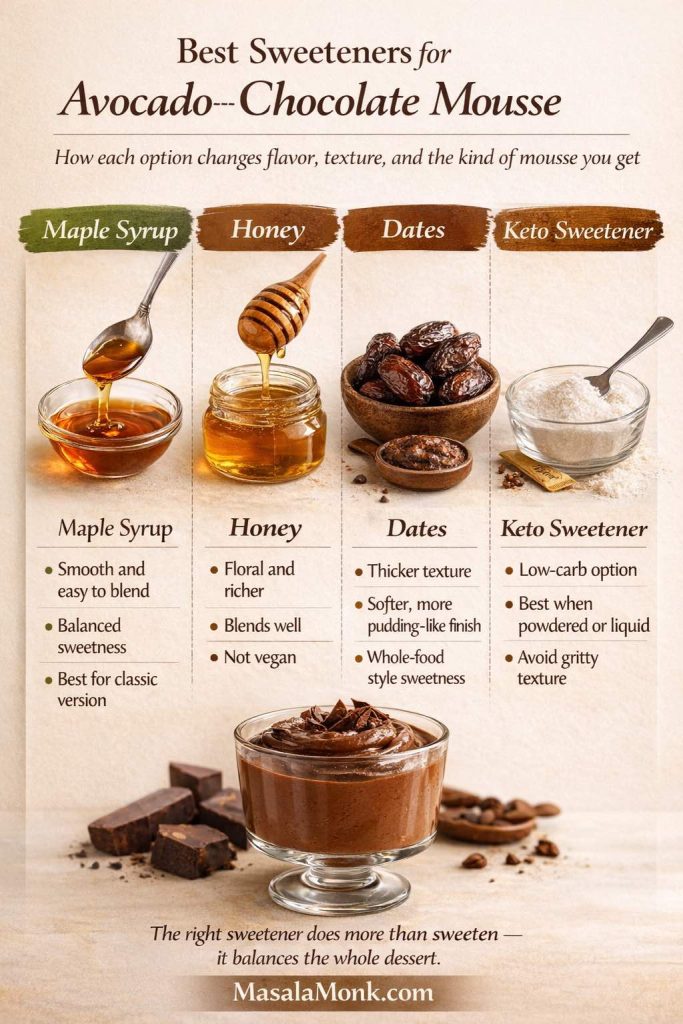
Sweetener guide infographic for avocado chocolate mousse comparing maple syrup, honey, dates, and keto sweetener, with notes on flavor, texture, blending, and which type of mousse each option suits best.
The sweetener in avocado chocolate mousse does much more than make the dessert sweet. It helps balance bitterness, softens how noticeable the avocado tastes, and influences whether the final texture feels silky, rich, pudding-like, or better suited to a keto version. This guide compares maple syrup, honey, dates, and keto sweetener so readers can choose the option that best matches the kind of avocado chocolate mousse they want to make.

Milk or another liquid

A small amount of liquid gives you control. Too little and the blender may struggle. Too much and the dessert slides from mousse toward pudding. Almond milk works beautifully in keto avocado mousse and vegan avocado mousse because it keeps the flavor clean. Coconut milk brings extra richness and makes the dessert feel more luxurious. Dairy milk works perfectly well if you are not trying to keep the recipe dairy-free.

The liquid choice also nudges the flavor. Almond milk stays neutral. Oat milk makes the mousse a little softer and slightly sweeter. Coconut milk makes everything feel fuller, almost truffle-like, especially when paired with dark chocolate.
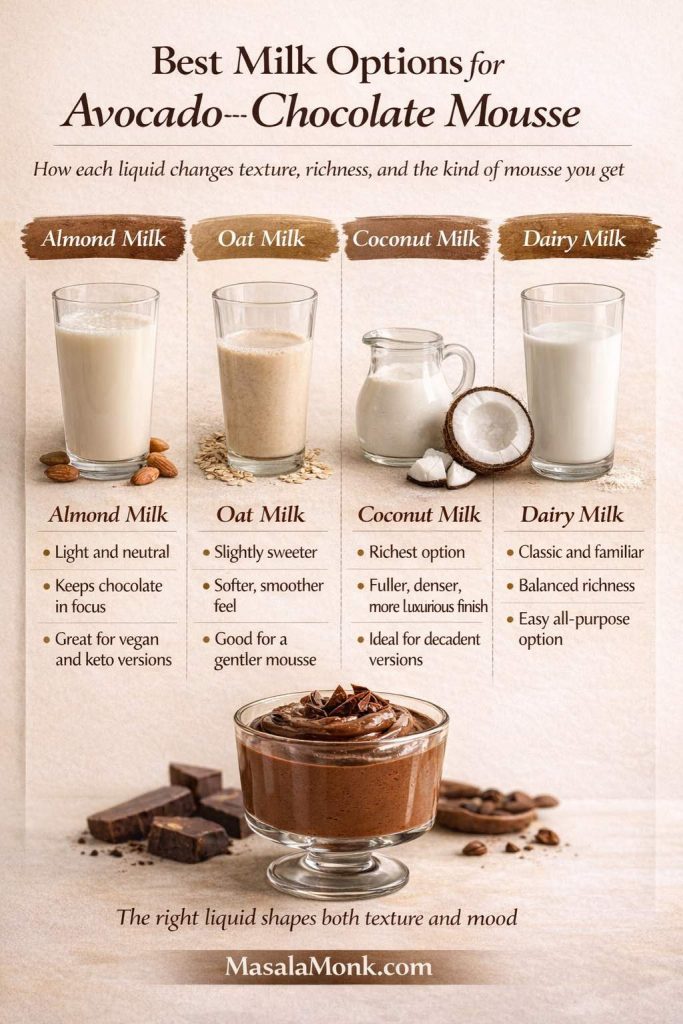
Milk options guide for avocado chocolate mousse comparing almond milk, oat milk, coconut milk, and dairy milk, with notes on how each liquid affects texture, richness, flavor balance, and the final mousse style.
The liquid in avocado chocolate mousse does more than help the blender move. It shapes the texture, richness, and overall feel of the dessert. Almond milk keeps the finish light and chocolate-forward, oat milk makes it softer and gentler, coconut milk brings the richest, most luxurious texture, and dairy milk offers a familiar middle ground.

Vanilla and salt

These seem minor, but they are not optional in spirit. Vanilla deepens the chocolate and softens the avocado. Salt sharpens everything into focus. Without them, even a technically correct avocado mousse recipe can taste flat. With them, the dessert becomes more complete.

Also Read: Mojito Recipe (Classic) + Ratios, Pitcher, Mocktail & Easy Variations

How to make avocado chocolate mousse

The actual method is uncomplicated, which is one reason this dessert is so easy to love. Even so, the best avocado chocolate mousse recipe comes from respecting the sequence rather than dumping everything in carelessly and hoping for the best.
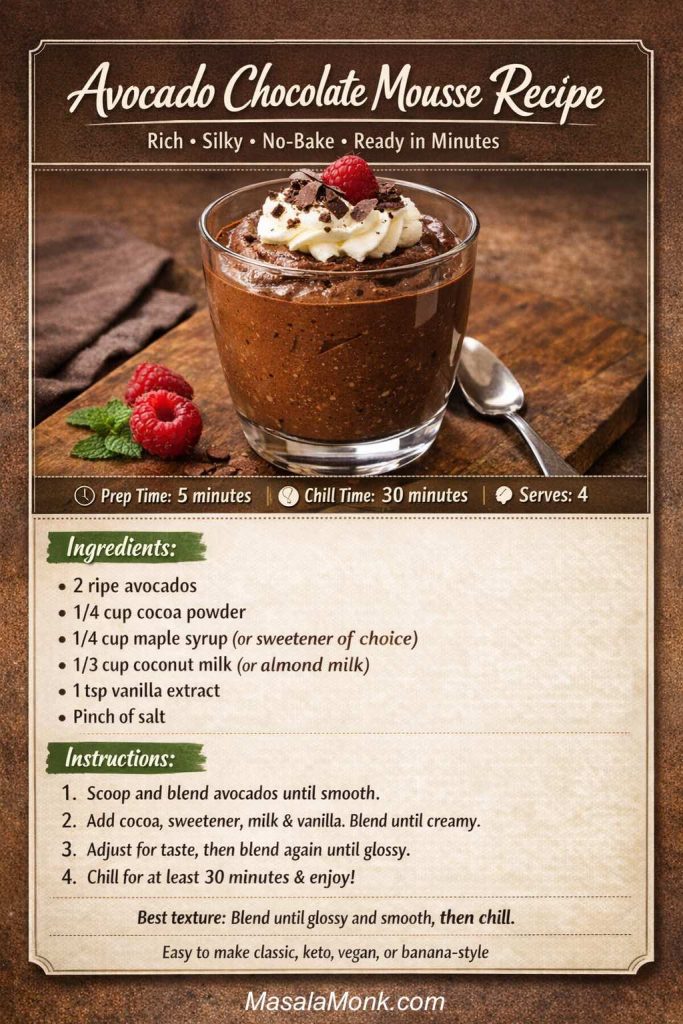
Avocado chocolate mousse recipe card showing a rich no-bake chocolate dessert made with ripe avocado, cocoa powder, maple syrup, milk, vanilla, and salt, with quick prep time, chill time, servings, ingredients, and simple step-by-step instructions.
This avocado chocolate mousse recipe card gives you the full dessert at a glance, including ingredients, prep time, chill time, and an easy step-by-step method for making a rich, silky, no-bake chocolate mousse with avocado. It is a useful visual summary for readers who want the recipe in one place before following the detailed method, and it also works beautifully as a saveable Pinterest asset for avocado chocolate mousse, healthy chocolate mousse, and no-bake chocolate dessert inspiration.

Step 1: Choose and prep the avocado

Cut the avocado, remove the pit, and scoop the flesh into a blender or food processor. Before you move on, take a moment to inspect what you have. If there are dark strings, discolored spots, or a sour smell, it is worth starting with another fruit. A clean avocado gives the mousse a clean finish.

This may sound like a small point, yet it matters more than almost anything else. If you want to know how to make avocado chocolate mousse that tastes undeniably dessert-like, begin with fruit that tastes neutral and buttery rather than aggressively green.
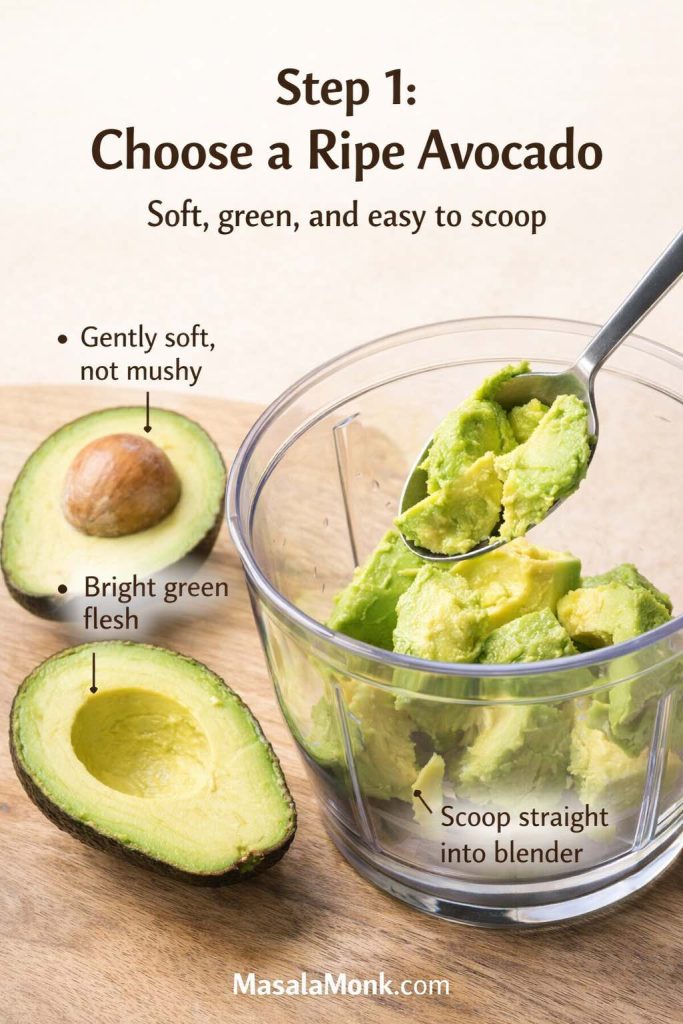
Step 1 image for avocado chocolate mousse showing ripe avocado halves with bright green flesh being scooped into a blender, with simple guidance on choosing soft avocados and prepping them for a smooth chocolate mousse.
Step 1 for avocado chocolate mousse starts with ripe avocado that is soft, green, and easy to scoop. This visual helps readers see exactly what kind of avocado works best, because good ripeness is one of the biggest reasons avocado chocolate mousse turns out silky, rich, and less noticeably avocado-forward.

Step 2: Add cocoa, sweetener, vanilla, salt, and a little liquid

Add your cocoa powder, cacao, or melted dark chocolate, depending on the version you want. Then add your sweetener, vanilla, a pinch of salt, and just enough liquid to help the blender begin. Resist the urge to pour in too much milk at this stage. The mixture can always be loosened, but thickening it again is not so easy.

A simple avocado chocolate mousse recipe can be beautifully satisfying with nothing more than cocoa powder and maple syrup. If you want a deeper, more luxurious finish, avocado dark chocolate mousse made with melted chocolate is a lovely direction to take. For a keto chocolate mousse avocado version, unsweetened cocoa, almond milk, and a smooth low-carb sweetener create a strong, reliable base.
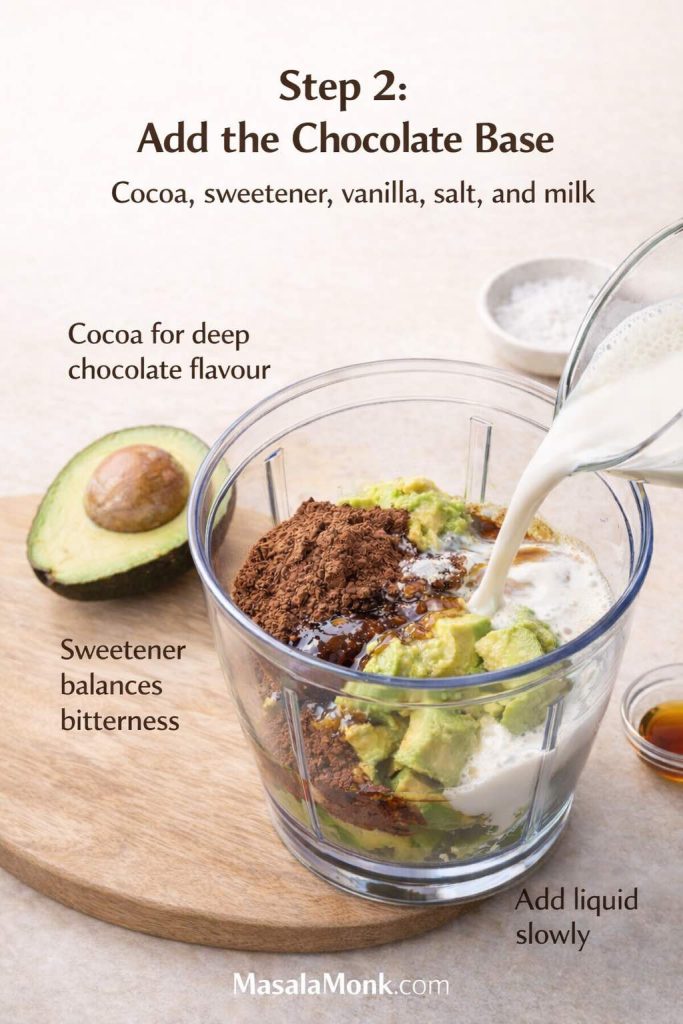
Step 2 for avocado chocolate mousse shows how the chocolate base comes together with avocado, cocoa, sweetener, and milk before blending. This visual helps readers understand the ingredient build at a glance, especially why cocoa brings deep chocolate flavour, sweetener balances bitterness, and liquid should be added slowly for a thick, silky mousse texture.

Step 3: Blend until completely smooth

Blend. Then blend more. Then scrape down the sides and blend again. The dessert becomes special only when the texture turns fully silky. Any graininess left in the bowl will feel more obvious after chilling.

If the blender struggles, add liquid a teaspoon at a time. This is where patience pays off. A small addition can transform the mixture. Too much, though, and the avocado mousse dessert shifts into pudding territory. That is not inherently a problem—avocado chocolate pudding is delicious in its own right—but the texture choice should be yours.
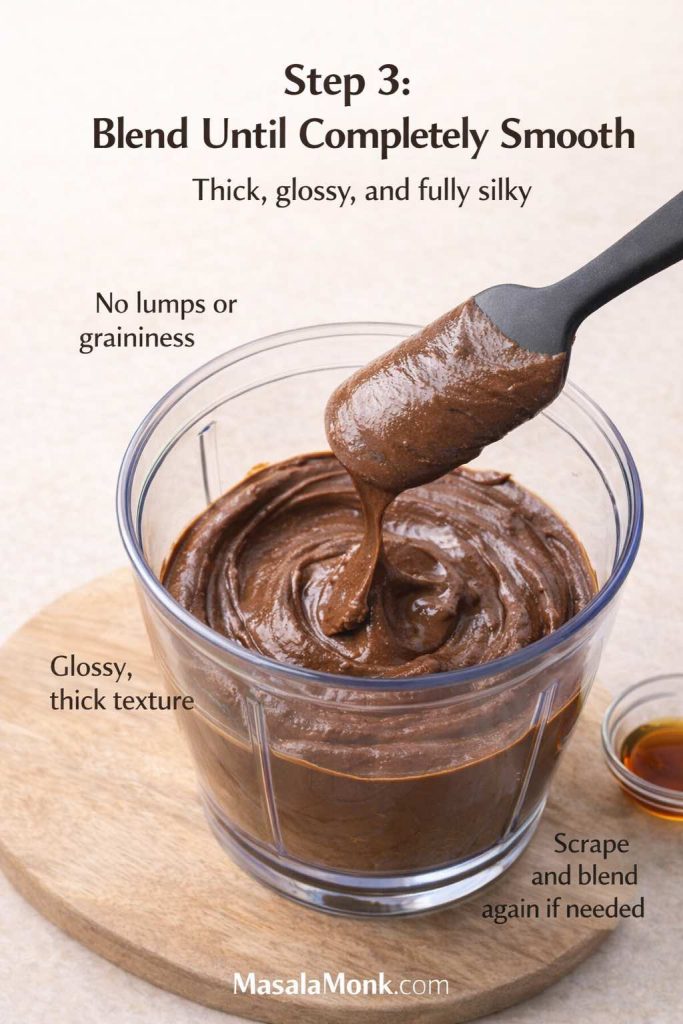
Step 3 for avocado chocolate mousse shows the texture you want before chilling: thick, glossy, and fully smooth, with no lumps or graininess left in the mixture. This visual helps readers judge whether the mousse has been blended enough, which is one of the most important details for getting a silky avocado chocolate mousse instead of a rough or uneven one.

Step 4: Taste and adjust

This is the moment when the recipe starts to feel like your own. Taste the mixture before chilling and adjust it according to what it needs. More sweetener or a small pinch of salt usually helps if the flavor feels too bitter. When the avocado note stands out more than you want, a little extra cocoa, a touch more vanilla, or even some time in the fridge can bring it back into balance. Should the texture seem too dense, loosen it with a small amount of liquid. If it feels softer than expected, let it chill before assuming anything has gone wrong.

This adjustment stage is the difference between following a rigid avocado mousse recipe and understanding how the dessert works. Once you get comfortable here, you stop needing exact formulas.
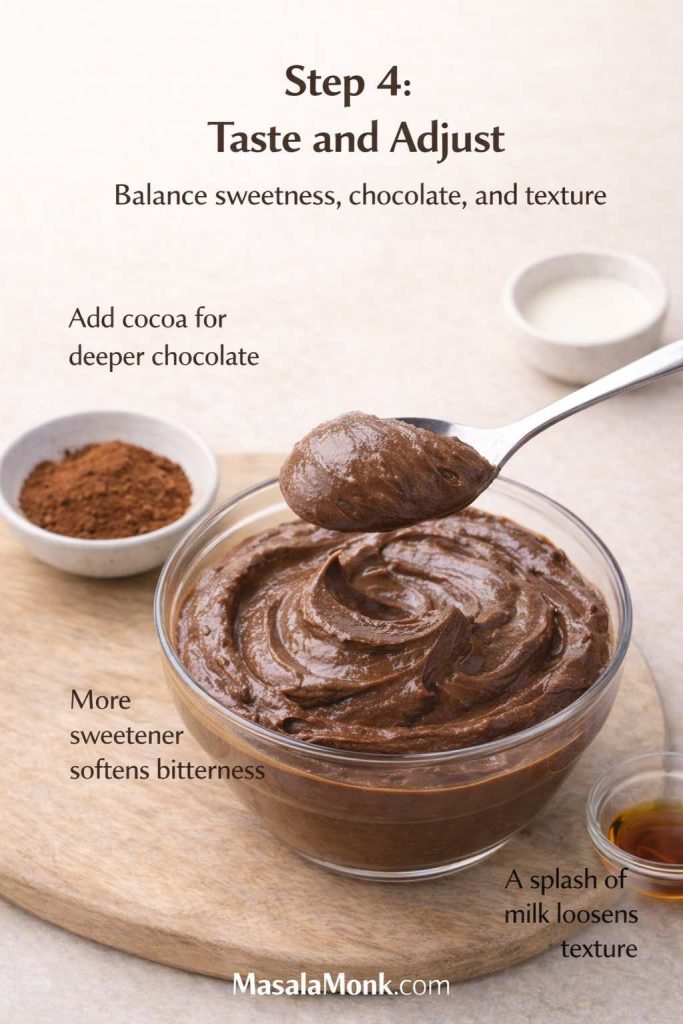
Step 4 image for avocado chocolate mousse showing a spoon tasting the blended mousse with cocoa, sweetener, and milk nearby, illustrating how to adjust chocolate flavour, sweetness, and texture before chilling.
Step 4 for avocado chocolate mousse is where you fine-tune the dessert before it goes into the fridge. This visual shows how to taste the mousse and adjust it with a little more cocoa for deeper chocolate flavour, extra sweetener to soften bitterness, or a small splash of milk to loosen the texture while keeping the mousse rich, smooth, and balanced.

Step 5: Chill the mousse

Transfer the mixture into bowls or glasses and chill. The difference this makes is remarkable. The chocolate flavor settles in, the avocado note recedes even further, and the texture firms into a smoother, more elegant finish.

You can eat it immediately if you want a softer, more casual dessert. Still, avocado chocolate mousse almost always improves with a little cold time. That rest is what helps it become mousse rather than just a freshly blended chocolate cream.
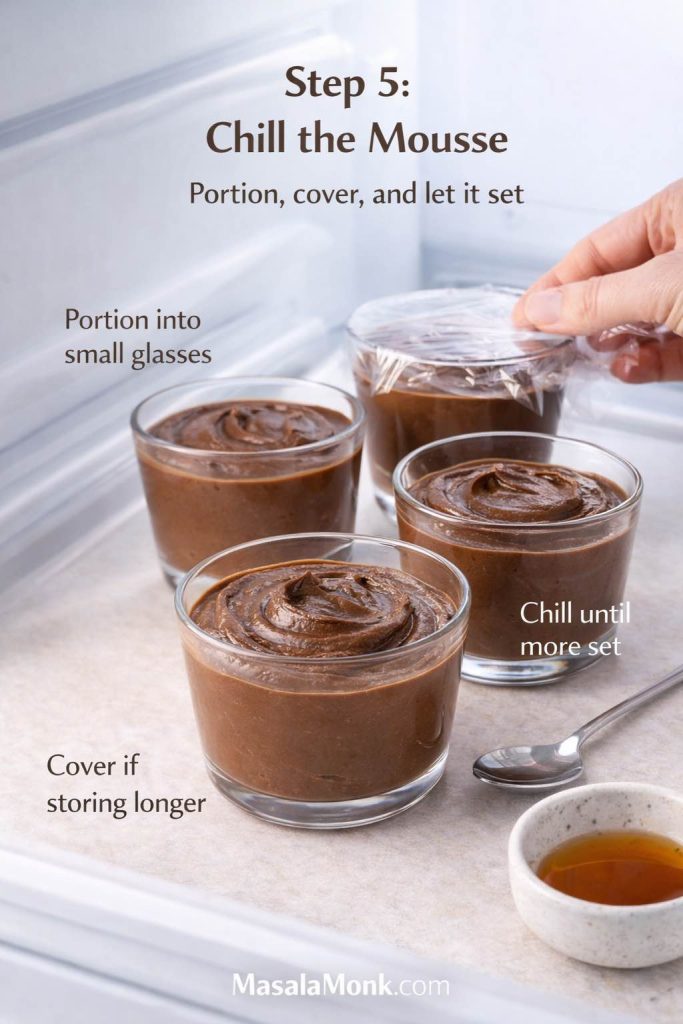
Step 5 for avocado chocolate mousse shows the dessert portioned into small glasses and chilled in the fridge so the texture can firm up and feel more mousse-like. This visual helps readers see that chilling is part of the recipe, not just storage, and that covering the mousse is useful if you plan to keep it in the fridge a little longer before serving.

Step 6: Serve simply

A dusting of cocoa, a few chocolate shavings, chopped nuts, or berries are all you need. The dessert is already doing a lot. A complicated garnish often adds less than people expect. Better to keep the finish clean and let the texture speak.
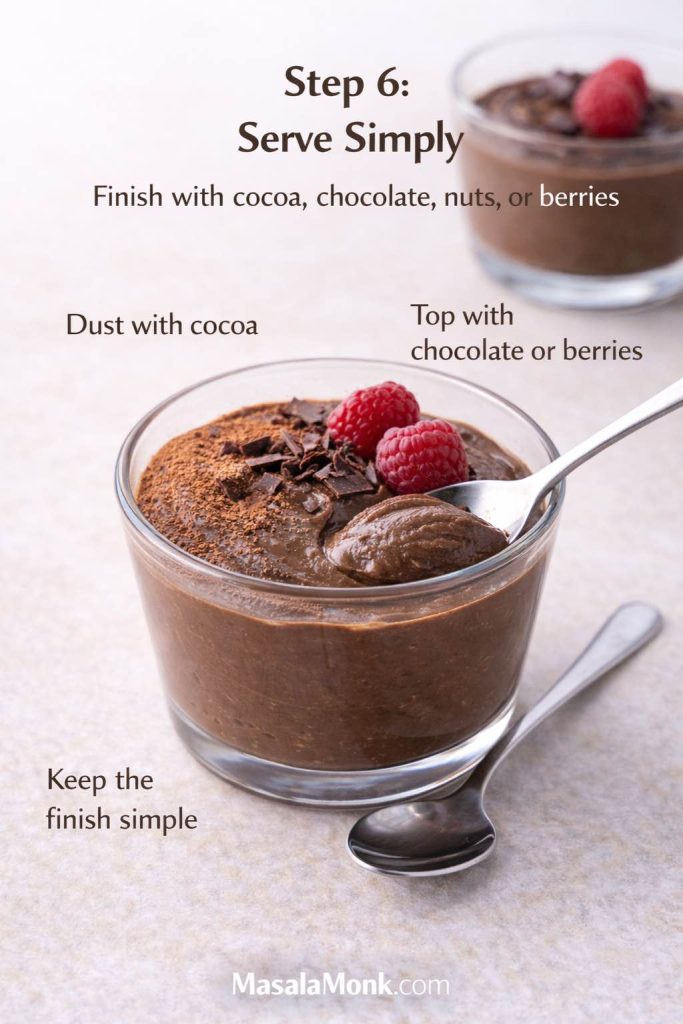
Step 6 for avocado chocolate mousse shows how to finish the dessert simply so the rich, silky texture stays the star. A light dusting of cocoa, a few chocolate shavings, or a small berry topping is enough to make avocado chocolate mousse feel polished, elegant, and ready to serve without overcomplicating the final dessert.

How smooth avocado chocolate mousse should look before chilling

Before it goes into the fridge, the mousse should look glossy and thick. It should move slowly off a spoon, neither sitting like frosting nor flowing like a drink. If you drag a spoon through it, the path should hold briefly before softening.
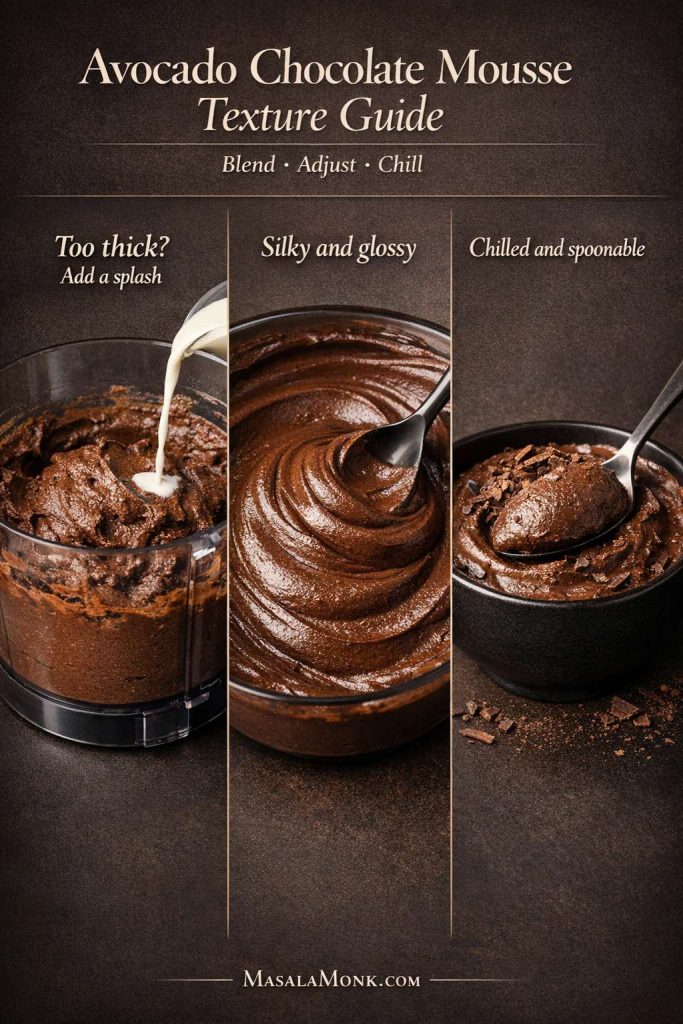
This avocado chocolate mousse texture guide shows exactly what to look for at each stage so the dessert turns out smooth, rich, and spoonable instead of too stiff or too loose. The first panel shows when your avocado chocolate mousse is too thick and needs a small splash of liquid. The second shows the ideal silky, glossy texture after blending. The third shows the final chilled avocado chocolate mousse texture that should hold softly on a spoon and feel ready to serve. Use this visual guide while making the recipe so you can adjust with confidence and get a better avocado chocolate mousse every time.

That visual cue matters because many people assume they need an extremely stiff mixture before chilling. In reality, the fridge will help the mousse set. On the other hand, if the mixture already pours easily like a milkshake, it is probably headed toward avocado and chocolate pudding instead of mousse.

There is nothing wrong with that softer result. In fact, recipe for avocado chocolate pudding variations can be wonderful, especially when banana, dates, or extra milk are involved. Yet if your goal is avocado chocolate mousse, aim for thickness with a little movement, not density without flow.

Why avocado chocolate mousse can taste better after chilling

This dessert has a quiet magic after time in the fridge. Freshly blended, it often tastes good. Chilled, it tastes finished. The cold firms the avocado, the cocoa settles, and the sweetness feels more integrated.

In addition, chilling gives the avocado’s mild flavor even less room to stand out. This is part of why people sometimes judge the mousse too early. A warm or room-temperature batch may still seem a little greener than they want. After chilling, that concern often fades dramatically.

Feel Good Foodie recommends chilling its version for exactly this reason, noting that the texture becomes thicker and more mousse-like after some time in the refrigerator. The same logic applies across almost every version of this dessert.

Also Read: Paloma Recipe: 12 Paloma Cocktail Drinks

Tips for the best avocado chocolate mousse

The best avocado mousse recipe is less about complexity and more about paying attention in the right places.

Start with a ripe avocado. Choose cocoa or chocolate you actually enjoy. Use enough sweetener to balance, not merely decorate. Blend thoroughly. Chill before judging. Season with salt and vanilla. These are not glamorous insights, yet they are exactly what separate a beautiful avocado chocolate mousse recipe from one that feels merely functional.

It is worth remembering that ingredients never behave in exactly the same way from batch to batch. One avocado may be larger and creamier than the next, while one cocoa powder may taste softer and another darker and more bitter. Sweeteners vary too, with some blending in cleanly and others leaving a more noticeable finish. Because of that, the smartest approach is not to force every version into one rigid expectation, but to understand the structure and adjust with confidence.

That flexibility is the secret strength of mousse made with avocado. Once you understand the moving parts, the recipe becomes easy to improvise. It can turn darker, softer, sweeter, firmer, more minimal, or more indulgent without losing what makes it special.

How to keep it from tasting like avocado

This is the question that hovers over nearly every first-time batch, and thankfully the answer is straightforward.

First, use a ripe avocado. This cannot be overstated. Underripe fruit tastes greener and more obvious. Second, use enough chocolate presence. That can mean cocoa powder, cacao powder, melted dark chocolate, or a combination. Third, add enough sweetener to round the bitterness and soften the avocado note. Fourth, do not skip the vanilla and salt. Finally, chill the dessert before deciding whether it tastes too much like avocado.
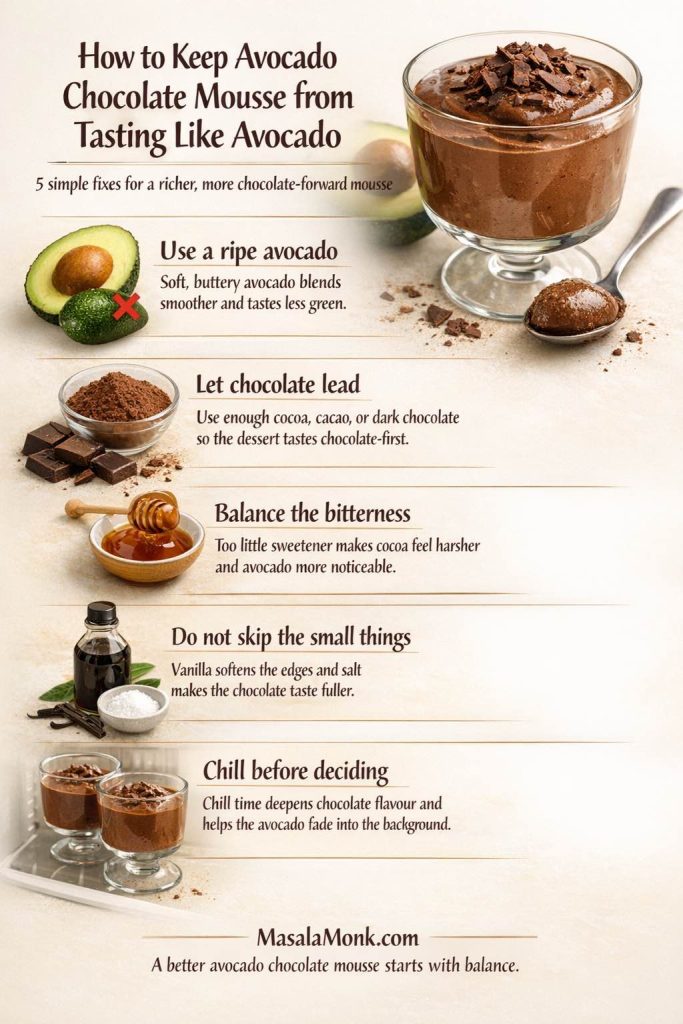
Troubleshooting infographic for avocado chocolate mousse showing five ways to keep the dessert from tasting like avocado, including using ripe avocado, enough chocolate, balanced sweetener, vanilla with salt, and chilling before serving.
If you are worried your avocado chocolate mousse will taste too green, the fix is usually balance rather than disguise. A ripe avocado, enough chocolate, the right amount of sweetness, a little vanilla and salt, and some chill time help the dessert taste rich, smooth, and unmistakably chocolate-forward.

Chocolate Covered Katie also emphasizes that the avocado flavor should disappear beneath the chocolate when the dessert is made properly. That reassurance matters because the idea of avocado chocolate can sound stranger than it tastes. In practice, most people notice the texture far more than the fruit.

If a batch still reads too green, add more cocoa, a little more sweetener, and a drop more vanilla. Those small adjustments often fix the issue faster than adding more liquid ever could.

How to fix avocado chocolate mousse if it tastes bitter

Bitterness usually comes from strong cocoa, insufficient sweetness, or a lack of salt. Occasionally, it also comes from a cacao powder that is more intense than expected.

Start by increasing the sweetener a little. Then add a very small pinch of salt. Taste again. If the mousse still feels sharp, melted dark chocolate can help soften the edges and add a rounder finish. This is especially helpful in avocado cacao mousse versions, where the earthy notes of cacao can feel stern if the sweetness is kept very low.

That said, bitterness is not always a flaw. Some people prefer a darker, more adult finish in avocado dark chocolate mousse. The key is making sure the bitterness feels intentional rather than accidental.
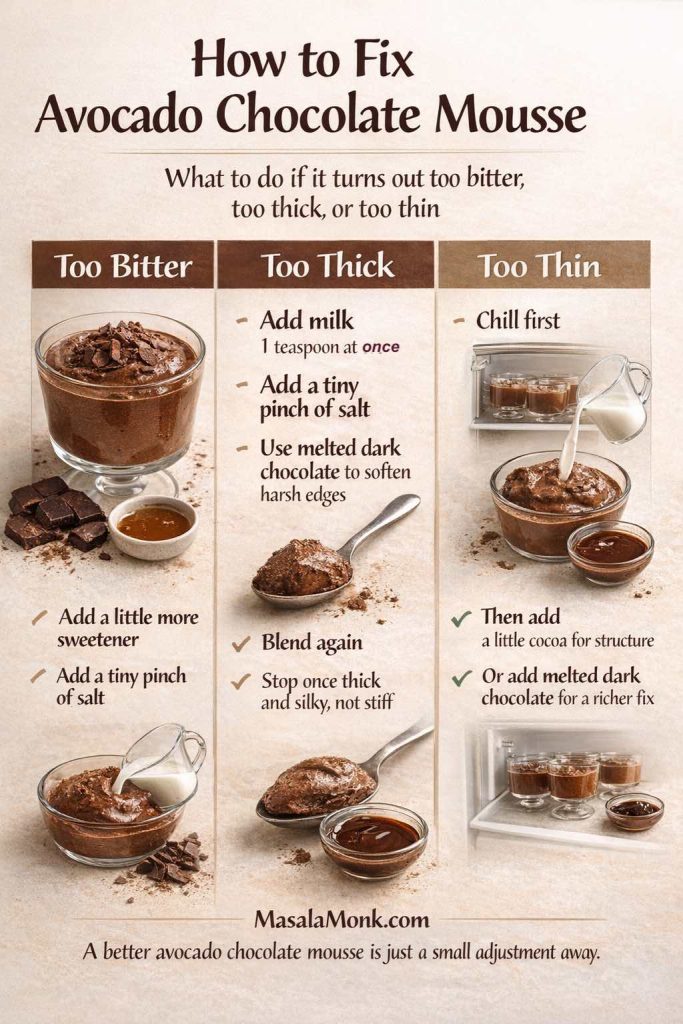
Troubleshooting infographic for avocado chocolate mousse showing how to fix three common problems: mousse that tastes too bitter, mousse that is too thick, and mousse that is too thin, with tips like adding sweetener, salt, milk, cocoa, dark chocolate, and chilling before serving.
If your avocado chocolate mousse turns out too bitter, too thick, or too thin, a few small adjustments can usually bring it back into balance. A little more sweetener or a tiny pinch of salt can soften bitterness, a spoonful of milk can loosen a mousse that feels too dense, and chilling or extra cocoa can help a softer mixture settle into a better texture.

How to adjust avocado chocolate mousse if it is too thick

If the mousse looks heavy, refuses to blend, or feels pasty rather than silky, add liquid in very small increments. Almond milk, oat milk, coconut milk, or dairy milk can all work. What matters is moving slowly.

This is the moment where many recipes go wrong. A big splash of milk feels harmless, yet it can quickly turn mousse made with avocado into chocolate pudding avocado texture. Since the dessert will firm in the fridge, there is no need to chase final texture entirely in the blender. Stop when it feels smooth and thick, not when it seems already set.

Also Read: Tapas Recipe With a Twist: 5 Indian-Inspired Small Plates

How to fix this mousse if it is too thin

A thin mousse usually comes from too much liquid, an oversized avocado relative to the chocolate, or a sweetener that loosens the mixture more than expected.

The simplest fix is chilling. Quite often, the mousse thickens enough after resting. If that is not enough, add a little more cocoa powder or a small amount of melted dark chocolate and blend again. Either choice will strengthen the structure. Cocoa keeps the recipe lighter. Dark chocolate makes it richer.

This is also where the dessert begins to define itself. If the texture is soft but luscious, you may decide to embrace it as avocado chocolate pudding rather than force it into a firmer mousse identity.
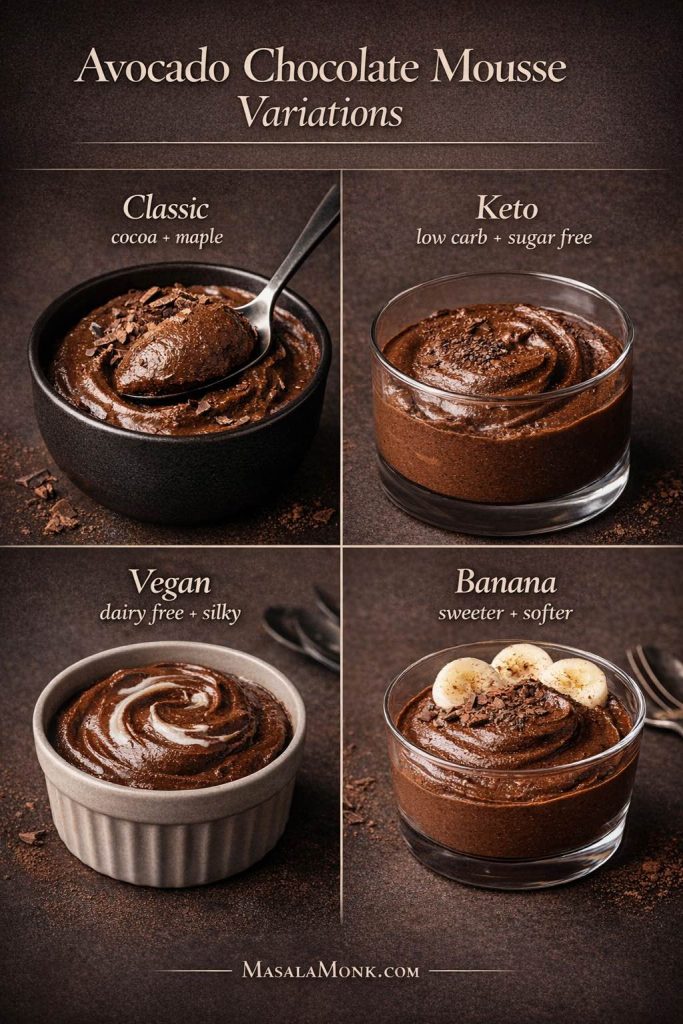
This avocado chocolate mousse variations guide makes it easy to choose the version that fits your mood and ingredients. The classic avocado chocolate mousse leans rich and balanced with cocoa and maple, the keto avocado chocolate mousse keeps things low carb and sugar free, the vegan avocado chocolate mousse stays silky without dairy, and the banana version turns softer, sweeter, and more comfort-led. Use this card as a quick visual reference before you begin, then follow the full avocado chocolate mousse recipe below for texture tips, ingredient swaps, and step-by-step guidance for each variation.
This avocado chocolate mousse variations guide makes it easy to choose the version that fits your mood and ingredients. The classic avocado chocolate mousse leans rich and balanced with cocoa and maple, the keto avocado chocolate mousse keeps things low carb and sugar free, the vegan avocado chocolate mousse stays silky without dairy, and the banana version turns softer, sweeter, and more comfort-led. Use this card as a quick visual reference before you begin, then follow the full recipe below for texture tips, ingredient swaps, and step-by-step guidance for each variation.

Keto avocado chocolate mousse

A keto avocado chocolate mousse can feel every bit as indulgent as the classic version, which is part of its charm. The avocado already supplies richness, so you do not need sugar to make the dessert satisfying. Instead, the focus shifts to choosing the right sweetener and keeping the texture smooth.

Use unsweetened cocoa or dark chocolate, a keto-friendly sweetener that dissolves cleanly, and a modest amount of unsweetened almond milk or coconut milk. That foundation creates a mousse that feels rich and chocolatey rather than compromise-driven. If you enjoy other low-carb chocolate comforts, recipes like keto hot chocolate or keto chia pudding with almond milk live in a similar neighborhood of satisfying, creamy simplicity.

The most common pitfall in keto avocado mousse is a gritty texture from the sweetener. Powdered or liquid sweeteners tend to solve that immediately. Sugar Free Londoner leans into this low-carb direction, highlighting the recipe’s keto credentials and pudding-like creaminess while keeping the ingredient list compact. That overlap between mousse and pudding is actually useful because keto avocado chocolate mousse can drift either way depending on how much liquid you use.

Best milk options for keto version

Almond milk keeps the flavor neat and understated. Coconut milk makes the dessert thicker and richer, especially in a dark chocolate version. Neither is wrong. Almond milk suits a cleaner finish. Coconut milk suits a more luxurious one.

Also Read: Air Fryer Salmon Recipe (Time, Temp, and Tips for Perfect Fillets)

Healthy avocado chocolate mousse

Healthy avocado chocolate mousse can mean different things depending on the cook, and that flexibility is part of its appeal. For one person, it may mean using less refined sugar. For someone else, it may be a dairy-free chocolate dessert that still feels rich and satisfying. Another cook may define it through ingredients that feel more familiar, whole, or minimally processed. The beauty of the recipe is that it can comfortably hold all of those interpretations.

Maple syrup is a lovely option when you want sweetness without sharpness. Dates make the mousse feel more rustic and whole-food-driven, though they also thicken it and nudge it toward pudding. Cacao powder can make the flavor feel more robust and slightly less sweet, which some people love in a healthy avocado mousse. Meanwhile, dark chocolate can be used in moderation to create a richer dessert without abandoning that more wholesome spirit.

Harvard’s overview of dark chocolate explains that cocoa-rich chocolate contains flavanols, although the amount can vary depending on processing. Harvard Health also notes that cocoa powder is a source of beneficial compounds, though dessert should still be enjoyed with perspective rather than grand claims. That is the right tone for this recipe. A healthy chocolate mousse is still dessert. It just happens to be one that can fit beautifully into a balanced way of eating.

If you enjoy that broader better-for-you dessert lane, healthy oat protein bars and high-protein overnight oats offer different kinds of creamy or satisfying sweetness without leaving the comfort-food world behind.

Cocoa powder vs dark chocolate in healthy variant

Cocoa powder gives you a cleaner ingredient line and a sharper chocolate profile. Melted dark chocolate creates deeper richness and a more classic dessert feel. If you want the best of both, use cocoa as the main base and a little dark chocolate for depth. That combination often produces the best avocado chocolate mousse recipe for people who want both flavor and restraint.

Vegan avocado chocolate mousse

Vegan avocado chocolate mousse is one of the easiest versions to make because avocado does most of the work that dairy would normally do. Use maple syrup or another vegan sweetener, choose almond milk, oat milk, or coconut milk, and make sure your dark chocolate is dairy-free if you decide to use it.

The result can be deeply satisfying, not merely acceptable. In fact, avocado mousse vegan versions often feel especially natural because nothing about the recipe depends on eggs or cream to begin with. The avocado already makes the dessert lush. The rest is simply a matter of balance.

For readers who enjoy dairy-free chocolate baking and desserts beyond mousse, vegan chocolate cake recipes offer another useful trail through that world. The relationship is not one-to-one, of course, but the same broader idea applies: plant-based chocolate desserts can feel rich, complete, and fully dessert-like when texture is handled properly.

Best dairy-free milk for vegan alternative

Almond milk is clean and neutral. Oat milk is softer and naturally a bit sweeter. Coconut milk makes the mousse richer and denser. Choose based on the finish you want rather than chasing a universal rule.

Also Read: Masterclass in Chai: How to Make the Perfect Masala Chai (Recipe)

Avocado chocolate pudding vs avocado chocolate mousse

This distinction matters more than it might seem. Some recipes live clearly in mousse territory. Others are really avocado chocolate pudding with a more elegant name. Still others sit right in the middle.

Mousse should hold shape on the spoon, feel thick and velvety, and become slightly firmer after chilling. Pudding should feel softer, looser, and more comfort-oriented. Neither is inherently better. They simply scratch different itches.
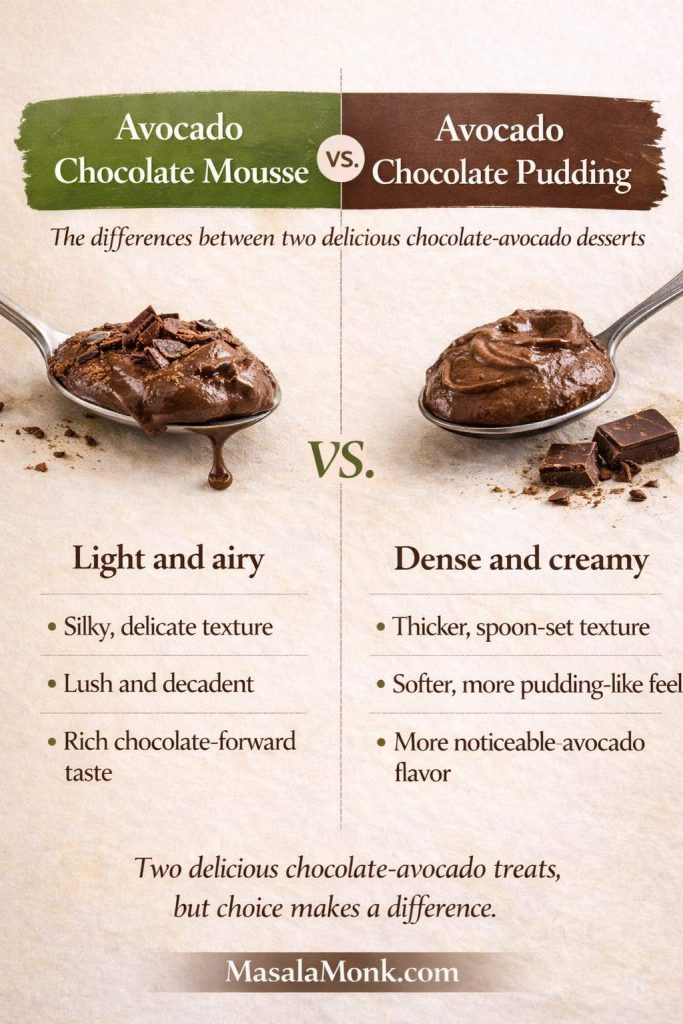
Comparison guide showing avocado chocolate mousse and avocado chocolate pudding side by side, highlighting differences in texture, thickness, richness, and how chocolate-forward each dessert feels.
Avocado chocolate mousse and avocado chocolate pudding may begin with similar ingredients, yet they land very differently on the spoon. Mousse should feel thicker, silkier, and more chocolate-forward, while pudding turns softer, denser, and more comfort-led. If your mixture feels looser than expected, you may be closer to pudding territory—and that is not necessarily a bad thing, just a different dessert.

Sugar Free Londoner even uses pudding language within its mousse recipe, which reflects how fluid this boundary can be. Allrecipes, meanwhile, leans more directly into the pudding identity with its chocolate avocado pudding. That overlap is not confusion so much as a reminder that avocado-based chocolate desserts sit on a spectrum.

If you love that softer, spoonable family of desserts, creative chia pudding variations or no-bake banana pudding make sense as related pleasures. Avocado and chocolate pudding belongs to that same comforting lineage. Avocado chocolate mousse simply edges a little closer to elegance.

When avocado chocolate mousse feels more like pudding

This usually happens because there is too much liquid, the sweetener is especially dense, or the avocado is large relative to the chocolate. It can also happen when banana or dates are added. Again, that is not failure. It is simply a softer destination.

Also Read: Crock Pot Pork Chops and Sauerkraut (No Dry Chops Recipe)

Avocado banana chocolate mousse

Banana changes the character of the dessert more than almost any other variation. It brings sweetness, softness, and a familiar fruity dessert note that can make avocado and banana chocolate mousse feel instantly approachable.

If someone is hesitant about avocado chocolate mousse, banana can act as a gentle bridge. It smooths bitterness, adds natural sweetness, and gives the dessert a flavor profile that feels comforting rather than mysterious. That is why avocado banana chocolate mousse can be such a useful variation, especially when serving children or anyone unsure about avocado in dessert.

At the same time, banana absolutely announces itself. Unlike avocado, it is not a quiet ingredient here. So if your goal is the purest avocado chocolate mousse recipe, banana is not the move. If your goal is a softer, sweeter, more casual dessert, it is a wonderful addition.

Chocolate mousse with avocado and banana also tends to drift toward pudding texture. Banana adds body, but it adds a different kind of body—less sleek, more plush. That can be lovely, particularly if you enjoy the comfort-dessert direction of a banana pudding.

When to add banana

Add banana when you want more natural sweetness, when your cocoa tastes too intense, or when you want the dessert to feel more familiar and fruit-forward. Skip it when you want a darker, cleaner, more adult chocolate profile.

Also Read: Dirty Martini Recipe (Classic, Extra Dirty, No Vermouth, Spicy, Blue Cheese, Tequila + Batched)

Avocado and cacao mousse for a darker profile

Cacao powder changes the dessert in a subtle but noticeable way. The flavor tends to feel deeper, earthier, and slightly more intense than many supermarket cocoa powders. That makes avocado and cacao mousse a lovely option for people who enjoy dark chocolate flavors without needing a lot of sweetness.

Because cacao can feel more assertive, balance becomes especially important. A pinch of salt matters more. Sweetness matters more. Chilling matters more. When it all comes together, however, the result can be deeply satisfying—less like a sweet treat for everyone, more like a dark, quiet dessert you savor slowly.

If you prefer this direction, you may also find yourself leaning toward melted dark chocolate as a companion ingredient rather than using cacao alone. That mix preserves the intensity while giving the mousse a rounder, more luxurious finish.

4 ingredient avocado chocolate mousse

There is a certain appeal to keeping this dessert as stripped-down as possible. In its simplest form, a 4 ingredient avocado chocolate mousse might include avocado, cocoa powder, sweetener, and a splash of milk or other liquid. If the avocado is ripe and the cocoa is good, that can absolutely work.

Still, the extra ingredients—especially vanilla and salt—do more than their small quantities suggest. A four-ingredient version is charming in its simplicity, yet the fuller version usually tastes more complete. That is why I think of the 4 ingredient avocado chocolate mousse as a useful starting point rather than the ultimate destination. It shows how easy the recipe can be. Then, once you understand the framework, you can decide where to add complexity for depth.

Also Read: Ravioli Recipe Reinvented: 5 Indian-Inspired Twists on the Italian Classic

Best avocado chocolate mousse recipe for guests

When you are making this for yourself, a cocoa-and-maple version may be all you need. When you are making it for guests, a slightly more luxurious path can be worth it.

Use a very ripe avocado, good cocoa, a little melted dark chocolate, vanilla, salt, and enough sweetener to keep the flavor smooth. Blend until the texture is flawless. Chill thoroughly. Serve in small glasses with a few chocolate shavings or a light dusting of cocoa.

This is where avocado dark chocolate mousse really shines. The dessert looks deeper, tastes rounder, and feels more polished. It is also the version most likely to surprise people who hear “avocado chocolate” and expect compromise. Instead, they get something elegant and fully dessert-like.

What to serve with avocado chocolate mousse

Although the mousse stands beautifully on its own, a few companions can make it feel even more complete.

Fresh berries cut through the richness. Chopped toasted nuts add contrast. A little whipped coconut cream works well if you are serving a vegan avocado chocolate mousse. Thin slices of banana make sense if you are already leaning in that direction. If the mousse is especially dark, a tiny pinch of flaky salt on top can sharpen the chocolate.

That said, this is not a dessert that needs fuss. One of its strengths is how self-contained it feels. The texture is already the main event.

How to store the mousse

Store the mousse in individual servings or in one airtight container. Pressing a piece of wrap gently against the surface can help minimize air exposure if you are storing it a little longer. In general, the dessert is best within a day or two, when the flavor still feels fresh and the color remains appealing.

If you are dealing with avocados before making the mousse, the USDA SNAP-Ed avocado page offers simple guidance on ripening and storage, including leaving firm avocados at room temperature until they soften and then refrigerating them once ripe. That basic handling advice is useful because the quality of the fruit matters so much in the final dessert.

Once blended, avocado mousse is a naturally make-ahead-friendly sweet. That convenience is part of its enduring charm. You can make it in advance, chill it, and have dessert ready without last-minute drama.

Also Read: Fish and Chips Reimagined: 5 Indian Twists (Recipe + Method)

Why it keeps earning a place in real kitchens

Some recipes make an impression once and then quietly disappear. It usually works the other way around. What begins as a curiosity soon turns into something practical, reliable, and surprisingly elegant. It is quick to make, easy to adapt, and versatile enough to suit different ways of eating. On one evening, it answers a simple chocolate craving; on another, it becomes the final touch to a dinner where dessert needs to feel thoughtful without taking over the day.

Perhaps even more importantly, this dessert rewards repetition. The more often you make it, the less it feels like a fixed formula and the more it becomes a language you understand naturally. Over time, you start to notice how much liquid keeps it in mousse territory rather than drifting into pudding. You begin to sense when cocoa alone is enough and when dark chocolate will add the depth the dessert needs. Banana becomes a deliberate choice rather than an afterthought, useful in some versions and distracting in others. Eventually, the question stops being whether avocado belongs in dessert at all, because by then you are simply enjoying everything it does so well.

That is why this recipe has such staying power. It is not clever for the sake of being clever. It is simply useful, delicious, and adaptable in a way that fits real life.

A final spoonful

The best mousse recipe is not necessarily the most minimal one or the richest one or the strictest one. It is the one that understands what makes this dessert special: ripe avocado for texture, chocolate for depth, sweetener for balance, and enough patience to chill the mixture until it becomes silky, calm, and complete.

Once you understand the structure, the possibilities widen beautifully. The classic route with cocoa and maple syrup is always there when you want something simple. A keto avocado chocolate mousse can feel just as indulgent without relying on sugar, while a vegan avocado mousse made with almond or oat milk brings its own quiet richness. If a softer spoon dessert sounds better, the mixture can lean naturally toward avocado chocolate pudding. Beyond that, banana adds sweetness, cacao brings intensity, and dark chocolate gives the whole dessert a more luxurious finish.

So whether you came here looking for how to make avocado mousse, a healthy chocolate mousse, a vegan avocado chocolate mousse, recipe chocolate avocado mousse inspiration, or simply the best avocado mousse recipe you can make in minutes, the heart of the answer stays the same. Start with a ripe avocado. Let chocolate lead. Blend thoroughly. Adjust thoughtfully. Chill well.

Then take a spoonful and let the texture do the convincing.

Also Read: Falafel Recipe: Crispy Homemade, Air Fryer and Baked Falafel

Frequently Asked Questions

1. What is avocado chocolate mousse?

Avocado chocolate mousse is a smooth, spoonable chocolate dessert made by blending ripe avocado with cocoa powder, cacao, or dark chocolate along with a sweetener and a little liquid. Although it sounds unusual at first, the avocado mainly adds body and creaminess rather than a strong fruit flavor.

2. Can you taste avocado in avocado chocolate mousse?

When the avocado is properly ripe and the balance of chocolate, sweetener, vanilla, and salt is right, avocado chocolate mousse should taste mostly like chocolate rather than avocado. Even so, an underripe avocado or too little cocoa can make the avocado note more noticeable.

3. How do you make avocado chocolate mousse?

To make avocado chocolate mousse, blend ripe avocado with cocoa powder or melted dark chocolate, sweetener, vanilla, a pinch of salt, and just enough milk or dairy-free milk to help it turn silky. After that, taste, adjust, and chill until the texture becomes richer and more mousse-like.

4. What is the best avocado chocolate mousse recipe for beginners?

The best avocado chocolate mousse recipe for beginners is usually the simplest one: ripe avocado, cocoa powder, maple syrup, vanilla, salt, and a small splash of milk. That version is easy to balance, easy to blend, and easy to adjust if you want it sweeter, darker, or thicker.

5. Can I make a 4 ingredient avocado chocolate mousse?

Yes, a 4 ingredient avocado chocolate mousse can work very well. In most cases, that means avocado, cocoa powder, sweetener, and milk or another liquid. Still, vanilla and salt make the flavor noticeably rounder, so the fuller version often tastes more complete.

6. Is avocado chocolate mousse healthy?

Healthy avocado chocolate mousse can mean different things depending on how you make it. In general, it is often seen as a lighter-feeling dessert because avocado adds creaminess without heavy cream, and the sweetness can be adjusted to suit your preference. Even then, it is still meant to be enjoyed as dessert.

7. Can I make healthy avocado chocolate mousse with less sugar?

Yes, you can make healthy avocado chocolate mousse with less sugar, but the balance still matters. If the sweetness drops too low, the cocoa may taste bitter and the avocado may come forward more than you want. Therefore, it helps to reduce sweetener gradually rather than all at once.

8. Is avocado chocolate mousse keto?

Avocado chocolate mousse can be keto when made with unsweetened cocoa or dark chocolate and a suitable low-carb sweetener. In that version, almond milk or coconut milk usually works well, and the avocado helps maintain a rich texture without needing sugar.

9. What sweetener works best in keto avocado chocolate mousse?

For keto avocado chocolate mousse, powdered or liquid sweeteners usually work better than coarse granulated ones because they blend more smoothly. As a result, the mousse tastes creamier and avoids the gritty texture that can sometimes happen with low-carb desserts.

10. Is avocado chocolate mousse vegan?

Yes, avocado chocolate mousse can be naturally vegan if you use a plant-based sweetener such as maple syrup and a dairy-free milk like almond, oat, or coconut milk. If you add melted chocolate, just make sure the chocolate itself is dairy-free.

11. What milk is best for vegan avocado chocolate mousse?

Almond milk is a popular choice for vegan avocado chocolate mousse because it keeps the flavor clean and lets the chocolate stay in focus. Oat milk makes the dessert a bit softer, whereas coconut milk gives it a richer, fuller finish.

12. What is the difference between avocado chocolate mousse and avocado chocolate pudding?

Avocado chocolate mousse is usually thicker, firmer, and more set after chilling, while avocado chocolate pudding tends to be softer and looser. Even so, the line between the two can be fairly thin, especially if the recipe uses more liquid or a heavier sweetener.

13. Why is my avocado chocolate mousse too thin?

Avocado chocolate mousse can turn out too thin if there is too much liquid, if the avocado is especially large, or if the sweetener loosens the mixture more than expected. In many cases, chilling helps first. Otherwise, a little more cocoa powder or melted dark chocolate can bring the texture back into balance.

14. Why is my avocado chocolate mousse too thick?

If avocado chocolate mousse feels too thick, the mixture probably needs just a little more liquid to blend and soften properly. Add it slowly, though, because a small amount can make a big difference. Otherwise, the mousse can shift quickly toward pudding.

15. Why does my avocado chocolate mousse taste bitter?

Bitterness usually comes from strong cocoa, not enough sweetener, or too little salt. Sometimes cacao powder can also taste more intense than expected. In that case, a bit more sweetener, a pinch of salt, or some melted dark chocolate often helps smooth the flavor out.

16. Why does my avocado chocolate mousse taste like avocado?

That usually happens when the avocado is underripe, the chocolate flavor is too light, or the dessert has not been chilled long enough. More cocoa, a touch more vanilla, and a little extra sweetener often help. Most importantly, start with a ripe avocado whenever possible.

17. Can I use cacao instead of cocoa in avocado chocolate mousse?

Yes, you can use cacao instead of cocoa in avocado chocolate mousse. The flavor may taste a little darker or earthier, so you may want to adjust the sweetness slightly. Nevertheless, it can be a very good choice if you prefer a deeper chocolate profile.

18. Can I use dark chocolate instead of cocoa powder?

Yes, dark chocolate can be used instead of cocoa powder, or alongside it, in avocado chocolate mousse. Melted dark chocolate usually makes the dessert feel richer, smoother, and more luxurious, while cocoa powder keeps it a bit lighter and more direct in flavor.

19. Can I add banana to avocado chocolate mousse?

Absolutely. Avocado banana chocolate mousse is a softer, sweeter variation that can feel more familiar to people who are unsure about avocado in dessert. On the other hand, banana adds its own flavor clearly, so it changes the character of the mousse more than most other add-ins.

20. How long does avocado chocolate mousse last in the fridge?

Avocado chocolate mousse is usually best within one to two days in the refrigerator, when the flavor and color still feel fresh. Keep it in an airtight container, and try to limit air exposure as much as possible.

21. Can you freeze avocado chocolate mousse?

Yes, avocado chocolate mousse can be frozen, although the texture may change slightly after thawing. Because of that, it is usually best enjoyed fresh or chilled from the fridge. Still, freezing can work if you want to save leftovers rather than waste them.

22. Is avocado chocolate mousse a good make-ahead dessert?

Yes, avocado chocolate mousse is an excellent make-ahead dessert because chilling actually improves the texture. In fact, many versions taste better after some time in the fridge, once the chocolate settles and the mousse firms up.

23. What toppings go well with avocado chocolate mousse?

A light dusting of cocoa powder, dark chocolate shavings, chopped nuts, berries, or a little whipped coconut cream all work well. Since the mousse is already rich, simple toppings usually feel best.

24. Can I make avocado mousse without chocolate?

You can make avocado mousse without chocolate, but it becomes a different dessert altogether. Chocolate is what gives avocado chocolate mousse its depth and helps the avocado stay in the background. Without it, the avocado flavor will be much more noticeable.

25. What makes the best avocado mousse recipe turn out silky?

The best avocado mousse recipe turns silky when you use a ripe avocado, blend thoroughly, and add liquid gradually rather than all at once. In addition, tasting before chilling helps you correct bitterness, sweetness, and thickness before the texture sets.
Posted on 7 Comments

10 Vegan Chocolate Cake Recipes (Easy, Moist, & Dairy-Free)

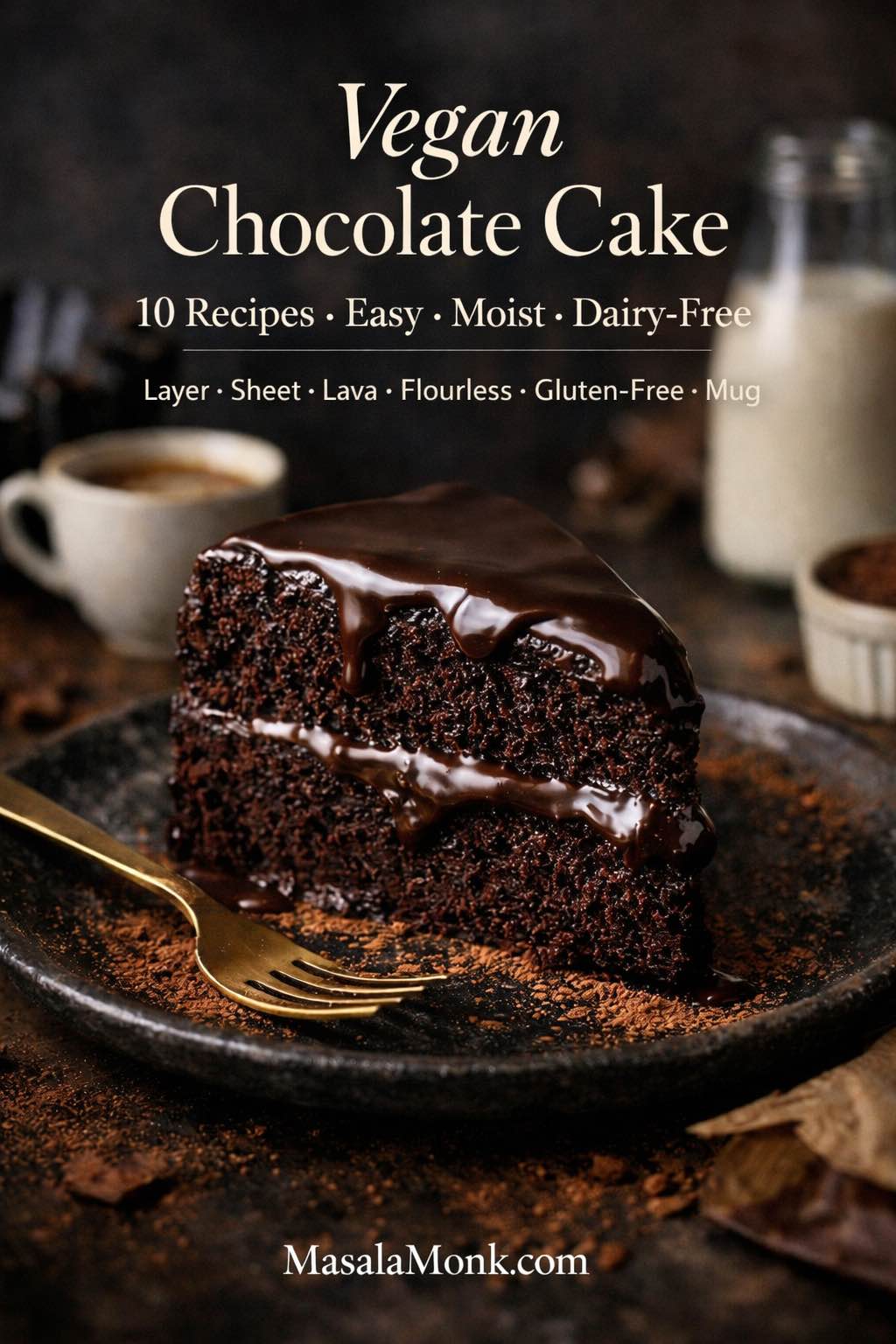
Slice of vegan chocolate cake with glossy ganache, cocoa dusting, and coffee—cover image for 10 vegan chocolate cake recipes (easy, moist, dairy-free).

If you want vegan chocolate cake that tastes like the real thing—deep cocoa aroma, soft crumb, and a finish that feels genuinely indulgent—this roundup of Vegan Chocolate Cake Recipes is for you. Not “good for vegan,” not “surprisingly decent,” but the kind of cake you’d happily serve to anyone who loves chocolate. Better still, these recipes are built to be repeatable, so you can bake a simple vegan chocolate cake on a quiet evening, then turn around and make a party-ready vegan chocolate layer cake the next weekend without relearning everything from scratch.

Chocolate cake has a strange superpower: it can be both nostalgic and endlessly new. On one day, you want a plush slice with frosting and candles. On another, you want a quick vegan chocolate mug cake with a spoon straight from the cup. Meanwhile, when you’re feeding a crowd, a vegan chocolate sheet cake is often the most sensible move—easy to transport, easy to portion, and still every bit as satisfying. And then there are the cakes that feel like a dessert menu finale: a flourless vegan chocolate cake that slices like a torte, or vegan chocolate lava cakes that spill molten chocolate onto a plate.

Because each craving has its own logic, the ten recipes below cover a range of textures and formats—layer, sheet, bundt, loaf, flourless, molten, gluten-free, mug, beetroot, and avocado—while staying anchored in the same promise: strong chocolate flavour, reliable structure, and a moist crumb that doesn’t dry out by tomorrow.

Before we start baking, though, it’s worth getting a few fundamentals in place. Once those are clear, every recipe becomes easier, and every variation feels less like guesswork and more like cooking.


Vegan chocolate cake basics that make everything easier

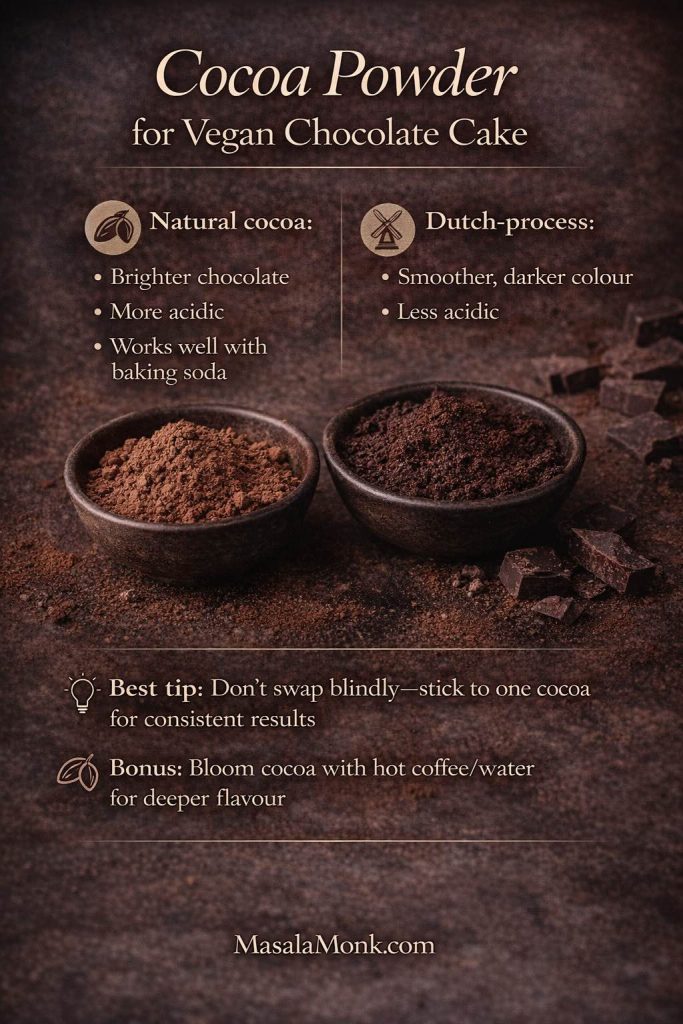
1) Cocoa powder: the flavour choice that also affects rise

Cocoa powder isn’t just flavour. It changes how a cake behaves, especially when baking soda is involved.

  • Natural cocoa is typically more acidic. It can taste brighter, sometimes slightly sharper, and it often plays very nicely with baking soda.
  • Dutch-process cocoa is alkalised. It tends to taste smoother and darker, and it can make cakes look deeper in colour.
Natural cocoa vs Dutch-process cocoa infographic for vegan chocolate cake, explaining flavour and acidity differences plus tips for consistent results and blooming cocoa with hot coffee or water.
Natural vs Dutch-process cocoa for vegan chocolate cake: use this quick guide to choose the flavour you want—and bloom cocoa with hot coffee or water for deeper chocolate.

Both are excellent, yet they don’t always perform identically if you swap one for the other without adjusting anything else. If you enjoy knowing the “why” (without it turning into a science lesson), these two guides are genuinely helpful: Dutch-process vs. natural cocoa and The A-B-C’s of cocoa. If you want a broader, easy read on cacao vs cocoa vs chocolate, MasalaMonk’s breakdown is a great companion: What is Cacao?: Cacao vs. Chocolate vs. Dark Chocolate.

Practical way to think about it: pick a cocoa you love, then bake with it consistently. Once you know how that cocoa behaves in your oven, you’ll get “your” signature vegan chocolate cake every time.


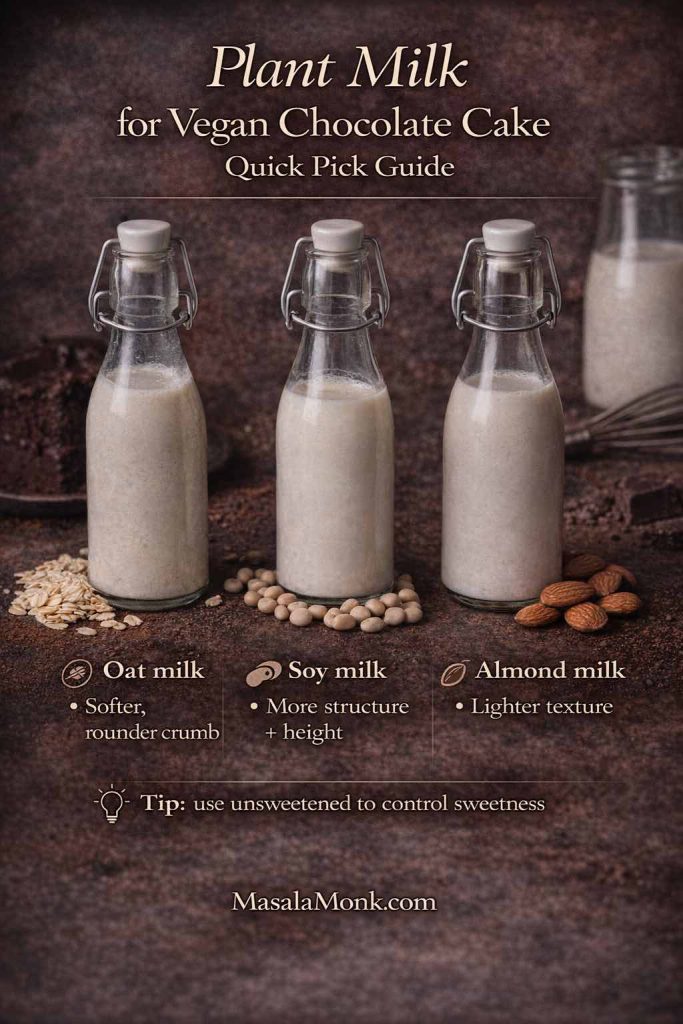
2) Plant milk: use what you like, but know what it nudges

Most plant milks will work. Still, they can push texture subtly:

  • Oat milk often gives a softer, rounder crumb.
  • Soy milk can build structure and height.
  • Almond milk is lighter, so cakes may feel a touch less plush (not bad—just different).
Plant milk guide for vegan chocolate cake comparing oat milk, soy milk, and almond milk, with notes on crumb texture, structure, and a tip to use unsweetened milk.
Best plant milk for vegan chocolate cake: choose oat for a softer crumb, soy for more structure and height, or almond for a lighter texture—then use unsweetened to control sweetness.

If you like making basics at home, Easy Homemade Oats Milk is a handy internal reference, especially when you want a neutral, budget-friendly baking milk.


3) Oil vs vegan butter: choose based on the texture you want

For many vegan chocolate cake recipes, oil is the shortcut to moisture. Cakes stay tender longer, they resist drying out, and they’re forgiving if you slightly overbake. Vegan butter can be lovely too; however, it firms up in the fridge, so butter-based cakes can feel denser when cold.

If you’ve ever noticed how oil-based cakes stay moist, you’ll see that principle clearly in Orange Olive Oil Cake – Ridiculously Easy and Super Moist. Even though it’s citrus rather than chocolate, the crumb logic carries over perfectly.


4) The acid trick: why vinegar appears in so many dairy-free chocolate cake recipes

A small amount of vinegar (or lemon juice) shows up in vegan baking because it helps baking soda do its job. It isn’t there to make cake taste sour; rather, it supports lift and tenderness. As a result, cakes rise more evenly and feel lighter.


5) “Blooming” cocoa: the easiest way to make chocolate taste bigger

You’ll notice several recipes use hot coffee or hot water. This is one of the simplest upgrades in chocolate baking: hot liquid helps cocoa dissolve and intensifies aroma.

  • If you love deep chocolate, use coffee.
  • If you don’t like coffee, use hot water. You’ll still get the cocoa bloom effect; you just won’t add coffee’s roast notes.

6) Mixing: stop sooner than your instincts suggest

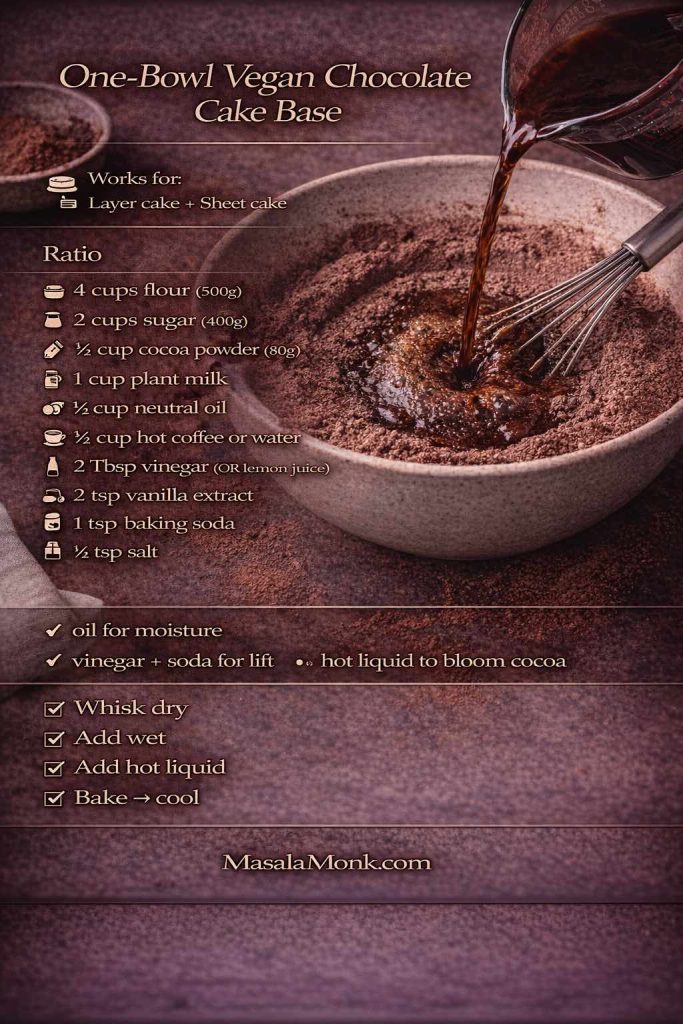
Chocolate batter often looks gorgeous long before it’s actually mixed evenly, which is why it tempts you to keep going. Nevertheless, overmixing can tighten crumb. Instead, aim for smooth and combined, then stop.

One-bowl vegan chocolate cake base recipe card showing a mixing bowl with cocoa and hot coffee being poured in, plus ingredient ratios, quick steps, and tips for moisture and lift.
One-bowl vegan chocolate cake base you can reuse: this quick ratios card works for layer cake or sheet cake, with the simple ‘hot liquid to bloom cocoa’ step for deeper chocolate flavour.

A calm sequence helps:

  1. Whisk dry ingredients thoroughly (especially cocoa).
  2. Whisk wet ingredients thoroughly.
  3. Combine wet into dry until smooth.
  4. Add hot liquid last, then mix briefly.

7) Baking cues: what “done” looks like in chocolate cake

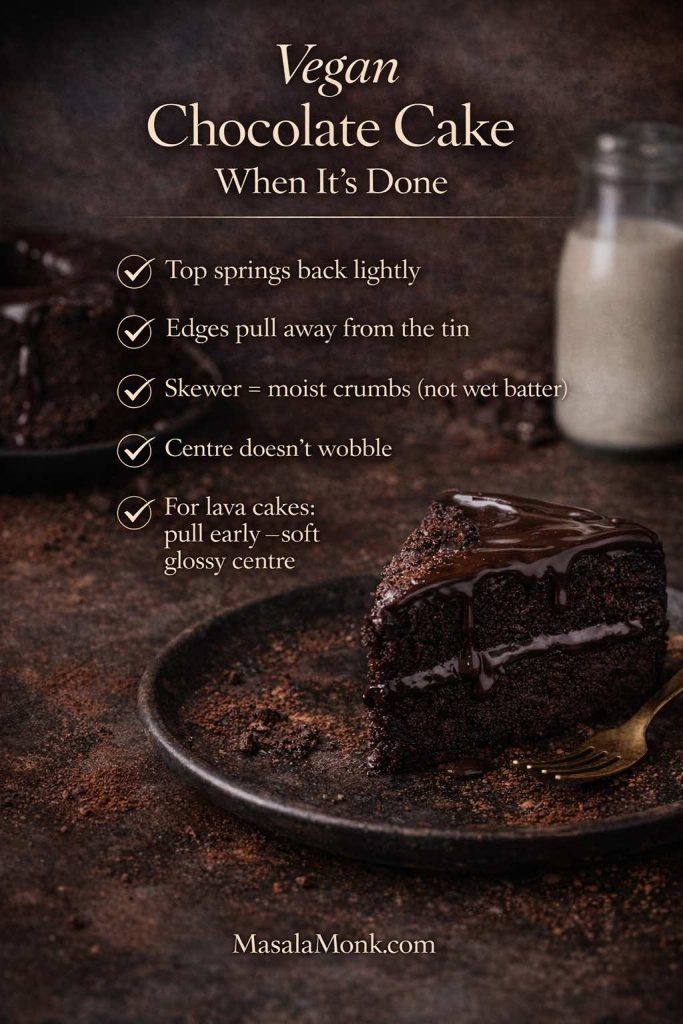
Because chocolate cakes are dark, they can hide underbaking. Use multiple cues:

  • The top springs back lightly when pressed.
  • The edges pull slightly away from the tin.
  • A skewer comes out with a few moist crumbs (not wet batter).
  • The centre doesn’t wobble like liquid.
Vegan chocolate cake doneness checklist graphic showing baking cues: top springs back, edges pull away, skewer has moist crumbs, centre doesn’t wobble, plus a lava cake timing note.
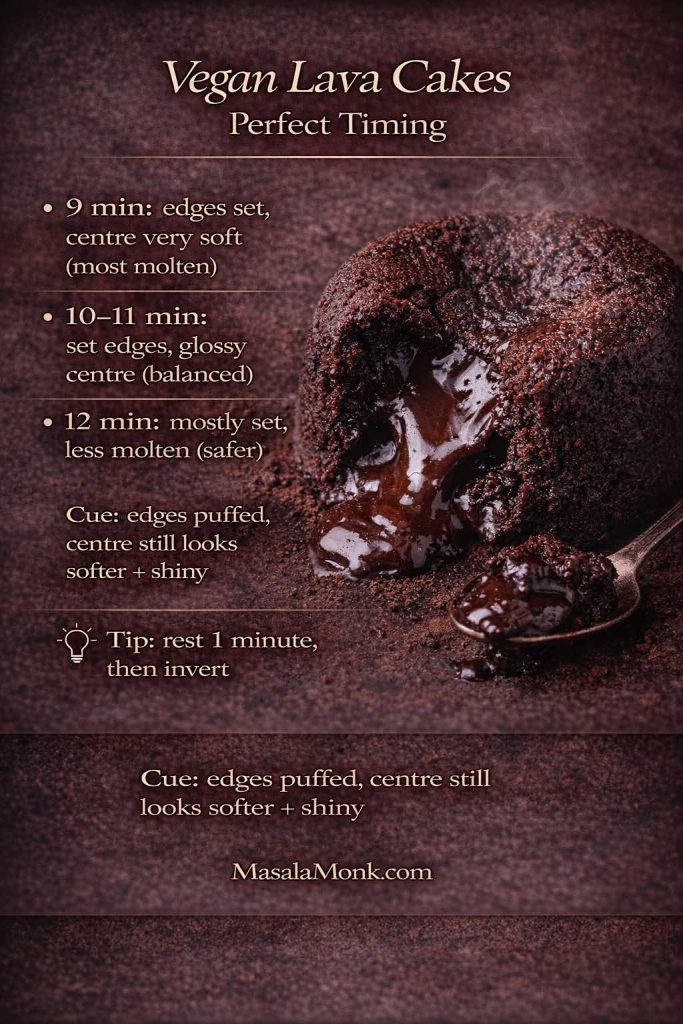
How to tell when vegan chocolate cake is done: use these quick baking cues for a moist crumb—and pull lava cakes early for that soft, glossy centre.

Molten cakes are different—there, you want underdone centres. We’ll cover that later.


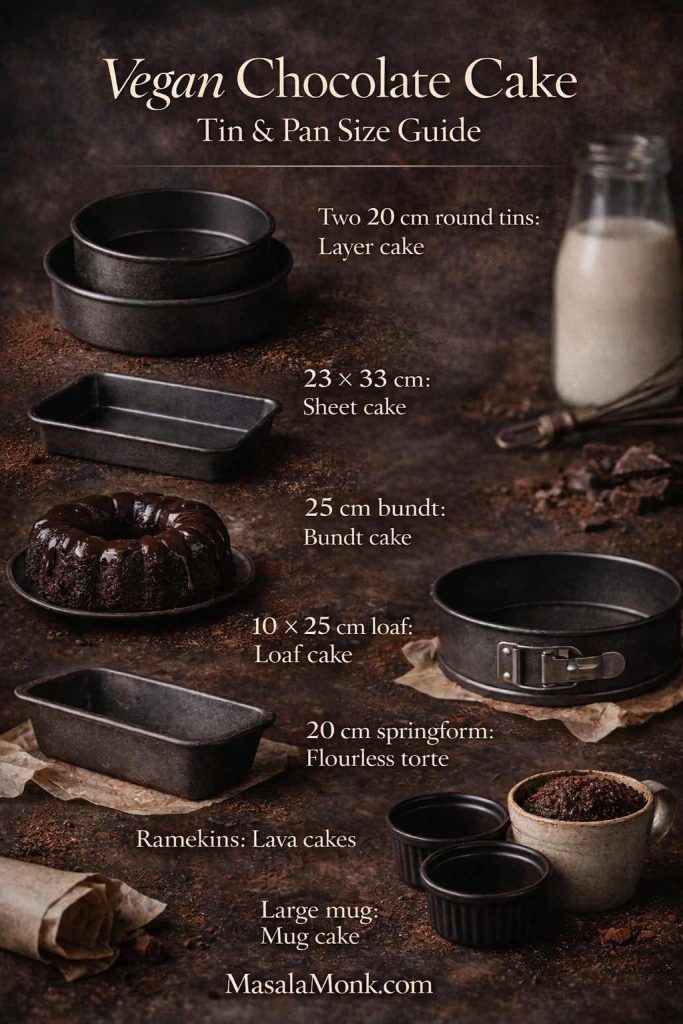
8) Tin guide: choose the format that fits your day

Sometimes the best cake is the one that matches your schedule:

  • Layer cake (20 cm rounds): celebration vibe, frosting-friendly.
  • Sheet cake (23 × 33 cm): effortless portions, travel-friendly.
  • Bundt cake (25 cm bundt pan): looks fancy with minimal decorating.
  • Loaf cake (10 × 25 cm): sliceable, giftable, everyday perfect.
  • Torte (20 cm springform): intense, truffle-like, small slices.
  • Mug cake: instant comfort.
Vegan chocolate cake tin and pan size guide showing two 20 cm round tins for layer cake, 23 × 33 cm for sheet cake, 25 cm bundt, 10 × 25 cm loaf, 20 cm springform, ramekins for lava cakes, and a large mug for mug cake.
Baking pan confusion solved: use this tin-size guide to pick the right format for your vegan chocolate cake—layers, sheet cake, bundt, loaf, flourless torte, lava cakes, or a quick mug cake.

9) A note on “eggless” and “dairy-free”

Every cake here is vegan, which means it’s inherently eggless and dairy-free. That said, textures can vary depending on which binder you use (if any). Some recipes rely purely on flour structure and leavening; others use starch or purée for a fudgier crumb. Either way, the outcome is meant to feel like cake—not a compromise.

If you want a clear, trustworthy overview of vegan egg replacers and what each one is best at, this guide is a useful reference: Egg substitutes for baking.

Also Read: Strawberry Smoothie Recipes (12 Easy Blends + Bowls & Protein Shakes)


A quick way to choose your recipe today

If you’d rather not overthink it, start here:

  • Want the classic? Make the vegan chocolate layer cake (#1).
  • Want the easiest? Make the easy vegan chocolate sheet cake (#2).
  • Want “wow” without stacking? Make the vegan chocolate bundt cake (#3).
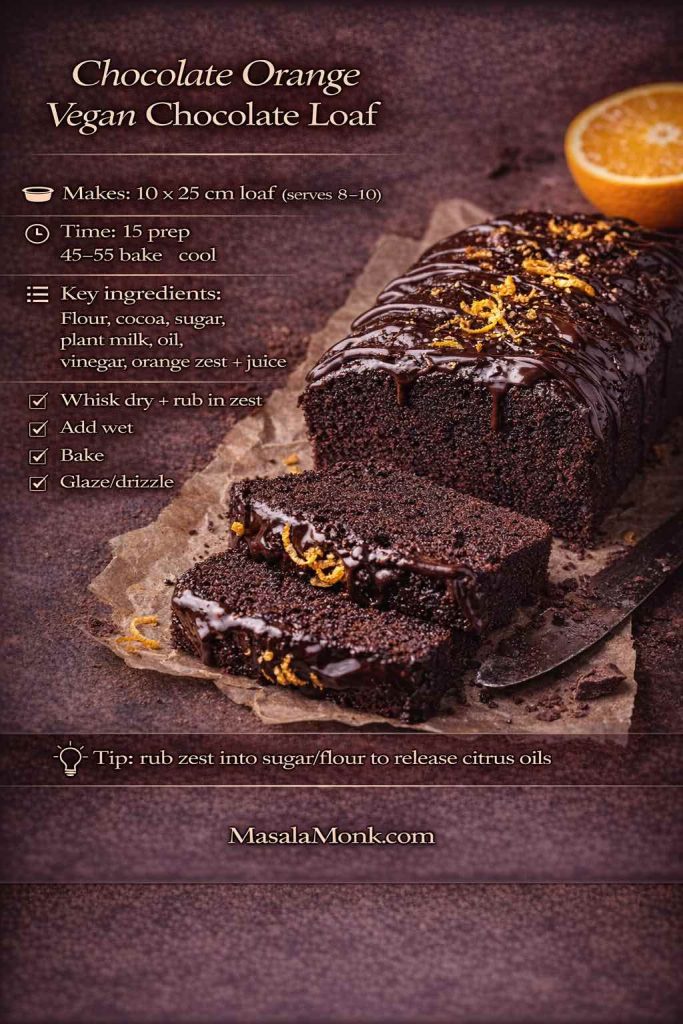
  • Want bright flavour? Make the chocolate orange vegan chocolate loaf (#4).
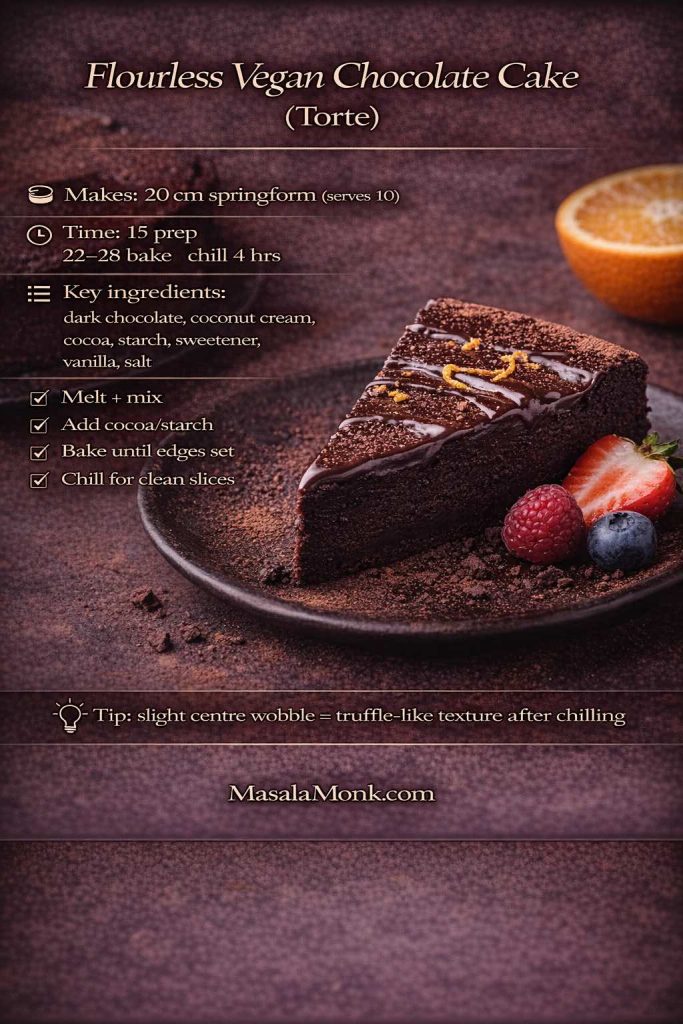
  • Want truffle intensity? Make the flourless vegan chocolate cake (#5).
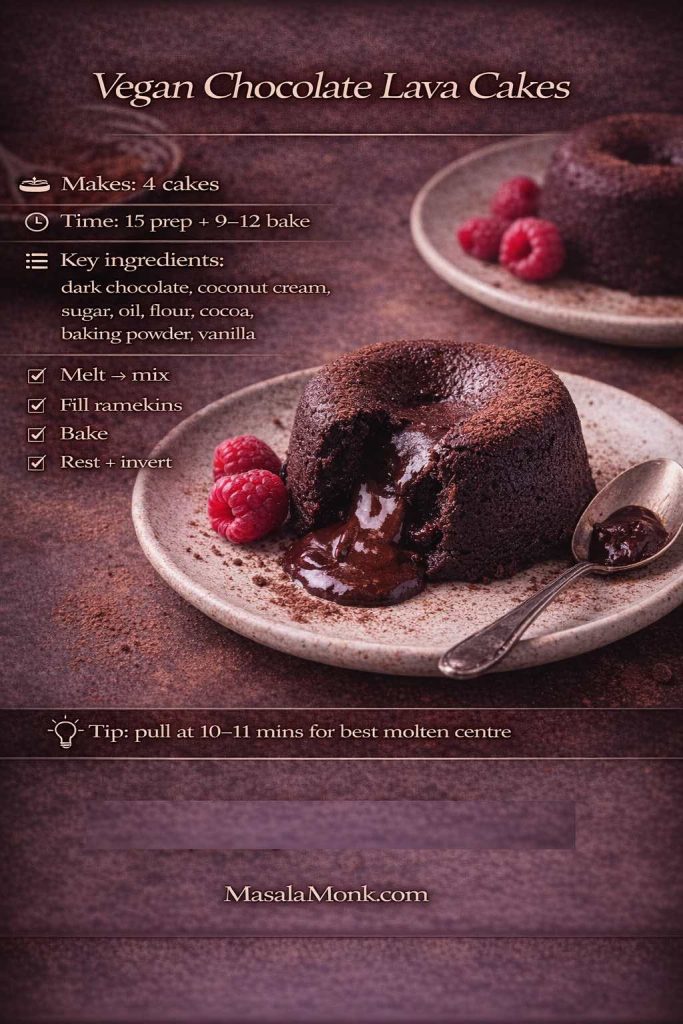
  • Want molten drama? Make the vegan chocolate lava cakes (#6).
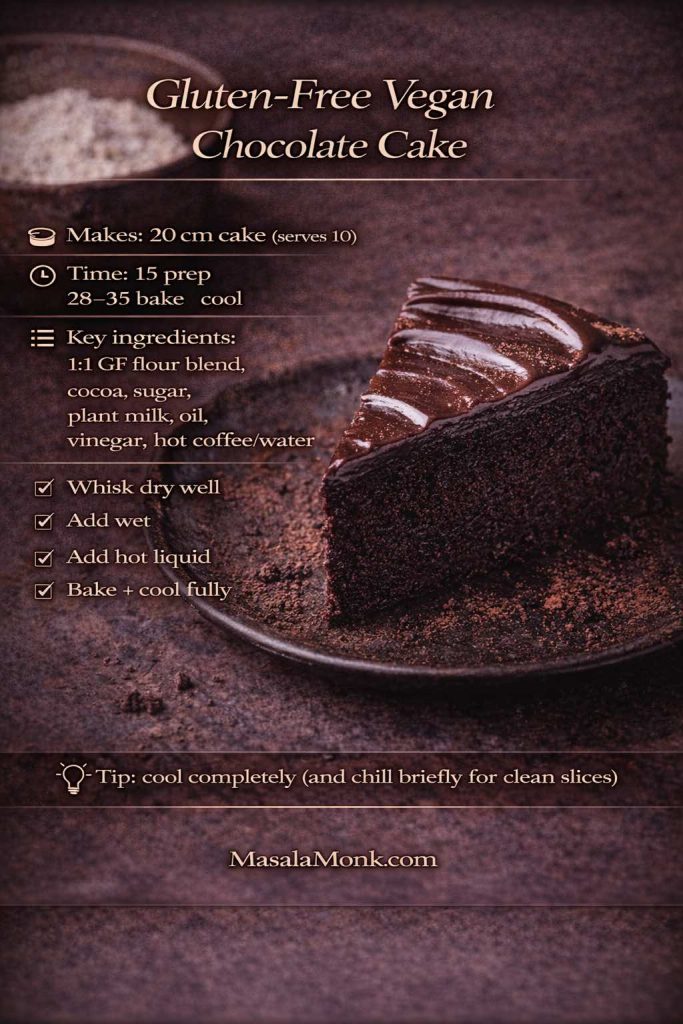
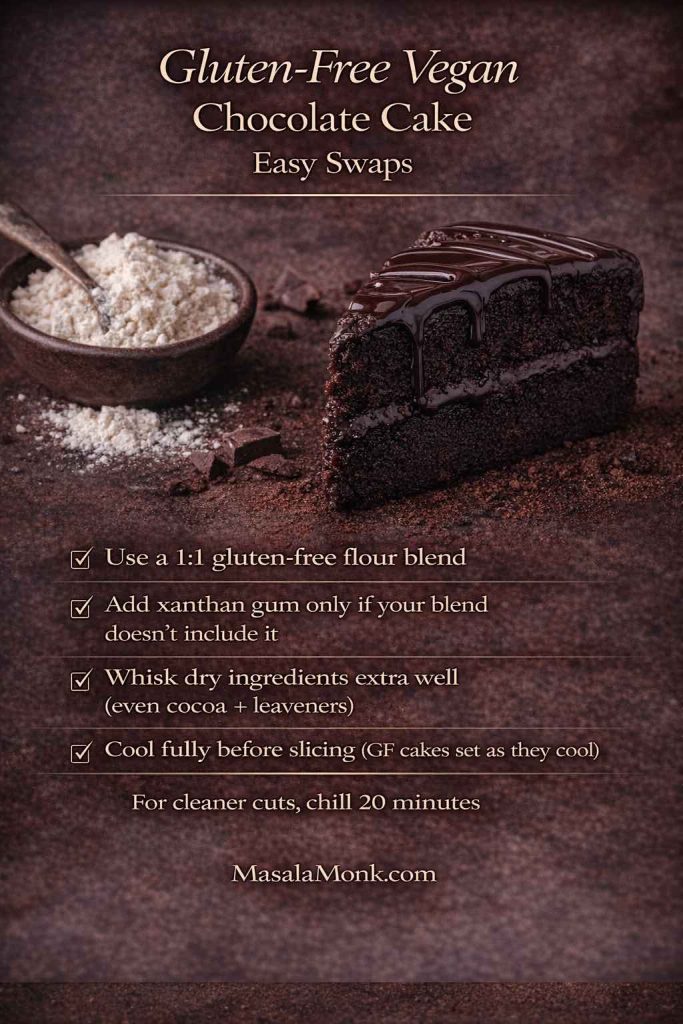
  • Need gluten-free? Make the vegan gluten-free chocolate cake (#7).
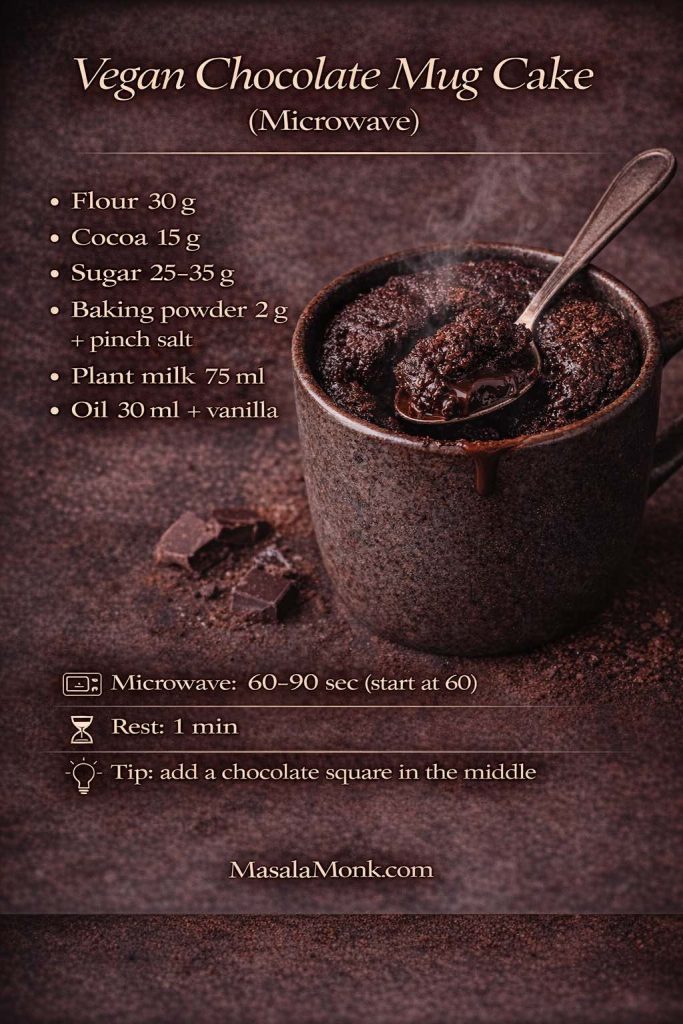
  • Want instant comfort? Make the vegan chocolate mug cake (#8).
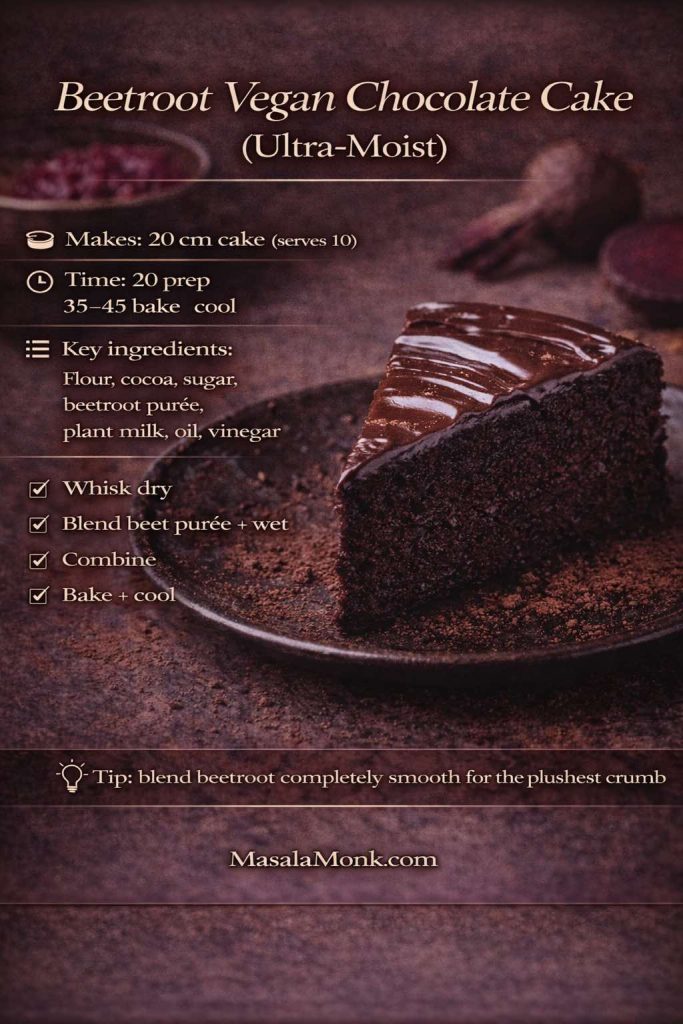
  • Want ultra-moist? Make the beetroot vegan chocolate cake (#9).
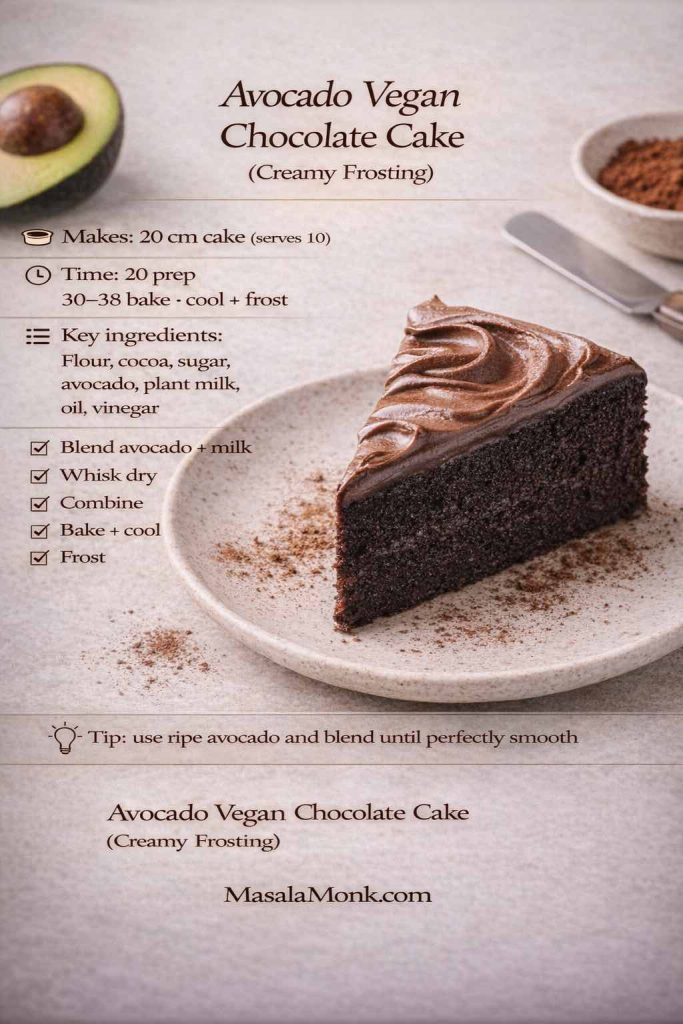
  • Want creamy frosting that isn’t sugar-bomb sweet? Make the avocado vegan chocolate cake (#10).
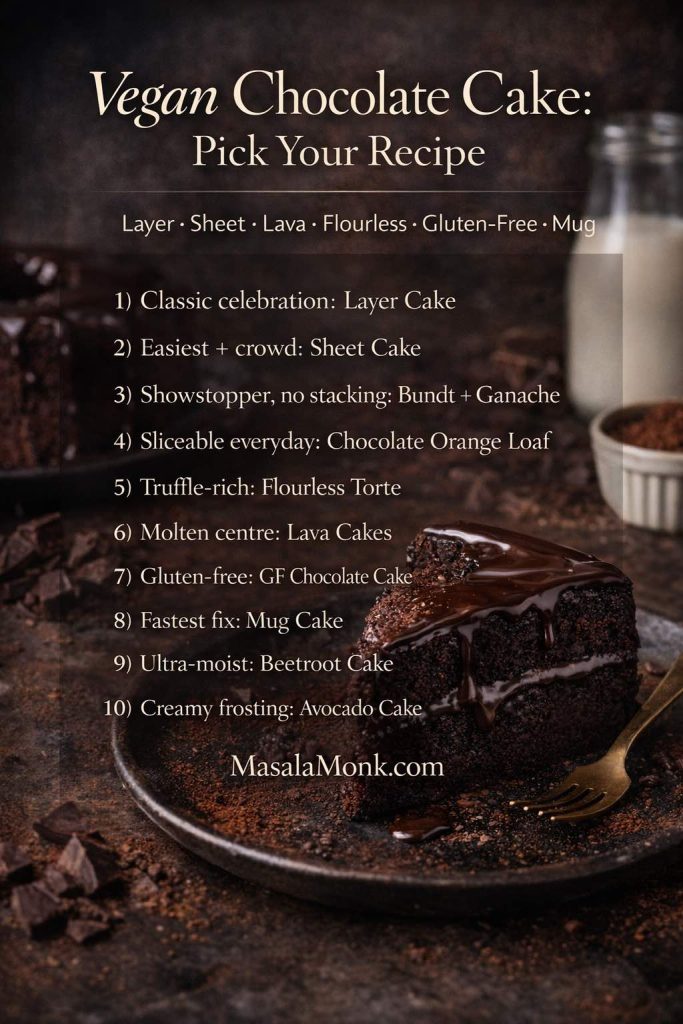
Vegan chocolate cake recipes guide card showing how to pick the right recipe—layer, sheet, bundt, loaf, flourless, lava, gluten-free, mug, beetroot, and avocado.
Not sure which vegan chocolate cake to bake? Use this quick picker to match your craving—classic layers, easiest sheet cake, molten lava, flourless torte, gluten-free, or a fast mug cake.

Now, let’s bake.


1) Vegan Chocolate Layer Cake Recipe (Classic, Moist, Celebration-Ready)

This is the cake you bake when you want that unmistakable “proper chocolate cake” moment: soft crumb, even rise, and enough structure to stack confidently. At the same time, it’s forgiving—so even if you’re not a frequent layer-cake maker, you’ll still land somewhere delicious.

What makes it work so well

To begin with, oil keeps the crumb tender for longer than butter typically does. In addition, a small amount of vinegar supports lift and keeps the flavour clean. Finally, hot coffee (or hot water) blooms cocoa, so the chocolate aroma feels bigger without adding extra sweetness.

If you ever want the quick explanation of cocoa differences—especially if you’re deciding between natural cocoa and Dutch-process—the two clearest guides are Dutch-process vs. natural cocoa and The A-B-C’s of cocoa. For a broader foundation, MasalaMonk’s What is Cacao?: Cacao vs. Chocolate vs. Dark Chocolate is a satisfying read.

Makes: 1 layer cake (two 20 cm rounds) | Serves: 10–12
Time: 20 mins prep + 28–34 mins bake + 60–90 mins cooling | Difficulty: Easy–Medium
Oven/Tin: 175°C | two 20 cm round tins

Dry

  • 250 g plain flour
  • 300 g caster sugar
  • 70 g cocoa powder
  • 10 g baking powder
  • 5 g bicarbonate of soda
  • 3 g fine salt

Wet

  • 420 ml plant milk
  • 120 ml neutral oil
  • 15 ml vinegar (apple cider or white)
  • 10 ml vanilla extract

Bloom

  • 180 ml hot coffee or hot water
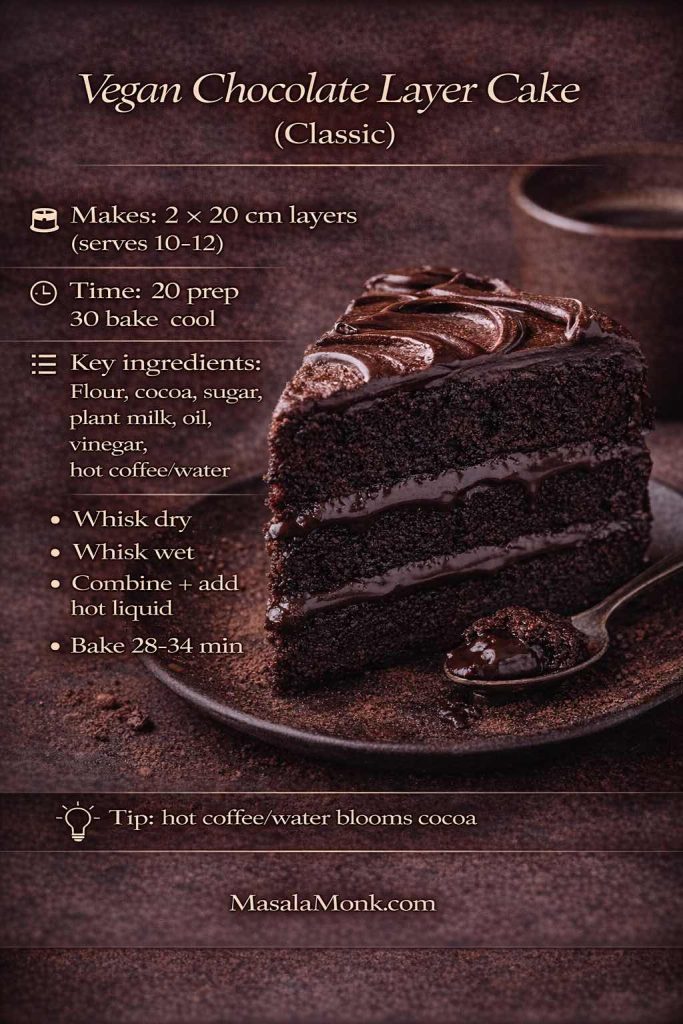
Vegan chocolate layer cake recipe card showing a sliced chocolate layer cake with frosting, plus key ingredients, simple steps, bake time, and a tip to bloom cocoa with hot coffee or water.
Classic vegan chocolate layer cake, made repeatable: this quick recipe card covers the essentials—key ingredients, simple steps, and bake time—for a moist, dairy-free celebration cake.

Method (detailed, step-by-step)

  1. Prep your tins before anything else. Heat the oven to 175°C. Line two 20 cm tins with baking paper on the base, then lightly oil the sides. If you want extra insurance against sticking, dust the oiled sides with a teaspoon of cocoa powder and tap out the excess.
  2. Make cocoa behave. In a large bowl, whisk the flour, sugar, cocoa powder, baking powder, bicarbonate of soda, and salt for a full 30–45 seconds. This isn’t busywork—cocoa clumps are stubborn, and thorough whisking prevents bitter pockets.
  3. Mix your wet ingredients until they look unified. In a jug, whisk plant milk, oil, vinegar, and vanilla until the mixture looks uniform rather than separated. That little bit of emulsifying up front helps the batter come together quickly.
  4. Combine without overworking. Pour the wet mixture into the dry. Whisk gently—just until the batter looks smooth and you don’t see dry flour at the bottom. If you’re tempted to keep whisking because the batter looks glossy, pause and check the bowl instead: scrape down the sides, then stop.
  5. Bloom the cocoa at the end. Pour in the hot coffee (or hot water) and whisk briefly until the batter turns evenly silky and slightly looser. Thin batter is normal here, and it bakes up surprisingly plush.
  6. Divide evenly for level layers. Split the batter between tins. If you have a kitchen scale, weigh the tins so the layers bake to the same height. Next, tap each tin once on the counter to release large air bubbles.
  7. Bake with cues, not only time. Bake 28–34 minutes. Start checking at 28 minutes:
    • The centre should spring back lightly when pressed.
    • The edges should pull away slightly from the tin.
    • A skewer should come out with moist crumbs, not wet batter.
  8. Cool in stages (this matters for texture). Let the cakes cool in the tins for 10 minutes. Then turn them out onto a rack, peel off the base paper, and cool completely before frosting. If you frost while warm, you’ll get melting and sliding instead of clean layers.

Vegan chocolate cake frosting (classic cocoa buttercream)

This buttercream is dependable and not overly fussy. It also holds its shape well, which helps if you’re doing swirls or a slightly thicker coat.

  • 115 g vegan butter, softened
  • 300 g icing sugar, sifted
  • 50 g cocoa powder, sifted
  • 10 ml vanilla extract
  • 30–60 ml plant milk (as needed)
  • 1–2 g salt (to taste)

How to make it smoothly

  1. Beat vegan butter for 2–3 minutes until creamy and lighter in colour.
  2. Add cocoa and icing sugar in 3 additions, mixing gently at first so you don’t get a sugar cloud.
  3. Add vanilla and salt.
  4. Add plant milk gradually until spreadable. Stop when it feels soft and swoopy, not runny.

Assemble like a pro (without overthinking it)

  • If your layers have a dome, trim the top lightly with a serrated knife for a stable stack.
  • Spread a thin layer of frosting on the first layer, add the second layer, then cover the cake.
  • For cleaner slices, chill the frosted cake 20–30 minutes before cutting.

Optional upgrade: glossy ganache finish

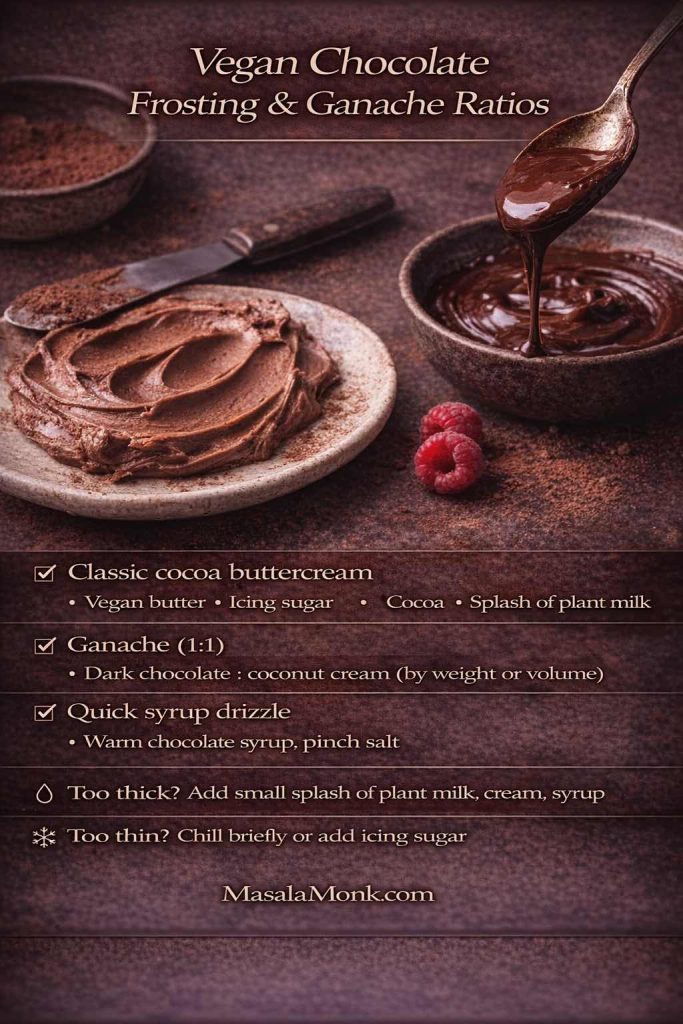
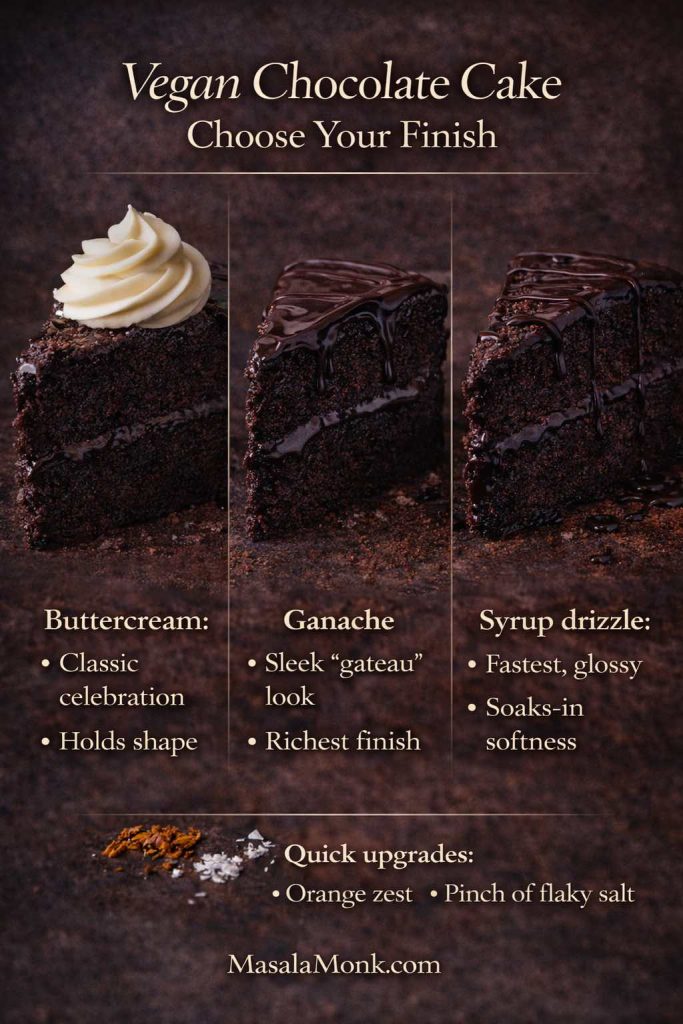
If you want a more “gateau” look, skip buttercream and use the ganache from recipe #3 instead.

A gentle internal detour (if you love moist oil-based cakes)

If this cake’s tenderness makes you happy, you’ll probably enjoy MasalaMonk’s Orange Olive Oil Cake – Ridiculously Easy and Super Moist. Different flavour, same kind of soft crumb logic.

Notes / substitutions for Vegan Chocolate Layer Cake Recipe

  • Plant milk: soy = tallest structure; oat = softer crumb; almond = lighter texture.
  • Coffee: hot water works if you don’t want coffee flavour (still blooms cocoa).
  • Cocoa: natural cocoa gives brighter chocolate; Dutch-process tastes smoother/darker (either works—stick to one for consistency).
  • No 2 tins? Bake in one 20 cm tin longer (expect ~45–55 mins), then slice into layers once fully cool.

Also Read: 7 Pizza Sauce Recipes | Marinara, White Garlic, Alfredo, Buffalo, BBQ, Vodka & Ranch


2) Easy Vegan Chocolate Sheet Cake Recipe (One Bowl, Crowd-Friendly)

This is the unfussy hero: mix, pour, bake, slice. It’s the kind of cake that makes you look organised even if you aren’t. Because it bakes in one layer, you get even doneness, easy portions, and less risk of drying out. Furthermore, it’s perfect for quick toppings—drizzle, glaze, or syrup.

Makes: 1 sheet cake (23 × 33 cm) | Serves: 12–16
Time: 15 mins prep + 26–32 mins bake + 45–60 mins cooling | Difficulty: Easy
Oven/Tin: 175°C | 23 × 33 cm tin

Ingredients

  • 250 g plain flour
  • 250 g caster sugar
  • 55 g cocoa powder
  • 10 g baking powder
  • 3 g bicarbonate of soda
  • 3 g fine salt
  • 360 ml plant milk
  • 120 ml neutral oil
  • 15 ml vinegar
  • 10 ml vanilla extract
  • 120 ml hot water or hot coffee
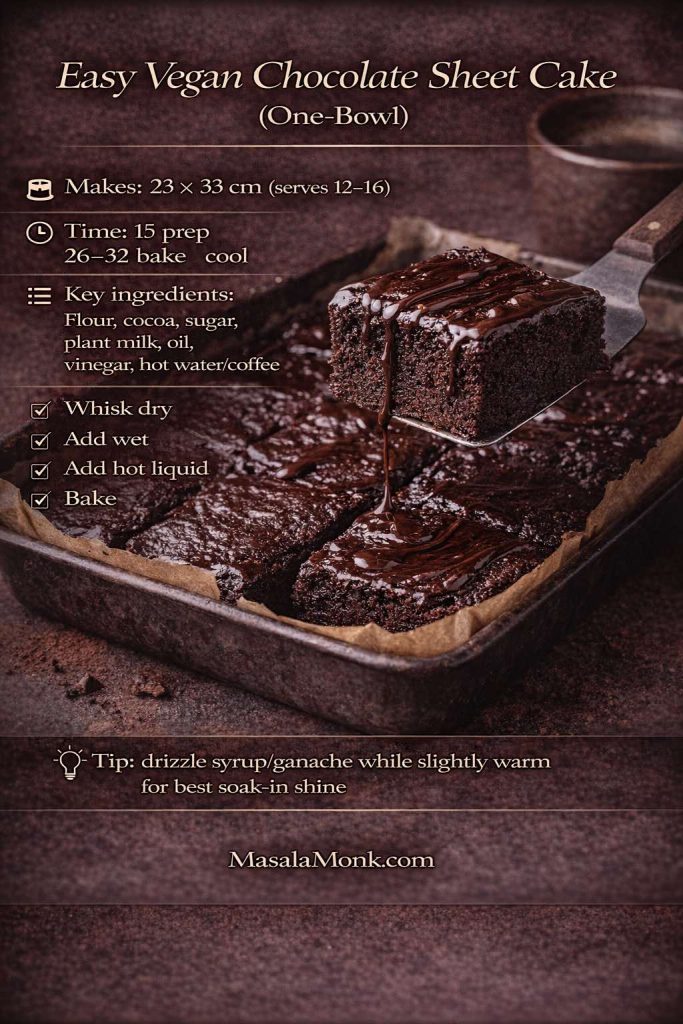
Easy vegan chocolate sheet cake recipe card showing moist chocolate cake squares with glossy drizzle, plus pan size, bake time, key ingredients, simple steps, and a tip to drizzle ganache or syrup while warm.
Easy vegan chocolate sheet cake (one-bowl): this recipe card gives the essentials—pan size, timing, and quick steps—for a moist, dairy-free cake that slices beautifully for a crowd.

Method (Eggless Cake Recipe with extra clarity)

  1. Set up first. Heat oven to 175°C. Line a 23 × 33 cm tin with baking paper, leaving a bit of overhang on the long sides so you can lift the cake out later.
  2. Whisk dry ingredients thoroughly. In a large bowl, whisk flour, sugar, cocoa, baking powder, bicarbonate of soda, and salt. Keep going until the cocoa looks evenly dispersed; that’s the difference between “good” and “wow” in a sheet cake.
  3. Add wet ingredients in one go. Pour in plant milk, oil, vinegar, and vanilla. Whisk until smooth. If the batter looks a little thick at this stage, that’s fine.
  4. Finish with hot liquid. Add hot water or coffee and whisk briefly. The batter will loosen and look glossy.
  5. Bake and check the centre. Pour into the tin and bake 26–32 minutes. Start checking at 26 minutes; the middle should spring back lightly and a skewer should show moist crumbs.
  6. Cool for clean slices. Cool in the tin for at least 20 minutes. If you want very neat squares, let it cool fully before cutting.

Fast topping that makes it feel finished

A simple drizzle can transform the whole cake. MasalaMonk’s 3 Minutes Homemade Chocolate Syrup is ideal here—especially if you drizzle it over slightly warm cake so it sinks in just a little.

Variations (easy changes to Vegan Chocolate Sheet Cake, big payoff)

  • Fudgier sheet cake: fold in 150 g chopped dark chocolate before baking.
  • Chocolate oat cake direction: swap 50 g flour for 50 g oat flour for a softer, warmer crumb.
  • Quick party finish: sprinkle chopped toasted nuts or cocoa nibs over syrup while it’s still tacky.

If you enjoy the “one base, multiple personalities” style, MasalaMonk’s Double Chocolate Chip Cookies – One Dough, 7 Ways scratches the same itch.

Notes / substitutions for Vegan Chocolate Sheet Cake Recipe

  • Tin size: if smaller/deeper, bake longer; start checking +5 mins and use skewer cues.
  • Sweeter/fudgier: fold in 150 g chopped dark chocolate.
  • Oil: any neutral oil works; olive oil gives a noticeable flavour (nice if you want it).
  • Topping: syrup drizzle for fastest finish; ganache if you want “party cake” vibes.

Also Read: Sandwich for Breakfast: Breakfast Sandwich Recipe + 10 Variations


3) Vegan Chocolate Bundt Cake (With Glossy Vegan Chocolate Ganache)

Bundt cakes feel festive without asking you to frost and stack. As long as you grease the pan properly, the rest is straightforward. Afterwards, ganache does the styling for you—no piping bag required.

Makes: 1 bundt cake (25 cm bundt pan) | Serves: 12
Time: 20 mins prep + 45–55 mins bake + 60–90 mins cooling (+ 10 mins ganache) | Difficulty: Easy–Medium
Oven/Tin: 175°C | 25 cm bundt pan

Ingredients

Cake

  • 310 g plain flour
  • 350 g caster sugar
  • 75 g cocoa powder
  • 10 g baking powder
  • 5 g bicarbonate of soda
  • 4 g fine salt
  • 480 ml plant milk
  • 180 ml neutral oil
  • 15 ml vinegar
  • 10 ml vanilla extract
  • 120 ml hot coffee or hot water

Ganache

  • 200 g dark chocolate, chopped
  • 200 ml coconut cream (or thick plant cream)
Vegan chocolate bundt cake with ganache recipe card showing a sliced bundt cake with glossy chocolate ganache, plus pan size, timing, key ingredients, simple steps, and a tip to oil and cocoa-dust the pan to prevent sticking.
Vegan chocolate bundt cake with ganache, made stress-free: this recipe card covers pan size, timing, and the no-stick tip (oil + cocoa dusting) for clean release and a glossy finish.

Method (Dairy-Free & Eggless with bundt-specific detail)

  1. Grease like you mean it. Heat oven to 175°C. Coat every ridge of the bundt pan with oil. Then dust lightly with cocoa powder and tap out the excess. This two-step is worth it.
  2. Whisk the dry ingredients. Combine flour, sugar, cocoa, baking powder, bicarbonate of soda, and salt. Whisk well so cocoa is evenly distributed.
  3. Add wet, then bloom. Add plant milk, oil, vinegar, and vanilla. Whisk until smooth. Then pour in hot coffee/water and whisk briefly again.
  4. Bake until the cake tells you it’s ready. Bake 45–55 minutes. Start checking at 45:
    • The cake should spring back when pressed.
    • A skewer should come out with moist crumbs.
    • The edges often pull away slightly from the pan.
  5. Cool in the pan, but not forever. Let the bundt cool 15 minutes, then invert onto a rack. Too soon and it can tear; too late and it may stick.

Ganache Recipe (silky, shiny, not grainy)

  1. Chop the chocolate finely; smaller pieces melt more evenly.
  2. Warm the coconut cream until steaming (not boiling).
  3. Pour over chocolate, wait 2 minutes, then stir gently from the centre outward.
  4. Let it thicken slightly, then pour over the cooled cake.

If you like understanding how cocoa type shifts colour and flavour, this is a good companion: Types of cocoa, explained.

Variations of Vegan Chocolate Bundt Cake

  • Add orange zest for a chocolate-orange bundt mood.
  • Add espresso powder for a darker, roastier finish.
  • Sprinkle chopped nuts on the ganache before it sets for texture.

Notes / substitutions for Vegan Chocolate Bundt Cake Recipe

  • Pan release is everything: oil + cocoa dusting prevents sticking better than flour for chocolate cakes.
  • Coconut cream: use thick plant cream if preferred; thinner milks won’t set ganache as well.
  • No bundt pan? Bake as a 23 × 33 cm sheet (reduce bake time; check at ~30 mins).
  • Chocolate: choose one you’d happily eat straight—ganache shows quality.

Also Read: Vodka Pasta (Penne alla Vodka) + Spicy Rigatoni, Chicken, and Gigi Recipes


4) Chocolate Orange Vegan Chocolate Loaf Cake (Bright, Sliceable)

This loaf is for the days you want chocolate but also want lift—something fragrant and slightly fresh. Orange zest does that beautifully. Because it’s a loaf, it slices neatly and travels well, which makes it a great “bring along” cake.

Makes: 1 loaf (10 × 25 cm) | Serves: 8–10
Time: 15 mins prep + 45–55 mins bake + 60 mins cooling | Difficulty: Easy
Oven/Tin: 175°C | 10 × 25 cm loaf tin

Ingredients

  • 220 g plain flour
  • 200 g caster sugar
  • 55 g cocoa powder
  • 10 g baking powder
  • 3 g bicarbonate of soda
  • 3 g fine salt
  • Zest of 2 oranges
  • 300 ml plant milk
  • 120 ml neutral oil
  • 30 ml orange juice
  • 15 ml vinegar
  • 10 ml vanilla extract
Chocolate orange vegan chocolate loaf recipe card showing a sliced chocolate loaf with glossy drizzle and orange zest, plus loaf tin size, timing, key ingredients, quick steps, and a tip to rub zest into sugar or flour.
Chocolate orange vegan chocolate loaf, simplified: this recipe card includes the loaf tin size, timing, and quick steps—plus the zest-rubbing tip that makes the citrus flavour pop.

Method (extra loaf guidance that is Eggless & Dairy Free)

  1. Heat oven to 175°C. Line the loaf tin with baking paper, leaving overhang for easy lifting.
  2. Whisk flour, sugar, cocoa, baking powder, bicarbonate of soda, and salt. Then rub the orange zest into the dry mixture with your fingertips. This small step releases citrus oils and makes the loaf smell incredible.
  3. Whisk plant milk, oil, orange juice, vinegar, and vanilla. Pour into the dry ingredients and whisk just until smooth.
  4. Pour batter into the tin and level the top. Bake 45–55 minutes. Start checking at 45 minutes; loaf cakes often need the full time.
  5. Cool in the tin for 15 minutes, then lift out and cool fully before glazing.

Finish options for Chocolate Orange Vegan Chocolate Loaf Cake

  • Orange glaze: 180 g icing sugar + 25–35 ml orange juice + zest.
  • Chocolate drizzle: a spoonful of MasalaMonk’s homemade chocolate syrup over slices.

If you love citrus bakes in general, MasalaMonk’s Wholewheat Carrot Orange Tea Cake is another bright, cosy option.

Notes / substitutions for Chocolate Orange Vegan Chocolate Loaf Cake

  • Orange intensity: use zest + a little juice; for extra punch, add ½ tsp orange extract (optional).
  • Loaf pan sizes vary: if your pan is smaller/deeper, bake longer; tent with foil if top browns early.
  • Chocolate chips: 100–150 g chips make it more “dessert loaf.”
  • Glaze options: orange glaze = bright; chocolate drizzle = richer.

Also Read: Tomato Sauce From Fresh Tomatoes (Food Mill Method & Recipe)


5) Flourless Vegan Chocolate Cake (Torte-Style, Truffle-Rich)

This is the “dessert menu” cake: dense, glossy, and intensely chocolatey. Since it’s so rich, smaller slices feel generous. Additionally, it’s great for hosting because you can make it ahead, chill it, then slice cleanly when guests arrive.

Makes: 1 torte (20 cm springform) | Serves: 10
Time: 15 mins prep + 22–28 mins bake + 4 hrs chilling | Difficulty: Easy–Medium
Oven/Tin: 165°C | 20 cm springform tin

Ingredients

  • 300 g dark chocolate, chopped
  • 180 ml coconut cream
  • 60 ml maple syrup (or 70 g caster sugar)
  • 20 g cocoa powder
  • 20 g cornflour (cornstarch) or potato starch
  • 10 ml vanilla extract
  • 2 g fine salt
Flourless vegan chocolate cake torte recipe card showing a glossy chocolate torte slice with berries, plus springform size, timing, key ingredients, quick steps, and a tip to chill for clean truffle-like slices.
Flourless vegan chocolate cake (torte) made simple: this recipe card highlights the chill-and-slice method for a truffle-rich, dairy-free dessert with clean, glossy slices.

Method (with torte cues)

  1. Heat oven to 165°C. Line the base of a 20 cm springform tin and lightly oil the sides.
  2. Melt the chocolate and coconut cream gently. Stir until smooth and glossy, then remove from heat.
  3. Whisk in maple syrup (or sugar) while the mixture is still warm. Then whisk in cocoa powder, starch, vanilla, and salt until fully smooth. If you see tiny lumps, whisk a little more—but avoid vigorous beating.
  4. Pour into the tin and smooth the top. Bake 22–28 minutes. The edges should look set while the centre can still wobble slightly.
  5. Cool at room temperature, then chill at least 4 hours. This chilling step is what turns it into clean, truffle-like slices.

Serving ideas for Egg & Flourless Vegan Chocolate Cake

Notes / substitutions for Flourless Vegan Chocolate Cake

  • Sweetener: maple syrup or sugar both work—maple adds a gentle caramel note.
  • Starch: cornflour/cornstarch or potato starch works; it helps slice cleanly.
  • Texture control: slightly underbake (wobbly centre) for truffle-soft slices after chilling.
  • Serving: bring to room temp 15–20 mins for best flavour.

Also Read: Green Chutney Recipe (Coriander–Mint / Cilantro Chutney)


6) Vegan Chocolate Lava Cakes (Molten Centres)

These are dramatic in the best way: warm edges, molten centres, and a spoon-breaking moment that feels like a reward. Even though lava cakes look fancy, the batter is straightforward. The real skill is pulling them at the right moment.

Makes: 4 lava cakes | Serves: 4
Time: 15 mins prep + 9–12 mins bake | Difficulty: Easy–Medium
Oven/Tin: 220°C | 4 ramekins

  • 120 g dark chocolate
  • 80 ml coconut cream
  • 50 g caster sugar
  • 60 ml neutral oil
  • 65 g plain flour
  • 15 g cocoa powder
  • 5 g baking powder
  • 1 g fine salt
  • 5 ml vanilla extract
Vegan chocolate lava cakes recipe card showing a molten-centre lava cake with raspberries, plus makes 4, bake time 9–12 minutes, key ingredients, quick steps, and a tip to pull at 10–11 minutes for best molten centre.
Vegan chocolate lava cakes with a molten centre: this recipe card gives the essentials—ingredients, timing, and the 10–11 minute cue—for a reliable lava moment every time.

Method (timing-focused Recipe for Vegan Chocolate Lava Cakes)

  1. Heat oven to 220°C. Grease four ramekins thoroughly. For extra release, dust with cocoa powder and tap out excess.
  2. Melt chocolate and coconut cream until smooth. Let it cool for 2–3 minutes so it doesn’t overheat the flour later.
  3. Whisk in sugar, oil, and vanilla. Then add flour, cocoa, baking powder, and salt. Whisk until smooth and thick.
  4. Divide batter evenly between ramekins. Place ramekins on a tray for easy movement.
  5. Bake 9–12 minutes. Start checking at 9 minutes:
    • Edges should look set and slightly puffed.
    • Centres should still look softer and a little glossy.
  6. Rest 1 minute. Run a thin knife around the edge, invert onto a plate, then lift off the ramekin.

If you like understanding vegan structure tricks, Serious Eats has excellent aquafaba resources: The Science Behind Vegan Meringues and Aquafaba meringue frosting.

Vegan chocolate lava cakes perfect timing guide showing 9 minutes for most molten, 10–11 minutes balanced, 12 minutes safer, plus doneness cues and a rest-then-invert tip.
Vegan chocolate lava cakes made predictable: use this timing guide and visual cues to get a molten centre every time—then rest 1 minute before inverting.

Notes / substitutions for Dairy & Egg Free Vegan Chocolate Lava Cakes

  • Molten centre depends on timing: start checking at 9 mins; pull when edges set but centre looks softer/glossy.
  • Ramekins: grease thoroughly + cocoa dusting = clean unmoulding.
  • Make-ahead: chill filled ramekins 30 mins; add ~1 minute bake time.
  • No ramekins: use a muffin tray (grease well); bake time usually similar—watch cues.

Also Read: Iced Coffee: 15 Drink Recipes—Latte, Cold Brew, Frappe & More


7) Vegan Gluten-Free Chocolate Cake (Tender, Balanced)

Gluten-free cakes can be gorgeous when they’re built intentionally. Here, a 1:1 blend handles most of the work, while careful mixing and cooling ensure the crumb stays cohesive.

Makes: 1 cake (20 cm) | Serves: 10
Time: 15 mins prep + 28–35 mins bake + 60–90 mins cooling | Difficulty: Easy
Oven/Tin: 175°C | 20 cm round tin

Ingredients

  • 245 g gluten-free 1:1 flour blend
  • 200 g caster sugar
  • 55 g cocoa powder
  • 10 g baking powder
  • 3 g bicarbonate of soda
  • 3 g fine salt
  • 1 g xanthan gum (skip if blend already contains it)
  • 300 ml plant milk
  • 80 ml neutral oil
  • 15 ml vinegar
  • 10 ml vanilla extract
  • 120 ml hot coffee or hot water
Gluten-free vegan chocolate cake recipe card showing a frosted chocolate cake slice with cocoa dusting, plus makes/serves, bake time, key ingredients, quick method steps, and a tip to cool completely for clean slices.
Gluten-free vegan chocolate cake, made reliable: this recipe card includes the 20 cm cake size, timing, and the key cooling tip so slices stay neat, tender, and moist.

Method (gluten-free friendly)

  1. Heat oven to 175°C. Line a 20 cm tin.
  2. Whisk dry ingredients thoroughly. With gluten-free flour, this step matters even more because you want the leaveners and cocoa evenly distributed.
  3. Add plant milk, oil, vinegar, and vanilla. Whisk smooth. Then add hot coffee/water and mix briefly.
  4. Bake 28–35 minutes. Cool fully in the tin for 15 minutes, then transfer to a rack and cool completely before slicing.

Gluten-free Vegan Chocolate Cake success cues

  • Let it cool fully before cutting; warm gluten-free cake is more fragile.
  • If you want extra security, chill the cooled cake briefly before slicing.

For clear guidance on conversions and xanthan gum, these are helpful: Gluten-free baking conversion conundrum and A guide to xanthan gum.

Gluten-free vegan chocolate cake swaps graphic showing tips to use a 1:1 gluten-free flour blend, add xanthan gum only if needed, whisk dry ingredients well, and cool fully before slicing.
Gluten-free vegan chocolate cake made easier: use a 1:1 flour blend, add xanthan gum only if your mix needs it, and let the cake cool completely for neat, tender slices.

Notes / substitutions fo Vegan Gluten-Free Chocolate Cake

  • GF flour blend: use a 1:1 blend; if it already has xanthan gum, skip extra.
  • Cooling matters: GF cakes slice best fully cool (even chilled 20 mins for neat cuts).
  • Plant milk: soy helps structure; oat keeps it softer.
  • Pan swap: works as cupcakes too—start checking at ~18 mins.

Also Read: Cold Brew Espresso Martini: How to Make It (Step-by-Step Recipe)


8) Vegan Chocolate Mug Cake Recipe (Microwave Comfort)

This is warm, quick comfort—nothing more and nothing less. It’s also the easiest way to experiment with cocoa, sweetness, or add-ins without committing to an entire cake.

Makes: 1 mug cake | Serves: 1
Time: 5 mins prep + 60–90 secs cook + 1 min rest | Difficulty: Easy
Microwave/Mug: 1 large microwave-safe mug (350–400 ml)

Ingredients

  • 30 g plain flour
  • 15 g cocoa powder
  • 25–35 g caster sugar (to taste)
  • 2 g baking powder
  • 1 g fine salt
  • 75 ml plant milk
  • 30 ml neutral oil
  • 5 ml vanilla extract
Vegan chocolate mug cake recipe card for the microwave showing ingredients, 60–90 second cook time, 1 minute rest, and a tip to add a chocolate square for a molten centre.
Vegan chocolate mug cake in minutes: this microwave recipe card gives the exact ratios, cook time, and a molten-centre tip for a quick dairy-free chocolate fix.

Method (so it stays tender, eggless and dairy free)

  1. Whisk flour, cocoa, sugar, baking powder, and salt in a microwave-safe mug.
  2. Add plant milk, oil, and vanilla. Stir until smooth, scraping the bottom so no flour hides.
  3. Microwave 60–90 seconds. Start at 60 seconds, then add 10-second bursts as needed. Overcooking is the fastest route to a rubbery mug cake.
  4. Rest 1 minute. This short rest helps the crumb settle and stay softer.

Upgrades for Vegan Chocolate Mug Cake

  • Add a square of dark chocolate in the middle for a molten pocket.
  • Drizzle with homemade chocolate syrup and finish with a pinch of salt.
  • Add orange zest for a brighter aroma.

Notes / substitutions Vegan Chocolate Mug Cake Recipe

  • Microwave power varies: start at 60 secs; add 10-sec bursts—overcooking makes it rubbery.
  • Oil: keeps it tender; melted vegan butter works but firms as it cools.
  • Add-ins: chocolate square in the middle = molten pocket.
  • Mug size: use a large mug (at least 350–400 ml) to prevent overflow.

Also Read: Manhattan Cocktail Recipe (Classic + 6 Variations)


9) Beetroot Vegan Chocolate Cake (Ultra-Moist)

Beetroot adds moisture and depth, so this cake stays tender for days. In other words, it’s ideal when you’re baking ahead. The key is blending the beetroot purée until silky smooth so the crumb feels plush rather than fibrous.

Makes: 1 cake (20 cm) | Serves: 10
Time: 20 mins prep + 35–45 mins bake + 60–90 mins cooling | Difficulty: Easy
Oven/Tin: 175°C | 20 cm round tin

Ingredients

  • 220 g plain flour
  • 180 g caster sugar
  • 55 g cocoa powder
  • 10 g baking powder
  • 3 g bicarbonate of soda
  • 3 g fine salt
  • 250 g beetroot purée (cooked beetroot, blended smooth)
  • 180 ml plant milk
  • 80 ml neutral oil
  • 15 ml vinegar
  • 5 ml vanilla extract
Beetroot vegan chocolate cake recipe card showing a glossy ganache-topped chocolate cake slice, with makes/serves, timing, key ingredients including beetroot purée, quick steps, and a tip to blend beetroot smooth for a plush crumb.
Beetroot vegan chocolate cake, ultra-moist and surprisingly chocolate-forward: this recipe card gives the key ratios, bake time, and the blend-it-smooth tip for the plushest crumb.

Method

  1. Heat oven to 175°C. Line a 20 cm tin.
  2. Whisk dry ingredients thoroughly so cocoa disperses evenly.
  3. Whisk beetroot purée, plant milk, oil, vinegar, and vanilla until smooth. If the purée is thick, whisk a little longer to loosen it.
  4. Combine wet and dry until the batter is smooth, then pour into the tin.
  5. Bake 35–45 minutes. Cool fully before slicing.

Beetroot-specific cues for Vegan Chocolate Cake

  • If you want the cake to read “pure chocolate,” use a darker cocoa and consider adding 2 g espresso powder.
  • For a brighter edge, add orange zest—especially lovely if you glaze it.

If you want more cozy baking ideas after this, MasalaMonk’s Baking category is a great place to keep exploring.

Notes / substitutions for Beetroot Vegan Chocolate Cake

  • Beetroot prep: blend until completely smooth; texture depends on a silky purée.
  • Flavour balance: add ½ tsp espresso powder for deeper chocolate (optional).
  • Moisture: beetroot varies—if batter seems very thick, add a splash more plant milk.
  • Make-ahead: this one stays moist for days; great for baking ahead.

Also Read: Cappuccino Recipe: How to Make a Perfect Cappuccino at Home


10) Avocado Vegan Chocolate Cake (Recipe With Creamy Chocolate Frosting)

Avocado brings softness and a creamy mouthfeel. Done well, it doesn’t dominate the flavour—it simply makes the cake feel richer. In addition, the frosting can be silky without relying heavily on icing sugar.

Makes: 1 cake (20 cm) | Serves: 10
Time: 20 mins prep + 30–38 mins bake + 60–90 mins cooling (+ 10 mins frosting) | Difficulty: Easy
Oven/Tin: 175°C | 20 cm round tin

Cake

  • 220 g plain flour
  • 200 g caster sugar
  • 55 g cocoa powder
  • 10 g baking powder
  • 3 g bicarbonate of soda
  • 3 g fine salt
  • 150 g ripe avocado flesh
  • 300 ml plant milk
  • 80 ml neutral oil
  • 15 ml vinegar
  • 10 ml vanilla extract

Creamy avocado frosting

  • 150 g ripe avocado flesh
  • 25 g cocoa powder
  • 60 ml maple syrup (to taste)
  • 5 ml vanilla extract
  • 1–2 g fine salt
Avocado vegan chocolate cake recipe card showing a slice of chocolate cake with creamy chocolate frosting, plus makes/serves, bake time, key ingredients including avocado and plant milk, quick steps, and a tip to blend avocado until perfectly smooth.
Avocado vegan chocolate cake with creamy frosting: this recipe card gives the quick steps and timing for a moist dairy-free cake—plus the key tip for silky-smooth avocado frosting.

Method

  1. Heat oven to 175°C. Line a 20 cm tin.
  2. Blend avocado with plant milk until completely smooth. This matters—any lumps will show up in texture.
  3. Whisk dry ingredients in a bowl.
  4. Whisk the avocado mixture with oil, vinegar, and vanilla. Then pour into dry ingredients and whisk until smooth.
  5. Bake 30–38 minutes. Cool completely before frosting.

Frosting

Blend avocado, cocoa, maple syrup, vanilla, and salt until silky. Chill 10–15 minutes to thicken. Spread over cooled cake.

Serving ideas

  • Finish with cocoa dusting for a clean look.
  • Add orange zest for brightness.
  • Add chopped toasted nuts for crunch.

If you like making plant milk at home for baking, MasalaMonk’s Easy Homemade Oats Milk is a handy reference.

Notes / substitutions for Avocado Vegan Chocolate Cake Recipe

  • Avocado must be ripe: blend until totally smooth or you’ll feel lumps.
  • Frosting storage: because it’s fresh avocado, keep frosted cake refrigerated; bring slices to room temp before serving.
  • Sweetness: maple syrup in frosting is adjustable—start lower, then add to taste.
  • No avocado frosting? Use ganache (from #3) or the buttercream (from #1).

Also Read: Baked Ziti Recipe Collection: 15 Easy Variations


Before you go: serving ideas that keep vegan chocolate cake feeling new

Even a truly excellent vegan chocolate cake can start to feel familiar if it always shows up the same way. Fortunately, you don’t need a new recipe to make it feel different—you just need a new finish. With that in mind, rotate your toppings and pairings so each bake has its own personality, even when the cake underneath is a repeat favourite.

Switch the finish, change the whole vibe

  • Syrup drizzle (quick, glossy, instantly dessert-like): Warm a spoonful of 3 Minutes Homemade Chocolate Syrup and let it ribbon over slices. As it cools, it clings beautifully, so every bite gets a little shine.
  • Ganache pour (sleek, dramatic, surprisingly easy): If you’ve made the bundt ganache, you’re already set. Instead of saving it only for bundt cakes, pour it over sheet cake, loaf cake, or even a simple single-layer round. Better still, if you let the ganache thicken slightly before pouring, you’ll get a slow, elegant drape rather than a runaway puddle.
  • Citrus lift (bright, fragrant, not overly sweet): Orange zest over chocolate is a small move with a big payoff. It’s particularly lovely on beetroot cake, where the zest adds sparkle and keeps the chocolate tasting lively rather than heavy.
  • Salt finish (tiny detail, big flavour shift): A pinch of flaky salt over warm slices doesn’t make the cake salty—it makes the chocolate taste clearer. In the same way that salt sharpens caramel, it pulls chocolate into focus.

Add texture and contrast without extra work

If you want a little more than a topping, a few low-effort contrasts can make the plate feel complete:

  • Crunch: chopped toasted nuts or cocoa nibs scattered over syrup or ganache while it’s still tacky.
  • Creamy + cool: a spoon of thick coconut yoghurt or a scoop of dairy-free ice cream next to warm cake.
  • Fresh: berries or orange segments to lighten the richness, especially with flourless torte or lava cakes.

Building a dessert table that complements chocolate

When you’re putting together a dessert spread, variety matters more than quantity. So instead of adding another cake, choose one contrasting sweet that brings a different texture—creamy, crisp, or bite-sized.


Storage, chilling, and freezing vegan chocolate cake

Because most of these cakes lean on oil for tenderness, they keep beautifully. Even so, storage still makes a difference—especially once frosting enters the picture. The goal is simple: protect moisture, prevent off-flavours, and keep texture as close to fresh-baked as possible.

Vegan chocolate cake storage and freezing guide showing how long it keeps at room temperature, when to refrigerate for perishable frostings, and how to freeze slices or layers for later.
Store vegan chocolate cake the smart way: keep it wrapped airtight at room temp for 2–3 days, chill cakes with perishable frostings, or freeze slices/layers for an anytime chocolate fix.

Room temperature (best for most unfrosted cakes)

If the cake is unfrosted—or topped with something stable like a syrup drizzle—wrap it tightly and store it at room temperature for 2–3 days. For loaf and sheet cakes in particular, this often preserves softness better than refrigeration.

How to wrap it well: once the cake is fully cool, wrap it snugly so air can’t circulate. If you’ve sliced it, press a piece of baking paper against the cut side first, then wrap.

Refrigeration (best for perishable toppings)

If you’ve used avocado frosting or you simply prefer a chilled finish, refrigerate the cake. However, for the best flavour and texture, bring slices back to room temperature before serving. Otherwise, the crumb can feel firmer and the chocolate can taste muted.

A good rhythm: slice what you need, then let those pieces sit out for 20–30 minutes before eating.

Freezing (best for planning ahead)

If you like having cake “on standby,” freezing is your friend. Wrap slices or layers tightly, then seal in an airtight container. When you’re ready, thaw at room temperature while still wrapped; that way, condensation forms on the wrap instead of soaking into the cake.

If you want clear, official guidance, here are the references that keep things straightforward: USDA Freezing and Food Safety, the UK’s How to chill, freeze and defrost food safely, and the FDA’s Refrigerator & Freezer Storage Chart (PDF).

Also Read: Hot Chocolate Coffee: 3 Easy Recipes (Cocoa, Mix, or Espresso)


A simple “choose your finish” guide

If you’re ever unsure what topping fits which cake, this quick guide helps you decide without overthinking:

Vegan chocolate frosting and ganache ratios guide showing classic cocoa buttercream, 1:1 chocolate ganache with coconut cream, and a quick chocolate syrup drizzle, with tips for fixing too-thick or too-thin toppings.
Vegan chocolate frosting made easy: use this quick ratios card for cocoa buttercream, 1:1 ganache, or a fast syrup drizzle—plus simple fixes if your topping turns out too thick or too thin.
Vegan chocolate cake finish guide comparing buttercream frosting, chocolate ganache, and syrup drizzle, with quick upgrades like orange zest and flaky salt.
Not sure how to finish vegan chocolate cake? Choose buttercream for a classic celebration look, ganache for a sleek rich finish, or a syrup drizzle for the fastest glossy upgrade.
  • Layer cake: buttercream for classic celebration, ganache for a sleek “gateau” mood.
  • Sheet cake: syrup drizzle for speed, quick glaze for neat slices, ganache if you want it to feel more formal.
  • Bundt cake: ganache is the easiest way to make the shape look intentional; meanwhile, a light dusting of cocoa keeps it elegant.
  • Loaf cake: citrus glaze or syrup drizzle for simple charm; ganache if you want it to look like a gift cake.
  • Flourless torte: cocoa dusting plus berries keeps it refined; alternatively, a thin ganache layer makes it feel ultra-luxurious.
  • Lava cakes: keep toppings minimal—syrup, berries, or a pinch of salt—so the molten centre stays the star.
  • Mug cake: syrup and salt are all you need; if you want more, add a square of chocolate inside next time.

Also Read: Cranberry Moscow Mule Recipe: A Festive Holiday Cocktail With Easy Variations


One last nudge (because variations are the fun part)

Once you’ve baked one of these cakes, it’s surprisingly satisfying to remix it. Swap the shape. Change the topping. Add orange zest one time and espresso the next. Suddenly, you’re not repeating yourself—you’re building a repertoire.

If you enjoy that “one dependable base, then smart variations” energy, you might also like Double Chocolate Chip Cookies – One Dough, 7 Ways. It’s the same spirit: familiar comfort first, then playful twists that keep baking exciting.

Also Read: Kahlua Drinks: 10 Easy Cocktail Recipes (Milk, Vodka, Coffee)

Vegan chocolate cake troubleshooting graphic with quick fixes for dry cake, dense cake, flat cake, and gummy centre, including tips on mixing, leaveners, baking cues, and blooming cocoa.
Vegan chocolate cake troubleshooting made simple: fix dry cake, dense crumb, flat rise, or gummy centres with these quick checks—so your next bake stays moist and reliable.

Vegan Chocolate Cake FAQ

1) What’s the best vegan chocolate cake recipe if I want it truly moist?

Go for an oil-based batter and a “bloom” step with hot coffee or hot water. Oil keeps the crumb tender for longer, while hot liquid wakes up cocoa so the chocolate tastes bigger. Also, bake to cues: stop when a skewer shows moist crumbs rather than waiting for it to come out completely clean.

2) Are vegan chocolate cake recipes automatically dairy-free and eggless?

Yes—vegan means no dairy and no eggs by definition. Still, “eggless” texture can vary because structure comes from different places: sometimes it’s mostly flour + leavening, while other recipes add starch, avocado, or beetroot for a fudgier, denser feel.

3) What’s the easiest vegan chocolate cake for beginners?

A one-bowl sheet cake is usually the simplest starting point. Because it bakes in a single layer, you get more even doneness, fewer steps, and less risk of overhandling. Plus, you can finish it with a quick drizzle or ganache and it still feels special.

4) Can I make a vegan chocolate cake without coffee?

Definitely. Coffee intensifies cocoa, yet hot water gives you the same “blooming” effect without any coffee notes. In other words, you’ll still get a deep chocolate aroma—just cleaner and more neutral.

5) Which cocoa powder should I use: natural or Dutch-process?

Natural cocoa tends to taste brighter and slightly sharper, while Dutch-process usually tastes smoother and looks darker. Either can work, although results won’t be identical. Consequently, once you find a cocoa you love, stick with it so your cake becomes consistent from bake to bake.

6) What plant milk is best for vegan chocolate cake?

Soy milk often gives a bit more structure and height, oat milk tends to make the crumb softer and rounder, and almond milk is lighter and can feel slightly less plush. That said, any unsweetened plant milk will generally work—choose based on what you keep in the fridge.

7) How do I make a vegan chocolate cake more “fudgy” instead of fluffy?

Use more melted chocolate or add chopped dark chocolate to the batter, then avoid overbaking. Additionally, choose a sheet cake format or a flourless/torte-style recipe, since both naturally lean richer and denser. Finally, let the cake cool fully—fudgy texture often sets as it rests.

8) Can I make vegan chocolate cake gluten-free and still keep it tender?

Yes, especially with a good 1:1 gluten-free flour blend. Because gluten-free cakes are more fragile when warm, let it cool completely before slicing. If you want extra neat slices, chill the cooled cake briefly—texture tightens and cuts cleaner.

9) Why do so many dairy-free chocolate cake recipes use vinegar?

Vinegar (or lemon juice) reacts with baking soda, which helps the cake rise and keeps the crumb lighter. Importantly, it shouldn’t make the cake taste sour—the amount is small and it disappears into the chocolate.

10) Why is my vegan chocolate cake dry, and how do I prevent it next time?

Dryness usually comes from overbaking or measuring too much flour. Next time, weigh ingredients if you can, start checking earlier, and pull the cake when the centre springs back and the skewer shows moist crumbs. Moreover, wrap the cooled cake well—air is what steals softness fastest.

11) Can I bake vegan chocolate cake as cupcakes, a loaf, or a bundt?

Yes—this batter family is flexible. Cupcakes bake faster (start checking around 18–22 minutes), loaf cakes need longer and benefit from a foil tent if the top browns early, and bundt cakes demand thorough greasing for clean release. As a result, the format you choose should match your time and how you plan to serve it.

12) How long does vegan chocolate cake last, and can I freeze it?

Most oil-based vegan chocolate cakes keep well at room temperature for 2–3 days if wrapped tightly. For frosted cakes—especially avocado frosting—refrigerate, then bring slices back to room temp for the best flavour. For longer storage, freeze slices or layers tightly wrapped; thaw while still wrapped so condensation stays on the wrap, not in the cake.

13) What’s the quickest vegan chocolate dessert when I want chocolate right now?

A vegan chocolate mug cake is the fastest option. It’s ready in minutes, and you can adjust sweetness or add a chocolate square in the centre for a molten pocket. Just microwave in short bursts, since overcooking is the main reason mug cakes turn rubbery.

14) Which vegan chocolate cake is best for birthdays and celebrations?

A classic vegan chocolate layer cake is the most “party-ready” because it stacks well and holds frosting cleanly. Alternatively, a bundt cake looks festive with almost no decorating—ganache does the work and the shape carries the drama.