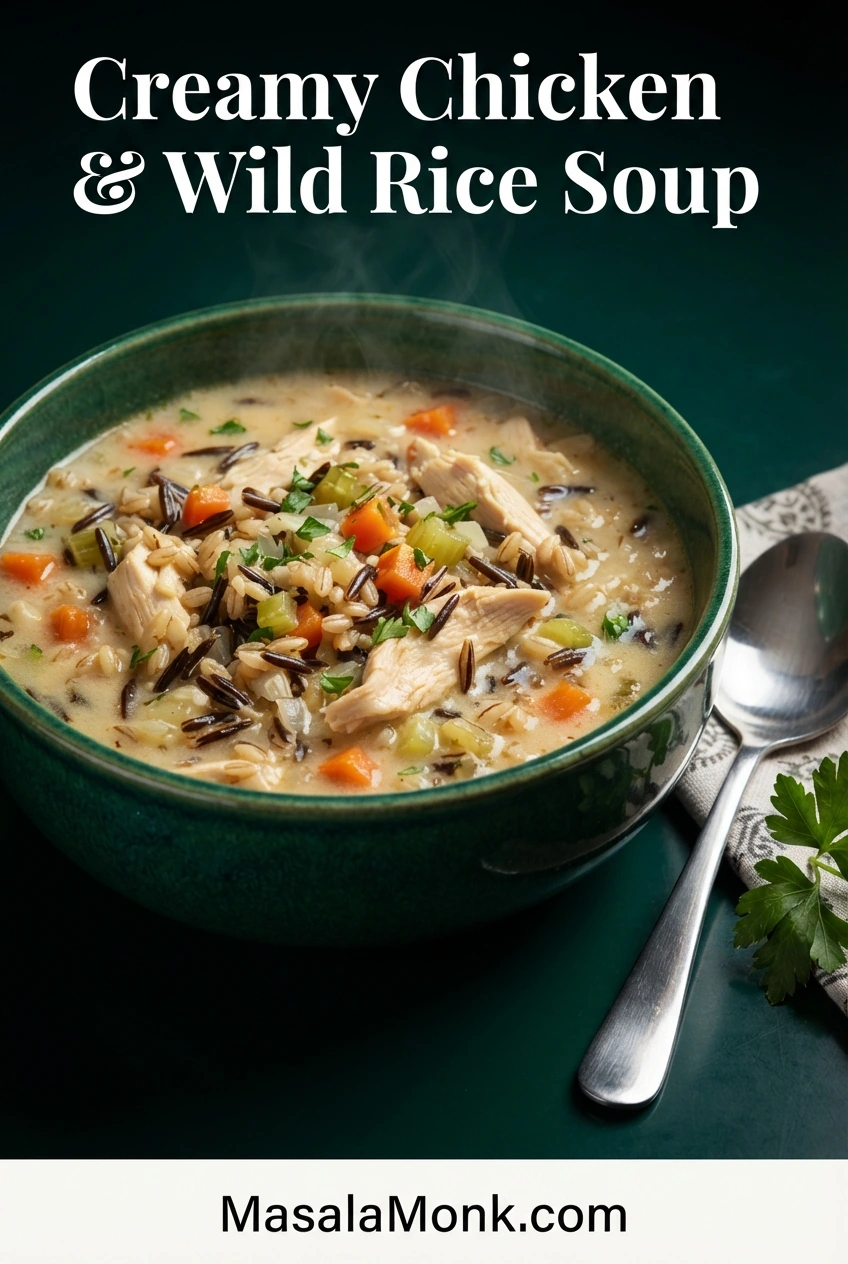
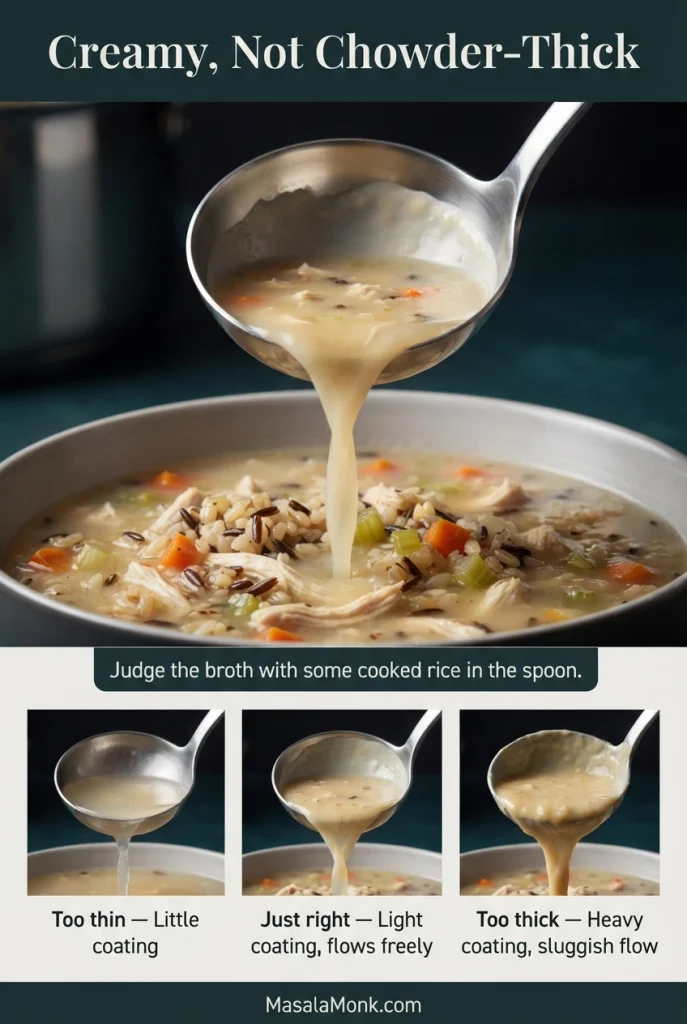
In a good creamy chicken and wild rice soup, the nutty chew of the dark grains is a satisfying contrast to the tender chicken and sweet, softened vegetables. Butter enriches the broth, while garlic and thyme give it a savory aroma. The broth coats a spoon but still flows freely, rather than sitting thick like chowder.
Cook the rice in its own saucepan. It’s an extra pot to wash, but worth it: the grains can soften at their own pace while you make the broth, and the chicken goes in just in time to warm through.
Leftover roast chicken can become quite a different dinner here, and rotisserie chicken works just as well. With the rice already cooked, dinner takes an estimated 35–45 minutes. This chicken and wild rice soup recipe makes about six generous bowls. If you’re cooking for fewer people, set some of the soup base aside for another meal.
Already cooking? Adjust the consistency, fix a soup problem or save portions for another meal.
Creamy Chicken and Wild Rice Soup Recipe
A hearty stovetop chicken soup with separately cooked wild rice, tender vegetables and a lightly thickened broth finished with heavy cream.
Preparation and cooking overlap. Allow extra time for raw chicken or slower-cooking rice.
Recipe development note: This recipe draws on established soup-making and wild rice cooking methods, although we have not yet kitchen-tested this exact formulation. Timings and yield are estimates. The AI-generated illustrations depict the intended preparation and finished results; use the written doneness checks to guide your cooking.
Go straight to the cooking instructions.
Ingredients
The following quantities make approximately six meal-sized bowls.
For the Wild Rice
- 160 g (about ¾–1 US cup) dry, unseasoned wild and brown rice blend
- Water, according to the package directions, or about 1 liter (4¼ US cups) for the excess-water method
- Salt, as needed for cooking the rice
For the Chicken Soup
- 42 g (3 tbsp) unsalted butter
- 150 g (about 1 medium) yellow onion, diced
- 150 g (about 2 medium) carrots, diced
- 110 g (about 2 large stalks) celery, diced
- 12 g (about 3–4 cloves) garlic, minced
- ½ tsp dried thyme or 1½ tsp fresh thyme leaves
- 30 g (¼ US cup, spooned and leveled) all-purpose flour
- 1.2 liters (about 5 US cups) flavorful, low-sodium chicken stock or broth
- 1 bay leaf
- ½ tsp ground black pepper
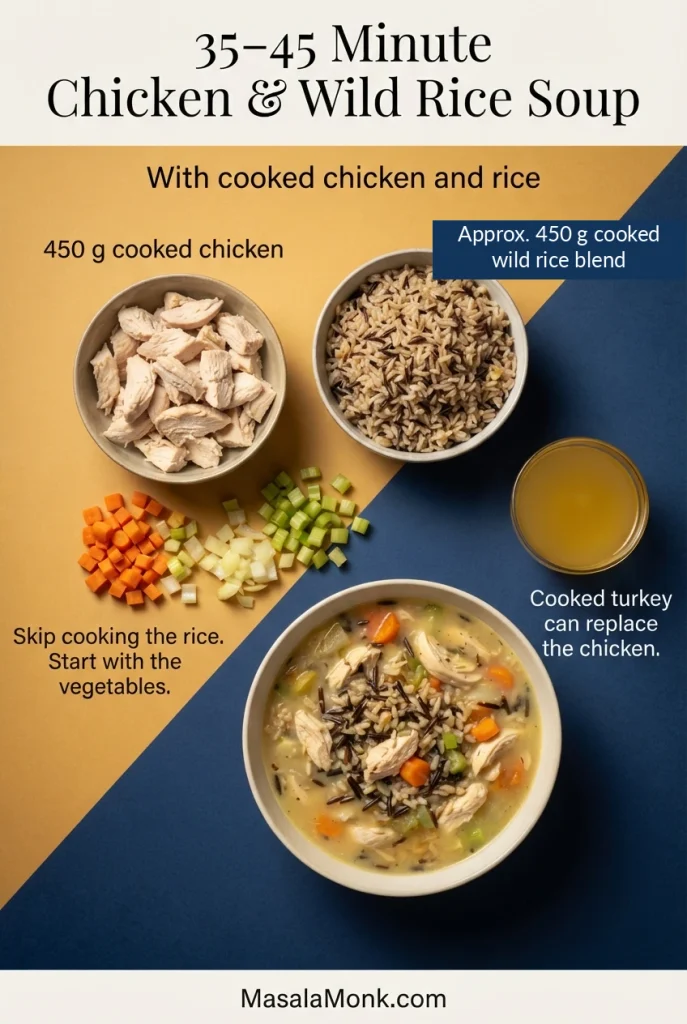
- 450 g (about 1 lb) cooked chicken, shredded or diced
- 180 ml (¾ US cup) heavy cream
- Salt and additional black pepper, to taste
Optional Garnishes and Adjustments
- 10 g (a small handful) fresh parsley, chopped
- 5 ml (1 tsp) fresh lemon juice, to start
- 240 ml (1 US cup) extra chicken stock, or more if needed
- ¼ tsp chicken bouillon paste, or a little concentrated stock, to start
- 8 g (1 tbsp) cornstarch (cornflour in the UK) and 30 ml (2 tbsp) cold water, for additional thickening
Ingredient Overview and Substitutions
The essential ingredients in this creamy chicken and wild rice soup recipe are cooked chicken, wild rice, flavorful stock, vegetables, flour and cream. Keep the optional garnishes and thickener aside until you have tasted the finished broth and assessed its consistency.
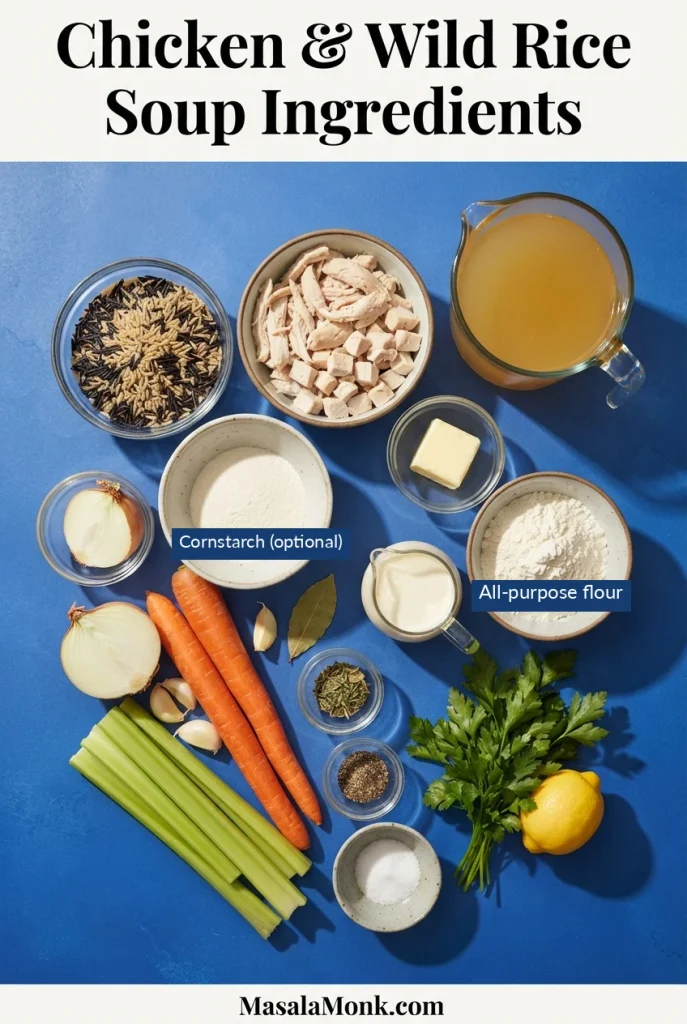
Dry or cooked rice? Weigh the dry rice when possible because cup measurements vary between blends. If starting with ready-cooked rice, use about 450 g (1 lb). The rice-cooking water is separate from the stock in the soup. You can also substitute pure wild rice for the blend.
Weigh the chicken after cooking and removing the skin and bones. Starting with raw meat? Follow the poaching instructions or use our oven-baked chicken breast recipe.
Before starting, check the instructions for adding mushrooms, using milk instead of cream or making the soup gluten-free or dairy-free.
Equipment and Preparation
Use a 5–6 liter (approximately 5–6 US quart) soup pot or Dutch oven and a 2–3 liter saucepan for the rice. Have a fine-mesh strainer, knife, cutting board, whisk, ladle and food thermometer handy.
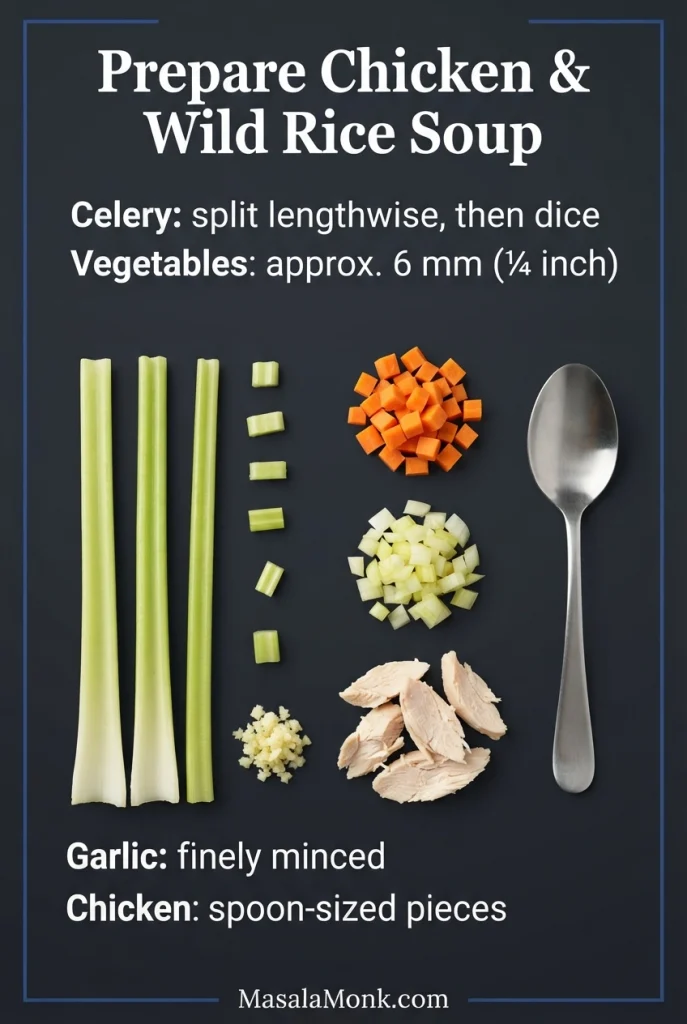
A small, even dice of about 6 mm (¼ inch) helps the onion, carrots and celery soften together. Meanwhile, mince the garlic and shred the chicken into pieces that fit comfortably on a spoon. You can prepare these while the rice cooks.
How to Make Chicken and Wild Rice Soup
Cooking ahead? Keep rice separate for tomorrow’s lunch. For freezer meals or several meals using previously chilled chicken, decide what to reserve before Step 5; see the make-ahead guide. Making only a freezer base? Skip Step 1 and stop after Step 4.
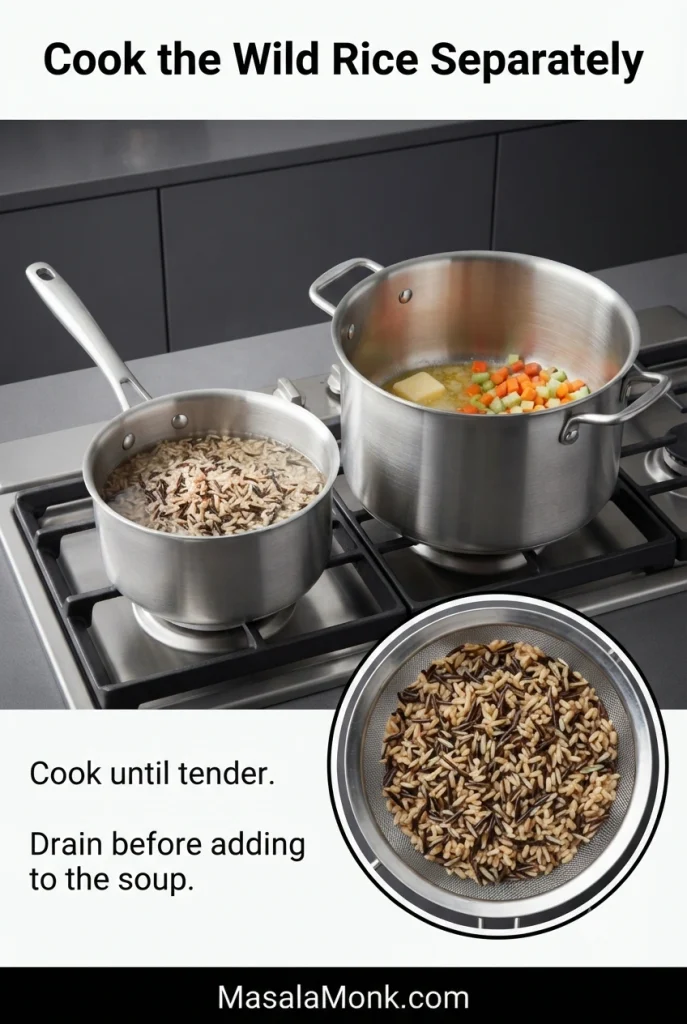
1. Cook the Wild Rice
Start the rice first, following the package directions and rinsing when recommended. Regular wild-and-brown-rice blends often take 25–45 minutes, although some need longer.
Without package directions: Bring 1 liter (4¼ cups) of lightly salted water to a boil. Add the regular unseasoned blend and reduce to an uncovered simmer. Keep the grains submerged with extra hot water as needed. Begin checking after 25 minutes, then every few minutes until tender. This method is not intended for instant or quick-cooking mixes.
While the rice simmers, prepare the remaining ingredients and continue with Steps 2–4. Check the saucepan periodically rather than waiting for the rice to finish before starting the soup base.
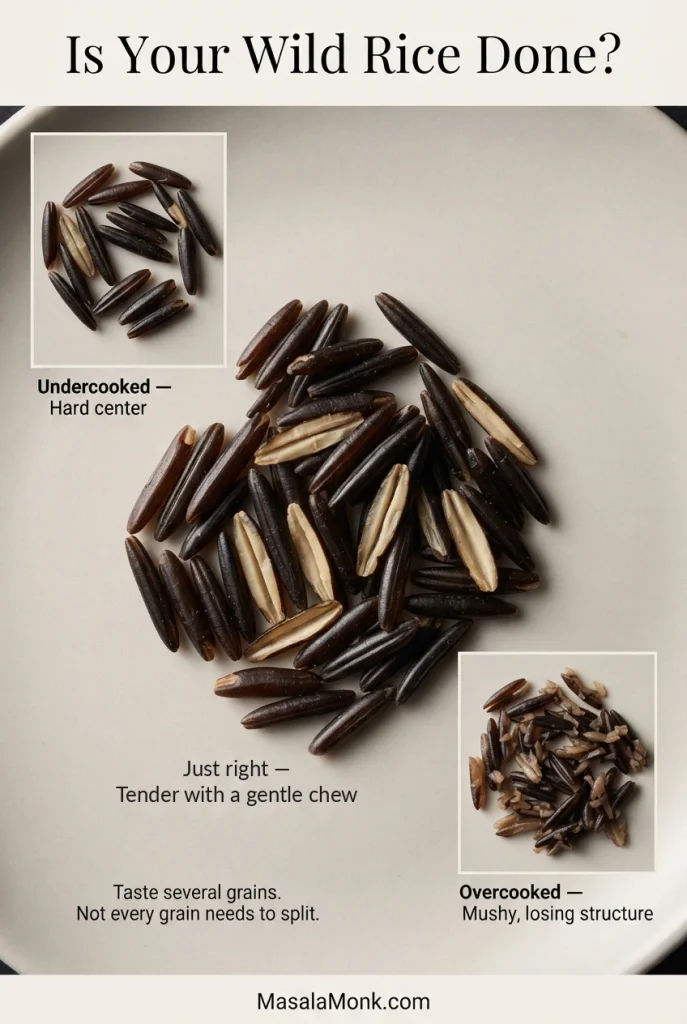
Taste the rice before draining it. Check several grains, including the darkest ones. A little chew is desirable; a hard center is not. Once tender, drain any remaining water and cover briefly until needed in Step 5. If preparing the rice ahead, divide it into shallow containers, cool it quickly, ideally within one hour, and refrigerate promptly.
2. Soften the Vegetables in Butter
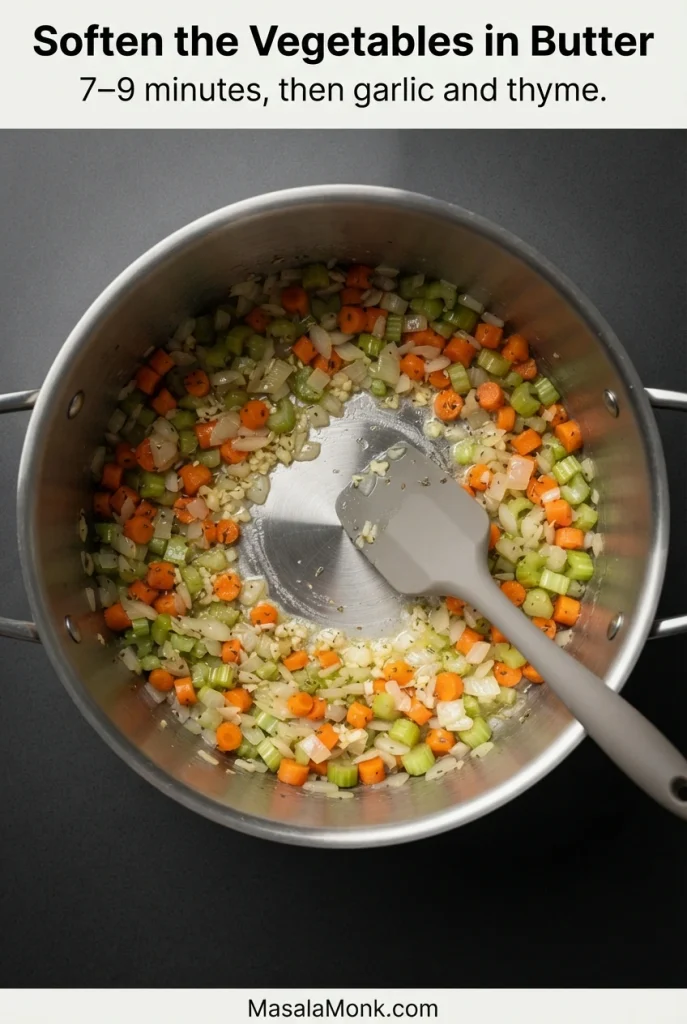
Melt the butter in the soup pot over medium heat. Add the onion, carrots and celery. Cook for 7–9 minutes, stirring occasionally, until the onion turns translucent and the vegetables begin to soften. Let their sweetness come through without browning heavily.
Next, stir in the garlic and thyme. Once fragrant, usually after 30–60 seconds, move on to the flour.
3. Stir in the Flour
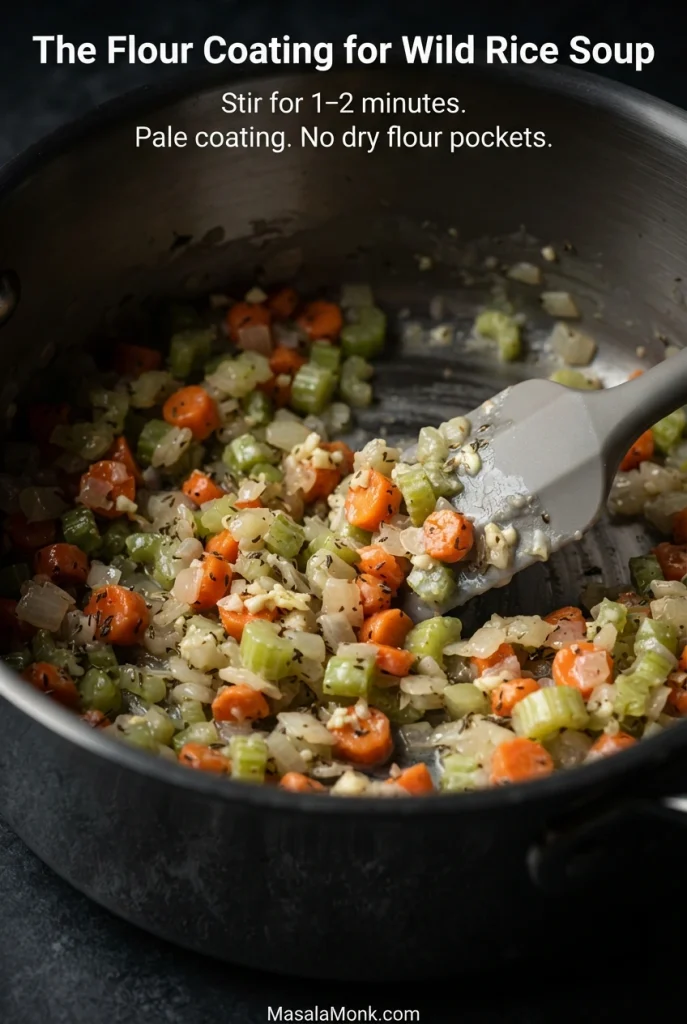
Sprinkle the flour evenly over the vegetables and stir continuously for 1–2 minutes. Look for a pale, slightly pasty coating with no dry pockets of flour remaining. If lumps develop after adding stock, see the flour-lump troubleshooting guide.
4. Add the Stock and Simmer
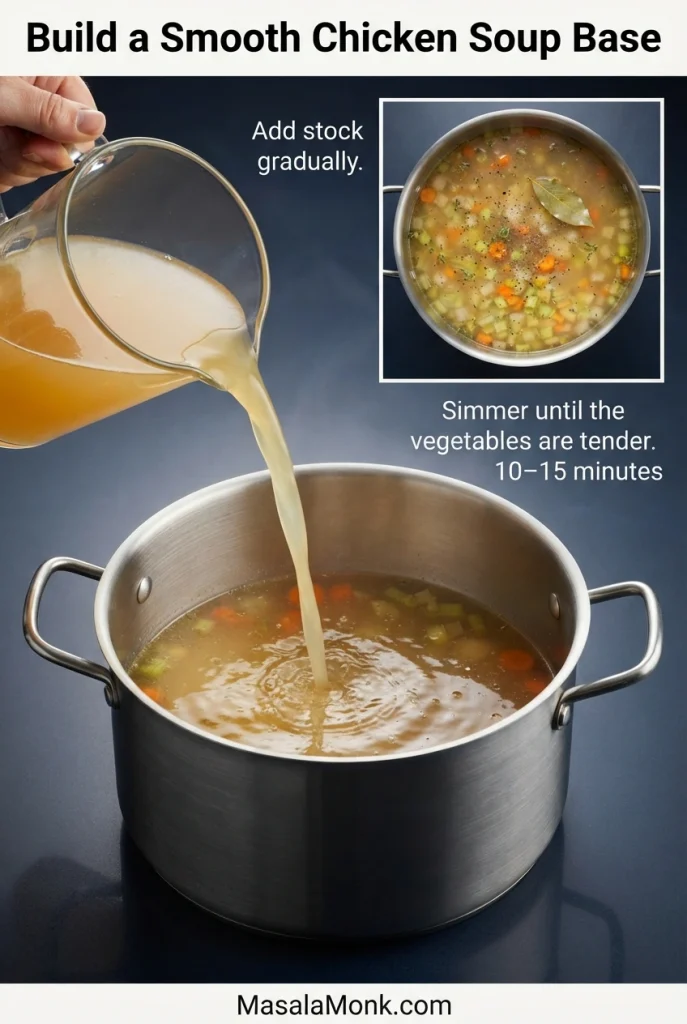
Gradually pour in 240 ml (1 cup) of the measured chicken stock, stirring to loosen the flour mixture. Once smooth, add the remaining stock, bay leaf and ½ teaspoon black pepper.
Bring to a gentle boil, then reduce the heat and simmer with the lid slightly ajar. Stir occasionally, scraping the bottom of the pot. Cook until a piece of carrot yields easily to a fork, usually 10–15 minutes.
Taste the broth before adding the cream. It should have a good, savory chicken flavor. Strengthen weak stock with a little concentrated stock or ¼ teaspoon bouillon paste to start, bearing in mind that products vary in strength and saltiness. Add salt as needed, although rotisserie chicken may already be well seasoned.
When the vegetables are ready but the rice needs a few more minutes, cover the pot and keep it over very low heat or take it off the heat briefly.
5. Add the Chicken and Cooked Rice
Remove the bay leaf from the soup base.
Making some for later? Divide the soup base before adding the chicken, rice or cream. To finish half now, use 225 g cooked chicken, half the cooked grains and 90 ml cream. Reserve previously chilled chicken or rice intended for future meals before heating it. See the make-ahead guide for more options.
For the full recipe, stir in 450 g (about 1 lb) cooked chicken. Gradually add the drained rice, or about 450 g ready-cooked rice, stopping while there is still plenty of broth around the chicken and vegetables. For a partial batch, use the corresponding smaller quantities.
Alternatively, keep the rice separate for serving in individual bowls. Return the chicken soup to a gentle simmer and heat the ingredients through. Since the chicken is already cooked, it does not need another long simmer.
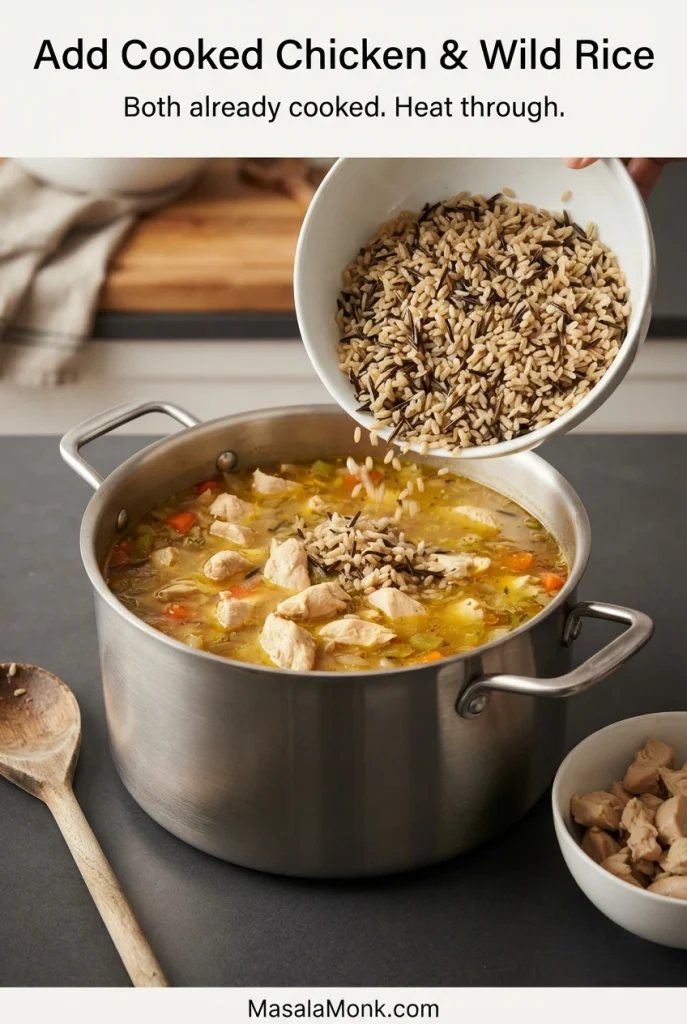
6. Finish with Cream and Season to Taste
Reduce the heat to medium-low and stir in the heavy cream, using 180 ml (¾ cup) for the full recipe or the corresponding amount for a partial batch. Warm gently until hot throughout, usually another 3–5 minutes.
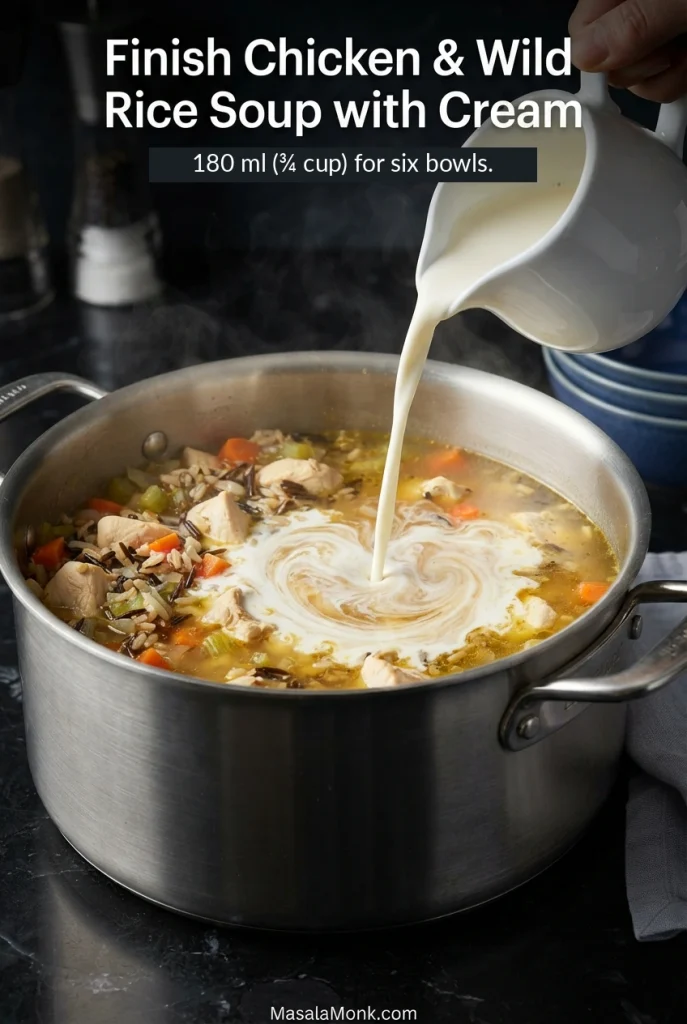
Check the Finished Soup Consistency
Lift a spoonful of soup. The broth should lightly coat the spoon and still pour freely. If serving the rice separately, judge the consistency with a few cooked grains in the spoon.
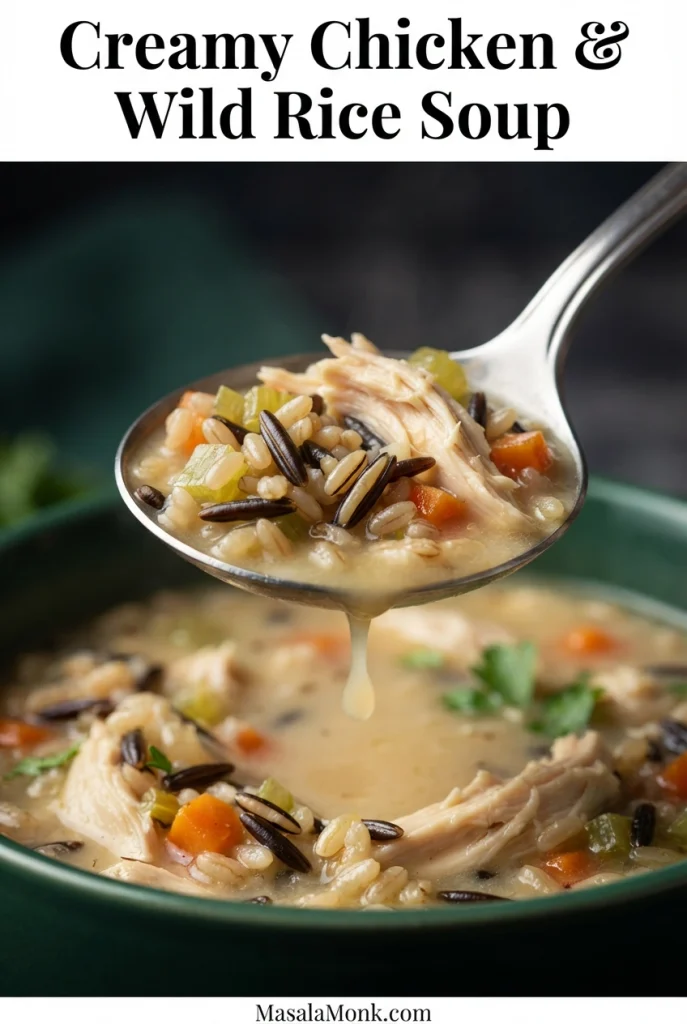
- Too thick? Add hot stock, 60 ml (¼ cup) at a time. Hot water will also work; check the seasoning afterward.
- Too thin? Mix 8 g (1 tbsp) cornstarch with 30 ml (2 tbsp) cold water. Stir half into the soup, let it bubble for 1–2 minutes and assess the thickness. Remix the remaining slurry before adding more, and simmer briefly again. Use smaller amounts for a partial batch. See the detailed thickening guide if you omitted the flour.
Season and Serve the Soup
After any consistency adjustments, ensure the soup is hot throughout and any previously refrigerated cooked chicken or rice reaches 74°C (165°F). Taste the broth and adjust the salt and pepper. Then take the pot off the heat and stir in the parsley, if using.
Try a few drops of lemon juice in a spoonful first. If you like the difference, start with about a teaspoon for the whole pot and adjust to taste.
When serving the rice separately, put hot cooked rice into each bowl first. Reheat chilled rice to 74°C (165°F), using only the portions needed for this meal.
Finally, ladle the hot soup into bowls, making sure everyone gets plenty of chicken, nutty grains and creamy broth. Finish with freshly ground black pepper if you like.
What to Serve with Chicken and Wild Rice Soup
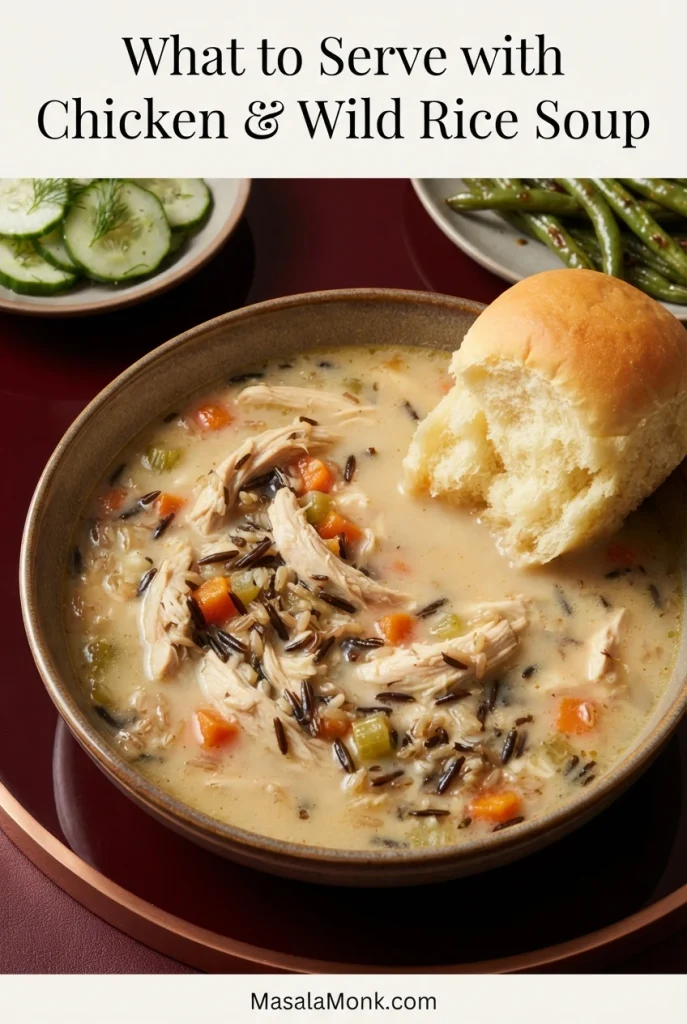
With chicken, grains and vegetables already in the bowl, there is little need for another main course. A basket of warm homemade dinner rolls is plenty. Tear one open and use the soft middle to soak up the last of the broth. Crusty sourdough or buttery crackers offer a crisper alternative.
For something fresh alongside the soup, try a chilled cucumber salad with vinegar and dill. Its crunch and gentle acidity cut through the richness of the broth. Alternatively, roasted broccoli or green beans are good choices when you would rather have a warm vegetable on the table.
Ingredient Choices, Variations and Cooking Help
Choose and Customize
Choosing the Best Wild Rice for Chicken and Wild Rice Soup
An unseasoned wild-and-brown-rice blend is the best starting point for this recipe. The softer brown rice contrasts with the firmer, nuttier wild rice. Choose pure wild rice instead if you enjoy a more pronounced earthy flavor and chew.
Wild rice is the seed of an aquatic grass, distinct from conventional rice. However, packaged blends may also contain brown, red, black or white rice. Look at the ingredient list and choose a blend with directions for cooking the grains together.
Pure Wild Rice, Blends and Boxed Mixes
| Rice product | Typical cooking time | What to expect |
|---|---|---|
| Pure wild rice | 40–60 minutes or longer | Earthy flavor and a distinctive chew. |
| Regular unseasoned blend | 25–45 minutes or longer | Contrasting soft and chewy grains. |
| Seasoned boxed mix | Often 15–25 minutes; varies by product | Added herbs and salt. |
| Instant or quick-cooking blend | Follow the package | Fast preparation; may soften more readily. |
| Precooked wild rice or blend | Already cooked | About 450 g for six bowls. |
| Ordinary white or brown rice | Depends on variety | Milder flavor without wild rice’s characteristic chew. |
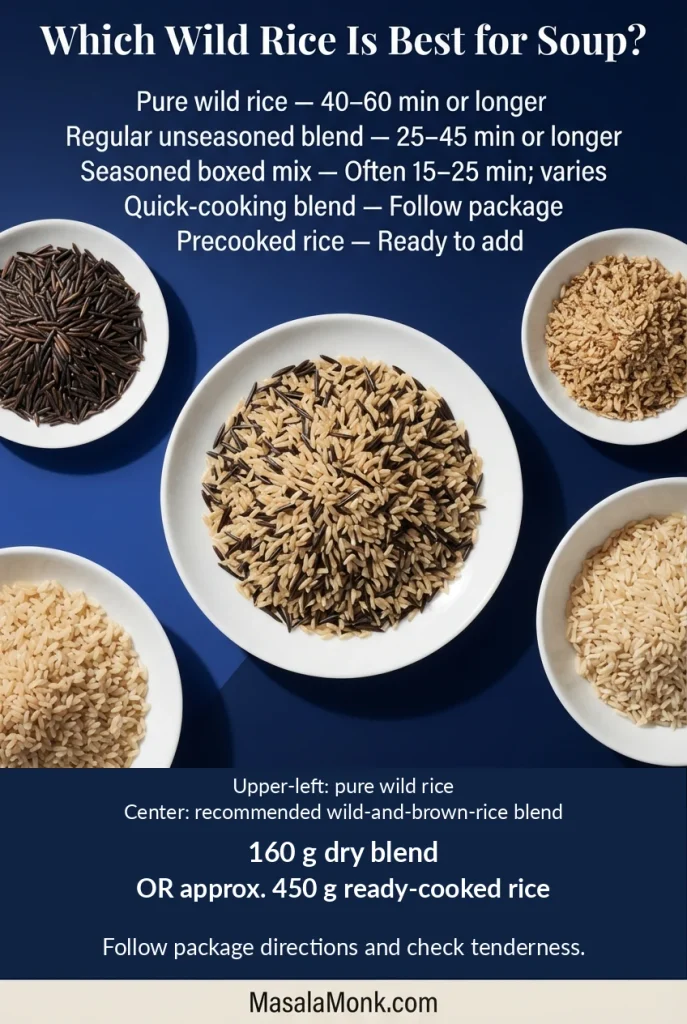
Some seasoned mixes are also quick-cooking, so check the packet before you start. Its directions take priority over the estimated times above.
For a boxed mix, aim for about 450 g (1 lb) cooked grains rather than assuming one box contains the right amount. Start with less of a separate seasoning packet where the directions allow, since the mix may contribute quite a bit of salt.
Ordinary white or brown rice works in the same approximate cooked quantity. Our guide to cooking different types of rice covers their individual methods. Alternatively, for a lighter soup with clear, golden broth, try our homemade chicken and rice soup.
Using Pure Wild Rice Instead of a Blend
To make this chicken and wild rice soup recipe with pure wild rice, replace the blend with 160 g (5.6 oz) dry pure wild rice. Keep the same amount of chicken stock and follow the package directions when available.
For bulk wild rice without directions, rinse the grains and add them to 1 liter (4¼ cups) of lightly salted boiling water. Reduce to a steady, uncovered simmer. Begin checking around 40 minutes, or sooner if the grains are already splitting and softening.
Keep the grains submerged by adding hot water as needed. Once tender, drain through a fine-mesh strainer, much as you would drain pasta. Add enough to the soup to leave plenty of broth around the grains; cool and store any surplus according to the rice-storage guidance.
How to Tell When Wild Rice Is Cooked
Wild rice is ready when you can comfortably bite through a grain without finding a hard center. Many grains split lengthwise to reveal a lighter interior, but they do not all need to burst open.
With a blend, don’t judge the whole saucepan by its softest grains. Brown rice falling apart while the wild rice remains hard suggests poorly matched cooking times. Try another blend next time, or cook the individual varieties separately when mixing your own. If the grains are already in the broth, see how to rescue hard rice in soup.
Why Some Wild Rice Blends Turn Soup Gray or Brown
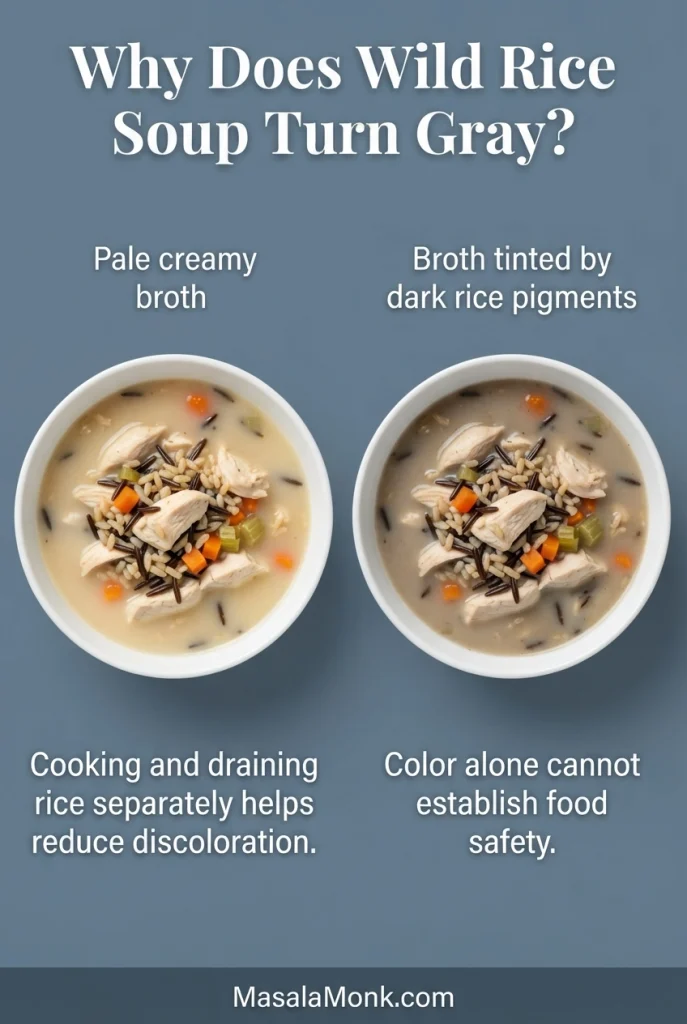
Dark grains release natural pigments into their cooking water. Black rice in a blend, for example, can turn an otherwise pale, creamy soup gray, brown or even purplish.
Cooking and draining the rice separately reduces discoloration. Rinsing beforehand may help, too. A darker broth does not necessarily mean anything went wrong, although color alone cannot tell you whether soup has spoiled.
What Chicken Is Best for Wild Rice Soup?
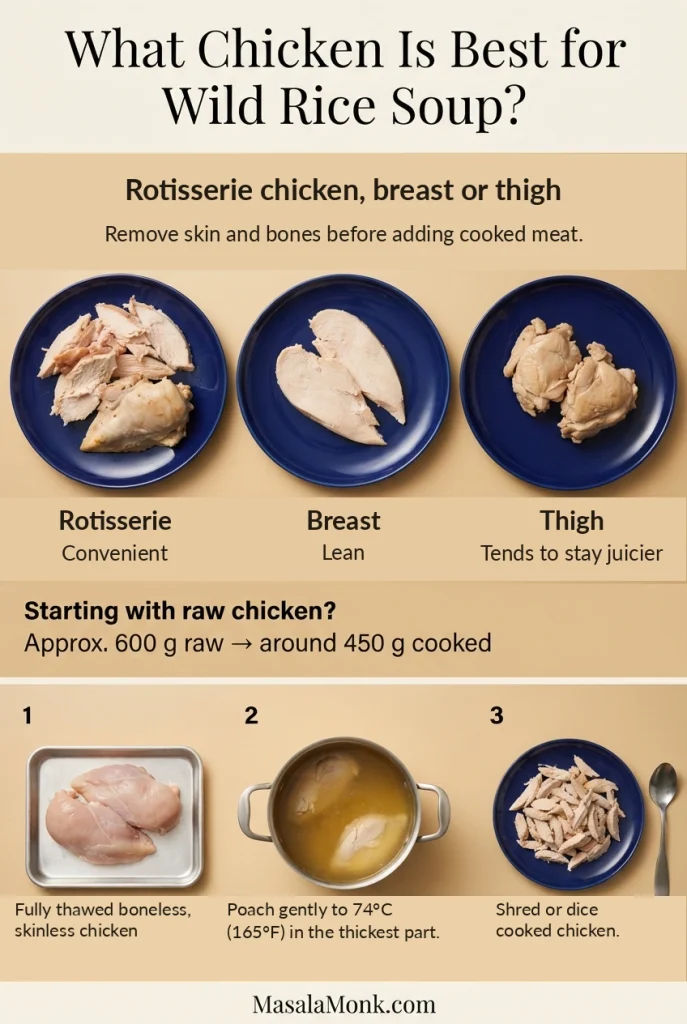
Rotisserie chicken is the easiest choice. You need about 450 g (1 lb) cooked meat. Breast meat shreds easily, while thighs tend to stay juicier through reheating. Use a mixture when you have a whole cooked chicken, or choose thighs for a batch you plan to enjoy over several meals.
If starting with raw chicken, poach it gently before making the soup base, or cook it in a separate saucepan while the rice cooks. The resulting poaching liquid can contribute to the stock rather than going to waste.
Rotisserie Chicken, Leftover Chicken or Turkey
Remove the skin and bones, then shred or dice the meat. Rotisserie chicken often comes well seasoned, so wait until it is in the soup before making the final salt adjustment.
Leftover roast turkey from a holiday dinner makes an excellent variation. Simply use 450 g (1 lb) cooked turkey in place of the chicken, adding it at the same stage.
A large rotisserie chicken may stretch to this soup and white chicken chili another day. Reserve and chill or freeze the extra meat before making the soup.
Starting with Raw Chicken Breasts or Thighs
Start with about 600 g (21 oz) fully thawed, boneless, skinless chicken to obtain roughly 450 g cooked meat. Poaching it in stock gives you both cooked chicken and the liquid for the soup.
Use the soup pot before cooking the vegetables, or a third saucepan to poach the chicken while the rice cooks. Allow roughly 20–35 minutes including heating the stock; some of that time can overlap with other preparation.
Poach and Shred the Chicken
- Place the chicken in the pot with enough stock to cover it.
- Bring to a gentle simmer. Cook for 12–25 minutes, or longer for thicker pieces, until the thickest part of each piece reaches 74°C (165°F).
- Transfer the chicken to a clean plate and pour the poaching liquid into a clean, heatproof container.
- Count the poaching liquid toward the recipe’s 1.2 liters of chicken stock. Top it up if necessary, or save excess for thinning the soup.
- When using the soup pot, wipe it dry before melting the butter and cooking the vegetables.
- Once the chicken is cool enough to handle, shred it and add it during Step 5.
Keep freshly cooked chicken covered during the short remaining preparation, or refrigerate promptly when making it ahead. Check the chicken with a thermometer; see the FoodSafety.gov cooking temperature chart.
Starting with a whole chicken or bone-in pieces? Our homemade chicken soup recipe explains how to make broth from the meat and bones.
Quick Chicken and Wild Rice Soup with Precooked Rice
With about 450 g (1 lb) each of cooked chicken and wild rice, allow 35–45 minutes. Prepare the vegetables and chicken, skip the rice-cooking stage and begin at Step 2.
Frozen diced onion, carrots and celery save some chopping. Use the same weights as fresh vegetables, although you may need extra time for moisture to evaporate before adding flour.
Using chilled leftovers for several meals? Prepare the soup base and heat only the chicken and rice needed today. See the make-ahead guide for finishing quantities.
Getting the Creamy Broth Right
More cream isn’t always the answer to a thin soup. Flour provides most of the thickening in this recipe, while cream mainly adds richness. The chicken, rice and vegetables determine how substantial each bowl feels, and the stock supplies much of its savory flavor.
Once the soup is safely heated, taste a spoonful containing both broth and grains. Broth that looks slightly thin on its own may be just right with the rice.
Creamier, Thicker, Heartier or Lighter?
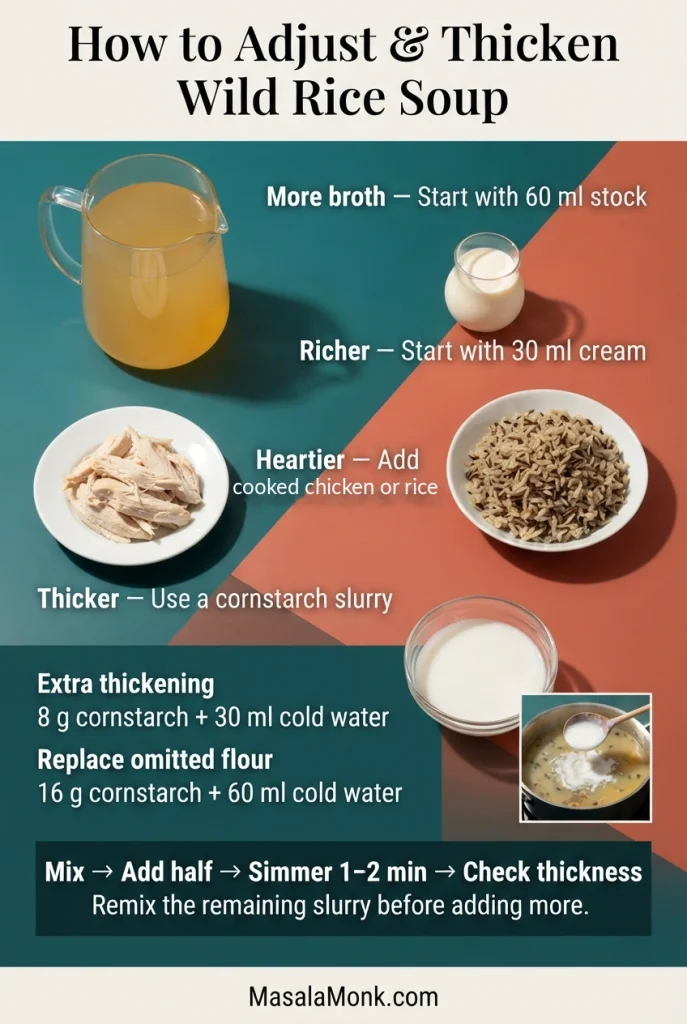
- More broth: Add hot stock, starting with 60 ml (¼ cup).
- Richer: Stir in another 30 ml (2 tbsp) heavy cream and warm through.
- Thicker: Use the cornstarch adjustment below.
- Heartier: Add cooked chicken, rice or browned mushrooms, with enough stock to surround them. Heat the additions thoroughly; refrigerated leftovers should reach 74°C (165°F).
- Stronger flavor: Improve the stock or seasoning using the flavor troubleshooting guide.
For a less rich soup, choose whole milk or half-and-half before adding the cream. To lighten a finished soup, dilute with flavorful stock instead.
How to Thicken Chicken and Wild Rice Soup
Let the flour-thickened broth finish simmering and assess it with the chicken and rice before adding more thickener. The following quantities apply to the full six-serving recipe.
- For a little extra thickness: Mix 8 g (1 tbsp) cornstarch with 30 ml (2 tbsp) cold water.
- To replace omitted flour: Mix 16 g (2 tbsp) cornstarch with 60 ml (¼ cup) cold water.
Stir the mixture until smooth. Add half to the simmering soup while stirring, let it bubble for 1–2 minutes and check the result. Because cornstarch settles as it stands, remix the remaining slurry before adding more. Let each addition bubble briefly before reassessing.
The soup thickens further as it cools. Therefore, stop while the broth still flows comfortably from a ladle. If avoiding wheat flour from the beginning, follow the gluten-free cooking method.
Chicken and Wild Rice Soup Variations
The basic recipe is flexible enough to accommodate mushrooms, lighter dairy options or changes to the thickener. Choose your variation before starting, especially if you need to replace the flour or butter.
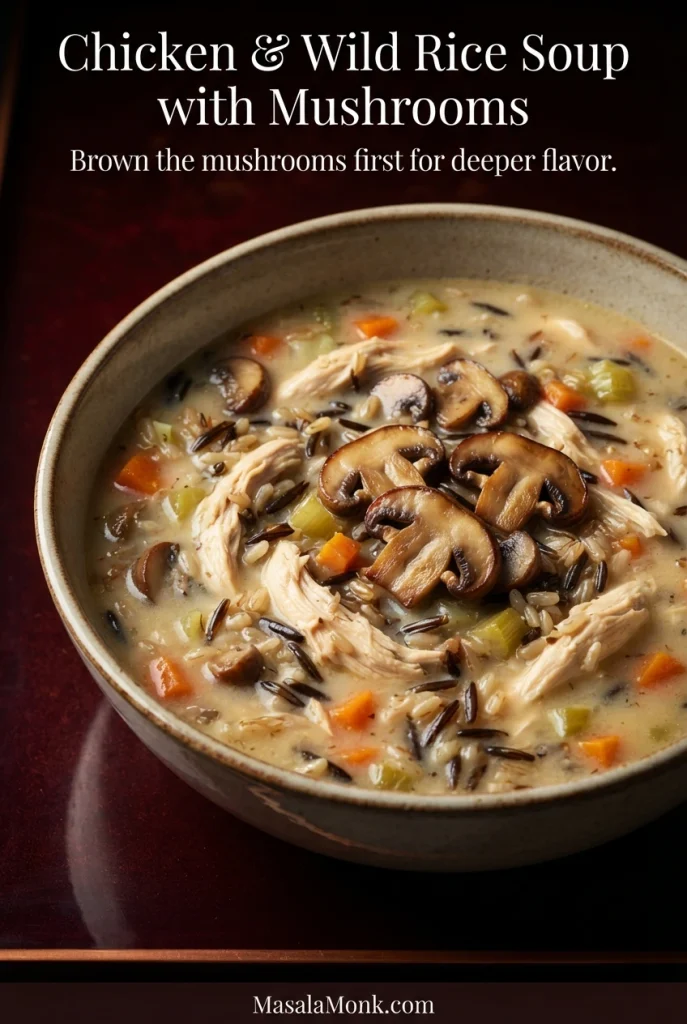
Chicken and Wild Rice Soup with Mushrooms
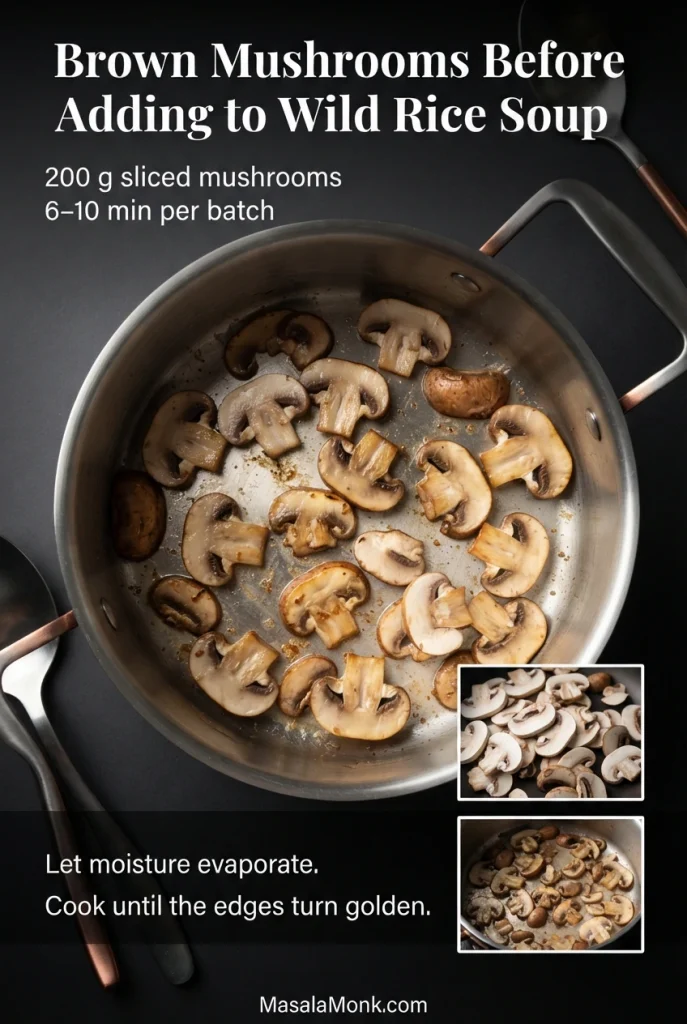
Browned cremini mushrooms deepen the earthy, savory flavor of wild rice. For six servings, add 200 g (7 oz) cremini or white button mushrooms, sliced about 6 mm (¼ inch) thick.
How to Brown Mushrooms for Wild Rice Soup
- While the rice cooks, heat an additional 15 ml (1 tbsp) oil or 14 g (1 tbsp) butter in the soup pot over medium-high heat. Use oil or dairy-free butter if combining this variation with the dairy-free method.
- Spread the mushrooms in an even layer. Work in batches if necessary, adding a little more oil when needed.
- Cook for 6–10 minutes per batch, until their moisture evaporates and the edges turn golden brown.
- Transfer the mushrooms to a bowl and reserve a few for garnishing, if desired. Reduce the heat and begin Step 2, keeping the golden-brown residue in the pot but removing burnt material.
- When adding stock in Step 4, scrape up those browned bits so their flavor becomes part of the broth.
- Return the mushrooms during Step 5. Add the reserved slices to the bowls just before serving.
Increase the mushrooms to 300 g (10½ oz) for a stronger mushroom flavor. If the finished soup needs more broth around the solids, add extra stock in 60 ml (¼ cup) increments.
Chicken and Wild Rice Soup with Milk or Evaporated Milk
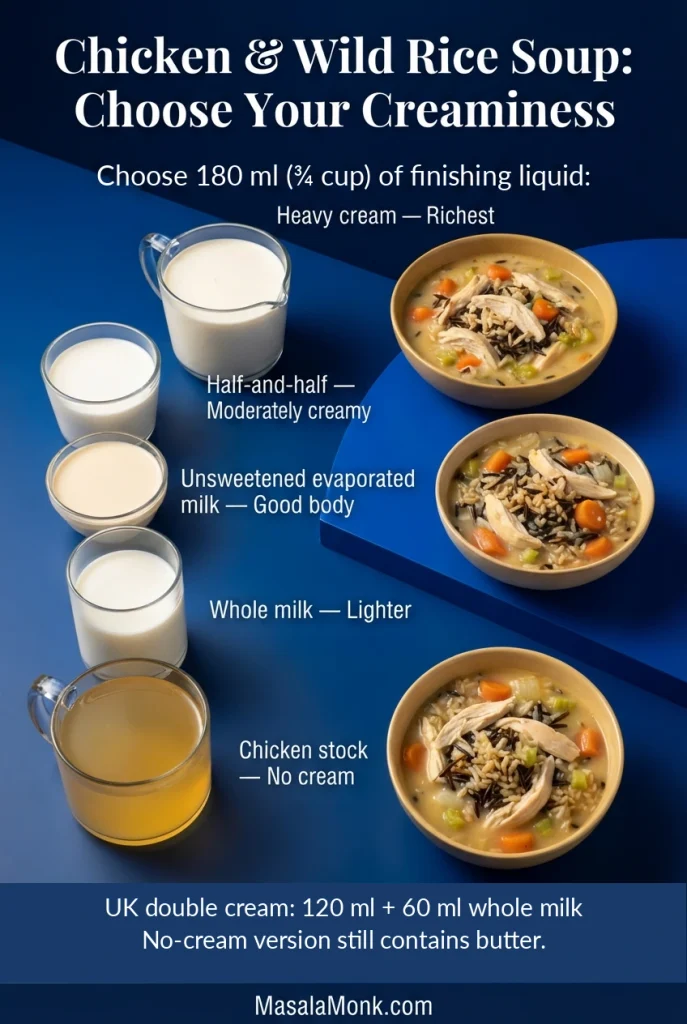
Heavy cream gives the soup its richest finish, but milk works well when you prefer a lighter broth. Keep the flour in the recipe and replace the cream with 180 ml (¾ cup) of your chosen dairy.
| Dairy choice | Expected result |
|---|---|
| Heavy cream | Fuller, richer mouthfeel. |
| Half-and-half | Moderately creamy, less rich. |
| Unsweetened evaporated milk | Good body with a slightly cooked-milk flavor. |
| Whole milk | Lighter, with more prominent stock flavor. |
Half-and-half is a mixture of milk and cream commonly available in the US. UK double cream, however, has more fat than American heavy cream. Try mixing 120 ml (½ cup) double cream with 60 ml (¼ cup) whole milk for a less rich finish than double cream alone.
Warm the dairy gently near the end of cooking. Milk is more sensitive to high heat and acidity, so add lemon juice off the heat. Use unsweetened evaporated milk, not sweetened condensed milk.
Chicken and Wild Rice Soup Without Cream
To make this chicken and wild rice soup recipe without cream, replace the heavy cream with another 180 ml (¾ cup) chicken stock. Butter and flour still give the broth some body, although the soup will be less rich, allowing the chicken and thyme to come through more clearly.
This version still contains butter. To avoid dairy completely, use the oil substitution in the dairy-free method.
Another cream-free chicken-and-rice soup worth making is Greek avgolemono, where eggs give the broth its silky texture and lemon brings a distinctive brightness.
Gluten-Free and Dairy-Free Chicken and Wild Rice Soup
There are two independent ways to adapt the standard recipe. For a gluten-free soup, replace the wheat flour with cornstarch. For a dairy-free version, replace both the butter and heavy cream. You can also combine these changes, provided the remaining ingredients meet both dietary requirements.
Gluten-Free Method
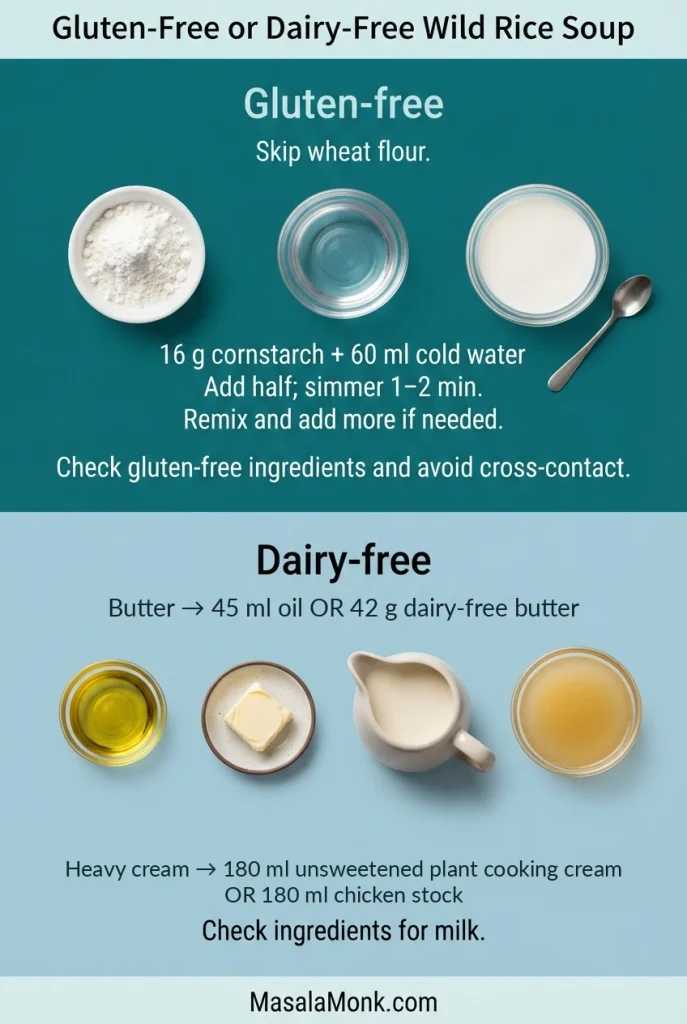
Wild rice is naturally gluten-free. Skip the wheat flour in Step 3 and pour the stock directly into the softened vegetables.
Once the carrots are tender, mix 16 g (2 tbsp) cornstarch with 60 ml (¼ cup) cold water. Stir half into the simmering broth and let it bubble for 1–2 minutes. Continue with the chicken, rice and cream. Afterward, check the finished consistency, remix the remaining slurry and add as much as needed, simmering for another 1–2 minutes after each addition. Use this mixture in place of the standard Step 6 slurry rather than automatically adding both.
When cooking for someone with celiac disease, check that the rice blend, cornstarch, stock, prepared chicken and seasonings are gluten-free. Prevent cross-contact through shared utensils, cookware and preparation surfaces.
Dairy-Free Method
Cook the vegetables in 45 ml (3 tbsp) mild olive or neutral cooking oil instead of butter, or use 42 g dairy-free butter. Choose one of these finishes:
- Creamy: Use 180 ml (¾ cup) unsweetened plant-based cooking cream. Oat and soy creams generally have more neutral flavors than coconut milk. However, thickness and richness vary between products, so follow their heating instructions and judge the finished broth.
- Without specialty ingredients: Use another 180 ml (¾ cup) chicken stock. The flour gives the soup a lightly thickened, less rich broth.
Check the stock, prepared chicken and seasonings for milk ingredients. If cooking for someone with a milk allergy, also prevent cross-contact with dairy products.
To make the soup both dairy-free and gluten-free, combine these substitutions with the cornstarch-thickening method. If using plant cream, choose one labeled gluten-free.
Troubleshooting Chicken and Wild Rice Soup
Fixing Rice, Chicken and Broth Problems
| Problem | Likely cause | What to do |
|---|---|---|
| Rice is hard | Insufficient time or water. | Simmer in sufficient water, or follow the rescue instructions below. |
| Rice is mushy | Overcooking or mismatched grains. | Stop cooking and drain separate grains. This cannot reverse overcooking. |
| Broth is gray or brown | Natural rice pigments. | See the discoloration guide. |
| Soup is gluey or too thick | Excess starch, grains or evaporation. | Add hot stock, starting with 60 ml (¼ cup). Hold back any rice not yet added. |
| Soup is watery | Incomplete thickening or excess liquid. | Finish simmering the flour and assess with rice before adding cornstarch. |
| Chicken is dry or stringy | Overcooking. | Stop simmering. Slice larger pieces across the grain or shred them; serve with plenty of broth. |
What If the Rice Is Already in the Soup?
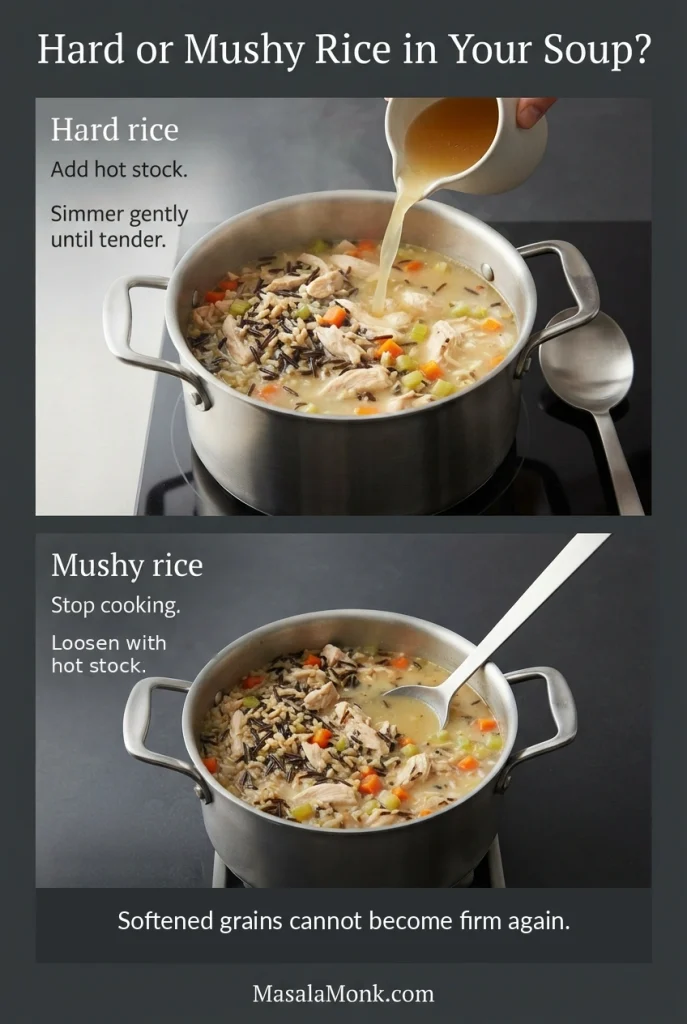
Hard rice doesn’t necessarily mean you need to start dinner again. Add enough hot stock to keep the grains surrounded by liquid, then simmer gently until they soften. However, some grains may become softer than others during the rescue.
If the chicken is already in the pot, leave it in the soup unless you can remove it briefly and keep it safely hot at 63°C (about 145°F) or above. Continue simmering gently until the rice is tender, then return any reserved chicken and heat the soup throughout to 74°C (165°F). The chicken may lose some tenderness during this rescue.
Keep the simmer gentle when cream is already in the pot, since finishing the grains may change the dairy texture. For mushy rice, stop cooking: hot stock can restore a more fluid broth, but cannot make the grains firm again.
Flour Lumps, Forgotten Flour and Separated Cream
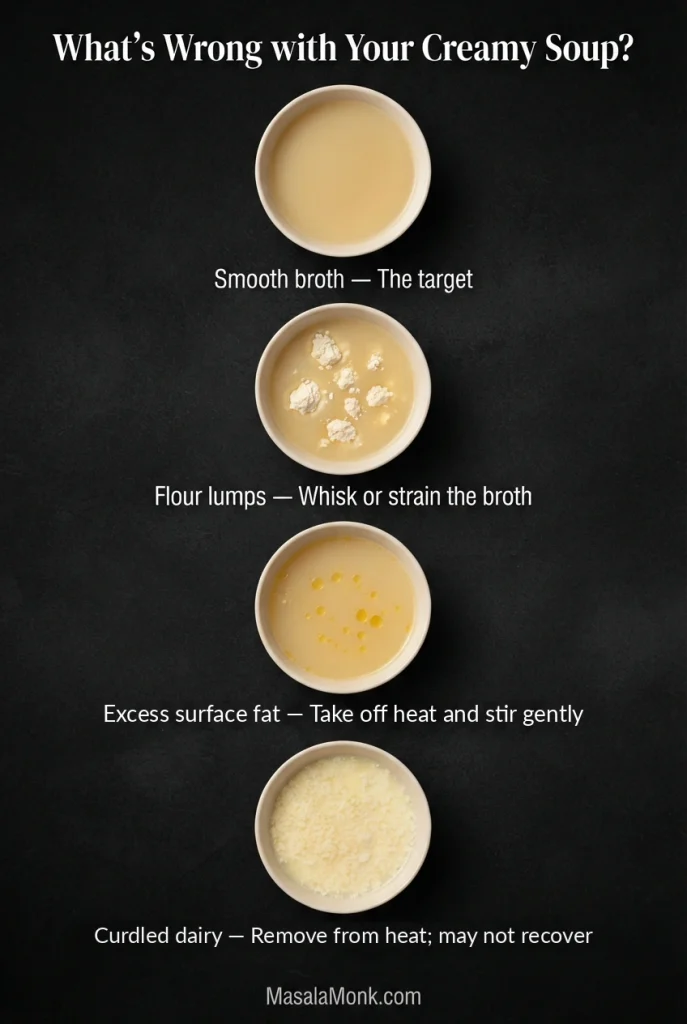
Flour lumps: Whisk the broth before adding chicken and rice. In assembled soup, ladle out the lumpy liquid, whisk or strain it separately, then return it to the pot. Recheck the thickness because straining can remove some flour.
Forgot the flour? Mix 16 g (2 tbsp) cornstarch with 60 ml (¼ cup) cold water. Stir half into the simmering broth, cook for 1–2 minutes and check the thickness. Remix and add more as needed, letting each addition bubble briefly.
Without cornstarch, preferably before adding cream, whisk 15 g (2 tbsp) flour into 60 ml (¼ cup) cold stock. Gradually stir it into the soup and simmer for 5–10 minutes or longer, until the raw-flour taste disappears. Check the thickness before repeating. Never sprinkle dry flour directly into hot broth.
Raw-flour taste: Simmer gently for longer, preferably before adding rice and cream. Flour can thicken a soup before it loses its raw taste.
Separated cream: A little surface fat may stir back into the broth, whereas grainy curds are harder to fix. Take the pot off vigorous heat and stir gently. Badly curdled dairy may not recover. Next time, add cream near the end and lemon juice off the heat.
Why Does My Chicken and Wild Rice Soup Taste Bland?
A soup can taste salty and still lack flavor. More cream won’t give watery stock the savory depth it lacks. Instead, taste the broth to decide whether it needs stronger chicken flavor, salt, fresh herbs or a little acidity.
| What you taste | What to try |
|---|---|
| Undersalted | Add a small pinch of salt, stir and taste again. |
| Salty but flat | Try parsley or a few drops of lemon in a spoonful. Lemon changes the flavor balance, not the salt content. |
| Weak chicken flavor | Add concentrated stock or start with ¼ tsp bouillon paste. Check its salt content. |
| Overly rich | Loosen with flavorful stock. A little lemon may brighten the finish. |
| Too salty | Dilute with unsalted stock or water, starting with 60–120 ml (¼–½ cup). |
| Too much thyme or other herbs | Dilute with unseasoned stock. Small herb leaves are difficult to remove. |

Rescuing an Oversalted Pot
Severely oversalted soup may need enough dilution to warrant dividing it between two pots. Extra unsalted cooked vegetables or chicken can help maintain the balance of solids and liquid. Heat additions thoroughly before serving.
After correcting the salt level, reassess the broth’s consistency. If dilution has made it too thin, use the cornstarch adjustment rather than reducing the soup again and concentrating its salt.
How to Store and Reheat Chicken and Wild Rice Soup
Even if you’re only serving a few bowls tonight, you can make the full pot. With a little planning before assembly, you can have lunch ready for tomorrow or a nearly finished dinner in the freezer.
Rice continues absorbing broth during storage, while flour-thickened liquid becomes firmer as it cools. Therefore, keeping the cooked grains separate helps preserve the balance of creamy broth and rice for the next meal.
Preparing Soup for Several Meals
| Meal plan | How to prepare the soup |
|---|---|
| All six bowls now | Combine cooked chicken, rice and cream with the soup base. |
| Dinner and tomorrow’s lunch, using freshly cooked chicken | Finish the creamy chicken base. Keep rice separate for individual bowls. |
| Several meals using leftover chicken or rice | Divide the fresh soup base. Heat only the cooked ingredients and cream needed for today. |
| Dinner now and freezer meals later | Divide the soup base after Step 4. Freeze future portions without rice or cream. |
| Already assembled leftovers | Cool and store promptly within the limits below. Under UK advice, do not save already reheated leftovers for another reheating. |
Dinner Tonight and Freezer Portions for Later
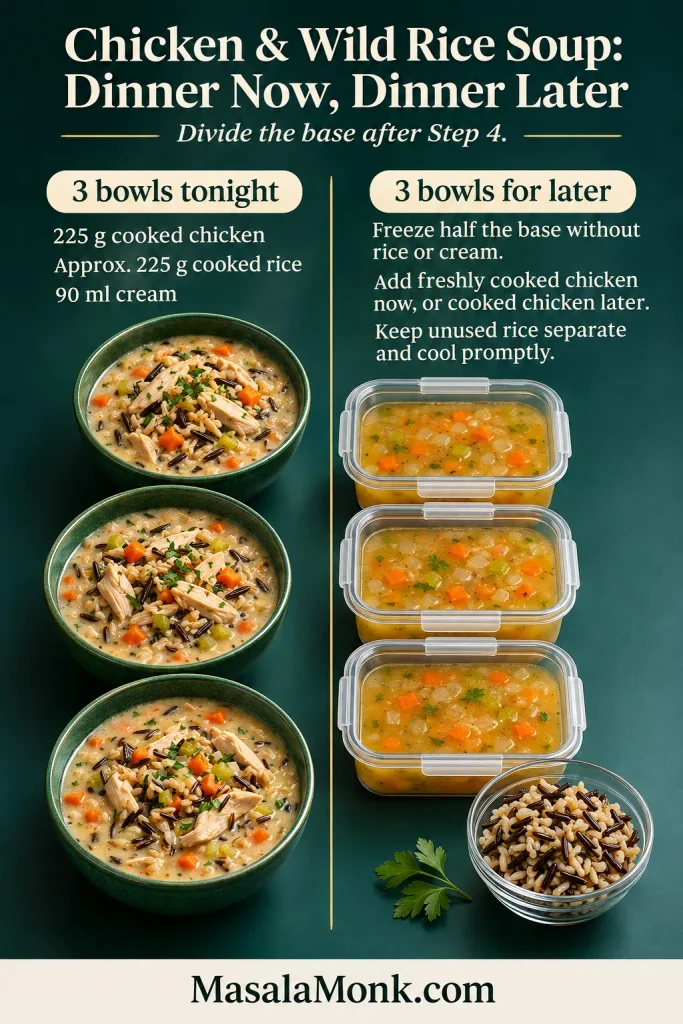
This chicken and wild rice soup recipe is particularly useful for preparing dinner and future freezer meals at the same time. To serve three bowls tonight and freeze three for later, remove the bay leaf after Step 4. Stir the soup base and divide it in half, sharing the vegetables evenly.
- Tonight: Finish half the base with 225 g cooked chicken, half the cooked grains (about 225 g if using ready-cooked rice) and 90 ml (6 tbsp) cream.
- Another evening: Freeze the remaining base without rice or cream. Add the other 225 g chicken before freezing if freshly cooked, or add cooked chicken when finishing it later. Cool and freeze surplus freshly cooked rice separately.
When starting with previously cooked and chilled chicken or rice, keep unused portions chilled or frozen within their original storage limits. Heat only what you need today, particularly when following UK guidance to reheat leftovers only once.
How Long Does the Soup Last in the Fridge?
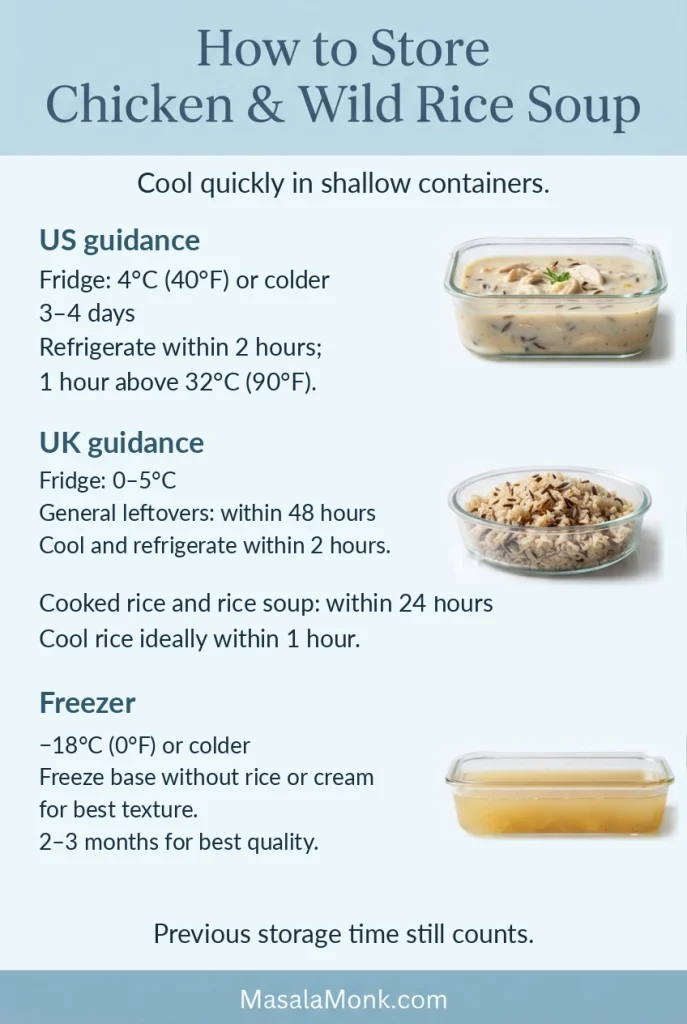
Divide the soup into shallow containers so it cools quickly. Don’t leave a large pot on the counter until it reaches room temperature.
- US general leftovers guidance: Refrigerate within two hours of cooking, or one hour when the surrounding temperature exceeds 32°C (90°F). Keep at 4°C (40°F) or colder and use within 3–4 days.
- UK general leftovers guidance: Cool and refrigerate within two hours. Keep the fridge at 0–5°C (32–41°F). Eat within 48 hours or freeze.
- UK cooked-rice guidance: Cool rice quickly, ideally within one hour. Refrigerate for no more than 24 hours before reheating, and reheat only once. Use this shorter limit for assembled rice soup as a conservative precaution.
Making soup with yesterday’s chicken doesn’t give that chicken another four days in the fridge. Count the time previously cooked ingredients have already spent in storage and follow the shortest applicable limit. Freeze suitable portions promptly for meals beyond these periods.
See the US recommendations for handling leftovers, UK chilling and freezing guidance and UK guidance on cooking and reheating food.
Can You Freeze Creamy Chicken and Wild Rice Soup?
Yes. Freeze the soup base before adding rice or cream for the best texture after reheating. You can also freeze fully assembled soup when you have handled it safely, although the grains may soften and the dairy may separate after thawing.
Preparing the Soup Base for Freezing
- Prepare the soup base through Step 4. You can skip cooking the rice and chicken when making a base to finish another day.
- Remove the bay leaf and stir the base. Add freshly cooked chicken if desired, leaving out the rice and cream.
- Divide into shallow, freezer-safe containers, distributing the vegetables evenly. Cool and refrigerate promptly within the times given above.
- Freeze once chilled, leaving room for expansion. Use glass containers only if designed for freezing.
You can also freeze cooked chicken and rice in separate meal-sized portions. Cool rice quickly, ideally within one hour, and freeze promptly in appropriately sized containers.
For the best flavor and texture, use frozen soup within 2–3 months. Food that was safe when frozen and remains continuously frozen at -18°C (0°F) can stay safe longer, although quality may decline. Freezing won’t make improperly stored food safe again.
Finishing a Frozen Portion
Thaw the base and any separately frozen cooked chicken or rice in the refrigerator. Under UK guidance, use thawed ingredients within 24 hours of fully defrosting, while respecting any shorter applicable storage limit. Under US guidance, you can also reheat the frozen soup base directly, stirring regularly as it thaws and heats.
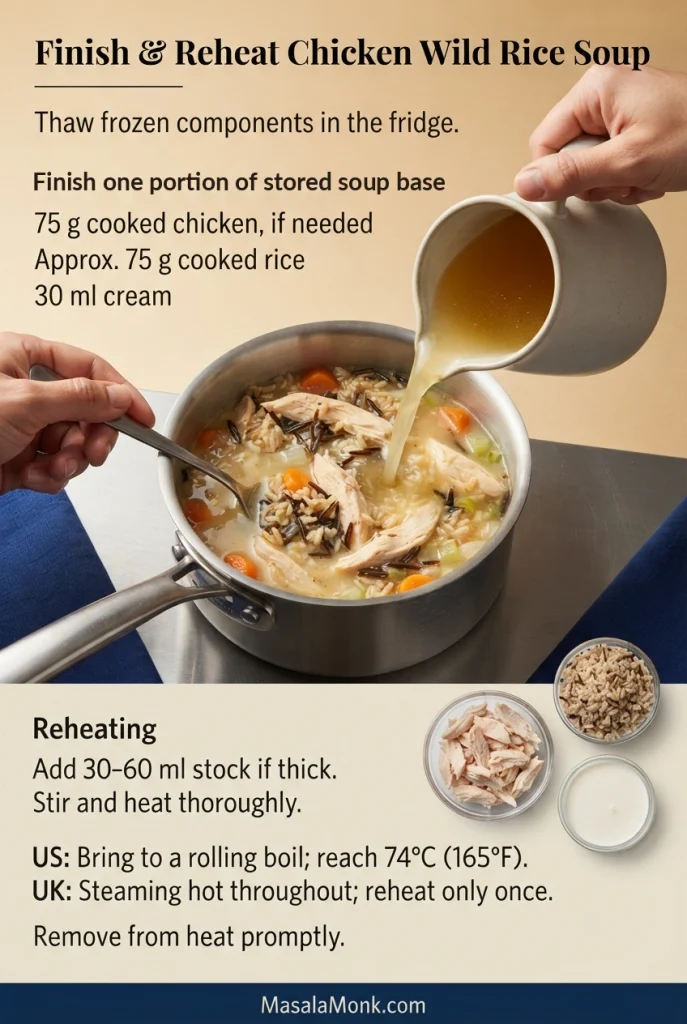
To finish one bowl from a six-portion batch, add:
- 75 g (2.6 oz) cooked chicken, if not already in the base
- About 75 g (2.6 oz) cooked wild rice
- 30 ml (2 tbsp) heavy cream
Heat the base with the cooked chicken and rice until steaming hot, then stir in the cream. Add hot stock if needed. Following US guidance, bring the finished soup to a rolling boil and check that it reaches 74°C (165°F) throughout. Under UK guidance, reheat only once until steaming hot throughout. Take off the heat promptly, taste for seasoning and serve.
How to Reheat the Soup
Yesterday’s soup may look more like a stew when it comes out of the fridge. A little stock and a few minutes over the heat will usually loosen it.
- Transfer only the portion you intend to eat to a saucepan.
- If it has thickened, add 30–60 ml (2–4 tbsp) stock per serving. Water will also work.
- Heat over medium heat, stirring regularly. Add any safely stored cooked chicken or rice reserved for this portion.
- Following US guidance, bring leftover soup to a rolling boil and confirm that it reaches 74°C (165°F) throughout. Under UK guidance, reheat until steaming hot throughout and reheat leftovers only once.
- Remove from the heat promptly, stir and taste for seasoning.
For microwave reheating, use a microwave-safe bowl with a vented cover. Stir several times, bring the soup to a boil and allow a brief standing time. Check that it reaches 74°C (165°F) in several places.
Once the soup is safely reheated, avoid prolonged boiling, which can separate the cream and soften the grains further.
Frequently Asked Questions
Do you need to soak wild rice before making soup?
Usually, no. Most commercially available wild rice and wild rice blends do not require soaking before cooking. However, follow any specific instructions supplied with traditionally processed or specialty wild rice.
Can I cook dry wild rice directly in the soup?
Yes, but a one-pot chicken and wild rice soup recipe requires extra liquid and a different cooking schedule. The 1.2 liters of stock here are intended for the finished soup. Dry rice would absorb some of that liquid, leaving less broth and changing its consistency.
Can I make chicken and wild rice soup in a slow cooker or Instant Pot?
You can cook the chicken or rice separately in either appliance. However, don’t transfer this stovetop recipe directly to a slow cooker or pressure cooker, since the liquid quantities, timings and flour-and-cream sequence need adapting.
Can I use frozen cooked chicken or rice?
Yes. Thaw only the portions you need in the refrigerator, add them toward the end of cooking and heat throughout to 74°C (165°F). Keep unused portions frozen and follow the thawing and reheating guidance above.
Can I halve or double the chicken and wild rice soup recipe?
Yes. Use these starting quantities for three, six or twelve meal-sized bowls.
| Ingredient | 3 bowls | 6 bowls | 12 bowls |
|---|---|---|---|
| Dry wild rice blend | 80 g | 160 g | 320 g |
| Cooked chicken | 225 g | 450 g | 900 g |
| Chicken stock | 600 ml | 1.2 L | 2.4 L |
| Butter | 21 g | 42 g | 84 g |
| Flour | 15 g | 30 g | 60 g |
| Heavy cream | 90 ml | 180 ml | 360 ml |
| Onion | 75 g | 150 g | 300 g |
| Carrots | 75 g | 150 g | 300 g |
| Celery | 55 g | 110 g | 220 g |
| Garlic | 6 g | 12 g | 24 g |
| Dried thyme | ¼ tsp | ½ tsp | 1 tsp |
| Or fresh thyme | ¾ tsp | 1½ tsp | 3 tsp |
| Black pepper | ¼ tsp | ½ tsp | 1 tsp |
| Bay leaf | 1 small | 1 | 1–2 |
For three bowls, the stock is about 2½ US cups and the cream 6 tablespoons. A twelve-bowl batch uses about 10 US cups stock and 1½ cups cream. Adjust salt and optional seasonings to taste.
A smaller pot helps limit evaporation for a half batch. When doubling, use an 8–10 liter stockpot or larger, leaving room for stirring, or make two separate batches.
Follow the package directions for rice-cooking water, or keep the grains submerged when using the excess-water method. However, don’t automatically halve or double the cooking times: the rice and vegetables still need to become tender. Taste and adjust the finished soup before serving.