Posted on 12 Comments

Punch with Pineapple Juice: Guide & 9 Party-Perfect Recipes

Moody party setting with multiple glasses of pineapple punch variations, styled with citrus and mint, featuring text overlay for Masala Monk’s guide to pineapple punch recipes.

There’s a reason punch with pineapple juice keeps showing up at weddings, showers, and backyard cookouts: it tastes like pure sunshine, it’s budget-friendly, and it can scale from a cozy ten-person brunch to a fifty-guest celebration without breaking a sweat. Pineapple juice also plays beautifully with bubbles (ginger ale or Sprite), brightens up tart fruits like cranberry, and makes a tropical base for grown-up versions with rum or vodka.

Craving more tropical blends? Try our pineapple mango juice guide.

In this guide, you’ll find everything you need to nail the balance—sweetness, acidity, fizz—and then nine crowd-tested recipes that line up with what guests actually request: ginger-ale wedding punch, cranberry holiday punch, Sprite lemon-lime fizz, sherbet floats, lemonade blends, Malibu rum, a classic Planter’s-style take, blue curaçao for pool parties, and a clean vodka version. Each recipe includes cups and metric, smart make-ahead steps, and scale-up tips.

As you read, keep this simple truth in mind: the secret to unforgettable punch isn’t a fancy ingredient. It’s temperature (everything cold), timing (add fizzy stuff right at the end), and a little balance (citrus and salt to keep sweetness in check).


The Pineapple Punch Playbook (Read This Before You Mix)

Before we dive into the recipes, let’s set you up to win. Understanding a few fundamentals will make any punch with pineapple juice taste intentional rather than improvised.

1) Start cold and stay cold
Chill all the non-carbonated ingredients for at least 4 hours (or overnight). Keep one batch in the bowl and a second pre-chilled batch in the fridge so refills don’t warm the party bowl. Use frozen fruit—pineapple rings, grapes, cranberries—as “ice” that doesn’t water things down.

2) Add bubbles at the last moment
Ginger ale, lemon-lime soda, club soda, and sparkling water lose fizz fast in a warm room. Stir them in gently right before serving.

3) Balance sweetness and acidity
Canned pineapple juice is fairly sweet. A squeeze of lemon or lime wakes everything up. If you over-sweeten, don’t panic—add citrus, a splash of club soda, and (this sounds odd, but works) a tiny pinch of salt. Salt suppresses bitterness and makes fruit pop. Cutting sugar? These low-carb mocktail tips show how to keep fizz without heaviness.

4) Choose your pineapple juice
Fresh-pressed is bright and variable; canned or shelf-stable is consistent and convenient. For large events, consistency wins. For small gatherings, fresh can be magical—just taste and adjust.

5) Ginger ale vs ginger beer
Ginger ale is sweeter and typically non-alcoholic; ginger beer is spicier and sometimes low-ABV—see ginger ale vs. ginger beer differences and a second take here. Use ale for classic wedding punch, beer when you want a peppery kick.

6) Garnish with intention
Citrus wheels, pineapple spears, mint sprigs, and cranberries do more than decorate—they infuse aroma and make the bowl photo-ready. If you want to go extra, freeze a ring mold with pineapple juice and citrus slices to create a slow-melt ice ring.

(If you serve alcohol, read the NIAAA standard drink guide; and for food-safe handling, see FoodSafety.gov basics.)


How Much Punch with Pineapple Juice Should I Make?

Because punch sits out and people refill, planning by the glass is safer than planning by the bottle. A practical rule:

  • When punch is one of several drinks: plan 3–4 liters per 10 guests.
  • When punch is the star: plan ~1 gallon (3.8 L) per 10 guests for a 2–3 hour event.
  • Kids + hot weather: add a 10–15% buffer.

Scaling is simple: most of the recipes below make ~2.6–3.2 L (10–14 servings). For 30 guests where punch is one of a few options, triple any base recipe and you’re set. For 50–60 guests, either 4× a recipe or run two different bowls (one zero-proof, one adult).

Plan by liters per guest, not bottles.

  • One of several drinks: 3–4 L per 10 guests (2–3 hr event)
  • Punch is the star: ~3.8 L per 10 guests
  • Kids or hot weather: add 10–15%
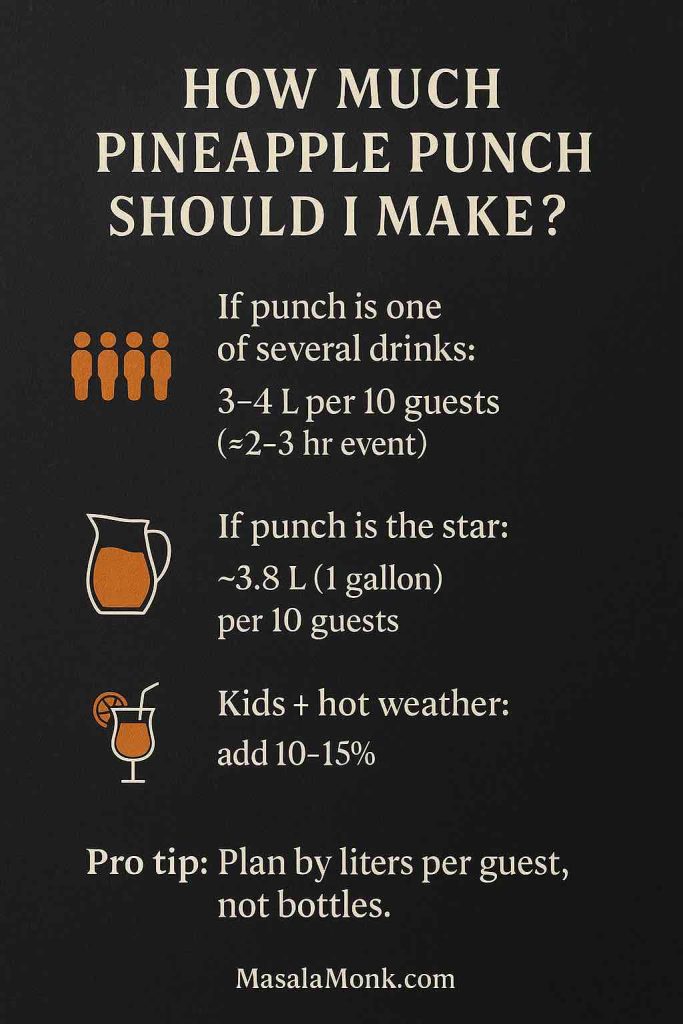
Infographic titled “How Much Pineapple Punch Should I Make?” on a dark background. It shows three sections: 3–4 L per 10 guests for multiple drinks (2–3 hr event), 3.8 L per 10 guests if punch is the main beverage, and a 10–15% increase for kids or hot weather. Includes a pro tip: plan by liters per guest, not bottles.
Wondering how much pineapple punch to prepare? This guide breaks it down: 3–4 L per 10 guests if punch is one of several drinks, about 3.8 L (1 gallon) if it’s the star, and add 10–15% more for kids or hot weather. Always plan by liters per guest, not bottles.

Fast Planner (assumes ~2.8 L per base batch)

GuestsIf punch is one of several: Total L (range)Batches (~2.8 L ea.)If punch is the star: Total LBatches
103–4 L23.8 L2
206–8 L37.6 L3
309–12 L4–511.4 L5
4012–16 L5–615.2 L6
5015–20 L6–819.0 L7
6018–24 L7–922.8 L9

For 30 guests with other drink options: triple any ~3 L base recipe. For 50–60 guests: 4× one recipe or run two bowls (zero-proof + spiked).


1) Pineapple Punch with Ginger Ale (Wedding Classic)

Light, effervescent, and universally loved—this is the punch with pineapple juice people expect at showers and weddings.

You’ll need (≈2.8 L / ~12 servings)

  • 4 cups (950 ml) pineapple juice
  • 2 cups (480 ml) orange juice (or 300 ml thawed OJ concentrate + 240 ml cold water)
  • 4 cups (950 ml) ginger ale, well chilled
  • Ice, orange slices, pineapple chunks
Recipe card for Wedding Classic Pineapple Punch featuring a glass punch bowl with orange slices and pineapple chunks. Includes quick ingredient list and method overlay on a dark, elegant background for Masala Monk.
This light and effervescent Wedding Classic Pineapple Punch is the go-to drink for showers, weddings, and brunches. With just three main ingredients—pineapple juice, orange juice, and ginger ale—it’s elegant, easy, and perfect for scaling up to serve a crowd.

Method
In a chilled bowl, stir pineapple and orange juices. Right before guests arrive, gently pour in ginger ale. Add ice and fruit.

Flavor notes & swaps

  • Brighter & less sweet: replace orange juice with lemonade.
  • Spicier: swap half the ginger ale for ginger beer.
  • Lower sugar: use diet ginger ale or plain club soda for half the bubbles.

Scale up
For ~36 servings, multiply everything by 3. Keep a second chilled batch ready in the fridge; add ginger ale on demand.

Serve it pretty
Rim some glasses with fine sugar and garnish with a thin orange wheel and a mint sprig.

Do not forget to explore Mango Vodka Cocktail: The Perfect Base + 7 Must-Try Variations.


2) Cranberry Pineapple Punch (with Ginger Ale)

Ruby-red and refreshing, this leans festive but works year-round—especially with lime.

You’ll need (≈2.7 L / ~12 servings)

  • 3 cups (710 ml) pineapple juice
  • 3 cups (710 ml) cranberry juice (100% or cocktail)
  • 4 cups (950 ml) ginger ale, chilled
  • 2–3 limes, thinly sliced; 1 cup cranberries (fresh or frozen)
  • Ice
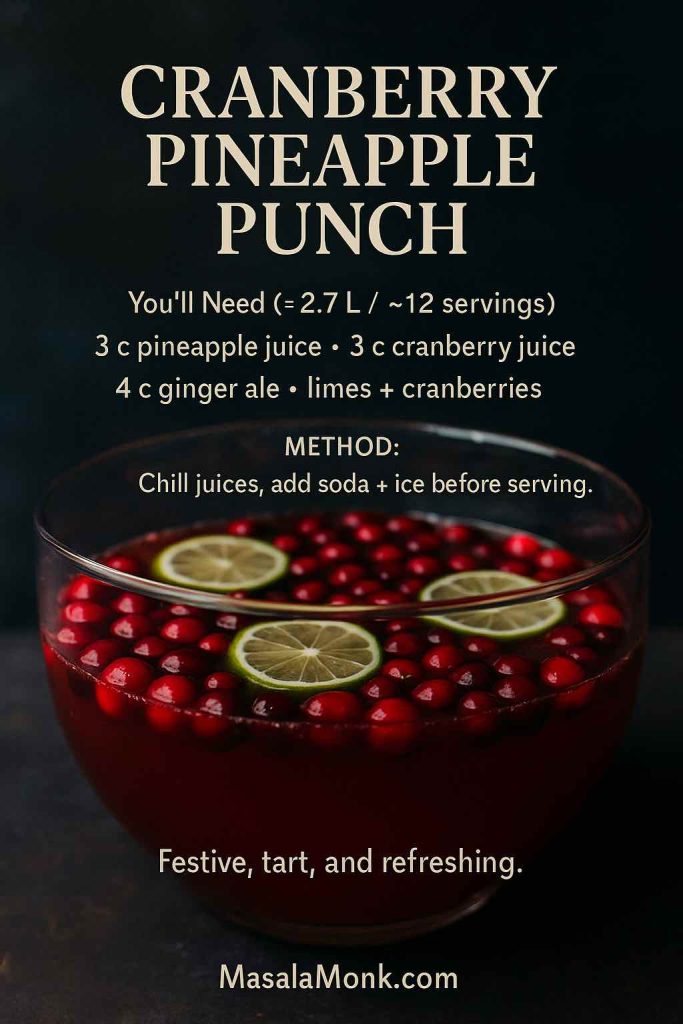
Recipe card for Cranberry Pineapple Punch featuring a ruby-red punch bowl with floating lime slices and cranberries. Includes quick ingredient list and method overlay in a festive, moody style for Masala Monk.
This Cranberry Pineapple Punch blends tart cranberry with sweet pineapple for a festive, ruby-red drink. Easy to scale for a crowd, it’s a holiday favorite with limes, cranberries, and ginger ale for sparkle.

Method
Combine pineapple and cranberry juices with lime slices and cranberries. Chill well. Add ginger ale at the last minute and then ice. For non-alcoholic riffs, that might be good for digestion as well – browse our cranberry mocktail ideas.

Flavor notes & swaps

  • Tart lovers: add ½ cup (120 ml) pomegranate juice.
  • Holiday spice: drop in cinnamon sticks and whole cloves; remove before serving.
  • Pink sparkle: replace half the ginger ale with sparkling rosé for an adults-only version.

Scale up
For ~50 servings, multiply by 4. Swap half the ice for frozen cranberries to prevent dilution.


3) Pineapple Punch with Sprite (Lemon-Lime Fizz)

Crisp, citrusy, and made for afternoon gatherings.

You’ll need (≈2.8 L / ~12 servings)

  • 4 cups (950 ml) pineapple juice
  • 2 cups (480 ml) lemonade (or 180 ml frozen lemonade concentrate + 480 ml cold water)
  • 4 cups (950 ml) lemon-lime soda (Sprite/7UP), very cold
  • Lemon wheels; pineapple spears; ice
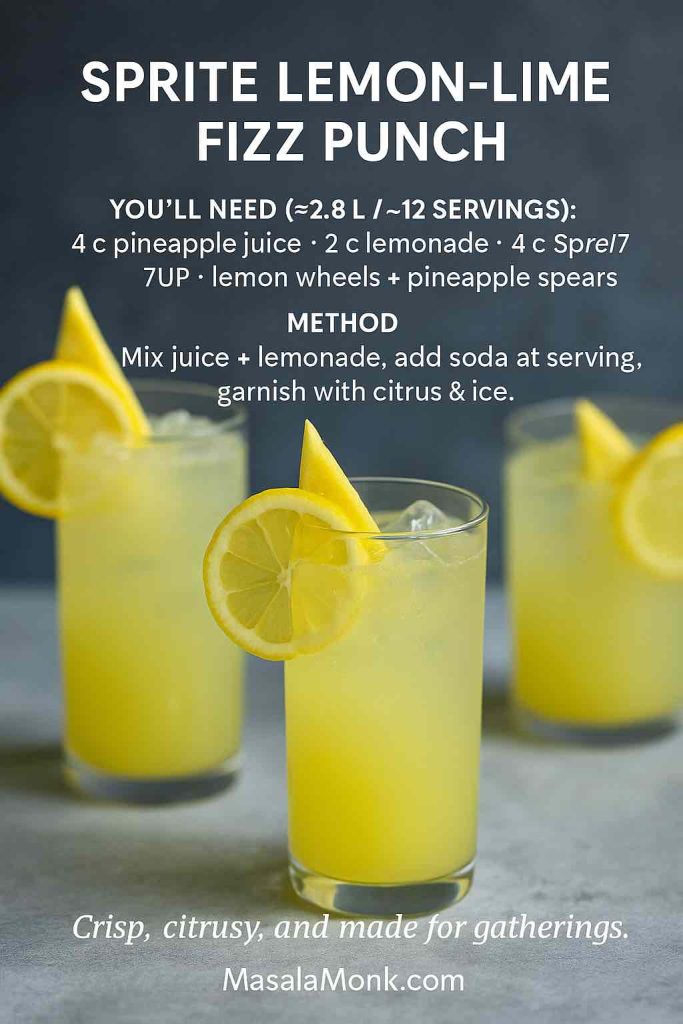
Recipe card for Sprite Lemon-Lime Fizz Punch featuring tall glasses of fizzy yellow punch with lemon wheels and pineapple spears. Includes quick ingredient list and method overlay in a clean, modern design for Masala Monk.
This Sprite Lemon-Lime Fizz Punch is a bright, citrusy blend of pineapple juice, lemonade, and 7UP. Perfect for summer gatherings, it’s crisp, refreshing, and guaranteed to be a hit with kids and adults alike.

Method
Stir pineapple juice and lemonade in a chilled bowl. Right before serving, add lemon-lime soda and then ice and garnishes.

Flavor notes & swaps

  • Citrus burst: add 2 tbsp lemon zest to the base, then strain before adding soda.
  • Herbal twist: muddle a handful of fresh basil or mint with a little lemonade, then stir through the base and strain.
  • Not-too-sweet: replace 1–2 cups of soda with club soda.

Scale up
For a kid-heavy party, double it and serve with paper umbrellas—guaranteed smiles.

You might also enjoy reading What to Mix with Jim Beam: Best Mixers & Easy Cocktails


4) Pineapple Lemonade Punch

Bright and snappy with a choose-your-own-fizz ending.

You’ll need (≈2.6 L / ~12 servings)

  • 4 cups (950 ml) pineapple juice
  • 3 cups (710 ml) lemonade
  • 2 cups (480 ml) club soda (lighter) or ginger ale (sweeter)
  • Mint, lemon & pineapple slices; ice
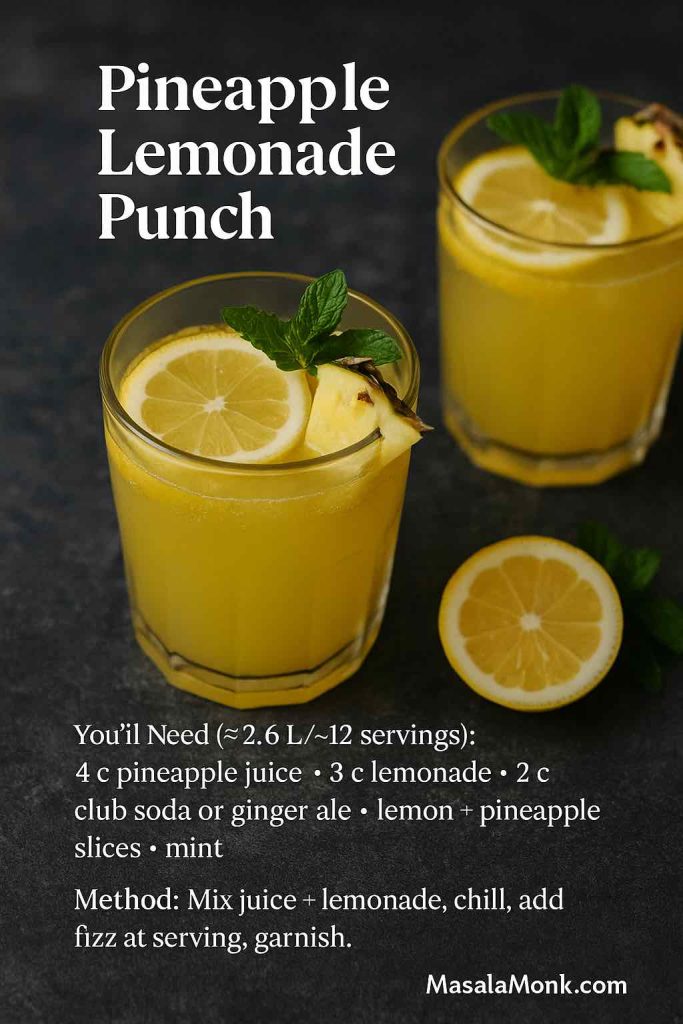
Recipe card for Pineapple Lemonade Punch featuring golden yellow punch in glasses with lemon slices, pineapple wedges, and fresh mint. Includes ingredient list and method overlay on a dark textured background for Masala Monk.
This Pineapple Lemonade Punch is a bright, snappy blend of pineapple juice, lemonade, and a splash of fizz. Garnished with lemon wheels, pineapple slices, and mint, it’s a refreshing and versatile crowd-pleaser for any occasion.

Method
Mix pineapple juice and lemonade; chill thoroughly. Add club soda (or ginger ale) at serving. Toss in herbs and fruit.

Flavor notes & swaps

  • Sparkling lemonade vibe: use all club soda and add a teaspoon of vanilla extract to round the citrus.
  • Grown-up twist: a splash (¼ cup / 60 ml) of Aperol turns it sunset-orange (adults only).

Scale up
For ~36 servings, triple the base and keep the club soda unopened until showtime.

Also Read: Pineapple Juice for High Blood Pressure: 5 Important Insights 🌟


5) Pineapple Sherbet Punch

Retro in the best way—this is the one everyone photographs first.

You’ll need (≈3.2 L / ~14 servings)

  • 4 cups (950 ml) pineapple juice
  • 6 cups (1.4 L) ginger ale or lemon-lime soda, very cold
  • 1 quart (950 ml) pineapple sherbet
  • (Optional) 1 quart (950 ml) vanilla ice cream for a creamsicle vibe
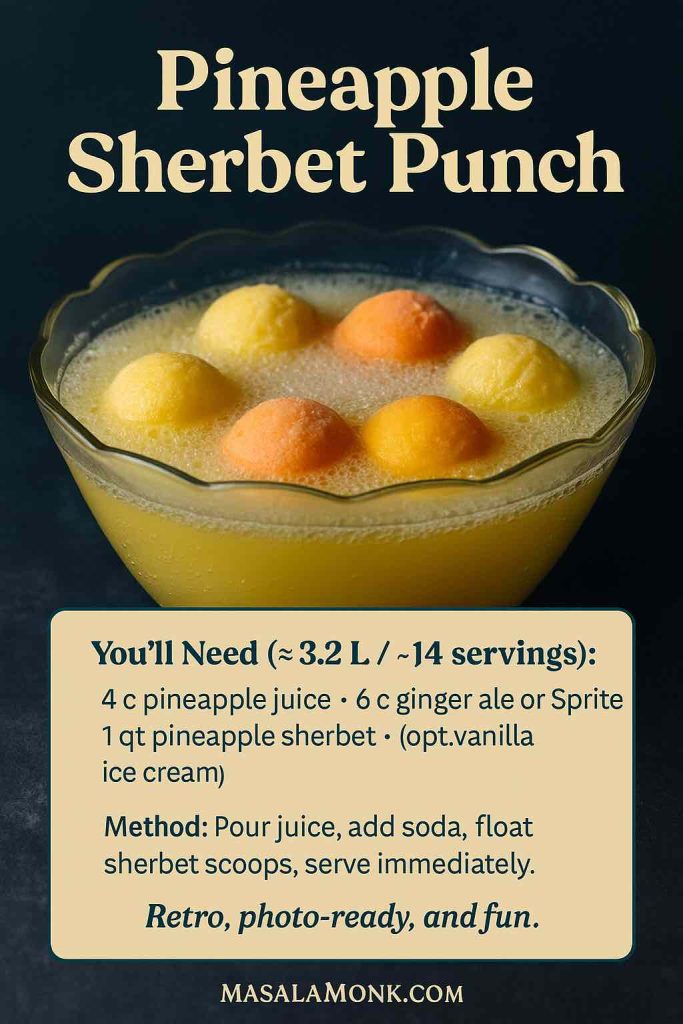
Recipe card for Pineapple Sherbet Punch featuring a retro-style punch bowl filled with yellow pineapple punch and floating scoops of orange and pineapple sherbet. Includes ingredient list and method overlay for Masala Monk.
This Pineapple Sherbet Punch is retro in the best way—fizzy pineapple soda topped with creamy sherbet scoops that float like colorful islands. A photo-ready party centerpiece that’s as fun to drink as it is to serve.

Method
Pour pineapple juice into the bowl. Add soda gently. Float scoops of sherbet (and vanilla ice cream if using). Serve immediately.

Flavor notes & swaps

  • Citrus rainbow: use orange sherbet or mix half orange, half pineapple.
  • Dessert punch: drizzle a little coconut cream across the top and garnish with toasted coconut flakes.

Pro tip
Pre-scoop sherbet onto a tray and freeze 30 minutes so scoops hold their shape.

While still on pineapples, do read: Pineapple: The Tropical Treasure for Your Skin – Benefits, Myths, and 5 Invigorating Recipes for a Smooth Complexion.


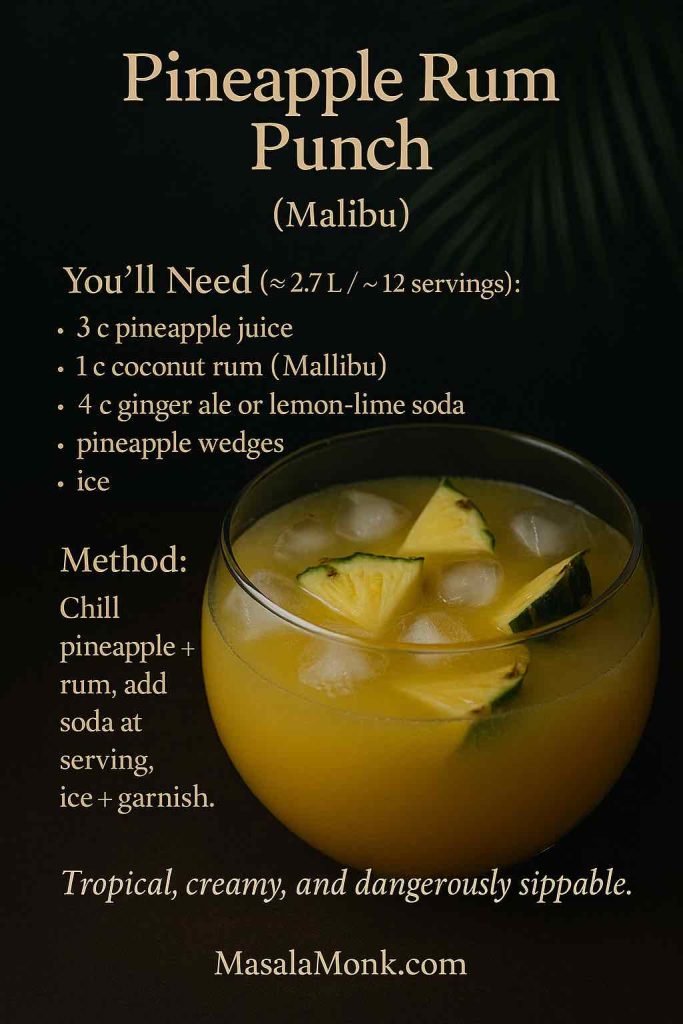
6) Pineapple Rum Punch (Malibu)

Tropical, creamy coconut notes, and dangerously sippable. Label clearly as adults only.

You’ll need (≈2.7 L / ~12 servings)

  • 3 cups (710 ml) pineapple juice
  • 1 cup (240 ml) coconut rum (Malibu)
  • 4 cups (950 ml) ginger ale or lemon-lime soda
  • Pineapple wedges; ice
Recipe card for Pineapple Rum Punch (Malibu) showing a moody punch bowl filled with yellow pineapple punch, ice, and pineapple wedges. Text overlay lists ingredients (pineapple juice, coconut rum, soda) and a simple method for Masala Monk.
Pineapple Rum Punch (Malibu) brings sunny coconut notes to a fizzy pineapple base—built to batch, served ice-cold, and finished with pineapple wedges for an instant tropical vibe.

Method
In a pitcher, combine pineapple juice and coconut rum. Chill very well. Just before serving, add soda, then ice and garnish.

Flavor notes & swaps

  • More depth: add ½ cup (120 ml) dark rum.
  • Creamy piña feel: stir in ¼ cup (60 ml) coconut cream (shake can first).
  • Spicy island: a few dashes of Angostura bitters on top.

Scale up
For ~48 servings, quadruple the base. Keep the rum/juice mix in the fridge; add soda in the bowl.

Suggested read: How to Make Pineapple Chia Pudding: A Refreshing Low-Carb Breakfast Option


7) Planter’s-Style Pineapple Rum Punch (Classic Vibes)

A nod to the old rum formula—sour, sweet, strong, weak—with pineapple taking the “weak” role.

You’ll need (≈2.4 L / ~10 servings)

  • 1 cup (240 ml) fresh lime juice (sour)
  • 2 cups (480 ml) simple syrup (sweet) (adjust to taste)
  • 3 cups (710 ml) dark or gold rum (strong)
  • 4 cups (950 ml) pineapple juice (weak)
  • 1–2 cups (240–480 ml) cold water or soda, to taste
  • 6 dashes Angostura bitters; fresh-grated nutmeg

Recipe card for Planter’s-Style Pineapple Rum Punch featuring golden punch in lowball glasses with lime wheels, warm rustic background, scattered spices, and text overlay listing ingredients and method for Masala Monk.
Planter’s-Style Pineapple Rum Punch delivers old-school tiki balance: lime for sour, syrup for sweet, rum for strength, and pineapple juice for smoothness—finished with bitters and nutmeg for a timeless island touch.

Method
Stir lime juice, syrup, rum, pineapple juice, and water/soda in a chilled bowl. Add bitters. Taste for balance—tweak with syrup or lime as needed. Serve over ice and finish with a whisper of nutmeg.

Flavor notes & swaps

  • Tiki lean: add ½ cup (120 ml) orange juice and a bar-spoon of grenadine for color.
  • Citrus-forward: replace some water with club soda for lift.

You might also enjoy Natural Detoxification: Cranberry Juice and Apple Cider Vinegar for Weight Loss


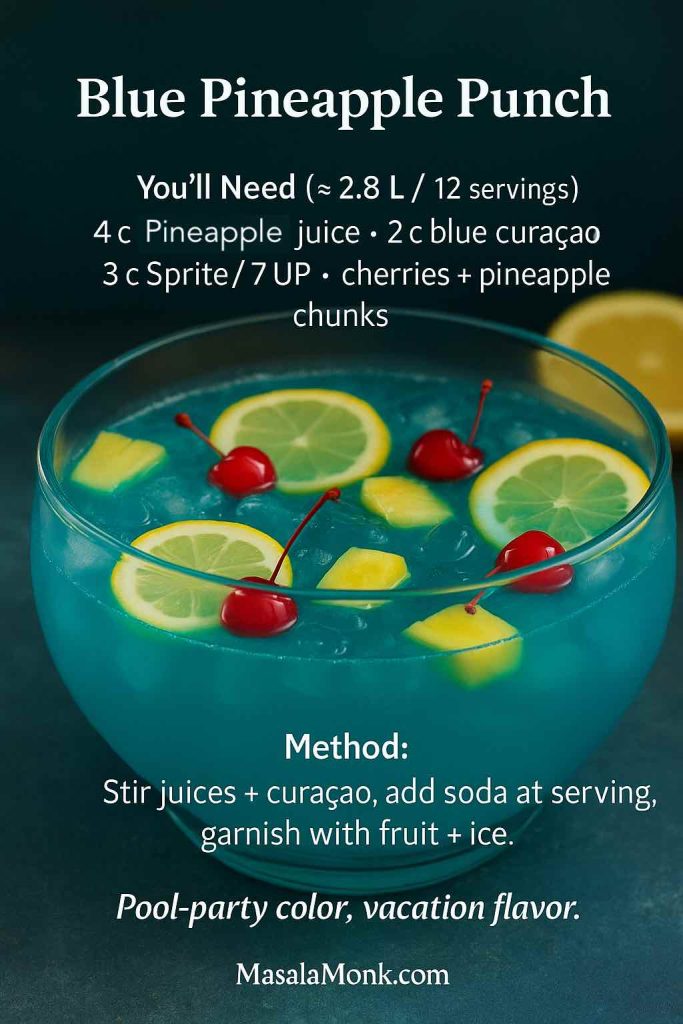
8) Blue Pineapple Punch

Pool-party color, grown-up flavor. It looks like vacation in a glass.

You’ll need (≈2.8 L / ~12 servings)

  • 4 cups (950 ml) pineapple juice
  • 2 cups (480 ml) lemonade
  • 1 cup (240 ml) blue curaçao
  • 3 cups (710 ml) lemon-lime soda, cold
  • Cherries + pineapple chunks; ice
Recipe card for Blue Pineapple Punch showing a glass bowl of bright turquoise punch with lemon wheels, pineapple chunks, and cherries. Overlay text includes ingredients, method, and tagline for Masala Monk.
This Blue Pineapple Punch is a vibrant showstopper—pineapple juice, lemonade, and blue curaçao topped with soda, cherries, and pineapple chunks. Perfect for pool parties or any celebration that needs a splash of color and vacation vibes.

Method
Stir pineapple juice, lemonade, and blue curaçao in a chilled pitcher. Add soda at serving. Ice and garnish.

Zero-proof look-alike
Swap curaçao for a blue sports drink and add a few dashes of orange extract.


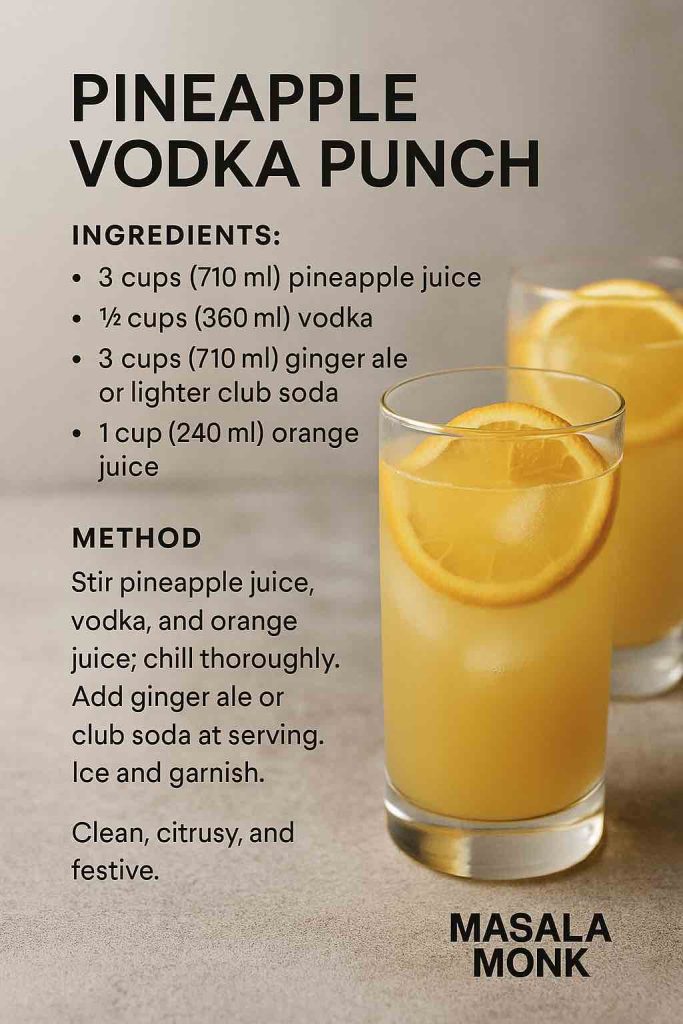
9) Pineapple Vodka Punch

Clean, citrusy backbone with just enough fizz to feel festive.

You’ll need (≈2.7 L / ~12 servings)

  • 3 cups (710 ml) pineapple juice
  • 1½ cups (360 ml) vodka
  • 3 cups (710 ml) ginger ale (sweeter) or club soda (lighter)
  • 1 cup (240 ml) orange juice
  • Ice + orange wheels
Recipe card for Pineapple Vodka Punch showing tall glasses of golden punch with orange wheels on ice. Overlay lists ingredients (pineapple juice, vodka, ginger ale/club soda, orange juice) and simple method in a modern Masala Monk layout.
Pineapple Vodka Punch keeps things clean and citrusy—pineapple + OJ base, a measured pour of vodka, then fizz with ginger ale or club soda right at serving. Bright, simple, and party-ready.

Method
Stir pineapple juice, vodka, and orange juice; chill thoroughly. Add ginger ale or club soda at serving. Ice and garnish.

Flavor notes & swaps

  • Herbal lift: a handful of mint lightly muddled with OJ (strain before mixing).
  • Citrus pop: 2 tbsp lime juice right before serving wakes up the vodka.

And for those mornings after party Top 12 Hangover Remedies from Around the World.


Make-Ahead, Storage & Safety—The Practical Stuff

  • Make-ahead window: Mix all non-carbonated ingredients up to 24 hours in advance. Store in the coldest part of your fridge in a sealed container.
  • When to add fizz: Always at serving. If your event runs long, keep the soda chilled and top up every 20–30 minutes.
  • Keeping it cold: Use frozen fruit, an ice ring, or small ice cubes added in stages. For outdoor service, keep a spare pitcher in a cooler and rotate refills.
  • If you over-dilute: Re-balance with a quarter-strength concentrate of the base (e.g., a mix of pineapple juice and citrus) and a pinch of salt.
  • Responsible enjoyment: If a punch includes spirits, label it clearly and keep water nearby. For alcohol guidelines, skim NIAAA’s standard drink explainer.
  • Food-safe handling: If you’re serving outdoors or for hours, review FoodSafety.gov’s four steps; in short, keep cold drinks cold and use clean ladles and cups.

Styling Your Bowl: Easy Wins That Wow

  • Build an ice ring: In a bundt pan, freeze pineapple juice with lemon wheels, mint, and cranberries in two layers so the fruit suspends. Unmold and float for slow-melt drama.
  • Create a garnish bar: Set out pineapple spears, cherries, citrus wheels, and edible flowers so guests can customize.
  • Use a clear dispenser: If you’re short on table space, a glass drink dispenser shows off the color and keeps refills discreet.
  • Give it a scent: Clap mint sprigs (literally slap them) before garnishing to release oils.

Troubleshooting: Because Real Parties Get Real

  • “It’s too sweet.” Add fresh lemon or lime juice, then taste. If it still leans sweet, swap 1–2 cups of the punch for club soda and add a tiny pinch of salt.
  • “It’s flat.” You added the soda too early or stirred too aggressively. Top up with fresh, chilled soda and add a handful of frozen fruit to re-cool fast.
  • “It’s watery.” Use frozen fruit instead of ice for the next top-up. Meanwhile, stir in a little concentrated pineapple juice or a splash of lemonade to bring back flavor.
  • “Guests want both alcoholic and non-alcoholic.” Run two bowls: one zero-proof, one spiked. Label both clearly and keep the same garnish set so the look matches.
  • “Kids are drinking it non-stop.” Offer small cups and keep water pitchers next to the punch so refills are mixed with a sip of water.
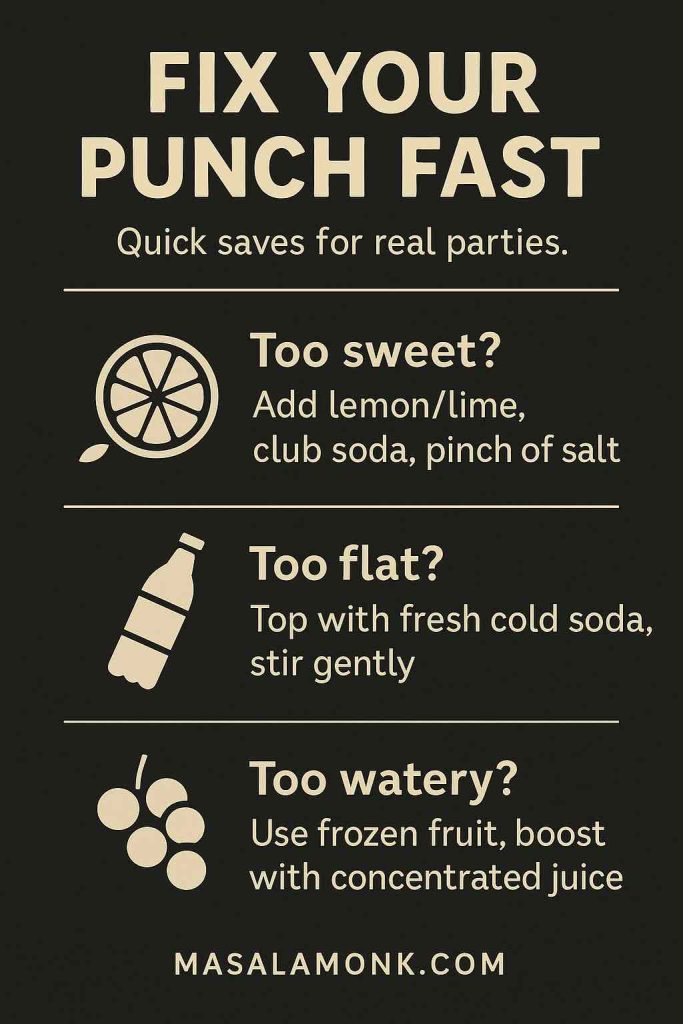
Troubleshooting infographic titled “Fix Your Punch Fast” on a dark background with icons and three remedies: add citrus/club soda/salt if too sweet; top with fresh cold soda and stir gently if flat; use frozen fruit and concentrated juice if watery. Branded MasalaMonk.com.
Fix your punch fast: whether it’s too sweet, too flat, or too watery, this quick-reference card gives you instant saves—citrus + club soda + pinch of salt, fresh cold soda with a gentle stir, and frozen fruit plus a boost of concentrated juice.

A Better Bowl, Every Time

Make it cold, add the bubbles last, and keep the flavors lively with citrus and just a pinch of salt. Whether you go classic with ginger ale or get a little wild with sherbet or blue curaçao, punch with pineapple juice is a guaranteed mood-setter—and now you’ve got nine ways to serve it like a pro. If you try one, tell us which combo your crowd loved most; we’re always up for testing reader riffs at the next gathering.

FAQs

1) What’s the simplest ratio for punch with pineapple juice?

Start here, then tweak: 4 : 2 : 4 + garnish

  • 4 parts pineapple juice
  • 2 parts citrus (orange juice or lemonade)
  • 4 parts fizz (ginger ale or lemon-lime soda)
    Then, add ice + citrus wheels + pineapple chunks. Finally, taste and adjust with a squeeze of lemon (for brightness) or a pinch of salt (to tame sweetness).

2) Ginger ale or Sprite—what’s better in punch with pineapple juice?

It depends on the vibe. Ginger ale is softer and vanilla-ginger sweet, which feels “classic wedding.” Meanwhile, Sprite/7UP is zestier and reads more citrus. If you’re unsure, split the difference: half ginger ale, half lemon-lime soda. For a lighter sip, replace 1–2 cups with club soda.

3) Can I make punch with pineapple juice ahead of time?

Absolutely. First, mix all non-carbonated liquids up to 24 hours ahead and chill them hard. Then, add anything fizzy right before serving. As a result, the bubbles last and the bowl stays bright.

4) How much punch with pineapple juice do I need for my guest count?

Use these quick numbers, then round up:

  • If punch is one of several drinks: 3–4 L per 10 guests for 2–3 hours.
  • If punch is the star: about 1 gallon (3.8 L) per 10 guests.
  • For kids or hot weather, add 10–15%.
    Pro tip: make two identical chilled batches; keep one in the fridge so refills stay icy.

5) What if my punch with pineapple juice tastes too sweet (or too tart)?

Firstly, add fresh lemon or lime and stir gently. Secondly, if it’s still too sweet, swap in 1–2 cups club soda for punch and add a tiny pinch of salt. Conversely, if it’s too tart, stir in simple syrup (1:1 sugar to water) a tablespoon at a time.

6) How do I keep punch cold without watering it down?

Go beyond ice cubes. Instead, freeze pineapple rings, grapes, or cranberries and use them as “ice.” For longer events, make a bundt-pan ice ring with pineapple juice and citrus slices; it melts slowly and looks gorgeous.

7) What’s the best “wedding punch with pineapple juice and ginger ale” recipe?

Keep it timeless: 4 cups pineapple juice + 2 cups orange juice + 4 cups ginger ale. Add ice, orange slices, and pineapple chunks. For brighter flavor, substitute lemonade for the OJ; for spicier zip, replace ½ the ginger ale with ginger beer.

8) Which alcohol pairs best with punch with pineapple juice—rum or vodka?

Both work, but they read differently. Rum (especially coconut rum/Malibu) leans tropical and dessert-like; a splash of dark rum adds depth. Vodka keeps things clean and citrusy. For a balanced bowl, start with 1 cup (240 ml) spirit per ~2.7 L base, taste, then decide if you want another ½ cup (120 ml).

9) Can I make a “Planter’s” style punch with pineapple juice?

Yes—think sour : sweet : strong : weak. Try: 1 cup lime (sour) + 2 cups simple syrup (sweet) + 3 cups rum (strong) + 4 cups pineapple juice (weak). Finally, add 1–2 cups water or soda, 6 dashes bitters, and a dusting of nutmeg.

10) How do I do a cranberry holiday punch with pineapple juice?

Go red and refreshing: 3 cups pineapple + 3 cups cranberry + 4 cups ginger ale, plus lime slices and cranberries. For even more color, add ½ cup pomegranate juice. During winter, tuck in cinnamon sticks (pull them before serving).

11) Any tips for sherbet punch with pineapple juice and 7UP?

Yes—work quickly. First, pour pineapple juice, then add 7UP, and finally float scoops of pineapple (or orange) sherbet. Pre-scoop and refreeze for 30 minutes so the “islands” hold. Serve immediately so the fizz doesn’t fade.

12) Can I make blue punch with pineapple juice without blue curaçao?

You can fake the look. Use a blue sports drink in place of curaçao and add a couple drops of orange extract for aroma. Alternatively, go half sports drink, half lemon-lime soda for lighter sweetness.

13) Is fresh pineapple juice better than canned for punch?

Sometimes—but not always. Fresh is zingy yet inconsistent; canned is steady and convenient for crowds. If you juice fresh, taste for sweetness and acidity, then adjust with lemon/lime or a spoon of simple syrup.

14) What’s a good “Sprite and Hawaiian Punch with pineapple juice” combo?

For kid-friendly color, try 2 parts Hawaiian Punch + 1 part pineapple juice + 2 parts lemon-lime soda. Add plenty of ice and orange slices. Then, if it’s too sweet, swap one part of soda for club soda.

15) Can I use lemonade mix (like Country Time) in punch with pineapple juice?

Of course. Whisk the mix with cold water per the label, chill thoroughly, and use it where the recipe calls for lemonade. Because mixes vary in sweetness, start with ¾ strength, taste, and add more if needed.

16) What about champagne or prosecco—can I make a pineapple “bubbly” punch?

Yes, but add the wine last minute. Build a base of pineapple + lemonade (chilled), then gently pour in prosecco right before guests arrive. For balance, keep the ratio near 2 parts juice base : 1 part bubbles.

17) How do I label and serve when some guests want alcohol and others don’t?

Run two bowls side by side—one zero-proof, one spiked—and label clearly. Meanwhile, offer water and a garnish bar (mint, citrus wheels, pineapple spears) so everyone’s glass looks equally festive.

18) Any fast fixes if my punch turns flat or watery mid-party?

If flat, top with fresh, very cold soda and stir minimally. If watery, stir in a small amount of concentrated base (pineapple + citrus) and switch to frozen fruit for chilling. Also, refresh in smaller batches so each top-up stays lively.

19) How far can I stretch punch with pineapple juice for a big crowd?

For a 50-guest event where punch is one of several drinks, plan roughly 12–16 L total. Practically speaking, make four batches of a ~3 L recipe, keep two chilling, and rotate them. If punch is the main drink, aim closer to 19 L (about 5 gallons).

20) What garnishes make punch with pineapple juice look premium—without extra work?

First, build a slow-melt ice ring with pineapple juice and citrus wheels. Next, set out an easy garnish bar: mint, lemon wheels, pineapple chunks, and cocktail cherries. Finally, clap mint leaves between your hands before adding—this releases aroma and feels surprisingly fancy.


Posted on 19 Comments

What to Mix with Jim Beam: Best Mixers & Easy Cocktails

Portrait cover for “What to Mix with Jim Beam,” featuring a Jim Beam bottle, copper mule mug, highball glass, ginger beer, soda, lemonade, fresh citrus, and MasalaMonk.com footer branding

Some evenings beg for ceremony—coupes from the freezer, jiggers lined up like soldiers, a playlist set to “speakeasy.” But most evenings? They just want something generous, bright, and honest. Jim Beam was made for those nights. It’s a bottle that meets you where you are: steady and vanilla-warm as a classic bourbon, playful and fruit-forward as Apple, Vanilla, Orange, Honey, Peach, or Red Stag (Black Cherry). And because our readers keep asking “what’s the best mixer for Jim Beam?” and “what do I mix with the Apple/Vanilla/Orange one?”—we’re going to answer with a human, kitchen-table approach: clear ingredients, simple “how to make” steps, smooth transitions from one idea to the next, and plenty of friendly asides you’ll actually use.

We’ll start with the fastest answer—so you can pour while you read. Then we’ll move through classic bourbon serves (highball, cola, tonic, lemonade, iced tea), and glide, glass by glass, into each flavor expression with official brand anchors where helpful and a bunch of Masala Monk twists to keep things personal. Along the way, you’ll notice more connective tissue: why a pinch of salt matters, when to choose ginger ale over ginger beer, how to scale for friends, and what to reach for when the weather turns. Think of this as a conversation in a warm kitchen—one hand on the bottle, the other rummaging for citrus—rather than a lecture across a bar.


The 10-Second Answer (so you can pour now, not later)

If you remember only one line, let it be this: use a tall glass, pack it with fresh ice, and aim for 1 part Jim Beam to 2–3 parts mixer. Then add a citrus wedge, give a very short stir, and taste. Want spice and lift? Choose ginger ale or ginger beer. Prefer a crisp, bourbon-forward feel? Go soda water with a lemon wheel. Craving comfort? Cola with a squeeze of lime never misses. Meanwhile, sunny afternoons adore lemonade and iced tea, and fruit-leaning expressions glow with cranberry, apple, or even pineapple. With that out of the way, let’s settle in and make you a short list you’ll reach for again and again.


1) Best Mixer for Jim Beam Bourbon (Highball, Cola, Tonic, Lemonade & Iced Tea)

Before we talk flavors, let’s treat the classic white-label bourbon the way it deserves: tall, chilled, and sparkling. Because when bourbon meets bubbles properly, the drink doesn’t just quench—it floats.

Jim Beam Highball (crisp, bright, repeatable)

There’s a small ritual here that pays off: cold topper, plenty of ice, a gentle stir. Not fussy—just respectful.

Ingredients (1 drink)

  • 60 ml Jim Beam Bourbon
  • 120–180 ml ginger ale (soft spice) or soda water (bone-dry and crisp)
  • Lemon wheel • Tall glass • Fresh ice

How to make
Fill a tall glass with ice. Add bourbon. Top with chilled ginger ale (or soda). Stir briefly—three small turns. Rest a lemon wheel on top, and taste before you tweak. If you want more fizz, add a little more mixer; if you want more bourbon, well, top yourself up.

Why it works
Ginger ale flatters Beam’s vanilla and caramel; soda lets the grain and oak step forward. Because the stir is short, you keep the fizz; because the ice is fresh and the glass is tall, the drink stays lively from first sip to last.

Quick variations

  • Zesty Highball: two dashes orange bitters before you top; express a lemon peel for fragrance.
  • Tea Highball: top with unsweetened iced tea and a squeeze of lemon—smoother, food-friendlier, very “second glass.”
  • Half-and-Half Mule: split your topper ½ ginger beer / ½ soda water for mule spice without extra sweetness.
  • Salt-Lime Cooler: a tiny pinch of black salt on the lemon wheel; it sharpens citrus and makes the sip feel colder.

(If you enjoy a little technique reading later, this quick primer on highball ratios and chilled components is handy: Highball technique overview.)

Photorealistic portrait of a Jim Beam highball with lemon wheel and lively fizz; text overlay reads “Best Mixers for Jim Beam • Ice first • Stir gently • Citrus last”; MasalaMonk.com footer branding.
Best mixers for Jim Beam—start with ice, keep the stir short, add citrus last. This simple sequence preserves bubbles and lifts flavor, so every highball tastes brighter.

Also read: Earl Grey Elegance: 5 Bergamot-Spiced Iced Tea Cocktails for Sophisticated Tuesday Sips

Jim Beam & Cola (classic comfort that benefits from one tiny trick)

There’s a reason this pairing never left the party. Still, a squeeze of lime before you drop the wedge in keeps the drink bright instead of syrupy.

Ingredients (1 drink)

  • 60 ml Jim Beam Bourbon
  • 150–180 ml cola
  • Fresh ice • Lime wedge

How to make
Glass full of ice; bourbon in; cola on top; lime squeezed and dropped. Then a calm, single stir.

Two easy upgrades

  • Spice-Cola: one dash Angostura + an expressed orange peel; now it tastes like a proper cocktail.
  • Cola-Coffee Float (late night): 45 ml Beam + 90 ml cola + 30 ml chilled coffee over a big cube; orange twist.

Bourbon & Tonic (the sleeper hit you never asked for)

Tonic’s quinine brings a clean, brisk snap that resets your palate between sips. It surprises people—in the best way.

Ingredients (1 drink)

  • 60 ml Jim Beam Bourbon
  • 150–180 ml tonic water
  • Tall glass • Ice • Lime wedge

How to make
Bourbon in a tall, ice-filled glass; top with tonic; delicate stir; lime wedge. Start at a 1:2 ratio and adjust to taste, because tonic’s personality is assertive.

Portrait of a bourbon-and-tonic highball with sparkling bubbles and a lime wedge; overlay reads “Bourbon & Tonic • Chilled tonic • Gentle stir • Lime wedge for snap”; MasalaMonk.com footer.
Keep tonic very cold, pour Beam over plenty of ice, then give a gentle stir. Finish with a lime wedge for snap—quinine keeps the palate fresh and food-friendly.

Lemonade & Iced Tea (porch-ready and sessionable)

  • Bourbon Lemonade: 60 ml Beam + 150–180 ml lemonade over ice; lemon wheel + mint.
  • Bourbon Tea Highball: 60 ml Beam + 150–180 ml unsweetened iced tea; squeeze of lemon.
  • Arnold Bourbon (half & half): 60 ml Beam, then equal parts iced tea and lemonade to top; lemon wedge.

Because these long drinks scale so well, you can chill the topper in the fridge, pre-cut citrus, and pour to order in seconds. Friends will think you planned; secretly, you barely did.


2) Jim Beam Apple Mixers — Crisp, Sparkling, Crowd-Pleasing

Now that the bourbon is humming, let’s turn to Apple—the friendliest of the flavors. It loves clean fizz and bright citrus; it also loves company. Two official serves give you a solid backbone; from there, the riffs write themselves.

Orchard Twist (official baseline, then our riffs)

This is the “friends are five minutes away” drink: apple whiskey, cranberry, a lift of soda, and a lime wedge. It’s ruby in the glass and gone before it waters down. If you want the brand’s minimalist baseline, see Official Orchard Twist — Jim Beam Apple + Cran + soda.

Ingredients (1 drink)

  • 60 ml Jim Beam Apple
  • 60 ml cranberry juice
  • 60–90 ml soda water
  • Ice • Lime wedge

How to make
In a tall ice-filled glass, add Apple, then cranberry, then soda; gentle stir; lime wedge. That’s it—company-proof.

Masala Monk riffs

  • Apple-Cran Fizz (table ratio): as above; if your cranberry is extra-tart, add 5–7 ml simple syrup.
  • Apple Ginger Pop: top with dry ginger ale + a fast lemon squeeze; garnish with a thin fan of grated apple.
  • Masala Apple Shandy: make your topper half lemonade, half soda; dust a pinch of black salt on the rim.
  • Warm Orchard (winter): 45 ml Apple + hot apple cider + a thin slice of fresh ginger; cinnamon stick stirrer.
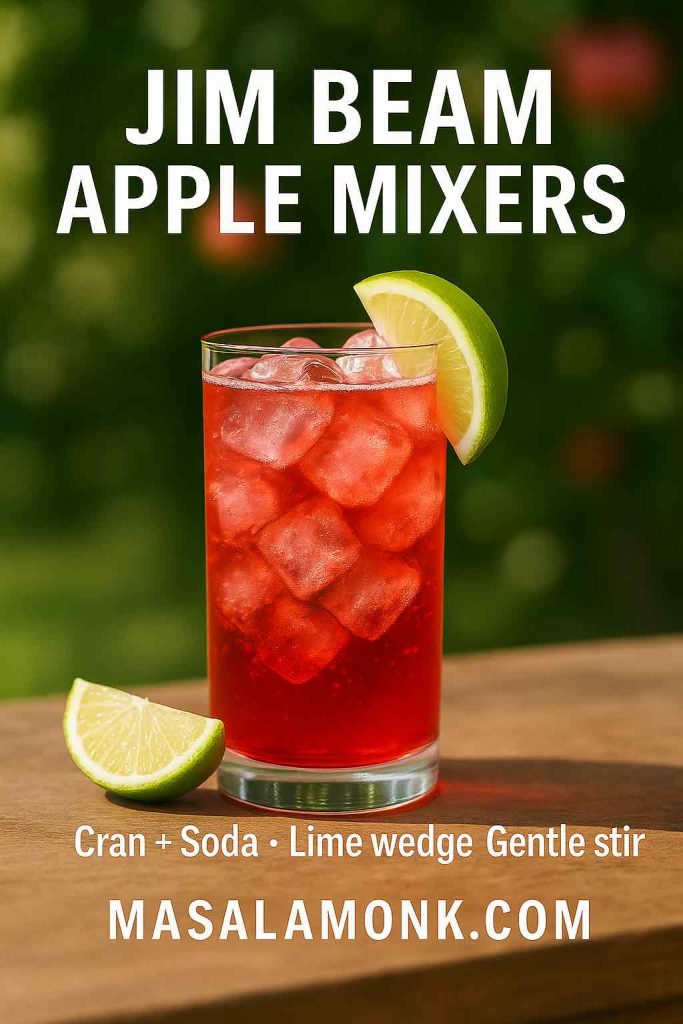
Photorealistic portrait of a Jim Beam Apple spritz with cranberry hue and soda bubbles; text overlay reads “Jim Beam Apple Mixers • Cran + Soda • Lime wedge • Gentle stir”; MasalaMonk.com footer branding.
Orchard Twist made simple—apple whiskey for aroma, cranberry for color and snap, soda for lift. Finish with a lime wedge and a gentle stir to keep the bubbles lively.

Apple Highball (official spritz, clean and lean)

This is Apple at its simplest: bright, sparkling, and very refillable. The brand’s version is here: Official Apple Highball — Jim Beam Apple + soda.

Ingredients (1 drink)

  • 60 ml Jim Beam Apple
  • 120–180 ml soda water
  • Lemon wheel • Ice

How to make
Apple over ice, soda to the top, brief stir, lemon wheel. If you want color and bite, swap half the soda for cranberry.

Two gentle variations

  • Berry Apple: 60 ml Apple + 60 ml cranberry + 60–90 ml soda; lemon wheel.
  • Spearmint Apple: clap a few mint leaves to perfume the glass (don’t muddle hard).

3) What to Mix with Jim Beam Vanilla — Dessert-Adjacent, Movie-Night Perfect

If Apple is an afternoon picnic, Vanilla is movie night on the couch—nostalgic, mellow, and sneakily sippable. Naturally, the best mixers feel like comfort food in a glass.

Vanilla & Root Beer Float (nostalgia without the fuss)

Ingredients (1 drink)

  • 45–60 ml Jim Beam Vanilla
  • Root beer to top
  • Ice • Optional small scoop vanilla ice cream

How to make
Ice in, Vanilla in, root beer up to the top, and—if dessert is calling—slip in that small scoop. Because root beer is already sweet, you won’t need extra syrup.

Tall root-beer float made with Jim Beam Vanilla, foamy head, optional ice-cream scoop; overlay with practical tips; MasalaMonk.com footer.
Vanilla whiskey and root beer deliver instant dessert vibes; a tiny scoop of ice-cream adds foam, while a single dash of bitters reins in sweetness.

Coffee-Vanilla Highball (the “one more episode” pour)

Ingredients (1 drink)

  • 45 ml Jim Beam Vanilla
  • 90–120 ml cold brew coffee
  • 15 ml cream or half-and-half
  • Pinch cinnamon • Ice

How to make
Vanilla over ice, add cold brew, float the cream, dust the cinnamon, and give one gentle lift with the spoon so the layers mingle slowly.


4) Jim Beam Orange — Mule Magnet, Citrus Charmer (and yes, Ginger Sour)

Ginger beer, lime, ice: Orange practically begs for that trio. Yet, because life is full of small surprises, it also shines shaken—especially with ginger syrup—and, on “I’m already late” nights, with a fast lemon-lime soda you can pour without thinking.

Jim Beam Orange Mule (official, tall and refreshing)

The crowd-pleaser. It’s fizzy, aromatic, and dangerously easy to refill. For the brand’s baseline, see Official Jim Beam Orange Mule — brand recipe.

Ingredients (1 drink)

  • 60 ml Jim Beam Orange
  • 120–150 ml ginger beer
  • 10 ml fresh lime juice (or a small orange-and-lime blend)
  • Optional 5–10 ml simple syrup if your ginger beer is ultra-dry
  • Ice • Orange peel + mint (or lime wedge) • Copper mug or tall glass

How to make
Fill the mug with ice, add Orange, squeeze in lime, top with ginger beer, and give one gentle roll with your spoon. Garnish generously—it’s part of the joy.

Masala Monk twists

  • Monk’s Spicy Mule: 2 dashes Angostura + thin slice fresh ginger; swap simple for ½ tsp jaggery syrup (1:1).
  • Tamarind Mule: ½ tsp tamarind syrup for tang; pinch black salt on the orange peel.
  • Low-ABV Spritz: 45 ml Orange + 90 ml ginger beer + 60 ml soda; mint bouquet.
  • Zero-Proof “Mule”: orange cordial + ginger beer + lime in a mule mug (clearly non-alcoholic).
Photorealistic copper-mug Jim Beam Orange Mule with crushed ice, ginger beer, fresh lime and mint; overlay reads “Jim Beam Orange Mule • Squeeze lime • Fresh ginger slice • Optional jaggery syrup”; MasalaMonk.com footer.
For the brightest mule: squeeze the lime over the ice, add Jim Beam Orange, then ginger beer. Slip in a thin ginger slice for aroma and—if your ginger beer is extra-dry—a touch of jaggery syrup. One gentle stir keeps the fizz lively.

Orange Crush (official, shaken and sunny)

A citrusy shake with a soda lift so it reads lively instead of heavy. See Official Jim Beam Orange Crush — brand cocktail.

Ingredients (1 drink)

  • 45 ml Jim Beam Orange
  • 30 ml orange juice
  • 20–22.5 ml lemon juice
  • 10–15 ml simple syrup
  • Ice • Soda to top • Orange wheel

How to make
Shake Orange, citrus, and syrup hard with ice. Strain over fresh ice. Top with a light splash of soda. Orange wheel to finish.

Two simple riffs

  • Salted Citrus Crush: tiny pinch black salt before topping; mint for aroma.
  • Grapefruit Crush: split the OJ with pink grapefruit (50:50) for a drier finish.

Orange Ginger Sour (because people keep asking)

This covers that “jim beam orange ginger sour” long-tail with a balanced, bar-quality sour you can shake at home.

Ingredients (1 drink)

  • 60 ml Jim Beam Orange
  • 22.5 ml fresh lemon juice
  • 10–12.5 ml ginger syrup (or reduce ~60 ml ginger beer down to ~20 ml by simmering, then cool)
  • Optional: 1 egg white
  • Ice • Orange peel

How to make
Dry shake (if using egg), then add ice and shake until the tin frosts. Fine strain into a chilled coupe—or over a single large cube if you like it on the rocks. Express orange peel across the top; serve immediately.

Portrait cocktail of Jim Beam Orange shaken with lemon and ginger syrup, served with an expressed orange peel; overlay reads “Orange Ginger Sour • Fresh lemon • Ginger syrup • Shake hard • Orange peel”; MasalaMonk.com footer.
Shake Jim Beam Orange with fresh lemon and ginger syrup until the shaker frosts. Fine strain, then express an orange peel—bright, balanced, and bar-quality at home.

Orange + Lemon-Lime (Sprite) Highball (for the “pour and smile” crowd)

Ingredients (1 drink)

  • 60 ml Jim Beam Orange
  • 150–180 ml lemon-lime soda
  • Ice • Lime wedge

How to make
Build over ice, brief stir, lime wedge. No measuring spoons, no apologies.


5) What to Mix with Jim Beam Honey — Soft, Friendly, Sunshine-Ready

If a flavor could smile, Honey would. It prefers sunlight, laughter, and tall glasses. Keep it bright; keep it simple; and watch the pitcher empty itself.

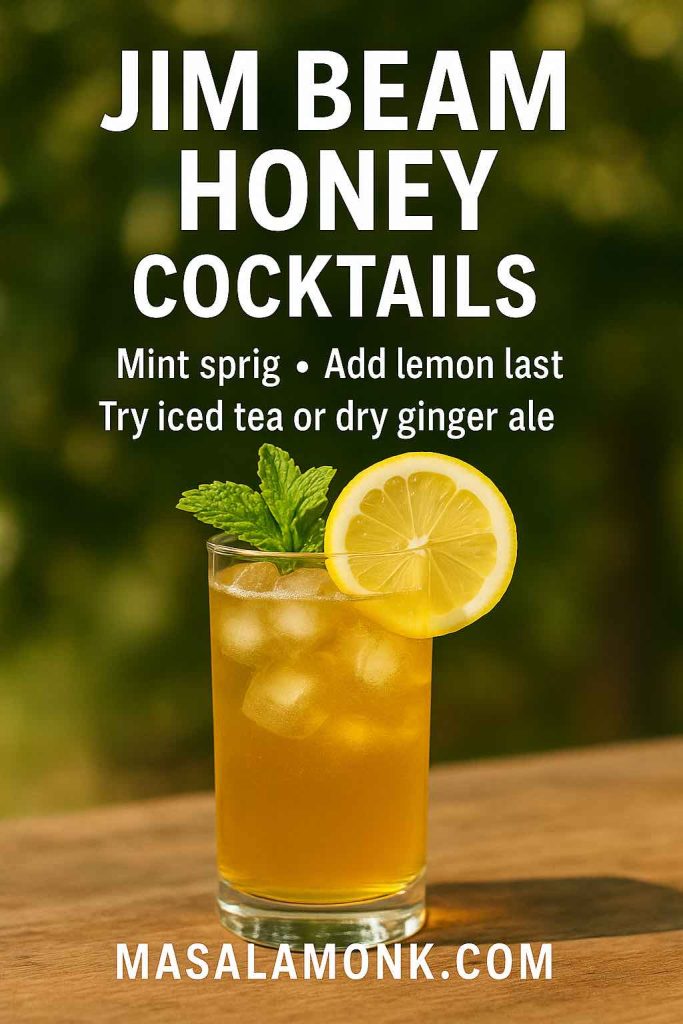
Photorealistic portrait of a Jim Beam Honey lemonade highball with mint and lemon slice; overlay reads “Jim Beam Honey Cocktails • Mint sprig • Add lemon last • Try iced tea or dry ginger ale”; MasalaMonk.com footer.
For sunshine-simple balance: pour Honey over ice, top with lemonade, add lemon last to protect the fizz, and finish with a mint sprig. Swap in iced tea or dry ginger ale when you want it less sweet.

Honey Lemonade Cooler (the “one more glass” special)

Ingredients (1 drink)

  • 60 ml Jim Beam Honey
  • 150–180 ml lemonade
  • Ice • Mint sprig

How to make
Honey over ice, lemonade to the top, one gentle nudge with the spoon. Mint goes in last so the aroma hits first.

Variations

  • Honey-Tea Highball: 60 ml Honey + 150 ml unsweetened iced tea + lemon wheel.
  • Honey-Ginger: 60 ml Honey + 120–150 ml dry ginger ale + lemon squeeze.
  • Hot Honey Cider: 45 ml Honey + hot apple cider + cinnamon stick; a flamed orange peel if you’re feeling fancy.
6) What to Mix with Jim Beam Peach — Porch-Perfect, Picnic-Ready

As the light softens and conversation slows, Peach slides happily into tea and lemonade. These are the drinks you’ll set in a jug on the table and refill without thinking.

Photorealistic portrait of a Peach Palmer—Jim Beam Peach with iced tea and lemonade, condensation on the glass; overlay reads “Peach Palmer • Iced tea + Lemonade • Delicate stir • Lemon wedge”; MasalaMonk.com footer.
Half iced tea, half lemonade with Jim Beam Peach—stir delicately to keep clarity, then add a fresh lemon wedge for zip. Porch-perfect, pitcher-friendly.

Peach Palmer (half tea, half lemonade, all smiles)

Ingredients (1 drink)

  • 45 ml Jim Beam Peach
  • 90 ml unsweetened iced tea
  • 60 ml lemonade
  • Ice • Lemon wedge

How to make
Peach over ice, add tea, float lemonade, and give a delicate stir. Lemon wedge to finish. If you prefer bubbles, swap lemonade for lemon-lime soda.

Variations

  • Ginger-Peach Fizz: sub the lemonade for dry ginger ale; add 1 dash Angostura.
  • Cran-Peach Spritz: 45 ml Peach + 60 ml cranberry + 60–90 ml soda; lime wheel.

7) Jim Beam Red Stag (Black Cherry) — Cola, Soda & a Little Lime

Red Stag is cherry with a bourbon backbone—no wonder it loves cola. Yet it’s just as happy going drier with soda water and lime. For extra context and pairings in the brand’s own words (including iced tea and lemonade), skim Red Stag product page — cherry with cola or with iced tea/lemonade.

Red Stag & Cola (official, lime-balanced)

If you want the tidy baseline, here’s the brand’s page: Official Red Stag & Cola — brand serve.

Ingredients (1 drink)

  • 45–60 ml Red Stag
  • 135–180 ml cola
  • Ice • Lime wedge

How to make
Build over ice, squeeze the lime, then a gentle stir. That squeeze is everything.

Photorealistic Red Stag and cola highball with clear ice and lime; overlay reads “Red Stag Mixed Drinks • Squeeze lime to balance • Lighter? Use soda + bitters”; MasalaMonk.com footer.
Cola brings comfort; a firm lime squeeze keeps Red Stag bright. For a lighter cherry-lime, swap cola for soda water and add two dashes of bitters—same flavor, less weight.

Red Stag & Soda Highball (official, cleaner and brighter)

Brand anchor here: Official Red Stag & Soda Highball — brand serve.

Ingredients (1 drink)

  • 60 ml Red Stag
  • 150 ml soda water
  • Ice • Lime wedge

How to make
Build over plenty of ice, quick stir, lime wedge.

Red Stag Half & Half (tea + lemonade long drink)

If you like half-tea, half-lemonade, the brand even spells it out: Red Stag Half & Half — brand recipe.

Home-bar version

  • 45–60 ml Red Stag
  • 90 ml unsweetened iced tea
  • 90 ml lemonade
  • Tall glass • Ice • Lemon wedge

Our riffs

  • Cherry-Lime Rickey: Red Stag + soda + 10 ml fresh lime + 2 dashes Angostura; lime wheel + cherry.
  • Tea-Time Highball: topper is ½ iced tea / ½ lemonade; lemon wedge and a gentle roll.
  • Smoked Cherry Old Fashioned (quick): 60 ml Red Stag + 1 barspoon rich syrup (2:1) + 2 dashes bitters; big cube; orange peel.

8) What to Mix with Jim Beam Fire — Three Fast Winners

Fans keep asking, and these three land every time—no extra bells required.

  • Cream Soda Fire: 45–60 ml Jim Beam Fire + 150 ml cream soda over ice; cinnamon stick.
  • Hot Apple Fire: 45 ml Fire into hot apple cider; lemon peel + cinnamon.
  • Ginger Fire Highball: 60 ml Fire + 120–150 ml dry ginger ale + lemon wedge.
Tall highball of Jim Beam Fire with cream soda over ice, cinnamon stick garnish; overlay with practical tips; MasalaMonk.com footer.
Cream soda amplifies cinnamon warmth; the stick adds aroma while you sip—no extra syrup needed.

Because Fire brings cinnamon sweetness, keep things lean—no syrup unless you truly love it sweet.


9) Bourbon Cream & Winter Bottles — Cozy Weather, Simple Joy

When the weather turns, Bourbon Cream becomes your shortcut to warm, velvety drinks that feel like a blanket. Likewise, any wintery limited release can follow the same playbook.

Bourbon Cream Coffee (silky, café-cozy)

Ingredients (1 drink)

  • 45 ml Bourbon Cream
  • Hot coffee to fill
  • Whipped cream, dusted with cocoa

How to make
Warm mug; Bourbon Cream in; coffee on top; cream to crown. Consequently, you get gentle alcohol heat, rounded sweetness, and coffee aromatics in three friendly moves.

A simple float for dessert

  • Adult Cola Float: 45 ml Bourbon Cream + 120 ml cola over ice; tiny scoop vanilla ice cream optional.

Seasonal note (Winter Reserve & friends)
If a winter bottle shows up in your market, treat it like Bourbon Cream for cozy serves (coffee, cocoa) or like straight bourbon for hot toddies and hot cider. The methods and ratios above still apply, and your guests will thank you when the wind picks up.


10) Two Timeless Jim Beam Cocktails (Whiskey Sour & Old Fashioned)

Sometimes the best “mixer” is simply lemon, sugar, and patience with ice. With these two, you get grown-up balance with zero drama—and because they’re anchored to global standards, they’re repeatable even on autopilot.

Whiskey Sour (IBA baseline, scaled for home jiggers)

For the canonical baseline, the Whiskey Sour — IBA official spec lists 45 ml whiskey, 25 ml lemon, 20 ml simple syrup, and an optional egg white. Meanwhile, our build nudges the whiskey to 60 ml—friendlier for common 30 ml jiggers and a big cube—while keeping the balance crystal-clear.

Ingredients (1 drink)

  • 60 ml Jim Beam Bourbon (IBA lists 45 ml; we scale)
  • 22.5 ml fresh lemon juice
  • 15 ml simple syrup
  • Optional: 1 egg white
  • Ice • Lemon peel • Cherry (optional)

How to make
Dry shake (if using egg) to whip the texture, then shake hard with plenty of ice. Strain over a large cube into a rocks glass. Express a lemon peel over the top; if you’re in a retro mood, add a cherry.

Why Beam sings here
Beam’s vanilla and gentle oak soften lemon’s edges, so you can keep syrup modest. Consequently, the drink finishes clean rather than cloying—a second-round kind of sour.

Whiskey Sour made with Jim Beam, silky head, lemon peel; overlay with shake/strain cues; MasalaMonk.com footer.
Shake Beam with fresh lemon and a light touch of syrup until the tin frosts; fine strain and express a lemon peel for a clean finish.

Old Fashioned (IBA structure, modern home-bar method)

The Old Fashioned — IBA official spec is famously spare: sugar, bitters, whiskey, water. When simplicity rules, technique whispers the loudest.

Ingredients (1 drink)

  • 60 ml Jim Beam Bourbon
  • 1 sugar cube (or 7.5 ml simple syrup)
  • 2 dashes Angostura bitters
  • Tiny splash water
  • Big clear ice • Orange peel

How to make
If using a cube, place it in a rocks glass with bitters and a few drops of water; muddle gently to dissolve. Add bourbon and ice; stir until the glass is cold and the surface looks glossy. Strain onto a big cube. Express an orange peel and serve.

Two tasteful upgrades

  • Swap white sugar for jaggery syrup (2:1) to echo Beam’s vanilla and caramel.
  • Add a single dash of orange bitters if you like a citrus-bright finish.

How to Drink Jim Beam (a beginner-to-enthusiast path)

Start with a Highball: 1 part bourbon to 2–3 parts fizz (ginger ale for spice, soda water for crispness), a pile of fresh ice, and a lemon wedge. If you prefer sweeter, try Bourbon & Cola with a firm squeeze of lime. When you’re ready for a “proper cocktail,” shake a Whiskey Sour—bright, silky, impossible not to like. Next, graduate to the Old Fashioned—still simple, just more spirit-forward. After that, let curiosity pull you across the flavored range: Apple for spritzy afternoons; Orange when you’re craving a mule; Vanilla for dessert-ish nightcaps; Honey and Peach for picnics and long lunches; and Red Stag for cola nights and tea-lemonade afternoons. Because this isn’t about mastering tricks; it’s about learning which small choices make your glass taste like you.


Party Batching, Glassware & Ice (the quiet details that change everything)

Batching for four highballs

  • 240 ml Jim Beam (classic or flavored)
  • 480–720 ml chilled topper (soda, ginger ale, lemonade, or iced tea)
  • Pre-cut citrus • Extra-cold ice

How to serve
Keep the topper very cold in the fridge. Pour bourbon over ice in each glass, top from the chilled bottle, and stir briefly. Consequently, you preserve carbonation while still marrying flavors. Add citrus at the last second so the oils are fresh.

Glassware

  • Highballs & long drinks: tall, straight-sided glasses keep bubbles tight and the profile clean.
  • Sours (up or on the rocks): a chilled coupe for “up”; a rocks glass with a big cube for “down.”
  • Old Fashioned: a heavy rocks glass with a wide mouth for easy peel expression.

Ice

  • For tall drinks, more (and larger) ice means less dilution and longer fizz.
  • For stirred or spirit-forward drinks, a single big cube melts slowly and keeps the texture silky.
  • For shakes, don’t be shy—hard shaking makes cold, airy sours that feel luxurious without extra sugar.

Troubleshooting & Taste Tweaks (so every pour lands)

  • Too sweet? Add a squeeze of lemon or lime; or swap half your topper for soda water.
  • Too sharp? Add 5 ml simple syrup in sours, or choose ginger ale instead of soda in highballs.
  • Too flat? Your mixer wasn’t cold enough, your stir was too vigorous, or the glass was warm. Chill what you can and stir less.
  • Not enough flavor? Increase the spirit to 75 ml, or add a dash of bitters to deepen the finish.
  • Want lighter ABV? Drop spirit to 45 ml and extend the topper; or use the Low-ABV Spritz variations above.
  • No fresh citrus? Express a peel (even from an older lemon or orange) over the drink—the oils go a long way.

Pantry-Powered Twists (little moves, big returns)

Because your kitchen is already a flavor lab, here are a few reliable upgrades:

  • Jaggery syrup (2:1): earthy, mineral sweetness that flatters bourbon; unbeatable in an Old Fashioned.
  • Black salt (kala namak): the tiniest pinch on a citrus garnish lifts fruit and tames sweetness.
  • Fresh ginger: a thin slice in mules and highballs adds aroma and bite—especially with Jim Beam Orange.
  • Green chilli (nimbu-mirch style): a tiny slice floated on a Whiskey Sour foam gives aroma first, heat second.
  • Masala chai: brew strong, chill, and use in place of plain iced tea with Peach or Honey; the spices echo bourbon’s caramel.
  • Citrus zest oils: express peels over the glass (don’t just toss them in); the first sip becomes a little ceremony.

A tiny cooking aside (for those marinade & BBQ quereis)

While this guide is all about drinks, Jim Beam plays nicely in the kitchen, too. If you’re fielding “marinade” or “BBQ sauce” questions, steer folks to a quick glaze: equal parts ketchup and brown sugar, a healthy splash of Beam, a dash of Worcestershire, and a pinch of chilli flakes. Simmer until glossy and brush onto grilled chicken or ribs at the very end so the sugars don’t burn. Not a drink, but a weeknight hero.


Responsible Enjoyment (because good nights end well)

Measure your pours, sip water between rounds, and plan your ride before the bottle opens. Label pitchers when you batch, offer a zero-proof option that’s just as pretty as the “real” thing, and keep an eye on friends who pour generously. The best cocktail, after all, is the one everyone remembers fondly in the morning.


Helpful official Links & Sources mentioned above


Last sip: good home bartending isn’t about impressing the room; it’s about small, caring choices—cold mixers, clean ice, a bright wedge of citrus, and a moment to taste before you tweak. With Jim Beam, that’s usually all it takes. Tonight, let the bottle meet you where you are, and pour something you’ll happily make again tomorrow.

FAQs

1) What’s the best mixer for Jim Beam?

First things first: ginger ale is the best mixer for Jim Beam if you want easy spice and gentle sweetness. Next best, for a drier, bourbon-forward sip, is soda water with a lemon wheel. In short, start at 1 part Jim Beam : 2–3 parts mixer, lots of ice, quick stir.

2) How do I make a simple Jim Beam highball at home?

To begin, fill a tall glass with fresh ice. Then pour 60 ml Jim Beam and top with 120–180 ml chilled ginger ale (or soda water). Finally, give three gentle stirs and add a lemon wheel. This crisp Jim Beam highball is the baseline for most easy Jim Beam mixers.

3) What mixes well with Jim Beam Apple?

For starters, try cranberry + soda (clean, tart, and sparkling). Moreover, dry ginger ale with a squeeze of lemon is wonderfully balanced. Meanwhile, in cooler weather, go warm with hot apple cider and a thin slice of fresh ginger—an instant crowd-pleaser for Jim Beam Apple mixers.

4) What can I mix with Jim Beam Vanilla for dessert vibes?

Begin with a root beer float (add a small scoop of vanilla ice cream if you like). Next, for a cozier spin, go cold brew + a splash of cream with a pinch of cinnamon. Both are nostalgic, easy, and highly appreciated “drinks with Jim Beam Vanilla.”

5) Besides the Mule, what else pairs with Jim Beam Orange?

Naturally, the Jim Beam Orange Mule (ginger beer + lime) is a classic. However, for a shaken option, make an Orange Ginger Sour (lemon + ginger syrup, shaken hard). On busy nights, simply top with lemon-lime soda and add a lime wedge—fast Jim Beam Orange cocktails that still feel bright.

6) What’s a quick, reliable drink with Jim Beam Honey?

Start with lemonade—sunny and refreshing. Also great: unsweetened iced tea for a smoother finish, or dry ginger ale with a lemon squeeze when you want extra zip. These are no-brainer Jim Beam Honey cocktails.

7) What should I mix with Jim Beam Peach?

First, reach for iced tea + lemonade (a Peach Palmer) for a porch-perfect long drink. Alternatively, choose ginger ale for subtle spice, or cranberry + soda for a pink, patio-ready spritz. All three are strong Jim Beam Peach cocktails for summer.

8) Red Stag mixed drinks—cola or soda?

Both, but for different moods. With cola, add a lime squeeze so it doesn’t read too sweet. Meanwhile, with soda water, you’ll get a cleaner cherry-lime feel—lighter, longer, and great with food. Consequently, Red Stag mixed drinks are an easy win at parties.

9) I’m new to bourbon—how should I drink Jim Beam?

First, keep it simple with a highball (1:2 to 1:3). Next, when you’re ready for a classic, shake a Whiskey Sour Jim Beam (bourbon + lemon + a touch of syrup). Finally, graduate to an Old Fashioned Jim Beam (sugar + bitters + bourbon) when you want spirit-forward elegance.

10) What ratio works best for Jim Beam mixers?

As a rule of thumb, use 1 part Jim Beam to 2–3 parts mixer. Moreover, the taller the glass (and the colder the topper), the longer your bubbles last. As a result, your Jim Beam mixed drinks stay lively from first sip to last.

11) Can I make a Whiskey Sour with Jim Beam?

Absolutely. For Whiskey Sour Jim Beam, shake 60 ml bourbon + 22.5 ml lemon + 15 ml simple (optional egg white). Then strain over a big cube, add a lemon peel, and enjoy. Meanwhile, keep sugar modest—Beam’s vanilla notes already round the edges.

12) Is Jim Beam good in an Old Fashioned?

Yes. For Old Fashioned Jim Beam, stir 60 ml bourbon with a sugar cube (or 7.5 ml simple) and 2 dashes bitters, then serve over a big cube with an orange peel. Furthermore, swapping simple for jaggery syrup adds a warm, caramel depth that suits Beam.

13) Is Jim Beam and Sprite a good idea?

Indeed. Jim Beam and Sprite (or any lemon-lime soda) is bright and ultra-easy. Even better, Jim Beam Orange and Sprite tastes like a fizzy creamsicle—just add a lime wedge and you’ve got a 10-second highball.

14) Does Jim Beam work with tonic water?

Yes—surprisingly well. Bourbon and tonic is brisk and aromatic, especially with a lime wedge. Therefore, if you’re exploring best mixer for Jim Beam options beyond ginger ale, tonic is a sophisticated, summer-friendly choice.

15) What mixes well with Jim Beam Fire?

Try cream soda (dessert-leaning and quick), hot apple cider (cozy and seasonal), or dry ginger ale + lemon (clean and snappy). Consequently, what to mix with Jim Beam Fire becomes a three-option answer you can pour in seconds.

16) What are the best non-carbonated mixers for Jim Beam?

When you want less fizz, choose unsweetened iced tea, lemonade, cranberry, apple, or even pineapple juice. Moreover, a tiny pinch of black salt on the citrus garnish can lift fruit and tame sweetness—small move, big result.

17) How can I batch Jim Beam cocktails for a party?

Start with the friendly template: for four Jim Beam mixed drinks, use 240 ml Jim Beam and 480–720 ml chilled mixer (soda, ginger ale, lemonade, or iced tea). Then pour bourbon over ice in each glass, top from the chilled bottle, give a brief stir, and add citrus last for maximum aroma.

18) Which garnishes make Jim Beam mixers pop?

First and foremost, fresh citrus—lemon wheels, lime wedges, and expressed orange peels. Next, consider two dashes of bitters to add backbone. And finally, for a Masala Monk twist, a pinch of black salt or a thin slice of fresh ginger can transform a good drink into a great one.

19) How do I lower ABV but keep flavor in Jim Beam cocktails?

Simply reduce the pour to 45 ml and extend the topper, or choose our Low-ABV Spritz variations (spirit + ginger beer + extra soda). Meanwhile, crushed ice and taller glasses make lighter drinks feel just as satisfying.

20) What glass and ice should I use for Jim Beam mixers?

Use a tall highball and lots of fresh ice for long drinks—more ice actually means less dilution and better fizz. Conversely, choose a heavy rocks glass and a single big cube for Old Fashioneds and spirit-forward serves. As a result, your Jim Beam cocktails look polished and taste consistent.

Posted on 6 Comments

Benefits of Nuts and Seeds – Protein-Packed Superfoods

Steady energy matters on real days, not perfect ones. The highest protein nuts & seeds offer a tiny, portable fix that works at breakfast, at your desk, and after dinner. Moreover, they bring protein for fullness, fiber for appetite control, and unsaturated fats for smooth, even energy. Protein’s satiety edge is well documented—see Paddon-Jones et al.—and soluble fibre further prolongs fullness (Salleh et al.).

In practice, that means fewer spikes, fewer dips, and far fewer raids on the snack cupboard. Protein-forward, solid foods generally suppress appetite more than carb-dominant choices (Carreiro et al.). Additionally, these foods fit into what you already cook, so you won’t need new routines. Ultimately, consistency wins, and these ingredients make it easy to be consistent.

Also Read: How to Eat 100 Grams of Protein a Day.


Why the Highest Protein Nuts & Seeds Matter All Day

First, protein is the most reliable driver of satiety for many people. Consequently, even a modest serving can reduce between-meal grazing. Reviews consistently place protein above carbohydrate and fat for both satiation and satiety (Morell & Fiszman; Paddon-Jones et al.). Next, fiber and healthy fats slow digestion, which gently extends that fullness (Salleh et al.).

Meanwhile, convenience changes outcomes. Nuts and seeds sit happily in a jar, a locker, or a bag. Furthermore, they require no special prep, no gadgets, and almost no time. Finally, they taste good, which is why the habit sticks after the first week.

Importantly, the highest protein nuts & seeds carry helpful micronutrients. For example, iron supports vitality, magnesium steadies muscles and sleep, zinc backs immunity, vitamin E acts as an antioxidant, and plant omega-3 ALA supports heart and brain health. As a result, small servings do double duty. For plant omega-3 ALA basics and how it differs from EPA/DHA, see Harvard Nutrition Source.

Also Read: Almonds Nutrition Facts 100g & Glycemic Index Impact


Quick Answer: The Highest Protein Nuts & Seeds at a Glance

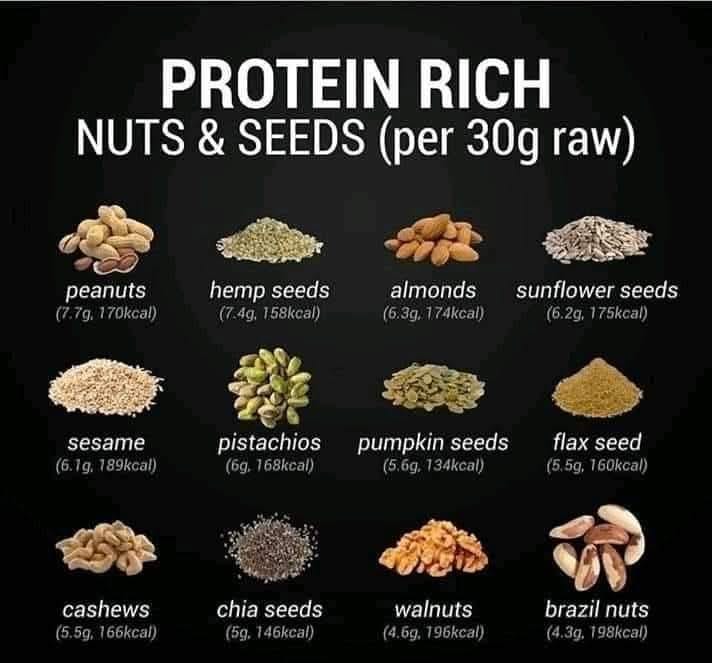
Peanuts are the highest-protein nut most people eat daily, while hemp seeds are the highest-protein seed. Per 100 g, peanuts typically deliver 24–26 g protein; meanwhile, hemp seeds reach 31–32 g. Scaled to a realistic serving—about 28–30 g for a small handful or seed sprinkle—that becomes ~7 g for peanuts and ~9–10 g for hemp. Additionally, pumpkin and sunflower seeds sit close behind; almonds, pistachios, and cashews hover near ~6 g per serving; walnuts contribute less protein yet bring valued omega-3 ALA. Therefore, once you know this orientation, every other choice becomes easier, calmer, and faster.

  • Top seed for density: Hemp hearts (~31–33 g protein per 100 g).
  • Top nut for density: Peanuts (~24–26 g per 100 g).
  • Elite runner-up seed: Pumpkin seeds (pepitas) (~30 g per 100 g).
  • Consistent six-gram players per serving: Sunflower kernels, almonds, pistachios.
  • Solid but slightly lower: Cashews, flax, chia.
  • Lower protein yet valuable omega-3 ALA: Walnuts.

In everyday servings of 28–30 g, expect hemp hearts ~9–10 g, pepitas ~8.5–9.5 g, peanuts ~7 g, almonds/pistachios/sunflower ~6 g, cashews/flax/chia ~5–6 g, and walnuts ~4–5 g. Notably, once you scale to real portions, the differences compress.

Data note: Macro values (protein, fat, carbs) come from USDA FoodData Central and USDA-derived tables via MyFoodData.

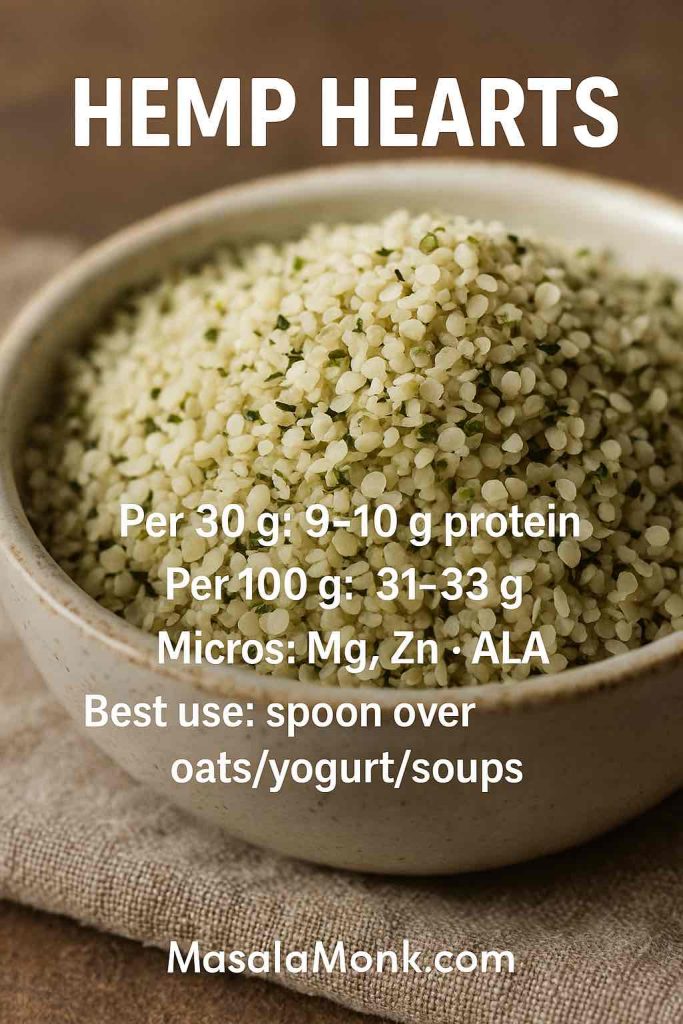
Bowl of hemp hearts with overlayed protein per 30 g and 100 g, plus micronutrients and usage tips, MasalaMonk.com.
Neutral ‘sprinkle’ that quietly adds ~3 g protein per Tbsp. Rich in magnesium, zinc, and plant omega-3 (ALA).

The Density View: Highest Protein Nuts & Seeds per 100 g

A per-100 g view reveals pure protein density—useful for recipe planning, bulk mixing, and comparing options fairly. Ranges reflect real-world variation in roasting, moisture, and variety; nevertheless, the ranking holds up and remember that most people eat ~30 g at a time.

  • Hemp hearts: ~31–33 g
  • Pumpkin seeds (pepitas, shelled): ~30 g
  • Peanuts (dry-roasted): ~24–26 g
  • Almonds: ~21–22 g
  • Pistachios: ~20–21 g
  • Sunflower kernels: ~20–21 g
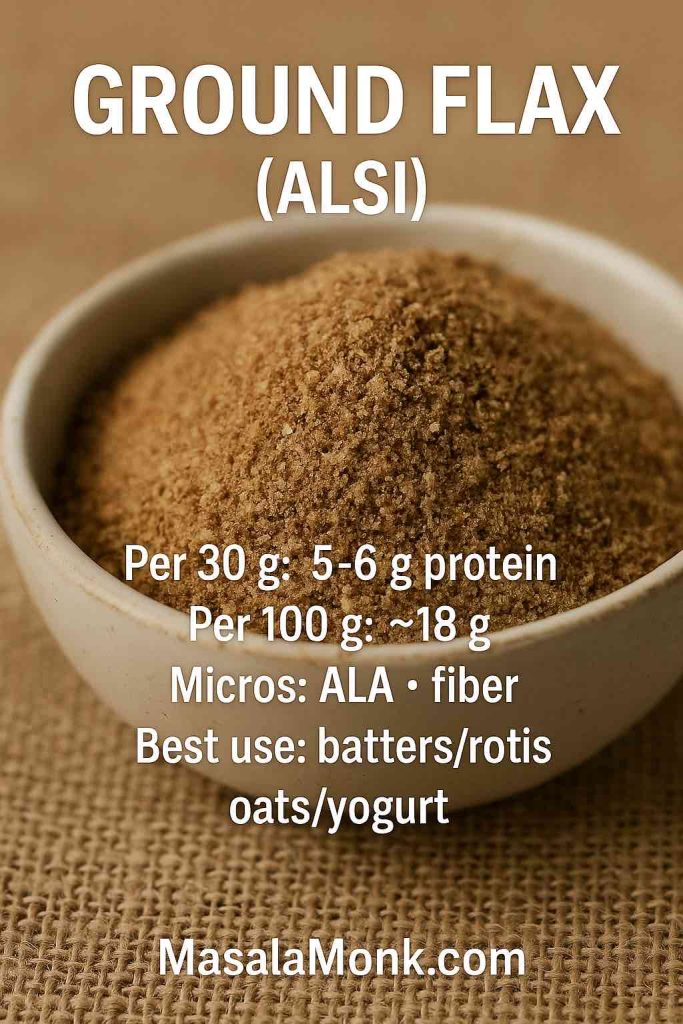
  • Flax (alsi): ~18 g
  • Sesame (til): ~17–18 g
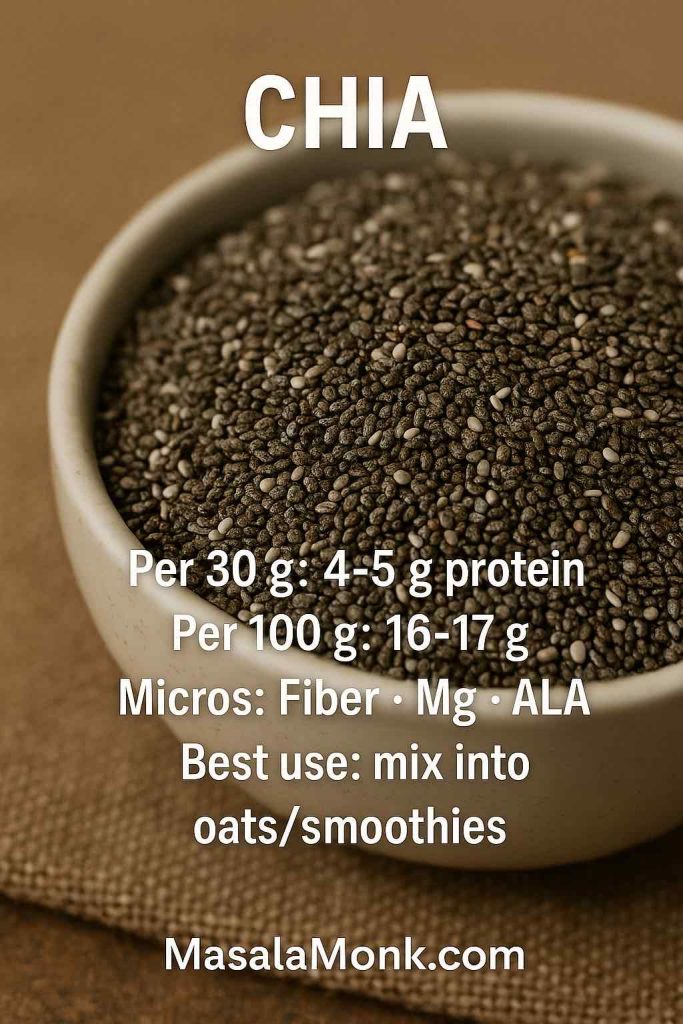
  • Chia: ~16–17 g
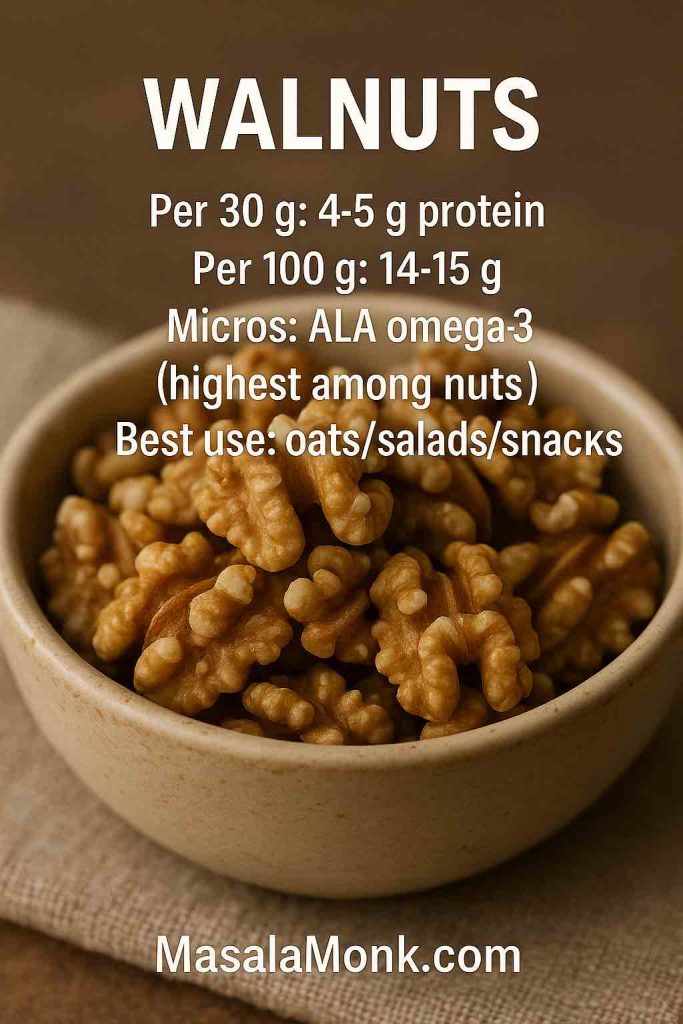
  • Walnuts (akhrot): ~14–15 g
  • Brazil nuts: ~14–15 g (modest protein; exceptional selenium)

Strictly by density, hemp leads the field, and peanuts lead the nuts. However, most people do not eat 100 g at once; consequently, the serving-level lens matters even more.

Also Read: Glycemic index of Chia Seeds and their effectiveness on Blood Sugar


Highest Protein Nuts & Seeds by Serving (28–30 g)

Once you shift from the lab bench to the palm of your hand, the field compresses in a reassuring way. In practice, a standard nut/seed serving is 28–30 g (roughly a small handful or 2–3 tablespoons, depending on the item).

  • Hemp seeds: ~9–10 g per 30 g
  • Pumpkin seeds: ~8 g
  • Peanuts: ~7 g
  • Almonds / Sunflower / Pistachios: ~6 g
  • Cashews / Flax / Chia: ~5–6 g
  • Walnuts: ~4–5 g

Accordingly, most servings of the highest protein nuts & seeds deliver ~5–10 g protein. Therefore, you can choose by taste, texture, budget, and purpose, then nudge the number upward with a tablespoon of hemp or an extra sprinkle of pumpkin or sunflower whenever you wish.

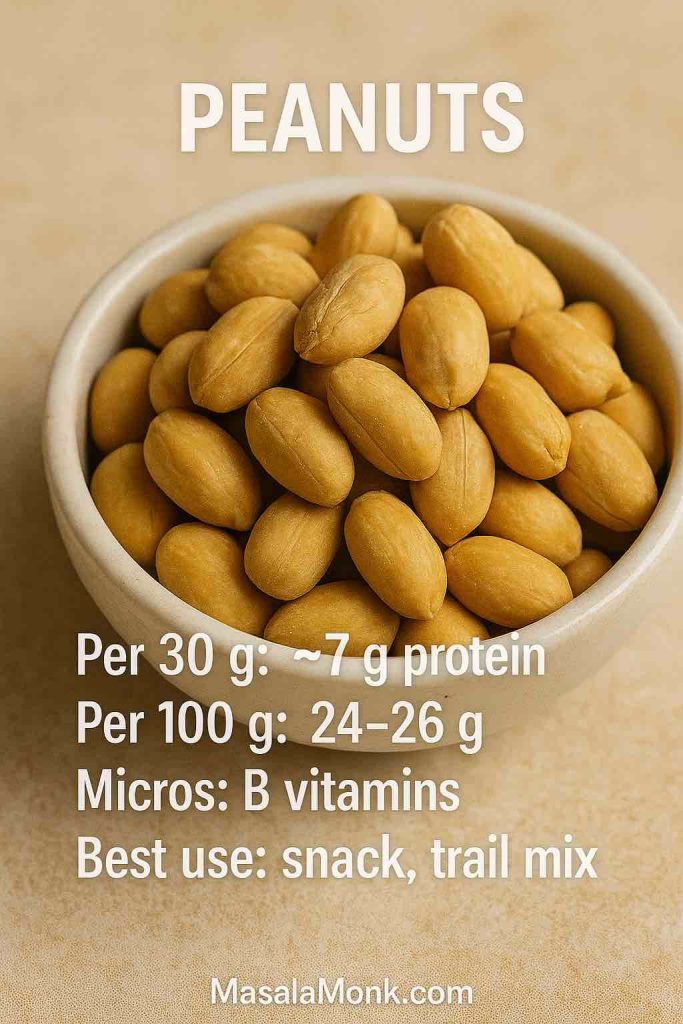
Close-up peanuts in a bowl with protein per serving and per 100 g, B-vitamins note, and best uses, MasalaMonk.com.
Best protein nut in value for money: ~7 g per handful. Season easily and use as the anchor for trail mixes.

The Spoon View: Nut Butters, Tahini, and Easy Boosters

Some days, a spoon is the strategy. Moreover, spoons are predictable, so the numbers stay honest.

  • Peanut butter: 1 Tbsp (~16 g) ≈ 4 g protein; 2 Tbsp (~32 g) ≈ 8 g (MyFoodData: Peanut butter).
  • Almond butter: slightly lower per spoon than peanut butter.
  • Tahini: ~5 g per 2 Tbsp (~30 g).
  • Hemp hearts: ~9–10 g per 3 Tbsp (~30 g) → ~3+ g per Tbsp.
  • Pepitas: ~3 g per Tbsp (~9–10 g by weight).

Almond butter typically trails slightly. Additionally, many “high-protein” nut butters add pea or whey; sometimes that helps, yet sometimes it merely raises the label claim. Alternatively, keep a nut butter you love and lift protein on demand with a tablespoon of hemp or a scatter of pumpkin seeds over yogurt, oats, or toast. Consequently, the flavor remains yours while the protein numbers climb without effort.

Also Read: Keto Chia Pudding Recipe with Almond Milk


The Tiny-Count Cheat Sheet: Quick Mental Math for Real Life

Life isn’t always measured in grams; consequently, these approximations of protein per nut or seed would help you decide quickly:

  • 1 almond (badam): ~0.25 g protein
  • 10 almonds: ~2.5 g
  • 1 peanut kernel: ~0.25 g
  • 10 peanuts: ~2.5 g
  • 1 walnut half: ~0.6 g (≈ 1.2 g per whole walnut)
  • 50 g peanuts: ~12–13 g
  • 100 g peanuts: ~24–26 g
  • 100 g almonds: ~21–22 g
  • 100 g pumpkin seeds: ~18–20 g
  • 100 g hemp seeds: ~31–32 g
  • 1 tbsp peanut butter (~16 g): ~4 g; 2 tbsp (~32 g): ~8 g

Yes, sizes and roasts vary slightly; nevertheless, these figures are reliable enough for daily planning and shopping.

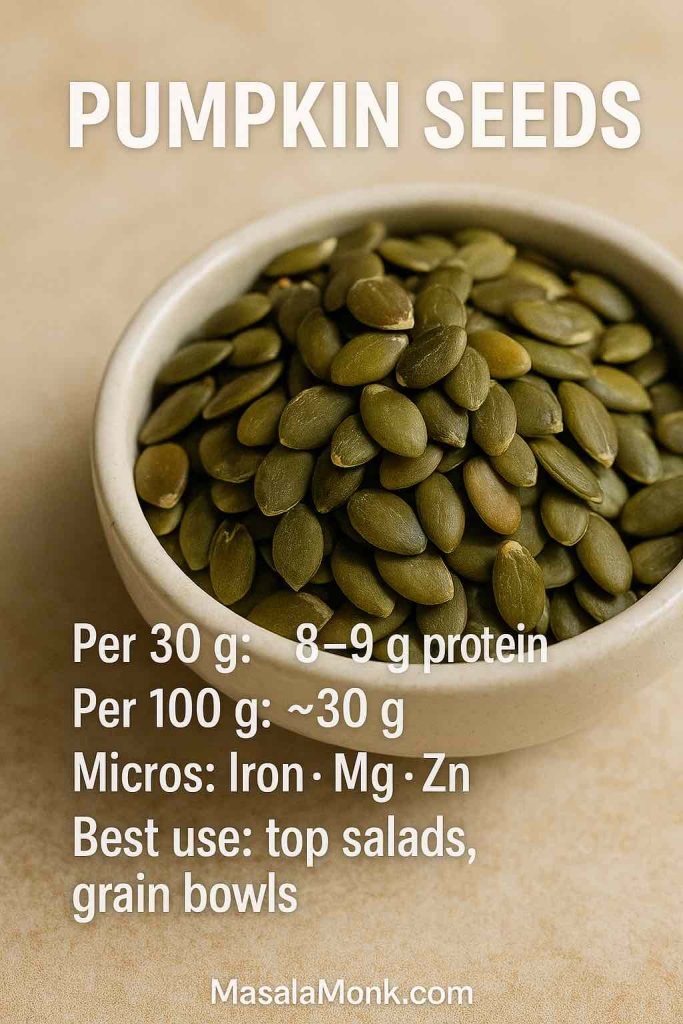
Pepitas in a ceramic bowl with protein per serving and per 100 g, iron/magnesium/zinc highlights, MasalaMonk.com.
Iron, magnesium, and zinc standouts. A 2-Tbsp finish gives crunch plus ~5–6 g protein.

Seeds or Nuts? Choosing the Highest Protein Nuts & Seeds With Intent

Decision-making gets easier when aim leads and appetite follows. Seeds often carry more protein per gram; nuts often deliver crunch, structure, and snack satisfaction. Thus, use this tidy lens:

  • Maximise protein per bite: hemp, pumpkin, sunflower
  • Best value with solid protein: peanuts
  • Vitamin E with clean, crisp bite: almonds
  • Plant omega-3 ALA: walnuts, ground flax, chia (ALA primer:Harvard Nutrition Source)
  • Iron + magnesium + zinc: pumpkin first; hemp and sunflower as strong support
  • Selenium (precise, potent): Brazil nuts1–2 are typically enough (AJCN RCT)

Pick the quality that fits today’s goal; then choose the texture you actually enjoy. As a result, consistency becomes easy.

Also Read: Pumpkin Seed Smoothie for Weight Loss | 5 Healthy Recipes & Benefits


Texture, Roasting, and Seasoning: The Satisfaction Multiplier

Numbers get you to the shelf; mouthfeel keeps you reaching into the jar. Consequently, small technique shifts create a big payoff:

  • Raw vs. roasted: light roasting (pan or oven) drives off a little moisture and unlocks aroma, so smaller portions feel complete. Keep heat moderate; oils should wake, not scorch. (Zhang et al., 2024).
  • Salted vs. unsalted: if lightly salted makes the habit stick, start there. Subsequently, mix half salted with half unsalted to bring sodium down without losing satisfaction.
  • Seasonings that earn their keep: chili-lime peanuts for brightness; cumin-salt pumpkin seeds for warmth; smoked-paprika almonds for evening snacking; lemon-sesame sunflower for lift. In turn, higher flavor density stabilises portion size naturally.

As satisfaction rises, portion anxiety falls. Therefore, you’ll find it easier to stop at enough.

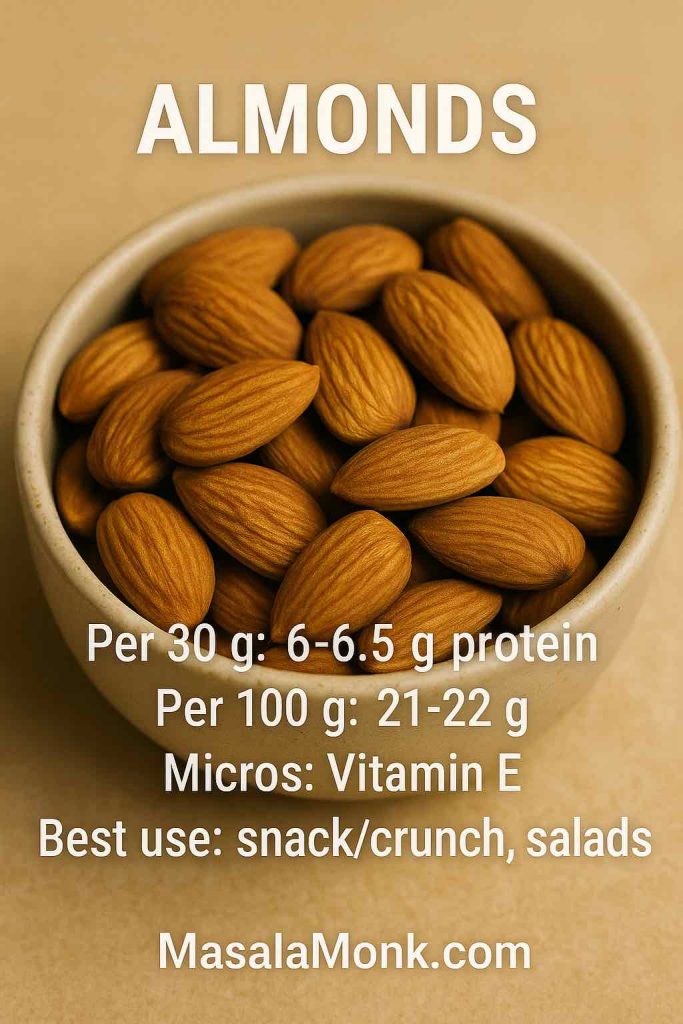
Almonds in a bowl with text showing protein per 30 g and 100 g and vitamin E note, MasalaMonk.com.
Almonds are Vitamin-E powerhouse with a clean crunch—~6–6.5 g protein per 30 g.

Micronutrient Tie-Breakers: When Protein Isn’t the Only Priority

Sometimes two choices tie on protein; consequently, minerals and vitamins decide the winner.

  • Iron: choose pumpkin seeds; sunflower assists. A tablespoon over salad, dal, soup, or roasted vegetables is a frictionless upgrade.
  • Vitamin E: choose almonds. A handful in the afternoon—or chopped over breakfast—keeps intake steady.
  • Selenium: choose Brazil nuts. One or two often meet daily needs; more isn’t necessary.
  • Omega-3 ALA: rotate walnuts, ground flax, and chia. Different textures; same benefit.
  • Magnesium & zinc: choose pumpkin and hemp for consistent support of muscle function, sleep quality, and immunity.
  • B-vitamins: choose peanuts and sunflower for reliable contributions to metabolism and nervous-system health.

Viewed this way, the highest protein nuts & seeds become a toolbox rather than a contest.

Also Read: Best Nuts and Seeds for Weight Loss (Chia, Flax, Almonds & More)


Buying and Storing the Highest Protein Nuts & Seeds

Nuts and seeds look sturdy; their oils do not. Accordingly, handle them thoughtfully and they’ll taste vivid to the last serving. Freshness multiplies flavor, and flavor multiplies follow-through. Furthermore, storage is simple.

  1. Buy what you’ll finish in a few weeks; a lively small stash beats a tired bulk bargain.
  2. Store airtight, cool, and dark. Glass jars in a cupboard are ideal; warm counters are not.
  3. Refrigerate or freeze omega-3-rich options (walnuts, flax, chia) if the kitchen runs warm.
  4. Smell before you snack. Fresh smells round and nutty; rancid smells waxy or flat. Toasting may revive a slightly dull seed; nothing saves a truly rancid nut—bin it and move on.

With storage handled, value rises and waste falls.

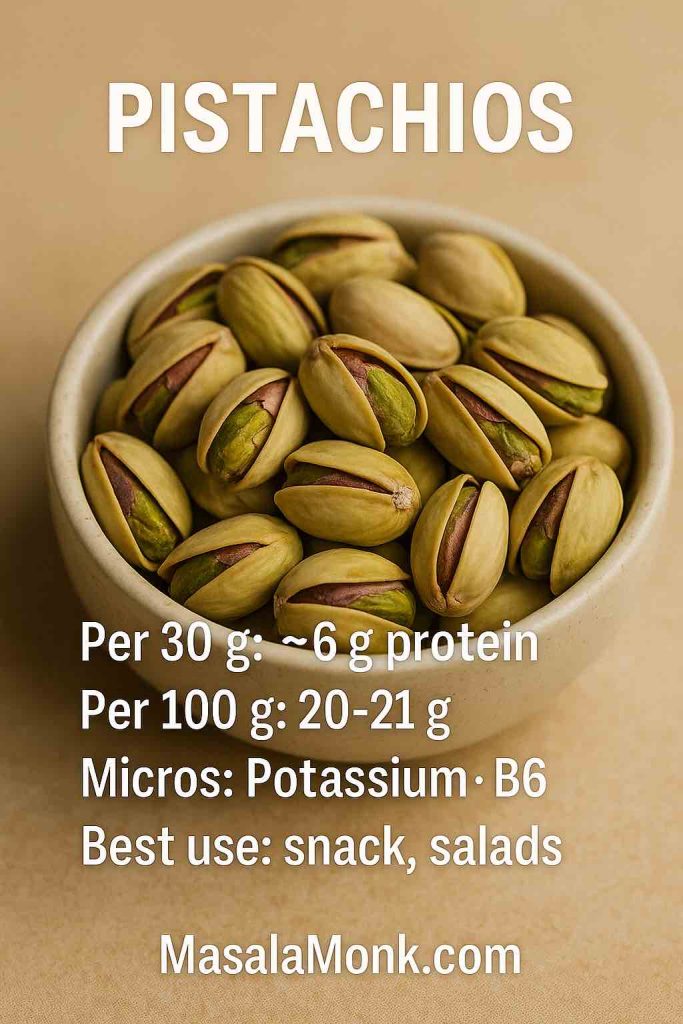
Pistachios in a bowl with overlayed protein per 30 g and 100 g and potassium/B6, MasalaMonk.com.
Pistachios have ~6 g protein per 30 g plus potassium & B6—great in salads and snacks.

Price & Value: Protein You’ll Actually Eat

Value is not only the sticker price; it is also protein per currency, minerals per bite, and the likelihood you’ll reach for it daily.

  • Peanuts: everyday champion—high protein, friendly price, universally seasonable.
  • Sunflower seeds: budget-friendly seed with solid minerals.
  • Pumpkin seeds: pricier, yet they repay with iron, magnesium, zinc, and deeply satisfying chew.
  • Almonds: premium, yet vitamin E and that “clean crunch” justify their role.
  • Hemp seeds: premium booster—one tablespoon strategically placed is often all you need.

Accordingly, a pragmatic pattern works best: build a base with peanuts or sunflower for affordability, then spike with pumpkin or hemp to raise protein and minerals without blowing the budget.

Also Read: The Power of Chia Seeds: 5 Plant-Based High-Protein Meal Prep Ideas


How to Use Nuts & Seeds All Day

Highest Protein Nuts & Seeds at Breakfast: Steady Mornings Without Effort

Oats with backbone
Stir a spoon of peanut or almond butter into hot oats; then finish with hemp and sliced banana. As a result, the bowl turns creamy, balanced, and genuinely sustaining.

Yogurt that eats like a meal
Thick yogurt or dahi, a handful of almonds for crunch, a spoon of chia or ground flax for fiber and omega-3s, berries for brightness, and a light drizzle of honey if you like. Consequently, protein rises and hunger drops.

A better smoothie
Milk or plant milk, frozen berries or banana, 1 tbsp nut butter, 1 tbsp hemp or pumpkin, a pinch of salt. Blend until silky. Typically, you’ll land in the 10–15 g range without using a powder.

Quick toast upgrades
Whole-grain toast with tahini and lemon; then sesame and a few chopped pistachios. Alternatively, peanut butter with sliced apple and a sprinkle of hemp. Small change, long runway.

Hot cereals beyond oats
Millet or ragi porridge finished with almond butter and sunflower seeds. Notably, the flavor is comforting while the macros are quietly stronger.

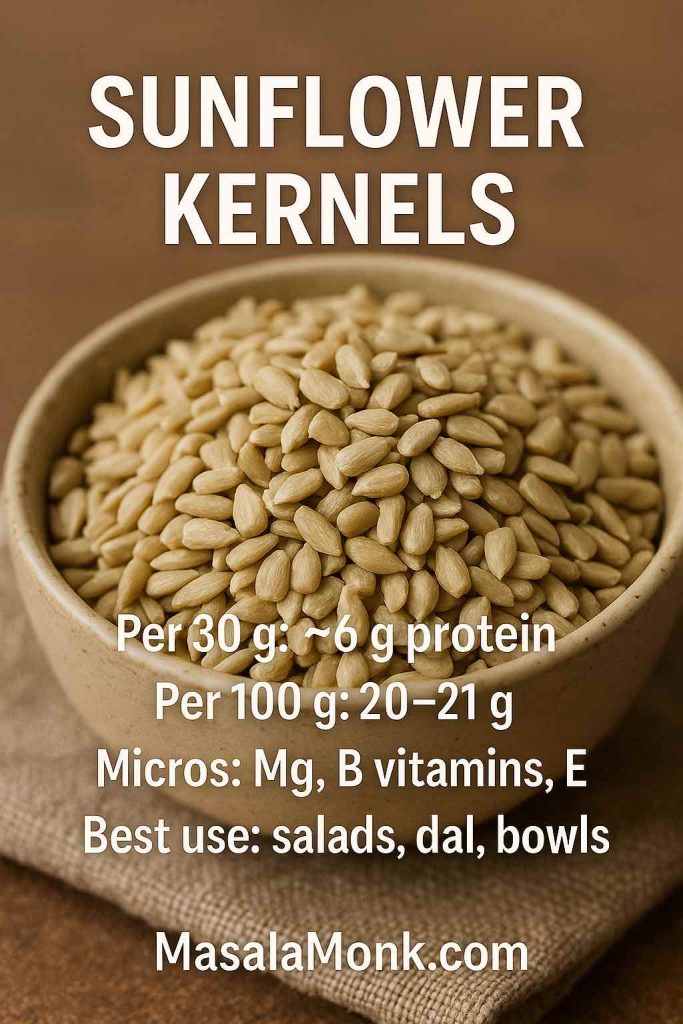
Sunflower kernels in a bowl with protein per 30 g and 100 g, magnesium and B vitamin note, MasalaMonk.com.
Sunflower seeds or kernels offer budget-friendly crunch with ~6 g protein per 30 g; steady minerals and B vitamins.

Highest Protein Nuts & Seeds at Lunch: Salads, Bowls, and Simple Structure

Leafy salad with substance
Leaves, chickpeas or boiled egg, chopped almonds or pistachios, tahini-lemon dressing; finally, sunflower seeds scattered at the end so they stay crisp. Consequently, the bowl moves from “nice” to “complete.”

Warm grain bowl
Rice or quinoa, roasted vegetables, a lemon-tahini drizzle, pumpkin and sunflower seeds to finish. Each bite has contrast—acid, fat, salt, crunch—and, importantly, steady protein.

Open-faced toast, grown up
Hummus or tahini-yogurt on a slice, cucumber ribbons, herbs, lemon zest, sesame. Satisfying yet light; easy to repeat throughout the week.

Dal and greens
Spinach dal or mixed-veg dal finished with cumin-garlic tempering and a handful of mixed seeds. Immediately, the texture improves and satiety rises without heaviness.

Also Read: Peanuts for Weight Loss: Best Ways to Eat Groundnuts, Chikki & Peanut Butter


Highest Protein Nuts & Seeds at Dinner: Generous Flavor Without Weight

Soups that finish strong
Tomato soup topped with pumpkin and sunflower; carrot-ginger with sesame; moong soup with roasted cumin and a final sprinkle of hemp. Thus, a simple bowl feels curated rather than plain.

Vegetables that eat like mains
Roasted cauliflower with tahini and pistachios; green beans finished with almonds and lemon; stuffed peppers with rice, cashews, and raisins. Consequently, vegetables carry the meal while nuts and seeds provide ballast and interest.

Stir-fries and quick sautés
Vegetables and tofu with a peanut-sesame crumble. Add the crunch during the last minute so it stays lively on the plate.

Grain-plus suppers
Couscous or broken wheat with roasted onions and peppers, then a warm dressing of olive oil, lemon, and tahini. Sunflower and pumpkin seeds go on at the end. Simple, clean flavors; dependable protein.

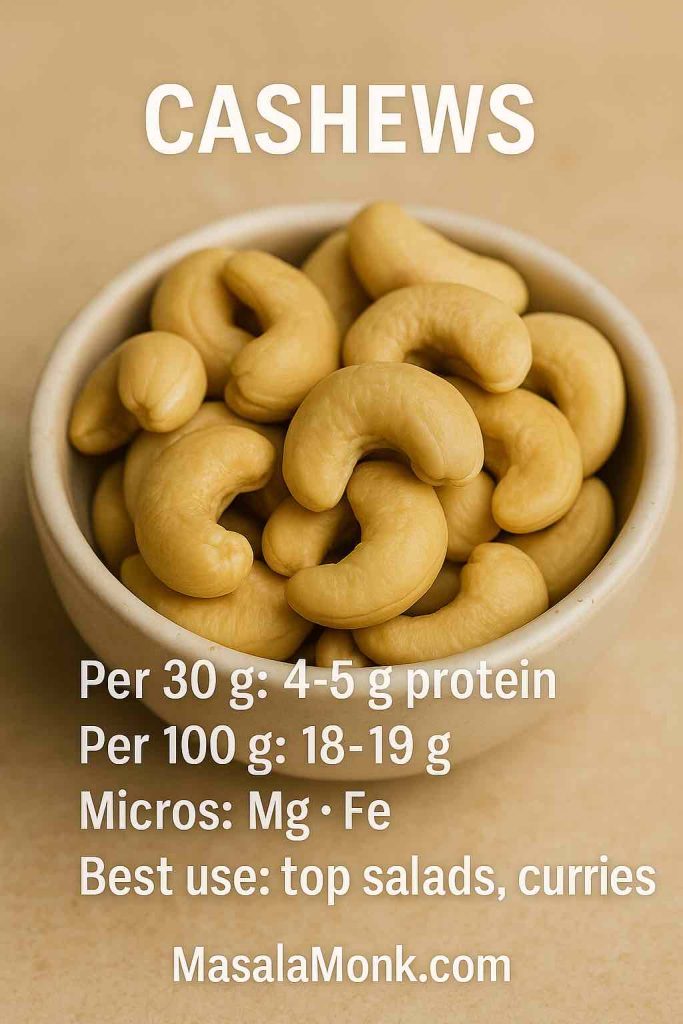
Cashews in a bowl with protein per 30 g and 100 g, magnesium and iron note, MasalaMonk.com.
Creamy all-rounder— Cashew Nuts with ~4–5 g protein per 30 g; great for sauces, curries, and salads.

Snacks That Don’t Backfire: Steady Energy in Small Moves

Trail mix with intent
Base of peanuts and almonds for value and crunch; pumpkin for minerals; hemp sprinkled just before eating as the protein “top-coat.” Keep dried fruit modest so you snack for nourishment, not momentum.

The desk spoon
Jar of nut butter plus a tiny jar of hemp within reach. Spoon, sprinkle, done. Not fancy—effective.

Roasted seed cups
Dry-toast pumpkin and sunflower with a pinch of salt and cumin. Cool, jar, and keep by the kettle. A tablespoon at tea-time replaces handfuls of empty calories.

Crisp apple + nut butter
Two or three slices, a thin smear of peanut or almond butter, a dusting of cinnamon, and a few sesame seeds. The ratio is everything: more apple than spread, more satisfaction than effort.

Adding nuts does not derail body weight in trials; systematic reviews show neutral or favorable effects on weight and adiposity (SR/MA of RCTs & cohorts)

Also Read: Nuts for Heart Health: Harnessing the Nutritional Powerhouse for a Healthy Cardiovascular System


Match-Ups That Settle Everyday Debates

Almonds vs. Pepitas

Per 100 g, almonds show ~21–22 g protein; pumpkin shows ~18–20 g. Per serving, however, pumpkin often edges almonds (~8 g vs. ~6 g) because a spoonful compacts differently. For vitamin E, choose almonds; for iron, magnesium, zinc—and a slightly higher serving-level protein—choose pumpkin.

Peanuts vs. Almonds

Peanuts lead on density (~24–26 g vs. ~21–22 g). Per serving, the gap is modest (~7 g vs. ~6 g). Accordingly, pick peanuts for value and easy seasoning; pick almonds for vitamin E and a slightly leaner profile. Meanwhile, keep hemp hearts nearby to boost either option.

Walnuts vs. “Higher-Protein” Nuts

Walnuts won’t top protein charts; however, they headline plant omega-3 ALA. Consequently, if heart-friendly fats lead your goals, keep a daily walnut habit and let peanuts or almonds carry the heavier protein elsewhere.

Chia vs. Flax

Protein is similar. Still, chia gels beautifully—great for puddings and thick smoothies. Ground flax disappears into batters, rotis, dals, and porridges. Therefore, use both and let format guide the choice.

Sesame vs. sunflower

Sesame excels as a flavor amplifier (tahini, temperings, finishing sprinkles). Sunflower wins when you want more minerals per handful at a modest price. Together, they make an excellent pantry pair.

Walnut halves in a bowl with protein per 30 g and 100 g and ALA omega-3 benefit, MasalaMonk.com.
Walnuts are plant omega-3 leader among nuts; ~4–5 g protein per 30 g. Sprinkle on oats or salads.

Strategic Mixes: Building a High-Impact Jar of the Highest Protein Nuts & Seeds

A smart mix balances protein, minerals, cost, and mouthfeel. Here are three blends that work in real life; moreover, each one uses the highest protein nuts & seeds as anchors.

1) Everyday Value Mix

  • Peanuts (50%) + Sunflower (25%) + Pumpkin (20%) + Hemp (5%), lightly salted.
    Result: budget-friendly, ~6–7 g protein per 30 g, iron and magnesium uplift, gentle crunch plus soft hemp specks. Consequently, you’ll actually finish the jar.

2) Iron-Forward Green Mix

  • Pumpkin (40%) + Sunflower (30%) + Almonds (20%) + Sesame (10%), cumin-salt seasoned.
    Result: iron, zinc, and vitamin E in one jar; excellent over salads, soups, and veg bowls. Additionally, sesame boosts aroma without dominating.

3) Premium Protein Booster

  • Hemp (35%) + Pumpkin (30%) + Pistachio (20%) + Almond (15%), unsalted.
    Result: ~8–9 g protein per 30 g with a refined texture; perfect as a topping rather than a graze. Therefore, a little goes a long way.

Store each mix airtight; rotate weekly to keep flavors lively.

Also Read: Walnut Benefits for Brain Health: Memory, Cognitive Function, and Mental Well-Being


Portions, Goals, and a Calm Plan That Sticks

Portions matter because nuts and seeds are calorie-dense. Even so, strict rules aren’t necessary.

Start with 28–30 g as a standard sprinkle or snack. Then, if you’re calibrating intake, measure a few times until your eyes learn the volume. Next, on training days or hungrier evenings, add a second sprinkle of pepitas or a spoon of hemp hearts. Finally, let weekly goals steer micro-moves: more protein (add hemp/pepitas), more iron (prioritize pepitas), more omega-3 (rotate walnuts/chia/flax), or simpler mornings (keep nut butter visible).


Common Mistakes (and Simple Fixes) When Using the Highest Protein Nuts & Seeds

  1. Buying too much at once.
    Fix: purchase smaller amounts more often; freshness beats bulk every time.
  2. Under-seasoning.
    Fix: add light salt and a signature spice (cumin, chili-lime, smoked paprika). Consequently, small portions feel complete.
  3. Relying on a single type.
    Fix: keep two daily staples (e.g., peanuts + almonds) and one rotating seed booster (hemp or pumpkin). Variety improves nutrients and prevents boredom.
  4. Forgetting the “last-minute” sprinkle.
    Fix: store a seed jar near the stove. Meanwhile, add a teaspoon to anything that leaves the pan.
  5. Ignoring storage temperature.
    Fix: refrigerate or freeze walnuts, flax, and chia in warm kitchens. Ultimately, flavor and shelf life improve.
Ground flax (alsi) in bowl with protein per 30 g/100 g, fiber and ALA notes; best uses: batters, rotis, oats, MasalaMonk.com.
Neutral booster with ALA + fiber; ~5–6 g protein per 30 g. Stir into batters, rotis, or oats.

A Seven-Day Meal Plan with Highest Protein Nuts & Seeds

Monday

  • Breakfast: oats with peanut butter + hemp hearts.
  • Lunch: salad with chickpeas, almonds, sunflower; tahini-lemon dressing.
  • Dinner: dal finished with cumin-garlic and pepitas.

Tuesday

  • Breakfast: yogurt with chia, berries, and chopped almonds.
  • Lunch: quinoa-vegetable bowl with tahini and sunflower kernels.
  • Snack: a few walnuts for omega-3 ALA.
  • Dinner: tomato soup topped with pepitas and sunflower.

Wednesday

  • Breakfast: smoothie with almond butter, hemp hearts, berries, and a pinch of salt.
  • Lunch: open-faced hummus toast with cucumber, herbs, lemon zest, and sesame.
  • Dinner: green beans with toasted almonds and lemon; rice on the side.

Thursday

  • Breakfast: oats with a tahini swirl, dates, and sesame.
  • Lunch: roasted vegetables over warm grains with lemon-tahini; shower of pepitas.
  • Snack: peanuts with a few dark-chocolate nibs.
  • Dinner: carrot-ginger soup finished with sesame; small salad with sunflower.

Friday

  • Breakfast: yogurt with ground flax and crushed pistachios.
  • Lunch: quinoa bowl with pepitas and sunflower kernels.
  • Dinner: roasted cauliflower with tahini and pistachios; crisp cucumbers.

Saturday

  • Breakfast: omelet with chopped almonds and herbs.
  • Snack: popcorn tossed with toasted pepitas and a whisper of chili-salt.
  • Late snack: spoon of peanut butter with a dusting of hemp hearts.

Sunday

  • Lunch: pilaf with cashews and raisins; side salad scattered with hemp hearts.
  • Snack: walnuts and sliced fruit.
  • Dinner: quick stir-fry finished with a teaspoon of mixed seeds; yogurt with chia for dessert.

Also Read: Cashews in the Morning: 5 High Protein Smoothie Ideas for Weight Loss.


Smart Swaps and Add-Ons for Instant Wins

  • Upgrade any yogurt: add hemp hearts; if texture feels soft, toss in chopped almonds for contrast.
  • Fortify porridge: swirl in nut butter while cooking; finish with pepitas.
  • Boost salads: make tahini-lemon your house dressing; keep sunflower on the table.
  • Elevate toast: spread tahini-yogurt, add herbs and lemon zest, and finish with sesame.
  • Enrich soups: treat seed blends like croutons—crunch without heaviness.
  • Power-up batters and doughs: add ground flax to pancakes, dosa/cheela batter, quick breads, and roti dough.
Chia seeds in bowl; text shows protein per 30 g/100 g, fiber and ALA; best for oats or smoothies, MasalaMonk.com.
Chia Seeds – gels for puddings; ~4–5 g protein per 30 g plus fiber and ALA. Mix into oats or smoothies.

Regional and Cultural Touchpoints (Practical, Not Precious)

  • Indian kitchens: stir ground flax into rotis; finish dal with pumpkin/sunflower; fold sesame into temperings; add peanuts to poha or chaat; spoon hemp onto curd rice or raita for a subtle boost.
  • Mediterranean plates: lean on almonds and pistachios for crunch; use tahini (sesame) in sauces and dressings; finish grain salads with sunflower and pumpkin.
  • East Asian flavours: highlight sesame oils and seeds; add peanuts to noodles and stir-fries; use chia for contemporary puddings.
  • Western breakfasts: keep peanut/almond butter on the counter; rotate hemp and pumpkin into granola, yogurt bowls, and hot cereals.

These aren’t rules; rather, they’re ways to let the highest protein nuts & seeds slip into meals you already enjoy.


The Highest Protein Nuts & Seeds: Handy Reference Table

Food (typical form)Protein per 100 gTypical serving (28–30 g)Protein per servingBonus strengths
Hemp hearts~31–33 g30 g~9–10 gMagnesium, zinc; neutral booster
Pumpkin seeds (pepitas)~30 g30 g~8.5–9.5 gIron, magnesium, zinc; great chew
Peanuts (dry-roasted)~24–26 g30 g~7 gValue; B-vitamins; easy seasoning
Almonds~21–22 g28–30 g~6–6.5 gVitamin E; clean, crisp crunch
Pistachios~20–21 g28–30 g~6 gColor, mild sweetness, snack appeal
Sunflower kernels~20–21 g30 g~6 gBudget-friendly; mineral-rich
Cashews~18–19 g28–30 g~4–5 gCreaminess; blends into sauces
Flax (ground preferred)~18 g28–30 g~5–6 gALA; disappears in doughs/batters
Chia~16–17 g28–30 g~5 gALA; gels for puddings/smoothies
Walnuts~14–15 g28–30 g~4–5 gHighest ALA among nuts
Sesame (til)~17–18 g30 g~5–5.5 gTahini powerhouse; calcium
Brazil nuts~14–15 g28–30 g~4 gSelenium standout (use 1–2)

Note: whole, in-shell pumpkin seeds include a fibrous hull that dilutes protein density. Therefore, pepitas (shelled) are the reference used throughout the highest protein nuts & seeds guide.

Source & method: Unless noted, macro numbers are taken from USDA FoodData Central and presented using USDA-derived comparisons from MyFoodData (per 100 g and typical servings).


Advanced, Ultra-Practical Ideas (For Extra Mileage)

Protein-first breakfast parfait: Start with thick yogurt; fold in 1 Tbsp peanut butter; add 1 Tbsp hemp hearts; top with chopped almonds and berries. Consequently, you get creaminess, crunch, and a near-instant protein bump.

Savory oatmeal switch-up: Cook oats in milk or fortified plant milk; whisk in tahini and a pinch of salt; finish with pepitas and chives. As a result, you turn a sweet habit into a savory, satisfying bowl.

Sheet-pan seed topper: Mix pepitas, sunflower, and sesame with a teaspoon of oil, chili, and lemon zest; toast briefly. Then store in a jar. Subsequently, every soup, salad, or sauté gets a finishing spoon.

Five-minute noodle lift: Toss hot noodles with tahini-soy-lemon; add edamame if available; finish with crushed peanuts and hemp hearts. Accordingly, weeknights gain structure without heaviness.

Roasted-veg “crouton” trick: Swap bread cubes for a shower of toasted seeds. Consequently, you keep crunch while adding protein and minerals.


Portions, Goals, and a Plan You Can Live With

Nuts and seeds are calorie-dense; portions therefore matter. Even so, precision can stay gentle.

  • Use 28–30 g as your default snack or sprinkle.
  • Weigh that amount a couple of times; thereafter, your eyes will know.
  • Training day or extra hunger? Add a spoon of hemp or an extra sprinkle of pumpkin and move on.

Let weekly themes steer micro-choices: more protein (add hemp most days), more iron (sprinkle pumpkin on what you already cook), healthier fats (rotate walnuts, flax, and chia), simpler breakfasts (keep nut butter visible instead of hidden). Consequently, you build consistency with minimal effort.


Final Take: The Highest Protein Nuts & Seeds Without Hype

Perfection isn’t the plan; repeatability is. Therefore, let hemp hearts and pepitas handle stealth protein boosts. Keep peanuts and sunflower as daily, budget-friendly anchors. Invite almonds for vitamin E and crisp satisfaction. Meanwhile, rotate walnuts, chia, and ground flax for omega-3 ALA. Additionally, use Brazil nuts thoughtfully for selenium.

For broader cardiometabolic reassurance, meta-analyses show favourable lipid effects with nut intake (61-trial analysis) and supportive links with cardiovascular risk (systematic review).

Above all, keep jars visible, place a scoop inside, and make topping a reflex. Then a handful between meetings, a spoon in a smoothie, or a teaspoon over soup becomes second nature. Ultimately, that’s how the highest protein nuts & seeds turn steady energy from a hope into a habit.

Also Read: Benefits of Flax Seeds and How to Incorporate Them into the Indian Diet

FAQs

1) Which nut has the most protein?

Peanuts come out on top among commonly eaten nuts at ~24–26 g protein per 100 g (that’s about ~7 g per 28–30 g serving). However, if you’re asking about tree-nuts only (i.e., excluding peanuts), then almonds and pistachios lead with ~21–22 g per 100 g (≈ ~6 g per serving).

2) Which seeds have the most protein?

For seeds, the champion is hemp hearts at ~31–33 g per 100 g (≈ ~9–10 g per 30 g). Meanwhile, pumpkin seeds (pepitas) follow closely at ~30 g per 100 g (≈ ~8–9 g per 30 g). Consequently, a single spoonful can quietly lift any meal.

3) Are nuts and seeds high in protein?

Yes—practically speaking, most deliver ~5–10 g protein per 28–30 g. As a result, they’re superb “easy add-ons” to keep you full and steady between meals.

4) Nuts vs. seeds: which have more protein?

Per 100 g, seeds generally edge out nuts (think hemp/pumpkin/sunflower > peanuts/almonds). Yet, per realistic servings, everything compresses to ~5–10 g, so you can choose by taste, texture, and budget—then simply boost with a tablespoon of hemp or a sprinkle of pepitas.

5) Highest-protein picks per serving (28–30 g)?

Hemp hearts ~9–10 g, pumpkin seeds ~8–9 g, peanuts ~7 g, almonds/pistachios/sunflower ~6 g, cashews/flax/chia ~5–6 g, and walnuts ~4–5 g. Therefore, the “per handful” gap is smaller than people expect.

6) Highest-protein picks per 100 g (density view)?

Hemp hearts (~31–33 g) > pumpkin seeds (~30 g) > peanuts (~24–26 g) > almonds (~21–22 g)pistachios/sunflower (~20–21 g) > flax (~18 g) > sesame (~17–18 g) > chia (~16–17 g) > walnuts/Brazil nuts (~14–15 g). Consequently, density helps for recipe planning and bulk mixes.

7) Which tree-nut has the most protein (excluding peanuts)?

Almonds and pistachios share the top spot at ~21–22 g per 100 g (≈ ~6 g per serving). In short, they’re your best tree-nut bets for protein.

8) Quick counts: how much protein per piece?

For fast mental math: 1 almond (badam) ≈ 0.25 g, 10 almonds ≈ 2.5 g; 1 peanut kernel ≈ 0.25 g, 10 peanuts ≈ 2.5 g; 1 walnut half (akhrot) ≈ 0.6 g (≈ 1.2 g per whole walnut). Handy for grazing and recipe tweaks.

9) Protein by the spoon: how much per tablespoon?

Peanut butter ≈ 4 g/Tbsp (16 g); almond butter ≈ 3–3.5 g/Tbsp; tahini (sesame) ≈ 2.5 g/Tbsp (≈ 5 g per 2 Tbsp); hemp hearts ≈ 3+ g/Tbsp; pepitas ≈ 3 g/Tbsp. Therefore, a spoon or two is a quick, honest lift.

10) Are peanuts really nuts?

Botanically, peanuts are legumes; nutritionally and in normal shopping, they behave like nuts. Consequently, most “highest-protein nuts” guides include them—because users (and labels) do.

11) Are nuts seeds?

Colloquially yes—nuts are hard-shelled seeds. However, in kitchens we separate nuts (almonds, cashews, walnuts) from edible seeds (hemp, pumpkin, sunflower, chia, flax) for clarity and recipe roles.

12) Best budget picks for protein?

Start with peanuts (value king) and sunflower seeds (budget minerals), then, importantly, spike with small amounts of pumpkin or hemp when you want extra protein and micronutrients.

13) Which are richest in iron, magnesium, and zinc?

Pumpkin seeds headline iron/magnesium/zinc; hemp and sunflower support closely. As a result, a tablespoon over salads, dal, soups, or roasted veg is a frictionless upgrade.

14) Which nuts are highest in vitamin E?

Almonds. Accordingly, keep a handful in the afternoon—or chop them over breakfast—for a clean, consistent vitamin E intake.

15) Where do plant omega-3s (ALA) come from?

Rotate walnuts, ground flax (alsi), and chia. Meanwhile, let peanuts/almonds/pepitas carry your heavier protein elsewhere.

16) What about selenium?

Brazil nuts are uniquely selenium-dense. Therefore, 1–2 nuts/day typically covers needs—no need to overdo it.

17) What’s a smart “everyday” high-protein mix?

Try Peanuts (50%) + Sunflower (25%) + Pumpkin (20%) + Hemp (5%), lightly salted. Result: ~6–7 g protein per 30 g, great crunch, serious minerals. Consequently, you’ll actually finish the jar.

18) How should I store nuts and seeds for freshness?

Store airtight, cool, and dark. Additionally, refrigerate or freeze walnuts, flax, and chia if your kitchen runs warm. Finally, smell before you snack—fresh is nutty and round; rancid smells waxy or flat.

19) Does roasting change protein?

Not meaningfully. Light roasting mostly reduces moisture and boosts aroma. However, keep the heat moderate—oils should wake, not scorch—so flavor and nutrients stay happy.

20) Salted or unsalted—what’s smarter?

Start where the habit sticks—lightly salted is perfectly fine. Then, for balance, mix half salted + half unsalted to bring sodium down while keeping satisfaction up.

21) Best breakfast upgrades for steady energy?

Stir nut butter into oats, top yogurt/dahi with hemp + almonds, or blend 1 Tbsp peanut butter + 1 Tbsp hemp into smoothies. Consequently, breakfasts land in the 10–15 g protein range without using powders.

22) Easy lunch and dinner add-ons?

Finish salads/grain bowls with sunflower + pumpkin; whisk a lemon-tahini dressing; sprinkle hemp on soups or dal at the end. As a result, meals feel complete—without heaviness.

23) What’s a realistic daily portion?

Use 28–30 g as your default handful/sprinkle. Next, on training days or hungrier evenings, add a second sprinkle or 1 Tbsp hemp—simple, predictable, sustainable.

24) Which nut butter is best for protein?

By the spoon, peanut butter wins (~4 g/Tbsp). Meanwhile, almond butter is slightly lower but brings vitamin E; tahini adds minerals; and hemp hearts are an effortless mix-in booster to any spread.

25) Almonds vs. pumpkin seeds—who wins?

Per 100 g, pepitas (~30 g) beat almonds (~21–22 g). However, per 30 g serving, pepitas are ~8–9 g vs almonds ~6 g. Therefore, pick almonds for vitamin E and crisp bite; pick pepitas for iron/magnesium and slightly more protein per serving.

26) Peanuts vs. almonds—where’s the edge?

Peanuts lead on pure density (~24–26 g/100 g vs ~21–22 g). Nevertheless, the per-serving gap is ~1 g, so let price and taste decide—and keep hemp nearby to boost either choice.

27) Walnuts vs. “higher-protein” nuts—how to decide?

Walnuts won’t win the protein chart (~4–5 g per 30 g), yet they headline omega-3 ALA. Consequently, keep a daily walnut habit for heart-friendly fats and let peanuts/almonds/pepitas carry more of the protein.

28) How do I add protein without changing recipes?

The simplest move: 1 Tbsp hemp hearts (~3+ g) or 1 Tbsp pepitas (~3 g) over whatever you already cook—oats, yogurt, dal, soups, salads, toast. Thus, flavor stays familiar while numbers climb.

29) How much protein in 1 Tbsp peanut butter?

Approximately ~4 g per 1 Tbsp (16 g). For a classic 2-Tbsp serving, you’ll get ~8 g. Therefore, PB is a tidy “spoon fix” when mornings are busy.

30) Which nuts are high in iron?

Nuts are modest; pumpkin seeds are the standout (yes, a seed). Next best: sunflower and hemp. Accordingly, if iron is a goal, use seeds as toppers daily.

31) Which nuts are highest in protein? (All variants)

Short list to remember: peanuts (top overall), then almonds and pistachios among tree-nuts; cashews are slightly lower; walnuts are lower still but bring omega-3 ALA.

32) What are the highest-protein seeds and nuts together?

If you just want winners, here they are: hemp and pumpkin (seeds) plus peanuts (nut). Therefore, keep these three in easy reach and rotate for taste.

33) Seeds vs. nuts: what about fiber, fats, and fullness?

Great question. Beyond protein, both bring fiber (appetite control) and unsaturated fats (even energy). Seeds often have a hair more fiber per gram; nuts tend to deliver more “crunch satisfaction.” Together, they’re steadier than carb-only snacks.

34) Do nuts and seeds have enough fiber to matter?

Absolutely. Even a tablespoon or two can round out a meal. Consequently, you’ll see fewer spikes, dips, and snack-cupboard raids.

35) Are cashews high in protein?

Medium: roughly ~4–5 g per 30 g. However, cashews excel at creaminess and making sauces; pair them with hemp or pepitas to lift protein.

36) Are pistachios high in protein?

Yes—about ~6 g per 28–30 g. Plus, they add color and gentle sweetness; they’re excellent in salads and grain bowls.

37) Are almonds high in protein?

Yes—~6–6.5 g per serving. Additionally, almonds are an easy vitamin E win and deliver that satisfying clean crunch.

38) How much protein in 100 g of the big four (for bulk recipes)?

Approximate per 100 g: hemp 31–33 g, pumpkin 30 g, peanuts 24–26 g, almonds 21–22 g. Therefore, for granola, bars, or laddoos, these numbers help you balance macros.

39) Are nuts “protein or fat”?

Both. Practically, they’re protein-and-fat foods with some fiber. And because their fats are mostly unsaturated, they tend to support smoother energy alongside satiety.

40) Won’t the calories add up?

They can—so portions matter. Even so, a calm plan works: start at 28–30 g, measure a few times so your eyes learn the volume, and, when needed, add one small booster (1 Tbsp hemp or pepitas) instead of another handful.

41) Can vegetarians (and kids) rely on nuts and seeds for protein?

They’re an excellent supporting source. Combine them with legumes, dairy/curd, soy/paneer/tofu, eggs (if used), and grains for full coverage across the day. Meanwhile, seeds help fill mineral gaps (iron, zinc, magnesium).

42) Whole seeds vs. “seed oils”—should I worry?

Whole seeds and nut butters are not the same as refined oils. You’re getting protein, fiber, and micronutrients with the fats intact. Consequently, whole-food forms fit beautifully in balanced meals.

43) Best choices for smoothies?

Use peanut or almond butter for body, then add hemp hearts (smooth boost), chia (thickens), or ground flax (disappears). Thus, you land in 10–15 g protein without powders.

44) Best toppers for salads and soups?

Go for sunflower + pumpkin for crunch/minerals, and finish with hemp for an invisible protein lift. Moreover, a lemon-tahini drizzle ties it all together.

45) Are seed-based protein powders (hemp/pumpkin/sunflower) worth it?

They can be, especially if you want dairy-free options. However, for many people, simply adding 2–3 Tbsp hemp/pepitas to meals achieves similar protein with better texture and minerals—no new routine required.

46) Do in-shell pumpkin seeds count the same?

Not quite. In-shell seeds include a fibrous hull that dilutes protein density. Therefore, for accurate comparisons, use pepitas (shelled) as the reference.

47) Should I soak or sprout nuts and seeds?

You can. Soaking/sprouting may reduce some phytates and change texture. Nevertheless, it’s optional—most benefits (protein, fiber, fats, minerals) remain strong without extra steps.

48) What if I have a peanut allergy—what should I swap?

Lean on almonds, pistachios, cashews, sunflower, pumpkin, and hemp. Then, for a PB-style experience, try sunflower seed butter or tahini + a touch of honey on toast.

49) Can I season them without ruining the “healthiness”?

Definitely. Light salt, chili-lime, cumin-salt, smoked paprika, or lemon-sesame keeps portions satisfying. In turn, bigger flavor often means smaller, happier servings.

50) Final, practical takeaway—what should I actually keep on the counter?

Keep four jars visible: peanuts, almonds, pumpkin seeds, and hemp hearts. Consequently, you can anchor snacks with peanuts/almonds (value + crunch) and top anything with pumpkin/hemp for protein and minerals—no new routine required.

Macros sourced from:USDA FoodData Central (primary database) and MyFoodData (USDA-derived comparison tables).

Posted on 2 Comments

Green Tea for Weight Loss: The No-Hype, Done-For-You Guide

Steaming green tea poured into a glass with lemon, mint and cinnamon—“Green Tea for Weight Loss” cover.

Let’s set the vibe right away: if a single cup of tea could flatten your stomach by Friday, the internet would have run out of tea by Saturday. Green Tea for Weight Loss isn’t magic—it’s a nudge. But when you stack that nudge with the basics (a calorie deficit, some movement, decent sleep), the dial starts to move. Slowly? Yes. Reliably? Also yes.

Here’s everything you actually need: what green tea does (and doesn’t) do, how to brew it so it works for you, when to drink it for a gentle appetite edge, how matcha fits in, how to stay safe with extracts, and practical plans, recipes, and FAQs you can act on today. Let’s go.


Why Green Tea for Weight Loss Works (in real life)

First things first, the science in one breath: the catechins in green tea—especially EGCG—plus a bit of caffeine can gently increase energy expenditure and fat oxidation. It’s not a fat torch; it’s a quiet assist. The National Center for Complementary and Integrative Health has a good plain-English summary of where green tea helps, where it’s mixed, and when to be cautious with supplements. Read their overview once, and you’ll see why our approach here is “ritual first, hype never.” NCCIH overview on green tea. NCCIH

Bowl of loose green tea leaves with brew thermometers—Science, Not Magic overlay.
Catechins + mild caffeine = a small, steady nudge—expect modest changes that add up with routine.

Now, here’s what matters for results:

  • Expect modest changes on the scale from tea alone—think of it as background support rather than the main event. Over weeks, though, those small differences compound when you’re also eating to your goal and moving your body. As the NCCIH notes, product composition (how much catechin, how much caffeine) and your activity level influence outcomes. As that overview puts it, this is a nudge, not a shortcut.
  • Where the magic shows up more visibly: your waistline. In a randomized trial, people who drank a catechin-rich tea while following an exercise plan saw greater reductions in total and subcutaneous abdominal fat versus the exercise-only group over 12 weeks. That’s the famous synergy: tea + movement. Randomized exercise study. PubMed
  • Appetite effects are mild. For many people, a cup 30–60 minutes before a meal takes the edge off. For others, there’s no big difference. We’ll show you how to time it and test it.
Cup of steaming green tea on a stool with black training shoes in soft background—overlay “Better With Movement.”
Pair your cup with a 10–20 min walk or short lift—small, repeatable sessions compound over ~12 weeks.

So yes, Green Tea for Weight Loss works—just not the “lose 10 kg in 10 days” kind of “works.” It’s the grown-up version: consistent, modest, additive.


Medical Disclaimer

This article is educational and not medical advice. Green tea and green tea extracts can interact with medicines (e.g., beta-blockers like nadolol, statins like atorvastatin) and high-dose extracts carry rare liver risks. If you’re pregnant, breastfeeding, have liver disease, or take prescription meds, talk to your clinician first. Avoid extract dosing on an empty stomach; keep total EGCG well under 800 mg/day. Stop and seek care if you notice nausea, abdominal pain, dark urine, or unusual fatigue. Caffeine affects sleep, anxiety, and blood pressure—time your intake accordingly.
Last updated: 16 September 2025 (IST)


How to Use Green Tea for Weight Loss (simple, actionable)

You don’t need a lab, a kitchen scale, or a secret import source. You just need decent tea, hot water, and a repeatable routine. Pick one of these to start, then layer more if you enjoy them.

Option A — The Two-Cup Anchor (your everyday base)

  • How much: 2–4 cups/day (about 400–600 ml total), spread from morning to mid-afternoon.
  • Brew smart: Use 80–85°C water (not boiling), steep 2–3 minutes. This preserves catechins and keeps bitterness low.
  • When to drink:
    • 30–60 min before meals to experiment with a subtle appetite effect.
    • 30–45 min before a walk or workout to ride the exercise synergy we just talked about (as that study found, this combo helps abdominal fat over time).
  • Sleep matters: If caffeine makes you buzzy, keep your last caffeinated cup 6–8 hours before bed and switch to decaf green tea or a calming herbal in the evening.
Cup of green tea with steam; text shows 30–60 min pre-meal or 30–45 min pre-workout.
For appetite testing, sip 30–60 min before your biggest meal; for synergy, 30–45 min before a walk or workout.

Need flavor without sugar? Rotate spice infusions so the habit stays interesting:

Option B — Matcha: a stronger “green” for busy humans

Matcha is powdered whole green tea leaf, so you drink the leaf itself (hello, catechins). It’s an easy win if you like lattes or smoothies.

  • Dose: ½–1 tsp (1–2 g) once or twice daily.
  • Prep: Whisk with hot (not boiling) water for a straight cup; or blend into a matcha protein shake (recipe below) for better satiety and workout support.
  • Timing: Morning for focus, early pre-workout for a gentle kick; decaf versions at night if you’re caffeine-sensitive.

Managing stress while cutting? Smart move. For broader “tea + stress” help, see How Your Favorite Brew Can Help Manage Cortisol and 5 Herbal Teas That Help Lower Cortisol. Stress down, adherence up. Win-win.

Frothy matcha in a glass with bamboo whisk and mound of powder—Matcha: Stronger Green.
Use 1–2 g matcha in water or a protein shake for a higher-catechin option that supports satiety.

Option C — Capsules/Extracts: advanced only (read safety before you buy)

If you struggle to get enough catechins from beverages, standardized green tea extract can be an option—but supplements are where safety needs guardrails.

  • Typical labels: 200–300 mg EGCG per capsule. Most people split 1–2 caps/day with food.
  • Safety lines you should actually know: The European Food Safety Authority concluded that doses ≥800 mg/day of EGCG from supplements were associated with statistically significant increases in liver enzymes; traditional brewed tea, on the other hand, is generally safe (rare idiosyncratic reactions can occur). Start low, avoid empty-stomach dosing, and stop if you feel unwell. EFSA scientific opinion. European Food Safety Authority
  • The UK’s Committee on Toxicity reiterated caution with high-dose extracts and multi-herb stacks. TL;DR: go gentle, go with food, and don’t stack with mystery “fat burner” blends. UK COT 2024 background. cot.food.gov.uk

If you’re supplement-curious in general, browse NCCIH’s notes on interactions and who should be careful; it’s short and worth your time (as the overview explains).

Medical Disclaimer

This article is educational and not medical advice. Green tea and green tea extracts can interact with medicines (e.g., beta-blockers like nadolol, statins like atorvastatin) and high-dose extracts carry rare liver risks. If you’re pregnant, breastfeeding, have liver disease, or take prescription meds, talk to your clinician first. Avoid extract dosing on an empty stomach; keep total EGCG well under 800 mg/day. Stop and seek care if you notice nausea, abdominal pain, dark urine, or unusual fatigue. Caffeine affects sleep, anxiety, and blood pressure—time your intake accordingly.
Last updated: 16 September 2025 (IST)

Amber bottle of green tea extract beside a small meal and a cup of tea—overlay reads “Extracts: Safety First; Keep EGCG well < 800 mg/day; Take with food.”
Prefer brewed tea. If you use extracts, stay well under 800 mg/day EGCG, take with food, and avoid empty-stomach dosing.

“Okay, but what results can I expect?”

Let’s be very clear and very adult about expectations:

  • On the scale: Green tea by itself leads to modest weight changes. It’s the kind of quiet helper you barely notice week to week… until you compare month to month, especially when paired with a reasonable calorie deficit and movement (as that overview states).
  • At the waist: This is where Green Tea for Weight Loss shows up better. Over about 12 weeks, catechin-rich tea—especially when paired with exercise—has repeatedly led to small but meaningful reductions in abdominal fat in controlled trials (as the randomized exercise study found).
  • Appetite: Some folks swear a pre-meal cup tames the mindless munching. Others shrug. Try it for a week and keep it if it helps.

Bottom line: treat tea like a daily ritual that keeps you pointed in the right direction.


Recipes you’ll actually make (and keep making)

Let’s make this effortless. Two hot, two cold; all quick.

Ginger + Green Tea (5 minutes, big flavor)

  • 250 ml hot water (80–85°C)
  • 1 tsp loose green tea (or 1 bag)
  • 3–4 thin ginger slices
  • Optional: lemon wedge
    Steep 2–3 minutes, strain, sip. Simple. (And if you want a weekly rotation, peek at our Green Tea & Spice Infusions collection.)
Glass of green tea with thermometer reading 80–85°C—Brew Like a Pro.
Use ~80–85°C water and a 2–3 min steep for more catechins and less bitterness—simple and repeatable.

Cinnamon Green Tea (comforting, subtly sweet)

  • 250 ml hot water + 1 tsp green tea
  • ½ small Ceylon cinnamon stick while steeping (2–3 min); remove stick
    Prefer deeper spice? This walk-through is short and useful: Cinnamon-Green Tea.

Matcha Protein Shake (satiety + muscle-friendly)

  • 1 tsp matcha
  • 200 ml chilled milk/alt-milk
  • 20–30 g whey/plant protein
  • Ice + optional handful spinach
    Blend 20 seconds. Breakfast, nailed.

Iced “Flat Tummy” Refresher (pre-meal ritual)

  • Brew 2 cups green tea; chill
  • Add lemon, mint, and ice
    Drink before lunch for a small satiety nudge. Habit + timing = quiet win.
Overhead of four options—ginger slices, cinnamon tea, creamy matcha shake, and iced lemon refresher—with “Easy, Tasty, Repeatable” overlay.
Rotate these four low-effort flavors to keep the habit enjoyable—adherence beats intensity for results.

Matcha vs Green Tea for Weight Loss (which should you choose?)

Short version: both work if you use them. Matcha often has more catechins per serving because you consume the whole leaf; regular brewed green tea is gentler and endlessly sippable. Choose based on your routine:

  • Crave a morning ritual and like lattes or smoothies? Matcha wins.
  • Prefer many small sips through the day? Brewed green tea is your friend.
  • Sensitive to caffeine? Use decaf versions later in the day (keep the ritual, protect sleep).

If stress and sleep are getting in the way (they always do), rotate in evening herbals from this cortisol-friendly short list. Better sleep = better appetite control tomorrow.


Safety & Side Effects of Green Tea for Weight Loss (quick but essential)

  • Brewed tea (most people): Generally safe. Watch your caffeine cutoff time. As the NCCIH overview notes, green tea can interact with certain meds (e.g., nadolol, atorvastatin), so check with your clinician if you’re on prescriptions, pregnant, or breastfeeding. NCCIH overview.
  • Extracts/capsules: This is where rare liver issues show up, especially at higher doses and in multi-herb stacks. Keep supplemental EGCG well under 800 mg/day, take with food, avoid empty-stomach dosing, and stop immediately if you notice nausea, abdominal pain, dark urine, or unusual fatigue. As the EFSA opinion concluded, ≥800 mg/day is the range where liver enzymes rise in trials; and as the UK COT background notes, concentrated extracts are the main concern—not your normal brewed tea. EFSA opinion; UK COT 2024.

Green Tea for Weight Loss: A 12-Week Blueprint (repeat as needed)

This plan respects how the body changes—gradually. It’s light on rules, heavy on rhythm.

1–2 Weeks : Build the ritual (keep it easy)

  • Pick Option A (Two-Cup Anchor) or Option B (Matcha).
  • Set phone alarms for Cup 1 (mid-morning) and Cup 2 (pre-walk/workout).
  • Walk 8–10k steps/day (break it into chunks—three 10-minute walks count).
  • Lift 2–3×/week (20–30 minutes: push/pull/legs; simple beats perfect).

3–6 Weeks : Layer tiny improvements (small hinges, big doors)

  • Keep your two tea anchors.
  • Add pre-meal timing before your largest meal (tea 30–60 min prior).
  • Protein to 1.6–2.2 g/kg target body weight; fiber to 25–35 g/day.
  • Bedtime: consistent, screens down, decaf or herbal after dinner.

Also Read: The Science of Protein: Maximizing Muscle Growth and Recovery

Green tea beside a spiral notebook and pen—overlay “12-Week Blueprint for Green Tea Success; Daily tea + subtle progressions = gradual results.”
Weeks 1–2: build two daily tea anchors • 3–6: add pre-meal timing • 7–12: add a third cup on hungry days and one interval/hill session.

7–12 Weeks : Turn the dial (just a click or two)

  • Add a third cup on higher-hunger afternoons (or a decaf if it’s late).
  • Introduce one interval or hill session weekly (short, honest effort).
  • Track waist and photos more than the scale; as the exercise study found, abdominal fat shifts are the tell here.

Want food scaffolding? Start with 5 Foods that Reduce Belly Fat and Spinach—Nutrition, Benefits & 5 Practical Ways. Plant-heavy, protein-forward—boringly effective.

Curious about ACV as a sidekick? Keep expectations realistic and try ACV on an Empty Stomach, or, if you’re supplement-curious, skim ACV Gummies: Pros, Cons & FAQs. Use what helps you adhere; skip what doesn’t.


Frequently Asked (Real) Questions about Green Tea for Weight Loss

1) Is green tea an appetite suppressant?

Sort of, sometimes. Many people notice a gentle reduction in appetite if they drink a cup 30–60 minutes before meals. Others don’t. That’s why we test. Keep it if it helps.

2) What’s the “best” green tea for weight loss?

The one you’ll drink daily. Practically speaking, matcha tends to deliver more catechins per serving (whole leaf), while brewed green tea wins on sip-ability. You don’t need to overthink it.

3) Will this flatten my stomach?

No drink targets belly fat in isolation—but over about 12 weeks, catechin-rich tea paired with exercise has produced small reductions in abdominal/visceral fat in controlled studies. That’s why our plan treats tea as a pre-workout ritual as often as a pre-meal one (as that study found).

4) Can I stack green tea with other “fat burners”?

You can, but should you? Most stacks add side effects faster than they add benefits, and concentrated blends are where safety issues pop up. If you want “stronger,” do it safely and sanely: a standardized extract with food, staying well under 800 mg/day EGCG (as the EFSA opinion concluded). And only if you’re already nailing the basics.

5) What about decaf—is it worth it?

Decaf green tea keeps the ritual, hydration, and some polyphenols. You lose the small caffeine boost, but if it protects sleep, it may help you more overall. Use decaf after lunch and herbals at night—your future self will thank you.

6) Can I combine green tea with ACV, cinnamon, ginger, etc.?

Absolutely—if it helps you stick to the plan. Try the spice infusions linked above for taste without sugar, or the matcha protein shake for actual fullness. If it feels like a treat, you’ll keep doing it.

7) Any interactions or “don’ts”?

Yes—green tea can interact with some meds (e.g., nadolol, atorvastatin), and high-dose extracts carry liver risk, especially on an empty stomach or in multi-herb stacks. If you take prescriptions, are pregnant/breastfeeding, or have liver concerns, talk to your clinician first (as the NCCIH overview advises).


Green Tea for Weight Loss: Quick Reference (pin this)

  • Brewed green tea: 2–4 cups/day; 80–85°C, 2–3 min steep; last caffeinated cup 6–8 h before bed.
  • Matcha: ½–1 tsp (1–2 g) once or twice daily; whisk (not boiling water) or blend into a protein shake.
  • Timing: 30–60 min pre-meal for appetite testing; 30–45 min pre-workout for the exercise synergy.
  • Extracts (advanced): 200–300 mg EGCG/cap; keep total well under 800 mg/day; with food; stop if unwell.
  • Evening: switch to decaf or calming herbals for better sleep (and better appetite control tomorrow).
  • Food frame: protein + fiber + plants. For easy ideas, see 5 Foods that Reduce Belly Fat and Spinach—5 Practical Ways.

Sources


Final word (and then go brew)

Green Tea for Weight Loss” really means: a small, daily ritual that helps you make better choices, train a little more consistently, and feel a little more in control. That’s the stuff that adds up. Brew your first cup, take a 10-minute walk after lunch, and repeat tomorrow. Boring? Maybe. Effective? Absolutely.

Medical Disclaimer

This article is educational and not medical advice. Green tea and green tea extracts can interact with medicines (e.g., beta-blockers like nadolol, statins like atorvastatin) and high-dose extracts carry rare liver risks. If you’re pregnant, breastfeeding, have liver disease, or take prescription meds, talk to your clinician first. Avoid extract dosing on an empty stomach; keep total EGCG well under 800 mg/day. Stop and seek care if you notice nausea, abdominal pain, dark urine, or unusual fatigue. Caffeine affects sleep, anxiety, and blood pressure—time your intake accordingly.
Last updated: 16 September 2025 (IST)

Posted on 3 Comments

Chia Seed Water: Benefits, Recipes & Best Time to Drink for Weight Loss

Glass of chia seed water with lemon slice and mint garnish on a minimalist background, overlaid with text highlighting hydration, fiber, and satiety as keys to sustainable wellness. Branded with MasalaMonk.com.

If you’ve been scrolling TikTok or Instagram lately, you’ve probably come across the so-called “internal shower”—a spoonful of chia seeds, a glass of water, maybe a squeeze of lemon, and voilà: chia seed water. Trendy? Absolutely. But the reason it’s sticking around isn’t just hype. Chia seed water is one of the easiest, most repeatable ways to get fiber and hydration together in one simple glass. That combination can help you feel pleasantly full, support regular digestion, and gently back up your weight-management goals.

It’s important to be upfront: there’s nothing magical about the water. The benefits come from the chia seeds themselves—tiny nutrition powerhouses packed with fiber, omega-3s, and minerals—and from the habit of drinking them in water. What the water does is make the seeds safe, digestible, and consistent enough to build into your routine. Their soluble fiber forms a gel in the gut that slows digestion and helps you feel fuller for longer. For a deeper dive into how chia interacts with blood sugar and glycemic control, check out this guide on chia seeds and glycemic index.


What Research Actually Says

Let’s look at the evidence, because a lot of the online chatter makes chia seed water sound more dramatic than it is.

  • On weight and waist: A 12-week randomized trial published in the Journal of Nutrition and Metabolism found that adults who consumed chia flour daily lost an average of 1.1 kg and reduced their waist circumference by about 1.9 cm. Modest? Yes. Meaningful? Definitely, especially over time (Vuksan et al., 2015, PubMed).
  • On broader health markers: A 2024 systematic review and meta-analysis in Nutrients concluded that chia consumption in overweight adults led to reductions in waist circumference, blood pressure, and C-reactive protein (a marker of inflammation). The authors noted that changes in overall weight were smaller, but central fat and metabolic improvements were consistent (Nutrients, 2024).
  • On water itself: Water isn’t a fat burner, but it does help when used strategically. A randomized controlled trial in Obesity (2010) showed that drinking 500 ml of water before meals led to greater weight loss compared to diet alone (Dennis et al., 2010, PubMed). And a systematic review in Nutrition Reviews (2019) found that strategies such as pre-meal water and replacing sugary drinks with water consistently reduced calorie intake and supported weight loss (Muckelbauer et al., 2019, PubMed).

The takeaway: chia seed water works not because it melts belly fat, but because it helps you eat a little less, stay hydrated, and make small, sustainable shifts.

Explore more Chia Seed Recipes and goodness in our post 10 Creative Chia Pudding Recipes for Every Taste.


How to Make Basic Chia Seed Water

Chia seed water is wonderfully simple, but there are a few tricks that make it go from “slimy” to actually enjoyable. Here’s a step-by-step guide that readers can follow with confidence.

Ingredients for one glass:

  • 1 tablespoon chia seeds
  • 250–300 ml water (about one regular glass)
Step-by-step infographic showing how to make chia seed water: stir 1 tablespoon chia seeds into 250–300 ml water, soak 20 minutes, and add lemon or flavors. A glass of hydrated chia water sits alongside orange and lime slices, with MasalaMonk.com branding.
Making chia seed water is simple: soak 1 tablespoon of chia seeds in 250–300 ml water, stir twice, and let sit at least 20 minutes. Add lemon or natural flavors if you like, then sip slowly. Image by MasalaMonk.com.

Step 1 — Pick your seeds wisely.
Black and white chia seeds are nutritionally almost identical, but fresher seeds plump up faster and taste less bitter. Store them in a sealed jar in a cool, dark place to keep their natural oils from going rancid.

Step 2 — Stir, don’t sprinkle and forget.
Chia seeds naturally want to clump. Add them to the glass of water and stir well for 20–30 seconds. Then let the mix sit for 5–10 minutes and stir again. This second stir breaks up clumps and ensures every seed forms its own gel coat.

Step 3 — Soak for at least 20 minutes.
In that time, chia seeds can absorb up to 10–12 times their weight in liquid, forming a gentle gel (called mucilage). This gel is what slows digestion and helps with satiety, as explained in Healthline’s guide on chia in water. A quick sip after only two or three minutes won’t give the same texture or fullness effect.

Step 4 — Adjust to taste.
The base recipe is neutral. Add a squeeze of lemon, a sprig of mint, or even a cinnamon stick if you want natural flavor without sugar. If you’re using chia water mainly for fullness before meals, keep it plain or citrus-based so you don’t add hidden calories.

Step 5 — Drink it slowly.
Chia water is more satisfying if you sip it over 5–10 minutes, rather than chugging. The gel texture encourages mindful drinking and gives your stomach time to send “I’m filling up” signals to the brain.

Overnight option:

For the smoothest texture, make a larger batch at night—say 3 tbsp chia + 750 ml water in a jar—and refrigerate. In the morning, you’ll have a ready-to-drink jar with a silky, pudding-like feel. This is also the safest way to ensure the seeds are fully hydrated.


Recipe Variations People Actually Love

People rarely stick with plain chia water forever. The variations below are the ones most often searched for—and for good reason. They’re not just tasty; they also bring small nutritional twists that make the habit easier and more enjoyable.


Chia Lemon Water (the “internal shower”)

  • How to make: 1 tbsp chia + 250–300 ml warm water + juice of ½ lemon. Optional: add grated ginger, mint leaves, or a pinch of cinnamon.
  • Flavor & feel: Zesty, refreshing, with a spa-water vibe.
  • Why it’s popular: Lemon boosts vitamin C, which supports skin and immunity. Ginger aids digestion; mint cools and soothes. Cinnamon helps blunt sugar cravings.
  • When to drink: First thing in the morning to rehydrate after sleep, or 20 minutes before a meal to reduce appetite.
  • Research angle: The American Association of Poison Control Centers noted that chia seed water, when properly soaked, can help relieve constipation and improve regularity—but warned against drinking it too soon after mixing, which can cause discomfort (Poison.org).
Glass of chia lemon water with mint garnish, highlighting chia seeds hydrated in water, with text overlay emphasizing digestion and hydration benefits and morning timing. MasalaMonk.com branding.
Chia lemon water works best as a morning reset or 20 minutes before meals, supporting digestion, hydration, and appetite control. Image by MasalaMonk.com.

This isn’t a TikTok gimmick—it’s rooted in real benefits. If you’re looking for even more ideas beyond water, here are 5 ways to use chia seeds with Indian food that make them easy to add into your everyday meals.


Chia Coconut Water (hydration booster)

  • How to make: 1 tbsp chia + 250 ml coconut water. Optional: pineapple chunks or a couple of basil/tulsi leaves.
  • Flavor & feel: Naturally sweet, tropical, and cooling.
  • Why it’s popular: Coconut water supplies potassium and magnesium—electrolytes that help replace what you lose through sweat. Pineapple adds bromelain, a digestive enzyme, while basil brings calm and freshness.
  • When to drink: After workouts, long walks, or hot summer days.
  • Research angle: The Cleveland Clinic highlights coconut water as a healthier alternative to soda, though it’s lower in sodium than sports drinks—so best for light activity, not endurance events (Cleveland Clinic).
Glass of chia coconut water with golden tint, chia seeds suspended, straw in glass, and halved coconut beside it. Text overlay highlights electrolytes, fiber, and hydration benefits. MasalaMonk.com branding.
Chia coconut water combines fiber with natural electrolytes like potassium and magnesium, making it a refreshing way to recover after workouts or hot days. Image by MasalaMonk.com.

Read more about The Power of Coconut Water: Unpacking the Health Benefits.


Overnight Soaked Chia Water (silky and ready to go)

  • How to make: Mix 1–2 tbsp chia + 300 ml water in a jar. Add apple slices and a cinnamon stick for natural sweetness. Refrigerate overnight.
  • Flavor & feel: Smooth, mild, lightly spiced. Almost like a thin pudding.
  • Why it’s popular: Zero morning prep. The seeds are fully hydrated, making it gentler on digestion and easier for chia beginners.
  • When to drink: First thing in the morning, especially if you want to avoid decision fatigue.
  • Practical tip: Start small—½ tsp chia per glass—and build up to 1 tbsp over a week. This prevents bloating and makes it easier to stick with the habit.
Mason jar of overnight-soaked chia seed water with apple slices and a cinnamon stick, placed in a refrigerator with text overlay emphasizing habit-building consistency. MasalaMonk.com branding.
Overnight-soaked chia water is ready when you wake up—smooth, convenient, and gentle on digestion. Just add apple slices and a cinnamon stick for natural flavor. Image by MasalaMonk.com.

Chia Fresca (traditional agua de chía)

  • How to make: 1 tbsp chia + 250 ml cold water + juice of 1 lime. Optional: ½ tsp honey, or turmeric + black pepper for an anti-inflammatory twist.
  • Flavor & feel: Crisp, tangy, energizing.
  • Why it’s popular: This isn’t a TikTok invention—it’s a long-standing Mexican refreshment, often enjoyed on hot afternoons. Light, hydrating, and culturally rooted.
  • When to drink: Midday, or alongside a light snack instead of reaching for soda.
  • Upgrade ideas: Add parsley or cilantro for a fresh, detox-like taste.
Glass of traditional Mexican chia fresca (agua de chía) with lime wedges and ice on a rustic wooden table. Chia seeds are suspended in the drink, with text overlay highlighting it as a light, energizing soda replacement. MasalaMonk.com branding.
Chia Fresca, or Agua de Chía, is a traditional Mexican refreshment made with chia seeds, lime, and water. Light, hydrating, and energizing—it’s a natural soda replacement. Image by MasalaMonk.com.

Chia + Juice (occasional treat)

  • How to make: 1 tbsp chia + 125 ml 100% juice (orange, pineapple) + 125 ml water. Or, swap juice for cooled green tea with a spoonful of berry purée.
  • Flavor & feel: Bright, fruity, satisfying.
  • Why it’s popular: Juice makes chia water taste like a fun drink, not a wellness chore.
  • When to drink: A few afternoons a week, especially if you’d otherwise grab soda or packaged iced tea.
  • Research angle: A 2025 umbrella review in JAMA Pediatrics concluded that moderate 100% juice intake doesn’t cause weight gain in adults, but extra calories can add up if portions aren’t controlled (JAMA Pediatrics, 2025). Diluting juice with water is the best of both worlds: flavor + moderation.
Glass of chia seeds suspended in diluted orange juice with orange and lime wedges beside it. Overlaid text highlights chia + juice as an occasional treat, advising moderation and portion control. MasalaMonk.com branding.
Chia + Juice is a sweet, fruity way to enjoy chia seed water. Dilute juice with water for moderation, keep portions small, and enjoy it as an occasional treat. Image by MasalaMonk.com.

👉 Each of these variations follows the same core principle: chia + liquid + patience. What changes is the flavor and the little extra nudge from citrus, herbs, or electrolytes. Those details matter not because they torch fat, but because they keep you sipping. And the more often you sip, the more consistent the benefits become.


Best Times to Drink Chia Seed Water

The beauty of chia seed water is that you can drink it almost any time of day. But if your goal is weight management, hydration, or simply smoother digestion, timing matters. Let’s break it down.

Morning: a gentle reset

Waking up means you’ve gone 7–9 hours without fluid. Starting your day with a glass of chia seed water is like topping up your tank—hydration plus a dose of fiber. Many people describe it as a way to “start lighter” and avoid the mid-morning snack urge. The overnight-soaked version is especially handy here because it’s already ready to sip when you roll out of bed.

Young woman sitting at a table sipping a glass of chia seed water, with text overlay emphasizing mindful drinking, satiety, and portion control. MasalaMonk.com branding.
Drinking chia seed water slowly helps promote fullness and supports mindful eating. Building awareness around simple habits like this makes weight management easier over time. Image by MasalaMonk.com.

Before meals: the most strategic slot

If weight management is part of your goal, this is where chia seed water shines. Research published in Obesity (2010) found that drinking 500 ml of water before meals helped adults eat less and lose more weight compared to diet alone (Dennis et al., 2010, PubMed). Pairing that strategy with chia’s gel-like fiber makes the effect stronger: you feel full sooner, so you naturally reduce portions without forcing yourself.

Midday or afternoon: beating the slump

Instead of grabbing a soda, iced latte, or packet of chips, a tall glass of chia fresca (lime + chia + water) or chia coconut water can scratch that “I need something” itch. Here, chia helps curb cravings, while electrolytes or citrus give you a lift. A systematic review in Nutrition Reviews (2019) noted that replacing caloric beverages with water is one of the most effective, evidence-based ways to reduce daily calories (Muckelbauer et al., 2019, PubMed).

Evening: the calming ritual

If you like the idea of winding down with a drink, chia seed water works fine—just keep it light and not right before bed. A cinnamon-apple overnight version can double as a soothing “pre-bed” sip. The main watch-out here is fullness: chia expands, and too much liquid fiber right before lying down can feel heavy.

Takeaway: The two most powerful times are first thing in the morning and 20–30 minutes before meals. The rest is flexible—listen to your body, your schedule, and what helps you stick with it.


Small Habits That Make It Work

It’s one thing to try chia seed water once; it’s another to make it part of your lifestyle. These small details help turn a trend into a sustainable, supportive habit.

Stir twice, always.
The first stir coats the seeds, the second (after 5–10 minutes) breaks up clumps. This ensures every seed forms its gel properly and the drink feels smooth instead of slimy.

Ramp up fiber slowly.
If your body isn’t used to chia, start with 1 teaspoon per glass for a few days, then move to 2 teaspoons, and finally 1 tablespoon. This principle is part of why a high-protein, high-fiber diet supports weight loss more sustainably than quick fixes. Jumping straight in can lead to bloating or discomfort. Healthline emphasizes this “go slow and soak well” approach as the best way to get chia’s benefits without the side effects (Healthline).

Choose warm, not hot.
Boiling water can damage chia’s delicate texture, turning the gel unpleasant. If you want a cozy drink in the morning, use warm water—about the temperature you’d sip tea at once it cools.

Keep sweeteners occasional.
Honey, maple syrup, or juice can make chia water delicious, but remember: the biggest weight-loss benefit of chia water comes from replacing caloric drinks with low-calorie hydration. A systematic review confirmed this as one of the most effective strategies for weight management (Muckelbauer et al., 2019). If you want sweetness, keep it modest and intentional.

Use coconut water situationally.
Coconut water is great for hot weather or after a workout because it contains electrolytes like potassium and magnesium, but it still carries calories. The Cleveland Clinic suggests treating it as a hydration tool, not a daily water substitute (Cleveland Clinic).

Pay attention to how you feel.
Everyone’s gut reacts differently to fiber. Some people feel lighter and more regular within days; others may need to scale intake. Consistency matters more than intensity.


Why These Details Matter

Chia seed water doesn’t work because of flashy claims or quick fixes. It works because small, thoughtful tweaks—timing it before meals, stirring properly, swapping it for soda, making it taste good—add up to better habits you can actually stick with. That’s what the research shows, and that’s what real people find most useful.

And if you want more practical inspiration, check out these chia-based high-protein meal prep ideas you can try alongside your water habit.


The Bottom Line

Chia seed water works because it’s simple and sustainable. The seeds provide fiber, omega-3s, and minerals; the water enhances satiety and hydration; and flavor variations (lemon, coconut, lime) keep it enjoyable. Research suggests you can expect modest, gradual improvements in weight and waist circumference if this habit consistently replaces higher-calorie drinks and helps you feel satisfied before meals.

Flat lay of chia seed water ingredients: bowl of chia seeds, glass of water, half coconut, lemon wedge, mint leaves, and cinnamon stick, with overlaid text highlighting chia seed water basics. MasalaMonk.com branding.
Chia seed water needs just two essentials: 1 tablespoon of chia seeds and 1 glass of water. Add citrus, mint, or coconut water for natural flavor. Image by MasalaMonk.com.

It won’t “melt belly fat” overnight, but it can quietly amplify the healthy habits that do matter—hydration, portion control, regular digestion, and sticking with a plan. Think of it as a small daily lever that makes the rest of your wellness routine easier to keep.

While we are on belly fat, you might want to read: Apple Cider Vinegar and Belly Fat: Does It Really Work?.


Frequently Asked Questions About Chia Seed Water

1. Does chia seed water really help with weight loss?

Yes, but in a realistic way. Chia seeds are rich in soluble fiber, which swells in water to form a gel that promotes fullness and helps you naturally eat less. Combined with drinking water before meals—already proven in randomized trials to support weight loss—chia seed water can give you an edge. For example, a 12-week clinical trial found participants lost about 1.1 kg in weight and 1.9 cm in waist circumference when chia was added daily (Vuksan et al., 2015, Journal of Nutrition and Metabolism). Think of it as a supportive habit, not a quick fix.


2. Can chia seed water burn belly fat?

No drink can “melt” belly fat. What chia seed water does is help you feel satisfied sooner and avoid unnecessary snacking or extra calories. Over time, this can reduce overall and abdominal fat as part of a balanced diet and active lifestyle. A 2024 meta-analysis in Nutrients confirmed that chia consumption reduced waist circumference and improved blood pressure and inflammation markers, even when overall weight change was modest.


3. How much chia seed water should I drink daily?

Most people find 1 glass per day (about 1 tablespoon of chia seeds soaked in 250–300 ml of water) is a good place to start. Some go up to two glasses if they tolerate fiber well. If you’re new to chia, begin with 1 teaspoon per glass and gradually increase to avoid bloating.


4. Is it safe to drink chia seed water every day?

Yes, it’s safe for most healthy adults—provided the seeds are fully soaked. Chia can absorb 10–12 times its weight in liquid, so drinking them dry or under-soaked may cause discomfort. Healthline recommends always letting them sit at least 20 minutes, or overnight for best results. If you have gut sensitivities or are on medication, check with a doctor first.


5. What’s the best time to drink chia seed water for weight loss?

The two most effective times are:

  • First thing in the morning — to rehydrate and set a steady appetite rhythm.
  • 20–30 minutes before meals — to enhance satiety and naturally reduce portions.

This lines up with research from Obesity (2010), which showed that 500 ml of water before meals increased weight loss compared to diet alone. Adding chia makes that effect even more powerful.


6. Can I add lemon, coconut water, or juice to chia seed water?

Absolutely. Variations are what keep the habit enjoyable:

  • Chia lemon water: boosts vitamin C and freshness.
  • Chia coconut water: adds electrolytes like potassium—great post-workout (Cleveland Clinic).
  • Chia + juice: tasty, but dilute with water to manage calories. A 2025 review in JAMA Pediatrics found moderate 100% juice intake is fine for adults, but extra calories can add up if portions are large.

7. Are there any side effects of chia seed water?

The main issues are bloating and gas if you increase fiber too quickly, or choking risk if the seeds aren’t soaked long enough. Lemon can also affect tooth enamel if sipped all day—using a straw or rinsing afterward helps. Start small, soak thoroughly, and you’ll likely avoid problems.