
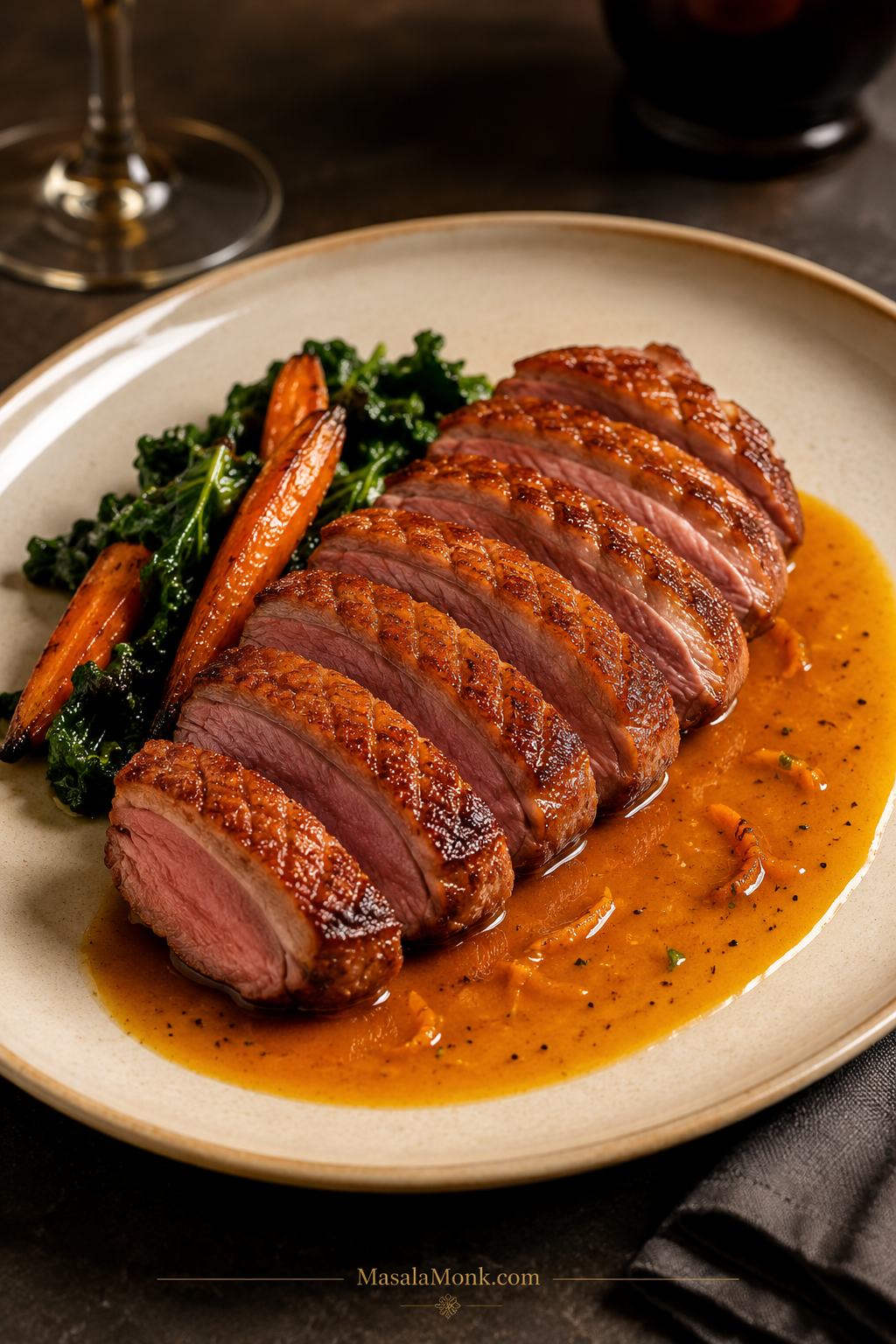
Duck breast can feel intimidating the first time: beautiful when it works, frustrating when the skin turns rubbery or the meat dries out. The good news is that the method is much calmer than it looks. You do not need a complicated marinade or a chef’s trick. You need to score the skin, start in a cold pan, render the fat slowly, finish gently, rest, and slice.
This duck breast recipe gives you crisp golden skin, a tender center, and a quick orange sauce you can make while the duck rests. More importantly, it shows you what to look for at each stage: how deep to score, how the fat should bubble, when the skin is ready to flip, and how to choose the right temperature for your table.
Because duck breast is rich and easy to overthink, this guide also covers sauces, sides, air fryer and sous vide notes, storage, reheating, leftovers, and troubleshooting. By the end, you should know how to avoid rubbery skin, greasy fat, and dry meat — and what to do if something starts going wrong.
The payoff is a plate that feels special without being frantic: crisp salted skin, a thin rendered fat layer, juicy slices, and a glossy sauce you make while the duck rests.
Before you start: the slow part is the skin-side render. It may feel like nothing is happening for the first few minutes, but that quiet start is exactly what helps the fat melt instead of trapping a chewy layer under the skin.
Duck Breast Recipe Guide
Start Here
Cook It Properly
Serve, Fix & Store
Recipe Details
Quick Answer: Best Way to Cook Duck Breast
Duck breast usually cooks best when you score the skin, season it well, place it skin-side down in a cold dry pan, and slowly render the fat over low to medium-low heat until the skin is golden and crisp. Once most of the fat has melted, flip the breast briefly to cook the meat side, then finish in a 350°F / 180°C oven if the breast is thick or still under your preferred temperature.
Rest the duck skin-side up for 5–10 minutes, then slice it against the grain. Many cooks prefer duck breast medium-rare to medium for juicier slices, while the official poultry safety benchmark is 165°F / 74°C. Use a thermometer and choose the doneness that feels right for you and the people you are serving.
Not sure which doneness to choose? Use the duck breast temperature guide before you start cooking.
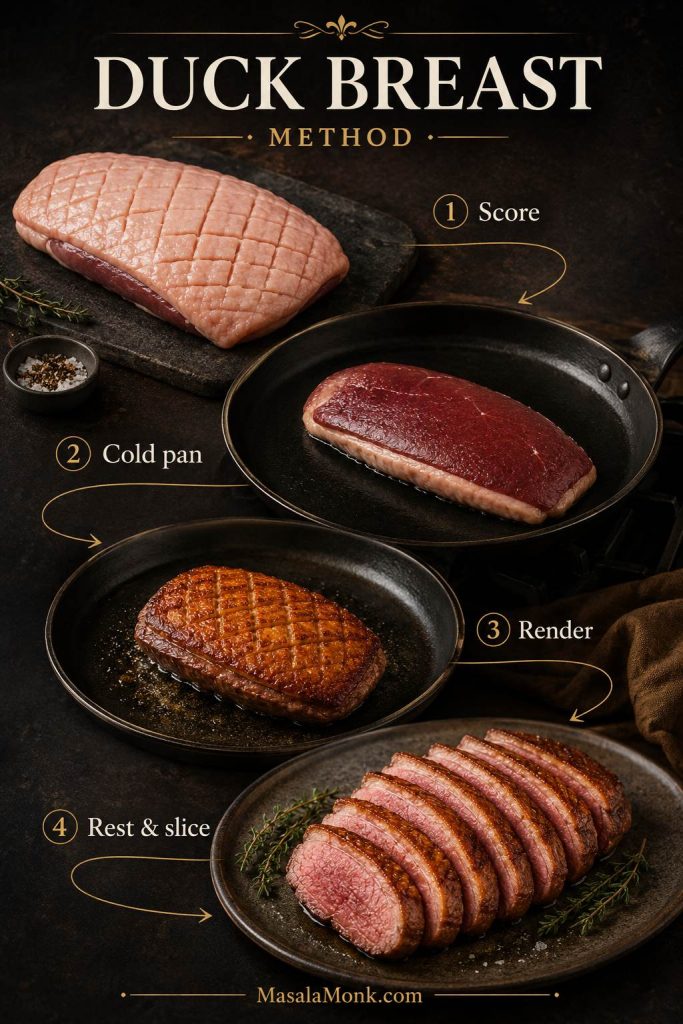
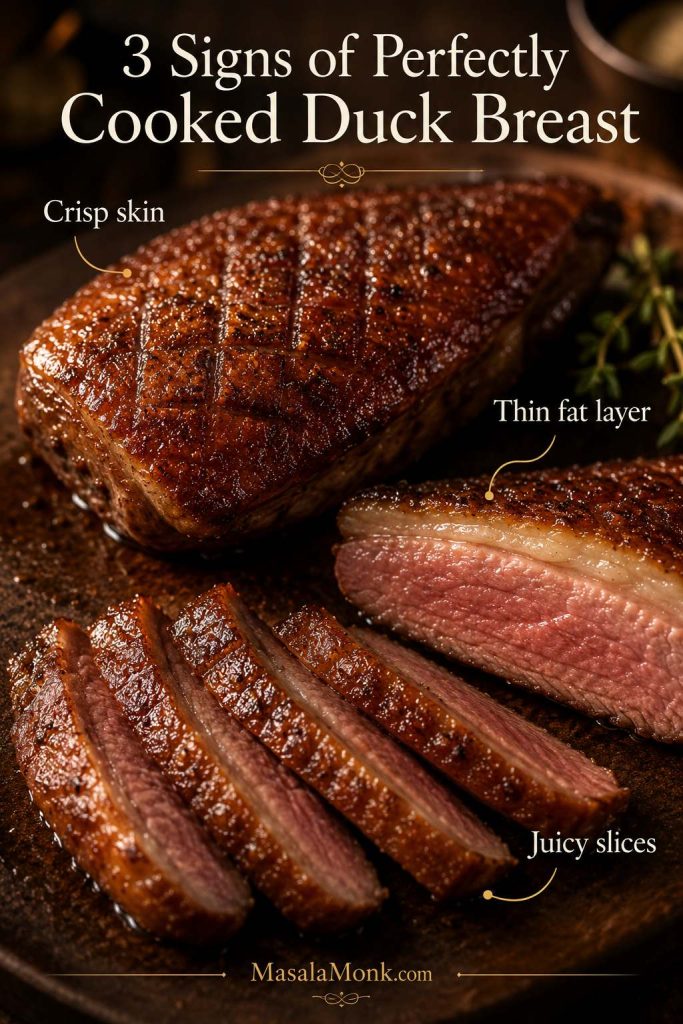
What success looks like: the skin should be deeply golden and crisp, the white fat layer should look much thinner, and the sliced meat should be juicy rather than dry. If the skin is browning fast but the fat still looks thick, lower the heat and keep rendering.
Quick cooking formula: score the skin, season, start skin-side down in a cold dry pan, render gently for 10–18 minutes, flip for 1–2 minutes, oven-finish thick breasts if needed, rest skin-side up for 5–10 minutes, then slice against the grain.
For the visual stage-by-stage version, jump to the duck breast rendering cues before you start cooking.
Duck Breast Recipe at a Glance
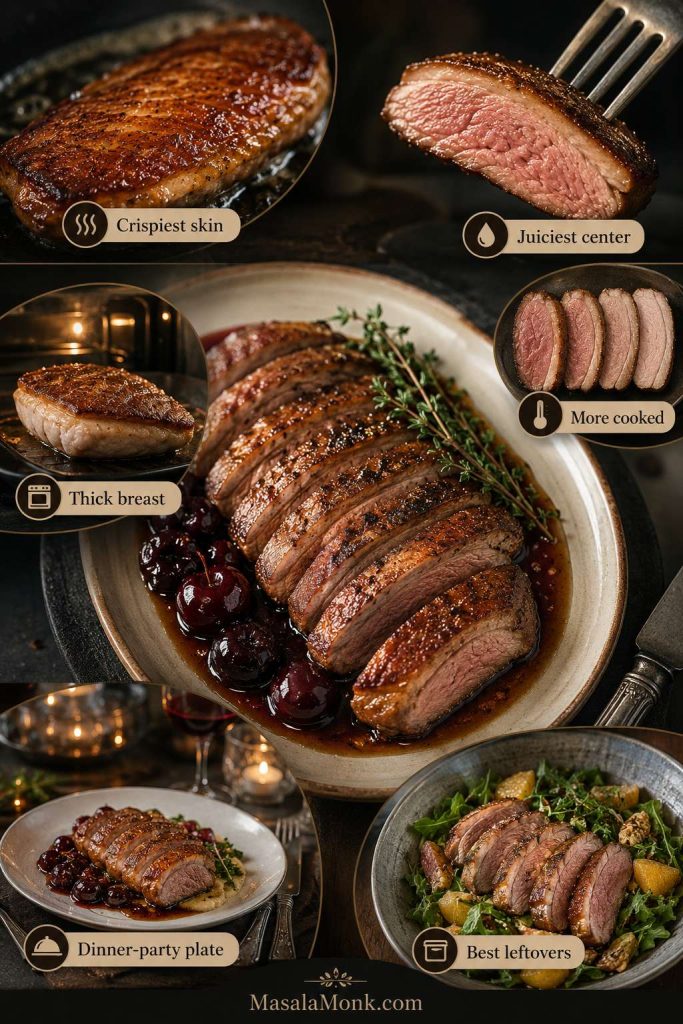
Choose Your Duck Breast Goal
| Your goal | Best move |
|---|---|
| Crispiest skin | Render longer over low to medium-low heat, and spoon sauce around the slices rather than over the skin. |
| Juiciest center | Use a thermometer, pull the duck a few degrees before your final target, and rest it skin-side up. |
| Less pink / more cautious doneness | Cook closer to the official poultry benchmark, knowing the meat will be firmer. |
| Thick magret-style breast | Render the skin on the stovetop first, then finish gently in a 350°F / 180°C oven. |
| Date-night or dinner-party plate | Use orange or cherry sauce, crisp potatoes, and bitter greens to balance the richness. |
| Nervous beginner | Trust the cues more than the clock: thinner fat layer, golden skin, gentle bubbling, and thermometer-confirmed doneness. |
| Best leftovers | Slice cold or reheat gently, then add cooked duck near the end of rice, noodles, salads, or pasta. |
Why This Duck Breast Recipe Works
Duck breast cooks differently from chicken breast because it has a thick layer of fat under the skin. If you start with high heat, the skin can brown before that fat melts, leaving a chewy layer underneath. Starting in a cold pan gives the fat time to render gradually, so the skin crisps while the meat stays protected from harsh heat.
Scoring the skin gives the fat more places to escape. Drying the skin helps it brown instead of steam. Pouring off excess fat keeps the duck from sitting in a deep pool of hot fat. Resting skin-side up protects the crisp surface while the juices settle.
Once you understand those four ideas — score, dry, render slowly, rest properly — this cut becomes much easier to cook consistently.
That contrast is why duck breast feels special: the knife taps through crisp skin, the center stays tender, and the sauce belongs beside the slices instead of drowning them.
Ingredients for Duck Breast
You do not need much to make excellent duck breast. Salt, pepper, and a good pan do most of the work. The optional orange sauce makes the plate feel complete, but the cooking technique matters more than the sauce.
For the Duck Breast
- 2 skin-on boneless duck breasts, about 6–8 oz / 170–225 g each
- 1 tsp kosher salt, or about ½ tsp fine salt
- ¼ tsp black pepper
- Optional: 1 small thyme or rosemary sprig
- Optional: 1 small garlic clove, lightly crushed
For the Optional Orange Sauce
- ¼ cup / 60 ml fresh orange juice
- ½ cup / 120 ml chicken stock
- 1 tbsp white wine vinegar or red wine vinegar
- 1–2 tsp honey or sugar
- 1 tsp orange zest
- 1 tbsp / 14 g cold butter
- Salt and black pepper, to taste
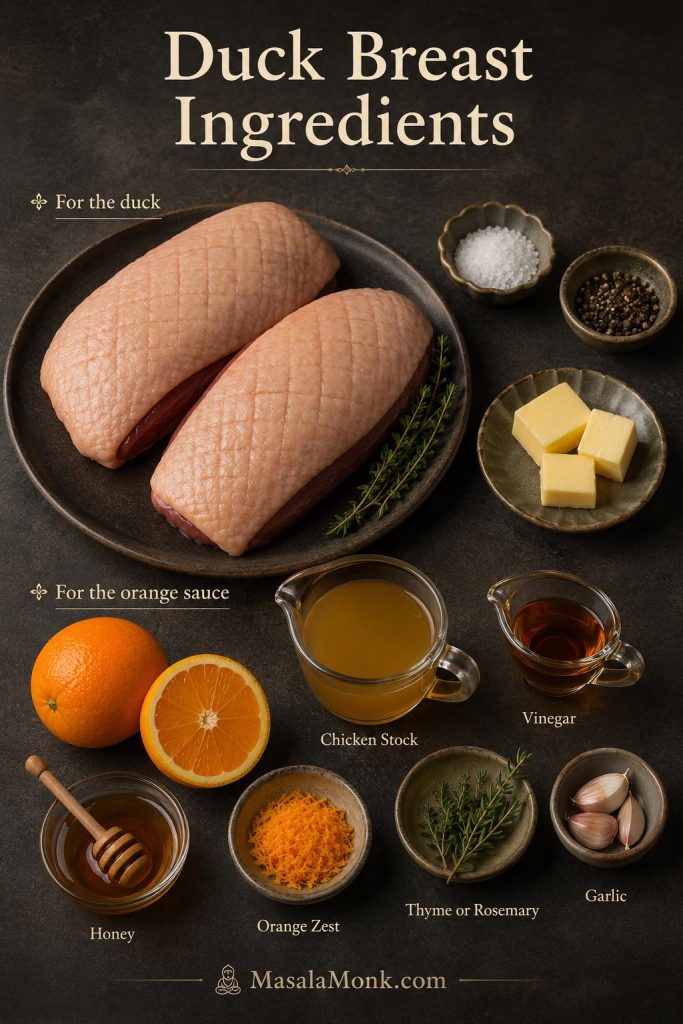
No oil needed: Duck breast brings its own cooking fat. Starting in a dry pan lets that fat melt naturally, so the skin can crisp without adding oil.
What Kind of Duck Breast to Buy
For this recipe, the best choice is skin-on boneless duck breast. The skin and fat are not a problem to avoid; they are the reason the recipe works. The goal is to slowly melt that fat so the skin becomes crisp and the meat stays juicy.
| Type | Best use | What to know |
|---|---|---|
| Skin-on duck breast | Best for this recipe | The fat renders slowly and the skin crisps in the pan. |
| Skinless duck breast | Leaner preparations | It will not give crispy skin and cooks more like a lean steak. |
| Duck fillet | Same general use | Often another name for boneless duck breast. |
| Magret or moulard duck breast | Larger, richer portions | Usually fattier and thicker, so it often needs a longer render and oven finish. |
| Frozen duck breast | Fine if thawed properly | Thaw fully in the fridge and pat very dry before cooking. |
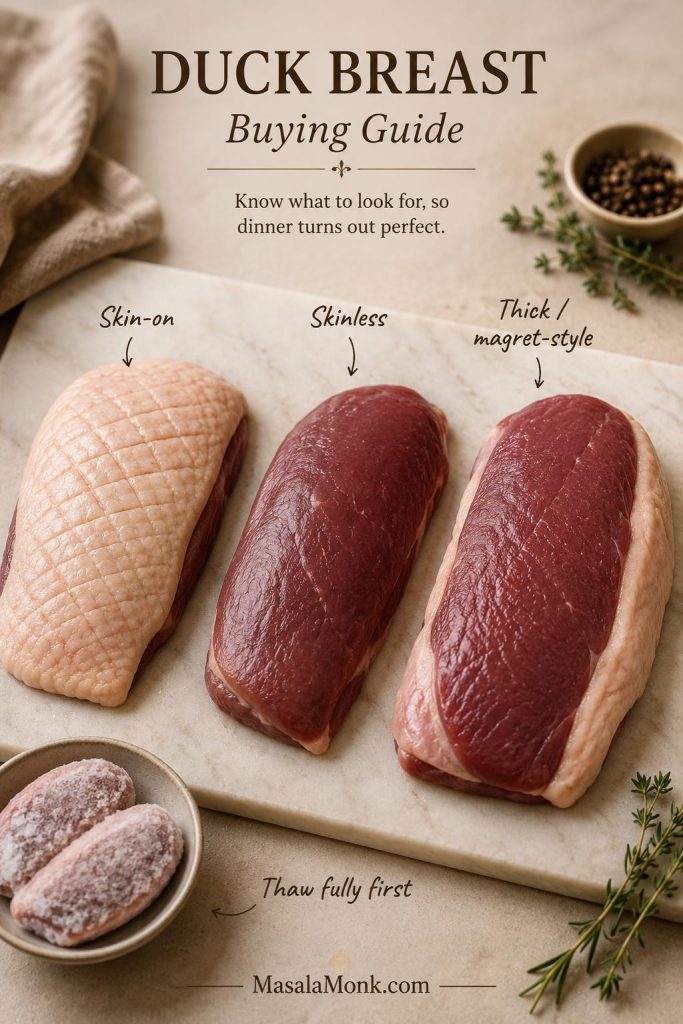
Smaller duck breasts, around 4–5 oz / 112–140 g each, may finish entirely on the stovetop. Larger breasts, around 7–8 oz / 200–225 g or more, often benefit from a short oven finish after the skin has rendered.
If the package has very different-sized breasts, cook to temperature rather than trying to make both pieces follow the same timing. The smaller one may need to come out of the pan first.
Equipment You Need
You do not need many tools, but a few of them make the recipe much easier to control. The most helpful one is an instant-read thermometer, especially if you are nervous about doneness.
- Sharp knife: for scoring the skin cleanly.
- Paper towels: for drying the skin very well.
- Heavy skillet: cast iron, stainless steel, carbon steel, or heavy nonstick all work.
- Instant-read thermometer: the easiest way to avoid overcooking.
- Small pan, spatula, or cooking weight: useful if the duck breast curls as it renders.
- Heatproof bowl: for pouring off rendered duck fat.
- Small saucepan: optional, if making sauce separately.
Best pan choice: Use an oven-safe skillet if possible. That way, if the skin is crisp but the center is still under your target temperature, you can move the whole pan into the oven without transferring the duck.
How to Score Duck Breast
Scoring means making shallow cuts through the skin and fat so the fat can render more evenly. The goal is to cut through the skin and fat, not into the meat. If you see red flesh through the cuts, you have gone too deep.
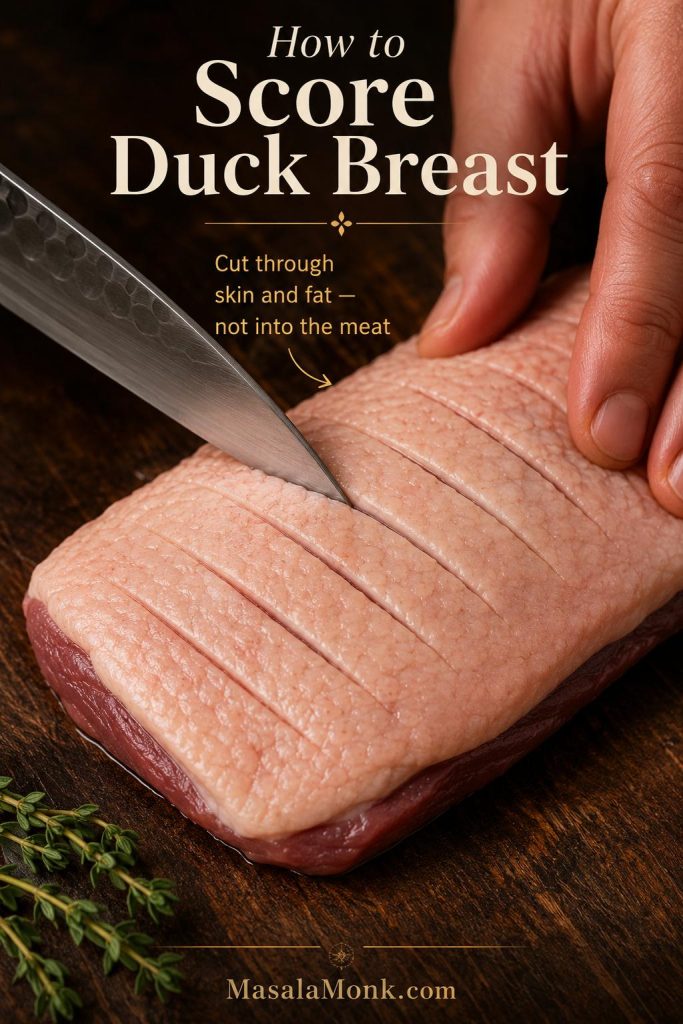
Parallel Score vs Crosshatch Score
A parallel score is easier for beginners: make diagonal lines across the skin about ¼ inch apart. A crosshatch score adds a second set of diagonal lines in the opposite direction. Both work, as long as the cuts are shallow enough to protect the meat.
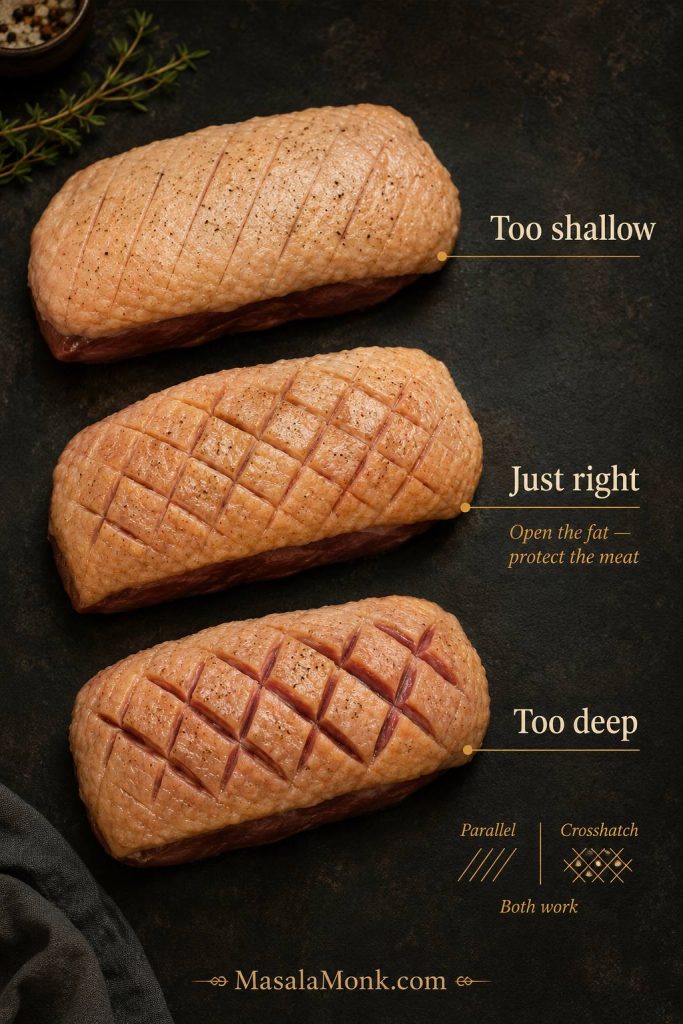
How Deep Should the Cuts Be?
Deep enough to open the fat layer, but not so deep that the meat is exposed. This matters because cutting into the meat lets juices escape and can make the duck cook unevenly.
| Scoring result | What happens |
|---|---|
| Too shallow | The fat does not render as evenly, so the skin can stay thick and chewy. |
| Just right | The fat melts slowly, the skin crisps, and the meat stays juicy. |
| Too deep | Juices leak out, the meat can cook too fast, and the skin may steam instead of crisp. |
How to Cook Duck Breast with Crispy Skin
Once you know what to look for, the method becomes much less stressful. Dry the skin, score the fat, start in a cold pan, let the fat render slowly, then flip, finish, rest, and slice. Each step has a visible cue, so you are not just guessing by the clock.
If you only remember one thing: do not rush the skin side. Crisp duck breast comes from slow rendering, not aggressive searing.
1. Pat the Duck Dry
Dry skin browns better. Pat the duck breasts very well with paper towels, especially on the skin side. For an even better result, season the duck and leave it uncovered in the fridge for a few hours or overnight, then bring it out for about 20–30 minutes before cooking.
2. Start in a Cold Pan
Place the duck breasts skin-side down in a cold, dry skillet. Do not add oil. Turn the heat to low or medium-low.
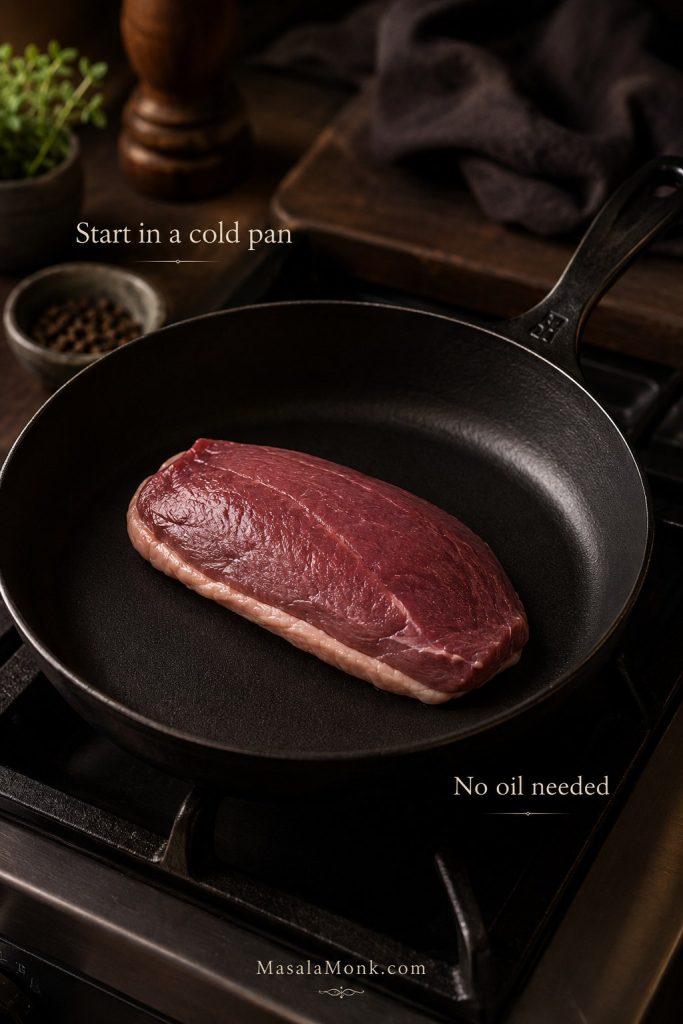
It will feel strange if you are used to searing steak in a ripping-hot pan, but duck breast is different. The pan starts quiet, then the fat gradually pools and the skin begins to crisp. If the heat is too high too early, the outside browns before the fat underneath has time to melt.
Cold Pan vs Hot Pan for Duck Breast
A hot pan can make duck breast look browned before it is actually well rendered. That is the trap. The skin may turn golden, but the fat underneath can stay thick and chewy. A cold pan gives the fat time to melt slowly before the skin gets too dark.
| Method | What happens | Result |
|---|---|---|
| Cold pan | The fat melts slowly before the skin browns too much. | Crispier skin, thinner fat layer, juicier meat. |
| Hot pan | The skin browns quickly while fat stays trapped underneath. | Golden-looking skin with chewy fat and a higher risk of overcooked meat. |
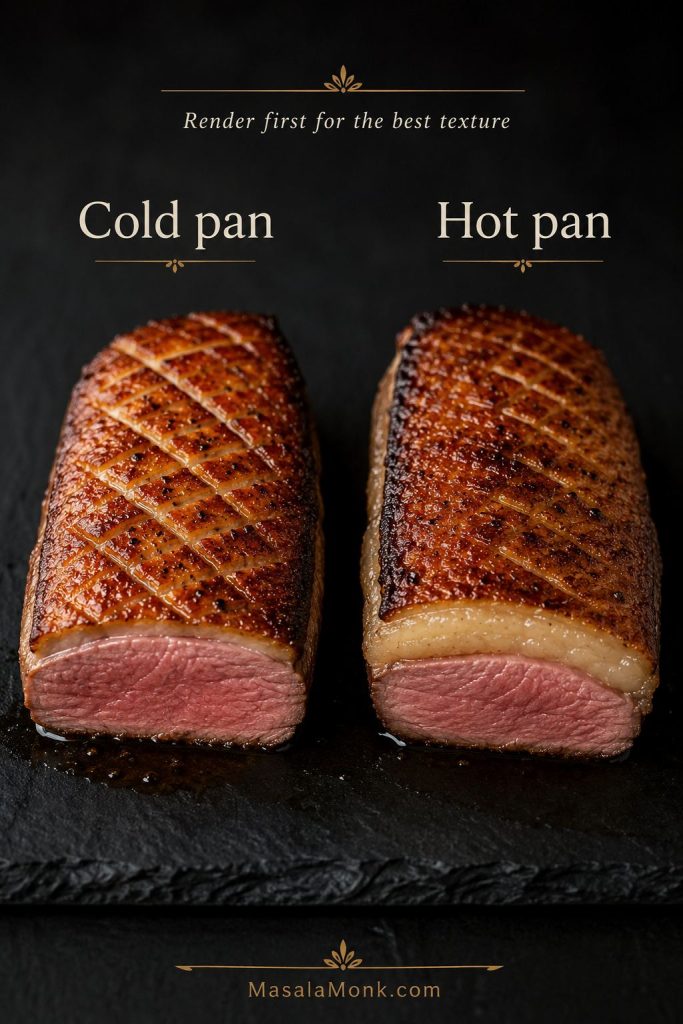
For crisp skin, render first: before relying on the oven, grill, or air fryer, let the fat layer thin in a pan. Otherwise, the meat can cook before the skin has a chance to become properly crisp.
If the duck breast curls and the edges lift away from the pan, press gently with a spatula for the first few minutes or place a lighter pan on top. This keeps the skin flat against the pan so it crisps evenly instead of leaving pale, rubbery patches.
3. Render the Fat Slowly
Cook the duck skin-side down for about 10–18 minutes, depending on the size of the breast, the pan, and the heat level. Use the clock as a guide, but trust the visual cues more.
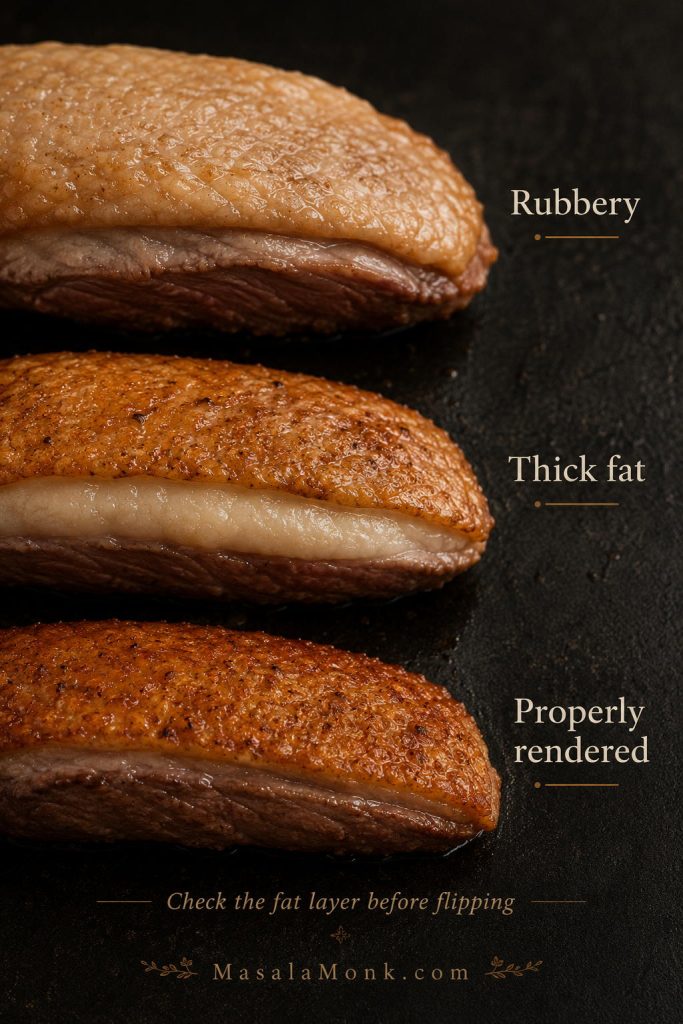
Duck Breast Rendering Cues
Before you flip, ask three things: is the skin golden, has the white fat layer thinned, and does the skin release from the pan? If yes, you are probably ready.
If you are standing over the pan wondering whether to turn up the heat, wait a little longer first. Duck fat starts slowly, then suddenly the pan becomes more active. That slow change is normal.
| Stage | What you should see | What it means |
|---|---|---|
| First few minutes | Little fat, quiet pan, skin beginning to warm | Normal. The fat has not fully started rendering yet. |
| Mid-render | Gentle bubbling and a shallow pool of clear fat | The heat is working. Pour off excess fat if it pools deeply. |
| Almost ready to flip | Golden skin, thinner white fat layer, skin releases from pan | The skin is crisp and most of the fat has rendered. |
| Too hot | Smoke, dark patches, loud spitting | Lower the heat and pour off excess fat. |
| Too cool | No bubbling after several minutes | Increase the heat slightly, but do not jump to high heat. |
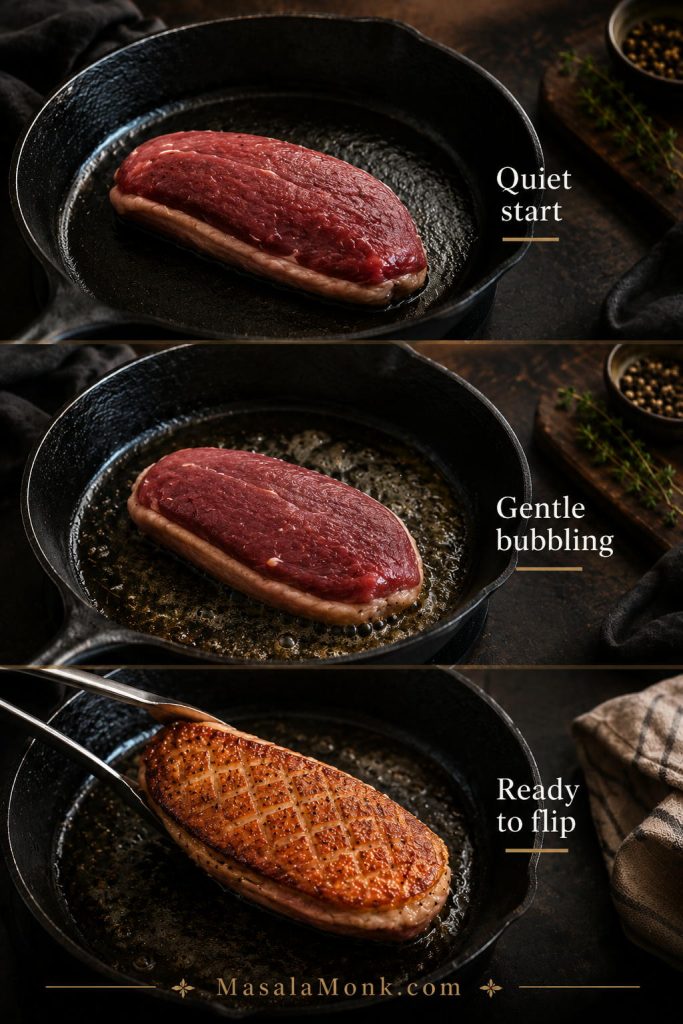
Save the duck fat: Pour rendered duck fat into a heatproof bowl, let it cool, then refrigerate it in a clean covered jar. Use it for roasted potatoes, fried rice, sautéed greens, eggs, or roasted vegetables.
Tiny heat adjustments matter here: if the fat is bubbling gently, stay patient. If it smokes or spits hard, lower the heat before the skin darkens.
4. When to Flip Duck Breast
Flip the duck when the skin is golden, crisp, and releases from the pan. The thick white fat layer should look much thinner than when you started.
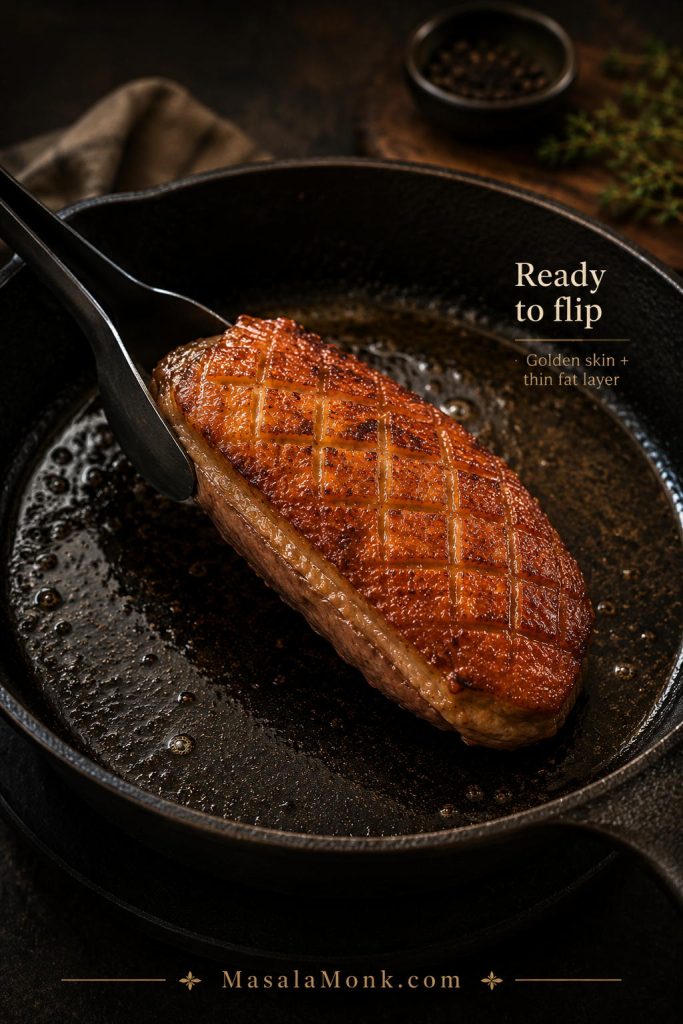
Cook the flesh side for 1–2 minutes if you are aiming for medium-rare to medium. Smaller breasts may finish here. Thicker breasts usually need the oven finish below.
If the skin is browning but the fat still looks thick, check the skin and fat troubleshooting table before flipping.
Stovetop Only vs Oven Finish
| Use this finish | Best for | What to do |
|---|---|---|
| Stovetop only | Smaller duck breasts, about 4–5 oz / 112–140 g | Render the skin fully, flip, and cook the flesh side briefly until the center reaches your target. |
| Oven finish | Larger or thicker breasts, about 6–8 oz / 170–225 g or more | Render until the skin is crisp, flip briefly, then move the oven-safe pan to 350°F / 180°C. |
5. Oven-Finish Option
When the skin is crisp but the center is still under your preferred temperature, transfer the oven-safe skillet to a 350°F / 180°C oven.
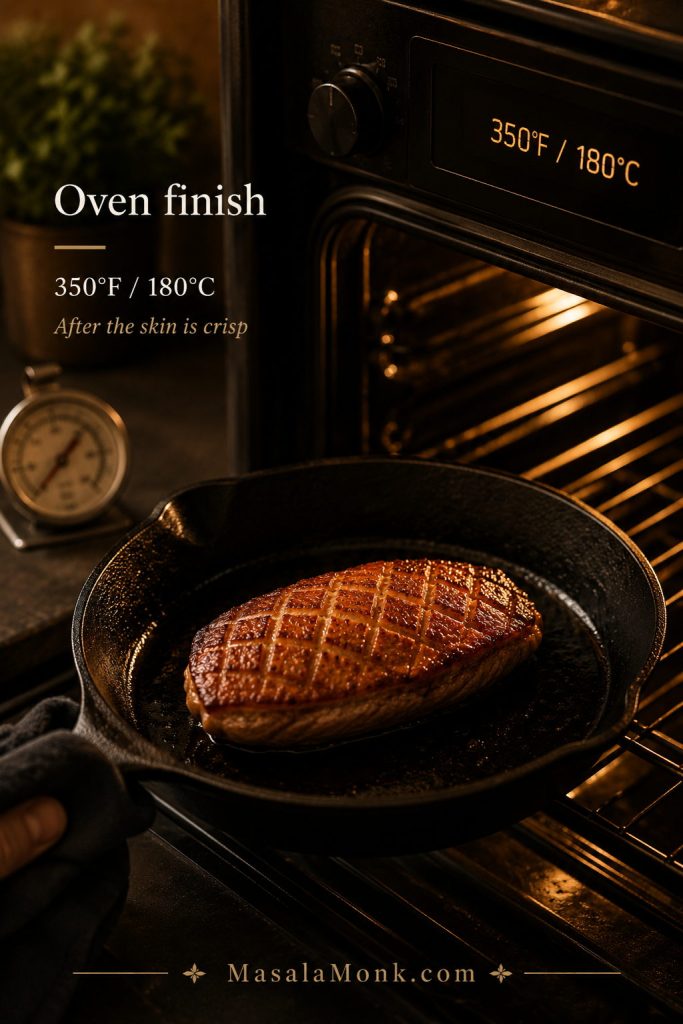
Once you choose the oven finish, use the times below as a starting point and confirm with a thermometer.
| Doneness preference | Approximate oven finish after rendering |
|---|---|
| Medium-rare | 5–6 minutes |
| Medium | 7–8 minutes |
| More cooked | 10–12 minutes, checking with a thermometer |
These times are only guides. Duck breast size varies a lot, so a thermometer is much more reliable than the clock.
6. Rest and Slice
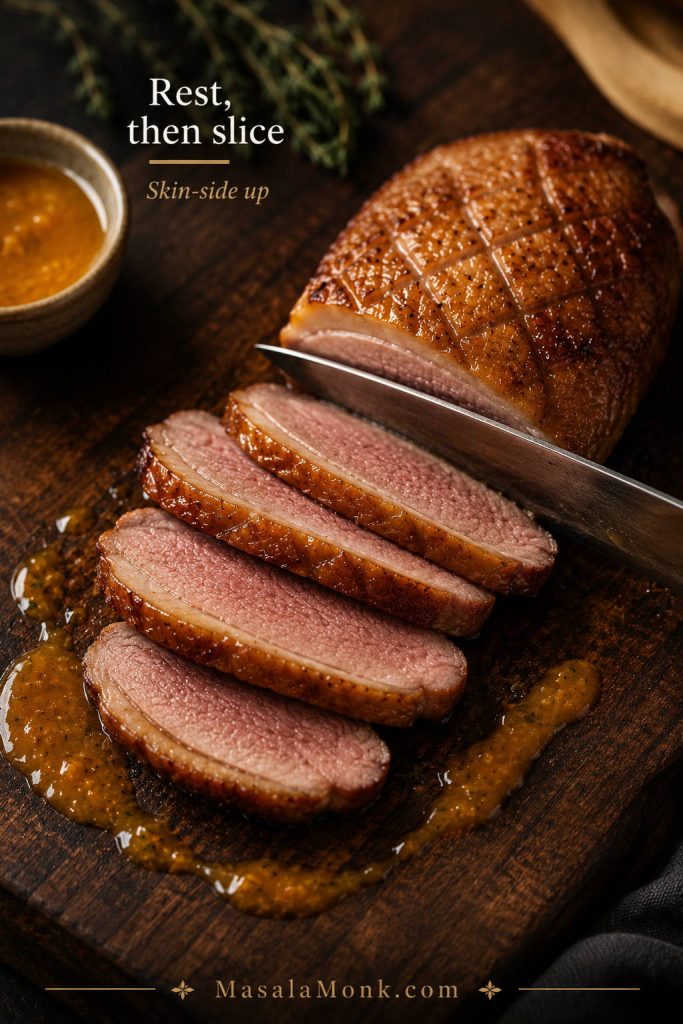
Transfer the duck to a cutting board and rest it skin-side up for 5–10 minutes. Resting lets the juices settle. Keeping the skin side up helps preserve the crisp surface.
This is the moment to be patient. Cut too early and the juices run; wait a few minutes and the slices look cleaner, calmer, and more luxurious.
Do not cover the duck tightly while it rests. Trapped steam can soften the skin you worked so carefully to crisp.
Slice against the grain into neat pieces. If you are serving with sauce, spoon the sauce around the duck rather than flooding the skin.
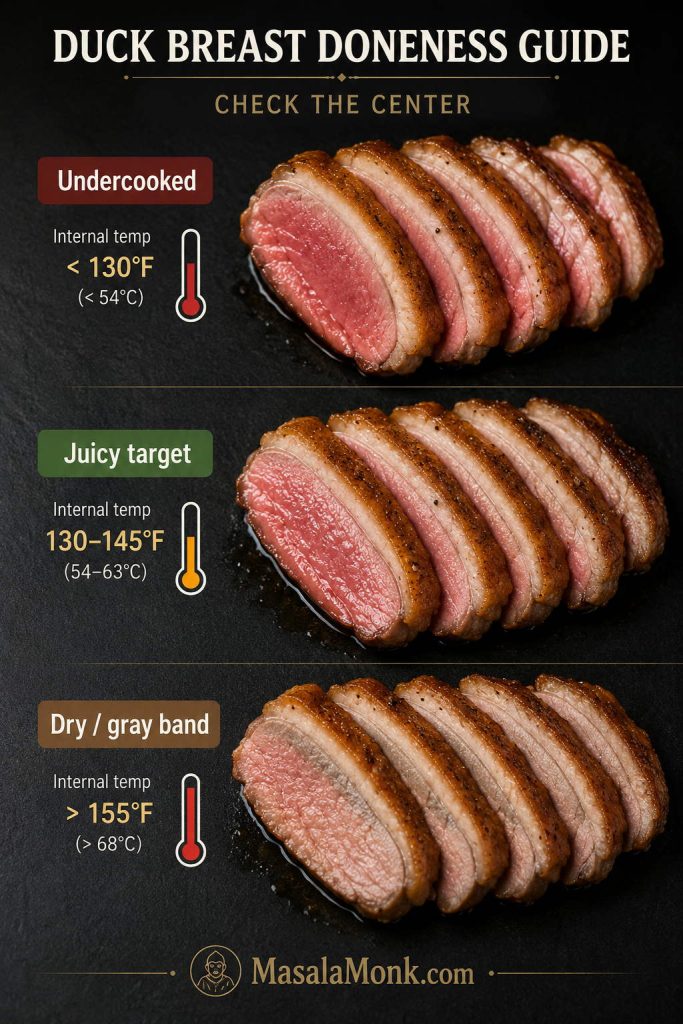
Duck Breast Temperature Guide
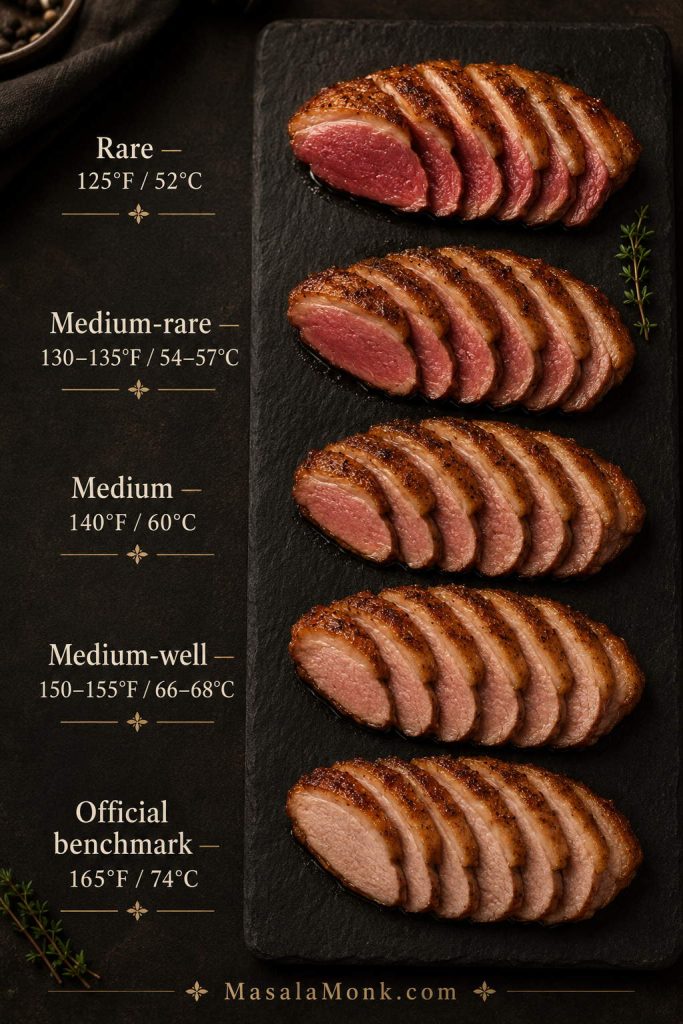
Duck breast temperature can feel confusing because duck is poultry, but many cooks treat the breast more like steak for texture. The table below separates texture preferences from the official safety benchmark so you can make a clear choice.
| Doneness | Internal temperature | Result |
|---|---|---|
| Rare | 125°F / 52°C | Deep pink and very soft; less common for cautious home cooks. |
| Medium-rare | 130–135°F / 54–57°C | Pink, juicy, and tender. |
| Medium | 140°F / 60°C | Lightly pink and firmer. |
| Medium-well | 150–155°F / 66–68°C | Much firmer, less pink, less juicy. |
| Official poultry safety benchmark | 165°F / 74°C | Meets the official poultry safety guideline; the meat will be much firmer. |
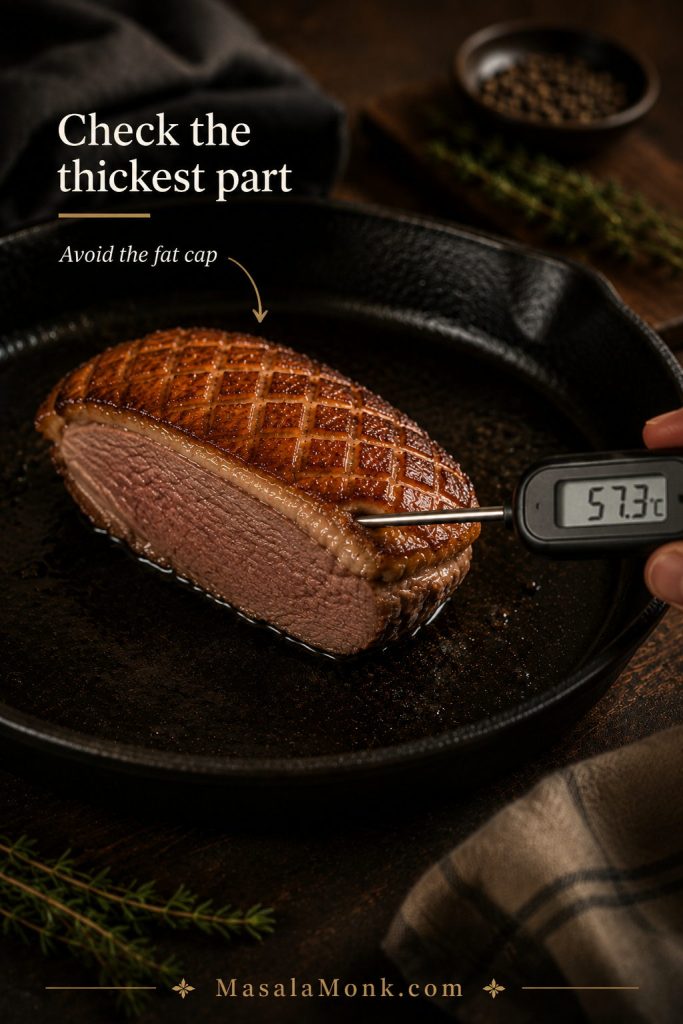
For the neatest result, pull the duck a few degrees before your final target. The internal temperature can rise slightly as it rests, especially if the breast is thick or has been oven-finished.
Food safety note: Duck is poultry, and the official USDA/FSIS safe minimum for poultry is 165°F / 74°C, measured with a food thermometer. Many duck breast recipes use lower temperatures for a pinker, more tender result, so consider who you are serving and choose the doneness that feels appropriate. You can read the USDA/FSIS safe temperature chart.
Quick Orange Sauce for Duck Breast
Once the duck is resting, you have the perfect window to make sauce. Keep it simple: a few minutes in the pan is enough.
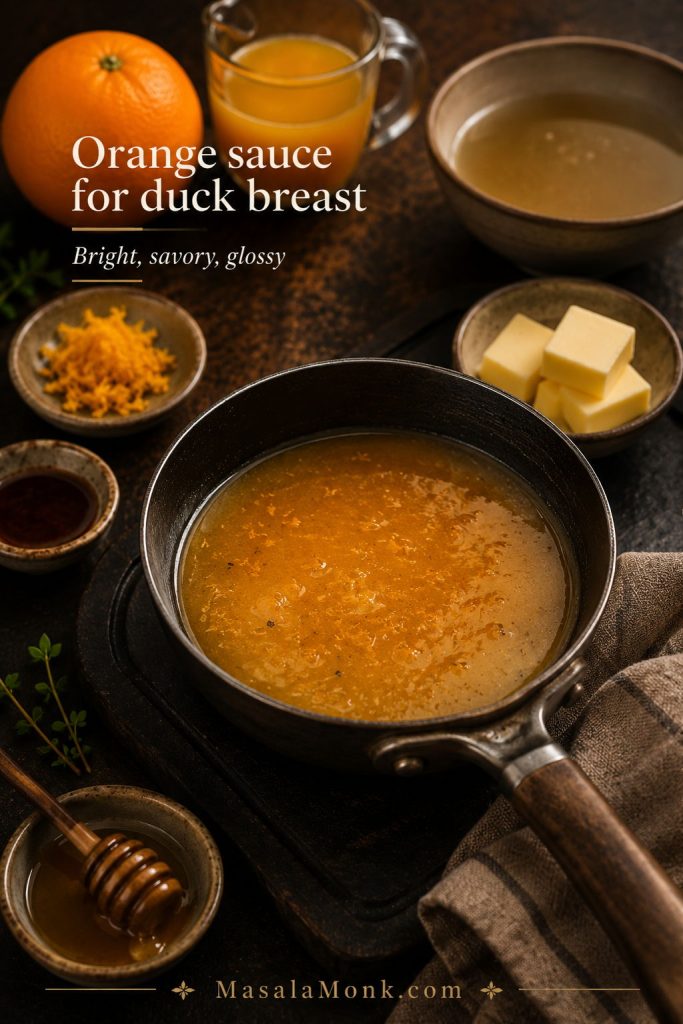
Orange sauce works because duck needs brightness. The meat is rich, the skin is salty and crisp, and the sauce should bring citrus, acidity, and a little gloss without turning sticky or candy-sweet.
This should not taste like marmalade poured over meat. It should be bright, savory, and just sweet enough to round the edges of the vinegar. The pan drippings bring depth, the orange brings lift, and the butter gives it a glossy finish.
How to Make It
- After removing the duck to rest, pour off most of the fat from the pan.
- Add orange juice, chicken stock, vinegar, and honey.
- Scrape up the browned bits from the pan, avoiding any burnt bits.
- Simmer until the sauce is lightly syrupy.
- Turn off the heat and whisk in cold butter and orange zest.
- Taste and adjust with salt, pepper, vinegar, or honey.
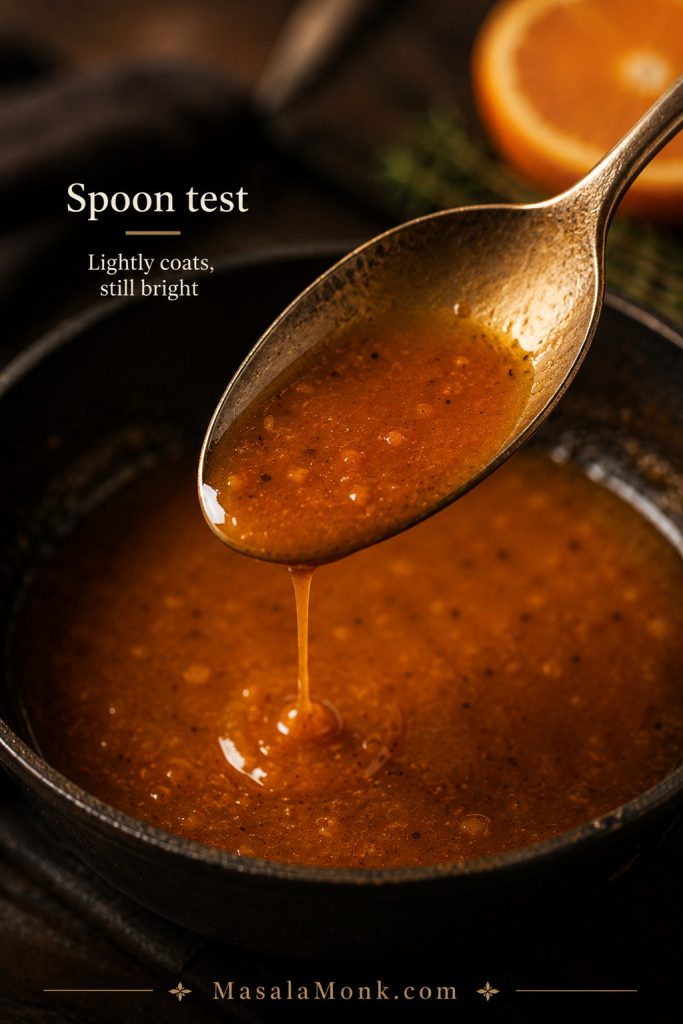
The sauce is ready when it lightly coats a spoon but still tastes bright. If it starts tasting sticky or jammy, loosen it with a splash of stock or orange juice.
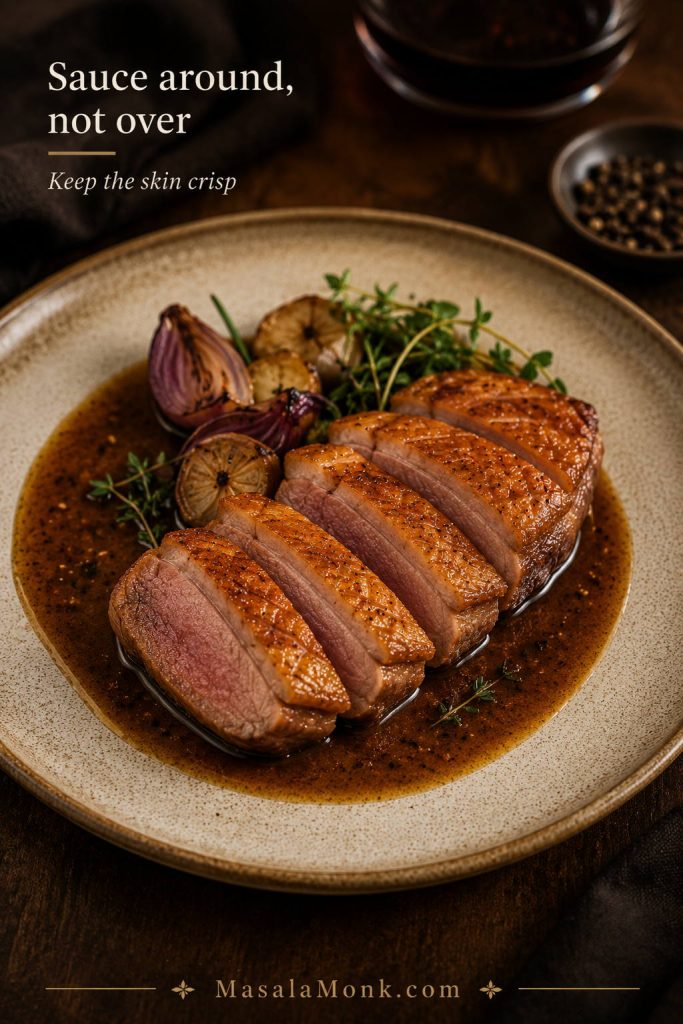
Sauce Around the Duck, Not Over the Skin
The sauce should flatter the duck, not hide it. Spoon it around the slices instead of over the crisp top, especially if you want the first bite to keep that rendered skin texture.
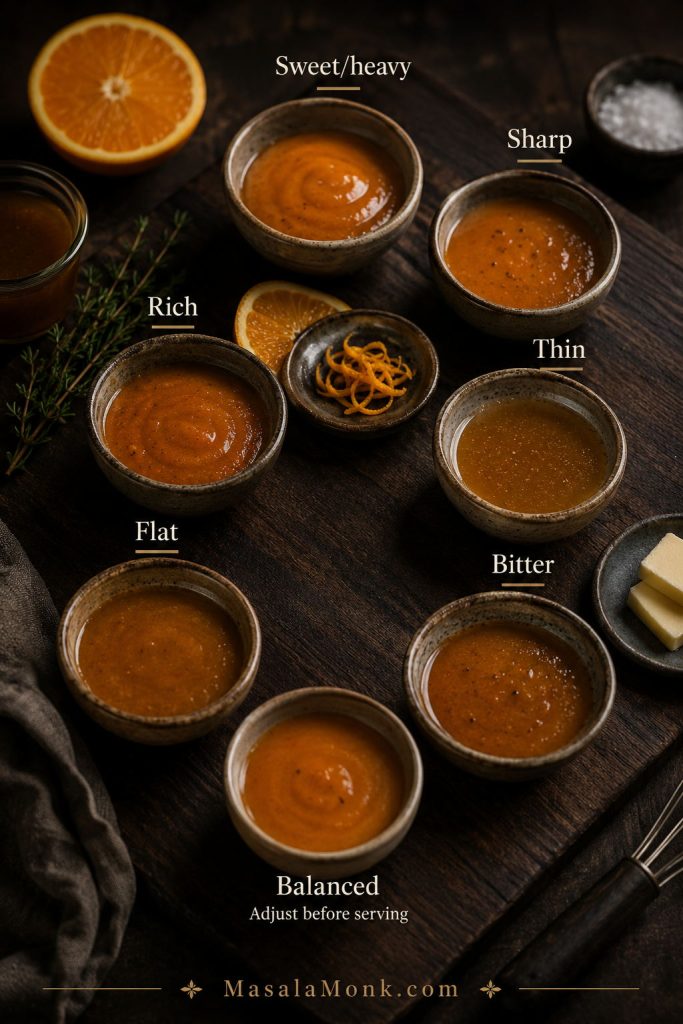
If the sauce tastes too sweet, sharp, thin, or flat, use the orange sauce fixes before serving.
How to Fix the Sauce
| Sauce issue | Fix |
|---|---|
| Sweet and heavy | Balance it with a splash of vinegar, more orange zest, or a small pinch of salt. |
| Sharp or vinegary | Round the edges with a little honey, sugar, or cold butter. |
| Thin and watery | Keep simmering until the sauce lightly coats a spoon. |
| Rich or greasy | Loosen it with a splash of orange juice, stock, or vinegar. |
| Flat tasting | Wake it up with salt, black pepper, orange zest, or a tiny splash of vinegar. |
| Bitter edge | Soften the bitterness with stock, butter, or a little honey, and avoid scraping up burnt pan bits. |
Best Sauces for Duck Breast
Because the meat is rich, the best sauces usually bring acidity, fruit, wine, herbs, spice, or a salty-sweet contrast. Orange sauce is the classic first choice, but the best sauce depends on the mood of the meal.
| Sauce | Choose it when | Flavor direction |
|---|---|---|
| Orange sauce | You want the classic bright version. | Citrusy, lightly sweet, and balanced. |
| Cherry sauce | You want a holiday, date-night, or dinner-party plate. | Tart-sweet, rich, and elegant. |
| Plum sauce | You want a sweet-sharp Asian-style direction. | Fruity, glossy, and good with five-spice. |
| Red wine sauce | You want less sweetness and more savory depth. | Deep, wine-rich, and restaurant-style. |
| Berry sauce | You want a quick fruit sauce without making orange sauce. | Works with blackberries, raspberries, or mixed berries. |
| Chimichurri | You want freshness instead of fruit. | Herby, garlicky, acidic, and bright. |
| Soy-hoisin glaze | You want duck with rice, noodles, pancakes, or cucumber. | Salty-sweet, glossy, and Asian-style. |
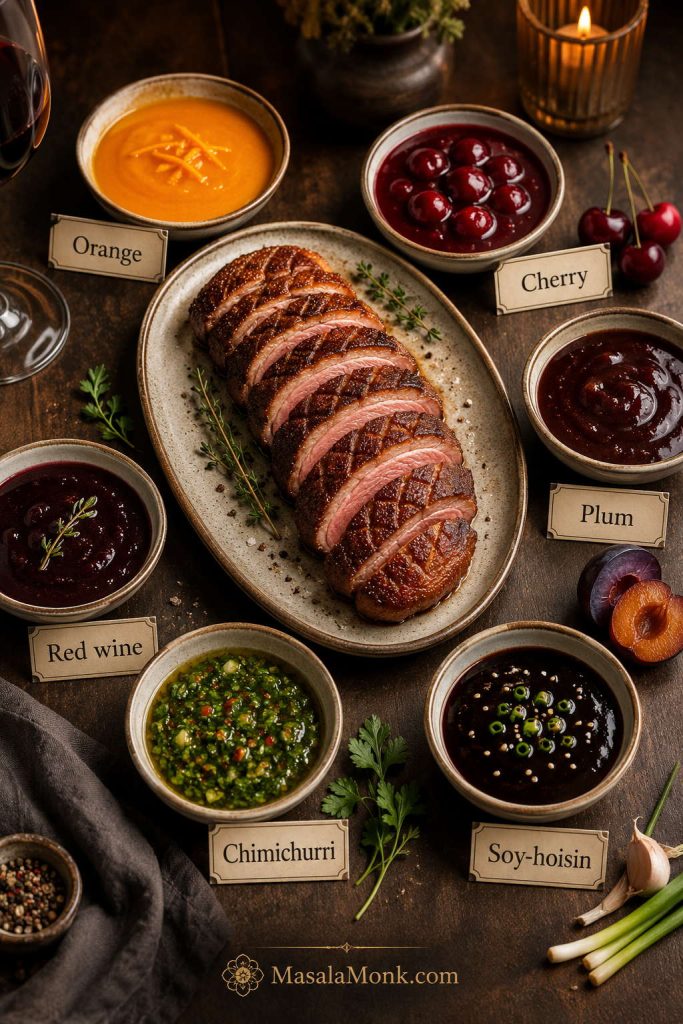
If fruit sauces are not your thing, a green herb sauce can make the plate feel fresher and less heavy. MasalaMonk’s chimichurri recipe is a useful direction when you want garlic, herbs, vinegar, and brightness instead of sweetness.
For an Asian-style duck breast, keep the glaze glossy but controlled. MasalaMonk’s teriyaki sauce recipe is a useful base to adapt with orange, ginger, garlic, sesame, chili, or extra vinegar so the duck stays balanced rather than overly sweet.
What to Serve with Duck Breast
Think in contrasts. Duck breast likes something crisp, something fresh, and something that can catch sauce. Potatoes make the plate cozy, bitter greens keep it from feeling heavy, and rice or noodles turn it into an easy bowl-style dinner.
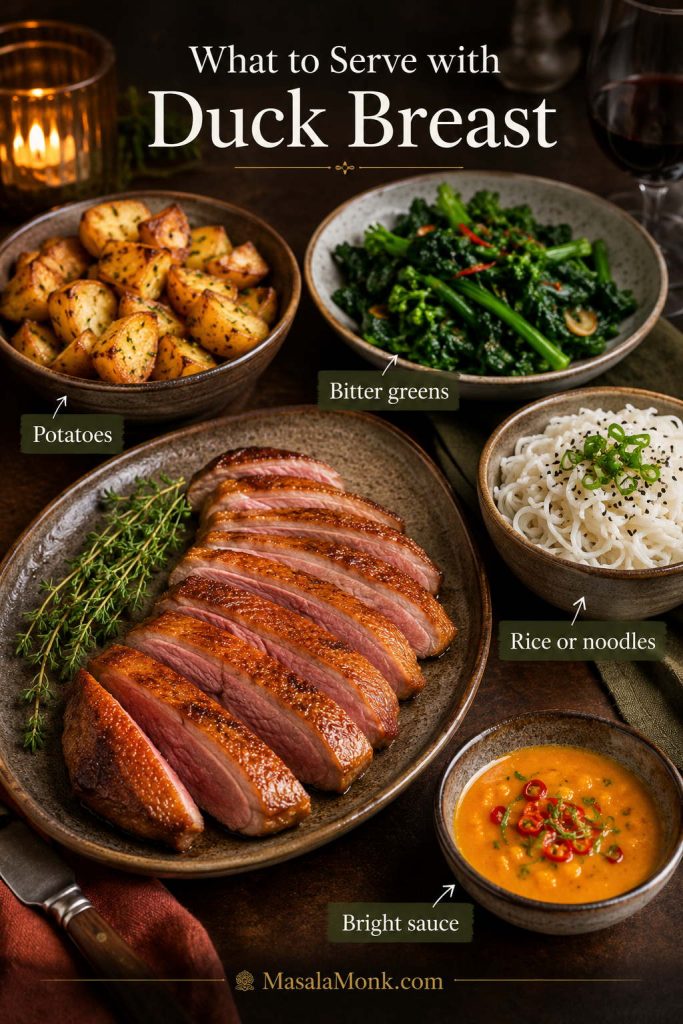
For complete meal ideas, jump to the easy duck breast plate formulas.
Classic Dinner Sides
- Duck fat potatoes, when you want the richest bistro-style plate.
- Mashed potatoes, when you want something soft to catch sauce.
- Potato gratin, when the meal should feel more like a special dinner.
- Roasted carrots, when you want sweetness without adding another sauce.
- Green beans, when you need a familiar holiday-style vegetable.
- Brussels sprouts, when you want bitterness and crisp edges against the rich duck.
If you want the plate to feel more like a holiday dinner than a weeknight skillet meal, MasalaMonk’s hashbrown casserole recipe gives you the creamy, golden potato side that can stand up to duck’s richness.
Fresh Sides
- Arugula salad, especially with orange, lemon, or a sharp vinaigrette.
- Orange and fennel salad, especially with orange sauce or cherry sauce.
- Cabbage slaw, when you want crunch and acidity.
- Cucumber salad, especially with soy-hoisin or plum sauce.
- Bitter greens with vinaigrette, when the duck breast is very rich.
For a holiday-style green vegetable side, MasalaMonk’s green bean casserole recipe ideas give you a classic direction plus lighter and richer variations, depending on how heavy the rest of the meal feels.
Rice, Noodles, and Asian-Style Sides
- Jasmine rice, especially with orange, plum, soy-hoisin, or ginger-garlic sauce.
- Fried rice, when you have leftover sliced duck.
- Garlic noodles, when you want something rich but fast.
- Stir-fried greens, when you want a lighter plate.
- Thin pancakes with plum or hoisin sauce, cucumber, and scallions.
If you are serving duck with orange sauce, plum sauce, or a soy-hoisin glaze, rice is one of the easiest bases. MasalaMonk’s how to cook rice guide is useful when you want fluffy rice that will not turn gummy under the sauce.
For a bowl-style meal, think rice, sliced duck, cucumber, scallions, sauce, and something crisp. Keep the duck sliced on top rather than buried under sauce so the skin stays the star.
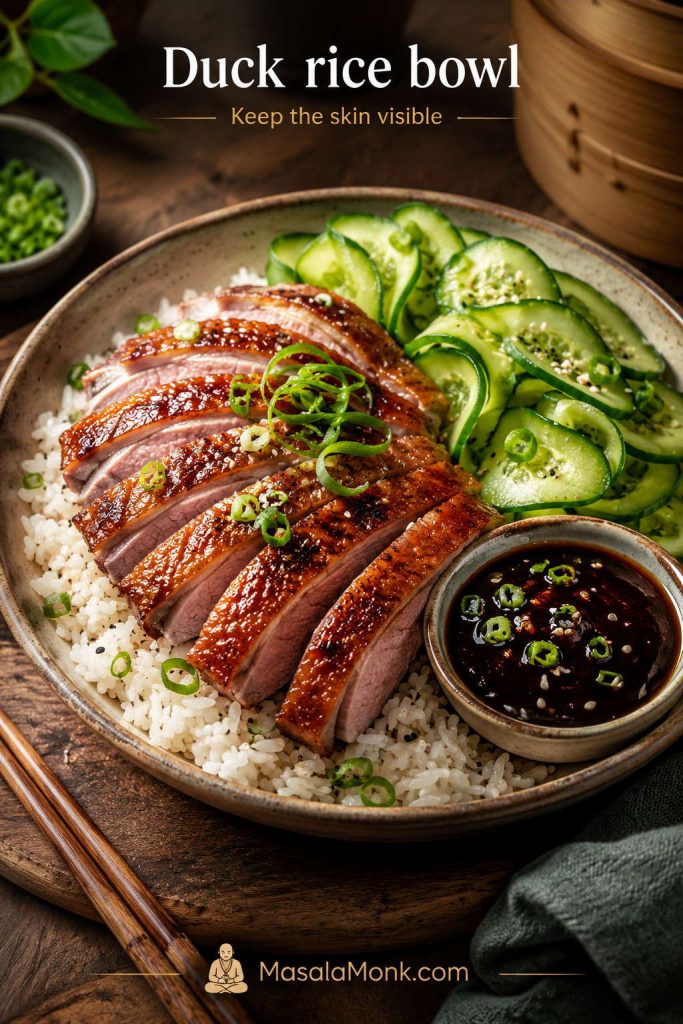
Easy Duck Breast Plate Formulas
| Plate style | What to serve |
|---|---|
| Classic bistro plate | Duck breast, duck fat potatoes, green beans or bitter greens, and orange sauce. |
| Date-night plate | Duck breast, potato gratin, arugula salad, and cherry or red wine sauce. |
| Fresh citrus plate | Duck breast, orange-fennel salad, roasted carrots, and light orange pan sauce. |
| Asian-style plate | Duck breast, jasmine rice, cucumber, scallions, and plum or soy-hoisin glaze. |
| Leftover lunch plate | Cold sliced duck, bitter greens, potato salad, pickles, and a sharp vinaigrette. |
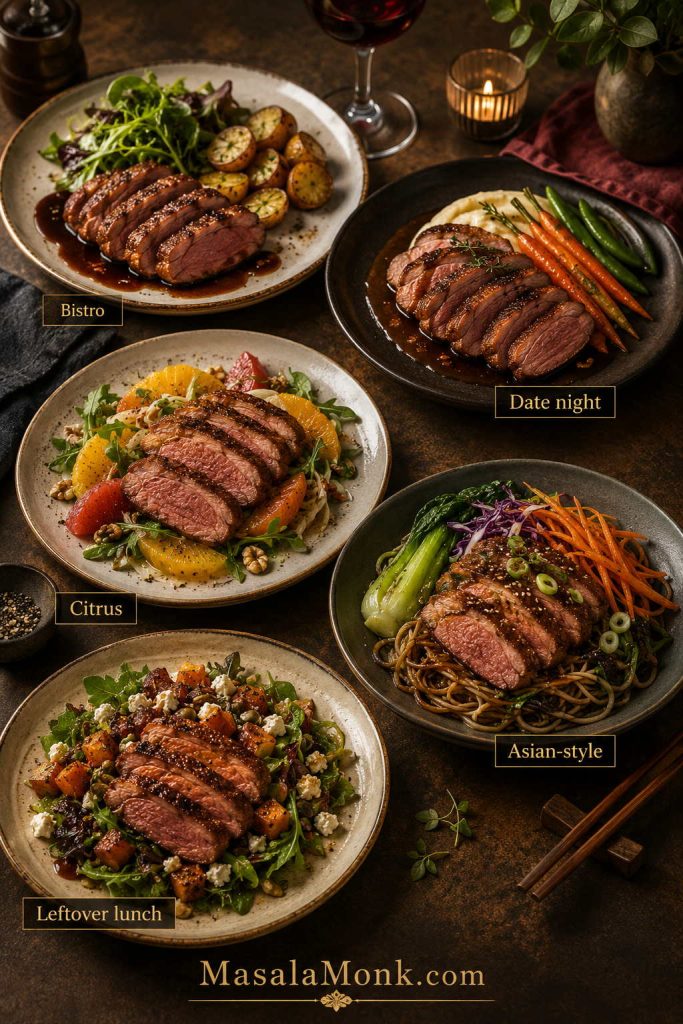
Build the plate: for a classic dinner, pair duck breast with crisp potatoes and bitter greens. For a brighter plate, use orange sauce with rice or fennel salad. For an Asian-style version, slice the duck over rice or noodles and keep the glaze light.
Other Ways to Cook Duck Breast
After you learn the cold-pan method, the other versions make more sense. Each one still has to answer the same question: how do you render the fat without overcooking the meat?
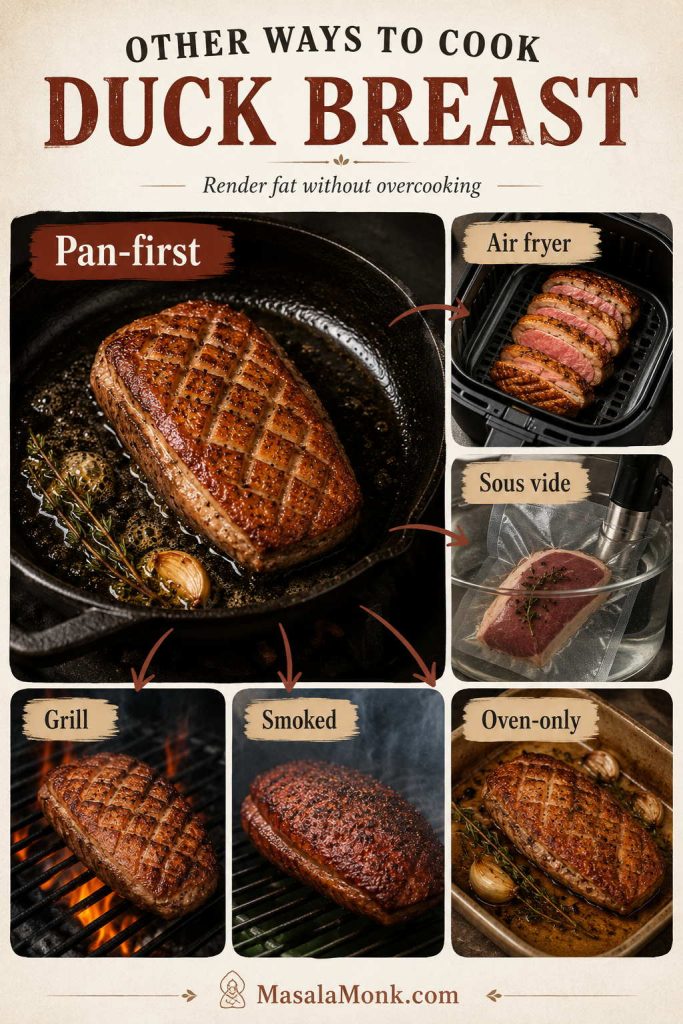
If any method leaves the skin soft or the center dry, check common duck breast problems before changing the recipe.
Air Fryer Duck Breast
Air fryer duck breast is best for convenience, not necessarily for the crispiest skin. The fat still needs time to render, so thick duck breasts usually do better if you pre-render the skin in a pan before using the air fryer to finish. Use a thermometer because air fryer timing varies by model and breast size.
Sous Vide Duck Breast
Sous vide is best for precise doneness. The weakness is skin texture: the skin comes out soft, so the final pan render is not optional if you want crisp skin. Cook the duck sous vide to your preferred temperature, pat it very dry, then render and crisp the skin in a pan.
Grilled Duck Breast
Grilled duck breast is best for smoky flavor, but duck fat can flare over direct heat. Render some fat first or grill over controlled heat, then finish to temperature. Avoid blasting the skin over high heat before the fat layer has thinned.
Smoked Duck Breast
Smoked duck breast has a deeper flavor and works well when you want a richer, more savory result. The challenge is balancing smoke, rendered fat, and final skin texture. For the best finish, smoke gently and crisp the skin separately if needed.
Oven-Only Duck Breast
Oven-only duck breast is best avoided if crispy skin is the goal. Oven heat cooks the meat, but it does not manage the fat layer as precisely as a pan. If you want crisp skin, render the fat in a pan first, then use the oven only to finish the center.
How to Fix Common Duck Breast Problems
Start by diagnosing the problem in order: skin first, fat layer second, center temperature third, sauce last. Rubbery skin usually points to moisture or rushed heat. A thick white fat layer usually means the pan got too hot too soon. Dry meat usually means the duck stayed on the heat after the center was already close to your target temperature.
If something looks off, do not panic. Most duck breast problems are fixable technique problems: wet skin, uneven pan contact, heat that climbed too fast, or sauce that reduced too far.
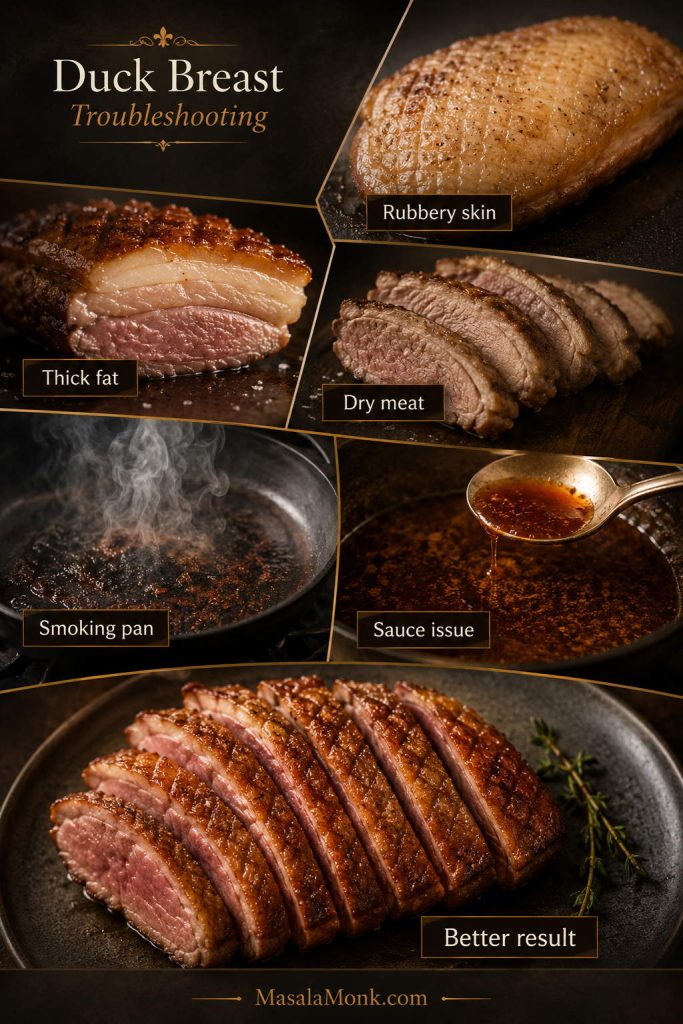
Skin and Fat Problems
| Problem | Why it happened | Fix |
|---|---|---|
| Rubbery skin | The skin was wet, the heat climbed too fast, or the fat layer needed more time. | Dry the skin well, start in a cold pan, and keep cooking skin-side down over lower heat. |
| Brown skin with thick fat underneath | The pan was too hot before the fat had time to melt. | Lower the heat and continue rendering skin-side down until the white layer looks thinner. |
| Pale patches on the skin | The breast curled or did not touch the pan evenly. | Press gently early in cooking or use a light pan or cooking weight to keep the skin flat. |
| Crisp skin that softens on the plate | The duck was covered tightly, sauced over the skin, or rested skin-side down. | Rest skin-side up, keep it uncovered, and spoon sauce around the slices instead of over the crisp top. |
Meat and Doneness Problems
| Problem | Why it happened | Fix |
|---|---|---|
| Crisp skin but undercooked center | The breast is thick, or the meat side did not get enough gentle finishing time. | Move the oven-safe pan to a 350°F / 180°C oven and finish to your preferred internal temperature. |
| Dry or overcooked meat | The duck stayed on the heat after the center was already near target. | Use a thermometer and pull the duck a few degrees early, especially before resting. |
| Gray band around the meat | The heat was too aggressive or the oven finish went too long. | Use gentler heat, avoid rushing the render, and check earlier with a thermometer. |
| Juices running across the board | The duck was sliced before it had time to rest. | Rest 5–10 minutes skin-side up, then slice against the grain. |
Pan and Cooking Problems
| Problem | Why it happened | Fix |
|---|---|---|
| Smoking pan | The heat is too high or too much rendered fat has pooled in the skillet. | Lower the heat and carefully pour excess fat into a heatproof bowl. |
| Greasy-tasting duck | The fat layer did not render enough before the meat finished cooking. | Score more carefully next time and give the skin side more time over lower heat. |
| Duck breast curling in the pan | The edges lifted away from the hot surface. | Press gently with a spatula during the first few minutes or use a small pan as a light weight. |
| Skin sticking to the pan | The duck was moved too early or the skin had not released naturally. | Give it more time. Properly rendered skin usually releases more easily once it is ready. |
Orange Sauce Problems
| Problem | Why it happened | Fix |
|---|---|---|
| Thin sauce | It has not reduced long enough. | Simmer until it lightly coats a spoon. |
| Over-sweet sauce | Too much honey, sugar, or sweet orange juice made it taste heavy. | Add vinegar, orange zest, a pinch of salt, or a splash of stock. |
| Bitter sauce | Orange pith, zest, or pan bits cooked too hard. | Add stock, butter, or a little honey, and avoid scraping up burnt bits from the pan. |
| Flat sauce | It needs more salt, acid, or brightness. | Add a small splash of vinegar, more orange zest, black pepper, or a pinch of salt. |
Make-Ahead, Storage, and Reheating
Duck breast is best right after cooking, when the skin is crisp and the meat is freshly rested. However, you can prep parts of the recipe ahead and store leftovers safely.
What You Can Prep Ahead
- Score the duck breast up to 1 day ahead.
- Season it and leave it uncovered on a plate or small rack in the fridge for a few hours or overnight to help dry the skin.
- Make orange sauce, cherry sauce, plum sauce, or red wine sauce ahead and reheat gently.
- Prep sides before cooking the duck, because duck breast is best served soon after resting.
How to Store Cooked Duck Breast
- Cool cooked duck breast promptly.
- Refrigerate within 2 hours of cooking, or within 1 hour if the room is very hot.
- Store in an airtight container in the refrigerator.
- Use within 3–4 days.
- Keep sauce separate if possible so the skin does not soften.
How to Reheat Duck Breast Without Ruining the Skin
- For best texture, reheat gently in a low oven until warmed through, then re-crisp the skin in a skillet.
- Place the duck skin-side down in a dry skillet over medium-low heat to bring back some crispness.
- Avoid microwaving if you care about crisp skin; it softens the skin quickly.
- For the official USDA/FSIS leftover safety guideline, reheat leftovers to 165°F / 74°C.
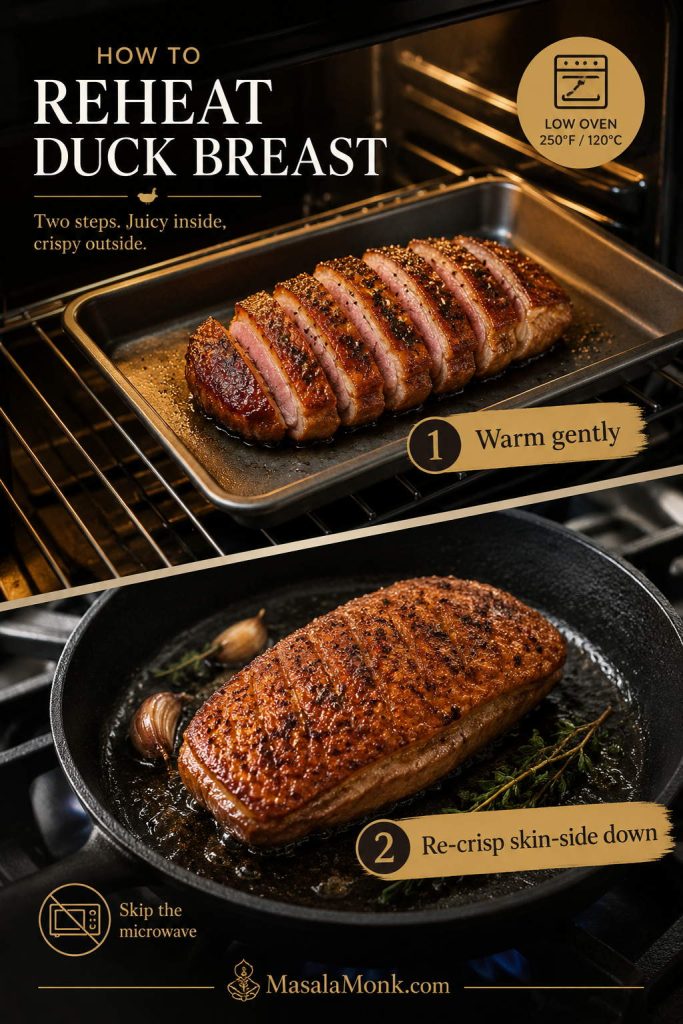
For broader leftover storage and reheating safety, the USDA/FSIS food safety basics guide is a useful reference.
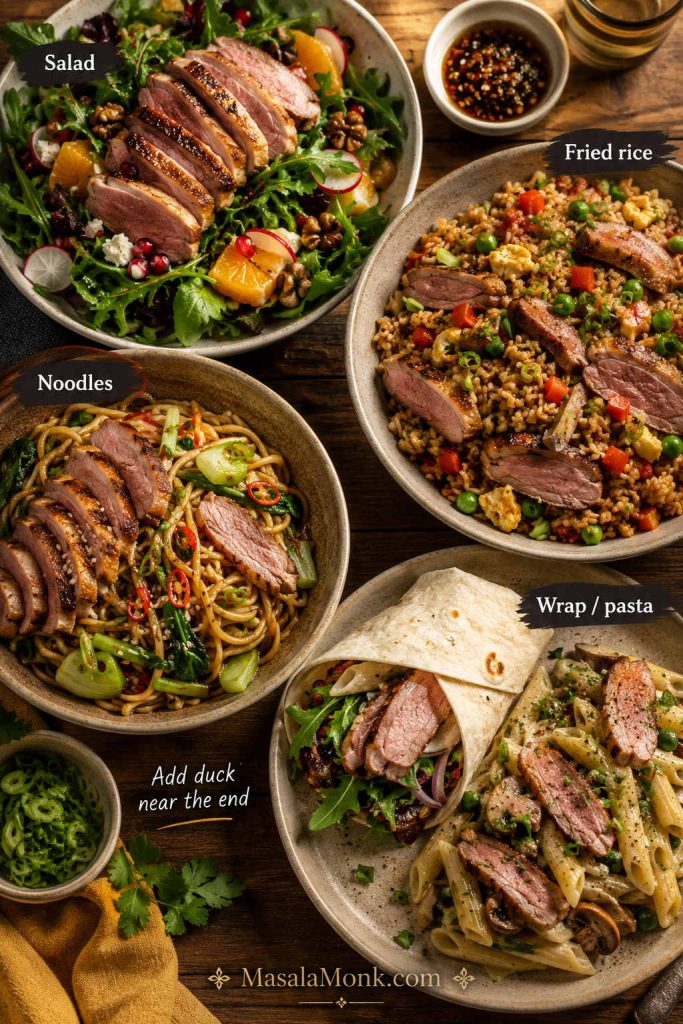
What to Do with Leftover Duck Breast
Leftovers are not a downgrade here. Thin slices of cooked duck can turn into excellent lunches as long as you add them gently and avoid cooking them a second time.
Planning to warm the duck later? Read how to reheat duck breast without ruining the skin before you start.
- Add slices to salad with orange, arugula, and vinaigrette.
- Use in fried rice with scallions and a little soy sauce. For the best rice texture, borrow the cold-rice method from MasalaMonk’s Spam fried rice recipe and fold sliced duck in near the end so it does not overcook.
- Add to noodles with greens and chili oil.
- Tuck into wraps or thin pancakes with plum sauce.
- Serve cold with mustard, pickles, or fruit chutney.
- Add to pasta at the very end, just to warm through. Duck works especially well with bright herb sauces, so MasalaMonk’s pesto recipe and variations can give you a fresh sauce direction for leftover duck pasta.
For a cold lunch plate, leftover sliced duck also works with potato salad, pickles, bitter greens, and a sharp dressing. MasalaMonk’s potato salad recipes are useful if you want a creamy, tangy, or lighter side to build around.
Duck Breast Recipe with Crispy Skin
This duck breast recipe starts in a cold pan so the fat can render slowly and the skin can crisp without overcooking the meat. Serve it with the quick orange pan sauce, or use the sauce guide above to take it in a cherry, plum, red wine, herb-bright, or Asian-style direction.
Ingredients
- 2 skin-on boneless duck breasts, about 6–8 oz / 170–225 g each
- 1 tsp kosher salt, or about ½ tsp fine salt
- ¼ tsp black pepper
- Optional: 1 thyme or rosemary sprig
- Optional: 1 garlic clove, lightly crushed
Optional Orange Sauce
- ¼ cup / 60 ml fresh orange juice
- ½ cup / 120 ml chicken stock
- 1 tbsp white wine vinegar or red wine vinegar
- 1–2 tsp honey or sugar
- 1 tsp orange zest
- 1 tbsp / 14 g cold butter
- Salt and black pepper, to taste
Duck Breast Method
- Pat the duck breasts very dry with paper towels.
- Score the skin in diagonal lines or a crosshatch pattern, cutting through the skin and fat but not into the meat.
- Season both sides with salt and pepper, using a little more salt on the skin side.
- Place the duck breasts skin-side down in a cold, dry skillet.
- Turn the heat to low or medium-low. Cook slowly for 10–18 minutes, pouring off excess fat as needed, until the skin is golden and crisp and much of the fat has rendered.
- Flip the duck and cook the flesh side for 1–2 minutes.
- If the breast is thick or still below your preferred temperature, transfer the oven-safe skillet to a 350°F / 180°C oven for 5–8 minutes.
- Rest the duck skin-side up for 5–10 minutes.
- Slice against the grain and serve with orange sauce or your preferred duck breast sauce.
Orange Sauce Method
- Pour off most of the fat from the pan after removing the duck.
- Add orange juice, stock, vinegar, and honey.
- Scrape up browned bits and simmer until lightly syrupy, avoiding any burnt bits.
- Turn off the heat and whisk in cold butter and orange zest.
- Season to taste with salt, pepper, vinegar, or honey.
Notes
- Use an instant-read thermometer for best results.
- Pull the duck a few degrees before your final target because the internal temperature can rise slightly as it rests.
- Rest the duck skin-side up and do not cover it tightly.
- Keep sauce around the slices, not over the skin, if you want the crispest bite.
- Save rendered duck fat for potatoes, vegetables, fried rice, greens, or eggs.
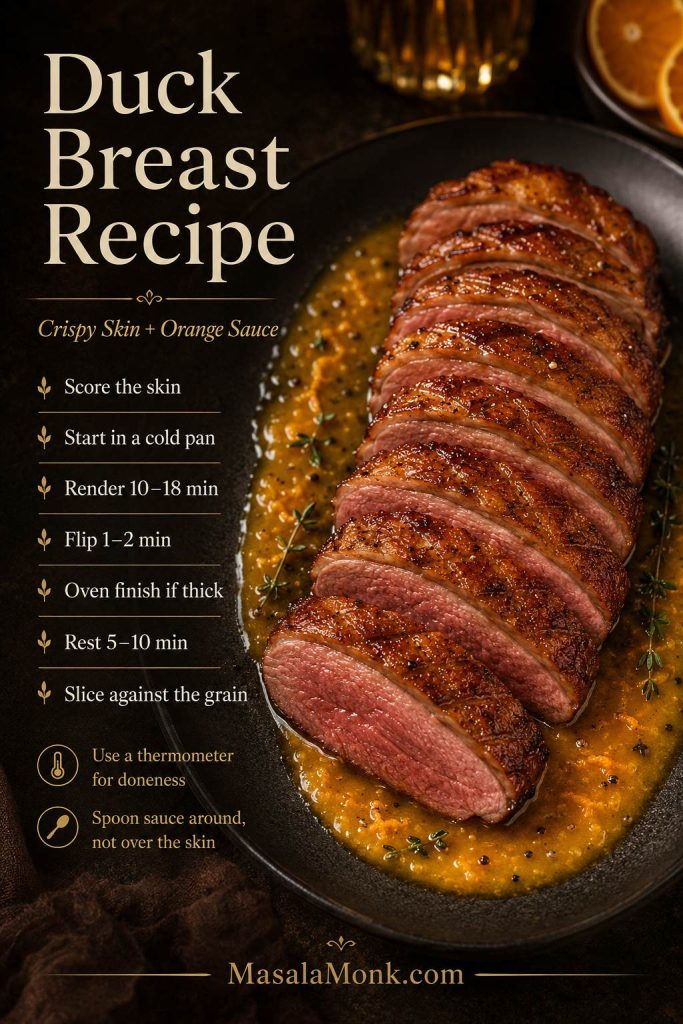
Once the cold-pan render clicks, duck breast stops feeling like a restaurant trick. You are not forcing it; you are letting the fat melt, the skin crisp, and the center come up gently. Serve it with a light sauce, slice it cleanly, and it feels like a special-occasion dinner you can actually repeat.
FAQs About Duck Breast
Do you start duck breast in a cold pan?
Start duck breast in a cold pan when you want crisp skin. The gradual heat gives the fat time to melt before the surface browns, which helps prevent a golden-looking but chewy skin layer.
How long does duck breast take to cook?
Duck breast usually takes 18–28 minutes of cooking time: 10–18 minutes skin-side down to render the fat, 1–2 minutes on the flesh side, plus 5–8 minutes in the oven if the breast is thick. Use timing as a guide, but let the thermometer make the final decision.
Do you have to finish duck breast in the oven?
No. Smaller duck breasts can finish on the stovetop after the skin has rendered. Thicker breasts are easier to control with a short oven finish at 350°F / 180°C after the skin is already crisp.
Should duck breast be pink?
Many cooks prefer duck breast pink because the texture stays tender and juicy. However, duck is poultry, and the official safe minimum is 165°F / 74°C, so use a thermometer and choose based on your comfort level and who you are serving.
What temperature is best for duck breast?
For a softer, juicier texture, many cooks prefer 130–135°F / 54–57°C for medium-rare or about 140°F / 60°C for medium. The official poultry safety benchmark is 165°F / 74°C.
What sauce goes best with duck breast?
Orange sauce is the classic pairing for duck breast because citrus cuts through the fat without hiding the flavor of the meat. Cherry, plum, red wine, berry, chimichurri, and soy-hoisin sauces also work, depending on whether you want fruity, savory, fresh, or Asian-style flavors.
Why is my duck skin rubbery?
Rubbery duck skin usually means the surface was wet, the heat was too high too early, or the fat layer needed more time. Dry the breast well, start in a cold pan, and keep cooking skin-side down until the white fat layer looks much thinner.
Do you need oil to cook duck breast?
No. Duck breast has enough fat under the skin. Starting it in a dry cold pan lets that fat melt naturally and crisp the skin.
Can you cook duck breast from frozen?
Thaw it first for this method. Frozen duck breast releases moisture as it cooks, which makes crisp skin much harder to achieve.
How do you reheat duck breast and keep the skin crispy?
Reheat gently in a low oven until warmed through, then place the duck skin-side down in a dry skillet over medium-low heat to re-crisp the skin. Microwaving is faster, but it softens the skin.
What can I make with leftover duck breast?
Use thin slices in salads, fried rice, noodles, wraps, sandwiches, or pasta. Add cooked duck near the end so it warms without overcooking.
Is duck breast the same as duck fillet?
In many shops and recipes, duck fillet means boneless duck breast. For this crispy-skin method, choose skin-on duck breast or skin-on duck fillet.
Final Thoughts
Good duck breast is not about rushing a dramatic sear. It is about giving the fat enough time to render, watching the skin, checking the temperature, and resting the meat before you slice.
Once that rhythm makes sense, duck breast becomes one of the most satisfying restaurant-style dinners to cook at home: crisp skin, tender slices, a sauce that brightens the plate, and enough confidence to make it again.
What is your favorite way to serve duck breast — orange sauce, cherry sauce, potatoes, rice, bitter greens, or something else? Share it in the comments so other readers can try it too.









[…] the full meat-cooking method, use this duck breast recipe with crispy skin and orange sauce as the companion guide. This page focuses on the sauce, while that guide walks through the duck […]