
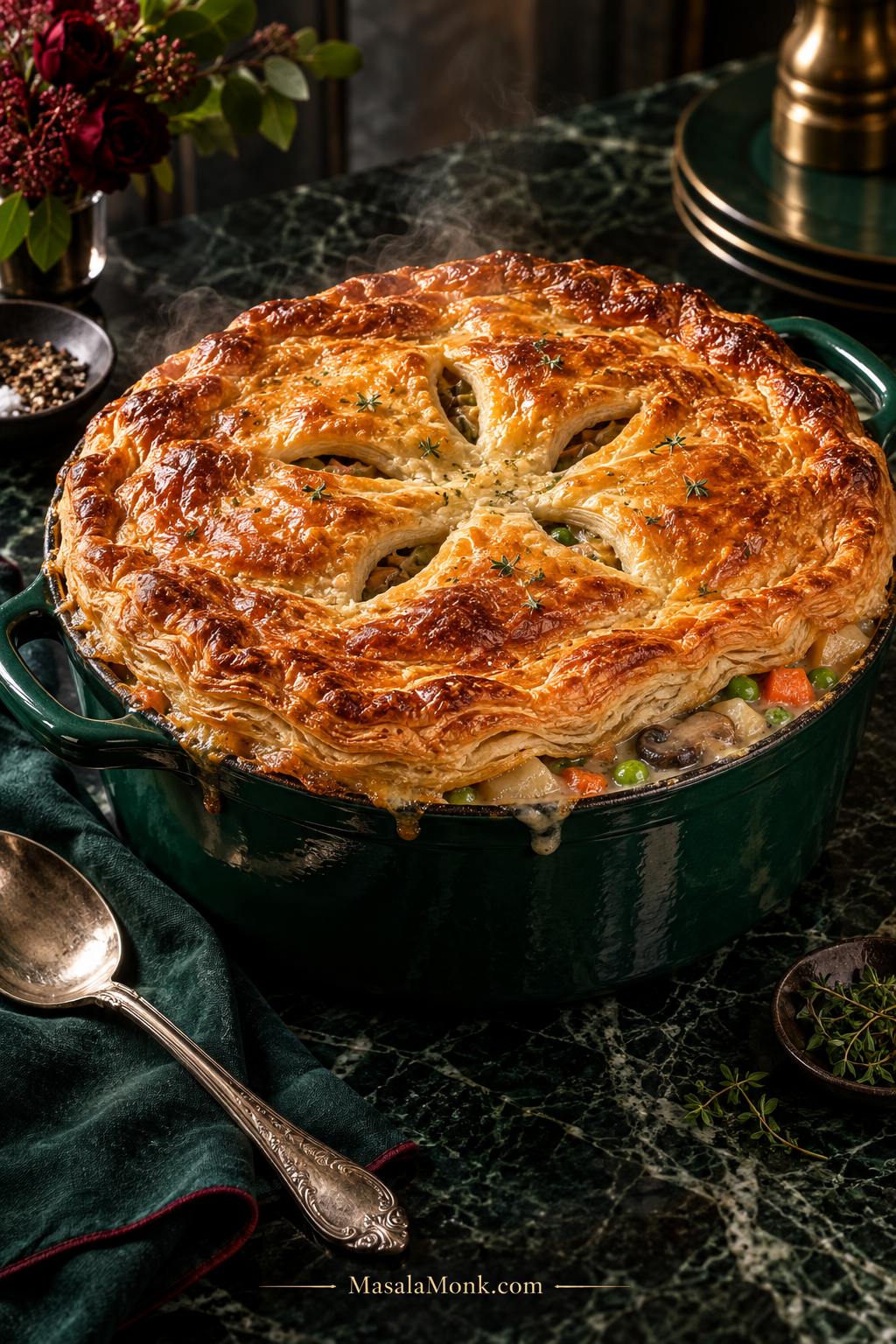
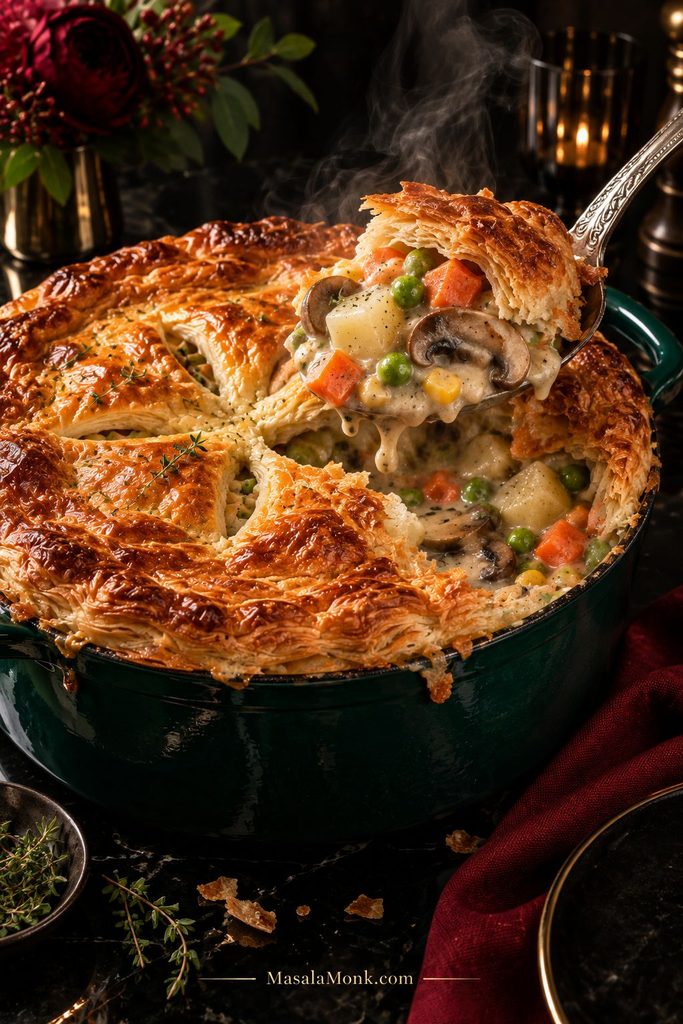
Under a deeply golden pastry lid, the filling is creamy enough to cling to tender potatoes and carrots, with sweet peas, browned mushrooms and flaky crust in every spoonful.
That contrast is what makes vegetable pot pie worth baking: crisp pastry above, rich gravy underneath, and vegetables that stay distinct in the sauce. The key is getting those parts ready at the same time. Potatoes need a head start, mushroom water needs time to cook away, and puff pastry performs best when it reaches the oven still chilled.
This vegetable pot pie recipe handles most of that work before the dish reaches the oven. The cooking is straightforward: soften the vegetables, build the gravy, cover and bake. Once the filling is ready, the pastry turns a pan of creamy vegetables into a generous dinner with a crisp golden lid.
Vegetable Pot Pie Recipe
The recipe pairs a creamy thyme-and-sage vegetable filling with a deeply golden puff-pastry lid. Potatoes, mushrooms, carrots, peas and corn make this vegetarian pot pie substantial enough for dinner, while a single pie crust can replace the puff pastry for a sturdier finish.
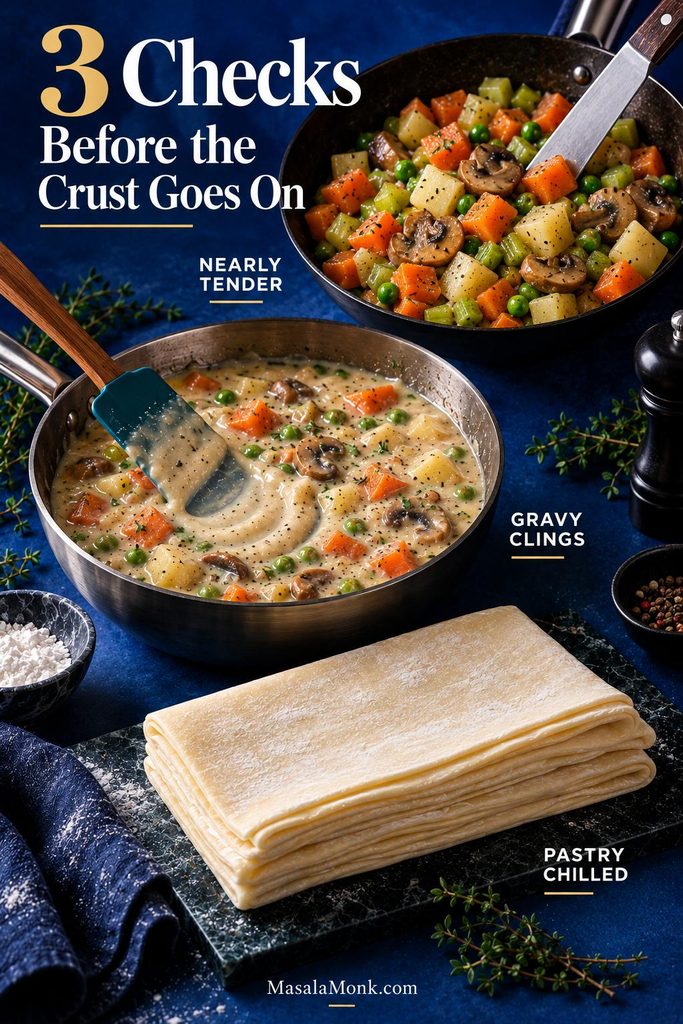
Three Checks Before the Crust Goes On
Cook firm vegetables until nearly tender, thicken the gravy until it clings, then add chilled pastry. Those three checks matter more than hitting every minute exactly.
Vegetables
Potatoes and other firm pieces are almost fork-tender. A knife meets only slight resistance.
Gravy
For the gravy, a spatula trail stays open for about 1–2 seconds before slowly closing.
Pastry
Puff pastry is cool and flexible, not sticky, greasy or floppy.
Ingredients
Vegetables and Aromatics
- 1 medium-large onion, diced — about 5 oz / 150 g
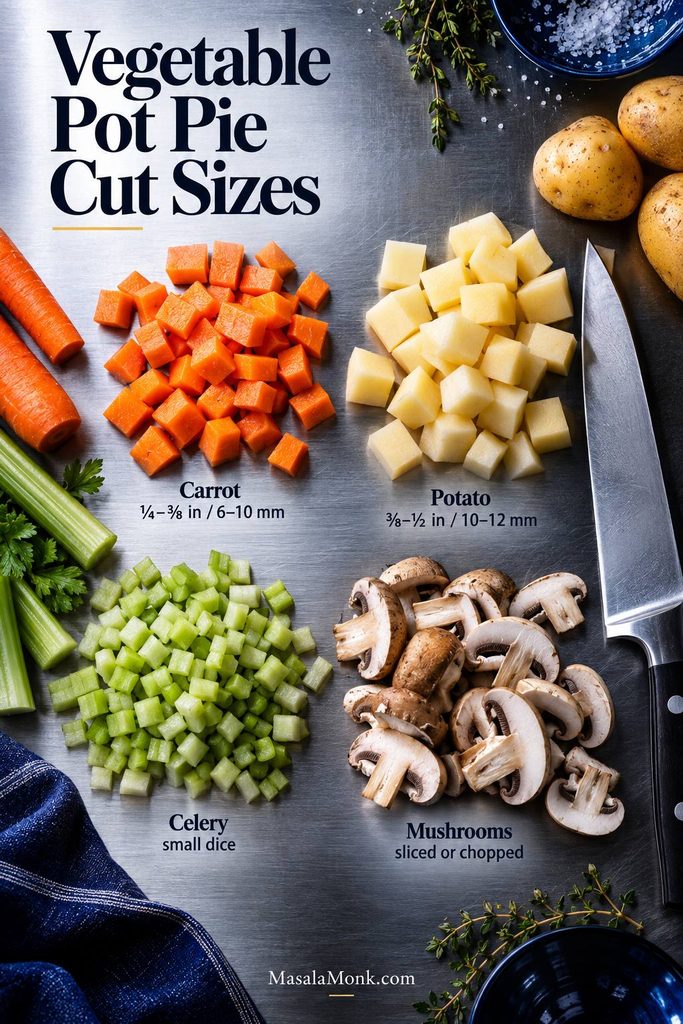
- 2 medium carrots — about 5 oz / 150 gCut into ¼- to ⅜-inch / 6- to 10-mm pieces.
- 2 celery stalks — about 3 oz / 80 gDice into small, even pieces.
- 8 oz / 225 g mushroomsCremini or white mushrooms both work; slice or chop them.
- 8 oz / 225 g Yukon Gold or other all-purpose potatoUsually 1 large or 2 small potatoes. Cut into ⅜- to ½-inch / 10- to 12-mm cubes.
- 3 garlic cloves, minced
- 1 tsp dried thyme
- ½ tsp dried sage
For the Creamy Gravy
- 4 tbsp / 2 oz / 56 g unsalted butter
- ⅓ cup / about 1½ oz / 42 g all-purpose flour
- 2 cups / 16 fl oz / 480 ml low-sodium vegetable broth, divided½ cup / 120 ml cooks the potato; the remaining 1½ cups / 360 ml builds the gravy.
- ½ cup / 4 fl oz / 120 ml whole milkHeavy cream can replace the milk for a richer sauce.
- 2 tsp / 10 ml soy sauce
- 1½ cups / about 7½ oz / 210 g total frozen peas and corn
- ¾ tsp fine salt, divided, plus more if needed
- ½ tsp black pepper
- 1 tsp / 5 ml apple cider vinegar or white wine vinegar
For the Puff-Pastry Top
- Puff pastry — enough to cover the openingUsually one large sheet, often 8½–10½ oz / 240–300 g. Sheet dimensions matter more than package weight.
- 1 large egg
- 1 tbsp / 15 ml water or milk
Produce varies in size, so use the gram weights when your carrots, potatoes or onion look unusually large or small.
Equipment
- Large deep skillet or Dutch oven
- 2½–3 qt / 2.4–2.8 L oven-safe casserole or deep baking dish
- Rimmed baking sheet
- Whisk
A dish with an opening around 10–11 in / 25–28 cm works well with most large pastry sheets. Leave ½–¾ in / 1.25–2 cm between filling and rim so bubbling gravy has somewhere to go.
An oven-safe skillet can go straight from stovetop to oven when the filling fits with that headroom and the pastry covers the opening.
Instructions
- Heat the oven and chill the pastry. Preheat to 425°F / 220°C. Thaw puff pastry only until it unfolds without cracking, then return it to the refrigerator.
- Start the vegetables. Melt the butter over medium heat. Add onion, carrots, celery and ¼ tsp salt. Cook for 6–8 minutes, until the onion is translucent and the carrots have begun to soften.
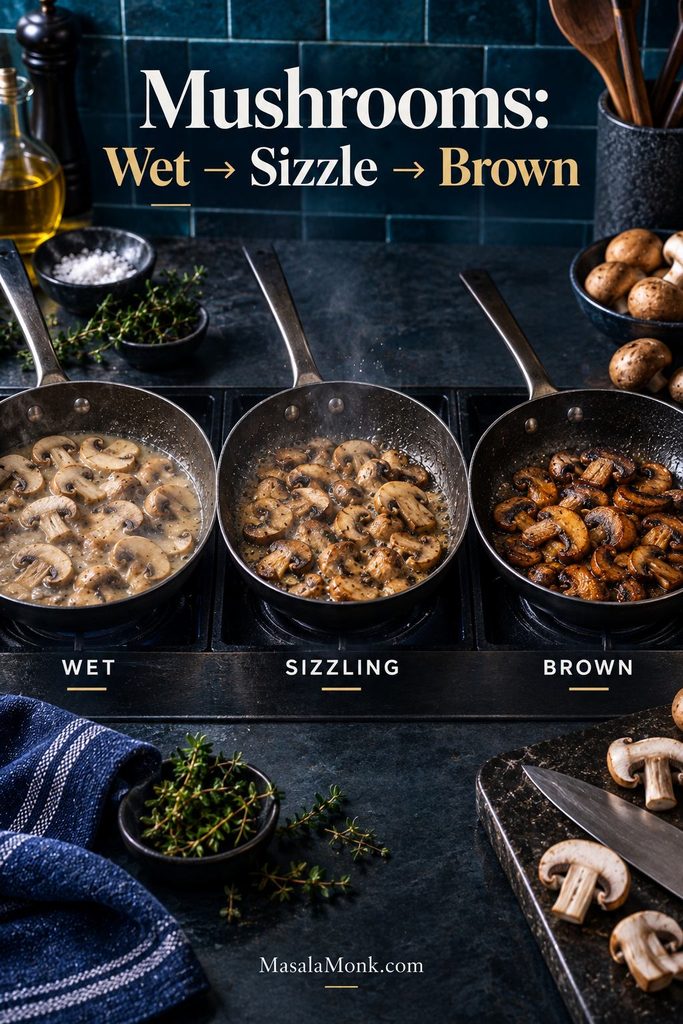
- Brown the mushrooms. Add them and cook for 6–10 minutes. At first they will look wetter; keep going until that liquid evaporates and the pan returns to a clear sizzle. Add garlic, thyme, sage and pepper, then cook for 30–60 seconds, until the herbs smell distinctly savory.
Finish the Filling
- Get the potato nearly tender. Add potato and ½ cup / 120 ml broth. Cover for 6–8 minutes, then uncover and cook until the largest cubes offer only slight resistance and the broth has nearly disappeared. The oven is good at baking pastry; it is much less helpful with a raw potato buried under gravy.
- Build the gravy. Stir in the flour and cook for 1–2 minutes. Add ½ cup / 120 ml of the remaining broth and stir smooth. Gradually add the final 1 cup / 240 ml broth, then the milk, soy sauce and remaining salt. Simmer for 3–5 minutes.
- Add the peas and corn. Stir them in frozen and return the gravy to a gentle simmer for 2–3 minutes. Drag a spatula across the pan; the trail stays open briefly when the gravy is ready. A spoonful slumps back into the skillet, and the sauce clings to the vegetables instead of pooling underneath them.
Season and Add the Pastry
- Season the filling. Taste, adjust salt or pepper, then stir in the vinegar. The filling needs enough flavor to stand on its own before pastry covers it. If it is still bubbling vigorously, let it stand for about 5 minutes while the pastry stays refrigerated.
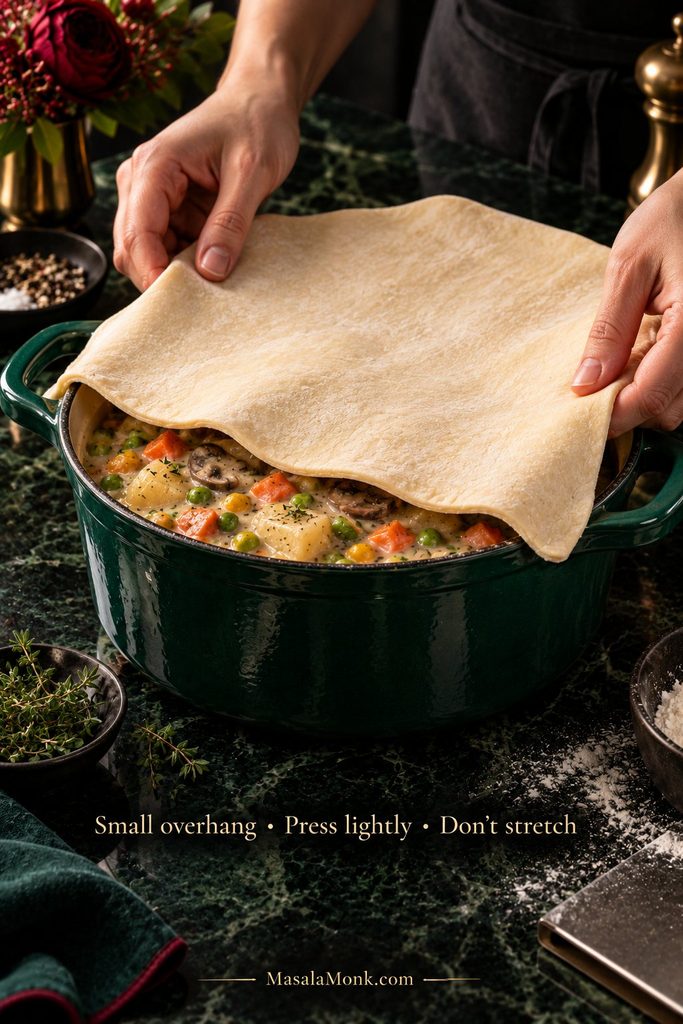
- Add the pastry. Transfer the filling if needed. Lay the pastry over the dish with a small overhang, press it lightly against the rim and trim only when necessary. Do not stretch the sheet to make it fit. Cut 3–5 vents, beat the egg with water or milk, and brush the top lightly.
Bake and Rest
- Bake for 22–30 minutes. Look at the center as well as the edge: properly baked pastry is puffed, visibly layered and deeply golden. Gravy bubbling through the vents or around the rim is a good sign that the filling underneath is thoroughly hot. Shield dark edges loosely with foil when needed.
- Rest for 10 minutes. The gravy settles slightly while the lid stays crisp enough to break cleanly under a spoon.
Pie-crust version: cover the warm or slightly cooled filling with one prepared pie-crust round, cut several vents and brush with egg wash. Bake at 400°F / 205°C for 30–35 minutes, until deeply golden and bubbling. Check packaged crust when the dish needs to stay vegetarian, since some products use animal fat.
Vegetable Pot Pie Guide
Vegetables & Gravy
Serve, Store & Fix
Best Vegetables for Pot Pie
Onion, carrots, celery, potatoes, mushrooms, peas and corn make a dependable pot-pie mix. Green beans, cauliflower, broccoli, spinach, sweet potato and squash work too. Two things matter when you swap: how long the vegetable needs to become tender and how much water it carries into the pan.
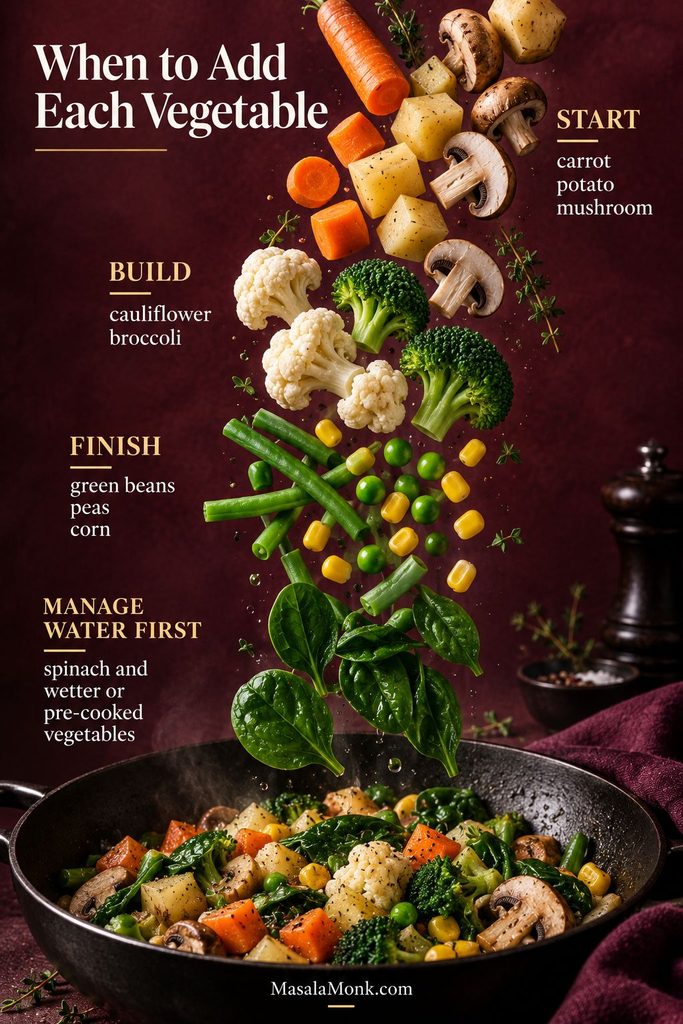
When to Add Each Vegetable
| Vegetable | Cut or Prep | When to Add It | Before Baking |
|---|---|---|---|
| Potato | ⅜–½ in / 10–12 mm dice | After mushrooms, before flour | Almost tender |
| Carrot | ¼–⅜ in / 6–10 mm pieces | With onion and celery | Mostly tender |
| Celery | Small dice | With onion and carrot | Softened |
| Mushrooms | Sliced or chopped | After aromatics soften | Water gone; some browning |
| Cauliflower | Small florets | With potato, before flour | Nearly tender |
| Broccoli | Small florets | As the gravy thickens | Bright and slightly firm |
| Green beans | Short pieces | Near the end; slightly earlier if firm | Tender, not limp |
| Peas | Fresh or frozen | At the end, with corn | Heated through |
| Corn | Fresh or frozen | Near the end | Heated through |
| Spinach | Wilted or thawed and squeezed | At the end | Excess water removed |
| Sweet potato | ½ in / 12 mm cubes | With potato; start checking early | Almost tender |
| Butternut squash | Small cubes | With potato, or roasted and added late | Tender, not collapsing |
Mushrooms and Potatoes Need the Head Start
Mushrooms usually get wetter before they get browner. Once their released water cooks away, the quiet bubbling changes to a sharper sizzle. That is when browning really begins, giving the finished gravy more depth. The same moisture-first sequence matters in our creamy mushroom sauce.
Potatoes have the opposite problem: they release little water but need time. Pieces around ⅜–½ inch / 10–12 mm soften efficiently without disappearing into the gravy. When potato shares the filling with cauliflower, smaller potato pieces help their cooking times meet in the middle; the same size logic appears in our roasted cauliflower and potatoes.
Swaps That Work Well
The table handles most substitutions, but a few deserve extra attention. Sweet potato softens faster than regular potato. Frozen spinach is unusually wet, so thawing and squeezing it first is worth the trouble. Already-roasted vegetables belong near the end. Roasting squash, cauliflower, Brussels sprouts or mushrooms also drives off water before it can loosen the gravy—the same moisture-control principle used in our vegetable lasagna.
Canned vegetables can work too, but their softer texture means they are best drained well and folded in late.
Build More Flavor Into the Filling
Browning does more for a meatless pot pie than simply adding extra herbs. Once the mushrooms have browned and the thyme and sage hit the pan, the filling starts smelling like pot pie before the gravy is even finished. Soy sauce gives it savory weight, while a small splash of vinegar keeps the finish lively. Mushrooms help, but cauliflower, green beans or extra potato can replace them.
Easy Vegetable Pot Pie With Frozen Vegetables
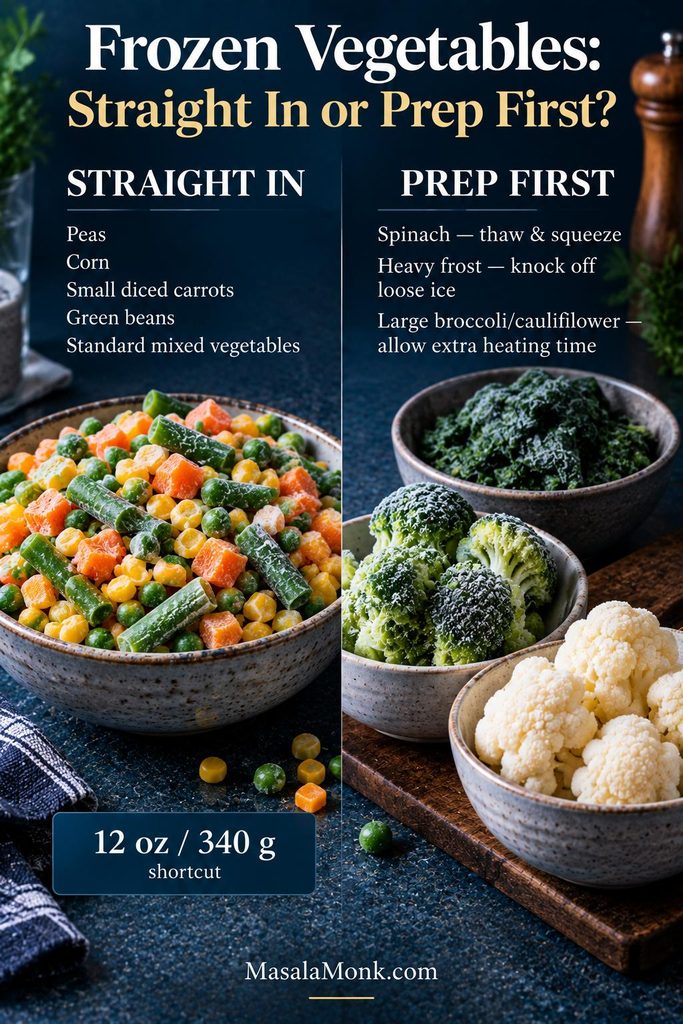
Yes. Most frozen mixed vegetables can go straight into the pot-pie filling without thawing. A few exceptions need a little prep first.
For less chopping, keep the onion, celery, mushrooms and potato, then use one 12 oz / 340 g bag of frozen peas, carrots, corn and green beans. Skip the fresh carrots and the separate peas-and-corn mixture from the main recipe.
Add the frozen mix after the gravy has thickened. The cold vegetables temporarily slow the simmer, so wait until the pan is bubbling gently again before judging thickness. Some bags barely change the sauce; heavily frosted ones can loosen it noticeably.
Straight From the Freezer
- Peas
- Corn
- Small diced carrots
- Green beans
- Standard mixed-vegetable blends
Prep Before Adding
- Spinach: thaw and squeeze dry.
- Heavily frosted bags: knock away loose ice.
- Large broccoli or cauliflower: give them more time to heat through before judging the gravy.
Jump to: Check filling thickness · Compare crusts · Back to recipe
Vegetable Pot Pie Filling: How Thick Should It Be?
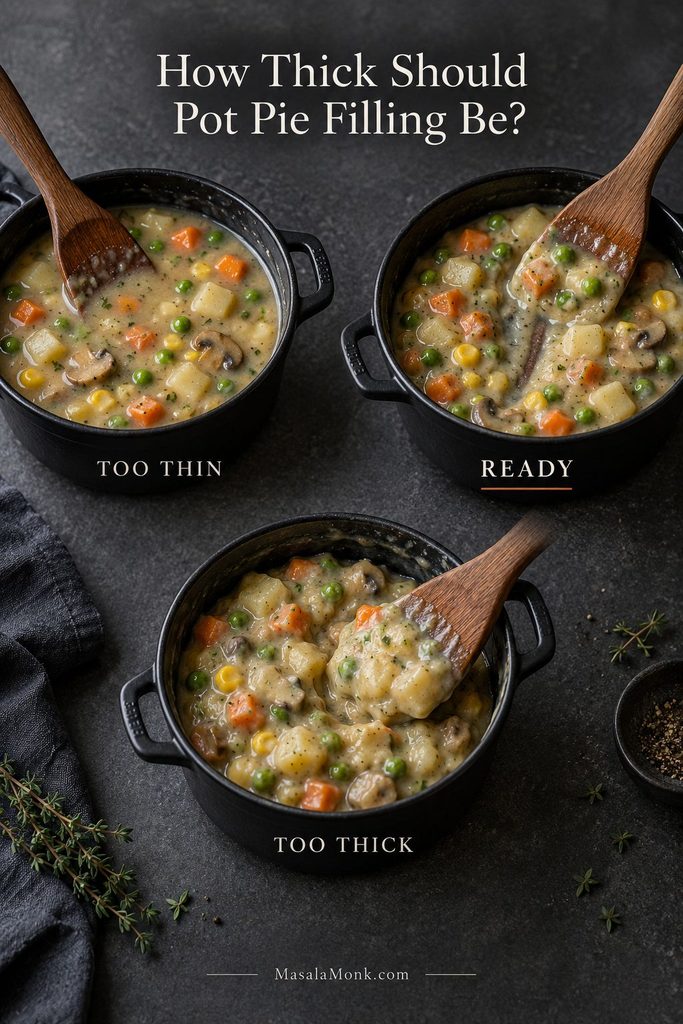
The gravy should cling to the vegetables but still move slowly when you tilt the pan. Drag a spatula across the bottom; the trail should stay open for about 1–2 seconds before slowly closing.
Vegetable moisture can change a gravy that looked perfect a few minutes earlier, so judge its final thickness only after mushrooms, spinach or frozen vegetables are fully hot.
When the Gravy Ends Up Too Thin
Reduce it uncovered before reaching for more starch. A few extra minutes over the heat often solve water introduced by vegetables. When reduction is not enough, mix 1 tsp / about 3 g cornstarch with 2 tsp / 10 ml cold water, stir in part of the slurry and simmer before deciding whether the rest is necessary.
When It Gets Too Thick
Add warm broth or milk 1–2 tbsp / 15–30 ml at a time. Stop once the gravy coats the vegetables easily again.
Puff Pastry, Pie Crust or Biscuits?
Puff pastry is the easiest default when you want a light, flaky lid without making dough. Choose pie crust for a sturdier top, or biscuits for a softer casserole-style finish. The filling itself can stay the same.
| Topping | Best For | Main Adjustment |
|---|---|---|
| Puff pastry | Light, flaky layers | Keep chilled until assembly |
| Pie crust | A sturdier classic lid | Bake around 400°F / 205°C |
| Double crust | Pastry underneath and on top | Cool filling and manage bottom moisture |
| Biscuits | A soft, hearty topping | Cold dough over hot filling |

Puff Pastry
For the puff pastry, the sheet is ready when it unfolds without cracking but still feels cool. Sticky, greasy or floppy pastry needs a few minutes back in the refrigerator.
Watch the middle of the lid in the oven. The edge can brown beautifully while the pastry over the wettest part of the filling remains pale and compressed. Properly baked layers look distinct and break under a spoon instead of bending together like damp dough.
Soft underneath is not the same as raw puff pastry. Steam naturally softens the side touching the gravy. Pale, sticky or floury pastry through the center is different and still needs more baking.
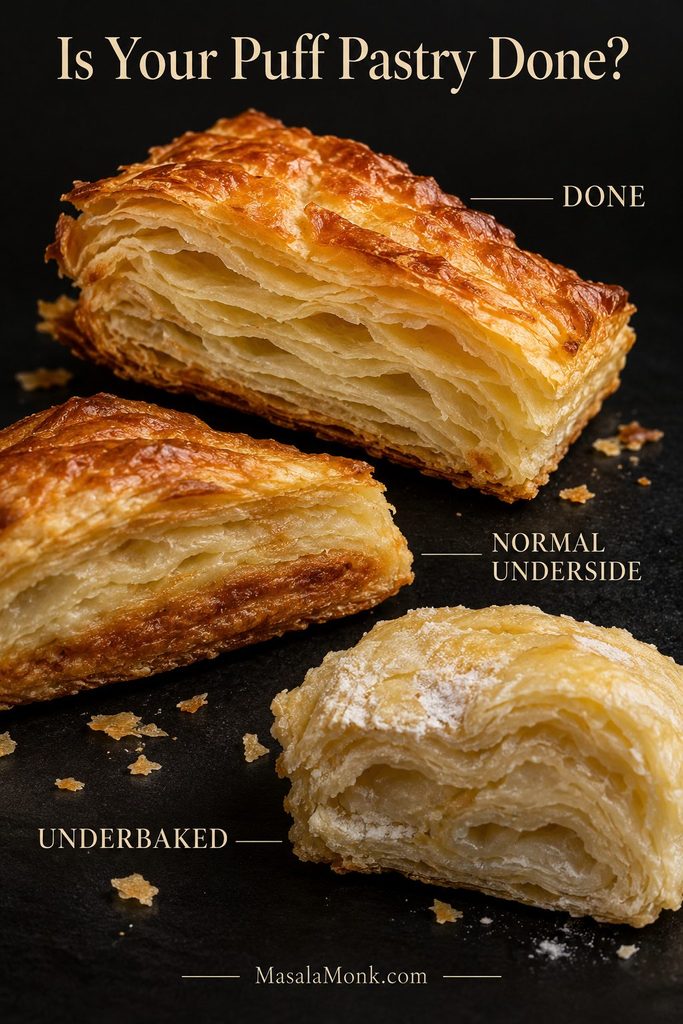
For crisp pastry on both sides, bake the sheet separately. Cut it into squares, brush with egg wash and bake on parchment at 400°F / 205°C, starting your check around 15 minutes. Spoon hot filling into bowls or ramekins and set the crisp pastry on top.
Puff pastry is much less forgiving on the bottom of a wet pot pie. Regular pie dough is the easier route when pastry underneath matters.
Pie Crust
For the easiest reliable pie-crust version, use a single top crust. It generally needs about 30–35 minutes at 400°F / 205°C. Cover the rim loosely with foil when it colors well ahead of the center.
Our homemade pie crust guide covers cold butter, hydration, rolling and chilling in more detail. For a double-crust pot pie, cool the filling before it meets the bottom dough and consider partial prebaking when a crisp base matters. Metal pans and stronger bottom heat also help; King Arthur Baking explains the role of pan material and bottom heat.
Using Biscuits as the Topping
Set cold biscuit dough over hot gravy with a little room between the pieces. For medium homemade biscuits, 400°F / 205°C for about 25–30 minutes is a useful starting point. Refrigerated dough should follow its package temperature and timing first.
Check a biscuit near the middle instead of judging only the browned tops. The underside is ready when it is set and no longer gummy.
Individual Pot Pies
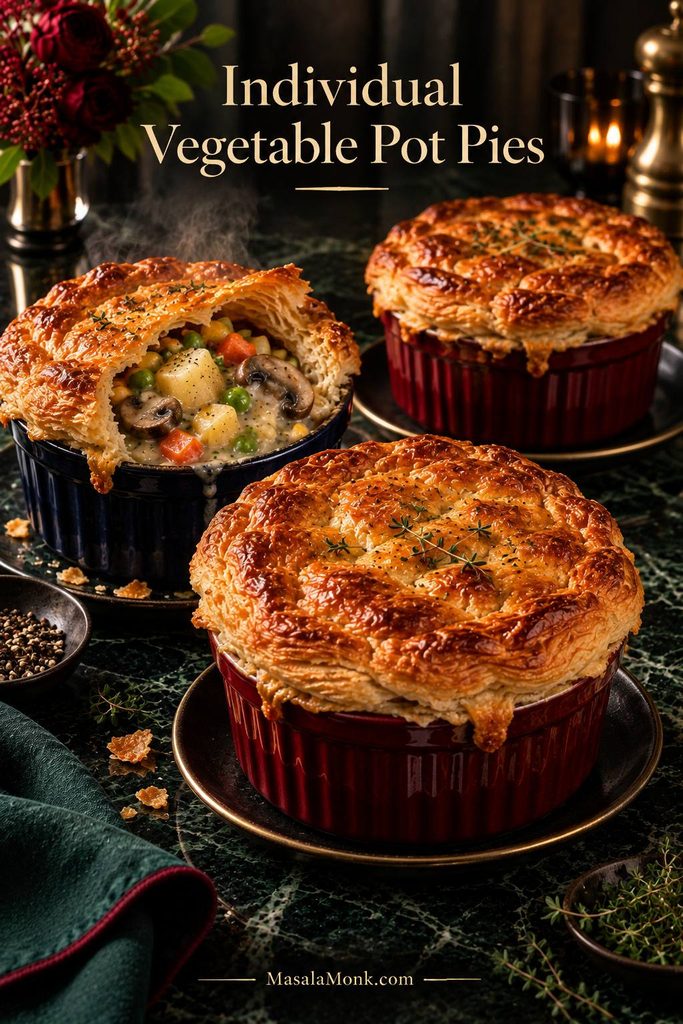
Use six 16 oz / 475 ml ramekins, or six to eight smaller 12–14 oz / 355–415 ml dishes. Fill them no more than about three-quarters full. Puff-pastry tops often finish in roughly 18–22 minutes at 400–425°F / 205–220°C, although the center layers remain the better doneness cue.
Changing the dish changes the bake. A shallow ramekin, deep casserole, bottom crust and thick biscuit topping all move heat and steam differently. Borrow another version’s timer cautiously when the vessel or topping changes.
Jump to: Vegetarian variations · Serving ideas · Make ahead · Back to recipe
Vegetarian Pot Pie Variations
Make It Heartier
Add 1–1½ cups / 170–255 g drained white beans or chickpeas and remove roughly the same volume of vegetables. White beans soften into the sauce; chickpeas keep more bite.
Vegan
Use vegan butter or another suitable cooking fat, vegetable broth and unsweetened oat or soy milk. Check the pastry label because prepared puff pastry and pie crusts vary in the fats they contain. Plant milk or aquafaba can replace the egg wash; nutritional yeast or a little extra soy sauce can deepen the gravy.
Gluten-Free
A gluten-free all-purpose blend designed to replace wheat flour can work in the roux. Cornstarch is another straightforward option.
For cornstarch, omit the 42 g flour. Once the vegetables are ready, add the broth and milk and bring them to a simmer. Mix 2½ tbsp / about 20 g cornstarch with 2½ tbsp cold water. Start with roughly half, simmer, then add only as much more as the gravy needs.
Use certified gluten-free tamari or soy sauce and a gluten-free topping.
Making a meat version? Cooked turkey or leftover gravy changes the liquid balance, so start with our Turkey Pot Pie Recipe instead.
What to Serve With Vegetable Pot Pie
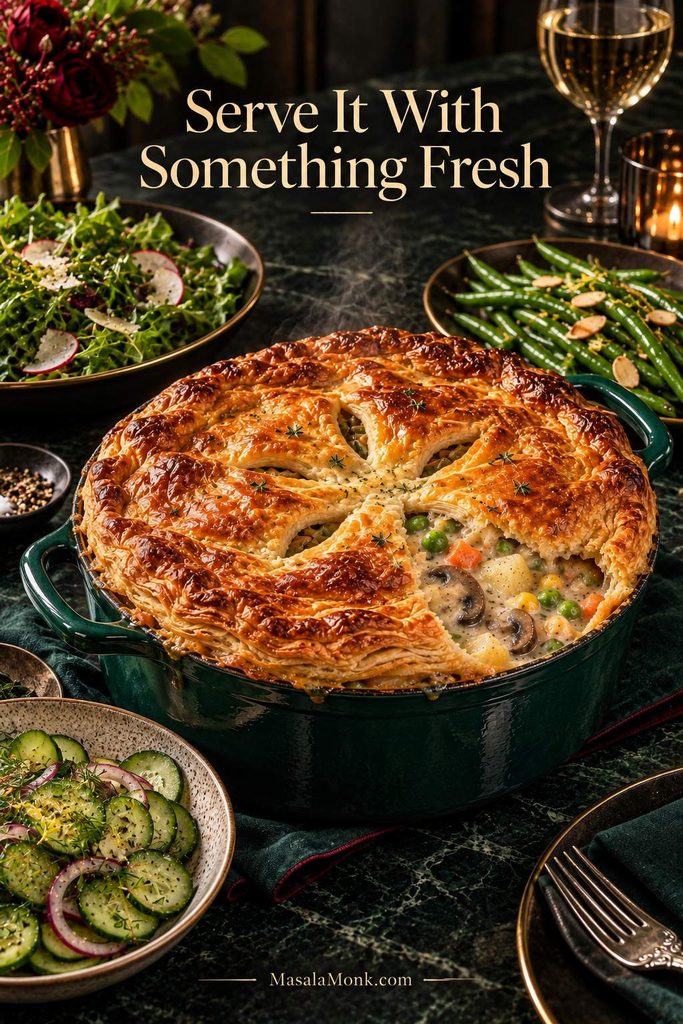
Pot pie already brings pastry, gravy and plenty of vegetables, so the best sides add freshness. A cucumber salad with vinegar and dill gives a cold, sharp contrast, while green beans almondine add lemon and toasted-almond crunch. For the same reason, a peppery arugula salad with a bright vinaigrette works well, while simply roasted asparagus keeps the plate warm without making it heavier.
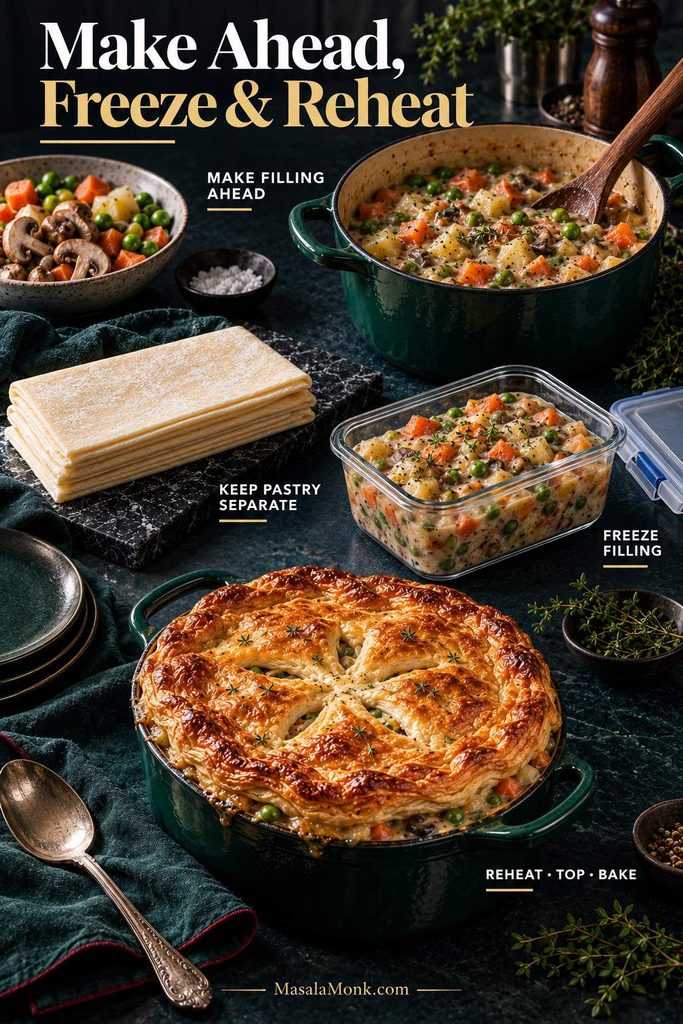
Make Ahead, Freeze and Reheat
Yes. Make the filling up to 2 days ahead, but keep the pastry separate until you’re ready to bake. Raw puff pastry gradually absorbs moisture when it sits directly against the gravy.
Reheat refrigerated filling until hot before assembly. Chilled flour-thickened gravy often firms up, so loosen it with a small splash of broth or milk when needed. If the filling is bubbling vigorously, let it stand for a few minutes before covering and baking.
Freezing
Freeze the cooked, cooled filling without the crust and aim to use it within 2–3 months for best quality. Thaw overnight in the refrigerator, reheat, adjust the consistency, then add fresh pastry. A fully baked pie can also be frozen, although the reheated crust will be softer.
Leftovers
Refrigerated leftovers are best used within 3–4 days. Reheat in a 325–350°F / 165–175°C oven until the center reaches 165°F / 74°C. A microwave is quicker, but steam softens pastry. See the USDA FSIS leftovers guidance for cooling and reheating safety.
Vegetable Pot Pie Troubleshooting
A pot pie can go sideways for ordinary reasons: wetter vegetables, a deeper dish, cold filling or pastry that simply needs longer in the middle. Start with the stage where the problem appeared.
Before Baking
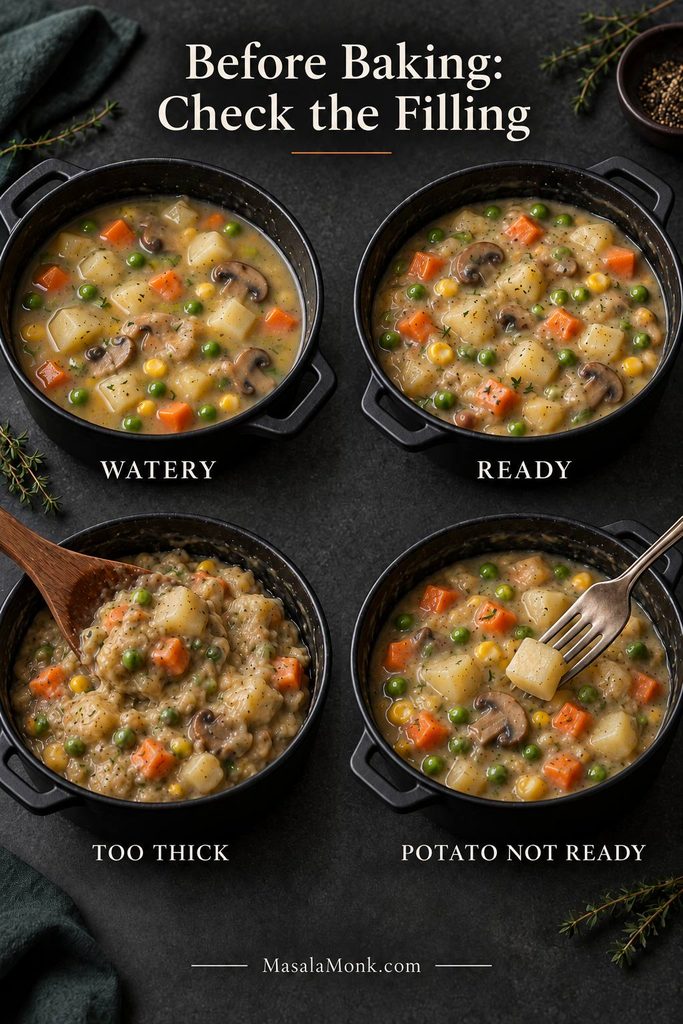
| What You See | Likely Cause | What to Do |
|---|---|---|
| Gravy is watery | Vegetables released extra water or the sauce needs more reduction | Simmer uncovered first; use a small cornstarch slurry only when reduction is not enough |
| Gravy is gluey | Too much thickener or reduction | Add warm broth or milk 1–2 tbsp / 15–30 ml at a time |
| Flour formed lumps | Liquid reached the flour too quickly | Whisk if practical; next time smooth the first portion of broth in before adding the rest |
| Everything tastes bland | Not enough salt, browning, herbs, umami or acidity | Correct the filling before pastry goes on |
| Potatoes still crunch | Pieces are too large or need longer on the stovetop | Cook longer and test one of the largest cubes |
After Baking
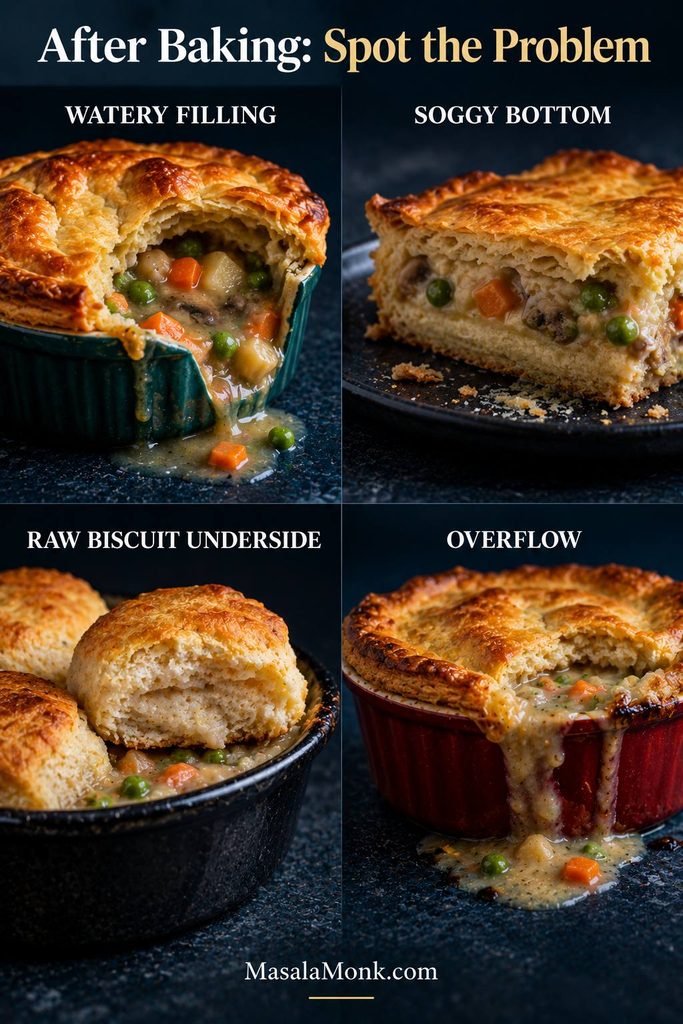
| What You See | Likely Cause | What to Do |
|---|---|---|
| Gravy became watery | Wet vegetables released more liquid in the oven | Next time cook them drier and judge thickness only after frozen vegetables are hot |
| Puff center is pale or doughy | The middle needs more time, or pastry started too warm | Bake longer and shield dark edges with foil |
| Puff is soft underneath | Steam softened the side touching the gravy | This can be normal; bake pastry separately next time when a crisp underside matters |
| Puff is gummy or raw | Gravy was too wet, pastry too warm or center underbaked | Continue baking when possible; next time use thicker gravy and chilled pastry |
| Bottom pie crust is soggy | Wet filling reached raw dough before the base set | Cool the filling and consider partial prebaking plus stronger bottom heat |
| Biscuits are raw underneath | Filling was too cool or biscuits too thick and crowded | Continue under loose foil; next time use hot filling and leave more space |
| Pie overflowed | Dish was too small or too full | Leave ½–¾ in / 1.25–2 cm headroom and bake on a rimmed sheet |
Quick links: Recipe · Make ahead & leftovers · Back to top
The first scoop does not need to be neat. Break through the lid while it is still crisp and make sure every serving gets some flaky pastry with the creamy vegetables underneath.








