Posted on Leave a comment

Lemonade Scones Recipe

Tall golden lemonade scones on a light tea table, with one scone split open and filled with jam and cream beside a teacup.

This lemonade scones recipe is the shortcut bake you make when you want warm, tender scones without rubbing butter into flour. You only need self-raising flour, cream, and fizzy lemonade, and the dough is supposed to look soft, rough, and a little messy before it bakes into tall, split-open scones.

The point is not just speed. The real win is a batch of scones that rise properly, pull apart easily, and stay soft enough for jam, cream, butter, or lemon curd instead of turning dry, flat, or doughy. If regular scones have ever felt fussy, this version is a good place to rebuild confidence.

If you have seen recipes for scones using lemonade and wondered how they work, the idea is simple: cream brings richness, self-raising flour brings lift, and lemonade adds moisture, gentle sweetness, and fizz. This guide keeps the recipe easy while showing you the small details that help lemonade scones rise tall instead of turning dense, sticky, pale, or dry.

The 3-Ingredient Shortcut

Before you start, it helps to see why this shortcut works. The recipe looks unusually simple, but the flour, cream, and fizzy lemonade each replace a step from a more traditional scone method.
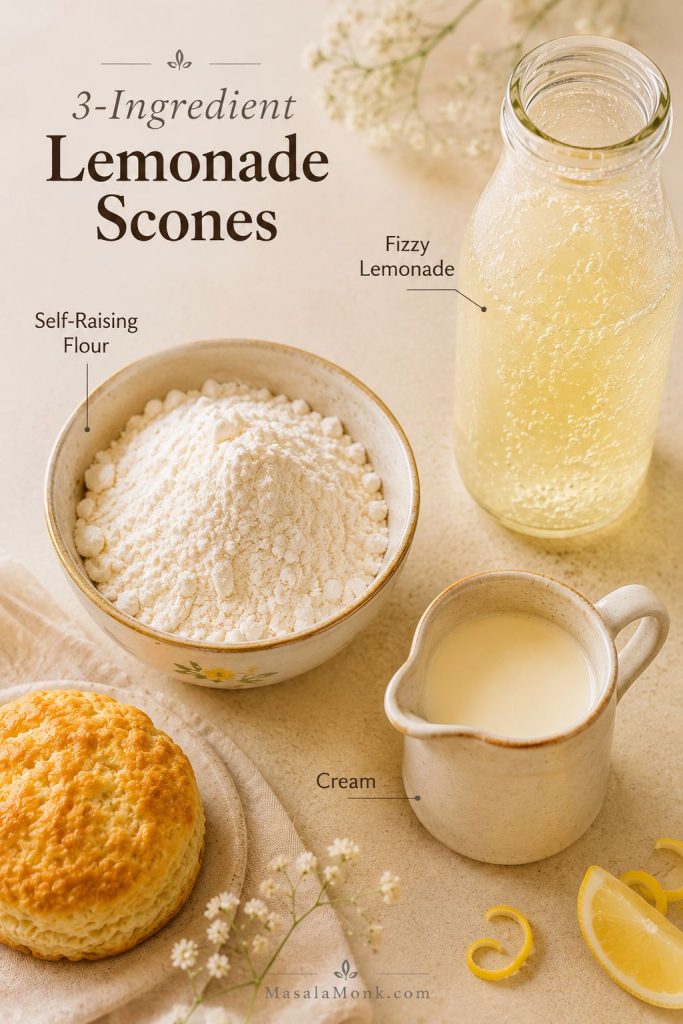
Self-raising flour in a bowl, cream in a small jug, and fizzy lemonade beside a finished scone on a light work surface.
Three ingredients can work beautifully when each one does its job. Self-raising flour gives lift, cream replaces the butter-rubbing step, and fizzy lemonade adds the moisture and gentle sweetness that bring the dough together.

Quick Answer: How to Make Lemonade Scones

To make this lemonade scones recipe, mix self-raising flour, chilled cream, and chilled fizzy lemonade into a soft, slightly sticky dough. Pat the dough to about 2.5–3cm / 1–1¼ inches thick, cut cleanly with a floured round cutter, place the scones just touching on a tray, brush the tops with milk or cream, and bake at 220°C / 425°F for about 15–18 minutes.

Use this quick visual guide as the fast check before you mix: temperature, bake time, dough height, and cutter size are the details that control most of the final result.
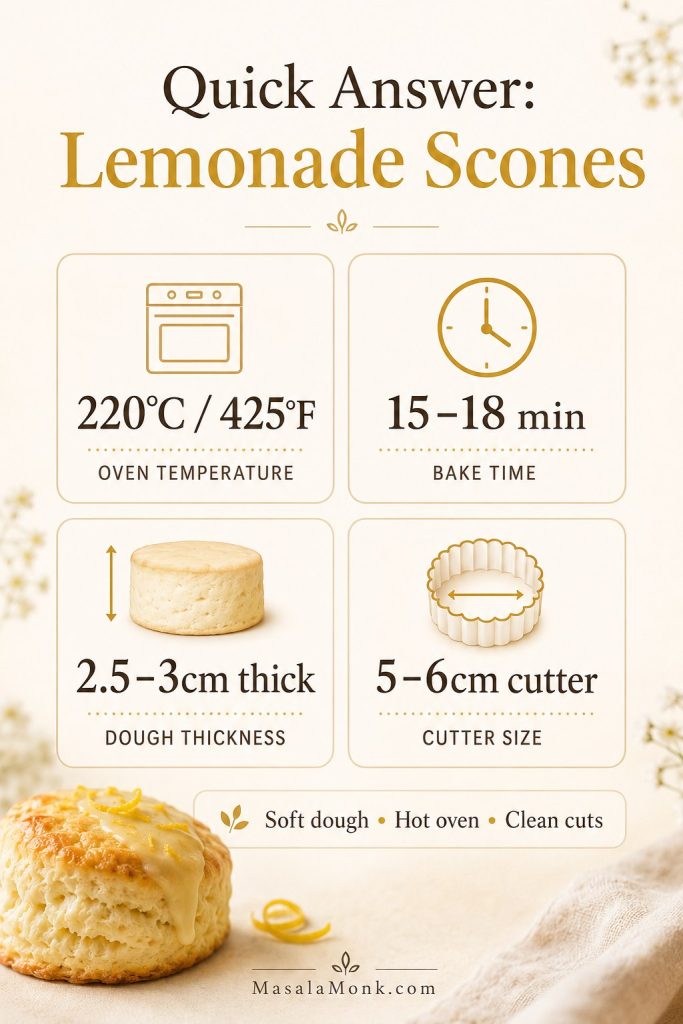
Quick guide image for lemonade scones showing oven temperature, bake time, dough thickness, and cutter size beside a baked scone.
Keep these numbers close before you start: 220°C / 425°F, 15–18 minutes, 2.5–3cm dough thickness, and a 5–6cm cutter. Together, they give the dough enough heat, height, and structure to rise properly.

If the dough looks a little shaggy, do not panic. Lemonade scone dough is meant to feel softer than regular scone dough. That loose, slightly tacky texture is part of what keeps the centers tender after baking.

Recipe Detail Best Starting Point
Main ingredients Self-raising flour, chilled cream, fizzy lemonade
Oven temperature 220°C / 425°F, or 200°C fan
Bake time 15–18 minutes
Dough thickness 2.5–3cm / 1–1¼ inches
Cutter size 5–6cm / 2–2½ inches
Texture goal Tall, tender, lightly golden scones that split open easily

Before You Mix the Dough

Before you start: cold cream, fizzy lemonade, a thick dough, and light handling do most of the work. The dough does not need to look perfect. If it is soft, rough-looking, and just holding together, you are probably on the right track.

For the best rise, bake the scones soon after mixing. The dough comes together quickly, and it performs best while the cream is cold and the lemonade is still lively.

The dough cue matters more than a perfectly tidy bowl. If it looks soft and rough at this stage, that is usually a good sign.
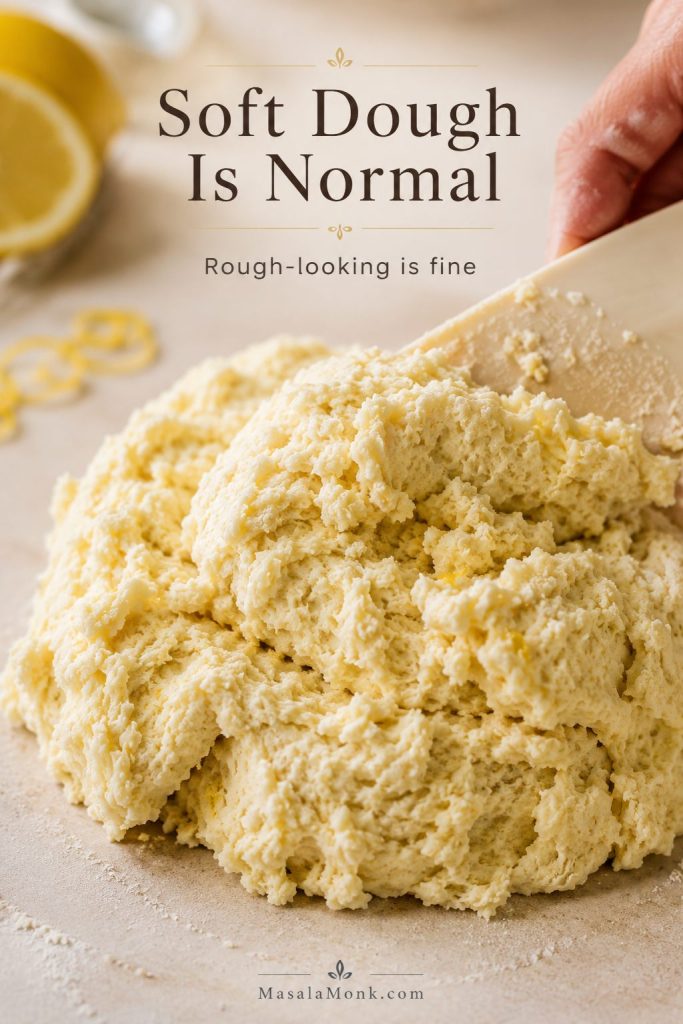
Soft rough lemonade scone dough in a mixing bowl with a spatula, showing a slightly messy texture rather than a smooth dough ball.
This is the moment many bakers worry the dough is wrong. However, lemonade scone dough should look rough and slightly tacky, because a too-smooth dough usually means it has been handled more than it needs.

If Your Oven Runs Hot

Oven note: a hot oven helps scones rise quickly. If your oven runs hot or the tops brown before the centers cook through, use 200°C / 390°F or 180°C fan and bake a few minutes longer.

Already know the basics? Skip to the full recipe card, or go straight to fixes for flat, dense, or sticky scones.

What Are Lemonade Scones?

Lemonade scones are shortcut scones made with self-raising flour, cream, and carbonated lemonade. They are especially associated with Australian-style home baking: quick, practical, generous, and usually served warm with jam and cream.

Traditional scones usually start by rubbing cold butter into flour. Here, cream brings the fat, so you skip that step. The lemonade adds liquid, gentle sweetness, and fizz, while the self-raising flour helps the dough rise.

For a more traditional butter-rubbed afternoon tea version, see our easy English scone recipe. This cream-and-lemonade version is the faster option when you want warm scones without cutting butter into flour.

A quick naming note: in this recipe, “lemonade” means the clear, fizzy British/Australian-style soft drink, not flat homemade lemon juice lemonade.

Fizzy Lemonade vs Flat Lemonade

This is the most important naming difference in the whole recipe. The lemonade needs to be carbonated, because flat homemade lemonade behaves more like a sweet lemon drink than the fizzy liquid this dough is built around.

Comparison image showing fizzy lemonade on one side and flat homemade lemonade on the other for use in scones.
For this recipe, fizzy lemonade is the shortcut ingredient, not flat homemade lemonade. The bubbles are not the only source of rise, but they help keep the dough lighter when combined with fresh self-raising flour and a hot oven.

The word “lemonade” can mean different things depending on where you live. For these scones, use a sweet carbonated lemon drink, Sprite-style soda, or 7Up-style soda. This difference in meaning is exactly why the clarification matters.

Using Sprite, 7Up, or lemon-lime soda? Jump to the soda swap notes.

Despite the name, the finished scones do not taste sharply lemony. They are mild, creamy, and gently sweet. For brighter lemon flavor, serve them with lemon curd, add a little lemon zest to the dough, or finish with a light lemon glaze.

Ingredients for Lemonade Scones

Because the ingredient list is short, each ingredient has a real job. Once you understand those jobs, this lemonade scones recipe becomes much easier to adjust without losing the soft texture.

Here is the full working set before the recipe starts: the three main ingredients, plus the small extras that help with flavor, brushing, and serving.
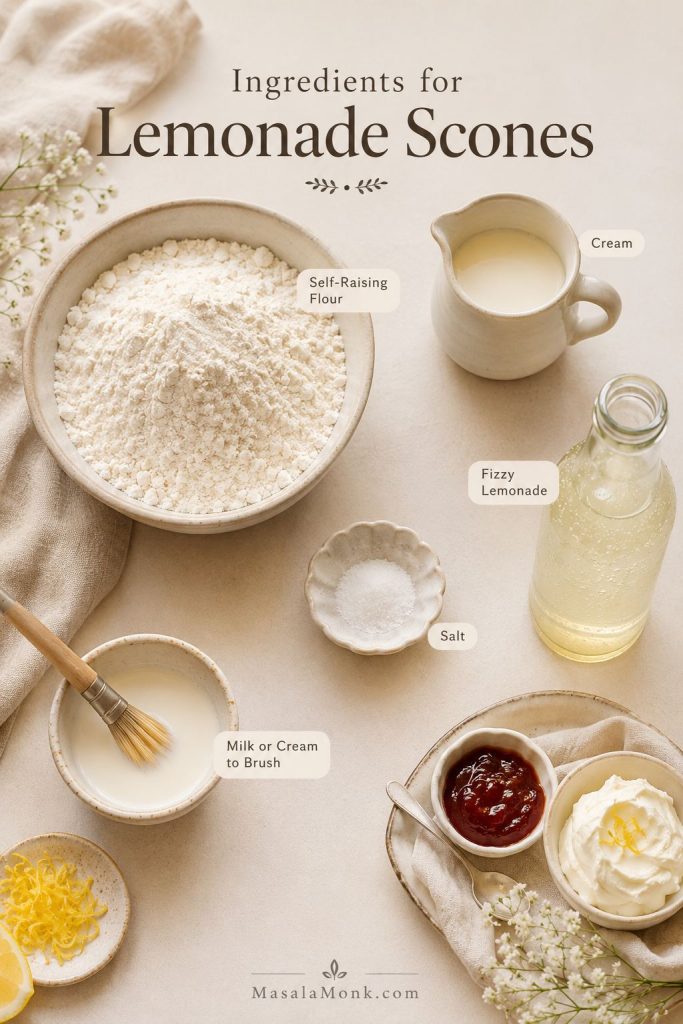
Ingredient spread for lemonade scones showing self-raising flour, cream, fizzy lemonade, salt, and a small brushing liquid on a light surface.
Because this recipe has so few ingredients, stale flour or flat lemonade shows up quickly in the final texture. Start with fresh self-raising flour, cold cream, and newly opened fizzy lemonade for the best rise.

Self-Raising Flour

Self-raising flour gives the scones structure and lift. If your flour has been open for a long time, the raising agent may be weaker, which can lead to flatter scones. For the tallest result, use a fresh bag and measure carefully.

The most reliable measurement is 500g self-raising flour. Cup measurements can vary by country and measuring style, so use grams if you can. As a rough guide, 500g is about 3⅓ metric cups or about 4 loosely spooned-and-levelled US cups.

Cream

Use chilled heavy cream, thickened cream, or whipping cream. Cream is what makes this shortcut work because it brings the richness you would normally get from butter, without asking you to rub cold butter into flour.

Start with 250ml / 1 cup cream in the dough. Keep a little extra nearby for brushing the tops or loosening the mixture if dry flour remains in the bowl.

No cream at home? Check the no-cream options before you start mixing.

Fizzy Lemonade

Use chilled, carbonated lemonade or a clear lemon-lime soda. Open the bottle or can right before mixing, while it still has plenty of fizz. Flat lemonade will not give the same lightness.

Optional Salt

A small pinch of salt keeps the scones from tasting flat, especially if your self-raising flour is very plain. You only need about ¼ teaspoon.

Jam, Cream, Lemon Curd, or Fruit Topping

Jam and cream are classic, especially with a cup of tea. Clotted cream, whipped cream, butter, lemon curd, or warm fruit topping all work well too. A spoonful of thick homemade apple pie filling turns these into quick dessert scones, especially if the scones are still warm enough for the topping to soften into the split center.

Equipment You Need

You do not need special equipment. The most useful “tool” is actually a light hand, but these basics make the dough easier to handle and help the scones rise evenly.

  • Large mixing bowl
  • Digital scale or measuring cups
  • Flat-bladed knife, spatula, or fork for mixing
  • Lightly floured work surface
  • 5–6cm / 2–2½ inch round cutter, or a floured knife for squares
  • Baking tray
  • Parchment paper
  • Pastry brush
  • Wire rack
  • Clean tea towel for softer tops after baking

A round cutter gives the classic look, but squares are easier for beginners because you do not have to re-roll scraps. Either shape works as long as the dough stays thick and lightly handled.

How to Make Lemonade Scones

The main rule in this lemonade scones recipe is simple: stop mixing as soon as the dough comes together. You are not trying to make it smooth. A rough, lightly handled dough gives a softer scone than one that has been kneaded into a tidy ball.

The method breaks into three simple stages: mix the rough dough, shape and cut it gently, then bake while the dough is still cool and lively.
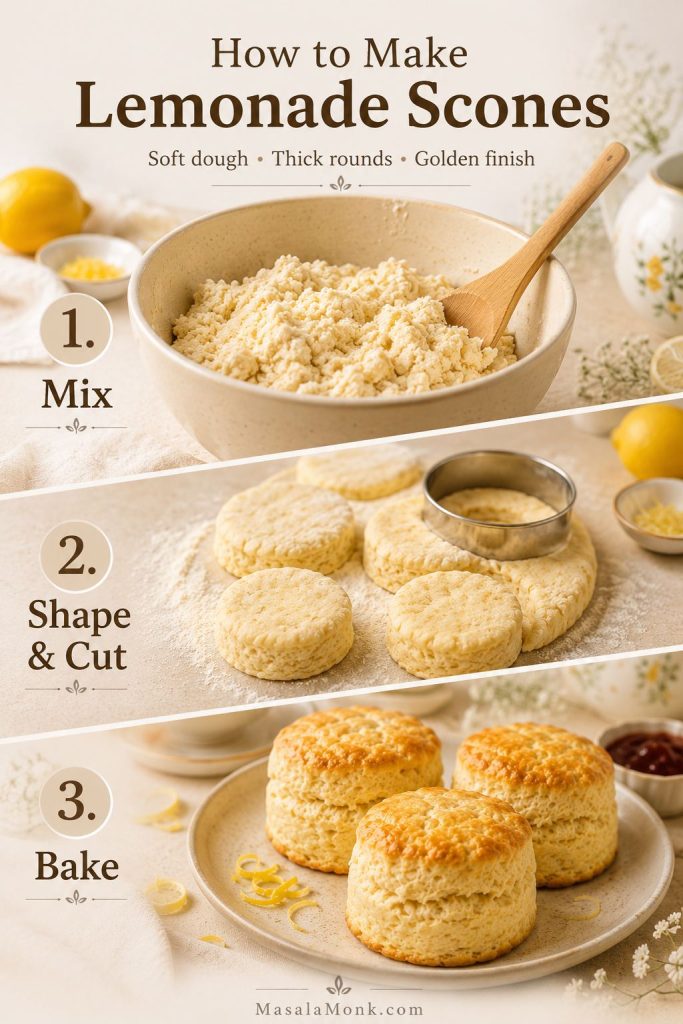
Three-step guide showing how to mix lemonade scone dough, shape and cut the dough, and bake the scones until golden.
The method is shorter than regular scones: mix a rough dough, pat it thick, cut straight down, and bake while the dough is still cool. Those small choices matter more than making the dough look perfect.

1. Mix the Dough

Preheat the oven to 220°C / 425°F, or 200°C fan. Line a large baking tray with parchment paper.

Add the self-raising flour to a large mixing bowl and stir in the salt if using. Pour in 250ml chilled cream and 250ml chilled fizzy lemonade, then mix gently with a flat-bladed knife, spatula, or fork until a rough dough forms.

If dry flour remains at the bottom of the bowl, add extra cream 1 tablespoon at a time. The dough should come together, but it should still look soft, rough, and a little messy.
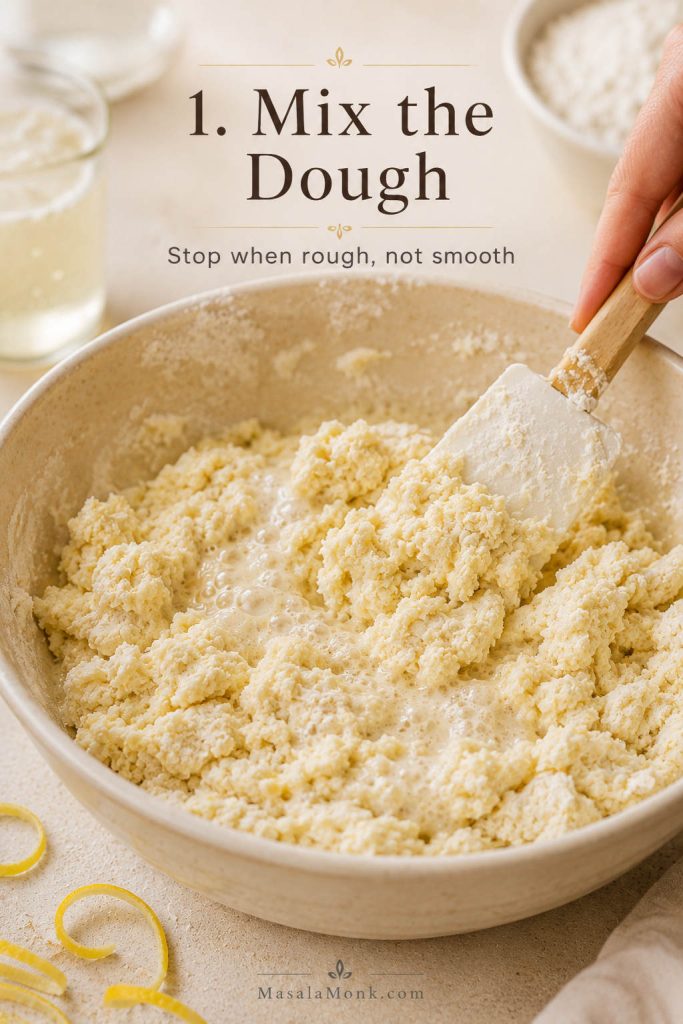
Lemonade scone dough being gently mixed in a bowl with visible flour and liquid still coming together.
Stop mixing once the dough just comes together. At this stage, a few rough edges are better than a polished dough ball, because overmixing can make the baked scones tight instead of light.

2. Shape and Cut the Scones

Lightly flour the bench and your hands. Turn the dough out, bring it together gently, and pat it to about 2.5–3cm / 1–1¼ inches thick so the scones have room to rise.

Dough Thickness

This is one of the easiest places to lose height. The dough should be patted thick enough that the scones have room to rise, rather than rolled or pressed thin like cookie dough.
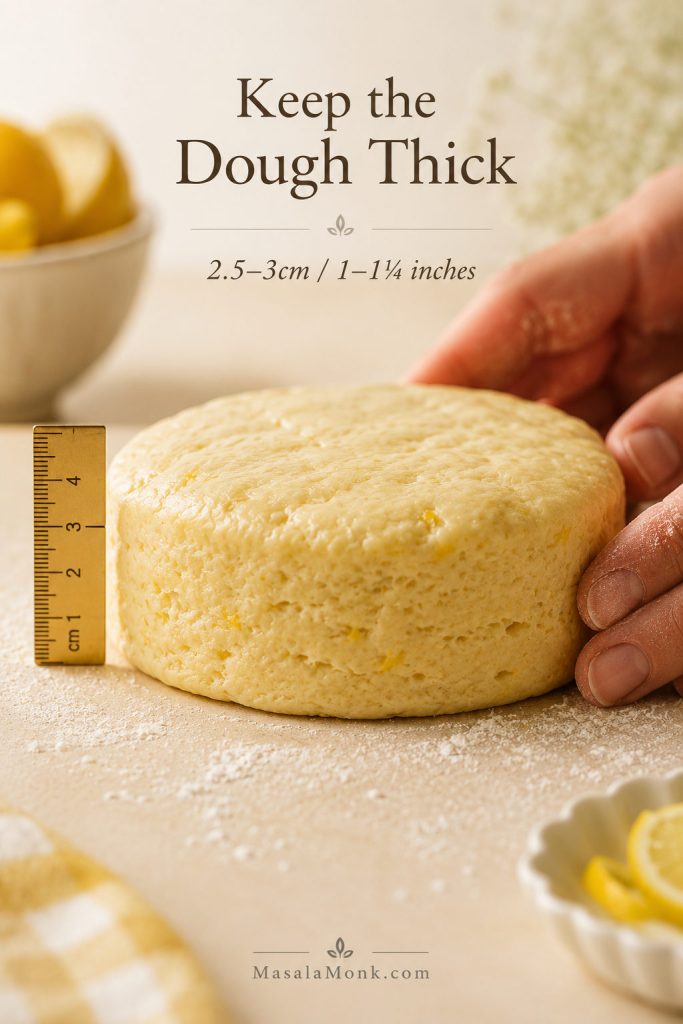
Side view of lemonade scone dough patted thick on a floured surface with a ruler showing about 2.5 to 3 centimetres in height.
Dough thickness is one of the easiest ways to control the final height. If you pat the dough too thin, the scones may bake up wide and flat even if the ingredients are right.

Dip a 5–6cm / 2–2½ inch round cutter in flour, press down cleanly, and lift back up. If you re-roll scraps, press them together gently rather than kneading them smooth. Second-cut scones may be a little less tall, but they will still be tender if you handle them lightly.
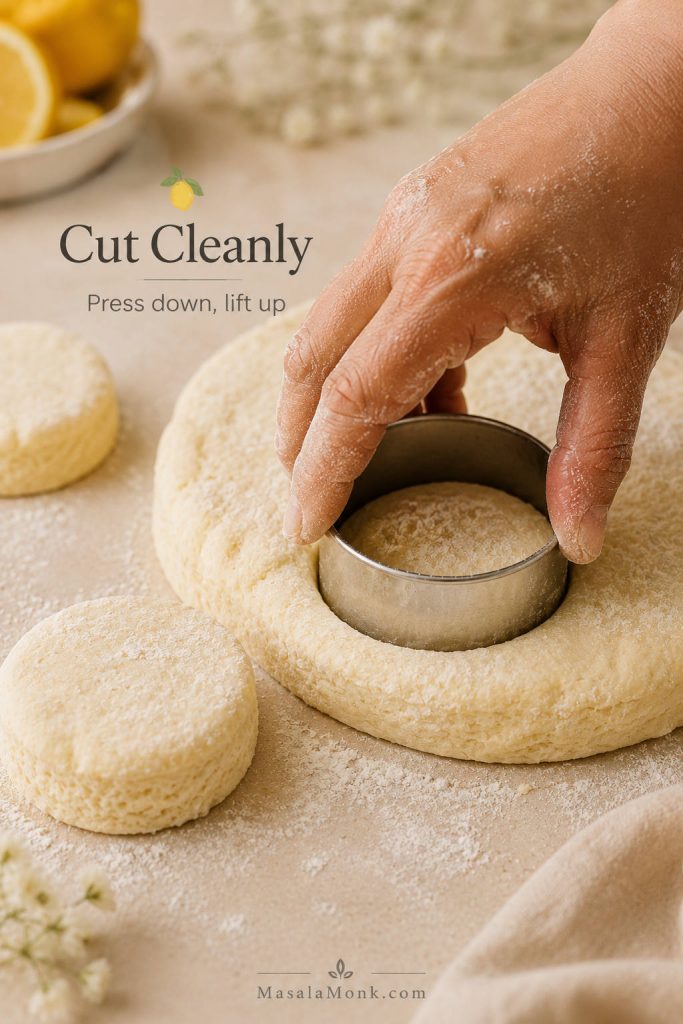
A hand pressing a round cutter straight down into thick lemonade scone dough on a lightly floured surface.
Pressing straight down keeps the cut edges open. As a result, the scones can rise more evenly instead of sealing at the sides and leaning in the oven.

Arrange the scones on the prepared tray so they are just touching or nearly touching. This helps them rise upward instead of spreading outward.

Tray Spacing

The tray should look a little closer than you might expect. Lemonade scones rise better when they can support each other, so place them just touching or nearly touching instead of spreading them far apart.

Unbaked lemonade scone rounds arranged close together on a parchment-lined baking tray.
Close spacing is not a mistake here. When the scones sit just touching, they support one another as they bake, which helps them rise upward and keeps the sides softer.

3. Bake Until Risen and Golden

Brush only the tops with a little milk or cream. Try not to drip down the sides because that can seal the edges.

Bake for 15–18 minutes, or until the scones are risen, lightly golden, and sound hollow when tapped on top. For softer tops, cover the hot scones loosely with a clean tea towel for a few minutes after baking.

Freshly baked lemonade scones with lightly golden tops on a tray or cooling rack.
Look for risen scones with lightly golden tops rather than deep browning. Since ovens vary, checking height, color, and the center texture is more reliable than using color alone.

What the Baked Crumb Should Look Like

Once the scones are baked, the inside tells you more than the outside alone. A good lemonade scone should split open easily, with a soft center that can hold jam, cream, butter, or lemon curd without feeling dry or heavy.
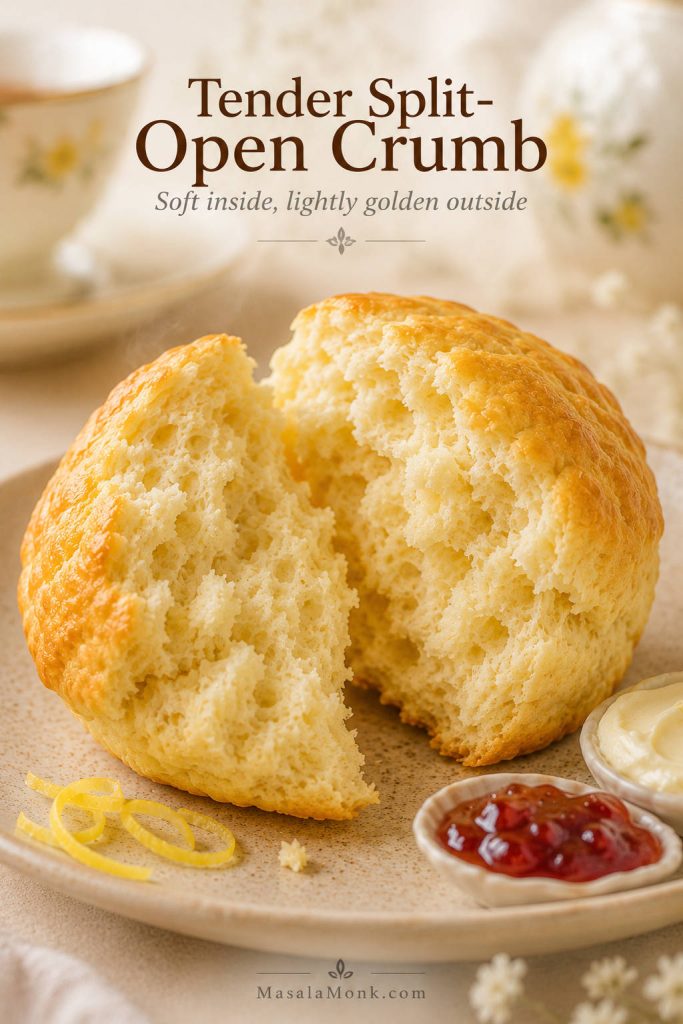
Split-open lemonade scone showing a soft tender crumb, with jam and cream nearby.
The crumb is the real test. A well-made lemonade scone should open easily, look soft inside, and feel ready for jam, cream, butter, or lemon curd without turning dry or heavy.

What the Dough Should Look Like

Think soft and rough-looking, not smooth and tidy. The dough should hold together when you pat it, but it may still feel tacky under your hands. This is the stage where many people second-guess the recipe, but a soft dough is normal for lemonade scones.

The mistake is not stickiness. The mistake is adding so much extra flour that the dough becomes dry, firm, and heavy. Lightly flour your hands and the bench, bring the dough together gently, and stop once it can be patted into shape.

Use the comparison below as a quick check before you add more flour. The best dough is soft enough to feel tacky, but firm enough to shape and cut.
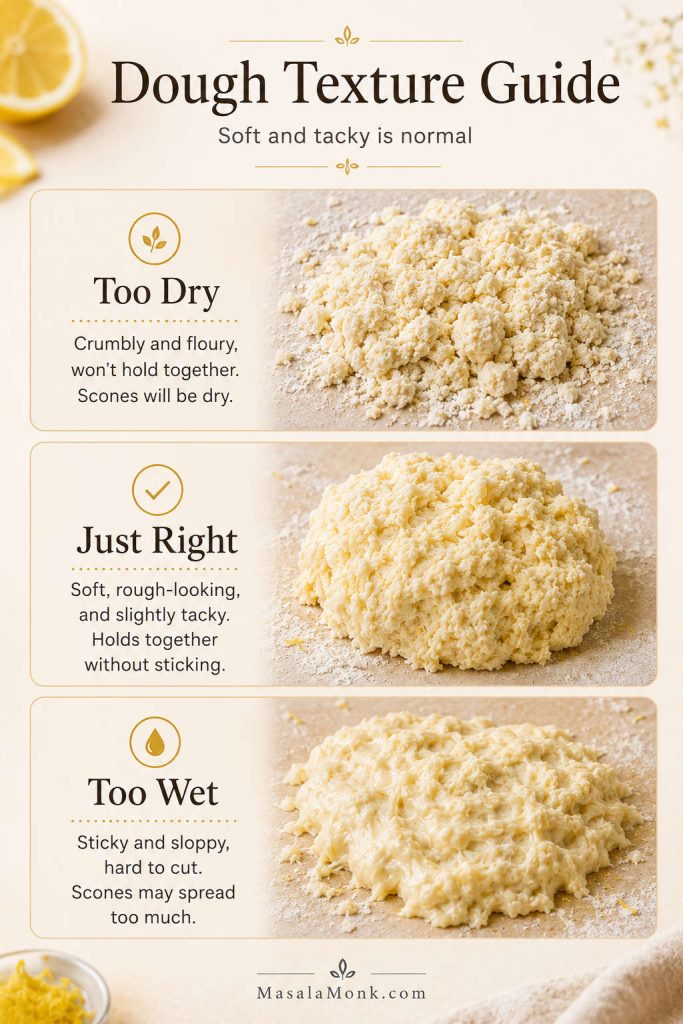
Three-panel dough texture guide for lemonade scones showing dough that is too dry, just right, and too wet.
This dough should be tacky, not stiff. If you keep adding flour until it feels tidy and dry, the scones are more likely to turn heavy, so use just enough flour to shape and cut cleanly.

If the dough feels too sticky, too dry, or hard to cut, check the troubleshooting table before working in lots of extra flour.

Cut Cleanly for a Better Rise

Dip the cutter in flour, press down cleanly, and lift it back up. Twisting can smear the sides of the dough, which may make the scones lean or rise unevenly. If you do not have a round cutter, cut the dough into squares with a floured knife instead.
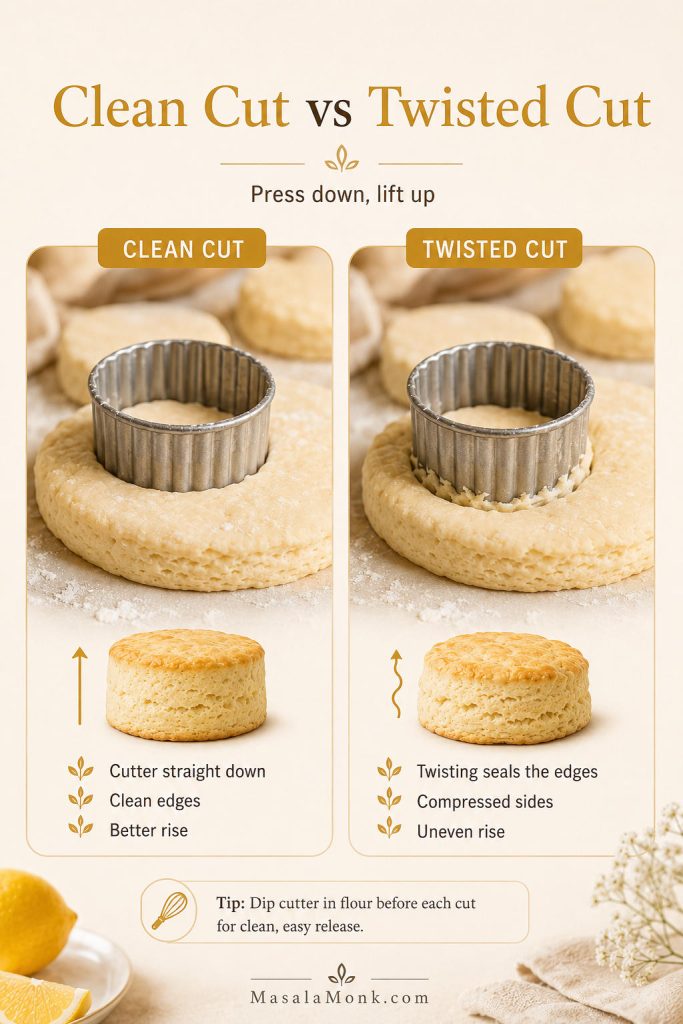
Side-by-side comparison of a clean scone cutter cut versus a twisted cut in thick dough.
Twisting the cutter can seal and drag the dough edges. Instead, press down and lift straight up, especially if you want taller lemonade scones with a more even rise.

Does the Dough Need to Chill?

For this quick version, you do not need to chill the dough if your cream and lemonade are cold and you work quickly. If the dough becomes warm, slack, or difficult to cut, chill it for 15–20 minutes before baking. Chilling is a rescue move here, not a required one-hour wait.

For tall, tender scones: use fizzy lemonade, keep the dough thick, handle it lightly, and press the cutter straight down. If you do those four things, you are already most of the way there.

Using an air fryer instead of the oven? Use the air fryer timing and spacing notes.

Why Lemonade Works in Scones

Lemonade scones work because the three ingredients cover the jobs that butter, sugar, liquid, and raising agents usually do in a standard scone recipe. The shortcut feels unusual, but the logic is simple.

Ingredient or Step What It Does
Self-raising flour Provides flour structure and built-in raising agent for lift.
Cream Adds fat and richness, replacing the butter-rubbing step.
Fizzy lemonade Adds liquid, gentle sweetness, and carbonation, which helps keep the shortcut dough light when it is handled gently.
Hot oven Gives the dough a fast lift before the outside sets.
Gentle handling Keeps the crumb tender instead of tough or dense.

The bubbles alone do not do all the work. The full system matters: fresh self-raising flour, cold cream, newly opened lemonade, a loose dough, minimal handling, and a properly hot oven.

Self-Raising Flour Substitute

If you do not have self-raising flour, you can make a substitute with plain flour or all-purpose flour, baking powder, and salt.

The full-recipe substitute is easiest to follow by weight. Once the flour, baking powder, and salt are evenly whisked, you can use it in place of self-raising flour in the main recipe.
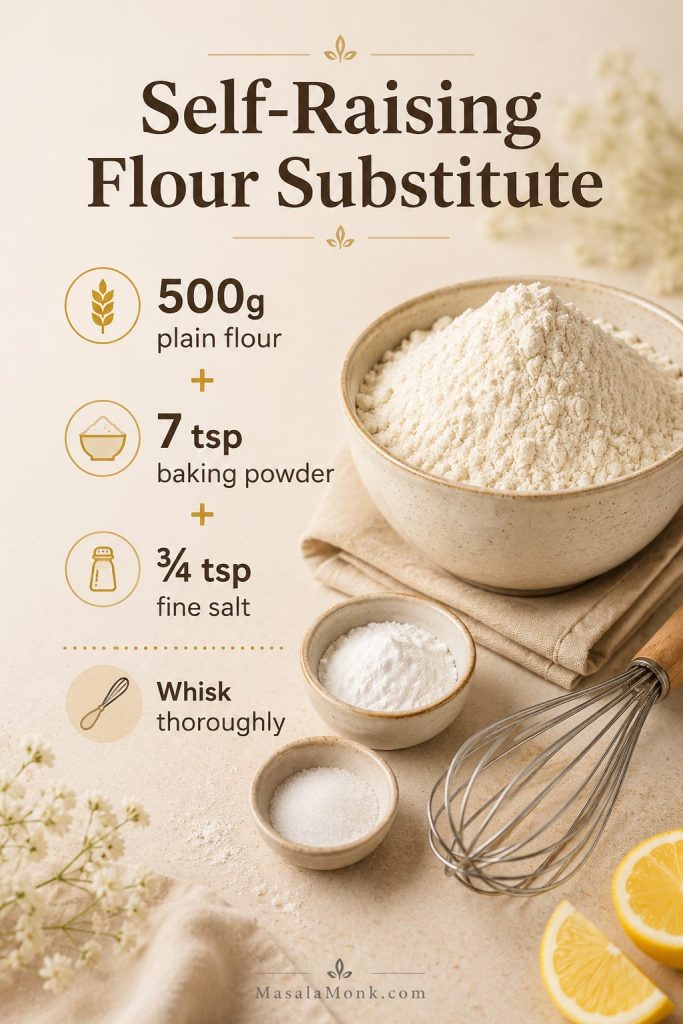
Plain flour, baking powder, salt, and a whisk arranged as a self-raising flour substitute guide for scones.
Homemade self-raising flour works best when the baking powder is evenly mixed through the flour. Therefore, whisk the substitute thoroughly before adding cream and lemonade, so every scone has the same chance to rise.
For This Recipe Use
Instead of 500g self-raising flour 500g plain/all-purpose flour + 7 teaspoons baking powder + ¾ teaspoon fine salt

Whisk the flour, baking powder, and salt very well before adding the cream and lemonade, so the raising agent is evenly distributed. For smaller batches, use about 2 teaspoons baking powder per 150g / 1 metric cup flour, then add a small pinch of salt.

Because this recipe depends on lift, fresh flour and fresh baking powder matter. Self-raising flour formulas vary slightly by country and brand, but the ratio above is a reliable starting point for this high-rise scone dough. For a more general homemade self-rising flour reference, King Arthur Baking uses flour, baking powder, and salt in a slightly gentler ratio.

Sprite, 7Up, and Lemon-Lime Soda Swaps

Sprite, 7Up, and similar clear lemon-lime sodas can work in lemonade scones. The scones care more about fizz and sweetness than the name on the bottle, so open it right before mixing.

If you are outside Australia or the UK, this is the part that matters most: use Sprite, 7Up, or a clear fizzy lemon-lime soda, not flat homemade lemonade made with lemon juice, sugar, and water.

Drink Works? Notes
Fizzy lemonade Yes Best default for this recipe.
Sprite or 7Up-style soda Yes Good substitute, especially for US readers.
Flat homemade lemonade Not ideal Missing the fizz that helps lighten the dough.
Sugar-free lemonade Possible, not best May brown less and can leave an aftertaste.
Strongly flavored soda Only as a variation May change the color and flavor of the scones.

If you try a local lemon-lime soda, pay attention to sweetness and fizz first. Those two things matter more than the brand name, and they are useful details to remember for your next batch.

Guide showing clear fizzy lemon-lime soda options for lemonade scones, including generic lemon-lime soda and fizzy lemonade.
Sprite-style or 7Up-style lemon-lime soda is a practical swap when British or Australian-style fizzy lemonade is not available. The key is freshness: open it right before mixing so the soda is still lively.

Lemonade Scones Without Cream

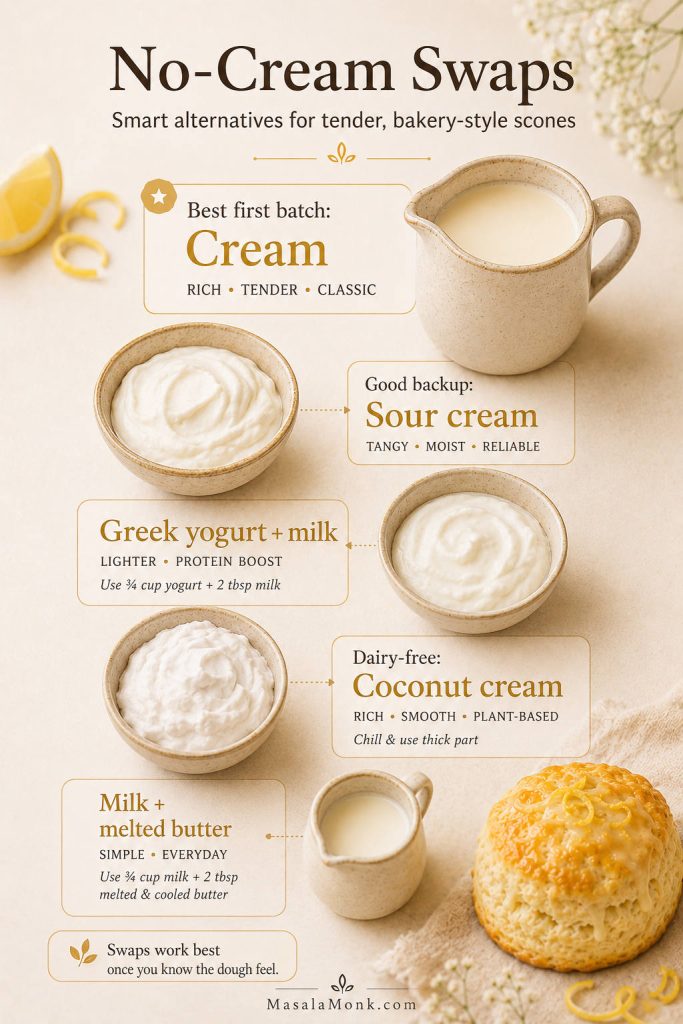
The cream version is the best first batch because cream brings both liquid and fat. No-cream swaps can work, but they are easier once you have felt the original dough.

If you remove the cream, the dough still needs richness from somewhere; otherwise the scones can turn dry, tough, or bread-like. Start with slightly less of the swap than the full cream amount, then add more only if dry flour remains in the bowl.

Swap Best Use
Sour cream Good backup when you still want richness and tenderness.
Greek yogurt + splash of milk Useful if you want body and tang, but the dough may be slightly less rich.
Full-fat coconut cream Best dairy-free direction, though it may add mild coconut flavor.
Milk + melted butter Workable, but no longer the same simple 3-ingredient shortcut.
Plain milk alone Least ideal; the scones usually taste less rich and more bread-like.
Comparison board showing cream, sour cream, Greek yogurt with milk, coconut cream, and milk with butter as no-cream swap options for lemonade scones.
Cream is still the most reliable first choice because it brings fat and liquid together. Once you know the original dough texture, sour cream, yogurt with milk, or coconut cream become easier to judge.

The same cold-fat principle shows up in other baking projects too. In our apple pie crust recipe, cold butter helps create flaky layers; here, chilled cream gives the shortcut dough richness without the rubbing-in step.

Best advice: if this is your first time making the recipe, use full-fat cream. Once you know how the dough should feel, the swaps are much easier to judge.

Air Fryer Lemonade Scones

You can adapt this lemonade scones recipe for the air fryer, but think small batch rather than crowded basket. Air fryer scones can work beautifully when they have enough space for the heat to move around them.

For most basket-style air fryers, a half batch is easier to manage. Crowding traps steam, browns the tops too quickly, and can leave the centers underdone.
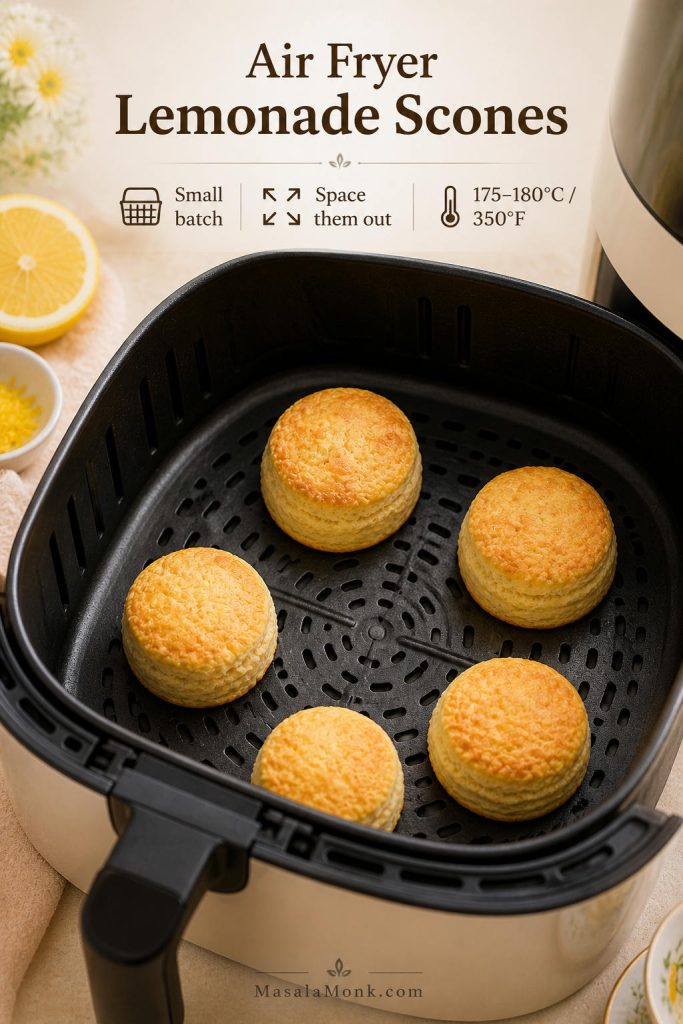
Small batch of lemonade scones spaced apart in an air fryer basket, with a temperature note for air fryer baking.
Air fryer lemonade scones need space more than they need a full basket. Because the heat is concentrated, smaller batches help the centers cook through before the tops brown too quickly.
  1. Preheat the air fryer to 175–180°C / 350°F.
  2. Make the dough as directed, then cut slightly smaller scones so the centers cook through.
  3. Place the scones in a single layer with space around them.
  4. Brush the tops with milk or cream.
  5. Air fry for 8–12 minutes, checking at 8 minutes. Larger scones may need 12–14 minutes.
  6. Cool briefly, then serve warm with jam and cream.

If your air fryer runs hot, start at the lower end of the time range and check the center of one scone before serving.

Lemonade Scone Variations

Keep variations modest the first time you make the recipe. This dough is designed to be light, so too much fruit, zest, extra liquid, or heavy add-ins can make the scones spread, lean, or bake up dense.

Lemonade Scones with Lemon Curd

Lemon curd is the best move if you expected a stronger lemon flavor from the lemonade itself. You can also add a little finely grated lemon zest to the dough, but keep the amount modest so the dough does not become wet or bitter.

If you like bright citrus desserts, you may also enjoy this orange olive oil cake, which has a softer cake-style crumb and deeper orange flavor than these mild lemonade scones.

Fruit Lemonade Scones

Fold in a small handful of sultanas, raisins, currants, blueberries, or raspberries after the dough starts to come together. Keep the amount to about ½ cup for the first batch. If using juicy berries, handle the dough gently so the fruit does not bleed too much into the crumb.

Gluten-Free Lemonade Scones

Use a gluten-free self-raising flour blend designed for baking. The dough may feel more delicate, so handle it gently and avoid adding too much extra flour. Gluten-free scones often dry out faster, so serve them warm or reheat briefly before serving.

If the gluten-free dough feels fragile, pat it into a disc and cut it into wedges instead of re-rolling rounds. That reduces handling and helps the scones hold together.

Vegan Lemonade Scones

For a vegan direction, use a dairy-free cream alternative with enough fat, such as full-fat coconut cream or a thick plant-based cream. Check that the lemonade is vegan-friendly and use plant milk for brushing the tops.

How to Fix Lemonade Scones

If your first batch is not perfect, the fix is usually easy to spot. Lemonade scones are sensitive to a few small things: fresh flour, dough thickness, light handling, and oven heat. Once you know which one went wrong, the next batch is much easier.
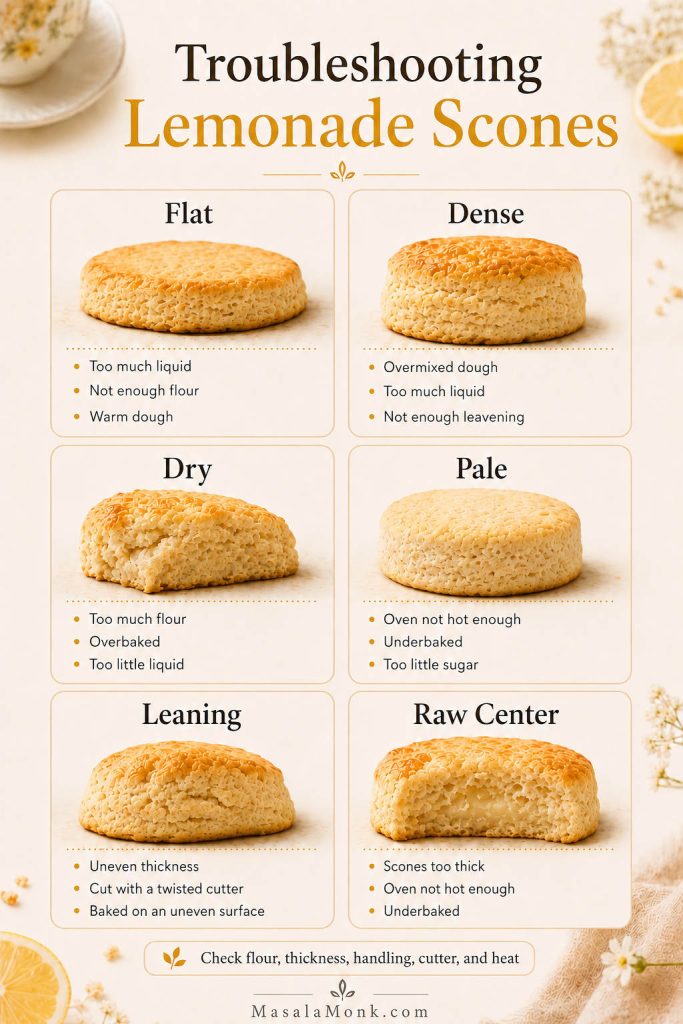
Troubleshooting guide for lemonade scones showing examples of flat, dense, dry, pale, leaning, and raw-centre scones.
Most lemonade scone problems point back to one of five things: flour freshness, dough thickness, handling, cutter technique, or heat. Use the visual clues here before changing the whole recipe.
Problem Likely Cause Best Fix
Dough is very sticky The dough is naturally soft, or there is slightly too much liquid. Flour your hands and bench lightly. Add extra flour only a little at a time.
Scones are flat Old self-raising flour, dough too thin, oven too cool, or cutter twisted. Use fresh flour, keep the dough 2.5–3cm thick, preheat fully, and press the cutter down cleanly.
Scones are dense The dough was mixed or handled too much. Mix only until rough and just combined, then bring together gently with floured hands.
Scones are dry Too much flour was added on the bench, or the scones were overbaked. Keep the dough soft and bake only until risen, lightly golden, and cooked through.
Tops are pale No milk or cream brush, or oven not hot enough. Brush the tops lightly and bake in a properly preheated oven.
Scones lean sideways Cutter was twisted or scraps were overworked. Dip cutter in flour, cut cleanly, and handle re-rolled scraps gently.
Centers are raw Scones are too thick, too large, or baked too quickly on the outside. Cut slightly smaller scones or bake a few minutes longer at a slightly lower temperature.
Crust is too firm Scones cooled uncovered. Cover hot scones loosely with a clean tea towel for a few minutes after baking.

Storage, Freezing, and Reheating

These scones are best on the day they are baked, especially while still warm. Like most scones, they become firmer as they cool and sit.
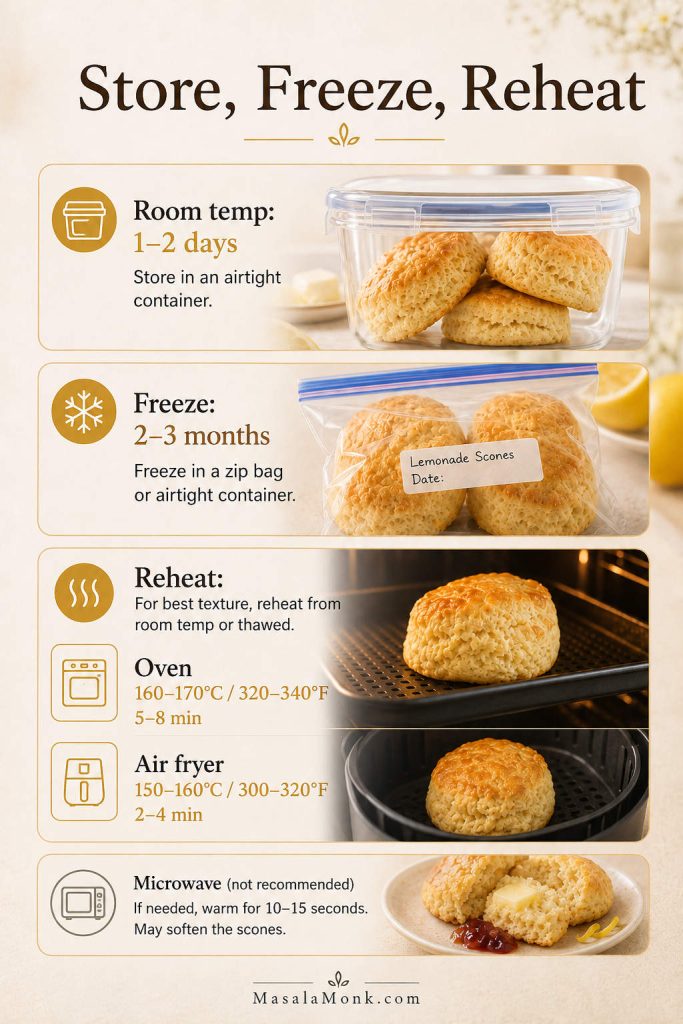
Storage and reheating guide showing lemonade scones in an airtight container, freezer storage, and gentle oven or air fryer reheating.
Lemonade scones are best warm on the day they are baked, but they are not useless the next day. Store them airtight, freeze extras early, and reheat gently so the crumb does not dry out.
  • Room temperature: store cooled scones in an airtight container for 1–2 days.
  • Freezer: freeze baked scones for up to 2–3 months. Wrap well to prevent freezer dryness.
  • Reheating in oven: warm at 160–170°C / 320–340°F for 5–8 minutes.
  • Reheating in air fryer: warm at 150–160°C / 300–320°F for 2–4 minutes.
  • Microwave: use only a short burst, around 10–15 seconds, because long microwaving can make scones rubbery.

You can also freeze cut, unbaked scones. Freeze them on a tray first, then transfer to a freezer bag. Bake from frozen, adding a few extra minutes to the bake time.

If you are building out easy comfort desserts for the week, this rice pudding with cooked rice is another low-effort recipe that turns simple leftovers into something warm and creamy.

Lemonade Scones Recipe Card

This lemonade scones recipe makes soft, tender 3-ingredient scones with self-raising flour, cream, and fizzy lemonade. They are best served warm, split open, and topped with jam and cream, clotted cream, butter, or lemon curd.

Prep Time10–15 minutes
Bake Time15–18 minutes
Total Time25–35 minutes
Yield18–20 small scones with a 5cm cutter, or 10–12 larger scones with a 6cm cutter

Ingredients

  • 500g self-raising flour — about 3⅓ metric cups or roughly 4 loosely spooned-and-levelled US cups, plus extra for dusting
  • 250ml chilled heavy cream, thickened cream, or whipping cream — about 1 cup, plus up to 50ml extra for brushing or adjusting the dough
  • 250ml chilled fizzy lemonade — about 1 cup
  • ¼ teaspoon fine salt, optional
  • 1–2 tablespoons milk or cream, for brushing the tops if not using the extra cream above
  • Jam, cream, clotted cream, butter, or lemon curd, for serving

Instructions

  1. Preheat the oven to 220°C / 425°F, or 200°C fan. Line a large baking tray with parchment paper.
  2. Add the self-raising flour to a large mixing bowl. Stir in the salt if using.
  3. Pour in 250ml chilled cream and 250ml chilled fizzy lemonade.
  4. Use a flat-bladed knife, spatula, or fork to mix gently until a soft, rough, slightly sticky dough forms. If there is dry flour left in the bowl, add extra cream 1 tablespoon at a time.
  5. Lightly flour the bench and your hands. Turn the dough out and bring it together gently.
  6. Pat the dough to 2.5–3cm / 1–1¼ inches thick.
  7. Dip a 5–6cm / 2–2½ inch round cutter in flour. Press down cleanly and lift straight back up so the sides can rise evenly.
  8. Place the scones on the prepared tray so they are just touching or nearly touching.
  9. Brush the tops lightly with milk or cream.
  10. Bake for 15–18 minutes, or until risen, lightly golden on top, hollow-sounding when tapped, and no longer wet or doughy in the center when gently pulled apart.
  11. Cover the hot scones loosely with a clean tea towel for a few minutes if you want softer tops.
  12. Serve warm with jam and cream, clotted cream, butter, or lemon curd.

Notes

  • The dough should be soft and a little tacky, not dry and smooth.
  • Use newly opened fizzy lemonade for the best lift.
  • If using plain flour, use 500g flour + 7 teaspoons baking powder + ¾ teaspoon fine salt.
  • For taller scones, keep the dough thick and cut cleanly.
  • If your oven browns quickly, bake at 200°C / 390°F or 180°C fan and add a few extra minutes.
  • For air fryer lemonade scones, cook smaller scones at 175–180°C / 350°F for 8–12 minutes, checking early.
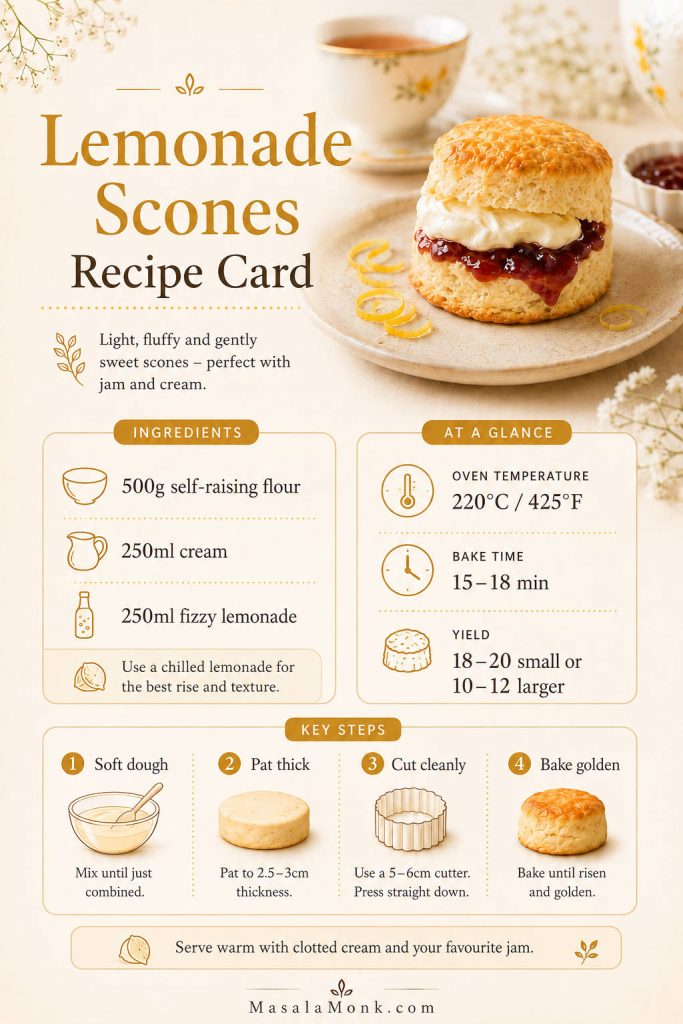
Saveable recipe card for lemonade scones showing ingredient quantities, oven temperature, bake time, yield, and key method notes.
Save the core formula before you bake: 500g self-raising flour, 250ml cream, 250ml fizzy lemonade, thick dough, clean cuts, and a hot oven. That simple system is what makes the recipe work.

FAQs

Here are the questions that usually come up once people realise “lemonade” can mean something different depending on where they live.

What kind of lemonade works best for lemonade scones?

Use a clear, sweet, fizzy lemonade or lemon-lime soda, opened right before mixing. The fizz matters more than the brand.

Do lemonade scones taste like lemonade?

Not strongly. They taste more like mild cream scones with gentle sweetness. For more lemon flavor, serve them with lemon curd, add a little lemon zest, or drizzle with a light lemon glaze.

Why is my lemonade scone dough so sticky?

A little stickiness is normal. Lemonade scone dough should feel softer than regular scone dough, so lightly flour your hands and bench instead of working lots of extra flour into the dough.

Why did my lemonade scones not rise?

The most common reasons are old self-raising flour, a cool oven, dough patted too thin, overworked dough, or a twisted cutter. Fresh flour, thick dough, clean cutting, and a hot oven make the biggest difference.

Sprite or 7Up: which one works better?

Both can work. Choose a clear, fizzy lemon-lime soda with a clean flavor, and open it right before mixing the dough.

What cream should I use?

Use heavy cream, thickened cream, or whipping cream. Full-fat cream gives the best texture because it replaces the butter used in traditional scones.

How thick should the dough be?

Pat the dough to about 2.5–3cm / 1–1¼ inches thick. Thinner dough usually means flatter scones.

Should lemonade scones touch while baking?

Yes, place them just touching or nearly touching. This encourages the scones to rise upward and keeps the sides softer.

Is sugar-free lemonade okay?

It can work, but regular fizzy lemonade gives better sweetness, browning, and flavor. Some sugar-free versions can also leave an aftertaste.

How do I make lemonade scones without cream?

Use a richer replacement such as sour cream, Greek yogurt with a splash of milk, full-fat coconut cream, or milk plus melted butter. Plain milk alone usually makes the scones less rich and more bread-like.

Are lemonade scones the same as regular scones?

They are similar in shape and serving style, but the method is different. Regular scones usually use butter rubbed into flour; lemonade scones use cream and fizzy lemonade to make a faster shortcut dough.

How do I reheat lemonade scones without drying them out?

Warm them gently in a low oven at 160–170°C / 320–340°F for 5–8 minutes, or in the air fryer at 150–160°C / 300–320°F for 2–4 minutes. Long microwaving can make them rubbery.

For another shortcut bake with a cozy, serve-warm feel, try this apple cinnamon roll bake with apple pie filling.

If you make these lemonade scones, notice how the dough felt before baking: soft and tacky, dry and crumbly, or almost too wet to cut? Share that detail with your result, especially if you used Sprite, 7Up, gluten-free flour, or a no-cream swap. Those real-batch notes are genuinely helpful for other readers trying the same version.
Back to top

Posted on 3 Comments

Easy English Scone Recipe

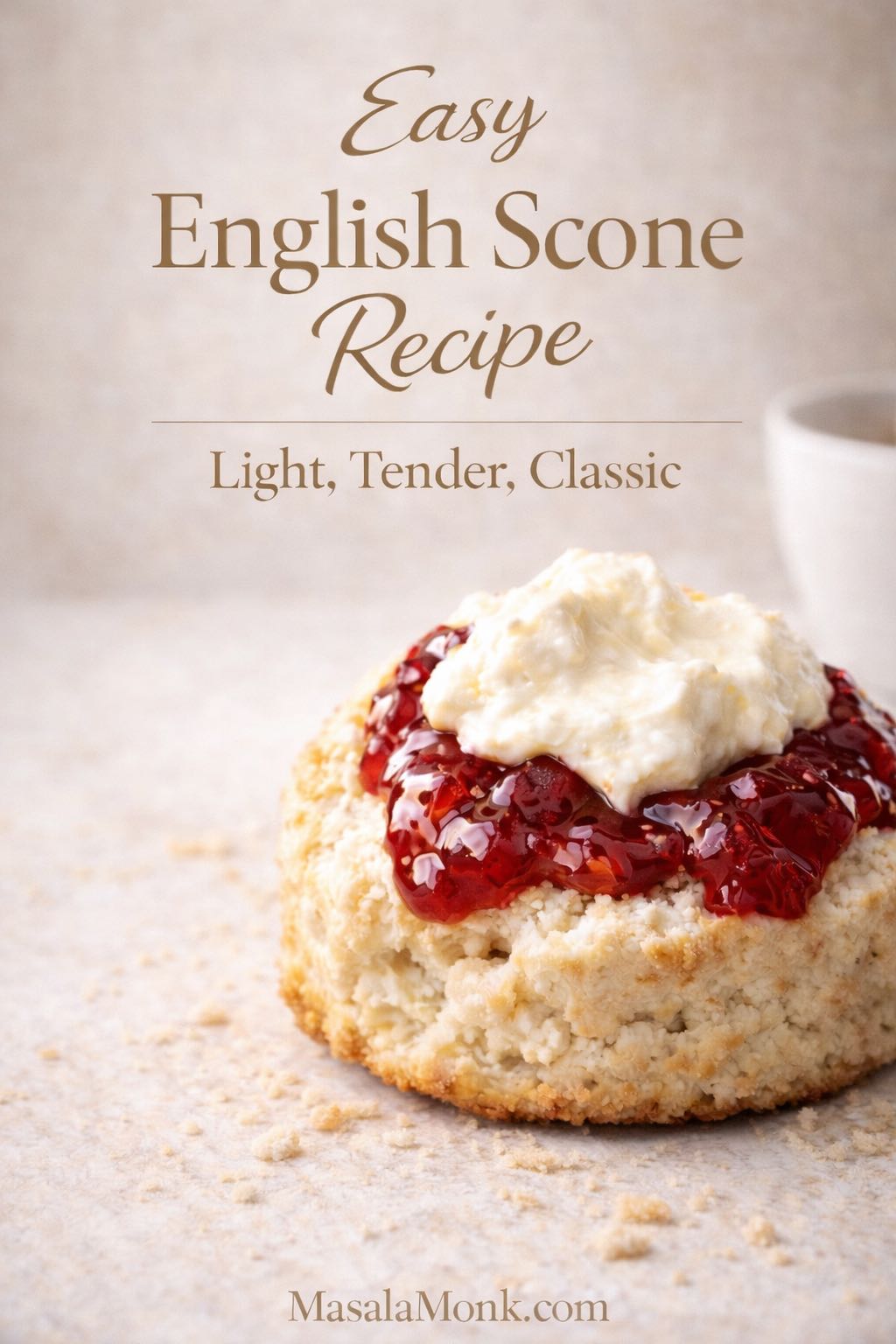
Split English scone topped with strawberry jam and clotted cream for an easy English scone recipe cover image.

This English scone recipe is built for the classic result: round scones with a light, tender crumb, gently golden tops, and just enough sweetness to work beautifully with jam and clotted cream. If you want an easy English scone recipe that stays close to the traditional style, this is the version to make.

The charm of English scones is that they do not ask for much. They ask for a dough that stays soft, handling that stays light, and shaping that gives them enough height to rise properly in the oven. Get those choices right, and the result feels balanced, familiar, and unmistakably classic.

Served warm or at room temperature with strawberry jam and clotted cream, these scones feel instantly at home on an afternoon tea table. They are especially lovely with masala chai recipes if you want a warmer spiced pairing, or with a cappuccino recipe if you are serving them for breakfast or brunch.

English Scone Recipe Ingredients

The ingredient list is short on purpose. Nothing here is decorative, and each ingredient has a clear job in the finished bake.

Dry Ingredients for English Scones

You will need:

  • 250 g self-raising flour
  • 1 tsp baking powder
  • 30 g caster sugar
  • 1 pinch salt

Self-raising flour keeps the method simple and gives the dough the kind of lift that suits classic English scones especially well. The extra baking powder adds support and helps keep the rise reliable. The sugar stays modest because this is not meant to be a sugary café pastry. It is meant to leave room for jam and cream at the table.

If you do not have self-raising flour, use 250 g plain flour plus 3 tsp baking powder in total for a close substitute. That will get you much nearer the intended texture than trying to improvise the swap.

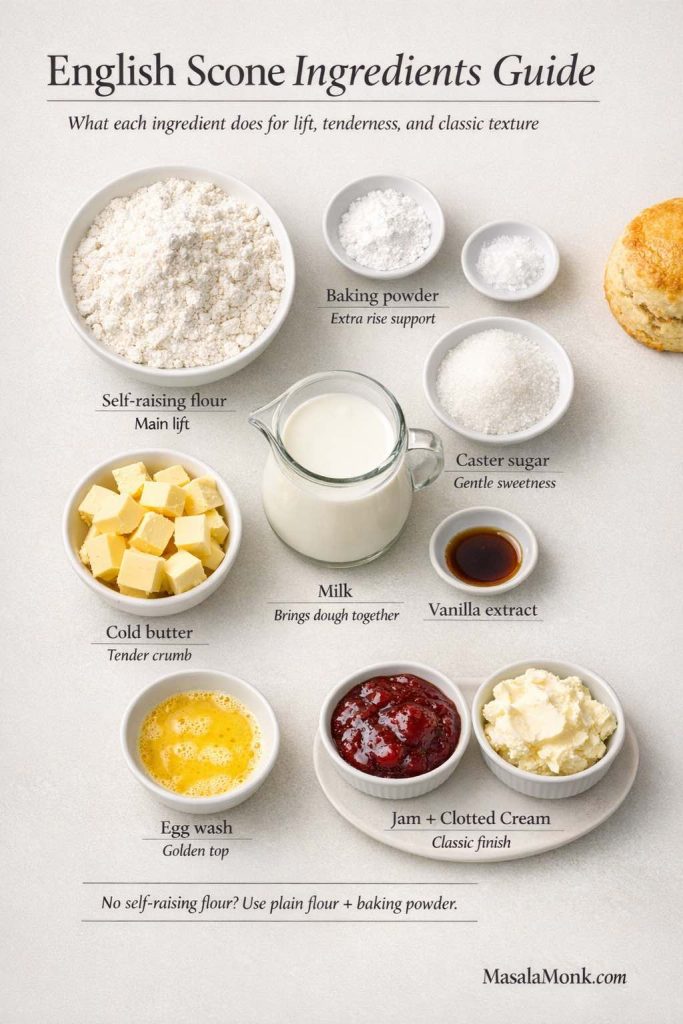
English scone ingredients guide showing self-raising flour baking powder sugar butter milk egg wash jam and clotted cream with ingredient role notes.
The structure of a good English scone starts here: flour and baking powder for lift, cold butter for tenderness, milk for a soft dough, and a finishing setup built around jam and clotted cream rather than extra sweetness in the base.

Butter, Milk, and Egg

You will need:

  • 60 g cold unsalted butter, cubed
  • 150 to 170 ml whole milk
  • 1 tsp vanilla extract, optional
  • 1 egg, beaten, for egg wash

Cold butter helps create the tender crumb that makes a good scone feel light rather than heavy. It should be rubbed into the flour until the mixture looks airy and crumbly, not greasy or paste-like. The milk brings the dough together, though the exact amount can vary slightly depending on your flour and your kitchen conditions. The egg does not go into the dough here. Instead, it is brushed over the tops so the scones bake with a soft shine and a gentle golden finish.

Classic English Scone Toppings: Jam and Clotted Cream

For the classic serving style, use:

  • strawberry jam
  • clotted cream

That pairing is not just a serving suggestion. It is part of the logic of the bake itself. English scones stay plainer and less sweet because they are designed to be completed at the table rather than to carry all the richness on their own.

Traditional cream tea is built around scones, jam, clotted cream, and tea, which is one reason this style remains so restrained and balanced. For a more useful reference point than a generic explainer, the protected Cornish clotted cream specification shows why it is treated as a distinct product, while the National Trust’s fruit scones recipe reflects the same classic jam-and-clotted-cream serving tradition.

If clotted cream is difficult to find where you live, mascarpone is the neatest substitute. Thick lightly whipped cream also works, though it gives a looser and less traditional finish.

Small Variations That Still Keep Them English-Style

If you want a little variation without changing the character of the recipe too much, keep it restrained. A small handful of currants or sultanas fits naturally, and a little lemon zest can work well too.

What does not belong in this version is a heavy fruit load, thick glaze, chocolate chips, or any shortcut that turns the bake into something else altogether.

Also Read: Punjabi Mutton Bhuna – Amritsari Village-Style Gosht Recipe

Easy English Scones Recipe Card

Yield: 8 scones
Prep time: 15 minutes
Bake time: 12 to 15 minutes
Total time: about 30 minutes
Oven temperature: 220°C / 425°F

Ingredients

  • 250 g self-raising flour
  • 1 tsp baking powder
  • 30 g caster sugar
  • 1 pinch salt
  • 60 g cold unsalted butter, cubed
  • 150 to 170 ml whole milk
  • 1 tsp vanilla extract, optional
  • 1 egg, beaten, for egg wash
  • strawberry jam, for serving
  • clotted cream, for serving
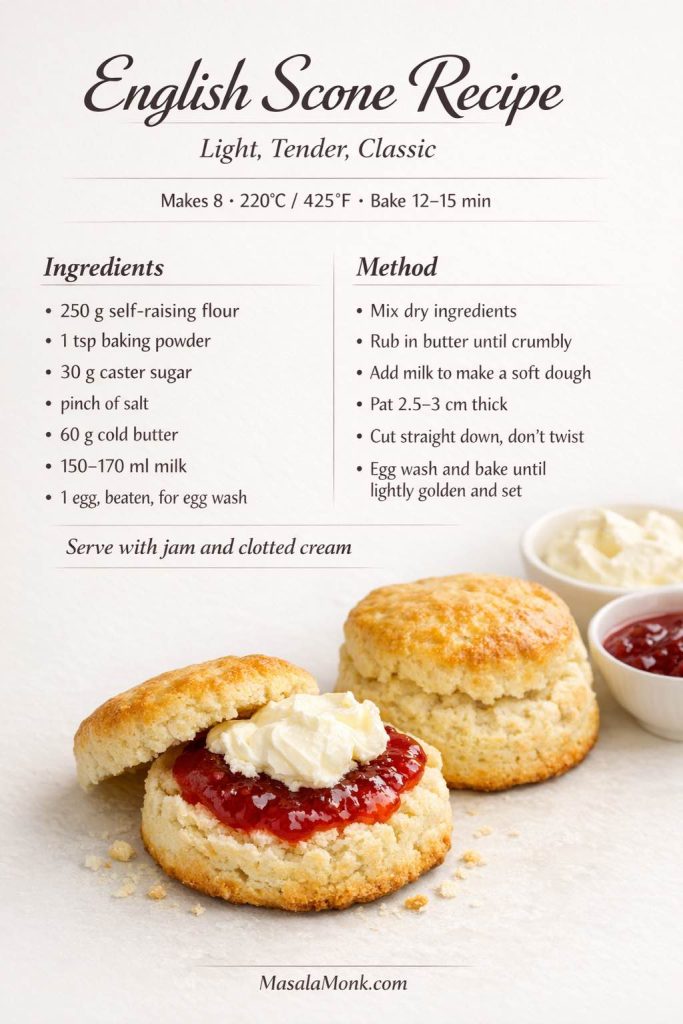
English scone recipe card showing ingredients, quick method, and classic scones served with jam and clotted cream.
Use this recipe card when you want the ingredient list, bake temperature, and quick method in one place. It is most useful once you know the flow and want to make a batch without scrolling through the full guide.

How to Make English Scones Step by Step

The method is simple, but the small cues matter. Most disappointing batches trace back to dough that was too dry, too heavily handled, or shaped too thin before baking.

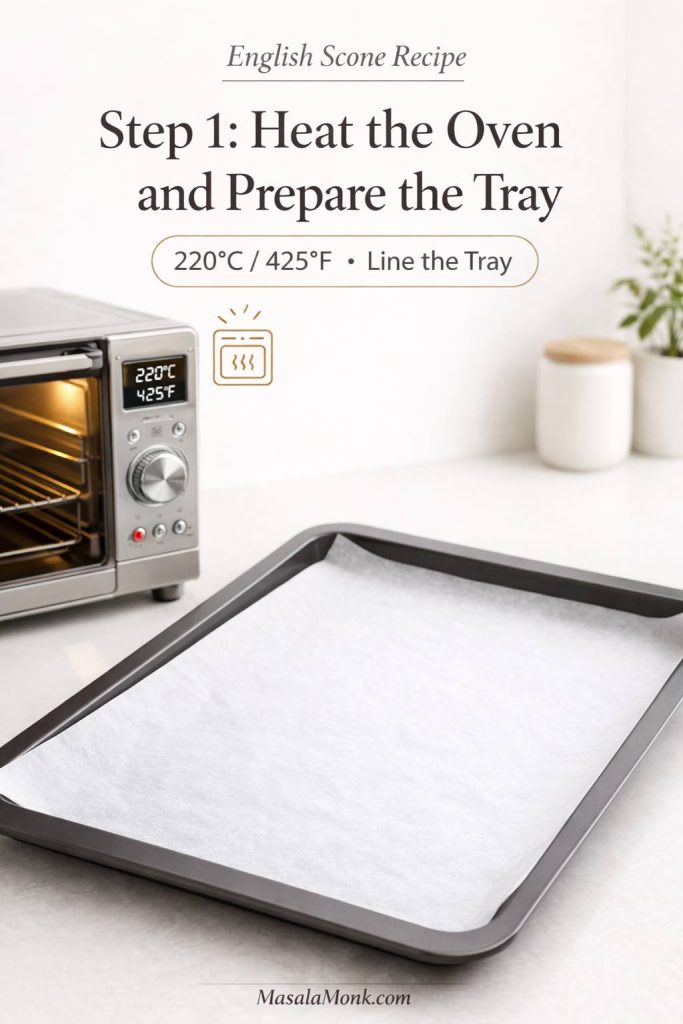
1. Heat the Oven and Prepare the Tray

Heat the oven to 220°C / 425°F and line a baking tray with parchment paper. A fully preheated oven matters here because the scones need strong early heat to rise before the structure sets.

Step 1 English scone recipe graphic showing a lined baking tray and oven preheated to 220C 425F before baking.
Starting with a fully heated oven gives English scones a better chance of rising quickly before the structure sets. That early burst of heat matters more than many people expect when the goal is a lighter, taller result.

Use a middle rack unless your oven runs unusually hot at the top.

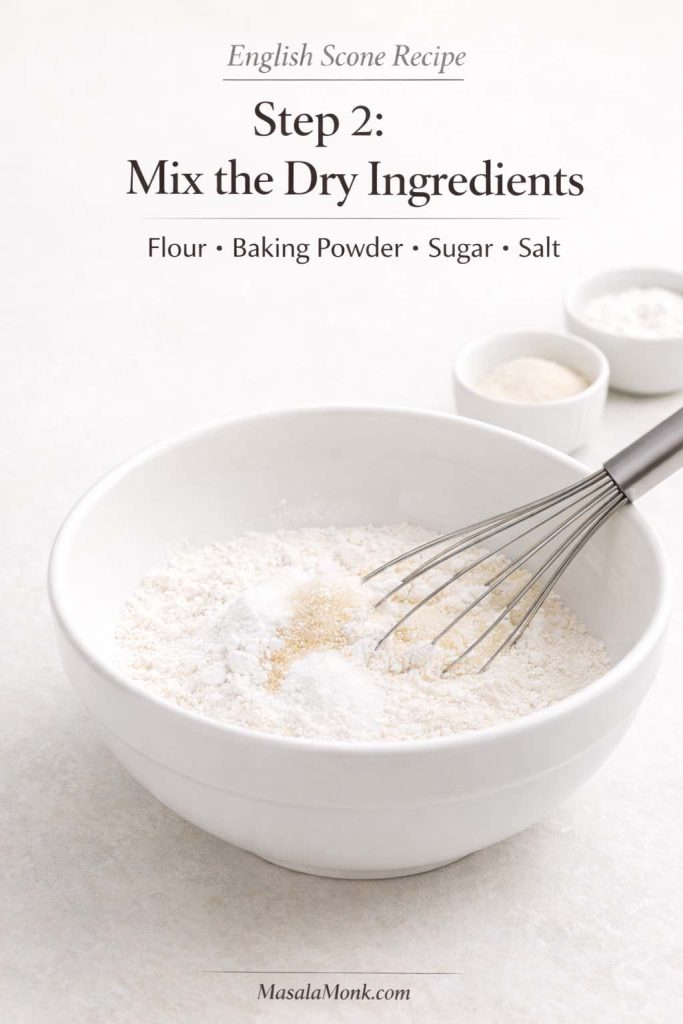
2. Mix the Dry Ingredients

In a large bowl, whisk together the self-raising flour, baking powder, caster sugar, and salt. This takes almost no time, but it helps distribute the lift evenly before the butter goes in.

Step 2 English scone recipe graphic showing flour, baking powder, sugar, and salt being mixed in a bowl before the butter is added
A quick whisk here helps distribute the baking powder, sugar, and salt more evenly through the dough, which gives the scones a more consistent start.

3. Rub in the Butter

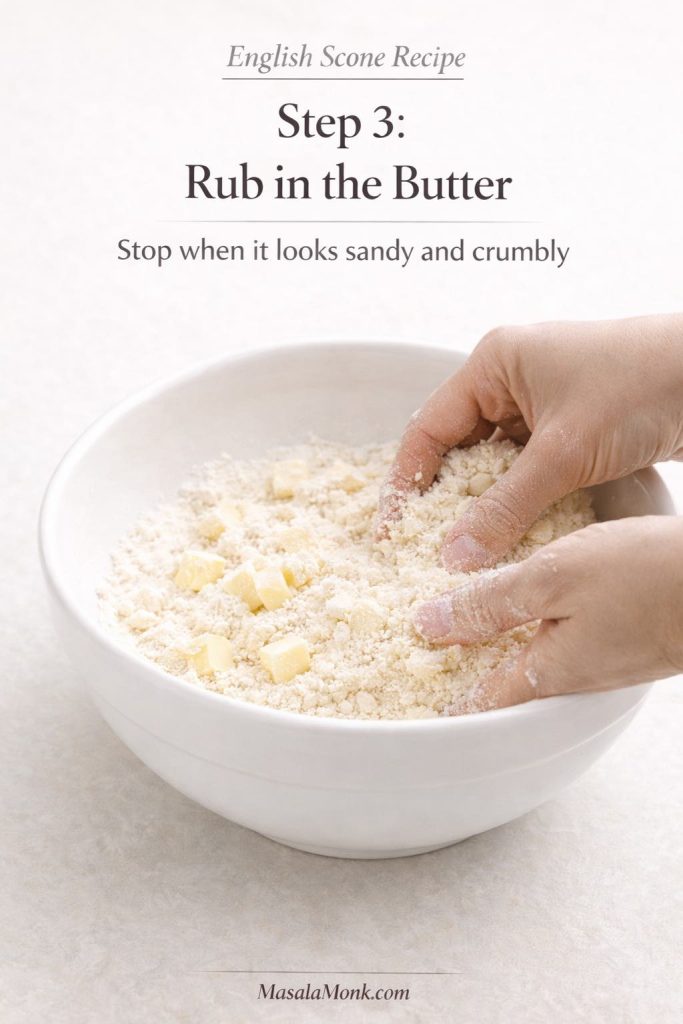
Add the cold butter cubes and rub them into the flour mixture with your fingertips until the texture looks like coarse crumbs.

You want a mixture that feels sandy and airy, with a few tiny buttery pieces still visible. If you squeeze a little in your hand, it should briefly clump, then fall apart again. Once the butter turns greasy or starts smearing into the flour, you have gone too far. If large cubes remain untouched, keep working a little longer.

Step 3 English scone recipe graphic showing cold butter being rubbed into flour until the mixture looks sandy and crumbly.
The butter should be rubbed in only until the mixture looks sandy and crumbly, with a few tiny buttery pieces still visible. That is what helps the finished scones stay tender instead of turning heavy or tight.

4. Add the Milk and Bring the Dough Together Gently

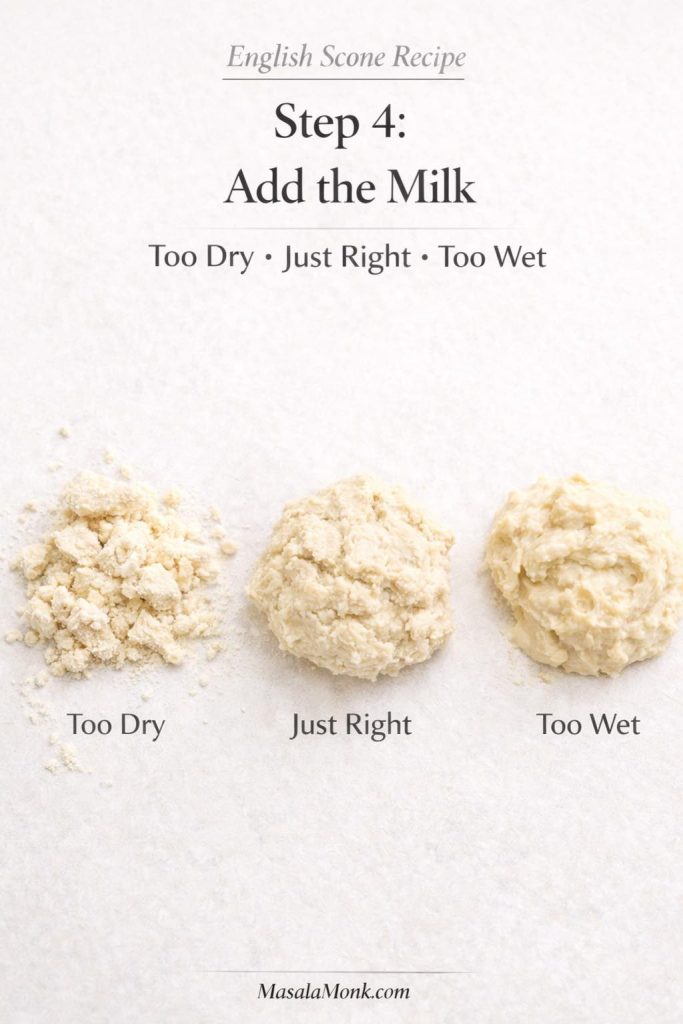
Pour in 150 ml milk and the vanilla, if using. Stir with a butter knife, fork, or spatula until the mixture starts to gather into a dough. Add more milk only if needed, a little at a time.

The dough should feel soft, slightly tacky, and easy to press together. It should not feel dry and stubborn, and it should not slump like batter either.

Step 4 English scone recipe dough guide showing too dry, just right, and too wet dough after adding milk.
This is the most important texture check in the recipe. The dough should look soft, rough, and cohesive enough to hold together without becoming sticky or slumped.

This is where many batches go wrong. People often stop early because they are nervous about stickiness, then end up with a dough that seems tidy but bakes up heavier than it should. In practice, slightly softer is usually safer than slightly dry.

5. Pat the Dough Thick Without Kneading

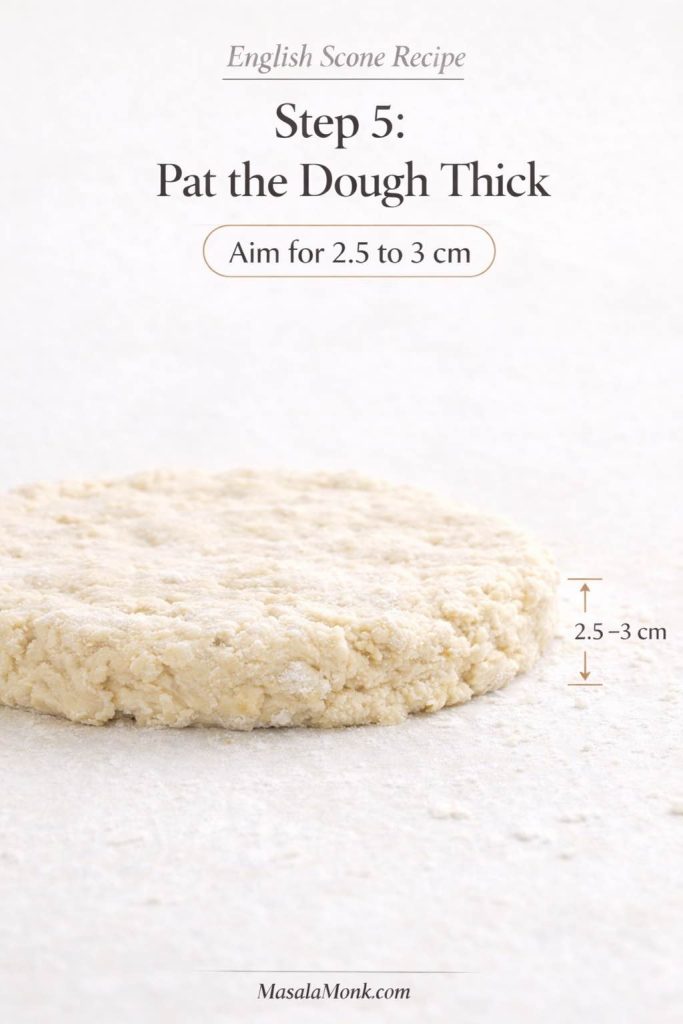
Turn the dough onto a lightly floured surface. With lightly floured hands, bring it together with a few gentle presses, then pat it into a round or rectangle about 2.5 to 3 cm thick.

Step 5 English scone recipe graphic showing dough patted 2.5 to 3 cm thick before cutting the scones.
Patting the dough thick gives the scones room to rise upward instead of baking flatter than you want. That one choice changes the final look more than many people expect.

Do not knead the dough like bread. Do not press it into a smooth, tight disc. It only needs to come together neatly enough to cut.

6. Cut Out the Scones

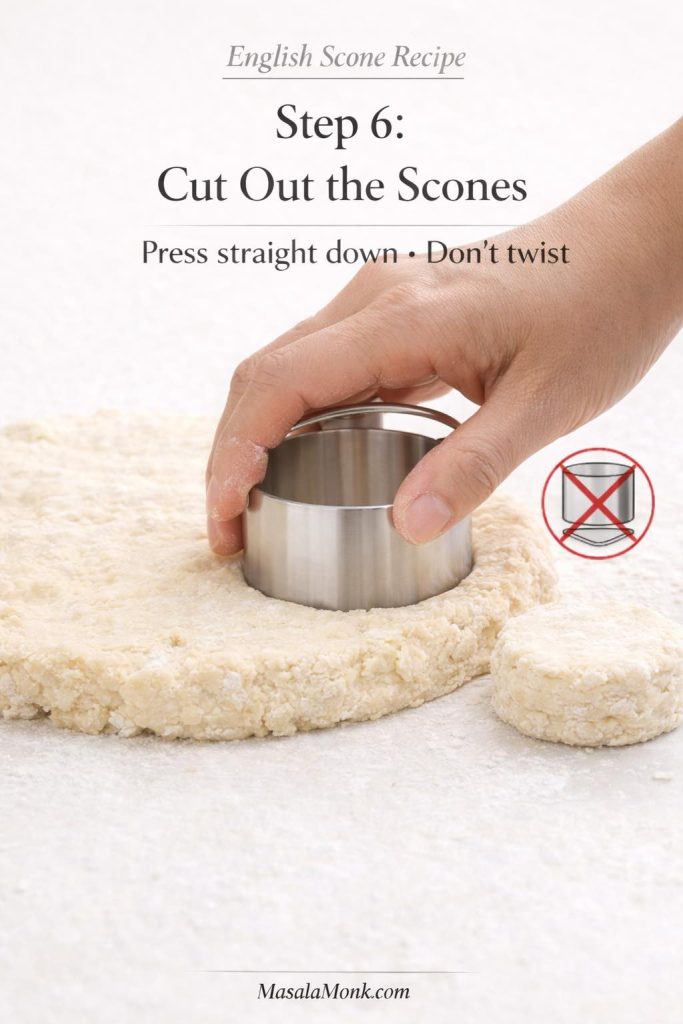
Use a 5 to 6 cm round cutter dipped lightly in flour. Press straight down, then lift cleanly.

Do not twist the cutter. Twisting compresses the edge and makes a clean rise harder. It seems like a small detail, but it shows up clearly in the oven.

Step 6 English scone recipe graphic showing a round cutter pressed straight down into thick dough without twisting.
A straight downward cut keeps the edges cleaner than a twisting motion, which gives the scones a better chance of rising neatly in the oven.

Place the cut scones on the lined tray with a little space between them. Gather the scraps gently, pat them together once, and cut again. The last few may look slightly less neat than the first ones, but they will still bake well if you do not keep reworking the dough.

If the cut rounds look soft or slightly slack at this stage, chill them for 10 minutes before baking. That short rest can help them hold their shape better.

7. Egg Wash and Bake

Brush only the tops with beaten egg. Try not to let the egg wash run down the sides, because that can limit the rise by sealing the edges.

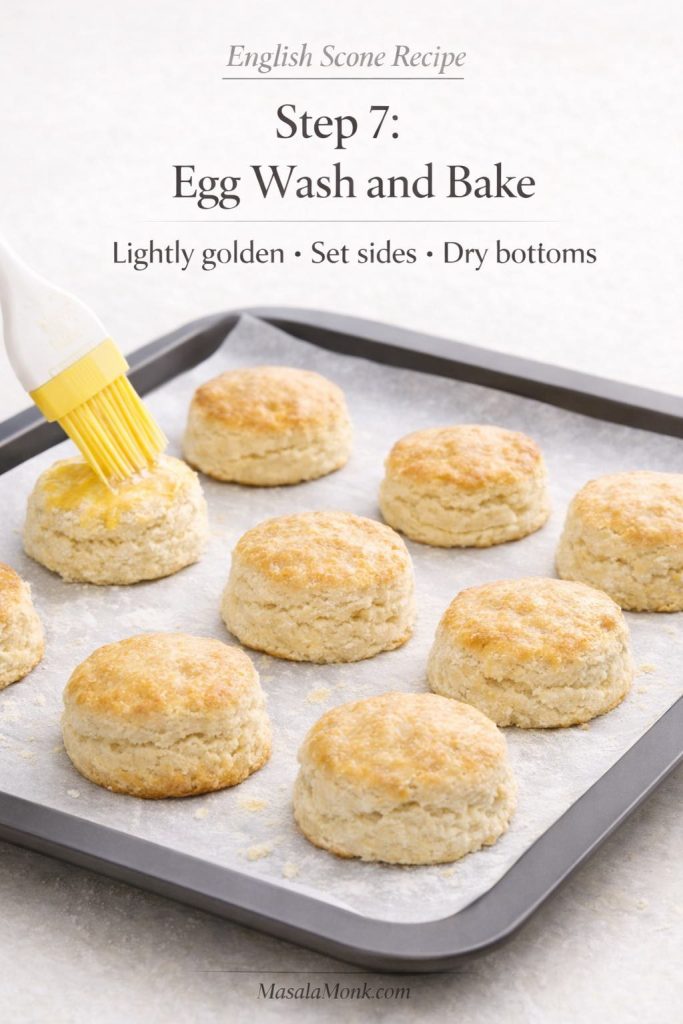
Step 7 English scone recipe graphic showing scones on a lined tray with egg wash and the correct lightly golden baked finish.
Do not judge doneness by color alone. The best batch should have lightly golden tops, sides that look set rather than damp, and bottoms that feel dry and baked through without turning hard.

Bake for 12 to 15 minutes. They are done when the tops are lightly golden, the sides look set rather than damp, and the bottoms look dry and lightly colored rather than pale and wet.

If they still look slightly heavy after 12 minutes, give them another minute or two and check again. When in doubt, break open the least tidy one from the batch. The center should look tender and set, not wet or gummy.

8. Cool Slightly and Serve

Let the scones cool for about 10 minutes before splitting and serving. They are excellent still slightly warm, when the crumb feels especially soft and the contrast with jam and clotted cream is at its best.

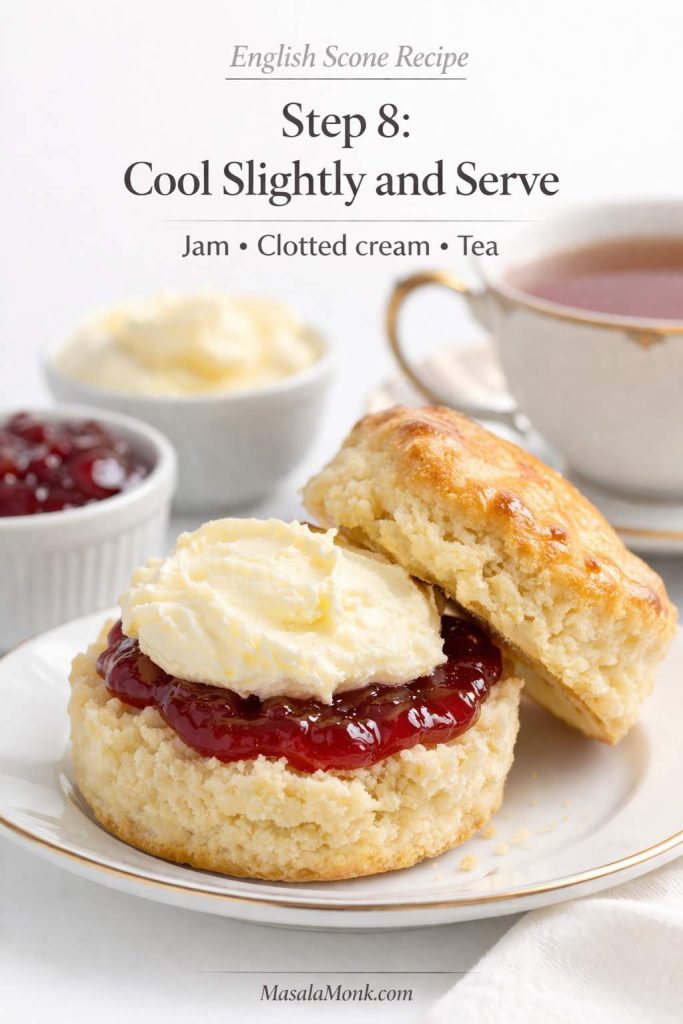
Step 8 English scone recipe graphic showing a split scone served with jam clotted cream and tea.
A short cooling time helps the crumb settle before serving, and it also keeps the jam and clotted cream from sliding around too much on a steaming-hot scone. This last pause improves the final experience more than it seems.

For a colder-day pairing, they also work beautifully with homemade hot chocolate with cocoa powder.

Why These English Scones Stay Light and Tender

The result stays light because the method avoids the three mistakes that most often drag scones down: dry dough, heavy handling, and shaping that is too thin.

A dough that feels slightly soft will usually bake better than one that feels overly tidy and controlled. Extra pressing and rerolling tighten the crumb. Thin shaping leaves less room for upward lift. Add those problems together, and even a good ingredient list can still produce a disappointing batch.

That is why the method stays restrained. It gives the dough enough structure to hold shape, but not so much handling that the finished scones lose their tenderness.

English Scones vs American Scones

Although they share a name, English scones and American scones usually aim for very different results. English scones are typically round, lightly sweet, and softer in character, while American scones are often larger, richer, more heavily flavored, and shaped in wedges.

In the English style, the scones are usually served as part of afternoon tea, split and spread with jam and clotted cream. On their own, they are modest by design.

Comparison graphic showing English scones with jam and clotted cream beside sweeter glazed American scones with key differences in shape texture and serving style.
This side-by-side guide shows why this post stays firmly in the English-scone lane. English scones are rounder, lighter, and built for jam and clotted cream, while American scones are usually sweeter, wedge-shaped, and more pastry-like.

American scones, by contrast, tend to be larger, sweeter, and richer. They are more likely to include chocolate, berries, glaze, nuts, citrus, or stronger mix-ins, and they are often treated as a standalone pastry to eat with coffee rather than as part of a cream-tea table.

That difference is exactly why this recipe stays deliberately restrained. The goal is not to make the richest or most dramatic scone possible. The goal is to make one that feels unmistakably English-style and succeeds on those terms.

Also Read: Cookie Pie Recipe: 10 Best Flavors, Fillings and Variations

How to Serve English Scones with Jam and Clotted Cream

The classic serving style is part of the point, not an afterthought. These scones feel most like themselves when they are split and served with strawberry jam and clotted cream, whether you arrange them before serving or set everything out so people can build their own.

Serving guide for English scones showing how to split the scone, add strawberry jam, top with clotted cream, and serve with tea.
Classic English scones are meant to be finished at the table, not treated like a sweeter standalone pastry. Use this guide to see the traditional flow clearly: split the scone, add jam, top with clotted cream, and serve with tea.

Split them gently rather than crushing them flat, then add the jam and clotted cream just before serving. If you are building a full cream-tea setup, keep the tea hot and the scones lightly warm or fully cooled rather than steaming, so the toppings sit neatly instead of sliding off.

Slightly warm scones are often the most satisfying because the crumb feels softer and the butteriness comes through more clearly. Room-temperature scones are just as traditional and often more practical for a fuller afternoon tea spread. What matters most is that they still feel fresh enough to split cleanly and tender enough inside to welcome jam and cream.

This is also where the restrained sweetness of the dough proves its value. A heavily sweetened scone would compete with the toppings, while a classic English scone leaves room for them and lets the full serving feel balanced rather than overdone. For a more heritage-led British reference point, the National Trust’s traditional fruit scones recipe follows the same broader jam-and-clotted-cream serving direction.

Tea is the obvious partner, though coffee works beautifully too. If you want something warm alongside them, masala chai recipes and a cappuccino recipe both fit naturally.

English Scone Troubleshooting Guide

If your batch turns out dense, dry, flat, or uneven, the cause is usually easier to trace than it first seems.

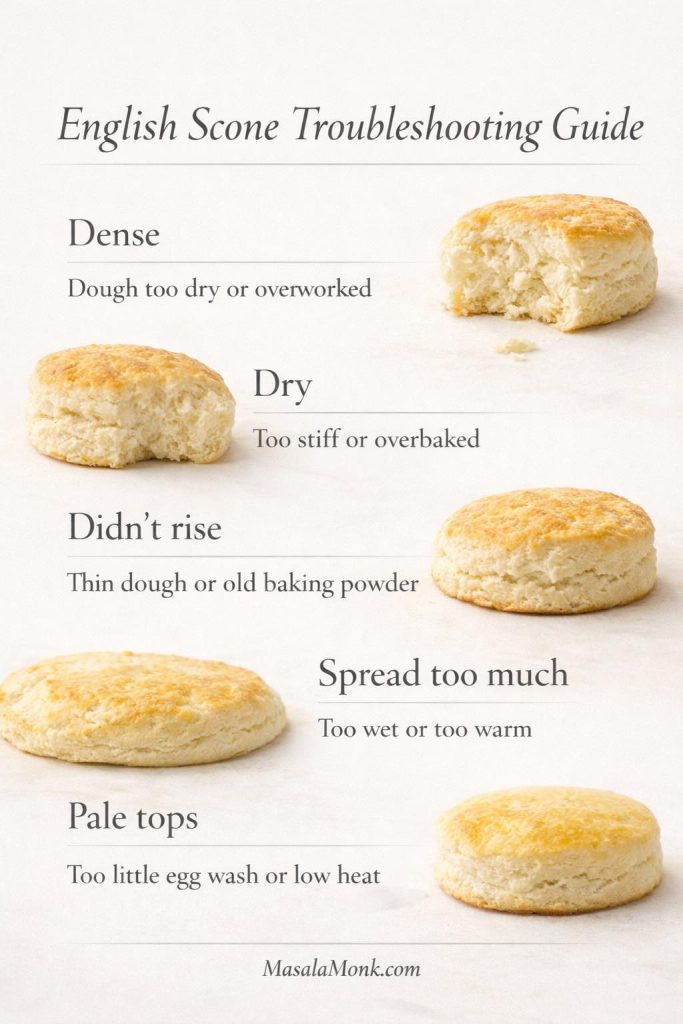
English scone troubleshooting guide showing common problems like dense dry flat and pale scones with quick causes and fixes.
Keep this troubleshooting guide nearby when a batch turns out dense, dry, flat, or pale. Most problems trace back to dough texture, thickness, cutter technique, or baking cues, so spotting the likely cause makes the next batch much easier to fix.

Why Did My Scones Turn Out Dense?

Dense scones usually come from dough that was too dry or too heavily worked. If the mixture felt stiff before baking, cracked when pressed, or needed force to come together, that is the clearest clue.

Keep the dough softer next time, stop mixing earlier, and handle the scraps as little as possible. Also make sure the oven is fully hot before the tray goes in.

Why Are My English Scones Dry?

Dry scones are usually the result of dough that began too stiff or baking that ran too long. If the tops went deeper brown than intended, the crumb may have dried out before you pulled them.

Use enough milk to keep the dough soft, and take them out when they are lightly golden rather than deeply browned. Once they are fully cool, store them promptly instead of leaving them exposed on the counter.

Why Didn’t My Scones Rise Properly?

Poor rise usually points to one of four things: old baking powder, dough patted too thin, a cutter twisted instead of pressed straight down, or an oven that was not fully hot.

Use fresh raising ingredients, keep the dough thick, cut cleanly, and bake in a properly preheated oven.

Why Did They Spread Instead of Rising Tall?

Spreading is usually a sign that the dough was too warm, too wet, or too thin. If the cut rounds looked soft and a little slack on the tray before baking, that is your clue.

Hold back some of the milk until you know the dough needs it, keep the thickness at 2.5 to 3 cm, and chill the cut scones briefly if they seem very soft.

Why Are the Tops Pale or Uneven?

Pale tops usually mean the egg wash was too light, the oven heat was a little low, or the dough thickness varied across the batch. Uneven tops can also happen when the scraps are handled more roughly than the first cuts.

Brush the tops carefully, keep the dough even, and make sure the oven is fully hot.

How Do I Keep English Scones Soft After Baking?

Do not overbake them, let them cool only as long as needed, then store them airtight once fully cool. A brief reheat before serving helps a lot.

Also Read: White Russian Recipe: 7 Variants to Try, From Classic to Frozen

How to Store, Freeze, and Reheat English Scones

English scones are best the day they are baked, when the crumb is softest and the structure still feels freshest. Even so, they store and freeze better than many people expect if you handle them properly.

If freshness matters most to you, freezing shaped unbaked scones is usually the better move than storing baked ones for too long. That way you keep more of the just-baked texture and get much closer to the original result.

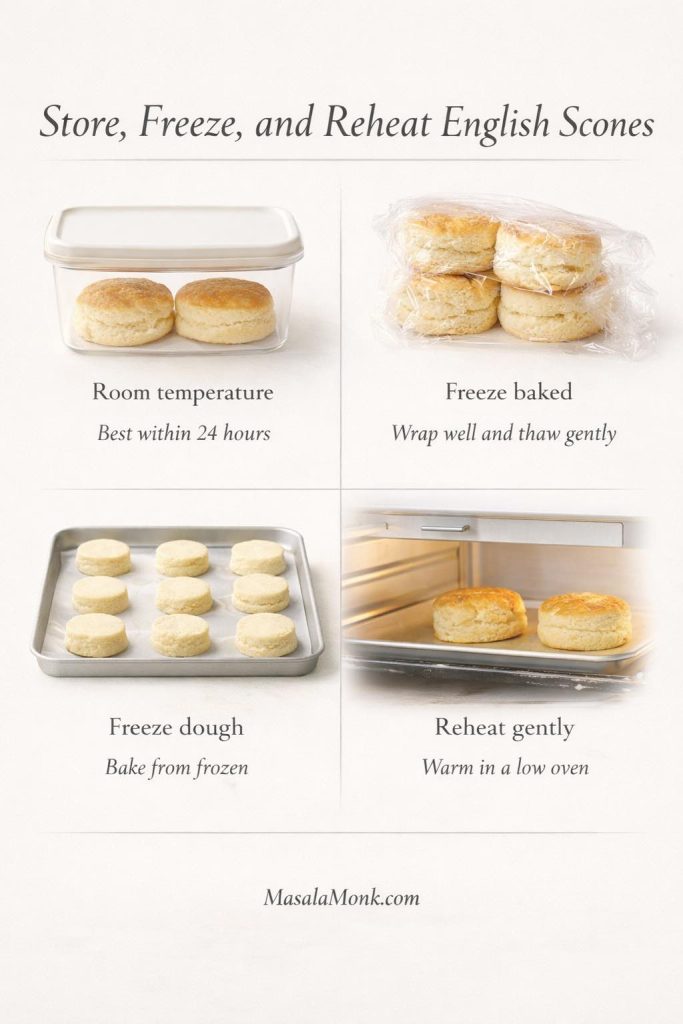
Storage guide for English scones showing room temperature storage, freezing baked scones, freezing dough, and reheating in a low oven.
Use this guide to keep English scones worth eating after the first bake. Room-temperature storage works best for the short term, freezing baked scones helps with leftovers, freezing shaped dough gives you the freshest later result, and gentle reheating brings back more of the soft crumb.

Room-Temperature Storage for English Scones

Once fully cool, store the scones in an airtight container at room temperature. They are best within 24 hours and still pleasant on day two if gently rewarmed.

Should You Refrigerate Them?

Refrigeration is usually not the best choice for plain baked scones because it can make them feel firmer and less fresh. Room temperature for a short window or freezing for longer storage is usually the better route.

How to Freeze a Baked English Scone

Let the baked scones cool completely, then wrap them well and freeze them in an airtight container or freezer bag. Thaw them, then warm them gently until just heated through.

How to Freeze Unbaked English Scone Dough

Freezing shaped dough is often the better option if you want fresh-baked scones later. Cut the scones, place them on a tray until firm, then transfer them to a freezer-safe container or bag. Bake from frozen, giving them about 2 to 4 extra minutes as needed.

How to Reheat English Scones Without Drying Them Out

Warm the scones in a low oven just until heated through. Do not blast them with high heat or leave them in too long. Gentle reheating brings back some softness without drying out the crumb.

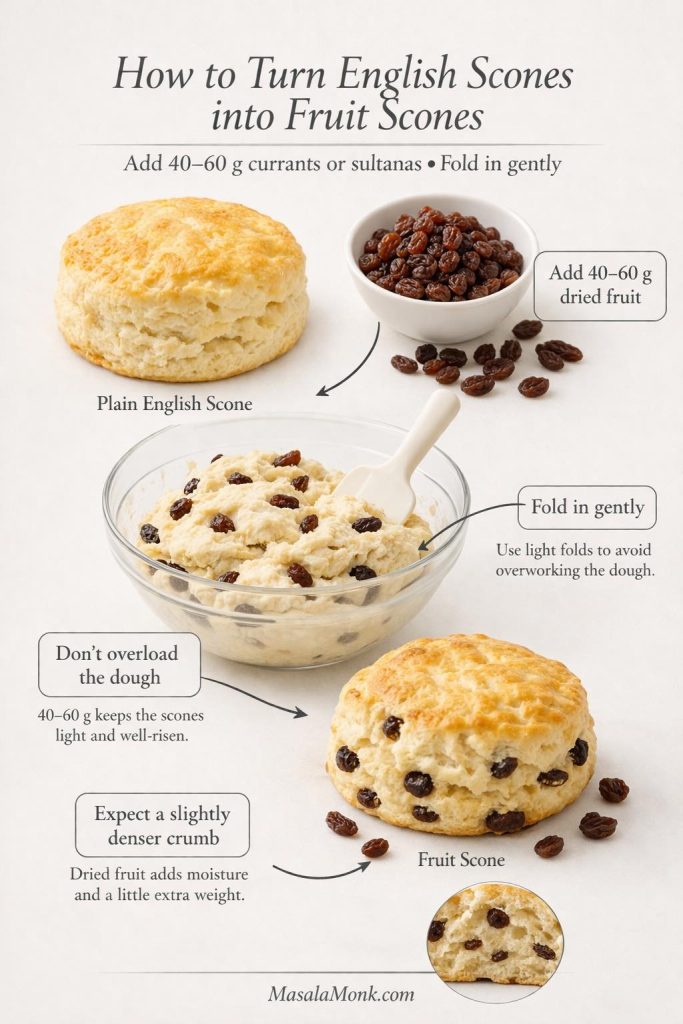
How to Turn These English Scones Into Fruit Scones

If you want to adapt this recipe into a fruit version, fold in a small handful of currants or sultanas after the butter has been rubbed in and before the milk goes in. If you enjoy bakes that lean more fruit-forward and comforting, peach cobbler with canned peaches is another good one to bookmark.

Variation guide showing how to turn English scones into fruit scones with currants or sultanas without overloading the dough.
A fruit-scone variation works best when it stays restrained. Adding about 40 to 60 grams of currants or sultanas gives the dough a classic fruit note without weighing it down too much, though the crumb will be slightly denser than the plain version.

The key is restraint. A little dried fruit works beautifully. Too much starts to weigh the dough down and changes the balance of the bake. As a guide, around 40 to 60 g is enough for this quantity of dough.

Fold the fruit through gently so it spreads evenly without overworking the dough. You want enough in each scone to taste it, but not so much that the mixture turns heavy, patchy, or harder to cut cleanly.

Final Thoughts

A good English scone recipe does not need extra drama. It needs the right decisions at the right moments.

Keep the dough soft, shape it thick enough to rise well, cut it cleanly, and bake it in a properly heated oven. Do that, and you end up with the kind of scone people actually want: tender, gently risen, lightly sweet, and ready for jam and clotted cream.

That is why this version stays so focused. It is not trying to cover every possible style. It is trying to help you make one classic batch well, and that clarity is what makes a recipe worth returning to. If you enjoy classic bakes that reward small technique choices, sourdough English muffins are another strong next bake.

Also Read: White Russian Recipe: 7 Variants to Try, From Classic to Frozen

English Scone FAQs

1. Can I make English scones without self-raising flour?

Yes. For this recipe, use 250 g plain flour plus 3 tsp baking powder in total for the closest substitute. That will get you much nearer the intended texture than trying to guess the swap.

2. What can I use instead of clotted cream?

Mascarpone is the neatest substitute if clotted cream is hard to find. Thick lightly whipped cream also works, though it gives a softer, looser, and less traditional finish.

3. Why didn’t my English scones rise properly?

The most common causes are dough that was patted too thin, old baking powder, twisting the cutter instead of pressing straight down, or putting the tray into an oven that was not fully preheated. Keeping the dough thick and the oven properly hot makes a big difference.

4. Can I freeze English scone dough?

Yes. Shape and cut the scones first, freeze them until firm, then transfer them to a freezer-safe container or bag. Bake them from frozen and add about 2 to 4 extra minutes as needed.

Posted on Leave a comment

Broccoli, Potato & Corn Tater Tots- Guilty pleasures made less guilty

Before beginning the recipe, here’s a very interesting insight about Tater Tots. I am sure you know, Tater tots were invented by an American frozen food Company, Ore-Ida, in the year 1953. Tater is short for potato. This recipe came into being when the founders were trying to figure out what to do with the leftover slivers of cut-up potatoes. They chopped up the slivers, added flour and seasoning and the product was first offered commercially in stores in 1956.

Now, what I found most interesting is that, originally these tots were inexpensive. People didn’t buy it because they thought it’s cheap. It’s when the company raised it’s prices, people began buying it. Human psychology can really be weird. 😄 Today, Americans consume approximately 70 million pounds. Can you imagine!!!

Overtime recipe was developed further and potatoes were substituted with other nutritious vegetables like cauliflower, broccoli, zucchini. 

These Homemade Tater Tots are way easier to throw together than I expected them to be, and my family loved them! So say goodbye to those frozen bags of tater tots. This homemade version is super easy to make, budget-friendly, and taste way better than store-bought!

So, here’s a healthy and a delicious twist on tater tots, made with nutrient-rich broccoli and crispy breadcrumbs, perfect as a side or snack.

Ingredients: for 30-35 tots

  • 4 medium size boiled Potatoes 
  • 1/2 cup Sweet Corn Kernels
  • 1 large head Broccoli, approx 350 grams
  • 1 tbsp minced Garlic
  • Salt and pepper to taste
  • 1 cup Bread Crumbs
  • 1 large Egg
  • 1 tbsp Chilli flakes (optional)
  • 1/2 tsp Italian seasoning (optional)
  • 90 grams of Cheddar Cheese, grated

Method:

  • Grate boiled potatoes in a bowl. Add 1/2 cup frozen sweet corn kernels in boiling water. Keep aside for 10 minutes. You can use boiled fresh corn too.
  • Grate 1 large head of broccoli. Add 1 tsp salt to it and keep aside for 20 minutes. 
  • Squeeze out as much water as you can from the broccoli. Coarsely blend corn in a blender. Just blitz for 10 to 15 seconds. (DO NOT ADD WATER). Add both broccoli and corn to the potatoes. 
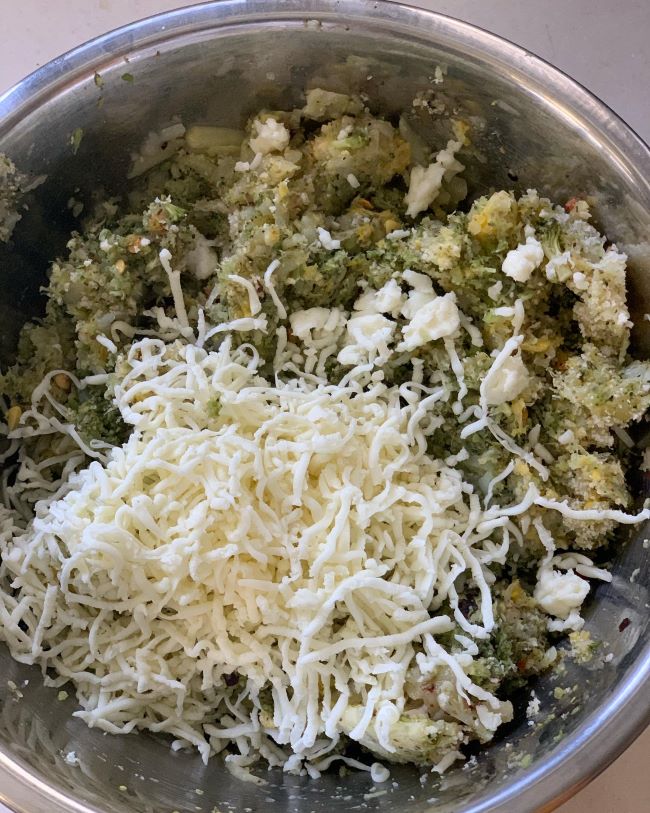
  • Now add minced garlic, salt & pepper to taste, egg, bread crumbs, chilli flakes, Italian seasoning and grated cheddar cheese (you can add more). Mix everything well and form a thick paste. If it feels sticky, add more bread crumbs. 
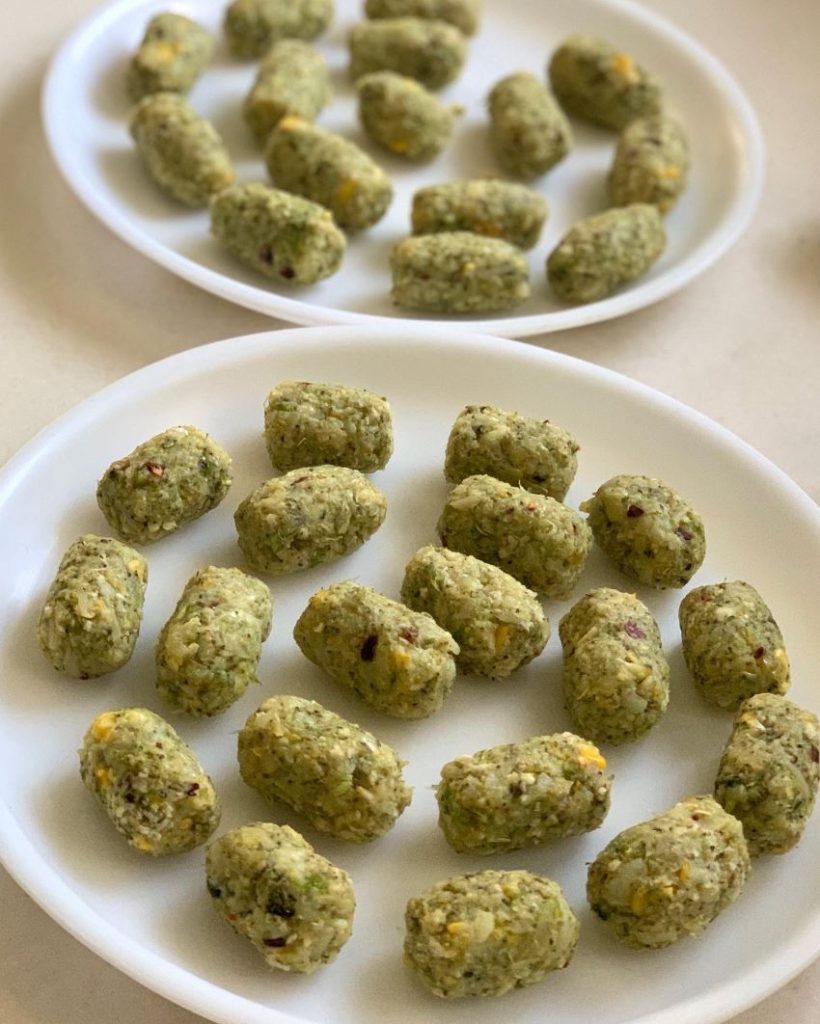
  • Check for seasoning. Once ok, give it a cylindrical shape or any shape you like. Refrigerate it for 30 minutes. 
  • Pre-heat the oven at 200°C.
  • Spray a nonstick baking sheet with oil. Alternatively, line baking tray with parchment paper and brush it with oil. Shape the mixture into tot shapes and spread them evenly on the sheet.
  • Bake for 8–9 minutes. Flip and then bake for an additional 8–9 minutes on the other side until golden brown.
  • Serve it with ketchup, mint chutney or tzatziki (hung curd dip). I personally enjoy them with tzatziki.

Enjoy!!! 🙂

Posted on Leave a comment

Embrace the Flavorful Combinations of Cardamom and Star Anise Iced Tea

cold drinks served on clear highball glass with lemon garnish

Hello, Tea Enthusiasts! 🍵💛

Are you ready to embark on a journey of exotic flavors and captivating aromas? Join us as we explore the enchanting world of Cardamom and Star Anise Iced Tea, where the warm spice of cardamom and the delicate sweetness of star anise come together to create a truly unique and delightful beverage. These aromatic ingredients will transport you to distant lands and infuse your afternoon with a touch of intrigue and indulgence. Today, we invite you to discover five flavorful combinations of Cardamom and Star Anise Iced Tea that will awaken your senses and leave you craving for more. Get ready to immerse yourself in the tantalizing flavors and fragrant bliss! 🌞🌿🍹

Cardamom, with its rich and aromatic profile, and star anise, with its delicate licorice-like flavor, are two spices that possess a distinct character and a depth of taste. When combined, they create a harmonious blend that adds complexity and an exotic touch to your iced tea. Today, we have the pleasure of delving into the possibilities of Cardamom and Star Anise Iced Tea and experiencing the captivating flavors they offer. Let’s unlock the secrets of these spices and embark on a journey of taste and sensation. ✨🌍💫

Before we explore the flavorful combinations, let’s take a moment to appreciate the individual qualities of cardamom and star anise. Cardamom, often referred to as the “Queen of Spices,” is known for its warm, citrusy, and slightly floral taste. It is commonly used in Indian and Middle Eastern cuisine and adds a fragrant depth to any dish or beverage. Star anise, on the other hand, is a star-shaped spice with a sweet and licorice-like flavor. It is a staple in Chinese and Vietnamese cuisine and imparts a subtle sweetness and an aromatic quality. Together, cardamom and star anise create a captivating fusion that will transport your taste buds to distant lands and awaken your senses. Today, we have the opportunity to explore their delightful qualities and create truly exceptional iced tea blends. 🌼🏯⏳

1. Classic Cardamom and Star Anise Iced Tea: Let’s begin with a classic recipe that showcases the essence of cardamom and star anise. Start by brewing your favorite black tea and allowing it to cool. In a separate container, crush a few cardamom pods and add them, along with a couple of star anise pods, to the cooled tea. Let the flavors meld together for a while, then strain to remove the spices. Serve the tea over ice and garnish with a sprinkle of ground cardamom and a star anise pod. The result is a refreshing and aromatic iced tea that combines the distinct flavors of cardamom and star anise. Each sip is a moment of exotic bliss, as the spices dance on your palate and transport you to far-off lands. 🍵👌

2. Cardamom and Star Anise Chai Iced Tea: Elevate your afternoon with the comforting and spiced flavors of chai in your Cardamom and Star Anise Iced Tea. Begin by brewing a strong black tea with the traditional chai spices of cardamom, cinnamon, cloves, ginger, and a couple of star anise pods. Allow the tea to cool, then strain to remove the spices. Serve the tea over ice and sweeten with honey or sugar to taste. Garnish with a sprinkle of ground cardamom and a star anise pod. The result is a fragrant and invigorating iced tea that combines the robustness of chai with the distinctive flavors of cardamom and star anise. Each sip is like a journey through spice markets, as the flavors intermingle and create a symphony of taste. ☕✨

3. Cardamom and Star Anise Herbal Infusion: Explore the world of herbal infusions by incorporating cardamom and star anise into your favorite herbal tea blend. Begin by brewing a herbal tea of your choice, such as chamomile or rooibos tea, and allowing it to cool. In a separate container, crush a few cardamom pods and add them, along with a couple of star anise pods, to the cooled tea. Let the flavors meld together for a while, then strain to remove the spices. Serve the tea over ice and garnish with a sprinkle of ground cardamom and a star anise pod. The result is a soothing and aromatic herbal infusion that combines the comforting qualities of herbal tea with the exotic flavors of cardamom and star anise. Each sip is like a moment of serenity, as the fragrant spices envelop your senses and the herbal notes soothe your soul. 🌿🍵

4. Cardamom and Star Anise Citrus Iced Tea: Add a zesty twist to your Cardamom and Star Anise Iced Tea by incorporating the vibrant flavors of citrus. Squeeze fresh lemon or orange juice into your iced tea, and garnish with slices of citrus fruits, crushed cardamom pods, and star anise pods. The combination of the tangy citrus and the aromatic spices creates a refreshing and uplifting blend. Each sip is like a burst of vitality, as the citrus flavors awaken your senses and the cardamom and star anise add layers of complexity and intrigue. 🍋🍵

5. Cardamom and Star Anise Coconut Iced Tea: Experience a tropical delight with the addition of coconut to your Cardamom and Star Anise Iced Tea. Start by brewing a black tea and allowing it to cool. In a separate container, crush a few cardamom pods and add them, along with a couple of star anise pods, to the cooled tea. Let the flavors meld together for a while, then strain to remove the spices. Stir in coconut milk or coconut water to taste. Serve the tea over ice and garnish with a sprinkle of ground cardamom and a star anise pod. The result is a creamy and exotic iced tea that combines the tropical notes of coconut with the aromatic flavors of cardamom and star anise. Each sip is like a sip of paradise, as the creamy coconut and the fragrant spices transport you to a tranquil beachside retreat. 🌴🍵

With these flavorful combinations of Cardamom and Star Anise Iced Tea, your afternoon tea break will be transformed into a sensory journey of taste and aroma. Each sip is an opportunity to savor the exotic blends and discover new dimensions of flavor. So, take a moment to indulge in the warmth of cardamom, the delicate sweetness of star anise, and the captivating allure of these blends.

As you explore these combinations, feel free to experiment and create your own unique variations of Cardamom and Star Anise Iced Tea. Add a personal touch, adjust the spice level or sweetness to suit your preferences, and let your creativity shine. Enjoy the vibrant and exotic flavors, and let them transport you to the enchanting corners of the world.

We hope you enjoy these flavorful combinations of Cardamom and Star Anise Iced Tea and let them awaken your senses and ignite your taste buds. Stay tuned for more tea explorations in our upcoming posts. Until then, may your midday breaks be filled with moments of pure delight and the captivating allure of flavors! ☕✨💛

Posted on Leave a comment

Indulge in the Delightful Variations of Vanilla and Nutmeg Iced Tea

sliced orange fruit in clear drinking glass

Hello, Tea Enthusiasts! 🍵💛

Are you ready to add a touch of warmth and sweetness to your afternoon? Join us as we explore the enchanting world of Vanilla and Nutmeg Iced Tea, where the creamy notes of vanilla and the warm essence of nutmeg come together to create a truly delightful beverage. These classic and comforting flavors will transform your midday break into a moment of indulgence and relaxation. Today, we invite you to discover five delightful variations of Vanilla and Nutmeg Iced Tea that will take you on a journey of taste and tranquility. Get ready to immerse yourself in the soothing flavors and aromatic bliss! 🌞🌿🍹

Vanilla, with its smooth and creamy flavor, and nutmeg, with its warm and aromatic profile, are two ingredients that evoke a sense of comfort and luxury. When combined, they create a harmonious blend that enhances the sweetness and adds a hint of spice to your iced tea. Today, we have the pleasure of exploring the possibilities of Vanilla and Nutmeg Iced Tea and savoring the exquisite flavors they offer. Let’s unlock the secrets of these ingredients and embark on a journey of taste and relaxation. ✨🌍💫

Before we delve into the variations, let’s take a moment to appreciate the individual qualities of vanilla and nutmeg. Vanilla, derived from the orchid plant, is known for its rich and creamy taste, with hints of sweetness and floral notes. Nutmeg, on the other hand, is the seed of the evergreen tree Myristica fragrans, and it boasts a warm and slightly sweet flavor with a touch of spiciness. Together, vanilla and nutmeg create a delightful fusion that adds depth and indulgence to your iced tea. Today, we have the opportunity to explore their delightful qualities and create truly enjoyable variations. 🌼🏯⏳

1. Classic Vanilla and Nutmeg Iced Tea: Let’s start with a classic recipe that celebrates the essence of vanilla and nutmeg. Begin by brewing your favorite black tea and allowing it to cool. In a separate container, add a splash of vanilla extract or a vanilla bean pod, along with a pinch of ground nutmeg, to the cooled tea. Stir well to infuse the flavors, and serve the tea over ice. Garnish with a sprinkle of ground nutmeg or a cinnamon stick for an extra touch of warmth. The result is a refreshing and indulgent iced tea that combines the creamy notes of vanilla with the aromatic essence of nutmeg. Each sip is a moment of pure delight, as the flavors mingle on your palate and envelop you in a sense of comfort and tranquility. 🍵👌

2. Vanilla and Nutmeg Chai Iced Tea: Elevate your afternoon with a twist by incorporating the aromatic spices of chai into your Vanilla and Nutmeg Iced Tea. Begin by brewing a strong black tea with the traditional chai spices of cinnamon, cardamom, cloves, and ginger. Allow the tea to cool, then strain to remove the spices. In a separate container, add a splash of vanilla extract or a vanilla bean pod, along with a pinch of ground nutmeg, to the cooled tea. Stir well to blend the flavors. Serve the tea over ice and sweeten with honey or sugar to taste. Garnish with a sprinkle of ground nutmeg and a cinnamon stick. The result is a comforting and indulgent iced tea that combines the richness of chai with the comforting flavors of vanilla and nutmeg. Each sip is like a cozy embrace, as the aromatic spices dance on your tongue and the creamy sweetness envelops your senses. ☕🍦

3. Vanilla and Nutmeg Spiced Milk Tea: Embrace the creamy indulgence of milk tea by incorporating vanilla and nutmeg into the mix. Start by brewing a strong black tea and allow it to cool. In a separate pot, heat a combination of milk and water, along with a vanilla bean pod or a splash of vanilla extract, a pinch of ground nutmeg, and a touch of sweetener, such as honey or sugar. Let the mixture simmer for a few minutes to infuse the flavors. Strain the tea and pour it into glasses filled with ice. Slowly pour the spiced milk mixture over the tea, allowing the flavors to meld together. Garnish with a sprinkle of ground nutmeg and a vanilla bean pod. The result is a luscious and creamy iced tea that combines the comforting flavors of vanilla and nutmeg with the velvety smoothness of milk. Each sip is like a decadent treat, as the creamy richness envelops your palate and the spices add a touch of warmth and indulgence. 🥛🍵

4. Vanilla and Nutmeg Fruit Infusion: Add a burst of fruity goodness to your Vanilla and Nutmeg Iced Tea by infusing it with fresh fruits. Start by brewing a fruit-based tea, such as peach or berry tea, and allow it to cool. In a separate container, add a splash of vanilla extract or a vanilla bean pod, along with a pinch of ground nutmeg, to the cooled tea. Stir well to blend the flavors. Add slices of your favorite fruits, such as peaches, strawberries, or oranges, to the tea and let it infuse in the refrigerator for a couple of hours. Serve the tea over ice, along with some of the infused fruits, for a refreshing and flavorful experience. Garnish with a sprinkle of ground nutmeg. The result is a vibrant and refreshing iced tea that combines the creamy sweetness of vanilla and the warm spice of nutmeg with the vibrant flavors of fresh fruits. Each sip is like a burst of fruity delight, as the flavors dance on your tongue and the aromas transport you to a sunny orchard. 🍑🍓🍊🍵

5. Vanilla and Nutmeg Iced Matcha Latte: Indulge in the delightful flavors of matcha by creating a Vanilla and Nutmeg Iced Matcha Latte. Begin by whisking together a teaspoon of matcha powder, a splash of hot water, and a pinch of ground nutmeg until smooth and frothy. In a separate glass, combine milk, a splash of vanilla extract or a vanilla bean pod, and a touch of sweetener, such as honey or agave syrup. Stir well to blend the flavors. Pour the matcha mixture over a glass filled with ice, followed by the milk mixture. Stir gently to combine. Garnish with a sprinkle of ground nutmeg. The result is a creamy and indulgent iced latte that combines the vibrant flavors of matcha with the creamy sweetness of vanilla and the warm spice of nutmeg. Each sip is like a moment of Zen, as the matcha awakens your senses and the comforting flavors envelop your palate. 🍵✨

With these delightful variations of Vanilla and Nutmeg Iced Tea, your afternoon tea break will be transformed into a soothing and indulgent experience. Each sip is an opportunity to savor the comforting flavors and embrace a moment of tranquility. So, take a moment to indulge in the warmth of vanilla, the aroma of nutmeg, and the serenity of a perfectly brewed iced tea.

As you explore these variations, feel free to experiment and create your own unique blends of Vanilla and Nutmeg Iced Tea. Add a personal touch, adjust the sweetness or spice level to suit your preferences, and let your creativity shine. Enjoy the beauty of these flavors and the serenity they bring to your afternoon tea ritual.

We hope you enjoy these delightful variations of Vanilla and Nutmeg Iced Tea and let them transport you to a realm of relaxation and indulgence. Stay tuned for more tea adventures in our upcoming posts. Until then, may your midday breaks be filled with moments of pure delight and the comforting embrace of flavors! ☕✨💛