Posted on — Leave a comment

Slow Cooker Potato Soup Recipe: Easy, Creamy & Loaded with Flavor

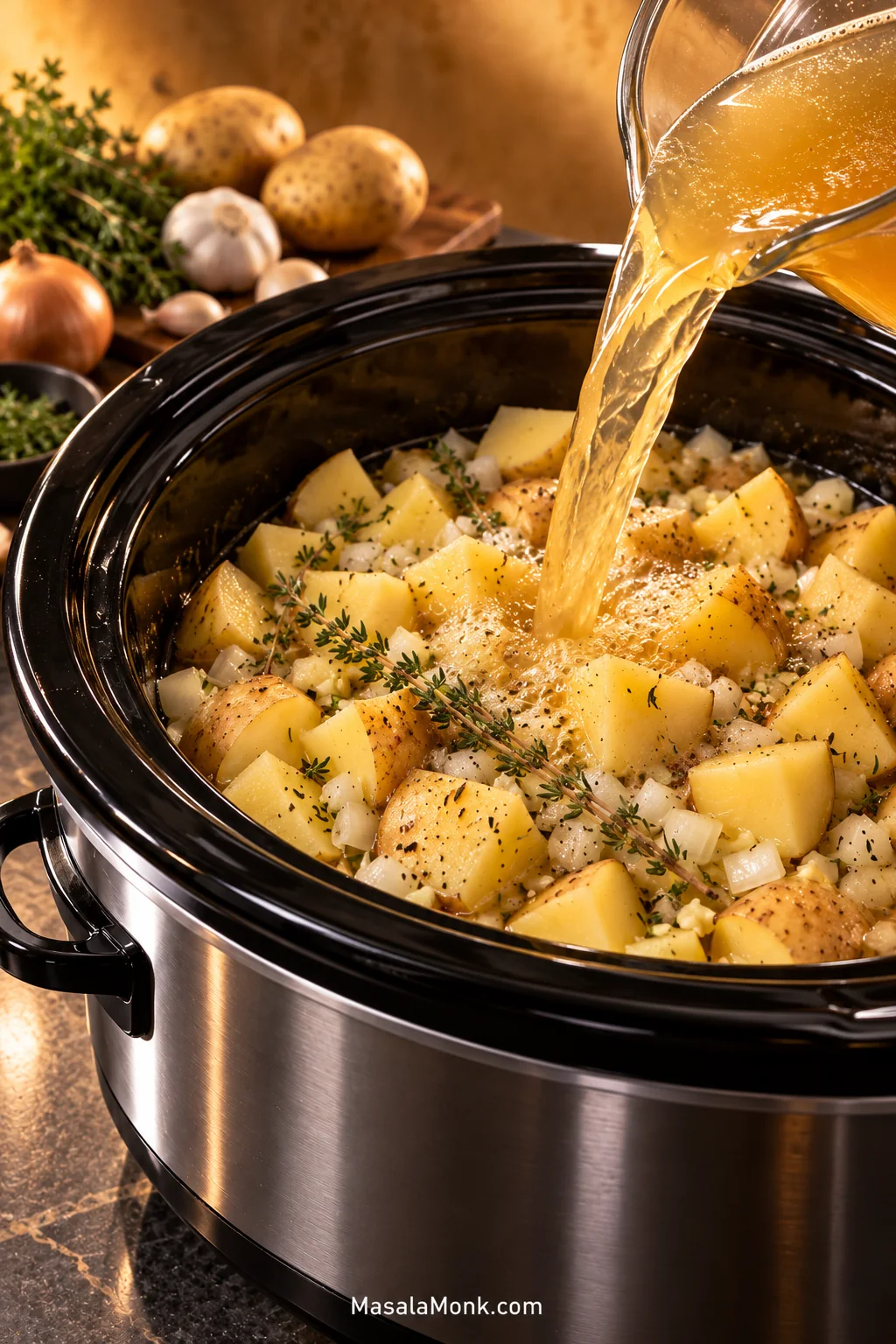
Chicken broth being poured over diced Yukon Gold potatoes, onion, garlic and herbs in a black slow cooker.

Tender Yukon Gold potatoes, sharp cheddar, and crisp bacon give this slow cooker potato soup the appeal of a loaded baked potato in a warm, satisfying bowl. The broth turns creamy as some of the potatoes are mashed, while the rest stay in tender pieces. Cool sour cream and fresh green onions balance the rich, cheesy finish.

Get the potatoes cooking earlier in the day, then come back once they’re tender to mash some into the broth, stir in the cream and cheddar, and pile crisp bacon onto the bowls. If you have a few extra minutes at the start, softening the onion in bacon fat builds a deeper savory base.

Slow Cooker Potato Soup Recipe

Cook the potatoes, onion, garlic, thyme, and chicken broth until the potatoes are fork-tender. Mash about one-quarter of the potatoes to thicken the broth, then finish with heavy cream and freshly shredded sharp cheddar. Crisp bacon, sour cream, and green onions go on top just before serving.

Prep
About 20 minutes

Cook on LOW
6–8 hours

Cook on HIGH
3–4 hours

Finish
About 10–15 minutes

Yield
About 8 servings

Slow Cooker
6-quart

Equipment: A 6-quart slow cooker, skillet, knife, cutting board, potato masher, and cheese grater. A vegetable peeler is optional. For this texture, a potato masher is all you need.

For the Potato Soup

  • 3 lb (1.36 kg) Yukon Gold potatoes, scrubbed and cut into roughly ¾-inch (2 cm) pieces; peel them first if you prefer
  • 1 medium yellow onion (about 150 g), finely diced
  • 4 garlic cloves, minced
  • 4 cups (946 ml) low-sodium chicken broth
  • 1 teaspoon fine salt, plus more to taste
  • ½ teaspoon freshly ground black pepper, plus more to taste
  • ½ teaspoon dried thyme

For the Creamy Finish

  • ¾ cup (177 ml) heavy cream
  • 1½ cups (about 170 g) freshly shredded sharp cheddar cheese

For Serving

  • 6 slices bacon (about 100–120 g before cooking, depending on thickness)
  • 3 green onions, thinly sliced
  • Sour cream, to taste
  • Extra shredded cheddar and black pepper, optional

Instructions

  1. Choose the onion route. For the fastest version, add the diced onion raw in the next step and cook the bacon shortly before serving. For deeper flavor, fry the bacon in a skillet over medium heat until crisp, then transfer it to a paper-towel-lined plate. Leave about 1 tablespoon of bacon fat in the skillet and cook the onion in it for 3–4 minutes, until softened. Once the bacon has cooled slightly, cover and refrigerate it until serving.
  2. Fill the slow cooker. Add the potatoes, garlic, chicken broth, salt, black pepper, and thyme. Add the onion raw, or, if you softened it in bacon fat, scrape the softened onion and any bacon fat remaining in the skillet into the slow cooker. Keep the potato pieces similar in size so they soften at about the same rate. Stir once and cover.
  3. Cook until the potatoes are tender. Use LOW for 6–8 hours or HIGH for 3–4 hours. Start checking at the early end of the range. A fork should slide through the center of one of the larger potato pieces without resistance.
  4. Mash some of the potatoes. Use a potato masher directly in the slow cooker and mash roughly one-quarter of the potatoes. Stir well. The broth should begin to thicken while plenty of potato pieces remain intact. Mash a little more if you’d like a thicker soup.

Finish the Soup

  1. Add the cream. Stir in the heavy cream. If the slow cooker is on HIGH, switch it to LOW for the finishing stage.
  2. Melt in the cheddar. Add the cheese a handful at a time, stirring between additions. Keep the heat gentle and avoid a hard boil once the cheese is in.
  3. Finish and season. Cover and heat on LOW for about 10–15 minutes, or just until the soup is hot and the cheddar has melted smoothly. If it’s ready sooner, don’t keep heating it simply to finish the timer. Taste before adding more salt or pepper; the cheddar and bacon bring salt of their own.
  4. Load the bowls. If you used the raw-onion route, cook the bacon until crisp while the soup finishes, then drain it on paper towels. If you cooked and chilled the bacon earlier, re-crisp it briefly before serving if you like. Ladle in the soup, then finish with bacon, cool sour cream, green onions, and extra cheddar or black pepper if desired. Try to get a little of each in a spoonful—the crisp bacon, cool sour cream, and fresh green onions are what turn the creamy potato base into a loaded baked potato in soup form.

Batch size: This recipe is written for a 6-quart slow cooker. Don’t automatically double it in the same cooker; an overfilled pot can heat differently, and the potatoes may take longer to soften.

Which Potatoes Are Best for Slow Cooker Potato Soup?

Yukon Golds are the better fit for this version because they can thicken the broth while still leaving tender, recognizable potato pieces behind. Their thin skins are another advantage: after a good scrub, peeling is optional.
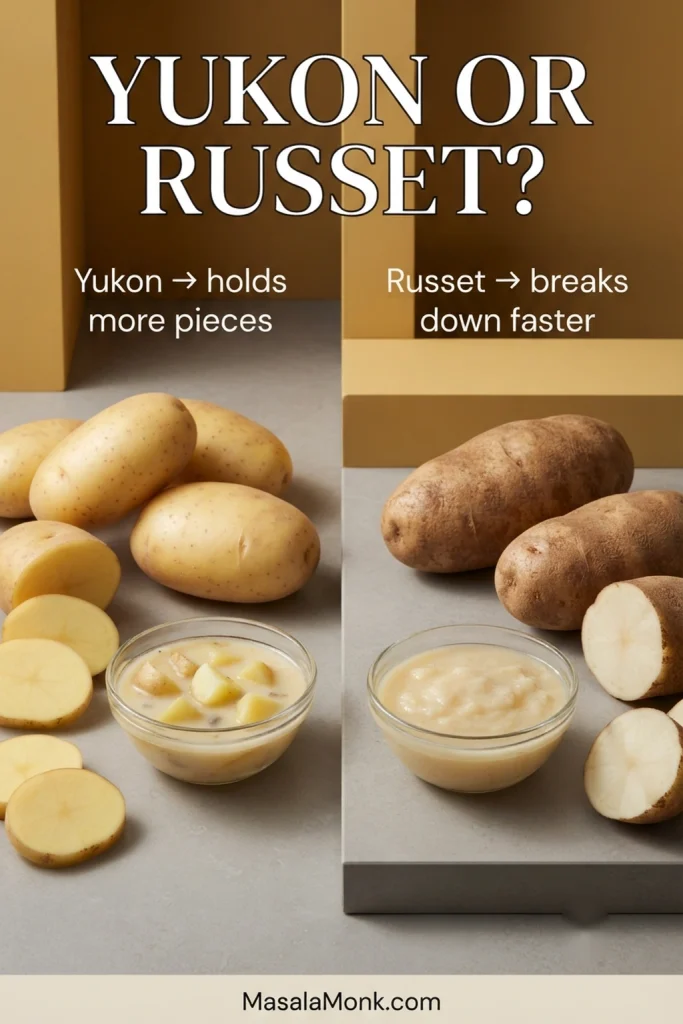
Comparison graphic showing Yukon Gold and Russet potatoes with a chunkier Gold potato soup and a smoother Russet potato soup.
If you swap Russets into this recipe, assess the texture earlier: they break down faster, so the same amount of mashing can produce a much smoother potato soup than Yukon Golds.
Potato What to Expect
Yukon Gold Creamy when mashed, with tender pieces that hold their shape reasonably well.
Russet Starchier and quicker to break down, giving the soup a thicker, smoother texture.

Russets work too, but start with less mashing because they break down more readily. If you’d rather make a stovetop version with Russets, milk, and a small roux, try our classic potato soup recipe.

Ready to cook? Jump back to the recipe card.

How Long to Cook Potato Soup in a Slow Cooker

Before the clock starts, the slow cooker should contain the potatoes, onion, garlic, broth, and seasonings. Keep the cream and cheddar for the finishing stage, after the potatoes are tender and you can judge the texture properly.
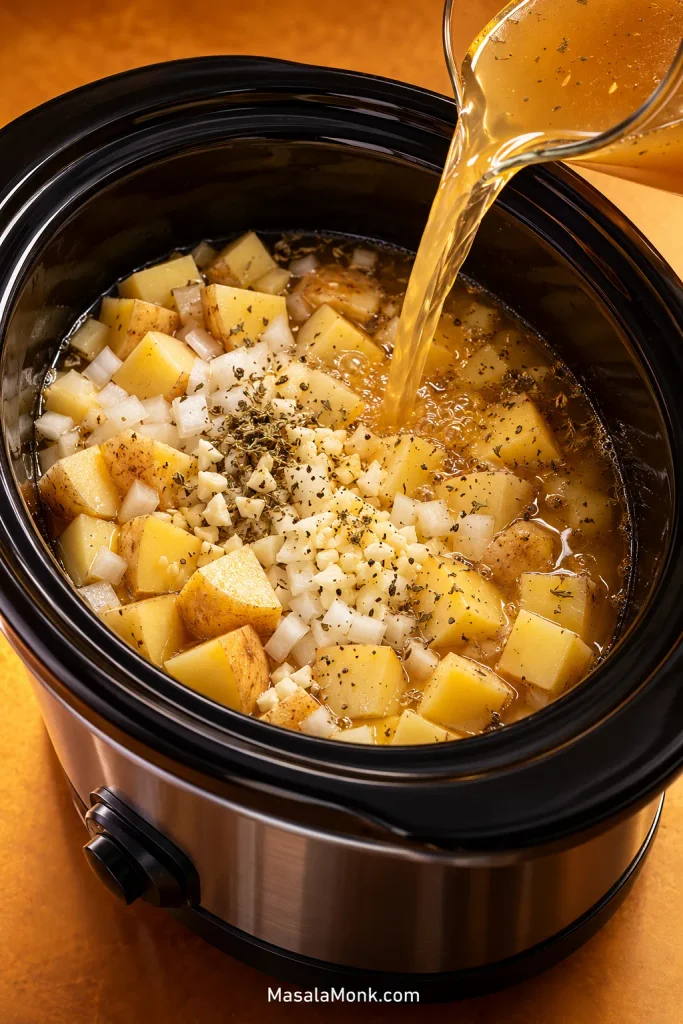
Diced potatoes and onion in a slow cooker as seasoned broth is poured over them.
At the start, the pot should look simple: potatoes, aromatics, broth, and seasoning. The rich dairy finish comes later, so the long cook develops the potato base first.

For roughly ¾-inch potato pieces, plan on about 6–8 hours on LOW or 3–4 hours on HIGH. Cut size and individual slow cookers affect how quickly the potatoes soften, so start checking at the early end of the range.
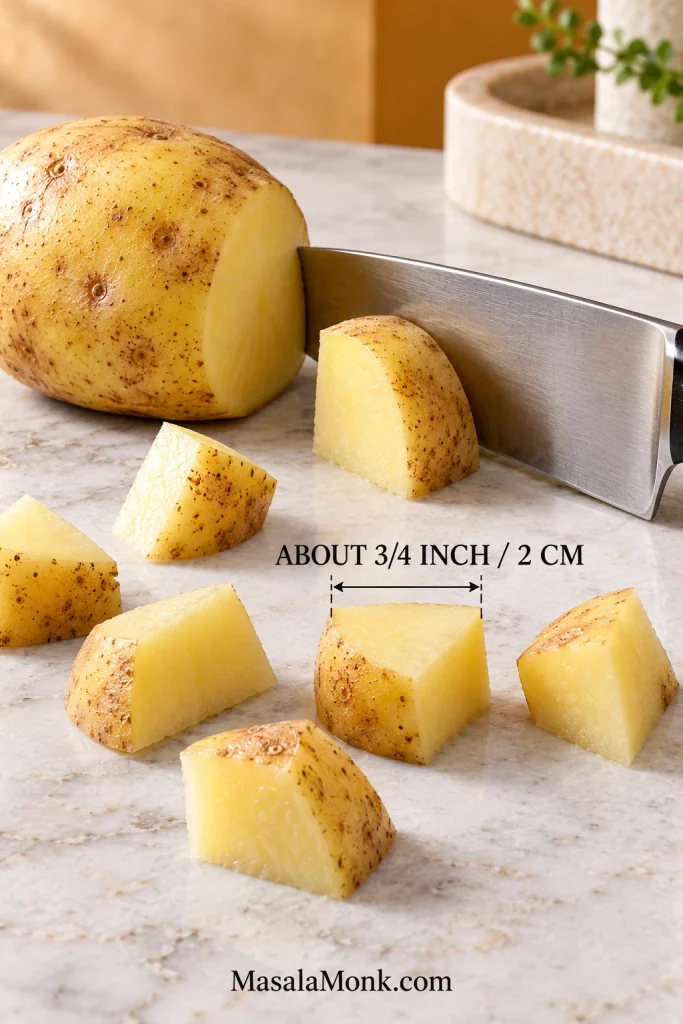
Yukon Gold potato beside a knife and several skin-on potato chunks cut to about three-quarter-inch pieces.
Uniform ¾-inch pieces make the doneness test more meaningful: if one of the biggest chunks is tender, the smaller pieces are unlikely to be lagging far behind.

Once a fork slips easily through one of the larger pieces, move on with the recipe. There’s no benefit in making tender potatoes wait for the clock.
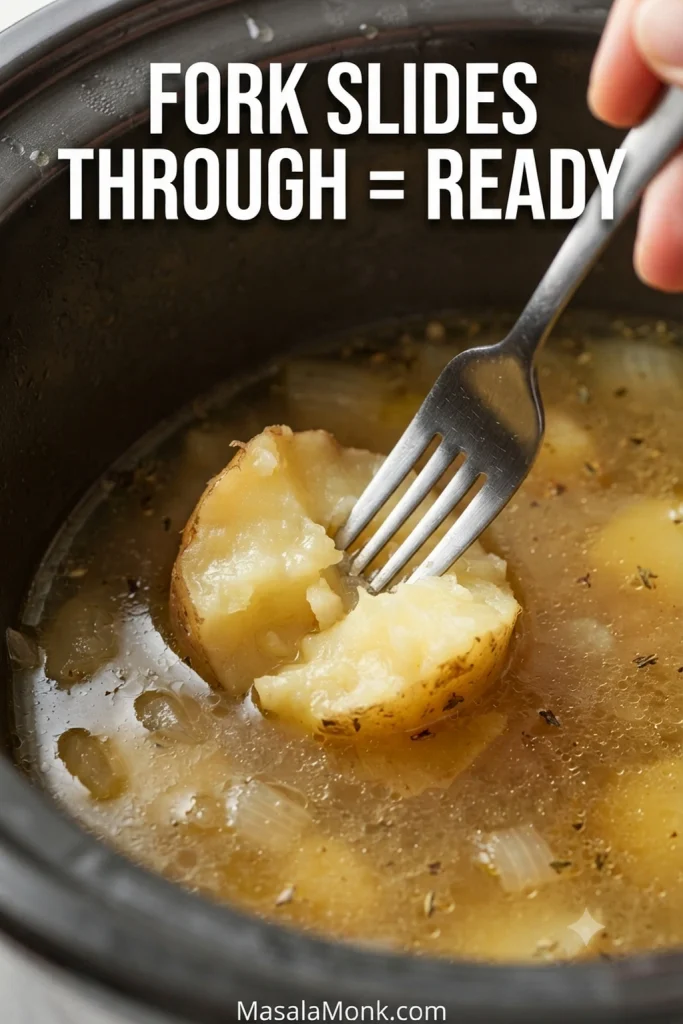
Fork pushed through a large tender potato chunk in the slow cooker, with the words “Fork slides through = ready.”
Test the biggest potato piece you can find. It gives you a better read on the whole batch than a small cube that happened to soften early.

What Should Potato Soup Look Like Before You Add the Cream?

Don’t expect the soup to look thick through most of the slow cooking. Much of its body develops near the end, after the potatoes are tender and you mash some into the broth.
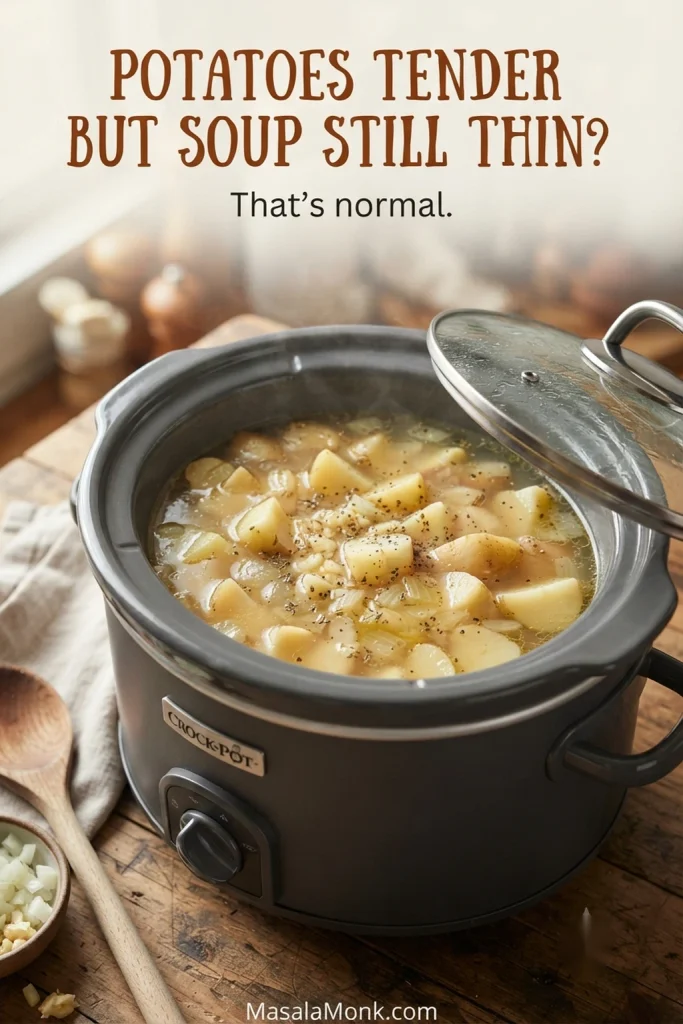
Tender potato chunks sitting in a loose broth inside a slow cooker, with text noting that thin soup at this stage is normal.
A loose broth here is normal. Judge thickness only after partial mashing; correcting it too early can turn an on-track slow cooker potato soup into something much thicker than intended.

After mashing, the broth should lightly coat the remaining potatoes without looking pasty. Leave plenty of tender pieces visible. The cream and cheddar will add richness at the end, so don’t keep mashing simply because the soup doesn’t yet look like the finished bowl.
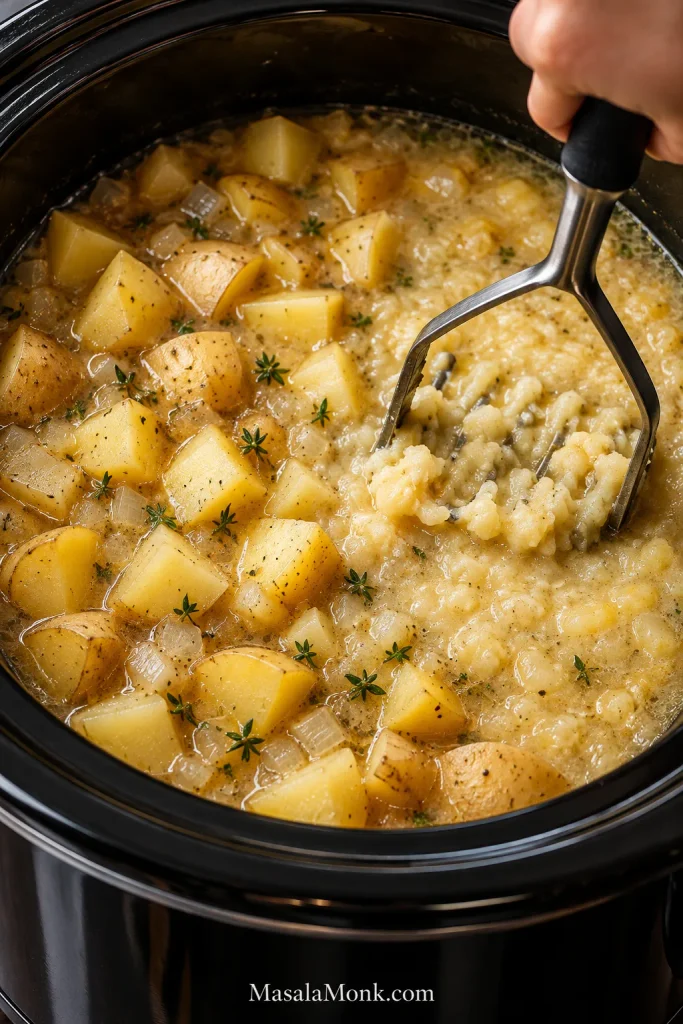
Potato masher breaking down some cooked potatoes in a slow cooker while many chunks remain intact.
Mash in stages and stir between passes. You can always release more starch, but once too many potato chunks disappear, you cannot put that hearty texture back.

How to Get Creamy Potato Soup Without a Blender

A potato masher is all you need here. Stop once the broth has the body you want and enough tender potato pieces remain for your preferred texture.

Creamy potato soup with visible chunks and an inset showing the thinner soup before mashing, labeled “Creamy + Chunky.”
The target is two textures at once: broth with real body and potato pieces you can still clearly see and bite into.

For a smoother soup, transfer a portion to a tall, heat-safe container suitable for immersion blending. Keep the blender head submerged and use short pulses to reduce splashing, then return the blended soup to the slow cooker. Follow your blender manufacturer’s instructions for handling hot liquids.

Whichever method you use, judge the final consistency on a spoon rather than by how thick the surface looks in the slow cooker.
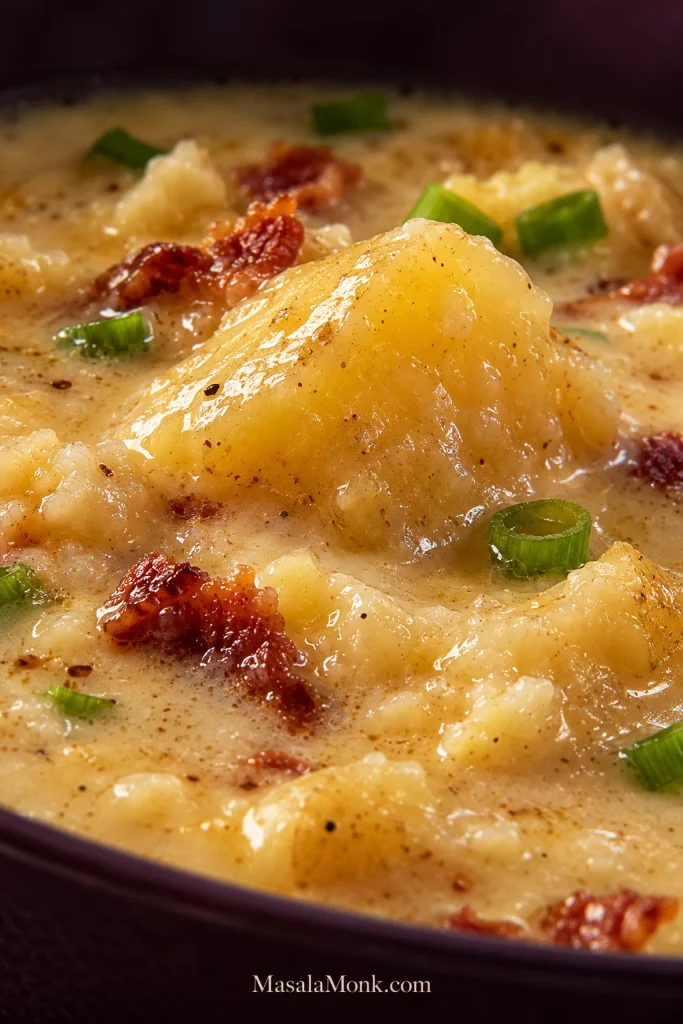
Close-up spoonful of creamy potato soup with a large potato chunk, bacon, and sliced green onion.
Use the spoon test: the broth should coat a tender potato, then flow back into the bowl rather than sit stiffly on it.

When to Add Cream and Cheese

Wait until the potatoes are tender and you’re happy with the thickness before adding the cream and cheddar. Finish on LOW for about 10–15 minutes, or just until everything is hot and the cheese has melted. If the soup is already piping hot, the cheese may melt sooner.
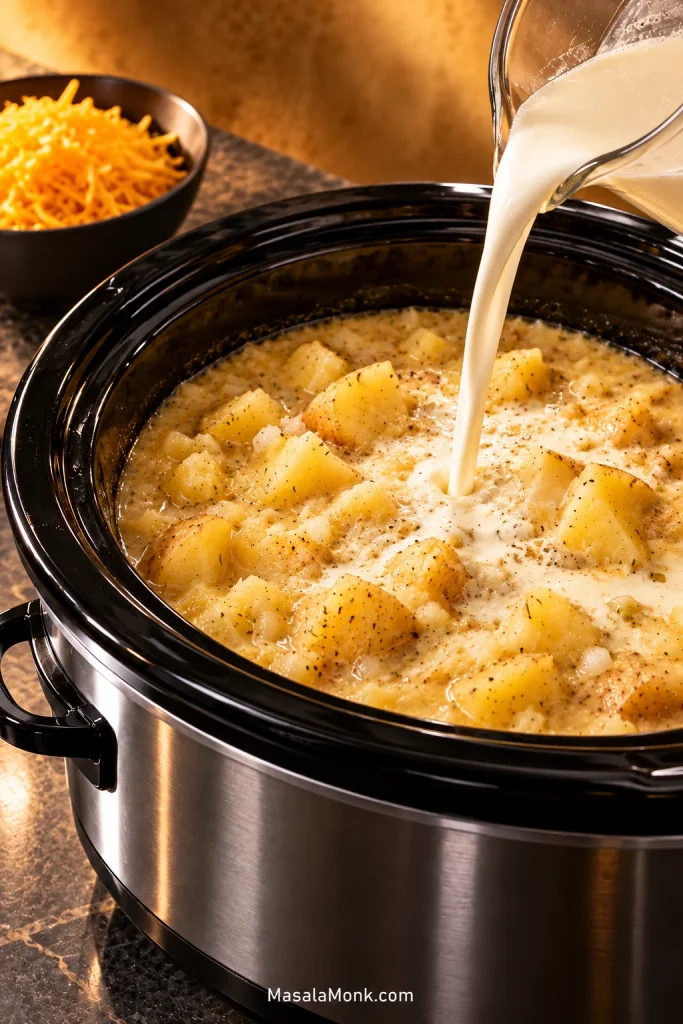
Cream being poured into partially mashed potato soup in a slow cooker, with shredded cheddar beside it.
The potato base should already have enough body before the dairy enters. Cream adds richness; cheddar adds flavor and fullness rather than having to rescue a thin soup.

Freshly shredded cheddar generally melts more smoothly here. Packaged shredded cheese can contain anti-caking ingredients that sometimes affect the finish, so shred the cheddar from a block if you can. Add it gradually and keep the heat gentle.

Open slow cooker filled with creamy potato soup topped with potato pieces, bacon, cheddar, and green onions.
Once the cheddar is smooth and the soup is hot, more cooking stops helping. At that point, gentle heat is for holding the soup rather than improving its texture.

If you enjoy cheesy slow-cooker soups, our slow cooker broccoli cheese soup also saves the cheesy finish for the end.

If the texture isn’t behaving the way you expected, jump to troubleshooting.

How to Fix Bland Potato Soup

Make the final seasoning decision after the cream and cheddar are in. Potatoes and cream can soften the impression of seasoning, while the broth, cheddar, and bacon can all contribute different amounts of salt.
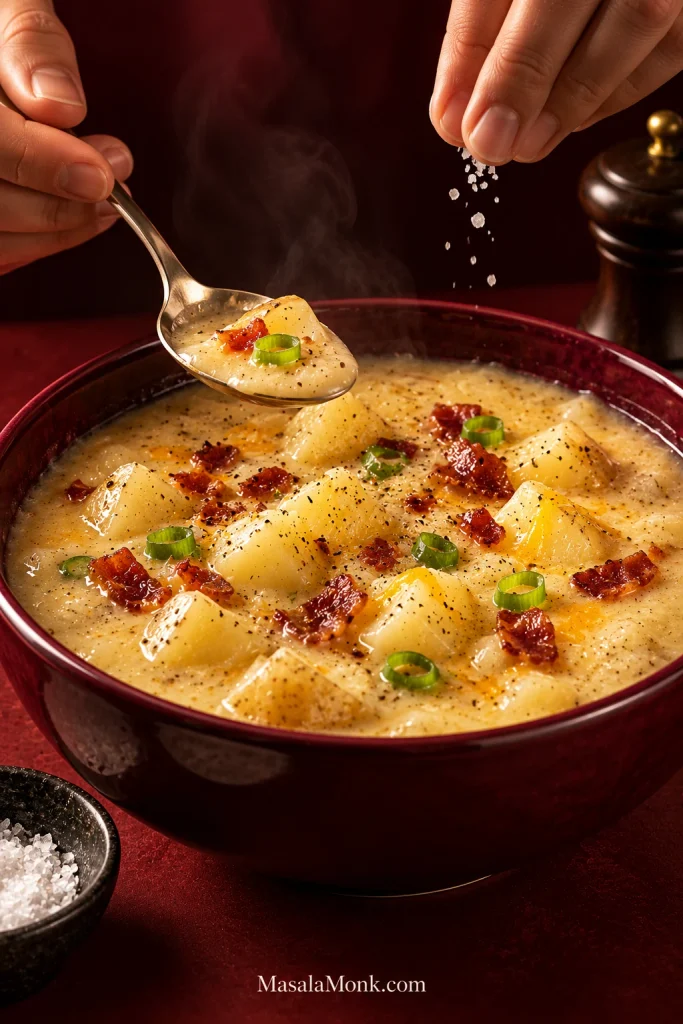
Hand seasoning a bowl of creamy potato soup topped with potato chunks, bacon, cheddar, and sliced green onions.
If the soup tastes dull, test contrast before adding more salt: black pepper or fresh green onion can wake up a rich bowl without simply making it saltier.
  • Creamy but muted: Add a small pinch of salt, stir well, and taste again.
  • Rich but a little heavy: Try more black pepper or green onion before reaching for more cheese.
  • Still tastes flat: Put a spoonful in a small bowl and add a few drops of lemon juice or mild vinegar. You’re not trying to make the soup taste acidic; you’re checking whether a tiny bit of acidity makes the potato, cheddar, and bacon flavors taste clearer. If it helps, add a very small amount to the pot, stir, and taste again.
  • The cheddar is taking over: Stop adding cheese and reassess the salt, pepper, and fresh toppings instead.

Slow Cooker Potato Soup Troubleshooting

Start with the problem you can actually see or taste, then correct one thing at a time. Texture problems are easier to solve when you resist changing the seasoning, dairy, and thickness all at once.
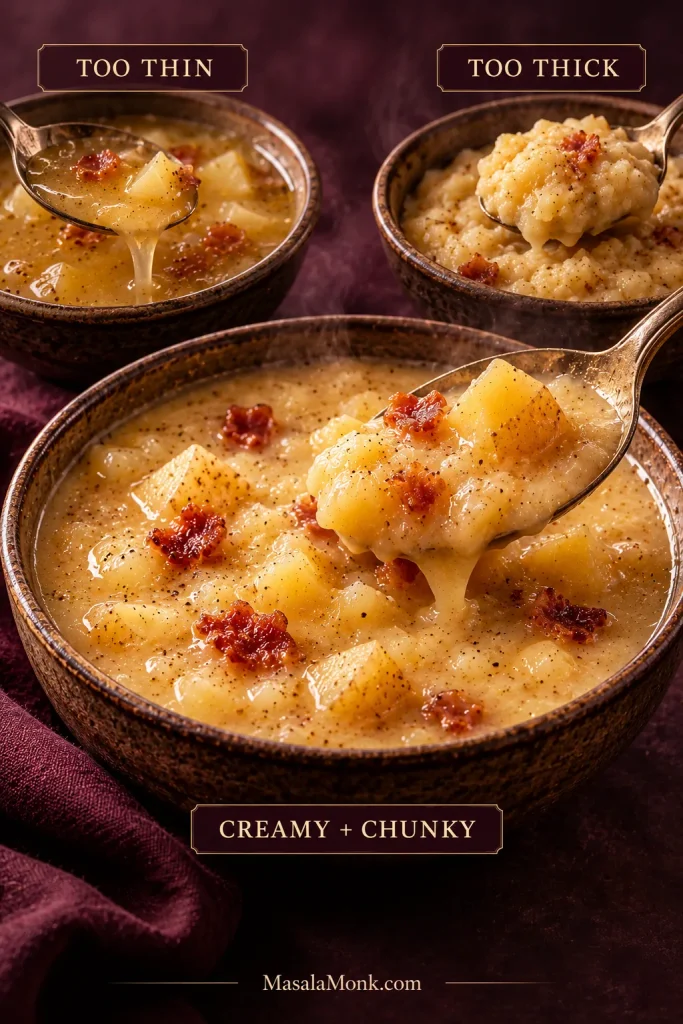
Three bowls comparing thin, very thick, and creamy chunky potato soup, labeled “Too thin,” “Too thick,” and “Creamy + chunky.”
Fix texture first, then retaste. Thickening or loosening potato soup changes its concentration, so seasoning that seemed right beforehand may need another look.

The soup is too thin

Start by mashing another small scoop of tender potatoes into the broth. Stir and give the soup a moment before judging it again. This thickens the broth without sacrificing all the potato pieces.

If you’ve reached the potato texture you want and the soup is still too thin, mix 1 teaspoon cornstarch with 1 tablespoon cold water. Stir the slurry thoroughly into the hot soup and continue heating gently until the broth visibly thickens. Repeat with another small slurry only if needed; avoid a vigorous boil once the cream and cheddar are in.

If the soup is both thin and bland, fix the consistency first. Once the texture is right, taste again and adjust the flavor separately.

The soup is too thick

Stir in warm broth a splash at a time until the soup loosens to the consistency you want. Remember that it will thicken again as it cools.

The potatoes are still firm

Put the lid back on and keep cooking. Don’t add the cream and cheese just because the suggested time has passed; wait until the potatoes are fully tender.

The soup is smoother than you wanted

Stop mashing or blending. If it’s also too thick, loosen it with a little warm broth. Next time, mash a smaller portion first—you can always mash more, but you can’t put the potato chunks back.

The dairy separated or the cheese looks oily

Turn the heat down immediately and stir gently. If the soup has only started looking oily, gentle stirring may help it come back together; badly separated cheese may not become completely smooth again. Don’t try to rescue it by turning up the heat or adding more cheese.
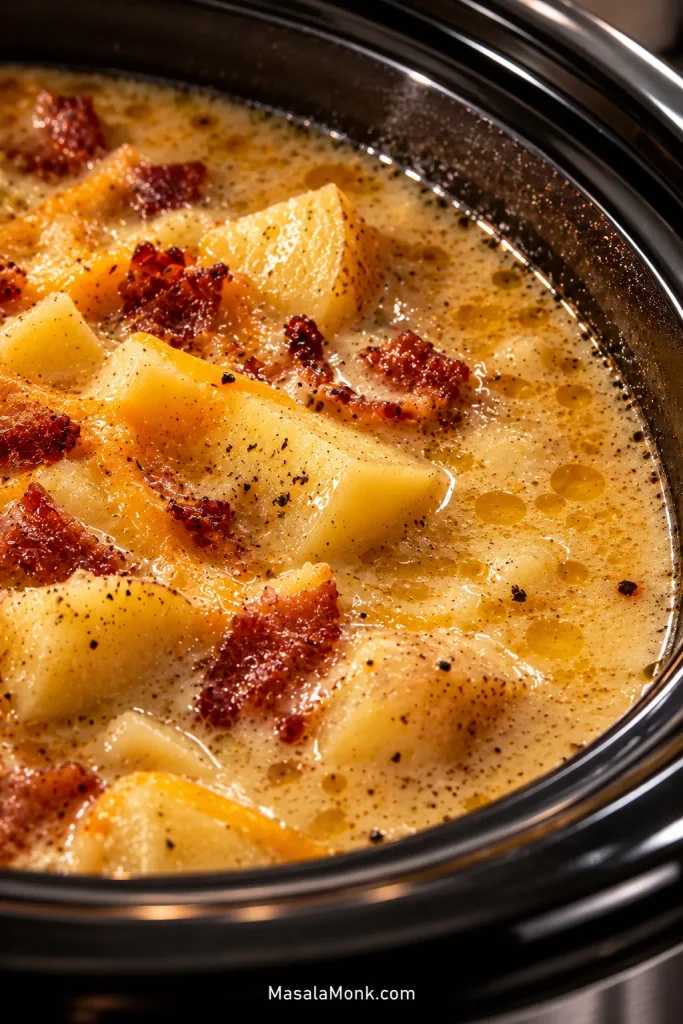
Close-up of creamy potato soup with potato pieces, bacon, and small orange oily droplets visible on the surface.
A shiny, greasy sheen is an early warning. Lower the heat and stir gently before the cheddar separates further; more heat usually makes the problem worse.

For the next batch, add freshly shredded cheddar gradually after the potatoes are tender and keep the heat gentle while it melts.

Back to the recipe card · Back to top

Can You Use Frozen Potatoes or Hash Browns?

Yes, but the shortcut you choose changes the texture as well as the prep.
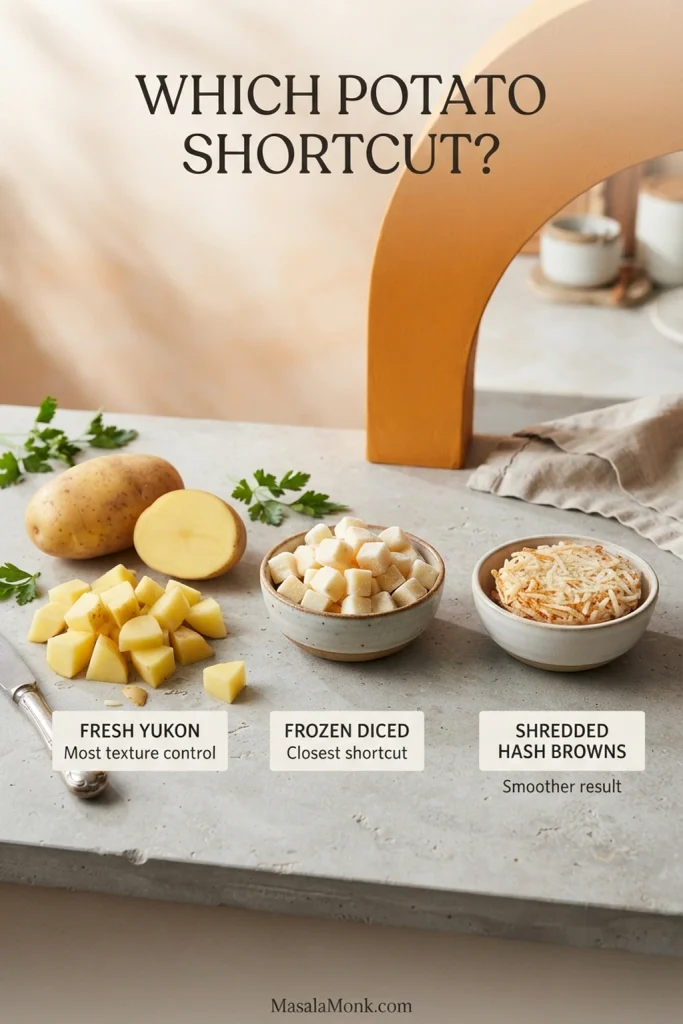
Fresh diced Yukon Gold potatoes, frozen diced potatoes, and shredded hash browns displayed side by side for comparison.
The convenience choice changes the texture too: frozen diced potatoes stay closest to fresh chunks, whereas shredded hash browns produce a smoother Crock-Pot potato soup.
  • Fresh Yukon Golds: Best when you want control over how many potato pieces stay intact and how much gets mashed into the broth; they require the most chopping.
  • Frozen diced potatoes: The closest lower-prep shortcut to the fresh-potato version. Use about the same weight as the fresh potatoes. Cooking time can vary by brand and piece size, so rely on the fork test rather than the clock.
  • Shredded hash browns: They break down much more readily, giving you a smoother shortcut-style Crock-Pot potato soup with fewer distinct potato pieces.

Can You Prep Slow Cooker Potato Soup the Night Before?

Yes. If you’d rather get the chopping done ahead, scrub, peel if desired, and cut the potatoes the night before. Keep the cut potatoes submerged in cold water in a covered container in the refrigerator, then drain them well before adding them to the slow cooker the next day. You can dice the onion ahead too; refrigerate it separately in a covered container.
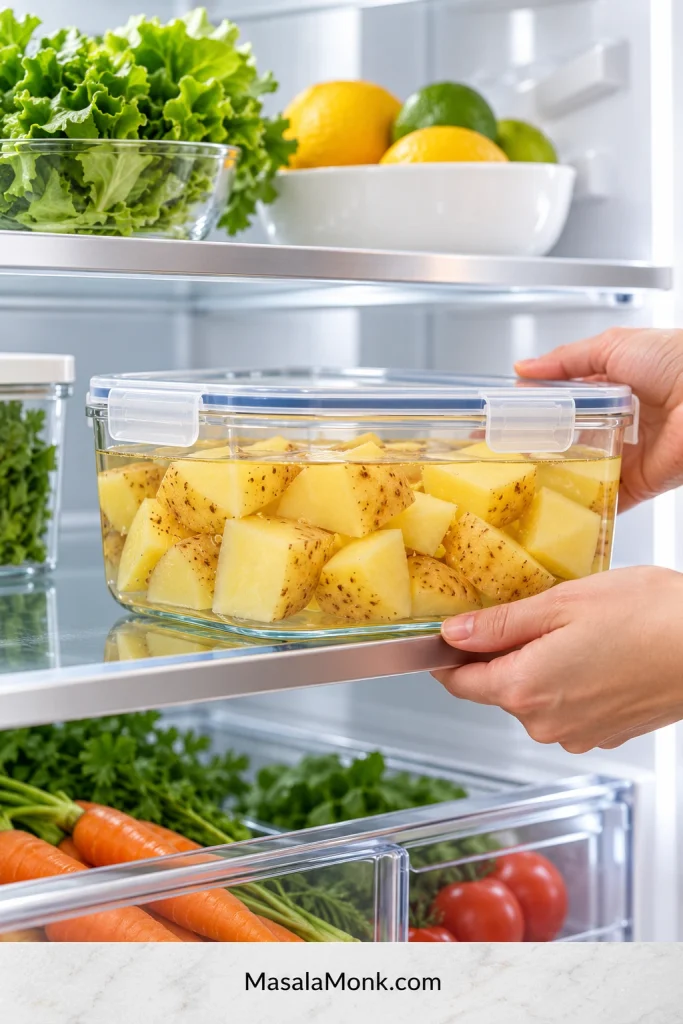
Covered container of cut potatoes submerged in water being placed on a refrigerator shelf.
For make-ahead prep, treat potatoes and onions differently: the potatoes stay under cold water, while the onion stays dry and separate until cooking day.

Keep the prepped ingredients refrigerated until you’re ready to cook. This moves the knife work to the night before without changing the broth or dairy stages of the recipe.

Cooking tomorrow? Jump back to the recipe card.

Easy Potato Soup Variations

Add ham

Stir in 1 cup (about 150 g) diced cooked ham near the end, giving it enough time to heat through. Ham and cheddar both add salt, so taste the soup before seasoning further.

Use milk instead of heavy cream

Replace the ¾ cup (177 ml) heavy cream with ¾ cup (177 ml) whole milk for a lighter soup. Add it at the same finishing stage and keep the heat gentle. The soup will be less rich and may be slightly thinner.

Make the bowl more loaded

Put extra bacon, cheddar, sour cream, and green onions on the table and let everyone build the bowl they want. If that baked-potato combination is exactly what you’re after, our twice baked potato casserole turns the same idea into a bubbling side dish.
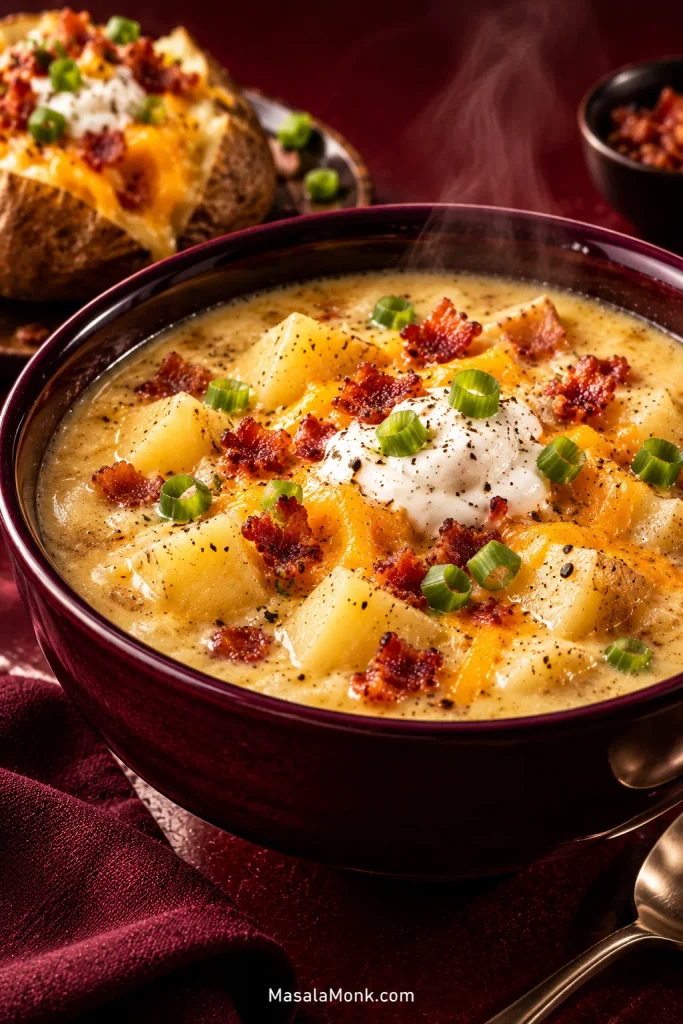
Bowl of creamy potato soup topped with bacon, cheddar, sour cream, and green onions, with a loaded baked potato in the background.
Loaded should still look like potato soup. Bacon, cheddar, sour cream, and green onion add contrast while the potato-rich broth and tender chunks remain the main event.

Prefer a smoother potato soup without the cheddar-and-bacon profile? Our potato leek soup takes the flavor in a gentler, leek-forward direction.

What to Serve With Potato Soup

A loaded bowl is substantial enough to be dinner on its own. If there’s crusty bread on the table, use it to catch the last streaks of cheddar-rich broth. A crisp salad is a good counterpoint when you want something fresh alongside all that potato, bacon, and cheese. Our Irish soda bread makes a heartier bread option for the table.
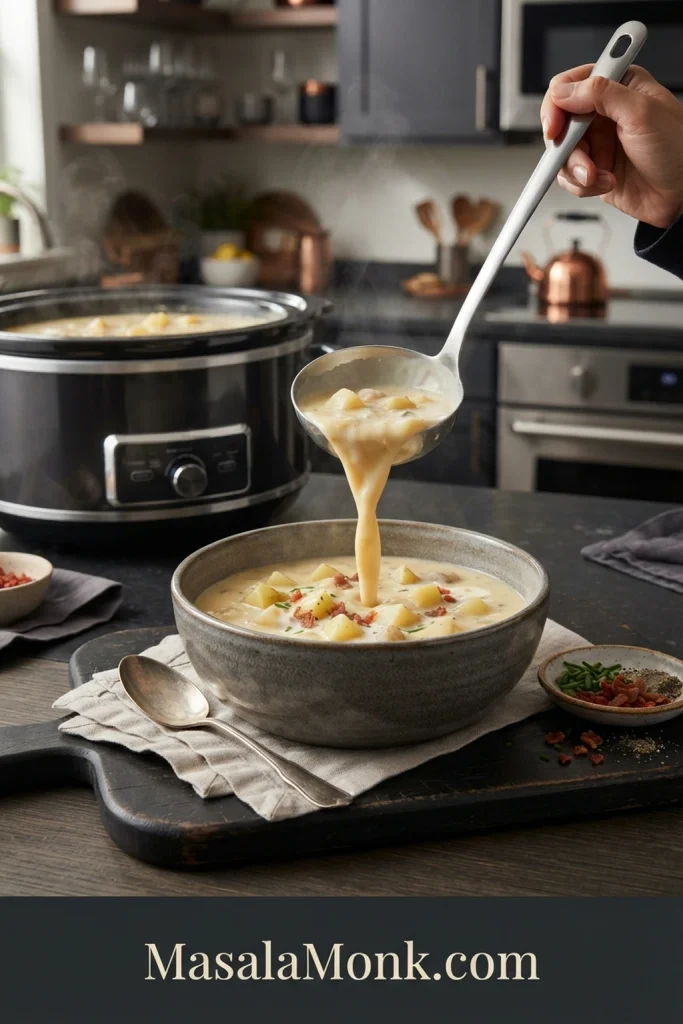
Ladle pouring creamy potato soup with visible potato chunks from a slow cooker into a serving bowl.
Keep the loaded toppings out of the slow cooker. Adding them bowl by bowl preserves the crisp bacon, cool sour cream, and fresh green onion that make each spoonful more interesting.

However you top the bowls, keep the garnishes proportional enough that the creamy potato base remains easy to spoon and the tender pieces still come through.
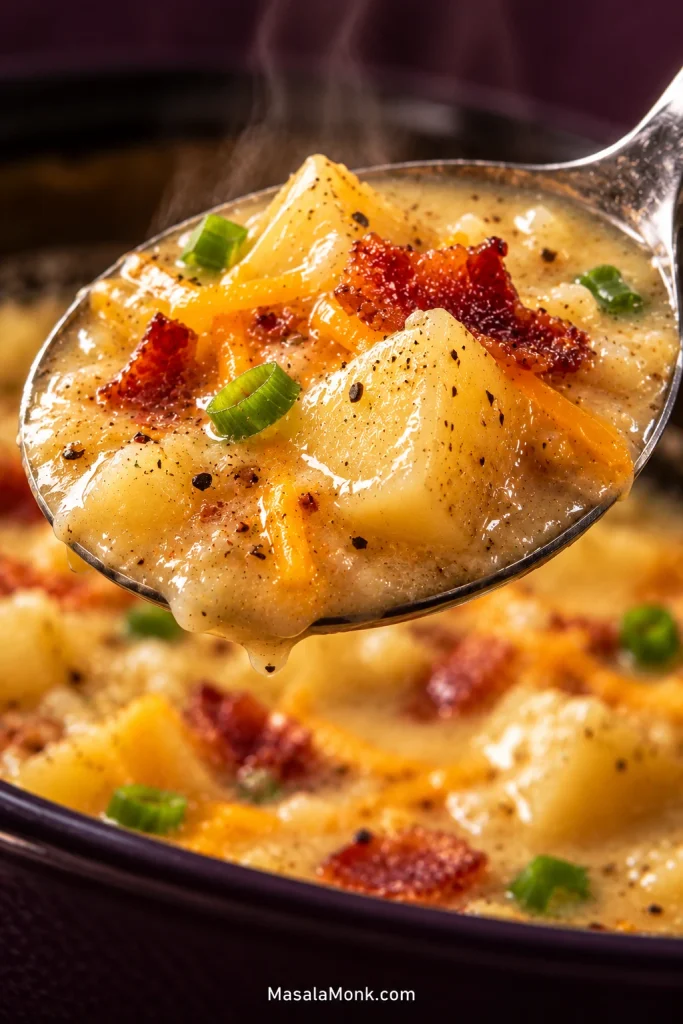
Spoon holding several potato chunks coated in creamy soup with bacon, cheddar, and sliced green onion.
A good spoonful should carry potato, creamy broth, and a little bacon together—a sign the soup has enough body to hold everything without becoming heavy.

How to Store and Reheat Potato Soup

Expect the soup to be thicker tomorrow than it is tonight. The potatoes continue holding onto liquid as the soup chills, so leftovers often need a splash of broth or milk when reheated.
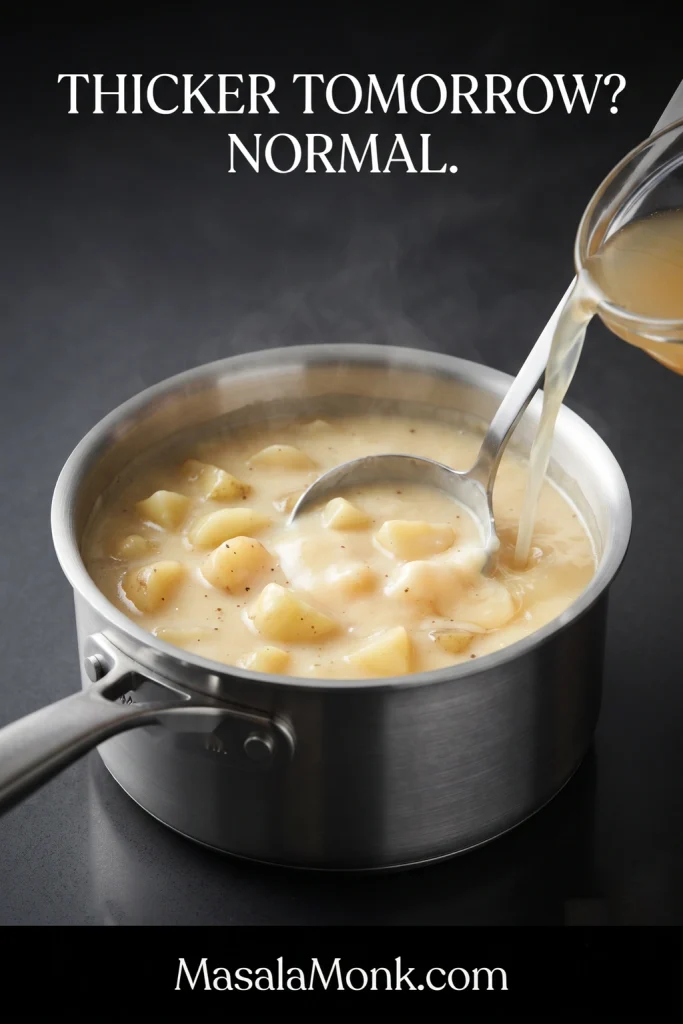
Thick potato soup in a saucepan being loosened with liquid from a small jug, with text reading “Thicker tomorrow? Normal.”
Second-day potato soup usually needs loosening, not fixing. Warm it first, then add broth or milk gradually until the original spoonable texture returns.

Refrigerating

Refrigerate leftovers within 2 hours in shallow, covered containers and use them within 3–4 days.

Reheating

Reheat leftovers on the stovetop or in the microwave, stirring as they warm. Add a splash of broth or milk if the soup has become too thick. Reheat thoroughly to 165°F (74°C). USDA guidance also advises bringing soups to a rolling boil when reheating; on the stovetop, make that brief rather than continuing to boil the creamy soup once it is hot. For microwave reheating, stir the soup and check the temperature in several places. See the USDA’s leftovers and food safety advice for additional guidance.

Don’t use the slow cooker to slowly bring refrigerator-cold leftovers back up to temperature. Once the soup has been properly reheated, a slow cooker can keep it hot for serving; keep hot food at 140°F (60°C) or above.

Can You Freeze Potato Soup?

You can freeze this soup, but the potatoes may become softer or slightly grainy and the creamy broth may need extra stirring after thawing. Cool the soup promptly, divide it into shallow freezer-safe containers, and refrigerate or freeze it within 2 hours. If you’ll eat the leftovers within 3–4 days, refrigeration generally gives you the better texture.

Thaw frozen soup in the refrigerator when practical, then reheat it thoroughly on the stovetop or in the microwave. Stir as it warms and add a splash of broth or milk only if the consistency needs loosening.
Back to top · Jump to recipe

Posted on — Leave a comment

Potato Soup Recipe: Easy, Creamy & Perfectly Thick

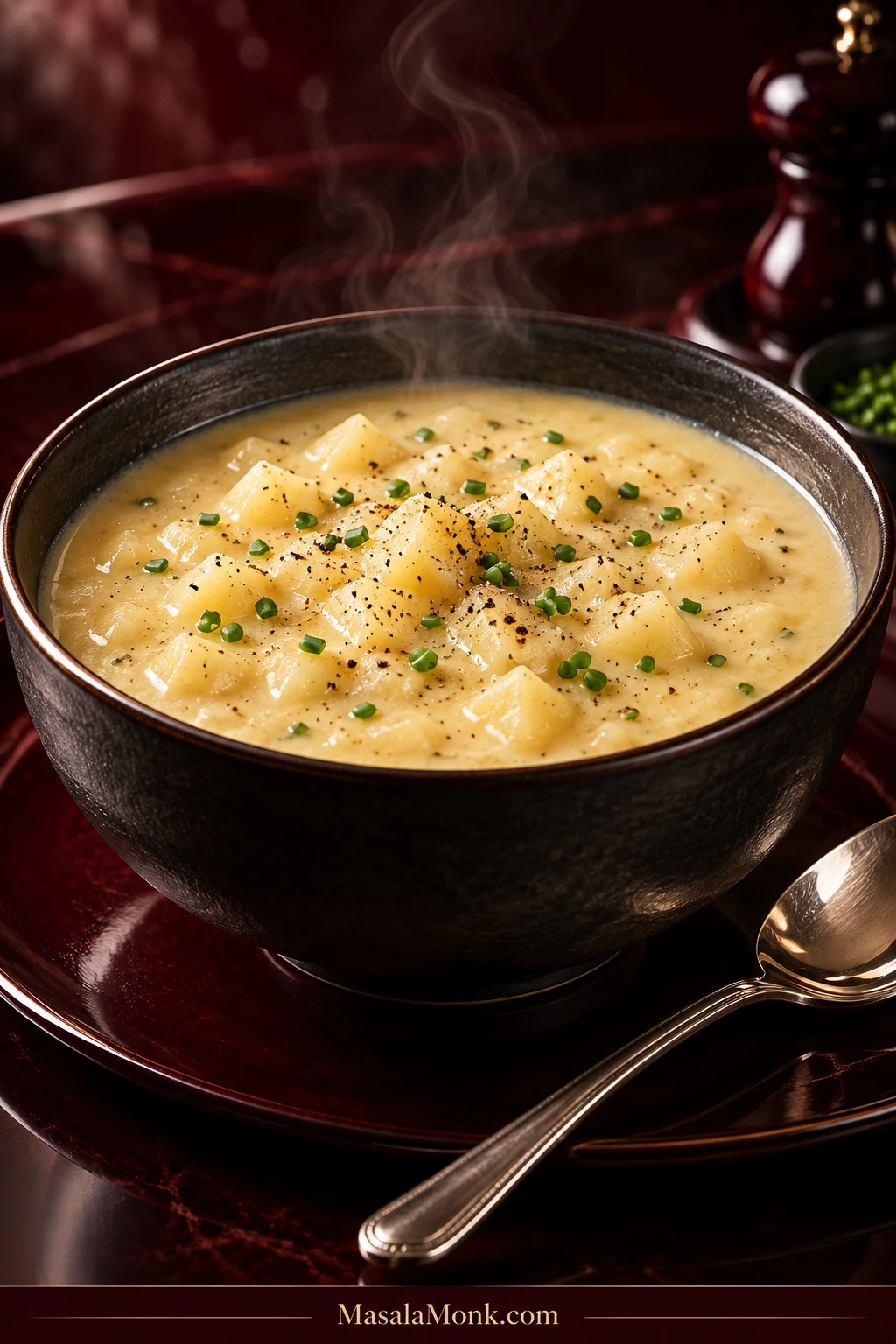
Dark bowl of creamy potato soup with softened potato chunks, chopped chives, black pepper and rising steam on a deep red surface.

Potato soup can go wrong in both directions. One pot stays brothy no matter how much cream goes in; another looks perfect on the stove and turns almost spoon-standing dense by dinner. Then there is the batch that gets blended too enthusiastically and becomes sticky instead of creamy.

This potato soup recipe is made from scratch on the stovetop, with creamy broth, soft potato chunks and enough body to coat a spoon without turning into mashed potatoes in a bowl. It cooks in one pot, needs no blender or heavy cream, and takes about 20 minutes of hands-on prep before the simmering does most of the work. This is the version for when you want potato soup to taste like potatoes.

The rule to remember is simple: tender first, mash lightly, milk late, judge after the rest.

Potato Soup Recipe

Tender Russet chunks sit in a smooth broth with softened onion, thyme and black pepper underneath. A small roux and light hand-mashing give the soup enough body to coat a spoon without needing heavy cream.

Prep20 minutes
Cook35–40 minutes
Rest5 minutes
TotalAbout 60–65 minutes
YieldAbout 9–10 cups / 2.1–2.4 L
Serves6 mains or 8 smaller bowls
MethodStovetop
Pot5½–6 qt / 5–5.7 L

Equipment

  • 5½–6 quart / 5–5.7 L Dutch oven or heavy-bottomed pot
  • Whisk
  • Potato masher
  • Kitchen scale and/or measuring cups and spoons

Ingredients

  • 2½ lb / 1.13 kg Russet potatoes, peeled and cut into ½-inch / 1.25-cm cubes
  • 3 Tbsp / 42 g unsalted butter
  • 1 medium yellow onion / 150–170 g, finely diced
  • 2 celery ribs / about 100 g, finely diced
  • 3 garlic cloves / about 10 g, minced
  • 3 Tbsp / 24 g all-purpose flour
  • 4 cups / 960 ml low-sodium chicken broth, divided—use 3½ cups / 840 ml for cooking and keep ½ cup / 120 ml aside for final adjustment
  • 2 cups / 480 ml whole milk
  • 1 tsp dried thyme
  • ½ tsp freshly ground black pepper, plus more to finish
  • 1 tsp fine sea salt / about 5–6 g, divided, plus more to taste
  • ½–1½ tsp / 2.5–7.5 ml lemon juice, optional; white wine vinegar or apple cider vinegar can be used instead
  • Chopped chives or scallions, optional, for serving

Instructions

Build the Soup

  1. Prepare the potatoes. Peel the Russets and cut them into roughly ½-inch / 1.25-cm cubes. Cut them roughly the same size so they become tender together; the cubes don’t need to be perfect.
  2. Soften the onion and celery. Melt the butter over medium heat. Add the onion, celery and ¼ teaspoon salt. Cook for 5–6 minutes, stirring occasionally, until soft and the pot smells sweet and savory rather than raw. Add the garlic and thyme and cook for about 30 seconds, just until fragrant.
  3. Build a smooth light roux. Sprinkle in the flour and stir constantly for 1–2 minutes. From the 3½ cups / 840 ml cooking broth, add about ½ cup / 120 ml first and whisk until smooth. Gradually stir in the remaining 3 cups / 720 ml.
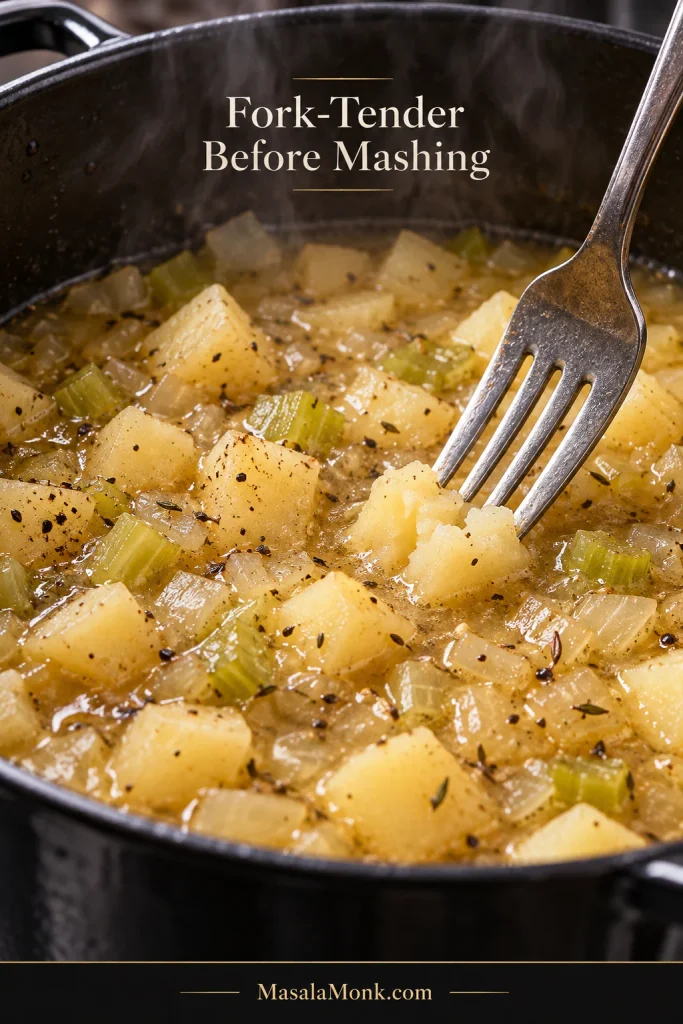
  4. Cook the potatoes until truly tender. Add the potatoes, black pepper and ½ teaspoon salt. Bring just to a boil, then lower the heat to a gentle simmer with small, lazy bubbles. Simmer gently, stirring from the bottom once or twice as the potatoes cook. Begin checking around 18 minutes and keep cooking as needed. The potatoes are ready when a fork slips through easily and a cube collapses with light pressure against the side of the pot. Let them become fully tender before deciding how much to mash.
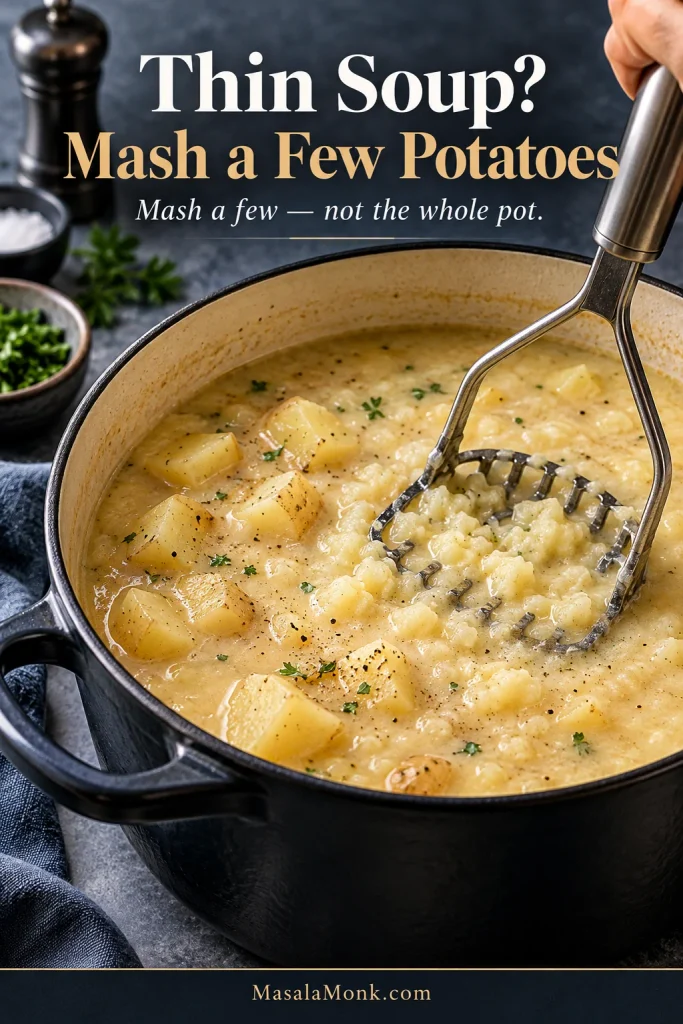
  5. Mash lightly. Take the pot off the heat. Start with about 6 firm presses of a potato masher, moving around the pot instead of repeatedly working one area. Stir. The broth should begin looking creamy while plenty of potato chunks remain. You can always mash more; you can’t put the chunks back.

Finish the Soup

  1. Add the milk. Stir in the whole milk and return the pot to low heat. Cook gently for about 5 minutes. Do not let it boil hard. Stir frequently and scrape across the bottom because the thickening soup can catch quickly.
  2. Wait. Take the pot off the heat and leave it alone for 5 full minutes. Do not add more flour, potato flakes or extra mashed potato yet.
  3. Check the consistency.
    Looks right? If the soup coats the spoon but still flows easily, move on to seasoning.
    Too dense? Add reserved broth starting with ¼ cup / 60 ml.
    Too loose? Mash a few more potato pieces. If needed, simmer gently, uncovered, for another 3–5 minutes.
    Still loose? Stir in 1 Tbsp / about 8 g plain instant potato flakes, wait 2–3 minutes, then check again before adding more.
  4. Season and serve. Add the remaining ¼ teaspoon salt if needed, then more only as your broth and potatoes require. Finish with black pepper to taste. If the soup is properly seasoned but still feels heavy or muted, take it off the heat and stir in ½ tsp / 2.5 ml lemon juice. Taste before adding more. White wine vinegar or apple cider vinegar can stand in for the lemon if needed.

Recipe Notes

  • No potato masher? Press a few fully tender potato pieces against the side of the pot with a sturdy wooden spoon or silicone spatula.
  • Do not aggressively blend Russets. Overworking cooked potato starch can turn the texture sticky or pasty. For a smoother bowl, briefly use an immersion blender in one small area of the pot, then stop well before the entire soup becomes smooth.
  • You do not have to peel every potato. Peeling gives the smoothest, palest soup. For a more rustic bowl, scrub the potatoes well and leave some or all of the skin on.

If the broth coats the spoon and the potatoes are soft but still visible, you’re done. Taste a hot spoonful with plenty of black pepper before changing anything else. If your pot looks thinner, thicker or stranger than expected, identify the problem before adjusting the texture.

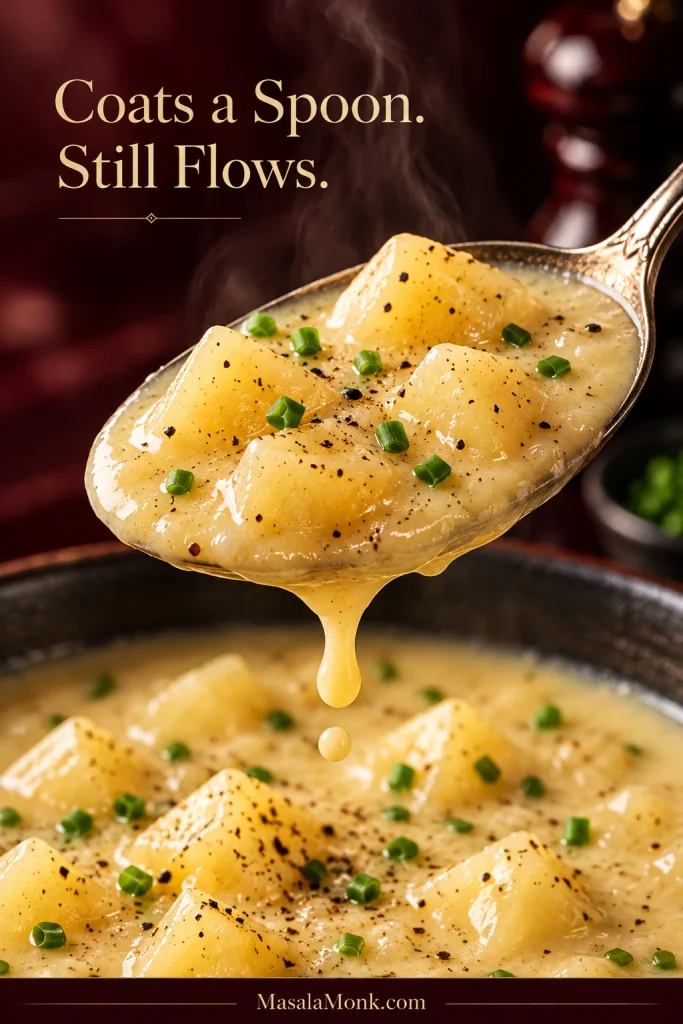
Close-up spoon lifting creamy potato soup with soft potato pieces and a rounded drop of broth falling back toward the bowl.
On the spoon, release matters more than thickness alone. The broth should gather, fall in a rounded drop and settle back into the bowl; if it pulls into strings or leaves a stubborn ridge instead, you are looking at a different texture problem.

Get the Texture You Want

Why Potato Soup Gets Thicker as It Sits

Potato soup gets thicker as it sits because potato starch and cooked flour continue holding onto liquid as the soup cools. Russets release starch while they simmer, and breaking a few of the cooked potatoes apart sends even more into the broth.

Heavy cream makes a soup richer; the potatoes and roux are what give this one its body. Overworking the potatoes can push that body too far and leave the soup dense or sticky.

That same handling matters in our mashed potatoes recipe: gentle mashing keeps Russets fluffy, while aggressive working pushes them toward paste.

This is also where tenderness matters more than the clock. Fully tender potatoes mash cleanly into the broth; partly firm pieces break unevenly and can leave hard centers behind.

Fork pressing through the center of a tender potato cube in broth with softened onion, celery and seasoning.
Test the center of a potato cube, not a frayed edge. Because the outside softens first, an edge can look done while the middle is still firm; the fork should pass through the center with almost no resistance before you mash.

That starch behavior is why the potato itself matters so much here.

Russet, Yukon Gold or Red Potatoes?

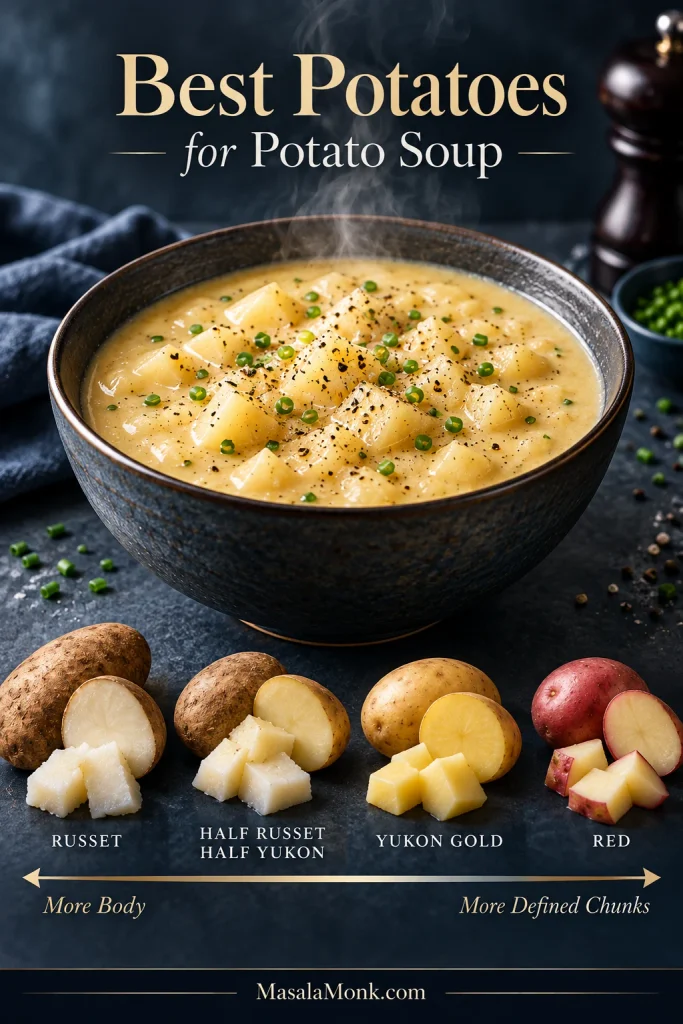
For this thick, creamy style, Russet potatoes are the best choice because their high starch content naturally gives the soup more body. They soften into the base instead of staying sharply defined.

PotatoEffect on the brothPotato pieces
RussetMost natural body; thickestSoft, fluffy and more likely to break down
Yukon GoldCreamy but somewhat looserButtery and better defined
Red potatoLightest of the threeFirmest and best at holding shape
Half Russet + half YukonCreamy with moderate starchMore defined chunks than all-Russet
Russet, Russet-Yukon mix, Yukon Gold and red potatoes arranged along a comparison from more broth body to more defined potato chunks.
Use the comparison to change your technique, not just your shopping list. An all-Russet pot usually needs less mashing for body; with Yukon Gold or red potatoes, stop once the pieces are tender rather than overworking them just to imitate Russet thickness.

If firm potato pieces are the priority, the same distinction matters in our potato salad guide, where holding shape matters much more than releasing starch.

Is Your Potato Soup Actually Too Thin?

Before adding anything, give the soup its full 5-minute rest. A pot that looks loose immediately after the milk goes in can tighten considerably once it is off the heat.

Too loose

The liquid runs straight off the spoon, and the potato pieces sit in an obviously thin base even after the final cook and rest.

Just right

The broth coats the back of a spoon but still drips slowly. A ladleful settles into the bowl on its own, with tender potato pieces still visible. Ideally, each spoonful feels creamy first, then gives you a soft piece of potato.

Too far

A spoon leaves a rigid channel behind, or the soup sits in a mound instead of settling. Too much potato may have been mashed, too much liquid may have evaporated, or the starch simply tightened more than expected.

Three potato soup consistencies labeled Too Loose, Just Right and Too Far, progressing from runny broth to an overly dense mound.
To judge potato soup consistency fairly, stir once and scoop from the center of the pot. A spoonful crowded with potato pieces can look thicker than the broth really is, so tilt the spoon and watch how the liquid itself moves before deciding what needs changing.

How to Thicken Potato Soup Without Making It Gluey

  1. Mash a few more cooked potato pieces.
  2. Simmer uncovered for 3–5 minutes over gentle heat, stirring from the bottom.
  3. Give it another short rest.
  4. If it still needs help, stir in 1 Tbsp / about 8 g plain instant potato flakes.
  5. Wait 2–3 minutes before deciding whether it needs another spoonful.
Potato masher pressing into one area of creamy soup while many tender potato chunks remain intact.
If the rested soup is still too loose, mash only a few additional potato pieces at a time, then stir that released starch through the broth before deciding whether to mash more. This is a correction step, not a reason to rework the whole pot.

For the standard recipe, use the potato already in the pot before reaching for another starch. A cornstarch slurry makes more sense when you’re deliberately making a flourless batch.

If it is too dense

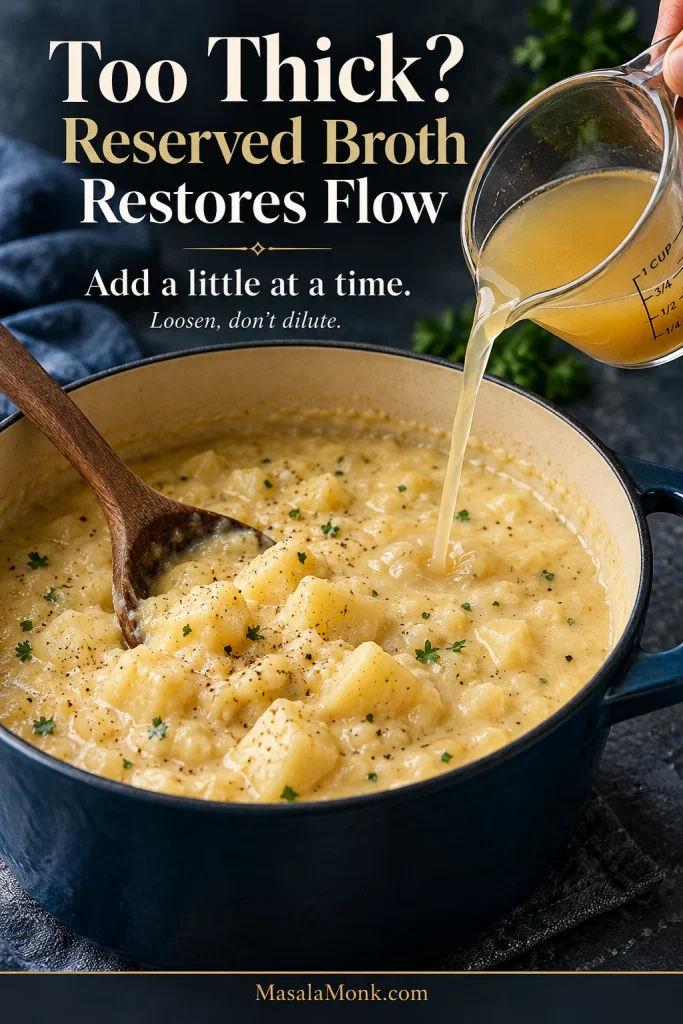
Add reserved broth ¼ cup / 60 ml at a time, stirring completely before adding more. Once the reserve is gone, use warm milk or additional broth in the same small increments if needed.

Small measuring jug pouring reserved broth into a pot of thick potato soup with visible soft potato chunks.
Reserved broth works best as a control knob rather than a reset button. Add a little, then stir from the bottom of the pot until the texture is even before judging again; otherwise, the surface can look loose while denser soup remains underneath.

Thick is not the same as gluey. If yours is simply too thick but still creamy, a splash of broth will bring it back. Gluey potato soup feels sticky, elastic or stringy after the potatoes have been worked too aggressively. Serious Eats explains the potato-starch changes behind that texture.

Side-by-side comparison of smooth, thick potato soup and sticky, pasty overworked soup with an elastic texture.
Watch what happens after you try to loosen the soup. A merely thick batch relaxes as liquid is incorporated; an overworked batch can stay tacky or elastic, which points to damaged starch rather than simple over-thickening.

When Potato Soup Goes Wrong

First, think about when the problem appeared—that usually tells you where to look.

Before the milk goes in

The potatoes are still hard. Keep simmering until they crush easily. Cube size, potato variety and simmer strength all change the timing.

The base is already very dense. Don’t mash yet. Add a splash of reserved broth if necessary and finish cooking the potatoes before making another adjustment.

The flour formed lumps. Whisk firmly while the mixture is still fairly loose. Next time, make the first ½ cup / 120 ml broth completely smooth with the flour-coated vegetables before adding the rest.

After the milk goes in

The dairy looks grainy or separated. Most often, the pot became too hot. Pull it off the burner and whisk gently. Return it only to low heat if it needs more cooking. Gentle whisking can smooth it somewhat, but badly split dairy won’t always return to a perfectly smooth texture.

The bottom smells scorched. Move the unburned soup into a clean pot immediately. Leave the burnt layer behind rather than scraping it into the rest of the batch.

It tastes bland. Check the salt first and correct it gradually, then add freshly ground black pepper. If the soup is properly seasoned but still feels heavy or muted, stir in ½ tsp / 2.5 ml lemon juice off the heat. Taste before adding more.

It became sticky or elastic after blending. You’ve probably overworked the potato starch. A little broth can make the soup easier to eat, but the original texture may not return completely. Next time, use a potato masher instead of blending the whole pot.

Once the potatoes and texture are where you want them, there is some room to adapt the dairy and a few other ingredients.

Creamy Potato Soup Without Heavy Cream

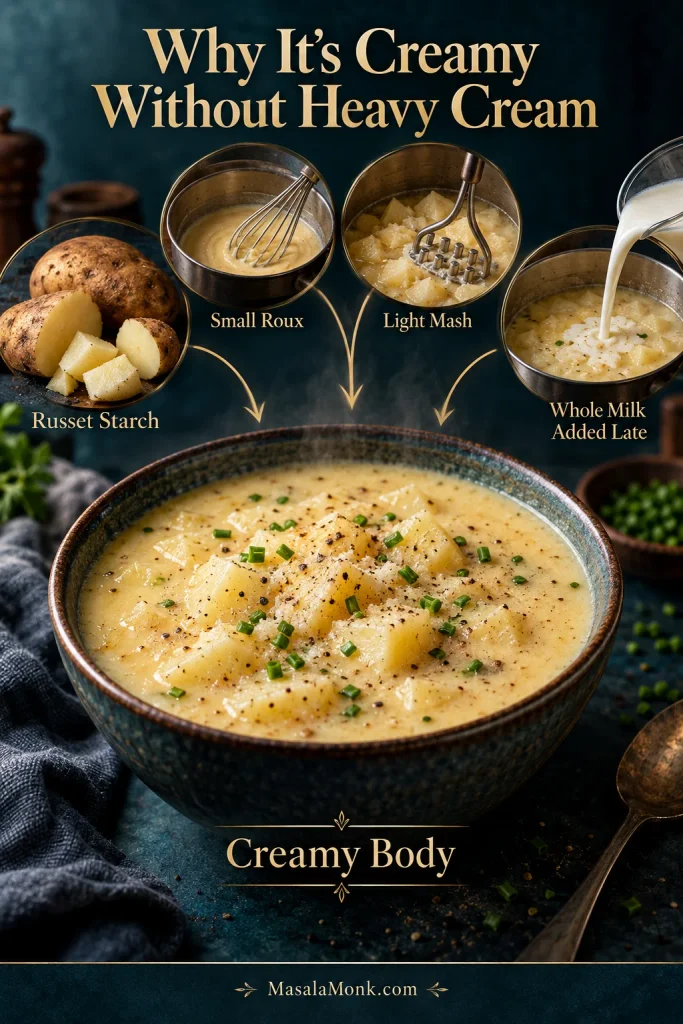
You don’t need heavy cream here. Russets and the small roux provide the body; whole milk adds enough richness without making the bowl heavy.

Finished creamy potato soup with visual cues for Russet starch, a small roux, light mashing and whole milk added late.
Once the Russets, small roux and light mash have built the structure, dairy is mostly a richness decision. A milk substitution changes flavor and richness; it should not be used to rescue a thin pot, which is a texture problem instead.

The swaps below are for the nights when your fridge—or your diet—requires a change.

If you haveWhat to do
2% milkReplace whole milk 1:1. The finished soup will taste slightly lighter.
Evaporated milkReplace the milk 1:1 for a richer, slightly more concentrated dairy flavor. Use unsweetened evaporated milk, not sweetened condensed milk.
Half-and-halfReplace up to half the milk if you want a richer bowl.
Heavy creamReplace up to 1 cup / 240 ml of the milk with heavy cream for a richer soup.
Unsweetened oat milkChoose plain and unflavored. An extra-creamy style will come closest to whole milk, though the flavor will still be slightly different.

Vegan, Gluten-Free and Flourless Options

To make vegan potato soup, use vegetable broth, plant-based butter and the plain unsweetened oat milk described above.

For gluten-free potato soup, a cup-for-cup / 1:1 gluten-free flour blend can replace the all-purpose flour; start with 24 g. Blends vary, so the finished consistency may need a small adjustment.

For a flourless version, skip the roux. Once the potatoes are fully tender, mash a little more of them into the soup. If the rested pot still needs body, whisk 1 Tbsp / about 8 g cornstarch with 2 Tbsp / 30 ml cold milk, stir it in and heat gently until the soup thickens. Our white bean soup uses another flourless route, blending cannellini beans into the base.

Making Potato Soup With What You Have

Fresh Russets are the easiest route, but don’t abandon dinner because what you have is frozen, shredded or already mashed.

Frozen diced potatoes. Add them directly unless the package says otherwise. Different brands use different potatoes and cube sizes. Once they’re in the pot, tenderness matters more than the original timer.

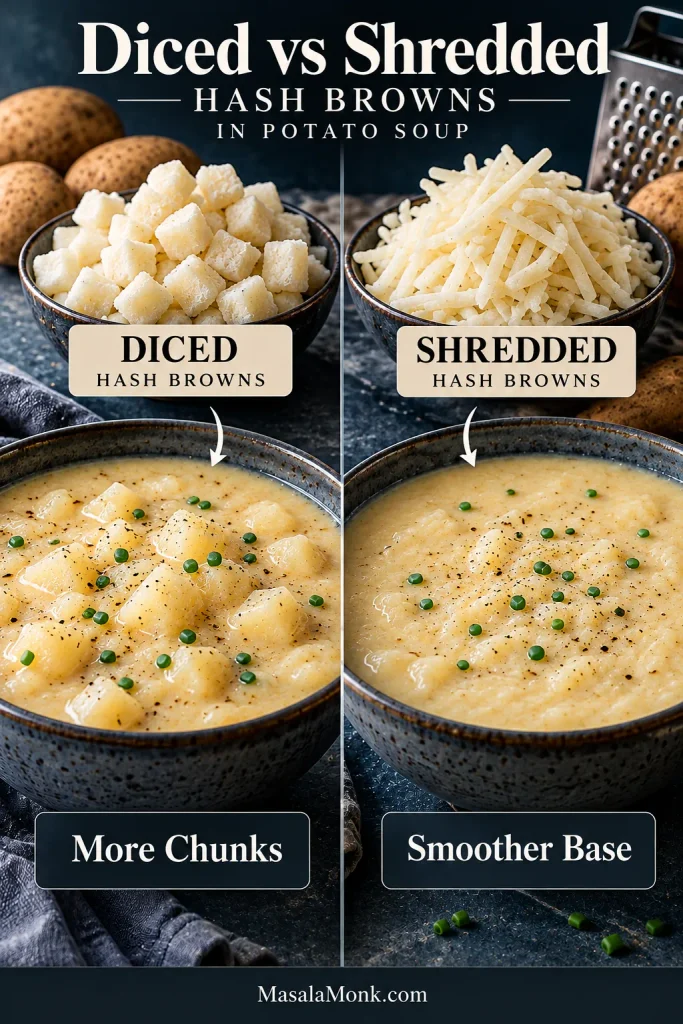
Frozen hash browns. If they are what gets dinner into the pot tonight, use them. Diced hash browns are better when you want recognizable potato pieces; shredded ones disappear much more readily and create a smoother base. Choose plain, unseasoned hash browns when possible so extra salt, onion powder or added fat does not unexpectedly change the soup.

Diced frozen hash browns beside chunkier potato soup and shredded hash browns beside smoother soup, labeled More Chunks and Smoother Base.
Shredded hash browns expose more cut potato surface than diced pieces, so they can soften into the broth and release starch sooner. Because brands and cuts vary, start checking the texture earlier instead of carrying fresh ½-inch potato-cube timing over unchanged.

Leftover mashed potatoes. Stir them in near the end, starting with about ½ cup at a time. Leftover mash may already contain butter, milk, cheese, garlic or plenty of salt, so taste before seasoning again.

Plain instant potato flakes. They are useful as an emergency thickener because they add potato solids without introducing another floury flavor. Use plain flakes rather than seasoned instant mash; follow the measured rescue method if the pot still needs help.

What to Serve With Potato Soup

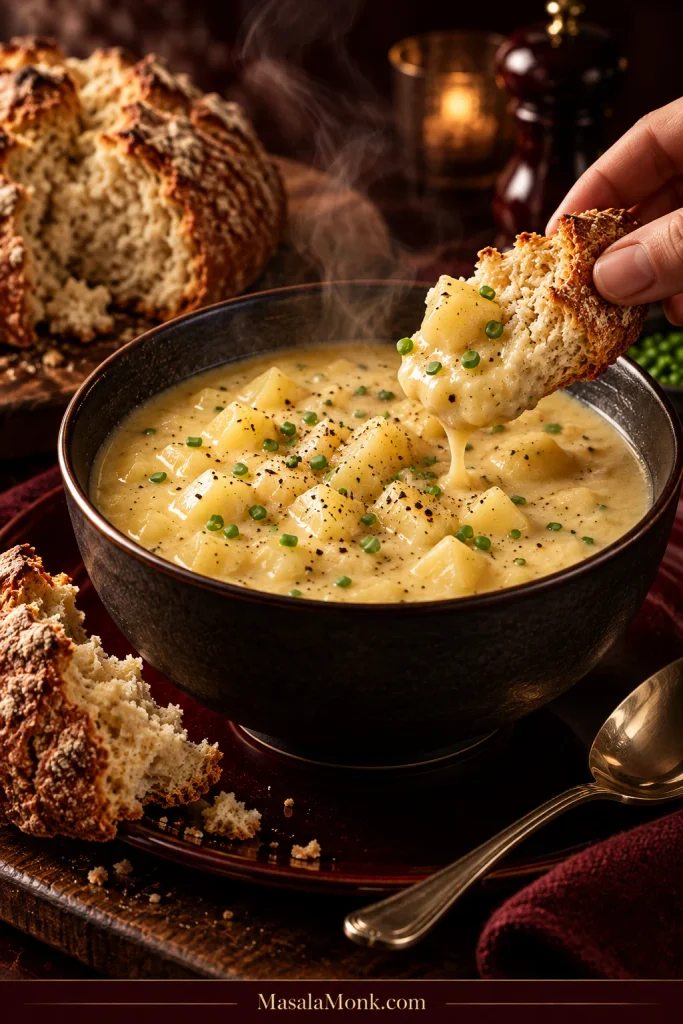
Potato soup is especially good with something crisp, fresh or crusty alongside it. Irish soda bread gives you something sturdy for the broth, a simple green salad brings freshness, and grilled cheese turns the bowl into a fuller meal.

Hand dipping a torn piece of crusty soda bread into a steaming bowl of creamy potato soup.
Crusty bread works especially well here because it gives the creamy soup some chew and contrast without turning the bowl into a heavier loaded-potato meal.

Taste the soup before reaching for toppings; it should already feel complete. The finished bowl should taste of potato first, with softened onion, thyme and black pepper underneath it. Chopped chives or scallions bring a fresh finish without covering that up.

Bacon, cheddar and sour cream are all good additions at the table when you want something more loaded. If those flavors are really the point of dinner, our twice-baked potato casserole takes that combination much further.

Storing, Reheating and Freezing Potato Soup

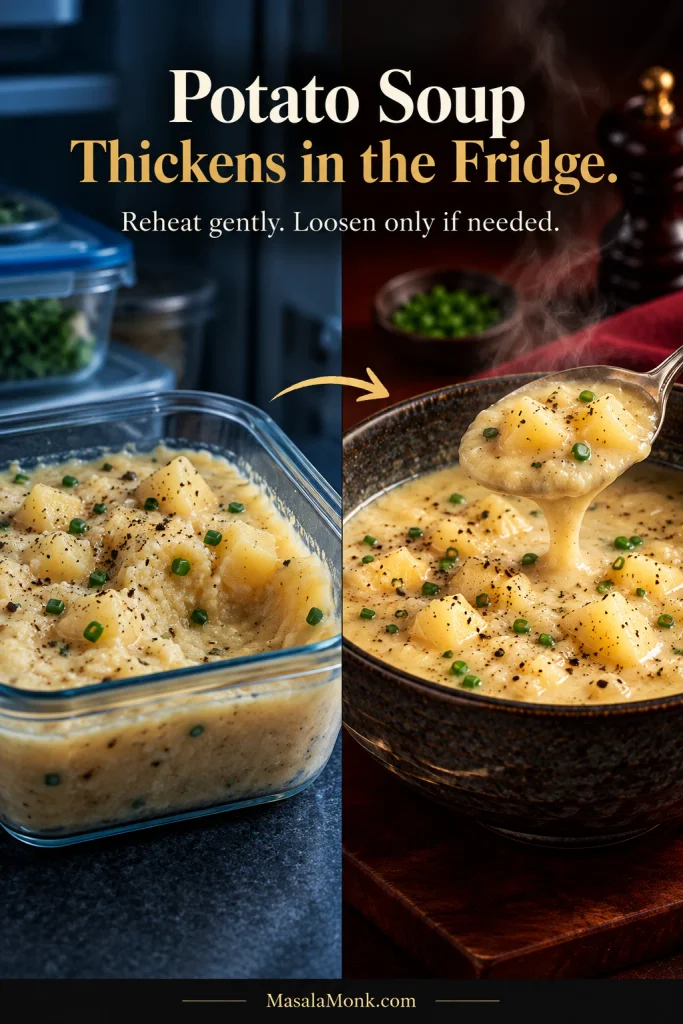
Potato soup will be noticeably thicker straight from the refrigerator. Reheat it gently before deciding how much liquid it needs; warming and stirring alone will loosen it.

Cold thick potato soup in a storage container beside reheated soup flowing from a spoon, showing the same soup before and after warming.
Stir from the bottom as leftover potato soup warms and judge the consistency only once the center is hot. Cold pockets can remain much denser than the edges, so adding broth or milk too early can leave the fully reheated soup thinner than you intended.

Refrigerating potato soup safely

Refrigerate leftovers in shallow containers within 2 hours of cooking, or within 1 hour in temperatures above 90°F / 32°C.

Keep them at 40°F / 4°C or colder and use within 3–4 days. These timings follow USDA guidance for safely handling cooked leftovers.

Reheating

Start over medium-low heat and stir frequently, scraping the bottom. If the cold soup is too stiff to stir comfortably, add just 1–2 Tbsp / 15–30 ml broth or milk to get it moving. Once the soup is hot and evenly mixed, add more liquid only as needed, 2–4 Tbsp / 30–60 ml at a time.

Reheat the soup thoroughly. Leftovers should reach at least 165°F / 74°C throughout; if you bring the soup to a boil, keep it brief rather than letting the milk-based soup boil hard. If the consistency still feels off once the soup is hot, use the same texture check as the fresh pot before making another adjustment.

Freezing

You can freeze potato soup, but expect some change. Russet pieces may become grainier or more crumbly after thawing, and the milk-based broth can look slightly separated.

For best quality, use frozen potato soup within about 2–3 months. Thaw it in the refrigerator, then reheat thoroughly while stirring. If the potato pieces have become crumbly, mash some of them back into the soup instead of trying to make them firm again.

Ladle the soup while the broth still moves easily around the soft potato pieces. Finish with chives and plenty of black pepper. Put something crisp or crusty alongside it, and serve while the potatoes are still unmistakably the main event.

Posted on — 1 Comment

Recipe for Leftover Baked Potatoes

Introduction: Unleashing the Culinary Potential of Leftover Baked Potatoes

Have you ever gazed at a plate of leftover baked potatoes and wondered, “What now?” You’re not alone. Leftover baked potatoes are a common quandary in kitchens everywhere. But what if I told you that these humble leftovers hold the potential for culinary greatness? Welcome to a world where leftover baked potatoes become the cornerstone of innovative and delightful dishes.

In this blog post, we’re going to embark on a culinary adventure, transforming mundane leftovers into mouthwatering meals. From cozy family dinners to elegant appetizers, we’ll explore how these simple spuds can be reinvented into an array of dishes that will surprise and satisfy your taste buds.

So, grab those leftover baked potatoes and get ready to unleash their hidden potential. We’re about to dive into a treasure trove of recipes that will elevate your cooking game and ensure your baked potatoes never go unnoticed again!

The Versatility of Baked Potatoes: A Canvas for Culinary Creativity

Baked potatoes are more than just a side dish; they’re a blank canvas for culinary creativity. Their mild flavor and hearty texture make them the perfect base for a variety of ingredients and cooking styles. Rich in nutrients like potassium, fiber, and vitamin C, baked potatoes not only add substance to your meals but also contribute to a balanced diet.

Their versatility extends beyond the traditional toppings of butter and sour cream. Leftover baked potatoes can be transformed into entirely new creations, each bursting with flavor and character. Whether it’s a savory breakfast hash, a comforting casserole, or a sophisticated appetizer, these spuds are ready to be reinvented in your kitchen.

In the next sections, we will delve into specific recipes that showcase the adaptability of baked potatoes. From quick and easy family favorites to more elaborate dishes, there’s a baked potato recipe for every occasion and taste preference. So let’s turn those leftovers into culinary masterpieces!

Preparing Your Potatoes: Tips for Optimal Flavor and Texture

Before we dive into the recipes, let’s ensure your leftover baked potatoes are prepped and ready to transform into delicious dishes. Proper preparation and storage are key to maintaining their flavor and texture. Here are some tips to get your potatoes primed for their next culinary journey:

  1. Storing Leftover Baked Potatoes: Cool your baked potatoes completely before storing them. Wrap them in foil or place them in an airtight container, and refrigerate. Properly stored, they can last up to 5 days.
  2. Reheating for Best Results: When reheating, aim to restore the original texture. An oven or toaster oven will give the best results, reheating them at 350°F until they are warmed through. Avoid microwaving if possible, as it can make the potatoes soggy.
  3. Prepping for Recipes: Depending on your recipe, you might need to scoop out the insides, slice them, or mash them. For dishes requiring crispy potatoes, consider pan-frying them in a bit of oil to revive their texture.

With your leftover baked potatoes prepped and ready, you’re all set to explore the range of recipes they can be transformed into. Up next, we will share some creative and mouth-watering ways to repurpose your baked potatoes into something extraordinary.


Recipe Ideas: Reimagining Leftover Baked Potatoes

Transforming leftover baked potatoes into exciting new dishes is easier than you might think. Here are some innovative and delicious ways to give your baked potatoes a second life:

  1. Twice-Baked Potatoes: Scoop out the inside of your baked potatoes and mix it with your favorite ingredients—think cheddar cheese, sour cream, bacon, and chives. Refill the skins and bake again until everything is warm and melty. This dish is a crowd-pleaser and a great way to use up leftovers in a tasty way​​.
  2. Potato Skins: Cut the baked potatoes in half and scoop out most of the flesh. Brush with olive oil and bake until crispy. Top with shredded cheese, bacon crumbles, and bake again until the cheese melts. Finish with green onions, sour cream, or guacamole for a fun and flavorful appetizer​​.
  3. Cheesy Potato & Smoked Sausage Casserole: Roughly cube your baked potatoes and mix them with smoked sausage and a generous amount of cheese. Bake until everything is hot and bubbly. This comforting casserole is a great way to turn your leftovers into a hearty meal​​​​.
  4. Baked Potato Home Fries: Cube the leftover potatoes and pan-fry them with onions and peppers for a savory breakfast side. Season with herbs and spices for an extra flavor kick. This simple yet delicious dish is perfect for a hearty breakfast or brunch​​.
  5. Loaded Potato Soup: Mash the baked potatoes and combine them with chicken or vegetable broth, cream, and your choice of toppings like bacon, cheese, and green onions. This rich and creamy soup is a warming and satisfying way to use up leftover baked potatoes.

These recipes are just the beginning. With a bit of creativity, leftover baked potatoes can be the start of many delicious meals. In the next section, we’ll explore some breakfast-specific recipes to start your day with a leftover makeover.

Breakfast Specials: Starting Your Day with Leftover Baked Potatoes

Breakfast is an opportunity to turn your leftover baked potatoes into the star of the morning. These breakfast ideas are not only easy to prepare but also incredibly satisfying:

  1. Savory Breakfast Hash: Cube your leftover baked potatoes and pan-fry them with onions, peppers, and your choice of protein like ham, bacon, or sausage. Top with a fried or poached egg for a complete breakfast hash that’s both filling and flavorful.
  2. Breakfast Burritos: Fill warm tortillas with scrambled eggs, diced leftover baked potatoes, cheese, and salsa. Roll them up for a quick and portable breakfast option that’s full of flavor and texture.
  3. Potato and Vegetable Frittata: Slice the baked potatoes and layer them in a skillet with sautéed vegetables like spinach, tomatoes, and onions. Pour over beaten eggs and cook until set. A frittata is a great way to use up not only leftover potatoes but also any veggies you have on hand.
  4. Potato Pancakes: Shred or mash the baked potatoes and mix with eggs, flour, and seasoning. Pan-fry until crispy and golden. Serve with sour cream or applesauce for a delightful breakfast treat.
  5. Loaded Baked Potato Omelette: Chop the baked potatoes and add them to your omelette along with cheese, bacon, and green onions. This loaded omelette is a hearty and delicious way to start your day.

These breakfast recipes showcase the versatility of baked potatoes in the first meal of the day. They’re perfect for weekend brunches or to add a twist to your weekday breakfast routine. In the following section, we’ll provide tips for health-conscious cooks looking to enjoy these recipes in a healthier way.

Tips for Health-Conscious Cooks: Making Leftover Baked Potatoes Healthier

For those mindful of their health and nutrition, here are some tips to make these leftover baked potato recipes healthier without sacrificing taste:

  1. Opt for Low-Fat Toppings: Instead of traditional high-fat toppings like cheese and sour cream, try using low-fat alternatives or substitute with Greek yogurt for a creamy texture with added protein.
  2. Increase the Veggies: Boost the nutritional value of your potato dishes by adding more vegetables. Spinach, kale, bell peppers, and mushrooms are great options that also add color and flavor.
  3. Use Lean Proteins: When adding protein to your potato dishes, opt for leaner choices like turkey bacon, chicken sausage, or plant-based proteins. These options provide the protein you need without the extra fat.
  4. Reduce Oil and Butter: When cooking, use minimal amounts of oil or butter. Consider using cooking sprays or a non-stick pan to reduce the amount of added fat.
  5. Portion Control: Be mindful of portion sizes to keep calorie intake in check. Even healthy ingredients can add up in calories if consumed in large amounts.
  6. Get Creative with Herbs and Spices: Enhance flavor without adding extra calories by using a variety of herbs and spices. Garlic, paprika, cumin, and fresh herbs like parsley and cilantro can elevate your dish’s flavor profile.

By incorporating these tips, you can enjoy the delightful recipes made from leftover baked potatoes in a healthier way. Up next, we’ll wrap up our culinary adventure with leftover baked potatoes and summarize the key takeaways.

Conclusion: Elevating Leftover Baked Potatoes to New Culinary Heights

We’ve journeyed through a world where leftover baked potatoes are not just remnants of a previous meal, but rather, a versatile ingredient full of potential. From hearty breakfast hashes to elegant potato pancakes, we’ve explored how these humble leftovers can be transformed into an array of delicious and satisfying dishes.

This culinary adventure with leftover baked potatoes shows that with a bit of creativity and some simple tweaks, you can turn what might seem like mundane leftovers into exciting and flavorful meals. Whether you’re looking for a quick breakfast, a comforting dinner, or a healthy twist on a classic dish, baked potatoes offer endless possibilities.

Remember, cooking is an art, and leftovers are an opportunity to exercise your creativity in the kitchen. Next time you find yourself with leftover baked potatoes, embrace the chance to experiment and discover new favorite recipes that are both delicious and resourceful.

Call to Action: We’d love to hear how you repurpose your leftover baked potatoes. Share your favorite recipes or tips in the comments below, and let’s continue to inspire each other with innovative ways to enjoy this versatile vegetable.