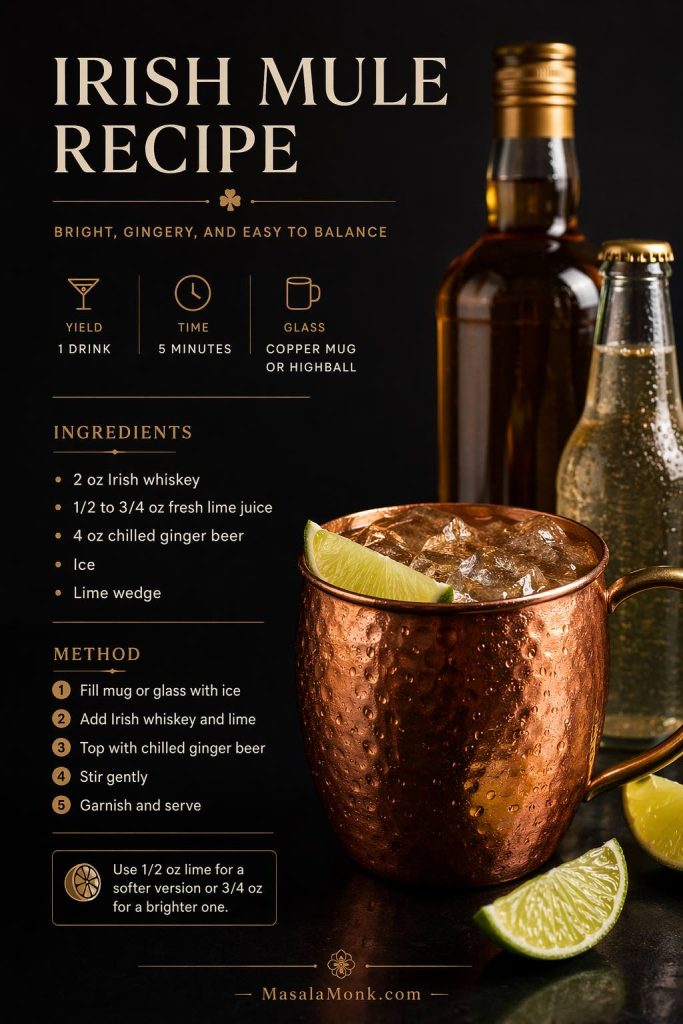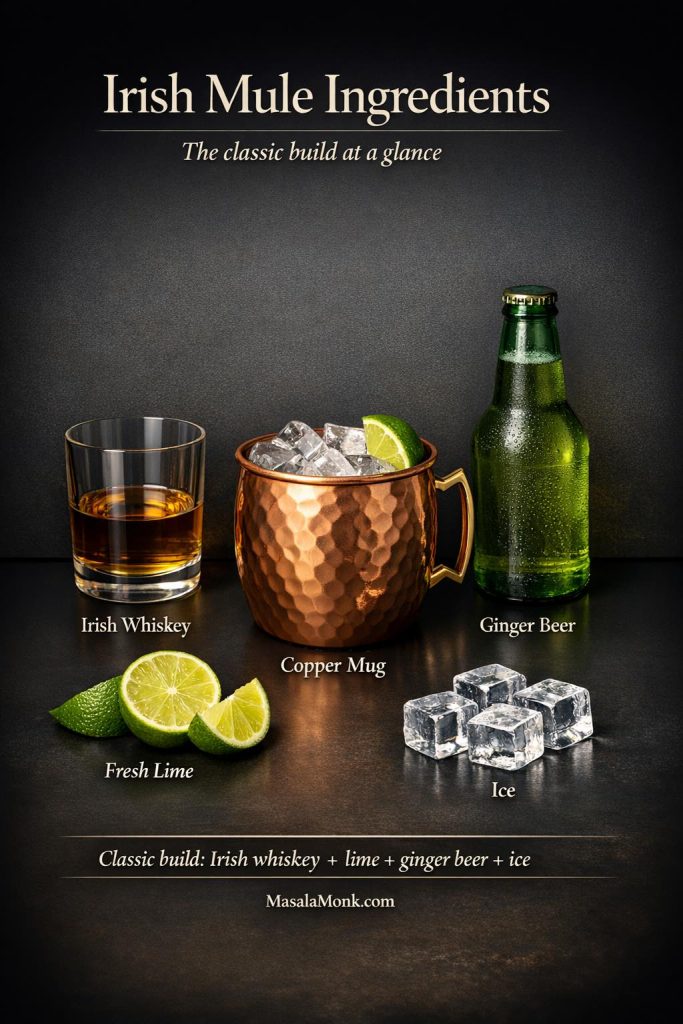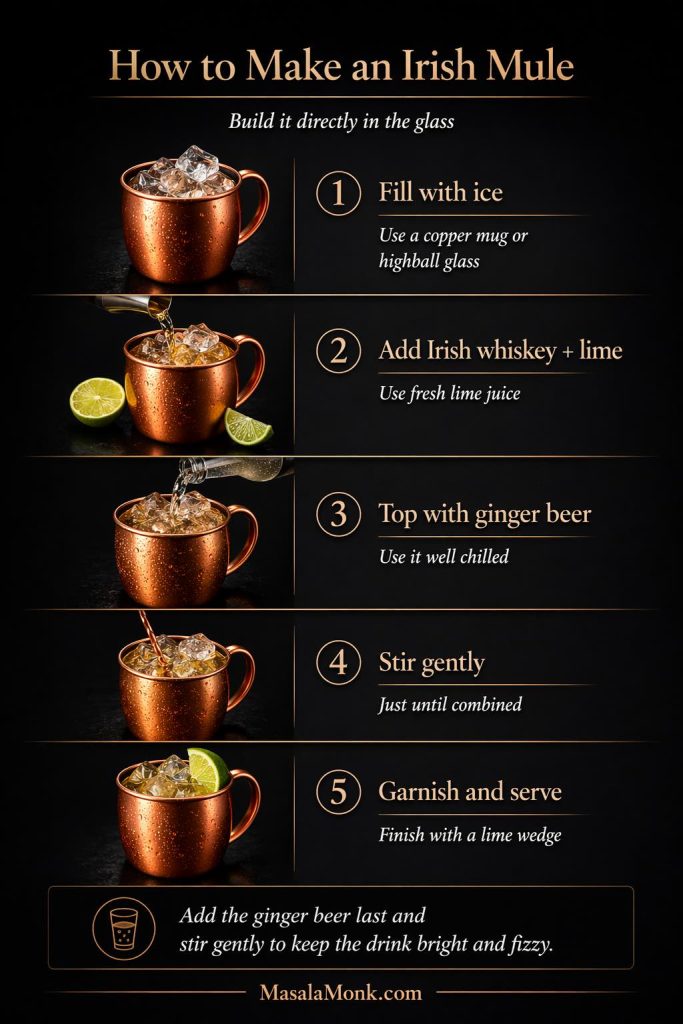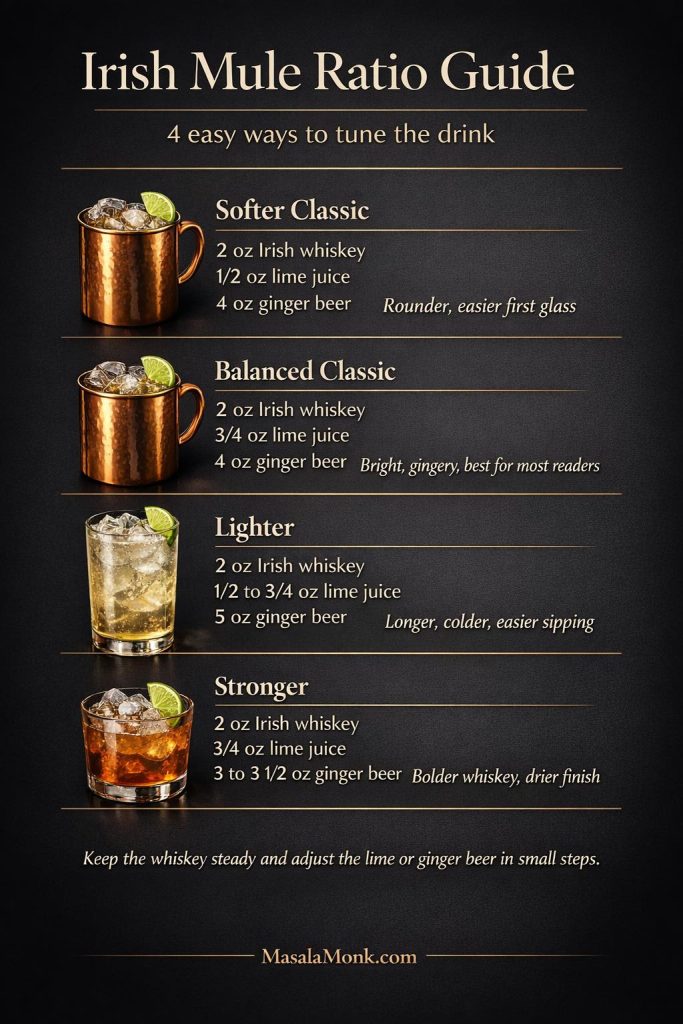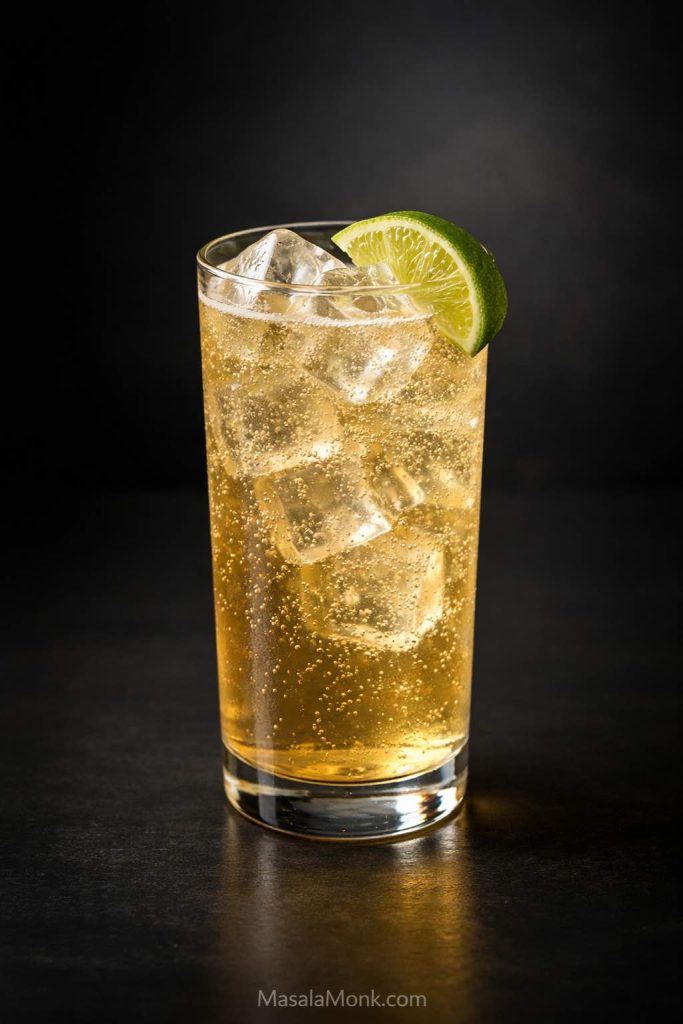
A whiskey ginger recipe is one of the easiest ways to make whiskey feel colder, lighter, and more refreshing without losing its character. This whiskey ginger drink is simple: whiskey, ginger ale, ice, and lime. Even so, when the ratio is right, it still tastes finished, balanced, and genuinely worth making again.
The only real point of confusion is the mixer. Some readers mean the classic whiskey and ginger ale version, while others want a spicier whiskey and ginger beer drink with more bite. Therefore, this whiskey ginger recipe starts with the smooth, classic build first, and then shows you exactly how to adjust the ratio, the whiskey, and the mixer to suit your taste.
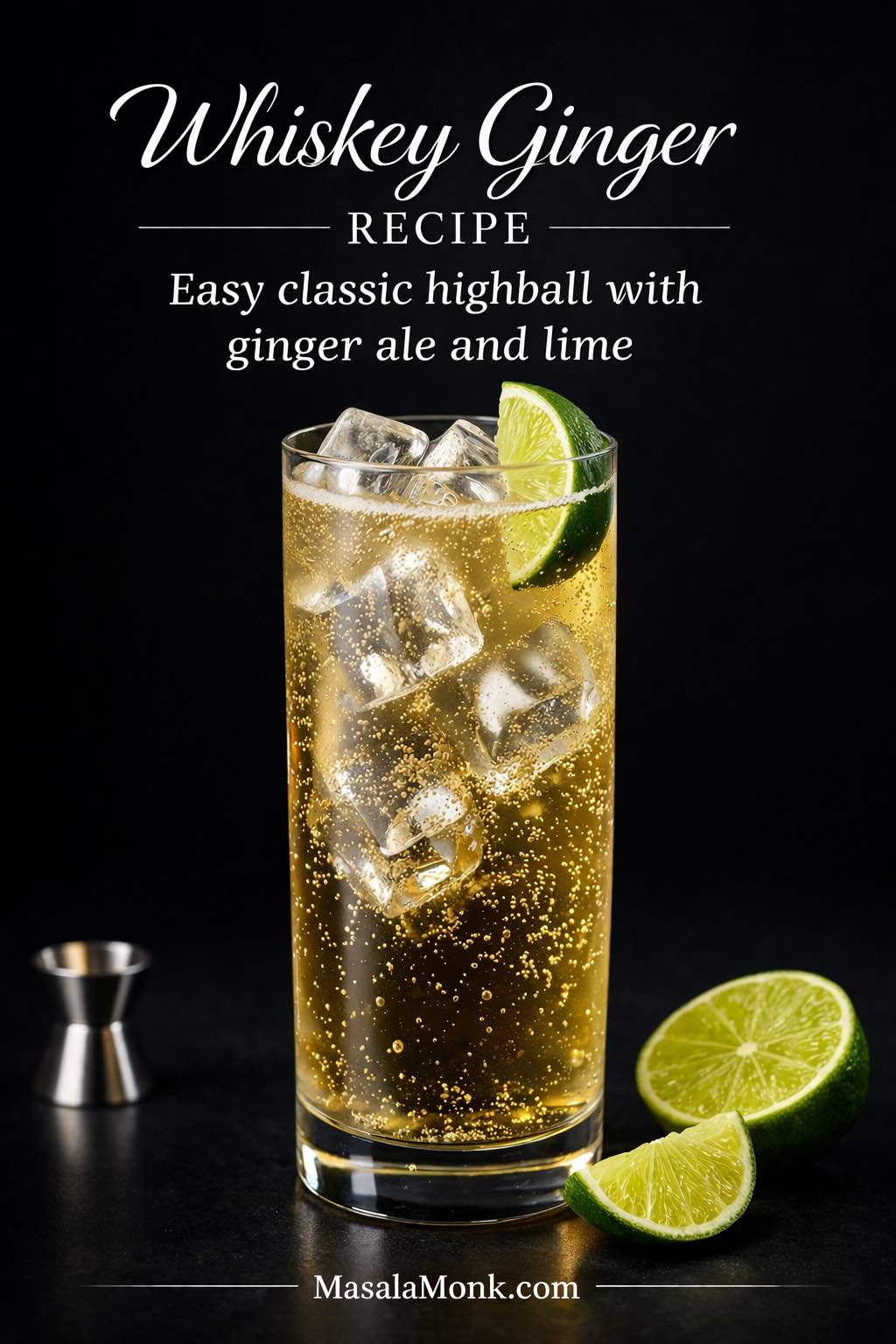
A whiskey ginger is a simple highball made with whiskey, ginger ale, ice, and lime. For most readers, the best whiskey ginger recipe to start with is still the classic ginger ale version because it is smoother, more forgiving, and easier to balance on the first try.
If you want the easiest starting point, use Irish whiskey and ginger ale. If you want a sweeter version, use bourbon instead. However, if you want more bite, switch to ginger beer or a spicier whiskey rather than trying to force the classic version to do everything at once.
Best first version: Irish whiskey + ginger ale + lime
Best sweeter version: bourbon + ginger ale
Best spicier version: whiskey + ginger beer
Best brighter version: use a firmer squeeze of lime and move toward an Irish Buck style
That gives you the cleanest baseline first. Then, once you know what feels too soft, too sweet, or too sharp, the next round becomes much easier to adjust well.
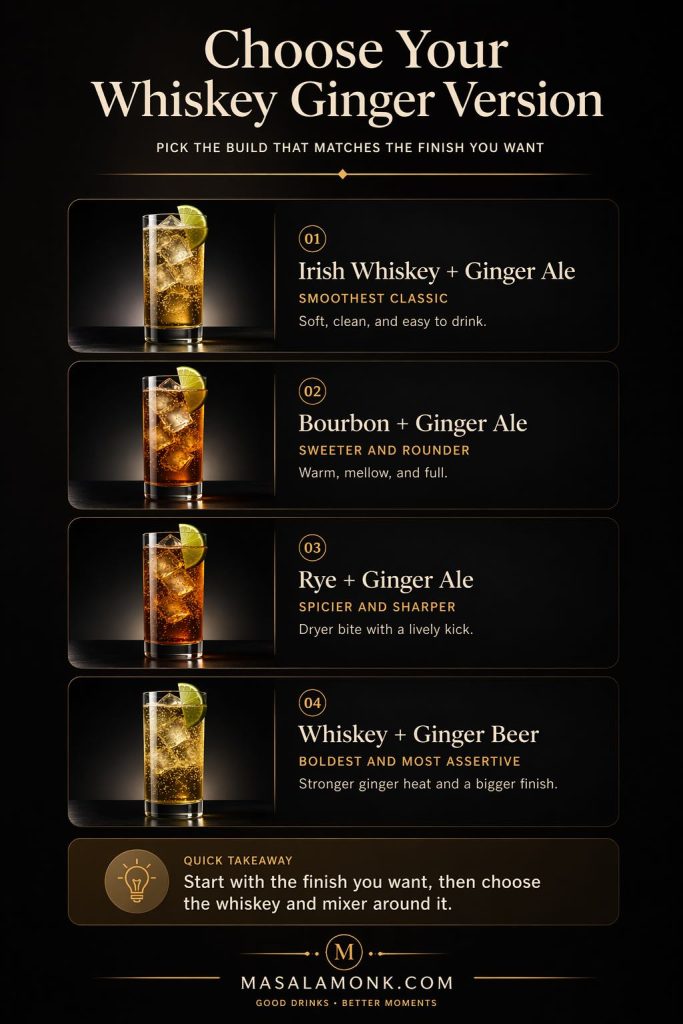
The easiest way to choose a whiskey ginger is to decide what you want the glass to feel like first: Irish whiskey keeps it smooth, bourbon makes it rounder, rye adds sharper spice, and ginger beer pushes it bolder and more assertive.
Choose Your Version
Use Irish whiskey + ginger ale for the smoothest, most classic version.
Use bourbon + ginger ale for a sweeter, rounder drink.
Use rye + ginger ale for more spice and edge.
Use whiskey + ginger beer for the boldest, sharpest variation.
This quick choice matters because the drink changes more than people expect from only one ingredient swap. Ginger ale keeps things softer and easier, while ginger beer pushes the drink into a noticeably spicier direction almost immediately.
Whiskey Ginger Recipe Card
This whiskey ginger recipe is the best first version to make because it is easy, balanced, and flexible enough to adjust after a single sip. In other words, it gives you the classic drink most readers actually want first, and then leaves plenty of room to push it sweeter, spicier, or stronger later.
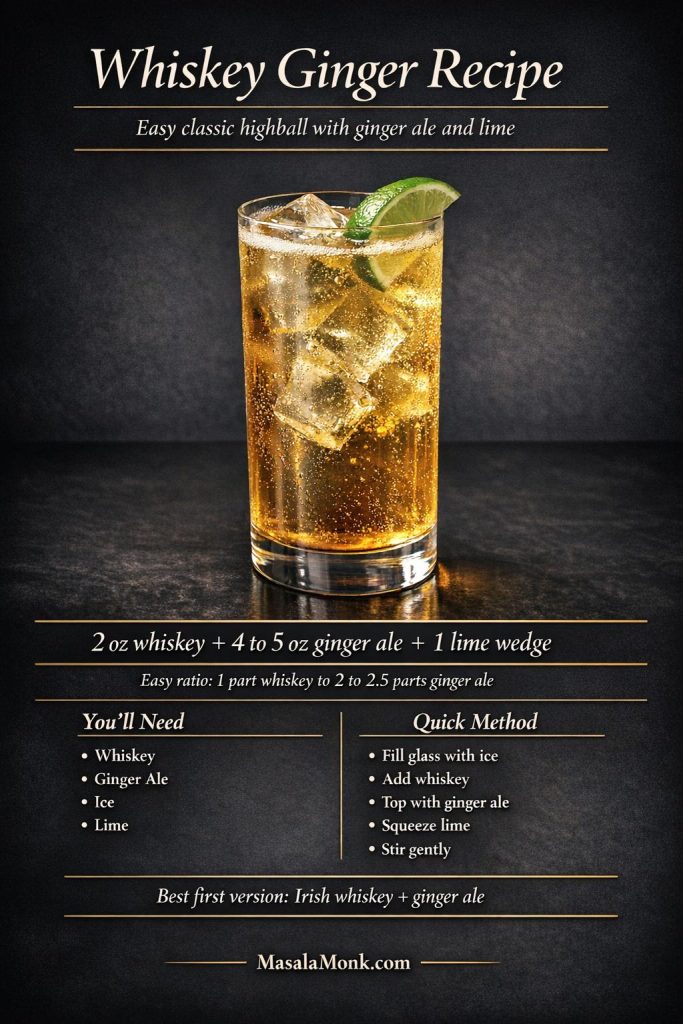
Formula: 2 ounces / 60 ml whiskey + 4 to 5 ounces / 120 to 150 ml ginger ale + 1 lime wedge Easy ratio: 1 part whiskey to about 2 to 2.5 parts ginger ale
Yield: 1 drink
Time: 5 minutes
Glass: Highball glass or tall glass
Garnish: Lime wedge
Best first bottle: Irish whiskey
Best first mixer: Ginger ale
Flavor: cold, lightly sweet, bright, and easy to sip
Best first version: Start with Irish whiskey and ginger ale if you want the smoothest, most classic whiskey ginger.
Fill a tall glass with ice. Add the whiskey, top with ginger ale, stir gently, then squeeze in the lime wedge and serve right away.
Notes for the best whiskey ginger: Start with ginger ale if this is your first whiskey ginger because it is easier to balance and less likely to overpower the whiskey. Then, once you know the classic version, move to bourbon if you want a fuller, sweeter drink or to ginger beer if you want more spice and edge. Also, keep the lime modest at first. A little brightens the drink beautifully; however, too much can pull it away from classic whiskey ginger territory and into a brighter buck-style direction.
Easy first adjustment: If the drink tastes too soft, use a little less ginger ale next time. On the other hand, if it tastes too strong, add a small splash more and stir once. Because the drink is so simple, those small adjustments show up immediately.
Save the classic build once and the drink becomes easy to repeat: start with 2 ounces of whiskey to 4 to 5 ounces of ginger ale, then adjust lighter or stronger once you know your preferred balance.
Whiskey Ginger Ingredients
The ingredient list is short. Even so, each part matters more than it first seems because there is nowhere for weak choices to hide in a drink this simple.
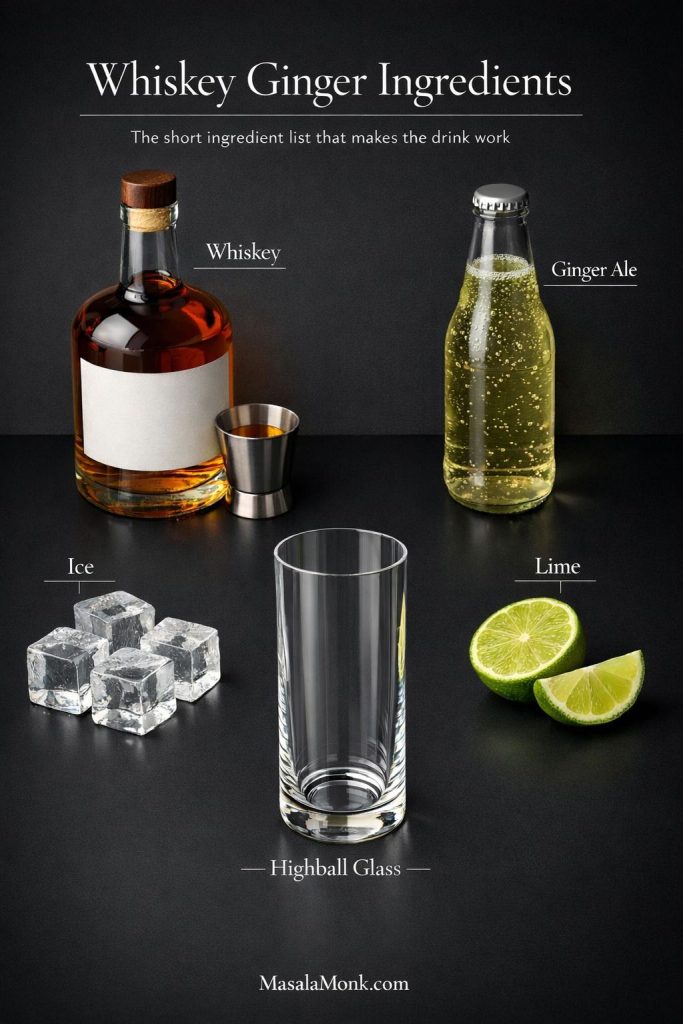
A whiskey ginger stays simple, so each ingredient matters: the whiskey sets the tone, the ginger ale brings lift, the lime sharpens the finish, and the ice keeps the drink crisp.
Whiskey: This sets the tone of the drink. Irish whiskey tastes smoother, bourbon tastes sweeter, rye tastes spicier, and scotch tastes drier or maltier.
Ginger ale: This is the classic mixer because it keeps the drink fizzy, lightly sweet, and easy to sip.
Lime: A small squeeze brightens the finish. Without it, the drink can taste a little flat; with too much of it, the drink can start tasting like a different branch of the family.
Ice: Use plenty so the drink stays crisp instead of turning dull too quickly.
That short list is part of the reason a good whiskey ginger recipe works so well. The drink is accessible enough for beginners, yet still flexible enough for regular whiskey drinkers who want to tweak the profile around the bottle they already enjoy.
If you already know you enjoy more ginger bite, ginger beer can work too. Still, that is not a tiny swap. It changes the whole feel of the drink, so it is better treated as a true variation rather than a casual substitution.
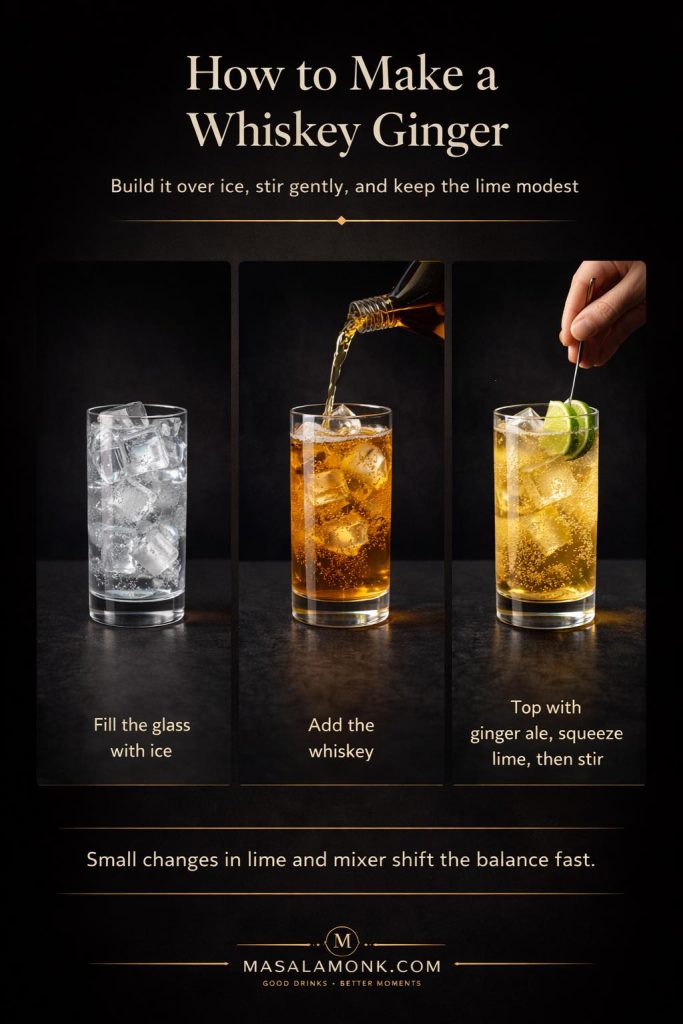
A whiskey ginger is easiest to build directly in the glass: start with plenty of ice, add the whiskey, then top with ginger ale and finish with a modest squeeze of lime.
How to Make a Whiskey Ginger
The method is straightforward. Build the drink over ice, stir briefly, and finish with lime. Because of that, this is one of the easiest whiskey drinks to make well at home.
Fill a highball glass or tall glass with ice.
Pour in the whiskey.
Top with ginger ale.
Stir gently just until combined.
Squeeze in a lime wedge and, if you like, drop it into the glass.
After the ginger ale and lime go in, the drink should look light, bubbly, and easy to sip, with the whiskey still showing through the glass.
Then taste it before you walk away. If it feels too strong, add a little more ginger ale. If it feels too soft, use slightly less mixer next time. Therefore, the first glass gives you the baseline, and the next one gets even better.
A dependable starting point is 2 ounces / 60 ml of whiskey to 4 to 5 ounces / 120 to 150 ml of ginger ale. In simple parts, that is about 1 part whiskey to 2 to 2.5 parts ginger ale. That ratio works well because it lets the whiskey show up clearly while still keeping the drink cold, refreshing, and easy to sip.
After that, you can adjust the drink around your taste. In fact, one of the best things about a whiskey ginger recipe is how quickly it responds to small changes. Once you know your preferred balance, this whiskey ginger recipe becomes one of the easiest whiskey drinks to repeat consistently.
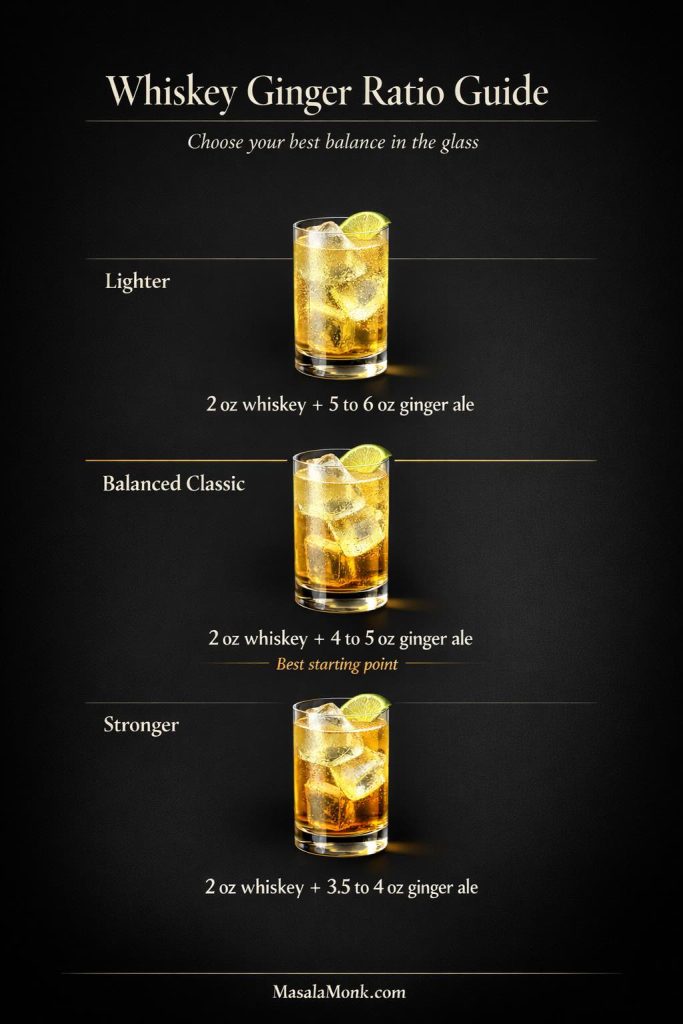
Start with the balanced classic ratio first, then move lighter for a softer highball or stronger for a firmer whiskey presence in the glass.
Lighter: 2 ounces / 60 ml whiskey to 5 to 6 ounces / 150 to 180 ml ginger ale
Balanced classic: 2 ounces / 60 ml whiskey to 4 to 5 ounces / 120 to 150 ml ginger ale
Stronger: 2 ounces / 60 ml whiskey to 3.5 to 4 ounces / 105 to 120 ml ginger ale
If you are serving guests, the balanced middle version is usually the safest place to start. Meanwhile, if you are mixing for yourself, you can push the drink lighter or stronger without much risk.
How to Fix a Whiskey Ginger
This is where the drink becomes more useful than a one-line recipe. Once the first sip tells you what is missing, the fixes are simple.
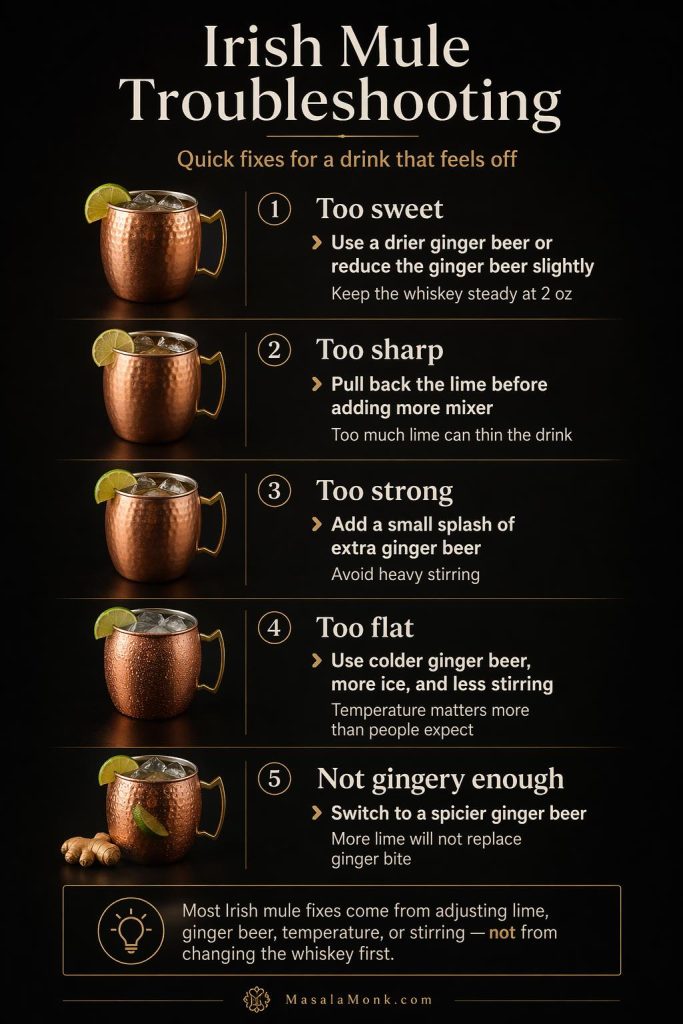
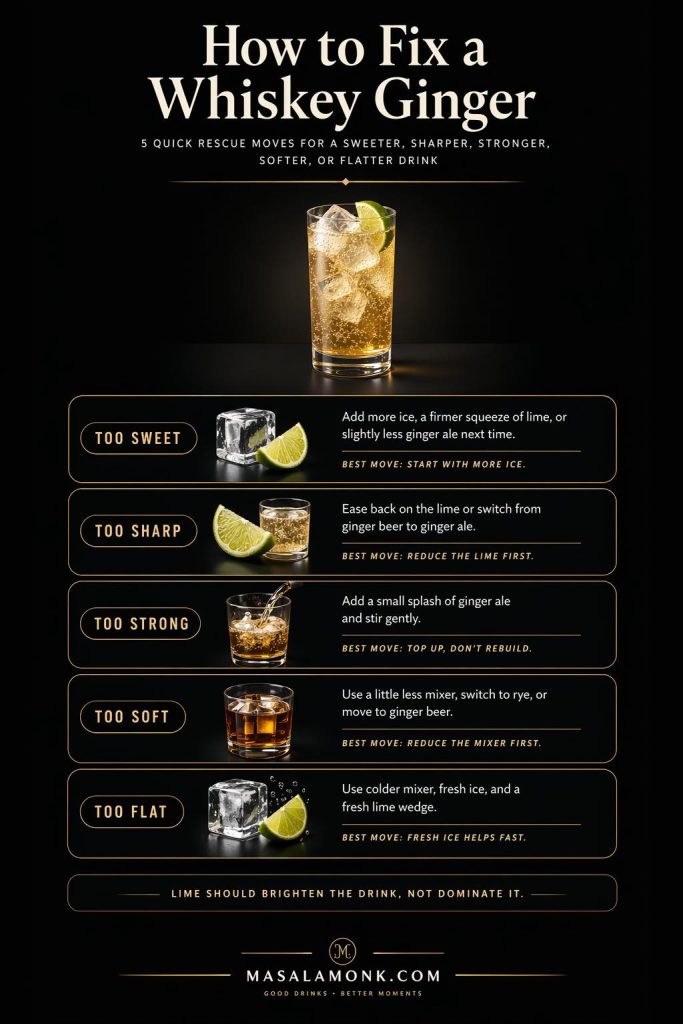
If your first sip feels off, do not rebuild the drink blindly. Small changes to ice, lime, mixer, or whiskey style can bring a whiskey ginger back into balance fast.
Too sweet: add a little more ice, use a firmer squeeze of lime, or reduce the ginger ale slightly next time.
Too sharp: ease back on the lime or switch from ginger beer to ginger ale.
Too strong: add a small splash of ginger ale and stir gently.
Too soft: use a little less mixer, switch to rye, or move to ginger beer.
Too flat: start with colder mixer, fresh ice, and a fresh lime wedge.
Above all, remember that too much lime changes the drink more than most readers expect. Lime should brighten a whiskey ginger, not dominate it.
What Is a Whiskey Ginger?
A whiskey ginger is best understood as a simple whiskey highball. The classic build uses whiskey, ginger ale, ice, and lime, so the drink stays light, fizzy, and easy to sip. That is exactly why it works when you want something colder and more refreshing than a neat pour, but easier and faster than a more elaborate cocktail.
At the same time, the category gets muddy because people use the name loosely. Some mean the classic ginger ale version, while others mean a spicier ginger beer build. As a result, the name often covers a few related drinks rather than one absolutely rigid formula.
That is also why the drink sits so close to Irish Buck territory. Once the lime becomes more noticeable and the structure feels more citrus-led, the drink starts moving away from the softest everyday whiskey ginger style and toward a brighter branch of the same family.
Best Whiskey
The best whiskey for a whiskey ginger depends on the finish you want in the glass. In practice, that flexibility is one of the drink’s biggest strengths because the same basic build can feel smoother, sweeter, drier, or spicier depending on the bottle you choose.
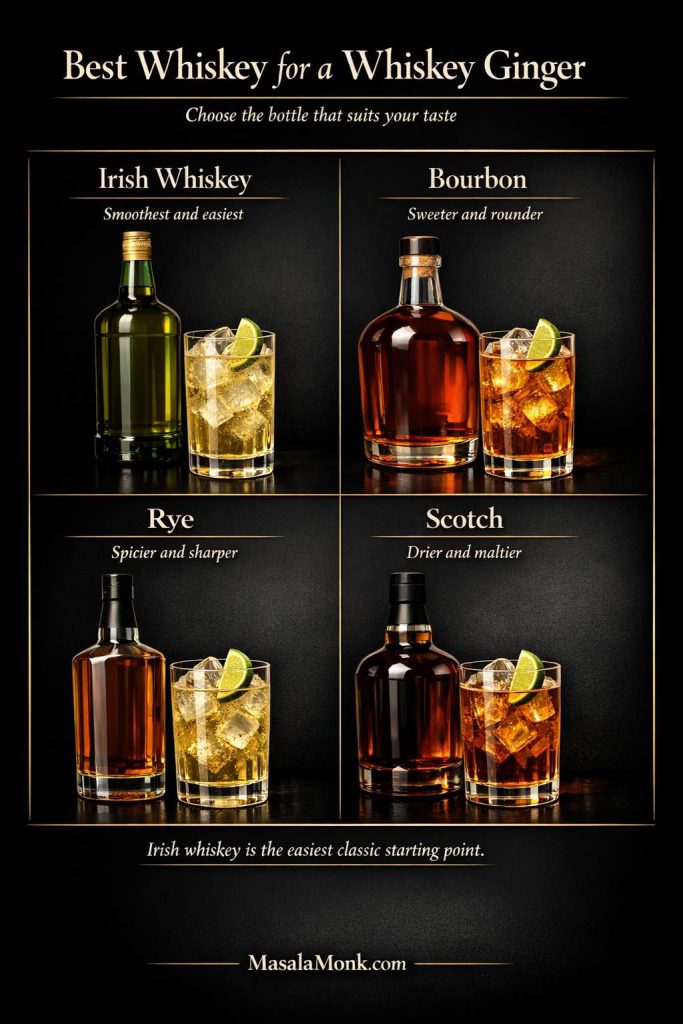
A whiskey ginger changes faster than most people expect: Irish whiskey keeps it smooth and easy, bourbon makes it rounder, rye adds sharper spice, and scotch pushes it drier and maltier.
Irish whiskey: best if you want the smoothest, easiest-drinking whiskey ginger
Bourbon: best if you want a rounder, sweeter drink with a softer finish
Rye: best if you want more spice and a little more edge
Scotch: best if you want a drier, maltier, or slightly smoky version
For most readers, Irish whiskey is the safest starting point because it stays clean and mellow against the ginger. As a result, the drink feels balanced quickly and rarely needs much correction. Bourbon, by contrast, makes the drink feel fuller almost immediately, so it is a better choice if you want a softer, sweeter finish from the start.
Rye is useful when the classic version tastes a little too easy or too rounded for your taste. Because rye pushes more spice into the glass, it gives the drink extra edge without forcing you to change the overall structure. Scotch can work too; however, it is usually smartest to start with a gentler blended scotch rather than a heavily smoky one. Otherwise, the whiskey can dominate the lighter ginger profile too easily.
That flexibility is one reason a whiskey ginger recipe works so well for both beginners and regular whiskey drinkers.
If bourbon is usually your first choice, MasalaMonk’s guide on what to mix with Jim Beam is a useful next read because ginger ale fits naturally into that easy bourbon-mixer lane.
Ginger Ale vs Ginger Beer and Irish Buck
The quickest way to avoid confusion is to compare the branches that actually change the drink in a noticeable way: the mixer choice and the citrus level. Although the names around this cluster overlap, the drinking experience does not always stay the same.
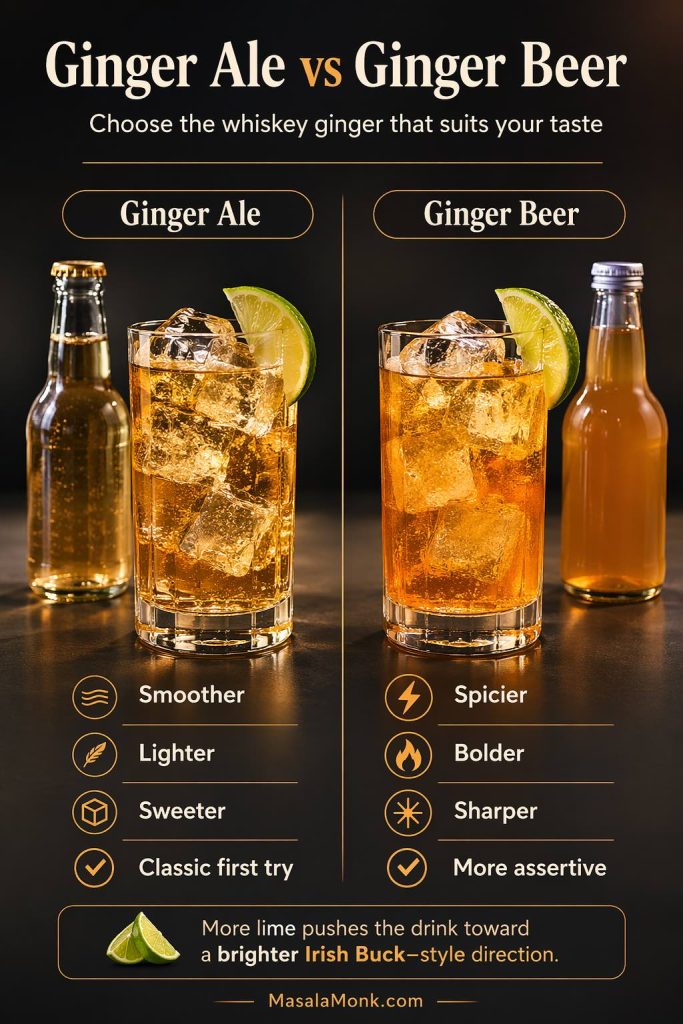
Ginger ale gives a whiskey ginger its smoother, lighter classic feel, while ginger beer pushes the drink toward a spicier, bolder, more assertive profile.
Whiskey ginger with ginger ale vs whiskey ginger with ginger beer: ginger ale is smoother, sweeter, and more classic, whereas ginger beer is spicier, drier, and more assertive.
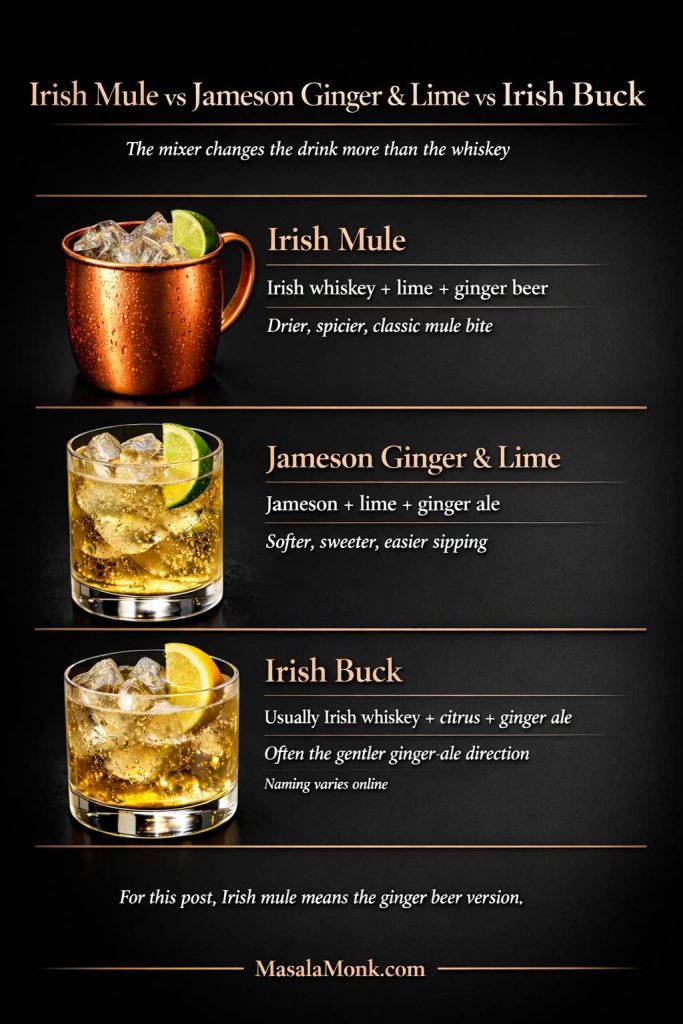
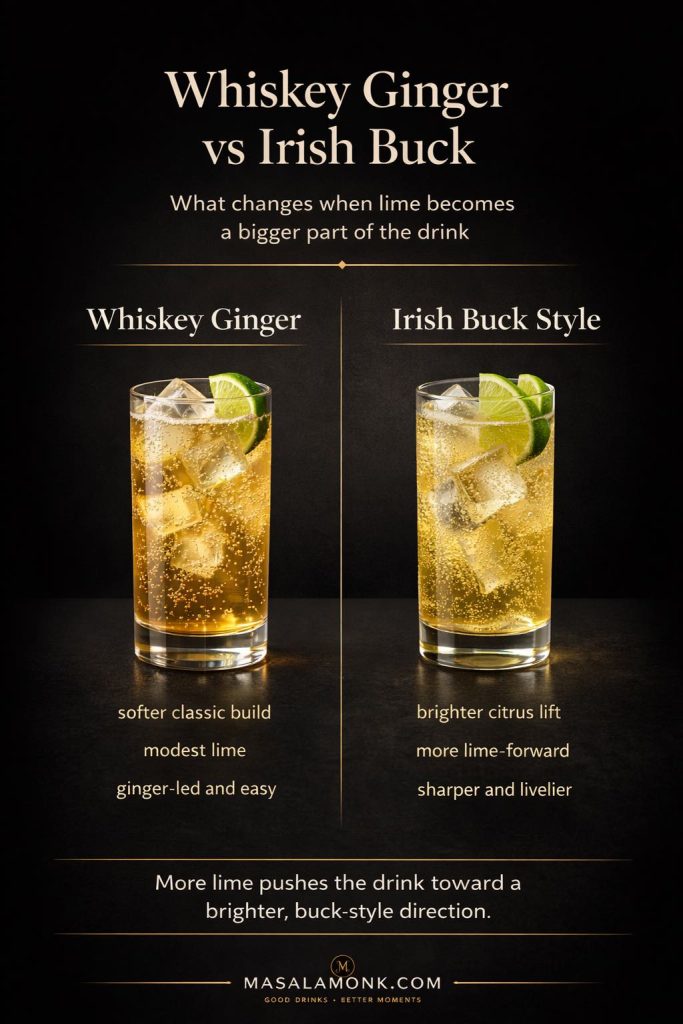
Whiskey ginger vs Irish Buck: both belong to the same family, but an Irish Buck usually leans harder on lime and a brighter citrus structure.
The easiest way to think about it is this: ginger ale gives you the safer, more crowd-friendly whiskey ginger, while ginger beer gives you the bolder variation. Likewise, once the lime becomes one of the main things you notice, the drink starts moving away from classic whiskey ginger territory and toward an Irish Buck-style direction.
A whiskey ginger and an Irish Buck can sit very close to each other, but the balance shifts once lime becomes more noticeable: the whiskey ginger stays softer and ginger-led, while the Irish Buck-style version drinks brighter and more citrus-forward.
If you want an external reference on that naming overlap, The Spruce’s whiskey ginger and Irish Buck guide is a useful high-authority explainer. Meanwhile, if you already know you enjoy ginger beer in cold mixed drinks, this Moscow Mule recipe is a strong internal companion because it shows how differently ginger beer behaves once lime becomes more important.
Best Garnish for a Whiskey Ginger
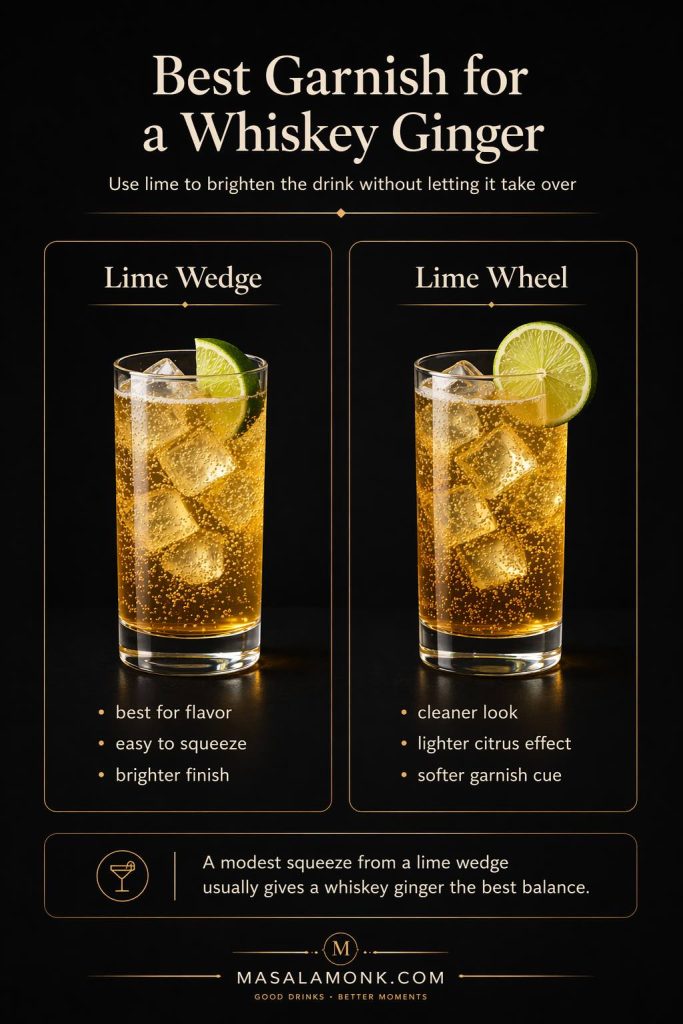
The best garnish for a whiskey ginger is lime. A lime wedge is usually the smartest choice because you can squeeze fresh juice into the drink and still leave the wedge in the glass. A lime wheel looks cleaner, but it does less for the flavor unless you squeeze it first.
A whiskey ginger usually tastes best with a modest lime wedge because it gives you real brightness in the glass, while a lime wheel keeps the look cleaner but adds a lighter citrus effect.
Keep the garnish simple. This is not a drink that needs a dramatic finish to feel complete. In fact, the cleaner the garnish, the more the whiskey and ginger stay in focus.
Whiskey Ginger Variations
Make each variation exactly like the main recipe unless noted below. Even though the names change, the structure stays similar: whiskey, ginger, ice, and citrus, with one part pushed slightly harder than the others.
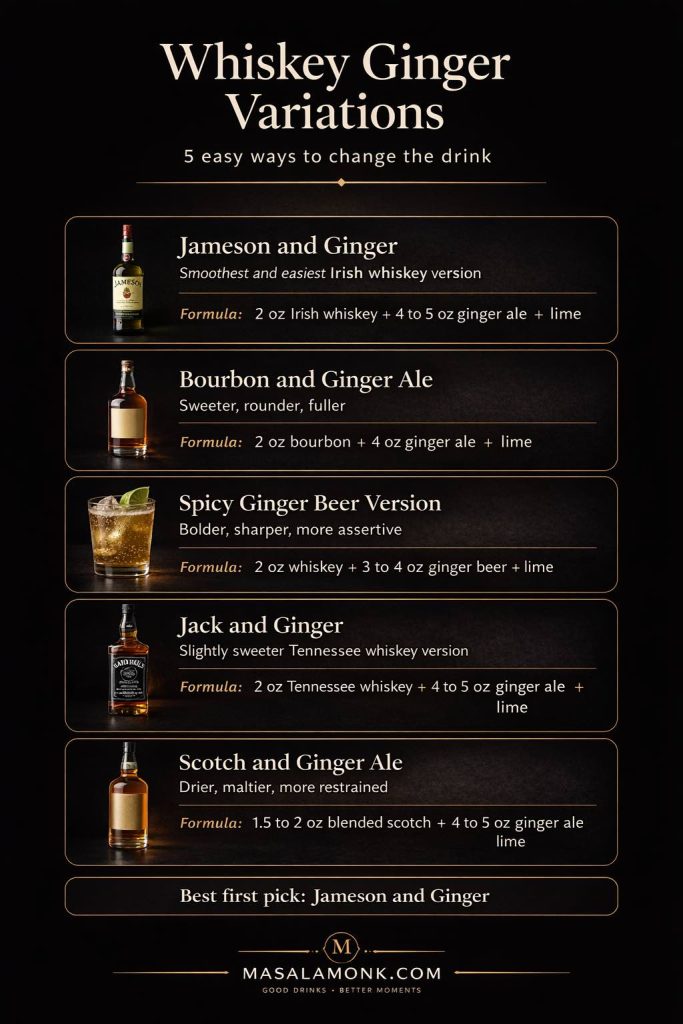
The base build stays simple, but the drink changes quickly once you swap the whiskey or the mixer: Jameson keeps it smooth, bourbon rounds it out, ginger beer sharpens it, Jack stays mellow, and scotch makes it drier and maltier.
Jameson and Ginger Whiskey Drink
Jameson and ginger is one of the smoothest, easiest-drinking versions of the drink. Because Jameson is an Irish whiskey, the result usually feels light, mellow, and especially approachable.
Mini formula: 2 ounces Irish whiskey + 4 to 5 ounces ginger ale + 1 lime wedge
For an official brand reference, Jameson’s Ginger & Lime recipe shows the same easy, highball-style direction.
Bourbon and Ginger Ale Whiskey Drink
Bourbon and ginger ale is the sweeter, rounder side of the family. Therefore, it is often the easiest variation to like right away if you enjoy caramel, vanilla, or a softer finish in whiskey drinks.
Mini formula: 2 ounces bourbon + 4 ounces ginger ale + 1 lime wedge
If you want to stay in that bourbon-friendly lane afterward, MasalaMonk’s Boulevardier recipe is a great next step when you want something deeper and more spirit-forward.
Spicy Ginger Beer Version
This variation is the spicier, sharper side of the family. As a result, it usually feels livelier from the first sip and stands up better to a whiskey with more edge.
Mini formula: 2 ounces whiskey + 3 to 4 ounces ginger beer + 1 lime wedge
Jack and Ginger
Jack and ginger follows the same easy pattern, yet Tennessee whiskey gives the drink a slightly different sweetness and spice balance. In other words, it still drinks like a whiskey ginger, but the whiskey profile shifts the mood.
Mini formula: 2 ounces Tennessee whiskey + 4 to 5 ounces ginger ale + 1 lime wedge
Scotch and Ginger Ale Whiskey Drink
Scotch and ginger ale can work well when you want a drier, maltier version of the same basic idea. Generally, a softer blended scotch is the easiest place to start because a heavily smoky bottle can overpower the lighter mixer.
Mini formula: 1.5 to 2 ounces blended scotch + 4 to 5 ounces ginger ale + 1 lime wedge
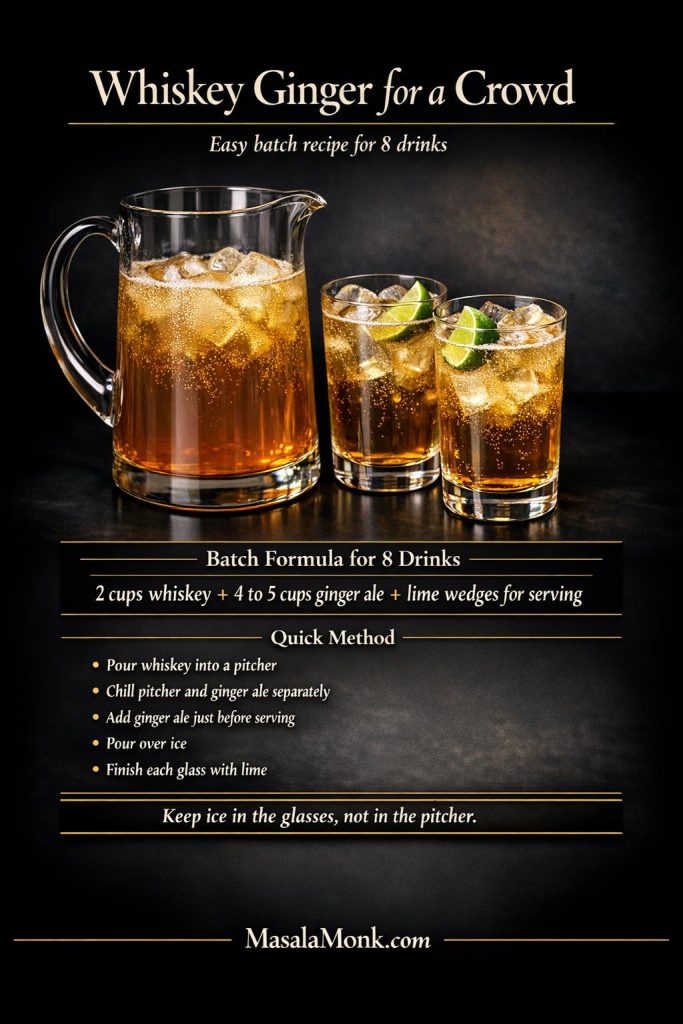
Whiskey Ginger for a Crowd
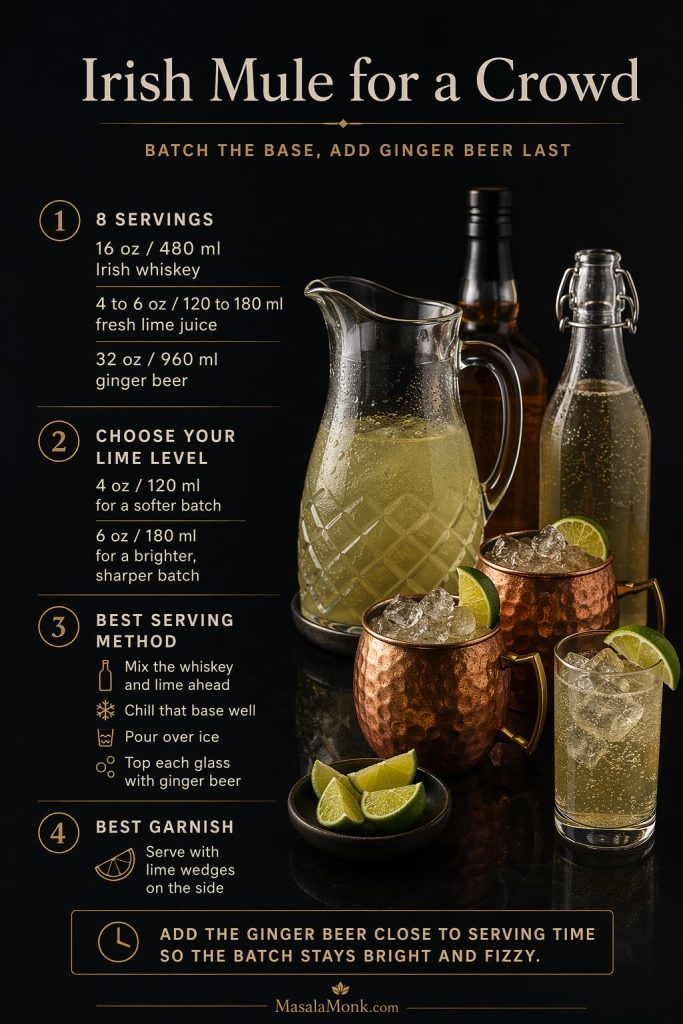
If you want to serve several people at once, a whiskey ginger is easy to batch as long as you keep the bubbles lively. The main trick is to add the ginger ale just before serving instead of letting it sit too long.
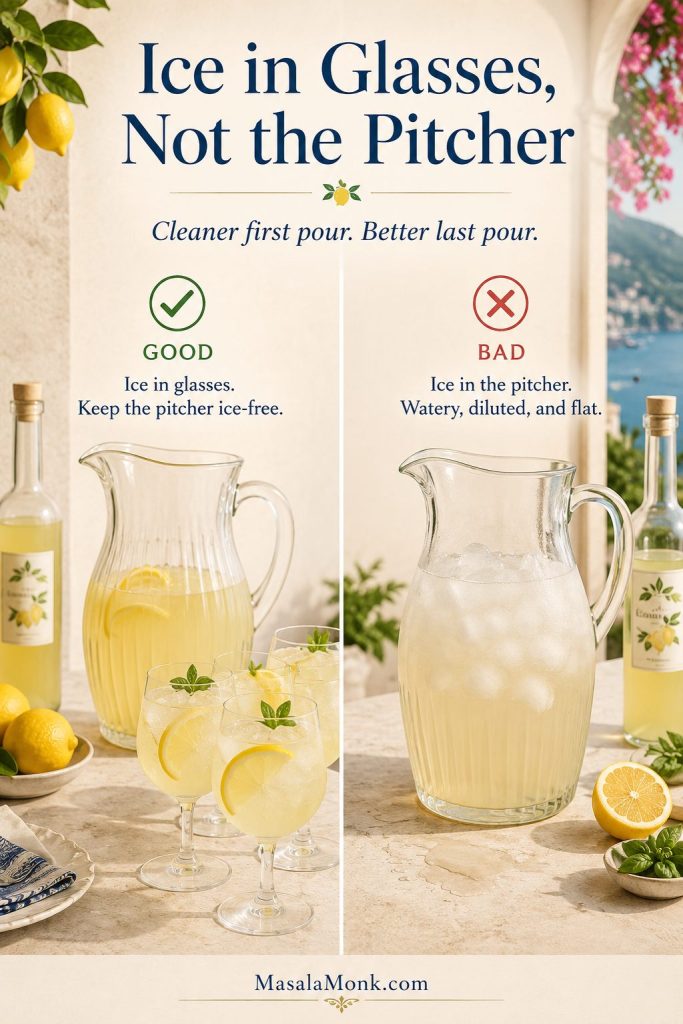
Batch the whiskey first, add the ginger ale just before serving, and keep the ice in the glasses so each whiskey ginger stays cold, fizzy, and properly balanced.
Batch formula for 8 drinks: 2 cups whiskey + 4 to 5 cups ginger ale + lime wedges for serving
Pour the whiskey into a pitcher.
Chill the pitcher and the ginger ale separately.
Just before serving, add the ginger ale and stir gently.
Serve over ice and finish each glass with a lime wedge.
For the best result, keep the ice in the glasses rather than the pitcher. That way, the batch stays cold without getting watered down too quickly.
FAQs
What is it made of?
A whiskey ginger is usually made with whiskey, ginger ale, ice, and lime.
Ginger ale or ginger beer?
Ginger ale is better if you want the smoothest, most classic result. And ginger beer is better if you want a spicier, drier, more assertive version.
What whiskey works best in a whiskey ginger?
Irish whiskey is the easiest place to start if you want a smooth, classic result. Meanwhile, bourbon gives you a sweeter version, rye gives you more spice, and scotch can give you a drier or maltier finish.
Can bourbon work in a whiskey ginger?
Yes. In fact, bourbon and ginger ale is one of the easiest and most approachable riffs on the drink, especially if you like a slightly sweeter whiskey profile.
What is the best whiskey ginger recipe ratio?
A reliable starting point is 2 ounces of whiskey to 4 to 5 ounces of ginger ale. Then, once you know your preference, you can make it lighter or stronger as needed.
Is it the same as an Irish Buck?
They are very close, but an Irish Buck usually leans more clearly on lime and ginger together. So, whiskey ginger is the broader everyday name, while Irish Buck points to a slightly more citrus-led direction.
Can ginger beer work too?
Yes, and it can taste great. However, it is not just a tiny swap. Ginger beer makes the drink spicier, drier, and more assertive, so the result feels like a bolder variation rather than the classic whiskey ginger most readers expect first.
How do you make Jameson and ginger?
To make Jameson and ginger, fill a tall glass with ice, add 2 ounces of Jameson, top with 4 to 5 ounces of ginger ale, squeeze in a lime wedge, and stir gently.
Can you batch a whiskey ginger recipe for a crowd?
Yes. A whiskey and ginger recipe is easy to batch for guests as long as you keep the ginger ale chilled and add it just before serving so the drink stays lively and fizzy.
If you want another easy whiskey drink afterward, this whiskey sour recipe is a good next step because it keeps the whiskey front and center while moving in a brighter, more citrus-forward direction.
A White Russian recipe does not ask for much on paper, which is exactly why it goes wrong so easily in the glass. Vodka, coffee liqueur, dairy, and ice sound almost too straightforward to deserve careful treatment. Even so, the details matter more here than they do in many longer cocktails.
Cream can go in a little too heavily. Sometimes the liqueur turns the drink sweeter than expected. On other nights, the ice melts faster than it should and the whole thing loses shape before the glass is half finished. What should have felt smooth and rounded becomes flat, muddy, or oddly tired.
That is the difference between a White Russian that merely exists and one that is worth making again. Coffee should remain clear enough to matter. The vodka still needs to give the drink backbone. Meanwhile, the dairy should soften the finish without wiping out the darker flavors underneath it. When that balance holds, the White Russian feels rich without becoming heavy, sweet without becoming sticky, and creamy without becoming vague.
For most glasses, the strongest place to begin is 2 ounces vodka, 1 ounce coffee liqueur, and 1 ounce half-and-half or cream over ice. That build gives the drink enough body to feel indulgent while preserving enough structure for it to remain a cocktail rather than a melted dessert. Better still, it gives you room to move. If you want something richer, you can push it in that direction. If you want a firmer, more coffee-forward drink, you can tighten it.
Why a White Russian Goes Wrong So Easily
The classic comes first here, and it should. After that come the choices that actually change the drink in meaningful ways: the ratio, the dairy, the liqueur, the ice, and the small adjustments that keep the White Russian from drifting too sweet, too soft, or too thin.
Only then do the variations matter, because a Baileys White Russian, a Hot White Russian, a Chocolate White Russian, or a Frozen White Russian makes more sense once the classic version is doing its job properly.
Fill a rocks glass with ice. Pour in the vodka, add the coffee liqueur, top with the dairy, stir gently, and serve immediately.
A good White Russian is not just creamy. It is balanced. This ratio gives the drink enough coffee character and enough backbone to stay interesting from the first sip to the last, which is exactly why it is the strongest place to start before trying richer or sweeter variations.
That is the shortest useful answer. Each ingredient has a clear role. Vodka gives the drink shape. Coffee liqueur supplies sweetness, roast, and slight bitterness. Dairy smooths the finish and gives the White Russian its signature texture. As for the ice, it chills the drink and gradually opens it up, though never so much that it should be allowed to dominate it.
If you only want the quick answer to how to make a White Russian, that is enough to get you there. The sections below are what make the result better.
The best White Russian is not the sweetest version, the richest version, or the heaviest-handed version. It is the one that still tastes like coffee, spirit, and cream in proportion. That sounds obvious, yet a lot of quick recipes either go too soft with the dairy or treat the coffee liqueur like an afterthought rather than the structural flavor that gives the drink its identity.
A properly balanced White Russian should feel calm, creamy, and satisfying from the first sip, but it should still read clearly as a cocktail. The vodka should not disappear. Coffee liqueur should do more than merely sweeten. At the same time, the dairy should not behave like a blanket thrown over the whole thing. Once those roles stay distinct, the drink becomes much more memorable.
Classic Recipe Card
Yield: 1 cocktail Prep time: 5 minutes Glass: rocks glass or old fashioned glass Serve: over ice
Ingredients
2 ounces vodka
1 ounce coffee liqueur
1 ounce half-and-half or heavy cream
Ice
Method
Fill a rocks glass with fresh ice. Pour in the vodka, then the coffee liqueur. Add the half-and-half or cream and stir gently until the drink is lightly blended. Serve immediately.
Best Dairy Choice
Half-and-half is the best all-around choice for a classic White Russian. It gives the drink enough body to feel creamy and satisfying without flattening the coffee note underneath it.
Easy Substitutions
Heavy cream makes a richer, slower, more dessert-like White Russian. Milk makes a lighter drink, but it also makes the cocktail lose strength more quickly as the ice melts.
What This Drink Should Taste Like
The best White Russian tastes smooth, lightly sweet, gently coffee-led, and creamy without becoming thick, sticky, or vague.
One Small Tip That Improves the Drink Immediately
Use cold dairy and solid ice. Warm cream and weak cubes soften the drink faster than most people expect.
The best White Russian is not the richest or sweetest one. It is the one where coffee, vodka, and dairy still feel distinct enough to matter together. When the drink is balanced, it tastes creamy without becoming heavy, lightly sweet without turning syrupy, and smooth without losing the firm cocktail backbone that keeps it interesting from the first sip to the last.
What This White Russian Should Taste Like
A properly made White Russian should taste smooth, lightly sweet, gently coffee-led, and clearly creamy without turning thick or dull. The finish should feel rounded rather than sticky. Meanwhile, the dairy should soften the alcohol rather than bury it. Most importantly, the coffee liqueur should bring depth and sweetness without flattening the glass into syrupy sameness.
If your first sip tastes mostly like cream, the drink is too soft. When sweetness arrives before coffee, the liqueur has taken over. Likewise, a thin and milky texture usually means the dairy choice, ice, or ratio has drifted in the wrong direction.
Why This White Russian Recipe Works
This version works because it keeps the drink in proportion. Two ounces of vodka make sure the White Russian still tastes like a cocktail. One ounce of coffee liqueur gives it the darker flavor that defines it. Then one ounce of dairy rounds the finish and gives the drink its familiar texture without flattening the whole thing.
That balance matters more here than it would in a more crowded drink. A White Russian has nowhere to hide. Too much dairy makes the coffee disappear. Too much sweetness from the liqueur turns the glass soft and sticky. As for rough vodka, you notice it more than you should because the dairy and sweetness only soften the edges; they do not erase them.
Half-and-half is usually the best choice for the classic build. It gives enough body to make the White Russian feel creamy and satisfying, but it still leaves room for the coffee and vodka to show themselves. Heavy cream creates a richer, slower drink, which can be excellent after dinner or whenever a more openly indulgent finish is the point. Milk works if you want something lighter, though it nearly always weakens faster over ice and rarely feels as complete.
A White Russian is a cocktail made with vodka, coffee liqueur, and dairy, usually served over ice. It belongs to a small group of drinks that are easy to like quickly but harder to make well than their short ingredient lists suggest. A lot of cocktails hide behind complexity. The White Russian does not. It puts a few ingredients in the glass, lets them show themselves, and leaves very little room for confusion once the balance slips.
The appeal is immediate: the drink feels familiar, smooth, and easy to like from the first sip. It is creamy, smooth, sweet, and just bitter enough around the edges to stay interesting. It also sits in a useful middle ground. Richer than a bright citrus cocktail and gentler than a more spirit-forward coffee drink, it can work as an after-dinner cocktail, a cold-weather comfort drink, or a slow evening pour that asks very little beyond basic restraint.
Its reputation for ease is deserved, but it can be misleading. Easy does not mean careless. Better ice, better dairy, a more sensible ratio, and a coffee liqueur that suits the result you actually want all make a noticeable difference. Those choices separate a White Russian that feels rounded and deliberate from one that feels like sweet cream thrown over a lazy pour.
White Russian vs Black Russian
A Black Russian contains vodka and coffee liqueur. A White Russian adds dairy. That sounds minor, but the difference in the glass is substantial.
The Black Russian feels darker, firmer, and more spirit-forward. It lets the vodka and coffee liqueur speak with much less softening. The White Russian takes those same bones and turns them smoother, rounder, and more indulgent. If the coffee note is what pulls you in but the drier edge of the Black Russian sounds too lean, the White Russian is usually the better choice.
A White Russian and a Black Russian may start from the same vodka-and-coffee base, but they land very differently in the glass. Adding dairy turns the White Russian smoother, creamier, and more indulgent, while leaving it out keeps the Black Russian darker, drier, and more direct.
The practical difference becomes even clearer once both drinks are actually in front of you. A Black Russian is cleaner and sharper. It feels closer to a short, slightly sweet spirit drink. By contrast, a White Russian slows the whole experience down. Dairy changes not only the flavor but also the pace of the drink. The finish turns softer, the texture fuller, and the mood less severe.
That is why comparisons between the two matter more than they first appear to. The question is not simply whether dairy is present. Instead, it is what role you want the coffee liqueur to play. In a Black Russian, it sits much closer to the surface. In a White Russian, it becomes part of a richer, gentler structure. Black Russian for a darker, drier pour; White Russian for a creamier, more relaxed one.
Why Is It Called a White Russian?
The name is direct. “Russian” points to the vodka. “White” refers to the dairy that lightens the drink.
Is This the Drink From The Big Lebowski?
Yes. The White Russian is closely associated with The Big Lebowski, where it is also called a “Caucasian.” The film helped keep the drink visible in popular culture, but the cocktail survives because the combination works even without the movie attached to it. A good White Russian does not need nostalgia to justify itself.
The Ingredients That Make or Break a White Russian
A short ingredient list makes quality more obvious, not less. The White Russian does not require luxury bottles or elaborate tools, but it does benefit from sensible choices.
A White Russian is a short drink with very little to hide behind, which is why each ingredient matters more than the list suggests. Vodka gives the cocktail structure, coffee liqueur brings sweetness and depth, half-and-half keeps the texture creamy without going too heavy, and good ice helps the drink stay cold without thinning too quickly.
Vodka
Use a clean, neutral vodka that tastes smooth enough to support the drink without roughening it. This is not a cocktail where a harsh spirit disappears under layers of other flavors. The dairy softens, but it does not erase. If the vodka is aggressive, you will still feel it in the finish.
That does not mean expensive. A reliable mid-range vodka is usually perfect. The point is not prestige. The point is steadiness. In a drink as short and exposed as the White Russian, cheap burn matters more than people often expect.
Coffee Liqueur
Coffee liqueur gives the White Russian its identity. It brings sweetness, roasted depth, slight bitterness, and the darker flavor that makes the cocktail more than vodka softened with dairy. Without a proper coffee note, the White Russian loses the thing that makes it memorable.
Different bottles shift the drink more than many quick recipes admit. Some coffee liqueurs are soft, sweet, and vanilla-forward. Others taste darker, drier, and more coffee-led. A softer, sweeter bottle often needs a lighter hand with the dairy. A darker one can carry a richer pour without disappearing. That is why it helps to think of coffee liqueur not merely as the sweet element, but as the structural flavor of the drink.
Coffee liqueur does far more in a White Russian than simply add sweetness. It decides whether the drink feels softer and rounder, balanced and classic, or darker and more coffee-led from the start. A sweeter bottle usually benefits from a lighter hand with the dairy, while a drier, roastier style can carry a firmer build without disappearing under the cream. Choosing the right coffee liqueur style makes it much easier to steer the drink toward the exact kind of White Russian you actually want in the glass.
This choice changes the White Russian more than almost any tiny ratio adjustment.
Heavy cream makes the drink lush, full, and openly indulgent. It works best when richness is the point and you want the White Russian to lean further toward dessert.
Half-and-half is the sweet spot for most glasses. It gives the drink enough body to feel creamy and satisfying without burying the coffee and vodka underneath it.
Milk makes a lighter White Russian. That can be pleasant when you want something easier to sip, but it also makes the drink more fragile. Once the ice starts to melt, milk is usually the first reason the cocktail feels washed out.
Dairy changes the drink more dramatically than many people expect. A White Russian made with half-and-half is usually the best all-around answer. One made with milk can be pleasant, but it is rarely the most complete version of the drink. Meanwhile, a White Russian made with heavy cream can be excellent when indulgence is the goal, though it can also become shapeless if the rest of the drink is not firm enough to support it.
If you want a practical outside reference on dairy swaps, The Spruce Eats’ White Russian recipe handles that part more practically than most short cocktail pages.
Ice and Glassware
Serve the drink in a rocks glass or old fashioned glass over ice. Since the White Russian is short, rich, and usually sipped slowly, that format suits it naturally.
A White Russian starts changing the moment it hits the ice, which is why the right setup matters more than it first seems. A short rocks glass suits the drink’s slow pace, large clear cubes protect the balance longer, and weaker wet ice can flatten the cocktail before the creamy coffee notes have time to settle.
The ice matters too. Thin, wet cubes melt quickly and drag the drink down before it has a chance to settle. Firmer ice gives the coffee liqueur and dairy more time to stay in balance. Because the White Russian is built directly over ice rather than shaken and strained, dilution is not a background issue here. It is part of the drink from the beginning.
A White Russian can move quickly from balanced to shapeless. The ratio is what decides where it lands.
The Classic 2:1:1 Ratio
For a balanced White Russian, use:
2 ounces vodka
1 ounce coffee liqueur
1 ounce half-and-half or cream
This works because the drink still has shape. The coffee stays clear. The vodka still matters. The dairy smooths the finish instead of taking it over. If what you want is a classic White Russian that feels reliable, repeatable, and easy to adjust, this is the build to trust first.
The classic 2:1:1 ratio also gives you room to move. Want a slightly richer glass? Add a touch more dairy or switch from half-and-half to cream. Want something firmer? Use a darker coffee liqueur or pull the sweetness back a little. The base stays stable.
The Equal-Parts Build
Equal parts vodka, coffee liqueur, and dairy create a softer, sweeter, more indulgent White Russian. There is nothing wrong with that version. It can be very enjoyable after dinner or whenever a richer, more plush pour sounds right. It simply aims at a different result. The drink becomes rounder, gentler, and more dessert-like from the first sip.
That richer approach shows up clearly on Kahlúa’s White Russian page, which leans into the more indulgent side of the spectrum.
A White Russian changes more than most quick recipes admit. The classic 2:1:1 build stays balanced and cocktail-like, equal parts turns softer and richer, and a firmer coffee-forward version pulls the drink away from sweetness and back toward roast, structure, and a clearer vodka-and-coffee finish.
A Firmer Coffee-Forward White Russian
There is also a useful middle move for anyone who likes the White Russian idea but wants more edge: keep the vodka at 2 ounces, trim the coffee liqueur slightly, stay with half-and-half rather than heavy cream, and use a darker bottle if possible. That version is less sweet, more clearly coffee-led, and closer to an after-dinner cocktail than a cold dessert.
This version works better when you want the drink firmer, less sweet, and more clearly coffee-led. The trick is not inventing a new ingredient list. It is keeping the coffee note and the spirit visible inside the creamy texture.
How Ratio and Dairy Work Together
Ratio alone does not decide the result. Dairy choice changes how that ratio lands.
A 2:1:1 White Russian with half-and-half usually feels the most balanced. A 2:1:1 White Russian with heavy cream becomes slower and richer, even though the numbers have not changed. Equal parts with heavy cream can turn very plush very quickly. Equal parts with milk will be lighter, but it can also taste weak once dilution sets in.
That is why two White Russians made with the same spirit and the same liqueur can still feel very different. The ratio tells you the direction. The dairy tells you how heavy the result feels when it gets there.
Which Ratio Tastes Better?
For most situations, 2:1:1 tastes better because it keeps the White Russian from going vague. It stays creamy, but it still feels like a cocktail first. Equal parts makes more sense when the mood is sweeter and softer from the beginning. A firmer coffee-forward version works when the roasted note is what you want to emphasize.
The important thing is recognizing that these are not interchangeable builds with slightly different wording. They feel different in the glass. That is exactly why the ratio deserves more thought than it usually gets.
A White Russian made with cream is not the same drink as one made with milk. Even when the rest of the ingredient list stays the same, the texture, weight, and finish shift dramatically.
Cream gives the drink a velvety, heavier feel. The White Russian becomes richer and more obviously decadent. That can be exactly right after dinner or whenever comfort matters more than clarity. The tradeoff is that too much cream can turn the drink rich but indistinct.
Dairy changes a White Russian more dramatically than most quick recipes suggest. Milk keeps the drink lighter, heavy cream makes it richer and slower, and half-and-half lands in the middle as the most balanced choice when you want creaminess without burying the coffee and vodka underneath.
Half-and-half keeps more balance. The drink still feels creamy, but the coffee backbone remains present and the vodka still gives it a little shape. This is why half-and-half is such a reliable default. It gives enough without giving too much.
Milk creates the lightest White Russian of the three. That can sound appealing when you do not want a heavy drink, but it comes with a cost. Milk loses authority quickly over ice. Once dilution starts, the cocktail can move from pleasant to thin faster than expected, especially if the coffee liqueur already leans sweet.
The easiest way to think about it is simple. Use cream when indulgence matters most. Half-and-half is best when balance matters most. Use milk only when you knowingly want a lighter, less sturdy version of the drink.
A dairy-free White Russian can work too, though thin plant milks rarely help. The drink still needs body. If that version appeals, Cookie and Kate’s vegan White Russian is a thoughtful place to start because it treats texture seriously instead of treating “non-dairy” as a casual swap.
Not every White Russian variation gives you the same kind of drink, so choosing the right one makes a real difference. The classic White Russian recipe is still the best all-around choice when you want something creamy, coffee-led, easy to make, and clearly structured as a cocktail. If you like the same vodka-and-coffee foundation but want a darker, drier, more direct drink, a Black Russian makes more sense because it leaves out the dairy softness entirely. A Baileys White Russian, on the other hand, turns the drink gentler, sweeter, and more dessert-like from the first sip.
Not every White Russian solves the same craving. The classic stays balanced and creamy, the Black Russian goes darker and drier, Baileys turns softer and sweeter, the hot version feels cozy, the frozen one leans dessert-like, and chocolate makes the drink richer and fuller without losing its coffee-and-cream core.
Temperature changes the mood just as much as flavor. A Hot White Russian suits colder weather and a slower, cozier kind of drink, while a Frozen White Russian moves in the opposite direction, becoming slushier, more playful, and more openly dessert-like without fully losing the coffee-and-cream core that makes the drink recognizable in the first place. If richness is what you want, a Chocolate White Russian gives the classic a deeper, fuller edge, while a Salted Caramel White Russian pushes the drink sweeter and rounder, with just enough contrast to keep it from feeling flat.
Then there are the more seasonal or mood-specific versions. A Peppermint White Russian works best when the drink is meant to feel sharper, cooler, and more festive, especially in colder months. Taken together, these variations are less about novelty for its own sake and more about choosing the version that matches the moment. Sometimes that means something classic and balanced, sometimes something softer and sweeter, and sometimes something warmer, colder, richer, or more playful.
Comparisons help because the White Russian sits near several other drinks that share part of its flavor world without delivering the same experience.
A White Russian sits near several familiar cocktails, but it does not drink the same way as any of them. Mudslide goes sweeter, richer, and more dessert-like, Espresso Martini turns colder, sharper, and more intensely coffee-led without dairy, and Colorado Bulldog takes the creamy coffee base in a livelier cola-lifted direction. Seeing them side by side makes the White Russian easier to understand for what it really is: calmer than an Espresso Martini, less confection-like than a Mudslide, and smoother and slower than a Colorado Bulldog.
White Russian vs Mudslide
A Mudslide is usually sweeter, richer, and more overtly dessert-like than a White Russian. Once Irish cream and chocolate enter the picture, the drink moves away from the cleaner structure of vodka, coffee liqueur, and dairy and toward a more confection-like profile. That does not make a Mudslide worse. It makes it a different kind of drink. A White Russian should still feel more restrained beside it.
Pick a White Russian when you want coffee, cream, and spirit in clearer proportion. Pick a Mudslide when you want something more openly indulgent and dessert-like from the start.
White Russian vs Espresso Martini
The Espresso Martini is sharper, colder, and more intense. It is about coffee aroma, chilled texture, and a cleaner, more focused edge. The White Russian is slower and softer. It leans on dairy instead of fresh espresso foam and occupies a more comfort-forward space.
Pick the White Russian when you want a creamy coffee cocktail that feels smooth and relaxed. Pick the Espresso Martini when you want a colder, tighter, more concentrated coffee hit with no dairy softness.
White Russian vs Colorado Bulldog
The Colorado Bulldog begins close to the White Russian, then adds cola. That changes the drink more than it first sounds. The White Russian is creamy and still. The Colorado Bulldog becomes fizzier, sweeter, and more playful. The coffee-and-cream core remains recognizable, but the mood shifts from slow and rich to livelier and more casual.
White Russian vs Baileys White Russian
A Baileys White Russian is softer and sweeter than the classic. It leans further into dessert territory. The classic White Russian keeps a cleaner line between vodka, coffee liqueur, and dairy. The Baileys version rounds everything off faster and needs more restraint to stay interesting.
Cold vs Hot vs Frozen
The classic cold version is the most balanced and versatile. A Hot White Russian becomes warmer, slower, and more comforting. The Frozen White Russian becomes more playful and more overtly dessert-like. The core flavors remain recognizable, but the drinking experience changes enough that each one earns its own place.
Temperature changes a White Russian more than a quick variation note suggests. The classic version stays the most balanced, the hot one turns softer and cozier, and the frozen version pushes the drink toward a slushier, more dessert-like finish without completely losing its coffee-and-cream identity.
The White Russian is a built drink, not a difficult one. Once the proportions are right, the method is almost effortless.
For the cleanest and most consistent glass, build it over ice and stir gently. That gives you a more even flavor from first sip to last. Some people prefer the layered look, where the dairy is floated on top over the back of a spoon. That presentation is attractive and part of the drink’s visual identity, but it is mostly a matter of appearance. Once the drink is stirred or partly sipped, it blends anyway.
A White Russian can be finished two good ways, and each changes the drinking experience a little. Leaving the cream floated on top creates a more dramatic layered look and a glass that evolves as you sip, while a light stir gives you a more even balance of vodka, coffee liqueur, and dairy from the very first taste. If presentation matters most, the layered finish has more visual impact. If consistency matters most, the stirred version is usually the better choice.
The best practical method is simple. Fill the glass with ice, add vodka, add coffee liqueur, pour in the dairy, stir lightly, and serve immediately. The White Russian tastes best before melting ice has too much time to soften the coffee and thin the body.
A White Russian tastes best when the build stays controlled from the beginning. Solid ice slows dilution, vodka and coffee liqueur create the drink’s backbone, and cold half-and-half or cream rounds the finish without smothering the darker coffee note underneath. When that order stays clean and the stir stays gentle, the cocktail lands the way it should: smooth, creamy, lightly sweet, and still clearly a proper White Russian rather than a watered-down dessert drink.
Its place in the evening matters too. This is not a bright, thirst-quenching highball and it is not meant to feel sharp or lively like a citrus-heavy cocktail. Instead, it is richer, rounder, and more comforting, which is exactly why it works so well after dinner. For a brighter contrast elsewhere on the site, the Paloma Recipe and the Mango Margarita Recipe pull in the opposite direction.
How to Fix a White Russian That Tastes Off
One of the best things about a White Russian is how easy it is to correct once you know what went wrong.
A White Russian usually goes wrong in predictable ways. Too much sweetness, too much dairy, weak ice, or a softer coffee liqueur can flatten the drink fast, which is why small adjustments often matter more than changing the whole recipe.
If Your White Russian Tastes Too Sweet
Usually, the answer is less coffee liqueur, not more vodka. Sweetness tends to feel louder as the glass warms slightly, so it often helps to start on the firmer side if your bottle already runs sugary.
If Your White Russian Tastes Too Thin
Milk is usually the problem. Switching to half-and-half helps more than changing the alcohol. Better ice helps too, especially if the cubes you are using melt quickly.
If Your White Russian Tastes Too Creamy
The dairy has probably buried the coffee note. Pull it back slightly next time or firm the drink up with a little more vodka. This happens most often with heavy cream or rich equal-parts builds.
If Your White Russian Feels Too Rich or Heavy
Do not try to fix that with more sweetness. Use half-and-half instead of cream, stick with the classic 2:1:1 build, and make sure the ice is not disappearing too quickly.
If It Is Not Coffee-Forward Enough
Your liqueur may be too soft or too sweet. A darker bottle or a slightly tighter hand with the dairy usually solves that. The goal is not bitterness for its own sake, but enough roasted depth to stop the White Russian from feeling bland.
If the Drink Turns Weak or Bland Too Quickly
Quick-melting ice, milk instead of half-and-half, or a base ratio that was already too soft can all cause that problem. In many cases, the dairy and the liqueur are the first things to check.
Cold ingredients help everywhere. So does matching the dairy to the mood. Cream suits indulgence. Half-and-half suits balance. Milk suits a lighter glass, though never the sturdiest one.
These three versions may look related, but they do not land the same way in the glass. The classic keeps the cleanest balance, Baileys softens and sweetens the drink more quickly, and chocolate pushes it further toward a richer mocha-style finish without fully leaving the White Russian family behind.
Once the classic White Russian is secure, the variations become more rewarding because you can feel exactly what changes in the glass. Some push the drink further toward dessert. Others change the mood more dramatically by shifting the temperature or texture. The best riffs still taste recognizably tied to the original rather than using its name as an excuse for a different drink entirely.
This guide makes the variation section easier to navigate because the seven recipes do not all deliver the same kind of drink. Some stay closer to the classic, some turn warmer or colder, and others push the White Russian further toward dessert without losing the coffee-and-cream identity that makes the cocktail worth returning to.
Baileys White Russian Recipe
A Baileys White Russian is one of the easiest variations to like because Irish cream fits naturally into the drink’s existing structure. It adds softness and sweetness immediately, which is both the attraction and the danger. Too much, and the cocktail loses its shape.
Recipe Card
Yield: 1 cocktail Prep time: 5 minutes
Ingredients
1 1/2 ounces vodka
3/4 ounce coffee liqueur
3/4 ounce Baileys Irish Cream
1/2 to 3/4 ounce half-and-half or cream
Ice
Baileys changes the White Russian faster than many sweet riffs do, which is why this version works best when the extra richness stays controlled. A lighter hand with the dairy keeps the drink softer and sweeter than the classic without letting it turn vague or overly heavy.
Method
Fill a rocks glass with ice. Add the vodka, coffee liqueur, and Baileys. Pour in the dairy, stir gently, and serve immediately.
Why This Version Works
Baileys already brings richness, so the dairy has to stay under control. That is why this version uses less of it than the classic. Done well, the drink tastes softer and sweeter than the original while still keeping enough coffee character to stay interesting. Done badly, it just tastes like sweet Irish cream over ice.
If you want to compare approaches, Baileys’ own White Russian-style recipe is useful context, though this version stays closer to the classic cocktail family.
A Hot White Russian changes the feel of the drink more than a simple flavored riff does. Instead of an iced creamy cocktail, it becomes warm, slow, and openly cozy.
Recipe Card
Yield: 1 mug Prep time: 7 minutes
Ingredients
1 1/2 ounces vodka
3/4 to 1 ounce coffee liqueur
3 to 4 ounces half-and-half or milk
Optional whipped cream
Optional cocoa or grated chocolate
The hot version changes the White Russian more than a flavored riff does. Without ice to thin or chill the drink, the dairy feels fuller, the sweetness reads faster, and the whole cocktail becomes softer and cozier, which is exactly why gentle heat and a restrained hand matter here.
Method
Warm the half-and-half or milk until hot but not simmering. Pour the vodka into a heat-safe mug, add the coffee liqueur, then pour in the warmed dairy. Stir gently. Top with a little whipped cream or cocoa if you like, and serve immediately.
Why This Hot White Russian Recipe Works
Without ice in the equation, the drink needs more dairy volume than the classic cold version. Half-and-half gives the richer balanced result. Milk keeps it lighter. The key is not overheating the dairy. Once it starts tasting cooked, the whole drink loses its charm.
Warmth also changes the perception of sweetness. A hot White Russian can feel sweeter and richer faster than the cold version, which is why restraint matters even more here.
A Frozen White Russian works when it stays slushy and drinkable rather than turning into either a watery blender drink or a heavy milkshake.
Recipe Card
Yield: 1 frozen cocktail Prep time: 5 minutes
Ingredients
1 1/2 ounces vodka
3/4 ounce coffee liqueur
1 ounce half-and-half or cream
1 to 1 1/2 cups ice
A Frozen White Russian works best when it stays slushy, cold, and drinkable instead of turning watery or drifting into milkshake territory. Starting with less ice gives you more control over the texture, while half-and-half helps the drink stay smoother and more balanced than a heavier cream-led blend. The result should still taste like a White Russian at its core, just colder, softer, and more dessert-like in the best way.
Method
Add the vodka, coffee liqueur, dairy, and 1 cup of ice to a blender. Blend until smooth and slushy. Add more ice a little at a time if needed. Pour into a chilled glass and serve immediately.
Why This Version Works
Starting with less ice gives you more control. It is easier to thicken the drink than to rescue one that has turned watery and overblended. Half-and-half usually keeps the texture cleaner, while heavy cream can make the frozen version feel heavier than it needs to. The goal is still a White Russian, just colder and slushier, not a milkshake wearing cocktail clothes.
Chocolate is one of the most natural riffs because coffee and chocolate already fit together so well.
Recipe Card
Yield: 1 cocktail Prep time: 5 minutes
Ingredients
1 1/2 ounces vodka
3/4 ounce coffee liqueur
3/4 ounce half-and-half or cream
1/2 ounce chocolate syrup or chocolate liqueur
Ice
Chocolate works best in this drink when it deepens the White Russian instead of smothering it. Used with restraint, it turns the cocktail richer and more mocha-like while still leaving enough coffee character and vodka backbone for the drink to feel like a White Russian rather than a sweet chocolate pour.
Method
Fill a rocks glass with ice. Add the vodka and coffee liqueur, then the chocolate component and dairy. Stir gently until lightly blended. Serve immediately.
Why This Version Works
Chocolate deepens the dessert side of the White Russian, but it should still support the coffee rather than replace it. That is why a smaller amount works better than a heavy-handed one. The drink should read as a chocolate White Russian, not as a chocolate milk drink with vodka.
Caramel and coffee already make sense together. Salt helps stop the drink from sliding too far into sticky sweetness.
Recipe Card
Yield: 1 cocktail Prep time: 5 minutes
Ingredients
1 1/2 ounces vodka
3/4 ounce coffee liqueur
3/4 ounce half-and-half or cream
1/2 ounce salted caramel syrup
Ice
Salted caramel works here only when it rounds the drink instead of taking it over. Used with restraint, it warms the White Russian, deepens the dessert side of the glass, and still leaves enough coffee character underneath to keep the cocktail from turning flat or cloying.
Method
Fill a rocks glass with ice. Add the vodka, coffee liqueur, caramel syrup, and dairy. Stir gently and serve immediately.
Why This Version Works
Salted caramel can make the White Russian richer and rounder without flattening it, but only when the caramel stays in support. The point is not to erase the coffee-and-cream structure. The point is to warm it.
Peppermint belongs mostly to colder weather and holiday moods, and it needs a light touch.
Recipe Card
Yield: 1 cocktail Prep time: 5 minutes
Ingredients
1 1/2 ounces vodka
3/4 ounce coffee liqueur
3/4 ounce half-and-half or cream
1/4 to 1/2 ounce peppermint schnapps or peppermint syrup
Ice
Peppermint works best here when it sharpens the drink instead of taking it over. Used lightly, it cools the finish, brightens the creamy coffee base, and gives the White Russian a cleaner holiday edge without turning it into a mint dessert.
Method
Fill a rocks glass with ice. Add the vodka, coffee liqueur, dairy, and peppermint element. Stir gently and serve immediately.
Why This White Russian Recipe Works
Peppermint gives the drink a cleaner, cooler edge, but it can overwhelm the coffee-and-cream core very quickly. Starting small is the smartest move. It is far easier to add more peppermint than to rescue an overminted White Russian that no longer tastes like coffee and cream.
Some variations are still worth mentioning without needing the same amount of space.
A Vanilla White Russian works best with just enough vanilla to round the edges rather than perfume the whole drink. It is a useful variation, but the change is modest when handled well, so it does not need the same space as the classic or hot version.
A Rum White Russian swaps vodka for rum and warms the profile noticeably. A lighter hand with sweetness is usually better here, because rum already changes the drink’s tone more than people often expect.
A White Russian shot can be fun, though it loses the slow, creamy appeal that makes the full drink satisfying. It is better treated as an offshoot than as a serious rival to the classic drink.
A Peanut Butter White Russian belongs more firmly in novelty dessert-cocktail territory. It can work, but it is not a core version. The same is true of strongly nutty riffs more broadly. Those are playful extensions, not foundations.
An ice cream White Russian can also be enjoyable, but that version is really a dessert crossover more than a classic cocktail extension. It can be excellent when treated that way, yet it should not replace the actual drink in a guide like this.
The White Russian earns its place by doing something simple well. Vodka, coffee liqueur, dairy, and ice do not look like much on paper, yet when the balance is right the drink feels complete. It is smooth without becoming shapeless, sweet without turning sticky, and rich without becoming exhausting.
Start with the classic 2:1:1 build and half-and-half for the most reliable all-around result. From there, the variations make more sense because the foundation stays clear. A Baileys White Russian turns softer and sweeter. A Hot White Russian becomes warming and cozy. A Frozen White Russian pushes the drink further toward dessert without losing its coffee backbone. A Chocolate White Russian gives the classic a richer edge without asking it to become something else entirely.
A White Russian Recipe earns its place not by doing more, but by doing a few things well. When vodka, coffee liqueur, dairy, and ice stay in balance, the drink feels smooth, rounded, and complete without losing the coffee backbone that keeps it interesting. That is why the classic version remains the one worth returning to: simple to make, easy to adjust, and far better when it is built with intention rather than treated like a throwaway creamy pour.
That is what makes the White Russian worth returning to. It is easy to make, quick to adjust, and far better when it is built with intention instead of treated like a lazy pour. If a reader comes here looking for the best White Russian recipe, an easy White Russian recipe, a simple White Russian recipe, or just the clearest answer to how to make a White Russian drink, the core lesson is the same: keep the drink balanced, keep the dairy under control, and let the coffee note stay visible enough to matter.
A classic White Russian contains vodka, coffee liqueur, and dairy, usually half-and-half or cream, served over ice. That is the whole foundation of the drink. Some versions use milk for a lighter result, but the classic structure stays the same: spirit, coffee depth, creamy texture, and enough chill to keep it smooth and slow-sipping.
2. What is the best ratio for a White Russian Recipe?
For most readers, the best White Russian recipe ratio is 2 ounces vodka, 1 ounce coffee liqueur, and 1 ounce half-and-half or cream. That keeps the drink creamy without letting it turn vague or overly sweet. Equal parts can work, but they usually create a softer, more dessert-like glass. If balance matters more than indulgence, 2:1:1 is the better place to start.
3. Is half-and-half or heavy cream better in a White Russian?
Half-and-half is usually better for the classic version because it keeps the drink creamy while still letting the coffee and vodka show through. Heavy cream makes a richer and slower White Russian, which can be excellent when you want something more decadent. In other words, half-and-half is the better all-around choice, while heavy cream is the better indulgent choice.
4. Can you make a White Russian without Kahlúa?
Yes, you can make a White Russian without Kahlúa as long as you use another coffee liqueur. Kahlúa is the most familiar option, but it is not the only one. What matters is that the bottle brings enough coffee character to balance the dairy and vodka. A darker, less sugary coffee liqueur often makes the drink feel firmer and more coffee-led.
5. What is the difference between a White Russian and a Black Russian?
A Black Russian contains vodka and coffee liqueur. A White Russian adds dairy. That one change alters the drink far more than it sounds. The Black Russian feels darker, drier, and more spirit-forward, while the White Russian is smoother, rounder, and more indulgent. If you want the same core flavor family with a softer finish, the White Russian is the better choice.
6. How strong is a White Russian?
A White Russian is stronger than it tastes. The cream softens the edges, and the coffee liqueur adds sweetness, so the drink can feel gentler than it really is. In practice, it still contains a full pour of vodka, so it is best treated as a proper cocktail rather than a casual dessert drink. The exact strength depends on your proportions and the coffee liqueur you use.
7. Can you make a White Russian ahead of time?
You can prepare part of it ahead, but the full drink is best assembled just before serving. Vodka and coffee liqueur can be measured in advance, but the dairy and ice are better added at the last minute. That keeps the drink cold, smooth, and properly structured instead of watered down or tired by the time it reaches the glass.
8. What is the best coffee liqueur for a White Russian recipe?
The best coffee liqueur for a White Russian is the one that gives the drink enough roast and depth without making it cloying. Kahlúa is the classic starting point, but other coffee liqueurs can produce a darker or less sweet result. If you prefer a more dessert-like White Russian, a softer bottle works well. If you want a firmer coffee-forward drink, a drier bottle is often the better pick.
A paloma recipe can be as simple as tequila, grapefruit soda, and a squeeze of lime—yet it has that rare talent of tasting like you tried harder than you did. One minute it’s a breezy patio drink; the next it’s the easiest cocktail to scale for a party. Even better, it’s forgiving: you can build it with Squirt, go cleaner with Fresca, lean tart with fresh grapefruit juice, or take it smoky with mezcal. The shape stays familiar, but the personality changes fast.
That said, a Paloma also exposes little mistakes. Too much fizz added too soon and it goes flat. A heavy hand with lime and it gets aggressively sharp. Use a very sweet grapefruit soda and it can taste like adult candy. Meanwhile, fresh grapefruit juice can swing bitter if you squeeze too hard or lean on pith. The fix isn’t complicated—it’s mostly small decisions made on purpose.
So this guide is built around one idea: learn one reliable Paloma structure, then apply it to twelve versions that still feel like a Paloma (not a random tequila drink wearing grapefruit as a costume). You’ll get a classic Paloma cocktail recipe with grapefruit soda, options for Squirt, Fresca, and Jarritos, a Paloma recipe without grapefruit soda using fresh grapefruit juice, pitcher Palomas for a crowd, plus spicy and mezcal variations that stay balanced.
Use this as your quick-pick menu: choose your Paloma style in seconds (classic soda, fresh grapefruit, spicy, mezcal, or pitcher), then scroll to the matching recipe below—every version includes oz + ml measurements.
If you’re putting out snacks while you make drinks, the Paloma loves anything crunchy, salty, creamy, or spicy. A plate of golden, stretchy bites like these homemade mozzarella sticks keeps the vibe classic. A bowl of cool, crowd-friendly spinach dip brings balance when citrus is doing the most. And if you’re going spicy, you already know how well heat + grapefruit plays—these baked jalapeño poppers are basically made for a spicy Paloma night.
Paloma recipe basics: what makes a Paloma taste “right”
A Paloma is a tequila highball with grapefruit at the center. In its most familiar form, it’s tequila + lime + grapefruit soda over ice. It’s often served with a salt rim or a pinch of salt in the drink—because salt pulls grapefruit forward and makes the whole thing taste more complete.
A widely used classic ratio is 2 oz tequila + ½ oz lime juice + grapefruit soda to top, plus a pinch of salt. You’ll see that structure echoed across many bar-style references, including Liquor.com’s blog post on Paloma Cocktail.
From there, everything is tuning. Want something more grown-up and less sweet? Swap the grapefruit soda for fresh grapefruit juice and sparkling water. Want a smoky edge? Make it a mezcal paloma cocktail. Want the party version? Use a pitcher paloma recipe that keeps carbonation separate until the last second.
Save this Paloma formula: it shows the classic grapefruit soda Paloma and the fresh grapefruit juice Paloma side-by-side with oz + ml measurements, plus quick fixes if your drink tastes too sweet, too tart, or goes flat.
Paloma ingredients (and what each one actually does)
Tequila Blanco keeps the drink crisp and bright; reposado adds a soft warmth that’s beautiful in winter paloma variations and spice-forward builds. If you want to nerd out later with a different tequila direction, a tequila-friendly ratio thinking shows up in drinks like a Moscow Mule too—same idea: structure first, personality second.
Grapefruit (soda or juice) Grapefruit soda makes the drink effortless and bubbly. Fresh grapefruit juice makes it taste “crafted,” but you may need a touch of sweetener to keep it from getting too stern.
Lime juice Lime gives the Paloma its snap. It also prevents sweetness (especially in Squirt mixed drinks) from feeling heavy. Still, more lime isn’t always better; past a certain point it flattens grapefruit and turns the drink into a sour.
Salt Salt is the secret handshake of the Paloma. You can rim the glass, or add a pinch directly to the drink. Either way, it rounds edges and makes grapefruit taste brighter.
Salt is the quiet upgrade that makes a Paloma taste “right.” Use a salt rim when you want a bold first sip (especially for mezcal or spicy palomas). Use a pinch of salt in the drink when you’re working with sweeter grapefruit sodas, because it smooths the finish without making the rim taste salty.
Sweetener (optional) Agave syrup or simple syrup belongs mainly in fresh grapefruit builds, or in cases where your grapefruit soda is very dry. When you’re using sweeter sodas, sweetener usually isn’t needed.
Best tequila for Paloma cocktail: blanco vs reposado
If you’re choosing quickly, here’s the simplest rule:
Blanco tequila is the default for a classic paloma recipe. It’s clean, peppery, and keeps grapefruit and lime vivid.
Reposado tequila is excellent when you’re adding spice, blood orange, or warm notes. It’s also nice in a “spiced paloma” where a salt rim and a little aromatic complexity are part of the point.
Not sure which bottle to grab for a Paloma? Use this quick chooser: blanco tequila keeps a classic Paloma cocktail crisp and bright, reposado adds warmth that shines in winter or spiced Paloma variations, and mezcal brings a smoky edge that pairs beautifully with grapefruit and a chili-salt rim. Pick your vibe, then use the recipes below for classic, fresh grapefruit, spicy, mezcal, and pitcher Palomas.
If you’re deciding between bottles for a party, go blanco. And if you’re doing a small round of winter palomas or a mezcal-adjacent smoky lineup, reposado can be surprisingly flattering.
Grapefruit soda for Paloma: why your drink tastes different every time
Grapefruit soda varies wildly. Some are sweet and punchy. Some are lighter and drier. That’s why tequila and squirt cocktail recipes can taste radically different from a paloma cocktail fresca build even with the same tequila and lime.
Instead of treating every grapefruit soda the same, use a tiny “adjustment” mindset:
If your Paloma tastes too sweet, add a little more lime and a pinch of salt, or dilute with more sparkling water.
If it tastes too tart, add a small amount of agave syrup and stir gently.
If it tastes flat, it usually wasn’t the recipe—it was the order of operations. Add bubbles last, and stir once.
This section gives you the foundation: the classic Paloma ingredients, the simple build method, and the most common grapefruit soda route. From here, the Squirt tequila drink versions, Fresca tequila drink versions, and Jarritos paloma versions are easy variations rather than entirely new learning curves.
For a classic reference ratio, Liquor.com’s Paloma cocktail is a clean baseline. If you prefer a more measurement-forward, ml-friendly approach with grapefruit juice, agave, and soda, Difford’s Guide has a widely cited Paloma spec that’s useful for comparing styles.
The build method that keeps it crisp (and not flat)
Start with the still ingredients first: tequila, lime, and salt.
Add ice next: this chills and adds dilution gradually.
Top with grapefruit soda last: cold soda, freshly opened.
Stir once, gently: one slow turn is plenty.
Flat Palomas usually aren’t the recipe — they’re the build order. Follow this quick sequence: tequila + lime + salt first, ice to the top, then grapefruit soda last, and one gentle stir. It works for a classic Paloma cocktail recipe and for Squirt, Fresca, or Jarritos Paloma swaps—keeping every glass crisp and bubbly.
That’s it. The Paloma isn’t complicated—it just wants restraint.
Classic Paloma cocktail recipe with grapefruit soda
A classic Paloma is the rare cocktail that feels both effortless and intentional. On one hand, it’s a “build it in the glass” drink—no shaking, no straining, no drama. On the other, the details matter: cold grapefruit soda, fresh lime (not bottled), and just enough salt to make the grapefruit taste brighter instead of sweeter.
Garnish: lime wheel, grapefruit wedge, or a thin grapefruit peel
This is the classic Paloma cocktail recipe with grapefruit soda—fast, bright, and easy to get right. Build tequila + lime first, fill the glass with ice, then add grapefruit soda last so it stays fizzy. Finish with a pinch of salt (or a half salt rim) to make grapefruit taste cleaner and more “Paloma,” not candy-sweet.
Method (step-by-step):
Optional rim: If you want a rim, run a lime wedge around half the glass, then dip that side into fine salt. A half rim lets you choose salty or unsalted sips.
Build the base: Add tequila and lime juice to the glass. Sprinkle in a pinch of salt (if you’re not rimming).
Ice it down: Fill the glass completely with ice cubes. More ice actually helps here—it melts slower and keeps the drink snappy.
Top carefully: Pour in the chilled grapefruit soda.
One gentle stir: Give the drink a single slow turn to combine, then stop. Over-stirring knocks out the bubbles you’re trying to keep.
Serving idea: This is a natural match for salty, gooey snacks like mozzarella sticks or something creamy and scoopable like spinach dip.
Make it nicer without making it harder: Use a thin strip of grapefruit peel and express it over the glass—twist it once so the oils mist the surface—then drop it in. Keep the peel thin and avoid pith; that’s where harsh bitterness sneaks in.
Grapefruit sodas don’t behave the same way. Some are sweeter and rounder, while others are drier and more citrus-forward. As a result, a tequila and Squirt drink can feel dessert-y, whereas a Paloma cocktail Fresca build can taste clean and sharply refreshing. Instead of fighting the soda, these recipes lean into what each one does well—then balance it with lime, salt, and ice.
Not all grapefruit soda tastes the same. Use this swap guide to pick the best soda for your Paloma recipe—Squirt for a sweeter, easy-going drink, Fresca for a cleaner, lighter finish, or Jarritos for bold grapefruit flavor—then use the quick “fix it” tip to balance sweetness, tartness, or fizz.
2) Paloma recipe with Squirt (tequila and Squirt Mexican drink)
This is the bright, familiar “squirt tequila cocktail” style—easygoing, crowd-friendly, and unapologetically fun. Still, because Squirt-style grapefruit sodas are often sweeter, this version benefits from a little extra precision so it doesn’t drift into syrupy territory.
4 oz (120 ml) grapefruit soda (Squirt-style), very cold
Garnish: lime wedge (or grapefruit wedge)
This tequila and Squirt Mexican drink is the easiest crowd-pleaser Paloma: tequila + lime over ice, then Squirt-style grapefruit soda (very cold) and one gentle stir. Because Squirt can lean sweeter, the little “taste dial” keeps it balanced—add a touch more lime if it drinks candy-sweet, or a splash of agave if it feels sharp.
Method:
Add tequila, lime juice, and salt to the glass.
Fill with ice all the way to the top.
Top with grapefruit soda.
Stir once, gently.
Garnish and sip.
Taste dial (quick adjustments that keep it “Paloma”):
If it lands too sweet: add ¼ oz (7.5 ml) lime juice, then add a few more cubes of ice. Wait 30 seconds before deciding again.
If it feels sharp instead: add ¼ oz (7.5 ml) agave syrup, stir gently, and finish with a squeeze of grapefruit wedge.
3) Paloma cocktail Fresca (Paloma recipe with Fresca)
Fresca-style grapefruit soda tends to taste lighter and cleaner, which makes this a great “simple paloma” option when you want something crisp rather than candy-bright. Moreover, it’s an easy way to keep the drink refreshing even when you’re pouring generous ice.
Makes: 1 drink Glass: Collins Ice: Cubes
Ingredients (oz + ml):
2 oz (60 ml) tequila (blanco is ideal; reposado also works)
½ oz (15 ml) lime juice
Pinch of salt or a half salt rim
4–5 oz (120–150 ml) grapefruit soda (Fresca-style), chilled
Garnish: grapefruit wedge or lime wheel
This Paloma cocktail Fresca version is the clean, lighter finish option—perfect when you want a crisp Paloma that doesn’t drink candy-sweet. The best upgrade is a half salt rim: it gives you a brighter first sip without making the whole drink taste salty. Build over ice, add Fresca-style grapefruit soda last, then stir once—slowly.
Method:
Optional half rim with salt.
Add tequila and lime juice.
Fill with ice.
Top with Fresca-style grapefruit soda.
Stir once—slowly—and garnish.
Small upgrade that changes the whole feel: Swap “salt in the drink” for a half salt rim. With lighter sodas, the rim gives you a brighter first sip without making the whole drink taste salty.
Serving idea: Because this version is extra crisp, it pairs beautifully with creamy dips like spinach dip or a cooling yogurt-based dip such as tzatziki.
Jarritos-style grapefruit sodas often read more candy-bright and bold. Therefore, this version depends on lime and salt doing their job—keeping the drink vibrant without letting sweetness dominate.
4 oz (120 ml) grapefruit soda (Jarritos-style), very cold
Garnish: grapefruit peel or lime wheel
This Jarritos Paloma is the bold, party-bright version of a classic Paloma cocktail—bubbly, grapefruit-forward, and super easy to balance. Keep the grapefruit soda very cold, add it last, then stir once. The quickest “bar” upgrade is the peel: express grapefruit peel over the glass for a less-sweet, citrus-forward finish.
Make it feel more “bar” without extra work: Add a grapefruit peel expressed over the drink, then rub the peel briefly around the rim before dropping it in. That quick aromatic lift helps the drink taste less sweet and more citrus-forward.
Paloma recipe without grapefruit soda (fresh grapefruit juice)
Sometimes you want a Paloma that tastes more controlled—less like soda and more like a crafted cocktail. That’s where the fresh grapefruit version shines. It also answers the common “paloma recipe without grapefruit soda” situation: you still get bubbles, just from sparkling water (or club soda), not from a sweetened grapefruit soda.
If you enjoy comparing styles, Love and Lemons has a fresh-leaning Paloma method that aligns with the juice + bubbles approach, while Difford’s Guide offers a structured ml-based Paloma spec that includes grapefruit juice, sweetener, and grapefruit soda in a more “cocktail program” format.
Grapefruit juice for a Paloma: choosing the vibe
Ruby red / pink grapefruit: softer, often sweeter, and generally easier to balance.
White grapefruit: sharper, sometimes more bitter, and fantastic when you keep sweetness and salt in check.
Fresh grapefruit makes an incredible Paloma—until pith bitterness sneaks in. Use this quick DO/DON’T guide for any fresh grapefruit Paloma recipe: press the fruit (not the peel), strain pulp if needed, and add agave only after tasting. Avoid crushing peel/pith or over-squeezing—because bitter grapefruit juice = bitter Paloma. Ruby red is usually the easiest to balance.
Either way, avoid pressing the peel. Once pith bitterness shows up, it’s hard to undo.
5) Fresh grapefruit Paloma (Paloma with grapefruit juice + sparkling water)
This is the “fresh paloma” version that tastes clean, bright, and adjustable. It’s also the best place to use agave syrup thoughtfully—tiny amounts make a bigger difference than you think.
Makes: 1 drink Glass: Collins Ice: Cubes
Ingredients (oz + ml):
2 oz (60 ml) blanco tequila
2 oz (60 ml) fresh grapefruit juice
½ oz (15 ml) fresh lime juice
¼ oz (7.5 ml) agave syrup (optional; start here, then adjust)
3 oz (90 ml) sparkling water, very cold
Pinch of salt
Garnish: grapefruit wedge
This fresh grapefruit Paloma recipe is the clean, crafted option when you want a Paloma without grapefruit soda. Fresh grapefruit juice + lime gives the snap, sparkling water keeps it bright and bubbly, and a small splash of agave (only if needed) smooths out extra-tart juice. Build it over ice, top with bubbles, then stir once—just enough to combine.
Method (more detailed):
Add tequila, grapefruit juice, lime juice, agave (if using), and salt to the glass.
Fill with ice to the top.
Top with sparkling water.
Stir once—just enough to distribute the juice evenly.
Garnish and taste. If you want more brightness, squeeze the grapefruit wedge lightly over the top.
Taste dial (gentle corrections):
Too tart? Add another ¼ oz (7.5 ml) agave and stir softly.
Too sweet? Add a small splash of sparkling water and a pinch of salt.
Serving idea: This version is especially good with creamy dips because it cuts richness without feeling sugary. Try it with spinach dip or a cooling yogurt dip like tzatziki.
This is the bright, photogenic lane: ruby red paloma, pink Paloma cocktail, pink grapefruit paloma recipe—same structure, softer bitterness, and a slightly rounder finish.
Makes: 1 drink Glass: Collins Ice: Cubes
Ingredients (oz + ml):
2 oz (60 ml) tequila (blanco for crisp; reposado for a warmer finish)
2 oz (60 ml) ruby red grapefruit juice
½ oz (15 ml) lime juice
¼ oz (7.5 ml) agave syrup (optional)
3 oz (90 ml) sparkling water, chilled
Pinch of salt
Garnish: grapefruit wheel
This ruby red Paloma (aka pink grapefruit Paloma) is the photogenic, softer-bitter version of a fresh Paloma. Ruby red grapefruit juice is usually easier to balance than white grapefruit—so you get bright citrus flavor without that stern edge. Build tequila + juices first, add ice, top with sparkling water, then stir once and garnish with a grapefruit wheel.
Method:
Add tequila, grapefruit juice, lime, agave (if using), and salt to the glass.
Add ice.
Top with sparkling water.
Stir once and garnish.
Fun serving idea: If you’re in a brunch mood, this profile pairs beautifully with citrus + bubbles. For a different kind of pour later, our grapefruit-friendly mimosa collection is a natural companion post.
Spicy Paloma recipe variations (jalapeño, spice, and salted rims)
Spice changes the Paloma’s mood completely. Suddenly it’s less “poolside” and more “bar snack energy.” Even so, the goal isn’t punishment; it’s aroma and warmth that plays with grapefruit.
For food, the pairing almost chooses itself: baked jalapeño poppers make the whole thing feel planned, not random.
Want a spicy Paloma without accidentally making it harsh? Use this jalapeño Paloma heat ladder to choose your level: mild for aroma, medium for a steady warmth, or hot for real heat. The key is pressing jalapeño lightly (aroma first, heat later), then pairing it with grapefruit and lime so the drink stays bright and balanced.
This one keeps the heat controlled and the grapefruit prominent. It’s spicy, yet still bright.
Makes: 1 drink Glass: Collins Ice: Cubes
Ingredients (oz + ml):
2 oz (60 ml) blanco tequila
½ oz (15 ml) lime juice
¼ oz (7.5 ml) agave syrup (optional)
2 thin jalapeño slices (seeds removed for gentler heat)
4 oz (120 ml) grapefruit soda or 2 oz (60 ml) grapefruit juice + 3 oz (90 ml) sparkling water
Pinch of salt
Garnish: jalapeño slice + grapefruit wedge
This jalapeño Paloma cocktail keeps the heat controlled and the grapefruit bright. The trick is simple: add jalapeño slices and press lightly once or twice—you want aroma first, heat later. Then top with grapefruit soda (or fresh grapefruit juice + sparkling water) and stir once. It’s the easiest way to make a spicy Paloma that tastes refreshing, not aggressive.
Method (more precise):
Add tequila, lime, and agave (if using) to the glass.
Add jalapeño slices. Press them lightly once or twice—think “wake them up,” not “mash them.”
Add ice to the top.
Top with grapefruit soda (or juice + sparkling water).
Stir once and garnish.
Why this works: The jalapeño gives aroma first, heat later. Meanwhile, grapefruit keeps the whole drink refreshing instead of heavy.
This version is for anyone who wants depth without fire. It’s also a great place to use reposado, because warm spice and a slightly richer tequila tend to agree.
Makes: 1 drink Glass: Collins Ice: Cubes
Ingredients (oz + ml):
2 oz (60 ml) reposado tequila
2 oz (60 ml) grapefruit juice
½ oz (15 ml) lime juice
¼ oz (7.5 ml) agave syrup
2 dashes aromatic bitters (optional)
3 oz (90 ml) sparkling water (or grapefruit soda)
Rim: salt + a tiny pinch of cinnamon (optional)
Garnish: grapefruit wedge
This spiced Paloma is warm and aromatic without being “hot.” Reposado tequila adds soft richness, grapefruit keeps it bright, and a tiny pinch of cinnamon in the salt rim (optional) makes the whole drink feel deeper and more “winter bar.” Add bubbles last, stir once, and garnish with grapefruit for a cozy Paloma that still drinks crisp.
Method:
Optional rim.
Add tequila, grapefruit juice, lime, agave, and bitters.
Fill with ice.
Top with sparkling water.
Stir once and garnish.
Serving idea: Warm spice loves crunchy snacks. Keep it easy with keto chips and a creamy dip.
A mezcal paloma drink is smoky, citrusy, and quietly dramatic. Even so, it’s still a Paloma at heart—grapefruit and lime leading the sip, with smoke trailing behind.
A mezcal Paloma gets “cocktail bar” good with the right rim. Choose fine salt for a clean, bright grapefruit sip, chili-salt when you want spicy mezcal Paloma energy, or smoky-salt (salt + a pinch of smoked paprika) for depth without extra heat. Rim half the glass so every sip can be salty—or not—then build your mezcal Paloma below.
For a clean external reference on the style, Liquor.com’s mezcal Paloma uses the classic mezcal + lime + grapefruit soda approach, often paired with a chili-salt rim.
9) Mezcal Paloma cocktail (classic smoky build)
Makes: 1 drink Glass: Collins Ice: Cubes
Ingredients (oz + ml):
2 oz (60 ml) mezcal
½ oz (15 ml) lime juice
4 oz (120 ml) grapefruit soda, chilled
Rim: salt (or salt + chili powder)
Garnish: lime wedge
A mezcal Paloma is smoky, citrusy, and ridiculously easy to make well. Rim the glass with salt (or a light chili-salt rim), add mezcal + lime over ice, then top with very cold grapefruit soda and stir once. The chili-salt option makes mezcal taste brighter and keeps the drink from feeling heavy.
Method: Rim the glass. Add mezcal and lime. Fill with ice. Top with grapefruit soda. Stir once and garnish.
Serving idea: This version loves salty foods. Put out a board of crunchy bites—our croquettes guide is perfect for building a few options without repeating yourself.
This one is smoky, warm, and still refreshing. The trick is keeping mezcal slightly lower so grapefruit stays the star.
Makes: 1 drink Glass: Collins Ice: Cubes
Ingredients (oz + ml):
1½ oz (45 ml) mezcal
½ oz (15 ml) blanco tequila (optional)
½ oz (15 ml) lime juice
¼ oz (7.5 ml) agave syrup
1 thin jalapeño slice or 2 dashes chili bitters
2 oz (60 ml) grapefruit juice
3 oz (90 ml) sparkling water
Pinch of salt
Garnish: grapefruit wedge
This spicy mezcal Paloma is smoke + heat done elegantly—refreshing, not aggressive. Keeping mezcal at 1½ oz lets grapefruit stay the star, while a thin jalapeño slice (or a couple dashes of chili bitters) adds warm aroma. Build everything first, add ice, top with sparkling water, then stir once and garnish with grapefruit.
Method: Add spirits, lime, agave, jalapeño (if using), grapefruit juice, and salt to the glass. Add ice. Top with sparkling water. Stir once and garnish.
Why it stays balanced: Keeping mezcal at 1½ oz prevents smoke from dominating. Meanwhile, a little tequila rounds the mid-palate, so the finish reads bright rather than aggressive.
Pitcher Paloma recipe (paloma batch recipe that stays bubbly)
Pitcher Palomas make hosting easier. Still, the drinks only stay good if you treat carbonation like a last-minute ingredient. Batch the base, chill it hard, and then top each glass. That way, every serving tastes lively, not tired.
Hosting? This pitcher Paloma recipe serves 8 and stays fizzy: batch the base with tequila and citrus, chill it hard, then pour 3 oz per glass over ice and top with grapefruit soda at serving for the best bubbles.
If you like having other party drinks in your rotation, the same “chill and balance first” mindset plays nicely with a large-format drink like this rum punch.
11) Pitcher Palomas (big batch paloma recipe for 8)
Makes: 8 drinks You’ll need: a pitcher + chilled grapefruit soda
Pitcher base ingredients (oz + ml):
16 oz (480 ml) tequila
4 oz (120 ml) fresh lime juice
4 oz (120 ml) grapefruit juice (optional)
1–2 oz (30–60 ml) agave syrup (optional)
½ tsp fine salt (start with ¼ tsp if you prefer lighter seasoning)
To serve each drink:
Ice
3 oz (90 ml) pitcher base
4 oz (120 ml) grapefruit soda (or sparkling water)
Garnish: lime wheel or grapefruit wedge
This pitcher Paloma recipe (serves 8) is the easiest way to host without flat drinks. Batch the tequila + citrus base, chill it hard, then pour 3 oz base per glass and add grapefruit soda last so every Paloma stays crisp and bubbly. It’s the foolproof big-batch Paloma method for parties—and it scales cleanly without losing fizz.
Method (clear and reliable):
Stir the pitcher base until the salt and agave dissolve completely.
Chill the base in the fridge for at least one hour.
To serve, pour 3 oz (90 ml) base over a full glass of ice.
Top with grapefruit soda.
Stir once and garnish.
Make-ahead comfort: The base holds well for a day, and it usually tastes better once thoroughly cold. The only thing you keep separate is the soda.
Serving idea: This is where snack strategy pays off. Put out mozzarella sticks, a big bowl of spinach dip, and something crunchy like keto chips so guests can build their own bites between sips.
Fruit-forward Palomas (still Paloma, just dressed differently)
Fruit versions can be incredible; however, they’re best when they stay disciplined. Grapefruit should still lead. Tequila should still anchor. The fruit should feel like a twist, not a takeover.
You asked for twelve, so here’s the clean seasonal choice that stays unmistakably Paloma.
Fruit Palomas work best when grapefruit still leads. Use this quick chooser to make a watermelon Paloma, strawberry Paloma, pineapple Paloma, passion fruit Paloma, peach Paloma, or pomegranate Paloma without turning it into a different drink: add 1 oz fruit and keep 2 oz grapefruit (juice or soda) as the backbone. Taste first, then add agave only if the fruit runs tart—this keeps every variation bright, balanced, and still unmistakably Paloma.
This winter Paloma (blood orange + grapefruit) is warm and juicy without feeling heavy. Reposado tequila adds a soft richness, grapefruit keeps the snap, and blood orange brings a sweeter citrus note that smooths the edges. Build the base first, add ice, top with sparkling water, then stir once and garnish with orange peel or a blood orange wheel.
Method: Add tequila, juices, lime, agave (if using), and salt to the glass. Fill with ice. Top with sparkling water. Stir once and garnish.
Serving idea: This drink is especially good with spicy snacks because blood orange sweetness softens heat. Put out baked jalapeño poppers and a cooling dip beside them.
A few “Paloma fizz” moves (without turning it into a different cocktail)
The phrase “Paloma fizz” gets used loosely. Sometimes it just means “extra lively” and bright. Sometimes it implies a shaken, foamy style like a traditional fizz. You can do either, but if you want to keep things Paloma-simple, here’s a middle ground that feels special without adding complexity.
Want a Paloma that stays bubbly but feels a little more “cocktail bar”? This comparison makes it easy: Classic Paloma is the no-shake build (ice to the top, soda last, stir once) and it’s perfect for grapefruit soda drinks like Squirt, Fresca, or Jarritos. Paloma Fizz uses a gentle 5–7 second shake for a silkier texture, then you top with sparkling water so it still drinks bright and fizzy—especially great for fresh grapefruit Palomas.
Gentle Paloma Fizz method (works with fresh grapefruit builds)
Use this for recipe #5 or #6 when you want a silkier texture:
In a shaker (or jar), add: tequila + grapefruit juice + lime + agave (if using) + a pinch of salt.
Add ice and shake briefly (5–7 seconds).
Strain into a Collins glass filled with fresh ice.
Top with sparkling water.
Stir once.
You’ll get a slightly finer texture without turning it into a whole production.
Serving ideas that make the Paloma feel like a full plan
A Paloma doesn’t need fancy pairings to feel right. It needs contrast: crisp drink against salty food, bright citrus against creamy dips, bubbles against rich bites. Once you think in contrasts, serving becomes easy.
Classic Paloma night: build the classic paloma cocktail recipe, serve mozzarella sticks and a dip.
Pitcher party: do pitcher palomas, plus crunchy chips and something creamy. These keto chips are a convenient anchor for a “set it out and forget it” spread.
Mezcal night: keep food salty and snackable; croquettes are a strong match, and this croquettes guide gives you endless directions.
Quick fixes when a Paloma tastes off
Even with a perfect paloma recipe on paper, real life has variables: grapefruit sweetness, soda intensity, ice melt, and lime size. Thankfully, Palomas are easy to correct in the glass.
If your Paloma tastes “off,” you don’t need a new recipe — you need a fast correction. Use this Paloma fix-it guide to balance a classic Paloma cocktail (or Squirt, Fresca, Jarritos, fresh grapefruit, mezcal, or spicy Paloma versions): too sweet → more lime + salt, too tart → a splash of agave, too bitter → a touch of sweetener + extra bubbles, too strong → more ice + sparkling water, and flat → fresh soda now (and soda last next time).
If it’s too sweet Add a small squeeze of lime (start with ¼ oz / 7.5 ml) and a pinch of salt. If needed, top with sparkling water.
If it’s too tart Add ¼ oz (7.5 ml) agave syrup and stir gently. Alternatively, add more ice and give it a minute; dilution can soften sharpness.
If it’s too bitter Avoid squeezing grapefruit peel and pith next time. For now, add a touch of sweetener and extra soda/sparkling water.
If it’s too strong Add more ice plus a splash of sparkling water. A Paloma should feel bright and drinkable, not heavy.
If it’s flat The immediate fix is fresh soda—opened right now. For next time, remember: soda last, stir once.
About vodka Palomas, Aperol Palomas, and spritz riffs
You’ll see variations like a paloma recipe vodka or a “paloma aperol spritz” floating around. They can be tasty, yet they’re essentially different drinks wearing Paloma styling. If you love them, they deserve their own spotlight rather than being squeezed into a Paloma guide that’s trying to stay true to the tequila-grapefruit structure.
You’ll see “vodka Palomas” and “Aperol Paloma spritz” ideas everywhere—this quick card shows what’s actually going on. A true Paloma keeps the tequila + grapefruit + lime + bubbles structure (plus a pinch of salt). A Paloma-style riff can be delicious, but swapping the spirit changes the balance. And a spritz lane drink is its own thing—great, just not a Paloma. If you want a tequila citrus drink with a different mood, jump to our lemon drop martini.
If you want a citrus tequila drink with a different mood, we already have tequila-citrus balance baked into other recipes, like our lemon drop martini blog (which also plays beautifully as a tequila lemon drop / lemon drop margarita style build).
A final note on “best Paloma tequila” and keeping it simple
It’s tempting to obsess over the best tequila to make palomas. However, the bigger difference is usually how cold your ingredients are, how you handle carbonation, and whether your lime and salt are in balance. A decent tequila made carefully tastes better than an expensive tequila treated casually.
Once you’ve made a few of these, you’ll notice something satisfying: the Paloma becomes a skill, not a single recipe. You’ll start to adjust automatically. You’ll know when grapefruit soda tequila cocktail builds need more lime. And you’ll recognize when a grapefruit juice tequila cocktail wants a whisper of agave. And you’ll get comfortable scaling up to a pitcher of palomas without losing fizz.
Before you chase the “best Paloma tequila,” save this. A perfect Paloma is mostly technique: keep everything cold, fill the glass with ice, add soda last, stir once, and use salt + lime to make grapefruit taste bright and clean. Bonus: for pitcher Palomas, batch the base and add soda per glass—so every serving stays lively.
When you’re ready for round two, pick a theme: classic, spicy, mezcal, or party pitcher. Then add one great snack, put on music, and let grapefruit do what it does best—make tequila feel effortless.
A classic Paloma uses tequila, grapefruit soda, and lime juice, usually finished with a pinch of salt or a salt rim. In addition, many versions include a small amount of agave or simple syrup—especially when using fresh grapefruit juice instead of grapefruit soda.
2) What is the best tequila for a Paloma cocktail?
Most people prefer blanco tequila for a crisp, clean Paloma, because it keeps grapefruit bright and snappy. However, reposado tequila works beautifully when you want a softer, warmer drink—particularly for spiced Palomas or winter Paloma variations.
3) What’s the best type of tequila for Palomas: blanco or reposado?
If you want a sharp, refreshing classic Paloma recipe, go with blanco. On the other hand, if you like a rounder finish and subtle vanilla-oak notes, choose reposado—especially when you’re adding spices, blood orange, or a richer salt rim.
4) What is the traditional Paloma recipe?
A traditional Paloma recipe is tequila plus lime, topped with grapefruit soda over ice. Frequently, it’s served in a highball glass with a salt rim or a pinch of salt in the drink to enhance the grapefruit flavor.
5) Can I make a Paloma with grapefruit juice instead of grapefruit soda?
Yes—this is often called a fresh Paloma or fresh grapefruit Paloma recipe. Typically, you’ll use grapefruit juice and lime with tequila, then top with sparkling water for fizz. Optionally, add a little agave syrup if the juice is extra tart or bitter.
6) How do you make a Paloma recipe without grapefruit soda?
Instead of grapefruit soda, combine tequila, fresh grapefruit juice, and lime juice, then finish with sparkling water or club soda. As a result, you’ll get a cleaner, less sweet drink with a more “cocktail bar” feel.
7) How do you make a Paloma with Squirt?
For a Squirt tequila drink, build tequila and lime over ice, then top with Squirt and stir gently once. Because Squirt-style sodas are often sweeter, a small extra squeeze of lime can help the drink taste more balanced.
8) How do you make a Paloma cocktail with Fresca?
A Paloma cocktail Fresca version is made the same way as a classic Paloma, simply swapping the grapefruit soda for Fresca. Consequently, it often tastes lighter and cleaner, especially with a salt rim rather than salt added to the drink.
9) What is the best grapefruit soda for a Paloma?
It depends on whether you want sweet, dry, or bitter-leaning grapefruit flavor. For instance, sweeter sodas make an easy crowd-pleaser, while drier options feel crisp and less candy-like. Regardless, keeping the soda very cold and adding it last helps the drink stay lively.
A jalapeño Paloma is a spicy Paloma cocktail flavored with fresh jalapeño. Usually, it’s built in the glass, then topped with grapefruit soda; alternatively, you can use grapefruit juice and sparkling water for a fresher finish.
10) How do you make a perfect Paloma cocktail that doesn’t go flat?
First, chill the soda and the glass if possible. Next, build tequila and lime over ice, then top with soda last and stir only once. In contrast, stirring repeatedly or adding soda too early knocks out carbonation quickly.
11) What’s a mezcal Paloma drink and how is it different?
A mezcal Paloma uses mezcal instead of tequila, so it tastes smoky and slightly earthy while still being bright and citrusy. Moreover, a chili-salt rim can complement mezcal’s savory notes without making the drink feel heavy.
12) How do you make a spicy Paloma recipe?
A spicy Paloma typically uses jalapeño slices (or a chili-salt rim) with tequila, lime, and grapefruit soda or grapefruit juice plus sparkling water. Importantly, lightly pressing the jalapeño releases aroma without turning the drink harsh or overly hot.
13) What is a jalapeño Paloma cocktail?
14) How do you make a pitcher Paloma recipe for a party?
To make a Paloma pitcher recipe, batch tequila, lime juice, and (optionally) grapefruit juice in a pitcher and chill thoroughly. Then, top each glass with grapefruit soda when serving. Otherwise, adding soda to the pitcher too early will make the batch go flat.
15) Can you make Palomas ahead of time?
Yes—batch the base (tequila + citrus + sweetener if using) and refrigerate it. Then, when you’re ready to serve, pour over ice and add grapefruit soda or sparkling water. This way, the drink stays bubbly and fresh.
16) What’s a ruby red or pink grapefruit Paloma?
A ruby red Paloma or pink Paloma usually uses ruby red grapefruit juice for a softer, slightly sweeter flavor and a brighter color. As a bonus, it often needs less sweetener than a white grapefruit version.
17) What is a Paloma fizz?
A Paloma fizz usually refers to a Paloma that feels extra lively or slightly “foamy,” often made by briefly shaking tequila, grapefruit juice, and lime before topping with sparkling water. That said, many people simply use the term to mean a very bubbly Paloma served ice-cold.
18) What’s the difference between a Paloma and a grapefruit margarita Paloma?
A Paloma is typically a tall, fizzy highball with grapefruit soda or sparkling water. By comparison, a grapefruit margarita style drink is usually shaken and served without soda, often with orange liqueur. In other words, Palomas lean light and bubbly, while margaritas lean richer and more structured.
The Paper Plane Cocktail has a funny way of disappearing from the glass. You make it because you want something balanced—bright, bittersweet, and a little grown-up—then you take a sip and realize you’ve already started planning a second one. It’s lively without being loud, and it’s complex without making you work for it.
Part of the charm is the build itself. This paper plane drink is famously equal-parts: bourbon, Aperol, amaro, and fresh lemon juice, shaken hard and served straight up. No syrup to measure, no bitters to count, no garnish to fuss over unless you feel like it. Despite the simplicity, the flavor moves in layers: lemon first, then orange-bitter sweetness, then a longer herbal finish that makes the whole thing feel “finished.”
If you’ve heard it called the paper airplane drink, the airplane cocktail, or even the aeroplane cocktail, you’re still in the same neighborhood. Names wobble. The idea stays steady: a modern whiskey sour–style cocktail built to taste bright and warm at the same time.
Paper Plane Cocktail recipe (classic equal-parts build)
The “best paper plane recipe” is the one you can remember without reaching for your phone. This is that recipe.
Ingredients
Bourbon
Aperol
Amaro (traditionally Amaro Nonino)
Fresh lemon juice
Equal-parts Paper Plane cocktail: bourbon, Aperol, amaro, and fresh lemon—shake with ice, strain into a chilled coupe, and serve up for a bright, bittersweet finish.
Equal-parts ratio (single drink)
Use equal parts of each ingredient. Many people default to 1 ounce each at home, but any equal measure works.
Paper Plane cocktail equal-parts ratio: bourbon, Aperol, amaro, and fresh lemon at 1:1:1:1—scale the “one part” to any measure, shake with ice, then strain and serve up.
Method
Chill a coupe or cocktail glass.
Add bourbon, Aperol, amaro, and fresh lemon juice to a shaker.
Fill with ice.
Shake until the shaker turns frosty and your hands feel the cold bite through the metal.
Strain into the chilled glass.
Shake the Paper Plane cocktail hard until the shaker turns frosty—about 10–12 seconds—to chill, dilute, and smooth out the bittersweet finish before straining.
Strain the Paper Plane cocktail into a chilled coupe for a cleaner, silkier sip—then fine strain if you want an extra-smooth finish.
That’s the paper plane cocktail recipe at its core: quick, clean, and repeatable.
Paper Plane Cocktail ingredients: what each one is really doing
It’s tempting to treat this drink like a simple checklist—four bottles, one lemon, done. Still, the Paper Plane is one of those cocktails where a small change in one ingredient can shift the entire personality. Once you understand what each element contributes, you’ll know exactly how to adjust it, how to substitute, and how to build a version that fits your palate without losing what makes it a Paper Plane.
Paper Plane cocktail ingredients, at a glance: bourbon, an Aperol-style aperitif, amaro (Nonino or a substitute), and fresh lemon—an equal-parts lineup that’s easy to remember and even easier to mix.
Bourbon: the warm spine of the drink
Bourbon is the base, so it sets the tone. In a bourbon paper plane, you’re looking for warmth, gentle vanilla, and enough structure to stand up to citrus and bitterness.
A mid-proof bourbon tends to work beautifully here. Too soft and the drink leans sharply lemony; too hot and it can feel aggressive. Somewhere in the middle, the Paper Plane Cocktail becomes what it’s meant to be: bright on the front end, mellow at the back.
If you enjoy thinking about bourbon as an ingredient—not just a spirit—MasalaMonk’s guide on what to mix with Jim Beam is a useful way to understand how bourbon behaves with citrus, sugar, and other mixers. That kind of perspective helps you choose confidently even when you’re staring at an imperfect home bar selection.
Aperol: the orange-bitter bridge
Aperol is the drink’s sunny center. It brings orange-peel bitterness and a gentle sweetness that keeps the cocktail from feeling austere. Without it, the Paper Plane would tilt too sharp and too herbal. With it, everything lifts.
If you’re already fond of bourbon and Aperol together, the Paper Plane Cocktail is one of the most satisfying ways to combine them because neither tastes like an afterthought. The Aperol doesn’t just sweeten—rather, it shapes the drink’s whole arc.
Amaro: the signature herbal finish
This is where the Paper Plane becomes unmistakable. Amaro adds depth, bitterness, and the kind of lingering complexity that makes you want another sip. Traditionally, that amaro is Amaro Nonino, which sits in a sweet spot: aromatic and bittersweet without feeling syrupy or medicinal.
That said, many people don’t keep Nonino around, and not every store carries it. Fortunately, the cocktail’s structure welcomes substitutions, especially when you know what you’re aiming for.
Lemon juice: brightness and definition
Fresh lemon juice draws the lines. It gives the Paper Plane Cocktail its clarity and its “snap.” Bottled lemon can work in a pinch, but it often tastes flatter and slightly cooked, which dulls the drink’s brilliance. With fresh lemon, the cocktail feels alive.
If you love citrus-forward whiskey drinks beyond this one, MasalaMonk’s Whiskey Sour recipe is a great companion because it shows how tiny changes in acid and sweetness can completely reshape a whiskey sour–style drink. The Paper Plane is in that same family, even though it uses liqueurs instead of simple syrup.
Paper Plane Cocktail taste: what to expect in the first sip
The Paper Plane tends to taste “complete.” The lemon hits first—clean and bright—then Aperol slides in with orange-bitter sweetness, and finally the amaro stretches the finish into something herbal and quietly luxurious. Meanwhile, bourbon provides a steady warmth underneath, like a bass note holding the melody together.
The Paper Plane cocktail’s flavor hits in layers—lemon brightness up front, Aperol’s orange-bittersweet core, a lingering herbal amaro finish, and steady bourbon warmth underneath.
If you’re trying to picture it: it’s more bracing than an Old Fashioned, less sugary than many modern whiskey cocktails, and more aromatic than a straightforward sour.
Paper Plane cocktail, served up: a bright lemon lift, a bittersweet orange core, and an herbal amaro finish—an equal-parts modern classic that disappears fast once the first sip hits.
Just as important, the drink’s balance makes it friendly at different moments. On a hot evening, it’s refreshing. On a cool night, it’s comforting. That flexibility is a big reason you’ll see the Paper Plane cocktail on so many menus: it earns its spot.
The Paper Plane Cocktail and the whiskey question: bourbon, rye, and beyond
Bourbon is classic, yet the Paper Plane Cocktail also shows up as a whiskey paper plane in plenty of bars and home kitchens. Once you start swapping the base spirit, you get a whole new set of expressions while keeping the same equal-parts architecture.
Bourbon for Paper Plane: choosing a bottle that behaves
A dependable, mid-proof bourbon with balanced sweetness is usually the safest choice. You want enough flavor to hold the center without taking over.
If your bourbon is very sweet and dessert-like, the cocktail can feel heavier.
If it’s extremely oaky, the bitterness can skew woody.
If it’s too delicate, lemon and Aperol will dominate.
Not every bourbon drinks the same in a Paper Plane cocktail—choose balanced for the classic profile, go spicier for a drier finish, or pick a richer pour for extra warmth (mid-proof usually keeps the equal-parts mix in check).
When you land on a bourbon that works, you’ll understand why “paper plane bourbon” shows up so often in conversation. It’s not about chasing a single “right” bottle; it’s about finding a bourbon that lets the drink stay bright while still tasting like bourbon.
Paper Plane whiskey drink: what happens if you use rye?
Rye makes the drink drier and spicier. The lemon feels sharper, the finish feels snappier, and the whole cocktail can read more “brisk” than “warm.” For some people, that’s perfection—especially if they already enjoy more bitter, less sweet classics.
Can you use other whiskey styles?
You can, though it starts to drift away from the core personality. Irish whiskey will soften everything and make it gentler. Scotch introduces smoke or malt that can clash with Aperol, depending on the bottle. None of these are wrong, yet bourbon remains the version that most reliably delivers the “bright and warm” promise.
Paper Plane Cocktail history: where it came from and why it stuck
The Paper Plane’s story is part of its appeal. It’s credited to bartender Sam Ross and tied to the craft-cocktail era that re-popularized balanced sours, amaro, and modern riffs on classics. The drink also famously nods to M.I.A.’s song “Paper Planes,” which gave it a name that feels playful instead of precious.
Paper Plane cocktail history in one line: bartender Sam Ross created this equal-parts modern classic—memorable to mix, bright to drink, and easy to make your own with smart amaro swaps.
If you want the deeper thread—how early versions used different bitter components, how it moved through bars, and how it became a modern standard—PUNCH’s deep dive on the Paper Plane’s rise is the most engaging overview.
There’s something telling about how quickly the cocktail spread. The formula is memorable. The ingredient list feels approachable. The payoff is immediate. Once a drink hits those three points, it doesn’t need gimmicks to survive. It becomes a habit.
Paper Plane Cocktail served style: glass, temperature, and that “straight up” feel
The Paper Plane Cocktail is usually served straight up—strained into a chilled glass without ice. That choice is not just aesthetics. It keeps the drink’s texture smooth and its flavors focused.
Serve the Paper Plane cocktail the right way: chill your coupe first, strain and serve it up (no ice), then add a lemon twist if you want extra aroma.
Glass choice
A coupe or cocktail glass is ideal. The stem keeps your hand from warming the drink too quickly, and the open rim helps the aromatics rise. If you’ve ever seen “paper plane cocktail glass” mentioned, that’s what’s being pointed at: a chilled, stemmed vessel that keeps the drink crisp.
Shake like you mean it
Shaking isn’t busywork here. It chills the cocktail rapidly and adds the right amount of dilution, which softens bitterness and makes the lemon feel integrated rather than sharp.
When the Paper Plane tastes “too tight” or overly intense, it’s often because it wasn’t shaken long enough. On the flip side, if you shake forever with half-melted ice, you can dilute it into a whisper. Aim for cold, confident, and decisive.
A quick lemon twist garnish lifts the Paper Plane cocktail instantly—those citrus oils add a fresher aroma that makes the bourbon, Aperol, and amaro taste even more vibrant.
Garnish: optional, but a lemon twist is a smart choice
The IBA spec lists no garnish. Even so, a lemon twist can be lovely because it perfumes the drink without altering its balance. If you’re the type who enjoys aroma as much as taste, it’s worth the three seconds it takes.
Paper Plane Cocktail ingredients when you don’t have Nonino
This is where the drink becomes especially home-bar friendly. Amaro Nonino is the traditional choice, but it’s not the only way to make a satisfying Paper Plane Cocktail. In fact, swapping the amaro is one of the easiest ways to customize the drink.
Instead of chasing a perfect replica, think in terms of direction:
Do you want brighter and lighter?
Or do you want deeper and richer?
Do you want more bitterness?
Or a softer, rounder finish?
Once you answer that, the right substitution becomes obvious.
Best amaro for Paper Plane Cocktail: the most satisfying substitutes
A Paper Plane without Amaro Nonino can still be excellent. The cocktail’s equal-parts structure gives you a sturdy frame; the amaro simply changes the color of the painting.
Choosing an amaro changes the Paper Plane cocktail’s finish: Nonino keeps it classic, Montenegro turns it brighter, Averna makes it richer, and Cynar pushes extra bitterness.
Amaro Montenegro Paper Plane: bright and aromatic
Montenegro is a popular substitute because it stays friendly with Aperol. It keeps the drink fragrant and lively, so the result still feels like a paper plane drink rather than a heavier amaro cocktail.
If you love the way Aperol tastes and you want the orange-bitter note to remain prominent, Montenegro is often the smoothest path.
Amaro Averna Paper Plane: deeper, darker, rounder
Averna brings more richness—caramel, cola-like depth, and a warmer kind of bitterness. With Averna, the cocktail feels cozier, and the bourbon seems to glow a little more.
This is a wonderful direction when you want your bourbon paper plane to feel like an evening drink rather than an aperitif.
More assertive amari: for people who genuinely like bitterness
Some amaros will push the drink into bolder territory. That can be fantastic if you already enjoy classics like the Negroni. It can also surprise someone expecting the Paper Plane’s usual softness.
If you go this route, start with the equal-parts structure, taste, then adjust gradually. Often the drink doesn’t need a full overhaul—just a tiny nudge.
Paper Plane Cocktail with gin: a bright riff that’s worth trying
A gin Paper Plane sounds like it shouldn’t work, yet it often does. By replacing bourbon with gin, you get a version that’s more botanical and more citrus-lifted, with less warmth and more perfume.
Gin Paper Plane cocktail (equal parts): swap bourbon for gin to get a brighter, more botanical Paper Plane—shake gin, Aperol, amaro, and fresh lemon with ice, then strain into a chilled coupe.
Here’s what changes:
The finish becomes sharper and more aromatic.
The drink feels lighter on the tongue.
The bitterness can read more pronounced because bourbon’s round sweetness is gone.
If you enjoy this direction, MasalaMonk’s gin cocktail recipe roundup is a fun next step because it explores how gin behaves in sour-style builds and fruit-forward twists without losing structure.
Paper Plane Cocktail batch method: how to make it for a crowd without shaking all night
The Paper Plane is easy for one person. It becomes tedious for twelve. That’s where batching turns the cocktail into a host’s best friend.
A batch paper plane cocktail works beautifully because the drink is already equal-parts and shaken. Scaling it up is straightforward; the only real trick is accounting for dilution.
Batch Paper Plane cocktails for a crowd: keep the equal-parts bourbon, Aperol, amaro, and fresh lemon ratio, then add cold water for proper dilution so every pour tastes like a freshly shaken drink.
When you shake a cocktail, you’re adding water. That water is not a mistake—it’s part of the drink. Without it, a batched Paper Plane can taste too strong and too sharp.
A helpful reference here is Bon Appétit’s Paper Fleet recipe, which is essentially Paper Planes for a crowd with built-in logic for chilling and dilution. It’s a reassuring blueprint if you want to batch with confidence.
Batching a Paper Plane cocktail is simple: mix equal parts bourbon, Aperol, amaro, and lemon, chill the batch, then add a little water so it tastes as smooth as a freshly shaken drink.
A simple batching approach that keeps the flavor balanced
Combine bourbon, Aperol, amaro, and lemon juice in equal parts in a large container.
Add a measured amount of cold water to mimic shake dilution.
Chill the batch thoroughly.
Serve it straight up in chilled glasses.
Once the batch is cold, the experience becomes almost effortless: pour, garnish if you like, and get back to your guests.
Paper Plane cocktails for a crowd: batch the equal-parts mix, chill it hard, then pour into cold coupes so every glass tastes bright, bittersweet, and freshly made.
Turning it into a pitcher-style Paper Plane punch
If you want a “paper plane punch drink” vibe, treat it like a festive pitcher cocktail. Keep it very cold, serve in smaller glasses, and garnish more generously so the table feels celebratory.
If you like the broader hosting mindset—big-batch logic, party-friendly ratios, and how to keep flavors bright—MasalaMonk’s rum punch recipe is a great read. It’s a totally different flavor world, but the approach to crowd-serving is transferable.
Paper Plane Cocktail and ice: small details that make a noticeable difference
Because the Paper Plane Cocktail is shaken and served up, ice matters mostly during the shake. Clean, hard ice chills faster and dilutes more predictably. Softer, wet ice melts quickly and can water down the drink before it ever reaches the glass.
If you enjoy the “little upgrades” side of home bartending—how to make drinks look and feel more intentional—MasalaMonk’s post on cocktail ice ideas is a fun rabbit hole. Even when you’re serving a drink without ice in the glass, better ice in the shaker can make everything smoother.
Paper Plane Cocktail vs. other bittersweet classics
One reason the Paper Plane Cocktail feels so instantly likable is that it connects to flavors people already enjoy—citrus, orange bitterness, herbal depth—without requiring an acquired taste. Once you’re into it, though, you may start craving other drinks that live in a similar lane.
If you like a Paper Plane cocktail, you’ll probably enjoy other balanced classics too—Negroni for a more bitter, spirit-forward sip, or a Whiskey Sour for a smoother citrus-driven drink.
If you love the bitter-orange side
The Negroni is the obvious cousin: equal parts, bitter-forward, iconic. It’s more spirit-driven and less citrusy than the Paper Plane, yet the flavor family overlaps enough that many people love both. If you want a solid foundation and thoughtful riffs, MasalaMonk’s Negroni recipe is a great guide.
If you love the citrus structure
A whiskey sour sits closer to the Paper Plane’s “bright and balanced” backbone, even though it usually relies on simple syrup rather than Aperol and amaro. If you want to explore that world, MasalaMonk’s Whiskey Sour recipe is a reliable starting point for ratios, whiskey choices, and variations.
If you want sparkle and celebration
The French 75 scratches a different itch—bright lemon, bubbles, and a clean finish—yet it still appeals to people who like citrus-driven cocktails with structure. MasalaMonk’s French 75 cocktail recipe is especially useful because it covers classic builds and variations, including a bourbon-leaning French 95 twist that can feel like a playful bridge from whiskey sours toward lighter, sparkling territory.
Paper Plane Cocktail pairings: what to serve so the drink tastes even better
A Paper Plane Cocktail loves salty snacks, creamy textures, and a little heat. The bitterness and citrus cut through richness, while spicy foods make the drink feel even brighter. If you’re pouring this cocktail at home, pairing it with the right bites turns a simple drink into a full evening.
What to serve with a Paper Plane cocktail: spicy jalapeño poppers, creamy deviled eggs, and a bold dip—salty, rich pairings that let the bittersweet citrus notes shine.
Spicy, creamy, crunchy: the easiest win
Jalapeño poppers are practically made for this moment. The filling is rich, the pepper brings heat, and the Paper Plane’s lemon-and-bitter profile keeps everything from feeling heavy. If you want a dependable, oven-friendly version, MasalaMonk’s baked jalapeño poppers are a perfect companion.
Crispy potato snacks that disappear fast
Potatoes have a way of making cocktails feel like a party even when it’s just a few people in the kitchen. For a big spread with plenty of options, MasalaMonk’s potato appetizers ideas give you plenty of directions—crispy, cheesy, spicy, and everything in between. The Paper Plane’s bitterness is especially good with salty potato edges.
Make-ahead, neat, and quietly perfect
Deviled eggs feel almost too simple, yet they’re one of the best matches for a bittersweet cocktail. Creamy filling meets citrus and bitterness in a way that’s unexpectedly elegant. MasalaMonk’s deviled eggs recipe is a great option if you want something you can prep ahead and plate quickly.
Dips that work with the Paper Plane’s sharpness
If you want something bold and crowd-pleasing, buffalo chicken dip is hard to beat. It’s spicy, rich, and deeply snackable—and the Paper Plane’s lemon resets your palate after each bite. MasalaMonk’s buffalo chicken dip recipe fits beautifully on the same table.
For a cooler, fresher option, tzatziki is a smart contrast. Yogurt, cucumber, garlic, and herbs bring a clean, tangy bite that plays nicely with citrus. MasalaMonk’s Greek tzatziki sauce recipe is perfect when you want something creamy without feeling heavy.
A dessert pairing that makes the evening feel planned
Churros and the Paper Plane Cocktail might not be an obvious match until you try it. Cinnamon sugar loves orange bitterness, and warm fried dough makes chilled citrus taste even brighter. If you want to do it properly at home, MasalaMonk’s guide on how to make churros is a fun way to end the night on a high note.
Paper Plane Cocktail naming quirks: Paper Airplane, airplane cocktail, aeroplane cocktail
You’ll see a few different names floating around for the same idea. Some people lean into “paper airplane” as a playful synonym. Others shorten it to airplane cocktail, air plane cocktail, or aeroplane cocktail. On menus, it may even show up as a plane cocktail or plane drink.
Paper Plane vs paper airplane drink: different names, same cocktail—an equal-parts mix of bourbon, Aperol, amaro, and lemon that’s shaken and served up.
In practice, what matters is the structure: bourbon (or another base spirit), Aperol, amaro, and lemon, built as an equal-parts drink and served up. Once you know that, you can recognize the Paper Plane even when the wording shifts.
A few thoughtful ways to make the Paper Plane Cocktail feel personal
The Paper Plane Cocktail is famous for being easy. Still, “easy” doesn’t have to mean generic. With a few deliberate choices, the drink can feel tailored to you.
Fix a Paper Plane cocktail in seconds: shake a touch longer if it’s too sour, choose a softer amaro or reduce it slightly if it’s too bitter, and add a splash of water if it tastes too strong—small tweaks, same equal-parts idea.
You can lean brighter
Choose a lighter, more citrus-friendly bourbon.
Use a brighter amaro substitution like Montenegro.
Express a lemon twist over the glass.
Lean warmer
Choose a richer bourbon.
Use Averna for a deeper amaro tone.
Keep the drink very cold so warmth comes from flavor, not heat.
Lean more bitter
Pick an amaro with more bite.
Keep the equal-parts build at first, then adjust slowly.
Pair it with something rich and salty so bitterness feels elegant rather than harsh.
Paper Plane Cocktail: the kind of recipe you end up memorizing
Some drinks are fun once, then you forget them. The Paper Plane Cocktail is the opposite. It’s the sort of recipe that sneaks into your muscle memory because it’s so easy to repeat—and because it always feels like a little reward.
It’s also flexible in the ways that matter. You can keep it classic with bourbon and Nonino. Also, you can make a paper plane bourbon drink that’s warmer and richer with a deeper amaro. Then, you can try a gin Paper Plane when you want something more botanical. You can batch it when friends come over. Through all those versions, the cocktail still tastes like itself: lemon-bright, orange-bitter, herbal, and clean.
Make one. Then, when the glass is suddenly empty, you’ll understand why this equal-parts drink became a modern classic in the first place.
Paper Plane cocktail FAQ: an equal-parts bourbon, Aperol, amaro, and lemon drink (1:1:1:1) that’s easy to tweak with Nonino substitutes—and simple to batch when you’re serving a crowd.
FAQs
1) What is a Paper Plane Cocktail?
A Paper Plane Cocktail is a modern equal-parts drink made with bourbon, Aperol, amaro, and fresh lemon juice. It’s shaken with ice and served up, giving you a bright citrus start, a bittersweet orange middle, and a long herbal finish.
2) What’s the classic Paper Plane Cocktail recipe ratio?
The classic ratio is equal parts bourbon, Aperol, amaro, and lemon juice. Many home versions use 1 ounce of each, although you can scale the same proportion up or down depending on your glassware and preference.
3) Is “paper airplane drink” the same as the Paper Plane Cocktail?
In most cases, yes. “Paper airplane drink” is a common alternate way people refer to the Paper Plane Cocktail, especially online. The ingredient structure remains the same: whiskey (usually bourbon), Aperol, amaro, and lemon.
4) What are the Paper Plane Cocktail ingredients?
The standard Paper Plane Cocktail ingredients are bourbon, Aperol, amaro (traditionally Amaro Nonino), and fresh lemon juice. That four-part structure is what makes the drink memorable and easy to repeat.
5) Which bourbon is best for a Paper Plane Cocktail?
Look for a bourbon with a balanced profile—vanilla, gentle spice, and moderate oak—so it won’t disappear behind lemon and bitterness. A mid-proof bottle often works nicely, because it keeps the Paper Plane Cocktail tasting warm and structured without getting harsh.
6) Can I make a Paper Plane Cocktail with whiskey instead of bourbon?
You can. Many people make a whiskey Paper Plane using rye, which usually produces a drier, spicier cocktail. If you use a softer whiskey style, the drink can become smoother and less punchy, but it will still follow the Paper Plane template.
7) What amaro is used in the original Paper Plane Cocktail?
The classic choice is Amaro Nonino. It’s known for a polished, aromatic bitterness that pairs well with Aperol and lemon while letting bourbon stay present.
8) What are the best amaro substitutes for a Paper Plane Cocktail?
If you need a Paper Plane without Amaro Nonino, two popular substitutes are Amaro Montenegro (brighter, more aromatic) and Averna (deeper, richer). Each swap changes the personality slightly, yet the cocktail still works well within the equal-parts framework.
9) How does an Amaro Montenegro Paper Plane taste compared to the classic?
With Montenegro, the drink often feels lighter and more perfumed, with a softer bitter edge. It’s a good direction if you want the Paper Plane Cocktail to stay fresh and citrus-forward.
10) How does an Averna Paper Plane taste compared to the classic?
Averna tends to make the cocktail rounder and darker, with more caramel-leaning depth. It can feel cozier and more dessert-adjacent, especially alongside a rich bourbon.
11) Can I use Aperol alternatives in a Paper Plane Cocktail?
You can swap Aperol, but the drink will drift from the classic Paper Plane flavor. If you change the orange-bitter liqueur, expect the cocktail to become either more bitter or more sweet depending on what you choose.
12) Can I make a Paper Plane Cocktail with gin?
Yes. A gin Paper Plane keeps the equal-parts structure but shifts the flavor toward botanicals and brighter aromatics. The result usually tastes lighter and more citrus-lifted than the bourbon version.
13) What’s the best garnish for a Paper Plane Cocktail?
Many versions skip garnish entirely, since the drink is already aromatic. Even so, a lemon twist is a popular option because it adds fragrance without altering the balance.
14) What glass should I use for a Paper Plane Cocktail?
A coupe or cocktail glass is a common choice. Since the drink is served up, a chilled stemmed glass helps keep it cold and crisp while you sip.
15) What does the Paper Plane Cocktail taste like?
It’s bright and lemony at first, then bittersweet and orange-tinged, finishing with herbal bitterness from the amaro. Overall, it lands as refreshing yet complex, with bourbon warmth underneath.
16) Why is my Paper Plane Cocktail too sour?
Often it comes down to lemon intensity or low dilution. If your lemons are especially sharp, the drink may taste more tart than expected. A slightly longer shake can also help by adding a touch more water to soften the edges.
17) Why is my Paper Plane Cocktail too bitter?
The most common reason is an amaro substitution that’s more bitter than Nonino, or a heavier pour of aperitif/amaro. In that case, try a gentler amaro next time, or reduce the amaro slightly while keeping the drink balanced.
18) Can I make a batch Paper Plane Cocktail for a party?
Absolutely. A batch Paper Plane cocktail works well because the drink is equal-parts. The main thing to remember is dilution: add a bit of water to the batch so it drinks like a shaken cocktail once served cold.
19) How far ahead can I batch a Paper Plane Cocktail?
If you’re batching, you can prep it a few hours ahead and keep it chilled until serving. For best results, add fresh lemon close to serving time if you’re making it well in advance, since citrus brightness fades gradually.
20) Is there an “airplane cocktail recipe” that’s different from a Paper Plane Cocktail?
Sometimes “airplane cocktail” is used as shorthand for the Paper Plane, and sometimes it’s simply a naming variation (aeroplane, air plane). When the ingredient list is bourbon, Aperol, amaro, and lemon, you’re looking at the Paper Plane Cocktail recipe—even if the wording changes.
21) What drinks are similar to a Paper Plane Cocktail?
Other bittersweet classics can scratch the same itch, especially cocktails that combine spirit, bitterness, and balance. If you enjoy the Paper Plane Cocktail, you’ll likely also enjoy other aperitif-and-amaro style drinks with citrus or equal-parts structure.
22) What does “Paper Plane Cocktail IBA” mean?
It refers to the International Bartenders Association listing for the Paper Plane, which standardizes the core ingredients and method. When a recipe cites the IBA spec, it usually means it’s sticking closely to the classic equal-parts template.
23) Can I make a “Paper Plane punch drink” version?
Yes—treat it like a scaled-up batch. Keep the same proportions, chill it thoroughly, and serve it in smaller portions. With a pitcher-style approach, the drink stays bright and consistent while making hosting easier.
24) Is the Paper Plane Cocktail strong?
It’s moderately strong. Even though it includes citrus, it’s still built from spirits and liqueurs, so it drinks like a real cocktail—smooth, balanced, and deceptively easy to finish.
There’s something wonderfully honest about a whiskey sour. No smoke and mirrors, no mile-long ingredient list—just whiskey, citrus, and sweetness, shaken together until they become more than the sum of their parts. Whether you like yours sharp and bracing, frothy with egg white, or dressed up with a red wine float as a New York sour drink, mastering a great whiskey sour recipe gives you a whole family of cocktails to play with.
Let’s walk through it slowly, glass in hand.
What Exactly Is a Whiskey Sour?
At its core, a whiskey sour cocktail is a “sour”: one spirit, one citrus, one sweetener. That template shows up everywhere in cocktail culture—margaritas, daiquiris, sidecars—but the whiskey sour drink might be the most comforting of the lot.
In its simplest form, you’re working with:
Whiskey
Fresh lemon juice
Sugar (usually as simple syrup)
Shake it with ice, strain it into a glass, garnish if you like, and you’re done. That’s your basic answer when someone asks, “What’s in a whiskey and sour?” or “What’s the whiskey sour cocktail recipe?”
Over the years, bartenders have added little twists:
A splash of egg white to create the creamy Boston Sour
A float of dry red wine to turn it into a dramatic New York whiskey sour
Swapping in different sweeteners (honey, maple, ginger syrup)
Experimenting with different styles of whiskey—bourbon, rye, Irish, Scotch
Yet the structure stays the same. Spirit, sour, sweet. Once you understand that, you can see how every sour whisky drink you encounter is just a variation on this backbone.
Like many great drinks, the traditional whiskey sour grew out of necessity. Long before cocktail bars and Instagram, sailors mixed spirits with lemon or lime juice and sugar to ward off scurvy and make rough spirits more palatable on long voyages. Over time, that practical mixture migrated onto dry land and into early American bars.
By the mid-19th century, manuals like Jerry Thomas’s Bartender’s Guide were formalizing the idea of “sours”—brandy sour, gin sour, whiskey sour. The original whiskey sour recipe would have been pretty rustic by modern standards: spirit, citrus, and powdered sugar, maybe with a bit of water to help it dissolve.
Fast forward to today, and the drink still follows the same logic, though we’ve traded powdered sugar for simple syrup, added the option of egg white, and fine-tuned the whiskey sour ratio so it suits modern palates. Meanwhile, new variations keep spinning off—from the red-wine-topped New York sour cocktail recipe to maple- and spice-laced twists like the Nutmeg Maple Whiskey Sour you’ll find in Masala Monk’s nutmeg-inspired cocktails for Saturday nights.
The drink has evolved, but its spirit hasn’t changed much: a simple, reliable way to turn whiskey and lemon into something you want to linger over.
Before shaking, it helps to get familiar with the core whiskey sour ingredients and why they matter.
1. Whiskey
The whiskey is your base, so choose wisely. Almost any style can work:
Bourbon – The default for a bourbon whiskey sour and bourbon sour. It’s naturally sweet, with notes of vanilla and caramel that play beautifully with lemon.
Rye – Spicier and drier, great for a rye whiskey sour if you like more bite.
Irish whiskey – Light, smooth, and friendly. Ideal for an easy-drinking Irish whiskey sour or Jameson whiskey sour.
Scotch – Malty and sometimes smoky. That’s your scotch sour, scotch whiskey sour, or sour scotch, and it can be delicious in the right hands.
Later on, when you’re ready to get very specific about the best whiskey for whiskey sour, you can dip into more brand-focused guides like Masala Monk’s deep dive on what to mix with Jim Beam or bottle lists from cocktail sites that compare bourbon and rye for mixed drinks.
2. Fresh Lemon Juice
Lemon is the “sour in whiskey sour.” It’s what turns a glass of straight spirit into a refreshing lemon whiskey drink and gives the cocktail its signature brightness.
Fresh makes a big difference. Bottled juice tends to taste flat or sharp in the wrong way, while fresh lemons give you aroma and zest along with acidity. If someone asks about whiskey and lemon juice or drinks with whiskey and lemon, this is the heart of the answer: fresh citrus, not shelf-stable juice.
3. Sweetener
Traditional recipes used sugar and water; today, most bartenders reach for:
Simple syrup – Equal parts sugar and water, dissolved. This is the most common simple syrup for whiskey sour and makes it easy to adjust sweetness.
Maple syrup – For a maple whiskey sour, especially in colder weather.
Honey syrup – For a honey lemon whiskey sour, floral and cozy.
Ginger syrup – For a ginger whiskey sour with a warming kick.
Even if you’re using a flavoured syrup, the logic is the same: balance the lemon with enough sweetness that the cocktail tastes harmonious rather than punishingly sour.
4. Egg White (Optional)
Egg white is technically optional, but if you’ve ever admired a cocktail with a thick, silky foam on top, you’ve seen what it can do. Adding a small amount and shaking properly turns your drink into a luscious whiskey sour with egg white—what many people call a Boston Sour.
You’ll also see recipes labelled:
Whiskey sour cocktail recipe egg white
Whiskey sour cocktail with egg white
Whiskey drink with egg white
All of them are describing this creamy variation. We’ll get into the technique in a moment.
Let’s start with the most straightforward whiskey sour recipe: clean, bright, and easy to remember.
Simple Whiskey Sour
This is your go-to simple whiskey sour, perfect for a weeknight drink or a first experiment at home.
Ingredients (1 drink)
50 ml (1¾ oz) whiskey
25 ml (¾–1 oz) fresh lemon juice
20–25 ml (⅔–¾ oz) simple syrup
Ice
Lemon wheel or twist, plus a cherry
Think of this as the standard whiskey sour recipe ml and whiskey sour measurements you can rely on. It’s essentially a 2:1:1 whiskey sour ratio, which is easy to scale up.
Classic Whiskey Sour Recipe – a 2:1:1 mix of whiskey, fresh lemon, and simple syrup, styled as a home bartender’s guide cover for MasalaMonk.com.
Method
Add the whiskey, lemon juice, and simple syrup to a cocktail shaker filled with ice.
Shake briskly for 10–15 seconds, until the outside of the shaker is frosty.
Strain into a rocks glass filled with fresh ice.
Garnish with a lemon wheel or twist and a cherry.
That’s it. In just a few steps, you’ve made an easy whiskey sour from scratch. You can call this your basic whiskey sour, classic whiskey sour, traditional whiskey sour recipe, or just “my house whiskey sour.”
If a friend asks, “How do you make a whiskey sour?” or “How do I make a whisky sour at home?”—this is the version to teach them.
Once you’re comfortable with the basic build, you might want to explore the creamy, velvety side of the style: the whiskey sour with an egg white, often referred to as a Boston Sour.
Why Add Egg White?
Egg white doesn’t change the flavour dramatically; instead, it transforms texture. It gives the drink:
A thick, luxurious foam cap
A softer, rounder mouthfeel
A canvas for a few drops of aromatic bitters
That’s why you’ll sometimes see recipes titled egg white whisky sour or boston sour cocktail. They’re all talking about the same technique.
Egg-White Whiskey Sour Recipe
Ingredients (1 drink)
50 ml (1¾ oz) whiskey
25 ml (¾–1 oz) fresh lemon juice
20–25 ml (⅔–¾ oz) simple syrup
10–15 ml (⅓–½ oz) egg white (about half the white of a large egg)
Ice
Bitters + lemon twist, to garnish
Frothy & silky Whiskey Sour with Egg White – a Boston Sour recipe in one glance: 50 ml whiskey, 25 ml lemon, 20 ml simple syrup and egg white, dry shaken then shaken with ice for MasalaMonk.com.
Method
Add whiskey, lemon, simple syrup, and egg white to a shaker without ice.
Seal and dry shake for about 10–20 seconds. This whips air into the egg white.
Open the shaker, add ice, and shake again until chilled.
Strain into a rocks glass over ice or into a chilled coupe.
Dot the foam with a few drops of bitters and garnish with a twist.
You now have a lush, restaurant-worthy whiskey sour cocktail. If you want more context about this style and why bartenders swear by the dry-shake method, you can always look to classic recipe resources like Liquor.com’s take on the whiskey sour or similar guides that spell out both the egg and no-egg versions in detail.
Anyone looking for a whisky sour recipe with egg white or a whiskey sour cocktail recipe that looks truly pro will be delighted with this version.
Whiskey Sour Recipe Without Egg (No-Fuss & Vegan Friendly)
Not everyone is comfortable with egg in a drink, and that’s completely fine. A whiskey sour without egg white is:
Easier to batch for parties
Faster to shake on a busy night
Naturally lighter and more zippy
The good news is you don’t need to change much. The whiskey sour recipe no egg is simply the simple recipe from above: whiskey, lemon, syrup, ice, shake.
No egg, just classic – this Whiskey Sour Recipe (No Egg) keeps it simple with 50 ml whiskey, 25 ml lemon and 20–25 ml simple syrup, shaken with ice and strained over fresh ice for MasalaMonk.com.
You’ll see plenty of variations on the phrase—whiskey sour ingredients no egg, whiskey sour ingredients without egg, whisky sour no egg, whisky sour recipe no egg, whisky sour without egg—but they all boil down to the same thing: a classic, foam-free sour that puts the citrus and whiskey front and centre.
If you still want that foamy look but don’t want to use egg, some bartenders use aquafaba (the liquid from a can of chickpeas) as a vegan substitute. The technique is the same: dry shake first, then shake with ice.
Whiskey Sour with Sour Mix: Shortcuts That Still Taste Great
Sometimes you’re making one perfect drink for yourself. Other times you’re in full host mode and squeezing lemons for ten people feels like too much. That’s where whiskey sour mix comes in handy.
Party-ready Whiskey Sour with Sour Mix – a fast 2-ingredient recipe card for batching: 50 ml whiskey, 75–90 ml sour mix, shake with ice and serve, created for MasalaMonk.com.
Using Bottled Mix
For a quick-and-easy whiskey sour with sour mix, try:
50 ml (1¾ oz) whiskey
75–90 ml (2½–3 oz) commercial sour mix
Shake with ice, strain over fresh ice, garnish. That’s your classic shortcut for a whiskey sour drink mix–based serve.
You might also see this loosely described as:
Whiskey and sour mix
Sour mix and whiskey
Whisky sour with sour mix
Whiskey sour with sweet and sour mix
If you’re already using sour mix for shots and party drinks, you can keep the same bottle on hand for sours. For instance, if you enjoy the Green Tea Shot with Jameson from Masala Monk—Jameson, peach schnapps, sour mix—that same mix gives you a fast route to a Jameson whiskey sour–style drink in a pinch.
Homemade Whiskey Sour Mix Recipe
For better flavour and more control, it’s worth making your own homemade whiskey sour mix. A simple version:
1 part fresh lemon juice
1 part fresh lime juice (optional but bright)
1 part sugar (stirred into the juice or turned into syrup)
Combine, chill, and you’ve got a versatile lemon sour recipe drink base that works for:
Classic whiskey sweet and sour highballs
Batch whiskey sour recipe with sour mix pitchers
Other sour-style cocktails and even tea-based drinks
Tangy & fresh Homemade Sour Mix – lemon juice, lime juice, sugar and water mixed and bottled so your next round of whiskey sours on MasalaMonk.com is always just a shake away.
Once your mix is ready, you can use roughly 50 ml whiskey to 75–90 ml of your sour blend for a fast, consistent drink. It may not be as precise as the single-serve whiskey sour from scratch, but it’s very party-friendly.
Best Whiskey for Whiskey Sour: Choosing the Right Bottle
Talk to ten bartenders about the best whiskey for whiskey sour recipe, and you’ll get at least twelve opinions. That said, a few patterns show up again and again.
Bourbon
Bourbon is the classic choice for a bourbon whiskey sour or bourbon sour:
Naturally sweeter, with vanilla, caramel, and baking-spice notes
Often feels rounder and softer with lemon juice
Plays nicely with a wide range of sweeteners, from simple syrup to maple
When you’re browsing the shelf, look for a bottle you’d happily sip neat but don’t mind mixing. If you’ve already been experimenting with ideas from “what to mix with Jim Beam” style articles—including highballs, long drinks, and sours—that same Jim Beam or similar bourbon will make a very solid good whiskey for whiskey sour.
Rye
Rye brings more spine to the party. A rye whiskey sour:
Tastes drier and spicier
Leans into pepper and baking spice notes
Works beautifully if you don’t like your cocktails overly sweet
If you already enjoy Manhattan-style drinks, a rye-based sour might feel like the perfect bridge between sharp and refreshing.
Irish Whiskey
For something lighter, Irish whiskey is tailor-made for a whiskey and lemon combination. A Jameson sour or Jameson whiskey sour tends to be:
Smooth and approachable
Slightly grassy or cereal-like in a pleasant way
Great for people who say they “don’t really like whiskey” but enjoy balanced cocktails
In fact, if you’ve made the Green Tea Shot mentioned earlier, you already know how friendly Jameson is with sour mix and citrus.
Scotch & Beyond
Scotch in a sour can be a little more polarizing, yet a good scotch sour drink or scotch sour cocktail can be lovely:
Blended scotch gives you malt, honey, and a gentle smokiness
Some peated whiskies add a smoky surprise to the lemon
Choosing your bottle – bourbon for sweet and round, rye for spice, Irish for smooth and Scotch for smoky, all ready to turn into your perfect whiskey sour on MasalaMonk.com.
So What’s “Best”?
When people ask for:
Best whiskey for whiskey sour
Best whiskey for sour
Best whisky for a whisky sour
Whisky sour best whisky
…they’re usually looking for reassurance more than a single magical brand. As a guideline:
Choose a whiskey you’d drink on the rocks, with enough character to stand up to lemon and sugar, but not so precious that you feel guilty shaking it.
Once you’ve locked in your house whiskey sour recipe, you can start branching out. The sour template is incredibly flexible, so experimenting is half the fun.
New York Sour
The New York sour (sometimes called a Continental Sour) is a classic variation that adds a red wine float on top of a standard whiskey sour.
Rich & elegant New York Sour – a whiskey sour shaken first, then finished with a red wine float for bar-quality layers, as featured in the MasalaMonk.com whiskey sour guide.
To make one:
Shake your usual sour—either with or without egg white.
Strain into a rocks glass over ice.
Gently pour 10–15 ml (½ oz) of dry red wine over the back of a spoon so it floats on the surface.
The result is a layered drink with a deep purple cap and a fruity, winey aroma. It’s the answer to anyone looking for a New York sour drink or a more dramatic whiskey sour cocktail for dinner parties.
If you’d like a step-by-step benchmark, you can peek at Liquor.com’s New York Sour cocktail recipe, then tweak it to taste at home.
Maple, Nutmeg & Dessert-Like Sours
For colder evenings, swapping simple syrup for maple syrup gives you an instant maple whiskey sour. Add a dusting of nutmeg and perhaps a splash of bitters, and you’re in dessert territory.
Cozy & comforting Maple Whiskey Sour – 50 ml whiskey, 25 ml lemon and 20 ml maple syrup, shaken with ice and finished with lemon and freshly grated nutmeg for MasalaMonk.com.
Masala Monk goes even further in their Nutmeg Maple Whiskey Sour, combining whiskey, maple, lemon, and nutmeg into a spiced, wintery twist. That’s a perfect example of how a basic whiskey sour recipe becomes something special with just one or two smart adjustments.
Amaretto & Whiskey Sours
If you enjoy nutty flavours, amaretto is your friend. A few ways to play:
Amaretto whiskey sour – Split the base between whiskey and amaretto, then add lemon and a touch of syrup.
Amaretto sour with whiskey – Start from an amaretto sour and add a shot of whiskey for depth.
Amaretto bourbon sour or bourbon amaretto sour – Bourbon for richness, amaretto for almond sweetness.
Nutty & smooth Amaretto Whiskey Sour – 35 ml whiskey, 25 ml amaretto and 25 ml lemon, shaken with ice and strained over fresh ice for a dessert-like twist in the MasalaMonk.com whiskey sour guide.
You’ll find similar pairing ideas in Masala Monk’s piece on what mixes well with Baileys, where creamy liqueurs, nutty spirits, and whiskey frequently share the same glass. Once you see how well those flavours work together, folding amaretto into your whiskey sour feels very natural.
Fruity Whiskey Sours
Fruit-driven riffs are an easy way to soften the drink and make it more playful:
Cranberry whiskey sour or cranberry orange whiskey sour
Cranberry whiskey drink with lemon and a bit of sugar
Apple whiskey sour, peach whiskey sour, or pineapple whiskey sour
Cherry whiskey sour with muddled cherries plus juice
A simple approach is to replace part of the lemon or syrup with a fruit juice or puree, then rebalance to taste. If you already enjoy whiskey cranberry, cranberry and whiskey, or whiskey cranberry juice combos, you’re only a small step away from a full-blown whiskey sour variation.
Tropical-leaning recipes like Masala Monk’s coconut water cocktails show another path: lighter, longer drinks that keep whiskey as a base but weave in coconut, citrus, and sweetness. That approach also plays nicely with sour-style builds.
Tea & Spice Sours
Tea and spices open up a more sophisticated side of the sour template:
Brewed black tea or Earl Grey can replace some of the water in your simple syrup or even stand in for part of the lemon.
Spiced syrups (cinnamon, clove, star anise) can add warmth without overpowering.
For more inspiration, you can browse Masala Monk’s tea-driven cocktail collections, like their Earl Grey and bourbon iced tea cocktails or the saffron-infused iced tea recipes. Many of those drinks follow the same spirit–citrus–sweet blueprint as a sour, just stretched into a taller, more refreshing format.
Although the whiskey sour cocktail feels relaxed and unfussy, a few small choices can change how it feels in the hand.
Glassware
Traditionally, a whiskey sour drink is served:
In an old fashioned (rocks) glass over ice, or
“Up” in a coupe or sour glass, without ice, especially when made with egg white
Serving on the rocks feels more casual and forgiving. Pouring it into stemware, on the other hand, makes it feel like a proper “cocktail-hour” moment, particularly when you’ve shaken in egg white and topped the foam with bitters.
Garnish
You don’t need a garnish for the drink to taste good, yet small touches do a lot:
A lemon wheel or twist emphasises the citrus
A cherry nods to old-school bar style
A few drops of bitters on egg-white foam add aroma and visual flair
From there, you can get playful—an orange twist with a whiskey old fashioned sour spin, a cinnamon stick for a winter variation, or even a sprig of herb for a lighter whiskey and lemon cocktails vibe.
When to Reach for a Whiskey Sour
One of the reasons the whiskey sour cocktail endures is its flexibility. It works in a surprising number of scenarios:
As an aperitif, when you want something bright but still spirit-forward
As a slow sipper with snacks or fried foods (the lemon cuts through richness)
As a bridge drink for people who don’t yet love neat whiskey but enjoy balanced cocktails
As a base for dessert-leaning twists alongside coffee, chocolate, or creamy liqueurs
If you’re already dabbling in richer whiskey drinks, like cinnamon-spiked Old Fashioneds or dessert-style combinations from Masala Monk’s cinnamon cocktail round-up or their espresso martini variations, the sour gives you a fresher counterpoint—something that feels lighter on the palate without being lightweight.
Meanwhile, if you’re just getting into cocktails, the whiskey sour recipe is a perfect teacher. It shows you how to balance sweet and sour, how to adjust ratios to your taste, and how a small tweak (maple instead of sugar, or rye instead of bourbon) can create a whole new personality in the glass.
By now, the whiskey sour shouldn’t feel mysterious. It’s just:
A spirit you like
Fresh lemon juice
Enough sweetness to balance
Ice and a good shake
Optional egg white if you love that silky foam
From that starting point, you can move in any direction you like. Pour in a red wine float and you’ve made a moody New York sour. Stir in maple syrup and nutmeg and suddenly you’re sipping a fireside treat. Reach for amaretto and you get a softer, dessert-like variation. Swap in cranberry juice, pineapple, or peach puree and you’re firmly in fruity-cocktail territory.
And if you ever feel stuck, you can always roam through the broader Masala Monk Cocktails recipe collection and see how often that simple sour logic—spirit, citrus, sweet—shows up in different clothes, from tea cocktails to shaken espresso drinks.
How to make a Whiskey Sour in 3 easy steps – add whiskey, lemon and simple syrup to a shaker with ice, shake hard, then strain over fresh ice and garnish, as shown in this MasalaMonk.com guide image.
Ultimately, learning one reliable whiskey sour recipe does more than just give you a single drink. It hands you a template, a way of thinking about flavour and balance. Once you’ve felt that click—the moment when whiskey, lemon, and sugar line up just right—you’ll start to spot sour-shaped opportunities everywhere you look.
The classic whiskey sour recipe follows a very simple pattern: 2 parts whiskey, 1 part fresh lemon juice, and 1 part sweetener. In practice, that usually means about 50 ml whiskey, 25 ml lemon juice, and 20–25 ml simple syrup shaken with ice and strained into a rocks glass. This basic build gives you a traditional whiskey sour that’s bright, balanced, and easy to tweak into your own version of the perfect whiskey sour.
2. What are the whiskey sour ingredients, with and without egg?
To start, the core whiskey sour ingredients are:
Whiskey (bourbon, rye, Irish, or Scotch)
Fresh lemon juice
Simple syrup (or another sweetener)
That’s all you need for a simple whiskey sour. For a whiskey sour with egg white—often called a Boston Sour—you simply add a small amount of egg white and shake twice (once without ice, once with). When you prefer a whiskey sour without egg instead, you just leave that egg white out and still get a clean, refreshing drink. So “whiskey sour ingredients no egg” and “whiskey sour ingredients without egg” are exactly the same as the classic recipe minus the egg white.
3. How do you make a whiskey sour from scratch at home?
To make a whiskey sour from scratch, follow these steps:
Measure 50 ml whiskey, 25 ml fresh lemon juice, and 20–25 ml simple syrup into a shaker with ice.
Shake hard for 10–15 seconds until chilled.
Strain into a rocks glass over fresh ice.
Garnish with a lemon wheel or twist and a cherry.
That simple technique answers most of the common questions—how do you make a whiskey sour, how do you make a whiskey sour drink, how do I make a whisky sour, and even make a whiskey sour for a guest. If you want the silky foam version, you just add egg white and use a dry shake first to turn it into a whiskey sour and egg white style cocktail.
4. What’s the difference between whiskey sour with egg white and whiskey sour no egg?
To begin with, both versions use the same whiskey sour measurements and whiskey sour ratio of spirit, lemon, and sweetener. The only difference is texture. A whiskey sour with egg white (or egg white whisky sour) gets a thick, creamy foam and a rounder mouthfeel. A whiskey sour no egg feels lighter and more sharply citrusy. When you see phrases like whisky sour recipe with egg white or whiskey sour cocktail recipe egg white, that’s pointing to the rich, foamy style; meanwhile, whiskey sour recipe no egg, whisky sour recipe no egg, and whisky sour without egg are all describing the same bright, egg-free drink.
5. Can I make a whiskey sour with sour mix instead of fresh lemon?
Absolutely. For convenience, many people use whiskey sour mix or whiskey sour drink mix. To do that, simply mix about 50 ml whiskey with 75–90 ml sour mix, shake with ice, and strain. That gives you a quick whiskey sour with sour mix which is great for parties. When you’re using pre-bottled mixers, you’ll often hear it called whiskey and sour mix, sour mix and whiskey, or whisky sour with sour mix. If you prefer more control, you can prepare a homemade sour mix for whiskey sours with fresh lemon, lime, and sugar, which tastes brighter than most store-bought options and can become your own best whiskey sour mix or best sour mix for whiskey sour.
6. How do I make a whiskey sour with sweet and sour mix?
Instead of separate lemon and syrup, you can reach for sweet and sour mix with whiskey for a streamlined approach. All you need to do is combine around 1 part whiskey to 2 parts sweet and sour mix, shake with ice, and strain. This is often called a whiskey sour with sweet and sour mix, and informally people might just say whiskey and sweet and sour. Although fresh citrus and simple syrup give more nuance, this method is handy when you want to mix several drinks quickly and still stay within the classic cocktail whiskey sour recipe family.
7. What is the best whiskey for a whiskey sour?
When choosing the best whiskey for whiskey sour, think more about flavour than price. Generally, bourbon makes a round, approachable bourbon sour or bourbon whiskey sour with vanilla and caramel notes, while rye creates a spicier, drier whiskey sour drink. Irish whiskey yields a soft, friendly Irish whiskey sour, and Scotch gives you a more adventurous scotch sour or scotch and sour. As a rule of thumb, the best whiskey to use for a whiskey sour is something you enjoy neat but don’t mind mixing—your personal good whiskey for whiskey sour. For many drinkers, that becomes “their” best whiskey sour recipe and the bottle they return to whenever they want a reliable good whiskey sour.
8. How strong is a whiskey sour, and what ratio should I use?
In terms of strength, a standard whiskey sour recipe ml (50 ml whiskey, 25 ml lemon, 20–25 ml syrup) ends up around the same alcohol level as many classic cocktails once diluted with ice. The typical whiskey sour ratio is roughly 2:1:1 (two parts whiskey, one part citrus, one part sweet). You can tweak that if you like it more tart or more sweet, yet this simple ratio is widely used for a classic whiskey sour recipe and keeps the balance predictable. So whenever you see “original whiskey sour recipe” or “traditional whiskey sour,” this kind of proportion is usually what sits behind it.
9. Can I make a whiskey sour without simple syrup or with other sweeteners?
Certainly. While simple syrup is the most common choice, a whiskey sour without simple syrup is still possible. You can dissolve sugar directly into the lemon juice before shaking or use alternatives like honey syrup or maple syrup. For instance, a maple whiskey sour swaps simple syrup for maple, while a whiskey sour with maple syrup leans into a richer, dessert-like profile. Likewise, honey syrup produces a honey lemon whiskey sour that feels soothing and aromatic. As long as you keep the sweet-and-sour balance in line, the cocktail remains recognisably a whiskey sour cocktail even with different sweeteners.
10. Are canned or premade whiskey sours worth trying?
Many brands now offer whiskey sour in a can or bottle so you can simply chill, pour, and enjoy. These premade whiskey sour options are convenient for picnics, travel, or times when you don’t want to measure anything. Although they can’t always match the freshness of a whiskey sour from scratch, they’re a practical alternative when shaking isn’t possible. If you enjoy the flavour, you can later reverse-engineer it at home by adjusting your own whiskey sour recipe—changing the sweetness or citrus level until your homemade version becomes “the best whiskey sour recipe” for your taste.
11. Can I add extra flavours like grenadine, lime, or lemonade to a whiskey sour?
Yes, absolutely; once you understand the base, adding flavours becomes very natural. A whiskey sour with grenadine gets a rosy colour and extra pomegranate sweetness. A whiskey sour with lime adds sharper, more zesty acidity—either alongside lemon or in place of it. For a longer, more casual drink, a whiskey sour with lemonade stretches the cocktail into a refreshing highball. All these variations still sit in the same family as the original whiskey sour, just dressed up to suit your mood or the season.
12. How do I turn a good whiskey sour into my “perfect” whiskey sour?
Ultimately, the perfect whiskey sour is personal. Start with the classic whiskey sour recipe—50 ml whiskey, 25 ml lemon, 20–25 ml simple syrup—then adjust one element at a time. Perhaps you nudge the syrup down for a sharper edge, or increase lemon if you like a very bright whiskey and lemon drink. Maybe you switch from bourbon to rye, or you decide that a foamy whiskey sour with egg is your forever favourite. Gradually, you’ll find your preferred combination of whiskey, ratio, and texture, and that’s when your own traditional whiskey sour recipe quietly becomes “the best whiskey sour recipe” in your house.Thinking