
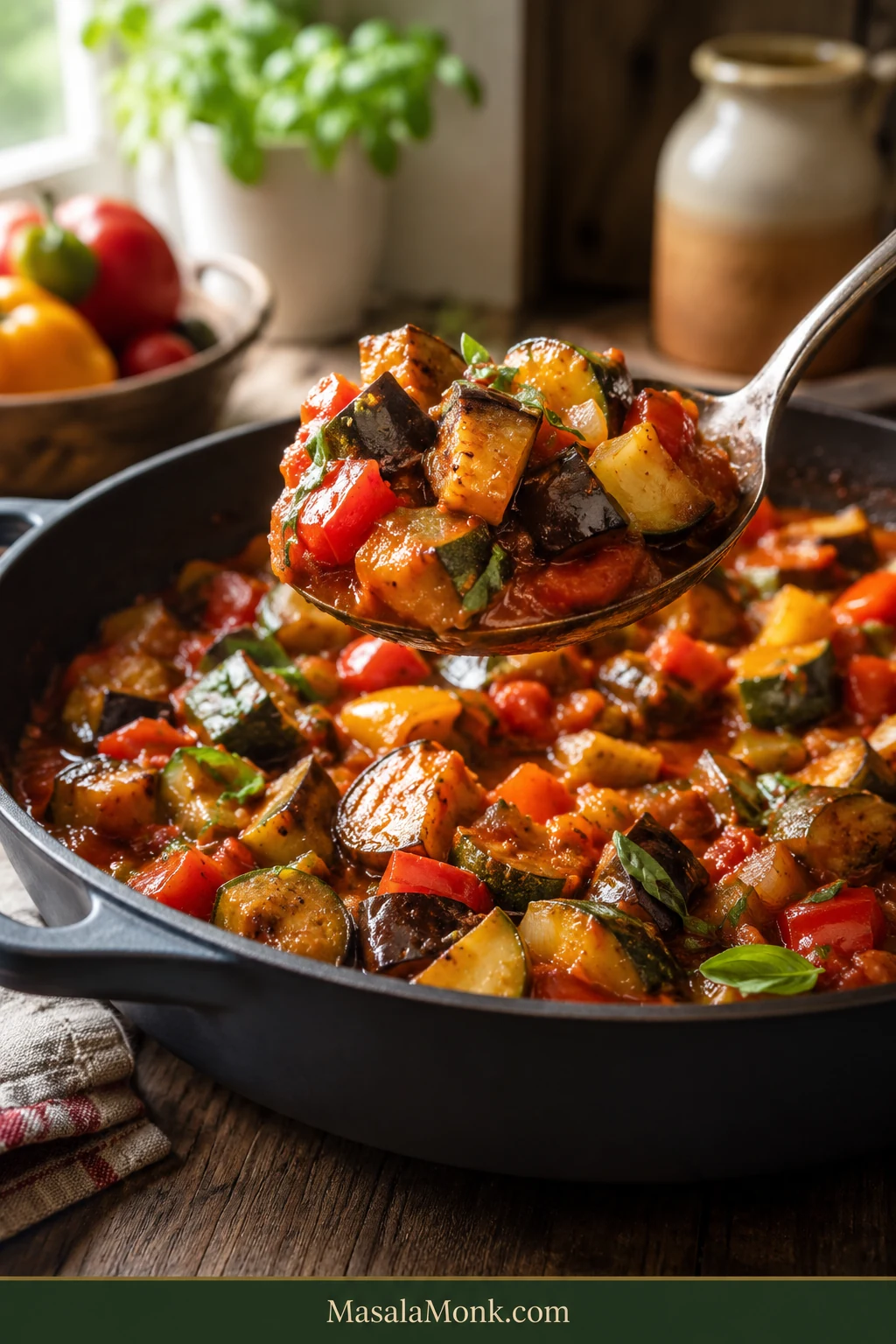
A good ratatouille gives you a little bit of everything in the same spoon: eggplant soft enough to almost melt, zucchini that is tender but still unmistakably zucchini, sweet pepper, and glossy tomato caught around the vegetables instead of pooling underneath them.
That sounds simple until five very different vegetables share the same pan. Eggplant needs enough heat and time to lose its spongy center. Zucchini can go from pleasantly tender to collapsed remarkably quickly. Tomatoes release plenty of water before they start behaving like sauce.
Ratatouille makes particular sense when the garden, market—or just your vegetable drawer—suddenly seems full of zucchini, tomatoes, peppers and eggplant. And after all that chopping, watching those vegetables disappear into a pale, watery pot feels particularly unfair.
This easy ratatouille recipe uses one wide pan and a staged method so the vegetables can finish tender without collapsing into one texture.
We stop when the stew is soft and generous but still varied from bite to bite. Serve it with bread, eggs or a simple grilled main, eat it warm or at room temperature, and save the leftovers for another meal—the flavors settle together beautifully overnight.
Quick Answer: How to Make Classic Ratatouille
Classic ratatouille is a Provençal vegetable stew made with eggplant, zucchini or courgette, bell peppers, tomatoes, onion, garlic, olive oil and herbs.
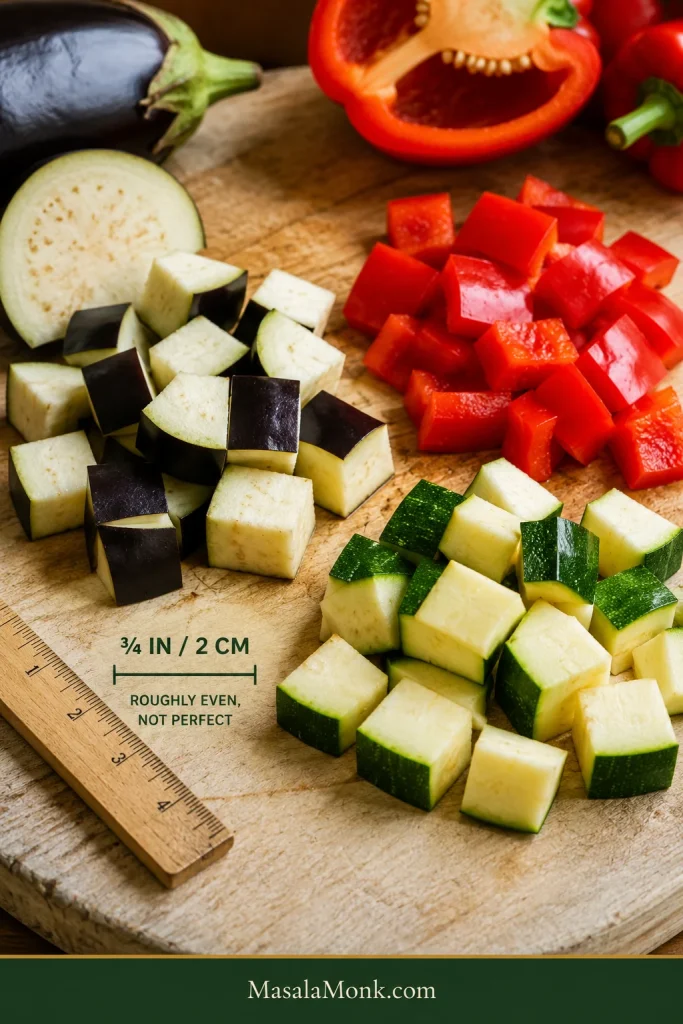
For about 6 side servings or 4 generous main-dish portions, use roughly 500 g / 18 oz eggplant, 400 g / 14 oz zucchini, 300 g / 10½ oz peppers and 750 g / 26 oz tomatoes. Cut the main vegetables into about ¾-inch / 2 cm pieces.
The easiest way to keep ratatouille from turning watery or mushy is to brown the eggplant and zucchini in separate turns, reduce the tomatoes before recombining, then return the zucchini only near the end. The eggplant gets enough time to become creamy while the zucchini keeps its shape.
What does ratatouille taste like? Sweet tomato and peppers, savory olive oil and garlic, creamy eggplant, tender zucchini, thyme and basil. It is rich enough to feel substantial while still tasting unmistakably of vegetables.
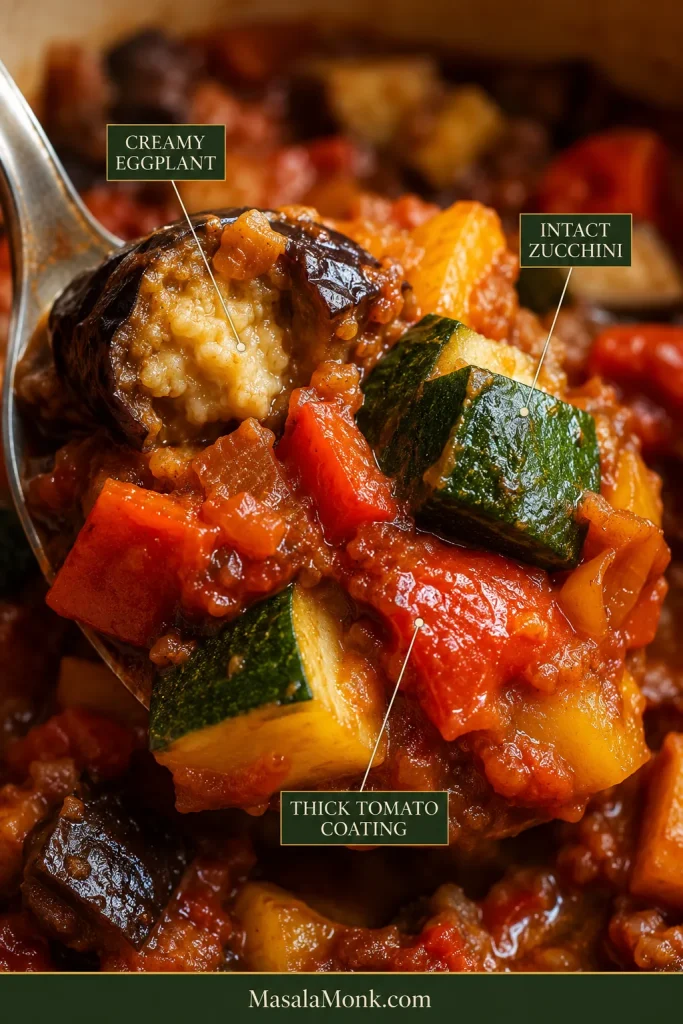
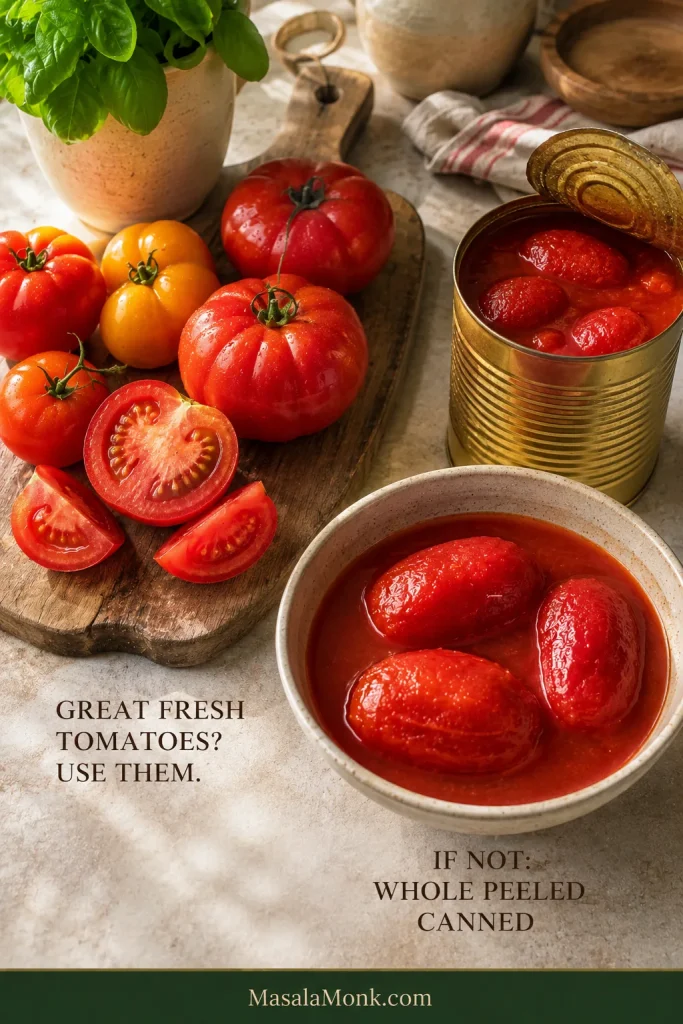
Before you start: use fresh tomatoes when they are flavorful; otherwise use good canned whole peeled tomatoes. Fresh, firm eggplant can go straight into the pan—save pre-salting for unusually mature, heavily seeded or wet eggplant.
Classic Ratatouille Recipe
A staged one-pan French ratatouille with creamy eggplant, tender zucchini and sweet peppers in a concentrated tomato base.
Recipe at a Glance
- Difficulty: easy
- Prep: about 25–30 minutes
- Cook: about 45–60 minutes
- Rest: 15 minutes recommended
- Total: about 1 hour 25 minutes to 1 hour 45 minutes
- Serves: about 6 as a side or 4 as a generous main
- Best pan: 12-inch / 30 cm wide high-sided sauté pan or wide shallow 5–6 qt / 5–6 L Dutch oven
- Vegetable cut: about ¾ inch / 2 cm
- Texture target: tender vegetables with a little thick tomato sauce around them and very little free liquid
- Diet: naturally vegan, vegetarian, dairy-free and gluten-free
The technique is easy; the chopping takes time. The staged cooking adds minutes, not difficulty, and gives each vegetable enough room to keep its own texture.
Equipment
- 12-inch / 30 cm wide high-sided sauté pan or wide shallow Dutch oven
- Chef’s knife and cutting board
- Wooden spoon or flexible spatula
- Two bowls or plates for holding the eggplant and zucchini separately
- Slotted spoon, useful but not essential
Pan shape matters. A broad cooking surface lets vegetable moisture escape. With a smaller pan, brown the eggplant and zucchini in batches instead of piling them high.
Ingredients
Weights are before trimming.
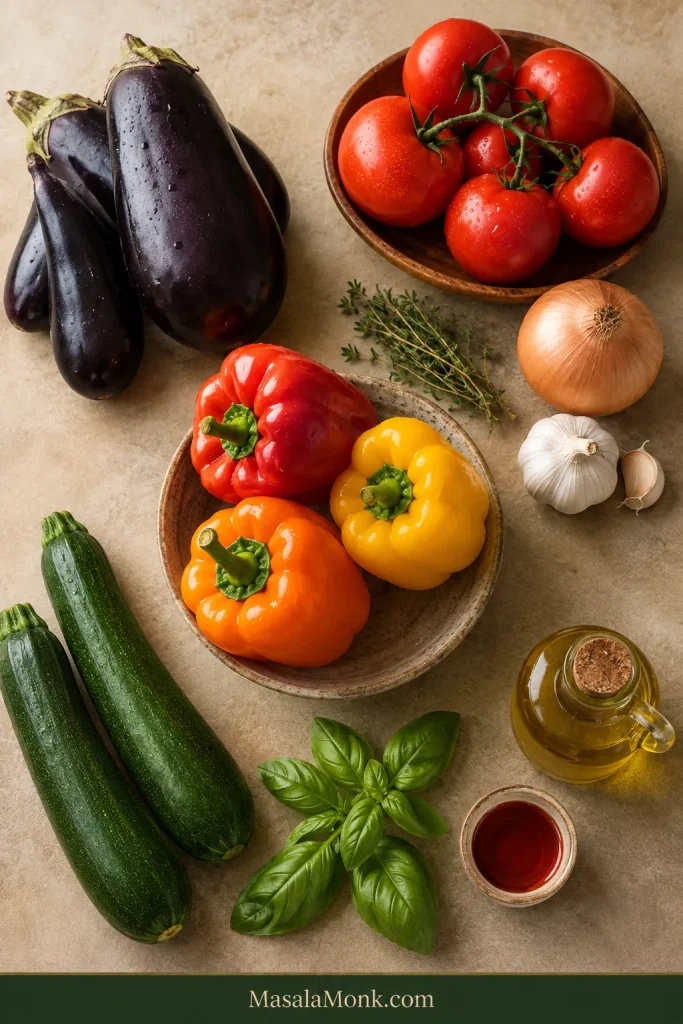
- 500 g / 18 oz eggplant, about 1 medium-large or 2 small, cut into ¾-inch / 2 cm pieces
- 400 g / 14 oz zucchini or courgette, about 2 medium, cut into ¾-inch / 2 cm pieces
- 300 g / 10½ oz red, yellow or orange bell peppers, about 2 medium, cored and cut into ¾-inch / 2 cm pieces; green works too but gives a more vegetal, less sweet result
- 200 g / 7 oz yellow onion, about 1 medium-large, chopped
- 750 g / 26 oz ripe fresh tomatoes, about 5–6 medium, chopped with their juices or 1 x 28 oz / 794 g can whole peeled tomatoes, hand-crushed with the juices
- 18 g garlic, about 4–5 large cloves, finely chopped
- 75 ml / 5 tablespoons extra-virgin olive oil, divided, plus up to 15 ml / 1 tablespoon more if needed
- 10 g fine sea salt, about 1¾ teaspoons depending on the salt, divided, plus more after tasting if needed
- ½ teaspoon freshly ground black pepper
- 2 teaspoons fresh thyme leaves, or 4–5 thyme sprigs
- 15 g / ½ oz fresh basil leaves, roughly torn
- 1–2 teaspoons red wine vinegar, optional, for finishing
Method
- Cut the vegetables. Cut the eggplant, zucchini and peppers into roughly ¾-inch / 2 cm pieces. Don’t worry about perfect cubes; aim for pieces that are reasonably even.
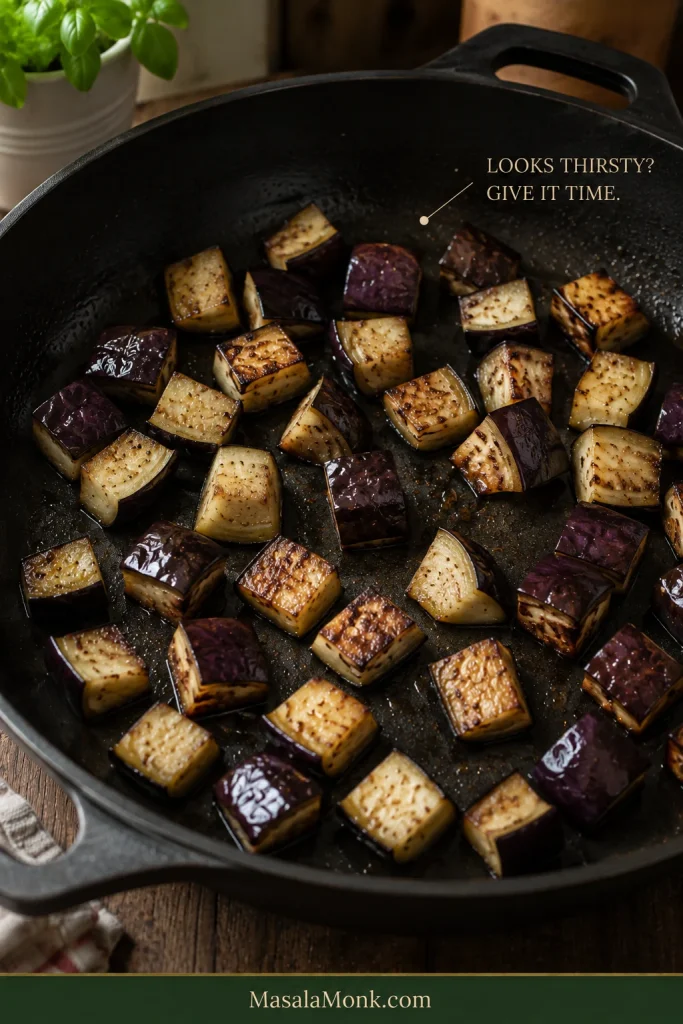
- Brown the eggplant. Heat 3 tablespoons / 45 ml olive oil over medium-high heat. Add the eggplant and ½ teaspoon of the measured salt. Spread the pieces as loosely as the pan allows and cook for 8–10 minutes, turning occasionally. Look for scattered brown patches and centers beginning to lose their raw, cottony resistance. Transfer the eggplant to a bowl.
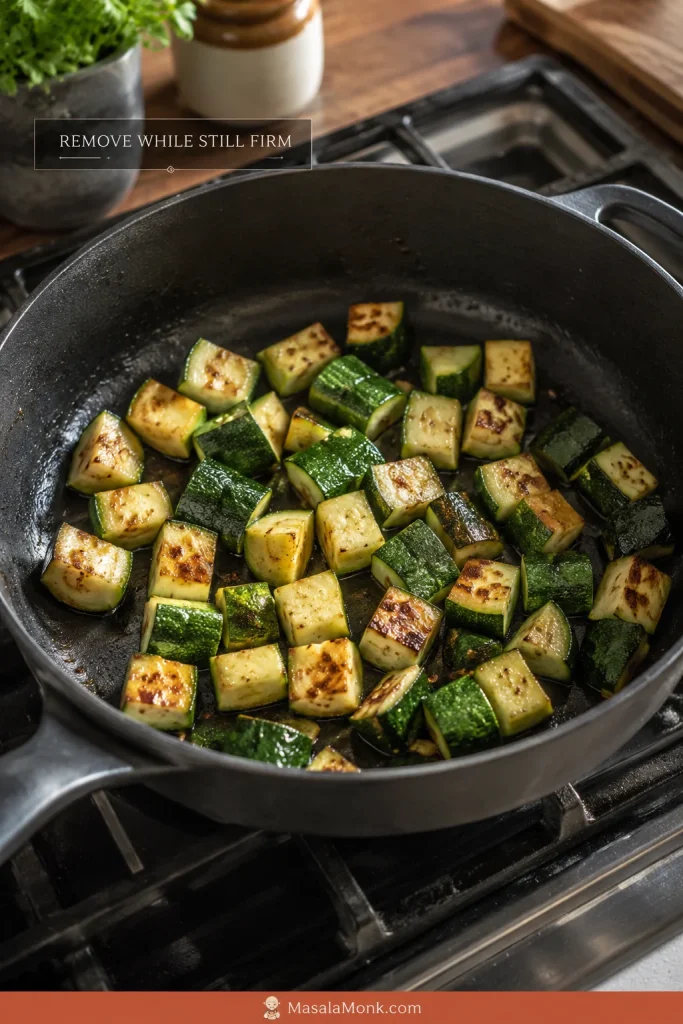
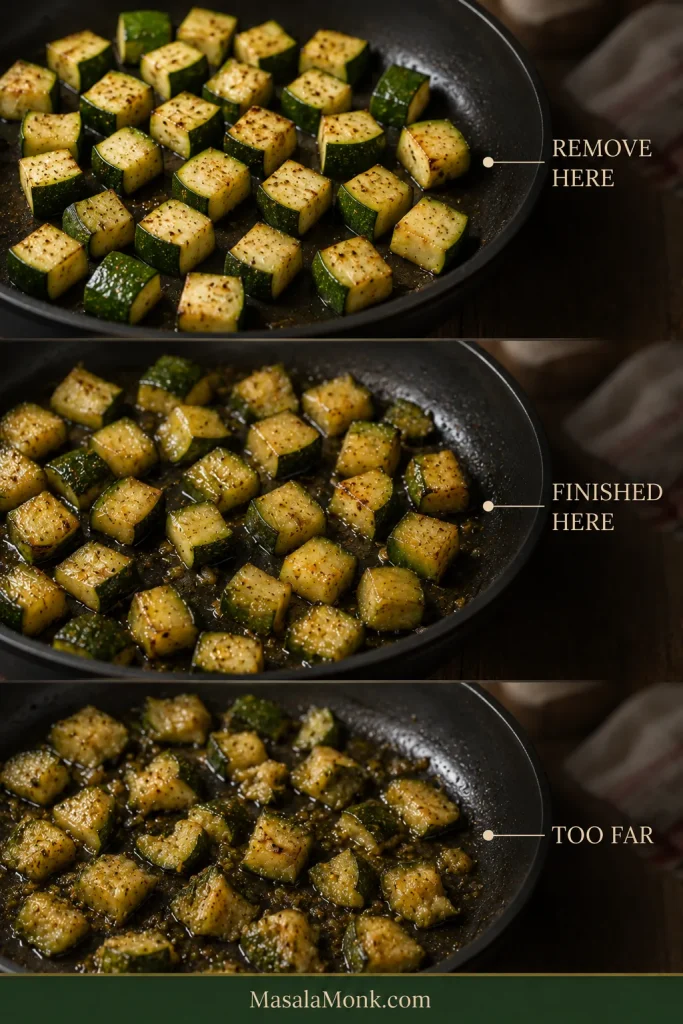
- Give the zucchini a shorter turn. Add 1 tablespoon / 15 ml olive oil, the zucchini and ¼ teaspoon salt. Cook for 4–5 minutes. Let it pick up some color, then remove it while the centers still feel firm. Transfer the zucchini to a separate plate or bowl; it returns to the pan later than the eggplant.
- Soften the onion and peppers. Reduce the heat to medium. Add the remaining 1 tablespoon / 15 ml olive oil, followed by the onion, peppers and ¼ teaspoon salt. Cook for 8–10 minutes. The onion should be soft, the peppers should bend easily under the spoon, and their raw grassy smell should have become noticeably sweeter.
- Add the garlic and thyme. Stir for 30–60 seconds. As soon as the garlic aroma rises clearly from the pan, add the tomatoes.
Reduce the Tomatoes, Then Recombine
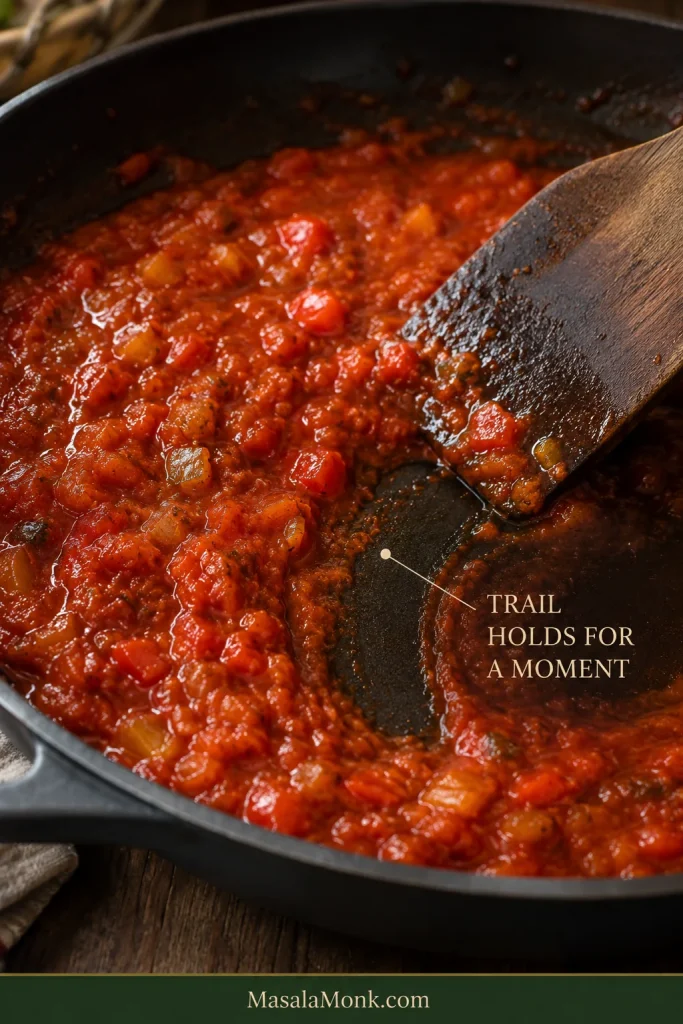
- Reduce the tomatoes. Add the tomatoes, black pepper and another ½ teaspoon salt, leaving the remaining salt for the final tasting. Bring to a lively simmer and cook uncovered for about 10–15 minutes, stirring occasionally. Very juicy tomatoes may need longer. Continue until the tomatoes have relaxed into a loose sauce and a spatula dragged across the bottom leaves a trail for a moment before the liquid closes behind it.
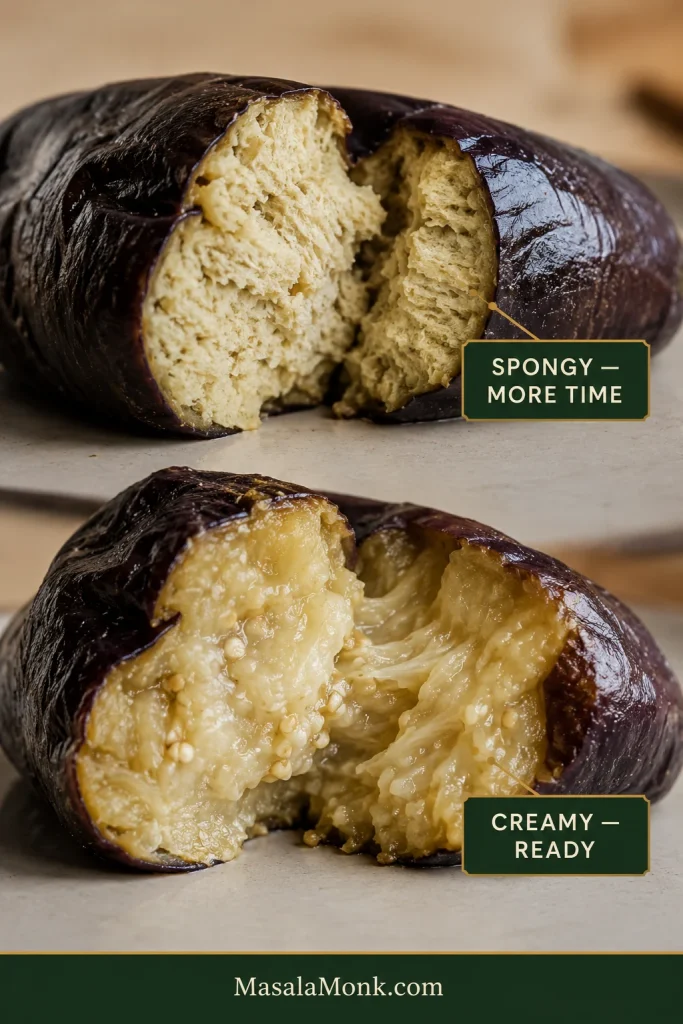
- Return the eggplant. Fold it into the tomato base. Lower the heat to a gentle simmer and cook uncovered for 8–10 minutes. Bite or press a piece when you are unsure: the center should be creamy, with no dry or cottony resistance.
- Return the zucchini. Fold it in gently and cook for another 3–5 minutes, just until tender. Stir only as much as necessary from here on so the softened vegetables hold together.
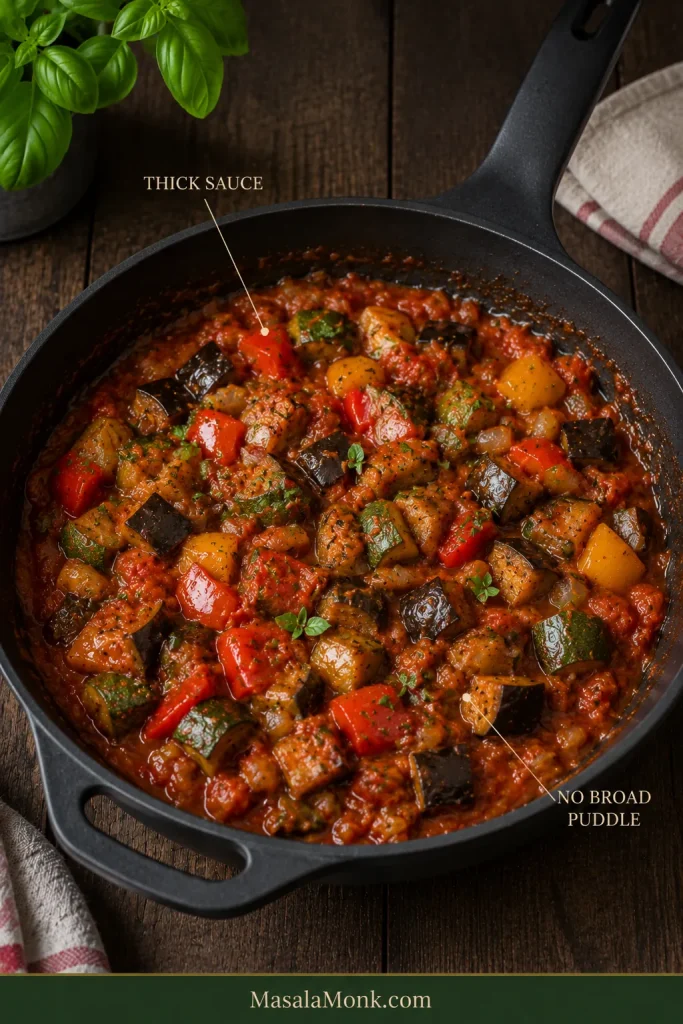
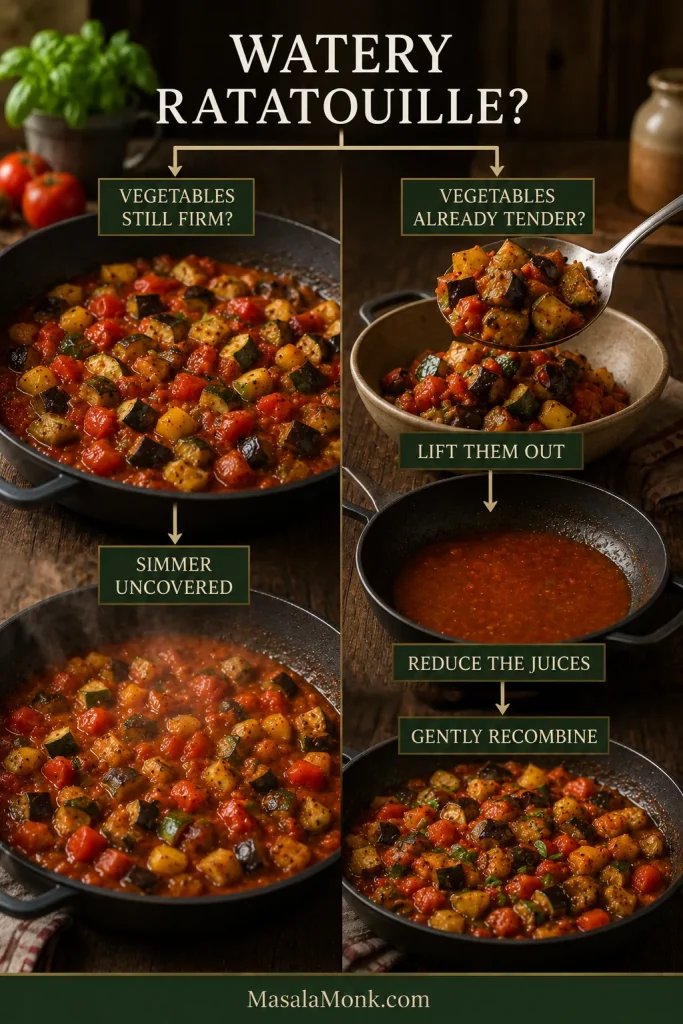
- Check the consistency. Tilt the pan. A small amount of thick sauce should move around the vegetables; you should not see a broad puddle of thin red juice. If the vegetables still need cooking, continue simmering uncovered. If they are already tender but the sauce is thin, lift them out with a slotted spoon, reduce the liquid on its own until glossy, then gently fold the vegetables back in.
- Finish and rest. Remove any thyme stems and taste for salt. If the ratatouille tastes rich but slightly dull, add 1 teaspoon red wine vinegar. Taste again and add the second teaspoon only if it still needs brightness. Fold in most of the basil, remove the pan from the heat and rest for 15 minutes. Finish with the remaining basil.
Recipe Notes
- Fresh or canned tomatoes: ordinary ripe tomatoes need no routine peeling or seeding. Use canned whole peeled tomatoes with their juices when fresh ones are disappointing. Judge either version by the consistency of the sauce.
- Optional eggplant salting: unusually mature, heavily seeded or wet eggplant can be salted with about ½ teaspoon of the measured salt for 20–30 minutes, then blotted very thoroughly. Skip the ½ teaspoon normally added with the eggplant in Step 2 and adjust the final seasoning by taste.
- Water: the vegetables and tomatoes normally provide enough. If the tomato base begins catching before it has reduced, add only 1–2 tablespoons / 15–30 ml at a time.
- Extra oil: the reserved tablespoon is there for an unusually absorbent batch of eggplant. Add it only if the pieces begin catching or scorching.
Check Doneness · Troubleshooting · Back to Top
Need Help With Your Ratatouille?
Classic Ratatouille Is the Rustic Stovetop Dish
Traditional ratatouille does not follow one fixed cooking sequence. Some versions cook the vegetables separately; others add them successively. Both approaches recognize the same thing: eggplant, zucchini, peppers and tomatoes do not soften or release water at the same rate. This recipe keeps one pan but gives the vegetables separate turns.
Classic ratatouille is a rustic Provençal vegetable stew; the neat spiral of thin vegetables popularized by the movie is a different refined preparation commonly associated with confit byaldi. If the immaculate vegetable spiral from the film is what you pictured, this pan will look much more relaxed and rustic. That’s the point: everyday stovetop ratatouille is about tender vegetables coming together in the pan, not maintaining a carefully arranged pattern.
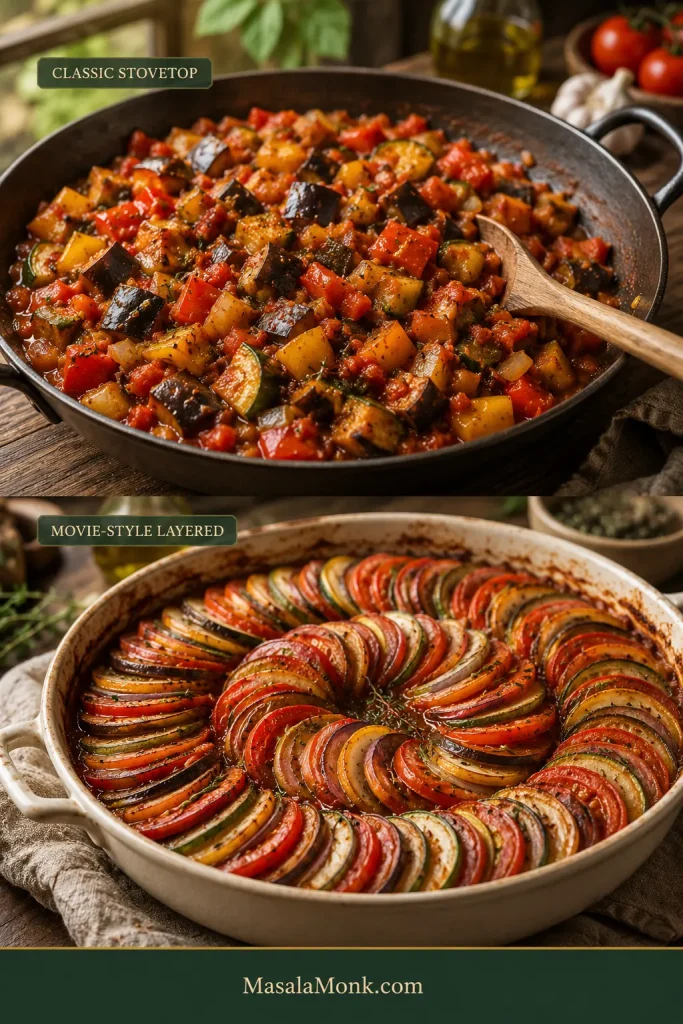
Ratatouille comes from Provence in southern France and is particularly associated with Nice. Classic versions usually bring together eggplant, zucchini or courgette, peppers, tomatoes, onion, garlic, olive oil and Mediterranean herbs. Some cooks keep the vegetables fairly distinct; others continue toward a soft, almost confited consistency. There is room for both.
Lidia Bastianich’s classic ratatouille on PBS, for example, sautés the vegetables separately before bringing them together for a much longer final cook. Here we keep that useful principle while doing the work in one pan.
Ingredients That Change the Result
The formula itself is simple. What matters most is the quality of the vegetables and how each one behaves in the pan.
Eggplant: Choose Firm, Then Cook Until Creamy
Eggplant or aubergine gives ratatouille much of its soft body. Choose one that feels firm and heavy for its size, with smooth skin. Leave the skin on; it helps the pieces hold together.
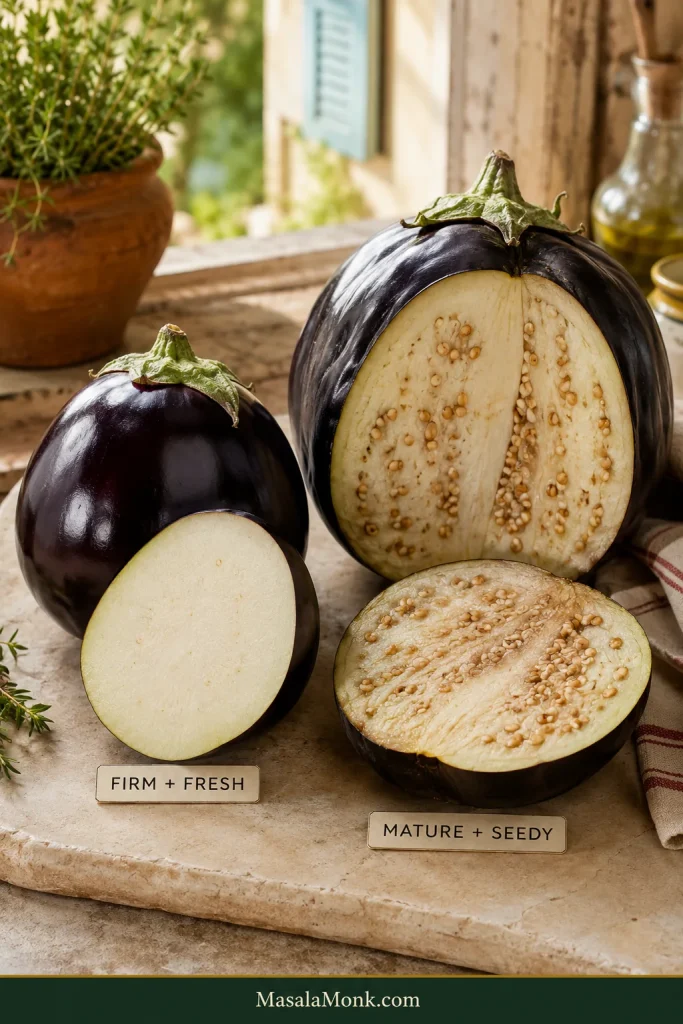
The important change happens inside. Raw eggplant has a dry, spongy bite. Properly cooked eggplant gives easily under the spoon and feels creamy through the center—the same tenderness cue that matters in baked Eggplant Parmesan.
Zucchini: Choose Small or Medium When You Can
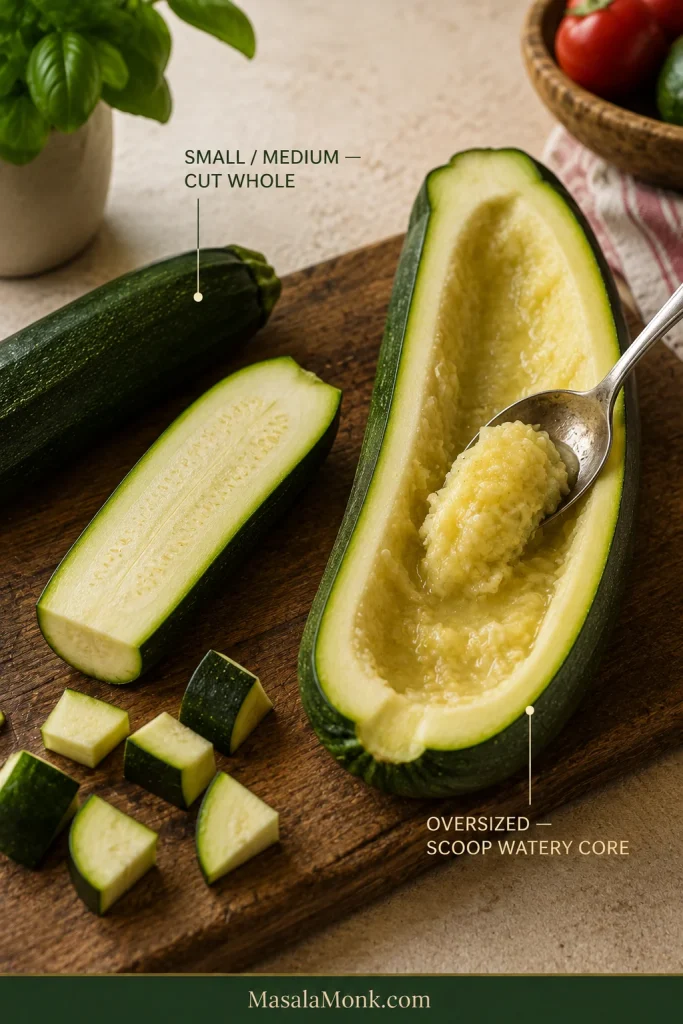
Small and medium zucchini have firmer flesh and smaller seed cavities, so you can simply cut them whole. An enormous garden zucchini with a pale, heavily seeded core benefits from having that loose watery center scooped out first.
Tomatoes: Use the Ones That Taste Good
Fresh tomatoes earn their place when they are fragrant and flavorful before cooking. Ordinary ripe tomatoes can be chopped whole; blanching, peeling and routine seeding only add work.
Outside peak tomato season, good canned whole peeled tomatoes often give you a deeper, more reliable base—crush them by hand and pour in the juices too. If you have more ripe tomatoes to use, they can go into this fresh tomato sauce.
Olive Oil, Peppers, Onion, Garlic and Herbs
Measure the olive oil before you start. Eggplant can make a pan look surprisingly dry for a few minutes, and having a measured amount makes it easier to resist pouring endlessly.
Red, yellow and orange peppers bring sweetness. Onion builds the base underneath them. Add the garlic once both have softened so it can perfume the pan without scorching. Thyme handles the simmer happily; basil tastes fresher near the end.
Ratatouille Substitutions That Still Make Sense
One missing vegetable does not have to derail dinner. The useful question is what the swap changes.
| Change | What to do | What changes |
|---|---|---|
| No eggplant | Increase zucchini and peppers for a lighter stew. Dense squash can add body but needs a longer head start. | There is no exact substitute for eggplant’s rich, creamy texture. Winter squash also adds sweetness and takes the dish farther from classic ratatouille. |
| No zucchini | Increase eggplant and peppers modestly. | The finished dish will be richer and heavier. |
| No peppers | Simply leave them out. | You lose some sweetness and fruity pepper flavor. |
| Yellow summer squash | Use it in place of zucchini. | Very little changes; give it the same short cooking window. |
| No good fresh tomatoes | Use canned whole peeled tomatoes with their juices. | The reduction time may change, but the flavor can be better than with poor fresh tomatoes. |
| No fresh thyme | Use about 1 teaspoon dried thyme or 1–1½ teaspoons herbes de Provence. | Dried herbs are more concentrated, so use them with restraint. |
Take away the tomatoes along with several of the defining vegetables and you’re moving toward another kind of vegetable stew. It may still be excellent; it does not need ratatouille’s name to be worth eating.
How to Make Ratatouille for Two
Halve the ingredients and keep the same sequence. Start with about 2½ tablespoons olive oil and keep another teaspoon or two nearby in case the eggplant starts catching.
Don’t shrink the cooking surface too aggressively. A tiny deep saucepan traps moisture more readily than a broad skillet even with half the vegetables.
The smaller batch may reduce faster once the tomatoes go in. Follow the appearance of the sauce instead of cutting every cooking time exactly in half.
Three Things Decide the Texture Before Cooking Starts
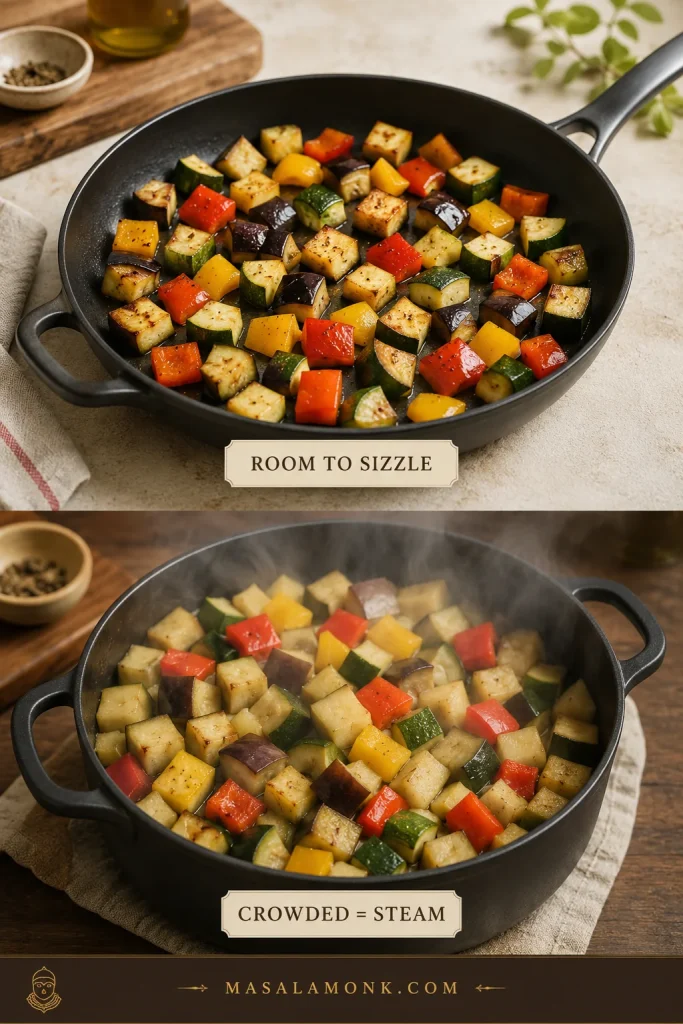
Cut the main vegetables around ¾ inch / 2 cm. Tiny dice soften quickly and disappear more readily into the sauce. Very large pieces keep more structure but need considerably longer. Two centimeters gives you a forgiving middle and keeps the chopping reasonable.
Use a broad cooking surface. A broad surface gives steam somewhere to escape instead of trapping it around the vegetables.
Listen as well as look. Eggplant or zucchini hitting a properly heated pan should sizzle. A deep mound that quickly turns quiet and steamy needs more space.
Cooking Stages · Check Doneness
How Ratatouille Changes in the Pan
Times are useful checkpoints. The vegetables give better signals.
Watch the eggplant first. For a few minutes it can look alarmingly thirsty while the center is still spongy, which is exactly when another pour of oil feels tempting. Give it time. As the pieces brown and begin to soften, that urge to add more oil fades.
Zucchini needs almost the opposite treatment. Take it out while it still seems slightly underdone. That firmness gives it enough room to finish later without disappearing into the stew.
Then the tomatoes usually make the pan look worse before they make it look better. Juice spreads across the bottom, steam lifts from the surface, and for a while everything looks far too wet. Keep cooking. The tomato flesh slumps, the color darkens and turns glossier, and the sharp raw-tomato smell softens.
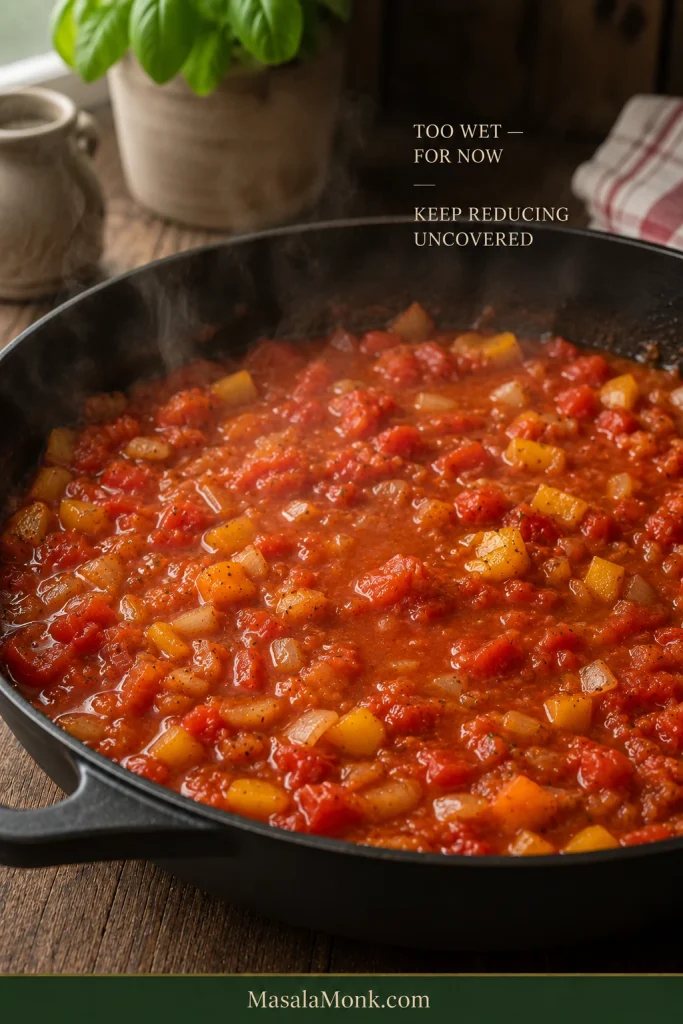
When the Tomatoes Start Behaving Like Sauce
Drag a spatula across the bottom. Early on, liquid rushes straight back into the trail. Later, the path stays visible for a moment before the sauce closes behind it. That same trail test works whenever you reduce a tomato sauce, including marinara: thin sauce usually needs evaporation before it needs another ingredient.
When the eggplant returns, the pan may still look like several cooked vegetables sharing a sauce. A few minutes later the tomato begins settling around the pieces, the peppers soften into the background, and the zucchini finishes gently. Suddenly it looks like ratatouille.
From here, fold rather than churn. Soft vegetables can be broken with a spoon even when the cooking itself is exactly right.
Check Doneness · Back to Recipe
The Pan, Not the Timer, Tells You When Ratatouille Is Done
Start checking around the suggested times, then stop when the food reaches these cues. No single vegetable decides doneness; the useful window is when the slowest pieces are tender but the quickest-cooking ones have not started falling apart.
Final Consistency: Read the Whole Pan
| Look at | Ready when… |
|---|---|
| Eggplant | The center is creamy and yielding with no dry, cottony resistance |
| Zucchini | Tender enough to cut easily with a spoon while still holding its shape |
| Peppers | Soft and sweet with no raw crunch |
| Tomato | Thick enough to coat the vegetables without running freely around them |
| Pan bottom | A small amount of sauce remains; there is no broad puddle of thin red liquid |
| Whole dish | The flavors have come together, but the spoon still gives you different textures |
Zucchini: Stop Before It Collapses
Like your ratatouille softer? Continue the gentle simmer. Some traditional versions go much farther toward a deep, almost jammy consistency. Our stopping point is a preference, not a universal rule.
Troubleshooting · Back to Recipe
Ratatouille Troubleshooting
Before adding ingredients or automatically cooking longer, look at what is actually wrong. Most ratatouille problems have a specific fix.
Texture and Moisture Problems
| Problem | Fix it now | Why it happened / next time |
|---|---|---|
| Thin red liquid pooling | Vegetables still firm? Simmer uncovered. Already tender? Lift them out, reduce the liquid alone until glossy, then fold them back in. | Too much moisture was trapped. Give the vegetables more room and reduce the tomato base farther before recombining. |
| Eggplant is spongy | Give it more time in the tomato sauce until the center becomes creamy. | The eggplant is undercooked. Let it begin softening properly during the first browning. |
| Eggplant seems to absorb all the oil | Turn the pieces and give them time. Use the reserved oil only if they begin to scorch. | Some absorption is normal; weak heat can exaggerate it. Measure the oil and use active sautéing heat. |
| Finished ratatouille is greasy | Spoon off obvious excess oil if necessary. | Too much oil was added, often in repeated pours while the eggplant looked dry. Start with the measured amount. |
| Zucchini is collapsing | Stop cooking. The flavor can still be excellent even if the zucchini has lost its shape. | It cooked too long or returned too early. Brown briefly and add it back near the end. |
Flavor and Seasoning Problems
| Problem | Fix it now | Why it happened / next time |
|---|---|---|
| Vegetables are pale and bland | Reduce loose liquid first, then correct the salt before adding more herbs. | The vegetables steamed or excess water diluted the flavor. Use stronger heat, more pan surface or smaller batches. |
| Ratatouille tastes rich but flat | Correct the salt first, then add 1 teaspoon red wine vinegar and taste again. | The finished pan needs seasoning or a touch of acidity. |
| Tomato tastes harsh | If the vegetables still need time, continue uncovered. If they are tender, remove them and reduce some sauce separately. Check salt before trying a tiny pinch of sugar. | The tomato may be under-reduced or unusually acidic. Better tomatoes and sufficient reduction help next time. |
| Garlic tastes bitter | Burned garlic is difficult to rescue; dilution may soften the bitterness. | The garlic scorched. Add it only after the onion and peppers have softened. |
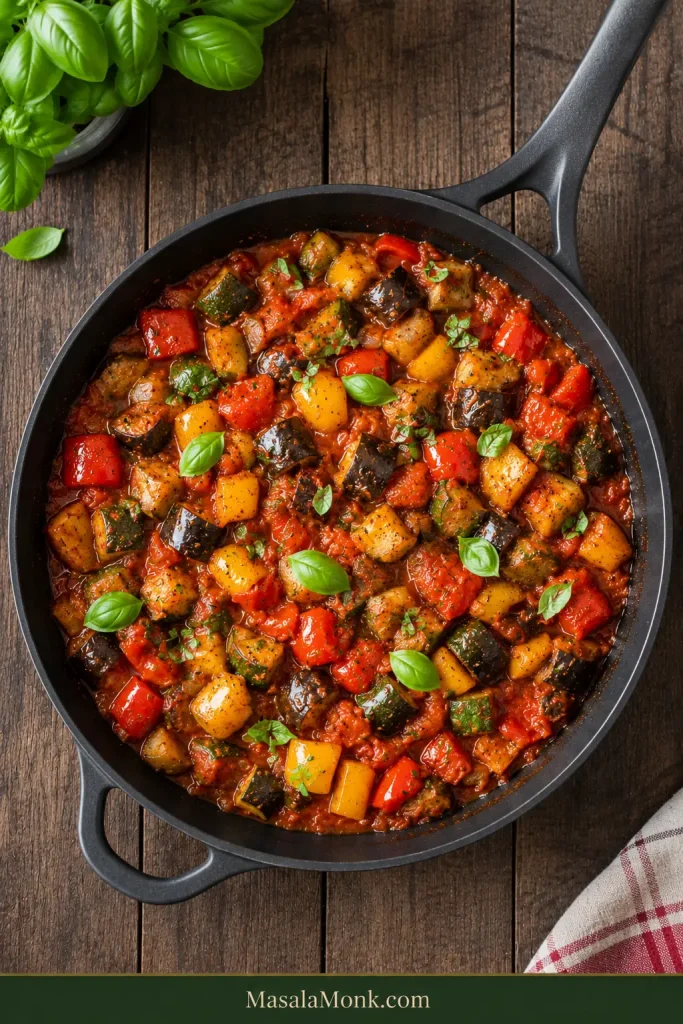
Once the sauce is right, all of that diagnosis disappears from the plate. What remains is the good part: sweet pepper, soft eggplant, zucchini, basil and tomato in the same warm spoonful.
What to Serve With Ratatouille
Serve ratatouille with crusty bread, polenta, rice or eggs for a vegetarian meal, or use it as a side for chicken, fish, lamb or sausages.
Once the pan is where you want it, ratatouille becomes wonderfully undemanding. Spoon it beside dinner, pile it onto bread, or let the vegetables become the meal.
Make it the main: add crusty bread or sourdough focaccia, creamy polenta, rice, couscous, white beans or chickpeas. A fried or poached egg makes it more substantial without taking attention away from the vegetables.
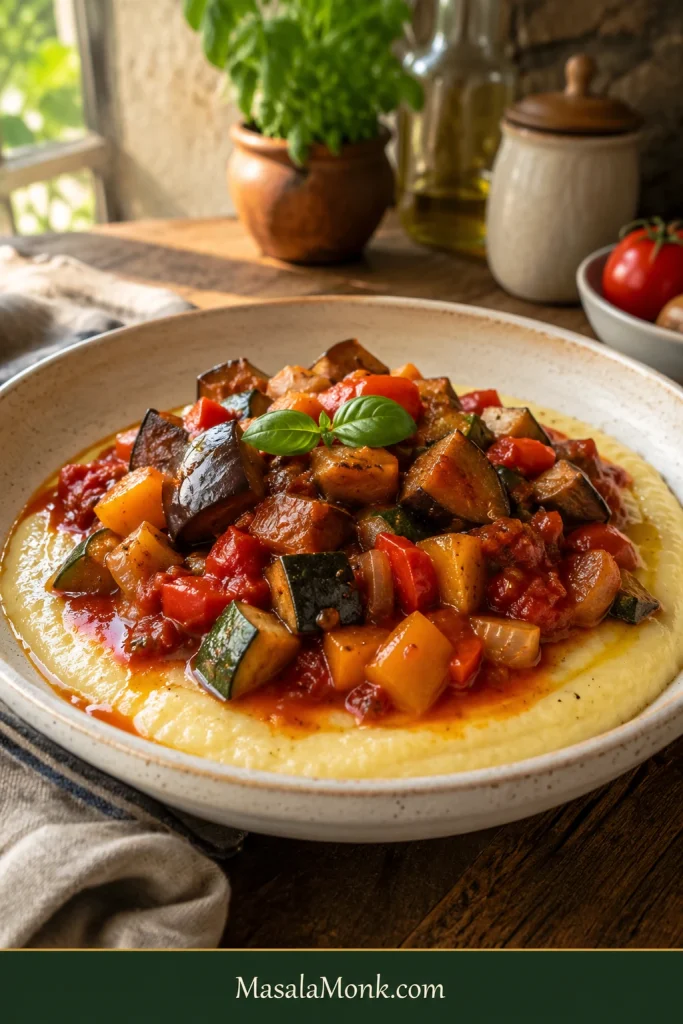
Serve it as a side: simply cooked chicken, fish, lamb, sausages or roasted meat all leave plenty of room for the ratatouille.
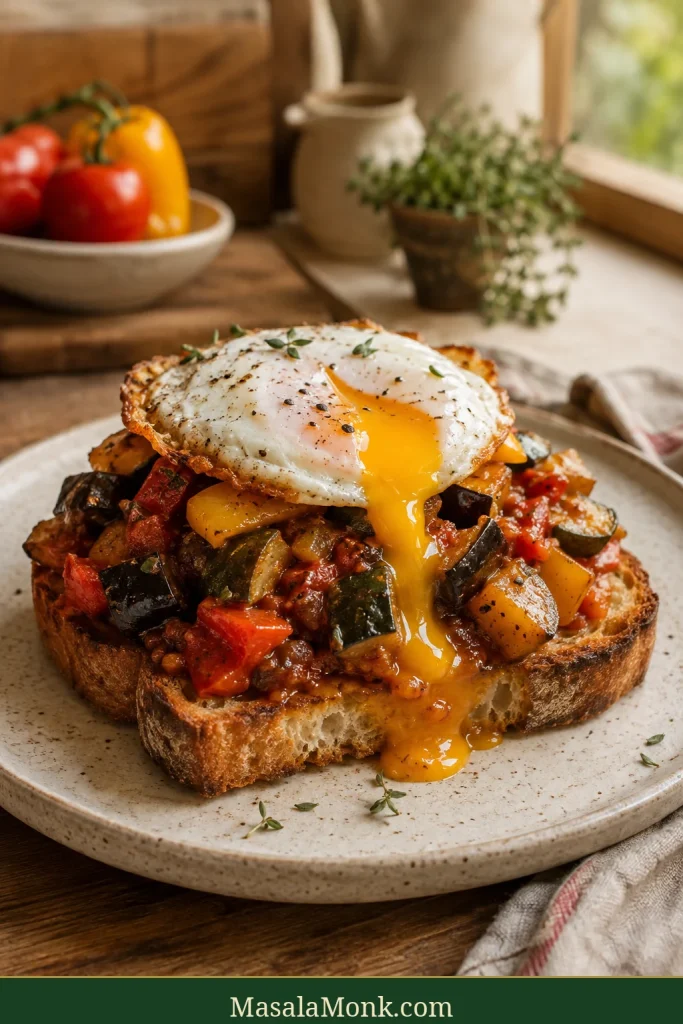
Or make lunch out of it: spoon warm ratatouille over crisp toast and add a fried egg. The tomato and olive oil soften the top of the bread while the edges stay crisp, and the yolk runs straight into the vegetables. Goat cheese or another tangy cheese is good here too, and a smaller amount of ratatouille can go into an easy frittata.
Ratatouille does not need to be piping hot; it is good warm, at room temperature or chilled. During the 15-minute rest, the bubbling settles and the sauce thickens slightly around the vegetables, while the olive oil, herbs and tomato become easier to taste. If serving leftovers cold, let them lose the deepest refrigerator chill first.
Make Ahead, Store, Freeze and Reheat
Yes—ratatouille is excellent made a day ahead. The vegetables become softer, but the tomato, garlic, herbs and olive oil taste more integrated after a night in the refrigerator.
If you’re cooking specifically for the next day, hold back most of the basil and add it just before serving so its fresh flavor does not disappear into the overnight rest.
Day one gives you clearer textures. Day two gives you deeper integration. Neither is a consolation prize.
Fridge, Freezer and Reheating at a Glance
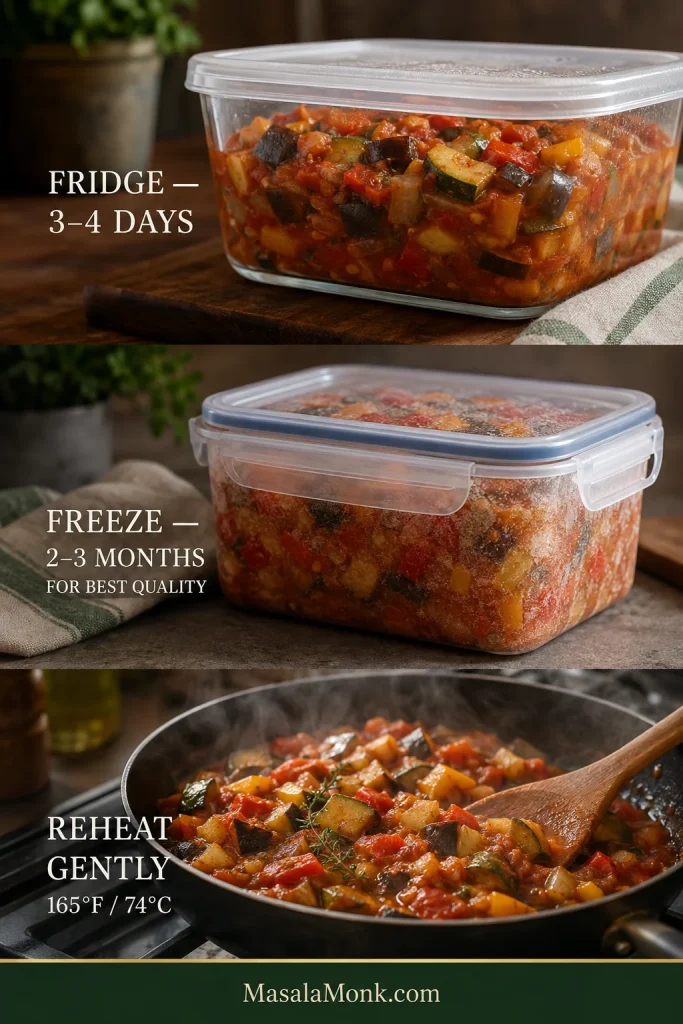
For the practical timeline, keep the three jobs separate: chill leftovers promptly, freeze airtight portions you will not use soon, and reheat only what you plan to eat.
Refrigerate and Reheat Gently
Refrigerate leftovers within 2 hours of cooking—or within 1 hour when the surrounding temperature is above 90°F / 32°C—in covered, preferably shallow containers. USDA leftover guidance recommends using refrigerated cooked leftovers within 3–4 days and reheating them to 165°F / 74°C.
Reheat only the portion you plan to eat. The microwave works well for a single serving because the heating is brief. On the stovetop, use low to medium-low heat and stir only as much as necessary. Once it is hot, stop. Yesterday’s zucchini does not need another fifteen-minute simmer.
An oilier appearance after reheating does not necessarily mean the original batch contained too much oil. Extra evaporation removes water while the olive oil remains, making it more visible.
Can You Freeze Ratatouille?
Yes. Freeze it in an airtight container and use it within about 2–3 months for best quality. Expect softer vegetables after thawing, especially the zucchini.
That softer texture works well in pasta, eggs, soup or on toast. A thawed batch that has become too soft to enjoy on its own can also become the start of a vegetable soup; minestrone takes the tomato-and-vegetable idea in a heartier beans-and-pasta direction.
Leftover Ideas · Back to Recipe
Five Good Ways to Use Leftover Ratatouille
Leftover ratatouille can become pasta sauce, a toast topping, frittata filling, a spoonful over polenta, or the beginning of a vegetable soup.
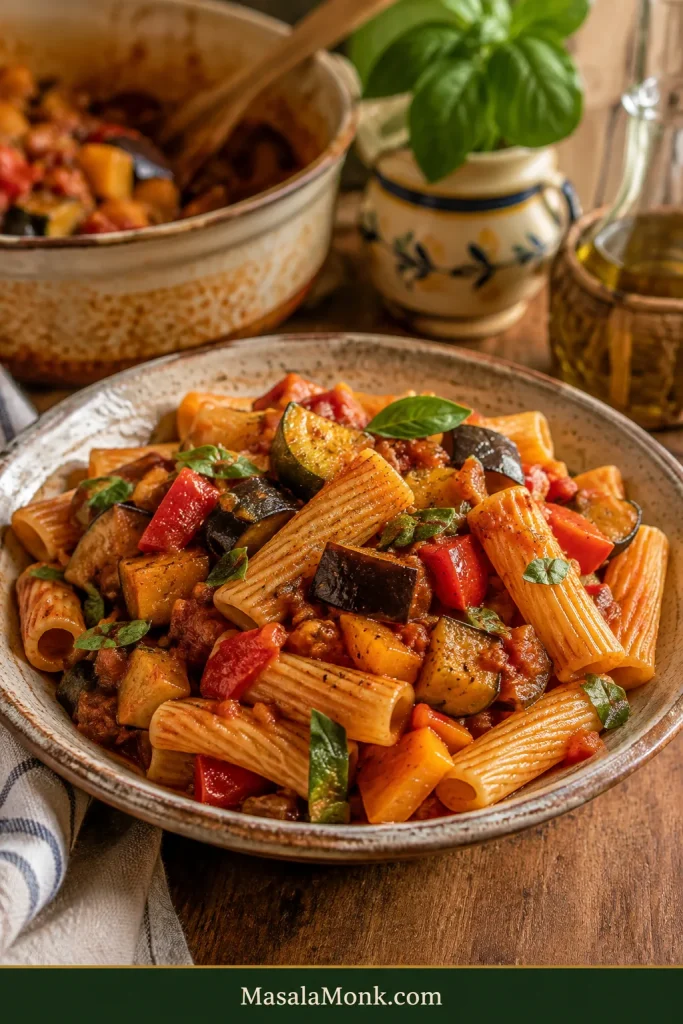
- Toss it with pasta. Warm the ratatouille, loosen it with some pasta water and fold it through. Basil, Parmesan or goat cheese can finish it. For something cheesier and more substantial, the same vegetables also work beautifully in vegetable baked ziti.
- Pile it onto toast. Add an egg or tangy cheese and lunch is essentially done.
- Put it into eggs. Warm it under fried or poached eggs, or use a modest amount as a cooked vegetable filling for an omelet or frittata.
- Spoon it over polenta. Soft vegetables and concentrated tomato are particularly good against creamy polenta.
- Turn a very soft batch into sauce or soup. Crush it into a chunky pasta sauce or blend some of it into a smoother vegetable base. The texture changed; dinner did not fail.
When the Vegetables Come Together
When the pan is right, you don’t really need the clock anymore. The tomato has thickened around the vegetables, the eggplant gives under the spoon, the peppers are sweet, and the zucchini has made it to the end intact.
Give it fifteen minutes to settle. By then the sauce has gathered around the vegetables, the steaming heat has eased, and the ratatouille is ready to eat.
If you make it, tell me where you like your ratatouille to land: vegetables still clearly distinct, or soft and deeply confited?








