
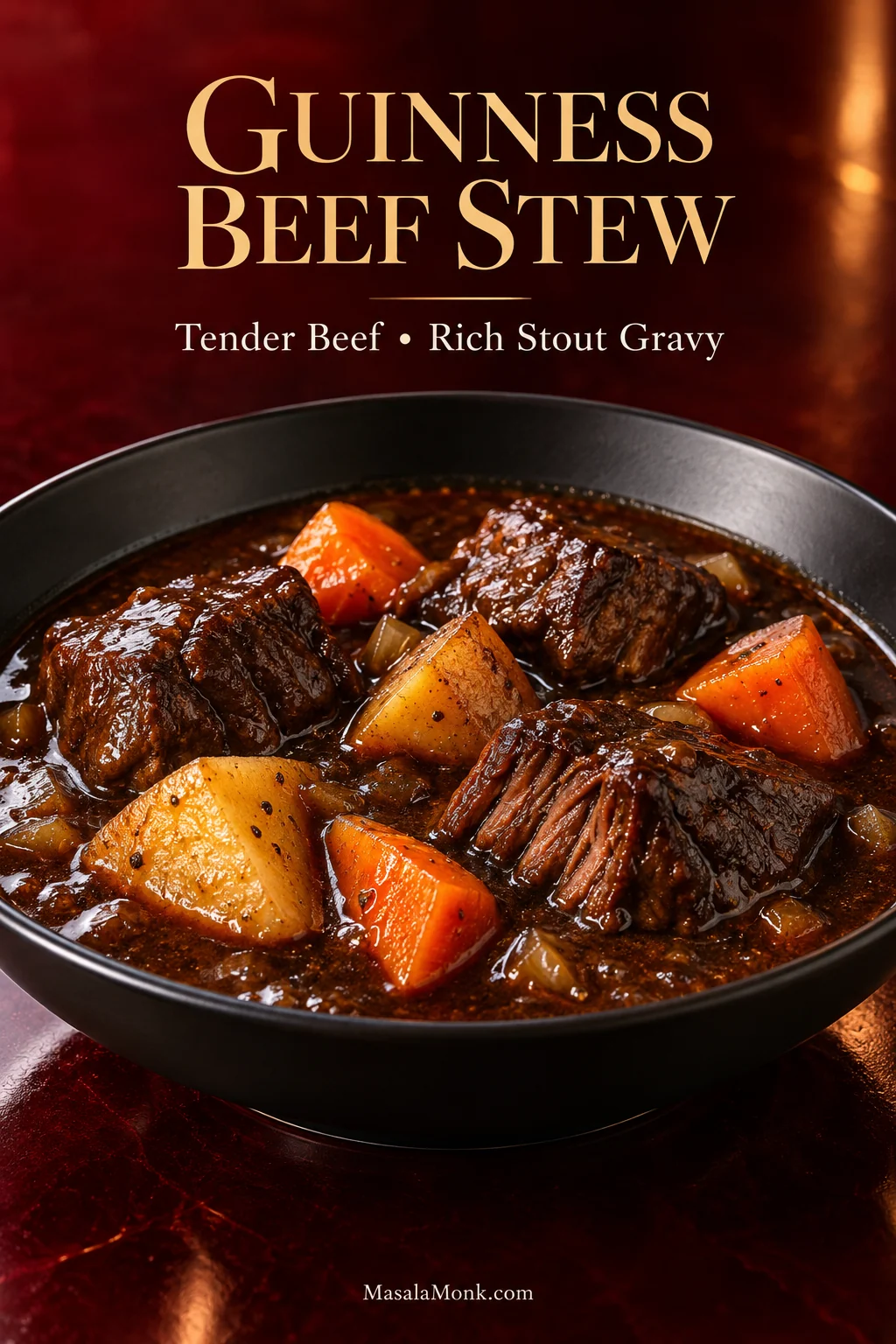
This Guinness beef stew recipe starts with big pieces of chuck and gives them the time they need to become fork-tender before the potatoes and carrots finish in the same dark stout gravy. The payoff is beef that gives under the fork, creamy-centered potatoes, carrots that still hold their shape, and enough gravy to drag a piece of bread through the bowl.
Most stew recipes tell you when to add the vegetables by the clock. Here, the beef makes that decision. If the chuck is still pushing back against the fork, the potatoes can wait. Once the beef begins to soften, the vegetables go in and finish while the uncovered pot deepens the sauce.
Quick answer: Brown 2-inch / 5 cm chunks of chuck well, braise gently at 300°F / 150°C, and wait until the beef is already softening before adding the potatoes and carrots. Finish uncovered until the vegetables are tender and the sauce lightly coats a spoon. Chewy but juicy beef usually needs more time. Thin sauce usually needs more evaporation.
Guinness Beef Stew
Large pieces of chuck braised slowly with Guinness until tender, with potatoes, carrots and dark stout gravy to spoon over everything.
Give yourself some breathing room: chuck can vary by 30–60 minutes or more. Starting early is easier than trying to rush beef that is not tender yet.
Ingredients
- 3 lb / 1.36 kg boneless beef chuck roast, cut into roughly 2-inch / 5 cm pieces
- 10 g kosher salt, divided, plus more as needed after reduction; weighing is recommended because kosher salt brands vary significantly by volume
- 1 tsp freshly ground black pepper
- 2 tbsp / 30 ml neutral high-heat cooking oil, plus more if needed
- 2 medium yellow onions / about 300 g, diced
- 2 celery ribs / about 120 g, diced
- 4 garlic cloves / about 15 g, finely chopped
- 2 tbsp / about 32 g tomato paste
- 3 tbsp / about 24 g all-purpose flour
- 11.2–12 fl oz / 330–355 ml Guinness Draught
- 2½ cups / 600 ml low-sodium beef stock, plus up to ½ cup / 120 ml more only if needed
- 1 tbsp / 15 ml Worcestershire sauce
- 4 thyme sprigs or about 1 tsp dried thyme
- 1 bay leaf
- 12 oz / about 340 g carrots, cut into roughly 1½-inch / 4 cm lengths, halving very thick pieces lengthwise
- 1 lb / 450 g Yukon Gold or other yellow potatoes, scrubbed and cut into roughly 1½-inch / 4 cm chunks; peel if preferred
Instructions
Brown the beef and build the flavor base
- Heat the oven to 300°F / 150°C. Trim only thick, hard exterior fat from the chuck. Leave the normal marbling. Cut the beef into roughly 2-inch / 5 cm pieces, pat it very dry, then season with about 7 g salt and all of the black pepper. Reserve the remaining salt for the braise.
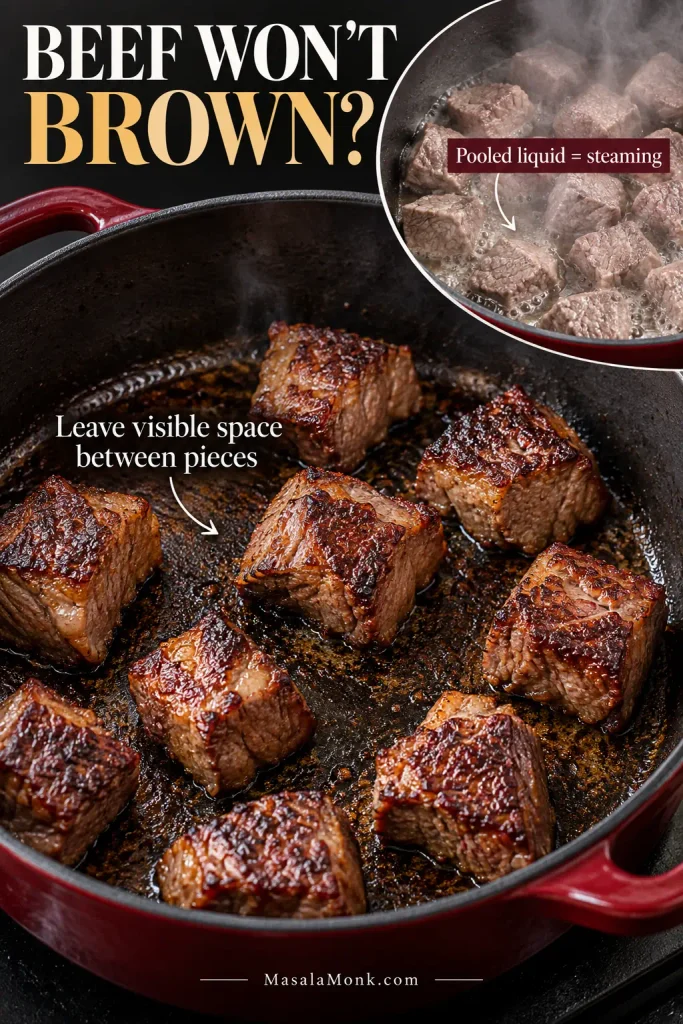
- Brown the beef in batches. Heat 1 tablespoon oil in a 6–7 quart Dutch oven over medium-high to high heat. Expect about 3 batches, or however many your pot needs to leave clear space between the pieces. Let the first broad surface sit for roughly 2–3 minutes, until you have deep brown patches rather than black crust. Turn and brown other surfaces as needed, then transfer the beef to a plate. Released liquid pooling instead of sizzling is your cue to pull a few pieces out and let the pot get hot again.
- Cook the onions and celery. Reduce the heat to medium. Add the onions and celery and cook for 5–7 minutes, until softened and beginning to color. Stir in the garlic and cook for about 30 seconds, just until fragrant.
- Cook the tomato paste and flour. Stir in the tomato paste and cook for 1–2 minutes, until it darkens toward brick red and smells a little sweeter and more roasted. Add the flour and stir for another minute. The mixture will look thick and fairly dry.
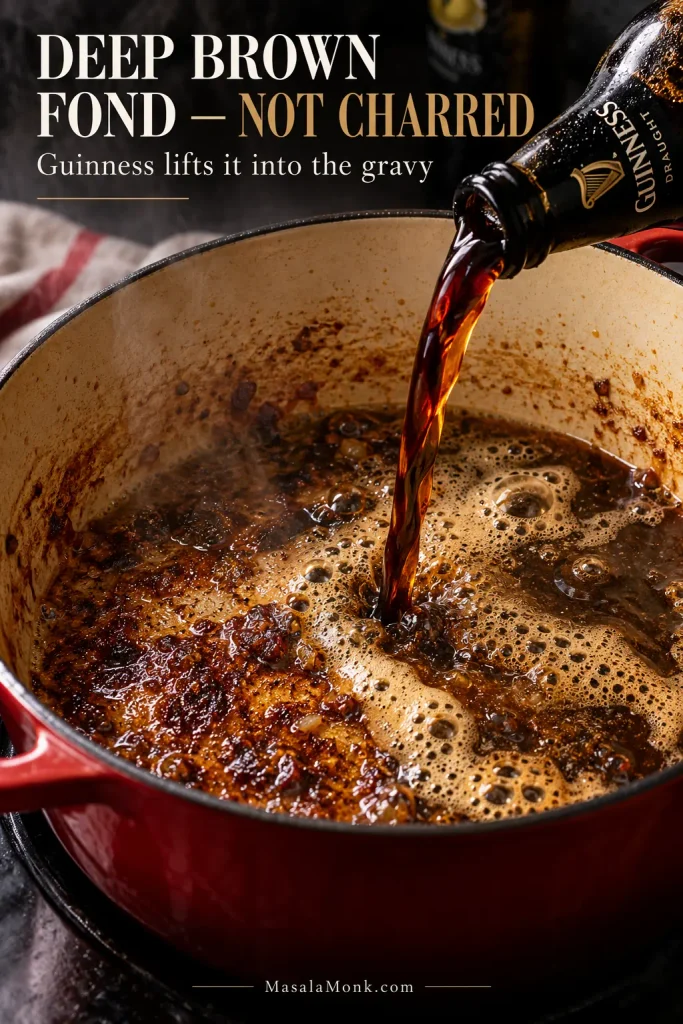
- Deglaze with Guinness. Slowly pour in the Guinness while scraping the browned fond from the bottom of the pot. Let it simmer for 2–3 minutes. The stout may taste sharp at this stage; leave any sweetness adjustment until the end.
Build the braise and wait for the beef
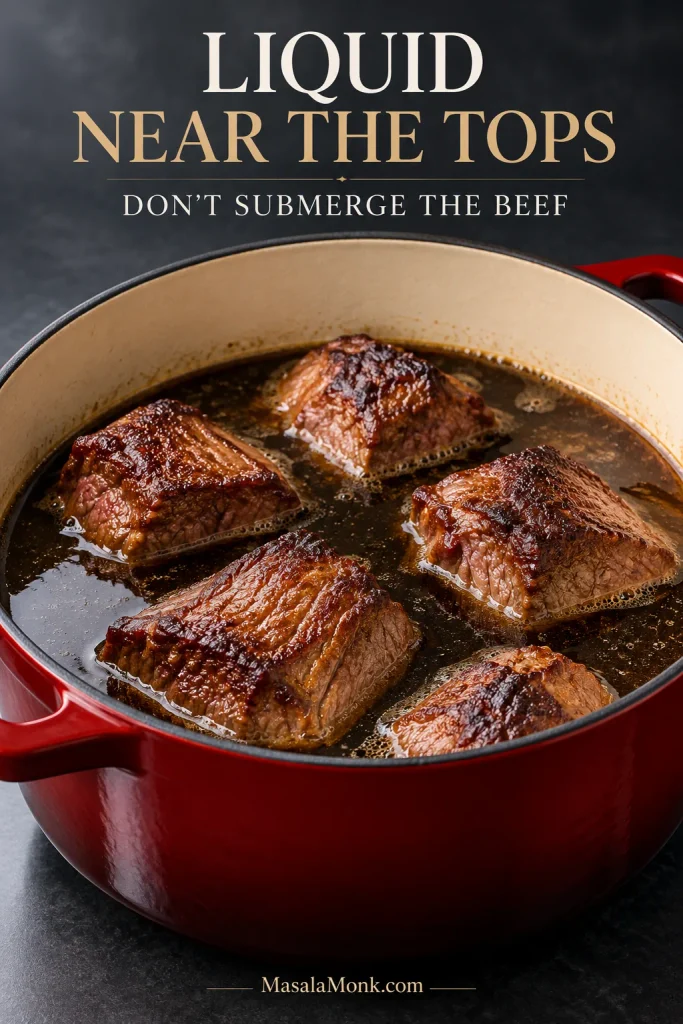
- Build the braise. Return the beef and any collected juices to the pot. Add the Worcestershire sauce, thyme, bay leaf, remaining 3 g salt and 2½ cups / 600 ml stock. The liquid should come close to the tops of the beef pieces without leaving them floating under broth. Bring it to a gentle simmer—small, occasional bubbles around the edges rather than a rolling boil.
- Braise covered. Cover and transfer the Dutch oven to the oven. Leave it largely undisturbed until the first tenderness test at about 1 hour 45 minutes. A pot that looks noticeably dry or has lost a lot of braising liquid needs a small splash of hot reserved stock.
- Test the beef before adding vegetables. Try one of the larger pieces. Still chewy and springy? Cover the pot and continue in 20–30 minute increments. Add the potatoes and carrots when a fork enters fairly easily but the meat still offers some resistance. Beef that has already become completely tender can be lifted out while the vegetables cook in the gravy, then returned for the final few minutes.
Finish the vegetables, gravy and seasoning
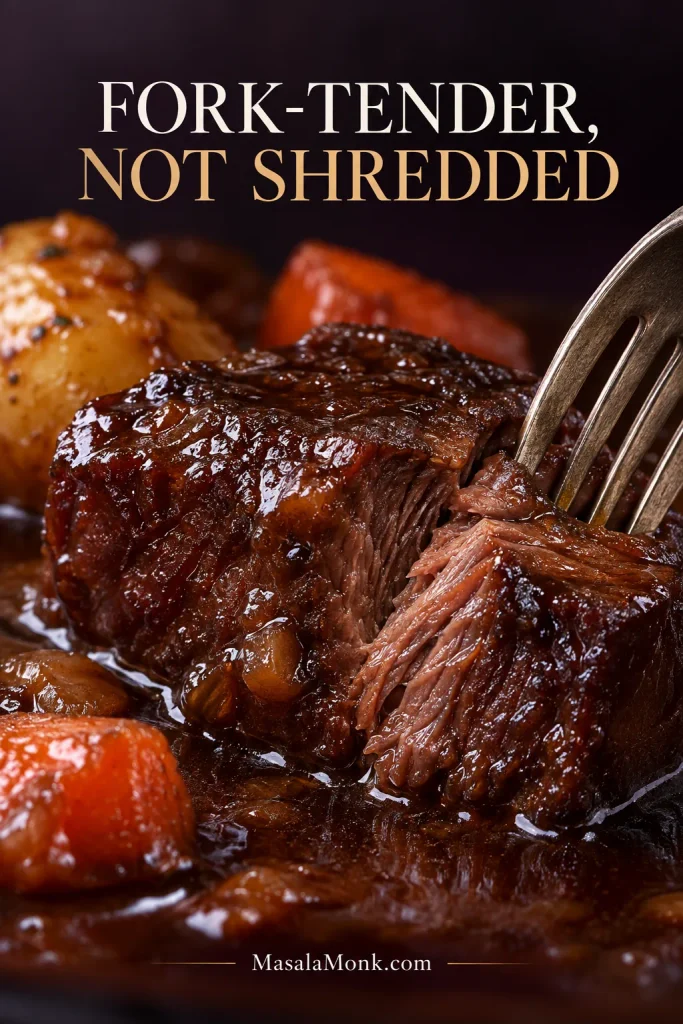
- Finish uncovered. Return the pot to the oven uncovered for about 40–60 minutes. This is where the stew starts looking like dinner: the sauce darkens, the roasted smell of the stout settles into the beef, and the potato edges soften without disappearing into the gravy. The beef is ready when the pieces still hold their shape but yield easily under the side of a fork. A thin knife should slip through the center of a potato with little resistance, and the carrots should be tender without collapsing.
- Finish the sauce. Remove the thyme stems and bay leaf and skim away obvious pools of fat. A slightly thin sauce can simmer on the stovetop over medium to medium-low heat for another 5–10 minutes. Already happy with the beef and vegetables? Lift them into a warm bowl first and reduce the liquid on its own.
- Taste at the end. Adjust salt only after the sauce has reduced. Guinness that dominates can be softened with a little hot stock. For a mild lingering bitter edge, stir in ¼ teaspoon brown sugar and taste before adding any more.
Final checks and gluten-free adjustment
Watch three things: the beef is ready when it yields easily to a fork, the potatoes are ready when a thin knife slides through the center, and the sauce is ready when it flows while leaving a light coat on the spoon.
Gluten-free option: use a certified gluten-free stout or dark beer, omit the flour, use gluten-free Worcestershire sauce, and check the stock label. Reduce the sauce first. If it still needs more body, mix 1 tablespoon / about 8 g cornstarch with 1 tablespoon / 15 ml cold water and add only half of the slurry to start.
In this guide
Fix Texture & Flavor
Plan Ahead & Serve
Beef, Guinness and How Much Liquid to Use
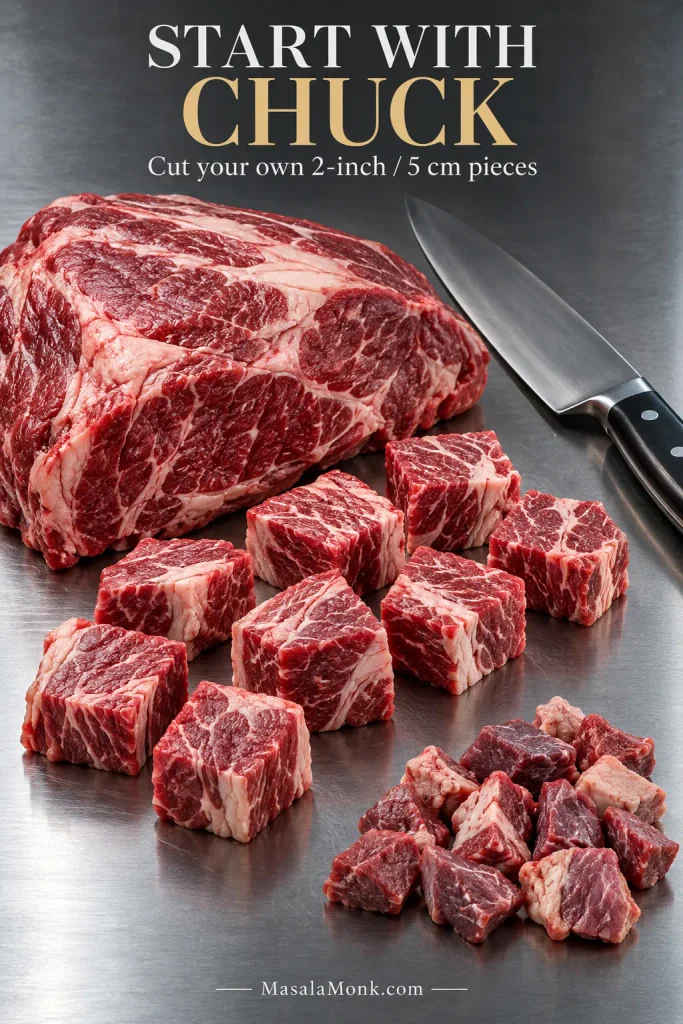
Start with chuck, not mixed stew meat
Chuck is built for this kind of cooking: enough marbling to stay juicy and enough connective tissue to soften over a long braise. As that connective tissue breaks down, gelatin also gives the cooking liquid more body.
Buy the chuck as one roast if you can and cut it yourself. Packaged “stew meat” may mix several muscles and sizes, which is how one piece ends up soft while the next one keeps fighting the fork.
Where chuck is not the usual butcher’s term, look for blade steak, braising steak or another well-marbled braising cut. If your package says shoulder roast, our beef shoulder roast guide explains how those harder-working cuts behave during long cooking.
Use Guinness Draught as the baseline
For this recipe, use 11.2–12 fl oz / 330–355 ml Guinness Draught. It gives the sauce plenty of malt character without pushing the stout as hard as some stronger versions can.
Guinness Extra Stout can work, though its more assertive roasted character can become more noticeable as the sauce reduces. Another fairly dry stout is a safer substitute than a hop-heavy IPA. The finished stew should not taste like a pint; the Guinness should deepen the beef without taking over.

Watch the liquid level
Start with 2½ cups / 600 ml low-sodium stock and keep another ½ cup / 120 ml nearby. Pot width and lid fit can change evaporation more than you might expect.
After the beef goes back into the pot, the liquid should rise close to the tops of the pieces. Stop there. Adding a splash later is easy; removing an unnecessary extra cup takes much longer.
Keep the stock low in sodium: salt, Worcestershire and stock all become more concentrated as the sauce reduces. Final seasoning is much easier when the pot starts slightly restrained.
What to Watch While the Stew Cooks
Get real color on the beef
Good browning leaves dark patches on the meat and brown fond across the bottom of the Dutch oven. That fond later dissolves into the Guinness and becomes part of the sauce.
See liquid gathering around the beef? Pull a few pieces out and give the pot a moment to get hot again before carrying on with a smaller batch. You do not need every surface perfectly crusted; a few deeply browned sides on each piece are enough.
Don’t judge the Guinness yet
The beer can taste surprisingly sharp just after deglazing. That’s much too early to decide the stew is bitter. Let the Guinness simmer briefly, scrape up the fond and give the beef, onions and stock time to pull everything together.
Let the beef tell you when the vegetables go in
Don’t worry if the chuck is firm at the first test. Begin probing one of the larger pieces at around 1 hour 45 minutes.
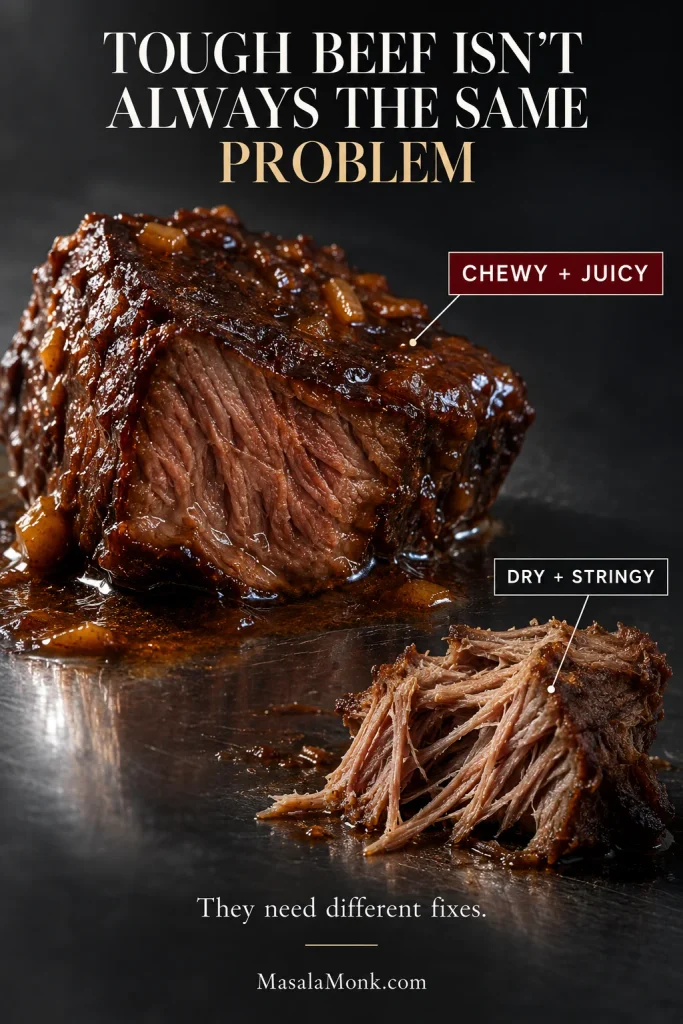
- Chewy but juicy: keep braising. The connective tissue has not softened enough yet.
- Much softer but not quite there: add the potatoes and carrots.
- Already tender: take the beef out if necessary, cook the vegetables in the gravy, then return the meat for the final few minutes.
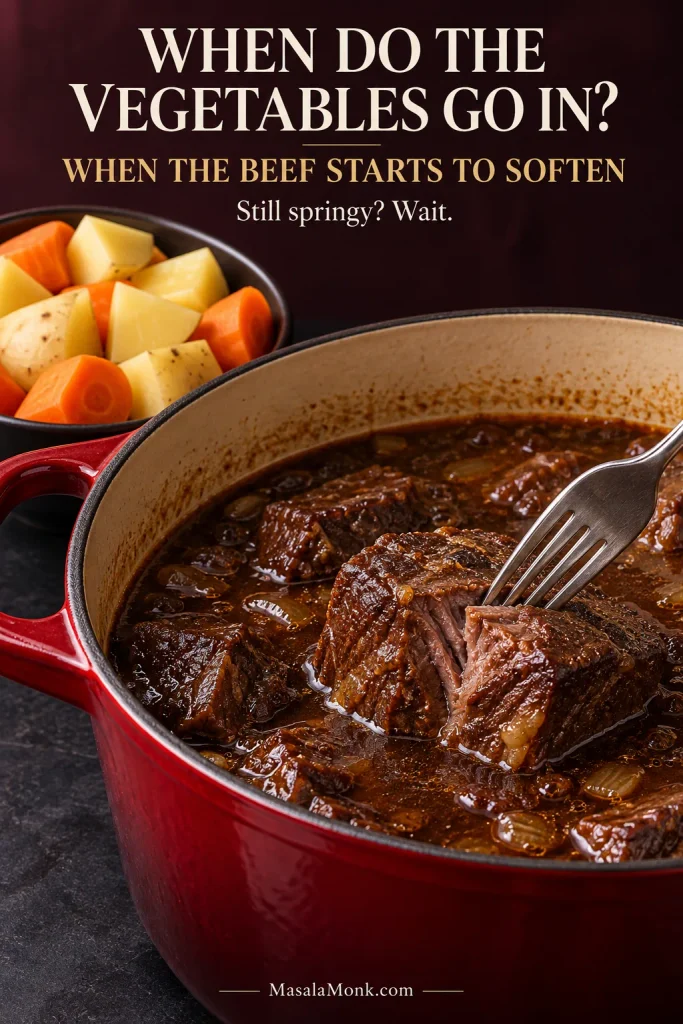
At that point, the beer edge should be softer and the liquid noticeably darker.
Dry or stringy beef is a different problem. A lean cut that has already spent too long at high heat will not become juicy again simply because it stays in the oven longer.
Need help with beef texture? Troubleshooting →
Once the beef and vegetables are tender, turn your attention to the sauce.
How to Fix Thin Guinness Gravy
Start with evaporation because reduction does two jobs at once: it thickens the gravy and concentrates the beef and stout flavor. Cornstarch adds body, but it cannot build flavor in the same way.
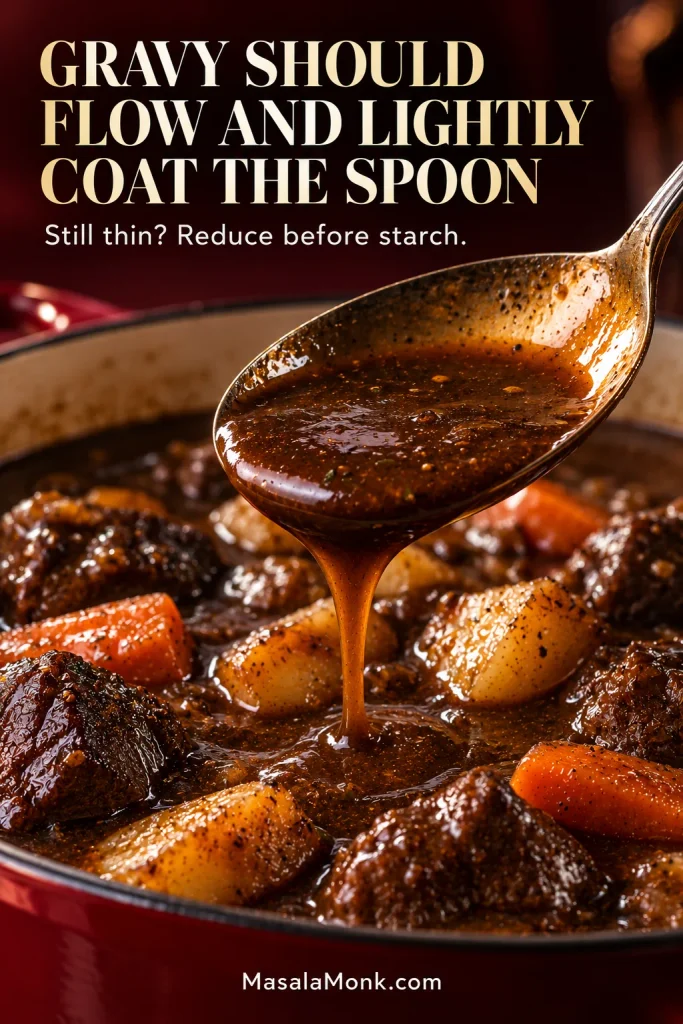
Simmer a slightly thin sauce uncovered over medium to medium-low heat for 5–10 minutes, stirring occasionally as it concentrates.
Already happy with the beef and vegetables? Lift them into a warm bowl and leave the liquid behind. Reduce the gravy on its own, then return everything to the pot. Once the beef has reached the texture you want, there is no benefit in letting it turn stringy while the sauce catches up.
Still too thin? Mix 1 tablespoon / about 8 g cornstarch with 1 tablespoon / 15 ml cold water. Add half of the slurry, simmer for 1–2 minutes, then look at the consistency before adding the rest.
Why Guinness Stew Can Taste Bitter
A finished Guinness stew should taste roasted and savory, not dominated by bitterness. Sharp stout halfway through the braise is not the same thing as a bitter finished gravy; that early edge often settles as the beef and sauce come together.
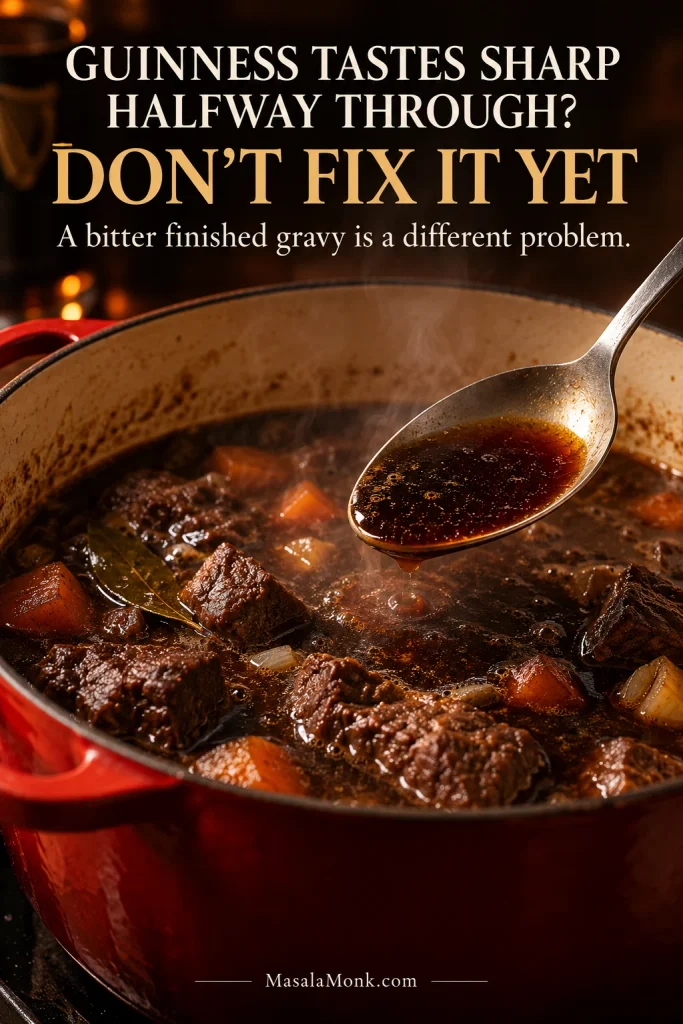
When the finished stew tastes more like stout than beef, a little hot stock may be all it needs. Taste for salt before reaching for sugar because an under-seasoned sauce can taste harsher and less balanced overall.
An acrid, charred taste is different. Blackened fond, burnt flour, garlic or tomato paste is difficult to hide, and sugar will not truly fix it.
For a fully cooked, properly seasoned stew with only a mild bitter edge left, stir in ¼ teaspoon brown sugar. Taste before adding another ¼ teaspoon.
Guinness Beef Stew Troubleshooting
When the stew tastes flat, do not start by doubling the thyme. First taste for salt, look at how much browning you built at the beginning, and consider whether too much liquid has diluted the pot.
| What you see | What is probably happening | What to do |
|---|---|---|
| Beef is chewy but juicy | The connective tissue has not softened enough | Cover and braise another 20–30 minutes, then test again |
| Beef is dry or stringy | Lean meat, excessive heat or too much cooking after tenderness | Keep it in plenty of sauce; use well-marbled chuck and gentler heat next time |
| Beef will not brown | Wet meat, a crowded pot or lost heat | Dry the beef, use smaller batches and let the pot recover |
| Sauce is watery | Too much liquid or too little evaporation | Reduce uncovered before reaching for starch |
| Beef is ready but sauce is thin | The solids finished first | Remove the solids and reduce the liquid alone |
| Sauce is too thick | Too much reduction or starch | Add hot stock 30–60 ml at a time |
| Potatoes are hard | They need longer or the pieces are too large | Cook until a thin knife slips easily through the center |
| Potatoes are breaking apart | They went in too early, were cut too small or are very floury | Use larger yellow or waxy potatoes and add them later |
| Stew tastes flat | Usually under-seasoning, weak browning or too much liquid | Taste for salt, then look at concentration and Worcestershire; a few drops of cider or red-wine vinegar can help if it still tastes dull |
| Stew tastes too strongly of Guinness | The stout ratio or reduction went too far | Season first, then loosen carefully with hot stock |
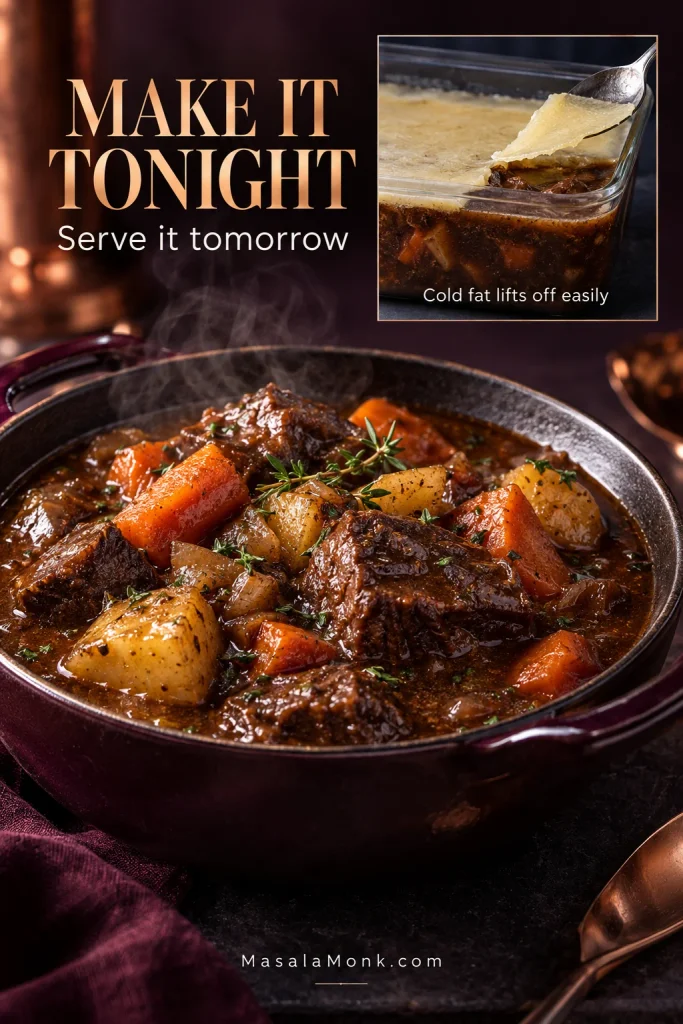
| Surface is greasy | The chuck rendered more fat than expected | Skim while warm or chill overnight and lift off the solid fat |
Back to recipe ↑ · Make it ahead → · Back to top ↑
Slow Cooker and Stovetop Methods
Slow Cooker Guinness Beef Stew
A slow cooker loses far less moisture, so use less liquid than the Dutch-oven version. Brown the beef first, cook the onions, celery, garlic and tomato paste, then deglaze the pan with Guinness so the fond follows everything into the cooker.
Cook on LOW and start testing the beef at around 7 hours; many batches will need closer to 8 hours or longer. Keep the liquid below the tops of the solids rather than trying to submerge everything.
Vegetable timing varies more from one slow cooker to another, especially with different potato sizes and heat levels. For exact quantities and vegetable timing rather than a direct adaptation of this recipe, use our slow cooker beef stew.
Stovetop Method
Keep the covered Dutch oven at the gentlest reliable simmer, with occasional lazy bubbles rather than a rolling boil. Expect roughly 2½–3½ hours of gentle cooking overall. Begin testing the beef earlier and add the vegetables once it starts to soften. Watch the bottom from time to time because a burner heats the base more directly than an oven, and add a splash of reserved stock if the liquid gets low.
Make It Tonight, Serve It Tomorrow
This is one of those dinners that can actually get easier when you make it ahead. The flavor settles overnight, the sauce firms as the gelatin cools, and any extra fat becomes easy to lift from the surface.
If you’re cooking for people, doing most of the work the day before also means you are not standing over a Dutch oven while everyone else is waiting to eat. Stop the carrots and potatoes just shy of completely tender; reheating will take them the rest of the way.
Cooling and refrigerating
Transfer leftovers to shallow containers and refrigerate within 2 hours. Use them within 3–4 days. The USDA food-safety guidance covers safe cooling, refrigeration and reheating of cooked leftovers.
Reheating
Reheat the stew until the center reaches 165°F / 74°C. Stir as it warms and add a splash of stock when the chilled sauce is thicker than you want.
Freezing
The beef and stout gravy freeze better than the potatoes. For a freezer batch, leave the potatoes out if you can and serve the reheated stew over fresh mash instead. Aim to use frozen portions within about 2–3 months for best quality.
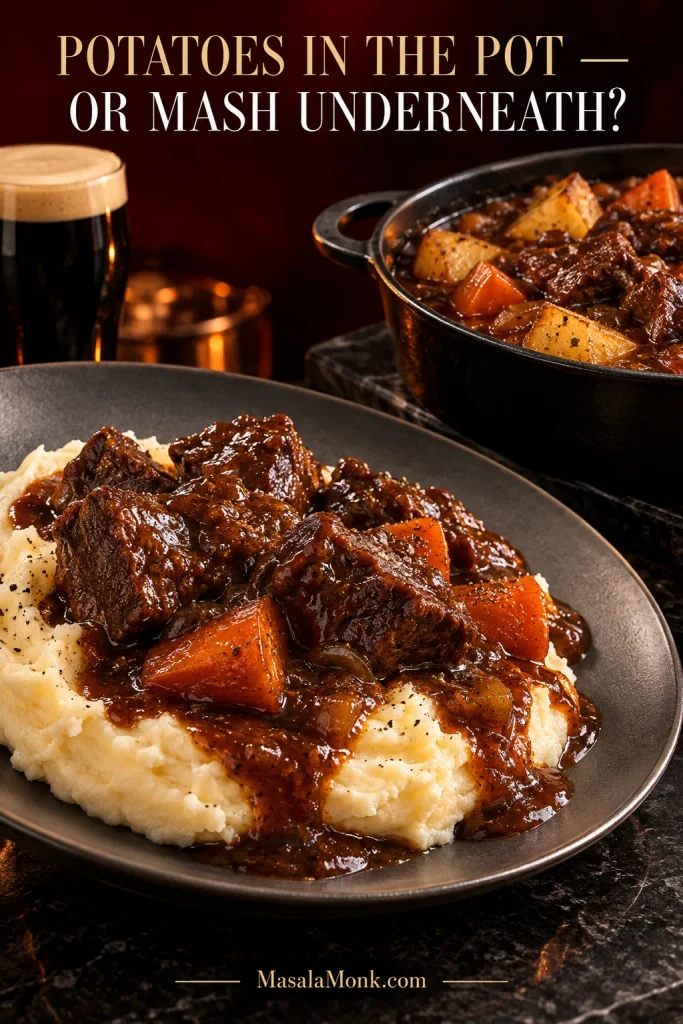
Potatoes in the Pot or Mash Underneath?
When potatoes are already in the stew, you do not need much else. Serve it in wide bowls so the gravy can settle around the beef, with crusty bread or soft dinner rolls close enough to catch the last of the sauce. A simple green vegetable such as peas is plenty alongside.
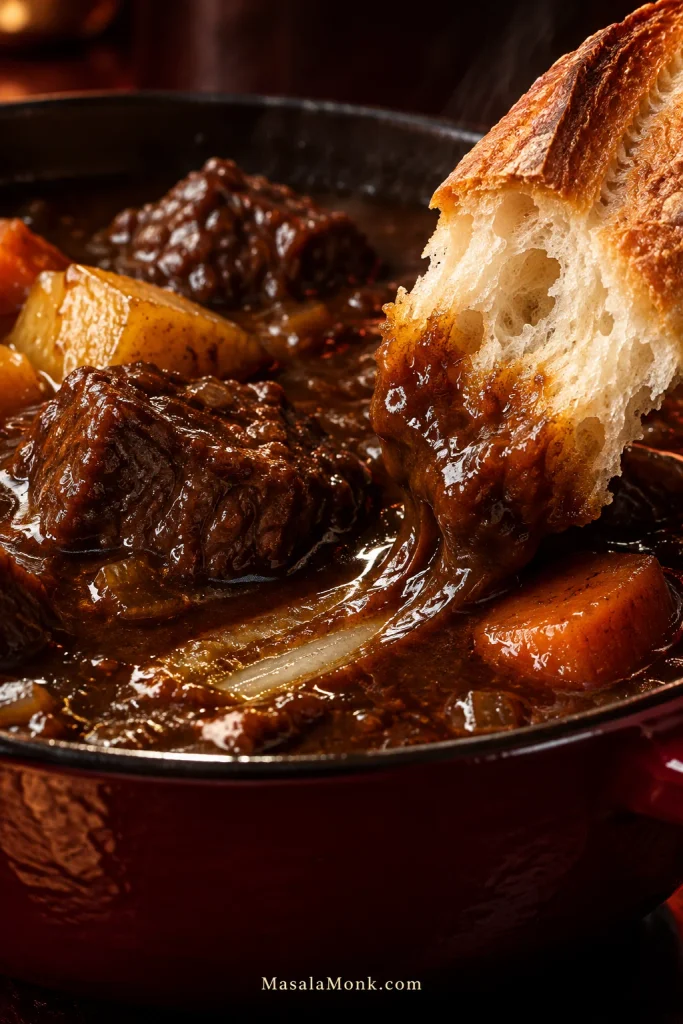
For a pub-style plate, leave the potatoes out and spoon the beef and stout gravy over creamy mashed potatoes, champ or colcannon. With the potatoes left out, the gravy may need a few extra minutes of reduction.
Guinness Beef Stew and Traditional Irish Stew
Traditional Irish stew is more commonly built around lamb or mutton, potatoes and onions, while Guinness beef stew is a beef braise built around stout. They are related in spirit, but they are not interchangeable historical dishes; here, the target is tender beef, balanced stout and gravy that clings without becoming heavy.
Questions About Guinness Beef Stew
Can I use another beer instead of Guinness?
Another fairly dry stout is the closest substitute. Strongly hopped beer is less predictable because its bitterness can become more pronounced as the liquid reduces.
Does Guinness tenderize the beef?
Guinness mainly contributes flavor. Tenderness comes from using a collagen-rich cut such as chuck and giving it enough moisture, gentle heat and time.
Does all the alcohol cook out?
No. Long cooking reduces the amount substantially, but you should not assume every trace disappears. If avoiding alcohol completely matters, use a stout labeled 0.0% alcohol and check the product label.
Can I use Guinness 0.0?
Yes. Guinness 0.0 is the most straightforward alcohol-free Guinness option. It is not a gluten-free substitute, though. The final sweet-bitter balance can also behave a little differently, so taste the sauce before making the same adjustments you would with regular stout.
If the chuck still pushes back, give it more time. Once it begins to relax under the fork and the dark gravy has settled around it, add the potatoes and carrots. From there, you’re not rescuing the stew anymore—you’re just finishing dinner.








