
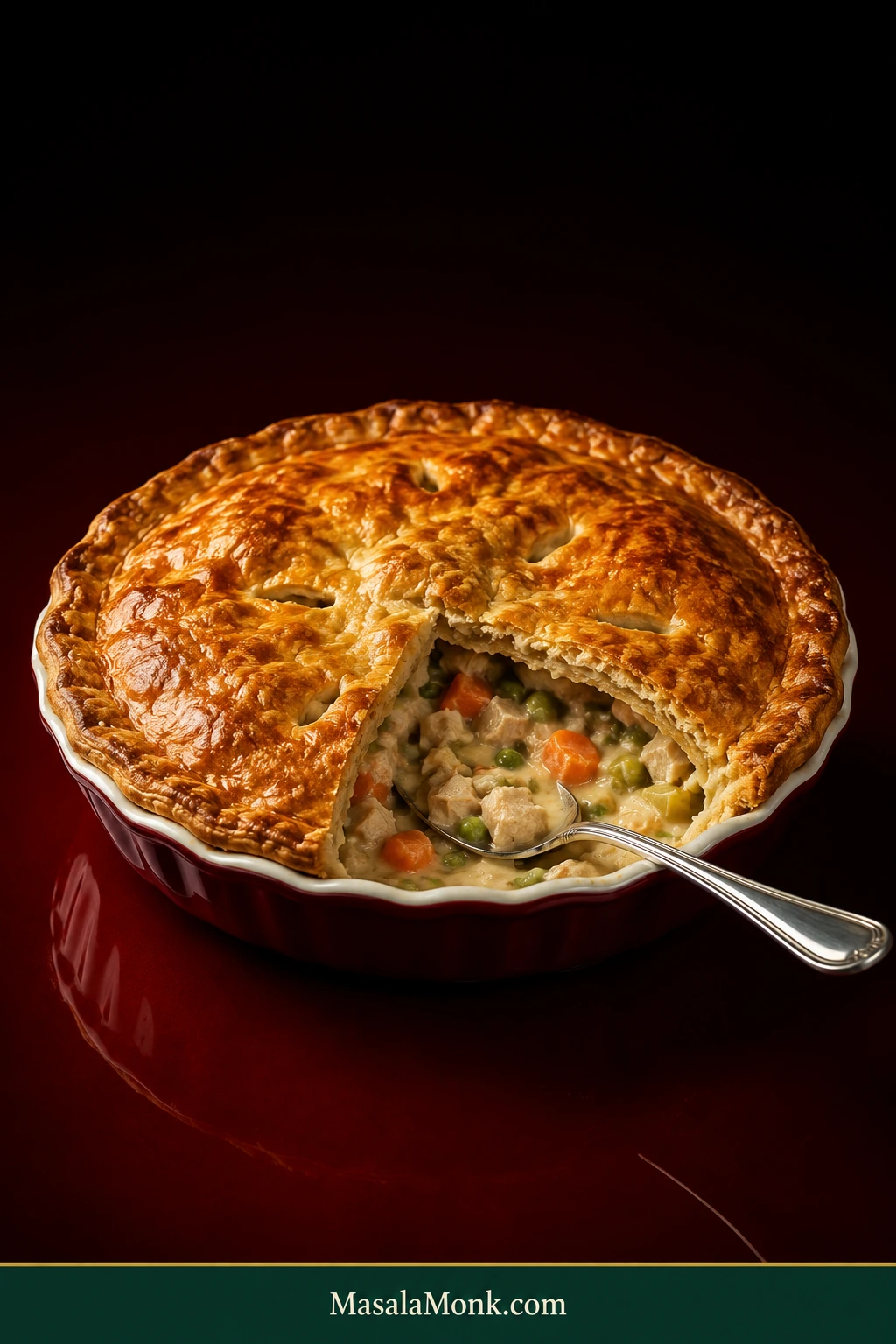
Leftover turkey is already halfway to becoming an excellent pot pie.
Maybe there is a container of roast turkey in the fridge, a little gravy, a few vegetables from Thanksgiving dinner—and very little enthusiasm for eating the same plate again. Maybe the breast meat is not as juicy as it was the first night. That is fine. Pot pie gives all of it a different job.
This version keeps the second round of cooking practical: one top crust, refrigerated pie dough if you want it, frozen vegetables if they make dinner easier, and a sauce that adjusts to however much leftover gravy you actually have. You already cooked Thanksgiving dinner; this doesn’t need to become another project. Get the vegetables nearly tender and the filling creamy before the crust goes on, and the payoff is a deeply golden top that cracks under the spoon with tender turkey and savory sauce underneath.
Quick Answer
For one easy 9-inch / 23-cm turkey pot pie, use 3 cups / 12–13 oz / 340–370 g cooked turkey. Cook the vegetables until nearly tender, make a creamy butter-and-flour sauce with broth and milk, then add the turkey after the sauce has thickened.
The creamy filling is made with a simple butter-and-flour roux, broth and milk, so no canned cream soup is needed. Leftover turkey gravy can replace part—or most—of that fresh sauce when you have it.
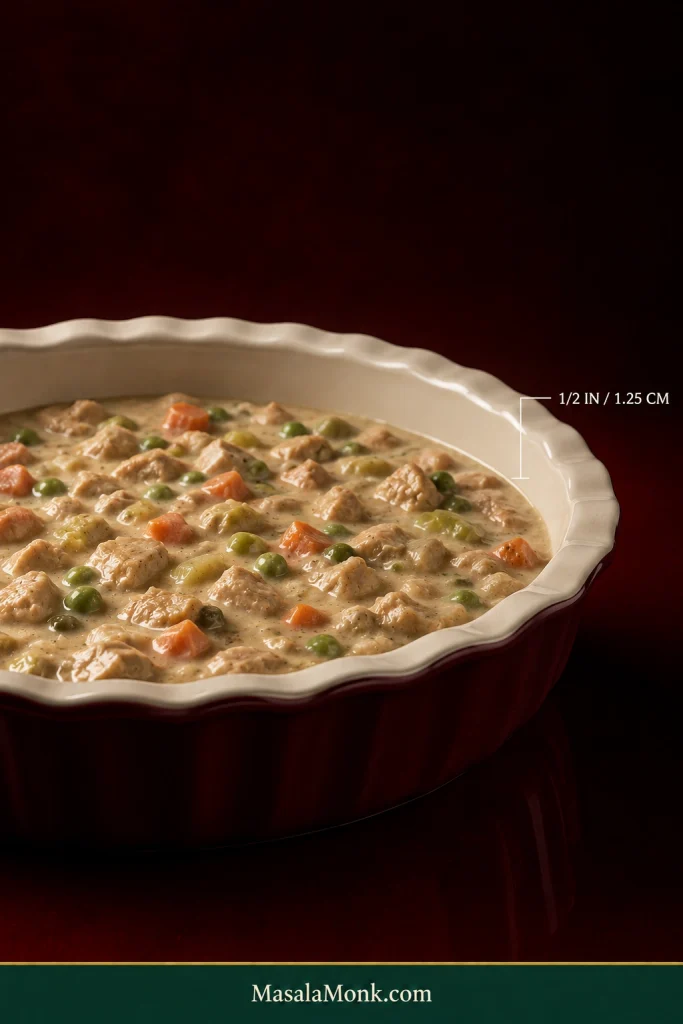
Transfer the filling to a deep pie dish, leaving 1/2 inch / 1.25 cm of headroom. Let it stand until it is still warm but no longer giving off strong clouds of steam, then cover with a cold top crust.
Bake at 400°F / 205°C for 30–35 minutes, until the pastry is deeply golden and you can see filling bubbling through the vents or around the edges. Rest the pie for 15 minutes before serving. Hands-on work is roughly 35–40 minutes; much of the remaining time is baking, cooling and resting.
Table of Contents
- Turkey Pot Pie Recipe
- Choose Your Leftover Route
- Get the Filling Right
- How to Use Leftover Turkey Gravy
- Use What You Have
- Keep the Crust Crisp
- Turkey Pot Pie Troubleshooting
- Make Ahead, Freeze and Reheat
- What to Serve With Turkey Pot Pie
Turkey Pot Pie Recipe
Easy Creamy Leftover Turkey Pot Pie
Servings: 6 generous portions
Dish: Deep 9-inch / 23-cm pie dish
Oven: 400°F / 205°C
Hands-on time: 35–40 minutes
Bake time: 30–35 minutes
Rest time: 15 minutes
Total time: 1 hour 30 minutes to 1 hour 45 minutes
Using leftover gravy? Do not add it to the full standard sauce below. Use the leftover gravy adjustments instead. Omit the 1/4 teaspoon starting salt when using gravy and season only after the gravy and turkey are both in the filling.
Fastest vegetable shortcut: Keep the onion and garlic, but replace the carrot, celery and peas with 2 cups frozen mixed vegetables. Soften the onion first, add the frozen vegetables and cook until hot and any obvious excess water has evaporated, then add the garlic and continue with the flour.
Ingredients
Creamy Turkey Filling
- 3 tablespoons / 42–43 g unsalted butter, divided
- 3/4 cup / 115 g finely diced yellow onion
- 3/4 cup / 95 g carrot, cut into 1/4- to 1/3-inch / 6- to 8-mm pieces
- 1/2 cup / 60 g celery, finely diced
- 2 garlic cloves, minced
- 1/3 cup / 40 g all-purpose flour
- 2 cups / 480 ml low-sodium turkey or chicken broth
- 1/2 cup / 120 ml whole milk
- 1 teaspoon dried thyme
- 1/4 teaspoon celery seed
- 1/2 teaspoon freshly ground black pepper
- 1/4 teaspoon fine salt to start, plus more if needed (omit if using leftover gravy)
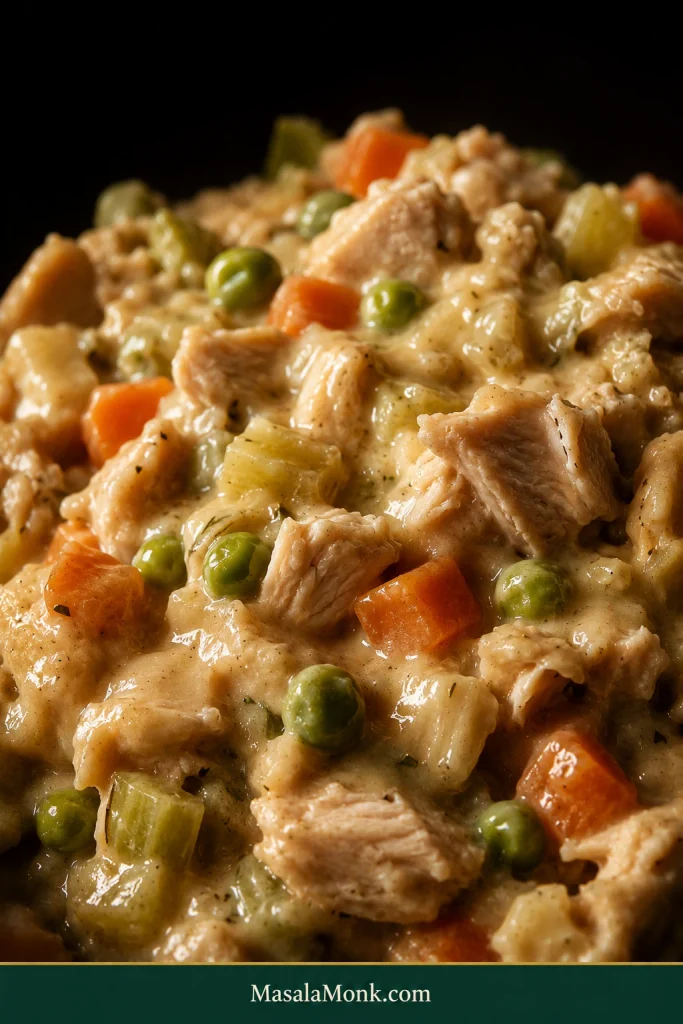
- 3 cups / 12–13 oz / 340–370 g cooked turkey, chopped or loosely shredded into bite-size pieces
- 3/4 cup / 100 g peas, frozen is fine
- Up to 1 teaspoon Worcestershire sauce, optional
Crust
- 1 refrigerated rolled pie-crust round, or 1 chilled homemade pie-dough disc rolled to 11–12 inches / 28–30 cm across
- 1 large egg + 1 tablespoon milk or water for egg wash, optional but recommended for a deeper golden, glossy crust
Equipment
- Large skillet or wide saucepan
- Whisk
- Silicone spatula or wooden spoon
- Deep 9-inch / 23-cm pie dish
- Rimmed baking sheet
- Small sharp knife
Pie dishes vary in depth. Do not force every spoonful into a shallow dish. Stop when the filling sits about 1/2 inch / 1.25 cm below the rim and bake any extra separately in a small ramekin.
Method
Cook the Filling
- Heat the oven. Preheat to 400°F / 205°C and keep a rimmed baking sheet ready.
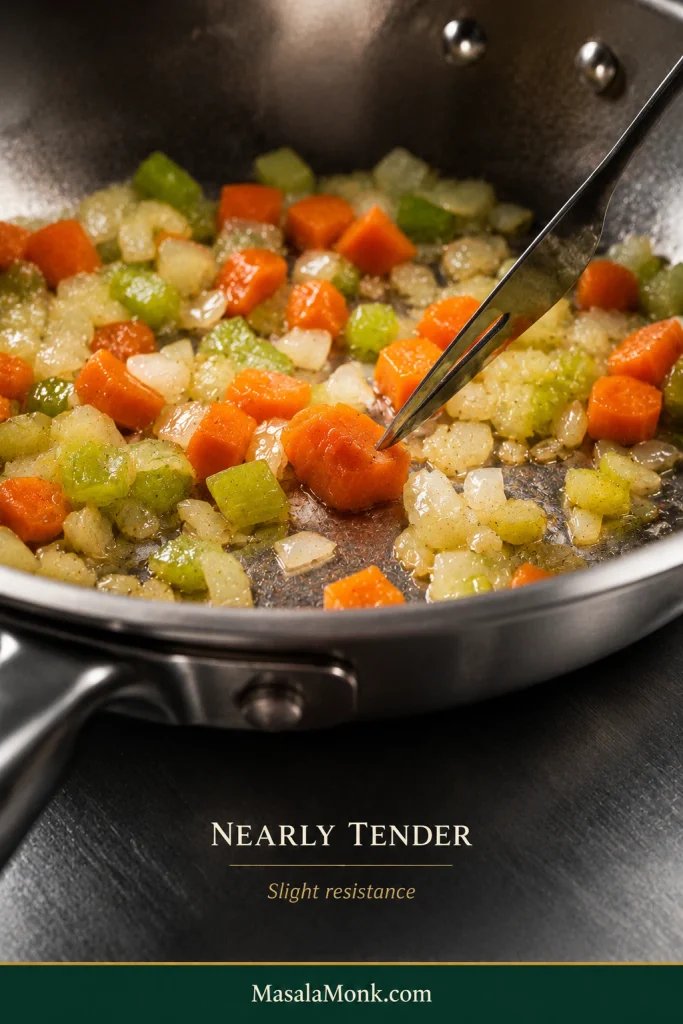
- Cook the vegetables. Melt 2 tablespoons butter in a large skillet over medium heat. Add the onion, carrot and celery and cook for 7–10 minutes, until the onion is soft and a piece of carrot can be pierced with only slight resistance. Add the garlic and cook for 30 seconds, just until fragrant.
- Make the roux. Add the remaining tablespoon butter. When it melts, stir in the flour, thyme, celery seed, black pepper and 1/4 teaspoon starting salt. Cook for 1 minute, stirring, until no dry flour remains. Skip the starting salt when using leftover gravy.
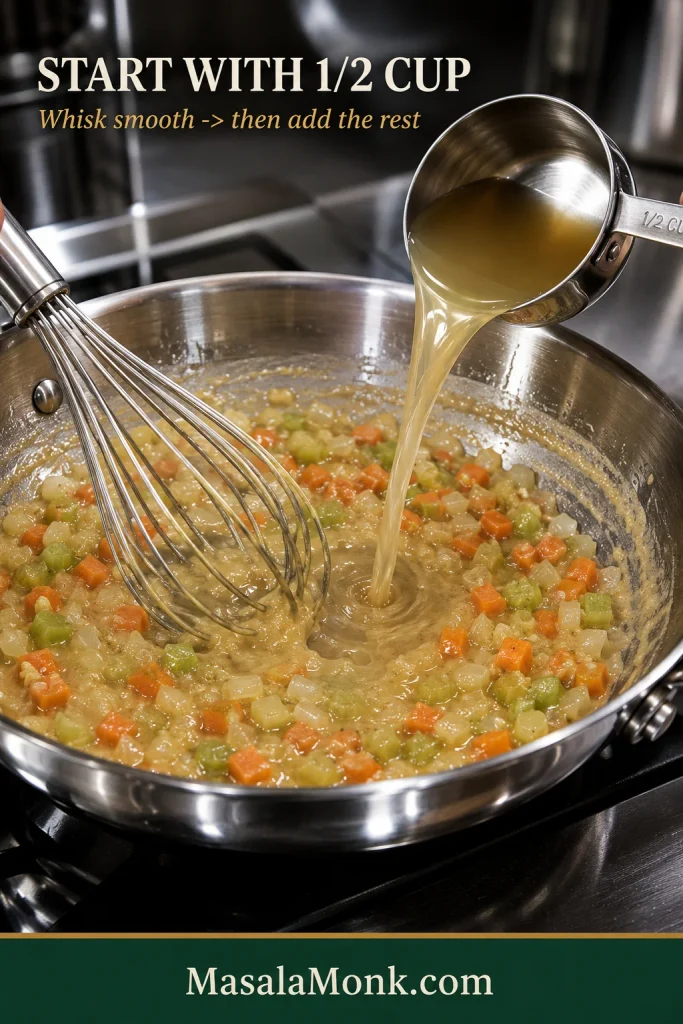
- Build the sauce gradually. Whisk in only 1/2 cup broth first. Get that small amount completely smooth before gradually whisking in the remaining broth, followed by the milk. This two-stage addition makes lumps much less likely.
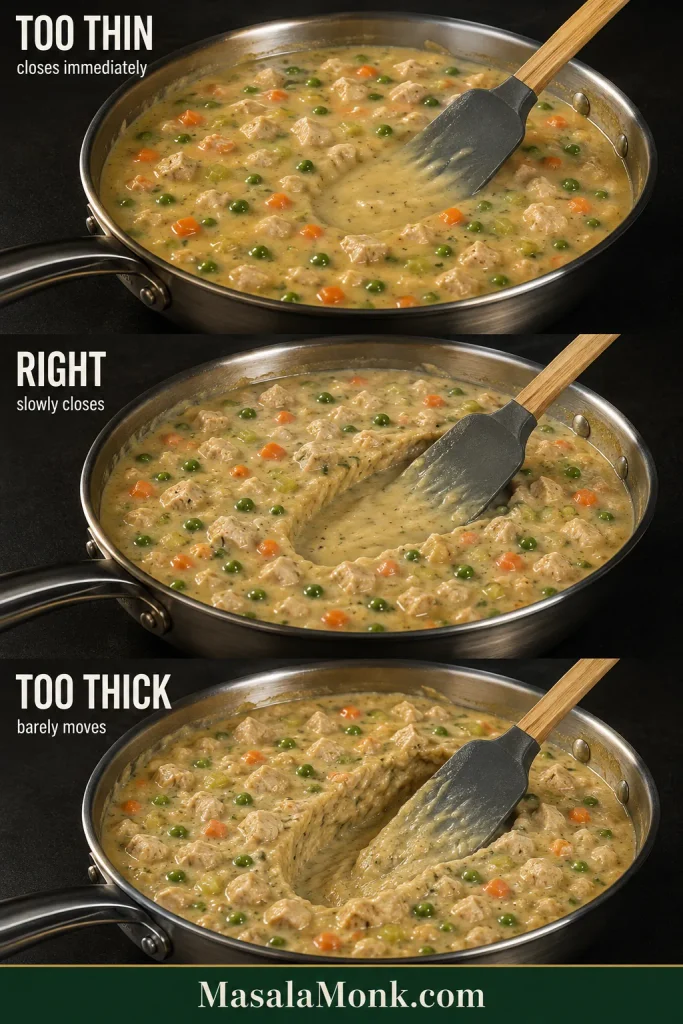
- Thicken the filling. Bring the sauce to a gentle simmer and cook for 4–7 minutes. Drag a spatula across the bottom of the skillet: the trail should remain open for a moment, then slowly close.
- Add the turkey and peas. Fold them in and heat only until warmed through. If you used the frozen-mixed-vegetable shortcut, add just the turkey here. Taste before adding more salt. When the salt is right but the flavor still seems muted, add 1/2 teaspoon Worcestershire sauce, taste, and add a little more only if it helps.
Assemble, Bake and Rest
- Fill the dish. Transfer the filling to the pie dish, stopping about 1/2 inch / 1.25 cm below the rim.
- Let the filling stand. Give it 10–15 minutes, until it is still warm but no longer sending up strong clouds of steam.
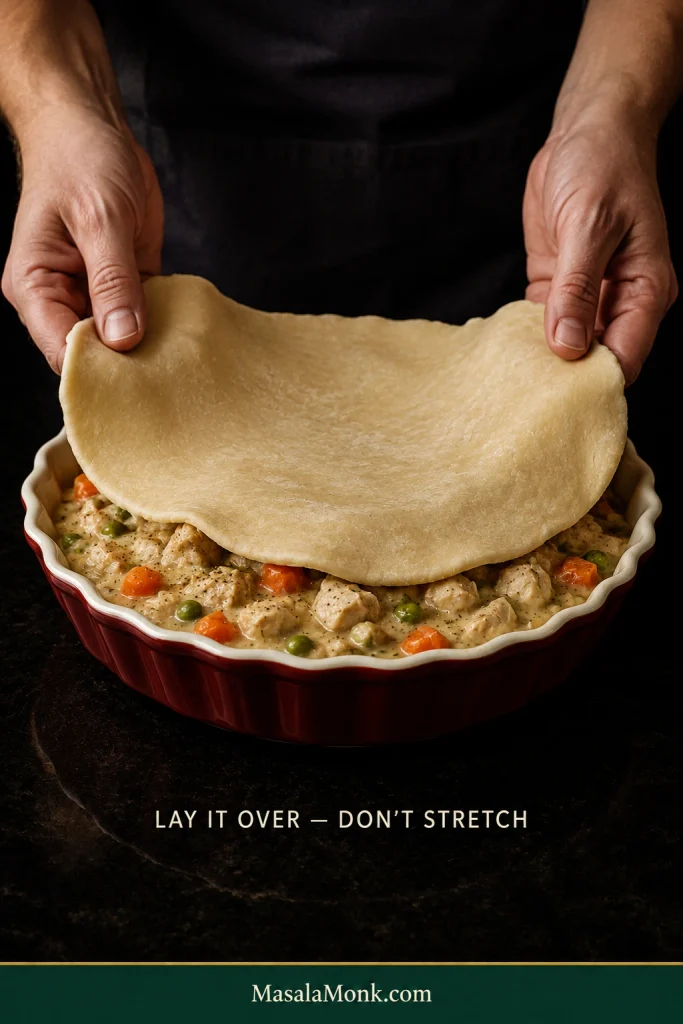
- Add the crust. Lay the cold pastry over the filling without stretching it. Trim or tuck the edge, cut 3–5 steam vents and brush lightly with egg wash if using.
- Bake. Set the dish on the rimmed baking sheet and bake for 30–35 minutes, until the pastry is deeply golden and you can see filling bubbling through the vents or around the edges.
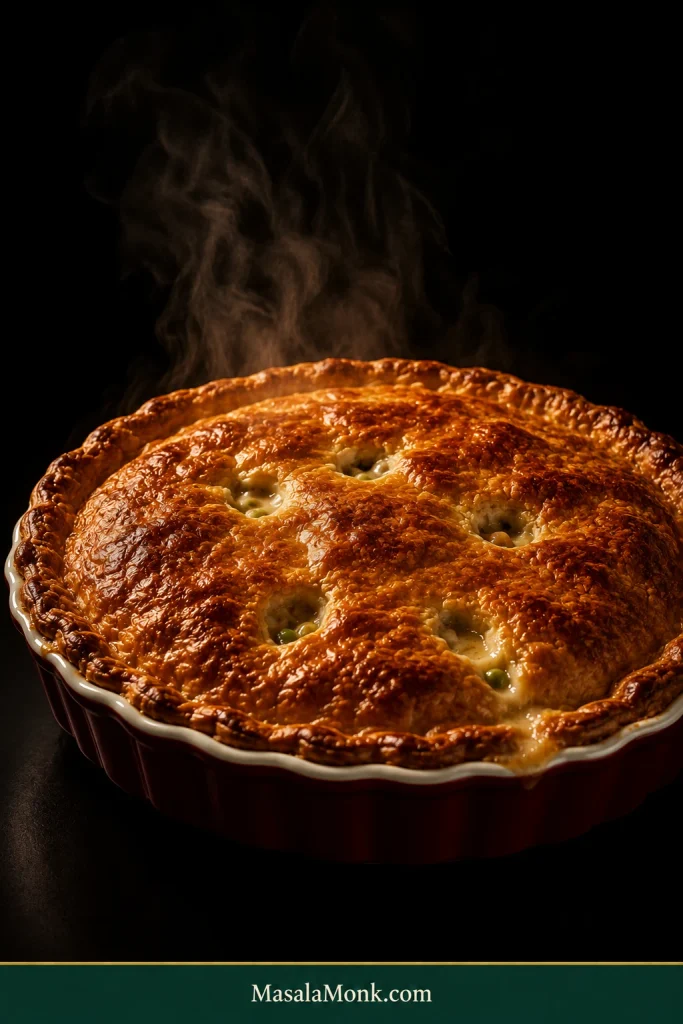
- Rest. Leave the pie for 15 minutes. That pause lets the creamy filling settle enough to spoon cleanly while the crust keeps its crisp edge.
Choose Your Leftover Route
Leftover cooking rarely starts with identical containers. For the sauce, pick the route closest to what is actually in your fridge.
| What You Have | Best Route |
|---|---|
| Turkey, no gravy | Use the standard broth-and-milk sauce in the recipe |
| Turkey + about 1/2 cup gravy | Replace some broth and use a smaller fresh roux |
| Turkey + about 1 cup gravy | Let the gravy provide more of the sauce and thickening |
| Turkey + 1 1/2–2 cups gravy | Let the gravy become the sauce and loosen only as needed |
| Other saucy leftovers | Count their liquid as part of the filling rather than adding it on top of the full sauce |
Your leftovers do not need to match the recipe perfectly. You only need to know what moisture they are bringing with them.
Using gravy? Jump to the leftover turkey gravy guide →
Get the Filling Right
The Leftover Moisture Rule
A cup of leftover vegetables is not always just a cup of vegetables. When a leftover already contains gravy, cream sauce or noticeable cooking juices, reduce the pot-pie liquid to account for it.
Plain green beans and green bean casserole may take up similar room in a measuring cup, but the casserole also brings sauce. Mushrooms release water. Frozen vegetables can carry ice. Roasted vegetables may come with a spoonful of pan juices.

- Mostly dry: chopped turkey, peas, drained corn, plain cooked carrots and drained green beans.
- Moist: mushrooms, icy frozen vegetables, wet steamed vegetables and roasted vegetables stored with juices.
- Saucy: gravy, turkey stored in gravy, green-bean casserole, creamed vegetables and similar leftovers carrying their own sauce.
The rule is simple: when something brings meaningful liquid, let it replace some of the recipe liquid instead of adding both.
How Thick Should Turkey Pot Pie Filling Be?
Turkey pot pie filling should coat the turkey and vegetables while still moving easily. Drag a spatula across the bottom of the skillet. The trail should stay open for a moment, then slowly close.
| What You See | What It Means | What to Do |
|---|---|---|
| The trail disappears immediately and the vegetables seem to swim | Too thin | Keep simmering gently |
| The trail stays open briefly, then slowly closes | Just right | Add the turkey and continue |
| The filling sits stiffly and barely flows | Too thick | Add broth 1–2 tablespoons at a time |
Close enough is fine. Before the crust goes on, look for a filling that still moves but no longer leaves loose liquid pooling around the turkey and vegetables. A few extra minutes of simmering fixes most loose fillings; a splash of broth fixes one that has tightened too far.
How to Use Leftover Turkey Gravy
Match the Sauce to the Gravy You Have
If you have about 1/2 cup gravy, replace part of the broth and make a smaller roux. Around 1 cup needs even less fresh flour. Once you have roughly 1 1/2–2 cups of medium-thick gravy, let the gravy become the sauce and add broth only as needed.
Think of gravy as part of the sauce, not an extra ingredient piled on top of it. Gravy replaces broth, while the amount of fresh flour drops as the gravy contributes more thickening of its own.
Gravy itself varies. One batch pours easily once warm; another stands almost like pudding before the heat loosens it. The guide below assumes a medium-thick gravy that coats a spoon once warm.
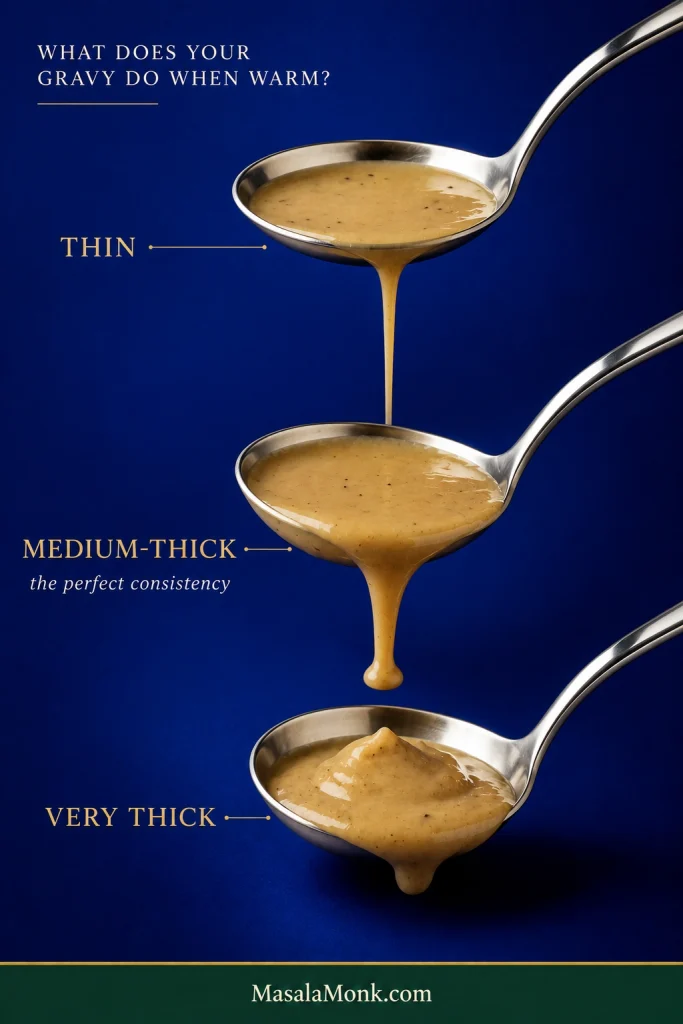
| Gravy You Have | Start With | Then Check |
|---|---|---|
| About 1/2 cup / 120 ml | 1 1/2 cups broth + 1/2 cup milk + 2 Tbsp butter + 3 1/2–4 Tbsp / 25–30 g flour | Simmer until it passes the spatula-trail test |
| About 1 cup / 240 ml | 1 cup broth + 1/2 cup milk + 2 Tbsp butter + 2–2 1/2 Tbsp / 15–20 g flour | Add more thickener only if the warm gravy is unusually thin |
| About 1 1/2–2 cups / 360–480 ml | 2 Tbsp butter for the vegetables; gravy plus broth only as needed to loosen; milk optional | Start without fresh flour and adjust after everything is hot |
Build the Filling With Leftover Gravy
With 1/2–1 cup gravy: Cook the vegetables in the 2 tablespoons butter listed in the table. Add the garlic and cook for about 30 seconds. Stir in the reduced amount of flour with the thyme, celery seed and black pepper and cook for 1 minute. Whisk in the listed broth and milk, stir in the warm gravy, then simmer until the filling passes the spatula test. Add the turkey and peas and season to taste.
With 1 1/2–2 cups gravy: Cook the vegetables in 2 tablespoons butter. Add the garlic and cook for about 30 seconds, then stir in the thyme, celery seed and black pepper. Add the gravy and warm it through without adding fresh flour. Loosen with broth as needed; add a splash of milk only if you want a creamier filling. Add the turkey and peas, then judge the warm filling before making any further adjustment.
These are starting points, not laws. Very thick gravy may loosen enough on its own once heated, while thin gravy may simply need more simmering. Rich gravy can reduce the need for butter, and salty gravy calls for low-sodium or unsalted broth. Make the final decision from the filling in front of you.
Back to the recipe ↑ · Back to top ↑
Use What You Have
Turkey, Broth and Milk
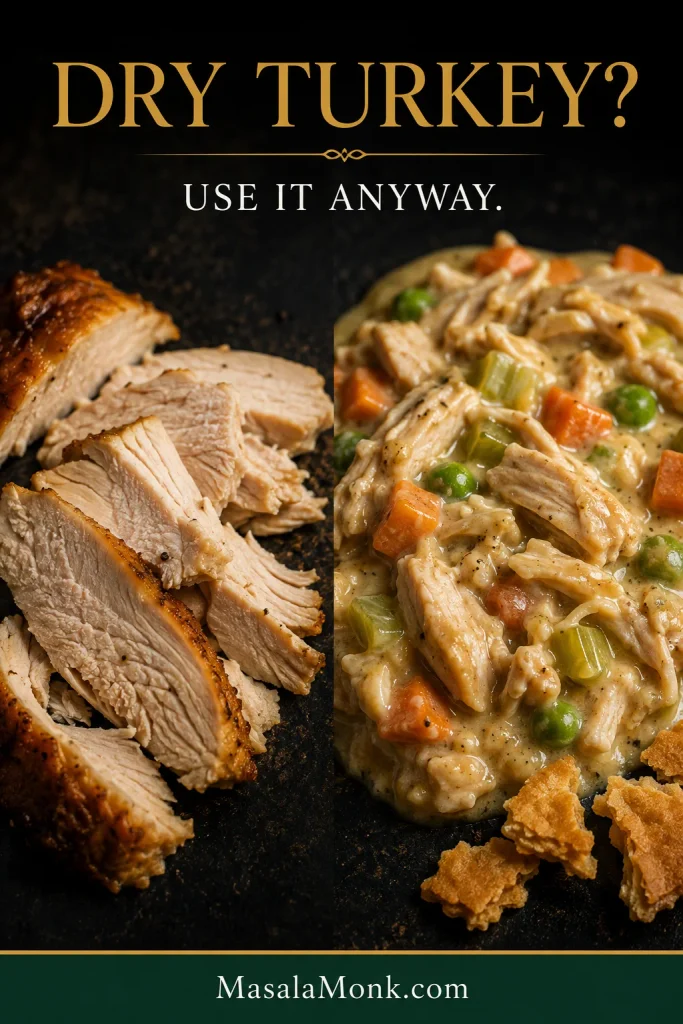
Turkey. Breast meat, dark meat or a mixture all work. Slightly dry turkey is especially welcome here: once coated in creamy sauce and tucked beneath crisp pastry, the breast meat that felt disappointing on the first night stops feeling like the leftover everyone was avoiding. Cooked chicken or rotisserie chicken can replace the turkey in the same amount; taste before adding much salt because rotisserie meat may already be heavily seasoned.
Broth and milk. Use turkey broth if you have it; low-sodium chicken broth works very well too and gives you more control when gravy or seasoned leftovers are involved. For a milk-free pie, replace the milk with more broth or use an unsweetened neutral non-dairy milk. The filling will be a little less creamy but still savory.
Vegetables and Thanksgiving Leftovers
For vegetables and Thanksgiving extras, the main question is whether they need cooking, warming or moisture adjustment.
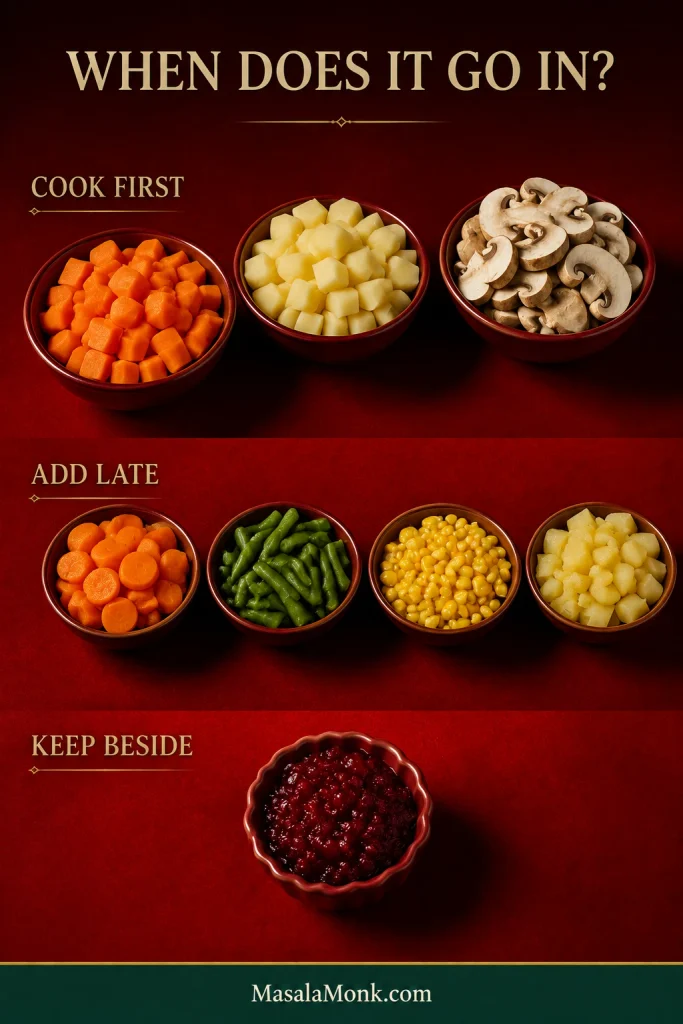
| What You Have | Best Way to Use It |
|---|---|
| Frozen mixed vegetables | Use the 2-cup shortcut in the recipe card and cook off obvious excess water |
| Already-cooked carrots, green beans or corn | Fold in near the end; they only need warming |
| Mushrooms | Cook until most released moisture evaporates |
| Raw potato | Cut into 1/2-inch / 1.25-cm cubes and simmer until just fork-tender before adding |
| Cooked or canned diced potato | Drain well and fold in late |
| Green-bean casserole | Use modestly and count its creamy sauce toward the filling liquid |
| Mashed potatoes | Use only a small amount inside; otherwise serve your creamy mashed potatoes alongside |
| Stuffing | Better used as a topping for a different stuffing-topped pot pie than stirred into this creamy filling |
| Cranberry sauce | Keep it for the plate; the tart sweetness works better beside the savory pie |
Swap rather than endlessly add. Another cup of this and another cup of that eventually gives you more solids than sauce—or more filling than the dish can comfortably hold.
Keep the Crust Crisp
A single top crust is the easiest route here. You still get flaky pastry in every serving without asking a bottom crust to sit underneath a creamy filling.
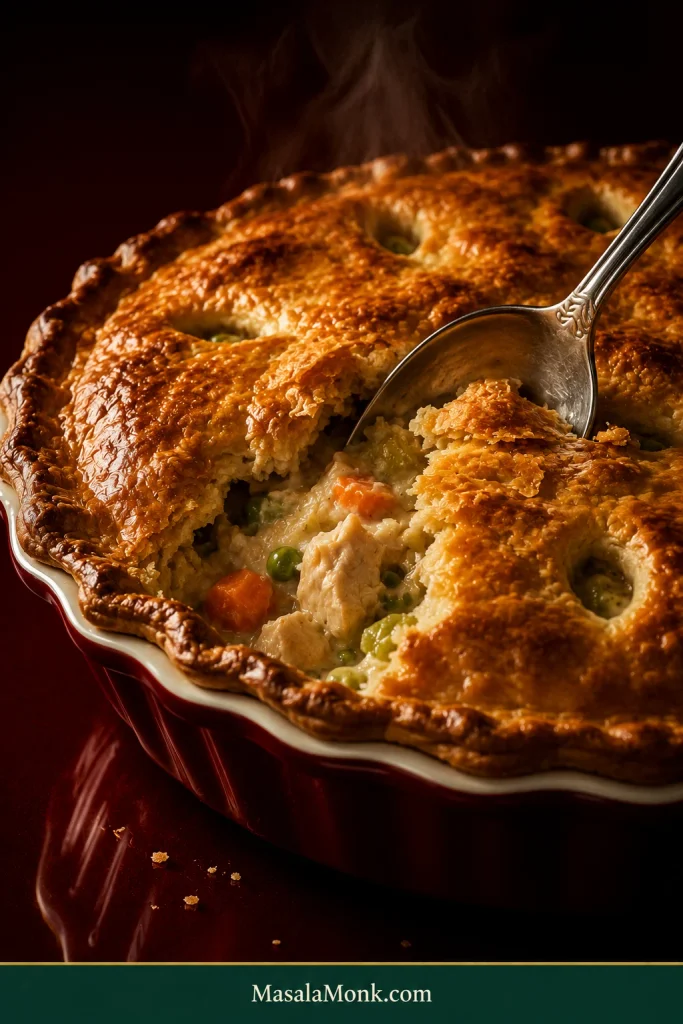
For a double-crust version, cool the filling more thoroughly, keep the bottom dough cold and make sure the sauce has already reached the correct thickness before assembly. Our flaky homemade pie crust guide covers the pastry itself.
Whatever crust you use, keep it cold and do not stretch it over the dish. Warm pastry softens before it has a chance to set, while stretched dough tends to pull back as it bakes.
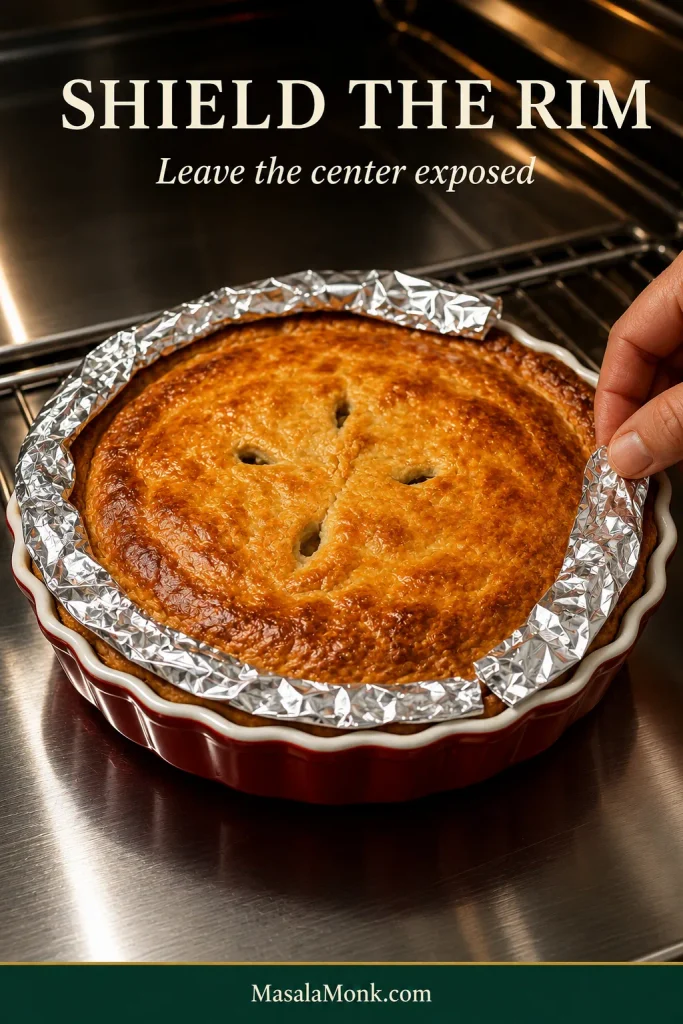
If the rim becomes deeply browned before the center is ready, shield only the edge loosely with foil. By the time the filling is bubbling through the vents and the crust smells toasted and buttery, those refrigerator containers finally feel like dinner again.
Turkey Pot Pie Troubleshooting
Most pot-pie problems come down to moisture, heat or timing, and many are easy to correct before the crust ever goes on.

My filling is watery
Keep it uncovered over a gentle simmer until it passes the spatula-trail test above. Frozen vegetables, mushrooms, roasting juices and gravy can all contribute more water than expected, so let that excess cook away before the pastry goes on.
My sauce looks oily or separated
Very rich gravy can supply more fat than the standard sauce expects, while a hard boil after the milk goes in can make a dairy-based sauce look grainy or separated. Keep the heat gentle and reduce the butter when your gravy already brings plenty of fat.
My leftover turkey is dry
Use it anyway. This is one of the better destinations for dry turkey: the sauce brings moisture to every bite, and adding the cooked meat only after the filling thickens keeps it from spending unnecessary time over the heat.
My filling tastes flat
Check the salt first. A properly salted filling can still taste washed out when the broth itself is weak, in which case a small amount of concentrated turkey or chicken base can deepen it quickly. Add cautiously because those products can be salty.
When the broth already tastes good, try a little more black pepper, a pinch of thyme or 1/2 teaspoon Worcestershire sauce, then taste again.
| Problem | Likely Cause | Best Fix |
|---|---|---|
| Filling too thick | Too much reduction or very thick gravy | Add broth 1–2 tablespoons at a time |
| Lumpy sauce | Liquid added to the roux too quickly | Whisk firmly and press small lumps against the pan; if lumping is severe, strain the sauce before adding the turkey |
| Hard carrots or potatoes | Pieces too large or not pre-cooked enough | Cook firm vegetables until nearly tender before assembly |
| Soggy underside of top crust | Very wet or strongly steaming filling, warm pastry or oven not fully preheated | Thicken the filling first, let strong steam subside and use cold dough |
| Pie overflowed | Dish overfilled | Leave headroom and always bake on a rimmed sheet |
| Crust edge too dark | Rim browned before center finished | Shield only the edge loosely with foil |
| Filling runs when served | Loose filling or pie cut too soon | Use the spatula test before baking and rest 15 minutes before serving |
Back to the recipe method ↑ · Make ahead, freeze or reheat → · Back to top ↑
Make Ahead, Freeze and Reheat
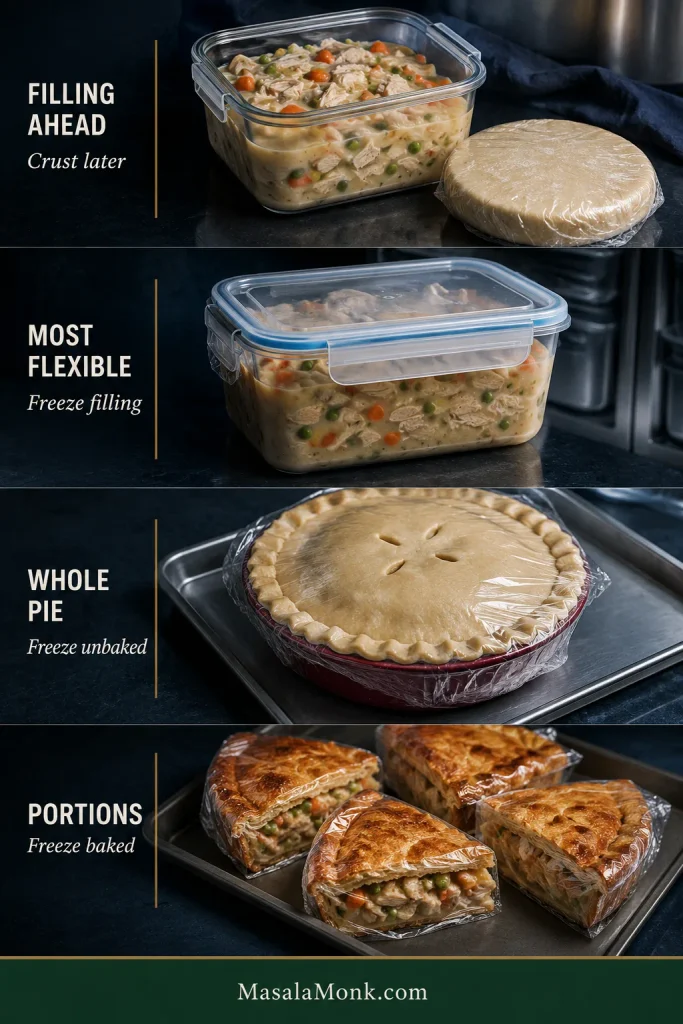
For the easiest make-ahead route, prepare the filling and keep the pastry separate. Freezing the filling by itself also gives you the most flexibility.
Already cooked? Jump straight to reheating →
Make the filling ahead
Cook the filling, cool it promptly and refrigerate it covered. Keep the pastry separate and assemble the pie when you are ready to bake. That prevents raw dough from sitting against moist filling for hours.
Freeze the filling
Cool the filling promptly, chill it completely in the refrigerator, then freeze one pie’s worth in a freezer-safe container. Thaw overnight in the refrigerator, warm it enough to judge the texture again, then assemble with fresh cold pastry. A very thick thawed filling usually needs only a small splash of broth.
Freeze an assembled unbaked pie
Freeze the assembled pie in cookware suitable for both freezing and baking, following the manufacturer’s guidance for temperature changes. Wrap it well once firm. For the most predictable result, thaw it overnight in the refrigerator before baking.
A refrigerator-cold pie may need roughly 5–15 minutes beyond the usual 30–35 minute bake. Start checking at the normal time and continue until the crust is deeply golden and the filling is visibly bubbling through the vents and around the edges. Shield the crust if it browns before the filling is fully hot.
Baking from frozen: Thawing overnight is the more predictable route for this recipe. Direct-from-frozen timing can vary substantially with filling depth and cookware, so use a freezer-to-oven approach only when your baking dish is designed for it and follow the manufacturer’s temperature guidance.
Freeze baked portions
Baked pot pie can also be frozen in portions. It is convenient, although the pastry will normally be softer after thawing and reheating than it was on the first night.
Previously frozen cooked turkey
Previously frozen cooked turkey can still be used when it was thawed safely in the refrigerator. USDA guidance on freezing and refreezing says food thawed in the refrigerator can generally be refrozen, although repeated freezing and thawing may reduce quality.
Refrigerator storage
Older turkey does not become a fresh batch of leftovers simply because it has gone into a pie. When the turkey is already several days old, eat or freeze the finished pot pie promptly rather than treating it as a brand-new storage window.
FoodSafety.gov’s leftover guidance recommends using or freezing refrigerated leftovers within four days and reheating leftovers to 165°F / 74°C.
How to Reheat Turkey Pot Pie

For the crispiest crust, use the oven. Reheat individual portions at 350°F / 175°C for roughly 15–20 minutes. A larger portion or much of the remaining pie may take 20–30 minutes. Loosely cover pastry that is already dark, then uncover for the final few minutes if it needs to crisp again. Heat the center to 165°F / 74°C.
For speed, use the microwave. Loosely cover an individual portion and heat until the center reaches 165°F / 74°C; around 2–3 minutes at reduced power is a useful starting point for many microwaves. The filling reheats well, but the pastry will be softer.
When exposed filling has become very thick in the refrigerator, stir a small splash of broth into the filling where you can reach it. Pouring liquid over the pastry only makes the crust soggy.
What to Serve With Turkey Pot Pie
Turkey pot pie already brings meat, vegetables, creamy sauce and pastry, so lighter, sharper sides usually balance it best.
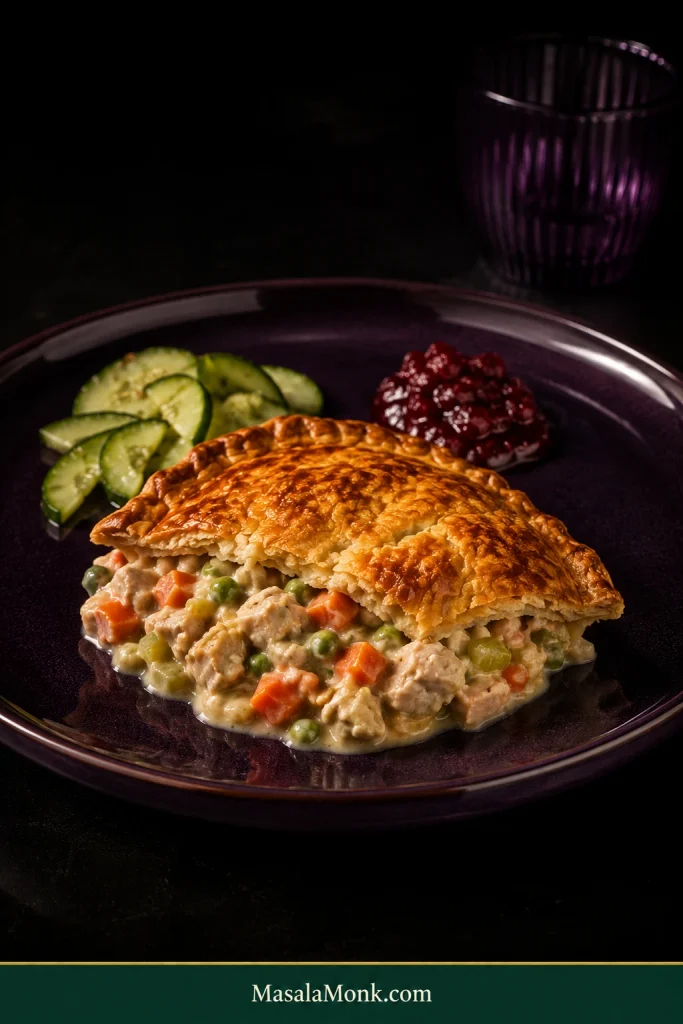
A crisp cucumber salad with vinegar, dill and onion gives the rich filling a cool, acidic contrast. A simple green salad, steamed greens or roasted Brussels sprouts work for the same reason.
If cranberry sauce is still in the fridge, a spoonful of cranberry sauce with orange juice beside the pie gives each bite a bright sweet-tart edge.
Leftover Turkey, Completely Different Dinner
A container of leftover turkey, half a bowl of gravy and a few odds and ends from the holiday table do not look especially exciting in the refrigerator.
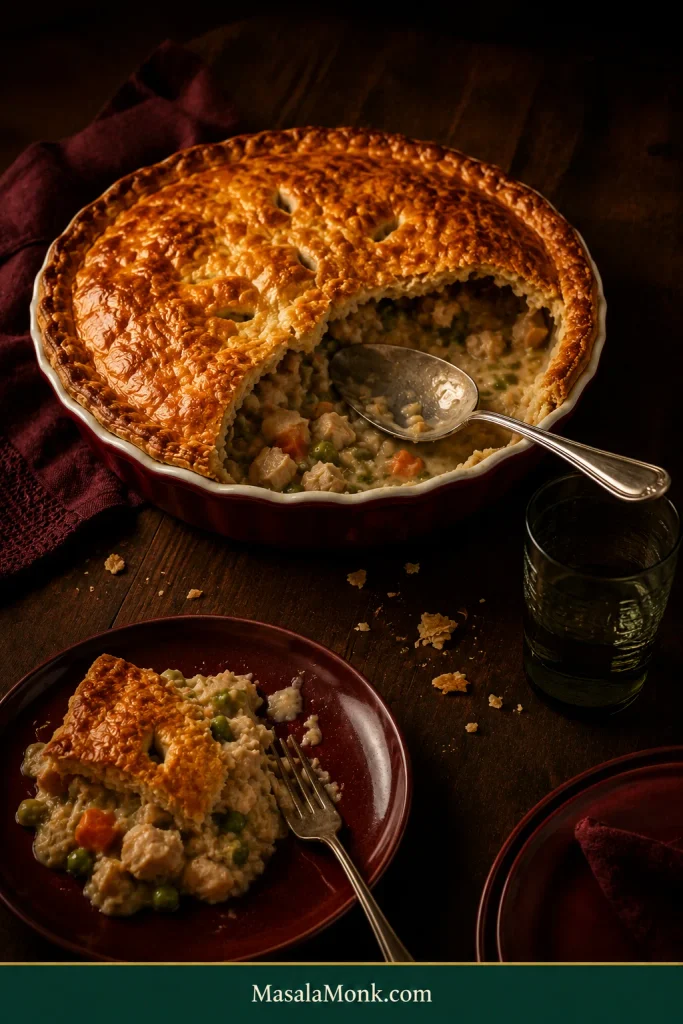
Put them under a crisp golden crust with enough creamy sauce, though, and they stop feeling like a repeat of yesterday’s meal.
If you make yours with leftover gravy or an unexpected Thanksgiving leftover, tell us what found its way into the pie.








