
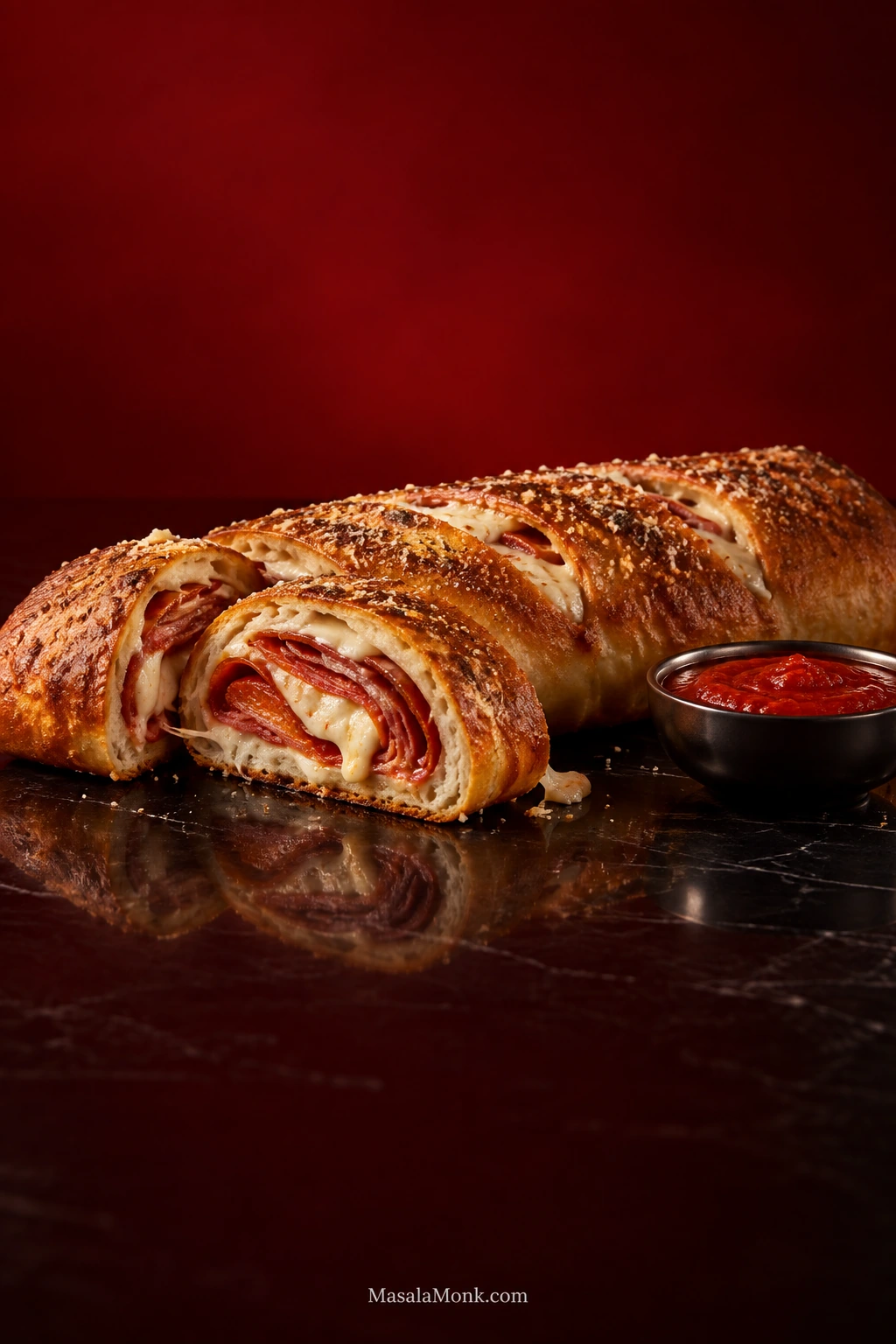
This Stromboli recipe starts with a pound of pizza dough, so if you’ve already got one ready, you’re most of the way there. Roll it thin, layer in pepperoni, salami and cheese, and it bakes into a long golden roll with crisp edges, melted cheese between the layers and warm marinara waiting on the side.
Regular homemade pizza dough, supermarket dough or fresh dough from a pizza shop will all work. You don’t need a special Stromboli dough. What matters is stretching the dough thin enough that the layers inside can bake through.
That is where Stromboli can fool you. The crust may look beautifully done while a thick patch of dough near the center is still gummy. Put too much inside and the roll can swell, split at the seam and leave its bottom sitting in rendered fat.
For This Stromboli
| Pizza dough | 1 lb / 16 oz / 454 g |
|---|---|
| Roll to | About 12 × 16 inches / 30 × 40 cm |
| Filling | 8 oz / 225 g meat + 8 oz / 225 g mozzarella and provolone, plus Parmesan |
| Oven | 400°F / 200°C |
| Bake | 25–30 minutes |
| Useful doneness check | Around 200°F / 93°C in the thickest central dough layer |
| Total time | About 1 hour with ready-to-shape dough; around 1½ hours, sometimes longer, when starting refrigerator-cold |
For this version, the marinara stays outside the roll. That keeps the filling drier while it bakes and leaves plenty of hot sauce for dipping at the table.
Stromboli Recipe
Pepperoni and salami bring the salty, savory filling; mozzarella melts into long strands; provolone adds a deeper cheese flavor. One large Stromboli makes about 8–10 slices, serving roughly 4 as a main dish or more as part of a larger spread.
- Hands-on time: about 20 minutes
- Rest after baking: 10–15 minutes
- Yield: 1 large Stromboli, about 8–10 slices
Equipment
- 13 × 18-inch / 33 × 46-cm metal baking sheet
- Parchment paper
- Rolling pin, if needed
- Pastry brush
- Sharp knife for cutting the vents
- Instant-read thermometer
- Serrated knife for slicing
Ingredients
- Pizza dough: 1 lb / 16 oz / 454 g, homemade or store-bought
- Pepperoni: 4 oz / 113 g, thinly sliced
- Salami: 4 oz / 113 g, thinly sliced
- Low-moisture mozzarella: 4 oz / 113 g, shredded or thinly sliced
- Provolone: 4 oz / 113 g, thinly sliced
- Parmesan or Pecorino Romano: ¼ cup / 25–30 g, finely grated, plus more for the top if you like
- Egg: 1 large
- Water: 1 tbsp / 15 ml
- Italian seasoning: ½ tsp, optional
- Marinara or pizza sauce: ¾ cup / 180 ml, warmed for serving
Method
Prepare the Dough
- Let the dough relax. Leave refrigerated dough covered at room temperature for 30–45 minutes. Try stretching it gently. If it snaps back or quickly shrinks smaller, cover it again and give it another 5–10 minutes. Dough that is already soft and easy to stretch can go straight to the next step.
- Heat the oven. Preheat to 400°F / 200°C. Line a 13 × 18-inch / 33 × 46-cm metal baking sheet with parchment paper.
- Shape the dough. Stretch and roll it on the parchment to roughly 12 × 16 inches / 30 × 40 cm, with a long edge facing you. The corners don’t need to be neat. Aim for fairly even thickness, especially along the edge nearest you; that strip of dough will eventually sit close to the center of the roll.

Fill and Roll
- Layer the filling. Arrange the mozzarella, provolone, pepperoni and salami in thin overlapping layers. Scatter the Parmesan or Pecorino over the top. The filling should stay low enough that you can still see the shape of the rectangle beneath it. A mound down the middle is a sign to take some off.

- Leave room for the seam. Leave about 1 inch / 2.5 cm bare along the short sides and the long edge nearest you. At the far long edge, leave a clean strip roughly 2½–3 inches / 6–7.5 cm wide. The filling will creep forward as you roll.

- Roll from the long side. Bring the edge nearest you over the filling and continue rolling away from yourself. Roll snugly so the layers stay together, but don’t squeeze the log or push the filling ahead of you. The finished roll should hold its shape without becoming a tight, bulky spiral.

Seal and Vent
- Seal it. Tuck the short ends inward only as far as needed to contain the filling. Beat the egg with 1 tbsp / 15 ml water. Brush egg wash over the clean final edge, finish rolling and pinch the seam closed. Set the Stromboli seam-side down.
- Finish the top. Brush lightly with egg wash. Sprinkle with Italian seasoning and, if you like, extra Parmesan. Cut 3–4 shallow diagonal vents through the top layer. Once shaped, it can go straight into the oven.

Bake It Through
- Bake. Bake for 25–30 minutes, starting your checks around the 25-minute mark. The crust should be deeply golden and the underside set and baked, not soft or pale. Near the end, cheese may bubble through the vents and the Parmesan on top should begin to smell toasted. Insert an instant-read thermometer from the side toward the thickest part of the center, aiming for dough rather than a pocket of melted cheese. A reading around 200°F / 93°C is a useful confirmation. If the crust already has enough color but the center needs more time, cover the top loosely with foil and keep baking.

Rest, Slice and Serve
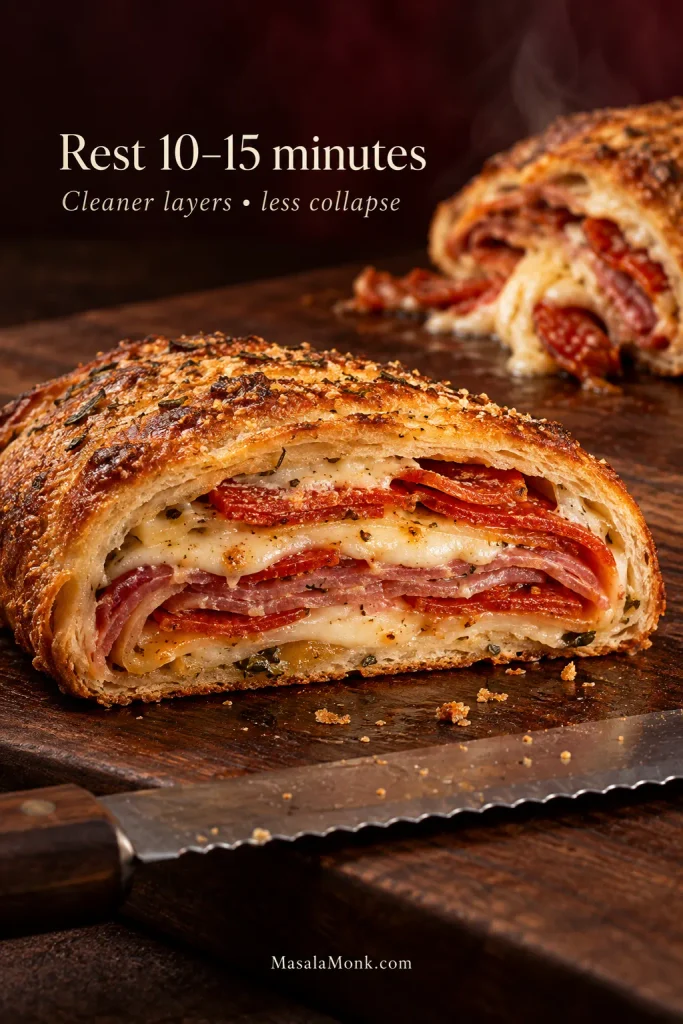
- Rest and slice. Leave the Stromboli for 10–15 minutes. If rendered fat has collected on the tray, use the parchment or a wide spatula to move the roll onto a clean section of the pan or onto a board. Slice with a serrated knife and serve with warm marinara.
The center slice tells you a lot. You want baked dough separating distinct layers of meat and cheese, not a pale gummy stripe. After the rest, those layers should stay together when you lift a slice rather than spilling straight onto the board. Cheese escaping through a vent is fine. Let the bits touching the pan turn brown and crisp.

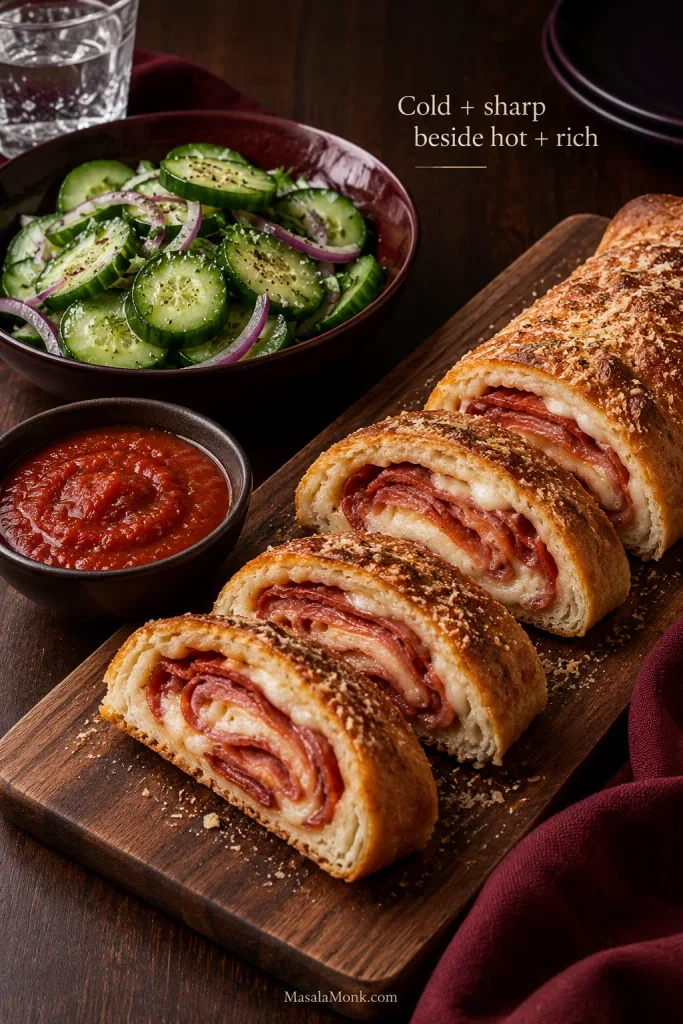
For a full dinner, something cold and sharp is good beside the warm slices. A crisp cucumber salad brings vinegar, herbs and crunch to a plate already rich with cured meat and melted cheese.
Something went wrong? Jump to Fix My Stromboli →
Pizza Dough & Filling
Store-bought pizza dough works
Yes, store-bought pizza dough works well for Stromboli. If it is refrigerator-cold, let it sit at room temperature for 30–45 minutes so it becomes easier to stretch. Check the package weight too; this version is built around roughly a pound of dough.
Dough that keeps pulling itself smaller usually needs more time, not more flour or force. Cover it for another few minutes and try again.

Other ready-made doughs won’t behave exactly like a standard pizza-dough ball. With refrigerated canned pizza crust, use the thinner sheet you have instead of forcing it to 12 × 16 inches. For frozen bread dough, follow the package’s thaw-and-rise directions until the dough is soft, relaxed and ready to shape. Sourdough pizza dough can work at a similar dough weight; let it relax fully before rolling.
How much filling to use
With a pound of pizza dough, 8 oz meat and 8 oz mozzarella/provolone makes a generous filling without building an oversized roll. Parmesan adds a salty layer without adding much bulk.
The numbers are useful, but the shape tells you more. Spread the filling broadly across the dough and keep it low rather than heaped. Too much creates a thick center and puts pressure on the seam; too little leaves you with plenty of bread and not much happening inside it.
Low-moisture mozzarella melts into stretchy layers without releasing much water. Provolone melts alongside it and brings a fuller cheese flavor. Parmesan or Pecorino Romano seasons the filling, while Parmesan scattered on top can toast against the egg-washed crust. Fresh mozzarella can work too, but drain it well and blot the pieces first.
Keep the Filling Dry
Moisture doesn’t only come from cheese or sauce. Mushrooms release plenty of water. Spinach holds onto it. Sausage can leave fat behind, and some pepperoni is much oilier than others. Cook raw meat fillings fully before they go into the Stromboli, drain rendered fat and let hot fillings cool before assembly. Cook vegetables first when needed, let mushrooms shed their liquid and squeeze cooked spinach dry. Anything sitting in liquid in the skillet is better dealt with there than inside the Stromboli.

Sauce Inside or on the Side?
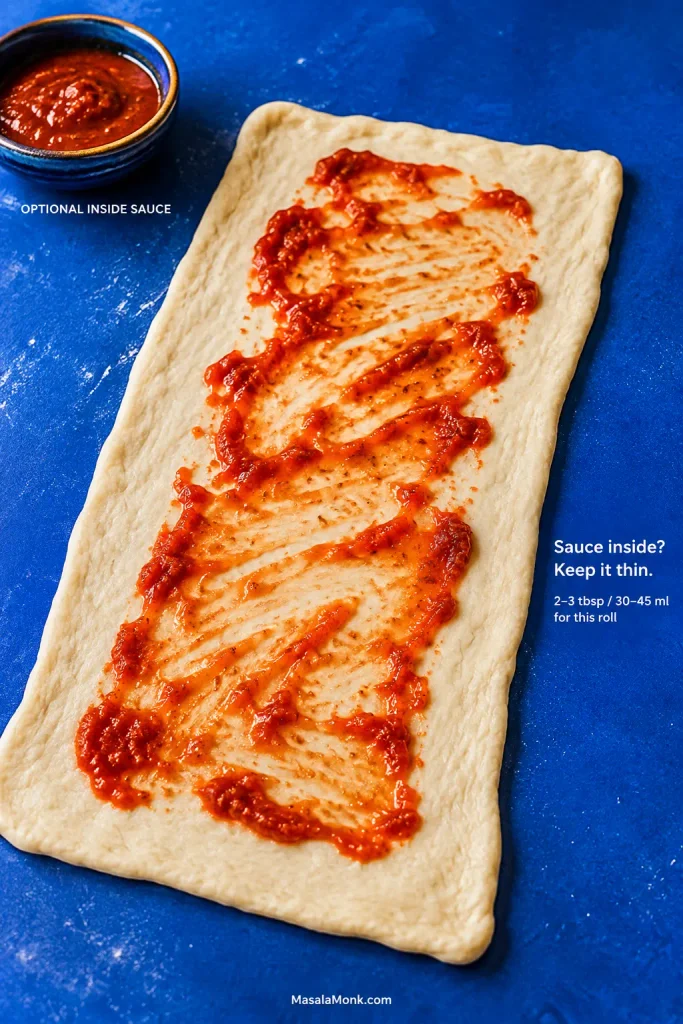
Yes, you can put sauce inside Stromboli. For this version, use about 2–3 tablespoons of thick sauce. Serving marinara on the side leaves the filling drier and the crust crisper.
A thick pizza sauce is easier to control than loose marinara. If yours runs quickly from a spoon, simmer it until it has more body. Leave the final sealing strip clean so the dough can stick to itself.
Ready to make it? Jump to the method ↑
Why Stromboli Can Brown Before the Center Bakes
Once pizza dough is wrapped around meat and cheese, the center heats more slowly than the exposed crust. Egg wash makes that difference easier to miss because the outside can take on a deep golden color before the dough buried inside has finished baking.
That is why color is only one doneness cue. Check the underside, then use the center temperature as a second opinion. If the crust is where you want it but the middle still needs time, a loose foil cover lets the center keep baking without pushing the top much darker.

Fix My Stromboli
Before It Goes In
Dough keeps shrinking? Cover it for another 5–10 minutes. Tight, chilly dough usually becomes much easier to stretch after a short rest.
The filled roll looks enormous? Take some filling out before you seal it if you still can. You want a substantial roll, not one already straining at the seams before it reaches the oven.
The seam will not stick? Check the dough itself. Sauce, cheese or rendered fat on that final strip can stop it sealing. Wipe it clean, brush the edge with egg wash, pinch it closed and turn the seam underneath.
The ends are mostly bread? Trim obvious excess and tuck in only what you need to enclose the filling. The ends don’t have to look perfectly symmetrical.
While It Bakes
The top is already dark? Check the center before taking the Stromboli out. If it still needs time, lay foil loosely over the top and keep baking.
The side split? Too much filling, a thin spot in the dough or a greasy seam are the usual causes. A small split isn’t the end of dinner. Let the Stromboli finish baking; next time, reduce the filling, watch for thin spots or make sure the seam is clean.
Cheese is coming through a vent? Some leakage is normal, and the bits that brown against the pan are hardly a tragedy. A seam opening wide enough for the filling to spill out usually points to overfilling, a weak seal or a thin patch of dough.

Grease is collecting underneath? Move the baked Stromboli onto a dry area before it rests. Especially oily pepperoni or salami can also be blotted before assembly next time.
After You Slice It
The middle is gummy? The roll may have been too thick or simply needed more time in the oven. On the next one, avoid compressing the roll and check the center temperature before taking it out.
The bottom is soggy? Work backward from the filling. Wet vegetables, too much sauce, fresh mozzarella and rendered meat fat can all soften the dough from inside.

Too much bread? Stretch the dough to about 12 × 16 inches and spread the filling across most of the surface. Making the rectangle smaller and simply stuffing more inside creates a thicker center, not a better ratio.
The filling falls out as you cut? Give the roll its full resting time. If the slices still collapse after 10–15 minutes, use less filling or spread it more evenly next time.
Back to the recipe ↑ Try another filling →
Change the Filling
Once the base Stromboli makes sense, changing the filling is the easy part. Keep the overall amount close to the base recipe, then pay attention to what the new ingredients bring with them: water, fat, residual heat or extra bulk.
| Filling | What changes | How to handle it |
|---|---|---|
| Ham & cheese Ham, provolone, mozzarella or Swiss | Deli ham is easy to layer but can carry surface moisture | Use thin slices and blot noticeably wet ham before filling |
| Sausage & peppers Cooked sausage, sautéed peppers, mozzarella | More rendered fat and vegetable moisture | Drain well and let everything cool before filling |
| Spinach & cheese Spinach, mozzarella, provolone; ricotta if desired | Spinach hides a surprising amount of water | Squeeze it very dry and use ricotta sparingly |
| Philly cheesesteak Thin beef, onion, peppers, provolone | Residual heat and pan juices can soften the dough before baking | Cool the filling completely and drain any liquid left in the pan |
| Buffalo chicken Cooked chicken, mozzarella, buffalo sauce | The sauce can loosen the filling quickly | Use only enough sauce to coat the chicken and serve extra alongside |
Pesto works particularly well with chicken, spinach or mozzarella. Use a thin layer; homemade basil pesto already brings garlic, herbs and Parmesan with it.
Make Ahead, Store, Freeze & Reheat
To assemble ahead: fill and roll the Stromboli, cover it well and refrigerate for up to 8 hours. Add the exterior egg wash and cut the vents shortly before baking. Start checking at the usual time and leave it longer if the cold center needs it.
To freeze before baking: shape and seal the Stromboli but leave off the egg wash and vents. Wrap it well and freeze for up to 3 months for best quality. Thaw it completely in the refrigerator, allowing overnight to 24 hours for a dense filled roll, then brush, vent and bake. Use the crust and center temperature rather than the clock alone to judge when it is ready.
For leftovers: refrigerate promptly and use within 3–4 days, in line with USDA leftovers guidance.
To reheat: use an oven or air fryer at about 350°F / 175°C if you want the crust to crisp again. Reheat cooked leftovers until hot throughout; USDA reheating guidance uses 165°F / 74°C as the target.
To freeze after baking: cool the Stromboli completely, wrap it well and freeze for up to 3 months for best quality. Thaw it in the refrigerator, then reheat at about 350°F / 175°C until hot through and the crust has crisped again. Freezing individual slices makes it easier to reheat only what you need.
Stromboli vs Calzone & Where It Came From
Stromboli is rolled into a long log and sliced; a calzone is folded into a half-moon pocket. Both can use pizza dough and many of the same cheeses, meats and vegetables, but the different shape changes how the filling sits inside and how the finished dish is served.

Despite its Italian name and flavors, Stromboli is an Italian-American creation closely associated with the Philadelphia area in the middle of the twentieth century. The Philadelphia Inquirer’s history of Stromboli traces the Romano family’s account of the dish at their pizzeria in Essington, Pennsylvania, around 1950. Deli meats and cheese remain classics, but sausage, chicken, steak and vegetables all fit naturally into the same rolled idea.
Give one of the center slices a dip while the crust is still crisp and the cheese is warm enough to stretch. Pepperoni, salami, provolone, mozzarella and hot marinara do the rest.









