Posted on 1 Comment

How to Make a Flax Egg (Recipe & Ratio for Vegan Baking)

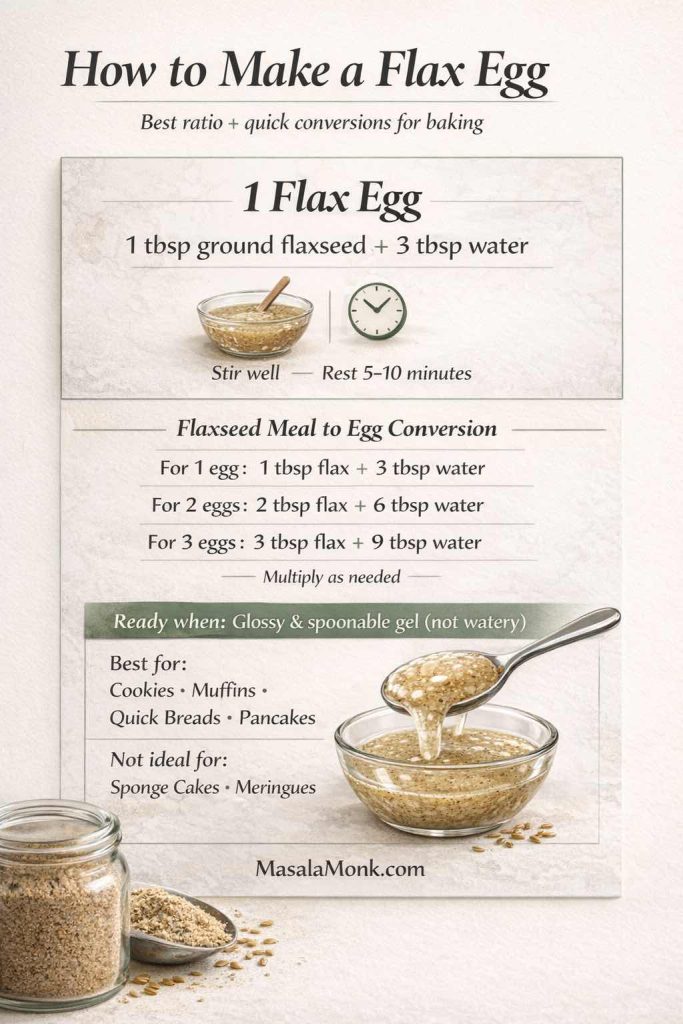
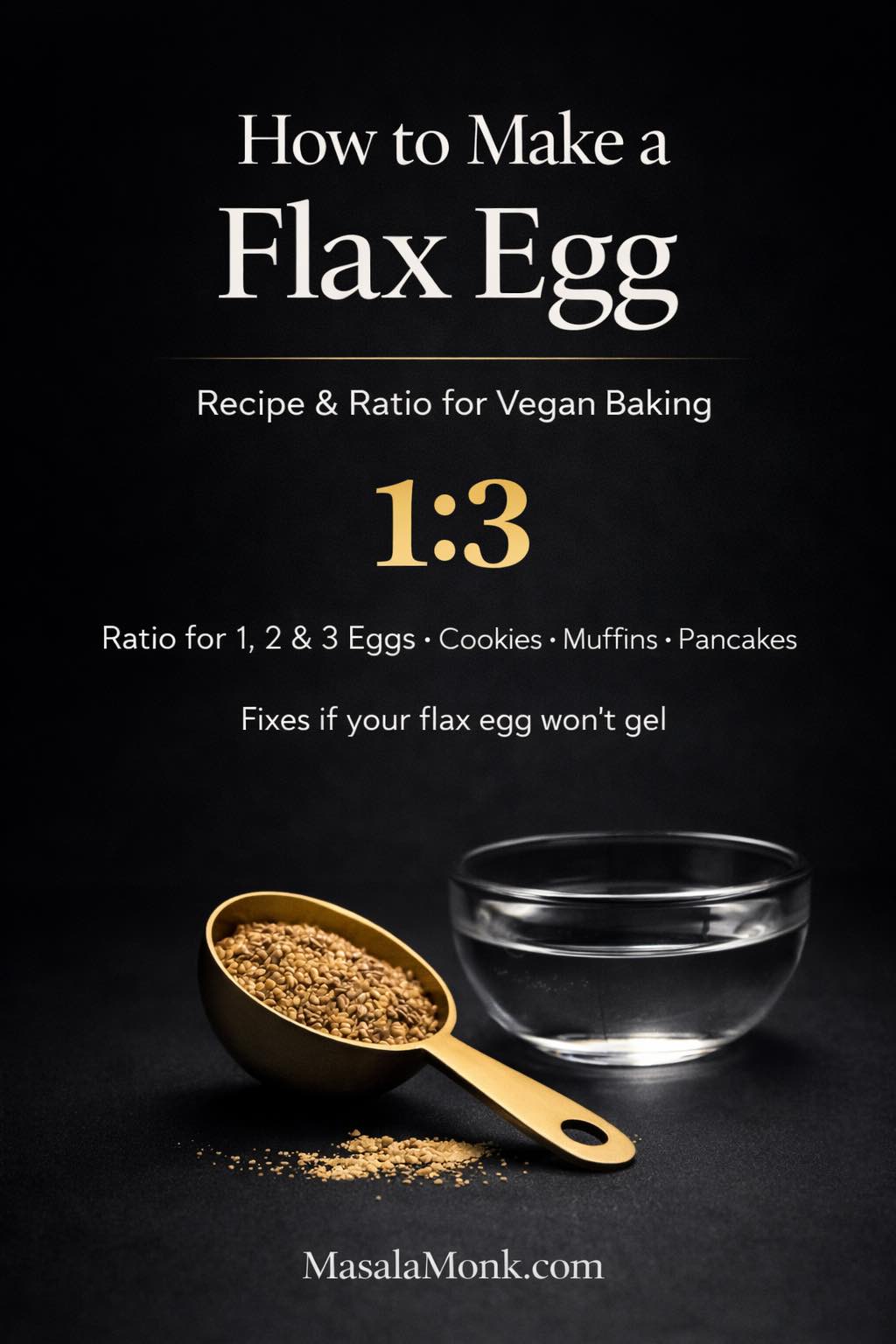
Magazine-style cover for “How to Make a Flax Egg” showing the flax egg recipe and ratio for vegan baking, including 1–3 egg conversions, best uses for cookies, muffins, and pancakes, plus fixes if a flax egg won’t gel, with MasalaMonk.com in the footer.

You know the moment: you’re halfway through a cookie dough, you reach for the egg carton, and it’s empty. Alternatively, you’re baking for someone who avoids eggs—whether for vegan eating, allergies, or simply preference—and you want a solution that doesn’t feel like a compromise. That’s exactly where a flax egg comes in.

Once you learn how to make a flax egg, you’ll have a reliable, pantry-friendly answer for a huge range of recipes—especially the kind of everyday bakes most of us actually make: cookies, muffins, quick breads, pancakes, and waffles. Even better, it’s simple enough to memorize, yet flexible enough to scale for two eggs, three eggs, or more.

Ahead, you’ll get the classic flax egg ratio, easy flaxseed meal to egg conversion for bigger batches, and a few small adjustments that make the gel set reliably in real-world baking. You’ll also see what to use when you need a substitute for flax egg, plus when a different egg replacement makes more sense.


How to Make a Flax Egg (Step-by-Step)

At its core, a flax egg is just ground flaxseed mixed with water. After a short rest, it thickens into a gel. That gel helps bind ingredients together, which is why flaxseed is such a popular egg substitute in baking.

How to Make 1 Flax Egg (the classic flax egg recipe)

For one flax egg:

  • 1 tablespoon ground flaxseed (flax meal)
  • 3 tablespoons water
Photorealistic infographic showing how to make a flax egg: mix 1 tablespoon ground flaxseed with 3 tablespoons water, stir well, and rest 5–10 minutes until a glossy, spoonable gel forms. Includes flaxseed meal to egg conversion for 1, 2, and 3 eggs and notes best uses like cookies, muffins, quick breads, and pancakes.
How to make a flax egg at a glance: use the classic flax egg ratio (1 tbsp ground flaxseed + 3 tbsp water), rest 5–10 minutes until glossy and spoonable, then scale the same flaxseed meal to egg conversion for 2 or 3 eggs when you’re baking cookies, muffins, quick breads, or pancakes.

Stir them together until the mixture looks evenly combined. Then, set it aside for about 5–10 minutes. As it sits, it thickens into a gel-like texture. If it still looks watery after 10 minutes, jump to the troubleshooting section—usually it’s a grind or freshness issue, and it’s easy to fix.

The same simple method shows up in everyday baking advice for a reason: it works. If you’d like more practical ways to use ground flax—both as a flaxseed egg substitute and in everyday meals—see Benefits of Flax Seeds and How to Incorporate Them into the Indian Diet.

Now, if you’re thinking, “That’s it?”—yes, that’s basically it. However, the details matter, and those details are what separate “it sort of worked” from “I can swap this confidently.”

How to make a flax egg with ground flax (what actually matters)

Use ground flaxseed, not whole seeds. Whole flax often stays stubbornly seed-like, even after sitting, and the mixture won’t gel properly. Ground flaxseed (flax meal) hydrates more evenly, which is the whole point.
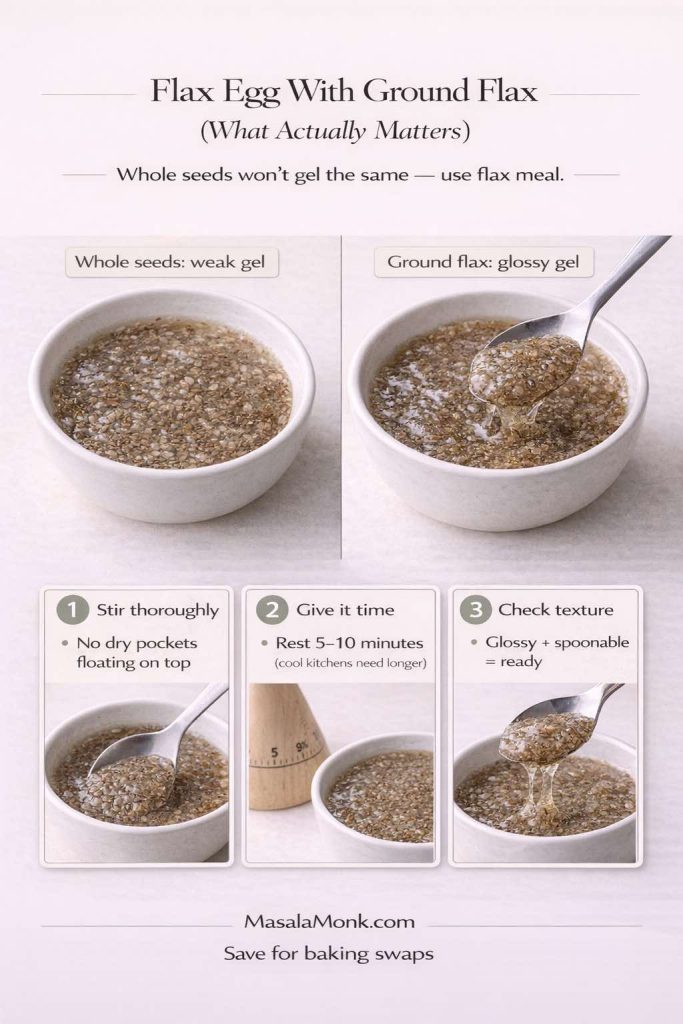
Vertical infographic titled “Flax Egg With Ground Flax (What Actually Matters)” showing a side-by-side comparison: whole flax seeds mixed with water labeled “weak gel” versus ground flax/flax meal mixed with water labeled “glossy gel,” with a spoon lift showing the gel texture. Three step cards explain: stir thoroughly so no dry pockets float on top, let it rest 5–10 minutes (cool kitchens need longer), and check texture—glossy and spoonable means ready. MasalaMonk.com footer.
If your flax egg won’t gel, the fix is usually simple: use ground flaxseed (flax meal), not whole seeds. This step-by-step guide shows the texture you’re aiming for—glossy and spoonable—plus the three things that actually matter in real baking: stir thoroughly, rest 5–10 minutes, and check the gel before adding it to your batter.

Ground flax is also the better pick nutritionally and practically, since whole seeds can pass through without breaking down much. Mayo Clinic explains why ground flax is generally preferred in Flaxseed: Is ground better than whole?.

Stir thoroughly. A quick swirl is rarely enough. Instead, stir until you don’t see dry pockets of flax floating on top.

Give it time. Some flax thickens in five minutes. Other batches need closer to ten, particularly if your kitchen is cool.

Check the texture. A ready flax egg should look glossy and slightly thick—somewhere between loose gel and a lightly thickened sauce. If it’s still watery, a couple quick tweaks usually thicken it up (see troubleshooting below).

Is a flax egg the right substitute for your recipe?

Now that you’ve got the flax egg ratio down, the next question is the one that actually saves batches: will it work in this recipe? The simplest way to decide is to think about what the egg was doing in the first place.
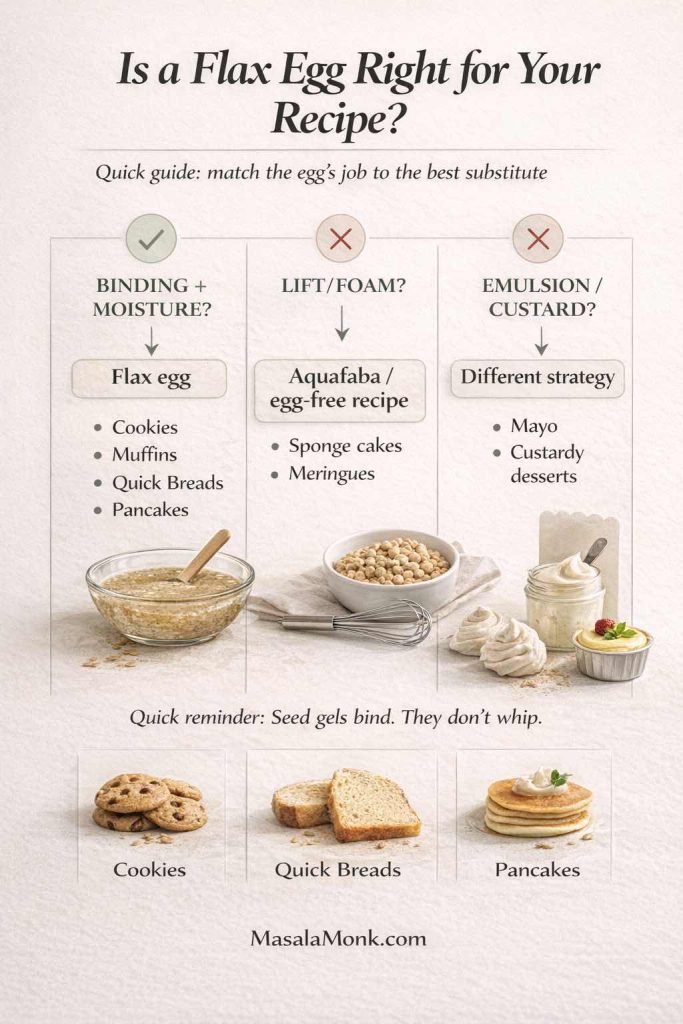
Photorealistic infographic titled “Is a Flax Egg Right for Your Recipe?” showing how to choose an egg substitute based on the egg’s job. It recommends a flax egg for binding and moisture (cookies, muffins, quick breads, pancakes), aquafaba or an egg-free recipe for lift/foam (sponge cakes, meringues), and a different strategy for emulsion or custard-style recipes (mayo, custardy desserts).
Not every egg substitute works the same way—this quick guide helps you decide when a flax egg substitute is the best choice for baking (binding + moisture), when aquafaba is better for lift and foam, and when you’ll want a different approach for emulsions or custard-style desserts.
  • Use a flax egg when the egg is mostly a binder. This is where flax shines: cookies, brownies, muffins, quick breads, pancakes, and waffles—recipes where you want the batter to hold together and stay pleasantly moist.
  • Skip flax when the egg is doing the heavy lifting for lift. If the recipe relies on whipped eggs or airy structure—think sponge cakes, angel-food style bakes, meringues, or anything “foam-based”—a seed gel won’t recreate that height.
  • Be cautious when the recipe calls for several eggs. Replacing one egg is usually straightforward. Replacing two can still work in sturdier bakes. However, once you’re replacing three or more, the texture can drift toward heavier and denser unless the recipe was designed for egg-free baking.
  • When in doubt, pick the more forgiving path. If you’re experimenting, start with cookie doughs and quick breads first. They’re easier to read and adjust, so you learn the “flax egg feel” without risking a fragile cake.

Also Read: Croquettes Recipe: One Master Method + 10 Popular Variations


Flax Egg Ratio (and the flax seed to egg ratio people actually use)

“Flax egg ratio” is one of the most common questions for a reason. Everyone wants a clean answer they can plug into any recipe.

So here it is:

  • 1 flax egg = 1 tablespoon ground flaxseed + 3 tablespoons water
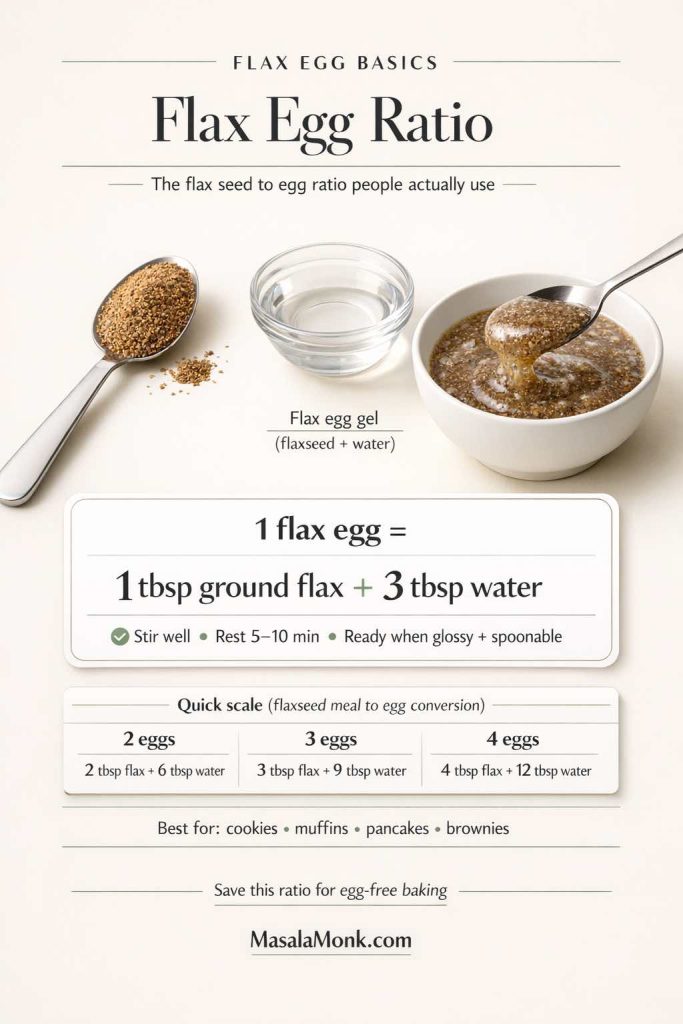
Vertical infographic titled “Flax Egg Ratio” showing a tablespoon of ground flax, a small bowl of water, and a bowl labeled “Flax egg gel (flaxseed + water)” with a spoon lift. It states: 1 flax egg = 1 tbsp ground flax + 3 tbsp water, with steps “stir well, rest 5–10 minutes, ready when glossy and spoonable.” A quick scale table shows conversions for 2 eggs (2 tbsp flax + 6 tbsp water), 3 eggs (3 tbsp flax + 9 tbsp water), and 4 eggs (4 tbsp flax + 12 tbsp water). It notes “Best for: cookies, muffins, pancakes, brownies” and includes MasalaMonk.com branding.
Save this flax egg ratio for fast egg-free baking: 1 flax egg = 1 tablespoon ground flaxseed + 3 tablespoons water (rest until glossy and spoonable). The quick scale makes it easy to convert 2, 3, or 4 eggs in a recipe, and it’s most reliable in cookies, muffins, pancakes, and brownies where eggs are mainly binding.

That’s the standard flax seed egg substitute ratio you’ll see repeated across many reputable sources. Healthline, for example, describes using 1 tablespoon ground flaxseed (or chia) with 3 tablespoons water as a replacement for one egg in baking. You can see that ratio in the ground flax/chia section of 13 Effective Substitutes for Eggs.

Minimalist Baker also teaches the same basic approach for how to make flax eggs for baking—mix, rest, then use in place of one egg—while noting that it isn’t a perfect 1:1 match for every recipe. That nuance is important, and it’s explained well in this post here.

Even so, baking isn’t only about ratios; it’s also about what the recipe needs from the egg. That’s why, beyond the classic ratio, it helps to think about how “tight” or “loose” your flax egg should be.

A useful tweak: the “tight gel” vs “looser gel” approach

Most of the time, 1:3 works perfectly. Still, if you’re making something that already spreads easily—certain cookies, for example—you may prefer a slightly tighter gel. Meanwhile, for muffins and quick breads where moisture is welcome, the classic ratio is ideal.
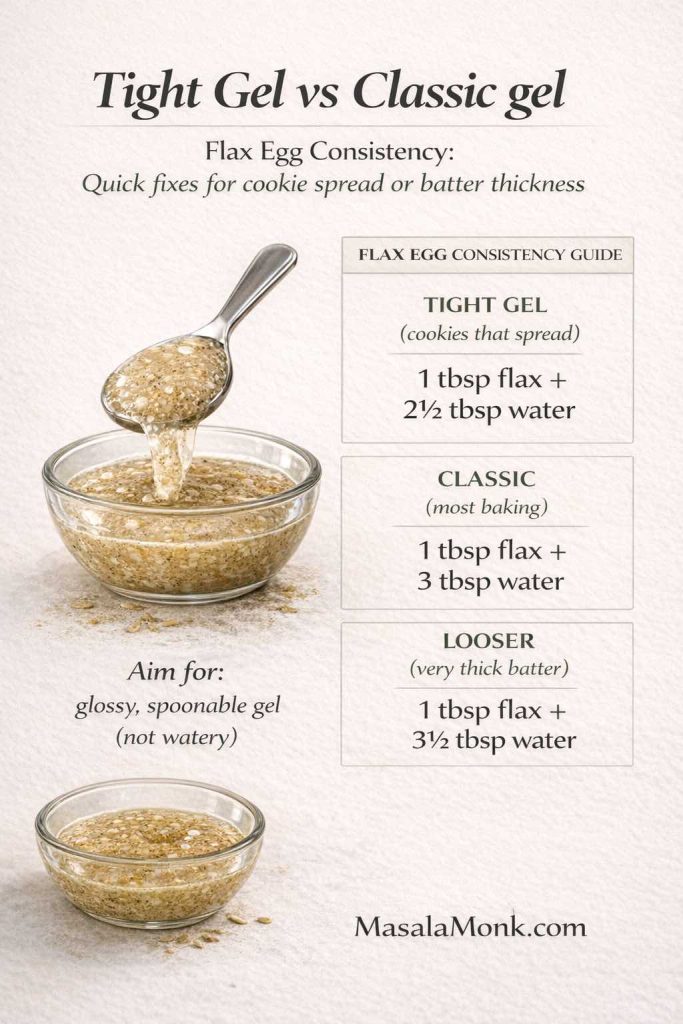
Vertical infographic titled “Tight Gel vs Classic Gel” explaining flax egg consistency for baking. It shows three flax egg ratios: tight gel for cookies that spread (1 tbsp flax + 2½ tbsp water), classic gel for most baking (1 tbsp flax + 3 tbsp water), and a looser mix for very thick batter (1 tbsp flax + 3½ tbsp water). Includes texture cue “glossy, spoonable gel” and MasalaMonk.com branding.
If your flax egg substitute is throwing off cookie spread or batter thickness, adjust the water—not the whole recipe. Use the tight gel ratio for spread-prone cookies, stick with the classic flax egg ratio for most baking, and only loosen the mix when the batter is unusually thick. Aim for a glossy, spoonable gel every time.

You don’t need to overcomplicate this. Just remember the direction:

  • For spread-prone cookies, use a slightly tighter gel: 1 tablespoon flax meal + 2½ tablespoons water.
  • For muffins and quick breads, stick with the classic: 1 tablespoon flax meal + 3 tablespoons water.
  • If your batter is unusually thick, loosen it gently: 1 tablespoon flax meal + 3½ tablespoons water.

That small shift is often enough to reduce cookie spread or keep a loaf from feeling heavy. No matter which version you choose, the goal is the same: a cohesive, spoonable gel—never watery.

Also Read: Ravioli Recipe Reinvented: 5 Indian-Inspired Twists on the Italian Classic


Flaxseed Meal to Egg Conversion (1 egg, 2 eggs, 3 eggs)

Once you’re comfortable with one flax egg, scaling becomes easy. Because it’s linear, you can multiply it without a calculator.

Flaxseed meal to egg conversion: quick scale

  • For 1 egg: 1 tablespoon flax meal + 3 tablespoons water
  • For 2 eggs: 2 tablespoons flax meal + 6 tablespoons water
  • For 3 eggs: 3 tablespoons flax meal + 9 tablespoons water

This is the flax egg conversion you’ll rely on most.
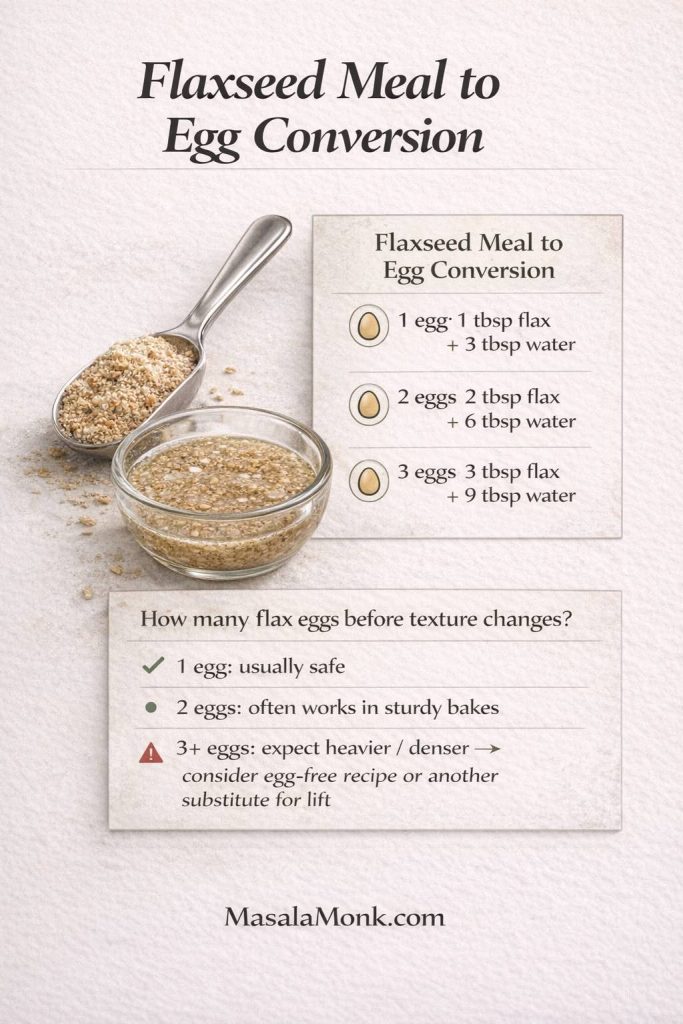
Photorealistic infographic titled “Flaxseed Meal to Egg Conversion” showing flax egg ratios for baking: 1 egg = 1 tbsp ground flaxseed + 3 tbsp water, 2 eggs = 2 tbsp flax + 6 tbsp water, and 3 eggs = 3 tbsp flax + 9 tbsp water. Includes guidance on how many flax eggs to use before texture changes: 1 egg usually safe, 2 eggs often works in sturdy bakes, 3+ eggs may turn heavier/denser.
Scaling a flax egg substitute is simple: use the classic flax egg ratio (1 tbsp ground flaxseed + 3 tbsp water per egg) and multiply for 2 or 3 eggs. This conversion guide also shows when texture can shift—replacing 1 egg is usually easy, 2 often works in sturdy bakes, and 3+ eggs may turn heavier unless the recipe is designed to be egg-free.

However, there’s a practical caution: the more eggs you replace, the more your baked good may drift away from the original texture. King Arthur Baking is direct about this: some egg-heavy recipes simply won’t behave the same with substitutions, and even in everyday bakes, the results depend on what the eggs were doing in the original formula. Their breakdown in Guide for substituting eggs is a helpful reality check.

How many flax eggs can you use before texture changes?

Scaling the flaxseed meal to egg conversion is easy. Still, the results don’t always scale as neatly as the math. The more eggs you replace, the more likely the final texture shifts—especially in recipes where eggs were doing more than just binding.
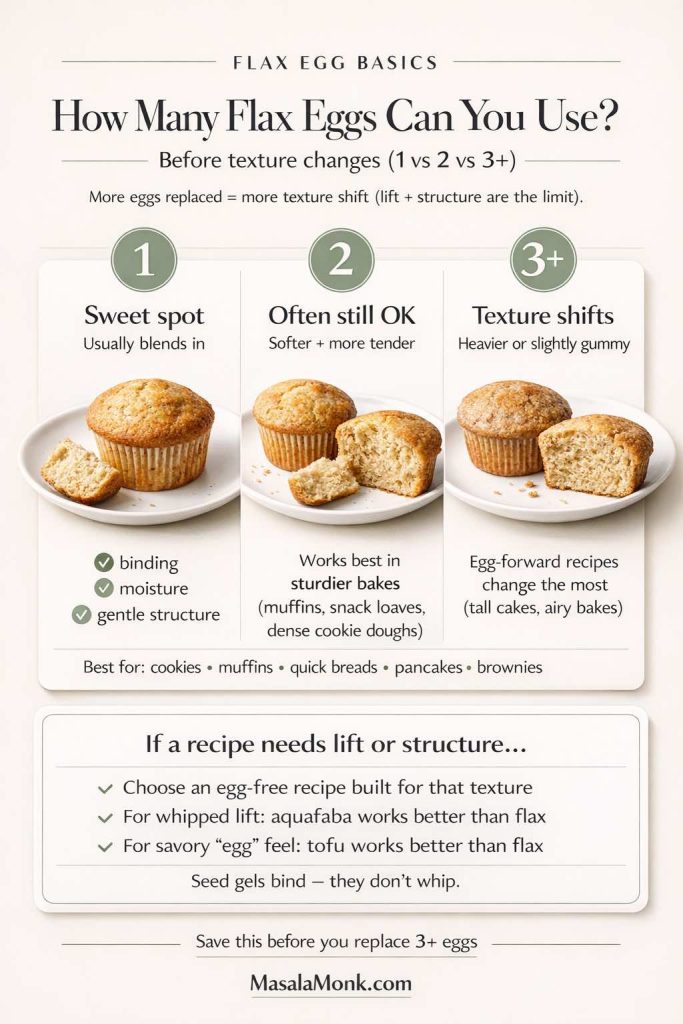
Vertical infographic titled “How Many Flax Eggs Can You Use?” with a 1 vs 2 vs 3+ comparison before texture changes. It shows muffins on plates for each level: 1 flax egg is the sweet spot (usually blends in) supporting binding, moisture, and gentle structure; 2 flax eggs are often still OK (softer and more tender) best in sturdier bakes like muffins, snack loaves, and dense cookie doughs; 3+ flax eggs cause texture shifts (heavier or slightly gummy) especially in egg-forward recipes like tall cakes and airy bakes. A box suggests: choose egg-free recipes for structure, use aquafaba for whipped lift, and tofu for savory “egg” feel. “Seed gels bind — they don’t whip.” MasalaMonk.com footer.
Before you scale flax eggs, save this quick threshold guide. Replacing 1 egg with a flax egg is usually the sweet spot in cookies, muffins, quick breads, pancakes, and brownies. Two flax eggs often still work in sturdier bakes, but once you hit 3+ eggs, expect bigger texture changes—heavier or slightly gummy—because flax can bind and hold moisture, but it can’t replace lift and structure. For airy bakes, switch strategies (aquafaba for whipped lift, or choose an egg-free recipe built for that texture).
  • Replacing 1 egg: This is usually the sweet spot. In cookies, muffins, quick breads, pancakes, and brownies, one flax egg tends to blend in without drama.
  • Replacing 2 eggs: Often still successful in sturdier bakes, particularly muffins, snack cakes, and denser cookie doughs. The crumb may be a little more tender and moist, yet it should still feel “right” if the recipe isn’t egg-forward.
  • Replacing 3 eggs or more: This is where you’ll notice bigger changes. At that point, bakes can start to feel heavier or slightly gummy, not because flax is “bad,” but because it can’t replicate the lift and structure multiple eggs provide.

If a recipe calls for several eggs and the texture matters—think tall cakes or anything meant to be airy—your best bet is either choosing an egg-free recipe built for that style or switching to a different substitute that matches the job the eggs were doing.

Also Read: Oat Pancakes Recipe (Healthy Oatmeal Pancakes)


Using Flaxseed Instead of Eggs (what flax does well, and what it doesn’t)

The reason flax works as an egg substitute ground flaxseed method is simple: when hydrated, it becomes gel-like. That gel helps hold ingredients together and keeps moisture in the bake.
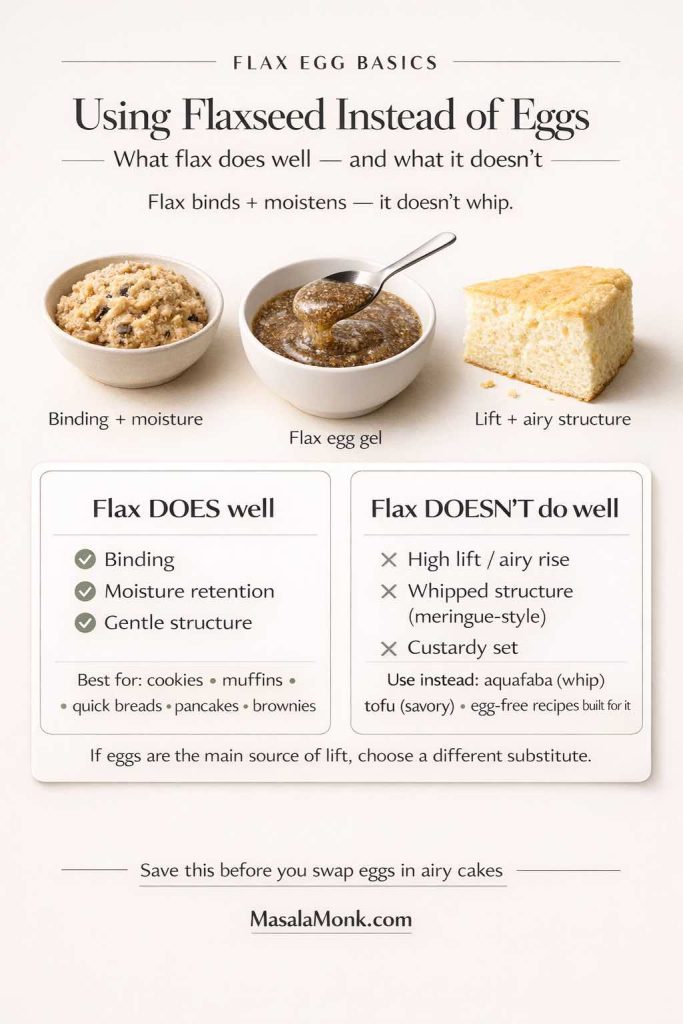
Vertical infographic titled “Using Flaxseed Instead of Eggs” with the subtitle “What flax does well — and what it doesn’t” and the line “Flax binds + moistens — it doesn’t whip.” It shows three photos: a bowl labeled “Binding + moisture,” a bowl of “Flax egg gel” with a spoon lift, and a cake slice labeled “Lift + airy structure.” Two cards explain: flax does well for binding, moisture retention, and gentle structure (best for cookies, muffins, quick breads, pancakes, brownies). Flax doesn’t do well for high lift/airy rise, whipped structure, or custardy set; use aquafaba for whipping, tofu for savory, or egg-free recipes built for that texture. MasalaMonk.com footer.
Using flaxseed instead of eggs works best when eggs are mainly acting as a binder. This quick guide shows the “egg jobs” flax can handle—binding and moisture retention—and what it can’t replicate, like airy lift, whipped structure, or a custardy set. When you need lift, switch to a better match (aquafaba for whipped bakes) or choose an egg-free recipe built for the texture you want.

Yet eggs are not just “one job.” Eggs can bind, emulsify, add moisture, contribute structure, and help with lift depending on the recipe. Consequently, no single substitute perfectly replaces every egg function in every context. Because of that, the best substitute changes from recipe to recipe. If you enjoy that practical way of thinking, Eater’s guide from vegan pastry chefs explains how to match substitutes to the job eggs were doing.

Now, here’s the practical translation:

  • Flax excels at binding and moisture
  • Flax is weaker at adding lift and airy structure

So, when you’re looking for a flaxseed egg substitute baking solution, flax is best in recipes where eggs are not the main source of volume.

Also Read: Keto Flour: Guide to Low-Carb Flours That Bakes Like the Real Thing


Baking With Flax Eggs (what works best, and why)

A flax egg can be surprisingly “invisible” in the right recipe. On the other hand, it can be noticeably dense or gummy in the wrong one. Let’s talk about where it usually performs beautifully.

Flax egg for cookies (one of the best use cases)

If you’re specifically wondering about a flax egg for cookies, you’re in luck. Cookies tend to benefit from binding and moisture; they don’t usually require eggs to create high lift.

Serious Eats tested multiple egg substitutes in cookies, muffins, and pancakes and found that flaxseed stood out particularly in cookies, delivering a chewy texture and a result that didn’t taste obviously “substituted.” That outcome is part of the testing roundup in Out of eggs? The best replacement might already be in your pantry.
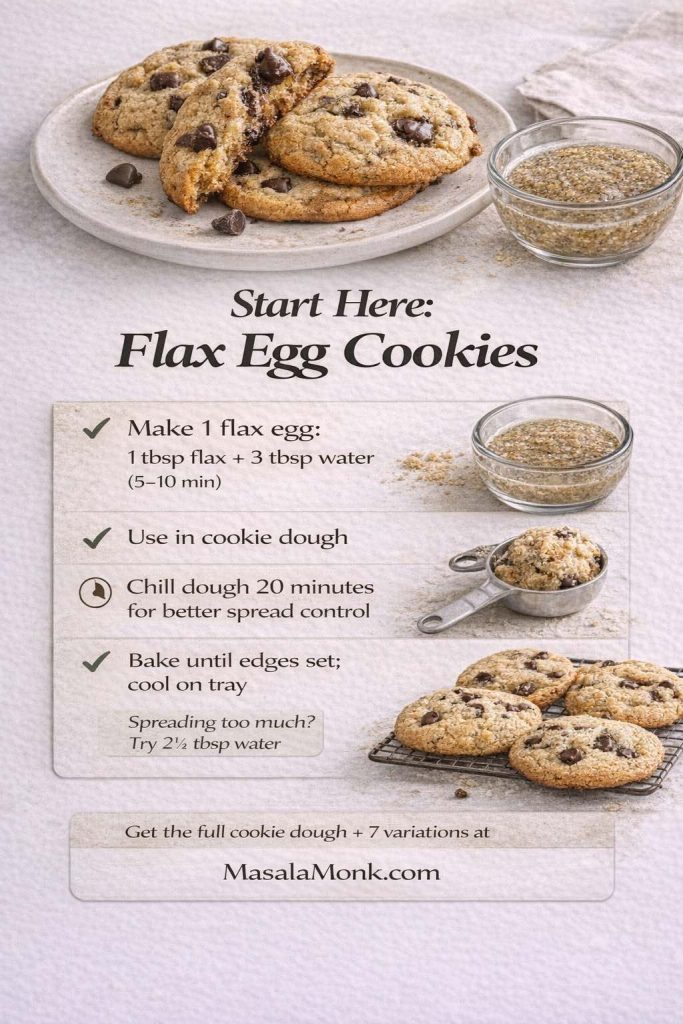
Photorealistic vertical recipe-card infographic titled “Start Here: Flax Egg Cookies” showing chocolate chip cookies and a bowl of flax egg gel. It explains how to make 1 flax egg (1 tbsp ground flaxseed + 3 tbsp water, rest 5–10 minutes), use it in cookie dough, chill dough 20 minutes for better spread control, and bake until edges are set then cool on the tray. Includes tip: “spreading too much? try 2½ tbsp water” and MasalaMonk.com branding.
New to baking with flax eggs? Start with cookies—flax is an excellent egg substitute for binding and chew. Make 1 flax egg (1 tbsp ground flaxseed + 3 tbsp water), let it gel, then chill the dough briefly for better spread control. This quick guide shows the simplest way to get reliable flax egg cookies, plus a small tweak if your dough spreads too much.

If you want to see flax eggs at their best, start with cookies. In many doughs, the swap gives you a cohesive mix and a pleasantly chewy bite—without making the cookie taste “egg-free.” For a flexible base you can riff on, try Double Chocolate Chip Cookies Recipe – One Dough, 7 Ways and use a flax egg in place of one egg in the base dough.

As you bake cookies with flax eggs, a few patterns tend to show up:

  • The texture often leans chewier rather than ultra-crisp
  • The dough may feel slightly softer at first
  • The cookies can benefit from a brief rest so the flour hydrates

Instead of fighting those traits, work with them. If you want crispness, you can often adjust bake time, sugar ratios, or resting/chilling. Still, the easiest win is choosing cookie styles where chew is the goal.

Flax egg for muffins and quick breads (quietly reliable)

Muffins, banana-style quick breads, and snack loaves are where flax eggs often feel effortless. These bakes typically want moisture and cohesion, and flax provides both.
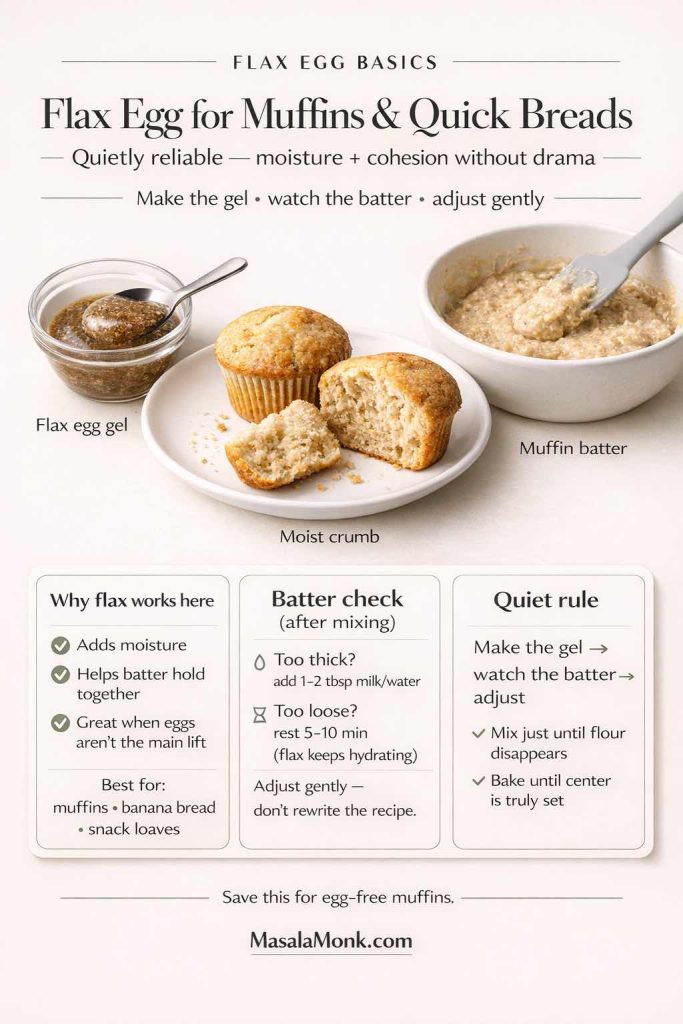
Vertical infographic titled “Flax Egg for Muffins & Quick Breads” with the subtitle “Quietly reliable — moisture + cohesion without drama.” It shows a bowl labeled “Flax egg gel” with a spoon, a plate with muffins (one cut open) labeled “Moist crumb,” and a bowl labeled “Muffin batter.” Three cards explain: why flax works (adds moisture, helps batter hold together, best when eggs aren’t the main lift); a batter check (if too thick add 1–2 tbsp milk or water, if too loose rest 5–10 minutes as flax hydrates); and a “quiet rule” (make the gel, watch the batter, adjust; mix just until flour disappears; bake until center is truly set). MasalaMonk.com footer.
Flax egg for muffins and quick breads is one of the easiest egg swaps because these bakes mainly need moisture and cohesion—not whipped lift. Use this batter-check guide right after mixing: if the batter feels too thick, add 1–2 tablespoons milk/water; if it feels loose, rest 5–10 minutes so the flax gel keeps hydrating. Then keep it simple—mix only until the flour disappears and bake until the center is truly set for a reliably tender, moist crumb.

Moreover, quick breads are usually forgiving. If your batter is slightly thicker than expected, you can add a splash of the recipe’s liquid. Conversely, if it’s looser, give it a minute—flax continues to hydrate, and batters often thicken slightly as they sit.

At this point, it’s worth repeating a helpful mindset: don’t treat flax eggs like a lab experiment. Make the gel, watch the batter, then adjust gently.

Flax egg for pancakes (and why timing matters)

Pancakes are another common destination for flax eggs. The gel helps bind, while the batter’s chemistry (baking powder or baking soda) still delivers lift. Even so, pancakes can swing from fluffy to dense depending on how they’re mixed and rested. So, if you’re using flaxseed instead of eggs, it helps to keep the batter calm:

  • Mix until just combined
  • Rest the batter briefly so the flour hydrates
  • Cook on a steady, medium heat
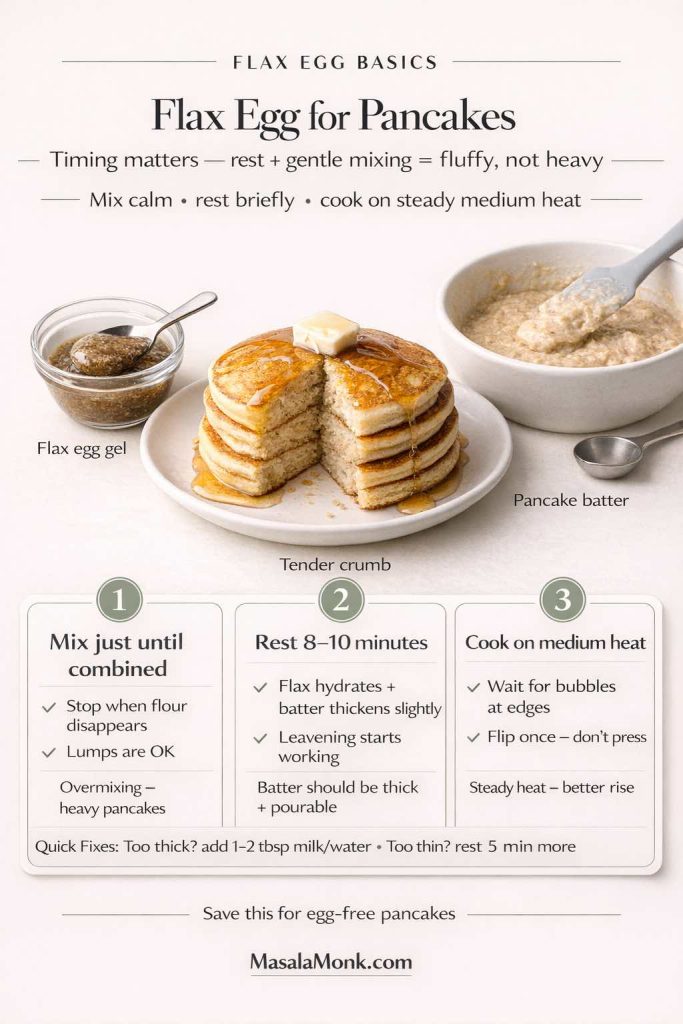
Vertical infographic titled “Flax Egg for Pancakes” with the subtitle “Timing matters — rest + gentle mixing = fluffy, not heavy.” It shows a bowl labeled “Flax egg gel,” a stack of pancakes with a slice removed labeled “Tender crumb,” and a bowl labeled “Pancake batter.” Three numbered cards say: 1) Mix just until combined (stop when flour disappears, lumps are OK; overmixing makes heavy pancakes). 2) Rest 8–10 minutes (flax hydrates and batter thickens slightly; leavening starts working; batter should be thick and pourable). 3) Cook on medium heat (wait for bubbles at edges; flip once, don’t press; steady heat gives better rise). Quick fixes note: too thick add 1–2 tbsp milk/water; too thin rest 5 minutes more. MasalaMonk.com footer.
Flax egg for pancakes works best when you treat it like a timing swap, not just an ingredient swap. Mix only until the flour disappears (lumps are fine), then rest the batter 8–10 minutes so the flax egg gel hydrates and the leavening starts working. Finally, cook on steady medium heat and flip once—no pressing—so you get a tender crumb that’s fluffy instead of heavy.

Once you’re comfortable swapping eggs in pancakes, it’s worth trying sturdier batters that benefit from extra binding. Millet-based pancakes, for instance, pair well with a flax egg because the gel helps the batter hold together while still cooking up tender. If you’d like a solid recipe to start with, make Healthy Millet Protein Packed Pancakes and replace the egg with a flax egg.

Flax eggs to real eggs (what to expect in texture)

Many people want flax eggs to behave exactly like eggs. Sometimes the match is close. Other times, the difference is obvious. Rather than promising perfection, it’s better to know what you’re trading.
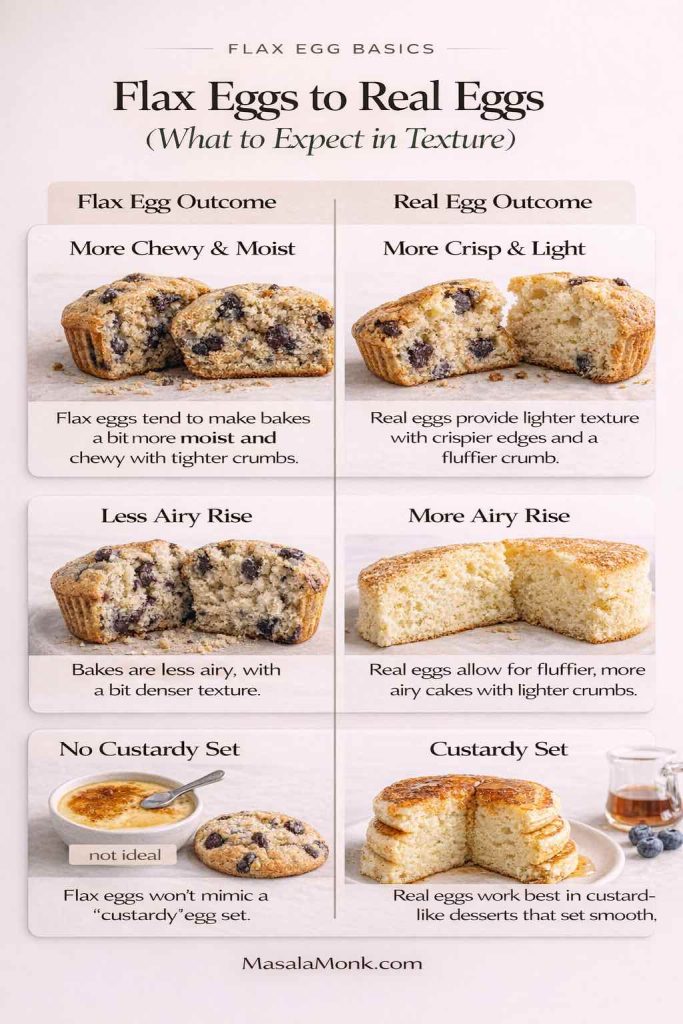
Photorealistic infographic titled “Flax Eggs to Real Eggs (What to Expect in Texture)” comparing baking results. Left column shows flax egg outcome: more chewy and moist, less airy rise, and no custardy set. Right column shows real egg outcome: more crisp and light, more airy rise, and custardy set. Includes photos of muffins, cake, and custard-style desserts plus MasalaMonk.com branding.
A flax egg substitute doesn’t bake exactly like a real egg—and that’s okay once you know what to expect. This texture guide shows the most common differences: flax eggs tend to create a slightly chewier, moister crumb with less airy rise, while real eggs give lighter lift and can create a custardy set in certain desserts.

In general:

  • Flax eggs tend to give a slightly more tender, moist crumb
  • They can produce a bit more density than eggs in airy bakes
  • They rarely create the same “egg set” feel you get in custardy textures

Therefore, the best results come from using flax eggs in recipes where eggs are primarily binders, not the backbone.

Also Read: 10 Vegetarian And High Protein Meal Prep Ideas from Indian Cuisine


Flax eggs with different flours (why results vary)

Even with the right flax egg ratio, flour choice can change the outcome. That’s because some flours absorb more water, while others rely on extra binders for structure.
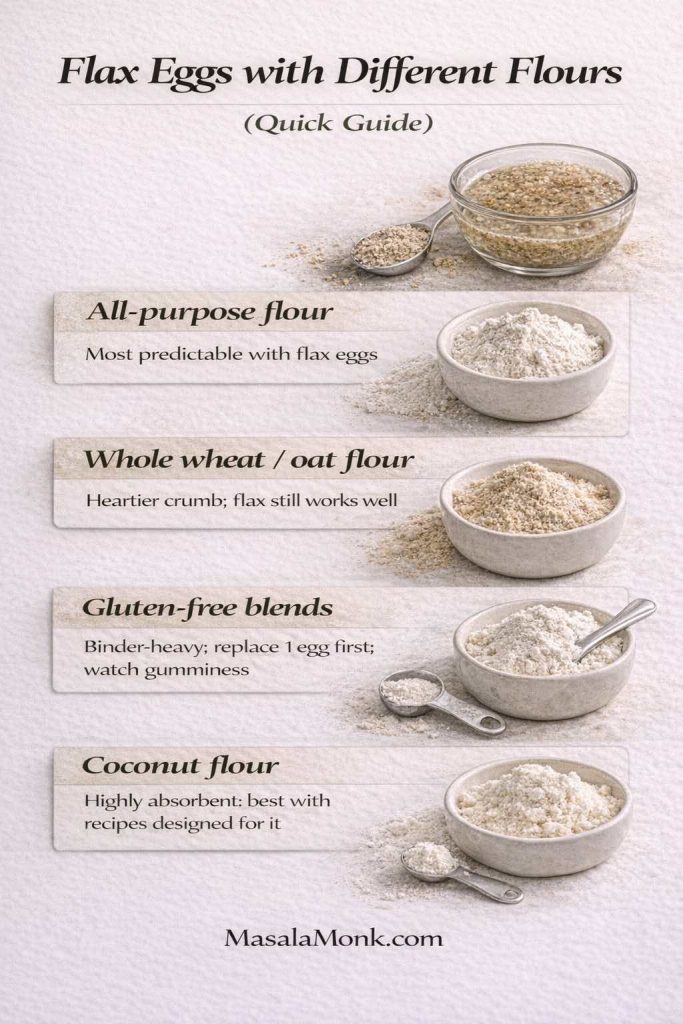
Photorealistic infographic titled “Flax Eggs with Different Flours (Quick Guide)” showing how flax eggs behave with common flours: all-purpose flour (most predictable), whole wheat or oat flour (heartier crumb), gluten-free blends (binder-heavy; replace 1 egg first and watch gumminess), and coconut flour (highly absorbent; best with recipes designed for it). Includes a bowl of flax egg gel and MasalaMonk.com branding.
Flax eggs don’t behave the same with every flour. Use this quick guide to choose the best flour match for a flax egg substitute—most predictable with all-purpose flour, a heartier crumb with whole wheat or oat flour, extra caution with binder-heavy gluten-free blends, and coconut flour only when the recipe is built for its high absorption.
  • All-purpose flour: Flax eggs are typically most predictable here, especially in cookies, muffins, and quick breads.
  • Whole wheat and oat flour: Expect a slightly heartier crumb. Flax usually still works well, yet you may notice a bit more density—especially if the recipe already leans “sturdy.”
  • Gluten-free blends: Many gluten-free mixes already include binders and starches. Adding flax can sometimes tip the texture toward heavier or a little gummy, so it’s smart to start by replacing only one egg and see how the batter behaves.
  • Coconut flour: This flour drinks liquid aggressively. A flax egg may not provide enough structure on its own, and the batter can swing from thick to dry quickly. For coconut-flour baking, you’ll usually get the best result from recipes designed specifically for that flour rather than trying a simple swap.

The takeaway is simple: when flours are highly absorbent or binder-heavy, flax eggs may need a lighter hand—or a recipe that’s already built for egg-free structure.

Also Read: Fish and Chips Reimagined: 5 Indian Twists (Recipe + Method)


Egg Substitute Ground Flaxseed: choosing the best flax meal (and why freshness matters)

A flax egg is easy, but the flax itself can make or break it.

Ground flax vs whole flax (and why it matters)

Ground flax hydrates quickly and forms the gel you need. Whole flax often doesn’t, at least not in a way that works as an egg replacer.

From a nutrition standpoint, Mayo Clinic recommends ground flax because it’s easier to digest; from a baking standpoint, ground flax is also what gives you reliable gelling. That point is covered succinctly in Flaxseed: Is ground better than whole?.

Storage is a real issue (because ground flax can go stale)

Ground flax has more exposed surface area, which means it can spoil faster than whole seeds. If your flax smells bitter, paint-like, or unpleasantly sharp, it’s not going to improve your cookies.
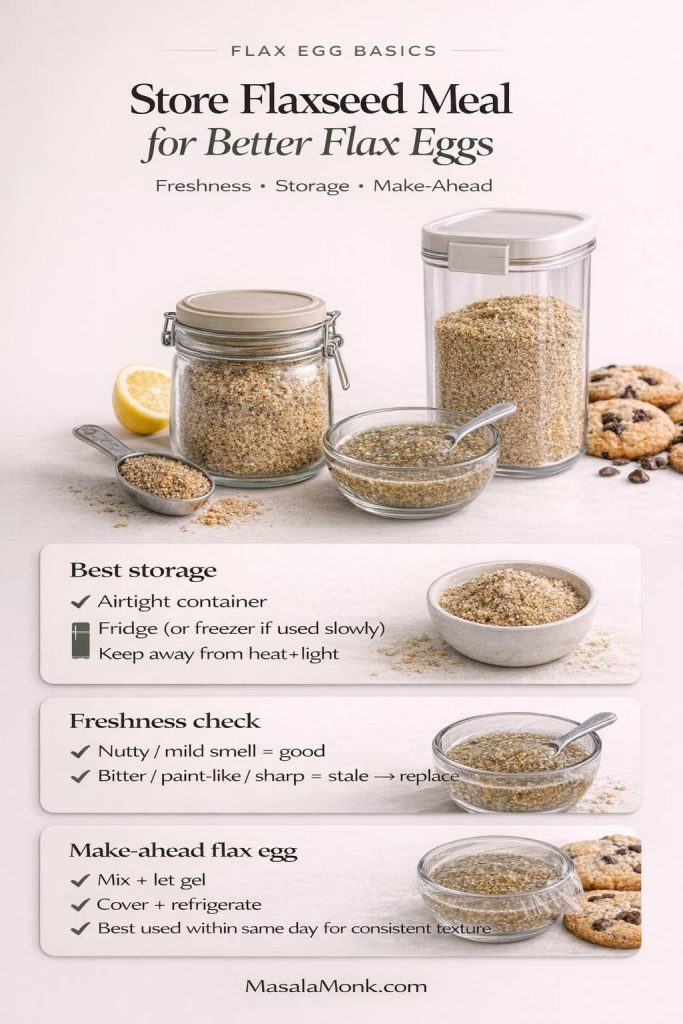
Photorealistic infographic titled “Store Flaxseed Meal for Better Flax Eggs” showing a jar and airtight container of ground flaxseed meal, a bowl of flax egg gel, measuring spoon, and cookies as a baking cue. It explains best storage (airtight container; fridge or freezer; keep away from heat and light), a freshness smell check (nutty/mild is good; bitter/paint-like/sharp means stale), and make-ahead flax egg tips (mix and let gel; cover and refrigerate; best used the same day). MasalaMonk.com branding.
Fresh flax makes a better flax egg substitute. Use this storage guide to keep ground flaxseed meal tasting clean and gelling reliably: store it airtight in the fridge (or freezer), use the quick smell test to spot stale flax, and if you prep a make-ahead flax egg, refrigerate it and use it the same day for the most consistent baking results—especially for cookies and quick breads.

Mayo Clinic Health System notes practical storage guidance for flaxseed meal—keeping it refrigerated in an airtight container to prevent spoiling—in Flaxseed is nutritionally powerful.

That’s not meant to scare you. It’s simply the difference between a flax egg that disappears into the bake and one that leaves a lingering bitter aftertaste.

Also Read: Dirty Martini Recipe (Classic, Extra Dirty, No Vermouth, Spicy, Blue Cheese, Tequila + Batched)


Flaxseed Egg Substitute Baking: why your results vary (and how to make them consistent)

If you’ve tried flax eggs once and felt underwhelmed, it usually comes down to one of three things:

  1. the flax didn’t gel properly
  2. the recipe needed lift rather than binding
  3. too many eggs were replaced in a recipe that depends on eggs for structure

Instead of guessing, you can diagnose your result and adjust.
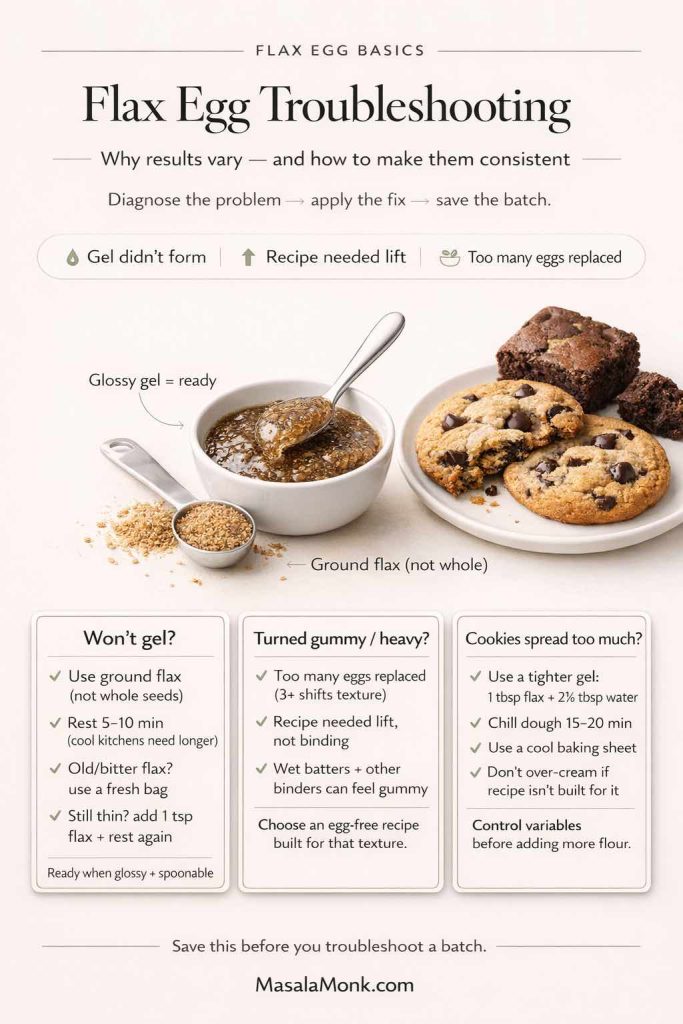
Vertical infographic titled “Flax Egg Troubleshooting: Why results vary — and how to make them consistent.” It shows a bowl of glossy flax egg gel with a spoon lift, a measuring spoon of ground flax labeled “Ground flax (not whole),” and a plate with cookies and brownie pieces. A strip lists three causes: gel didn’t form, recipe needed lift, too many eggs replaced. Three cards provide fixes: “Won’t gel?” (use ground flax, rest 5–10 min, use fresh flax, add 1 tsp flax and rest again), “Turned gummy/heavy?” (too many eggs replaced, recipe needed lift, wet batters/other binders), and “Cookies spread too much?” (tighter gel 1 tbsp flax + 2½ tbsp water, chill dough 15–20 min, cool baking sheet, don’t over-cream). Footer reads MasalaMonk.com.
If flaxseed egg substitute baking ever goes sideways, this cheat sheet saves the batch. First, confirm you’re using ground flax (not whole seeds) and wait for a glossy, spoonable gel. Next, match the fix to the problem: thin gel usually needs more time (or fresher flax), gummy/heavy bakes often mean you replaced too many eggs or the recipe needed lift, and spreading cookies usually improve with a tighter flax egg ratio plus a short chill. Save this as your quick “diagnose → fix” guide for flax eggs.

If your flax egg won’t gel

This is common, yet fixable.

  • If you used whole seeds, grind them and try again.
  • If your flax is old, try a fresher bag.
  • If you didn’t wait long enough, give it a few more minutes.
  • If it’s still thin, stir in a little extra ground flax and rest again.

Even with the same flax egg ratio, the gel can vary depending on how finely the flax is ground. A finer meal thickens faster, while a coarser grind may need a little extra time to hydrate. If you’d like another baked example where flax swaps in smoothly, see Wholewheat Carrot Orange Tea Cake.

If your bake turned gummy

Gumminess often happens when flax is asked to do too much—especially when replacing multiple eggs or when the recipe already has other gel-formers (certain gluten-free blends, heavy starches, or very wet batters).

At that point, switching strategies is often wiser than forcing the swap. King Arthur’s substitution guide is helpful because it gives you multiple options and also explains when egg substitutions simply won’t deliver the intended results. That perspective is in Guide for substituting eggs.

Eater’s pastry-chef framing adds another layer: sometimes recipe reformulation makes more sense than substitution, because you can adjust leavening, acid, and structure intentionally rather than trying to mimic an egg in a context where eggs do too much. That discussion is in Of course you can bake without eggs. Vegan pastry chefs tell us how.

If your cookies spread too much

When cookies spread, most people assume they need more flour. Occasionally that’s true, although it’s not the only solution.

Instead, try these gentle adjustments:

  • Use a slightly tighter flax gel (a bit less water)
  • Chill the dough briefly
  • Ensure your baking sheet isn’t warm
  • Don’t over-cream fat and sugar if the recipe isn’t built for it

In other words, control the variables that affect spread before you start changing the recipe’s foundation.

Also Read: Keto Hot Chocolate Recipe (Sugar-Free Hot Cocoa) + Best Homemade Mix


Vegan Egg Substitute Flaxseed: when flax is the right choice—and when it isn’t

Flax is a strong vegan egg substitute because it’s easy, cheap, and consistent when used appropriately. Still, it isn’t the universal answer.

When flax is a great vegan egg substitute

Choose flax when the recipe needs:

  • binding
  • moisture retention
  • gentle structure

That’s why flax eggs are so popular for cookies, muffins, pancakes, and brownies.
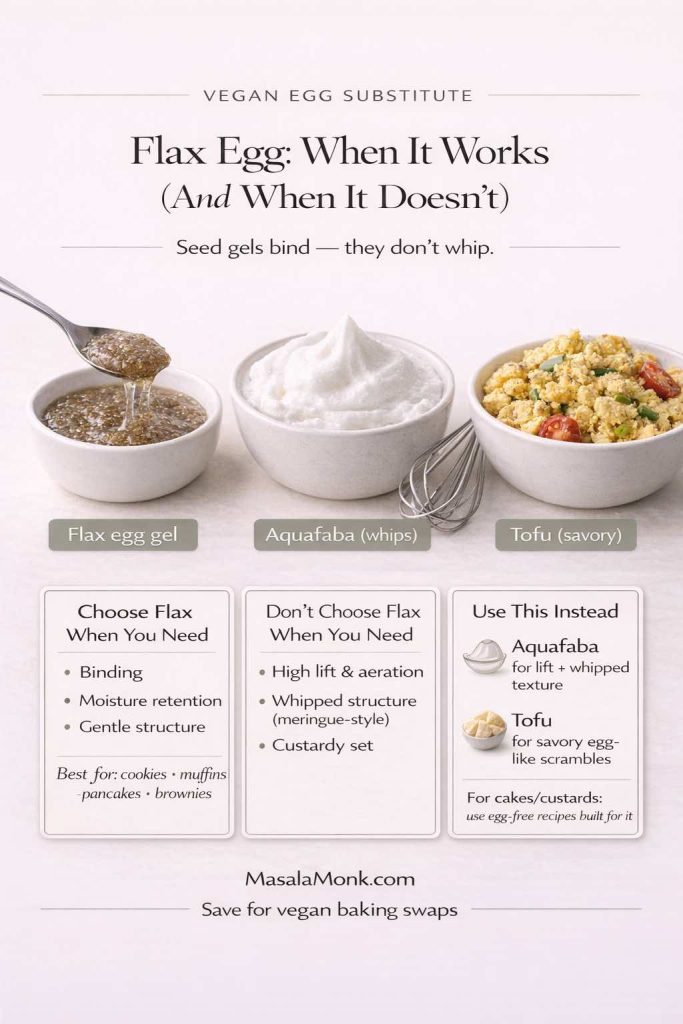
Vertical infographic titled “Flax Egg: When It Works (And When It Doesn’t)” with the line “Seed gels bind — they don’t whip.” It shows three labeled bowls: flax egg gel, aquafaba (whips), and tofu (savory). Three cards explain: choose flax for binding, moisture retention, and gentle structure (best for cookies, muffins, pancakes, brownies); don’t choose flax for high lift/aeration, whipped structure, or custardy set; use aquafaba for lift and whipped texture, and tofu for savory egg-like scrambles. MasalaMonk.com footer.
Wondering when a flax egg is the right vegan egg substitute? Save this quick decision guide: flaxseed “eggs” are best when you need binding and moisture (cookies, muffins, pancakes, brownies), but they won’t create lift or whipped structure. For airy bakes, aquafaba is usually the better choice; for savory breakfast swaps, tofu gives a more satisfying egg-like texture.

When you should use a different egg substitute

Choose something else when the recipe needs:

  • high lift and aeration
  • whipped structure (like meringues)
  • a custardy set

If you want a fast way to remember this: seed gels bind, but they don’t whip.

When a recipe needs lift—think lighter cakes or anything that benefits from a whipped, airy structure—a seed gel won’t deliver the same result. In those cases, aquafaba (the liquid from cooked chickpeas or a can of chickpeas) is often the better option because it can be whipped and folded in like egg whites.

Flax eggs shine in baking-style mixtures—batters, doughs, and quick breads. On the other hand, if you’re craving a savory breakfast where you’d normally scramble eggs, tofu is usually the better choice because it can be seasoned and cooked into a satisfying egg-like texture. If you want ideas that go beyond baking, start with ‘Tofu’ Instead of ‘Eggs’: 5 High Protein Plant-Based Breakfast Ideas.

Also Read: Garlic & Paprika Cabbage Rolls (Keto-Friendly Recipes) – 5 Bold Savory Twists


Substitute for Flax Egg (when you don’t have flaxseed)

Eventually, you’ll run into the exact opposite problem: you want to bake egg-free, but the flax jar is empty. Luckily, you have options.

A close cousin: chia seed “egg”

Chia works in a similar way to flax because it gels when hydrated. However, it can behave differently in texture, sometimes creating denser or crunchier results depending on the recipe.

Serious Eats’ testing found chia produced denser outcomes in certain bakes compared to flax, which is a useful heads-up if you’re aiming for a soft crumb. That comparison appears in Out of eggs? The best replacement might already be in your pantry.

If you keep chia seeds around as well, they’re useful far beyond baking—think meal prep puddings, overnight oats, and quick add-ins for smoothies. For simple ideas that make chia easy to use week to week, check out The Power of Chia Seeds: 5 Plant-Based High-Protein Meal Prep Ideas.
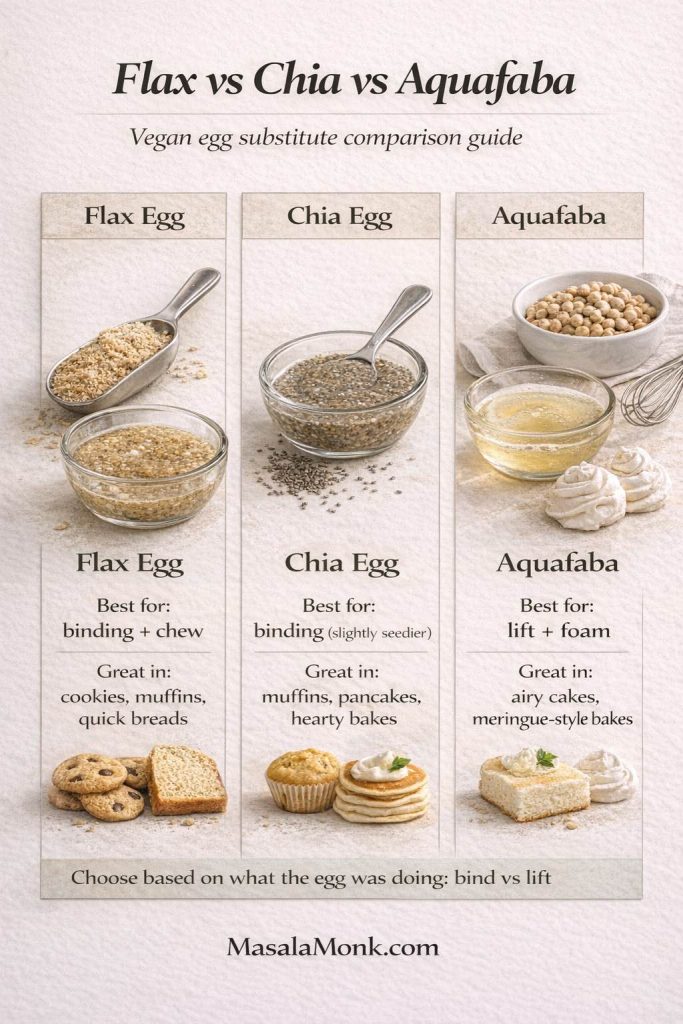
Photorealistic infographic titled “Flax vs Chia vs Aquafaba” comparing vegan egg substitutes. It shows flax egg as best for binding and chew (cookies, muffins, quick breads), chia egg as best for binding with a slightly seedier texture (muffins, pancakes, hearty bakes), and aquafaba as best for lift and foam (airy cakes, meringue-style bakes). Includes a reminder to choose based on whether the recipe needs binding or lift and MasalaMonk.com branding.
Not sure what to use when you’re out of eggs—or when flax isn’t the best fit? This quick vegan egg substitute guide compares flax egg, chia egg, and aquafaba so you can choose the right egg replacement for baking: flax and chia for binding, and aquafaba when you need lift and foam.

When you’re not trying to be “neutral”: fruit purées and other options

Sometimes you don’t need an egg substitute that disappears. Instead, you want moisture + softness, and you’re totally fine if the swap brings a little personality with it. That’s where fruit purées shine.

Quick rule of thumb: what fruit purées actually replace

Fruit purées are best when the egg’s job is mostly moisture and tenderness, not lift. In other words, they can help keep bakes soft and cohesive, yet they won’t give you the same airy structure eggs can.
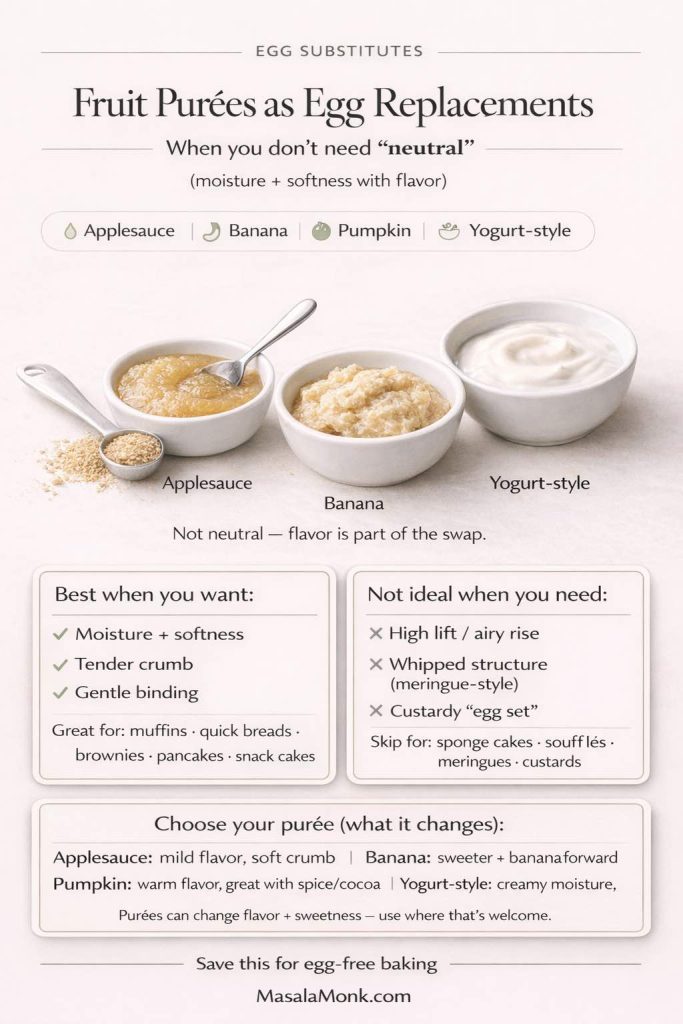
Fruit purées as egg replacements infographic showing applesauce, mashed banana, pumpkin purée, and yogurt-style substitute, plus when to use them for moisture and softness and when not to (lift, whipped structure, custardy set).
Out of eggs—or just not chasing “neutral”? This cheat-sheet shows when fruit purées make the best egg substitute (moisture + softness) and when they won’t work (lift, whipped structure, custardy set). Use it to choose between applesauce, banana, pumpkin purée, or a yogurt-style swap based on the bake you’re making.

Best picks (and what each one changes)

  • Applesauce: Mild flavor, adds moisture, keeps crumb tender. Great when you want the swap to stay relatively subtle.
  • Mashed banana: Stronger flavor and aroma, adds sweetness, can make bakes taste “banana-forward.” Use when that’s a plus.
  • Pumpkin purée: Moisture + gentle structure with a warm, earthy flavor. Works beautifully with spices, cocoa, and autumn-style bakes.
  • Yogurt-style substitutes: Creamy moisture and richness; tends to keep cakes and muffins soft. (If you’re keeping it vegan, use plant-based yogurt.)

Where they work best

Because they change flavor and sweetness, fruit purées are most reliable in bakes that welcome that shift: muffins, snack cakes, quick breads, brownies, pancakes, and spiced loaves.

On the other hand, if a recipe is meant to be light and airy—or the egg is doing major structure work—these swaps can turn the texture heavier than you wanted. In that case, flax egg, aquafaba, or an egg-free recipe designed for the result will usually be a better fit.

A practical alternative mindset: different substitutes for different “egg jobs”

Not every egg substitute behaves the same, so the best choice depends on the texture you’re trying to get. Sometimes they bind; other times they add moisture, help with lift, or create structure. That’s why one substitute can work beautifully in cookies yet fall flat in a sponge cake. If you like this recipe-by-recipe approach, Eater’s guide from vegan pastry chefs breaks down how to choose an egg substitute based on what the recipe actually needs.

How to Replace Egg With Flax (recipe-by-recipe instincts)

By now you know the method. Next, you want confidence. This section is about building instincts so you can look at a recipe and know whether flax is likely to work.

Cookies: usually yes

If the recipe calls for one egg in a batch of cookies, flax is usually a safe bet. If it calls for multiple eggs, you can still try, but your texture may drift more.

For a cookie recipe that’s easy to adapt, try Double Chocolate Chip Cookies Recipe – One Dough, 7 Ways. It’s a great place to swap in a flax egg because the dough is sturdy, forgiving, and designed for variations—so you can focus on texture and bake time without stressing about the structure.
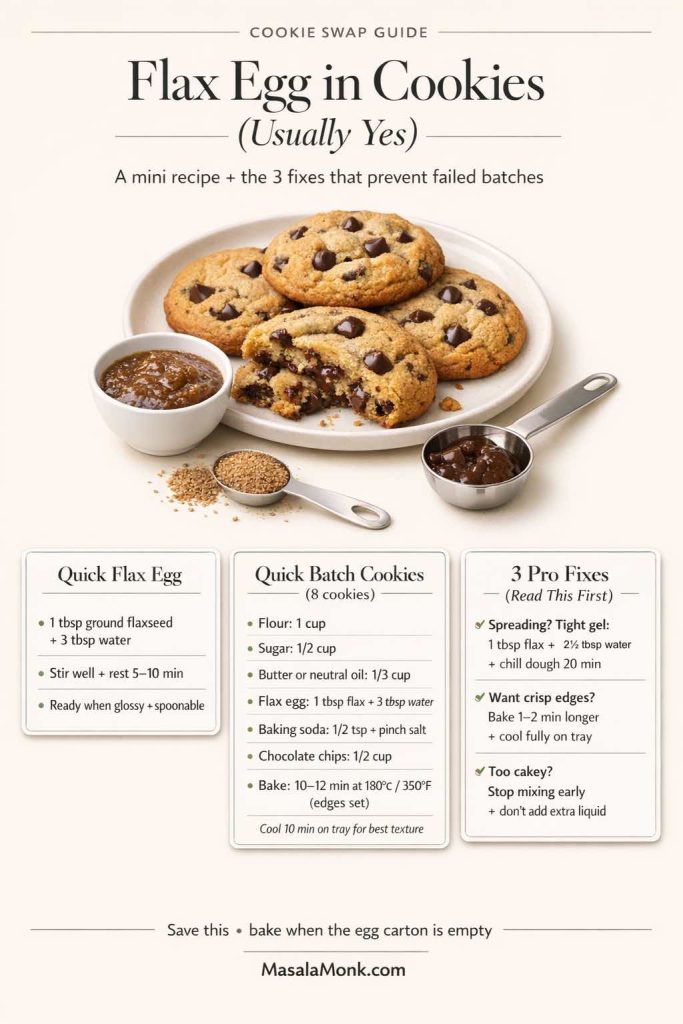
Vertical “Cookie Swap Guide” infographic titled “Flax Egg in Cookies (Usually Yes)” with photorealistic chocolate chip cookies, a bowl of flax gel, and measuring spoons. It includes: Quick Flax Egg (1 tbsp ground flaxseed + 3 tbsp water; rest 5–10 minutes), Quick Batch Cookies recipe for 8 cookies (flour 1 cup, sugar 1/2 cup, butter/oil 1/3 cup, baking soda 1/2 tsp + salt, chips 1/2 cup; bake 10–12 min at 180°C/350°F), and 3 pro fixes for spreading, crisp edges, and cakey cookies. MasalaMonk.com footer.
This cookie swap guide makes baking with a flax egg simple: use the classic flax egg ratio (1 tbsp ground flaxseed + 3 tbsp water), then follow the quick 8-cookie mini recipe and the three pro fixes for common problems—spreading dough, soft cookies, or a cakey texture. Save it for the next time you need an egg substitute for cookies.

Muffins and quick breads: often yes

These bakes are where flax eggs feel effortless—especially when replacing one or two eggs. Because the recipe already contains baking powder or baking soda, you’re not depending on eggs for lift.
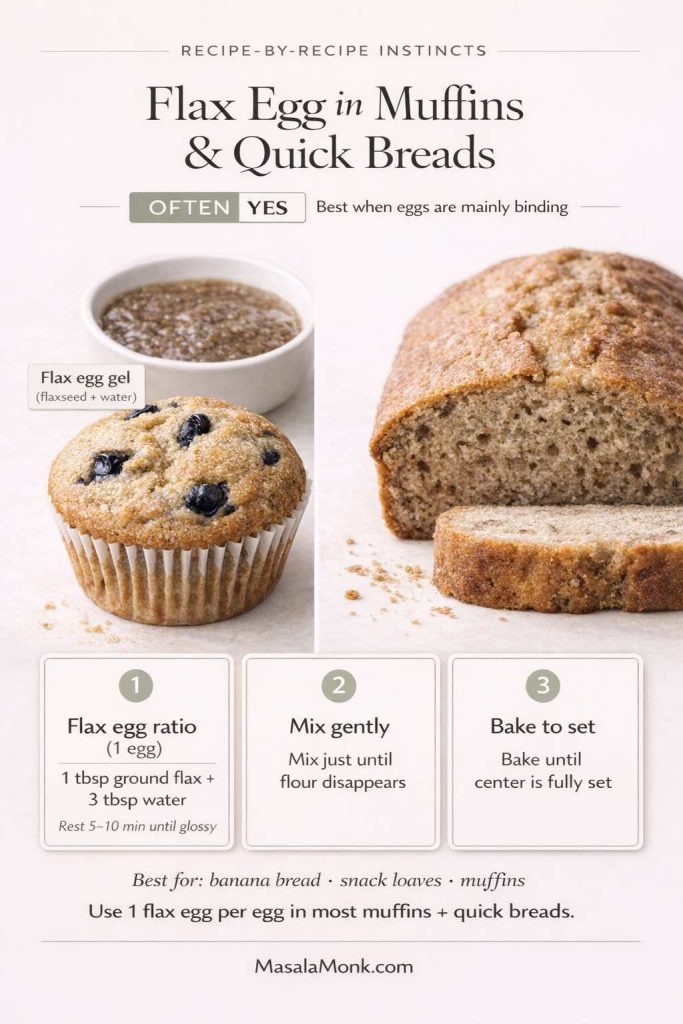
Vertical infographic titled “Flax Egg in Muffins & Quick Breads” labeled “Often Yes” with photoreal images of a blueberry muffin, sliced quick bread, and a bowl labeled “Flax egg gel (flaxseed + water).” It lists the flax egg ratio for 1 egg (1 tbsp ground flax + 3 tbsp water; rest 5–10 minutes until glossy), plus tips to mix gently until flour disappears and bake until the center is fully set. It notes best uses (banana bread, snack loaves, muffins) and says to use 1 flax egg per egg in most muffins and quick breads. MasalaMonk.com footer.
This “often yes” guide makes it easy to use a flax egg in muffins and quick breads. Follow the classic flax egg ratio (1 tbsp ground flaxseed + 3 tbsp water, rest until glossy), then mix gently and bake until the center is fully set. It’s a reliable egg substitute for banana bread, snack loaves, and muffins when eggs are mainly binding—not the main source of lift.

Pancakes: frequently yes, but mixing matters

Pancakes can be forgiving, although they’re sensitive to overmixing and batter thickness. If your pancakes feel heavy, rest the batter briefly and cook on steady heat.
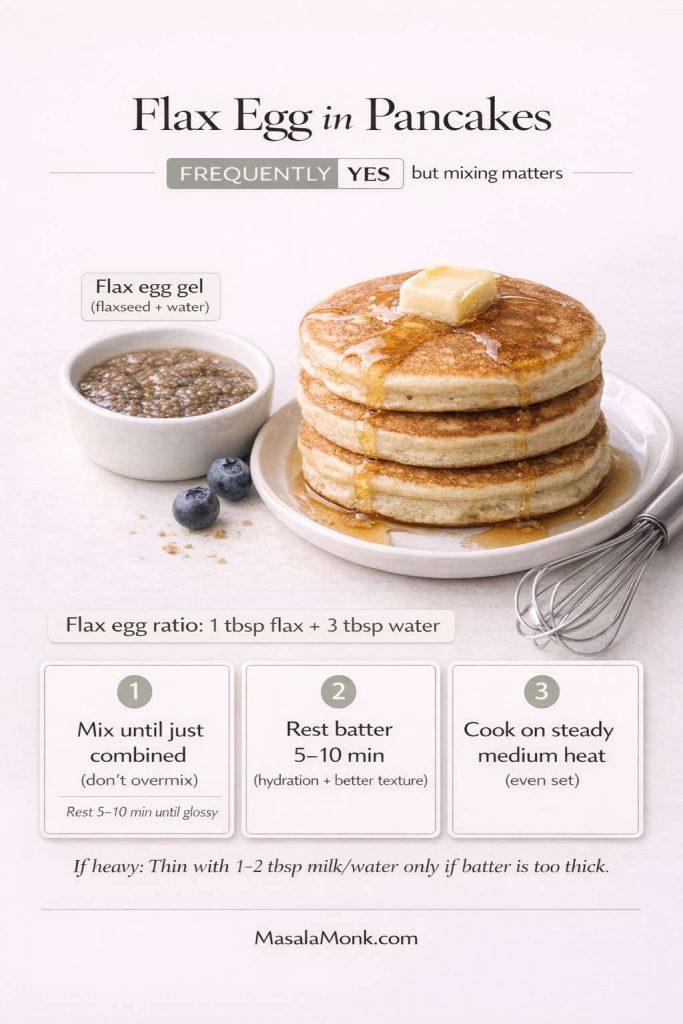
Vertical infographic titled “Flax Egg in Pancakes” with a “Frequently Yes” label and photoreal stack of pancakes with butter and syrup. A bowl labeled “Flax egg gel (flaxseed + water)” sits beside the pancakes. The graphic lists the flax egg ratio (1 tbsp flax + 3 tbsp water) and three tips: mix until just combined (don’t overmix), rest batter 5–10 minutes for hydration and better texture, and cook on steady medium heat for an even set. It adds: if heavy, thin with 1–2 tbsp milk/water only if batter is too thick. MasalaMonk.com branding.
This flax egg pancake guide makes the swap easy: use the classic flax egg ratio (1 tbsp ground flaxseed + 3 tbsp water), then keep the batter gentle—mix just until combined, rest 5–10 minutes for better texture, and cook on steady medium heat for an even set. If pancakes feel heavy, thin the batter only slightly if it’s truly too thick.

If you want to try the flax-egg swap in a sturdier batter, Healthy Millet Protein Packed Pancakes is a satisfying option—the flax gel helps the pancakes hold together while keeping the inside tender.

Egg-heavy bakes: proceed carefully

Soufflés, quiche-like bakes, or anything where eggs are the main structure will not behave like the original with flax. This is exactly the limitation King Arthur points out in Guide for substituting eggs.

Vertical infographic titled “Can You Use a Flax Egg Here? (Quick Ranking)” with three sections: YES (Best) listing cookies, muffins/quick breads, pancakes, and brownies; MAYBE (Depends) listing moist snack cakes, waffles, and some brownies (1–2 eggs max); and NO (Avoid) listing sponge cake, soufflé, meringue, custards, and quiche-like bakes, noting “eggs are the structure.” Includes photoreal food images for each category and MasalaMonk.com branding.
Not every recipe wants the same thing from an egg. Use this flax egg ranking guide to choose the right swap fast: flax eggs work best as a binder in cookies, muffins/quick breads, pancakes, and brownies; they’re “maybe” for some moist cakes and waffles; and they’re not a good match for egg-structured bakes like sponge cake, soufflé, meringue, custards, or quiche-style recipes.

Instead of forcing a flax swap, choose an egg-free recipe that’s built for that texture.

Also Read: Crock Pot Chicken Breast Recipes: 10 Easy Slow Cooker Dinners (Juicy Every Time)


Flax meal as egg substitute: small upgrades that make a big difference

A flax egg is already simple. Still, a few small upgrades can make it more consistent, especially if you bake egg-free regularly.
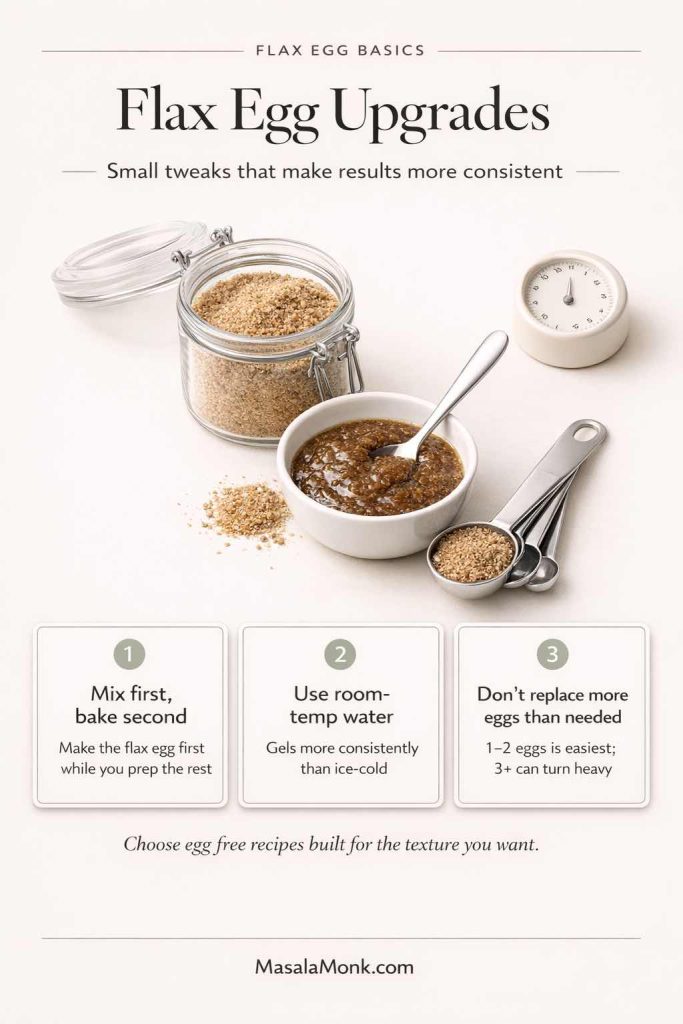
Vertical infographic titled “Flax Egg Upgrades” showing a jar of ground flaxseed meal, a bowl of flax egg gel with a spoon, a timer, and measuring spoons on a clean background. Three tip cards explain: mix the flax egg first while prepping ingredients, use room-temperature water so it gels consistently, and don’t replace more eggs than needed (1–2 eggs is easiest; 3+ can turn heavy). Includes the reminder “Choose egg-free recipes built for the texture you want” and MasalaMonk.com branding.
These flax egg upgrades make baking with flax eggs more consistent: mix the flax egg first (so it has time to gel), use room-temperature water for a reliable set, and avoid replacing too many eggs in egg-heavy recipes. When you need a dependable egg substitute, these small tweaks help your muffins, quick breads, pancakes, and cookies turn out closer to what you expect.

Mix flax eggs first, then start your recipe

This is the easiest improvement. Make your flax and water mixture, stir, then set it aside. While it gels, measure your dry ingredients, prep your pan, and set up your mixing bowl.

By the time you’re ready to mix, the flax egg will be ready too. As a result, you’re not rushing or guessing.

Use room-temperature water (or at least not ice-cold)

Cold water can slow down gelling. Room-temperature water helps the gel form more consistently.

Don’t replace more eggs than you need to

If your goal is to avoid eggs entirely, flax eggs can get you far. Still, replacing three or four eggs in a recipe designed around eggs can lead to dense results. At that point, switching to a recipe designed to be egg-free is often the cleaner path.

Sometimes the best move is choosing an egg-free recipe built for the texture you want rather than forcing a swap into a formula that depends heavily on eggs. If you like this recipe-first approach, Eater’s guide explains why it often works better.

Also Read: Eggless Yorkshire Pudding (No Milk) Recipe


A short detour: flax beyond baking (because many people use it both ways)

Interestingly, ground flax tends to earn a permanent spot in the kitchen once you start baking with it. Beyond flax eggs, you can stir a spoonful into oats, blend it into smoothies, or mix it into yogurt bowls for an easy boost—without changing the flavor much. If you’d like more everyday ideas, Benefits of Flax Seeds and How to Incorporate Them into the Indian Diet walks through simple, practical ways to use flax regularly. Also, if you’re aiming for meals that are higher in protein and fiber, flax fits nicely into that routine too—How Does a High Protein, High Fiber Diet Support Weight Loss? explains why that combination can be helpful and where ingredients like seeds come in.


Troubleshooting: common flax egg problems and fixes

Even good bakers occasionally get weird results with flax eggs. Fortunately, the fixes are usually simple.

“My flax egg didn’t thicken”

Start with the obvious:

  • Was the flax ground?
  • Was it fresh enough to smell pleasantly nutty?
  • Did it sit long enough?
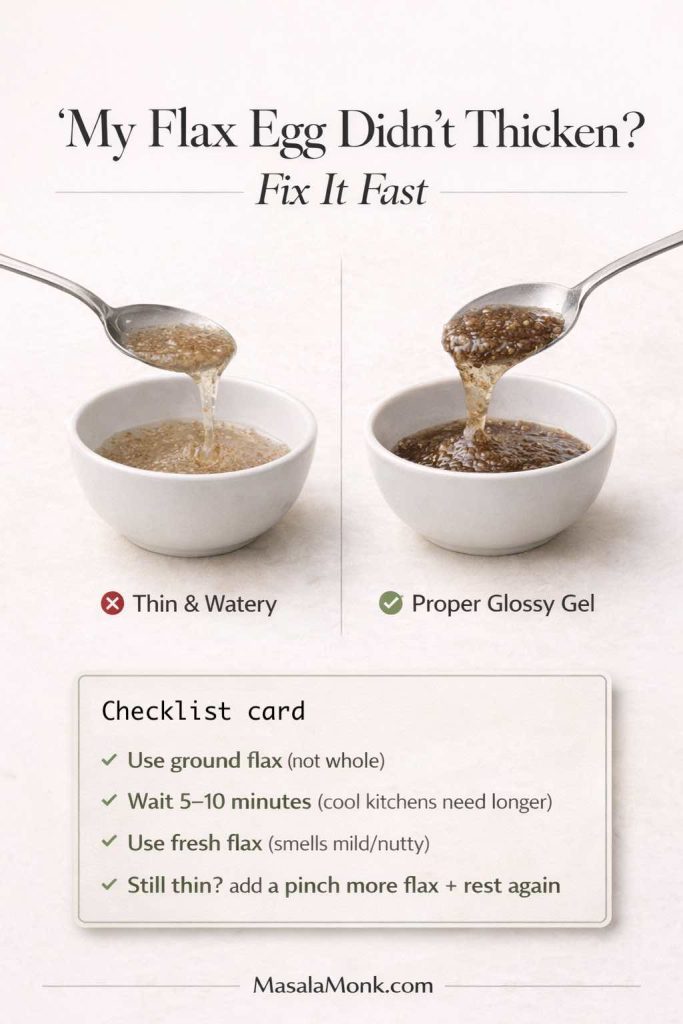
Vertical troubleshooting infographic titled “My Flax Egg Didn’t Thicken? Fix It Fast” showing a side-by-side comparison of a thin, watery flax and water mixture versus a proper glossy flax egg gel. A checklist explains quick fixes: use ground flax (not whole), wait 5–10 minutes, use fresh flax that smells mild/nutty, and if still thin add a pinch more flax and rest again. MasalaMonk.com branding.
If your flax egg won’t gel, you don’t need to scrap the bake—use this quick troubleshooting checklist. It shows the texture you’re aiming for (glossy, spoonable gel) and the fastest fixes: ground flaxseed, enough rest time, fresh flax meal, and a small pinch more flax if the mixture stays thin.

If everything looks right and it still seems thin, stir again and wait a little longer. If it remains watery, add a small pinch more flax meal and rest again.

Even when you follow the standard flax egg ratio, the gel can vary depending on how finely the flax is ground. A finer meal thickens faster, whereas a coarser grind may need a little more time to hydrate fully. For another egg-swap example that uses flax in a baked recipe, see Wholewheat Carrot Orange Tea Cake.

“My bake turned dense”

Density usually means the recipe needed lift, or the eggs were doing more structure work than flax can replicate.
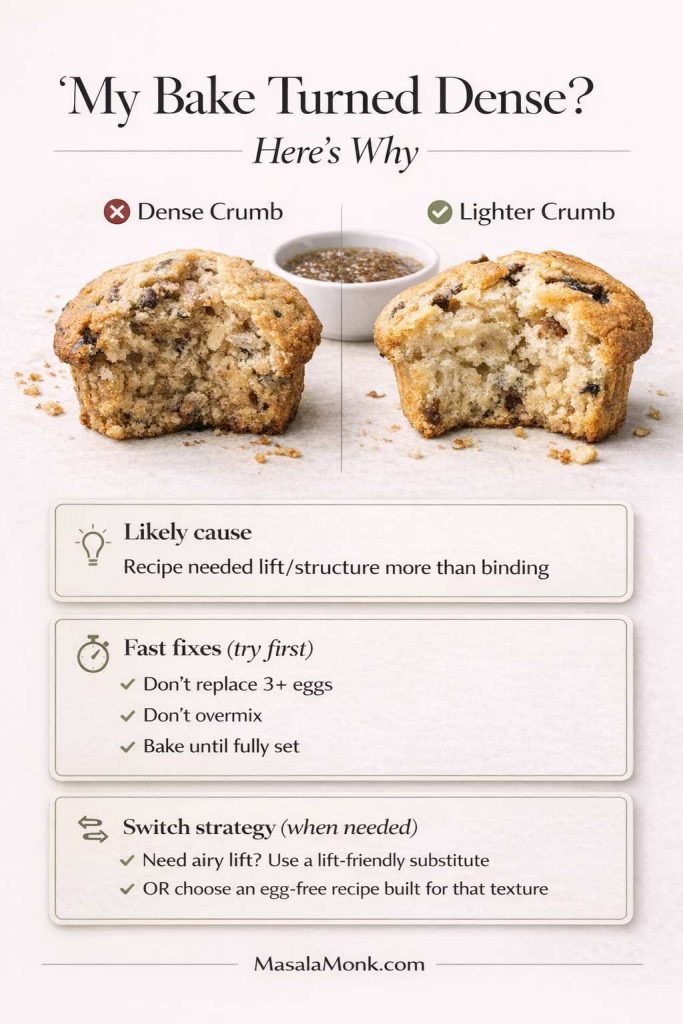
Vertical infographic titled “My Bake Turned Dense? Here’s Why” showing a comparison of dense crumb versus lighter crumb muffins, with a bowl of flax gel in the background. It explains the likely cause: the recipe needed lift/structure more than binding. It lists fast fixes: don’t replace 3+ eggs, don’t overmix, and bake until fully set. It also suggests switching strategy when needed by using a lift-friendly substitute or choosing an egg-free recipe designed for that texture. MasalaMonk.com branding.
If your flax egg bake turned out dense, the problem is usually lift—not the flax egg ratio. This troubleshooting guide shows what’s happening (the recipe needed more structure than a binder can provide), the three fastest fixes (avoid replacing 3+ eggs, don’t overmix, bake until fully set), and when it’s smarter to switch to a lift-friendly substitute or an egg-free recipe built for a lighter crumb.

In that case, your best move is to choose a different substitute based on what the bake needs. King Arthur’s guide is useful for this because it outlines multiple options and also explains the limits of substitutions in egg-forward bakes. That’s in Guide for substituting eggs.

“My muffins are sinking”

If your muffins rise, then collapse as they cool, it’s usually not the flax egg alone. More often, the batter was either too wet or overmixed, so it couldn’t hold the structure once steam escaped.
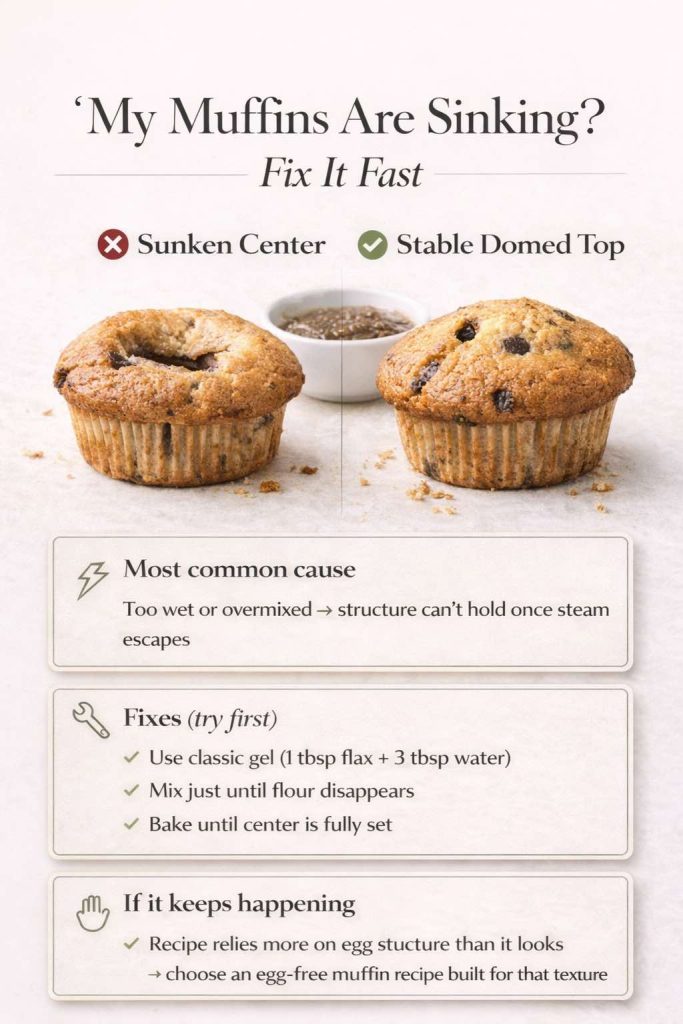
Vertical troubleshooting infographic titled “My Muffins Are Sinking? Fix It Fast” showing a side-by-side comparison of a muffin with a sunken center versus a stable domed top, with a bowl of flax gel behind. It explains the most common cause (too wet or overmixed so the structure can’t hold once steam escapes) and lists fixes: use the classic flax gel (1 tbsp ground flaxseed + 3 tbsp water), mix only until flour disappears, and bake until the center is fully set. It adds that repeated sinking can mean the recipe relies on egg structure and an egg-free muffin recipe may work better. MasalaMonk.com branding.
If your flax-egg muffins rise and then collapse, it’s usually a batter and bake issue—not the flax egg itself. Use this quick fix guide: stick to the classic flax egg ratio, mix only until the flour disappears, and bake until the center is truly set. If sinking keeps happening, the recipe may rely more on egg structure than it seems, so an egg-free muffin recipe built for that texture can be the smarter move.

Start with these fixes:

  • Use the classic gel (1 tablespoon flax + 3 tablespoons water) instead of a looser mix, especially for fruity or very moist batters.
  • Mix only until the flour disappears—overmixing makes muffins tunnel and weaken.
  • Bake until the center is truly set. If the tops look done but the middles feel soft, give them a few more minutes; flax-based batters often need that “fully set” finish.

If sinking keeps happening, it’s a sign the recipe depends more on egg structure than it seems. In that case, an egg-free muffin recipe (built for the texture) often performs better than forcing a swap.

“My cookies came out soft when I wanted crisp”

Flax tends to hold moisture. So, rather than blaming the flax, adjust the cookie strategy:

  • bake a little longer (without burning)
  • cool fully on the tray before moving
  • aim for cookie recipes designed for crispness if that’s your priority

Vertical troubleshooting infographic titled “My Cookies Came Out Soft When I Wanted Crisp” showing two cookie textures labeled Soft/Chewy and Crisper, with a bowl of flax gel in the background. A ranked checklist says: (1) bake 1–2 minutes longer and cool fully on the tray, (2) control moisture by using a tighter flax gel if needed and not adding extra liquid, and (3) choose a crisp-style cookie recipe for ultra-crisp results. MasalaMonk.com branding.
Flax eggs hold moisture, so egg-free cookies often lean chewy unless you manage bake time and cooling. Use this step-by-step crispness fix guide: bake 1–2 minutes longer, cool fully on the tray, control moisture with a tighter flax gel (if needed), and choose crisp-style cookie recipes when you want true crunch.

If crispness is a must, you can still bake egg-free; it just may not be flax’s strongest lane.

“My cookies are too cakey”

Cakey cookies are usually a moisture-and-mix issue. Flax holds moisture, so if the dough is already soft, the final texture can tilt more “puffy” than “chewy.”

Vertical troubleshooting infographic titled “My Cookies Are Too Cakey” comparing a puffy/cakey cookie versus a flatter, chewier cookie. It provides a ranked fix list: (1) use a tighter flax gel by reducing water slightly, (2) chill the dough so it spreads predictably and bakes denser, and (3) stop mixing early to avoid a cake-like crumb. A note adds: if aiming for crisp cookies, use crisp-style recipes. MasalaMonk.com branding.
If your flax-egg cookies are turning puffy and cakey, it’s usually a moisture + mixing issue. Use this quick fix order: tighten the flax gel (slightly less water), chill the dough for more predictable spread, and stop mixing as soon as everything comes together. You’ll get a denser, chewier cookie texture without rewriting the whole recipe.

Try these small changes before you rewrite the recipe:

  • Use a slightly tighter flax gel (a little less water) so you’re not adding extra moisture.
  • Chill the dough briefly; colder dough spreads more predictably and bakes up denser rather than cakey.
  • Stop mixing as soon as everything comes together—overmixing encourages a more cake-like crumb.

If you’re aiming for crisp cookies, flax can still work, but it’s easier with cookie styles that are already designed for crispness rather than softness.

“The flavor feels off”

To keep flax meal tasting fresh, store it airtight in the fridge (or freezer if you use it slowly). Mayo Clinic Health System covers simple storage tips in Flaxseed is nutritionally powerful.
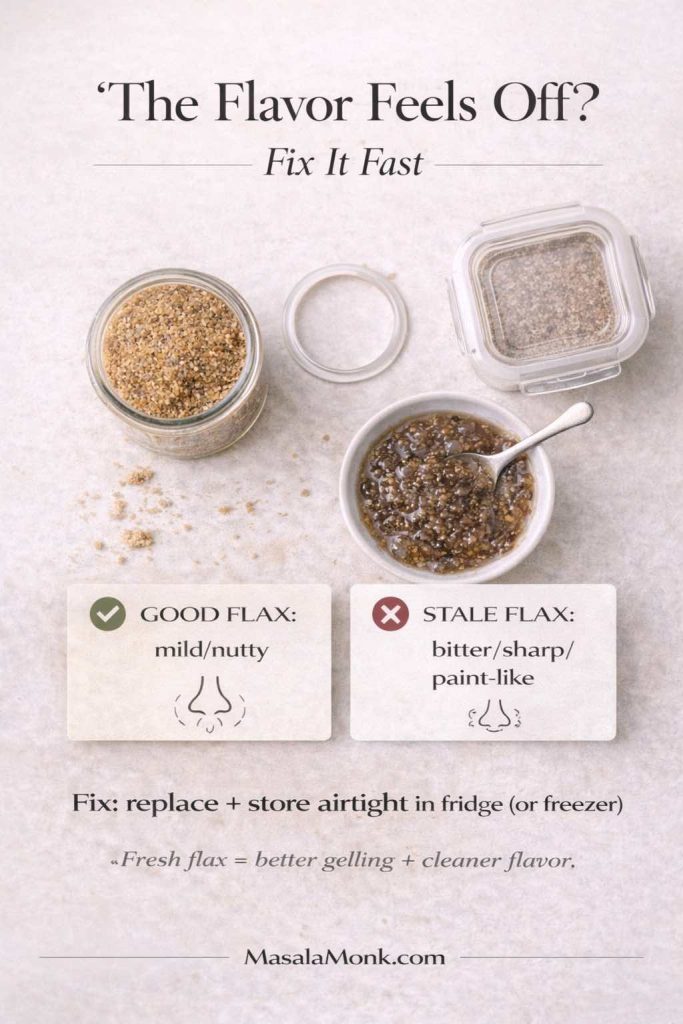
Vertical troubleshooting infographic titled “The Flavor Feels Off? Fix It Fast” showing a jar of ground flaxseed meal, a bowl of flax gel with a spoon, and an airtight container on a light background. It explains a quick smell test: GOOD flax smells mild/nutty, while STALE flax smells bitter/sharp/paint-like. It advises to replace stale flax and store flax meal airtight in the fridge or freezer for cleaner flavor and better gelling. MasalaMonk.com branding.
If your flax egg tastes bitter or “off,” it’s usually stale flaxseed meal. Use this quick smell test: fresh flax smells mild and nutty, while stale flax can smell sharp or paint-like. The fix is simple—replace the flax and store flax meal airtight in the fridge (or freezer) so your flax egg gels better and your baking tastes clean.

Sometimes, the fix is simply buying a fresh bag.

Also Read: Sourdough Starter Recipe: Make, Feed, Store & Fix Your Starter (Beginner Guide)


Bringing it all together: a simple, confident flax egg approach

If you want one clean routine you can follow every time, do this:

  1. Use ground flaxseed (flax meal)
  2. Mix 1 tablespoon flax meal with 3 tablespoons water for one egg
  3. Rest 5–10 minutes until gel-like
  4. Use it as your egg replacement in batter-based baking

Then, as you gain confidence, add the two “pro instincts”:

  • If the batter is already very loose, use a slightly tighter gel
  • If the recipe relies heavily on eggs for lift or structure, choose a different substitute or an egg-free recipe

That’s it. No drama, no panic, no wasted batch.

If you want flax eggs to feel effortless, use them in recipes you’ll repeat. Cookies are a straightforward place to begin—try Double Chocolate Chip Cookies Recipe – One Dough, 7 Ways for an easy batch that welcomes substitutions. For everyday, non-baking ways to use ground flax, Benefits of Flax Seeds and How to Incorporate Them into the Indian Diet is full of practical ideas. Then, whenever you want a savory, egg-free breakfast, ‘Tofu’ Instead of ‘Eggs’: 5 High Protein Plant-Based Breakfast Ideas is a great option.

Once you bake with flax eggs a few times, it stops feeling like a workaround. Instead, it just becomes another dependable method—one you can reach for whenever you need an egg substitute, whether it’s a single egg replacement or a batch conversion for two eggs or three.

Also Read: 19 Essential Kitchen Tools That Make Cooking Easier
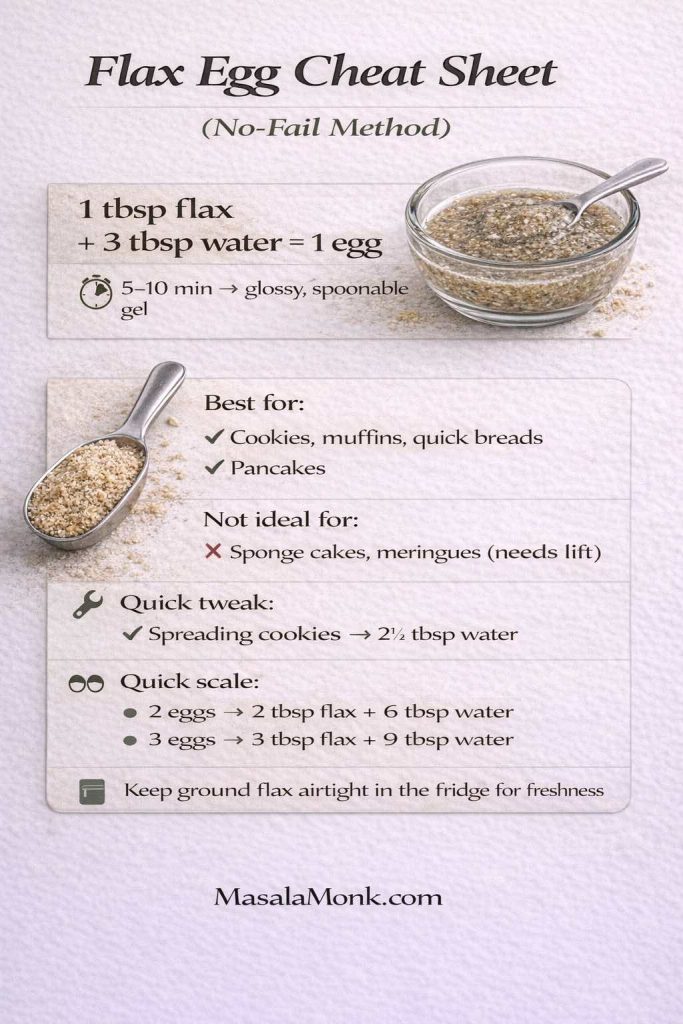
Photorealistic infographic titled “Flax Egg Cheat Sheet (No-Fail Method)” showing the flax egg ratio: 1 tablespoon ground flaxseed plus 3 tablespoons water equals 1 egg, resting 5–10 minutes until a glossy, spoonable gel. It lists best uses (cookies, muffins, quick breads, pancakes), not-ideal uses (sponge cakes, meringues), a cookie spread tweak (2½ tbsp water), quick scale for 2 and 3 eggs, and a storage tip to keep ground flax airtight in the fridge. MasalaMonk.com branding.
Save this flax egg cheat sheet for fast, consistent baking: use the classic flax egg ratio (1 tbsp ground flaxseed + 3 tbsp water), let it gel until glossy and spoonable, then scale for 2–3 eggs when needed. It also shows where a flax egg substitute works best (cookies, muffins, quick breads, pancakes), when to avoid it for lift-heavy bakes, and a quick tweak if cookie dough spreads too much.

FAQs

1) How do I make a flax egg?

Combine 1 tablespoon ground flaxseed (flax meal) with 3 tablespoons water, stir well, and let it sit until it thickens into a gel—usually 5 to 10 minutes. Once it looks glossy and spoonable, use it right away as your egg replacement in baking.

2) How to make a flax egg with ground flaxseed (step-by-step)?

First, add ground flaxseed to a small bowl. Next, pour in water and whisk until no dry pockets remain. Then, rest the mixture briefly so it can gel. Finally, stir once more and add it to your batter where the egg would normally go.

3) What is the flax egg ratio for 1 egg?

The most common flax egg ratio for 1 egg is 1 tablespoon ground flaxseed to 3 tablespoons water. That’s the standard flax seed to egg ratio most bakers use for muffins, quick breads, pancakes, and many cookie recipes.

4) What is the flax egg ratio for 2 eggs?

For two eggs, double the base ratio: 2 tablespoons ground flaxseed plus 6 tablespoons water. After mixing, allow enough time for the gel to develop before adding it to the bowl with your other wet ingredients.

5) How do I make 3 flax eggs (or more) for a bigger batch?

Scale the flaxseed meal to egg conversion by multiplying the standard ratio. In other words, for three eggs, use 3 tablespoons ground flaxseed with 9 tablespoons water. For larger batches, mix thoroughly and give it a slightly longer rest so the gel thickens evenly.

6) How much flaxseed for egg substitute in baking if I’m using flax meal?

Use 1 tablespoon flax meal per egg, paired with 3 tablespoons water. Even so, if your batter is already very loose, slightly less water can help the texture stay balanced rather than overly soft.

7) Can I use whole flax seeds instead of ground flaxseed for an egg substitute?

Whole seeds usually don’t gel the same way because the water can’t fully hydrate the interior. Therefore, for the most reliable flaxseed egg replacement, use ground flaxseed or flax meal, not whole seeds.

8) My flax egg won’t gel—what should I do?

Start by waiting a few extra minutes, because some flax takes longer to hydrate. If it still looks watery, stir again and add a small pinch more ground flaxseed, then rest it a second time. Additionally, very old flax meal can perform poorly, so freshness matters more than people expect.

9) Can I make a flax egg ahead of time?

Yes, you can make a flax egg shortly ahead—often 30 to 60 minutes is fine—then cover and refrigerate it. However, for best consistency, many bakers prefer mixing it fresh right before baking, since the gel can thicken more as it sits.

10) How do I use flaxseed instead of eggs in recipes—do I add it with wet or dry ingredients?

Typically, add the prepared flax and water mixture with the wet ingredients. That way, it disperses smoothly and doesn’t clump. Meanwhile, keep the dry mix unchanged unless your batter looks noticeably too thick or too thin once everything is combined.

11) Is flaxseed meal to egg conversion always a 1:1 swap?

It’s a 1:1 swap in quantity (one flax egg replaces one egg), yet it’s not always a perfect swap in function. Since flax acts mainly as a binder and moisture holder, it works best when eggs aren’t the primary source of lift or structure.

12) When is a flax egg substitute for baking the best choice?

Flax eggs usually work best in cookies, brownies, muffins, quick breads, pancakes, and waffles—basically, recipes where binding matters more than a lofty rise. As a result, they’re a favorite vegan egg substitute for everyday baking.

13) Does a flax egg work for cookies?

Yes, a flax egg for cookies is often a strong match, especially for chewy styles. Still, if you want a very crisp cookie, you may need to tweak bake time or choose a cookie recipe designed to crisp up without relying on eggs.

14) Can I use flaxseed instead of eggs in cakes?

Sometimes, yes—particularly in moist, oil-based cakes and snack cakes. Nonetheless, in very airy sponge-style cakes, eggs provide lift that flax can’t replicate, so the result may be denser than the original.

15) What’s the difference between ground flax as egg substitute and chia as egg substitute?

Both form a gel with water, so both can replace eggs as binders. However, chia can feel slightly more “seedy” in texture depending on grind and soak time, whereas flax meal tends to blend in more smoothly.

16) What is a good substitute for flax egg if I don’t have flaxseed?

If you’re out of flax, you can often use a chia “egg” (chia seeds + water) as a close alternative. Otherwise, options like applesauce, mashed banana, yogurt-style substitutes, or commercial egg replacers can work depending on the recipe and whether you’re aiming for a vegan substitute.

17) How do I substitute flax for eggs without making the batter gummy?

Avoid replacing too many eggs in recipes that depend heavily on eggs for structure. Also, measure carefully, allow the gel to form, and don’t overmix the batter. If gumminess keeps happening, try a different egg replacement better suited to the recipe style.

18) Can I use flax eggs in gluten-free baking?

You can, although results vary because gluten-free batters often already rely on binders and starches. Consequently, flax may make some gluten-free bakes feel heavier. In that case, using a smaller amount, improving leavening, or choosing a different egg substitute can help.

19) Is flax seed as egg substitute the same as egg replacement flaxseed meal?

They’re used similarly, yet flaxseed meal (ground flaxseed) is the form that works most reliably for a flaxseed egg substitute baking method. Whole flax seeds can work only if they’re finely ground first.

20) How many flax eggs can I use in one recipe?

It depends on the recipe. Replacing one egg is usually straightforward; replacing two often works in muffins and cookies; replacing three or more can noticeably change texture, especially in cakes. If the original recipe is very egg-forward, consider an alternative to flax egg or an egg-free recipe built for that outcome.
Posted on 6 Comments

Benefits of Nuts and Seeds – Protein-Packed Superfoods

Steady energy matters on real days, not perfect ones. The highest protein nuts & seeds offer a tiny, portable fix that works at breakfast, at your desk, and after dinner. Moreover, they bring protein for fullness, fiber for appetite control, and unsaturated fats for smooth, even energy. Protein’s satiety edge is well documented—see Paddon-Jones et al.—and soluble fibre further prolongs fullness (Salleh et al.).

In practice, that means fewer spikes, fewer dips, and far fewer raids on the snack cupboard. Protein-forward, solid foods generally suppress appetite more than carb-dominant choices (Carreiro et al.). Additionally, these foods fit into what you already cook, so you won’t need new routines. Ultimately, consistency wins, and these ingredients make it easy to be consistent.

Also Read: How to Eat 100 Grams of Protein a Day.


Why the Highest Protein Nuts & Seeds Matter All Day

First, protein is the most reliable driver of satiety for many people. Consequently, even a modest serving can reduce between-meal grazing. Reviews consistently place protein above carbohydrate and fat for both satiation and satiety (Morell & Fiszman; Paddon-Jones et al.). Next, fiber and healthy fats slow digestion, which gently extends that fullness (Salleh et al.).

Meanwhile, convenience changes outcomes. Nuts and seeds sit happily in a jar, a locker, or a bag. Furthermore, they require no special prep, no gadgets, and almost no time. Finally, they taste good, which is why the habit sticks after the first week.

Importantly, the highest protein nuts & seeds carry helpful micronutrients. For example, iron supports vitality, magnesium steadies muscles and sleep, zinc backs immunity, vitamin E acts as an antioxidant, and plant omega-3 ALA supports heart and brain health. As a result, small servings do double duty. For plant omega-3 ALA basics and how it differs from EPA/DHA, see Harvard Nutrition Source.

Also Read: Almonds Nutrition Facts 100g & Glycemic Index Impact


Quick Answer: The Highest Protein Nuts & Seeds at a Glance

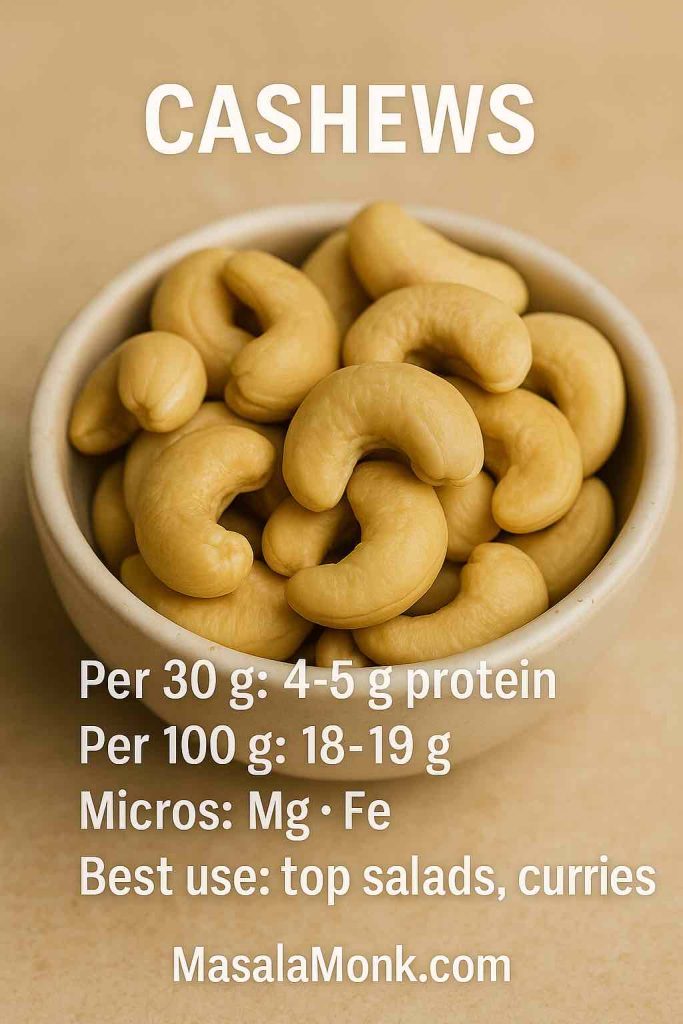
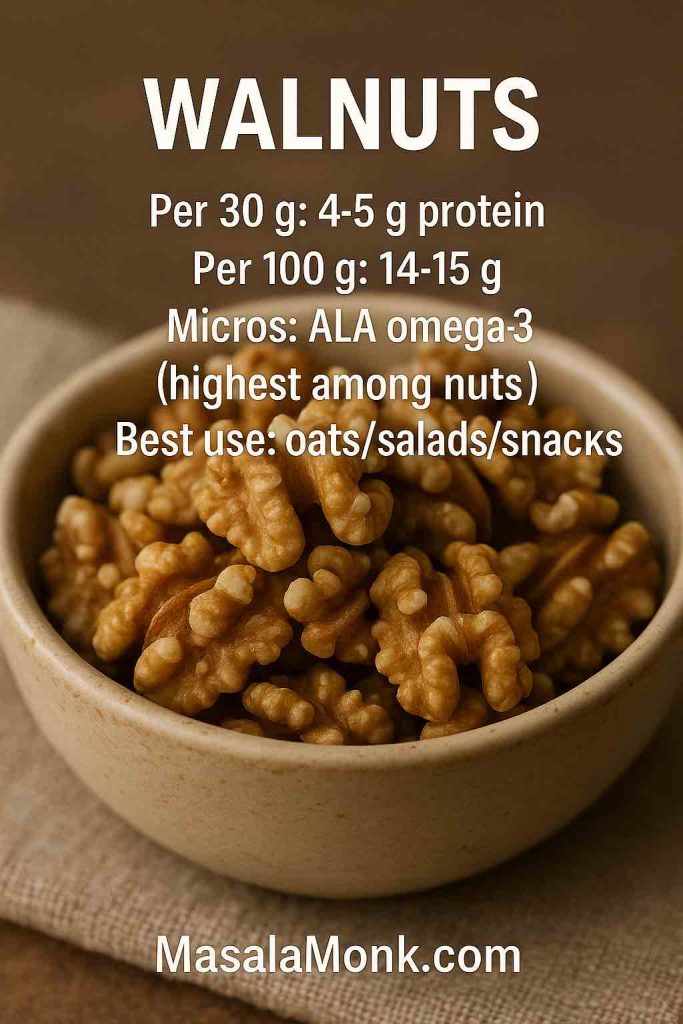
Peanuts are the highest-protein nut most people eat daily, while hemp seeds are the highest-protein seed. Per 100 g, peanuts typically deliver 24–26 g protein; meanwhile, hemp seeds reach 31–32 g. Scaled to a realistic serving—about 28–30 g for a small handful or seed sprinkle—that becomes ~7 g for peanuts and ~9–10 g for hemp. Additionally, pumpkin and sunflower seeds sit close behind; almonds, pistachios, and cashews hover near ~6 g per serving; walnuts contribute less protein yet bring valued omega-3 ALA. Therefore, once you know this orientation, every other choice becomes easier, calmer, and faster.

  • Top seed for density: Hemp hearts (~31–33 g protein per 100 g).
  • Top nut for density: Peanuts (~24–26 g per 100 g).
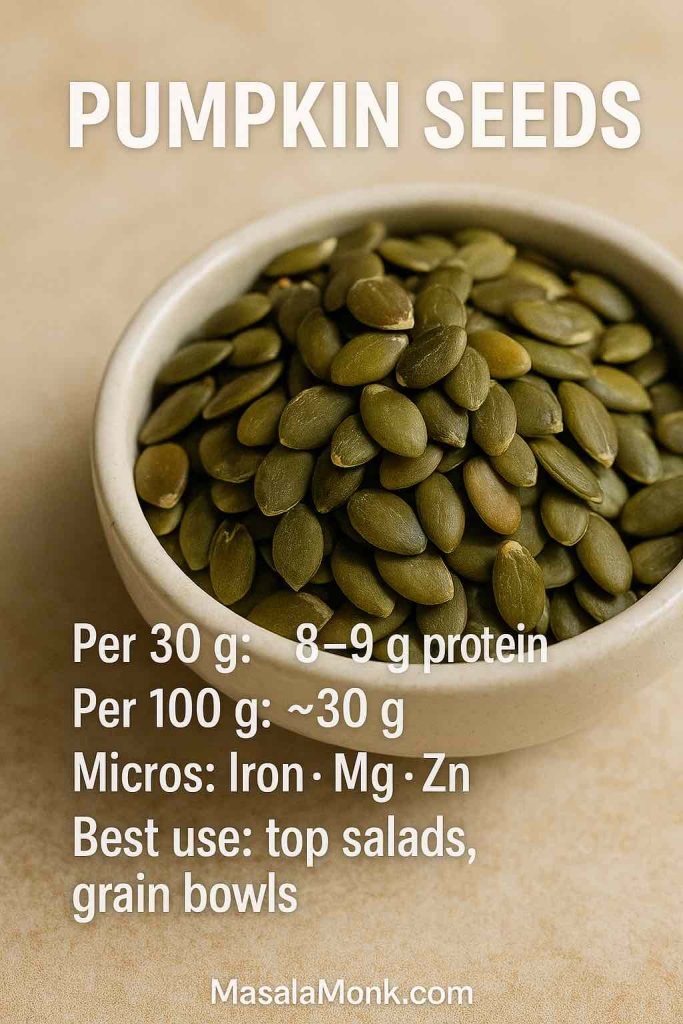
  • Elite runner-up seed: Pumpkin seeds (pepitas) (~30 g per 100 g).
  • Consistent six-gram players per serving: Sunflower kernels, almonds, pistachios.
  • Solid but slightly lower: Cashews, flax, chia.
  • Lower protein yet valuable omega-3 ALA: Walnuts.

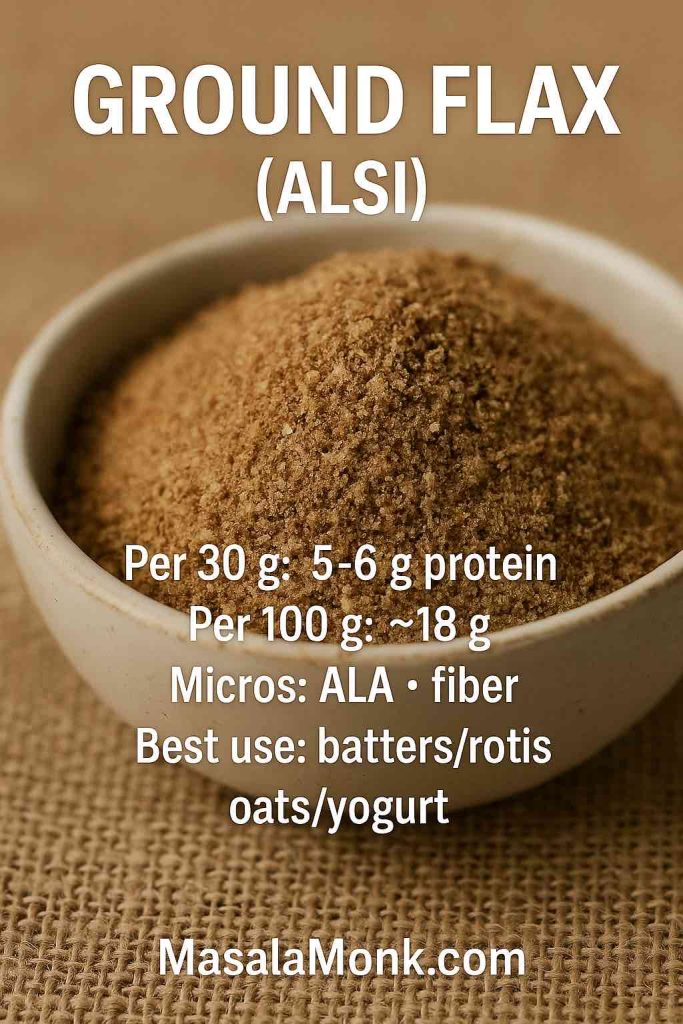
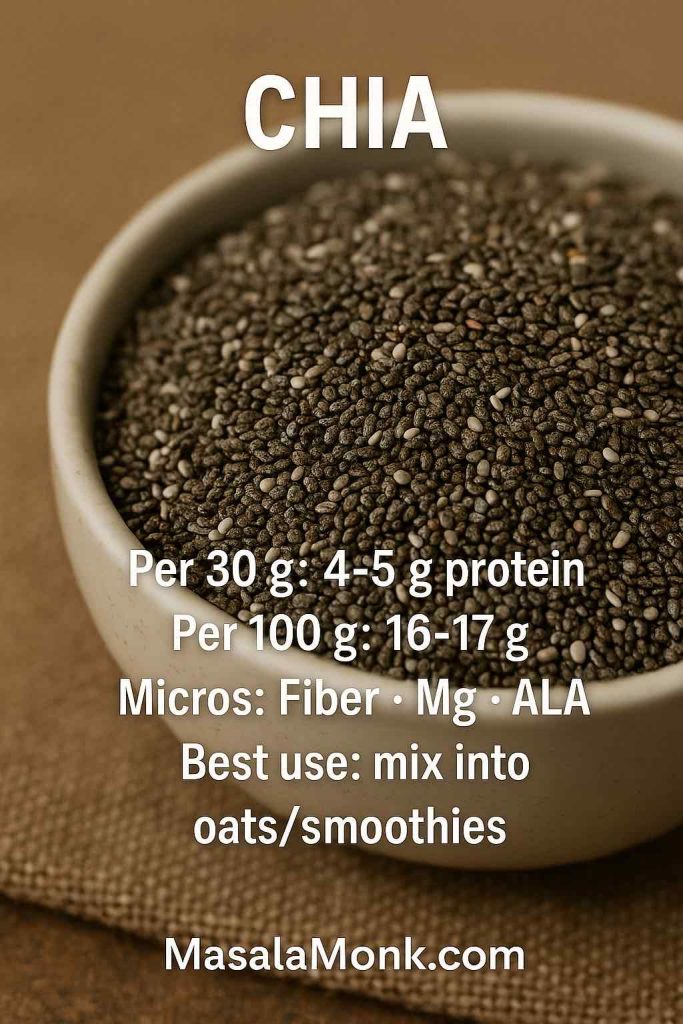
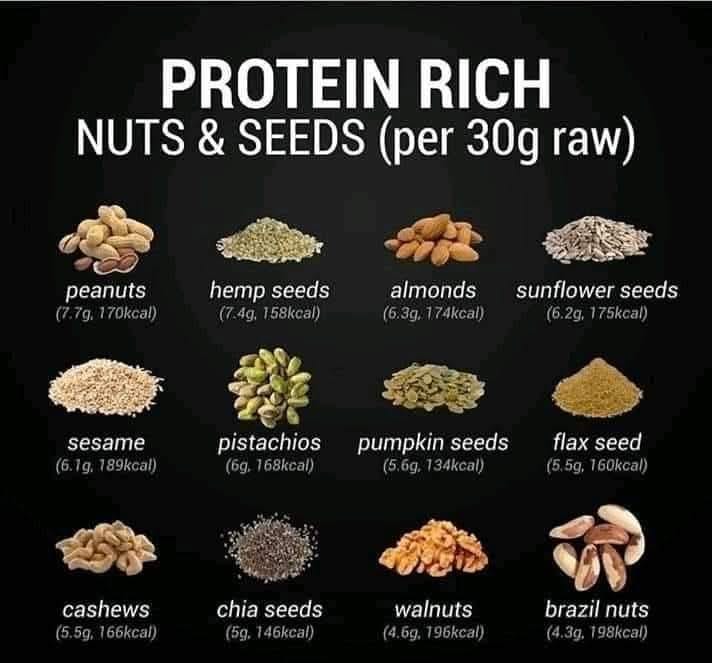
In everyday servings of 28–30 g, expect hemp hearts ~9–10 g, pepitas ~8.5–9.5 g, peanuts ~7 g, almonds/pistachios/sunflower ~6 g, cashews/flax/chia ~5–6 g, and walnuts ~4–5 g. Notably, once you scale to real portions, the differences compress.

Data note: Macro values (protein, fat, carbs) come from USDA FoodData Central and USDA-derived tables via MyFoodData.

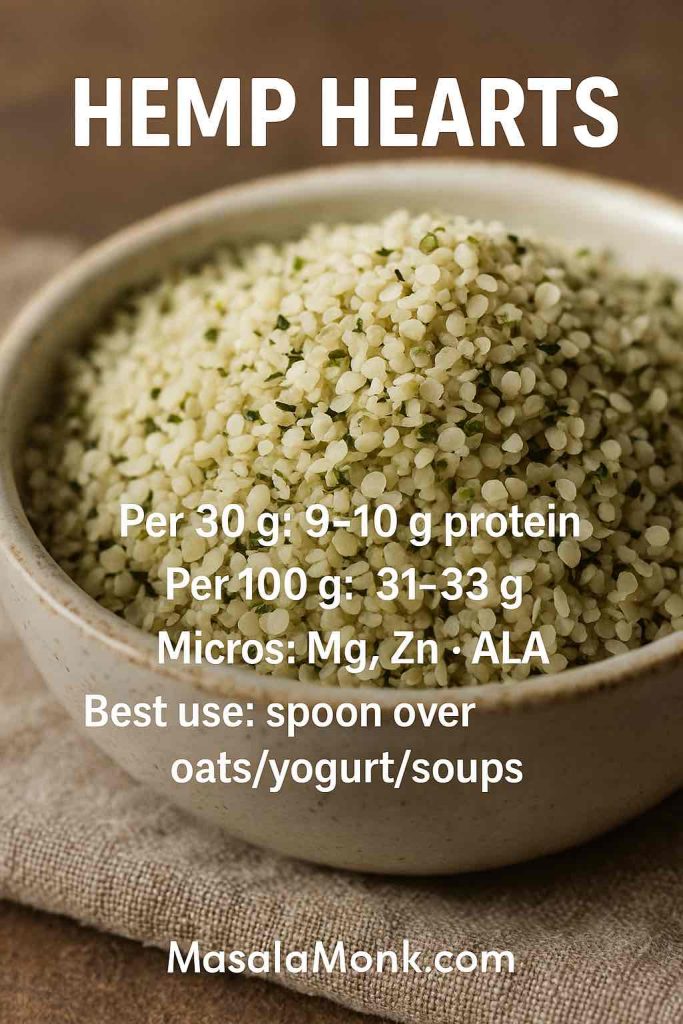
Bowl of hemp hearts with overlayed protein per 30 g and 100 g, plus micronutrients and usage tips, MasalaMonk.com.
Neutral ‘sprinkle’ that quietly adds ~3 g protein per Tbsp. Rich in magnesium, zinc, and plant omega-3 (ALA).

The Density View: Highest Protein Nuts & Seeds per 100 g

A per-100 g view reveals pure protein density—useful for recipe planning, bulk mixing, and comparing options fairly. Ranges reflect real-world variation in roasting, moisture, and variety; nevertheless, the ranking holds up and remember that most people eat ~30 g at a time.

  • Hemp hearts: ~31–33 g
  • Pumpkin seeds (pepitas, shelled): ~30 g
  • Peanuts (dry-roasted): ~24–26 g
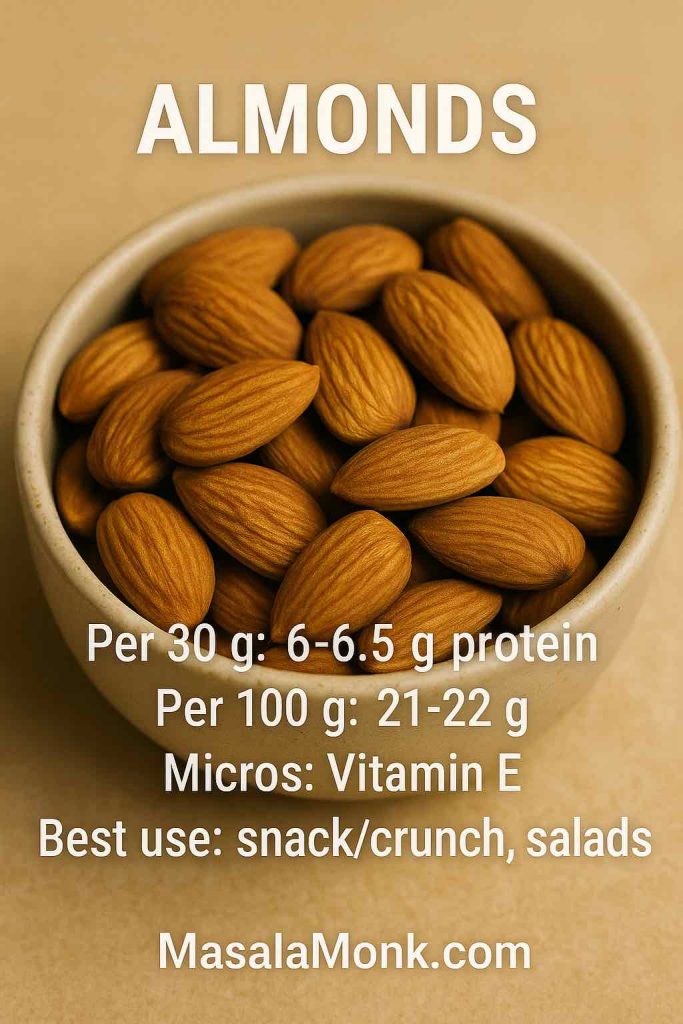
  • Almonds: ~21–22 g
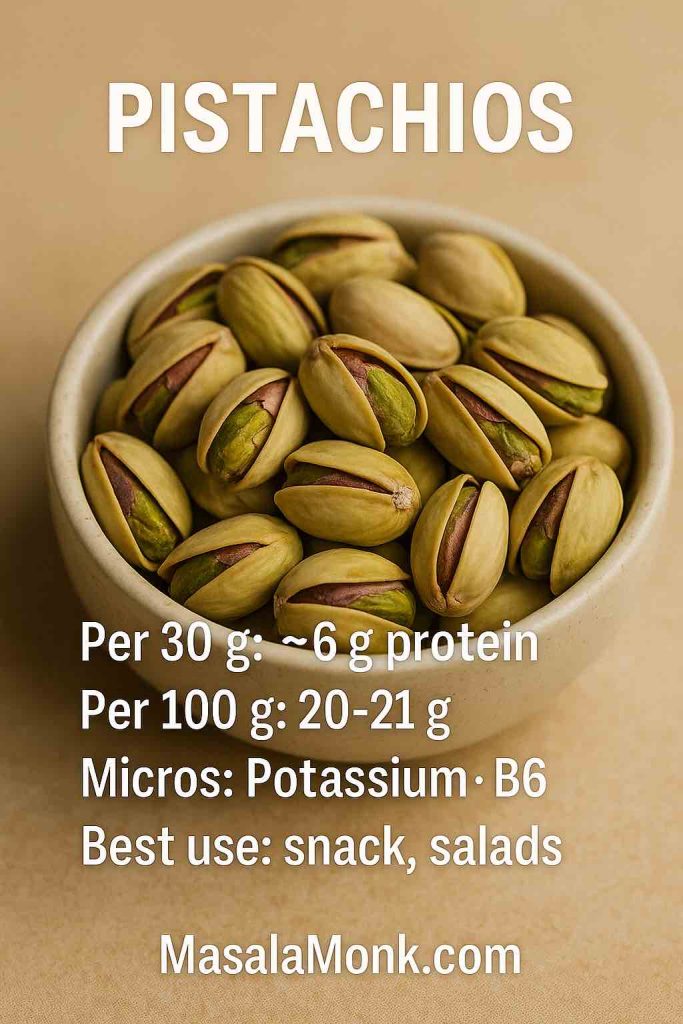
  • Pistachios: ~20–21 g
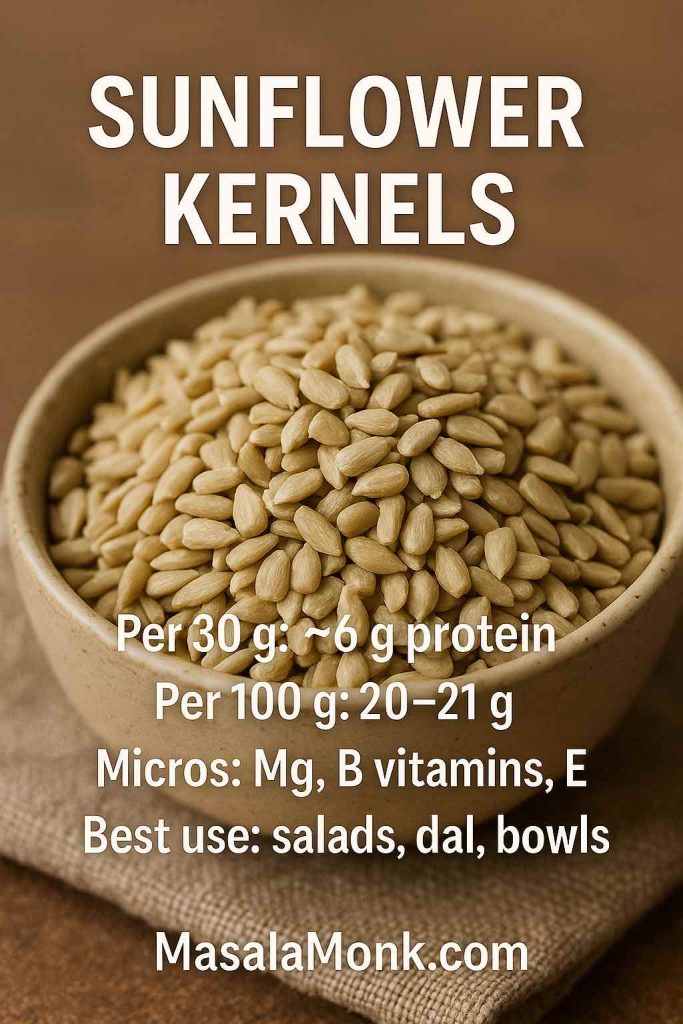
  • Sunflower kernels: ~20–21 g
  • Flax (alsi): ~18 g
  • Sesame (til): ~17–18 g
  • Chia: ~16–17 g
  • Walnuts (akhrot): ~14–15 g
  • Brazil nuts: ~14–15 g (modest protein; exceptional selenium)

Strictly by density, hemp leads the field, and peanuts lead the nuts. However, most people do not eat 100 g at once; consequently, the serving-level lens matters even more.

Also Read: Glycemic index of Chia Seeds and their effectiveness on Blood Sugar


Highest Protein Nuts & Seeds by Serving (28–30 g)

Once you shift from the lab bench to the palm of your hand, the field compresses in a reassuring way. In practice, a standard nut/seed serving is 28–30 g (roughly a small handful or 2–3 tablespoons, depending on the item).

  • Hemp seeds: ~9–10 g per 30 g
  • Pumpkin seeds: ~8 g
  • Peanuts: ~7 g
  • Almonds / Sunflower / Pistachios: ~6 g
  • Cashews / Flax / Chia: ~5–6 g
  • Walnuts: ~4–5 g

Accordingly, most servings of the highest protein nuts & seeds deliver ~5–10 g protein. Therefore, you can choose by taste, texture, budget, and purpose, then nudge the number upward with a tablespoon of hemp or an extra sprinkle of pumpkin or sunflower whenever you wish.

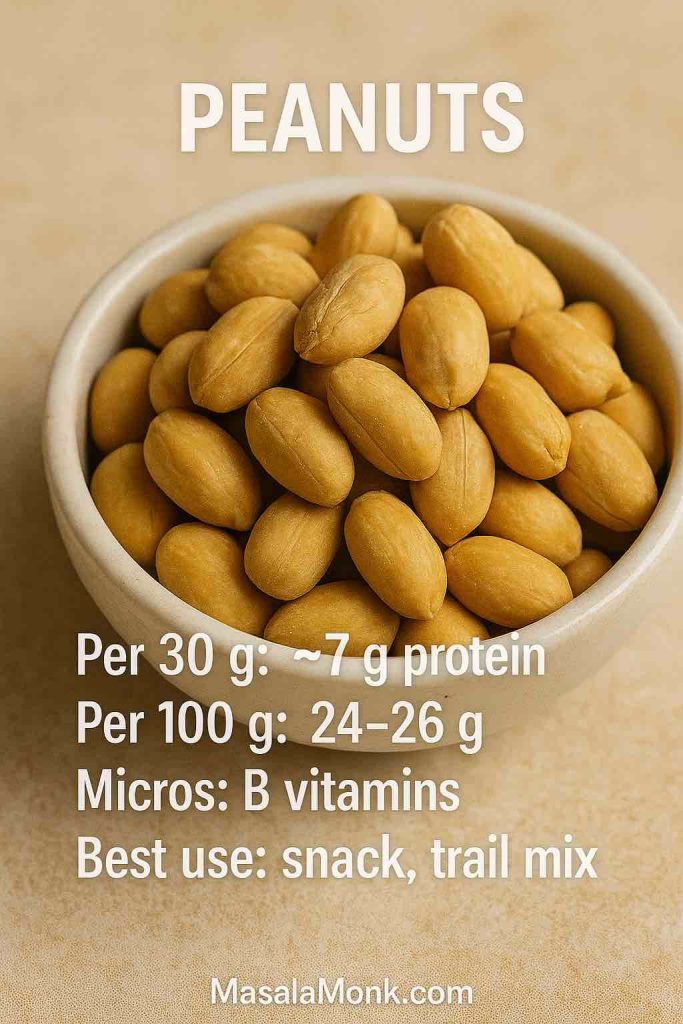
Close-up peanuts in a bowl with protein per serving and per 100 g, B-vitamins note, and best uses, MasalaMonk.com.
Best protein nut in value for money: ~7 g per handful. Season easily and use as the anchor for trail mixes.

The Spoon View: Nut Butters, Tahini, and Easy Boosters

Some days, a spoon is the strategy. Moreover, spoons are predictable, so the numbers stay honest.

  • Peanut butter: 1 Tbsp (~16 g) ≈ 4 g protein; 2 Tbsp (~32 g) ≈ 8 g (MyFoodData: Peanut butter).
  • Almond butter: slightly lower per spoon than peanut butter.
  • Tahini: ~5 g per 2 Tbsp (~30 g).
  • Hemp hearts: ~9–10 g per 3 Tbsp (~30 g) → ~3+ g per Tbsp.
  • Pepitas: ~3 g per Tbsp (~9–10 g by weight).

Almond butter typically trails slightly. Additionally, many “high-protein” nut butters add pea or whey; sometimes that helps, yet sometimes it merely raises the label claim. Alternatively, keep a nut butter you love and lift protein on demand with a tablespoon of hemp or a scatter of pumpkin seeds over yogurt, oats, or toast. Consequently, the flavor remains yours while the protein numbers climb without effort.

Also Read: Keto Chia Pudding Recipe with Almond Milk


The Tiny-Count Cheat Sheet: Quick Mental Math for Real Life

Life isn’t always measured in grams; consequently, these approximations of protein per nut or seed would help you decide quickly:

  • 1 almond (badam): ~0.25 g protein
  • 10 almonds: ~2.5 g
  • 1 peanut kernel: ~0.25 g
  • 10 peanuts: ~2.5 g
  • 1 walnut half: ~0.6 g (≈ 1.2 g per whole walnut)
  • 50 g peanuts: ~12–13 g
  • 100 g peanuts: ~24–26 g
  • 100 g almonds: ~21–22 g
  • 100 g pumpkin seeds: ~18–20 g
  • 100 g hemp seeds: ~31–32 g
  • 1 tbsp peanut butter (~16 g): ~4 g; 2 tbsp (~32 g): ~8 g

Yes, sizes and roasts vary slightly; nevertheless, these figures are reliable enough for daily planning and shopping.

Pepitas in a ceramic bowl with protein per serving and per 100 g, iron/magnesium/zinc highlights, MasalaMonk.com.
Iron, magnesium, and zinc standouts. A 2-Tbsp finish gives crunch plus ~5–6 g protein.

Seeds or Nuts? Choosing the Highest Protein Nuts & Seeds With Intent

Decision-making gets easier when aim leads and appetite follows. Seeds often carry more protein per gram; nuts often deliver crunch, structure, and snack satisfaction. Thus, use this tidy lens:

  • Maximise protein per bite: hemp, pumpkin, sunflower
  • Best value with solid protein: peanuts
  • Vitamin E with clean, crisp bite: almonds
  • Plant omega-3 ALA: walnuts, ground flax, chia (ALA primer:Harvard Nutrition Source)
  • Iron + magnesium + zinc: pumpkin first; hemp and sunflower as strong support
  • Selenium (precise, potent): Brazil nuts1–2 are typically enough (AJCN RCT)

Pick the quality that fits today’s goal; then choose the texture you actually enjoy. As a result, consistency becomes easy.

Also Read: Pumpkin Seed Smoothie for Weight Loss | 5 Healthy Recipes & Benefits


Texture, Roasting, and Seasoning: The Satisfaction Multiplier

Numbers get you to the shelf; mouthfeel keeps you reaching into the jar. Consequently, small technique shifts create a big payoff:

  • Raw vs. roasted: light roasting (pan or oven) drives off a little moisture and unlocks aroma, so smaller portions feel complete. Keep heat moderate; oils should wake, not scorch. (Zhang et al., 2024).
  • Salted vs. unsalted: if lightly salted makes the habit stick, start there. Subsequently, mix half salted with half unsalted to bring sodium down without losing satisfaction.
  • Seasonings that earn their keep: chili-lime peanuts for brightness; cumin-salt pumpkin seeds for warmth; smoked-paprika almonds for evening snacking; lemon-sesame sunflower for lift. In turn, higher flavor density stabilises portion size naturally.

As satisfaction rises, portion anxiety falls. Therefore, you’ll find it easier to stop at enough.

Almonds in a bowl with text showing protein per 30 g and 100 g and vitamin E note, MasalaMonk.com.
Almonds are Vitamin-E powerhouse with a clean crunch—~6–6.5 g protein per 30 g.

Micronutrient Tie-Breakers: When Protein Isn’t the Only Priority

Sometimes two choices tie on protein; consequently, minerals and vitamins decide the winner.

  • Iron: choose pumpkin seeds; sunflower assists. A tablespoon over salad, dal, soup, or roasted vegetables is a frictionless upgrade.
  • Vitamin E: choose almonds. A handful in the afternoon—or chopped over breakfast—keeps intake steady.
  • Selenium: choose Brazil nuts. One or two often meet daily needs; more isn’t necessary.
  • Omega-3 ALA: rotate walnuts, ground flax, and chia. Different textures; same benefit.
  • Magnesium & zinc: choose pumpkin and hemp for consistent support of muscle function, sleep quality, and immunity.
  • B-vitamins: choose peanuts and sunflower for reliable contributions to metabolism and nervous-system health.

Viewed this way, the highest protein nuts & seeds become a toolbox rather than a contest.

Also Read: Best Nuts and Seeds for Weight Loss (Chia, Flax, Almonds & More)


Buying and Storing the Highest Protein Nuts & Seeds

Nuts and seeds look sturdy; their oils do not. Accordingly, handle them thoughtfully and they’ll taste vivid to the last serving. Freshness multiplies flavor, and flavor multiplies follow-through. Furthermore, storage is simple.

  1. Buy what you’ll finish in a few weeks; a lively small stash beats a tired bulk bargain.
  2. Store airtight, cool, and dark. Glass jars in a cupboard are ideal; warm counters are not.
  3. Refrigerate or freeze omega-3-rich options (walnuts, flax, chia) if the kitchen runs warm.
  4. Smell before you snack. Fresh smells round and nutty; rancid smells waxy or flat. Toasting may revive a slightly dull seed; nothing saves a truly rancid nut—bin it and move on.

With storage handled, value rises and waste falls.

Pistachios in a bowl with overlayed protein per 30 g and 100 g and potassium/B6, MasalaMonk.com.
Pistachios have ~6 g protein per 30 g plus potassium & B6—great in salads and snacks.

Price & Value: Protein You’ll Actually Eat

Value is not only the sticker price; it is also protein per currency, minerals per bite, and the likelihood you’ll reach for it daily.

  • Peanuts: everyday champion—high protein, friendly price, universally seasonable.
  • Sunflower seeds: budget-friendly seed with solid minerals.
  • Pumpkin seeds: pricier, yet they repay with iron, magnesium, zinc, and deeply satisfying chew.
  • Almonds: premium, yet vitamin E and that “clean crunch” justify their role.
  • Hemp seeds: premium booster—one tablespoon strategically placed is often all you need.

Accordingly, a pragmatic pattern works best: build a base with peanuts or sunflower for affordability, then spike with pumpkin or hemp to raise protein and minerals without blowing the budget.

Also Read: The Power of Chia Seeds: 5 Plant-Based High-Protein Meal Prep Ideas


How to Use Nuts & Seeds All Day

Highest Protein Nuts & Seeds at Breakfast: Steady Mornings Without Effort

Oats with backbone
Stir a spoon of peanut or almond butter into hot oats; then finish with hemp and sliced banana. As a result, the bowl turns creamy, balanced, and genuinely sustaining.

Yogurt that eats like a meal
Thick yogurt or dahi, a handful of almonds for crunch, a spoon of chia or ground flax for fiber and omega-3s, berries for brightness, and a light drizzle of honey if you like. Consequently, protein rises and hunger drops.

A better smoothie
Milk or plant milk, frozen berries or banana, 1 tbsp nut butter, 1 tbsp hemp or pumpkin, a pinch of salt. Blend until silky. Typically, you’ll land in the 10–15 g range without using a powder.

Quick toast upgrades
Whole-grain toast with tahini and lemon; then sesame and a few chopped pistachios. Alternatively, peanut butter with sliced apple and a sprinkle of hemp. Small change, long runway.

Hot cereals beyond oats
Millet or ragi porridge finished with almond butter and sunflower seeds. Notably, the flavor is comforting while the macros are quietly stronger.

Sunflower kernels in a bowl with protein per 30 g and 100 g, magnesium and B vitamin note, MasalaMonk.com.
Sunflower seeds or kernels offer budget-friendly crunch with ~6 g protein per 30 g; steady minerals and B vitamins.

Highest Protein Nuts & Seeds at Lunch: Salads, Bowls, and Simple Structure

Leafy salad with substance
Leaves, chickpeas or boiled egg, chopped almonds or pistachios, tahini-lemon dressing; finally, sunflower seeds scattered at the end so they stay crisp. Consequently, the bowl moves from “nice” to “complete.”

Warm grain bowl
Rice or quinoa, roasted vegetables, a lemon-tahini drizzle, pumpkin and sunflower seeds to finish. Each bite has contrast—acid, fat, salt, crunch—and, importantly, steady protein.

Open-faced toast, grown up
Hummus or tahini-yogurt on a slice, cucumber ribbons, herbs, lemon zest, sesame. Satisfying yet light; easy to repeat throughout the week.

Dal and greens
Spinach dal or mixed-veg dal finished with cumin-garlic tempering and a handful of mixed seeds. Immediately, the texture improves and satiety rises without heaviness.

Also Read: Peanuts for Weight Loss: Best Ways to Eat Groundnuts, Chikki & Peanut Butter


Highest Protein Nuts & Seeds at Dinner: Generous Flavor Without Weight

Soups that finish strong
Tomato soup topped with pumpkin and sunflower; carrot-ginger with sesame; moong soup with roasted cumin and a final sprinkle of hemp. Thus, a simple bowl feels curated rather than plain.

Vegetables that eat like mains
Roasted cauliflower with tahini and pistachios; green beans finished with almonds and lemon; stuffed peppers with rice, cashews, and raisins. Consequently, vegetables carry the meal while nuts and seeds provide ballast and interest.

Stir-fries and quick sautés
Vegetables and tofu with a peanut-sesame crumble. Add the crunch during the last minute so it stays lively on the plate.

Grain-plus suppers
Couscous or broken wheat with roasted onions and peppers, then a warm dressing of olive oil, lemon, and tahini. Sunflower and pumpkin seeds go on at the end. Simple, clean flavors; dependable protein.

Cashews in a bowl with protein per 30 g and 100 g, magnesium and iron note, MasalaMonk.com.
Creamy all-rounder— Cashew Nuts with ~4–5 g protein per 30 g; great for sauces, curries, and salads.

Snacks That Don’t Backfire: Steady Energy in Small Moves

Trail mix with intent
Base of peanuts and almonds for value and crunch; pumpkin for minerals; hemp sprinkled just before eating as the protein “top-coat.” Keep dried fruit modest so you snack for nourishment, not momentum.

The desk spoon
Jar of nut butter plus a tiny jar of hemp within reach. Spoon, sprinkle, done. Not fancy—effective.

Roasted seed cups
Dry-toast pumpkin and sunflower with a pinch of salt and cumin. Cool, jar, and keep by the kettle. A tablespoon at tea-time replaces handfuls of empty calories.

Crisp apple + nut butter
Two or three slices, a thin smear of peanut or almond butter, a dusting of cinnamon, and a few sesame seeds. The ratio is everything: more apple than spread, more satisfaction than effort.

Adding nuts does not derail body weight in trials; systematic reviews show neutral or favorable effects on weight and adiposity (SR/MA of RCTs & cohorts)

Also Read: Nuts for Heart Health: Harnessing the Nutritional Powerhouse for a Healthy Cardiovascular System


Match-Ups That Settle Everyday Debates

Almonds vs. Pepitas

Per 100 g, almonds show ~21–22 g protein; pumpkin shows ~18–20 g. Per serving, however, pumpkin often edges almonds (~8 g vs. ~6 g) because a spoonful compacts differently. For vitamin E, choose almonds; for iron, magnesium, zinc—and a slightly higher serving-level protein—choose pumpkin.

Peanuts vs. Almonds

Peanuts lead on density (~24–26 g vs. ~21–22 g). Per serving, the gap is modest (~7 g vs. ~6 g). Accordingly, pick peanuts for value and easy seasoning; pick almonds for vitamin E and a slightly leaner profile. Meanwhile, keep hemp hearts nearby to boost either option.

Walnuts vs. “Higher-Protein” Nuts

Walnuts won’t top protein charts; however, they headline plant omega-3 ALA. Consequently, if heart-friendly fats lead your goals, keep a daily walnut habit and let peanuts or almonds carry the heavier protein elsewhere.

Chia vs. Flax

Protein is similar. Still, chia gels beautifully—great for puddings and thick smoothies. Ground flax disappears into batters, rotis, dals, and porridges. Therefore, use both and let format guide the choice.

Sesame vs. sunflower

Sesame excels as a flavor amplifier (tahini, temperings, finishing sprinkles). Sunflower wins when you want more minerals per handful at a modest price. Together, they make an excellent pantry pair.

Walnut halves in a bowl with protein per 30 g and 100 g and ALA omega-3 benefit, MasalaMonk.com.
Walnuts are plant omega-3 leader among nuts; ~4–5 g protein per 30 g. Sprinkle on oats or salads.

Strategic Mixes: Building a High-Impact Jar of the Highest Protein Nuts & Seeds

A smart mix balances protein, minerals, cost, and mouthfeel. Here are three blends that work in real life; moreover, each one uses the highest protein nuts & seeds as anchors.

1) Everyday Value Mix

  • Peanuts (50%) + Sunflower (25%) + Pumpkin (20%) + Hemp (5%), lightly salted.
    Result: budget-friendly, ~6–7 g protein per 30 g, iron and magnesium uplift, gentle crunch plus soft hemp specks. Consequently, you’ll actually finish the jar.

2) Iron-Forward Green Mix

  • Pumpkin (40%) + Sunflower (30%) + Almonds (20%) + Sesame (10%), cumin-salt seasoned.
    Result: iron, zinc, and vitamin E in one jar; excellent over salads, soups, and veg bowls. Additionally, sesame boosts aroma without dominating.

3) Premium Protein Booster

  • Hemp (35%) + Pumpkin (30%) + Pistachio (20%) + Almond (15%), unsalted.
    Result: ~8–9 g protein per 30 g with a refined texture; perfect as a topping rather than a graze. Therefore, a little goes a long way.

Store each mix airtight; rotate weekly to keep flavors lively.

Also Read: Walnut Benefits for Brain Health: Memory, Cognitive Function, and Mental Well-Being


Portions, Goals, and a Calm Plan That Sticks

Portions matter because nuts and seeds are calorie-dense. Even so, strict rules aren’t necessary.

Start with 28–30 g as a standard sprinkle or snack. Then, if you’re calibrating intake, measure a few times until your eyes learn the volume. Next, on training days or hungrier evenings, add a second sprinkle of pepitas or a spoon of hemp hearts. Finally, let weekly goals steer micro-moves: more protein (add hemp/pepitas), more iron (prioritize pepitas), more omega-3 (rotate walnuts/chia/flax), or simpler mornings (keep nut butter visible).


Common Mistakes (and Simple Fixes) When Using the Highest Protein Nuts & Seeds

  1. Buying too much at once.
    Fix: purchase smaller amounts more often; freshness beats bulk every time.
  2. Under-seasoning.
    Fix: add light salt and a signature spice (cumin, chili-lime, smoked paprika). Consequently, small portions feel complete.
  3. Relying on a single type.
    Fix: keep two daily staples (e.g., peanuts + almonds) and one rotating seed booster (hemp or pumpkin). Variety improves nutrients and prevents boredom.
  4. Forgetting the “last-minute” sprinkle.
    Fix: store a seed jar near the stove. Meanwhile, add a teaspoon to anything that leaves the pan.
  5. Ignoring storage temperature.
    Fix: refrigerate or freeze walnuts, flax, and chia in warm kitchens. Ultimately, flavor and shelf life improve.
Ground flax (alsi) in bowl with protein per 30 g/100 g, fiber and ALA notes; best uses: batters, rotis, oats, MasalaMonk.com.
Neutral booster with ALA + fiber; ~5–6 g protein per 30 g. Stir into batters, rotis, or oats.

A Seven-Day Meal Plan with Highest Protein Nuts & Seeds

Monday

  • Breakfast: oats with peanut butter + hemp hearts.
  • Lunch: salad with chickpeas, almonds, sunflower; tahini-lemon dressing.
  • Dinner: dal finished with cumin-garlic and pepitas.

Tuesday

  • Breakfast: yogurt with chia, berries, and chopped almonds.
  • Lunch: quinoa-vegetable bowl with tahini and sunflower kernels.
  • Snack: a few walnuts for omega-3 ALA.
  • Dinner: tomato soup topped with pepitas and sunflower.

Wednesday

  • Breakfast: smoothie with almond butter, hemp hearts, berries, and a pinch of salt.
  • Lunch: open-faced hummus toast with cucumber, herbs, lemon zest, and sesame.
  • Dinner: green beans with toasted almonds and lemon; rice on the side.

Thursday

  • Breakfast: oats with a tahini swirl, dates, and sesame.
  • Lunch: roasted vegetables over warm grains with lemon-tahini; shower of pepitas.
  • Snack: peanuts with a few dark-chocolate nibs.
  • Dinner: carrot-ginger soup finished with sesame; small salad with sunflower.

Friday

  • Breakfast: yogurt with ground flax and crushed pistachios.
  • Lunch: quinoa bowl with pepitas and sunflower kernels.
  • Dinner: roasted cauliflower with tahini and pistachios; crisp cucumbers.

Saturday

  • Breakfast: omelet with chopped almonds and herbs.
  • Snack: popcorn tossed with toasted pepitas and a whisper of chili-salt.
  • Late snack: spoon of peanut butter with a dusting of hemp hearts.

Sunday

  • Lunch: pilaf with cashews and raisins; side salad scattered with hemp hearts.
  • Snack: walnuts and sliced fruit.
  • Dinner: quick stir-fry finished with a teaspoon of mixed seeds; yogurt with chia for dessert.

Also Read: Cashews in the Morning: 5 High Protein Smoothie Ideas for Weight Loss.


Smart Swaps and Add-Ons for Instant Wins

  • Upgrade any yogurt: add hemp hearts; if texture feels soft, toss in chopped almonds for contrast.
  • Fortify porridge: swirl in nut butter while cooking; finish with pepitas.
  • Boost salads: make tahini-lemon your house dressing; keep sunflower on the table.
  • Elevate toast: spread tahini-yogurt, add herbs and lemon zest, and finish with sesame.
  • Enrich soups: treat seed blends like croutons—crunch without heaviness.
  • Power-up batters and doughs: add ground flax to pancakes, dosa/cheela batter, quick breads, and roti dough.
Chia seeds in bowl; text shows protein per 30 g/100 g, fiber and ALA; best for oats or smoothies, MasalaMonk.com.
Chia Seeds – gels for puddings; ~4–5 g protein per 30 g plus fiber and ALA. Mix into oats or smoothies.

Regional and Cultural Touchpoints (Practical, Not Precious)

  • Indian kitchens: stir ground flax into rotis; finish dal with pumpkin/sunflower; fold sesame into temperings; add peanuts to poha or chaat; spoon hemp onto curd rice or raita for a subtle boost.
  • Mediterranean plates: lean on almonds and pistachios for crunch; use tahini (sesame) in sauces and dressings; finish grain salads with sunflower and pumpkin.
  • East Asian flavours: highlight sesame oils and seeds; add peanuts to noodles and stir-fries; use chia for contemporary puddings.
  • Western breakfasts: keep peanut/almond butter on the counter; rotate hemp and pumpkin into granola, yogurt bowls, and hot cereals.

These aren’t rules; rather, they’re ways to let the highest protein nuts & seeds slip into meals you already enjoy.


The Highest Protein Nuts & Seeds: Handy Reference Table

Food (typical form)Protein per 100 gTypical serving (28–30 g)Protein per servingBonus strengths
Hemp hearts~31–33 g30 g~9–10 gMagnesium, zinc; neutral booster
Pumpkin seeds (pepitas)~30 g30 g~8.5–9.5 gIron, magnesium, zinc; great chew
Peanuts (dry-roasted)~24–26 g30 g~7 gValue; B-vitamins; easy seasoning
Almonds~21–22 g28–30 g~6–6.5 gVitamin E; clean, crisp crunch
Pistachios~20–21 g28–30 g~6 gColor, mild sweetness, snack appeal
Sunflower kernels~20–21 g30 g~6 gBudget-friendly; mineral-rich
Cashews~18–19 g28–30 g~4–5 gCreaminess; blends into sauces
Flax (ground preferred)~18 g28–30 g~5–6 gALA; disappears in doughs/batters
Chia~16–17 g28–30 g~5 gALA; gels for puddings/smoothies
Walnuts~14–15 g28–30 g~4–5 gHighest ALA among nuts
Sesame (til)~17–18 g30 g~5–5.5 gTahini powerhouse; calcium
Brazil nuts~14–15 g28–30 g~4 gSelenium standout (use 1–2)

Note: whole, in-shell pumpkin seeds include a fibrous hull that dilutes protein density. Therefore, pepitas (shelled) are the reference used throughout the highest protein nuts & seeds guide.

Source & method: Unless noted, macro numbers are taken from USDA FoodData Central and presented using USDA-derived comparisons from MyFoodData (per 100 g and typical servings).


Advanced, Ultra-Practical Ideas (For Extra Mileage)

Protein-first breakfast parfait: Start with thick yogurt; fold in 1 Tbsp peanut butter; add 1 Tbsp hemp hearts; top with chopped almonds and berries. Consequently, you get creaminess, crunch, and a near-instant protein bump.

Savory oatmeal switch-up: Cook oats in milk or fortified plant milk; whisk in tahini and a pinch of salt; finish with pepitas and chives. As a result, you turn a sweet habit into a savory, satisfying bowl.

Sheet-pan seed topper: Mix pepitas, sunflower, and sesame with a teaspoon of oil, chili, and lemon zest; toast briefly. Then store in a jar. Subsequently, every soup, salad, or sauté gets a finishing spoon.

Five-minute noodle lift: Toss hot noodles with tahini-soy-lemon; add edamame if available; finish with crushed peanuts and hemp hearts. Accordingly, weeknights gain structure without heaviness.

Roasted-veg “crouton” trick: Swap bread cubes for a shower of toasted seeds. Consequently, you keep crunch while adding protein and minerals.


Portions, Goals, and a Plan You Can Live With

Nuts and seeds are calorie-dense; portions therefore matter. Even so, precision can stay gentle.

  • Use 28–30 g as your default snack or sprinkle.
  • Weigh that amount a couple of times; thereafter, your eyes will know.
  • Training day or extra hunger? Add a spoon of hemp or an extra sprinkle of pumpkin and move on.

Let weekly themes steer micro-choices: more protein (add hemp most days), more iron (sprinkle pumpkin on what you already cook), healthier fats (rotate walnuts, flax, and chia), simpler breakfasts (keep nut butter visible instead of hidden). Consequently, you build consistency with minimal effort.


Final Take: The Highest Protein Nuts & Seeds Without Hype

Perfection isn’t the plan; repeatability is. Therefore, let hemp hearts and pepitas handle stealth protein boosts. Keep peanuts and sunflower as daily, budget-friendly anchors. Invite almonds for vitamin E and crisp satisfaction. Meanwhile, rotate walnuts, chia, and ground flax for omega-3 ALA. Additionally, use Brazil nuts thoughtfully for selenium.

For broader cardiometabolic reassurance, meta-analyses show favourable lipid effects with nut intake (61-trial analysis) and supportive links with cardiovascular risk (systematic review).

Above all, keep jars visible, place a scoop inside, and make topping a reflex. Then a handful between meetings, a spoon in a smoothie, or a teaspoon over soup becomes second nature. Ultimately, that’s how the highest protein nuts & seeds turn steady energy from a hope into a habit.

Also Read: Benefits of Flax Seeds and How to Incorporate Them into the Indian Diet

FAQs

1) Which nut has the most protein?

Peanuts come out on top among commonly eaten nuts at ~24–26 g protein per 100 g (that’s about ~7 g per 28–30 g serving). However, if you’re asking about tree-nuts only (i.e., excluding peanuts), then almonds and pistachios lead with ~21–22 g per 100 g (≈ ~6 g per serving).

2) Which seeds have the most protein?

For seeds, the champion is hemp hearts at ~31–33 g per 100 g (≈ ~9–10 g per 30 g). Meanwhile, pumpkin seeds (pepitas) follow closely at ~30 g per 100 g (≈ ~8–9 g per 30 g). Consequently, a single spoonful can quietly lift any meal.

3) Are nuts and seeds high in protein?

Yes—practically speaking, most deliver ~5–10 g protein per 28–30 g. As a result, they’re superb “easy add-ons” to keep you full and steady between meals.

4) Nuts vs. seeds: which have more protein?

Per 100 g, seeds generally edge out nuts (think hemp/pumpkin/sunflower > peanuts/almonds). Yet, per realistic servings, everything compresses to ~5–10 g, so you can choose by taste, texture, and budget—then simply boost with a tablespoon of hemp or a sprinkle of pepitas.

5) Highest-protein picks per serving (28–30 g)?

Hemp hearts ~9–10 g, pumpkin seeds ~8–9 g, peanuts ~7 g, almonds/pistachios/sunflower ~6 g, cashews/flax/chia ~5–6 g, and walnuts ~4–5 g. Therefore, the “per handful” gap is smaller than people expect.

6) Highest-protein picks per 100 g (density view)?

Hemp hearts (~31–33 g) > pumpkin seeds (~30 g) > peanuts (~24–26 g) > almonds (~21–22 g)pistachios/sunflower (~20–21 g) > flax (~18 g) > sesame (~17–18 g) > chia (~16–17 g) > walnuts/Brazil nuts (~14–15 g). Consequently, density helps for recipe planning and bulk mixes.

7) Which tree-nut has the most protein (excluding peanuts)?

Almonds and pistachios share the top spot at ~21–22 g per 100 g (≈ ~6 g per serving). In short, they’re your best tree-nut bets for protein.

8) Quick counts: how much protein per piece?

For fast mental math: 1 almond (badam) ≈ 0.25 g, 10 almonds ≈ 2.5 g; 1 peanut kernel ≈ 0.25 g, 10 peanuts ≈ 2.5 g; 1 walnut half (akhrot) ≈ 0.6 g (≈ 1.2 g per whole walnut). Handy for grazing and recipe tweaks.

9) Protein by the spoon: how much per tablespoon?

Peanut butter ≈ 4 g/Tbsp (16 g); almond butter ≈ 3–3.5 g/Tbsp; tahini (sesame) ≈ 2.5 g/Tbsp (≈ 5 g per 2 Tbsp); hemp hearts ≈ 3+ g/Tbsp; pepitas ≈ 3 g/Tbsp. Therefore, a spoon or two is a quick, honest lift.

10) Are peanuts really nuts?

Botanically, peanuts are legumes; nutritionally and in normal shopping, they behave like nuts. Consequently, most “highest-protein nuts” guides include them—because users (and labels) do.

11) Are nuts seeds?

Colloquially yes—nuts are hard-shelled seeds. However, in kitchens we separate nuts (almonds, cashews, walnuts) from edible seeds (hemp, pumpkin, sunflower, chia, flax) for clarity and recipe roles.

12) Best budget picks for protein?

Start with peanuts (value king) and sunflower seeds (budget minerals), then, importantly, spike with small amounts of pumpkin or hemp when you want extra protein and micronutrients.

13) Which are richest in iron, magnesium, and zinc?

Pumpkin seeds headline iron/magnesium/zinc; hemp and sunflower support closely. As a result, a tablespoon over salads, dal, soups, or roasted veg is a frictionless upgrade.

14) Which nuts are highest in vitamin E?

Almonds. Accordingly, keep a handful in the afternoon—or chop them over breakfast—for a clean, consistent vitamin E intake.

15) Where do plant omega-3s (ALA) come from?

Rotate walnuts, ground flax (alsi), and chia. Meanwhile, let peanuts/almonds/pepitas carry your heavier protein elsewhere.

16) What about selenium?

Brazil nuts are uniquely selenium-dense. Therefore, 1–2 nuts/day typically covers needs—no need to overdo it.

17) What’s a smart “everyday” high-protein mix?

Try Peanuts (50%) + Sunflower (25%) + Pumpkin (20%) + Hemp (5%), lightly salted. Result: ~6–7 g protein per 30 g, great crunch, serious minerals. Consequently, you’ll actually finish the jar.

18) How should I store nuts and seeds for freshness?

Store airtight, cool, and dark. Additionally, refrigerate or freeze walnuts, flax, and chia if your kitchen runs warm. Finally, smell before you snack—fresh is nutty and round; rancid smells waxy or flat.

19) Does roasting change protein?

Not meaningfully. Light roasting mostly reduces moisture and boosts aroma. However, keep the heat moderate—oils should wake, not scorch—so flavor and nutrients stay happy.

20) Salted or unsalted—what’s smarter?

Start where the habit sticks—lightly salted is perfectly fine. Then, for balance, mix half salted + half unsalted to bring sodium down while keeping satisfaction up.

21) Best breakfast upgrades for steady energy?

Stir nut butter into oats, top yogurt/dahi with hemp + almonds, or blend 1 Tbsp peanut butter + 1 Tbsp hemp into smoothies. Consequently, breakfasts land in the 10–15 g protein range without using powders.

22) Easy lunch and dinner add-ons?

Finish salads/grain bowls with sunflower + pumpkin; whisk a lemon-tahini dressing; sprinkle hemp on soups or dal at the end. As a result, meals feel complete—without heaviness.

23) What’s a realistic daily portion?

Use 28–30 g as your default handful/sprinkle. Next, on training days or hungrier evenings, add a second sprinkle or 1 Tbsp hemp—simple, predictable, sustainable.

24) Which nut butter is best for protein?

By the spoon, peanut butter wins (~4 g/Tbsp). Meanwhile, almond butter is slightly lower but brings vitamin E; tahini adds minerals; and hemp hearts are an effortless mix-in booster to any spread.

25) Almonds vs. pumpkin seeds—who wins?

Per 100 g, pepitas (~30 g) beat almonds (~21–22 g). However, per 30 g serving, pepitas are ~8–9 g vs almonds ~6 g. Therefore, pick almonds for vitamin E and crisp bite; pick pepitas for iron/magnesium and slightly more protein per serving.

26) Peanuts vs. almonds—where’s the edge?

Peanuts lead on pure density (~24–26 g/100 g vs ~21–22 g). Nevertheless, the per-serving gap is ~1 g, so let price and taste decide—and keep hemp nearby to boost either choice.

27) Walnuts vs. “higher-protein” nuts—how to decide?

Walnuts won’t win the protein chart (~4–5 g per 30 g), yet they headline omega-3 ALA. Consequently, keep a daily walnut habit for heart-friendly fats and let peanuts/almonds/pepitas carry more of the protein.

28) How do I add protein without changing recipes?

The simplest move: 1 Tbsp hemp hearts (~3+ g) or 1 Tbsp pepitas (~3 g) over whatever you already cook—oats, yogurt, dal, soups, salads, toast. Thus, flavor stays familiar while numbers climb.

29) How much protein in 1 Tbsp peanut butter?

Approximately ~4 g per 1 Tbsp (16 g). For a classic 2-Tbsp serving, you’ll get ~8 g. Therefore, PB is a tidy “spoon fix” when mornings are busy.

30) Which nuts are high in iron?

Nuts are modest; pumpkin seeds are the standout (yes, a seed). Next best: sunflower and hemp. Accordingly, if iron is a goal, use seeds as toppers daily.

31) Which nuts are highest in protein? (All variants)

Short list to remember: peanuts (top overall), then almonds and pistachios among tree-nuts; cashews are slightly lower; walnuts are lower still but bring omega-3 ALA.

32) What are the highest-protein seeds and nuts together?

If you just want winners, here they are: hemp and pumpkin (seeds) plus peanuts (nut). Therefore, keep these three in easy reach and rotate for taste.

33) Seeds vs. nuts: what about fiber, fats, and fullness?

Great question. Beyond protein, both bring fiber (appetite control) and unsaturated fats (even energy). Seeds often have a hair more fiber per gram; nuts tend to deliver more “crunch satisfaction.” Together, they’re steadier than carb-only snacks.

34) Do nuts and seeds have enough fiber to matter?

Absolutely. Even a tablespoon or two can round out a meal. Consequently, you’ll see fewer spikes, dips, and snack-cupboard raids.

35) Are cashews high in protein?

Medium: roughly ~4–5 g per 30 g. However, cashews excel at creaminess and making sauces; pair them with hemp or pepitas to lift protein.

36) Are pistachios high in protein?

Yes—about ~6 g per 28–30 g. Plus, they add color and gentle sweetness; they’re excellent in salads and grain bowls.

37) Are almonds high in protein?

Yes—~6–6.5 g per serving. Additionally, almonds are an easy vitamin E win and deliver that satisfying clean crunch.

38) How much protein in 100 g of the big four (for bulk recipes)?

Approximate per 100 g: hemp 31–33 g, pumpkin 30 g, peanuts 24–26 g, almonds 21–22 g. Therefore, for granola, bars, or laddoos, these numbers help you balance macros.

39) Are nuts “protein or fat”?

Both. Practically, they’re protein-and-fat foods with some fiber. And because their fats are mostly unsaturated, they tend to support smoother energy alongside satiety.

40) Won’t the calories add up?

They can—so portions matter. Even so, a calm plan works: start at 28–30 g, measure a few times so your eyes learn the volume, and, when needed, add one small booster (1 Tbsp hemp or pepitas) instead of another handful.

41) Can vegetarians (and kids) rely on nuts and seeds for protein?

They’re an excellent supporting source. Combine them with legumes, dairy/curd, soy/paneer/tofu, eggs (if used), and grains for full coverage across the day. Meanwhile, seeds help fill mineral gaps (iron, zinc, magnesium).

42) Whole seeds vs. “seed oils”—should I worry?

Whole seeds and nut butters are not the same as refined oils. You’re getting protein, fiber, and micronutrients with the fats intact. Consequently, whole-food forms fit beautifully in balanced meals.

43) Best choices for smoothies?

Use peanut or almond butter for body, then add hemp hearts (smooth boost), chia (thickens), or ground flax (disappears). Thus, you land in 10–15 g protein without powders.

44) Best toppers for salads and soups?

Go for sunflower + pumpkin for crunch/minerals, and finish with hemp for an invisible protein lift. Moreover, a lemon-tahini drizzle ties it all together.

45) Are seed-based protein powders (hemp/pumpkin/sunflower) worth it?

They can be, especially if you want dairy-free options. However, for many people, simply adding 2–3 Tbsp hemp/pepitas to meals achieves similar protein with better texture and minerals—no new routine required.

46) Do in-shell pumpkin seeds count the same?

Not quite. In-shell seeds include a fibrous hull that dilutes protein density. Therefore, for accurate comparisons, use pepitas (shelled) as the reference.

47) Should I soak or sprout nuts and seeds?

You can. Soaking/sprouting may reduce some phytates and change texture. Nevertheless, it’s optional—most benefits (protein, fiber, fats, minerals) remain strong without extra steps.

48) What if I have a peanut allergy—what should I swap?

Lean on almonds, pistachios, cashews, sunflower, pumpkin, and hemp. Then, for a PB-style experience, try sunflower seed butter or tahini + a touch of honey on toast.

49) Can I season them without ruining the “healthiness”?

Definitely. Light salt, chili-lime, cumin-salt, smoked paprika, or lemon-sesame keeps portions satisfying. In turn, bigger flavor often means smaller, happier servings.

50) Final, practical takeaway—what should I actually keep on the counter?

Keep four jars visible: peanuts, almonds, pumpkin seeds, and hemp hearts. Consequently, you can anchor snacks with peanuts/almonds (value + crunch) and top anything with pumpkin/hemp for protein and minerals—no new routine required.

Macros sourced from:USDA FoodData Central (primary database) and MyFoodData (USDA-derived comparison tables).