Posted on — 9 Comments

Dirty Martini Recipe (Classic, Extra Dirty, No Vermouth, Spicy, Blue Cheese, Tequila + Batched)

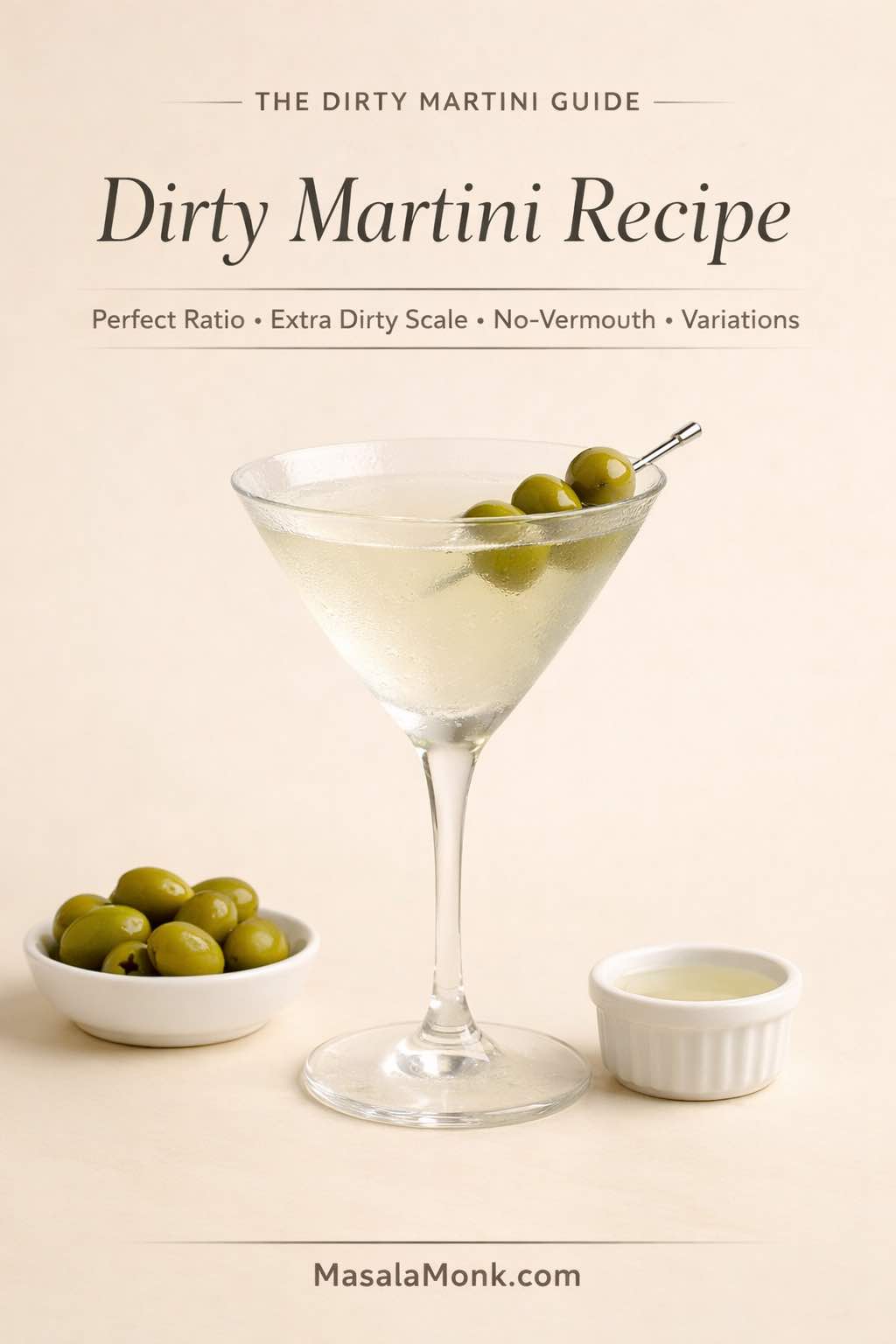
A chilled dirty martini in a coupe-style martini glass with three green olives on a cocktail pick, plus a small bowl of olives and a ramekin of olive brine on a smooth warm-cream studio background. Text overlay reads “The Dirty Martini Guide,” “Dirty Martini Recipe,” and “Perfect Ratio • Extra Dirty Scale • No-Vermouth • Variations,” with MasalaMonk.com in the footer.

There’s a reason the dirty martini recipe has become the “order again” drink for so many people. It’s sharp but silky, salty but clean, and strangely calming once you dial in the balance. When it’s right, it doesn’t taste like “olive juice and vodka.” Instead, it tastes like a colder, sleeker version of savory snacks: briny, crisp, and oddly refreshing.

Olive brine is the loud ingredient, which is why first attempts sometimes land muddy instead of crisp. The whole game is learning to steer it: get the martini briny without going murky, and cold without watering it into sadness.

This post gives you a reliable base, then the versions people actually make at home: slightly dirty through filthy, extra dry and no-vermouth builds, shaken vs stirred, blue cheese olives, spicy dirty martinis, a tequila “dirty martini,” and a batched freezer bottle for parties. Along the way, you’ll get clear ratios, measurements, and the small details that turn “fine” into “make another.”

If you like grounding things in classic definitions first, the IBA Dry Martini spec is a useful reference point for what “martini” traditionally means before we make it dirty. Then we’ll do what everyone actually came here for: add brine.


What “Dirty” Really Means (And Why It’s So Easy to Overdo)

“Dirty” is not a single setting. It’s a sliding scale.

A slightly dirty martini can feel almost like a regular martini that took a walk past a bowl of olives. A really dirty martini can taste like a bold, salty snack in liquid form. Somewhere between those two is the version most people fall in love with—the one that’s briny enough to make your mouth water, yet still clean enough to feel crisp.
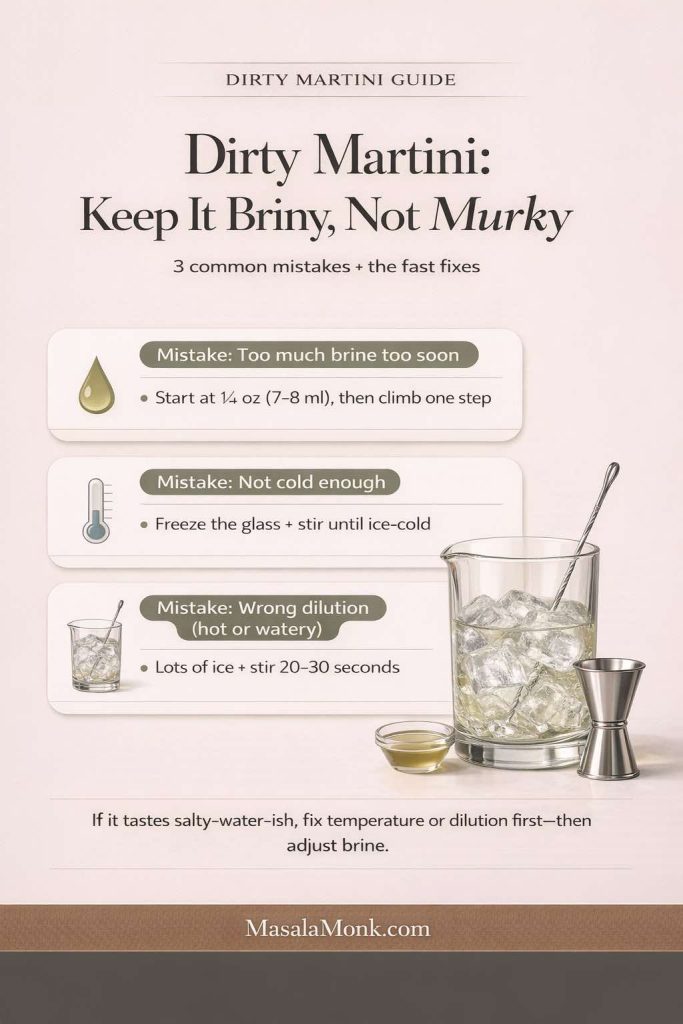
Dirty Martini Guide infographic showing how to keep a dirty martini briny, not murky: start with 1/4 oz olive brine, chill the glass until ice-cold, and use lots of ice to stir 20–30 seconds for proper dilution; includes mixing glass, ice, brine bowl, and MasalaMonk.com footer.
Making a dirty martini is mostly a control problem, not a recipe problem. If yours tastes muddy or ‘salty-water-ish,’ don’t pour more brine—fix the cold and the dilution first. Use this quick guide: start at 1/4 oz brine, freeze the glass, and stir with lots of ice for 20–30 seconds. Save this as your repeatable dirty martini checklist (and pin it for your next martini night).

The tricky part is that olive brine is powerful. It’s salt, acidity, and flavor all concentrated into a small pour. That’s why so many first attempts end up tasting murky. Not because the idea is wrong, but because the brine took the wheel.

The good news is that once you learn a simple dirty martini ratio and a couple of “feel” cues, the drink becomes surprisingly consistent. Even better, you can tailor it to your exact preferences: vodka or gin, up and icy, shaken or stirred, with vermouth or without, extra dry or not, blue cheese olives or plain, spicy or classic.

Also Read: Keto Hot Chocolate Recipe (Sugar-Free Hot Cocoa) + Best Homemade Mix


The Core Dirty Martini Recipe (Vodka or Gin)

This is your anchor. Make this once, then tweak from there.
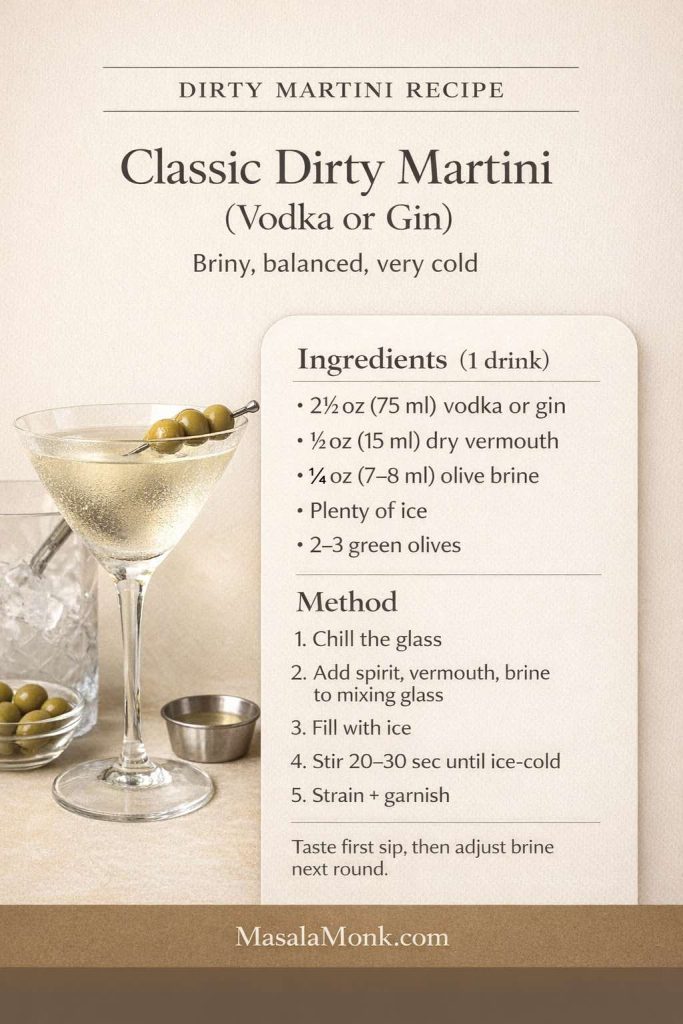
Vertical recipe card titled “Dirty Martini Recipe” and “Classic Dirty Martini (Vodka or Gin)” on a warm-cream background. It shows a chilled dirty martini with green olives plus a bowl of olives and a small cup of olive brine. Text lists ingredients: 2½ oz vodka or gin, ½ oz dry vermouth, ¼ oz olive brine, plenty of ice, 2–3 green olives. Method steps: chill glass, add spirit/vermouth/brine, fill with ice, stir 20–30 sec, strain and garnish. Footer: MasalaMonk.com.
Classic Dirty Martini Recipe Card (Vodka or Gin): Save this for the exact measurements, then use the Dirty Scale + Ratio graphics above to fine-tune your brine level (slightly dirty to extra dirty) and keep every martini cold, smooth, and balanced—never murky or overly salty.

Ingredients (one drink)

  • 2 ½ oz (75 ml) vodka or gin
  • ½ oz (15 ml) dry vermouth
  • ¼ oz (7–8 ml) olive brine (start here; you can always go dirtier)
  • Plenty of ice
  • Garnish: 2–3 green olives

Method (stirred, glossy, and freezer-cold)

  1. Chill your glass. A martini glass that’s already cold changes everything—less temperature shock, more silky texture.
  2. Add vodka or gin to a mixing glass.
  3. Add dry vermouth.
  4. Add olive brine.
  5. Fill the mixing glass with ice. More ice helps you chill efficiently without watering the drink into sadness.
  6. Stir until the outside of the mixing glass feels ice-cold—usually 20–30 seconds.
  7. Strain into your chilled glass.
  8. Garnish with olives and take a first sip before you do anything else.

If you want a classic external reference for this base structure, the Liquor.com Dirty Martini recipe follows the same fundamental idea: spirit, vermouth, brine, and a very cold serve.

Why this version works so reliably

It gives you a stable balance: enough brine to taste “dirty,” enough vermouth to soften the edges, and enough dilution from stirring to make the texture smooth rather than aggressive. From here, you can drift toward extra dirty, extra dry, no vermouth, or any other style without losing the plot.

Also Read: 10 Low Carb Chia Pudding Recipes for Weight Loss (Keto, High-Protein, Dairy-Free)


Dirty Martini Ratio (The Simple Formula You Can Remember)

A dirty martini becomes easier when you stop thinking in absolutes and start thinking in proportions. The ratio is your friend because it scales naturally—one drink, two drinks, a batched bottle for the freezer.
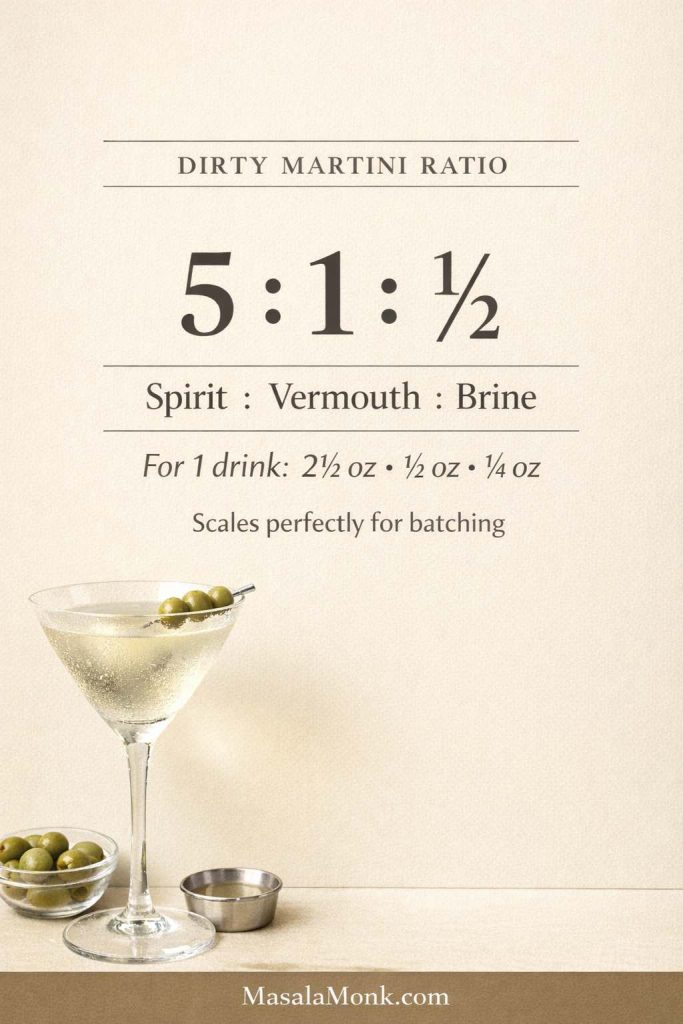
Vertical infographic titled “Dirty Martini Ratio” showing the formula 5:1:½ for Spirit : Vermouth : Brine. It lists measurements for one drink (2½ oz spirit, ½ oz vermouth, ¼ oz olive brine) and notes it scales for batching. Photo shows a chilled dirty martini with green olives, plus a small bowl of olives and a ramekin on a smooth warm-cream background. MasalaMonk.com appears in the footer.
Dirty Martini Ratio Cheat Sheet (5:1:½): Use this simple formula to build a classic dirty martini every time—then scale it up for a freezer bottle when you’re batching for guests. Measure the brine, keep it brutally cold, and you’ll get that clean, briny “bar-style” sip at home.

A practical dirty martini ratio

  • 5 parts vodka or gin
  • 1 part dry vermouth
  • ½ part olive brine (for classic dirty)

In real-world measurements for one drink, that lands neatly at:

  • 2½ oz spirit
  • ½ oz vermouth
  • ¼ oz brine

From there, adjust brine like a dial.

Also Read: Garlic & Paprika Cabbage Rolls (Keto-Friendly Recipes) – 5 Bold Savory Twists


Slightly Dirty, Classic Dirty, Really Dirty: Pick Your Lane

Olive brine is the loudest ingredient, so even a teaspoon can shift the whole drink. Use this scale with 2½ oz (75 ml) vodka or gin. Vermouth can stay at ½ oz (15 ml) unless you’re going extra dry.
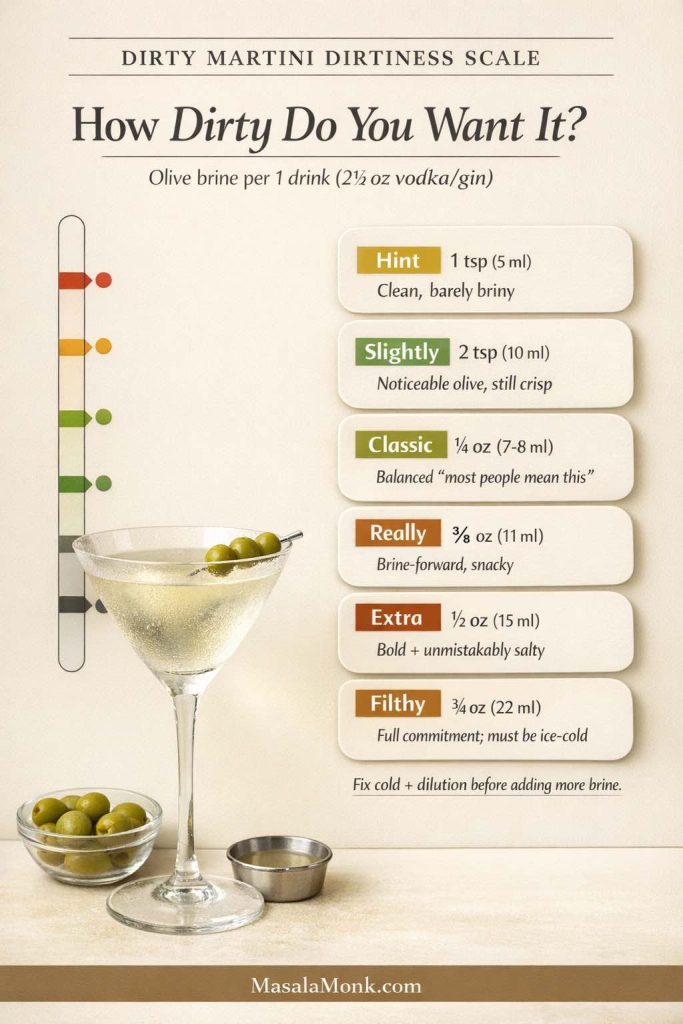
Infographic showing a dirty martini dirtiness scale with olive brine amounts per 1 drink (2½ oz vodka or gin). Levels include Hint (1 tsp/5 ml), Slightly (2 tsp/10 ml), Classic (¼ oz/7–8 ml), Really (⅜ oz/11 ml), Extra (½ oz/15 ml), and Filthy (¾ oz/22 ml). Photo shows a chilled dirty martini with green olives, plus a bowl of olives and a small ramekin of brine. Footer reads MasalaMonk.com.
Dirty Martini Dirtiness Scale: Use this quick olive brine chart to dial your drink from barely briny to extra dirty (or filthy) without guessing. Go up one step, taste, and remember: if it starts feeling “salty-water-ish,” fix temperature or dilution first—then adjust brine.

Dirty Martini “Dirtiness” Scale (Olive Brine per 1 drink)

StyleOlive brineFlavor cue
Martini with a hint of olive1 tsp (5 ml)Clean, barely briny
Slightly dirty2 tsp (10 ml)Noticeable olive, still crisp
Classic dirty¼ oz (7–8 ml)Balanced “most people mean this”
Really dirty⅜ oz (11 ml)Brine-forward, snacky
Extra dirty½ oz (15 ml)Bold + unmistakably salty
Extra extra dirty / Filthy¾ oz (22 ml)Full commitment; must be ice-cold

Quick rule: Go up one step, then taste. If it feels “salty-water-ish,” fix temperature or dilution first, not brine.

Slightly dirty martini

For the “hint of olive” crowd:

  • 1–2 teaspoons olive brine

This is elegant and restrained. It still feels like a martini first, with the savory note tucked into the background.

Classic dirty martini

For the “yes, I want brine” crowd:

  • ¼ oz olive brine

This is the version most people mean when they say “dirty martini.”

Really dirty martini

For the “make it taste like olives” crowd:

  • ⅜ to ½ oz olive brine

Here, the brine becomes a headline. The drink turns snacky, bold, and unapologetically salty.

Also Read: Crock Pot Chicken Breast Recipes: 10 Easy Slow Cooker Dinners (Juicy Every Time)


Extra Dirty Martini, Very Dirty Martini, Filthy Martini: How to Go Big Without Going Muddy

This is where a lot of people end up: extra dirty, extra extra dirty, dirtiest martini, filthy dirty martini—whatever name you give it, the goal is obvious.

The challenge is that there’s a point where more brine doesn’t feel more luxurious. It just feels… watery and salty.

So if you want to make an extra dirty martini that still tastes composed, do it in a way that keeps texture and balance.
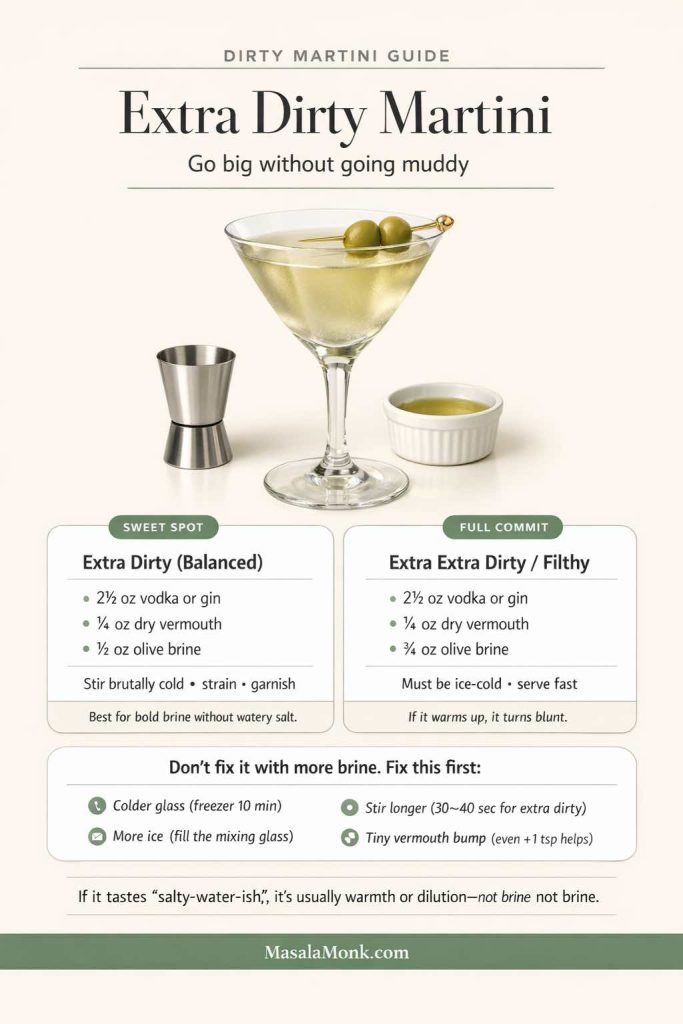
Vertical infographic titled “Extra Dirty Martini — Go big without going muddy.” Shows a pale green martini in a stemmed glass with two olives, plus a jigger and small ramekin of olive brine. Two recipe cards compare “Extra Dirty (Balanced)” (2½ oz vodka/gin, ¼ oz dry vermouth, ½ oz olive brine) vs “Extra Extra Dirty / Filthy” (2½ oz vodka/gin, ¼ oz vermouth, ¾ oz brine). Bottom tips: colder glass, more ice, stir longer, tiny vermouth bump. Footer: MasalaMonk.com.
Extra Dirty Martini (Sweet Spot vs Filthy): Use this quick recipe card to push brine boldly without tipping into “watery + salty.” The left card is the reliable extra dirty martini recipe most people actually love; the right card is the filthy/extra extra dirty version that only works when it’s brutally cold and served fast. The bottom “fix this first” checklist saves bad batches—because the problem is usually warmth or dilution, not “more olive brine.” (MasalaMonk.com)

The extra dirty martini recipe (one drink)

  • 2½ oz vodka or gin
  • ¼ oz dry vermouth (yes, less vermouth works well here)
  • ½ oz olive brine
  • Stir brutally cold, strain, garnish

Once you go extra dirty, the classic ratio becomes less useful—think of it as a separate template. This is the sweet spot for many people: unmistakably briny, still clean enough to sip without making a face.

The extra extra dirty martini recipe (if you truly want it)

  • 2½ oz vodka or gin
  • ¼ oz dry vermouth
  • ¾ oz olive brine

At this point, you’re fully committing. It can be delicious, but it needs the drink to be extremely cold. If it warms even slightly, it turns blunt.

If you enjoy the philosophy of taking a martini into “very wet and very intense” territory, Serious Eats has a fun deep dive into the filthy end of the spectrum with their Filthy / Sopping-Wet Martini approach.

How to keep a super dirty martini from tasting flat

Here’s the move that quietly saves the drink: don’t add brine to fix a problem that’s actually temperature or dilution.

If your martini tastes too sharp or too intense, you usually need one of these:

  • Stir a little longer (more controlled dilution)
  • Use a colder glass
  • Use bigger ice
  • Use a touch more vermouth, even if you’re going extra dirty

That last one surprises people, yet it matters. A small amount of vermouth can make the brine taste savory instead of salty-water-ish.

Also Read: Eggless Yorkshire Pudding (No Milk) Recipe


Dirty Martini Without Vermouth (And How to Make It Taste Smooth)

Some people love vermouth. Then some people tolerate it. And then some people would rather drink a martini without vermouth and never look back.

If you’re in the no-vermouth camp, you can still make a delicious dirty martini. You just need to lean on cold temperature and gentle dilution even more, because vermouth is often the ingredient that rounds the drink.
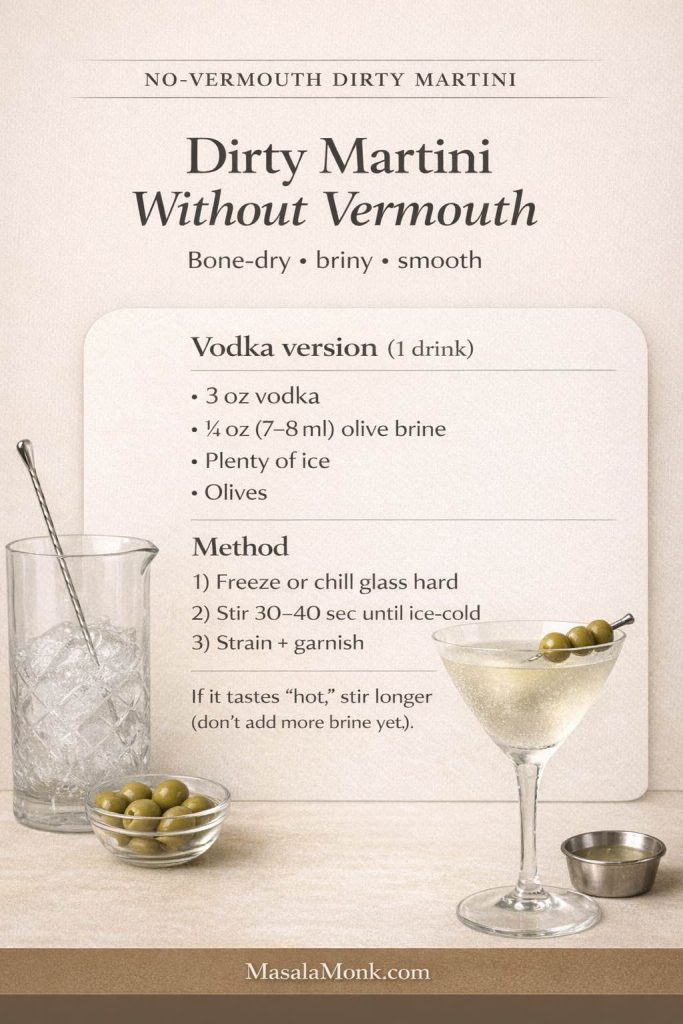
Vertical recipe card titled “No-Vermouth Dirty Martini” and “Dirty Martini Without Vermouth” with subtitle “Bone-dry • briny • smooth.” It shows a vodka version for 1 drink: 3 oz vodka, ¼ oz (7–8 ml) olive brine, plenty of ice, olives. Method: freeze or chill glass hard, stir 30–40 seconds until ice-cold, strain and garnish. Tip says to stir longer if it tastes “hot.” Photo shows a martini glass with green olives, a mixing glass, and a bowl of olives. Footer: MasalaMonk.com.
Dirty Martini Without Vermouth (Bone-Dry Version): Perfect for anyone who likes a vodka martini with zero vermouth—clean, briny, and straightforward. The key is not “more brine,” it’s more cold: freeze the glass, stir longer, and you’ll get a smooth, bar-style sip without turning it salty-water-ish.

Vodka martini no vermouth (dirty version)

  • 3 oz vodka
  • ¼ oz olive brine
  • Stir hard with plenty of ice
  • Strain into a well-chilled glass
  • Garnish with olives

Why 3 oz? Because if you’re skipping vermouth, increasing the vodka slightly gives you a fuller mouthfeel once the ice has done its job. Stir 30–40 seconds (or until very cold) because vermouth isn’t there to soften edges.

Dirty martini no vermouth (gin version)

  • 2½ oz gin
  • ¼ oz olive brine
  • Stir very cold and strain.
  • Olive garnish

Gin without vermouth can feel more angular than vodka without vermouth, because gin brings its own botanicals. Still, if you like gin martini with olives and you want it dry and direct, it can be a sharp, briny joy.

Also Read: Mozzarella Sticks Recipe (Air Fryer, Oven, or Fried): String Cheese, Shredded Cheese, and Every Crunchy Variation


Extra Dry Dirty Martini (What It Means and How to Avoid a Salty Surprise)

“Extra dry” typically means “less vermouth.” When you combine extra dry with dirty, brine can take over fast—because you removed the ingredient that softens the salt.
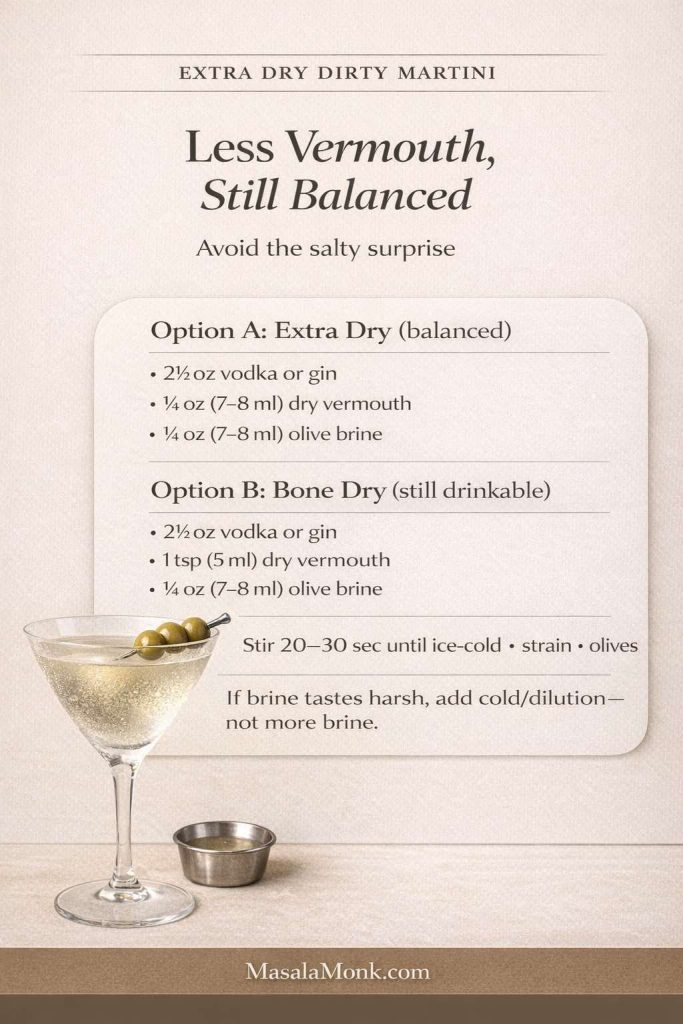
Vertical infographic titled “Extra Dry Dirty Martini” with headline “Less Vermouth, Still Balanced” and subtitle “Avoid the salty surprise.” It shows two options: Option A Extra Dry—2½ oz vodka or gin, ¼ oz dry vermouth, ¼ oz olive brine; Option B Bone Dry—2½ oz vodka or gin, 1 tsp dry vermouth, ¼ oz olive brine. It says “Stir 20–30 sec until ice-cold • strain • olives” and notes “If brine tastes harsh, add cold/dilution—not more brine.” Photo shows a chilled martini with olives on a warm-cream background. Footer: MasalaMonk.com.
Extra Dry Dirty Martini (2 options): If you like less vermouth, use this card to stay crisp and balanced—without the “salty surprise.” Choose Extra Dry (¼ oz vermouth) or Bone Dry (1 tsp), keep the brine measured, and focus on ultra-cold stirring for that smooth, bar-style finish.

So if you want an extra dry dirty martini that still feels balanced, try one of these:

Extra dry dirty martini (balanced)

  • 2½ oz vodka or gin
  • ¼ oz dry vermouth
  • ¼ oz olive brine

This stays crisp and clean, without turning salty.

Bone dry dirty martini (still drinkable)

  • 2½ oz vodka or gin
  • 1 teaspoon vermouth (yes, a teaspoon)
  • ¼ oz olive brine

This is for the people who like the idea of vermouth, but barely.

A useful side note: vermouth behaves like a fortified wine. It changes over time once opened, so it’s worth treating it with care. Difford’s Guide has a straightforward explanation of how to store vermouth after opening, which matters more than most people expect.

Also Read: How to make No-Bake Banana Pudding: No Oven Required Recipe


Dirty Martini “Up,” Dirty Martini Straight Up, Dirty Vodka Martini Up: The Cold, Concentrated Style

“Up” simply means served chilled without ice in the glass. It’s the classic martini presentation. When it’s done right, it feels sleek and intense.

The key is temperature. An up martini needs to be colder than you think, because there’s no ice in the glass continuing the chill.
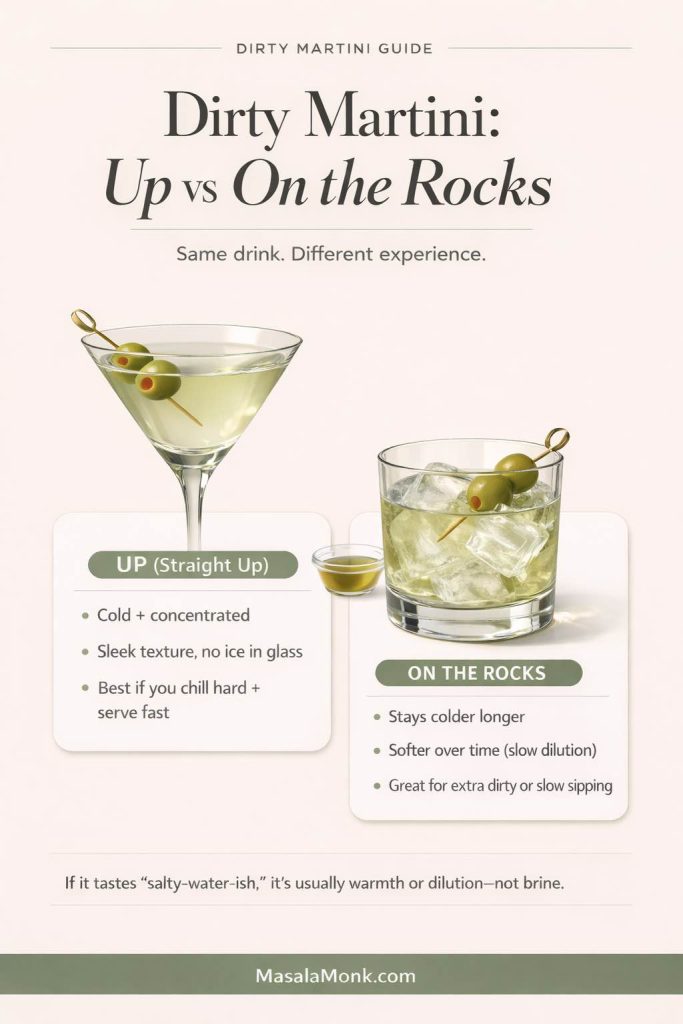
Vertical infographic titled “Dirty Martini: Up vs On the Rocks.” Shows two pale olive-tinted dirty martinis: left in a martini glass served up, right in a rocks glass with clear ice. Two cards compare: Up is cold and concentrated with no ice; On the Rocks stays colder longer with slow dilution and suits extra dirty martinis. Tip: salty-water-ish usually means warmth or dilution, not brine. MasalaMonk.com footer.
Dirty Martini: Up vs On the Rocks — same drink, totally different experience. “Up” tastes colder and more concentrated (best when you chill hard and serve fast). “On the rocks” stays colder longer and softens slowly as it dilutes, which is perfect for slow sipping or extra dirty martinis. If your drink tastes “salty-water-ish,” it’s usually warmth or dilution—not brine. Save this guide for your next martini night.

How to nail a dirty martini straight up

  • Freeze your glass or chill it aggressively.
  • Stir with lots of ice.
  • Strain cleanly so you don’t get ice shards floating around.

This is also where you’ll hear people specify “dirty vodka martini straight up” or “dirty martini up.” They want that clean pour and that concentrated texture.

Also Read: Chicken Adobo — Step-by-Step Recipe — Classic Filipino Adobong Manok


Shaken Dirty Martini vs Stirred Dirty Martini (And Why People Disagree)

A lot of drink arguments are actually texture arguments disguised as tradition.
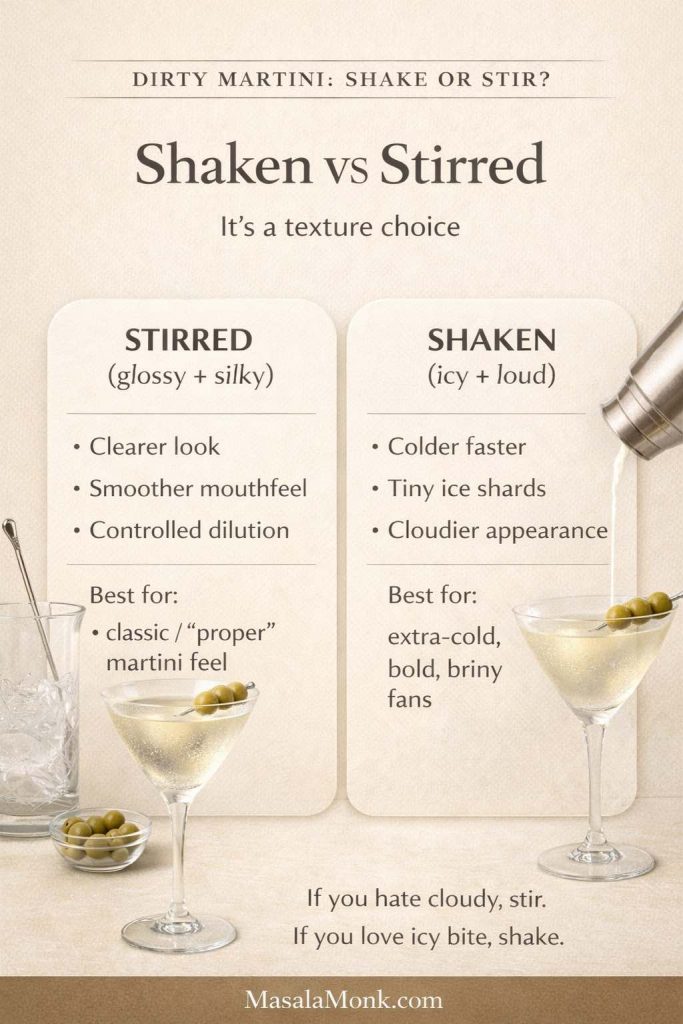
Vertical infographic titled “Dirty Martini: Shake or Stir?” comparing shaken vs stirred dirty martinis. The stirred side says “glossy + silky” with notes: clearer look, smoother mouthfeel, controlled dilution, best for classic “proper” martini feel. The shaken side says “icy + loud” with notes: colder faster, tiny ice shards, cloudier appearance, best for extra-cold bold briny fans. Bottom tip: “If you hate cloudy, stir. If you love icy bite, shake.” Footer: MasalaMonk.com.
Shaken vs Stirred Dirty Martini: If you want a clearer, silkier “classic” sip, stir. If you want it extra-cold with that icy bite (and don’t mind a cloudier look), shake. This quick guide helps you choose the right technique before you even measure the brine.

Stirring tends to give you:

  • A clearer drink
  • A smoother mouthfeel
  • A calmer, silkier sip

Shaking tends to give you:

  • More aeration
  • Tiny ice shards
  • A slightly more aggressive chill
  • A cloudy look (especially with brine)

Some people love that icy, loud, “shaken dirty martini” feel. Others prefer the glossy calm of stirring.

If you’re making your first dirty martini recipe at home, stirring is usually the easier path to consistency. Meanwhile, if you love the theatrical coldness of a shaken drink, shake it and enjoy it—just know the texture will be different.

Also Read: Sweetened Condensed Milk Fudge: 10 Easy Recipes


The Olive Brine Question: Olive Juice, Olive Brine, Olive Juice Mixer

The language gets messy here. You’ll see “olive juice” in recipes, “olive brine” in cocktail circles, and “olive juice mixer” in product descriptions. In home practice, it usually means the liquid in a jar of olives.

The only real rule is this: use brine that tastes good.

If it tastes overly metallic, aggressively vinegary, or weirdly sweet, it will show up in the drink. That’s why “best olive brine for dirty martini” becomes such an obsession—because brine is not a neutral ingredient.

If you want a deeper look at how pros think about brine, Food & Wine has a good read on making DIY olive brine for dirty martinis, which helps explain why “jar brine” and “bar brine” can taste wildly different.

Also Read: Sourdough Recipe: 10 Easy Bread Bakes (Loaves, Rolls & Bagels)


Blue Cheese Dirty Martini (And the Blue Cheese Olive Moment)

There’s a reason “vodka martini blue cheese olives” and “dirty martini blue cheese olives” keep showing up in conversation. That garnish turns the drink into an appetizer.

The trick is restraint. Blue cheese is bold. If you add too much, it can dominate the martini and make it feel heavy.
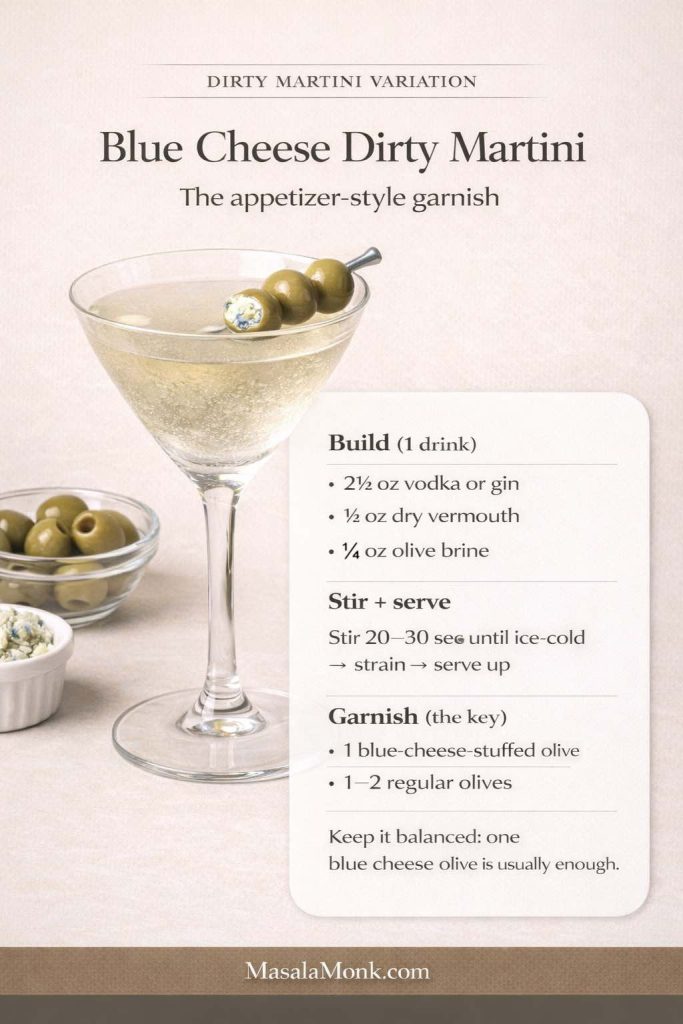
Vertical recipe-card infographic titled “Blue Cheese Dirty Martini” with subtitle “The appetizer-style garnish.” A chilled dirty martini sits in a clear martini glass on a warm-cream background, garnished with three green olives on a pick; one olive is blue-cheese-stuffed. A side bowl of green olives and a small ramekin of crumbled blue cheese appear nearby. Text lists the build: 2½ oz vodka or gin, ½ oz dry vermouth, ½ oz olive brine; stir 20–30 seconds until ice-cold, strain, serve up; garnish with 1 blue-cheese-stuffed olive plus 1–2 regular olives. Footer reads MasalaMonk.com.
Blue Cheese Dirty Martini (Appetizer-Style Garnish): If you love that salty, savory martini vibe, this is the upgrade. The trick is balance—one blue-cheese-stuffed olive gives the creamy, funky hit without making the drink heavy. Use it as a quick visual guide, then tweak your brine level to match how dirty you like it.

Dirty martini with blue cheese olives (one drink)

  • Make your classic dirty martini recipe (vodka or gin)
  • Garnish with:
    • 1 blue-cheese-stuffed olive
    • plus 1–2 regular olives

That gives you the creamy, funky hit without overwhelming the brine.

If you want food alongside this version, go in the same savory direction. A dip that matches the vibe can make the whole table feel intentional, especially something like MasalaMonk’s blue cheese dip guide for a snack spread that leans tangy and bold.

Also Read: 10 Vegan Chocolate Cake Recipes (Easy, Moist, & Dairy-Free)


Spicy Dirty Martini (Dirty Spicy Martini, Hot & Dirty Martini)

A spicy dirty martini works when the heat feels bright and clean—not bitter or overwhelming. The brine already has salt and acidity, so the spice should complement that rather than fight it.

Here are three ways to build a spicy dirty martini that still tastes like a martini, not a dare.
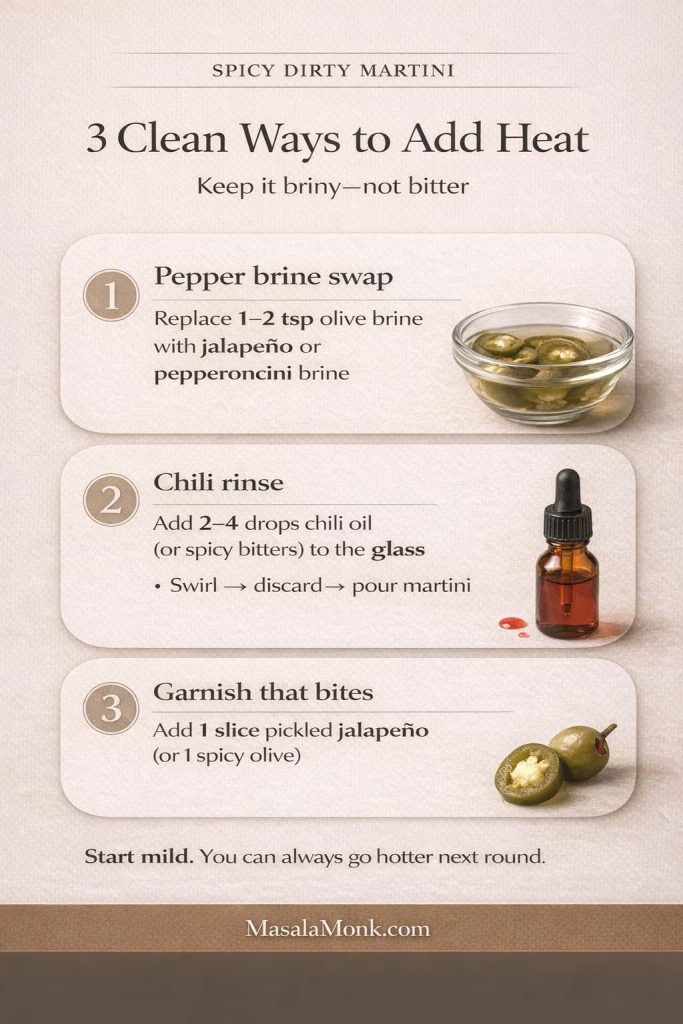
Vertical infographic titled “Spicy Dirty Martini” with headline “3 Clean Ways to Add Heat” and subtitle “Keep it briny—not bitter.” It lists three methods: 1) Pepper brine swap—replace 1–2 tsp olive brine with jalapeño or pepperoncini brine. 2) Chili rinse—add 2–4 drops chili oil (or spicy bitters) to the glass, swirl, discard, then pour martini. 3) Garnish that bites—add 1 slice pickled jalapeño (or 1 spicy olive). Bottom tip: “Start mild. You can always go hotter next round.” Footer: MasalaMonk.com.
Spicy Dirty Martini (3 easy methods): Want a dirty spicy martini that tastes clean instead of bitter? Use this quick guide—pepper brine swap, chili rinse, or a spicy garnish—so you can dial in the heat without wrecking the briny balance. Start mild, taste, then go hotter on the next round.

1) Dirty spicy martini with pickled pepper brine

  • Make your classic dirty martini
  • Replace 1–2 teaspoons of olive brine with pepper brine (jalapeño or pepperoncini)

This brings heat plus tang, and it layers well with olives.

2) Spicy dirty martini with a chili rinse

  • Chill your glass
  • Add a few drops of chili oil or spicy bitters
  • Swirl, then discard the excess
  • Pour the martini

This method gives you aroma and heat without changing the drink’s balance too much.

3) Hot and dirty martini with a garnish that bites

  • Make your dirty martini
  • Garnish with a pickled jalapeño slice or a spicy olive

This looks dramatic and it signals what’s coming before the first sip.

If you’re serving food with a spicy dirty martini, go for something cooling and creamy. A yogurt dip is the perfect counterbalance. For example, MasalaMonk’s Greek tzatziki sauce master recipe gives you a chilled, garlicky dip that works beautifully with spicy flavors, and it keeps the overall experience fresh rather than heavy.

For a richer pairing that still makes sense with heat, a warm, crowd-pleasing dip is hard to beat—especially MasalaMonk’s buffalo chicken dip, which lands in the same spicy-salty comfort zone, just in a different form.

Also Read: Kahlua Drinks: 10 Easy Cocktail Recipes (Milk, Vodka, Coffee)


Dirty Tequila ‘Martini’ (A Savory Tequila Cocktail in a Martini Glass)

Tequila in a “martini” glass can make people raise an eyebrow, yet it’s surprisingly good when you build it thoughtfully. This is not a classic martini in the traditional sense. Still, if you like tequila and you like brine, it can be a bright, savory drink that feels modern and a little mischievous.
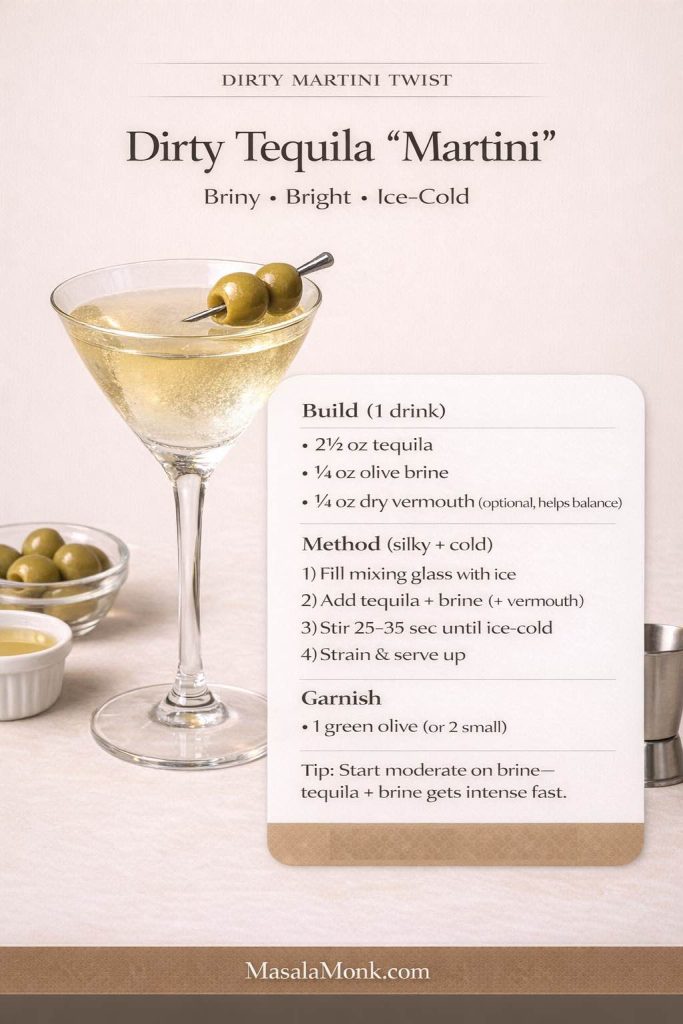
Vertical recipe-card infographic titled “Dirty Tequila ‘Martini’” on a warm cream background. A pale-gold tequila martini sits in a chilled martini glass with two green olives on a pick. A rounded recipe card lists the build (tequila, olive brine, optional dry vermouth), a 4-step stir-and-strain method, garnish guidance, and a tip to start with moderate brine. Footer reads MasalaMonk.com.
Dirty Tequila “Martini” (tequila + olive brine): A briny, bright twist for people who love savory cocktails but want something a little mischievous. Start with ¼ oz olive brine, stir until ice-cold, and taste—tequila + brine intensifies fast. (Perfect right before fries, a salty snack board, or any crisp bite.)

Dirty tequila martini (one drink)

  • 2½ oz tequila (a clean, smooth style works best)
  • ¼ oz olive brine
  • ¼ oz dry vermouth (optional, but it helps)
  • Stir super cold
  • Garnish with a green olive

Because tequila has its own personality, this version benefits from keeping the brine moderate at first. Once you taste the first attempt, you can push it dirtier if you want.

If you’re building food around this tequila version, lean into crispy, salty bites. Fries are a natural partner, and a dip that cools things down makes it even better. A simple pairing is MasalaMonk’s crispy homemade french fries guide, especially if you want the whole setup to feel like a casual bar snack—just cleaner and fresher.

Also Read: 19 Essential Kitchen Tools That Make Cooking Easier


Dirty Gin Martini Template (How to Adjust for Any Gin)

People often ask for brand-specific dirty martini recipes (like Hendrick’s Dirty Martini, Tanqueray Dirty Martini, Bombay Sapphire Dirty Martini) because they’re trying to match the drink to a gin they already like. With gin, the differences can be noticeable because botanicals matter.

A gin-forward dirty martini tends to feel:

  • more aromatic
  • more layered
  • sometimes more “herbal” against the brine

That can be wonderful if you love gin martinis. It can also be confusing if you’re expecting the clean neutrality of vodka.

So rather than treating each gin as a separate dirty martini recipe, use a stable base and adjust one dial: vermouth.
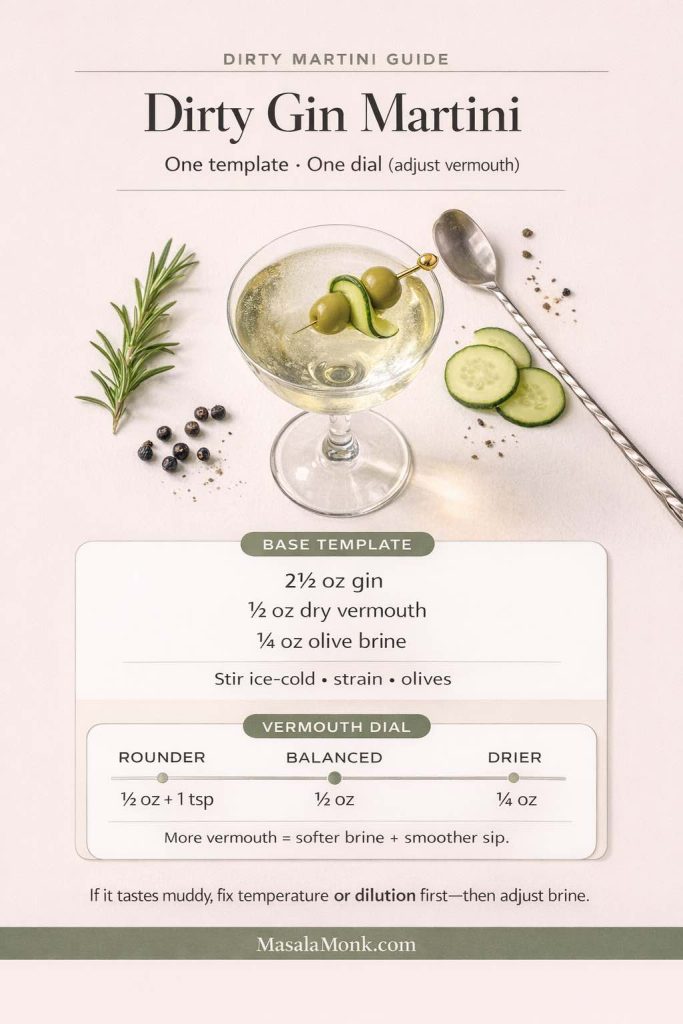
Vertical “Dirty Gin Martini” infographic on a warm cream background showing an overhead coupe-style dirty gin martini with olive and cucumber ribbon, plus juniper/rosemary accents and a bar spoon. Includes a base template (2½ oz gin, ½ oz dry vermouth, ¼ oz olive brine), a vermouth dial (rounder/balanced/drier), a tip to fix temperature or dilution before adding more brine, and “MasalaMonk.com” footer.
Dirty gin martini template = one base + one dial. Start with 2½ oz gin, ½ oz dry vermouth, and ¼ oz olive brine, then adjust vermouth depending on how aromatic your gin is (rounder vs drier). Save this as your quick “make it taste like a bar” cheat sheet—and if it ever tastes muddy, fix temperature and dilution first before you blame the brine. (MasalaMonk.com)

A clean dirty gin martini template

  • 2½ oz gin
  • ½ oz dry vermouth
  • ¼ oz olive brine
  • Stir and strain ice-cold
  • Olives

Then, if your gin is especially aromatic and you want it to feel drier, drop vermouth to ¼ oz. If your gin feels sharp with brine, keep the vermouth at ½ oz to round it.

Also Read: How to Cook Tortellini (Fresh, Frozen, Dried) + Easy Dinner Ideas


Dirty Vodka Martini Template (How to Adjust for Any Vodka)

Vodka is often chosen for a dirty martini because it’s a clean stage for brine. That’s why vodka + olive juice becomes such a popular combination.

Once again, you don’t need a unique recipe per vodka (like Tito’s Dirty Martini, Grey Goose Dirty Martini, Ketel One Dirty Martini, etc). What you need is a method that keeps the drink cold and balanced. However, if you already have a vodka you like, it can feel satisfying to “pair” it with the right style:

  • If your vodka is very clean and neutral, it’s great for extra dirty or filthy styles.
  • If your vodka has a bit of sweetness or softness, it can make a no-vermouth dirty martini easier to enjoy.

Also Read: Cranberry Moscow Mule Recipe: A Festive Holiday Cocktail With Easy Variations


The Dirty Martini Mix Conversation (Premixed, Canned, Batched)

Some people want to make a dirty martini cocktail quickly and consistently. That’s where premixed and batched styles come in. Even if you love the ritual of stirring, it’s hard to deny the appeal of opening the freezer and pouring an already-perfectly-chilled martini.

The trick is dilution. When you stir a martini, you’re always adding a little water from the ice. If you batch and skip that, your martini can taste too hot and too sharp. So you add water on purpose.

Also Read: Baked Ziti Recipe Collection: 15 Easy Variations

Batched dirty martini (freezer bottle method)

This makes about 8 servings.
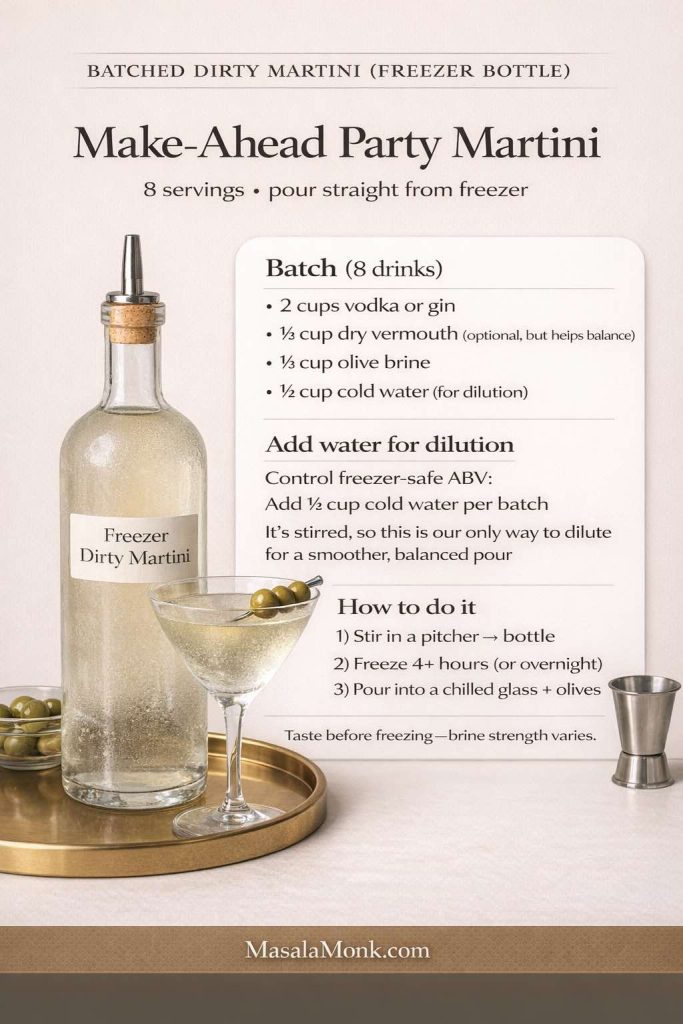
Vertical infographic titled “Batched Dirty Martini (Freezer Bottle)” with headline “Make-Ahead Party Martini” and subtitle “8 servings • pour straight from freezer.” It shows a clear bottle labeled “Freezer Dirty Martini,” a martini glass with green olives, and a small jigger on a warm-cream background. Text includes batch amounts: 2 cups vodka or gin, ⅓ cup dry vermouth (optional), ⅓ cup olive brine, ½ cup cold water for dilution. Steps: stir in a pitcher, bottle, freeze 4+ hours, pour into chilled glass and garnish. Tip: taste before freezing; brine strength varies. Footer: MasalaMonk.com.
Batched Dirty Martini (Freezer Bottle Method): Hosting or just want zero-fuss martinis? This make-ahead dirty martini batch is your “pour and serve” shortcut—complete with the dilution water that makes it taste like a freshly stirred drink. Mix, freeze, then pour straight into a chilled glass and garnish with olives.
  • 2 cups vodka or gin
  • ⅓ cup dry vermouth (optional, but it helps the balance)
  • ⅓ cup olive brine
  • ½ cup cold water

Stir, bottle, freeze. When you’re ready, pour straight from the freezer into a chilled glass and garnish with olives. Taste and adjust brine before freezing (brine intensity varies wildly).

Freezer note: At typical vodka/gin strength, this won’t freeze solid—just gets syrupy-cold. If it thickens too much, add 1–2 tbsp water to the bottle and shake.

This method is also a surprisingly elegant party move. It turns the dirty martini into something you can serve quickly, like a house cocktail.

If you want another cocktail post from MasalaMonk that leans into easy ratios and straight-up serving, the Paper Plane cocktail guide is a fun companion. It’s not a martini, yet it shares the same appeal: simple structure, strong payoff.

Also Read: Iced Coffee: 15 Drink Recipes—Latte, Cold Brew, Frappe & More


How to Make a Dirty Martini Taste “Proper” at Home

A lot of people want a proper martini—not because they’re chasing rules, but because they’re chasing a feeling. They want the drink to feel deliberate, like something a good bar would serve, even if they made it in their own kitchen.

So here are the details that actually move the needle.
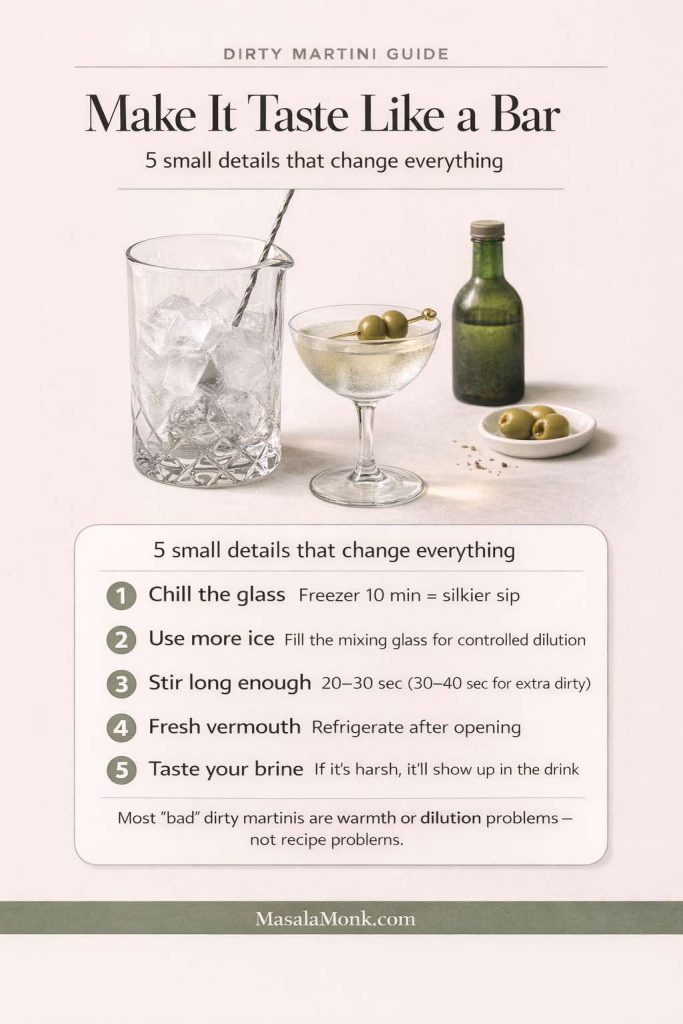
Want your dirty martini to taste like it came from a great bar? These 5 small details do the heavy lifting: freeze the glass, use a full mixing glass of ice, stir long enough for silky dilution, keep vermouth fresh, and taste your brine before it touches the drink. Most “bad” dirty martinis aren’t recipe failures—they’re warmth or dilution problems. Save this checklist for your next martini night and use it as your repeatable home-bar routine.

1) Cold glassware is not optional if you want a silky martini

A warm glass steals your chill instantly. Then the drink opens up too fast, and the brine starts to feel louder than it should. A cold glass makes everything feel tighter and more polished.

2) The right amount of ice is more ice than you think

A handful of ice melts too quickly and waters the drink unpredictably. A full mixing glass of ice chills efficiently and gives you controlled dilution. That control is what makes your second martini taste like your first.

3) Stirring time is not a personality test—it’s a texture tool

Stir less and your martini can taste harsh and hot. Stir longer and the drink becomes smoother. If your martini tastes “too strong,” it’s often not the alcohol—it’s the lack of dilution.

4) Vermouth freshness quietly matters

Even if you’re only adding a small amount, stale vermouth can taste dull or slightly off, and it can make the whole drink feel less clean. If you keep vermouth in the fridge after opening and treat it like the wine it is, your martinis tend to improve noticeably. Difford’s has a practical overview of vermouth storage and serving that explains why.

5) Brine is the star, so choose it like you mean it

If the brine tastes strange out of the jar, it will taste strange in the drink. If you want to understand brine beyond “whatever came with the olives,” Food & Wine’s piece on DIY brine for dirty martinis is a good way to see how layered it can be.

Also Read: How to Make Churros (Authentic + Easy Recipe)


What to Eat With a Dirty Martini (So It Feels Like a Whole Experience)

This is where dirty martinis shine. They don’t just tolerate food—they improve with it. Salt, fat, crunch, and tang all make the brine feel cleaner and the drink feel smoother.

Below are a few pairings that fit different dirty martini styles, using MasalaMonk recipes you can weave into a “martini night” without turning it into a full production.
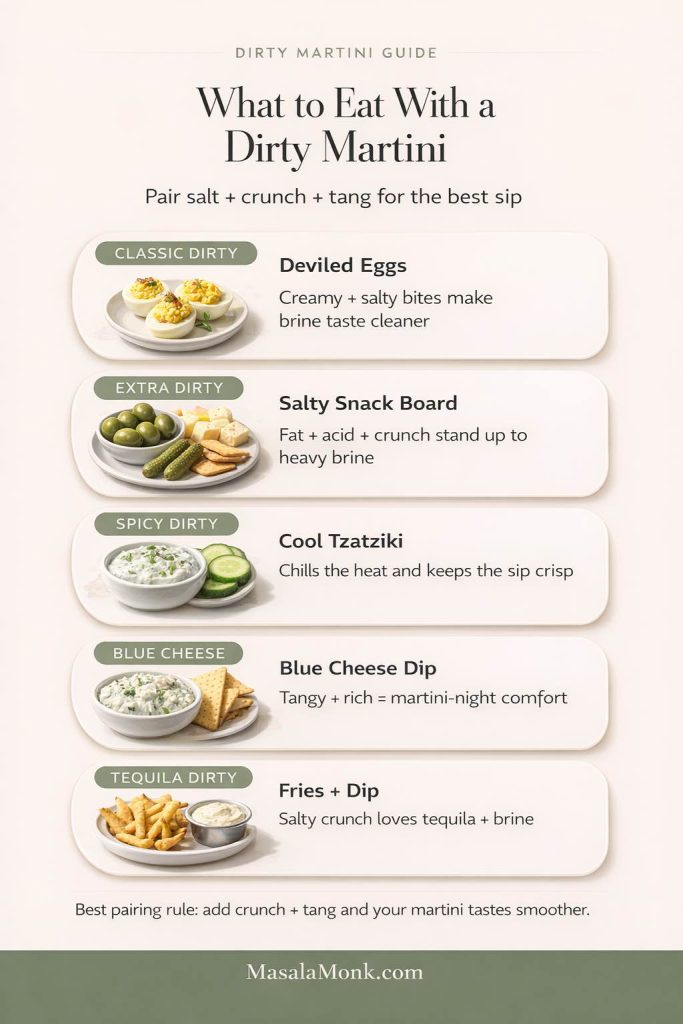
Vertical “Dirty Martini Guide” infographic titled “What to Eat With a Dirty Martini” with five pairing cards: Classic Dirty—deviled eggs; Extra Dirty—salty snack board (olives, pickles, cheese, crackers); Spicy Dirty—cool tzatziki with cucumber; Blue Cheese—blue cheese dip with crackers; Tequila Dirty—fries with dip. Bottom tip says adding crunch and tang makes the martini taste smoother. MasalaMonk.com footer.
Planning a martini night? Use this quick pairing cheat sheet to make your dirty martini taste cleaner and smoother: deviled eggs for classic, a salty snack board for extra dirty, tzatziki for spicy, blue cheese dip for comfort, and fries + dip for tequila dirty. The simple rule that always works: salt + crunch + tang. Save it, pin it, and build the full spread from the MasalaMonk guides linked in this section.

Classic dirty martini food pairing: deviled eggs

Deviled eggs are practically built for martinis: creamy, salty, and bite-sized. If you want a base recipe that’s easy to scale with variations, MasalaMonk’s deviled eggs guide gives you plenty of directions to keep things interesting without overthinking it.

Even better, deviled eggs work with almost every martini style—vodka, gin, extra dirty, no vermouth, up, straight up, all of it.

Extra dirty martini pairing: a snack board that leans salty

If your martini is really dirty, you want food that can keep up. A charcuterie board does that beautifully because it gives you salt, fat, and little bursts of acid. If you want a method that makes board-building feel easy rather than fussy, MasalaMonk’s 3-3-3-3 charcuterie board rule guide gives you a simple framework.

Add olives, pickles, a few cheeses, and something crunchy, and suddenly your martini feels like it belongs.

Spicy dirty martini pairing: cool tzatziki

Spice plus brine is exciting, but it can also feel intense. A cool dip balances it instantly. MasalaMonk’s Greek tzatziki sauce master recipe is especially helpful because it’s built as a base plus variations, which makes it easy to match different flavors—more dill, more garlic, more lemon, or a little mint.

Blue cheese olive martini pairing: blue cheese dip or mozzarella sticks

If you’ve gone full blue cheese olive, you’re already living in the land of savory comfort. Lean into it. MasalaMonk’s blue cheese dip guide can anchor a snack table, while their mozzarella sticks recipe gives you that hot-and-crunchy contrast that makes a cold martini feel even colder.

Tequila dirty martini pairing: fries + a dip

Tequila with brine tends to invite crisp, salty food. Fries are a natural fit, especially when you add something cool on the side. Start with MasalaMonk’s homemade french fries guide, then add tzatziki or any creamy dip you like.

Party pairing for any martini night: buffalo chicken dip

If you want one warm, bold centerpiece that makes everyone gather around the table, MasalaMonk’s buffalo chicken dip is built for that job. It’s rich, tangy, and spicy in a way that makes a salty martini feel even cleaner.

Also Read: Baked Jalapeño Poppers (Oven) — Time, Temp & Bacon Tips


A “Choose Your Own Dirty Martini” Flow That Actually Helps

Instead of trying to memorize every version, you can build the martini that matches your mood.
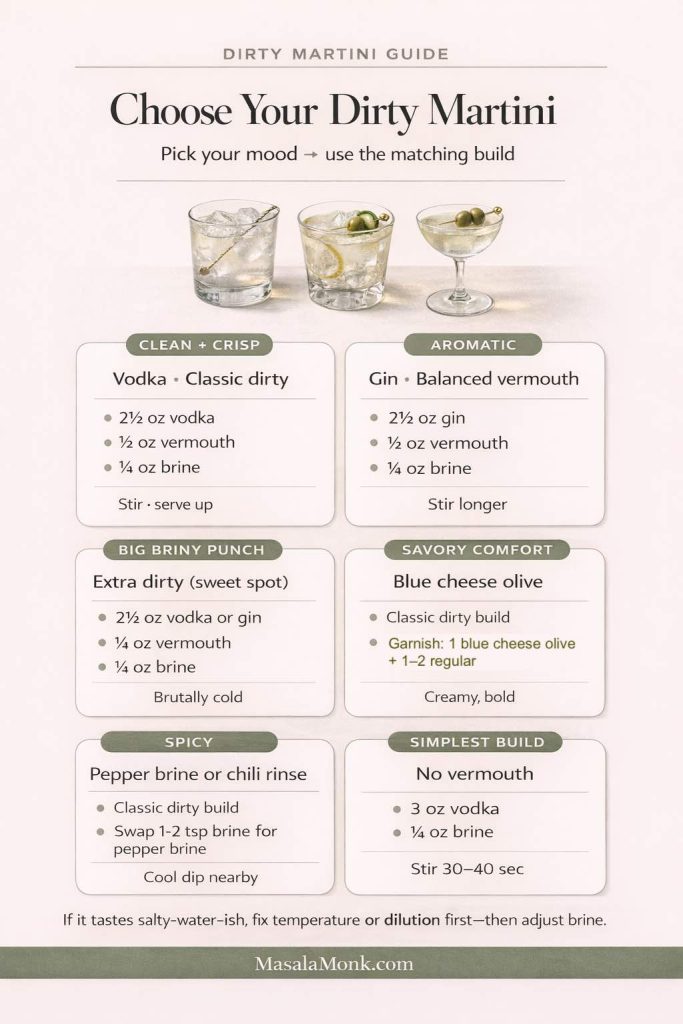
Vertical infographic titled “Choose Your Dirty Martini” on a warm cream background. Top shows three clear martini-style drinks. Six labeled cards guide builds by mood: Clean + Crisp (vodka, classic dirty), Aromatic (gin, balanced vermouth), Big Briny Punch (extra dirty), Savory Comfort (blue cheese olive), Spicy (pepper brine or chili rinse), and Simplest Build (no vermouth). Footer reads MasalaMonk.com.
Not sure how dirty you actually want it? Use this “choose your dirty martini” guide to match your mood: clean + crisp vodka, aromatic gin, big briny extra-dirty, blue cheese comfort, spicy pepper-brine, or the simplest no-vermouth build. It’s the fastest way to stop guessing and start landing on your perfect dirty martini—every time. Save this for your next martini night, and share it with a fellow olive-lover. Full Dirty Martini Guide here on MasalaMonk.com.

If you want the cleanest, crispest sip

Go vodka, classic brine, stir, serve up.

If you want a more aromatic martini

Go gin, keep vermouth at ½ oz, keep brine moderate, stir longer.

If you want a big briny punch

Go extra dirty, reduce vermouth slightly, keep everything brutally cold.

If you want savory comfort

Add blue cheese olives and serve with something creamy and tangy.

If you want heat

Use pepper brine or a chili rinse and balance it with a cool dip nearby.

If you want the simplest possible build

Skip vermouth, stir hard, keep brine moderate, and let cold do the smoothing.

Also Read: Classic Rum Punch + 9 Recipes (Pitcher & Party-Friendly)


The Dirty Martini, Made Yours

A dirty martini is one of those drinks where personal preference isn’t a footnote—it’s the whole point. Some people want it barely dirty. Others want it filthy. Some want gin, some want vodka, some want tequila just because it sounds fun. Some want vermouth. Others want martini without vermouth and they’re perfectly happy there.

What matters is learning how to steer the drink so it tastes intentional instead of accidental. Start with the core dirty martini recipe, taste what you made, and adjust one thing at a time: a little more brine, a little less vermouth, a longer stir, a colder glass, a different garnish.
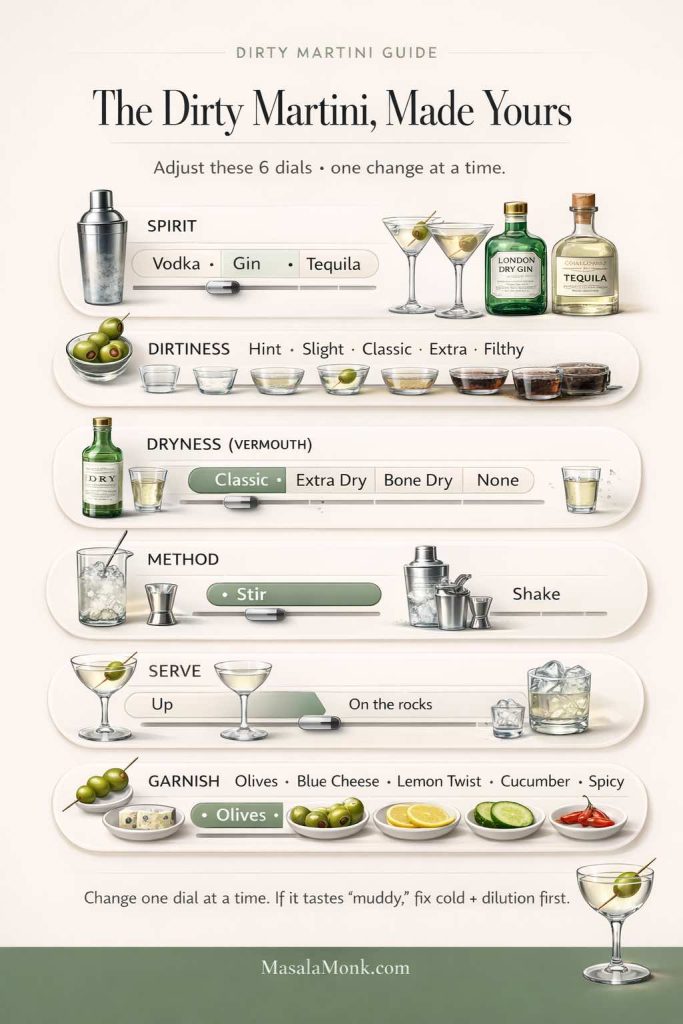
Vertical infographic titled “The Dirty Martini, Made Yours” showing six adjustable “dials” for customizing a dirty martini: spirit (vodka, gin, tequila), dirtiness level, dryness/vermouth, method (stir vs shake), serve style (up vs on the rocks), and garnish options (olives, blue cheese, lemon twist, cucumber, spicy). Includes small food and bar-tool illustrations and a MasalaMonk.com footer.
Use this “6-dial” guide to build your perfect dirty martini without guessing—pick your spirit, choose how briny you want it, decide how dry to go, then lock in method, serve style, and garnish. The big win: change one dial at a time so you can actually taste what improved (and if it turns “muddy,” fix cold + dilution before adding more brine).

Then, once you’ve found your version, make it part of a small ritual. Put olives on a plate. Add a bowl of tzatziki. Make deviled eggs. Or throw mozzarella sticks in the oven. Suddenly it’s not just a cocktail—it’s a tiny, salty, cold celebration.

And that, honestly, is what the dirty martini has always been good at.

Also Read: Crock Pot Lasagna Soup (Easy Base + Cozy Slow-Cooker Recipes)


FAQs: Dirty Martini Recipe (Ratios, Variations, and Fixes)

1) What is a dirty martini?

At its core, a dirty martini is a martini made with vodka or gin plus olive brine (often called olive juice). As a result, it tastes saltier and more savory than a classic dry martini.

2) What’s the best dirty martini recipe for beginners?

To begin with, choose vodka or gin, add a small amount of dry vermouth, then measure in olive brine. Afterward, taste and adjust the brine on your next round if you want it bolder.

3) What is the best dirty martini ratio?

In general, a reliable ratio is 5 parts vodka or gin, 1 part dry vermouth, and about ½ part olive brine for a classic dirty style. From that baseline, you can nudge the brine up for a really dirty martini or down for a slightly dirty martini.

4) How much olive brine should I use in a dirty martini?

As a starting point, use 1–2 teaspoons for slightly dirty, or ¼ oz (7–8 ml) for classic dirty. For a really dirty martini, move closer to ⅜–½ oz.

5) Is olive brine the same as olive juice?

Most of the time, yes—olive “juice” usually means the brine in a jar of olives. That said, brines vary a lot by brand, so the best olive juice for a dirty martini is the one you actually like the taste of.

6) Can I make a dirty martini without vermouth?

Definitely. In fact, a dirty martini no vermouth style is common for people who want it extra dry. Even so, skipping vermouth often means you’ll want to chill harder and stir a bit longer for smoothness.

7) What’s a vodka martini no vermouth, dirty style?

Simply put, it’s vodka plus olive brine, chilled and served up. For many, that’s the whole appeal of a dirty vodka martini no vermouth—direct, briny, and uncomplicated.

8) What does “extra dry” mean in a dirty martini?

Typically, extra dry means less vermouth. Consequently, the olive brine can feel more prominent, so it helps to keep the brine measured and the drink extremely cold.

9) What’s the difference between a dirty martini and a dry martini?

A dry martini relies on dry vermouth for its classic profile; meanwhile, a dirty martini uses olive brine for savory salinity. Additionally, phrases like “dirty and dry martini” often imply both brine and a reduced vermouth pour.

10) What is a dirty martini “up”?

Put another way, “up” means chilled and strained into a glass with no ice. Therefore, a dirty martini up is served straight up after being stirred or shaken with ice.

11) What’s the difference between “straight up” and “on the rocks” for a dirty martini?

Straight up (or up) is strained into a glass without ice; on the rocks is served over ice in the glass. In turn, straight up tastes more concentrated, while rocks stays colder longer and softens gradually as it sits.

12) Should a dirty martini be shaken or stirred?

Either is valid, yet the feel changes. Stirring usually creates a clearer, silkier drink; shaking makes it colder fast, often cloudier, with tiny ice shards. Ultimately, a shaken dirty martini is a style preference, not a rule-break.

13) What’s the best way to make a dirty martini at home that tastes like a bar drink?

First, chill the glass well. Next, use plenty of ice while mixing. Then, stir long enough to reach a smooth dilution. Finally, measure the brine rather than eyeballing it, because a little extra can swing the flavor quickly.

14) Why does my dirty martini taste too salty?

More often than not, the brine amount is high for your palate, or the brine itself is intensely salty. With that in mind, reduce brine next time, keep the drink colder, and let the olives provide aroma without flooding the mix.

15) Why does my dirty martini taste watery?

Usually, it comes down to over-dilution from melting ice or using too little ice while mixing. Oddly enough, adding more ice can help because it chills faster and melts more predictably.

16) Why does my dirty martini taste harsh or “hot”?

In many cases, that’s under-dilution. Accordingly, stir a bit longer, chill the glass more, or add a small splash of vermouth if you use it to round the edges.

17) What are the best olives for a dirty martini?

Generally, firm green olives work well. If you want a buttery bite, choose a milder green olive; if you prefer a sharper pop, pick a more robust brined olive. Either way, the best olives are the ones you enjoy eating plain.

18) What are blue cheese olives, and do they work in a dirty martini?

Blue cheese stuffed olives add creamy, funky savoriness that pairs well with brine. For balance, many people use one blue cheese olive plus one or two regular olives so the garnish enhances rather than overwhelms.

19) How do I make a blue cheese dirty martini?

Make a classic dirty martini (vodka or gin), then garnish with a blue cheese stuffed olive. If you want more blue cheese intensity, add a second—however, the drink can start to feel heavier and saltier.

20) What’s a spicy dirty martini?

A spicy dirty martini adds heat to the briny base. Depending on your preference, you can add spice through pepper brine, a spicy garnish, or a light chili rinse in the glass.

21) How do I make a hot and dirty martini without ruining the flavor?

Rather than dumping in heat, add it in controlled increments—like a teaspoon of pepper brine or a spicy garnish—so the drink stays crisp instead of turning bitter or harsh.

22) What is a tequila dirty martini?

A tequila dirty martini swaps vodka or gin for tequila while keeping olive brine in the mix. As such, it becomes a savory tequila cocktail served martini-style, best when kept extremely cold and carefully measured.

23) Can I make a dirty martini with gin instead of vodka?

Yes, and it’s often more aromatic. Because gin brings botanicals, brine can feel more intense, so many people keep brine moderate and include at least a small amount of vermouth to pull it together.

24) What is a “perfect” dirty martini?

In practice, “perfect” means the ratio, temperature, and dilution are dialed in to your taste. In other words, it’s less about a single formula and more about repeatable balance.

25) What is the ultimate dirty martini recipe?

For most drinkers, “ultimate” means very cold, well-measured, and tailored to their preferred level of dirty—classic, very dirty, extra dry, or no vermouth. Above all, consistency is what makes it feel “ultimate.”

26) What is a very dirty martini recipe?

A very dirty martini generally means pushing olive brine to around ½ oz per drink, sometimes more. Because that’s a strong brine load, chilling and stirring technique become especially important.

27) What is an extra dirty martini recipe?

Typically, an extra dirty martini recipe uses about ½ oz olive brine, along with vodka or gin and often a reduced pour of vermouth. As a result, it tastes more intensely briny than a classic dirty martini.

28) What is an extra extra dirty martini?

It’s a step beyond extra dirty—often around ¾ oz brine. Even though some people love the punch, others find it too salty, so it’s best treated as a personal preference.

29) What’s the difference between “dirty” and “filthy” martinis?

Colloquially, “filthy” just means extremely dirty—more olive brine and a stronger savory profile. Put simply, filthy is dirtier.

30) Can I batch a dirty martini for a party?

Yes. A batched dirty martini is made ahead and stored very cold, often in the freezer. Crucially, you’ll want to add measured water to mimic the dilution you’d normally get from stirring with ice.

31) How do I keep a batched dirty martini from tasting too strong?

When batching, include enough water for dilution and keep the bottle deeply chilled. Otherwise, the drink can taste “hot” compared with a freshly stirred martini.

32) What are the basic ingredients to make a dirty martini?

At minimum: vodka or gin, olive brine, ice, and olives. Optionally, add dry vermouth, which can make the drink feel more rounded and cohesive.

33) What does “dirty martini means” in plain terms?

It means the martini includes olive brine. Hence, the drink shifts from crisp and botanical toward salty and savory.

34) What’s the difference between “dirty martini with a twist” and a classic dirty martini recipe?

A twist refers to citrus peel (often lemon). In a dirty martini, a twist can brighten the brine and make the sip feel lighter; meanwhile, the classic approach leans on olives as the main garnish.

35) Can I make a dirty martini without olives?

Yes. The drink is still dirty if it includes olive brine. Nevertheless, olives add aroma and that final savory bite, so many people find the drink feels more complete with at least one olive.

36) What’s the best dirty martini recipe if I’m sensitive to salt?

Start with a slightly dirty martini using 1–2 teaspoons brine, keep the drink very cold, and rely on olives for flavor rather than more brine. That approach keeps the character while lowering the salt impact.

Posted on — 9 Comments

Rob Roy Drink Recipe: Classic Scotch Cocktail (Perfect + Dry + Sweet Variations)

Photorealistic magazine-style cover of a Rob Roy drink recipe in a cut-crystal rocks glass with large ice and lemon twist, featuring “Sweet vs Dry Vermouth” and MasalaMonk.com.

There are drinks that feel like a performance, and then there are drinks that feel like a decision. A Rob Roy belongs to the second camp—and this Rob Roy drink recipe is the kind of classic you reach for when you want the night to slow down, not because you’re trying to be fancy, but because you want something steady and satisfying in your hands. It arrives dark and glossy, the aroma lifting before you even take a sip. The first taste is warm and structured: whisky depth, vermouth richness, a faint bitter edge that keeps everything from going soft.

A Scotch classic worth knowing

That’s why a Rob Roy drink recipe is worth learning properly. Not because it’s complicated (it isn’t), but because it rewards attention. Cold becomes part of the flavor. Dilution reshapes texture. Fresh vermouth changes the aroma in a way you can’t miss. After a few rounds, it’s easy to see why people fall hard for spirit-forward cocktails.

If you’ve heard it described as a cousin of the Manhattan, that’s a useful way to place it. The Rob Roy cocktail uses the same basic architecture—whisky, vermouth, bitters—yet the switch to Scotch whisky shifts the accent. Depending on the Scotch, it can taste honeyed, fruity, toasted, or gently smoky. In other words, the drink has range without needing extra ingredients.

What follows is a full guide you can actually use: classic Rob Roy ingredients, the classic Rob Roy cocktail recipe, and the variations that genuinely earn their place—perfect Rob Roy, dry Rob Roy, and sweet Rob Roy. Along the way, you’ll get practical clarity on how to make a Rob Roy, how to mix a Rob Roy without fuss, and how to serve it up or on the rocks so it fits the moment.

Also Read: Best Vermouth for a Negroni Cocktail Drink Recipe


Rob Roy Drink Recipe: What It Is and Why It Works

A Rob Roy is a whisky cocktail built with Scotch whisky, vermouth, and bitters, stirred with ice until it’s cold enough to feel silky, then strained into a glass and finished with a garnish. If you’ve ever wanted a definition you could say out loud without sounding like you’re reading a textbook, that’s it.

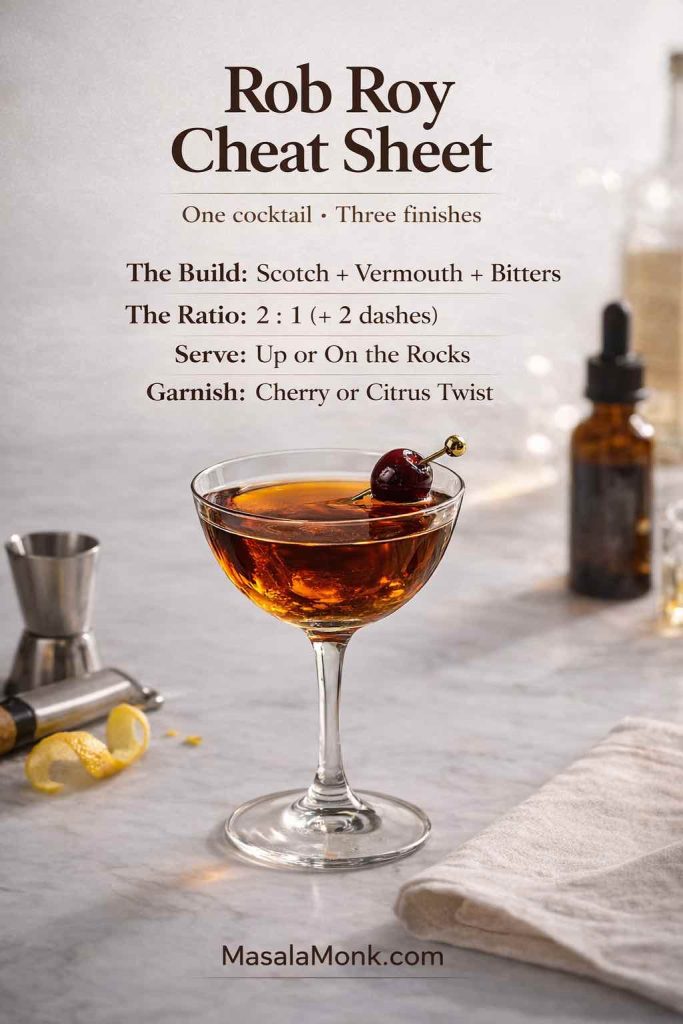
Rob Roy cheat sheet showing the cocktail build (Scotch, vermouth, bitters), the 2:1 ratio, serving options (up or on the rocks), and garnish ideas, styled as a premium photo on marble with MasalaMonk.com branding.
Save this Rob Roy cheat sheet for quick reference: start with the 2:1 Scotch-to-vermouth build, add bitters for structure, then choose your finish—up for focus or on the rocks for a slower, softer sip.

Still, the reason it works is more interesting than the definition. The Rob Roy is a “balance” cocktail, meaning it’s designed around a tension that feels good: strength and softness, sweetness and bitterness, warmth and chill. Scotch provides the backbone. Vermouth adds body, aromatics, and a kind of herbal sweetness that makes the drink feel complete rather than merely boozy. Bitters add shape, keeping the edges crisp enough that you want another sip.

This is also why the Rob Roy drink doesn’t need a long ingredient list. It isn’t trying to be flashy. It’s trying to be satisfying in a way that feels composed. Even the garnish is more about aroma than decoration. A cherry makes the drink feel rounder; a twist makes it feel brighter. Those small choices matter because the cocktail is so clean.

If you like seeing a classic spec from a major cocktail source, you can compare what you make at home with the version on Liquor.com’s Rob Roy recipe. The core idea stays the same, even as different bartenders nudge the details.

Also Read: Paper Plane Cocktail Recipe + Best Amaro Substitutes & Tips


Rob Roy Ingredients for the Classic Cocktail Drink Recipe

You’ll see a lot of ways people ask for this—rob roy ingredients, ingredients for a rob roy, rob roy drink ingredients, ingredients of a rob roy—and they all come down to the same simple lineup:

  • Scotch whisky
  • Sweet vermouth
  • Aromatic bitters
  • Garnish (cherry or citrus twist)

That list is short, but each ingredient pulls real weight. In a drink with five or six components, one slightly tired bottle might not show up as strongly. In a three-ingredient classic, it absolutely does.

Scotch whisky for Rob Roy

Scotch whisky is the soul of this drink. If you want a robust, steady Rob Roy cocktail, a blend can be a great choice—smooth, consistent, friendly to vermouth. That’s why you’ll see people use familiar blends and why there are so many “brand + Rob Roy” combinations floating around in cocktail culture.

On the other hand, a single malt can make a Rob Roy feel more distinctive—more fruit, more honey, more oak, or more smoke depending on what you pour. That can be wonderful. It can also become intense quickly. The beauty of the Rob Roy is that it lets you discover what you like without needing a lab.

If you want a clear overview of Scotch categories—single malt vs blended Scotch and what those terms actually mean—the Scotch Whisky Association’s guide to Scotch whisky categories is a simple, authoritative explainer.

Sweet vermouth (and why freshness matters)

Sweet vermouth is the ingredient that turns whisky into a cocktail rather than “whisky plus something.” It contributes sweetness, yes, but also bitterness and aromatics: herbs, spice, dried fruit. It’s the bridge between the whisky’s warmth and the bitters’ structure.

Because vermouth is a fortified, aromatized wine, it changes after opening. Treat it like wine, not like whisky. That’s where the biggest “home cocktail glow-up” lives. If you want to understand why, The Spruce Eats’ vermouth overview is a solid reference on what vermouth is and how it behaves.

Aromatic bitters (Angostura and the “two dashes” magic)

Bitters act like seasoning. They tighten the drink, deepen the aroma, and keep the vermouth sweetness from feeling floppy. Angostura is the classic choice and is often what people mean when they reference bitters in whisky cocktails. If you enjoy the backstory behind the bottle, the official Angostura “Our Story” page is a fun, quick read.

Garnish (Rob Roy garnish)

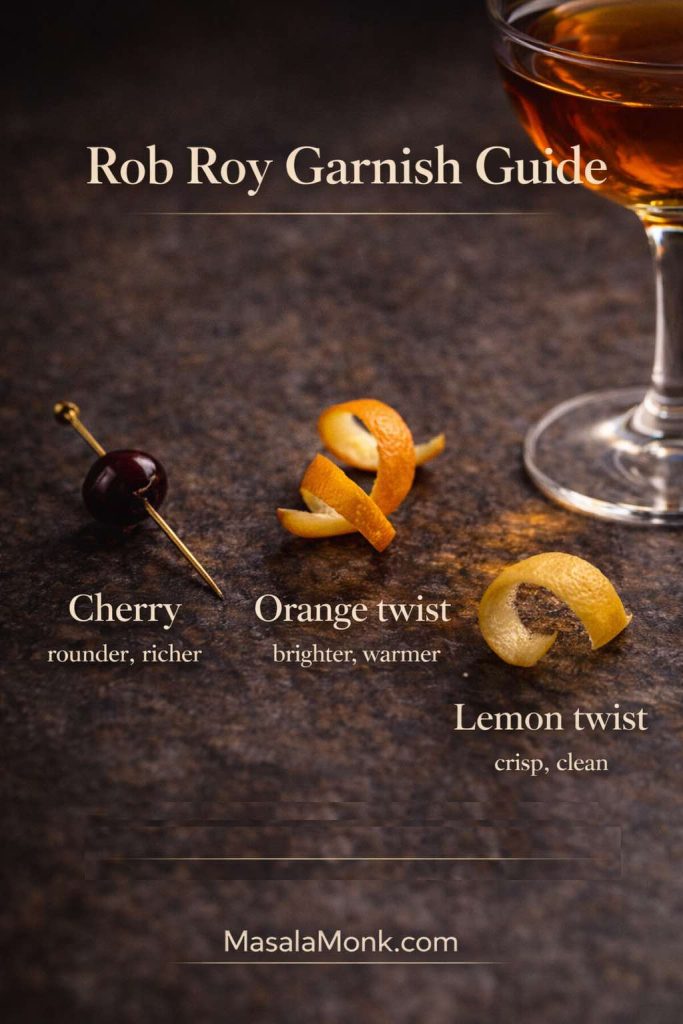
A Rob Roy garnish is more than garnish; it’s aroma. A cherry leans into the drink’s richness. An orange twist makes it feel vivid. A lemon twist makes it feel clean and lifted—especially in a dry Rob Roy drink.

Rob Roy garnish guide showing three options—cherry, orange twist, and lemon twist—with notes on flavor impact (richer, brighter, crisper) beside a Rob Roy cocktail, branded MasalaMonk.com.
Garnish is the easiest way to steer a Rob Roy: choose a cherry for a rounder, richer finish, orange twist for warmth and lift, or lemon twist when you want the drink crisp and clean.

If you’re only going to do one garnish well, choose the one you love most and repeat it. Consistency teaches you faster than constantly switching.

Also Read: Green Chutney Recipe (Coriander–Mint / Cilantro Chutney)


How to Make a Rob Roy: The Stir That Changes Everything

“How to make a Rob Roy” sounds like it should be elaborate—because the drink feels elegant—yet the method is almost minimalist. You stir with ice, you strain, you garnish.

Still, that stir is doing the heavy lifting. It’s not just mixing. It’s chilling the drink to the right temperature and adding the right amount of water so the flavors become unified instead of separate.

Close-up of a bartender stirring a Rob Roy cocktail over clear ice with a bar spoon, showing a stirring guide for smooth texture and proper dilution, with MasalaMonk.com branding.
A Rob Roy gets its signature smoothness from stirring—aim for a well-chilled mix, stop once the glass frosts, then strain quickly so the drink stays silky instead of over-diluted.

The reliable method (how do you make a Rob Roy or how to mix a Rob Roy)

  1. Chill the glass if you’re serving the drink up. Even a quick chill helps.
  2. Add Scotch whisky, vermouth, and bitters to a mixing glass (or any sturdy glass you can stir in).
  3. Add plenty of ice.
  4. Stir until the drink is very cold and slightly glossy.
  5. Strain into your glass.
  6. Add the garnish.

That’s the whole method. What makes it special is how it feels when it’s done right: smooth, cohesive, not harsh.

Rob Roy up vs Rob Roy on the rocks

A Rob Roy up is precise and aromatic. It stays concentrated. It feels like a tailored choice.

Up vs On the Rocks comparison for a Rob Roy cocktail, showing an “up” Rob Roy in a coupe glass and an “on the rocks” Rob Roy in a cut-crystal rocks glass with ice, with text overlay and MasalaMonk.com branding.
Serving style changes the whole experience: a Rob Roy “up” tastes more focused and aromatic, while “on the rocks” mellows slowly as the ice softens the edges—choose based on whether you’re hosting or unwinding.

A Rob Roy on the rocks is slower and softer. It evolves as the ice melts, becoming gentler over time. This style is especially nice when you’re eating, because the cocktail stays in step with snacks and conversation rather than demanding your attention.

Neither is “better.” They’re just different versions of comfort.

Also Read: Sandwich for Breakfast: Breakfast Sandwich Recipe + 10 Variations


Rob Roy Drink Recipe: The Classic Ratio (and the ml version)

Here is the classic Rob Roy drink recipe in a clean, dependable ratio:

  • 2 oz (60 ml) Scotch whisky
  • 1 oz (30 ml) sweet vermouth
  • 2 dashes aromatic bitters

Stir with ice until very cold, strain, garnish.

Classic Rob Roy cocktail build graphic showing a coupe glass Rob Roy with cherry garnish and a 2:1 Scotch-to-sweet-vermouth ratio plus bitters, branded MasalaMonk.com.
Use this classic Rob Roy build when you want a whisky-forward drink that still feels smooth—keep the 2:1 Scotch-to-vermouth balance, add bitters for structure, and garnish with cherry for richness or orange for lift.

If you prefer thinking in milliliters, this is your rob roy cocktail recipe ml version: 60 ml Scotch, 30 ml sweet vermouth, bitters.

This ratio is popular for a reason. It’s whisky-forward without being aggressive, and the vermouth stays present without turning the drink syrupy. It’s also the easiest place to start if you’re going to explore variations.

Also Read: Strawberry Smoothie Recipes (12 Easy Blends + Bowls & Protein Shakes)


Rob Roy Cocktail Drink Recipe Variations: Perfect, Dry, and Sweet

The best variations aren’t gimmicks. They’re different expressions of the same template. Each one works because it adjusts the vermouth in a way that changes the drink’s personality without breaking its structure.

Choose Your Rob Roy guide showing three Rob Roy cocktail variations—Classic, Perfect, and Dry—with garnish cues and the vermouth switch (sweet, sweet+dry split, dry), branded MasalaMonk.com.
Not sure which Rob Roy to make? Start with the style you’re craving: Classic for richness (sweet vermouth), Perfect for balance (split sweet + dry), or Dry for a crisp finish (dry vermouth).

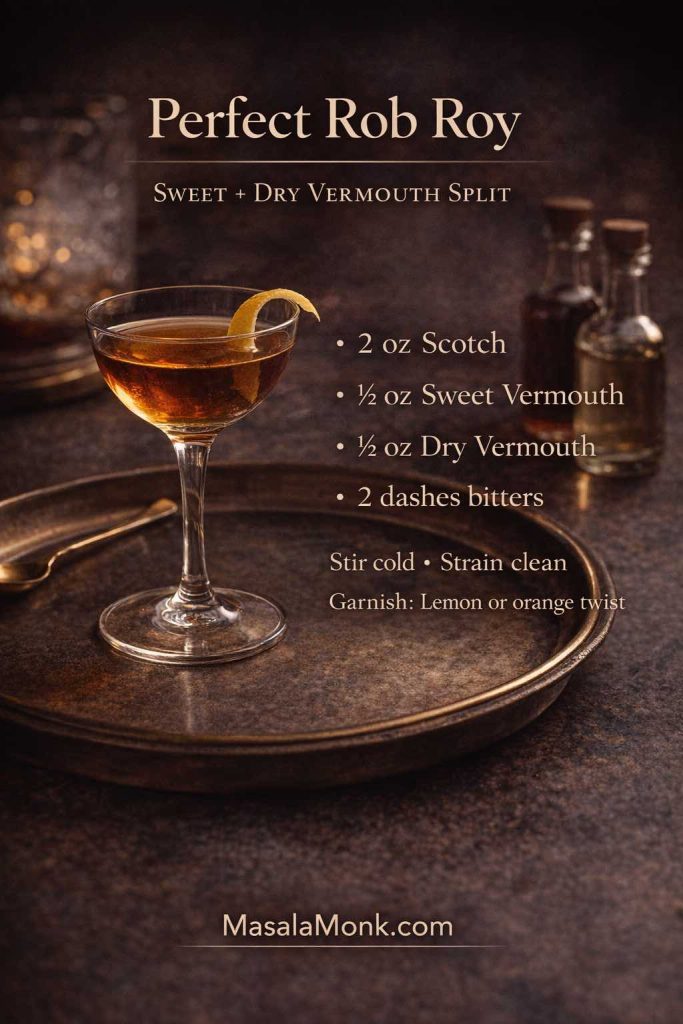
Perfect Rob Roy

A perfect Rob Roy uses both sweet and dry vermouth. The result sits beautifully in the middle: aromatic and balanced, less sweet than the classic, yet still rich enough to feel satisfying.

Perfect Rob Roy ingredients

  • 2 oz (60 ml) Scotch whisky
  • ½ oz (15 ml) sweet vermouth
  • ½ oz (15 ml) dry vermouth
  • 2 dashes aromatic bitters

Stir, strain, garnish with a lemon or orange twist.

Perfect Rob Roy recipe card showing a Nick & Nora glass cocktail with lemon twist and the sweet + dry vermouth split (2 oz Scotch, ½ oz sweet vermouth, ½ oz dry vermouth, bitters), with MasalaMonk.com branding.
A Perfect Rob Roy is the easiest way to dial in balance—splitting sweet and dry vermouth keeps the drink aromatic and smooth without leaning too rich or too sharp.

This is often the “crowd-pleaser” version. If someone says they want a Rob Roy but worry it will be too sweet, the perfect Rob Roy recipe is a confident answer. It’s also a wonderful way to use both vermouth styles without making a drink that feels like an experiment.

You might see people casually call it a “perfect Rob Roy martini” because it’s served in a martini-style glass. The build is still a stirred Scotch cocktail; the glass is simply a serving choice.

Recipe for perfect Rob Roy (simple recap): 60 ml Scotch, 15 ml sweet vermouth, 15 ml dry vermouth, bitters, stirred and strained.

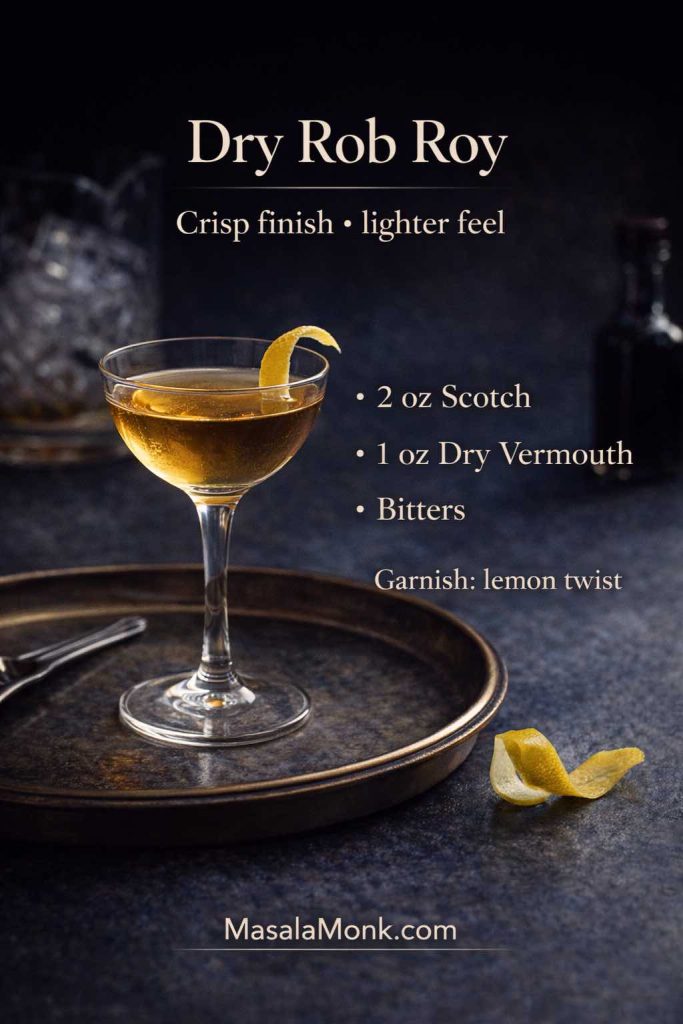
Dry Rob Roy

A dry Rob Roy swaps sweet vermouth for dry vermouth. That single change makes the drink sharper and more lifted. It can feel brisk, herbal, and surprisingly refreshing while still being unmistakably whisky-forward.

Dry Rob Roy drink recipe

  • 2 oz (60 ml) Scotch whisky
  • 1 oz (30 ml) dry vermouth
  • 1–2 dashes aromatic bitters

Stir, strain, garnish with a lemon twist.

A Dry Rob Roy is the clean, crisp take on the classic—dry vermouth brightens the whisky, bitters keep it structured, and a lemon twist lifts the aroma with every sip.

If you’ve ever wanted a Rob Roy that feels less plush and more precise, this is it. It’s also a strong choice when you’re serving snacks that are rich or spicy, because the dry vermouth’s crispness cuts through heaviness.

Dry Rob Roy on the rocks is particularly good. It slows the drink down, and the gradual dilution can make the dry vermouth feel more perfumed rather than sharp. If you like a citrus finish, a lemon twist is the natural pairing—this is essentially what people mean by “dry Rob Roy on the rocks with a twist.”

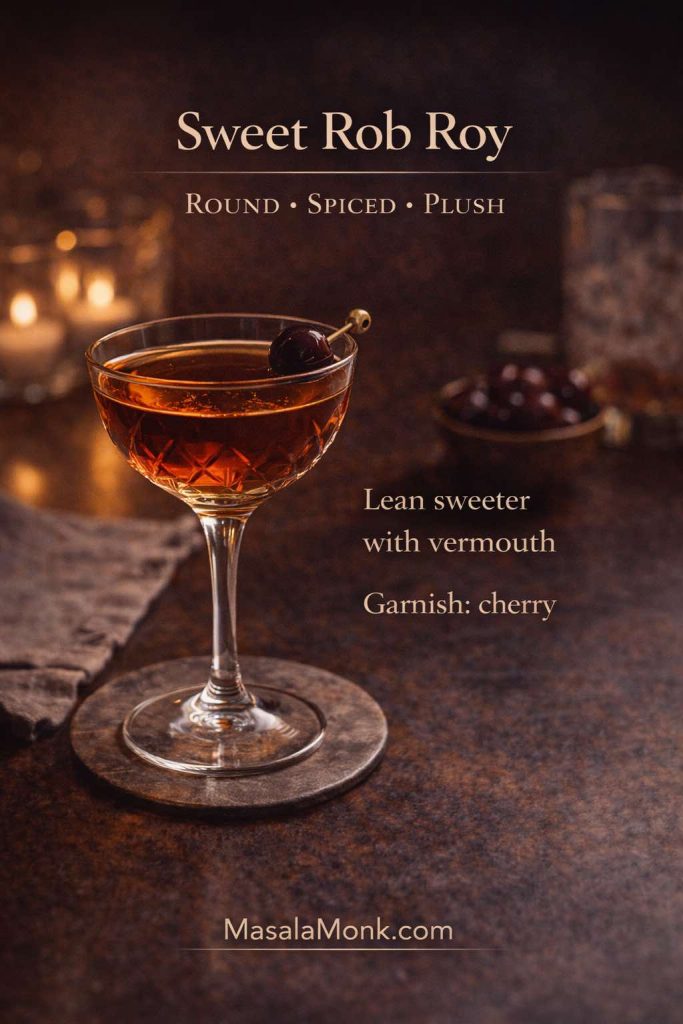
Sweet Rob Roy Drink Recipe

A classic Rob Roy already uses sweet vermouth, yet sometimes you want the cocktail to lean rounder—more lush and comforting, less sharp. That’s where a sweet Rob Roy recipe comes in.

Sweet Rob Roy cocktail image with a rich amber Scotch drink in a coupe glass, cherry garnish, and text overlay describing a round, spiced, plush profile, with MasalaMonk.com branding.
When you want the Rob Roy to feel softer and more indulgent, lean into sweet vermouth and finish with a cherry—this version drinks warmer, rounder, and especially good for slow sipping.

There are two clean ways to achieve it without turning the drink into a sugar bomb:

  1. Choose a richer sweet vermouth.
  2. Nudge the ratio slightly toward vermouth.

Sweet Rob Roy drink recipe (richer lean)

  • 2 oz Scotch whisky
  • 1¼ oz sweet vermouth
  • 2 dashes bitters

Stir, strain, garnish with a cherry or orange twist.

A sweet Rob Roy on the rocks can be especially lovely on a cold evening. The ice gradually softens the drink and stretches the experience, keeping it smooth and leisurely.

Also Read: Classic Rum Punch + 9 Recipes (Pitcher & Party-Friendly)


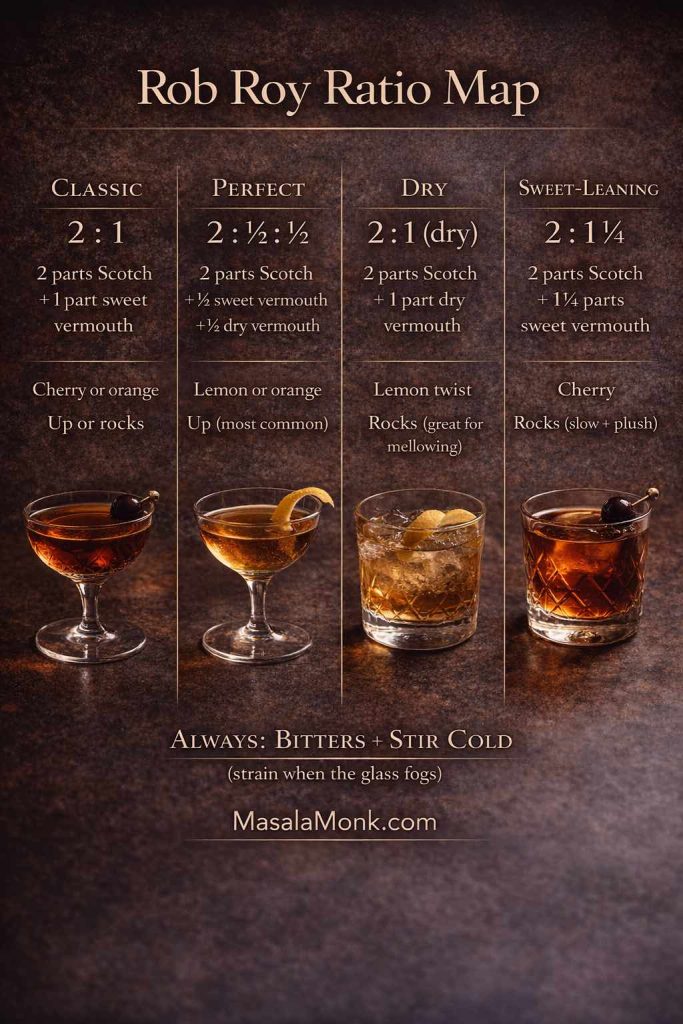
Rob Roy ratio map showing four cocktail versions—Classic, Perfect, Dry, and Sweet-leaning—with the exact Scotch-to-vermouth ratios, garnish cues, and serving style notes, branded MasalaMonk.com.
This Rob Roy ratio map makes every variation easy to remember: keep the Scotch-forward 2:1 foundation, then change only the vermouth style (or split it) to land on classic richness, perfect balance, a crisp dry finish, or a sweeter slow-sipping pour.

Rob Roy Glass, Rob Roy Cocktail Glass, and the Role of Presentation

A Rob Roy doesn’t require special glassware, but it does benefit from a thoughtful choice. The right glass helps aroma rise and keeps the drink feeling “finished.”

  • For Rob Roy up, a coupe or Nick & Nora is ideal. The shape gathers aroma, and the drink feels elegant in your hand.
  • For Rob Roy on the rocks, a rocks glass is the classic. It’s comfortable, stable, and suits slow sipping.
Glass choice changes the entire feel of a Rob Roy: coupe or Nick & Nora keeps it focused and aromatic “up,” while a rocks glass stretches the sip and softens the finish—chill whichever glass you use for a smoother pour.

If you’re working with what you have, a small wine glass can do the job surprisingly well—just chill it first. The drink cares more about temperature than tradition.

Also Read: Moscow Mule Recipe (Vodka Mule): The Master Formula + 9 Variations


Best Scotch for a Rob Roy Drink Recipe

It’s natural to wonder about the best scotch for a rob roy or the best scotch for rob roy cocktail, especially because Scotch can vary so wildly. Instead of chasing a single “correct” bottle, focus on the experience you want.

If you want smooth, classic, and easy

A blended Scotch is often perfect. It tends to be balanced, which helps the vermouth and bitters integrate seamlessly. This is also the easiest direction for hosting, because the drink will land well with the widest range of palates.
Best Scotch for a Rob Roy guide showing four Scotch profiles—Smooth & Classic, Fruit & Warmth, Light Smoke, and Bold Smoke—with recommended Rob Roy builds (classic, perfect, dry), garnish cues, and four tasting glasses, branded MasalaMonk.com.
Choosing the best Scotch for a Rob Roy is easier when you match the whisky’s style to the build: classic for smooth and fruity pours, perfect for light smoke balance, and dry or perfect when peat gets bold—then finish with the garnish that pulls it together.

If you want fruit and warmth

Try a Scotch with honeyed, orchard-fruit notes. It can make the Rob Roy feel like dried apricots, toast, and gentle spice. An orange twist often works beautifully here.

If you want a whisper of smoke

A lightly peated Scotch can be wonderful in a Rob Roy. The smoke adds a shadowy complexity without overwhelming the vermouth. A cherry garnish can make this version feel especially rich.

If you want bold smoke

Heavily peated whisky can dominate the Rob Roy. For smoke lovers, that intensity can be thrilling. For a more balanced pour where the vermouth still speaks, a gentler Scotch tends to work better.

If you’re ever unsure what category a bottle fits into, the Scotch Whisky Association’s categories page makes it easy to decode the label without turning it into homework.

Also Read: 7 Pizza Sauce Recipes | Marinara, White Garlic, Alfredo, Buffalo, BBQ, Vodka & Ranch


Best Vermouth for a Rob Roy Cocktail Drink Recipe

Because vermouth plays such a visible role in the flavor, “best vermouth for rob roy” is a more meaningful question than it first appears. A Rob Roy can taste plush and dessert-like with one vermouth, then herbal and bittersweet with another—all without changing the whisky.

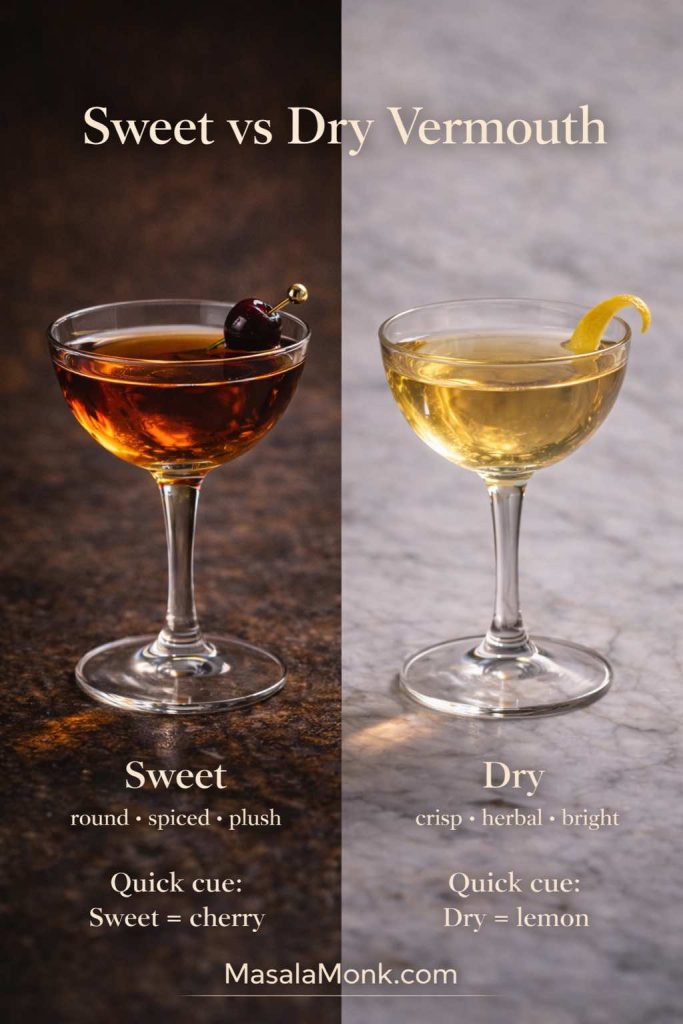
Split-image guide comparing sweet vs dry vermouth for a Rob Roy drink recipe, showing a darker sweet Rob Roy with cherry garnish and a lighter dry version with lemon twist, with flavor notes and MasalaMonk.com branding.
Choosing vermouth changes the Rob Roy more than most people expect: sweet vermouth gives a round, spiced finish, while dry vermouth turns the drink crisp and bright—use cherry for “sweet,” lemon for “dry.”

Match vermouth to the Scotch’s personality

If your Scotch is soft and honeyed, a more herbal sweet vermouth can add contrast and complexity. If your Scotch is smoky or spicy, a rounder, fruitier sweet vermouth can soften the edges and make the drink feel cohesive.

For dry Rob Roy variations, fresh dry vermouth matters even more because there’s less sweetness to disguise dullness. A crisp, lively dry vermouth makes the cocktail feel lifted. A tired dry vermouth can make it feel thin.

Keep vermouth fresh tip image for Rob Roy cocktails showing a vermouth bottle being placed in a refrigerator, a Rob Roy drink on the counter, and text advising to refrigerate after opening and use within 4–8 weeks, branded MasalaMonk.com.
xIf your Rob Roy drink recipe tastes muted, check the vermouth first—once opened, refrigerate it and aim to use it within 4–8 weeks for brighter aroma and a cleaner finish.

Treat vermouth like what it is: fortified wine

Refrigerate it after opening, and use it while it still tastes vibrant. If you want a clear baseline on what vermouth is and why it behaves this way, The Spruce Eats’ vermouth explainer is a practical, readable guide.
This one habit—keeping vermouth fresh—often makes the difference between a home Rob Roy that tastes “fine” and one that tastes genuinely polished.

Also Read: Vodka Pasta (Penne alla Vodka) + Spicy Rigatoni, Chicken, and Gigi Recipes


Rob Roy Cocktail History: A Classic With Staying Power

The Rob Roy has a kind of longevity that only a few drinks earn. It survives because it’s simple, adaptable, and built on ingredients that make sense together. You can keep the structure the same and change the character dramatically just by switching Scotch or vermouth.

If you like having a deeper, reference-style page that also discusses background and variations, Difford’s Guide’s Rob Roy entry is a rich resource. If you prefer a straightforward mainstream reference spec, Liquor.com’s Rob Roy recipe is clean and widely cited.

Neither link is required to enjoy the drink. They simply add context for anyone who likes knowing where a classic sits in the broader cocktail world.

Also Read: Marinara Sauce Recipe: Classic Homemade Marinara


A Rob Roy Night at Home: Food Pairings That Make the Cocktail Shine

A Rob Roy is strong by design, which means it loves food—especially salty, creamy, crunchy bites that can stand up to whisky and vermouth. If you’re hosting, it also helps to choose foods that don’t require constant kitchen attention. The whole point is to enjoy the evening, not run a restaurant.

What to serve with a Rob Roy cocktail: a rocks-glass Rob Roy beside a charcuterie-style snack board with cheese, olives, creamy dip, and crispy bites, with MasalaMonk.com branding.
Rob Roy pairings work best when the table has contrast—salty bites for the whisky, crunchy snacks for texture, and a creamy dip to soften each sip so the cocktail feels even smoother.

Build a board that does most of the work

A snack board is the easiest “make it feel special” move in home hosting. Cured meats, aged cheeses, olives, pickles, a little fruit, a few crackers—it’s the kind of spread that makes a Rob Roy feel inevitable.

If you like structure, MasalaMonk’s guide to the 3-3-3-3 charcuterie board approach makes it easy to build something abundant without overbuying.

A Rob Roy on the rocks pairs beautifully with a board because the drink’s slow evolution mirrors slow grazing.

Add something spicy and creamy for energy

Baked jalapeño poppers are a near-perfect match for whisky cocktails: heat, creaminess, a crispy bite, and enough boldness to keep your palate interested.

MasalaMonk’s baked jalapeño poppers recipe is ideal when you want something that feels “party food” without being complicated. If you’re pouring dry Rob Roy drinks, the crispness of dry vermouth plays especially well with spicy, rich bites.

Keep one classic, tidy bite on the table

Deviled eggs are quietly perfect for spirit-forward cocktails. They’re creamy, savory, and familiar in a way that makes the evening feel relaxed. They also behave well on a table—no drama, no mess.

MasalaMonk’s deviled eggs recipe includes variations, which is handy if you want to keep things classic or add a small twist without turning it into a theme.

A perfect Rob Roy feels particularly at home with deviled eggs because both land in that satisfying middle ground—rich, yet balanced.

Let a dip anchor the center of the spread

A dip is an effortless way to make a gathering feel abundant. People naturally gather around it, scoop, snack, and talk. Better still, dips can be made ahead, which keeps your evening calm.

For bold and indulgent, MasalaMonk’s buffalo chicken dip covers different cooking methods so you can choose what fits your schedule. For creamy comfort, MasalaMonk’s spinach dip recipes offer multiple variations that work for different crowds.

If you want a warm, garlicky “dip delivery system” that feels more satisfying than crackers alone, homemade garlic bread is hard to beat. MasalaMonk’s homemade garlic bread loaf turns dips into something that feels almost like a meal.

Finish with crunch and salt

At some point, crunchy and salty becomes essential—especially alongside strong cocktails. Wings are a classic for a reason: crispy texture, bold flavor, endlessly snackable.

MasalaMonk’s air fryer chicken wings are a great option when you want crispness without fuss. Pair wings with a Rob Roy up if you want a more “bar” feel, or keep it on the rocks if you want the drink to drift slowly while people snack.

If you want a vegetarian-friendly crunchy option, potato appetizers are basically guaranteed to disappear. MasalaMonk’s potato appetizer ideas give you multiple directions—crispy, cheesy, party-friendly—without locking you into one format.

Add a cooling counterpoint so the table doesn’t feel heavy

If your spread leans spicy or rich, something cool and bright keeps everything from feeling too much. Tzatziki does that beautifully—yogurt tang, cucumber freshness, herbal lift.

MasalaMonk’s Greek tzatziki sauce guide gives a reliable base plus variations, making it easy to match whatever else you’re serving.

Also Read: Oat Pancakes Recipe (Healthy Oatmeal Pancakes)


Rob Roy Drink Recipe for Hosting: Easy Rounds at Home

One of the most charming things about this cocktail is how quietly it supports hosting. Stirring replaces shaking, so there’s no noise and no mess. Citrus doesn’t need to be juiced, and no syrup demands a prep session. As a result, you can make excellent drinks and still stay part of the room.

Rob Roy for hosting guide showing a batched Scotch and vermouth bottle, a coupe Rob Roy, a rocks-glass Rob Roy, mixing tools, and text overlay with steps to batch, chill, and stir with ice and bitters to order, branded MasalaMonk.com.
Hosting with a Rob Roy is effortlessly smooth: pre-batch Scotch and vermouth, keep it chilled, then stir each drink with ice and bitters as guests arrive—finish by serving it up for a sharper aroma or on the rocks for a slower sip.

A simple approach that works wonderfully is to offer a few choices that cover most preferences:

  • Classic Rob Roy (sweet vermouth)
  • Perfect Rob Roy (half sweet, half dry vermouth)
  • Dry Rob Roy (dry vermouth)

Then the only question you ask is “up or on the rocks?” It feels personal to guests, yet it keeps your workflow calm.

If you’re making a round, you can batch the base (Scotch + vermouth) in a bottle in the fridge, then add bitters and stir each drink with ice as needed. This keeps the pacing smooth and lets you stay present.

Also Read: How to Make Eggless Mayo at Home (Egg Free Mayonnaise Recipe)


Common Rob Roy Missteps (And How to Smooth Them Out)

Even with a simple recipe, your first few attempts might not taste exactly the same. That isn’t a failure; it’s the nature of a drink where temperature and dilution matter.

If your Rob Roy drink recipe feels “off,” the fix is usually simple—adjust vermouth style for sweetness, use fresh vermouth and bitters for flavor, and control dilution with colder ice and shorter stirring.

If it tastes flat

Vermouth is often the culprit. Fresh vermouth tastes aromatic and alive; tired vermouth tastes muted. Refrigeration and sensible use timelines help preserve flavor. The Spruce Eats’ vermouth guide explains the logic clearly.

If it tastes too sweet

Move toward a perfect Rob Roy recipe or a dry Rob Roy. Those variations are designed for exactly this preference. They change the drink’s balance without changing its identity.

If it tastes too sharp

Serve it on the rocks, or choose a softer Scotch. Both options smooth the experience without requiring new ingredients.

If it tastes watery

Stir a bit less, use colder ice, and strain promptly. Also, avoid using ice that’s already half-melted; it can dilute the drink before you even begin.

Also Read: Belgian Waffle Recipe + 5 Indian Twists on a Breakfast Classic


The Rob Roy as a House Cocktail You Can Make Yours

After you make this drink a few times, something shifts. It stops being “the Rob Roy drink recipe you learned” and becomes “your Rob Roy.” One Scotch will read warm and honeyed; another will land dry and structured. Preferences sharpen quickly—cherry versus twist, up versus on the rocks, quick and focused versus slow and mellow.

In time, a default emerges: the one you mix without thinking when someone’s at the door. Sometimes it’s the classic Rob Roy cocktail recipe because sweet vermouth rounds the whisky in exactly the way you like. Other nights, the perfect Rob Roy fits better because balance feels like the point. For a crisper profile, a dry Rob Roy drink makes sense; when winter calls for comfort, a sweet Rob Roy on the rocks can feel just right.

None of those choices are wrong. The drink endures because it isn’t a novelty—it’s a structure that holds taste, mood, and company with quiet confidence.

Once it clicks, you’ll find yourself reaching for it far more often than you expected.

Also Read: Double Chocolate Chip Cookies – Easy Recipe with 7 Variations

FAQs about Rob Roy Drink & its Recipe

1) What is a Rob Roy drink?

A Rob Roy drink is a classic Scotch-based cocktail made by stirring Scotch whisky with vermouth and bitters, then serving it either up or on the rocks. In essence, it’s a spirit-forward drink with a smooth, aromatic finish.

2) What are the Rob Roy ingredients?

The core Rob Roy ingredients are Scotch whisky, sweet vermouth, and aromatic bitters. Finally, it’s finished with a garnish—most commonly a cherry or a citrus twist.

3) What are the ingredients for a Rob Roy cocktail specifically?

Ingredients for a Rob Roy cocktail typically include 2 oz (60 ml) Scotch whisky, 1 oz (30 ml) sweet vermouth, and 1–2 dashes bitters. Additionally, a cherry or orange twist is a classic garnish choice.

4) How do you make a Rob Roy?

To make a Rob Roy, combine Scotch whisky, sweet vermouth, and bitters in a mixing glass with ice. Next, stir until thoroughly chilled, then strain into a chilled glass (for “up”) or over fresh ice (for “on the rocks”). Afterward, add your garnish.

5) How to make a Rob Roy cocktail that tastes balanced?

For a balanced Rob Roy cocktail, start with the classic 2:1 ratio (Scotch to sweet vermouth). Then, stir long enough to chill and lightly dilute the drink. If it still feels too sweet, shift toward a perfect Rob Roy or dry Rob Roy variation.

6) What is the best Rob Roy drink recipe ratio?

The most widely used Rob Roy drink recipe ratio is 2 oz Scotch whisky to 1 oz sweet vermouth, plus bitters. Alternatively, you can slightly increase the whisky for a drier profile or increase vermouth for a rounder profile.

7) What is the Rob Roy cocktail recipe in ml?

A common Rob Roy cocktail recipe ml build is 60 ml Scotch whisky + 30 ml sweet vermouth + 1–2 dashes bitters. Then, stir with ice and strain.

8) What is a perfect Rob Roy?

A perfect Rob Roy uses both sweet and dry vermouth instead of only sweet vermouth. Consequently, it tastes more aromatic and less sweet than the classic.

9) What is the perfect Rob Roy recipe?

The perfect Rob Roy recipe is 2 oz (60 ml) Scotch whisky, ½ oz (15 ml) sweet vermouth, ½ oz (15 ml) dry vermouth, plus bitters. Then, stir with ice, strain, and garnish.

10) What are perfect Rob Roy ingredients?

Perfect Rob Roy ingredients include Scotch whisky, sweet vermouth, dry vermouth, and bitters—plus a garnish such as lemon or orange twist. Notably, the vermouth is split evenly to create the “perfect” balance.

11) What is a dry Rob Roy?

A dry Rob Roy is a Rob Roy variation made with dry vermouth instead of sweet vermouth. As a result, it’s crisper, lighter, and less sweet.

12) What is the dry Rob Roy recipe?

The dry Rob Roy recipe is 2 oz (60 ml) Scotch whisky, 1 oz (30 ml) dry vermouth, and 1–2 dashes bitters. Then, stir with ice, strain, and garnish with a lemon twist.

13) What does “Rob Roy drink dry” mean?

“Rob Roy drink dry” generally refers to the dry Rob Roy variation (using dry vermouth). In some cases, it can also mean reducing sweet vermouth in the classic recipe for a drier taste.

14) What is a sweet Rob Roy?

A sweet Rob Roy typically leans richer by emphasizing sweet vermouth—either by choosing a fuller-bodied sweet vermouth or by slightly increasing the vermouth portion. Thus, it becomes rounder and more dessert-like.

15) What is the sweet Rob Roy drink recipe?

A sweet-leaning sweet Rob Roy drink recipe can be 2 oz Scotch whisky, 1¼ oz sweet vermouth, and bitters. Then, stir and strain; garnish with cherry or orange twist.

16) How to make a Rob Roy on the rocks?

To make a Rob Roy on the rocks, prepare the cocktail by stirring with ice first. Then, strain over fresh ice in a rocks glass. Thereafter, garnish as desired.

17) What is “dry Rob Roy on the rocks with a twist”?

This phrase usually refers to serving a dry Rob Roy over ice and finishing it with a citrus twist—most often lemon. Accordingly, it highlights both the serving style (on the rocks) and the garnish (twist).

18) What does “Rob Roy up” mean?

“Rob Roy up” means the cocktail is served without ice in the glass, strained into a chilled coupe or similar stemmed glass. Hence, the drink stays concentrated and aromatic.

19) What is the best vermouth for Rob Roy?

The best vermouth for Rob Roy depends on the style you prefer. For the classic, use sweet vermouth with a flavor profile you enjoy; for a dry Rob Roy, use a crisp dry vermouth. Furthermore, freshness matters—vermouth tastes best when stored properly after opening.

20) What is the best Scotch for a Rob Roy cocktail?

The best Scotch for a Rob Roy cocktail is one you enjoy the taste of, since it remains front and center. Generally, blended Scotch makes a smooth, approachable Rob Roy, while certain single malts can add extra character.

21) What is the difference between a Manhattan and a Rob Roy?

A Manhattan typically uses rye or bourbon, while a Rob Roy uses Scotch whisky. Otherwise, both often share the same template: whisky, vermouth, and bitters.

22) What does “Rob Roy recipe scotch” refer to?

“Rob Roy recipe scotch” simply emphasizes that Scotch whisky is the base spirit in the Rob Roy cocktail recipe. In other words, the drink is essentially the Scotch version of a Manhattan-style build.

23) Can I make a Rob Roy cocktail recipe without bitters?

You can make a Rob Roy without bitters, but it will usually taste flatter and less structured. If you’re out of bitters, try reducing vermouth slightly to keep the drink from feeling overly sweet.

24) What are common Rob Roy garnish options?

Common Rob Roy garnish options include a cherry (classic), orange twist (bright), and lemon twist (crisp). Depending on your preference, the garnish can push the drink warmer or fresher.

25) Is “Rob Roy recipe bourbon” actually a Rob Roy?

A “Rob Roy recipe bourbon” isn’t technically a Rob Roy because the defining feature is Scotch whisky. If you use bourbon, you’re closer to a Manhattan-style cocktail, even if the method is the same.

Posted on — 20 Comments

Espresso Martini Recipe: Classic, Foamy & Easy

Espresso Martini in a thin-stem coupe with a dark coffee body, smooth tan foam and three coffee beans on a glossy reflective bar.

This post was last updated on:

An espresso martini should arrive properly cold, with dark coffee underneath a smooth tan cap of fine bubbles. The first sip should taste unmistakably of espresso, followed by coffee liqueur and clean vodka. It should not taste burnt, syrupy or like half the glass is foam.

There is no single ratio used by every good espresso martini recipe. Coffee liqueurs vary in sweetness, espresso varies in bitterness and concentration, and some people simply like a stronger drink. This version gives you a balanced place to start, then shows you how to move it drier, softer, more coffee-forward or creamier without learning a completely different recipe.

Espresso Martini Recipe

Start here. The coffee stays in front, the vodka still has presence, and the coffee liqueur rounds the drink without making it heavy.

At its simplest, an espresso martini is a three-ingredient cocktail: vodka, concentrated coffee and coffee liqueur. Simple syrup is an adjustment, not a requirement.

Espresso Martini recipe graphic with a finished cocktail, espresso and bar tools; the surrounding recipe gives the exact vodka, espresso, coffee liqueur and syrup measurements.
Make the first drink as written, then change only one thing on the next round. That way, if you adjust sweetness or strength, you can actually tell what improved the espresso martini instead of chasing several moving targets.

Prep: about 5 minutes · Yield: 1 cocktail · Glass: 5–7 oz / 150–210 ml coupe or martini glass · Method: shaken

Ingredients

  • 1½ oz / 45 ml vodka
  • 1 oz / 30 ml fresh espresso
  • ¾ oz / 22.5 ml coffee liqueur
  • 0–¼ oz / 0–7.5 ml 1:1 simple syrup, to taste
  • Plenty of solid ice
  • 3 coffee beans, optional

Using a sweeter coffee liqueur? Make the first drink without syrup. With something drier, or with a particularly bitter espresso, start with about ¼ oz / 7.5 ml.

Method

  1. Chill the glass. Put a coupe or martini glass in the freezer. No freezer space? Fill it with ice and cold water while you make the drink.
  2. Pull the espresso first. Measure 1 oz / 30 ml and let it sit while you measure the other ingredients. It can still be fresh and warm.
  3. Build the drink. Add vodka, espresso, coffee liqueur and any syrup you are using to a cocktail shaker.
  4. Add plenty of ice. Fill the shaker roughly halfway to two-thirds, leaving some room for everything to move.
  5. Shake hard for 15–20 seconds. The shaker should become very cold.
  6. Strain and serve. Empty the chilled glass, pour in the cocktail and garnish with three coffee beans if you like.

A fine-mesh strainer removes tiny ice chips and leaves a very clean surface, although it is optional.

No cocktail shaker? A clean jar with a secure lid works. Measure with a jigger, a 1 oz / 30 ml shot glass or a small measuring cup. A fine kitchen sieve can stand in for a cocktail strainer.

Making two? Use 3 oz / 90 ml vodka + 2 oz / 60 ml espresso + 1½ oz / 45 ml coffee liqueur + up to ½ oz / 15 ml syrup. Shake them together only if your shaker has enough room for two drinks and plenty of ice.

Espresso Martini Guide

If the recipe is all you needed, you can stop there. Otherwise, use the guide below to tune the balance, work with the coffee equipment you have, rescue weak foam or prepare several drinks at once.

What Is the Best Espresso Martini Ratio?

Published recipes range from strong, vodka-forward versions to soft equal-parts builds. That range makes sense because different coffee liqueurs and different shots of espresso do not bring the same sweetness or intensity.

For most home drinkers, 1½ oz vodka + 1 oz espresso + ¾ oz coffee liqueur is a useful middle ground. Add syrup only after deciding whether the drink actually needs it.

StyleVodkaEspressoCoffee liqueurSyrupResult
Balanced1½ oz / 45 ml1 oz / 30 ml¾ oz / 22.5 ml0–¼ oz / 0–7.5 mlCoffee-forward, smooth and adjustable
Drier & stronger2 oz / 60 ml1 oz / 30 ml½ oz / 15 ml0–¼ oz / 0–7.5 mlMore vodka, sharper finish
Softer & sweeter1 oz / 30 ml1 oz / 30 ml1 oz / 30 mlUsually noneRounded, easy-drinking, liqueur-led
Comparison graphic showing three Espresso Martini ratios: drier and stronger, balanced, and softer and sweeter. Exact measurements are listed in the nearby ratio table.
To compare espresso martini ratios properly, keep the espresso constant and change the vodka and coffee liqueur around it. A side-by-side approach makes your preferred balance much easier to find than tweaking every ingredient at once.

Why the Recipes Look So Different

The Espresso Martini is generally credited to London bartender Dick Bradsell, who created the vodka-and-espresso cocktail in the 1980s. The modern International Bartenders Association recipe uses vodka, coffee liqueur, sugar syrup and one strong espresso. From there, modern recipes range from dry and vodka-heavy to sweet equal-parts versions.

A sweet coffee liqueur can provide nearly all the sugar a drink needs. Switch to a drier bottle and the same recipe changes noticeably. Likewise, espresso can move the balance just as much: a sharp, bitter shot behaves very differently from one that is rounder and naturally chocolatey.

For a Drier, Stronger Drink

Move toward 2 oz / 60 ml vodka, keep the espresso around 1 oz / 30 ml, and reduce the coffee liqueur to about ½ oz / 15 ml. The vodka becomes more obvious and the finish noticeably drier.

For a Softer, Sweeter Drink

Equal parts are the clearest reference point: 1 oz / 30 ml each vodka, espresso and coffee liqueur. Start without extra syrup. For something between that and the balanced recipe, use 1½ oz / 45 ml vodka while leaving the espresso and liqueur at 1 oz / 30 ml each.

For More Coffee Flavor

Make the coffee stronger before making the drink larger. Extra weak coffee adds volume and dilution faster than it adds flavor. Espresso, moka coffee and cold-brew concentrate all deliver plenty of coffee in a small pour.

Already sweet enough? Skip the syrup.

Espresso Martini Ingredients: Vodka, Coffee Liqueur & Espresso

A dependable mid-range vodka is plenty. Choose something clean enough that the alcohol does not fight the espresso. Vanilla and caramel vodkas can be delicious, but they move the drink away from the classic and can change how much added sweetness you want.

Coffee Liqueur: Kahlúa, Mr Black, Tia Maria & Swaps

Kahlúa, Mr Black and Tia Maria can all make a good drink, but the sweetness changes noticeably from one bottle to another.

Kahlúa tends to produce a rounder, sweeter espresso martini with familiar vanilla-caramel notes, so little or no extra syrup may be needed. Mr Black is drier and more aggressively coffee-led, which often makes a small amount of syrup useful. Tia Maria falls between those styles, with clear coffee and rum character underneath.

Coffee liqueur comparison graphic showing Kahlúa, Mr Black and Tia Maria with Espresso Martinis and differences in sweetness and coffee character.
Coffee liqueur brings body and coffee character as well as sugar. Therefore, if Kahlúa makes the drink sweeter than you want, reduce the simple syrup first rather than immediately cutting the liqueur and losing some of that depth too.

No Kahlúa? Start by swapping another coffee liqueur volume-for-volume and adjust only after tasting. Formulations can vary by market, so let the bottle in front of you settle the final balance. If Kahlúa is already in your cupboard, these Kahlúa drink combinations give you several other ways to use it.

Making It Without Coffee Liqueur

You can still make a good vodka-and-espresso cocktail, although the drink loses some sweetness, body and coffee depth when the liqueur disappears. Try 1½ oz / 45 ml vodka + 1 oz / 30 ml strong espresso + ¼–½ oz / 7.5–15 ml simple or demerara syrup. Shake it exactly like the classic. The result is leaner and more direct.

Espresso: Concentration Matters More Than Roast

Use coffee that tastes good before it reaches the shaker. Chocolate, caramel and nutty profiles are easy pairings, while brighter coffees can make a more aromatic drink. There is no mandatory roast level; a small, concentrated shot matters more.

Simple syrup: the recipe assumes ordinary 1:1 syrup. Combine equal weights of sugar and water, such as 50 g sugar + 50 g water, and stir or warm gently until dissolved. Demerara syrup gives a deeper caramel note. Rich 2:1 syrup is more concentrated, so start with less.

Optional bartender trick: if the espresso tastes pleasantly bitter but the finished drink still feels a little sharp, a tiny pinch of salt can soften the edges. Use very little; the cocktail should never taste salty.

Small Details That Change the Finished Drink

The method itself is simple. These are the details that explain why two drinks made from the same ingredient list can still come out differently.

Glass Size Changes the Pour

A 5–7 oz / 150–210 ml coupe or martini glass is a comfortable fit for this recipe. A normal pour can look oddly small in oversized martini glassware, and doubling the recipe just to reach the rim throws the balance off.

Warm Espresso Is Fine

Pull the shot first and measure everything else while it sits for a minute or two. Need it cooler quickly? Set the cup or a small metal container into an ice-water bath and stir. Pouring espresso directly over ice before it reaches the shaker adds water you cannot easily control.

Espresso that tastes sour, harsh or unexpectedly weak will still taste that way in the finished drink. These espresso grind and extraction adjustments can help when the shot itself is the problem.

Shaker Space Matters

Fill the shaker roughly halfway to two-thirds with solid ice and leave some empty space. The drink needs room to travel through the shaker. A short, vigorous 15–20 second shake chills and aerates it more effectively than a long weak one.

Fine-Straining Is About Texture

A normal cocktail strainer is enough. Add a fine-mesh strain if you want a particularly clean surface without tiny ice fragments. It does not create the foam.

Four-part Espresso Martini technique graphic showing a 5–7 ounce coupe, warm espresso, shaker headspace with ice, and fine-straining into a cocktail glass.
A small-looking pour does not always need a bigger recipe. First check the glass size; meanwhile, weak chilling or poor aeration usually points to ice, shaker space or technique rather than the espresso martini ratio itself.

Once temperature and dilution are under control, texture is usually the next thing you notice.

How to Get Smooth Espresso Martini Foam

A good espresso martini has a smooth tan layer of dense, fine bubbles across the surface. A towering cappuccino-like head is unnecessary. If the first pour comes out flat, do not assume the recipe is broken; the problem is usually easier to fix.

Macro view of an Espresso Martini showing a dense tan layer of tiny bubbles, three coffee beans and the dark coffee beneath the foam.
Look closely at the bubbles around the rim. Fine, tightly packed bubbles usually form a smoother espresso martini foam cap, whereas large coarse bubbles tend to look airy and disappear sooner.

Almost No Foam

Try stronger coffee and a more forceful shake. An overcrowded shaker is another common culprit.

Foam That Vanishes

Excess dilution and coarse bubbles can collapse quickly. Make one drink first and pour it as soon as it is ready.

Huge Bubbles or Too Much Foam

A smooth cap is enough. Half a glass of airy foam has not necessarily improved the drink.

Four matching Espresso Martinis comparing almost no foam, collapsing foam, large coarse bubbles and an ideal smooth fine-bubble cap. The surrounding section explains the fixes.
Fix the mechanics before adding anything extra. Make one drink at a time, leave room in the shaker, use concentrated coffee and pour promptly; only then is a reverse dry shake or foaming aid worth considering.

Fresh Espresso and Foam

Fresh espresso is generally the most predictable starting point for a dense cap. Crema is only part of the picture: fresh, strong coffee helps, but so do the amount of water in the drink and how vigorously it is shaken.

For readers who enjoy the chemistry, this review of coffee foam formation and stability goes much deeper than a cocktail recipe needs to.

Advanced fix: reverse dry shake

Shake the cocktail with ice for about 15 seconds, strain the ice away, return the cold drink to the empty shaker and shake again without ice for another 5–10 seconds. Then strain into the chilled glass.

This can help when an ordinary shake repeatedly gives you a weak cap. It is optional.

Aquafaba or cocktail foamer?

A classic espresso martini needs neither. For a more stable or exaggerated foam, about ½ oz / 15 ml aquafaba can be added. Commercial cocktail foamers are another option.

None of this requires a commercial espresso setup. A pod machine, moka pot or carefully brewed strong coffee can all get you there.

Espresso Martini Without an Espresso Machine

The drink cares far more about coffee concentration than equipment prestige.

CoffeeHow well it worksBest approachFoam
Fresh espressoExcellentAbout 1 oz / 30 mlMost predictable
Nespresso / podExcellentShort extraction around 30 mlUsually very good
Moka potVery goodAbout 1 oz / 30 mlCan vary
Cold-brew concentrateVery goodStart around 1 oz / 30 mlVariable
AeroPress / French press / strong filter coffeeGoodBrew deliberately short and strongVariable
Instant espressoGood convenience optionMake it much stronger than a normal cupVariable
Ready-to-drink cold brewUsually too weakUse only if unusually concentratedOften thin
Coffee-method guide showing fresh espresso, pod espresso, moka pot, cold-brew concentrate, strong brewed coffee, instant espresso and ready-to-drink cold brew around an Espresso Martini.
Taste your coffee before it reaches the shaker. If it drinks like an ordinary cup, it will probably disappear once vodka, ice and dilution join it, so aim for a small pour that tastes deliberately concentrated on its own.

Pod Espresso

A short extraction around 30 ml is a good target. A machine preset somewhere in the 25–40 ml range is close enough for one cocktail. A long lungo is much easier to lose once vodka and ice enter the picture.

Moka Pot and Other Brewed Coffee

Moka coffee is usually concentrated enough to work well. With an AeroPress, French press or filter setup, brew a small, deliberately strong serving instead of making a normal mug and taking one ounce from it. Harsh moka coffee is worth fixing before it reaches the shaker; these moka-pot brewing adjustments cover grind, heat and extraction in more detail.

Cold-Brew Concentrate

Cold-brew concentrate is not the same as ready-to-drink cold brew. Most bottled cold brew is already diluted for drinking straight. In a cocktail, that can leave the coffee surprisingly faint and make the vodka seem harsher than it really is.

A true concentrate carries much more coffee flavor in the same small pour. Start around 1 oz / 30 ml and adjust from there. Foam can vary from one concentrate to another. For a version designed around it from the start, see the Cold Brew Espresso Martini.

Instant or decaf: strong instant espresso is a perfectly workable convenience option; make it much more concentrated than a normal cup. Concentrated decaf works too and is an easy choice later in the evening.

Worth remembering: caffeine can make you feel more alert, but it does not reduce alcohol impairment. If you want the coffee flavor without the late-night caffeine, concentrated decaf works just as well here.

Batch Espresso Martinis Without Becoming the Bartender All Night

Batch the measuring, not the foam.

Mix the liquid ingredients ahead of time and chill them. At service, shake one or two drinks with fresh ice. Most of the repetitive measuring disappears, and the eighth drink should still taste like the first.

Batch Quantities

DrinksVodkaEspressoCoffee liqueur1:1 syrup
23 oz / 90 ml2 oz / 60 ml1½ oz / 45 ml0–½ oz / 0–15 ml
46 oz / 180 ml4 oz / 120 ml3 oz / 90 ml0–1 oz / 0–30 ml
69 oz / 270 ml6 oz / 180 ml4½ oz / 135 ml0–1½ oz / 0–45 ml
812 oz / 360 ml8 oz / 240 ml6 oz / 180 ml0–2 oz / 0–60 ml
1218 oz / 540 ml12 oz / 360 ml9 oz / 270 ml0–3 oz / 0–90 ml

Use the same syrup level you liked in the single drink. When in doubt, start low.

Two Ways to Prep the Batch

Fastest service: combine vodka, espresso, coffee liqueur and syrup ahead of time, then refrigerate until thoroughly cold. At service, measure 3¼–3½ oz / 97–105 ml per drink, depending on the syrup amount, add fresh ice and shake.

Fresh espresso at service: batch only the vodka, coffee liqueur and syrup. Measure 2¼–2½ oz / 67.5–75 ml of that base per drink, add 1 oz / 30 ml fresh espresso, then add ice and shake.

Espresso pulled earlier the same day and kept chilled is a perfectly reasonable party compromise. Cold-brew concentrate is even easier when speed matters more than reproducing the fresh-espresso version exactly.

Two-path Espresso Martini batching diagram comparing a full premix with a batch base plus fresh espresso before adding ice, shaking and pouring. Exact quantities are given in the nearby batch section.
Label the chilled bottle FULL PREMIX or BASE ONLY, then write the per-drink pour directly on it. That simple step makes batch espresso martinis much easier to hand off without forgotten espresso, double additions or inconsistent rounds.

Dilution and Shaker Capacity

A batch that will still be shaken with ice does not need a full serving of water added beforehand; the shake supplies that dilution. Fully pre-diluted freezer or draft cocktails use a different method because they are served without a conventional shake.

Two drinks can work in a sufficiently large shaker. Three or more becomes much less reliable in typical home equipment. When pouring two, alternate between the glasses instead of filling the first one completely so the liquid and foam divide more evenly.

Four Variations Worth Making

Four Espresso Martini variations in a jewel-lit bar setting: creamy Baileys, tequila, a frozen coffee cocktail and miniature Espresso Martini tasting shots.
When creating espresso martini variations, change one main dimension at a time: spirit, richness, temperature or serving size. Meanwhile, keep the coffee assertive and reconsider the syrup whenever the new ingredient brings sweetness of its own.

Creamy Espresso Martini With Baileys

For a creamy version that still tastes like coffee, use 1½ oz / 45 ml vodka + 1 oz / 30 ml espresso + ½ oz / 15 ml coffee liqueur + ½ oz / 15 ml Baileys. Start without simple syrup.

The classic should already feel silky from the shake; Baileys adds actual dairy richness and Irish-cream flavor. More coffee and chocolate combinations are covered in these Baileys drink ideas.

Tequila / Mexican Espresso Martini

Use 1½ oz / 45 ml tequila + 1 oz / 30 ml espresso + ¾ oz / 22.5 ml coffee liqueur, then add syrup only if the drink needs it. Blanco keeps the coffee sharper and brighter; reposado makes the drink rounder, with warmer oak and vanilla underneath.

Frozen Espresso Martini

Freeze 1 oz / 30 ml espresso into small cubes. Blend with 1 oz / 30 ml vodka + 1 oz / 30 ml coffee liqueur and a few plain ice cubes until slushy, then taste before adding syrup.

Using a full-size blender? Double the recipe so the blades have enough volume to catch and circulate everything properly. Coffee ice keeps the finished drink darker and more coffee-forward than a version built mostly on plain ice.

Espresso Martini Shots

Shake one normal cocktail and divide it among small shot or cordial glasses. Depending on their size and the final dilution, one drink usually gives about 3–4 tasting shots.

Chocolate, pumpkin spice, peppermint, vanilla, hazelnut and salted caramel all pair naturally with coffee. When the flavoring itself is sweet, cut back on the syrup. For chai, cinnamon and other warmer spice directions, see these Spiced Espresso Martini recipes.

Fixing a Watery, Bitter or Flat Espresso Martini

If the first drink is off, do not start changing everything at once. Find the symptom below and change one thing.

Foam & Texture Problems

ProblemLikely causeTry this
No foamWeak coffee, timid shake or crowded shakerUse stronger coffee and shake one drink firmly
Foam disappears quicklyCoarse bubbles or too much dilutionPour promptly and avoid an excessively long shake
Huge bubblesCoarse aerationUse the normal hard shake; try a reverse dry shake if needed
Far too much foamOver-aerationA smooth cap is enough; stop chasing maximum volume
WateryWeak coffee or unnecessary dilutionUse stronger coffee and avoid cooling espresso directly over ice
Feels thin rather than creamyWeak coffee or poor aerationFix the coffee and shake before adding dairy

Taste, Coffee & Batch Problems

Radial Espresso Martini troubleshooting graphic covering too sweet, too bitter, vodka dominates, coffee disappears, thin cold brew and a watery batch. Detailed fixes appear in the surrounding troubleshooting tables.
Separate texture problems from flavor problems before changing the drink. If it is watery or flat, investigate coffee strength, ice and shaking first; however, if the texture is good but the flavor is too sweet, bitter or vodka-heavy, rebalance the ingredients instead.
ProblemLikely causeTry this
Too sweetSweet liqueur plus extra syrupCut the syrup first
Too bitterHarsh espresso or too little sweetnessTaste the coffee first, then adjust syrup gradually
Vodka dominatesCoffee too weak or ratio too dryStrengthen the coffee or move back toward the balanced ratio
Coffee disappearsUnder-concentrated coffeeUse espresso, moka coffee or cold-brew concentrate
Cold brew tastes thinReady-to-drink cold brew instead of concentrateSwitch to a true concentrate
Batch tastes wateryPre-diluted and then fully shakenChoose one dilution method
Two glasses get unequal foamOne glass filled before the otherAlternate the pour
Glass looks half-emptyGlass is oversizedUse a smaller coupe or martini glass

Burnt or harsh espresso is difficult to hide gracefully. Fix the coffee first. When the espresso tastes good but the finished cocktail is still too bitter, increase 1:1 syrup by about 1 tsp / 5 ml at a time.

Common Questions

Does espresso need to cool first?

No. Pull it before measuring the other ingredients and let the strongest heat subside naturally.

Can I use instant coffee?

Yes, especially instant espresso. Make it much stronger than a normal cup and use about 1 oz / 30 ml.

Can I use decaf?

Yes. Concentrated decaf works perfectly well in place of regular espresso.

Can I make two in one shaker?

Yes, provided the shaker comfortably holds both drinks, plenty of ice and some empty headspace.

Why garnish with three coffee beans?

Three beans are the traditional garnish and are commonly associated with health, wealth and happiness. They are optional.

How far ahead can I prepare the drinks?

The liquid ingredients can be measured and chilled several hours ahead. Shake each serving with ice shortly before drinking if you want fresh foam.

Get the coffee strong enough and the balance close, and the drink becomes much less mysterious. From there, move the ratio a little drier, softer or sweeter, or leave it exactly where it is.