Posted on Leave a comment

Air Fryer Salmon Recipe (Time, Temp, and Tips for Perfect Fillets)

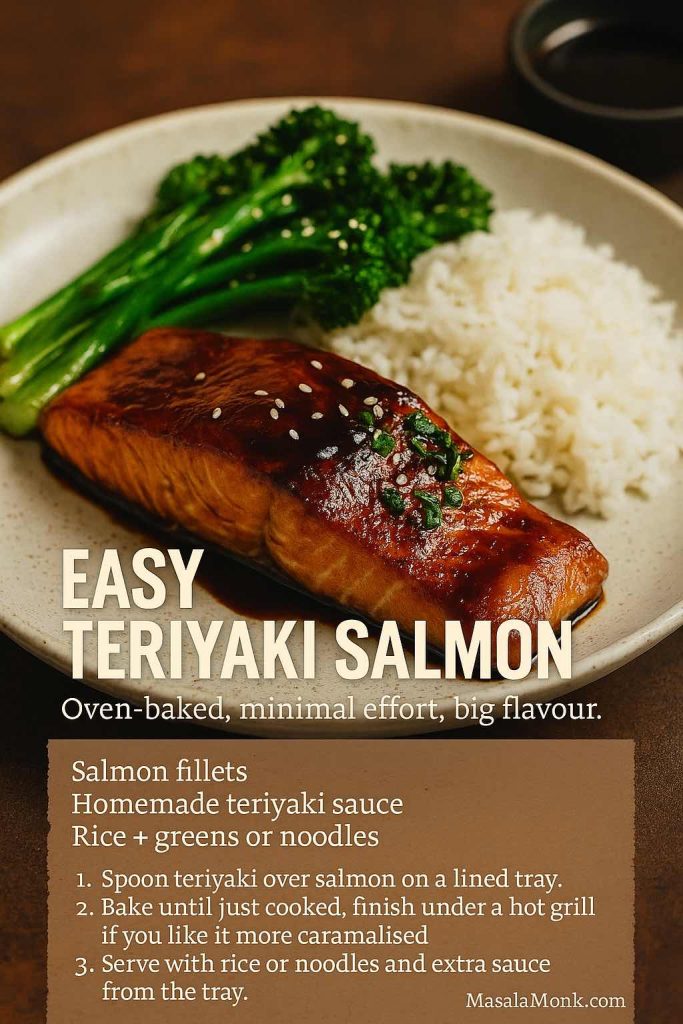
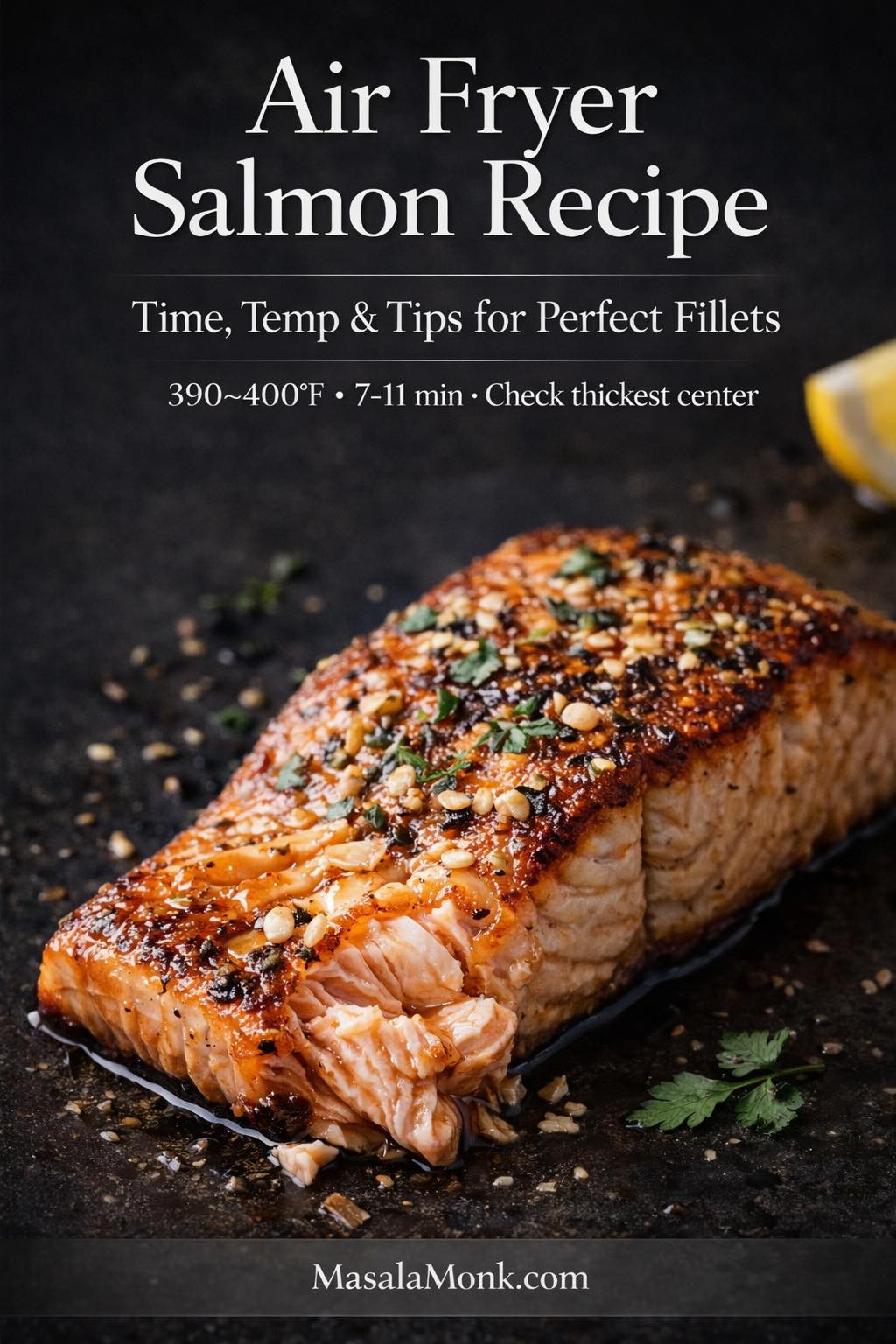
Close-up cover image of a cooked air fryer salmon fillet with text overlay showing time and temperature tips for perfect salmon fillets, including 390–400°F and 7–11 minutes, for a salmon in air fryer recipe guide.

Salmon is one of those dinners that can feel either effortlessly elegant or weirdly stressful, depending on how the cooking goes. One minute it looks glossy and promising, and the next minute it turns dry, chalky, or overdone at the edges while the center still looks undercooked. That’s exactly why this air fryer salmon recipe earns a permanent place in a real home kitchen: it gives you a repeatable method that stays simple, cooks fast, and leaves plenty of room for flavor.

Once you get the rhythm right, making salmon in air fryer stops feeling like guesswork. You learn the temperature that works best in your machine, you understand how thickness changes the timing, and you know what to look for when the fillet is done. From there, everything gets easier. A plain lemon garlic version becomes a weeknight staple. A teriyaki glaze turns into a quick dinner that feels restaurant-ish. A blackened variation suddenly becomes your go-to when you want something bolder.

This post is built as a full, reader-friendly guide, so you can come back to it whether you’re making your first fillet or trying to dial in the best salmon in air fryer for your own taste. We’ll cover the base method, time it takes to air fry a salmon and temp, skin-on versus skinless, seasoning directions, serving ideas, and the easiest way to reheat leftovers without drying them out.

And because salmon is already a naturally rich, satisfying fish, it doesn’t need much to taste good. A few small decisions—patting it dry, seasoning it evenly, cooking it at the right heat, and checking doneness early—make all the difference.


Why this air fryer salmon recipe works

The best thing about an air fried salmon is how quickly it gets from raw to beautifully cooked without asking for much from you. You don’t need a complicated marinade. You don’t need a cast iron pan smoking on the stove. And you don’t even need a long ingredient list. Instead, the circulating heat does most of the heavy lifting, and the salmon naturally brings richness and flavor on its own.
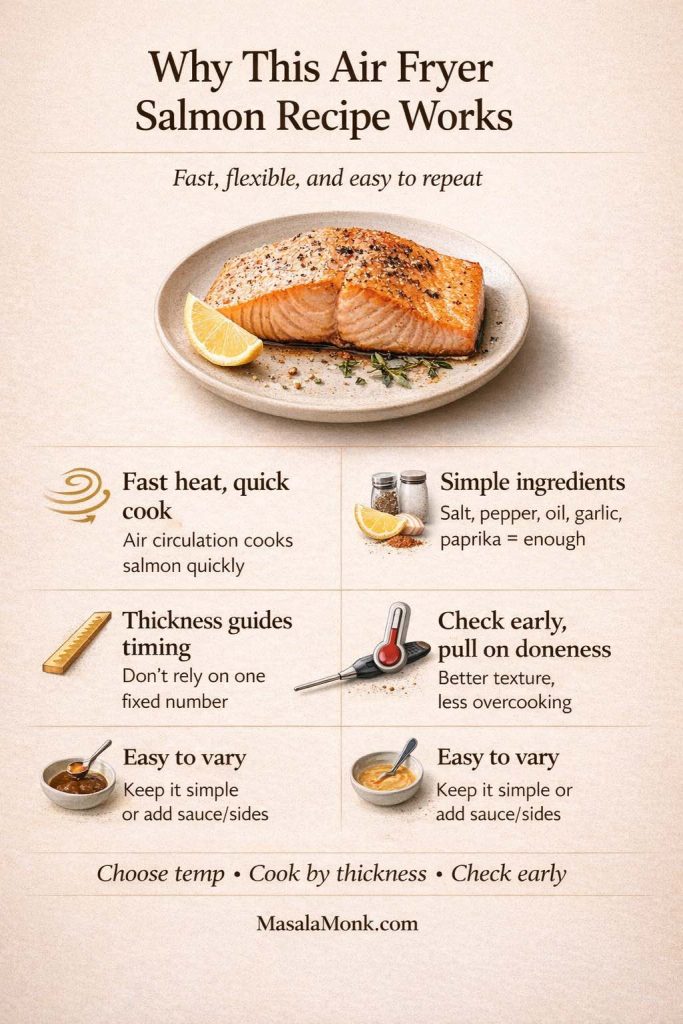
Why this air fryer salmon recipe works: this visual method guide shows the simple logic behind consistently good salmon in the air fryer—fast circulating heat, minimal ingredients, thickness-based timing, early doneness checks, and easy flavor flexibility for weeknight dinners.

Even so, speed can be a trap if you treat salmon like chicken or a frozen snack. Fish cooks quickly, and salmon fillets vary a lot in thickness. That’s why this method focuses less on a single magic number and more on a reliable flow: choose a temperature, use thickness as your timing guide, and start checking before you think it’s done.

That approach works whether you’re making a simple salmon air fryer recipe on a busy weekday or trying a more dressed-up dinner for guests. It also gives you flexibility. You can keep the seasoning minimal and serve it with a sauce, or you can build flavor directly into the fish and keep the sides light.

There’s another reason this method lands so well in a weekly rotation: salmon already fits neatly into a balanced dinner without much effort. It’s filling, it pairs with almost anything, and it doesn’t need a lot of oil to cook well. The American Heart Association also continues to recommend eating fish, especially fatty fish, as part of a heart-healthy eating pattern, which is one more reason salmon tends to show up so often in practical meal plans. (www.heart.org)

Also Read: Crock Pot Chicken Breast Recipes: 10 Easy Slow Cooker Dinners (Juicy Every Time)


Ingredients for air fryer salmon

You can make excellent salmon in the air fryer with just a handful of pantry basics. In fact, the simpler the starting point, the easier it is to branch into different versions later.
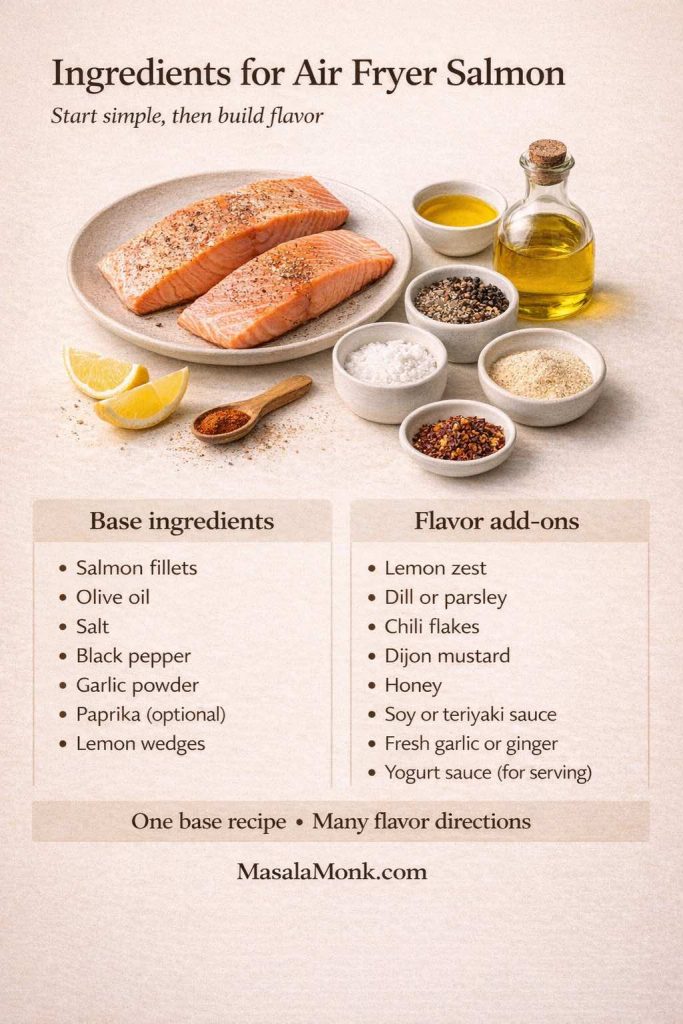
Ingredients for air fryer salmon, organized into a simple base list and easy flavor add-ons. Start with salmon fillets, olive oil, salt, pepper, garlic powder, paprika, and lemon, then branch into variations with dill, chili flakes, Dijon, honey, teriyaki, garlic, ginger, or a yogurt sauce for serving—same method, different flavor direction.

Base ingredients for a simple salmon done in an air fryer recipe

  • 2 salmon fillets (about 5 to 7 ounces each, ideally similar thickness)
  • 1 to 1½ tablespoons olive oil
  • 1 teaspoon kosher salt
  • ½ teaspoon black pepper
  • ½ teaspoon garlic powder
  • ½ teaspoon paprika (optional, but nice for color)
  • Lemon wedges, for serving

That’s enough for a clean, dependable version that tastes great on its own and also works as a base for different sauces and add-ons.

Optional ingredients for flavor variations

Once you’ve made the base version once or twice, these are useful to keep around:

  • Lemon zest
  • Dried dill or parsley
  • Chili flakes
  • A little Dijon mustard
  • Honey (for honey garlic style finishes)
  • Soy sauce or teriyaki sauce
  • Fresh garlic or ginger
  • A spoonful of yogurt-based sauce for serving

If you enjoy changing the feel of the same dish without changing the method, this is where salmon really shines. One night you can top it with a cool spoon of Greek tzatziki. Another night, you can go bright and herbal with chimichurri. And when you want something sweeter and glossier, a homemade teriyaki sauce does the job beautifully.

Also Read: Eggless Yorkshire Pudding (No Milk) Recipe


How to prep salmon fillets for the air fryer

Before the air fryer even turns on, a few small prep moves set you up for a better result.
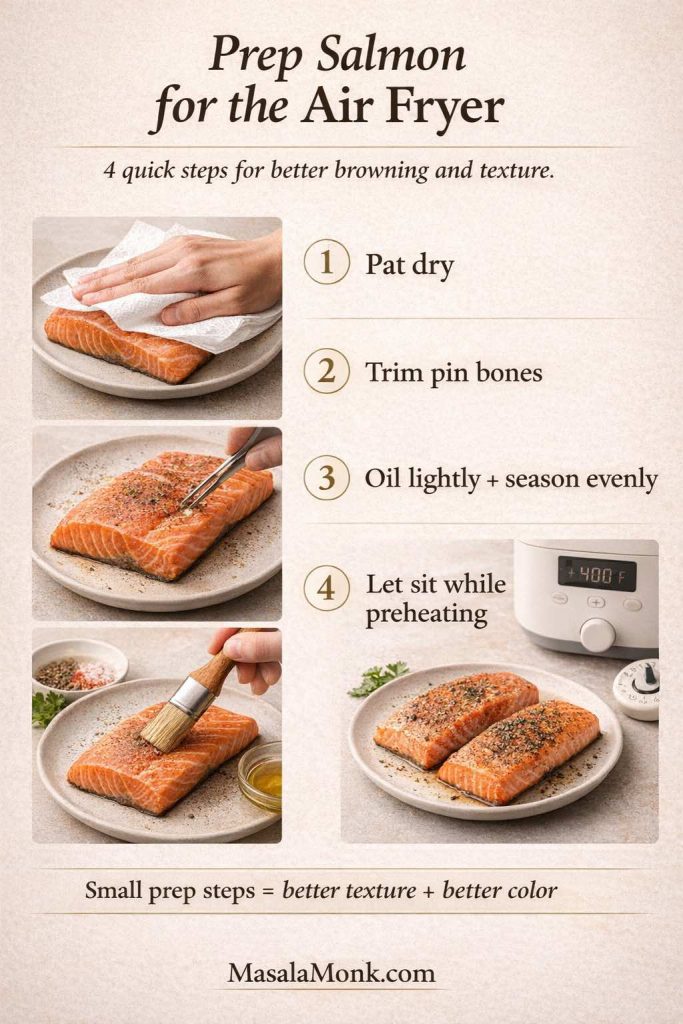
Prep salmon for air fryer guide showing four steps with salmon fillets: pat dry, trim pin bones, oil lightly and season evenly, then let the salmon sit while the air fryer preheats.
Prep salmon for the air fryer in 4 quick steps: pat it dry, trim pin bones if needed, oil and season evenly, and let it sit while the air fryer preheats. These small prep steps help salmon brown better and cook more evenly.

Pat the salmon dry first

This step looks minor, but it changes everything. Surface moisture slows browning, softens the seasoning layer, and can make the salmon look steamed instead of roasted. Use paper towels and pat both sides dry, especially if the fillets were just unwrapped.

If you’re making skin-on salmon in air fryer, pay extra attention to the skin side. A drier surface gives you a better chance of getting nicer texture, especially if you like the skin.

Trim pin bones if needed

Many fillets are sold with pin bones already removed, but not all of them. Run a finger lightly over the center line of the fillet. If you feel little bones sticking up, pull them out with clean tweezers or kitchen pliers. This takes a minute and makes the final dish much easier to eat.

Oil lightly, then season evenly

Brush or rub a light coating of oil over the fillets. You don’t need much. The goal is just enough to help the seasonings stick and to support gentle browning.

Then season the fish evenly. Don’t dump everything in the center and hope it spreads. A more even layer cooks more evenly and tastes more balanced.

For a classic everyday version, salt, pepper, garlic powder, and paprika are enough. If you want a stronger flavor, add lemon zest or chili flakes at this stage.

Let the fillets sit while the air fryer preheats

A short rest on the counter—just a few minutes—is useful while you preheat. It takes the chill off slightly and gives the seasoning time to adhere. You don’t need a long rest. Just enough time to get your air fryer ready and your basket set.

Also Read: Garlic & Paprika Cabbage Rolls (Keto-Friendly Recipes) – 5 Bold Savory Twists


How to cook salmon in the air fryer

This is the core method you’ll come back to again and again. Once you’re comfortable with this, it becomes easy to adapt into all the common variations: honey glazed air fried salmon, teriyaki salmon that is air fried, blackened salmon, lemon salmon recipe air fryer, and more.
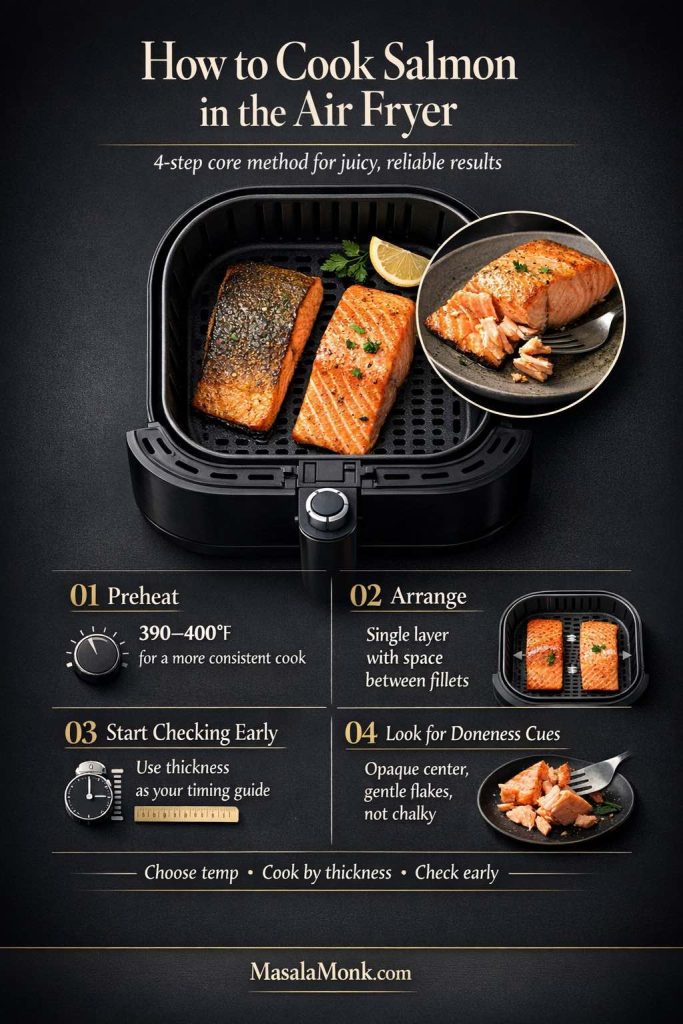
How to cook salmon in the air fryer infographic showing a 4-step core method with preheat temperature (390–400°F), single-layer basket arrangement, thickness-based timing, and visual doneness cues for juicy air fryer salmon.
How to cook salmon in the air fryer: this 4-step visual guide shows the core method for consistently juicy salmon fillets—preheat to 390–400°F, arrange in a single layer, start checking early based on thickness, and finish using visual doneness cues instead of guessing by time alone.

Preheat your air fryer

Not every air fryer behaves the same way, but in general, salmon cooks more consistently when the machine is preheated. A short preheat helps the exterior start cooking right away instead of warming slowly.

Set your air fryer to 390°F or 400°F and let it heat for a few minutes.
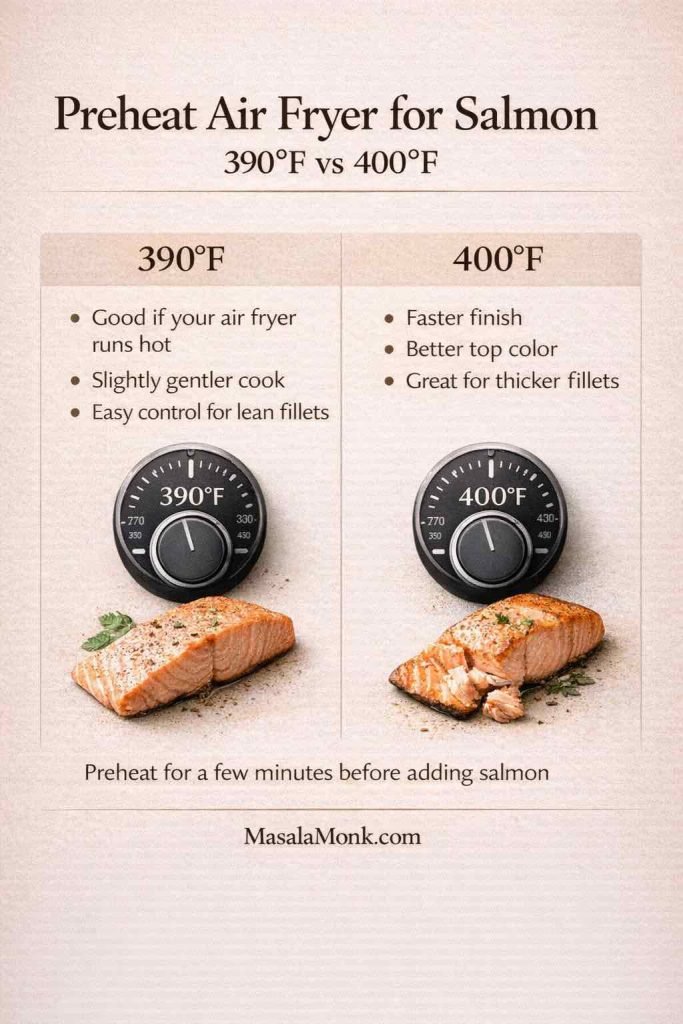
Preheat air fryer for salmon infographic comparing 390°F vs 400°F, showing when to use each temperature for air fryer salmon based on air fryer heat, fillet thickness, and desired top color.
Preheat air fryer for salmon with confidence: this quick 390°F vs 400°F guide helps you choose the best temperature for your air fryer salmon recipe based on how hot your machine runs, the thickness of your salmon fillets, and whether you want a gentler cook or deeper top color.

If your model runs hot, start at 390°F. If your model is gentle and you want a slightly deeper top color, go with 400°F.

Arrange the salmon in a single layer

Place the fillets in the basket with space between them. Air fryers need airflow to do their job, so crowding the basket is one of the fastest ways to get uneven cooking.
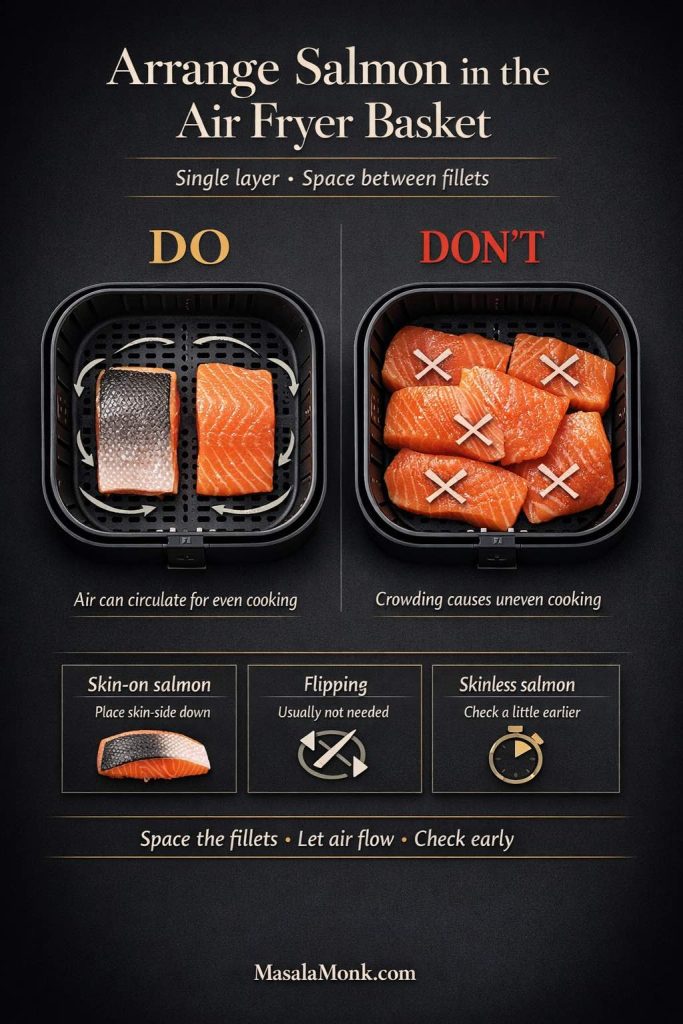
Arrange salmon in the air fryer basket the right way: this DO vs DON’T visual shows why a single layer with space between fillets cooks more evenly than a crowded basket. It also includes quick reminders for skin-on salmon (skin-side down), flipping (usually not needed), and skinless salmon (check a little earlier) for more reliable air fryer salmon results.

For skin-on salmon:

  • Place the fillets skin-side down
  • Leave them in place while cooking
  • Skip flipping unless your machine cooks very unevenly (most don’t need it)

For skinless salmon:

  • You still usually don’t need to flip
  • Just plan to check a little earlier

This is true whether you’re making salmon fillet in air fryer, salmon steaks, or slightly smaller portions.

Cook, but start checking early

This is the biggest habit shift that makes air fried salmon better.

Even if a recipe says 10 minutes, don’t wait until 10 minutes to check. Start early. A lot of fillets are done faster than expected, especially thinner pieces or tail-end portions.
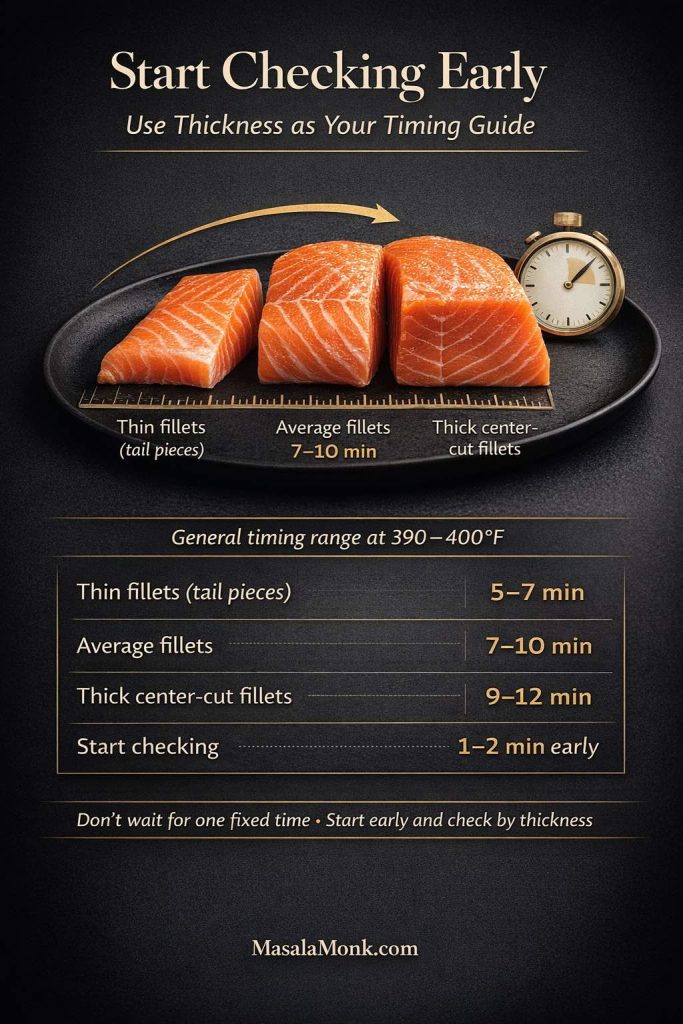
Use this air fryer salmon timing guide to start checking early based on fillet thickness instead of waiting for one fixed cook time. It’s a quick visual reference for thin, average, and thick salmon fillets at 390–400°F, with simple timing ranges that help you avoid dry, overcooked salmon and get better results in any air fryer.

As a general range:

  • Thin fillets can finish in 5 to 7 minutes
  • Average fillets often finish in 7 to 10 minutes
  • Thick center-cut fillets can take 9 to 12 minutes

The exact number depends on thickness, air fryer model, and whether the fish is skin-on or skinless. That’s why checking early matters more than memorizing a single time.

Look for visual doneness cues

Before you even touch a thermometer, your eyes tell you a lot.

The salmon is getting close when:

  • The flesh turns more opaque
  • The center no longer looks very translucent
  • The top firms up slightly
  • The fillet flakes when you press gently with a fork
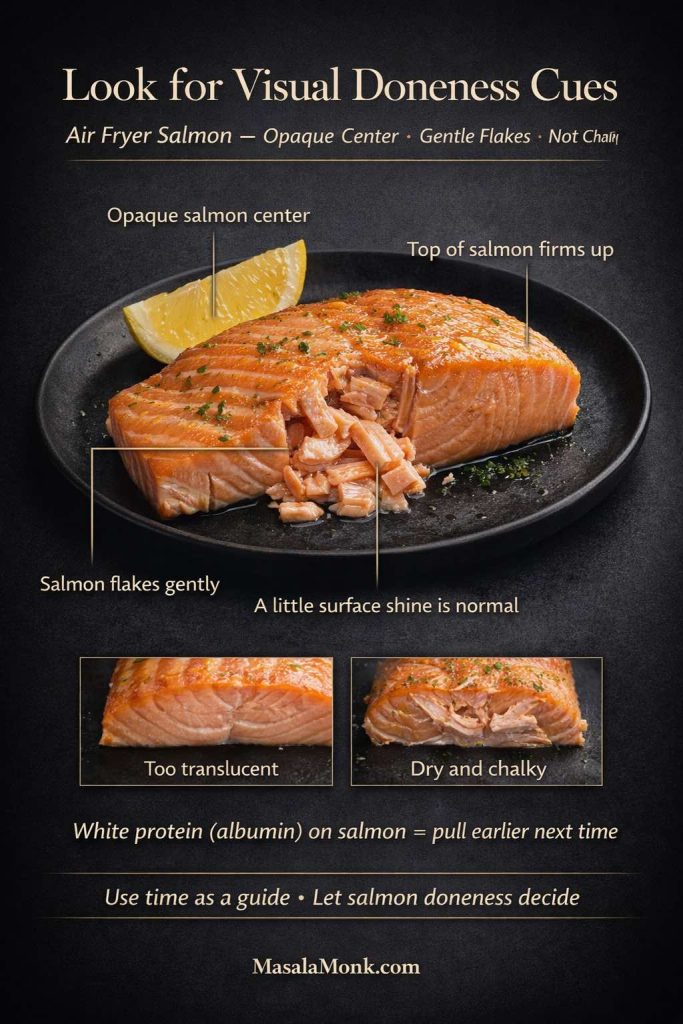
Use this air fryer salmon visual doneness guide to check salmon by sight before you overcook it. Look for an opaque center, gentle flakes, and a moist (not chalky) texture. This quick cue card also shows what underdone salmon (too translucent) and overcooked salmon (dry and chalky) look like, so you can cook with more confidence even when fillet thickness varies.

A little shine is normal. Dry, chalky flesh is not the goal.

If white protein (albumin) starts pushing out aggressively from the sides, it usually means the salmon is heading past ideal doneness. It’s still edible, but that’s your cue to pull earlier next time.

Also Read: 10 Low Carb Chia Pudding Recipes for Weight Loss (Keto, High-Protein, Dairy-Free)


Air fryer salmon time and temp

This is the part most people come back to, and it’s worth getting right. There’s no single cook time that works for every fillet, but there is a reliable way to think about it.

Air fryer salmon time and temp by thickness

For best results, think in terms of thickness instead of just weight.
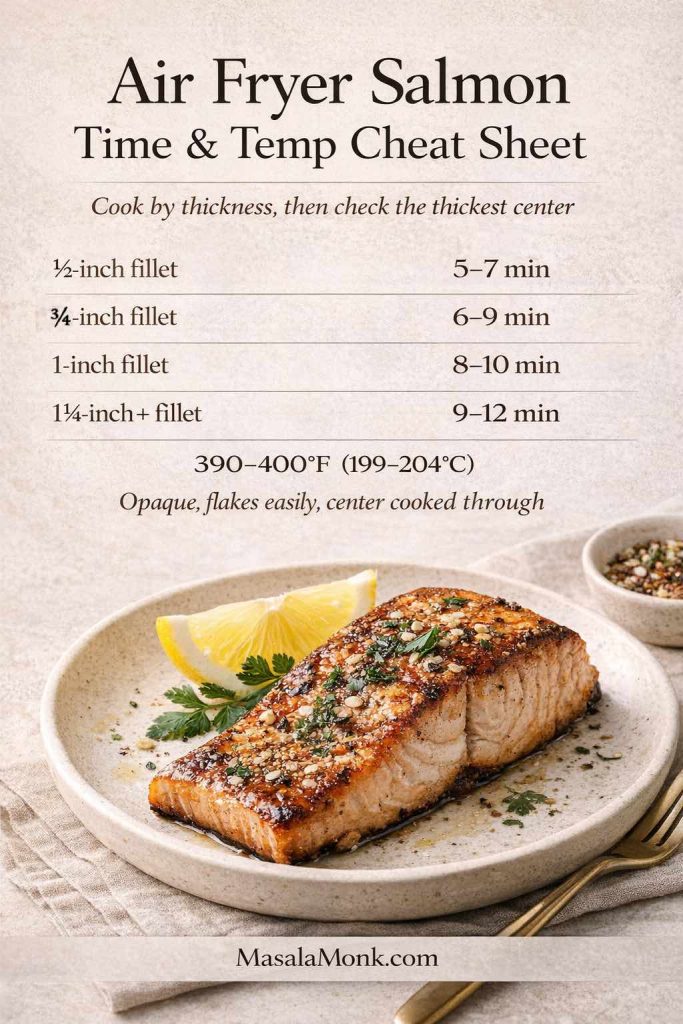
Air fryer salmon time and temp cheat sheet showing salmon cook times by fillet thickness, including 390–400°F (199–204°C), doneness cues, and a plated salmon fillet for a salmon in air fryer recipe guide.
Use this air fryer salmon time and temp cheat sheet to cook salmon by fillet thickness at 390–400°F. It’s a quick visual guide for juicy salmon in the air fryer, with timing ranges and doneness cues to help you avoid overcooking.

At 390°F to 400°F, use this as a practical guide:

  • Very thin fillets or tail pieces (about ½ inch): 5 to 7 minutes
  • ¾-inch fillets: 6 to 9 minutes
  • 1-inch fillets: 8 to 10 minutes
  • Thick fillets (1¼ inch or more): 9 to 12 minutes

That timing applies to fresh salmon in air fryer, including common cuts like Atlantic salmon and many standard grocery fillets.

If you’re working with a fattier cut, it may tolerate a tiny bit more time without drying out. If you’re working with leaner salmon, check even earlier.

Best temperature for air fryer salmon

If you’re wondering about the best way to cook salmon in air fryer, the answer is less about finding one “perfect” number and more about choosing a temperature you can repeat confidently.

For most kitchens, the sweet spot is:

  • 400°F for a faster finish and a little more top color
  • 390°F if your machine runs hot or you want a slightly gentler cook

Both produce excellent results. What matters more is consistency. If you always cook at the same temperature, you learn your machine faster, and your salmon turns out more reliably every time.

Time and temp for salmon in air fryer without overcooking

A lot of people are curious about “salmon air fryer temp and time,” “time to cook salmon in air fryer,” or “air fried salmon cooking time,” and the real answer is this:

Use the clock as a guide, but let doneness decide when to stop.

That’s the difference between salmon that’s technically cooked and salmon that actually tastes great. The best air fried salmon isn’t just “hot enough.” It’s cooked through while still tender and juicy in the center.

Also Read: Keto Hot Chocolate Recipe (Sugar-Free Hot Cocoa) + Best Homemade Mix


How to tell when salmon is done

This is where confidence really kicks in. Once you know what done salmon looks and feels like, you stop second-guessing every batch.
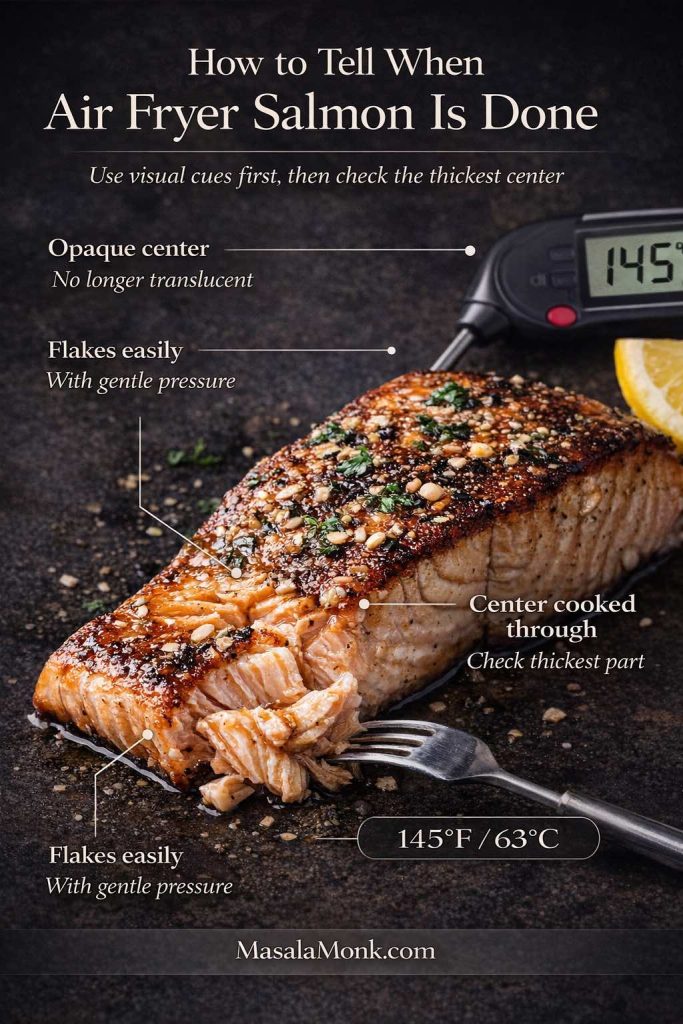
Air fryer salmon doneness guide showing visual cues for cooked salmon, including opaque center, flaking texture, thickest-center check, and 145°F / 63°C temperature target.
Use this air fryer salmon doneness guide to check when salmon is ready: look for an opaque center, easy flaking, and a thickest-center temperature of 145°F (63°C). It’s a simple visual reference to help you avoid overcooking salmon in the air fryer.

Use the thermometer in the thickest center

If you want consistency, a thermometer is your best friend.

Insert it into the thickest part of the fillet, not the thin edge. FoodSafety.gov lists fish (including salmon) at 145°F (63°C), and it also notes the classic visual cue that fish should be opaque and separate easily with a fork. (FoodSafety.gov)

That temperature is a strong, practical benchmark for a general home-cooking recipe, especially if you’re cooking for a family and want a clear doneness target.

The USDA safe temperature chart also lists fish and shellfish at 145°F, which aligns with the same guidance. (Food Safety and Inspection Service)
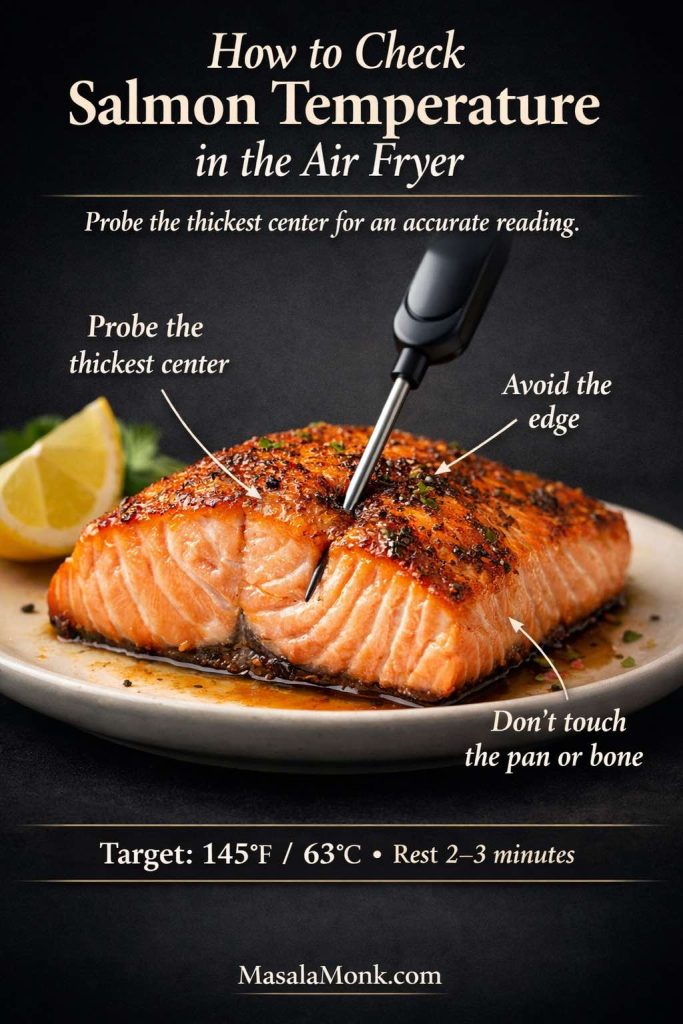
Air fryer salmon temperature guide showing a thermometer inserted into the thickest center of a cooked salmon fillet, with callouts for proper probe placement, avoiding the edge, and not touching the pan or bone, plus a 145°F / 63°C target.
Use this air fryer salmon temperature guide to check doneness accurately: insert the thermometer into the thickest center of the fillet, avoid the edges and pan contact, and cook to 145°F (63°C) for a reliable, juicy result.

What done salmon looks like

When salmon is done, the flesh:

  • Looks opaque rather than raw-looking in the middle
  • Flakes with gentle pressure
  • Feels tender, not mushy
  • Holds together when you lift it

If it still looks very translucent in the center, give it another minute and check again.

If it’s dry and crumbly, it’s gone a little too far. Not a disaster, but you’ll want to reduce the cook time next time.

Rest briefly before serving

Salmon doesn’t need a long rest like a large roast, but 2 to 3 minutes helps.

That short pause lets the juices settle and makes the fillet easier to plate neatly. It also gives you a moment to finish a side dish, squeeze lemon, or spoon on a sauce.

Also Read: Dirty Martini Recipe (Classic, Extra Dirty, No Vermouth, Spicy, Blue Cheese, Tequila + Batched)


Air fryer salmon with skin vs skinless

Both versions work well, but they behave a little differently. Knowing the difference helps you avoid overcooking and gets you a better texture.
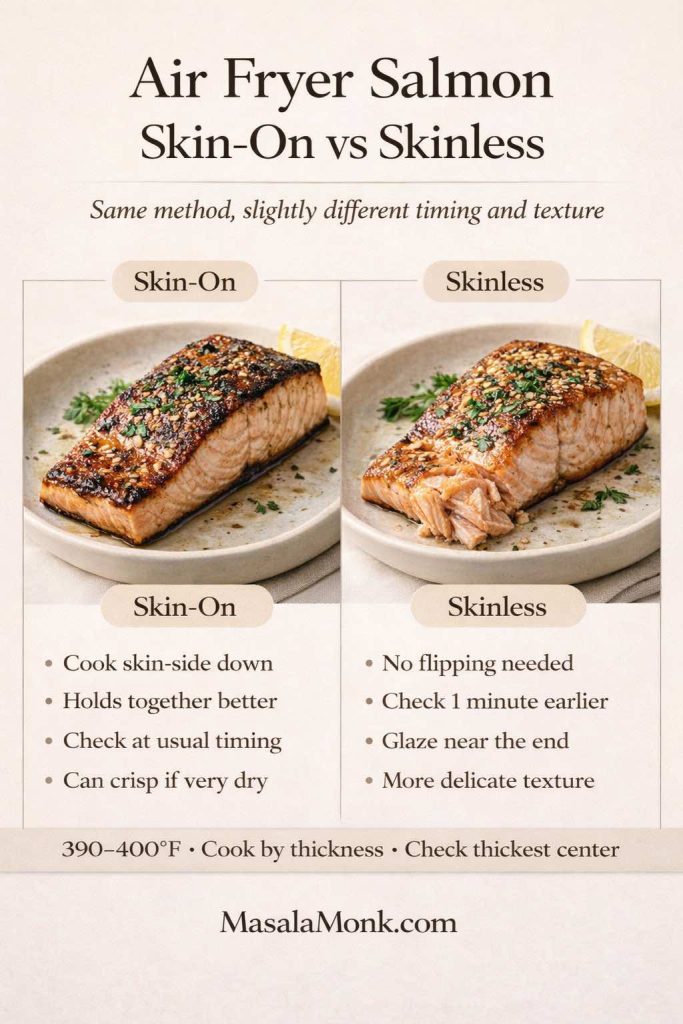
Side-by-side air fryer salmon comparison guide showing skin-on vs skinless salmon fillets with cooking tips, timing differences, and texture notes for salmon in the air fryer.
This air fryer salmon skin-on vs skinless guide shows the key differences in timing, texture, and cooking approach so you can choose the best method for the salmon fillets you have and avoid overcooking.

How to cook skin-on salmon in air fryer

Skin-on salmon is often easier for beginners because the skin helps protect the bottom of the fillet and makes it easier to move after cooking.
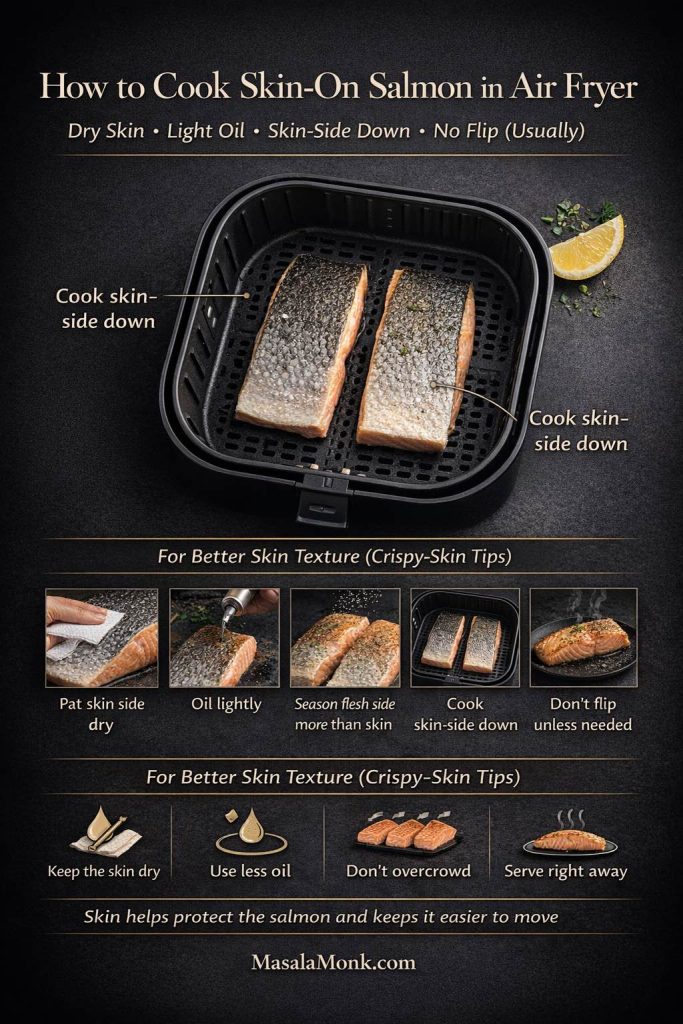
How to cook skin-on salmon in air fryer infographic showing skin-on salmon fillets placed skin-side down in an air fryer basket with crispy-skin tips including pat skin dry, oil lightly, season flesh side more than skin, avoid overcrowding, and serve right away.
Use this skin-on air fryer salmon guide for better texture and easier handling: pat the skin dry, oil lightly, season the flesh side more than the skin, and cook skin-side down without flipping unless needed. It also includes crispy-skin tips like avoiding overcrowding and serving right away before steam softens the skin.

For air fryer salmon with skin:

  • Pat the skin side dry
  • Oil lightly
  • Season the flesh side more heavily than the skin
  • Cook skin-side down
  • Don’t flip unless absolutely necessary

The skin doesn’t always get ultra-crispy in every air fryer, but it usually cooks well and helps the fish stay moist.

If you like crispy skin salmon air fryer style, a few small moves help:

  • Keep the skin dry
  • Avoid too much oil
  • Don’t overcrowd the basket
  • Serve right away (steam softens crisp skin quickly)

Skinless salmon in the air fryer

Skinless salmon in the air fryer works beautifully too, but it tends to cook a little faster and can dry out more easily if you overshoot the timing.
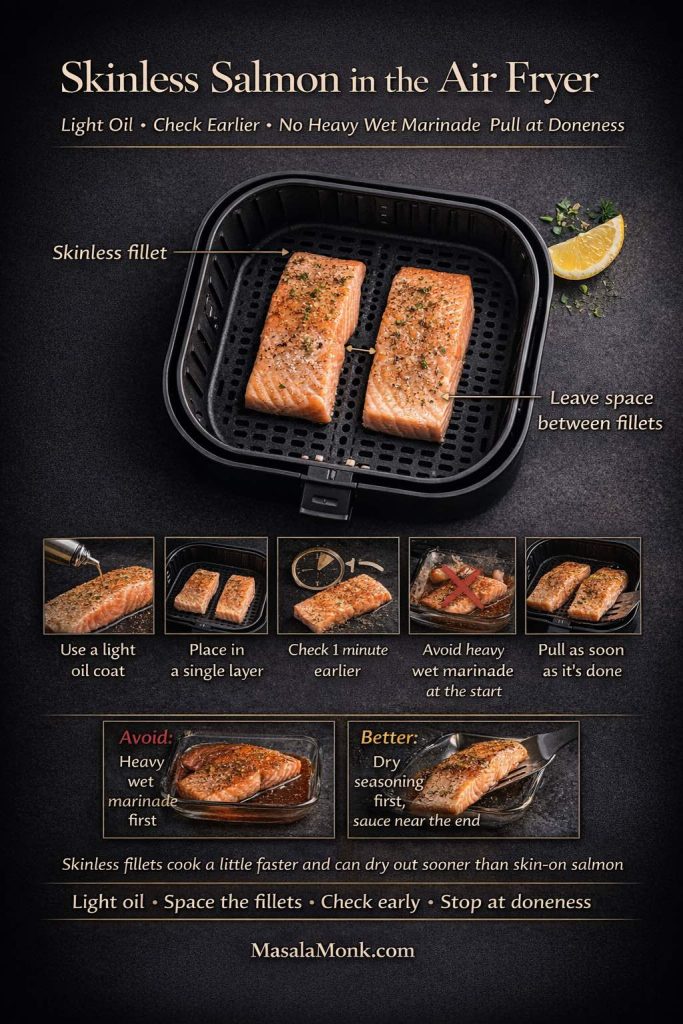
This skinless salmon in the air fryer guide shows the best way to cook skinless fillets without drying them out: use a light oil coat, leave space between fillets, check a little earlier than skin-on salmon, and avoid heavy wet marinades at the start. It’s a practical visual reference for keeping air fryer salmon juicy and evenly cooked.

For skinless fillets:

  • Use a light oil coat
  • Check one minute earlier than usual
  • Avoid heavy wet marinades at the start
  • Pull the fillet as soon as it reaches doneness

This is especially important if you’re making thinner cuts or smaller salmon portions.

If sticking is an issue in your basket, a lightly greased perforated liner can help, but avoid blocking too much airflow.

Salmon steak in air fryer

Salmon steaks are a little different from fillets because the shape is thicker and more uneven around the center bone.
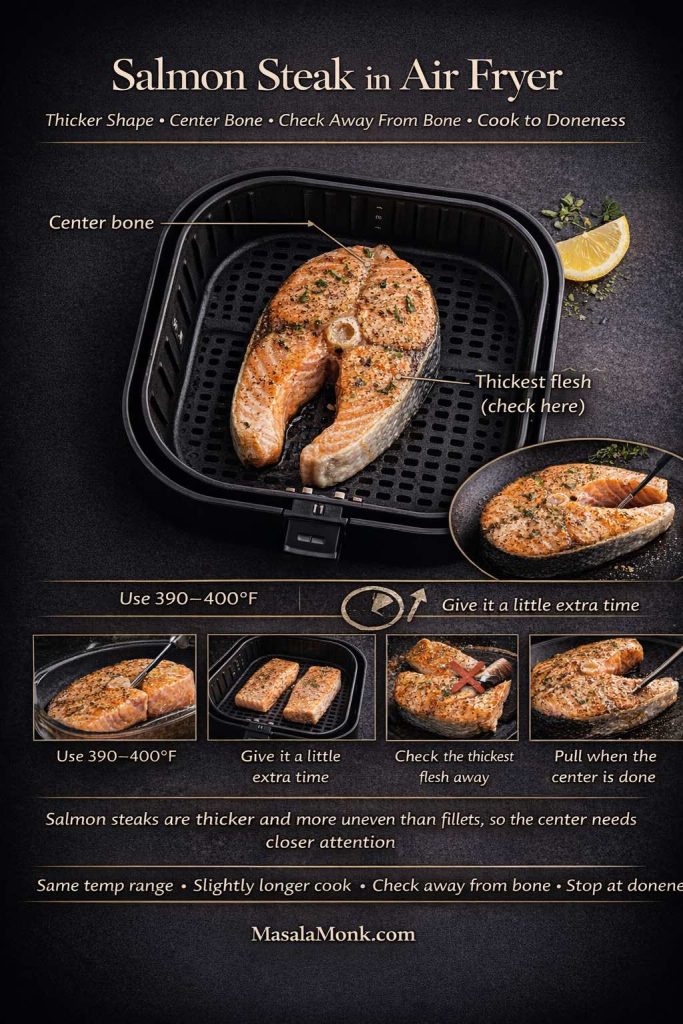
This salmon steak in air fryer guide shows how steak cuts cook differently from fillets: they’re thicker, shaped unevenly around the center bone, and need a little extra time. Use the same 390–400°F range, then check the thickest flesh away from the bone for a better doneness read and more reliable texture.

If you’re cooking salmon steak air fryer style:

  • Use the same temperature range (390°F to 400°F)
  • Add a little extra time
  • Check doneness in the thickest part, away from the bone

The same doneness rules apply, but the steak shape means you’ll want to watch the center closely.

Also Read: Fish and Chips Reimagined: 5 Indian Twists (Recipe + Method)


Best seasoning for air fryer salmon

This is where the fun starts. Once you have the base method down, seasoning is what keeps air fryer salmon from feeling repetitive.
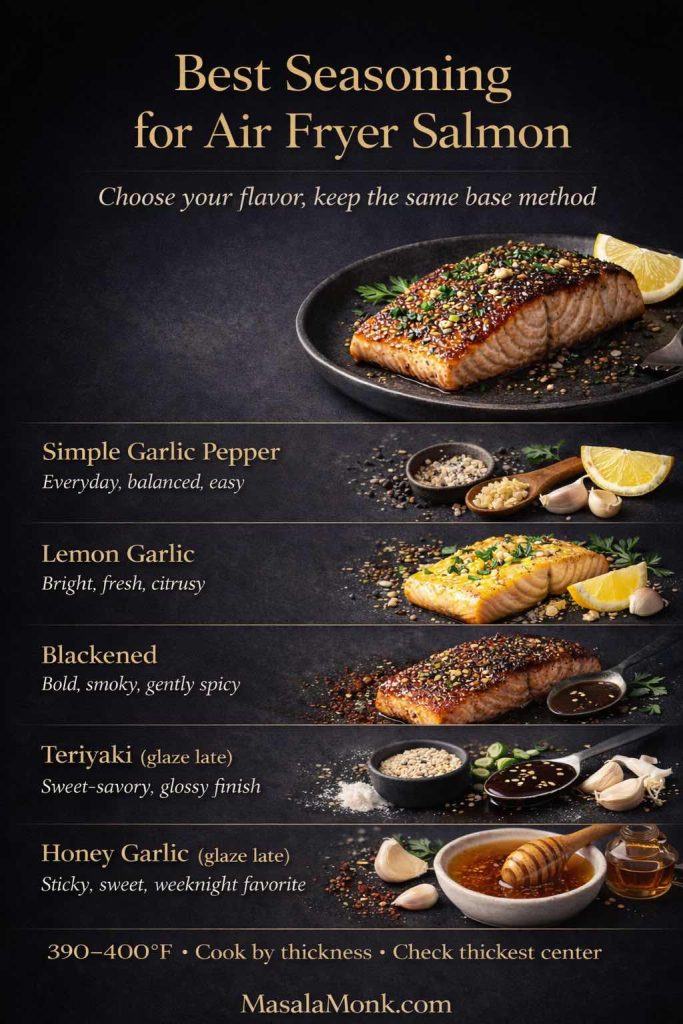
Best seasoning for air fryer salmon guide showing flavor variations including simple garlic pepper, lemon garlic, blackened, teriyaki, and honey garlic, with a cooked salmon hero image and cooking method cue.
Use this seasoning guide to choose a flavor direction for your salmon fillets that are air fried or otherwise—simple garlic pepper, lemon garlic, blackened, teriyaki, or honey garlic—while keeping the same base air fryer salmon method for reliable results.

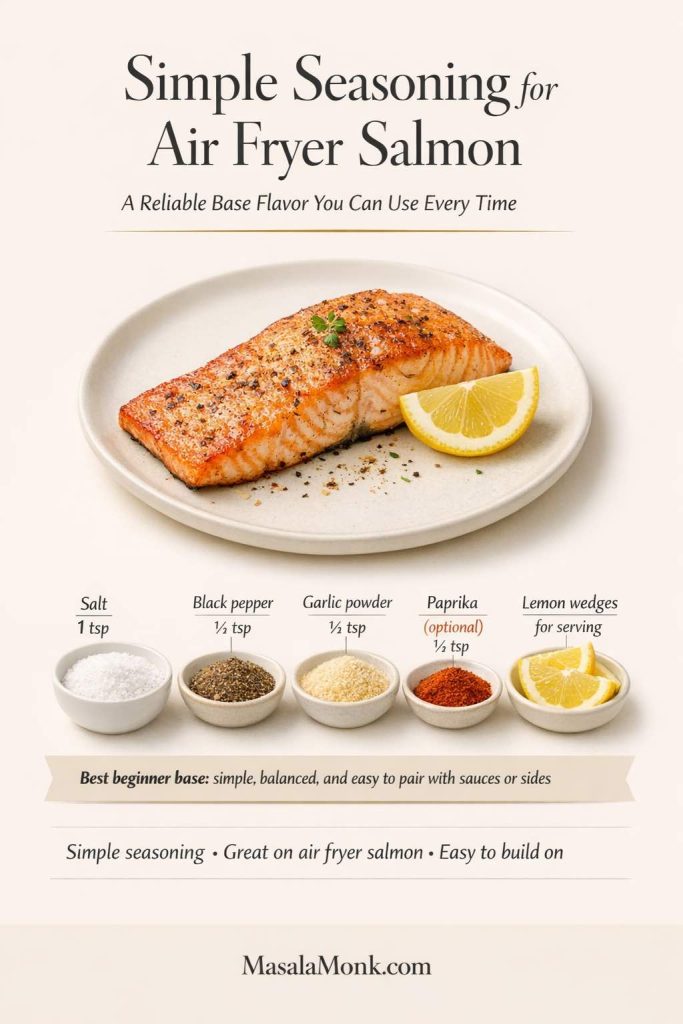
Simple seasoning for air fryer salmon

The most reliable version is still the simplest:

  • Salt
  • Pepper
  • Garlic powder
  • Paprika
  • Lemon to finish
Simple seasoning for air fryer salmon infographic showing a basic salmon fillet with salt, black pepper, garlic powder, paprika, and lemon wedges, with exact seasoning amounts for a reliable beginner-friendly air fryer salmon base method.
Start with this simple seasoning for air fryer salmon when you want a reliable, easy base that works with almost any side. This visual shows the exact seasoning mix (salt, pepper, garlic powder, paprika, and lemon) so readers can make a balanced salmon recipe without overthinking it. It’s the best foundation for weeknight dinners and also the easiest version to build into lemon garlic, blackened, teriyaki, or honey garlic variations later. Save this pin for a quick salmon seasoning reference, and boomark this post for the complete method, timing-by-thickness guide, and more air fryer salmon flavor ideas.

This combination works with almost any side and leaves room for a sauce if you want one. It’s also the best starting point if you’re new to cooking salmon in an air fryer.

Lemon garlic salmon recipe in air fryer

For a bright, fresh variation:

  • Add lemon zest before cooking
  • Use a touch more garlic
  • Finish with lemon juice right after cooking
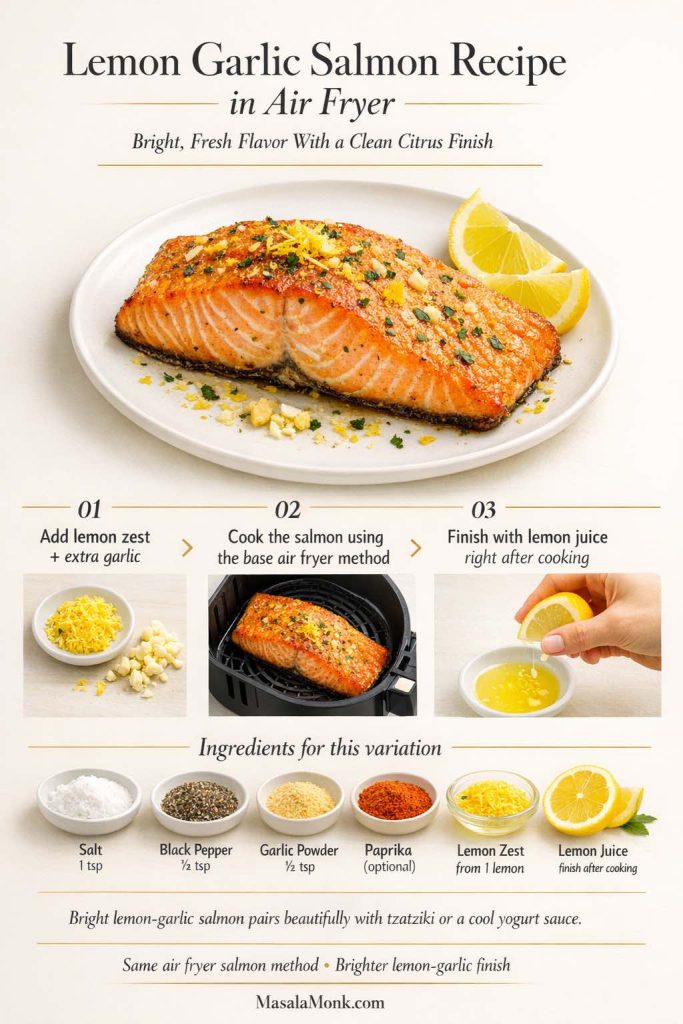
This lemon garlic salmon recipe in the air fryer is a bright, fresh variation built on the same easy base method. The card shows the full flow: add lemon zest and extra garlic, cook using the core air fryer salmon method, then finish with lemon juice right after cooking for the cleanest citrus flavor. It’s a great option when you want something light, balanced, and easy to pair with tzatziki or a cool yogurt sauce. Save this for an easy weeknight salmon idea, and visit the full MasalaMonk recipe for exact timing, doneness cues, and more flavor variations you can rotate through all week.
This lemon garlic salmon recipe in the air fryer is a bright, fresh variation built on the same easy base method. The card shows the full flow: add lemon zest and extra garlic, cook using the core air fryer salmon method, then finish with lemon juice right after cooking for the cleanest citrus flavor. It’s a great option when you want something light, balanced, and easy to pair with tzatziki or a cool yogurt sauce. Save this for an easy weeknight salmon idea, and follow full recipe for exact timing, doneness cues, and more flavor variations you can rotate through all week.

This version tastes clean and balanced, and it pairs really well with cool sauces. A spoonful of tzatziki on the side gives it a creamy contrast without making the dish heavy.

Blackened air fryer salmon

Blackened salmon in the air fryer works beautifully because the hot circulating air sets the spice coating quickly.
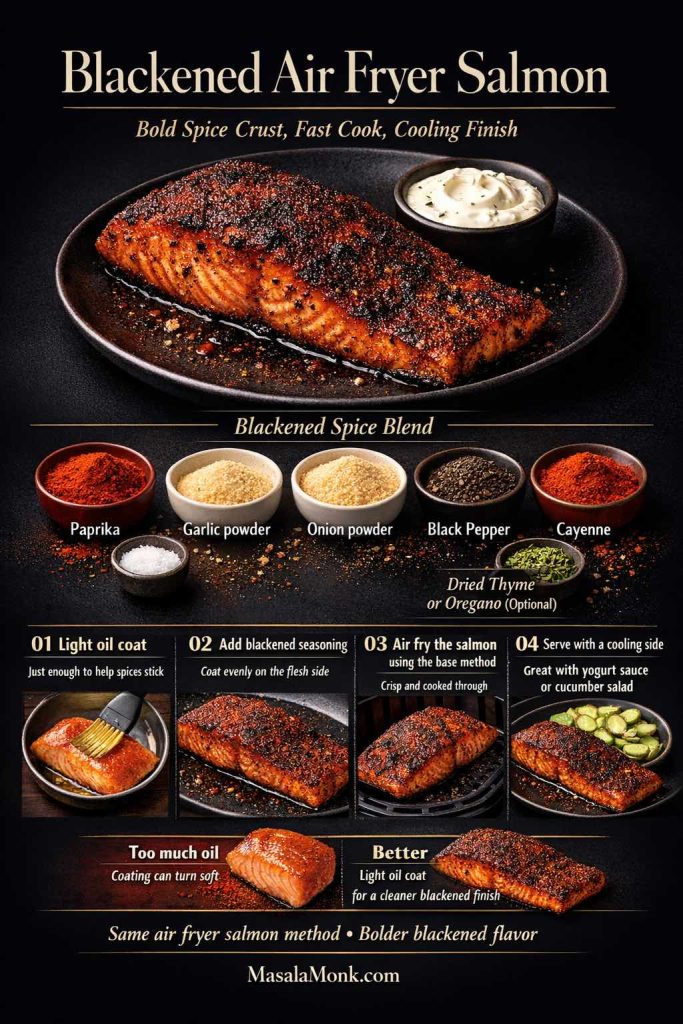
Blackened air fryer salmon infographic showing a spice-crusted salmon fillet, blackened seasoning ingredients, light oil coating step, and a cooling side pairing, with tips for getting a bold crust without making the spice coating soft.
This blackened air fryer salmon card is a bold, spice-forward variation that shows exactly how to build a flavorful crust without over-oiling the fish. It includes the blackened seasoning blend (paprika, garlic powder, onion powder, black pepper, cayenne, and optional herbs), a step-by-step visual method, and a helpful comparison showing why a light oil coat gives a cleaner finish. The cooling-side pairing cue also makes this easy to turn into a complete meal. Save this pin if you love smoky, spicy salmon, and read the full post for the core air fryer salmon method and more variations.

A good blackened-style blend includes:

  • Paprika
  • Garlic powder
  • Onion powder
  • Black pepper
  • Cayenne
  • Dried thyme or oregano (optional)

Use just enough oil to help the spices stick. Too much oil can make the coating patchy or overly soft.

This version is excellent with something cooling and tangy on the side, like yogurt sauce or a quick cucumber salad.

Teriyaki salmon in air fryer

Teriyaki is one of the easiest upgrades, but timing matters.
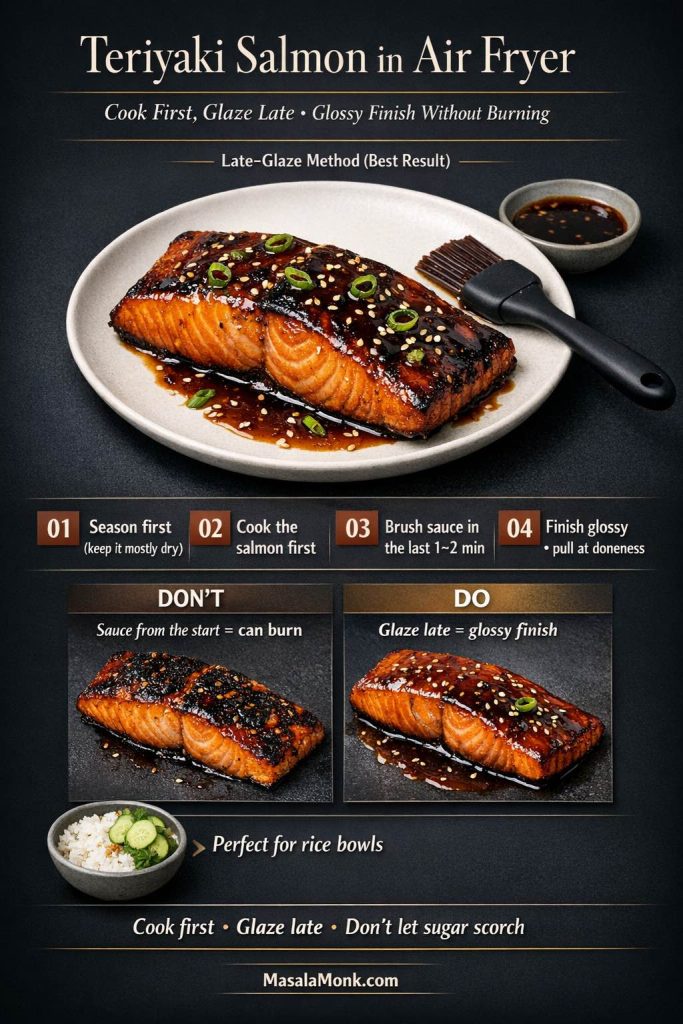
This teriyaki salmon in air fryer infographic teaches the key trick that makes teriyaki work: cook first, glaze late. The visual step sequence shows when to season, when to cook, and when to brush the teriyaki sauce (last 1–2 minutes) so the salmon gets glossy without burning. The do-vs-don’t comparison panel is especially helpful if your sweet glazes tend to scorch. It’s a great standalone save for readers who want a fast teriyaki salmon dinner with better results. Pin this for later, and read the full MasalaMonk post for timing-by-thickness and more flavor cards in the series.
This teriyaki salmon in air fryer infographic teaches the key trick that makes teriyaki work: cook first, glaze late. The visual step sequence shows when to season, when to cook, and when to brush the teriyaki sauce (last 1–2 minutes) so the salmon gets glossy without burning. The do-vs-don’t comparison panel is especially helpful if your sweet glazes tend to scorch. It’s a great standalone save for readers who want a fast teriyaki salmon dinner with better results. Pin this for later, and read the full post for timing-by-thickness and more flavor cards in the series.

Instead of starting with a thick sweet sauce, cook the salmon most of the way first. Then brush on teriyaki during the last 1 to 2 minutes so it turns glossy without burning.

That late-glaze method gives you a much better finish than adding sauce from the beginning.

If you want a homemade option, MasalaMonk’s teriyaki sauce recipe is especially useful because it includes a thicker glaze-style version as well as lighter directions, so you can choose what suits your salmon best.

Honey garlic salmon air fryer style

Honey garlic salmon is another favorite, and the same glaze rule applies.
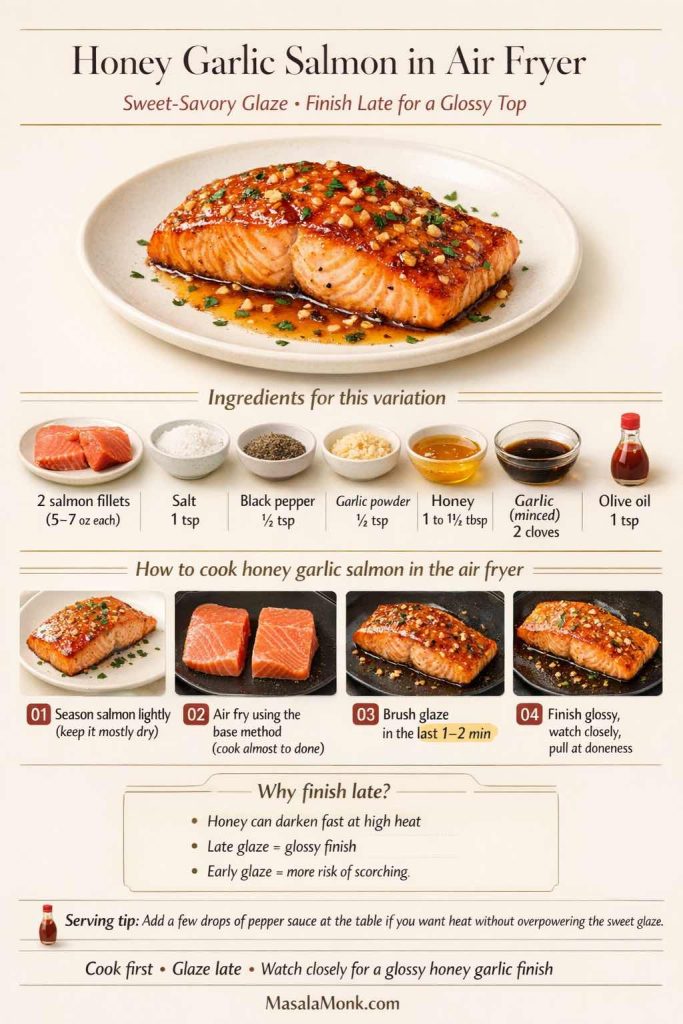
Recipe card infographic for honey garlic salmon in air fryer showing a glazed salmon fillet, ingredient amounts, and a 4-step method with the key tip to brush the honey garlic glaze in the last 1 to 2 minutes to prevent burning and keep a glossy finish.
Make Honey Garlic Salmon in the Air Fryer with a glossy sweet-savory finish—without burning the glaze. This recipe card shows the ingredient amounts, the 4-step method, and the key trick: cook the salmon first, then brush on the honey garlic glaze in the last 1–2 minutes. It’s an easy weeknight salmon recipe that looks impressive and tastes balanced, with an optional pepper sauce tip for extra heat at the table. Save this for later, pin it for your air fryer dinner board, and follow this post for the full air fryer salmon guide with more flavor variations like lemon garlic, blackened, and teriyaki.

A simple honey garlic finish works best when you:

  1. Cook the salmon almost to done
  2. Brush on the glaze
  3. Finish for 1 to 2 minutes
  4. Watch closely

Sweet glazes can darken quickly at high heat. Finishing late keeps the top glossy and flavorful instead of scorched.

If you want extra spice, add a few drops of pepper sauce at the table instead of mixing it into the glaze. That way, the sweetness stays balanced, and everyone can adjust the heat level.

Salmon marinade for air fryer

A quick note on marinades: they work, but wet marinades can reduce browning if you use too much.
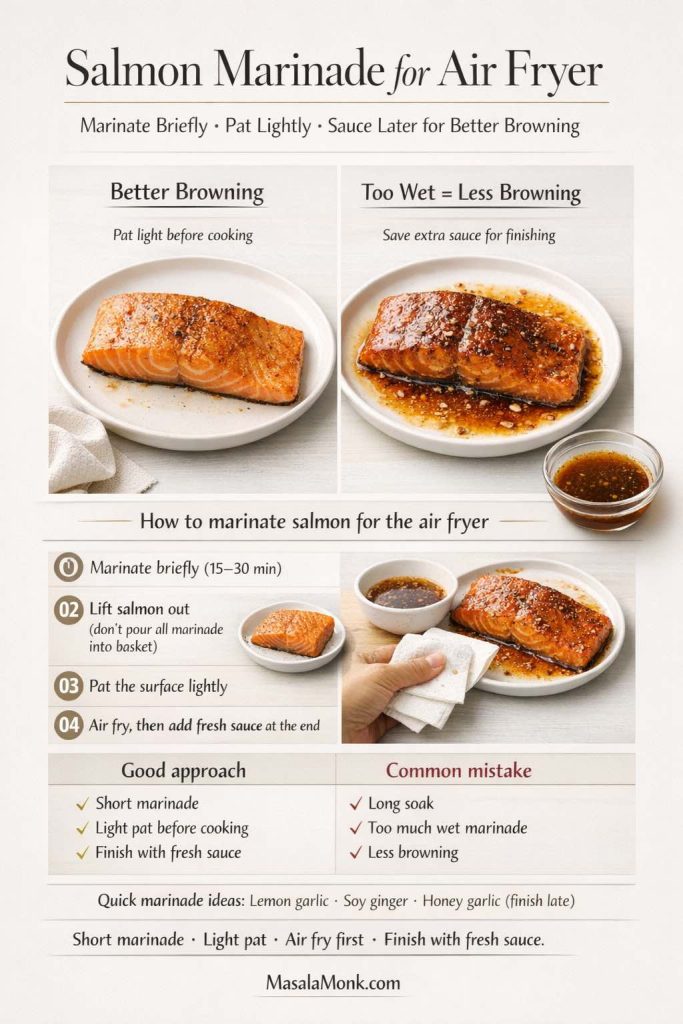
Infographic recipe guide titled “Salmon Marinade for Air Fryer” showing a side-by-side comparison of better browning vs too-wet marinade, a 4-step method for marinating salmon (15–30 minutes, lift out, pat lightly, air fry then finish with fresh sauce), and a quick tips panel for avoiding less browning.
Can you marinate salmon before air frying? Yes — but this guide shows how to do it without losing browning. The key is simple: marinate briefly (15–30 min), lift the salmon out instead of pouring all the marinade into the basket, pat the surface lightly, and finish with fresh sauce after cooking. This visual also includes a quick “good approach vs common mistake” comparison so you can avoid soggy, less-browned salmon. Save and pin this for easy weeknight air fryer salmon dinners.

If you want to marinate:

  • Keep it short (15 to 30 minutes is usually enough)
  • Pat the surface lightly before cooking
  • Save some fresh sauce for the end

This is why a lot of the best air fryer salmon recipes rely on dry seasoning first and sauce second.

Also Read: Ravioli Recipe Reinvented: 5 Indian-Inspired Twists on the Italian Classic


Common air fryer salmon mistakes and how to fix them

Even with a good method, a few things can throw off the final result. The good news is that most of them are easy to correct.
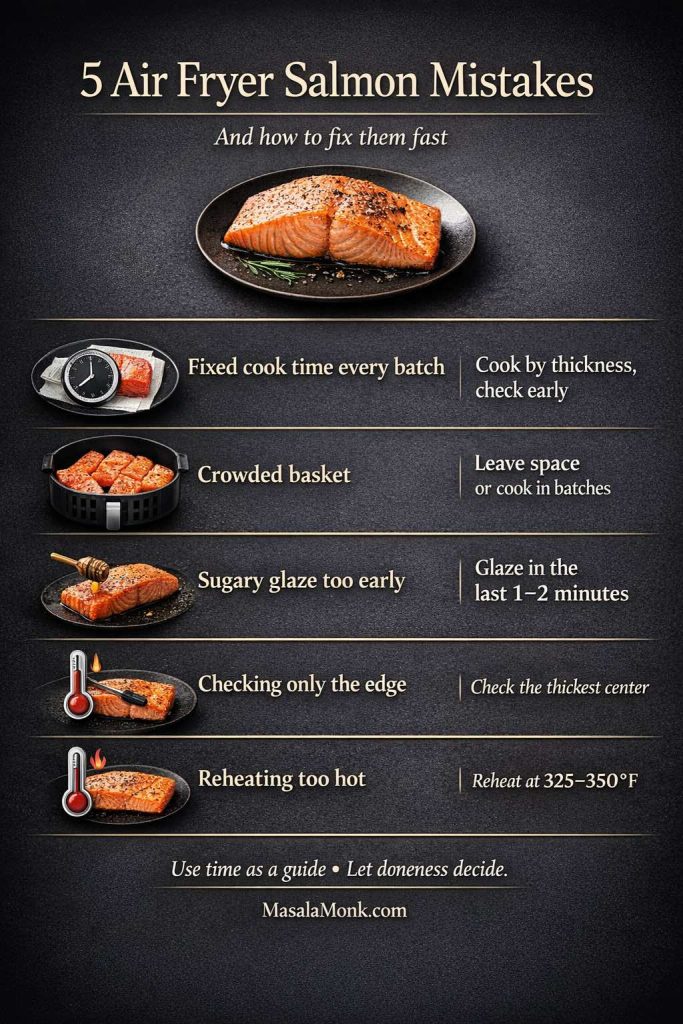
Air fryer salmon mistakes and fixes infographic showing five common problems and quick solutions: using a fixed cook time, crowding the basket, glazing too early, checking only the edge, and reheating too hot, with a cooked salmon hero image and troubleshooting tips.
Use this air fryer salmon mistakes and fixes guide to troubleshoot the most common problems fast—from overcooking by fixed time and crowding the basket to glazing too early and reheating too hot—so your salmon turns out juicier, more even, and more reliable every time.

Mistake 1: Cooking by one fixed time every time

No two fillets are exactly the same. Thickness changes everything.

Fix it by using a timing range, then checking early. Once you start treating the clock like a guide rather than a rule, your salmon gets more consistent immediately.

Mistake 2: Crowding the basket

When fillets are packed too tightly, hot air can’t move around them properly. The result is uneven cooking and weaker browning.

Fix it by cooking in batches if needed. It’s better to cook two good fillets than four crowded ones.

Mistake 3: Starting with a sugary glaze

Honey, teriyaki, and similar sauces taste great, but they burn fast.

Fix it by glazing near the end. Let the salmon cook first, then brush and finish.

Mistake 4: Not checking the thickest part

The edge of the fillet will look done before the center. If you only look at the edges, you’ll pull too early or keep cooking too long while trying to “fix” the wrong spot.

Fix it by checking the center every time.

Mistake 5: Overcooking leftovers during reheating

A lot of people blame the original cook when the real problem happens the next day. Reheating salmon too hot or too long dries it out fast.

Fix it by reheating gently at a lower temperature and just warming it through.

Also Read: Croquettes Recipe: One Master Method + 10 Popular Variations


Easy air fryer salmon variations for weeknights

One of the best parts of a solid salmon air fryer recipe is how easily it turns into several dinners with very little extra work.
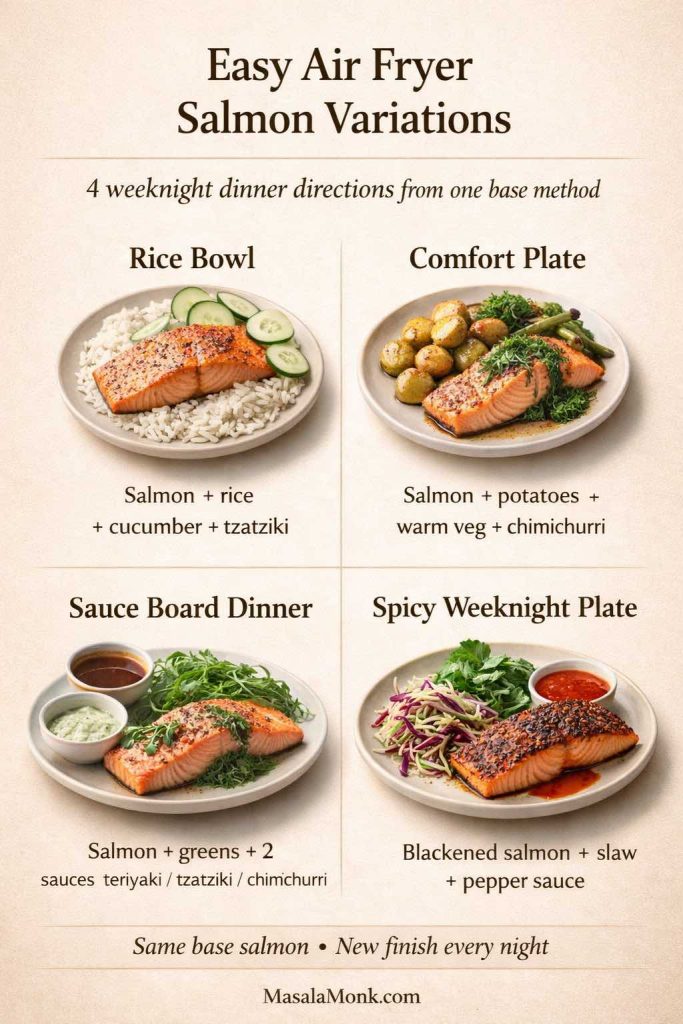
Use this easy air fryer salmon variations guide to turn one base air fryer salmon recipe into four weeknight dinners: a rice bowl, a comfort plate, a sauce-board dinner, and a spicy blackened salmon plate. It’s a quick visual planner for keeping salmon meals interesting without changing the core method.

Air fryer salmon bowl with rice and herbs

A salmon bowl is one of the easiest ways to turn this into a full meal.

Start with a base of rice, then add:

  • Flaked air fryer salmon
  • Sliced cucumber
  • Fresh herbs
  • Lemon wedges
  • Tzatziki or a yogurt sauce
  • Chili flakes, if you like heat

If you need a dependable rice base, MasalaMonk’s how to cook rice guide is a great companion because it walks through different rice types and methods in a way that makes weeknight bowls much easier to build.

Crispy-style salmon plate with a side of croquettes

When you want something a little more fun than the usual rice-and-veg combo, pair the salmon with a crisp side.

This is where a side like croquettes fits surprisingly well. MasalaMonk’s croquettes recipe guide is especially useful if you like the idea of one method that can be baked, fried, or air-fried and reused with different fillings. It also naturally opens the door to leftover salmon ideas later in the week.

Sauce-board salmon dinner

Another easy way to make the same salmon feel new is to serve it with more than one sauce.

A simple plate with the same air fryer salmon fillets can feel completely different when you offer:

That setup works especially well when people at the table like different flavor styles, and it makes the meal feel more generous without much extra cooking.

Lemon herb salmon with pesto on the side

Pesto is often associated with pasta, but it works beautifully with salmon too.

A spoonful of pesto on warm salmon adds richness, herbs, and a lot of flavor very quickly. It’s a great pairing if you’re keeping the salmon seasoning simple and want the sauce to do more of the work.

This version also pairs well with roasted potatoes, rice, or a crisp salad.

Spicy salmon with pepper sauce finish

If you enjoy heat, a bright pepper sauce works better than an overly aggressive spice rub in many cases.

You can keep the salmon seasoned simply, then finish with a few drops of pepper sauce at the table. That gives you more control over the spice level and keeps the salmon from tasting flat or one-note.

It’s a small move, but it makes the same basic air fryer salmon feel much more dynamic.

Also Read: How to Make a Flax Egg (Recipe & Ratio for Vegan Baking)


What to serve with air fryer salmon

Salmon is flexible enough to go in several directions, so this part depends on the kind of meal you want: clean and light, cozy and comforting, or a little more dinner-party style.
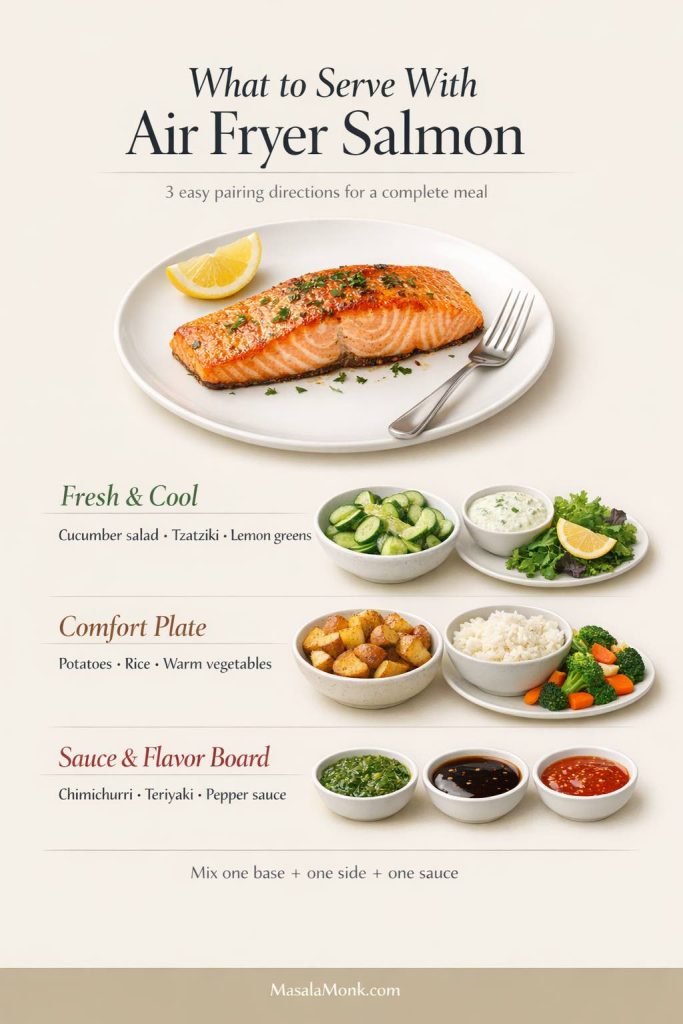
What to serve with air fryer salmon pairing guide showing a cooked salmon fillet with side dish ideas including cucumber salad, tzatziki, lemon greens, potatoes, rice, warm vegetables, and sauce options like chimichurri, teriyaki, and pepper sauce.
What to serve with air fried salmon: use this pairing guide to build an easy full meal with fresh sides, comfort-style options, and flavorful sauces. Mix one base, one side, and one sauce to turn your salmon fillets into a complete dinner without overthinking it.

Fresh, cool sides that balance salmon well

Because salmon is naturally rich, cool sides are a great match.

Some of the easiest options:

  • Cucumber salad
  • Lemony greens
  • Yogurt-herb sauce
  • Tomato and onion salad
  • Light slaw

If you want a more substantial cold side, a scoop of potato salad works especially well. MasalaMonk’s potato salad recipes post is handy here because it includes multiple styles, so you can pair a sharper German-style salad with glazed salmon or a creamier version with lemon garlic salmon.

Warm sides for a more filling dinner

If you want a heartier plate, salmon pairs beautifully with:

  • Rice
  • Roasted potatoes
  • Steamed vegetables with butter and lemon
  • Sautéed greens
  • Simple pasta

Rice is one of the easiest choices because it absorbs sauces well and turns leftover salmon into an easy next-day bowl.

Sauce-led pairings that make the same salmon feel different

Sometimes the side isn’t the main decision. The sauce is.

If you want to keep the salmon method exactly the same and still avoid boredom, rotate sauces:

That rotation alone can carry multiple weeks of dinners without changing how you cook the fish.

Drinks and desserts that round out the meal

If you like building a complete dinner experience, this is an easy place to add a little personality without complicating the main recipe.

For drinks, a crisp non-alcoholic option pairs really well with salmon, especially when the seasoning leans citrusy or spicy. MasalaMonk’s keto mocktails guide is a good place to pull ideas like fresh, low-sugar coolers and citrus-forward drinks.

For dessert, a simple make-ahead option works especially well after fish:

Those pairings make the meal feel complete without pulling you into an overly heavy dessert.

Also Read: Pork Tenderloin in Oven (Juicy, Easy, 350°F or 400°F) Recipe


Reheating salmon in air fryer without drying it out

Leftovers are where a lot of salmon recipes quietly fail, not because the original dish was bad, but because the reheating is too aggressive.

The good news: reheating salmon in air fryer works really well when you treat it gently.
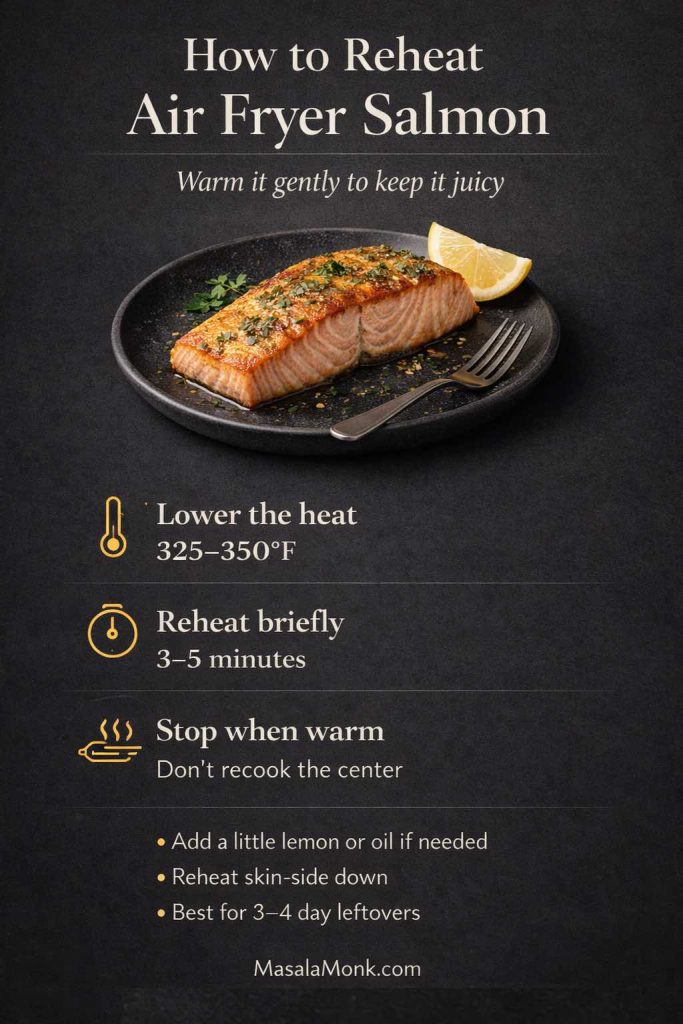
How to reheat air fryer salmon infographic showing leftover salmon reheating steps, including 325–350°F, 3–5 minutes, and tips to keep salmon juicy without drying out.
Reheating air fried salmon is easy when you keep the heat low and the time short. Use this quick guide to warm leftover salmon at 325–350°F for 3–5 minutes so it stays juicy instead of drying out.

How to store cooked salmon first

Before reheating, proper storage matters.

Let the salmon cool slightly, then transfer it to an airtight container and refrigerate it. The USDA’s Ask USDA guidance states that cooked fish and seafood can be safely stored in the refrigerator for 3 to 4 days. (Ask USDA)

That’s a great practical window for meal planning: dinner on day one, leftovers on day two or three.

For broader seafood handling and storage basics, the FDA’s seafood safety guidance is also useful, especially its advice on keeping seafood cold and handling fresh or frozen seafood properly. (U.S. Food and Drug Administration)

Best way to reheat salmon in air fryer

To reheat without drying:

  • Set the air fryer to 325°F to 350°F
  • Reheat for 3 to 5 minutes
  • Check early and stop as soon as it’s warmed through

That lower-temperature approach is much better than trying to re-crisp it at 400°F.

If the salmon seems a little dry from the fridge, brush on a tiny bit of oil or squeeze lemon over it before reheating. A spoon of sauce after reheating also helps a lot.

Reheating skin-on salmon

If your leftover salmon has skin, reheat skin-side down. It won’t be exactly the same as fresh, but it keeps the fillet stable and helps avoid tearing.

You can also flake leftover salmon and warm it briefly for:

  • Rice bowls
  • Salads
  • Wraps
  • Grain bowls
  • Quick pasta tosses

That’s often the easiest way to reuse salmon without worrying about perfect texture the second time.

Also Read: Chicken Pesto Pasta (Easy Base Recipe + Creamy, One-Pot, Baked & More)


Fresh vs frozen salmon in the air fryer

This post is focused on fresh salmon, but it’s still useful to understand where frozen fits in.
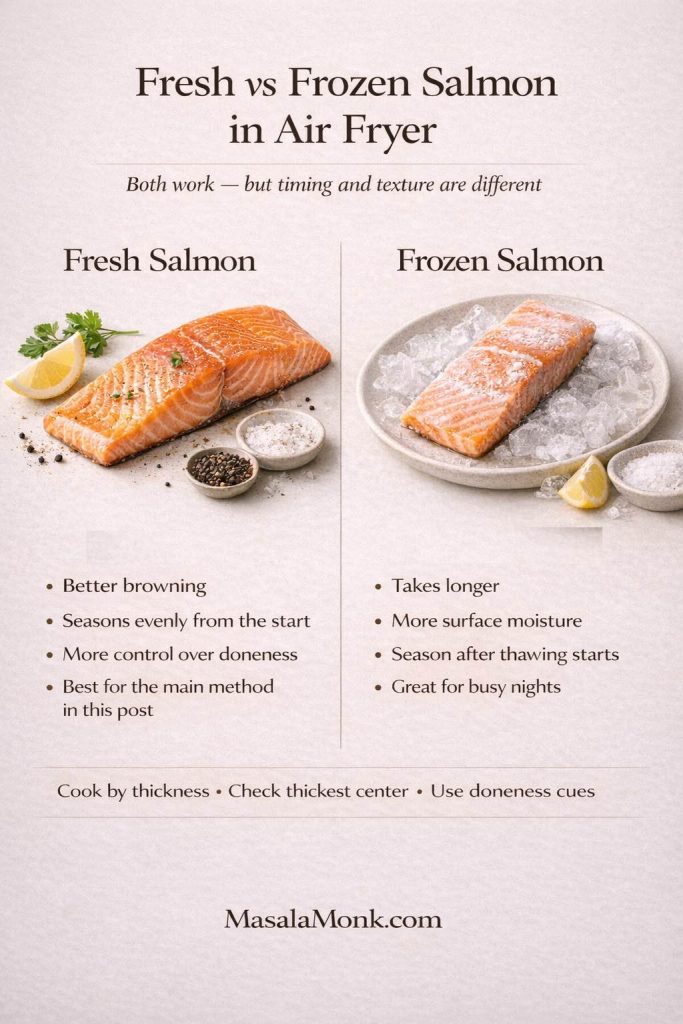
Fresh vs frozen salmon in air fryer comparison guide showing differences in browning, timing, surface moisture, and seasoning approach, with side-by-side salmon fillet visuals and cooking tips.
Fresh vs frozen salmon in the air fryer: this quick comparison shows how timing, browning, and seasoning change depending on what you start with, so you can cook either version with better results and fewer surprises.

Fresh salmon in air fryer gives you more control

Fillets of fresh salmon are easier to season evenly, easier to monitor, and usually cook more predictably. You get better browning and more control over the final texture.

That’s one reason this guide uses fresh salmon as the baseline method.

Frozen salmon in air fryer can still work

Frozen salmon in air fryer is absolutely possible, and it can be a lifesaver on busy nights. The process is just different:

  • It usually takes longer
  • Surface moisture changes the texture
  • Seasoning often works better partway through

If you cook frozen salmon often, it’s worth eventually giving it its own dedicated method because the timing, seasoning flow, and texture cues are different from fresh fillets.

For now, if you’re cooking from frozen and want the best result, the same principle still helps: cook by doneness, not just by the clock.

Also Read: Chicken Pesto Pasta (Easy Base Recipe + Creamy, One-Pot, Baked & More)


Air fryer salmon for different cuts and salmon types

Once you’ve made basic fillets a few times, you can use the same logic across different salmon cuts.
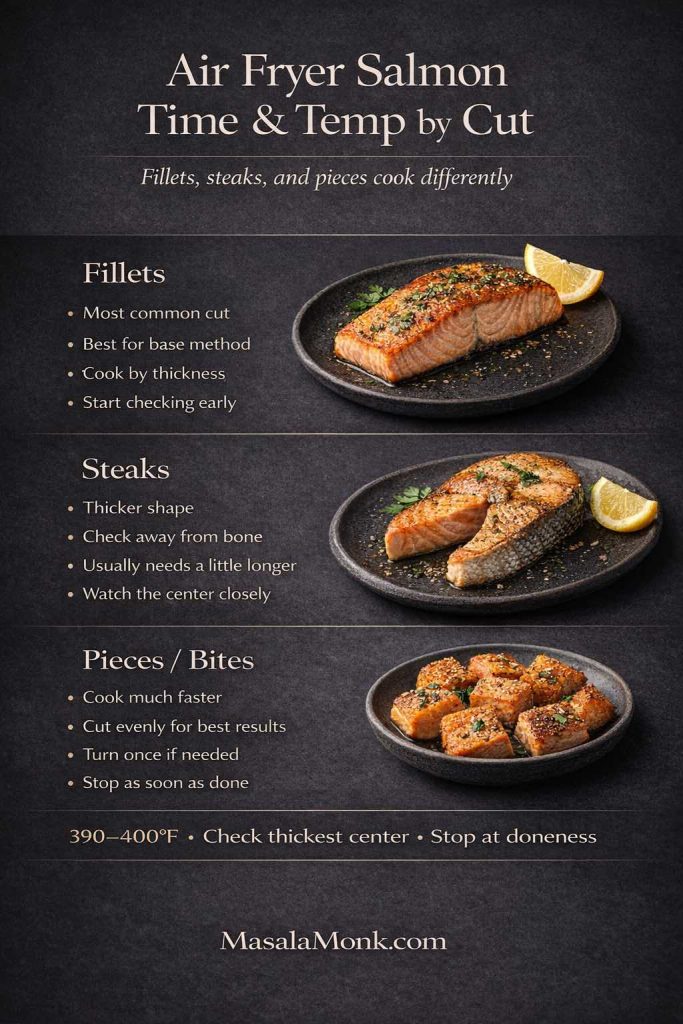
Air fryer salmon time and temperature by cut guide showing salmon fillets, salmon steaks, and salmon bites with cooking tips, doneness cues, and a 390–400°F recommendation.
Use this air fryer salmon by-cut guide to adjust your method for fillets, steaks, and salmon bites. It’s a quick visual reference for cook time differences, doneness checks, and better texture across different salmon cuts.

Salmon fillets in air fryer

This is the easiest and most common format. The base method in this post is designed around salmon fillets, including:

  • Atlantic salmon
  • Coho salmon
  • Sockeye salmon
  • Wild salmon portions
  • Farmed salmon fillets

The exact time changes, but the process stays the same.

Sockeye salmon air fryer notes

Sockeye is often leaner than some other salmon types, so it can overcook a little faster.

If you’re making sockeye salmon air fryer style:

  • Start checking a bit earlier
  • Don’t rely on a long cook time
  • Consider a sauce or glaze for extra moisture and richness

Coho and Atlantic salmon in air fryer

Coho and Atlantic fillets often behave very well in the air fryer, especially in standard grocery-store thicknesses.

Atlantic salmon tends to be richer and more forgiving, which makes it a nice choice if you’re learning the method. Coho can be excellent too, just a little less forgiving if overcooked.

Salmon pieces and smaller portions

If you’re cooking salmon pieces in air fryer (smaller cuts, trimmed portions, or bite-sized pieces), reduce the time and watch closely. Small pieces cook very fast.

For salmon bites, it helps to:

  • Cut pieces evenly
  • Coat lightly
  • Avoid over-saucing at the start
  • Shake or turn once if needed

Also Read: Slow Cooker Pork Tenderloin (Crock Pot Recipe) — 3 Easy Ways


A few easy dinner directions you can keep in rotation

Once you’ve made this salmon recipe a few times, it helps to have a few “default directions” in mind so dinner doesn’t feel repetitive.
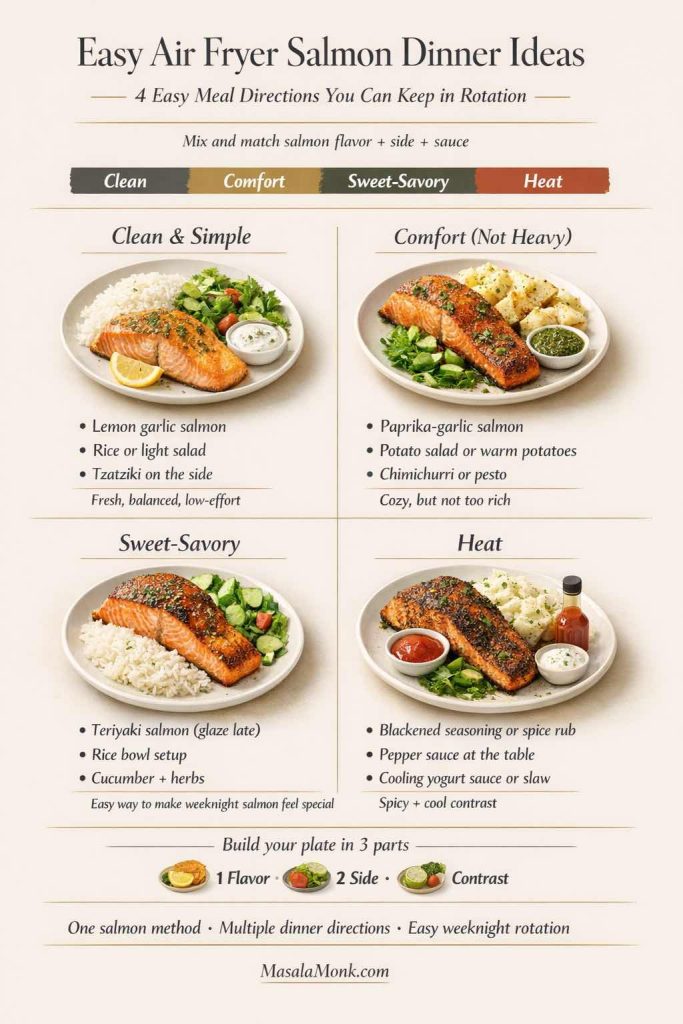
Infographic titled “Easy Air Fryer Salmon Dinner Ideas” showing four meal directions for air fryer salmon: Clean & Simple (lemon garlic salmon with rice or salad and tzatziki), Comfort (paprika-garlic salmon with potatoes and chimichurri/pesto), Sweet-Savory (teriyaki salmon with rice and cucumber), and Heat (blackened salmon with pepper sauce and a cooling yogurt sauce or slaw). Includes a “build your plate in 3 parts” tip: flavor, side, and contrast.
Keep weeknight salmon from feeling repetitive with this Easy Air Fryer Salmon Dinner Ideas guide 🐟✨ This visual gives you 4 easy meal directions you can rotate: Clean & Simple (lemon garlic + rice/salad + tzatziki), Comfort (Not Heavy) (paprika-garlic + potatoes + chimichurri/pesto), Sweet-Savory (teriyaki salmon + rice bowl + cucumber/herbs), and Heat (blackened salmon + pepper sauce + cooling yogurt sauce/slaw). It also includes a quick “build your plate in 3 parts” formula so dinner is easier to plan. Save and pin this for busy nights, follow the full air fryer salmon method, doneness tips, and flavor variations in this post.

When you want something clean and simple

Go with:

  • Lemon garlic salmon
  • Rice or a light salad
  • Tzatziki on the side

It feels fresh, balanced, and low-effort.

When you want a little comfort without a heavy meal

Go with:

  • Paprika-garlic salmon
  • Potato salad or warm potatoes
  • Chimichurri or pesto for a flavor lift

You still get a cozy plate, but it doesn’t feel too rich.

When you want a sweet-savory finish

Go with:

  • Teriyaki salmon in air fryer (glaze at the end)
  • Rice bowl setup
  • Cucumber and herbs for contrast

This is one of the easiest ways to make salmon feel special on a weekday.

When you want heat

Go with:

  • Blackened seasoning or a simple spice rub
  • Pepper sauce at the table
  • A cooling side like yogurt sauce or slaw

The contrast is what makes it work.

Also Read: Keto Mocktails: 10 Low Carb, Sugar Free Recipes


Final thoughts

A really good air fryer salmon recipe is less about chasing a perfect one-time result and more about learning a method you can trust. Once you know your air fryer, your preferred temperature, and your doneness cues, the rest becomes easy. You stop hovering. You stop overcooking “just in case.” And suddenly salmon becomes one of the fastest, most dependable dinners in your kitchen.
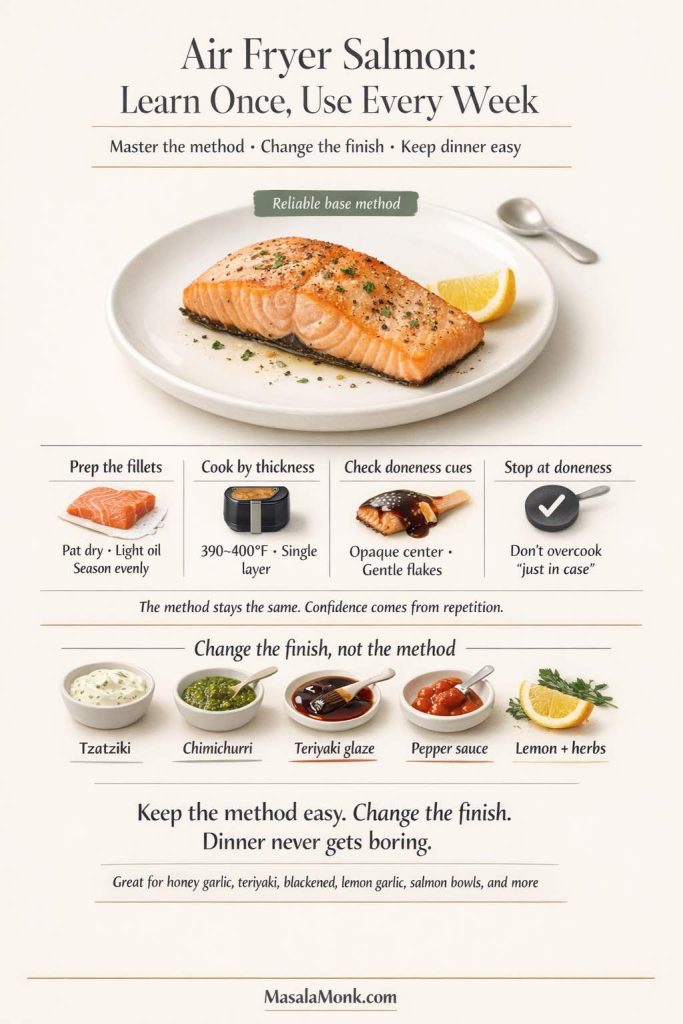
A final recap card for the post: learn one reliable air fryer salmon method, then keep dinner interesting by changing the finish. This visual sums up the core flow (prep, cook by thickness, check doneness, stop at doneness) and shows how the same base salmon can turn into totally different meals with tzatziki, chimichurri, teriyaki glaze, pepper sauce, or lemon and herbs. It’s the easiest way to make air fryer salmon part of a weekly rotation without getting repetitive. Save and share this guide for quick weeknight dinner inspiration.

That’s why this base method is worth learning first.

It covers the fundamentals—how to prep the fillets, how to cook salmon in the air fryer, how to handle air fryer salmon time and temp, how to work with skin-on or skinless pieces, and how to reheat leftovers properly. From there, you can branch into all the versions people actually make in real life: honey garlic air fryer salmon, teriyaki salmon, blackened salmon, lemon salmon, salmon bowls, and more.

And if you want to keep the same fish but make dinner feel completely different next time, the easiest move is usually not changing the cooking method at all. Just change the finish: a spoon of chimichurri, a swipe of tzatziki, a teriyaki glaze, a little pepper sauce, or a fresh pesto on the side.

That way, the method stays easy, but the meal never gets boring.

Also Read: Crock Pot Pork Chops and Sauerkraut (No Dry Chops Recipe)


Frequently Asked Questions

1. How long does salmon take in the air fryer?

In most cases, salmon in the air fryer takes about 7 to 11 minutes at 390°F to 400°F, but the exact time depends on thickness. Thin fillets can finish in 5 to 7 minutes, while thicker center-cut pieces may need 9 to 12 minutes. Rather than relying on one fixed time, start checking early and finish based on doneness.

2. What is the best temperature for air fryer salmon?

For most fillets, the best temperature for air fryer salmon is 390°F to 400°F. If your air fryer runs hot, 390°F gives you a little more control. On the other hand, 400°F is great when you want a quicker cook and a slightly more roasted top.

3. How do I know when air fryer salmon is done?

The easiest way to tell is by checking the thickest center of the fillet. The salmon should look opaque and flake gently with a fork. If you use a thermometer, check the center and cook until it reaches the proper internal temperature for fish. In addition, avoid judging doneness by the edges alone, because they cook faster than the middle.

4. Do I need to flip salmon in the air fryer?

Usually, no. Most air fryer salmon recipes cook well without flipping, especially when the fillets are placed in a single layer with space around them. If you’re cooking skin-on salmon, keep it skin-side down and leave it undisturbed for the best texture.

5. Can I cook salmon with skin in the air fryer?

Yes, and air fryer salmon with skin is often easier to cook well. The skin helps hold the fillet together and can protect the bottom from overcooking. For better texture, pat the skin dry, use a light coating of oil, and cook skin-side down.

6. How do I get crispy skin salmon in the air fryer?

To get crispier skin, start with very dry skin, use only a light layer of oil, and avoid overcrowding the basket. Also, serve the salmon right away, because trapped steam softens the skin quickly. While every air fryer behaves a little differently, these steps noticeably improve crispy skin salmon in air fryer cooking.

7. Can I make salmon fillets in the air fryer without drying them out?

Absolutely. The key is to cook by thickness, not just by the clock. Keep the temperature steady, check early, and stop cooking as soon as the salmon is done. As a result, your salmon fillet in air fryer stays moist instead of turning chalky or dry.

8. What seasoning works best for air fryer salmon?

A simple mix of salt, pepper, garlic powder, and paprika works beautifully for everyday air fryer salmon. After that, you can build other flavors easily—lemon garlic, blackened, teriyaki, or honey garlic—without changing the core cooking method.

9. Can I use a marinade for salmon in the air fryer?

Yes, although lighter marinades usually work better than very wet ones. If the marinade is too heavy, the salmon can steam instead of roast. For better results, marinate briefly, pat off excess moisture, and add glaze-style sauces near the end of cooking.

10. Can I cook frozen salmon in air fryer?

Yes, frozen salmon in air fryer is possible and very convenient. However, it takes longer than fresh salmon and often needs a slightly different seasoning approach because of the extra surface moisture. If you cook from frozen often, it helps to use a separate method with its own time and temperature flow.

11. What is the best way to cook frozen salmon in air fryer?

The best way to cook frozen salmon in air fryer is to start cooking first, then season once the surface thaws enough for seasoning to stick properly. Since frozen fillets release moisture as they cook, check doneness in the thickest center and expect a longer total cook time than fresh salmon.

12. Can I cook salmon steak in the air fryer?

Yes, salmon steak in air fryer works well, but it may take a little longer than a fillet because the cut is thicker and shaped differently around the center bone. Use the same temperature range (390°F to 400°F), then check the thickest part for doneness.

13. What’s the difference between cooking fresh salmon and frozen salmon in the air fryer?

Fresh salmon in air fryer usually gives you better browning and more control over seasoning from the start. Frozen salmon in the air fryer is still a great option, though it cooks differently because moisture releases as it thaws. In either case, checking doneness early makes the biggest difference.

14. Can I make teriyaki salmon in the air fryer?

Yes, teriyaki salmon air fryer style is one of the easiest variations. Still, the best approach is to cook the salmon most of the way first, then brush on teriyaki sauce in the last minute or two. That way, the glaze turns glossy without burning.

15. Can I make honey garlic salmon in the air fryer?

Definitely. Honey garlic salmon air fryer recipes work best when the glaze is added near the end, just like teriyaki. Because honey can darken quickly at high heat, finishing late helps you get a sweet, sticky coating without scorching.

16. How do I reheat salmon in air fryer without drying it out?

For reheating salmon in air fryer, use a lower temperature than you used for cooking—usually 325°F to 350°F. Warm it for 3 to 5 minutes, then stop as soon as it’s heated through. A small brush of oil or a squeeze of lemon can help keep the texture moist.

17. How long can I keep cooked air fryer salmon in the fridge?

Cooked salmon is best within a few days when stored in an airtight container in the refrigerator. For the best texture, reheat gently instead of using very high heat. Likewise, flaking leftover salmon into bowls or salads is a great way to use it without overcooking.

18. Can I cook salmon in a Ninja air fryer using the same method?

Yes, the same overall method works for salmon in a Ninja air fryer, including seasoning, basket spacing, and checking doneness early. Even so, different models can run hotter or faster, so use the recommended time range as a guide and check the fillet a little early the first time.

19. Why is my salmon overcooked in the air fryer?

Usually, overcooked salmon happens because the fillet was cooked by a fixed time instead of checked by thickness and doneness. Another common reason is using a sugary glaze too early, which can make the outside look done before the center is ready. Starting your doneness check earlier solves most of this.

20. What is the easiest air fryer salmon recipe for beginners?

The easiest air fryer salmon recipe for beginners is a simple fillet with olive oil, salt, pepper, garlic powder, and paprika cooked at 390°F to 400°F. Once that base is working well, you can branch into lemon garlic, blackened, teriyaki, or honey glazed salmon without changing the core method.
Posted on 1 Comment

Homemade Teriyaki Sauce Recipe : Classic, Thick, Sticky, Healthy & More

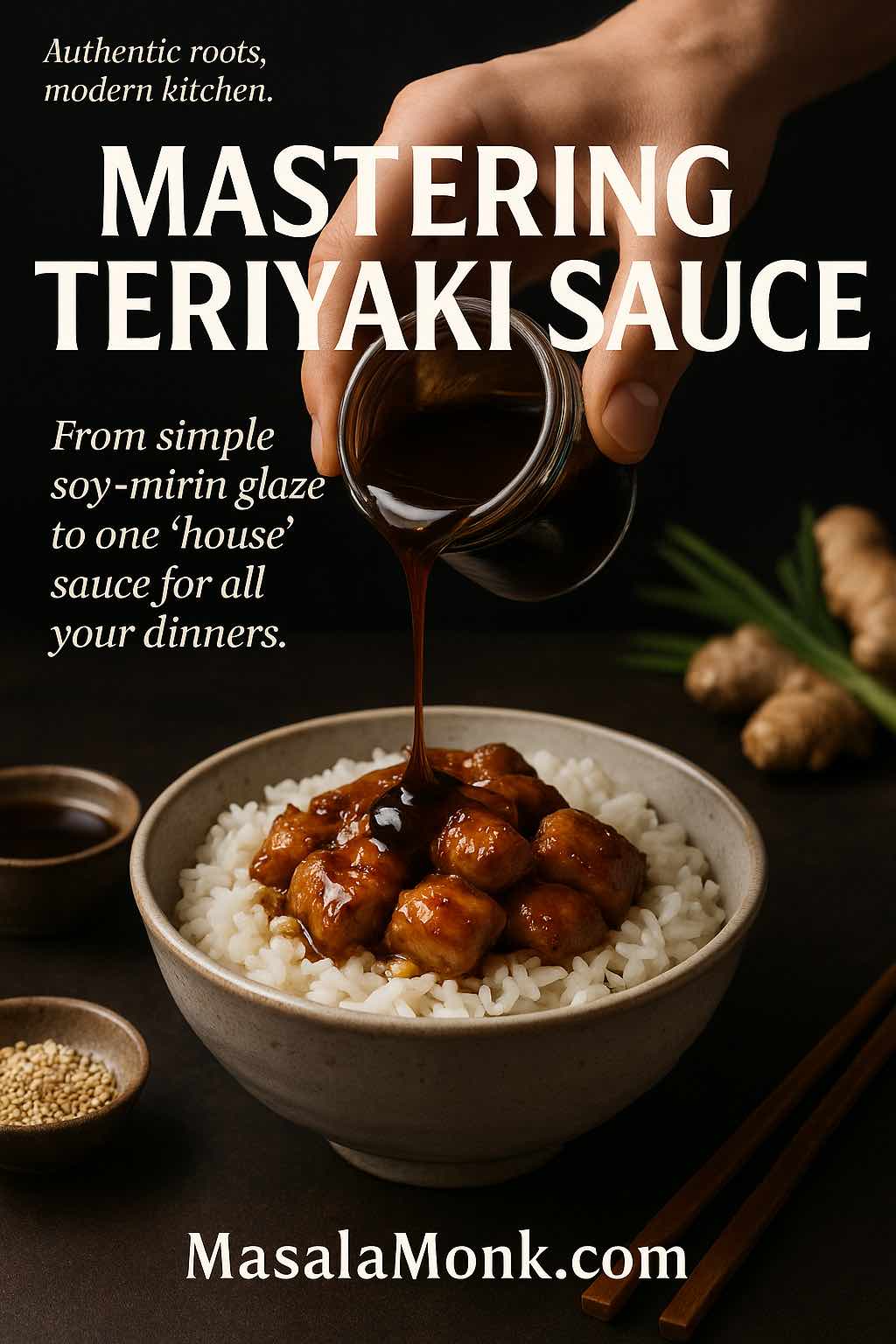
Hand pouring glossy teriyaki sauce over a bowl, with the headline ‘Mastering Teriyaki Sauce’ on a premium magazine-style cover for MasalaMonk.

Teriyaki is one of those flavours that makes plain food feel like an actual meal. A bowl of rice and vegetables is nothing special; spoon a glossy, sweet–savory teriyaki sauce over the top and suddenly it looks like something from a Japanese grill. The same happens to chicken thighs, salmon fillets, tofu cubes, even roasted potatoes. A teriyaki sauce recipe is simple at its core, but endlessly flexible in practice.

The confusion starts when you realise “teriyaki sauce” means very different things to different people. In Japan, it began as a simple glaze made with soy sauce, mirin and sugar, brushed repeatedly onto grilled fish or chicken. Outside Japan, it grew thicker, sweeter and more garlicky, eventually showing up in bottles, takeout shops and fusion recipes ranging from teriyaki pizza to teriyaki burgers. Then the health-conscious crowd arrived and the questions multiplied: low sugar teriyaki, low sodium teriyaki, keto teriyaki, vegan teriyaki, soy-free teriyaki… are those even still “teriyaki”?

This post is meant to be your one-stop answer. We’ll walk through what teriyaki actually is, how to make a reliable homemade teriyaki sauce, how to cook a more traditional Japanese-style version, and how to spin that base into marinades, stir-fry sauces, glazes, dips and dressings. After that, we’ll look at the most useful flavour variations and finish with ways to make teriyaki lighter and friendlier for everyday eating, without turning it into a completely different sauce.

Throughout, think of teriyaki as joining the same “core sauce” family as pesto, béchamel and tzatziki—sauces that MasalaMonk has already taken deep dives into in posts like the basil-packed pesto variations, classic béchamel for lasagna and refreshing Greek tzatziki recipes. Once you know the base, you can bend it in all sorts of directions.


What “Teriyaki” Really Means

The word comes from two Japanese elements: teri, which refers to shine or luster, and yaki, meaning grilling or broiling. If you look at the description on Wikipedia’s teriyaki page, you’ll see that originally it wasn’t a bottled sauce at all, but a method of cooking: fish or meat was grilled while being brushed with a mixture of soy sauce, mirin and sugar, sometimes sake as well. The sugar and mirin helped the glaze caramelise and created that characteristic glossy coat.

In that setting:

  • the focus was on the technique of basting and grilling
  • the glaze was a simple blend of soy, mirin, sugar and maybe sake
  • the sauce itself stayed fairly thin and syrupy, not thick like gravy

Classic examples include teriyaki yellowtail, teriyaki mackerel and teriyaki chicken. The glaze was cooked directly onto the surface of the food. It wasn’t something served in a ramekin on the side.

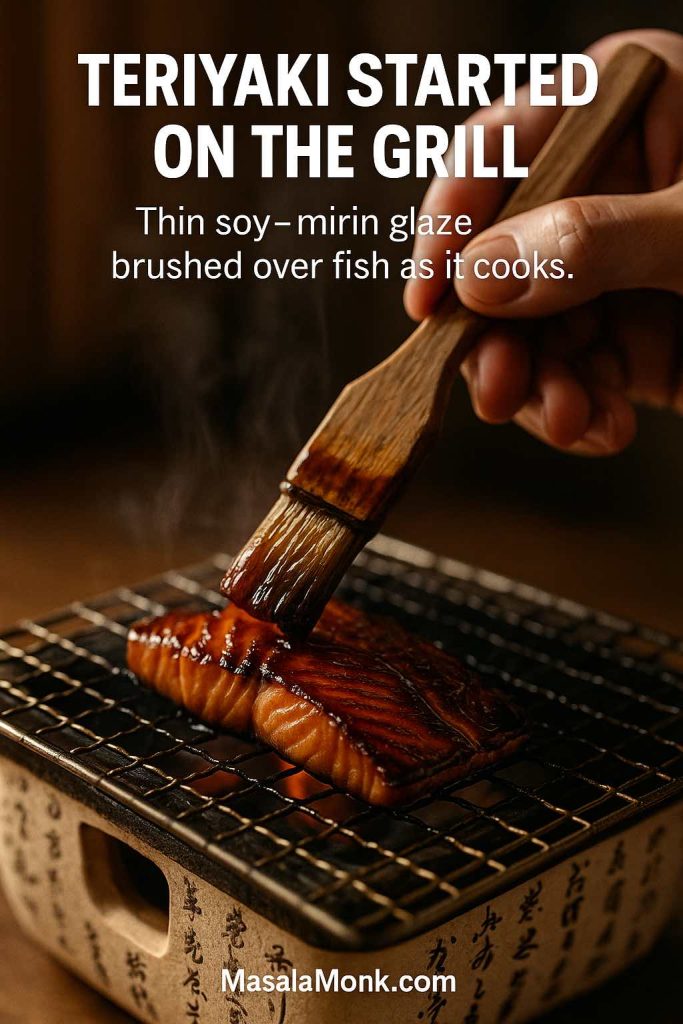
Traditional Japanese teriyaki salmon being brushed with a thin soy–mirin glaze on a tabletop grill, showing the shiny caramelised surface and steam rising.
In classic Japanese cooking, teriyaki isn’t a bottled sauce but a technique: fish or chicken is grilled while being brushed over and over with a light soy–mirin glaze until it turns glossy and caramelised.

As Japanese cooks migrated and Japanese flavours spread, teriyaki began to adapt. In Hawaii, cooks folded in brown sugar and pineapple juice. In the US, garlic and ginger started appearing in the mix. Bottled teriyaki sauces appeared on shelves, often thickened with starch and stabilisers so they’d hold up over time. Restaurant dishes like chicken teriyaki bowls, beef teriyaki skewers and salmon teriyaki became staples.

So when someone says “teriyaki sauce” today, they might be thinking of:

  • a light, traditional soy–mirin glaze
  • a thick, sweet, garlicky bottled sauce
  • or a homemade version that tries to be healthier, spicier or fruitier

Instead of treating those as completely separate things, it’s more helpful to see them as points on a spectrum, all built from the same core ingredients.

Also Read: Bolognese Sauce Recipe: Real Ragù & Easy Spag Bol


The Essential Building Blocks of Teriyaki

Every teriyaki sauce—whether it calls itself authentic, homemade, healthy, or “just like your favourite restaurant”—is some combination of a few key elements. Once you understand what each one does, creating your own version becomes much easier.

Soy Sauce: The Savoury Backbone of Any Teriyaki Sauce Recipe

The foundation of teriyaki is soy sauce. It brings salt, umami (that deep savoury dimension), and the dark, rich colour most people associate with the sauce.

The Wikipedia entry for soy sauce gives a good overview of how it’s traditionally brewed from soybeans, grain, water and salt. For our purposes, what matters is:

  • regular soy sauce is intensely salty and savoury
  • you can use low-sodium soy to make more forgiving sauces
  • tamari, made mostly from soy without wheat, is a good choice when you need a gluten-free teriyaki base

Because soy sauce is so salty, it’s very easy for teriyaki to become sodium-heavy—especially when you reduce it into a sticky glaze. That’s why a lot of people look for lower sodium approaches, which we’ll come back to later.

Mirin and Sake: Shine and Sweetness

If soy sauce is the backbone, mirin is the soul of a traditional teriyaki. Mirin is a sweet rice wine used in Japanese cooking, described in more depth on pages like this mirin overview. It brings:

  • natural sweetness
  • a mild, wine-like aroma
  • a helping hand with that glossy “teri” shine when it reduces with soy and sugar

Sake, another rice wine, sometimes joins the party, adding aroma and dimension. Put together, soy, mirin, sake and sugar form the base of the classic Japanese teriyaki glaze. No cornstarch, no garlic, no ginger—just those four building blocks simmered until they slightly thicken.

If you don’t have mirin, you can approximate it by combining a splash of sake or white wine with sugar, or by using sugar and rice vinegar together for a similar sweet-acid balance. It won’t be exact, but the overall character of the sauce will still lean toward teriyaki.

Sweeteners: Balance and Caramelisation in a Teriyaki Sauce Recipe

Teriyaki has a sweet side. That sweetness balances the saltiness of soy sauce and encourages the surface of the sauce to caramelise under high heat.

You can use:

  • white sugar, for neutral sweetness
  • brown sugar, for a deeper, caramel-like note
  • honey, for a rounder, floral sweetness

Other sweeteners—maple syrup, coconut sugar, jaggery, date syrup—can slide in comfortably as well, depending on what you have and what kind of flavour you’re chasing.

The main thing is to remember that sugar is acting as a seasoning. It’s there to keep the sauce from tasting harsh and salty and to give it that repeat-able, “lick the spoon” quality. Take it too far and you end up with something that feels like dessert on your chicken; dial it in well and you get that classic sweet–savory balance.

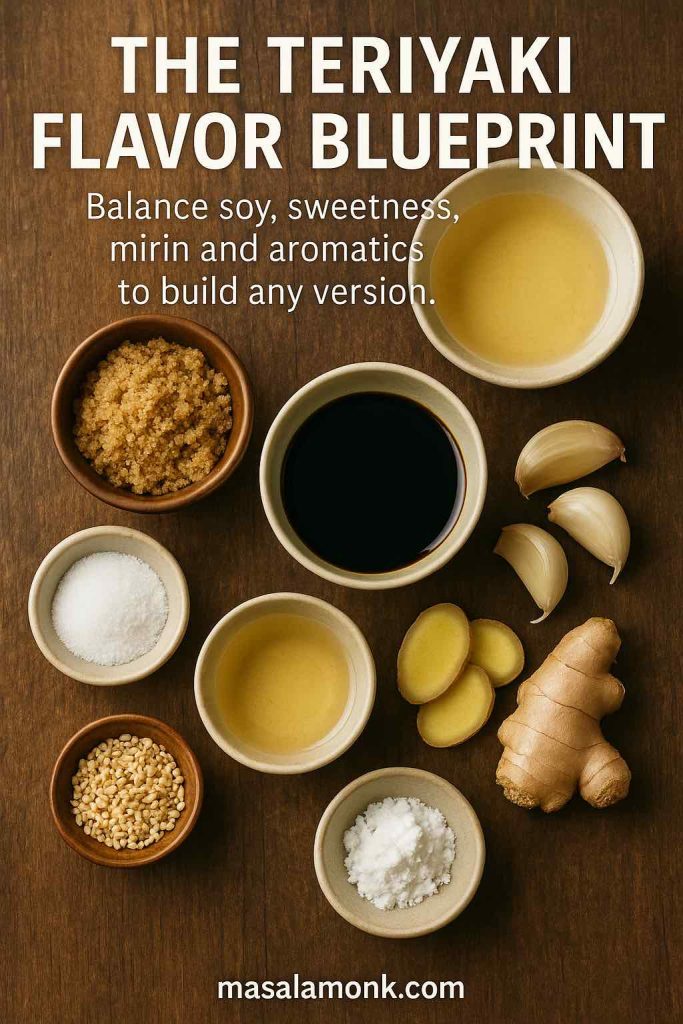
Overhead view of small bowls holding soy sauce, mirin, sugar, garlic, ginger and other seasonings on a wooden table, showing the main ingredients needed to make homemade teriyaki sauce.
Every teriyaki recipe is built from the same core pieces: soy for salt and colour, mirin or sake for shine, sugar or honey for sweetness, plus garlic and ginger for aroma. Once you understand this “flavour blueprint”, tweaking the sauce for chicken, salmon, noodles or low-sugar versions becomes simple.

Garlic and Ginger: Aromatic Extras

In strictly traditional teriyaki, you can absolutely skip garlic and ginger. Many traditional Japanese teriyaki sauce recipes don’t include them. But they’ve become so common in global teriyaki that a lot of people instinctively expect that flavour.

Garlic adds a warm, pungent note; ginger brings a slightly spicy freshness. Together, they make the sauce:

  • punchier and more aromatic
  • better suited to stir-fries and noodle dishes
  • closer to what most “teriyaki chicken” takeout tastes like

If you love ginger, you can double down and let the sauce lean into a ginger-forward profile. If you want something mellow, you can keep both garlic and ginger fairly subtle.

Thickening: Reduction, Starch or Syrup

Finally, there’s the question of texture. A teriyaki sauce recipe can be:

  • thin and brushable
  • thick and clingy
  • or sticky and syrupy

There are three easy ways to get the texture you want.

Reduction
If you simmer a soy–mirin–sugar mixture gently, water evaporates and the sauce naturally thickens. This is how traditional teriyaki glaze is usually made: no extra thickener, just time and evaporation.

Starch slurry
Mix a spoonful of cornstarch with an equal or slightly larger amount of cold water until smooth, then stir that into a gently simmering sauce. As it heats, the starch thickens the liquid, giving you a glossy, reliable coating. This is what a lot of quick “homemade teriyaki sauce” recipes use.

Thicker sweeteners
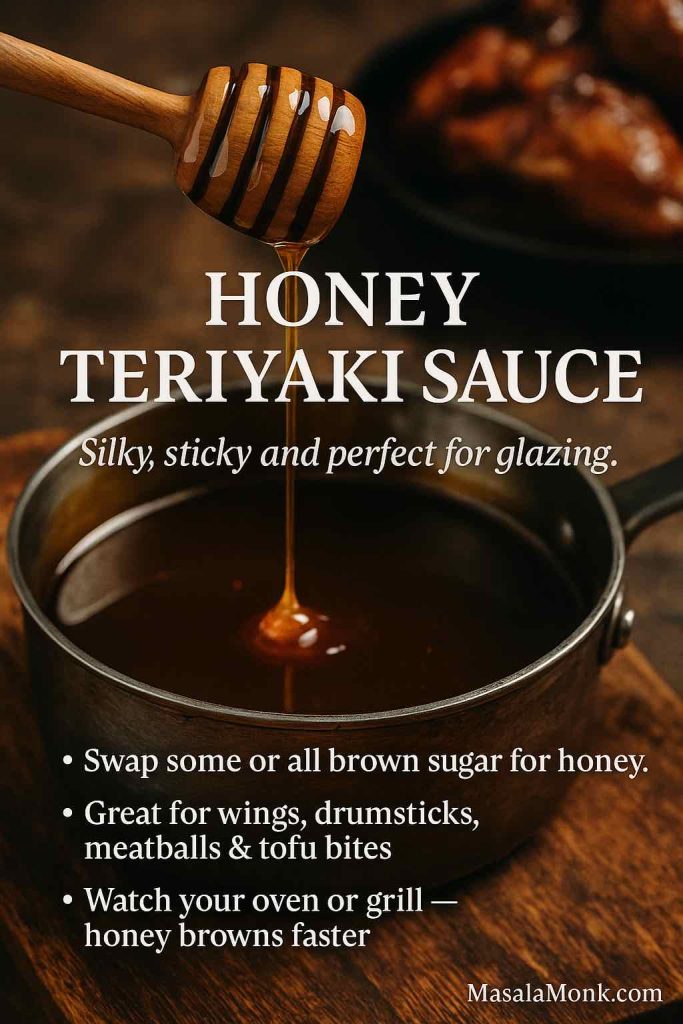
Honey and syrupy sweeteners naturally give body. If your sauce includes them and you reduce it a bit, they help you get that sticky, almost lacquered consistency without needing much starch.

Once you’re familiar with these three levers, adjusting a sauce from “light glaze” to “thick stir-fry sauce” to “sticky wing glaze” becomes a simple question of preference.

Also Read: Authentic Chimichurri Recipe (Argentine Steak Sauce)


The Everyday Homemade Teriyaki Sauce Recipe

With the fundamentals in place, let’s actually make a sauce you can use on weeknights. This version keeps the ingredient list small, uses garlic and ginger, and relies on a cornstarch slurry so you get a consistent result even if you’re new to this.

It’s exactly the kind of thing you can batch once and then keep in the fridge, the way you might keep a jar of pesto or a homemade salad dressing.

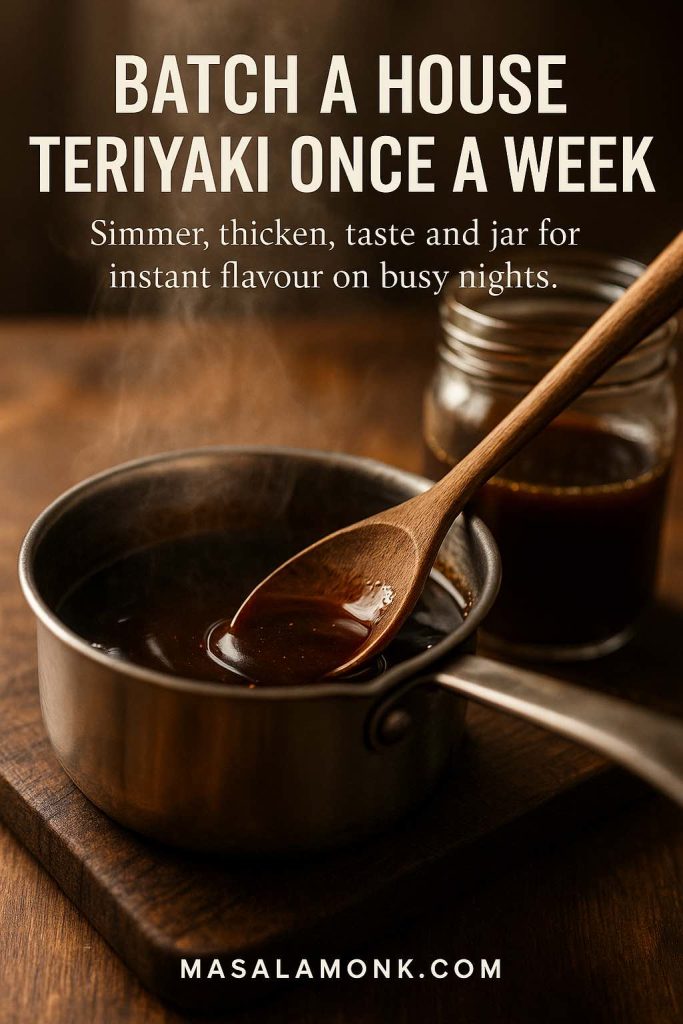
Close-up of glossy homemade teriyaki sauce being stirred with a wooden spoon in a small saucepan, with a glass jar of sauce in the background, illustrating batch cooking for easy weeknight teriyaki recipes.
Cooking one small pan of teriyaki and jarring it for the fridge turns the sauce into a “house staple” you can grab for quick dinners—brush it over chicken, drizzle on salmon, toss with vegetables or turn it into a stir-fry sauce without starting from scratch each time.

Ingredients for Teriyaki Sauce Recipe

  • ½ cup soy sauce (regular or low-sodium)
  • ½ cup water
  • ¼ cup mirin (or 2 tablespoons mirin + 2 tablespoons sake if that’s what you have)
  • ¼ cup brown sugar (you can replace part with honey for extra stickiness)
  • 1–2 cloves garlic, very finely minced
  • 1–2 teaspoons fresh ginger, grated
  • 1 tablespoon rice vinegar (optional, for brightness)
  • 1 tablespoon cornstarch
  • 2 tablespoons cold water (for the slurry)

Step-by-Step Teriyaki Sauce Recipe

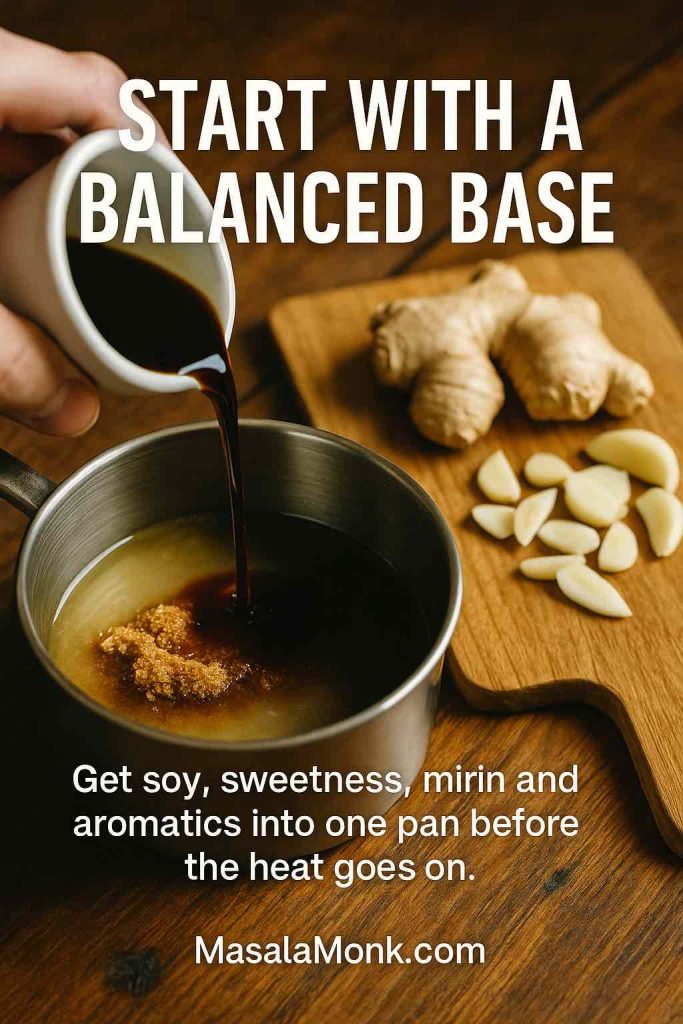
Step 1: Combine the base ingredients

Pour the soy sauce, water, mirin, brown sugar, garlic, ginger and rice vinegar into a small saucepan. Stir everything together so the sugar starts to dissolve and the garlic and ginger are evenly dispersed.

Hand pouring soy sauce into a saucepan filled with liquid and brown sugar, with sliced garlic and fresh ginger on a cutting board, showing the base ingredients for homemade teriyaki sauce.
Layering soy, mirin, sugar, garlic and ginger in a cold pan lets the flavours blend before the heat hits, so your teriyaki sauce reduces evenly instead of tasting sharply salty in some spoonfuls and flat in others.

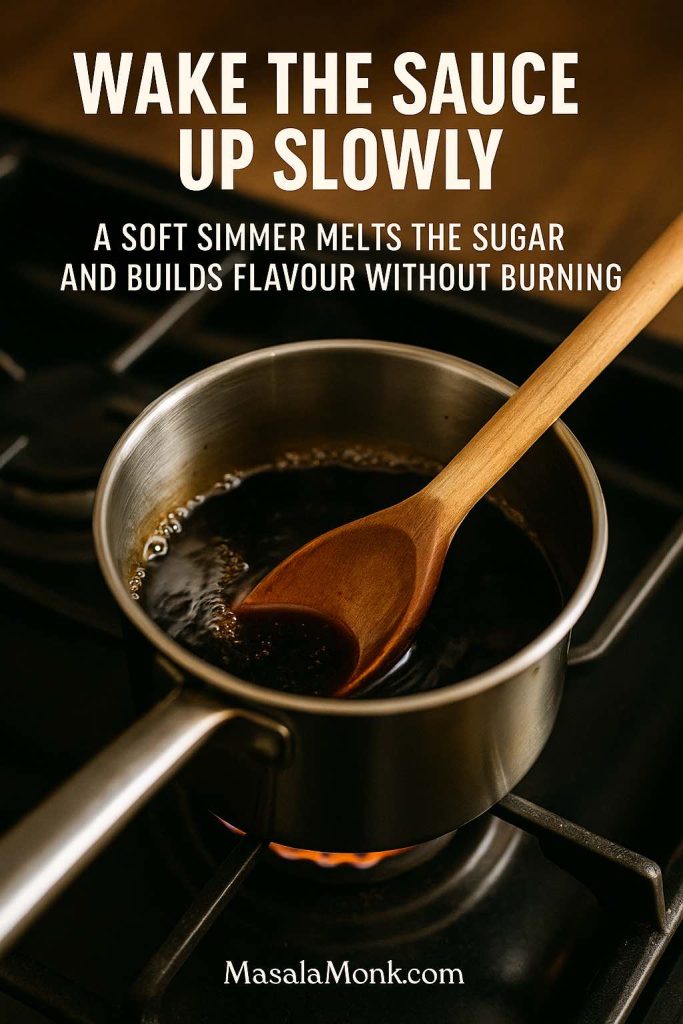
Step 2: Bring to a gentle simmer

Set the saucepan over medium heat. As it warms up, keep an eye on it and give it an occasional stir. Aim for a gentle simmer, not a furious boil. After a few minutes, the sugar will be fully dissolved and the kitchen will start to smell like teriyaki night.

Teriyaki sauce gently simmering in a small saucepan with tiny bubbles at the edges and a wooden spoon stirring, showing how to melt the sugar and infuse flavour without boiling hard.
If the surface is jumping like a vigorous boil, turn the heat down. A quiet simmer gives you gloss and depth; too much heat can make the sauce taste harsh or slightly burnt before it ever reaches the right thickness.

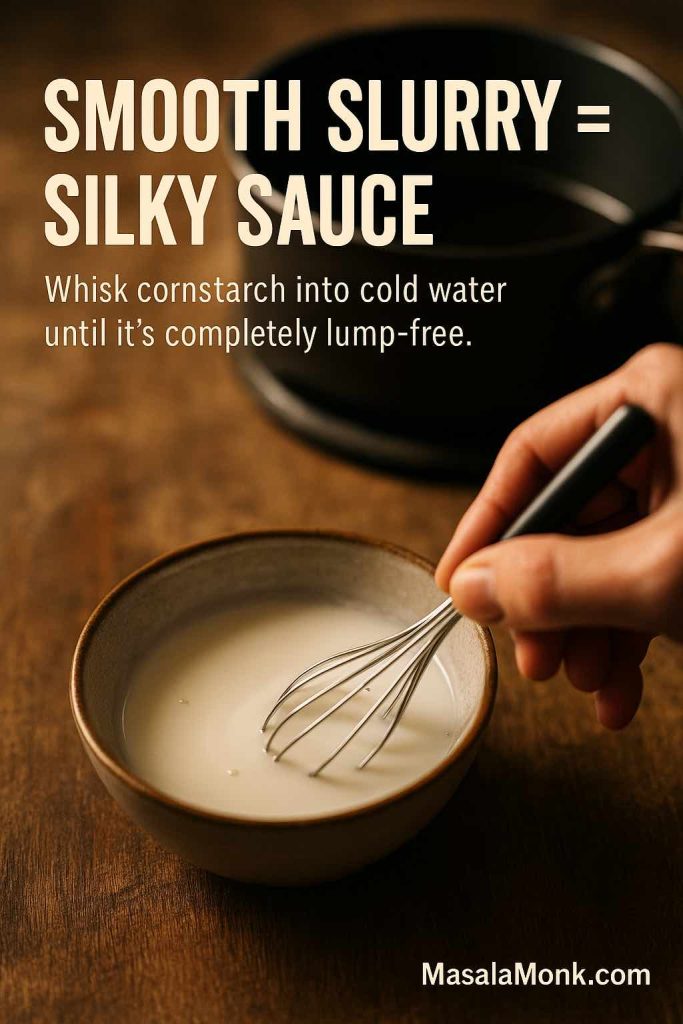
Step 3: Make the cornstarch slurry

While the sauce is heating, mix the cornstarch and cold water in a small bowl until completely smooth. Any lumps now will turn into lumps in the sauce later, so it’s worth taking ten extra seconds to get this right.

Hand whisking cornstarch and cold water into a smooth slurry in a small ceramic bowl on a wooden counter, with a saucepan blurred in the background, showing how to prepare a lump-free thickener for teriyaki sauce.
If the slurry looks chalky or grainy, keep whisking until it turns glossy and perfectly smooth. A well-made slurry disappears into the teriyaki and thickens it gently; a rushed one leaves tiny gummy blobs you’ll never quite strain out.

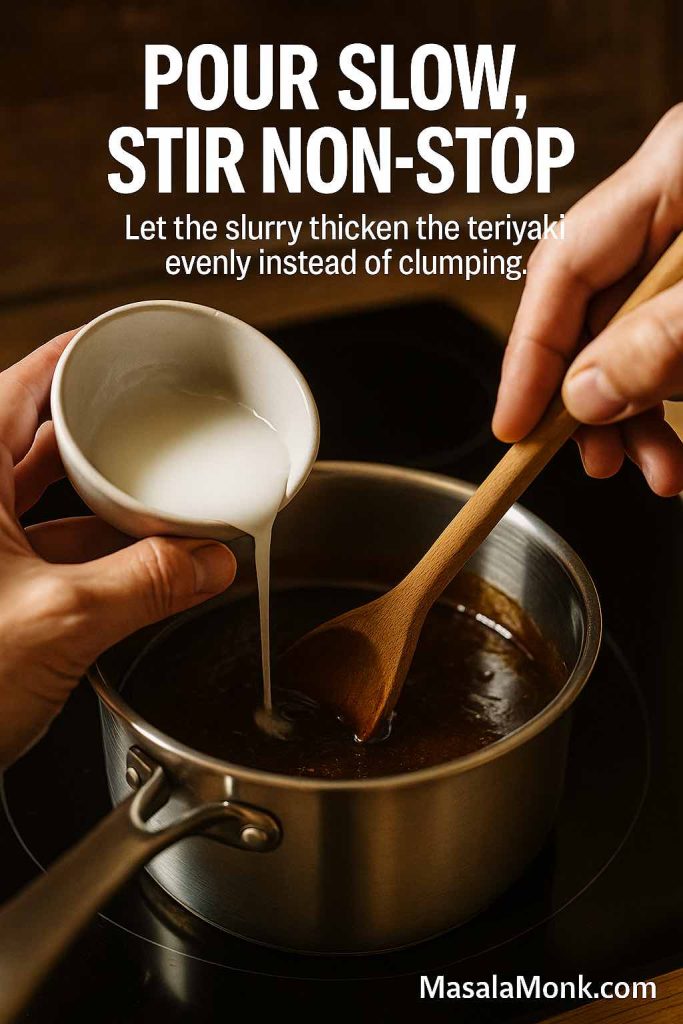
Step 4: Thicken the sauce

Once the sauce is gently simmering, turn the heat down just a notch and slowly pour in the cornstarch slurry while stirring continuously. The liquid will look cloudy at first, then begin to clear and thicken. After a minute or two, it should coat the back of a spoon and fall in a slow, steady ribbon.

Cornstarch slurry being poured in a thin stream into a simmering saucepan of teriyaki sauce while a wooden spoon stirs constantly, showing how to thicken the sauce evenly.
Add the slurry gradually and give the sauce a minute or two to come back to a gentle simmer. It should go from thin and shiny to a glaze that coats the back of a spoon and falls in a slow ribbon—ideal for brushing, tossing and drizzling.

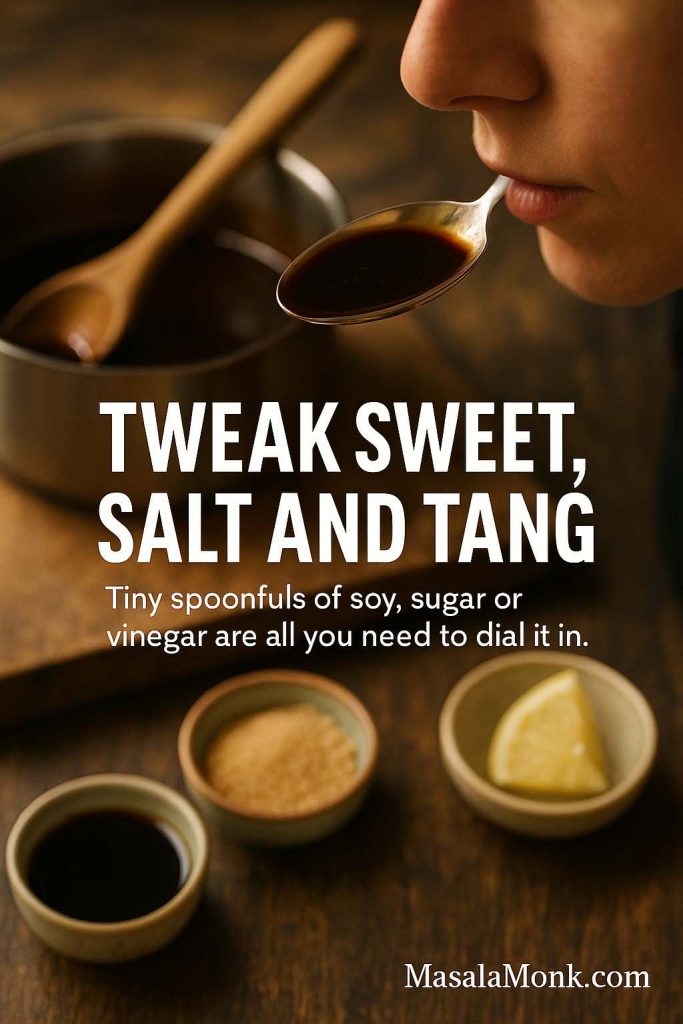
Step 5: Taste and adjust

Now taste the sauce.
If the sauce feels too salty, add a splash of water or a teaspoon more sugar.
If it tastes too sweet, add a dash more soy sauce or a little extra rice vinegar.
And if it seems a bit flat, another pinch of ginger often wakes everything up.

Person tasting a spoonful of glossy homemade teriyaki sauce over a saucepan, with small bowls of soy sauce, brown sugar and a lemon wedge on the counter, showing how to adjust the balance of flavours.
Always adjust the sauce while it’s warm, when the flavours are most open and easy to correct. A sauce that tastes slightly too intense in the spoon will usually be perfect once it’s spread over rice, noodles or grilled meat, so keep your tweaks small and deliberate.

Step 6: Cool and store

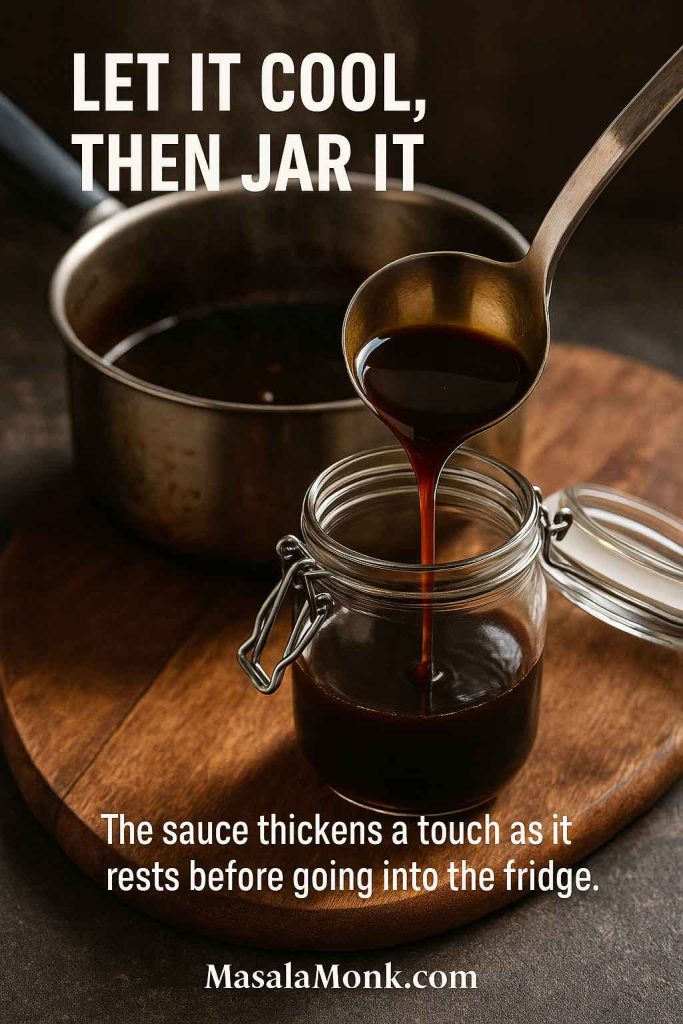
When you’re happy with the flavour and texture, take the pan off the heat and let the sauce cool for a few minutes. It will thicken slightly as it stands. Pour it into a clean glass jar, let it come completely to room temperature, and then move it to the fridge.

Warm homemade teriyaki sauce being ladled from a saucepan into a glass jar on a wooden board, with steam still rising, showing how to cool and store the sauce before refrigerating.
Leaving the teriyaki uncovered for a few minutes before sealing the jar lets excess steam escape so condensation doesn’t water the sauce down. Once it’s at room temperature, close the lid and you’ve got a ready-to-use teriyaki glaze for the next several meals.

Step 7: Use your house teriyaki sauce

Your house teriyaki sauce is ready. Brush it on grilled chicken, spoon it over salmon before baking, toss it with stir-fried vegetables and noodles, or reduce it a little further into a sticky glaze for wings or meatballs.

Also Read: Upma Recipe: 10+ Easy Variations (Rava, Millet, Oats, Semiya & More)

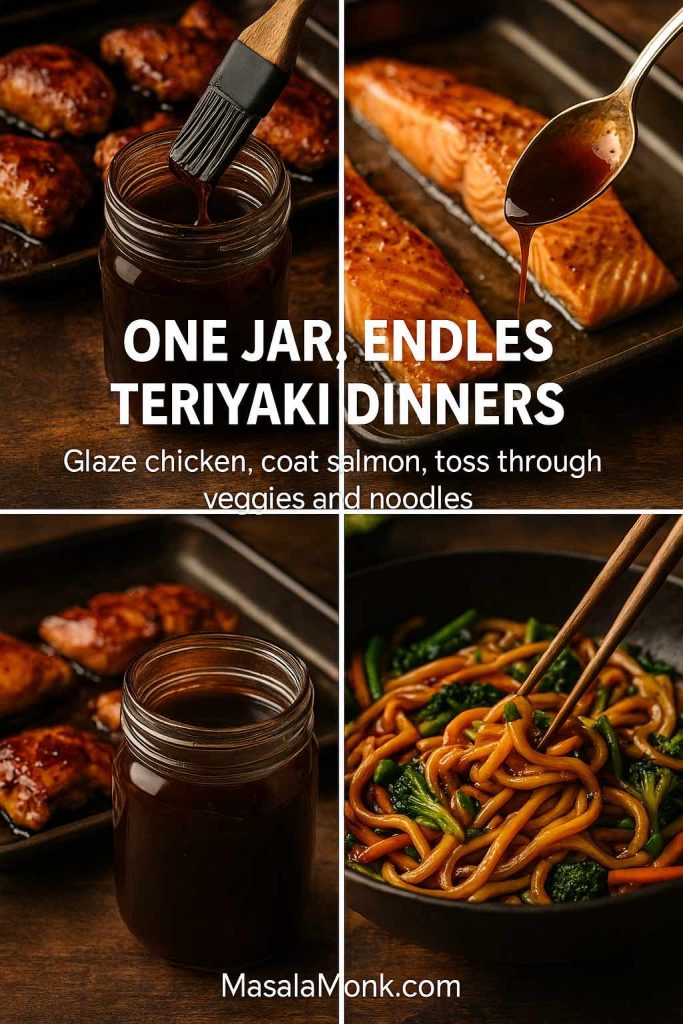
Collage showing a jar of homemade teriyaki sauce in the centre, with glazed chicken pieces, salmon fillets being coated with sauce and a bowl of teriyaki stir-fry noodles and vegetables, illustrating different ways to use one batch of sauce.
The same jar of teriyaki can do weeknight meal prep and entertaining: whisk it into a quick marinade for chicken thighs, brush it over salmon before baking, toss it through veggie noodles, or reduce it further for ultra-sticky wings, meatballs and party skewers.

A More Traditional Japanese-Style Teriyaki Glaze Recipe

If you’re in the mood for something closer to what you might find in Japan—lighter, simpler, and without that cornstarch gloss—there’s an even more minimal version.

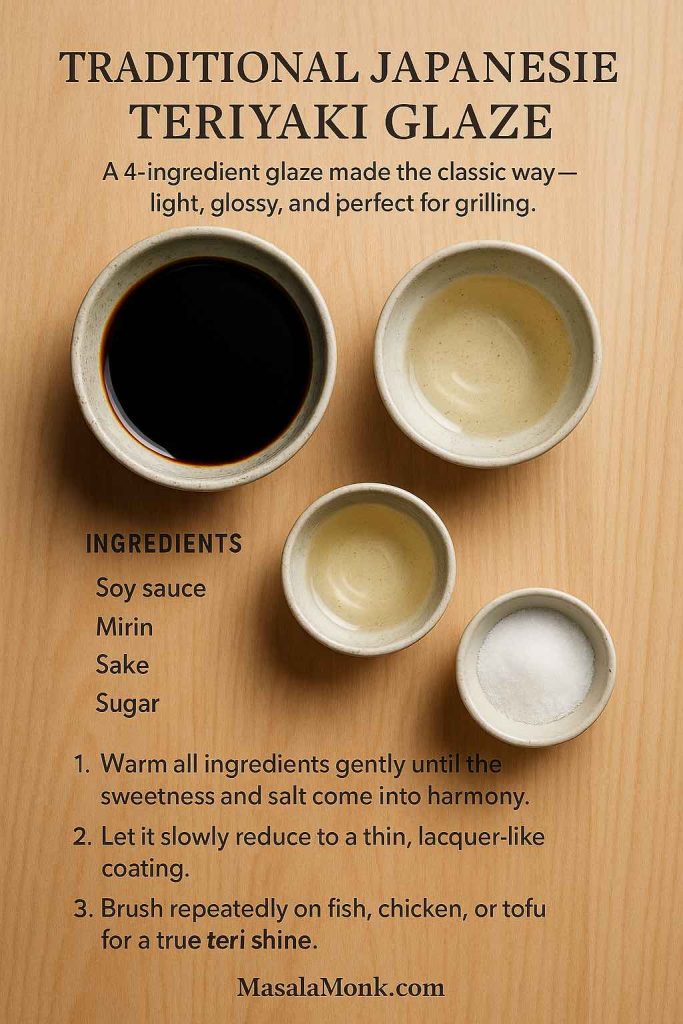
Here we go back to the roots: soy sauce, mirin, sake and sugar, simmered until glossy.

Ingredients

  • ½ cup soy sauce
  • ½ cup mirin
  • ¼ cup sake
  • 3–4 tablespoons sugar

Combine these in a small saucepan and stir until the sugar starts dissolving. Set the pan over medium heat and bring the mixture to a gentle simmer.

Keep it on that soft simmer for around 8–10 minutes, stirring occasionally, until the liquid has reduced by about a third. You don’t need to be exact here; what you’re looking for is a sauce that coats the back of a spoon in a thin, shiny layer, rather than running off like plain soy sauce.

This minimalist glaze is the “old-school” version of teriyaki—just soy, mirin, sake and sugar gently reduced until it can be brushed in thin layers over grilled fish, chicken skewers or tofu for a clean, restaurant-style shine.

Take the pan off the heat and let it cool slightly. This is now your traditional-leaning teriyaki glaze.

Use it to brush repeatedly over pieces of chicken, fish or tofu while they grill or broil. The sugar and mirin will take on a deeper colour and the surface will go from matte to glossy. Each pass builds another layer of flavour.

This version is especially good on salmon and on chicken skewers, where you want the glaze to complement the grilled flavour rather than smother it.

Also Read: Double Chocolate Chip Cookies – Easy Recipe with 7 Variations


How One Sauce Becomes Many: Marinade, Stir-Fry, Glaze, Dip, Dressing

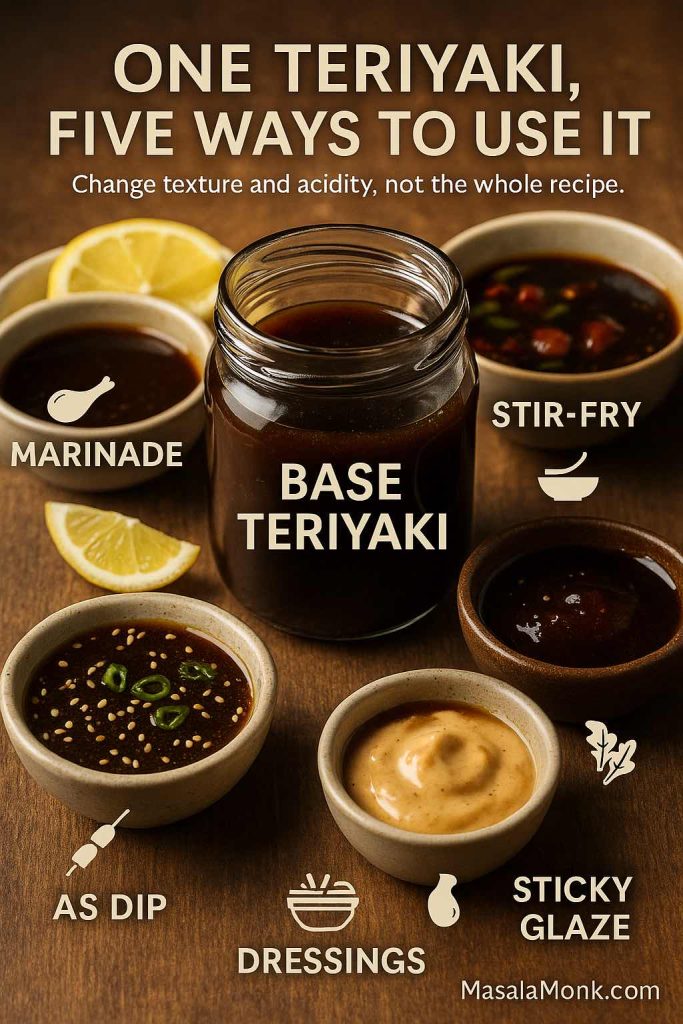
You don’t need completely different recipes for “teriyaki marinade”, “teriyaki glaze” and “teriyaki stir-fry sauce”. You just change the texture, strength and acidity in the original teriyaki sauce recipe.

Jar of base teriyaki sauce on a wooden table surrounded by five small bowls labelled marinade, stir-fry, sticky glaze, dip and dressings, illustrating different ways to use one homemade teriyaki sauce.
Once you have a basic teriyaki in a jar, you don’t need five different recipes—just thin it for marinades, loosen it slightly for stir-fries, reduce it to a sticky glaze, brighten it into a dipping sauce, or whisk it with oil or mayo for dressings and burger sauces.

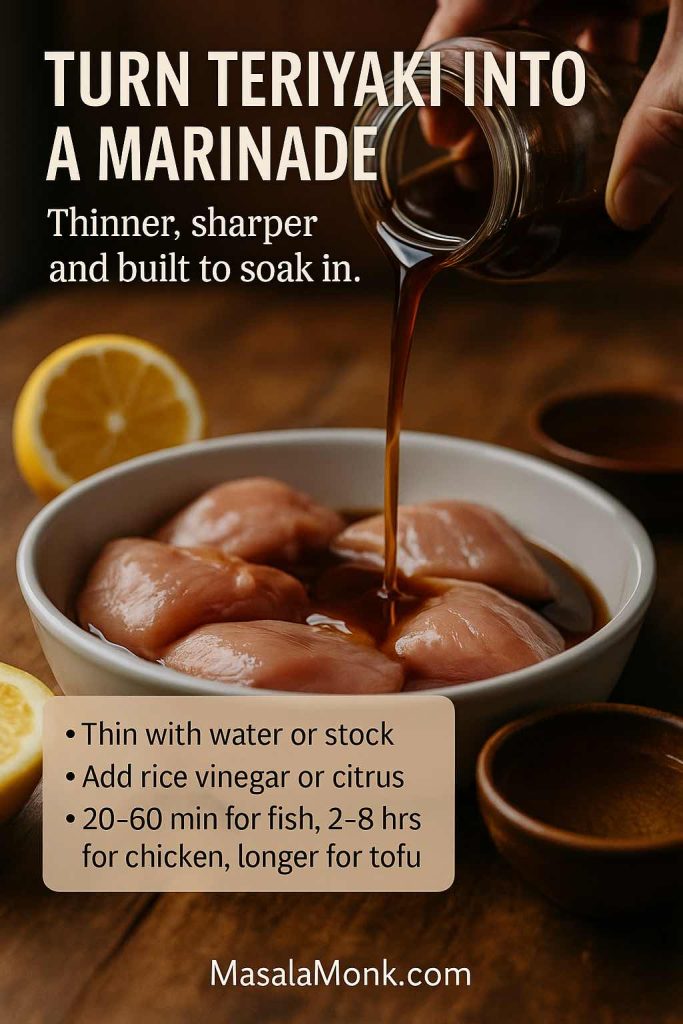
Turning It Into a Marinade

For marinating, you want the sauce thinner and usually a bit sharper. That way it coats the food easily and adds flavour without forming a heavy layer.

Take the everyday teriyaki (before thickening, or thinned slightly with water if it’s already thick) and add:

  • a little extra rice vinegar, or
  • a squeeze of lemon or lime
Close-up of teriyaki sauce being poured from a jar over raw chicken pieces in a white dish, with lemon halves and a small bowl of rice vinegar nearby and text explaining how to turn teriyaki into a marinade.
A good teriyaki marinade should feel looser and a bit brighter than your table sauce. Thinning it with water or stock helps it coat evenly, while extra vinegar or citrus keeps richer meats like chicken thighs or pork tasting fresh even after a long soak.

Pour this over chicken pieces, pork, tofu or sturdy vegetables and marinate in the fridge. Chicken thighs and drumsticks are happy with anywhere from half an hour to overnight. Fish does better with a shorter bath—twenty minutes to an hour—so it doesn’t go mushy. Tofu can handle long soaks, and often gets better with time.

If you want, you can boil the leftover marinade after you’ve removed the raw meat or fish and use it as a finishing sauce; just make sure it gets a good hard boil so it’s safe.

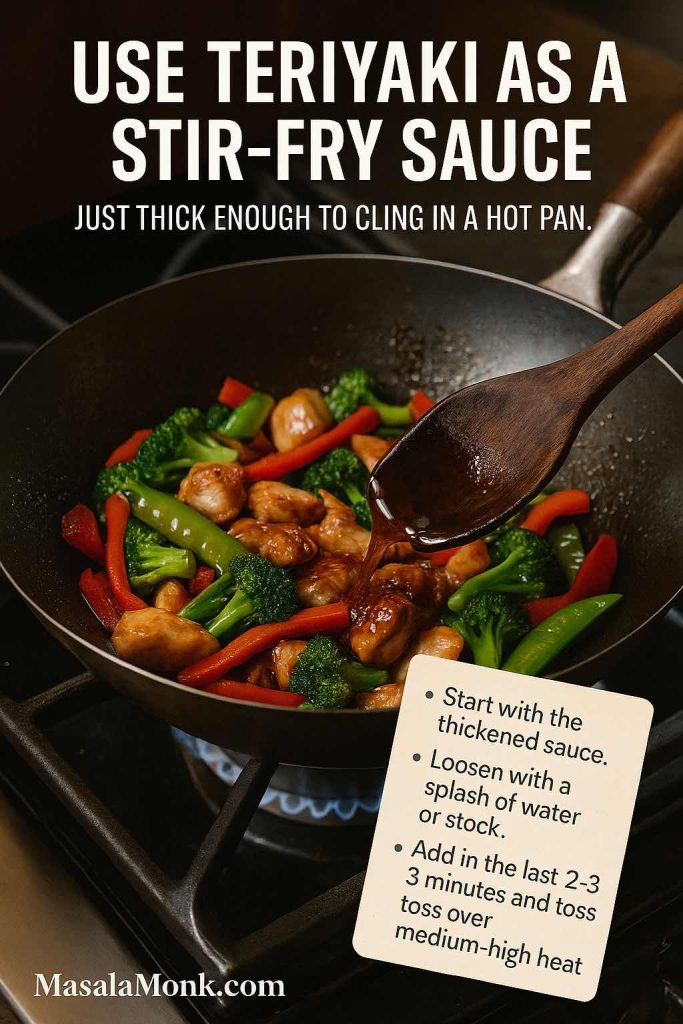
Using It as a Stir-Fry Sauce

In a stir-fry, you want the sauce to cling but still move. The cornstarch-thickened everyday teriyaki is perfect once you adjust its thickness.

If it’s too thick to pour smoothly, add a splash of water or unsalted stock. Then:

  1. Stir-fry your vegetables and protein over high heat.
  2. When everything is nearly done, reduce the heat slightly.
  3. Pour the teriyaki into the pan and toss quickly so it coats everything.
Wok on a gas stove with chicken, broccoli, red pepper and snap peas being coated in a glossy teriyaki stir-fry sauce, with on-image tips explaining how to loosen and add the sauce at the end of cooking.
The best teriyaki stir-fries start dry and finish wet: sear your protein and vegetables first, then pour in a slightly loosened sauce in the last few minutes so it thickens just enough to cling without burning on the bottom of the pan.

In a minute or two, the sauce will cling and glisten around the ingredients. Spoon this over hot rice, noodles or even quinoa. Set it next to other sharable sides—potato salads, dips, grilled vegetables—and it suddenly looks like a generous spread rather than “just a stir-fry”.

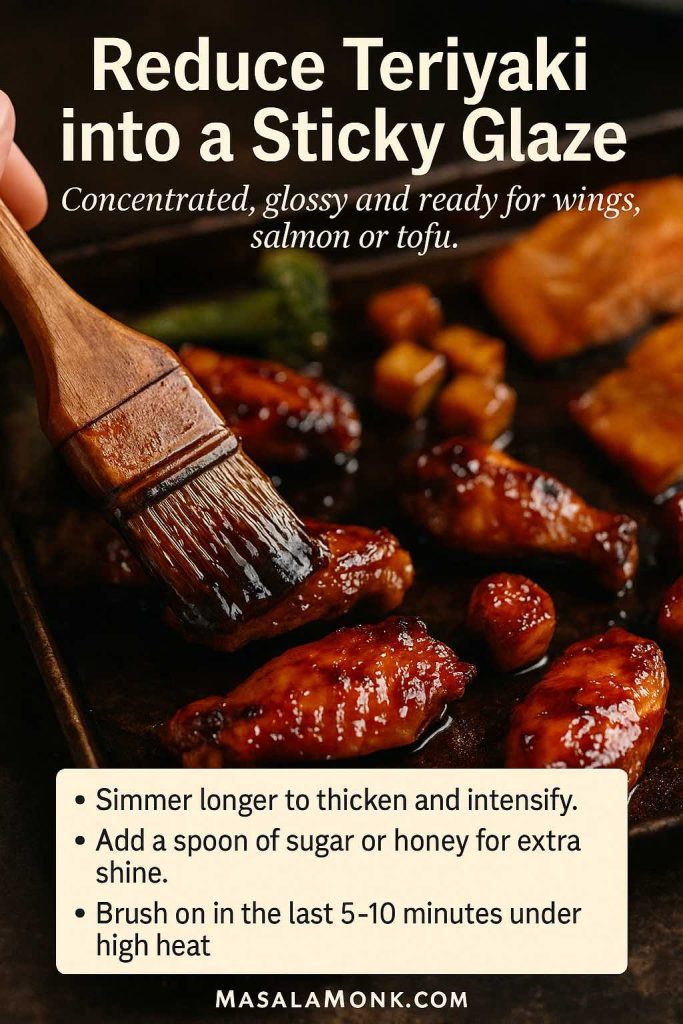
Reducing It to a Sticky Glaze

For wings, ribs, thick salmon fillets and roasted tofu cubes, you want a sauce that’s more like a glaze: sticky, intense and slightly caramelised.

You can either start with the everyday teriyaki and simmer it longer (with an extra spoonful of sugar or honey for extra sheen), or you can use the traditional soy–mirin–sake glaze and reduce it further.

Close-up of a brush coating teriyaki-glazed chicken wings on a dark baking tray, with text overlay explaining how to reduce teriyaki into a thick, sticky glaze for wings, salmon or tofu.
For that restaurant-style lacquer, let your teriyaki bubble gently until it looks almost syrupy, then brush it on near the end of cooking. The sugars caramelise in the heat, giving wings, salmon or tofu a shiny crust without burning or drying them out.

Brush thickened sauce onto food in the last stretch of cooking and let the oven or grill finish the job. If you want extra charring, give it a last-minute blast under a very hot broiler or grill, watching it closely so the sugar doesn’t burn.

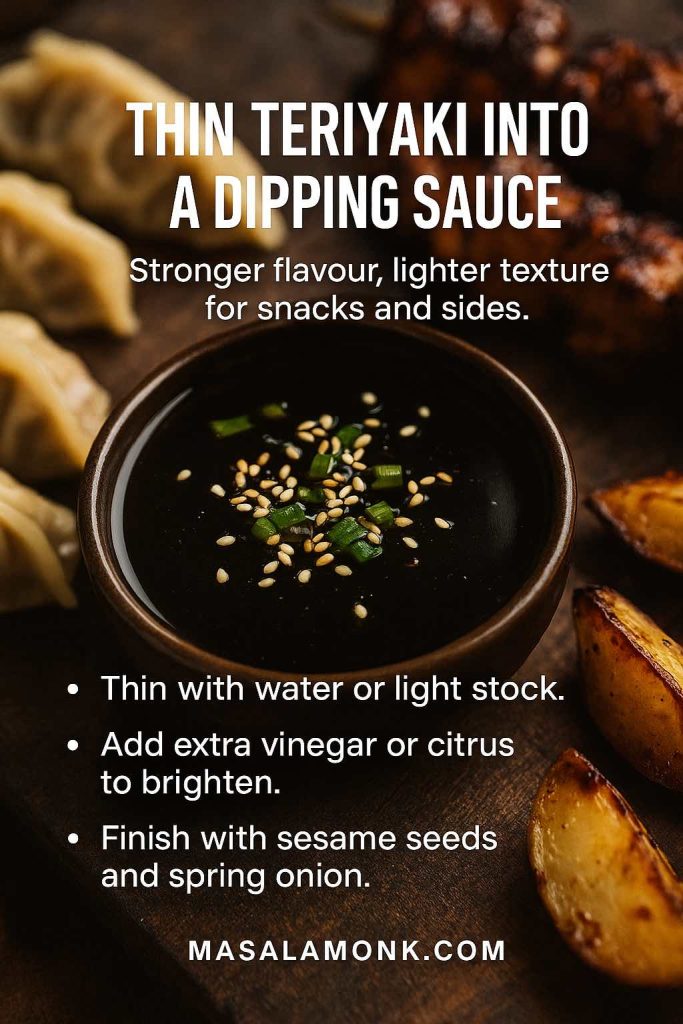
Turning It Into a Dipping Sauce

Sometimes it’s nicer to dip than to coat. If you want teriyaki as a dip for dumplings, skewers, crispy tofu, roasted vegetables or even fries, you want a sauce that’s strong in flavour but thin enough to flow easily.

Take a portion of your homemade teriyaki and thin it with a little water or light stock. Add a bit more vinegar or citrus juice to brighten things and cut the sweetness. Pour into a small bowl and top with sesame seeds and chopped spring onion.

Bowl of teriyaki dipping sauce topped with sesame seeds and chopped spring onion, surrounded by dumplings, skewers and roasted potato wedges, with text explaining how to thin and brighten teriyaki for use as a dip.
Turning teriyaki into a dip is all about contrast: a looser texture and brighter acidity so it cuts through fried dumplings, grilled skewers and roasted vegetables instead of weighing them down. A splash of stock and vinegar goes a long way.

Put that on a table alongside other dips—spinach-based ones, creamy spreads, spicy options—and suddenly teriyaki is playing in the same space as buffalo sauce and ranch, not just “stir-fry sauce”.

Using It as a Dressing or Mayo

Teriyaki also works beautifully off the heat.

For a simple dressing, whisk equal parts teriyaki sauce and neutral oil together, then add a spoon of rice vinegar or lemon juice. You get a punchy salad dressing that loves green salads, grain bowls and noodle salads. Shake it in a jar until lightly emulsified, then toss or drizzle as you like.

Jar of teriyaki salad dressing next to a green salad and a small bowl of teriyaki mayo beside a crispy chicken burger, with on-image text explaining how to make teriyaki dressings and mayo for salads, bowls and sandwiches.
A spoonful of teriyaki goes a long way off the heat: whisk it with neutral oil and a splash of vinegar for a punchy salad or grain-bowl dressing, or fold it into mayo to turn simple chicken sandwiches and burgers into full-blown “teriyaki” meals.

For a sandwich or burger sauce, stir a spoonful or two of teriyaki into mayonnaise and taste as you go. That simple mix is surprisingly good on chicken sandwiches, burgers, sliders and teriyaki-style rice bowls. If you like building stacked sandwiches with layers of texture and flavour, you can borrow structure ideas from MasalaMonk’s own chicken sandwich recipe collection and simply swap their sauce element for your teriyaki mayo.

Also Read: One-Pot Chicken Bacon Ranch Pasta (Easy & Creamy Recipe)


Playing with Flavours: Honey, Citrus, Pineapple, Miso, Spice

Once the base is second nature, you can adjust it to suit your mood or the rest of the menu. Most “special” teriyaki sauce recipes are just small nudges away from that everyday sauce.

Honey Teriyaki Sauce Recipe

Replacing some or all of the brown sugar with honey gives you a honey-teriyaki hybrid. Honey makes the sauce silkier and helps it cling to food in a particularly satisfying way.

Vertical recipe card showing honey teriyaki sauce in a saucepan with honey dripping from a wooden dipper above it, plus text explaining how to swap sugar for honey and use the sauce for wings, drumsticks, meatballs and tofu bites.
Honey doesn’t just sweeten teriyaki, it changes the texture—giving you a thicker, more elastic glaze that clings beautifully to wings, drumsticks, tofu and meatballs. Just keep the heat moderate, because honey-based sauces can go from caramelised to burnt much faster than sugar-only versions.

This version is perfect for:

  • chicken wings and drumsticks
  • sticky meatballs
  • glossy tofu bites

Just remember that honey browns faster than regular sugar, so keep an eye on oven and grill temperatures to avoid scorching.

Recipe for Ginger-Sesame Teriyaki Sauce

If ginger is your favourite part, double the amount you add and keep the garlic modest in the original teriyaki sauce recipe. When the cooking is done, stir in a teaspoon of toasted sesame oil and a spoonful of toasted sesame seeds.

Recipe card showing a rustic bowl of glossy ginger–sesame teriyaki sauce topped with toasted sesame seeds, with fresh ginger, sesame oil and a noodle bowl in the background, plus text explaining how to double the ginger and finish with sesame oil and seeds.
Turning your base teriyaki into a ginger–sesame version is one of the easiest ways to make noodle bowls and tofu stir-fries taste “restaurant-level” – all you do is lean harder on fresh ginger, stir in toasted sesame oil off the heat and shower everything with sesame seeds right before serving.

What you get is a sesame–ginger teriyaki that’s ideal for:

  • tofu and vegetable stir-fries
  • soba and udon noodle bowls
  • roasted or steamed greens

It’s also a great way to make cold noodle salads feel complete without loading them up with mayonnaise.

Orange Teriyaki Sauce Recipe

To bring citrus into the picture, swap part of the water in the base recipe for fresh orange juice and add grated orange zest at the end. Taste the result and adjust with extra soy or vinegar if it leans too sweet.

Vertical recipe card showing a jar of orange teriyaki sauce on a wooden table with fresh orange halves and zest beside a chicken stir-fry pan, plus text explaining how to add orange juice and zest and where to use the citrus teriyaki sauce.
Swapping part of the water for fresh orange juice gives teriyaki a lighter, brighter profile that’s perfect when you want something fresher than a straight soy glaze. It’s especially good on chicken-and-bell-pepper stir-fries, prawn skewers and fun fusion ideas like teriyaki chicken pizza.

Orange teriyaki sits beautifully on:

  • chicken stir-fries with bell peppers
  • shrimp or prawn skewers
  • fusion dishes like teriyaki chicken pizza

It’s especially useful when you want something that feels lighter and fresher than a straight soy-based glaze.

Recipe of Pineapple Teriyaki Sauce

For a more tropical character, use pineapple juice in place of some of the water and sugar. Pineapple’s natural enzymes can help tenderise meat, which is why pineapple-based marinades are so common in grill cultures.

Vertical recipe card showing a jar of pineapple teriyaki sauce on a wooden table with fresh pineapple rings and grilled chicken skewers in the background, plus text explaining how to use pineapple juice for a tropical teriyaki glaze and marinade.
Pineapple teriyaki pulls double duty as both flavour and tenderiser, which is why it shines on grilled chicken skewers, pork chops and burgers. Because the enzymes are so active, it’s best to keep marinating times short for delicate fish and seafood so they stay juicy, not mushy.

Use homemade pineapple teriyaki sauce on:

  • grilled chicken skewers
  • pork chops and pork tenderloin
  • burgers topped with grilled pineapple rings

Just go easy with marinating delicate fish in pineapple heavy mixtures for long periods; shorter times work better to preserve texture.

Apple-Lifted Teriyaki Sauce Recipe

Apple juice and a spoon of applesauce can soften teriyaki’s edges and give it a mild, autumnal feel. A pinch of cinnamon or nutmeg can tilt it gently toward “warm spice” without turning it into dessert.

Vertical recipe card showing a jar of apple teriyaki glaze on a wooden table with apple slices, applesauce and roasted meat in the background, plus text explaining how to add apple juice and warm spices to teriyaki sauce.
Apple teriyaki is a smart way to make salty soy-based glazes feel rounder and more comforting. A little apple juice and applesauce softens the edges, while a pinch of warm spice lets the sauce sit naturally alongside roast pork, tray-bake chicken and caramelised root vegetables.

This style of sauce suits roast pork, sheet-pan chicken dinners with onions and apples, and roasted carrots or squash.

Miso Teriyaki Sauce & Its Recipe

Miso is another fermentation star in Japanese cooking, and adding a spoon of miso paste to warm teriyaki sauce deepens its savoury side.

Take the pan off the heat, whisk in a spoon of white or red miso, and taste. You might not need more soy after that; miso is salty as well.

Vertical recipe card showing a wooden bowl of dark miso teriyaki sauce with small dishes of miso paste and grilled salmon in the background, plus text explaining how to whisk miso into warm teriyaki and use it on salmon, trout, eggplant, mushrooms and tofu steaks.
White miso gives a gentler, slightly sweeter teriyaki, while red miso makes the sauce deeper and more intense. Either way, add the paste off the heat and taste before you reach for extra soy—miso itself brings plenty of salt and umami.

Miso teriyaki is particularly good on:

  • salmon or trout
  • eggplant, mushrooms and other umami-friendly vegetables
  • tofu steaks and skewers

It feels simple but layered, which is exactly what you want when the sauce is doing most of the work.

Spicy Teriyaki Sauce Recipe

For those nights when you want a little heat, add sriracha, gochujang or your favourite chilli paste to the simmering sauce. Start with a teaspoon or two, taste, and adjust. You can also finish with a squeeze of lime juice if you like spice plus tang.

Vertical recipe card showing a jar of spicy teriyaki sauce with a swirl of red chilli paste on top, fresh red chillies and teriyaki wings in the background, plus text explaining how to add sriracha or gochujang and use the sauce on wings, tofu, veggie stir-fries and noodles.
Spicy teriyaki is ideal when you want the comfort of sweet–savory sauce with proper heat. Stir in chilli paste gradually, then finish with lime to keep the flavour bright—perfect for party wings, sticky tofu cubes, veg-packed stir-fries and big noodle bowls.

Spicy teriyaki is ideal for:

  • hot wings
  • sticky tofu cubes
  • vegetable stir-fries
  • noodle dishes with a bit of a kick

It sits comfortably on a table with buffalo wings, creamy dips and crisp salads, especially if you like building mixed, “everyone grabs what they like” spreads.

Also Read: Authentic Louisiana Red Beans and Rice Recipe (Best Ever)


Making Teriyaki Friendlier: Less Sugar, Less Salt, Keto, Vegan, Soy-Free

Because teriyaki is built on soy sauce and sugar, it doesn’t automatically fit every eating style. But once you’re making it at home instead of relying solely on bottled versions, you have a lot more control.

Vertical guide image showing a jar of teriyaki sauce surrounded by ginger, lemon and herbs, with overlay text highlighting options such as less sugar, less salt, keto-ish, vegan and soy-free, and tips for adapting teriyaki sauce to different diets.
Instead of treating teriyaki as something you have to give up, think of it as a base you can tune: cut the sugar, dilute the soy, switch to keto sweeteners or coconut aminos and lean harder on ginger, garlic and citrus to keep the flavour big while the numbers stay friendly.

Cutting Back on Sugar in the Recipe for Teriyaki Sauce

You can usually cut the sugar in a teriyaki recipe by a third or even half without destroying the balance, especially if you:

  • keep mirin in the mix
  • lean more on ginger and garlic
  • let a bit more acidity (vinegar or citrus) balance the salt
Guide image showing a jar of low sugar teriyaki sauce with a half-filled spoon of sugar, fresh ginger and lemon on a wooden table, with text explaining how to reduce sugar and boost aromatics and acidity in teriyaki sauce.
Most teriyaki recipes can lose a third to half their added sugar without breaking; the trick is to let ginger, garlic and a bit of acid do more of the balancing work, and only bring in low-cal sweeteners if you still miss a touch of sweetness.

For more aggressive sugar reduction, you can substitute part of the sugar with low-calorie sweeteners. Just be careful with reductions: without sugar to round things out, very reduced sauces can taste sharply salty.

Making It More Keto-Friendly

For a keto-leaning teriyaki sauce recipe, you want lower net carbs:

  • use low-sodium soy or tamari, diluted with water
  • sweeten with a keto-compatible sweetener
  • thicken with a tiny pinch of xanthan gum if you need a glaze, or leave it thinner
A vertical keto teriyaki guide card showing a jar labeled “Keto-ish” with soy sauce, keto sweetener and grilled chicken in the background, along with text explaining how to make a low-carb teriyaki using tamari, keto sweeteners and xanthan gum.
Keto-style teriyaki keeps things bold without the sugar spike—tamari, ginger and garlic build the savoury base, a touch of keto sweetener rounds the edges, and a tiny pinch of xanthan gum creates that classic glossy cling without carbs.

In practice, you’ll probably use less sauce per serving and let the grilled meat, fish or tofu do more of the talking.

Lowering the Sodium Load in Teriyaki Sauce Recipe

Salt is the other big issue. It doesn’t take much teriyaki sauce to push your sodium intake up for the day, and most health guidelines suggest keeping sodium on the conservative side for heart and kidney health.

Vertical low-sodium teriyaki guide card showing a jar of teriyaki sauce on a wooden surface with a low-sodium soy bottle, lemon, ginger and garlic in the background, plus text explaining how to dilute soy sauce and boost flavour with aromatics instead of salt.
A simple way to make teriyaki easier on your daily sodium is to treat soy like a concentrate: start with reduced-sodium soy, cut it with water or stock and let ginger, garlic and citrus rebuild the flavour instead of just pouring in more soy sauce.

Instead of just accepting that, you can:

  • base your sauce on reduced-sodium soy sauce
  • dilute soy with water or unsalted stock
  • build flavour with ginger, garlic, chilli and acid instead of extra soy

You’ll still get plenty of teriyaki character, but with a much softer impact on your daily salt tally.

Keeping Your Teriyaki Sauce Recipe Vegan

Most homemade teriyaki sauces are almost vegan by default. As long as you skip honey and stick to sugar or maple syrup, the standard soy–mirin–garlic–ginger mixture is plant-based.

Vertical vegan teriyaki guide card showing a jar of glossy teriyaki sauce on a wooden table with soy sauce, garlic, ginger and a bowl of vegetables in the background, plus text explaining how to make a fully plant-based teriyaki using sugar or maple syrup instead of honey.
Most classic teriyaki formulas are just one swap away from being vegan—use sugar or maple syrup instead of honey, then pair the sauce with tofu, tempeh, mushrooms and veggie bowls for the same sweet–savory comfort in a fully plant-based meal.

Combine that with tofu, tempeh, mushrooms, seitan or beans and you have endless vegan teriyaki bowls and plates. You can structure them the way you’d structure high-protein salads or spreads—like the ones in MasalaMonk’s healthy tuna salad ideas—but swap the tuna for chickpeas or lentils and the mayo for teriyaki.

Going Soy-Free with Coconut Aminos

If you need to avoid soy, coconut aminos is your friend. It’s made from fermented coconut sap and salt, and while it tastes different from soy sauce, it still brings a dark, savoury note. It’s also generally lower in sodium and naturally gluten- and soy-free.

Vertical soy-free teriyaki guide card showing a jar of dark coconut aminos teriyaki sauce on a wooden table with a coconut aminos bottle, garlic, ginger and lemon in the background, plus text explaining how to swap soy sauce for coconut aminos and adjust sugar and acidity.
Coconut aminos already bring sweetness and savoury depth, so a good soy-free teriyaki is more about restraint than addition—use less extra sugar, lean on garlic, ginger and vinegar for balance, and reduce gently until it behaves just like your usual glaze.

To modify the recipe and make a soy-free teriyaki-style sauce:

  • use coconut aminos instead of soy sauce
  • reduce or omit extra sugar (coconut aminos is sweeter than soy)
  • add garlic, ginger and vinegar
  • reduce or lightly thicken with starch if you want a glaze

It won’t taste exactly like traditional teriyaki, but it’s recognisably in the same family and plays the same role on the plate.

Also Read: Sheet Pan Chicken Fajitas Recipe (Easy One-Pan Oven Fajitas)


Bottled Teriyaki vs Homemade: Which Has the Edge?

Bottled teriyaki has one unbeatable strength: convenience. You finish work, you’re tired, you don’t feel like measuring anything, and that bottle is right there. Pour some over chicken or vegetables, and you’re halfway to dinner.

The tradeoffs are just as clear:

  • you don’t control how salty or sweet it is
  • you’re stuck with the brand’s idea of texture and flavour balance
  • you often get stabilisers and preservatives you probably don’t need in a fresh sauce
Vertical infographic comparing a bottle of store-bought teriyaki sauce on one side and a jar of homemade teriyaki with fresh ingredients on the other, with text outlining the pros and cons of bottled versus homemade teriyaki.
Store-bought teriyaki wins on speed and predictability, but a homemade batch gives you full control over salt, sugar and thickness—and you can still use bottled sauce as a shortcut base, then upgrade it with fresh garlic, ginger, citrus, honey or miso.

A homemade teriyaki sauce recipe asks for a little more effort once, then repays you many times. There’s no single “best teriyaki sauce recipe” for everyone, but when you make it yourself you can dial in your own best version. You:

  • decide how salty, sweet and thick it should be
  • can tune it to your household’s tastes (more ginger, less garlic, citrusy, smoky, etc.)
  • can adapt it to different needs (lighter one night, sticky the next)

That does not mean you don’t have to throw away bottled sauce forever. You can also treat it as a base ingredient. Sauté garlic and ginger, add bottled teriyaki and cook it for a few minutes; thin or reduce as needed; finish with citrus, honey, chilli or miso. That’s the same philosophy MasalaMonk uses in things like their homemade coffee creamer flavour guide: start with something simple, then bend it to your will.

But if you take one thing away from this post, let it be this: the jump from “I buy teriyaki” to “I make teriyaki” is smaller than it looks.

Also Read: Cheesy Chicken Broccoli Rice – 4 Ways Recipe (One Pot, Casserole, Crockpot & Instant Pot)


Quick Teriyaki Chicken Recipe (Using This Sauce)

If you only make one dish with this teriyaki sauce recipe, let it be simple chicken teriyaki – the kind of easy teriyaki chicken recipe (stovetop, air fryer or oven) you can throw together on a weeknight. It’s the kind of weeknight meal that tastes like takeout, uses just one pan, and works with chicken thighs or breast.

Ingredients

  • 500–700 g chicken thighs or breast, cut into bite-sized pieces
  • 2 tablespoons neutral oil
  • Salt and pepper (just a pinch; the sauce is salty)
  • ½ to ¾ cup homemade teriyaki sauce (from the everyday teriyaki sauce recipe above)
  • Cooked white rice or brown rice, to serve
  • Steamed or stir-fried vegetables (broccoli, carrots, peppers, beans), to serve
High-resolution recipe card showing a bowl of quick teriyaki chicken with glossy glazed pieces, rice and green vegetables, with overlay text listing ingredients and three simple steps for a one-pan teriyaki chicken dinner.
This is the “entry level” way to use your house teriyaki: one hot pan, a handful of chicken, a scoop of sauce and you’ve got a takeout-style bowl in under half an hour—perfect for testing new flavour tweaks like honey, orange or spicy teriyaki without changing the method.
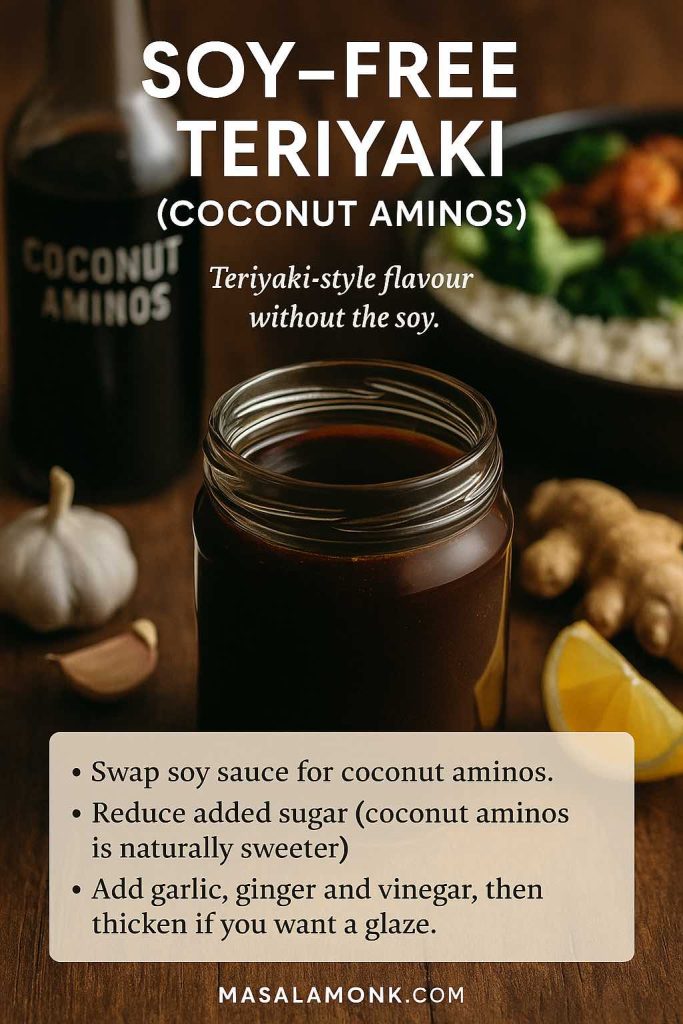
How to Cook Teriyaki Chicken

  1. Prep the chicken. Pat the chicken dry and season very lightly with salt and pepper.
  2. Sear. Heat the oil in a wide pan over medium-high heat. Add the chicken in a single layer and cook until lightly browned on both sides and just cooked through.
  3. Add the teriyaki sauce. Reduce the heat to medium, pour in the teriyaki sauce and toss so every piece is coated.
  4. Glaze. Let the sauce bubble gently for a few minutes, stirring, until it thickens into a shiny glaze and clings to the chicken. If it gets too thick, add a splash of water; if it’s too thin, simmer for another minute.
  5. Serve. Spoon the chicken teriyaki over hot rice with plenty of vegetables on the side. Drizzle over any extra sauce from the pan.

This basic chicken teriyaki recipe is easy to spin into variations. Toss cooked noodles through the pan for chicken teriyaki noodle stir fry, or pile the glazed pieces into a bun with crunchy salad for teriyaki chicken burgers.

Also Read: Whiskey Sour Recipe: Classic Cocktail, Best Whiskey & Easy Twists


Easy Teriyaki Salmon Recipe

For salmon teriyaki, the oven does most of the work. This is a simple teriyaki salmon recipe that uses the same everyday sauce.

  1. Heat the oven to 200°C. Line a baking tray with parchment.
  2. Place 4 salmon fillets on the tray, skin-side down. Pat dry and season very lightly with salt and pepper.
  3. Spoon a generous layer of teriyaki sauce over each fillet.
  4. Bake for 10–12 minutes, depending on thickness, until the salmon is just cooked through.
  5. For a more caramelised finish, brush with a little more sauce and give the fillets 1–2 minutes under a hot grill or broiler.
Vertical recipe card showing a plate of oven-baked teriyaki salmon with white rice and broccolini, plus text with simple steps for making easy teriyaki salmon using homemade teriyaki sauce.
Baking the salmon with teriyaki already on top does two jobs at once—the fish gently steams underneath while the sauce reduces on the surface, so you get juicy flesh, a shiny glaze and tray juices you can spoon straight over rice or noodles.

Serve the baked teriyaki salmon with rice and vegetables, or flake it over warm noodle bowls. The same method works for other firm fish fillets if you’re in the mood for fish teriyaki beyond salmon.

Also Read: Easy Lemon Pepper Chicken Wings (Air Fryer, Oven & Fried Recipe)


Simple Beef Teriyaki Stir-Fry (with rice or noodles)

Beef teriyaki is another fast, high-heat favourite. Thin slices of beef cook in minutes and soak up the teriyaki stir-fry sauce beautifully.

  • 300–400 g beef steak, sliced thinly against the grain
  • 2 cups mixed vegetables (broccoli, carrots, peppers, snap peas)
  • 2 tablespoons neutral oil
  • ½ cup teriyaki sauce, thinned with a splash of water if very thick
  • Cooked rice or noodles, to serve
Vertical recipe card showing a bowl of simple beef teriyaki stir-fry with glossy beef strips, broccoli, carrots and green beans over rice, with a wok full of stir-fry in the background and text explaining the quick three-step method.
Because the beef is sliced thin and cooked hot and fast, this stir-fry is the perfect place to test how thick you like your teriyaki—keep it slightly looser if you’re serving over rice, or reduce it a little more if you want the sauce to cling tightly to noodles.
  1. Stir-fry the beef. Heat 1 tablespoon oil in a hot pan or wok. Add the beef and stir-fry just until browned; remove to a plate.
  2. Cook the vegetables. Add the remaining oil and the vegetables. Stir-fry over high heat until crisp-tender.
  3. Combine with sauce. Return the beef to the pan, pour in the teriyaki sauce and toss everything together. Cook for 1–2 minutes until the sauce bubbles and coats the beef and vegetables.
  4. Serve. Spoon your beef teriyaki stir-fry over rice, or toss with cooked noodles for beef teriyaki noodles.

This one pan teriyaki beef and rice or noodle dinner is an easy way to turn the same teriyaki sauce recipe into a new meal.

Also Read: Crispy Homemade French Fries From Fresh Potatoes (Recipe Plus Variations)


Bringing It All Together in Real Meals

Theory is nice, but you’re going to remember teriyaki by what you put on the table.

You might start by whisking up that everyday teriyaki sauce, then:

  • marinate chicken thighs in a thinner, more acidic version and roast them on a tray with onions and peppers, brushing with a thicker glaze in the last ten minutes
  • spoon the traditional soy–mirin–sake glaze over salmon fillets as they grill, letting it build up into a shiny layer, then serve them with rice and a crisp side from the potato salad recipes you’ve bookmarked
  • throw together a fridge-cleanout stir-fry with vegetables, tofu and a ladle of teriyaki, knowing you can adjust sweetness and salt right there in the pan
  • build warm or cold noodle bowls with soba, plenty of vegetables and a ginger-sesame teriyaki dressing
  • glaze pork chops or pork tenderloin with pineapple teriyaki and serve with a simple salad and grilled pineapple slices
  • spread pineapple-lifted teriyaki over a pizza base, add leftover chicken teriyaki and bake for an easy teriyaki chicken pizza night.
Four friends sitting around a wooden table sharing a variety of teriyaki dishes—including chicken bowls, teriyaki salmon, noodles and vegetables—with a jar of sauce in the centre and the text “One Teriyaki, A Whole Table of Meals” overlaid.
One base teriyaki sauce can turn into a whole table of food—bowls, salmon, stir-fries, wings and veggie plates—so once you’ve dialled in your “house” version, you’re only a few tweaks away from an easy teriyaki night with friends.

If you’re hosting, you can lean harder into variety. Make a platter of wings: some in honey teriyaki, some in spicy teriyaki. Put out bowls of dips—spinach dip, buffalo chicken dip, hummus—along with raw vegetables, bread and crackers. Pour drinks, maybe even something fun and fizzy from a set of mimosa ideas, and suddenly your weeknight sauce has turned into a party.

Also Read: Katsu Curry Rice (Japanese Recipe, with Chicken Cutlet)

Conclusion

Over time, you’ll find your own sweet spot: maybe a slightly less sweet, more gingery version for everyday cooking; a fruit-heavy pineapple or orange teriyaki for grilling; a miso-enriched glaze for salmon; and a low-sugar, low-sodium version when you want to keep things light but flavourful.

And at that point, “teriyaki sauce” isn’t a mysterious thing in a bottle anymore. It’s just one of your house sauces—like pesto, like chimichurri, like tzatziki—waiting in the fridge or on the stove, ready to make simple food feel like something worth sitting down for.

FAQs on Teriyaki Sauce and its Recipe

1. What is teriyaki sauce, exactly?

Teriyaki sauce is a sweet–savory Japanese-style sauce built on soy sauce, a sweetener (usually sugar or honey), and mirin or another mild cooking wine. Traditionally, it began as a glaze brushed over grilled fish or chicken, giving the surface a shiny, caramelised coating. Over time, it has evolved into a multi-use sauce for marinating, stir-frying, glazing, dipping, and even dressing salads and noodle bowls.


2. How do you make a simple homemade teriyaki sauce from scratch?

To begin with, you only need a few pantry staples. Combine soy sauce, water, mirin (or a mix of mild wine and sugar), brown sugar, minced garlic, grated ginger, and a splash of rice vinegar in a saucepan. Simmer gently until the sugar dissolves and the flavours mingle. Then, if you want it thicker, stir in a cornstarch-and-water slurry and cook for a minute or two until glossy. Taste, adjust sweetness and salt, cool it, and your homemade teriyaki sauce is ready to use or store for quick teriyaki chicken, salmon, beef or veggie stir-fries.


3. What’s the difference between authentic Japanese teriyaki and the thicker takeout-style sauce?

In authentic Japanese teriyaki, the sauce is usually just soy sauce, mirin, sake, and sugar simmered until slightly syrupy, with no garlic, no ginger, and no cornstarch. It stays light and clean, meant mainly for brushing over grilled fish or chicken. By contrast, many takeout-style or bottled teriyaki sauces are thicker, sweeter, and heavily scented with garlic and ginger, often relying on starch for that shiny, clingy texture. Both are delicious, but they serve slightly different purposes in cooking.


4. What ingredients do I really need for teriyaki sauce if my pantry is basic?

Even with a minimal pantry, you can still make a good teriyaki-style sauce. At the very least, you need soy sauce for salt and umami, sugar (or honey) for sweetness, and water to keep it from being overpowering. Whenever possible, adding something mirin-like (or a mild wine plus sugar), along with a little garlic and ginger, makes the flavour much more rounded. From there, extras like rice vinegar, sesame oil, or chilli are optional upgrades, not requirements.


5. How can I make my teriyaki sauce thicker and stickier?

If your teriyaki sauce feels too thin, there are several ways to change that. The most straightforward method is to simmer it for longer so water evaporates and the sauce naturally reduces and thickens. Alternatively, you can whisk a small amount of cornstarch into cold water, then stir this slurry into gently simmering sauce until it becomes glossy and coats the back of a spoon. For an even stickier glaze, increasing honey or another syrupy sweetener and cooking for a little longer works beautifully on wings, drumsticks, salmon and tofu.


6. Can I make teriyaki sauce without mirin or sake?

Yes, you absolutely can. When mirin or sake isn’t available, you can still get very close to that classic taste. One approach is to use a mild white wine with a little extra sugar. Another option is to mix sugar with a bit of rice vinegar and water to mimic some of mirin’s sweet–tangy balance. It won’t be perfectly traditional, yet the resulting sauce will still taste recognisably like teriyaki and work well in marinades, stir-fries and glazes.


7. Is teriyaki sauce healthy, and how can I make it lighter?

On its own, teriyaki sauce tends to be high in sodium and contains added sugar, so it’s more of a “use thoughtfully” ingredient than a neutral one. However, it can absolutely fit into a balanced way of eating. To make it lighter, you can switch to low-sodium soy sauce, dilute the soy with water, and reduce the sugar by a third to half. In addition, leaning more on ginger, garlic and a touch of vinegar keeps the flavour big while toning down the salt and sweetness. Using less sauce per serving and pairing it with plenty of vegetables also helps.


8. How do I turn teriyaki sauce into a marinade, stir-fry sauce, or dipping sauce?

Interestingly, you don’t need separate recipes for each use. For a teriyaki marinade, simply keep the sauce thinner and slightly more acidic by adding a bit more water and vinegar or citrus. Then for a stir-fry sauce, aim for medium thickness so it coats ingredients without turning gloopy—your cornstarch-thickened version is ideal here. And for a dipping sauce, thin a small amount with water or light stock, then brighten it with extra vinegar or lime so it’s punchy, pourable and perfect alongside dumplings, skewers, tofu or roasted vegetables.


9. How long does homemade teriyaki sauce last in the fridge?

Generally, homemade teriyaki sauce keeps well in a sealed jar in the refrigerator for about one week, sometimes a bit longer if it’s cooked, cooled and stored cleanly. Because it contains soy and sugar, it has some built-in preservative qualities, but it still counts as a fresh sauce. Before using leftovers, give it a sniff, a quick look and a small taste. If anything seems off—odd smell, separation that doesn’t mix back, or mould—discard it and make a fresh batch.


10. Can I freeze teriyaki sauce for later?

Absolutely. Moreover, freezing is a smart way to batch-prep. Once your teriyaki sauce has cooled completely, pour it into freezer-safe containers or small portions in ice cube trays. When frozen, you can pop the cubes into a bag for easy storage. On busy days, just thaw a few cubes in a saucepan or microwave and use them as a glaze, marinade base or stir-fry sauce. This trick also lets you make different versions—honey, ginger-heavy, spicy—and keep them ready to go.


11. How do I make a low sugar or keto-friendly teriyaki sauce?

For a lower sugar teriyaki, start by cutting the sugar in your favourite recipe in half and letting mirin, ginger, garlic and vinegar do more of the flavour work. If you’d like to go further and keep the sauce very low in carbohydrates, you can use a sugar substitute that behaves well in cooking, then taste and adjust carefully to avoid an artificial aftertaste. In addition, keeping the sauce slightly thinner and using less per serving is often enough to get that teriyaki flavour without loading up on sugar.


12. Is it possible to make vegan or soy-free teriyaki sauce?

Yes, both are quite achievable. To keep your teriyaki sauce recipe vegan, avoid honey and use plant-based sweeteners such as sugar or maple syrup, along with soy sauce, mirin, garlic and ginger. For a soy-free teriyaki-style sauce, you can swap soy sauce for coconut aminos or a similar savoury seasoning, then adjust the sweetness down a bit because those alternatives are often naturally sweeter. Finally, add garlic, ginger and a touch of vinegar, then reduce or lightly thicken the mixture until it has the shine and consistency you want.


13. Can I use bottled teriyaki sauce in these recipes?

Yes. If you already have a bottle of teriyaki sauce at home, you can absolutely use it in place of the homemade teriyaki sauce recipe here. For a quick teriyaki chicken recipe using bottled sauce, brown the chicken in a pan, pour in enough sauce to coat, and let it simmer until the chicken is cooked through and the sauce thickens slightly. If the bottled sauce is very strong or salty, thin it with a little water or stock and add fresh garlic, ginger or a squeeze of citrus to brighten it. The same approach works for slow cooker teriyaki chicken with bottled sauce or a very quick teriyaki chicken with bottled sauce on the stovetop: add the chicken and sauce, cook until tender, then thicken the juices at the end if you want a stickier finish.


14. How do I make teriyaki chicken in the air fryer?

Air fryer teriyaki chicken is basically your quick-pan recipe adapted to hot circulating air. Pat chicken thighs or breast pieces dry, toss them in a thin layer of teriyaki sauce (or marinate briefly), then arrange them in a single layer in the basket. Air fry at around 190–200°C for 10–15 minutes, turning once, until cooked through. In the last 2–3 minutes, brush with a little more teriyaki to create a sticky glaze. Serve over rice or tuck into wraps and bowls with vegetables for an easy, lower-oil version of classic teriyaki chicken.


15. What’s an easy slow cooker or crockpot teriyaki chicken recipe?

For slow cooker teriyaki chicken, the main trick is to keep the sauce thin at the start and thicken it at the end. Place boneless chicken thighs or breasts in the crockpot, pour over enough teriyaki sauce (homemade or bottled) to mostly cover, and cook on LOW for 4–6 hours or HIGH for 2–3 hours until tender. Remove the chicken and shred or slice it. Then simmer the cooking liquid in a saucepan with a cornstarch slurry until it turns into a glossy teriyaki glaze. Toss the chicken back in the thickened sauce and serve over rice, noodles or in lettuce wraps.


16. How can I use teriyaki sauce for baked chicken or salmon?

Baked teriyaki chicken and baked teriyaki salmon are both “hands-off” ways to use the same sauce. For chicken, arrange thighs or drumsticks on a lined tray, brush with teriyaki sauce and bake at 190–200°C until cooked through, brushing once or twice more during baking for extra gloss. For salmon, spoon teriyaki over fillets and bake for 10–12 minutes, then finish with a quick blast under the grill to caramelise the top. In both cases, you can reduce extra sauce on the stovetop into a thicker glaze for drizzling when you serve.


17. What are some easy teriyaki noodle and fried rice ideas?

Teriyaki sauce turns simple noodles and leftover rice into full meals. For teriyaki noodles, stir-fry vegetables and a protein of your choice, add cooked noodles (soba, udon, ramen or regular stir-fry noodles), then pour in enough teriyaki to coat everything. Toss over high heat until glossy. For teriyaki fried rice, stir-fry cold cooked rice with vegetables, scrambled egg and any leftover meat or tofu, then add a thinner teriyaki sauce and let it sizzle into the rice. Both are great ways to use up fridge odds and ends while still delivering that sweet–savory teriyaki flavour.


18. How do I make a good teriyaki chicken and broccoli or veggie bowl?

For chicken teriyaki with broccoli and other vegetables, think in three parts: base, veg and protein. Start with rice or noodles in the bowl. Stir-fry or steam broccoli, carrots, peppers and snap peas until just tender, then toss them with a little teriyaki sauce so they’re lightly coated. Cook chicken pieces in a pan until browned, add more teriyaki and let it reduce to a shiny glaze. Pile the glazed chicken and vegetables over the base, drizzle over any remaining sauce, and sprinkle with sesame seeds. It’s an easy template for healthy chicken teriyaki bowls you can repeat all week.


19. Can I use teriyaki sauce for cod, shrimp or other seafood?

Definitely. Teriyaki cod and teriyaki shrimp are both fast, flavourful options. For cod or other white fish, keep the sauce a bit lighter and don’t marinate for too long; brush or spoon teriyaki over fillets just before baking or grilling. For shrimp, a 10–15 minute marinade is usually enough before a quick stir-fry or grill, then you can finish with extra sauce in the pan. Because seafood cooks quickly, teriyaki works best as a glaze and finishing sauce rather than a long marinade that might break down the texture.


20. What are some fun, non-traditional ways to use teriyaki sauce?

Once you have a reliable teriyaki sauce recipe, you can take it far beyond the usual rice bowls. Use it as the base for teriyaki chicken pizza (spread a thicker glaze on the crust, add cooked chicken, onions and peppers, then bake with cheese), or brush burgers and meatballs with teriyaki as they grill for a sweet–savory crust. Toss roasted potatoes or sweet potatoes in a reduced teriyaki glaze for a sticky side dish, or drizzle a thinner sesame–ginger version over grain bowls and chopped salads. The same core sauce can anchor everything from party snacks to weeknight comfort food.

Posted on Leave a comment

What’s the Deal with Mango Amba Sauce? Exploring 5 Exciting Variants and Their Delicious Uses

Calling all foodies! If you’re someone who’s always on the lookout for the next exciting flavor to enhance your culinary repertoire, then it’s time to make some space in your kitchen for Mango Amba Sauce! 🎉

What is Mango Amba Sauce? 🧐

A delightful fusion of tangy, spicy, and slightly sweet flavors, Mango Amba Sauce has its roots in the rich and diverse culinary traditions of Indian-Jewish cuisine. The name “amba” is derived from the Marathi and Sanskrit words for “mango”. 🥭 It’s crafted from pickled green mangoes, vinegar, salt, turmeric, chili, and fenugreek. This vibrant sauce is a burst of flavors that’s ready to jazz up your meals and take your taste buds on an exciting journey. 🍽️

Variants of Amba Sauce 🌎

The beauty of amba sauce lies not just in its unique flavor but also in its versatility. It’s been adopted and adapted by various cultures, each adding their own unique spin to this tasty condiment. Let’s take a trip around the world and explore some of the exciting variants of amba sauce:

1. Iraqi Variant: 💃 In the aromatic kitchens of Iraq, amba is the spice of life. This version is frequently used with fish dishes, falafel, kubbah, kebabs, and even eggs. It adds a vibrant, spicy kick to these dishes, making it a must-have on any Iraqi dining table.

2. Saudi Arabian Variant: 🌴 Amba is also a star in the culinary scene of the Arabian Peninsula. Here, it’s often part of “nawashef”, a mixed platter of small plates, and can be enjoyed at both breakfast or dinner. Imagine dipping warm, freshly baked bread into a jar of tangy amba sauce – sounds heavenly, doesn’t it?

3. Indian Variant: 🌶️ In India, amba shares the spotlight with a pickle called “achar”. A staple in South Asian cuisine, it’s the perfect companion for a bowl of steaming rice or a plate of piping hot parathas.

4. Israeli Variant: 🥙 In Israel, amba has found its place as a go-to condiment. It’s generously slathered on sandwiches and used as a topping for hummus and mezzes. The Israeli twist? They always use unripe, green mangoes, which lend a more savory flavor to the sauce.

5. Modern Gourmet Variant: 🍓 Now, here’s where things get really exciting. Gourmet chefs are getting creative and swapping out mangoes for strawberries, creating a jam-like sauce that’s as delectable as it sounds. Salty, sweet, and tart – it’s a flavor rollercoaster!

How to Use Amba Sauce 🍴

Now that we’ve explored the different types of amba sauce, let’s put on our chef hats and dive into some delicious ways to use this versatile condiment:

1. Sabich Sandwich: 🥪 This popular Israeli sandwich made with fried eggplant, hard-boiled eggs, and various vegetables, becomes even more delicious with the addition of amba sauce. The tangy and spicy notes of the sauce balance out the rich flavors, making each bite a delightful experience.

2. Falafel: 🥙 Who doesn’t love falafel? And guess what? They love amba sauce! Dip your crispy, golden falafel into some tangy amba sauce for a tastesensation that will have you reaching for more.

3. Shawarma: 🌯 Drizzle some amba sauce over your shawarma for a zesty kick that pairs perfectly with the savory flavors of this Middle Eastern classic.

4. Grilled Meats and Vegetables: 🍖🍆 Fire up the grill, folks! Amba sauce pairs brilliantly with grilled meats and veggies, adding a tangy, spicy twist that elevates their taste profiles.

5. Avocado Toast: 🥑 Give your morning avocado toast a creative spin by spreading some amba sauce on it. The combination of flavors will surprise and delight your taste buds.

6. Hummus Bowls: 🍲 Add a drizzle of amba sauce to your hummus bowl. The tangy and spicy notes enhance the creaminess of the hummus, creating a complex and exciting flavor experience.

7. Rice and Grain Bowls: 🍚 Mix amba sauce into rice or grain bowls, featuring ingredients like quinoa, bulgur, or couscous. The sauce adds a lively kick to the dish, complementing the grains, proteins, and vegetables.

8. Roasted Cauliflower: 🥦 Brush amba sauce onto roasted cauliflower for an unexpected and delicious twist. The tangy and spicy flavors work well with the caramelized, earthy taste of the roasted cauliflower.

9. As a BBQ Sauce: 🍗 Give your BBQ a fruity, spicy makeover by using amba sauce as your BBQ sauce. Trust us, it’s a game changer!

10. As a Sorbet Base: 🍨 Yes, you read that right! Amba sauce in your sorbet. This unique combination adds a fresh and tangy twist to your sweet treat.

11. As a Cake Topping: 🍰 A fruity hot sauce on a cake? It may sound unusual, but the combination of the sweet cake and the spicy, tangy amba sauce will have you reaching for seconds!

12. As a Taco Dressing: 🌮 Why not give your tacos a new spin with some amba sauce? It adds a spicy and fruity kick that will take your tacos to the next level!

That’s a wrap, food lovers! 🎊 We’ve explored the exciting world of Mango Amba Sauce, its variants, and a range of mouthwatering uses. It’s time to grab a jar and start experimenting in your own kitchen! Don’t forget to share your amba creations with us. We can’t wait to see what delicious dishes you come up with! 🎉

Happy cooking! 👩‍🍳👨‍🍳