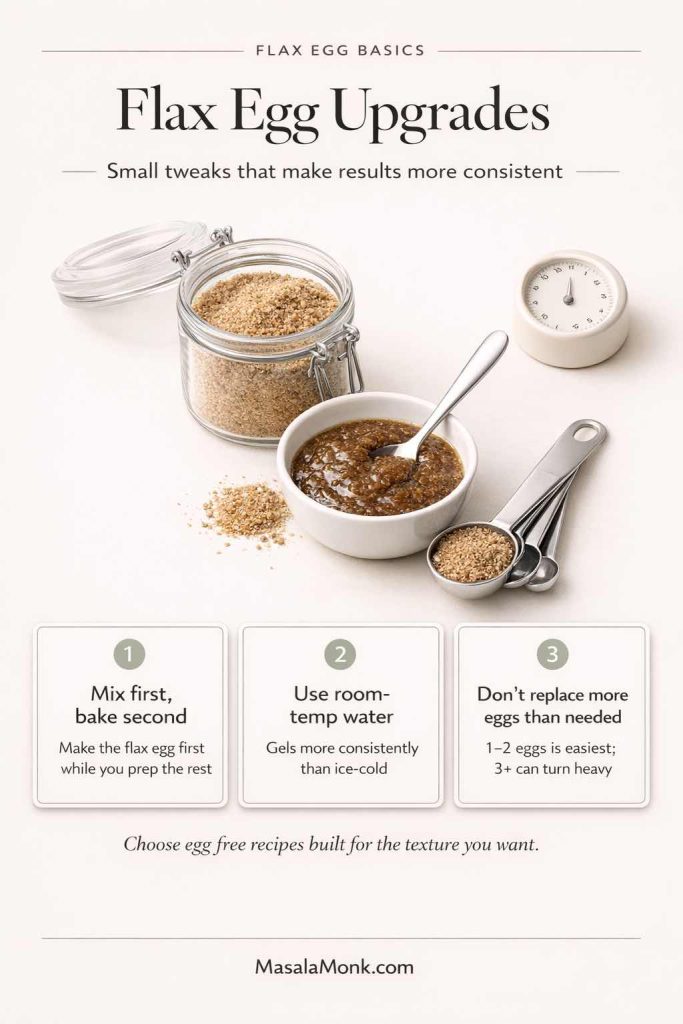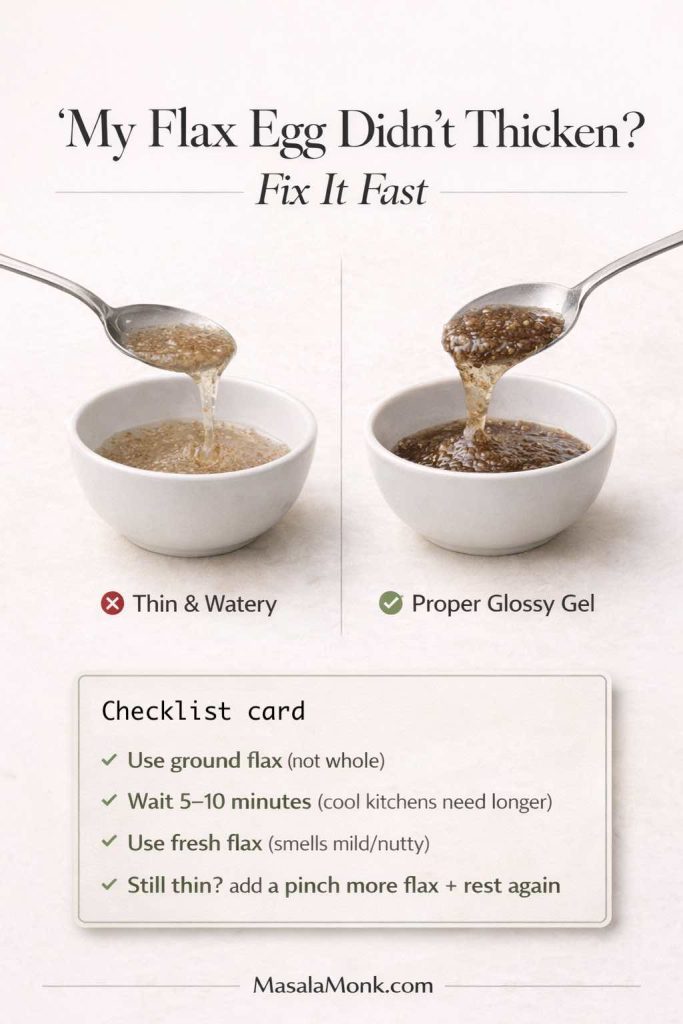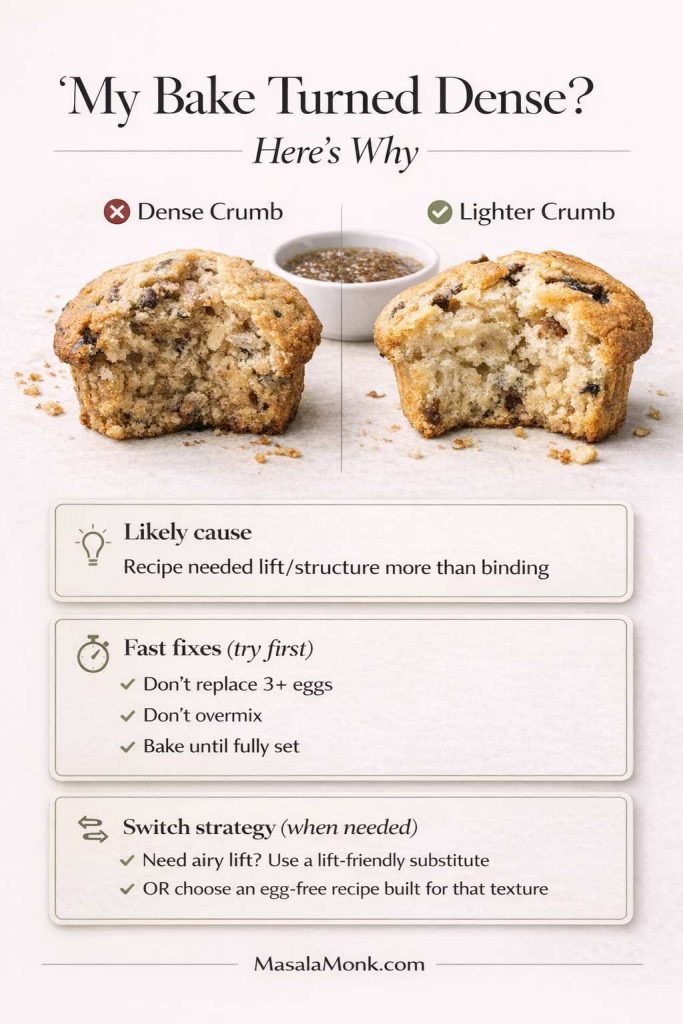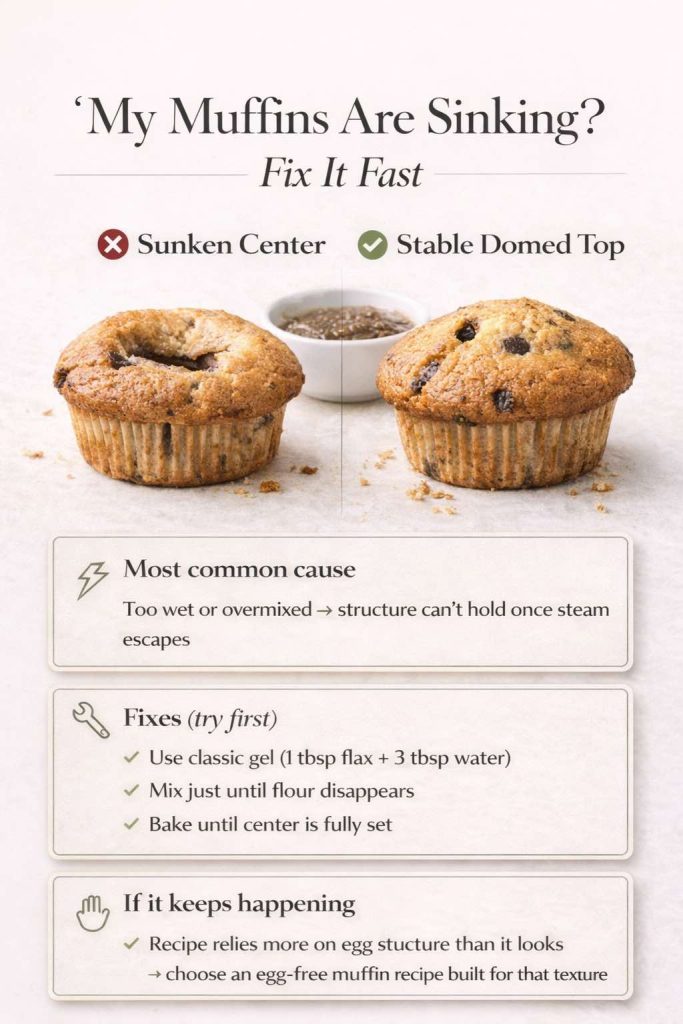
Posted on Leave a comment

Almond Flour Cookies Recipe

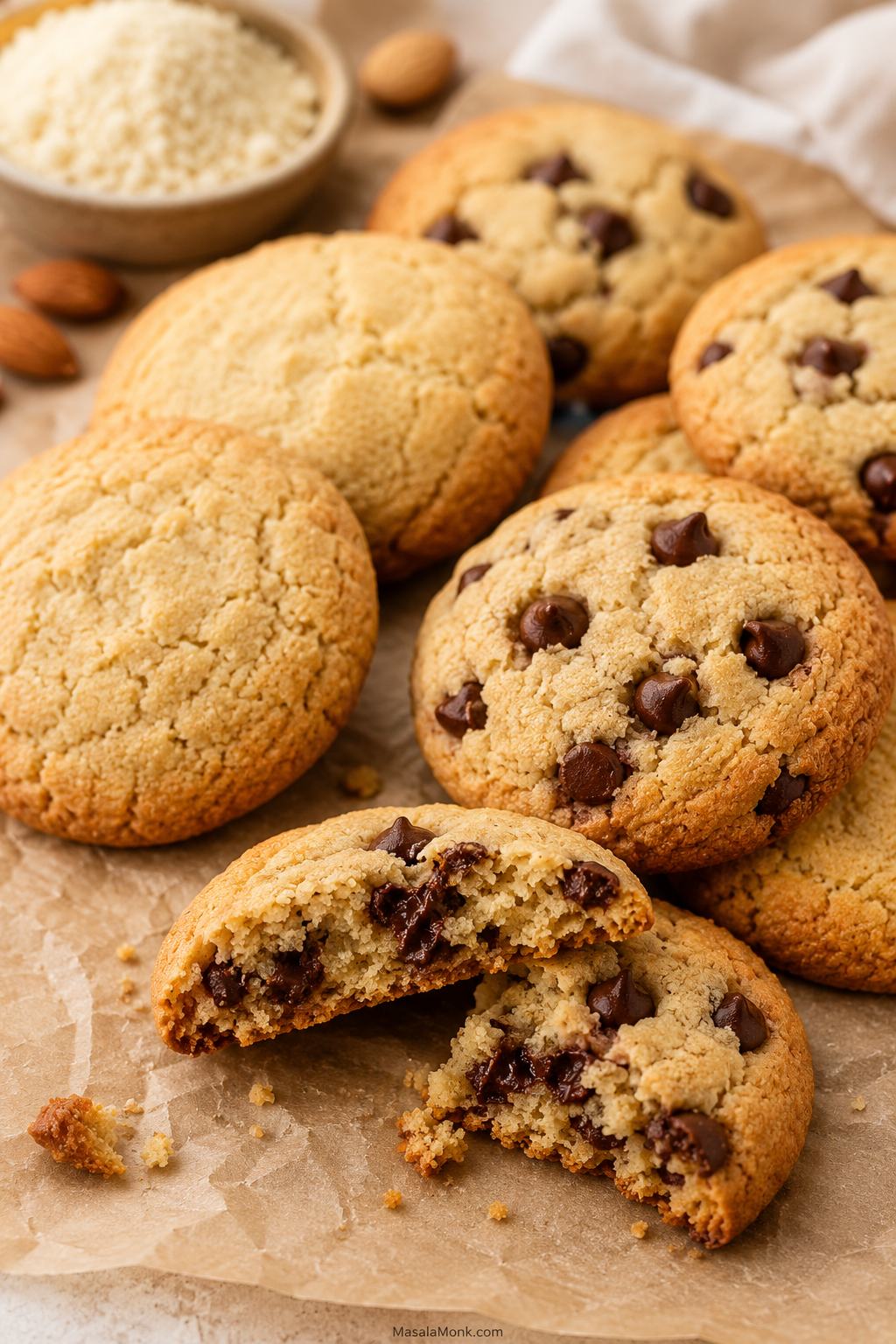
Almond flour cookies with golden edges, chocolate chips, and a soft broken center on parchment.

Good almond flour cookies should not taste like a gluten-free compromise. They should be soft in the middle, lightly golden at the edges, rich with vanilla and butter, and sturdy enough to pick up once cooled. This one-bowl almond flour cookies recipe gives you that texture without a long chill.
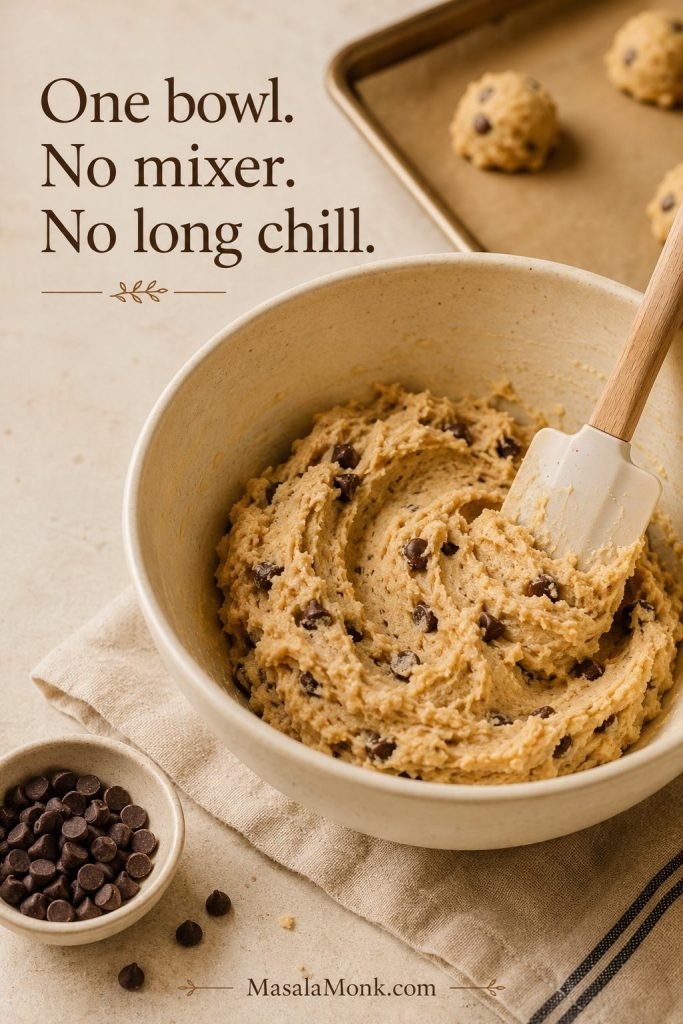
Almond flour cookie dough being mixed in one bowl with a spatula and chocolate chips nearby.
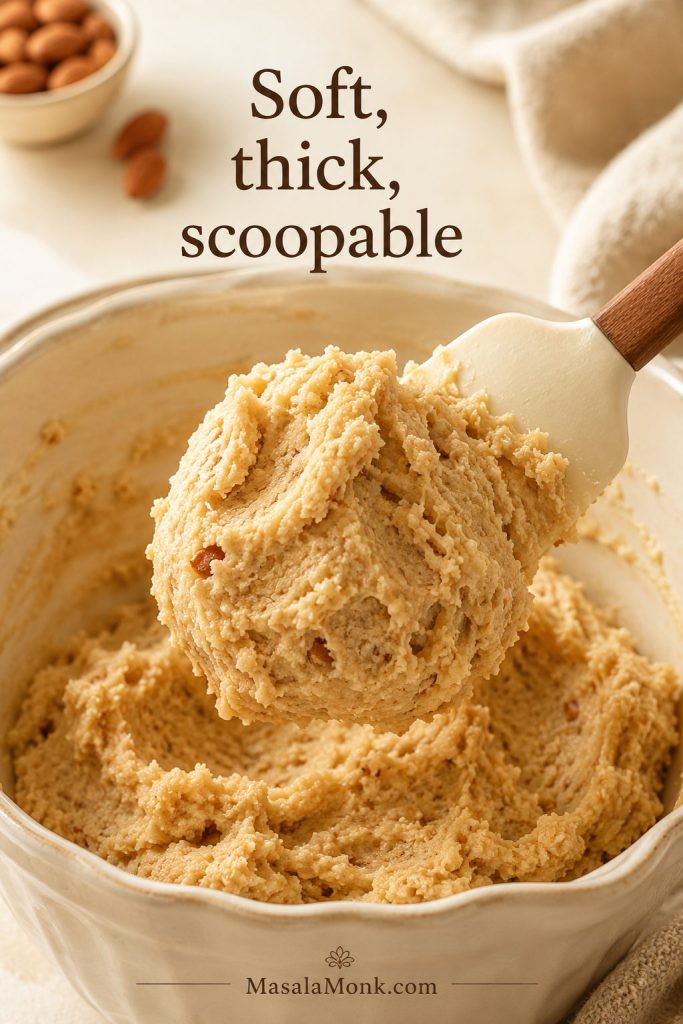
This one-bowl dough should look thick and scoopable, never runny, before you shape it.

Make them plain when you want the warm almond-vanilla flavor to shine, or fold in chocolate chips for the familiar bakery-style version most people picture first. Either way, the dough is simple, scoopable, and built around the small details that make almond flour baking work.
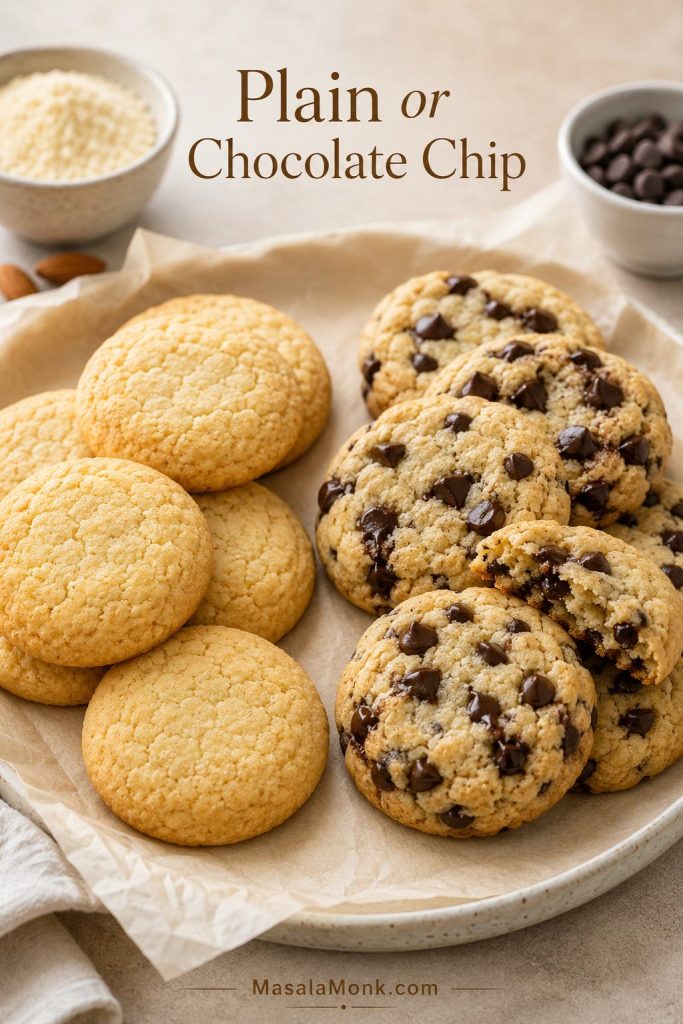
Plain almond flour cookies beside chocolate chip almond flour cookies from the same base dough.
Use the same almond flour cookie dough plain for a warmer almond-vanilla bite, or add chocolate chips for a familiar bakery-style version.

The payoff is a batch of cookies that smell warm and buttery, break softly once cooled, and feel just as welcome with coffee in the afternoon as they do with a few extra chocolate chips after dinner.

The main recipe is the one to start with when you want cookies that hold together, taste smooth instead of gritty, and still feel soft in the center. It is built for the almond-flour problems readers run into most often: oily dough, low spread, fragile cookies, and centers that need time to set.

Use the main recipe first if you want the most reliable batch. Then use the variation notes for 3-ingredient, vegan, keto-style, chocolate chip, and crispier cookies once you know how the dough should feel.

Almond Flour Cookies at a Glance

  • Active time: about 12 minutes
  • Bake time: 10–12 minutes for soft cookies, 13–14 minutes for firmer edges
  • Dough rest: 10 minutes while the oven heats
  • Tray set time: 10–15 minutes before moving
  • No long chill: chill only if the dough feels greasy, sticky, or too soft
  • Yield: about 16 cookies, plain or with chocolate chips
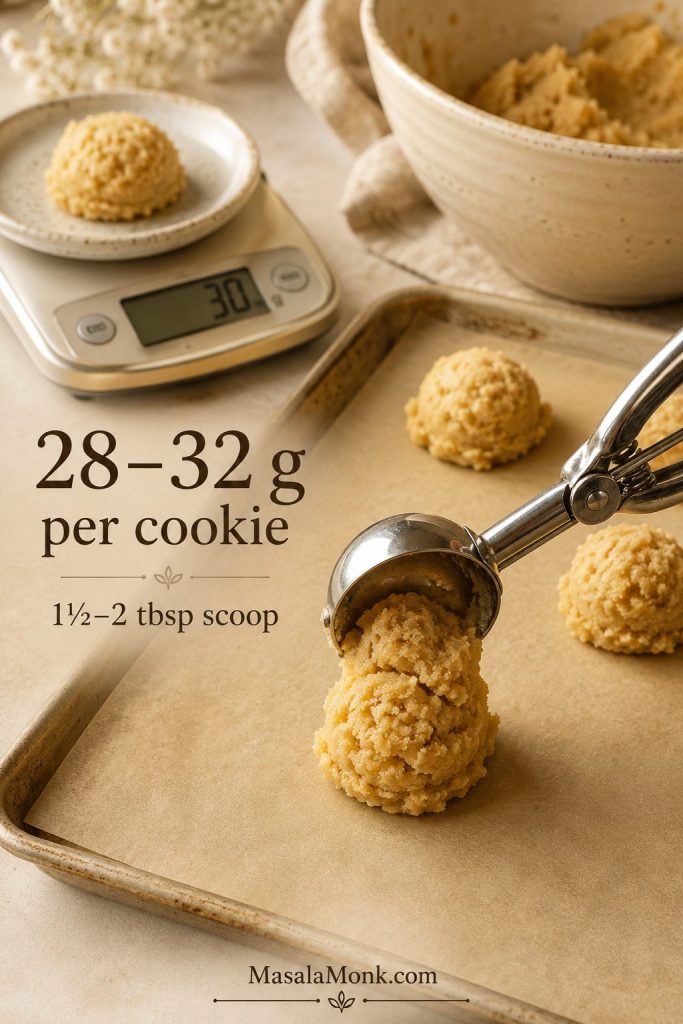
  • Scoop size: 1 1/2 to 2 tablespoons, about 28–32 g dough per cookie
  • Best flour: fine blanched almond flour, not coarse almond meal
  • Most important step: shape before baking, then let the cookies set on the warm tray before lifting

Quick Answer: How to Make Almond Flour Cookies

To make almond flour cookies, mix fine blanched almond flour with brown sugar, melted butter, egg, vanilla, baking soda, salt, and a little cornstarch or arrowroot if you want a softer, thicker cookie. Fold in chocolate chips for the most familiar bakery-style version, or leave the dough plain for a warmer almond-vanilla cookie. Scoop, press each mound into a thick disc, and bake at 350°F / 175°C for 10–12 minutes, until the edges look lightly golden and the centers still look tender.

The two steps that matter most are simple: shape the cookies before baking and let them set on the baking sheet before moving them. This dough does not spread as much as regular cookie dough, and the baked cookies are delicate while hot. Once they cool, they firm up into soft, tender cookies that lift cleanly from the tray.

If this style of cookie has disappointed you before, this recipe is designed to take the guesswork out of the tray. The dough is supposed to feel softer than regular cookie dough, the centers are supposed to look slightly tender when they come out of the oven, and the cookies are supposed to finish setting as they cool. Once you know those cues, the recipe becomes much easier.

If you need quick fixes while baking, jump to the troubleshooting section; if you are ready to mix, go straight to the recipe card.

Why almond flour cookies fail

Most failed batches come down to four things: coarse almond meal, dough left too round before baking, cookies moved while hot, or centers judged before they had time to set. This recipe builds those fixes into the method, so the cookies lift cleanly and taste tender instead of gritty or crumbly.

For step-by-step help, use the method cues first, then check the troubleshooting table if the dough or baked cookies still seem off.

Common almond flour cookie problems including coarse almond meal, unpressed dough, fragile cookies, and soft centers.
If almond flour cookies have failed before, start by checking the flour texture, dough shape, bake cues, and cooling time.

Why You’ll Like This Batch

  • It feels like a real cookie: soft middle, golden edge, and rich almond-vanilla flavor.
  • It is easy enough for a weeknight: one bowl, no mixer, and no long chill.
  • It is flexible: bake them plain, add chocolate chips, or try the 3-ingredient version later.
  • It is built for almond flour: the recipe tells you when to shape, when to pull the tray, and when the cookies are sturdy enough to move.

Why This Almond Flour Cookies Recipe Works

Most problems with this dough do not come from flavor. Almond flour already tastes rich, nutty, and buttery. The challenge is helping the cookies hold together, bake evenly, and set without becoming gritty, oily, or too soft.

The fix starts with fine blanched almond flour, then a few small choices that help the cookies bake up tender instead of sandy or fragile: one egg for lift, brown sugar for a gentle chew, a short dough rest for better hydration, and optional cornstarch or arrowroot for a softer, thicker bite.

The biggest difference is not a complicated technique. The best batches come from dough that is pressed before baking, pulled while the centers still look slightly soft, and left alone long enough for the bottoms to firm on the tray.

  • Fine blanched almond flour keeps the bite smoother and less gritty.
  • Brown sugar gives more familiar chew than dry sweeteners alone.
  • One egg helps the cookies lift cleanly from the tray once cooled.
  • A short rest makes the dough easier to scoop and shape.
  • Gentle handling keeps the cookies intact while they finish setting.

Best first-batch version

For the most reliable first tray, use fine blanched almond flour, brown sugar, butter, the egg, and the cornstarch or arrowroot. This version gives the best balance of tenderness, browning, and cookies that lift cleanly after cooling. Try the 3-ingredient, keto, or vegan variations after you know how the base dough should feel.

The one habit that changes the batch

Treat almond flour cookies gently while they are hot. Give them a few quiet minutes on the tray, and they go from fragile to tender, sturdy, and easy to lift.

Before You Start: 5 Almond Flour Cookie Rules

This dough is easy, but it does not behave like regular cookie dough. Keep these rules in mind before you mix the bowl, especially if this is your first batch.

  • Use fine almond flour. Coarse almond meal can make the cookies gritty and fragile.
  • Press the dough before baking. The shape you make is close to the shape you get.
  • Mix gently. Almond flour has natural fat, so overmixing can make the dough oily.
  • Move them only after they set. Hot cookies are delicate; cooled cookies lift cleanly.
  • Judge texture after cooling. Warm centers can seem too soft even when baked correctly.

What These Almond Flour Cookies Taste Like

These almond flour cookies have a warm vanilla-almond flavor, buttery edges, and a soft, tender bite. They are not meant to be stretchy like wheat-flour chocolate chip cookies. Instead, they break softly, taste rich from the almond flour, and become sturdy enough to lift once fully cooled.

Chocolate chips make them feel more classic and dessert-like, while the plain version lets the almond flavor come through more clearly. Either way, the goal is a cookie that feels homemade and satisfying, not dry, sandy, or like a gluten-free compromise.

For crispier edges, press the dough a little flatter and bake the cookies until the edges are deeper golden. For softer centers, keep the dough slightly thicker and avoid overbaking.

Ingredients You Need

This recipe keeps the ingredient list simple, but every ingredient has a job. You want a tender cookie that tastes warm and satisfying, not like a dry gluten-free compromise. If you plan to change sweeteners, fat, eggs, or flour, check the substitution guide before mixing.
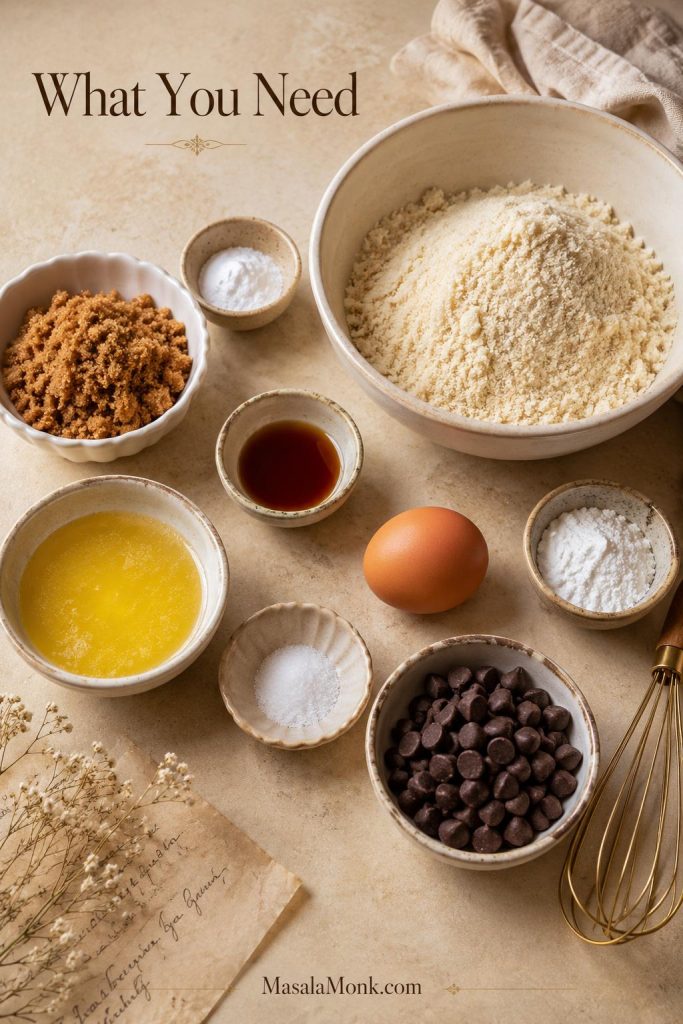
Ingredients for almond flour cookies including almond flour, brown sugar, butter, egg, vanilla, starch, and chocolate chips.
Each ingredient has a clear job: almond flour brings richness, brown sugar helps chew, and optional starch makes the cookies a little softer.

Fine blanched almond flour

Use fine blanched almond flour for the softest texture. It gives the cookies a pale golden color, tender crumb, and smoother bite. Coarse almond meal can work in a pinch, but the batch may taste grainier, darker, and more fragile.

Brown sugar or coconut sugar

Brown sugar gives these cookies a softer, chewier feel and a warmer flavor. Coconut sugar also works, but it weighs a little differently and gives a deeper, more caramel-like taste. For keto-style cookies, use the notes in the variation section because low-carb sweeteners change browning, spread, and chew.

Butter

Melted butter gives the cookies classic flavor and helps the dough come together easily. Let it cool slightly before mixing so it does not scramble the egg or make the dough oily. For a dairy-free version, coconut oil can work, but the cookies will taste a little different and may be slightly softer.

Egg

One egg helps the cookies lift cleanly from the tray after cooling. Egg-free versions are possible, but they need a different formula because almond flour has no gluten to help the dough hold together.

Vanilla, baking soda, and salt

Vanilla is not just background here. It rounds the almond flavor and makes the cookies taste warmer. Baking soda gives a little lift and helps the edges brown, while salt keeps the sweetness from tasting flat.

Recommended starch for softer cookies

A tablespoon of cornstarch or arrowroot helps the cookies bake softer, thicker, and a little less fragile. Use cornstarch for the most familiar cookie texture, arrowroot if you prefer a grain-free option, or skip it for keto-style cookies. Without it, the cookies still work, but they will be slightly more delicate.
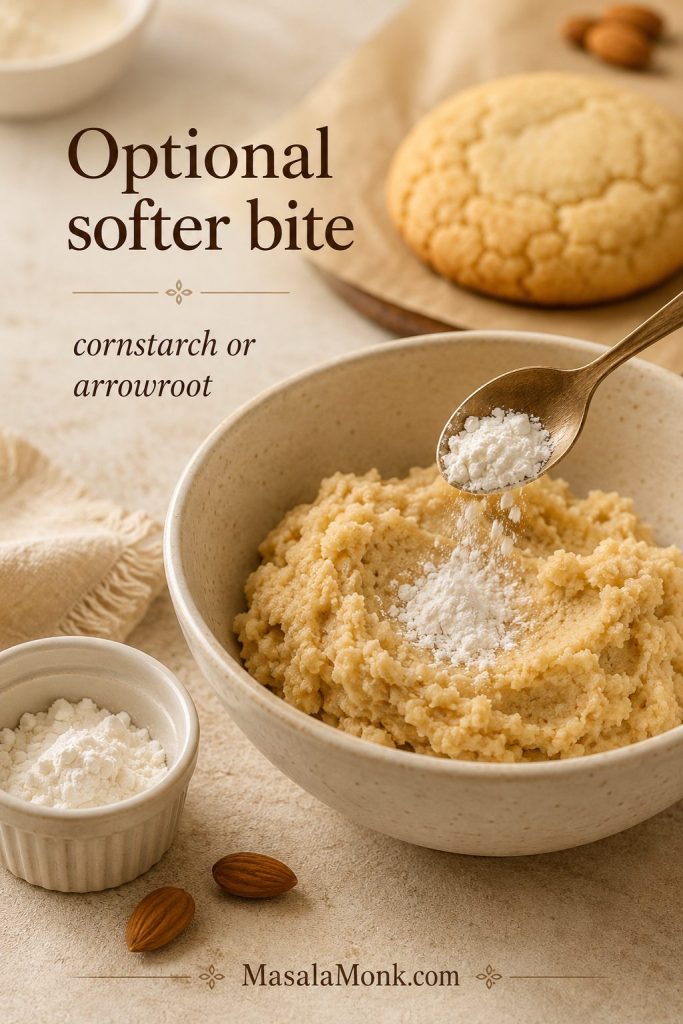
Cornstarch or arrowroot being added to almond flour cookie dough for a softer texture.
A small amount of cornstarch or arrowroot is optional, but it helps the cookies bake thicker, softer, and less delicate.

Chocolate chips

Chocolate chips are optional, but they turn this base dough into an easy chocolate chip version. Mini chocolate chips distribute especially well through the dough, while regular chips give bigger pockets of chocolate.

A note on strict gluten-free baking

Almond flour is naturally gluten-free, but if you are baking for someone who needs strict gluten-free food, use almond flour, chocolate chips, and starch that are labeled gluten-free. The FDA’s gluten-free labeling rule sets a clear standard for foods that carry a gluten-free claim.

Almond Flour vs Almond Meal for Cookies

For the best texture, use fine blanched almond flour. It is usually made from almonds without their skins, so the texture is finer and the color is lighter. This helps the cookies bake up soft, even, and tender.

Almond meal is usually coarser and may include almond skins. It can make cookies darker, grainier, and more rustic. That is not always bad, but it is not ideal when you want a soft, smooth cookie that holds together neatly.
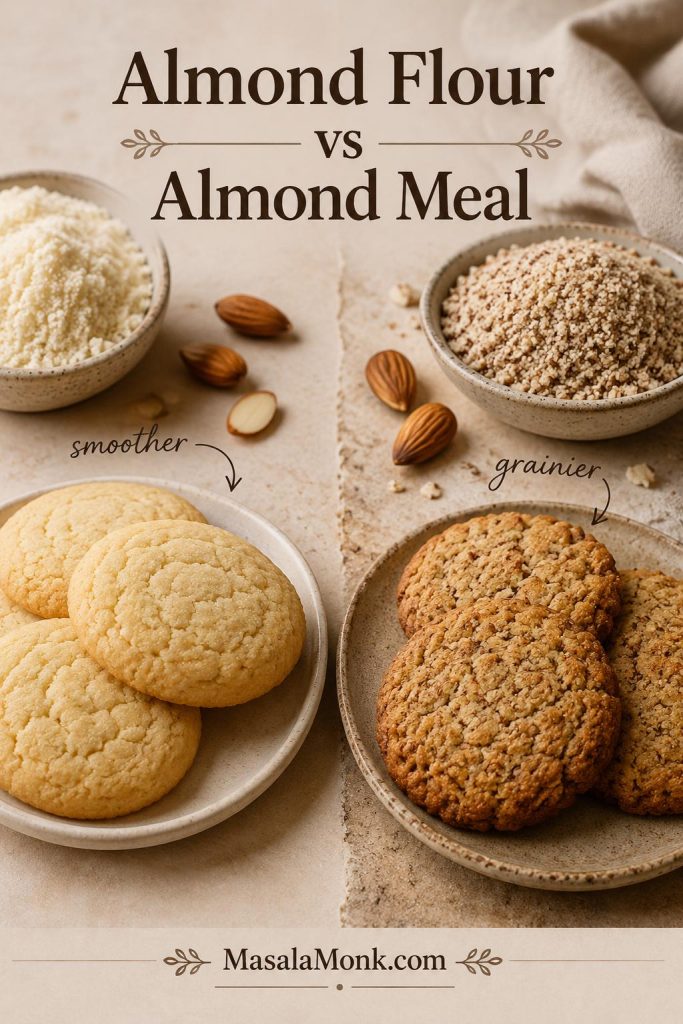
Fine almond flour and almond meal compared with smoother and grainier cookies.
Fine blanched almond flour gives a smoother cookie, while almond meal can make the texture darker, grainier, and more fragile.
Ingredient Best for Cookies? What to Expect
Fine blanched almond flour Best choice Soft, even texture with less grittiness and a cleaner bite.
Almond meal Works, with tradeoffs Darker, grainier cookies that may feel more delicate.
Coarse homemade almond flour Risky Can make the dough uneven, oily, or gritty if the grind is too coarse.

For a deeper baking-focused explanation of almond flour texture and grind, King Arthur Baking has a helpful almond flour guide that explains how finely ground almond flour behaves in baked goods.

If you want to see almond flour behaving in a batter instead of a dough, our almond flour pancakes guide shows why almond-based recipes brown quickly and feel more delicate than wheat-flour versions.

Once you have the right flour, the next important cue is what the dough should look like before baking.

Ingredient Substitutions and What Changes

Substitutions can work, but they are not all equal. Because almond flour has no gluten and contains natural fat, small changes can affect how the cookies spread, brown, and set.
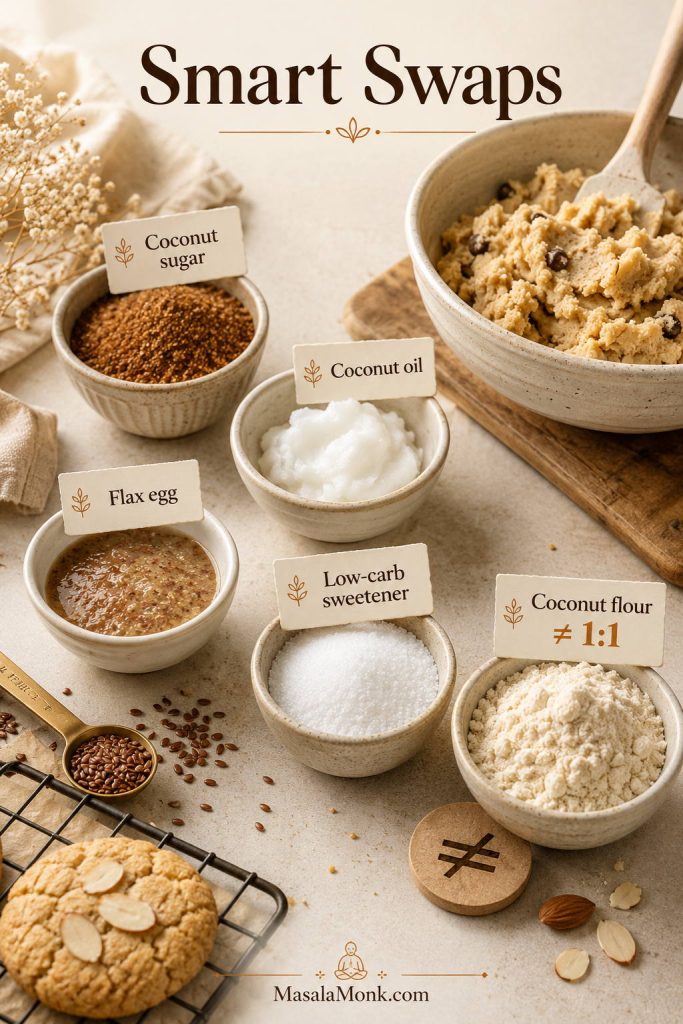
Substitution guide for almond flour cookies with coconut sugar, coconut oil, flax egg, low-carb sweetener, and coconut flour warning.
Some swaps are easy, but coconut flour is not one of them because it absorbs far more liquid than almond flour.
Swap Will It Work? What Changes
Almond meal instead of almond flour Yes, with tradeoffs Cookies may be darker, grainier, and more fragile.
Coconut oil instead of butter Yes Good for dairy-free cookies, but the flavor is less classic and the texture can be softer.
Coconut sugar instead of brown sugar Yes Use 1/2 cup, about 95 g. It gives a deeper flavor and slightly less classic chew.
Maple syrup instead of sugar Not as a direct swap It adds liquid and changes the dough. Use the 3-ingredient variation instead.
Low-carb sweetener instead of sugar Yes, with texture changes Use a 1:1 granular baking sweetener. The cookies may brown less, spread less, and feel less chewy.
Flax egg instead of egg Sometimes The cookies become softer and more delicate. The vegan variation is the safer starting point.
Coconut flour instead of almond flour No Coconut flour absorbs much more liquid and cannot be swapped 1:1.
All-purpose flour instead of almond flour No This recipe is balanced for almond flour’s fat and moisture behavior.
Gluten-free flour blend instead of almond flour No, not directly Most blends behave more like wheat flour and need a different cookie formula.

For the first batch, stay close to the main recipe. Once you know how the dough should feel, it is much easier to adjust sweeteners, fats, or add-ins without losing the soft, tender texture. Then compare the almond flour cookie variations to choose the best next batch.

This recipe is built for almond flour

Other flours need their own formulas. Coconut flour, oat flour, all-purpose flour, and gluten-free flour blends absorb liquid and fat differently, so they cannot replace almond flour directly in this recipe.

Equipment You Need

You do not need a mixer or special equipment. A bowl, spatula, baking sheet, parchment paper, and a cookie scoop are enough for this one-bowl dough.

  • Baking sheet: one large sheet pan or two smaller trays.
  • Parchment paper: best for clean release and even browning.
  • Mixing bowl and spatula: enough for this no-mixer, one-bowl dough.
  • Cookie scoop: a 1 1/2 to 2 tablespoon scoop keeps the cookies even.
  • Wire rack: useful after the cookies set on the tray.
  • Kitchen scale, optional: best for measuring almond flour accurately.
Almond flour cookie dough portioned with a cookie scoop at 28 to 32 grams per cookie.
Even scoops help the cookies bake at the same pace, so the centers stay tender while the edges turn lightly golden.

Parchment paper gives the cleanest release and slightly better browning. A silicone baking mat also works, but the bottoms may brown a little less.

How to Make Almond Flour Cookies

This is a one-bowl style cookie dough. The method is simple, but a few small cues make the difference between cookies that lift cleanly and cookies that crumble when you pick them up. If you already know the dough basics, you can skip ahead to doneness or the texture guide.

1. Mix the wet ingredients

In a large bowl, whisk the melted butter, brown sugar, egg, and vanilla until smooth and glossy. The butter should be melted but not hot. If it feels hot to the touch, let it cool for a few minutes before adding the egg.
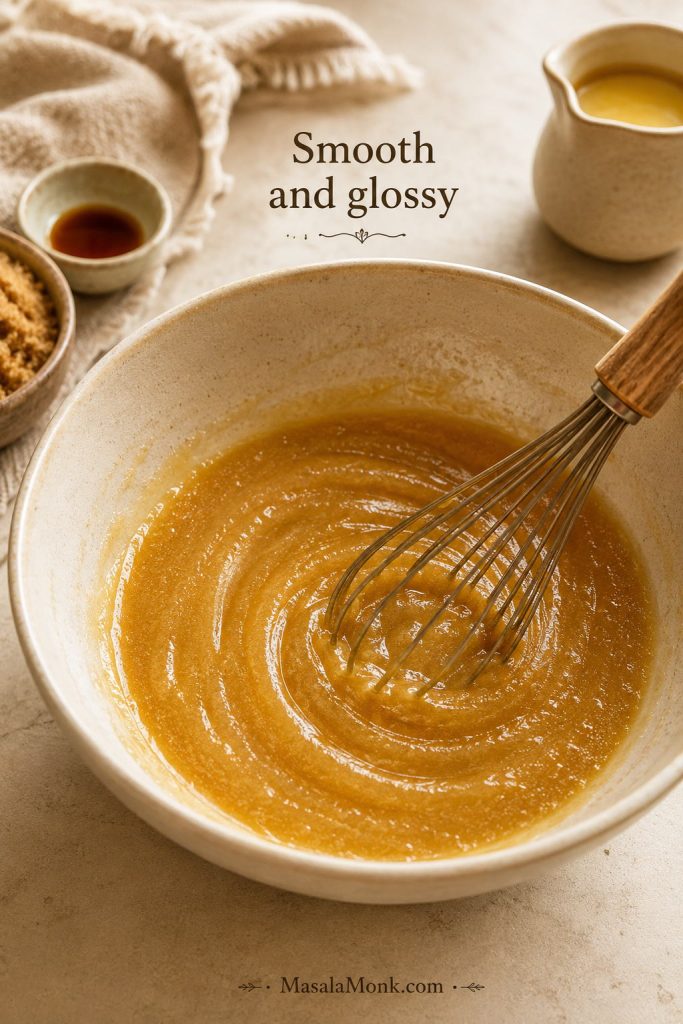
Melted butter, brown sugar, egg, and vanilla being whisked smooth in a ceramic bowl.
Let the melted butter cool slightly before adding the egg; otherwise, the wet mixture can turn greasy or uneven.

2. Add the dry ingredients

Soft thick almond flour cookie dough lifted with a spatula from a mixing bowl.
The dough should look moist and scoopable, not runny like batter or dry like crumbs, before you shape the cookies.
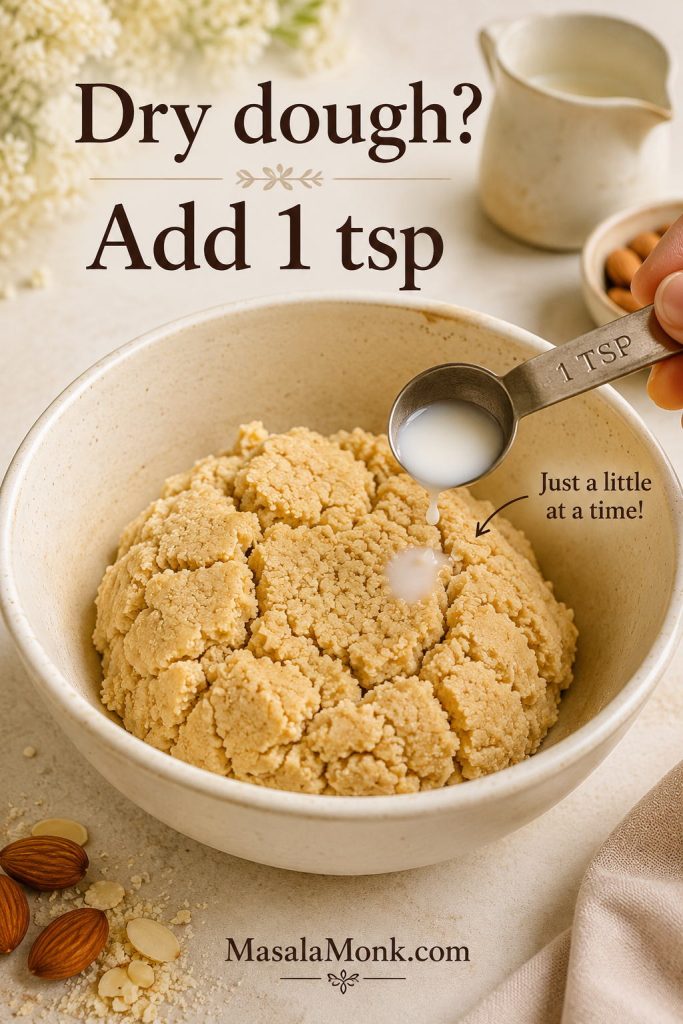
A teaspoon adding water or milk to slightly dry cracked almond flour cookie dough.
If the dough cracks badly when pressed, add water or milk one teaspoon at a time instead of overcorrecting.

For a chocolate chip version, fold in the chocolate chips now. For a prettier finish, save a few chips and press them onto the tops of the dough before baking.
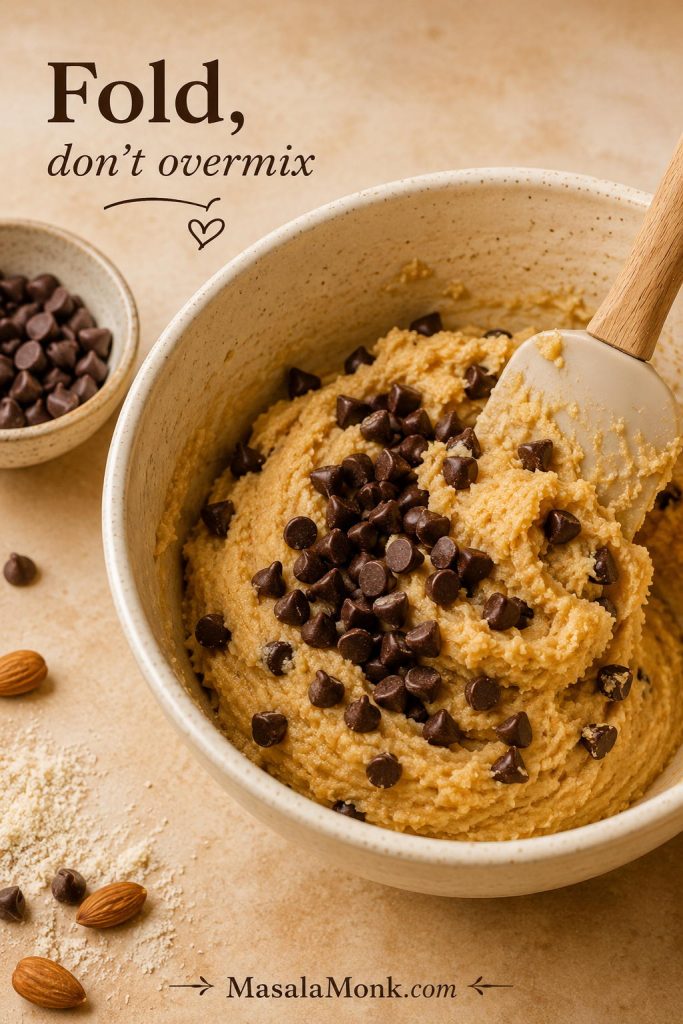
Chocolate chips being folded into almond flour cookie dough with a spatula.
Fold the chocolate chips in gently, because too much mixing can make almond flour dough oily instead of tender.

Let the dough sit for about 10 minutes while the oven heats. This short rest helps the almond flour absorb moisture and makes the dough easier to scoop. If your kitchen is warm and the bowl feels very soft, chill it for 15–20 minutes.
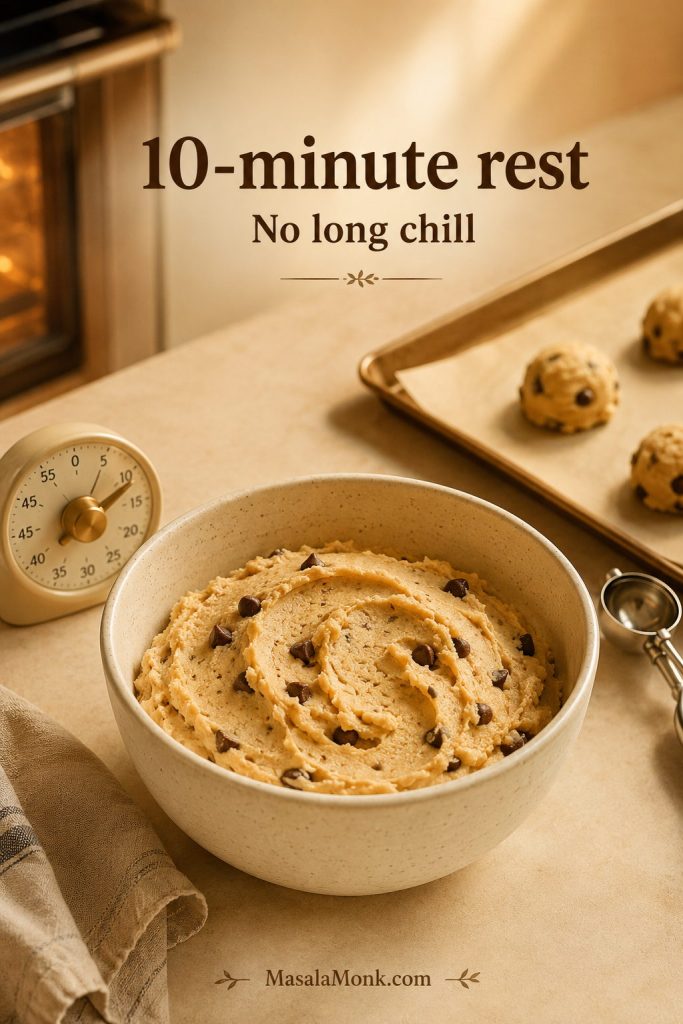
Almond flour cookie dough resting in a bowl near a timer and parchment-lined tray.
After a short rest, the dough feels easier to scoop because the almond flour has had time to absorb moisture.

5. Scoop and shape

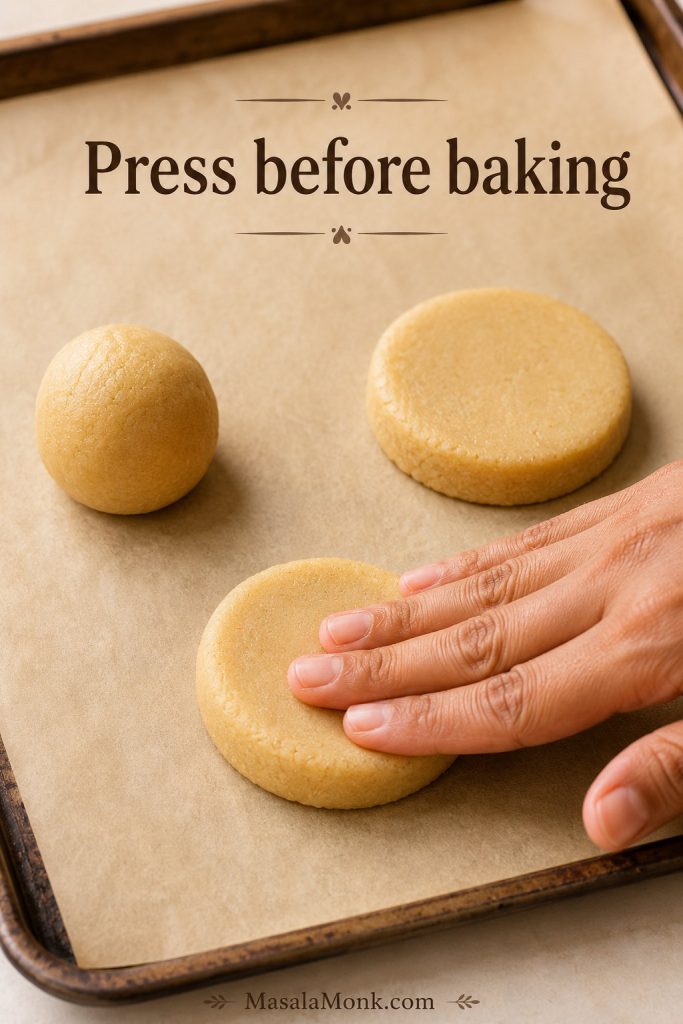
Almond flour cookie dough mound being pressed into a thick disc on a parchment-lined baking tray.
Press each mound into a thick disc before baking; otherwise, almond flour dough can stay too tall in the oven.
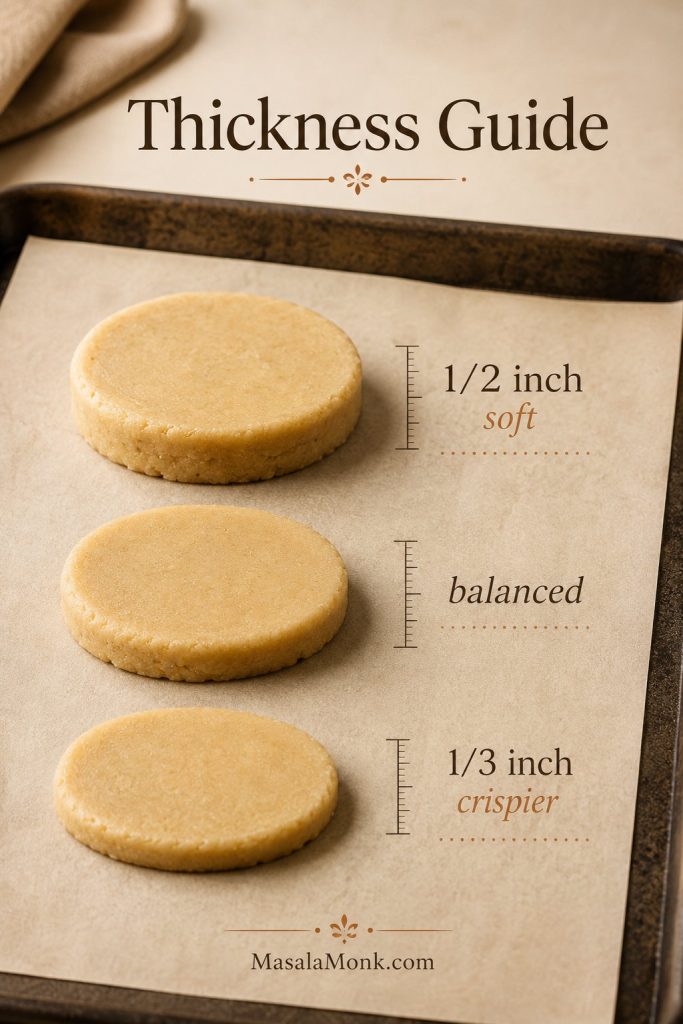
Three almond flour cookie dough discs showing different thicknesses for soft, balanced, and crispier cookies.
Thickness changes the final bite: keep the dough thicker for soft centers, or press it flatter for more golden edge.

Use one large baking sheet or divide the dough between two sheets. For the most even baking, bake one tray at a time in the center of the oven.

6. Bake until the edges are lightly golden

Bake at 350°F / 175°C, or about 160°C fan, for 10–12 minutes. The edges should look lightly golden, but the centers should still look soft. If your oven runs hot, check at 9 minutes because almond flour can brown quickly at the edges.
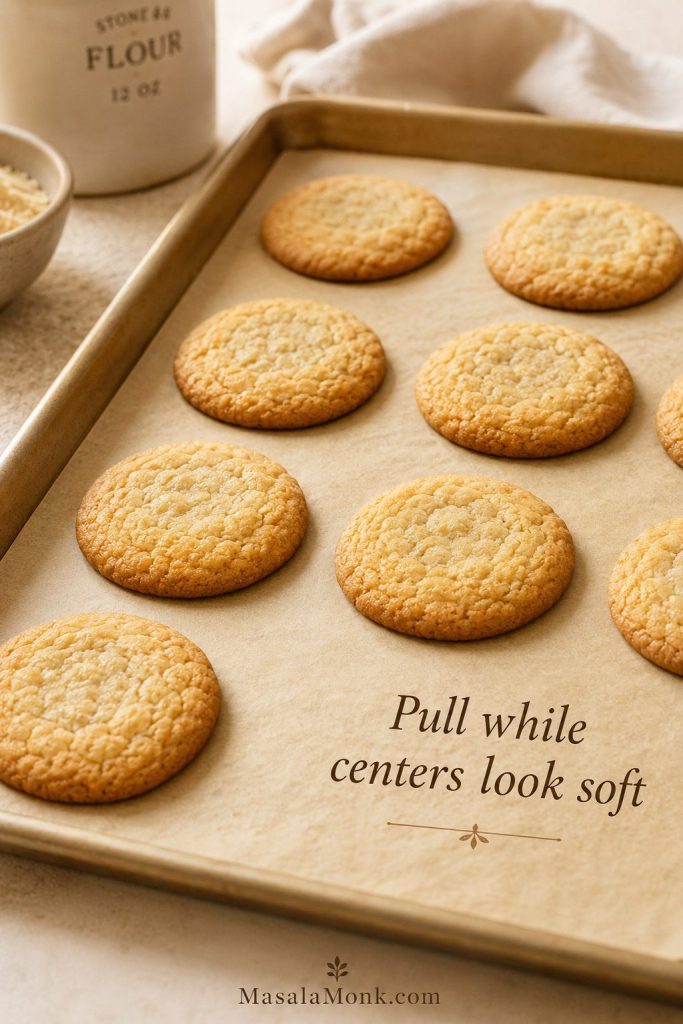
Freshly baked almond flour cookies with golden edges and soft centers on a parchment-lined tray.
Look for set, lightly golden edges rather than firm centers; the middle should still look a little tender.

7. Let the cookies set on the tray

Let the cookies cool on the baking sheet for at least 10 minutes before moving them. They are delicate when hot, but they firm as they cool. After that, transfer them to a wire rack and let them cool completely.

Almond flour cookies cooling on a baking sheet with a spatula lifting one cookie.
A clean spatula lift is the sign to wait for; if the cookie bends or breaks, give the tray a few more minutes.

The cookies may look a little softer than you expect when they first come out. That is normal. The edges should be set, but the centers finish firming as the tray cools.

Do You Need to Chill Almond Flour Cookie Dough?

You do not need a long chill for this dough. A 10-minute rest is enough for most batches because it gives the almond flour time to absorb moisture and makes the dough easier to scoop.

Chill the dough for 15–20 minutes only if it feels sticky, greasy, or too soft to shape. This usually happens when the butter is too warm, the kitchen is hot, or the almond flour is very fine and fresh. Even after chilling, press the dough into discs before baking so the cookies do not stay too thick.

How to Know When Almond Flour Cookies Are Done

The cookies are done when the edges look lightly golden and set, but the centers still look a little soft. Do not wait for the centers to look firm in the oven, or the cookies may turn dry after cooling.

When in doubt, pull the tray when the edges are set and the centers still look slightly soft. Overbaked almond flour cookies can taste dry once cooled.

The cookies should look lightly golden at the edges, soft in the center, and slightly fragile when they first come out. After 10–15 minutes on the tray, they should lift cleanly with a spatula and break softly when you bite into them.
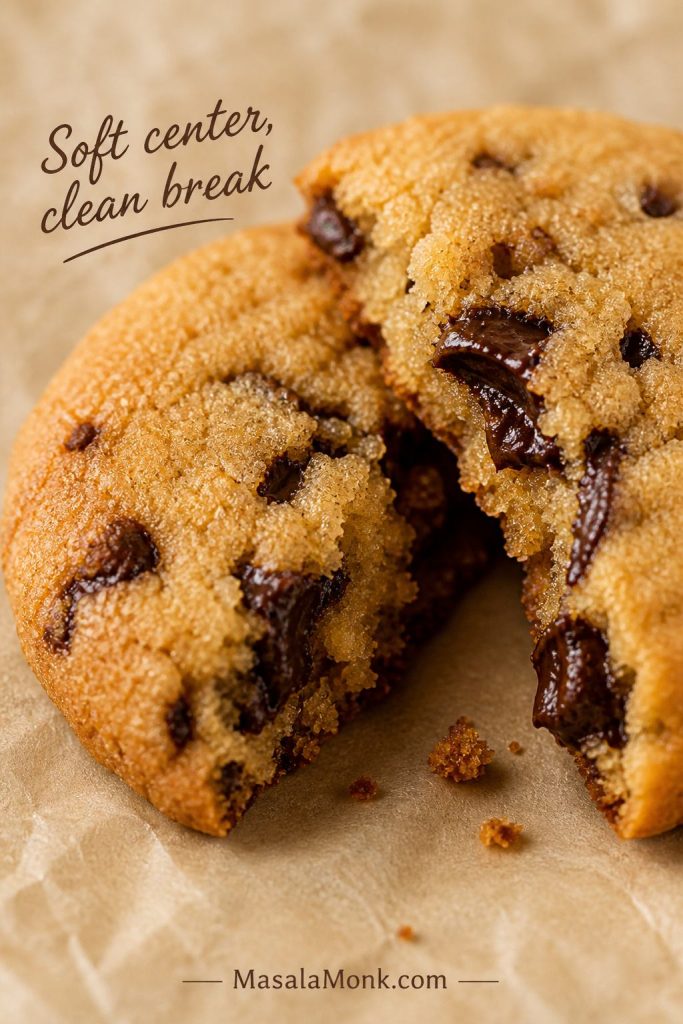
Broken chocolate chip almond flour cookie showing a soft center and melted chocolate pockets.
The finished cookie should break softly, not crumble into sand, which tells you the dough and bake time worked together.

Soft, Chewy, or Crispy Almond Flour Cookies

Before you bake, decide what kind of cookie you want. A thicker cookie gives you the softest center. A slightly flatter cookie gives you more golden edge. The recipe is flexible, but the shape you choose before baking matters.

Texture Goal How to Shape Bake Time Best Cue
Soft almond flour cookies Keep thicker, about 1/2 inch 10–11 minutes Edges barely golden, centers soft
Chewy almond flour cookies Flatten slightly, but not thin 11–12 minutes Light golden edges, tender centers
Crispier almond flour cookies Flatten more, about 1/3 inch 13–14 minutes Deeper golden edges, fully cooled before serving
Soft, chewy, and crispier almond flour cookies shown side by side on parchment.
The same dough can bake soft, chewy, or crispier depending on how thickly you shape it and how long it stays in the oven.

For the chewiest result, use brown sugar, keep the egg, and avoid overbaking. For crispier cookies, press the dough flatter and give the tray an extra minute or two in the oven. Either way, wait until the cookies cool before judging the final texture. If your cookies came out dry, crumbly, oily, or too thick, the troubleshooting section will help you adjust the next tray.
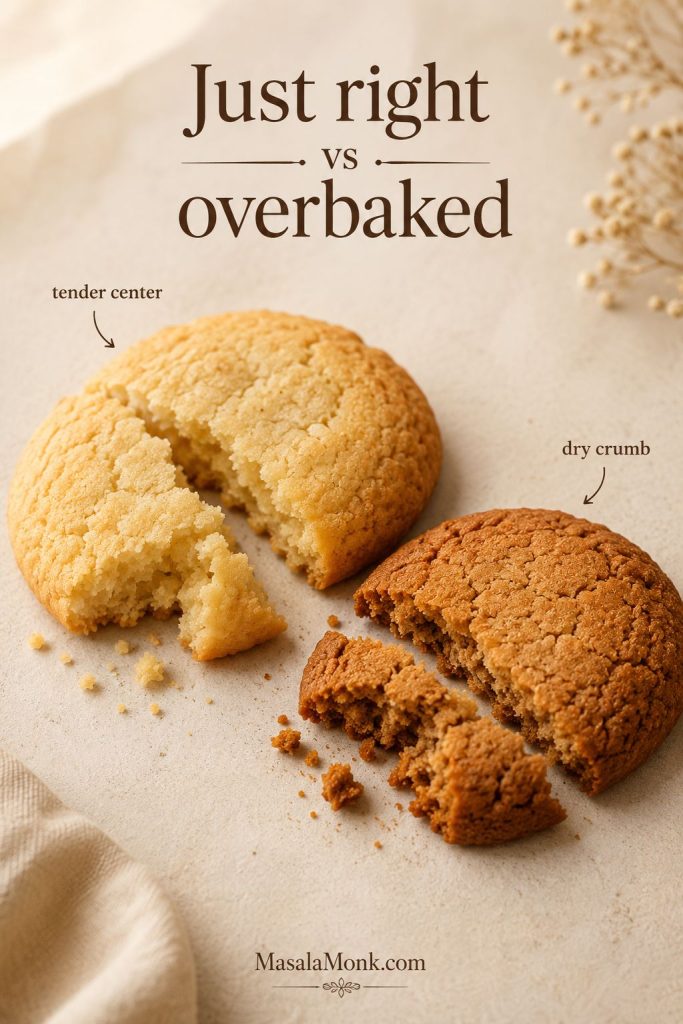
Just-right almond flour cookie with tender center compared with a darker overbaked cookie with dry crumb.
Instead of waiting for firm centers, look for golden edges; overbaked almond flour cookies can taste dry after cooling.

Almond Flour Cookie Variations

Think of the base recipe as the dependable version. Once you know how the dough behaves, the variations below let you move toward simpler, richer, lower-carb, dairy-free, or more chocolate-forward cookies without starting from scratch. Need the base formula first? Use the recipe card, then come back here to choose a version.

If You Want… Make This Version Why
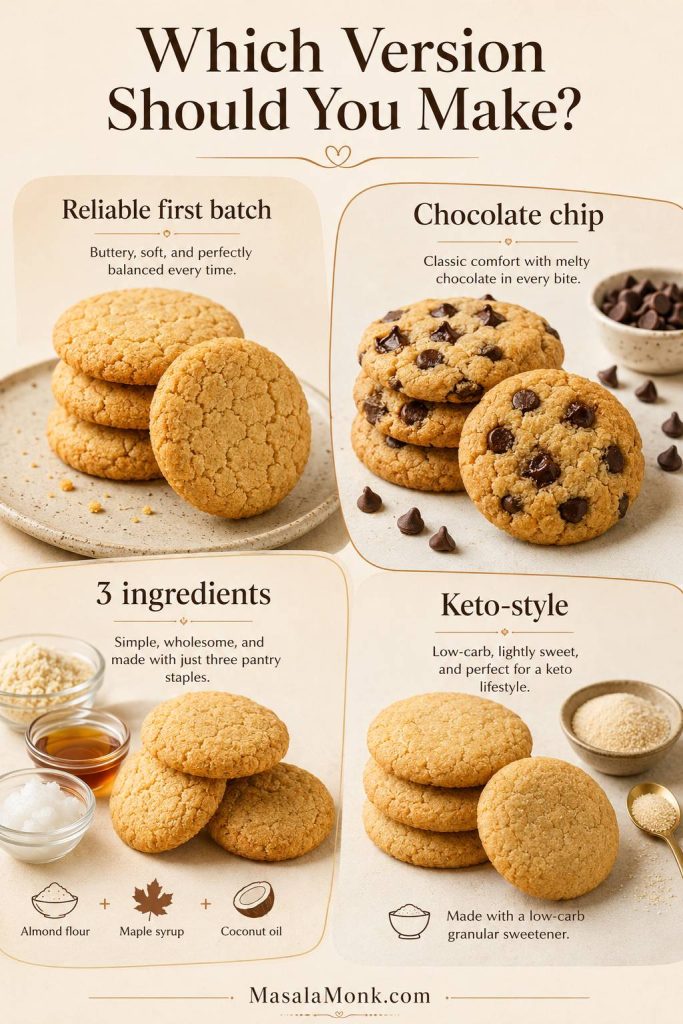
The most reliable first batch Main recipe with egg and starch Best balance of softness, browning, and cookies that lift cleanly.
The most familiar cookie Chocolate chip version Classic flavor, melty pockets, and broadest appeal.
The simplest egg-free cookie 3-ingredient version Quick, small-batch, and dairy-free if you use coconut oil.
Lower sugar Keto-style version Works with a 1:1 granular low-carb baking sweetener, but browns less.
Almond flour cookie version chooser showing reliable first batch, chocolate chip, 3 ingredient, and keto-style cookies.
Start with the reliable first batch when texture matters most, then choose chocolate chip, 3-ingredient, or keto-style based on your needs.

If you are baking for people who do not usually choose gluten-free cookies, start with the chocolate chip version. It feels familiar first, then quietly happens to be almond-flour based.

If you want something simpler with coffee or tea, keep them plain. If you need egg-free or dairy-free cookies, use the 3-ingredient version as its own small-batch formula rather than forcing swaps into the main dough.

3 Ingredient Almond Flour Cookies

Choose the 3-ingredient version when you want a quick, simple, egg-free cookie with very little prep. It will be softer and more delicate than the main recipe, but it works well for a snack-style cookie when you keep the cookies small, shape them before baking, and let them cool fully on the tray.
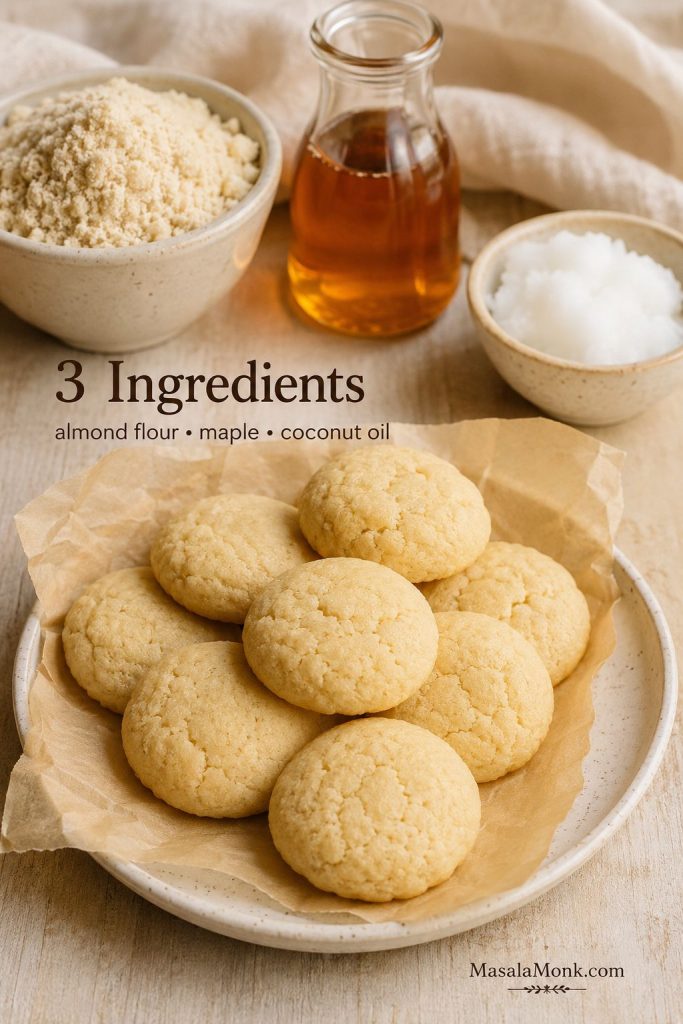
Three ingredient almond flour cookies with almond flour, maple syrup, and coconut oil nearby.
The 3-ingredient version is quick and egg-free, but it bakes softer and more delicate than the main recipe.

For a small batch of about 8 small cookies, mix 1 cup fine almond flour, 3 tablespoons maple syrup, and 2 tablespoons melted coconut oil or butter. Add a pinch of salt if possible. Scoop into small 1-tablespoon portions, press into discs, and bake at 350°F / 175°C for 8–10 minutes, or closer to 10–12 minutes if you make them larger. Let them set fully on the tray before moving.

If the 3-ingredient dough feels dry or cracks heavily, add water or milk 1 teaspoon at a time. If it feels sticky, let it rest for 5–10 minutes before shaping.

Choose the 3-ingredient version for speed and simplicity. Choose the main recipe when you want more classic browning, chew, and lift.

Chocolate Chip Almond Flour Cookies

For a chocolate chip version, add 1/2 cup / 85 g chocolate chips to the main dough. Mini chocolate chips spread through the dough evenly, while regular chips give bigger pockets of chocolate. Press a few extra chips on top before baking for a bakery-style finish.
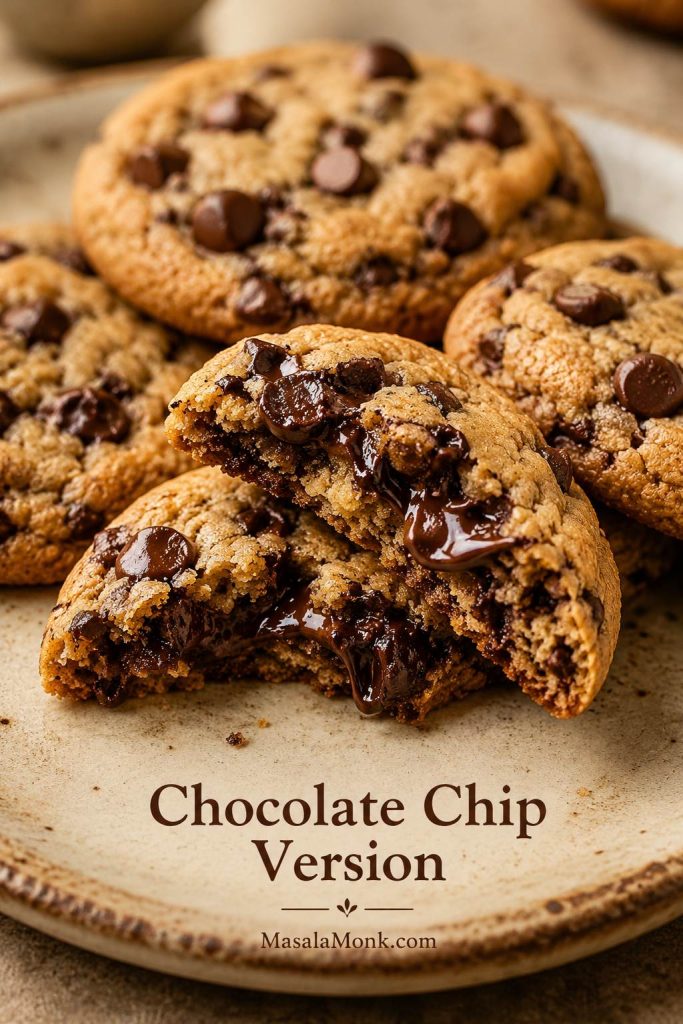
Chocolate chip almond flour cookies with a broken cookie showing melted chocolate and a soft center.
Chocolate chip almond flour cookies feel familiar first, which helps when you are baking for both gluten-free and regular-cookie eaters.

If you like deep chocolate cookies, you can also visit our double chocolate chip cookies for a richer chocolate-cookie direction.

More Wholesome Almond Flour Cookies

For a more wholesome version, use coconut sugar, dark chocolate chips, and keep the cookies slightly thicker so they stay tender. They are still cookies, but this version leans less sweet and lets the almond flavor come through more clearly.

Vegan Almond Flour Cookies

For vegan almond flour cookies, start with the 3-ingredient version: almond flour, maple syrup, and coconut oil. It gives you a softer, simpler cookie without needing an egg replacer. A flax egg can work in some almond flour doughs, but it often makes the cookies more delicate, so cool the cookies completely before moving them.
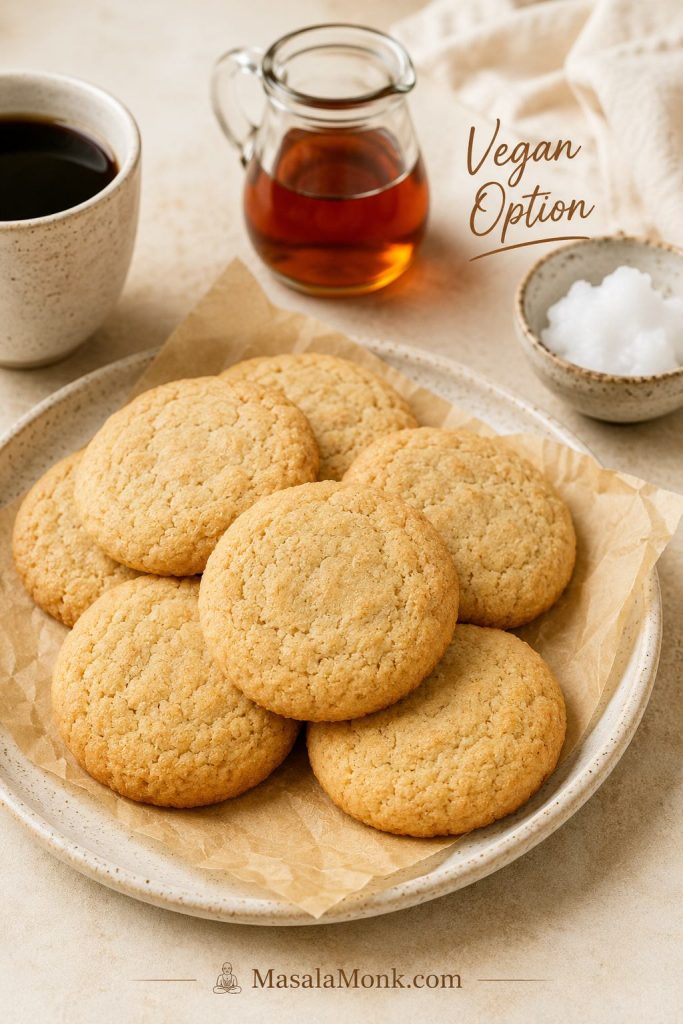
Vegan almond flour cookies served with maple syrup, coconut oil, and black coffee.
For vegan almond flour cookies, use maple syrup and coconut oil as the base rather than forcing a direct egg swap.

Keto Almond Flour Cookies

Choose the keto-style version when lower sugar matters more than classic brown-sugar chew. Use a 1:1 granular low-carb baking sweetener, not pure stevia or a liquid sweetener. Skip the cornstarch, shape the dough before baking, and expect cookies that brown less and spread less than the brown-sugar version.
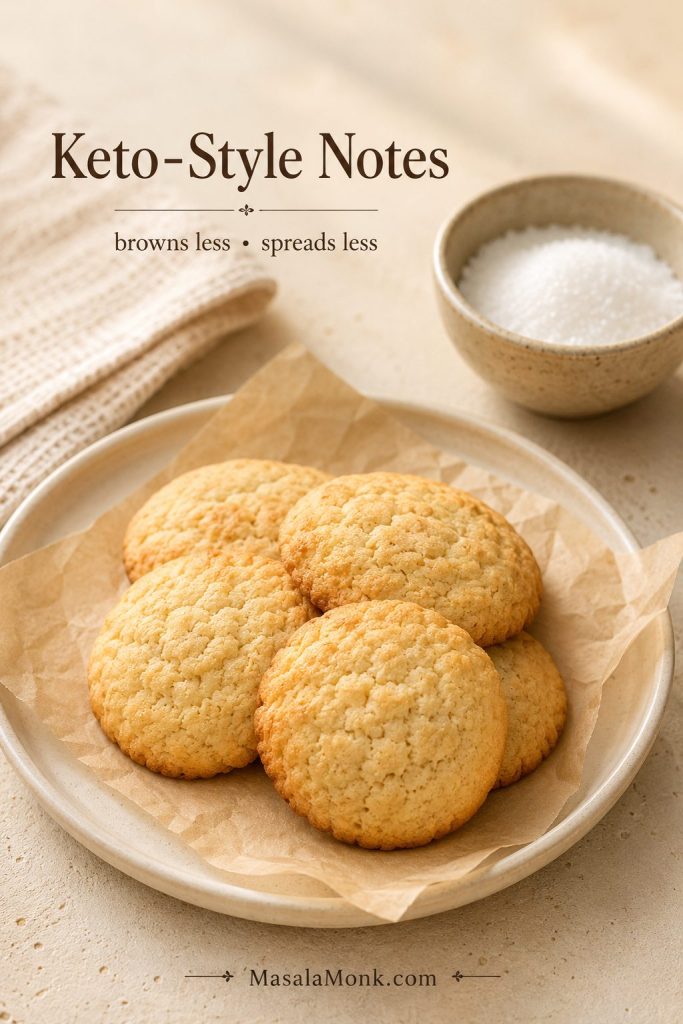
Keto-style almond flour cookies on parchment with a bowl of granular low-carb sweetener nearby.
Keto-style almond flour cookies usually brown less and spread less, so judge them by texture and edge set rather than deep color.

If you are doing more low-carb baking, our keto-friendly flours guide explains how almond flour behaves compared with other low-carb flours.

Peanut Butter Almond Flour Cookies

For a light peanut butter direction, replace 2 tablespoons of the butter with creamy peanut butter and add a pinch more salt. This gives the base cookie a nutty peanut-butter note, but a true almond flour peanut butter cookie works best as its own formula because peanut butter changes the dough’s fat and moisture balance.

A full peanut-butter-first cookie is better handled as its own recipe. See our peanut butter cookies recipe, which includes classic, 3-ingredient, chocolate chip, and oatmeal versions.

Almond Flour Shortbread Cookies

For a shortbread-style cookie, skip the egg and use almond flour, softened butter, powdered sugar, vanilla, and salt. Shape the cookies flatter and bake until the edges are deeper golden. This style is more delicate, so tray cooling matters even more.

Almond Flour Oatmeal or Sugar Cookies

Oatmeal and sugar-cookie versions are better as their own formulas because oats, extra sugar, and decorating needs all change the dough. From this base, you can experiment with a small handful of oats, but keep sugar-cookie versions as drop cookies rather than cut-out cookies unless you are using a recipe built for rolling.

Why Did My Almond Flour Cookies Crumble?

If a batch does not come out perfectly, do not throw the recipe away. This dough is sensitive to flour texture, measuring, shaping, and cooling time, so one small change can make a big difference in the next tray. Most problems are easy to fix once you know what caused them.

Troubleshooting guide for almond flour cookies showing crumbly cookies, gritty flour, oily dough, and no-spread dough.
Troubleshooting is easier when you match the problem to the cause: flour texture, fat temperature, dough shape, or cooling time.
Problem Likely Cause Fix
Crumbling when lifted The cookies had not set yet Let them cool on the baking sheet for 10–15 minutes before moving.
Gritty texture Almond meal or coarse almond flour Use fine blanched almond flour for the smoothest texture.
Oily-feeling cookies Too much fat, hot butter, or heavy mixing Cool melted butter slightly and mix only until the dough comes together.
No spreading in the oven This dough spreads less than wheat-flour dough Press the dough into discs before baking.
Centers too soft The centers need more time to set Bake 1–2 minutes longer next time and cool fully before serving.
Dry or sandy cookies Flour may have been packed, or the cookies baked too long Weigh the almond flour or spoon and level it; reduce bake time slightly.
Sticky dough Warm kitchen or warm butter Rest the dough for 10 minutes or chill for 15–20 minutes.
Dough cracks badly when pressed The almond flour is dry or the dough needs a little moisture Add 1 teaspoon water or milk and mix gently.
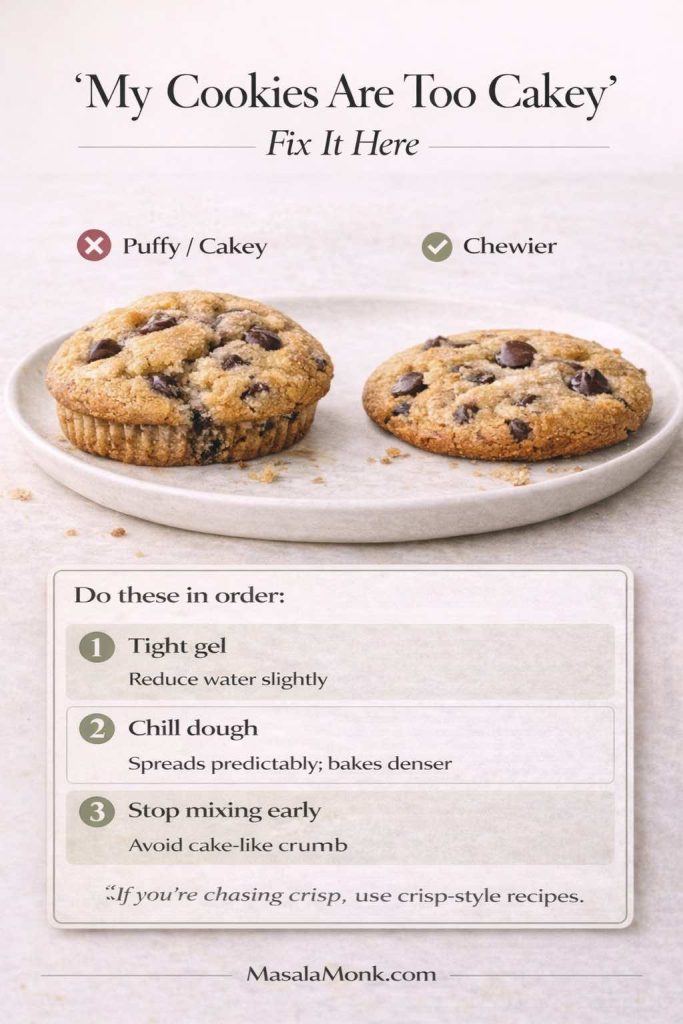
Cakey texture Too much egg, too much leavening, or cookies shaped too thick Flatten slightly more next time and bake until the edges are more golden.
Pale cookies Low-carb sweetener or underbaking Bake 1–2 minutes longer and rely on edge color, not center firmness.

Fix crumbly almond flour cookies

If the cookies break when you lift them, let the tray sit longer before moving the next batch. A clean spatula lift usually means the bottoms have set enough.

Almond flour cookie lifting cleanly with a spatula after setting on the baking sheet.
If almond flour cookies crumble when lifted, they often needed more tray time, not more baking time.

If the dough looks shiny or greasy, pause before scooping. Slightly cooled butter and gentle mixing usually give you a thicker, more scoopable dough.
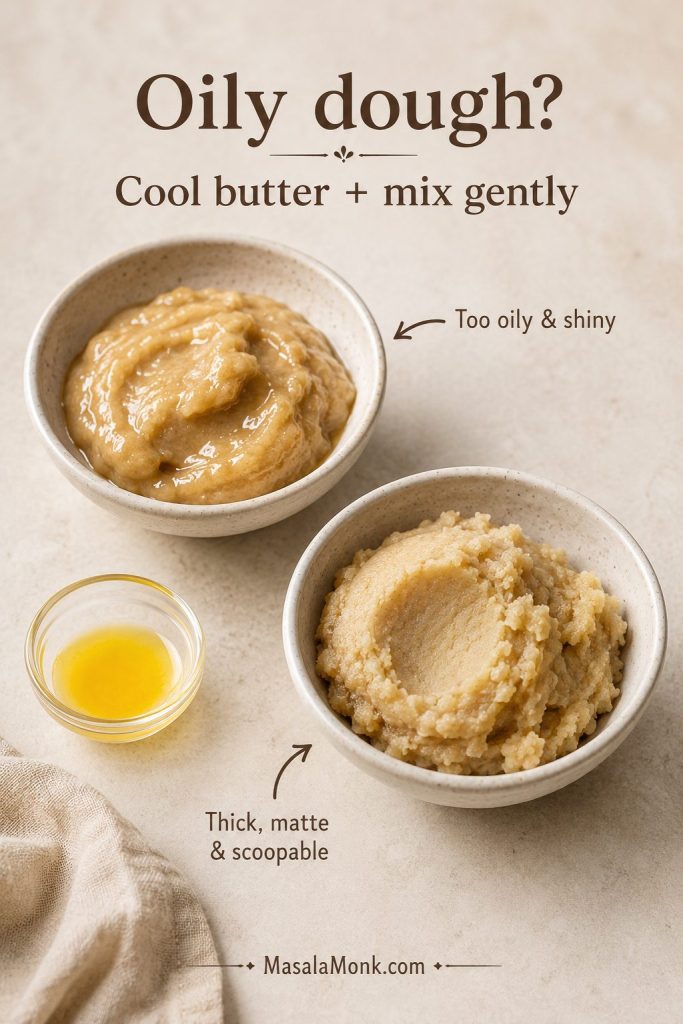
Oily almond flour cookie dough compared with properly mixed thick scoopable dough.
Shiny dough usually means the butter was too warm or the mixture was worked too much, so cool the butter and mix gently.

Fix almond flour cookies that do not spread

If the dough stays in tall mounds, press each portion into a thick disc before baking. That one shaping step gives the cookies a better final form.
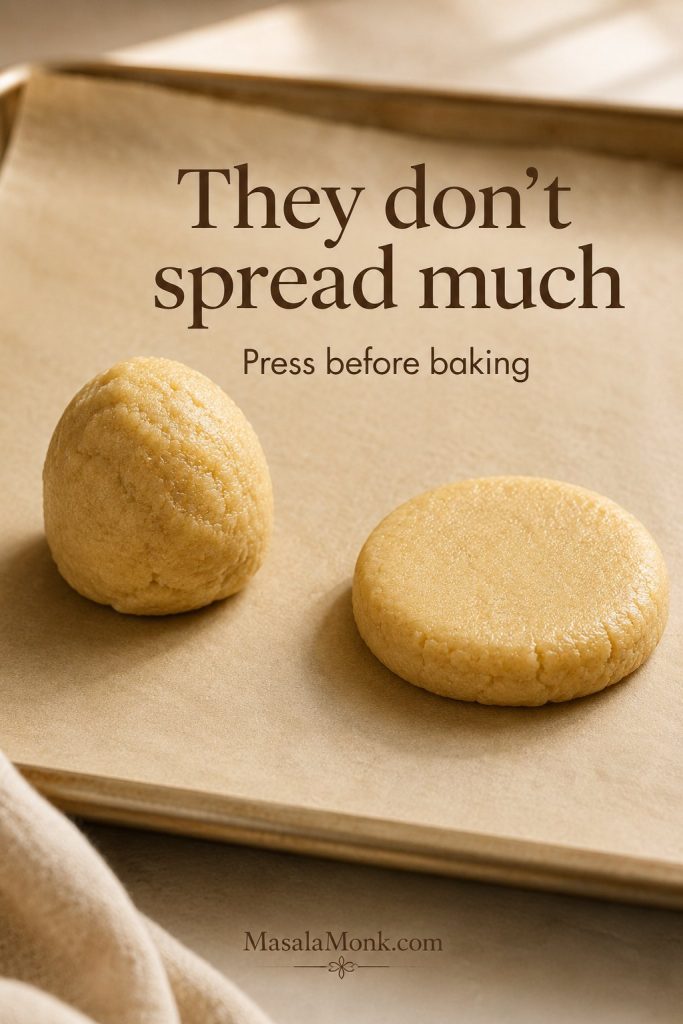
Tall unpressed almond flour cookie dough mound beside a pressed thick disc on parchment.
If the dough goes in as a tall mound, it may come out too thick; press it first for a better cookie shape.

How to Store and Freeze Almond Flour Cookies

These cookies keep well once they are fully cooled. Because they are tender, stack them gently and use parchment between layers if you are storing a large batch.
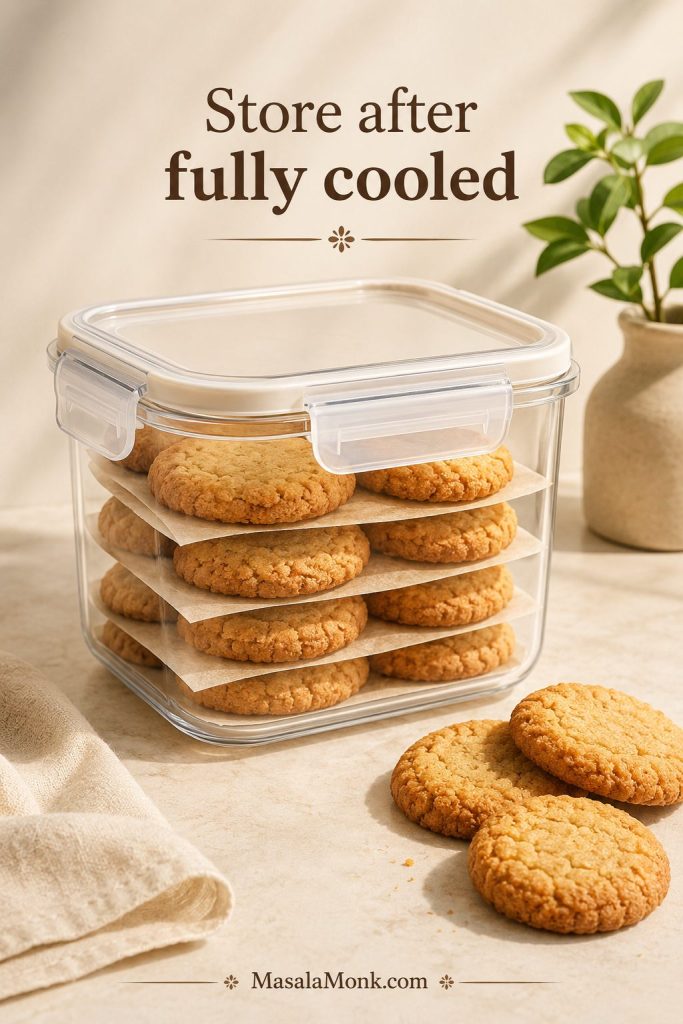
Almond flour cookies stored in an airtight container with parchment between the layers.
Store almond flour cookies only after they are fully cool, and use parchment between layers to protect their soft texture.
Storage Method How Long Best Tip
Room temperature 3–4 days Store airtight after cookies are completely cool.
Refrigerator Up to 1 week Let cookies come closer to room temperature before serving.
Freezer, baked cookies 2–3 months Freeze in a single layer first, then transfer to a freezer bag.
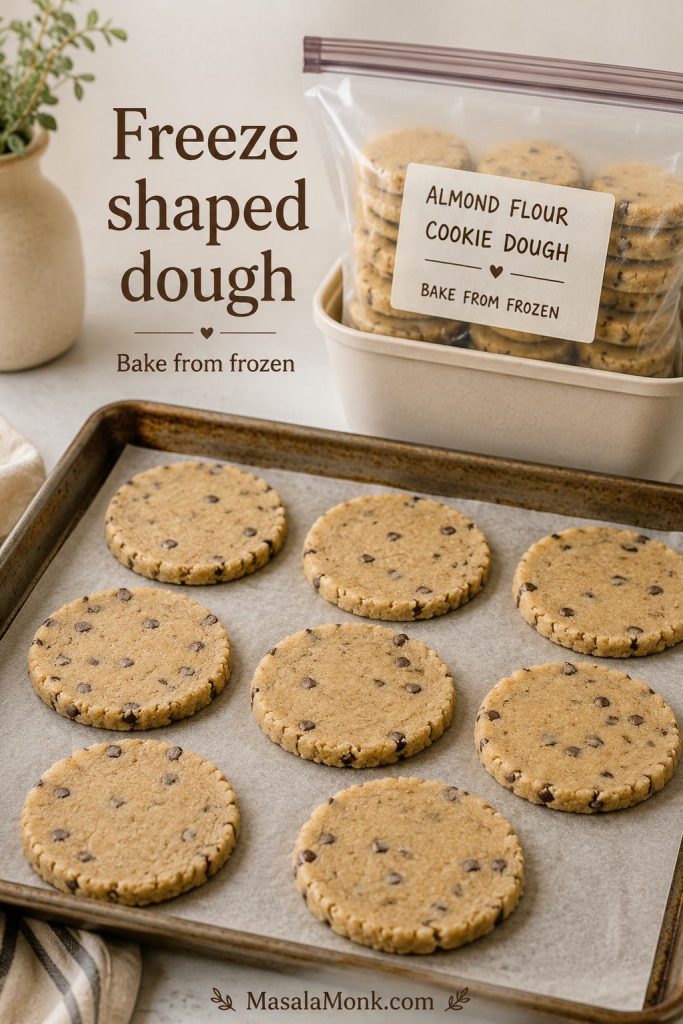
Freezer, dough portions 2–3 months Shape and flatten before freezing; bake from frozen with 1–2 extra minutes.
Flattened almond flour cookie dough portions on a tray with a labeled freezer bag behind them.
Freeze the dough after shaping and flattening, so the portions bake more evenly later without needing to thaw first.

Once cooled, the cookies should lift cleanly, bend slightly before they break, and taste rich enough that no one has to think about them as a gluten-free substitute. That is the batch you are aiming for.

Almond Flour Cookies Recipe Card

Almond Flour Cookies Recipe

Soft, tender almond flour cookies with lightly golden edges, a gentle chew, and a warm vanilla-almond flavor. Keep them plain, add chocolate chips, or bake them a little longer for crispier edges.

Prep Time 12 minutes
Rest Time 10 minutes
Bake Time 10–12 minutes
Set Time 10–15 minutes

Active Time: about 12 minutes

Bake + Rest Time: about 20–22 minutes before tray cooling

Ready to Move: about 35–40 minutes, including dough rest and tray set time

Yield: about 16 cookies, plain or with chocolate chips

Ingredients

  • 2 cups fine blanched almond flour, 200 g / about 7 oz
  • 1/2 cup packed light brown sugar, 110 g / about 3.9 oz, or 1/2 cup coconut sugar, about 95 g
  • 1/4 cup unsalted butter, melted and slightly cooled, 56 g / 2 oz
  • 1 large egg
  • 1 teaspoon vanilla extract, 5 ml
  • 1/2 teaspoon baking soda
  • 1/4 teaspoon fine salt
  • 1 tablespoon cornstarch or arrowroot starch, about 8 g, recommended for softer, thicker cookies; optional, and skip for keto-style cookies
  • 1/2 cup chocolate chips, 85 g / 3 oz, optional

Instructions

  1. Preheat the oven to 350°F / 175°C, or about 160°C fan. Line a baking sheet with parchment paper.
  2. In a large bowl, whisk together the melted butter, brown sugar, egg, and vanilla until smooth.
  3. Add the almond flour, baking soda, salt, and cornstarch or arrowroot, if using. Stir until a soft, scoopable cookie dough forms.
  4. The dough should look moist and thick, not runny. If it cracks badly when pressed, add 1 teaspoon water or milk and mix gently.
  5. Fold in the chocolate chips, if using.
  6. Let the dough rest for 10 minutes while the oven heats. If it feels very sticky, greasy, or too soft to scoop after resting, chill it for 15–20 minutes.
  7. Scoop into 1 1/2 to 2 tablespoon portions, about 28–32 g each, and place on the prepared baking sheet, leaving about 2 inches between cookies.
  8. Press each mound gently into a thick disc. This dough does not spread much, so shape it before baking.
  9. Bake for 10–12 minutes, until the edges are lightly golden and the centers still look soft. For firmer edges, bake 1–2 minutes longer.
  10. Cool on the baking sheet for 10–15 minutes before moving. Transfer to a wire rack and cool completely.

Notes

  • Use fine blanched almond flour, not coarse almond meal, for the smoothest texture.
  • If measuring by cups, spoon the almond flour into the cup and level it off. Do not pack it tightly.
  • The dough should be soft but scoopable. If it looks shiny or greasy, chill it briefly before baking.
  • Flatten cookies to about 1/2 inch for soft cookies or closer to 1/3 inch for crispier edges.
  • The centers should look slightly soft when the cookies come out of the oven. They finish setting as they cool.
  • Let the cookies rest on the tray before transferring; they are fragile while hot.
  • You can skip the starch, but the cookies will be slightly more delicate.
  • For a dairy-free version, use melted coconut oil instead of butter.
  • For chocolate chip almond flour cookies, use 1/2 cup / 85 g chocolate chips.

What to Bake Next with Almond Flour

Once you are comfortable with this dough, almond flour becomes much easier to bake with. The next best cookie recipes to build are the ones with stronger identities — peanut butter, oatmeal, shortbread, sugar cookies, and chocolate chip — because each one needs its own balance of fat, sweetness, moisture, and structure.

  • Richer direction: build a dedicated peanut butter almond flour cookie.
  • Heartier option: try an almond flour oatmeal cookie with the right oat-to-flour balance.
  • Best for gifting: shortbread-style almond flour cookies are the better direction.
  • Decorating route: almond flour sugar cookies need a dough made for shaping, chilling, or dropping.

For no-bake cookie-style desserts, you can also see our edible cookie dough and protein cookie dough recipes.

FAQs About Almond Flour Cookies

Can I use almond meal instead of almond flour?

Almond meal works in a pinch, but it changes the cookie. Because it is usually coarser and may include almond skins, the cookies can bake darker, taste grainier, and feel more fragile than cookies made with fine blanched almond flour.

Do almond flour cookies spread?

They spread less than wheat-flour cookies, so press the dough into the shape you want before baking. Thicker discs stay softer; flatter discs bake with more golden edge.

Why did my almond flour cookies fall apart?

They were probably moved too soon. Almond flour cookies are delicate when hot and firm as they cool, so wait at least 10 minutes before lifting them from the baking sheet.

Why are my almond flour cookies greasy?

Greasy cookies usually come from too much added fat, butter that was too hot, or dough that was mixed too heavily. Use slightly cooled melted butter and stop mixing once the dough comes together.

Should I chill almond flour cookie dough?

A long chill is not needed for this recipe. A 10-minute rest is usually enough. Chill the dough for 15–20 minutes only if it feels very soft, sticky, or greasy.

Can I make almond flour cookies without eggs?

Egg-free versions work best when the formula is designed for them. The 3-ingredient variation with almond flour, maple syrup, and coconut oil is a good starting point. It makes a softer, more delicate cookie than the main recipe.

Can I make almond flour cookies with maple syrup?

Maple syrup works best in a recipe designed around it, such as the 3-ingredient variation. In the main recipe, swapping it directly for brown sugar adds extra liquid and can make the centers too soft.

How do I make almond flour cookies crispy?

Press the dough flatter and bake for 13–14 minutes, until the edges are deeper golden. Cool fully before serving, because the cookies firm more as they sit.

Can I make almond flour cookies keto?

Keto-style cookies need a 1:1 granular low-carb sweetener made for baking. Skip the cornstarch, avoid liquid sweeteners, and expect cookies that brown less and feel less chewy than brown-sugar cookies.

Is almond flour a 1:1 replacement for all-purpose flour in cookies?

A direct 1:1 swap usually does not work well. Almond flour has no gluten and more natural fat than wheat flour, so it needs a recipe built around its own texture and moisture behavior.

Will coconut flour work in this recipe?

Coconut flour absorbs far more liquid than almond flour, so it cannot replace almond flour in this recipe. Use a cookie recipe written specifically for coconut flour instead.

Are almond flour cookies gluten-free?

Almond flour is naturally gluten-free, but check labels if you are baking for someone who needs strict gluten-free food. Some almond flour, chocolate chips, or starches may be processed in facilities that also handle wheat.

Can I freeze almond flour cookie dough?

Yes. Scoop and shape the dough first, then freeze the portions on a tray. Once firm, transfer them to a freezer bag. Bake from frozen at 350°F / 175°C, adding 1–2 extra minutes as needed.
Back to top ↑

Posted on 6 Comments

How to Make a Flax Egg (Recipe & Ratio for Vegan Baking)

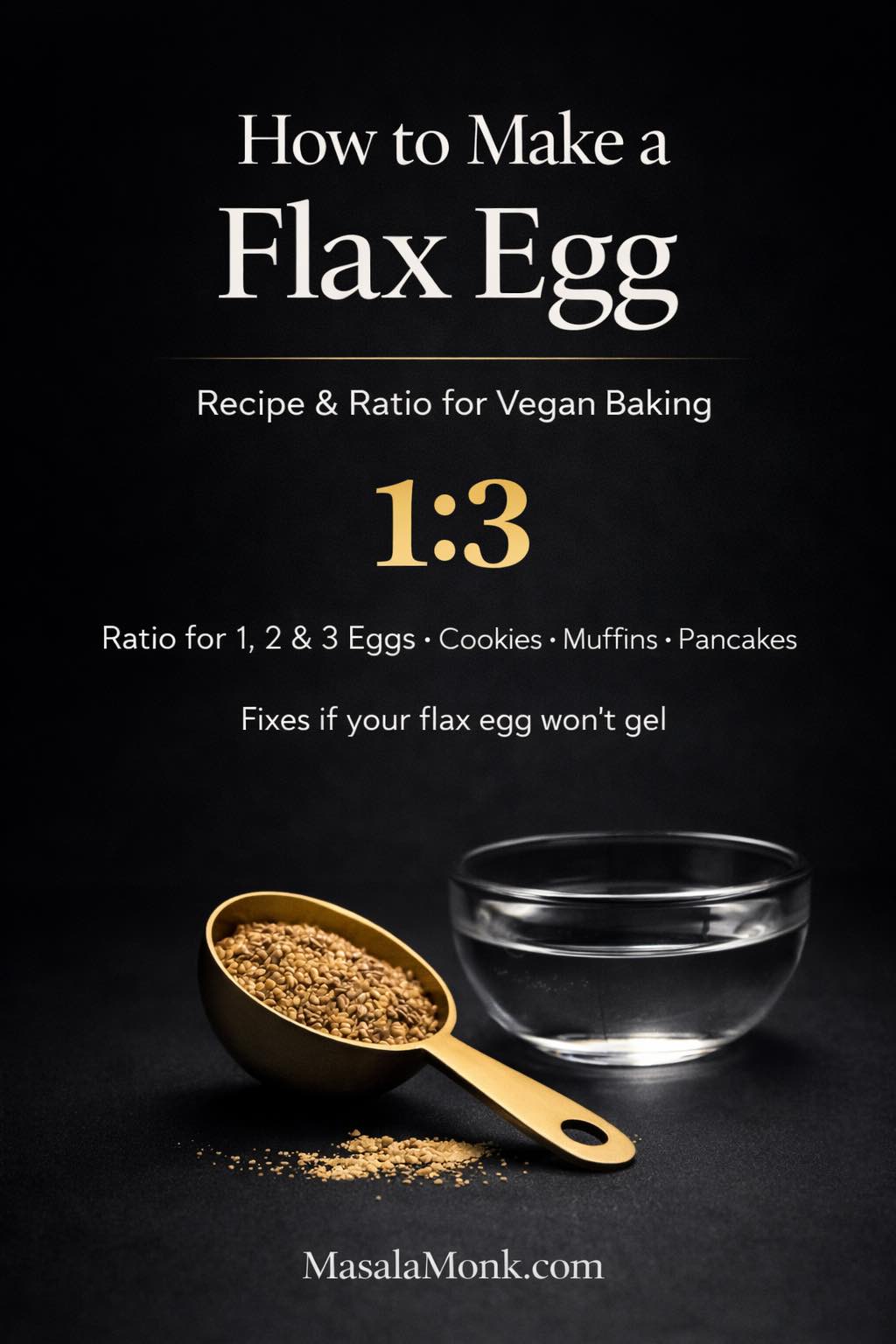
Magazine-style cover for “How to Make a Flax Egg” showing the flax egg recipe and ratio for vegan baking, including 1–3 egg conversions, best uses for cookies, muffins, and pancakes, plus fixes if a flax egg won’t gel, with MasalaMonk.com in the footer.

You know the moment: you’re halfway through a cookie dough, you reach for the egg carton, and it’s empty. Alternatively, you’re baking for someone who avoids eggs—whether for vegan eating, allergies, or simply preference—and you want a solution that doesn’t feel like a compromise. That’s exactly where a flax egg comes in.

Once you learn how to make a flax egg, you’ll have a reliable, pantry-friendly answer for a huge range of recipes—especially the kind of everyday bakes most of us actually make: cookies, muffins, quick breads, pancakes, and waffles. Even better, it’s simple enough to memorize, yet flexible enough to scale for two eggs, three eggs, or more.

Ahead, you’ll get the classic flax egg ratio, easy flaxseed meal to egg conversion for bigger batches, and a few small adjustments that make the gel set reliably in real-world baking. You’ll also see what to use when you need a substitute for flax egg, plus when a different egg replacement makes more sense.


How to Make a Flax Egg (Step-by-Step)

At its core, a flax egg is just ground flaxseed mixed with water. After a short rest, it thickens into a gel. That gel helps bind ingredients together, which is why flaxseed is such a popular egg substitute in baking.

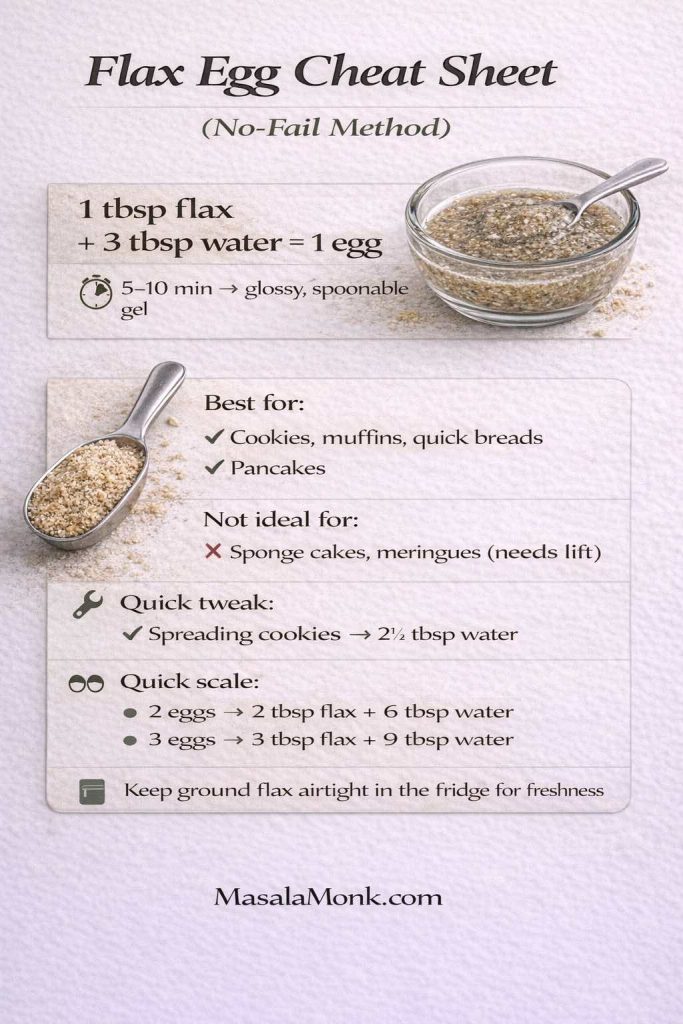
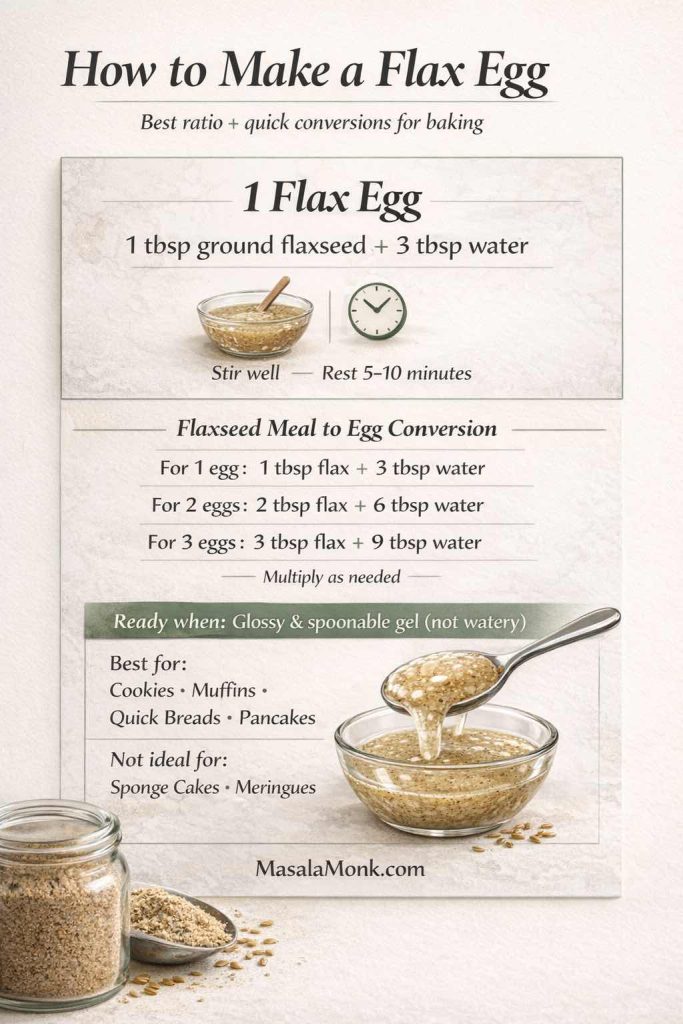
How to Make 1 Flax Egg (the classic flax egg recipe)

For one flax egg:

  • 1 tablespoon ground flaxseed (flax meal)
  • 3 tablespoons water
Photorealistic infographic showing how to make a flax egg: mix 1 tablespoon ground flaxseed with 3 tablespoons water, stir well, and rest 5–10 minutes until a glossy, spoonable gel forms. Includes flaxseed meal to egg conversion for 1, 2, and 3 eggs and notes best uses like cookies, muffins, quick breads, and pancakes.
How to make a flax egg at a glance: use the classic flax egg ratio (1 tbsp ground flaxseed + 3 tbsp water), rest 5–10 minutes until glossy and spoonable, then scale the same flaxseed meal to egg conversion for 2 or 3 eggs when you’re baking cookies, muffins, quick breads, or pancakes.

Stir them together until the mixture looks evenly combined. Then, set it aside for about 5–10 minutes. As it sits, it thickens into a gel-like texture. If it still looks watery after 10 minutes, jump to the troubleshooting section—usually it’s a grind or freshness issue, and it’s easy to fix.

The same simple method shows up in everyday baking advice for a reason: it works. If you’d like more practical ways to use ground flax—both as a flaxseed egg substitute and in everyday meals—see Benefits of Flax Seeds and How to Incorporate Them into the Indian Diet.

Now, if you’re thinking, “That’s it?”—yes, that’s basically it. However, the details matter, and those details are what separate “it sort of worked” from “I can swap this confidently.”

How to make a flax egg with ground flax (what actually matters)

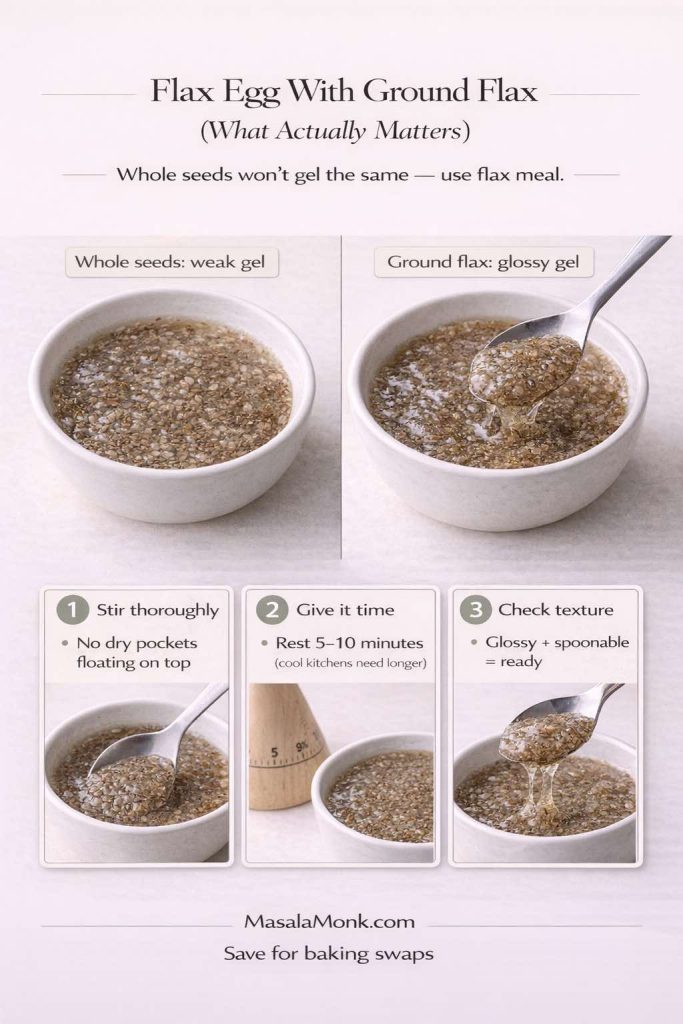
Use ground flaxseed, not whole seeds. Whole flax often stays stubbornly seed-like, even after sitting, and the mixture won’t gel properly. Ground flaxseed (flax meal) hydrates more evenly, which is the whole point.

Vertical infographic titled “Flax Egg With Ground Flax (What Actually Matters)” showing a side-by-side comparison: whole flax seeds mixed with water labeled “weak gel” versus ground flax/flax meal mixed with water labeled “glossy gel,” with a spoon lift showing the gel texture. Three step cards explain: stir thoroughly so no dry pockets float on top, let it rest 5–10 minutes (cool kitchens need longer), and check texture—glossy and spoonable means ready. MasalaMonk.com footer.
If your flax egg won’t gel, the fix is usually simple: use ground flaxseed (flax meal), not whole seeds. This step-by-step guide shows the texture you’re aiming for—glossy and spoonable—plus the three things that actually matter in real baking: stir thoroughly, rest 5–10 minutes, and check the gel before adding it to your batter.

Ground flax is also the better pick nutritionally and practically, since whole seeds can pass through without breaking down much. Mayo Clinic explains why ground flax is generally preferred in Flaxseed: Is ground better than whole?.

Stir thoroughly. A quick swirl is rarely enough. Instead, stir until you don’t see dry pockets of flax floating on top.

Give it time. Some flax thickens in five minutes. Other batches need closer to ten, particularly if your kitchen is cool.

Check the texture. A ready flax egg should look glossy and slightly thick—somewhere between loose gel and a lightly thickened sauce. If it’s still watery, a couple quick tweaks usually thicken it up (see troubleshooting below).

Is a flax egg the right substitute for your recipe?

Now that you’ve got the flax egg ratio down, the next question is the one that actually saves batches: will it work in this recipe? The simplest way to decide is to think about what the egg was doing in the first place.

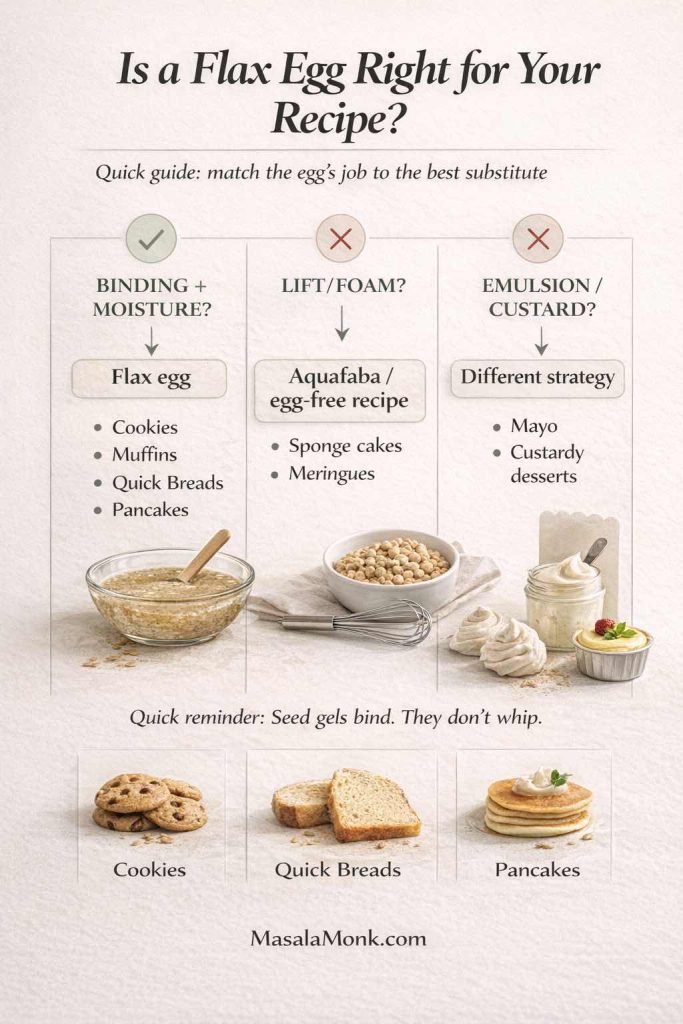
Photorealistic infographic titled “Is a Flax Egg Right for Your Recipe?” showing how to choose an egg substitute based on the egg’s job. It recommends a flax egg for binding and moisture (cookies, muffins, quick breads, pancakes), aquafaba or an egg-free recipe for lift/foam (sponge cakes, meringues), and a different strategy for emulsion or custard-style recipes (mayo, custardy desserts).
Not every egg substitute works the same way—this quick guide helps you decide when a flax egg substitute is the best choice for baking (binding + moisture), when aquafaba is better for lift and foam, and when you’ll want a different approach for emulsions or custard-style desserts.
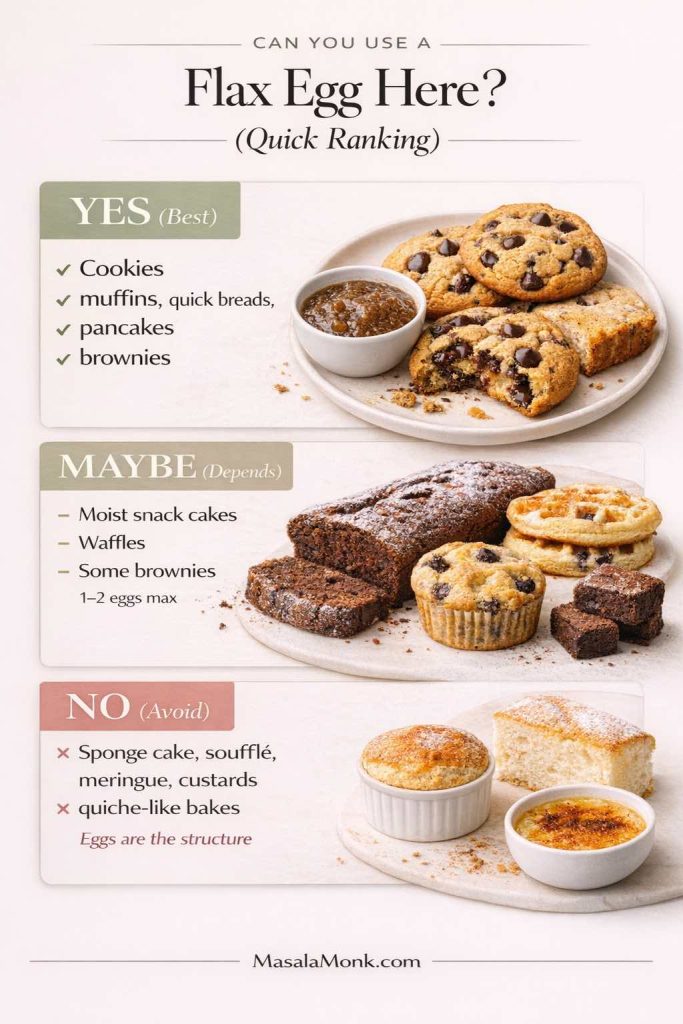
  • Use a flax egg when the egg is mostly a binder. This is where flax shines: cookies, brownies, muffins, quick breads, pancakes, and waffles—recipes where you want the batter to hold together and stay pleasantly moist.
  • Skip flax when the egg is doing the heavy lifting for lift. If the recipe relies on whipped eggs or airy structure—think sponge cakes, angel-food style bakes, meringues, or anything “foam-based”—a seed gel won’t recreate that height.
  • Be cautious when the recipe calls for several eggs. Replacing one egg is usually straightforward. Replacing two can still work in sturdier bakes. However, once you’re replacing three or more, the texture can drift toward heavier and denser unless the recipe was designed for egg-free baking.
  • When in doubt, pick the more forgiving path. If you’re experimenting, start with cookie doughs and quick breads first. They’re easier to read and adjust, so you learn the “flax egg feel” without risking a fragile cake.

Also Read: Croquettes Recipe: One Master Method + 10 Popular Variations


Flax Egg Ratio (and the flax seed to egg ratio people actually use)

“Flax egg ratio” is one of the most common questions for a reason. Everyone wants a clean answer they can plug into any recipe.

So here it is:

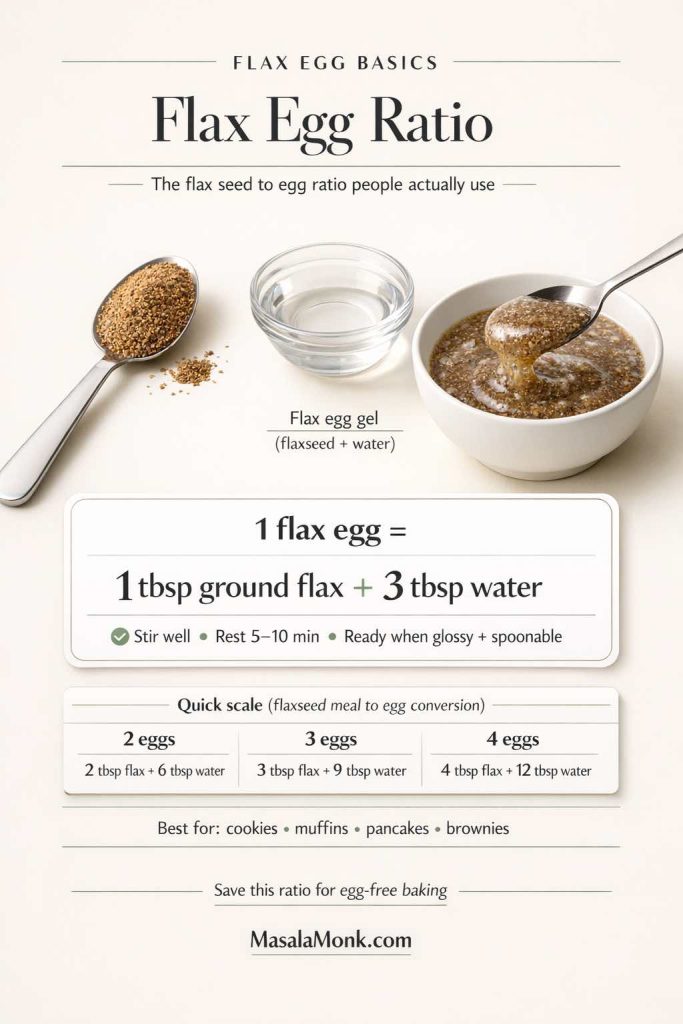
  • 1 flax egg = 1 tablespoon ground flaxseed + 3 tablespoons water
Vertical infographic titled “Flax Egg Ratio” showing a tablespoon of ground flax, a small bowl of water, and a bowl labeled “Flax egg gel (flaxseed + water)” with a spoon lift. It states: 1 flax egg = 1 tbsp ground flax + 3 tbsp water, with steps “stir well, rest 5–10 minutes, ready when glossy and spoonable.” A quick scale table shows conversions for 2 eggs (2 tbsp flax + 6 tbsp water), 3 eggs (3 tbsp flax + 9 tbsp water), and 4 eggs (4 tbsp flax + 12 tbsp water). It notes “Best for: cookies, muffins, pancakes, brownies” and includes MasalaMonk.com branding.
Save this flax egg ratio for fast egg-free baking: 1 flax egg = 1 tablespoon ground flaxseed + 3 tablespoons water (rest until glossy and spoonable). The quick scale makes it easy to convert 2, 3, or 4 eggs in a recipe, and it’s most reliable in cookies, muffins, pancakes, and brownies where eggs are mainly binding.

That’s the standard flax seed egg substitute ratio you’ll see repeated across many reputable sources. Healthline, for example, describes using 1 tablespoon ground flaxseed (or chia) with 3 tablespoons water as a replacement for one egg in baking. You can see that ratio in the ground flax/chia section of 13 Effective Substitutes for Eggs.

Minimalist Baker also teaches the same basic approach for how to make flax eggs for baking—mix, rest, then use in place of one egg—while noting that it isn’t a perfect 1:1 match for every recipe. That nuance is important, and it’s explained well in this post here.

Even so, baking isn’t only about ratios; it’s also about what the recipe needs from the egg. That’s why, beyond the classic ratio, it helps to think about how “tight” or “loose” your flax egg should be.

A useful tweak: the “tight gel” vs “looser gel” approach

Most of the time, 1:3 works perfectly. Still, if you’re making something that already spreads easily—certain cookies, for example—you may prefer a slightly tighter gel. Meanwhile, for muffins and quick breads where moisture is welcome, the classic ratio is ideal.

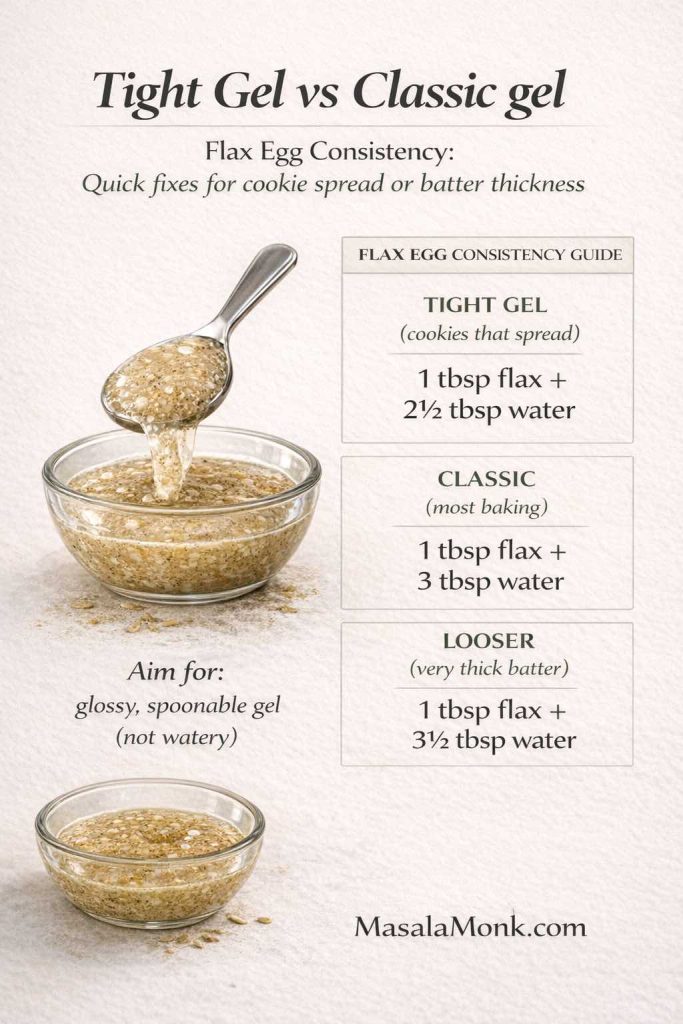
Vertical infographic titled “Tight Gel vs Classic Gel” explaining flax egg consistency for baking. It shows three flax egg ratios: tight gel for cookies that spread (1 tbsp flax + 2½ tbsp water), classic gel for most baking (1 tbsp flax + 3 tbsp water), and a looser mix for very thick batter (1 tbsp flax + 3½ tbsp water). Includes texture cue “glossy, spoonable gel” and MasalaMonk.com branding.
If your flax egg substitute is throwing off cookie spread or batter thickness, adjust the water—not the whole recipe. Use the tight gel ratio for spread-prone cookies, stick with the classic flax egg ratio for most baking, and only loosen the mix when the batter is unusually thick. Aim for a glossy, spoonable gel every time.

You don’t need to overcomplicate this. Just remember the direction:

  • For spread-prone cookies, use a slightly tighter gel: 1 tablespoon flax meal + 2½ tablespoons water.
  • For muffins and quick breads, stick with the classic: 1 tablespoon flax meal + 3 tablespoons water.
  • If your batter is unusually thick, loosen it gently: 1 tablespoon flax meal + 3½ tablespoons water.

That small shift is often enough to reduce cookie spread or keep a loaf from feeling heavy. No matter which version you choose, the goal is the same: a cohesive, spoonable gel—never watery.

Also Read: Ravioli Recipe Reinvented: 5 Indian-Inspired Twists on the Italian Classic


Flaxseed Meal to Egg Conversion (1 egg, 2 eggs, 3 eggs)

Once you’re comfortable with one flax egg, scaling becomes easy. Because it’s linear, you can multiply it without a calculator.

Flaxseed meal to egg conversion: quick scale

  • For 1 egg: 1 tablespoon flax meal + 3 tablespoons water
  • For 2 eggs: 2 tablespoons flax meal + 6 tablespoons water
  • For 3 eggs: 3 tablespoons flax meal + 9 tablespoons water

This is the flax egg conversion you’ll rely on most.

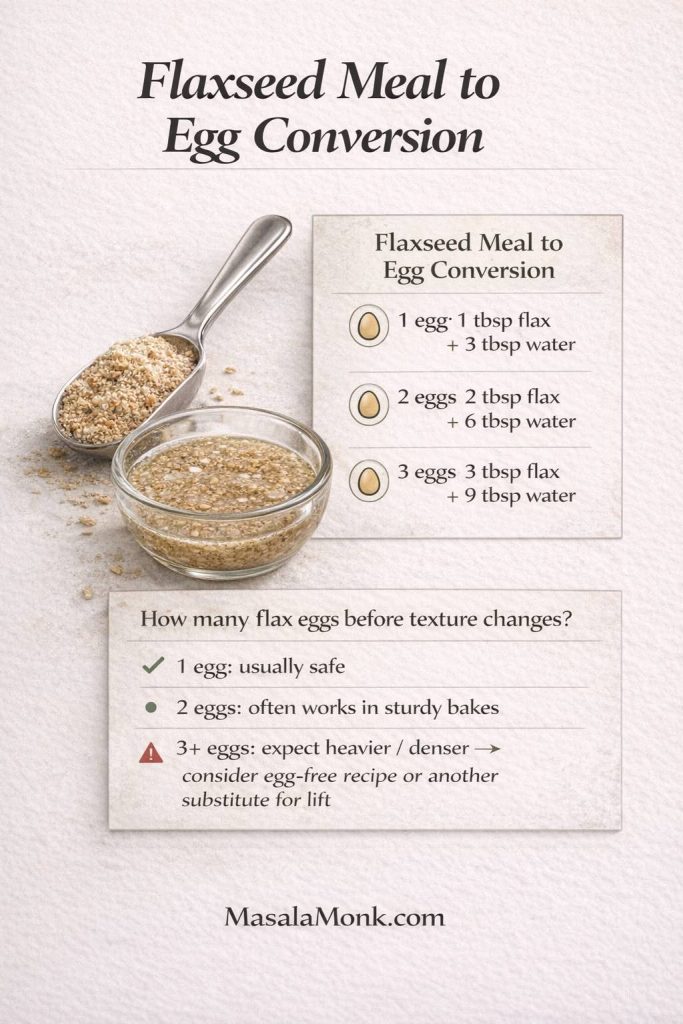
Photorealistic infographic titled “Flaxseed Meal to Egg Conversion” showing flax egg ratios for baking: 1 egg = 1 tbsp ground flaxseed + 3 tbsp water, 2 eggs = 2 tbsp flax + 6 tbsp water, and 3 eggs = 3 tbsp flax + 9 tbsp water. Includes guidance on how many flax eggs to use before texture changes: 1 egg usually safe, 2 eggs often works in sturdy bakes, 3+ eggs may turn heavier/denser.
Scaling a flax egg substitute is simple: use the classic flax egg ratio (1 tbsp ground flaxseed + 3 tbsp water per egg) and multiply for 2 or 3 eggs. This conversion guide also shows when texture can shift—replacing 1 egg is usually easy, 2 often works in sturdy bakes, and 3+ eggs may turn heavier unless the recipe is designed to be egg-free.

However, there’s a practical caution: the more eggs you replace, the more your baked good may drift away from the original texture. King Arthur Baking is direct about this: some egg-heavy recipes simply won’t behave the same with substitutions, and even in everyday bakes, the results depend on what the eggs were doing in the original formula. Their breakdown in Guide for substituting eggs is a helpful reality check.

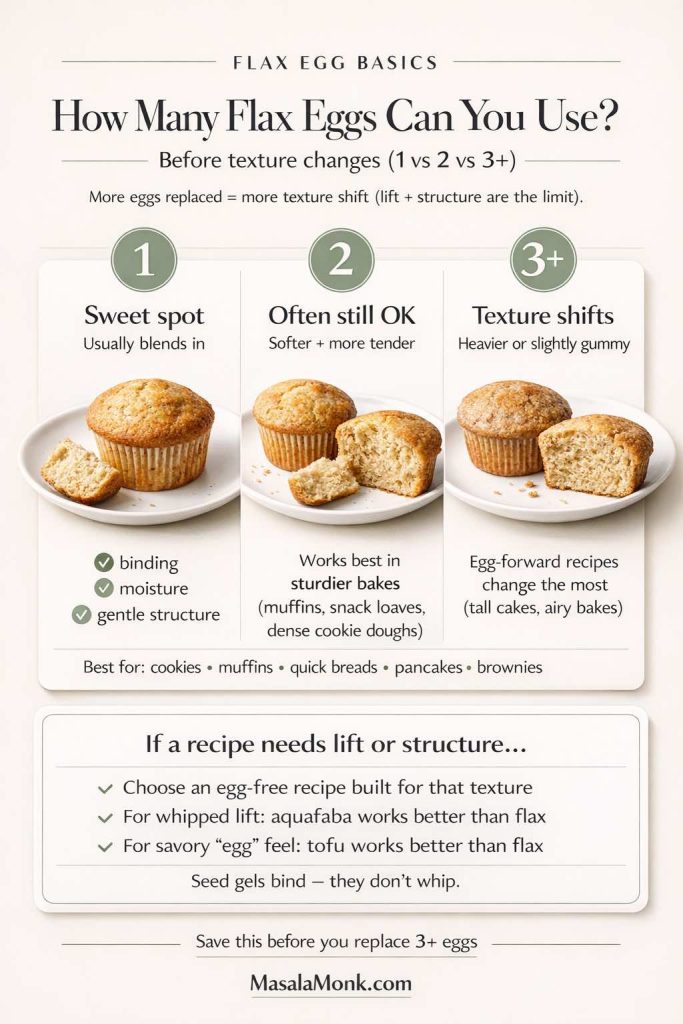
How many flax eggs can you use before texture changes?

Scaling the flaxseed meal to egg conversion is easy. Still, the results don’t always scale as neatly as the math. The more eggs you replace, the more likely the final texture shifts—especially in recipes where eggs were doing more than just binding.

Vertical infographic titled “How Many Flax Eggs Can You Use?” with a 1 vs 2 vs 3+ comparison before texture changes. It shows muffins on plates for each level: 1 flax egg is the sweet spot (usually blends in) supporting binding, moisture, and gentle structure; 2 flax eggs are often still OK (softer and more tender) best in sturdier bakes like muffins, snack loaves, and dense cookie doughs; 3+ flax eggs cause texture shifts (heavier or slightly gummy) especially in egg-forward recipes like tall cakes and airy bakes. A box suggests: choose egg-free recipes for structure, use aquafaba for whipped lift, and tofu for savory “egg” feel. “Seed gels bind — they don’t whip.” MasalaMonk.com footer.
Before you scale flax eggs, save this quick threshold guide. Replacing 1 egg with a flax egg is usually the sweet spot in cookies, muffins, quick breads, pancakes, and brownies. Two flax eggs often still work in sturdier bakes, but once you hit 3+ eggs, expect bigger texture changes—heavier or slightly gummy—because flax can bind and hold moisture, but it can’t replace lift and structure. For airy bakes, switch strategies (aquafaba for whipped lift, or choose an egg-free recipe built for that texture).
  • Replacing 1 egg: This is usually the sweet spot. In cookies, muffins, quick breads, pancakes, and brownies, one flax egg tends to blend in without drama.
  • Replacing 2 eggs: Often still successful in sturdier bakes, particularly muffins, snack cakes, and denser cookie doughs. The crumb may be a little more tender and moist, yet it should still feel “right” if the recipe isn’t egg-forward.
  • Replacing 3 eggs or more: This is where you’ll notice bigger changes. At that point, bakes can start to feel heavier or slightly gummy, not because flax is “bad,” but because it can’t replicate the lift and structure multiple eggs provide.

If a recipe calls for several eggs and the texture matters—think tall cakes or anything meant to be airy—your best bet is either choosing an egg-free recipe built for that style or switching to a different substitute that matches the job the eggs were doing.

Also Read: Oat Pancakes Recipe (Healthy Oatmeal Pancakes)


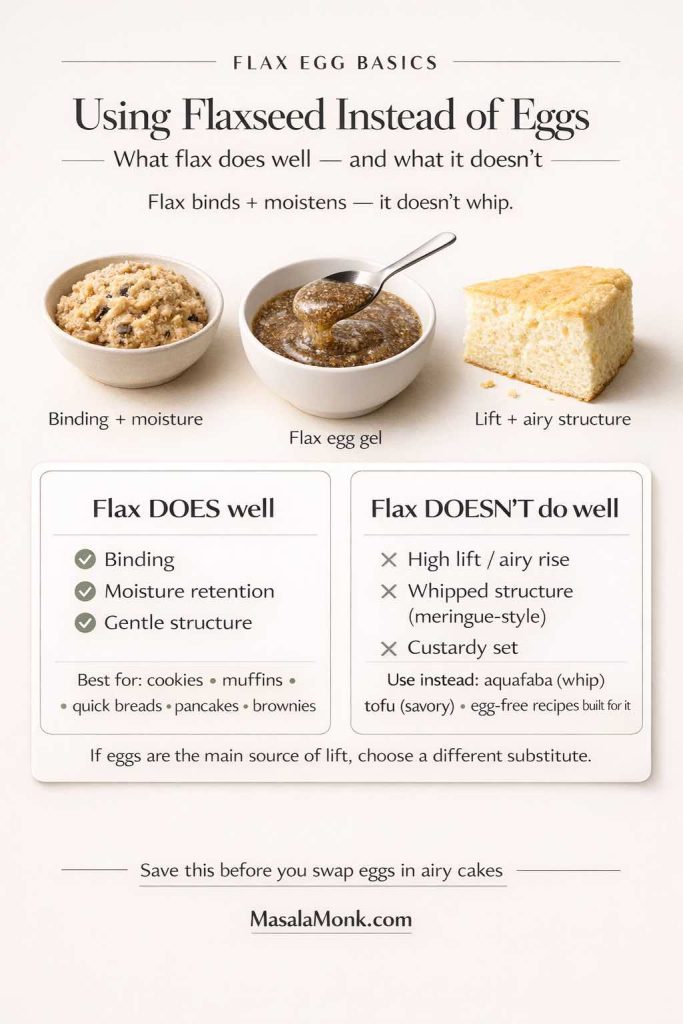
Using Flaxseed Instead of Eggs (what flax does well, and what it doesn’t)

The reason flax works as an egg substitute ground flaxseed method is simple: when hydrated, it becomes gel-like. That gel helps hold ingredients together and keeps moisture in the bake.

Vertical infographic titled “Using Flaxseed Instead of Eggs” with the subtitle “What flax does well — and what it doesn’t” and the line “Flax binds + moistens — it doesn’t whip.” It shows three photos: a bowl labeled “Binding + moisture,” a bowl of “Flax egg gel” with a spoon lift, and a cake slice labeled “Lift + airy structure.” Two cards explain: flax does well for binding, moisture retention, and gentle structure (best for cookies, muffins, quick breads, pancakes, brownies). Flax doesn’t do well for high lift/airy rise, whipped structure, or custardy set; use aquafaba for whipping, tofu for savory, or egg-free recipes built for that texture. MasalaMonk.com footer.
Using flaxseed instead of eggs works best when eggs are mainly acting as a binder. This quick guide shows the “egg jobs” flax can handle—binding and moisture retention—and what it can’t replicate, like airy lift, whipped structure, or a custardy set. When you need lift, switch to a better match (aquafaba for whipped bakes) or choose an egg-free recipe built for the texture you want.

Yet eggs are not just “one job.” Eggs can bind, emulsify, add moisture, contribute structure, and help with lift depending on the recipe. Consequently, no single substitute perfectly replaces every egg function in every context. Because of that, the best substitute changes from recipe to recipe. If you enjoy that practical way of thinking, Eater’s guide from vegan pastry chefs explains how to match substitutes to the job eggs were doing.

Now, here’s the practical translation:

  • Flax excels at binding and moisture
  • Flax is weaker at adding lift and airy structure

So, when you’re looking for a flaxseed egg substitute baking solution, flax is best in recipes where eggs are not the main source of volume.

Also Read: Keto Flour: Guide to Low-Carb Flours That Bakes Like the Real Thing


Baking With Flax Eggs (what works best, and why)

A flax egg can be surprisingly “invisible” in the right recipe. On the other hand, it can be noticeably dense or gummy in the wrong one. Let’s talk about where it usually performs beautifully.

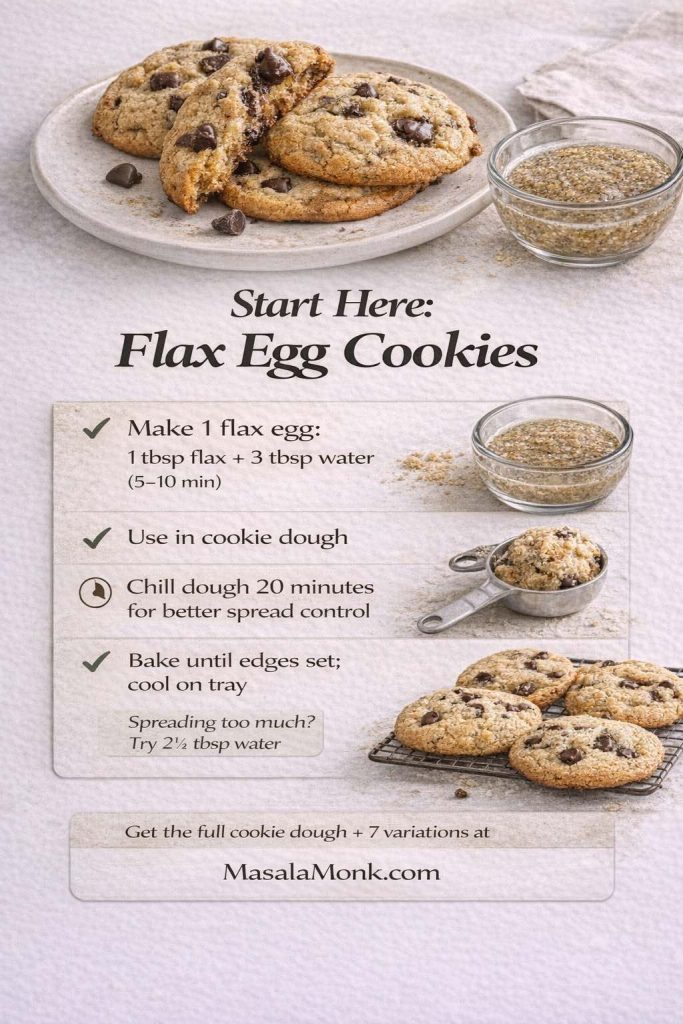
Flax egg for cookies (one of the best use cases)

If you’re specifically wondering about a flax egg for cookies, you’re in luck. Cookies tend to benefit from binding and moisture; they don’t usually require eggs to create high lift.

Serious Eats tested multiple egg substitutes in cookies, muffins, and pancakes and found that flaxseed stood out particularly in cookies, delivering a chewy texture and a result that didn’t taste obviously “substituted.” That outcome is part of the testing roundup in Out of eggs? The best replacement might already be in your pantry.

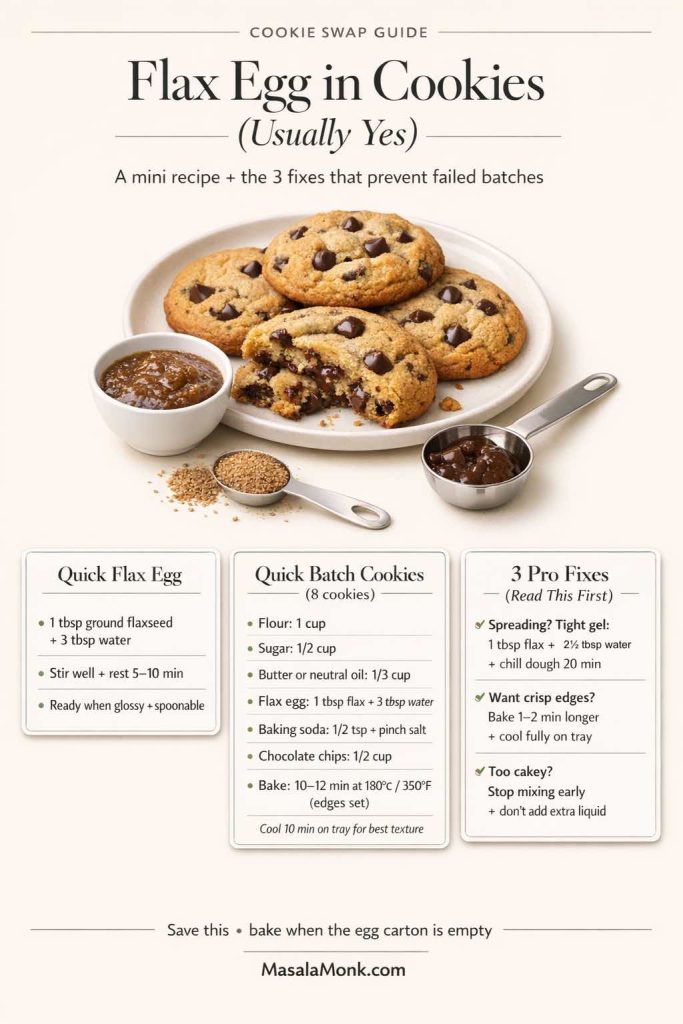
Photorealistic vertical recipe-card infographic titled “Start Here: Flax Egg Cookies” showing chocolate chip cookies and a bowl of flax egg gel. It explains how to make 1 flax egg (1 tbsp ground flaxseed + 3 tbsp water, rest 5–10 minutes), use it in cookie dough, chill dough 20 minutes for better spread control, and bake until edges are set then cool on the tray. Includes tip: “spreading too much? try 2½ tbsp water” and MasalaMonk.com branding.
New to baking with flax eggs? Start with cookies—flax is an excellent egg substitute for binding and chew. Make 1 flax egg (1 tbsp ground flaxseed + 3 tbsp water), let it gel, then chill the dough briefly for better spread control. This quick guide shows the simplest way to get reliable flax egg cookies, plus a small tweak if your dough spreads too much.

If you want to see flax eggs at their best, start with cookies. In many doughs, the swap gives you a cohesive mix and a pleasantly chewy bite—without making the cookie taste “egg-free.” For a flexible base you can riff on, try Double Chocolate Chip Cookies Recipe – One Dough, 7 Ways and use a flax egg in place of one egg in the base dough.

As you bake cookies with flax eggs, a few patterns tend to show up:

  • The texture often leans chewier rather than ultra-crisp
  • The dough may feel slightly softer at first
  • The cookies can benefit from a brief rest so the flour hydrates

Instead of fighting those traits, work with them. If you want crispness, you can often adjust bake time, sugar ratios, or resting/chilling. Still, the easiest win is choosing cookie styles where chew is the goal.

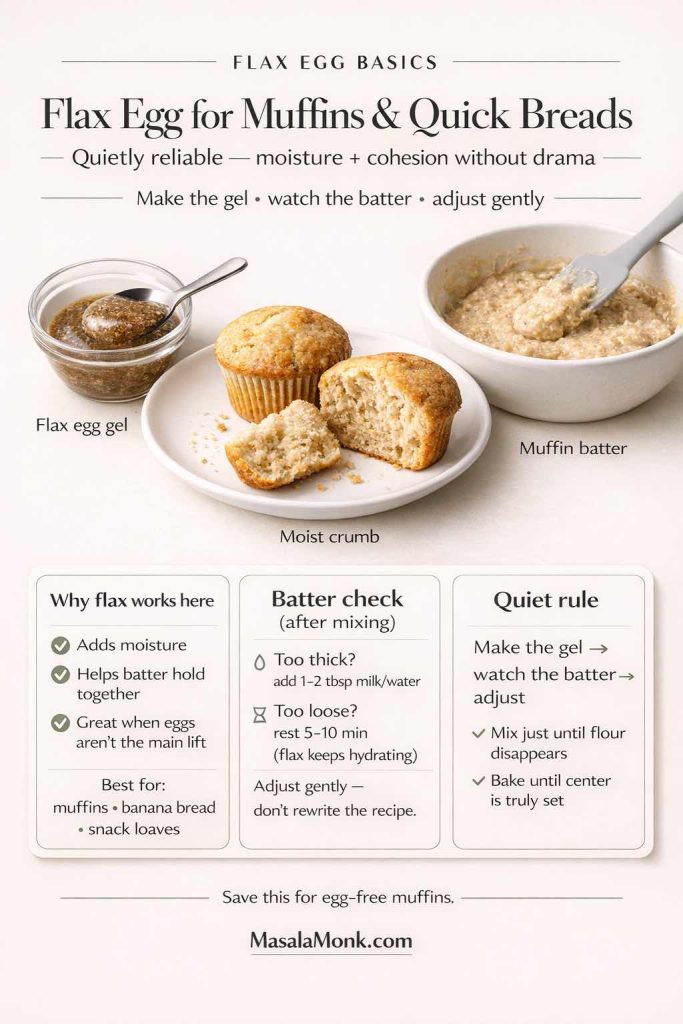
Flax egg for muffins and quick breads (quietly reliable)

Muffins, banana-style quick breads, and snack loaves are where flax eggs often feel effortless. These bakes typically want moisture and cohesion, and flax provides both.

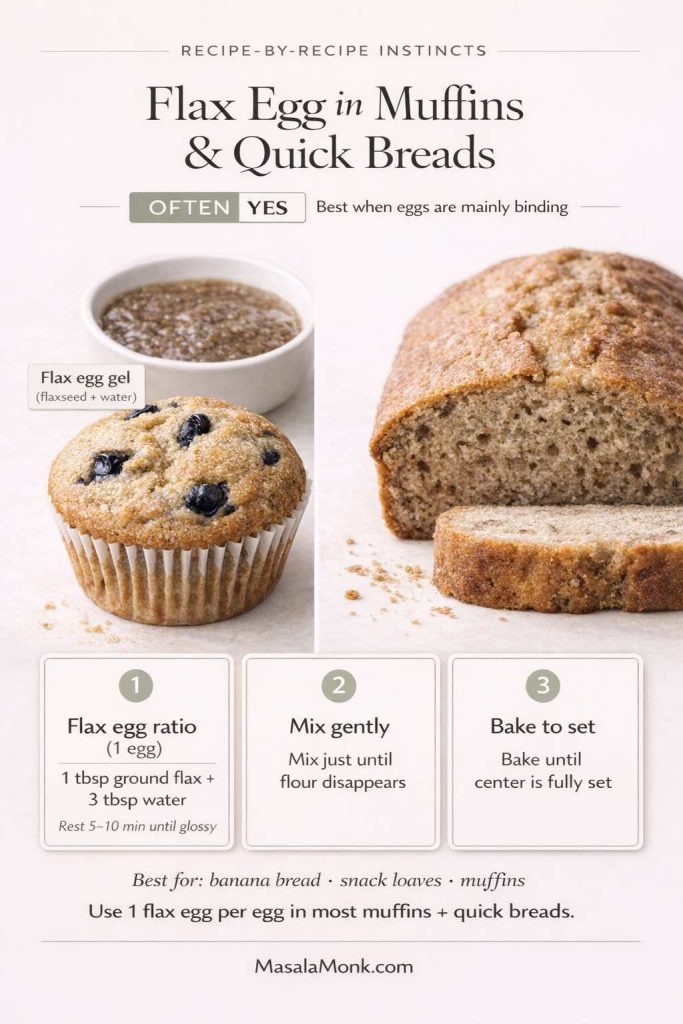
Vertical infographic titled “Flax Egg for Muffins & Quick Breads” with the subtitle “Quietly reliable — moisture + cohesion without drama.” It shows a bowl labeled “Flax egg gel” with a spoon, a plate with muffins (one cut open) labeled “Moist crumb,” and a bowl labeled “Muffin batter.” Three cards explain: why flax works (adds moisture, helps batter hold together, best when eggs aren’t the main lift); a batter check (if too thick add 1–2 tbsp milk or water, if too loose rest 5–10 minutes as flax hydrates); and a “quiet rule” (make the gel, watch the batter, adjust; mix just until flour disappears; bake until center is truly set). MasalaMonk.com footer.
Flax egg for muffins and quick breads is one of the easiest egg swaps because these bakes mainly need moisture and cohesion—not whipped lift. Use this batter-check guide right after mixing: if the batter feels too thick, add 1–2 tablespoons milk/water; if it feels loose, rest 5–10 minutes so the flax gel keeps hydrating. Then keep it simple—mix only until the flour disappears and bake until the center is truly set for a reliably tender, moist crumb.

Moreover, quick breads are usually forgiving. If your batter is slightly thicker than expected, you can add a splash of the recipe’s liquid. Conversely, if it’s looser, give it a minute—flax continues to hydrate, and batters often thicken slightly as they sit.

At this point, it’s worth repeating a helpful mindset: don’t treat flax eggs like a lab experiment. Make the gel, watch the batter, then adjust gently.

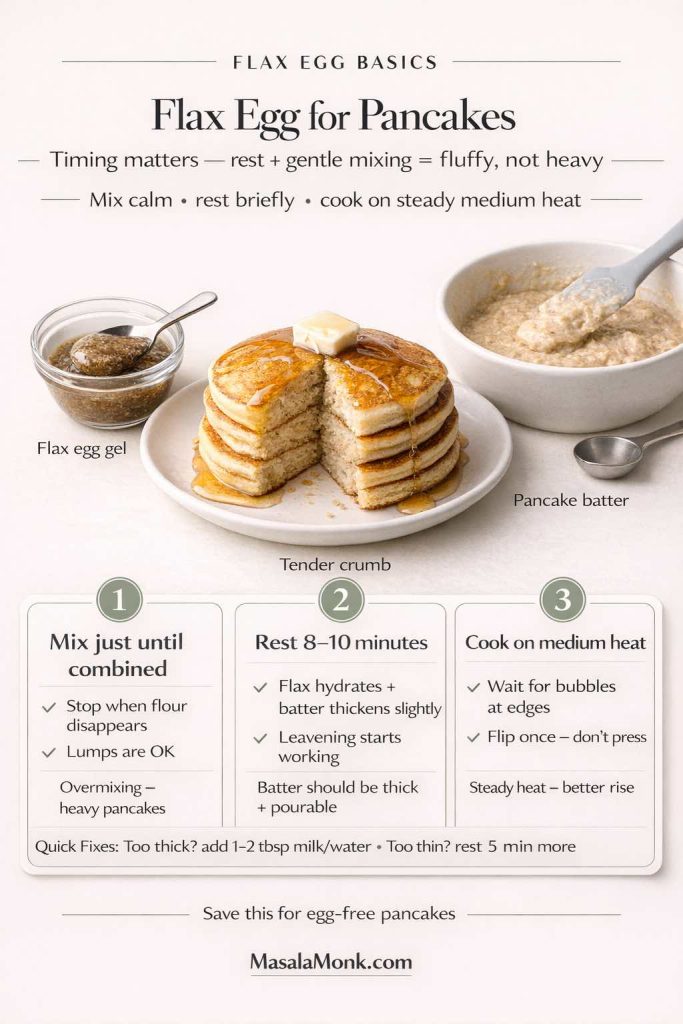
Flax egg for pancakes (and why timing matters)

Pancakes are another common destination for flax eggs. The gel helps bind, while the batter’s chemistry (baking powder or baking soda) still delivers lift. Even so, pancakes can swing from fluffy to dense depending on how they’re mixed and rested. So, if you’re using flaxseed instead of eggs, it helps to keep the batter calm:

  • Mix until just combined
  • Rest the batter briefly so the flour hydrates
  • Cook on a steady, medium heat
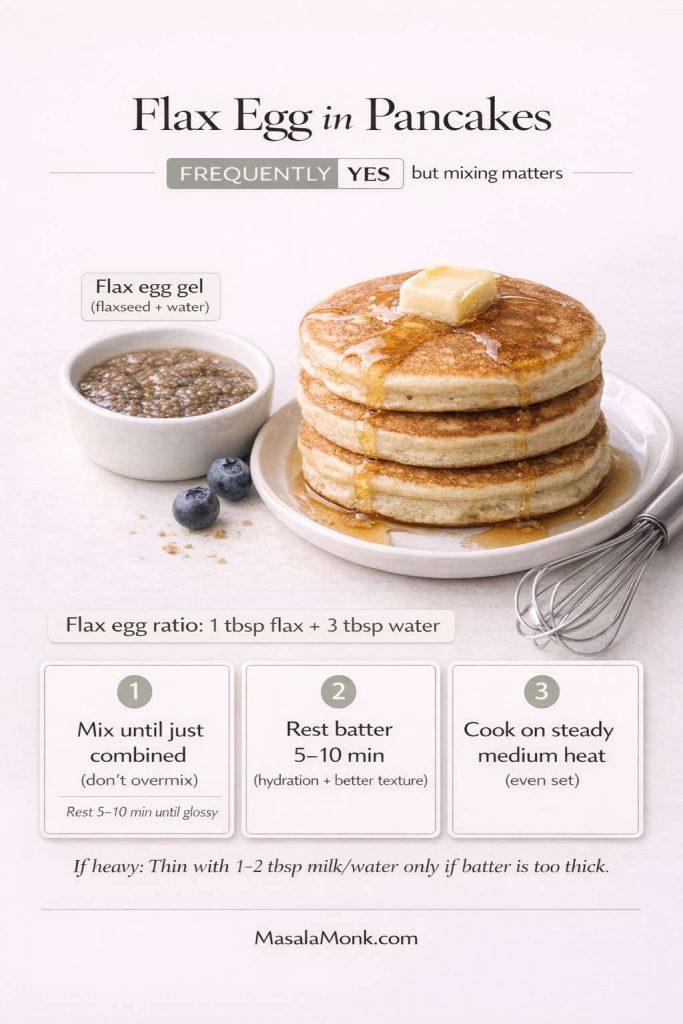
Vertical infographic titled “Flax Egg for Pancakes” with the subtitle “Timing matters — rest + gentle mixing = fluffy, not heavy.” It shows a bowl labeled “Flax egg gel,” a stack of pancakes with a slice removed labeled “Tender crumb,” and a bowl labeled “Pancake batter.” Three numbered cards say: 1) Mix just until combined (stop when flour disappears, lumps are OK; overmixing makes heavy pancakes). 2) Rest 8–10 minutes (flax hydrates and batter thickens slightly; leavening starts working; batter should be thick and pourable). 3) Cook on medium heat (wait for bubbles at edges; flip once, don’t press; steady heat gives better rise). Quick fixes note: too thick add 1–2 tbsp milk/water; too thin rest 5 minutes more. MasalaMonk.com footer.
Flax egg for pancakes works best when you treat it like a timing swap, not just an ingredient swap. Mix only until the flour disappears (lumps are fine), then rest the batter 8–10 minutes so the flax egg gel hydrates and the leavening starts working. Finally, cook on steady medium heat and flip once—no pressing—so you get a tender crumb that’s fluffy instead of heavy.

Once you’re comfortable swapping eggs in pancakes, it’s worth trying sturdier batters that benefit from extra binding. Millet-based pancakes, for instance, pair well with a flax egg because the gel helps the batter hold together while still cooking up tender. If you’d like a solid recipe to start with, make Healthy Millet Protein Packed Pancakes and replace the egg with a flax egg.

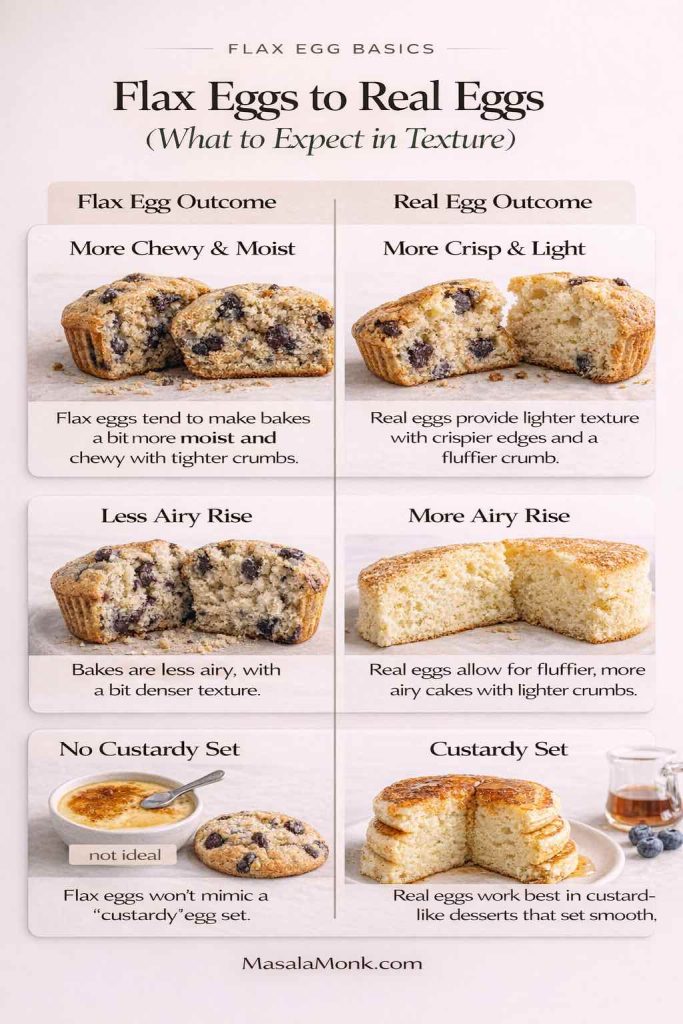
Flax eggs to real eggs (what to expect in texture)

Many people want flax eggs to behave exactly like eggs. Sometimes the match is close. Other times, the difference is obvious. Rather than promising perfection, it’s better to know what you’re trading.

Photorealistic infographic titled “Flax Eggs to Real Eggs (What to Expect in Texture)” comparing baking results. Left column shows flax egg outcome: more chewy and moist, less airy rise, and no custardy set. Right column shows real egg outcome: more crisp and light, more airy rise, and custardy set. Includes photos of muffins, cake, and custard-style desserts plus MasalaMonk.com branding.
A flax egg substitute doesn’t bake exactly like a real egg—and that’s okay once you know what to expect. This texture guide shows the most common differences: flax eggs tend to create a slightly chewier, moister crumb with less airy rise, while real eggs give lighter lift and can create a custardy set in certain desserts.

In general:

  • Flax eggs tend to give a slightly more tender, moist crumb
  • They can produce a bit more density than eggs in airy bakes
  • They rarely create the same “egg set” feel you get in custardy textures

Therefore, the best results come from using flax eggs in recipes where eggs are primarily binders, not the backbone.

Also Read: 10 Vegetarian And High Protein Meal Prep Ideas from Indian Cuisine


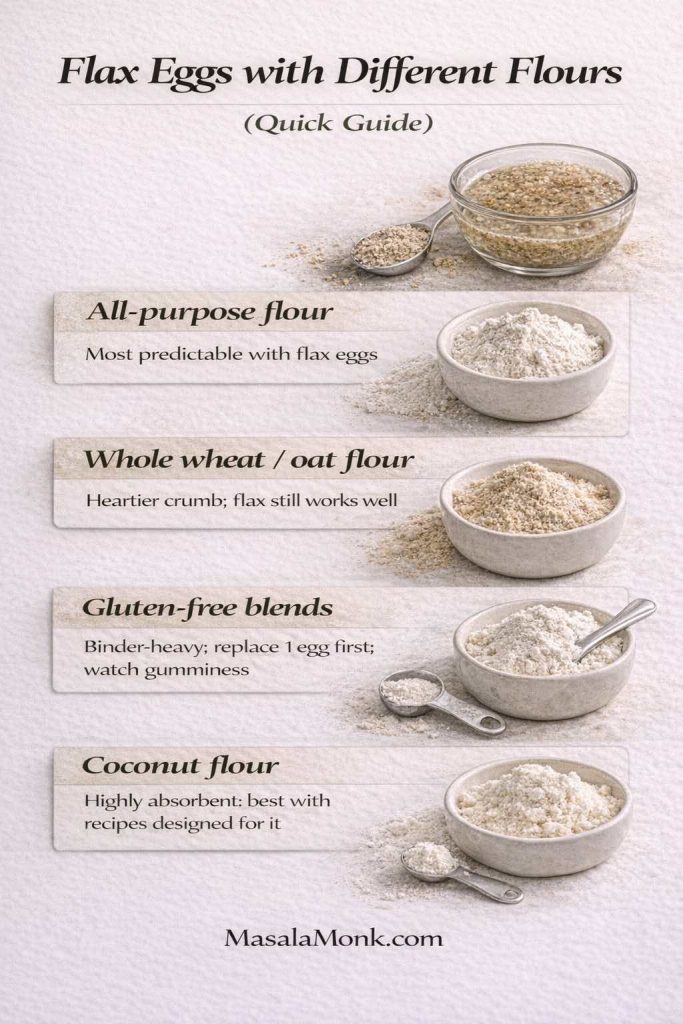
Flax eggs with different flours (why results vary)

Even with the right flax egg ratio, flour choice can change the outcome. That’s because some flours absorb more water, while others rely on extra binders for structure.

Photorealistic infographic titled “Flax Eggs with Different Flours (Quick Guide)” showing how flax eggs behave with common flours: all-purpose flour (most predictable), whole wheat or oat flour (heartier crumb), gluten-free blends (binder-heavy; replace 1 egg first and watch gumminess), and coconut flour (highly absorbent; best with recipes designed for it). Includes a bowl of flax egg gel and MasalaMonk.com branding.
Flax eggs don’t behave the same with every flour. Use this quick guide to choose the best flour match for a flax egg substitute—most predictable with all-purpose flour, a heartier crumb with whole wheat or oat flour, extra caution with binder-heavy gluten-free blends, and coconut flour only when the recipe is built for its high absorption.
  • All-purpose flour: Flax eggs are typically most predictable here, especially in cookies, muffins, and quick breads.
  • Whole wheat and oat flour: Expect a slightly heartier crumb. Flax usually still works well, yet you may notice a bit more density—especially if the recipe already leans “sturdy.”
  • Gluten-free blends: Many gluten-free mixes already include binders and starches. Adding flax can sometimes tip the texture toward heavier or a little gummy, so it’s smart to start by replacing only one egg and see how the batter behaves.
  • Coconut flour: This flour drinks liquid aggressively. A flax egg may not provide enough structure on its own, and the batter can swing from thick to dry quickly. For coconut-flour baking, you’ll usually get the best result from recipes designed specifically for that flour rather than trying a simple swap.

The takeaway is simple: when flours are highly absorbent or binder-heavy, flax eggs may need a lighter hand—or a recipe that’s already built for egg-free structure.

Also Read: Fish and Chips Reimagined: 5 Indian Twists (Recipe + Method)


Egg Substitute Ground Flaxseed: choosing the best flax meal (and why freshness matters)

A flax egg is easy, but the flax itself can make or break it.

Ground flax vs whole flax (and why it matters)

Ground flax hydrates quickly and forms the gel you need. Whole flax often doesn’t, at least not in a way that works as an egg replacer.

From a nutrition standpoint, Mayo Clinic recommends ground flax because it’s easier to digest; from a baking standpoint, ground flax is also what gives you reliable gelling. That point is covered succinctly in Flaxseed: Is ground better than whole?.

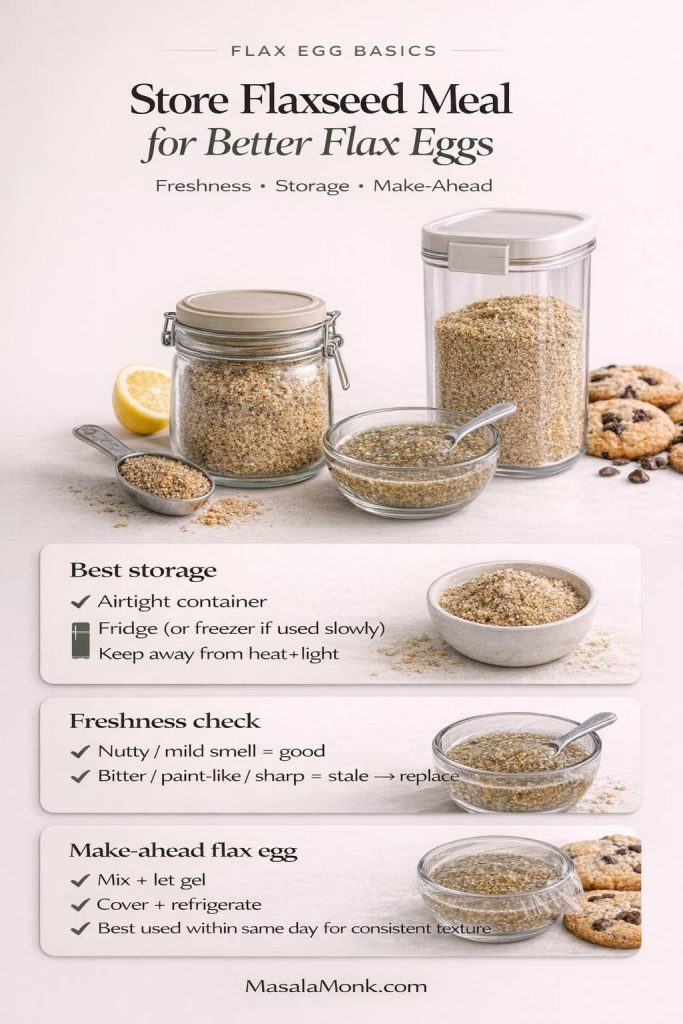
Storage is a real issue (because ground flax can go stale)

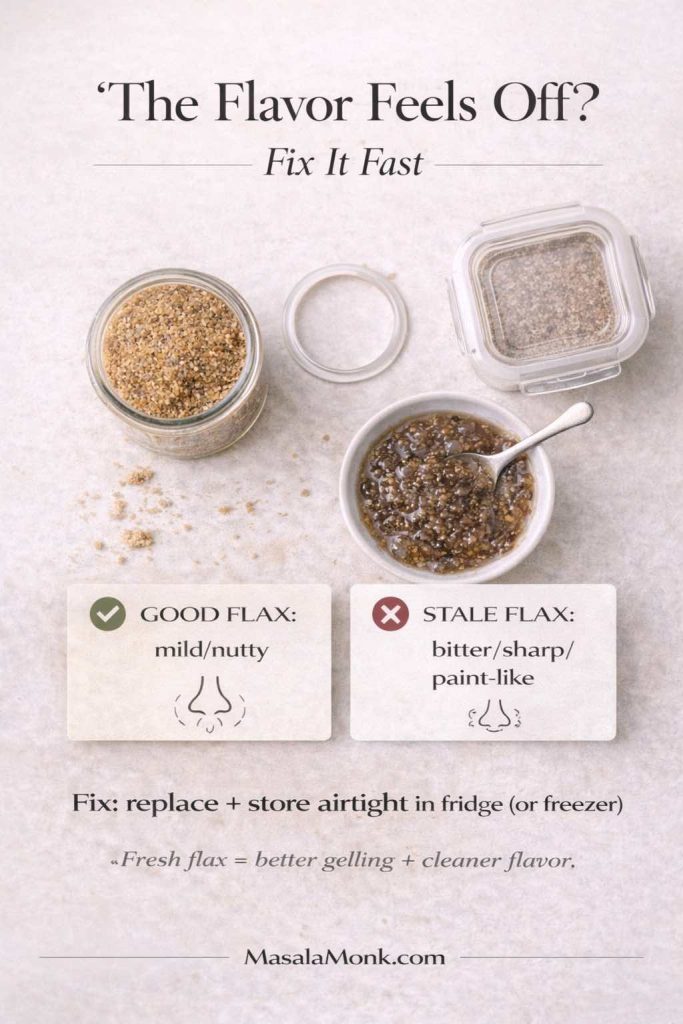
Ground flax has more exposed surface area, which means it can spoil faster than whole seeds. If your flax smells bitter, paint-like, or unpleasantly sharp, it’s not going to improve your cookies.

Photorealistic infographic titled “Store Flaxseed Meal for Better Flax Eggs” showing a jar and airtight container of ground flaxseed meal, a bowl of flax egg gel, measuring spoon, and cookies as a baking cue. It explains best storage (airtight container; fridge or freezer; keep away from heat and light), a freshness smell check (nutty/mild is good; bitter/paint-like/sharp means stale), and make-ahead flax egg tips (mix and let gel; cover and refrigerate; best used the same day). MasalaMonk.com branding.
Fresh flax makes a better flax egg substitute. Use this storage guide to keep ground flaxseed meal tasting clean and gelling reliably: store it airtight in the fridge (or freezer), use the quick smell test to spot stale flax, and if you prep a make-ahead flax egg, refrigerate it and use it the same day for the most consistent baking results—especially for cookies and quick breads.

Mayo Clinic Health System notes practical storage guidance for flaxseed meal—keeping it refrigerated in an airtight container to prevent spoiling—in Flaxseed is nutritionally powerful.

That’s not meant to scare you. It’s simply the difference between a flax egg that disappears into the bake and one that leaves a lingering bitter aftertaste.

Also Read: Dirty Martini Recipe (Classic, Extra Dirty, No Vermouth, Spicy, Blue Cheese, Tequila + Batched)


Flaxseed Egg Substitute Baking: why your results vary (and how to make them consistent)

If you’ve tried flax eggs once and felt underwhelmed, it usually comes down to one of three things:

  1. the flax didn’t gel properly
  2. the recipe needed lift rather than binding
  3. too many eggs were replaced in a recipe that depends on eggs for structure

Instead of guessing, you can diagnose your result and adjust.

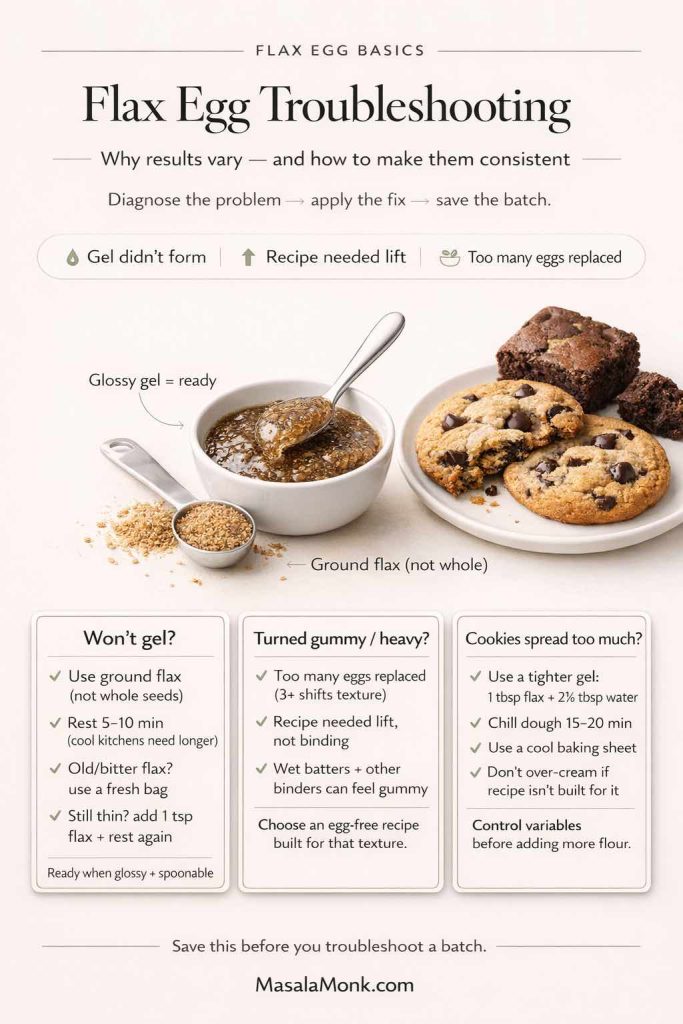
Vertical infographic titled “Flax Egg Troubleshooting: Why results vary — and how to make them consistent.” It shows a bowl of glossy flax egg gel with a spoon lift, a measuring spoon of ground flax labeled “Ground flax (not whole),” and a plate with cookies and brownie pieces. A strip lists three causes: gel didn’t form, recipe needed lift, too many eggs replaced. Three cards provide fixes: “Won’t gel?” (use ground flax, rest 5–10 min, use fresh flax, add 1 tsp flax and rest again), “Turned gummy/heavy?” (too many eggs replaced, recipe needed lift, wet batters/other binders), and “Cookies spread too much?” (tighter gel 1 tbsp flax + 2½ tbsp water, chill dough 15–20 min, cool baking sheet, don’t over-cream). Footer reads MasalaMonk.com.
If flaxseed egg substitute baking ever goes sideways, this cheat sheet saves the batch. First, confirm you’re using ground flax (not whole seeds) and wait for a glossy, spoonable gel. Next, match the fix to the problem: thin gel usually needs more time (or fresher flax), gummy/heavy bakes often mean you replaced too many eggs or the recipe needed lift, and spreading cookies usually improve with a tighter flax egg ratio plus a short chill. Save this as your quick “diagnose → fix” guide for flax eggs.

If your flax egg won’t gel

This is common, yet fixable.

  • If you used whole seeds, grind them and try again.
  • If your flax is old, try a fresher bag.
  • If you didn’t wait long enough, give it a few more minutes.
  • If it’s still thin, stir in a little extra ground flax and rest again.

Even with the same flax egg ratio, the gel can vary depending on how finely the flax is ground. A finer meal thickens faster, while a coarser grind may need a little extra time to hydrate. If you’d like another baked example where flax swaps in smoothly, see Wholewheat Carrot Orange Tea Cake.

If your bake turned gummy

Gumminess often happens when flax is asked to do too much—especially when replacing multiple eggs or when the recipe already has other gel-formers (certain gluten-free blends, heavy starches, or very wet batters).

At that point, switching strategies is often wiser than forcing the swap. King Arthur’s substitution guide is helpful because it gives you multiple options and also explains when egg substitutions simply won’t deliver the intended results. That perspective is in Guide for substituting eggs.

Eater’s pastry-chef framing adds another layer: sometimes recipe reformulation makes more sense than substitution, because you can adjust leavening, acid, and structure intentionally rather than trying to mimic an egg in a context where eggs do too much. That discussion is in Of course you can bake without eggs. Vegan pastry chefs tell us how.

If your cookies spread too much

When cookies spread, most people assume they need more flour. Occasionally that’s true, although it’s not the only solution.

Instead, try these gentle adjustments:

  • Use a slightly tighter flax gel (a bit less water)
  • Chill the dough briefly
  • Ensure your baking sheet isn’t warm
  • Don’t over-cream fat and sugar if the recipe isn’t built for it

In other words, control the variables that affect spread before you start changing the recipe’s foundation.

Also Read: Keto Hot Chocolate Recipe (Sugar-Free Hot Cocoa) + Best Homemade Mix


Vegan Egg Substitute Flaxseed: when flax is the right choice—and when it isn’t

Flax is a strong vegan egg substitute because it’s easy, cheap, and consistent when used appropriately. Still, it isn’t the universal answer.

When flax is a great vegan egg substitute

Choose flax when the recipe needs:

  • binding
  • moisture retention
  • gentle structure

That’s why flax eggs are so popular for cookies, muffins, pancakes, and brownies.

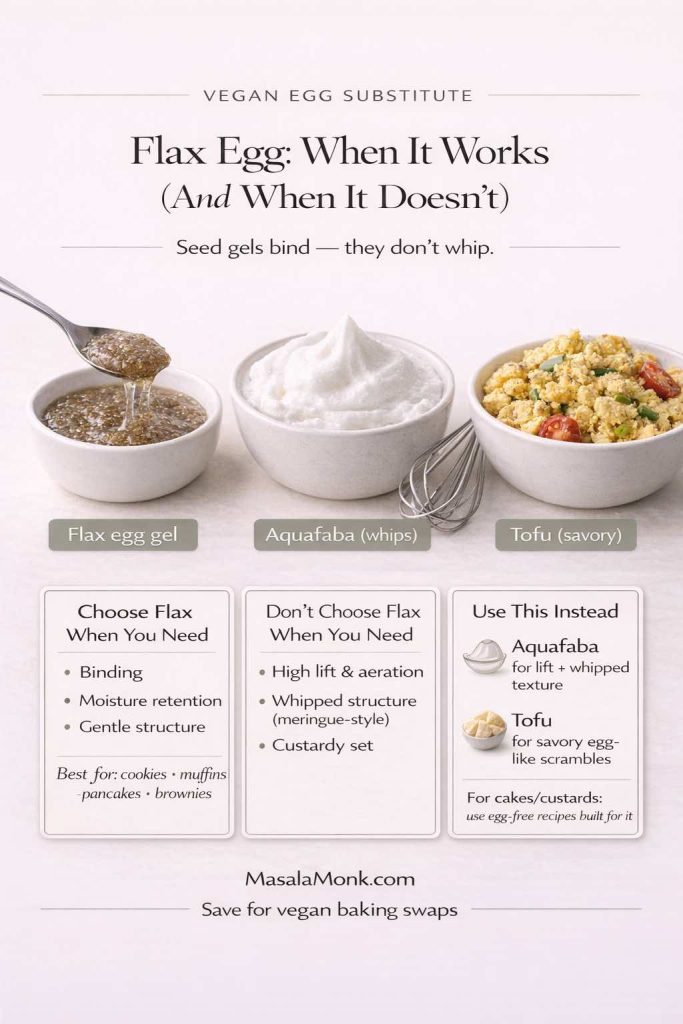
Vertical infographic titled “Flax Egg: When It Works (And When It Doesn’t)” with the line “Seed gels bind — they don’t whip.” It shows three labeled bowls: flax egg gel, aquafaba (whips), and tofu (savory). Three cards explain: choose flax for binding, moisture retention, and gentle structure (best for cookies, muffins, pancakes, brownies); don’t choose flax for high lift/aeration, whipped structure, or custardy set; use aquafaba for lift and whipped texture, and tofu for savory egg-like scrambles. MasalaMonk.com footer.
Wondering when a flax egg is the right vegan egg substitute? Save this quick decision guide: flaxseed “eggs” are best when you need binding and moisture (cookies, muffins, pancakes, brownies), but they won’t create lift or whipped structure. For airy bakes, aquafaba is usually the better choice; for savory breakfast swaps, tofu gives a more satisfying egg-like texture.

When you should use a different egg substitute

Choose something else when the recipe needs:

  • high lift and aeration
  • whipped structure (like meringues)
  • a custardy set

If you want a fast way to remember this: seed gels bind, but they don’t whip.

When a recipe needs lift—think lighter cakes or anything that benefits from a whipped, airy structure—a seed gel won’t deliver the same result. In those cases, aquafaba (the liquid from cooked chickpeas or a can of chickpeas) is often the better option because it can be whipped and folded in like egg whites.

Flax eggs shine in baking-style mixtures—batters, doughs, and quick breads. On the other hand, if you’re craving a savory breakfast where you’d normally scramble eggs, tofu is usually the better choice because it can be seasoned and cooked into a satisfying egg-like texture. If you want ideas that go beyond baking, start with ‘Tofu’ Instead of ‘Eggs’: 5 High Protein Plant-Based Breakfast Ideas.

Also Read: Garlic & Paprika Cabbage Rolls (Keto-Friendly Recipes) – 5 Bold Savory Twists


Substitute for Flax Egg (when you don’t have flaxseed)

Eventually, you’ll run into the exact opposite problem: you want to bake egg-free, but the flax jar is empty. Luckily, you have options.

A close cousin: chia seed “egg”

Chia works in a similar way to flax because it gels when hydrated. However, it can behave differently in texture, sometimes creating denser or crunchier results depending on the recipe.

Serious Eats’ testing found chia produced denser outcomes in certain bakes compared to flax, which is a useful heads-up if you’re aiming for a soft crumb. That comparison appears in Out of eggs? The best replacement might already be in your pantry.

If you keep chia seeds around as well, they’re useful far beyond baking—think meal prep puddings, overnight oats, and quick add-ins for smoothies. For simple ideas that make chia easy to use week to week, check out The Power of Chia Seeds: 5 Plant-Based High-Protein Meal Prep Ideas.

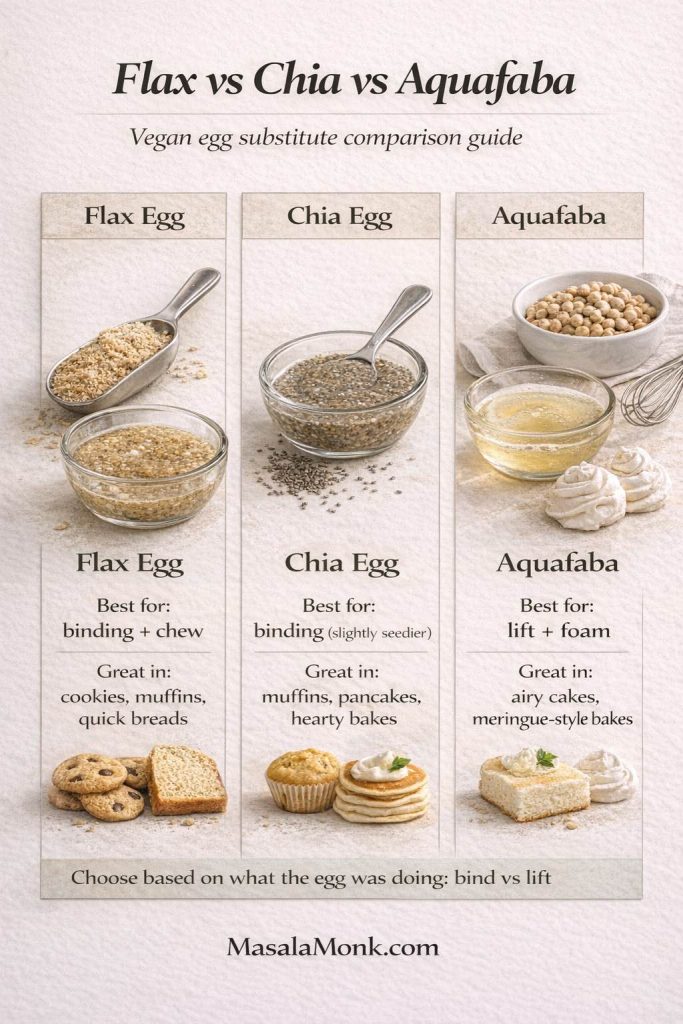
Photorealistic infographic titled “Flax vs Chia vs Aquafaba” comparing vegan egg substitutes. It shows flax egg as best for binding and chew (cookies, muffins, quick breads), chia egg as best for binding with a slightly seedier texture (muffins, pancakes, hearty bakes), and aquafaba as best for lift and foam (airy cakes, meringue-style bakes). Includes a reminder to choose based on whether the recipe needs binding or lift and MasalaMonk.com branding.
Not sure what to use when you’re out of eggs—or when flax isn’t the best fit? This quick vegan egg substitute guide compares flax egg, chia egg, and aquafaba so you can choose the right egg replacement for baking: flax and chia for binding, and aquafaba when you need lift and foam.

When you’re not trying to be “neutral”: fruit purées and other options

Sometimes you don’t need an egg substitute that disappears. Instead, you want moisture + softness, and you’re totally fine if the swap brings a little personality with it. That’s where fruit purées shine.

Quick rule of thumb: what fruit purées actually replace

Fruit purées are best when the egg’s job is mostly moisture and tenderness, not lift. In other words, they can help keep bakes soft and cohesive, yet they won’t give you the same airy structure eggs can.

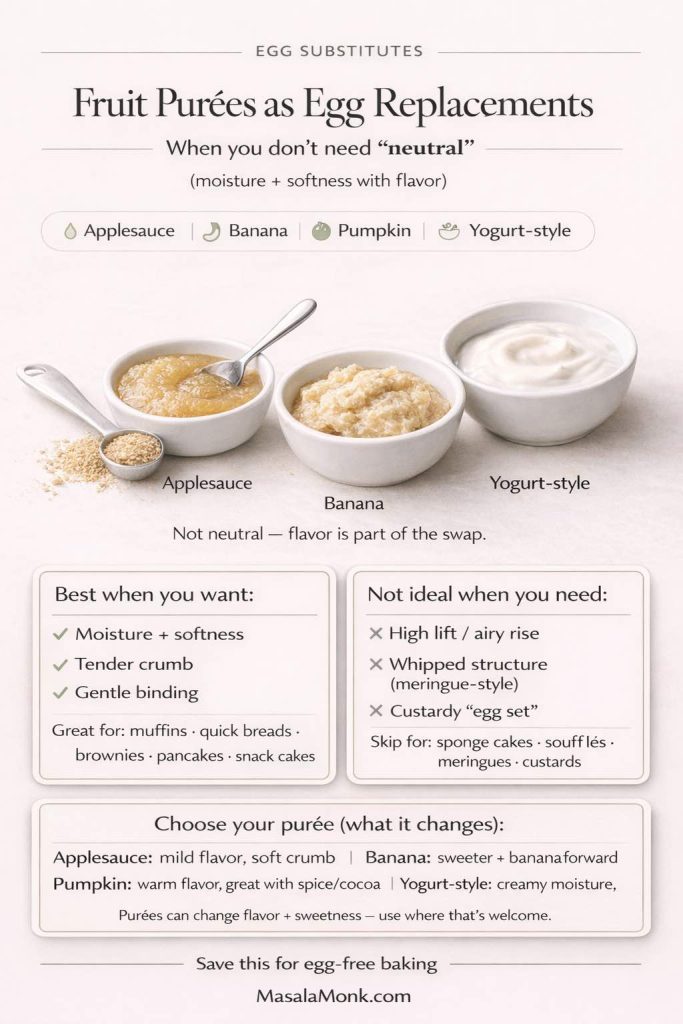
Fruit purées as egg replacements infographic showing applesauce, mashed banana, pumpkin purée, and yogurt-style substitute, plus when to use them for moisture and softness and when not to (lift, whipped structure, custardy set).
Out of eggs—or just not chasing “neutral”? This cheat-sheet shows when fruit purées make the best egg substitute (moisture + softness) and when they won’t work (lift, whipped structure, custardy set). Use it to choose between applesauce, banana, pumpkin purée, or a yogurt-style swap based on the bake you’re making.

Best picks (and what each one changes)

  • Applesauce: Mild flavor, adds moisture, keeps crumb tender. Great when you want the swap to stay relatively subtle.
  • Mashed banana: Stronger flavor and aroma, adds sweetness, can make bakes taste “banana-forward.” Use when that’s a plus.
  • Pumpkin purée: Moisture + gentle structure with a warm, earthy flavor. Works beautifully with spices, cocoa, and autumn-style bakes.
  • Yogurt-style substitutes: Creamy moisture and richness; tends to keep cakes and muffins soft. (If you’re keeping it vegan, use plant-based yogurt.)

Where they work best

Because they change flavor and sweetness, fruit purées are most reliable in bakes that welcome that shift: muffins, snack cakes, quick breads, brownies, pancakes, and spiced loaves.

On the other hand, if a recipe is meant to be light and airy—or the egg is doing major structure work—these swaps can turn the texture heavier than you wanted. In that case, flax egg, aquafaba, or an egg-free recipe designed for the result will usually be a better fit.

A practical alternative mindset: different substitutes for different “egg jobs”

Not every egg substitute behaves the same, so the best choice depends on the texture you’re trying to get. Sometimes they bind; other times they add moisture, help with lift, or create structure. That’s why one substitute can work beautifully in cookies yet fall flat in a sponge cake. If you like this recipe-by-recipe approach, Eater’s guide from vegan pastry chefs breaks down how to choose an egg substitute based on what the recipe actually needs.

How to Replace Egg With Flax (recipe-by-recipe instincts)

By now you know the method. Next, you want confidence. This section is about building instincts so you can look at a recipe and know whether flax is likely to work.

Cookies: usually yes

If the recipe calls for one egg in a batch of cookies, flax is usually a safe bet. If it calls for multiple eggs, you can still try, but your texture may drift more.

For a cookie recipe that’s easy to adapt, try Double Chocolate Chip Cookies Recipe – One Dough, 7 Ways. It’s a great place to swap in a flax egg because the dough is sturdy, forgiving, and designed for variations—so you can focus on texture and bake time without stressing about the structure.

Vertical “Cookie Swap Guide” infographic titled “Flax Egg in Cookies (Usually Yes)” with photorealistic chocolate chip cookies, a bowl of flax gel, and measuring spoons. It includes: Quick Flax Egg (1 tbsp ground flaxseed + 3 tbsp water; rest 5–10 minutes), Quick Batch Cookies recipe for 8 cookies (flour 1 cup, sugar 1/2 cup, butter/oil 1/3 cup, baking soda 1/2 tsp + salt, chips 1/2 cup; bake 10–12 min at 180°C/350°F), and 3 pro fixes for spreading, crisp edges, and cakey cookies. MasalaMonk.com footer.
This cookie swap guide makes baking with a flax egg simple: use the classic flax egg ratio (1 tbsp ground flaxseed + 3 tbsp water), then follow the quick 8-cookie mini recipe and the three pro fixes for common problems—spreading dough, soft cookies, or a cakey texture. Save it for the next time you need an egg substitute for cookies.

Muffins and quick breads: often yes

These bakes are where flax eggs feel effortless—especially when replacing one or two eggs. Because the recipe already contains baking powder or baking soda, you’re not depending on eggs for lift.

Vertical infographic titled “Flax Egg in Muffins & Quick Breads” labeled “Often Yes” with photoreal images of a blueberry muffin, sliced quick bread, and a bowl labeled “Flax egg gel (flaxseed + water).” It lists the flax egg ratio for 1 egg (1 tbsp ground flax + 3 tbsp water; rest 5–10 minutes until glossy), plus tips to mix gently until flour disappears and bake until the center is fully set. It notes best uses (banana bread, snack loaves, muffins) and says to use 1 flax egg per egg in most muffins and quick breads. MasalaMonk.com footer.
This “often yes” guide makes it easy to use a flax egg in muffins and quick breads. Follow the classic flax egg ratio (1 tbsp ground flaxseed + 3 tbsp water, rest until glossy), then mix gently and bake until the center is fully set. It’s a reliable egg substitute for banana bread, snack loaves, and muffins when eggs are mainly binding—not the main source of lift.

Pancakes: frequently yes, but mixing matters

Pancakes can be forgiving, although they’re sensitive to overmixing and batter thickness. If your pancakes feel heavy, rest the batter briefly and cook on steady heat.

Vertical infographic titled “Flax Egg in Pancakes” with a “Frequently Yes” label and photoreal stack of pancakes with butter and syrup. A bowl labeled “Flax egg gel (flaxseed + water)” sits beside the pancakes. The graphic lists the flax egg ratio (1 tbsp flax + 3 tbsp water) and three tips: mix until just combined (don’t overmix), rest batter 5–10 minutes for hydration and better texture, and cook on steady medium heat for an even set. It adds: if heavy, thin with 1–2 tbsp milk/water only if batter is too thick. MasalaMonk.com branding.
This flax egg pancake guide makes the swap easy: use the classic flax egg ratio (1 tbsp ground flaxseed + 3 tbsp water), then keep the batter gentle—mix just until combined, rest 5–10 minutes for better texture, and cook on steady medium heat for an even set. If pancakes feel heavy, thin the batter only slightly if it’s truly too thick.

If you want to try the flax-egg swap in a sturdier batter, Healthy Millet Protein Packed Pancakes is a satisfying option—the flax gel helps the pancakes hold together while keeping the inside tender.

Egg-heavy bakes: proceed carefully

Soufflés, quiche-like bakes, or anything where eggs are the main structure will not behave like the original with flax. This is exactly the limitation King Arthur points out in Guide for substituting eggs.

Vertical infographic titled “Can You Use a Flax Egg Here? (Quick Ranking)” with three sections: YES (Best) listing cookies, muffins/quick breads, pancakes, and brownies; MAYBE (Depends) listing moist snack cakes, waffles, and some brownies (1–2 eggs max); and NO (Avoid) listing sponge cake, soufflé, meringue, custards, and quiche-like bakes, noting “eggs are the structure.” Includes photoreal food images for each category and MasalaMonk.com branding.
Not every recipe wants the same thing from an egg. Use this flax egg ranking guide to choose the right swap fast: flax eggs work best as a binder in cookies, muffins/quick breads, pancakes, and brownies; they’re “maybe” for some moist cakes and waffles; and they’re not a good match for egg-structured bakes like sponge cake, soufflé, meringue, custards, or quiche-style recipes.

Instead of forcing a flax swap, choose an egg-free recipe that’s built for that texture.

Also Read: Crock Pot Chicken Breast Recipes: 10 Easy Slow Cooker Dinners (Juicy Every Time)


Flax meal as egg substitute: small upgrades that make a big difference

A flax egg is already simple. Still, a few small upgrades can make it more consistent, especially if you bake egg-free regularly.

Vertical infographic titled “Flax Egg Upgrades” showing a jar of ground flaxseed meal, a bowl of flax egg gel with a spoon, a timer, and measuring spoons on a clean background. Three tip cards explain: mix the flax egg first while prepping ingredients, use room-temperature water so it gels consistently, and don’t replace more eggs than needed (1–2 eggs is easiest; 3+ can turn heavy). Includes the reminder “Choose egg-free recipes built for the texture you want” and MasalaMonk.com branding.
These flax egg upgrades make baking with flax eggs more consistent: mix the flax egg first (so it has time to gel), use room-temperature water for a reliable set, and avoid replacing too many eggs in egg-heavy recipes. When you need a dependable egg substitute, these small tweaks help your muffins, quick breads, pancakes, and cookies turn out closer to what you expect.

Mix flax eggs first, then start your recipe

This is the easiest improvement. Make your flax and water mixture, stir, then set it aside. While it gels, measure your dry ingredients, prep your pan, and set up your mixing bowl.

By the time you’re ready to mix, the flax egg will be ready too. As a result, you’re not rushing or guessing.

Use room-temperature water (or at least not ice-cold)

Cold water can slow down gelling. Room-temperature water helps the gel form more consistently.

Don’t replace more eggs than you need to

If your goal is to avoid eggs entirely, flax eggs can get you far. Still, replacing three or four eggs in a recipe designed around eggs can lead to dense results. At that point, switching to a recipe designed to be egg-free is often the cleaner path.

Sometimes the best move is choosing an egg-free recipe built for the texture you want rather than forcing a swap into a formula that depends heavily on eggs. If you like this recipe-first approach, Eater’s guide explains why it often works better.

Also Read: Eggless Yorkshire Pudding (No Milk) Recipe


A short detour: flax beyond baking (because many people use it both ways)

Interestingly, ground flax tends to earn a permanent spot in the kitchen once you start baking with it. Beyond flax eggs, you can stir a spoonful into oats, blend it into smoothies, or mix it into yogurt bowls for an easy boost—without changing the flavor much. If you’d like more everyday ideas, Benefits of Flax Seeds and How to Incorporate Them into the Indian Diet walks through simple, practical ways to use flax regularly. Also, if you’re aiming for meals that are higher in protein and fiber, flax fits nicely into that routine too—How Does a High Protein, High Fiber Diet Support Weight Loss? explains why that combination can be helpful and where ingredients like seeds come in.


Troubleshooting: common flax egg problems and fixes

Even good bakers occasionally get weird results with flax eggs. Fortunately, the fixes are usually simple.

“My flax egg didn’t thicken”

Start with the obvious:

  • Was the flax ground?
  • Was it fresh enough to smell pleasantly nutty?
  • Did it sit long enough?
Vertical troubleshooting infographic titled “My Flax Egg Didn’t Thicken? Fix It Fast” showing a side-by-side comparison of a thin, watery flax and water mixture versus a proper glossy flax egg gel. A checklist explains quick fixes: use ground flax (not whole), wait 5–10 minutes, use fresh flax that smells mild/nutty, and if still thin add a pinch more flax and rest again. MasalaMonk.com branding.
If your flax egg won’t gel, you don’t need to scrap the bake—use this quick troubleshooting checklist. It shows the texture you’re aiming for (glossy, spoonable gel) and the fastest fixes: ground flaxseed, enough rest time, fresh flax meal, and a small pinch more flax if the mixture stays thin.

If everything looks right and it still seems thin, stir again and wait a little longer. If it remains watery, add a small pinch more flax meal and rest again.

Even when you follow the standard flax egg ratio, the gel can vary depending on how finely the flax is ground. A finer meal thickens faster, whereas a coarser grind may need a little more time to hydrate fully. For another egg-swap example that uses flax in a baked recipe, see Wholewheat Carrot Orange Tea Cake.

“My bake turned dense”

Density usually means the recipe needed lift, or the eggs were doing more structure work than flax can replicate.

Vertical infographic titled “My Bake Turned Dense? Here’s Why” showing a comparison of dense crumb versus lighter crumb muffins, with a bowl of flax gel in the background. It explains the likely cause: the recipe needed lift/structure more than binding. It lists fast fixes: don’t replace 3+ eggs, don’t overmix, and bake until fully set. It also suggests switching strategy when needed by using a lift-friendly substitute or choosing an egg-free recipe designed for that texture. MasalaMonk.com branding.
If your flax egg bake turned out dense, the problem is usually lift—not the flax egg ratio. This troubleshooting guide shows what’s happening (the recipe needed more structure than a binder can provide), the three fastest fixes (avoid replacing 3+ eggs, don’t overmix, bake until fully set), and when it’s smarter to switch to a lift-friendly substitute or an egg-free recipe built for a lighter crumb.

In that case, your best move is to choose a different substitute based on what the bake needs. King Arthur’s guide is useful for this because it outlines multiple options and also explains the limits of substitutions in egg-forward bakes. That’s in Guide for substituting eggs.

“My muffins are sinking”

If your muffins rise, then collapse as they cool, it’s usually not the flax egg alone. More often, the batter was either too wet or overmixed, so it couldn’t hold the structure once steam escaped.

Vertical troubleshooting infographic titled “My Muffins Are Sinking? Fix It Fast” showing a side-by-side comparison of a muffin with a sunken center versus a stable domed top, with a bowl of flax gel behind. It explains the most common cause (too wet or overmixed so the structure can’t hold once steam escapes) and lists fixes: use the classic flax gel (1 tbsp ground flaxseed + 3 tbsp water), mix only until flour disappears, and bake until the center is fully set. It adds that repeated sinking can mean the recipe relies on egg structure and an egg-free muffin recipe may work better. MasalaMonk.com branding.
If your flax-egg muffins rise and then collapse, it’s usually a batter and bake issue—not the flax egg itself. Use this quick fix guide: stick to the classic flax egg ratio, mix only until the flour disappears, and bake until the center is truly set. If sinking keeps happening, the recipe may rely more on egg structure than it seems, so an egg-free muffin recipe built for that texture can be the smarter move.

Start with these fixes:

  • Use the classic gel (1 tablespoon flax + 3 tablespoons water) instead of a looser mix, especially for fruity or very moist batters.
  • Mix only until the flour disappears—overmixing makes muffins tunnel and weaken.
  • Bake until the center is truly set. If the tops look done but the middles feel soft, give them a few more minutes; flax-based batters often need that “fully set” finish.

If sinking keeps happening, it’s a sign the recipe depends more on egg structure than it seems. In that case, an egg-free muffin recipe (built for the texture) often performs better than forcing a swap.

“My cookies came out soft when I wanted crisp”

Flax tends to hold moisture. So, rather than blaming the flax, adjust the cookie strategy:

  • bake a little longer (without burning)
  • cool fully on the tray before moving
  • aim for cookie recipes designed for crispness if that’s your priority
Vertical troubleshooting infographic titled “My Cookies Came Out Soft When I Wanted Crisp” showing two cookie textures labeled Soft/Chewy and Crisper, with a bowl of flax gel in the background. A ranked checklist says: (1) bake 1–2 minutes longer and cool fully on the tray, (2) control moisture by using a tighter flax gel if needed and not adding extra liquid, and (3) choose a crisp-style cookie recipe for ultra-crisp results. MasalaMonk.com branding.
Flax eggs hold moisture, so egg-free cookies often lean chewy unless you manage bake time and cooling. Use this step-by-step crispness fix guide: bake 1–2 minutes longer, cool fully on the tray, control moisture with a tighter flax gel (if needed), and choose crisp-style cookie recipes when you want true crunch.

If crispness is a must, you can still bake egg-free; it just may not be flax’s strongest lane.

“My cookies are too cakey”

Cakey cookies are usually a moisture-and-mix issue. Flax holds moisture, so if the dough is already soft, the final texture can tilt more “puffy” than “chewy.”

Vertical troubleshooting infographic titled “My Cookies Are Too Cakey” comparing a puffy/cakey cookie versus a flatter, chewier cookie. It provides a ranked fix list: (1) use a tighter flax gel by reducing water slightly, (2) chill the dough so it spreads predictably and bakes denser, and (3) stop mixing early to avoid a cake-like crumb. A note adds: if aiming for crisp cookies, use crisp-style recipes. MasalaMonk.com branding.
If your flax-egg cookies are turning puffy and cakey, it’s usually a moisture + mixing issue. Use this quick fix order: tighten the flax gel (slightly less water), chill the dough for more predictable spread, and stop mixing as soon as everything comes together. You’ll get a denser, chewier cookie texture without rewriting the whole recipe.

Try these small changes before you rewrite the recipe:

  • Use a slightly tighter flax gel (a little less water) so you’re not adding extra moisture.
  • Chill the dough briefly; colder dough spreads more predictably and bakes up denser rather than cakey.
  • Stop mixing as soon as everything comes together—overmixing encourages a more cake-like crumb.

If you’re aiming for crisp cookies, flax can still work, but it’s easier with cookie styles that are already designed for crispness rather than softness.

“The flavor feels off”

To keep flax meal tasting fresh, store it airtight in the fridge (or freezer if you use it slowly). Mayo Clinic Health System covers simple storage tips in Flaxseed is nutritionally powerful.

Vertical troubleshooting infographic titled “The Flavor Feels Off? Fix It Fast” showing a jar of ground flaxseed meal, a bowl of flax gel with a spoon, and an airtight container on a light background. It explains a quick smell test: GOOD flax smells mild/nutty, while STALE flax smells bitter/sharp/paint-like. It advises to replace stale flax and store flax meal airtight in the fridge or freezer for cleaner flavor and better gelling. MasalaMonk.com branding.
If your flax egg tastes bitter or “off,” it’s usually stale flaxseed meal. Use this quick smell test: fresh flax smells mild and nutty, while stale flax can smell sharp or paint-like. The fix is simple—replace the flax and store flax meal airtight in the fridge (or freezer) so your flax egg gels better and your baking tastes clean.

Sometimes, the fix is simply buying a fresh bag.

Also Read: Sourdough Starter Recipe: Make, Feed, Store & Fix Your Starter (Beginner Guide)


Bringing it all together: a simple, confident flax egg approach

If you want one clean routine you can follow every time, do this:

  1. Use ground flaxseed (flax meal)
  2. Mix 1 tablespoon flax meal with 3 tablespoons water for one egg
  3. Rest 5–10 minutes until gel-like
  4. Use it as your egg replacement in batter-based baking

Then, as you gain confidence, add the two “pro instincts”:

  • If the batter is already very loose, use a slightly tighter gel
  • If the recipe relies heavily on eggs for lift or structure, choose a different substitute or an egg-free recipe

That’s it. No drama, no panic, no wasted batch.

If you want flax eggs to feel effortless, use them in recipes you’ll repeat. Cookies are a straightforward place to begin—try Double Chocolate Chip Cookies Recipe – One Dough, 7 Ways for an easy batch that welcomes substitutions. For everyday, non-baking ways to use ground flax, Benefits of Flax Seeds and How to Incorporate Them into the Indian Diet is full of practical ideas. Then, whenever you want a savory, egg-free breakfast, ‘Tofu’ Instead of ‘Eggs’: 5 High Protein Plant-Based Breakfast Ideas is a great option.

Once you bake with flax eggs a few times, it stops feeling like a workaround. Instead, it just becomes another dependable method—one you can reach for whenever you need an egg substitute, whether it’s a single egg replacement or a batch conversion for two eggs or three.

Also Read: 19 Essential Kitchen Tools That Make Cooking Easier

Photorealistic infographic titled “Flax Egg Cheat Sheet (No-Fail Method)” showing the flax egg ratio: 1 tablespoon ground flaxseed plus 3 tablespoons water equals 1 egg, resting 5–10 minutes until a glossy, spoonable gel. It lists best uses (cookies, muffins, quick breads, pancakes), not-ideal uses (sponge cakes, meringues), a cookie spread tweak (2½ tbsp water), quick scale for 2 and 3 eggs, and a storage tip to keep ground flax airtight in the fridge. MasalaMonk.com branding.
Save this flax egg cheat sheet for fast, consistent baking: use the classic flax egg ratio (1 tbsp ground flaxseed + 3 tbsp water), let it gel until glossy and spoonable, then scale for 2–3 eggs when needed. It also shows where a flax egg substitute works best (cookies, muffins, quick breads, pancakes), when to avoid it for lift-heavy bakes, and a quick tweak if cookie dough spreads too much.
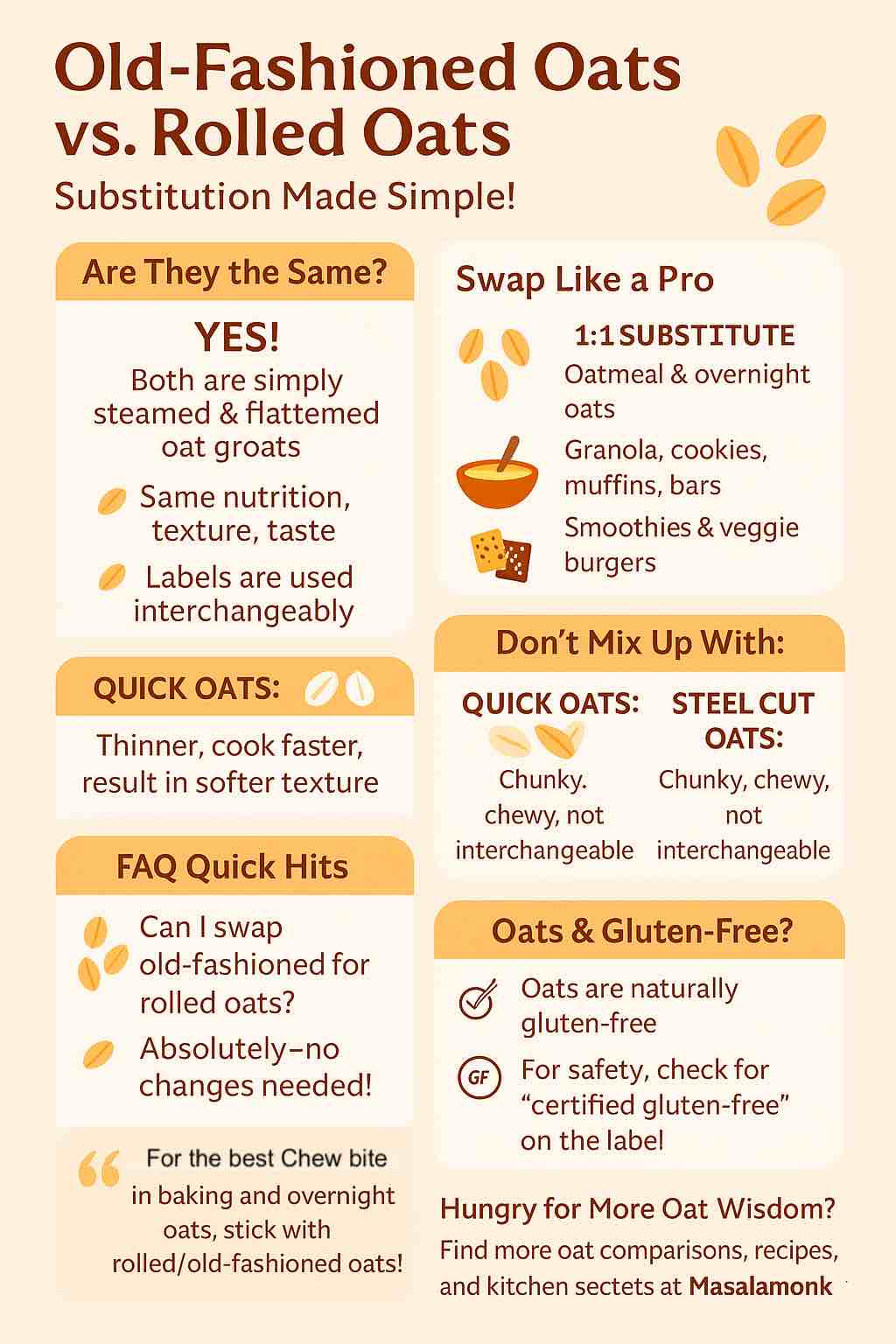
FAQs

1) How do I make a flax egg?

Combine 1 tablespoon ground flaxseed (flax meal) with 3 tablespoons water, stir well, and let it sit until it thickens into a gel—usually 5 to 10 minutes. Once it looks glossy and spoonable, use it right away as your egg replacement in baking.

2) How to make a flax egg with ground flaxseed (step-by-step)?

First, add ground flaxseed to a small bowl. Next, pour in water and whisk until no dry pockets remain. Then, rest the mixture briefly so it can gel. Finally, stir once more and add it to your batter where the egg would normally go.

3) What is the flax egg ratio for 1 egg?

The most common flax egg ratio for 1 egg is 1 tablespoon ground flaxseed to 3 tablespoons water. That’s the standard flax seed to egg ratio most bakers use for muffins, quick breads, pancakes, and many cookie recipes.

4) What is the flax egg ratio for 2 eggs?

For two eggs, double the base ratio: 2 tablespoons ground flaxseed plus 6 tablespoons water. After mixing, allow enough time for the gel to develop before adding it to the bowl with your other wet ingredients.

5) How do I make 3 flax eggs (or more) for a bigger batch?

Scale the flaxseed meal to egg conversion by multiplying the standard ratio. In other words, for three eggs, use 3 tablespoons ground flaxseed with 9 tablespoons water. For larger batches, mix thoroughly and give it a slightly longer rest so the gel thickens evenly.

6) How much flaxseed for egg substitute in baking if I’m using flax meal?

Use 1 tablespoon flax meal per egg, paired with 3 tablespoons water. Even so, if your batter is already very loose, slightly less water can help the texture stay balanced rather than overly soft.

7) Can I use whole flax seeds instead of ground flaxseed for an egg substitute?

Whole seeds usually don’t gel the same way because the water can’t fully hydrate the interior. Therefore, for the most reliable flaxseed egg replacement, use ground flaxseed or flax meal, not whole seeds.

8) My flax egg won’t gel—what should I do?

Start by waiting a few extra minutes, because some flax takes longer to hydrate. If it still looks watery, stir again and add a small pinch more ground flaxseed, then rest it a second time. Additionally, very old flax meal can perform poorly, so freshness matters more than people expect.

9) Can I make a flax egg ahead of time?

Yes, you can make a flax egg shortly ahead—often 30 to 60 minutes is fine—then cover and refrigerate it. However, for best consistency, many bakers prefer mixing it fresh right before baking, since the gel can thicken more as it sits.

10) How do I use flaxseed instead of eggs in recipes—do I add it with wet or dry ingredients?

Typically, add the prepared flax and water mixture with the wet ingredients. That way, it disperses smoothly and doesn’t clump. Meanwhile, keep the dry mix unchanged unless your batter looks noticeably too thick or too thin once everything is combined.

11) Is flaxseed meal to egg conversion always a 1:1 swap?

It’s a 1:1 swap in quantity (one flax egg replaces one egg), yet it’s not always a perfect swap in function. Since flax acts mainly as a binder and moisture holder, it works best when eggs aren’t the primary source of lift or structure.

12) When is a flax egg substitute for baking the best choice?

Flax eggs usually work best in cookies, brownies, muffins, quick breads, pancakes, and waffles—basically, recipes where binding matters more than a lofty rise. As a result, they’re a favorite vegan egg substitute for everyday baking.

13) Does a flax egg work for cookies?

Yes, a flax egg for cookies is often a strong match, especially for chewy styles. Still, if you want a very crisp cookie, you may need to tweak bake time or choose a cookie recipe designed to crisp up without relying on eggs.

14) Can I use flaxseed instead of eggs in cakes?

Sometimes, yes—particularly in moist, oil-based cakes and snack cakes. Nonetheless, in very airy sponge-style cakes, eggs provide lift that flax can’t replicate, so the result may be denser than the original.

15) What’s the difference between ground flax as egg substitute and chia as egg substitute?

Both form a gel with water, so both can replace eggs as binders. However, chia can feel slightly more “seedy” in texture depending on grind and soak time, whereas flax meal tends to blend in more smoothly.

16) What is a good substitute for flax egg if I don’t have flaxseed?

If you’re out of flax, you can often use a chia “egg” (chia seeds + water) as a close alternative. Otherwise, options like applesauce, mashed banana, yogurt-style substitutes, or commercial egg replacers can work depending on the recipe and whether you’re aiming for a vegan substitute.

17) How do I substitute flax for eggs without making the batter gummy?

Avoid replacing too many eggs in recipes that depend heavily on eggs for structure. Also, measure carefully, allow the gel to form, and don’t overmix the batter. If gumminess keeps happening, try a different egg replacement better suited to the recipe style.

18) Can I use flax eggs in gluten-free baking?

You can, although results vary because gluten-free batters often already rely on binders and starches. Consequently, flax may make some gluten-free bakes feel heavier. In that case, using a smaller amount, improving leavening, or choosing a different egg substitute can help.

19) Is flax seed as egg substitute the same as egg replacement flaxseed meal?

They’re used similarly, yet flaxseed meal (ground flaxseed) is the form that works most reliably for a flaxseed egg substitute baking method. Whole flax seeds can work only if they’re finely ground first.

20) How many flax eggs can I use in one recipe?

It depends on the recipe. Replacing one egg is usually straightforward; replacing two often works in muffins and cookies; replacing three or more can noticeably change texture, especially in cakes. If the original recipe is very egg-forward, consider an alternative to flax egg or an egg-free recipe built for that outcome.

Posted on 7 Comments

Can You Substitute Old-Fashioned Oats for Rolled Oats?

Old-Fashioned Oats vs. Rolled Oats

If you love oats—whether for breakfast, baking, or healthy meal prep—you’ve probably encountered the terms “old-fashioned oats” and “rolled oats.” The good news? These names often cause confusion, but they actually refer to the same product! Here’s what every home cook, baker, and oat enthusiast should know about using these oats, when substitutions are seamless, and when it might matter.


What Are Old-Fashioned Oats?

“Old-fashioned oats” is simply another name for “rolled oats.” Both terms describe oat groats that have been steamed and then pressed flat with large rollers, resulting in those classic, thin oat flakes you find in most kitchens and recipes. There is no real difference between the two—manufacturers just use the names interchangeably, and you might see either on a package label.

  • Texture: Flat, oval flakes that are soft yet hold their shape when cooked or baked.
  • Flavor: Mild and slightly nutty.
  • Uses: Perfect for oatmeal (porridge), overnight oats, granola, cookies, muffins, bars, smoothies, or as a binder in burgers and veggie patties.

What About “Rolled Oats”?

Rolled oats, like old-fashioned oats, are made by steaming whole oat groats and rolling them into flakes. This process helps them cook faster than steel cut oats but still gives you a heartier texture and more nutrition than quick or instant oats.

  • Look for: Rolled oats, old-fashioned oats, or even “traditional oats”—they’re all the same in most recipes.

Substituting Old-Fashioned Oats for Rolled Oats

Can you substitute old-fashioned oats for rolled oats?

  • YES! These two oat types are completely interchangeable in any recipe calling for either one.

How about the other way around?

  • Absolutely. There’s no difference—you can swap “old-fashioned oats” and “rolled oats” 1:1 by volume or weight.

This is true for:

  • Classic cooked oatmeal/porridge
  • Overnight oats
  • Baking (cookies, muffins, breads, bars)
  • Granola or muesli
  • Pancakes, smoothies, or savory uses

Where Substitutions Might Matter

While old-fashioned/rolled oats can replace each other, there’s sometimes confusion with other oat types. Here’s where you need to be careful:

  • Quick oats or instant oats: These are rolled even thinner and/or cut smaller, so they cook faster and lose texture. If you substitute quick oats for old-fashioned/rolled oats, your recipe will be softer, sometimes mushy (especially in cookies, granola, or bars).
  • Steel cut oats: These are not rolled or steamed, just chopped—completely different texture and much longer cooking time. Steel cut oats are not a direct substitute for rolled/old-fashioned oats in baking or most recipes.

Want to understand all oat types in more depth? Visit our Ultimate Guide to Oats: Types, Nutrition, and Differences Explained.


Practical Kitchen Tips

For best results in baking or granola:

  • Use rolled/old-fashioned oats for chewy cookies, sturdy granola, and hearty breakfast bars.
  • If you only have quick oats, you can use them in a pinch, but expect a softer, less textured result.
  • Never use instant oats in place of rolled oats for baking—they dissolve and change the final texture.

For overnight oats:

  • Rolled/old-fashioned oats give you the classic, creamy-yet-chewy bite everyone loves.

For classic oatmeal:

  • Both rolled and old-fashioned oats are ideal, cooking in just 5–10 minutes for a creamy, hearty bowl.

In smoothies or as a binder:

  • Either works perfectly—blend or stir directly in for extra fiber.

When Might Packaging Matter?

Some brands market “old-fashioned oats” for a rustic, traditional feel, while others label their oats as “rolled oats.” As long as the ingredient list says 100% rolled oats and they look like flat flakes, you’re good to go.

If you’re following a gluten-free diet, always look for certified gluten-free rolled/old-fashioned oats, as oats are often processed in facilities that handle wheat.


Related Oat Comparisons

If you’re curious about how rolled/old-fashioned oats compare to steel cut, quick, or instant oats, be sure to check out:


Conclusion

You never need to worry about substituting old-fashioned oats for rolled oats—or vice versa. In fact, they are two names for the same nutritious, versatile ingredient that can power up breakfasts, snacks, and baked treats with ease. Just keep an eye out for quick, instant, or steel cut oats, as those are different in texture, cook time, and use.

Ready to learn everything about oat types, nutrition, and kitchen secrets? Explore our Ultimate Guide to Oats!


10 FAQs – Old-Fashioned Oats vs Rolled Oats Substitution

1. Are old-fashioned oats and rolled oats the same?

Yes. Old-fashioned oats and rolled oats are just two names for the same product.


2. Can I substitute old-fashioned oats for rolled oats in recipes?

Yes, you can substitute them 1:1 in any recipe without adjustment.


3. Can I use quick oats instead of rolled oats?

You can, but the texture will be softer and the final result may be less chewy, especially in baked goods.


4. Can I use instant oats instead of rolled oats?

It’s not recommended. Instant oats tend to break down too much and make recipes mushy.

5. Is there a difference in nutrition between old-fashioned and rolled oats?

No, they have identical nutrition since they are the same product.


6. Which is better for overnight oats: rolled or old-fashioned oats?

They are the same—both are perfect for overnight oats and give the best creamy-yet-chewy texture.


7. Do I need to change the cooking time if I swap old-fashioned oats for rolled oats?

No, use the same cooking time for both.


8. What if my recipe calls for “traditional oats”?

“Traditional oats” is another name for rolled/old-fashioned oats. Use them interchangeably.


9. Can I use rolled oats in place of quick oats?

Yes, but your recipe will have more texture and may take slightly longer to cook or soften.


10. Are rolled oats or old-fashioned oats gluten-free?

Oats are naturally gluten-free, but always check for a gluten-free label if you are sensitive or celiac.

Posted on 3 Comments

KISS THE COOKIE! Peanut Butter Blossoms by Manjula Vijh

Traditionally called as “Peanut Butter Blossoms”, these are soft, chewy peanut butter cookies, rolled in sugar and then topped with a Hershey’s Kiss Chocolate!

Like the serving board? Check our range here : Good With Wood

It was during one lazy winter afternoon, while I was surfing the internet for some cookie recipes, that I came across these beauties. I had never worked with peanut butter as the main ingredient for cookies, but these looked so beautiful that I couldn’t resist giving them a try.

Like the serving board? Check our range here : Good With Wood

The recipe for these lovely looking cookies was first developed in 1957, by Mrs. Freda F. Smith of Gibsonburg, Ohio for the Ninth Grand National Pillsbury Bake-off competition. It’s an American classic recipe and many versions of this recipe are available online. My recipe is inspired from the one given on Hershey’s website, but since I am a vegetarian, I have modified the recipe to be an eggless one. These are chewy from the center and crisp from outside, and since these are topped with Hershey’s Kisses, I have named these cookies as, “Kiss the Cookie!”

Like the serving board? Check our range here : Good With Wood

When I first tried this recipe with one of my friends, I made them with store bought peanut butter. They came out nice but were little extra sweet. This time I tried them with the Natural Homemade Peanut Butter curated by Mr. Mohit Arora, which is available at Masala Monk. The peanut butter by Masala Monk has the right amount of salt and sugar unlike store bought peanut butter. The cookies came out to be perfect sweet and soft! They look lovely when presented and you can also gift them to your loved ones during festival time!

Like the serving board? Check our range here : Good With Wood

KISS THE COOKIE

Preparation time: 20 minutes

Cook time: 10 minutes

Serves:  40-45 cookies

Ingredients

  • Condensed Milk: 1 Can (400 gm.)
  • Peanut Butter: ¾ cup
  • All Purpose Flour: 1.5 cup
  • Baking Powder: 1tsp.
  • Butter(softened): ½ cup
  • Vanilla extract: 1tsp
  • Caster sugar for rolling the cookies: ½ cup
  • Hershey’s kisses: 40-45

Instructions

  1. In a medium bowl whisk together, flour and baking powder.
  2. In another bowl cream together, butter, peanut butter and vanilla to mix them well.
  3. Add the flour and make a dough. If, you are mixing with hands, and the dough sticks to your hand you can sprinkle some flour, apply butter to your hands and then again mix. You can taste the cookie dough too!! I did and it tastes great!
  4. Chill the dough to set. Cling wrap it and then keep it in the refrigerator for few hours.
  5. Preheat the oven at 190ºC.
  6. Shape dough into 1″-1.5″ balls, roll it in finely granulated caster sugar, and keep them into a baking tray.
  7. Bake the cookies at 190ºC for about 10-11 minutes, till cracks appear on sides. Do not over bake them. These cookies will not get brown in color.
  8. Meanwhile unwrap Hershey’s Kisses.
  9. After the cookies are baked, take out the baking tray, and gently press one kiss on each cookie. The warm cookies will melt the chocolate a little, but it will set after a while.
  10. Transfer the cookie onto a wire rack for cooling
  11. Store it in an airtight container.

Notes:

** Please check your oven temperature for baking.

** You can use a small ice-cream scoop, or a melon ball scoop to take out equally sized dough balls. I used one of my measuring spoons.

** You can keep the cookie dough cling wrapped for 2-3 days.

** If you want to cut down the recipe to half, you can do so. It works fine! I suggest to start with half the recipe if you are baking them for the first time.

** Use softened butter and not melted butter. I made this mistake and result was flat cookies.

** Chill the cookie dough before baking.

** If the chocolate falls of the cookie, you can dab little peanut butter on the bottom of the chocolate and press it back.

References:

http://www.post-gazette.com/life/food/2012/09/06/Cookies-Tracking-the-tale-of-a-favorite-the-Peanut-Blossom/stories/201209060264

https://abountifulkitchen.com/peanut-butter-blossoms/

http://americanheritagecooking.com/2014/12/peanut-butter-blossoms/

https://www.hersheys.com/kitchens/en_us/recipes/chewy-peanut-butter-blossoms.html

Posted on Leave a comment

Chocolate Chip Cookie Bars: The Ultimate Dessert

happy asian women cooking oriental noodles in kitchen

Hello, dessert enthusiasts! 🙋‍♀️ Today, we’re going to delve into a mouth-watering recipe from Preppy Kitchen, a YouTube channel renowned for its delightful and easy-to-follow recipes. This time, we’re learning how to make Chocolate Chip Cookie Bars, a dessert that marries the best qualities of brownies and chocolate chip cookies into one irresistible treat. 🍪🍫

🍪 Chocolate Chip Cookie Bars: A Delectable Fusion 📝

Imagine the most decadent brownie and the most delicious chocolate chip cookie coming together to create the ultimate dessert. That’s exactly what these Chocolate Chip Cookie Bars are! They’re a delightful fusion of the fudgy, gooey texture of brownies and the crispy, crunchy edges of cookies, all packed with the delightful sweetness of brown sugar, butter, and chocolate.

🍪 The Magic of Chocolate Chip Cookie Bars 🍫

What makes these cookie bars so special is their unique texture and flavor. They’re not just a cookie or a brownie – they’re the best of both worlds. The outside is crispy and golden, while the inside is soft, chewy, and loaded with melty chocolate chips. Every bite is a burst of sweet, buttery, chocolatey goodness that will have you reaching for more.

🍪 How to Make Chocolate Chip Cookie Bars 🍵

The recipe for these cookie bars is incredibly easy and quick to whip up. Here’s how you can make your own batch of these delicious treats:

Ingredients 📋

  • 200 grams of fresh turmeric
  • 50 grams of fresh ginger
  • 100 grams of Tamarind pulp
  • Salt
  • 100 to 150 grams of jaggery or unprocessed sugar

Method 🍳

  1. Preparation: Start by prepping your 8 by 8-inch dish by lining it with parchment paper. This will make it easier to remove the bars once they’re baked.
  2. Mixing the Wet Ingredients: In a large bowl, combine melted butter, regular white sugar, and brown sugar. Mix until it forms a thick slurry. This is the base of your cookie bars, providing them with their rich, sweet flavor.
  3. Adding the Eggs and Vanilla: Add in vanilla extract and two room temperature eggs. Whisk together. The eggs will give your bars structure, while the vanilla adds a depth of flavor.
  4. Incorporating the Dry Ingredients: Dump in the dry mixture and fold it in until it’s mostly incorporated. Be careful not to overmix, as this can lead to tough cookie bars.


  5. Adding the Chocolate Chips: Toss in your chocolate chips and fold them in. Try to distribute the chocolate chips evenly so every bite has a bit of chocolate.
  6. Transferring to the Baking Dish: Transfer the mixture to your prepared baking dish and smooth the top out.
  7. Adding the Final Touches: Dot the surface with some clean chocolate chips. This will give your bars a beautiful, appetizing appearance. If you like, sprinkle some flaked sea salt on top for a hint of savory contrast to the sweet cookie bars.
  8. Baking: Pop it into the oven for 30+ minutes. The exact baking time will depend on how gooey or firm you like your cookie bars.

🎥 Video and Channel Credits 📺

All these amazing tips and information are from the YouTube channel Preppy Kitchen. They share their passion for food and health through their easy-to-follow videos. Check out the original video for a step-by-step guide on how to prepare this drink. Also, don’t forget to visit and subscribe to the Preppy Kitchen channel for more health tips and recipes.

🤝 Join Our Community

We’d love to have you in our community! If you’re passionate about food, health, and wellness, join our Facebook group EatLo. It’s a space where you can share your own recipes, meal prep tips, and foodie adventures. Plus, you’ll get to connect with like-minded individuals who can inspire and motivate you.