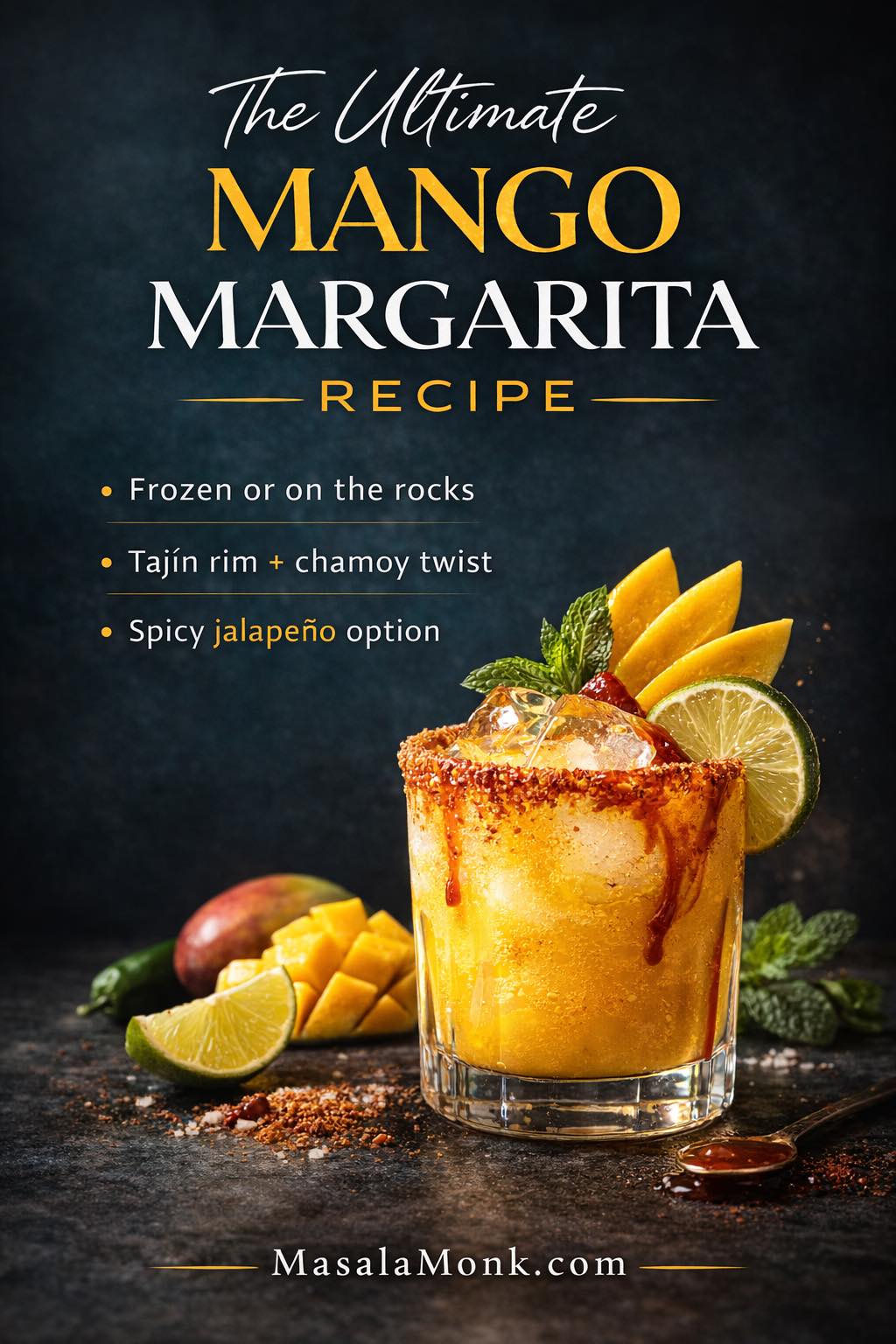
A mango margarita recipe has one job: taste like sunshine without turning syrupy. Mango does the easy part—lush, tropical, instantly cheerful—yet it can also overpower a drink if you don’t keep the margarita structure crisp. When it’s balanced, you get juicy mango up front, a bright lime snap on the finish, and tequila running cleanly through the middle. Suddenly, an ordinary evening feels like a small celebration.
That balance matters because mango isn’t a “set it and forget it” ingredient. It’s naturally sweet, often thick, sometimes fibrous, and it changes from fruit to fruit and bottle to bottle. Meanwhile, a margarita is precision disguised as simplicity: tequila needs lime, lime needs a touch of sweetness, orange liqueur gives the drink its classic shape, and a pinch of salt makes everything taste brighter. If you like having a simple mental model you can rely on, MasalaMonk’s margarita balance guide lays out that rhythm clearly—and it transfers perfectly here because the core of a margarita is balance, not booze.
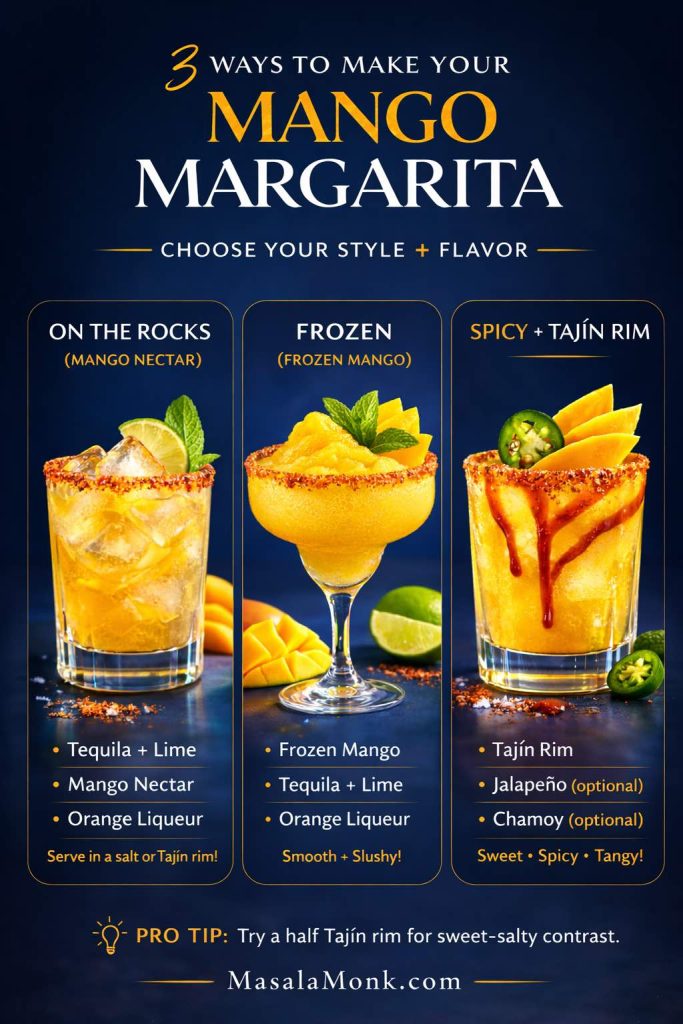
From there, you’ll have two go-to versions—frozen and on the rocks—plus the variations you’ll actually want on repeat: a spicy mango margarita with jalapeño (or a careful habanero option), a Tajín rim that makes the fruit pop, a chamoy mangonada-style pour for candy-tang drama, a smoky mango mezcal margarita, and a pitcher mango margarita recipe for serving a crowd. You’ll also get clear swaps for fresh mango, frozen mango, mango nectar, mango purée, or mango juice, so you can make it confidently with what you have.
Also Read: Mojito Recipe (Classic) + Ratios, Pitcher, Mocktail & Easy Variations
Mango margarita ingredients that actually matter
Some mango margarita lists throw in everything—soda, grenadine, flavored syrups, pre-made mixes, and a dozen optional extras—until you can’t tell what the drink is supposed to taste like. Instead, we’ll keep the base focused. Then, once the base is right, add-ons like Tajín, chamoy, or jalapeño become exciting rather than chaotic.
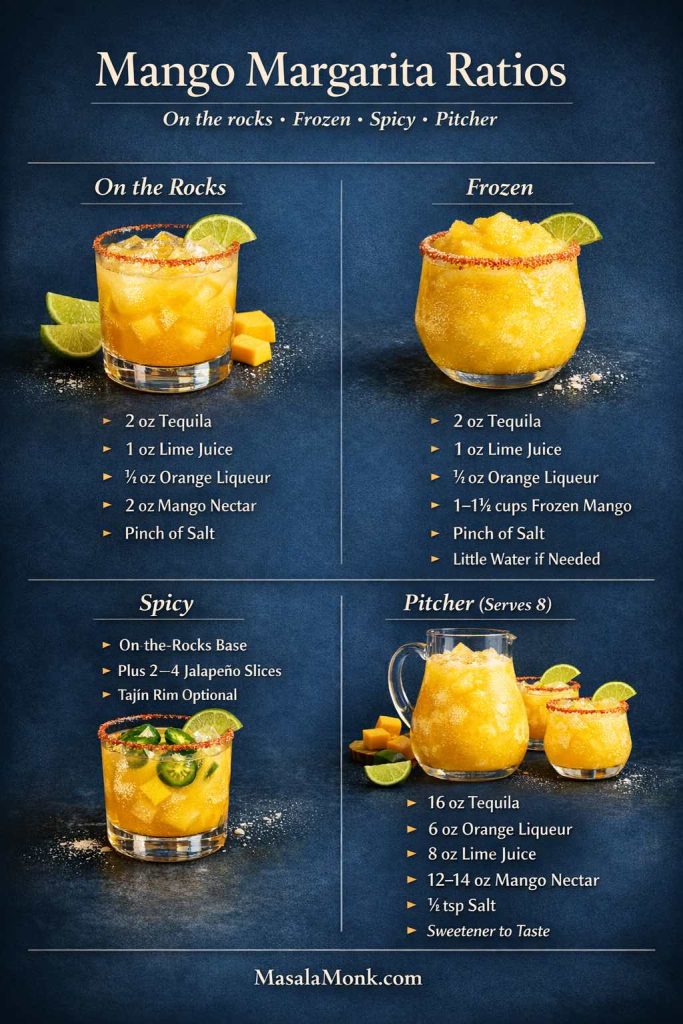
The essentials for any mango margarita recipe
- Tequila (blanco or reposado)
- Fresh lime juice (this one is non-negotiable)
- Orange liqueur (triple sec / Cointreau style)
- Mango (fresh, frozen, nectar, purée, or juice)
- Sweetener (agave or simple syrup, used sparingly)
- Fine salt (a tiny pinch inside the drink is transformative)
- Ice (for shaking and serving; optional for blending)
A classic margarita is typically tequila + orange liqueur + lime in a clean, citric balance. If you want to see that baseline clearly before mango enters the picture, the classic margarita method is a handy reference. You don’t need to copy it exactly, yet it’s useful to remember what mango is modifying: it’s adding body and sweetness, so your job is to protect brightness.
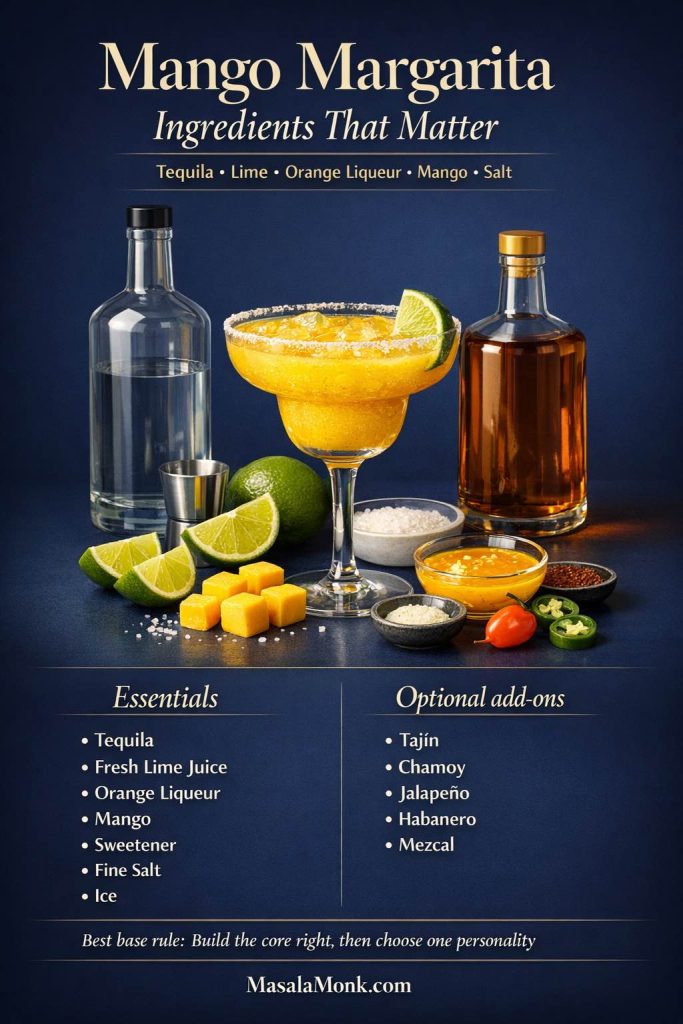
Optional add-ons that change the drink fast
- Tajín or chili-lime seasoning for a tangy-salty rim
- Chamoy for sweet-sour-salty “mangonada” energy
- Jalapeño for green, fresh heat
- Habanero for fruity, intense heat (use carefully)
- Mezcal for a smoky twist
It’s worth saying plainly: you don’t need all of these at once. In fact, the best mango margarita usually feels clean and intentional. So build the base first, then choose one “personality” direction—spicy, Tajín, chamoy, smoky, or pitcher.
Also Read: Air Fryer Donuts Recipe (2 Ways): Glazed Homemade Donuts + Biscuit Donuts
Tequila choices that make mango taste better
Tequila can either lift mango or blur it. A good match makes mango taste brighter and lime taste cleaner. A mismatched tequila can make the drink taste muddy or overly boozy.
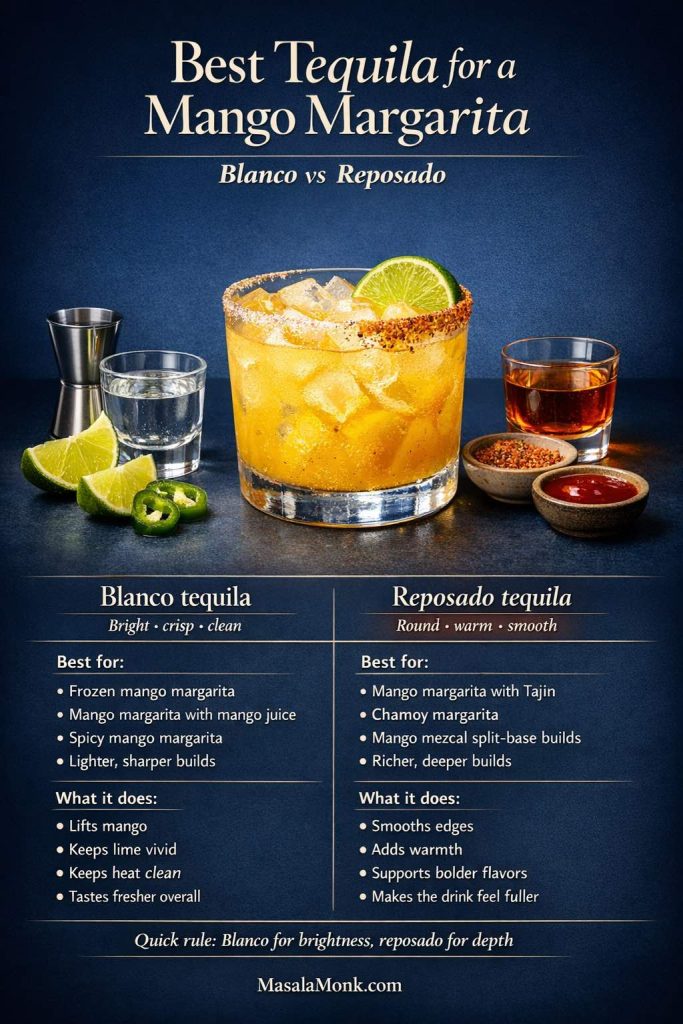
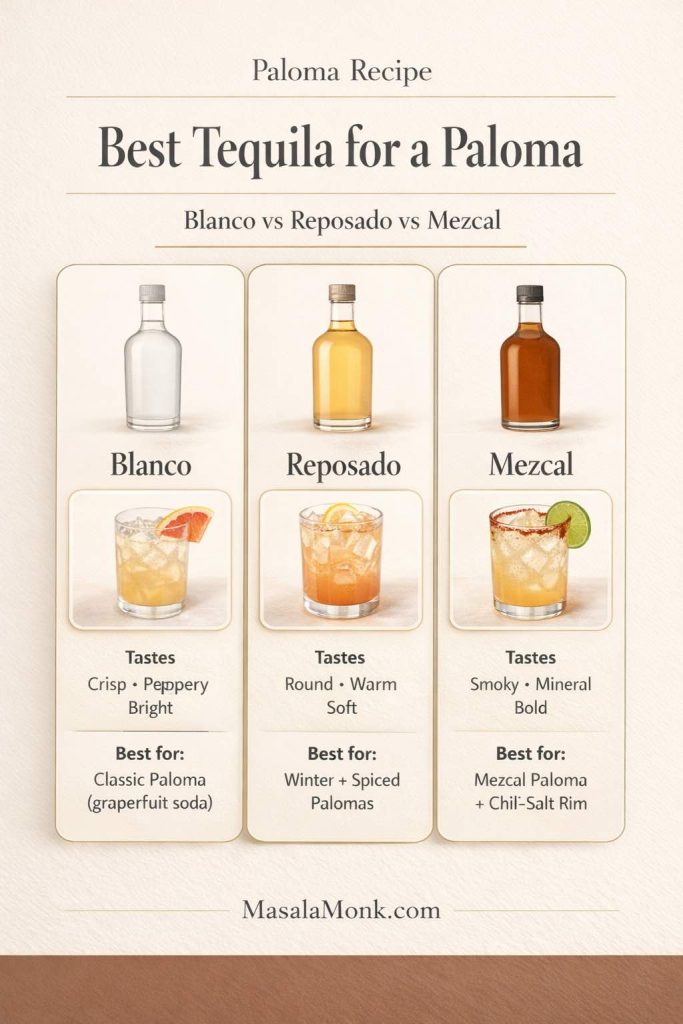
Blanco tequila (bright and clean)
Blanco is a natural fit when you want your mango margarita to taste crisp. It’s especially helpful for:
- a frozen mango margarita recipe, where texture can make flavors feel heavier
- mango margarita with mango juice, where the drink benefits from clarity
- spicy mango margarita recipe builds, where you want heat to feel clean, not clumsy
Reposado tequila (round and warm)
Reposado smooths the edges. It’s lovely when you’re leaning into bolder accents like:
- mango margarita with Tajín
- chamoy margarita
- mango mezcal margarita “split base” builds (reposado + mezcal can be gorgeous)
More for your tequila-citrus instincts
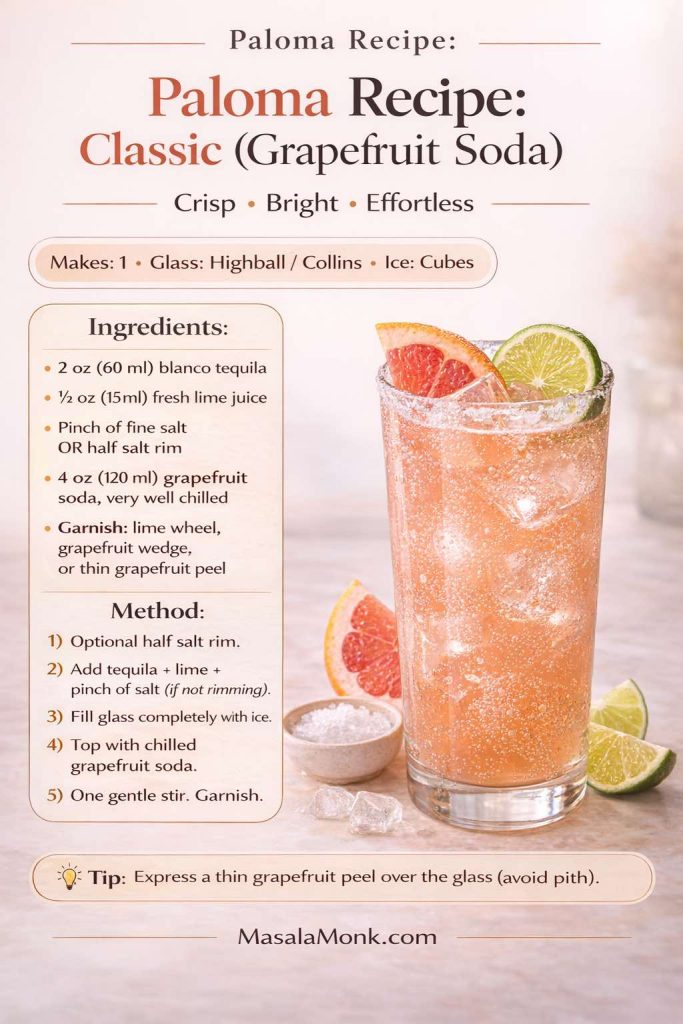
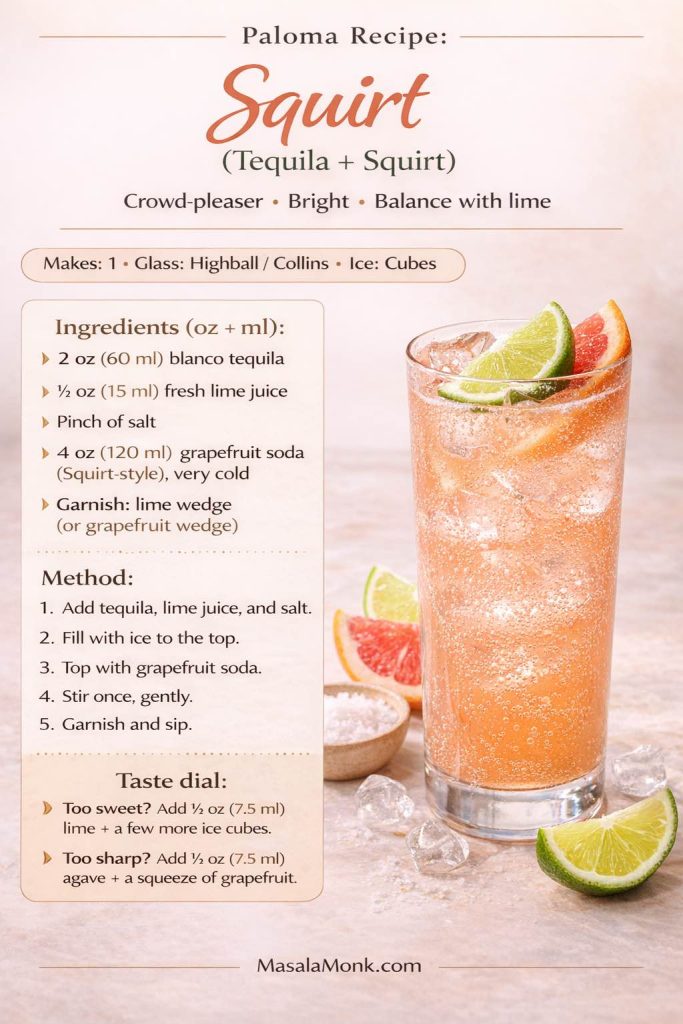
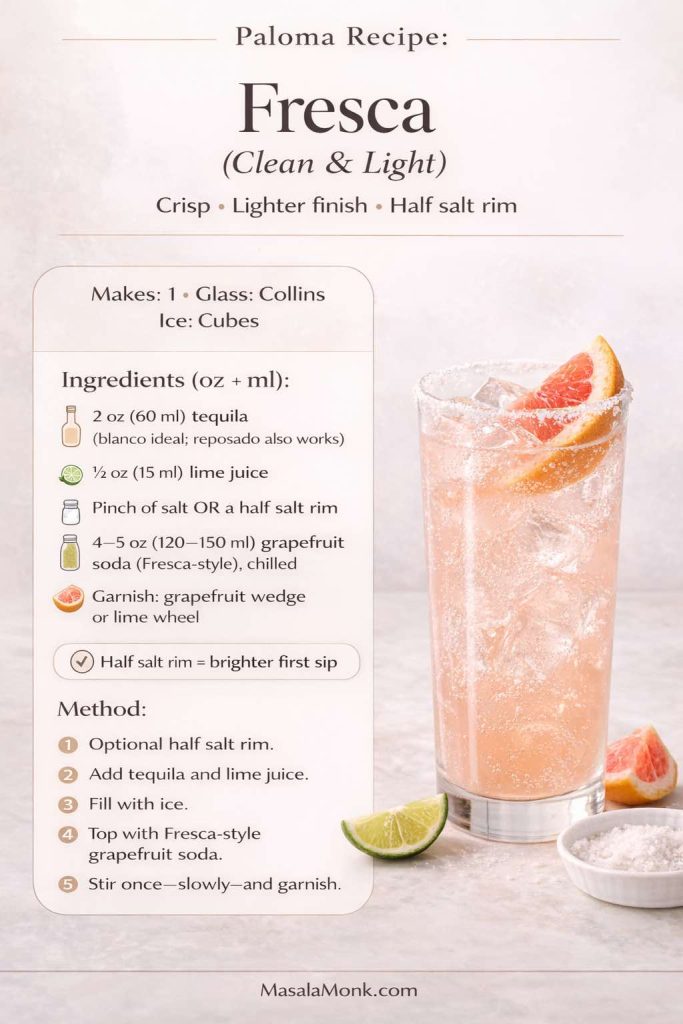
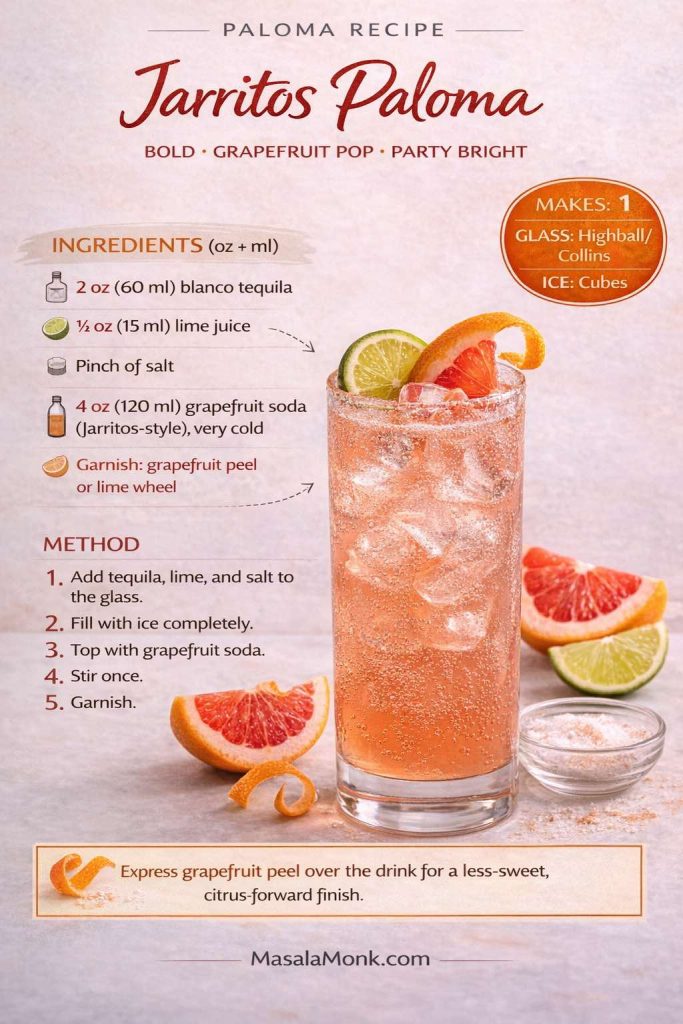
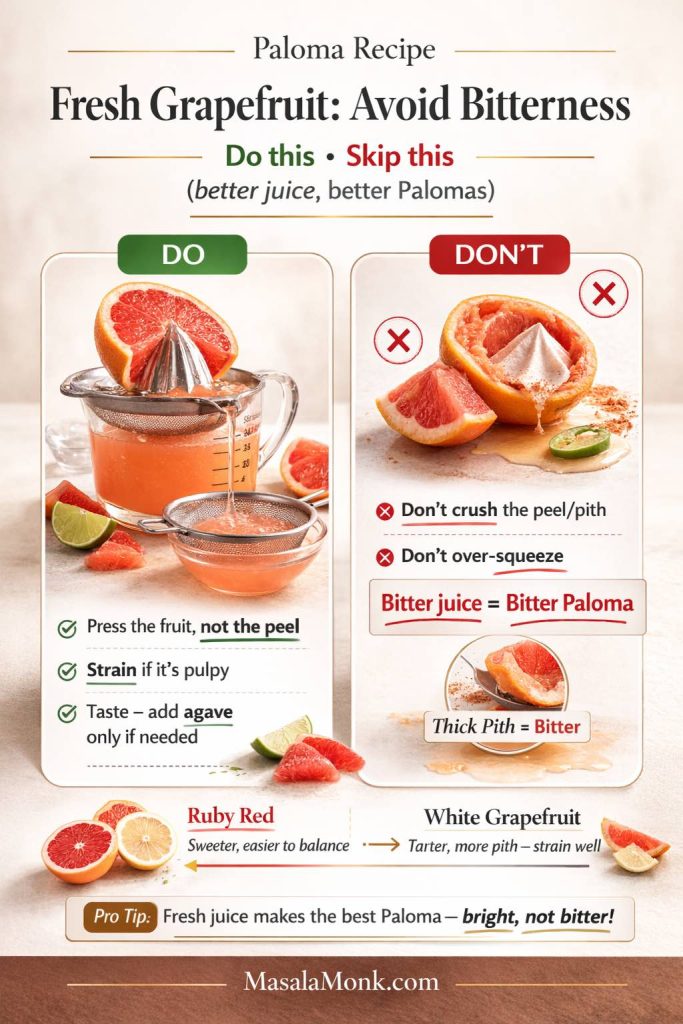
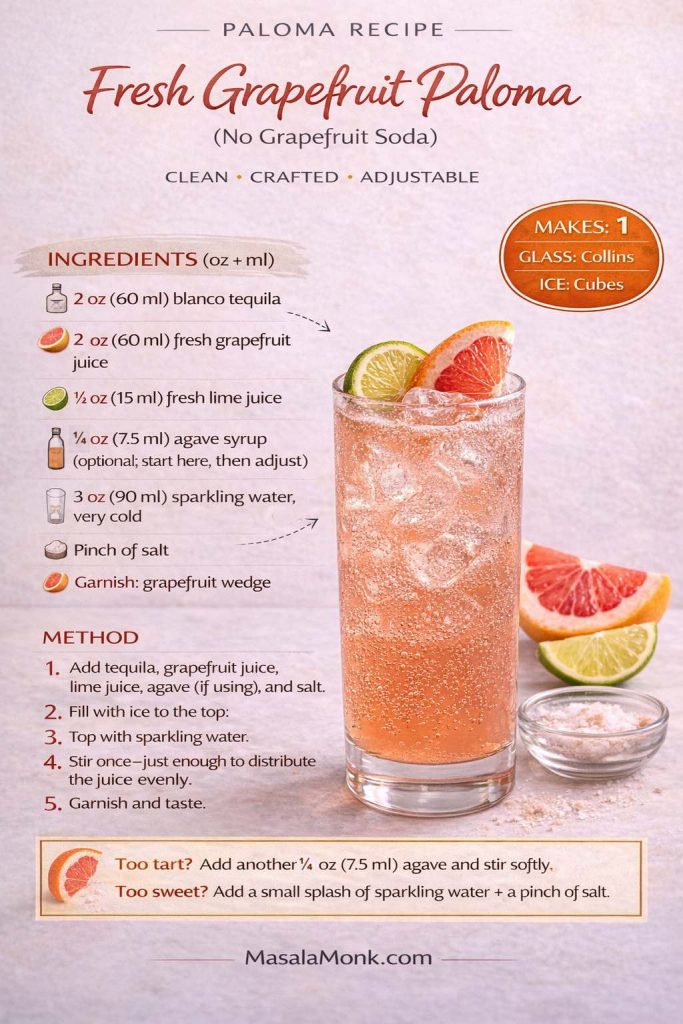
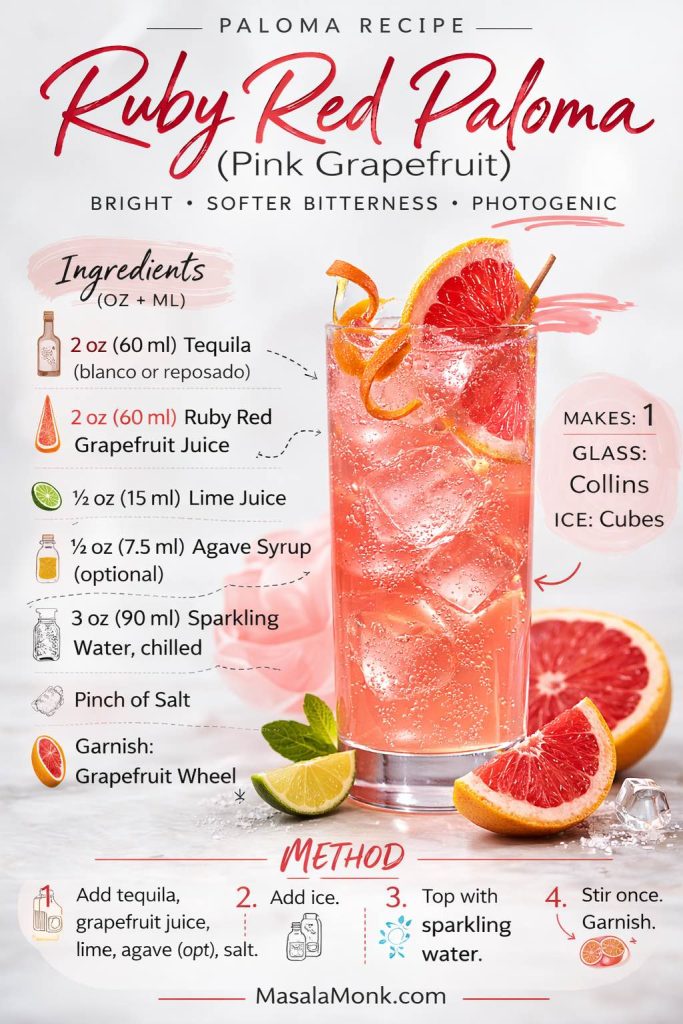
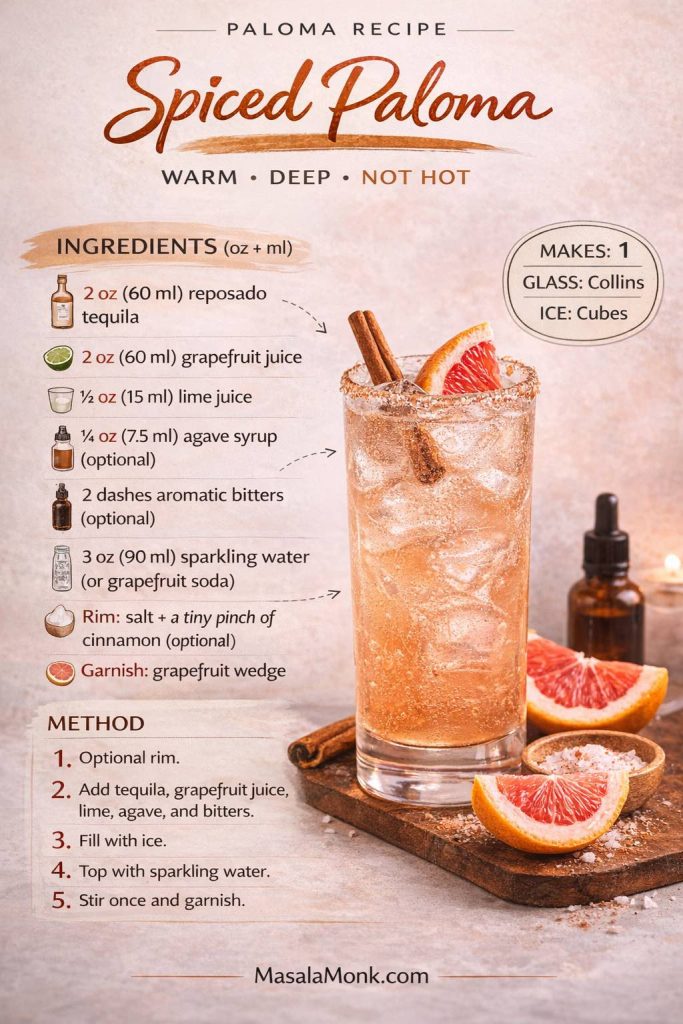
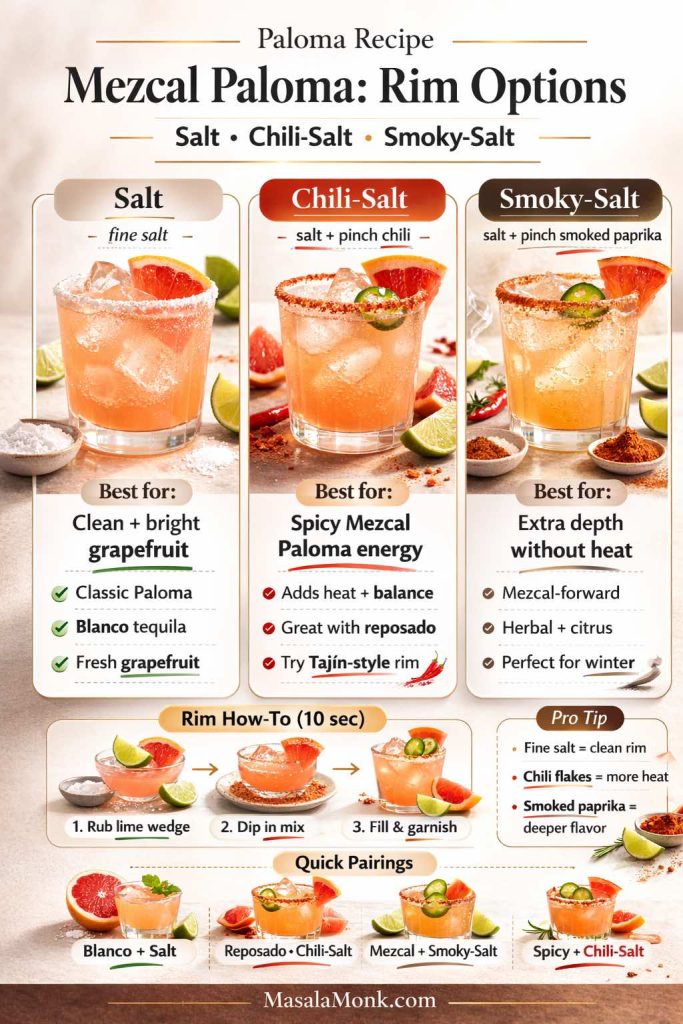
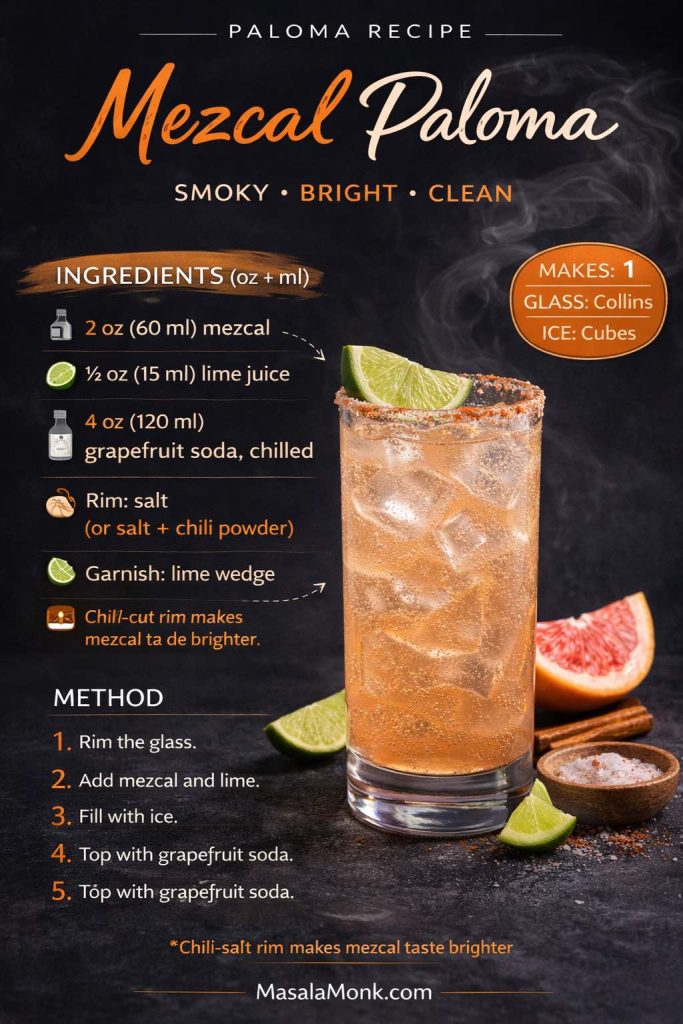
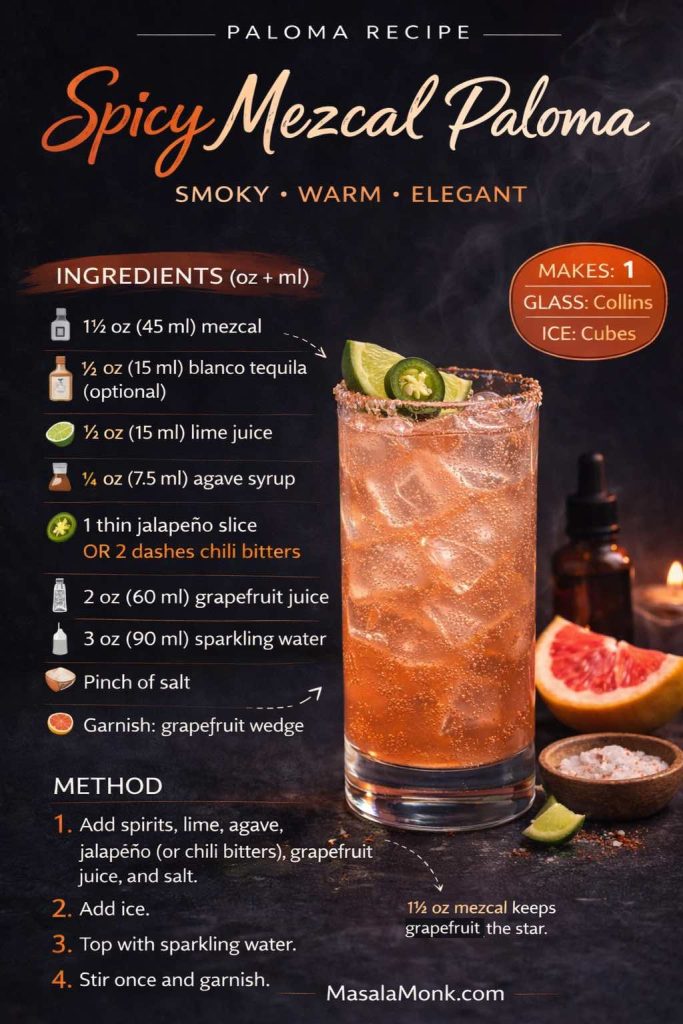
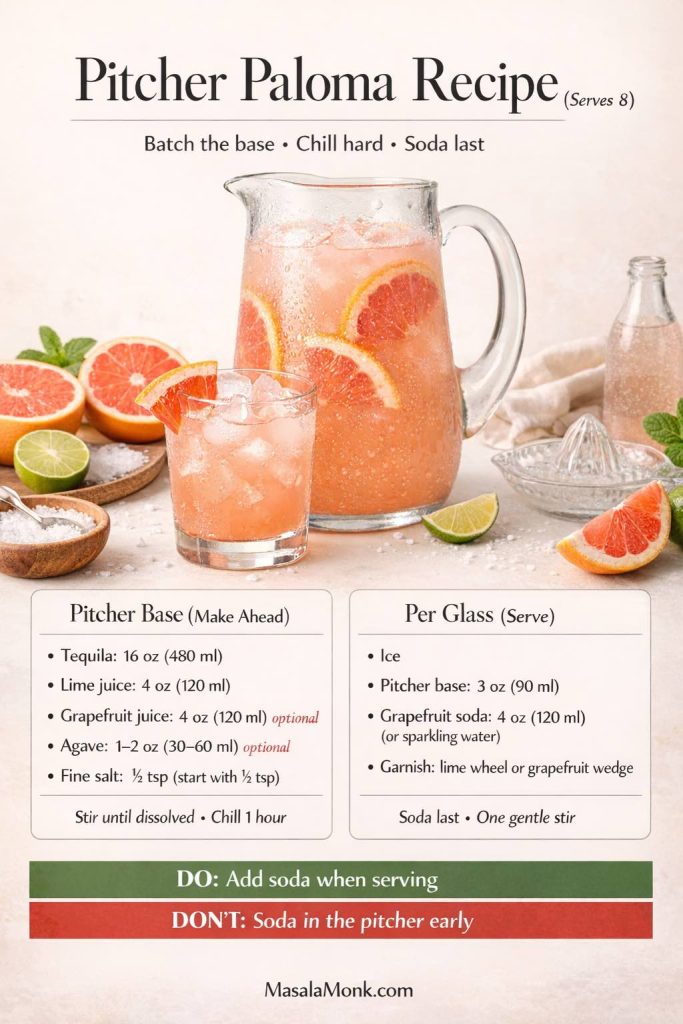
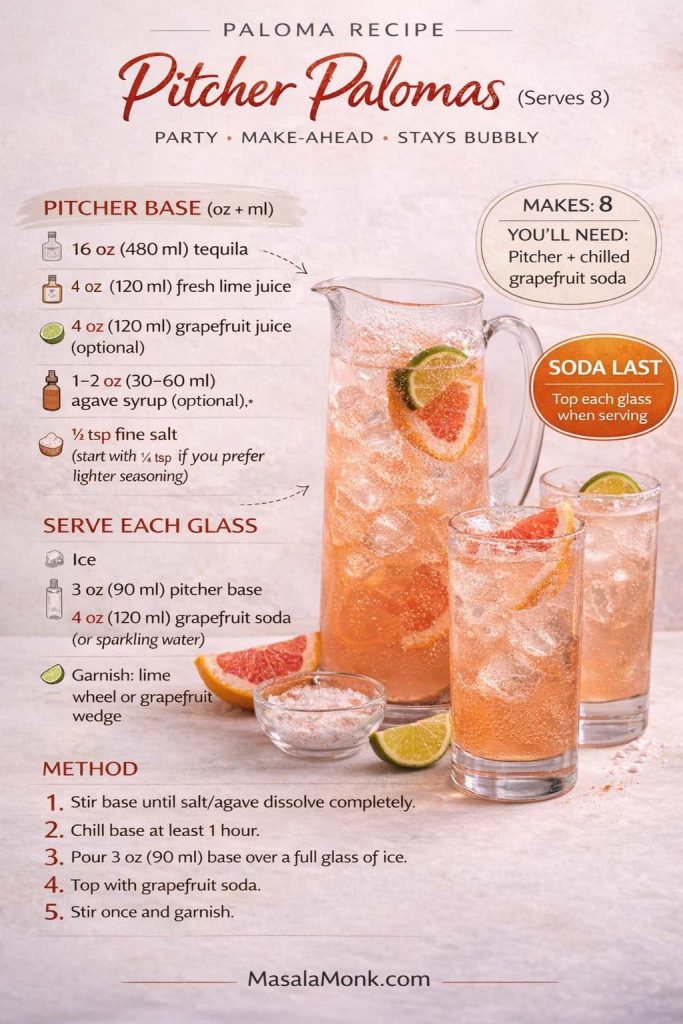
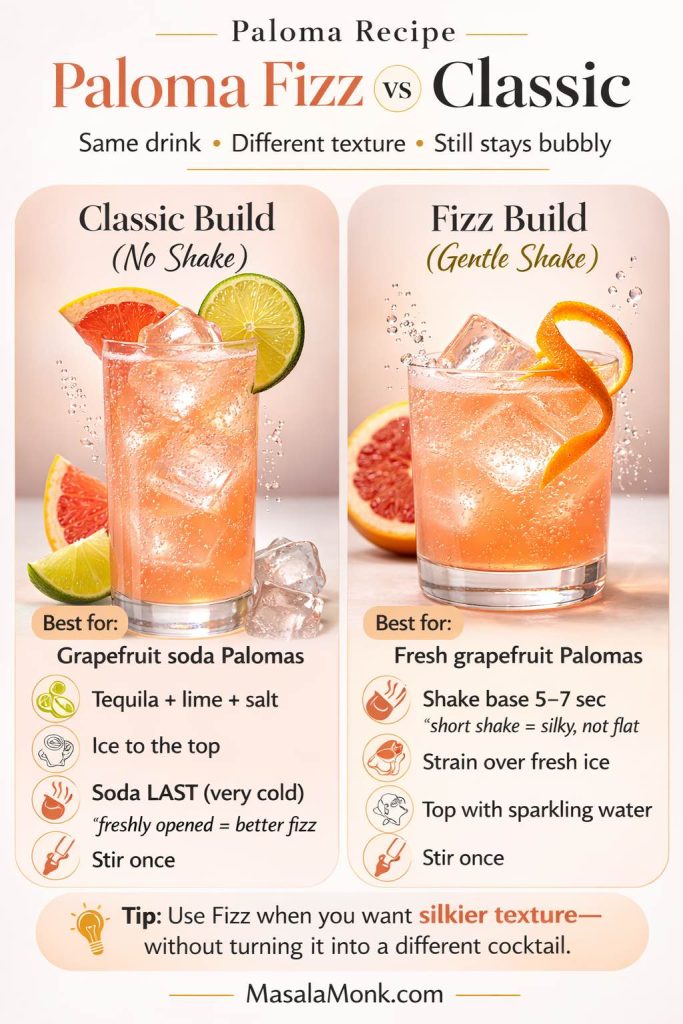
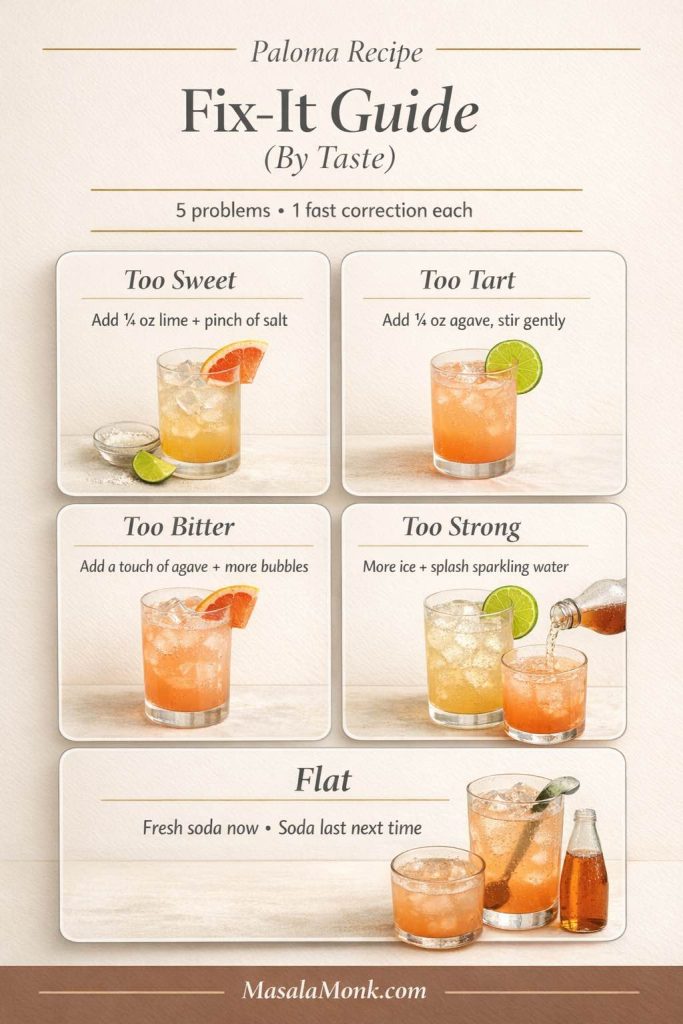
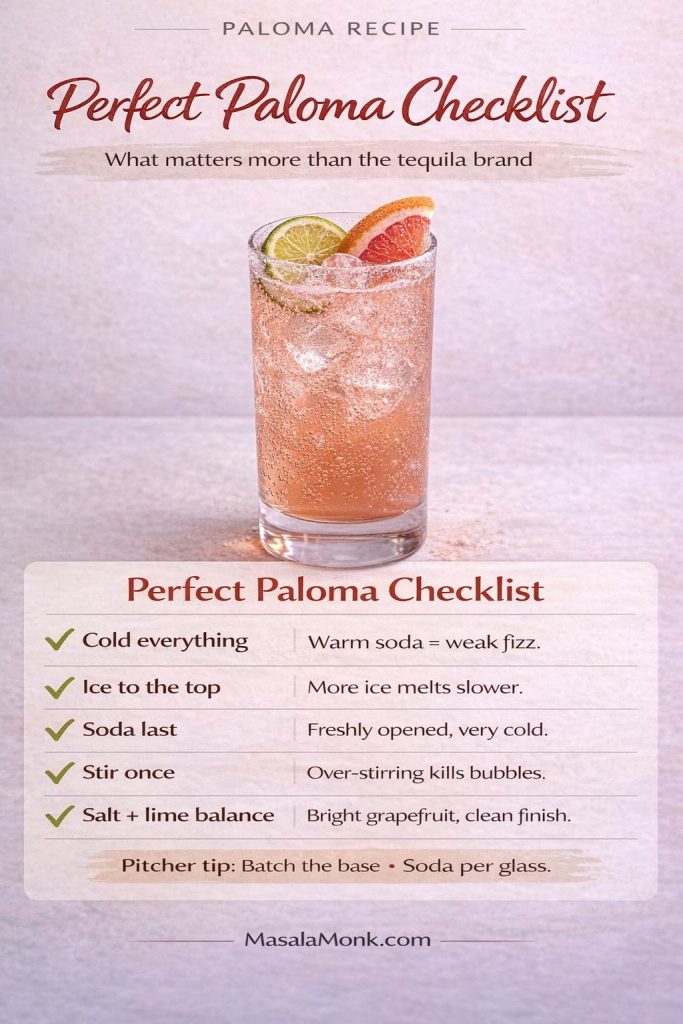
If you like tequila drinks that taste refreshing rather than sugary, MasalaMonk’s Paloma recipe is a great companion read. Paloma is grapefruit-based rather than mango-based, yet the same “acid + salt + tequila” relationship shows up, and it’s the exact relationship that makes a mango margarita taste like a margarita instead of a mango drink with tequila floating in it.
Also Read: Tapas Recipe With a Twist: 5 Indian-Inspired Small Plates
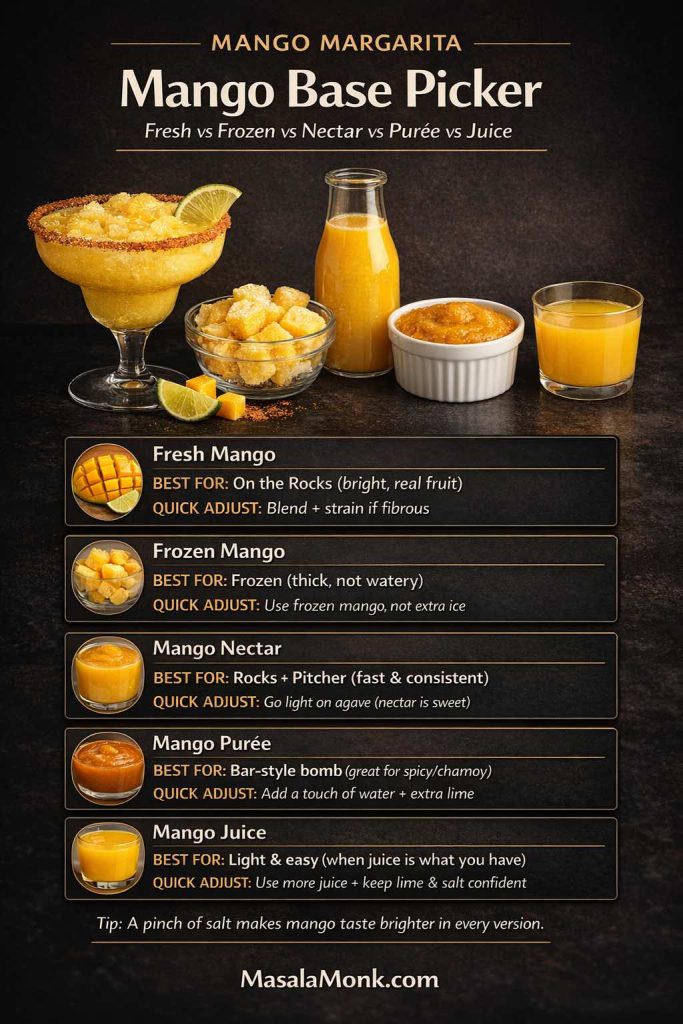
Fresh mango vs frozen mango vs mango nectar vs mango purée vs mango juice
This section is the difference between “pretty good” and “best mango margarita.” Mango can vary wildly. One mango tastes like perfume and sunshine; another tastes mild and starchy. Mango nectar brands differ, purées differ, juices differ. So instead of offering one rigid version, here’s a simple choose-your-path approach.
Fresh mango margarita recipe (when mangoes are actually fragrant)
Fresh mango can be magical when it’s ripe. It’s also the most variable. A fresh mango margarita recipe tastes incredible when the fruit is fragrant; it tastes flat when the mango is underripe.
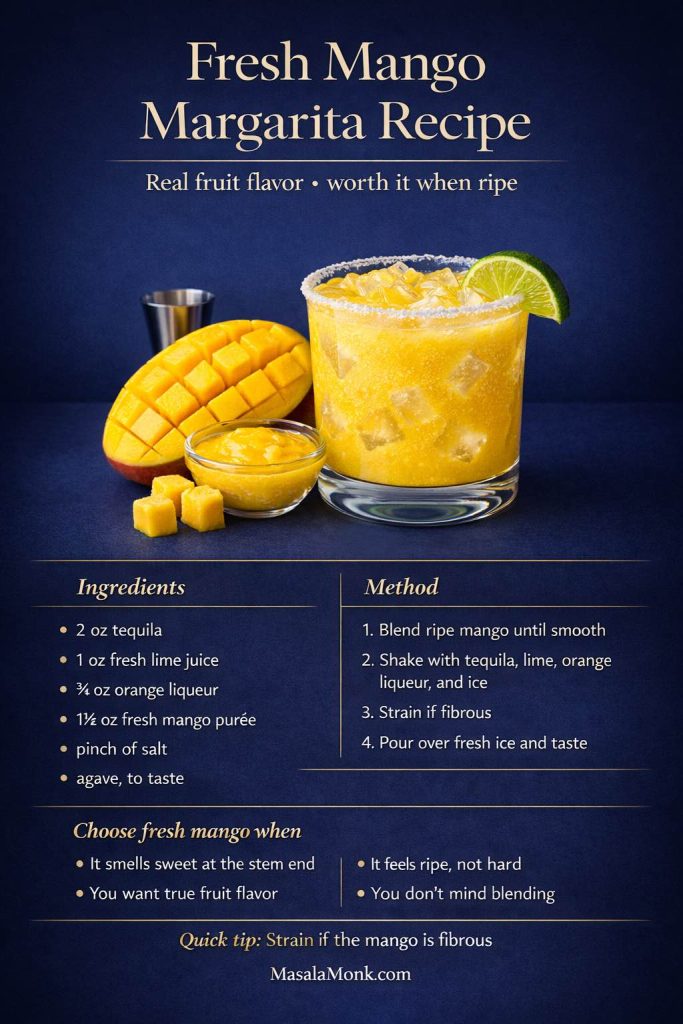
Choose fresh mango when:
- you have ripe mangoes that smell sweet at the stem end
- you want a “real fruit” taste rather than a bottled consistency
- you don’t mind blending a quick mango base
Avoid fresh mango when:
- your mango is firm and mild (it will need extra sweetener and still taste thin)
- your mango is very fibrous and you don’t want to strain
Frozen mango margarita recipe (when you want thick, cold, and reliable)
Frozen mango is the easiest way to make a best frozen mango margarita recipe. It gives body without dilution and builds a thick, glossy drink that holds its flavor longer.
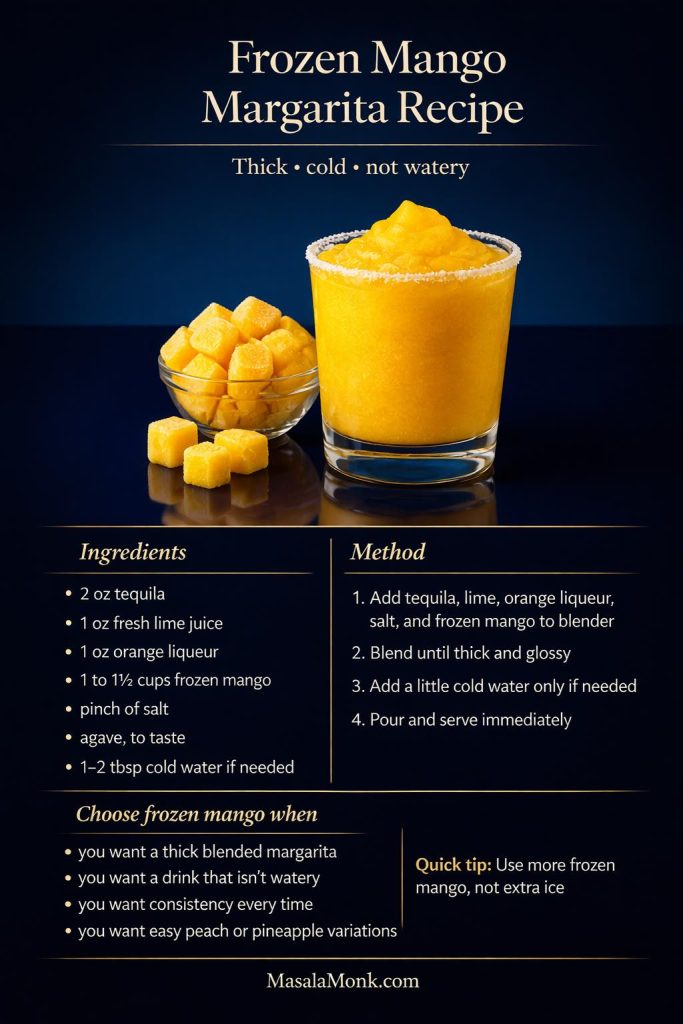
Choose frozen mango when:
- you want a blended mango margarita recipe that isn’t watery
- you want consistency every time
- you want a frozen peach mango margarita recipe or mango pineapple margarita variation
Mango margarita recipe with mango nectar (when you want fast and consistent)
Mango nectar is usually thick and sweet. It’s a shortcut that still tastes good, especially when balanced with lime and salt.
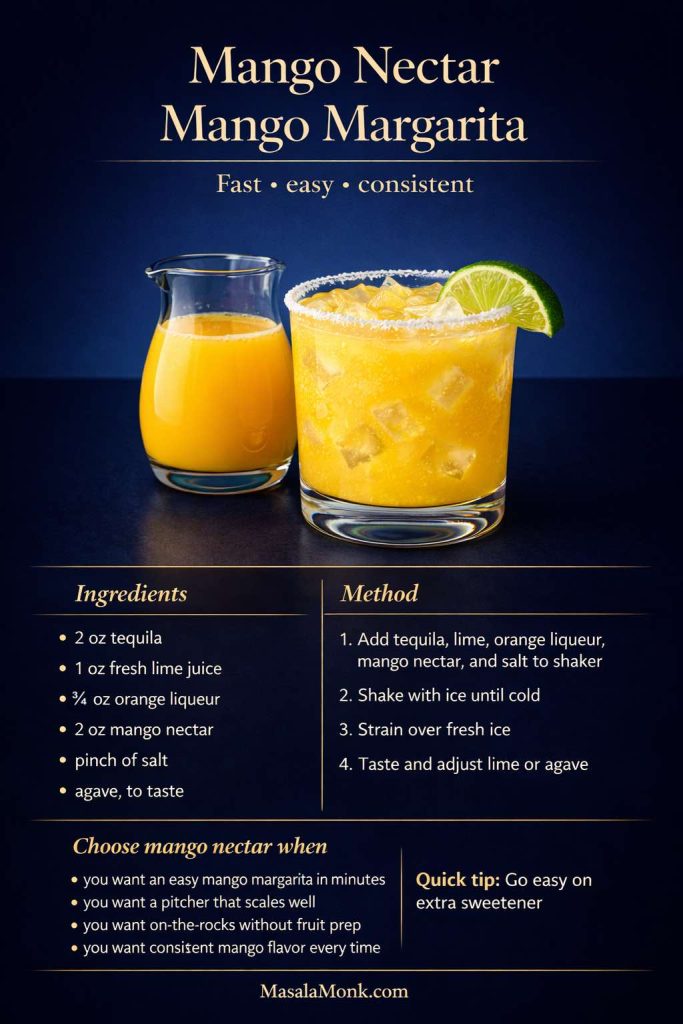
Choose mango nectar when:
- you want an easy mango margarita recipe in minutes
- you want a pitcher mango margarita recipe that scales easily
- you want the “mango margarita on the rocks” version without extra steps
Mango purée margarita recipe (restaurant-style control)
Mango purée has bold flavor and steady texture. It also lets you dial sweetness precisely, which helps when you’re making a spicy mango margarita recipe or a chamoy margarita where too much sugar can get heavy.
If you enjoy looking at a bar-style spec, this frozen mango margarita build shows a classic approach that uses purée and measured structure.
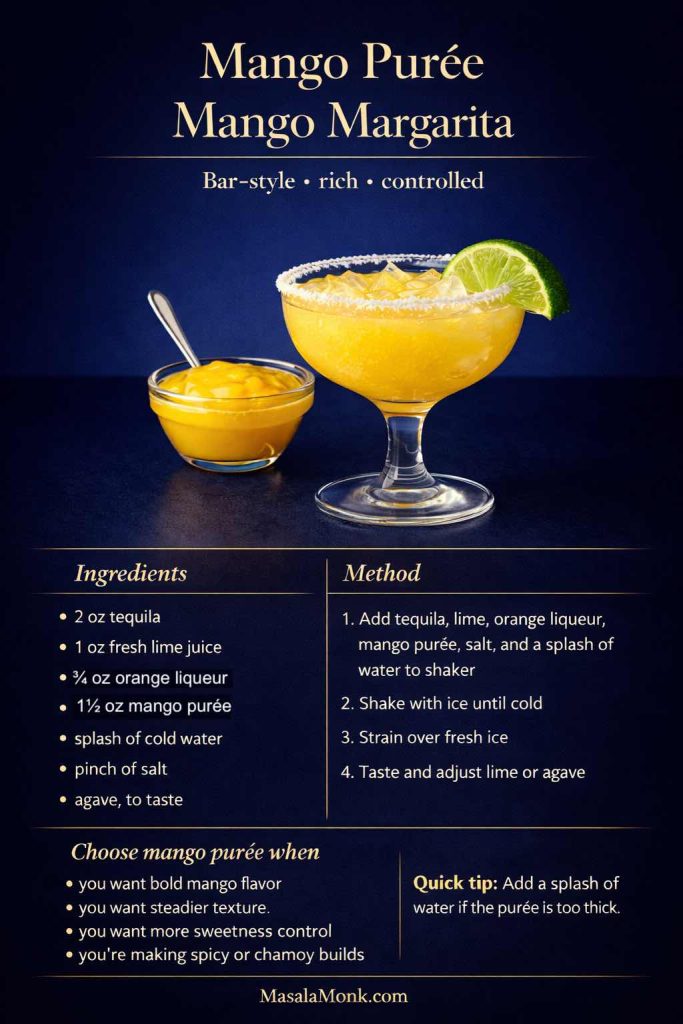
Mango juice margarita recipe (when juice is what you have)
Mango juice can work, yet it’s thinner, so your drink may feel less “mango-forward” unless you compensate. Typically, you’ll use a bit more juice, reduce added sweetener, and keep lime assertive. If the juice is very sweet, the salt pinch becomes even more important.
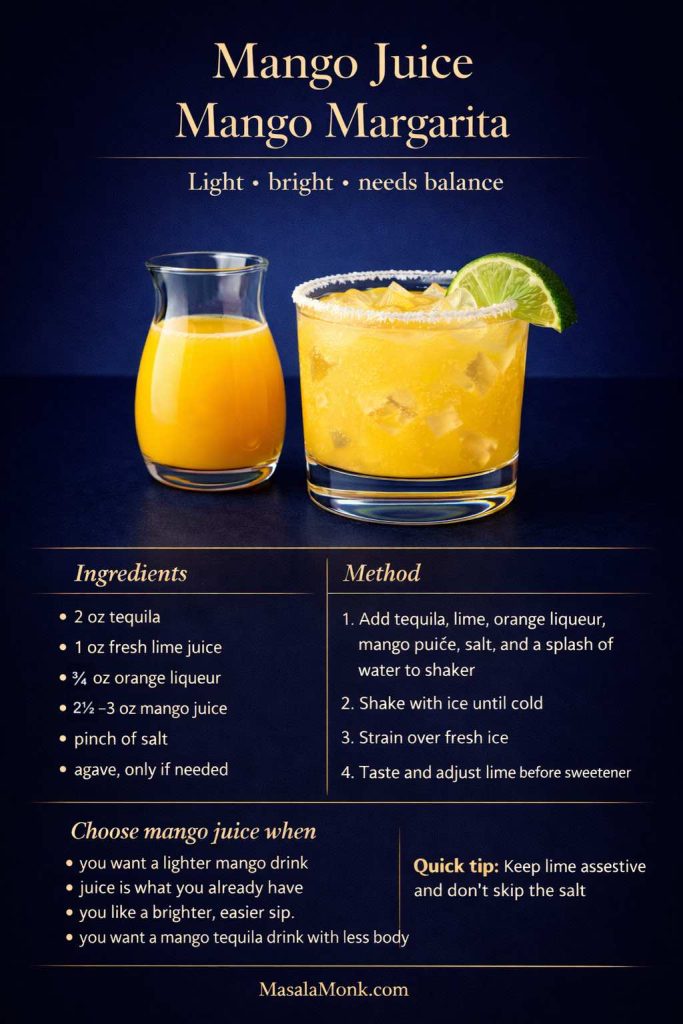
Juice works best for:
- Mango tequila drink recipes when you want something light
- Tequila and mango juice highball-style builds (margarita-adjacent)
- Mango tequila cocktail ideas for warm afternoons
Still, a mango margarita recipe with mango juice can be bright and refreshing, especially if you like a lighter drink.
Also Read: Air Fryer Salmon Recipe (Time, Temp, and Tips for Perfect Fillets)
Mango Margarita on the Rocks (fast, crisp, nectar-friendly)
This is the version most people mean when they want a mango margarita drink recipe that feels classic. It’s also the best “gateway” recipe because it shows you what the drink is supposed to taste like: mango up front, lime on the finish, tequila holding everything together.
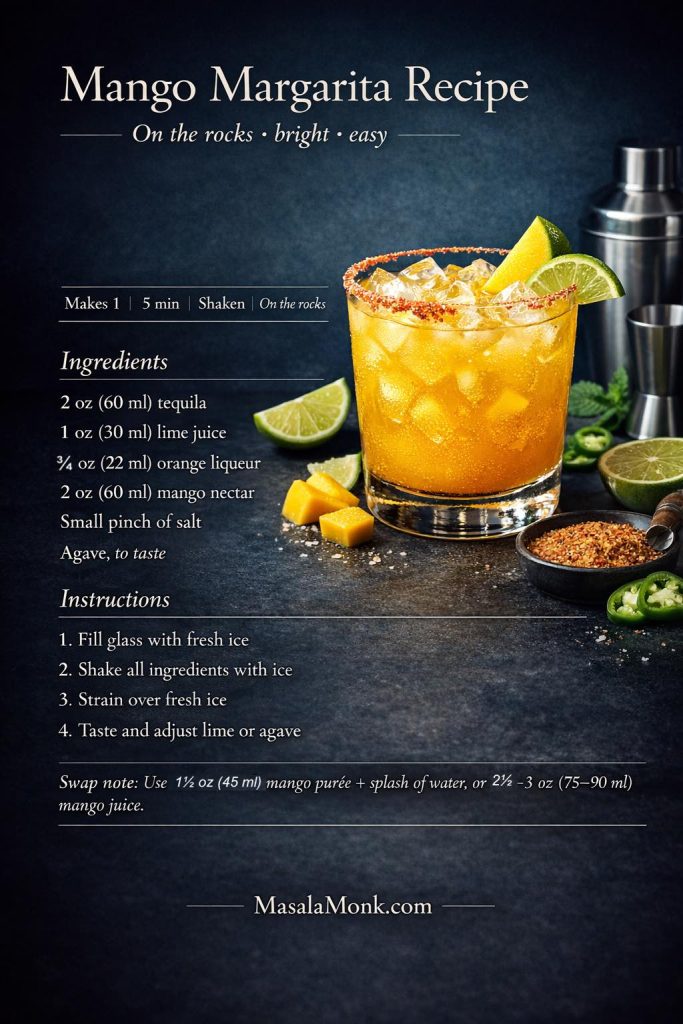
Quick mango margarita on the rocks (1 drink): Shake 2 oz tequila, 1 oz fresh lime juice, ¾ oz orange liqueur, 2 oz mango nectar, and a pinch of salt with ice. Strain over fresh ice and taste once—more lime if it feels sweet, a tiny touch of agave if it feels sharp.
Now let’s get into details.
Mango margarita ingredients (1 drink)
- 2 oz (60 ml) tequila
- ¾ oz (22 ml) orange liqueur
- 1 oz (30 ml) fresh lime juice
- 2 oz (60 ml) mango nectar
- 0 to ½ oz (0–15 ml) agave or simple syrup, to taste
- a small pinch of fine salt
- ice
If using mango purée: use 1½ oz (45 ml) purée + ½ oz (15 ml) cold water.
If using mango juice: start around 2½–3 oz (75–90 ml) mango juice; reduce sweetener; keep lime confident.
How to make a mango margarita on the rocks
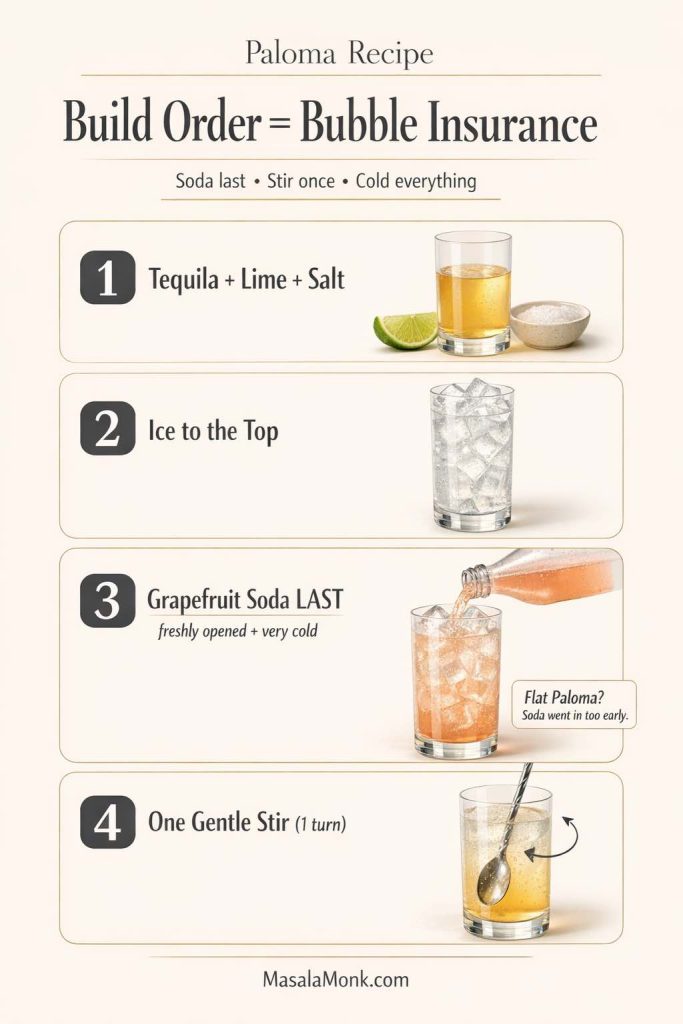
- Fill a rocks glass with fresh ice.
- Add tequila, orange liqueur, lime juice, mango nectar, salt, and any sweetener to a shaker with ice.
- Shake until the shaker feels properly cold.
- Strain into the glass and taste.
- Adjust if needed: a tiny splash of lime if it feels sweet, or a touch of nectar if it feels too sharp.
At this point, it helps to know what you’re aiming for. The drink should taste bright, not syrupy. It should feel mango-forward, not tequila-forward. It should finish clean with lime and a hint of orange. If it tastes heavy, lime is the lever. If it tastes sharp, a touch of sweetener is the lever. And if it tastes “kind of flat,” salt is the lever.
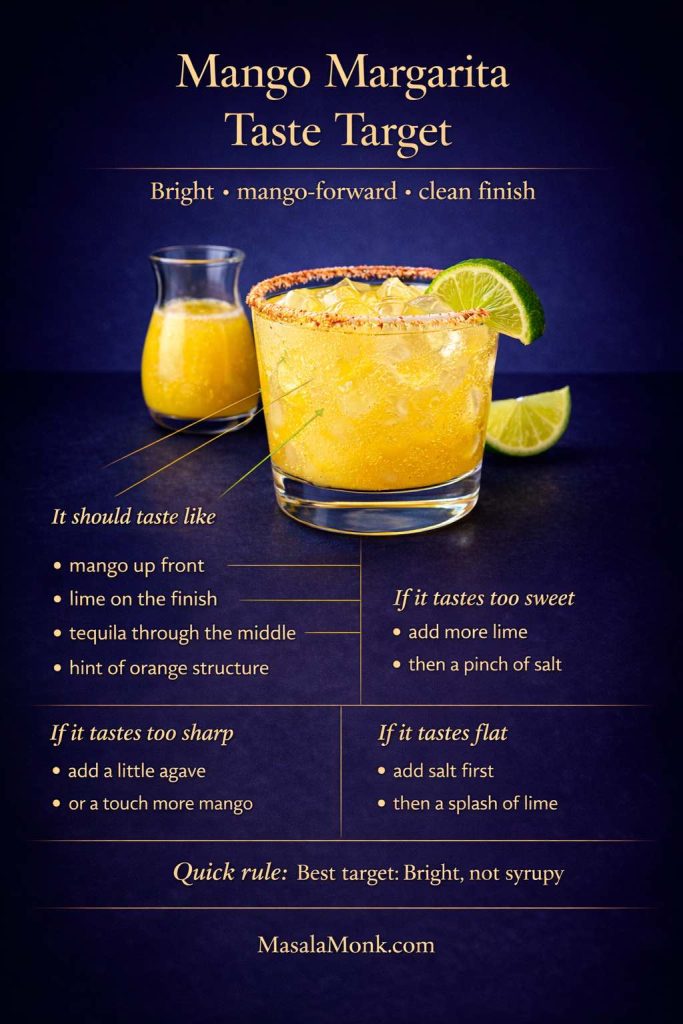
Mango nectar vs mango juice vs mango purée (what changes)
Because these come up constantly in real kitchens, here’s the simplest rule of thumb:
- Nectar usually means you’ll add little to no extra sweetener.
- Juice often needs more lime and salt to stay vivid, and sometimes a small boost of orange liqueur for structure.
- Purée is rich; it can handle extra lime and tends to taste more “cocktail-bar” when balanced tightly.
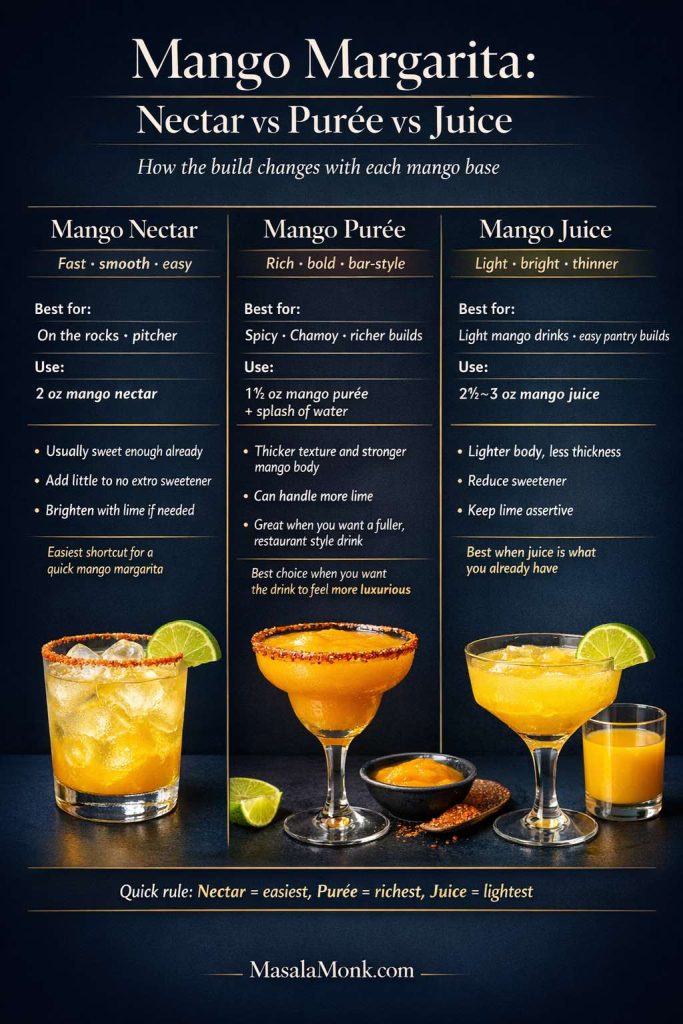
Once you’ve made this version once, you can make a simple mango margarita recipe from memory. It’s also the foundation for spicy and Tajín versions.
Also Read: Masterclass in Chai: How to Make the Perfect Masala Chai (Recipe)
Frozen Mango Margarita Recipe (blended, thick, not watery)
Frozen margaritas are supposed to feel plush and cold, almost like a slushie that still tastes like a cocktail. The problem is that many frozen recipes rely on ice to make that slush. Ice melts. Mango can do the job more gracefully. That’s why frozen mango is your best friend here: it gives you body and flavor at the same time.
This version is what you make when you want a blended mango margarita recipe that stays bold from the first sip to the last.
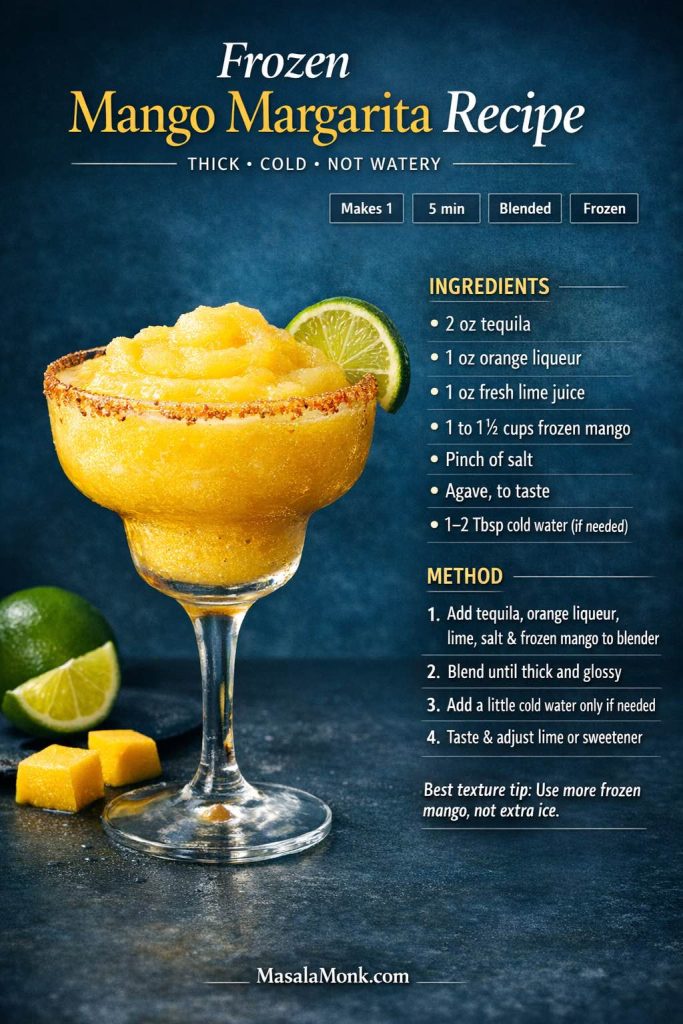
Quick frozen mango margarita (1 drink): Blend 2 oz tequila, 1 oz lime juice, 1 oz orange liqueur, a pinch of salt, and 1 to 1½ cups frozen mango until thick and glossy. Add only 1–2 tablespoons cold water if the blender stalls—skip extra ice to avoid watering it down.
Lets get into details now.
Ingredients (1 frozen mango margarita)
- 2 oz (60 ml) tequila
- 1 oz (30 ml) orange liqueur
- 1 oz (30 ml) fresh lime juice
- 1 to 1½ cups frozen mango chunks
- 0 to ½ oz (0–15 ml) agave or simple syrup, to taste
- a small pinch of fine salt
- optional: 2–4 tablespoons cold water if the blender needs help
How to make a frozen mango margarita
- Add tequila, orange liqueur, lime juice, salt, and frozen mango to a blender.
- Blend until thick and glossy.
- If it won’t catch, add a tablespoon or two of cold water and blend again.
- Taste, then decide whether it needs a little sweetener or a touch more lime.
- Pour into a chilled glass and serve immediately.
If you enjoy comparing approaches, this spicy mango frozen build with chili-lime seasoning is a great example of how frozen fruit can carry the texture without leaning on ice.
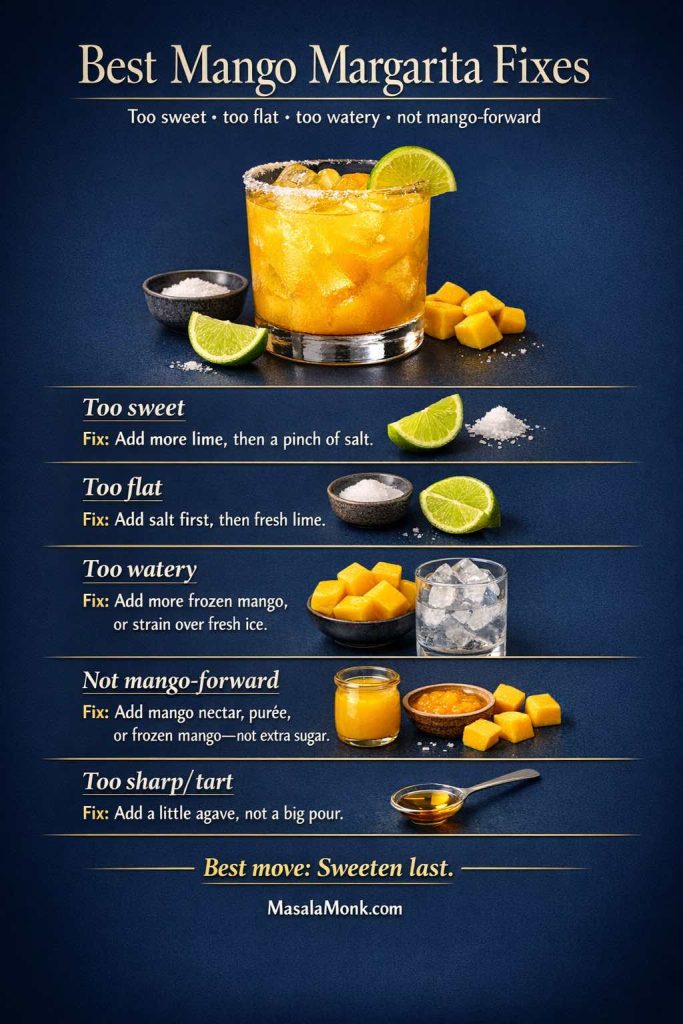
Frozen mango margarita troubleshooting (save it without starting over)
Mango behaves differently depending on brand, ripeness, and freezer temperature. So rather than expecting perfection on the first blend, treat this like a tasting process.
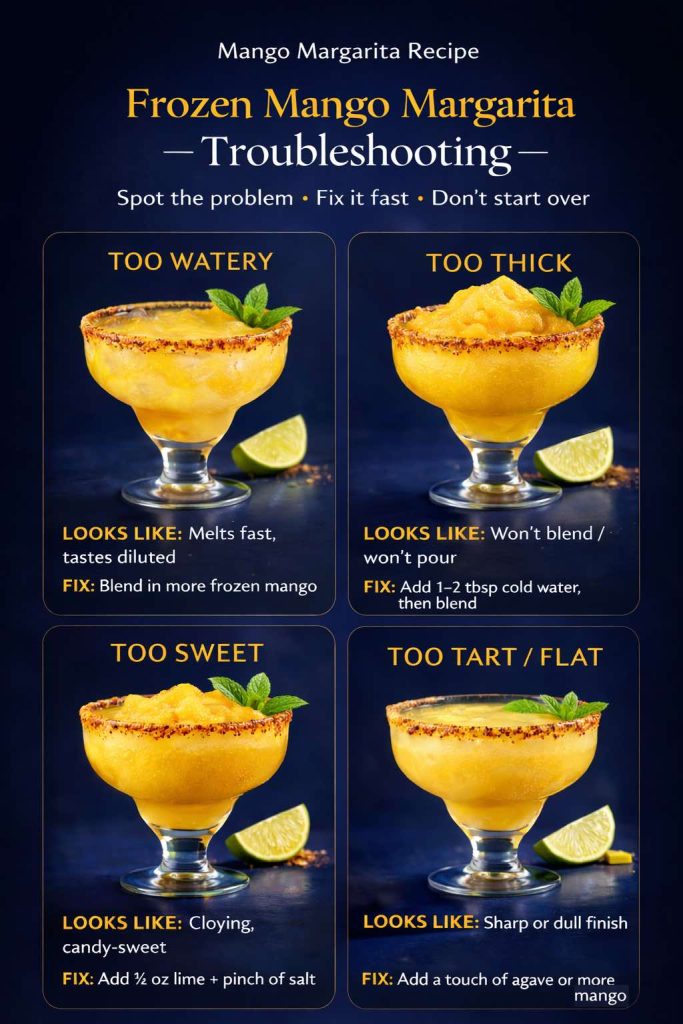
If it’s too thick to blend or pour:
Add 1–2 tablespoons cold water. Blend briefly. Repeat only if needed.
If it’s too thin:
Add more frozen mango, not more ice. Ice dilutes; mango reinforces.
If it’s too sweet:
Add ½ oz (15 ml) more lime. Taste again. Then add a tiny pinch more salt if it still reads sweet.
If it’s too tart:
Add 1–2 teaspoons sweetener. Blend. Taste again.
If it tastes too boozy:
Increase mango slightly and add a little lime. Booziness often shows up when fruit is too low and acid is too soft.
If it doesn’t taste mango-forward enough:
Add mango (frozen or purée) rather than extra sweetener. Sweet doesn’t equal mango.
If it tastes flat or muted:
Add salt first. Then add a splash more lime. Most “flat” fruit cocktails need structure, not sugar.
If you used fresh mango and it tastes grainy:
That’s usually fiber. Next time, blend your mango base with a splash of lime and strain. For now, blending longer can help slightly, though straining is the real fix.
Once you learn these tiny pivots, “best frozen mango margarita recipe” becomes less of a quest and more a predictable outcome.
Also Read: Crock Pot Pork Chops and Sauerkraut (No Dry Chops Recipe)
Mango Margarita with Tajín (the rim that makes mango pop)
Mango and chili-lime seasoning feel like they were invented for each other. And then mango brings sweetness and perfume; Tajín brings tartness, salt, and gentle heat. Together they make the drink taste more “awake.”
If you want the most straightforward source for what Tajín is, the wikipedia’s page on Tajín Clásico is simple and useful. In practice, you’re treating it as a rim seasoning and a flavor accent rather than an ingredient you dump into the drink.
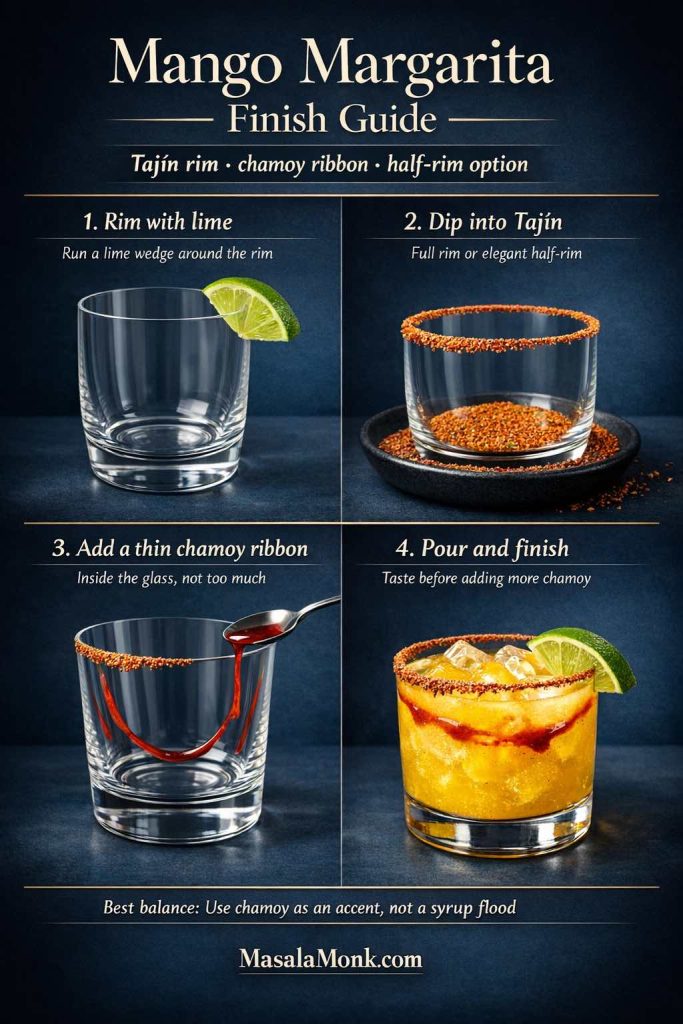
How to rim a mango margarita with Tajín
- Run a lime wedge around the rim of your glass.
- Dip into Tajín.
- Build your mango margarita on the rocks or pour your frozen mango margarita recipe into the prepared glass.
When Tajín doesn’t stick well—especially with frozen drinks—use a thin smear of chamoy on the rim before dipping into Tajín. If you don’t have chamoy, a tiny dab of agave works too. It acts like edible “glue,” keeps the rim bold, and prevents that frustrating moment when the seasoning slides off after two sips.
For a cleaner drinking experience, consider a half-rim. That way you can choose how much seasoning you want sip by sip. Moreover, it looks elegant, not messy. If you enjoy fruit margarita variations that use this same “rim for contrast” idea, MasalaMonk’s watermelon margarita variations make a natural companion read.
Also Read: Keto Mocktails: 10 Low Carb, Sugar Free Recipes
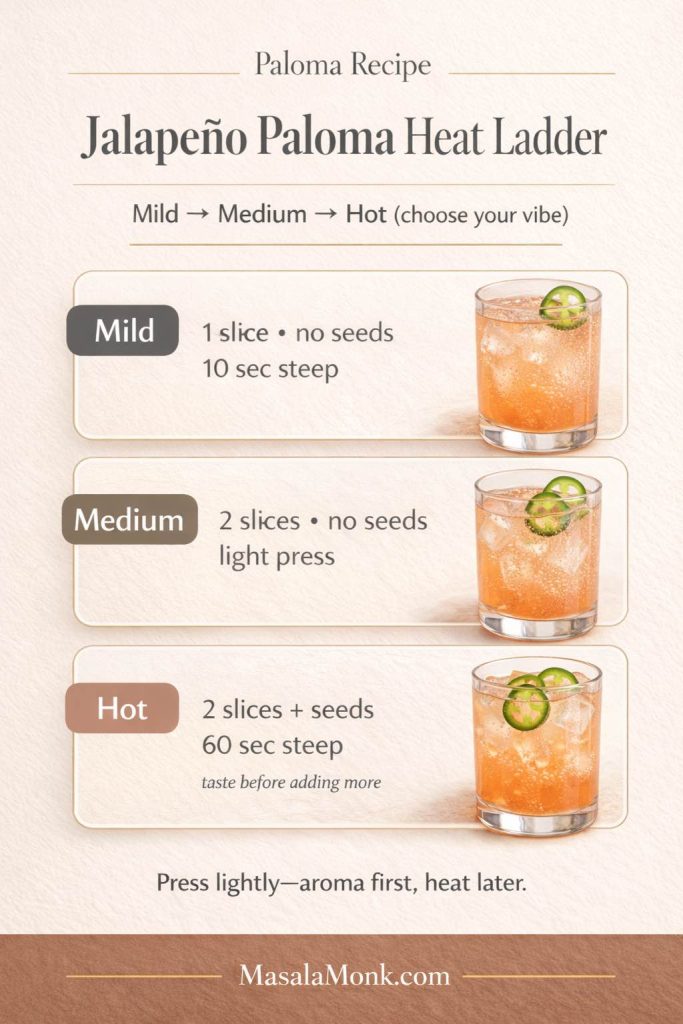
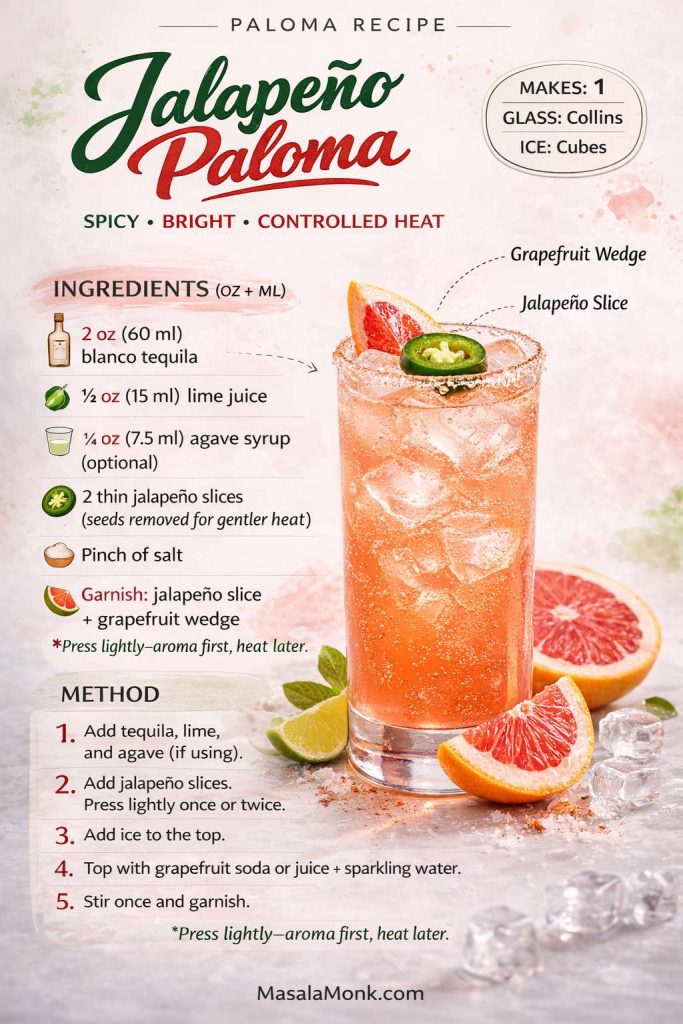
Spicy Mango Margarita Recipe (jalapeño or habanero)
Spice is most satisfying when it’s controlled. The best spicy mango margarita still tastes like mango and lime first. Heat arrives later as a warm, flavorful echo rather than a punch to the mouth.
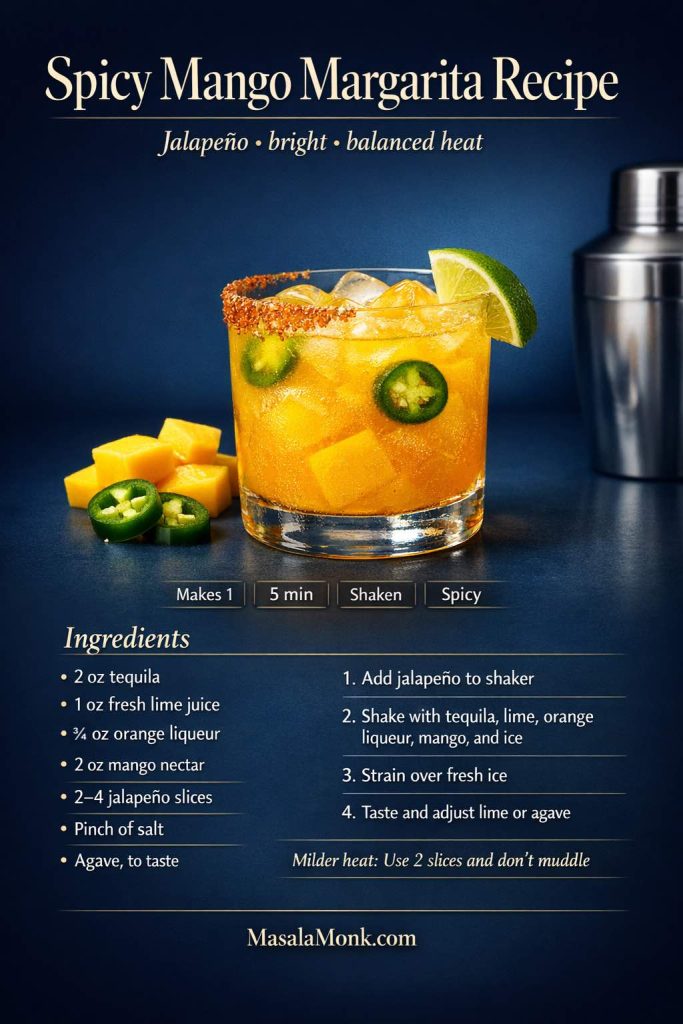
For a clean technique reference on how spice is typically handled in a margarita, this spicy margarita method is a helpful read. That said, you can do excellent spicy versions at home with a simple “spice ladder.”
Choosing your heat: jalapeño vs habanero
Jalapeño is grassy and bright. It plays especially well with lime and makes a spicy mango jalapeño margarita taste fresh rather than aggressive.
Habanero is fruity but intense. It can taste amazing in a mango habanero margarita recipe, though it needs restraint—think micro-dose, not slices.
The spice ladder (repeatable, not guessy)
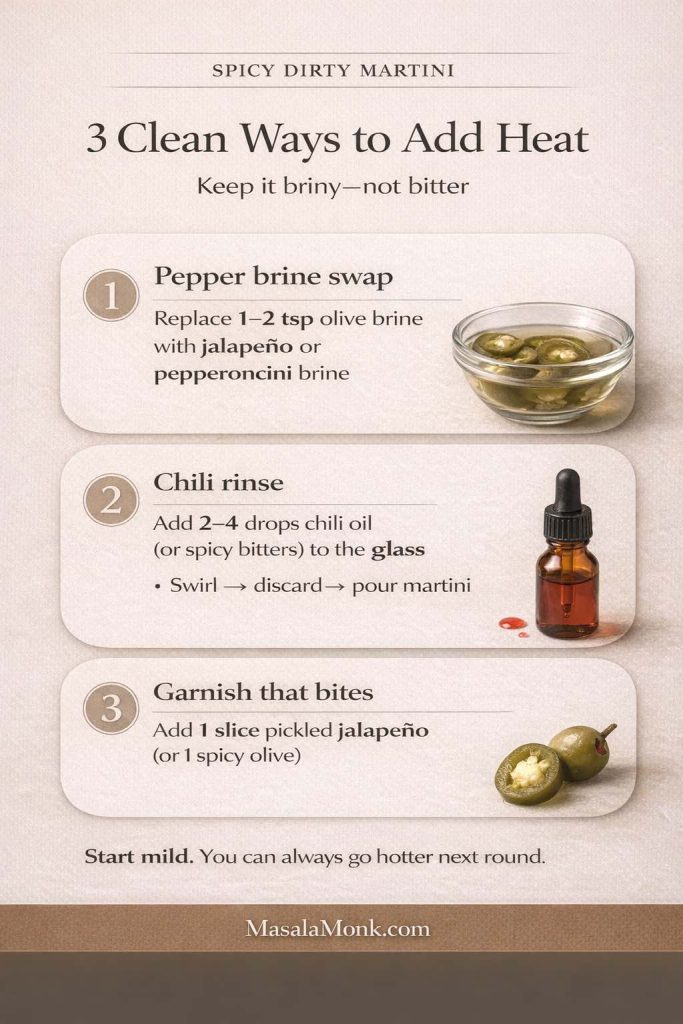
- Mild: 1–2 jalapeño slices in the shaker, shake, strain
- Medium: 3–4 jalapeño slices, shake; or muddle 2 slices lightly, then shake
- Hot: a tiny piece of habanero (smaller than a pea), shake quickly, taste immediately
- Very hot: generally not the goal for a mango margarita—mango is too lovely to bury
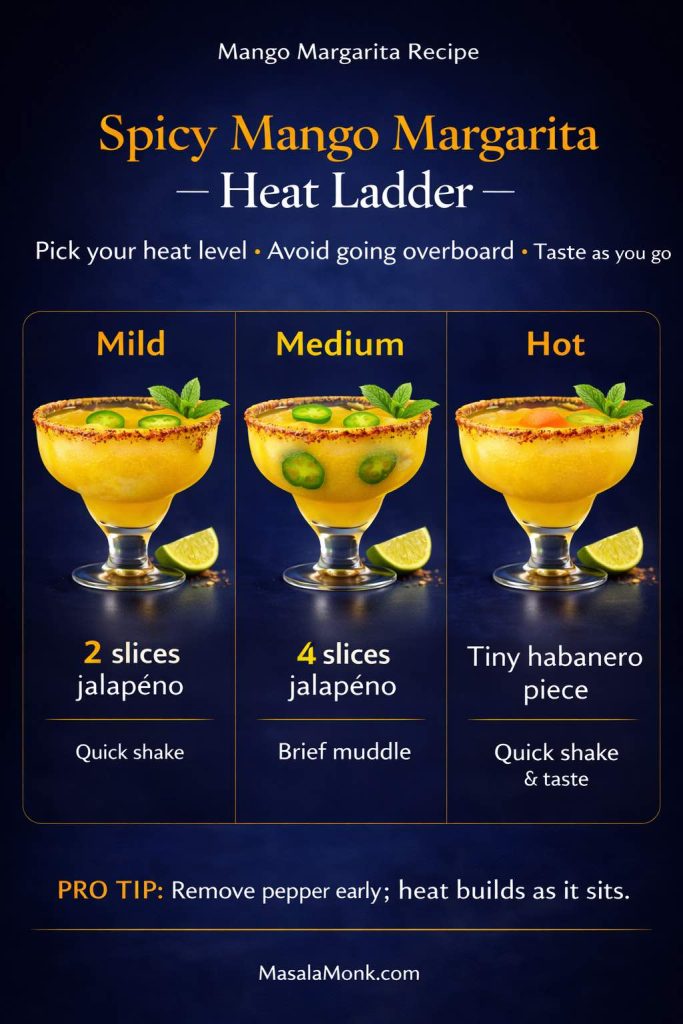
Timing matters just as much as amount. Longer contact increases heat. Muddling increases heat faster. That’s why “mild” is often best for guests: it tastes vibrant rather than aggressive.
Spicy mango jalapeño margarita (on the rocks)
Make the on-the-rocks mango margarita. Then:
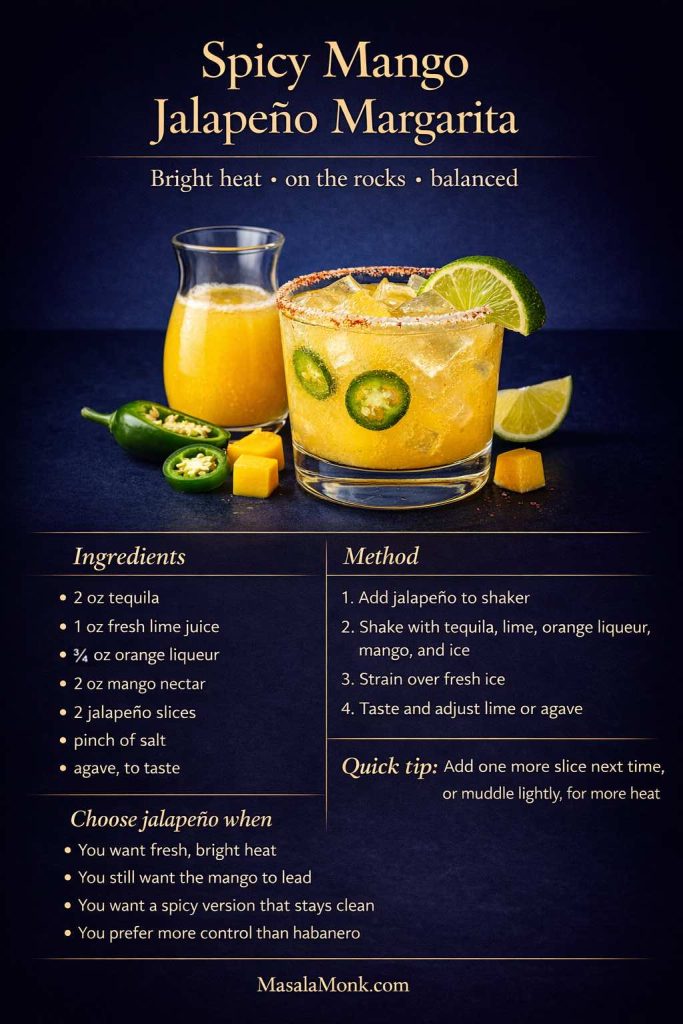
- Add 2 jalapeño slices to the shaker.
- Shake hard, strain, taste.
- If you want more heat next time, add one more slice or muddle lightly.
This covers spicy mango margarita recipe, mango jalapeno margarita, mango jalapeño margarita recipe, and “spicy mango tequila drink” vibes in a way that still tastes like an actual margarita.
Mango habanero margarita (the careful version)
Instead of adding slices, add a very small piece of habanero—smaller than you think you need—then shake and taste. If it’s already hot, stop there. Habanero heat builds quickly and can linger.
For a calmer heat profile, pair habanero with a Tajín rim rather than adding more pepper to the drink itself. That way the spice hits in controlled bursts.
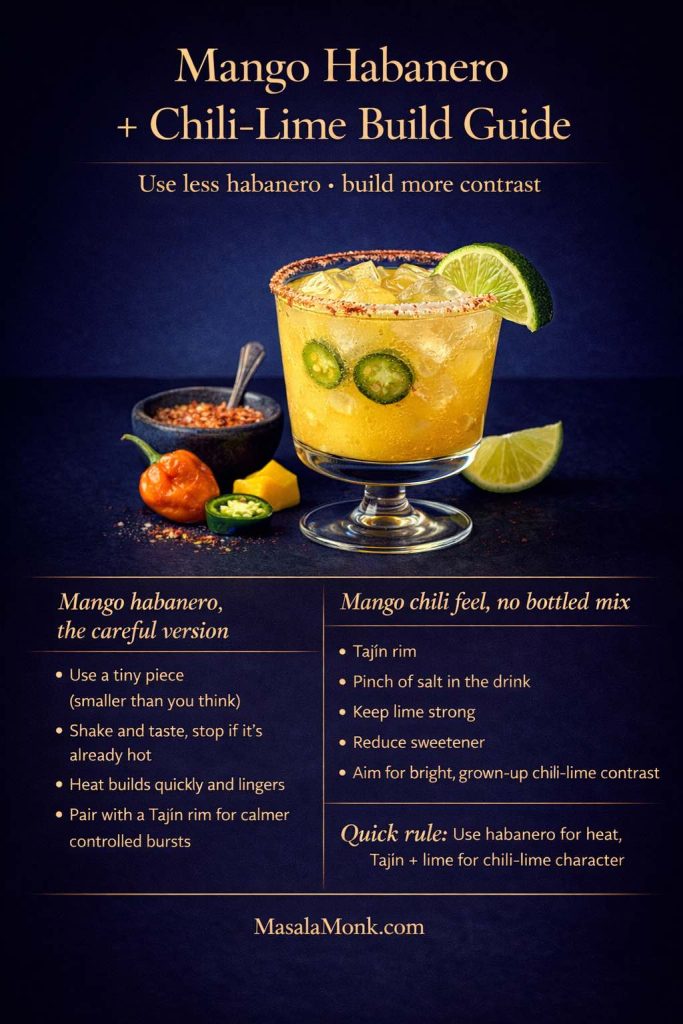
Mango chili margarita feel without a bottled mix
If you like the impression of a mango chili margarita mix—sweet fruit plus chili-lime punch—build it cleanly:
- Tajín rim
- pinch of salt in the drink
- lime kept strong
- sweetener reduced
You end up with a spicy mango cocktail that feels bright and grown-up rather than sticky.
Also Read: Slow Cooker Pork Tenderloin (Crock Pot Recipe) — 3 Easy Ways
Chamoy margarita (mangonada-style mango margarita)
Chamoy is playful. It’s sweet, sour, salty, and a little fruity, and it instantly turns a mango margarita into something that tastes like a treat. When Tajín joins the party, the whole thing becomes a mangonada-style experience: mango sweetness, lime brightness, chamoy tang, chili-salt sparkle, tequila backbone.
If you want a direct reference for the mangonada margarita style, this mangonada margarita shows the signature elements clearly: mango, chamoy, Tajín, lime, and tequila.
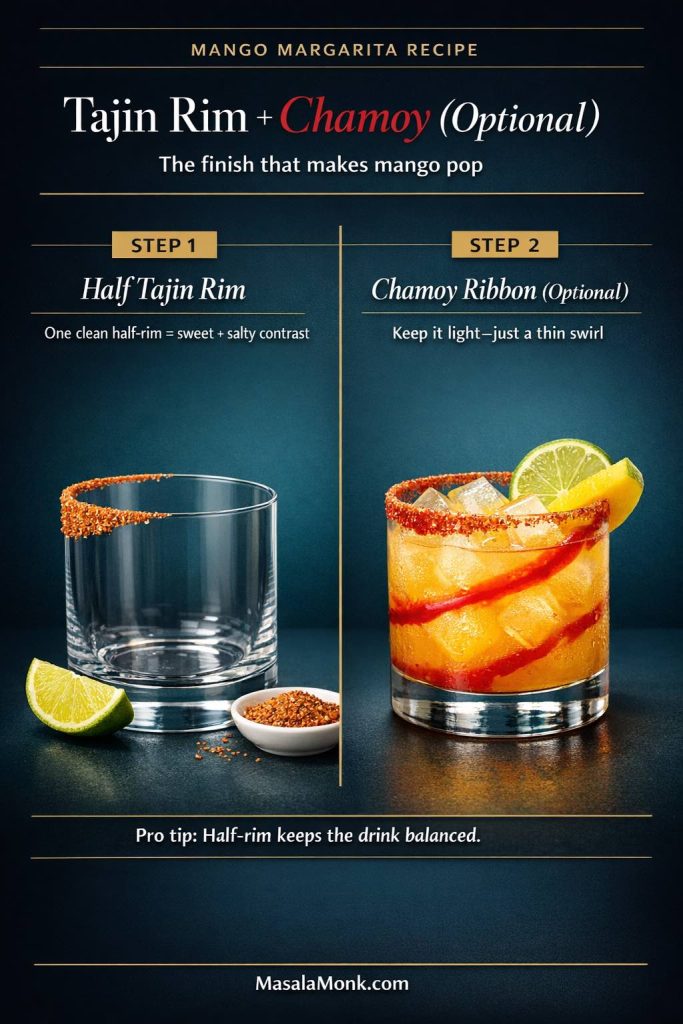
How to build a chamoy mango margarita without making it syrupy
- Drizzle chamoy inside the glass in thin ribbons.
- Rim the glass with Tajín.
- Pour in your mango margarita on the rocks or your frozen mango margarita.
- Taste before adding extra chamoy—often the initial drizzle is enough.
The goal is contrast: mango sweetness, lime brightness, chamoy tang, Tajín salt, tequila backbone. When those stay distinct, the drink is addictive. When they blur into “sweet + sticky,” it feels heavy.
Here’s the guardrail that keeps it from going overboard: chamoy should feel like an accent you notice, not a syrup you chew. If the drink starts tasting heavy, add a splash of lime and a pinch of salt to bring it back into balance.
Also Read: Chicken Pesto Pasta (Easy Base Recipe + Creamy, One-Pot, Baked & More)
Mango mezcal margarita (smoky, tropical, and elegant)
If tequila is the classic route, mezcal is the detour that still feels like it belongs. A mango mezcal margarita is smoky, tropical, and a little mysterious. Mango softens mezcal’s smoke, while lime keeps the whole thing crisp.
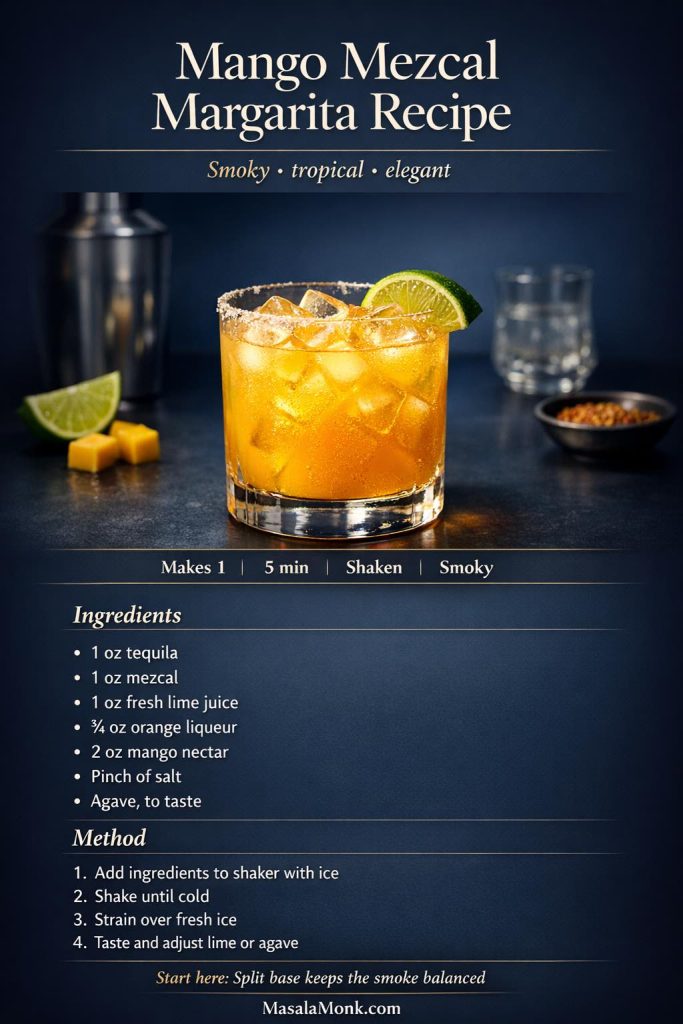
To make a mango mezcal margarita:
- replace half the tequila with mezcal in either the rocks or frozen recipe
- keep lime bright
- consider a Tajín rim for contrast
For first-timers, start with a split base: 1 oz tequila + 1 oz mezcal. That way smoke shows up clearly without taking over.
Also Read: Pork Tenderloin in Oven (Juicy, Easy, 350°F or 400°F) Recipe
Pitcher Mango Margarita Recipe (Serves 8)
A pitcher margarita should taste just as good at the eighth pour as it did at the first. That’s not luck—it’s method. The trick is to mix a properly balanced base, chill it thoroughly, then serve over fresh ice.
Pitcher ingredients (8 drinks)
- 16 oz (480 ml) tequila
- 6 oz (180 ml) orange liqueur
- 8 oz (240 ml) fresh lime juice
- 12–14 oz (360–420 ml) mango nectar
- 2–4 oz (60–120 ml) agave or simple syrup, to taste
- ½ teaspoon fine salt
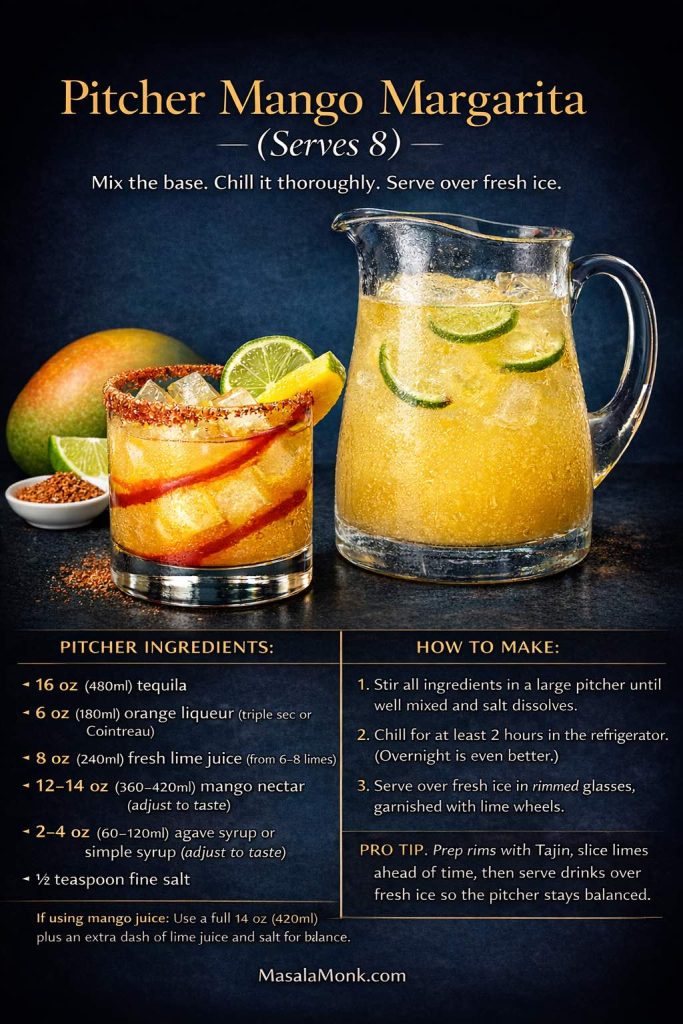
How to make a pitcher mango margarita
- Stir tequila, orange liqueur, lime juice, mango nectar, sweetener, and salt in a large pitcher.
- Refrigerate at least 2 hours. Overnight is great if you have time.
- Serve over fresh ice. Garnish with lime wheels or mango slices.
For hosting logic and batching confidence, our post with rum punch recipe is a useful companion read. Different flavors, same party problem: keep the base cold, keep the balance, then serve like you planned it.
Make-ahead flow that keeps it tasting fresh
If you’re setting up for friends, this order makes the night easier:
- mix the base and chill it
- prep rims (Tajín and salt)
- slice limes and mango
- keep extra lime juice nearby for last-minute balance fixes
- pour over fresh ice rather than letting ice sit in the pitcher
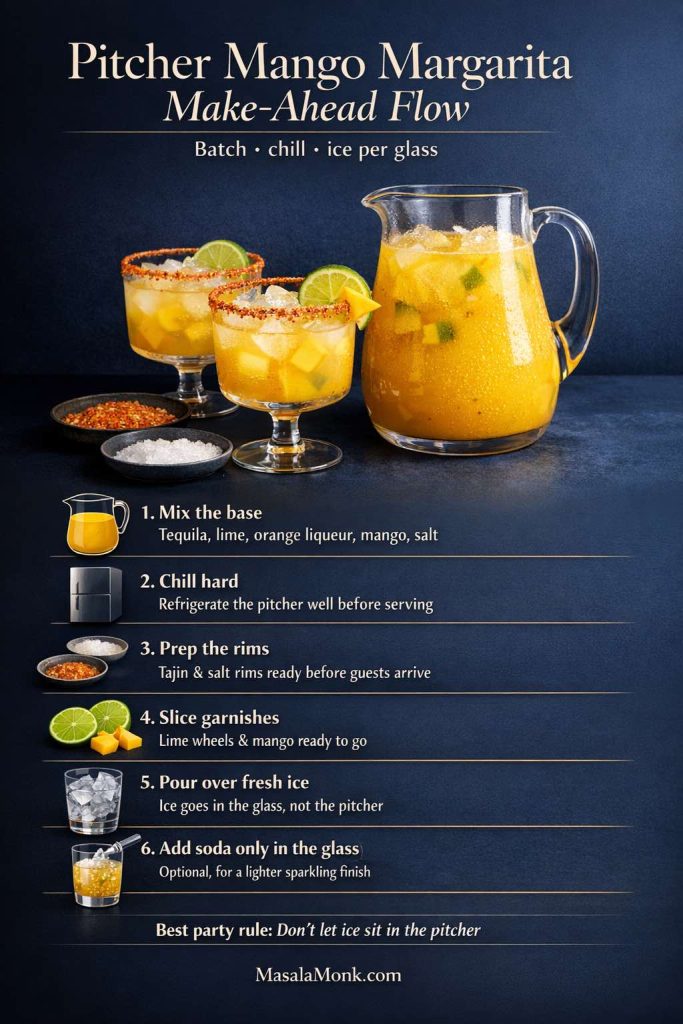
It sounds simple, yet it’s the difference between a pitcher that stays bright and a pitcher that tastes diluted by the end.
A quick note on sparkling add-ons
If you like topping your margarita with soda for a lighter finish, add it in the glass, not the pitcher. That way it stays lively and doesn’t go flat while you’re still pouring round two.
Also Read: How to Make a Flax Egg (Recipe & Ratio for Vegan Baking)
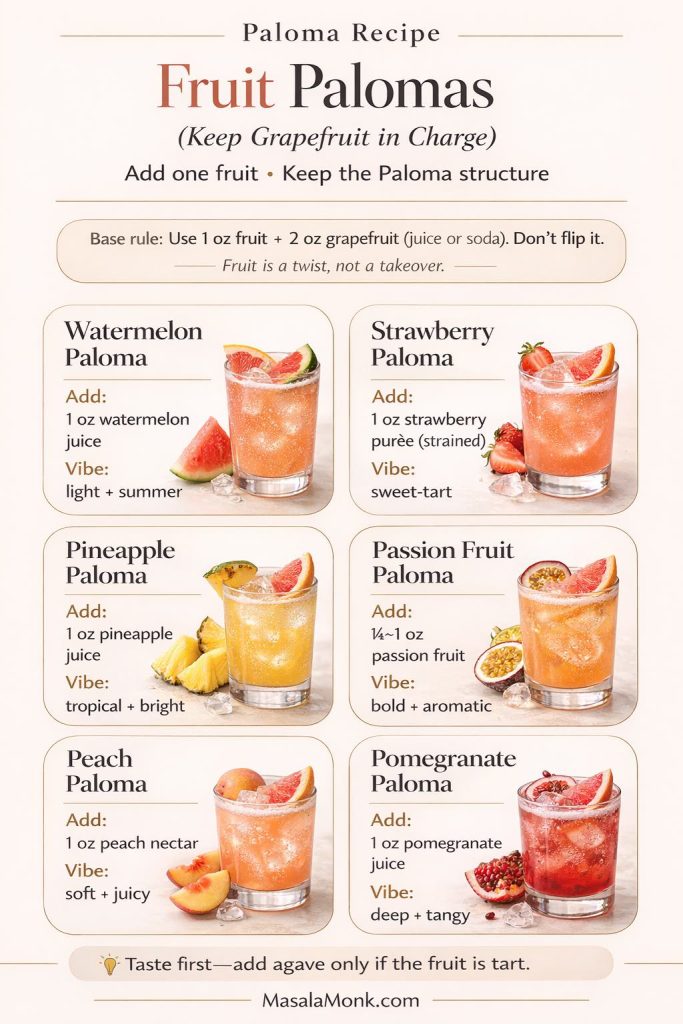
Mango margarita variations (pineapple, strawberry, orange, peach)
Once your base is right, variations become easy because you’re swapping fruit accents rather than reinventing structure. These are the ones that show up most often in real kitchens and real party menus.
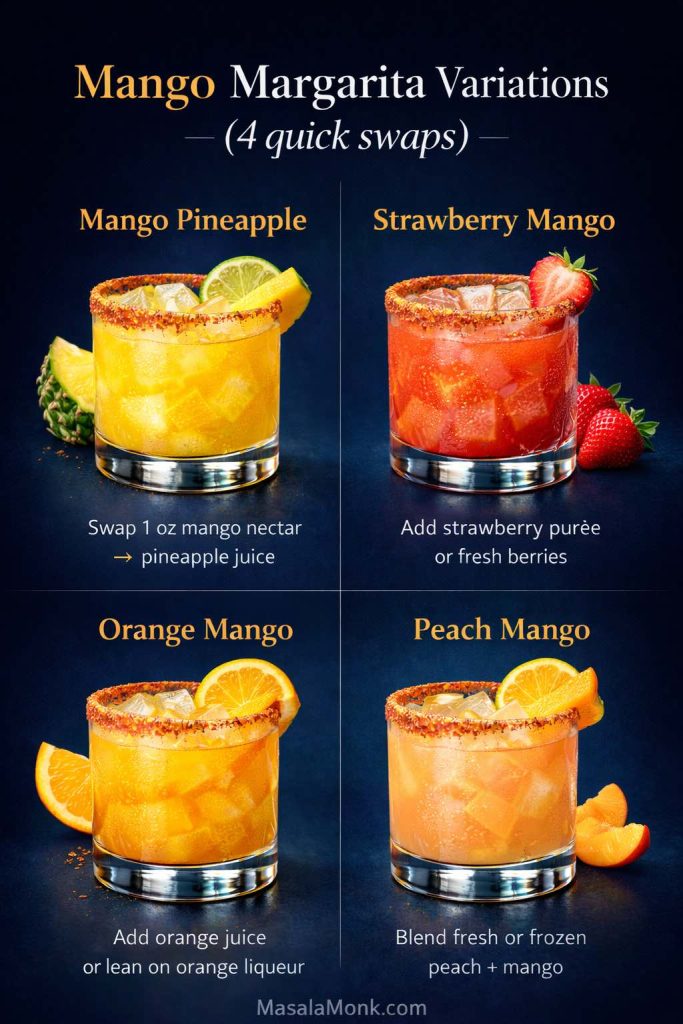
Mango pineapple margarita
Pineapple amplifies the tropical vibe and makes the drink taste more “vacation.” For on-the-rocks, swap part of the mango nectar for pineapple juice. For frozen, blend frozen pineapple and frozen mango together.
A good starting point:
- On the rocks: replace 1 oz of mango nectar with pineapple juice
- Frozen: use ¾ cup frozen mango + ¾ cup frozen pineapple
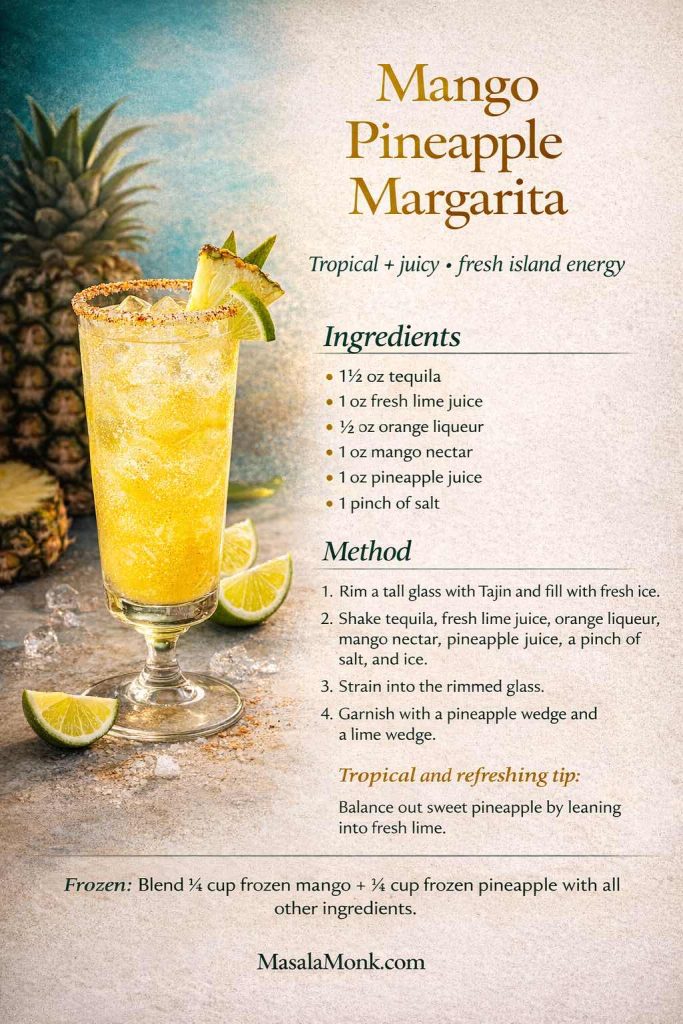
Because pineapple reads sweet, keep lime slightly higher than you think you need.
Strawberry mango margarita
Strawberry and mango together taste like summer dessert, yet the lime makes it grown-up again.
For frozen:
- Add 3–5 frozen strawberries to the blender.
For on the rocks:
- Add a small strawberry purée splash to the shaker and shake well.
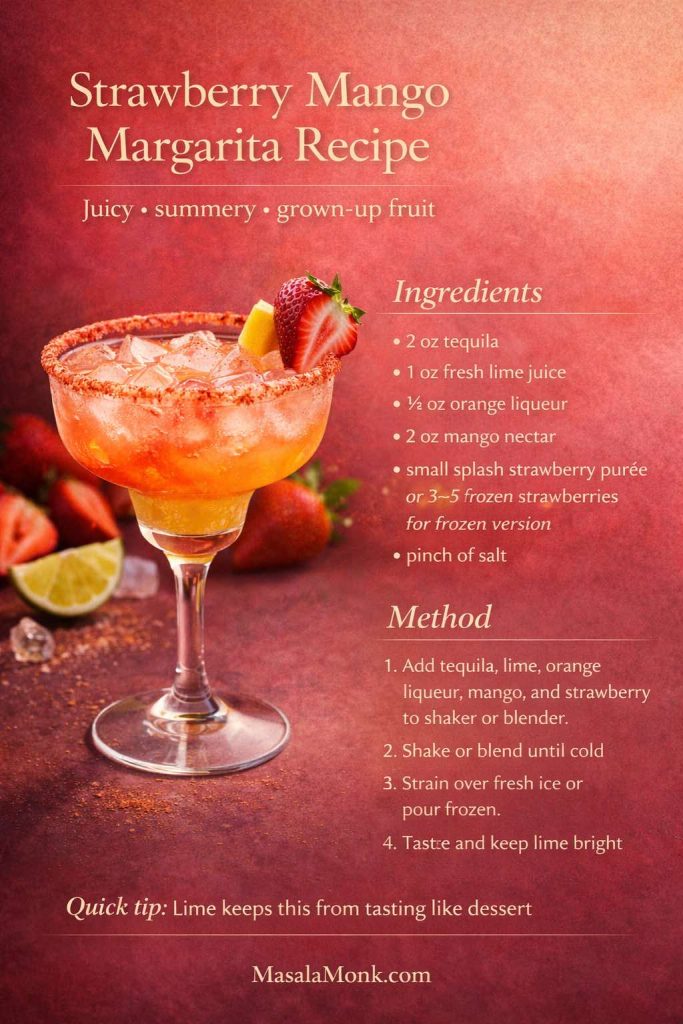
This fits strawberry mango margarita, strawberry and mango margarita, and mango strawberry margarita recipe directions without forcing anything.
Orange mango margarita
Orange and mango love each other, especially when you keep things bright and not too sweet. You can do this in two ways:
- add a small splash of fresh orange juice
- or lean slightly more on orange liqueur and reduce sweetener
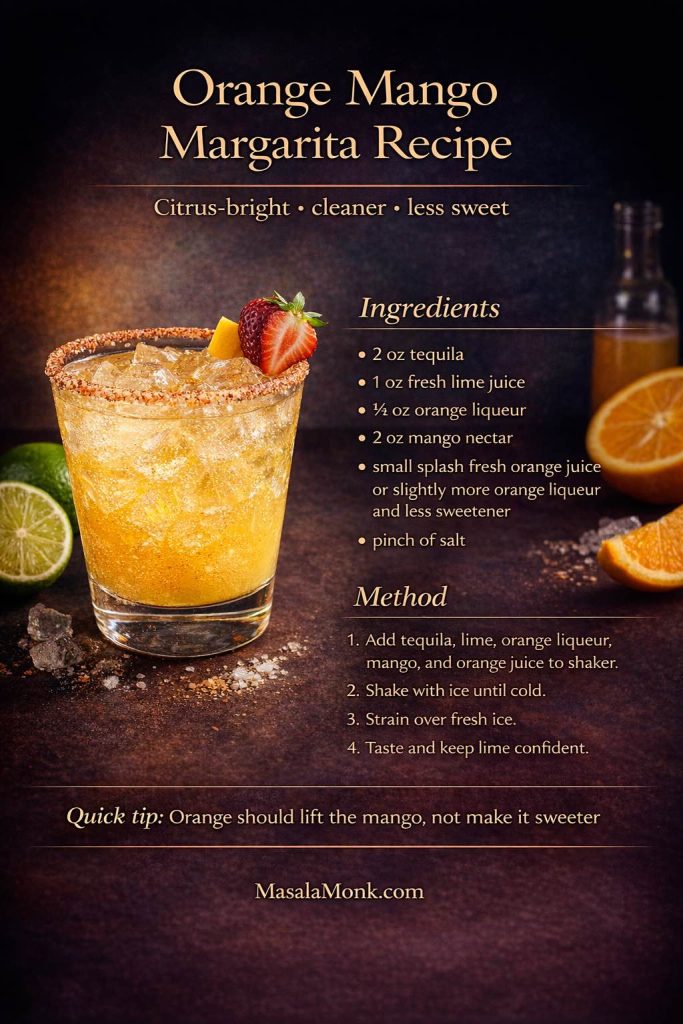
Either way, keep lime confident so the drink stays margarita-shaped. This supports mango orange margarita and orange mango margarita versions naturally.
Peach mango margarita (and frozen peach mango margarita recipe)
Peach softens mango. It’s rounder, gentler, more perfumed. Frozen peach + frozen mango is especially good in a blender.
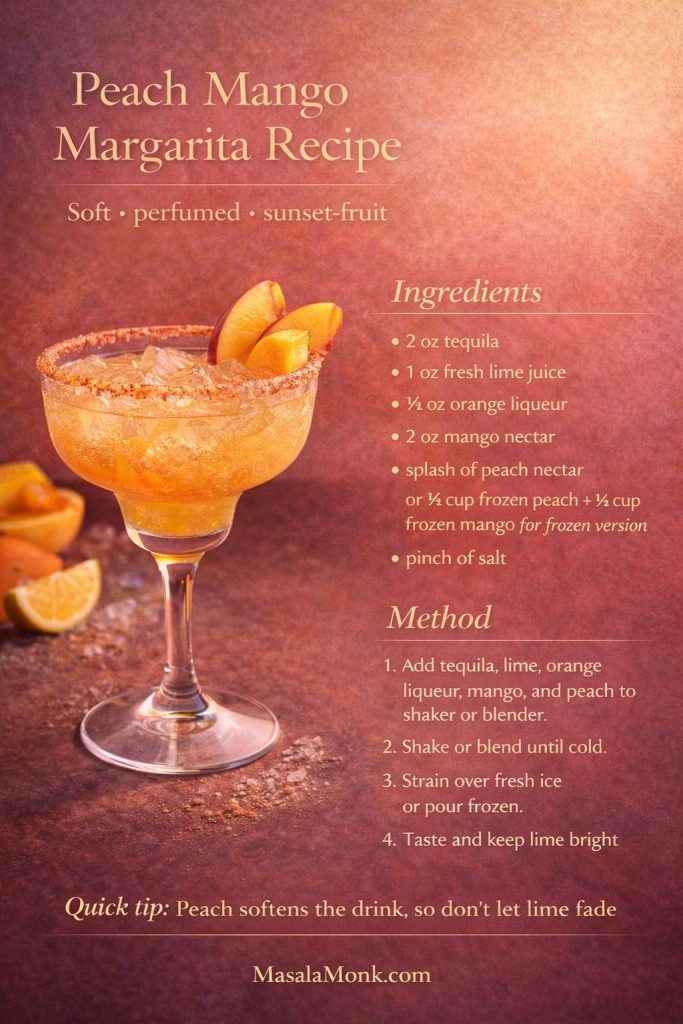
- Frozen: blend frozen mango and frozen peach 50/50, then build as the frozen mango margarita recipe
- On the rocks: use mango nectar plus a splash of peach nectar if you have it
Finish with a Tajín rim if you want that sweet-fruit-and-spice contrast. That comfortably covers peach mango margarita recipe and frozen peach mango margarita recipe variations.
Also Read: Croquettes Recipe: One Master Method + 10 Popular Variations
Mango martini recipe and mango cocktail detours (still in the mango mood)
Not every mango drink needs to be a margarita. Sometimes you want something sleeker: no rim, no rocks, just a cold, glossy, mango-forward drink.
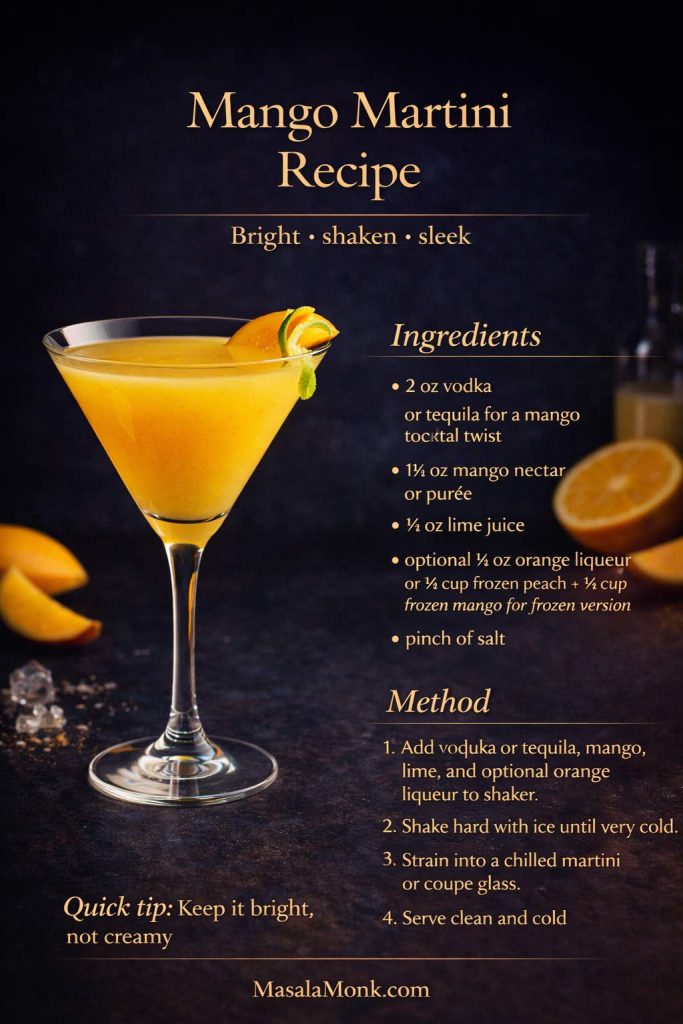
Mango martini (bright, shaken, not creamy)
A mango martini cocktail can be made a few ways. Here’s the margarita-adjacent route that keeps it bright rather than creamy:
- 2 oz vodka (or tequila if you want a mango tequila cocktail twist)
- 1½ oz mango nectar or purée
- ¾ oz lime juice
- optional: ¼ oz orange liqueur for lift
Shake hard with ice and strain into a chilled glass.
If you want more mango cocktail directions across spirits, MasalaMonk’s mango vodka cocktail variations is a natural blog post for readers who clearly want more mango drink ideas.
Tequila and mango juice (light and easy)
If you want something long and casual:
- pour tequila over ice
- add mango juice and a squeeze of lime
- add a pinch of salt
- taste, then decide whether it needs more lime
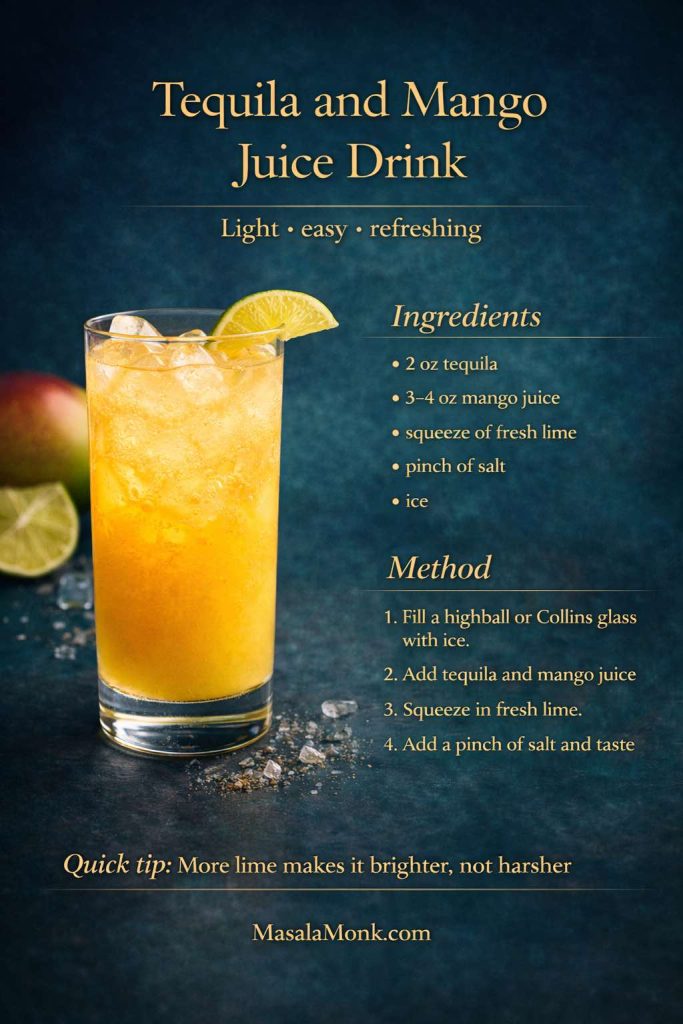
It’s margarita-adjacent, refreshing, and it scratches that “tequila and mango drink” craving without needing a shaker.
Also Read: Ravioli Recipe Reinvented: 5 Indian-Inspired Twists on the Italian Classic
The small moves that make the drink taste like the best mango margarita
When someone says they want the best mango margarita recipe, they usually mean one of three things:
- it shouldn’t be cloying
- it shouldn’t be watery
- it should taste balanced and “finished”
That’s great news, because all three are fixable with simple technique.
Keep lime fresh and assertive
Mango is sweet by nature. Lime is the counterweight. If your drink tastes heavy, lime is often the answer.
Use salt as a flavor amplifier
A small pinch of salt inside the drink won’t make it taste salty. Instead, it makes mango taste more mango and tequila taste smoother. It also sharpens lime in a way that reads “restaurant-quality.”
Sweeten last
Especially with mango nectar, sweetness can sneak up. Start with less sweetener than you think you need, then add a touch only after tasting. This alone can separate a good mango margarita recipe from one that tastes like mango candy.
Treat orange liqueur as structure, not perfume
Orange liqueur adds a bitter-sweet backbone that keeps mango from feeling one-note. If you reduce orange liqueur too much, the drink can taste flatter. If you add too much, the mango can fade. When in doubt, stay classic and tweak gently.
If you want a measured mango margarita reference from a major orange liqueur brand, the Cointreau mango margarita is a useful point of comparison for how they frame mango + lime + orange structure.
Also Read: Eggless Yorkshire Pudding (No Milk) Recipe
What to serve with mango margaritas (snacks that make everything taste brighter)
Mango margaritas love salty crunch and creamy bites, especially when you’re doing a Tajín rim, chamoy drizzle, or spicy jalapeño heat. These pairings might fit naturally and turn “one drink” into a real spread:
- baked jalapeño poppers for creamy heat alongside a spicy mango margarita recipe
- mozzarella sticks for salty, crispy comfort that plays beautifully with lime
- spinach dip variations for a cooling counterbalance to Tajín and jalapeño
- tapas-style small plates when you want your mango margarita night to feel like a whole event
- pepper sauce ideas if your table tends to lean spicy and customizable
And if you’d like a tropical tequila cousin that keeps the vibe going after the first round, MasalaMonk’s guava margarita pairs perfectly as a “next drink” recipe blog: same margarita structure, a different fruit personality.
Mango margarita mixes, Cayman Jack, Cutwater, and other ready-to-drink shortcuts (plus how to upgrade them)
Sometimes we are not really looking for a homemade mango margarita recipe. Instead, it’s for a shortcut: a bottled mix, a canned mango margarita, or a ready-to-drink mango option you can pour over ice and call it a day. That’s completely fair—especially when you’re hosting, when you’re tired, or when you simply want something cold and tropical without pulling out a blender.
However, here’s the truth: most mixes and canned options are built to be broadly appealing, which usually means they lean sweet and slightly flat. The good news is that you can make almost any mango margarita mix taste significantly better with a few tiny upgrades. In other words, you don’t need to “fix” it with extra syrup or complicated add-ons. You just need to restore the parts a real margarita is built on: lime brightness, structure, and a bit of salt clarity.
The 30-second upgrade that makes almost any mango margarita mix taste fresher
If you remember one thing from this entire section, make it this: the fastest path to a better mango margarita is rarely more sugar. It’s almost always more structure.
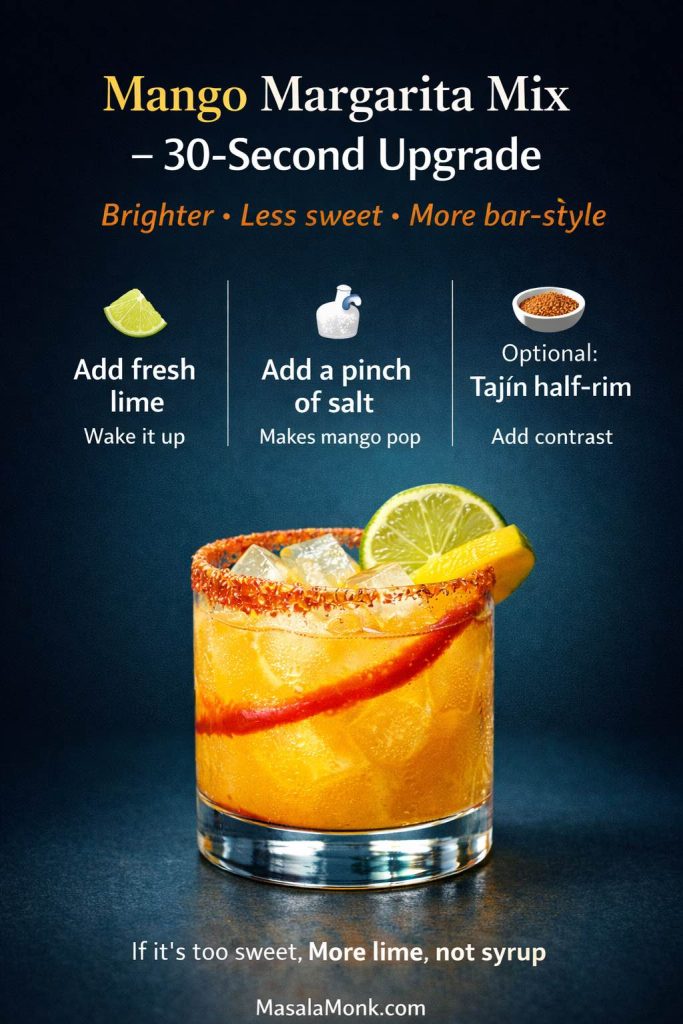
Start with these small moves:
First, add a squeeze of fresh lime. Even a small amount wakes up bottled mango flavors and makes the drink taste more “alive.” Next, add a tiny pinch of salt. It won’t make the drink taste salty; rather, it makes mango taste more like mango and tequila taste smoother. After that, taste before adding anything sweet. Many mixes are already sweet enough, so extra syrup usually pushes them into candy territory.
Finally, if your mix tastes strangely “mango-light”—as in, sweet but not truly mango-forward—add a small splash of mango nectar or a spoonful of mango purée. That boosts real fruit flavor without turning the drink into syrup.
Once you do these four things, you’ll be shocked how often “average mix” turns into “this tastes like a decent bar pour.”
Cayman Jack Mango Margarita: what it is and how to make it taste brighter
Cayman Jack Mango Margarita is typically bought as a ready-to-drink mango margarita-style beverage. Think of it as a party-friendly shortcut that benefits from the same balancing tricks you’d use in your homemade recipes.
To make it taste brighter and less one-note, pour it over fresh ice, squeeze in lime, and add a small pinch of salt. Then stop. Taste it. At that point, you’ll usually find it tastes cleaner and more “margarita-shaped.”
If you want the Tajín mango margarita vibe, rim the glass with Tajín (or do a half-rim), but keep the drink itself clean. That way the rim supplies the contrast—tart, salty, chili-lime sparkle—while the drink stays refreshing and not heavy.
Cutwater Mango Margarita (canned): how to serve it well
Cutwater’s Mango Margarita is a canned cocktail option that people often look for when they want convenience with tequila character. Because people often look for this canned beverage, it helps to think like a shopper: the quickest path is usually the brand’s own store locator or large retailers that support inventory search and delivery in your area.
Once you actually have the can, serving it well matters more than anything else. Start by serving it very cold. Pour over fresh ice, add a squeeze of lime, and consider a Tajín rim (or a half-rim) if you want that spicy-fruity contrast. This small treatment makes canned mango margaritas taste less flat and far more “cocktail-like.”
Additionally, if the can tastes a little sweet, do not add sweetener. Instead, add lime. If it tastes muted, add salt. Those two are the levers that turn ready-to-drink mango into something that tastes intentional.
Uptown Mango Margarita and “Gloria” mango margarita (often Rancho La Gloria)
You’ll also see bottled, ready-to-pour mango margarita products on the shelves—Uptown Mango Margarita is one example. Another common pattern is people looking for “Gloria mango margarita,” which often points to a bottled mango margarita-style drink from Rancho La Gloria.
Even though the bottles differ, the strategy stays the same. Serve them very cold, pour over fresh ice, and add fresh lime. Then add a tiny pinch of salt if it tastes flat. If it tastes too sweet, keep pushing lime rather than adding anything sugary. In contrast, if it tastes too sharp, a small splash of mango nectar can soften it without changing the drink’s personality.
The overall goal is to keep it tasting bright and drinkable, not sticky.
Best mango margarita mix (Master of Mixes, Zing Zang, and “mango chili” mixes)
When someone looks for “best mango margarita mix,” what they usually want is simple: they want mango flavor that feels real, sweetness that doesn’t overwhelm, and enough citrus bite that it still tastes like a margarita rather than fruit punch.
If you’re using a mix like Master of Mixes or Zing Zang, treat it like a base—not a complete recipe. Start with tequila, add the mix, and then “finish” it with fresh lime and a pinch of salt. That’s the basic upgrade pattern.
If you want a spicy mango margarita mix feel—something like “mango chili margarita”—it’s better to build the spice cleanly rather than relying on a spicy syrup. Use a Tajín rim for chili-lime contrast, then add jalapeño slices in the shaker for controlled heat. This way the drink stays crisp and grown-up, and you don’t end up with a sticky, muddled sweetness that masks mango.
In short, the best mango margarita mix is the one you can upgrade into a balanced drink. Lime and salt do that job faster than anything else.
Also Read: Dirty Martini Recipe (Classic, Extra Dirty, No Vermouth, Spicy, Blue Cheese, Tequila + Batched)
A final pour
Once you’ve made this a couple of times, you stop thinking of it as a single recipe and start thinking of it as a set of confident choices: frozen mango or mango nectar, jalapeño slices or a gentle Tajín rim, chamoy ribbons or clean citrus brightness, tequila-only or a smoky mezcal split. That’s the real charm of a mango margarita—one base, many moods.
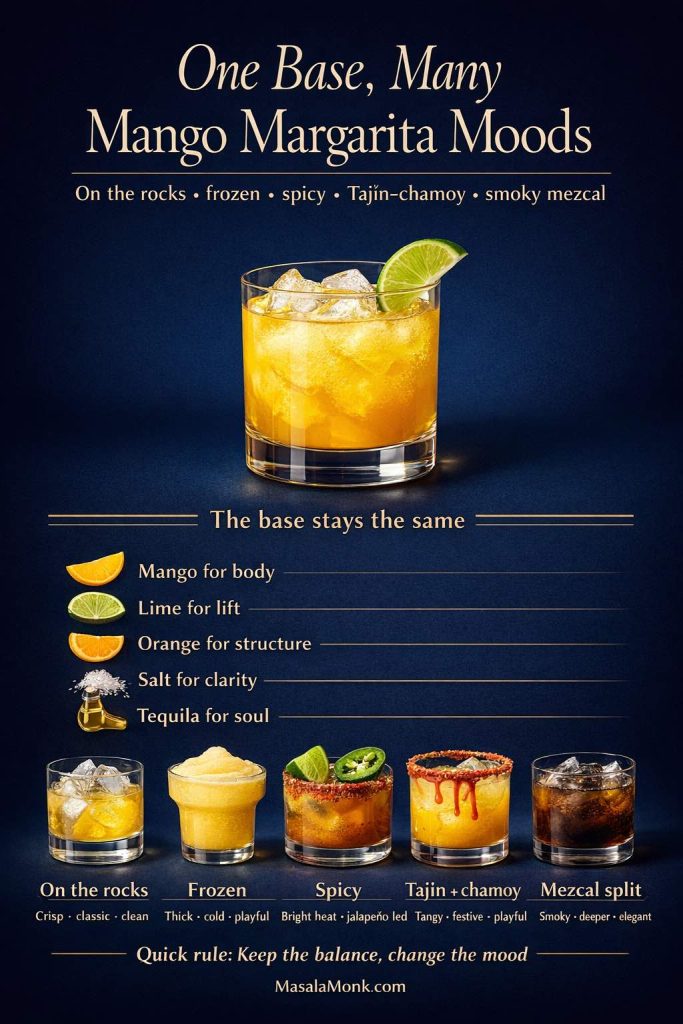
Some nights you’ll want the simplest mango margarita on the rocks. On other nights, you’ll want a frozen mango margarita recipe that tastes like a tropical slush with a tequila spine. Then, when you’re feeling playful, a chamoy margarita with a Tajín rim turns the drink into something that feels like a celebration in a glass. Either way, the balance stays the same: mango for body, lime for lift, orange for structure, salt for clarity, tequila for soul.
Also Read: Fish and Chips Reimagined: 5 Indian Twists (Recipe + Method)
FAQs
1) What is the best mango margarita recipe for beginners?
The best mango margarita recipe for beginners is the on-the-rocks version using mango nectar, tequila, fresh lime juice, and orange liqueur. Because mango nectar is consistent, you can focus on balance: shake until very cold, then adjust with a little more lime if it tastes sweet or a touch of agave if it tastes sharp.
2) How do you make a mango margarita on the rocks?
To make a mango margarita on the rocks, shake tequila, mango nectar (or mango juice), fresh lime juice, orange liqueur, a pinch of salt, and ice. Afterward, strain into a glass filled with fresh ice. Finally, taste once and tweak: extra lime for brightness, or a small splash of mango nectar if it’s too tart.
3) How to make a mango margarita frozen?
For a frozen mango margarita, blend tequila, lime juice, orange liqueur, a pinch of salt, and frozen mango until thick and smooth. If the blender stalls, add a tablespoon or two of cold water rather than extra ice to avoid watering it down.
4) What’s the difference between a blended mango margarita and a frozen mango margarita?
A blended mango margarita usually means the drink is made in a blender, while a frozen mango margarita specifically aims for a thick, slushy texture. In practice, both are similar; the real difference comes from how much frozen fruit you use and how much liquid you add.
5) Can I make a mango margarita recipe with mango nectar?
Yes—mango nectar is one of the easiest bases for a mango margarita recipe. Since nectar is often sweet, start with little to no added sweetener. Then, adjust with lime juice and salt to keep the drink crisp.
6) Can I make a mango margarita with mango juice instead of mango nectar?
Absolutely. However, mango juice is usually thinner than nectar, so the drink may taste less mango-forward unless you increase the mango amount or add a bit of mango purée. Meanwhile, keep lime slightly higher to maintain that margarita snap.
7) How do I make a mango nectar margarita recipe that isn’t too sweet?
First, reduce or skip added sweetener. Next, increase fresh lime juice in small steps. Finally, add a tiny pinch of salt; it sharpens citrus and keeps mango from tasting cloying.
8) Can I make a mango margarita recipe with mango purée?
Yes. A mango purée margarita recipe often tastes richer and more “bar-style.” Because purée adds body, it can handle a bit more lime. As a result, you can keep the drink bright without losing mango flavor.
9) How do I make a mango margarita recipe with fresh mango?
Blend ripe fresh mango with a splash of lime juice until smooth, then use that as your mango base in either the frozen or on-the-rocks method. If the mango is fibrous, strain the purée for a smoother texture.
10) What are the key mango margarita ingredients?
Most mango margarita ingredients include tequila, fresh lime juice, mango (nectar, purée, fresh, or frozen), orange liqueur, and ice. Additionally, a pinch of salt improves flavor and a Tajín rim is optional for contrast.
11) How do you make a spicy mango margarita?
To make a spicy mango margarita, add jalapeño slices to the shaker (or blend briefly for frozen). For more heat, muddle lightly; for less heat, remove the pepper sooner. Either way, keep mango and lime in the lead so the spice feels like a finish, not the main event.
12) How to make a spicy mango margarita with jalapeño?
Shake tequila, mango nectar (or purée), lime juice, orange liqueur, and 2–4 jalapeño slices with ice. Then strain and taste. If you want more heat next time, add one more slice or muddle gently.
13) How to make a mango jalapeño margarita without it getting too hot?
Use fewer slices, avoid muddling, and keep the contact time short. In addition, serving over fresh ice helps soften heat. If it still tastes spicy, add a splash more mango nectar and a squeeze of lime to rebalance.
14) How to make a mango habanero margarita recipe safely?
Use a tiny piece of habanero rather than slices, shake quickly, and taste immediately. Because habanero heat builds fast, start small, then increase gradually on the next round if needed.
15) What is a Tajín mango margarita?
A Tajín mango margarita is a mango margarita served with a Tajín rim (chili-lime seasoning). The salty-tart edge boosts mango flavor and makes the drink taste brighter, especially in frozen versions.
16) How do I make a mango margarita with Tajín?
Wet the rim with lime and dip it into Tajín. Then make your mango margarita on the rocks or frozen as usual. For a cleaner sip, try a half-rim so you can control how much seasoning you taste.
17) What is a chamoy margarita?
A chamoy margarita is a margarita accented with chamoy, a sweet-sour-salty condiment. When combined with mango and a Tajín rim, it takes on a mangonada-style profile that tastes like a tangy Mexican candy-inspired drink.
18) How do you make a mangonada margarita recipe at home?
Drizzle chamoy inside the glass, add a Tajín rim, then pour in a mango margarita (frozen or on the rocks). After that, taste before adding more chamoy—usually a little goes a long way.
19) What’s the best tequila for a mango margarita?
Blanco tequila keeps a mango margarita bright and crisp, while reposado adds warmth and smoothness. If you’re using Tajín or chamoy, reposado can feel especially balanced; conversely, for a fresh, zesty finish, blanco is a classic choice.
20) Can I make a mango mezcal margarita?
Yes. Replace part (or all) of the tequila with mezcal for a mango mezcal margarita. Since mezcal adds smoke, keep lime fresh and consider a Tajín rim to emphasize contrast.
21) How do I make a pitcher mango margarita recipe for a party?
Mix tequila, orange liqueur, lime juice, mango nectar, sweetener to taste, and a pinch of salt in a pitcher. Then chill the base thoroughly. When serving, pour over fresh ice so it stays bright instead of diluted.
22) How do I scale mango margaritas for a crowd without losing flavor?
Measure the base carefully, chill it well, and avoid leaving ice in the pitcher. Instead, add ice to each glass as you pour. That way the mango margarita stays consistent from the first serving to the last.
23) What is a mango pineapple margarita recipe?
A mango pineapple margarita recipe combines mango with pineapple juice or frozen pineapple. Because pineapple can taste sweeter, increase lime slightly so the drink still tastes like a margarita, not fruit punch.
24) How do I make a strawberry mango margarita?
Add strawberries to your mango margarita base—blend for frozen or shake with a small strawberry purée splash for on-the-rocks. Then re-taste and adjust lime so the finish stays crisp.
25) How do I make an orange mango margarita?
Add a splash of orange juice or lean slightly more on orange liqueur while keeping lime strong. This creates a softer citrus profile while preserving the classic margarita structure.
26) How do I make a peach mango margarita recipe?
Combine mango and peach (nectar, purée, or frozen fruit) in your base. For frozen peach mango margarita recipe versions, blend frozen peach and frozen mango together, then adjust lime so it stays bright.
27) Why does my mango margarita taste watery?
Usually the issue is too much ice or not enough mango body. For frozen drinks, use frozen mango as the main thickener and add only small splashes of water if needed. For on-the-rocks, shake, then strain over fresh ice rather than letting the drink sit in melting ice.
28) Why does my mango margarita taste too sweet?
First, add more lime juice in small increments. Next, add a pinch of salt. Finally, reduce sweetener next time, especially if you’re using mango nectar or a very ripe mango.
29) Why does my mango margarita taste too tart?
Add a small amount of agave or simple syrup, then re-taste. If you’re using mango juice rather than nectar, increasing mango volume can also soften the sharpness.
30) Can I make an easy mango margarita without orange liqueur?
You can, though the drink may taste less like a margarita and more like a mango tequila cocktail. If you skip orange liqueur, add a small amount of sweetener and keep lime assertive to maintain balance.
31) What’s the best mango margarita mix, and how do I make it taste less sweet?
The best mango margarita mix is the one that still tastes bright and citrusy once tequila is added. If it tastes too sweet, fix it with fresh lime first, then a pinch of salt. If it still tastes candy-like, reduce added sweetener next time. In contrast, if the mango flavor feels weak, add a small splash of mango nectar or a spoonful of mango purée—fruit intensity beats sugar every time.
32) How do I make a Cayman Jack mango margarita taste more like a fresh cocktail?
Pour it over fresh ice, add a squeeze of lime, and add a tiny pinch of salt. If you want extra contrast, do a Tajín half-rim rather than adding more sweetness. This keeps it bright and “margarita-shaped” instead of sticky.
33) What’s the best way to serve a Cutwater mango margarita?
Serve it very cold over ice, then add fresh lime. A Tajín rim (or half-rim) adds the chili-lime pop that makes mango taste sharper and more refreshing. If it tastes a little flat, salt is the fastest fix.
34) What is a “mangorita” recipe?
“Mangorita” is simply a nickname for a mango margarita. It still follows the classic margarita structure—tequila, lime, and orange liqueur—while mango comes in through nectar, juice, purée, fresh mango, or frozen mango.
35) How do I get a “mango chili margarita mix” vibe without using bottled spicy syrup?
Use a Tajín rim for chili-lime contrast, keep lime strong, add a pinch of salt, and add jalapeño slices to the shaker for controlled heat. This gives you the sweet-fruit-chili impression while keeping the drink crisp and clean.