Posted on Leave a comment

Cinnamon Roll Recipe

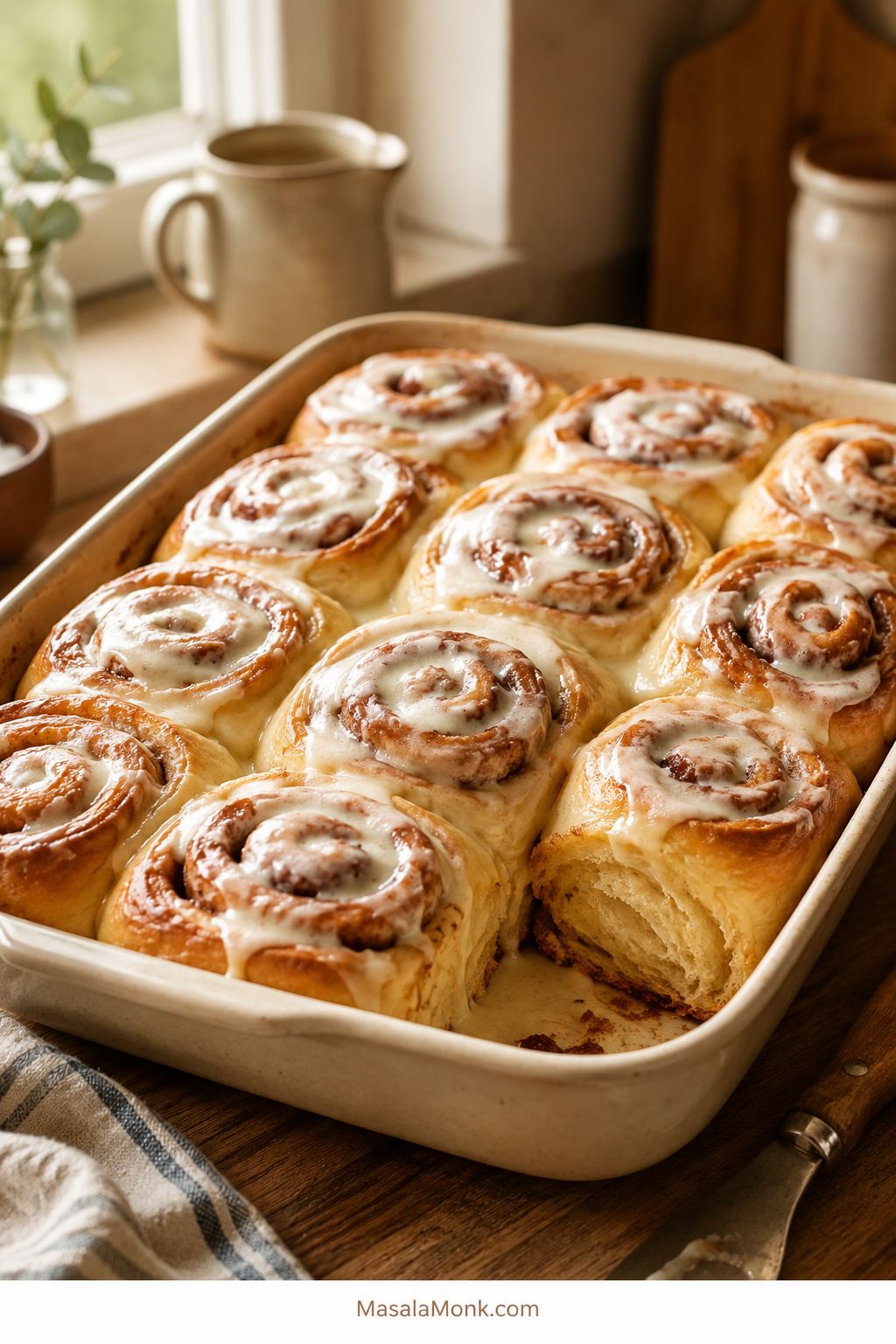
Rectangular pan of homemade cinnamon rolls with cream cheese icing melting into the swirls.

These homemade cinnamon rolls are for the exact moment you want warm, pull-apart rolls with gooey cinnamon centers, tender edges, and cream cheese icing melting into the swirls β€” without the raw-dough gamble in the middle of the pan.

Most cinnamon rolls go wrong in two quiet ways: the dough gets over-floured, or the pan comes out when the tops look done but the center is still underbaked. This recipe keeps both in check with soft elastic dough, a full second rise, and a clear center-roll doneness cue.

You can make them the same day for a cozy baking project, or shape them at night and bake them fresh in the morning. They fit a slow weekend, a holiday morning, a birthday breakfast, or any day when a warm pan of cinnamon rolls is the whole point.
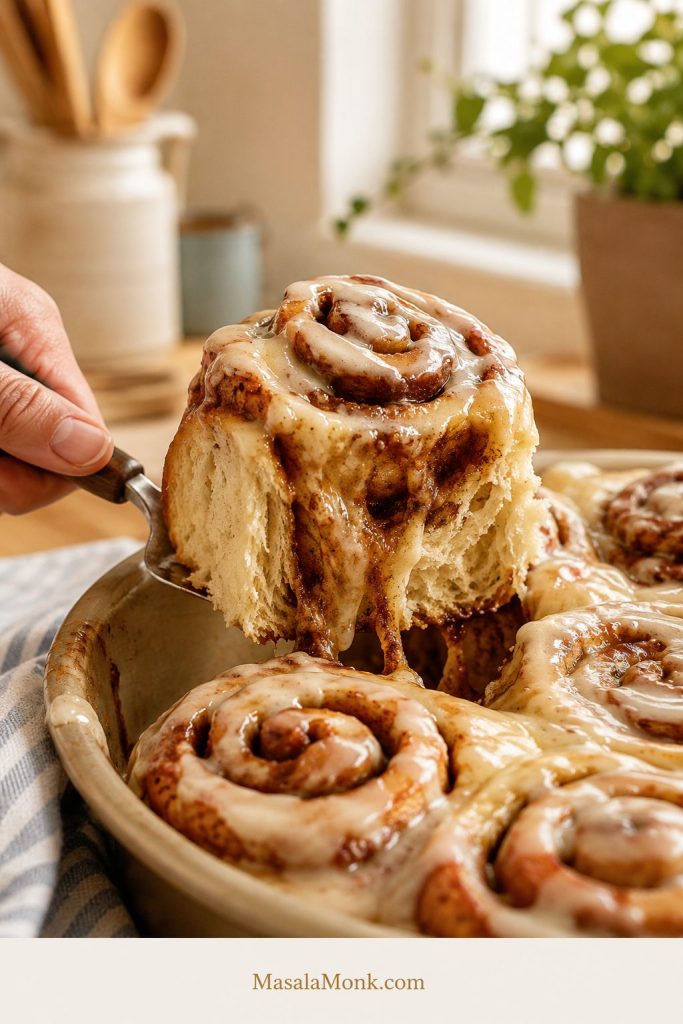
Gooey cinnamon roll pulled apart to show a soft baked center
This is the key promise: gooey cinnamon swirls with a center that looks baked and soft, not wet or raw.

Quick Answer: How to Make Soft Cinnamon Rolls

To make soft homemade cinnamon rolls, mix a rich yeast dough with warm milk, butter, egg, sugar, flour, and yeast. Knead until the dough is smooth and a little tacky, then let it rise until doubled. Roll it out, spread with softened-butter cinnamon sugar filling, cut into 12 rolls, and let the shaped rolls rise again until rounded and puffy.

Bake in a 9Γ—13-inch pan at 350Β°F / 175Β°C for 24–28 minutes. Look for lightly golden tops, but use the center roll as the better cue. The best target is about 190Β°F / 88Β°C, which means the rolls are baked through while staying tender.

Spread cream cheese icing over the warm rolls after 5–10 minutes. For extra-moist centers, pour β…“ cup / 80 ml warm heavy cream around the risen rolls just before baking, or use up to Β½ cup / 120 ml for a richer, gooier pan.

The promise: soft, gooey cinnamon rolls with tender edges, creamy icing, and a center that bakes through without turning the pan dry.
Avoid the three big mistakes: do not add flour just to make the dough dry, do not melt the filling butter, and do not pull the pan just because the tops look golden.

Cinnamon Roll Recipe Card

Soft, gooey homemade cinnamon rolls that bake through in the center, with plush yeast dough, a brown sugar cinnamon swirl, optional warm cream for extra-moist centers, and cream cheese icing that melts into the rolls while they are still warm. Serve them while the icing is still soft and the centers are warm enough to pull apart in ribbons.

Prep Time35 minutes
Rise Time1 hour 45 minutes to 2 hours 30 minutes
Bake Time24–28 minutes
Total TimeAbout 2 hours 50 minutes to 3 hours 45 minutes
Yield12 rolls

Ingredients

Dough Ingredients

  • 1 cup / 240 ml warm whole milk
  • 2ΒΌ teaspoons / 7 g instant yeast or active dry yeast
  • β…“ cup / 65–70 g granulated sugar
  • 5 tablespoons / 70 g unsalted butter, melted and slightly cooled
  • 1 large egg
  • 1 large egg yolk
  • 4 cups / about 480 g flour, preferably bread flour for taller rolls or all-purpose flour for a softer homemade texture, plus 1–2 tablespoons only if needed
  • 1 teaspoon / 6 g fine salt
  • Butter or neutral oil, for greasing the bowl and pan

Cinnamon Filling

  • β…“ cup / 75 g unsalted butter, softened
  • ΒΎ cup / 150 g packed brown sugar
  • 2 tablespoons / 14–16 g ground cinnamon
  • ΒΌ teaspoon fine salt
  • Optional: 1 teaspoon flour or cornstarch to help hold the filling together

Cream Cheese Icing

  • 4 oz / 113 g cream cheese, softened
  • 4 tablespoons / 55 g unsalted butter, softened
  • Powdered sugar, 1 cup / 120 g, plus ΒΌ cup / 30 g more for thicker icing
  • Vanilla extract, 1 teaspoon
  • Milk or cream, 1–3 tablespoons as needed
  • Pinch of salt

Optional Heavy Cream Upgrade

  • β…“ cup / 80 ml heavy cream for softer rolls, or up to Β½ cup / 120 ml for a richer, gooier pan

Instructions

Dough, Filling, and First Rise

  1. Warm the milk. The milk needs to feel comfortably warm, not hot. For active dry yeast, stir the yeast into the warm milk with a pinch of sugar and rest for 5–10 minutes, until foamy. Instant yeast can go directly into the dough.
  2. Make the dough. In a large bowl or stand mixer bowl, combine warm milk, yeast, sugar, melted butter, egg, and egg yolk. Add flour and salt. Mix until a rough dough forms.
  3. Knead. Knead for 8–10 minutes by hand or 5–7 minutes in a stand mixer on low-medium speed, until the dough is smooth, stretchy, and slightly tacky. Add extra flour only 1 tablespoon at a time if the dough is sticking heavily.
  4. First rise. Place the dough in a lightly greased bowl. Cover with plastic wrap, a damp clean towel, or a lid so the surface does not dry out. Let rise for 60–90 minutes, or until doubled. Active dry yeast may rise a little more slowly than instant yeast, so give the dough extra time if needed.

Shape, Bake, and Ice

  1. Make the filling. Mix softened butter, brown sugar, cinnamon, and salt into a thick paste. When the filling is hard to spread, let it sit at room temperature for a few minutes rather than melting it.
  2. Roll and fill. Roll the dough into a rectangle about 12Γ—18 inches. Spread the filling evenly, leaving a small border on one long edge.
  3. Shape. Roll from the long side into a snug log. Cut into 12 even rolls using unflavored dental floss, clean thread, or a sharp knife. Aim for pieces about 1Β½ inches thick.
  4. Second rise. Place rolls in a greased 9Γ—13-inch pan. Cover and let rise for 45–60 minutes, until puffy and lightly touching.
  5. Add heavy cream, if using. Pour warm heavy cream around the risen rolls. You should see cream around the base, not a flooded pan.
  6. Bake. Bake at 350Β°F / 175Β°C for 24–28 minutes, until lightly golden and the center roll reaches about 190Β°F / 88Β°C.
  7. Make icing. Beat cream cheese and butter until smooth. Add powdered sugar, vanilla, salt, and enough milk or cream to make a soft, spreadable icing.
  8. Ice and serve. Cool rolls for 5–10 minutes, then spread icing over the warm rolls.

Success Notes

  • Softer rolls: Start with the listed flour and add more only if the dough is sticking heavily.
  • Extra-gooey rolls: Use the warm heavy cream option, but keep it to Β½ cup / 120 ml or less.
  • Thicker frosting: Wait 10–15 minutes before icing.
  • Overnight option: Shape, cover, refrigerate, then let the rolls become puffy at room temperature before baking.

This is the finished serving cue: soft dough, a visible cinnamon swirl, and cream cheese icing that still looks creamy rather than dry.
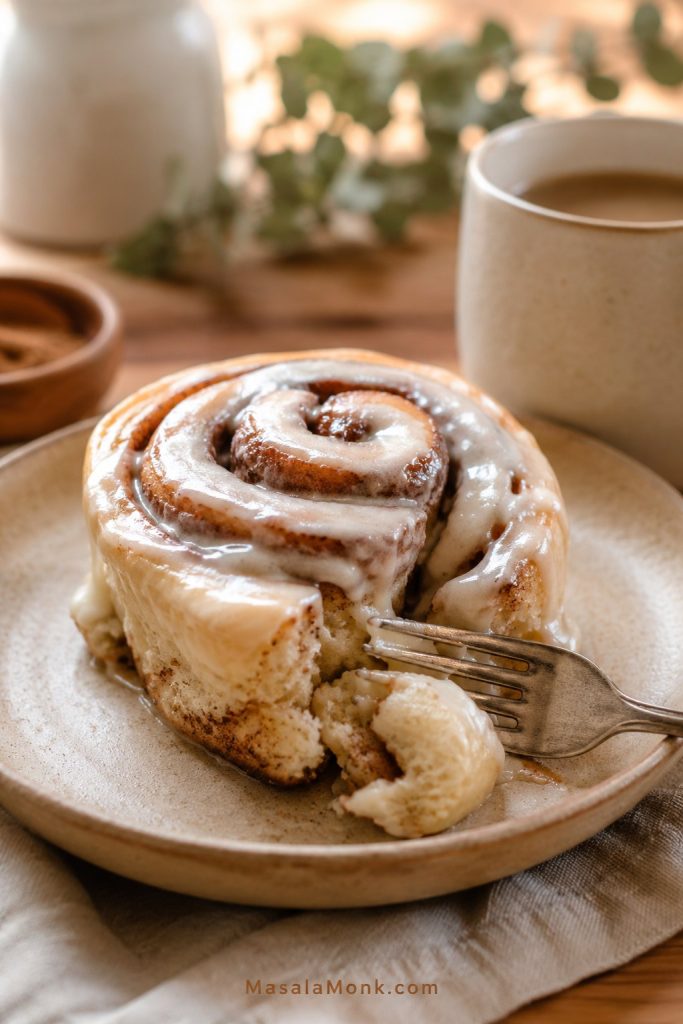
Single homemade cinnamon roll with cream cheese icing and soft cinnamon swirl
A single iced roll shows the serving texture: soft dough, visible cinnamon swirl, and creamy icing.

Cinnamon Rolls at a Glance

Question Answer
Yield 12 cinnamon rolls
Pan size 9Γ—13-inch baking dish
Oven temperature 350Β°F / 175Β°C
Bake time 24–28 minutes
Total time About 2 hours 50 minutes to 3 hours 45 minutes, including cooling before icing
Doneness cue Center roll reaches about 190Β°F / 88Β°C
Flour choice Bread flour for taller rolls; all-purpose flour for a softer homemade texture
Yeast choice Instant yeast for ease; active dry yeast also works
Filling style Softened-butter brown sugar cinnamon paste
Icing Cream cheese icing, with a no-cream-cheese option below
Make-ahead option Shape and refrigerate overnight before baking

Choose Your Cinnamon Roll Path

Use the same base recipe, then adjust the timing or finish depending on the kind of cinnamon rolls you want today. Pick the path that matches what you care about most: a same-day bake, brunch timing, extra-gooey centers, thicker frosting, or avoiding a doughy middle.

If you want… Do this
Same-day soft cinnamon rolls Start earlier in the day and bake after two complete rises.
Overnight cinnamon rolls for brunch Shape tonight, chill, then bake once puffy in the morning.
Gooey cinnamon rolls with heavy cream Pour warm cream around the risen rolls before baking.
Cinnamon rolls with thick cream cheese frosting Cool the rolls 10–15 minutes before icing.
Cinnamon rolls without a doughy middle Check the center roll; golden tops are not enough.

What This Recipe Is Built Around

Recipe notes: this cinnamon roll recipe is built around a 9Γ—13-inch pan, 12 rolls, a soft enriched dough, and a center-roll doneness cue. Bread flour gives taller rolls; all-purpose flour gives a softer homemade crumb. The heavy cream option is kept moderate so the rolls stay gooey without turning soggy at the bottom.

This is not a no-yeast shortcut roll and not a canned-roll hack. It is a soft yeast cinnamon roll recipe built for a gooey swirl, tender edges, and a center that bakes through properly.

The goal is simple: gooey, not doughy. Look for rolls that smell warm and cinnamon-sweet, pull apart softly, and have a center that feels baked and plush instead of wet or heavy.

Why This Cinnamon Roll Recipe Works

This recipe works because it protects both sides of the cinnamon-roll problem: enough moisture for gooey swirls, but enough structure and bake time for the middle to finish properly.

Enriching the dough with milk, butter, egg, and egg yolk gives you tenderness without turning the bread part heavy. The lightly sweet dough still has enough strength to rise well, hold its shape, and support the cinnamon filling.

Careful flour guidance prevents dry rolls. Starting with the listed amount and adding more only when the dough is truly sticking heavily keeps the dough soft enough to bake into pull-apart rolls instead of dense, dry spirals.

A softened-butter filling helps prevent leaks. When butter, brown sugar, cinnamon, and salt are mixed into a paste, the swirl stays more even. The optional spoonful of flour or cornstarch helps bind the filling so it does not immediately run into the bottom of the pan.

Pan size and oven temperature protect the center. A 9Γ—13-inch pan gives 12 rolls enough room to rise while keeping them close enough to stay tender. Baking at 350Β°F / 175Β°C gives the center time to finish before the tops over-brown.

For the heavy cream option, the amount is controlled rather than flooded. A moderate pour adds moisture and a gooey finish while keeping the pan from turning soggy at the bottom.

The center roll is the clearest test. Top color helps, but the middle roll tells you when the pan is truly done. Aim for about 190Β°F / 88Β°C in the center.

Ingredients You Need

Every good cinnamon roll comes down to three parts working together: dough that rises soft, filling that stays in the swirl, and icing that melts just enough into the warm rolls.
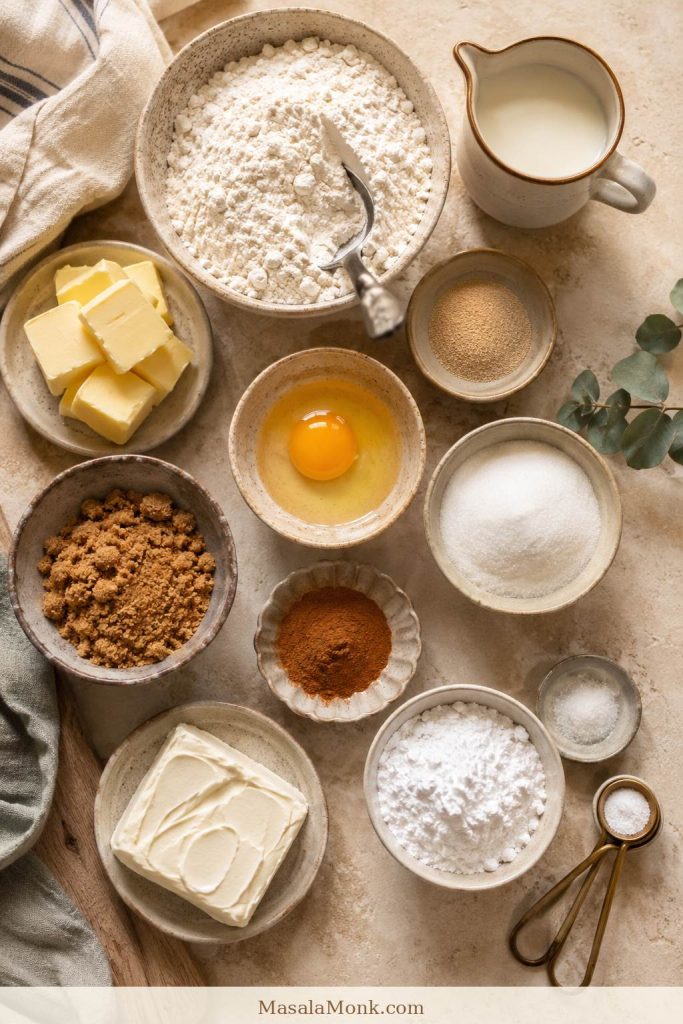
Ingredients for homemade cinnamon rolls including flour, milk, butter, eggs, yeast, sugar, and cinnamon
The dough, filling, and icing are simple pantry ingredients; the texture comes from how they are handled.

Dough Ingredients

The dough uses flour, milk, yeast, sugar, butter, egg, egg yolk, and salt.

Milk makes the dough softer than water. Butter adds richness. The egg and yolk help the rolls bake up tender, while sugar lightly sweetens the dough and helps the yeast work.

Together, they make the kind of dough that bakes up soft enough to pull apart, but strong enough to hold the cinnamon swirl.

Salt is small but important. It balances the sweetness and makes the cinnamon flavor taste fuller.

Filling Ingredients

The filling uses softened butter, brown sugar, cinnamon, and a pinch of salt.

Softened butter is easier to spread and less likely to leak out. Brown sugar gives the filling a deeper, caramel-like sweetness. Light or dark brown sugar both work, though dark brown sugar gives a stronger molasses flavor.

When the filling is right, it should spread like soft cinnamon butter, not pour like syrup.
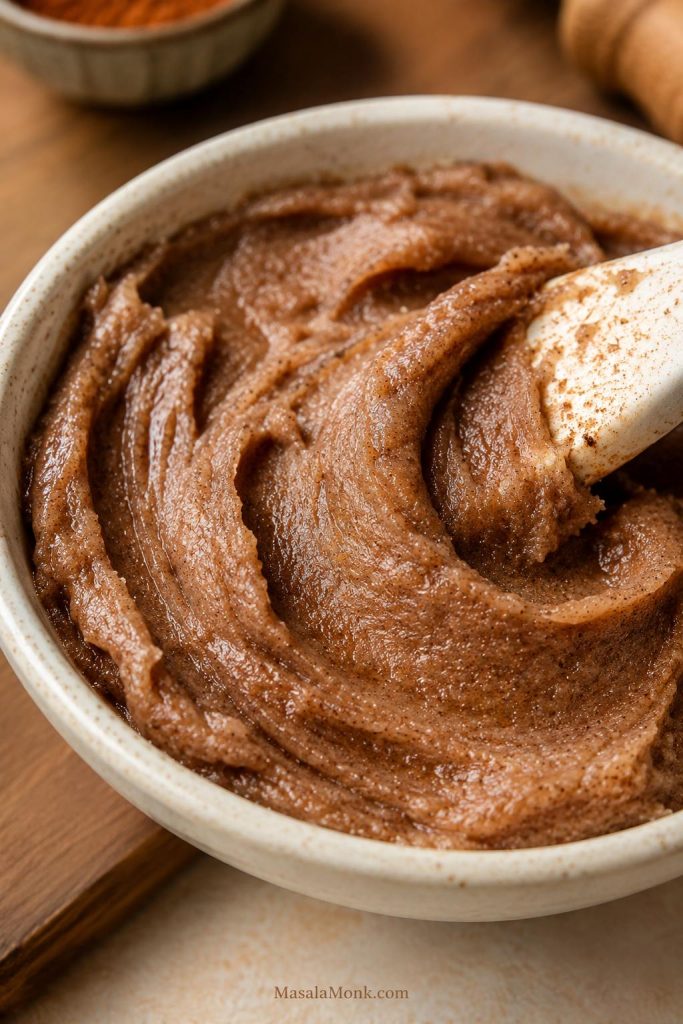
Brown sugar cinnamon filling mixed with softened butter for cinnamon rolls
Softened butter makes a spreadable cinnamon-sugar paste that is less likely to leak than melted butter.

Icing Ingredients

Cream cheese icing uses cream cheese, butter, powdered sugar, vanilla, milk or cream, and salt.

It gives the icing its tang, while butter makes it smooth. Powdered sugar thickens it, and milk or cream lets you adjust the texture.
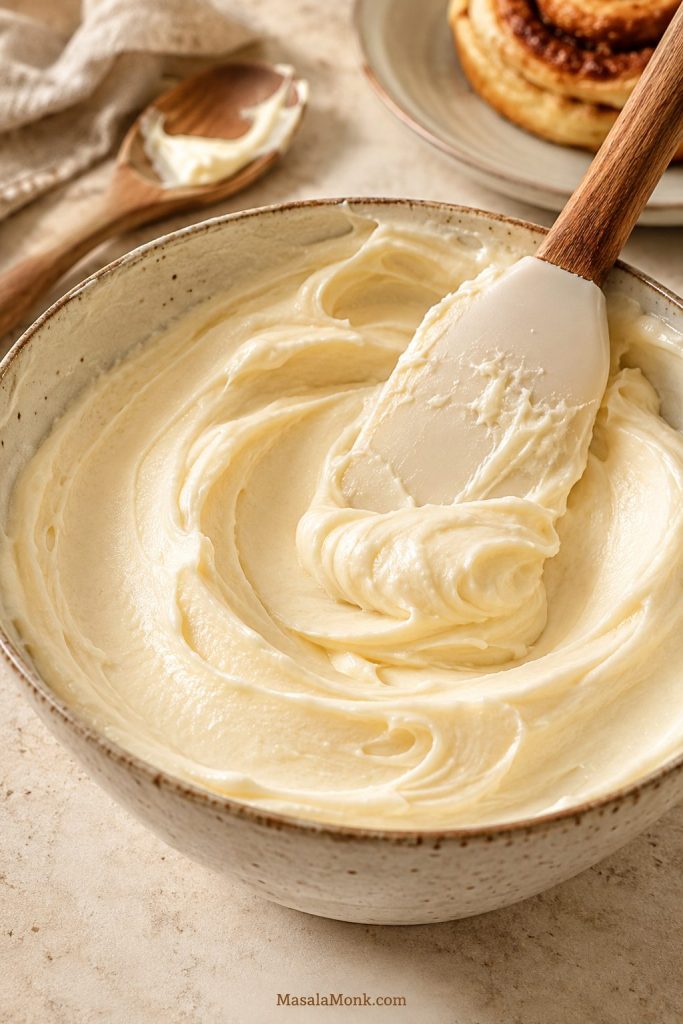
Smooth cream cheese icing for homemade cinnamon rolls
The icing looks right when it is smooth and spreadable, not thin or watery.
Flavor tip: A tiny pinch of salt in both the filling and the icing keeps the rolls from tasting only sweet.

Useful Equipment

You do not need a professional bakery setup for homemade cinnamon rolls, but a few tools make the recipe easier and more reliable.

  • Large mixing bowl or stand mixer: either works; a mixer saves effort, but hand-kneading is fine.
  • 9Γ—13-inch pan: the most reliable size for 12 rolls that bake evenly.
  • Rolling pin: helps roll the dough into an even rectangle.
  • Unflavored dental floss, clean thread, or a sharp knife: gives clean cuts without squashing the spirals.
  • Instant-read thermometer: useful for checking warm milk and the center roll.
  • Foil: helpful if the tops brown before the center is done.
No thermometer? You can still make these. The milk needs to feel warm, not hot. For doneness, gently pull at a seam in the center roll; it should look baked and bread-like, not wet, shiny, or paste-like.

Flour Choice for Cinnamon Rolls

Before you start mixing, flour is the one ingredient worth slowing down for. An over-floured dough is the fastest way to lose that pull-apart cinnamon roll texture.

Bread flour and all-purpose flour both work in this recipe. The choice depends on the texture you like.

Flour Works well for What to expect
Bread flour Taller, bakery-style rolls More structure, slightly chewier texture, good rise
All-purpose flour Plush homemade rolls More tender texture, easy everyday option
Excess flour Dry rolls Heavy dough, dry edges, dense texture
Gluten-free flour Separate gluten-free recipe Not a simple 1:1 swap for this dough

Think of flour as the difference between a roll that tears softly and one that feels heavy. The goal is not a dry, easy-to-handle dough; the goal is a dough that bakes up tender.

Start with the listed amount and give the dough a minute to come together before adding more. If you measure by cups, spoon flour into the cup and level it instead of scooping directly from the bag. A little tackiness is what keeps the finished rolls soft.

Instant Yeast vs Active Dry Yeast

Instant yeast keeps the dough simple because it can be mixed straight in, with no separate proofing step.

Active dry yeast also works. For reliable results, proof it first by stirring it into warm milk with a pinch of sugar. After 5–10 minutes, look for foam on the surface. If it stays flat, the yeast may be old or the milk temperature may be off.

Aim for milk around 105–115Β°F / 40–46Β°C. Warm milk helps yeast wake up, while hot milk can damage it and slow or stop the rise. In a cold kitchen, slow movement does not mean failure; the dough just needs more time. Wait for puffiness, not the timer.

How the Dough Feels When It Is Right

Dough texture is one of the biggest clues in this recipe. A soft, elastic dough gives the rolls their pull-apart texture; a dry, over-floured dough makes them heavy.
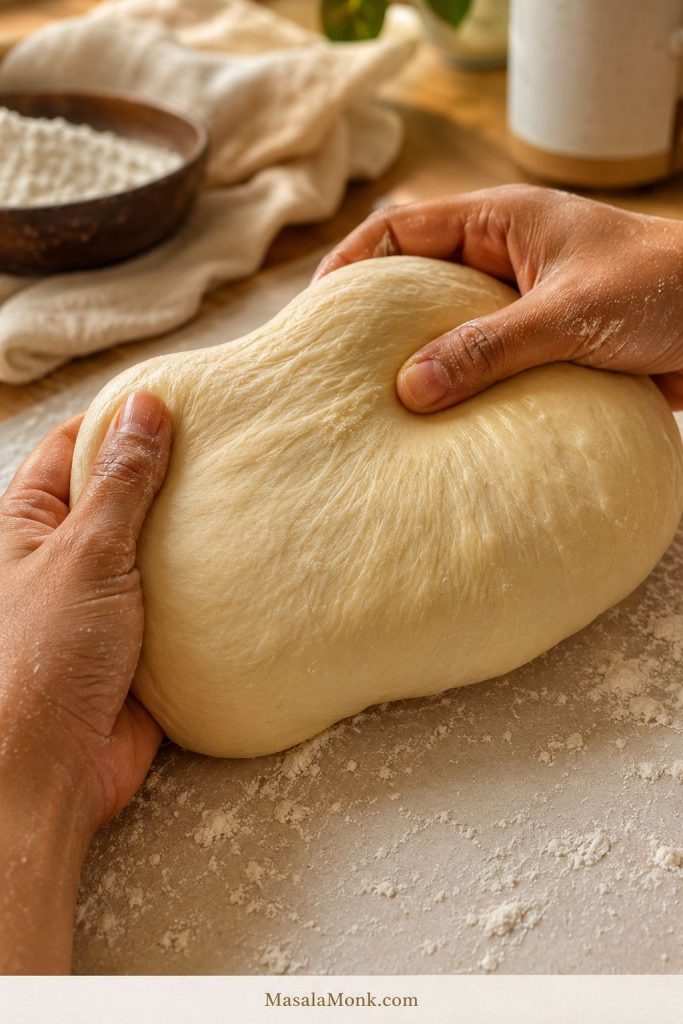
Soft elastic cinnamon roll dough after kneading
The ideal dough is smooth, elastic, and slightly tacky, not dry or stiff.
Dough cue What it means What to do
Soft, smooth, slightly tacky Ideal dough Keep going with the recipe
Sticking heavily to hands or bowl Slightly wet Add flour 1 tablespoon at a time only after kneading
Dry, stiff, or tearing Excess flour Stop adding flour and give the dough enough rise time
Tight and shrinking while rolling Gluten needs to relax Rest the dough for 5–10 minutes, then continue
Not rising after 90 minutes Cold kitchen, weak yeast, or overheated milk Move to a warmer spot and wait longer; if there is no movement, the yeast may be inactive

A little tackiness is your friend here. If the dough feels slightly messier than expected, that is usually better than a dough that feels dry and stiff.

Once the dough feels soft and elastic, the recipe gets easier. From here, you are not fighting the dough anymore β€” you are shaping it into the warm, cinnamon-filled pan you actually came for.

How to Make Cinnamon Rolls Step by Step

The method is simple once you know what to look for. The clock is only a guide; risen dough and a properly baked center matter more than exact minutes.

1. Make the Dough

Warm the milk until it feels comfortably warm, not hot. Combine the milk, yeast, sugar, melted butter, egg, and egg yolk. Add the flour and salt, then mix until a rough dough forms.

At first, the dough may look shaggy. As it kneads, it will become smoother and more elastic.
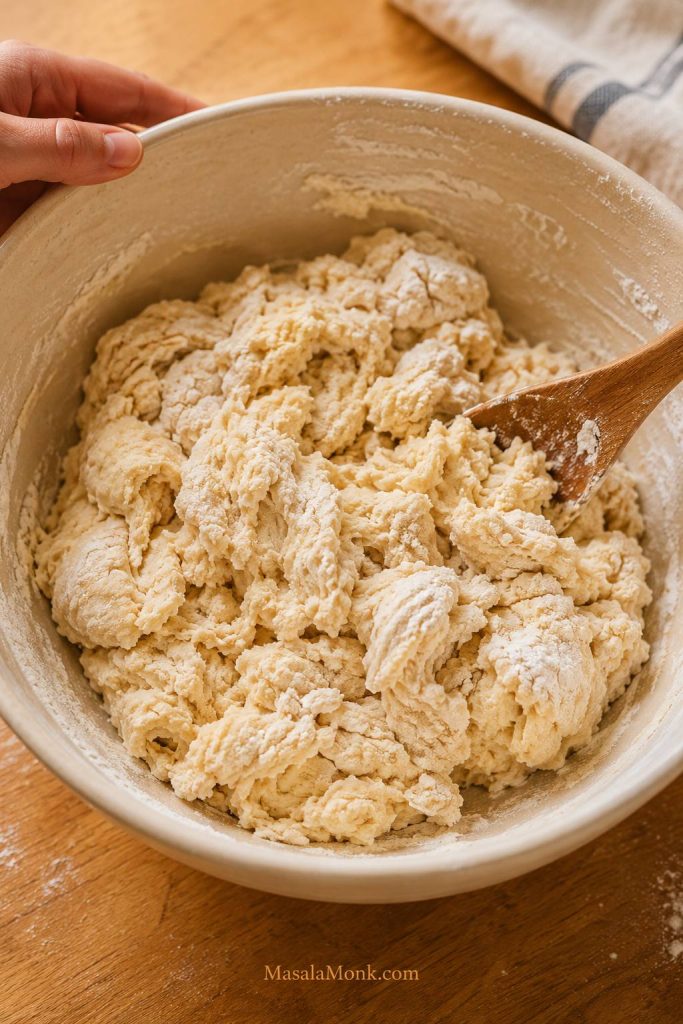
Shaggy cinnamon roll dough before kneading
A rough, shaggy dough is normal before kneading; it smooths out as the gluten develops.

2. Knead Until Smooth

Knead by hand for 8–10 minutes, or use a stand mixer for 5–7 minutes on low-medium speed.

Before adding more flour: keep kneading for another minute or two. Enriched dough often looks sticky before it turns smooth and elastic. Add flour only if it is still smearing heavily on the bowl or hands after kneading.

You are aiming for dough that feels soft, stretchy, and slightly tacky β€” not dry and stiff. This is the moment many bakers reach for extra flour, so pause before you do. If the dough is soft but manageable, you are probably on the right track.

When the dough is ready, it stretches a little before tearing and feels elastic, responsive, and light rather than stiff.

3. Let the Dough Rise

Place the dough in a lightly greased bowl. Cover the bowl with plastic wrap, a damp clean towel, or a lid so the surface does not dry out. Let it rise until doubled. This usually takes 60–90 minutes, but the dough matters more than the clock.

A cold kitchen slows the rise, while a warm kitchen speeds it up. The dough should look airy, expanded, and relaxed before you move on.
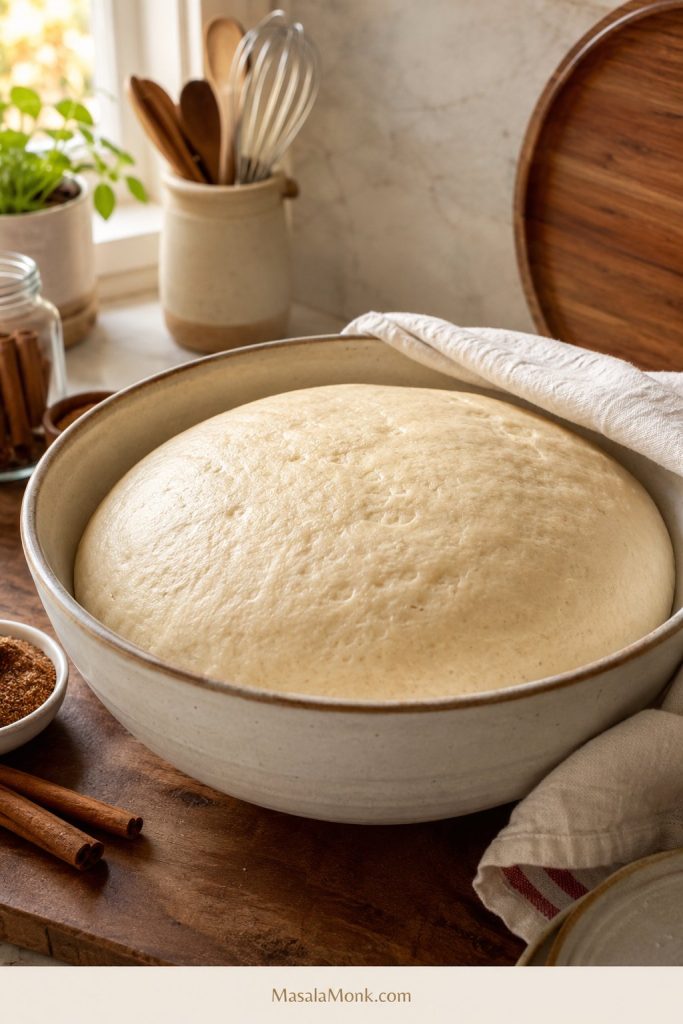
Cinnamon roll dough after the first rise, doubled and airy
After the first rise, the dough looks doubled, airy, and soft.

4. Make the Cinnamon Filling

Mix softened butter, brown sugar, cinnamon, and salt into a spreadable paste.

Softened butter keeps the filling thick enough to stay in place. When the filling is hard to spread, let it sit at room temperature for a few minutes. Avoid melting it, because melted butter is more likely to leak out.

5. Roll Out the Dough

Lightly flour the counter and roll the dough into a rectangle about 12Γ—18 inches.

The rectangle does not need perfect corners. Even thickness matters more. If the dough keeps shrinking back, let it rest for 5–10 minutes, then continue rolling.

6. Fill, Roll, and Cut

Spread the filling evenly over the dough, leaving a small border along one long edge so the log seals cleanly.
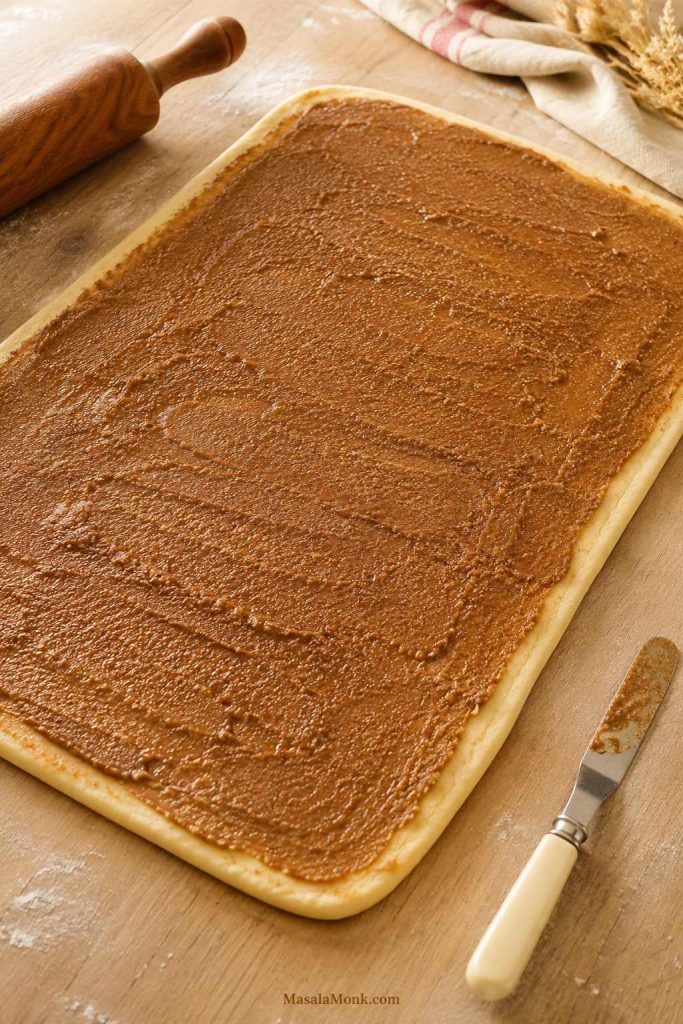
Rolled cinnamon roll dough with brown sugar cinnamon filling spread evenly
Spread the filling evenly and leave a small border so the log seals cleanly.

Roll from the opposite long side into a snug log, then turn the seam down before cutting so the rolls hold their shape.
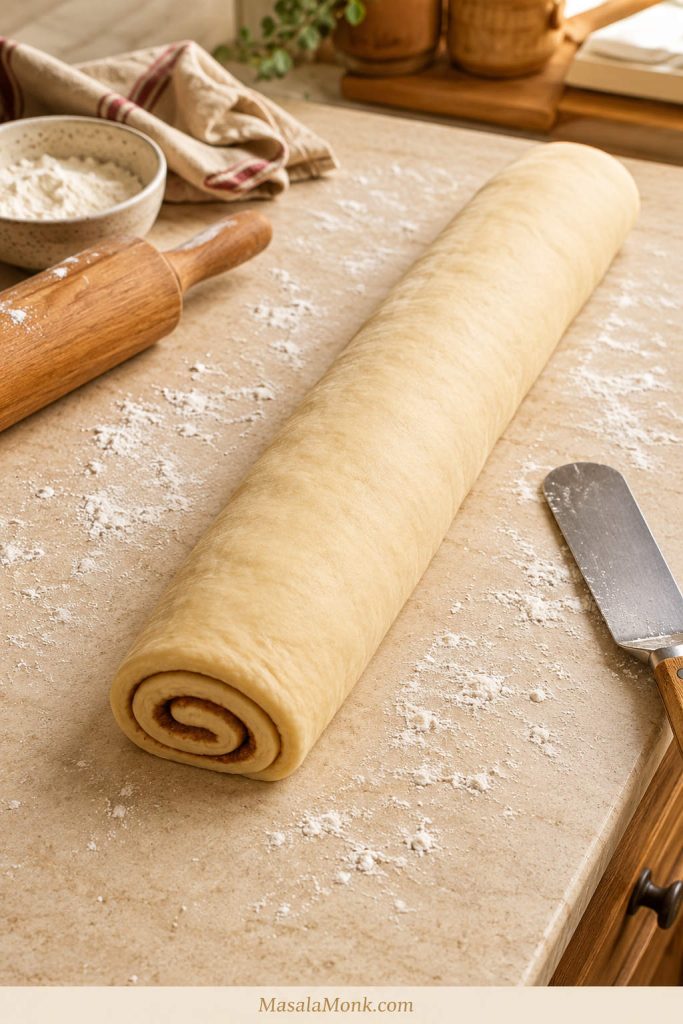
Cinnamon roll dough rolled into a log before cutting
A snug dough log helps the rolls hold their swirl without compressing the centers.

Cut into 12 even rolls. Dental floss or clean thread gives the neatest cuts, but a sharp knife also works. Each roll will be about 1Β½ inches thick, which helps the batch bake at the same pace.
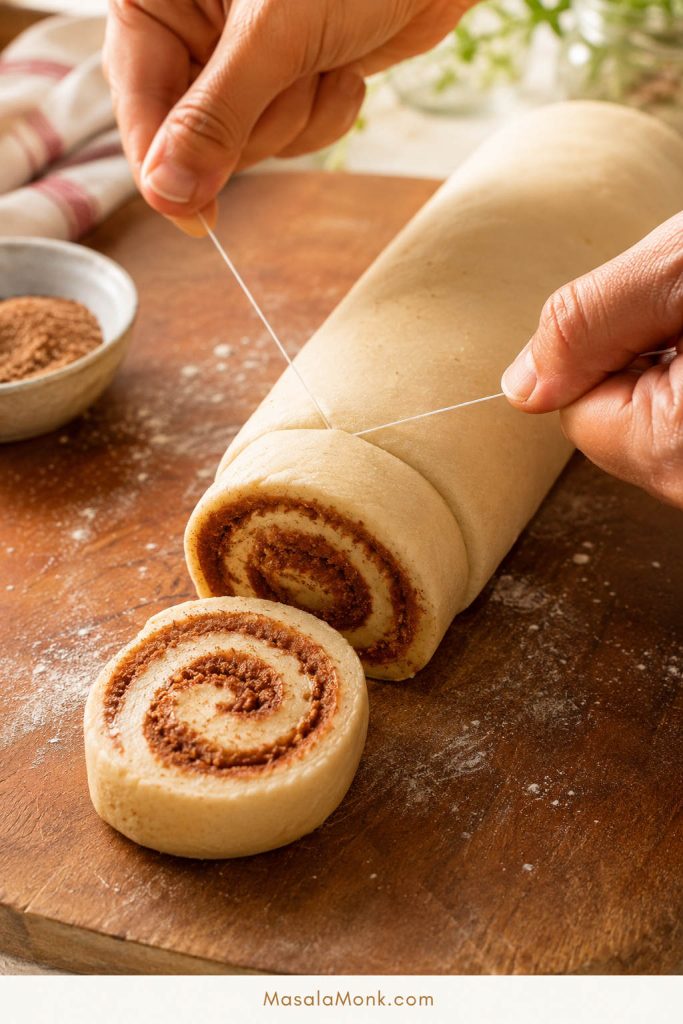
Cutting cinnamon rolls with floss for clean even slices
Floss or clean thread cuts neat rolls without squashing the spiral.

The spirals do not need to look bakery-perfect before they rise. Even rolls and a little breathing room matter more than perfect swirls.

7. Let the Rolls Rise Again

Place the rolls in a greased 9Γ—13-inch pan. Cover and let them rise until rounded and lightly touching, about 45–60 minutes.
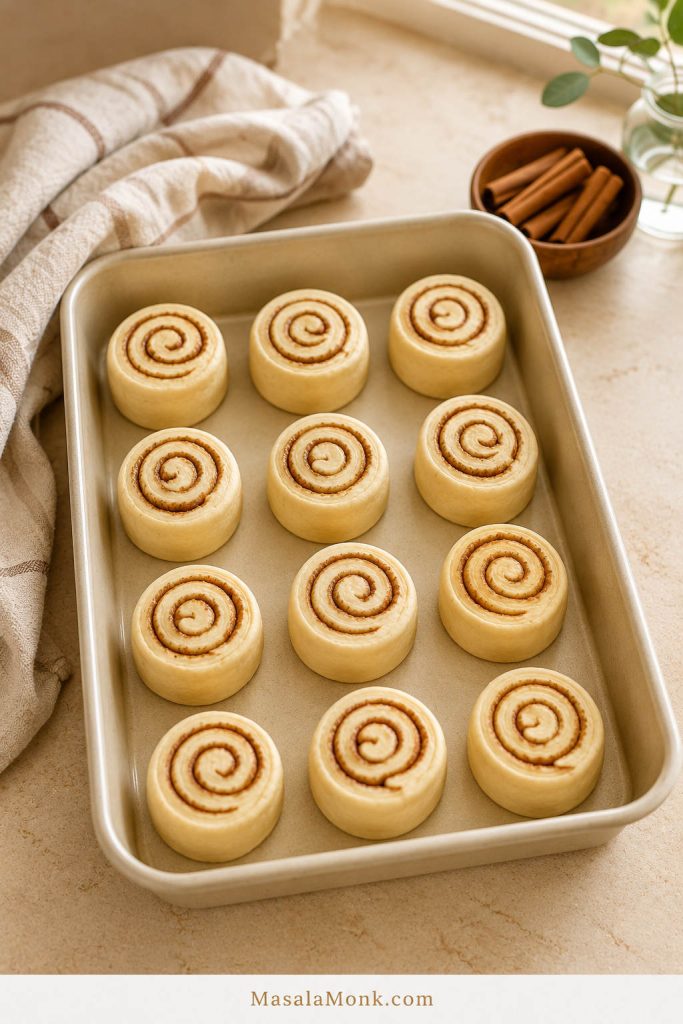
Cinnamon rolls arranged in a 9x13 pan before the second rise
Leave a little space between the cut rolls so they can expand during the second rise.

If the rolls still look tight and small, give them more time. Look for rolls that have relaxed, expanded, and lightly pressed against each other.
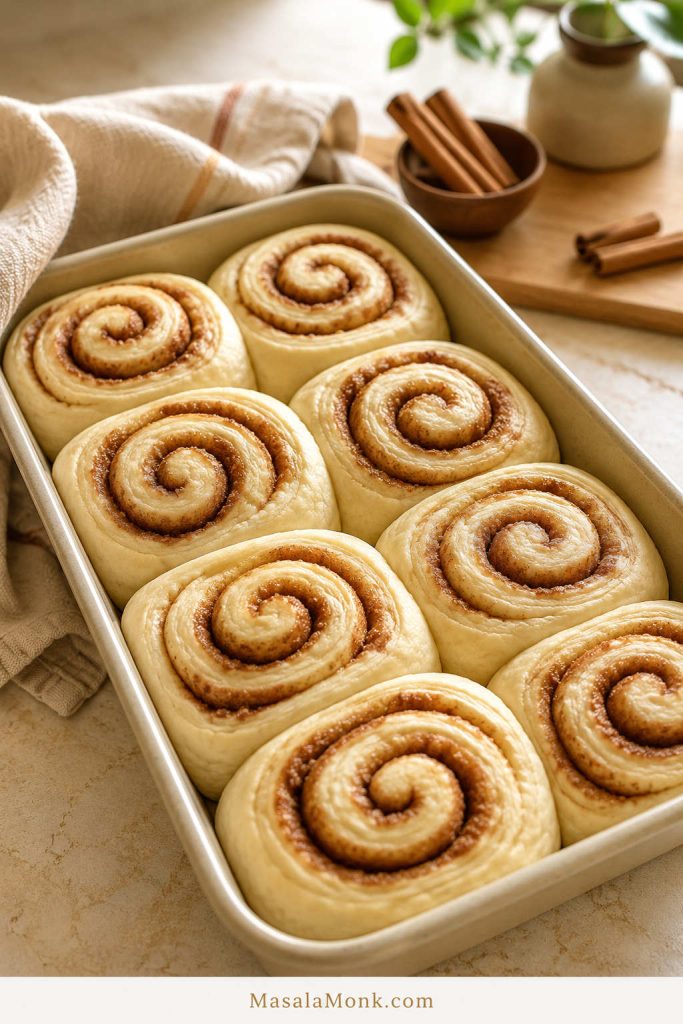
Puffy cinnamon rolls after the second rise ready to bake
Before baking, the rolls look puffy, rounded, and lightly touching.

Once the dough has risen, the hard part is mostly over. From here, you are shaping, waiting for puffiness, and protecting the center of the pan.

Before baking, check this: the rolls need to look puffy, rounded, and lightly touching. This is the point where patience pays off; puffy rolls going into the oven become softer rolls coming out. If you are using heavy cream, warm it first rather than pouring it in cold.

8. Bake

Bake at 350Β°F / 175Β°C for 24–28 minutes. Look for lightly golden tops and a center roll at about 190Β°F / 88Β°C.

A better doneness moment is not just when the tops turn golden. It is when the center roll gives you a soft, steamy pull instead of a wet doughy tear.

If the tops are golden but the center is not done, cover the pan loosely with foil and bake for a few more minutes. A few extra minutes under foil is better than serving rolls that look golden on top but stay underbaked in the middle.

The kitchen will smell warm and cinnamon-sweet before the tops get deeply browned.
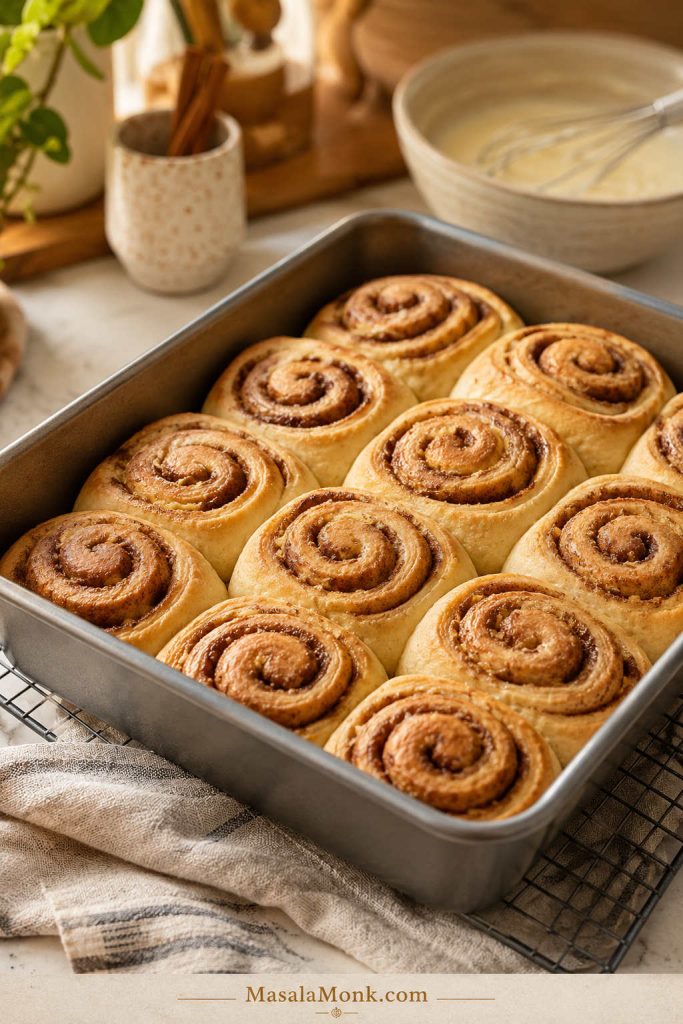
Baked cinnamon rolls before icing with lightly golden tops
The baked rolls look lightly golden before icing, not dark or dry-looking.

9. Ice While Warm

Let the rolls cool for 5–10 minutes before icing. The icing softens into the warm spirals, leaving some creamy pockets on top and some melted sweetness in the cinnamon layers.

Pan Size, Bake Time, and Internal Temperature

The pan affects how quickly the edges brown and how long the center needs to bake. For this recipe, a 9Γ—13-inch pan is the safest default.

Pan Result Note
9Γ—13-inch pan Even bake for 12 rolls Recommended for this recipe
9Γ—9-inch pan Taller, gooier rolls Centers may need more time because the pan is crowded
Two 9-inch round pans Good for gifting or freezing Split the batch evenly
Dark metal pan Faster browning Check early and tent with foil if needed
Glass or ceramic dish Softer edges May need a few extra minutes

A reliable internal temperature for homemade cinnamon rolls is about 190Β°F / 88Β°C in the center roll. Check the middle of the pan, not an edge roll, because the outside rolls bake faster and can look done while the center still needs a few minutes.
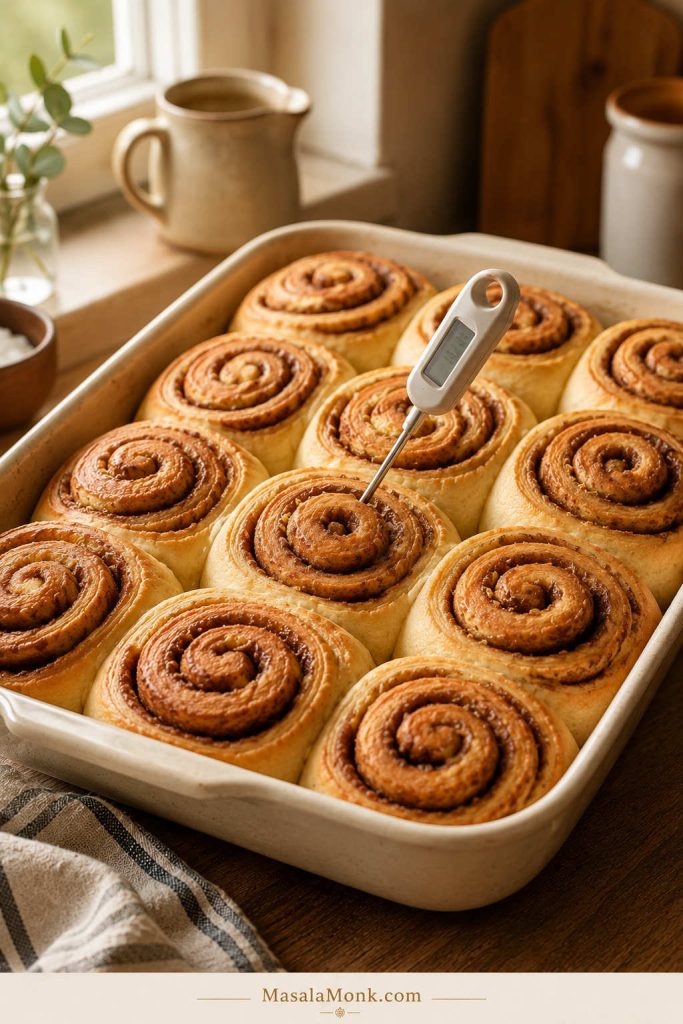
Instant-read thermometer checking the center roll for cinnamon roll doneness
Check the center roll, not an edge roll, when using internal temperature as the doneness cue.

If you do not have a thermometer, check the middle roll by gently pulling at a seam. Look for a baked, bread-like center, not shiny, wet, or paste-like. A gooey cinnamon swirl is good; raw-looking dough in the center is not.

If the tops are browning before the center is done, tent the pan loosely with foil and keep baking for a few more minutes. This lets the middle finish without drying out the top.

Gooey Cinnamon Rolls with Heavy Cream

Warm heavy cream is a popular way to make cinnamon rolls richer and more moist. It helps soften the rolls as they bake and can turn some of the cinnamon sugar into a syrupy bottom layer. The key in this recipe is using a moderate amount so the rolls stay gooey without turning soggy.

After the second rise, warm β…“ cup / 80 ml heavy cream until just warm. Pour it around the risen rolls before baking. For extra-gooey rolls, you can use up to Β½ cup / 120 ml.

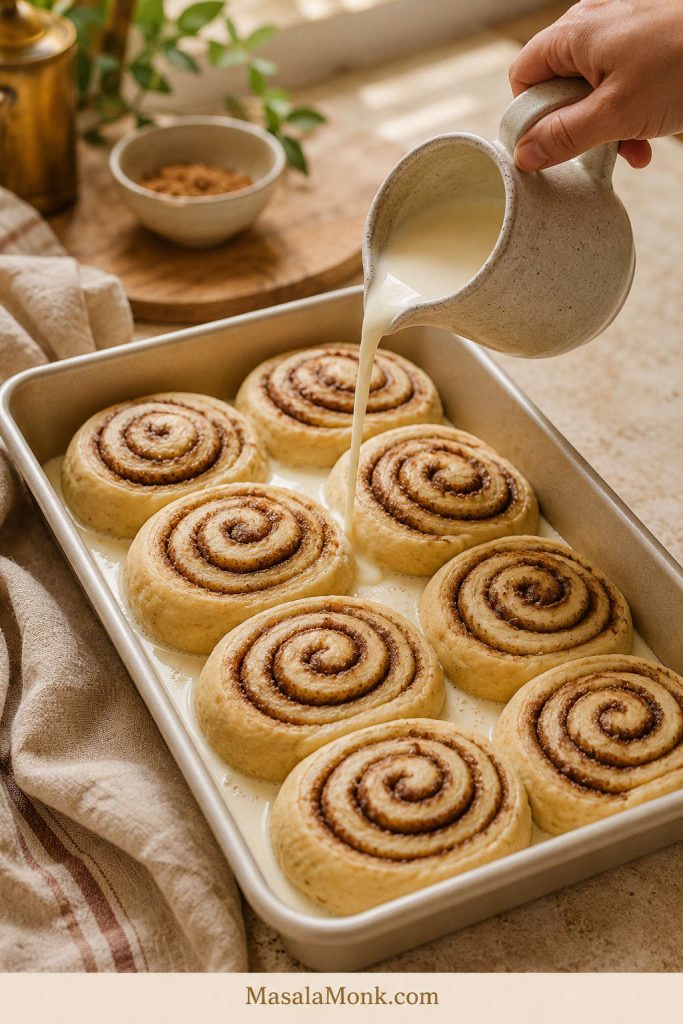
Warm heavy cream poured around cinnamon rolls before baking
Pour warm cream around the risen rolls; the pan needs only a modest pour.
Heavy cream question Answer
Cold cream? No. Warm it first so it does not slow the dough or shock the risen rolls.
Milk instead of cream? Yes, but it will be less rich and less gooey than cream.
Where to pour it Pour it around and lightly over the risen rolls. Do not flood the pan.
Skipping the cream The rolls still work; cream is only for a softer, gooier finish.

This works best in the 9Γ—13-inch pan because the cream can spread evenly around the rolls. When it works well, you get a softer center and a little cinnamon-sugar syrup at the bottom without losing the shape of the rolls.

Cream Cheese Icing for Cinnamon Rolls

Cream cheese icing is the classic finish for homemade cinnamon rolls. It is creamy, tangy, and rich enough to balance the sweet cinnamon filling.

Beat the softened cream cheese and butter together first. Once smooth, add powdered sugar, vanilla, salt, and a little milk or cream. Add the liquid slowly so the icing stays spreadable instead of runny.

For that bakery-window look, wait longer. If you want icing that slips into the cinnamon seams and makes the center taste almost custardy, ice earlier. When some of the frosting disappears into the warm rolls, that is not a mistake β€” that is the part people go back for.

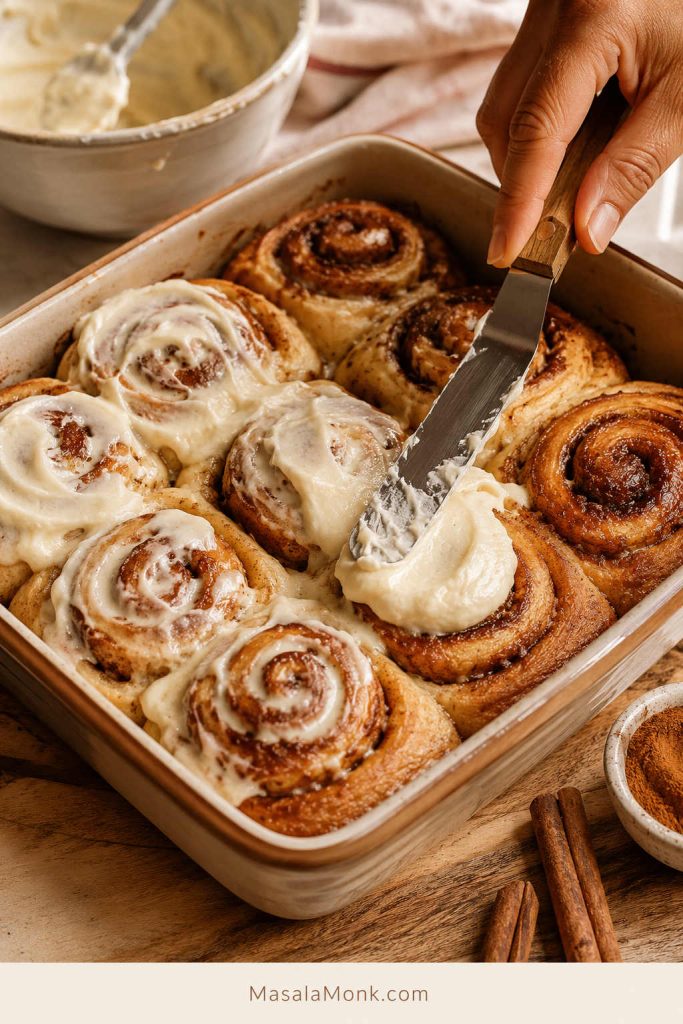
Cream cheese icing spread over warm homemade cinnamon rolls
Spread icing while the rolls are warm so some melts into the cinnamon seams.

When to Ice Cinnamon Rolls

Desired result When to ice What happens
Gooey, melted icing About 5 minutes after baking Icing melts into the spirals
Thick, visible frosting 10–15 minutes after baking Icing stays creamier on top
Gooey with visible frosting Thin layer warm, second layer before serving Gooey center with visible frosting

Cinnamon Roll Icing Without Cream Cheese

For a simple vanilla icing, whisk together:

  • 1 cup / 120 g powdered sugar
  • 2 tablespoons / 28 g melted butter
  • 1 teaspoon vanilla extract
  • 1–2 tablespoons milk or cream
  • Pinch of salt

Add more milk for a thinner drizzle or more powdered sugar for thicker icing. This version is sweeter and lighter than cream cheese icing, and it works well when you want a quick glaze. For a fuller butter-based frosting that can be spread or piped, use this Buttercream Frosting Recipe.

Overnight Cinnamon Rolls

Overnight cinnamon rolls are perfect when you want fresh rolls in the morning without making the dough from scratch at sunrise.

This is the easiest way to make cinnamon rolls feel relaxed for brunch: the messy work is done the night before, and the morning is mostly rise, bake, and ice.

In the morning, your job is mostly patience: let the rolls lose their chill, puff up, and then bake into something that feels fresh instead of rushed.
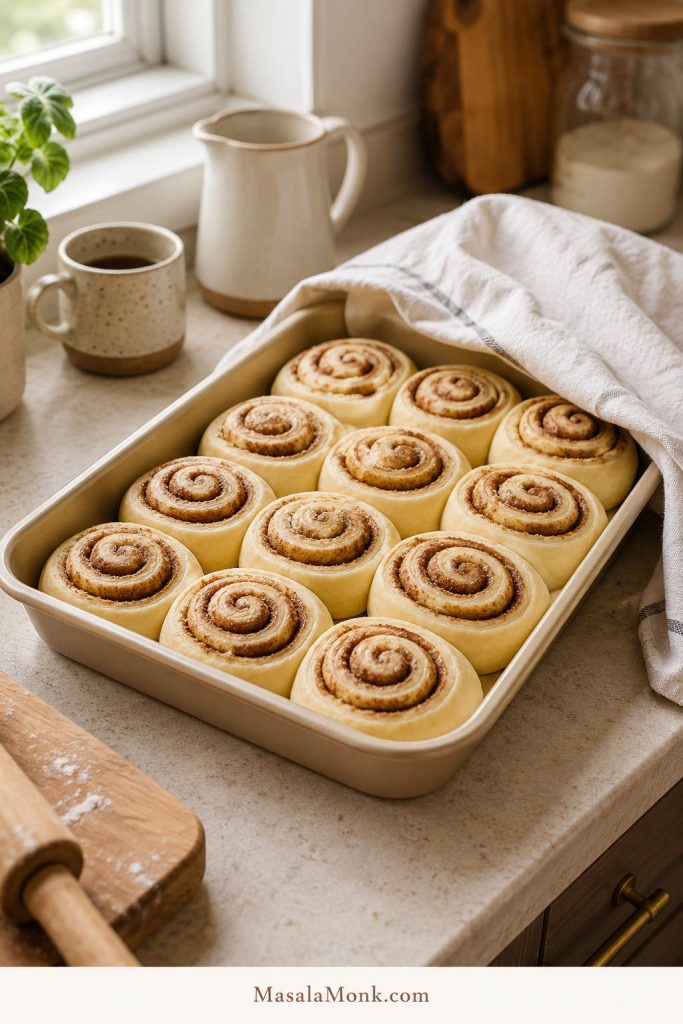
Overnight cinnamon rolls resting in the morning before baking
Overnight rolls need time to lose their chill and puff before baking if they still look tight.

Make the dough, let it complete the first rise, roll it out, add the filling, cut the rolls, and place them in the pan. Cover tightly and refrigerate for 8–12 hours.

Do Overnight Cinnamon Rolls Need to Come to Room Temperature?

Not always. If the rolls already look puffy, relaxed, and lightly touching when they come out of the refrigerator, let them sit while the oven preheats. When they still look tight, cold, and small, give them 45–90 minutes at room temperature before baking. The goal is puffy rolls, not a fixed clock time.

For reliable overnight results:

  • Do not refrigerate the shaped rolls much longer than 12 hours.
  • Let the cold rolls puff before baking instead of putting tight, cold rolls straight into the oven.
  • Bake at 350Β°F / 175Β°C for 24–28 minutes, checking the center before serving.

Very long refrigeration can overproof the rolls, making them weaker or syrupy at the bottom. For the softest texture, bake them the next morning.

How to Store, Freeze, and Reheat Cinnamon Rolls

Need Method
Bake tomorrow morning Shape, cover, and refrigerate overnight after the first rise.
Save leftovers Refrigerate cream-cheese-iced rolls and reheat gently.
Freeze for later Freeze baked rolls for the easiest serving later.
Fresh-baked texture Freeze shaped unbaked rolls before the second rise, then thaw and proof before baking.

Room Temperature

Un-iced rolls or rolls with simple vanilla glaze can sit covered at room temperature for 1–2 days if your kitchen is cool.

Refrigerator

Because cream cheese icing is dairy-based, refrigerate iced rolls within 2 hours of serving. They keep for 3–4 days, though the refrigerator can dry them out a little, so reheat gently before eating.

Food safety note: For general leftover guidance, the USDA recommends refrigerating leftovers for 3–4 days: USDA leftovers and food safety.

Freezer

Freeze baked cinnamon rolls with or without icing. Let them cool completely, wrap tightly, and freeze for up to 2 months.

You can also freeze shaped unbaked rolls before the second rise. Thaw overnight in the refrigerator, then let them sit at room temperature until puffy before baking.

Reheating

Reheat individual rolls in the microwave for 10–15 seconds at a time. For a full pan, cover loosely with foil and warm in a low oven.

If a roll seems dry, add a small spoon of milk or cream near the roll before reheating. It helps soften the bread without making it soggy.

Troubleshooting Cinnamon Rolls

If something looks off, do not panic. Cinnamon rolls usually give you clues before they fail: stiff dough, tight-looking rolls, filling that starts to run, or tops that brown before the middle is done.

Even careful bakers get a batch that rises slowly, leaks filling, or browns early. Use these cues to understand what happened and what to change next time.

Quick Cinnamon Roll Fixes

Problem Likely cause Fix
Cinnamon rolls are dry Excess flour, overbaking, dark pan, or not enough icing while warm Weigh flour, keep dough slightly tacky, bake until the middle is set, and tent if tops brown early
Cinnamon rolls are dense Weak yeast, short rise, under-kneading, or cold kitchen Use fresh yeast, knead until smooth, rise until doubled, and let shaped rolls get puffy
Centers are doughy Crowded pan, thick cuts, short second rise, or underbaking Use a 9Γ—13 pan, cut evenly, finish the second rise, and bake until the center is done
Filling leaked out Melted butter, loose roll, filling spread to edge, or overfilled dough Use softened butter paste, leave a border, roll snugly, and place seam side down
Rolls did not rise Old yeast, hot milk, or cold room Use fresh yeast, keep milk warm not hot, and give dough more time in a warm spot
Icing disappeared Rolls were very hot Wait 10–15 minutes for visible frosting or use a thin warm layer plus a second layer
Centers popped up Tight rolling or a small pan Roll snugly but gently, and use a 9Γ—13 pan
Bottoms are soggy Heavy cream overload, underbaking, or overproofing overnight Use less cream, bake until the center is done, and avoid very long refrigeration

Use the table for a quick diagnosis, then read the notes below for the problems that most often affect texture.

The good news: most of these problems are easy to prevent next time once you know the cue to watch for.

Dry Cinnamon Rolls

Dry rolls usually mean the dough was over-floured or the pan baked too long. Keep the dough soft and slightly tacky after kneading.

A dark pan can also brown the edges quickly. If the tops or edges are browning before the center is done, cover the pan loosely with foil and keep baking.
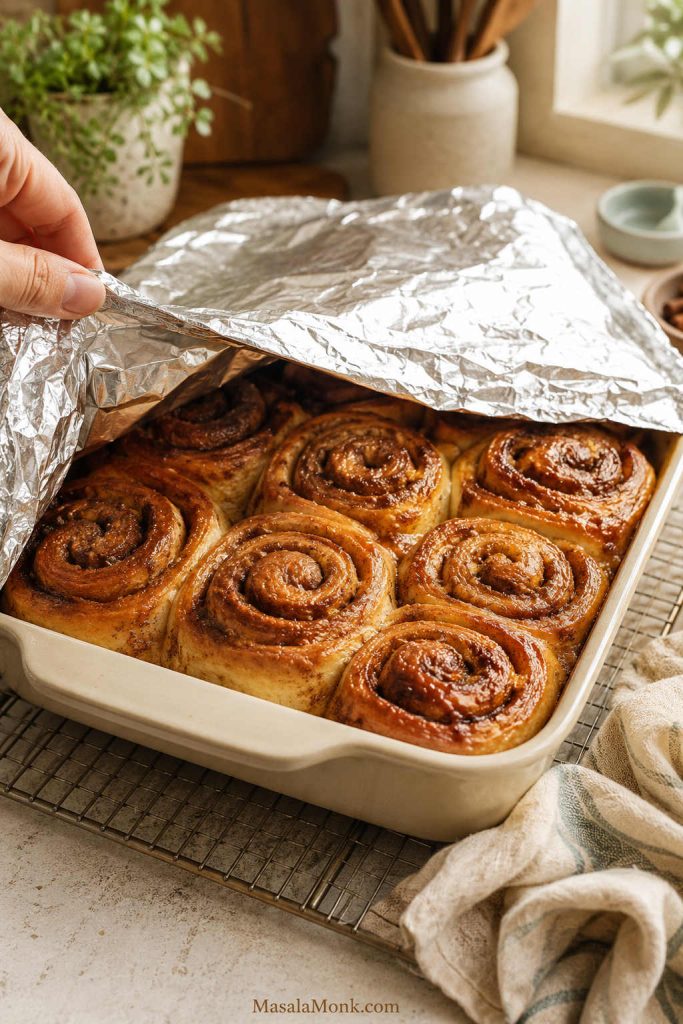
Cinnamon rolls tented with foil when tops brown before the center is done
Loosely tent the pan with foil if the tops brown before the center finishes baking.

Doughy Middle in Cinnamon Rolls

The center rolls bake last. Crowded rolls, thick cuts, or an early pull from the oven can leave the middle doughy.

Check the center of the pan instead of relying only on the edge rolls. A center temperature of about 190Β°F / 88Β°C is the clearest sign that the pan is done.
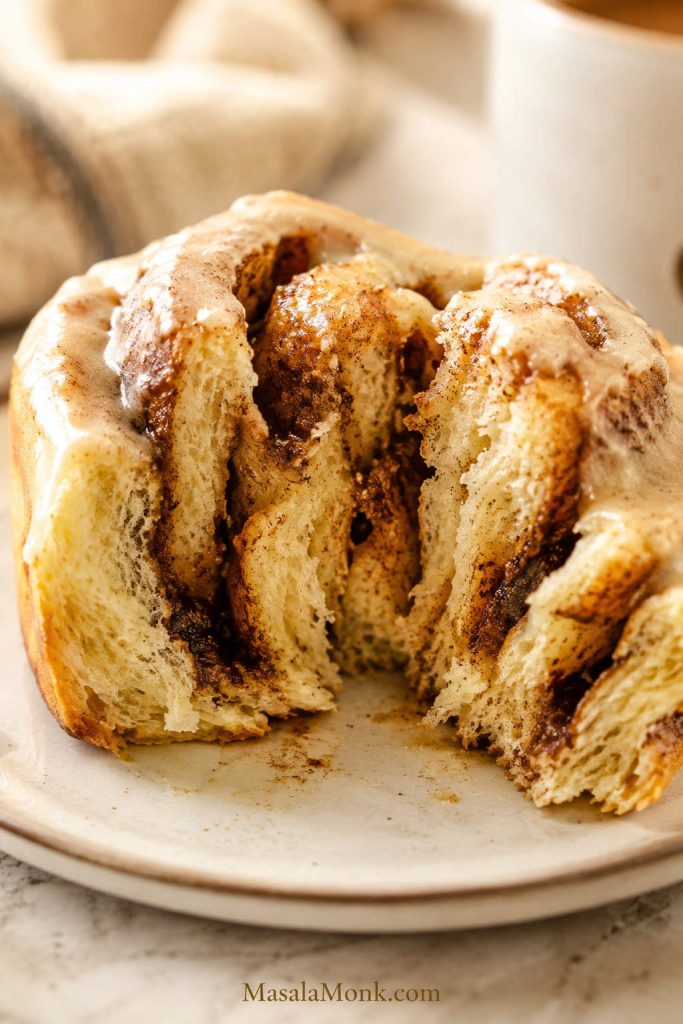
Cinnamon roll center showing a baked interior with gooey cinnamon swirl
A fully baked center looks bread-like and soft with gooey cinnamon, not wet raw dough.

Filling Leaking Out

The butter may have melted, or the dough may have been rolled loosely. A softened-butter filling paste stays in place better.

Leaving a small border along one long edge also helps seal the log.

Rolls Not Rising

Old yeast, overheated milk, or a cold room can slow the rise. When the dough is slowly expanding, give it more time. No movement at all usually means the yeast was probably inactive.

Cinnamon Roll Variations

These are flavor and format ideas, not full conversion formulas. The base dough is designed for classic soft yeast cinnamon rolls, so bigger changes may need their own tested recipe.

Pumpkin Cinnamon Rolls

Add pumpkin puree and warm spices to the dough or filling, then finish with maple cream cheese icing. Pumpkin adds moisture, so use a tested pumpkin version or adjust flour carefully.

Apple Cinnamon Rolls

Add finely chopped apples or a controlled amount of apple pie filling. A heavy apple layer can make the centers wet, so keep the filling modest. For homemade filling, use this Apple Pie Filling Recipe and keep the amount modest inside the rolls.

Sourdough Cinnamon Rolls

Use active sourdough starter or discard for a tangier dough and longer fermentation. Sourdough timing depends on starter strength and room temperature. If you are still building your starter, start with this Sourdough Starter Recipe.

For more starter-based bakes, this Sourdough Recipe guide covers loaves, rolls, buns, and bagels.

Cinnamon Roll Cookies

For cookies, use cinnamon sugar swirl flavor in a buttery cookie dough. This gives you cinnamon roll flavor without yeast or rise time, but it will not have the soft pull-apart crumb of this recipe.

Puff Pastry Cinnamon Rolls

Puff pastry works when you want fast, flaky cinnamon rolls instead of soft yeast rolls. Bake them spaced apart, not crowded like this dough, because puff pastry needs room to expand.

Vegan Cinnamon Rolls

For vegan cinnamon rolls, use plant-based milk and butter, and replace the egg carefully rather than simply leaving it out. This Flax Egg guide explains the classic flaxseed meal ratio for vegan baking, though a fully vegan cinnamon roll still needs its own dough balance.

Cinnamon Rolls vs Cinnamon Buns vs Cinnamon Scrolls

Whatever you call them β€” cinnamon rolls, cinnamon buns, or cinnamon scrolls β€” the craving is usually the same: soft spiral dough, warm cinnamon sugar, and something sweet on top.

In the US, β€œcinnamon rolls” is the most common term. β€œCinnamon buns” may mean the same thing, though some versions include sticky toppings, nuts, or caramel. β€œCinnamon scrolls” is common in some regions outside the US.

For this recipe, the method is the same: soft yeast dough, cinnamon sugar filling, spiral shape, and icing or glaze.

Shortcut Cinnamon Roll Questions

Yeast-Free Cinnamon Rolls

You can, but the texture changes. Yeast gives these rolls their fluffy, stretchy, pull-apart crumb. No-yeast cinnamon rolls are faster, but they usually bake up more like soft biscuits or scones.

For these bakery-style rolls, yeast is worth using. If you want something faster, a biscuit-style cinnamon roll is a better direction, but it will not have the same pull-apart crumb.

Using Canned Cinnamon Rolls Instead

Canned cinnamon rolls are great when you want a shortcut brunch or dessert. They will not have the same homemade yeast-dough texture, but they can still be turned into a cozy bake with fruit filling, cream, or extra cinnamon sugar.

For a quick dessert using refrigerated rolls, try this Apple Cinnamon Roll Bake with Apple Pie Filling. It is better for shortcut baking, while this recipe is better when you want homemade cinnamon rolls from scratch.

What to Serve with Cinnamon Rolls

At brunch, cinnamon rolls work well beside something simple and lightly sweet. Serve them with coffee, fruit, eggs, yogurt, or something cool and cafΓ©-style like an Iced Matcha Latte. With a sweeter spread, keep the sides fresh and light; for a more balanced breakfast, add something savory.
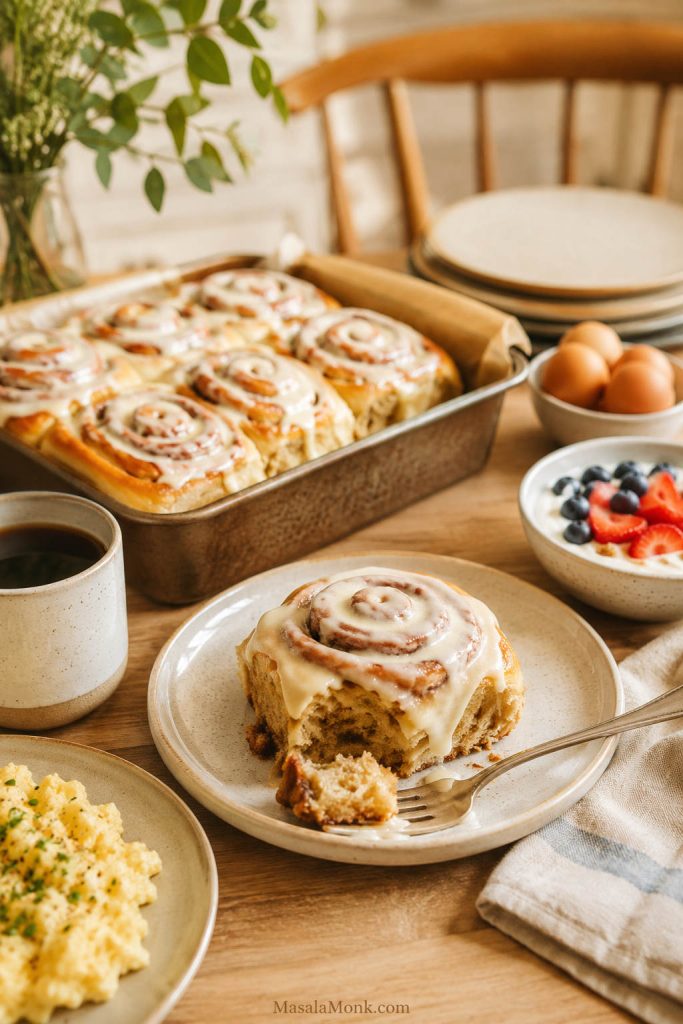
Cinnamon rolls served for brunch with coffee, fruit, and a simple breakfast side
Keep brunch sides simple and fresh so the cinnamon rolls stay the centerpiece.

Frequently Asked Questions

All-Purpose Flour for Cinnamon Rolls

Absolutely. All-purpose flour gives a softer homemade texture and works well when extra flour is kept under control.

Is bread flour better for cinnamon rolls?

Bread flour gives taller, slightly chewier rolls with more structure. Use it if you want a more bakery-style result.

Active Dry Yeast Instead of Instant Yeast

Use the same amount, but proof active dry yeast in warm milk with a little sugar for 5–10 minutes before mixing the dough.

Milk Temperature for Yeast

Aim for milk around 105–115Β°F / 40–46Β°C. It should feel warm, not hot.

Using 2% Milk Instead of Whole Milk

Whole milk gives a richer dough, but 2% milk works. Avoid skim milk if you want the softest texture.

Internal Temperature for Cinnamon Rolls

Aim for about 190Β°F / 88Β°C in the center roll. This helps confirm the middle is baked through even if the tops already look golden.

How do I tell if cinnamon rolls are done without a thermometer?

Gently pull at a seam in the middle roll. Look for a baked, bread-like center, not wet, shiny, or paste-like.

Dry Cinnamon Rolls

They were likely over-floured, baked too long, or browned quickly in a dark pan. Keep the dough soft and avoid pulling the pan before the middle is done.

Dense Cinnamon Rolls

Dense rolls usually come from weak yeast, short rise time, under-kneading, or excess flour. Let the dough double and let the shaped rolls puff before baking.

Doughy Middle

They may be underbaked, crowded, cut thick, or not risen enough. The center should look set before serving.

Preventing Doughy Centers

Use a 9Γ—13-inch pan for 12 rolls, cut the rolls evenly, let them complete the second rise, and check the center roll before pulling the pan from the oven.

Cinnamon Rolls Popping Up in the Center

The log may have been rolled tightly, the pan may have been crowded, or the rolls may have needed more room to expand.

Adding Heavy Cream Before Baking

You can. Warm heavy cream makes the rolls richer and gooier. Use β…“ cup / 80 ml for a softer pan or up to Β½ cup / 120 ml for extra-gooey rolls.

Overnight Cinnamon Rolls

For overnight cinnamon rolls, make the dough, complete the first rise, shape the rolls, cover the pan tightly, and refrigerate for 8–12 hours. In the morning, let the rolls sit until puffy if they still look tight and cold, then bake.

Freezing Cinnamon Rolls

Freezing works well. Baked rolls can be frozen after cooling, or you can freeze shaped unbaked rolls before the second rise. Thaw and let them get puffy before baking.

Doubling This Recipe

To double the recipe, use two 9Γ—13-inch pans and rotate them if your oven has hot spots.

Choosing Cinnamon Roll Icing

Cream cheese icing is the classic choice because it is creamy, tangy, and rich. A simple vanilla glaze without cream cheese also works.

Icing Without Cream Cheese

For a simple glaze, mix powdered sugar, melted butter, vanilla, milk or cream, and a pinch of salt. Add more milk for a thin glaze or more powdered sugar for thicker icing.

No Stand Mixer Method

A stand mixer helps, but hand kneading works. Mix the dough in a large bowl and knead for 8–10 minutes, until it turns smooth and stretchy.

Final Tips for Soft, Gooey Cinnamon Rolls

Great cinnamon rolls are not about rushing the dough or baking until the tops are dark. Once you understand the cues, homemade cinnamon rolls stop feeling like a gamble. You are not just waiting for a timer; you are watching the dough, the rise, and the center of the pan.

The goal is gooey, not doughy: fluffy edges, cinnamon-rich swirls, creamy icing, and a middle that pulls apart warm instead of feeling heavy, wet, or underbaked.
Did you make these? Leave a comment with the flour you used, whether you baked them same-day or overnight, and whether you added the warm cream. Those details help other readers choose their own cinnamon roll path.
Posted on 2 Comments

Apple Cinnamon Roll Bake with Apple Pie Filling

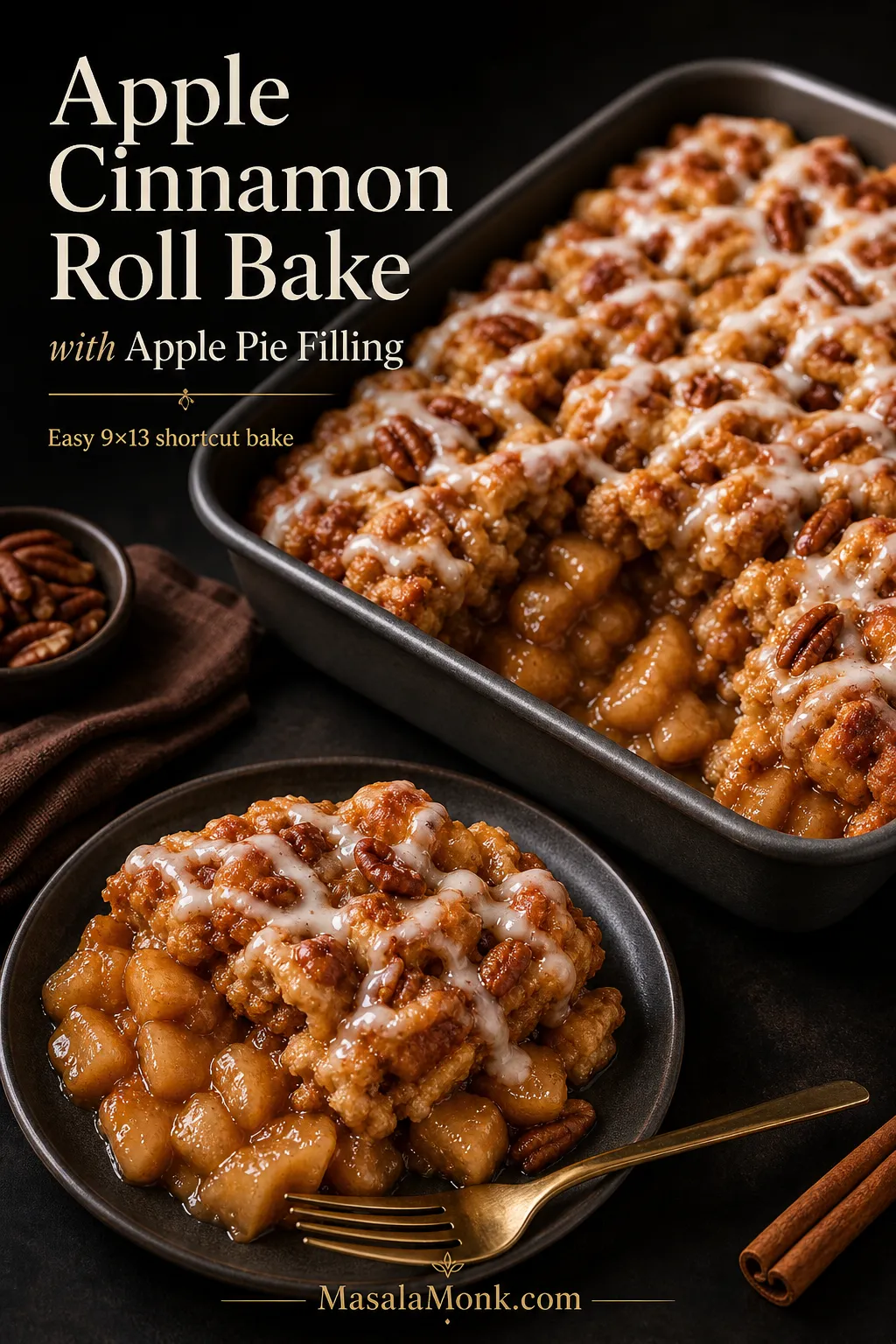
Apple cinnamon roll bake with apple pie filling in a dark 9x13 pan, topped with icing, pecans, and glossy apple pieces.

Apple cinnamon roll bake with apple pie filling is the shortcut dessert you make when you want warm apple pie flavor without rolling pie crust, peeling apples, or making cinnamon roll dough from scratch.

At its simplest, this can be a 2-ingredient apple cinnamon roll bake made with refrigerated cinnamon rolls and apple pie filling. This version keeps that easy shortcut, then adds a few small upgrades β€” butter, brown sugar, cinnamon, optional cream, and better ratio guidance β€” so the pan tastes more finished and bakes more evenly.

If you are looking for apple cinnamon rolls with apple pie filling, this is the easy bake-style version: soft cinnamon roll pieces, warm apple filling, sticky icing, and clear fixes for the common problem of wet or doughy centers.

Quick Answer: Apple Cinnamon Roll Bake with Apple Pie Filling

Cut refrigerated cinnamon rolls into pieces, toss them with melted butter, cinnamon, brown sugar, and apple pie filling, then bake everything in a greased 9Γ—13 inch pan at 350Β°F / 175Β°C until the center is puffed and cooked through. For the most reliable texture, use 2 tubes of cinnamon rolls with 1 can of apple pie filling. Use 1Β½ to 2 cans only if you want a very gooey, apple-heavy bake and are comfortable baking it a little longer.

This is not a from-scratch cinnamon roll recipe. It is the easy refrigerated cinnamon roll bake, and the best way to make it taste more homemade is to upgrade the filling first. Diced homemade apple pie filling gives better texture without turning the recipe into a full dough project.

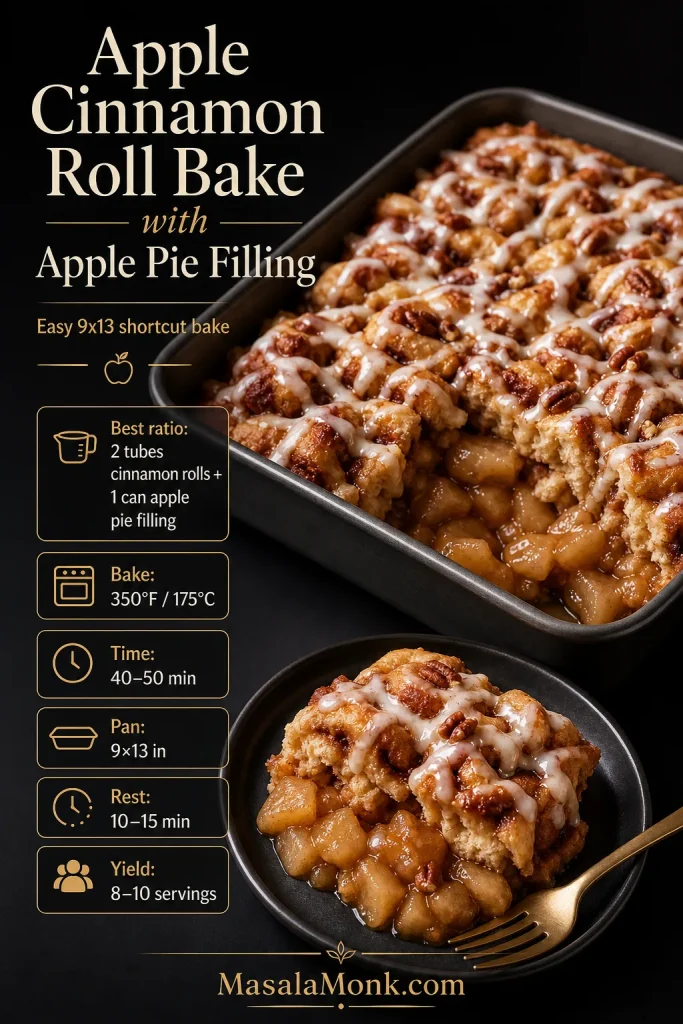
Best default ratio: 2 large tubes refrigerated cinnamon rolls, about 35 oz / 990 g total, plus 1 can apple pie filling, 21 oz / 595 g. This gives you a soft, gooey bake without overloading the pan.

Quick guide for apple cinnamon roll bake with apple pie filling showing a 9x13 pan, 350Β°F bake temperature, 40 to 50 minute time, and 2 tubes to 1 can ratio.
For the safest first version, use this starting formula: 2 tubes of cinnamon rolls, 1 can of apple pie filling, a 9Γ—13 pan, and enough bake time for the middle to set before icing.

Need exact amounts? Jump to the recipe. Still choosing filling amount? Check the ratio guide.

Apple Cinnamon Roll Bake at a Glance

Best pan9Γ—13 inch / 23Γ—33 cm baking dish for a full batch
Oven temperature350Β°F / 175Β°C
Best cinnamon rollsRefrigerated cinnamon rolls, cut into quarters; jumbo rolls can be cut into 6 pieces
Best filling ratio2 tubes cinnamon rolls + 1 can apple pie filling
Homemade filling replacementUse 2 to 2Β½ cups homemade apple pie filling to replace one 20–21 oz can
Bake timeUsually 40–50 minutes for a 9Γ—13 pan
Center cueThe middle should be puffed, set, and no longer wet or raw
Rest time10–15 minutes before adding icing
Yield8–10 servings

Why This Apple Cinnamon Roll Bake Works

This recipe works because it treats the filling ratio as the main decision, not an afterthought. Apple pie filling is sweet, saucy, and heavy, so using too much can keep the cinnamon roll pieces from baking evenly in the center. Starting with 1 can of filling for 2 tubes of cinnamon rolls gives you enough apple flavor without turning the middle wet.

Cutting the rolls into smaller pieces also matters. Smaller pieces bake through faster, hold the apple filling better, and give you more soft edges for the icing to settle into. A wide 9Γ—13 pan helps the dough spread instead of steaming in a deep pile.

The result is still gooey, cozy, and generous, but the center cooks through properly.

Before mixing the pan, compare the best filling ratios and choose the right version for your pan.

Ingredients You Need

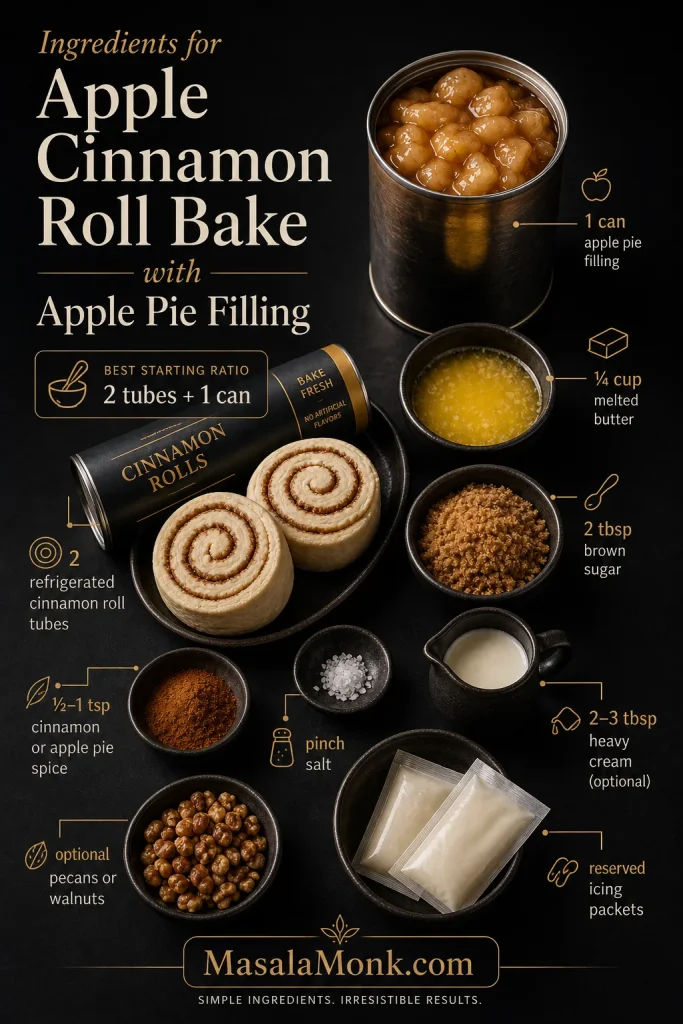
This recipe starts with the easy version: refrigerated cinnamon rolls and apple pie filling. The small upgrades β€” butter, brown sugar, cinnamon, salt, and optional cream β€” make it taste more like a finished bake and less like two packaged ingredients stirred together.

Ingredients for apple cinnamon roll bake including cinnamon roll tubes, apple pie filling, butter, brown sugar, cinnamon, salt, cream, pecans, and icing.
The shortcut comes from refrigerated cinnamon rolls and apple pie filling, but the small upgrades matter. Butter adds richness, brown sugar deepens the flavor, cinnamon reinforces the apple-pie taste, and a pinch of salt keeps the bake from tasting flat.

Using smaller tubes or extra filling? Check the filling ratio before mixing the pan.

Refrigerated Cinnamon Rolls

Use 2 tubes of refrigerated cinnamon rolls for a full 9Γ—13 pan. Large tubes are often about 17.5 oz / 496 g each, giving you about 35 oz / 990 g total dough. If your tubes are smaller, use the ratio guide below instead of guessing.

Use any brand of refrigerated cinnamon rolls you like. The important part is the total dough weight, not the brand name. If your tubes are smaller than the large 17.5 oz / 496 g size, reduce the filling slightly or use the small-batch guide.

Reserve the icing packets. Drizzle the icing after the bake has rested, not before it goes into the oven.

Apple Pie Filling

Use 1 can of apple pie filling, usually 21 oz / 595 g, for the most reliable full-pan bake. If the apple slices are large, chop them into smaller pieces before mixing. Smaller apple pieces distribute better and reduce wet pockets in the center.

You do not need to drain the apple pie filling. If the can looks extremely saucy, spoon off a little excess gel, but do not strain it dry. The sauce is part of what makes the bake soft and gooey.

You can also use homemade apple pie filling. For this recipe, diced apple pie filling works better than long slices because it spreads evenly between the cinnamon roll pieces.

Butter, Brown Sugar and Cinnamon

Melted butter coats the dough pieces and helps the edges bake up richer. Brown sugar adds a light caramel note, while cinnamon or apple pie spice reinforces the apple-pie flavor.

  • Melted butter: ΒΌ cup / 4 tablespoons / 57 g
  • Light brown sugar: 2 tablespoons / about 25 g
  • Cinnamon or apple pie spice: Β½ to 1 teaspoon
  • Fine salt: a small pinch, optional but useful

Heavy Cream, Optional

Heavy cream can make the bake softer and more gooey, but too much can slow down the center. For this recipe, use only 2–3 tablespoons / 30–45 ml if you want the cream upgrade.

Icing or Cream Cheese Glaze

The easiest option is the icing that comes with the cinnamon rolls. For a thicker finish, make the quick cream cheese glaze in the recipe card. Add icing while the bake is warm, not piping hot, so it melts slightly without disappearing completely.

Pecans or Walnuts, Optional

Chopped pecans or walnuts add crunch and make the bake feel more holiday-ready. Use about Β½ cup / 55–60 g, and sprinkle some inside the bake or over the top before baking.

Best Ratio of Cinnamon Rolls to Apple Pie Filling

This is where many apple cinnamon roll bakes go wrong. One version may call for two cans of apple pie filling, while another uses one can for the same amount of dough. Both can work, but they do not give the same result.

For the most reliable center, use 1 can of apple pie filling with 2 large tubes of cinnamon rolls. If you want a wetter, cobbler-style bake, increase the filling and bake longer.

If you want visible apple pieces in every bite, chop the filling smaller before adding a second full can. Smaller pieces distribute better without flooding the center.

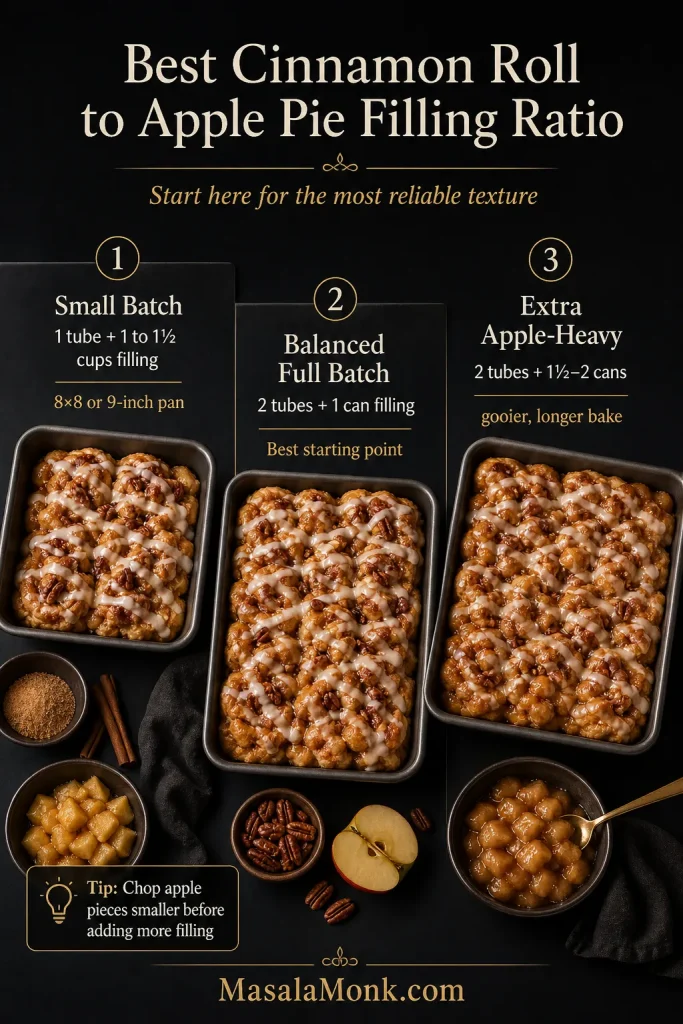
Ratio guide comparing small batch, balanced full batch, and extra apple-heavy apple cinnamon roll bake with apple pie filling.
The filling ratio changes the whole texture of the bake. One can gives a safer, more evenly baked center, while extra filling creates a gooier dessert-style pan that usually needs more time in the oven.
VersionCinnamon rollsApple pie fillingPanBake time
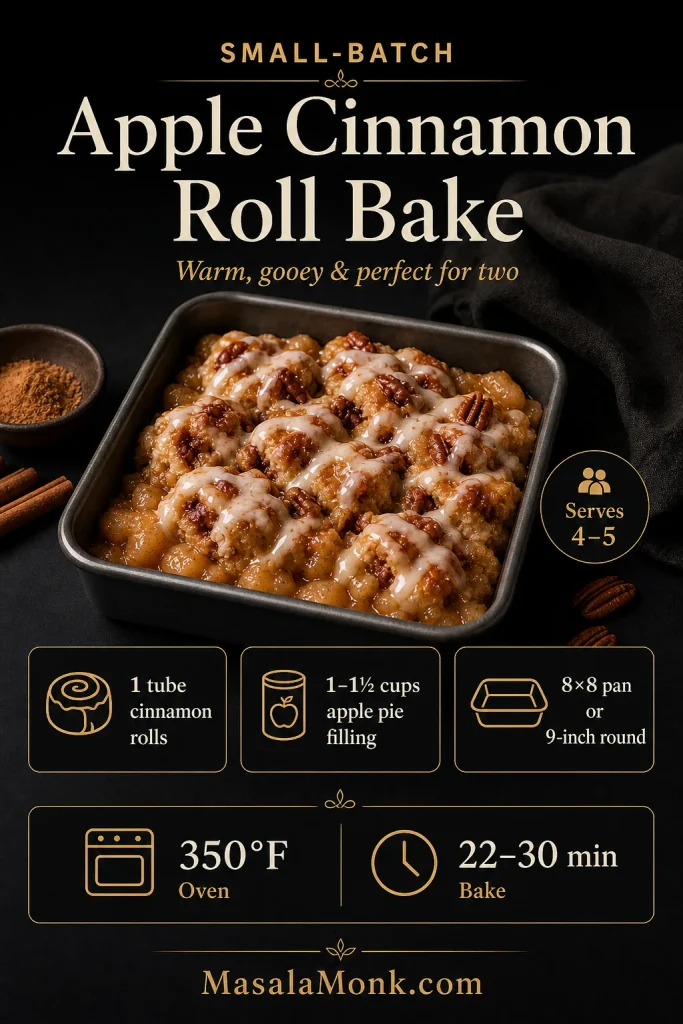
Small batch1 tube / 12–17.5 oz / 340–500 g1 to 1Β½ cups8Γ—8 inch or 9-inch round22–30 minutes
Balanced full batch2 large tubes / about 35 oz / 990 g total1 can / 21 oz / 595 g9Γ—13 inch / 23Γ—33 cm40–50 minutes
Extra apple-heavy2 large tubes / about 35 oz / 990 g total1Β½ to 2 cans / 31–42 oz / 880–1190 g9Γ—13 inch / 23Γ—33 cm45–55 minutes
Homemade filling version2 large tubes2 to 2Β½ cups homemade filling per can replacement9Γ—13 inch / 23Γ—33 cm40–50 minutes

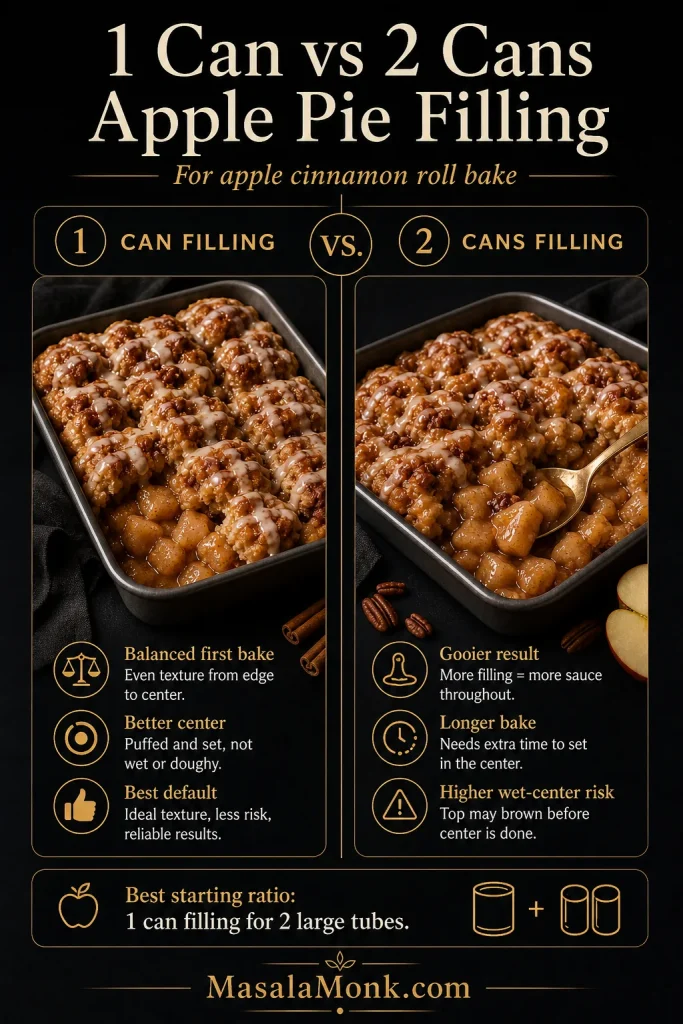
One Can vs Two Cans of Apple Pie Filling

If you are making this apple cinnamon roll bake for the first time, one can of apple pie filling is the safer starting point. Two cans can taste extra gooey, but the added sauce makes the center slower to bake and easier to undercook.

One can versus two cans of apple pie filling comparison for apple cinnamon roll bake, showing balanced and extra-gooey versions.
One can is the best default for a balanced apple cinnamon roll bake. Two cans can be deliciously gooey, but the center needs more attention because extra sauce slows down the bake.

Want the simplest shortcut? See the 2-ingredient version. Ready to bake? Jump to the method.

Small-roll note: If your cinnamon roll tubes are smaller than 17.5 oz / 496 g each, do not automatically use a full can of filling for every tube. Smaller tubes need less filling, or the pan can turn wet before the dough cooks through.

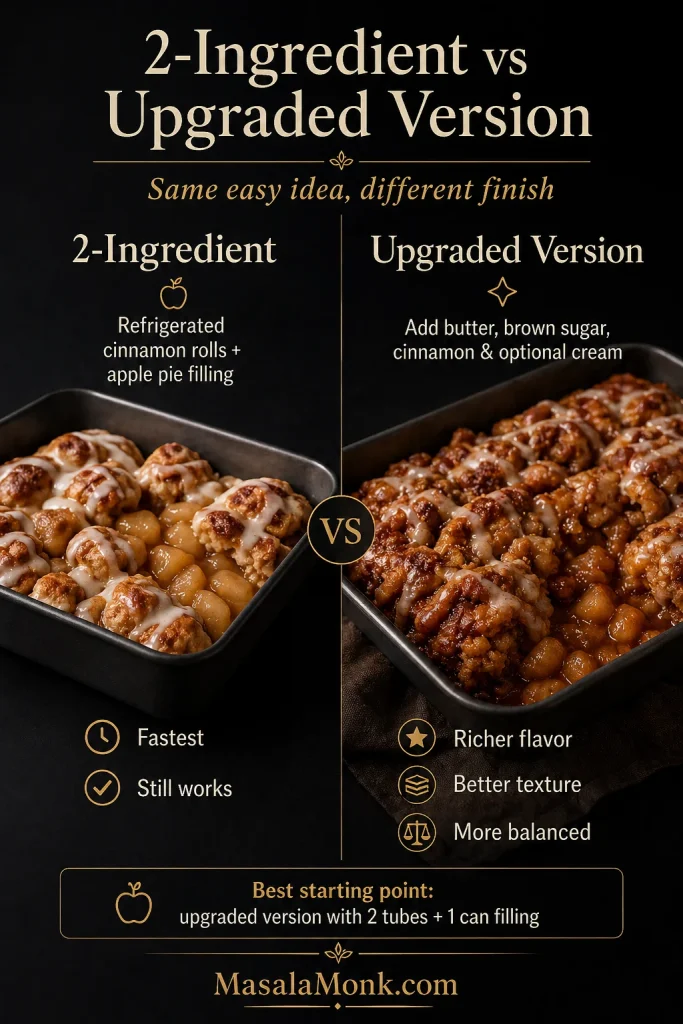
Can You Make This with Just 2 Ingredients?

Yes. You can make a 2-ingredient apple cinnamon roll bake with only refrigerated cinnamon rolls and apple pie filling. Cut the rolls, fold them with the filling, bake until the center is cooked through, then drizzle with the icing. The butter, brown sugar, cinnamon, and salt in this recipe are small upgrades that make the bake taste more finished, but they are not required.

Comparison of 2-ingredient apple cinnamon roll bake and upgraded version with butter, brown sugar, cinnamon, and optional cream.
The 2-ingredient version works when you need the fastest shortcut. However, the upgraded version adds better flavor balance and a softer, more bakery-style finish without turning this into a from-scratch cinnamon roll recipe.

Which Version Should You Make?

The best version depends on what you want from the pan. If this is your first time making it, start with the balanced 9Γ—13 bake. Once you know how your oven, pan, and cinnamon rolls behave, you can make it more apple-heavy or richer with cream.

Choose this versionUse it whenWhat to expect
Balanced 9Γ—13 bakeYou want the safest first trySoft rolls, clear apple flavor, less risk of a doughy center
Extra apple-heavy bakeYou want a gooier dessert-style casseroleMore filling, more sauce, longer bake time
Small batchYou are using 1 tube of cinnamon rollsBetter for an 8Γ—8 pan or 9-inch round pan
Homemade filling versionYou want better apple texture and less canned sweetnessBest flavor, especially with diced apple pie filling

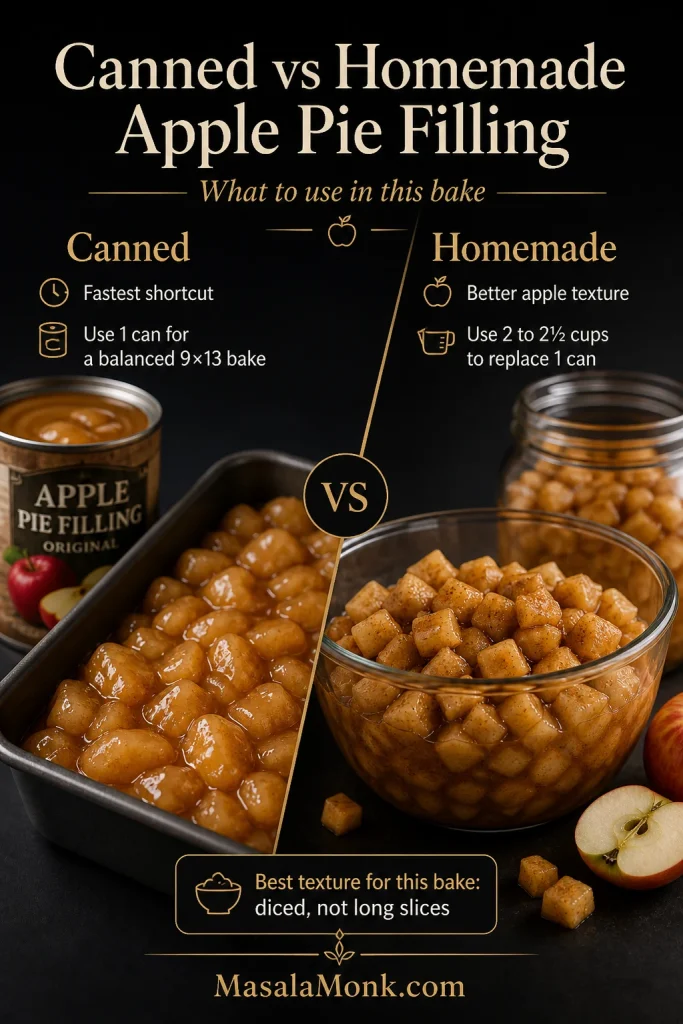
Canned vs Homemade Apple Pie Filling

Canned apple pie filling is the fastest option, and it works well for this recipe. Homemade filling gives you better control over sweetness, apple texture, and spice. The best homemade version for this bake is diced or chopped, not long slices.

Canned and homemade apple pie filling comparison for apple cinnamon roll bake, showing canned filling and diced homemade filling in bowls.
Canned apple pie filling is the fastest option, but homemade diced filling gives better control over sweetness and texture. For this bake, small apple pieces distribute more evenly than long slices.
FillingBest forHow much to use
Canned apple pie fillingFastest shortcut bake1 can / 21 oz / 595 g for a balanced 9Γ—13 bake
Homemade diced apple pie fillingBetter texture and less canned sweetness2 to 2Β½ cups to replace one can
Extra saucy fillingGooey casserole-style bakeUse carefully; too much sauce can delay the center
Fresh raw applesNot the best direct swapCook them first or use a proper apple pie filling method

If you want to make the filling from scratch, use this apple pie filling recipe and dice the apples for this bake. Use about 2 to 2Β½ cups homemade filling for every 20–21 oz can you are replacing.

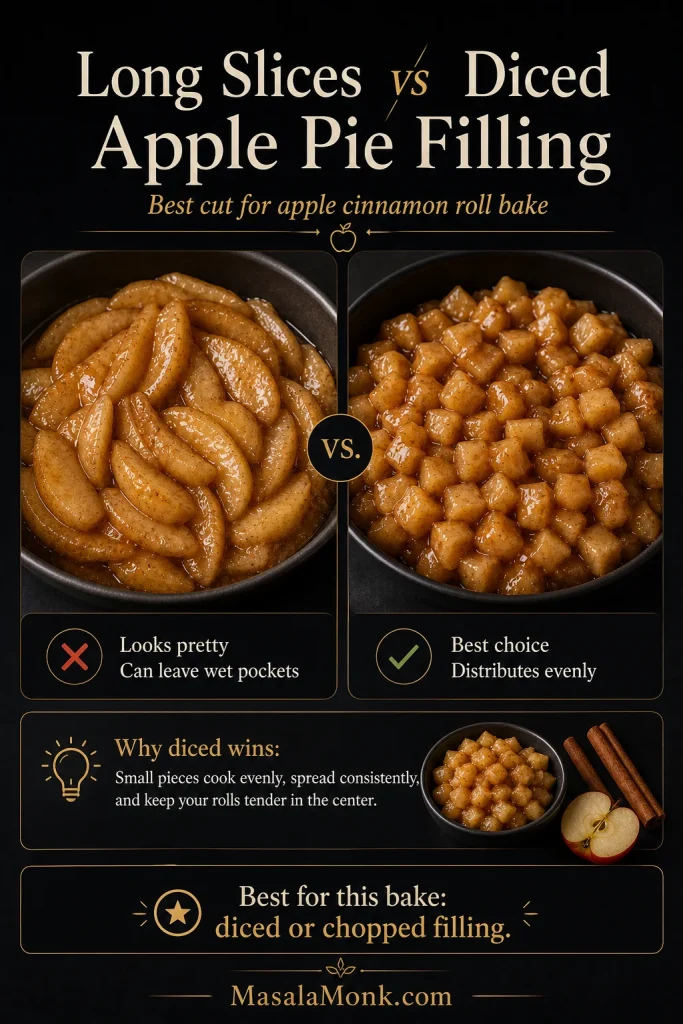
Long Slices vs Diced Apple Pie Filling

For this bake, diced or chopped apple pie filling works better than long slices. Smaller pieces spread between the cinnamon roll pieces more evenly, which gives you apple flavor throughout the pan without creating wet pockets.

Comparison of long apple slices and diced apple pie filling for apple cinnamon roll bake, showing diced filling as the better choice for even distribution.
Long apple slices can look beautiful, but they may leave wet pockets between the dough pieces. Diced or chopped apple pie filling spreads more evenly, which helps the center bake through cleanly.

Filling ready? Go to the step-by-step method. Worried about the center? Check the doughy-center fixes.

How to Make Apple Cinnamon Roll Bake with Apple Pie Filling

The goal is simple: keep the dough pieces small, spread the filling evenly, and give the center enough time to bake through. The apple filling should sit around and between the cinnamon roll pieces rather than forming one thick layer over the top.

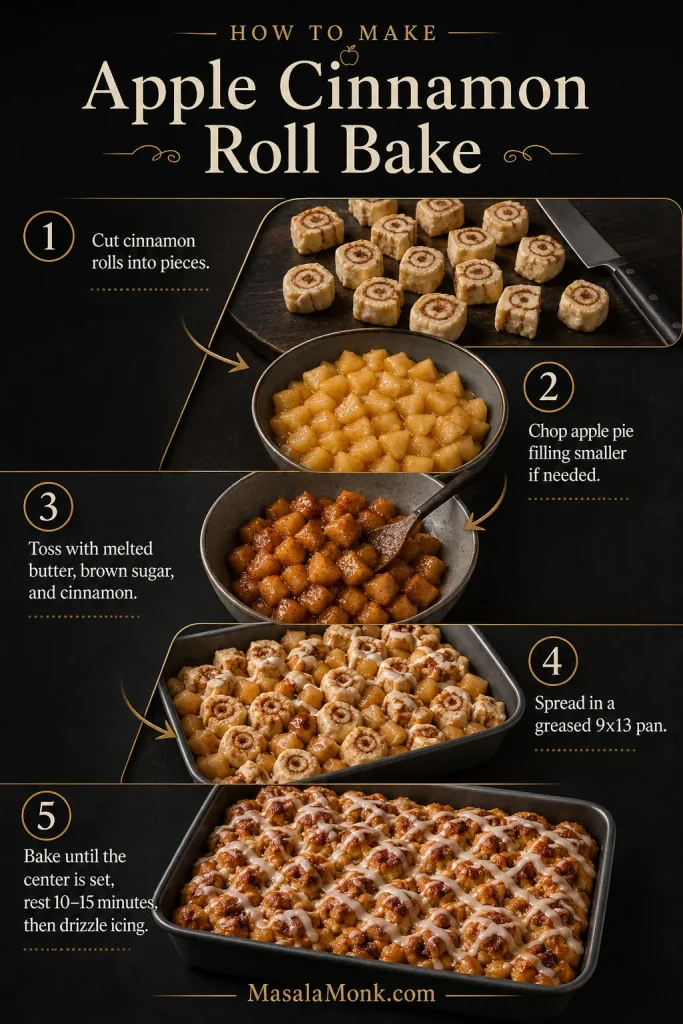
Step-by-step apple cinnamon roll bake method showing cut cinnamon rolls, chopped apple filling, seasoned dough, unbaked 9x13 pan, and iced baked rolls.
Cutting the rolls smaller and chopping the apple filling before baking helps every bite cook more evenly. As a result, you get soft cinnamon roll pieces with apple flavor throughout instead of wet pockets in the middle.
  1. Preheat the oven. Heat oven to 350Β°F / 175Β°C. Grease a 9Γ—13 inch / 23Γ—33 cm baking dish.
  2. Reserve the icing. Open the cinnamon roll tubes and set the icing aside for later.
  3. Cut the cinnamon rolls. Cut regular rolls into quarters. If using jumbo rolls, cut each roll into 6 pieces.
  4. Chop the apple filling. If the apple slices are large, chop them into roughly Β½-inch / 1.25 cm pieces.
  5. Season the dough. In a large bowl, toss the cinnamon roll pieces with melted butter, brown sugar, cinnamon or apple pie spice, and a small pinch of salt.
  6. Add the apple pie filling. Fold in the filling gently so the dough pieces are coated but not crushed.
  7. Spread in the pan. Transfer the mixture to the baking dish and spread it in one even layer.
  8. Add cream, if using. Drizzle 2–3 tablespoons / 30–45 ml heavy cream over the top. Keep it light so the center still bakes through cleanly.
  9. Bake. Bake for 40–50 minutes, checking the center around 35–40 minutes. Tent loosely with foil if the top browns before the middle is done.
  10. Rest and ice. Let the bake rest for 10–15 minutes, then drizzle with the reserved icing or cream cheese glaze.

Center still looks soft? Use the doughy-center checklist. Different pan size? Check pan sizes.

Common Mistakes to Avoid

  • Using too much filling the first time. Two cans can work, but 1 can is the better starting point for a full 9Γ—13 bake.
  • Leaving the cinnamon rolls too large. Big pieces brown on the outside before the middle cooks through.
  • Using a deep pan for a full batch. A deep dish traps steam and slows the center.
  • Adding icing too early. If the pan is piping hot, the icing melts away instead of sitting on top.
  • Judging only by the edges. The edges cook first. Always check the center before pulling the pan from the oven.

How to Keep Apple Cinnamon Rolls from Staying Doughy

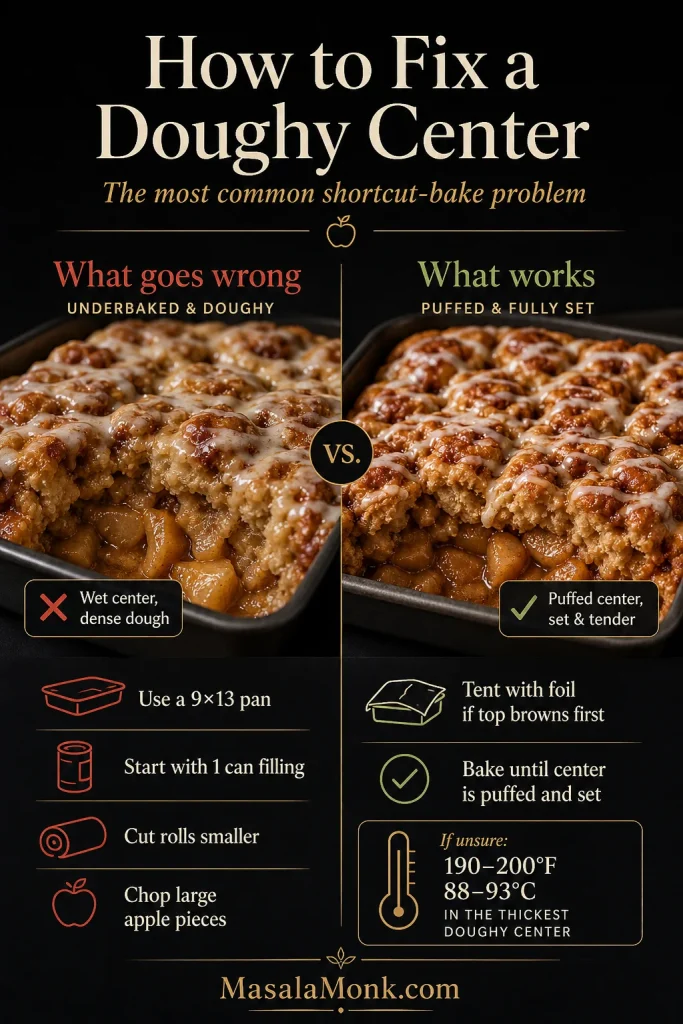
A doughy center is the most common problem with this kind of shortcut bake. It usually happens because the dough pieces are too large, the pan is too deep, or there is too much wet filling sitting over the middle.

Troubleshooting guide for fixing a doughy center in apple cinnamon roll bake, comparing a wet underbaked center with a puffed and set center.
A doughy center usually means the pan was too deep, the filling was too heavy, or the roll pieces were too large. If the top browns first, tent it with foil and keep baking until the middle is set.
  • Use a wide pan. A 9Γ—13 pan is safer for a full batch than a deep round dish.
  • Cut the rolls small enough. Quarter regular rolls; cut jumbo rolls into 6 pieces.
  • Start with 1 can of filling. Two cans can work, but the bake becomes wetter and needs more time.
  • Chop large apple slices. Big apple pieces create wet pockets around the dough.
  • Spread everything evenly. Avoid leaving a mound of filling in the center.
  • Tent with foil if needed. If the top is browning but the center is not done, cover loosely and keep baking.
  • Check the middle, not just the edges. The center should be puffed and no longer raw or collapsed.
  • Use a thermometer if unsure. The thickest doughy part should be about 190–200Β°F / 88–93Β°C, a helpful doneness range for soft baked dough.
  • Rest before icing. Resting helps the filling settle and keeps the icing from disappearing into the hottest parts of the pan.

Glass and ceramic pans: These may need a little longer than metal pans. If the edges look done but the middle is still soft, tent with foil and continue baking in 5-minute intervals.

For other texture issues, see the taste and texture fixes. For pan-specific help, check the pan guide.

How to Fix the Taste and Texture

If the first pan is not exactly how you like it, the fix is usually simple. Adjust the filling, pan, or bake time rather than changing the whole recipe.

Texture Guide: Too Wet, Just Right or Too Dry

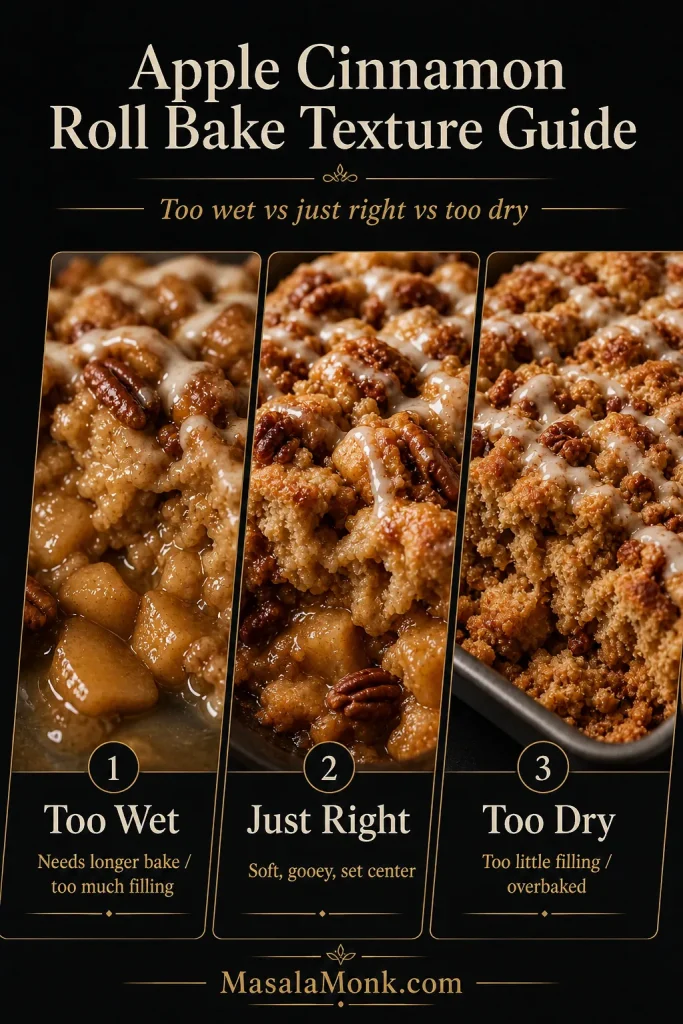
The texture should be soft and gooey, but the center should still look set. Use the visual cues below to decide whether the bake needs more time, less filling next time, or a little more moisture.

Texture guide for apple cinnamon roll bake showing too wet, just right, and too dry examples with apple filling and icing.
The ideal texture is soft, gooey, and set in the center. If the bake looks loose or sunken, give it more time; if it looks dry and crumbly, use a little more filling or check it earlier next time.
ProblemWhy it happenedFix it next time
Center is doughyToo much filling, large dough pieces, or deep panUse a 9Γ—13 pan, cut rolls smaller, start with 1 can filling
Top is too brownTop cooked before the center finishedTent loosely with foil and keep baking
Bake is too wetToo much apple filling or heavy creamUse less filling or skip cream next time
Rolls feel dryToo little filling or baked too longUse the balanced ratio and check earlier
Too sweetSweet filling plus icing plus caramel or extra sugarSkip caramel, reduce brown sugar, or use homemade filling
Not enough apple flavorFilling pieces were too sparse or too largeChop the apples smaller and spread them evenly

Pan Sizes and Bake Times for Apple Cinnamon Roll Bake

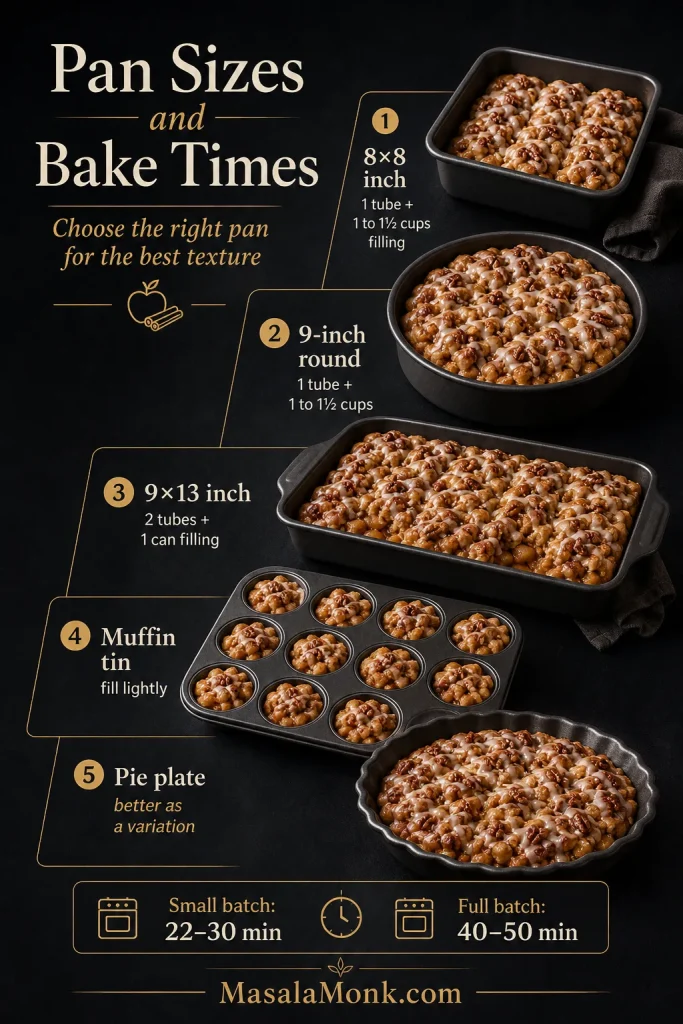
The pan changes everything. A full batch needs room to spread. A smaller batch can work beautifully in an 8Γ—8 pan, but a full 2-tube recipe crowded into a deep dish is more likely to stay doughy.

Pan size guide for apple cinnamon roll bake showing 8x8 pan, 9-inch round pan, 9x13 pan, muffin tin, and pie plate options.
A full batch spreads and bakes best in a 9Γ—13 pan, while one tube works better in an 8Γ—8 pan or 9-inch round dish. In other words, matching the pan to the batch size is one of the easiest ways to avoid a doughy center.
PanBest forSuggested amountBake cue
8Γ—8 inch / 20Γ—20 cmSmall batch1 tube rolls + 1 to 1Β½ cups fillingCenter puffed and no raw dough
9-inch / 23 cm roundSmall pull-apart style bake1 tube rolls + 1 to 1Β½ cups fillingKeep the dough in an even layer
9Γ—13 inch / 23Γ—33 cmFull batch2 tubes rolls + 1 can fillingBest all-around option
12-cup muffin tinApple cinnamon roll cupsFlatten rolls into cups and fill lightlyDo not overfill
9-inch pie plateCinnamon roll apple pie variationPressed cinnamon roll crust + fillingBetter as a separate pie-style version

Small-Batch Apple Cinnamon Roll Bake

A small batch is best when you only have one tube of cinnamon rolls or do not want a full 9Γ—13 pan. Use an 8Γ—8 pan or 9-inch round dish so the dough sits in an even layer and bakes through cleanly.

Small-batch apple cinnamon roll bake in an 8x8 pan with 1 tube cinnamon rolls, 1 to 1.5 cups apple pie filling, and 22 to 30 minute bake time.
A small-batch apple cinnamon roll bake is the better choice when you only have one tube of cinnamon rolls or do not want a full 9Γ—13 pan. Because the layer is smaller, it also bakes faster and is easier to monitor.

Making the full version instead? Return to the ratio guide. Need exact amounts? Jump to the recipe card.

Should You Add Heavy Cream?

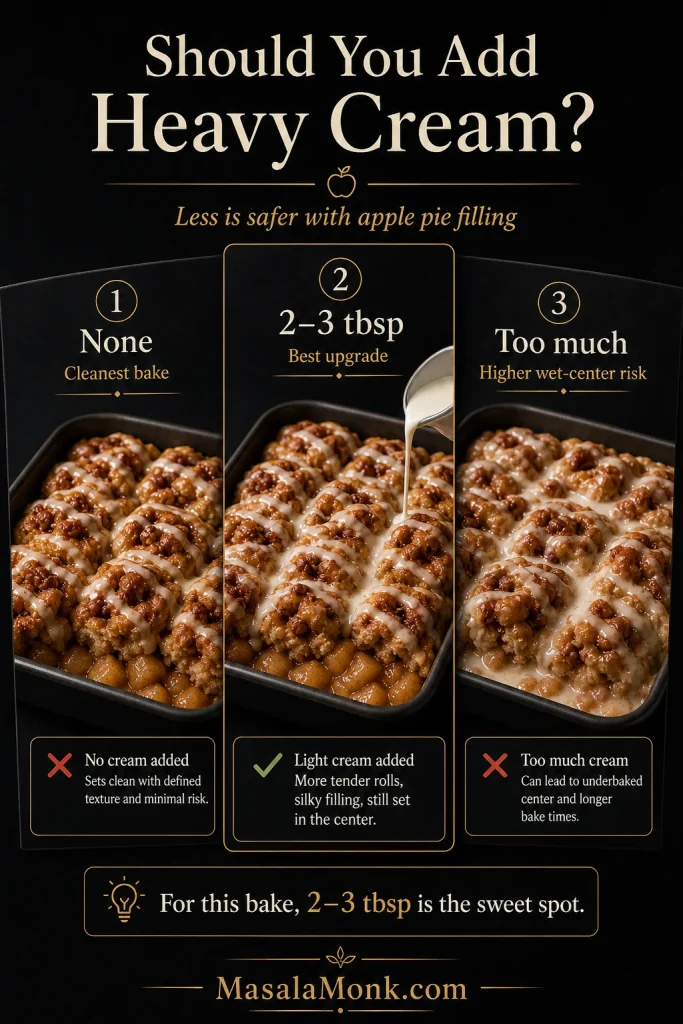
Heavy cream is optional. It can make cinnamon rolls softer and richer, but it also adds moisture. For this apple filling version, a small amount is enough.

Heavy cream guide for apple cinnamon roll bake comparing no cream, 2 to 3 tablespoons of cream, and too much cream.
Heavy cream can make the rolls more tender, but apple pie filling already adds moisture. Therefore, 2–3 tablespoons is the safest upgrade if you want a softer bake without risking a wet center.
Heavy cream amountResultBest use
NoneCleanest, most reliable bakeBest default if you worry about a doughy center
2–3 tbsp / 30–45 mlSofter, slightly gooierBest controlled cream option
β…“ cup / 80 mlRicher and wetterWorks, but watch the center carefully
Β½ cup / 120 ml or moreVery gooey, casserole-likeHigher risk of a wet center with apple filling

If you use extra apple pie filling, skip the heavy cream the first time. The filling already brings moisture and sauce.

Not sure about texture yet? Compare the texture fixes. Ready to bake? Go to the recipe card.

Icing, Cream Cheese Glaze and Caramel Drizzle

The icing packet that comes with refrigerated cinnamon rolls is the easiest finish. Let the bake rest first, then drizzle the icing over the top while the rolls are still warm.

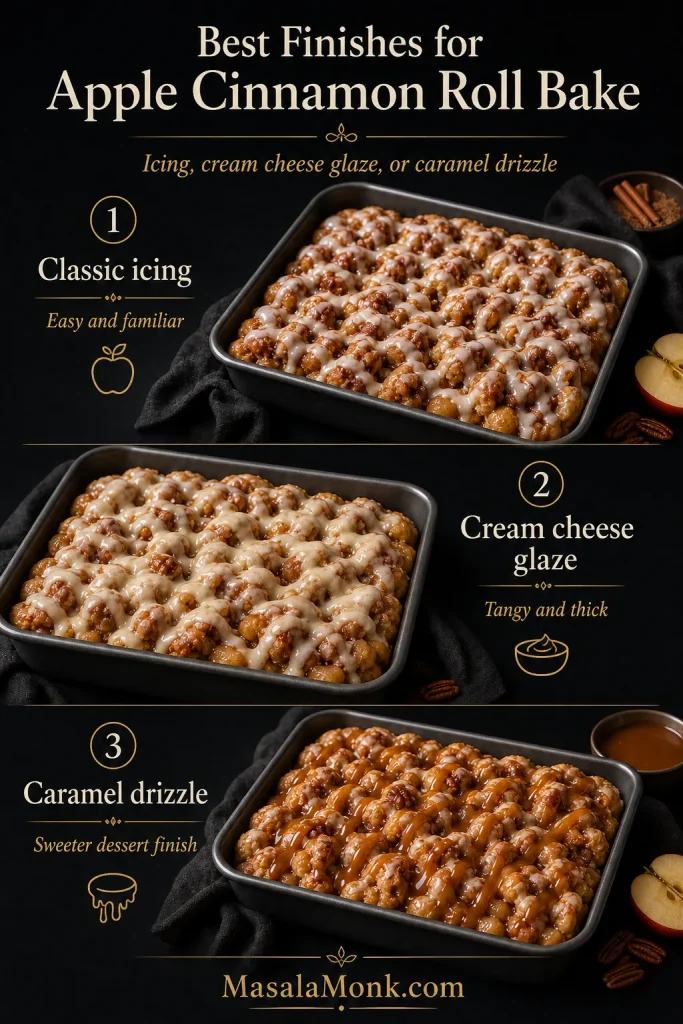
Three finish options for apple cinnamon roll bake: classic icing, cream cheese glaze, and caramel drizzle.
Choose the finish based on how sweet and rich you want the bake to feel. Classic icing is the simplest, cream cheese glaze adds tang, and caramel drizzle pushes the pan further toward dessert.

For a thicker glaze, stir together:

  • 2 oz / 55 g softened cream cheese
  • 1 tablespoon / 14 g softened butter
  • Β½ cup / 60 g powdered sugar
  • 1–2 tablespoons / 15–30 ml milk
  • Β½ teaspoon vanilla extract
  • Small pinch of salt

Caramel drizzle also works well, especially if you are making a fall dessert or holiday brunch bake. Use it lightly so the pan does not become too sweet.

Variations

Once the basic method is clear, you can change the finish, pan, or serving style without changing the whole recipe. These variations are useful when you want more crunch, more caramel flavor, or a portioned version for guests.

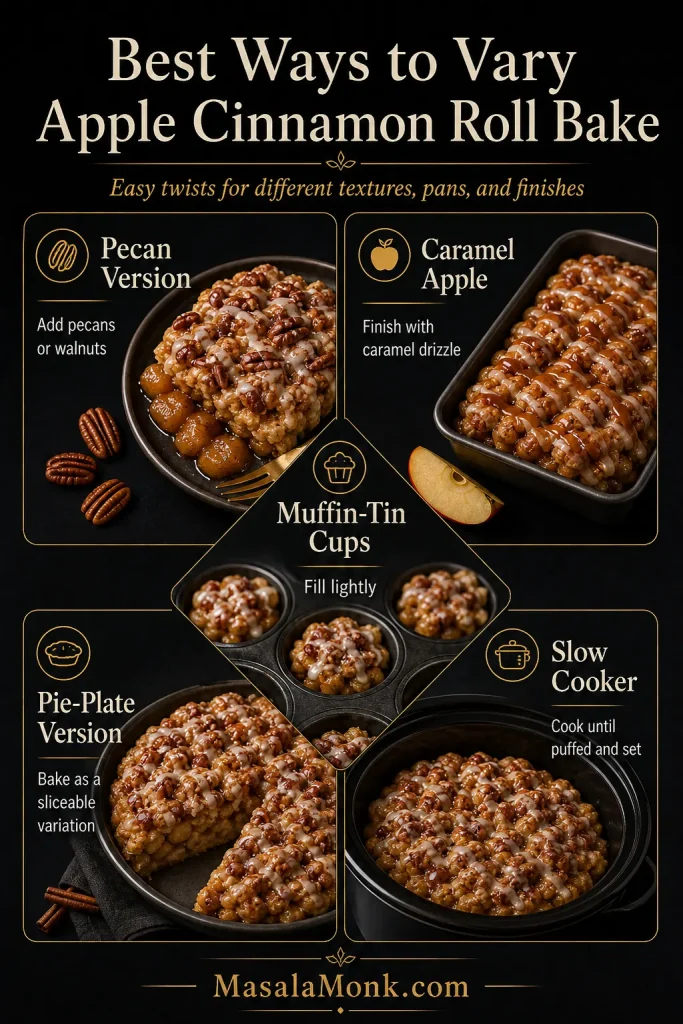
Variation guide for apple cinnamon roll bake showing pecan, caramel apple, muffin-tin cups, pie-plate version, and slow cooker options.
Once the basic apple cinnamon roll bake works for you, choose a variation based on how you want to serve it. Muffin cups are better for portions, pecans add crunch, caramel makes it more dessert-like, and a pie plate gives a more sliceable bake.

Apple Cinnamon Roll Casserole with Pie Filling

Use the same 9Γ—13 method, but make it extra gooey with 1Β½ cans of apple pie filling and a slightly longer bake. Tent with foil if the top browns too quickly.

Caramel Apple Cinnamon Rolls

Drizzle caramel sauce over the rested bake after icing. Add chopped pecans for a caramel-apple-pie flavor.

Apple Pie Cinnamon Roll Bake with Pecans

Fold Β½ cup chopped pecans or walnuts into the mixture before baking, or scatter them over the top for crunch.

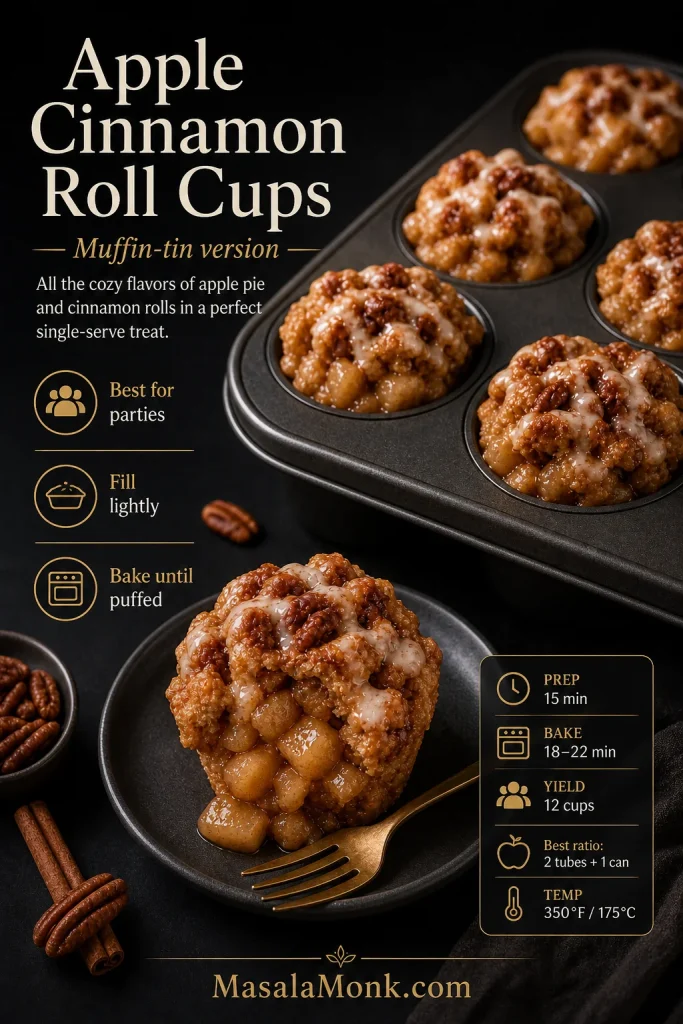
Cinnamon Roll Apple Pie Cups

For a portioned version, flatten individual cinnamon rolls into a greased muffin tin, add a spoonful of chopped apple pie filling, and bake until puffed and golden. Keep the filling light so the cups rise properly instead of bubbling over.

Apple cinnamon roll cups made in a muffin tin with apple pie filling, icing drizzle, pecans, and a plated single-serving cup.
Muffin-tin cinnamon roll cups are a good variation for parties or portioned desserts. Even so, fill them lightly because apple pie filling expands and bubbles as the dough bakes.

Prefer the main 9Γ—13 version? Use the recipe card. Looking for serving ideas? See how to serve it.

Cinnamon Roll Apple Pie Crust

For a pie-style variation, flattened cinnamon rolls can be pressed into a pie plate and filled with apple pie filling. If you want a classic pie instead, use this apple pie crust recipe.

Apple Cinnamon Roll Monkey Bread

Use smaller pieces of cinnamon roll dough, toss with butter and cinnamon sugar, and layer with chopped apple pie filling in a Bundt pan. This is a separate bake style and usually needs careful timing so the center cooks.

Crock Pot Apple Cinnamon Roll Bake

A slow cooker version can work, but the top will not brown the same way. Use less filling, line or grease the cooker well, and cook until the dough is fully set in the center.

How to Serve This Apple Cinnamon Roll Bake

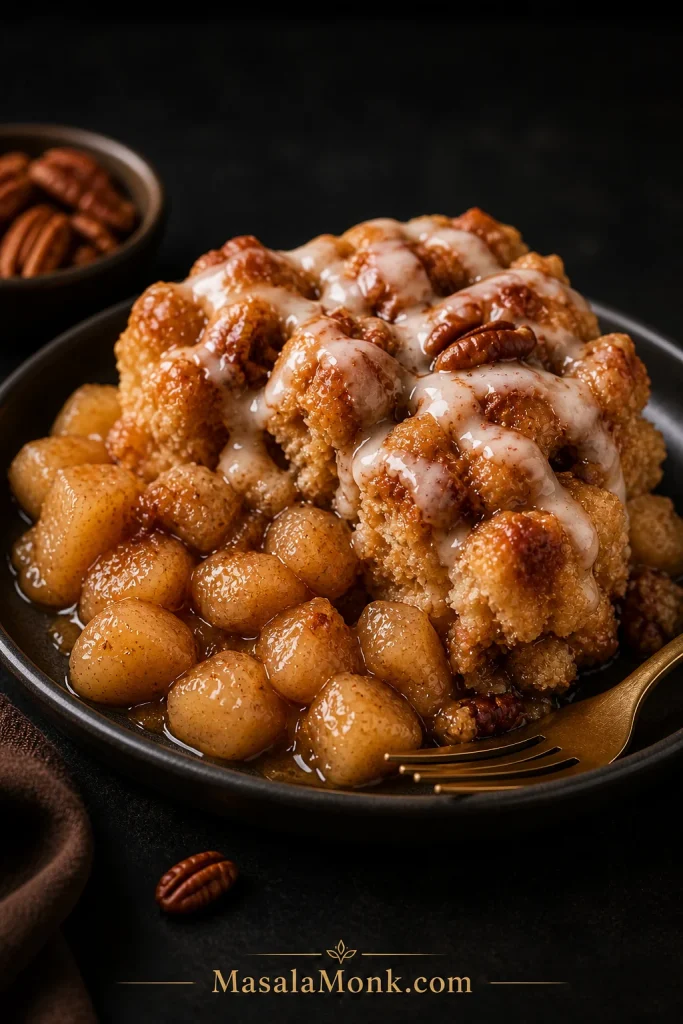
Serve this warm while the icing is still soft. It works as a sweet brunch bake, a holiday breakfast, or an easy apple dessert with very little prep.

Close-up serving of apple cinnamon roll bake with glossy apple filling, icing drizzle, pecans, and a fork on a dark plate.
Let the bake rest briefly before serving so the filling thickens slightly and the scoops hold together better. Then serve it warm, when the icing is still soft and the apple filling tastes richest.
  • For breakfast or brunch, serve it with coffee, tea, fresh fruit, or something salty like eggs or breakfast potatoes.
  • For dessert, add vanilla ice cream, whipped cream, or a light caramel drizzle. Keep the topping light if your bake is already extra apple-heavy or very sweet.
  • For a holiday table, sprinkle chopped pecans over the top and serve it straight from the baking dish.

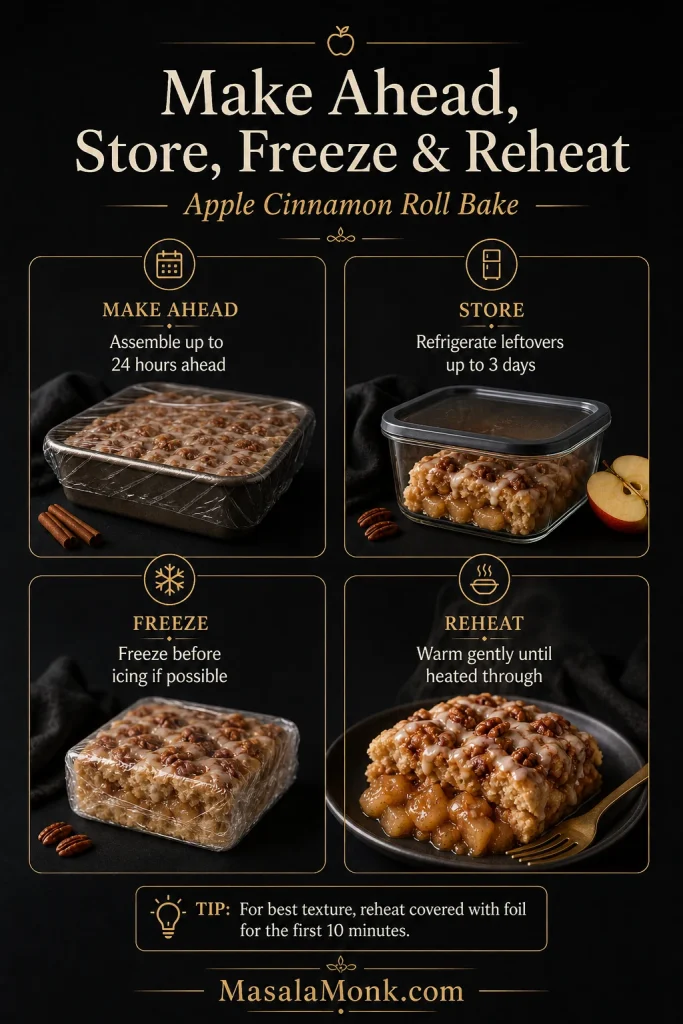
Make Ahead, Storage, Freezing and Reheating

Because this bake is soft and saucy, the best make-ahead approach is to keep the icing separate and reheat gently. That way, the rolls stay tender instead of drying out or turning overly sticky.

Make ahead, storage, freezing, and reheating guide for apple cinnamon roll bake with covered pan, storage container, wrapped portion, and warm serving.
For make-ahead baking, assemble the pan up to 24 hours ahead and keep the icing separate. Later, reheat leftovers gently so the rolls warm through without drying out.

Can You Make It Ahead?

Yes. Assemble the bake up to 24 hours ahead, cover tightly, and refrigerate. For the most even bake, let the pan sit at room temperature for 20–30 minutes while the oven preheats. If baking straight from the fridge, add a few extra minutes.

When Should You Add the Icing?

Add icing after baking, not before. If you are making the bake ahead, keep the icing separate until the pan is baked and rested.

How Long Do Leftovers Keep?

Store leftovers covered in the refrigerator for up to 3 days. This fits within the USDA’s 3-to-4-day leftover storage guidance. The rolls will soften as they sit because of the apple filling, but they reheat well.

How Do You Reheat It?

Reheat individual portions in short microwave bursts until warm. For a larger portion, cover loosely with foil and warm in a low oven until heated through.

Can You Freeze Apple Cinnamon Roll Bake?

You can freeze it, but the texture is best fresh. If freezing, freeze before icing. Thaw overnight in the refrigerator, reheat gently, and add icing after warming.

Making it now? Return to the recipe card. Need quick answers? Jump to FAQs.

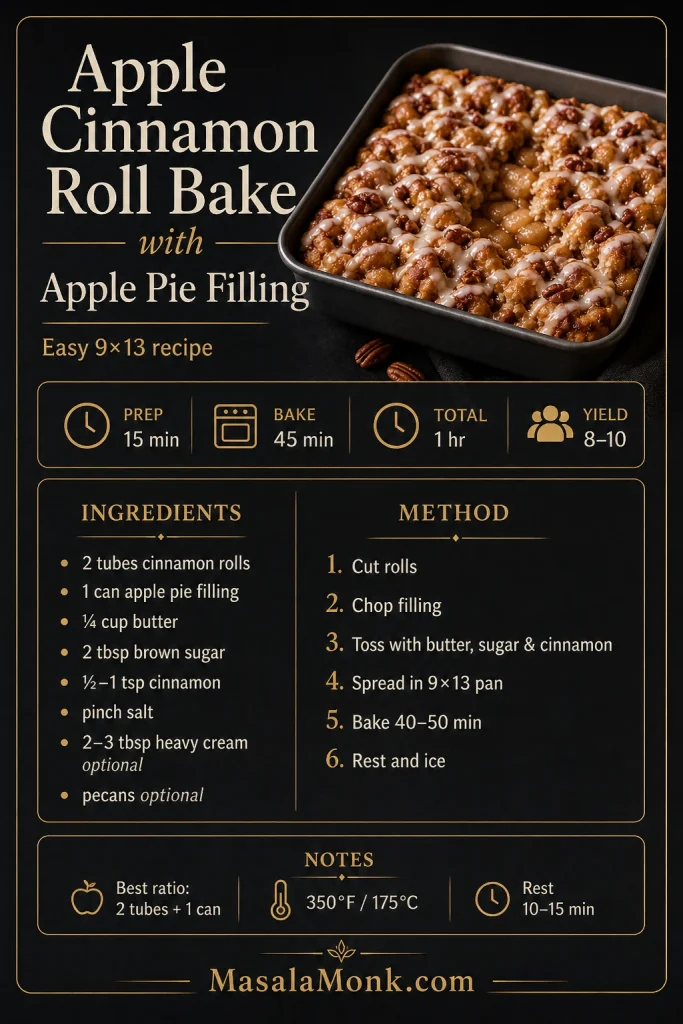
Apple Cinnamon Roll Bake with Apple Pie Filling Recipe

Saveable recipe card for apple cinnamon roll bake with apple pie filling listing prep time, bake time, yield, ingredients, and basic method.
Use this saveable recipe card when you want the full bake in one glance. It keeps the key numbers together, so you do not have to scroll back for the filling ratio, oven temperature, or bake time.

Prep Time
15 minutes

Cook Time
45 minutes

Total Time
1 hour

Yield
8–10 servings

Description: Easy apple cinnamon roll bake made in a 9Γ—13 pan with refrigerated cinnamon rolls, apple pie filling, optional heavy cream, and icing drizzle. The recipe uses a reliable filling ratio so the rolls stay soft and gooey without leaving the center raw.

Equipment

  • 9Γ—13 inch / 23Γ—33 cm baking dish
  • Large mixing bowl
  • Knife or kitchen shears
  • Spatula or large spoon
  • Foil for tenting, if needed
  • Optional instant-read thermometer

Ingredients

  • 2 tubes refrigerated cinnamon rolls, about 17.5 oz / 496 g each, about 35 oz / 990 g total, icing reserved
  • 1 can apple pie filling, 21 oz / 595 g, chopped if slices are large
  • ΒΌ cup / 4 tablespoons / 57 g unsalted butter, melted
  • 2 tablespoons / about 25 g light brown sugar
  • Β½ to 1 teaspoon ground cinnamon or apple pie spice
  • Small pinch fine salt, optional
  • 2–3 tablespoons / 30–45 ml heavy cream, optional
  • Β½ cup / 55–60 g chopped pecans or walnuts, optional

Homemade filling option: Replace one 20–21 oz can with 2 to 2Β½ cups homemade diced apple pie filling.

Optional Cream Cheese Glaze

  • 2 oz / 55 g cream cheese, softened
  • 1 tablespoon / 14 g butter, softened
  • Β½ cup / 60 g powdered sugar
  • 1–2 tablespoons / 15–30 ml milk
  • Β½ teaspoon vanilla extract
  • Small pinch salt

Instructions

  1. Preheat oven to 350Β°F / 175Β°C. Grease a 9Γ—13 inch / 23Γ—33 cm baking dish.
  2. Open the cinnamon roll tubes and reserve the icing for later.
  3. Cut regular cinnamon rolls into quarters. If using jumbo rolls, cut each roll into 6 pieces.
  4. Chop large apple slices in the apple pie filling into smaller pieces, about Β½ inch / 1.25 cm.
  5. In a large bowl, toss cinnamon roll pieces with melted butter, brown sugar, cinnamon or apple pie spice, and salt.
  6. Fold in the apple pie filling gently until the dough pieces are evenly coated.
  7. Spread the mixture in one even layer in the prepared baking dish.
  8. Drizzle 2–3 tablespoons heavy cream over the top, if using. Sprinkle with nuts, if using.
  9. Bake for 40–50 minutes, checking the center around 35–40 minutes. Tent loosely with foil if the top browns before the center is done.
  10. The bake is ready when the center is puffed, set, and no longer wet or raw. If using a thermometer, the thickest doughy center should be about 190–200Β°F / 88–93Β°C.
  11. Let the pan rest for 10–15 minutes.
  12. Drizzle with reserved icing or cream cheese glaze. Serve warm.

Notes

  • For the most reliable texture, start with 1 can of apple pie filling for 2 large tubes of cinnamon rolls.
  • For an extra apple-heavy bake, use 1Β½ to 2 cans filling and bake longer.
  • Glass and ceramic pans may need extra time compared with metal pans.
  • If the top browns too quickly, tent with foil and continue baking until the center is done.
  • Add icing after the bake rests, not immediately out of the oven.

FAQs

Can I use homemade apple pie filling?

Yes. Use 2 to 2Β½ cups homemade apple pie filling to replace one 20–21 oz can. Diced filling works best because it spreads evenly between the cinnamon roll pieces.

Should I use one can or two cans of apple pie filling?

Use one can for the most reliable 9Γ—13 bake. Use 1Β½ to 2 cans if you want a very gooey, apple-heavy version, but expect a longer bake time and check the center carefully.

Can I make this with only cinnamon rolls and apple pie filling?

Yes. You can make a 2-ingredient version with only refrigerated cinnamon rolls and apple pie filling. The butter, brown sugar, cinnamon, and salt are optional upgrades that make the bake taste richer and more balanced, but the shortcut version still works without them.

Why are my cinnamon rolls doughy in the middle?

The most common reasons are too much filling, dough pieces that are too large, a pan that is too deep, or not enough bake time. Use a wide 9Γ—13 pan, cut the rolls smaller, spread the filling evenly, and bake until the center is puffed and set.

Can I make this with one tube of cinnamon rolls?

Yes. Use an 8Γ—8 inch pan or 9-inch round pan with 1 tube of cinnamon rolls and about 1 to 1Β½ cups apple pie filling. Bake until the center is cooked through, usually 22–30 minutes depending on the dough size and pan.

Can I use jumbo cinnamon rolls?

Yes. Cut jumbo rolls into 6 pieces instead of quarters so the center cooks more evenly. Jumbo rolls often need a longer bake time.

Do I need heavy cream?

No. Heavy cream is optional. Use 2–3 tablespoons if you want a softer, richer bake. Skip it if you are using extra apple pie filling or if you are worried about a wet center.

Can I make apple cinnamon rolls with apple pie filling overnight?

Yes. Assemble the pan, cover it tightly, and refrigerate for up to 24 hours. Let it sit at room temperature for 20–30 minutes while the oven heats, or bake straight from chilled with a little extra time.

Can I make this in a muffin tin?

Yes. Flatten individual cinnamon rolls into greased muffin cups, spoon in chopped apple pie filling, and bake until puffed and cooked through. Keep the filling light so the cups do not overflow.

Can I use fresh apples instead of apple pie filling?

Fresh raw apples are not the best direct swap because they release moisture and may not soften enough before the dough bakes. For better results, cook the apples into a quick apple pie filling first.

Can I freeze apple cinnamon roll bake?

Yes, but the texture is best fresh. Freeze before icing if possible. Thaw overnight in the refrigerator, reheat gently, and add icing after warming.

Back to top

Posted on Leave a comment

What are Tik Tok / TikTok cinnamon rolls and what are the easiest ways to make them at home?

bake baking cinnamon rolls confectionery

Hello, fellow dessert aficionados! If you’ve been keeping an eye on the latest food trends, you’ve probably noticed a certain sweet treat taking over TikTok – the sensational TikTok Cinnamon Rolls. These delightfully fluffy and sinfully sweet rolls have captured the hearts (and stomachs!) of millions of users across the globe, making them an absolute must-try for anyone with a sweet tooth. 🍬🌍

In this extensive guide, we’ll be exploring the ins and outs of this viral recipe. From the classic recipe to exciting variations, healthier alternatives, and even a no-oven method, we’ve got you covered. So, roll up your sleeves, preheat your oven (or don’t, we’ll get to that!), and let’s dive into the world of TikTok Cinnamon Rolls! πŸŠβ€β™€οΈπŸ½οΈ

The Classic TikTok Cinnamon Roll Recipe πŸ“œπŸ―

The core appeal of the TikTok Cinnamon Rolls lies in the beautiful simplicity of taking a store-bought product and elevating it with a few additional ingredients. Here’s the classic recipe that started it all:

Ingredients:

  1. 1 Package Cinnamon Rolls (like Pillsbury or Britannia in India)
  2. 1/2 Cup Heavy Cream (Amul cream in India)
  3. 1/4 Cup Butter, melted (Amul butter in India)
  4. 1/2 Cup Brown Sugar
  5. 1 Teaspoon Cinnamon
  6. 1 Package Cream Cheese Frosting (like Betty Crocker or Pillsbury in India), optional

Instructions:

  1. Kick off the process by lightly spraying a baking dish with nonstick cooking spray. Arrange the cinnamon rolls evenly, ensuring there’s space between each roll. This allows for even baking and the perfect rise. πŸ©πŸ’«
  2. Next, pour your heavy cream over the rolls, making sure it seeps into the gaps between the rolls. The cream will soak into the dough, adding moisture and richness. πŸ₯›πŸ₯
  3. In a small mixing bowl, combine your melted butter, brown sugar, and cinnamon together. Drizzle this sweet and spicy mixture over the rolls, coating them with a layer of extra flavor and sweetness. πŸ₯£πŸ―
  4. Now it’s time to bake! Follow the package instructions for the cinnamon rolls (typically, they’re baked at 350 degrees for about 30 minutes). This will vary depending on the brand of rolls you’re using. πŸ•“πŸ”₯
  5. Once they’re golden brown and your kitchen smells like a bakery, take the rolls out of the oven. While they’re still warm, slather them with the included icing and extra cream cheese frosting if desired. The heat from the rolls will melt the icing slightly, creating a glossy, sweet glaze. πŸŽ‚πŸ’—
  6. And voila! Your TikTok Cinnamon Rolls are ready to be devoured. Serve them warm for the ultimate experience. πŸ½οΈπŸŽ‰

TikTok Cinnamon Rolls: Exciting Variations 🎨🌈

The beauty of the TikTok Cinnamon Roll recipe is its flexibility. Here are a few exciting variations you can try:

Extra Fruity TikTok Cinnamon Rolls πŸπŸ‡

Add a fresh and tangy twist by incorporating some fruit into your cinnamon rolls. Sprinkle a layer of your favorite dried fruit, like raisins or dried cranberries, over the rolls after you’ve added the heavy cream. The fruit will plumpup in the oven, adding a burst of flavor and a chewy texture that pairs wonderfully with the softness of the rolls.

Chocolate Chip TikTok Cinnamon Rolls 🍫πŸͺ

For the chocoholics out there, this variation is for you! Simply scatter a handful of chocolate chips over the rolls before baking. The heat from the oven will cause the chips to melt slightly, creating pockets of gooey chocolate throughout the rolls. Yum!

Nutty TikTok Cinnamon Rolls 🌰πŸ₯œ

Craving some crunch? Adding nuts is a fantastic way to introduce a bit of texture to your fluffy cinnamon rolls. Sprinkle a handful of chopped pecans, walnuts, or even almonds over the rolls before baking. The nuts will toast in the oven, adding a delightful crunch and nutty flavor to your rolls.

Healthier Alternatives: TikTok Cinnamon Rolls with a Twist πŸ₯—πŸ‹οΈβ€β™€οΈ

While these cinnamon rolls are indeed a decadent treat, there are ways to make them a bit healthier without sacrificing too much of the taste and texture that makes them so irresistible.

Whole Wheat TikTok Cinnamon Rolls 🌾🍞

For a healthier take on these rolls, consider replacing the regular store-bought cinnamon rolls with a whole wheat version. Whole wheat flour contains more fiber and nutrients compared to white flour, making it a healthier choice. In India, brands like Pillsbury and Britannia offer whole wheat options.

Sugar-Free TikTok Cinnamon Rolls 🚫🍬

If you’re watching your sugar intake, you can opt for a sugar-free version of the TikTok cinnamon rolls. Replace the brown sugar in the recipe with a sugar substitute like Stevia or Erythritol. Additionally, look for sugar-free cinnamon rolls and frosting in the store.

Vegan TikTok Cinnamon Rolls 🌱🍩

For those following a vegan diet, you can make vegan TikTok cinnamon rolls by using dairy-free alternatives. Use a vegan cinnamon roll package, replace the heavy cream with a non-dairy cream (like almond or coconut cream), and use a plant-based butter substitute. For the frosting, use a vegan cream cheese or make your own from cashews or coconut cream.

How to Make TikTok Cinnamon Rolls Without an Oven 🚫πŸ”₯

Don’t have an oven? No problem! You can still enjoy these delicious cinnamon rolls by using a stovetop method:

  1. Follow the same steps as the original recipe to prepare your rolls.
  2. Instead of placing them in an oven, put the rolls in a heavy-bottomed pan or pot with a tight-fitting lid. The pan needs to be large enough to fit all the rolls without squishing them.
  3. Cover the pan and cook the rolls over low heat for about 20-30 minutes. It’s important to keep the heat low to prevent the bottom from burning while the top is still uncooked.
  4. After about 20 minutes, check the rolls. If they’re golden brown and cooked through, they’re ready. If not, cover and continue to cook, checking every few minutes.
  5. Once the rolls are done, remove them from the heat and immediately spread the icing and any additional frosting on top.

The Final Roll: TikTok Cinnamon Rolls are Here to Stay! πŸπŸŽ‰

From the classic recipe to the various creative twists and healthier alternatives, TikTok Cinnamon Rolls offer a delightful treat that can be customized to suit anyone’s palate or dietary preferences.

This guide has explored the many ways to enjoy this viral trend, providing you with the tools to make your very own TikTok Cinnamon Rolls right athome, regardless of your kitchen setup or dietary preferences.

But the best part about these rolls? They’re incredibly fun to make, and the end result is a sweet reward that will have you coming back for more. So don’t hesitate to try this trend and maybe even come up with your own unique variation. Remember, the kitchen is your playground – so have fun, get creative, and most importantly, enjoy the delicious results! πŸ₯³πŸ½οΈ

In the world of ever-changing food trends, TikTok Cinnamon Rolls have made a mark. They’ve proven that sometimes, the simplest recipes can create the most buzz. And with this comprehensive guide, you can participate in this sweet trend too!

So, what are you waiting for? Grab those ingredients, start baking, and join the TikTok Cinnamon Roll revolution! Don’t forget to share your creations online using the hashtag #TikTokCinnamonRolls. Who knows, your twist on the recipe might be the next big thing! πŸ“ΈπŸ’–