
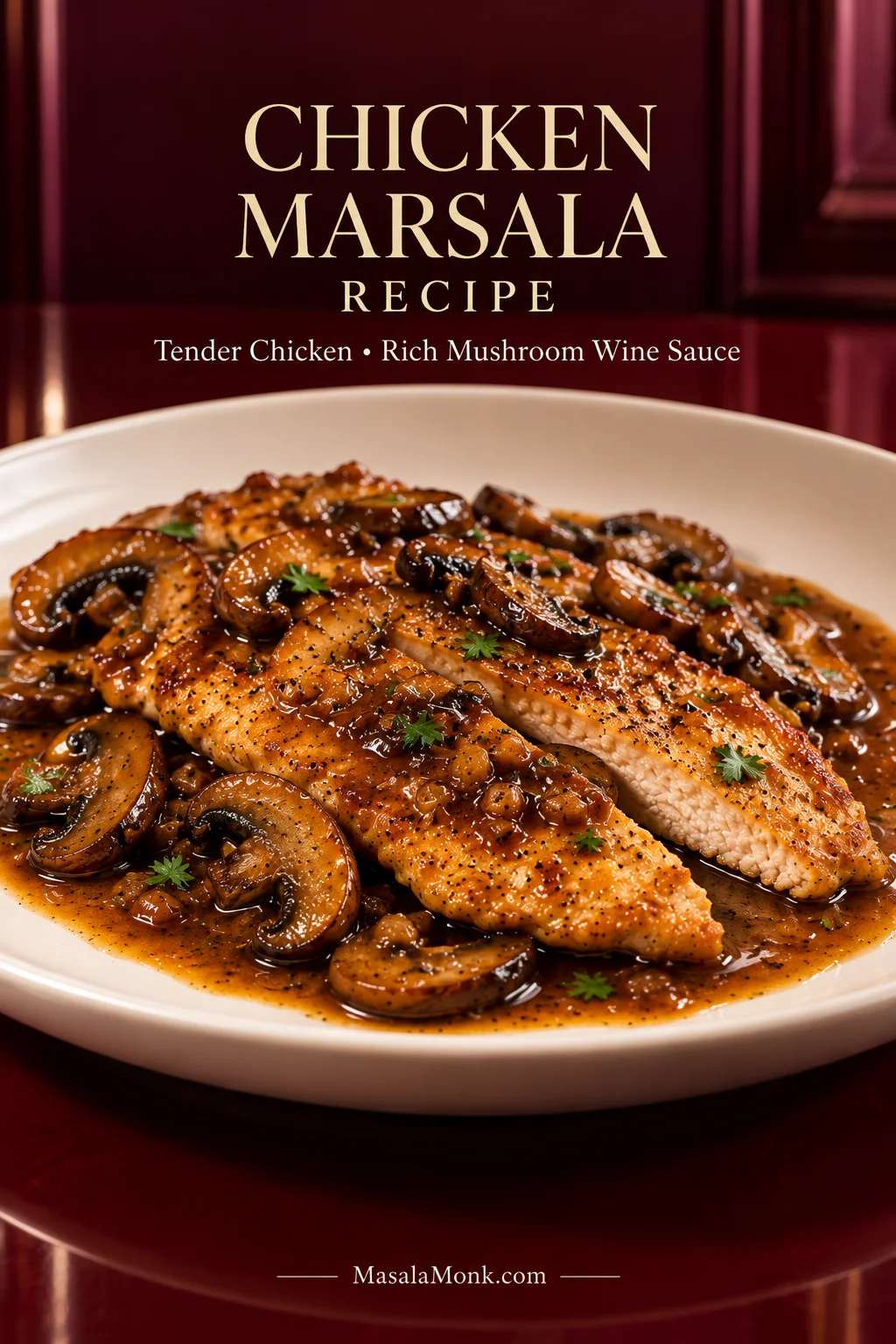
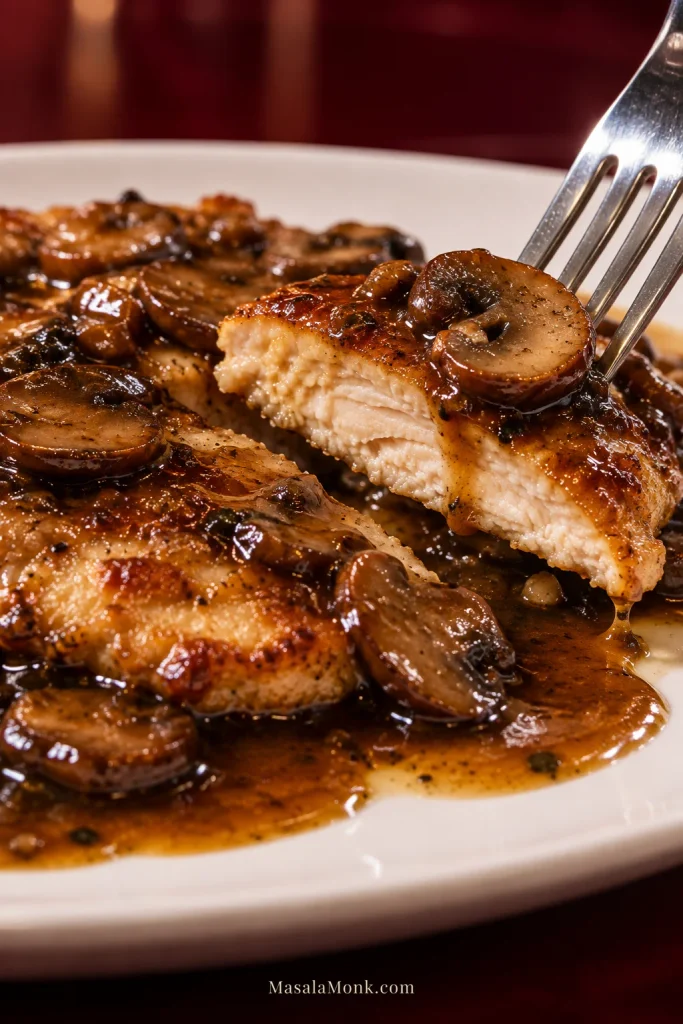
The best part of Chicken Marsala is what happens when you cut into the first piece: the chicken is still juicy, mushrooms come with it, and the dark Marsala sauce runs straight into whatever is waiting beside it.
This Chicken Marsala recipe is an Italian-American skillet dish built around thin chicken cutlets, mushrooms, and Sicily’s fortified Marsala wine. It comes together in one skillet in about 45–50 minutes, but each stage gets the time it needs. The mushrooms have to cook off their water, the wine needs time to reduce, and thin chicken can dry out long before the sauce is ready.
This method keeps those jobs separate. Brown first. Reduce second. Return the chicken last. The mushrooms develop real color, the Marsala loses its raw edge, and the chicken only comes back when the sauce is nearly ready.
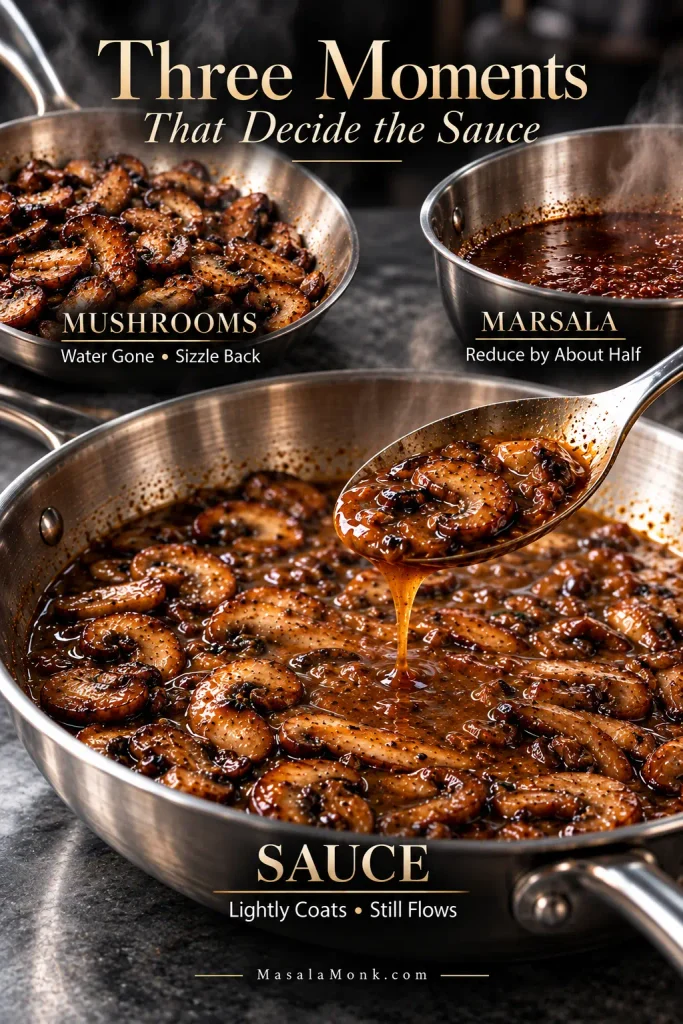
Three Moments That Decide the Sauce
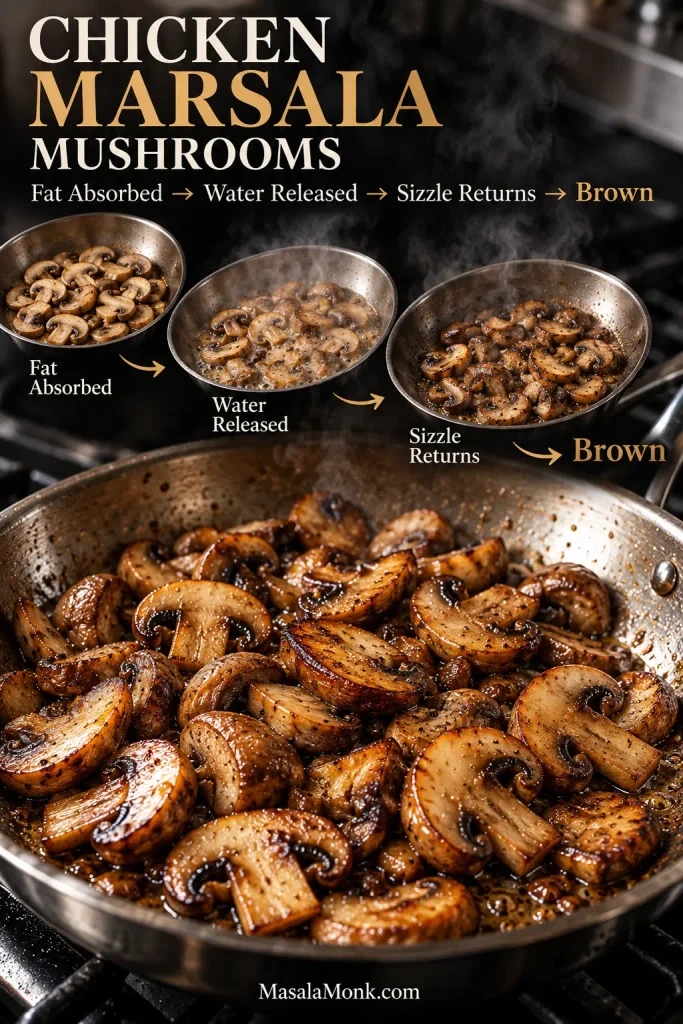
Mushrooms
Wait until their released water is gone, the skillet sounds like it is frying again, and the edges are taking on real brown color.
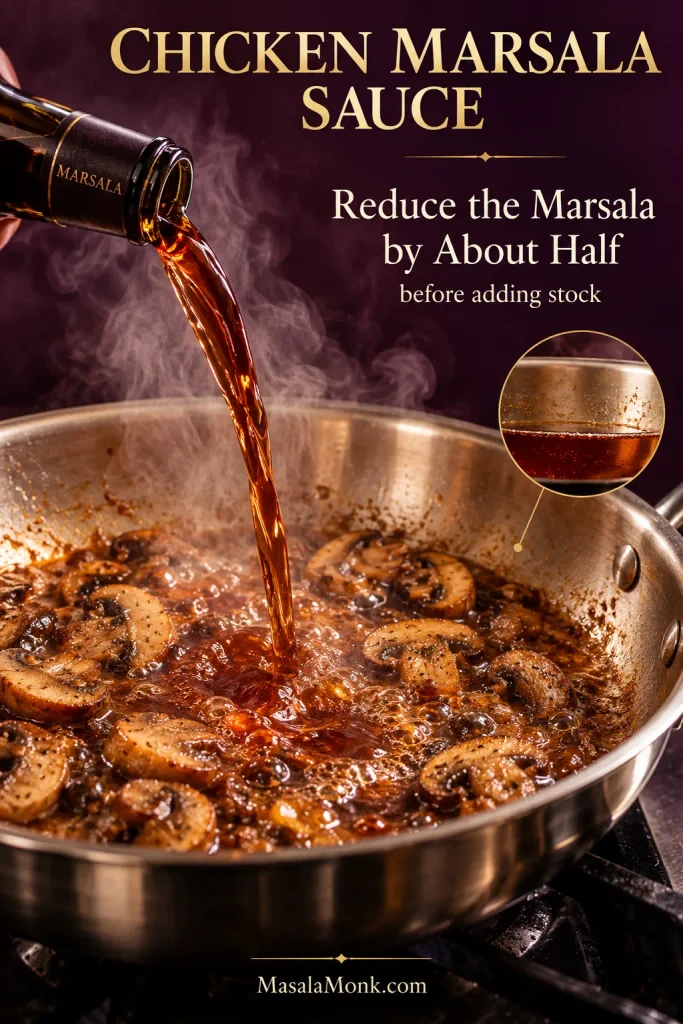
Marsala
Roughly half the wine should remain, with the sharp alcohol smell replaced by something rounder, nuttier, and more inviting.
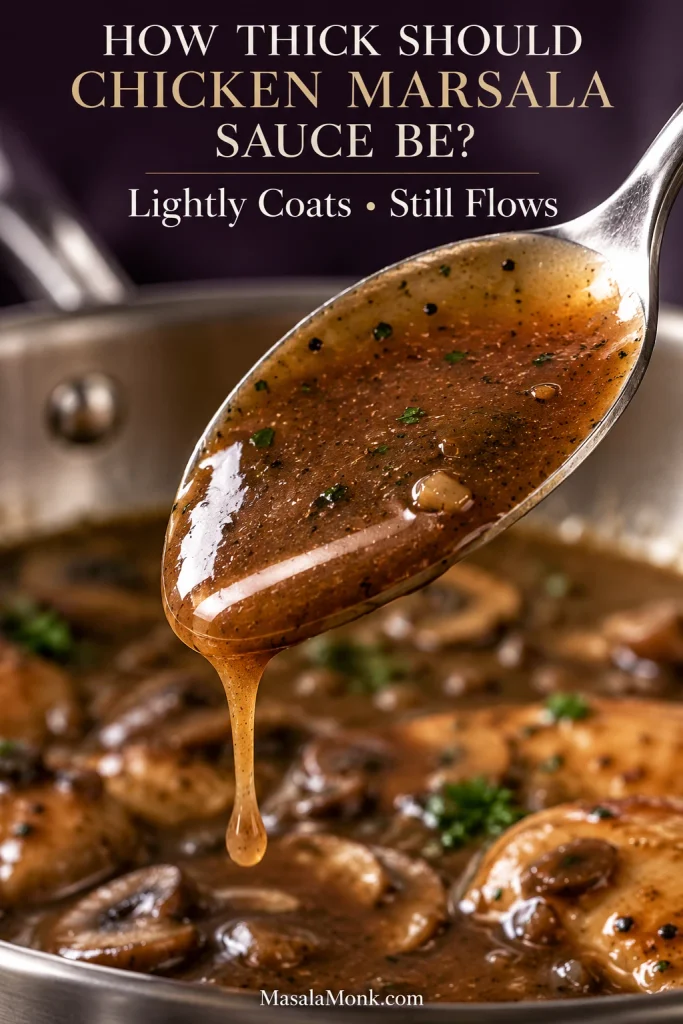
Sauce
Stop reducing when it lightly coats a spoon but still moves easily around the skillet.
Keep the browned chicken out of the skillet while all three stages happen. If the sauce needs another few minutes, the chicken does not.
Chicken Marsala Recipe
Thin golden chicken cutlets and deeply browned mushrooms in a dark Marsala pan sauce, finished with cold butter until glossy and silky.
Equipment
- 12-inch / 30-cm skillet, preferably stainless steel
- Meat mallet or rolling pin
- Shallow plate or bowl for flour
- Tongs or thin spatula
- Wooden spoon or silicone spatula
- Instant-read thermometer
- Two plates for holding and serving the chicken
Chicken Marsala Ingredients
For the Chicken
- 1½ lb / 680 g boneless, skinless chicken breasts, prepared as 4 similarly sized cutlets
- 4 g kosher salt, about 1½ tsp Diamond Crystal or a scant 1 tsp Morton, divided, plus more to taste
- ½ tsp / about 1 g freshly ground black pepper
- ⅓ cup / 40 g all-purpose flour, for dredging; some will remain unused
- 2–3 tbsp / 30–45 ml olive oil, as needed for browning
For the Mushroom Marsala Sauce
- 4 tbsp / 56 g unsalted butter, divided; keep the final 2 tbsp cold
- 10 oz / 285 g cremini or baby bella mushrooms, sliced about ¼ inch / 6 mm thick
- 1 medium shallot / about 40–50 g, finely chopped
- 2 garlic cloves / about 6 g, finely minced
- 1 cup / 240 ml real dry (secco) Marsala wine
- ⅔ cup / 160 ml low-sodium chicken stock
- 1–2 tsp / 5–10 ml fresh lemon juice, only if needed
- 2 tbsp / about 8 g chopped flat-leaf parsley
Slice the mushrooms, chop the shallot, mince the garlic, measure the wine and stock, and keep the finishing butter cold before you start cooking. Once the Marsala goes into the skillet, the sauce moves quickly.
Not sure which bottle to use? See which Marsala to buy before you heat the skillet.
How to Make Chicken Marsala
1. Prepare and brown the chicken
Cut the chicken evenly and dredge lightly
Prepare the chicken as 4 similarly sized cutlets. Two very large breasts can each be sliced horizontally through the middle. With smaller breasts, split only the thicker pieces as needed.
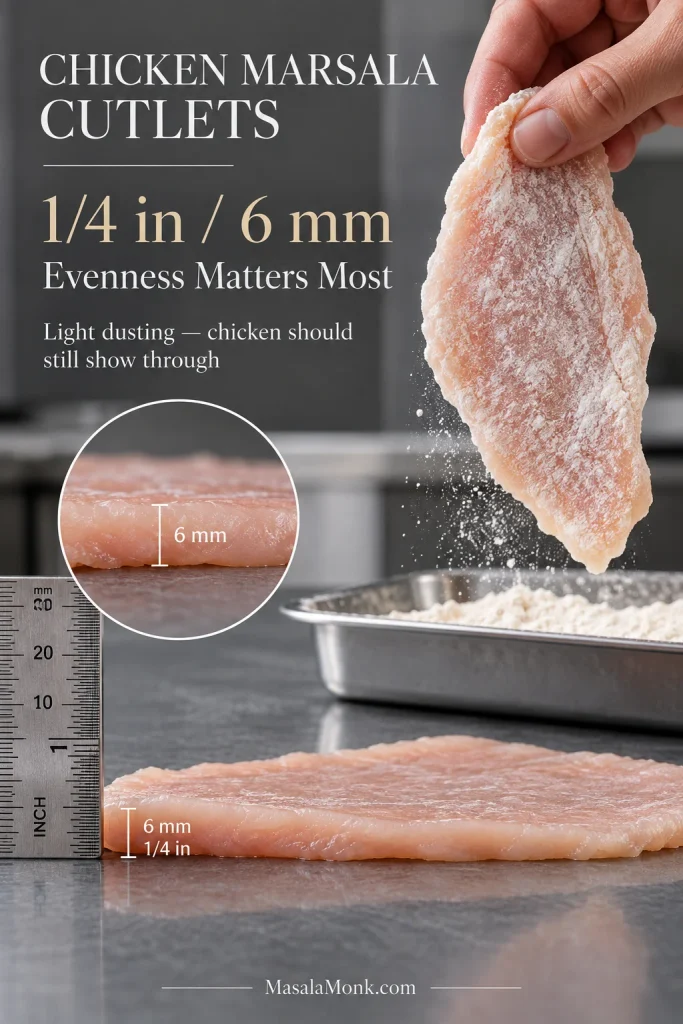
Pound the cutlets between parchment, plastic wrap, or inside a large food-safe bag until the thickest parts are about ¼ inch / 6 mm. Anything up to roughly ⅓ inch / 8 mm will work; evenness matters more than an exact measurement.
Pat the chicken dry. Season both sides with about three-quarters of the measured salt (roughly 3 g) and all of the black pepper. Reserve the remaining salt for the sauce.
Spread the flour in a shallow dish. Dredge each cutlet lightly, then shake off the excess until the chicken is still visible beneath the coating. This is a dusting, not breading.
Brown the cutlets without crowding the pan
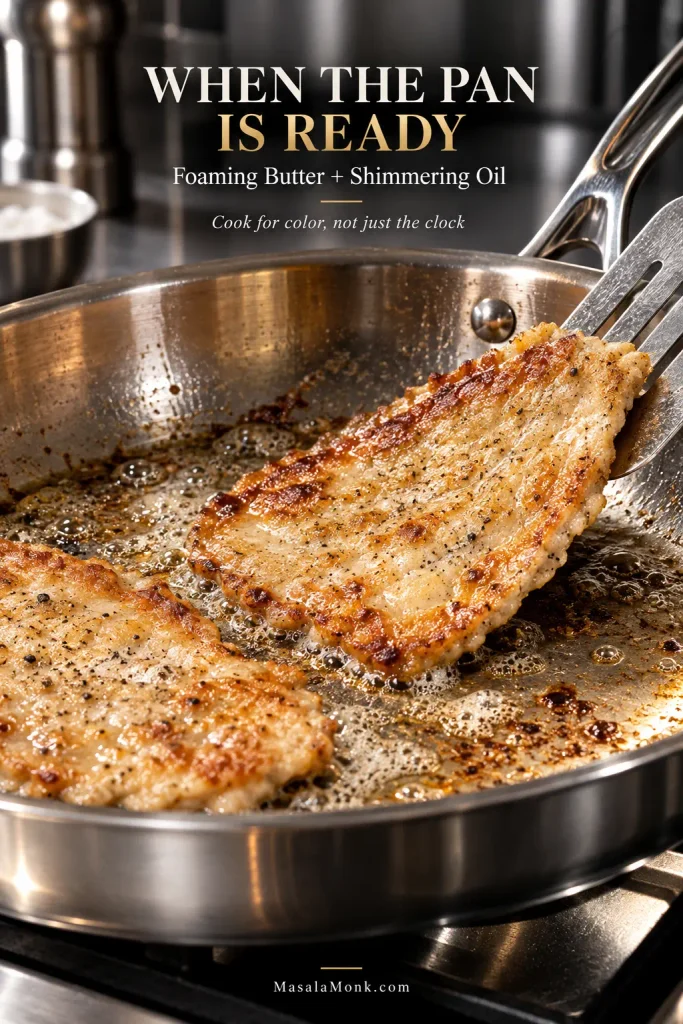
Heat 2 tbsp / 30 ml olive oil with 1 tbsp / 14 g butter in the skillet over medium-high heat. When the butter is foaming and the oil is shimmering, add the first batch. Brown the chicken in 2 batches unless all four pieces fit comfortably without overlapping or crowding. Use the remaining tablespoon of oil only if the second batch needs it.
Cook until the first side develops deep golden patches, roughly 2½–3½ minutes. Turn and brown the second side for around 1½–2½ minutes. Thin cutlets and powerful burners can move faster, so watch the chicken rather than waiting for a timer.
Check one of the thickest pieces as each batch comes out of the skillet. With thin cutlets, sliding an instant-read thermometer horizontally in from the side usually makes it easier to reach the center. The USDA recommends 165°F / 74°C as the safe minimum internal temperature for poultry.
Move any cutlet that has already reached 165°F / 74°C to a clean warm serving plate and loosely cover it. Put pieces that still need cooking on a separate holding plate; they will finish briefly in the sauce later.
Before adding the mushrooms, look at the skillet. Keep the deep brown fond on the pan, but carefully wipe away any loose flour that has actually burned black.
2. Brown the mushrooms after their water cooks away
Reduce the heat to medium and add 1 tbsp / 14 g butter followed by the mushrooms.
They may soak up the fat and leave the skillet looking dry at first. Nothing has gone wrong. Soon they will soften and release their own moisture.
Keep cooking, stirring occasionally, until that liquid evaporates and the sound changes from simmering back to sizzling. The mushrooms should smell more roasted than simply cooked, with properly golden edges, usually after 6–8 minutes total.
Add the shallot and cook for 1–2 minutes, until softened. Stir in the garlic for about 30 seconds. As soon as it smells fragrant, move on; browned garlic would bring bitterness to the sauce.
3. Reduce the Marsala before adding stock
Pour in the 1 cup / 240 ml dry Marsala and scrape up the fond as the wine begins to bubble.
Reduce the Marsala by roughly half before adding the stock. This usually takes 3–5 minutes. The sharp alcohol smell should fade as the wine becomes rounder, nuttier, and noticeably sweeter-smelling.
Add the ⅔ cup / 160 ml low-sodium chicken stock. Bring the sauce back to a lively simmer and cook until it leaves a thin coating on the back of a spoon but still runs easily when the spoon is tilted, usually another 3–5 minutes.
If some chicken still needs finishing, stop while the sauce is a touch looser; it will reduce a little more with the cutlets in the pan.
Tip the skillet slightly. You still want enough sauce gathering around the mushrooms to spoon generously over all four cutlets.
If the sauce is not reaching this texture, jump to the troubleshooting table and match the fix to both its flavor and consistency.
4. Finish the chicken, then swirl in the cold butter
Pour any juices from the holding plate into the sauce. Return only the cutlets that still need cooking and turn them through the simmering sauce until the thickest part reaches 165°F / 74°C.
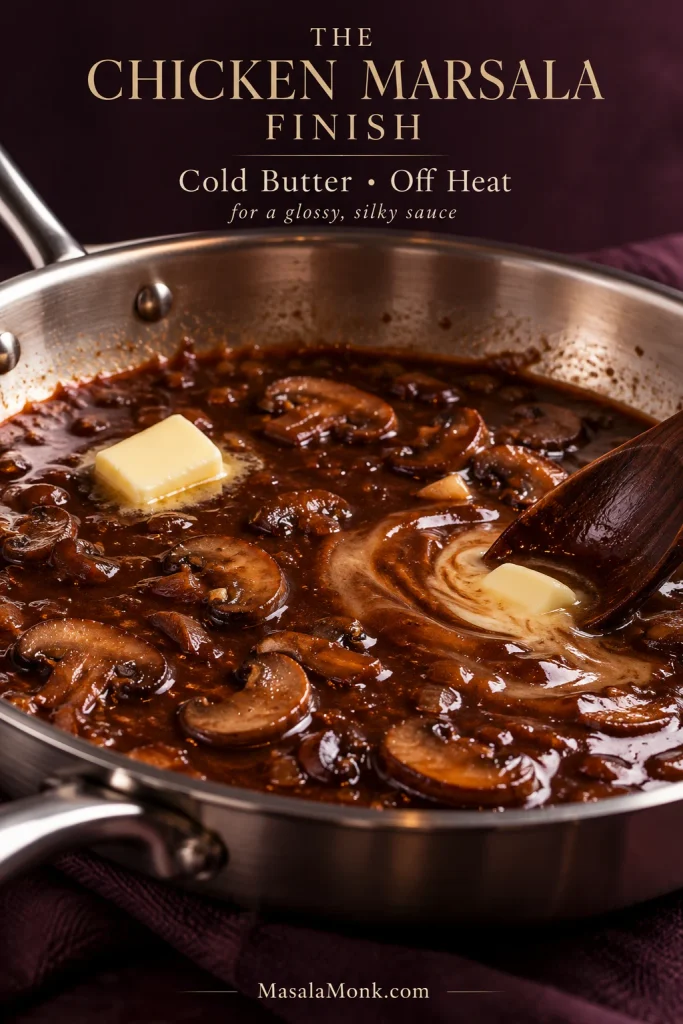
Move those finished cutlets to the clean warm serving plate with the chicken that was already done, then remove the skillet from the heat.
Add the remaining 2 tbsp / 28 g cold butter a few pieces at a time, swirling or stirring until the sauce looks smooth, dark, and glossy enough to cling lightly to the mushrooms.
Taste before adding the remaining salt. A sauce that feels slightly too sweet or heavy may need ½ tsp / 2.5 ml lemon juice. Add it gradually. The lemon should brighten the sauce without becoming a flavor of its own.
Spoon the finished mushroom Marsala sauce over all four cutlets, scatter with parsley, and serve immediately.
When it’s right: Chicken Marsala should taste savory, mushroomy, and clearly wine-forward, with gentle sweetness but no sharp raw-alcohol bite. The sauce should cling lightly to the chicken, then run onto the plate when you cut into a piece.
Chicken Marsala Guide
Which Marsala Should You Buy?
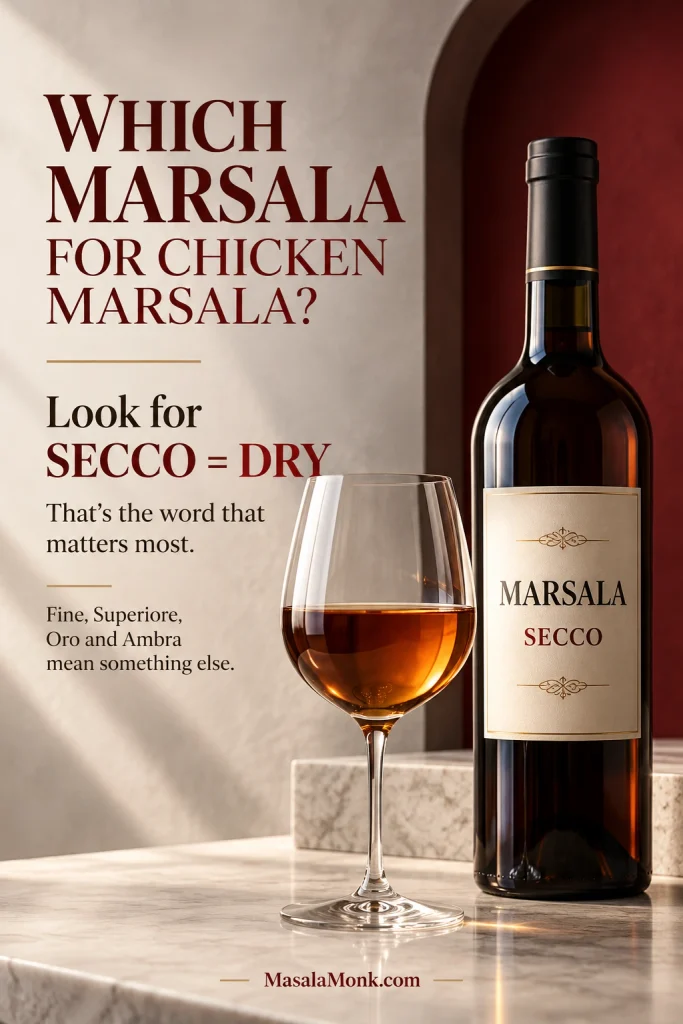
For Chicken Marsala, buy a real dry (secco) Marsala. You do not need an expensive bottle; drinking Marsala gives you better control over both wine flavor and salt than bottled cooking wine, which is often salted.
Marsala labels contain several different pieces of information. Fine and Superiore mainly describe aging/style categories, while Oro and Ambra describe color. Secco, semisecco and dolce describe sweetness. For this recipe, the word that matters most is secco: dry. The official Marsala DOC specifications lay out those classifications in detail.
Dry or sweet Marsala?
Dry Marsala gives the easiest savory balance because reduction concentrates the wine’s nutty, dried-fruit, and caramelized flavors. By the time it has reduced properly, the skillet should smell less like freshly poured wine and more like the dish you are about to eat.
Sweet Marsala works too. Expect a rounder, noticeably sweeter sauce. Keep the stock low-sodium and decide on lemon only after the sauce has reduced.
What about Marsala cooking wine?
Salt becomes more concentrated during reduction, which is why bottled cooking wine can make the finished sauce unexpectedly salty. Real Marsala simply gives you more control.
Look near sherry, port, Madeira, and other fortified wines rather than beside vinegars and bottled cooking sauces.
How to Read and Thicken Chicken Marsala Sauce
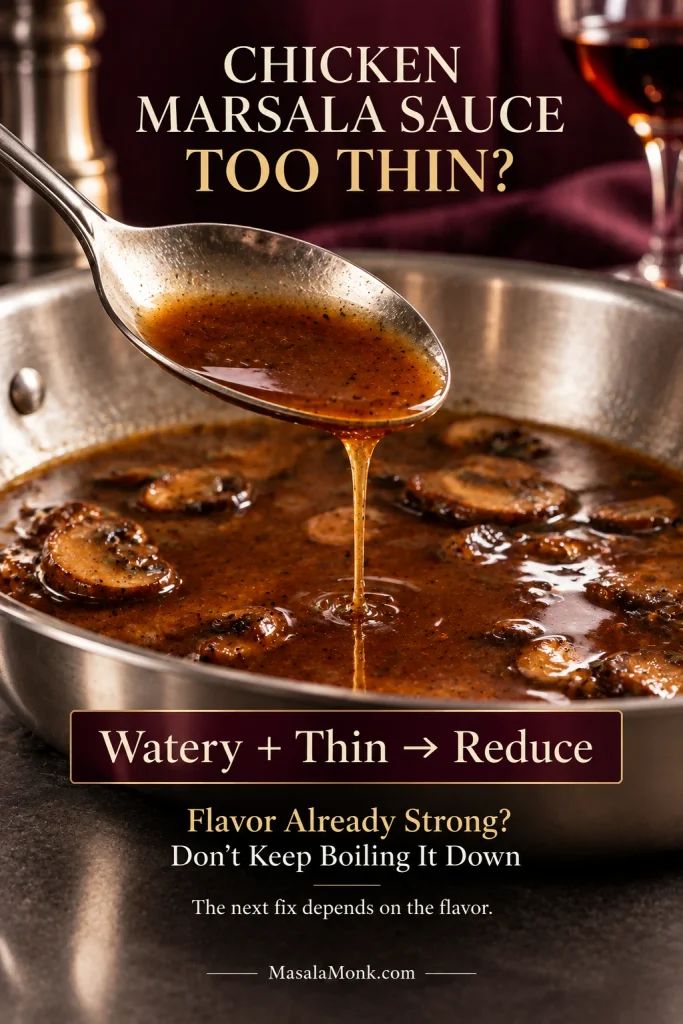
If your Chicken Marsala sauce is thin and watery, simmer it uncovered until the flavor concentrates. If it already tastes strong but is still too thin, use a very small cornstarch slurry instead of reducing away the rest of the sauce.
Use the flavor as your second clue. Watery flavor and watery texture usually mean the liquid simply needs more time to concentrate.
Once the Marsala flavor is already strong—perhaps salty enough or a little sweet—boiling away more liquid can leave you with very little sauce and too much intensity. A tiny starch adjustment makes more sense there.
The texture can also be right while the sauce still looks flat. Cold butter stirred in away from high heat gives it more richness and shine.
Taste before you thicken: reduction, starch, and butter solve different problems.
Need the exact rescue for the pan in front of you? Jump to Fix My Chicken Marsala Sauce for the full problem-and-solution table.
Want mushrooms and cream to lead instead? The creamy mushroom sauce recipe begins with the same useful step: getting real color on the mushrooms.
Does Chicken Marsala Need Cream?
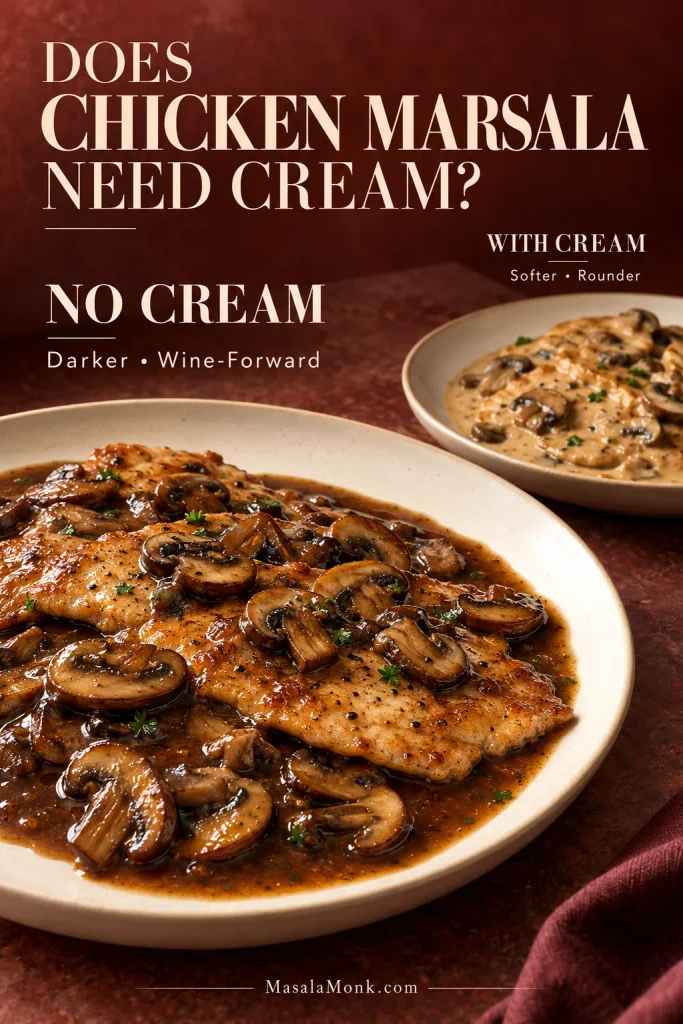
No. The recipe above gets enough body from reduced Marsala and stock, a little flour carried over from the chicken, and the butter stirred in at the end. Without cream, the wine and browned mushrooms stay darker and more distinct.
If thin sauce is the reason you are considering cream, read the sauce first; cream changes the style of the dish rather than fixing the underlying reduction.
Prefer a softer, rounder sauce? Simmer the stock with the reduced Marsala for about 2 minutes, then stir in ⅓ cup / 80 ml heavy cream. Increase that to ½ cup / 120 ml for a richer sauce. Let it simmer until close to the consistency you want, leaving it slightly loose when any chicken still needs finishing.
Return the cutlets that need more cooking and bring them to 165°F / 74°C, then transfer the chicken out of the skillet. Take the pan off the heat and finish the creamy sauce with 1 tbsp / 14 g of the reserved cold butter; the cream supplies enough richness that you do not need the full 2 tbsp finishing amount.
Heavy cream stays smoother under gentle heat than half-and-half. Half-and-half makes a thinner sauce and is more prone to splitting; milk is even more likely to split. Add any lemon after the skillet is off the heat, a few drops at a time.
Want More Marsala Sauce?
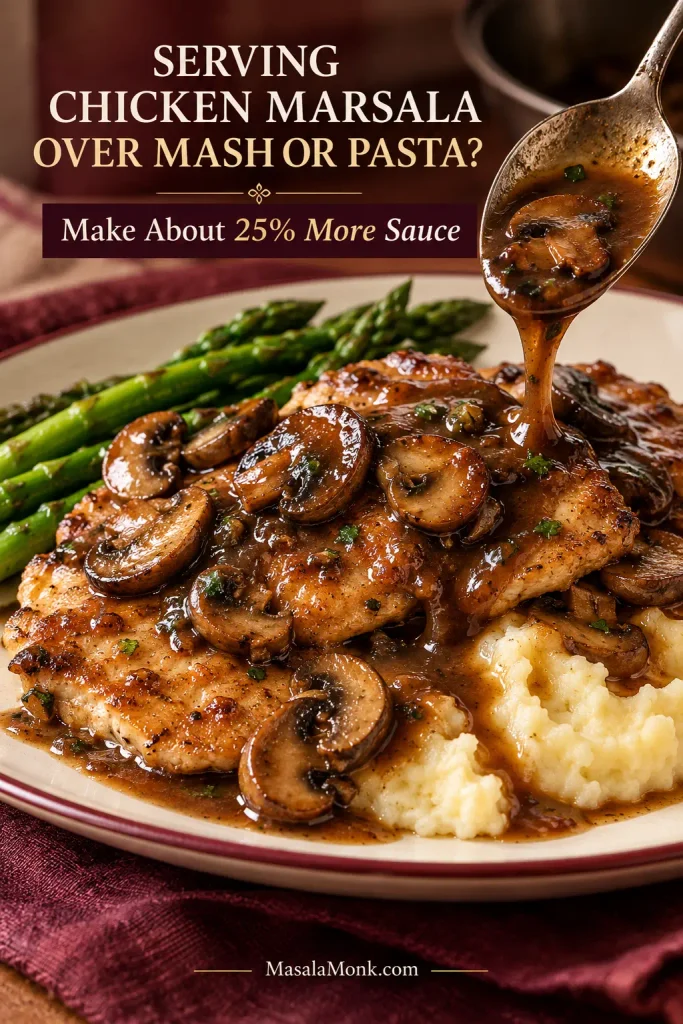
Serving the chicken over creamy mashed potatoes, pasta, noodles, or polenta usually calls for a little more sauce than serving the cutlets alone.
Increase the Marsala to about 1¼ cups / 300 ml and the stock to about ¾ cup + 1 tbsp / 200 ml. That is roughly one quarter more of each. The larger volume will take longer to reduce, so get the sauce base where you want it before finishing the chicken and swirling in the butter.
Potatoes and pasta will absorb plenty on the plate, so stop with the sauce slightly looser than you would for chicken served on its own.
What to Serve with Chicken Marsala
The best Chicken Marsala sides either catch the sauce or bring something fresh to the plate.
For catching the sauce
- Mashed potatoes — a classic choice and one of the best ways to catch the sauce.
- Buttered pasta — especially good with a slightly looser batch of sauce.
- Polenta — mild, soft, and excellent when you want the Marsala sauce to stay prominent.
- Egg noodles — soft and mild enough to catch mushrooms and sauce without competing with them.
- Crusty bread — ideal for swiping up the sauce while keeping the chicken at the center of the meal.
For something fresh or green
- Green beans almondine — crisp-tender beans, toasted almonds, and lemon add welcome crunch.
- Asparagus — roasted or quickly sautéed.
- Broccoli or broccolini — simply seasoned so the sauce stays in charge.
- Arugula or another sharp green salad — especially good beside the creamy sauce.
A colder, sharper contrast comes from cucumber salad with vinegar, dill, and onion, which cuts through the buttery sauce beautifully.
A classic plate is mashed potatoes with green beans or asparagus. The potatoes catch every spoonful; the green side keeps the next bite feeling fresh.
What wine should you drink with it?
You do not need Marsala in the glass. A fresh, light-bodied red such as Pinot Noir, Gamay, or Frappato works well with the darker sauce. A dry white with enough acidity can cut through the butter while staying light beside the mushrooms.
Fix My Chicken Marsala Sauce
Taste the sauce before changing it. A sauce that’s thin and watery needs a different fix from one that’s thin but already concentrated.
Sauce concentration and flavor problems
| Problem | Likely cause + best rescue |
|---|---|
| Watery and weak | There is still too much unconcentrated liquid. Simmer uncovered until both flavor and texture strengthen. |
| Flavorful but still too thin | More reduction may make the sauce too salty or sweet. Mix ½ tsp / about 1.5 g cornstarch with 1 tsp / 5 ml cold water; whisk in gradually and simmer briefly, stopping as soon as the sauce lightly coats a spoon. |
| Hardly any sauce remains | It has reduced too far. Add low-sodium stock 1 tbsp / 15 ml at a time. If the Marsala flavor has genuinely faded, add only a small splash of wine and simmer long enough for the raw edge to disappear. |
| Sharp or boozy | The Marsala needs more reduction. Let the sauce simmer until the raw-wine aroma softens. |
| Barely tastes of Marsala | Too much stock or cream may be diluting the wine. Reduce gently while the sauce is loose; next time concentrate the Marsala before adding other liquids. |
| Too sweet | Check the salt first. If the sauce still tastes heavy, add lemon juice ½ tsp / 2.5 ml at a time. |
| Too salty | Loosen with unsalted stock or water 1 tbsp / 15 ml at a time. Avoid reducing it hard again; if the flavor is balanced but the sauce becomes too thin, use the small cornstarch rescue above instead. |
Texture, mushroom and chicken problems
| Problem | Likely cause + best rescue |
|---|---|
| Greasy or separated | Pull the skillet off the heat and whisk or swirl vigorously. If it still looks separated, whisk in 1 tsp / 5 ml warm water or stock at a time until the sauce comes back together. |
| Mushrooms are pale and wet | Before adding the shallot or wine, keep cooking until the released moisture is gone and the skillet starts sizzling again. Use batches next time if the pan is crowded. |
| Chicken is dry | It cooked too long before or after the sauce was ready. Spoon generously with sauce now; next time stop cooking as soon as the cutlet reaches temperature. For more on thickness, temperature, and dryness, see the baked chicken breast guide. |
| Flour coating is gummy | The dredge was too heavy or the chicken spent too long in the sauce. Use a lighter dusting and keep the final return brief. |
| Creamy sauce split | Pull the skillet completely off the heat and whisk in a small splash of heavy cream or 1 tsp / 5 ml warm water at a time until it comes back together. Next time, keep the creamy sauce below a hard boil. |
Once the sauce tastes balanced and moves easily around the pan, stop fixing it.
Variations and Substitutions
Chicken thighs
Boneless, skinless thighs work well and tolerate a little more cooking than thin breast cutlets. Trim visible fat and allow more time to cook through. They are safe at 165°F / 74°C, though thigh meat generally becomes more tender around 175°F / 79°C.
Their extra richness works especially well with the no-cream sauce.
Different mushrooms
Cremini are the easiest default because they brown well and bring more savoriness than plain white mushrooms without much extra cost. White buttons still work. For more depth, replace 2–3 oz / 55–85 g with shiitake or another flavorful fresh mushroom.
When mushrooms deserve to be the main event, Mushroom Stroganoff takes them into a creamy savory sauce for noodles, rice, mash, or polenta.
Without mushrooms
You can leave them out, but their browned flavor normally becomes part of the sauce. Build good color on the chicken, keep the shallot, and use a flavorful low-sodium stock.
What can replace Marsala?
No substitute tastes exactly the same. Dry Madeira is the closest useful alternative; dry sherry also makes an excellent mushroom wine sauce with its own character.
Does the Alcohol Cook Out of Chicken Marsala?
A short simmer should not be treated as a guarantee that all alcohol has disappeared. Strict alcohol avoidance calls for a stock-based mushroom pan sauce instead of relying on cooking time to remove the Marsala.
It will taste different, but it can still be a very good chicken-and-mushroom dinner. If you’d rather skip Marsala entirely and still want a creamy mushroom sauce, Cream of Mushroom Chicken is the better direction.
Pancetta or prosciutto
Crisp about 2 oz / 55 g finely diced pancetta or prosciutto before browning the chicken. Leave a little rendered fat in the skillet, then return the crisp pieces near the end. Season cautiously; the salt contributed by the cured meat becomes much more noticeable as the sauce reduces.
If lemon, butter, and capers are what you want, Chicken Piccata is the better fit. It uses the same idea of thin golden chicken but takes the pan sauce in a much brighter direction.
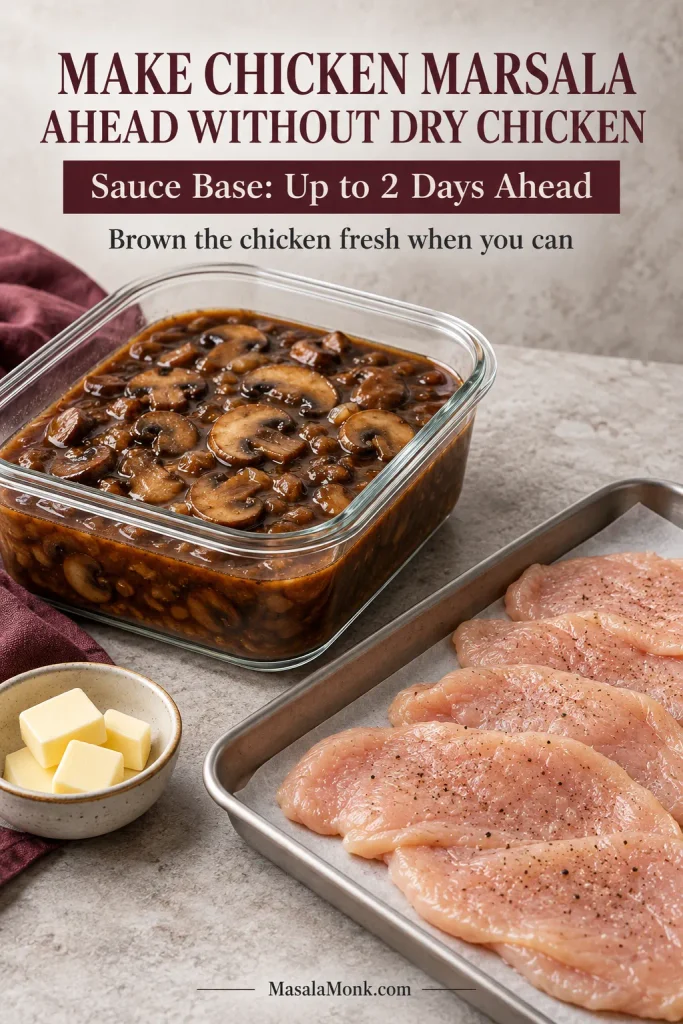
Make-Ahead Chicken Marsala Without Dry Chicken
If you only want to get the prep out of the way, slice the mushrooms and cut/pound the chicken into cutlets up to 1 day in advance. Refrigerate them separately until cooking.
To get further ahead, make the mushroom-Marsala sauce base through the stock-reduction stage and leave out the finishing butter. Cool it, cover it, and refrigerate for up to 2 days.
The chicken is best browned fresh while the sauce reheats. When that is not practical, cook the chicken fully to 165°F / 74°C before chilling it; do not partially cook poultry for later finishing.
At serving time, warm the sauce base gently, then add the chilled cooked chicken and reheat it to 165°F / 74°C without prolonged simmering. Transfer the chicken out, take the skillet off the heat, and swirl in the finishing butter. Taste for salt and lemon after the sauce is back together.
Cooking for more people? Double the ingredients, then brown the chicken and mushrooms in batches. More food in the same skillet means more steam and less browning, and the larger volume of wine and stock will need more reduction time.
How to Store, Reheat and Freeze Chicken Marsala
Refrigerate leftovers within 2 hours and keep them covered for up to 3–4 days. Reheat gently in a covered skillet, adding low-sodium stock a spoonful at a time if the sauce has tightened. Bring the chicken back to 165°F / 74°C and take it off the heat promptly; prolonged simmering only dries it further.
Freezing works best with the no-cream sauce. Pack the chicken in a freezer-safe airtight container with enough sauce to keep it protected and freeze for up to 3 months for best quality. Thaw overnight in the refrigerator, then reheat gently to 165°F / 74°C, loosening the sauce with a little stock when needed.
When Chicken Marsala is right, nothing on the plate feels buried. The chicken still has its golden edges, the mushrooms taste browned rather than boiled, and the sauce is dark, smooth, and loose enough to run onto whatever you put beside it.
That is the moment to stop cooking and eat it.








