Posted on Leave a comment

Sourdough Pizza Dough Recipe (Crispy Crust & Easy Pizza Base)

Sourdough pizza dough cover image showing a golden, crispy crust pizza with a cheese-pull slice lifted, plus sauce, basil, and olive oil props.

There’s a particular moment in pizza making that feels like magic: you slide a raw, slightly wobbly round of dough into a hot oven, and within minutes it turns into something alive—edges lifting, bubbles forming, the bottom taking on color, the whole kitchen smelling like toasted wheat and caramelized cheese. When that dough is sourdough pizza dough, the magic gets a little deeper. The crust tastes fuller. The aroma is richer. Even a simple topping combo feels more “finished,” as if the base itself is seasoning the pizza.

At the same time, sourdough pizza dough can feel intimidating if you’ve only made quick yeast dough before. Starter timing, fermentation windows, sticky dough, shaping fears—there are a lot of ways to overthink it. So this post is built for real life: one reliable sourdough pizza dough recipe, clear steps that don’t require fancy equipment, and enough flexibility to handle a same-day bake or a cold ferment when you have time.

Along the way, you’ll also see natural variations—thin and crisp, chewier and thicker, or even a pan-friendly version—because one good sourdough pizza base should carry you through many pizza nights. When you want extra support, you can jump to MasalaMonk’s beginner-friendly sourdough starter recipe to tighten up feeding and starter strength, or browse the broader sourdough lineup in Sourdough Bread Recipes if you’re in the mood to bake beyond pizza.

And because pizza night is never only about the crust, you’ll also find an easy way to expand your topping and sauce options using MasalaMonk’s pizza sauce recipes and pesto recipe guide, plus a few cocktail pairings that make a homemade pie feel like a proper plan.

Let’s get into it.


Why sourdough pizza dough tastes better (and how to keep it easy)

Sourdough pizza has a flavor advantage that’s hard to miss: more depth, more aroma, a little tang, and a longer finish. The reason isn’t mysterious. Fermentation changes the dough. Over time, flour and water become something else—more fragrant, more elastic, and more flavorful.

Still, flavor alone doesn’t guarantee a great crust. A sourdough pizza crust can be pale, tough, or oddly dense if the bake setup is weak or if the dough never develops enough structure. That’s why this method is built around three practical goals:

Sourdough pizza dough gets better when you nail three things: build strength early so it stretches easily, ferment until the dough is puffy (not slack), and bake hot so the crust turns crisp instead of dry.

First, develop strength early so the dough stretches into a pizza base without tearing.

Second, ferment until the dough is lively but not collapsed, so you get lift instead of flatness.

Third, bake with enough heat that the crust sets quickly, which keeps it crisp rather than dry.

Once those three pieces click, sourdough pizza dough becomes repeatable. You’re no longer gambling on vibes—you’re steering the process.

If you want your starter to feel dependable before you begin, the day-by-day routine in MasalaMonk’s sourdough starter recipe is a solid foundation. It’s especially helpful if your starter tends to be sluggish, overly sour, or inconsistent from week to week.

Also Read: Balti Paneer Gravy (Restaurant-Style, Creamy + Bold Recipe)


Ingredients for sourdough pizza dough

A reliable sourdough pizza dough recipe doesn’t need an ingredient parade. In fact, fewer ingredients usually means fewer surprises.

You only need flour, water, salt, and an active starter to make sourdough pizza dough—olive oil is optional, but it helps the dough handle smoothly in a home oven.

What you need

  • Flour: bread flour works beautifully; “00” flour is also excellent; a blend is ideal if you like
  • Water: room temperature for most kitchens
  • Salt: essential for flavor and dough strength
  • Active sourdough starter: bubbly and recently fed
  • Olive oil (optional): helpful for tenderness in a home oven and makes handling easier

That’s it. Everything else—sugar, honey, malt, milk—can come later if you want to experiment. For now, this base method covers the core “pizza dough with sourdough starter” approach and gives you a crust that can go thin and crisp or thicker and chewier depending on how you shape it.

About the flour choice (simple, useful guidance)

If you already have bread flour, use it. Bread flour tends to make shaping easier because it’s naturally stronger. If you have “00” flour, it can produce a beautifully tender yet crisp crust, especially in hotter bakes. If you want the best of both worlds, blend them: part bread flour for strength, part “00” for tenderness.

Meanwhile, if you only have all-purpose flour, you can still make sourdough pizza dough. You may simply need a slightly gentler hand during stretching and a little more attention to dough strength early on.

Also Read: Mojito Recipe (Classic) + Ratios, Pitcher, Mocktail & Easy Variations


Active starter vs discard for sourdough pizza

This matters, and the good news is that it’s not complicated.
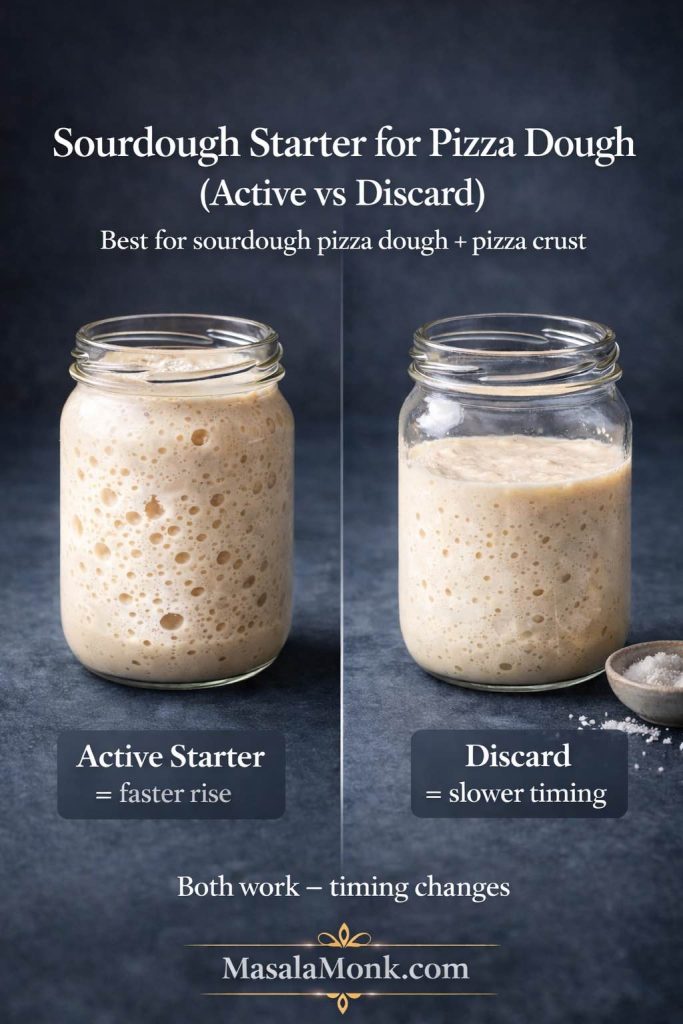
Sourdough starter for pizza dough comparison showing active starter versus discard, with active starter rising faster and discard needing longer timing.
For sourdough pizza dough, an active starter gives a quicker, more predictable rise, while discard can still work—but you’ll need a longer, more flexible fermentation window.

Active starter = predictable rise, cleaner timing

For the main sourdough pizza dough recipe below, an active starter is your best friend. A starter that has been fed and is bubbling well will ferment dough in a more predictable window and usually gives better lift.

If you’re unsure whether your starter is “ready,” the quick-read approach is simple: it should look airy, smell pleasantly tangy (not harsh), and show visible activity. If it’s been in the fridge, give it a feed or two at room temperature until it behaves consistently again. The troubleshooting steps in the sourdough starter recipe guide are especially useful for this.

Discard can work too, but it’s a different lane

Sourdough discard pizza can be fantastic, particularly for bolder toppings and deeper flavor. However, discard-based dough behaves differently and often needs adjustments. If you want a dedicated discard approach, King Arthur’s sourdough discard pizza crust recipe is a trustworthy reference and a nice option when your starter is unfed but you still want pizza tonight.

For this post, though, we’ll build the primary dough with active starter, then you can branch out once you’ve nailed the method.

Also Read: Paloma Recipe: 12 Paloma Cocktail Drinks


The sourdough pizza dough recipe (makes 2 large pizzas or 3 medium)

This recipe is designed to be flexible. You can bake the same day, or you can cold ferment for deeper flavor and easier shaping.

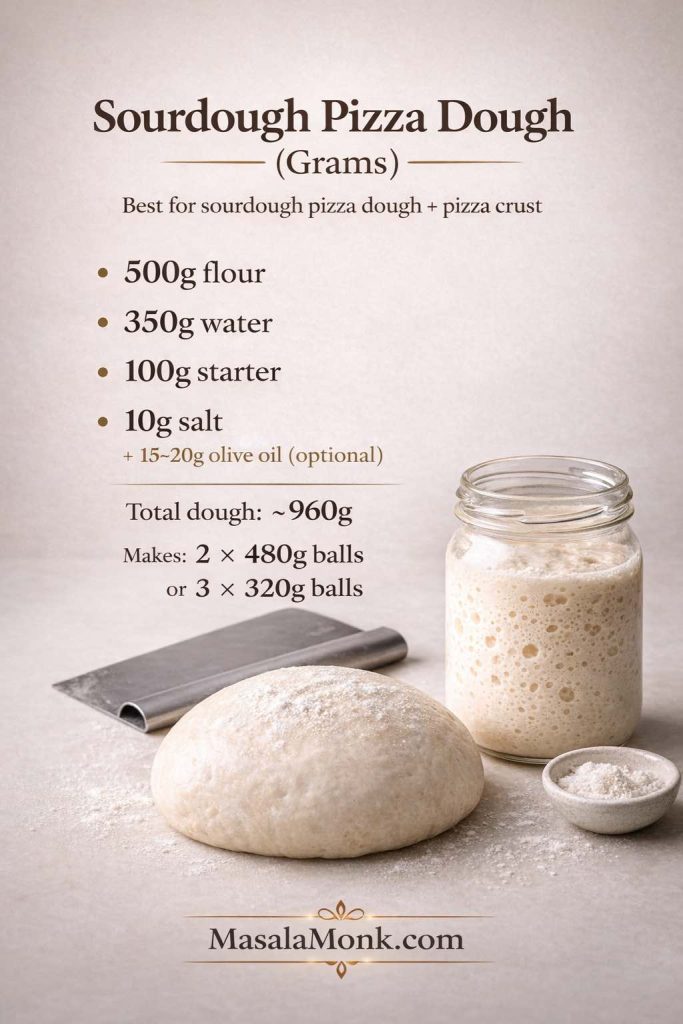
Dough formula (grams)

  • 500 g flour (bread flour, “00,” or a blend)
  • 350 g water (70% hydration; adjust slightly if needed)
  • 100 g active sourdough starter (100% hydration starter)
  • 10 g salt
  • 15–20 g olive oil (optional)
Sourdough pizza dough recipe in grams showing flour, water, starter, salt, optional olive oil, and dough ball yield for two large or three medium pizzas.
Save this grams formula as your go-to sourdough pizza dough base—then choose 480g balls for large pizzas or 320g balls for medium pizzas, depending on the crust thickness you want.

This yields about 960 g total dough, which is perfect for:

  • 2 x ~480 g dough balls (two large pies, roughly 12–14 inch depending on thickness)
  • or 3 x ~320 g dough balls (three medium pies)

If you want thinner crust, make smaller dough balls. If you want thicker, go larger. Your dough ball weight has a bigger impact on the final sourdough pizza crust than most people expect.

Also Read: Air Fryer Donuts Recipe (2 Ways): Glazed Homemade Donuts + Biscuit Donuts


How to make sourdough pizza dough step by step

1) Mix the dough (and make it easy on yourself)

In a large bowl, add the water and sourdough starter. Stir until the starter loosens into the water. It doesn’t have to dissolve perfectly—just break it up enough that it’s mostly distributed.

Next, add the flour and mix until you don’t see dry patches. At this stage the dough will look shaggy and uneven, which is exactly right.
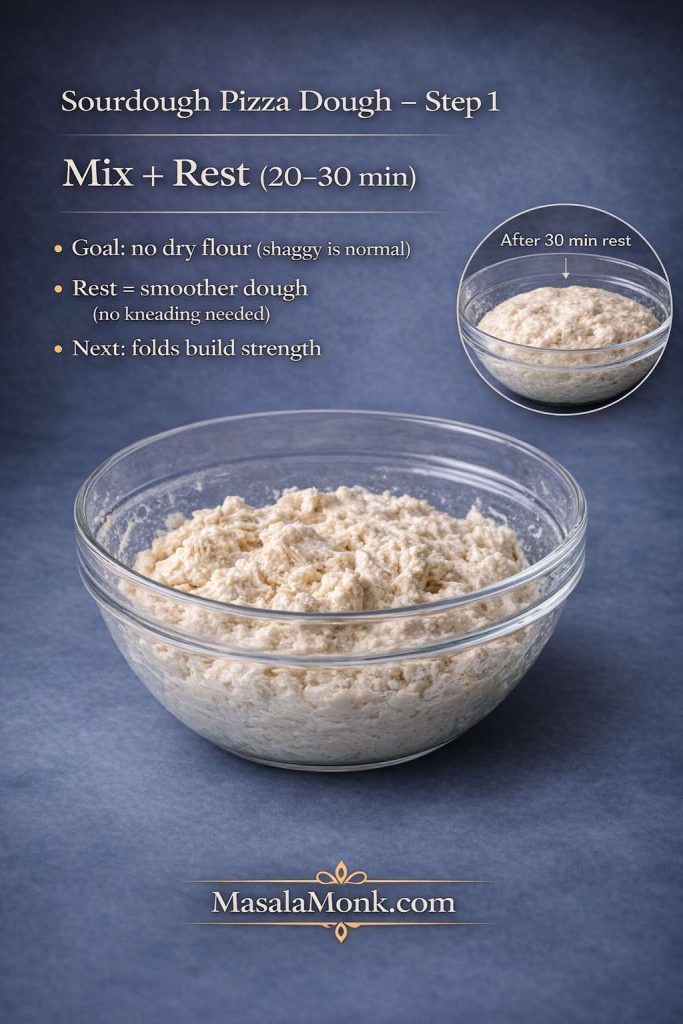
Step 1: Mix until there’s no dry flour, then rest 20–30 minutes—shaggy dough is normal, and the rest makes it noticeably smoother with no kneading.

Now pause. Let the dough rest for 20–30 minutes.

That rest matters because it hydrates the flour and starts gluten development without effort. Later on, you’ll find that the dough becomes smoother and stronger with much less work.

After the rest, sprinkle in the salt. If you’re using olive oil, add it now as well. Then mix until the salt is fully incorporated.

At first, the dough may feel slippery or messy. Keep going anyway; it comes together faster than you think.

2) Build dough strength without beating it up

Sourdough pizza dough can be strong without being overworked. Instead of kneading for a long time, use a short sequence of gentle strength-building.
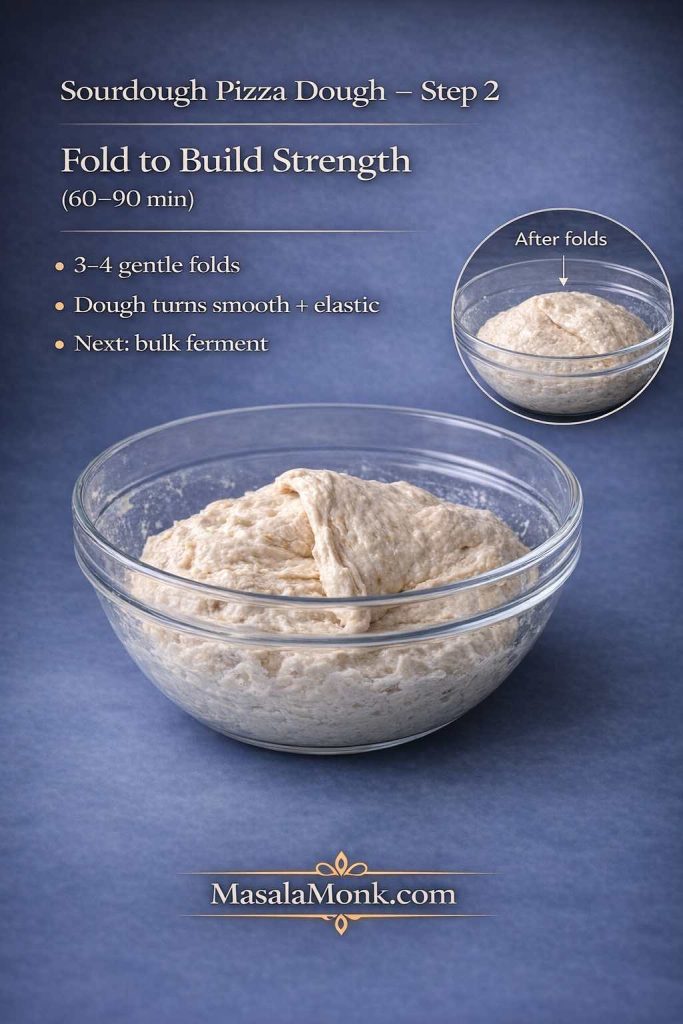
Step 2 of sourdough pizza dough showing stretch-and-folds to build strength, with dough turning smoother and more elastic before bulk fermenting.
Step 2: Do 3–4 gentle folds over 60–90 minutes—this builds strength so your sourdough pizza dough stretches more easily and bakes into a better crust.

Over the next 60–90 minutes, do 3–4 rounds of stretch-and-folds:

  • Wet your hand lightly.
  • Lift one side of the dough, stretch upward, fold it over the center.
  • Rotate the bowl and repeat a few times until the dough tightens into a smoother mound.

Between rounds, cover the bowl and let the dough relax.

With each round, you’ll notice the dough becoming more elastic and cohesive. That’s exactly what you want: a dough that will stretch into a sourdough pizza base without turning into a fragile sheet.

3) Bulk ferment until the dough is airy, not exhausted

After the final fold, cover the dough and let it rise at room temperature until it looks slightly puffed, smoother, and more alive—often 3–5 hours, depending on your kitchen and starter strength.
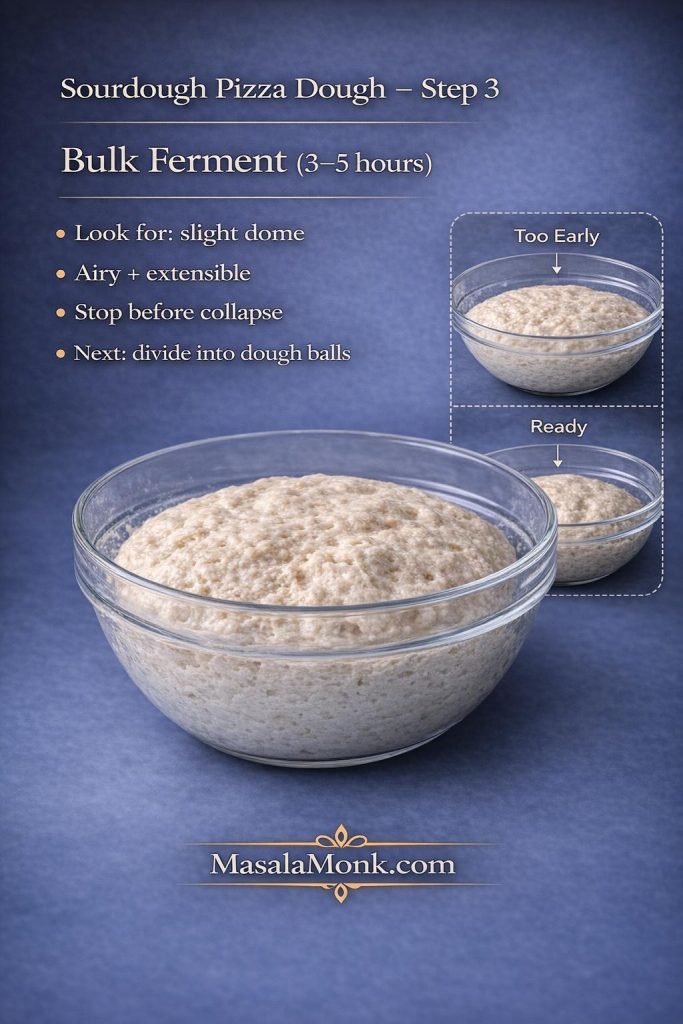
Step 3: Bulk ferment until the dough looks lightly domed and feels airy—stop before it turns overly slack, then move on to shaping sourdough pizza dough balls.

Instead of chasing a clock, watch for clues:

  • the dough looks more rounded and airy
  • the surface feels slightly domed rather than flat
  • the dough jiggles a little when you move the bowl

If your kitchen runs warm, this stage will move faster. If it’s cooler, it may take longer. Either way, your goal is fermentation that builds flavor and gas, not fermentation that collapses.

When bulk fermentation is done, the dough should feel extensible and lightly airy. If it’s already very bubbly and slack, don’t push it too far—move on to dividing.

4) Divide into sourdough pizza dough balls

Turn the dough onto a lightly floured counter. Divide into your preferred sizes.

For two larger pizzas: 2 dough balls (~480 g each).
For three medium pizzas: 3 dough balls (~320 g each).
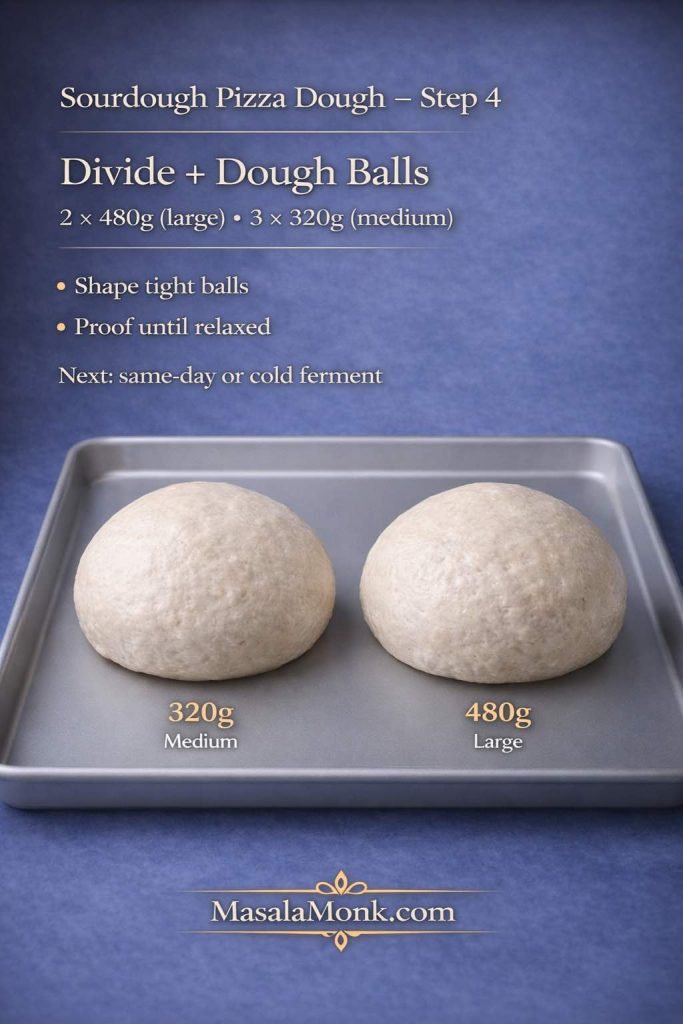
Step 4 sourdough pizza dough card showing two dough balls labeled 320g and 480g with guidance to shape tight balls and proof until relaxed before fermenting.
Step 4: Divide and shape tight sourdough pizza dough balls—use 480g for two large pizzas or 320g for three medium, then proof until relaxed so stretching is easy.

Shape each portion into a tight ball:

  • Fold edges into the center until the surface tightens.
  • Turn seam-side down.
  • Cup your hands around the dough and rotate gently to seal.

Set the dough balls into lightly oiled containers (or a covered tray) so they don’t stick.

From here, you choose your schedule: same-day baking or cold fermentation.

Also Read: Tapas Recipe With a Twist: 5 Indian-Inspired Small Plates


Same-day sourdough pizza dough (quick schedule that still works)

Sometimes you want a quick sourdough pizza dough that’s still made with starter, not commercial yeast. While sourdough naturally benefits from time, you can absolutely make a same-day version when your starter is strong and your kitchen is reasonably warm.

Use this same-day sourdough pizza dough rhythm when you want pizza tonight: mix, rest, fold, bulk ferment, shape dough balls, then bake hot for a crisp crust.

Here’s the rhythm:

  • Mix + rest + folds as written
  • Bulk ferment until lightly airy (don’t force huge rise)
  • Divide into dough balls
  • Let the dough balls rest at room temp until relaxed and slightly puffy, usually 1–2 hours

When the dough balls feel soft, supple, and easy to stretch, you’re ready to shape.

This “sourdough pizza dough same day” approach is about practicality. It won’t taste identical to a 24-hour cold ferment, yet it still delivers a flavorful sourdough pizza crust with great texture if you bake hot enough.

If you want more depth, shift to cold fermentation.

Also Read: Air Fryer Salmon Recipe (Time, Temp, and Tips for Perfect Fillets)


Cold ferment sourdough pizza dough (for better flavor and easier shaping)

Cold fermentation is where sourdough pizza dough starts feeling effortless. The dough relaxes. The flavor deepens. Stretching becomes smoother, and the crust often bakes more evenly.
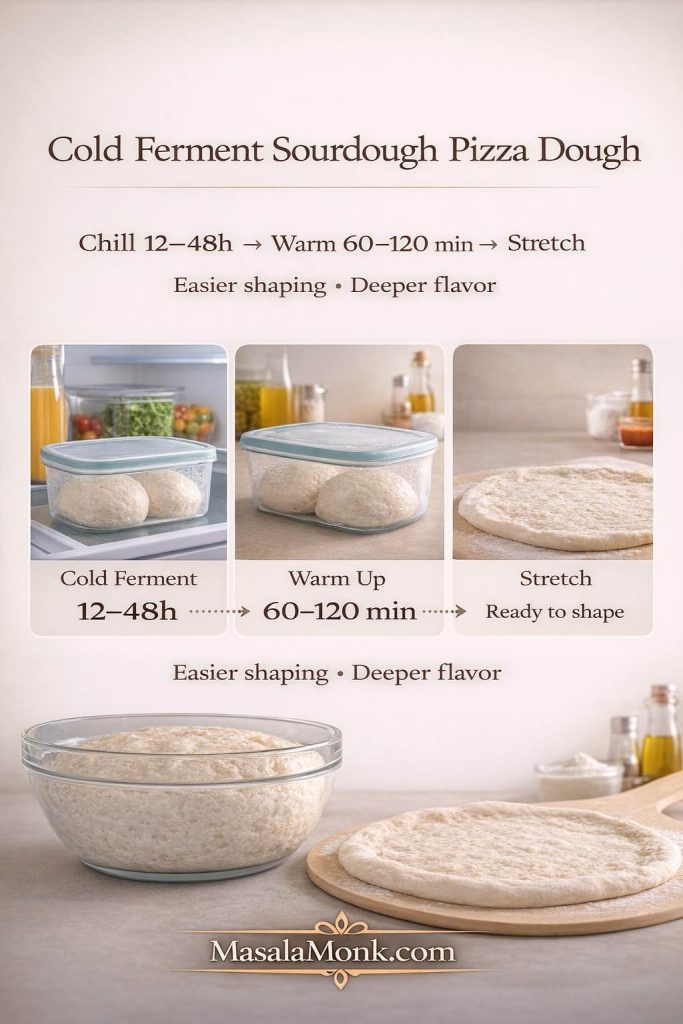
Cold fermenting sourdough pizza dough deepens flavor and makes shaping easier—chill the dough balls 12–48 hours, warm them 60–120 minutes, then stretch into your pizza base.

After you’ve shaped dough balls, cover them and refrigerate.

A common sweet spot is 12–48 hours. King Arthur’s sourdough pizza crust recipe leans into a chilled window for exactly these reasons, and it’s a great confirmation that cold time helps both schedule and results.

When you’re ready to bake:

  • remove dough balls from the fridge
  • let them sit covered at room temperature until they feel relaxed, usually 60–120 minutes

Cold dough tears easily. Warmed dough stretches willingly. So give it time to wake up.

Also Read: Masterclass in Chai: How to Make the Perfect Masala Chai (Recipe)


How to shape a sourdough pizza base without tearing

Shaping is where sourdough pizza dough goes from “maybe” to “yes.” It’s also where most frustration happens—usually because the dough is too cold, too tight, or simply handled too aggressively.
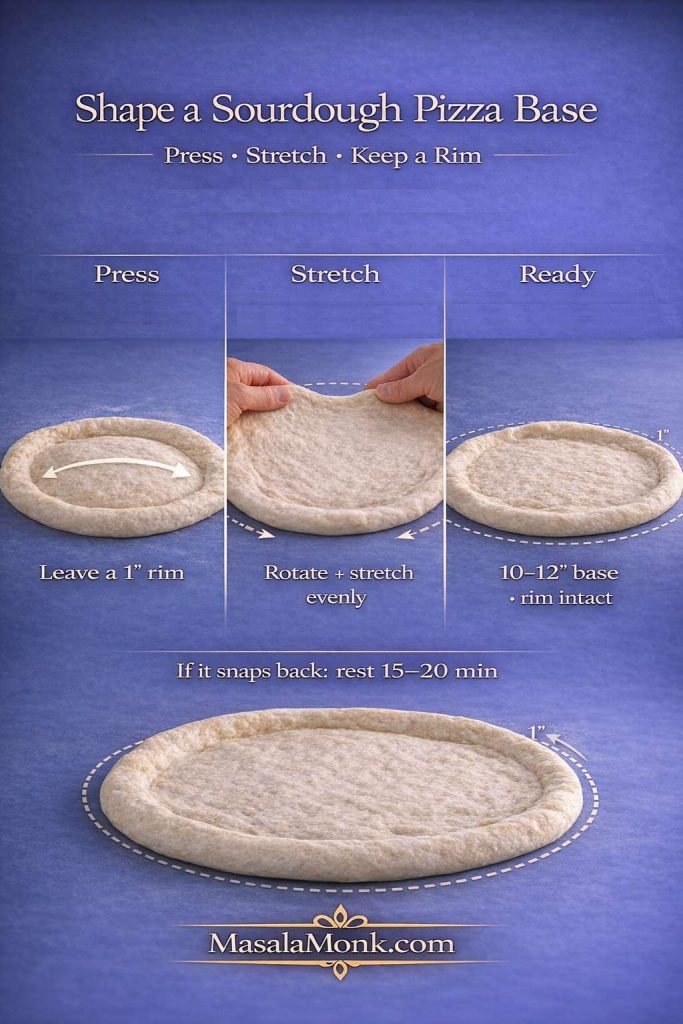
Step-by-step guide showing how to shape a sourdough pizza base: press to leave a 1-inch rim, stretch evenly, and form a 10–12 inch pizza base with the rim intact.
Press from the center outward, stretch gently and evenly, and keep a 1-inch rim—if the dough snaps back, rest it 15–20 minutes so your sourdough pizza base stretches without tearing.

Start with a relaxed dough ball

If the dough snaps back, it’s not a failure. It’s a signal.

Cover it and let it rest another 15–20 minutes. Then try again. Often, that one pause changes everything.

Press, then stretch—don’t yank

Dust the counter lightly with flour. Place the dough ball down and press from the center outward, leaving a thicker rim.

Once you’ve formed a rough disk, lift and stretch gently with your hands. Move around the edge in small steps rather than pulling hard in one spot.

If the center starts thinning too much, set the dough down and let it relax for a minute. Then continue.

Rolling pins: when they help and when they hurt

A rolling pin can be useful if you want a flatter base. However, it also pushes out gases that help the rim puff. If your dream crust includes a lively edge, skip the pin. If you’re aiming for a thinner, crisper sourdough pizza crust, a pin can be acceptable.

Either way, the dough should still feel elastic, not fragile. If it’s fragile, it’s likely under-strengthened or under-rested.

Also Read: 10 Low Carb Chia Pudding Recipes for Weight Loss (Keto, High-Protein, Dairy-Free)


How to bake sourdough pizza for a crisp crust

Your oven setup matters more than your topping choices. Even the best sourdough pizza dough recipe can bake pale and soft if the oven isn’t truly hot.

Underside view of sourdough pizza crust showing a browned, crisp bottom and airy rim on a peel, with text “Bake Hot • Preheat Long.”
Want a crisp sourdough pizza base instead of a soft bottom? Preheat your oven and baking surface longer than you think, then bake hot so the crust sets fast and stays airy at the rim.

Preheat longer than you think

Set your oven as hot as it safely goes—often 260°C / 500°F or higher if possible.

Place a pizza steel or stone inside while preheating. Then preheat for at least 45 minutes.

That long preheat isn’t extra. It’s the difference between:

  • a crust that springs and sets quickly
  • and a crust that dries out slowly while trying to color

Steel vs stone vs tray

  • Steel: strong bottom color, fast baking, excellent for crisp crust
  • Stone: great results, slightly gentler bottom heat
  • Heavy tray: workable if preheated; best for moderate thickness

Comparison guide showing pizza steel vs pizza stone vs baking tray for sourdough pizza, with notes on fast baking, balanced heat, and preheating at least 45 minutes.
A steel gives the strongest crisp bottom, a stone bakes more gently with balanced heat, and a heavy tray still works—just preheat your baking surface for at least 45 minutes.

If you’re baking with a dedicated pizza oven, timing shifts dramatically. For that environment, Ooni’s recipe page is a useful reference because it’s built for higher heat and faster bakes.

Keep toppings balanced so the base stays crisp

This is the quiet secret behind many “why is my pizza soggy?” problems. Even a great sourdough pizza base can suffer under too much sauce, too much cheese, or wet toppings.

Instead:

  • use a thin layer of sauce
  • choose low-moisture cheese when possible
  • pre-cook watery vegetables if needed
  • keep the topping load lighter for thinner crust

Comparison image showing sourdough pizza toppings balance: “too much” versus “just enough” toppings to keep the pizza base crisp, with tips for thin sauce and low-moisture cheese.
A crisp sourdough pizza crust needs breathing room—use a thin sauce layer, choose low-moisture cheese, and keep toppings balanced so the base bakes dry and golden instead of soft.

You can still make a generous pizza. You’re just aiming for balance, so the crust can crisp before the center turns heavy.

Pan-style option when you want a thicker, forgiving crust

If you want a thicker base with crisp edges, pan pizza is a beautiful direction. Even though it’s not sourdough-specific, Serious Eats’ foolproof pan pizza recipe is a great model for pan technique—how oil affects crispness, how the pan bakes the sides, and why thicker dough benefits from that environment.

Pan-style sourdough pizza baked in a cast-iron skillet with a thicker crust and crisp browned edges, labeled “Oil the pan • Bake hot.”
Want a thicker, more forgiving sourdough pizza base? Bake it pan-style—oil the skillet, use slightly thicker dough, and bake hot for crisp edges and a chewy center.

For sourdough, the idea is the same: slightly thicker dough, a well-oiled pan, and a hot bake that crisps the bottom and edges.

Also Read: Keto Hot Chocolate Recipe (Sugar-Free Hot Cocoa) + Best Homemade Mix


Sauce and topping ideas that make sourdough pizza shine

Sourdough pizza already brings flavor, so your toppings don’t need to shout. In fact, simpler combinations often taste more “complete” because the crust contributes so much.

That said, variety is what makes pizza night fun. If you want easy ways to change the mood without reinventing the whole plan, start with sauces.

Three pizza sauce options for sourdough pizza—marinara, white garlic sauce, and pesto—shown in bowls with a slice of sourdough crust.
Swap the sauce to change the whole sourdough pizza: go classic with marinara, creamy with white garlic, or bright and herby with pesto—same dough, totally different vibe.

Sauce ideas (and a way to build options fast)

A sourdough pizza recipe becomes ten recipes when you swap the sauce. That’s why MasalaMonk’s pizza sauce recipes is such a useful read: marinara, white garlic, Alfredo, buffalo, BBQ, vodka, ranch—seven directions from the same base.

Meanwhile, if you want a bright, herby route, MasalaMonk’s pesto recipe guide gives you classic basil pesto plus variations that pair beautifully with mushrooms, roasted vegetables, or even a simple mozzarella-and-tomato topping.

Topping combos that work especially well with sourdough pizza crust

Here are a few combinations that tend to harmonize with the crust rather than compete with it:

Sourdough pizza topping ideas card showing five topping combinations, including marinara and mozzarella, white garlic and mushrooms, pesto and roasted vegetables, vodka sauce with chili flakes, and BBQ chicken.
These five topping combos make sourdough pizza night easy—swap sauces, keep toppings balanced, and let the sourdough crust stay crisp while the flavors shine.
  • Marinara + mozzarella + basil
    Classic, clean, and the sourdough flavor reads clearly.
  • White garlic sauce + mushrooms + mozzarella
    Earthy toppings pair beautifully with tangy crust.
  • Pesto + mozzarella + roasted vegetables
    Bright, herby, and flavorful without heaviness.
  • Vodka sauce + mozzarella + chili flakes
    A richer sauce that still bakes cleanly if used lightly.
  • BBQ sauce + onion + chicken (light topping load)
    Best on a slightly thicker base, especially if your oven isn’t extremely hot.

If you prefer bold toppings, sourdough can take them. Just keep one thing in mind: bold topping choices often taste best when the crust is crisp enough to provide contrast.

Also Read: Dirty Martini Recipe (Classic, Extra Dirty, No Vermouth, Spicy, Blue Cheese, Tequila + Batched)


Troubleshooting sourdough pizza dough and crust (the fixes that matter)

Even with a dependable method, dough will occasionally misbehave. Instead of starting over, it’s more useful to diagnose what’s happening.
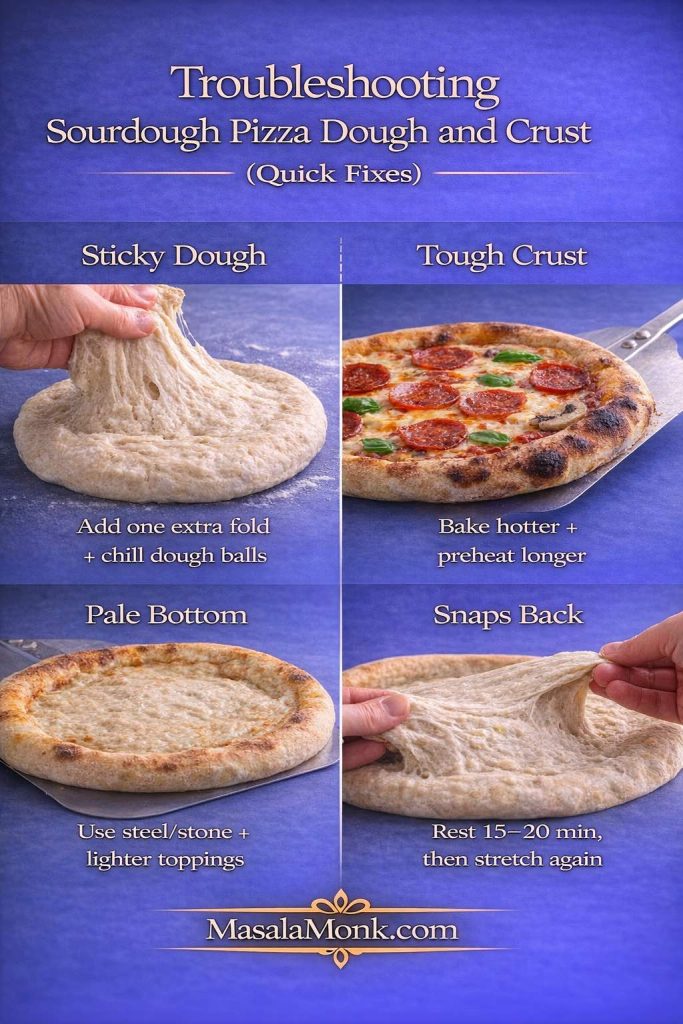
If your sourdough pizza dough feels sticky, your crust turns tough, the bottom stays pale, or the dough snaps back—use these quick fixes to get a stronger dough and a crisp, golden crust.

My sourdough pizza dough is sticky—what now?

Sticky dough often comes from one of these:

  • hydration is high for your flour
  • the dough didn’t develop enough strength early
  • the dough got too warm during fermentation
  • shaping started before the dough fully relaxed

Rather than dumping flour into the dough at the end, make two small adjustments next time:

  1. build a little more strength with one extra fold early on
  2. chill dough balls for a short cold ferment, then bring them back to room temp before shaping

In the moment, use light flour on the bench, keep your hands calm, and avoid forcing thinness too quickly.

My sourdough pizza crust is tough

A tough crust is often a bake problem, not a dough problem. It usually happens when:

  • the oven wasn’t hot enough
  • the baking surface wasn’t fully preheated
  • the pizza baked too long trying to brown

A better strategy is higher heat and faster bake. Preheat longer, use steel if you have it, and keep toppings lighter so the crust sets quickly.

The pizza base is pale and soft underneath

This almost always points to insufficient bottom heat.

Try:

  • longer preheat
  • moving the baking surface higher or lower depending on your oven’s heat pattern
  • using a steel if possible
  • par-baking the base briefly if you’re making a thicker pizza base

King Arthur also discusses how sourdough crusts can behave differently in browning and suggests practical fixes for thicker crust styles in their sourdough pizza resources, which can be reassuring when your crust looks lighter than expected but still bakes through.

The dough snaps back while stretching

Snapping back means the dough is tight. Tight dough needs time.

Cover it. Walk away for 15 minutes. Come back and stretch again.

Often, that small rest is the whole solution. If this happens frequently, a longer cold ferment usually improves extensibility dramatically.

Also Read: Fish and Chips Reimagined: 5 Indian Twists (Recipe + Method)


Pizza night pairings: cocktails that actually match sourdough pizza

When pizza is homemade, drinks become part of the atmosphere. You don’t need anything complicated—just something that plays nicely with cheese, tomato, and a toasty crust.

Pizza night pairing image with a sourdough pizza slice and four cocktail options—mule in a copper mug, punch in a tall glass, martini with olives, and an espresso cocktail.
Turn sourdough pizza night into a plan: pair your pie with a bright mule, an easy punch, a savory martini, or an espresso cocktail for dessert—pick one drink and make it feel special.

Here are a few of our blog posts that pair naturally with sourdough pizza night:

  • Fresh, fizzy, and bright: a classic Moscow Mule is hard to beat when your toppings lean spicy or rich.
  • Party-friendly pitcher option: rum punch fits perfectly when you’re feeding a crowd and want something easy to pour.
  • Savory pairing for olive-forward or salty toppings: a briny dirty martini can feel surprisingly right with mushrooms, olives, or deeply savory pizzas.
  • After-dinner move: if pizza night turns into dessert night, an espresso martini is a fun, coffee-forward finish.

You can keep it simple: pick one drink direction, make the pizza, and suddenly the whole evening feels intentional.

Also Read: Ravioli Recipe Reinvented: 5 Indian-Inspired Twists on the Italian Classic


Storing and reheating sourdough pizza (so it still tastes good tomorrow)

Leftover pizza is only disappointing when it’s handled roughly. Sourdough pizza can reheat beautifully—especially because the crust has structure—if you warm it in a way that respects the crust.

Storing leftovers safely

Let the pizza cool, then refrigerate it promptly in a covered container.

For timing and safe handling, FoodSafety.gov’s cold storage chart specifically lists pizza storage guidance, including fridge and freezer windows. It’s a helpful reference when you’re deciding whether a slice is still within a safe range. (Cold Food Storage Chart)

When reheating, the USDA recommends reheating leftovers to 165°F for safety. Their leftovers guidance is straightforward and worth keeping in mind when you’re reheating more than just a slice or two. (Leftovers and Food Safety)

Guide showing how to reheat sourdough pizza using a skillet, oven, or air fryer to restore a crisp crust, with tips for fast crisping and reheating multiple slices.
For the crispiest sourdough pizza crust, reheat in a skillet; for several slices, use the oven; for quick crunch, use an air fryer—stop as soon as it’s hot and revived.

Best ways to reheat sourdough pizza

Skillet method (best for crisp bottom):
Warm a skillet over medium heat, place the slice in, and cover loosely. The bottom crisps, while the cover helps the top warm without drying out.

Oven method (best for multiple slices):
Heat the oven and warm slices on a tray until the cheese softens and the crust crisps again.

Air fryer method (quick and crisp):
A short reheat in the air fryer works well, particularly for restoring texture.

Whichever method you use, aim for “hot and revived,” not “cooked again.” The goal is to bring the crust back to life, not to dry it out.

Guide showing how to freeze sourdough pizza slices in a container and how to freeze sourdough pizza dough balls, with tips to reheat slices crisp and thaw dough balls in the fridge overnight.
Freeze baked sourdough pizza slices for quick meals, or freeze dough balls for future pizza nights—thaw dough in the fridge overnight, then warm before stretching for the best crust.

Freezing pizza and freezing dough balls

If you want future pizza nights to be easier, freezing helps.

  • Freeze baked slices for quick lunches or fast dinners.
  • Freeze dough balls if you want fresh-baked pizza later without starting from scratch.

For dough balls, freeze after fermentation, wrap well, and thaw in the fridge overnight. Then let the dough come back toward room temperature before stretching. Cold dough is tight; warmer dough is cooperative.

Also Read: Croquettes Recipe: One Master Method + 10 Popular Variations


A calm, repeatable workflow for sourdough pizza at home

If sourdough pizza feels like a “special occasion” thing right now, here’s the shift: treat it like a rhythm, not a performance. The more familiar you get with the stages—mix, strengthen, ferment, divide, rest, bake—the less dramatic it becomes.

One week you might do a same-day sourdough pizza dough for a spontaneous dinner. Another week you might plan a cold ferment because you want deeper flavor and a smoother shaping experience. Either way, you’re building the same foundation: a sourdough pizza base that supports whatever toppings you love and bakes into a crust that tastes like you meant it.
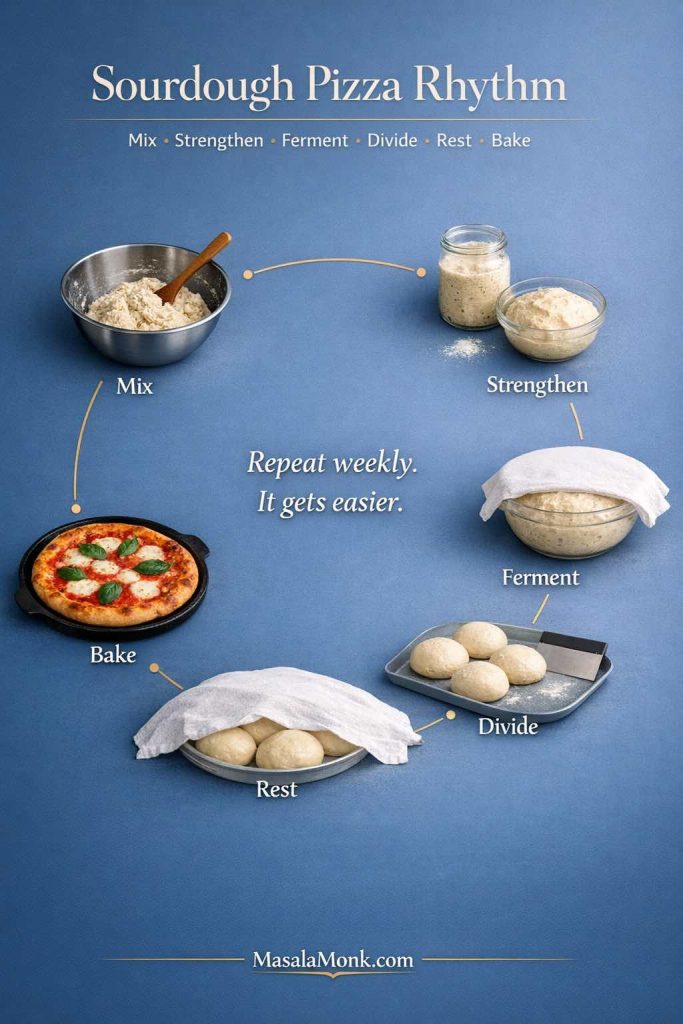
Sourdough pizza dough gets easier when you treat it like a rhythm: mix, strengthen, ferment, divide, rest, then bake—repeat weekly and your pizza base and crust improve every time.

And when you want to expand without reinventing the wheel, here are some blog posts that keep pizza night interesting:

From there, it’s simply repetition. Each bake teaches your hands what the dough should feel like. Each pizza shows you how your oven behaves. Before long, “sourdough pizza dough recipe” stops being an intimidating phrase and becomes a reliable plan.

Also Read: How to Make a Flax Egg (Recipe & Ratio for Vegan Baking)

FAQ: Sourdough Pizza Dough, Crust, and Base

1. What is the difference between sourdough pizza dough, sourdough pizza crust, and sourdough pizza base?

They usually refer to different stages of the same thing. Sourdough pizza dough is the raw dough before shaping, sourdough pizza base is the shaped round before toppings, and sourdough pizza crust often means the baked result. Even so, many recipes use the terms interchangeably, so the method is typically the same.

2. Can I make sourdough pizza dough the same day?

Yes, you can make sourdough pizza dough the same day if your starter is active and your kitchen is warm enough. In that case, give the dough enough time to bulk ferment, then let the dough balls rest until they feel soft and easy to stretch. That said, a cold ferment usually improves flavor and handling.

3. How long should I ferment sourdough pizza dough for the best flavor?

For the best balance of flavor and texture, many home bakers ferment sourdough pizza dough overnight in the fridge after dividing it into dough balls. However, a same-day sourdough pizza recipe can still work well. If you have more time, a longer cold ferment often gives a better sourdough pizza crust with easier stretching.

4. Can I use sourdough discard for pizza dough?

Yes, sourdough discard pizza dough is possible, although it behaves differently from dough made with active starter. For example, discard may ferment more slowly and produce a slightly denser result unless the recipe is designed for it. Therefore, if you use discard, expect to adjust timing and texture a little.

5. Why is my sourdough pizza dough sticky?

Most often, sticky sourdough pizza dough comes from high hydration, weak gluten development, or warm dough. In contrast, a dough with enough strength and a short rest between steps feels much easier to shape. To fix it, build more strength early, chill the dough if needed, and use only a light dusting of flour while shaping.

6. Why does my sourdough pizza dough snap back when I stretch it?

Usually, the dough is too tight or not rested enough. Instead of forcing it, let it sit covered for 10 to 20 minutes and try again. Afterward, it should stretch more easily into a sourdough pizza base without tearing.

7. What is the best flour for sourdough pizza dough?

Bread flour is a strong choice because it gives structure and makes shaping easier. Meanwhile, 00 flour can produce a tender, crisp sourdough pizza crust, especially in high-heat baking. Many bakers prefer a blend of both for a balanced result.

8. How do I get a crispy sourdough pizza crust at home?

To get a crispy sourdough pizza crust, preheat your oven longer, use a hot baking surface, and avoid overloading the pizza with sauce or toppings. In addition, a thinner stretch and a well-heated steel or stone help the base set quickly. As a result, the crust crisps before it dries out.

9. Why is my sourdough pizza base soft in the center?

A soft center usually means the dough did not get enough bottom heat or the toppings were too wet. For instance, too much sauce, fresh mozzarella, or watery vegetables can slow down browning. To improve it, preheat longer, use fewer wet toppings, and stretch the dough a little thinner.

10. What size should sourdough pizza dough balls be?

It depends on the pizza style you want. Smaller sourdough pizza dough balls make thinner, crisper pizzas, while larger dough balls create a thicker, chewier crust. As a general guide, medium dough balls work best when you want an easy-to-handle sourdough pizza recipe for a home oven.

11. Can I freeze sourdough pizza dough balls?

Yes, sourdough pizza dough balls freeze well and make future pizza nights much easier. Ideally, freeze them after fermentation, wrap them well, and thaw them in the fridge before using. Then let the dough rest at room temperature so the pizza base stretches without fighting back.

12. Can I freeze baked sourdough pizza?

Yes, baked sourdough pizza freezes well, especially if you cool the slices before storing. Later, reheat the slices in an oven, skillet, or air fryer to bring back some crispness in the crust. This way, leftover sourdough pizza still tastes good instead of turning chewy or dry.

13. Is sourdough pizza healthier than regular pizza?

Sourdough pizza can be easier for some people to digest because of the longer fermentation, and many people also prefer the flavor. Still, the overall nutrition depends on your flour, toppings, cheese, and portion size. In other words, sourdough improves the base, but the full pizza still depends on what you build on top.

14. What is the best hydration for sourdough pizza dough?

A moderate hydration is usually the easiest starting point for home bakers because it balances stretchability and control. Higher hydration can give a more open, airy crust, but it also makes shaping harder. Accordingly, if you are new to sourdough pizza dough, start in the middle and adjust after a few bakes.

15. Can I make a sourdough pizza base without a pizza stone or steel?

Absolutely. You can bake a sourdough pizza base on a preheated tray or pan and still get great results. Although a steel or stone helps with bottom heat, a hot oven and lighter toppings matter just as much. Therefore, don’t wait for perfect equipment before making your sourdough pizza recipe.

16. How do I keep the rim puffy on a sourdough pizza crust?

Leave a border when pressing the dough, and avoid flattening that edge with a rolling pin. Likewise, don’t overload the rim with sauce or cheese. Once baked, that untouched edge has room to puff and brown, which gives you a more attractive sourdough pizza crust.

17. Why does my sourdough pizza crust turn tough after reheating?

Usually, it is being reheated too long or at too high a heat without enough moisture control. Instead, warm it just until hot, then stop. A skillet method often works especially well because it re-crisps the bottom while keeping the rest of the slice from drying out.

18. Can I use this sourdough pizza dough recipe for thin crust and thick crust?

Yes, the same sourdough pizza dough recipe can produce both styles. The difference comes from dough ball size, shaping thickness, and bake method. For thin crust, stretch more and top lightly; for a thicker pizza base, use a larger dough ball and give it a little more structure during shaping.
Posted on 9 Comments

Sourdough Starter Recipe: Make, Feed, Store & Fix Your Starter (Beginner Guide)

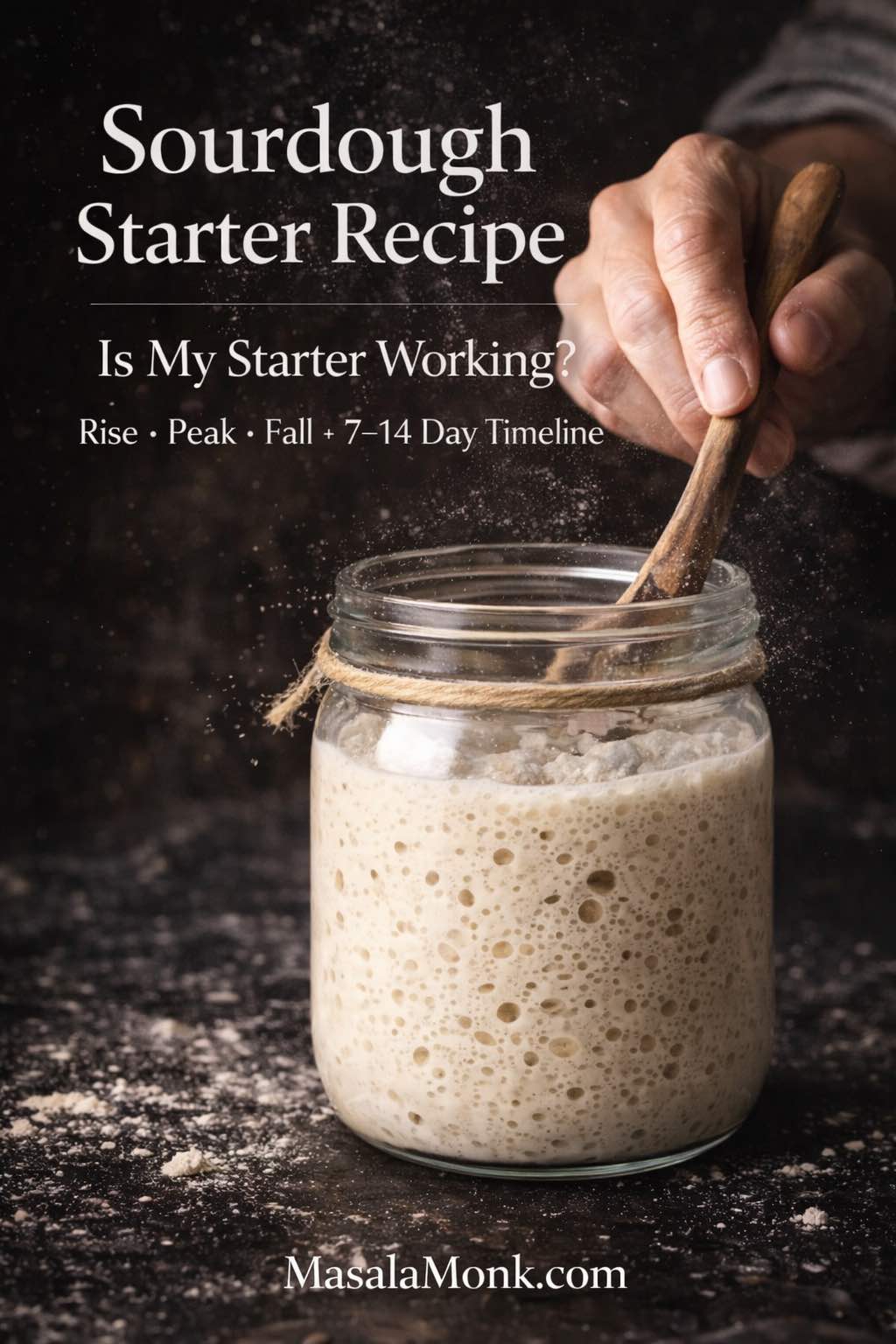
Photo of a glass jar of bubbly sourdough starter being stirred with a wooden spoon as flour dust floats in the air. Text overlay reads “Sourdough Starter Recipe” and “Is My Starter Working? Rise • Peak • Fall + 7–14 Day Timeline,” with “MasalaMonk.com” in the footer.

There’s a particular kind of satisfaction that comes from opening a jar, giving it a stir, and watching it wake up—bubbles rising, the surface smoothing out, the aroma turning from plain flour into something gently tangy and alive. A sourdough starter can feel mysterious at first, yet once you learn the rhythm, it becomes one of the most dependable things in your kitchen.

This sourdough starter recipe is designed to be steady rather than fussy. You’ll start with flour and water, build strength over several days, then settle into a feeding routine that fits your real schedule—whether you bake often, only on weekends, or “when life allows.” Along the way, you’ll learn what an active sourdough starter actually looks like, how to feed it without stress, how to manage discarded sourdough starter without wasting it, and how to rescue a jar that seems to have lost its spark.

When your starter is finally ready to bake, you can move seamlessly into your sourdough bread recipes and start turning that jar into loaves, rolls, buns, and more.


Sourdough starter: what it is, and why it’s worth keeping

A sourdough starter is a culture of wild yeast and lactic acid bacteria. Together, they turn flour and water into a living leavening system—one that creates lift, adds flavor, and develops the kind of crust and chew people fall in love with. Even more importantly, it becomes yours: your kitchen’s temperature, your flour choices, your feeding rhythm, and your preferences all shape it.

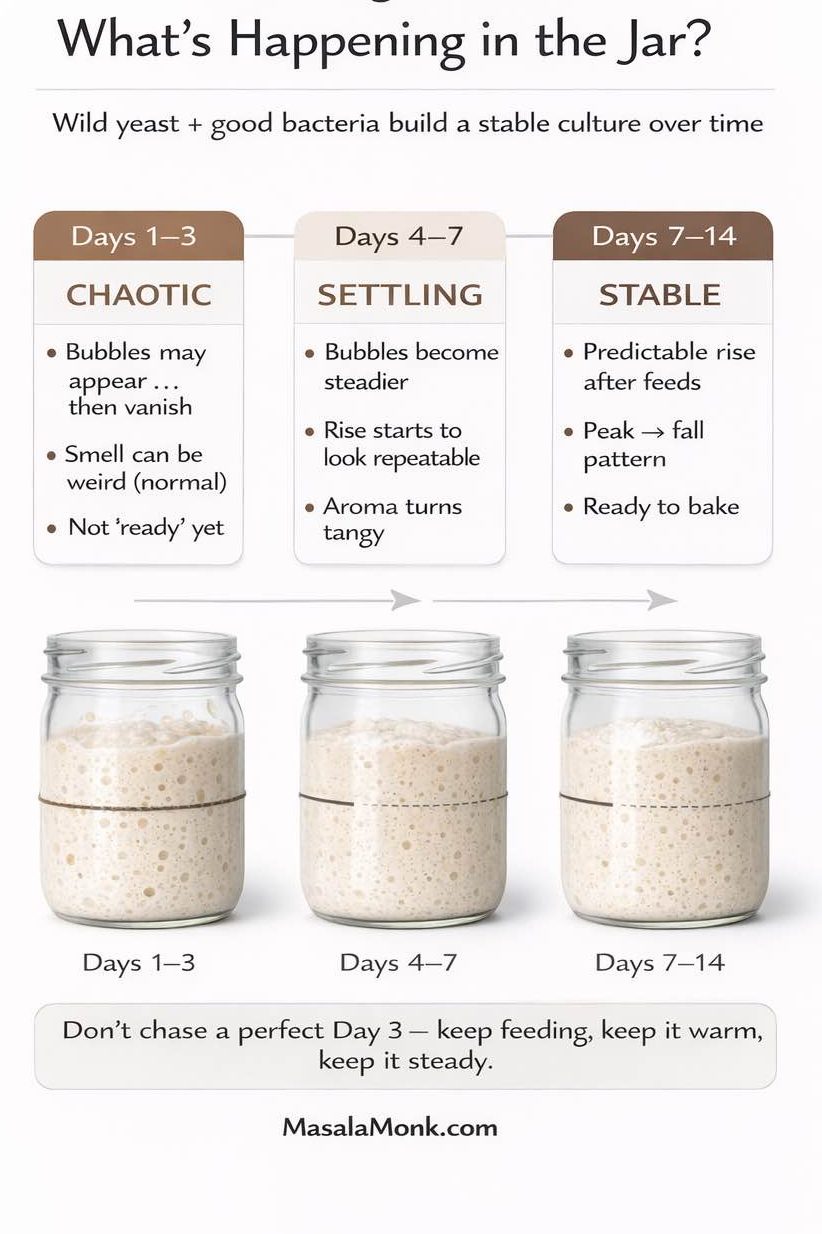
Vertical infographic titled “Sourdough Starter: What’s Happening in the Jar?” showing a simple timeline of starter development: Days 1–3 “Chaotic” (bubbles may appear then vanish, smell can be weird, not ready yet), Days 4–7 “Settling” (steadier bubbles, repeatable rise, aroma turns tangy), and Days 7–14 “Stable” (predictable rise after feeds, peak then fall pattern, ready to bake). Three jar photos illustrate increasing activity. Footer: MasalaMonk.com.
Day 3 can feel like a rollercoaster—bubbles one day, silence the next. This quick timeline shows what’s actually normal as a sourdough starter shifts from early “chaos” to a steadier, bake-ready rhythm (Days 1–3, 4–7, and 7–14). Use it to calm the guesswork, stay consistent with feeds, and watch for a repeatable rise pattern instead of “perfect” early drama.

At the beginning, the jar can look chaotic. One day it might surge with bubbles; the next day it might sit quietly, as if it forgot what it was supposed to do. That’s normal. Early activity often comes from a shifting cast of microbes, and it takes time for the stable, sourdough-friendly community to establish itself.

So, instead of expecting perfection on day three, aim for something calmer: repeat the same simple routine, keep conditions steady, and let the starter find its balance.

Also Read: Chicken Adobo — Step-by-Step Recipe — Classic Filipino Adobong Manok


Sourdough starter recipe ingredients

You only need two ingredients, although the choices you make can change how quickly the culture strengthens.

Flour

All-purpose flour works well. Still, many starters develop faster and more reliably with some whole grain flour, because the bran and germ bring extra nutrients and microbes. For that reason, including a portion of whole wheat flour for sourdough starter feeds can be a genuine advantage, especially in the first week.

If you’re using atta or choosing among common Indian wheat flours, you’ll often get better results with fresher flour that smells clean and slightly sweet. If you want a practical reference when you’re deciding what to keep in the pantry, best wheat flour (atta) in India is a useful companion.

Water

Room-temperature water is ideal. Filtered water can help if your tap water is heavily chlorinated. If you only have tap water, letting it sit uncovered for a while can reduce chlorine in some areas, although that depends on local treatment methods.

Simple tools that make life easier

You can begin with a jar and a spoon. However, a small kitchen scale quickly becomes your best ally because it keeps your feeding ratios consistent.

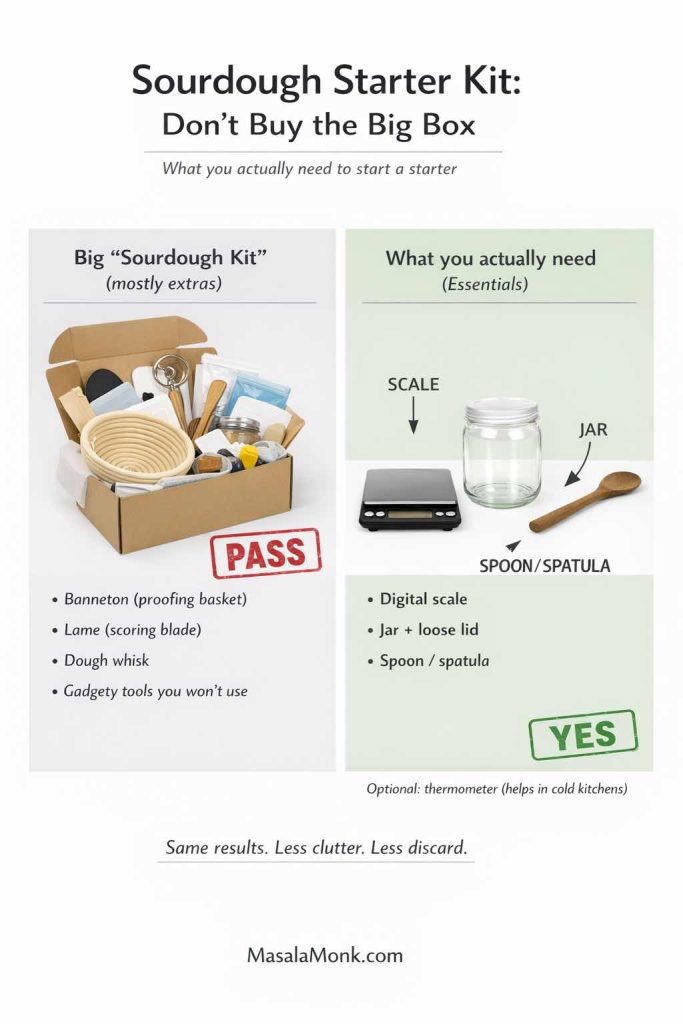
If you like a minimalist “starter kit” setup, think of it like this: jar + scale + spatula. Everything else is optional. Later in this guide, you’ll see what belongs in a sourdough starter kit and what you can skip without losing quality. For a broader kitchen setup that supports fermentation and baking, essential kitchen tools is a helpful internal reference you can explore when you’re ready.

Also Read: Sweetened Condensed Milk Fudge: 10 Easy Recipes


Sourdough starter recipe method: Day 1 to Day 7

This sourdough starter recipe uses a classic approach: equal parts flour and water by weight. It’s straightforward, repeatable, and easy to adjust later.

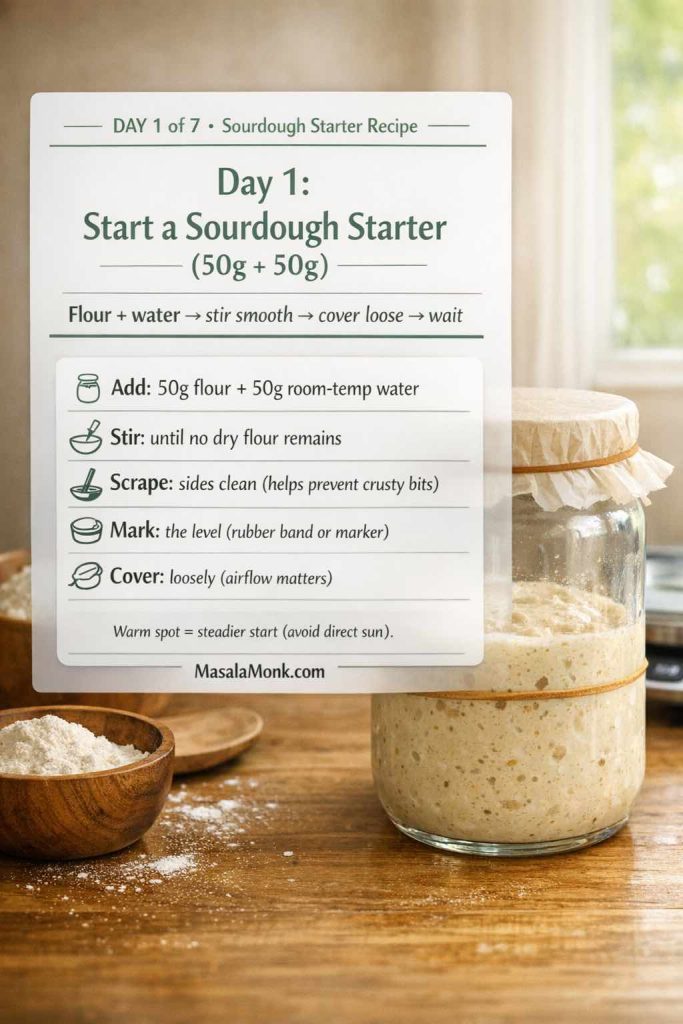
Day 1: Begin

  1. Add 50g flour and 50g water to a clean jar.
  2. Stir until no dry flour remains.
  3. Scrape down the sides.
  4. Loosely cover the jar and leave it at room temperature.
Infographic over a realistic kitchen photo of a glass jar of sourdough starter on a wooden counter. The overlay reads “Day 1 of 7 • Sourdough Starter Recipe” and “Day 1: Start a Sourdough Starter (50g + 50g).” Steps list: add 50g flour + 50g room-temp water, stir until no dry flour remains, scrape sides clean, mark the level, and cover loosely; note says a warm spot helps. MasalaMonk.com appears in the footer.
Day 1 is the easiest part of sourdough—yet it’s also where a calm, clean setup makes the rest of the week smoother. Mix 50g flour + 50g room-temp water, stir until there’s no dry flour, then scrape the sides, mark the level, and cover loosely so the culture can breathe. After that, your only job is to let time do its thing in a gently warm spot (no direct sun). Save this card so you can start in two minutes and come back tomorrow for Day 2—because the “quiet” days are normal, and sticking to the rhythm is what gets you a strong, active starter.

If your kitchen is chilly, place the jar somewhere gently warm—near a router, inside an off oven with the light on, or in a cozy corner away from drafts. Warmth doesn’t force success, although it does encourage steadier fermentation.

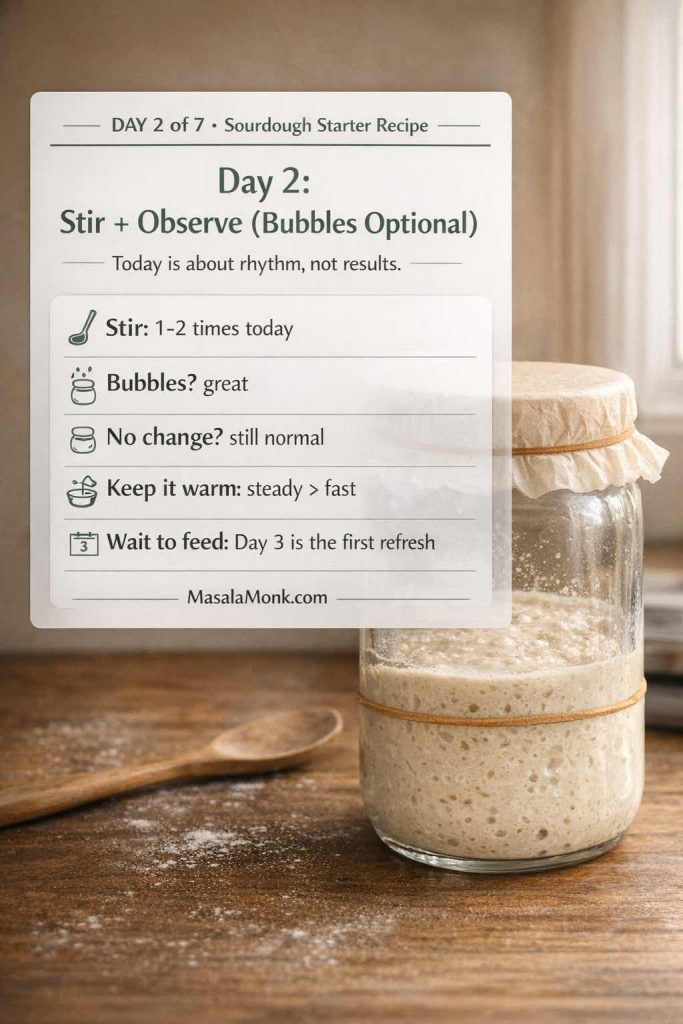
Day 2: Stir and observe

Stir once or twice during the day.

Infographic over a realistic kitchen photo of a glass jar containing early sourdough starter on a wooden countertop with a rubber band marking the level. The overlay text reads “DAY 2 of 7 • Sourdough Starter Recipe” and “Day 2: Stir + Observe (Bubbles Optional).” It lists: stir 1–2 times today, bubbles are great, no change is still normal, keep it warm for steadier fermentation, and wait to feed because Day 3 is the first refresh. MasalaMonk.com is shown in the footer.
Day 2 is the “quiet confidence” day. Give your jar a stir once or twice and then let it be—because bubbles are a bonus, not a requirement this early. Some starters look lively today, while others barely change, and both can still become strong if you keep conditions steady. Aim for a comfortably warm spot, keep the lid loose, and resist the urge to add extra flour or restart. Save this card so you don’t second-guess tomorrow—Day 3 is the first real refresh, and that’s when the rhythm starts to click.

You might see a few bubbles. Alternatively, it might look unchanged. Either way, keep going. Early calm is not failure; it’s simply the quiet part before the culture strengthens.

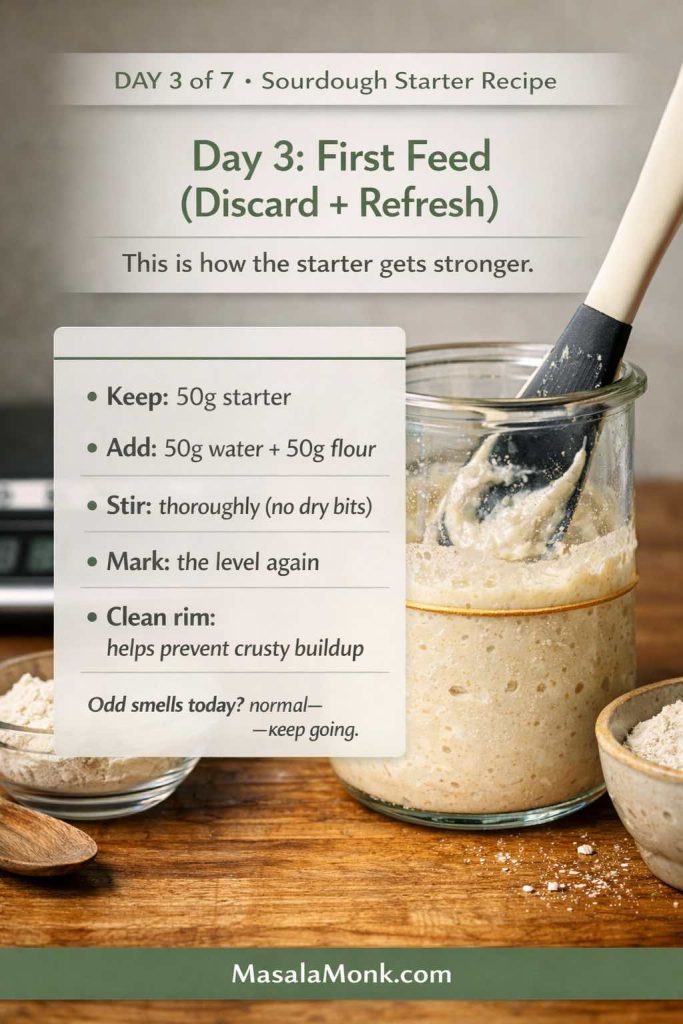
Day 3: First feed (discard + refresh)

  1. Discard all but 50g of what’s in your jar.
  2. Add 50g water and 50g flour.
  3. Stir thoroughly, then mark the level with a rubber band or marker.
  4. Cover loosely again.
Infographic for Day 3 of a sourdough starter recipe showing “Day 3: First Feed (Discard + Refresh).” A glass jar of starter sits on a wooden counter with a spatula inside and a rubber band marking the level, with bowls of flour and a kitchen scale nearby. Overlay steps say: keep 50g starter, add 50g water + 50g flour, stir thoroughly with no dry bits, mark the level again, and clean the rim to prevent crusty buildup; note says odd smells today are normal. MasalaMonk.com appears in the footer.
Day 3 is where your starter starts behaving like a real culture—because you’re finally giving it fresh food on a schedule. Keep 50g starter, then add 50g water + 50g flour, stir until it’s fully smooth (no dry pockets), and mark the level so you can actually see what happens over the next several hours. One small habit makes a big difference today: wipe the rim clean so crusty bits don’t dry out and cause problems later. And if the smell feels a little “weird”? That’s normal in the early days—stick to the routine and the jar usually settles into a cleaner, tangier rhythm soon.

Many starters smell “odd” around day 3 or day 4. That stage passes. Keep your jar clean around the rim, use a clean spoon, and continue.

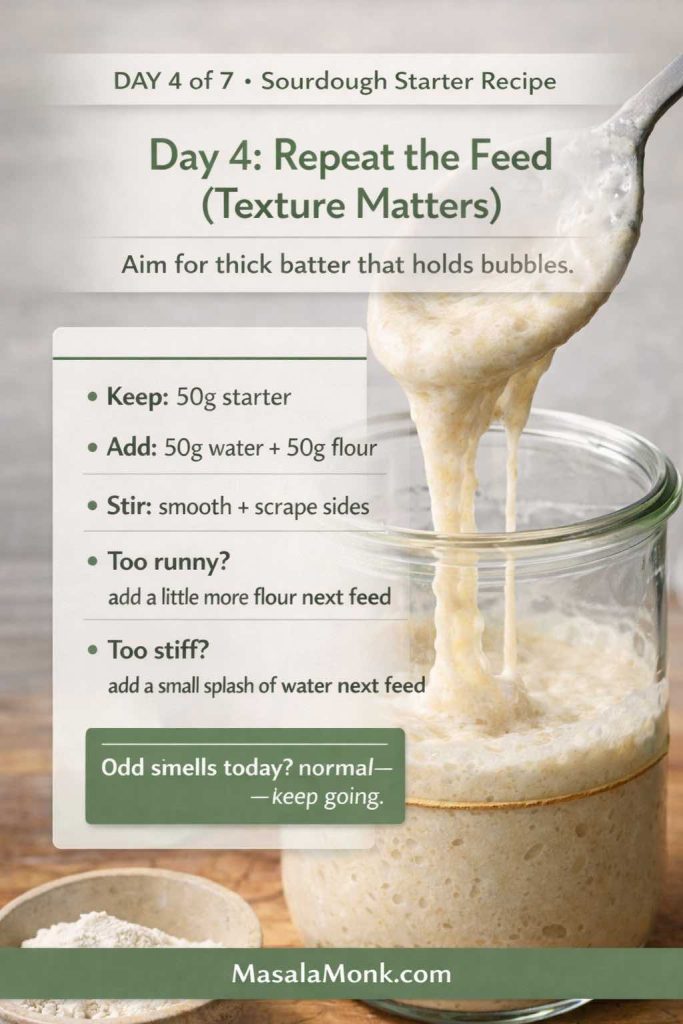
Day 4: Repeat the feed

Repeat the same discard and feed:

  • Keep 50g starter
  • Add 50g water + 50g flour
Infographic for Day 4 of a sourdough starter recipe showing “Day 4: Repeat the Feed (Texture Matters)” and “Aim for thick batter that holds bubbles.” A spoon lifts thick, stretchy sourdough starter above a glass jar on a countertop. The overlay instructions say: keep 50g starter, add 50g water + 50g flour, stir smooth and scrape sides; if too runny add more flour next feed, if too stiff add a small splash of water next feed. MasalaMonk.com is displayed in the footer.
Day 4 is the day to stop guessing and start reading the texture. You’re repeating the same feed (keep 50g starter + add 50g water + 50g flour), but now you’re watching how the jar behaves. The goal is thick batter that can hold bubbles—not watery, not dough-stiff. If your starter looks runny, it often ferments but won’t rise well because it can’t trap gas; next feed, nudge it thicker with a little more flour. If it’s stiff and hard to stir, loosen it with a small splash of water. Save this card as your “texture compass”—it’s one of the fastest ways to turn an unpredictable starter into a steady, active one.

As you stir, notice the texture. You want something like thick batter. If it’s too watery, it won’t trap gas well. On the other hand, if it’s too stiff, fermentation can slow. Adjust gradually rather than dramatically.

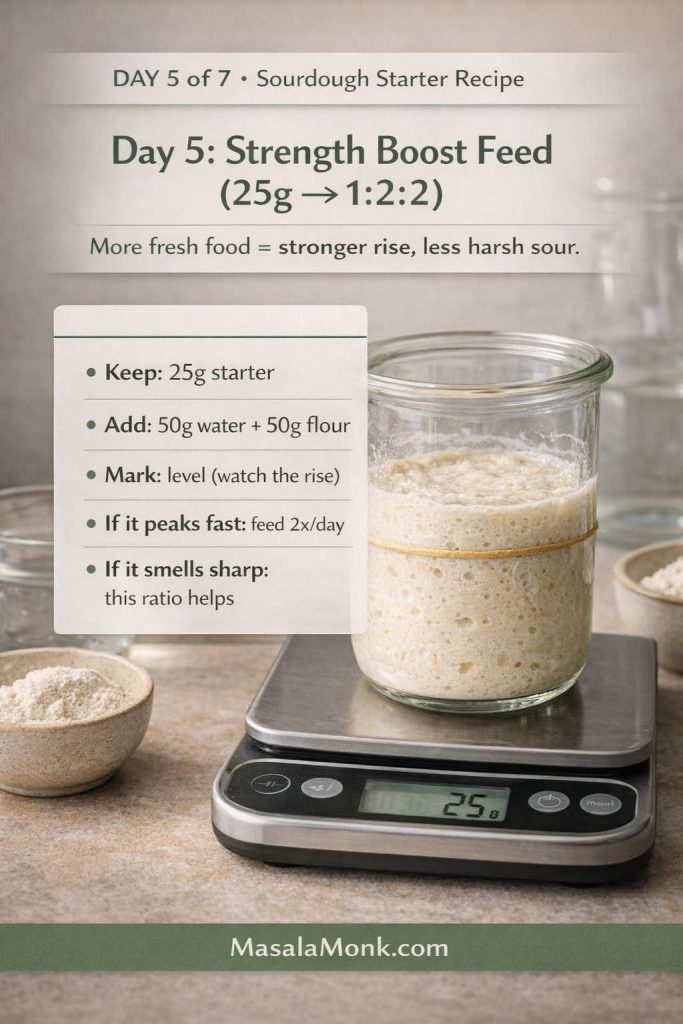
Day 5: Shift toward strength

If you see clear bubbling and some rise, strengthen the culture with a slightly higher feed ratio. This helps prevent the starter from becoming overly acidic too quickly.

Try:

  • Keep 25g starter
  • Add 50g water + 50g flour
Infographic for Day 5 of a sourdough starter recipe titled “Day 5: Strength Boost Feed (25g → 1:2:2)” with the line “More fresh food = stronger rise, less harsh sour.” A glass jar of sourdough starter sits on a digital kitchen scale reading 25g, with a rubber band marking the level and bowls of flour nearby. Overlay steps say: keep 25g starter, add 50g water + 50g flour, mark the level and watch the rise, feed twice daily if it peaks fast, and use this ratio if it smells sharp. MasalaMonk.com appears in the footer.
Day 5 is the “make it stronger” pivot. Instead of carrying a big amount forward, you keep 25g starter and give it a bigger refresh (50g water + 50g flour). That extra fresh food helps the culture build power without tipping overly sour or harsh—so you’re more likely to see a steadier rise and a cleaner aroma. Mark the level right after feeding and watch what happens over the next few hours; if it peaks and collapses quickly, that’s your sign it may want two feeds a day in a warm kitchen. Save this card as your Day 5 reset—this is often where a starter starts acting “reliable.”

Feed once a day if activity is modest. Feed twice a day if the starter rises and falls quickly or smells hungry and sharp by evening.

For a reliable reference on the logic of feeding and maintaining a starter—especially once you move into predictable routines—this resource on feeding and maintaining a sourdough starter is a solid companion when you want a second set of eyes on ratios and timing.

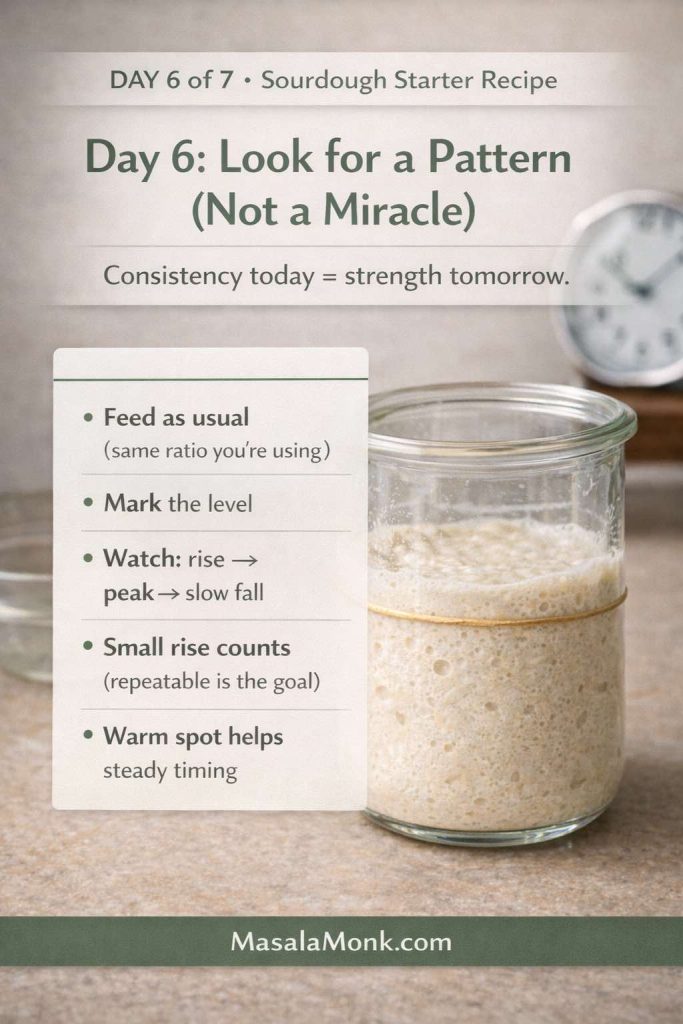
Day 6: Look for a pattern, not a miracle

By now, the starter should be showing more consistent bubbles. You may also see a clearer rise after feeding, even if it doesn’t double yet.

Infographic for Day 6 of a sourdough starter recipe titled “Day 6: Look for a Pattern (Not a Miracle)” with the note “Consistency today = strength tomorrow.” A glass jar of bubbly sourdough starter sits on a countertop with a rubber band marking the starter level; a blurred clock appears in the background. Overlay steps say: feed as usual (same ratio you’re using), mark the level, watch rise to peak then slow fall, small rise counts because repeatable is the goal, and a warm spot helps steady timing. MasalaMonk.com is shown in the footer.
Day 6 is where sourdough starts rewarding patience. Instead of chasing a dramatic “overnight miracle,” you’re watching for something more useful: a repeatable rise after feeding. Feed as usual, mark the level, and then check in a few times to catch the rhythm—rise → peak → slow fall. Even a modest rise is a win if it happens consistently, because that predictability is what turns a starter into something you can bake with on purpose. Save this card as your Day 6 mindset check: steady progress today usually becomes real strength tomorrow.

At this stage, the goal is repeatability. One huge rise followed by two flat days can happen early. Still, a starter that rises a little after every feed is moving in the right direction.

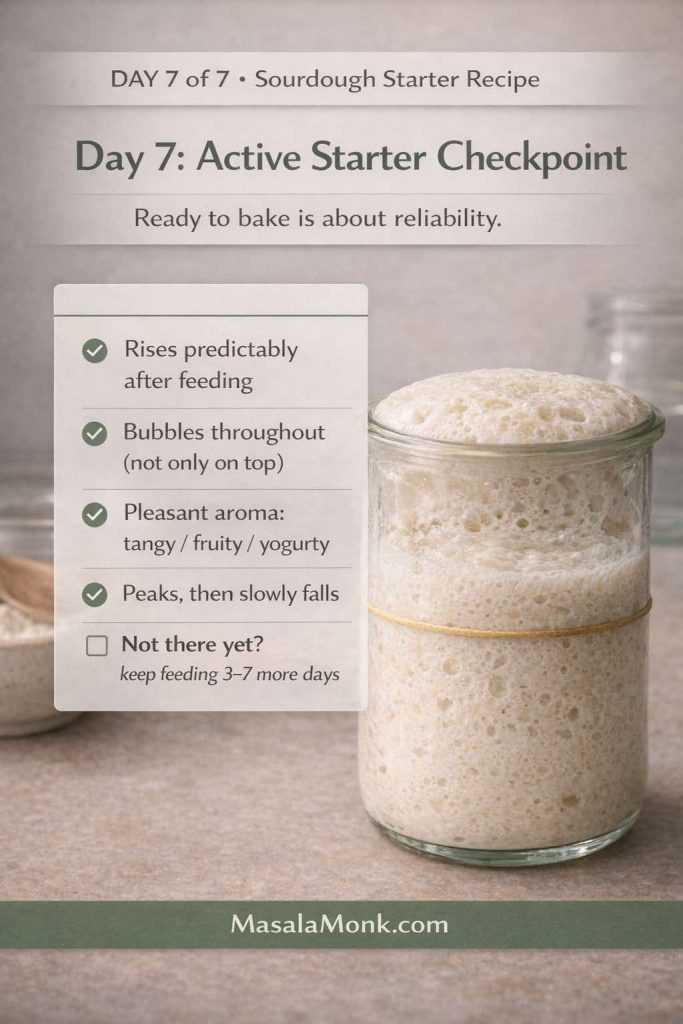
Day 7: Active sourdough starter checkpoint

An active sourdough starter usually shows several traits together:

  • It rises reliably after feeding (often close to doubling once it matures)
  • It smells pleasantly tangy, fruity, or mildly yogurty
  • Bubbles appear throughout, not just along the surface
Infographic titled “DAY 7 of 7 • Sourdough Starter Recipe” and “Day 7: Active Starter Checkpoint” over a realistic photo of a glass jar of sourdough starter at peak rise with a domed top and many bubbles; a rubber band marks the level. The checklist reads: rises predictably after feeding, bubbles throughout (not only on top), pleasant aroma tangy/fruity/yogurty, peaks then slowly falls, and if not there yet keep feeding 3–7 more days. MasalaMonk.com appears in the footer.
Day 7 is your “can I bake yet?” moment—and the answer is less about a magic day and more about reliability. After a feed, a starter that’s ready will rise predictably, look bubbly throughout (not just on top), and smell clean and pleasantly tangy—sometimes even lightly fruity or yogurty. Ideally, you’ll see it peak (highest dome) and then slowly fall, which shows it’s completing a full cycle. If you’re close but not quite there, don’t restart—keep the same routine for a few more days and it usually locks in. Save this checkpoint card so baking day feels confident instead of guessy.

If you’re not there yet, don’t force it. Continue the routine for a few more days. Many starters take 10–14 days to become fully dependable, especially in cooler kitchens or with lower-protein flours.

For a deeper explanation of the “starter at peak” idea—what it looks like and why it matters—this Serious Eats sourdough starter guide is useful when you want to fine-tune timing.

Also Read: Peanut Butter Fudge: Recipes & Guide (8 Methods + Easy Variations)

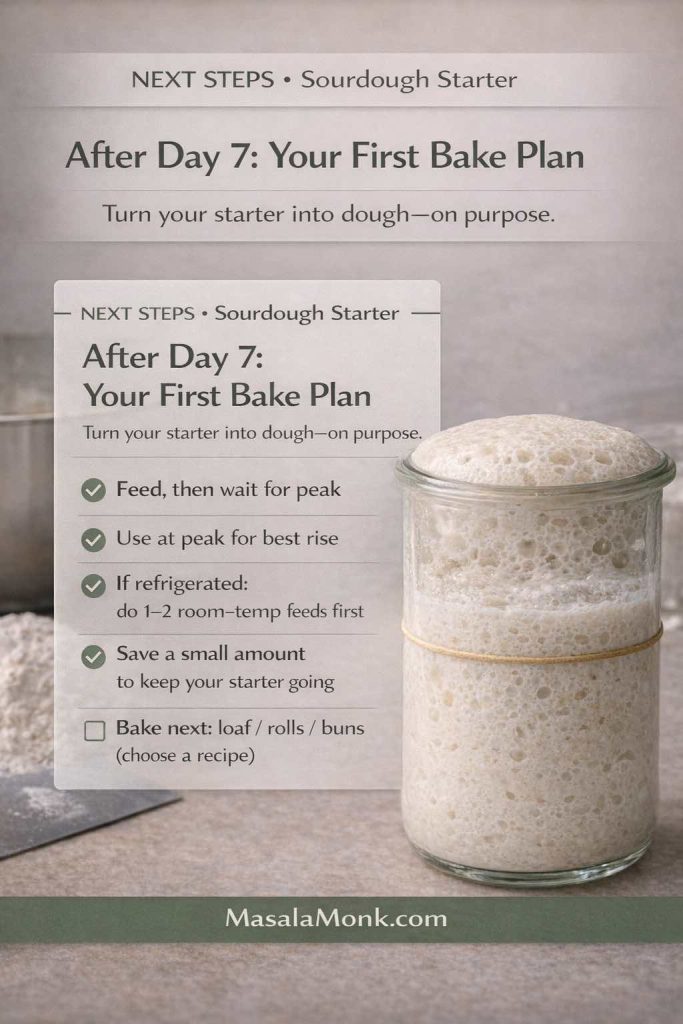
Infographic titled “After Day 7: Your First Bake Plan” over a realistic photo of an active sourdough starter in a glass jar with a rubber band marking the level. Checklist text says: feed then wait for peak, use at peak for best rise, if refrigerated do 1–2 room-temperature feeds first, save a small amount to keep your starter going, and bake next loaf/rolls/buns by choosing a recipe. MasalaMonk.com is in the footer.
You’ve built the starter—now turn it into bread without guessing. Feed your starter, then wait until it reaches peak (highest dome, lacy bubbles, clean tangy aroma). That’s the sweet spot for mixing dough because the starter is at its most active for the best rise. If your starter lives in the fridge, give it 1–2 room-temperature feeds first so it wakes up and behaves predictably again. Finally, save a small amount to keep your starter going, then choose your next bake—loaf, rolls, or buns—and head into your sourdough bread recipes for the full step-by-step.

Making sourdough starter more reliable: what helps most

Once you understand the levers, starter-building becomes much less confusing.

Warmth: your quiet advantage

A cold kitchen slows fermentation. A gently warm spot smooths out the process. Even a small change can help: moving your jar away from a cold window, or keeping it in a turned-off microwave between feeds.

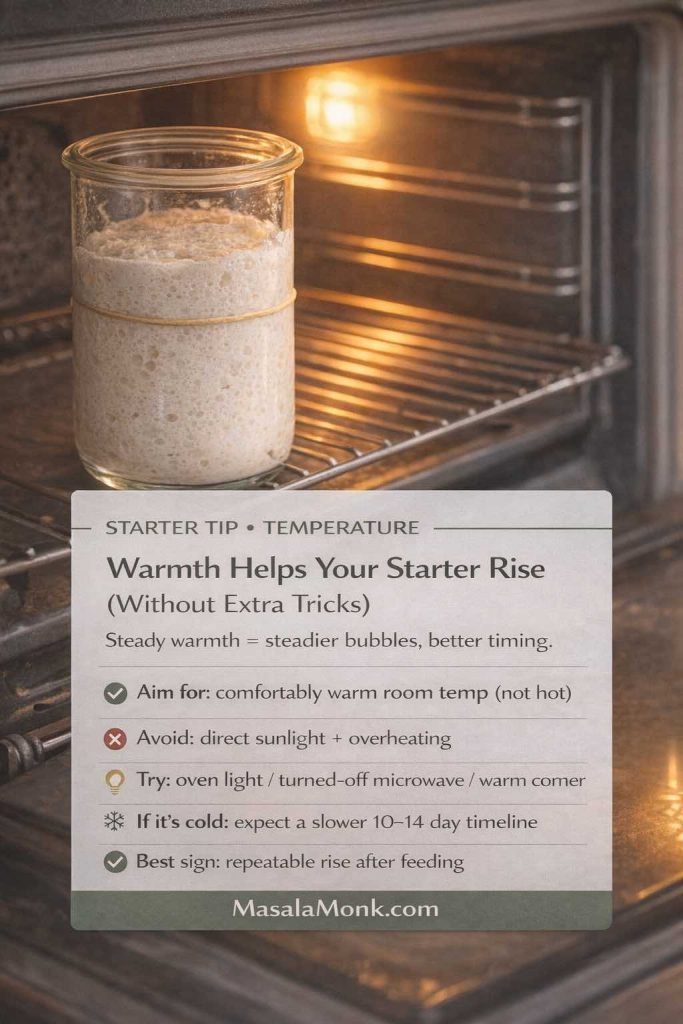
Infographic titled “Starter Tip • Temperature” over a realistic photo of a glass jar of bubbly sourdough starter sitting inside a turned-off oven with the oven light on. Text reads “Warmth Helps Your Starter Rise (Without Extra Tricks)” and “Steady warmth = steadier bubbles, better timing.” Bullet points say: aim for comfortably warm room temperature, avoid direct sunlight and overheating, try oven light/turned-off microwave/warm corner, if it’s cold expect a slower 10–14 day timeline, and best sign is a repeatable rise after feeding. MasalaMonk.com appears in the footer.
If your sourdough starter feels slow, temperature is usually the missing piece—not a new flour, not a “hack.” A comfortably warm spot helps fermentation stay steady, which means more consistent bubbles and more predictable rise times after feeding. An easy option is a turned-off oven with the light on (gentle warmth), or a draft-free warm corner. Avoid direct sun or overheating; you’re aiming for steady, not hot. Save this card for the days your kitchen runs cool—because once warmth is stable, the starter’s rhythm becomes much easier to read.

Consistency: aim for thick batter

If your starter pours like milk, it struggles to trap gas. Instead, aim for something thicker—like pancake batter that slowly drops from a spoon. If needed, add a touch more flour at the next feed.

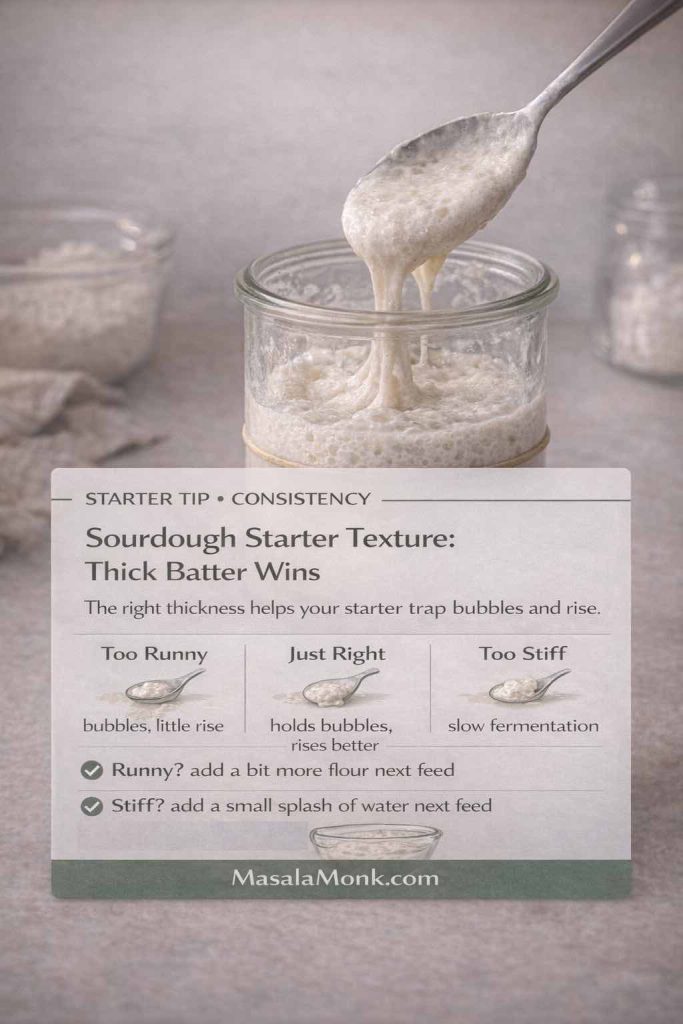
Infographic titled “Starter Tip • Consistency” reading “Sourdough Starter Texture: Thick Batter Wins,” shown over a photo of a spoon lifting sourdough starter above a glass jar. The graphic compares three textures: “Too Runny—bubbles, little rise,” “Just Right—holds bubbles, rises better,” and “Too Stiff—slow fermentation.” It also says: “Runny? add a bit more flour next feed” and “Stiff? add a small splash of water next feed.” MasalaMonk.com appears in the footer.
If your starter is bubbling but barely rising, texture is often the difference. A thick-batter consistency helps your sourdough starter trap gas, so the rise becomes more visible and predictable after feeding. Use this quick guide: if it’s too runny, it may ferment but struggle to hold bubbles—so add a bit more flour next feed. If it’s too stiff, fermentation can slow—so loosen it with a small splash of water next feed. Save this card as your “texture compass” for the days your starter feels confusing.

Flour choice: use whole wheat strategically

If the starter seems sluggish, adding whole wheat can help. Many bakers find that whole grain flour gives the culture extra nutrition and speeds up activity, especially early on.

You don’t have to switch permanently. A simple approach works well:

  • For 2–3 feeds, use 50% all-purpose + 50% whole wheat
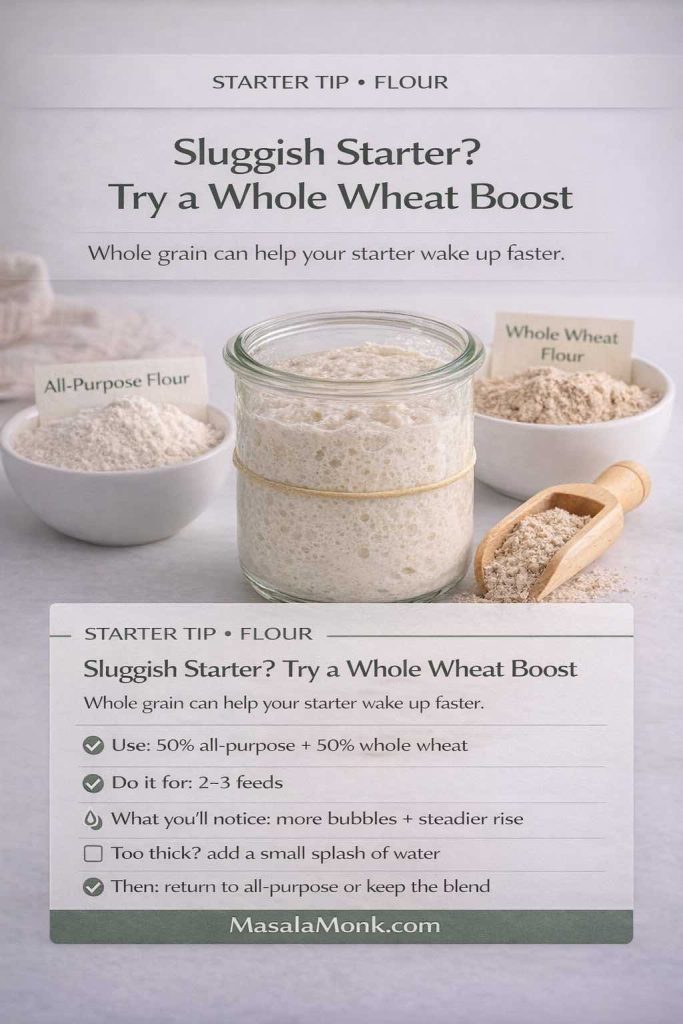
Infographic titled “Starter Tip • Flour” that says “Sluggish Starter? Try a Whole Wheat Boost.” It shows a glass jar of bubbly sourdough starter on a clean countertop with bowls labeled all-purpose flour and whole wheat flour. The overlay checklist says: use 50% all-purpose + 50% whole wheat, do it for 2–3 feeds, you’ll notice more bubbles and a steadier rise, add a small splash of water if too thick, then return to all-purpose or keep the blend. MasalaMonk.com is in the footer.
If your starter feels sleepy—bubbles are tiny, the rise is modest, and timing is all over the place—this is a simple, low-drama fix: switch to a 50/50 blend of all-purpose + whole wheat for 2–3 feeds. Whole grain brings extra nutrients that often help the culture “wake up,” so you’ll usually see more bubbling and a steadier rise after feeding. If the mix turns thick (whole wheat absorbs more water), add a small splash of water next feed and keep going. Save this card for cold days or slow weeks—it’s one of the easiest ways to build a stronger, more reliable starter.

If you’re curious about why different flours behave differently in starters, this best flour for sourdough starters investigation offers a clear breakdown.

Also Read: 10 Vegan Chocolate Cake Recipes (Easy, Moist, & Dairy-Free)


Feeding sourdough starter: daily routine that doesn’t take over your life

Once your starter is established, feeding becomes a small habit rather than a project.

A simple daily feeding ratio

A steady baseline is:

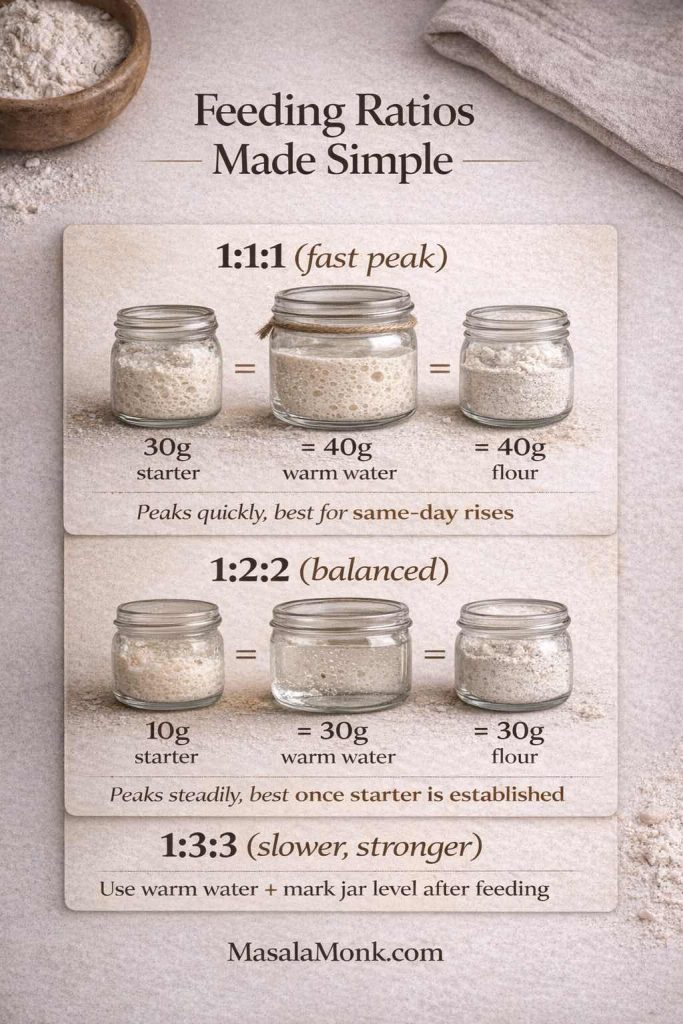
  • 1:1:1 (starter : water : flour by weight)

That said, slightly larger feeds can keep the culture stronger and less acidic:

  • 1:2:2 or 1:3:3

For example:

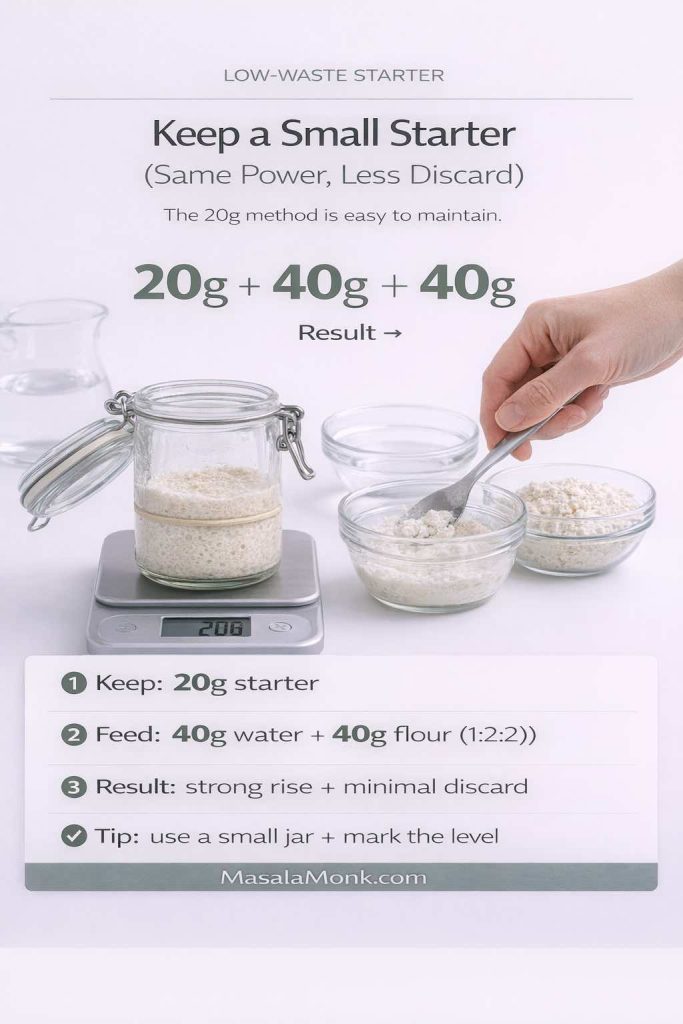
  • Keep 20g starter
  • Add 40g water + 40g flour (1:2:2)

This is a gentle way to support a starter that runs sour or seems weak.

Infographic showing sourdough starter feeding ratios 1:1:1, 1:2:2, and 1:3:3 with example gram measurements for starter, warm water, and flour, plus notes on peak speed and strength.
Sourdough starter feeding ratios at a glance: use 1:1:1 when you need a faster peak, 1:2:2 for a steady everyday rhythm, and 1:3:3 when you want a slower, stronger rise. Keep the jars small and the math simple—once you know which ratio matches your schedule, feeding becomes predictable instead of guessy.

Low-waste maintenance (smaller starter, same power)

If you don’t bake every day, you don’t need a giant jar. Keeping a smaller amount means you discard less, while still maintaining strength.

Studio-style infographic titled “Low-Waste Starter: Keep a Small Starter (Same Power, Less Discard).” It shows a small jar of bubbly sourdough starter on a digital kitchen scale and bowls of flour and water, with a hand mixing. Large text reads “20g + 40g + 40g.” A checklist says: Keep 20g starter; Feed 40g water + 40g flour (1:2:2); Result strong rise + minimal discard; Tip use a small jar + mark the level. MasalaMonk.com appears in the footer.
Want a strong starter without throwing out loads of discard? This low-waste 20g routine keeps things simple: keep 20g starter, then feed 40g water + 40g flour (1:2:2). You still get a lively, reliable rise—just with a smaller jar and far less waste. Mark the level after feeding so you can see the rise clearly, then repeat on the schedule that fits your kitchen. Save this card if you want sourdough to feel easy, not messy.

A practical approach:

  • Keep 20–30g starter
  • Feed 40–60g water + 40–60g flour

If you want a well-explained philosophy around reducing waste while maintaining performance, keeping a smaller sourdough starter to reduce waste is a helpful reference when you’re dialing in your routine.

Also Read: Kahlua Drinks: 10 Easy Cocktail Recipes (Milk, Vodka, Coffee)


Feeding sourdough starter without a scale

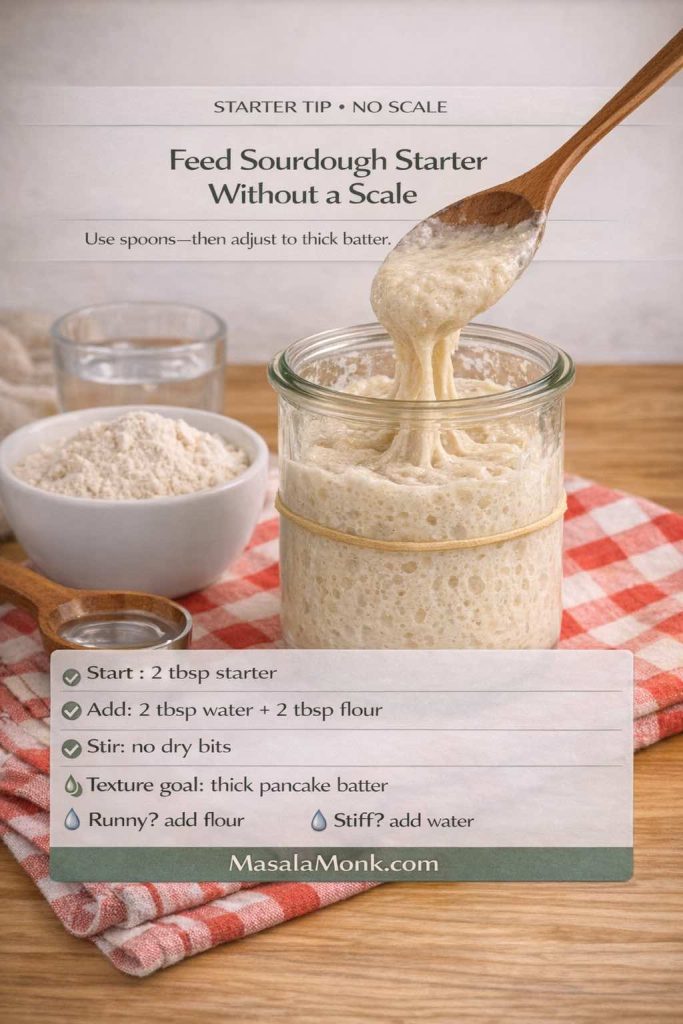
Sometimes you’re traveling. Sometimes the scale battery dies. And then sometimes you simply want to keep things simple for a day. You can feed without a scale and still keep a starter healthy, as long as you aim for the right texture.

Infographic titled “Starter Tip • No Scale” with the heading “Feed Sourdough Starter Without a Scale.” A glass jar of sourdough starter is shown with a spoon lifting starter to demonstrate texture. Nearby are a bowl of flour, a glass of water, and measuring spoons on a countertop. The checklist says: start with 2 tbsp starter; add 2 tbsp water + 2 tbsp flour; stir until no dry bits; texture goal is thick pancake batter; if runny add flour; if stiff add water. MasalaMonk.com appears in the footer.
No scale? You can still keep your starter healthy. Start with a small, repeatable spoon method—2 tbsp starter + 2 tbsp water + 2 tbsp flour—then let texture be the judge. You’re aiming for thick pancake batter so the starter can trap bubbles and rise more reliably after feeding. If it turns runny, add a bit more flour next time; if it’s stiff and hard to stir, loosen it with a small splash of water. Save this card for travel days, dead batteries, or when you just want to keep feeding simple.

Start with roughly equal spoonfuls of flour and water, then adjust until the mixture looks like thick batter. If it feels thin, add flour. If it feels stiff, add water.

The most important part is consistency across a few feeds. If you change methods every day, the starter can feel unpredictable. Conversely, if you stick to one approach for several days, it settles into a rhythm again.

Also Read: Hot Chocolate Coffee: 3 Easy Recipes (Cocoa, Mix, or Espresso)


Active sourdough starter: how to know it’s ready to bake

A strong starter behaves like a reliable friend: it shows up when it says it will.

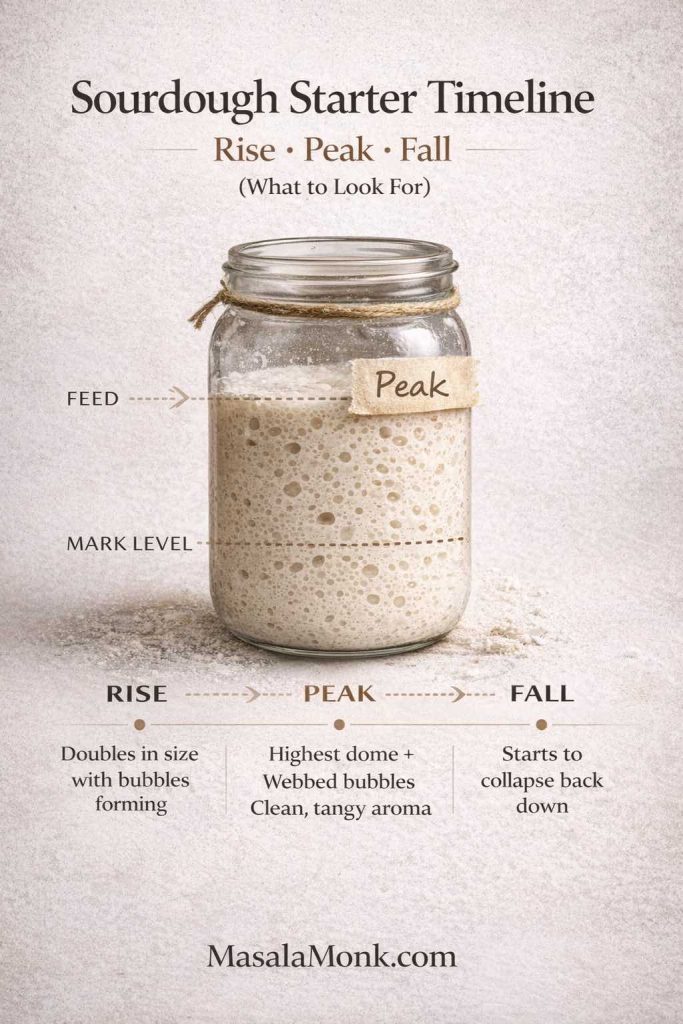
Infographic showing a jar of sourdough starter with a marked level line and the starter at “Peak.” Headline reads “Sourdough Starter Timeline: Rise • Peak • Fall (What to Look For).” The bottom explains: Rise—starter doubles with bubbles forming; Peak—highest dome, webbed bubbles, clean tangy aroma; Fall—starter starts to collapse back down. MasalaMonk.com appears in the footer.
Wondering when to feed—or when your starter is actually ready? Use this timeline as your quick visual check. Mark the level right after feeding, then watch for Rise → Peak → Fall. Peak is the sweet spot for baking: the starter is at its highest dome, looks lacy/webbed with bubbles, and smells clean and tangy. Once it begins to fall, it’s running out of food—so either feed again or plan your next step based on the schedule in the guide below.

The rise pattern

After feeding, many starters:

  1. bubble steadily,
  2. rise and dome slightly,
  3. then flatten and fall once they’ve peaked.

That “rise and fall” rhythm matters because you generally get best baking performance when the starter is used near peak, when it’s most buoyant and energetic.

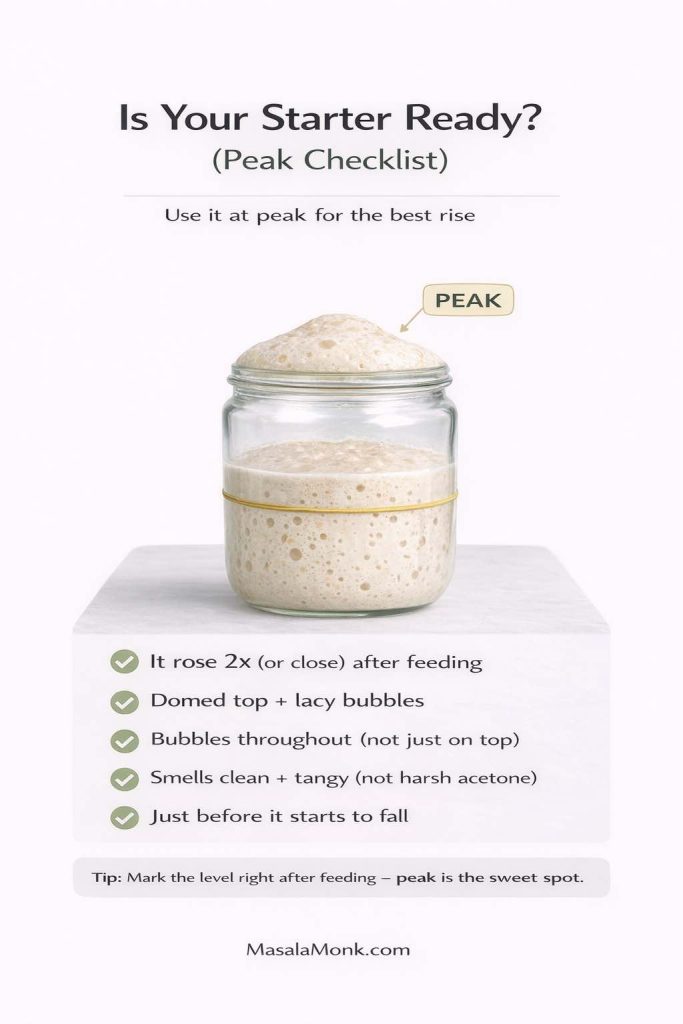
Infographic titled “Is Your Starter Ready? (Peak Checklist)” showing a glass jar of sourdough starter marked with a rubber band and domed at peak with visible bubbles, labeled “PEAK.” Checklist items: it rose 2× (or close) after feeding; domed top with lacy bubbles; bubbles throughout, not just on top; smells clean and tangy, not harsh acetone; and it’s just before it starts to fall. Tip reads: “Mark the level right after feeding — peak is the sweet spot.” Footer reads MasalaMonk.com.
“Ready to bake?” is the hardest part of sourdough—because timing matters more than tricks. Use this Peak Checklist to know when your starter is at its strongest: rise + dome + lacy bubbles + clean tangy smell, right before it starts to fall. Save this for baking day so you stop guessing and start catching your starter at the sweet spot for better lift, better crumb, and a more reliable loaf.

The float test (useful, but not absolute)

The float test can be one clue: a spoonful of starter floating in water suggests it’s trapping gas. Still, it’s not a verdict. Hydration and flour type affect results. Use it as a hint, then rely more on the rise pattern and smell.

Also Read: Cappuccino Recipe: How to Make a Perfect Cappuccino at Home


Sourdough starter in the fridge: storing it without losing momentum

If you bake occasionally, refrigeration makes starter life easier.

Feeding refrigerated sourdough starter: a weekly rhythm

Here’s a simple weekly plan:

  1. Feed your starter.
  2. Leave it at room temperature until you see early activity (a few bubbles and slight expansion).
  3. Refrigerate it, loosely covered.
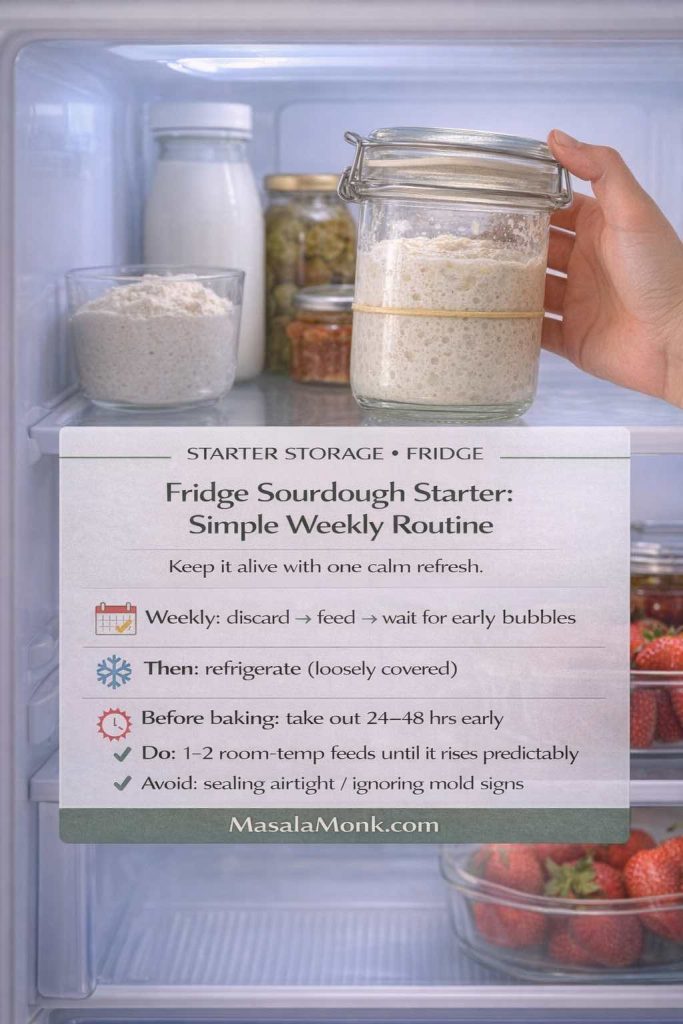
Infographic titled “Starter Storage • Fridge” and “Fridge Sourdough Starter: Simple Weekly Routine” shown inside an open refrigerator. A hand holds a glass jar of bubbly sourdough starter with a rubber band marking the level; nearby are flour and other fridge items. The overlay steps say: weekly discard → feed → wait for early bubbles; then refrigerate loosely covered; before baking take out 24–48 hours early; do 1–2 room-temperature feeds until it rises predictably; avoid sealing airtight or ignoring mold signs. MasalaMonk.com appears in the footer.
If you don’t bake every day, the fridge is your best friend—as long as you keep one simple rhythm. Once a week, discard down, feed, and let the starter show early bubbles before it goes back into the refrigerator (loosely covered). Then, when baking day is coming, pull it out 24–48 hours ahead and do 1–2 room-temperature feeds until it rises on schedule again. Save this card for the weeks you’re busy—it keeps your starter alive without turning sourdough into a full-time job.

Once a week:

  • Take it out
  • Discard down to a small amount
  • Feed it
  • Return it to the fridge after it shows early activity

This method keeps the starter stable without demanding daily attention.

For a clear overview of sourdough basics and starter care, extension resources can be helpful when you want straightforward guidance, such as Colorado State’s sourdough basics.

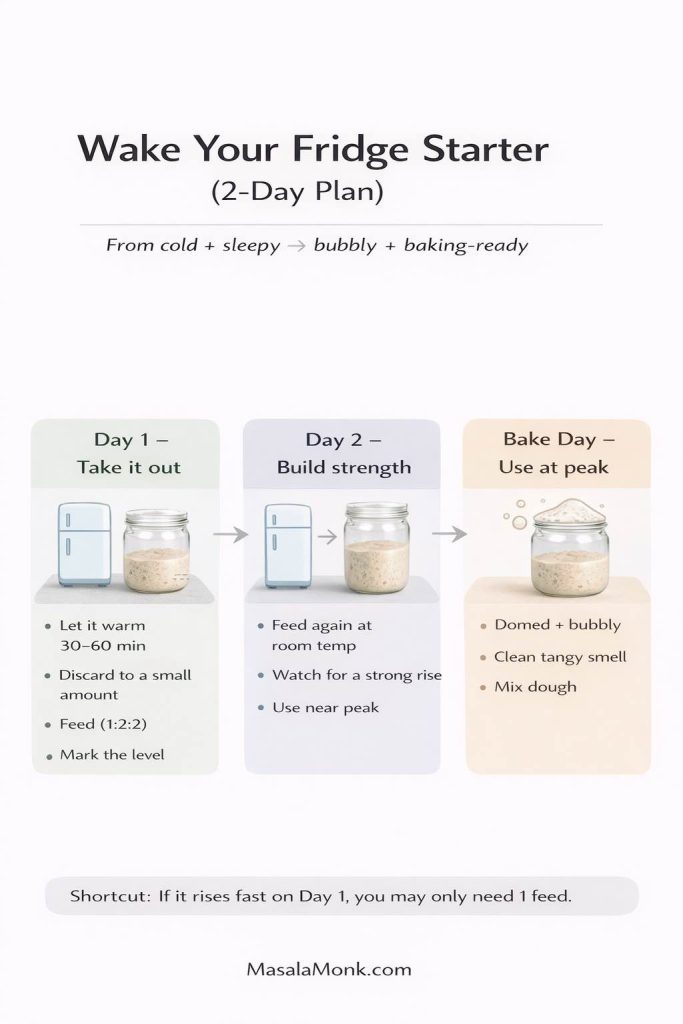
Infographic titled “Wake Your Fridge Starter (2-Day Plan)” showing a three-step timeline to make a refrigerated sourdough starter baking-ready. Day 1: take it out, warm 30–60 minutes, discard to a small amount, feed at 1:2:2, and mark the level. Day 2: feed again at room temperature, watch for a strong rise, and use near peak. Bake day: use at peak when domed and bubbly with a clean tangy smell, then mix dough. Footer reads MasalaMonk.com.
Pulled a sourdough starter from the fridge and it feels sleepy? This 2-day wake-up plan takes you from cold → bubbly → baking-ready without guesswork: warm it, refresh it, then use it right at peak for better rise and flavor. Save this timeline for your next bake day—especially if you keep your starter refrigerated most of the week.

Feeding sourdough starter from the fridge before baking

When you want to bake, give your starter a “wake-up” window:

  • Pull it out 24–48 hours before mixing dough
  • Feed it, let it rise
  • Feed again if needed until it reliably rises on schedule
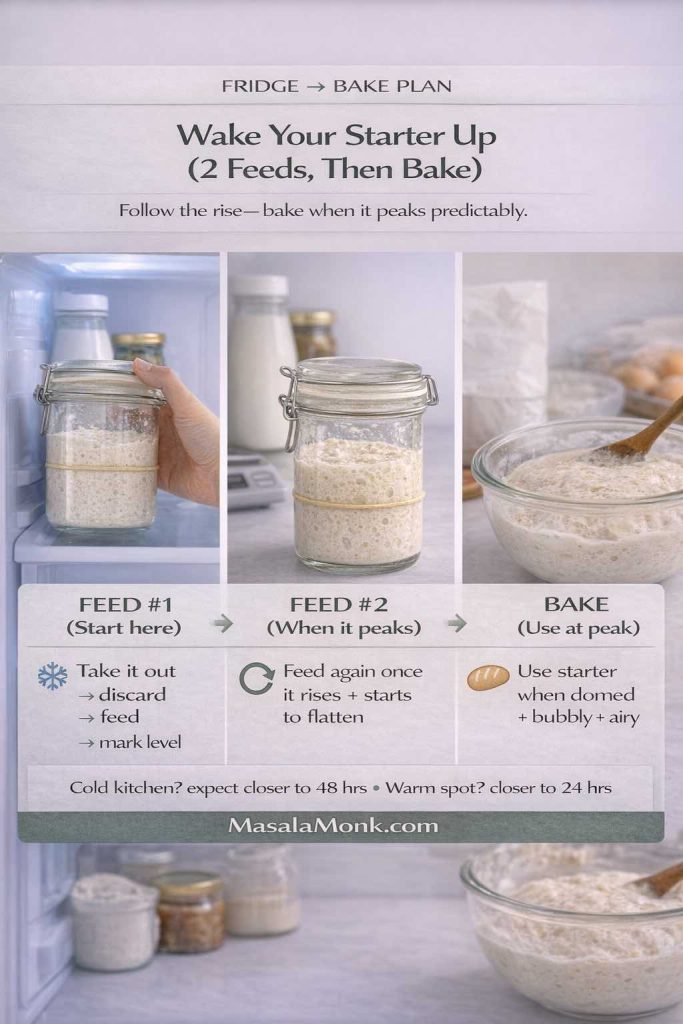
Infographic titled “Fridge → Bake Plan” and “Wake Your Starter Up (2 Feeds, Then Bake).” It shows three panels: Feed #1 with a jar of starter being taken out of the fridge and steps “take it out, discard, feed, mark level”; Feed #2 showing the starter jar on the counter with text “feed again once it rises and starts to flatten”; and Bake showing a bowl of bubbly dough with text “use starter when domed, bubbly, and airy.” A note reads “Cold kitchen? expect closer to 48 hrs • Warm spot? closer to 24 hrs.” MasalaMonk.com appears in the footer.
This is the simplest way to bring a refrigerated starter back to full strength without overthinking it: Feed #1, mark the level, and let it rise until it’s clearly active. Then do Feed #2 right when it peaks (or just begins to flatten), so the culture is strong and predictable again. Finally, bake using the starter at peak—domed, airy, and bubbly—so your dough gets the best lift. Save this plan for busy weeks: it turns “starter in the fridge” into a clear path back to bake-ready.

This routine builds strength quickly, especially after longer refrigeration.

Once it’s lively again, you can head into your sourdough bread recipes and choose the bake that matches your mood—boule, sandwich loaf, rolls, or something else.

Also Read: Cold Brew Espresso Martini: How to Make It (Step-by-Step Recipe)


Whole wheat flour for sourdough starter: how to use it well

Talking about whole wheat, it can be a powerful ally, though it behaves a little differently than white flour.

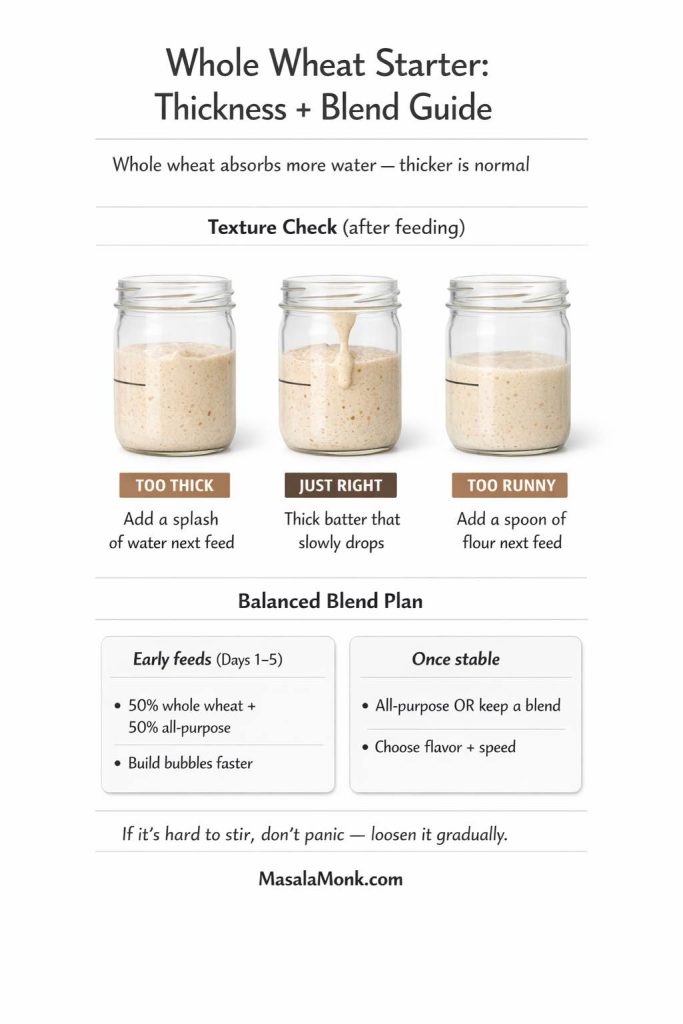
Infographic titled “Whole Wheat Starter: Thickness + Blend Guide” explaining that whole wheat absorbs more water so thicker starter is normal. Three panels show texture checks after feeding: “Too Thick—Add a splash of water next feed,” “Just Right—Thick batter that slowly drops,” and “Too Runny—Add a spoon of flour next feed.” A “Balanced Blend Plan” suggests early feeds (Days 1–5) use 50% whole wheat + 50% all-purpose to build bubbles faster, then once stable use all-purpose or keep a blend to choose flavor and speed. Tip says: “If it’s hard to stir, don’t panic — loosen it gradually.” Footer: MasalaMonk.com.
Whole wheat is a starter superpower—if you expect the texture shift. Because it absorbs more water, your starter will feel thicker (and that’s often a good thing for trapping bubbles). Save this guide for quick fixes: too thick → splash of water, too runny → spoon of flour, and a simple 50/50 whole wheat + all-purpose plan for the early days so your starter gets active faster without turning fussy.

Because whole wheat absorbs more water, it often makes your starter feel thicker. That’s not a problem. In fact, a slightly thicker starter can trap bubbles more effectively. Still, if it becomes difficult to stir, add a small splash of water at the next feed.

A balanced approach tends to work best:

  • Use whole wheat in early feeds to build activity
  • Then shift to all-purpose once the starter is stable, or keep a blend if you prefer the flavor and speed
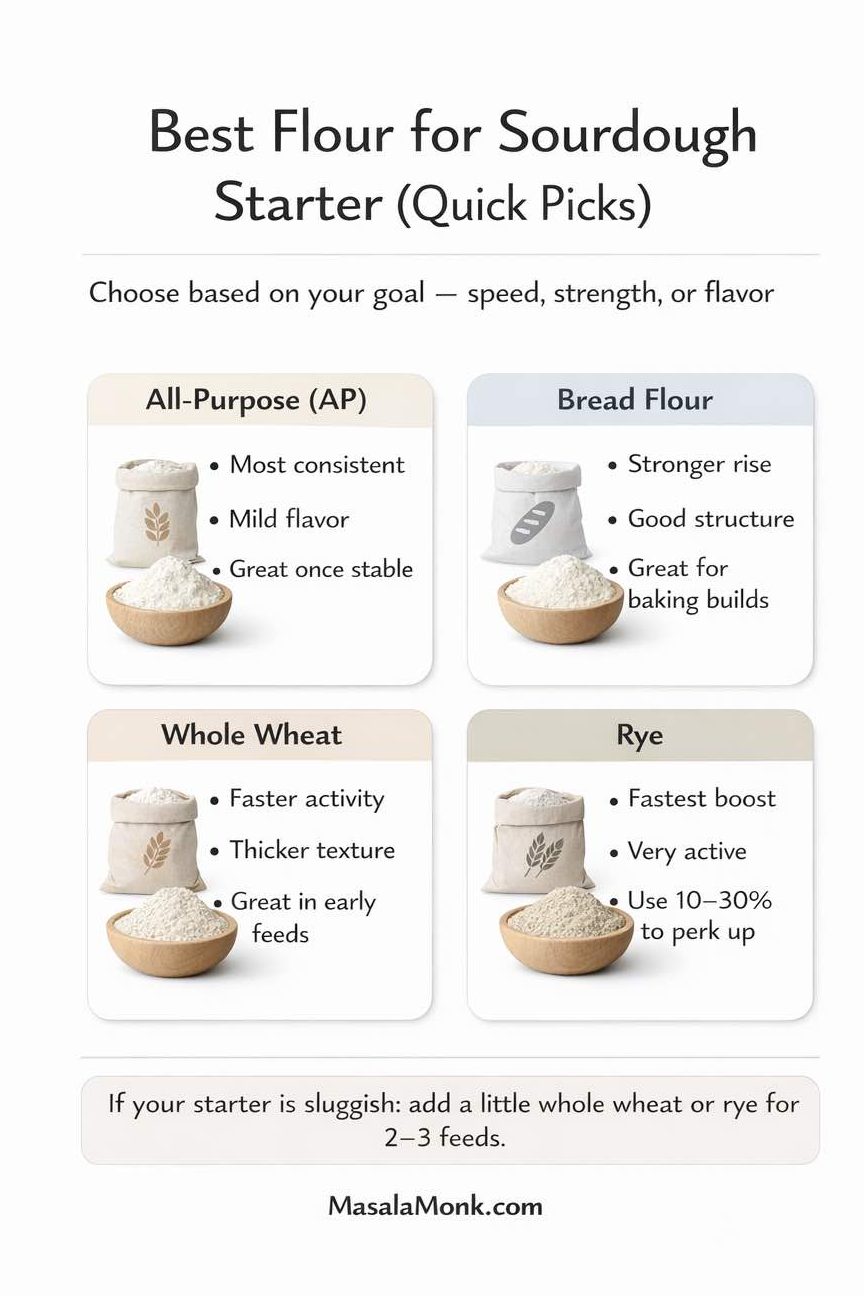
Infographic titled “Best Flour for Sourdough Starter (Quick Picks)” with four comparison cards. All-Purpose (AP): most consistent, mild flavor, great once stable. Bread flour: stronger rise, good structure, great for baking builds. Whole wheat: faster activity, thicker texture, great in early feeds. Rye: fastest boost, very active, use 10–30% to perk up. A tip says: “If your starter is sluggish: add a little whole wheat or rye for 2–3 feeds.” Footer reads MasalaMonk.com.
Choosing flour shouldn’t feel like a rabbit hole. Use this quick guide to match your starter to your goal: AP for steady maintenance, bread flour for strength, whole wheat for faster early activity, and rye for the quickest boost when things feel sluggish. Save it for your next feeding so you can troubleshoot with one simple switch instead of starting over.

If you want to explore gluten and how flour structure affects baking outcomes in general—especially if you’re considering gluten-free routes later—what gluten is and how it works is a useful internal reference.

Also Read: Iced Coffee: 15 Drink Recipes—Latte, Cold Brew, Frappe & More


Gluten-free sourdough starter: a simple sidebar

If you’re working with gluten-free flours, the process is similar: flour + water + consistent feeding. However, gluten-free starters often behave differently because they don’t form the same elastic network. As a result, rise can be less dramatic, even when the starter is healthy.

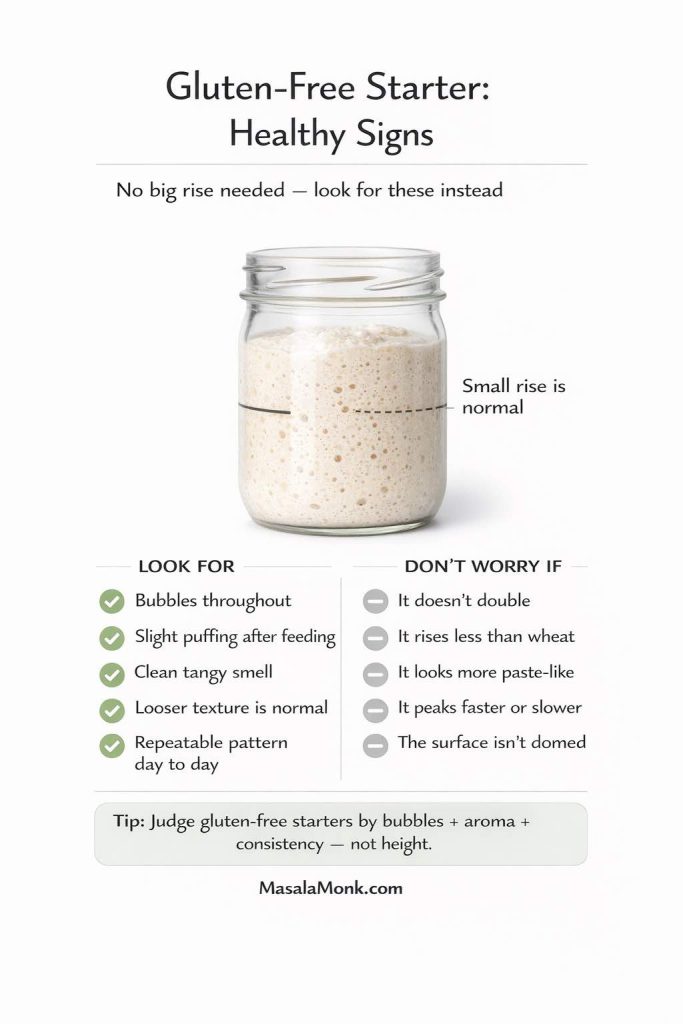
Infographic titled “Gluten-Free Starter: Healthy Signs” explaining that a gluten-free sourdough starter may not rise much and that a small rise is normal. A central jar shows bubbly starter with a marked line. Two lists compare what to look for (bubbles throughout, slight puffing after feeding, clean tangy smell, looser texture is normal, repeatable pattern day to day) versus what not to worry about (doesn’t double, rises less than wheat, looks more paste-like, peaks faster or slower, surface isn’t domed). Tip says to judge gluten-free starters by bubbles, aroma, and consistency—not height. Footer: MasalaMonk.com.
Gluten-free starters play by different rules—so don’t judge yours by “did it double?” Save this checklist and look for the signs that actually matter: bubbles throughout, a clean tangy aroma, a repeatable daily pattern, and even a small puff after feeding. If it’s healthy, it can still bake beautifully—even when the rise looks subtle.
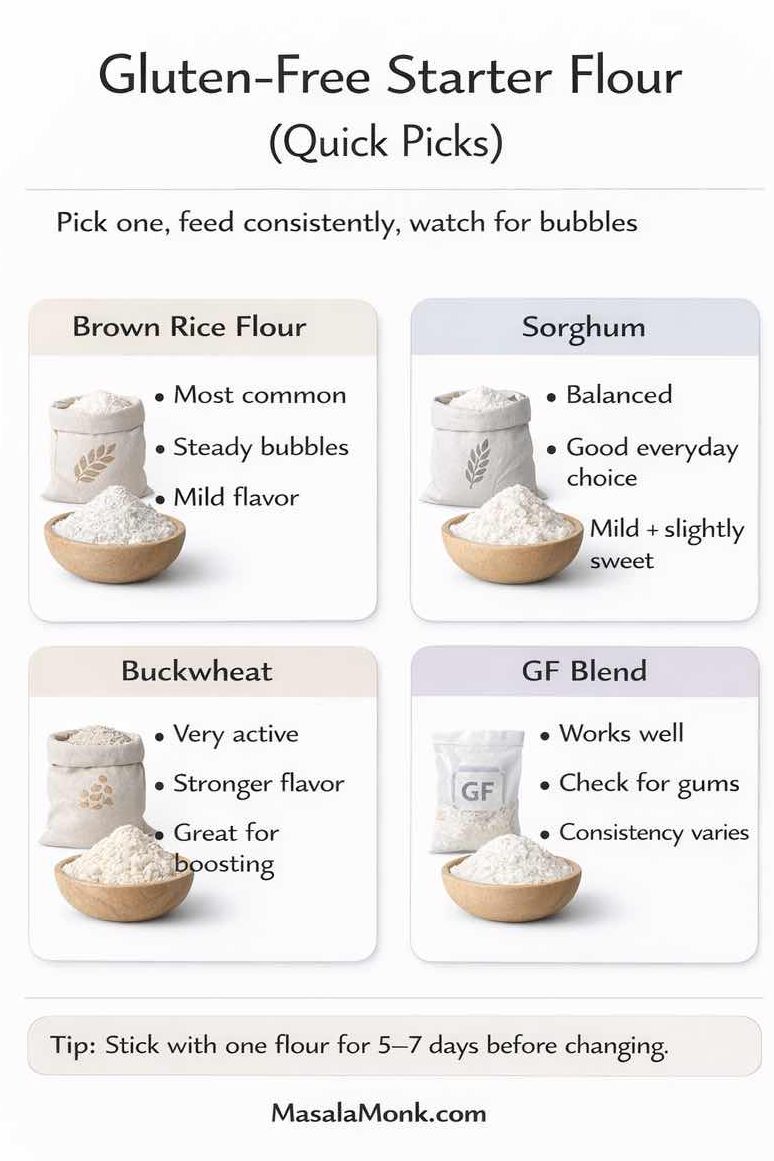
Infographic titled “Gluten-Free Starter Flour (Quick Picks)” with the subtitle “Pick one, feed consistently, watch for bubbles.” Four cards show recommended gluten-free flours for a sourdough starter: Brown Rice Flour (most common, steady bubbles, mild flavor), Sorghum (balanced, good everyday choice, mild + slightly sweet), Buckwheat (very active, stronger flavor, great for boosting), and GF Blend (works well, check for gums, consistency varies). A tip reads: “Stick with one flour for 5–7 days before changing.” Footer: MasalaMonk.com.
Building a gluten-free sourdough starter? Save this quick reference. Different flours behave differently, so the real win is consistency: pick one (brown rice, sorghum, buckwheat, or a GF blend), feed on a steady schedule, and watch for bubbles + aroma instead of a dramatic rise. Bonus tip: stick with one flour for 5–7 days before switching—your starter gets more predictable fast.

For a detailed gluten-free starter method, King Arthur’s gluten-free sourdough starter recipe is a solid reference. If you’re also exploring alternative flours for different dietary needs, you might find keto-friendly flour options useful as a general internal guide to how non-wheat flours behave in baking.

Also Read: Cranberry Moscow Mule Recipe: A Festive Holiday Cocktail With Easy Variations


Sourdough starter kit: what belongs in it (and what doesn’t)

A starter doesn’t require a shopping spree. Still, some tools genuinely make the process easier, especially if you want consistent results.

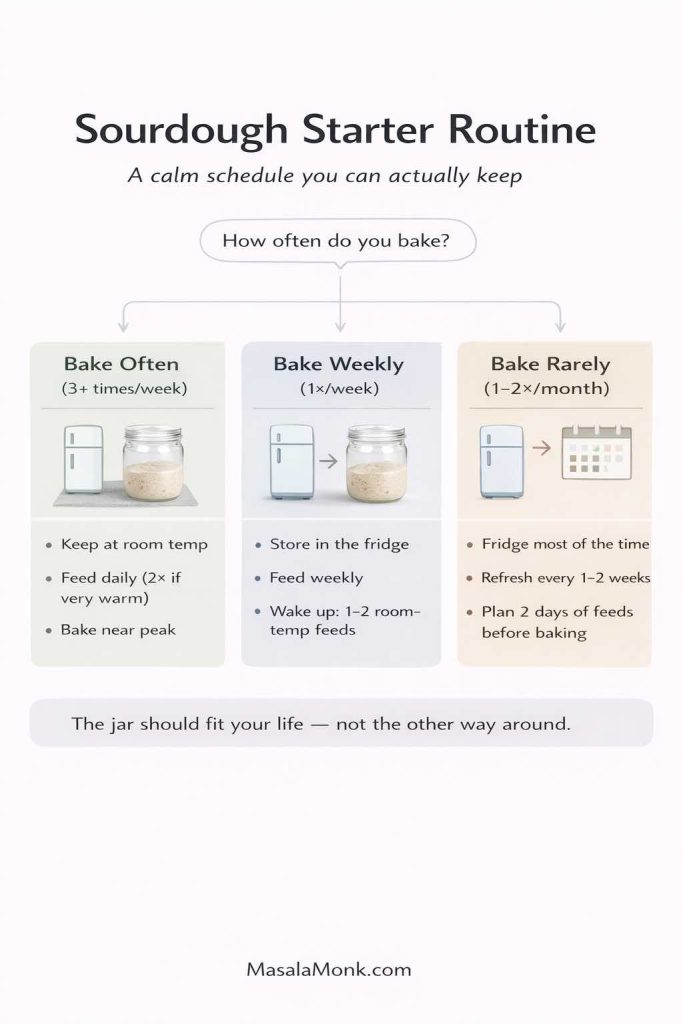
Most “sourdough starter kits” look tempting… but you can start a strong, bubbly sourdough starter with just three essentials: a digital scale, a jar with a loose lid, and a spoon/spatula. The rest is mostly clutter (and usually ends up unused). Save this as your quick shopping filter—then jump into the full starter guide on MasalaMonk to follow the day-by-day build, feeding ratios, fridge routine, and troubleshooting.

The essentials

  • A clear jar (or two, so you can swap to a clean one occasionally)
  • A spoon or spatula
  • A scale
  • A loose cover

That’s enough for most people, even if they never buy a “kit.”

The nice-to-haves

  • Extra jars for cleaner maintenance
  • A small silicone spatula (it scrapes well)
  • A thermometer if you like precision
  • A warm spot solution for cold kitchens

If you’re comparing options or considering the idea of a best sourdough starter kit, focus on function rather than brand: jar size, an accurate scale, and a practical tool for stirring and scraping.
Also Read: Baked Ziti Recipe Collection: 15 Easy Variations


Sourdough starter troubleshooting: common problems, calm solutions

Even a good starter has off days. Fortunately, most issues are fixable with small adjustments.

My starter is bubbling but not rising much

Bubbles show fermentation is happening, which is good. Lack of rise can come from thin consistency or weak gluten structure (especially with certain flours).

Try this:

  • Thicken slightly at the next feed by adding a touch more flour
  • Keep the jar in a warmer spot
  • Feed at a slightly higher ratio (1:2:2) for a few cycles

With time, the rise typically improves.

My starter smells too sour or harsh

A sharp smell often means the starter is hungry or overly acidic.

A person holds a glass jar of bubbly sourdough starter close to their nose in a bright kitchen. An overlay card reads “Starter Troubleshooting: What Does Your Starter Smell Like?” and lists four smell clues with fixes: sharp/acetone means hungry so feed bigger (1:3:3); very sour means too acidic so feed sooner; cheesy in early days is normal so keep routine; clean tangy or fruity means healthy so bake at peak. MasalaMonk.com appears in the footer.
If you’ve ever opened your starter and thought “uh… is this normal?”, this quick smell check saves a lot of panic. Sharp/acetone usually means it’s hungry—give it a bigger feed (1:3:3). Very sour often means it’s getting too acidic—feed sooner for a day or two. A cheesy smell early on can happen while the culture stabilizes—stay consistent. And when it smells clean, tangy, or lightly fruity, you’re in the sweet spot—use it at peak for your best rise. Save this for the next time your starter surprises you.

Instead of feeding the same small amount, refresh more generously:

  • Keep 20g starter
  • Feed 60g water + 60g flour (1:3:3)

Also, feed a little sooner than usual for a day or two. As the acidity balances, the aroma softens.

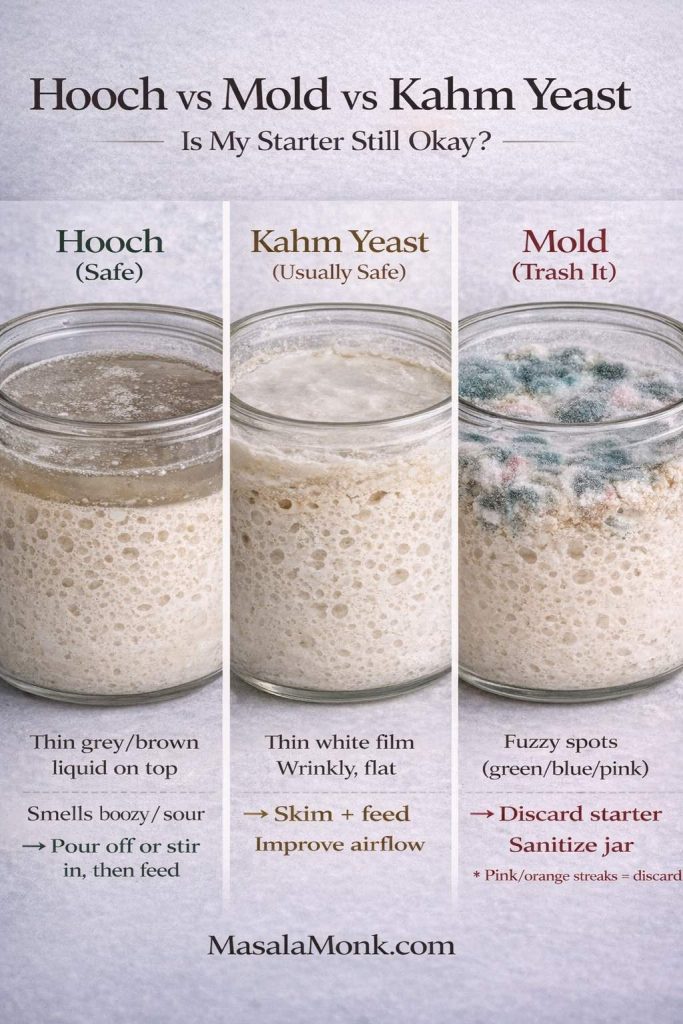
My starter has liquid on top

That liquid is commonly called hooch. It’s usually a sign of hunger.

You can either stir it in for a stronger tang or pour it off for a milder profile. Then feed.

My starter seems “stuck” after an early burst of activity

That early burst happens to many beginners. Then the jar goes quiet. It’s frustrating, yet it’s also normal.

Keep feeding consistently. Add warmth. Consider using a portion of whole wheat for a couple feeds. In most cases, the starter returns with steadier, healthier activity.

Mold vs hooch: when to discard

Here’s the simple rule: fuzzy mold is not something to negotiate with.

If you see fuzzy growth—especially green, blue, or white fuzz—discard the starter and start again. Food safety guidance explains why mold can be risky, particularly in soft foods where it can spread beyond what you see, such as USDA guidance on molds in food.

Infographic showing three sourdough starter problems: hooch (thin gray-brown liquid on top; safe—pour off or stir then feed), kahm yeast (thin white wrinkly film; usually safe—skim and feed, improve airflow), and mold (fuzzy green/blue/pink spots; discard starter and sanitize jar).
Hooch vs kahm yeast vs mold: a quick visual guide to tell what you’re seeing on top of your sourdough starter—and what to do next (pour off and feed, skim and feed, or discard and sanitize).

On the other hand, a grayish liquid layer, a sharp smell, or a dark “skin” can happen when a starter is neglected. Those cases usually respond to discarding down to a clean portion and feeding well for a few days.

If you enjoy fermentation projects beyond sourdough—and you want a consistent “clean jar, observe daily, discard if mold” mindset—your internal posts on fermented garlic honey safety and DIY fermented fruit juices pair naturally with the same habits.

Also Read: Manhattan Cocktail Recipe (Classic + 6 Variations)


Dried sourdough starter and dehydrated sourdough starter: backup that’s surprisingly easy

Once your starter is strong, drying a small amount is like making a spare key. It’s useful if you travel, want a backup, or plan to share starter with someone else.

Studio-style infographic titled “Starter Backup: Dehydrate Your Starter (Make a Spare Key)” showing sourdough starter dried into flakes on a parchment-lined baking tray, a glass jar labeled “Starter flakes (backup),” and a bowl where flakes are being mixed with water and flour to rehydrate. The steps read: 1) Spread thin at peak on parchment, 2) Dry until brittle (break into flakes), 3) Store airtight, 4) Rehydrate: water + flour paste, 5) Feed daily until it rises predictably. MasalaMonk.com appears in the footer.
When your starter is strong, drying a small amount is like making a spare key—perfect for travel, emergencies, or gifting. Spread a thin layer at peak, dry until brittle, and store the flakes airtight. When you need it again, rehydrate with a little water and flour into a paste, then feed daily until it’s rising on schedule. Save this card if you want a backup starter you can revive anytime (without panic or starting from scratch).

How to make a dehydrated starter

  1. Feed your starter and let it reach peak activity.
  2. Spread a thin layer on parchment paper.
  3. Let it dry completely until it becomes brittle.
  4. Break it into flakes and store airtight.

Rehydrating dried sourdough starter

To rehydrate:

  1. Add flakes to a little water and let them soften.
  2. Stir in flour to create a paste.
  3. Feed daily until it begins rising consistently again.

Revival can take a few days, so patience matters. Still, it’s very doable. For additional guidance on starter routine and refresh cycles, The Perfect Loaf’s starter maintenance routine is a strong reference when you want deeper context on timing and consistency. Likewise, Breadtopia has practical notes on starter care and reactivation that many home bakers find helpful, such as their starter guidance and revival information.

Also Read: Rob Roy Drink Recipe: Classic Scotch Cocktail (Perfect + Dry + Sweet Variations)


Vertical infographic titled “How to Gift Sourdough Starter (3 Ways)” with the header “Share the Starter.” Three panels show: 1) Live starter jar gift on a kitchen scale with a tag that says “Feed 1:2:2”; 2) Dried flakes in a small bag and jar with a note “Just add water & flour!”; 3) A mini kit with a small jar of starter and a tag “Feed Your Starter!” with a rubber band and simple items. A short checklist under each panel explains the steps. MasalaMonk.com appears in the footer.
Sourdough is one of the sweetest “pass-it-on” gifts—because it keeps going. You can share it as a live jar starter (include a simple note like feed 1:2:2), as dried flakes that travel well (just add water + flour to revive), or as a tiny beginner-friendly mini kit with a jar, rubber band, and a quick feeding reminder. Save this for holidays, housewarmings, or that friend who keeps saying they “want to try sourdough someday.”

Levain starter recipe: how it fits into your starter routine

Once your starter is established, you’ll often hear the word “levain.” Levain is simply a build: a portion of starter mixed with fresh flour and water to create the amount—and the strength—you want for a specific bake.

Studio-style infographic titled “Levain vs Starter (What’s the Difference?)” showing two glass jars of sourdough: one labeled “Main Starter (keep small)” and one labeled “Levain (build for baking day).” A hand pours flour into the levain jar. A two-column chart explains: the main starter lives in the jar with daily/weekly care, is kept small to reduce discard, and feeds future levains; levain is a fresh build for one bake, mixed from starter plus flour and water, and used at peak for best rise. MasalaMonk.com is in the footer.
If “starter” and “levain” sound like two different things, this is the simple truth: your main starter is the small jar you maintain, while levain is the fresh build you make for baking day. Keep the main starter small so it’s easy to feed (and you waste less). Then, when you want to bake, mix a portion of starter with fresh flour and water to create a levain—use it at peak for your best rise and loft. Save this card for the next time a recipe calls for “levain” and you want the difference in one glance.

Think of it as a fresh batch made for baking day:

  • You keep your main starter small
  • You build levain when you need more volume or a particular flavor profile

This approach keeps your everyday maintenance simple while giving you flexibility for different breads.

When you’re ready to use levain in practice, your sourdough bread recipes make a natural next step, because you can match starter strength with a specific loaf method and timeline.

Also Read: Best Vermouth for a Negroni Cocktail Drink Recipe


Discarded sourdough starter: how to use it without feeling like you’re “wasting” anything

Discard can feel annoying at first. Then it starts to feel like a bonus ingredient—tangy, tenderizing, and useful in quick bakes.

Vertical infographic titled “Sourdough Discard Ideas (No Waste)” showing four meal-moment tiles: Weekend Breakfast pancakes, Pizza Night flatbread/pizza, Toast Boards with toast and spread, and Warm Dips with marinara and bread. Each tile notes a benefit like tang, tenderness, chew, browning, crispness, and easy dunkers. A “Quick wins” strip mentions using cold discard, using it in pancakes/flatbreads/quick breads, and keeping a smaller starter to reduce discard. MasalaMonk.com in the footer.
Discard isn’t trash—it’s your shortcut ingredient. Use it for pancakes that stay tender, pizza/flatbreads with better chew, toast that crisps up beautifully, and quick dunkers for marinara nights. Save this as your “no-waste” reminder for the next time you feed your starter—then turn the jar into something you’ll actually eat.

If you keep a smaller starter, you’ll naturally produce less discard. Still, even a little discard can add flavor and softness to pancakes, flatbreads, and quick breads.

Infographic titled “Sourdough Discard: Store It Safely” comparing when to KEEP vs TOSS sourdough discard. Keep (Normal): store in a clean jar, label the date, use within 7 days for best flavor, and stir before using because hooch is normal. Toss (Not worth it): fuzzy mold of any color, pink or orange streaks, strong rotten smell, or a dirty crusty jar rim. Bottom strip lists best quick uses: pancakes, flatbreads, and quick breads. Footer reads MasalaMonk.com.
Discard doesn’t have to feel like waste—it can be your secret ingredient. Save this Keep vs Toss guide so you always know what’s normal (including hooch) and what’s a hard no (mold, odd colors, rotten smell). Then use your discard in quick wins like pancakes, flatbreads, and quick breads—easy ways to add tang and tenderness while keeping your starter routine low-stress.

Meanwhile, if you want a simpler “practice bake” while your starter matures—something that builds confidence without needing perfect timing—your homemade garlic bread loaf and braided coconut and banana bread are friendly, approachable options.


A calm, repeatable routine for long-term starter success

Once the starter is healthy, the best results come from a routine you can actually keep.

Infographic titled “Sourdough Starter Routine” showing three schedules based on how often you bake: Bake Often (3+ times/week)—keep starter at room temperature, feed daily (twice if very warm), bake near peak; Bake Weekly (1x/week)—store in fridge, feed weekly, wake up with 1–2 room-temp feeds; Bake Rarely (1–2x/month)—fridge most of the time, refresh every 1–2 weeks, plan 2 days of feeds before baking. Footer reads MasalaMonk.com.


Not everyone bakes sourdough on the same rhythm—and that’s the point. Use this simple starter routine picker to match your feeding schedule to real life: room-temp maintenance for frequent bakers, fridge storage for weekly bakes, and a low-effort refresh plan if you bake rarely. Save this as your quick reference so your starter stays strong without constant guessing—then follow the steps in the post to time feeds, hit peak activity, and wake a sleepy fridge starter before baking.

You bake often (several times a week)

  • Keep the starter at room temperature
  • Feed daily (or twice daily if warm and fast-moving)
  • Use it near peak activity for baking

If you bake once a week

  • Store in the fridge
  • Feed weekly
  • Wake it up with 1–2 room-temperature feeds before baking

And if you bake rarely

  • Keep it in the fridge most of the time
  • Refresh every 1–2 weeks
  • Plan a couple days of feeds before baking day

This flexibility is what makes sourdough sustainable. You don’t have to serve the jar; the jar can fit your life.

Also Read: Paper Plane Cocktail Recipe + Best Amaro Substitutes & Tips


Before you bake: a small ritual that improves consistency

If you want dependable performance, especially when you’re moving from “starter building” into real dough, do this:

  1. Feed your starter and let it reach a strong rise.
  2. Feed again if needed until it rises predictably.
  3. Use it when it looks domed, bubbly, and lively.

Then head into our sourdough bread recipes and choose the bake that suits your day—something quick and forgiving, or something slow and deep in flavor.


A sourdough starter can begin as a jar of floury paste. Still, over time, it becomes a rhythm—one that makes your kitchen feel a little more alive, your baking more personal, and your bread more satisfying. Keep it simple, keep it steady, and let the culture do what it’s built to do.

Also Read: Green Chutney Recipe (Coriander–Mint / Cilantro Chutney)


FAQs

1) How long does a sourdough starter recipe take to work?

Most starters become reliable somewhere between 7 and 14 days. Even so, the exact timing depends on temperature, flour type, and how consistently you feed it. If your kitchen is cool, it may take longer; meanwhile, in warmer conditions it often strengthens faster. Rather than chasing a specific day, watch for a repeatable rise-and-fall pattern after feeding.

2) What’s the difference between sourdough starter and “starter dough for sourdough bread”?

They’re essentially describing the same base culture: flour and water fermented over time. “Starter dough for sourdough bread” is simply a more literal phrase some people use for sourdough starter. In practice, you’re building the same living leaven—one you can maintain indefinitely once it’s active.

3) How do I know when my starter is an active sourdough starter?

Look for consistency more than drama. A truly active sourdough starter rises predictably after feeding, shows bubbles throughout (not only on the surface), and smells pleasantly tangy or lightly fruity. Additionally, it should peak and then slowly begin to recede, which shows it’s completing a full fermentation cycle.

4) Does the float test prove my sourdough starter recipe is ready?

Not always. Although a floating spoonful can suggest good gas retention, hydration and flour type can skew results. Instead, treat it as a bonus sign. For a clearer read, rely on steady doubling (or near doubling), a domed peak, and a balanced aroma after feeding.

5) Why did my starter rise a lot on day 2 or 3, then stop?

That early surge is common. At first, a mix of microbes can create quick activity; afterward, the culture often “resets” while the more stable yeast-and-bacteria community establishes itself. Consequently, a quiet phase doesn’t mean it failed. Keep feeding consistently and it usually returns stronger.

6) What’s the best flour for sourdough starter recipe success?

All-purpose flour works, yet many starters get going faster with whole grain flour, especially whole wheat or rye. Because whole grain flour carries more nutrients, it can boost activity, particularly in the first week. That said, once your starter is stable, you can switch back to all-purpose or keep a blend, depending on flavor and performance.

7) Can I make a sourdough starter with whole wheat flour only?

Yes. In fact, a whole-wheat-only starter often becomes active quickly. However, it may absorb more water, so it can feel thicker. If stirring becomes difficult, add a small splash of water at the next feed until it returns to a thick-batter consistency.

8) What feeding ratio should I use when feeding sourdough starter?

A common everyday ratio is 1:1:1 by weight (starter:water:flour). Still, if your starter turns overly sour or sluggish, larger feeds such as 1:2:2 or 1:3:3 can help. In other words, more fresh flour and water can refresh the culture and improve rise strength.

9) How often should I be feeding sourdough starter at room temperature?

Usually once a day is enough at moderate room temperature. Nevertheless, if your kitchen is warm and the starter peaks quickly, feeding twice daily can keep it steadier. Watch the timing: if it rises, peaks, and falls well before your next feed, it’s probably asking for more frequent refreshment.

10) What if I’m feeding sourdough starter without a scale?

You can still succeed. Begin with roughly equal spoonfuls of flour and water, then adjust until it resembles thick pancake batter. Even better, stay consistent for several feeds in a row. Since cup measures vary, texture becomes your most dependable guide.

11) What does hooch mean, and should I stir it in?

Hooch is the liquid that can collect on top when the starter is hungry. You can stir it in for a sharper flavor, or pour it off for a milder starter. Either way, follow with a feeding. Over time, regular feeds reduce how often hooch appears.

12) How do I store a sourdough starter in the fridge?

Feed it, let it begin to show activity at room temperature, then refrigerate. After that, refresh it weekly if you bake occasionally. When baking day approaches, bring it back to room temperature and feed it once or twice until it rises predictably again.

13) How do I handle feeding refrigerated sourdough starter before baking?

Pull it out 24–48 hours ahead, discard down to a small amount, then feed. Once it rises and peaks, feed again if needed. As a result, you rebuild strength and timing, which tends to improve oven spring and flavor.

14) Why is my starter bubbling but not rising much?

Often it’s either too thin or not strong enough yet. Try thickening the texture slightly at the next feed, keep it warmer, and use a larger feed ratio for a couple of days. Additionally, switching one or two feeds to whole wheat can support stronger activity.

15) Why does my sourdough starter smell very sour, sharp, or like acetone?

That usually points to hunger. In that case, feed more frequently or increase your feed ratio. For example, keep a smaller amount of starter and add more fresh flour and water. After a few refresh cycles, the aroma typically softens.

16) How do I know if it’s mold or just normal starter funk?

Normal starter funk can be tangy, sharp, or even a bit “cheesy” early on, yet it won’t look fuzzy. Mold usually appears as fuzzy patches or colored growth. If you see fuzz or anything unmistakably mold-like, it’s safest to discard the starter and start over with a clean jar.

17) Can I save my starter if I accidentally forgot to feed it?

Often, yes. If there’s no mold, discard down to a small portion from the cleanest area, then feed at a higher ratio (like 1:3:3) for a few days. Meanwhile, keep it warm and consistent. Most neglected starters bounce back surprisingly well.

18) What is a levain starter recipe, and do I need one?

A levain is a build made from your main starter plus fresh flour and water for a specific bake. You don’t need levain to keep a starter alive; rather, levain helps you scale up the amount you need for bread while keeping your main starter small and easy to maintain.

19) What’s the difference between dried sourdough starter and dehydrated sourdough starter?

They’re the same idea: starter that has been fully dried into flakes or powder so it can be stored long-term. “Dehydrated sourdough starter” is simply a more explicit phrase. Either way, you rehydrate it with water, then feed it repeatedly until it becomes active again.

20) How long does reviving dried sourdough starter take?

Usually a few days, although it can take up to a week depending on how dry it was, how warm your kitchen is, and which flour you use. At first, you’ll see small bubbles. Then, with steady feedings, it begins rising more predictably again.

21) How do I rehydrate dried sourdough starter without messing it up?

Start small. Soak the flakes in a little water until softened, stir in flour to form a paste, and let it sit. After that, feed daily at consistent intervals. If it seems weak, use whole wheat for a feed or two and keep it comfortably warm.

22) What should I do with discarded sourdough starter?

Discarded sourdough starter can be used in quick bakes where you want tang and tenderness. For instance, it can enrich pancakes, waffles, crackers, or flatbreads. Alternatively, you can keep discard in the fridge for a short period and use it in batches, as long as it stays clean and mold-free.

23) Can I buy sourdough starter online, and is it better than homemade?

Buying sourdough starter online can be convenient, especially if you want a quick start or a backup culture. However, homemade starter is just as capable once it’s established. Ultimately, the best sourdough starter is the one you can maintain consistently, whether it began at home or arrived in the mail.

24) What makes the best sourdough starter, long term?

Consistency wins. A predictable feeding routine, a stable temperature, and a texture that traps bubbles will take you further than any single trick. Moreover, keeping your starter smaller and feeding at a ratio that matches your schedule reduces stress, which makes it easier to stick with it—and that’s where the real magic happens.