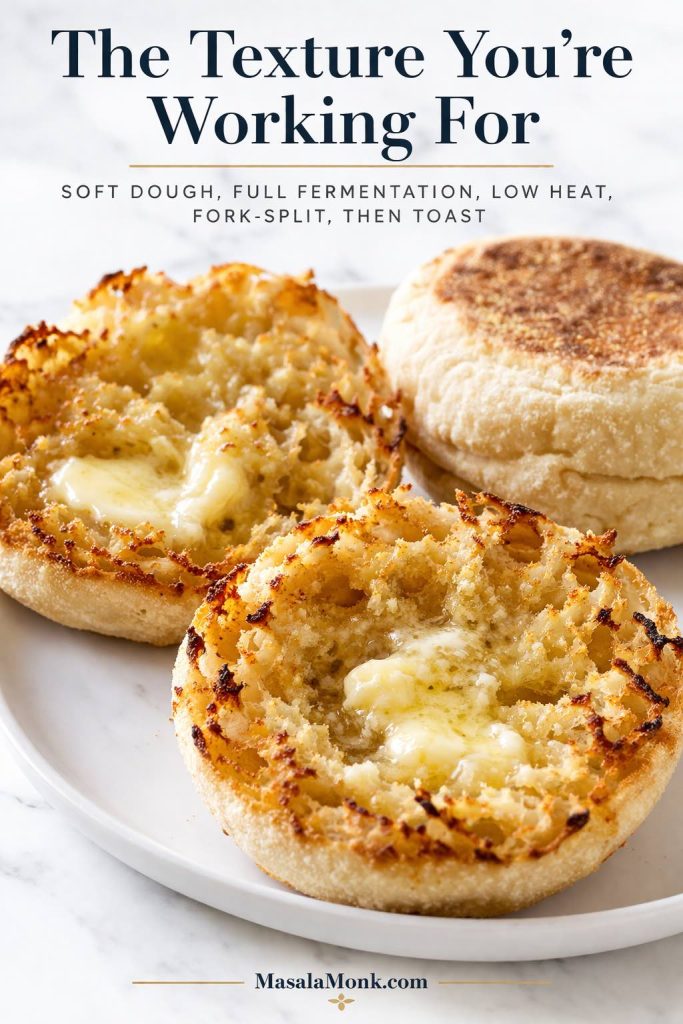
Posted on 1 Comment

Sourdough Focaccia Recipe

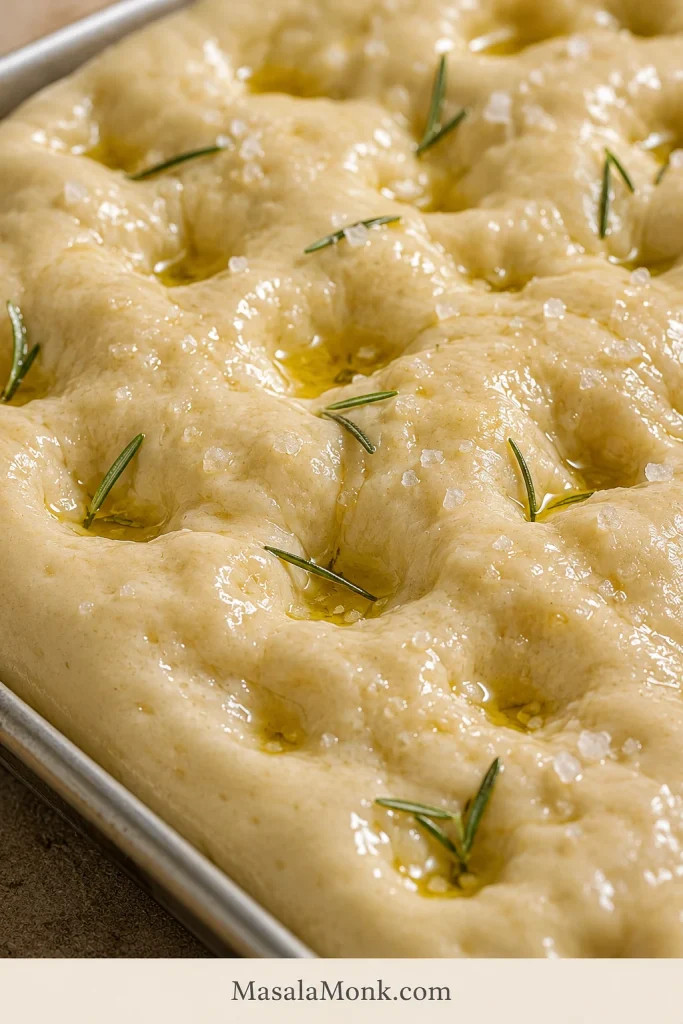
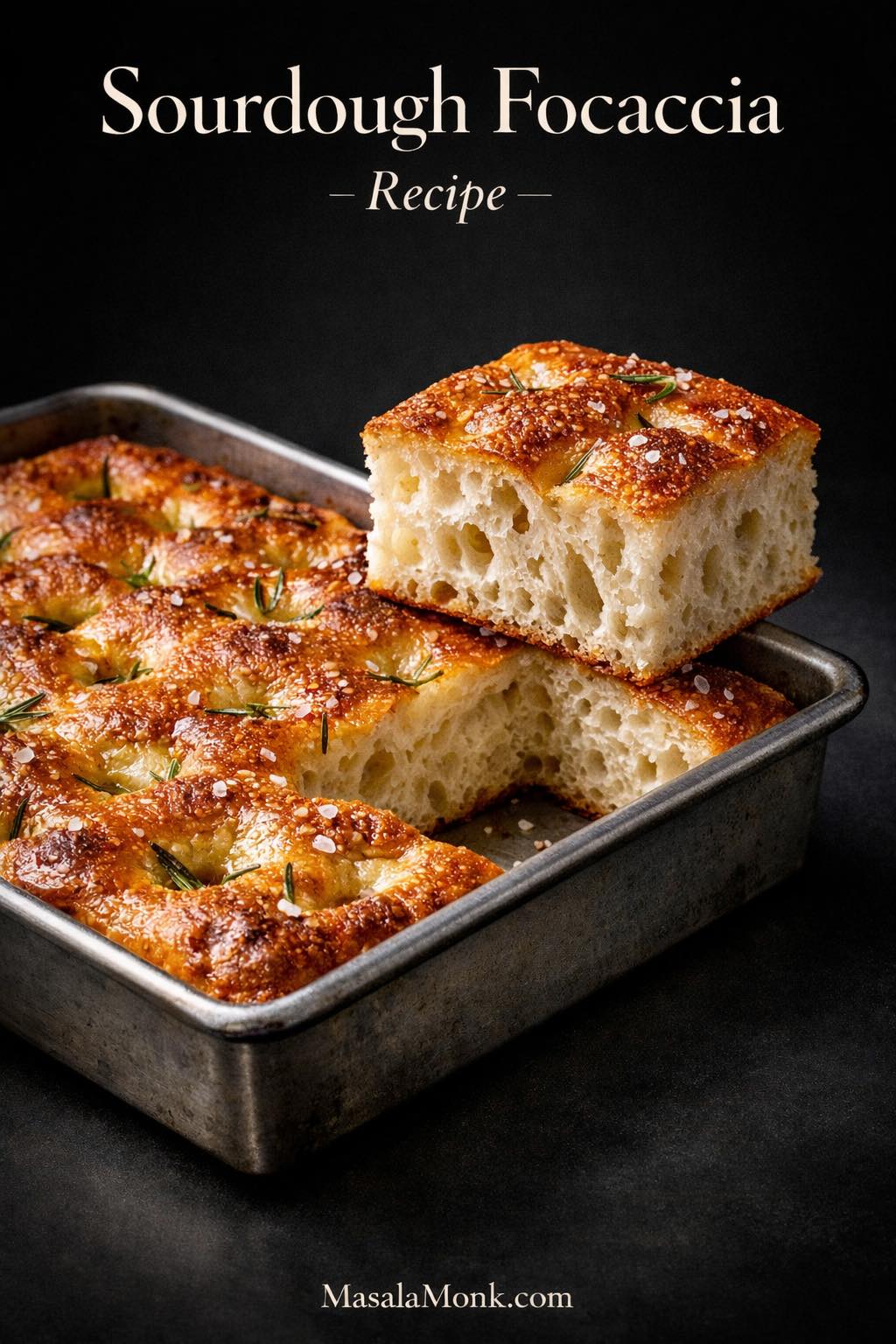
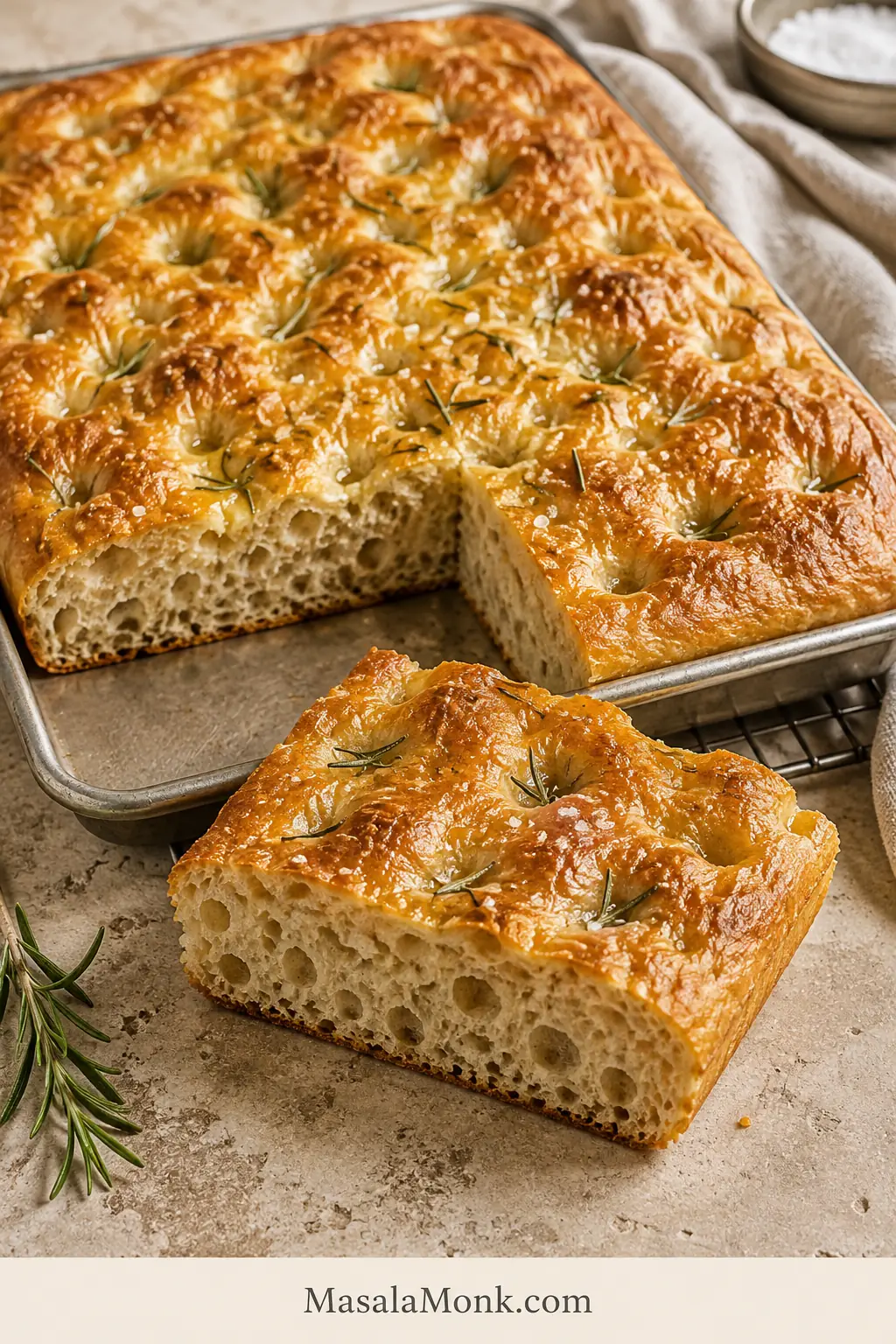
Sourdough focaccia recipe hero image showing thick golden focaccia in a metal pan with airy open crumb, deep dimples, olive oil, flaky salt, and rosemary.

A good sourdough focaccia recipe should give you three things: a light, airy crumb, crisp olive-oil edges, and a method that feels clear before you even start mixing. This version is built around active sourdough starter, an overnight rest, and a 9×13-inch metal pan because that is the easiest way to get the best balance of lift, flavor, structure, and ease at home.

Real baking is rarely that tidy, though. Some days your starter is strong and you want focaccia by dinner. Other days you want to use discard and keep the dough moving without gambling on it. So this guide shows you the main route first, then helps you adjust when real life gets in the way. Just as importantly, it shows you what the dough should look and feel like at each stage, because that matters far more than blindly following the clock.

Quick answers before you bake

Best default route: active starter, overnight rest, 9×13-inch metal pan. This is the safest place to start.

Can you make it the same day? Yes, if your starter is strong and your kitchen is warm. You just need to watch the dough more closely.

Can you use discard? Yes. It usually moves more slowly, though, unless you add a little yeast.

Best pan: a well-oiled 9×13-inch metal pan. It gives the best browning, the best structure, and the fewest surprises.

Main success cue: bake when the dough looks puffy and lightly jiggly. If it still looks tight and reluctant, it is not ready yet.

Also Read: Easy English Scone Recipe

Choose your sourdough focaccia route

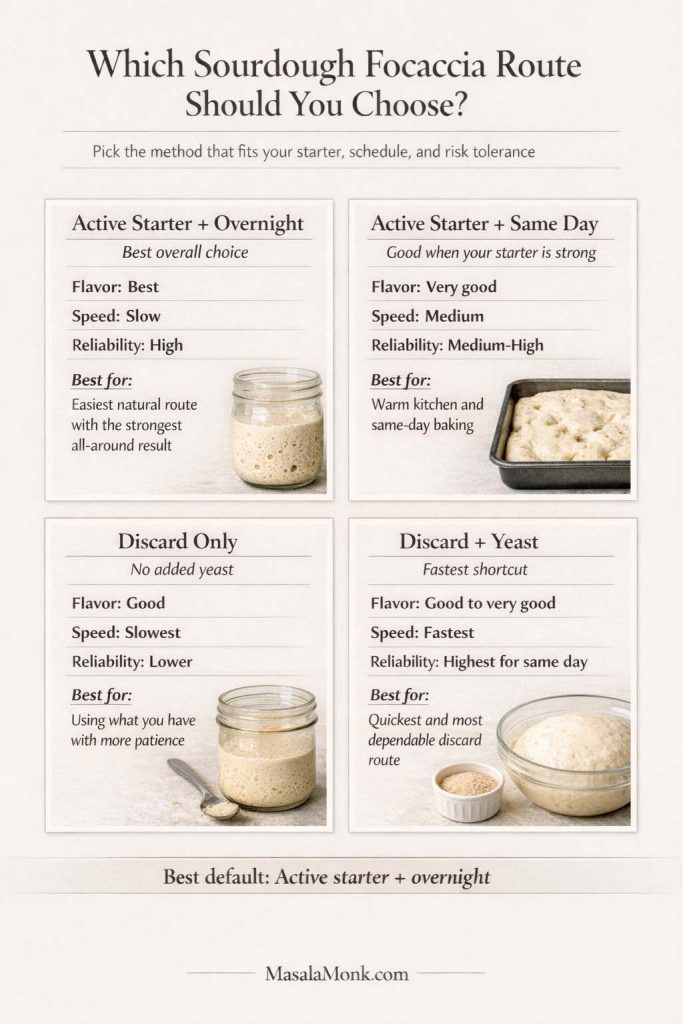
For the best overall result, choose active starter + overnight. This is the route I would hand to most people first. It gives you the best natural lift, the best flavor, and the calmest workflow.

Sourdough focaccia route guide comparing active starter overnight, active starter same day, discard only, and discard plus yeast options.
Start with active starter and an overnight rest when you want the strongest all-around result, move to same-day when your starter is lively, use discard when flexibility matters more than speed, and bring in a little yeast when you want the quickest dependable shortcut.

Choose active starter + same day when your starter is lively, the room is warm, and you want focaccia on the table by dinner. It can turn out beautifully, but you do need to stay more tuned in because the dough can move faster than you expect.

Choose discard only when using what you already have matters more than speed. Focaccia is forgiving enough that this can still work well, especially because the dough is pan-baked, but it usually takes more patience.

Choose discard + yeast when you want the safest shortcut. If you want a fast same-day focaccia and do not want to bet everything on tired discard, this is the smart route.

Why this sourdough focaccia recipe works

High hydration gives the crumb its open, airy texture

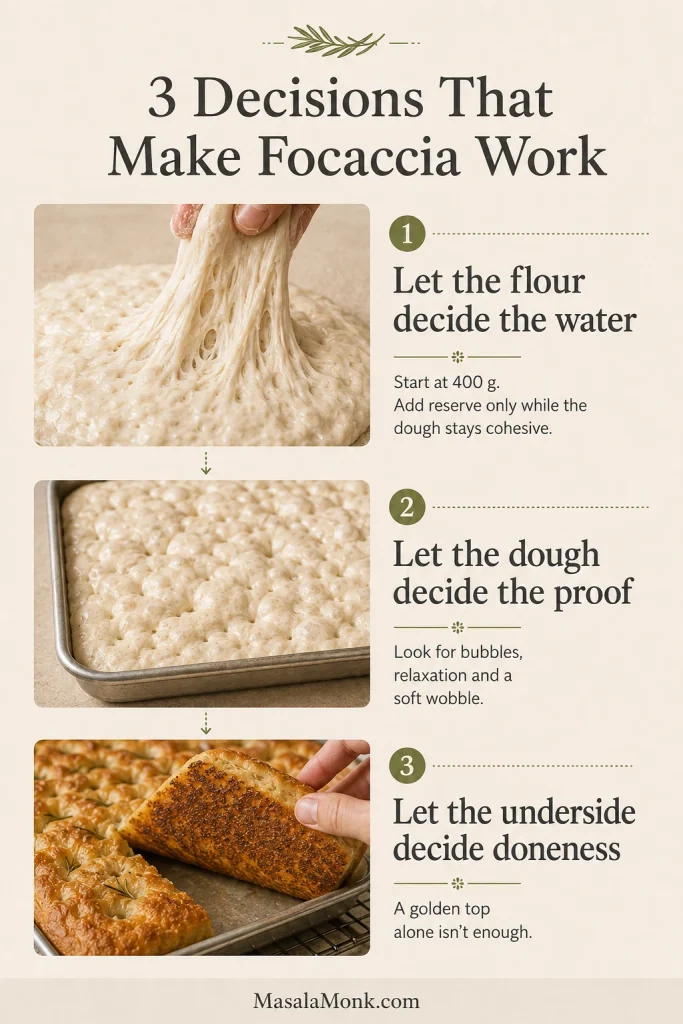
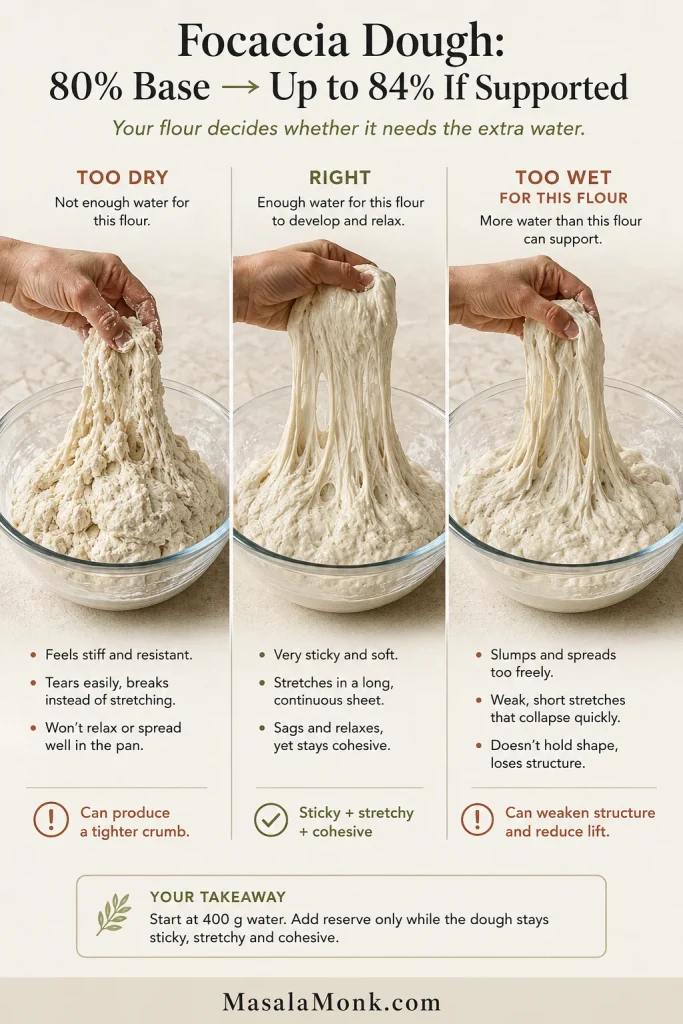
Focaccia dough should feel wetter and looser than many bakers expect at first. That extra water is what helps create the glossy irregular bubbles, soft interior, and lively bite that make focaccia feel worth baking. Add too much extra flour just to make the dough feel tidy and the crumb usually tightens fast.

Olive oil helps create the crisp, deeply golden edges

Focaccia needs enough olive oil under it and over it to bake the way focaccia should. The oil in the pan lightly fries the base as it bakes, while the oil on top helps browning, protects the surface, and gives the crust its rich golden finish. A cautious hand with the oil usually leads to a paler, drier result. Extra-virgin olive oil gives a stronger flavor, while regular olive oil tastes lighter; either one works. For a useful visual benchmark of how generously focaccia can be oiled without becoming greasy, King Arthur Baking’s big and bubbly focaccia is worth studying.

Time matters more than heavy kneading

This dough does not need aggressive kneading. It needs time, a few rounds of folds, and enough fermentation to become visibly airy before it goes into the oven. Put differently, the dough needs gas, softness, and some internal strength. Once it has those, the oven can do the rest.

A pan makes focaccia more forgiving than many sourdough loaves

One reason sourdough focaccia is such a strong beginner bake is that the pan supports the dough from start to finish. There is no shaping a boule, no scoring, and no need to trap oven spring inside a freestanding loaf. The pan also makes a wet dough much easier to handle, which is a big part of why focaccia is such a satisfying place to start.

Also Read: Sourdough English Muffins Recipe

Active starter vs discard: which should you use?

The best result in this article comes from active starter, and that is the route the full recipe follows. This formula assumes a 100% hydration starter, meaning equal weights of flour and water in the starter itself.

Use active starter for the strongest natural rise

Use active starter when it looks like a starter you would trust for a full loaf: domed, expanded, bubbly, and recently peaked or close to it. Ideally, it should have clearly risen after feeding and still look full of life. If it rose hours ago and has already collapsed back down, it is much less likely to give you the same lift here.

Use discard when flexibility matters more than maximum lift

Discard works well in focaccia because the dough is high-hydration and pan-baked. Even so, discard is usually weaker than active starter, so the rise may be slower, especially in a cool kitchen or on a tighter schedule. Serious Eats has a useful sourdough discard explainer if you want a broader look at how discard behaves in baking.

Use a little yeast with discard when you want speed and reliability

A small amount of instant yeast is the smartest shortcut when you want discard focaccia the same day. It does not make the bread less respectable. It simply makes the dough more dependable when the discard itself is not lively enough to do all the work quickly.

Also Read: White Russian Recipe: 7 Variants to Try, From Classic to Frozen

Same-day vs overnight sourdough focaccia

The main recipe below uses an overnight schedule because that route is easier to manage and easier to get right. Same-day focaccia is absolutely possible. Overnight focaccia is simply calmer, more flexible, and usually less stressful.

Choose the same-day method when you want bread by dinner

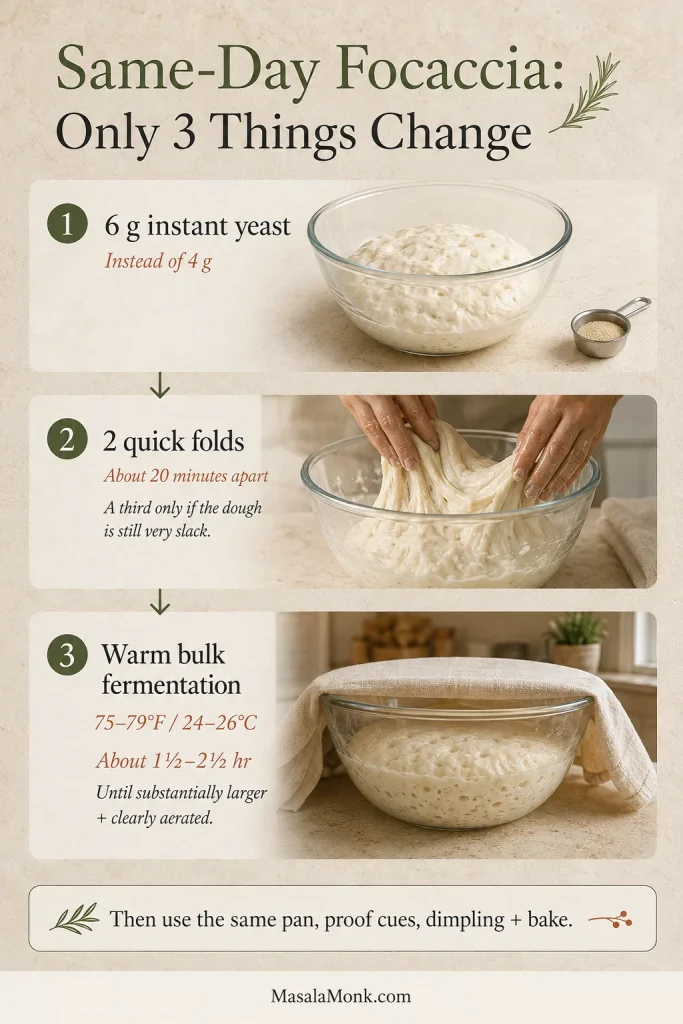
A same-day focaccia works best when your starter is active, the room is fairly warm, or you are willing to use a little yeast. It is a good route for spontaneous baking, but you do need to stay more attentive because the dough can move faster than you expect once the kitchen warms up.

Choose the overnight method when you want a calmer workflow

Overnight focaccia fits real life more easily. You can mix the dough in the evening, build some early strength, then refrigerate it and finish the pan proof the next day. The whole process feels less rushed, and the dough is usually calmer to handle.

Room temperature changes the timeline more than most recipes admit

At 76 to 78°F, dough can move much faster than it does at 68 to 70°F. That matters whether you are using active starter or discard. A warm kitchen can shorten fermentation by hours, while a cool kitchen can make the same dough seem stubborn. The dough matters more than the clock.

  • Warm kitchen, active starter: bulk fermentation can take around 4 to 5 hours.
  • Cool kitchen, active starter: bulk fermentation can take around 5 to 7 hours.
  • Discard only: expect more time unless the discard is unusually lively.
  • Discard + yeast: expect the fastest same-day route.

Ingredients for sourdough focaccia and what each one does

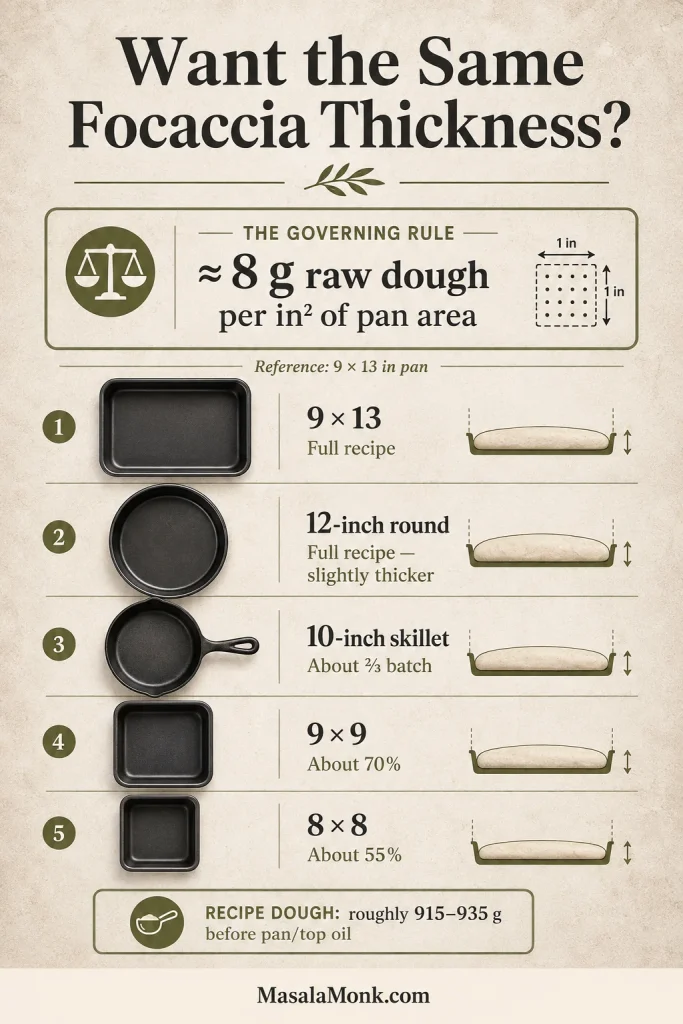
The main recipe below makes 1 thick focaccia in a 9×13-inch pan, enough for about 8 to 12 servings depending on how you cut it.

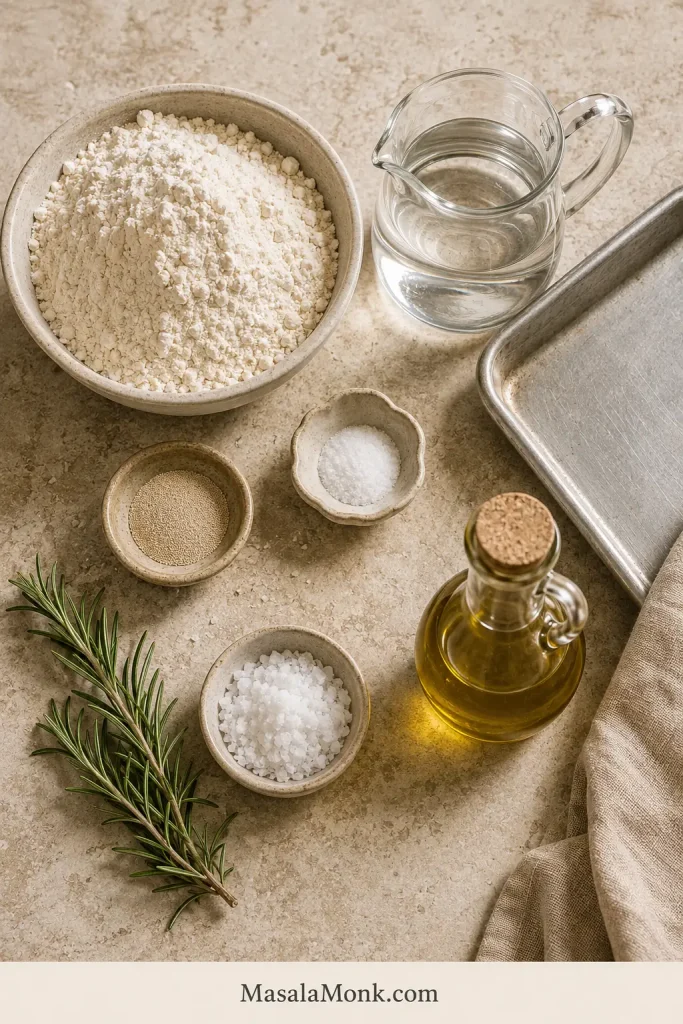
Main dough ingredients

  • 500 g bread flour
  • 400 g water
  • 100 g active sourdough starter, ripe and bubbly
  • 12 g fine sea salt
  • 20 g olive oil for the dough
  • 2 to 3 tablespoons olive oil for the pan
  • 1 to 2 tablespoons olive oil for the top
  • flaky salt for finishing
  • rosemary or other toppings as desired

Optional route adjustments

For an all-purpose flour version, replace the bread flour with all-purpose flour. The focaccia will still be very good, though usually a little softer and slightly less chewy.

For a discard-only version, replace the active starter with 100 g sourdough discard and expect a slower rise.

For a discard + yeast same-day version, use 100 g sourdough discard and add 4 g instant yeast when mixing.

Bread flour vs all-purpose flour

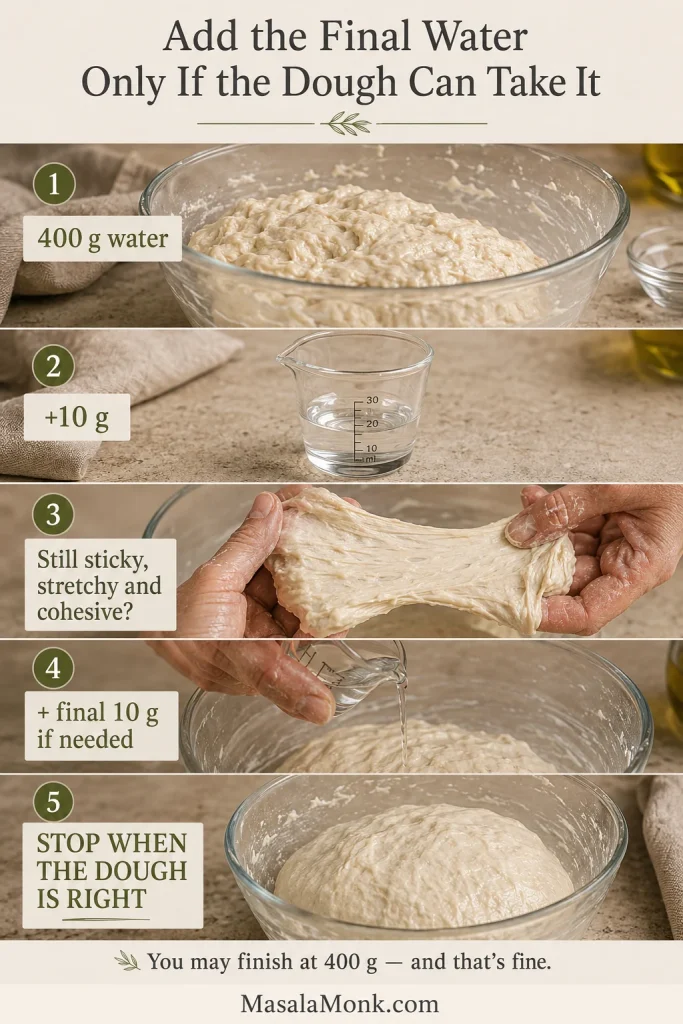
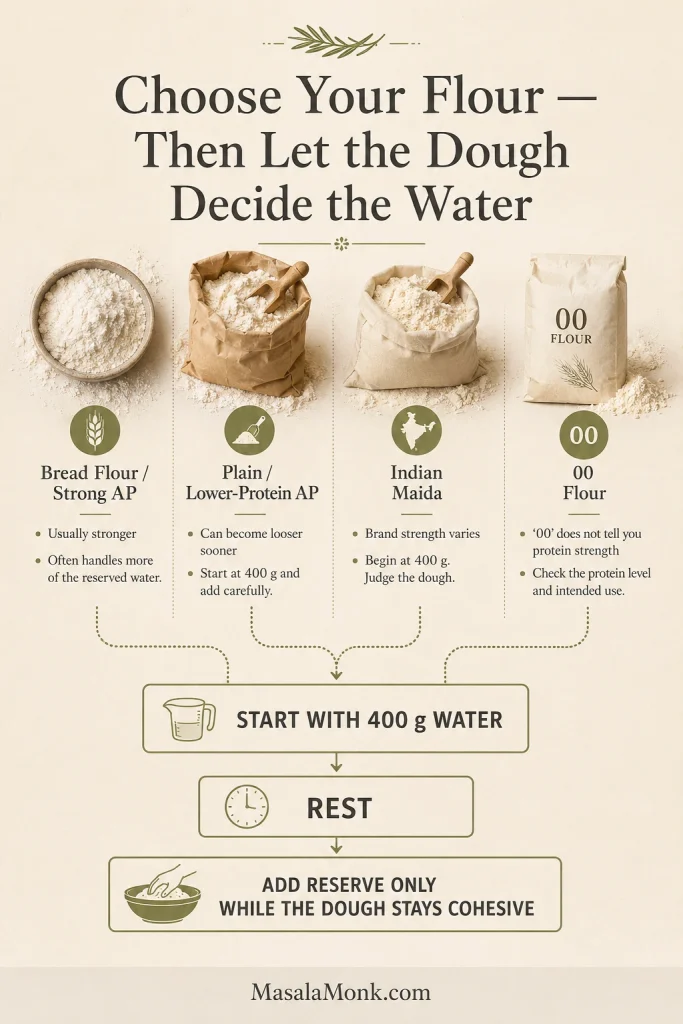
Bread flour gives the dough more strength, a little more height, and a chewier bite. For that reason, it is the better choice when you want more dramatic bubbles and better structure. All-purpose flour still works well and produces a slightly softer focaccia. If you are using standard all-purpose flour rather than bread flour, start by reducing the water by about 25 to 40 g and only add more if the dough still feels manageable. Weaker all-purpose flours usually absorb less water.

Why olive oil matters so much in focaccia

Olive oil is part of the structure as much as it is part of the flavor. It helps tenderize the crumb, improves browning, protects the surface, and creates the crisp underside and edges that make good focaccia feel rich rather than plain.

Salt, water, and hydration

Salt sharpens flavor and strengthens the dough. Water gives the dough its loose, airy potential. This is supposed to be a sticky dough. If you keep correcting it with extra flour until it feels tidy, you will lose the texture that makes focaccia worth baking. On humid days or with lower-protein flour, the dough may feel even looser than usual. Resist the urge to dump in a lot of extra flour all at once.

Toppings and when they should be added

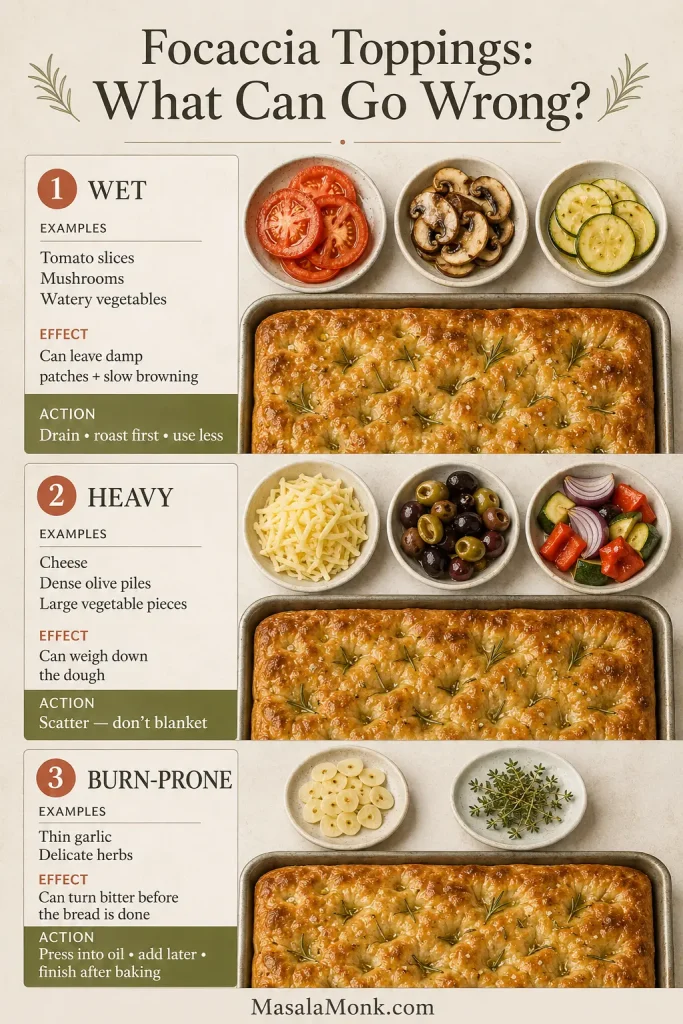
Rosemary and flaky salt are the best place to start. Olives and thin onion slices also work well before baking because they bring strong flavor without flooding the dough. Wetter toppings such as fresh tomatoes or fresh mozzarella need a lighter hand or a later addition so they do not weigh down the surface. More delicate herbs are usually better added after baking, while harder herbs such as rosemary can go on before the bread hits the oven.

Also Read: Mango Sorbet Recipe: Healthy & Plant Based Dessert

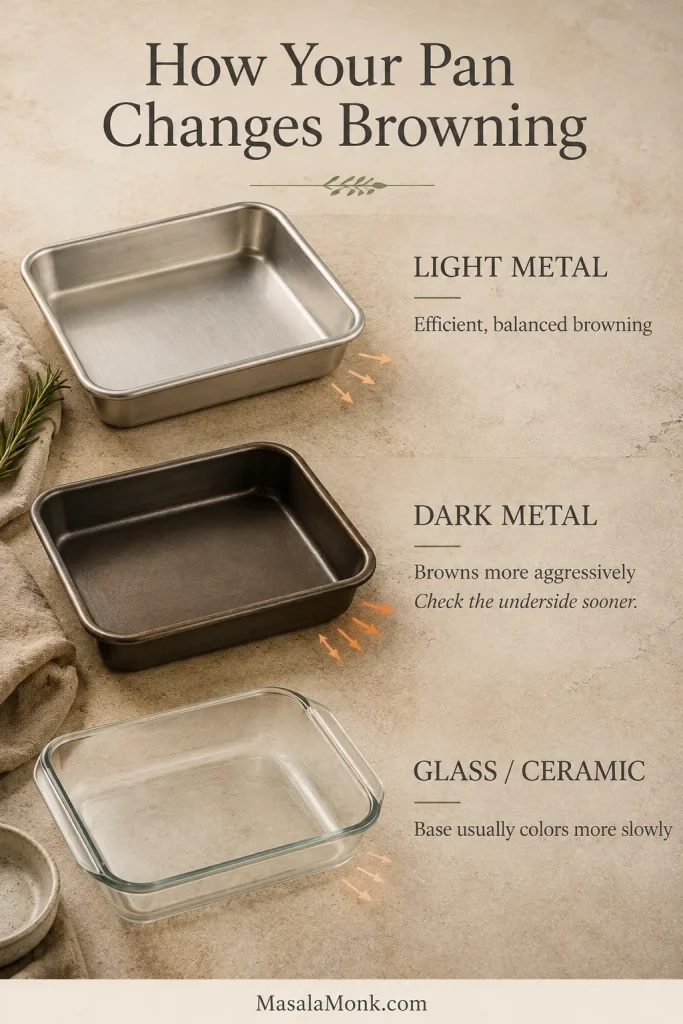
Best pan for sourdough focaccia

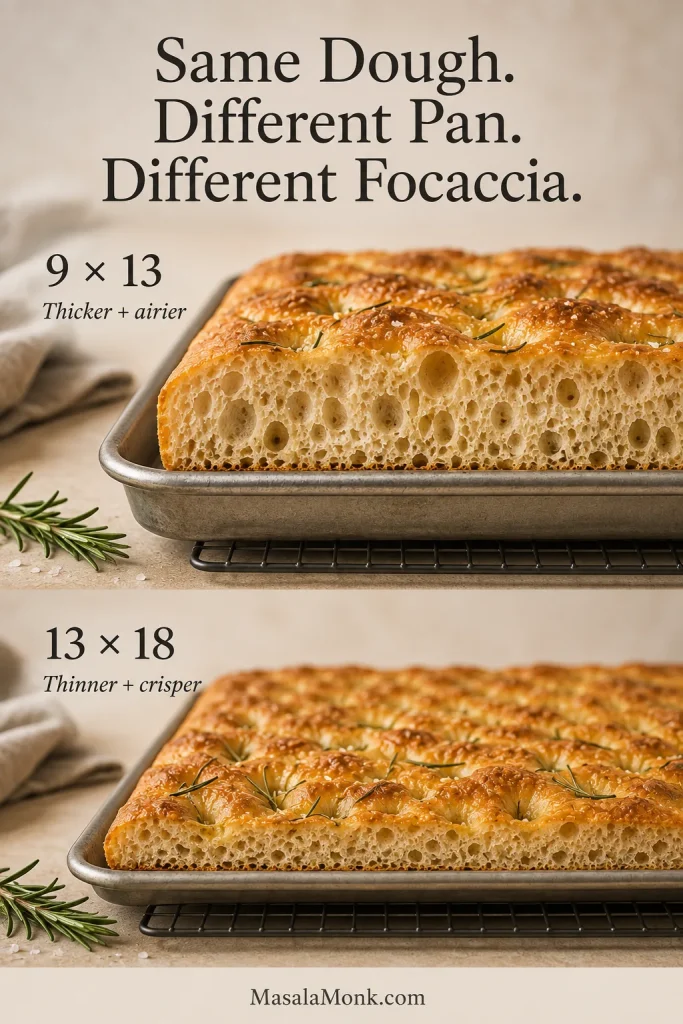
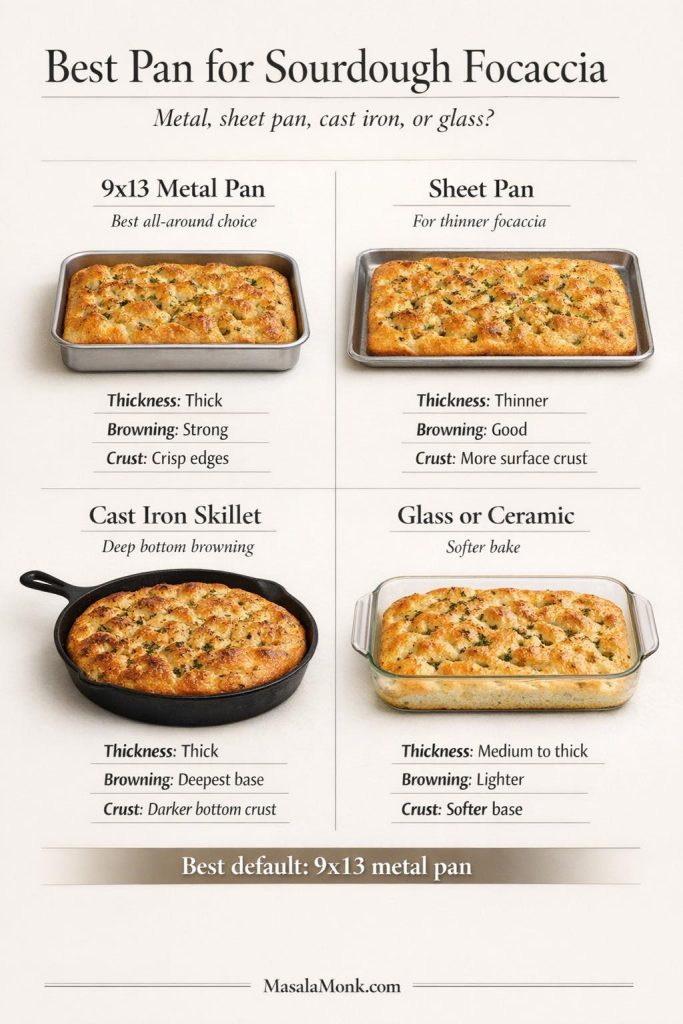
The best pan for most home bakers is a 9×13-inch metal pan. It gives the most predictable thickness, the strongest browning, and the best balance between a soft interior and crisp olive-oil edges.

Best pan for sourdough focaccia guide comparing a 9x13 metal pan, sheet pan, cast iron skillet, and glass or ceramic pan for thickness, browning, and crust.
A 9×13 metal pan is still the safest default, but changing the pan changes the bread too: sheet pans bake thinner, cast iron deepens the bottom crust, and glass or ceramic usually leaves the base a little softer.

9×13-inch metal pan for classic thick focaccia

This is the pan the main recipe is built around. Use it when you want a bakery-style slab with height, chew, and deeply golden edges.

Sheet pan for thinner focaccia

Use a sheet pan when you want a thinner focaccia with more crust and less height. The dough will spread more, bake faster, and feel a little more snackable.

Cast iron skillet for deeper browning

A well-oiled cast iron skillet can give you a darker, more assertive bottom crust. It is a strong choice when deep browning matters more than the classic rectangular shape.

Glass and ceramic pans for a softer base

Glass and ceramic pans can still work, but they usually brown less aggressively than metal. As a result, the bottom tends to stay softer and the bake may need a little longer. If you use glass, grease it more carefully than you think you need to, because sticking can be more annoying there than in a well-oiled metal pan.

Also Read: Protein Ice Cream Recipe: 10 Creamy Homemade Recipes

How to make sourdough focaccia step by step

This is the main method and the one to choose first: active starter + overnight schedule + 9×13-inch metal pan.

Mix the dough

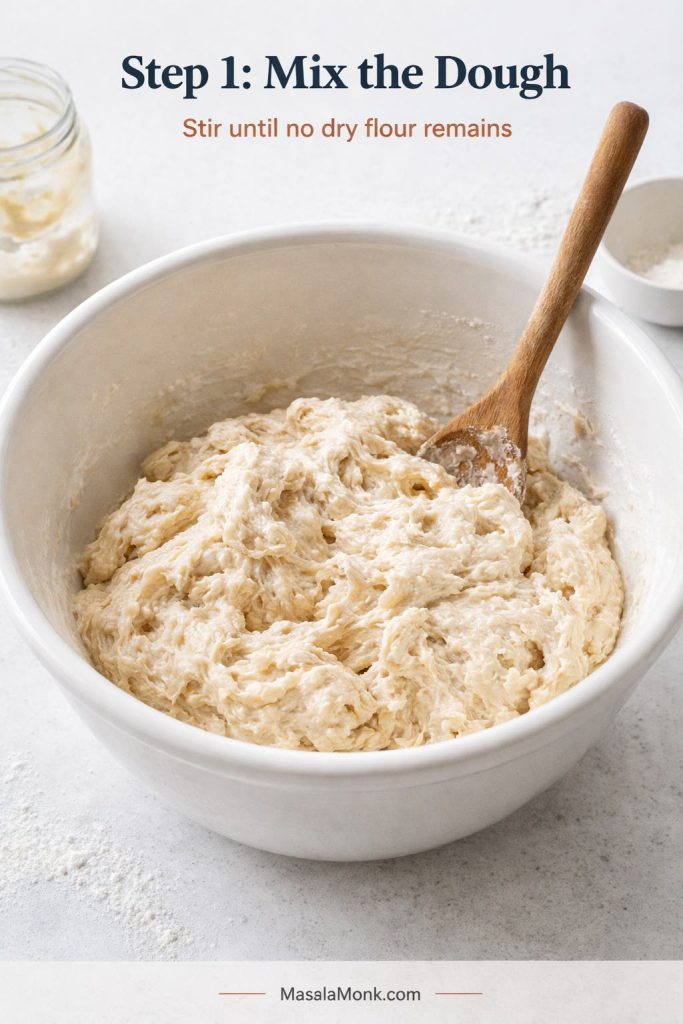
In a large bowl, combine the bread flour, water, active sourdough starter, salt, and 20 g olive oil. Mix until no dry flour remains.

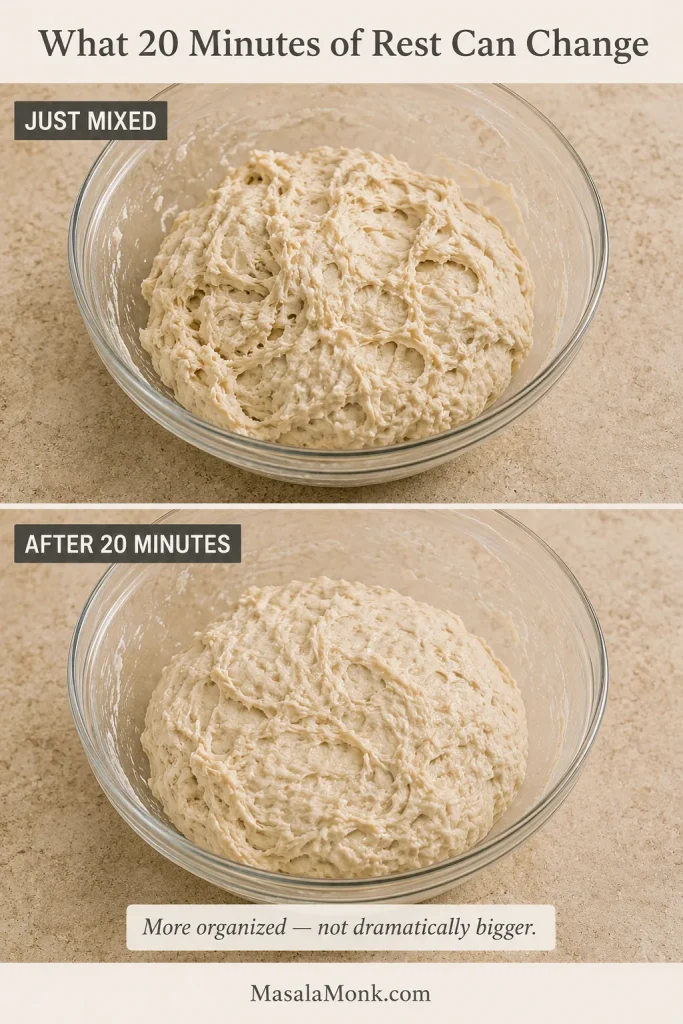
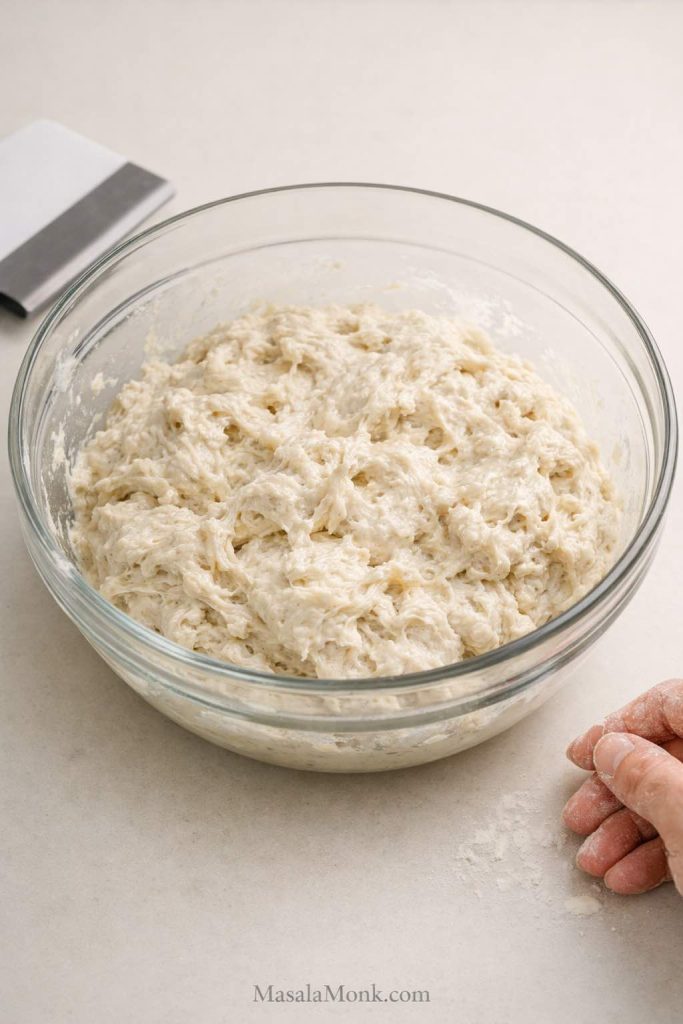
The dough will look rough, sticky, and a little unruly at this stage. That is normal. You are not aiming for a smooth kneaded dough.

Freshly mixed sourdough focaccia dough in a glass bowl showing a rough sticky high-hydration early stage before folds.
At this stage, the dough should look rough, sticky, and looser than many bakers expect; that slightly unruly texture is exactly what sets up a lighter, airier focaccia later on.

Rest and strengthen the dough

Cover the bowl and let the dough rest for 20 minutes.

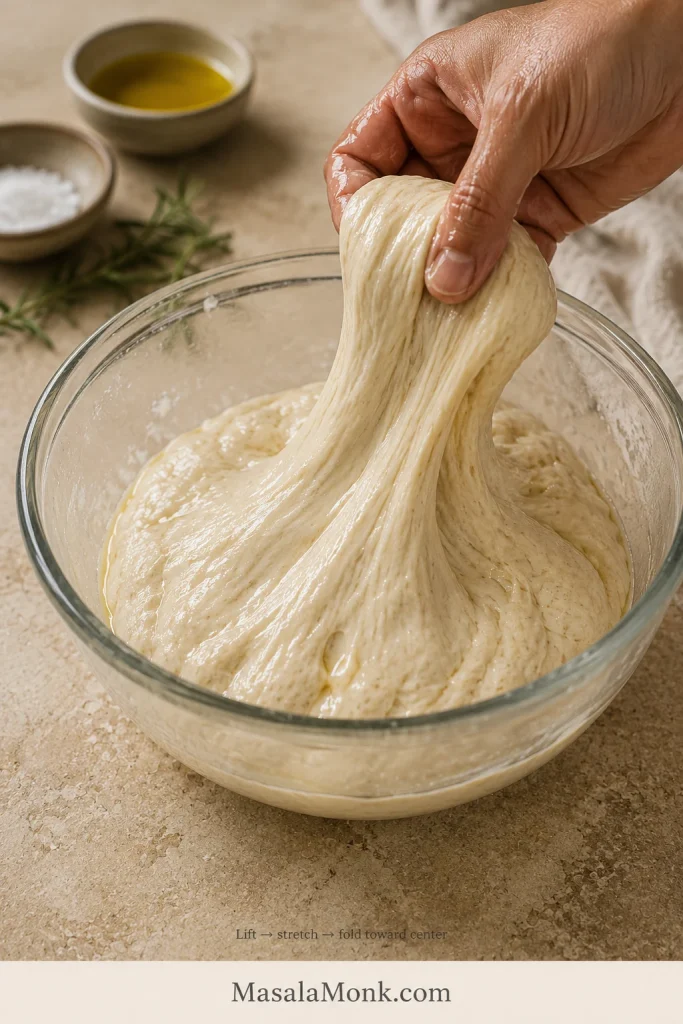
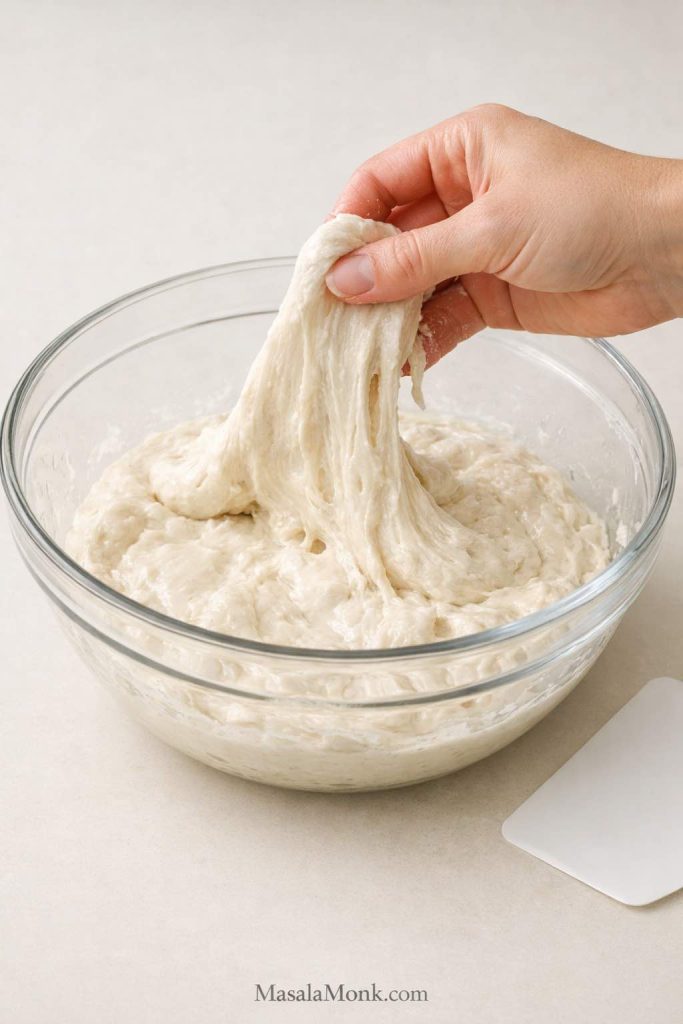
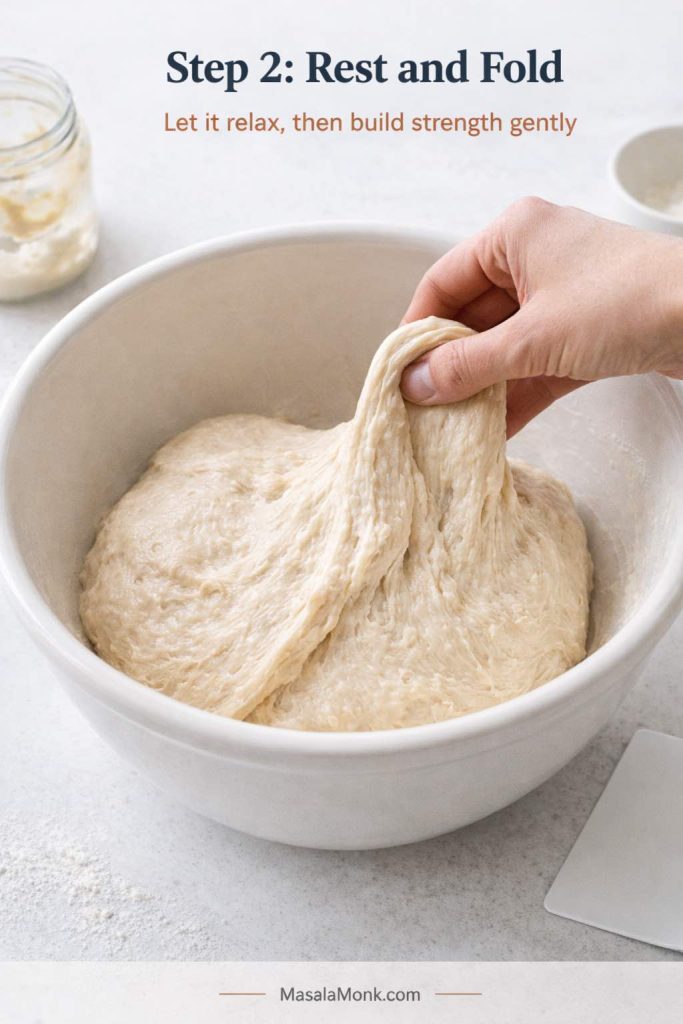
Then perform one round of stretch-and-folds by pulling one side of the dough up and folding it over itself. Rotate the bowl and repeat on all sides.

Repeat this process 3 more times, resting 20 to 30 minutes between rounds. By the final fold, the dough should still be sticky but noticeably smoother, more elastic, and better able to hold itself.

Hand lifting and folding sticky sourdough focaccia dough in a glass bowl during a stretch-and-fold.
This step is about gentle strength, not hard kneading; the dough should stretch softly, feel sticky, and fold back over itself without needing extra flour to make it behave.

Bulk ferment until the dough looks airy and alive

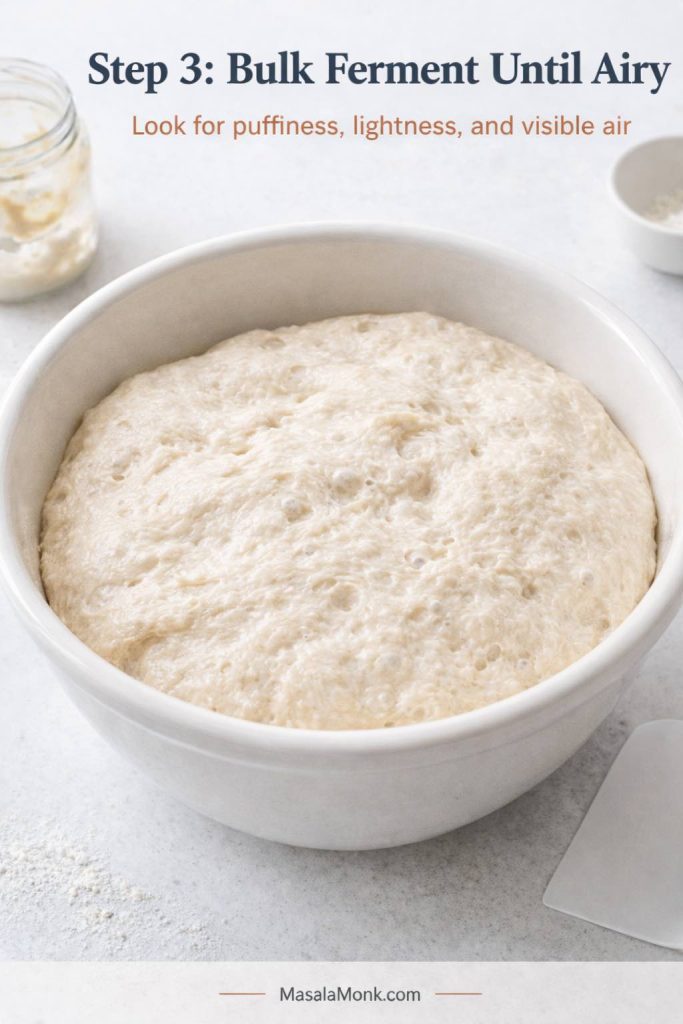
After the folds, cover the bowl and let the dough ferment at room temperature until it looks visibly fuller, lighter, and more aerated.

At 74 to 78°F, this usually takes about 4 to 6 hours total from mixing with active starter.

Do not chase a perfect doubling. What matters is that the dough looks alive. You want some visible bubbles, a softer feel, and a bowl of dough that no longer looks dense and inactive. If it still looks tight and compact, keep waiting.

Refrigerate for the overnight route

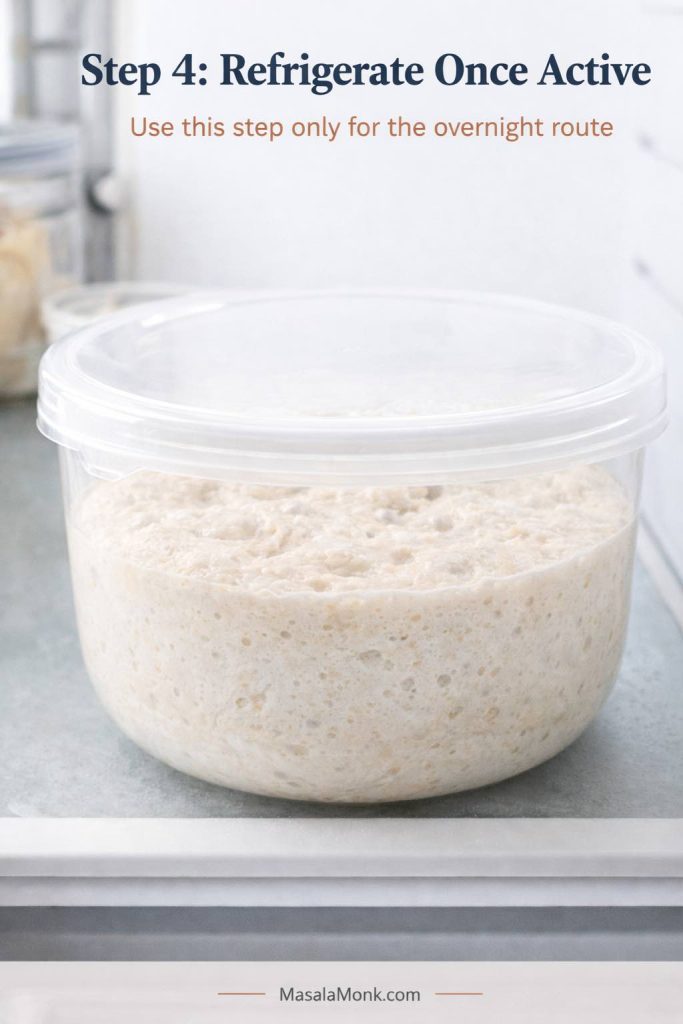
Once the dough has clearly gained strength and activity, cover it well and refrigerate it for 8 to 24 hours.

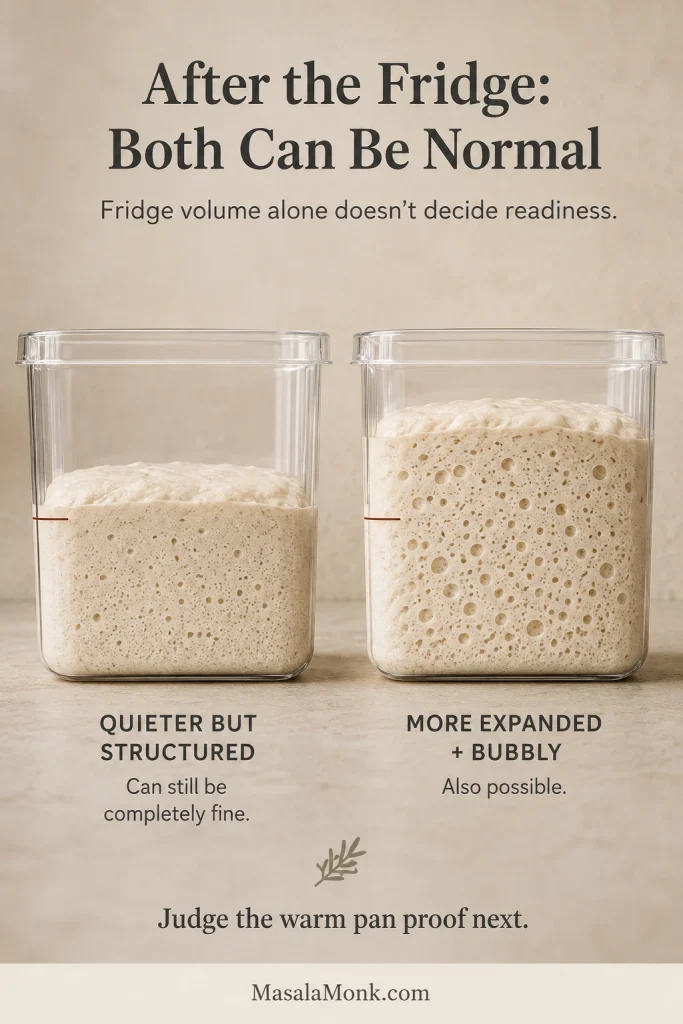
This rest makes the schedule easier, deepens the flavor, and usually leaves you with a calmer dough the next day. Cover it well so the surface does not dry out in the fridge. Also, do not assume that longer is always better: push the cold rest too far and the dough can get more sour while losing some of its lift.

Oil the pan and transfer the dough

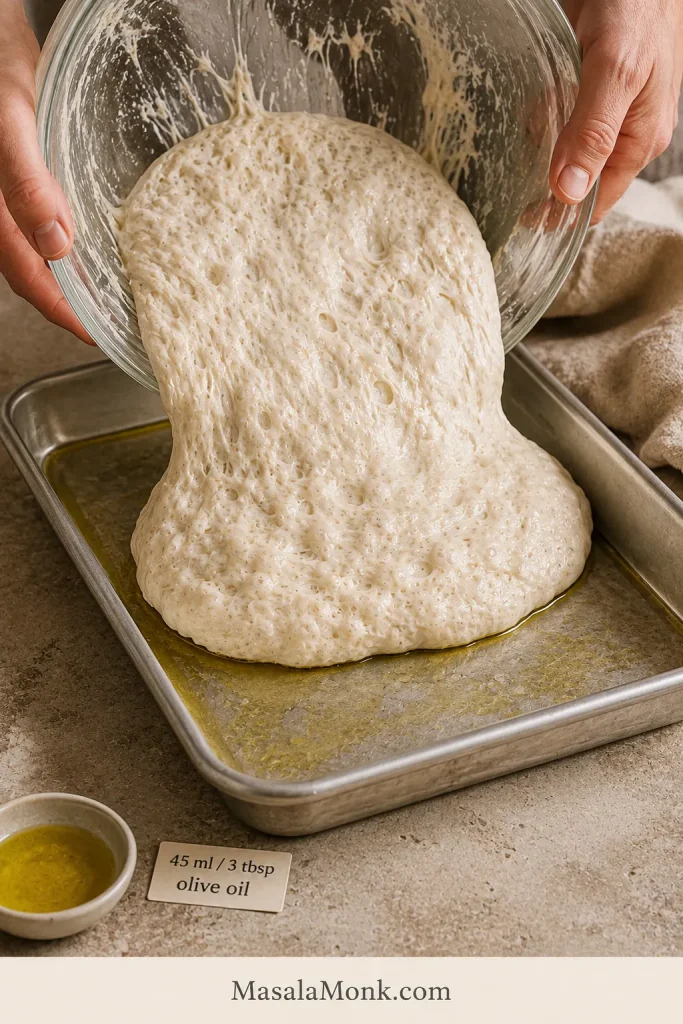
Pour 2 to 3 tablespoons olive oil into a 9×13-inch metal pan and coat the bottom well.

Tip the dough gently into the pan. Turn it once or twice so the outside picks up some oil.

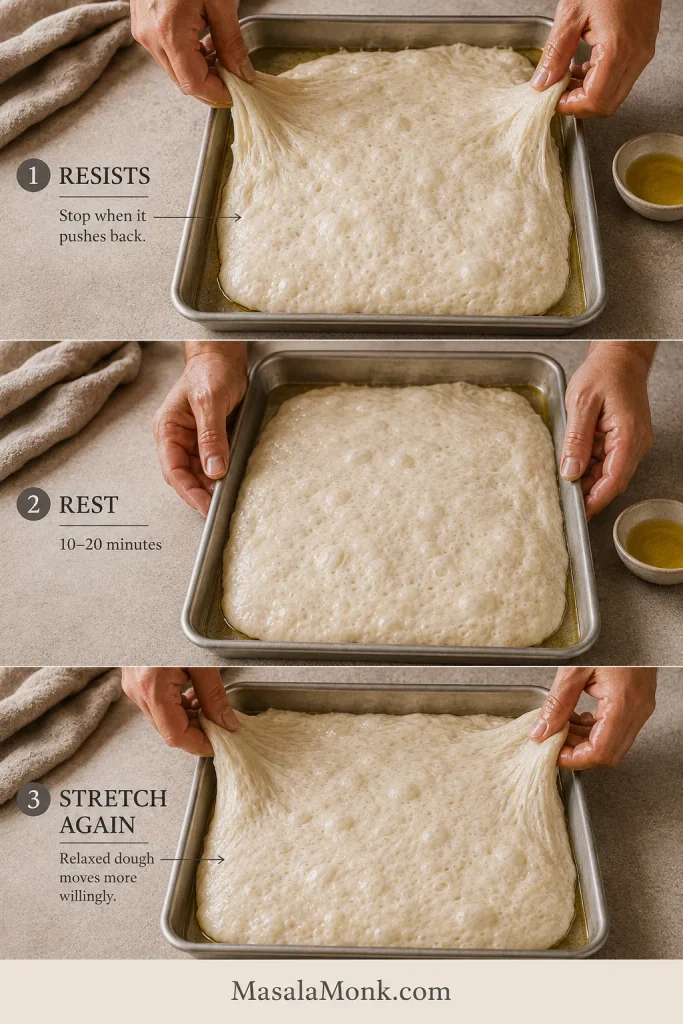
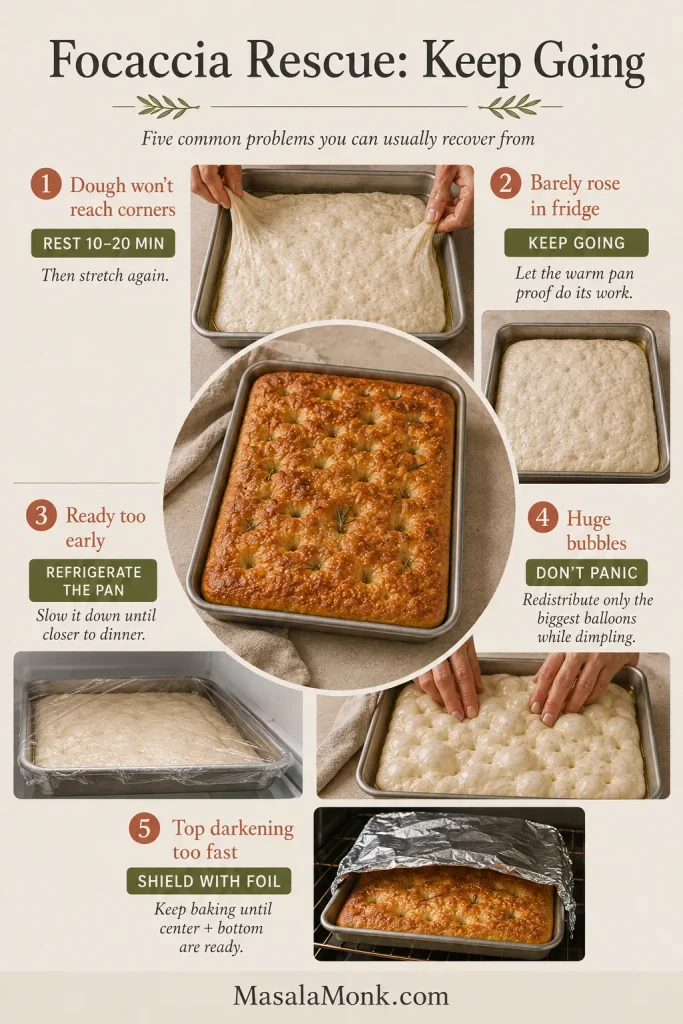
If it does not want to reach the corners yet, do not force it. Let it relax for 15 to 20 minutes, then stretch it gently again. Focaccia usually rewards patience.

Proof in the pan until puffy and jiggly

Let the dough proof in the pan at room temperature until it looks fuller, softer, and lightly inflated. In a warm room, this often takes 2 to 4 hours after the cold dough goes into the pan, but the dough is a better guide than the clock.

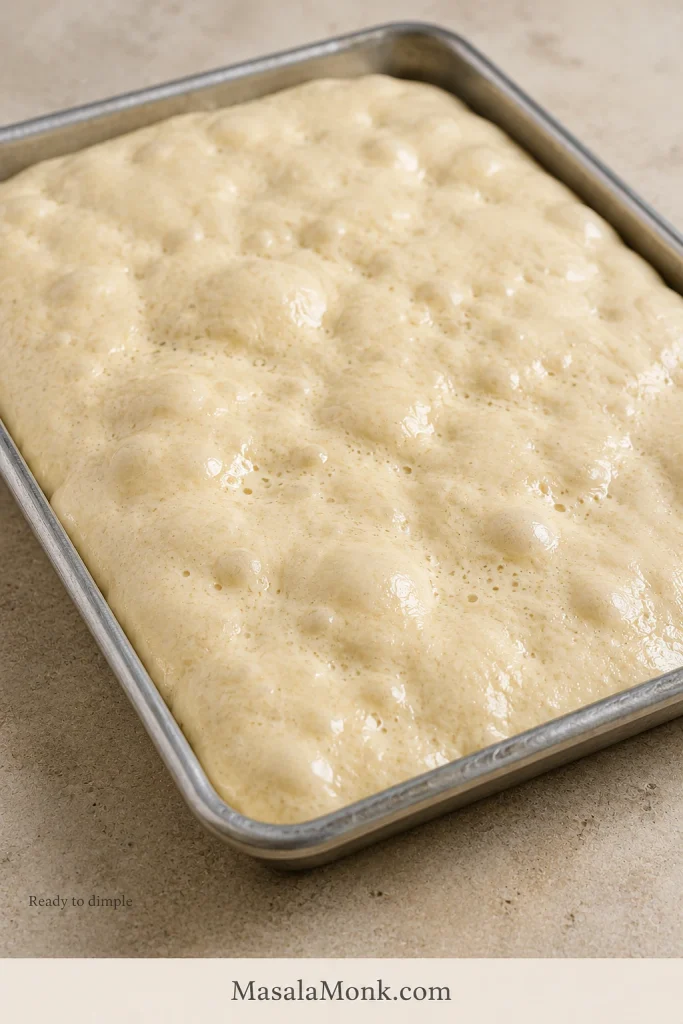
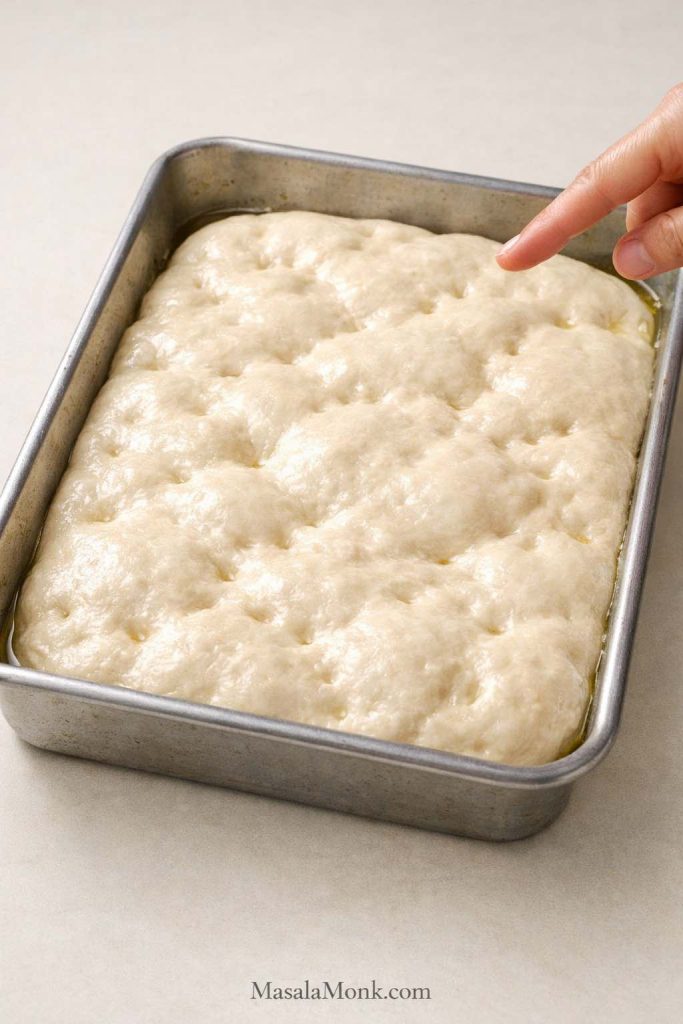
Look for a dough that feels easygoing rather than tense. It should wobble lightly when the pan moves, show some air under the surface, and accept dimples without fighting back. The full proofing cues are broken down in the next section.

Proofed sourdough focaccia dough in a 9x13 metal pan showing a puffy airy surface ready to dimple before baking.
By this stage, the dough should look fuller, softer, and lightly airy in the pan, with enough visible puff that dimpling feels easy rather than forced.

Dimple, top, and bake

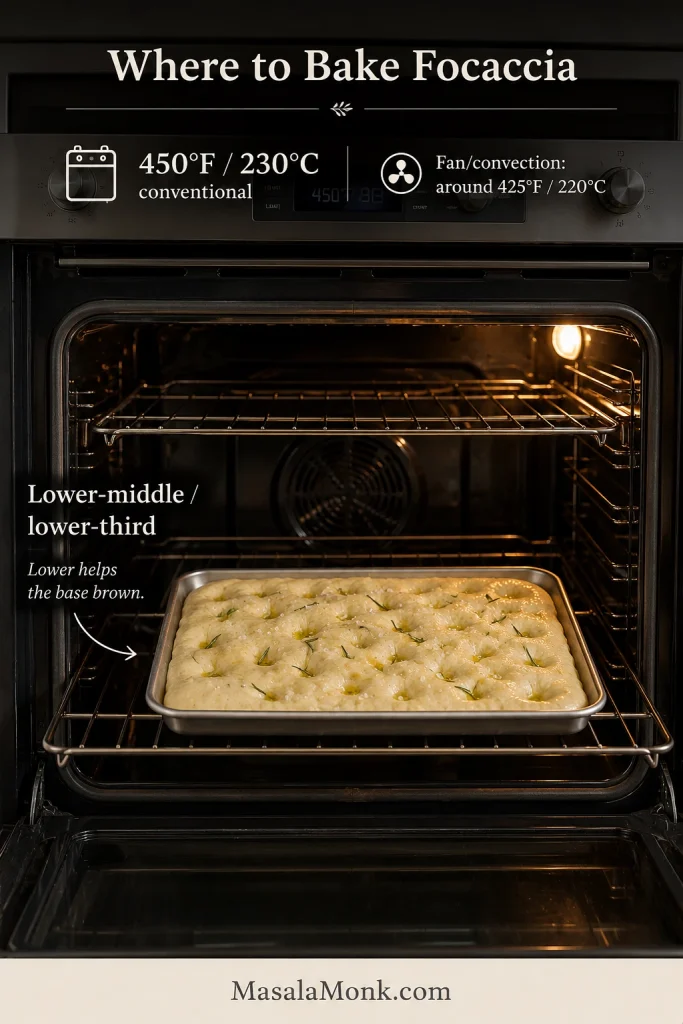
Set the oven to 450°F.

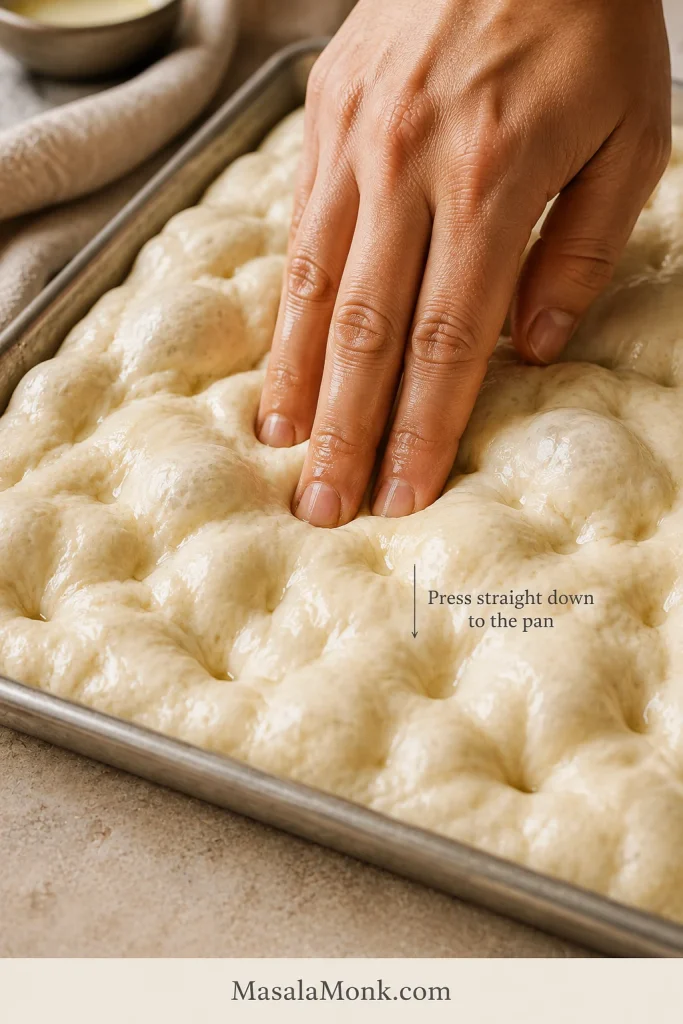
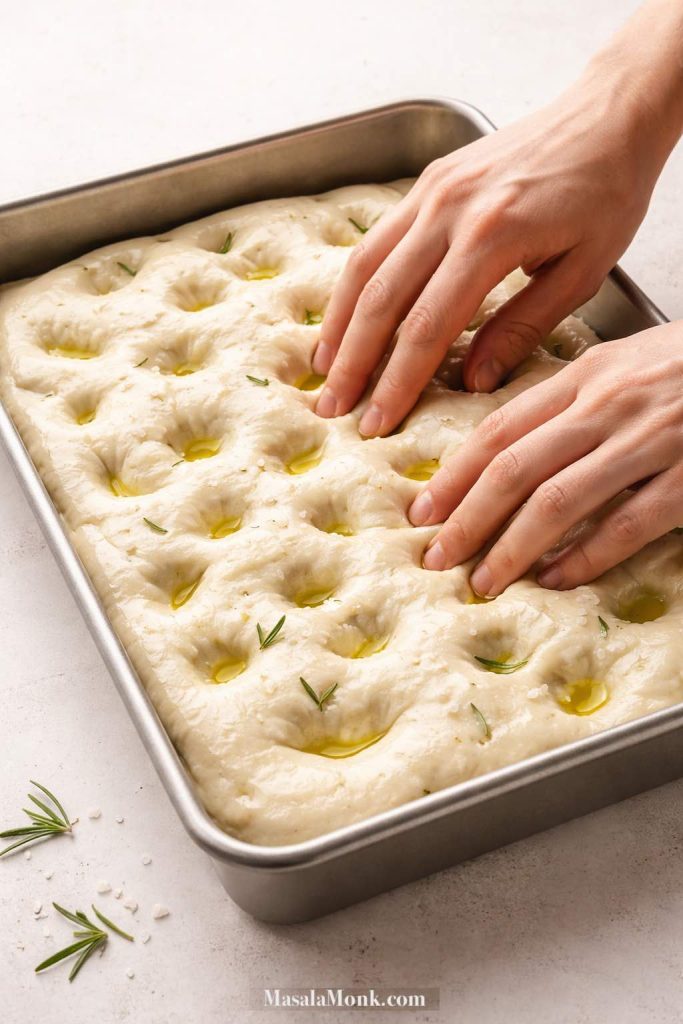
Drizzle the top with 1 to 2 tablespoons olive oil. Lightly oil your fingertips, then press straight down to dimple the dough all over. Sprinkle with flaky salt and add your toppings.

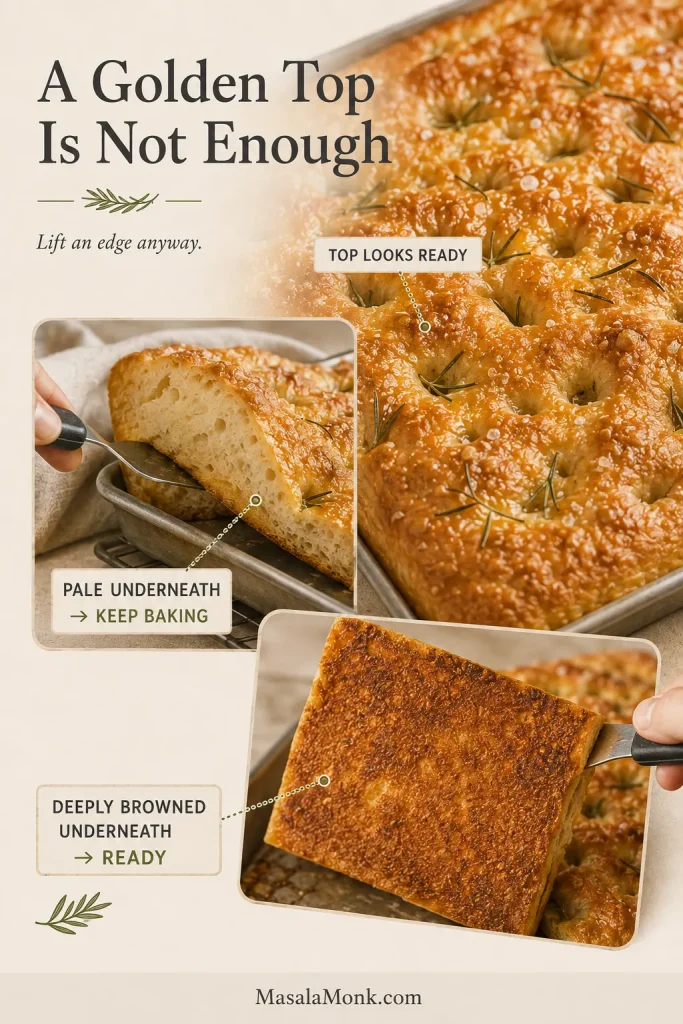
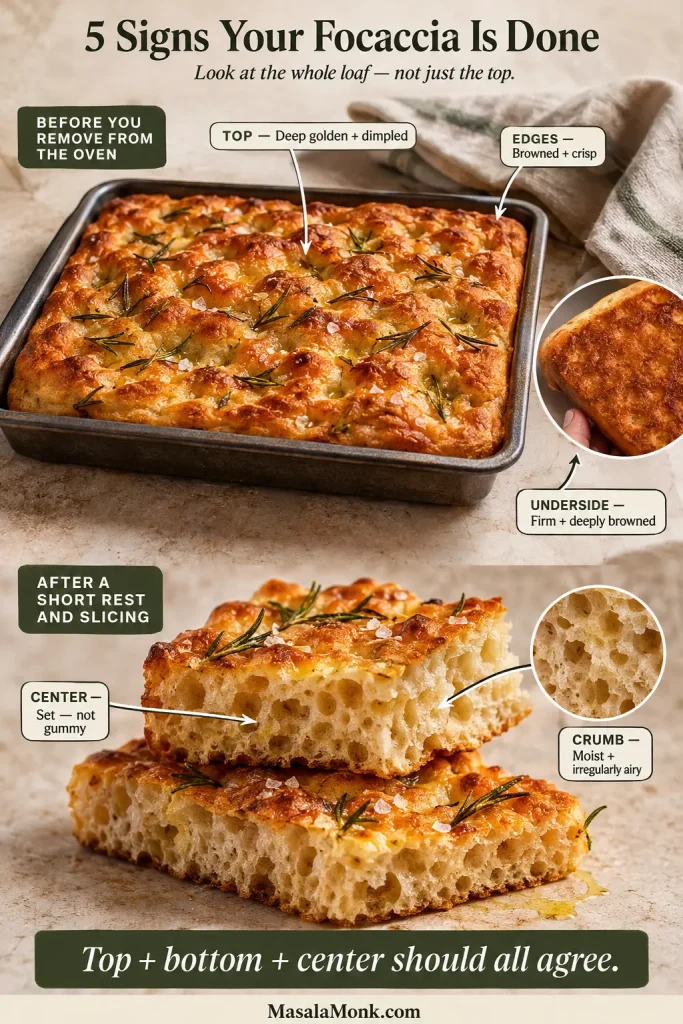
Bake for 25 to 30 minutes, or until the top is deeply golden and the edges are richly browned. If the top darkens too quickly before the bread feels baked through, lower the oven slightly or move the pan to a lower rack.

Hands dimpling proofed sourdough focaccia dough in a 9x13 metal pan with olive oil before baking.
Once the dough is fully proofed, it should accept dimples easily and hold little pools of olive oil instead of springing back tight, which is one of the clearest signs that it is ready for the oven.

Cool, slice, and serve

Let the focaccia cool in the pan for 5 to 10 minutes, then lift it out and cool it a little more on a rack if possible. That helps the bottom stay crisper.

Slice while still slightly warm or at room temperature.

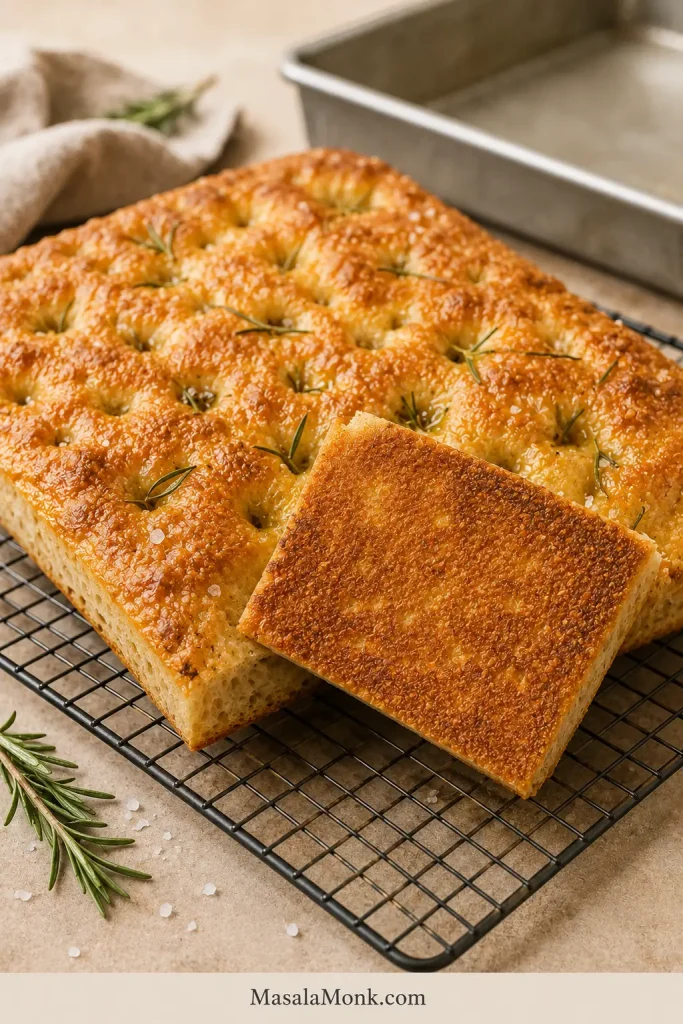
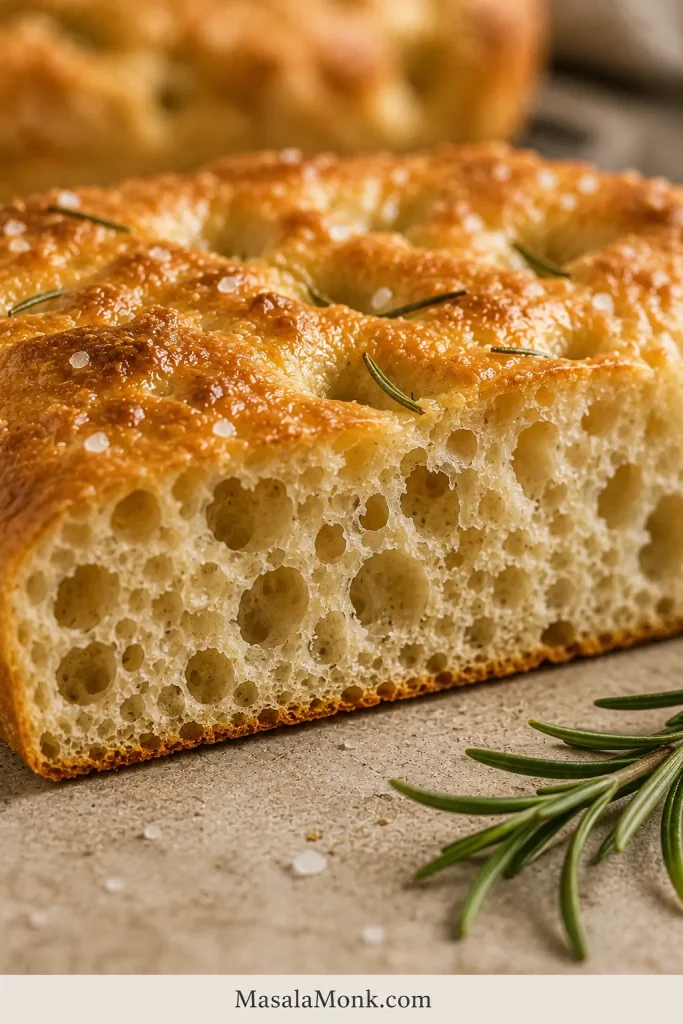
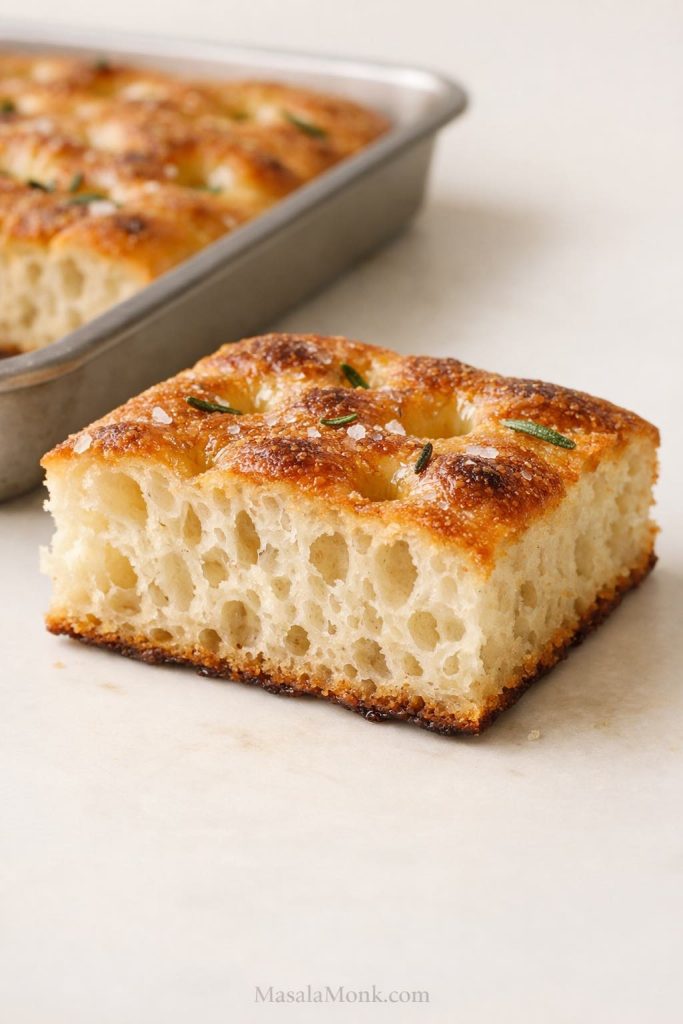
Close-up of a baked sourdough focaccia slice showing an airy crumb, golden top, olive-oil dimples, and crisp browned bottom edge.
This is the payoff you are aiming for: an airy interior, a bronzed top, and crisp olive-oil edges that feel generous rather than tight or bready.

Also Read: Cookie Pie Recipe: 10 Best Flavors, Fillings and Variations

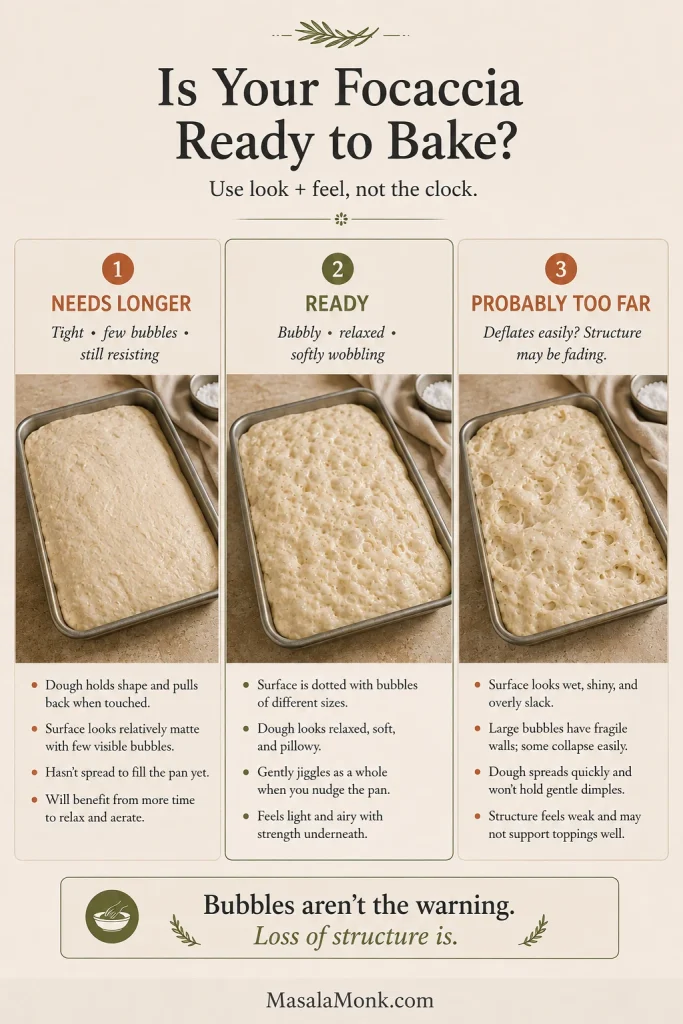
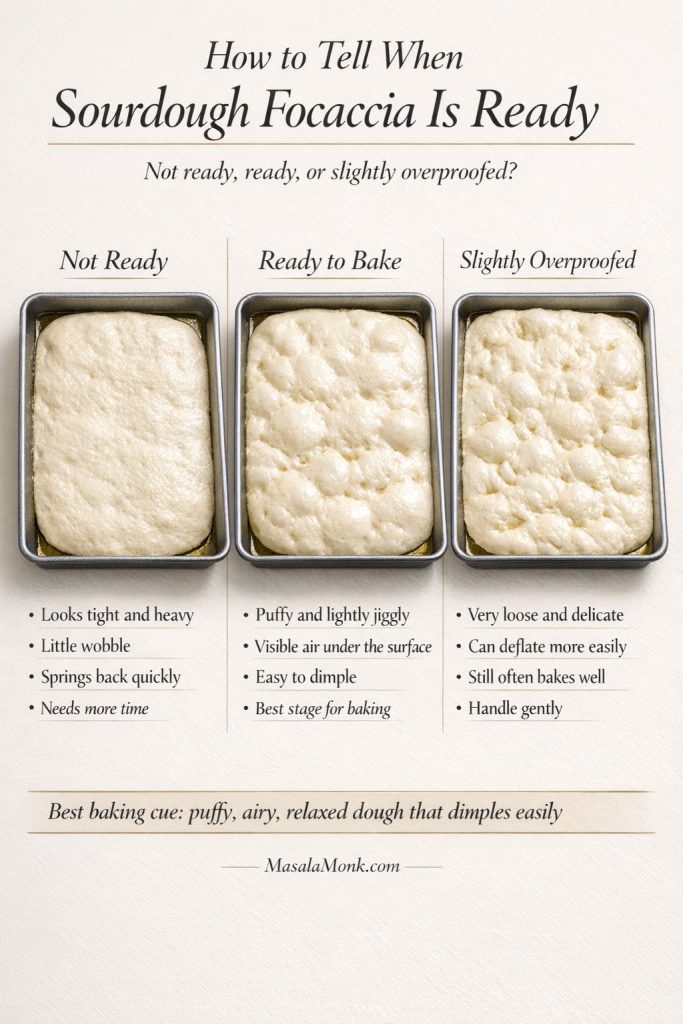
How to tell when sourdough focaccia is proofed enough

This is the most important judgment call in the whole recipe. If the dough is proofed well, the crumb has a real chance of turning out airy and dramatic. Bake too early and the bread usually comes out flatter and tighter.

Sourdough focaccia proofing guide showing not ready, ready to bake, and slightly overproofed dough in pans before baking.
Tight dough still needs time, puffy dough with a light wobble is ready to bake, and slightly overproofed dough can still turn out well if you handle it gently.

Signs your dough needs more time

The dough looks flat in the pan, feels heavy rather than buoyant, and resists your fingertips. When you press into it, it springs back quickly and does not want to hold the dimple. This is where a lot of bakers go wrong: the dough looks spread out, so they assume it is ready. It is not. It still needs time.

  • tight surface
  • little to no wobble
  • heavy feel
  • resists stretching toward the corners

Signs it is ready to dimple and bake

The dough looks puffy, slightly wobbly, and airy under the surface. Your fingers can press in easily, and the dough feels soft and almost marshmallowy rather than tense. More importantly, it should look like a dough that has actually trapped gas, not one that is merely spreading because it is wet.

  • puffy appearance
  • light wobble when the pan moves
  • visible air pockets under the surface
  • easy dimpling without the dough fighting back

What slightly overproofed focaccia looks like

A slightly overproofed dough can feel extremely loose and fragile, and it may deflate more easily when handled. Even then, focaccia often still bakes reasonably well because the pan supports it. You may lose some height, but you can still get very good bread.

What underproofed focaccia looks like after baking

Underproofed focaccia usually comes out flatter, tighter, and less bubbly. The crumb feels more bread-like than airy, and the dramatic holes never really develop.

Also Read: Cookie Pie Recipe: 10 Best Flavors, Fillings and Variations

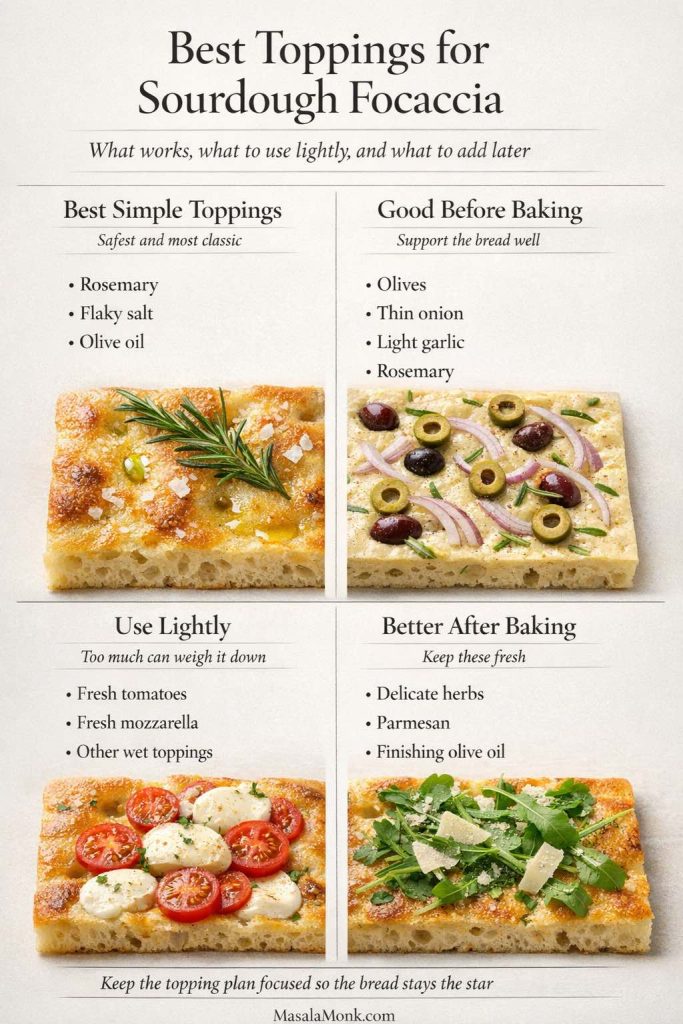
Best toppings for sourdough focaccia

The best toppings support the bread instead of burying it. Let the topping plan get too heavy or too wet and the focaccia starts losing the texture that made it worth baking in the first place.

Best toppings for sourdough focaccia guide showing simple toppings, before-baking toppings, wetter toppings to use lightly, and finishing toppings to add after baking.
The best focaccia toppings do not compete with the bread; they support it. Classic toppings such as rosemary, flaky salt, and olive oil keep the bake clean and balanced, while wetter toppings need a lighter hand and fresher finishes are often better added after baking.

The best simple topping: rosemary, olive oil, and flaky salt

This is still the most reliable and satisfying version. It lets the bread stay the star, smells incredible, and avoids the sogginess that comes from piling too much on top.

Toppings that work well before baking

Olives, thin onion slices, rosemary, and a restrained amount of garlic all work well before baking. Garlic, however, can burn if it is sliced too thin or left too exposed, so keep it modest and let the olive oil protect it.

Toppings that need a lighter hand

Fresh tomatoes, fresh mozzarella, and other watery toppings should be used in moderation. Too much moisture softens the surface, interferes with browning, and can weigh down the dough. Once you want a more heavily topped bread, the result starts leaning toward pizza rather than classic focaccia.

What to add after baking

More delicate herbs, a final drizzle of good olive oil, or finishing touches such as parmesan are often better after baking. That way the flavors stay fresh instead of getting dulled in the oven.

Topping combinations that work well together

  • rosemary and flaky salt
  • rosemary and olive
  • onion and olive
  • light cherry tomato and oregano
  • garlic and rosemary

Keep the topping plan focused. Let the bread do most of the talking.

Also Read: Peach Cobbler with Canned Peaches (Dessert Recipe)

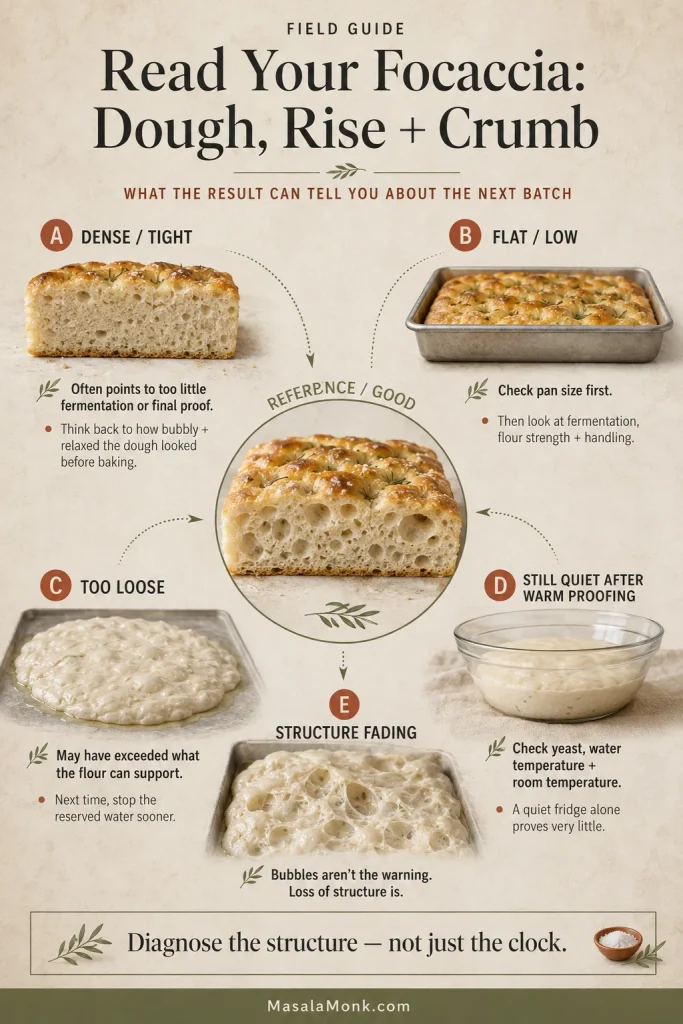
Troubleshooting sourdough focaccia

Why is my sourdough focaccia dense instead of airy?

The most common causes are underproofing, weak starter, old discard without enough time, or too much added flour. Usually the fix is more fermentation, not more flour.

Why didn’t it get big bubbles?

Either the dough never built enough gas, or the gas it had was knocked out by rough handling. Good bubbles need both strong fermentation and gentle treatment.

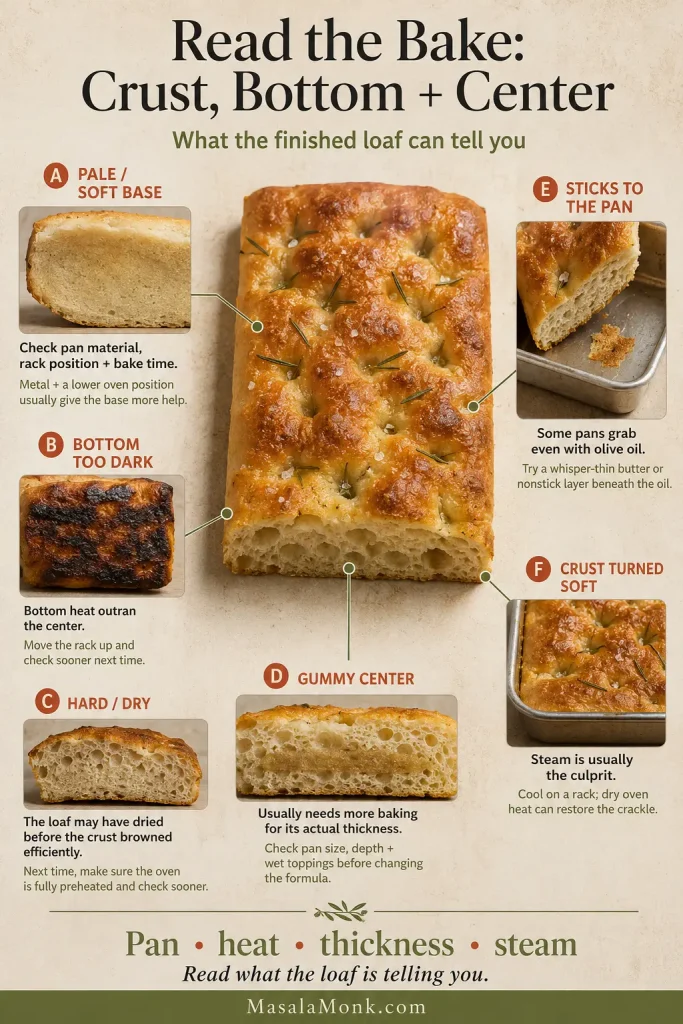
Why is my focaccia gummy in the middle?

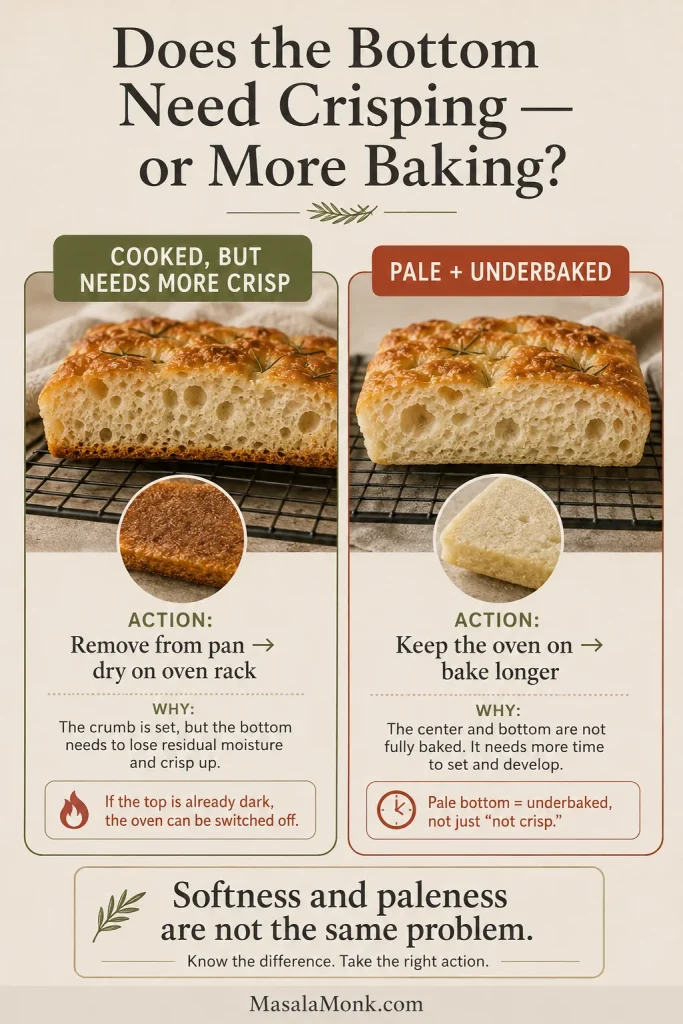
It may need a slightly longer bake, especially if it is thick or heavily topped. It can also seem gummier than it really is when sliced too hot. Let it cool briefly before cutting.

Why is it pale instead of deeply golden?

The oven may not be hot enough, the pan may not brown strongly, or there may not be enough olive oil on the dough and in the pan. A metal pan really helps here.

Why did it stick to the pan?

Usually there was not enough oil underneath, or the bread sat too long before being released. Oil the pan generously and loosen the focaccia while it is still warm if needed.

Why did it spread too much?

Either the dough never built enough strength during the folds, or it was proofed before it had enough internal structure. High hydration is good, but the dough still needs some strength.

Why does it taste too sour?

The dough may have fermented too long, the discard may have been especially acidic, or the kitchen may have been warm enough to push fermentation harder than expected. Use fresher discard or shorten the fermentation slightly next time.

Can you save overproofed focaccia?

Often yes. Transfer it gently to a well-oiled pan, dimple carefully, and bake it. You may lose some height, but focaccia is forgiving enough that the result can still be very good.

Also Read: Punjabi Mutton Bhuna – Amritsari Village-Style Gosht Recipe

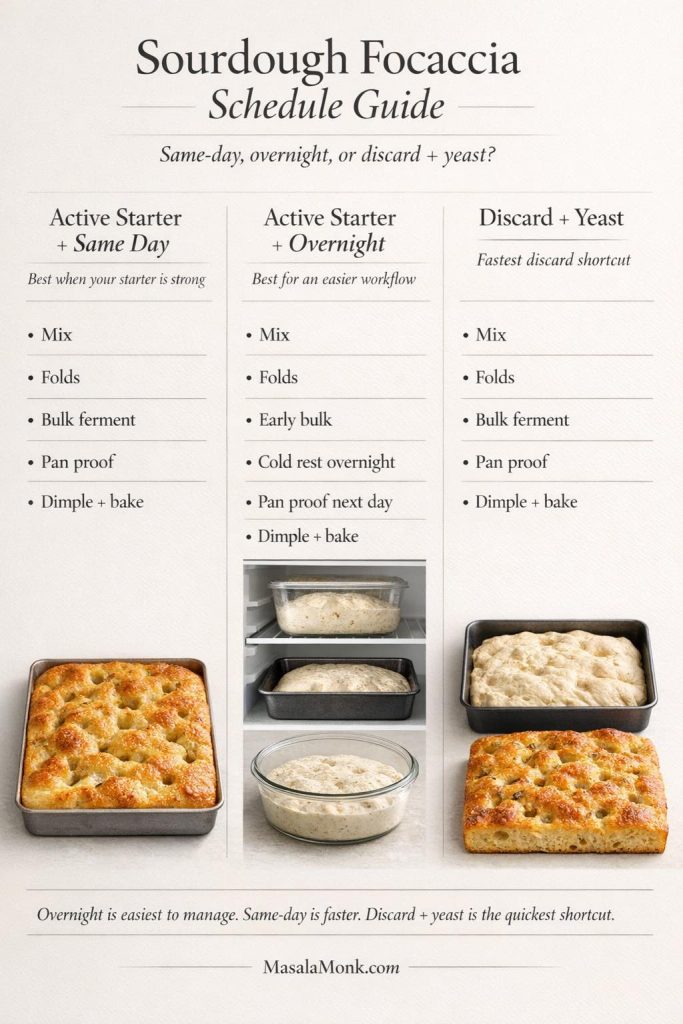
Same-day and overnight schedules at a glance

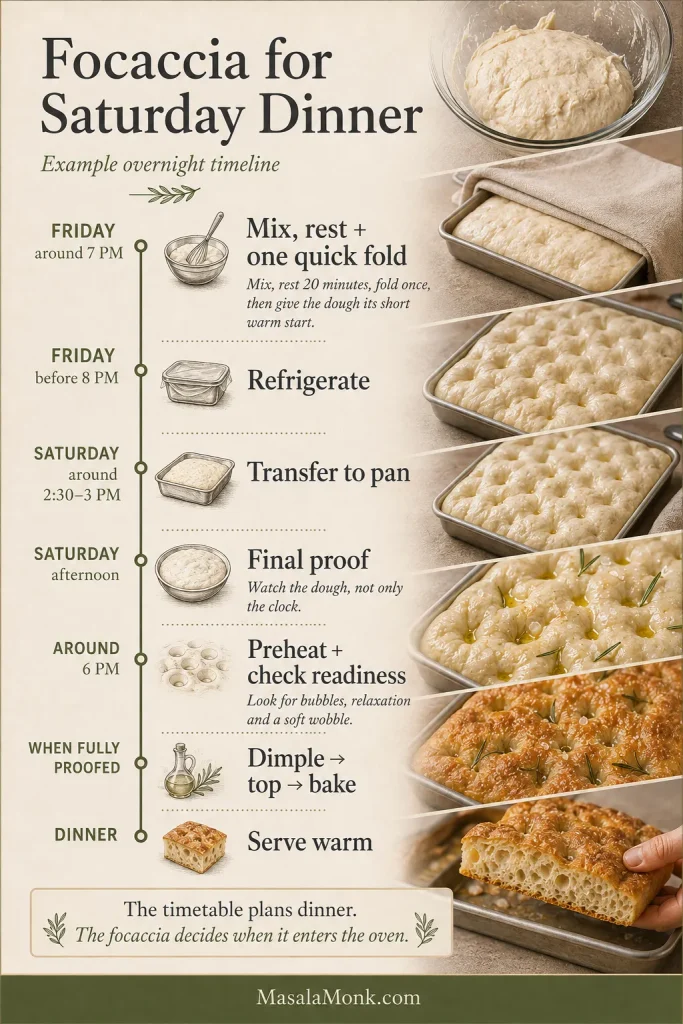
These are working timelines, not hard laws. If the dough is moving faster than expected, refrigerate it sooner. If it is lagging, give it warmth or more time.

Sourdough focaccia schedule guide comparing active starter same day, active starter overnight, and discard plus yeast timing options.
The overnight route is easier to fit around real life, same-day focaccia works when your starter is strong and the room is warm, and discard plus yeast is the fastest way to get the dough moving without much drama.

Sample same-day timeline with active starter

Use this when you have strong starter and a warm kitchen.

  • 8:00 a.m. Mix the dough.
  • 8:20 a.m. to 9:30 a.m. Complete 4 rounds of folds.
  • 9:30 a.m. to 1:00 p.m. Let the dough bulk ferment until airy.
  • 1:00 p.m. Transfer to the pan.
  • 1:00 p.m. to 3:00 p.m. Pan proof until puffy and jiggly.
  • 3:00 p.m. Dimple, top, and bake.

Sample overnight timeline with active starter

This is the best default route in the article.

  • 6:00 p.m. Mix the dough.
  • 6:20 p.m. to 7:30 p.m. Complete 4 rounds of folds.
  • 7:30 p.m. to 10:00 p.m. Let the dough gain early strength and activity.
  • 10:00 p.m. Refrigerate overnight.
  • Next day, 10:00 a.m. Transfer to the pan.
  • 10:00 a.m. to 1:00 p.m. Pan proof until puffy.
  • 1:00 p.m. Dimple, top, and bake.

Sample discard + yeast fast timeline

Use this when you want the easiest quick route.

  • 9:00 a.m. Mix discard, flour, water, salt, olive oil, and instant yeast.
  • 9:20 a.m. to 10:30 a.m. Complete 4 rounds of folds.
  • 10:30 a.m. to 1:00 p.m. Bulk ferment until airy.
  • 1:00 p.m. Transfer to the pan.
  • 1:00 p.m. to 2:30 p.m. Pan proof.
  • 2:30 p.m. Dimple, top, and bake.

Also Read: Masterclass in Chai: How to Make the Perfect Masala Chai (Recipe)

Variations

Rosemary sourdough focaccia

Top the dough with rosemary, flaky salt, and olive oil for the cleanest and most classic version.

Whole wheat sourdough focaccia

Replace 100 to 150 g of the bread flour with whole wheat flour for a nuttier flavor and a slightly heartier crumb. Expect a little less loft and a little more chew.

Cast iron sourdough focaccia

Bake the dough in a well-oiled cast iron skillet when you want a darker, more assertive bottom crust and a rounder shape.

Sourdough focaccia pizza-style

Top more heavily after the first bake or split and fill it after baking when you want a pizza-inspired version. If you already like working with sourdough pizza dough, this is another satisfying way to use a soft, high-hydration dough.

Garlic and olive focaccia

Use sliced olives and a restrained amount of garlic so the top becomes aromatic and savory without turning harsh or greasy.

Also Read: Avocado Chocolate Mousse Recipe

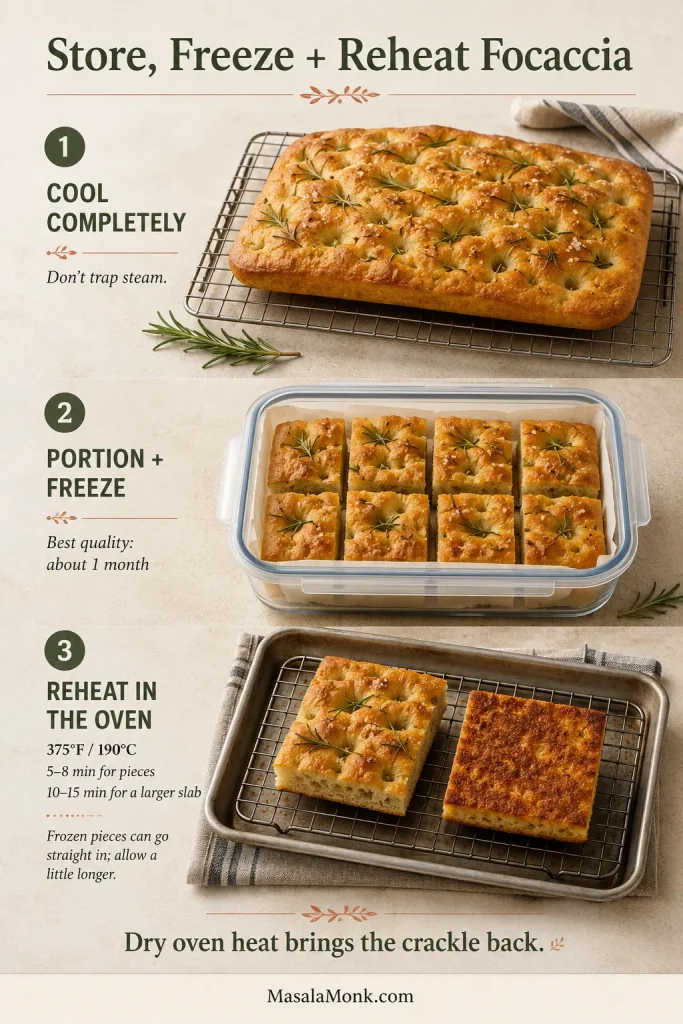
How to store, reheat, and freeze sourdough focaccia

Best way to store focaccia for 1 to 2 days

Focaccia is best the day it is baked and still very good on day two. Once it is fully cool, wrap it well and keep it at room temperature. Do not trap it while warm, or the steam will soften the crust you just worked for.

How to reheat for crisp edges again

Reheat the focaccia in a hot oven or toaster oven for a few minutes rather than microwaving it. That is the easiest way to bring the edges back to life.

Can you freeze sourdough focaccia?

Yes. Freeze it once fully cool, either whole or in slices, wrapped well. Reheat from frozen or thaw first and warm it in the oven.

Best leftover uses

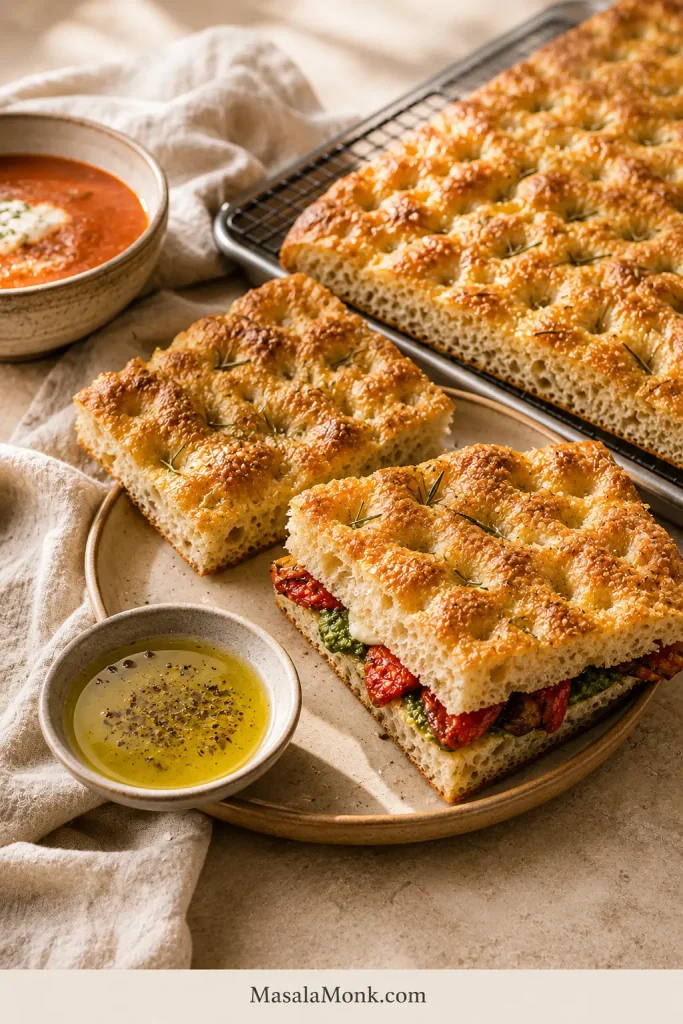
Use leftover focaccia for sandwiches, alongside soup, or lightly toasted with eggs. Day-old focaccia still has plenty to offer if you warm it well.

Also Read: Falafel Recipe: Crispy Homemade, Air Fryer and Baked Falafel

Frequently asked questions about sourdough focaccia

Can I use sourdough discard instead of active starter?

Yes. Discard works well in focaccia, but it is usually slower and less forceful than active starter. For the most reliable result, use active starter. For the quickest discard version, add a little yeast.

Do I need yeast for sourdough discard focaccia?

No. You can make it without yeast if you give it enough time. Yeast simply makes the rise faster and more dependable.

Is focaccia easier than sourdough bread?

For most bakers, yes. The pan makes it more forgiving, and there is no shaping or scoring to master. If you want another approachable follow-up bake after this, sourdough English muffins are another useful way to build confidence with fermentation and dough cues.

Can I refrigerate the dough overnight?

Yes. In fact, the overnight route is the main method here because it makes the process easier and more consistent.

What flour is best for sourdough focaccia?

Bread flour is the best all-around choice for height and structure, but all-purpose flour still works very well.

What pan gives the crispiest bottom?

A well-oiled metal pan or cast iron skillet usually gives the best browning and the crispest base.

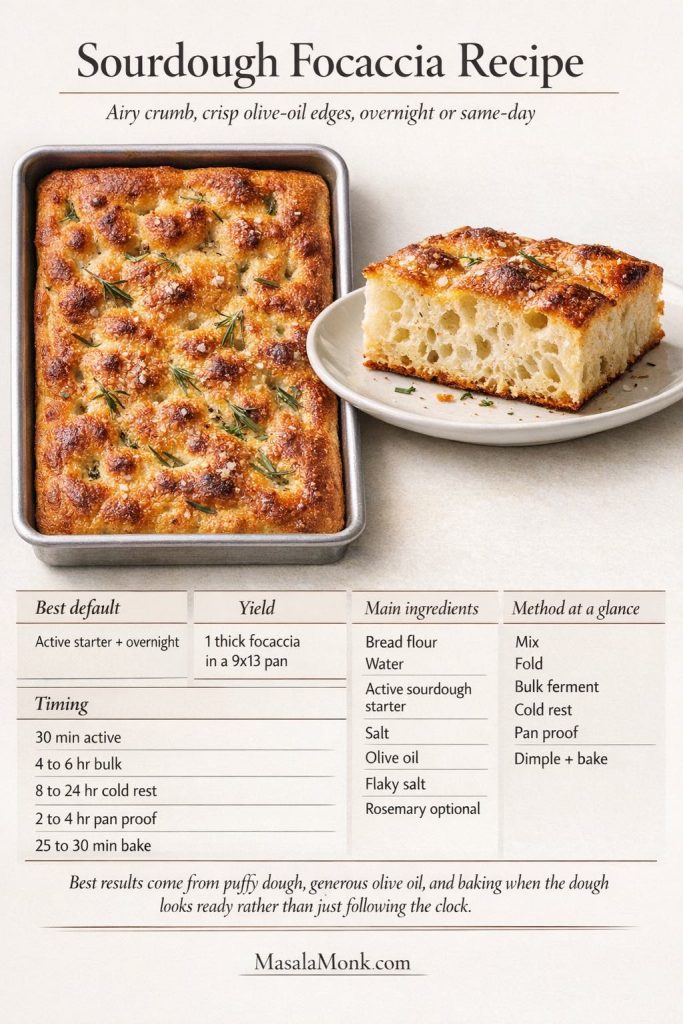
Sourdough focaccia recipe card showing a baked focaccia in a 9x13 pan, a cut square with airy crumb, and a summary of timing, ingredients, and method.
Once the route is clear, the bake itself becomes straightforward: mix, fold, let the dough gain strength, give it enough time to look puffy and ready, and bake for a focaccia with a light crumb and crisp olive-oil edges.

Also Read: Mango Margarita Recipe (Frozen or On the Rocks)

Recipe card

Sourdough Focaccia Recipe

Yield: 1 focaccia in a 9×13-inch pan
Serves: 8 to 12
Prep time: 30 minutes active time
Bulk fermentation: about 4 to 6 hours with active starter at warm room temperature
Cold rest: 8 to 24 hours
Pan proof: about 2 to 4 hours
Bake time: 25 to 30 minutes

Ingredients

  • 500 g bread flour
  • 400 g water
  • 100 g active sourdough starter
  • 12 g fine sea salt
  • 20 g olive oil for the dough
  • 2 to 3 tablespoons olive oil for the pan
  • 1 to 2 tablespoons olive oil for the top
  • flaky salt
  • rosemary or other toppings as desired

Optional adjustments

  • use 100 g sourdough discard in place of active starter for a slower discard version
  • add 4 g instant yeast when using discard for a faster same-day version

Method

  1. Mix the bread flour, water, starter, salt, and 20 g olive oil until no dry flour remains.
  2. Rest the dough for 20 minutes.
  3. Perform 4 rounds of stretch-and-folds, resting 20 to 30 minutes between rounds.
  4. Let the dough bulk ferment until it looks fuller, lighter, and visibly airy.
  5. Refrigerate the dough for 8 to 24 hours once it has clearly gained activity.
  6. Oil a 9×13-inch metal pan well and transfer the dough.
  7. Let it proof in the pan until puffy, jiggly, and easy to dimple.
  8. Heat the oven to 450°F.
  9. Drizzle the top with olive oil, dimple all over, and add flaky salt and toppings.
  10. Bake for 25 to 30 minutes until deeply golden.
  11. Cool for 5 to 10 minutes in the pan, then lift out and cool a little more before slicing.

Notes

  • The best default route is active starter + overnight.
  • This formula assumes a 100% hydration starter.
  • Use starter that is recently peaked or close to peak for the best lift.
  • If using all-purpose flour, reduce the water slightly to keep the dough manageable.
  • Use discard when convenience matters more than maximum lift.
  • Add instant yeast to discard when you want the fastest and most dependable same-day result.
  • A 9×13-inch metal pan gives the best all-around crust and structure.
  • The dough is ready when it looks puffy, airy, and softly inflated, not flat and tight.

A good focaccia should feel generous, not tense. Once you know which route makes sense, what the dough should look like, and when to wait instead of forcing it, this becomes one of the easiest breads to come back to. For more ideas beyond this one, the site’s broader sourdough bread recipe guide is a useful next stop.

Posted on 1 Comment

Sourdough English Muffins Recipe

Fork-split sourdough English muffin with melted butter showing real nooks and crannies, styled as a dark editorial recipe cover with text overlay.

If you want sourdough English muffins with a chewy bite, deep toastability, and real nooks and crannies, this is the version to make. The dough is built around active starter for dependable natural lift, kept soft enough to open well inside, shaped thick enough to protect the crumb, and cooked slowly enough that the middles set before the outsides darken too fast. Once cooled and split with a fork, they toast the way a good English muffin should: crisp at the edges, rough in the middle, and ready to catch butter in every crevice.

This page does more than hand you one formula. It helps you choose the right route before you begin, whether that means active starter, fresh discard, overnight timing, same-day timing, or a small yeast assist for reliability. It also shows you how to avoid the problems that ruin texture: dense crumb, gummy middles, weak rise, flat rounds, or muffins that brown long before they cook through. If your culture still feels inconsistent, start with this guide on how to build a sourdough starter. If you already like baking with starter, save these sourdough bread recipes for later too.
Why this sourdough English muffins recipe works

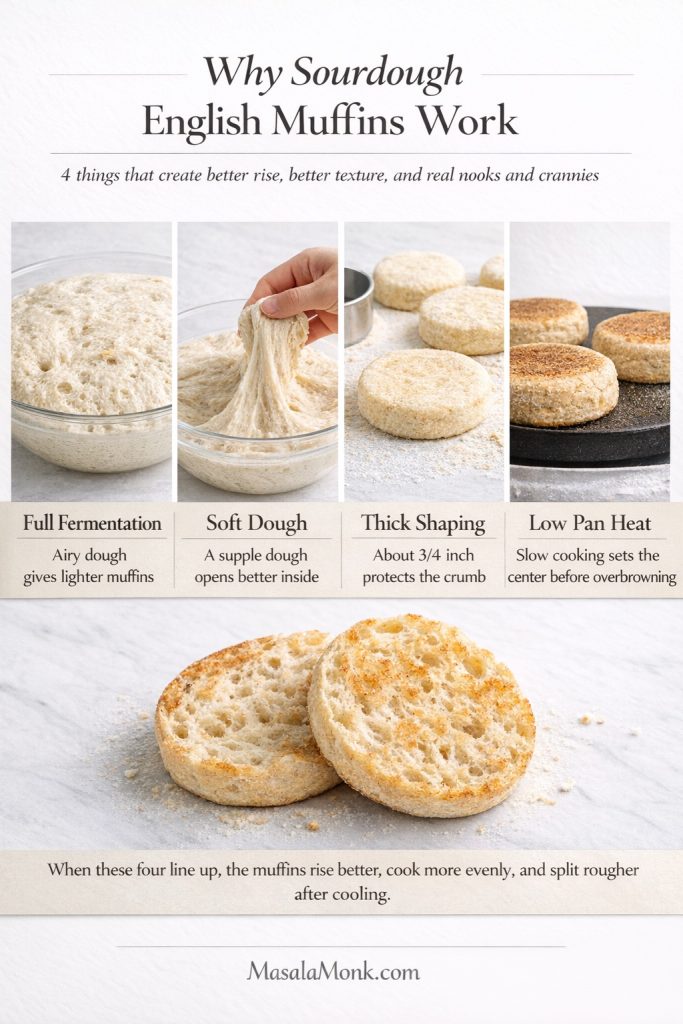
A strong sourdough English muffins recipe depends on four things working together:

  • full fermentation
  • a soft but manageable dough
  • enough thickness to create an open interior
  • low pan heat so the middles cook through before the crust browns too fast
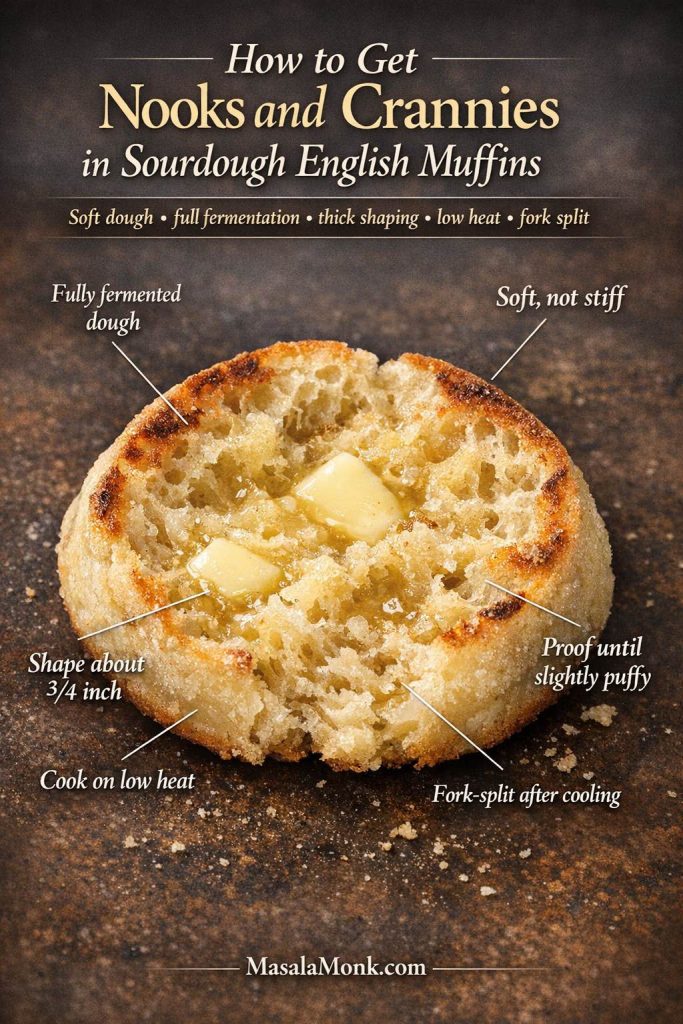
Explainer guide showing why sourdough English muffins work, with four key factors: full fermentation, soft dough, thick shaping, and low pan heat, plus a split muffin showing the open interior these choices create.
Great sourdough English muffins do not come from one trick alone. Full fermentation gives the dough enough internal life to rise well, a soft dough helps the crumb open instead of tightening up, thicker shaping protects the interior texture, and low pan heat gives the center time to set before the crust races ahead. When all those pieces line up, the muffins cook more evenly, split rougher after cooling, and deliver the nooks-and-crannies texture the whole recipe is built around.

When those four elements line up, the muffins rise better, cook more evenly, and split more raggedly after cooling. And when one slips, the batch usually shows it. Under-fermented dough stays tight and heavy. Dough rolled too thin cooks easily but loses interior texture. Dough handled too roughly loses gas. Heat that runs even a little too high gives you color before the middle is ready.

Texture is the real payoff. Good sourdough English muffins with nooks and crannies should not split open like soft sandwich bread. They should break into rough, irregular halves that toast crisp and hold butter properly. That open interior is part of what makes the format feel right, which is why King Arthur’s guide to nooks and crannies is worth reading if you want a clearer sense of the target.

Also Read: White Russian Recipe: 7 Variants to Try, From Classic to Frozen

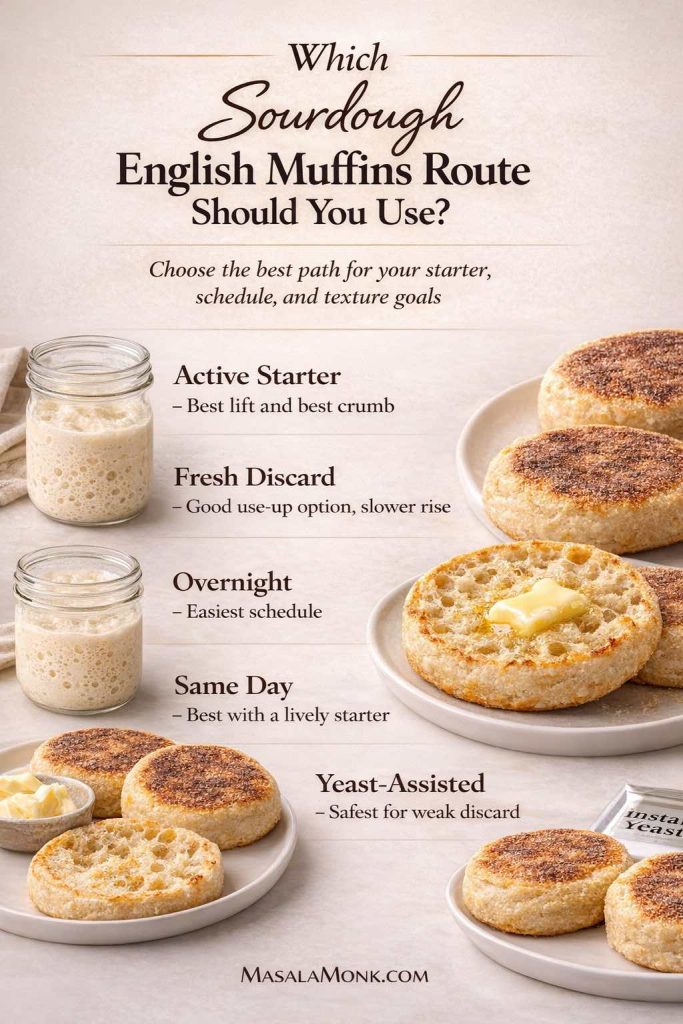
Choose your sourdough English muffins route first

A disappointing batch often starts with the wrong route, not the wrong recipe. Choose the path that matches your starter, your schedule, and your kitchen.

Guide graphic showing which sourdough English muffins route to use, including active starter, fresh discard, overnight, same day, and yeast-assisted options.
Not every batch of sourdough English muffins should start the same way. This route guide helps you choose between active starter, fresh discard, overnight timing, same-day baking, and a yeast-assisted option, so the method fits your starter, your schedule, and the texture you want. Save it for quick reference, then use the full post for the detailed recipe and troubleshooting.

Active-starter sourdough English muffins

Use this route if:

  • your starter rises reliably after feeding
  • you want the best lift
  • you want the best chance of real nooks and crannies
  • you want sourdough English muffins no yeast
  • you want the strongest overall crumb

This is the main route on this page and the best path for sourdough starter English muffins.

Fresh-discard sourdough English muffins

Use this route if:

  • your discard is recent and still smells pleasantly tangy, not sharply harsh
  • you want to use it up instead of feeding again
  • you are willing to allow more fermentation time
  • you understand the rise may be less predictable
  • you are comfortable with a slightly less lofty result if needed

This can still make very good sourdough discard English muffins, especially when the discard comes from a healthy, recently maintained starter.

Overnight sourdough English muffins

Use this route if:

  • you want the easiest schedule
  • you want better flexibility the next morning
  • you prefer deeper flavor
  • you do not want to rush fermentation
  • you like shaping and cooking cooler dough

This is the easiest and most forgiving option for most readers. It is also the route I recommend first for overnight sourdough English muffins.

Same-day sourdough English muffins

Use this route if:

  • your starter is especially lively
  • your kitchen is warm enough to support a full rise
  • you want muffins today
  • you are willing to watch the dough, not just the clock

This can still produce easy sourdough English muffins, but it leaves much less room for a weak starter or a cool kitchen.

Yeast-assisted sourdough English muffins

Use this route if:

  • your discard is older or sluggish
  • your kitchen runs cool
  • you want more predictable rise
  • your schedule is tighter than your starter deserves
  • you still want sourdough flavor without relying on uncertain lift

That is a practical choice, not a compromise to hide. A hybrid route works well, and Serious Eats’ yeast-assisted sourdough English muffins are a useful reference point for that style.

Also Read: Mango Sorbet Recipe: Healthy & Plant Based Dessert

Quick route summary for sourdough English muffins

  • Best overall texture: active starter
  • Best schedule: overnight
  • Best discard use-up option: fresh discard with patience
  • Best safety net for weak discard: small yeast assist
  • Best path for no yeast: active starter with full fermentation

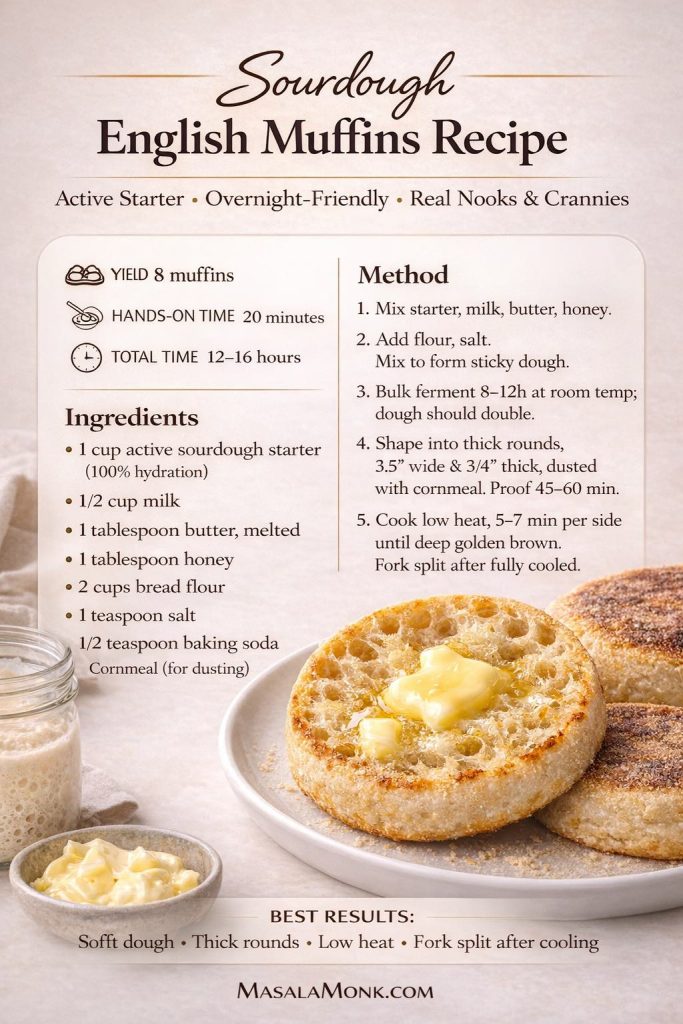
Sourdough English Muffins Recipe

This is the master version on the page: active starter, naturally leavened, overnight-friendly, skillet-cooked, and built for classic fork-split texture.

Sourdough English muffins served split and buttered, with recipe details for an overnight-friendly active starter version.
Use this as your quick-reference anchor for the batch: soft dough, thick rounds, low heat, and a fork-split finish are what give sourdough English muffins their best texture. Save it now, then come back to the full post for the route choices, troubleshooting, and variation details that make the recipe easier to get right.

Yield: 10 to 12 muffins
Prep time: 20 minutes
Rest and folds: 30 to 45 minutes
Bulk fermentation: about 4 to 8 hours at room temperature, depending on starter strength and kitchen temperature
Final proof: about 45 to 90 minutes
Cook time: about 10 to 14 minutes per batch
Total time: 8 to 14 hours, depending on whether you use the overnight route
Best route: active starter, naturally leavened, overnight-friendly

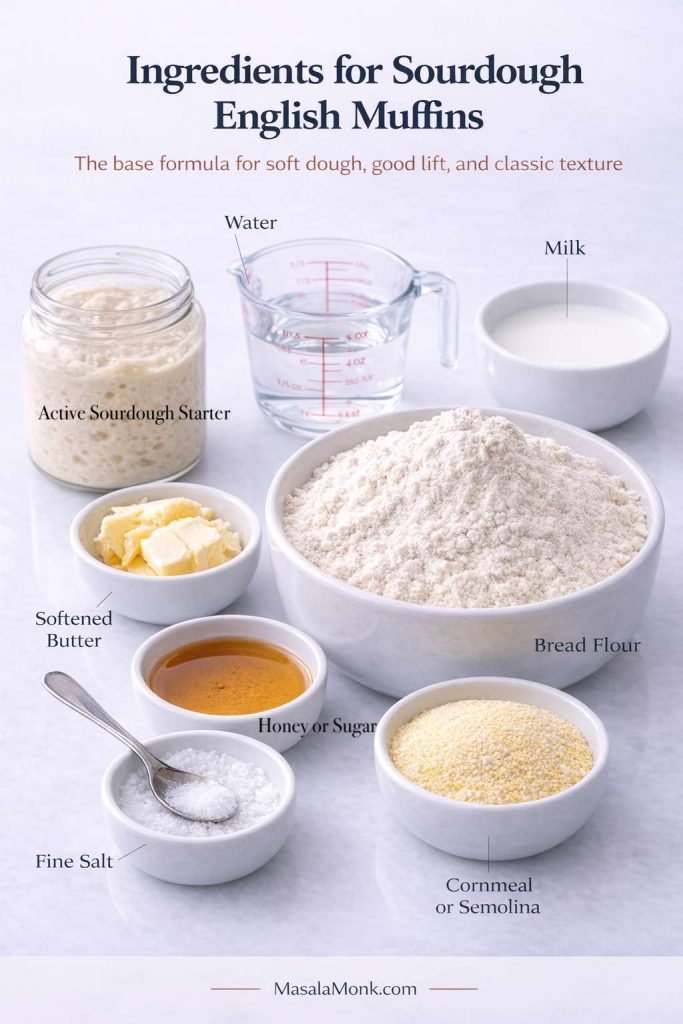
Ingredients for sourdough English muffins

Ingredients guide for sourdough English muffins showing active sourdough starter, water, milk, bread flour, softened butter, honey or sugar, fine salt, and cornmeal or semolina arranged in a labeled baking setup.
The base sourdough English muffins formula is simple, but each ingredient plays a specific role in the final texture. Active starter drives lift, bread flour gives structure and chew, milk and water balance tenderness and handling, butter softens the crumb, and honey or sugar helps with browning. Salt sharpens the flavor, while cornmeal or semolina helps with the classic finish and easier handling during proofing and cooking.
  • 120 g active sourdough starter
  • 180 g lukewarm milk
  • 60 g lukewarm water
  • 20 g honey or sugar
  • 30 g softened butter
  • 360 g bread flour
  • 7 g fine salt
  • cornmeal or semolina, for dusting

Recipe notes before you start

  • The dough should feel soft and slightly tacky, not stiff.
  • Shape to about 3/4 inch thick if you want a better interior.
  • Proof until the rounds look a little fuller and softer, not dramatically doubled.
  • Cook over truly low heat. This is where many batches go wrong.
  • Cool fully, then fork-split, then toast for the best final texture.

Also Read: Protein Ice Cream Recipe: 10 Creamy Homemade Recipes

Ingredient notes for sourdough English muffins

Active sourdough starter
Use starter that has been fed and is clearly lively. It should look airy, expanded, and capable of lifting dough on its own. If you are unsure what ready starter really looks like, go back to this guide on feeding and storing sourdough starter.

Milk and water
Milk softens the crumb and supports browning. Water keeps the dough from becoming too rich. Together they give homemade sourdough English muffins that stay tender without drifting into bun territory.

Honey or sugar
Either works. The amount is modest, so the dough will not taste sweet, but it helps browning and rounds out the flavor.

Butter
Butter adds tenderness. The amount stays moderate, so the dough still behaves like English muffin dough rather than enriched roll dough.

Bread flour
Bread flour gives the dough the strength to rise well and hold shape on the skillet. All-purpose flour can work, but bread flour is the better default for chew and structure.

Cornmeal or semolina
This helps with sticking and gives the classic finish. It does not create the open crumb. Fermentation, thickness, heat, and fork-splitting do that.

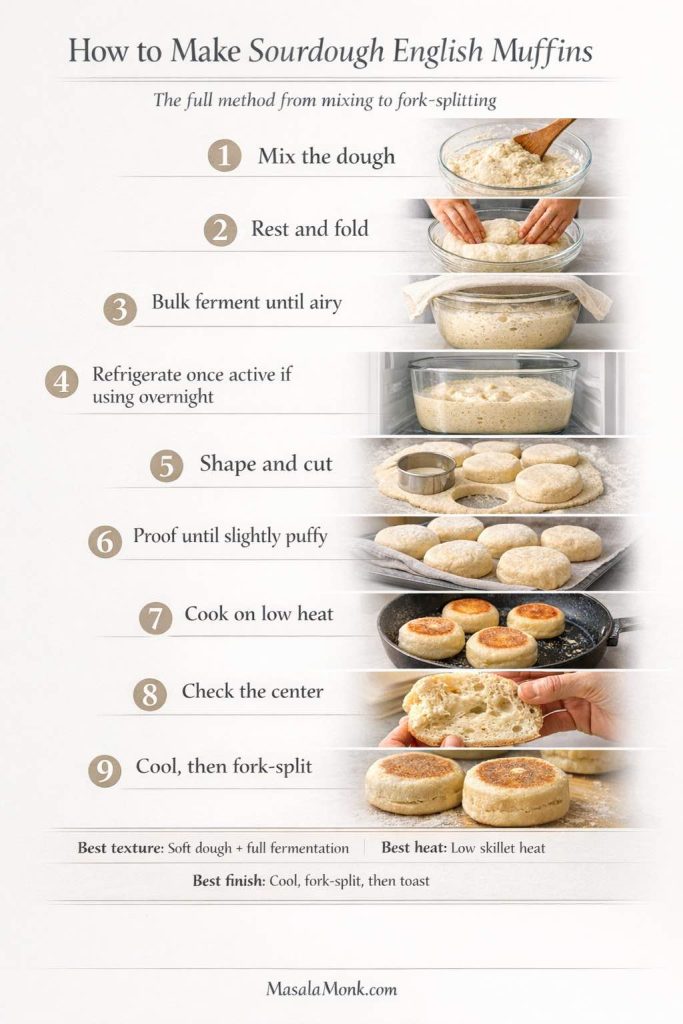
Making sourdough English muffins goes more smoothly when you can see the whole sequence before you start. This method guide walks through the full flow from mixing and folding to fermentation, shaping, proofing, skillet cooking, checking the center, and cooling before fork-splitting. Use it as your quick roadmap for the batch, then follow the detailed recipe for the exact dough cues, timing flexibility, and texture checkpoints that make the muffins come out light, cooked through, and ready to toast well.

How to make sourdough English muffins

1. Mix the dough

In a large bowl, stir together the active starter, milk, water, honey, and softened butter until mostly smooth. Add the bread flour and salt, then mix until no dry flour remains.

Do not chase a polished dough here. You only need even mixing, and a rough but cohesive dough is completely fine at this stage.

Step 1 process image for sourdough English muffins showing freshly mixed dough in a large bowl, rough and shaggy but fully combined, with no dry flour remaining and a wooden spoon resting in the dough.
This is what properly mixed sourdough English muffin dough should look like before the first rest: soft, shaggy, cohesive, and fully combined, but not smooth or polished yet. At this stage, you are only bringing the ingredients together until no dry flour remains. If the dough looks rough, that is normal. The goal here is not to knead it into a finished dough, but to set up the rest-and-fold stage that helps it relax, smooth out, and strengthen naturally.

When the dough feels drier than expected, add only a very small splash of liquid. When it feels shaggy and awkward, let it rest before correcting it with more flour. That pause matters. Dough often settles after the first rest, and overcorrecting early makes the final crumb tighter than it needs to be. The same general logic helps with sourdough pizza dough too: pause before you fix.

2. Rest and strengthen the dough

Cover the bowl and let the dough rest for 20 to 30 minutes. Then give it 3 to 4 folds in the bowl or on a lightly damp counter.

Step 2 process image for sourdough English muffins showing rested dough being gently folded in a bowl, with the dough looking softer, smoother, and stronger than after mixing but not fully polished.
After the first rest, sourdough English muffin dough should look calmer and more organized than it did right after mixing. This is the stage where gentle folds begin building strength without turning the dough stiff or overworked. If the dough feels softer, stretches more easily, and already looks less rough, that is exactly what you want before bulk fermentation begins.

You do not need a hard knead. The goal is to help the dough feel smoother, calmer, and stronger than it did right after mixing.

3. Bulk ferment until clearly airy

Cover the bowl again and let the dough rise until it is visibly puffier, lighter in feel, and more aerated. Use the dough, not the clock.

Signs it is ready:

  • it looks expanded rather than flat
  • the surface feels softer
  • the mass feels lighter under your hands
  • it shows visible airiness instead of a dense, heavy look
Step 3 process image for sourdough English muffins showing bulk-fermented dough in a bowl, puffier and more aerated than before, with a soft surface and visible air bubbles that signal the dough is ready for the next stage.
This is the look you want before shaping sourdough English muffins: the dough should feel lighter, look fuller, and show visible airiness across the surface. It should not seem dense, flat, or lifeless at this point. Bulk fermentation is one of the biggest texture drivers in the whole recipe, because dough that has not become properly airy usually bakes into tighter, heavier muffins with fewer nooks and crannies.

If you are making overnight sourdough English muffins, let the dough begin fermenting at room temperature until it shows clear activity, then refrigerate it. For a same-day batch, keep it at room temperature until it reaches those same cues.

4. Refrigerate if using the overnight route

For the overnight route, chill the dough only after it has clearly started fermenting. Do not refrigerate a lifeless dough and expect the fridge to solve it.

Step 4 process image for sourdough English muffins showing lightly active dough in a covered container, ready to be refrigerated for the overnight route after it has already started fermenting.
For overnight sourdough English muffins, the dough should go into the refrigerator only after it already looks active and lightly puffed. This is the stage where cold fermentation helps with flexibility and flavor, but it does not replace early fermentation. If the dough still looks flat and lifeless, it is too soon to chill it. What you want here is a dough that already shows movement before the overnight rest.

The next day, let it sit just long enough that it is no longer stiff and stubborn, then shape.

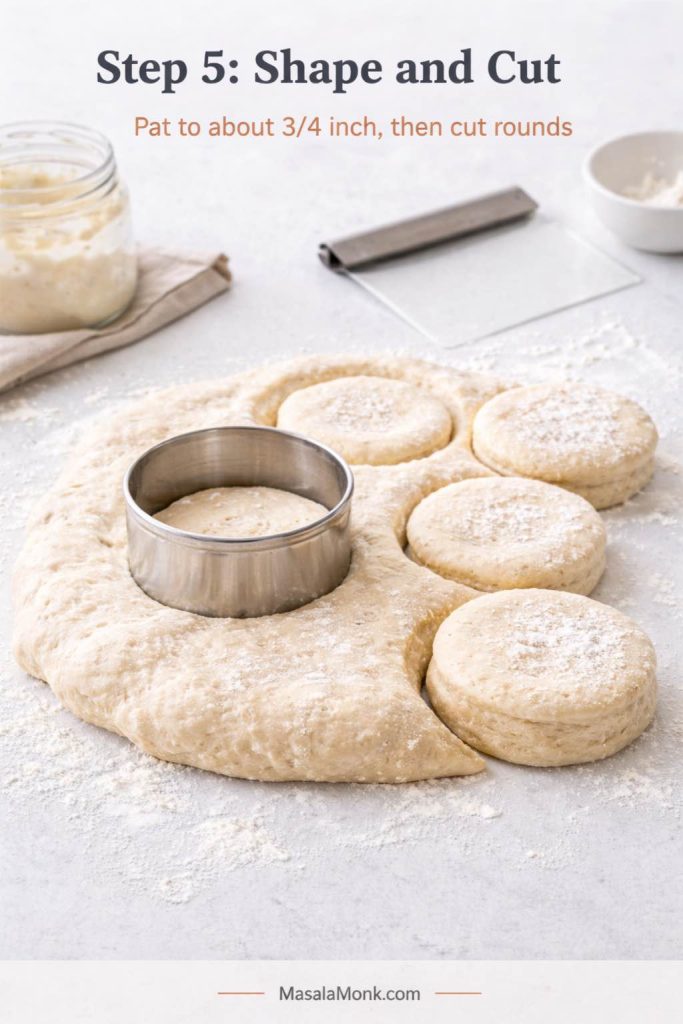
5. Shape and cut the muffins

Turn the dough onto a lightly floured surface and pat or roll it to about 3/4 inch thick. Keep the thickness as even as possible. A standard English muffin cutter size works well here and usually gives the most familiar result.

That thickness matters. Thinner rounds cook more easily but lose interior character. Thicker rounds create better texture but demand lower heat and more patience.

Step 5 process image for sourdough English muffins showing thick dough patted to about 3/4 inch on a lightly floured surface, with a cutter cutting rounds and several soft cut muffins visible beside the dough.
This is the shaping stage that helps protect the final texture of sourdough English muffins. The dough should be patted or rolled to about 3/4 inch thick before cutting, which gives the interior enough room to open instead of baking up flat and bread-like. The rounds should look soft and alive, not tight, dry, or heavily floured. This is also why repeated rerolling works against the crumb: every extra pass compresses the dough and makes it harder to get the rough fork-split texture you want later.

Cut rounds with a biscuit cutter or glass and transfer them to parchment or a tray dusted with cornmeal or semolina. Re-roll scraps once if needed, but not again and again. Every reroll compresses the dough and makes it harder to get the open interior you want.

If the dough sticks badly, lightly flour the surface and your cutter, but do not bury the dough under excess flour. Too much bench flour works directly against sourdough English muffins with nooks and crannies.

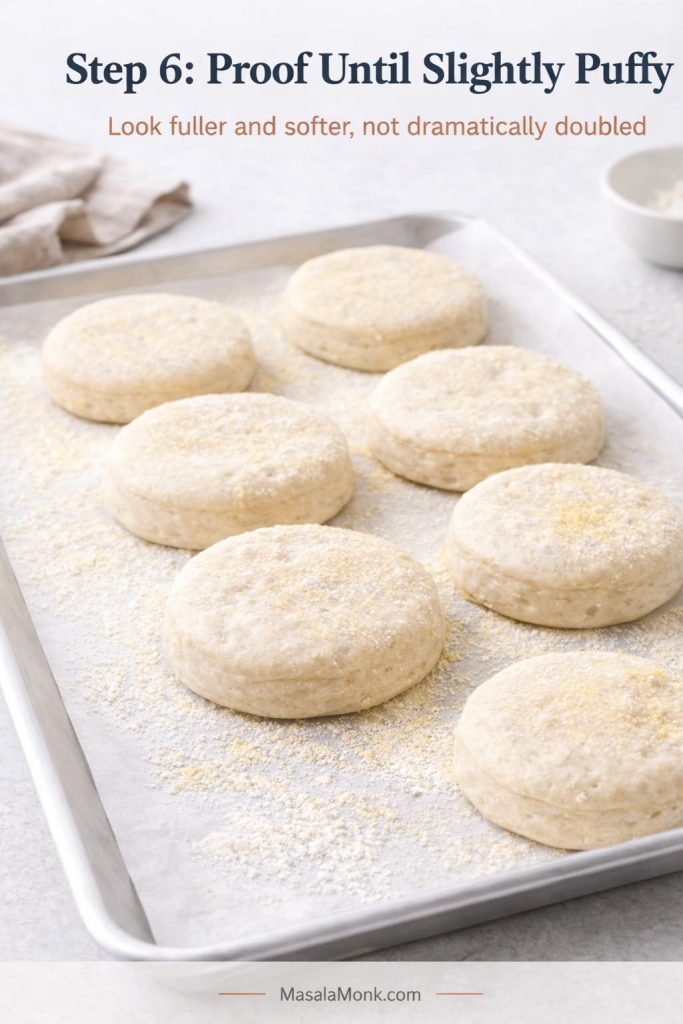
6. Proof the rounds

Let the cut rounds rest until they are slightly puffy and visibly softer. They should not double dramatically. They should simply look less dense and feel a little lighter.

Step 6 process image for sourdough English muffins showing proofed rounds on a parchment-lined tray dusted with cornmeal or semolina, slightly puffier and softer than when first cut but not dramatically doubled.
This is the look to aim for before sourdough English muffins hit the skillet: the rounds should seem a little fuller, softer, and more relaxed than when they were first cut, but they should still hold their shape cleanly. Final proofing here is not about dramatic volume. It is about giving the dough enough time to loosen and lighten so the muffins cook with better lift and a more open interior instead of staying tight and compact.

A round that still looks tight will usually cook tight. A round that looks overblown, fragile, or hard to move cleanly is already beyond ideal and should go straight to the skillet.

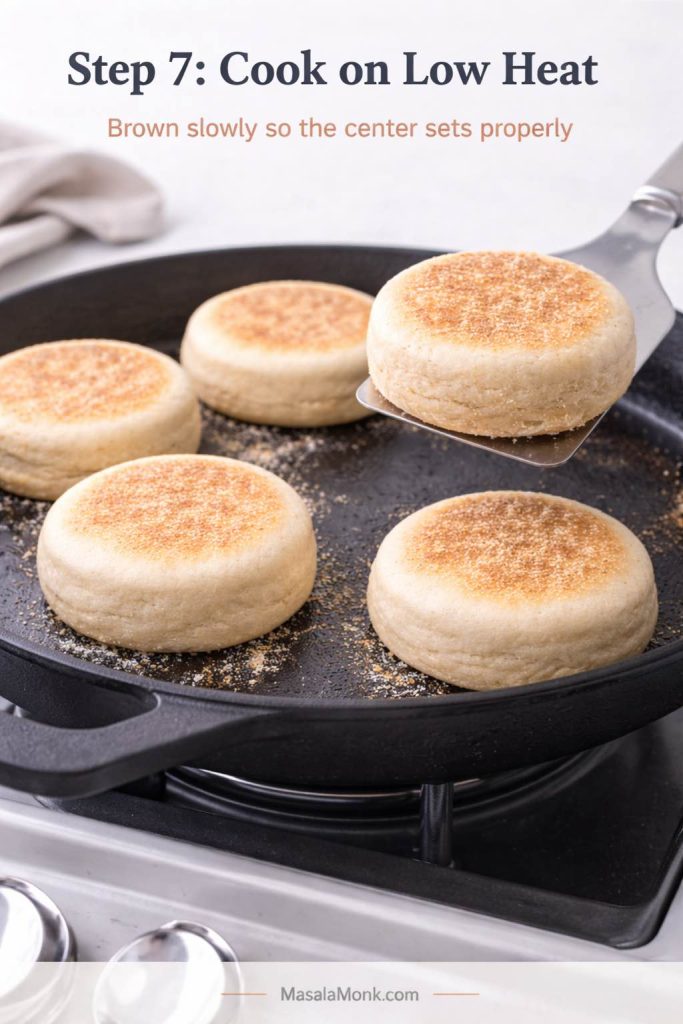
7. Cook low and patiently

Heat a heavy skillet or griddle over low heat. Low means low, not medium-low pretending to be low.

Place the muffins on the skillet and cook the first side slowly until evenly browned. Then flip and cook the second side just as gently. On many home stoves, expect roughly 5 to 7 minutes on the first side and 4 to 6 minutes on the second, though thickness, stove strength, and pan material can shift that a little.

Step 7 process image for sourdough English muffins showing thick muffins cooking on a skillet over low heat, with gradual even browning and one muffin lifted on a spatula to show the underside color.
Low skillet heat is what gives sourdough English muffins time to cook through before the outsides darken too fast. The bottoms should brown gradually and evenly, while the sides begin to look less raw and more set. When the pan runs too hot, the crust gets ahead of the center and the texture suffers. A patient cook here is what protects the crumb you built through fermentation, shaping, and proofing.

Watch for these signs before flipping:

  • the bottom is evenly browned
  • the sides are beginning to look more matte than raw
  • the muffin feels lighter when you lift an edge
  • the surface looks more set and less doughy

If the muffins are thick and the crust is coloring before the sides start to look set, cover the pan briefly to help trap enough heat for the center to catch up. If the muffins are well colored but still doubtful in the middle, move them to a low oven to finish gently instead of forcing more stovetop color.

That slow approach matters. Little Spoon Farm’s sourdough English muffins use similar low-heat logic for the same reason: English muffins need time to cook through, not just time to brown.

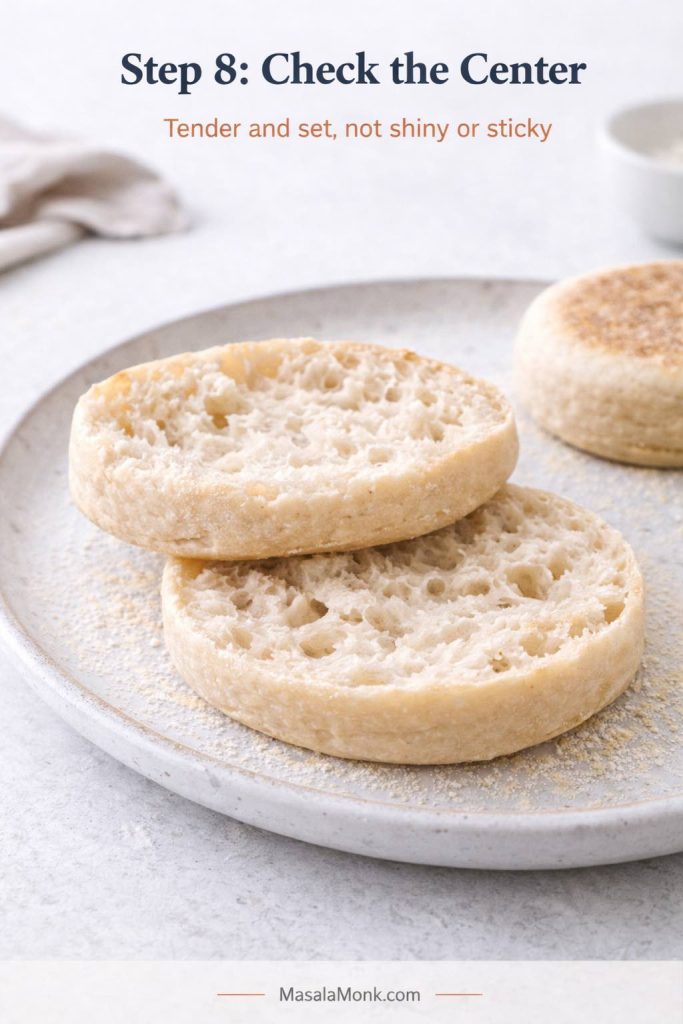
8. Check for doneness

A done muffin should feel lighter than it looks and set through the center. If you are unsure, pull one, let it rest briefly, then open it. The middle should look tender and cooked through, not shiny, sticky, or pasty.

A properly cooked sourdough English muffin should open to a crumb that looks set, tender, and lightly moist without any gummy or pasty center. What you are checking here is not whether the inside looks dry, but whether it has finished cooking through. If the middle still looks shiny or sticky, the muffins need more gentle heat. If it looks soft yet clearly set, you are ready to move on to cooling and fork-splitting.

A crumb that is fully set but slightly moist is not the same as a raw gummy center. Toasting finishes the texture beautifully. Raw gumminess is the problem, not tenderness.

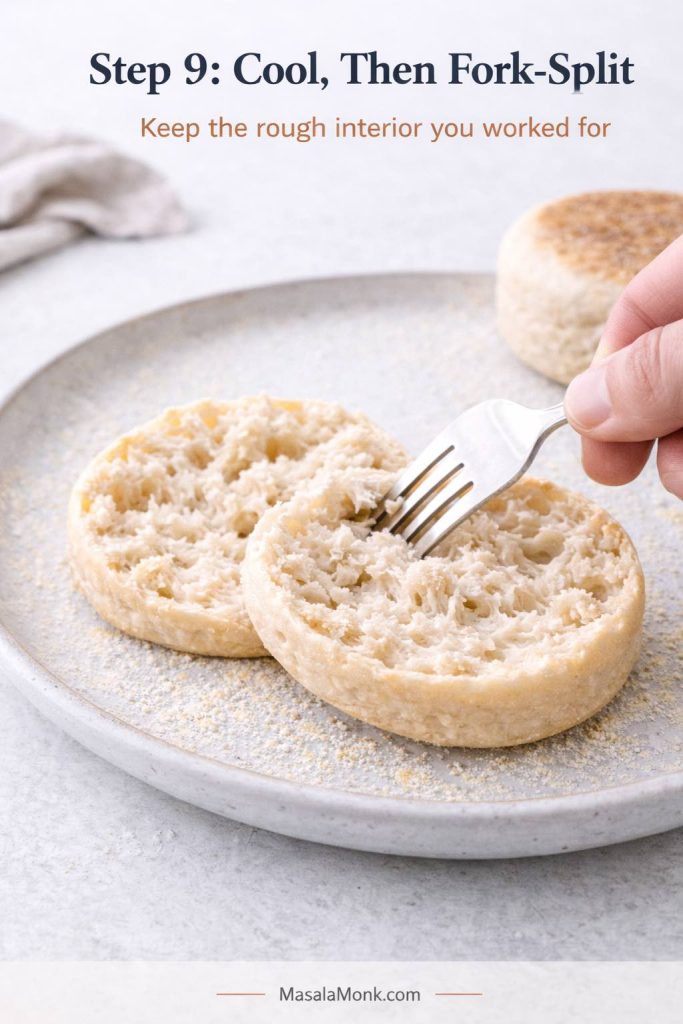
9. Cool completely, then fork-split

Let the muffins cool all the way before opening them. Then use a fork to work around the sides until they separate.

Fork-splitting is what helps sourdough English muffins keep the rough interior that makes them so good once toasted. A knife gives a cleaner cut, but it smooths away some of the texture you worked for through fermentation, shaping, proofing, and low-heat cooking. Once the muffins have cooled fully, use a fork around the seam to open them and preserve that more jagged, butter-catching crumb.

This is not decorative. It is part of the texture. Fork-splitting preserves the rough interior a knife smooths away, which is why both King Arthur’s sourdough English muffin recipe and their broader English muffin guidance emphasize splitting with a fork.

Also Read: Homemade Mango Ice Cream Recipe

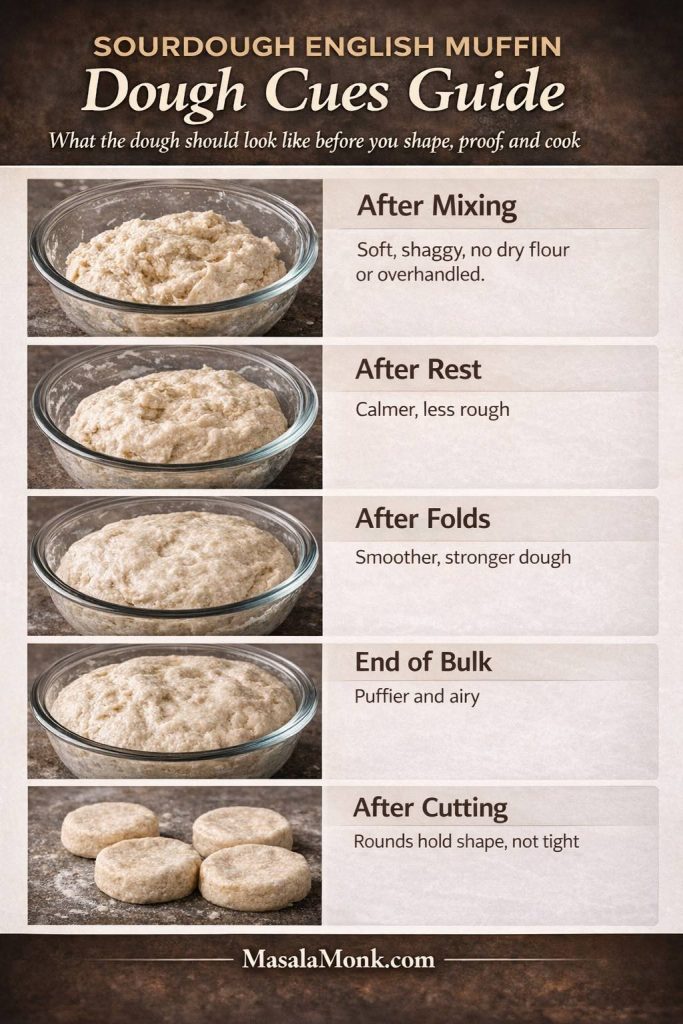
Dough cues that matter more than the clock

Sourdough English muffin dough cues guide showing how the dough should look after mixing, after resting, after folds, at the end of bulk fermentation, and after cutting, with visual cues for softness, strength, airiness, and shape.
Reading the dough correctly matters more than chasing a fixed timeline. This sourdough English muffin dough cues guide shows what to look for at each stage, from a soft shaggy mix to a calmer rested dough, a stronger dough after folds, a puffier and airier dough at the end of bulk fermentation, and cut rounds that hold shape without looking tight. Use it alongside the full recipe so you can judge readiness by feel and appearance, not just the clock.

After mixing

The dough should feel soft and slightly tacky, not dry and tight, and not wet enough to slump like batter. A dough that already feels stiff usually bakes up denser than it should.

After the rest

It should feel calmer and less rough. That is one reason not to add too much flour too early.

After the folds

The dough should feel smoother, more elastic, and more organized. Do not expect it to look perfect. What matters is that it feels stronger than it did at first.

At the end of bulk fermentation

It should look puffier, feel lighter, and show visible airiness. If it still feels heavy and dull, it is not ready.

After cutting

The rounds should hold shape without feeling tight. If they still look compact after proofing, they usually cook compact.

Also Read: Cookie Pie Recipe: 10 Best Flavors, Fillings and Variations

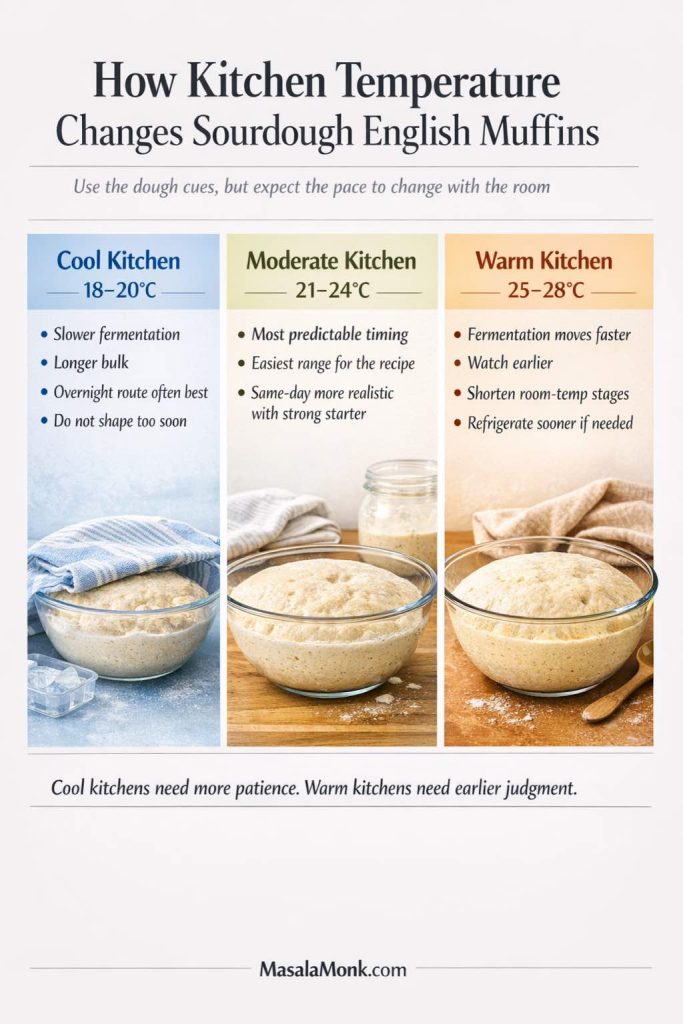
Timing guidance by kitchen temperature

Use these as working expectations, not promises. Starter strength still matters, but room temperature changes the pace more than many bakers expect.

Kitchen temperature guide for sourdough English muffins showing cool, moderate, and warm kitchen ranges with notes on how fermentation timing, bulk rise, and schedule flexibility change in each condition.
Room temperature changes how quickly sourdough English muffin dough moves, which is why timing should always be read through the dough instead of the clock alone. Cool kitchens usually need more patience and often suit the overnight route best, moderate kitchens are the most predictable, and warm kitchens can push fermentation along fast enough that earlier checks and shorter room-temperature stages matter. Use this guide to adjust the pace without losing the soft dough, proper proof, and low-heat cooking that give the muffins their best texture.

Cool kitchen, around 18 to 20°C

The dough will move slowly. Lean toward the overnight route, allow a longer bulk fermentation, and resist shaping too soon just because the clock says you should.

Moderate kitchen, around 21 to 24°C

This is the easiest range for the recipe. Most timing guidance behaves normally here, and same-day batches become more realistic when the starter is strong.

Warm kitchen, around 25 to 28°C

Fermentation can move surprisingly fast. Watch the dough earlier, shorten room-temperature stages where needed, and refrigerate sooner if the dough starts looking more inflated than airy.

Also Read: Punjabi Mutton Bhuna – Amritsari Village-Style Gosht Recipe

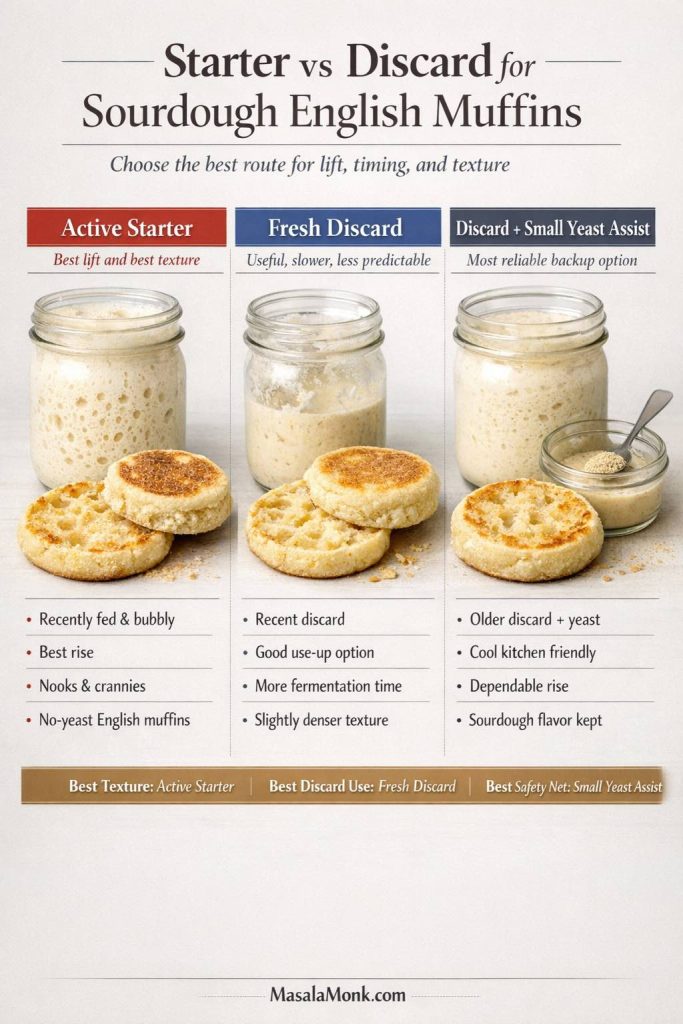
Sourdough starter vs discard for English muffins

This is one of the biggest search intents around the topic, so it deserves a direct answer.

Comparison guide for sourdough English muffins showing active starter, fresh discard, and discard with a small yeast assist, with visual differences in starter condition, rise reliability, texture expectations, and best-use recommendations.
Not every sourdough English muffin batch should start the same way. Active starter gives the best rise, the strongest chance of real nooks and crannies, and the clearest path to no-yeast sourdough English muffins. Fresh discard can still work well when it is recent and well kept, but it usually needs more time and may give a slightly less lofty result. If your discard is older, your kitchen runs cool, or you want a steadier rise, a small yeast assist is often the smartest backup.

When active starter is best

Use active starter when you want the best rise, the best crumb, and the cleanest path to sourdough English muffins no yeast. It is the strongest choice for english muffins with sourdough starter because it gives the dough the most dependable lift.

If your starter has been erratic, slow, or weak, go back to why your starter is slow or weak before blaming the recipe itself.

When discard works well

Use discard when it is fairly fresh and you are willing to allow extra time if the dough moves slowly. Sourdough discard English muffins can absolutely be flavorful and satisfying, especially if the discard comes from a healthy routine.

The real distinction is not starter versus discard as a label. It is active leavening power versus variable leavening power.

Can discard work alone?

Yes, but sourdough discard English muffins no yeast depend much more on the condition of the discard. Fresh discard has a much better chance than old, sharply acidic discard that has been sitting cold for too long.

If you go this route, watch the dough honestly. It may need more time than you hoped.

When a little yeast helps

A small yeast assist helps when the discard is older, the kitchen is cool, or the schedule is tight. It does not erase sourdough flavor. It simply makes the rise more dependable.

That is why recipes like Pantry Mama’s sourdough English muffins and other hybrid formulas treat a little commercial yeast as a practical tool rather than something to apologize for.

Also Read: Peach Cobbler with Canned Peaches (Dessert Recipe)

Discard adaptation for sourdough English muffins

If you specifically came here for sourdough discard English muffin recipe intent, this is the simplest way to adapt the master version.

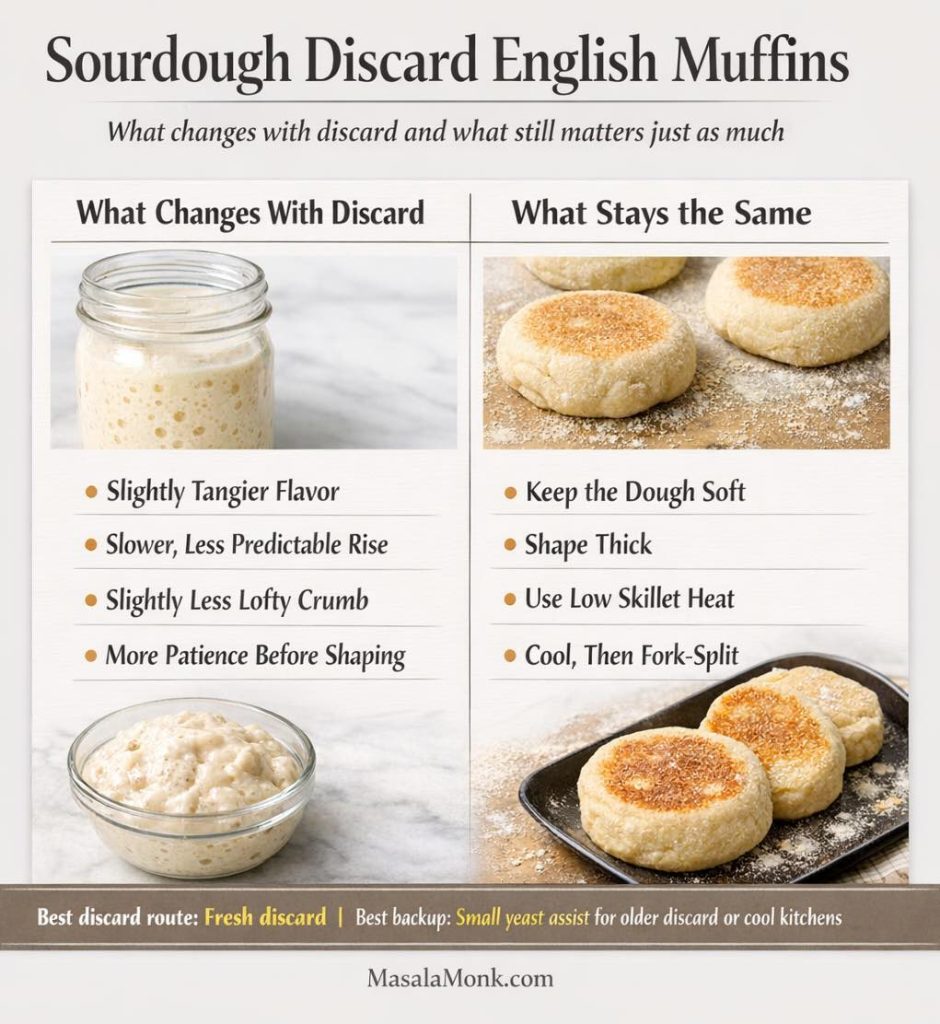
Use fresh discard in place of active starter when possible. Expect bulk fermentation to move more slowly. Do not cut rounds until the dough is genuinely airy. If your discard smells sharply acidic, has been sitting cold for a long time, or your kitchen is cool, a small yeast assist is the smarter choice.

Discard adaptation guide for sourdough English muffins comparing what changes with sourdough discard, such as tangier flavor and slower rise, with what stays the same, including soft dough, thick shaping, low skillet heat, and cooling before fork-splitting.
Fresh sourdough discard can still make very good English muffins, but it changes the pace more than it changes the core method. The dough may rise more slowly, the crumb may come out a little less lofty, and shaping usually rewards more patience. What still matters just as much is keeping the dough soft, shaping thick enough to protect the interior, cooking over low skillet heat, and cooling before fork-splitting. When the discard is older or the kitchen runs cool, a small yeast assist is often the smarter safety net.

What changes with discard:

  • the flavor may be a little tangier
  • the rise may be slower and less predictable
  • the crumb may be slightly less lofty
  • the dough may need more patience before shaping

What does not change:

  • you still want a soft dough
  • you still want thick shaping
  • you still need low skillet heat
  • you still need to cool before fork-splitting

Also Read: Avocado Chocolate Mousse Recipe

Overnight sourdough English muffins vs same-day timing

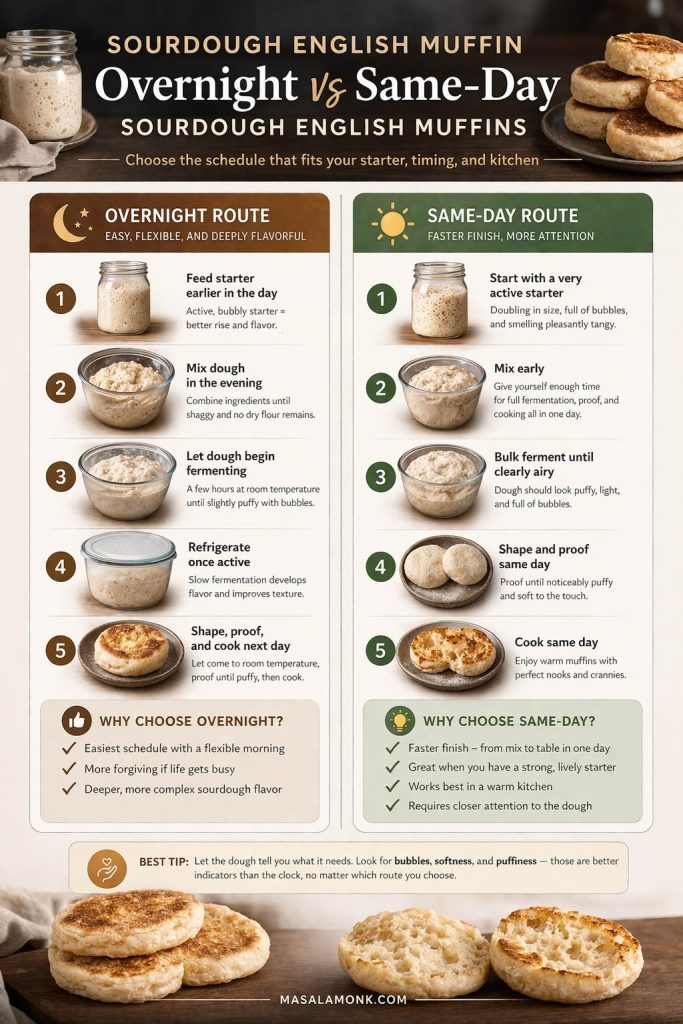
Comparison guide showing overnight vs same-day sourdough English muffins, with step-by-step timelines for each route, including starter readiness, mixing, fermentation, shaping, proofing, and cooking, plus notes on flexibility, flavor, and when each schedule works best.
Not every batch of sourdough English muffins needs the same schedule. The overnight route is the easier, more forgiving option when you want flexibility and deeper flavor, while the same-day route works best with a very active starter, warmer conditions, and closer attention to dough cues. Use this guide to choose the timing that fits your kitchen and routine, then follow the full post for the detailed recipe, fermentation cues, and troubleshooting.

Overnight route

  • Feed the starter earlier in the day.
  • Mix the dough in the evening.
  • Let it begin fermenting at room temperature.
  • Refrigerate once it shows real activity.
  • Shape, proof, and cook the next day.

This is the calmest and most forgiving route for most bakers.

Same-day route

  • Start with a very lively fed starter.
  • Mix early enough that bulk fermentation has time to finish.
  • Shape only once the dough is clearly airy.
  • Proof the rounds fully before cooking.
  • Stay flexible rather than locking yourself to a rigid clock.

This can still produce easy sourdough English muffins, but it demands stronger conditions and closer attention.

If that make-ahead rhythm suits you, save these other sourdough breakfast bakes for later too.
Also Read: Falafel Recipe: Crispy Homemade, Air Fryer and Baked Falafel

How to get nooks and crannies in sourdough English muffins

This deserves its own section because it is the texture people actually want.
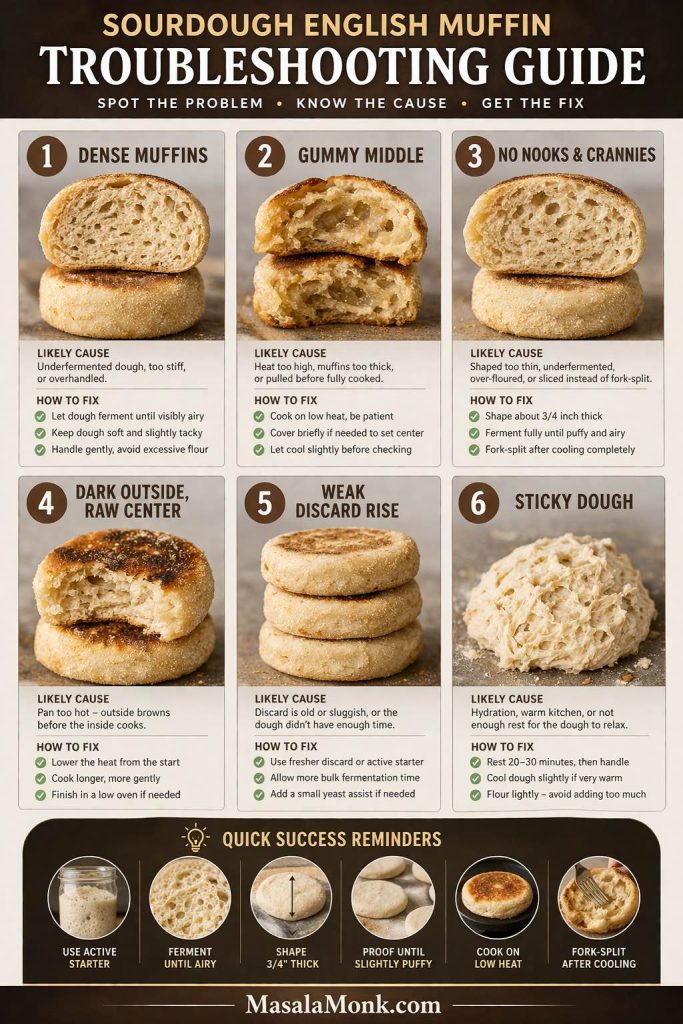
Guide graphic showing how to get nooks and crannies in sourdough English muffins, with a fork-split muffin and callouts for full fermentation, soft dough, 3/4 inch shaping, slight proof, low heat, and cooling before splitting.
If you want sourdough English muffins with real nooks and crannies, focus on the combination that creates them: fully fermented dough, a soft texture that is not over-floured, thick shaping, a gentle final proof, low skillet heat, and fork-splitting only after the muffins have cooled. This is the texture roadmap for getting rough, toastable interiors instead of flat, bread-like middles.

Ferment fully

Underfermented dough is the fastest way to lose the texture you want. If the dough never becomes airy enough, the crumb usually stays tight no matter how careful you are later.

Keep the dough thick enough

If you want to know how to get nooks and crannies in sourdough English muffins, shaping thickness matters. Around 3/4 inch is a strong starting point because it gives the interior enough room to open while still being realistic to cook through.

Keep the dough soft, not stiff

A dough corrected too aggressively with flour often becomes easier to handle and worse to eat. English muffins need enough softness to open well later.

Handle the dough gently

Once the dough has fermented properly, your job is to preserve that structure. Avoid aggressively degassing it. Repeated rerolling also works against you. Do not press all the life out of it in pursuit of perfect-looking rounds.

Do not over-flour the bench

Too much bench flour makes shaping easier and texture worse. Use only enough to prevent sticking.

Use lower heat than you think

High heat gives fast color and weak middles. Low heat gives the interior time to set.

Proof the rounds properly

Too short and they stay tight. Too far and they spread too easily. You want the middle ground where the rounds look fuller and softer, not exhausted.

Fork-split after cooling

This is the final texture-preserving step. Split too early and you tear the crumb badly. Slice with a knife and you smooth away some of what you built.

If you want an external benchmark for the target texture, King Arthur’s English muffin texture guide is still one of the better references.

Also Read: Mango Margarita Recipe (Frozen or On the Rocks)

Common sourdough English muffin mistakes

  • using starter that is not really active
  • turning a soft dough into a stiff one with too much correction flour
  • shaping too thin
  • cutting before bulk fermentation is truly complete
  • overhandling or rerolling too much
  • rushing the final proof
  • cooking over medium heat instead of truly low heat
  • splitting too early or slicing with a knife

Troubleshooting sourdough English muffins

Sourdough English muffin troubleshooting guide showing common problems including dense muffins, gummy middle, no nooks and crannies, dark outside with raw center, weak discard rise, and sticky dough, with quick fixes for each.
When sourdough English muffins go wrong, the problem is usually visible before the batch is beyond saving. Dense muffins point to underfermentation or stiff dough, gummy centers usually mean the heat was too high, and a lack of nooks and crannies often comes from thin shaping or rough handling. Use this troubleshooting guide to diagnose what happened, then adjust fermentation, dough softness, shaping thickness, and skillet heat so the next batch comes out lighter, rougher inside, and easier to toast well.

Why are my sourdough English muffins dense?

Likely cause: underfermentation, dough that is too stiff, or overhandling
What the dough probably looked like earlier: heavy after bulk or cut too soon
What it looks like after cooking: tight crumb, little spring, more like flat bread than English muffin
Can this batch be rescued? Only partly. If the rounds are not cooked yet, proof longer. Once cooked, toasting helps but cannot fully reverse density.
Fix next time: keep the dough softer, ferment more fully, and handle more gently

Why are my sourdough English muffins gummy in the center?

Likely cause: skillet heat too high, rounds too thick for the way they were cooked, or pulling them too early
What the dough probably looked like earlier: often fine, though final proof may have been a bit tight
What it looks like after cooking: browned outside, sticky or damp middle
Can this batch be rescued? Yes. Finish gently in a low oven or toast split halves after cooling.
Fix next time: keep the pan lower from the start and use doneness checks before pulling the batch

Why didn’t my sourdough English muffins get nooks and crannies?

Likely cause: underfermentation, thin shaping, rough handling, too much bench flour, or knife-splitting
What the dough probably looked like earlier: compact after bulk or pressed too flat during shaping
What it looks like after cooking: smoother, tighter interior instead of a rough open crumb
Can this batch be rescued? Not fully. You can still fork-split and toast well, but the core crumb structure is mostly set already.
Fix next time: ferment more fully, keep the dough thicker, preserve more gas, and cool before fork-splitting

Why are the outsides dark before the middles cook?

Likely cause: too much heat
What the dough probably looked like earlier: often completely fine
What it looks like after cooking: good color outside, underdone center
Can this batch be rescued? Usually yes. Lower the heat and finish more gently or move them to a low oven.
Fix next time: preheat gently and stay low from the beginning

Why is my discard batch not rising well?

Likely cause: weak or old discard
What the dough probably looked like earlier: slow bulk fermentation, little real expansion, minimal puff after cutting
What it looks like after cooking: flatter muffins with tighter crumb
Can this batch be rescued? Sometimes. Give it more time if the dough still has life.
Fix next time: use fresher discard, warmer conditions, the overnight route, or a small yeast assist

Why is my sourdough English muffin dough too sticky?

Likely cause: hydration, temperature, or not enough rest
What it looks like during shaping: messy and sticking everywhere
Can this batch be rescued? Usually yes. Rest the dough, cool it slightly, and flour lightly.
Fix next time: resist adding too much flour too early and let the dough organize itself first

What changes in a warm kitchen?

Likely cause: faster fermentation
What it looks like: the dough moves faster than expected and can overproof without much warning
Can this batch be rescued? Usually yes, if you shorten room-temperature stages or refrigerate earlier
Fix next time: trust the dough cues sooner

What do overproofed rounds look like?

They tend to look too inflated, delicate, and hard to move cleanly. They may spread more than they rise on the skillet. If that happens, cook them immediately and shorten the final proof next time.

Also Read: Balti Paneer Gravy (Restaurant-Style, Creamy + Bold Recipe)

How to store, freeze, and reheat sourdough English muffins

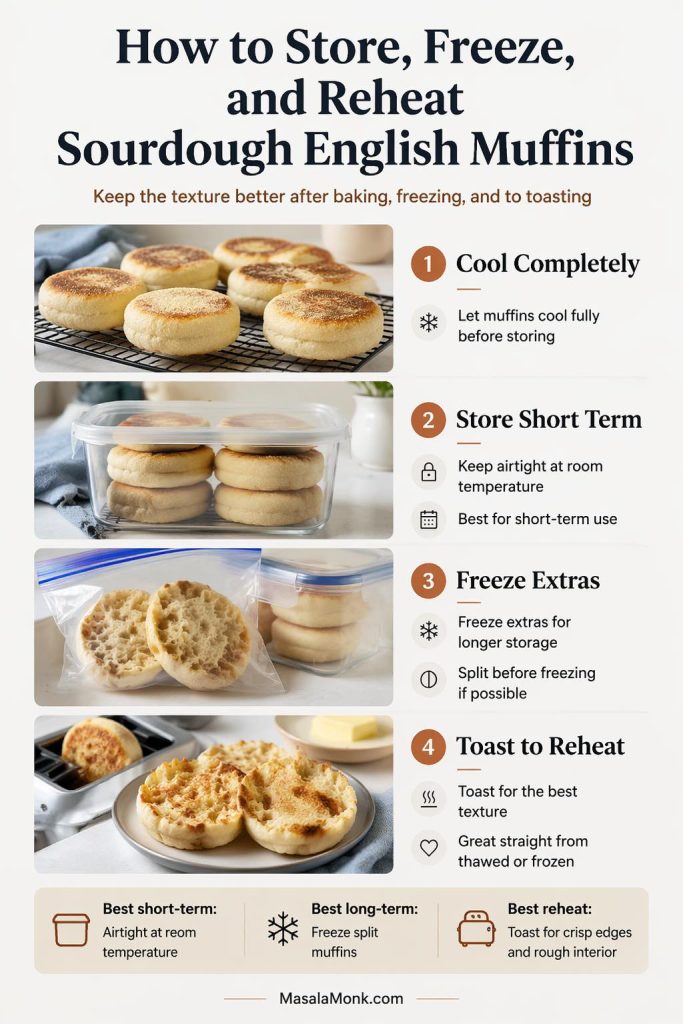
Cool the muffins fully before storing them. Keep them wrapped or in an airtight container for short room-temperature storage, then freeze the rest.

Storage guide for sourdough English muffins showing how to cool completely, store short term in an airtight container, freeze split muffins, and toast to reheat for the best texture.
Sourdough English muffins keep their texture best when you handle them in stages. Let them cool completely before storing, keep short-term muffins airtight at room temperature, and freeze extras once split so they are easier to toast later. When you are ready to eat them, toasting is the best way to bring back crisp edges and that rough fork-split interior that makes homemade sourdough English muffins so satisfying.

Yes, you can freeze sourdough English muffins very well. In fact, freezing is often the smartest move because these shine when split and toasted. Splitting them before freezing makes reheating easier later.

To reheat, toast the fork-split halves until the rough interior crisps and the edges color well. That is when the texture really pays off.

Also Read: Mojito Recipe (Classic) + Ratios, Pitcher, Mocktail & Easy Variations

Variations on this sourdough English muffins recipe

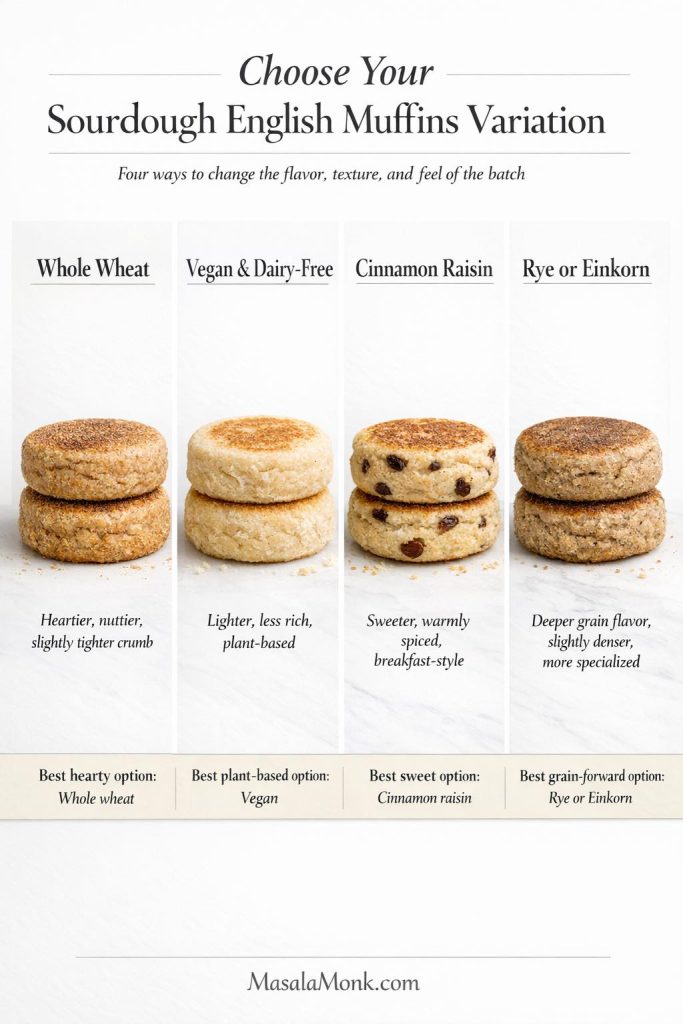
Comparison guide for sourdough English muffins showing four variations: whole wheat, vegan and dairy-free, cinnamon raisin, and rye or einkorn, with quick notes on flavor, texture, and which version each one suits best.
Sourdough English muffins do not all need to go in the same direction. Whole wheat makes the batch heartier and nuttier, the vegan version keeps it lighter and plant-based, cinnamon raisin turns it into a sweeter breakfast option, and rye or einkorn pushes the flavor deeper and more grain-forward. Use this guide to choose the variation that matches the kind of crumb, flavor, and overall feel you want before moving into the full standalone recipe card for that version.

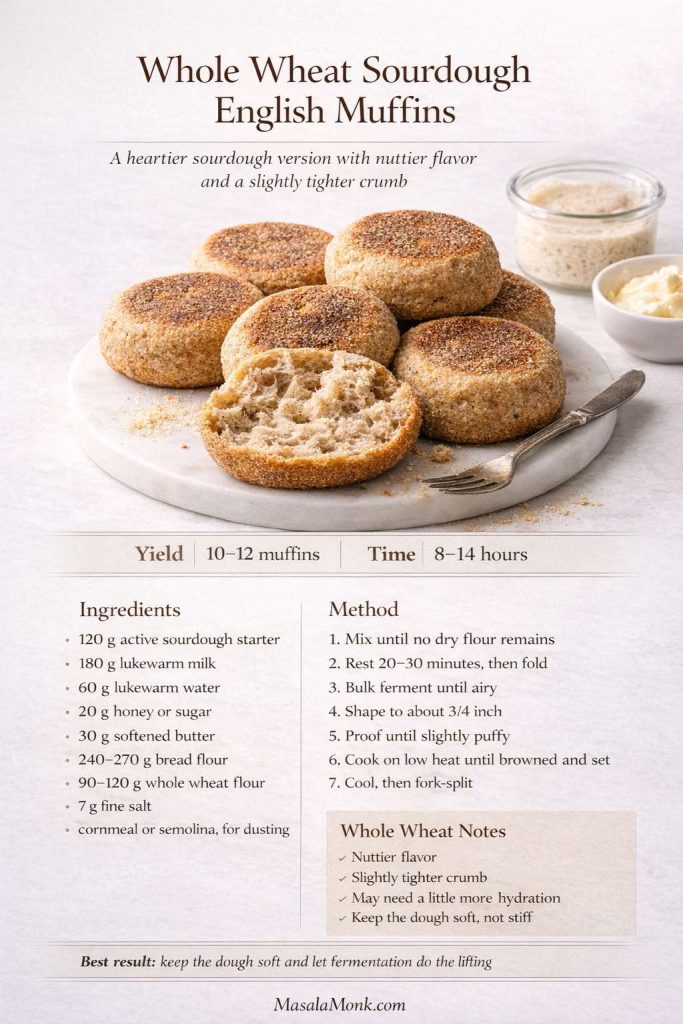
Whole wheat sourdough English muffins

Replace part of the bread flour with whole wheat flour rather than switching the full formula at once. Starting with about one-quarter to one-third whole wheat is usually the safest move.

What to expect:

  • nuttier flavor
  • slightly tighter crumb
  • a dough that may need a little more hydration
  • a heartier result overall
Standalone recipe card for whole wheat sourdough English muffins showing heartier skillet-cooked muffins with a split crumb, ingredient list, method, yield, time, and whole wheat notes about texture and hydration.
Whole wheat sourdough English muffins bring a nuttier flavor, a slightly tighter crumb, and a more wholesome chew while still keeping the core character of the original style. This card works as a full quick-reference version on its own, with the ingredient list, core method, timing, and the extra watch-outs that matter most for whole wheat dough. The biggest thing to protect here is softness: once the dough gets over-floured, the variation quickly turns heavier than it should.

What to watch:

  • do not overcorrect with lots of extra flour
  • expect a more wholesome texture and a slightly less open interior

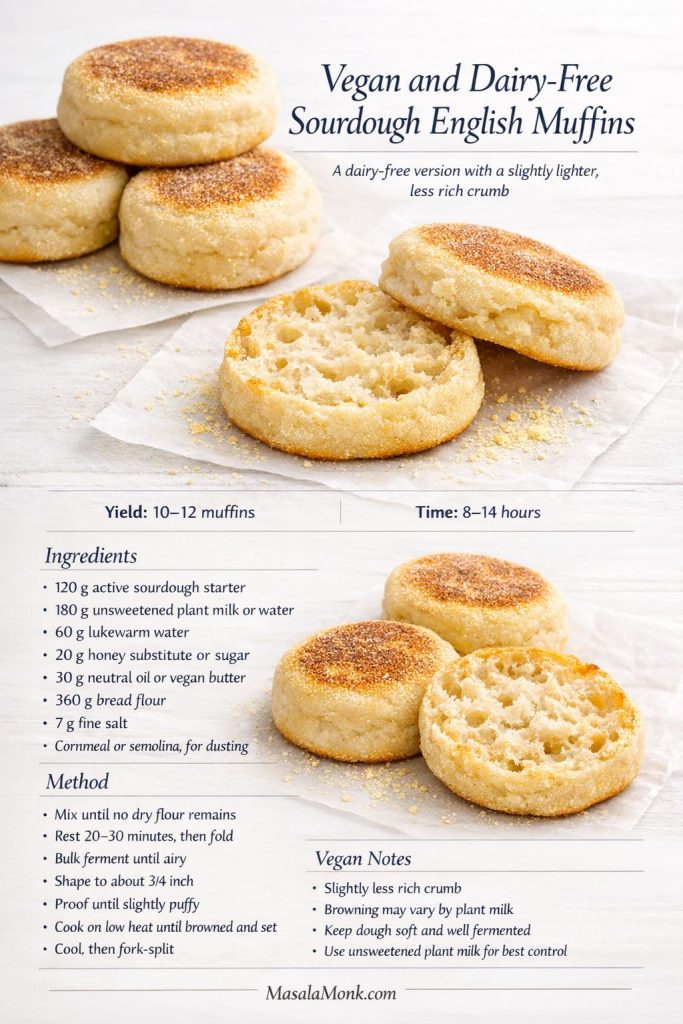
Vegan and dairy-free sourdough English muffins

Replace the milk with unsweetened plant milk or water, and use oil or vegan butter instead of butter.

Standalone recipe card for vegan and dairy-free sourdough English muffins showing skillet-cooked muffins with a split crumb, ingredient list, method, yield, time, and notes about plant milk, browning, and keeping the dough soft.
Vegan and dairy-free sourdough English muffins can still turn out soft, well-risen, and nicely textured when the dough stays supple and fully fermented. Plant milk or water keeps the formula workable, while neutral oil or vegan butter replaces richness without changing the core method too much. Browning can vary depending on the milk you use, so gentle skillet heat matters even more here if you want the centers set before the outsides get ahead.

What to expect:

  • a slightly less rich crumb
  • browning that may vary depending on the milk substitute
  • very workable texture if the dough stays soft and well fermented

What to watch:

  • avoid sweetened plant milk unless you want extra sweetness and quicker browning
  • keep the skillet heat gentle because some milk alternatives color fast

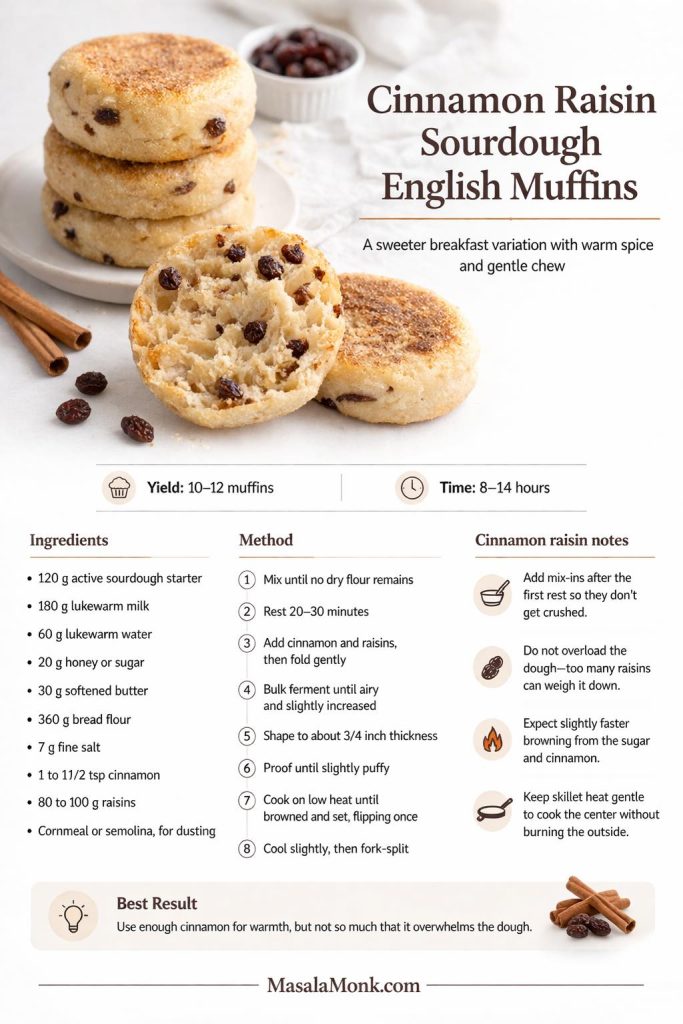
Cinnamon raisin sourdough English muffins

Add raisins and a moderate amount of cinnamon after the first rest so the dough can begin developing before the inclusions go in. This keeps the dough from getting weighed down too early.

Standalone recipe card for cinnamon raisin sourdough English muffins showing skillet-cooked muffins with visible raisins in the crumb, plus ingredient list, method, timing, yield, and notes about adding raisins after the first rest and keeping the skillet heat gentle.
Cinnamon raisin sourdough English muffins work best when the spice stays warm and balanced and the raisins support the crumb instead of overwhelming it. Adding the cinnamon and raisins after the first rest helps protect the dough structure, while gentle skillet heat keeps the sweeter dough from browning too fast. This card gives the full variation in one place, so you can make a breakfast-style batch with soft interiors, light chew, and enough cinnamon-raisin character to feel distinct without turning heavy.

What to expect:

  • a sweeter breakfast-style variation
  • slightly less even shaping
  • faster browning because of added sweetness in the mix-ins

What to watch:

  • do not overload the dough with raisins or the rounds become harder to shape and cook evenly
  • keep the heat especially gentle

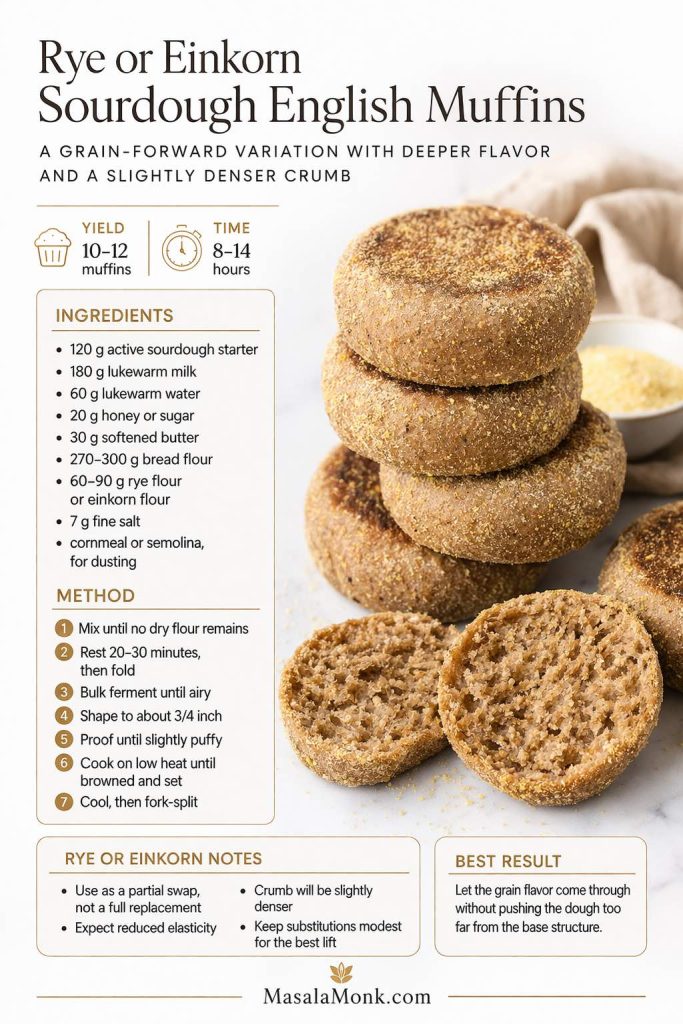
Rye or einkorn sourdough English muffins

Use rye or einkorn as partial substitutions rather than full replacements unless you are testing a dedicated formula.

Standalone recipe card for rye or einkorn sourdough English muffins showing darker grain-forward muffins with a split crumb, ingredient list, method, yield, time, and notes about partial substitution, reduced elasticity, and a slightly denser texture.
Rye or einkorn sourdough English muffins work best when the grain adds character without taking over the dough completely. A partial swap keeps the flavor deeper and more distinctive while still giving the muffins enough structure to rise, cook through, and split well later. Expect a slightly denser crumb and less elasticity than the base version, but not a heavy result if the dough stays soft, the substitution stays modest, and the skillet heat remains gentle.

What to expect:

  • more distinctive grain flavor
  • somewhat reduced elasticity
  • a slightly denser and more specialized result

What to watch:

  • keep substitutions modest at first
  • do not expect the same lift as the base recipe

Can you bake them instead of griddling them?

You can, but the result moves away from classic English muffin texture. The skillet is part of what gives them their identity. If a loaf-pan or baked version is what you really want, it is better to treat that as a separate style and point readers toward English muffin bread and other sourdough bakes instead of pretending the two methods produce the same thing.

What to serve with sourdough English muffins

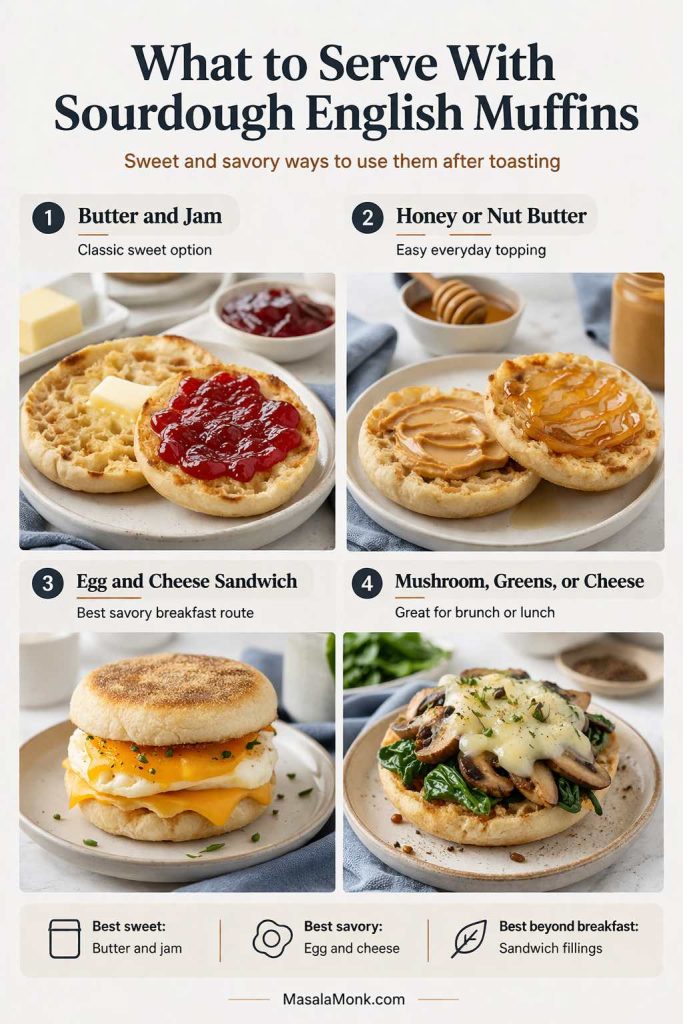
Use them with butter, jam, honey, or nut butter if you want the classic sweet route.

Serving ideas guide for sourdough English muffins showing butter and jam, honey or nut butter, an egg and cheese sandwich, and a savory mushroom, greens, and cheese topping.
Sourdough English muffins are flexible enough to go sweet, savory, or fully meal-worthy once toasted. Butter and jam keep things classic, honey or nut butter makes an easy everyday option, and an egg and cheese sandwich turns them into a strong savory breakfast. For something more brunch-leaning, mushrooms, greens, and melted cheese work especially well because the rough fork-split interior holds toppings better than a smoother bread base.

For savory use, eggs, cheese, mushrooms, spinach, and breakfast meats all work naturally. If you want more serving direction, these breakfast sandwich ideas are the best next stop.

They also work beyond breakfast. A toasted muffin can handle fillings like this chicken salad sandwich recipe or a warm mushroom cheese sandwich recipe, even if breakfast remains their most natural home.

Also Read: Paloma Recipe: 12 Paloma Cocktail Drinks

Related recipes to try next

For more bakes in the same lane, start with the sourdough bread recipe roundup, which is the best next stop when you want to keep working with starter beyond this batch. Starter still giving you trouble? Go back to the sourdough starter guide for a clearer reset on feeding, strength, and consistency. And when you are ready to turn these muffins into something more practical, these easy breakfast sandwiches are the most useful next read.

Final notes before you bake

A good batch of sourdough English muffins does not come from one trick ingredient or one magic time stamp. It comes from choosing the right route, fermenting honestly, keeping the dough soft, shaping thick enough to protect the crumb, cooking low enough to set the center properly, and splitting with a fork after cooling. Those are the choices that turn a decent batch into one with real character.

Fork-split sourdough English muffins toasted until crisp at the edges, with melted butter settling into the rough nooks and crannies of the interior crumb.
This is the homemade sourdough English muffin texture the whole recipe is built around: rough fork-split interiors, crisp toasted edges, and melted butter catching in the nooks and crannies instead of sliding off a smooth cut surface. Soft dough, full fermentation, thick shaping, low skillet heat, and cooling before splitting are what create this kind of crumb, which is exactly why homemade sourdough English muffins feel more alive and toast so much better than the average store-bought version.

That is why this recipe is worth making from scratch. Store-bought English muffins can be fine, but when homemade ones are done well, the texture is rougher, the flavor is deeper, and the toastability is far better. The butter catches differently. The edges crisp differently. The whole thing feels more alive.

If you remember only the essentials, remember these: soft dough, full fermentation, thick shaping, low heat, full cooling, fork split, then toast. That is the path to the kind of English muffin people actually want.

Also Read: Air Fryer Salmon Recipe (Time, Temp, and Tips for Perfect Fillets)

Frequently Asked Questions

1. Can I make sourdough English muffins with discard instead of active starter?

Yes, you can make sourdough English muffins with discard, especially if the discard is fairly fresh and still comes from a healthy starter routine. The main difference is predictability. Active starter gives you the best rise and the strongest chance of a lighter crumb, while discard often moves more slowly and may need extra fermentation time. If your discard is older, sharply acidic, or clearly sluggish, a small yeast assist is usually the smarter choice.

2. Can I make sourdough English muffins without yeast?

Yes. If your starter is active, recently fed, and strong enough to lift dough on its own, you can absolutely make sourdough English muffins without commercial yeast. That is the best route when you want the most traditional naturally leavened result. The key is not just skipping yeast. The key is starting with a lively starter and giving the dough enough time to ferment properly.

3. Why are my sourdough English muffins gummy in the middle?

The most common reason is heat that is too high. The outsides brown quickly, but the center does not get enough time to set. Thick rounds can make that more obvious. If that happens, lower the skillet heat and finish the muffins more gently, or move them briefly to a low oven once they have enough color. A properly cooked muffin should feel lighter than it looks and should not have a shiny or sticky middle when opened.

4. Can I refrigerate the dough overnight?

Yes, and for many bakers that is the easiest route. Let the dough begin fermenting at room temperature first, then refrigerate it once it shows clear activity. That gives you better flexibility the next day and often makes shaping easier because the dough is cooler and calmer. Just do not refrigerate a dough that has barely started moving, because the fridge will not fix a weak fermentation.

5. Can I freeze sourdough English muffins?

Yes, sourdough English muffins freeze very well. Let them cool fully first, then freeze them whole or already split. Splitting before freezing makes them easier to toast straight from storage later. In many cases, freezing is the best option because these muffins are at their best when toasted, not when sitting at room temperature for too long.

6. Should I split sourdough English muffins with a knife or a fork?

Use a fork. That rough split helps preserve the irregular interior texture that makes English muffins toast so well. A knife gives you a much cleaner cut, but it also smooths away some of the nooks and crannies you worked to build. If texture is part of the goal, fork-splitting is the better choice.

7. Why didn’t my sourdough English muffins get nooks and crannies?

That usually comes down to underfermented dough, shaping too thin, too much extra flour during handling, rough degassing, or slicing with a knife instead of splitting with a fork. Good nooks and crannies depend on a soft dough, full fermentation, gentle handling, low heat, and a fork-split finish after cooling. If the dough never got airy enough, the interior usually stays tighter no matter what you do later.

8. Can I bake sourdough English muffins instead of cooking them on a skillet?

You can, but the result moves away from classic English muffin texture. Skillet cooking is part of what gives them their characteristic crust and interior. If you want a baked version, it is usually better to think of that as a separate style rather than a direct substitute. The classic result still comes from shaping, proofing, and cooking them low and slowly on a skillet or griddle.