Posted on Leave a comment

19 Essential Kitchen Tools That Make Cooking Easier

Photorealistic magazine-style cover showing premium kitchen tools on a dark stone surface: chef’s knife on a wooden cutting board with a microplane grater and bowl of flaky salt, titled “Kitchen Tools That Change Everything,” with MasalaMonk.com in the footer.

The fastest way to enjoy cooking more often isn’t a complicated recipe or a brand-new appliance—it’s having kitchen tools that remove friction from the moment you start. When the board stays put, the knife cuts cleanly, the pan heats predictably, and the utensils feel right in your hand, dinner stops feeling like a task you brace for. Instead, it becomes something you can begin without a deep breath first.

This guide is inspired by Joshua Weissman’s idea that the right tools make cooking smoother and more fun (his original “19 tools” video is here: 19 Tools To Make Cooking Easier). At the same time, what you’re reading is a fresh, independent list—built for real home kitchens, realistic storage, and tools you’ll actually use on a random Tuesday.

Along the way, you’ll also see how to choose between materials—stainless steel, silicone, wood—plus how to avoid the common trap of buying a huge utensil set that looks impressive but spends most of its life in a drawer.


Kitchen tools that earn their space every day

An “essential” isn’t just popular—it earns a permanent spot because it reliably does at least one of these things:

  • makes prep faster without making you rush
  • improves results in a way you can taste (or see)
  • reduces mess and cleanup
  • makes cooking safer by improving control
  • multitasks so you own fewer items overall
  • stays pleasant to use, even after months of washing
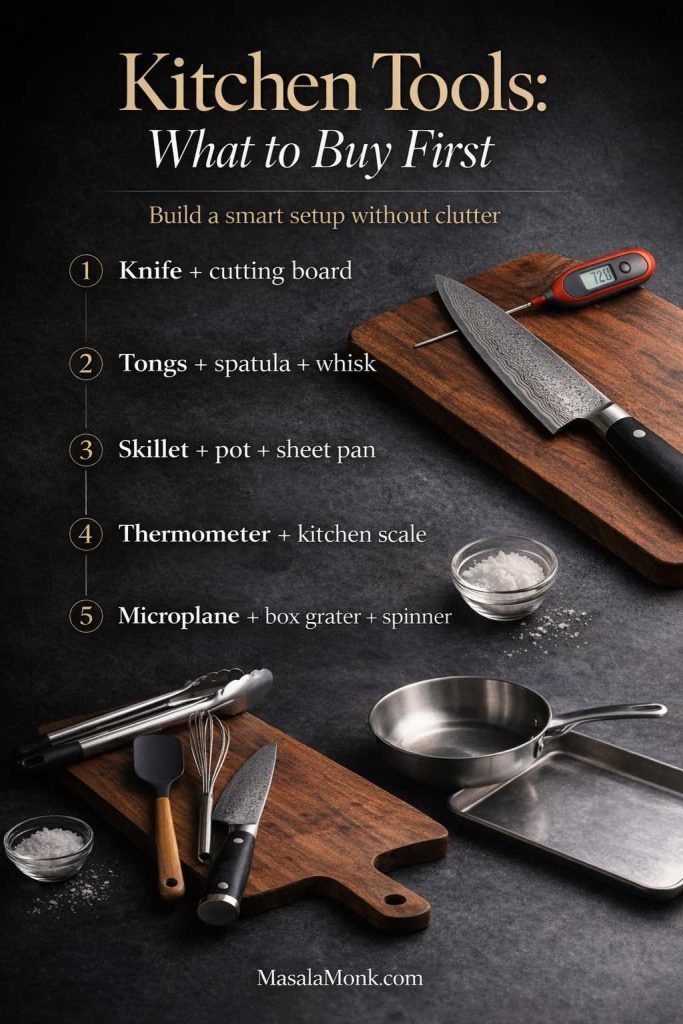
Infographic titled “Kitchen Tools: What to Buy First” on a dark countertop, listing a 5-step buying order (knife and cutting board; tongs, spatula, whisk; skillet, pot, sheet pan; thermometer and kitchen scale; microplane, box grater, salad spinner) with photoreal tools and MasalaMonk.com in the footer.
If you’re upgrading your kitchen tools slowly, this order gives the biggest impact first—without drawer clutter. Start with a great knife + stable cutting board, then add a few daily-use utensils, dependable cookware, and finally the accuracy tools (thermometer + kitchen scale) that make results repeatable. Save this checklist for the next time you’re tempted by a giant utensil set.

So, rather than collecting gadgets, this kitchen tools list focuses on workhorses—items that quietly lift everything you cook.

Also Read: Sourdough Starter Recipe: Make, Feed, Store & Fix Your Starter (Beginner Guide)


Kitchen tools list for prep: quicker chopping, cleaner counters, better flavor

1) A chef’s knife: kitchen tools that make prep feel effortless

A comfortable chef’s knife isRcy feels like an extension of your hand. Once you have that, chopping becomes calmer: onions are neater, herbs slice instead of bruising, and prep stops stealing your energy before cooking even begins.

If you want a practical reference for what makes a chef’s knife “worth it” (balance, handle comfort, blade shape), Epicurious has a helpful test-driven overview. The best chef’s knife (Epicurious)

2) A paring knife: kitchen tools for precise, small cuts

Even with a great chef’s knife, a paring knife is the tool that handles detail work without awkward angles—peeling ginger, trimming strawberries, coring tomatoes, cutting small garnishes, or cleaning up blemishes on produce.

It’s also the knife that helps you slow down and be precise when precision matters.

3) A cutting board: kitchen tools that keep prep stable and tidy

A big, stable cutting board makes prep feel organized. It gives you room to keep a “clean side” and a “scrap side,” and it prevents that cramped, messy feeling that happens when you’re constantly sweeping ingredients off the edge.
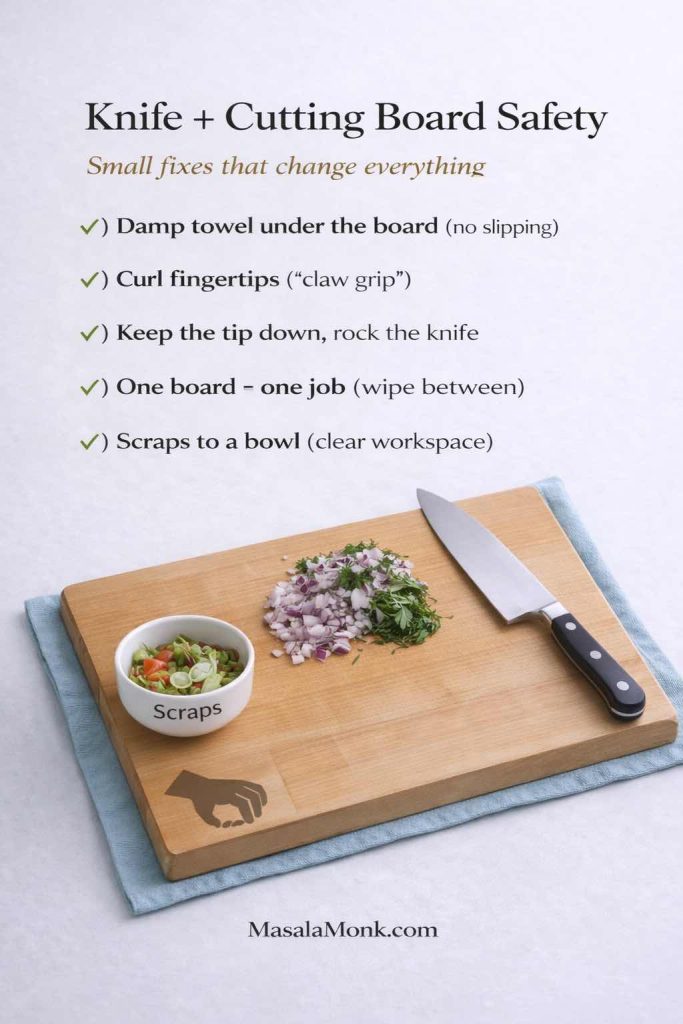
Infographic titled “Knife + Cutting Board Safety” listing five prep tips (damp towel under board, claw grip, keep tip down, one board one job, scraps to a bowl) with a chef’s knife on a wooden cutting board over a blue towel and a small “scraps” bowl, plus MasalaMonk.com in the footer.
These small knife and cutting board habits make prep faster, safer, and noticeably less messy. A damp towel stops slipping, the claw grip protects fingertips, and a scraps bowl keeps your workspace clear so cooking feels calmer from the first chop. Save this quick safety checklist—once it becomes routine, weeknight prep gets easier immediately.

If your board slides, add a damp towel underneath. That tiny change makes chopping more confident immediately.

4) Kitchen shears (cooking shears)

Kitchen shears are the underrated shortcut. You’ll reach for them for herbs, scallions, parchment, packaging, and quick trimming jobs that feel silly to do with a knife. They’re also useful for snipping bacon into pieces, cutting pizza, or trimming poultry skin.

If you’re comparing options, terms like “poultry shears,” “kitchen scissors,” and “kitchen shears” often point to the same category—what matters most is that they feel sturdy and easy to clean.

5) Bench scraper

A bench scraper is the tool that keeps your counter tidy while speeding up prep. Scoop chopped vegetables into a bowl in one clean motion. Scrape flour off the counter. Portion dough. Even if you don’t bake often, it turns “lots of tiny moves” into “one quick move.”

It’s one of those kitchen tools that feels minor until it becomes automatic.

6) Best vegetable peeler (for you)

A good peeler is smooth, fast, and predictable. With the right one, you peel carrots or potatoes without removing half the vegetable. It also makes quick ribbons for salads and garnishes with almost no effort.

You’ll see a few common styles—Y-peelers and swivel peelers are the big two. Whichever you choose, look for the same thing: a peeler that glides without chattering, feels secure in your hand, and doesn’t slip when the veggie is wet.

7) Best cheese grater (and why a box grater wins)

A box grater earns its spot because it does more than cheese. It shreds carrots for salads, potatoes for hash browns, chocolate for desserts, and even onion when you want it to melt into a sauce.

It’s also a reliable “texture tool”—it gives you consistent pieces that cook consistently, which often means better browning and more even seasoning.

8) Microplane / fine grater

If you want big flavor with minimal effort, this is the move. Citrus zest brightens everything. Garlic and ginger become smooth instead of chunky. Hard cheeses melt into dishes without gritty bits. Nutmeg becomes a soft, warm finish rather than a loud spice.

A microplane is one of those kitchen tools that quietly makes your cooking taste more intentional.

9) Best mandoline slicer (with safety first)

A mandoline slicer creates uniform slices quickly. Uniform slices cook at the same rate, which means fewer burnt edges and fewer undercooked centers—especially for potatoes, onions, cucumbers, and slaw vegetables.

Still, this tool has one rule: use the guard (or a cut-resistant glove) every time. Even if you’re careful, complacency is what catches people.

10) Salad spinner

A salad spinner is the difference between crisp salad and watery salad. Dry leaves hold dressing, so flavor clings instead of sliding off. It also helps with herbs: spin them dry, then chop—your cutting board stays cleaner, and your herbs stay brighter.

If you’re building a kitchen tools list that supports healthier, faster meals, this one surprisingly earns its place.

Also Read: How to make No-Bake Banana Pudding: No Oven Required Recipe


Kitchen tools for measuring and consistency: fewer guesses, better repeats

Not every meal needs precision. However, repeatable results—especially for sauces, baking, and “signature dishes”—often come from simple measuring tools.

11) Measuring cups

Measuring cups are foundational kitchen tools because they cover both dry and liquid measuring in everyday cooking. You might not measure everything, but you’ll measure often: rice, flour, sugar, milk, broth, and quick batters.

If you prefer a clean aesthetic, you’ll also notice options like white measuring cups or decorative sets. Style is fine—function matters more: easy to read, easy to wash, and comfortable to hold.

12) Measuring spoons

Measuring spoons control the “small but powerful” ingredients—salt, baking powder, vanilla, spices, vinegar, soy sauce. They’re also how you keep a dish balanced when you’re cooking without a recipe.

Once you get used to accurate spoons, you’ll be surprised how often they rescue a sauce from being too salty or too acidic.

13) Best kitchen scale for baking (and for cooking)

A digital kitchen scale makes baking easier because it removes the biggest variable: inconsistent measuring. Flour isn’t packed differently each time. Recipes are simpler to halve or double. Cleanup is lighter because you can weigh directly into one bowl.
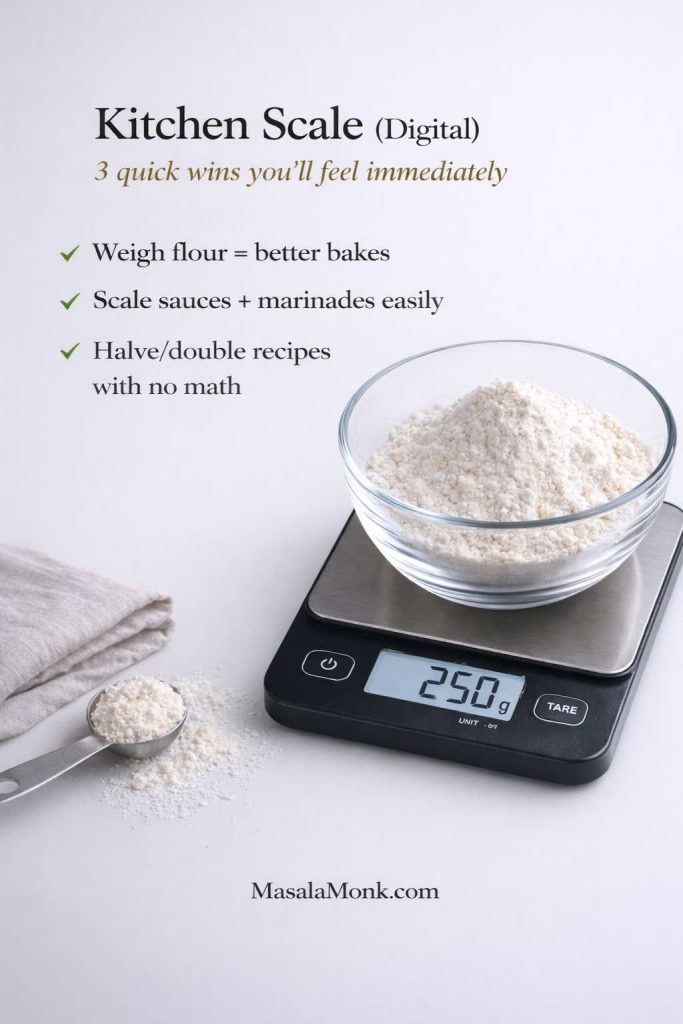
Infographic titled “Kitchen Scale (Digital)” showing a digital kitchen scale with a glass bowl of flour and text listing three benefits: weigh flour for better bakes, scale sauces and marinades, and halve or double recipes easily, with MasalaMonk.com in the footer.
A digital kitchen scale is one of those kitchen tools that pays you back fast: more consistent baking, easier scaling for sauces and marinades, and effortless halving or doubling without guesswork. Save this as a reminder—once you start weighing flour, recipes get noticeably more reliable and cleanup often gets simpler too.

King Arthur has a clear explanation of why a scale changes the way baking feels. Why a digital kitchen scale matters (King Arthur Baking)

If you want a natural way to use a scale more often, bread is perfect for it. This internal guide pairs beautifully with a scale-first approach: Sourdough bread recipes

14) Instant read food thermometer (digital thermometer cooking)

A thermometer is the tool that removes the most anxiety per rupee. Chicken breast stays juicy because you stop guessing. Roasts get pulled at the right moment. Leftovers reheat more confidently. Even oil temperature becomes easier to manage.
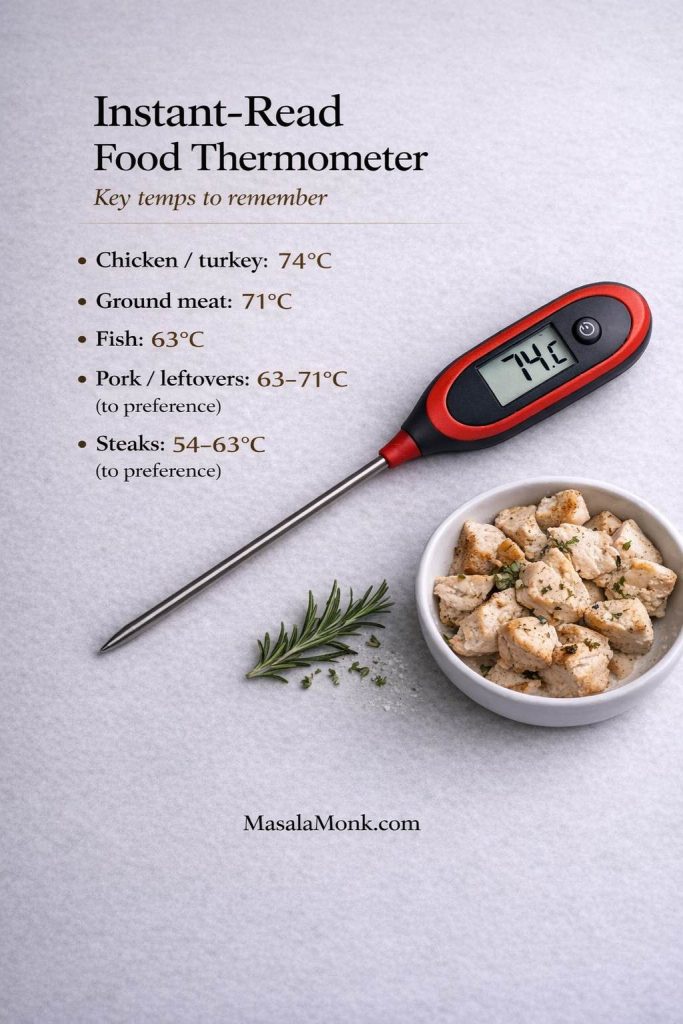
Infographic titled “Instant-Read Food Thermometer” listing key internal cooking temperatures in °C (chicken/turkey 74°C, ground meat 71°C, fish 63°C, pork/leftovers 63–71°C, steaks 54–63°C) beside a digital instant-read thermometer on a light stone surface, with MasalaMonk.com in the footer.
An instant-read food thermometer is the fastest way to stop guessing and start getting repeatable results—juicy chicken, properly cooked ground meat, and fish that doesn’t dry out. This quick Celsius cheat sheet keeps the key temps in one place, so you can cook with confidence on busy weeknights. Save it for later (you’ll use it more than you expect).

For safe internal temperatures, keep a reliable chart bookmarked: USDA safe temperature chart or FoodSafety.gov internal temperature chart.

Also Read: Chicken Adobo — Step-by-Step Recipe — Classic Filipino Adobong Manok


Kitchen tools and equipment for cooking: buy workhorses, not clutter

Cookware can be the biggest source of frustration in a kitchen—especially when you have too many pieces that don’t do any one job well. Instead, choose a few dependable items and learn them deeply.

15) A skillet that matches how you cook

One great skillet outperforms five “okay” pans. The right choice depends on what you cook most often:

  • stainless steel for browning and pan sauces
  • cast iron or carbon steel for heat retention and long-term durability
  • nonstick for easy eggs and delicate food (with the understanding it’s a replaceable item over time)
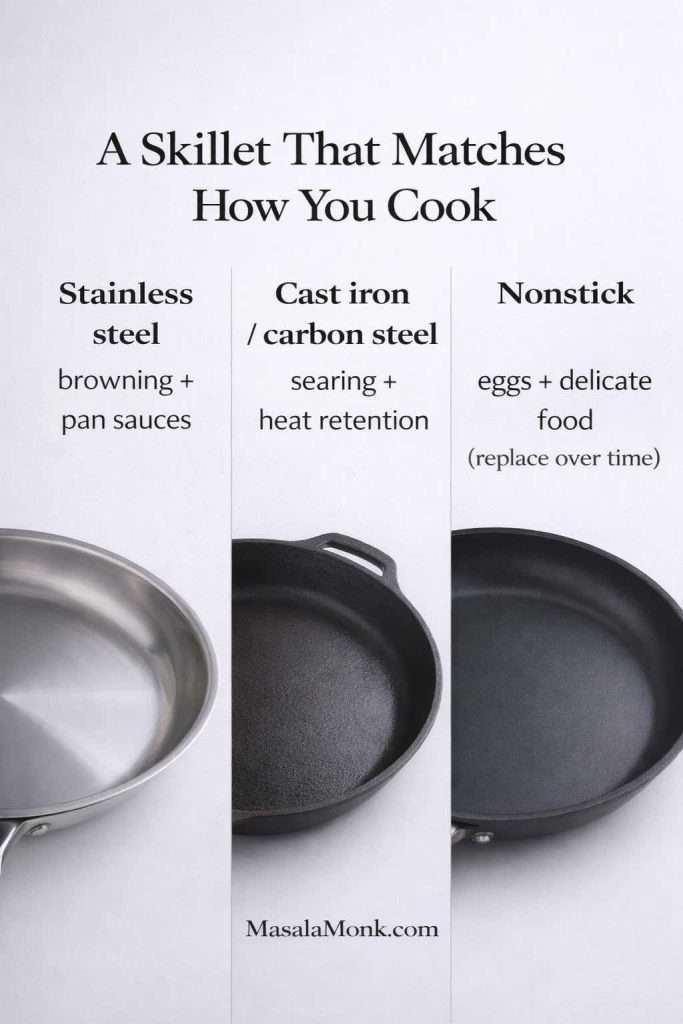
Infographic titled “A Skillet That Matches How You Cook” comparing stainless steel, cast iron/carbon steel, and nonstick skillets, with notes on best uses (browning and pan sauces; searing and heat retention; eggs and delicate food) and MasalaMonk.com in the footer.
Not every skillet cooks the same. This quick guide helps you choose the right skillet for how you cook: stainless steel for browning and pan sauces, cast iron or carbon steel for searing and heat retention, and nonstick for eggs and delicate food. Save it so your next pan upgrade actually fits your weeknight routine—and your cookware lasts longer.

If you’re leaning toward cast iron, this internal post is a strong reality check before you buy: Buying a cast iron skillet? 5 warnings before you invest

If your decision is more about coatings, this breakdown helps: Ceramic vs Teflon (PTFE) cookware

16) A dependable pot (saucepan or Dutch oven)

A good pot is where “real food” happens: dal, rice, pasta, soups, curries, beans, braises, and big batches that turn into leftovers. It also makes sauces calmer because heat is more stable and the bottom is less prone to scorching.

Sauces are the easiest proof that a pot matters. For example: Tomato sauce from fresh tomatoes and Marinara sauce recipe both benefit from steady simmering and easy stirring.

17) Baking tray / rimmed sheet pan

A rimmed sheet pan is one of the most versatile kitchen tools and utensils “adjacent” items you can own. Roast vegetables. Crisp tofu. Bake chicken. Reheat leftovers without turning the stove into a mess. Cook multiple components at once.

If you want a simple one-pan dinner that proves why this tool matters, try: Sheet pan chicken fajitas

18) Mixing bowls (nesting set)

Mixing bowls are a daily-use item that makes everything tidier: toss salad, marinate meat, mix batters, coat vegetables, hold chopped ingredients, and keep your counter organized.

You’ll come across recommendations like “mixing bowls with lids” or “best mixing bowls” in a lot of buying guides. The general idea is the same: bowls that stack neatly, don’t slide around, and wash easily.

19) Wire rack

A wire rack helps food stay crisp by letting steam escape underneath. It also cools baked goods properly, which matters more than people expect—cookies stay snappy, breads don’t turn gummy, and fried foods don’t soften as quickly.

If you want a satisfying use-case, oven bacon is perfect for it: How to cook bacon in the oven


Kitchen tools and utensils you’ll reach for constantly

Cookware handles the heat. Meanwhile, these hand tools handle the workflow—stirring, flipping, scraping, plating, serving, and keeping things clean.

Tongs: the “extra hand”

Tongs are the tool you reach for when you want control without fuss. They flip, toss, grab, and plate without tearing food or poking holes. They’re also excellent for mixing salads, turning roasted vegetables, and serving pasta.
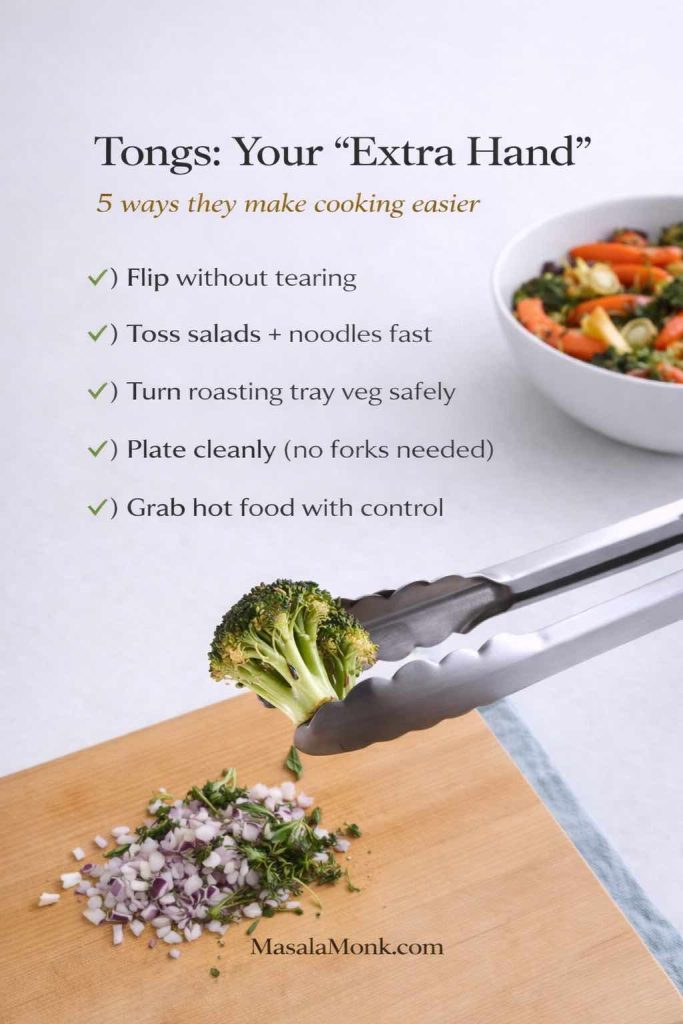
Infographic titled “Tongs: Your ‘Extra Hand’” listing five uses for kitchen tongs—flip without tearing, toss salads and noodles, turn roasting tray vegetables, plate cleanly, and grab hot food—shown with stainless steel tongs holding a broccoli floret on a cutting board, with MasalaMonk.com in the footer.
Good kitchen tongs feel like an extra hand: they flip without tearing, toss salads and noodles fast, handle hot sheet-pan veggies safely, and plate food neatly without juggling forks. Save this quick guide—once you keep a solid pair of tongs within reach, weeknight cooking gets smoother and less messy.

If you see variants like chef tongs, catering tongs, plating tongs, or mini serving tongs, they’re all in the same family. For everyday cooking, choose a pair that feels comfortable and springy, with ends that grip well.

Spatulas: the right one for the job

A spatula is not one thing, which is why kitchens end up with too many. A simpler approach works better:

  • a silicone spatula for scraping bowls and pots clean
  • a sturdy turner for flipping food confidently
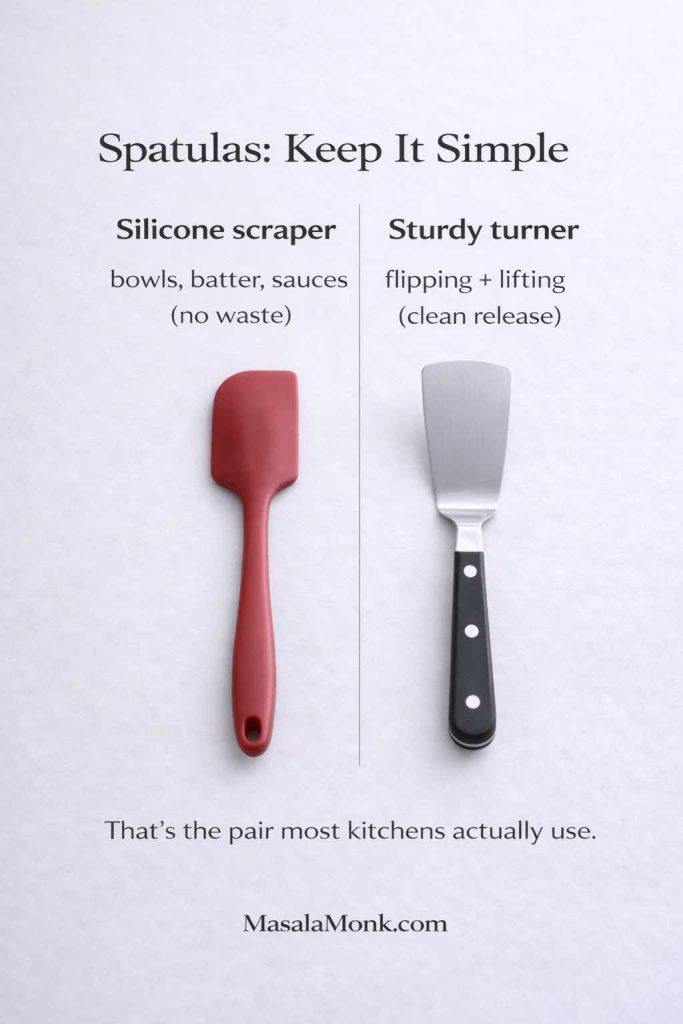
Spatulas are where kitchens get cluttered fast—so keep it simple. A silicone scraper spatula handles bowls, batter, and sauces with almost zero waste, while a sturdy turner spatula makes flipping and lifting feel clean and confident. Save this pairing guide for your next kitchen tools upgrade (or the next time you’re tempted by a giant utensil set).

That second category includes slotted turner spatulas, fish spatulas, and thin metal spatulas. The shape matters less than the feeling: it should slide under food easily and feel stable when lifting.

If you cook with nonstick pans, keep a silicone tool for that surface. If you cook with cast iron or stainless steel, a sturdy metal turner can be a joy.

Whisk (including a balloon whisk)

A whisk is a sauce tool as much as it is a baking tool. It smooths gravies, fixes lumpy sauces, emulsifies dressings, and makes eggs more consistent. A balloon whisk is especially helpful when you want volume—whipped cream, airy eggs, or fluffy batters.

This is also where measuring spoons and a whisk pair beautifully: you can build a balanced dressing quickly without dirtying extra gadgets.

Ladle

A ladle is a small tool that instantly makes serving feel cleaner: soups, dal, curry, pasta sauce, stew. It reduces spills and makes portioning simpler, especially when you’re feeding family or serving guests.

Wood ladles, metal ladles, and stainless steel serving utensils all work—choose the material that fits your cookware and how you wash.

Also Read: Sweetened Condensed Milk Fudge: 10 Easy Recipes


Kitchen utensil set: stainless steel, silicone, or wooden cooking utensils?

A kitchen utensil set can be a smart buy, especially when you’re setting up a kitchen or replacing mismatched items. However, the material changes how you cook—and what cookware stays in good shape.
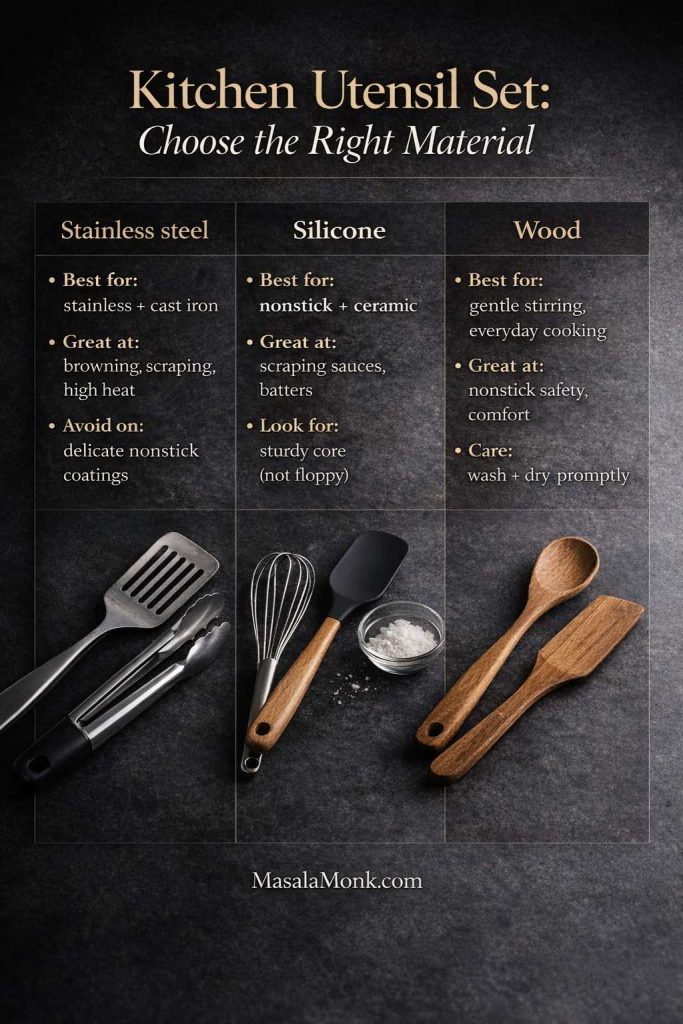
Infographic titled “Kitchen Utensil Set: Choose the Right Material” comparing stainless steel, silicone, and wood kitchen tools, with best uses and care tips, shown on a dark stone background with utensil photos and MasalaMonk.com in the footer.
Choosing a kitchen utensil set is easier when you match the material to your cookware. Stainless steel is ideal for stainless pans and cast iron, silicone protects nonstick and ceramic, and wooden cooking utensils stay comfortable for everyday stirring. Save this quick guide for your next upgrade so you buy the right tools once—and avoid scratches, flimsy spatulas, and clutter.

Stainless steel kitchen utensil set

A stainless steel utensil set is durable, easy to clean, and comfortable for high heat. It feels excellent on stainless steel and cast iron. It also looks “professional,” which is why you will often see people looking for high end kitchen utensils.

That said, stainless can scratch coatings, so if you cook mostly on nonstick, you’ll want to be gentle—or choose silicone for those pans.

Silicone kitchen utensils set

A silicone utensil set is kinder to coated pans and great for scraping thick sauces and batters. It’s also a good fit if you’re building toward “non toxic cooking utensils” and want tools that won’t chip, flake, or expose metal edges against delicate surfaces.

The key is sturdiness. A floppy spatula is frustrating, while a well-built silicone tool becomes a favorite.

Wooden utensil set (wooden kitchen utensil set / wooden cooking utensils set)

Wooden utensils feel warm and comfortable in the hand. They’re gentle on cookware, especially on nonstick or ceramic surfaces. They also stay cooler than metal during long stirring sessions.

If you’re shopping for a wooden utensil set—whether it’s a basic spatula-and-spoon combo or a nicer handmade set—aim for pieces that feel dense, smooth, and well-finished. Olive wood utensils and acacia wood utensils are popular because they’re sturdy, though any well-made wood can work if cared for properly.

Wood does ask for a little respect: wash and dry promptly, and don’t leave wooden spoons soaking in water.

If you want a broader cookware overview that connects tools to materials, this internal guide fits naturally here: How to choose the best cookware for your kitchen

Also Read: Peanut Butter Fudge: Recipes & Guide (8 Methods + Easy Variations)


Kitchen tools for healthier cooking and peace of mind

A lot of what people worry about with kitchen tools comes back to “health” and “safety”—non-toxic materials, coatings that hold up, and utensils that won’t chip, flake, or scratch cookware over time. While no single tool guarantees “healthy,” your choices can reduce common headaches.

Choose tools that don’t create avoidable problems

  • Use a thermometer so you don’t overcook lean proteins into dryness.
  • Use a scale for baking so you’re not adding extra flour and ending up with dense results.
  • Use cookware and utensils that fit your heat level, so you’re not accidentally stressing coatings.
  • Keep a scraping tool that doesn’t damage pans (silicone is helpful here).

If you want a simple anchor point for safe doneness, the USDA safe temperature chart is worth keeping handy.

Also Read: 10 Vegan Chocolate Cake Recipes (Easy, Moist, & Dairy-Free)


Kitchen tools list for cooking faster: how the right tools change weeknights

Kitchen tools matter most when you’re tired and hungry—when you want dinner without turning your kitchen into a disaster zone.

The sheet pan shortcut

A sheet pan makes “one tray, one timer” cooking possible. Roast vegetables while a protein cooks beside them. Reheat leftovers without babysitting the stove. Crisp things quickly.

If you want a simple starting point, Sheet pan chicken fajitas is a great “proof recipe” because it shows how a single pan can carry a full meal.
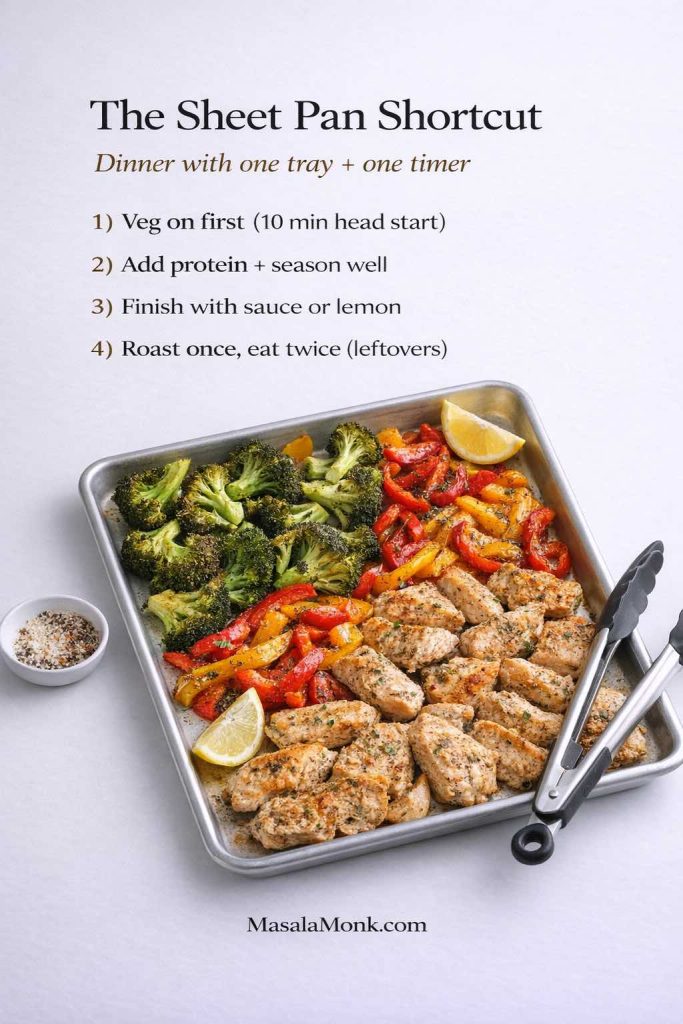
Infographic titled “The Sheet Pan Shortcut” showing a rimmed sheet pan with roasted chicken, broccoli, and peppers plus tongs and lemon wedges, with four steps for one-tray cooking and MasalaMonk.com in the footer.
This is the fastest way to make weeknight cooking feel easy: one sheet pan, one timer, and a simple order that actually works. Start the veggies first, add protein, then finish with sauce or lemon for big flavor without extra pots. Save this “sheet pan shortcut” for busy nights—and use it anytime you want dinner plus leftovers with minimal cleanup.

The skillet rhythm

A good skillet simplifies cooking because it’s predictable. Once you know how your pan browns onions, you can build meals quickly: sauté aromatics, add vegetables, season well, finish with a sauce or a squeeze of citrus.

Here’s an easy internal skillet example that makes good use of a sturdy pan and tongs: Skillet mushroom and zucchini stir fry

The sauce pot advantage

A dependable pot is what turns “ingredients” into “dinner.” It’s also what makes meal prep feel realistic—one big pot means multiple meals.

If you want sauces that become weekly staples, these internal links are natural fits:


Kitchen planning tools: when layout affects how you cook

Not all “kitchen tools” are handheld. Sometimes, the biggest improvement is planning how your kitchen works—especially if you’re moving into a new home, renovating, or simply reorganizing.

A kitchen planning tool or online kitchen design tool can help you visualize work zones so cooking flows naturally: prep near the sink, cooking near the stove, and storage where you actually need it. If you’ve ever walked across the room five times just to grab salt, you already know why layout matters.

People use different planners depending on region and store—Wickes kitchen planner, Wren kitchen planner, IKEA kitchen planner (including SEKTION), Howdens kitchen planner, and similar cabinet layout planner tools. The brand matters less than the principle: get the triangle (sink–stove–fridge) working, then keep daily tools within arm’s reach of where you use them.

Kitchen mood board: make your tools fit your space

A kitchen mood board sounds aesthetic—and it can be—but it also helps you choose finishes and storage that make your tools accessible. If you love wooden utensils, maybe you want a utensil crock. If you use stainless steel utensils, you might prefer a hanging rail. And if you’re building a clean look, you might choose stackable measuring cups and keep them in one drawer.

Even a small “plan” reduces clutter because you’re buying with intention rather than impulse.

Also Read: Kahlua Drinks: 10 Easy Cocktail Recipes (Milk, Vodka, Coffee)


Commercial stainless steel benches, prep tables, and food prep tables at home

It’s surprisingly common to see home cooks borrow ideas from commercial kitchens—stainless prep tables, workbenches, and simple food-prep stations—because they solve a real problem: easy cleanup and a durable surface for heavy chopping.

You don’t need a restaurant bench to benefit from the concept, though. The home version is simply this: create a dedicated prep surface that stays clear enough to use. Once you have a reliable place to chop, mix, and stage ingredients, cooking feels lighter.
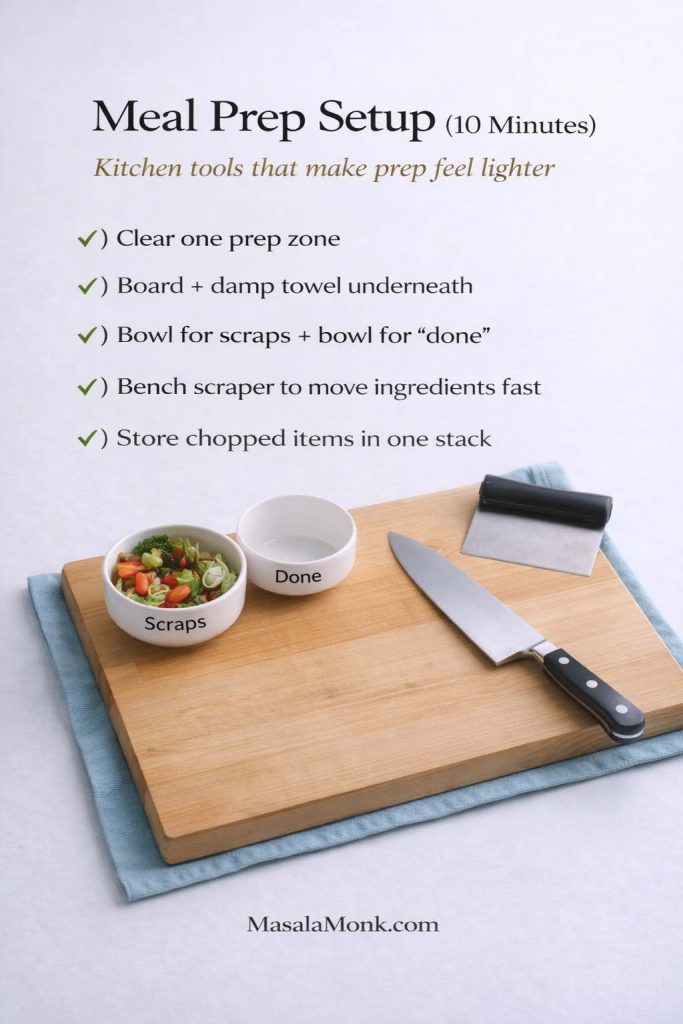
Infographic titled “Meal Prep Setup (10 Minutes)” showing a cutting board on a damp towel with a chef’s knife, bench scraper, and two labeled bowls (“Scraps” and “Done”), plus a checklist of five steps for faster prep, with MasalaMonk.com in the footer.
Meal prep gets easier when your kitchen tools support the workflow. This 10-minute setup keeps prep clean and fast: one clear zone, a stable board, a scraps bowl, a “done” bowl, and a bench scraper to move ingredients in one sweep. Save this checklist for busy weeknights—once you try it, chopping feels calmer and cleanup feels lighter.

If you have space for a small prep table, it can be transformative. If you don’t, the alternative is a large cutting board that can temporarily turn any counter into a “prep station.”

Also Read: Hot Chocolate Coffee: 3 Easy Recipes (Cocoa, Mix, or Espresso)


Sharpening kitchen knives: the kitchen tool that protects your hands

A sharp knife is safer than a dull knife because you use less force and get more control. That’s why you’ll see so many different sharpening options mentioned—magnetic sharpeners, whetstones, stone sets, guided systems, and classic pull-through sharpeners. The names vary, but the goal is the same: a sharp edge you can maintain consistently.

There are many ways to sharpen. The most important habit is consistency: a little maintenance more often beats a dramatic rescue once a year.

If you want a practical baseline, aim for two habits:

  • hone regularly (if you use a honing rod)
  • sharpen periodically (stone, system, or professional service)

Once your knife is sharp, everything else becomes easier—especially prep.

Also Read: Cranberry Moscow Mule Recipe: A Festive Holiday Cocktail With Easy Variations


Kitchen tools for baking: simple tools that unlock a lot of recipes

Even if you don’t think of yourself as “a baker,” a few tools make baking approachable—especially if your goal is to make breakfast or desserts without stress.

Scale + bowls + spatula = baking that repeats well

A scale keeps batters consistent. Nesting bowls keep prep tidy. A silicone spatula prevents waste and helps cleanup.

If you’re leaning into breads, this is where a scale becomes addictive: Sourdough bread recipes

Measuring cups and spoons: the calm version of baking

When measuring tools are solid, you stop second-guessing. That matters for pancakes, muffins, quick breads, and cookies.

For a breakfast-friendly recipe set that naturally uses measuring cups, whisk, and a good pan, this internal link fits well: Blueberry pancakes recipes


Professional kitchen essentials at home: what actually translates

It’s tempting to chase “professional chef tools,” “chef recommended kitchen tools,” and “must have kitchen items for chefs.” Some of that is useful; some of it is just marketing.

What genuinely translates from professional kitchens to home kitchens is simplicity and durability:

  • fewer items, better items
  • predictable work surfaces
  • tools that wash easily
  • a workflow that doesn’t require ten gadgets

This is why “boring” tools like tongs, a whisk, a good knife, and a stable cutting board often outperform flashy gadgets.

If you want a broader outside reference for what belongs in a starter kitchen, Serious Eats has a solid, practical list. Basic starter kitchen equipment (Serious Eats)

Also Read: Cold Brew Espresso Martini: How to Make It (Step-by-Step Recipe)


Eco kitchen products and sustainable kitchen products: the parts that matter

A lot of home cooks are trying to make their kitchens a little less wasteful—buying fewer things overall, choosing tools that last, and skipping gadgets that end up in a drawer for a month and the trash a year later. The good news is you don’t need a “perfect” eco setup. You just need a few habits that steer your buying in the right direction.

A simple approach helps:

  • buy fewer tools (and buy them once)
  • choose durable materials
  • avoid disposable or single-use gadgets
  • pick items that can handle daily washing without warping, cracking, or peeling

Wooden utensils can be a sustainable choice when cared for properly—wash, dry, and don’t leave them soaking. Stainless steel is durable and long-lasting, especially for tools that take heat and pressure. Silicone can be practical for nonstick cookware and for scraping batters and sauces, as long as you choose sturdier pieces that won’t tear at the edges.

If your goal is to reduce waste, the best “eco upgrade” is usually replacing one frustrating, flimsy tool with one you’ll happily use for years—rather than buying a whole new set because it looks nice.

Also Read: Baked Ziti Recipe Collection: 15 Easy Variations


Kitchen tools list: what to buy first so you feel the difference immediately

If you’re upgrading gradually, this order gives the fastest improvement without overwhelming your kitchen.

First wave (instant improvement):

  1. chef’s knife + large cutting board
  2. skillet + dependable pot
  3. tongs + silicone spatula + whisk
  4. measuring cups + measuring spoons

Second wave (consistency and confidence):
5) instant-read thermometer
6) digital scale
7) sheet pan

Third wave (speed and finishing touches):
8) microplane
9) box grater
10) kitchen shears
11) bench scraper
12) salad spinner
13) mandoline slicer (if you’ll use it weekly)

Once you’ve built that foundation, buying becomes calmer because you’re filling real gaps rather than chasing trends.

Also Read: Sandwich for Breakfast: Breakfast Sandwich Recipe + 10 Variations


A few “skip for now” kitchen tools (unless you know you’ll use them)

A lot of kitchen gadget sets look helpful, yet they create clutter quickly. Unless you’re sure you’ll use them weekly, consider waiting on:

  • single-use slicers that only cut one shape
  • novelty spatulas that don’t feel good to use
  • oversized utensil sets where half the pieces never get touched
  • complicated can openers or grinders that are hard to clean

If you do need something specific—like an easy can opener for arthritis or a rechargeable salt and pepper grinder—buy it because it solves a real problem in your kitchen, not because it looks cool.

Also Read: Manhattan Cocktail Recipe (Classic + 6 Variations)


Closing thought: the best kitchen tools make you cook more

The “perfect” kitchen isn’t the one with the most stuff. It’s the one where you can start cooking without resistance—where the tools support you instead of slowing you down.

When your kitchen tools are right, you chop faster, season more confidently, cook with fewer surprises, and clean up without dread. As a result, cooking becomes something you do more often—simply because it’s easier to begin.

And once you’re cooking more often, everything else gets better too: sauces become second nature, weeknights feel lighter, and even simple meals start tasting like you meant them.

If you want a quick next step after this tools list, pick one recipe category that rewards good tools immediately:

FAQs

1) What kitchen tools do I need to start cooking at home?

If you’re starting from scratch, focus on kitchen tools that cover prep, heat, and serving. A chef’s knife, a stable cutting board, a skillet, a pot, measuring cups and measuring spoons, a spatula, tongs, and a whisk will handle most meals. After that, add a sheet pan, a kitchen scale, and an instant-read thermometer to improve consistency.

2) What are the most important kitchen tools for beginners?

Beginners benefit most from kitchen tools that reduce effort and mistakes. Start with a sharp knife, a large board, and one reliable pan. Next, add measuring tools for repeatable results. Finally, pick a few utensils that feel comfortable—tongs, a silicone spatula, and a whisk—so cooking stays simple rather than fussy.

3) Is it better to buy a kitchen utensil set or individual utensils?

It depends on your cookware and how you cook. A kitchen utensil set can be convenient when you’re setting up a new kitchen. However, buying individual pieces often gives better quality for the tools you’ll use daily. If you do choose a set, aim for sturdy essentials rather than a large bundle with lots of rarely used items.

4) Which kitchen tools and utensils are best for nonstick pans?

For nonstick cookware, choose kitchen tools made from silicone, wood, or nylon so you don’t scratch the coating. A silicone spatula, silicone spoon, and silicone tongs are especially useful. Even so, avoid sharp-edged metal turners on nonstick, because small scratches add up over time.

5) What are the best kitchen tools for stainless steel cookware?

Stainless steel cookware can handle tougher kitchen tools. Stainless steel utensils, a thin metal spatula or turner, and sturdy tongs work well. Since stainless is often used for browning, tools that scrape and flip confidently can be helpful, especially when you want good sear and clean release.

6) Are wooden cooking utensils a good choice?

Yes—wooden cooking utensils are comfortable, gentle on cookware, and great for stirring sauces and curries. Still, they need basic care: wash promptly, dry well, and don’t soak them. If you want a set, a wooden utensil set with a spoon, flat spatula, and ladle covers most needs.

7) Which is better: silicone kitchen utensils or wooden kitchen utensils?

Silicone kitchen utensils are excellent for scraping batters, stirring thick sauces, and protecting nonstick pans. Wooden kitchen utensils feel natural, stay cooler in the hand, and work well for long simmering dishes. Ultimately, many kitchens do best with both: silicone for scraping and wood for everyday stirring.

8) What kitchen tools are considered “non toxic” or safer for everyday cooking?

Many people choose stainless steel, wood, or high-quality silicone for everyday kitchen tools. Stainless steel is durable and stable, wood is simple and long-lasting with care, and silicone is useful for nonstick cookware. Rather than chasing a label, prioritize tools that don’t flake, chip, or degrade quickly under heat.

9) What’s the best kitchen knife set, or should I buy single knives?

If you cook often, buying a few excellent knives usually beats buying a large knife set. A chef’s knife plus a paring knife covers most tasks. If you prefer a knife set, choose one with fewer pieces and a reputation for comfort and durability, rather than a massive block with duplicates.

10) How do I sharpen kitchen knives at home?

There are several reliable methods: whetstone sharpening, guided sharpening systems, and quality pull-through sharpeners. Whichever method you choose, consistency matters more than complexity. Additionally, keeping knives dry and stored properly helps them stay sharp longer between sharpening sessions.

11) Do I really need a kitchen scale?

A kitchen scale isn’t mandatory, yet it quickly becomes one of the most useful kitchen tools—especially for baking. It helps you measure flour accurately, scale recipes without hassle, and repeat results more easily. Moreover, it can reduce dishes because you weigh ingredients into one bowl.

12) What’s the best instant-read thermometer for cooking?

The best instant-read thermometer is the one you’ll actually use—quick to read, easy to hold, and accurate. Look for a fast response time and a clear display. If you grill, a grill meat thermometer can be useful too, but an instant-read thermometer is still the everyday workhorse.

13) Do I need a mandoline slicer in my kitchen tools list?

A mandoline slicer is optional, but it’s very helpful if you make salads, slaws, chips, or layered bakes. It gives even slices quickly, which helps food cook evenly. That said, safety is non-negotiable—use the guard and slow down, because speed is not worth injuries.

14) What are the best kitchen tools for meal prep?

For meal prep, prioritize kitchen tools that speed up chopping and storage: a large cutting board, a sharp knife, mixing bowls, measuring cups, and sheet pans. Then add tools that reduce repetition, such as a salad spinner, bench scraper, and food storage containers that stack neatly.

15) Are mixing bowls with lids worth it?

Yes, especially if you meal prep or like keeping the counter tidy. Mixing bowls with lids help you store chopped ingredients, marinate without mess, and cover leftovers quickly. As a result, your workflow feels smoother and your fridge stays more organized.

16) What kitchen tools make the biggest difference for healthy cooking?

A few kitchen tools make healthier cooking easier: a sheet pan for roasting, a nonstick-friendly utensil set for quick eggs and vegetables, a thermometer to avoid overcooking lean proteins, and measuring tools to keep portions consistent. Meanwhile, a salad spinner makes it easier to eat more greens because salads taste better.

17) What are the best kitchen tools for small kitchens?

In small kitchens, choose kitchen tools that multitask and store easily: a nesting mixing bowl set, stackable measuring cups, a compact utensil crock, and one excellent skillet and pot. Also, tools like a bench scraper and microplane take very little space while adding a lot of usefulness.

18) Are commercial stainless steel benches or prep tables useful at home?

They can be, particularly if you bake often or do heavy meal prep. A food prep table provides a dedicated, easy-to-clean surface. However, many home cooks get similar benefits by keeping one counter zone clear and using a large cutting board as a portable prep station.

19) What’s the difference between cooking utensils and serving utensils?

Cooking utensils are designed for heat and stirring—spatulas, tongs, whisks, ladles. Serving utensils are designed for plating and presentation—serving spoons, salad tongs, pie servers, and larger ladles. Having both makes hosting easier, yet you can start with cooking tools and add serving pieces later.

20) Which kitchen tools are worth upgrading first?

If you want the fastest improvement, upgrade the tools you touch most: the knife, cutting board, skillet, and tongs. Next, add a kitchen scale and instant-read thermometer for consistency. After that, upgrade comfort tools like mixing bowls, a sturdy spatula, and a reliable peeler.
Posted on 3 Comments

Bosch 13 Place Setting Dishwasher Review : SMS66GW01I vs SMS66GI01I

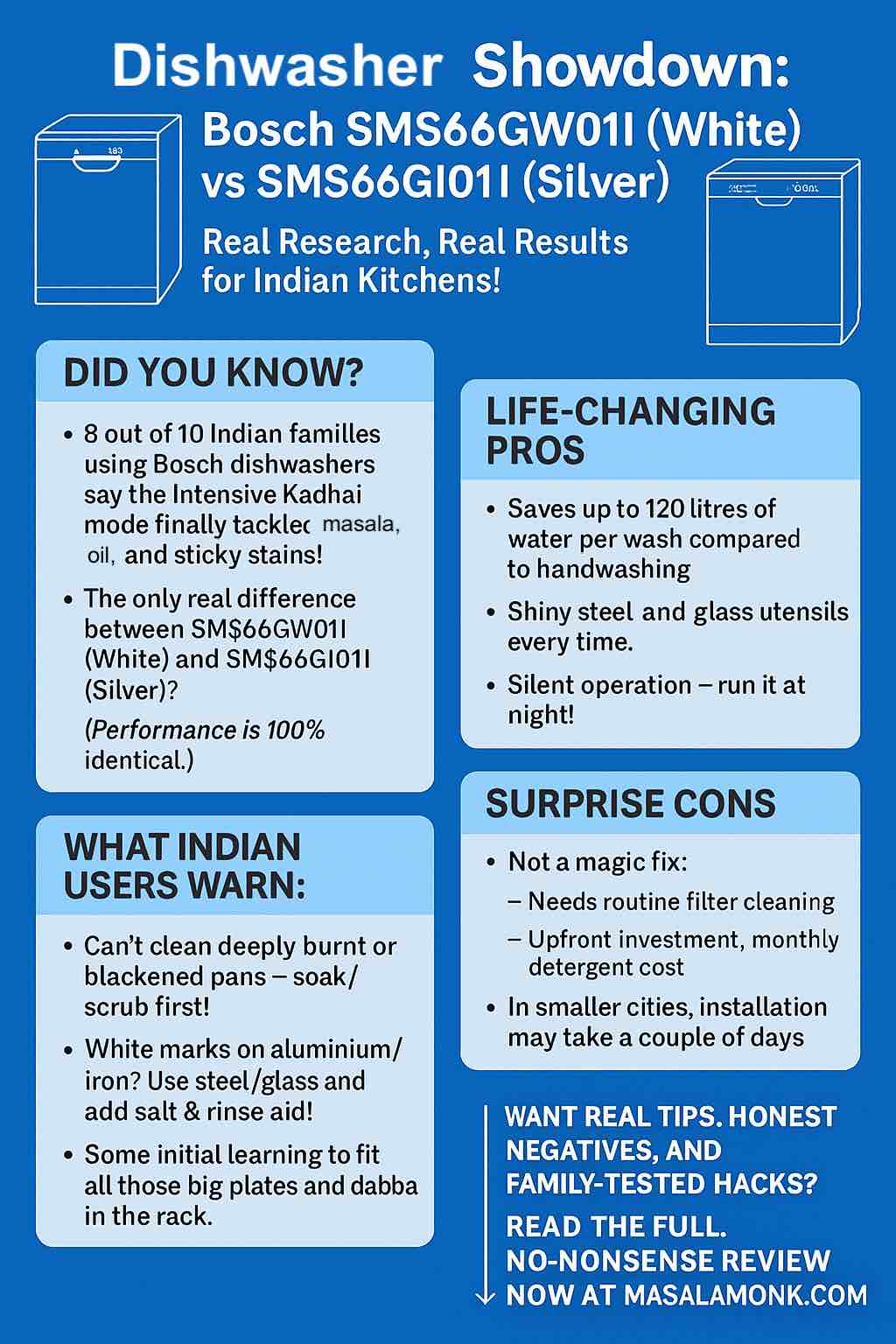
Dishwasher Showdown: Bosch SMS66GW01I (White) vs SMS66GI01I (Silver)

(A Deep-Dive with Real Stories, Practical Tips & All Your Burning Questions Answered!)

Let’s be honest: If you’re reading this, dishwashing is probably one of your least favourite chores—or maybe you’re tired of late maids and stubborn curry stains. You’re not alone! More and more Indian households are turning to dishwashers, and Bosch is a name you’ll hear over and over, especially for models built for Indian kitchens.

But the choice isn’t always easy. With almost identical specs, what really separates the Bosch SMS66GW01I (White) from the Bosch SMS66GI01I (Silver)? Does color even matter? Is “Intensive Kadhai” just a marketing term, or will it finally save you from hand-scrubbing those masala-filled vessels?

I spent some time scouring the latest reviews, community forums, videos, and Bosch’s own manuals—plus leveraged AI to analyze the patterns in hundreds of genuine Indian user experiences. If you want a review that cuts the fluff and gives you practical, kitchen-tested advice, this is it!


Why Dishwashers Matter Now (Especially in Indian Kitchens)

The Modern Indian Reality:

  • Maid on leave? Don’t worry.
  • Two working parents? No more post-dinner dish fights.
  • Want better hygiene? No more half-cleaned oily plates.
  • Fed up of scrubbing burnt milk or dal at midnight? You don’t need to live like that.

The right dishwasher gives you your time, hygiene, and peace of mind back. The trick is picking the model that really works for our food and homes.


Meet the Contenders: Bosch SMS66GW01I & Bosch SMS66GI01I

What’s Actually the Same?

Both models are “Made for India” and have:

  • 13-place settings: Enough for 3-7 people (even with guests).
  • Intensive Kadhai Mode: 70°C hot water blasts away stubborn masala and oil—designed for Indian cookware.
  • No pre-rinse needed: Just scrape food, don’t bother rinsing.
  • 6 wash programs (Eco, Express, Normal, Pre-rinse, etc.)
  • Half-load option for smaller families or lazy Sundays.
  • Extra cutlery box for all those spoons, tiffins, and lunchbox lids.
  • Water efficient (~9.5 litres per cycle) and energy efficient.
  • Quiet (about 52 dB, less than a mixer or washing machine).
  • Simple, push-button controls.
  • Strong build: Stainless steel interior, sturdy racks, child lock.
  • Bosch’s 2-year machine & 10-year rust warranty.
  • Made for Indian plumbing, voltage, and water conditions.

The Only Big Difference?

Fact: Internally, they’re the same machine. It really comes down to style preference—but let’s see how that choice plays out in the real world.


Real User Experiences: What Indian Families Are Saying

1. Cleaning Power (Does “Intensive Kadhai” Work?)

“I was honestly shocked. After years of hand washing, our steel plates, glasses, and even masala-heavy kadhai came out sparkling. Yes, even the pressure cooker lids.”
Amit, Bengaluru, 7 months with Bosch SMS66GI01I

“If something is totally burnt, I soak it a bit first or give a quick scrub on the worst spots. But for regular masala, dal, ghee, and curry, this is just magic.”
Ritu, Delhi, SMS66GW01I owner

Bottom line: For 95% of Indian cooking mess, it just works. Deeply burnt, blackened pans will still need a little pre-soak or scrub—but so does every dishwasher on Earth.


2. Indian Utensil Compatibility: Will Your Bartan Actually Fit?

  • Steel thalis, plates, katoris, pressure cooker lids, tumblers, dabbas: No problem.
  • Big kadhai, idli cookers, tiffin boxes: Fits, but you’ll need to adjust rack heights or remove the top rack for extra space.
  • Tall bottles: Go on the sides or in the top rack if possible.
  • Huge plates, odd-shaped pans: May need a bit of Tetris-style arrangement—experiment for a week, you’ll get it.

Pro Tips:

  • Always angle utensils so water can run off, and don’t overload.
  • Alternate plates/bowls to let water jets reach every surface.

3. Hard Water, White Marks & Streaks: The Indian Reality

  • Both models have a compartment for dishwasher salt and rinse aid—absolutely necessary in most Indian cities (Delhi, Bangalore, Hyderabad, etc.).
  • Don’t skip these! They’re cheap, last long, and make all the difference.
  • Steel and glass: Come out shiny and spot-free if you keep salt/rinse aid topped up.
  • Aluminium and iron: Might get dull or show white marks—use only if needed.

“I learned the hard way—don’t put aluminium in often. Steel and glass look like new though!”
Maya, Mumbai, Bosch SMS66GI01I


4. Noise, Power Cuts & Service

  • Noise: Barely noticeable, even in small flats. People routinely run it at night.
  • Power issues: Bosch is robust, but if you have wild voltage swings or power cuts, use a stabilizer and ensure proper earthing to avoid error codes.
  • Service: Bosch’s metro service is usually fast and friendly. In smaller towns, expect 2-3 days for a call-out or part, but most users say the machine rarely needs repairs.

5. Installation & Maintenance—Don’t Stress!

  • Setup: If your kitchen has a washing machine, it’s already half-ready! Otherwise, a plumber can add a water inlet and drain in an hour.
  • Detergent, salt, and rinse aid: Use dishwasher-specific brands (Finish, Bosch, or IFB)—not regular dish soap.
  • Filter cleaning: Takes 2 minutes. Do it once a week and you’ll never worry about clogs or smell.
  • Run a monthly cleaning cycle: Use a dishwasher cleaner or just white vinegar to keep it fresh.

Life with a Bosch Dishwasher: The Human Side

Imagine:

  • No more late-night scrubbing after guests leave.
  • The kitchen counter is clear, and there’s no pile of dirty plates.
  • Your steel glasses and thalis actually shine—no more sticky residue.
  • Even kids can load it up (and will, if you make it a game).
  • And yes, you’ll argue less about who does the dishes!

One user’s honest take:

“My only regret is not buying it sooner. It has changed the vibe in our house, especially on busy days. My wife and I both work, and this gives us 30 minutes of peace every night.”
Anand, Pune, Bosch SMS66GW01I


What Are the Real Challenges & Downsides?

(Don’t Buy Before You Read This!)

1. Burnt/Charred Utensils – Not Magic for Blackened Pots

No matter what the ads say, even with “Intensive Kadhai” mode, these dishwashers won’t remove thick, black, burnt-on residue from kadhai, tawas, or pressure cooker bases.

  • You’ll need to soak or lightly scrub first.
  • Users often say: “For normal masala, oil, and sticky stuff, it’s a miracle. But anything seriously burnt, you’re still the one doing the work.”

2. White Residue, Especially on Aluminium or Iron

  • If you put aluminium or iron utensils in the dishwasher—especially with hard water—you may see white chalky marks, dullness, or even corrosion over time.
  • Solution: Stick to stainless steel and glass as much as possible; use dishwasher salt and rinse aid religiously.

3. Learning Curve for Loading

  • Racks are designed for “universal” use, but Indian utensils come in all shapes and sizes.
  • You might spend the first week or two “playing Tetris,” figuring out what goes where, and sometimes large thalis or odd-shaped tiffin boxes just won’t fit perfectly.
  • If you overload or block the spray arms, cleaning will suffer.

4. Drying – Not Always 100% Spotless

  • While these dishwashers dry well, sometimes you’ll find a drop or two left on the bottoms of cups, glasses, or deep bowls—especially in humid weather or when the door is closed right after the wash.
  • A quick air-dry or towel wipe fixes it, but be ready for a few damp spots here and there.

5. Installation Delays & Power Issues

  • In metro cities, Bosch installation is usually quick. In smaller towns, users sometimes report delays of 2–3 days or needing to chase up service.
  • Voltage instability or poor earthing can trigger error codes (“E” numbers) or interrupt cycles.

6. Price vs. Maid or Handwashing

  • Initial investment (~₹40,000–₹47,000) is high for many Indian families, and some users compare it to 2–3 years of maid salary.
  • For homes with affordable, reliable help, the “return on investment” isn’t always obvious—but most owners say the time/hygiene tradeoff is worth it.

7. Consumable Costs

  • You can’t use regular dish soap. Dishwasher detergent, salt, and rinse aid add ₹200–₹400/month for a typical family.
  • But the water and electricity savings usually make up for this.

8. Service & Parts (Rare But Real)

  • Bosch is better than most brands, but parts for rare breakdowns can take a week or more to arrive, especially outside major cities.
  • Some users report “good initial service, but less proactive on older machines.”

9. No Miracle for Kitchen Clutter

  • If you’re used to leaving everything in the sink, you’ll need to change habits—dishwashers don’t load themselves. Family cooperation is key for keeping things running smoothly.

Real-World Summary Table

ChallengeWhat to ExpectHow to Handle
Burnt/charred residueWon’t clean fully on its ownPre-soak/scrub the worst bits
White marks (hard water)Especially on aluminium/ironUse salt/rinse aid, prefer steel
Loading utensilsNeeds practice, not all shapes fit perfectlyLearn your rack, don’t overload
DryingA few damp spots possibleLeave door ajar, towel-dry if needed
Installation/serviceMostly smooth, sometimes slow in smaller townsPlan ahead, check voltage/earthing
Price vs. maidsHigh initial outlay, value grows over yearsConsider time/hygiene savings
Detergent costsMore than bar soap, but less than expectedBuy in bulk, look for deals
Parts/service delaysRare, but possible for old machinesKeep receipt, contact Bosch early
Family habitsNeeds everyone to pitch inMake it part of your routine
Challenges & Downsides for Bosch Dishwashers

Final Honest Advice:
A Bosch dishwasher can be life-changing for most Indian kitchens, but it’s not a set-it-and-forget-it magic box.
Go in with realistic expectations:

  • Great for daily mess, but not for burnt disasters.
  • Excellent on steel/glass, less so on aluminium/iron.
  • Initial learning, some regular upkeep, and a shift in family habits will get you the best results.

If you want a kitchen that’s easier to manage—and you’re willing to invest a bit of time and money up front—either of these Bosch models is a fantastic step up. But if you’re expecting zero effort, zero cost, and zero family involvement, no dishwasher (from any brand) will truly satisfy.


Which Model Should You Choose?

If you have a modern kitchen with stainless steel appliances, or just love that “premium” look, the Bosch SMS66GI01I (Silver) feels high-end and hides small stains well.

If your kitchen is lighter, classic, or you want a “white goods” vibe, the Bosch SMS66GW01I (White) is timeless and bright.

Remember, the inside is the same. Performance is identical.


Practical Buying Checklist

  • Family size: Both models are perfect for 3–7 people.
  • Kitchen space: Fits under most counters (standard 60cm width).
  • Daily cooking style: Handles everything except extreme burnt food.
  • Water quality: Check if you need to order dishwasher salt/rinse aid with your purchase.
  • Power: If your area has bad voltage, consider a stabilizer.
  • Budget: Price is nearly the same—choose the finish you love.

Where to Buy (with Live Pricing & Reviews):

(Prices fluctuate a bit. Watch for bank discounts or festival deals!)

Still have questions? Ask below or share your own “dishwasher disaster” story—let’s help each other out!

Affiliate Disclosure:
As an Amazon Associate, I may earn a commission if you buy through these links. This keeps my research truly independent and helps me keep reviewing products with genuine user data and AI-powered insights—thank you for supporting the site!

Bookmark this page, share with friends, and check back for new tips and updates as more Indian homes make the switch!

Frequently Asked Questions (FAQ)

1. Is there any real difference between Bosch SMS66GW01I (White) and Bosch SMS66GI01I (Silver)?
Answer:
No, both models have the same internal build, cleaning power, programs, and features. The difference is only in the exterior color—Bosch SMS66GW01I (White) is white, while Bosch SMS66GI01I (Silver) has a modern inox (silver) finish.


2. Will Bosch SMS66GW01I (White) or Bosch SMS66GI01I (Silver) remove burnt or black stains from my kadhai or pressure cooker?
Answer:
No dishwasher—including Bosch SMS66GW01I (White) or Bosch SMS66GI01I (Silver)—can clean thick, burnt-on or carbonized food in one go. For such tough stains, soak or lightly scrub before loading for best results.


3. Can I wash aluminium or iron utensils in Bosch SMS66GW01I (White) or Bosch SMS66GI01I (Silver)?
Answer:
You can, but frequent washing of aluminium or iron may leave white residue, dullness, or even cause pitting over time—especially in hard water areas. Best results come with stainless steel and glass utensils.


4. Do I need special detergent, salt, and rinse aid for Bosch SMS66GW01I (White) or Bosch SMS66GI01I (Silver)?
Answer:
Yes. Only use dishwasher-specific detergent, salt, and rinse aid. Regular dish soap will not work and may damage the machine.


5. How much water and electricity does Bosch SMS66GW01I (White) or Bosch SMS66GI01I (Silver) use per wash?
Answer:
Both use approximately 9.5 litres of water and about 1 kWh of electricity per cycle—much less than washing by hand.


6. Is installation of Bosch SMS66GW01I (White) or Bosch SMS66GI01I (Silver) easy in Indian kitchens?
Answer:
Yes, installation is usually smooth, especially in urban areas. You’ll need a water inlet, drain, and power point. Bosch provides free installation, but prep your kitchen for quicker setup.


7. Are Bosch SMS66GW01I (White) and Bosch SMS66GI01I (Silver) noisy?
Answer:
Both are very quiet—about 52 dB. Most families find them quieter than a washing machine, and they can be run at night without disturbance.


8. How do I clean and maintain Bosch SMS66GW01I (White) or Bosch SMS66GI01I (Silver)?
Answer:
Clean the internal filter once a week, wipe the door seals monthly, and run a cleaning cycle with a dishwasher cleaner or vinegar every month for best performance.


9. What is the warranty on Bosch SMS66GW01I (White) and Bosch SMS66GI01I (Silver)?
Answer:
Both come with a 2-year comprehensive warranty and a 10-year warranty on the inner tub against rusting.


10. Which model should I buy for my home—Bosch SMS66GW01I (White) or Bosch SMS66GI01I (Silver)?
Answer:
Pick Bosch SMS66GW01I (White) for a classic, bright look. Choose Bosch SMS66GI01I (Silver) for a modern, premium kitchen feel. Both perform equally well—let your choice match your kitchen style!

Posted on Leave a comment

Cold Press Juicers vs Centrifugal Juicers: Which is Best?

Cold Press vs Centrifugal Juicers

Juicing is no longer just a wellness trend—it’s a kitchen staple for many health-focused homes. But if you’re just getting started or looking to upgrade your juicer, you’ve probably faced the classic dilemma:
Should you get a Cold Press (Masticating) Juicer or a Centrifugal Juicer?

This isn’t just a tech comparison—it’s about what’s best for your lifestyle, health goals, and taste buds. In this guide, I’ll break down the differences, bust a few myths, and help you choose with confidence.


What’s the Difference, Really?

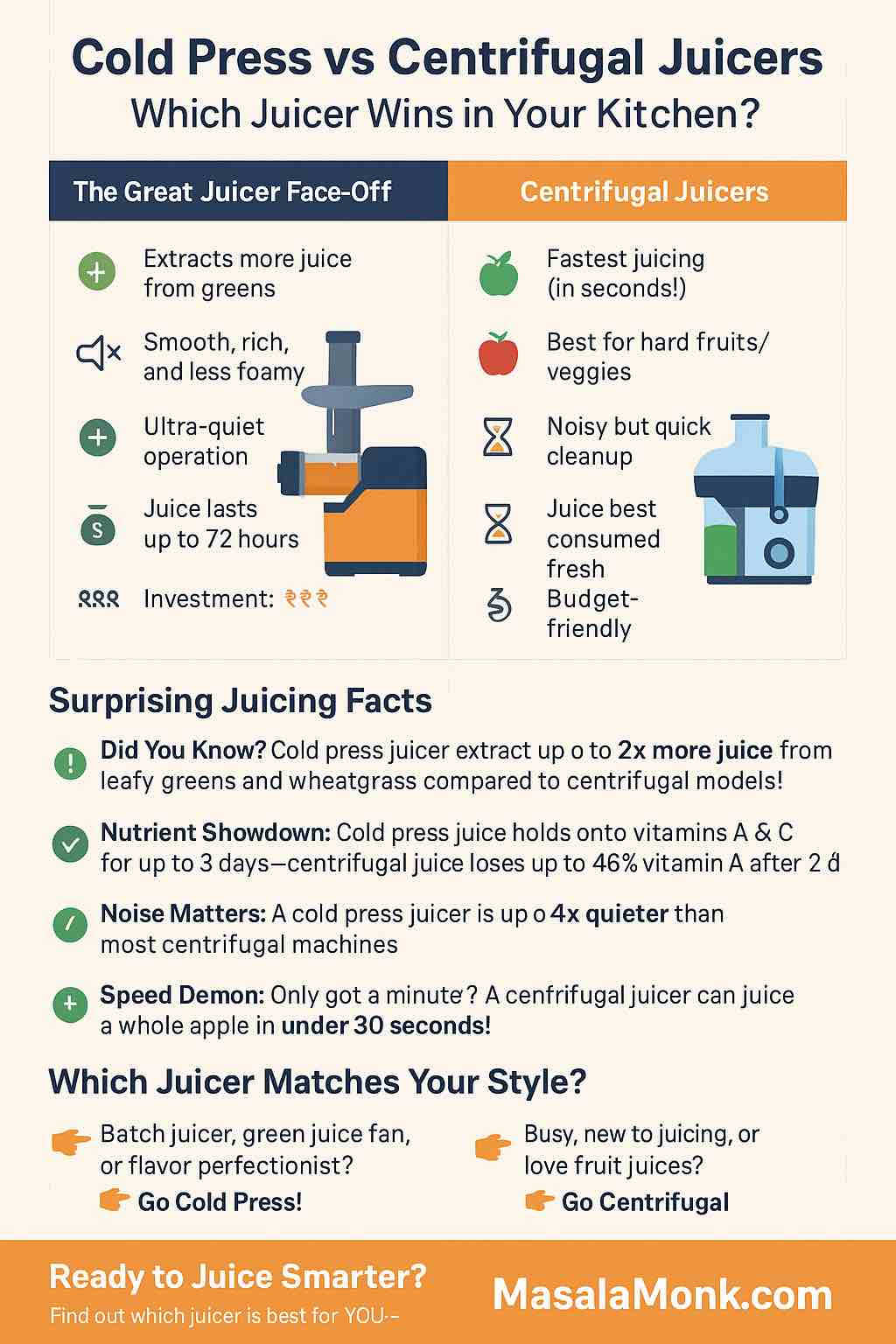
Centrifugal juicers are the “classic” juicers you see in most stores. They’re fast, loud, and use a rapidly spinning blade to pulverize fruits and veggies, extracting juice via centrifugal force.

Cold Press (Masticating) juicers work differently. They “chew” produce at a low speed with an auger, gently crushing and pressing out juice. This slow process creates little heat, hence the term “cold press.”


How Does This Affect Your Juice?

Let’s get practical. Here’s how these two styles shape your daily juice routine:

1. Juice Quality & Nutrition

  • Cold Press Juicers
    • Higher juice yield. Get more juice (especially from leafy greens, wheatgrass, and soft fruits).
    • Richer flavor. Juice is smoother, less foamy, and has deeper color.
    • More nutrients—especially over time. Scientific studies show cold press juice retains more vitamins (notably A and C) after 48–72 hours. If you like to batch juice, this matters!
    • Minimal oxidation. Juice stays fresh longer (up to 3 days refrigerated) and separates less.
  • Centrifugal Juicers
    • Fast, fresh juice in seconds. Best for “drink it now” types.
    • Slightly less nutrient retention. Lab studies show only ~10–15% difference at the moment of juicing, but nutrients degrade much faster in storage.
    • More foam, faster separation. Texture can be frothier, and you’ll see layers form in your glass if you wait.

Bottom line: For best flavor and nutrition—especially with leafy greens or if you batch juice—cold press wins. If you drink juice immediately and don’t mind a little foam, centrifugal works just fine.


2. Speed & Convenience

  • Centrifugal Juicers
    • Fastest option by far!
      Whole apple? No problem—done in under a minute.
    • Large feeding chute. Minimal chopping needed.
    • Ideal for busy mornings or families on the go.
  • Cold Press Juicers
    • Slower extraction—usually 2–5 minutes for a glass.
    • Smaller feeding chute. Chopping is often required.
    • More parts to assemble/disassemble.

Bottom line: If you want juice NOW and minimal prep, centrifugal is hard to beat.


3. Noise Level

  • Centrifugal Juicers: Like a blender. Loud.
  • Cold Press Juicers: Whisper-quiet. Perfect for early risers or shared homes.

4. Cleaning

  • Centrifugal:
    • Fewer parts, wide openings—quick rinse and done.
  • Cold Press:
    • More components (auger, mesh, chute). Takes a few extra minutes and a brush to keep clean.

TIP: If you dread cleaning, check reviews—some newer cold press models have improved, but centrifugal remains the simplest.


5. Cost

  • Centrifugal Juicers:
    • Great entry models for $40–$150.
  • Cold Press Juicers:
    • Usually $150–$500+. High-end models can reach $700+.

Pro tip: Don’t just buy the cheapest! A sturdy $120 centrifugal or a $250–$350 cold press will outlast and outperform bargain-bin options.


6. Produce Types

  • Leafy Greens, Herbs, Wheatgrass:
    • Cold press is far superior. Centrifugal juicers struggle and waste produce.
  • Hard Fruits (apples, carrots, beets):
    • Both work well, but centrifugal is faster.
  • Soft Fruits (berries, tomatoes, kiwi):
    • Cold press gives higher yield and less mess.

Myths & Misconceptions: What Science Says

  • “Centrifugal juicers destroy nutrients!”
    Not exactly. The heat is modest (juice rarely gets above 50°C/122°F). Studies show a slight difference (10–15%) in vitamin retention at extraction, but the real gap is in storage: cold press juice stays nutritious much longer.
  • “Cold press juice is always healthier.”
    Not always. For some nutrients (like lycopene in tomatoes), gentle heat from centrifugal juicers can actually improve absorption. The overall difference for most people is modest if you drink the juice immediately.
  • “Cold press is only for the obsessed.”
    Nope! If you love greens, want to prep juice ahead, or value taste/texture, you’ll love cold press. But centrifugal makes great juice too—especially for fruit-focused recipes.

Which Should You Choose? A Practical Guide

Get a Cold Press Juicer if:

  • You juice leafy greens, herbs, or wheatgrass often.
  • You want to batch juice for 2–3 days.
  • Taste, texture, and nutrient retention matter to you.
  • You don’t mind a slower, quieter process (and a bit more cleanup).
  • Budget isn’t your biggest concern.

Get a Centrifugal Juicer if:

  • You’re new to juicing and want something quick, easy, and affordable.
  • You mainly juice hard fruits and veggies.
  • You’ll drink juice right away.
  • Speed and simplicity matter most.
  • You want less cleanup.

Real-World Examples

  • Busy Parent:
    You want fresh apple-carrot juice every morning, with minimal hassle. A good centrifugal juicer lets you prep, juice, and clean in 5 minutes.
  • Wellness Enthusiast:
    You juice kale, ginger, celery, and batch prep for the week. A cold press model gives you better taste, higher yield, and juice that lasts up to 72 hours in the fridge.
  • On a Budget:
    Start with a solid centrifugal juicer. If you fall in love with juicing, upgrade later!

Popular Models (2025 Recommendations)

Best Centrifugal Juicers

  • Breville Juice Fountain Plus: Fast, reliable, wide chute.
  • Hamilton Beach Big Mouth: Budget pick, easy cleanup.

Best Cold Press (Masticating) Juicers

  • Omega NC900HDC: High yield, superb for greens.
  • Nama J2: Newer, auto-feeding, minimal prep.
  • Hurom H-AA: Compact, very quiet.

Final Thoughts: What’s Right for You?

The “best” juicer is the one that fits your habits, kitchen, and goals. Both types can deliver delicious, healthful juice at home.

If you want the most juice from every spinach leaf and care about longevity—go cold press. If you crave convenience, drink juice right away, and want a smaller upfront investment—centrifugal is perfect.

Remember:
The healthiest juice is the one you’ll actually make and drink!


Practical Tips for Better Juicing (No Matter the Juicer)

  • Prep produce ahead: Chop, wash, and bag portions for the week.
  • Alternate soft and hard produce: This helps both juicer types avoid clogs.
  • Clean immediately: Rinse parts right after use for easy cleanup.
  • Drink soon: Even cold press juice is best within 48 hours for flavor and nutrients.
  • Experiment: Try both methods at a juice bar before you buy—or borrow a friend’s machine.

Have Questions or a Juicer Story?

Drop a comment below! Which juicer do you use? What surprised you about your first juicing experience? Let’s share real-world tips and favorite recipes!


Happy juicing—whatever you choose!

10 Frequently Asked Questions (FAQs) About Cold Press vs Centrifugal Juicers

1. Which juicer is better for leafy greens and wheatgrass?
Cold press (masticating) juicers are far superior for leafy greens, wheatgrass, and herbs. They extract significantly more juice and nutrients, whereas centrifugal juicers often leave these types of produce almost dry and wasteful.


2. Can I store juice from both juicers, and for how long?
Cold press juice can be stored in the refrigerator for up to 72 hours with minimal loss of nutrients and flavor. Juice from centrifugal juicers should ideally be consumed within 24 hours due to faster nutrient degradation and oxidation.


3. Is there a big difference in nutrition between the two types?
There is a modest difference—cold press juicers retain about 10–15% more vitamins and antioxidants, especially after storing. For immediate drinking, the nutritional gap is small, but it widens if you batch juice.


4. Are cold press juicers really that much quieter?
Yes, cold press juicers operate at low speeds and are much quieter than centrifugal juicers, which are about as loud as a blender. This makes cold press ideal for early mornings or shared spaces.


5. What are the main cleaning differences?
Centrifugal juicers usually have fewer parts and are quicker to clean, often taking just a couple of minutes. Cold press juicers have more components, including a mesh screen and auger, and can take a few extra minutes and a brush to clean thoroughly.


6. Why are cold press juicers so much more expensive?
Cold press juicers use more complex, durable mechanisms and often yield more juice per produce—saving money in the long run if you juice regularly. You’re paying for higher juice quality, better yield, and longer juice shelf life.


7. Do centrifugal juicers work with soft fruits?
They can, but you’ll often get a thinner, more separated juice and less yield. Cold press juicers are much better for soft fruits like berries, tomatoes, and kiwi.


8. Is it true centrifugal juicers destroy enzymes and nutrients with heat?
Not really. The heat generated is minimal and doesn’t destroy nutrients outright. However, the oxidation from the fast spinning can reduce some sensitive nutrients and shortens shelf life, especially for vitamins A and C.


9. Which type of juicer is best for beginners?
Centrifugal juicers are best for beginners—they’re affordable, fast, and easy to use. They’re great for occasional or fruit-focused juicing. If you become a regular juicer or want to maximize yield from greens, you can upgrade to cold press later.


10. Can I use both types of juicers together?
While not necessary for most people, some serious juicers do use both: centrifugal for fast, everyday fruit juices and cold press for batch-prepped or green juices. If budget and space allow, having both gives ultimate flexibility.

Posted on Leave a comment

Top AI-Recommended Air Fryers of 2025

TOP AI-RECOMMENDED AIR FRYERS OF 2025

Air fryers have become a kitchen staple for anyone seeking quick, delicious, and healthier meals without deep frying. But with so many options flooding the market in 2025, which air fryer truly deserves your counter space?

Thanks to the combined insights of expert reviews, user feedback, and AI-powered analysis of performance and features, we’ve curated the definitive list of Top AI-Recommended Air Fryers of 2025. Whether you want speedy cooking, big family capacity, or premium versatility, this guide covers it all.


Why Trust AI & Expert Analysis for Your Next Air Fryer?

Choosing the right air fryer can be overwhelming, with countless brands, sizes, and features. AI models analyze:

  • Cooking performance: How evenly and crisply does it cook staples like fries, wings, and salmon?
  • Versatility: Number of cooking modes and dual-zone cooking options.
  • User reviews: Real-world reliability and satisfaction from buyers on Reddit, Amazon, and more.
  • Design & maintenance: Ease of use, cleanup, and size considerations.
  • Value for money: Balancing price and features to suit every budget.

This AI-powered approach combined with lab-tested reviews gives you a smart, unbiased buying decision.


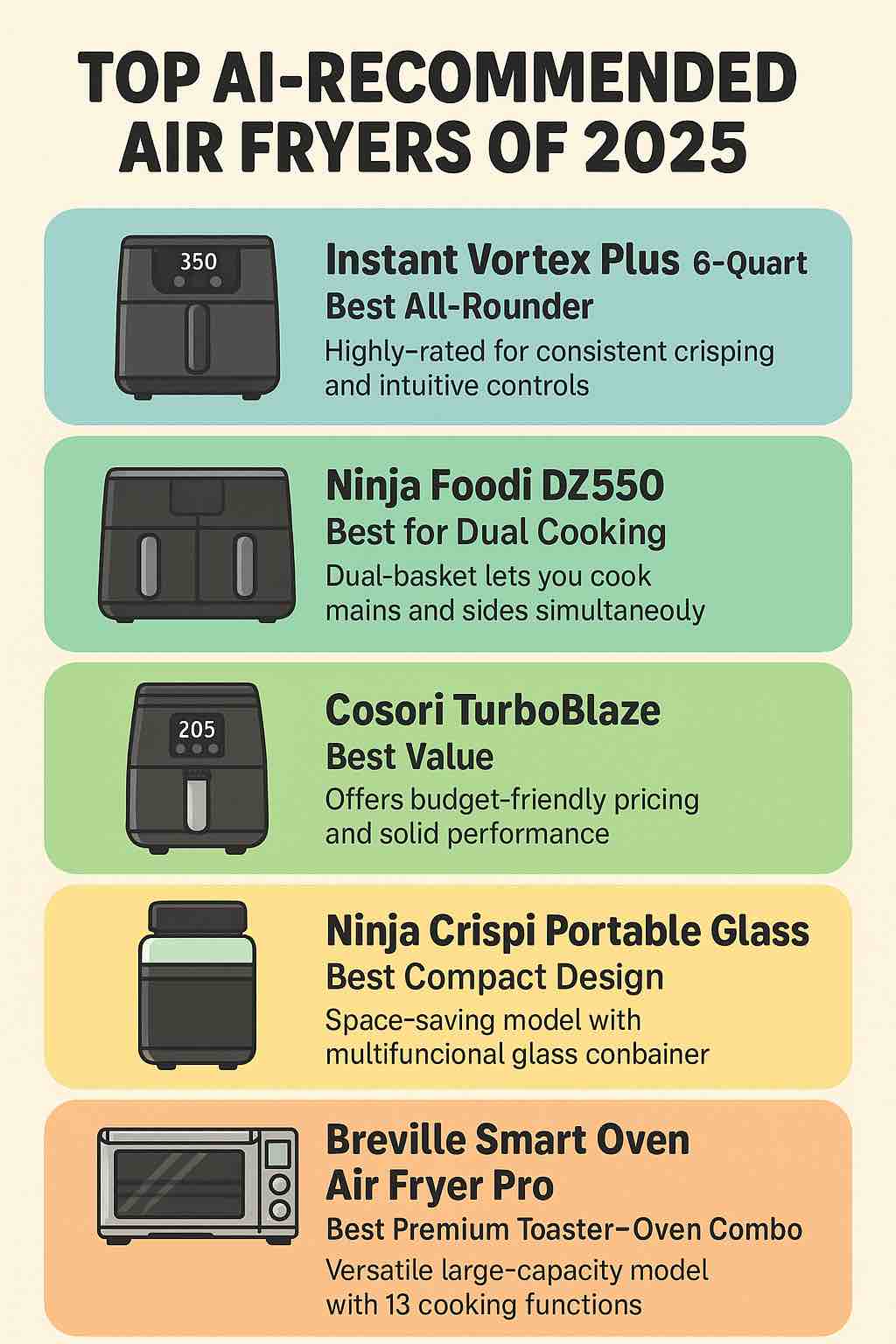
1. Instant Vortex Plus 6-Quart — Best All-Rounder

If you want a dependable, family-friendly air fryer that consistently delivers crispy, delicious food, the Instant Vortex Plus 6-Quart is your top pick. It’s repeatedly rated best overall by Food & Wine, Serious Eats, Bon Appétit, and WIRED.

  • Capacity: 6 quarts — large enough for 3-5 servings
  • Features: 6-in-1 cooking modes including air fry, roast, bake, reheat, dehydrate, and broil
  • Pros: Easy-to-use touchscreen, square basket for more cooking area, dishwasher-safe parts
  • Cons: Slightly slower preheat time, no smart app connectivity

Why AI recommends it: Offers the best balance of crisping, capacity, and user-friendly controls — perfect for everyday meals.


2. Ninja Foodi DZ550 (10 Qt Dual Basket) — Best for Dual Cooking

Looking to multitask? The Ninja Foodi DZ550 features two independent baskets allowing you to cook two different foods simultaneously at different temperatures — say, wings and veggies — without flavor crossover.

  • Capacity: 10 quarts total (5 quarts each basket)
  • Features: Air fry, roast, bake, dehydrate, and more with a temperature probe
  • Pros: Versatile, large capacity, perfect for families or meal prep
  • Cons: Takes up more counter space, learning curve for dual basket use

AI insight: The dual-zone system and solid cooking performance earn it a high rank for families who want efficient, diverse meals.


3. Cosori TurboBlaze / Pro LE (5–6 Qt) — Best Value

Want great performance without breaking the bank? The Cosori TurboBlaze delivers evenly cooked, crispy results with helpful preset functions and a user-friendly interface.

  • Capacity: 5 to 6 quarts
  • Features: Shake reminder, 11 preset modes, rapid preheat
  • Pros: Budget-friendly, great cooking consistency, easy cleanup
  • Cons: Slightly less crisp than premium models

AI verdict: Perfect budget choice offering reliable cooking and useful presets, ideal for beginners or small families.


4. Ninja Crispi Portable Glass (4 Qt) — Best Compact Design

For singles or dorm living, the Ninja Crispi combines cooking, serving, and storing in one glass container. It’s compact, multifunctional, and stylish.

  • Capacity: Approx 4 quarts
  • Features: Air fry, bake, roast with a sleek, glass cooking vessel
  • Pros: Easy to store food directly in the cooking container, dishwasher safe
  • Cons: Smaller capacity, fewer preset functions

Why AI likes it: Combines innovation with portability — great for users short on space who want fresh food fast.


5. Breville Smart Oven Air Fryer Pro — Best Premium Oven-Style Air Fryer

If you want a versatile countertop appliance that’s more than just an air fryer, the Breville Smart Oven Air Fryer Pro is your premium pick. It excels in oven-style cooking with smart convection.

  • Capacity: Large, fits up to 9 slices of bread or a 14-lb turkey
  • Features: 13 cooking functions including air fry, bake, broil, roast, and dehydrate
  • Pros: Superior browning, large capacity, durable build
  • Cons: Bulky and pricey

AI assessment: Ideal for chefs who want an all-in-one solution with excellent crisping and baking.


6. Philips Premium XXL / 3000 Series — Best Build Quality & Large Capacity

Philips continues to lead with durable build quality and smart fat-removal technology in the Premium XXL.

  • Capacity: 5 to 7 quarts
  • Features: Fat removal tech, easy-clean drawer, touchscreen controls
  • Pros: Excellent crispiness, consistent results
  • Cons: Larger footprint and price

AI note: Combines premium engineering and family-sized capacity with healthy cooking benefits.


7. Typhur Dome — Best for Speed Enthusiasts

For those who value speed above all else, the Typhur Dome claims one of the fastest cooking times on the market — cooking wings in about 14 minutes.

  • Capacity: Compact (exact Qt varies)
  • Features: High-speed convection, sleek modern design
  • Pros: Very fast cooking, good for quick meals
  • Cons: Higher price, newer brand with less user feedback

AI insight: Perfect for time-pressed users willing to invest in innovation.


8. Midea Flexify (24 Qt French-Door) — Best for Large Families & Baking

If you want the capacity of an oven with the convenience of an air fryer, the Midea Flexify offers a massive 24-quart French-door design that fits large batches.

  • Capacity: 24 quarts total
  • Features: 10 cooking modes, French door access, large interior space
  • Pros: Ideal for baking and large meals, versatile
  • Cons: Requires ample counter space

AI summary: A powerhouse for families or avid bakers looking for maximum capacity and function.

🧩 Comparison Snapshot

ModelTypeCapacityStrengthsDrawbacks
Instant Vortex PlusBasket6 QtBest crisping, intuitive, good for familiesSlow preheat, mid-tier capacity
Cosori TurboBlaze / Pro LEBasket5–6 QtBudget, presets, easy cleaningLess crispy than top-tier
Ninja AF101 / Max XLBasket4–5.5 QtFast, crispiest outputs, simpleBasket shape may be compact
Ninja Crispi GlassPortable glass~4 QtMultifunctional, easy storageLimited capacity
Philips Premium XXL / 3000Basket5–7 QtPremium feel, fat-removal, largeBig and expensive
Breville Smart Oven Air FryerOven comboLargeVersatile, oven-quality resultsBulky, expensive
Ninja DoubleStack XLDual basket10 QtMulti-zone cookingUneven heat, complex learning
Typhur DomeSpecialtyn/aExtreme speed crispingVery pricey
AI Based Comparison of Air Fryers in 2025

Final Thoughts: Which Air Fryer is Right for You?

Need / PreferenceBest Air Fryer Pick
Everyday family mealsInstant Vortex Plus
Dual cooking / multitaskingNinja Foodi DZ550 Dual Basket
Budget-friendly optionCosori TurboBlaze / Pro LE
Compact & portableNinja Crispi Portable Glass
Premium versatilityBreville Smart Oven Air Fryer Pro
Large capacity & buildPhilips Premium XXL
Fastest cookingTyphur Dome
Baking & large mealsMidea Flexify French-Door

Where to Buy & Price Ranges

  • Instant Vortex Plus: $110–140
  • Ninja Foodi DZ550: $180–250
  • Cosori TurboBlaze: $90–120
  • Ninja Crispi: $130–160
  • Breville Smart Oven Air Fryer Pro: $350–400
  • Philips Premium XXL: $250–300
  • Typhur Dome: $300+
  • Midea Flexify: $280–350

Available at Amazon, Best Buy, Target, and major retailers.


Ready to Crisp Up Your Kitchen?

With AI-powered insights and expert reviews, your perfect air fryer match awaits! Whether you want the simplicity of the Instant Vortex Plus, the power of the Ninja Foodi DZ550, or the speed of the Typhur Dome, 2025’s top picks offer something for every lifestyle and budget.

Explore your favorites today and enjoy healthier, faster, and tastier meals at home.


For more detailed buying guides, recipes, and tips, visit MasalaMonk.com — Your trusted source for kitchen and gourmet essentials!

FAQs: Top AI-Recommended Air Fryers of 2025

1. What size air fryer should I buy for a family of four?
For a family of four, a 5 to 6-quart air fryer is ideal. It offers enough capacity to cook meals like fries, chicken, or veggies in one batch without overcrowding.

2. Can air fryers cook foods other than fries and chicken?
Yes! Modern air fryers come with multiple cooking modes that allow you to roast, bake, reheat, dehydrate, and even grill various foods such as vegetables, fish, baked goods, and more.

3. Are bigger air fryers always better?
Not necessarily. Bigger air fryers provide more cooking capacity but take up more counter space. If you have limited kitchen space or cook small meals often, a compact model might be better.

4. How do air fryers compare to traditional ovens?
Air fryers cook faster by circulating hot air rapidly, producing a crispy texture similar to frying but with less oil. Oven-style air fryers combine features of traditional ovens and air fryers for versatile cooking.

5. How much oil do I need to use in an air fryer?
Most recipes require little to no added oil. A tablespoon or less is often enough to achieve crispiness, making air frying a healthier alternative to deep frying.

6. Are air fryers easy to clean?
Yes, most air fryer baskets and trays are dishwasher-safe. Cleaning after each use is recommended to prevent residue buildup and maintain optimal performance.

7. What are the advantages of dual-basket air fryers?
Dual-basket air fryers, like the Ninja Foodi DZ550, let you cook two different foods at different temperatures simultaneously, saving time and preventing flavor mixing.

8. Can I bake desserts in an air fryer?
Absolutely! Many air fryers have baking modes that allow you to make cakes, muffins, cookies, and other desserts quickly and evenly.

9. Are premium air fryer ovens worth the price?
If you want versatile cooking functions (bake, roast, air fry, dehydrate) and a larger cooking capacity, premium models like the Breville Smart Oven Air Fryer Pro are worth the investment.

10. Where can I buy reliable air fryers in the USA?
Top air fryer models are widely available online and in stores such as Amazon, Best Buy, Target, and Walmart. Always check user reviews and warranty information before purchasing.

Posted on Leave a comment

Top 5 Air Fryers of 2024: AI & Web-Researched Guide

Introduction

In the bustling rhythm of modern kitchens, where convenience meets culinary creativity, air fryers have emerged as indispensable allies. These versatile appliances promise to transform the traditional frying process into a healthier, faster, and more efficient endeavor. As 2024 unfolds, the quest for the perfect air fryer has become more nuanced, with a plethora of models vying for the spotlight, each boasting unique features, capabilities, and innovations.

Amidst this landscape, the challenge for consumers is not just finding an air fryer but discovering the one that aligns with their culinary aspirations, lifestyle, and kitchen aesthetics. It’s a decision that transcends mere functionality, touching upon health considerations, environmental consciousness, and the sheer joy of cooking.

Why is this guide different? In a market saturated with biased reviews and overwhelming affiliate links, our mission is crystal clear: to provide you with the most unbiased, comprehensive, and meticulously researched guide to the top 10 air fryers of 2024. Leveraging advanced AI and in-depth web research, we’ve cut through the noise to bring you a selection based solely on performance, design, user feedback, and value—free from the influence of affiliate marketing.

This guide is not just about listing air fryers; it’s about empowering you with knowledge. From understanding the intricacies of air frying technology to navigating the subtle differences between models, we aim to equip you with the insights needed to make an informed choice. Whether you’re a busy parent seeking quick meal solutions, a health enthusiast aiming to reduce oil consumption, or a culinary explorer eager to experiment with new recipes, the perfect air fryer for your kitchen awaits.

Join us on this culinary journey as we unveil the Top 10 Air Fryers of 2024, analyzed and presented through the lens of unbiased AI and web research. It’s time to elevate your cooking experience, embrace healthier eating habits, and indulge in the simplicity and efficiency that only the best air fryers can offer.

To provide a clear and accurate explanation of how the information for the “Top 10 Air Fryers of 2024” list was compiled, here’s a straightforward summary of the process:

Methodology: Compiling the Top 5 Air Fryers of 2024

1. Web and Data Analysis:
The foundation of our list is built on extensive web research and data analysis. Utilizing advanced algorithms, we scoured the internet for product listings, customer reviews, and expert opinions from reputable culinary and consumer electronics websites.

2. Information Aggregation:
We aggregated information from various sources to ensure a diverse and comprehensive view. This included examining product specifications from manufacturers, reading through consumer reviews on major retail sites, and analyzing ratings and recommendations from trusted industry experts.

3. Feature and Specification Comparison:
Each air fryer was evaluated based on a set of key features and specifications. These included cooking capacity, temperature range, preset programs, ease of use, cleaning convenience, and any unique technologies or design elements that differentiate the product from its competitors.

4. Consumer Feedback Synthesis:
An essential part of our methodology was synthesizing consumer feedback. By analyzing reviews and ratings, we identified common themes regarding performance, reliability, user satisfaction, and potential drawbacks, providing a well-rounded perspective on each air fryer.

5. Editorial Review:
The final step involved a careful editorial review to ensure the accuracy and relevance of the information provided. Our team compiled the findings into coherent, detailed descriptions of each air fryer, highlighting their strengths and weaknesses without any commercial bias.

6. Transparency and Objectivity:
It’s important to clarify that this process does not involve hands-on testing by our team. Instead, it relies on publicly available data and the analytical capabilities of AI and manual editorial efforts to synthesize and present the most accurate, up-to-date information possible.

This methodology reflects our commitment to providing helpful, objective, and accurate information to assist consumers in making informed decisions when selecting air fryers.

Let’s proceed to the next section of the post, where we will introduce and review the top air fryers based on our research and analysis.


The Top 5 High-End Air Fryers of 2024: Elevating Your Culinary Experience

In the search for the ultimate kitchen companion, air fryers have become indispensable for their ability to offer healthier versions of our favorite fried foods. As 2024 sees a surge in innovative models, choosing the right one can be overwhelming. That’s where our exhaustive research and analysis come into play. After delving into the latest models, consumer feedback, and expert opinions, we’ve compiled an authoritative list of the top 5 air fryers of 2024.

Our selection criteria were stringent, focusing on performance, versatility, ease of use, durability, and, importantly, user satisfaction. We’ve sifted through the noise to bring you the crème de la crème of air fryers, ensuring that whether you’re a seasoned chef or a culinary novice, there’s something on this list that will meet your cooking needs and exceed your expectations.

From compact models perfect for small spaces to versatile multitaskers that can roast, bake, and grill, our top picks are about to make your meal prep easier, healthier, and more delicious. Without further ado, let’s dive into the reviews of the best air fryers of 2024, carefully curated to help you make an informed choice.

1. Ninja Foodi DualZone Air Fryer

Noteworthy Features:

  • DualZone Technology: Cook two foods, two ways, simultaneously.
  • Capacity: Generous 8-quart capacity, perfect for families or meal prepping.
  • Versatility: Offers air fry, roast, bake, and reheat options.

Why It Stands Out: The Ninja Foodi isn’t just an air fryer; it’s a culinary game-changer. With its DualZone Technology, preparing a complete meal, from crispy fries to succulent chicken, becomes effortless and fast. Its smart finish feature ensures that both zones are ready at the same time, maintaining the perfect serving temperature.

2. Instant Pot Vortex Plus 6-Quart Air Fryer

Key Specifications:

  • Smart Programs: Seven built-in programs for a variety of dishes.
  • EvenCrisp Technology: Guarantees a perfect crunch with 95% less oil.
  • Ease of Use: Intuitive touchscreen display for simple operation.

What Makes It Special: Beyond its sleek design, the Instant Pot Vortex Plus excels in delivering uniformly cooked, deliciously crispy dishes every time. Its 6-quart capacity is ideal for mid-sized households, ensuring no one misses out on their favorite fried foods, made healthier.

3. Cosori Pro LE Air Fryer

Highlights:

  • Design: Elegant, compact, and easy to fit on any countertop.
  • Preset Options: Wide variety of presets, tailored for different foods.
  • User-Friendly: Simple interface, easy to navigate even for beginners.

Distinctive Advantage: The Cosori Pro LE is celebrated for its optimal air circulation technology, ensuring food is cooked evenly and quickly. Its commitment to healthier cooking, without sacrificing taste or convenience, sets it apart in the air fryer market.

4. Instant Vortex Pro 10-Quart 9-in-1 Air Fryer

Features to Note:

  • 9-in-1 Functions: From air frying to rotisserie, it covers all cooking needs.
  • Large Capacity: 10-quart size is perfect for entertaining or large families.
  • Observation Window: ClearCook window and interior light for easy monitoring.

Why It’s a Top Pick: Its ability to simultaneously cook multiple meal components makes the Instant Vortex Pro a standout. Whether you’re dehydrating fruits or roasting a chicken, this air fryer ensures a gourmet cooking experience with minimal effort.

5. Breville Smart Oven Air Fryer Pro

Impressive Qualities:

  • Element iQ System: Smart heat distribution for perfect results.
  • Super Convection Technology: Faster cooking times and even heat.
  • Versatility: Functions as a full oven for baking, roasting, and more.

Unique Selling Point: The Breville Smart Oven Air Fryer Pro is not just for air frying; it’s an all-encompassing kitchen appliance. Its precision and wide range of cooking modes cater to all culinary aspirations, from quick snacks to elaborate dinners, making it a favorite among gourmet enthusiasts.

The 2024 lineup of high-end air fryers offers something for every home chef, from the simplicity and dual cooking options of the Ninja Foodi to the comprehensive cooking capabilities of the Breville Smart Oven. Each model on this list has been selected for its ability to transform your cooking experience, combining health, efficiency, and unparalleled taste. Dive into the world of advanced air frying and discover how these top 5 picks can elevate your culinary creations.


Features/ModelNinja Foodi DualZoneInstant Pot Vortex Plus 6-QtCosori Pro LEInstant Vortex Pro 10-QtBreville Smart Oven Air Fryer Pro
Capacity8 qt6 qt5 qt10 qt22 qt (approx.)
Cooking FunctionsAir fry, roast, bake, reheatAir fry, roast, bake, dehydrateAir fry, roast, bake, toastAir fry, roast, bake, dehydrate, rotisserieAir fry, bake, roast, dehydrate, toast
Control TypeDigital touchscreenDigital touchscreenDigital touchscreenDigital touchscreenDigital LCD display
Temperature Range105°F to 450°F95°F to 400°F170°F to 400°F95°F to 400°F80°F to 480°F
Unique FeaturesDualZone TechnologyEvenCrisp TechnologyCompact elegant designClearCook window, RotisserieElement iQ system, Super convection
Ease of UseEasy to clean, separate basketsSimple interface, easy cleanupUser-friendly, easy cleanupInterior light, easy cleanupIntuitive controls, easy cleanup
VersatilityHighMediumMediumHighVery High
Additional Notable FeaturesSync and match cook settingsDishwasher safe partsShake reminder, preheat functionDishwasher safe parts, 9 functions13 cooking functions, PID temperature control
Ideal ForLarge families/mealsMedium-sized householdsStyle-conscious cooksEntertaining, large familiesGourmet home cooking, versatility
Price Range$$$$$$$$$$$$$$

Key:

  • $$$ = Higher price point
  • $$ = Moderate price point
  • $$$$ = Premium price point

This table aims to provide a more detailed comparison across a broader set of features and specifications. It highlights not only the basic functionalities and capacity but also dives into the control mechanisms, temperature flexibility, and special features that set each air fryer apart. From the Ninja Foodi’s ability to cook two foods in two ways simultaneously to the Breville Smart Oven’s comprehensive cooking functions and advanced temperature control, each model caters to different culinary needs and preferences, offering something unique for every home chef.

How to Choose An Air Fryer?

When selecting an air fryer, especially from the top models of 2024, it’s essential to consider several key factors to ensure the appliance meets your cooking needs, preferences, and lifestyle. Here’s a guide on how to choose an air fryer, focusing on what to keep in mind while considering the top models discussed above:

1. Capacity and Size

Consider the size of your household and your cooking habits. A larger air fryer, like the Instant Vortex Pro 10-Quart or the Breville Smart Oven Air Fryer Pro, is ideal for large families or those who entertain often, providing ample space to cook meals in larger quantities. Smaller households might prefer the Cosori Pro LE, which offers a compact design without sacrificing cooking quality.

2. Cooking Functions

Evaluate the versatility you need. If you’re looking for an appliance that does more than just air fry, models like the Breville Smart Oven Air Fryer Pro and the Instant Vortex Pro 10-Quart come with multiple cooking functions, including baking, roasting, and even dehydrating. This versatility can save counter space and money by consolidating several appliances into one.

3. Ease of Use and Cleaning

Look for air fryers with intuitive controls and easy-to-clean designs. Touchscreen interfaces, such as those on the Ninja Foodi DualZone and Instant Pot Vortex Plus 6-Quart, offer straightforward operation. Additionally, models with dishwasher-safe parts or non-stick baskets, like the Instant Vortex Pro, significantly ease the cleaning process.

4. Temperature Range and Control

Consider the types of dishes you plan to cook. A broader temperature range, like the Breville Smart Oven Air Fryer Pro‘s 80°F to 480°F, offers more flexibility for various cooking methods, from gentle reheating to high-heat roasting. Precise temperature control, as seen with the Element iQ system in the Breville model, ensures perfect cooking results every time.

5. Unique Features and Technology

Each model comes with unique features that might appeal to different cooking styles and needs. For instance, the Ninja Foodi DualZone‘s ability to cook two dishes independently might be a game-changer for meal prep enthusiasts. Meanwhile, the Cosori Pro LE stands out for its stylish design and user-friendly interface, making it a great addition to a modern kitchen.

6. Price and Value

Finally, consider your budget and the value an air fryer brings. More expensive models like the Breville Smart Oven Air Fryer Pro offer extensive features and cooking capacity, which might justify the higher price for avid cooks looking for an all-in-one solution. In contrast, models like the Instant Pot Vortex Plus 6-Quart provide great functionality at a more moderate price, offering good value for most home cooking needs.

Choosing the right air fryer involves balancing your cooking requirements with the features, capacity, and price of the appliance. Whether you prioritize multifunctionality, ease of use, or specific cooking technologies, the top air fryers of 2024 cater to a wide range of culinary needs. By considering these factors, you can select an air fryer that not only fits your kitchen but also elevates your cooking experience.

As we wrap up our exploration of the top high-end air fryers of 2024, it’s clear that the advancements in kitchen technology continue to transform how we prepare our favorite meals. From the versatile and family-sized Ninja Foodi DualZone to the sophisticated and multifunctional Breville Smart Oven Air Fryer Pro, each model offers unique features that cater to different culinary desires and needs.

Embracing the Future of Cooking

The journey through the latest and greatest in air frying technology demonstrates not only the diversity in the market but also the commitment of brands to innovate and improve upon the convenience, health benefits, and versatility of cooking at home. Whether you are a seasoned chef looking to expand your culinary repertoire or a busy parent seeking quick and healthy meal options, there is an air fryer on this list that is sure to meet your cooking requirements.

Key Takeaways for the Aspiring Buyer

Remember, choosing the right air fryer goes beyond just picking the most advanced or expensive model; it’s about finding the perfect match for your kitchen, lifestyle, and culinary ambitions. Consider factors like capacity, functionality, ease of use, and, importantly, how a particular model can integrate into your daily routine to enhance your cooking experience.

Conclusion: A Culinary Revolution at Your Fingertips

In conclusion, the air fryers of 2024 are not just appliances; they are gateways to a healthier, more efficient, and more enjoyable cooking experience. They embody the culinary revolution that continues to evolve within our kitchens, offering a blend of technology and tradition that promises to delight your taste buds, nourish your body, and inspire your creativity.

As we move forward, the potential for what can be achieved with these remarkable tools is bound only by our imagination. So, whether you decide on the cutting-edge technology of the Instant Vortex Pro, the compact elegance of the Cosori Pro LE, or any other model from our top picks, you’re not just making a purchase—you’re investing in a lifestyle that values health, efficiency, and culinary excellence.

Happy cooking, and may your meals be as delightful and fulfilling as the journey you embark on with your new air fryer.

10 FAQs for High-End Air Fryers of 2024

  1. What size air fryer do I need for a family of four?
    • A 6 to 8-quart air fryer is ideal for a family of four, providing enough space to cook meals in sufficient quantities. Models like the Instant Pot Vortex Plus 6-Quart are perfect for medium-sized families.
  2. Can I bake, roast, and grill with these air fryers?
    • Yes, many high-end air fryers offer multiple cooking functions including baking, roasting, and grilling. The Breville Smart Oven Air Fryer Pro, for example, comes with specific settings for each cooking method.
  3. Are air fryers healthy?
    • Air fryers cook with significantly less oil than traditional frying methods, reducing fat content and calories in your meals. They are considered a healthier option for enjoying fried foods.
  4. How do I clean an air fryer?
    • Most air fryers have removable, non-stick baskets and trays that are dishwasher safe. For models like the Instant Vortex Pro 10-Quart, components can be easily detached and cleaned in a dishwasher or by hand.
  5. Can air fryers replace ovens and microwaves?
    • While air fryers can perform many of the same functions as ovens and microwaves, they might not fully replace them due to size limitations and specific cooking methods. However, they’re excellent for quick, efficient cooking with less energy.
  6. Is preheating necessary in an air fryer?
    • Some recipes and models, such as the Cosori Pro LE, benefit from preheating for optimal cooking results. It can lead to crispier textures and faster cooking times.
  7. What’s the benefit of having a dual-zone air fryer?
    • Dual-zone air fryers like the Ninja Foodi DualZone allow you to cook two different foods at two different settings simultaneously, making meal prep more efficient and versatile.
  8. Can I dehydrate food in an air fryer?
    • Certain models, such as the Instant Vortex Plus 6-Quart and the Instant Vortex Pro 10-Quart, come with a dehydrate function, allowing you to dry fruits, vegetables, and meats easily.
  9. How do I avoid food from sticking to the air fryer basket?
    • Even though most baskets are non-stick, a light spray of cooking oil can help prevent food from sticking. Ensure to clean the basket after each use to maintain its non-stick surface.
  10. Can I cook frozen foods in an air fryer?
    • Absolutely, air fryers excel at cooking frozen foods efficiently, requiring no thawing and offering quick, crispy results. Adjust cooking times accordingly to ensure even cooking.

Blog Tags for the Post

air fryers, healthy cooking, kitchen appliances, family meals, cooking technology, meal prep, quick recipes, home cooking, culinary innovation