Posted on Leave a comment

Mashed Potatoes Recipe

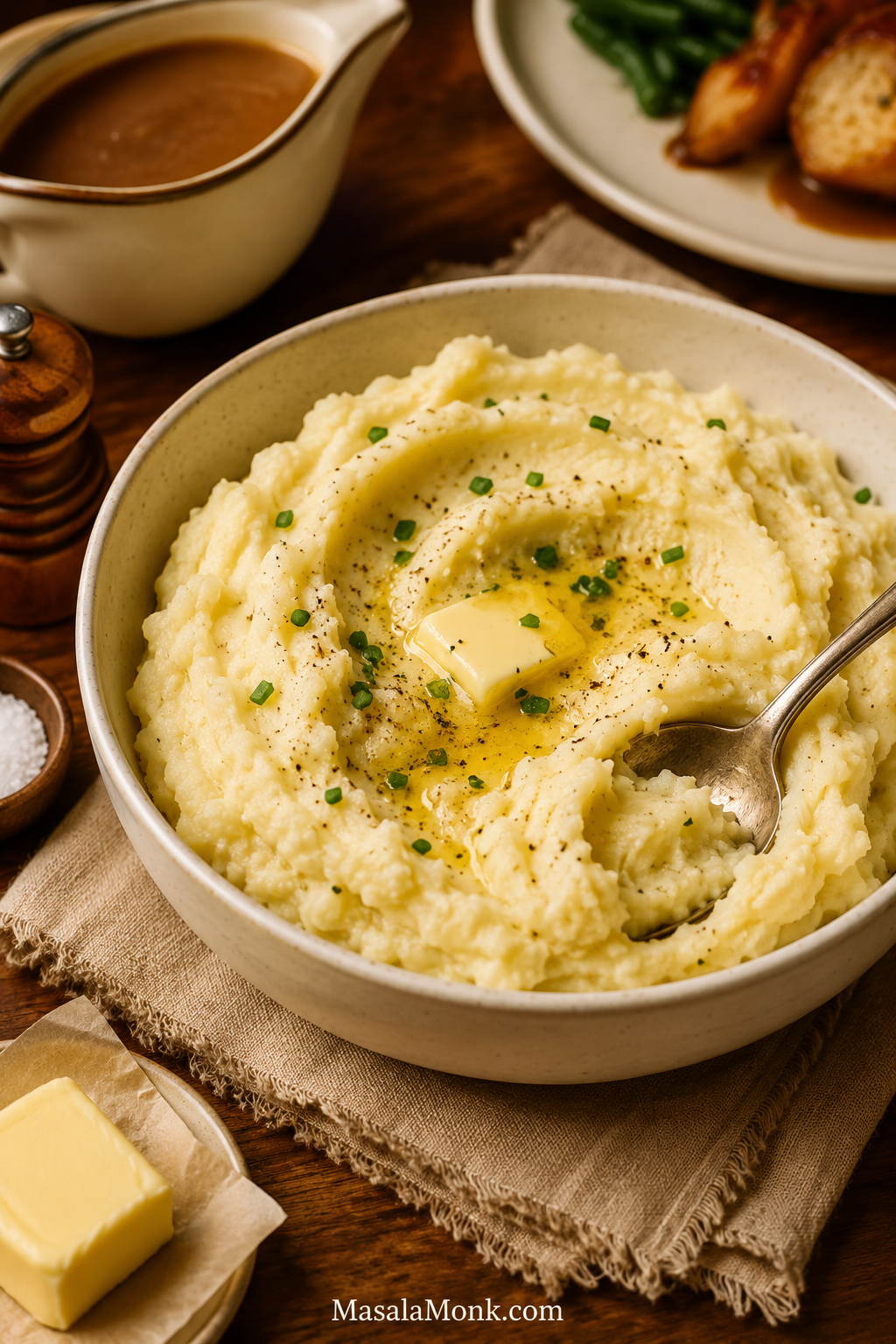
Creamy mashed potatoes in a cream ceramic bowl with melted butter, chives, black pepper, and a blurred gravy boat behind.

This is the mashed potato bowl people reach for first: soft, buttery, creamy enough to feel rich, and fluffy enough to hold a spoonful of gravy. It works for holidays, roast dinners, weeknights, and those “everything else is ready but the potatoes need help” moments.

The ingredients are simple, but the finish matters. Yukon Gold potatoes make the mash naturally creamy, russets make it lighter, warm milk blends in smoothly, and a gentle hand keeps the texture soft instead of sticky.

This recipe is built for real mashed potato moments: the holiday batch, the weeknight side, the dry mash that needs saving, the no-milk emergency, and the serving dish that has to stay warm while dinner catches up.

Quick Answer: How to Make Mashed Potatoes

To make mashed potatoes, simmer peeled potato chunks in cold salted water until very tender, drain well, dry them briefly in the hot pot, then mash with butter and warm milk or cream. Season to taste and add more warm liquid only until the potatoes are soft, creamy, and spoonable.

The finish is where the bowl is won. Dry the potatoes well, add warm liquid gradually, and stop as soon as the mash looks soft and spoonable.

Recipe at a Glance

Best potatoes Yukon Gold, russet, or a 50/50 mix
Texture Creamy, fluffy, buttery, and soft enough for gravy
Prep time 15 minutes
Cook time 20 minutes
Total time 35 minutes
Servings 4 generous or 5 smaller side servings
Best tool Masher for cozy homemade texture; ricer or food mill for a smoother, lighter finish
Main mistake to avoid Overmixing, especially with a blender or food processor
Why this method is worth saving: It gives you one reliable base recipe, then shows you how to steer it creamy, fluffy, richer, dairy-free, make-ahead, or rescue-ready without starting over.

Creamy Mashed Potatoes Recipe

Description: Creamy, fluffy mashed potatoes made with Yukon Gold or russet potatoes, warm milk, butter, and a gentle method that keeps the mash soft, gravy-ready, and easy to rescue if dinner gets ahead of you.

Success cue: Soft, steamy, spoonable potatoes that hold gentle ridges when dragged with a spoon and fall slowly instead of pouring or clumping.

Prep Time15 minutes
Cook Time20 minutes
Total Time35 minutes
Servings4 generous or 5 smaller side servings

Base Ingredients

  • 1 kg / 2.2 lb Yukon Gold potatoes, russet potatoes, or a mix
  • 75–100 g / about 5–7 tbsp unsalted butter
  • 180–240 ml / 3/4–1 cup whole milk, half-and-half, or milk and cream, warmed
  • 2 tsp to 1 tbsp kosher salt for the cooking water, depending on pot size and water volume
  • Fine salt, added gradually after mashing, to taste
  • 1/4–1/2 tsp black pepper

Optional Add-Ins

  • 60 ml / 1/4 cup sour cream
  • 60–100 g / 2–3.5 oz cream cheese
  • Chopped chives, parsley, extra melted butter, or gravy for serving

Instructions

  1. Peel the potatoes for a smooth bowl, or scrub them well if making a rustic version with some skin. Cut into even 1 1/2–2 inch / 4–5 cm chunks.
  2. Place the potatoes in a large pot and cover with cold water by about 1 inch / 2.5 cm. Add kosher salt to the water.
  3. Bring to a boil, then reduce to a steady simmer. Cook for 15–20 minutes, or until a fork slides through easily with almost no resistance.
  4. Drain well. Return the potatoes to the hot empty pot for 30–60 seconds so extra steam escapes and the surface looks dry. Do not rinse them.
  5. Mash gently with a potato masher. For a smoother finish, use a ricer or food mill.
  6. Add the butter and about 180 ml / 3/4 cup warm milk or cream. Mash or fold gently until creamy.
  7. Add more warm milk or cream only as needed. Start with less; you can always loosen the mash once the texture tells you what it needs.
  8. Season with fine salt and pepper. Taste and adjust. Add sour cream or cream cheese if using. Serve hot with extra butter, herbs, or gravy.

Recipe Notes

  • For the best all-purpose bowl, use a 50/50 mix of Yukon Gold and russet potatoes.
  • The potatoes are ready to mash when a fork slides through with almost no resistance. If they fight back at all, cook them longer.
  • Do not rinse after draining. Let steam escape in the hot pot instead.
  • A masher, ricer, or food mill keeps you in control. Save the blender for soups.
  • If using sour cream or cream cheese, add less milk at first. You can loosen the potatoes later, but you cannot easily remove excess liquid.
  • For make-ahead prep, make the mash slightly looser than usual and reheat gently with extra warm milk or butter.
Cook’s note: This method is built around the places mashed potatoes usually fail: undercooked centers, watery potatoes, cold dairy, too much mixing, and last-minute reheating.

Choose Your Mashed Potato Texture

Before you start, decide what kind of mash you want on the table. A fluffy classic mash and a rich holiday batch use the same base method, but they need slightly different choices.

Once you choose the texture first, the rest of the recipe becomes easier: the potato, tool, dairy, and add-ins all have a job.
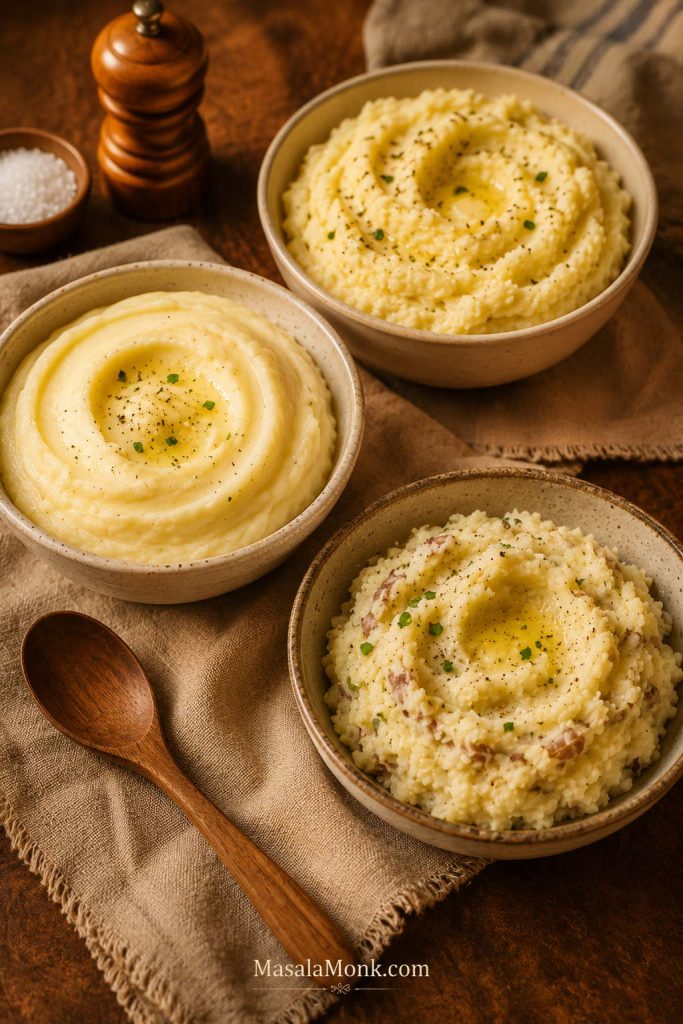
Three small servings of mashed potatoes showing smooth, fluffy, and rustic skin-on textures.
First choose the texture, then choose the tool. Smooth, fluffy, and rustic mashed potatoes all start similarly but finish differently.
You want Use Do this
Creamy everyday mash Yukon Gold potatoes Use warm milk and butter; mash gently.
Fluffy classic mash Russet potatoes Use a ricer or light masher; avoid heavy mixing.
Best balanced mash 50/50 Yukon Gold and russet Use moderate milk, enough butter, and stop when spoonable.
Rich holiday mash Yukon/russet mix + sour cream or cream cheese Make slightly looser before chilling or holding.
No-milk mash Reserved potato water, broth, butter, or olive oil Add slowly so the mash loosens without turning soupy.

Once the style is clear, the potato choice becomes easier. Yukon Golds lean creamy, russets lean fluffy, and a mix gives the safest balance.

The Mashed Potato Texture Rule

The rule that protects the bowl: Dry the potatoes first, add warm liquid slowly, and stop when the mash looks soft and spoonable. If it feels dry, loosen it gently. If it looks wet or sticky, pause before adding or mixing more.

Most mashed potato problems happen in the last few minutes, not at the ingredient stage. The right mash should look relaxed, not wet; soft, not slumped; ridged, not rubbery. Once you know that cue, the recipe becomes much easier to trust.

Why This Recipe Works

Great mashed potatoes do not come from adding every rich ingredient at once. They come from tender potatoes, enough salt, good draining, warm dairy, and a light hand at the end.

In practice, great mashed potatoes come down to moisture control and starch control. Cook the potatoes until fully tender, let surface steam escape after draining, then fold in fat and dairy without beating the mash into paste. That is what keeps the bowl creamy and light instead of watery or gluey.

Yukon Gold potatoes bring a naturally buttery texture. Russets are drier and fluffier. Using both gives you a reliable middle ground: rich enough for holidays, but not so dense that the serving dish feels heavy.

The drying step matters because boiled potatoes carry surface moisture. Letting steam escape in the hot pot keeps the mash from turning watery before the butter and milk go in.

Work the starch as little as possible after cooking. The more you beat the potatoes, the more the texture moves toward sticky and pasty.

Best Potatoes for Mashed Potatoes

Potato choice decides whether the mash leans creamy, fluffy, rustic, or dense. If you are standing in the store and do not want to think about it, buy Yukon Golds. Choose russets for the fluffiest result, or use both if you want the best balance.
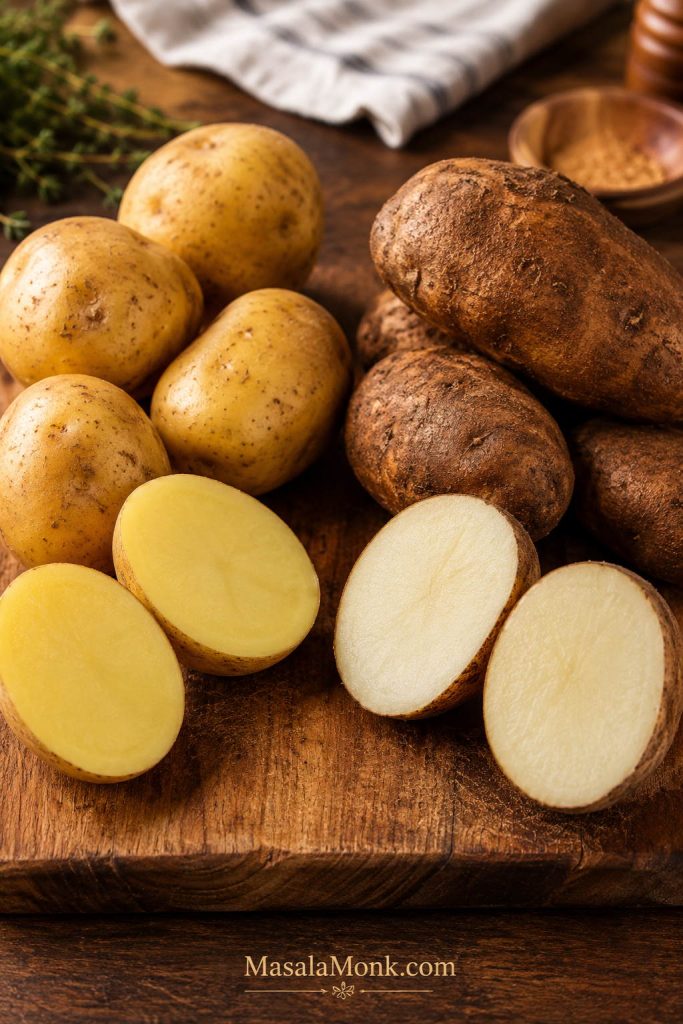
Yukon Gold potatoes and russet potatoes with whole potatoes and cut halves on a wooden board.
Yukon Golds bring buttery creaminess, while russets bring lift. Together, they give mashed potatoes a balanced texture that feels smooth without turning heavy.
Potato Texture Best for
Yukon Gold Creamy, buttery, naturally rich Smooth everyday mashed potatoes
Russet / Idaho Fluffy, light, slightly drier Classic fluffy mashed potatoes
Yukon Gold + Russet mix Creamy and fluffy Best all-purpose mashed potatoes
Red potatoes Waxy, rustic, holds shape Skin-on mashed potatoes
New potatoes / fingerlings Firm and waxy Not ideal for classic mash

Peel the potatoes for a smooth finish. For a rustic mash, leave some or all of the skin on, especially with Yukon Gold or red potatoes. Russet skins are thicker, so they are usually better peeled unless you want a very rustic texture.

Red potatoes are delicious, but they do not give the same classic fluffy texture as russets or the same smooth richness as Yukon Golds. Waxy new potatoes and fingerlings hold their shape well, but they do not mash into the same soft finish.

The Best Ratio

This ratio keeps the recipe flexible without turning it into a guessing game. You can scale it for two people, eight people, or a full holiday table without losing the texture.

For every 1 kg / 2.2 lb potatoes, use 75–100 g butter and 180–240 ml warm milk, half-and-half, or cream. Start with the lower amount of liquid, then add more only if the potatoes need it.

For salt, season the cooking water generously but carefully. For 1 kg / 2.2 lb potatoes, start with about 2 teaspoons kosher salt in a medium pot, or up to 1 tablespoon for a large pot of water. The water should taste seasoned, not harshly salty. After mashing, add fine salt in small pinches or 1/4 teaspoon increments until the flavor tastes full and balanced.

Kosher salt brands vary in weight, so use the cooking-water amount as a starting point and trust the final tasting step more than the spoon measurement.

Ingredient Everyday creamy mash Richer holiday mash
Potatoes 1 kg / 2.2 lb 1 kg / 2.2 lb
Butter 75 g / about 5 tbsp 100 g / about 7 tbsp
Milk or half-and-half 180 ml / 3/4 cup 240 ml / 1 cup
Optional sour cream Skip or use 2 tbsp 60 ml / 1/4 cup
Optional cream cheese Skip 60–100 g / 2–3.5 oz

This is the ratio that keeps you from guessing when the guest count changes.

Useful rule: Start with the everyday column. If you add sour cream, cream cheese, or extra butter, reduce the milk at first because rich add-ins loosen the mash too.

Ingredients

With mashed potatoes, a short ingredient list does not mean the details do not matter. The potato decides the texture, the butter softens the edges, the dairy loosens the mash, and the salt makes the whole dish taste complete.

The amounts are in the recipe card and ratio table above. Here is what each one does once it hits the potatoes.
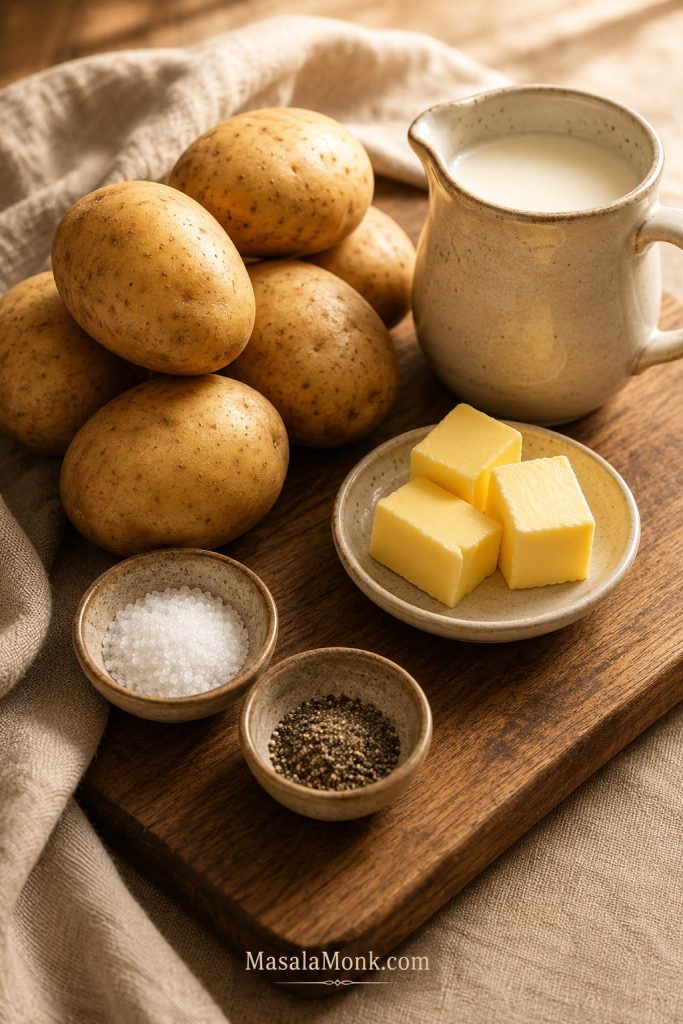
Raw potatoes, butter, milk, salt, and pepper arranged on a wooden board.
Before technique matters, the base stays simple: potatoes, butter, milk or cream, salt, and pepper. The magic comes from how gently those basics are handled.

Potatoes

Yukon Gold potatoes make the mash naturally creamy and buttery. Russets make it lighter and fluffier. A mix gives the most reliable everyday result.

Peel them for a smooth bowl, or scrub them well and leave some skin on for a rustic version.

Butter

Butter gives richness, but it also helps the texture feel soft instead of dry. Unsalted butter gives you more control; salted butter works if you season carefully at the end.

Milk, half-and-half, or cream

Whole milk gives a classic creamy texture. Half-and-half or cream makes the mash richer. Warm the dairy before adding it so it blends smoothly instead of cooling the potatoes down and making the texture tighten.

Salt

Salt the boiling water and season again after mashing. With so few ingredients, blandness has nowhere to hide. If the potatoes taste dull, they usually need a little more salt, butter, or both.

Black pepper

Black pepper gives a gentle warmth. Use white pepper if you want the potatoes to look very smooth without black specks.

Sour cream or cream cheese

Sour cream adds tang and balances the richness of butter. Cream cheese makes the mash thicker and richer, which is especially useful for make-ahead prep. Add less milk at first when using either one.

Herbs and toppings

Chives, parsley, thyme, roasted garlic, melted butter, parmesan, or crispy bacon can all be added depending on the meal. When using salty add-ins like parmesan, bacon, salted butter, broth, or gravy, season lightly at first and adjust at the end.

Equipment

You are not trying to purée potatoes into smoothness. You are breaking them down gently, then folding in enough butter and dairy to make them soft. That is why a masher, ricer, or food mill is safer than anything that spins fast.

  • Potato masher: best for a classic homemade bowl with a little texture.
  • Ricer: best for a very smooth, light finish.
  • Food mill: useful for larger batches or silky mash.
  • Hand mixer: okay on low speed, but stop as soon as the potatoes are smooth.
  • Blender or food processor: save these for soups; they can make mashed potatoes gluey.
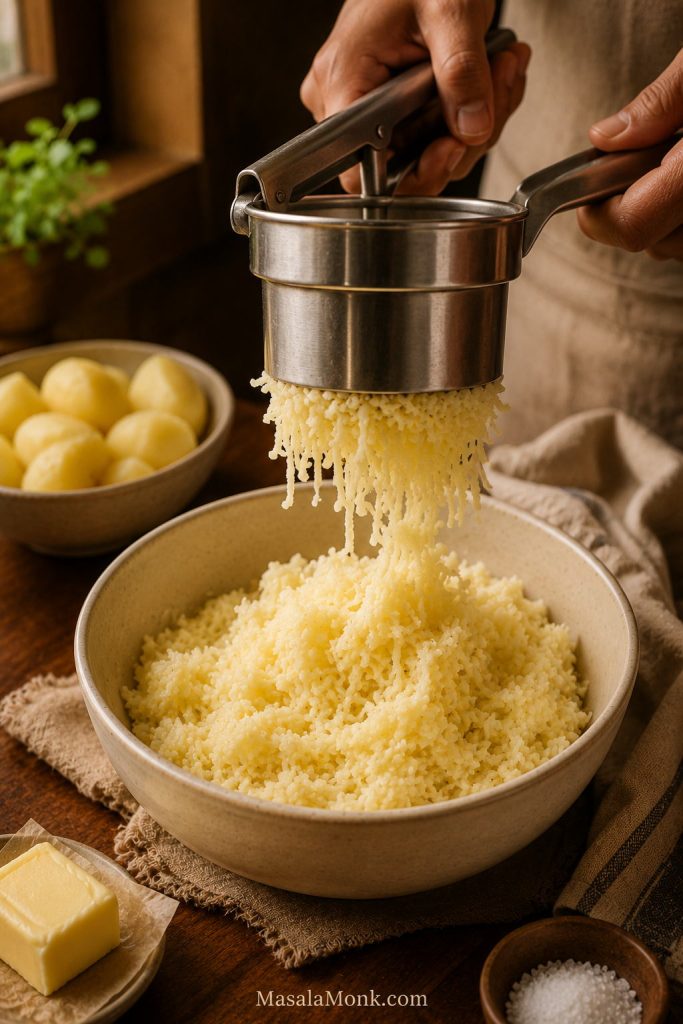
Potato ricer pressing cooked potatoes into fluffy strands over a bowl.
A potato ricer creates fine strands before mixing begins. That means smoother, fluffier mashed potatoes with less handling and less risk of gumminess.

Tool choice matters most when the potatoes are already tender. Before mixing too far, see How to Avoid Gluey Mashed Potatoes.

How to Make Mashed Potatoes Step by Step

Start with the recipe card if dinner is already moving. The step-by-step notes below are for getting the texture exactly right — not just edible, but soft, warm, and worth passing around again.

1. Peel and cut the potatoes

Peel the potatoes if you want a smooth bowl. If you prefer a rustic finish, scrub them well and leave some or all of the skin on.

Cut into even 1 1/2–2 inch / 4–5 cm chunks. The pieces do not need to be tiny, but they should be similar in size so they cook evenly.
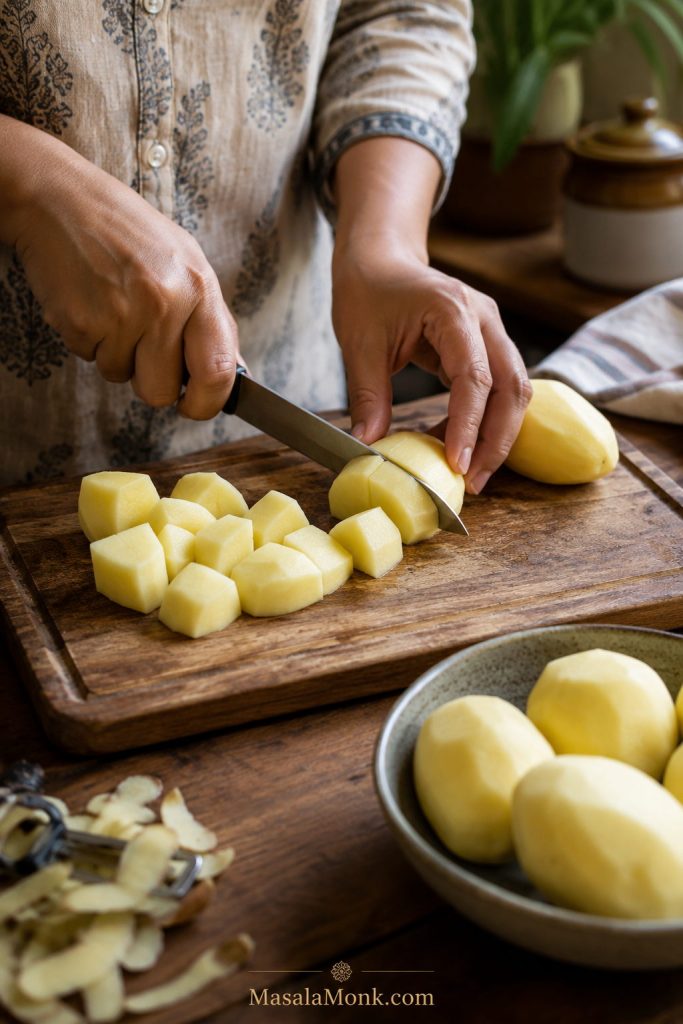
Hands cutting peeled potatoes into even chunks on a wooden cutting board.
Even potato chunks are small insurance against lumps. Because they cook at the same pace, you need less force when it is time to mash.

If you cut them ahead, keep them covered in cold water in the refrigerator for a few hours. Drain before cooking and start with fresh cold water so the flavor stays clean.

2. Start in cold salted water

Place the potato chunks in a large pot and cover with cold water by about 1 inch / 2.5 cm. Add kosher salt to the water; use about 2 teaspoons for a medium pot or up to 1 tablespoon for a larger pot.

Starting in cold water helps the pieces cook evenly. Salted water seasons them from the inside instead of leaving all the seasoning for the end.
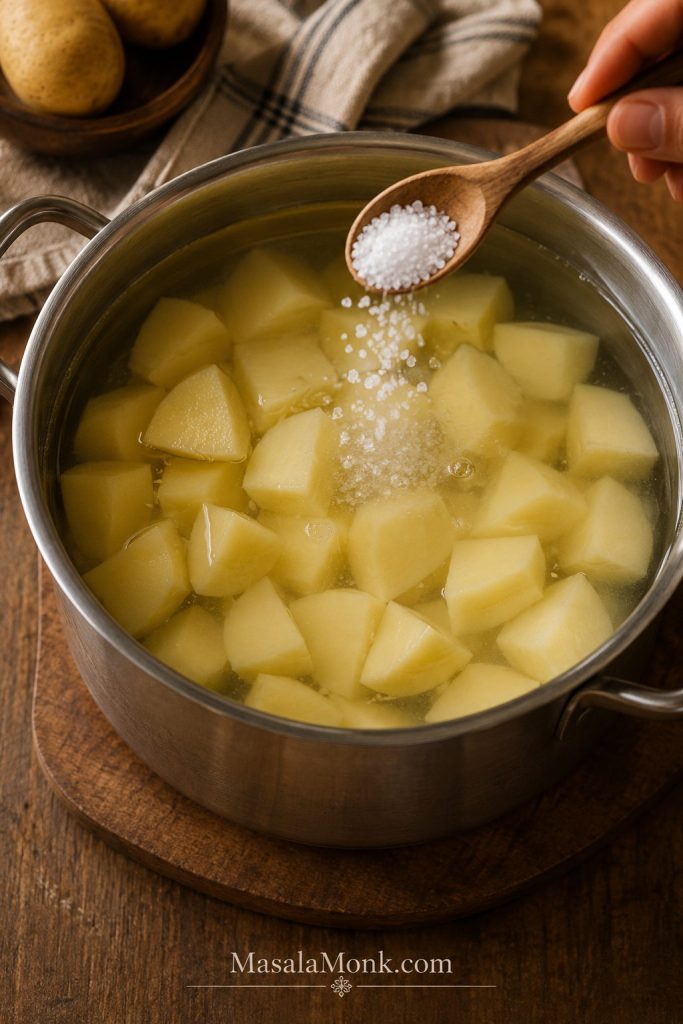
Potato chunks in a pot of cold water with salt being added before boiling.
Seasoning starts in the pot, not at the end. Cold salted water helps the potatoes cook through evenly and taste good before butter goes in.

3. Boil until very tender

Bring the water to a boil, then reduce to a steady simmer. Cook for 15–20 minutes, depending on the size of the pieces.

Use the clock only as a guide; the fork test tells you the truth. When a fork slides through with almost no resistance, the potatoes are ready to mash. Around the edges, they may look slightly softened, but the centers should be fully tender, not chalky.
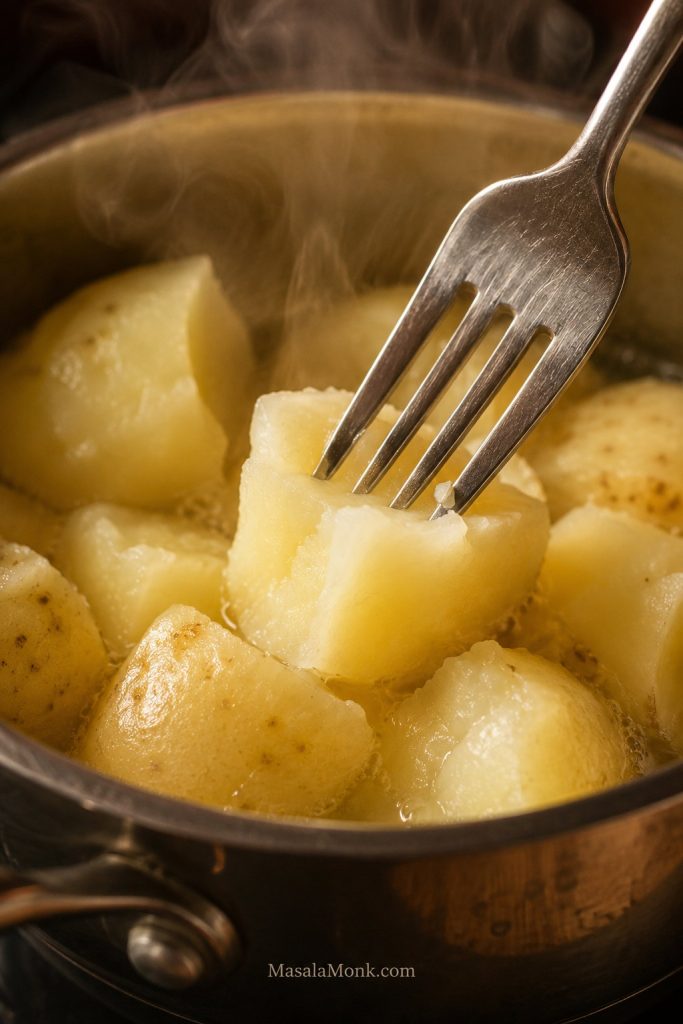
Fork sliding into a tender boiled potato chunk with steam rising from the pot.
Look for tenderness, not just time. Once the fork slides through cleanly, the potatoes are ready to mash without stubborn centers.

Slightly over-tender potatoes mash better than undercooked ones. Do not leave cooked potatoes sitting in the hot water after they are tender, or they can absorb more water and make the final mash too thin.

4. Drain and dry

Drain very well in a colander. Then return the potatoes to the hot empty pot for 30–60 seconds. Shake the pot gently once or twice so steam escapes.

Skip the rinse after draining. The hot pot does the work here: it lets steam escape without washing away flavor. The potatoes should steam instead of shine.
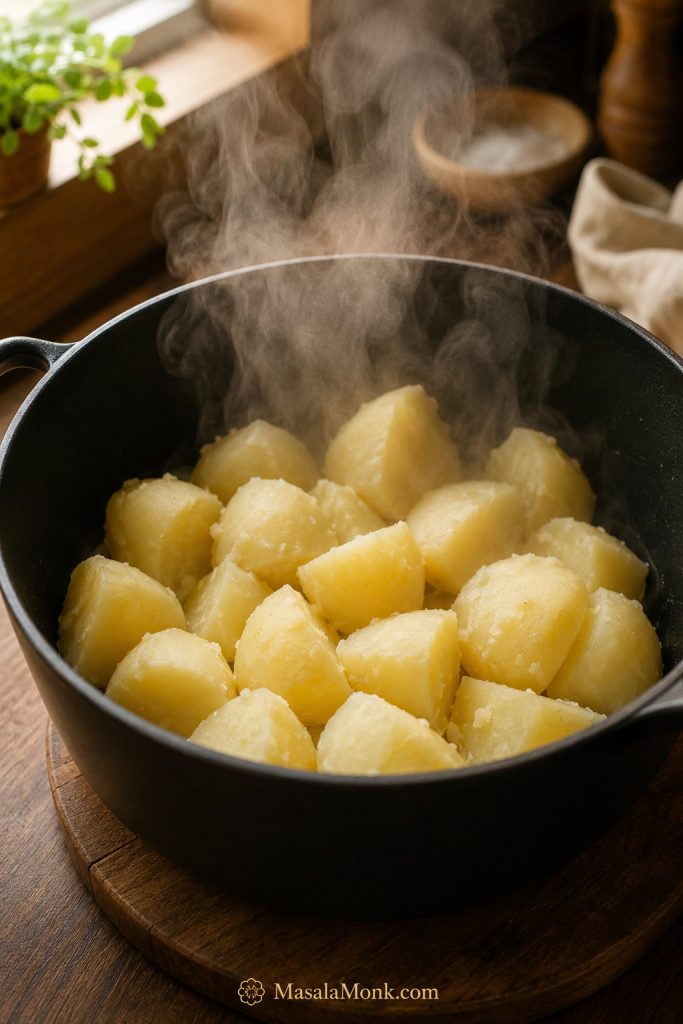
Drained boiled potatoes steaming in a hot empty pot before mashing.
Steam is useful here. After draining, a brief rest in the hot pot lets surface moisture escape so the mash stays creamy instead of loose.

5. Mash gently

Use a potato masher for a classic texture. For a smoother bowl, pass the potatoes through a ricer or food mill.
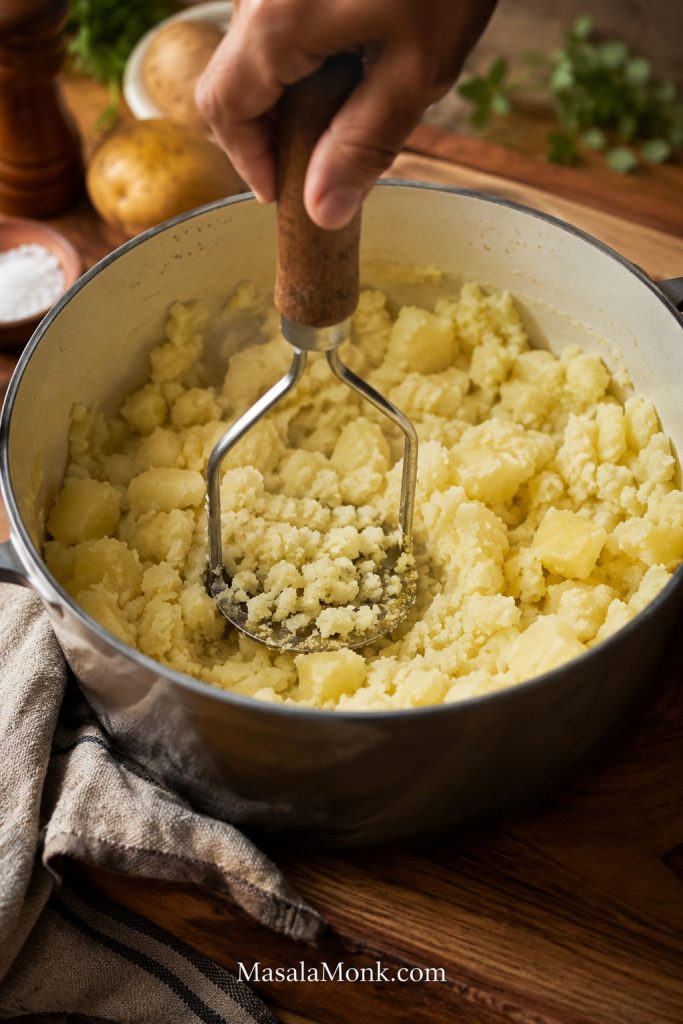
Hand using a potato masher to mash cooked potatoes in a pot.
Stop before the potatoes fight back. Gentle mashing gives you control, while heavy beating can push the starch toward sticky and dense.

If you use a hand mixer, keep it on low speed and stop as soon as the potatoes are smooth.

6. Add butter and warm milk gradually

Warm the milk, half-and-half, or cream before adding it. It should be warm to the touch or lightly steaming, not boiling. Add the butter and about 3/4 cup / 180 ml warm liquid first, then mash or fold gently.
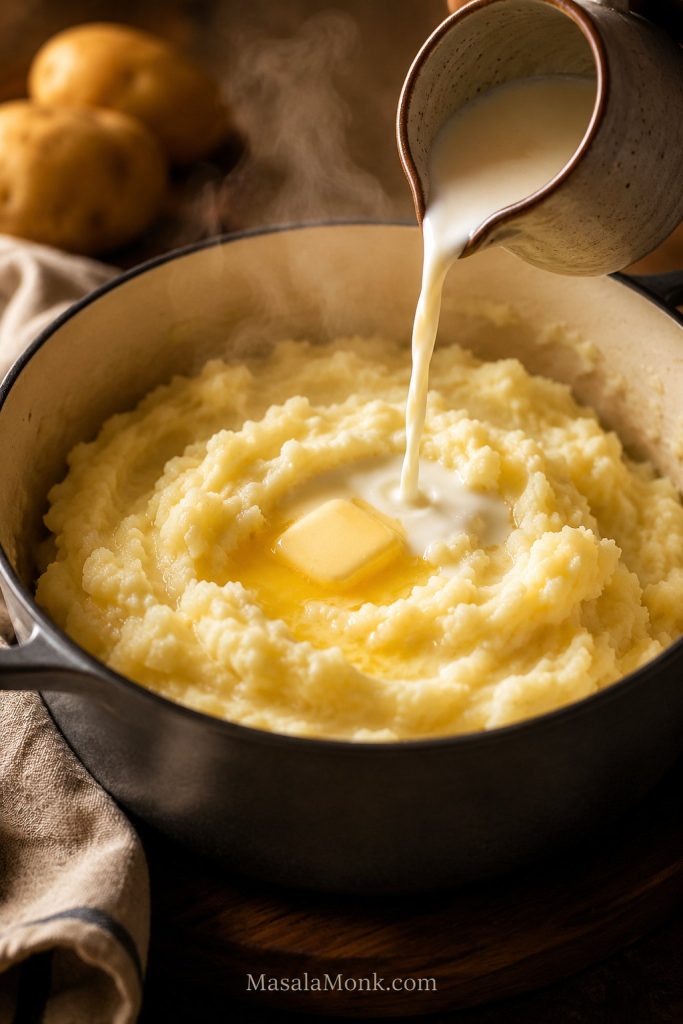
Warm milk being poured into mashed potatoes while butter melts into the mixture.
Add richness slowly. Warm milk or cream loosens the potatoes in stages, while butter folds in more smoothly when the mash is still hot.

Start with less liquid; you can always loosen the mash once the texture tells you what it needs. Stop when it mounds softly on a spoon — that is the sweet spot before it turns too thin.

Final texture cue: soft, spoonable mashed potatoes

The final texture should be easy to see before you taste it. The mash should mound softly on a spoon, hold gentle ridges for a moment, and fall back without stretching, pouring, or clumping.
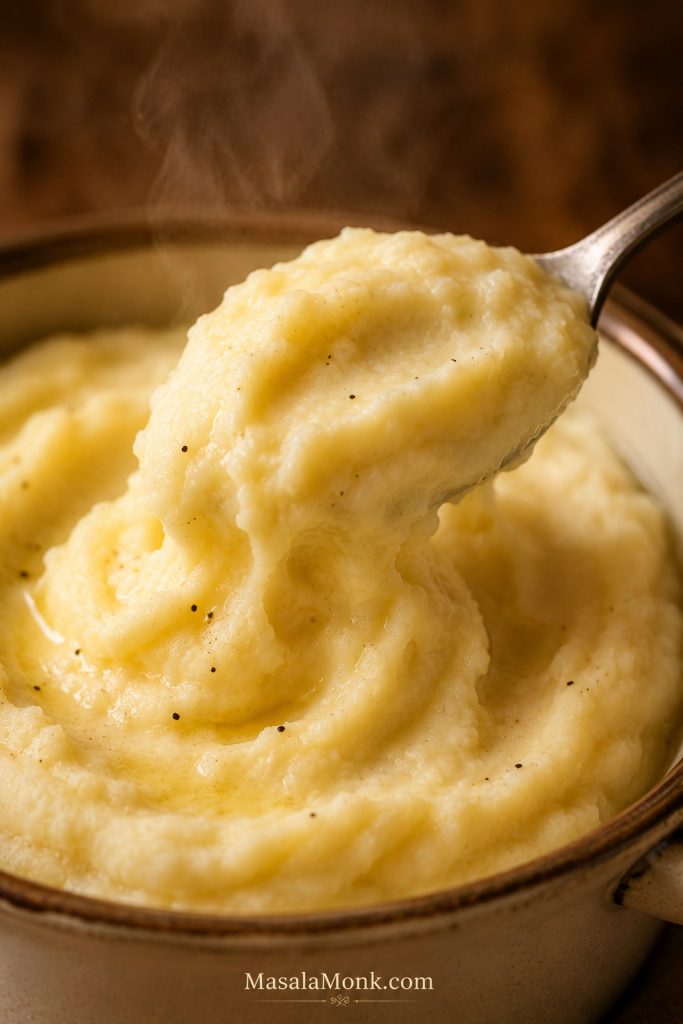
Spoon lifting creamy mashed potatoes with soft ridges, steam, and a light butter sheen.
This spoon lift is the final cue: the mash should mound softly, hold ridges for a moment, and fall back without stretching.

7. Season and finish

Taste before serving. Add fine salt in small pinches or 1/4 teaspoon increments, then add pepper, more butter, or a splash of warm milk if needed.

If dinner is moving fast, this is the moment to slow down for one minute. The potatoes are cooked; this last minute is what keeps them soft, warm, and worth serving.

If the texture is not where you want it yet, do not keep mixing blindly. Use the troubleshooting guide to fix dry, watery, lumpy, bland, or gluey mashed potatoes.

Creamy vs Fluffy Mashed Potatoes

Not every batch should be the same. Some dinners need rich, creamy potatoes. Others need a lighter mash that can hold gravy without feeling heavy. Neither version is better; the best texture is the one that fits the meal.
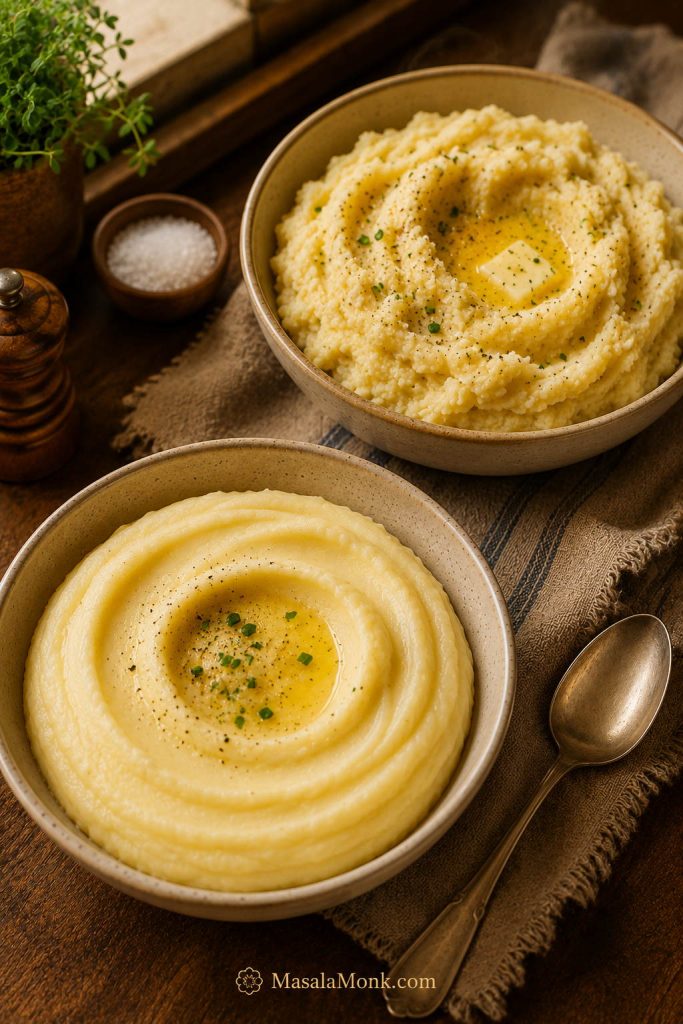
Two servings of mashed potatoes showing one smoother creamy texture and one lighter fluffy texture.
Creamy mashed potatoes sit smoother and richer, while fluffy ones hold lighter peaks. The better choice depends on the sauce, timing, and plate.

For a fluffy bowl

Use mostly russets, moderate liquid, and a light hand. Stop mixing as soon as the potatoes look soft.

For a creamy bowl

Use more Yukon Golds, warm half-and-half or cream, and a little more butter.

For a rich holiday batch

Add sour cream or cream cheese, but reduce the milk at first. You can always loosen the mash later.

For a rustic finish

Leave some skin on and use a potato masher. The uneven texture works beautifully beside gravy and roast meats.

If you think of these as whipped potatoes, use a ricer first, then fold in the butter and milk until smooth. Avoid aggressive whipping; the texture can move from smooth to gluey quickly.

For this creamy, classic version, skip rinsing after boiling and let the potatoes dry in the hot pot instead. If you are chasing an ultra-fluffy russet-only style, some methods rinse away extra starch, but this version keeps the process simpler and the flavor fuller.

How to Avoid Gluey Mashed Potatoes

Gluey mashed potatoes are frustrating because they usually happen at the very end, after everything looked fine. The good news is that the problem is predictable: sticky texture usually comes from overworked starch.
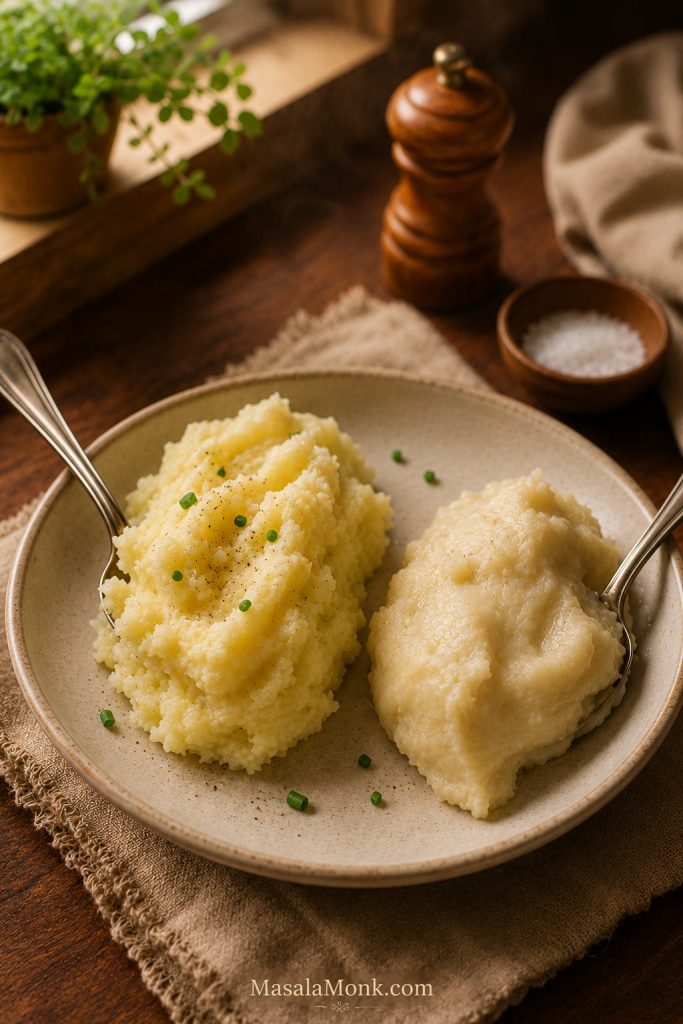
Fluffy mashed potatoes compared with a denser, glossier spoonful of gluey mashed potatoes.
The visual difference is easy to spot: fluffy mash looks soft and ridged, while gluey mashed potatoes look dense, glossy, and overworked.
Do this Avoid this
Use a masher, ricer, or food mill Blender or food processor
Cook until fully tender Mashing undercooked centers
Fold gently after mashing Beating hard after smooth
Add liquid gradually Pouring everything in at once
Stop when spoonable Trying to fix texture by mixing more

If the potatoes are already gluey, do not keep beating them. Truly gluey mash will not fully return to fluffy, but you can soften the mouthfeel with warm butter or cream. If it is very dense, use the leftovers for potato cakes, croquettes, soup, or a casserole topping.

How to Fix Mashed Potatoes That Went Wrong

A batch of imperfect mashed potatoes is usually not a disaster. Before you add more liquid or start mixing harder, pause and match the problem to the right fix.

The goal is not perfection at every step. The goal is knowing when to stop, when to loosen, and when to turn imperfect potatoes into something else delicious.

Texture problems

Problem Why it happened How to fix it
Gluey texture Overmixed starch, blender, food processor, or too much beating Stop mixing. Gently fold in warm butter or cream. If the mash is truly gluey, repurpose dense leftovers instead of trying to whip them back.
Watery texture Potatoes were not drained or dried well, or too much liquid was added Warm gently over low heat to release moisture. Fold carefully. Add potato flakes only as a last resort.
Lumps Potatoes were undercooked or cut unevenly Cook potatoes until completely tender. Use a ricer next time for smoother results.
Dry texture Not enough liquid or fat, or reheated without moisture Add warm milk, cream, broth, or butter a little at a time.
Too thin Too much milk or cream Warm gently to evaporate moisture. Add a few potato flakes only if needed.
Too stiff Not enough warm liquid Loosen a little at a time, folding only until the texture comes back.
Sticky after using a hand mixer The potatoes were beaten too long Stop mixing immediately. Fold in warm butter or cream. Use leftovers for cakes or casserole topping if needed.
Grainy after reheating The mash was too lean or reheated too aggressively Warm slowly and fold in butter, cream, or sour cream until smoother.

Flavor and serving problems

Problem Why it happened How to fix it
Bland flavor Cooking water was not salted, or not enough final seasoning was added Add salt gradually, then finish with butter, pepper, herbs, garlic, sour cream, or cheese.
Flat flavor even after salting They may need fat, tang, herbs, or deeper seasoning Add butter, black pepper, chives, roasted garlic, sour cream, parmesan, or a little gravy.
Got cold before serving They sat too long or the serving dish was cold Reheat gently with warm milk or butter. Next time, warm the serving dish and keep them covered.
Too much garlic or pepper The seasoning is overpowering the potatoes Fold in more plain mash if available, or soften the flavor with cream, butter, or sour cream.

Most fixes are small. The important thing is not to panic-mix the potatoes into a worse texture. Serve them warm if they still taste good, or save them for cakes, croquettes, soup, or a casserole topping where the texture can work in your favor.

Variations

Once the base mash is right, variations should support the meal, not bury the potatoes. Keep the flavor simple for rich mains, or add garlic, cheese, herbs, or tang when the potatoes need to carry more of the plate.

Garlic Mashed Potatoes

Use roasted garlic when you want mellow sweetness, sautéed garlic when you want a sharper savory edge, and garlic butter when you want the flavor to spread through the whole mash. For a deeper version with the garlic balance already worked out, use this garlic mashed potatoes recipe.

Cream Cheese Mashed Potatoes

Use cream cheese when you want a thicker, richer mash that reheats well. Let it soften first so it melts in easily, and add less milk at the beginning.

Sour Cream Mashed Potatoes

Use sour cream when you want tang that cuts through butter, gravy, steak, pork chops, or roast chicken. It makes the mash taste richer without feeling too heavy.

Loaded Mashed Potatoes

Fold in shredded cheddar, crispy bacon, chopped chives, and a spoonful of sour cream. Loaded mashed potatoes work well as a side dish or as the base for a comfort-food plate.

Parmesan Herb

Fold in grated parmesan, chopped parsley, chives, thyme, or a little roasted garlic. Parmesan adds saltiness and depth, so taste before adding more salt.

Buttermilk

Use warm buttermilk for a tangy Southern-style version. Keep the heat gentle and do not boil the buttermilk.

Extra Buttery

For holiday-style potatoes, increase the butter to 100–125 g / about 7–9 tbsp per 1 kg / 2.2 lb potatoes and use half-and-half or a mix of milk and cream.

Mashed Potatoes Without Milk

If this is an emergency “I already boiled the potatoes and there is no milk” moment, start with reserved potato water and butter. It is the safest fix because the water is already starchy and neutral.

No milk does not mean no comfort. It just means choosing the right liquid for the job. Potato water keeps the flavor clean, broth makes it more savory, and olive oil or vegan butter can add richness without dairy.
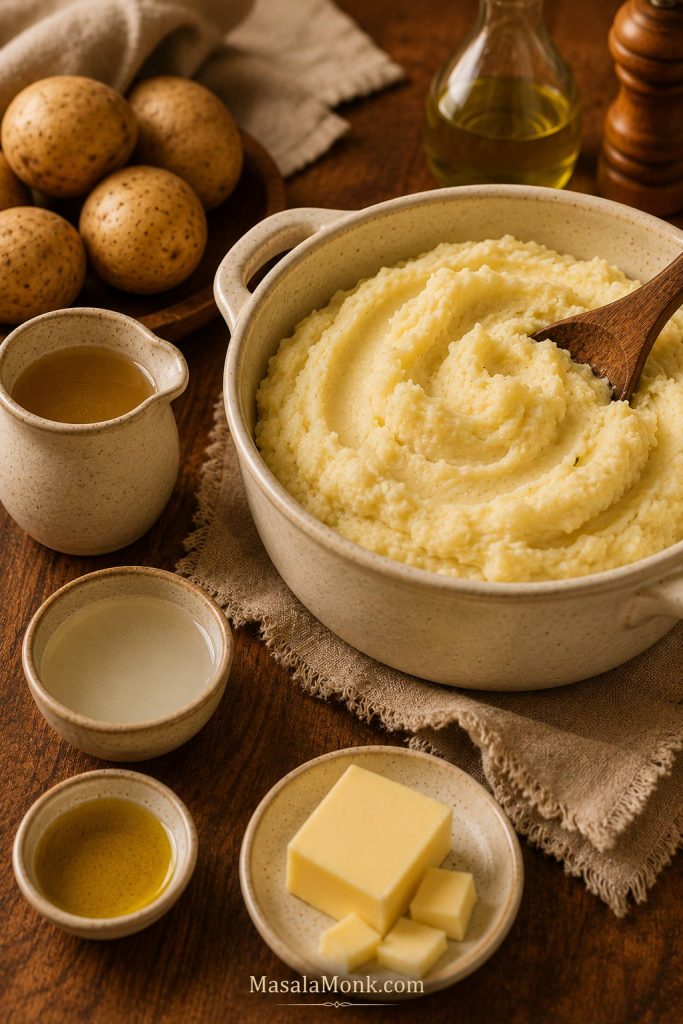
Mashed potatoes with cups of broth, potato cooking water, olive oil, and a butter-like block nearby.
No milk does not end the recipe. Potato water keeps things clean, broth adds savory depth, and olive oil or dairy-free butter brings richness.

Plant milk can work, but choose an unsweetened neutral version. Potato water is usually safer because it tastes like potato, not oat, almond, or coconut.

Situation Best substitute Notes
No milk at home Reserved potato water + butter Neutral, easy, and already starchy enough to loosen the mash.
No milk, but dairy is okay Cream cheese, sour cream, or thick plain yogurt Add gently so the flavor does not become too tangy or thin.
More savory flavor Warm chicken or vegetable broth Good with gravy, meatloaf, chicken, pork chops, and roast dinners.
Dairy-free version Olive oil + reserved potato water Gives richness without dairy. Add slowly.
Vegan version Vegetable broth + vegan butter or olive oil Use neutral plant milk only if you like the flavor.

If the no-milk mash still feels dry, stiff, or too thin, use the troubleshooting table. For leftovers or dairy-free make-ahead prep, see how to reheat mashed potatoes gently.

Make-Ahead Mashed Potatoes

Mashed potatoes are usually not finished in a quiet kitchen. They happen while gravy is thickening, mains are resting, and someone is asking when dinner is ready.

Make-ahead mashed potatoes are not about being fancy. They are about giving yourself one less thing to panic over when the oven is full, the gravy is waiting, and dinner is moving fast.
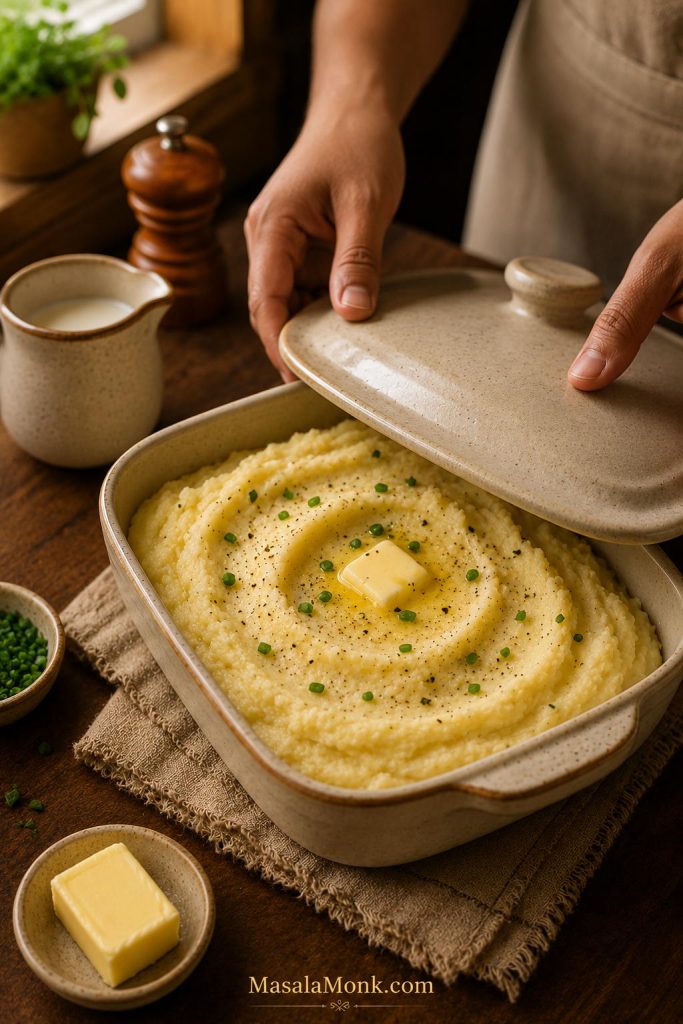
Hands covering a shallow dish of mashed potatoes with butter and a small milk jug nearby.
Make-ahead mashed potatoes should go into storage a little softer than serving texture. Later, that extra moisture helps them reheat without drying out.

For the best texture, make them up to 1–2 days ahead, keep them covered in the refrigerator, and reheat gently with extra warm milk, cream, butter, sour cream, or cream cheese.

The most important trick is to make them slightly softer than usual before chilling, because the fridge will firm them up. A little extra moisture and fat gives you room to reheat without drying them out.

For holiday serving, warm the serving dish, cover the potatoes tightly, and keep extra warm milk or butter nearby for a quick loosen before they go to the table.

Make-Ahead Method

  1. Prepare the base recipe as usual.
  2. Make the mash slightly looser than you want it at serving time.
  3. Add a little extra butter, milk, cream, sour cream, or cream cheese so it stays soft.
  4. Cool and store in a covered shallow dish or airtight container in the refrigerator.
  5. Reheat gently with extra warm milk or butter.
  6. Stir only as much as needed to bring the texture back.

Once the potatoes are made ahead, the real success comes from reheating them well. Jump to How to Reheat Mashed Potatoes before serving.

How to Reheat Mashed Potatoes

Cold mashed potatoes rarely look promising at first. They firm up in the fridge, but they usually come back with low heat, patience, and a little extra moisture.
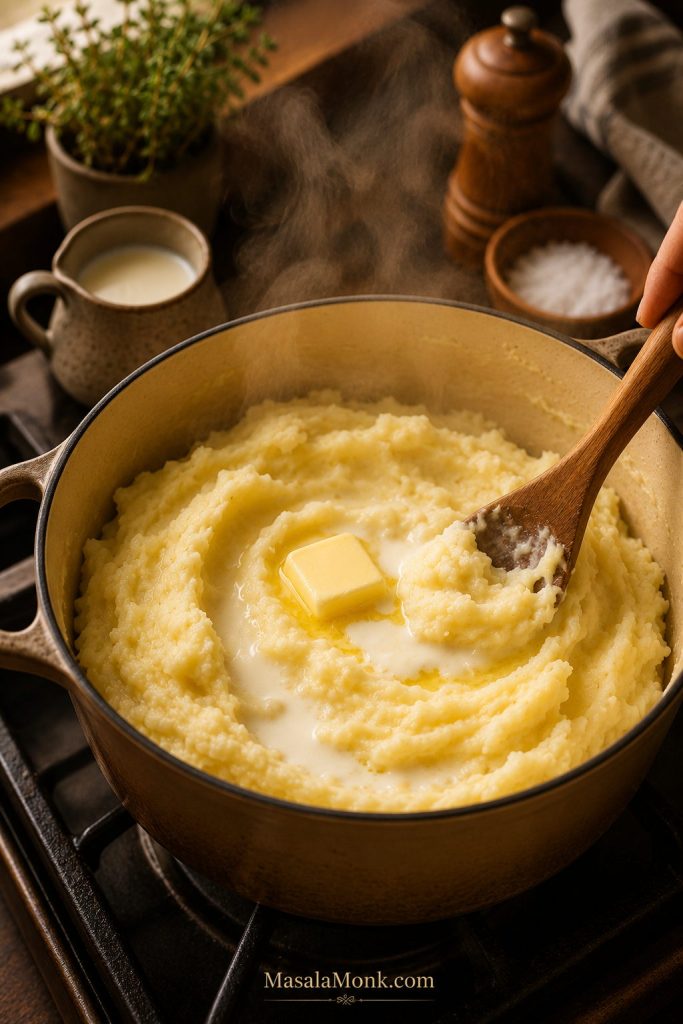
Mashed potatoes being reheated with melting butter, warm milk, steam, and a spoon folding through them.
Reheating is a recovery step, not a second mash. Low heat, steam, butter, and warm milk bring back creaminess without rough stirring.

Reheating is less about stirring hard and more about giving the potatoes back moisture slowly. Warm them gently for texture, but make sure leftovers are hot all the way through. If you are checking with a thermometer, aim for 165°F / 74°C.

Method How to do it Best for
Stovetop Place in a pot over low heat. Add warm milk, cream, or butter and stir gently until hot. Small to medium batches
Oven Place in a covered baking dish and reheat at 350°F / 175°C for 25–40 minutes. Add butter on top if the potatoes look dry. Holiday meals and larger batches
Microwave Reheat at medium power in short intervals, stirring every 1–2 minutes. Add a splash of milk or cream. Leftovers and single servings
Slow cooker Reheat first, then keep warm in the slow cooker. Add butter or milk if the surface starts drying out. Holding for a crowd
Slow cooker note: A slow cooker is good for holding hot mashed potatoes warm, but it is not the best way to slowly heat cold mashed potatoes from the fridge. Reheat them first, then transfer to the slow cooker on warm.

How Much to Make Per Person

A good side-dish estimate is 225–250 g / 1/2 lb raw potatoes per person. For a holiday meal with many sides, you can go slightly lower. For a mashed-potato-heavy dinner with gravy, meatballs, steak, or chicken, plan a little more.

If mashed potatoes are the side everyone reaches for first, round up. Leftovers are easier to use than an empty serving dish is to explain.

People Raw potatoes Approx. butter Approx. milk/cream
2 500 g / 1.1 lb 40–50 g 90–120 ml
4 1 kg / 2.2 lb 75–100 g 180–240 ml
8 2 kg / 4.4 lb 150–200 g 360–480 ml
10 2.25 kg / 5 lb 170–225 g 420–540 ml
20 4.5 kg / 10 lb 340–450 g 850 ml–1.1 L

For a lighter meal with many sides, use the lower end. For gravy-heavy dinners, holiday plates, or mashed-potato lovers, use the higher end.

What to Serve with Mashed Potatoes

Mashed potatoes are often the quiet thing holding the whole plate together. When they are soft, warm, and well-seasoned, even a simple dinner feels more complete.

The easiest rule is simple: if the main dish has gravy, pan juices, cream sauce, onion sauce, or mushrooms, mashed potatoes probably belong beside it.
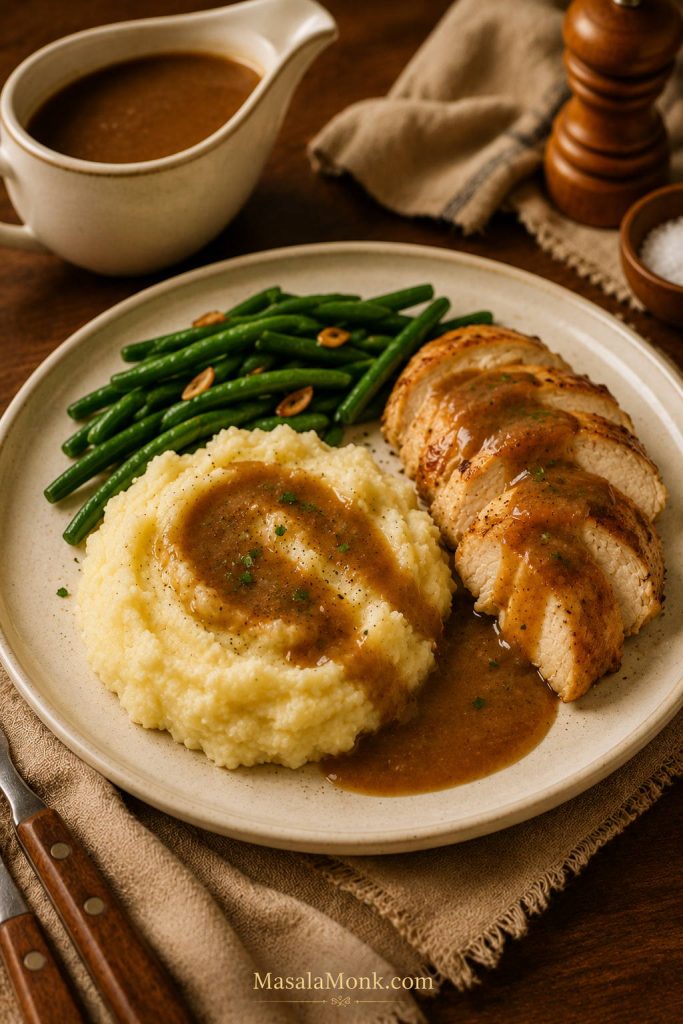
Dinner plate with mashed potatoes, gravy, sliced roast chicken, green beans, and a gravy boat in the background.
Mashed potatoes earn their place beside saucy mains because they catch gravy and pan juices. That is what turns a simple plate into comfort food.

Best mashed potato pairings

Think of mashed potatoes as the soft landing for the plate: one saucy main, one green vegetable, and one simple extra like rolls, salad, or roasted carrots is usually enough.

Keep the potatoes plain and buttery when the main dish is strongly flavored. Add garlic, cheese, sour cream, or herbs when the main dish is simple.

Meal type Best pairings Why it works
Gravy-heavy comfort dinners Meatloaf, meatballs, smothered pork chops, creamy mushroom mains The potatoes soak up sauce and make the plate feel complete.
Beef dinners Steak, pot roast, roast beef, beef stew, cottage pie Beef and mashed potatoes are classic because the richness balances well with butter and salt.
Chicken dinners Roast chicken, chicken gravy, creamy mushroom chicken, slow cooker French onion chicken Mashed potatoes turn chicken into a fuller comfort meal.
Pork dinners cream of mushroom pork chops, pork loin, sausages, ham Pork works well with creamy mash, mustardy sauces, onion gravy, or pan juices.
Seafood Salmon, white fish, fish cakes, shrimp in garlic butter Keep the potatoes simple so they do not overpower the fish.
Vegetarian meals Mushroom gravy, lentils, roasted mushrooms, green beans, peas, carrots Earthy vegetables and legumes pair well with buttery potatoes.
Holiday plates Turkey, ham, stuffing, gravy, sweet potato casserole, hashbrown casserole Mashed potatoes are the soft, savory anchor for a full holiday spread.

If the main dish does not have much sauce, add a simple brown gravy, mushroom gravy, chicken gravy, or onion gravy. Mashed potatoes taste best when there is something warm and savory to spoon over the top.

What to Do with Leftover Mashed Potatoes

Leftovers are not a problem here. Cold mash is one of those rare leftovers that can become better at holding its shape the next day. Leftover mash is already halfway to something crispy.

Use it for potato cakes, breakfast patties, croquettes, or fish cakes when you want something crisp outside and soft inside.

  • Mashed potato pancakes
  • Potato cakes
  • Croquettes
  • Fish cakes
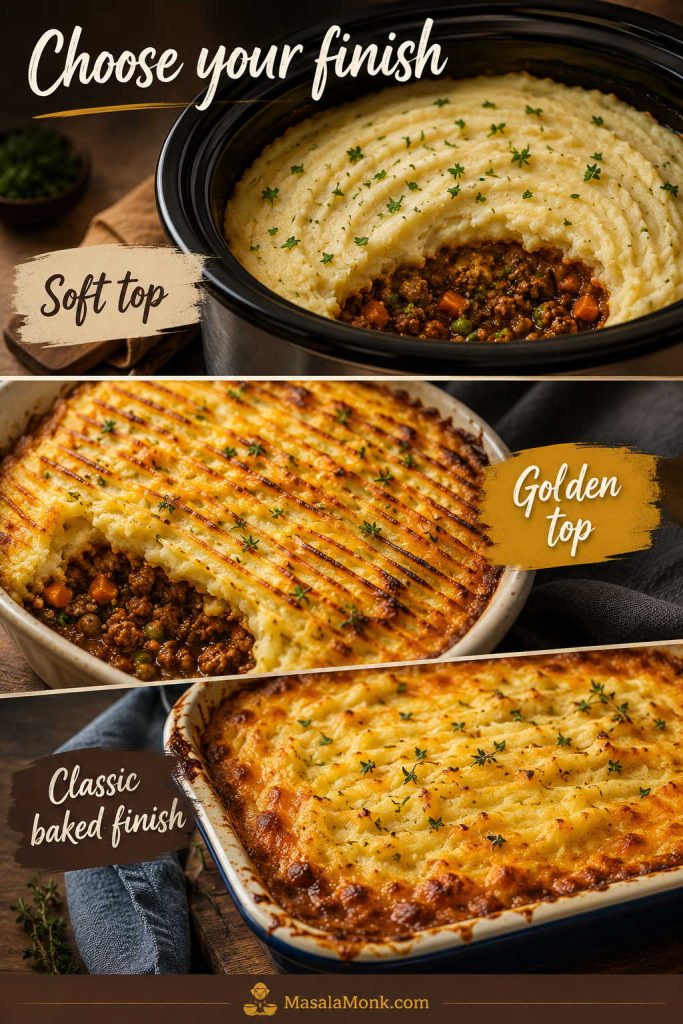
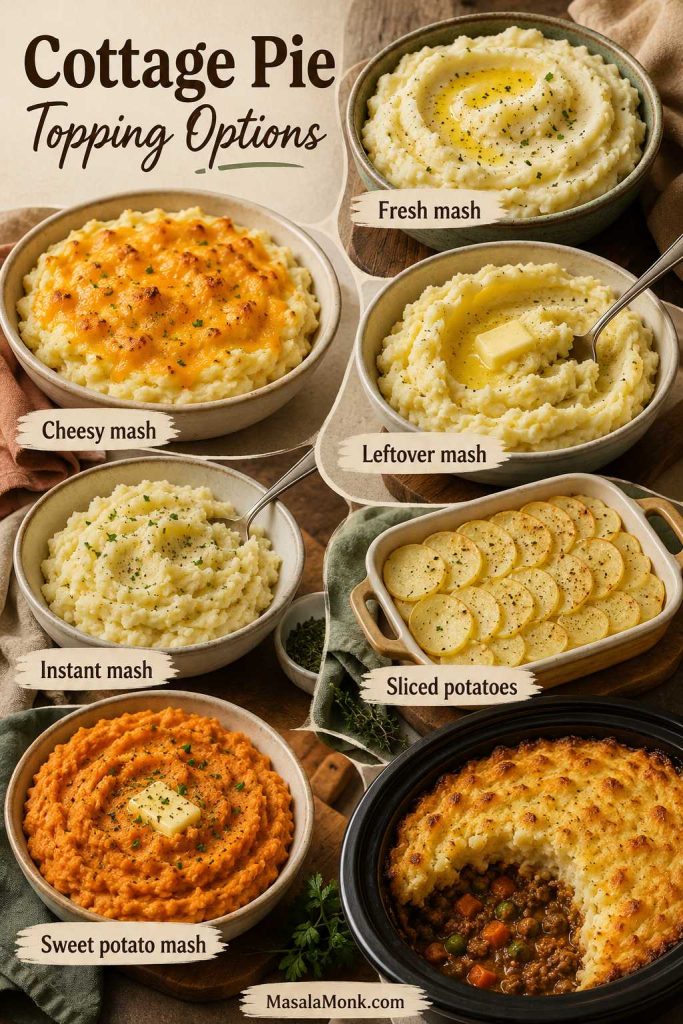
  • Shepherd’s pie or cottage pie topping
  • Potato soup
  • Loaded mashed potato casserole
  • Breakfast patties
  • Waffles
  • Stuffed rolls
  • Crispy fried mashed potato balls

For quick mashed potato cakes, start with 2 cups cold mashed potatoes, 1 egg, 2–4 tablespoons flour or breadcrumbs, and a little cheese or herbs. Shape into patties and cook in a lightly oiled skillet until golden on both sides.

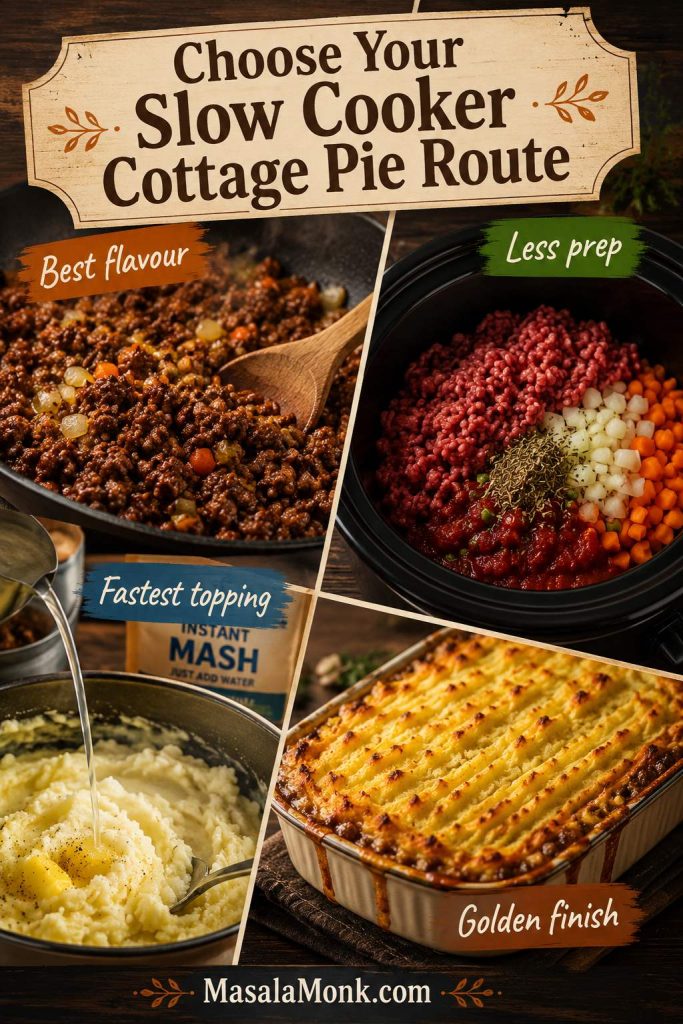
If you would rather turn leftovers into a full casserole-style dinner, use the mash as a topping for cottage pie, or move into another cozy potato bake like tater tot casserole. It keeps the same comfort-food mood while changing the texture completely.

If the leftover mashed potatoes are very soft, add flour, breadcrumbs, or grated cheese a little at a time before shaping them into cakes or patties. Cold mash holds together better than warm mash.

How to Store Mashed Potatoes

Store leftovers in an airtight container in the refrigerator for 3–4 days. When reheating, make sure they are hot all the way through; if you are checking with a thermometer, aim for 165°F / 74°C. For detailed safety guidance, the USDA leftovers guide is useful.

As they warm, add a splash of milk, cream, broth, or a little butter so the texture turns creamy again instead of dry or stiff.

Can You Freeze Mashed Potatoes?

Yes, they can be frozen, but the texture depends on how much fat and dairy they contain. A batch made with butter, cream, sour cream, or cream cheese freezes better than a lean version made with only potatoes and water.

To freeze, cool the mash completely and pack it into freezer-safe containers. The texture is usually best within the first month. It can be kept frozen longer, but it may become more watery or grainy over time.

Thaw overnight in the refrigerator and reheat gently with extra milk, cream, or butter. If the texture looks a little separated after thawing, warm the potatoes slowly and fold in extra butter or cream.

FAQs

These are the questions that usually come up once the potatoes are already peeled, boiling, or waiting on the stove.

1. What are the best potatoes for mashed potatoes?

Yukon Golds and russets are the safest choices. Yukon Golds make the mash creamy and buttery; russets make it lighter and fluffier. A mix gives the best balance.

2. Should I peel potatoes for mashed potatoes?

Peel them for a smooth mash. Leave some or all of the skin on for a rustic texture, especially with Yukon Gold or red potatoes.

3. Do you start mashed potatoes in cold or boiling water?

Start potatoes in cold water so the pieces cook evenly from outside to center. Boiling water can soften the edges before the middle is cooked.

4. How long should potatoes boil for mashed potatoes?

Potato chunks usually take 15–20 minutes. They are ready when a fork slides through easily with almost no resistance.

5. Why are my mashed potatoes gluey?

They turn gluey when the starch is overworked. This often happens from using a blender, food processor, or beating the potatoes too much.

6. Can I fix gluey mashed potatoes?

You can improve them, but you usually cannot make truly gluey potatoes fluffy again. Stop mixing, fold in warm butter or cream, and use dense leftovers for cakes, croquettes, soup, or casserole topping.

7. How do I make mashed potatoes without milk?

Use reserved potato cooking water, warm broth, olive oil, vegan butter, or unsweetened plant milk. Add gradually and taste as you go.

8. Can I use cream instead of milk?

Yes. Cream makes the potatoes richer and thicker. Use all cream for a holiday-style mash, or part milk and part cream for balance.

9. Can I use a hand mixer for mashed potatoes?

Yes, but use low speed and stop as soon as the potatoes are smooth. Overmixing can make the texture gluey.

10. Can I make mashed potatoes ahead of time?

Yes. Make them slightly softer than usual, refrigerate for 1–2 days, then reheat gently with extra warm milk, cream, or butter. Sour cream or cream cheese helps them reheat smoothly.

11. How do I reheat mashed potatoes without drying them out?

Reheat gently over low heat or in a covered dish. Add warm milk, cream, broth, or butter a little at a time until creamy again.

12. Can you freeze mashed potatoes?

Yes, but they freeze best with enough butter, cream, sour cream, or cream cheese. Thaw overnight and reheat slowly with extra dairy or fat.

13. How much mashed potato do I need per person?

Plan on about 225–250 g / 1/2 lb raw potatoes per person. For 4 people, use about 1 kg / 2.2 lb; for 8 people, use about 2 kg / 4.4 lb.

14. What can I add to mashed potatoes for more flavor?

Add roasted garlic, sour cream, cream cheese, parmesan, chives, parsley, black pepper, browned butter, cheddar, bacon, or gravy.

15. What is the secret to creamy mashed potatoes?

Use Yukon Gold potatoes, drain them well, add warm dairy gradually, and stop before the mash is overworked. Butter and warm half-and-half make the creamiest everyday version.

Final Thoughts

Once the method is in your hands, you can take the same potatoes creamy, fluffy, garlicky, cheesy, dairy-free, make-ahead, or gravy-ready without learning a new recipe each time.

That is why this method is worth saving: it gives you a good bowl when everything goes right, and a way back when the potatoes need help.
Posted on Leave a comment

Candied Yams Recipe

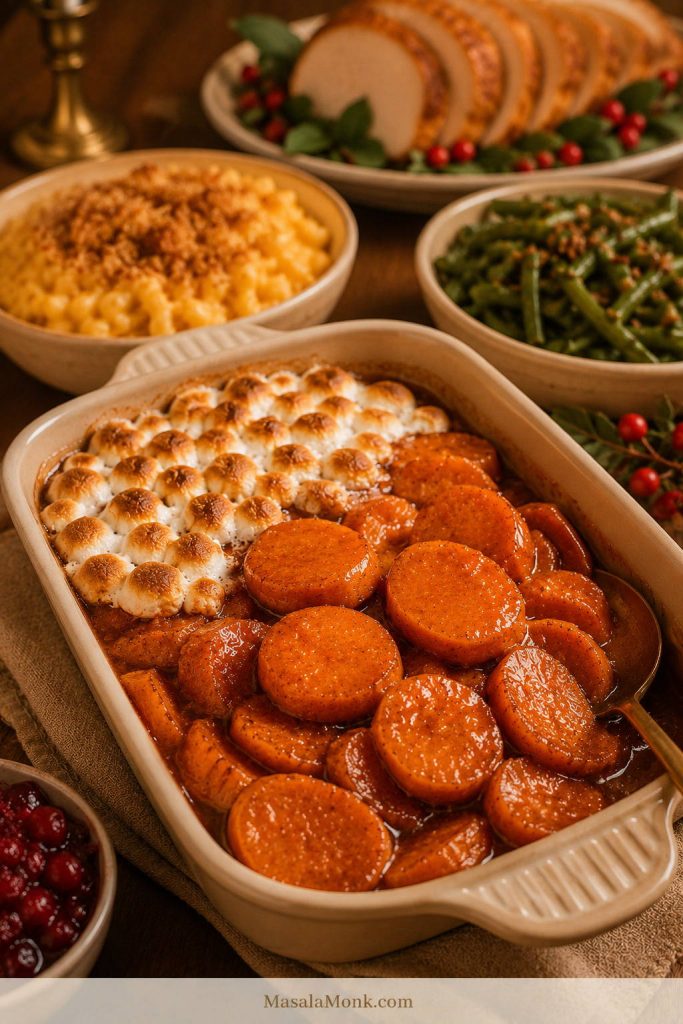
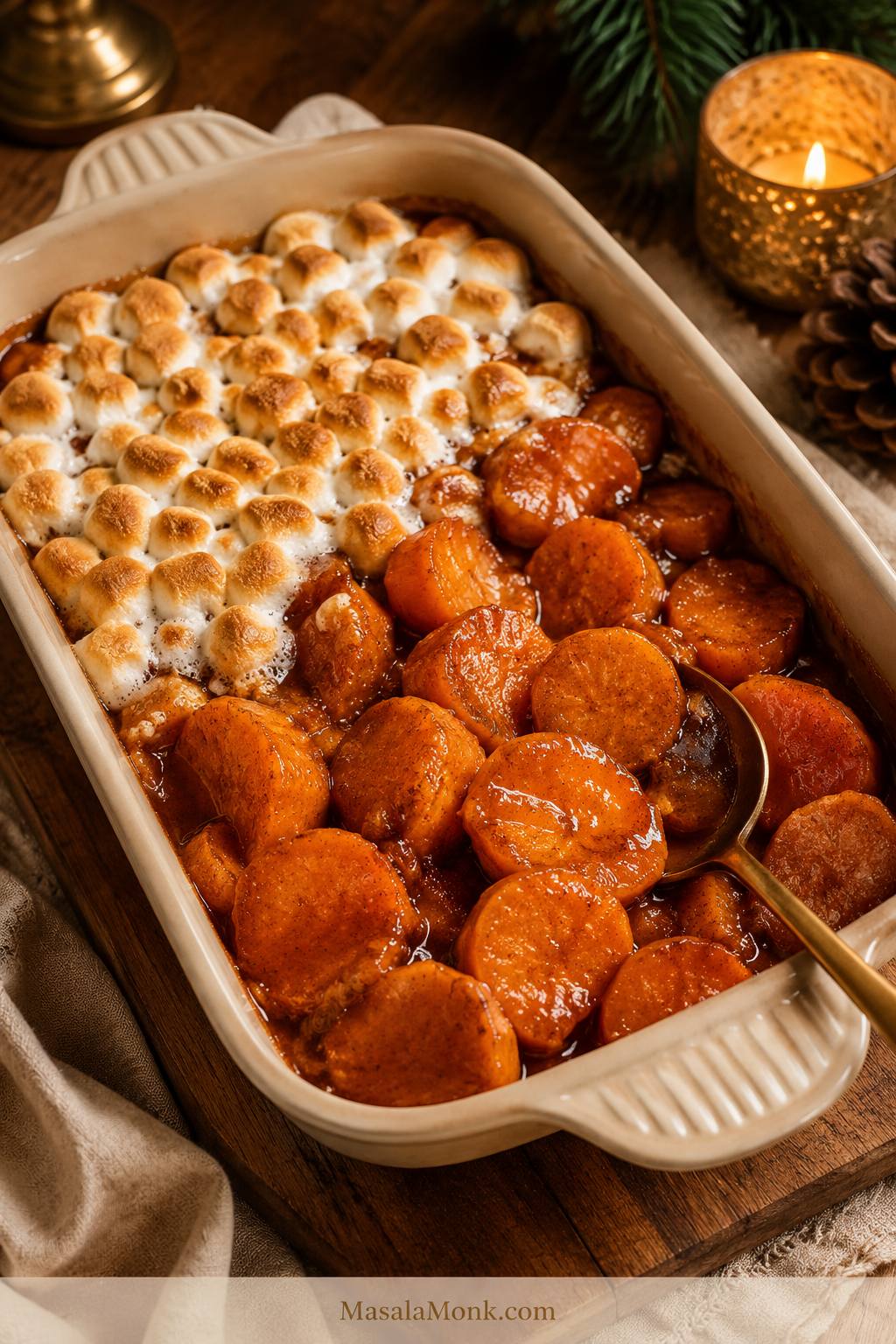
Classic candied yams should show tender orange slices, not mashed sweet potatoes. Keeping one side plain and one side topped with marshmallows is an easy way to satisfy both holiday-table preferences.

Candied yams are one of those sides people remember by texture: soft orange slices, a shiny brown sugar glaze, warm spice, and maybe a toasted marshmallow topping. This version keeps that familiar comfort, but gives you the cues that prevent watery sauce, mushy canned yams, burnt sugar, or marshmallows that disappear into the dish.

Fresh or canned, oven or stovetop, marshmallows or not — this recipe is built around the same goal: soft, buttery yams, a spoonable brown sugar glaze, and no thin liquid pooling at the bottom of the pan. This is the kind of side dish people expect to taste familiar, not reinvented.

For many tables, candied yams are not the place for wild reinvention. Use this recipe as a steady base, then finish it the way your family remembers it.

Best quick method: for classic candied yams, use fresh orange sweet potatoes sliced 1/2 inch thick.
  1. Make a smooth butter, brown sugar, and spice glaze, then stir in vanilla off the heat.
  2. Bake covered at 350°F / 175°C for 35–40 minutes.
  3. Uncover and bake 20–25 minutes more, basting once.
  4. Add marshmallows only during the final 8–12 minutes, if using.
  5. Rest 10 minutes so the sauce turns shiny and spoonable.

The full guide below covers fresh, canned, stovetop, marshmallow, no-marshmallow, and make-ahead versions, but the basic idea stays the same: soften the yams, thicken the sauce, and give it a short rest.

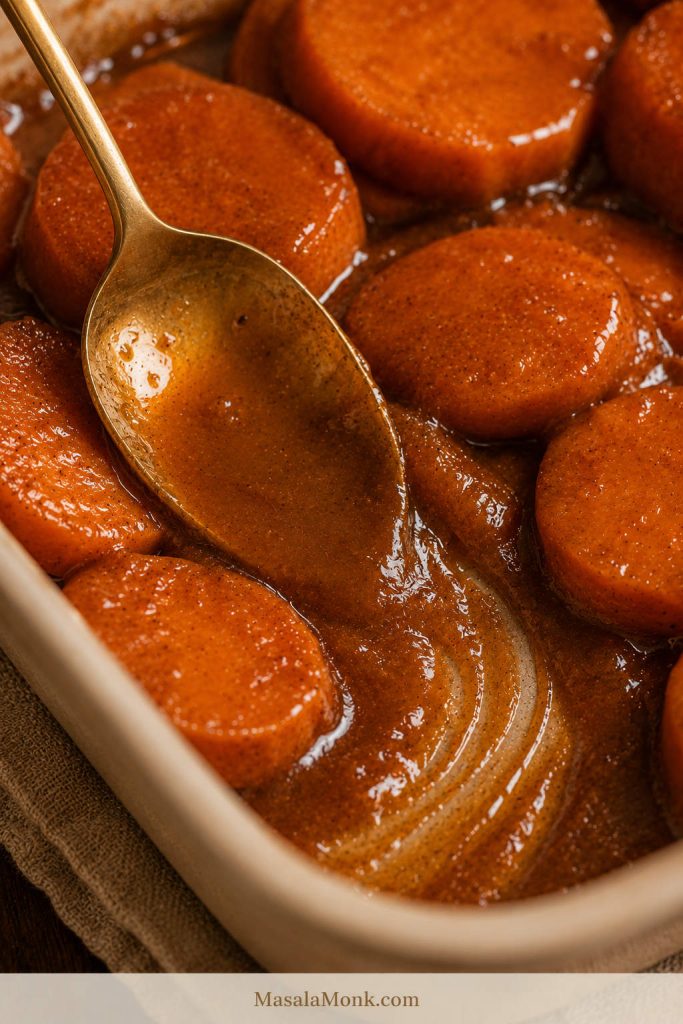
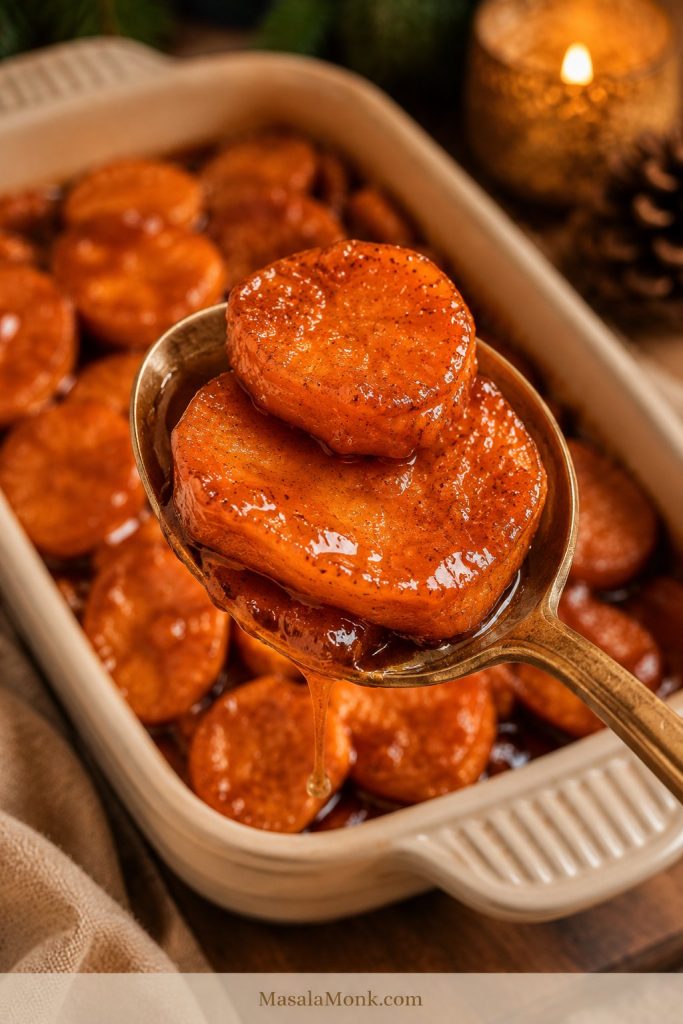
Spoon lifting soft orange candied yam slices from a cream baking dish with sauce coating the pieces.
Aim for a soft but still sliceable texture. If the yams lift cleanly and the syrup clings to the spoon, they are ready to rest before serving.

Quick Answer: What Are Candied Yams?

Candied yams are a sweet side dish made with orange-fleshed sweet potatoes, butter, brown sugar, cinnamon, nutmeg, vanilla, and sometimes marshmallows. At the table, they eat like soft sweet potatoes in a buttery brown sugar sauce.

In most U.S. grocery stores, the “yams” used for candied yams are actually sweet potatoes, and they are exactly what you want here. For the classic orange color and soft texture, look for sweet potatoes labeled as garnet yams, jewel yams, red yams, or simply yams.

Here, there is no need to hunt for true yams. Buy orange-fleshed sweet potatoes, even if your store labels them yams. They soften into the glaze instead of staying dry or starchy.

Why This Recipe Works

The difference here is that the recipe is built around texture cues, not just time: covered heat to soften, uncovered heat to reduce, and a short rest so the sauce clings.

Thick slices hold their shape, a smooth saucepan glaze prevents grainy sugar, covered baking softens the yams, uncovered baking reduces the extra liquid, and resting helps the brown sugar butter mixture cling instead of pool.

Think of it as steam first, reduction second, rest last. That order keeps the yams tender without leaving a watery pool underneath.

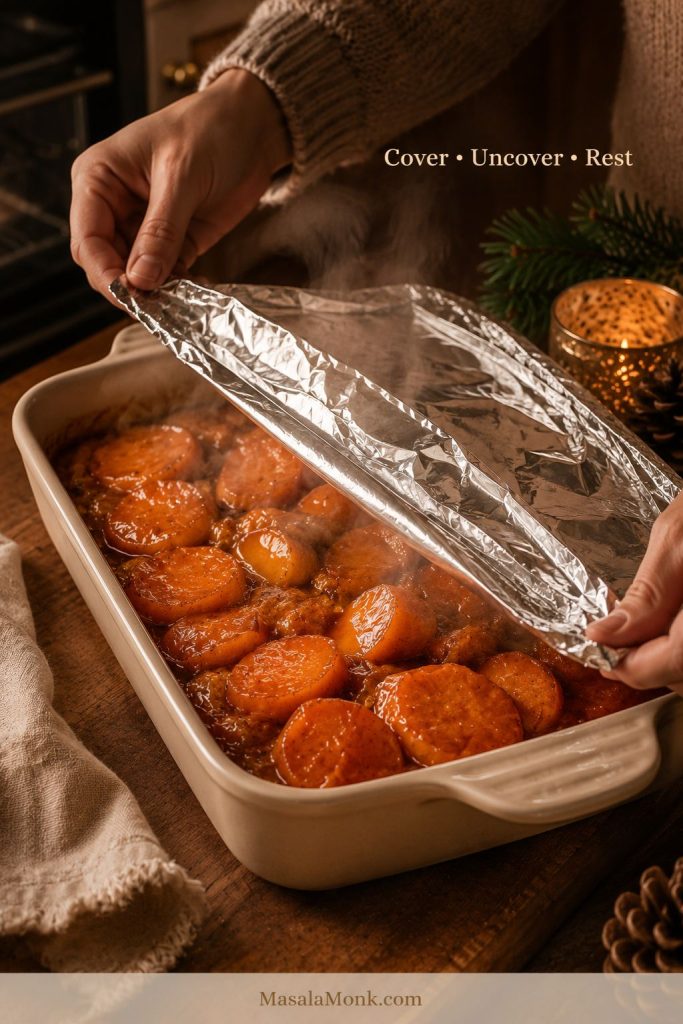
Hands peeling foil from a baking dish of candied yams with visible text reading Cover, Uncover, Rest.
Think of the bake in three stages: steam, reduce, settle. Covered heat softens the slices, uncovered heat concentrates the syrup, and the short rest helps the sauce cling.

The watery batches usually have one thing in common: too much liquid and not enough uncovered time. Often, the best batches look a little loose straight from the oven, then settle into a glossy coating after the rest.

The simple rhythm:
  • Fresh yams: cover, uncover, rest.
  • Canned yams: drain, coat, heat, stop.
  • Marshmallows: tender first, toast last.
  • Sauce: shiny and spoonable, not watery or caramel-thick.

Candied Yams Quick Facts

Fact Detail
Servings 8
Main oven temp 350°F / 175°C for fresh sweet potatoes
Fresh bake time 35–40 minutes covered, then 20–25 minutes uncovered
Best baking dish 9×13-inch / 23×33 cm glass or ceramic dish
Rest time 10 minutes before serving
Marshmallow timing Final 8–12 minutes for fresh yams; 5–8 minutes for canned yams

Which Candied Yams Method Should You Use?

Start with the method that fits the day. Maybe you have time for fresh sweet potatoes. Or maybe the oven is crowded with turkey, ham, stuffing, green bean casserole, or another side. You may already have canned yams in the pantry.

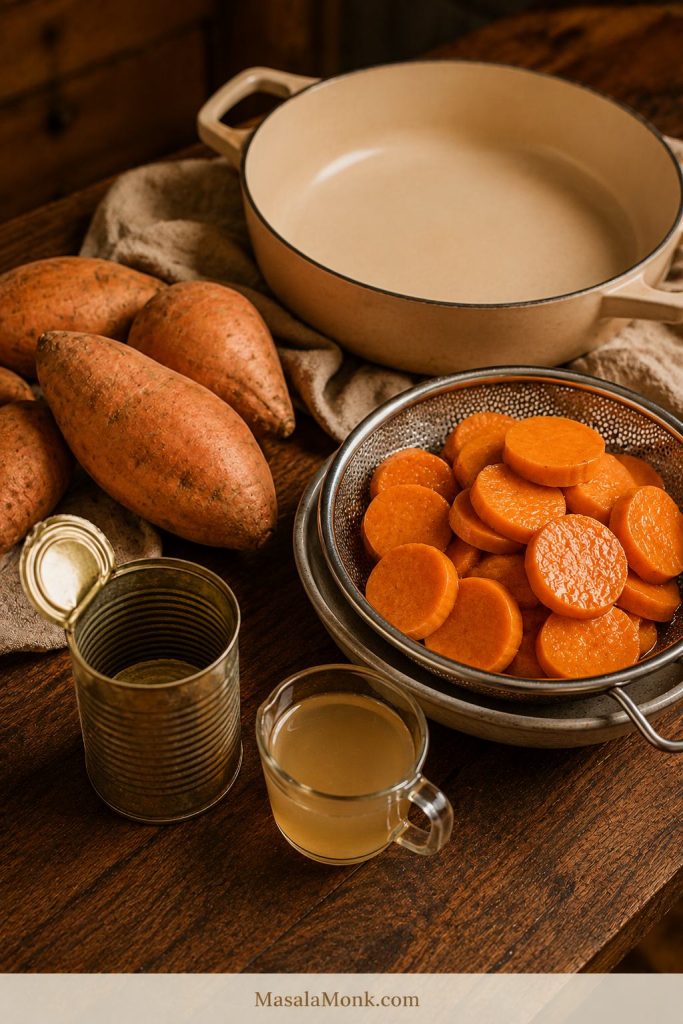
Fresh sweet potatoes, drained canned yams, an opened unbranded can, and a Dutch oven arranged on a warm kitchen counter.
Fresh sweet potatoes, canned yams, and stovetop candied yams can all work well. However, fresh slices need time, canned yams need gentleness, and stovetop yams need steady low heat.

Fresh yams give you the prettiest slices. Canned yams give you speed. Stovetop cooking gives you control. Marshmallows give you nostalgia. None of those choices are wrong.

Method Best For Approx. Time Key Cue
Fresh baked candied yams Best texture, neat slices, holiday table presentation 60–70 minutes Uncover long enough for the sauce to reduce
Canned baked candied yams Fast shortcut, pantry version, smaller batch 20–30 minutes Drain well and heat gently
Stovetop candied yams Oven is full, spoon-coated finish, Southern-style cooking 50–65 minutes Keep the heat medium-low
Crockpot candied yams Freeing oven space and holding a side dish warm 3–4 hours on low Expect a thinner syrup
Marshmallow finish Classic Thanksgiving-style topping 5–12 minutes Add only at the end

As a default, use the fresh baked version when texture matters, canned yams when speed matters, and stovetop cooking when the oven is full. If you are starting with cans, keep the rhythm even simpler: drain, coat, heat, stop.

Are Candied Yams Actually Sweet Potatoes?

Most of the time, yes. In the United States, the orange “yams” sold in regular grocery stores are usually orange-fleshed sweet potatoes. True yams are starchier, drier, and less common in everyday U.S. supermarkets. The Library of Congress explanation of sweet potatoes and yams is useful if you want the longer background.

For this recipe, buy orange sweet potatoes or yams labeled garnet, jewel, red yam, or simply yam. That naming confusion matters less than the flesh color here. Orange, moist sweet potatoes give the classic color, sweetness, and soft texture people expect in candied yams.

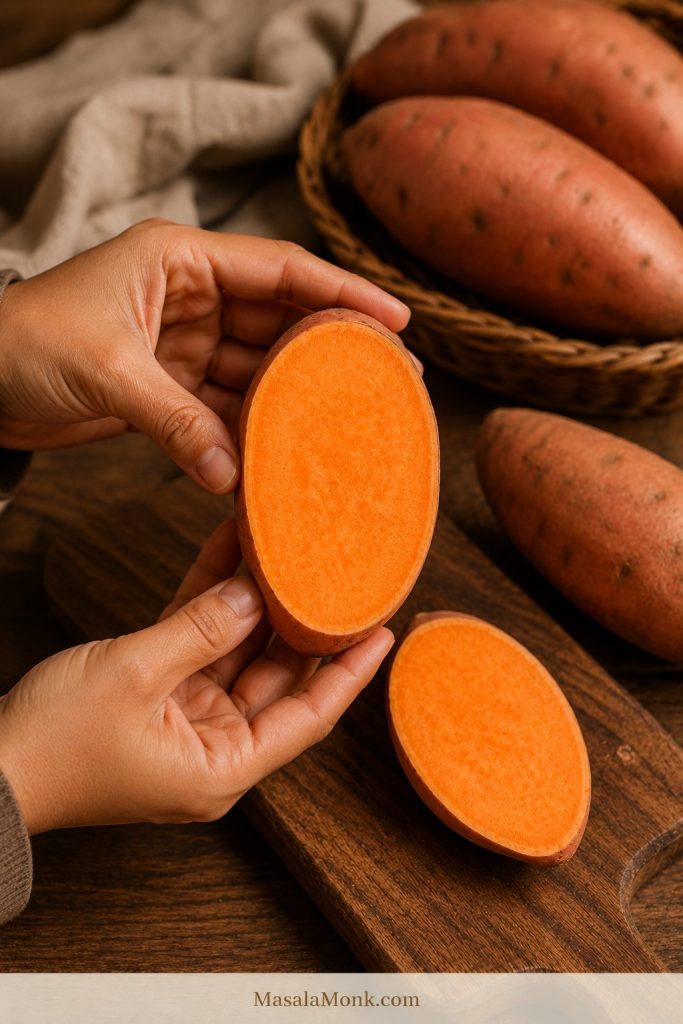
Hands holding a freshly cut raw orange sweet potato half with whole sweet potatoes in the background.
For most candied yams recipes, orange-fleshed sweet potatoes are the right choice even when the store labels them “yams.” Their color, sweetness, and soft texture create the familiar holiday side dish.
Simple shopping rule: if the inside is deep orange and the label says sweet potato, yam, jewel, garnet, or red yam, it will work for this recipe.

Ingredients You’ll Need

The ingredient list is simple because candied yams are not trying to be fancy. What matters is balance: enough brown sugar to feel candied, enough butter to feel rich, enough salt and citrus to keep the sweetness from going flat.

Brown sugar gives the sauce depth, butter gives it body, and salt keeps the dish balanced. Vanilla, warm spices, and a little orange juice or lemon juice round out the flavor. If you like that orange-bright flavor, the same idea works beautifully in cranberry sauce with orange juice.

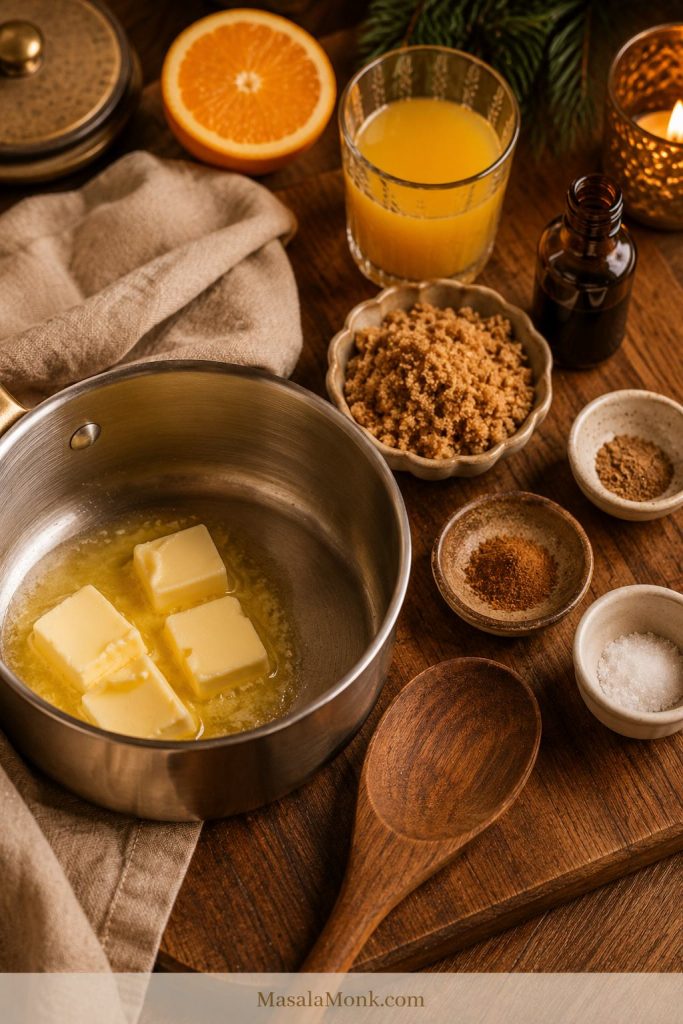
Butter, brown sugar, cinnamon, nutmeg, orange juice, vanilla, and salt arranged beside a small saucepan.
A good candied yams sauce needs more than sweetness. Butter and brown sugar bring richness, while salt, vanilla, warm spices, and citrus keep the flavor rounded.

Ingredient Amounts and Cues

Ingredient Amount Why It Matters
Orange sweet potatoes / yams 3 lb / 1.35 kg The base of the dish. Use orange sweet potatoes for the classic color and texture.
Unsalted butter 1/2 cup / 113 g Makes the sauce rich and smooth.
Brown sugar 3/4 cup / 150 g, or up to 1 cup / 200 g for a sweeter style Gives the deep caramel-like sweetness.
Maple syrup or orange juice 1/4 cup / 60 ml Maple gives deeper flavor; orange juice gives brightness.
Water 2–4 tbsp / 30–60 ml Helps the sugar dissolve into a smooth sauce.
Cinnamon 1 tsp The main warm spice.
Nutmeg 1/4 tsp Adds classic warmth.
Ginger 1/4 tsp, optional Adds a little extra spice without taking over.
Salt 1/2 tsp Balances the sugar and butter.
Vanilla extract 1–2 tsp Rounds out the brown sugar mixture. Add it off the heat.
Lemon juice or apple cider vinegar 1–2 tsp, optional Useful if you want a sweet-but-not-cloying finish.
Mini marshmallows 2–3 cups, optional Add at the end for a toasted topping.
Chopped pecans 1/2 cup, optional Adds crunch. Best added near the end so they stay crisp.

Small Ingredient Choices That Matter

When the balance is right, the coating tastes buttery and warm, not just sugary, and the sweet potatoes stay tender enough to spoon but firm enough to hold.

Less sweet version: use 3/4 cup brown sugar instead of 1 cup, choose orange juice instead of maple syrup, and add 1–2 teaspoons lemon juice or apple cider vinegar to balance the sauce.

If you are tempted to use a ready spice blend, keep it gentle. A small pinch of apple pie spice can work because it usually leans on cinnamon, nutmeg, and warm baking spices, but too much can make the yams taste more like dessert than a side dish.

Best dish: use a deep 9×13-inch / 23×33 cm glass or ceramic baking dish for the fresh version. Use an 8×8-inch / 20×20 cm dish for one 29 oz / 822 g can. Avoid sheet pans because the syrup spreads too thin and can burn before the yams soften.

How to Make Candied Yams

This is the version to make when you want the dish to look generous on the table: tender slices, glossy sauce, and enough structure that the yams do not collapse when you spoon them out. For the fresh baked version, the rhythm is simple: cover, uncover, rest.

1. Prep the sweet potatoes

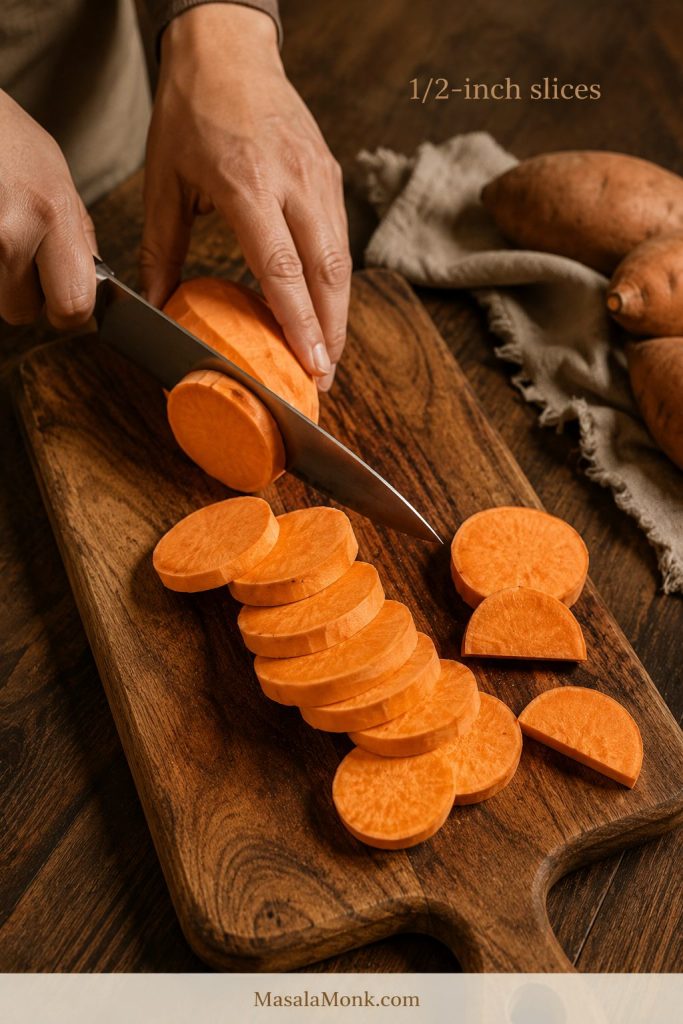
Peel the sweet potatoes and slice them into 1/2-inch / 1.25 cm rounds. If the sweet potatoes are very wide, cut the rounds into half-moons so they are easier to serve.

Thin slices tend to soften before the syrup has time to reduce, while very thick slices need longer and can make the edges overcook. The best texture comes from slices that are thick enough to hold together but thin enough to soften in the covered bake.

Hands slicing peeled orange sweet potatoes into half-inch rounds on a wooden cutting board.
Even slices make the whole dish easier to control. Around 1/2 inch gives the sweet potatoes enough body to stay intact while still softening into the sauce.

2. Make the brown sugar butter glaze

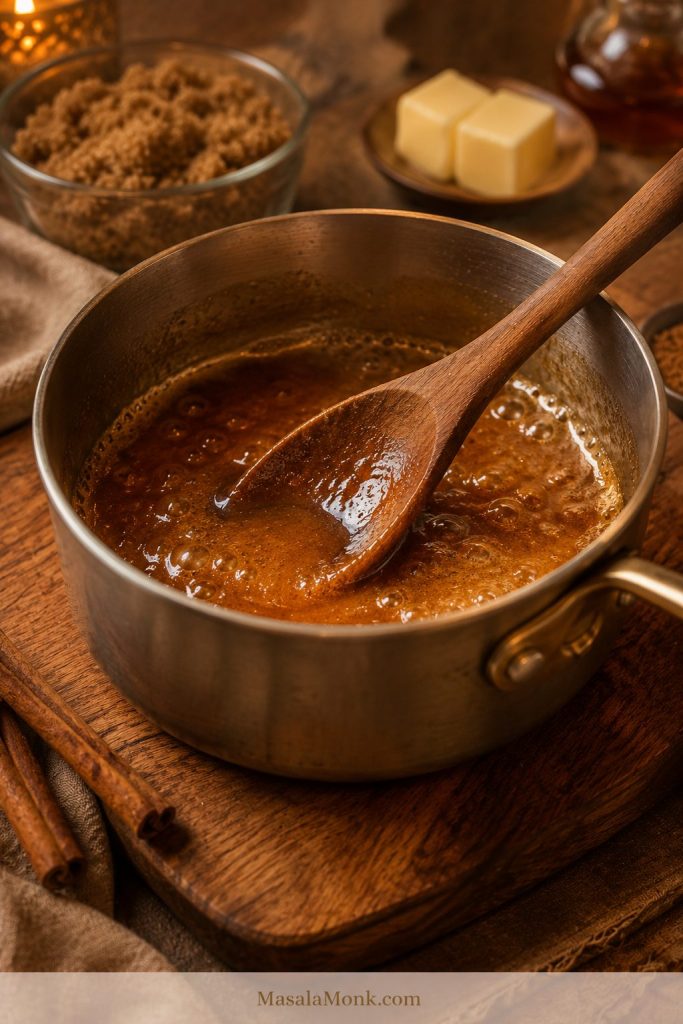
Melt the butter in a saucepan over medium heat. Add the brown sugar, maple syrup or orange juice, water, cinnamon, nutmeg, ginger if using, and salt. Stir until the sugar dissolves and the mixture looks smooth and shiny.

Let it bubble gently for 1–2 minutes, then remove it from the heat and stir in the vanilla. If using lemon juice or apple cider vinegar, stir it in now.

Brown sugar butter sauce simmering in a saucepan while a wooden spoon moves through the mixture.
Before it goes over the sweet potatoes, the butter and brown sugar mixture should look smooth and shiny. If it looks grainy, warm it gently until the sugar dissolves.
Glaze cue: the mixture should look shiny and pourable, not grainy or separated. It does not need to be thick like caramel at this stage. The oven will reduce it more.

3. Arrange and coat the yams

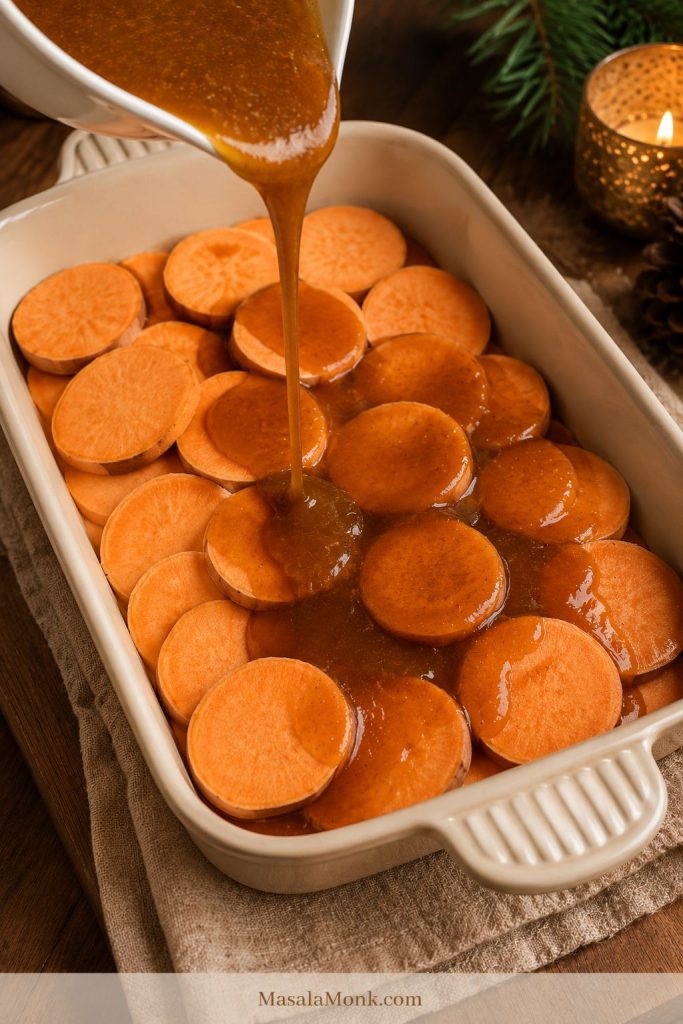
Place the sliced sweet potatoes in a greased 9×13-inch / 23×33 cm baking dish. Pour the warm glaze over the top, then gently turn the slices or spoon the brown sugar mixture over them so they are coated.

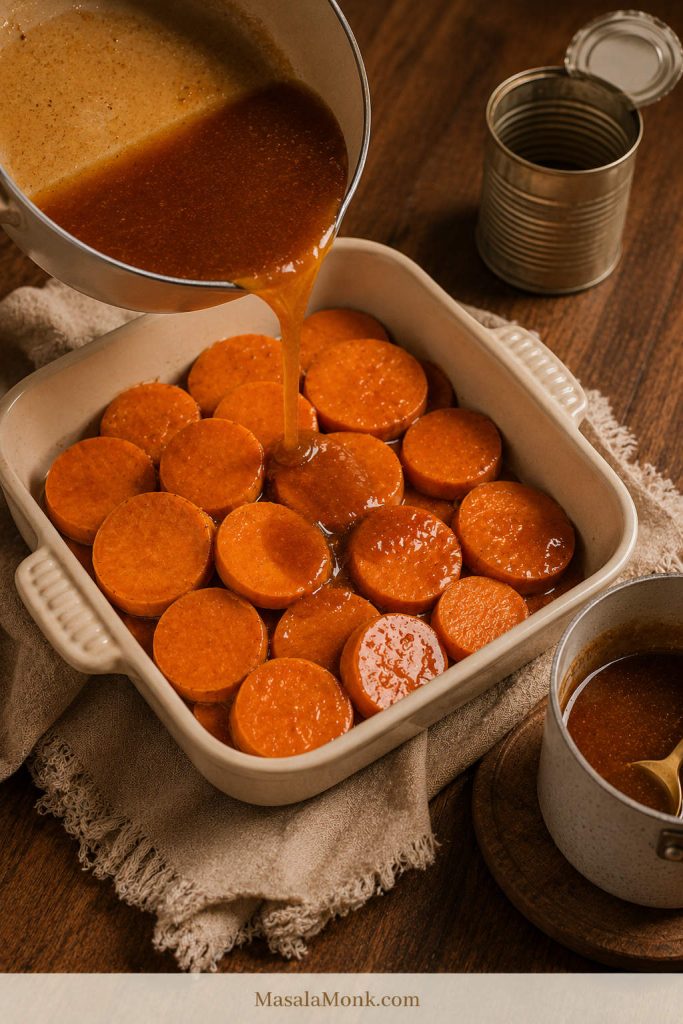
Brown sugar butter sauce being poured over arranged orange sweet potato slices in a cream baking dish.
Coat every slice before the dish goes into the oven. As a result, the sweet potatoes bake into the sauce instead of drying out on top.

The slices do not have to be in one perfect layer, but avoid packing them so tightly that the sauce cannot move around them. A little space helps the edges bubble slowly and the syrupy coating thicken without scorching.

4. Bake covered

Cover the dish tightly with foil and bake at 350°F / 175°C for 35–40 minutes. The yams should begin to soften, but they should not be falling apart yet.

During the covered stage, steam softens the sweet potatoes without drying them out. It also gives the buttery syrup time to soak into the slices.

5. Bake uncovered

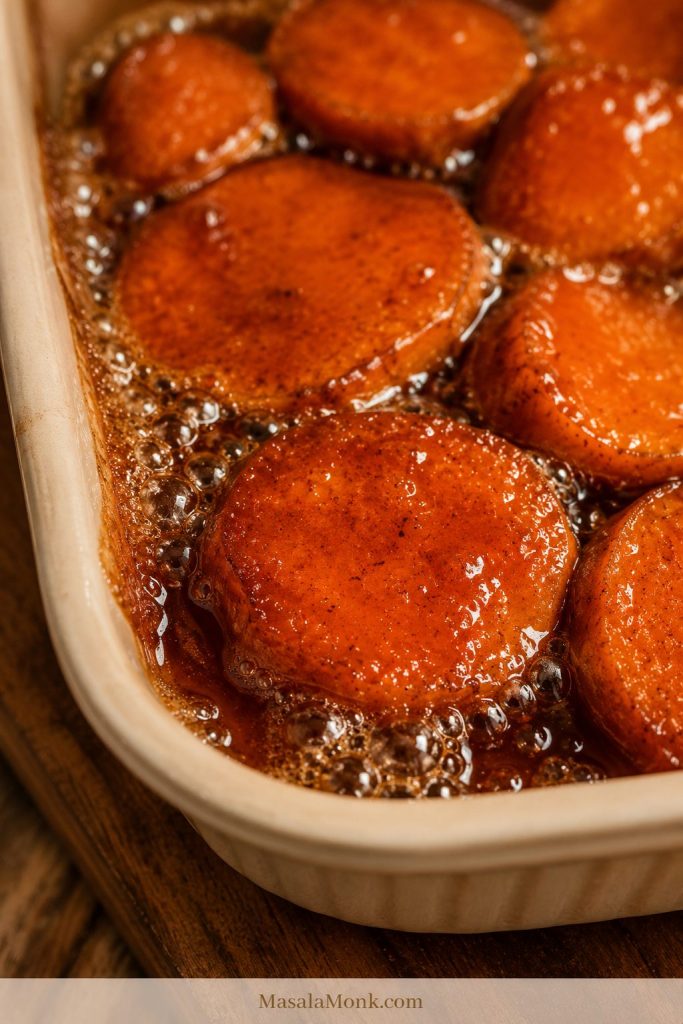
Remove the foil, spoon the sauce over the yams, and bake uncovered for another 20–25 minutes. By the end of baking, the edges should bubble slowly and the top slices should look lacquered, not dry.

The yams are ready when they are fork-tender and a spoon drags a shiny trail over the slices instead of leaving thin liquid behind. They do not need to look perfect at every stage; by the time they rest, they should be tender, coated, and sitting in a glossy coating. If the dish still looks loose, give it another 5–10 minutes uncovered.

Candied yams bubbling uncovered in a cream baking dish as the sauce reduces around the orange slices.
The uncovered bake is where the sauce tightens. Look for gentle bubbling around the edges and shiny slices instead of thin liquid sitting underneath.

If the edges darken too quickly or the syrup starts to smell scorched instead of buttery and spiced, move the dish away from the hottest part of the oven.

What success looks like: the yams are fork-tender but still holding together, the edges bubble slowly, a spoon drags a shiny trail through the coating, and there is no thin liquid pooling at the bottom.
Spoon dragging through thick brown sugar sauce between candied yam slices in a baking dish.
A spoon trail is one of the clearest doneness cues. When the sauce leaves a shiny path before slowly settling back, the candied yams are close to ready.

6. Add marshmallows if you want them

If using marshmallows, scatter them over the yams during the final 8–12 minutes of baking. They should puff into a soft golden blanket, with toasted tops and a little give underneath. For deeper browning, use the broiler for a few seconds at the end.

Marshmallows brown fast, so this is the one moment to stay by the oven.

7. Rest before serving

Let the dish rest for about 10 minutes before serving. Give the brown sugar sauce a chance to settle before deciding it is too thin. A short rest is part of the recipe, not just waiting time, and the resting section explains why it works.

After that rest, the slices are easier to lift and the sauce clings better. Serve the yams warm, not straight-from-the-oven hot, so the glossy coating has time to settle. The dish should smell like butter, brown sugar, cinnamon, and sweet potatoes — not scorched sugar.

How to Make Candied Yams with Canned Yams and Marshmallows

Canned yams are not a shortcut you need to apologize for. For many families, they are the version that actually tastes familiar. The only trick is to remember that they are already cooked, so you are simply warming, coating, and finishing them.

With canned yams, keep the rhythm even simpler: drain, coat, heat, stop. Add marshmallows at the end if you want that classic topping.

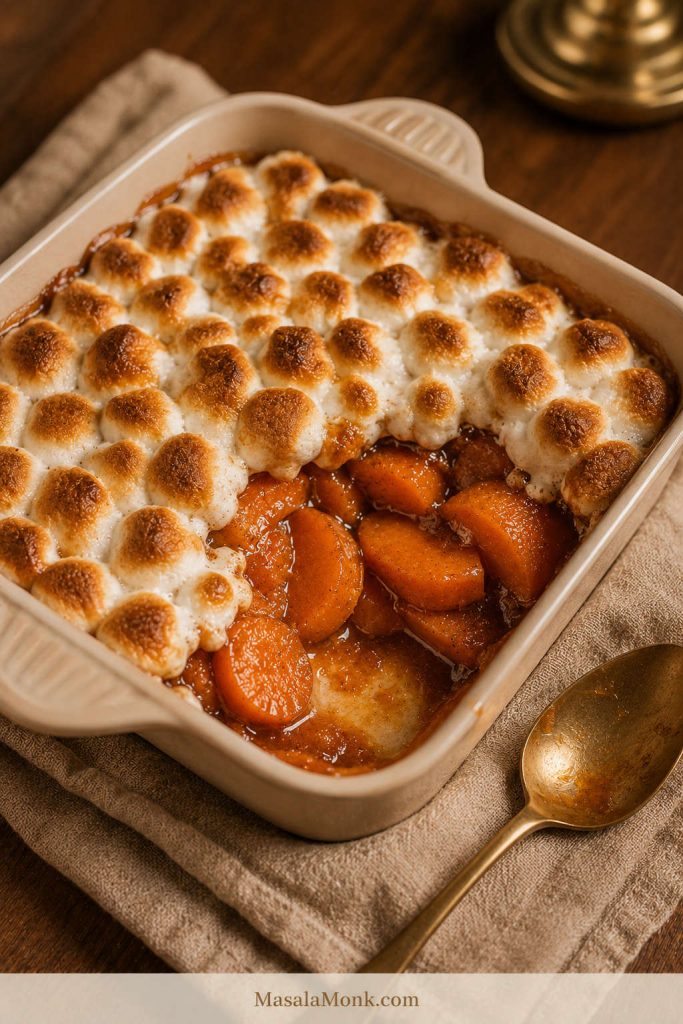
Small cream baking dish of canned candied yams with toasted mini marshmallows and a scooped corner showing orange yams underneath.
With canned yams, the best result is a warm coated center and a toasted finish. The scooped corner should still show orange pieces underneath, not a mashed layer hidden by marshmallows.

Canned-Yam Timing

Batch Size Canned Yams Dish Oven Timing
Small batch 1 can, 29 oz / 822 g, drained 8×8-inch / 20×20 cm 375°F / 190°C 15 minutes, then 5–8 minutes with marshmallows
Larger batch 1 large can, 40 oz / 1.13 kg, drained 9×13-inch / 23×33 cm 375°F / 190°C 18–20 minutes, then 5–8 minutes with marshmallows
Double-can batch 2 cans, 29 oz / 822 g each, drained 9×13-inch / 23×33 cm 375°F / 190°C 20–22 minutes, then 5–8 minutes with marshmallows
Mini canned-yam version: for one 29 oz / 822 g can, drain well, use 3 tbsp butter, 1/3–1/2 cup brown sugar, 1/2 tsp cinnamon, a pinch of nutmeg, a pinch of salt, and 1 tsp vanilla. Bake at 375°F / 190°C for 15 minutes, then add marshmallows for 5–8 minutes if using.
Small cream baking dish filled with canned yams as brown sugar sauce is poured over them.
For a one-can batch, scale the dish and sauce down together. Since canned yams are already cooked, the goal is warming and coating, not long baking.

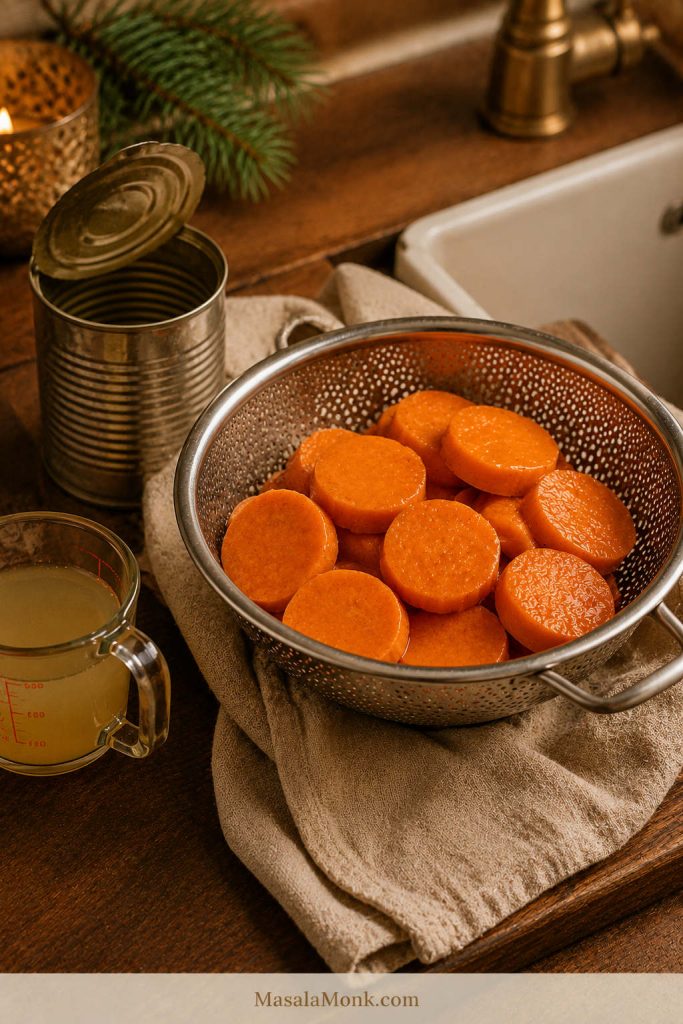
Drain well. A few tablespoons of canning liquid can loosen a thick sauce; the full can usually makes the dish watery.

Drained canned yams in a metal colander with an opened unbranded can and a small measuring cup of liquid nearby.
Canned yams save time, but the liquid in the can can thin the sauce quickly. Drain first, then add back only a spoonful or two if the mixture needs loosening.

Warm the butter, brown sugar, cinnamon, nutmeg, salt, and vanilla into a quick glaze, pour it over the drained canned yams, and bake only until hot. With canned yams, gentleness matters most. Stirring breaks them down faster than baking does.

How to keep canned yams from getting mushy

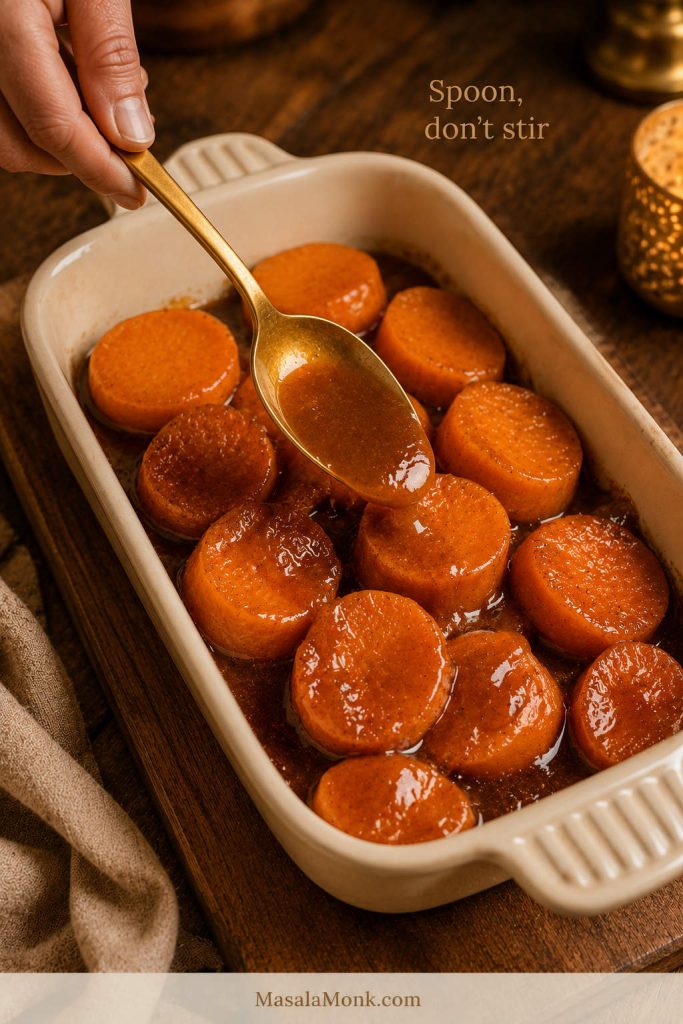
Spoon gently pouring sauce over intact canned yam pieces with visible text reading Spoon, don’t stir.
Instead of stirring canned yams, spoon the sauce over the top. This keeps the pieces intact and helps prevent the dish from turning into sweet potato mash.
  • Leave large pieces large. Smaller pieces break down faster.
  • Use less sugar if the yams are packed in syrup. Start lower, then adjust next time if you want them sweeter.
  • Rinse only if the syrup is very heavy. Draining is usually enough. Rinsing helps only if you want a less sweet version.
  • Spoon instead of stirring. Tilt the dish gently or ladle sauce over the top.
  • Bake uncovered if the syrup looks loose. This helps extra moisture evaporate.
  • Make canned yams closer to serving time if presentation matters. They soften more as they sit.

Quick glaze for canned yams

Can Size Butter Brown Sugar Spices and Vanilla
29 oz / 822 g can 3 tbsp 1/3 cup if packed in syrup, 1/2 cup if packed in water or light syrup 1/2 tsp cinnamon, pinch nutmeg, pinch salt, 1 tsp vanilla
40 oz / 1.13 kg can 4 tbsp 1/2 cup 3/4 tsp cinnamon, pinch nutmeg, pinch salt, 1 tsp vanilla
2 cans, 29 oz / 822 g each 5–6 tbsp 2/3 cup if packed in syrup, 3/4 cup if packed in water or light syrup 1 tsp cinnamon, 1/4 tsp nutmeg, 1/4 tsp salt, 2 tsp vanilla

If your canned yams are very sweet already, start with the lower sugar amount. You can always make the next batch sweeter, but it is harder to rescue a dish that has become cloying.

Stovetop Candied Yams, Southern-Style

Southern-style candied yams are often less about a casserole and more about tender sweet potatoes coated in a buttery brown sugar syrup. Some versions are baked, some are made on the stovetop, some finish with marshmallows, and some stay plain and glossy.

When the oven is full, the stovetop is often the easiest way to stay in control of the sauce. It is also a good choice if you like a spoon-coated finish because you can watch it reduce in real time, baste the slices, and stop when the yams are tender but still holding together.

The flavor usually leans brown sugar, butter, cinnamon, nutmeg, vanilla, and sometimes citrus. Done well, it tastes rich without becoming flat: enough sugar to feel candied, enough salt and spice to keep every bite balanced.

Use the widest heavy-bottomed skillet or Dutch oven you have. A wide pan gives the sweet potatoes enough room to cook evenly, and a heavy base helps protect the sugar from scorching.

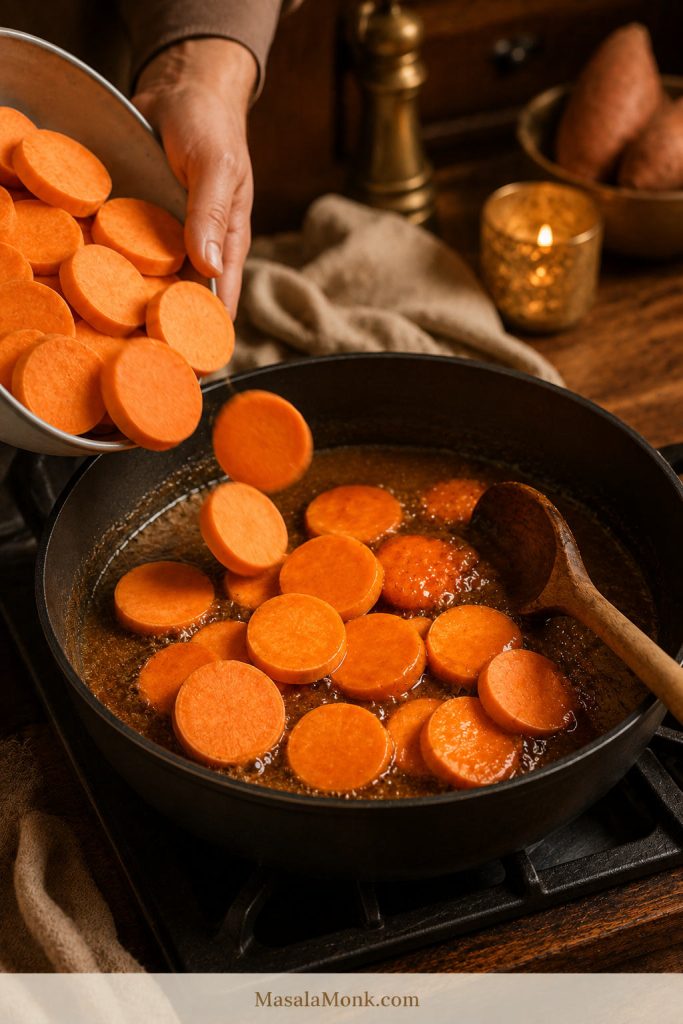
Fresh orange sweet potato slices being added by hand to a dark skillet with a shallow butter and sugar mixture.
For stovetop candied yams, use a wide pan so the slices have room to cook evenly. A shallow butter-sugar mixture also helps the syrup reduce without crushing the sweet potatoes.

How to make candied yams on the stove

  • Melt the butter in a wide skillet or Dutch oven over medium-low heat.
  • Add brown sugar, maple syrup or orange juice, water, cinnamon, nutmeg, ginger if using, and salt.
  • Stir until the sugar starts to dissolve and the glaze looks smooth.
  • Add the 1/2-inch / 1.25 cm sweet potato slices and gently coat them.
  • Cover and cook over medium-low heat for 35–45 minutes, basting every 10–15 minutes. Start checking at 35 minutes.
  • When the yams are almost tender, uncover and simmer for 7–15 minutes more so the syrup thickens.
  • Finish with vanilla off the heat. Add lemon juice or apple cider vinegar if the sauce tastes too sweet.

Stovetop Reduction Cues

Keep the stovetop version patient and gentle; high heat can burn the sugar before the potatoes soften. If the pan looks dry at any point, lower the heat before adding more liquid.

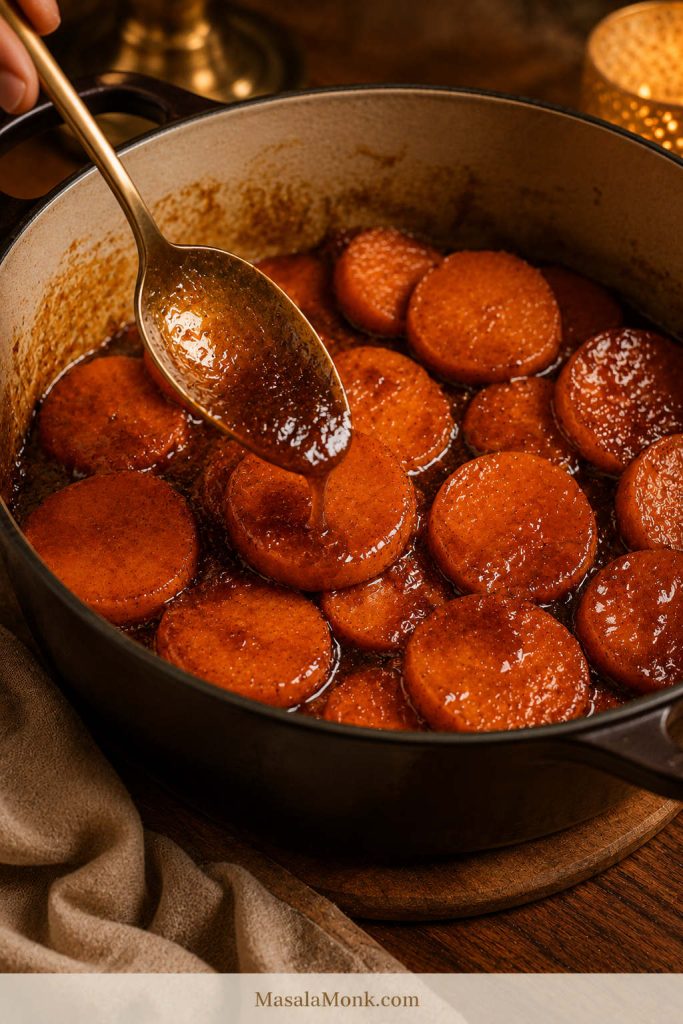
Spoon basting brown sugar syrup over orange candied yam rounds in a dark skillet.
Once the stovetop syrup begins to thicken, baste gently instead of stirring hard. This coats the tops while the sweet potato rounds stay whole.

Stay close during the uncovered reduction stage. The syrup can move from shiny to scorched quickly once the extra moisture cooks off.

Stovetop cue: the yams are done when they are fork-tender and the sauce coats the back of a spoon. If the syrup thickens before the yams are soft, add 1–2 tablespoons water and keep cooking covered. When the yams are soft but the sauce is thin, uncover and simmer a little longer.

Stir as little as possible. Use a spoon to baste the slices or gently shake the pan instead of stirring like a stir-fry. This keeps the sweet potatoes from breaking apart.

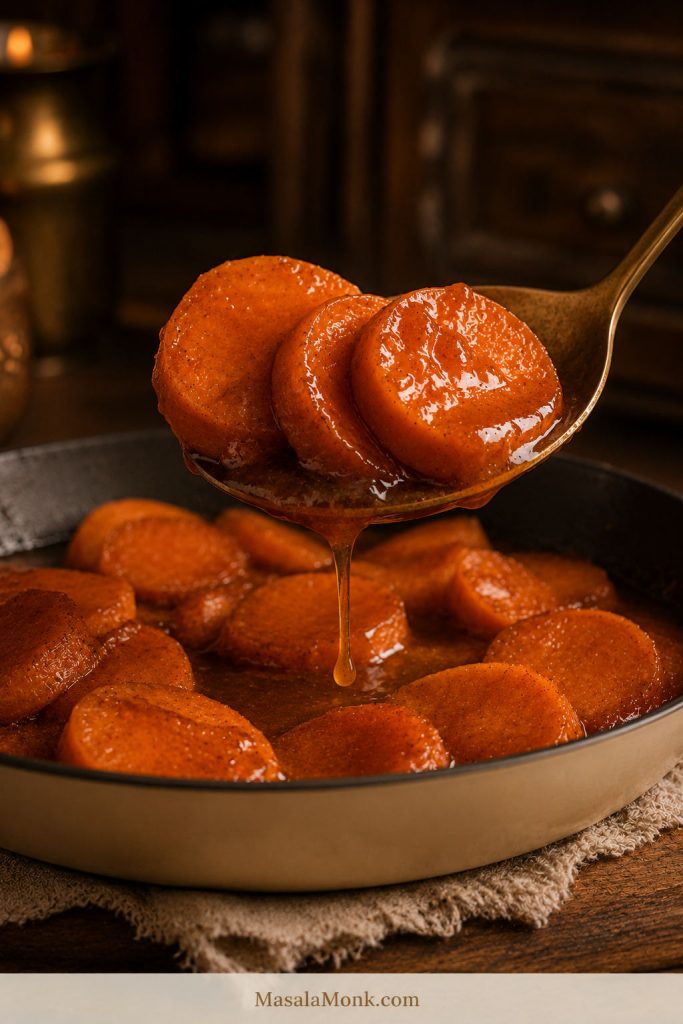
Spoon lifting stovetop candied yam slices from a dark skillet with thick syrup dripping back into the pan.
Finished stovetop candied yams should look rich and syrupy, with a darker, deeper glaze than the baked version. Keep the heat gentle so the sugar thickens without scorching.

Can I Bake Candied Yams at 375°F?

Yes. The main recipe uses 350°F / 175°C for steady, even softening, but 375°F / 190°C works if you need a slightly faster bake. Check earlier, baste once or twice, and watch the edges so the sugar does not dry out before the yams are tender.

Candied Yams with Marshmallows

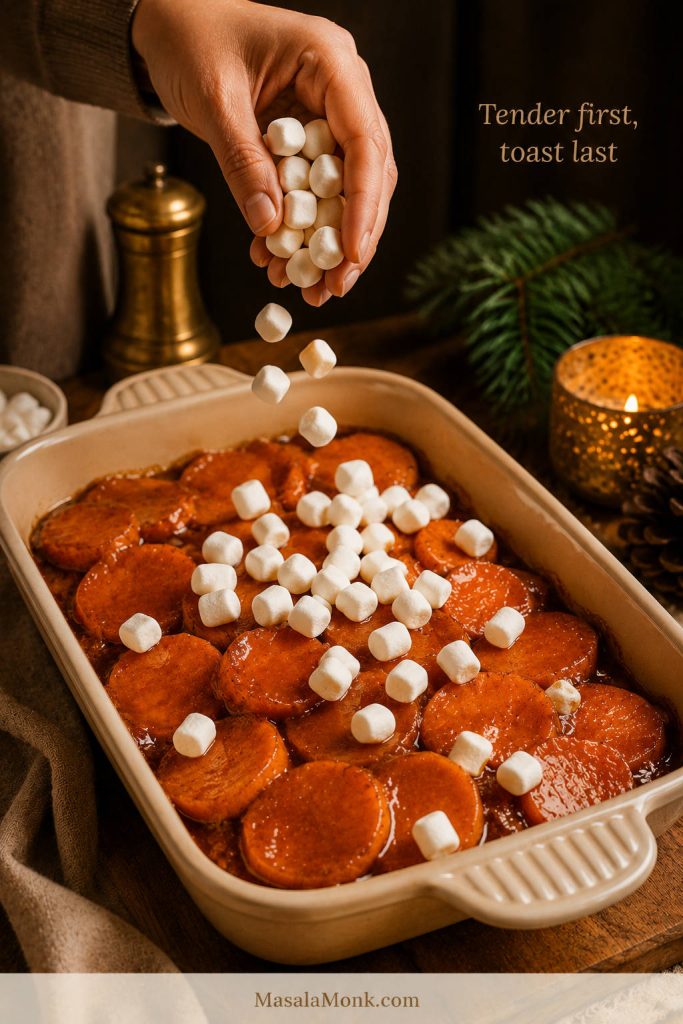
For marshmallows, the timing is everything: tender first, toast last. Marshmallows are the part people notice first, so they deserve a little timing. Add them too early and they disappear into the sauce; add them at the end and you get the soft, golden topping people remember.

Mini marshmallows being sprinkled over hot candied yams with visible text reading Tender first, toast last.
Marshmallows are a finish, not a cooking ingredient. Add them when the yams are already tender so they puff on top instead of disappearing into the sauce.

If your family expects marshmallows, let them be the finish, not the sauce.

When to Add Marshmallows

  • At 350°F / 175°C, add marshmallows for the final 8–12 minutes.
  • For 375°F / 190°C, add them for the final 5–8 minutes.
  • In a 400°F / 200°C oven, watch closely and check after 5 minutes.
  • Under the broiler, they may brown in 30–90 seconds.

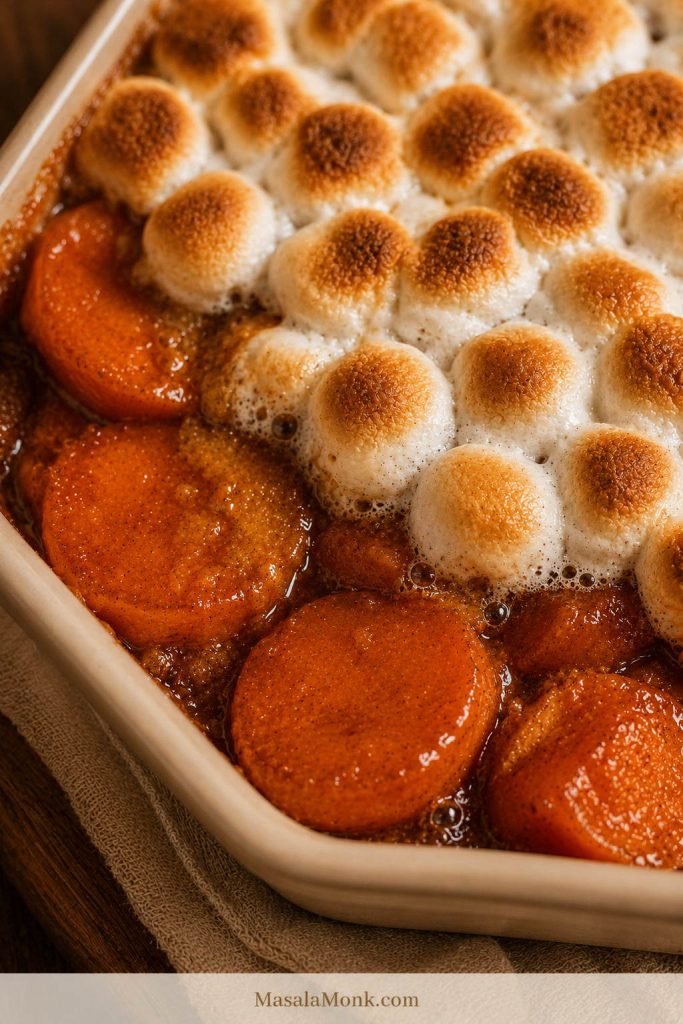
You want the topping puffed, soft, and lightly golden — not fully dissolved into the glaze.

Close-up of toasted mini marshmallows on candied yams with orange yam slices visible underneath.
The marshmallow topping is ready when it is puffed, soft, and lightly golden. Importantly, you should still see orange yams and a little sauce underneath.

The best marshmallow topping comes from adding them when the yams are already hot, so they puff quickly instead of sinking into the sauce.

Mini marshmallows are easiest because they scatter evenly and brown quickly. Large marshmallows can work, but cut them in half or use fewer so the topping does not become too thick.

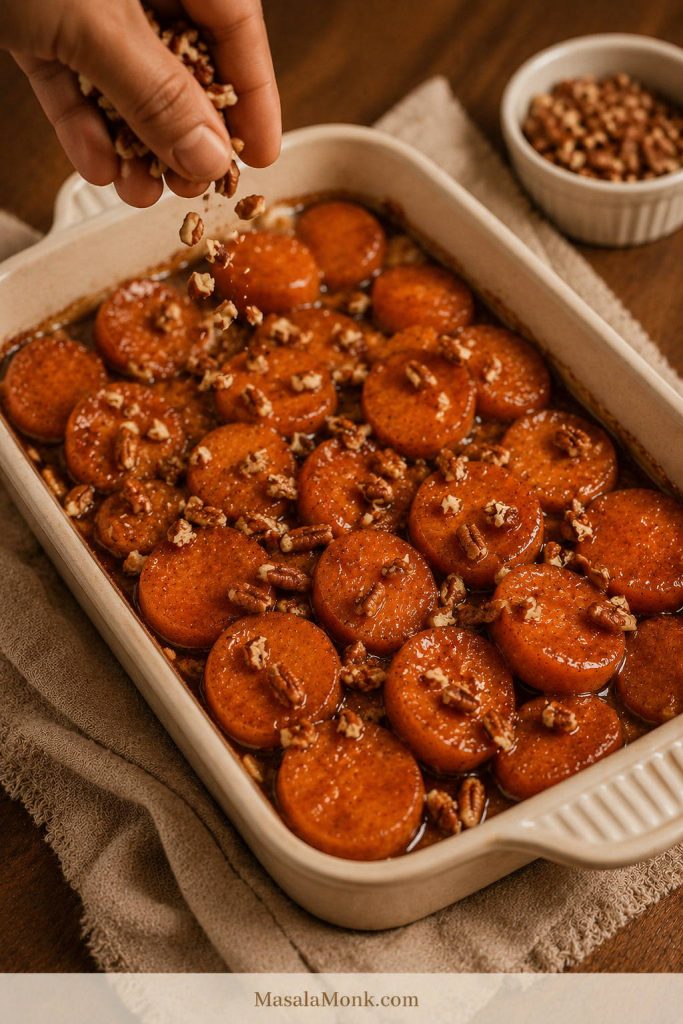
For pecans and marshmallows together, add the pecans near the end, then scatter marshmallows over the top. This keeps the nuts from sitting under foil for too long and turning soft.

Hand sprinkling chopped pecans over candied yam slices in a cream baking dish.
Add pecans near the end so they stay crisp instead of steaming under foil. They bring crunch and nuttiness without taking over the brown sugar flavor.

How to make candied yams without marshmallows

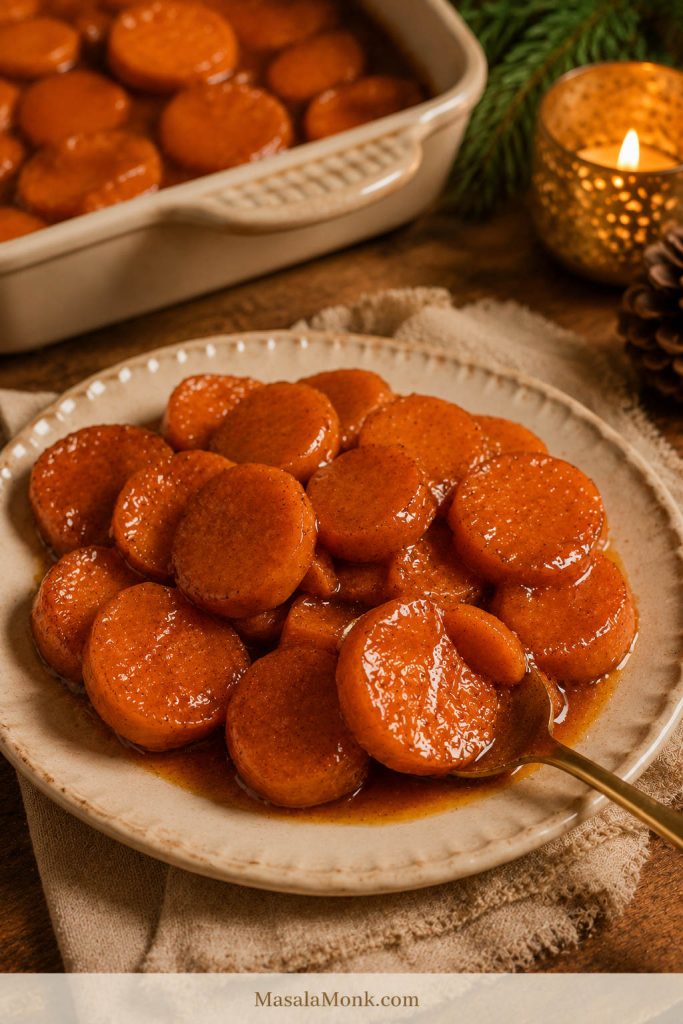
To make candied yams without marshmallows, simply skip the topping and focus on the glaze. Bake uncovered until the yams are tender and the brown sugar butter sauce looks shiny and spoonable. For a little finish without marshmallows, add pecans near the end, a small pinch of orange zest, or nothing at all.

Candied yams without marshmallows served on a cream plate with brown sugar sauce.
No-marshmallow candied yams rely on the sauce for their finish. The flavor should be buttery, warmly spiced, and complete without needing a topping.

If your table loves the glossy plain version, stop before the topping and let the brown sugar butter sauce shine. The plain version is often the best choice when you want the sweet potatoes, butter, brown sugar, and warm spices to be the main flavor.

Small Things That Make a Big Difference

These are the small choices that prevent most candied-yam problems before they start.

  • Keep slices about 1/2 inch thick. Thin slices soften quickly and can fall apart before the sauce thickens.
  • Drain canned yams well. A few tablespoons of liquid can loosen the syrup, but the full can may make it watery.
  • Handle canned yams gently. Spoon sauce over them instead of stirring hard.
  • Save marshmallows for the end. They need just enough time to puff and brown.
  • Let the sauce rest before judging it. It thickens after the dish cools slightly.
  • Use a deeper baking dish. A flat sheet pan spreads the syrup too thin for this style.

Thanksgiving Timing Plan

On a holiday table, candied yams should not be the dish that makes the day harder. They can wait, reheat, hold their sauce, and still feel special when they come to the table warm and glossy.

The best part of this dish is that it does not need to be dramatic at the last minute. Make it ahead, reheat it gently, and save the marshmallows for the final finish.

For storage and reheating details, use the make-ahead section before planning the serving-day schedule, especially if your oven also needs time for macaroni and cheese or other baked sides.

When What to Do
2 days before Buy sweet potatoes or yams, butter, brown sugar, spices, marshmallows, and pecans if using.
1 day before Bake the fresh candied yams without marshmallows. Cool, cover, and refrigerate.
Serving day Reheat covered at 350°F / 175°C until hot, usually 20–25 minutes.
Final 8–12 minutes Add marshmallows or pecans and bake until puffed, golden, and hot.
When the oven is full Use the stovetop method, or reheat the baked yams once the oven opens up.
Using canned yams Make them closer to serving time for the best texture and cleanest presentation.

If you are transporting candied yams, keep the marshmallows off until you reheat, if possible. Marshmallows soften as they sit, and they look best when added close to serving.

Crockpot Candied Yams

Crockpot candied yams are helpful when the oven is full, but the sauce will usually stay thinner than baked or stovetop versions. Use fresh sweet potatoes, not canned, for the best shape. Cook on low for 3–4 hours, then reduce extra liquid in a small saucepan if needed. Add marshmallows only before serving.

Variations

  • No marshmallows: keep the top plain and let the brown sugar butter sauce shine.
  • Pecan topping: add chopped pecans near the end so they stay crisp instead of steaming under the foil.
  • Orange juice glaze: use it instead of maple syrup for a brighter, less heavy glaze.
  • Maple finish: use maple syrup for a deeper, rounder flavor.
  • Pineapple version: add well-drained pineapple near the end so it does not thin the sauce too much.
  • Less sweet: reduce brown sugar to 3/4 cup and add lemon juice or apple cider vinegar.
  • Vegan version: use plant-based butter and skip marshmallows unless they are vegan.

Keep variations simple. Candied yams are already rich, so one or two upgrades are usually enough. Pecans and marshmallows work well together. Orange juice and maple syrup are both good, but you do not need every sweet ingredient in the same dish.

Troubleshooting Candied Yams

Most candied-yam problems are fixable because they usually come from one of four things: too much liquid, too much heat, too much time, or too much stirring.

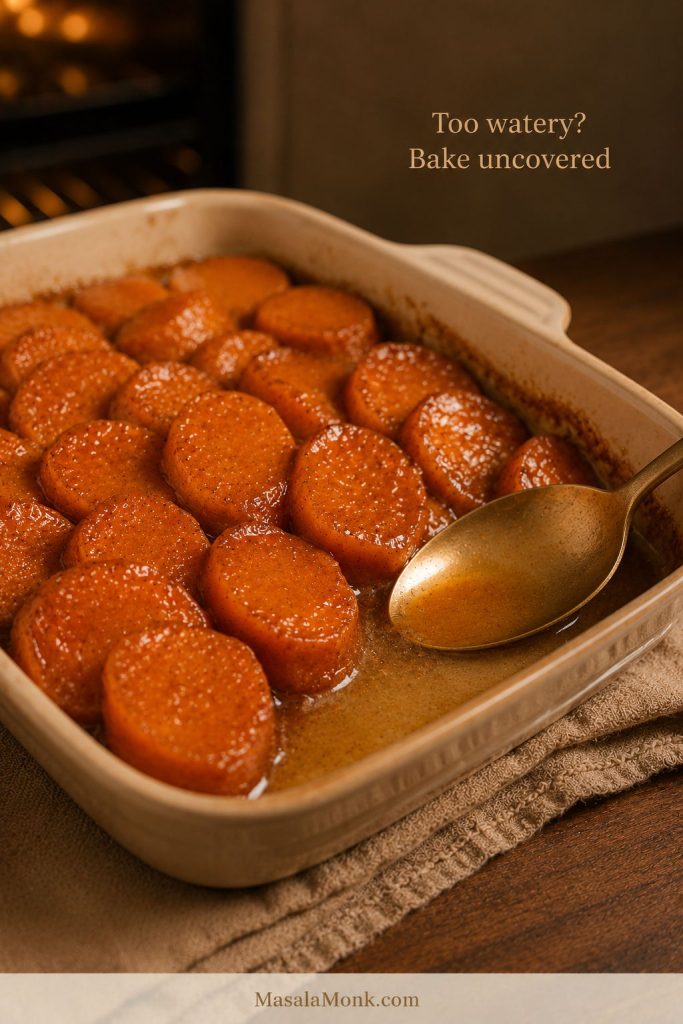
Candied yams in a baking dish with a spoon lifting thin liquid from one corner and visible text reading Too watery? Bake uncovered.
For watery candied yams, a thin pool at the edge usually means more uncovered time, not a full rescue. Let extra moisture evaporate, then give the sauce a few minutes to settle.

They often look worse in the pan than they taste on the plate. If the dish tastes good but looks loose, pause before changing anything. Rest it, then reduce it if needed. Hot sauce almost always looks thinner than settled sauce, so check why the sauce thickens after resting before extending the bake time.

Quick Fixes by Problem

Problem Why It Happened How to Fix It
Yams are watery Too much liquid, canned yams were not drained, or the dish stayed covered too long Bake or simmer uncovered until the sauce reduces. Spoon out extra liquid if needed.
Yams are mushy Slices were too thin, overcooked, or canned yams were stirred too much Use 1/2-inch slices for fresh yams and handle canned yams gently.
Sauce is thin It has not reduced enough, or it is still very hot Bake uncovered longer and let the dish rest for 10 minutes before serving.
Sugar burned Heat was too high or the pan was too shallow Use a deeper baking dish or lower heat. Spoon sauce over the yams during baking.
Butter separated The sugar did not dissolve fully into the butter mixture Simmer the glaze until smooth before pouring it over the yams.
Too sweet Heavy syrup canned yams or too much sugar Add a little salt, orange juice, lemon juice, or apple cider vinegar. Use less sugar next time.
Marshmallows disappeared They were added too early Add marshmallows only in the final 5–12 minutes.
Pecans got soggy They were baked under foil too long Add pecans near the end or sprinkle them on before the marshmallows.

Why the sauce thickens after resting

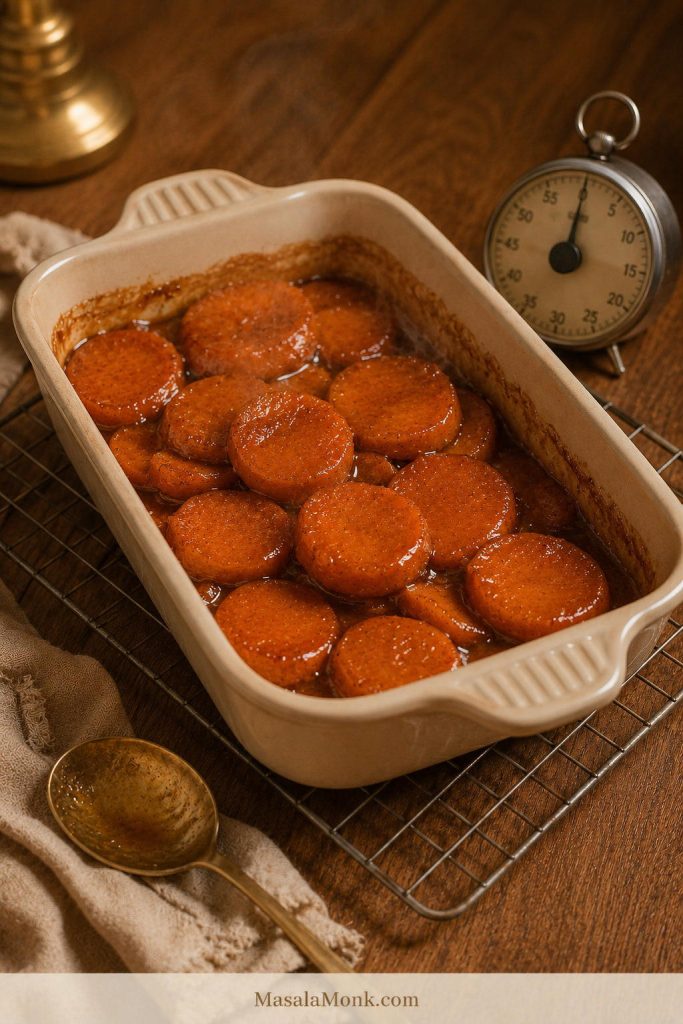
The sauce often looks loose when the dish first comes out of the oven. That does not mean it failed. As the butter-sugar mixture cools slightly, it becomes thicker and clings better to the sweet potatoes. Give the dish 10 minutes before deciding it is too thin.

Candied yams resting on a wire cooling rack in a cream baking dish with a kitchen timer nearby.
The sauce often looks looser when it is boiling hot. A short rest lets the bubbles calm down and turns the syrup into a better coating for the sweet potato slices.

Make Ahead, Storage, and Reheating

Can you make candied yams ahead?

Yes. For the best texture, make the fresh version up to 1 day ahead. Bake the yams without marshmallows, cool, cover, and refrigerate. Add marshmallows only when reheating before serving.

Canned yams are more delicate, so they are best made closer to serving time. If you do make them ahead, reheat gently and avoid stirring.

How to reheat candied yams

Reheat covered at 350°F / 175°C for 20–25 minutes, or until hot. If the sauce is very thick, add a small splash of water or orange juice before reheating. Add marshmallows near the end and bake until puffed and golden.

How long do leftovers last?

Store leftover candied yams in an airtight container in the refrigerator for 3–4 days. The texture will soften as they sit, especially if you used canned yams or marshmallows. For general leftover safety, the USDA FSIS leftovers guide is a helpful reference.

Can you freeze candied yams?

You can freeze them without marshmallows, but the texture may soften after thawing. For a special meal, refrigeration and reheating usually gives a better result than freezing.

What to do with leftovers

Leftover candied yams can be served again as a side dish, mashed into oatmeal, spooned over pancakes or waffles, folded into muffin batter, or used like a sweet potato pie-style filling. If they have marshmallows on top, the texture will be softer, but the flavor will still be good.

What to Serve with Candied Yams

Because candied yams are sweet and buttery, they work best beside something savory, salty, green, or tangy.

They pair well with roast turkey, baked ham, roast chicken, stuffing or dressing, green beans, cranberry sauce, collard greens, mac and cheese, garlic mashed potatoes, and cornbread.

Candied yams in a cream serving dish on a Thanksgiving table with green beans, mac and cheese, cranberry sauce, and sliced turkey in the background.
Thanksgiving candied yams bring sweetness and warmth to the plate. They work especially well beside savory sides like green beans, mac and cheese, cranberry sauce, turkey, or ham.

For a Southern-style plate, candied yams also work beside richer mains like smothered pork chops, especially when you want something sweet to balance gravy, greens, and cornbread.

Candied Yams vs Sweet Potato Casserole

Candied yams are usually sliced or chunked sweet potatoes cooked in a brown sugar butter glaze. Sweet potato casserole is usually mashed or whipped, then baked with marshmallows, pecans, or streusel on top.

The two dishes can overlap, especially when marshmallows are involved, but candied yams are more about tender pieces in sauce, while casserole is creamy and scoopable. If you want that creamy version instead, use this sweet potato casserole recipe.

Frequently Asked Questions

Are candied yams actually sweet potatoes?

In most U.S. grocery stores, yes. The orange “yams” used for this dish are usually sweet potatoes, and they are exactly what you want for soft, classic candied yams.

Do you peel sweet potatoes for candied yams?

Yes, peel them for the classic soft, glossy dish. Sweet potato skins can turn chewy in a brown sugar glaze, and peeled slices give candied yams their traditional smooth texture.

Is brown sugar or white sugar better for candied yams?

Brown sugar is better for this version because it gives the glaze deeper flavor and a softer caramel-like finish. White sugar makes a cleaner, sweeter glaze with less depth. You can use a mix if you want a more candy-sweet style.

Can I make candied yams with canned yams?

Yes. Drain canned yams well, use a smaller sauce, bake at 375°F / 190°C only until hot, and avoid stirring. Canned yams are already cooked, so the goal is coating and warming, not softening.

Do I drain canned yams before making candied yams?

Yes, drain them first. A few tablespoons of the liquid can loosen a thick glaze, but the full can usually makes the dish watery.

Should I rinse canned yams?

Usually, no. Draining is enough unless the yams are packed in very heavy syrup and you want a less sweet dish.

Can I make candied yams on the stove?

Yes. Cook fresh 1/2-inch sweet potato slices in a wide skillet with the glaze over medium-low heat, covered until tender and uncovered at the end until the glaze coats the slices.

Do I need to boil sweet potatoes first?

No, not for this baked version. Slicing the sweet potatoes evenly and baking them covered first lets them soften in the sauce. Boiling first can save time, but it also makes the pieces easier to overcook.

When do I add marshmallows?

Add marshmallows near the end, once the yams are tender and the sauce has started to thicken. At 350°F / 175°C, the final 8–12 minutes is usually enough. If you add them too early, they melt into the sauce instead of forming a toasted topping.

Can I use large marshmallows?

Large marshmallows work, but mini marshmallows brown more evenly. If using large ones, cut them in half or use fewer so the topping does not become too thick.

How do I keep candied yams from getting watery?

Drain canned yams well, keep added liquid modest, bake uncovered long enough for the sauce to reduce, and let the dish rest before judging the texture.

How do I keep canned yams from getting mushy?

Handle them gently and do not bake them too long. Canned yams need heat, not more cooking, so spoon the sauce over them instead of stirring.

Can I make candied yams ahead for Thanksgiving?

Yes. Make the fresh version 1 day ahead without marshmallows, refrigerate, then reheat covered at 350°F / 175°C until hot. Add marshmallows only during the final few minutes before serving.

Can I double this recipe?

You can double it, but use two baking dishes instead of piling everything too deeply into one pan. Crowding the yams traps steam and makes it harder for the sauce to reduce.

Candied Yams Recipe

Soft orange sweet potatoes baked in a brown sugar butter glaze until tender, shiny, and spoon-coated — with canned-yam, stovetop, marshmallow, no-marshmallow, and make-ahead notes included.

Prep Time20 minutes
Cook Time60–70 minutes
Rest Time10 minutes
Servings8

Ingredients

  • 3 lb / 1.35 kg orange-fleshed sweet potatoes or yams
  • 1/2 cup / 113 g unsalted butter
  • 3/4 cup / 150 g packed brown sugar, or up to 1 cup / 200 g for a sweeter style
  • 1/4 cup / 60 ml maple syrup or orange juice
  • 2–4 tbsp / 30–60 ml water
  • 1 tsp ground cinnamon
  • 1/4 tsp ground nutmeg
  • 1/4 tsp ground ginger, optional
  • 1/2 tsp salt
  • 1–2 tsp vanilla extract
  • 1–2 tsp lemon juice or apple cider vinegar, optional
  • 2–3 cups mini marshmallows, optional
  • 1/2 cup chopped pecans, optional

Instructions

  1. Preheat the oven to 350°F / 175°C. Grease a 9×13-inch / 23×33 cm glass or ceramic baking dish.
  2. Peel the sweet potatoes and slice them into 1/2-inch / 1.25 cm rounds or half-moons.
  3. In a saucepan over medium heat, melt the butter. Add brown sugar, maple syrup or orange juice, water, cinnamon, nutmeg, ginger if using, and salt. Stir until smooth and shiny.
  4. Simmer the glaze gently for 1–2 minutes. Remove from heat and stir in vanilla. Add lemon juice or apple cider vinegar if using.
  5. Arrange the sweet potatoes in the baking dish. Pour the glaze over the top and gently coat the slices.
  6. Cover tightly with foil and bake for 35–40 minutes, until the yams begin to soften.
  7. Remove foil, spoon sauce over the yams, and bake uncovered for another 20–25 minutes, until fork-tender and shiny.
  8. If using marshmallows, add them during the final 8–12 minutes of baking. Bake until puffed and lightly golden.
  9. Rest for 10 minutes before serving so the sauce can thicken slightly. Serve warm, not piping hot.

Notes

  • Main cue: fresh or canned, the yams should be fork-tender and coated in sauce, not sitting in watery liquid.
  • Canned yams: bake drained canned yams at 375°F / 190°C: 15 minutes for a 29 oz / 822 g can, 18–20 minutes for a 40 oz / 1.13 kg can, or 20–22 minutes for two 29 oz / 822 g cans. Add marshmallows for the final 5–8 minutes. Canned yams need heat, not more cooking.
  • Stovetop method: cook sliced fresh sweet potatoes with the glaze ingredients in a wide skillet over medium-low heat for 35–45 minutes covered, then uncover and reduce for 7–15 minutes.
  • No marshmallows: skip the topping and bake uncovered until the sauce is glossy and spoonable.
  • Make-ahead: bake without marshmallows, refrigerate, reheat covered, and add marshmallows before serving.
  • Less sweet: use 3/4 cup brown sugar and add lemon juice or apple cider vinegar for balance.

Final Thoughts

Candied yams do not need to be complicated. Once the slices are soft, the sauce is shiny, and the marshmallows go on only at the end, the dish feels exactly how it should: familiar, sweet, buttery, and ready to be passed around the table.

When it works, the dish lands exactly where it should: soft slices, glossy sauce, warm spice, and that familiar sweet-buttery smell that makes people reach for the spoon.

Some families want the glossy plain version. Others want marshmallows browned until the corners catch. A few want pecans, orange juice, stovetop yams, or the canned version because that is the one that was always on the table.

Use this recipe as the steady base, then finish it the way your table remembers it. If your family has a must-have candied-yam tradition, I’d love to hear which version shows up every year.

Posted on Leave a comment

Ranch Oyster Crackers Recipe

Bowl of golden ranch oyster crackers with herb flecks, scoop, and cozy snack-table sides.

Ranch oyster crackers are the kind of snack that disappears quietly. You set out a bowl before the game starts, beside a pot of soup, or on a holiday snack table, and somehow everyone keeps drifting back for another salty, herby handful. They are crisp, tiny, ranch-seasoned, and just rich enough to feel like a treat without asking much from you.

The recipe itself is easy. The confusing part is everything around it: whether “ranch dressing” means bottled dressing or the dry ranch packet, how much seasoning to use for a 9 oz, 12 oz, or 16 oz bag, whether oil or butter gives a better crunch, whether the crackers really need to be baked, and what to do if they turn out greasy, salty, or soft.

Once those little decisions are clear, the batch is easy to get right. The baked method gives the snappiest result, and the ratio table helps you adjust for whatever bag you have. From there, choose oil or butter, dill or no dill, a gentle ranch coating or a bolder party-snack bowl. The result should be bold but not harsh, coated but not oily, and crunchy enough that people keep reaching back into the bowl.

Quick Answer: The Best Ranch Oyster Crackers Formula

For 12 oz / 340 g oyster crackers, use ⅓ cup / 80 ml neutral oil, 2½ tablespoons dry ranch seasoning for a balanced batch or up to 3 tablespoons for a bolder batch, 1 teaspoon dried dill, ½ teaspoon garlic powder, and ½ to 1 teaspoon lemon pepper.

Toss well, spread on a rimmed baking sheet, bake at 250°F / 120°C for 18–22 minutes, stir once halfway, and cool fully before storing. The first handful should taste salty, herby, crisp, and evenly coated — never dusty in one bite and oily in the next.

Quick pick: Use neutral oil for the best crunch, melted butter for the richest flavor, the air fryer for the fastest small batch, the no-bake method when you want to skip the oven, and a 16 oz batch for parties, gifting, game day, or bigger soup nights.

If you are using a full 1 oz / 28 g ranch packet with a 12 oz bag, expect a bold, salty party-snack flavor. For a safer first batch, start with 2½ tablespoons, bake, taste, and dust the crackers with a little more seasoning while they are still warm on the tray.

Using a 9 oz or 16 oz bag? Check the ranch seasoning ratios before mixing the coating.

Prep scene with oyster crackers, oil, dry ranch seasoning, dill, garlic powder, lemon pepper, and sheet pan.
Start with this 12-ounce ranch oyster crackers formula, then adjust the next batch toward bolder seasoning, richer butter, or more heat.

Why This Recipe Works

The best batches come out lightly toasted, evenly seasoned, and crisp after cooling. That does not happen by dumping ranch powder over crackers; it comes from the order, the ratio, and a little low-heat baking time.

  • Dry ranch seasoning keeps the crackers crisp. Bottled dressing adds moisture, while dry mix gives flavor without making the crackers soggy.
  • Whisking the seasoning into the oil first prevents clumps. The ranch powder, dill, garlic, and lemon pepper spread more evenly when they are suspended in oil before they touch the crackers.
  • A low oven sets the coating instead of scorching it. At 250°F / 120°C, the crackers have time to toast gently while the oil or butter settles into a clean, savory finish.
  • The ratio table protects the batch. Oyster cracker bags vary, and using the same seasoning amount for every bag can make one batch bland and another too salty.
  • Cooling on the tray finishes the texture. The crackers firm up as the seasoning settles into the surface.

The goal is simple: every handful should taste seasoned, not dusty in some bites and oily in others. Mix the coating first, bake low, and let the crackers cool on the pan, and the bowl lands crisp, salty, herby, and clean.

Close-up of crisp ranch oyster crackers with toasted edges, broken pieces, and green herb flecks.
Look for a matte, herby surface with lightly toasted edges; that finish tells you the seasoning has settled instead of sitting on the crackers as oil.

What Are Ranch Oyster Crackers?

Ranch oyster crackers are small oyster crackers tossed with dry ranch seasoning, oil or melted butter, and simple seasonings like dill, garlic powder, lemon pepper, and onion powder. They are usually baked at a low temperature until the seasoning clings and the crackers become crunchy again.

They are one of the most common versions of seasoned oyster crackers: the ranch packet gives the base flavor, while dill, garlic, lemon pepper, Parmesan, or heat can push the batch in different directions.

Despite the name, oyster crackers usually do not contain oysters. They are small soup crackers traditionally served with oyster stew, chowder, chili, and other soups. That soup-and-stew background is also why they make so much sense with creamy bowls and chili today. For a little more history, this history of oyster crackers explains where the name comes from.

Think of them as a snack mix shortcut. They are easier than Chex mix, less fussy than homemade crackers, and more interesting than plain soup crackers. Once baked and cooled on the pan, they are sturdy enough for snacking but still small enough to scatter over tomato soup, chili, chowder, salad, or a dip board.

Dry Ranch Seasoning vs Bottled Ranch Dressing

Use dry ranch seasoning here. It gives concentrated ranch flavor without the moisture that comes from bottled dressing. Creamy ranch dressing may sound tempting, but it can turn the crackers soft instead of snappy.

Split comparison of dry ranch seasoning mixed with oil and bottled ranch dressing with softer crackers.
Dry ranch mix seasons the crackers without adding water or cream, which is why it gives a cleaner crunch than bottled dressing.
Ranch productCan you use it?What to know
Dry ranch seasoning packetYes, best choiceClassic, easy, and bold. Use the packet weight and taste for saltiness.
Ranch seasoning shakerYesMeasure by tablespoons. Start with less if the blend is salty.
Dry ranch dip mixUsually yesCan be saltier or stronger than dressing mix. Start with a little less.
Bottled ranch dressingNot recommendedAdds moisture and can make the crackers soft.
Homemade ranch-style dry mixYesGood if you want more control over salt, dill, garlic, onion, and herbs.

Helpful rule: When people say “ranch dressing crackers,” they often mean crackers made with dry ranch dressing mix, not creamy dressing from a bottle.

Homemade Dry Ranch-Style Mix

A homemade ranch-style dry mix can work too, especially if it includes parsley, dill, garlic powder, onion powder, salt, pepper, and optional buttermilk powder. Without buttermilk powder, the flavor will be more herby-garlicky than creamy-ranch, but it can still make a good seasoned cracker batch.

Small bowls of parsley, dill, garlic powder, onion powder, salt, pepper, and buttermilk powder for dry ranch mix.
A homemade dry ranch-style mix lets you control salt, herbs, and garlic, which is helpful when serving kids, low-salt guests, or lighter soup-night batches.

Ingredients and What Each One Does

If you have oyster crackers, dry ranch mix, and a neutral oil, you are most of the way there. The crackers bring the crunch, the ranch mix brings the salty-herby flavor, and the oil or butter decides how light or rich the final batch feels.

Oyster crackers with oil, dry ranch seasoning, dill, garlic powder, lemon pepper, and onion powder in small bowls.
Every flavoring in this mix is dry, so the crackers can pick up ranch, dill, garlic, and lemon pepper while still baking into a snackable texture.

Oyster crackers

Use plain oyster crackers. Common bags are 9 oz / 255 g, 12 oz / 340 g, and 16 oz / 454 g. Cup counts vary by brand, but 9 oz is usually about 4–5 cups, 12 oz about 5½–6 cups, and 16 oz about 7–8 cups. Weight is more reliable than cups, so use the ratio table if your bag size is different.

Dry ranch seasoning

A standard dry ranch packet gives the classic flavor most people expect: tangy, salty, herby, garlicky, and slightly creamy-tasting even though there is no bottled dressing in the recipe. Store-brand ranch seasoning also works. The familiar green-label style packets are common, but the brand matters less than the salt level and packet size.

Dry ranch mix is useful beyond snack crackers too; it brings the same shortcut flavor to easy dinners like one-pot chicken bacon ranch pasta. Here, though, the seasoning needs to stay dry enough to cling to crackers instead of turning into a sauce.

Unsure how much of the packet to use? Jump to the ranch packet adjustment notes before you season the crackers.

Neutral oil or melted butter

Neutral oil gives the lightest, snappiest batch. Canola, vegetable, avocado, or another mild oil works well. Melted butter gives richer flavor and makes the kitchen smell more like party mix. Use unsalted butter if your ranch mix is already salty; if you only have salted butter, start with less seasoning.

Dried dill and other seasonings

Dill gives the crackers that old-school ranch snack-mix flavor. Garlic powder deepens the ranch flavor, lemon pepper adds lift, and onion powder rounds everything out. Cayenne, red pepper flakes, smoked paprika, Parmesan, parsley, taco seasoning, or Italian seasoning can all work too; add salty extras carefully because ranch packets already bring plenty of salt.

How Much Ranch Seasoning to Use for Oyster Crackers

The seasoning gets easier once you match it to the bag size. Some recipes use cups, some use ounces, some say one packet, and ranch packet sizes are not always identical. Use this table as the practical guide.

Ranch Ratios by Bag Size

Oyster crackersMetricRanch seasoningOil or butterBake time at 250°F / 120°C
9 oz255 g2 tbsp mild
2½–3 tbsp bold
¼ cup oil for lighter coating
⅓ cup oil or 5 tbsp butter for richer coating
15–20 min
12 oz340 g2½ tbsp balanced
3 tbsp bold
⅓ cup oil
up to ½ cup butter for richer coating
18–22 min
16 oz454 gAbout 3 tbsp
or most/all of a standard 1 oz / 28 g packet, adjusted for saltiness
½ cup oil or ½ cup melted butter20–25 min
2 × 16 oz908 gAbout 6 tbsp
or 2 standard 1 oz / 28 g packets, adjusted for saltiness
1 cup oilUse 2 sheet pans
Three ranch oyster cracker ratio sections for 9 ounce, 12 ounce, and 16 ounce batches with ranch and oil measurements.
Bag size matters: the same ranch packet can taste bold in a 12-ounce batch but more balanced in a larger 16-ounce party batch.

How to Adjust the Ranch Packet

A ranch packet is sold by weight, not by tablespoons, and brands vary. The same 1 oz / 28 g packet can make a bold 12 oz batch or a more moderate 16 oz batch; it depends on how salty and intense you want the bowl.

Dry ranch seasoning packet, tablespoon measure, kitchen scale, and oyster crackers for checking packet weight.
Since ranch packets are sold by weight, measuring once helps you match the recipe instead of guessing from packet to packet.

Balanced for Soup, Bold for Parties

Making these for soup? Stay closer to the balanced ranch amount so the crackers add crunch without taking over the bowl. Making them for a party snack? Go bolder, especially if the crackers will sit beside dips, wings, cheese, or other strong flavors.

Lighter ranch oyster crackers for soup beside a bolder seasoned batch for parties.
Keep the seasoning lighter for soup so it does not overpower the bowl; go bolder when the crackers need to stand beside dips, wings, and cheese.

Best starting point: For a 12 oz / 340 g bag, use ⅓ cup oil and 2½ tablespoons ranch seasoning. After that, adjust toward extra dill, more butter, or a bolder packet-style coating depending on how your house likes them.

For batch size, think of 9 oz as a small test batch, 12 oz as the one-pan standard, and 16 oz as the party or gifting size. If you double a 16 oz batch, use two sheet pans so the crackers have room to toast evenly.

Once the bag size and seasoning amount are clear, move to the baked method and mix the coating.

Oil vs Butter for Ranch Oyster Crackers

Neither oil nor butter is wrong; they just make different snack bowls. Oil gives you the light, crunchy version people keep grabbing from between sips of soup. Butter gives you the richer bowl that smells like party mix coming out of the oven.

Two ranch oyster cracker batches comparing a lighter oil-coated version with a richer butter-coated version.
Oil keeps the bite lighter and drier, whereas melted butter gives a deeper, party-mix flavor that feels richer while still warm.
ChoiceResultBest forWatch out for
Neutral oilSnappy, light, evenly coatedMain recipe, make-ahead snacks, soup toppingUse a measured amount so the crackers do not feel greasy
Melted butterRicher, more savory, slightly heavierParty bowls, warm snacking, buttery flavorUse unsalted if your ranch mix is salty
Half oil, half butterBalanced flavor and crunchBest compromiseGive it enough baking time for the coating to settle
Olive oilMore noticeable flavorSmall batches or herby versionsUse a mild one so it does not fight the ranch flavor
Popcorn oilOld-school snack flavorHeavier party mixTaste first because some brands are extra salty

For the main recipe, use oil if you want the cleanest crunch. Use melted butter for a richer snack, then give the crackers enough space and baking time so the coating settles instead of feeling heavy.

How to Make Ranch Oyster Crackers

Once you choose the fat, the method is simple: whisk the seasoning into the oil or butter first, toss the crackers gently, spread them in one layer, bake low, stir once, and let them sit on the tray. This is snack food, not pastry; the goal is seasoned, easy, and good by the handful.

If the coating looks a little uneven or the first batch tastes slightly light, you can usually fix it with a few more minutes in the oven or a small dusting of seasoning while the crackers are warm.

Step 1: Heat the oven

Heat the oven to 250°F / 120°C. This low temperature gives the seasoning time to settle onto the crackers without burning the ranch powder, dill, garlic, or lemon pepper.

Step 2: Mix the seasoning oil

In a small bowl or measuring cup, whisk together the oil, dry ranch seasoning, dried dill, garlic powder, lemon pepper, and any optional onion powder, smoked paprika, or cayenne. Mixing the seasonings into the oil first helps prevent salty clumps and bare patches.

Dry ranch seasoning, dill, garlic powder, and lemon pepper being whisked into oil in a glass bowl.
Mixing the ranch seasoning into the oil first helps the herbs and powders move evenly through the batch instead of clinging in salty clumps.

Step 3: Coat the crackers gently

Add the oyster crackers to a large mixing bowl or a gallon zip-top bag. Pour the seasoning oil over them and toss gently until the crackers look evenly coated. A bowl is gentler and reduces breakage. A zip-top bag is faster and less messy, but shake softly rather than crushing the crackers.

Hands gently tossing oyster crackers with ranch seasoning oil in a large cream mixing bowl.
Use a wide bowl and gentle folds so the oyster crackers pick up seasoning without breaking into too many crumbs.

Step 4: Spread on a rimmed baking sheet

Spread the crackers on a rimmed baking sheet in as even a layer as possible. Parchment makes cleanup easier, and space on the pan helps the coating set evenly.

Ranch oyster crackers spread in a single layer on a parchment-lined rimmed baking sheet.
A single layer gives each cracker space to dry and toast, while crowded spots can stay heavy even after baking.

Step 5: Bake low and stir once

Bake for 18–22 minutes, stirring after about 10 minutes. A smaller or lightly coated batch may be ready closer to 15–18 minutes. A butter-heavy or 16 oz batch may need 20–25 minutes. The crackers should smell toasted and look set rather than wet or shiny.

Baked ranch oyster crackers on a sheet pan with toasted edges, herb flecks, and a spatula lifting some crackers.
The best doneness cue is not deep browning; instead, the crackers should smell toasted and look set, dry, and evenly speckled.

Step 6: Let the crackers cool on the pan

Leave the crackers on the pan until they are no longer warm. Once cooled, they should be evenly seasoned and ready to store.

Ranch oyster crackers cooling on a sheet pan beside an open glass storage container and lid.
Leave the crackers on the pan until the warmth fades, then move them into storage so the finished texture stays clean.

Texture cue: If the crackers still look glossy after baking, give them another 3–5 minutes at the same low temperature. They should look coated, not shiny with oil.

Equipment note: A large bowl is gentler, a zip-top bag coats faster, a rimmed baking sheet keeps the crackers contained, parchment helps cleanup, and a thin spatula makes stirring easier.

Want to skip the oven or use the air fryer instead? Compare the baked, no-bake, and air fryer methods before choosing.

Baked, No-Bake, and Air Fryer Methods

If you want the most reliable crunch, use the oven. No-bake and air-fryer versions are useful when you are short on time, avoiding the oven, or making a small batch. The microwave is included only as a backup.

Baked, no-bake, and air fryer ranch oyster crackers shown with a sheet pan, resting tray, and air fryer basket.
Pick the oven for an even full batch, the air fryer for speed, or the no-bake method when make-ahead ease matters more than maximum crunch.
MethodTimeTextureBest for
Baked18–22 minMost even and snappyMost reliable crunch
No-bake2–4 hours sitting timeGood, but slightly softerNo oven, prep-ahead snack
Air fryer7–10 minVery crisp, small batchesQuick small batch
Microwave backup2–3 minFast but less evenOnly when speed matters most

No-bake version

Choose this when you need the snack made ahead and do not mind a slightly softer crunch. Toss the oyster crackers with the seasoned oil, spread them on a sheet pan, and let them sit for 2–4 hours, stirring occasionally. They are ready when the surface no longer feels slick. Oil works better than butter here because it coats without setting up heavy as it cools.

No-bake ranch oyster crackers resting on a sheet pan with oil and seasoning nearby.
The no-bake method needs patience: spreading the crackers out gives the seasoned oil time to settle before serving.

Air fryer version

For the air fryer, cook small batches at 300°F / 150°C for 5 minutes, shake the basket, then cook another 2–5 minutes until set and lightly toasted. Air fry only 3–4 cups at a time unless you have a large basket. A little less oil usually works better in smaller baskets.

Ranch oyster crackers cooked in a thin layer inside an air fryer basket.
Keep air fryer batches shallow, because the crackers need moving air around them to toast rather than simply warm through.

If the air fryer is already out, you can keep the same snack-table rhythm going with air fryer chicken wings while the crackers cool.

Microwave backup

The microwave is the fastest backup, not the best texture method. Work in short bursts, then spread the crackers out afterward so steam does not soften them.

Dill or No Dill?

Dill is the old-school choice here. It gives these crackers their classic ranch snack-mix flavor, although the batch still works without it. For 9 oz / 255 g, use about ¾–1 teaspoon; for 12 oz / 340 g, use 1 teaspoon; for 16 oz / 454 g, use 1½–2 teaspoons. If you skip dill, replace it with dried parsley, chives, extra onion powder, or a little more lemon pepper.

Two bowls of ranch oyster crackers comparing a dill-speckled batch with a cleaner no-dill batch.
Dill gives the classic old-school ranch snack flavor, though parsley, chives, onion powder, or extra lemon pepper can still round out the batch.

Flavor Variations

Treat the base recipe like a blank snack mix. Keep the crackers, fat, and low oven steady; change the personality with the seasonings. This is where the batch starts to feel like yours.

Need the base formula first? Jump to the ranch oyster crackers recipe card, then come back and choose a variation.

Spicy Ranch Oyster Crackers, or Firecracker Style

Add ¼ teaspoon cayenne for mild heat, ½ teaspoon cayenne for a stronger kick, or 1 tablespoon red pepper flakes for a more obvious spicy snack. Classic firecracker oyster crackers are usually hotter, red-pepper-forward, and more heavily seasoned than regular ranch crackers, so keep them milder here unless you know your crowd wants heat.

For a hotter game-day table, pair the spicy crackers with a scoopable dish like buffalo chicken dip. The crackers are better for topping and nibbling, while sturdier chips or bread can handle the heaviest scoops.

Dry heat is easier than wet hot sauce. Cayenne, smoked paprika, chili powder, and red pepper flakes keep the batch punchy without adding extra moisture.

Spicy ranch firecracker oyster crackers with red pepper flakes, cayenne, and a buffalo-style dip nearby.
For firecracker-style oyster crackers, dry heat such as cayenne and red pepper flakes adds punch without softening the snack.

Garlic Parmesan ranch oyster crackers

Add a little extra garlic powder to the seasoning oil. After baking, while the crackers are still warm, toss with finely grated Parmesan and dried parsley. Adding Parmesan after baking keeps the cheese from scorching and gives the crackers a salty, savory finish.

Garlic Parmesan ranch oyster crackers in a bowl with grated Parmesan, garlic powder, parsley, and Parmesan wedge.
Add Parmesan after baking so the cheese stays savory and delicate instead of scorching on the sheet pan.

Lemon pepper ranch oyster crackers

Increase the lemon pepper to 1½ teaspoons for a 12 oz batch. This version is especially good as a soup topping because the citrusy pepper flavor cuts through creamy soups, chowder, and chili. If you like that bright, peppery flavor, it also makes a natural game-day pairing with lemon pepper chicken wings.

Lemon pepper ranch oyster crackers with lemon zest, lemon slice, pepper seasoning, and creamy soup in the background.
Lemon pepper lifts the ranch flavor, making this variation especially useful with creamy soups, chowders, and richer dips.

Taco ranch oyster crackers

Use ranch seasoning plus a small amount of taco seasoning, smoked paprika, and cayenne. Start lightly because taco seasoning can be salty. This version works well for movie-night bowls, game-day spreads, pretzels, corn chips, and roasted nuts.

No-ranch seasoned oyster crackers

If you want a ranch-free seasoned oyster cracker batch, keep the same method and use a dry homemade seasoning blend. For 12 oz / 340 g oyster crackers, whisk together:

  • ⅓ cup / 80 ml neutral oil or melted butter
  • 1 teaspoon garlic powder
  • 1 teaspoon onion powder
  • 1 teaspoon dried parsley or Italian seasoning
  • ½ teaspoon dried dill, optional
  • ½ teaspoon smoked paprika or sweet paprika
  • ¼–½ teaspoon fine salt, depending on how salty your crackers are
  • ¼ teaspoon black pepper

Toss with the crackers and bake the same way. If you want a Parmesan version, add finely grated Parmesan after baking while the crackers are still warm.

Seasoned oyster crackers with bowls of paprika, parsley, black pepper, salt, garlic powder, and onion powder.
A ranch-free dry spice blend keeps the same easy method while giving readers a packet-free way to season oyster crackers.

Cinnamon sugar oyster crackers are a separate sweet snack direction. They usually use butter, sugar, cinnamon, and a slightly different baking rhythm, so treat that as its own snack bowl rather than folding it into this ranch version.

How to Serve Ranch Oyster Crackers

Ranch oyster crackers are easy to snack on straight from a bowl, but they are more useful than that. They can act like tiny croutons, party mix, soup crackers, or the salty crunch on a larger appetizer table.

Making them ahead for a party or snack table? Read the storage tips before you seal the batch.

Best Ways to Serve Them

UseHow to serve them
Soup toppingScatter over tomato soup, chowder, potato soup, chicken soup, or a cozy bowl like crock pot lasagna soup. Add them right before eating so the first spoonful is still crunchy.
Chili crunchUse instead of plain crackers for a salty ranch finish.
Party bowlServe in a big bowl with a small scoop or spoon so people can grab handfuls easily.
Snack mixCombine with pretzels, Chex, Goldfish-style crackers, roasted nuts, or mini saltines.
Dip boardUse as one crunchy element beside chips, vegetables, and bread pieces.
Cheese boardPair with a make-ahead cheese ball, cheddar cubes, soft cheese, pickles, and sliced vegetables.
Lunchbox snackPack only once the crackers are dry and no longer warm.
Road-trip snackStore in a zip-top bag or airtight snack container.
Holiday snack jarFill small jars or tins once the crackers have cooled and feel dry to the touch.

Use Ranch Oyster Crackers as a Soup Topping

For soup, add the crackers right before eating rather than letting them sit in the bowl. That keeps the first spoonful creamy underneath and crunchy on top.

Creamy soup topped with ranch oyster crackers, with extra crackers in a small bowl nearby.
Think of these as tiny ranch croutons: they work especially well on creamy soups where plain crackers can taste flat.

Dip Boards and Appetizer Tables

For a hot appetizer table, set a bowl of these crackers near a bubbling spinach artichoke dip. They are best for nibbling alongside it or sprinkling over individual scoops, while sturdier chips, bread, or vegetables can handle the heaviest dips.

Ranch oyster crackers served on an appetizer board with creamy dip, cheese cubes, carrots, celery, pretzels, pickles, and olives.
On an appetizer board, ranch oyster crackers shine as a nibble or topping, while sturdier chips, bread, and vegetables can handle heavy dips.

They also fit neatly into a larger snack board or casual charcuterie board, especially when you want one seasoned, crunchy element beside cheeses, pickles, fruit, nuts, and plain crackers.

Party Bowl for Game Day and Snack Tables

If you are building a bigger game-day spread, serve them near wings, deviled eggs, cheese cubes, crunchy vegetables, and a few stronger crackers for heavier dips. Oyster crackers are excellent for sprinkling, topping, and casual snacking, but they are not always sturdy enough for very thick dips.

Large bowl of ranch oyster crackers with a scoop, dip, drinks, and party snacks in the background.
A small scoop keeps the party bowl cleaner and makes the crackers easier to serve beside dips, wings, and snack-board extras.

Storage and Make-Ahead Tips

Ranch oyster crackers are a good make-ahead snack as long as they are cool before they go into a container. Once cooled, store them airtight at room temperature and use them within the first several days for the cleanest crunch.

Ranch oyster crackers being poured into an open airtight glass container with the lid nearby.
A wide, airtight container protects the seasoning better than a loose bag when you are making the snack a day ahead.
  • Best storage: Use a sealed container, jar, tin, or zip-top bag.
  • Room temperature only: The fridge can make crackers stale faster.
  • Longer storage: If baked dry and stored airtight, they usually keep about 1 week, depending on humidity and coating.
  • Gift jars: Use only crackers that feel dry to the touch, and never seal them warm.
  • Refresh if needed: Bake at 250°F / 120°C for 5–8 minutes, then cool on the pan again.
  • Freshness check: If they smell stale, taste flat, or feel soft even after refreshing, make a fresh batch.

Gift Jars

For gifting, pack only fully cooled crackers into clean jars or tins. A simple label and tight seal matter more than fancy packaging because the texture is the real gift.

Glass jars filled with ranch oyster crackers, kraft tags, ribbons, scoop, and small bowl of crackers.
For gift jars, leave a little headspace and use a tight lid so the crackers stay neat, crisp, and easy to pour.

They are especially useful because you can make them before people arrive, then put out a bowl when the table still feels like it needs one more salty, crunchy thing.

If you are making these for a party, prep one or two other make-ahead bites too. A tray of classic deviled eggs gives the table something creamy and tidy while the crackers bring the crunch.

Freezing is not worth it for most batches. The crackers can pick up moisture and lose their clean crunch, so make them a few days before the party and store them well instead.

If a stored batch turns soft or oily, use the troubleshooting guide before deciding it is a loss.

Troubleshooting the Batch

If a batch does not come out quite right, it is usually one of four things: too much fat, too much salt, not enough baking time, or uneven coating. The good news is that many batches can be saved, especially if the flavor is right but the texture is off.

Three trays of ranch oyster crackers showing too oily, just right, and too soft textures.
Use the texture as your guide: shiny crackers need more drying time, pale crackers may need better mixing, and the ideal batch looks evenly coated.

Common Problems and Fixes

ProblemWhy it happenedFix nowFix next time
Greasy crackersToo much oil or butter, or not baked long enoughSpread on a pan and bake 5–8 minutes more at 250°F / 120°CUse less fat and spread in one layer
Soggy crackersBottled ranch dressing, too much fat, or stored while warmBake low until dry, then let the tray coolUse dry ranch mix only and wait until the crackers are no longer warm before storing
Too saltyFull packet plus salty crackers, ranch dip mix, or salty add-insAdd more plain crackers and toss; if you do not have extra crackers, mix the batch into unsalted pretzels or plain cerealStart with ¾ packet or fewer salty extras
BlandToo many crackers or too little seasoningDust while warm on the tray, then let cool before storingUse the ratio table and taste your seasoning mix
Seasoning clumpedDry powder hit oily crackers unevenlyToss longer, break up clumps gently, and add a handful of plain crackers if some bites are too saltyWhisk seasoning into oil before adding to crackers
Burnt edgesOven too hot, thin pan, or not stirredRemove dark pieces before they flavor the batchUse 250°F / 120°C and stir halfway
Crackers brokeBag shaken too hard or crackers were fragileUse broken pieces as soup toppingToss in a bowl with a spatula instead of shaking hard
Soft after storageStored warm, humid room, or container not airtightRe-crisp at 250°F / 120°C for 5–8 minutesCool on the pan and store airtight

Fix Greasy Crackers

If the flavor is good but the crackers feel slick, spread them back onto a pan and warm them gently. This gives the extra coating a chance to settle instead of sitting on the surface.

Greasy ranch oyster crackers spread on a parchment-lined baking sheet with a spatula and paper towel nearby.
Use low heat for a greasy batch; the goal is to dry the surface gently, not brown the crackers further.

Too Salty? Stretch the Batch

If the seasoning tastes too strong, stretch the batch with plain crackers, pretzels, or unsalted cereal. Diluting the coating is usually better than trying to scrape seasoning off.

Seasoned ranch oyster crackers mixed with plain crackers and pretzels in a bowl to reduce saltiness.
When ranch oyster crackers taste too salty, stretch the seasoning with plain crackers, pretzels, or cereal instead of tossing the batch.

Use Broken Crackers as Soup Topping

The most reassuring part: even imperfect batches rarely go to waste. If the flavor is good, the broken, softer, or extra-seasoned crackers can still become excellent soup toppers.

Broken ranch oyster crackers sprinkled over creamy soup with whole crackers and a spoon nearby.
Broken pieces still bring crunch and ranch flavor, so save them for soup instead of reserving only the perfect whole crackers.

Ranch Oyster Crackers Recipe

These baked ranch oyster crackers make about 5½–6 cups of crisp, savory snack crackers for soup, parties, road trips, and make-ahead appetizer bowls.

Saveable recipe card with ranch oyster crackers, oil, dry ranch seasoning, garlic powder, dill, and bake time.
Use this base formula as your starting point, then adjust future batches with more dill, butter, heat, Parmesan, or a ranch-free spice blend.
Prep Time5 minutes
Cook Time18–22 minutes
Total Time25–30 minutes
YieldAbout 5½–6 cups / 8–10 snack servings

Equipment: Large bowl or gallon zip-top bag, small bowl or measuring cup, rimmed baking sheet, parchment paper, and a spatula.

Ingredients

  • 12 oz / 340 g oyster crackers, about 5½–6 cups depending on brand
  • ⅓ cup / 80 ml neutral oil, such as canola, vegetable, or avocado oil
  • 2½ tablespoons dry ranch seasoning for balanced flavor, or up to 3 tablespoons for a bolder batch
  • 1 teaspoon dried dill
  • ½ teaspoon garlic powder
  • ½–1 teaspoon lemon pepper
  • ½ teaspoon onion powder, optional
  • ¼ teaspoon smoked paprika or cayenne, optional

Instructions

  1. Heat the oven to 250°F / 120°C. Line a rimmed baking sheet with parchment if you want easier cleanup.
  2. In a small bowl or measuring cup, whisk together the oil, ranch seasoning, dried dill, garlic powder, lemon pepper, and any optional onion powder, smoked paprika, or cayenne.
  3. Add the oyster crackers to a large mixing bowl or gallon zip-top bag. Pour the seasoning oil over the crackers.
  4. Toss gently until the crackers are evenly coated.
  5. Spread the crackers in a single layer on the prepared baking sheet.
  6. Bake for 18–22 minutes, stirring after about 10 minutes, until the crackers smell toasted and look dry rather than glossy.
  7. Let the crackers cool on the pan before serving or storing.

Notes

  • For a 9 oz / 255 g bag, use 2 tablespoons ranch seasoning for mild flavor or 2½–3 tablespoons for bold flavor. Use ¼ cup oil for a lighter coating, or ⅓ cup oil / 5 tablespoons melted butter for a richer snack.
  • For a 16 oz / 454 g bag, use ½ cup oil and about 3 tablespoons ranch seasoning, or most/all of a standard 1 oz / 28 g packet adjusted for saltiness.
  • For a butter version, use up to ½ cup / 113 g melted unsalted butter instead of oil.
  • Dry ranch mix gives the crispest coating; bottled dressing softens the crackers.
  • If the crackers need more flavor, dust them while warm on the tray.

Ranch Oyster Crackers FAQs

Can I use bottled ranch dressing instead of dry ranch mix?

Skip bottled ranch for this recipe. Dry ranch mix gives you the ranch flavor without adding the moisture that makes crackers soften.

How much ranch seasoning is in one packet?

Many packets are about 1 oz / 28 g, but the tablespoon amount can vary. For a 12 oz bag, 2½ tablespoons is balanced and 3 tablespoons gives a bolder snack-bowl flavor.

Can I use ranch dip mix instead of ranch dressing mix?

Yes, with a light hand. Dip mix can taste saltier or stronger, so start with a little less and add more after baking if the crackers need it.

Do I have to use a specific brand?

No. Store-brand ranch seasoning, shaker seasoning, classic packets, or homemade dry ranch-style seasoning can all work. The salt level matters more than the label.

Do they have to be baked?

Not always. Baking gives the snappiest batch, but the no-bake method works when you have time to let the crackers sit for a few hours.

Can I skip the dill?

Yes. Dill gives the old-school ranch-snack flavor, but parsley, chives, onion powder, or extra lemon pepper can take its place.

Is butter better than oil?

Choose butter for richer flavor and oil for a lighter crunch. For make-ahead batches, oil is the safer default because it stays cleaner and less heavy.

Why are mine greasy?

They can usually be rescued. Spread them out and bake at 250°F / 120°C for another 5–8 minutes so the coating has time to settle.

How long do they stay fresh?

They are best in the first several days. If baked dry, cooled fully, and stored airtight, they usually keep about a week.

Can I make them in the air fryer?

Yes. Cook a small batch at 300°F / 150°C for 5 minutes, shake, then cook another 2–5 minutes. Give the crackers room in the basket so they toast evenly.

Can I turn them into snack mix?

Absolutely. Once the crackers are baked and cool, fold them into pretzels, Chex-style cereal, cheese crackers, roasted nuts, or mini saltines.

Can I use another cracker?

Yes — just watch the timing. Mini saltines, small pretzels, Chex-style cereal, cheese crackers, and Goldfish-style crackers can all brown or dry at different speeds.

Are oyster crackers made with oysters?

Usually, no. They are small soup crackers traditionally served with oyster stew and chowder. Always check the package if you have allergy concerns.

Can I make them ahead?

Yes. Make them a day or two ahead, cool them fully, and store airtight at room temperature. Re-crisp at 250°F / 120°C for 5–8 minutes if needed.

Final Bite

Once the ratio makes sense, this becomes one of those repeat snacks you barely need to think about. It can sit beside soup on a quiet night, fill the extra bowl on an appetizer table, travel in a road-trip bag, or turn into a holiday jar without much work.

Make them once as written, then adjust the next batch to fit your table: extra dill for the old-school version, cayenne for the spicy bowl, Parmesan for a savory finish, or a no-ranch blend when you want something more homemade. However you season them, the job is the same: give soup a little crunch, give the snack table one more reason to linger, and make sure the bowl empties before anyone quite notices.

Final serving bowl of ranch oyster crackers with a wooden scoop, creamy soup, butter, herbs, and soft green linen.
Serve the finished bowl near something creamy or soft, and the tiny crackers bring the salty crunch that makes the table feel complete.

Back to top

Posted on Leave a comment

How to Make Paneer at Home: Soft Homemade Paneer

Fresh homemade paneer block on muslin with cut paneer cubes, pale whey in a glass bowl, and a milk pot in the background.

If you want to know how to make paneer at home, the process is simpler than it looks: heat milk, add just enough acid, strain the curds, and press only as much as your dish needs. Paneer may look like something you have to buy from an Indian grocery store, already pressed into a neat block for palak paneer, paneer tikka, or a creamy restaurant-style curry, but fresh homemade paneer is very doable in a regular kitchen.

The goal is not just paneer that sets. The goal is paneer that curdles cleanly, cuts neatly when you need cubes, and still stays tender when it goes into sauce.

Close-up of a soft homemade paneer cube being held to show its moist interior.
This is the texture to aim for: paneer that sets cleanly but still looks moist inside. That softness is what keeps it tender in curry, bhurji, wraps, and bowls.

That texture comes from stopping at the right moments: before the milk boils too hard, before too much acid makes the curds tight, and before pressing turns soft curds into a dry block.

You do not need to understand cheesemaking to make paneer. You only need to know when the milk is hot enough, when the curds have separated, and when to stop pressing.

This guide helps most when you do not live near an Indian grocery store, feel unsure about supermarket milk labels, or have only found dense packaged paneer. If packaged paneer near you is firm, squeaky, or rubbery, homemade paneer can feel like a different ingredient.

If you have tried making paneer before and ended up with sour crumbs, weak curds, rubbery cubes, or milk that refused to curdle, you probably did not fail. Milk behaves differently from brand to brand: one batch may need gentler heat, another may need less acid, and another may need a shorter press. If you are nervous about wasting a large pot of milk, start with the 1-litre batch in the scaling table below.

If you are here because a batch already went wrong, jump to Troubleshooting Homemade Paneer first, then come back to the recipe with the problem in mind.

Once you have a good block, you can use it anywhere paneer texture matters: a rich curry like Balti Paneer Gravy, a quick filling, a salad bowl, a pan-seared snack, or a simple vegetarian dinner.

Quick Answer: How to Make Paneer at Home

The easiest way to make paneer at home is to heat whole milk to 185–195°F / 85–90°C, or until it is steaming, foamy, and just about to rise. Add diluted lemon juice or plain white vinegar gradually until soft white curds separate from pale yellow-green, slightly translucent whey. Strain the curds through cloth, rinse briefly if needed, then press for 10 minutes for soft crumbles, 30–40 minutes for curry cubes, or up to 50 minutes for firmer tikka-style paneer.

The active work is about 20–25 minutes. The rest is mostly resting, draining, pressing, or chilling, depending on how firm you want the final paneer.

Best milkWhole milk / full-fat milk
Avoid if possibleSkim milk, fat-free milk, UHT milk, and ultra-pasteurized milk
Best beginner acidLemon juice or plain white vinegar, diluted with water
Temperature cue185–195°F / 85–90°C, or steaming and just about to rise
Yield from 2 litres / 8½ cups milkAbout 300–400 g / 10.5–14 oz paneer, depending on milk and pressing
Fridge storage2–3 days, covered or submerged in fresh cold water
Four-step paneer process showing milk heating, diluted acid being added, curds strained through muslin, and paneer being pressed.
The basic paneer recipe is simple, but each stage has a cue. Heat the milk, add acid gradually, strain when the whey clears, then press for the texture you need.

Still choosing ingredients? Start with Best Milk for Paneer. Already curdled the milk? Use the Pressing Times section to choose soft crumbles, curry cubes, or firmer tikka paneer.

Before You Start: 3 Things That Decide Paneer Texture

Most paneer problems come down to three simple choices: the milk, the acid, and how long you press. Get those right and the recipe becomes much more reliable.

Milk, diluted acid, and paneer wrapped in muslin under a light weight shown as the three main texture factors.
If homemade paneer turns crumbly, sour, or rubbery, the cause is usually one of three things: milk choice, acid control, or pressing time.

Three things decide paneer texture: use whole milk for better curds, add diluted acid gradually, and press for the dish you are making. Bhurji needs almost no pressing, curry cubes need moderate pressing, and tikka needs a firmer block. Acid is the trigger, not the target.

At its simplest, paneer is just hot milk plus a little acid. The details below help you keep it soft, but the basic process is only heat, curdle, strain, and press.

Once you have seen milk split cleanly into curds and clearer yellow-green whey, the whole process feels much less mysterious.

Homemade Paneer Recipe

This is the base recipe if you want to make paneer at home with whole milk and lemon juice or vinegar. Use the pressing chart later in the guide to adjust the texture for bhurji, curries, tikka, wraps, bowls, or grilling.

Whole milk, lemon, vinegar, water, salt, muslin cloth, and a cooking pot arranged for making paneer at home.
Paneer does not need a long ingredient list. However, whole milk, diluted acid, and gentle handling matter more than any extra add-in.
Yield300–400 g / 10.5–14 oz paneer
Prep Time5 minutes
Cook Time15–20 minutes
Total Time45–70 minutes, plus optional chilling for firmer cubes

Equipment

  • Large heavy-bottomed pot, with room for the milk to rise
  • Wooden spoon or silicone spatula
  • Thermometer, optional but helpful for first-timers
  • Colander or large sieve
  • Cheesecloth, muslin, thin cotton towel, clean handkerchief, or nut milk bag
  • Large bowl to catch the whey
  • Plate or tray for pressing
  • Moderate weight, such as canned beans, a small pot, or a heavy skillet

Ingredients

  • 2 litres / 8½ cups / about 2.1 quarts whole milk
  • 3 tablespoons / 45 ml lemon juice or plain white vinegar, plus 1 tablespoon / 15 ml more if needed, diluted before adding
  • 3–4 tablespoons / 45–60 ml water, plus a little more if using the extra acid
  • ¼–½ teaspoon / about 1.5–3 g fine salt, optional

Step-by-Step Method

Heat, curdle, and strain the milk

  1. Prepare the strainer. Line a colander with cheesecloth, muslin, a thin cotton towel, or a nut milk bag. Place it over a large bowl to catch the whey.
  2. Heat the milk. Pour the milk into a heavy-bottomed pot. Heat over medium-low to medium heat, stirring often so the bottom does not scorch.
  3. Watch the temperature. Heat the milk to 185–195°F / 85–90°C. Without a thermometer, look for milk that is steaming, foamy at the edges, and just about to rise. Avoid a violent rolling boil.
  4. Dilute and add the acid. Mix the lemon juice or vinegar with the water. Turn the heat to low or switch it off, then add the diluted acid about 1 tablespoon at a time, stirring gently for a few seconds after each addition.
  5. Stop when the milk separates. Stop once you see soft white curds and pale yellow-green, slightly translucent whey. If the liquid still looks milky after 1–2 minutes, dilute the extra acid and add it 1 teaspoon at a time, waiting briefly between additions.
  6. Let the curds settle. Once curds form, stir as little as possible. Too much stirring can break soft curds into small grains. Let the curds sit in the hot whey for 5–10 minutes so they settle and gather.
  7. Strain and rinse. Pour the curds and whey into the lined colander. Gather the cloth gently and let gravity drain first. If you used lemon juice or vinegar, rinse the curds briefly under cool water to remove excess sourness and stop the cooking.

Salt, press, and cut the paneer

  1. Salt only if needed. For unsalted paneer, skip the salt. For lightly salted paneer, sprinkle the salt over the drained curds before shaping and pressing. If the paneer is going into a curry, you can skip the salt and season the sauce instead.
  2. Shape and press for your dish. Shape the curds into a flat square or disc inside the cloth. Press according to your final use: 0–10 minutes for soft crumbles, 15–20 minutes for a tender block, 30–40 minutes for curry cubes, or 45–50 minutes for firmer tikka cubes.
  3. Cut if needed. You can use soft paneer right away. For neat cubes, chill the pressed block for 20–30 minutes before cutting. For firmer tikka-style cubes, you can instead dip the pressed block in cold water for 5–10 minutes, then pat dry before cutting. Skip this for soft crumbled paneer.

Important cue: Once the curds have formed and the whey is no longer milky, pause. More acid will not make better paneer. It will only make sharper, firmer, more sour paneer.

Unsure which acid to use? The lemon, vinegar, yogurt, and citric acid comparison explains which option gives the cleanest flavor and which one makes softer curds.

Milk Temperature Cue

Use the thermometer reading or the visual cues together: the milk should be hot, steaming, foamy at the edges, and close to rising before you add acid.

Milk heating gently in a pot with a thermometer showing the paneer temperature range of 185–195°F or 85–90°C.
The milk does not need a violent boil to make paneer. Look for steam, edge foam, and a near-rise so the curds form cleanly without tightening too early.

Curds and Whey Cue

After adding diluted acid, watch the liquid around the curds. Soft curds and pale yellow-green whey mean the milk has separated cleanly.

Soft white paneer curds forming in pale yellow-green whey inside a pot, with a spoon lifting the curds.
Clear whey is your stop sign. When soft curds gather and the liquid shifts from milky white to pale yellow-green, the acid has done its job.

Straining Paneer Curds

Once the curds have settled, pour them into the lined colander and let the whey drain first before you gather the cloth.

Paneer curds being poured into a muslin-lined colander over a bowl as pale whey drains below.
Let gravity do the first part of the draining. Squeezing too early can remove the moisture that makes homemade paneer soft and pleasant to eat.

How to Make Paneer with 1 Litre, 2 Litres, or 1 Gallon Milk

The recipe above uses 2 litres / about 8½ cups milk because it gives a useful home batch. You can scale homemade paneer up or down, but keep the acid flexible. Lemons vary, vinegar brands can differ slightly, and milk behaves differently by country, season, and processing method.

If this is your first time making paneer or you are testing a new milk brand, start with 1 litre. It is a smaller commitment, and it teaches you how that milk behaves before you make a larger batch.

Milk amountAcid to start withUse more only if…Expected paneer
1 litre / about 4¼ cups1–1½ tablespoons / 15–22 ml lemon juice or vinegar, dilutedThe whey still looks milkyAbout 150–200 g / 5–7 oz
2 litres / about 8½ cups3 tablespoons / 45 ml lemon juice or vinegar, dilutedUse up to 4 tablespoons / 60 ml if neededAbout 300–400 g / 10.5–14 oz
1 gallon / about 3.8 litres6 tablespoons / 90 ml lemon juice or vinegar, dilutedUse up to 8 tablespoons / 120 ml if neededAbout 600–750 g / 21–26 oz

Use these as practical ranges, not fixed guarantees. Richer milk gives more paneer. Leaner milk gives less. Longer pressing removes more moisture, so the final block weighs less. A 300–400 g block usually works for a family-style curry serving 3–4 people, depending on how paneer-heavy you like the dish.

What Soft Homemade Paneer Looks and Feels Like

The first batch is less stressful when you know what “right” looks like. These are the cues to trust as the milk changes from liquid to curds.

Three glasses showing milky whey, clear pale yellow-green whey, and over-acidified whey for making paneer.
Whey color tells you what to do next. Milky whey needs more time or a little more acid; clear yellow-green whey means the curds are ready to strain.
StageGood signWarning sign
Milk before acidSteaming, foamy at the edges, almost risingViolently boiling for several minutes
Curds formingSoft white clumps pulling away from the liquidTiny, tight, dry-looking grains
WheyPale yellow-green and slightly translucentCloudy, white, and still milky
Pressed blockSet but still slightly tender when touchedHard, dry, dense, or squeaky
Taste and smellClean, milky, faintly sweetSharply vinegary, harshly lemony, or stale-smelling

The curds should look soft and pillowy, not dry and pebbly. The pressed block should hold together, but it should not feel like a brick. If the paneer smells sharply acidic, rinse briefly and use less acid next time.

If your curds look tight, the whey is still milky, or the block feels squeaky, compare it with Troubleshooting Homemade Paneer before you throw the batch away.

What Is Paneer?

Paneer is a fresh Indian cheese made by curdling hot milk with an acid such as lemon juice, vinegar, yogurt, buttermilk, or citric acid. It is not aged, it does not need rennet, and it does not melt into strings like mozzarella or cheddar. Instead, paneer holds its shape when cooked, which is why it works so well in curries, skewers, stir-fries, wraps, sandwiches, and rice bowls.

Paneer is often called Indian cottage cheese, but that phrase can be confusing outside India. Western cottage cheese is loose, wet, and spoonable. Paneer is usually drained and pressed into a sliceable block. Depending on how long you press it, it can be soft and crumbly, tender and cubeable, or firm enough for tikka.

The flavor is mild, milky, and slightly sweet by design. That gentleness is exactly why paneer works so well with bold gravies, smoky marinades, peppery sauces, and spicy vegetables.

Best Milk for Homemade Paneer Outside India

Your carton matters more than the brand name here. The best milk for homemade paneer is whole milk, also called full-fat milk in many countries. It gives better curds, better yield, and a softer finished texture. Different countries sell milk under different labels, so do not worry if your carton does not say “full cream.” Look for regular pasteurized dairy milk with enough fat.

Generic whole milk carton held near soft paneer curds, muslin, and whey in a bright kitchen.
Start the paneer recipe at the milk carton. Whole milk or full-fat milk usually gives better curds, better yield, and a softer finished block.

Regular pasteurized whole cow’s milk is the best supermarket default. Buffalo milk is excellent if you can find it because it is richer and usually gives a softer, higher-yield paneer. Goat milk can work too, though the flavor is tangier and the curds may be more delicate.

The milk to be careful with is UHT, long-life, or ultra-pasteurized milk. These milks are treated at higher temperatures for longer shelf life, and that extra processing can make curd formation less reliable. If you are unsure what UHT or ultra-pasteurized means on a carton, this pasteurization guide explains the terms clearly.

Do not confuse regular pasteurized milk with ultra-pasteurized milk. Regular refrigerated pasteurized whole milk usually works well for paneer. The bigger issue is long-life, shelf-stable, UHT, or ultra-pasteurized milk, which can form weaker curds.

Regular pasteurized milk shown making clean paneer curds beside UHT milk shown with weaker curds.
Regular pasteurized milk and UHT milk are not equal for homemade paneer. If your milk will not curdle cleanly, long-life processing may be the reason.

Milk Labels That Work Best for Homemade Paneer

Milk label guide showing whole milk, full-fat milk, buffalo milk, 2 percent milk, lactose-free milk, skim milk, and UHT milk for paneer.
For soft homemade paneer, choose whole, full-fat, or buffalo milk when possible. Use 2% milk with lower-yield expectations, and avoid UHT or skim milk for reliable curds.
Milk labelUse for paneer?What to expect
Whole milk / full-fat milkBest choiceSoft, reliable curds and good yield.
Regular pasteurized cow’s milkYesThe best supermarket default for most readers.
Buffalo milkExcellentRicher, higher-yield, and traditionally prized for soft paneer.
Lactose-free dairy milkSometimesCan work if it is full-fat and not UHT or ultra-pasteurized.
2% milkPossible, not idealLower yield and a firmer, less creamy texture.
Skim or fat-free milkAvoidDry, weak, low-yield paneer that can crumble easily.
Organic milkCheck labelWorks if regular pasteurized, but some brands are ultra-pasteurized.
UHT / ultra-pasteurized / long-life milkAvoid if possibleMay curdle poorly or form weak curds.
Goat milkPossibleSofter curds and a tangier flavor.
Plant milkNot true paneerYou can make a vegan curd or tofu-style alternative, but it is not dairy paneer.

Important: Milk varies by country, brand, season, fat level, and processing. If one carton gives weak curds, do not blame yourself or the whole recipe. Try a different full-fat, non-UHT brand before changing the method.

If your milk is already hot but still not separating, go to Troubleshooting Homemade Paneer before adding too much acid.

Best Acid for Homemade Paneer: Lemon, Vinegar, Yogurt, or Citric Acid

Once the milk question is sorted, the next decision is acid. Paneer needs an acid to separate the milk into curds and whey. Lemon juice and plain white vinegar are the easiest choices for beginners because they are available almost everywhere. Yogurt, buttermilk, and citric acid also work, but they behave differently.

Watch the liquid around the curds; it tells you when to stop. The most important rule is not which acid you choose. It is how you add it. Dilute the acid with water, add it gradually, and stop as soon as the milk separates clearly. Too much acid can make paneer sour, grainy, firm, or rubbery.

Lemon juice or vinegar being mixed with water in a glass bowl before being added to milk for paneer.
Think of acid as a trigger, not the main ingredient. Diluting it first helps you add it gently and stop before the paneer turns sour or grainy.

Paneer Acid Options

Choose the acid by flavor and texture, but keep the method the same: dilute it, add it gradually, and stop when the milk separates clearly.

Lemon juice, vinegar, and yogurt shown with small paneer curd samples as acid options.
Lemon, vinegar, and yogurt can all make paneer. The choice affects flavor, but success still depends on adding acid gradually and stopping at the right whey cue.
AcidBest forFlavorTexture
Lemon juiceBeginner homemade paneerLight citrus note if not rinsedSoft to medium
Plain white vinegarReliable curdling and clean cubesNeutral if diluted and rinsedClean, firm curds
Yogurt / curdSofter paneerMild dairy tangSofter and moister
ButtermilkGentle curdlingMild tangSoft and delicate
Citric acidPrecise curdlingNeutral if measured carefullyCan turn firm if overused

How Much Acid to Use for Paneer

Practical starting point: for 2 litres / 8½ cups milk, start with 3 tablespoons / 45 ml diluted lemon juice or white vinegar. If using yogurt, start with ¼ cup / 60 g whisked plain yogurt and add more only if the whey still looks milky. If using citric acid, dissolve a very small amount in water first and add gradually; it is easy to overdo and can make paneer firm or sharp.

Measured lemon juice, vinegar, yogurt, and dissolved citric acid arranged beside a milk pot for paneer.
Measurements give you a safe starting point, but the pot gives the final answer. Stop when the curds gather and the whey clears.

Fresh lemon juice tastes clean, but lemons vary, so you may need a little more or less. Bottled lemon juice can work because it is consistent, though the flavor may be flatter than fresh lemon. Plain white vinegar is usually more predictable than fresh lemon juice and usually tastes neutral after dilution and rinsing.

Avoid strongly flavored vinegars unless you want that flavor in the paneer. Apple cider vinegar can work in a pinch, but plain white vinegar is cleaner. Whatever acid you use, add it slowly and watch the whey. The goal is not to empty the cup; the goal is to use only enough.

Step-by-Step Paneer Cues That Matter Most

The recipe card gives you the full method. These four cues keep homemade paneer soft instead of tight, sour, or rubbery.

Soft pillowy paneer curds compared with tight grainy paneer curds in pale whey.
Good paneer curds should look soft, moist, and gathered. Tiny dry grains usually point to overheated milk, excess acid, or rough stirring.
  • Milk: use full-fat, non-UHT milk that separates cleanly.
  • Heat: stop at steaming and foamy, not a violent boil.
  • Acid: add it slowly and stop when the whey turns pale yellow-green and slightly translucent.
  • Draining: let gravity work before pressing; hard squeezing steals softness.

Rinsing Paneer Curds

Rinsing is useful when you used lemon juice or vinegar and want to remove sharpness. Keep it brief so the curds stay rich and delicate.

Paneer curds in muslin being briefly rinsed under cool water to reduce lemon or vinegar sourness.
A brief rinse can soften sharp lemon or vinegar flavor after straining. Keep it quick so the curds stay rich and do not lose too much dairy flavor.

Shape Before Pressing

Before you add weight, gather the drained curds neatly in the cloth. A tidy shape helps the paneer press evenly and cut more cleanly later.

Hands folding muslin around drained paneer curds to shape them into a block before pressing.
Shape the curds before adding weight. This helps paneer set evenly, which makes cleaner cubes possible without forcing the block under heavy pressure.

How Long to Press Homemade Paneer

This is where you choose the paneer you actually want to eat: loose and soft for bhurji, tender for curry, or firm enough for skewers. Less pressing gives softer paneer. Longer pressing gives cleaner, firmer cubes.

If your paneer often turns hard, this is the section to slow down on. Pressing is not just a shaping step; it decides whether the paneer stays moist or becomes dense.

Paneer pressing guide showing soft crumbles, a tender block, curry cubes, and firmer tikka cubes with time cues.
The same paneer recipe can become soft bhurji curds, curry cubes, or tikka pieces. The difference is usually pressing time, not extra ingredients.
Final usePressing timeSuggested weightResult
Paneer bhurji, fillings, toast, sandwiches0–10 minutesNo weight or a very light plateLoose, soft curds
Bowls, salads, gentle pan-frying15–20 minutes400–600 g / 14–21 ozTender block
Curries like palak paneer, matar paneer, or balti paneer30–40 minutes600–900 g / 1.3–2 lbSliceable cubes that still stay moist
Paneer tikka, skewers, grilling45–50 minutes, then chill900 g–1.2 kg / 2–2.6 lbFirmer cubes that handle marinating and skewering
Very heavy pressing for several hoursAvoid for soft paneerAvoid heavy crushing weightCan become dense, dry, or rubbery

Use moderate weight, not crushing pressure. Two cans, a small pot, or a heavy skillet is enough for most home batches. If the paneer is for curry, a 30–40 minute press is usually plenty. If you want tidy cubes, chill the pressed block briefly before cutting.

Light vs Heavy Pressing

Use enough weight to form the block, not so much that the paneer loses all its moisture. This is especially important for curry cubes.

Light pressing compared with heavy pressing for paneer, showing a moist block and a denser compressed block.
Heavy pressing is one of the easiest ways to lose softness. For most paneer curries, moderate weight forms cubes without squeezing out all the moisture.

Once the paneer is pressed, the next texture risk happens in the pan. See How to Keep Paneer Soft When Cooking before adding the cubes to curry.

Soft Paneer vs Firm Paneer: Both Can Be Right

The best paneer is not always the firmest paneer. The right texture depends on what you are cooking next.

Soft crumbled paneer in a bowl beside firm paneer cubes, with bhurji and tikka-style uses in the background.
Soft paneer and firm paneer are both useful. Crumbles belong in fillings and bhurji, while firmer cubes work better for tikka, skewers, searing, and thicker gravies.

Soft paneer is delicate, moist, and slightly crumbly, so it works beautifully for bhurji, fillings, wraps, cutlets, quick bowls, and gentle curries where perfect cubes do not matter.

Firm paneer is better for tikka, skewers, grilling, pan-searing, or restaurant-style cubes in thick gravy. However, firm should not mean rubbery. Good firm paneer still has moisture inside.

How to Cut Paneer Cubes Cleanly

If you want tidy cubes, chill the pressed paneer briefly and cut with a sharp knife. Slightly larger cubes are easier to handle in curry.

Pressed paneer block being cut into cubes with a sharp knife on a stone board.
If homemade paneer breaks when you cut it, chill the pressed block briefly first. A sharp knife and slightly larger cubes help tender paneer hold its shape.

How to Keep Paneer Soft When Cooking

Paneer can be perfect after pressing and still turn dry if it is cooked too aggressively. Most paneer dishes do not need the paneer to simmer for a long time. Add it when the sauce is already cooked, let it warm through gently, and avoid hard boiling. This matters in creamy gravies such as Kali Mirch Paneer, where paneer should stay tender rather than chewy.

Paneer cubes being gently added to a finished curry with a spoon.
Let the gravy finish cooking before the paneer goes in. Then the cubes only need a gentle warm-through, which helps them stay tender.
  • Curries: add paneer near the end and simmer gently for only a few minutes.
  • Pan-frying: sear quickly, then remove or add sauce. Long frying can toughen paneer.
  • Store-bought paneer: soak cubes in warm water for 10–15 minutes before cooking, especially if the block feels cold and stiff.
  • Homemade paneer: avoid over-pressing if it is going into a soft curry.
  • Paneer tikka: press firmer, chill before cutting, and handle gently while marinating.

Homemade paneer is often softer than store-bought paneer, so treat it gently. Use a sharp knife, cut slightly larger cubes if the paneer feels delicate, and avoid aggressive stirring after adding it to curry. If you are making a rich paneer gravy, the sauce should be ready before the paneer goes in. Paneer should finish the dish, not endure the whole cooking process.

Homemade Paneer vs Store-Bought Paneer

Store-bought paneer is convenient, and there is nothing wrong with using it. It is helpful when you are short on time or cooking a quick dinner. But homemade paneer gives you freshness and texture control that packaged paneer often cannot match.

Homemade paneer cube broken open beside a firmer store-bought-style paneer cube with generic packaging blurred behind.
Store-bought paneer is useful when you are short on time, but homemade paneer lets you control moisture, pressing, and softness from the start.

Many store-bought paneer blocks are firmer because they are pressed, packaged, transported, refrigerated, and stored before you cook with them. Some are excellent, but many are denser than the paneer you would make fresh at home.

If your only experience with paneer has been hard cubes that sit separately from the sauce, homemade paneer can change how you think about the dish. Good paneer should be gentle, milky, and tender enough to belong inside the gravy, not feel like a separate chewy block.

You can also fold homemade paneer into vegetable dishes near the end, as in an Aloo Gobi with Paneer variation, where the cubes add protein without needing a long cooking time.

Already Bought Paneer? Here’s How to Soften It

Warm-water soaking can relax cold store-bought paneer and make it feel less stiff, but it may not fully rescue a very dense block. Choose the method based on the dish.

Store-bought paneer cubes shown cold, soaking in warm water, and drained after softening.
Warm-water soaking can relax cold packaged paneer before it goes into curry. It will not fix every dense block, but it often makes store-bought paneer gentler to eat.
  • Quick curries: cut the paneer into cubes and soak in warm water for 10–15 minutes, then drain gently.
  • Browned paneer in saucy dishes: shallow-fry the cubes briefly, then soak them in warm water before adding them to the gravy.
  • Delicate creamy gravies: skip hard frying and add paneer near the end so it only warms through.
  • Very rubbery paneer: soaking helps, but it may not completely fix an over-pressed or low-moisture block.

If packaged paneer keeps turning dense for you, the pressing guide shows how homemade paneer can be adjusted for softer curry cubes or firmer tikka pieces.

Paneer vs Tofu, Halloumi, Ricotta, Queso Fresco, and Cottage Cheese

If you are new to paneer, think of it as a mild, dairy-based cheese that holds its shape. Firm tofu is the closest non-dairy shape-holder, halloumi is saltier and springier, and queso fresco or queso blanco can be crumbly or tangier. Ricotta works better for soft fillings than cubes, while Western cottage cheese is wet and curdy rather than pressed.

Small plates of paneer, firm tofu, halloumi, queso fresco, and ricotta or cottage cheese arranged for comparison.
Paneer is mild, fresh, and sturdy enough to hold its shape. Tofu, halloumi, queso fresco, and ricotta can help in some recipes, but none behave exactly the same.

If paneer is not sold where you live, homemade is often easier than hunting for the perfect substitute.

Richer Malai-Style Paneer Variation

If you are using regular cow’s milk and want richer, softer paneer, you can make a malai-style variation by adding cream. This is especially useful if your local milk produces firmer paneer than you like.

Cream being poured into warm milk in a pot with soft paneer cubes in the background.
A malai-style paneer variation adds richness when local milk gives firmer curds. Use a little cream with whole milk for a fuller, softer homemade paneer texture.

For 2 litres / 8½ cups whole milk, add ¼–½ cup / 60–120 ml heavy cream or replace ½ cup / 120 ml of the milk with cream. Use plain dairy cream without strong stabilizers if possible. Heat, curdle, strain, and press as usual. Because the extra fat makes the curds richer and softer, press gently unless you specifically need firm tikka cubes.

Can You Make Paneer with 2% or Low-Fat Milk?

You can make paneer with 2% milk, but it will not behave like whole-milk paneer. Expect less yield, leaner curds, and a block that may taste firmer or more crumbly. It can still work for bhurji, fillings, or macro-focused cooking, but whole milk is better for soft curry cubes.

Whole milk paneer compared with a firmer and more crumbly 2 percent milk paneer result.
Low-fat milk can curdle, but the paneer is usually leaner, lower-yield, and more crumbly. For soft curry cubes, whole milk is the more forgiving choice.

Skim milk or fat-free milk is not recommended for this recipe. If you must use lower-fat milk, keep the method gentle: avoid harsh boiling, add acid gradually, rinse briefly, press lightly, and store the paneer in water. Expect a different result from full-fat paneer.

Instant Pot Note

You can make paneer in an Instant Pot, especially with the yogurt-boil function. Use it only to heat the milk; do not pressure cook the paneer. Once the milk is hot and foamy, add diluted lemon juice or vinegar gradually, then follow the same resting, straining, and pressing method. For your first batch, the stovetop is still easier because you can see exactly when the milk is hot enough and when the curds separate.

How to Use Homemade Paneer

Homemade paneer is best when you match the texture to the dish: soft curds for fillings, tender cubes for curries, and firmer cubes for grilling or skewers.

Homemade paneer used in curry, bhurji, tikka skewers, wraps, salad, and pan-seared cubes.
Once you know how to make paneer at home, it becomes a flexible vegetarian protein. Use soft curds in fillings, tender cubes in curry, and firmer pieces for tikka or searing.

Use soft crumbled paneer for fillings and quick meals

Soft paneer curds are excellent for paneer bhurji, toast, wraps, paratha fillings, sandwiches, cutlets, and snack-style recipes. They also work well in comfort-food ideas like Indian Cottage Cheese Jaffles, where a soft filling matters more than tidy cubes.

Use soft cubes for curries and vegetable dishes

For curries, you want paneer that holds shape but still feels moist. Press for 30–40 minutes, chill if needed, then add the cubes near the end of cooking. The sauce should be ready first; paneer only needs a few gentle minutes to warm through. This works for palak paneer, matar paneer, paneer butter masala, kadai paneer, and similar gravies.

Use firmer cubes for tikka, skewers, and grilling

For paneer tikka or skewers, press a little longer and chill before cutting. Firmer paneer is easier to marinate and thread onto skewers. Handle it gently, especially if your homemade paneer is softer than packaged paneer.

Use paneer for vegetarian protein

Paneer is also useful in vegetarian meal prep because it adds protein and richness without needing a long cooking time. Use it in salads, rice bowls, wraps, cutlets, and Indian-style meal prep plates. For more protein-focused Indian meal ideas, see MasalaMonk’s High-Protein Indian Meal Prep.

Do Not Throw Away the Whey

After you strain paneer, you will be left with whey: the pale yellow liquid that separated from the curds. It may look like something to discard, but it is useful in the kitchen.

Leftover paneer whey being poured into flour or dough, with dal and rice in the background.
Mild paneer whey is too useful to throw away. Add it to roti dough, dal, soups, rice, oats, or grains whenever a little extra dairy tang fits the dish.
  • Use whey to knead flatbread, roti, naan, paratha, or bread dough.
  • Add it to lentils, dals, soups, stews, and curries.
  • Use it as part of the liquid for rice, quinoa, oats, or other grains.
  • Add a small amount to smoothies if it is not too sour.
  • Freeze it in small portions for later cooking.
  • Use very sour whey carefully, because it can change the flavor of delicate dishes.

Mild whey is useful in dough, rice, dals, and soups. Very sour whey is better in robust curries, breads, or flatbreads where a little tang makes sense. Avoid using sour whey in delicate desserts or plain rice unless you specifically want that flavor.

Refrigerate whey promptly and use it within 2–3 days, or freeze it in small portions. If you make paneer often, you can also use leftover whey from one batch to help curdle a future batch, although lemon juice or vinegar is easier for beginners.

Storing the paneer too? Use the storage and freezing guide so the cubes stay fresh while the whey gets used in dough, dal, rice, or soup.

How to Store and Freeze Homemade Paneer

Homemade paneer is a fresh, high-moisture cheese, so treat it gently and use it soon. Fresh paneer is softest the day it is made, but it can be refrigerated for a short time. Do not leave it sitting at room temperature for long. Cool it, cover it, and refrigerate it promptly.

Storage methodBest timeNotes
Same dayBest textureUse fresh paneer the day you make it for the softest result.
Refrigerator2–3 daysStore covered or submerged in fresh cold water. Change water daily.
FreezerUp to 1 month for best textureFreeze in portions. Thaw in the fridge and soak briefly in warm water before using if needed.
Homemade paneer cubes stored in fresh water inside a glass container with freezer portions and a note to change water daily.
Water storage keeps fresh paneer from drying out, but it does not make it long-keeping cheese. Change the water daily and use the paneer within 2–3 days.

To refrigerate paneer, cool it first, then store it in an airtight container. For softer paneer, cover it with fresh drinking water, keep the container covered, and change the water daily. Avoid storing paneer in very sour whey unless you want the flavor to become tangier. For broader cold-storage guidance, FoodSafety.gov has a useful reference, but for homemade paneer, the simple rule is: refrigerate promptly and use it within 2–3 days.

Unsalted homemade paneer tastes freshest sooner; if you lightly salt the curds, it may taste seasoned for snacks but should still be treated as a fresh cheese and used quickly.

If paneer smells sour in a bad way, feels slimy, looks moldy, becomes fizzy, or feels unusually sticky, discard it.

Troubleshooting Homemade Paneer

When you make paneer at home, an imperfect batch does not always mean failure. Paneer that will not cube neatly can still become bhurji, a sandwich filling, paratha stuffing, cutlets, toast, or a quick scramble. Most paneer problems are texture problems, not total failures.

Paneer troubleshooting guide showing milk not curdling, sour paneer, crumbly paneer, rubbery paneer, and a soft paneer target.
Not every imperfect paneer batch is wasted. Milk that will not curdle can be adjusted slowly, sour curds can be rinsed, and crumbly paneer can still become bhurji or fillings.

Use the table below to decide what to do now and what to change next time.

ProblemLikely causeFix nowFix next time
Milk did not curdleMilk was not hot enough, not enough acid, or UHT/ultra-pasteurized milkReheat gently and add diluted acid 1 teaspoon at a timeUse full-fat, non-UHT milk
Whey still looks milkyIncomplete separationRest longer or add a little more diluted acidWait for pale yellow-green, slightly translucent whey before straining
Paneer tastes sourToo much acid or not rinsedRinse briefly under cool waterDilute acid and stop adding it earlier
Paneer is rubberyOverheating, too much acid, over-pressing, or harsh cookingSoak cubes in warm water for 10–15 minutesUse gentler heat, gradual acid, and shorter pressing
Paneer is crumblyWeak curds, low-fat milk, over-acidified curds, or not enough pressingUse it as bhurji or fillingUse richer milk and press slightly longer
Paneer breaks in curryToo soft, cut too soon, or stirred too roughlyAdd gently when the sauce is readyPress 30–40 minutes and chill before cutting
Paneer is dry after cookingFried or simmered too longSoak briefly in warm waterCook the sauce first, then warm paneer through gently

Why did my milk not curdle?

Usually, the milk was not hot enough, the acid was too weak, or the milk was UHT / ultra-pasteurized. Bring the milk back to 185–195°F / 85–90°C, add 1 teaspoon diluted lemon juice or vinegar, stir gently, and wait 30–60 seconds. Repeat only until the whey clears and the curds separate.

If the milk still refuses to separate, the milk itself may be the issue. Try another full-fat, non-UHT brand next time.

Why is my paneer rubbery?

Rubbery paneer usually comes from hard boiling, too much acid, heavy pressing, or long cooking in sauce. To rescue a batch, soak the cubes in warm water for 10–15 minutes. This will not fully reverse overcooking, but it can make the texture noticeably softer.

Causes of rubbery paneer shown around a firm paneer piece, including hard boiling, too much acid, heavy pressing, and long simmering.
Rubbery paneer is usually a moisture-loss problem. Harsh heat, extra acid, heavy pressing, and long simmering all tighten the curds, so controlling those steps keeps paneer softer.

Why does my paneer taste sour?

Sour paneer usually means too much lemon juice or vinegar remained in the curds. Rinse the curds briefly under cool water after straining. Next time, dilute the acid and add it gradually. Stop once the whey is clear enough and no longer looks milky.

Why is my paneer crumbly?

Crumbly paneer is not always bad. If it is moist and soft, use it for paneer bhurji, sandwich fillings, paratha fillings, cutlets, or toast. For a snackier route, lightly pressed or crumbled paneer also works in vegetarian patties such as Protein Packed Millet Cutlets.

For cleaner cubes next time, use full-fat, non-UHT milk, add acid slowly, rest the curds before straining, press for 30–40 minutes, and chill before cutting.

Why did my paneer break in curry?

The paneer may have been too soft for cubes, cut before it fully set, or stirred too roughly in the sauce. For curries, press the paneer for 30–40 minutes, chill it briefly, cut with a sharp knife, and add it only when the sauce is ready. Stir gently after adding paneer.

How do I make softer paneer next time?

Use richer milk, gentler heat, gradual acid, and shorter pressing. For especially soft paneer, add a little cream to the milk or use yogurt as the acid once you are comfortable with the basic method.

After you identify the problem, return to the homemade paneer recipe and watch the step-by-step paneer cues more closely on your next batch.

FAQs About Homemade Paneer

What is the best milk for making paneer at home?

Whole milk or full-fat milk is best because it gives better curds, better yield, and a softer texture. Regular pasteurized whole cow’s milk is the safest supermarket default.

Why did my milk not curdle?

Usually the milk was not hot enough, the acid was too weak, or the milk was UHT / ultra-pasteurized. Reheat gently, add diluted acid 1 teaspoon at a time, and stop once the whey clears.

Lemon juice or vinegar: which is better for paneer?

Both work. Lemon juice tastes fresher but varies in acidity. Plain white vinegar is more predictable and usually tastes neutral after dilution and rinsing.

How much paneer do you get from 1 litre, 2 litres, or 1 gallon of milk?

Yield varies by milk, fat level, draining, and pressing. Expect about 150–200 g from 1 litre, 300–400 g from 2 litres, and 600–750 g from 1 gallon / 3.8 litres.

How do you make paneer soft instead of rubbery?

Rubbery paneer usually comes from hard boiling, too much acid, heavy pressing, or long cooking in sauce. Use gentler heat, add acid gradually, press for less time, and add paneer near the end of cooking.

Is paneer the same as cottage cheese?

Not exactly. Paneer is sometimes called Indian cottage cheese, but Western cottage cheese is loose and wet, while paneer is drained and pressed.

Can ultra-pasteurized or UHT milk be used for paneer?

It may work sometimes, but it is not the best choice. Ultra-pasteurized and UHT milk can form weak, grainy, or unreliable curds. For your first batch, use full-fat, non-UHT milk if you can.

Can lactose-free milk be used for paneer?

Lactose-free dairy milk can work if it is full-fat and not UHT or ultra-pasteurized. Check the carton carefully, because some lactose-free milks are processed for long shelf life and may curdle less reliably.

What should I do with leftover whey?

Use whey in doughs, dals, soups, curries, rice, oats, or grains. You can also freeze it in small portions. If the whey is very sour, use it in recipes where a slight tang makes sense.

How long does homemade paneer last?

Homemade paneer tastes best the day it is made. Refrigerate it for 2–3 days, covered or submerged in fresh cold water. Change the water daily if storing submerged. Freeze for up to 1 month for best texture.

When should paneer be added to curry?

Add paneer near the end of cooking. The sauce should already be cooked and seasoned. Once the paneer goes in, simmer gently for a few minutes so it warms through without becoming tough.

Final Thought

Once you learn how to make paneer at home, the process becomes less about doing something complicated and more about reading what the milk is telling you. Use milk that curdles cleanly, heat it gently, add only enough acid, and press the curds for the dish in front of you.

After one good block, paneer stops feeling like a specialty-store ingredient. It becomes something you can make when a curry needs soft cubes, a wrap needs a filling, or a quick vegetarian meal needs something fresh, milky, and satisfying.

Fresh homemade paneer cubes on a ceramic plate with muslin, pale whey, and a blurred curry or greens in the background.
Good homemade paneer should feel simple by the end: clean curds, gentle pressing, soft cubes, and a fresh milky texture ready for the dish you want.

Back to top

Posted on Leave a comment

Slow Cooker Cottage Pie Recipe That Won’t Go Watery

A good slow cooker cottage pie should lift in generous spoonfuls, with creamy mash on top and glossy beef gravy underneath.

A slow cooker cottage pie should feel like the perfect low-effort comfort dinner: rich beef mince, sweet vegetables, savoury gravy, creamy mashed potatoes, and a meal that waits for you. But this is also one of those recipes where the slow cooker can quietly work against you.

The filling can turn watery because the lid traps steam. The mash can sink if the gravy is too loose. The top can stay pale because a slow cooker heats gently but does not brown like an oven. And if you skip browning the mince, the flavour and texture need a little extra help.
The method is still simple: cook the beef until the gravy is rich, add mash once the filling looks ready, then choose a soft slow-cooker top or a golden finish. The filling uses less liquid than an oven version, tightens before the mash goes on, and gets its peas near the end.

What you get is savoury beef gravy, buttery fork-ridged mash, sweet carrots and peas, and a cottage pie that still serves in generous spoonfuls. Keep it soft-topped and easy, or finish it under the grill, broiler, or in the oven for golden cheddar edges.

It is the kind of dinner that feels calm by the time you serve it: beef gravy underneath, soft potato on top, and no last-minute pan juggling. This is the slow cooker version built to stay rich and comforting instead of turning into beef stew under mashed potatoes.

In the UK, cottage pie usually means beef mince under mashed potato, while shepherd’s pie traditionally uses lamb. In US search terms, the same beef version is often called crockpot shepherd’s pie.

In This Slow Cooker Cottage Pie Guide

Can You Make Cottage Pie in a Slow Cooker?

Yes, you can make cottage pie in a slow cooker, but the filling needs to be thicker and more settled than a normal oven version before you add the mashed potato. A slow cooker traps moisture, so a cottage pie recipe that works beautifully in the oven can become loose and soupy if the same amount of stock or tomatoes is used under a slow-cooker lid.

The most reliable method is to cook the beef filling first, make sure the gravy is saucy but not loose, then add mashed potatoes only when the filling is ready for the topping. To get a browned top, finish the pie under the grill or broiler, or transfer the filling to an oven dish and bake it briefly.

In US search terms, this same method also works as a crockpot shepherd’s pie with ground beef; in UK terms, beef under mash is cottage pie.

Think of the recipe in this order: gravy first, mash second, golden top if you want it. That simple rule prevents most slow-cooker cottage pie problems.

Split image showing finished slow cooker cottage pie beside a spoon trail through glossy beef filling before the mash is added.
Yes, cottage pie works in a slow cooker; however, the beef layer needs to look saucy, not loose, before the mash goes on.

Slow Cooker Cottage Pie at a Glance

Yield
4 generous servings, or 5–6 moderate portions with sides
Slow cooker size
3.5–5L / 4–5 quart oval cooker
Filling cook time
3½–4 hours high or 6–7 hours low
Total time
About 4½–5½ hours on high
About 7–8½ hours on low

Main ingredient: 500g lean beef mince / about 1 lb 2 oz ground beef.

Default liquid: 225ml / scant 1 cup beef stock. Use about 200ml for mushrooms, frozen vegetables, or no-browning; use 100–150ml if adding chopped tomatoes.

Timing note: an oven or broiler finish is quicker; heating the mash through in the slow cooker takes longer.

Texture cue: the filling should be saucy but not loose, so the potato topping can rest neatly above the gravy.

Mash cue: the mashed potato should be creamy, steady, and easy to spread.

Flavour move: brown the mince first when you can, then drain excess fat before slow cooking.

Infographic summarizing slow cooker cottage pie servings, cooker size, cooking time, stock amount, and when to add mash.
These are the numbers that keep the recipe calm: modest stock, the right cooker size, and mash added near the end.

Choose Your Slow Cooker Cottage Pie Route

Use the browned-mince method for the best flavour, or choose one of the shortcuts below. Every version comes back to the same calm idea: make the filling glossy, not soupy, then add the topping.

RouteUse this ifHow to adjust
Best flavourYou can brown the minceUse the main method, drain fat, and thicken with flour from the start.
Raw-mince shortcutYou need less prepUse fresh, fully thawed lean mince, less stock, no flour at the start, and thicken near the end.
Instant-mash shortcutYou want the easiest toppingMake instant mash thicker than packet directions and add it only after the filling settles.
Golden-top versionYou want classic cottage pie textureSlow cook the filling, then finish safely under the grill, broiler, or in an oven dish.
Route chooser showing browned mince, raw mince shortcut, instant mash, and golden finish options for slow cooker cottage pie.
Choose the route that matches your night: browned mince for flavour, raw mince for ease, instant mash for speed, or a golden finish.

For the easiest weeknight version, use the raw-mince shortcut with frozen mixed vegetables and prepared or instant mash, then tighten the filling before topping. Shortcut routes count too: the goal is a savoury filling, a topping that stays put, and dinner that feels sorted.

Brown the mince when you have the energy, and choose the golden finish when you want that classic baked top. If this is your first time making it, note your slow cooker size and stock amount; those two details make the next batch easier to adjust. The full recipe card sits below the topping choices, and the Jump to Recipe button takes you there directly.
What Good Looks Like Before You Add the Mash

Here is what good looks like before the mash goes on, so you do not have to guess.

1. The gravy should move slowly

Drag a spoon through the beef filling. The gravy should leave a visible path for a second before slowly closing. If it floods back instantly, the filling needs more reduction or thickening.

2. The mash should hold its shape

Scoop the mash with a spoon. It should hold soft peaks and feel spreadable, not loose or pourable. Wet mash is one of the main reasons toppings sink.

3. Add the topping gently

Add mash in small spoonfuls around the edges first, then fill the centre and spread gently. Dropping all the mash into the middle can push it through the filling.

What you’re looking for

A beef layer that holds together in deep spoonfuls, creamy mash that stays in place, and gentle topping. That is what keeps the finished pie from collapsing into stew.

Visual guide showing a spoon trail in cottage pie filling, mash holding its shape, and mashed potato being spooned around the edges.
Before topping, look for slow-moving gravy and mash with soft peaks; those two cues prevent most sinking problems.

If the gravy still looks loose, use the watery filling fixes; if the mash keeps disappearing into the beef, jump to the sinking mash fixes.

Ingredients for Slow Cooker Cottage Pie

Now that you know what the filling and mash should feel like, the ingredient choices make more sense: less loose liquid, a stronger gravy base, and mash that sits neatly on top. These are everyday cottage pie ingredients; the difference is not fancy shopping, but how the liquid and potatoes are handled.
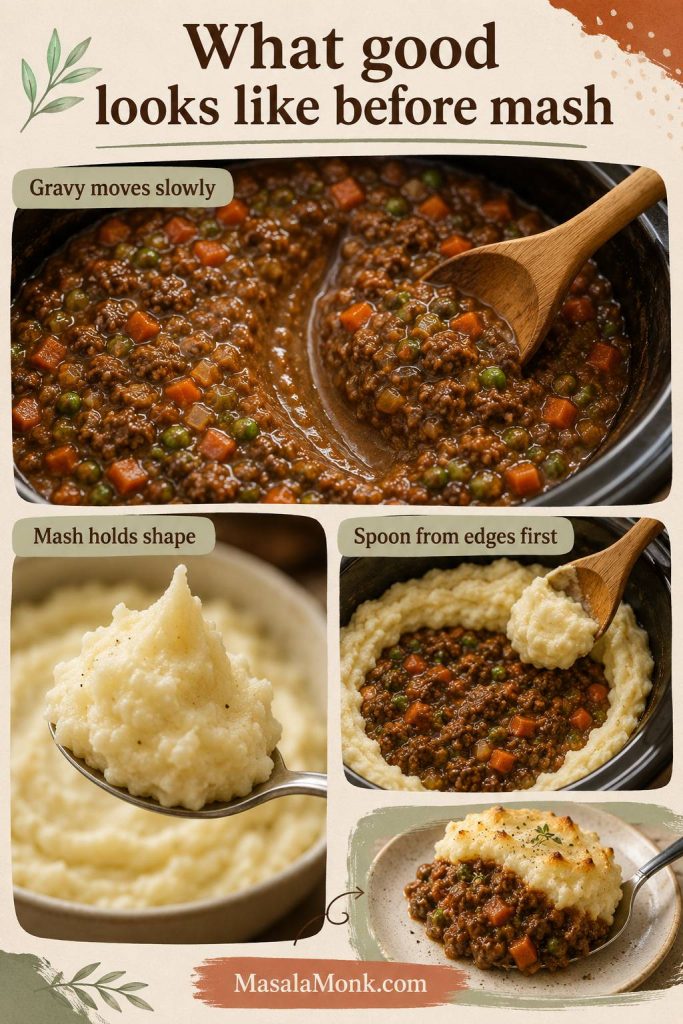
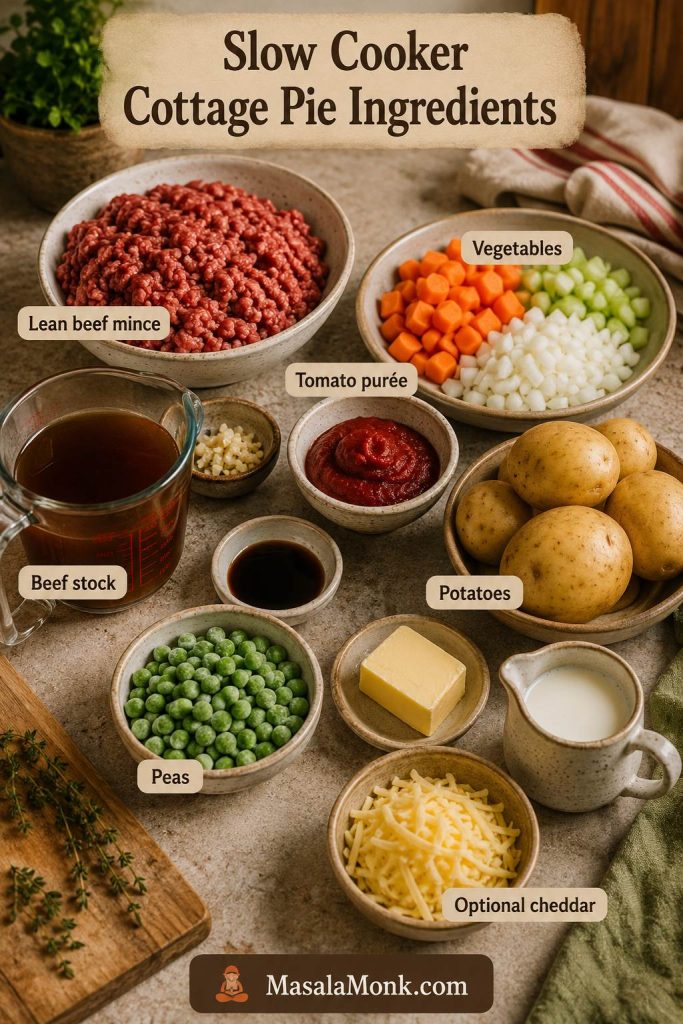
The default version uses tomato purée or tomato paste rather than a full tin of chopped tomatoes, because the slow cooker does not reduce liquid like an oven or pan.

Ingredient board with beef mince, vegetables, tomato purée, beef stock, potatoes, peas, butter, milk, and cheddar for cottage pie.
In slow cooker cottage pie, ordinary ingredients work best when the stock stays modest and the mash is not too loose.

Beef filling ingredients

IngredientAmountNotes
Neutral oil or olive oil1 tsp, optionalUse only if cooking very lean mince in a dry pan.
Lean beef mince / ground beef500g / about 1 lb 2 ozUse 5–10% fat if possible. It gives flavour without making the slow cooker greasy.
Onion, finely diced1 largeAdds sweetness and helps build the gravy base.
Carrots, finely diced2 mediumClassic cottage pie sweetness and colour.
Celery, finely diced1–2 sticks / stalksBuilds a deeper savoury base.
Garlic2–3 clovesAdds depth without taking over.
Tomato purée / tomato paste2 tbspGives depth, colour, and savoury concentration without adding much water.
Plain flour / all-purpose flour2 tbspDefault thickener for the browned-mince method.
Beef stock225ml / scant 1 cupUse about 200ml for mushrooms, frozen mixed vegetables, or no-browning. If adding chopped tomatoes, reduce the stock to 100–150ml.
Worcestershire sauce1 tbspGives savoury, tangy depth.
Dried thyme or rosemary1 tspUse either, or a small mix of both.
Frozen peas100–150g / ¾–1 cupAdd near the end so they stay brighter.
Salt and black pepperTo tasteStart light if your stock is salty; adjust before adding the mash.

How Much Stock to Use in Slow Cooker Cottage Pie

Stock is the easiest place to control the finished texture. Start modest, then adjust for watery add-ins such as mushrooms, frozen vegetables, raw mince, or chopped tomatoes.

Stock guide showing a measuring jug and different stock amounts for default cottage pie, raw mince, frozen vegetables, mushrooms, and chopped tomatoes.
Because slow cookers trap moisture, adjusting the stock is one of the easiest ways to prevent watery cottage pie filling.

If you are using mushrooms, frozen vegetables, or chopped tomatoes, the watery filling section explains how to adjust the liquid before topping.

Optional flavour boosters and add-ins

  • Mushrooms: add 100–150g finely chopped mushrooms with the vegetables for a deeper, meatier filling. Use slightly less stock because mushrooms release moisture.
  • Red wine: replace 50–100ml of the stock with red wine. Let it bubble briefly in the pan before slow cooking.
  • Brown sauce or mustard: add 1 teaspoon to 1 tablespoon for a sharper UK-style savoury note.
  • Chopped tomatoes: use 200g / about 7 oz chopped tomatoes if you want a tomato-rich filling, and reduce the stock to 100–150ml. Expect to thicken near the end if needed.
  • Frozen mixed vegetables: use them in place of peas and carrots if needed, but add them late or reduce the stock because they release water.

Optional thickener

When the filling looks loose near the end, mix 1 tablespoon cornflour / cornstarch with 1 tablespoon cold water, stir it into the filling, and cook on high until the gravy tightens. For a quick UK-style option, you can use 1–2 teaspoons beef gravy granules instead, but taste before adding more because they add salt quickly.

Mashed potato topping ingredients

IngredientAmountNotes
Floury potatoes800–900g / 1 lb 12 oz–2 lbMaris Piper, King Edward, Russet, or Yukon Gold work well.
Butter30–45g / 2–3 tbspAdds flavour and helps the mash spread.
Milk60ml / ¼ cup, plus 1 tbsp at a time only if neededStart small. The mash should be creamy but not loose.
Cheddar, optional75–100g / ¾–1 cup gratedUse in the mash or on top for a cheesy finish.
Leftover, prepared, or instant mashAbout 4 cups / enough to coverWarm slightly if chilled, and keep it thicker than usual so it sits on the filling.
SaltTo tasteSeason the mash separately from the filling.

For a deeper guide to creamy potatoes that stay fluffy instead of gluey, use our garlic mashed potatoes recipe; the same steam-dry step helps this topping sit neatly on the filling.

Texture cue: the mash should hold soft peaks on a spoon. If it slides, pours, or feels like loose purée, it is too wet for this recipe. Steam-dry fresh potatoes and add milk gradually.

Slow Cooker Size and Equipment

A 3.5–5L / 4–5 quart oval slow cooker is ideal for this recipe. It keeps the beef layer deep enough while leaving enough surface area to spread the topping. A round slow cooker works too, but an oval insert makes the finished pie easier to serve.

Equipment guide showing an oval slow cooker, skillet, saucepan, masher, oven dish, measuring jug, bowl, fork, and thermometer.
An oval cooker gives the beef layer useful depth while leaving enough room to spread the potato evenly.
  • Large skillet or frying pan: for browning the mince and cooking the vegetables.
  • 3.5–5L / 4–5 quart slow cooker: best for the 500g beef version.
  • Large saucepan: for boiling potatoes.
  • Potato masher or ricer: for smooth mash that is steady enough to spread.
  • Small bowl: for mixing cornflour/cornstarch slurry if needed.
  • Oven dish: useful if you want a golden top and your slow-cooker insert is not oven-safe.
  • Instant-read thermometer: helpful for the raw-mince method.

Important insert safety note: only put a slow-cooker insert under the grill, broiler, or into the oven if the manufacturer says that exact insert is safe for that use. If there is any doubt, transfer the filling to an oven dish before topping and browning.

For the safest browning choices, check the finish options before putting any insert under direct heat.

The recipe is forgiving as long as the filling is not too loose and the topping is not too wet. Use less liquid than an oven cottage pie, adjust watery add-ins, and choose whether you want a soft slow-cooker top or a golden oven, grill, or broiler finish.

How to Make Slow Cooker Cottage Pie

The method looks detailed, but the cooking itself is simple: brown the beef if you can, let the slow cooker build the gravy, then top when the filling is ready. By the end, the carrots should be sweet, the gravy should smell deeply savoury, and the mash should sit proudly on top instead of sliding into the filling.

This is the kind of cottage pie that does not need perfect slices to feel right; it just needs a thick savoury base, warm potato, and enough gravy to make the greens on the side worth eating.

1. Brown the beef mince

Heat a large skillet or frying pan over medium-high heat. If you are using very lean mince or a dry pan, add 1 teaspoon oil first. Add the beef mince and break it into small crumbles with a wooden spoon. Let it brown properly instead of simply turning grey. A little colour on the beef gives the finished filling a deeper savoury flavour.

If the mince releases a lot of fat, spoon or drain off the excess before you continue. Slow cookers do not evaporate fat away, so this small step keeps the filling rich rather than greasy.

2. Add the vegetables

Add the onion, carrot, celery, garlic, and mushrooms if using. Cook for 4–5 minutes, stirring often, until the onion starts to soften and smell sweet. The vegetables do not need to be fully tender yet because they will finish in the slow cooker.

3. Build the gravy base

Stir in the tomato purée, Worcestershire sauce, thyme or rosemary, salt, and black pepper. Sprinkle over the flour and stir for 1 minute so it coats the mince and vegetables. This cooks off the raw flour taste and gives the gravy a smoother texture later.

Add the stock gradually, scraping the bottom of the pan as you stir. The mixture should become glossy and lightly saucy, not thin and soupy. If using wine, add it before the stock and let it bubble briefly.

Beef mince and vegetables being stirred in a skillet with tomato purée, Worcestershire sauce, flour, and stock.
This is where cooked mince becomes cottage pie filling: tomato purée, Worcestershire, flour, and stock create the gravy base.

4. Slow cook the filling

Transfer the beef mixture to the slow cooker. Cover and cook on high for 3½–4 hours or on low for 6–7 hours, until the vegetables are tender and the filling tastes rounded and savoury.

Start looking from 3 hours on high or 5½ hours on low if your slow cooker runs hot, has a wide insert, or the filling is sitting in a shallow layer. Try not to lift the lid too often early on, because each lift releases heat and can stretch the cooking time.

5. Look at the Gravy Before Adding Mash

Pause here before you add the mash; this one look makes the biggest difference. Stir the filling and drag a spoon through the centre. If the gravy leaves a visible trail for a second before slowly closing, the filling is ready for mash. The first spoonful should hold together but still look saucy.

When it is right, the filling should smell deeply savoury and look glossy rather than soupy, with carrots soft enough to melt into the gravy but still visible in each spoonful.

Close-up of a spoon trail through glossy beef mince filling in a slow cooker with peas, carrots, and onion visible.
Once a spoon trail lingers, the filling is ready for mash; if it floods back like soup, thicken it first.

If the trail disappears immediately, use the quick fixes in How to Stop Slow Cooker Cottage Pie Going Watery before adding mash.

When the gravy floods back immediately, pause and give it a little help before topping. Mix 1 tablespoon cornflour or cornstarch with 1 tablespoon cold water, stir it into the filling, and cook on high for 20–30 minutes. If your slow cooker holds heat well, you can cook uncovered. If it cools quickly, leave the lid slightly ajar, or thicken a few ladles of liquid in a small pan and stir it back into the slow cooker.

This is also the best time to taste the filling. Add salt, pepper, Worcestershire sauce, or a little more tomato paste if it needs more depth. Once the mash goes on, adjusting the filling becomes harder.

Should You Add the Mash at the Start?

It is better to add the mash near the end, after the beef filling has cooked and settled. If mash goes on too early, condensation can soften it, bubbling gravy can break through it, and you lose the chance to fix a loose filling before topping.

6. Add the peas late

Stir in the frozen peas during the final 20–30 minutes of filling time. They will heat through quickly, stay brighter, and release less water into the gravy than they would if added at the beginning.

7. Make creamy mash that holds its shape

You can make the mash during the final 30–40 minutes of the filling time, then keep it warm and loosely covered until the filling is ready to top.

Boil the potatoes in salted water until tender. Drain well, then return them to the hot pan for 1–2 minutes so extra steam escapes. Mash with butter, then add 60ml / ¼ cup milk. Add more milk 1 tablespoon at a time only if the mash is too stiff to spread.

Three-part mashed potato comparison showing too loose mash, creamy steady mash, and too stiff mash for cottage pie topping.
The best mash for cottage pie is creamy and steady, because loose mash sinks while stiff mash drags through the filling.

If using cheddar, stir some into the mash or save it for the top. Warm mash spreads more easily than cold leftover mash, so if you are using leftovers, warm them slightly before topping the filling.

8. Spoon the mash gently over the filling

Add the mash in small spoonfuls around the edges of the slow cooker first, then fill the centre. Spread gently with a fork or spatula. Avoid dropping all the mash into the middle at once because that weight can push through the filling.

Hand spooning mashed potato around the edges of slow cooker cottage pie filling before filling the centre.
Start spooning mash around the edges, then fill the centre; the border helps the potato spread without diving into the gravy.

If the topping starts to sink, pause and use the mash-sinking fixes before spreading the rest.

Use a fork to make ridges on top. Those ridges catch heat and brown better if you finish the pie under the grill, broiler, or in the oven.

9. Finish and rest

For the easiest finish, cover and cook on high for 45–60 minutes until the mash is hot. For a golden top, either use a safe grill/broiler finish or transfer the filling to an oven dish and bake until browned.

The slow-cooker-only version is softer and homier; the oven-finished version gives you those golden ridges and bubbling edges that make cottage pie feel more like a proper baked dinner.

Let the cottage pie rest for 10 minutes before serving. Resting lets the gravy settle and the mash firm slightly, so the first spoonful comes out with creamy potato on top and glossy beef gravy underneath.

Slow Cooker Timing Table

Use this timing table as a guide for when to look at the filling, add peas, warm the mash, and decide how you want to finish the top.

StageHigh settingLow settingNotes
Beef filling3½–4 hours6–7 hoursStart looking earlier if your slow cooker runs hot or has a wide insert.
Thickening adjustment20–30 minutes on highSwitch to highUse slurry only if the filling looks loose.
PeasFinal 20–30 minutesFinal 20–30 minutesAdd late for better colour and texture.
Mash topping in slow cooker45–60 minutesNot idealUse high to heat the mash through.
Oven-dish finish200°C / 400°F for 20–25 minutesSameMost classic finish if your insert is not oven-safe.
Grill / broiler finish5–10 minutesSameOnly use a safe insert or separate oven dish.
Timeline infographic showing slow cooker cottage pie filling time, gravy check, peas, mash timing, topping heat-through, and resting time.
Keep the flow calm: cook the filling first, add peas late, make the mash near the end, then rest before serving.

Choosing the Finish: Soft, Golden, or Classic

The slow cooker is excellent at making the filling tender and savoury. The finish depends on what you want from the topping: easiest, golden, or most classic.

What to expect: a slow cooker will heat the mash, but it will not give you a crisp browned crust. For a soft family-style cottage pie, keep it in the slow cooker. For a classic golden top, use the oven, grill, or broiler.

Finish optionGood forResultKeep in mind
Slow cooker onlyLowest effort family dinnerHot, soft mash topping with rich filling underneathNo crisp or golden top
Grill / broilerGolden top without baking the whole dishBrowned fork ridges, melted cheese, better colourInsert must be safe for direct heat
Oven dishNeatest classic cottage pie finishBubbling filling, golden mash, easier servingUses one extra dish
Three cottage pie finish options showing soft slow-cooker mash, golden browned mash, and a classic baked finish.
The slow cooker gives a soft top, while a grill, broiler, or oven finish adds golden ridges and bubbling edges.

Most classic: slow cook the filling, transfer it to an oven dish, top with mash, and bake at 200°C / 400°F for 20–25 minutes. This gives bubbling gravy at the edges, golden fork ridges, and a potato topping that feels baked rather than steamed.

No-extra-dish option: grill or broil the topping in the slow-cooker insert only if the manufacturer says the insert is safe for direct heat.

Easiest option: keep everything in the slow cooker and cook on high until the mash is hot. The top will be soft, not golden, but the dinner will still be comforting and complete.

Once the gravy looks glossy and the mash is hot, the rest is just the kind of comfort you want: soft if you keep it in the slow cooker, golden if you finish it under heat.

Can You Put Raw Mince in Slow Cooker Cottage Pie?

Yes, you can put raw mince in slow cooker cottage pie, but browned mince gives better flavour, better texture, and lets you drain fat first. If you need the shortcut, use fresh, fully thawed lean mince, reduce the stock, break it up well, and thicken near the end.

Some nights, simply getting dinner into the slow cooker is enough. This shortcut is not the richest version, but it can still give you a useful, comforting cottage pie if you handle the liquid carefully.

Browned Mince vs Raw Mince

Both routes can work, but they need different handling. Browning builds deeper flavour and lets you drain fat first; meanwhile, raw mince needs less stock, careful stirring, and a final texture check.

Comparison image showing browned beef mince in a pan beside raw thawed mince and vegetables in a slow cooker.
Browned mince gives deeper flavour; meanwhile, the raw-mince shortcut needs less stock and a final thickening step.

Is This a Dump-and-Go Cottage Pie?

It can be close to dump-and-go, but not completely hands-off. Use raw thawed lean mince, frozen mixed vegetables, less stock, and prepared mash if you want the easiest version. Just give the filling one look near the end so you can thicken it before the mash goes on.

Raw-mince / no-browning method

  1. Use fresh, fully thawed lean mince. Avoid starting with frozen raw mince.
  2. Crumble the mince into the slow cooker instead of leaving it in a block.
  3. Add the onion, carrot, celery, and garlic.
  4. Whisk the tomato purée, Worcestershire sauce, herbs, and 175–200ml stock together, then pour it over the mince and vegetables.
  5. Skip the flour at the beginning because it can clump with raw mince and cold liquid.
  6. Cook on high for 1 hour, then stir well to break up clumps if you are nearby. Either continue on high until the total cooking time reaches 3½–4 hours, or switch to low and cook for another 5–6 hours, until the beef is cooked through and the vegetables are tender.
  7. Spoon off excess fat or liquid if needed.
  8. Thicken near the end with 1–2 tablespoons cornflour/cornstarch mixed with equal cold water.
  9. Add peas, check seasoning, then top with mash that is spreadable but not loose.
Raw mince slow cooker guide showing thawed beef mince, diced vegetables, reduced stock, tomato purée, thermometer, and cooked filling.
Raw mince is the shortcut route, but it still needs thawed lean beef, less stock, good stirring, and final thickening.

For peace of mind with the raw-mince option, use an instant-read thermometer if you have one. Ground beef should reach 160°F / 71°C, and for slow-cooker safety the USDA recommends thawing meat before it goes into a slow cooker: USDA slow cooker food safety guidance.

How to Stop Slow Cooker Cottage Pie Going Watery

Watery filling usually comes from too much stock, undrained fat, watery vegetables, or adding mash before the gravy has tightened.

Troubleshooting board comparing watery cottage pie filling with glossy settled filling and showing stock, drained fat, wet vegetables, and slurry.
Watery cottage pie usually comes from too much stock, undrained fat, or wet add-ins, so fix the filling before topping.

Use less stock than an oven recipe

For 500g beef mince, 225ml stock is the default for the browned method. Use about 200ml if you add mushrooms, frozen mixed vegetables, or raw mince. If adding 200g / about 7 oz chopped tomatoes, reduce the stock to 100–150ml. Use up to 250ml only if the mince is browned and drained and the filling genuinely looks dry.

Watch mushrooms, frozen veg, and chopped tomatoes

Mushrooms, frozen mixed vegetables, chopped tomatoes, and extra onions all bring moisture. They work well, but they need a lower stock amount or a little extra thickening near the end.

Drain the browned mince

Fat and liquid do not disappear in the slow cooker. Drain the mince if it releases a lot of fat, and spoon off any greasy layer before adding the mash.

Thicken before topping

If the filling is loose, thicken it first and use the spoon trail from earlier before adding the mash. Cornflour/cornstarch gives the cleanest fix; gravy granules are useful when you want a quick UK-style thickening shortcut.

Gravy Granules and Cottage Pie Packet Mix

Shortcut helpers can be useful, especially in UK-style cottage pie, but they still need careful liquid control and tasting before extra salt goes in.

Shortcut helper board showing gravy granules, packet mix, glossy beef filling, a measuring jug, and a tasting spoon.
Gravy granules and packet mix can help on busy nights; however, reduce the liquid slightly and taste before salting.

Can You Use Gravy Granules to Thicken It?

Yes. Gravy granules are useful when you want a quick UK-style thickening shortcut, not just when something has gone wrong. Start with 1–2 teaspoons, let the filling settle for a few minutes, then taste before adding more because they add salt quickly.

Can You Use a Cottage Pie Packet Mix?

Yes. Use the packet as the flavour base, but reduce the liquid slightly because the slow cooker will not evaporate it the way an oven or pan does. Taste before adding extra salt, and make sure the filling is settled enough for topping.

How to Stop the Mash Sinking

Mashed potato sinks when the filling is too loose, the mash is too wet, or the topping is added too heavily in one place. The fix is simple: thicken the filling first, use mash that holds its shape, and spoon from the edges inward.

Fix-it guide showing loose filling, wet mash, edge-first spooning, and finished mashed potato sitting on cottage pie.
If the mash sinks, the recipe is not ruined; next time, thicken the filling, use sturdier mash, and spoon from the edges inward.
  • Let fierce bubbling settle. If the filling is bubbling aggressively, turn the slow cooker off for 10 minutes before topping.
  • Use sturdy mash. Steam-dry the potatoes and add milk slowly.
  • Start at the edges. The rim gives the potato a firmer starting point than the centre.
  • Spoon, then spread. Dot small mounds of mash across the surface before smoothing.

If the mash already sank: serve it as a rustic cottage pie bowl. It will not look neat, but the flavour is still there. Next time, thicken the filling first and spoon the topping from the edges inward.

Topping Options: Mash, Cheese, Sliced Potatoes, and Shortcuts

The topping can be classic, cheesy, leftover, instant, or sliced. Choose the one that matches the amount of effort you want and the finish you like best.

ToppingBest forKeep in mind
Fresh mashBest textureSteam-dry potatoes and add milk slowly.
Leftover mashConvenienceWarm before spreading so it does not pull at the filling.
Instant mashFastest shortcutMake it thicker than packet directions.
Cheesy mashGolden finishCan get salty if the filling is already well seasoned.
Sliced potatoesDifferent textureNeeds oven, grill, or broiler finish.
Sweet potato mashLighter, sweeter toppingHolds more moisture, so use less milk.
Topping options board showing fresh mash, cheesy mash, leftover mash, instant mash, sliced potatoes, sweet potato mash, and finished cottage pie.
Once the beef layer is glossy and spoonable, the topping becomes flexible: classic mash, cheese, leftovers, instant mash, sliced potatoes, or sweet potato.

Classic mashed potato

Classic mash is the most reliable all-purpose topping. Use floury potatoes, butter, a little milk, and salt. The texture should be spreadable without sinking, but not so stiff that it tears up the filling underneath.

Cheesy mash

Cheddar gives this cottage pie a more finished, oven-baked feel. Stir some into the mash or scatter it on top before grilling or broiling. Cheese also helps the fork ridges brown.

Leftover mash

Leftover mash is one of the easiest shortcuts. Warm it slightly before spreading so it is not fridge-cold and stiff. If it has dried out, beat in a small knob of butter or a splash of milk, but keep the texture thick enough to sit on the filling.

If you have more leftover mash than you need for topping, turn it into crisp snacks with our croquettes recipe.

Can You Use Instant Mash for Slow Cooker Cottage Pie?

Yes, instant mash works for a shortcut version, but make it thicker than the packet directions suggest. Let it stand for 5 minutes before topping, and add a little grated cheese if it needs more structure. It is exactly the kind of shortcut that makes sense on a weeknight, especially when the beef filling is already rich and well seasoned.

Instant mash guide showing thick prepared instant mash, potato flakes, a timer, and mash being spooned over cottage pie filling.
Instant mash works as a cottage pie shortcut when it is thicker than usual and rested before it goes on.

Sliced potato topping

You can make slow cooker cottage pie with sliced potatoes, but it works best with an oven or grill finish. Slice the potatoes thinly, parboil if needed, layer them over a beef filling that holds together, brush with butter or oil, and finish until tender and golden. A slow cooker alone will soften sliced potatoes but will not make them crisp.

Sweet potato mash

Sweet potato mash gives the pie a sweeter, lighter feel. Because sweet potatoes hold more moisture than white potatoes, steam them well after cooking and use less milk. This works especially well for a lighter variation.

You should be able to scoop through soft potato into glossy beef gravy in a spoonful that lands on the plate as dinner, not soup. Use the recipe card below as the practical cook-through version.

Slow Cooker Cottage Pie Recipe Card

Description: A rich slow cooker cottage pie with savoury beef gravy, creamy mashed potatoes that sit neatly on top, optional cheddar, and an oven or grill finish for a golden top.

Before you top it: gravy first, mash second. The beef filling should briefly hold a spoon trail before the potato goes on. If it looks loose, thicken it first.

Need a shortcut or rescue? See raw mince, watery filling, instant mash, or golden finish before you start.

Prep time
25 minutes
Filling cook time
3½–4 hours high or 6–7 hours low
Total time
About 4½–5½ hours on high
About 7–8½ hours on low
Yield
4 generous servings

Timing note: an oven or broiler finish is quicker; heating the mash through in the slow cooker takes longer.

Equipment: 3.5–5L / 4–5 quart slow cooker, large skillet or frying pan, saucepan, potato masher or ricer, small bowl for slurry, and an oven dish if browning the top outside the slow cooker.

Ingredients

Beef filling

  • 1 tsp neutral oil or olive oil, optional, for very lean mince
  • 500g lean beef mince / ground beef, about 1 lb 2 oz
  • 1 large onion, finely diced
  • 2 medium carrots, finely diced
  • 1–2 celery sticks, finely diced
  • 2–3 garlic cloves, minced
  • 2 tbsp tomato purée / tomato paste
  • 1 tbsp Worcestershire sauce
  • 2 tbsp plain flour / all-purpose flour
  • 225ml beef stock / scant 1 cup
  • Stock adjustment: use about 200ml with mushrooms or frozen veg, 175–200ml for no-browning, or 100–150ml with chopped tomatoes
  • 1 tsp dried thyme or rosemary
  • 100–150g frozen peas / ¾–1 cup
  • Salt and black pepper, to taste, starting light if your stock is salty

Optional flavour boosters and add-ins

  • 100–150g mushrooms, finely chopped
  • 50–100ml red wine, replacing part of the stock
  • 1 tsp mustard or 1 tbsp brown sauce
  • 200g / about 7 oz chopped tomatoes, with stock reduced to 100–150ml

Optional thickener

  • 1 tbsp cornflour/cornstarch mixed with 1 tbsp cold water, only if the filling is loose near the end
  • For a UK-style shortcut, use 1–2 tsp beef gravy granules near the end, wait a few minutes, then taste before adding more because they add salt quickly.

Mash topping

  • 800–900g floury potatoes, peeled and cut into chunks
  • 30–45g butter / 2–3 tbsp
  • 60ml milk / ¼ cup, plus 1 tbsp at a time only if needed
  • 75–100g grated cheddar, optional
  • Or about 4 cups leftover, prepared, or instant mash, kept thicker than usual
  • Salt, to taste

Instructions

Cook the Beef Filling

  1. Brown the mince. Heat a large skillet over medium-high heat. Add 1 tsp oil if using very lean mince. Add the beef mince and cook until browned, breaking it into small crumbles. Drain excess fat.
  2. Add vegetables. Stir in onion, carrot, celery, garlic, and mushrooms if using. Cook for 4–5 minutes until beginning to soften.
  3. Build the gravy. Add tomato purée, Worcestershire sauce, herbs, salt, and pepper. Sprinkle over the flour and stir for 1 minute.
  4. Add stock. Pour in the beef stock gradually, scraping the pan and stirring until the mixture looks glossy. If using wine, add it before the stock and let it bubble briefly.
  5. Slow cook. Transfer to the slow cooker. Cover and cook on high for 3½–4 hours or low for 6–7 hours. Check earlier if your slow cooker runs hot.
  6. Check thickness. Stir the filling. Drag a spoon through it; the gravy should leave a brief path. If loose, stir in 1 tbsp cornflour/cornstarch mixed with 1 tbsp cold water and cook on high for 20–30 minutes.
  7. Add peas. Stir in frozen peas during the final 20–30 minutes of filling time. Taste and adjust seasoning.

Make the Mash and Finish

  1. Make mash. During the final 30–40 minutes of filling time, boil potatoes in salted water until tender. Drain, steam-dry for 1–2 minutes, then mash with butter and 60ml / ¼ cup milk. Add more milk 1 tablespoon at a time only if needed. Stir in some cheddar if using.
  2. Top the filling. Spoon mash over the beef filling in small mounds, starting around the edges. Spread gently and rough up the surface with a fork. Add cheddar on top if desired.
  3. Finish. For the easiest soft topping, cover and cook on high for 45–60 minutes. For a golden top, transfer to an oven dish and bake at 200°C / 400°F for 20–25 minutes, or grill/broil for 5–10 minutes only if your insert is safe for direct heat.
  4. Rest and serve. Let the cottage pie rest for 10 minutes before serving.

Recipe Notes

  • Best flavour: brown the mince when you can. It gives deeper flavour and lets you drain excess fat.
  • Raw-mince shortcut: skip the flour at the start, use fresh, fully thawed lean mince, reduce stock to 175–200ml, break the mince up well, whisk tomato purée into the stock before adding, and thicken near the end.
  • Chopped tomatoes: if using 200g / about 7 oz chopped tomatoes, reduce the stock to 100–150ml and check the filling before topping.
  • Shortcut mash: warm leftover or prepared mash slightly before spreading; make instant mash thicker than the packet directions.
  • Thickening options: cornflour/cornstarch slurry gives the cleanest fix; gravy granules also work but add salt quickly.
  • Slow-cooker insert warning: only grill/broil or oven-finish in the insert if the manufacturer says it is safe.

For a quick saveable reference, the image below keeps the core slow-cooker cottage pie numbers together without replacing the fuller method above.

Saveable recipe card for slow cooker cottage pie with a photo, serving count, beef mince amount, stock amount, timing, mash timing, and resting note.
Save the core slow cooker cottage pie numbers: 500g beef mince, 225ml stock, mash near the end, and 10 minutes of resting.

Why This Slow Cooker Cottage Pie Works

  • Less liquid: 225ml stock gives enough gravy for 500g beef mince without drowning the topping.
  • Tomato purée instead of a full tin of tomatoes: you get savoury depth without adding too much water.
  • Browning when possible: it builds flavour and lets you drain fat before slow cooking.
  • Flour first, slurry later: flour thickens the browned method from the start; cornflour/cornstarch rescues a loose filling near the end.
  • Late peas: they stay brighter and do not release water into the filling too early.
  • Steam-dried mash: extra steam leaves the potatoes, so the topping stays creamy but sturdy.

That same low-liquid thinking is useful in other slow-cooker dinners too; our slow cooker sausage casserole recipe uses the same idea to keep the sauce glossy instead of thin.

Fixes for Watery Filling, Sinking Mash, and Pale Topping

A loose filling is not a ruined dinner. Most slow-cooker cottage pie problems can be fixed with a little thickening, a short rest, or a gentler topping method.

ProblemFix nowFix next time
Filling is wateryAdd 1 tbsp cornflour/cornstarch mixed with 1 tbsp cold water. Gravy granules also work as a shortcut. Cook on high until thickened.Use less stock, drain browned mince, and reduce liquid for watery add-ins.
Mash sank into the fillingServe as a rustic beef-and-potato bowl.Thicken the filling first, then spoon the topping from the edges inward.
Filling tastes blandAdd salt, pepper, Worcestershire sauce, or a little more tomato paste.Brown the mince harder and use stronger beef stock.
Filling is greasySpoon fat from the surface before topping.Use lean mince and drain fat after browning.
Topping is paleFinish under the grill/broiler or transfer to an oven dish.Plan a golden finish from the beginning and use fork ridges on the mash.
Mash is glueyFold in a little butter and avoid overmixing.Use floury potatoes and mash by hand instead of overworking in a processor.
Mash is too looseStir in grated cheese or extra cooked potato if available.Steam-dry potatoes and add milk gradually.
Slow cooker is too fullRemove some filling before topping.Keep the slow cooker around half to two-thirds full for best cooking and topping space.

Variations and Scaling

These variations still follow the same core idea: keep the filling glossy, not soupy. When you add ingredients that release water or dilute flavour, adjust the stock and seasoning.

Budget version

To stretch the beef, add 100–150g cooked lentils or drained white beans, 100g finely chopped mushrooms, or 1 extra grated carrot. Reduce the stock by 25–50ml if adding mushrooms or frozen vegetables, and taste for extra Worcestershire sauce or tomato paste because stretch ingredients can soften the savoury flavour.

For a family-style version, dice or grate the vegetables small so they melt into the gravy rather than staying as large chunks.

Lighter version

Use 5% lean beef mince, 30g butter instead of 45g, skip extra cheese, and replace up to one-third of the potato with sweet potato if you like a sweeter topping. Add extra carrots, celery, or mushrooms, but keep the stock modest so the filling still feels hearty.

Crockpot shepherd’s pie with ground beef

For US-style crockpot shepherd’s pie, follow the same method with ground beef. You can also use frozen mixed vegetables and prepared mashed potatoes for a shortcut version, but make sure the beef layer holds together before adding the topping.

Lamb shepherd’s pie version

If using lamb mince, follow the same method but drain the fat carefully because lamb can be richer than beef. With lamb, the dish is traditionally called shepherd’s pie rather than cottage pie.

Guinness or red wine cottage pie

Replace part of the stock with Guinness or red wine for a deeper gravy. Use a modest amount and let it bubble briefly with the browned mince before slow cooking so the flavour becomes rounded rather than sharp.

Vegetarian or lentil cottage pie

For a vegetarian version, treat this as inspiration rather than a direct swap. Lentils and mushrooms need different liquid, so they deserve their own slow-cooker recipe.

Making a larger batch

If you want to make a larger crockpot cottage pie with 1kg / about 2 lb ground beef, use a 6–8 quart slow cooker and scale carefully. When scaling up, double the beef and vegetables, but be gentler with the liquid. You can always add more stock later; taking it back out is harder.

IngredientStandard recipeLarger version
Beef mince / ground beef500g / about 1 lb 2 oz1kg / about 2 lb
Slow cooker size3.5–5L / 4–5 quart6–8 quart
Stock225ml / scant 1 cupStart with 350ml / about 1½ cups, then add more only if needed
Flour2 tbsp3–4 tbsp
Potatoes800–900g1.5–1.8kg
Filling cook time3½–4 hours high or 6–7 hours lowCheck from 4 hours high or 7 hours low

If you add chopped tomatoes or a lot of mushrooms to a larger batch, reduce the stock further and check the filling before topping. For larger batches, the oven-dish finish is often easier than trying to brown a very full slow-cooker insert.

What to Serve with Slow Cooker Cottage Pie

This is already rich and filling, so the best sides are simple and fresh. For a classic plate, serve it with peas, steamed greens, cabbage, green beans, or roasted carrots. For a lighter plate, add a crisp salad with a sharp vinaigrette.

Serving spread with cottage pie, peas, greens, cabbage, green beans, salad, and chutney or relish.
Because cottage pie is rich and creamy, simple greens, peas, salad, or sharp chutney make the plate brighter and more balanced.

Pickled onions, chutney, or a spoonful of sharp relish also work well because they cut through the creamy mash and beef gravy. If the filling is a little looser and you are serving it more like a rustic cottage pie bowl, crusty bread is useful for catching the gravy.

It should feel generous rather than polished: creamy potato, glossy beef gravy, and enough structure to scoop without needing perfect slices.

Make Ahead, Storage, Freezing, and Reheating

Make Ahead and Freeze Slow Cooker Cottage Pie

The neatest make-ahead order is to prepare the beef filling first, chill it until it sets slightly, then top and finish later. Chilled filling is easier to cover neatly with mashed potato.

Make-ahead guide showing beef filling, mashed potato, freezer portions, and an assembled cottage pie dish ready to finish.
For the best make-ahead cottage pie texture, chill the filling first and freeze portions separately when possible.
  1. Make the beef filling.
  2. Cool and refrigerate it in a covered container.
  3. Make the mash fresh, or use leftover mash.
  4. Reheat the filling until hot.
  5. Top with mash and finish in the slow cooker, oven, or under the grill/broiler.

Can you assemble the whole pie ahead?

Yes, you can assemble the whole pie ahead if the filling is cold and settled. Cover and refrigerate, then reheat until piping hot before serving. A fully assembled chilled pie reheats best in the oven or microwave; the slow cooker is better for keeping already-hot food warm than for reheating from fridge-cold.

Avoid putting a fridge-cold ceramic slow-cooker insert straight into a hot oven. Transfer the pie to an oven dish if you want an oven finish.

Fridge storage

Cool leftovers promptly, then store in an airtight container in the fridge for 3–4 days. Keep the pie covered so the mash does not dry out.

Freezing

For best texture, freeze the beef filling and mashed potato separately. You can freeze assembled cottage pie, but the potato topping may soften slightly after thawing. Freeze in meal-size portions so reheating is easier.

For another freezer-friendly slow-cooker dinner with clear cooker-size guidance, see our slow cooker pulled pork recipe.

How to Reheat Slow Cooker Cottage Pie

Reheat leftovers quickly in the microwave, oven, or on the hob until piping hot. Avoid using a slow cooker as the main method for reheating cold leftovers because it takes too long to move chilled food through the safe temperature range.

Reheating guide showing cottage pie warmed in the microwave, oven, and stovetop with a reminder to heat until piping hot.
Reheat cottage pie until piping hot, using the microwave for speed, the oven for the topping, or the stovetop for loose filling.

For reheating, the USDA safe temperature chart lists leftovers and casseroles at 165°F / 74°C: USDA safe temperature chart.

FAQs

Can I put raw mince in slow cooker cottage pie?

Yes, but treat it as the shortcut version, not the best-flavour version. Use fresh, fully thawed lean mince, reduce the stock, break the mince up well, and thicken the filling near the end. Browned mince still gives better flavour and lets you drain fat first.

Is slow cooker cottage pie dump-and-go?

It can be close, especially if you use raw thawed mince, frozen mixed vegetables, and prepared mash. However, the filling still needs one look near the end so you can thicken it before topping.

Should I add mash at the beginning or near the end?

Add the mash near the end. It gives you a chance to let the filling settle first, so the potatoes stay defined instead of softening into the gravy.

Why did my slow cooker cottage pie go watery?

The usual causes are too much stock, undrained mince fat, watery vegetables, or not enough thickening. The fix is usually simple: use less liquid than an oven cottage pie, then tighten the gravy before the mash goes on.

How do I stop mash sinking into cottage pie?

Use a beef filling that is saucy but not runny, mash that holds its shape, and a gentle topping method. Spoon the potatoes from the edges inward instead of dropping everything into the centre.

Can I use instant mash?

Yes. It is not the fanciest topping, but it is a useful weeknight shortcut if you make it thicker than the packet directions suggest. Let it stand for 5 minutes, then add it only after the filling has thickened.

Can I use gravy granules to thicken the filling?

Yes — they are a handy UK-style shortcut when the filling looks loose, but start small because gravy granules season as well as thicken. Use 1–2 teaspoons near the end, wait a few minutes, then taste before adding more.

Can I use a cottage pie packet mix?

Yes, but reduce the liquid slightly because the slow cooker will not evaporate it like an oven or hob. Taste before adding extra salt, and make sure the filling is settled and glossy before topping.

Can I make it with frozen mixed vegetables?

Yes, frozen mixed vegetables are fine, especially for a shortcut version, but they release water as they heat. Add them late or reduce the stock slightly so the filling holds together.

Can I make it ahead?

Yes. The easiest make-ahead path is filling first, then mash and finish later. If the pie is fully assembled and chilled, reheat it in the oven or microwave until piping hot rather than relying on the slow cooker from cold.

Can I freeze slow cooker cottage pie?

Yes. For the neatest texture, freeze the beef filling and mash separately. Assembled cottage pie also freezes, but the potato topping may soften a little after thawing.

How do I get a golden top?

Use a short grill, broiler, or oven finish after the filling is already hot. Fork ridges, a little butter, and optional cheddar help the top brown quickly, so you get colour without drying out the gravy underneath.

Once you understand the two big ideas — keep the filling glossy, not soupy, and keep the mash sturdy — slow cooker cottage pie becomes a forgiving dinner. Make it soft and simple in the slow cooker, or give it those golden fork ridges under the grill. Either way, it should land on the table as proper comfort.

Tried this with raw mince, instant mash, gravy granules, leftover mash, sliced potatoes, packet mix, or a grill finish? Leave a comment with your slow cooker size, liquid amount, and what you changed — it helps other readers choose the right version.

Back to top