
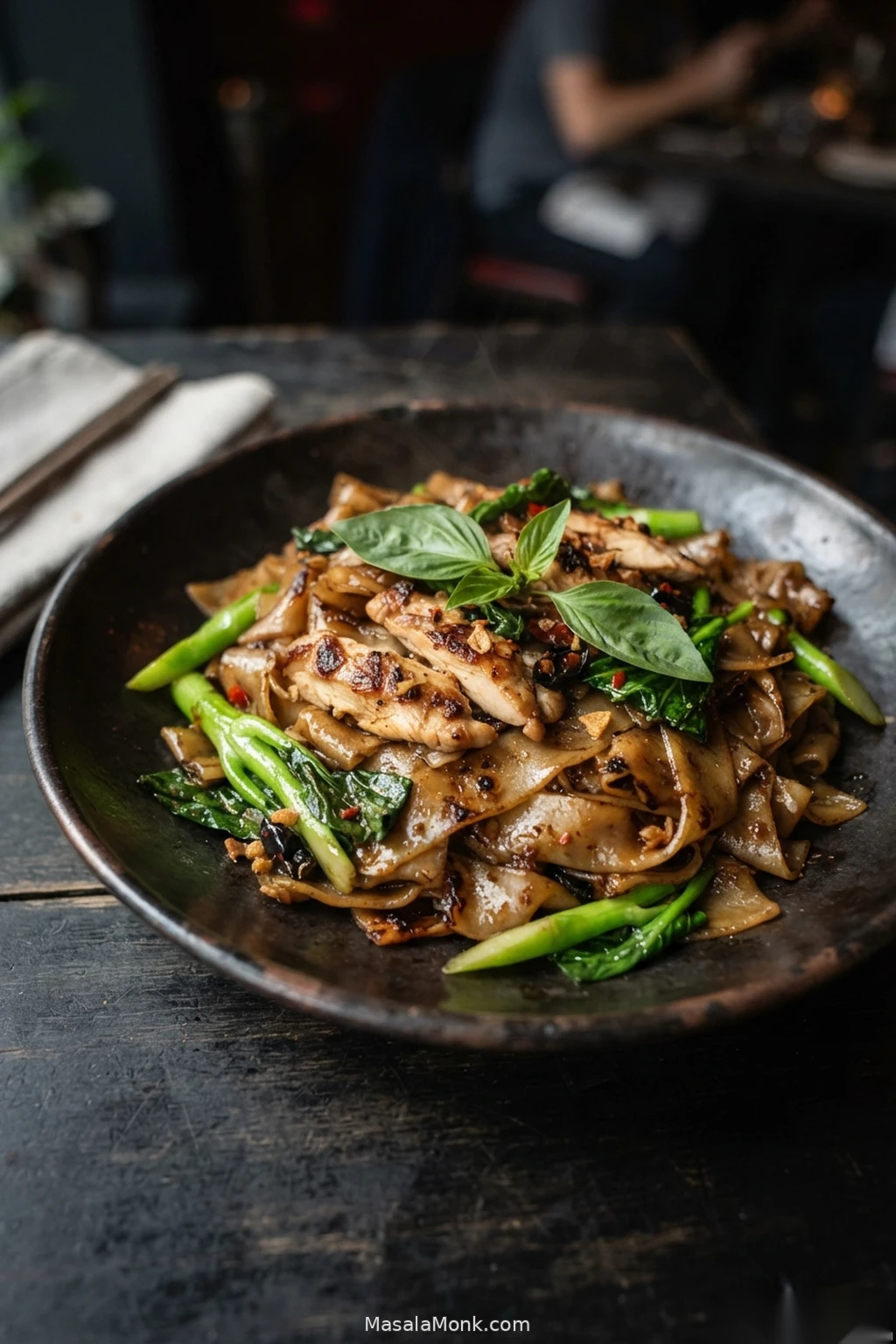
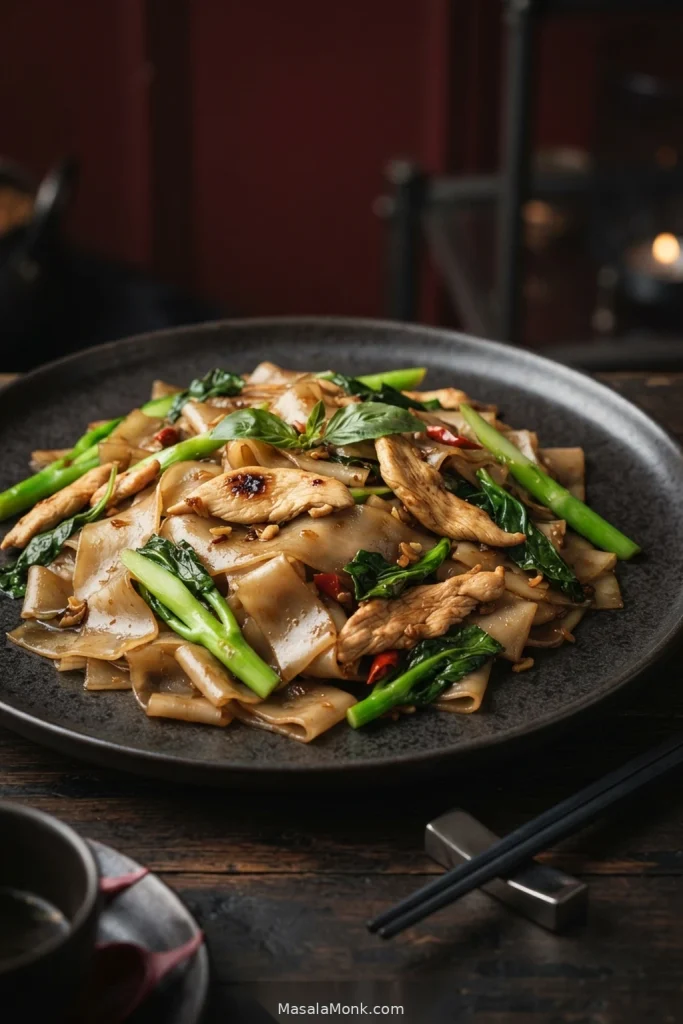
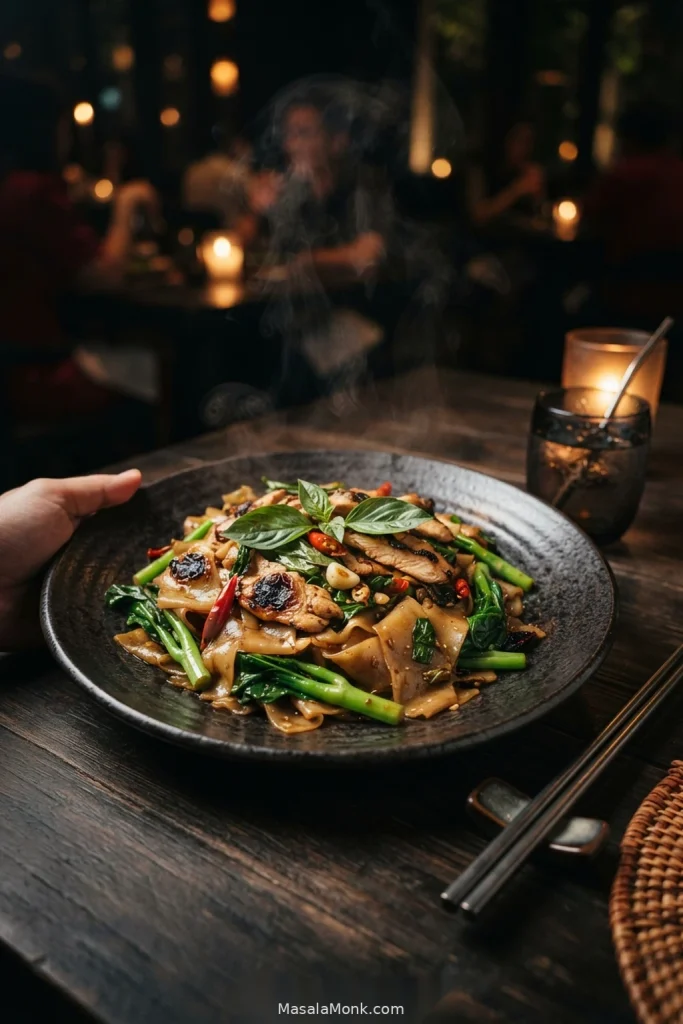
Drunken Noodles, or Pad Kee Mao, are a spicy Thai stir-fry of wide rice noodles with chilli, garlic and basil — and those three flavours should hit you before anything else. The noodles should be chewy and coated in savoury sauce, the chicken juicy, the greens still lively, and a few noodle edges browned where they caught the hot pan.
Sauce isn’t the difficult part here. The trick is getting the noodles, moisture and pan heat to behave at the same time. Fresh and dried wide rice noodles need different preparation, and once they reach the pan, too much water or too much food can turn a fast stir-fry into steaming, sticking and broken noodles.
This version is designed for a normal home kitchen. You can use fresh or dried noodles, a wok or a heavy skillet, and whichever suitable basil you can actually find. The finished dish should stay recognisably Pad Kee Mao: spicy, garlicky, basil-forward, deeply savoury and lightly charred rather than sweet and soupy.
Despite the English name, Drunken Noodles normally contain no alcohol. Several stories connect the name with drinking, late-night eating or particularly fiery food, but no single origin story is universally established.
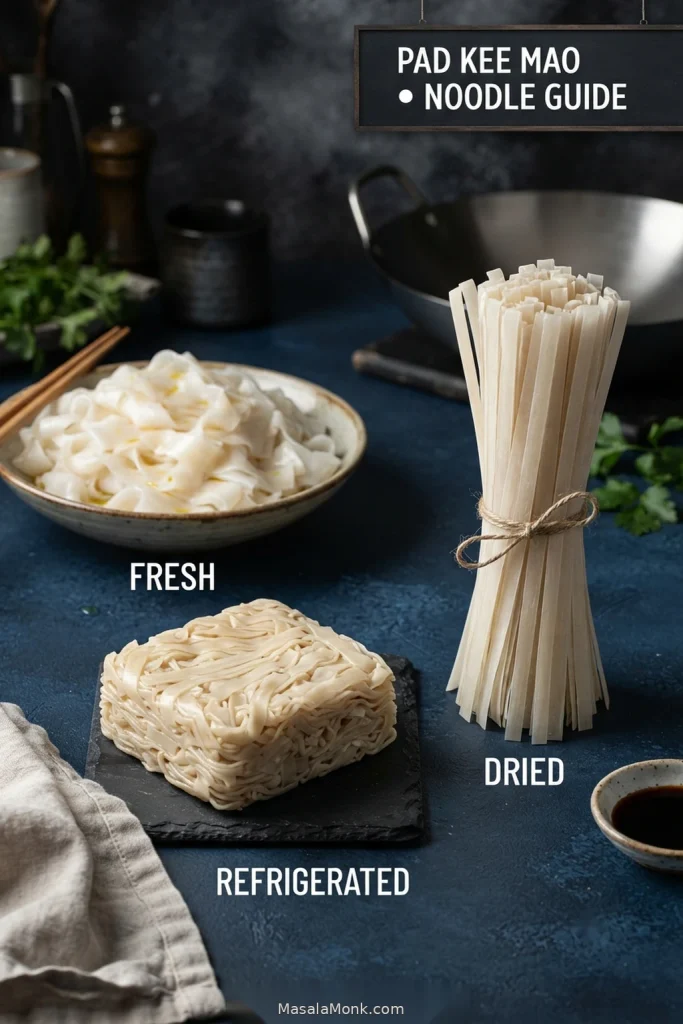
Before You Start: Fresh, Refrigerated or Dried Noodles?
Your noodle type changes how the recipe begins. Fresh and dried rice noodles cannot be prepared the same way.
For the most predictable home-kitchen option, choose extra-wide dried rice noodles. Genuinely fresh wide noodles can be wonderful, but refrigerated fresh noodles vary much more in texture and quality.
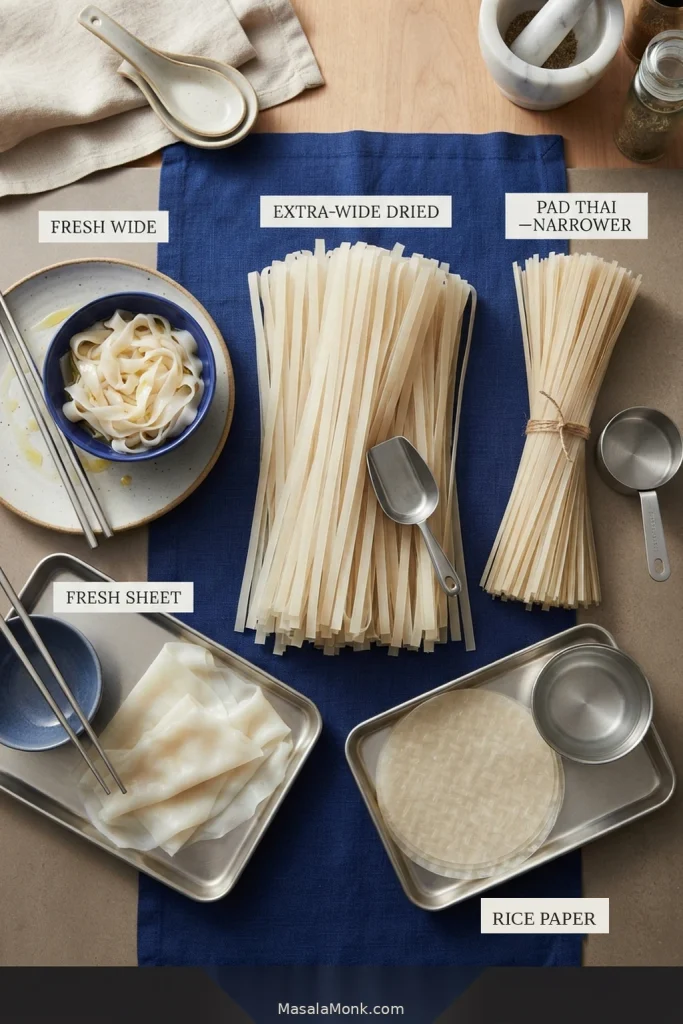
- Fresh wide rice noodles: soft and already pliable. Separate them and keep them dry. Do not soak.
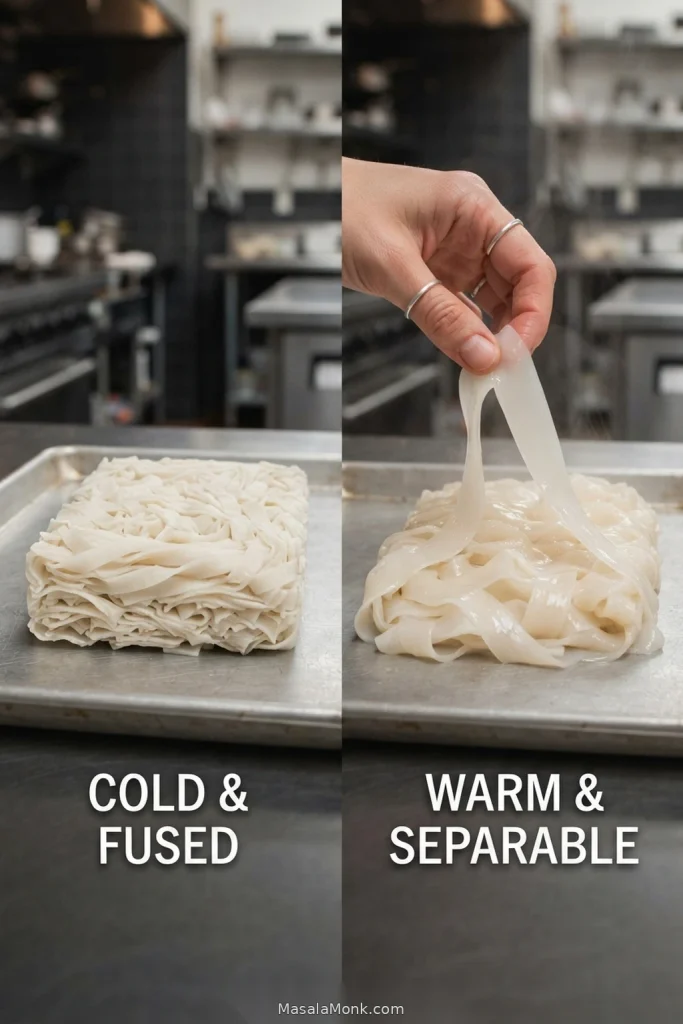
- Refrigerated fresh noodles: cold, firm and often fused together. Warm only until flexible enough to separate.
- Dried wide rice noodles: hard, rigid sticks. Hydrate them until flexible but still slightly underdone.
Thin dried sheets intended for spring rolls or wrapping are a different product. Dried rice paper is not the same thing as cooked fresh rice noodle sheets.
Drunken Noodles Recipe (Pad Kee Mao)
Wide rice noodles, chicken, gai lan, fresh chilli, garlic and basil tossed in a concentrated savoury sauce until well coated, with a few browned and blistered noodle edges.
Serves
2 generously
Prep
About 20 minutes, much of it while dried noodles soak
Cook
8–10 minutes
Total
About 30 minutes
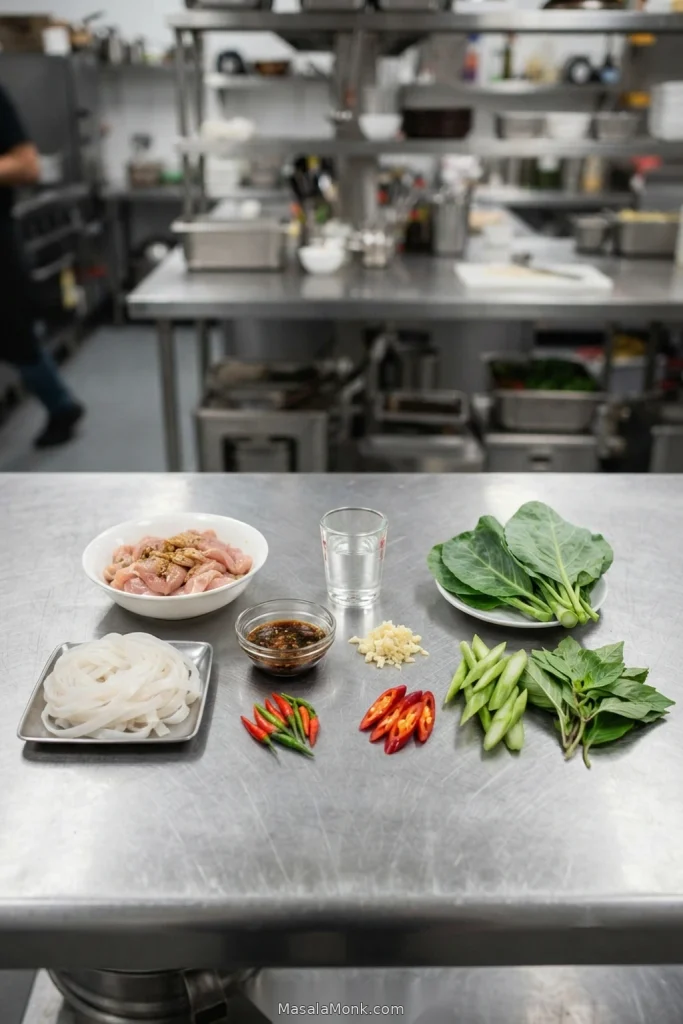
Most of the work happens before the pan gets hot. Once everything is prepared, the actual stir-fry moves quickly.
Pan: A wok or large heavy skillet suited to high heat, around 12 inches / 30 cm across, works well for this amount.
Cooking for four? Double the ingredients but cook two batches. On a weak burner or with particularly delicate fresh noodles, one portion at a time gives even more control.
Noodles — Choose One
- 180 g / 6.3 oz dried extra-wide rice noodles
- or about 400 g / 14 oz fresh wide rice noodles
Fresh noodles already contain a lot of water, so the weights are deliberately different.
Chicken
- 225 g / 8 oz boneless, skinless chicken thighs, sliced about 5–6 mm / ¼ inch thick
- 5 ml / 1 teaspoon regular or light soy sauce
- 5 ml / 1 teaspoon water
- 5 ml / 1 teaspoon neutral oil
Sauce
- 30 ml / 2 tablespoons oyster sauce
- 15 ml / 1 tablespoon regular or light soy sauce
- 10 ml / 2 teaspoons fish sauce
- 5 ml / 1 teaspoon dark soy sauce
- 8 g palm sugar, finely chopped or grated, or about 2 teaspoons brown sugar
- 15 ml / 1 tablespoon water
Keep another 60 ml / ¼ cup plain water beside the stove. You may need none of it. It is there for dried noodles that are already seasoned but still too firm.
Optional: Thai seasoning sauce such as Golden Mountain can replace about 1 teaspoon of the regular soy sauce. Don’t simply add it on top of the other salty seasonings.
Stir-Fry Ingredients
- 30 ml / 2 tablespoons neutral high-heat oil, divided
- 20 g garlic, about 4–5 large cloves
- ½ to 4 Thai bird’s-eye chillies, according to heat preference; start with about 2 if you’re unsure
- Optional: ½ to 1 mild red chilli, thinly sliced, for more fresh-chilli flavour without much extra heat
- 150 g / about 5 oz gai lan or Chinese broccoli
- 25–30 g holy basil or another suitable fresh basil
Slice the gai lan stems thinly on the diagonal. Cut or tear the leafy portions into larger bite-size pieces and keep them separate from the stems.
Prepare the Noodles
For dried noodles: Put them in a large heatproof bowl and cover with very hot water. Leave them off the heat. Start checking around 10 minutes; some brands may need closer to 20.
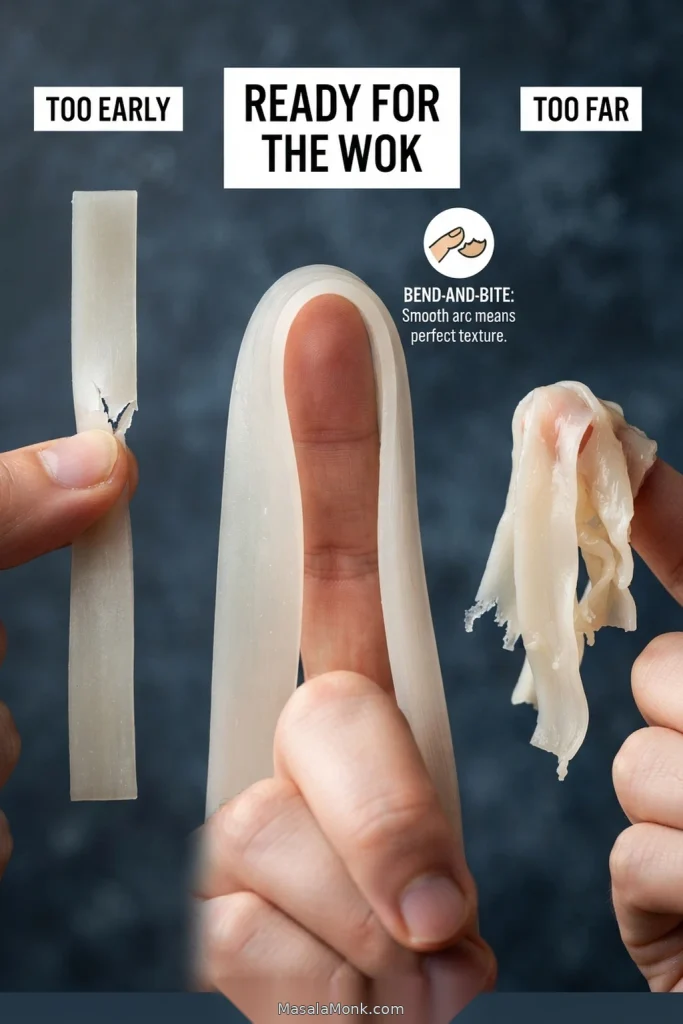
Pick up one noodle. It should bend around your finger without snapping but still resist slightly when bitten. It should not already feel completely tender.
Some extra-wide dried noodles are designed to be boiled rather than soaked. Follow the packet when it specifically calls for boiling, or briefly boil noodles that remain stubbornly rigid after a reasonable hot-water soak. Either way, stop when they are flexible but still slightly underdone. What matters is how the noodle feels, not forcing every brand through the same method.
Drain them really well. A quick cold rinse can slow noodles that keep softening after draining, but drain thoroughly again afterwards. Cook hydrated noodles reasonably soon; leaving them piled together for a long time encourages clumping.
For fresh noodles: Soft noodles need little preparation beyond gentle separation. A cold refrigerated block is different. Microwave it at medium power in short bursts, gently rearranging the block and peeling away noodles as they become pliable. Stop as soon as they separate without cracking. They do not need to become hot, and they do not need a hot-water soak.
Using dried noodles and want a visual doneness check? Jump to the Bend-and-Bite Test; it shows the difference between too firm, ready for the wok and already too soft.
Season the Chicken and Mix the Sauce
Toss the chicken with its soy sauce, water and oil.
In another bowl, combine the oyster sauce, soy sauce, fish sauce, dark soy, sugar and 15 ml / 1 tablespoon water. It should taste intense on its own, with deep savouriness and enough sweetness to round the edges rather than a flat hit of salt.
Get Ready Before the Pan Gets Hot
Crush or finely chop the garlic and bird’s-eye chillies. Keep any sliced mild red chilli ready with them. Have the gai lan stems, leaves and basil in separate piles. Dry the vegetables well and keep the small cup of plain water beside the stove.
Cook the Drunken Noodles
Build the Stir-Fry
- Sear the chicken. Heat the pan well over high heat. Add about 15 ml / 1 tablespoon oil and spread the chicken into a single layer. Leave it alone for roughly 45–60 seconds, then stir-fry until browned and almost cooked through, with only a little rawness left at the centre. Transfer to a plate.
- Cook the garlic and chillies. If the pan is fiercely hot after the chicken, drop the heat slightly. Add the remaining oil if needed, then the garlic, bird’s-eye chillies and optional sliced mild chilli. Cook for about 15–30 seconds, just until intensely fragrant and the garlic begins to colour. Dark brown garlic means the pan is too hot for this stage.
- Start the gai lan. Add the sliced stems and stir-fry until their colour brightens but they are still crisp. Keep the leaves back for now.
- Add noodles and sauce. Return to high heat. Add the noodles and pour the sauce around and over them. Give the sauce a few seconds to heat before moving everything.
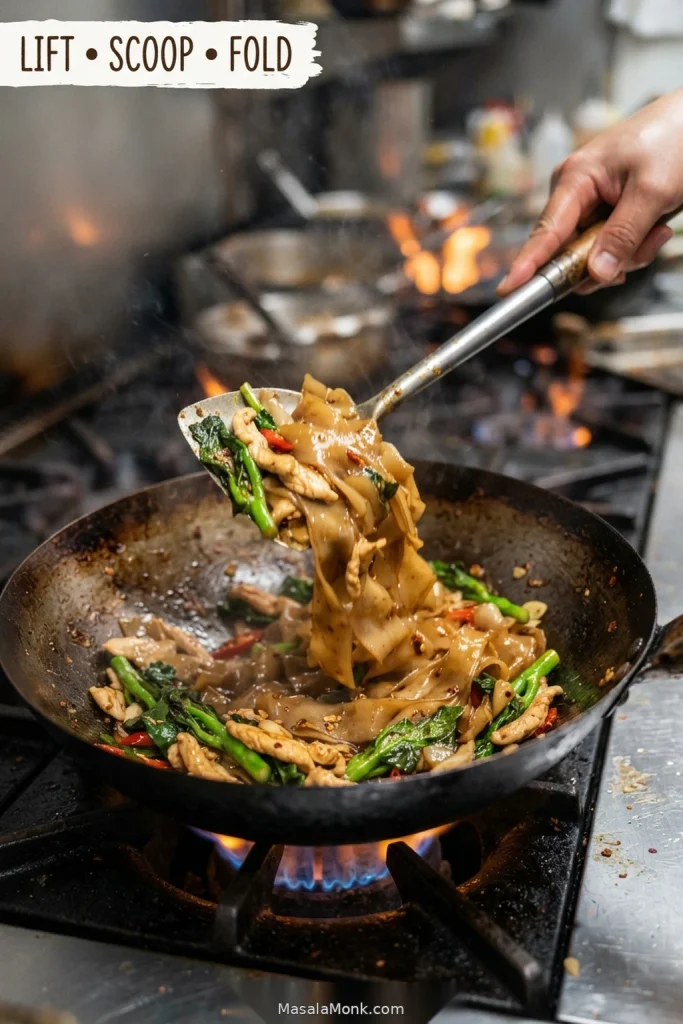
- Lift, scoop and fold. Avoid frantic circular stirring. Once the noodles are coated and beginning to soften, add the gai lan leaves.
Reduce, Check and Finish
- Watch the pan. At first the sauce will look loose. Keep folding until it reduces around the noodles. Push them aside for a second: you should see mostly hot pan, not a puddle of thin sauce.
- Check dried noodles before going further. When they taste properly seasoned but remain too firm, add 15 ml / 1 tablespoon plain water. Fold, wait a few seconds and bite one again. Add more only if needed.
- Create a little char. Spread part of the coated noodles against the hot surface and leave them alone for about 15–20 seconds. Fold and repeat once or twice so a few areas become browned or blistered.
- Finish the chicken. Return the chicken and its juices. Toss until cooked through. Using a thermometer gives the clearest check: one of the thicker pieces should reach 74°C / 165°F.
- Basil goes in last. Turn off the heat, add the basil and fold only until it wilts and becomes aromatic.
Want a visual pan-state check? See Wet → Glossy → Charred for the point where sauce reduction turns into browning.
How to Know Pad Kee Mao Is Done
Serve immediately. The noodles should be tender but chewy, the vegetables crisp-tender, and the sauce should cling with no puddle underneath.
When it all comes together, the pan is almost dry, the noodles look slick rather than wet, the fresh basil aroma still cuts through the sauce, and browned edges appear between the soft, chewy folds.
Saucy enough to coat, dry enough to stir-fry.
If dinner is the priority, you can stop there and cook. If you want to understand why the noodles behave the way they do — or know what to change next time — start with the noodle itself.
Choosing Wide Rice Noodles for Pad Kee Mao
Fresh wide rice noodles, often sold as sen yai, give the most supple, slippery-chewy texture. Extra-wide dried rice noodles are the more predictable choice for most home kitchens.
Can’t find genuinely soft, fresh noodles? Use dried ones with confidence. A good dried noodle prepared to the right stage is far better than an old refrigerated “fresh” noodle that cracks or turns mushy.
What to Look for at the Store
Asian grocery stores do not always label the product as “Drunken Noodles.” Wide noodles may already be cut into ribbons, or cooked fresh rice-noodle sheets may be sold for you to slice yourself.
| Product | Use It? | What to Know |
|---|---|---|
| Fresh wide rice noodles / sen yai | Yes | Excellent when genuinely fresh and pliable. |
| Cooked fresh rice noodle sheets | Yes | Cut into wide ribbons. |
| Extra-wide / XL dried rice noodles | Yes | Reliable and easy to store. |
| Pad Thai rice noodles | Can work | Narrower, so the bite and surface area are different. |
| Dried rice paper / spring-roll wrappers | No | A different product. |
Already have Pad Thai noodles? Use them. Expect a narrower bite and less of that broad, slippery fold. That’s the noodle style used in Pad Thai.
Fresh and Refrigerated Noodles
Soft fresh noodles need very little preparation: keep them dry, separate them gently and handle them lightly.
Refrigerated noodles can be more troublesome. Warm a hard block only until the strands peel apart without cracking. Noodles that still crumble badly after gentle warming are unlikely to improve in the wok; a fresher packet or dried noodles will usually behave better.
Dried Wide Rice Noodles
Stop hydration before the noodles become completely tender because they’ll continue softening in the sauce. The packet may call for soaking, boiling or a combination. What matters is how the noodle feels, not forcing every brand through the same method.
A quick cold rinse can slow noodles that continue softening after draining; drain them extremely well afterwards. Don’t leave hydrated noodles sitting in a heap for a long time either, because they become increasingly prone to sticking.
The Bend-and-Bite Test
Too early: the noodle is rigid and snaps instead of bending.
Ready for the wok: it bends around a finger without snapping but still offers slight resistance when bitten.
Too far: it is already completely tender and fragile before stir-frying.
Use the clock to decide when to start checking. Let the noodle decide when to stop.
Ready to cook? Return to the Drunken Noodles recipe.
Garlic, Chilli and Basil
Wide noodles give the dish its body. Garlic, chilli and basil give it its identity.
The recipe uses about 20 g garlic for two servings because Pad Kee Mao should smell clearly garlicky. Crushing the garlic and bird’s-eye chillies together spreads their flavour quickly through the oil, although finely chopping works too.
How Spicy Are Drunken Noodles?
Drunken Noodles are normally a spicy dish, but Thai bird’s-eye chillies vary enormously in size and strength. About 2 is a sensible starting point for medium heat in this two-serving batch; adjust according to the chillies you actually have.
- Mild: about ½ to 1 Thai chilli. Add some larger mild red chilli if you want more fresh-chilli flavour.
- Medium: around 2 Thai chillies.
- Hot: around 3–4, depending on the chillies.
- Very hot: increase carefully from there.
Reducing the chilli does not require reducing the garlic or basil. A milder plate can still taste unmistakably like Pad Kee Mao.
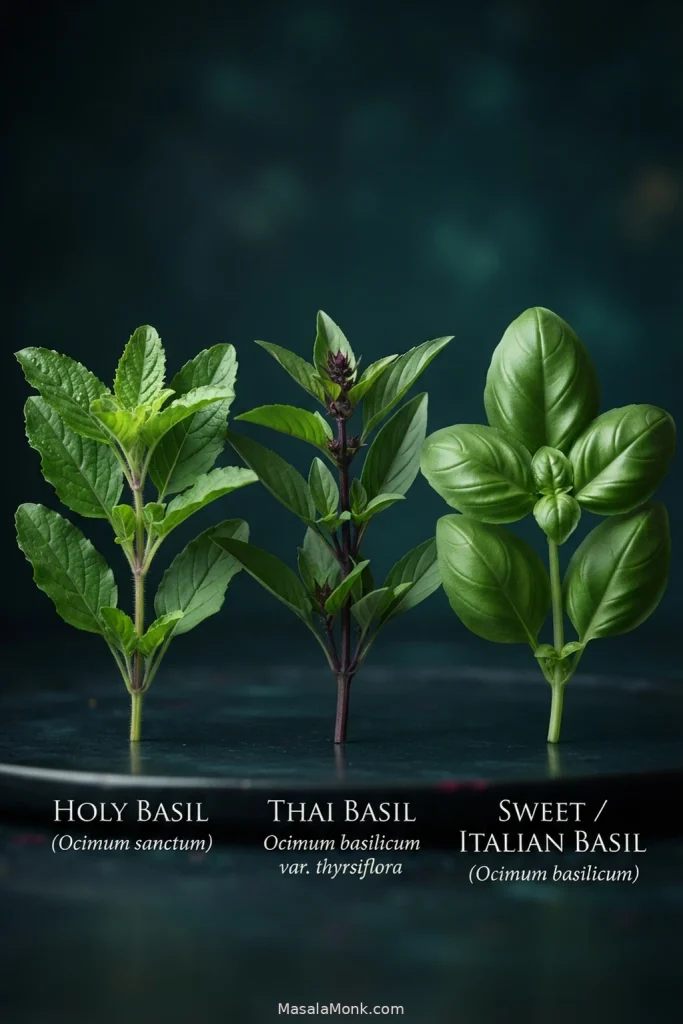
Holy Basil, Thai Basil or Sweet Basil?
Holy basil is the traditional target in many Thai versions, with a peppery, herbal and slightly clove-like aroma.
No holy basil? Thai basil and sweet or Italian basil can both make a good bowl of noodles, but they take the flavour in different directions. Thai basil brings a stronger anise note; sweet or Italian basil is less anise-forward. Use whichever good fresh basil you can reasonably get rather than abandoning dinner over the perfect variety.
Add the basil only at the end, just as you would in Pad Kra Pao, so its aroma stays fresh instead of disappearing into the sauce.
Drunken Noodle Sauce
For two generous servings, the sauce uses 2 tablespoons oyster sauce, 1 tablespoon regular or light soy sauce, 2 teaspoons fish sauce, 1 teaspoon dark soy, 8 g palm sugar or about 2 teaspoons brown sugar, and 1 tablespoon water.
The sauce should coat the noodles without flooding the pan.
- Oyster sauce supplies much of the sauce’s body and savoury richness.
- Fish sauce brings fermented depth that simply adding more soy does not.
- Dark soy is used sparingly for colour and depth; it is not the main seasoning soy.
- Sugar rounds out the salty sauces without making the finished noodles taste sweet.
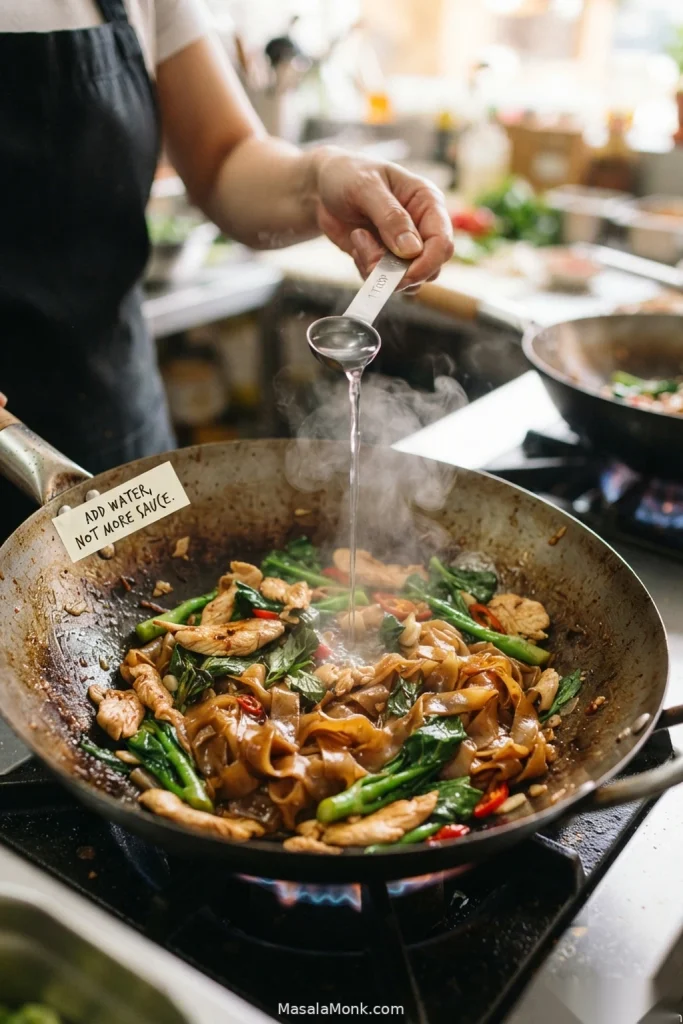
- Plain water softens a firm noodle without making the sauce saltier.
Condiment brands vary, so taste the mixed sauce before it reaches the pan. It should be intense but balanced — savoury first, with just enough sweetness to round it out. Dark and black soy sauces also vary considerably by style and brand, so keep the amount small rather than treating them as interchangeable with regular soy sauce.
Add water, not more sauce. Once the seasoning tastes right, use plain water to finish softening a firm noodle instead of adding another dose of salty seasoning.
Wok, Skillet and Pan Heat
A wok is excellent on a strong gas burner. For most home kitchens, a large heavy skillet is completely fine. On electric or induction, it may even perform better because more of its base sits directly over the heat.
Fresh rice noodles stick easily. A well-seasoned wok or cast-iron skillet is forgiving; otherwise, use a pan you know releases food well and can take high heat. Use the widest pan your burner can still keep properly hot.
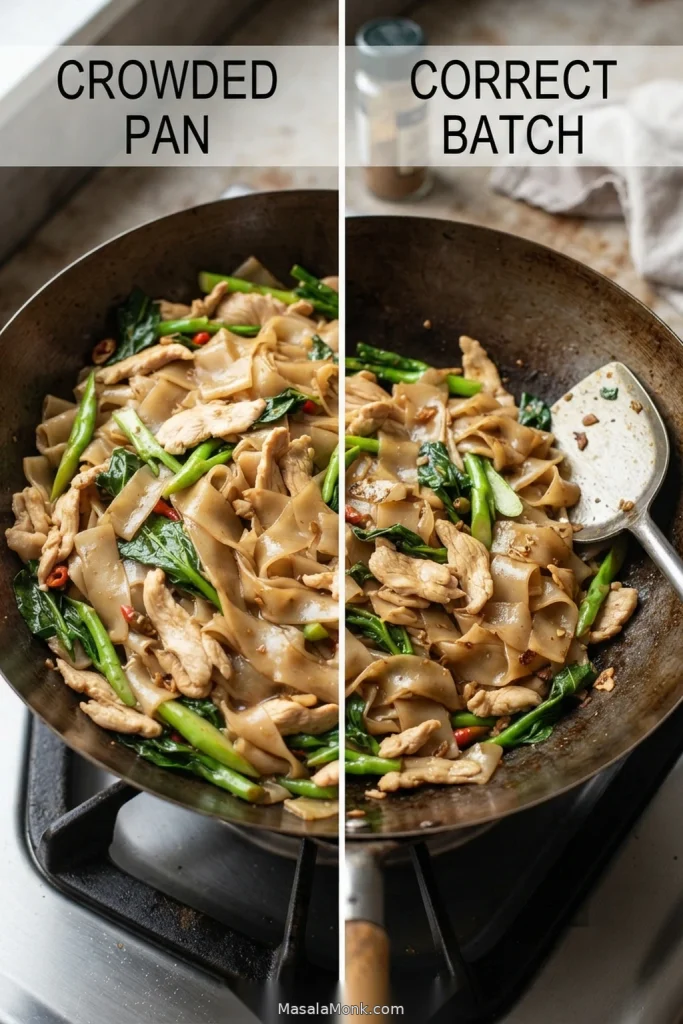
Dry ingredients matter too. Wet noodles, dripping greens and a crowded pan all spend heat turning water into steam before browning can begin.
Why Smaller Batches Work
Too much food drops the pan temperature. Vegetables release moisture, noodles start steaming, the sauce takes longer to reduce, and the extra cooking time makes the noodles softer and more fragile.
More stirring will not restore that lost heat. Spread what is already in the pan and give it time to recover; when it is badly overcrowded, taking some food out is the better fix.
For most home stoves, a batch of two generous servings is a sensible upper limit.
Still steaming instead of frying? Jump to troubleshooting for the fastest recovery steps.
Wet → Glossy → Charred
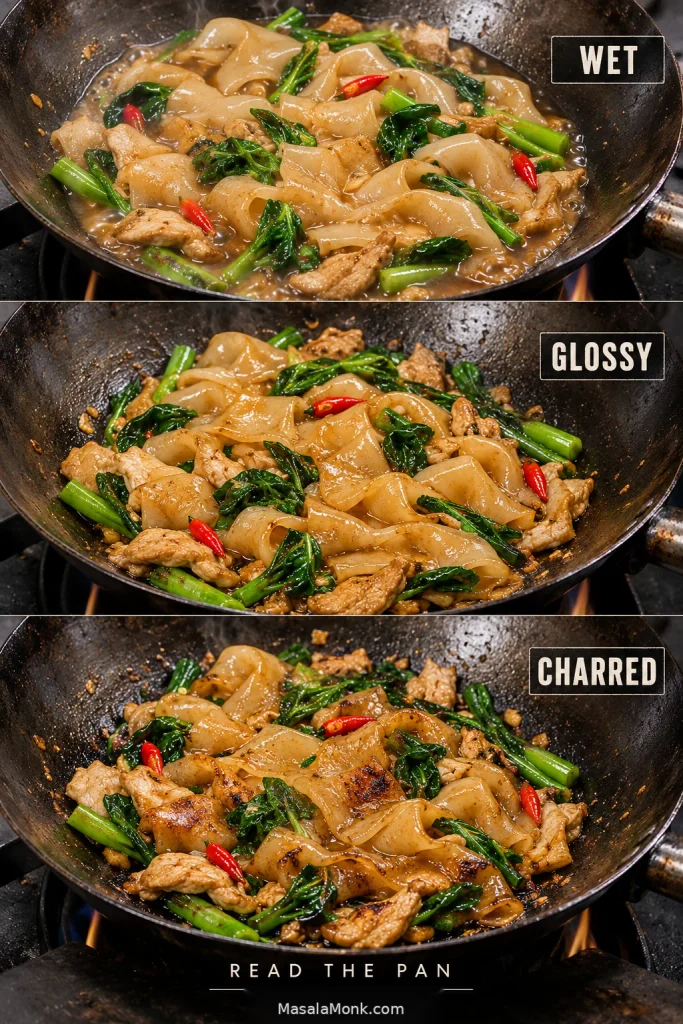
This is the easiest way to read the pan.
Wet
The sauce has just gone in and thin liquid is still visible beneath the noodles. Keep cooking; this is too early to chase browning.
Glossy
The sauce has reduced around the noodles and the exposed pan stays mostly clear. Check dried noodles now and add a little water if the centres are still too firm.
Charred
Give sections of coated noodle brief, undisturbed contact with the hot surface. Aim for browned and blistered patches, never blackened noodles.
Got the pan-state sequence? Return to the recipe when you’re ready to cook.
Why Restaurant Drunken Noodles Can Taste Different
Maybe the version you remember from your neighbourhood Thai place had broad chewy folds, a rush of basil and chilli, concentrated savoury flavour and dark patches where the noodles caught the pan. Your homemade version can taste perfectly good and still somehow miss that combination.
One missing “secret ingredient” is rarely the whole explanation. Start with the aromatics: basil, chilli and garlic. Then look at sauce strength, noodle hydration, pan heat and whether the noodles ever developed browned edges.
Restaurants may also use Thai seasoning sauce, MSG, their own chilli mixture or a house sauce. Some versions layer in additional aromatics such as fresh green peppercorns, grachai (fingerroot) or makrut lime leaves. They can define one restaurant’s version without being essential to every plate of Pad Kee Mao.
For a wetter or sweeter restaurant-style result, make small adjustments only after the basic technique is working. A little extra water, sauce or sugar is easier to judge than changing everything at once.
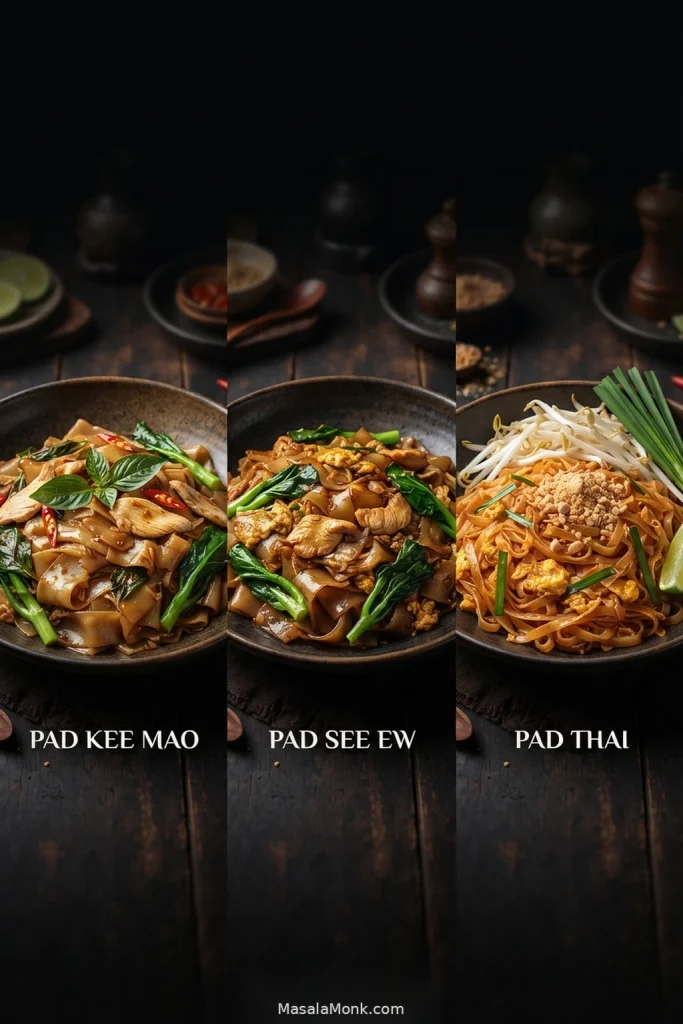
Drunken Noodles vs Pad See Ew vs Pad Thai
Pad Kee Mao is the spicy chilli-basil noodle; Pad See Ew is the milder soy-forward wide noodle; Pad Thai is the tangy tamarind-led noodle.
| Pad Kee Mao | Pad See Ew | Pad Thai | |
|---|---|---|---|
| Noodle | Wide rice noodles | Wide rice noodles | Usually thinner rice noodles |
| Main flavour | Chilli, garlic, basil | Soy, browning, gentle sweetness | Tamarind-led sweet-sour balance |
| Heat | Usually spicy | Usually mild | Usually mild to moderate |
| Basil | Defining | Not defining | Not defining |
| Choose it when… | You want spicy basil-garlic noodles | You want milder soy-charred wide noodles | You want tangy, sweet-sour noodles |
For broad noodles without the chilli-basil profile, Pad See Ew is the closer match.
When Drunken Noodles Go Wrong
A few failures come up again and again. Start with what you actually see in the pan. More sauce or more heat is not the answer to every problem.
The Noodles Are Mushy
Drunken Noodles usually turn mushy because the rice noodles were hydrated too far, cooked too long, or spent too much time steaming in a wet or crowded pan.
Stop cooking as soon as you notice it. Once rice noodles have become fully mushy, there is no reliable way to make them chewy again. Next time, stop the soak sooner, drain thoroughly and reduce the batch size.
The Noodles Are Still Hard
Don’t add more sauce yet. Add 15 ml / 1 tablespoon plain water, fold the noodles through it, wait a few seconds and bite one. Repeat only if necessary.
Repeatedly getting hard centres with the same packet is a useful clue: give that brand a little more hydration before it reaches the wok next time.
Everything Is Steaming Instead of Frying
The pan has probably lost too much heat from crowding, wet ingredients or both.
Don’t keep stirring harder. Spread the food out and let the pan recover. Take some out when it is clearly overcrowded. Next time, dry the ingredients better or cook a smaller batch.
The Sauce Is Too Salty
Condiment brands may be stronger than expected, too much dark soy may have gone in, or extra seasoning sauce may have been added while trying to soften firm noodles.
When the noodles can still absorb moisture, a little plain water can reduce the concentration. There is no perfect way to remove salt already in the dish, so next time reduce the strongest condiment first.
There Is No Char
Noodles that refuse to brown are usually still too wet, sitting in a pan that is too cool, or packed into an oversized batch.
Wait until the sauce has reduced around the noodles. Then leave a section against the hot pan for a few seconds instead of constantly tossing.
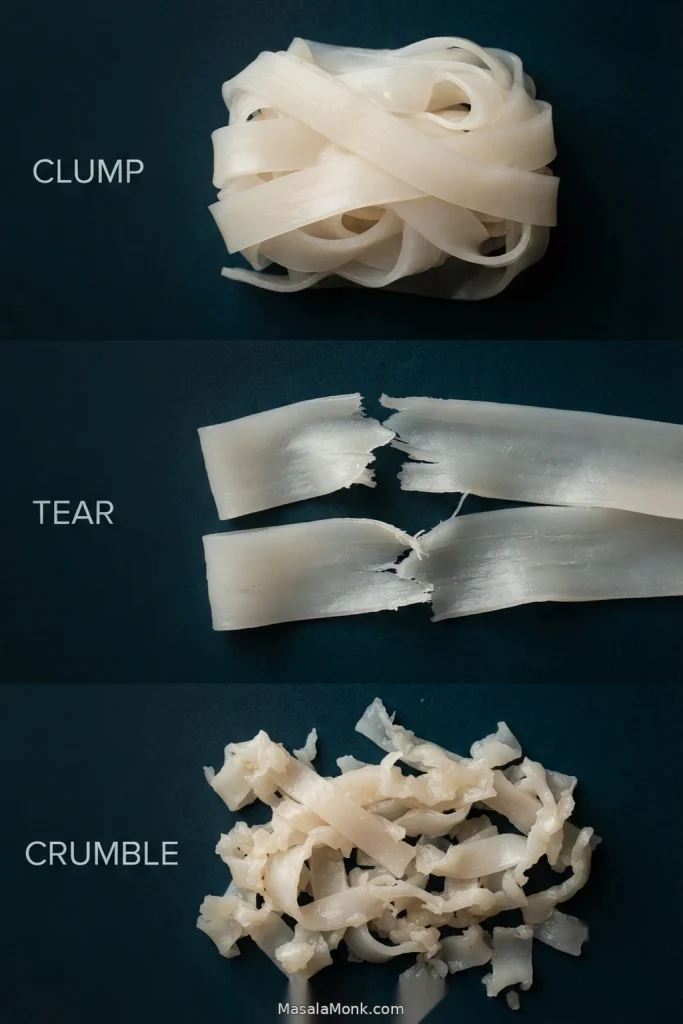
Clumping, Tearing and Other Common Problems
| What Happened | Most Likely Reason | Try This |
|---|---|---|
| Fresh noodles crumble | Cold, old or brittle noodles | Warm them only until pliable before separating. Noodles that still disintegrate need a fresher packet. |
| Noodles form one clump | Poor separation or sitting too long after hydration | Loosen them before cooking and get them into the pan sooner. |
| Noodles stick and tear | Wet noodles, a grabby pan surface, low heat or crowding | Dry them well, use a pan that releases food cleanly and lift rather than scrape. |
| Garlic tastes bitter | It burned during the aromatic stage | Badly burned garlic is worth restarting before the noodles go in. |
| The dish is too sweet | Too much sugar or a sweet bottled sauce | Use less sweetener next time. A large dose of fish sauce usually creates a second problem. |
| It tastes like generic soy noodles | Garlic, chilli, basil or fish-sauce character is too weak | Fix the aromatics and balance first. More soy usually pushes the dish further in the wrong direction. |
Back to the recipe · Choose your noodles · Back to top
Protein, Vegetable and Diet Swaps
Keep the batch manageable when making substitutions; wetter vegetables or leaner proteins may need slightly different handling.
Protein
- Chicken breast: slice thinly and shorten the first sear. It dries faster than thigh.
- Beef: slice thinly across the grain and sear quickly. The slicing guide in Beef and Broccoli shows how to identify the grain.
- Shrimp or prawns: cook briefly, remove early and return near the end.
- Firm tofu: pat dry, crisp separately and return near the end.
Vegetables
- Broccolini: the easiest substitute for gai lan in many supermarkets.
- Bok choy: works well but releases more moisture, so give it enough room in the pan.
- Ordinary broccoli: cut it fairly small so it cooks in the short stir-fry time.
One or two vegetables is usually enough. Filling the wok with everything in the refrigerator makes heat and moisture much harder to control.
Vegetarian or Vegan
Replacing chicken with tofu is only part of the change because standard oyster sauce and fish sauce are also animal products. Use firm tofu or another suitable plant protein, a vegan oyster-style mushroom sauce, and vegan fish sauce or another balanced savoury alternative.
Taste the sauce before cooking; plant-based condiment brands vary considerably too.
Gluten-Free
Plain rice noodles are typically gluten-free, but the sauces may not be. Check the noodle package when strict gluten avoidance matters, and use suitable gluten-free soy sauce, oyster sauce and seasoning sauce where required.
Chosen your swap? Return to the recipe and keep the same small-batch cooking logic.
Storage, Reheating and Make Ahead
Drunken Noodles are best straight from the pan. Refrigeration firms up rice noodles, and reheating can make already-soft noodles more fragile.
For food safety, cool leftovers promptly, refrigerate them in a covered container and use them within 3–4 days. Texture is usually best much sooner.
For reheating, a hot skillet works best. Add a small splash of water and turn the noodles only as much as needed to heat them through. In the microwave, cover loosely, heat in short intervals and turn the noodles partway through. For food safety, reheat leftovers until piping hot throughout; USDA guidance uses 74°C / 165°F.
What You Can Prepare Earlier the Same Day
- Mix the sauce, cover and refrigerate it.
- Slice and season the chicken, then keep it refrigerated until cooking.
- Wash, dry and cut the gai lan.
- Wash and thoroughly dry the basil, but leave the leaves whole.
Prepare the garlic and chillies closer to cooking, and leave noodle hydration until fairly near the moment the noodles will reach the pan.
If you make these Drunken Noodles, tell us what noodles you used — fresh or dried, the brand if you remember it, and whether you needed any of the rescue water. Rice noodles vary enormously from one packet to another, and those details may help the next person cooking with the same noodles.








