Posted on 2 Comments

Air Fryer Donuts Recipe (2 Ways): Glazed Homemade Donuts + Biscuit Donuts

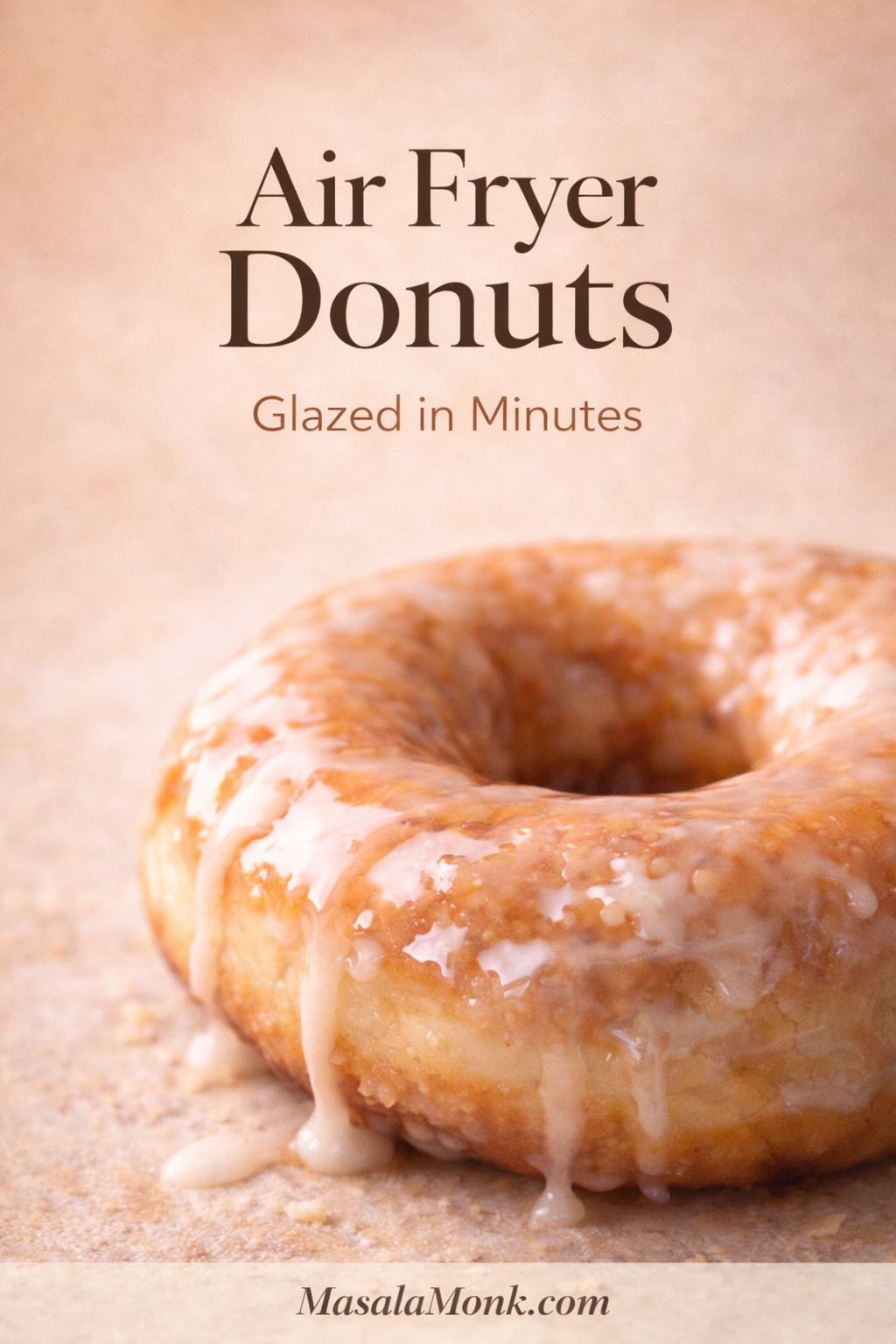
Portrait cover image of a glossy glazed air fryer donut close-up on a warm beige background with text “Air Fryer Donuts” and “Glazed in Minutes,” MasalaMonk.com in the footer.

Warm donuts have a way of making a normal day feel like a small celebration. The problem is that classic donuts frying at home can turn into a whole production—oil, thermometers, splatters, lingering smells, and that “now I have a pot of oil to deal with” moment. Air fryer donuts solve that in a surprisingly satisfying way.

Air Fried Donuts are not trying to be a deep-fryer stunt. Instead, they’re built for repeatability: soft, fluffy centers, a delicate outer set, and finishes that make them feel like a real treat. Even better, you can make air fried doughnuts in two very different styles depending on the time you have and the mood you’re in:

  • Homemade air fryer donuts made from scratch, risen until airy, then dipped in a simple glaze that sets into that classic thin shell.
  • Air fryer biscuit donuts made with biscuit dough, shaped in minutes, and finished with cinnamon sugar or glaze for instant gratification.

So whether you want an all-in weekend project or a shortcut dessert that still looks like you tried, donuts in the air fryer can fit the moment.

If you’re building a full breakfast spread, you can balance the sweetness with something crisp and dunkable like these French toast sticks. Meanwhile, if you’re serving a crowd and want a make-ahead option on the table, no-bake banana pudding keeps things generous without chaining you to the kitchen.

Also Read: Air Fryer Salmon Recipe (Time, Temp, and Tips for Perfect Fillets)


Air Fryer Donuts at a Glance (Time, Temp, Doneness)

Before you start mixing dough or cutting biscuit rings, it helps to understand what makes doughnuts in the air fryer behave differently from a pot of oil. The air fryer is basically a compact convection oven with attitude: powerful heat + fast airflow + a small cooking chamber. That combination can turn out beautifully tender donuts, as long as you cook for structure first and color second.
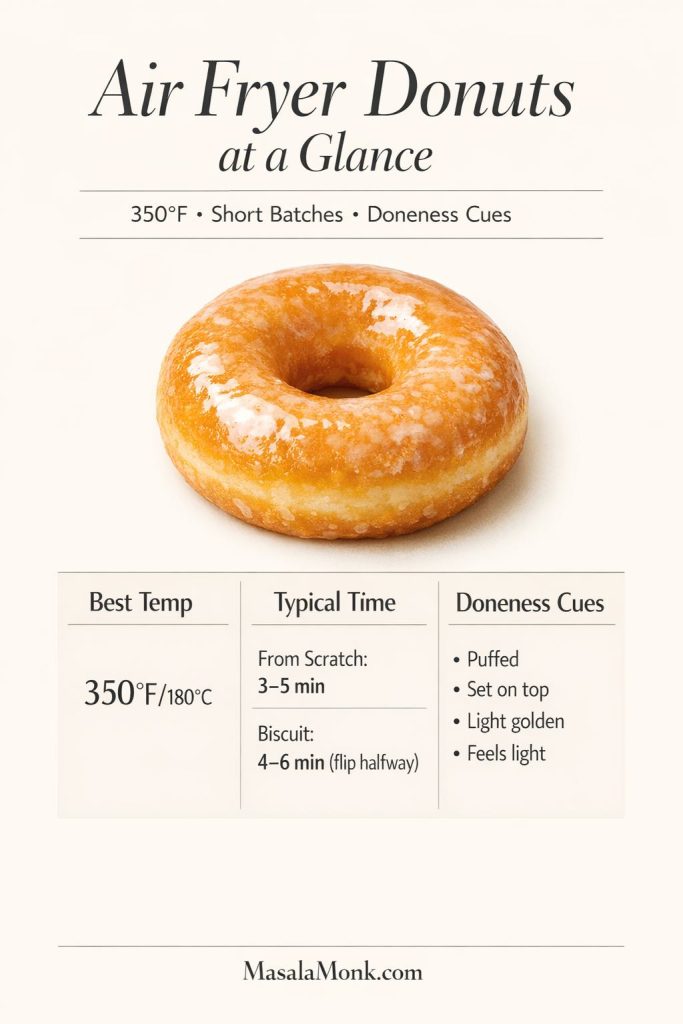
Infographic titled “Air Fryer Donuts at a Glance” showing a glazed donut and quick reference for donuts in the air fryer: best temp 350°F/180°C, typical time 3–5 minutes from scratch and 4–6 minutes for biscuit donuts, plus doneness cues like puffed, set on top, light golden, and feels light.
Air fryer donuts are easiest when you stop guessing. Use this quick guide for donuts in the air fryer—350°F, short batches, and simple doneness cues—so your homemade doughnuts in air fryer stay soft and your biscuit donuts don’t turn dry.

Best temperature for air fryer donuts

Most air fried doughnuts do best at 350°F / 180°C. That temperature gives the dough enough time to puff and set without turning the outside too dark too quickly.

If your air fryer runs hot, stay on the lower end of the range. Conversely, if your air fryer runs cool, a small bump can help. Still, it’s usually smarter to add time rather than crank the temperature, because pale donuts are fixable with glaze, while dry donuts are a little harder to rescue.

How long to cook donuts in the air fryer

Air fryer times vary more than people expect. Basket size, fan power, and even where the heating element sits can change the outcome. With that said, these ranges keep you grounded:

  • From-scratch donut dough: 3–5 minutes per batch
  • Biscuit donuts in air fryer: 4–6 minutes, flipping halfway

Even so, don’t let the numbers boss you around. Instead, treat the clock like a guide and use doneness cues to make the final call.
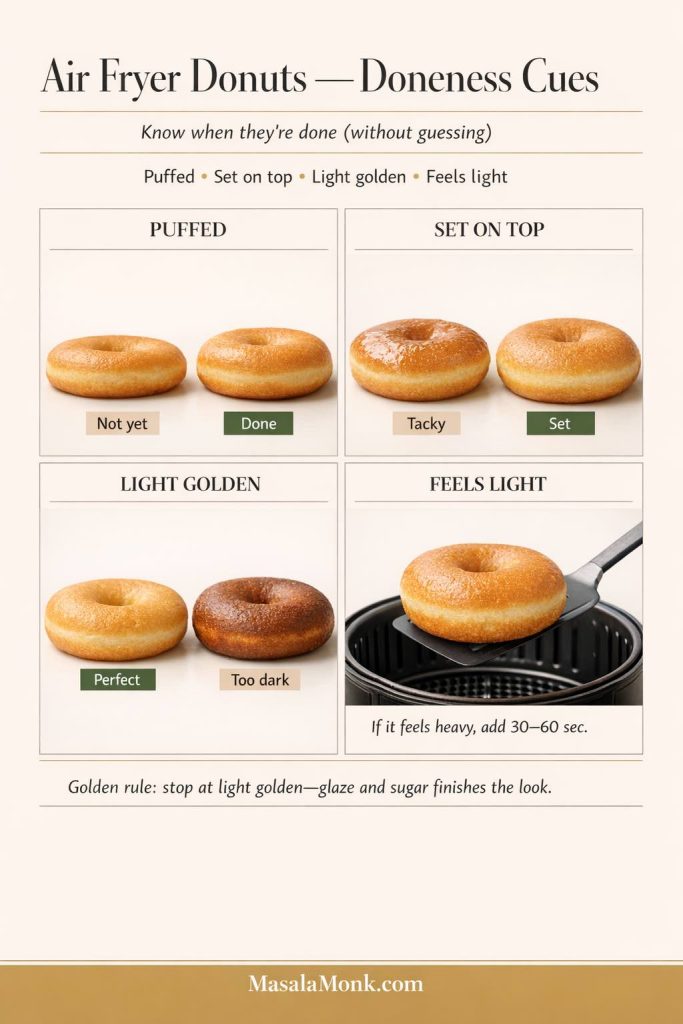
Don’t overcook air fryer donuts chasing color. Use these doneness cues: look for donuts that are puffed, dry and set on top, and light golden—not deep brown. If a donut feels heavy when lifted, add 30–60 seconds, then check again. Once you learn these signs, donuts in the air fryer become a reliable method, not guesswork.

Doneness cues for air fried doughnuts

Air fried doughnuts are done when they look set and feel light. In practice, that usually means:

  • The donut is visibly puffed, not flat.
  • The surface looks dry and set, not wet or tacky.
  • The color is light golden, not deep brown.
  • When you lift one, it feels airy for its size.

Once you get comfortable with those cues, “donut in air fryer recipe” stops being a rigid script and becomes a flexible method.

Also Read: Masterclass in Chai: How to Make the Perfect Masala Chai (Recipe)


Why Air Fryer Donuts Work (and when they don’t)

Deep fryer donuts and air fryer doughnuts don’t cook the same way, and that’s okay. Oil surrounds the dough and transfers heat aggressively, so the surface browns quickly and evenly. Air fryers cook with moving hot air, so browning is often gentler and more patchy unless you manage airflow and don’t overcrowd the basket.

Fortunately, donuts don’t need an intensely browned shell to taste amazing. They need softness, freshness, and a finish that makes the bite feel rich. That’s why glazes, cinnamon sugar, and butter-brushed coatings matter so much in air fryer doughnuts: the finish supplies the “donut shop” satisfaction even when the crust is lighter.
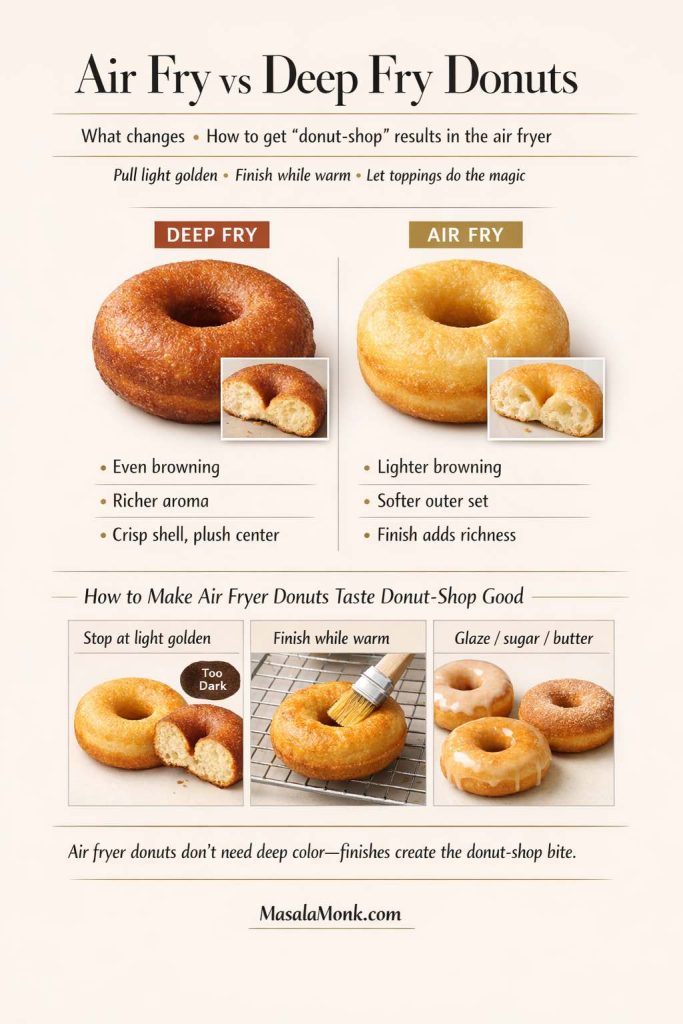
Air fryer donuts don’t cook like deep-fried donuts—and that’s the point. Use this comparison to set expectations (lighter browning, softer outer set) and get better results: pull donuts at light golden, finish while warm, and let glaze, cinnamon sugar, or butter create that donut-shop bite without overcooking.

Air fryer donuts vs deep fryer donuts

If you’ve ever done deep fryer donuts, you already know the magic: fast browning, plush interior, and that unmistakable fried aroma. Still, deep frying has its own learning curve. Oil temperature control is everything, and a few degrees can change the outcome.

For a classic overview of doughnuts frying at home—temperature cues, timing, and what to look for—Serious Eats’ guide is a solid reference: Sweet Technique: How to Make Doughnuts. Likewise, King Arthur Baking’s yeast-raised doughnut recipe is a clean baseline for the traditional method: Yeast-Raised Doughnuts.

Even so, if you’re using an air fryer for donuts, you’re usually choosing it for the opposite reasons: less mess, less fuss, and more repeatability. In that sense, air fryer doughnuts are more like a dependable weekly ritual than a once-in-a-while frying project.

The most common reason homemade air fryer donuts turn dry

Overcooking happens fast in an air fryer. Sometimes it’s because you want more color. Other times it’s because you’re making a bigger batch and the later donuts sit longer “just to be safe.” Either way, the fix is simple: cook until set and lightly golden, then let glaze, butter, or cinnamon sugar finish the job.

Dry donuts are rarely under-flavored. Instead, they’re just overdone. Once you learn where “done” actually sits in your air fryer, everything gets easier.

Also Read: Crock Pot Pork Chops and Sauerkraut (No Dry Chops Recipe)


Air Fryer Donuts: Homemade Glazed Doughnuts From Scratch

This homemade air fryer donuts method is the “real deal” version: yeasted dough, two rises, and that fluffy interior that makes a plain glazed donut feel almost elegant. It’s also the method that turns air fryer doughnuts into something you’ll be proud to serve.

If you like seeing a well-tested reference point for this style, Emma Fontanella’s air fryer glazed donuts are widely shared for a reason: the approach is straightforward and the result is genuinely donut-like. You can see that method here: Air Fryer Glazed Donuts. In the version below, you’ll get a full, reader-friendly recipe with the kind of details that make it repeatable in a real kitchen.
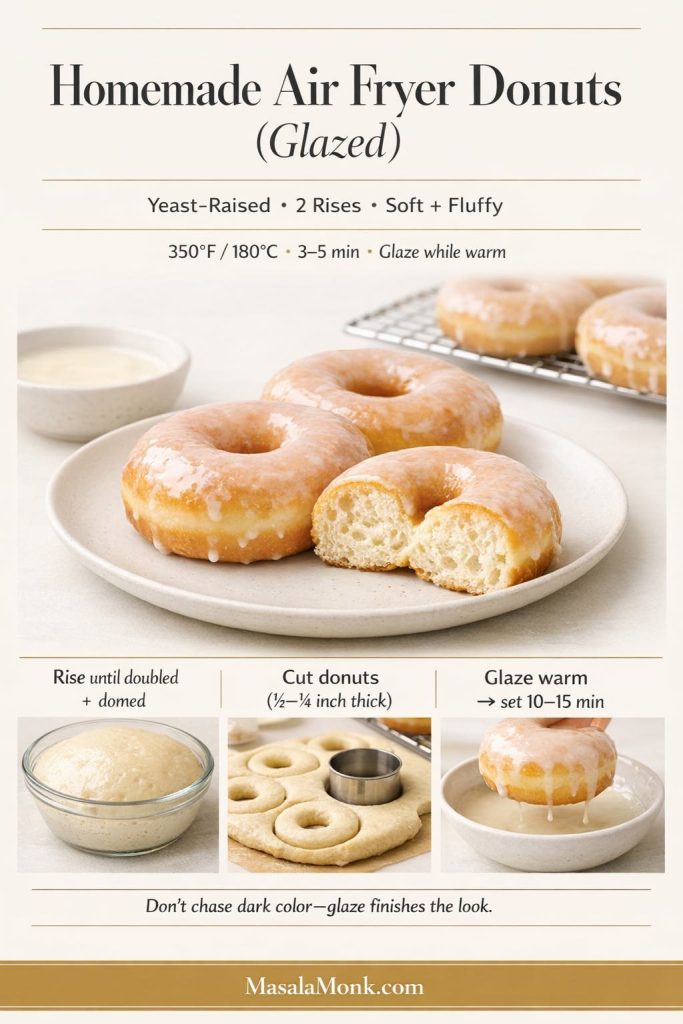
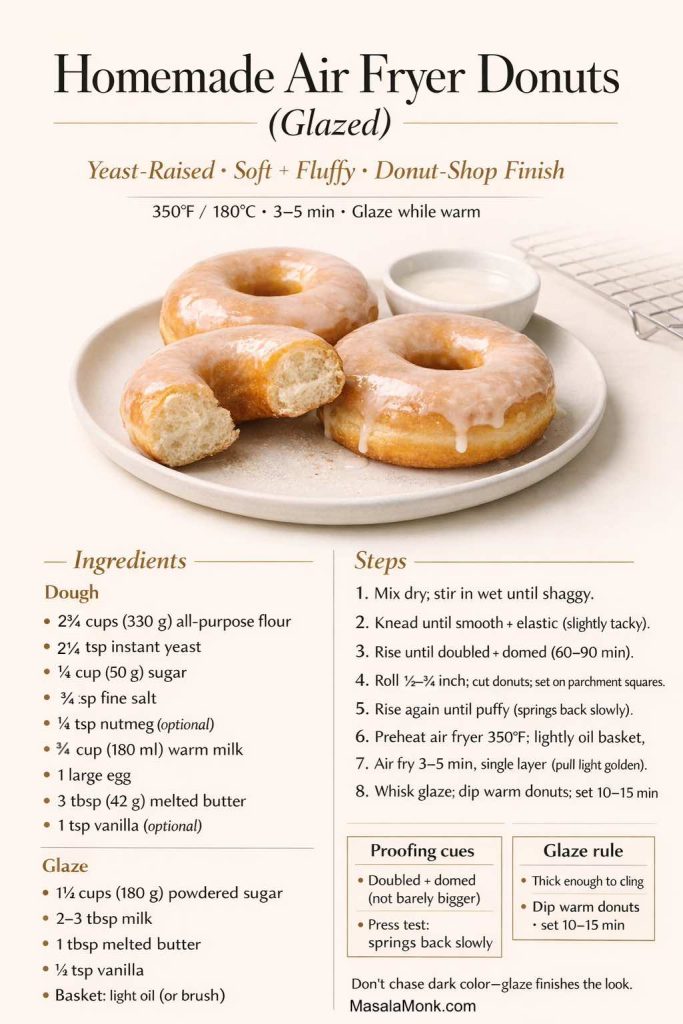
This is the “from scratch” path for homemade air fryer donuts: yeast-raised dough, two rises, and a smooth glazed finish. Let the dough rise until doubled and domed, cut donuts about 1/2–3/4 inch thick, air fry briefly, then glaze while warm and let it set 10–15 minutes for that classic donut-shop bite—without over-browning.

Ingredients for homemade air fryer donuts

For the donut dough

  • 2 ¾ cups (330 g) all-purpose flour, plus extra for dusting
  • 2 ¼ teaspoons instant yeast (1 packet)
  • ¼ cup (50 g) sugar
  • ¾ teaspoon fine salt
  • ¼ teaspoon nutmeg (optional, but classic)
  • ¾ cup (180 ml) warm milk (warm, not hot)
  • 1 large egg
  • 3 tablespoons (42 g) melted butter
  • 1 teaspoon vanilla extract (optional)

For the simple glaze

  • 1 ½ cups (180 g) powdered sugar
  • 2–3 tablespoons milk (as needed)
  • 1 tablespoon melted butter
  • ½ teaspoon vanilla extract
  • Pinch of salt

And for the basket

  • Neutral oil spray or a light brush of oil

A quick yeast note

Instant yeast can go straight into the flour. If you’re using active dry yeast, it’s still easy—just dissolve it in the warm milk with a pinch of sugar and wait until it looks foamy, then proceed.

Step-by-step recipe: homemade donuts in the air fryer

1) Mix the dough

Start by whisking the dry ingredients together in a large bowl: flour, yeast, sugar, salt, and nutmeg.

In another bowl, whisk the warm milk, egg, melted butter, and vanilla until smooth. Pour the wet mixture into the dry mixture and stir until a shaggy dough forms. It will look messy at first, but give it a minute—flour needs a moment to hydrate.
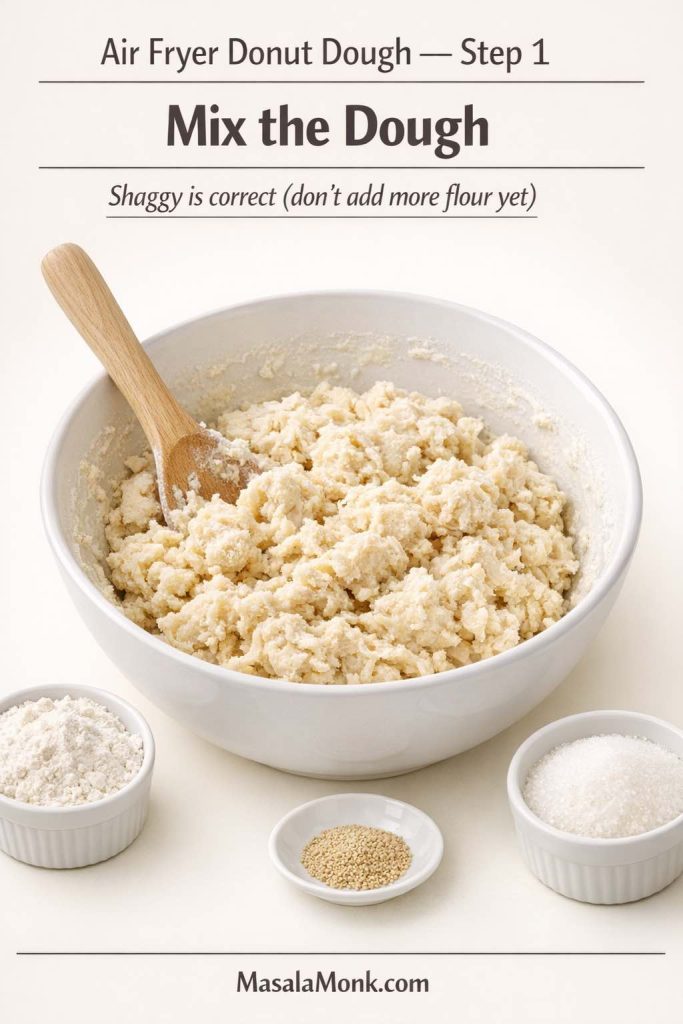
Air fryer donut dough Step 1 showing shaggy mixed dough in a bowl with text “Mix the Dough” and note that shaggy dough is correct before adding more flour.
Step 1 for homemade air fryer donuts: mix until the dough looks shaggy and rough—this is normal. Don’t add extra flour yet; kneading is what turns it smooth.

2) Knead until smooth and elastic

Now knead. You can do this by hand on a lightly floured surface, or use a stand mixer with a dough hook.

  • By hand: knead for about 8–10 minutes.
  • With a mixer: knead 5–6 minutes on medium-low.

The dough should become smooth, supple, and slightly tacky. It should not be so sticky that it smears everywhere, but it also shouldn’t be stiff. If you keep adding flour because you want it “clean,” you’ll often trade softness for density.

What to look for: the dough should feel soft enough that it will rise into something airy, not tight and bread-like.
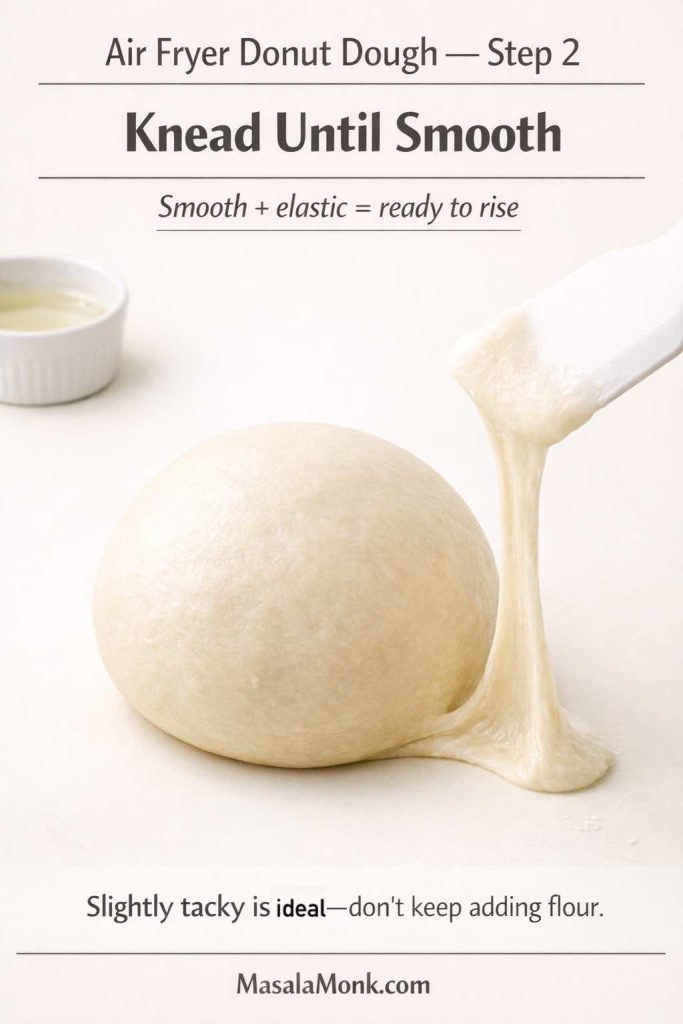
Air fryer donut dough Step 2 showing a smooth dough ball being stretched to show elasticity, with text “Knead Until Smooth” and note that smooth and elastic dough is ready to rise.
Step 2 for homemade air fryer donuts: knead until the dough is smooth and elastic. Slightly tacky is ideal—stop adding flour too early and you’ll get softer donuts.

3) First rise: let it get puffy

Place the dough in a lightly oiled bowl, cover it, and let it rise until doubled and noticeably puffy. Depending on your room, that could be 60 minutes or it could be 90.

If your kitchen is cool, you can create a warm spot by turning your oven on for 60 seconds, turning it off, then letting the covered bowl rise inside.
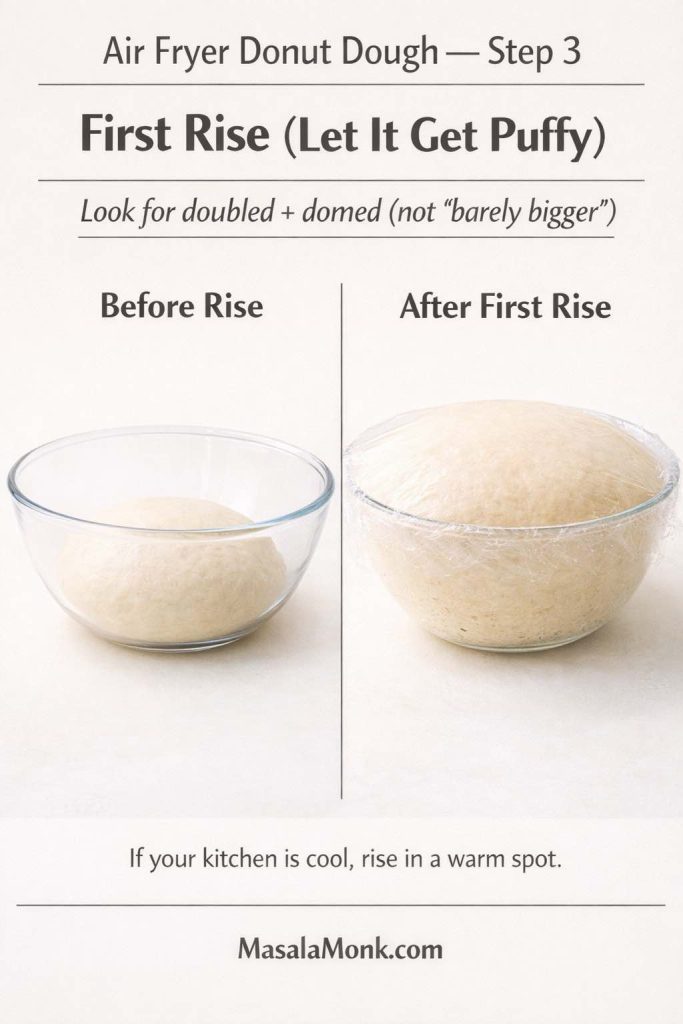
Air fryer donut dough Step 3 infographic showing before and after first rise in a bowl, highlighting dough that is doubled and domed after rising.
Step 3: first rise. Look for dough that’s clearly doubled and domed, not just “a little bigger.” This is what keeps air fryer donuts light instead of dense.

4) Roll and cut your donuts

Lightly flour your surface. Roll the dough to about ½ to ¾ inch thick.

Cut donuts using a donut cutter, or use two cutters: one larger round cutter and one smaller cutter for the center. If you don’t have cutters, even a glass and a bottle cap can work in a pinch.

Set each donut on a small square of parchment paper. That little trick makes transferring delicate risen donuts into the air fryer much easier.
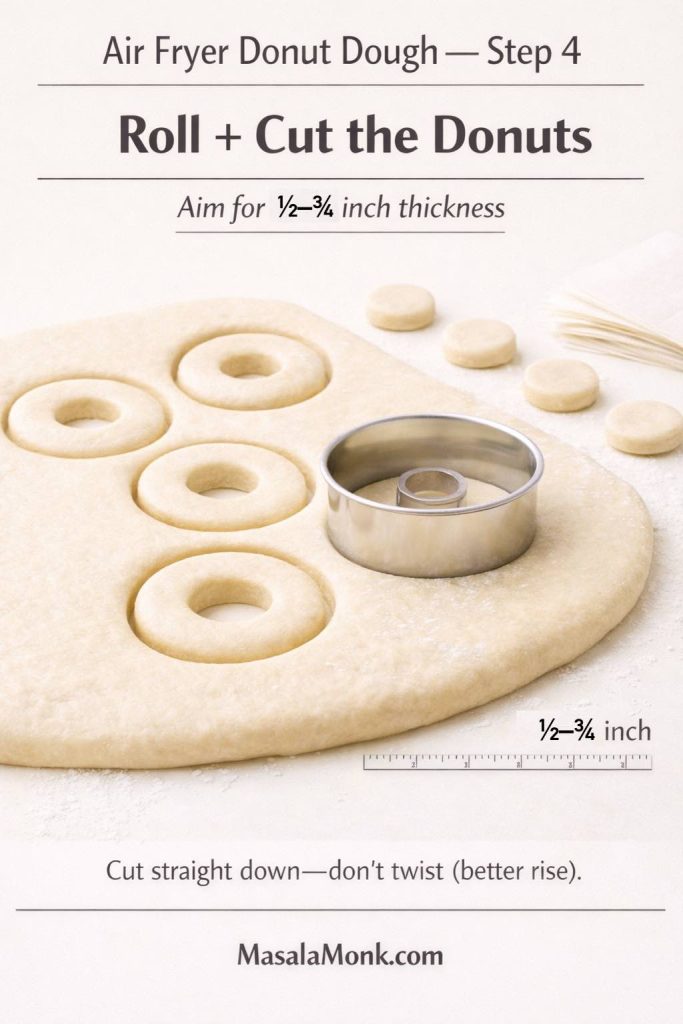
Air fryer donut dough Step 4 showing rolled dough being cut into donut rings with a cutter, with guidance to roll to 1/2 to 3/4 inch thickness and cut straight down.
Step 4: roll and cut your air fryer donuts. Aim for 1/2 to 3/4 inch thickness, then cut straight down without twisting so the donuts rise higher and cook evenly.

5) Second rise: the fluff-maker

Cover the donuts gently and let them rise again until they look airy and feel light. This rise is where a homemade air fryer donuts recipe shifts from “fine” to “wow.”

A good sign: if you lightly press the dough, it should spring back slowly, leaving a soft indentation for a moment.
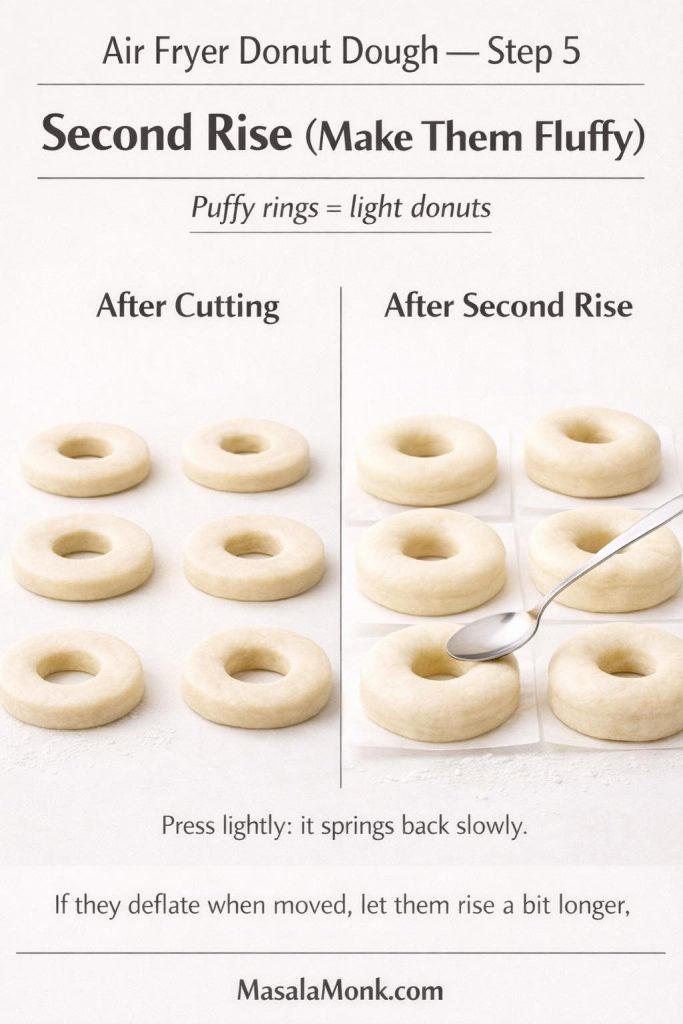
Air fryer donut dough Step 5 showing donuts after cutting versus after the second rise, highlighting puffier rings that spring back slowly when pressed.
Step 5: second rise. Puffy donut rings mean lighter homemade air fryer donuts. Press lightly—if it springs back slowly, they’re ready to cook.

6) Preheat and prep

Preheat your air fryer to 350°F / 180°C for about 3–5 minutes.

Lightly oil the basket or tray. If you’re using parchment under the donuts, ensure the parchment is weighed down by the donut so it doesn’t get pulled into the heating element by airflow.
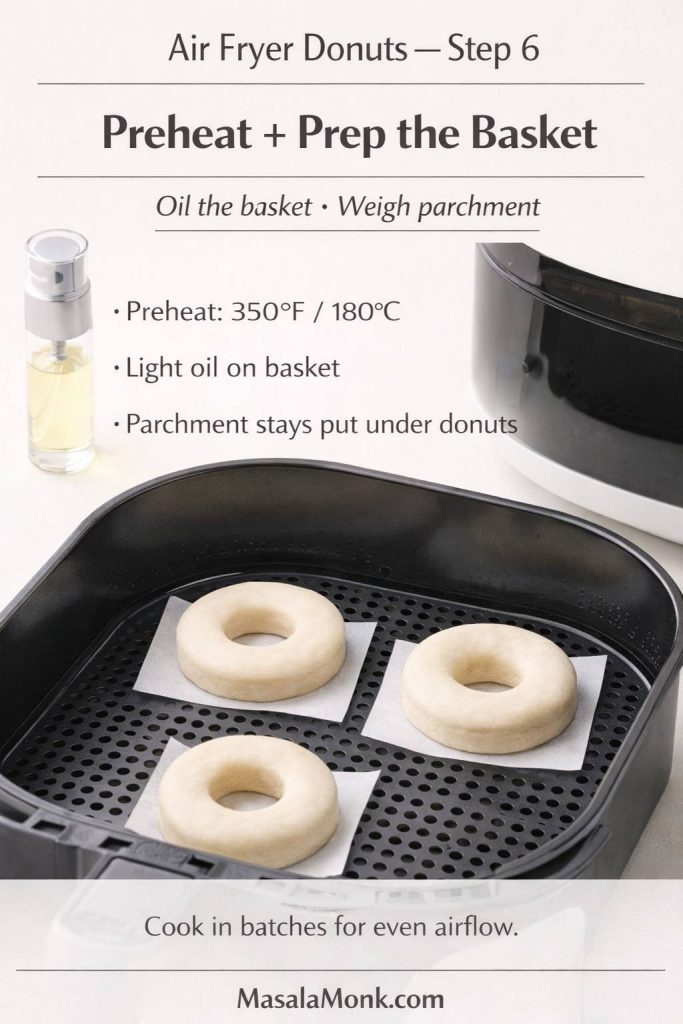
Air fryer donuts Step 6 showing donuts on parchment squares inside an air fryer basket, with instructions to preheat to 350°F/180°C, lightly oil the basket, and weigh parchment under donuts.
Step 6: preheat and prep the basket. Oil lightly, preheat to 350°F, and make sure parchment stays under the donuts so airflow stays even and nothing shifts while cooking.

7) Air fry the donuts (in batches)

Place donuts in a single layer, leaving space between them so air can circulate.

Cook for 3–5 minutes. Start checking early, especially on the first batch. Air fryer models vary a lot, and the first batch teaches you the truth about your machine.

Don’t chase dark color. Aim for set + light golden. The glaze will make them look finished and glossy.
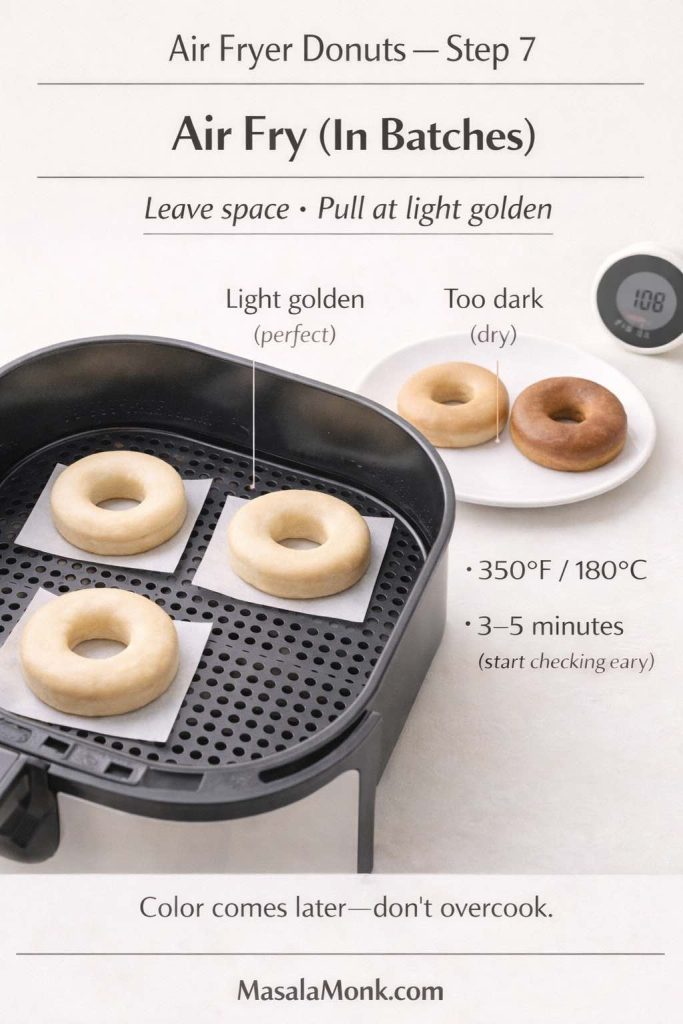
Air fryer donuts Step 7 showing donuts spaced in an air fryer basket with a comparison of light golden versus too dark donuts, plus 350°F and 3–5 minutes guidance.
Step 7: air fry in batches with space. Pull donuts when they’re set and light golden—going too dark is the fastest way to end up with dry air fryer donuts.

8) Glaze while warm

While the donuts cook, whisk together the glaze ingredients. Start with 2 tablespoons of milk and add more only if needed. You want the glaze to be thick enough to cling, yet fluid enough to settle into a smooth surface.

Dip each warm donut into the glaze, let excess drip off, and place on a rack to set. Give them 10–15 minutes and the glaze will form that thin, slightly crackly shell that makes a glazed donut feel “right.”
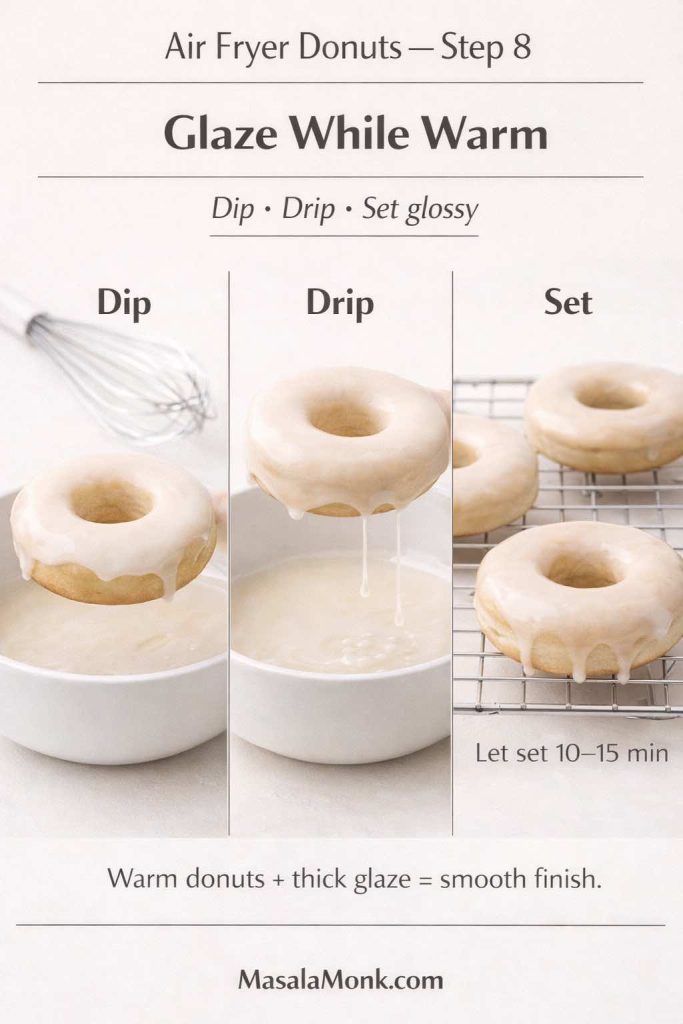
Air fryer donuts Step 8 showing a three-panel sequence—dip, drip, and set—demonstrating glazing warm donuts and letting the glaze set for 10 to 15 minutes.
Step 8: glaze while warm. Dip, let the excess drip, then set on a rack until glossy—this is how glazed air fryer donuts get that smooth donut-shop finish.

Making the glaze taste like it matters

Glaze can be flat if it’s just powdered sugar and water. That’s why a little melted butter and a pinch of salt are worth it—they add richness and balance without making the glaze heavy.

If you want to go one step further, you can add a tiny touch of nutmeg or cardamom. The flavor stays subtle, yet the donut suddenly tastes like it belongs in a good bakery case.
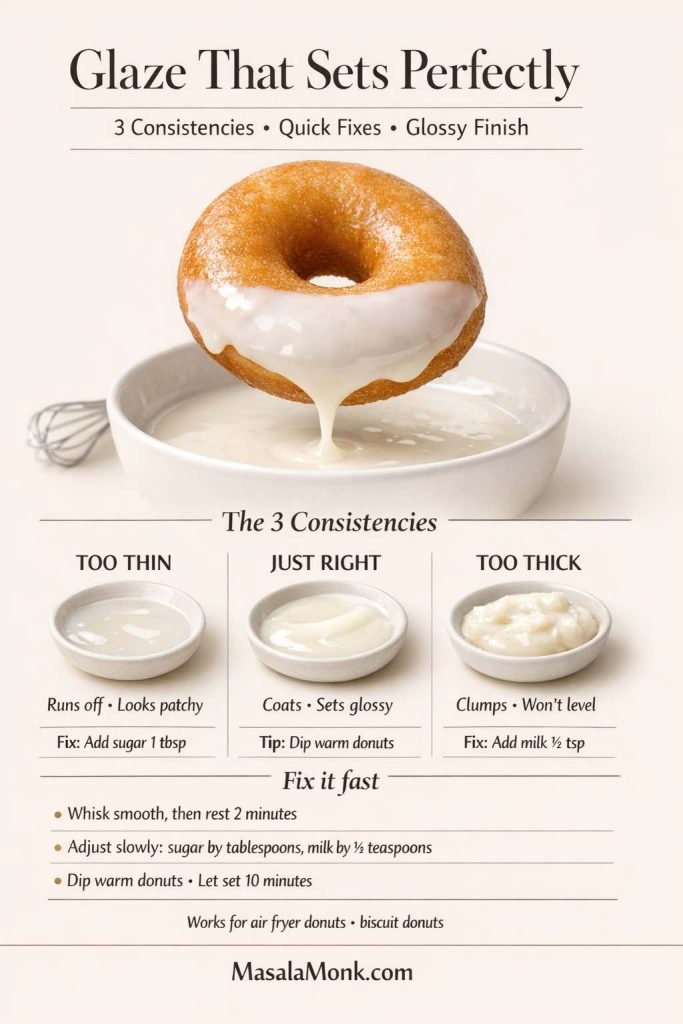
Infographic titled “Glaze That Sets Perfectly” showing a donut being dipped in glaze and a 3-column guide for donut glaze consistency: too thin, just right, and too thick, with quick fixes for air fryer donuts and biscuit donuts.
Glaze makes air fryer donuts taste “donut-shop” good. Use this quick donut glaze guide to hit the perfect consistency—too thin, just right, or too thick—then fix it fast so your glazed donuts set smooth and glossy instead of running off or clumping.

Troubleshooting homemade air fryer donuts

Donuts are forgiving, but a few problems show up again and again. Thankfully, each has a simple fix.

If they’re dense:
Usually the dough didn’t rise enough, or too much flour was added during kneading and rolling. Next time, keep the dough soft and give the second rise the time it needs.

If they’re dry:
Most often they cooked too long. Pull earlier and rely on glaze. Also, keep in mind that air fryer donuts continue to firm slightly as they cool, so stopping at “just done” matters.

If they’re pale:
Your air fryer might run cool. Add a minute, but don’t jump the temp too high. Pale donuts with glaze still look inviting. Dark donuts often taste overcooked.

If the surface looks rough:
Too much bench flour during rolling can leave the dough dry. Use a light dusting and roll gently.
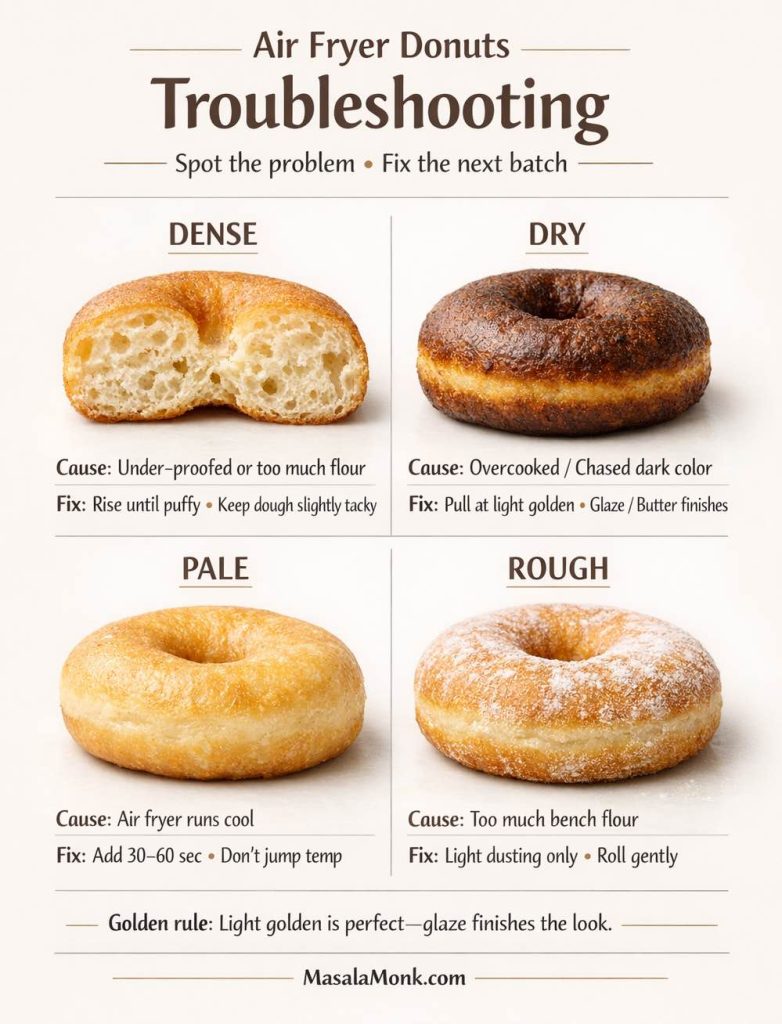
Air fryer donuts get better fast once you know what to look for. Use this troubleshooting guide to spot the problem—dense, dry, pale, or rough—and fix the next batch with simple changes like proofing longer, cooking to light golden, adjusting time by 30–60 seconds, and keeping bench flour light.

At this point, you’ve got a complete air fryer doughnuts recipe you can keep repeating. However, sometimes you want donuts fast—without mixing, rising, or waiting. That’s where biscuit donuts come in.

Also Read: Hot Chocolate Coffee: 3 Easy Recipes (Cocoa, Mix, or Espresso)


Air Fryer Biscuit Donuts (Donuts From Biscuit Dough)

Biscuit donuts are the shortcut that feels almost unfair. They’re quick, they’re fun, and they’re exactly the kind of dessert you can make on a whim.

You’ll see this style described in dozens of ways: biscuit donuts recipe, homemade donuts from biscuits, donuts made from biscuits, donuts using canned biscuits, donuts from biscuits in air fryer, or canned biscuit donuts in air fryer. No matter the wording, the idea is the same: use biscuit dough, cut a hole, air fry, then finish immediately while hot.

If you want a straightforward reference for this approach, RecipeBoy has a clear step-by-step method using canned dough in the air fryer: Air Fryer Canned Biscuit Donuts. What matters most is the finish and the timing—cook just until set and golden, then coat while warm.
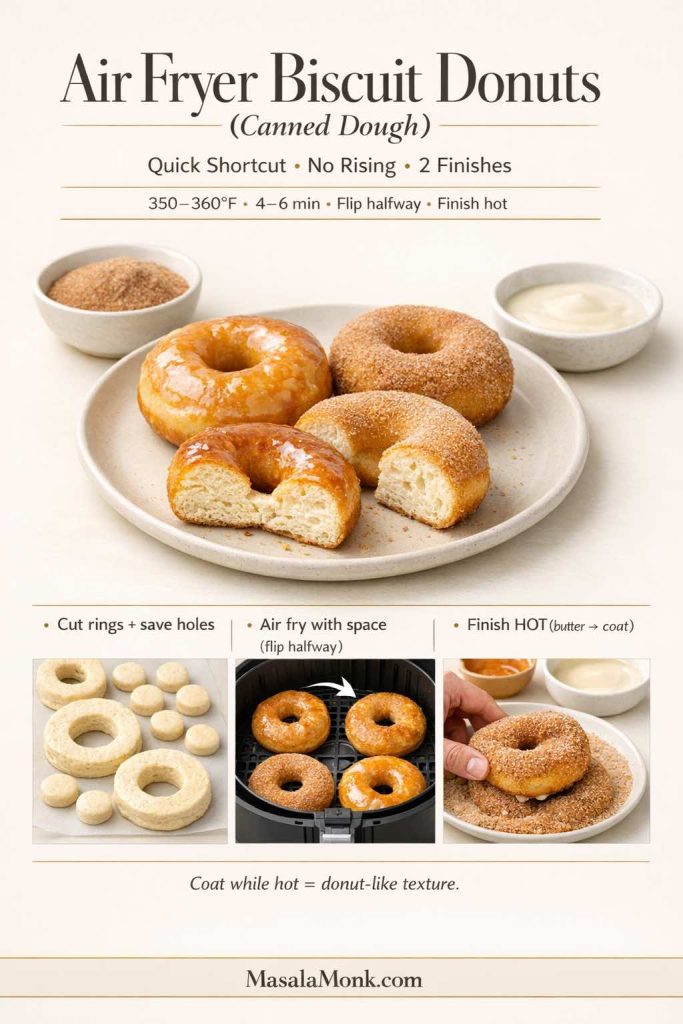
Section master infographic titled “Air Fryer Biscuit Donuts (Canned Dough)” showing glazed and cinnamon sugar donuts with a quick method strip: cut rings and save holes, air fry with space at 350–360°F for 4–6 minutes and flip halfway, then finish hot with butter and coating for donut-like texture.
These air fryer biscuit donuts are the fastest donuts from canned dough: no rising, short cook time, and two finishes. Cut rings and save the holes, air fry at 350–360°F for 4–6 minutes (flip halfway), then finish hot—butter first, then cinnamon sugar or glaze—for a tender, donut-like bite.

Ingredients for air fryer biscuit donuts

  • 1 can of biscuit dough (any standard biscuit-style dough works)
  • A small cutter for the donut hole (or the wide end of a piping tip)
  • Neutral oil spray (optional)
  • Melted butter (highly recommended for coating)

For cinnamon sugar

  • ½ cup sugar
  • 1–2 teaspoons cinnamon (to taste)

For glaze
Use the same simple glaze from the homemade recipe above.

How to make donuts from biscuits in air fryer (Step-by-step recipe)

1) Cut and shape

Separate the biscuits and place them on a board. Cut the center out of each biscuit to make a donut shape. Save the holes; they turn into donut bites that cook faster and coat beautifully.

If your biscuit dough is thick, stretch each ring slightly. That little adjustment helps them cook evenly.
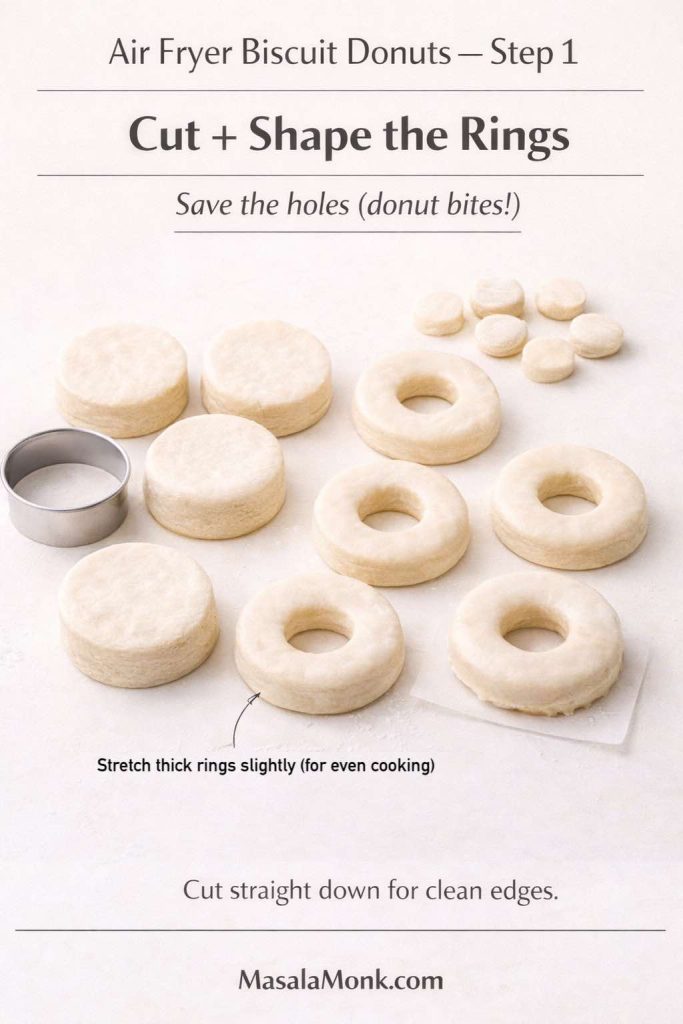
Air fryer biscuit donuts Step 1 showing biscuit dough rounds cut into donut rings with donut holes saved for bites, with tip to cut straight down for clean edges.
Step 1 for air fryer biscuit donuts: cut biscuit dough into rings and save the donut holes for quick bites. Cut straight down for clean edges, then stretch thick rings slightly so donuts from biscuits cook evenly.

2) Prep for cooking

Lightly spray both sides with oil, or leave them plain and brush with melted butter after cooking. Either way works, although a light spray can encourage a more even golden surface.
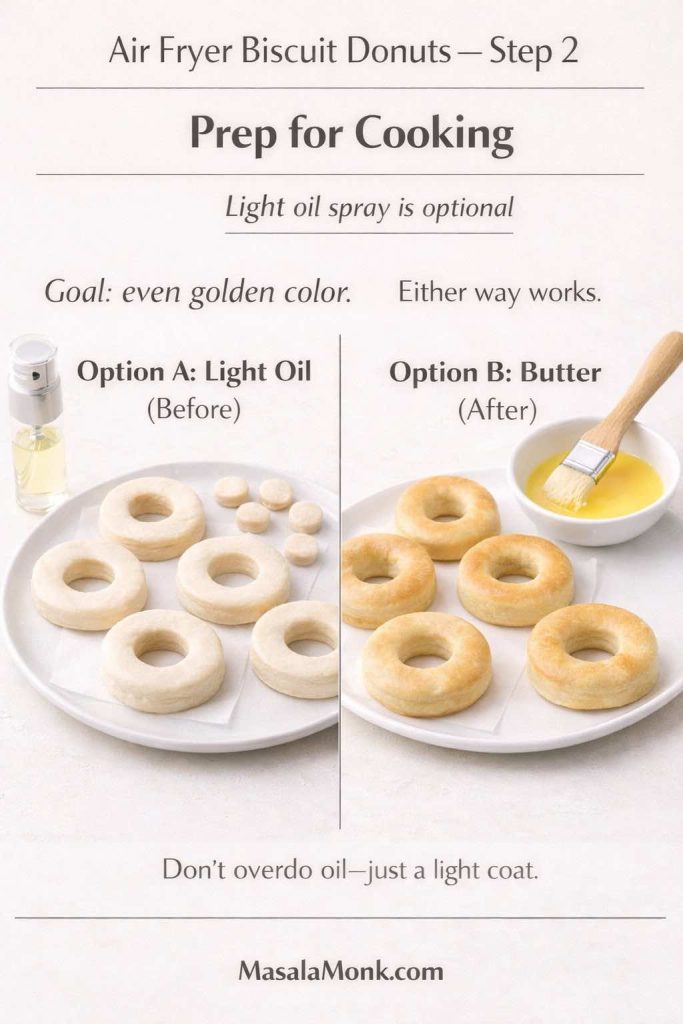
Air fryer biscuit donuts Step 2 showing two prep options: light oil before cooking or brushing with butter after cooking for even golden color.
Step 2: prep your biscuit donuts for the air fryer. A light oil spray can help even browning, but butter after cooking works too—either way keeps canned biscuit donuts tender instead of dry.

3) Air fry (with space)

Preheat your air fryer to 350–360°F.

Place the donuts in a single layer. Leave space between them. Air flow is your friend here, and crowding makes everything uneven.

Cook for 4–6 minutes total, flipping halfway. A useful starting point is:

  • 3 minutes on the first side
  • Flip
  • 2 minutes on the second side
  • Add 30–60 seconds if needed

Donut holes usually cook faster, so check them early.
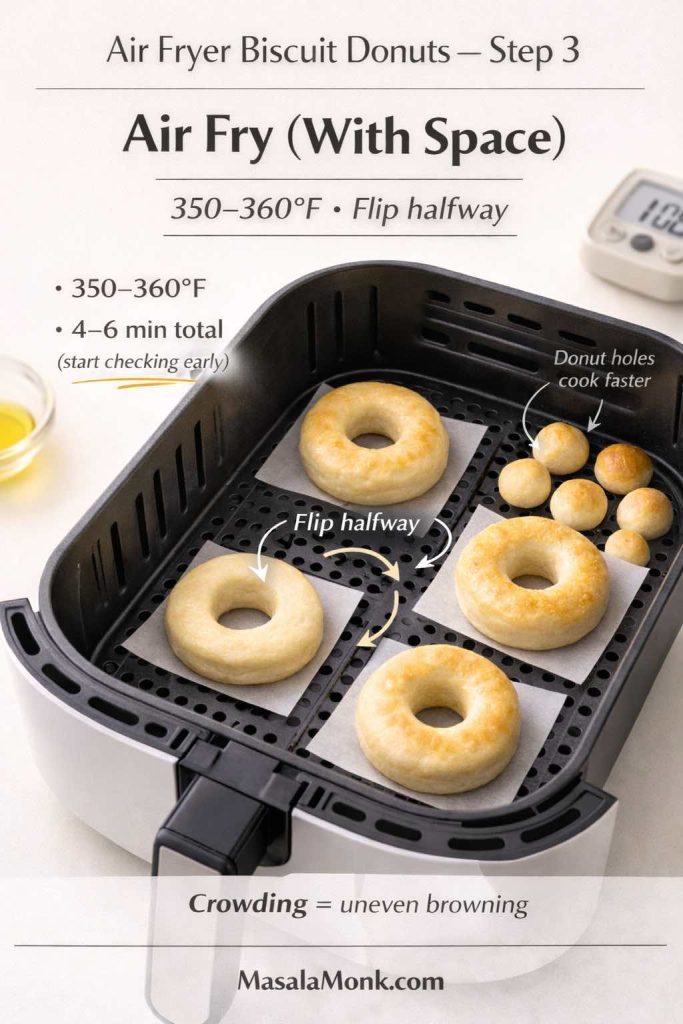
Air fryer biscuit donuts Step 3 showing donut rings spaced in an air fryer basket at 350–360°F with instructions to flip halfway and note that donut holes cook faster.
Step 3: air fry biscuit donuts in a single layer with space. Cook at 350–360°F for 4–6 minutes total and flip halfway—crowding causes uneven browning, and donut holes usually cook faster.

4) Finish immediately

This part is non-negotiable. Coating warm donuts is what makes them taste like a treat instead of a biscuit.
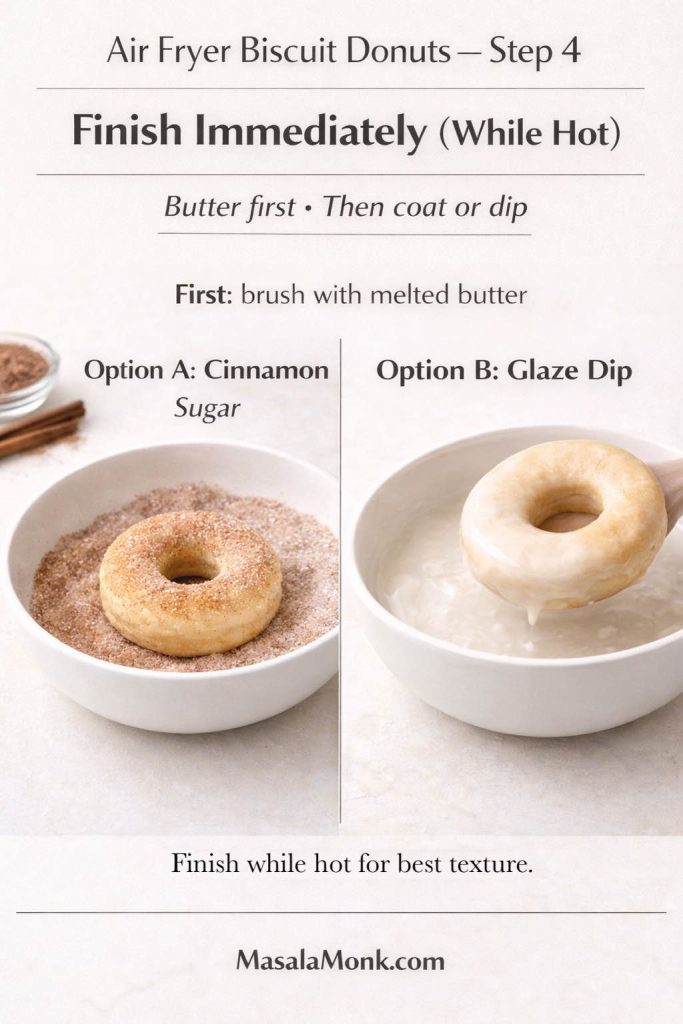
Air fryer biscuit donuts Step 4 showing finishing while hot: brush donuts with melted butter first, then coat in cinnamon sugar or dip in glaze for best texture.
Step 4 is the secret to donut-like texture: finish biscuit donuts while hot. Brush with melted butter first, then either coat in cinnamon sugar or dip in glaze—waiting too long makes donuts from canned biscuits taste more like biscuits.

Cinnamon sugar biscuit donuts in the air fryer

Brush the hot donuts with melted butter, then toss them in cinnamon sugar. The butter helps the cinnamon sugar cling and gives the finish that rich “just made” taste.

If you like cinnamon sugar desserts and want a natural pairing on the same sweet-coating theme, this churros guide fits beautifully at the table. Churros and biscuit donuts scratch a similar itch, yet they feel different enough to justify both.

Glazed canned biscuit donuts air fryer style

Dip the warm donuts in glaze, let them drip, then set them on a rack. If you want a thicker glaze that clings more heavily, hold back a little milk so the glaze stays plush.

Once you’ve done this once, you’ll understand why so many people keep this method in their back pocket. It’s the quickest route to donuts made from biscuits that actually feel like a real dessert.

Also Read: Iced Coffee: 15 Drink Recipes—Latte, Cold Brew, Frappe & More


Air Fryer Donut Pan vs Basket (Do You Need One?)

Some kitchens love specialty tools. Others prefer a clean counter and fewer things to wash. Either approach is valid, especially when it comes to an air fryer donut pan.

If you’re wondering about a donut pan for air fryer donuts, it helps to know what it changes—and what it doesn’t.
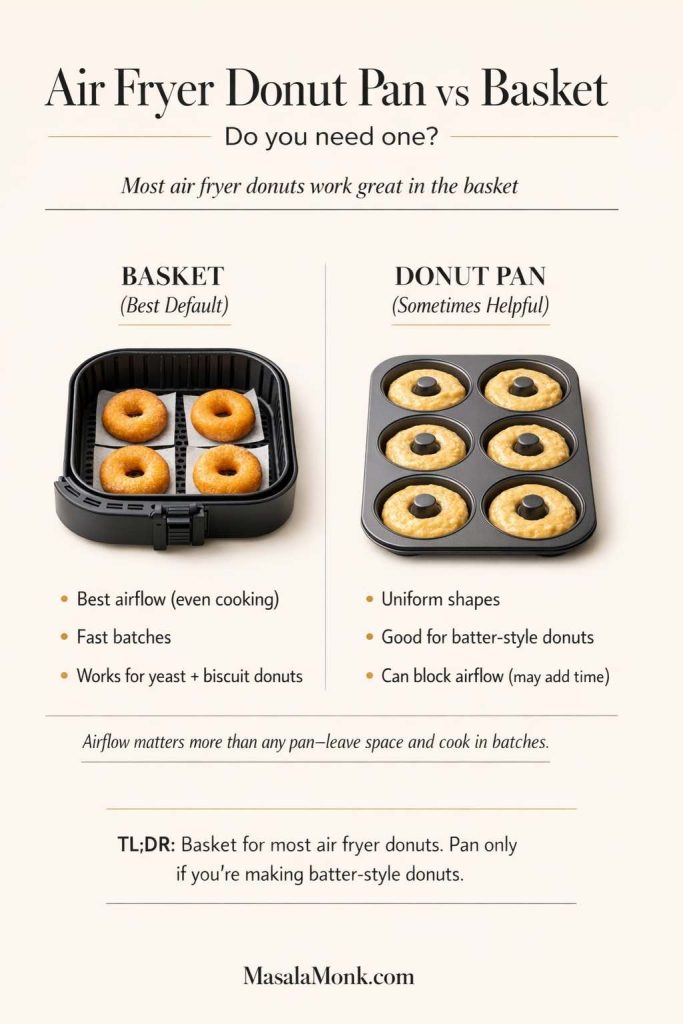
Infographic titled “Air Fryer Donut Pan vs Basket” comparing using an air fryer basket versus a donut pan, noting the basket works for most air fryer donuts (better airflow, fast batches, yeast and biscuit donuts) while a donut pan is mainly useful for batter-style donuts and may block airflow.
Wondering if you need an air fryer donut pan? Most air fryer donuts turn out better in the basket because airflow stays strong and batches cook evenly. Use a donut pan mainly for batter-style donuts or when you want uniform shapes—otherwise, leave space and cook in batches for the best results.

Air fryer donut pan: what it’s good for

A donut pan can be helpful if you’re making batter-style donuts (more like baked donuts) or if you want consistent shapes with minimal handling. In addition, if you’re aiming for uniformity—say, for a party platter—a pan can keep rings neat and predictable.

Donut pan for air fryer donuts: when to skip it

If you’re making yeasted donuts, you’ll still be shaping and moving risen dough. If you’re making biscuit donuts, you already have a shape. In both cases, the basket method is plenty.

Moreover, pans can block airflow. That’s not always a deal-breaker, but it can reduce browning and add cook time. If your goal is speed and simplicity, the basket wins.

Simple spacing rules that matter more than any pan

No matter what you use, spacing is the quiet hero of air fryer donuts. Give each donut room. Let the air do its job. Cook in batches. Then finish while warm.

That’s the habit that makes donuts in the air fryer feel consistent.

Also Read: Cappuccino Recipe: How to Make a Perfect Cappuccino at Home


Air Fryer Donuts vs Deep Fryer Donuts (A Real-World Comparison)

Sometimes you want a fair comparison, not a hype statement. Here’s the honest version.
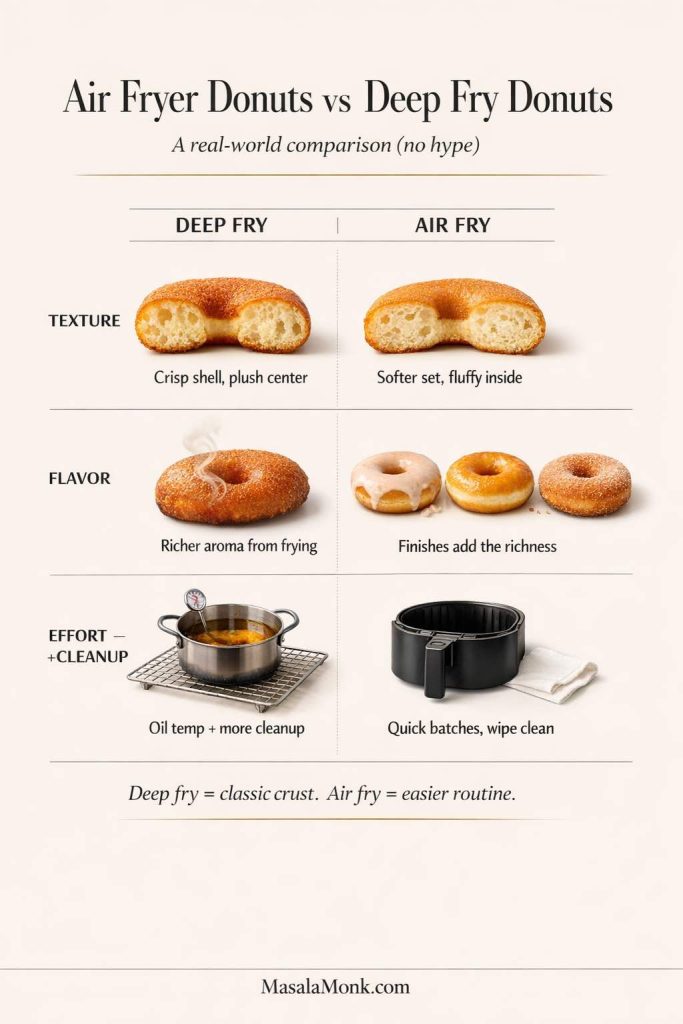
Infographic titled “Air Fryer Donuts vs Deep Fry Donuts” comparing deep fry and air fry across texture, flavor, and effort/cleanup: deep fry shows crisp shell and plush center with richer frying aroma but requires oil temperature control and more cleanup; air fry shows softer set and fluffy inside, finishes add richness, and quick batches with easy wipe-clean cleanup.
Air fryer donuts and deep fried donuts both work—just differently. Deep frying gives a crisper shell and richer frying aroma, but it comes with oil temperature management and cleanup. Air frying keeps things easy with quick batches and a softer outer set, and the “donut-shop” feel comes from finishes like glaze, butter, and cinnamon sugar.

Texture

Deep fryer donuts tend to have a more distinct fried crust with a plush interior. Air fryer donuts tend to have a softer outer set and a lighter crust. Still, the interior can be beautifully fluffy—especially with yeasted dough—so the overall experience is still donut-like.

Flavor

Deep frying adds a subtle richness that comes from oil browning. Air frying doesn’t. That’s why finishes matter more in the air fryer: glaze, butter, cinnamon sugar, and flavored coatings supply richness and aroma.

Effort and cleanup

Deep fryer donut recipes usually require managing oil temperature, careful timing, draining, and cleanup. Air fryer doughnuts reduce that entire workload to a few batches and a quick wipe-down.

If you’re curious about traditional frying technique, temperature cues, and what “done” looks like in a pot of oil, this Serious Eats piece is a strong explainer: Sweet Technique: How to Make Doughnuts. Likewise, King Arthur Baking’s yeast-raised doughnuts recipe is an excellent reference for the classic path: Yeast-Raised Doughnuts.

Even so, for everyday ease, the air fryer is hard to beat. That’s why so many people keep an airfryer donut method on rotation.

Also Read: Homemade Hot Chocolate with Cocoa Powder Recipe


How to Keep Air Fryer Donuts Soft (Small Choices, Big Payoff)

Donuts are at their best fresh. Still, you can keep them tender longer with a few practical habits.
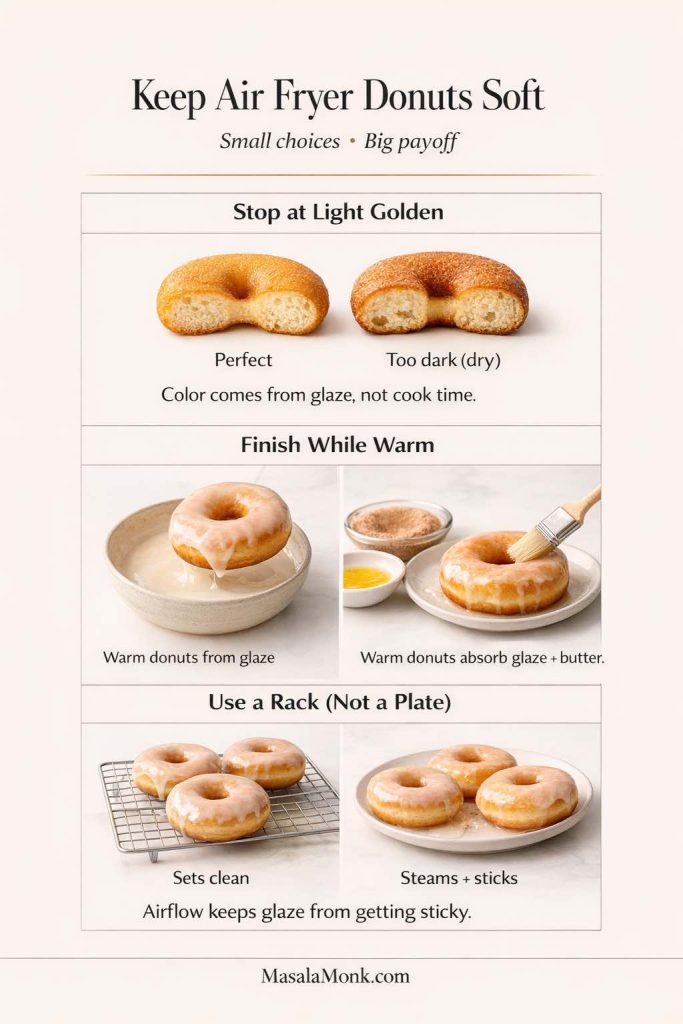
Infographic titled “Keep Air Fryer Donuts Soft” showing three habits: stop at light golden (perfect vs too dark and dry), finish donuts while warm (dip in glaze or brush with butter), and use a cooling rack instead of a plate so glaze sets cleanly and doesn’t steam and stick.
Soft air fryer donuts come down to three small habits: stop at light golden (don’t chase color), finish while warm so glaze and butter absorb properly, and set donuts on a rack—not a plate—so airflow keeps the glaze from turning sticky. Do this and both homemade air fryer donuts and biscuit donuts stay tender.

Don’t over-brown them

This is worth repeating because it’s the most common mistake. Air fryer donuts don’t need deep color. A light golden set is the target, and glaze makes them look finished.

Finish while warm

Warm donuts absorb glaze better, and cinnamon sugar clings more evenly. Additionally, melted butter brushed onto hot donuts adds moisture and richness that carries into the final bite.

Use a rack, not a plate

Glazed donuts sitting on a flat plate can steam underneath and turn sticky. A rack lets air circulate and helps the glaze set cleanly.

Also Read: Double Chocolate Chip Cookies – Easy Recipe with 7 Variations


Storage and Reheat: Donuts in the Air Fryer (Again)

Air fryer donuts are best the day they’re made. Nevertheless, leftovers happen, and reheating in the air fryer is far better than the microwave.
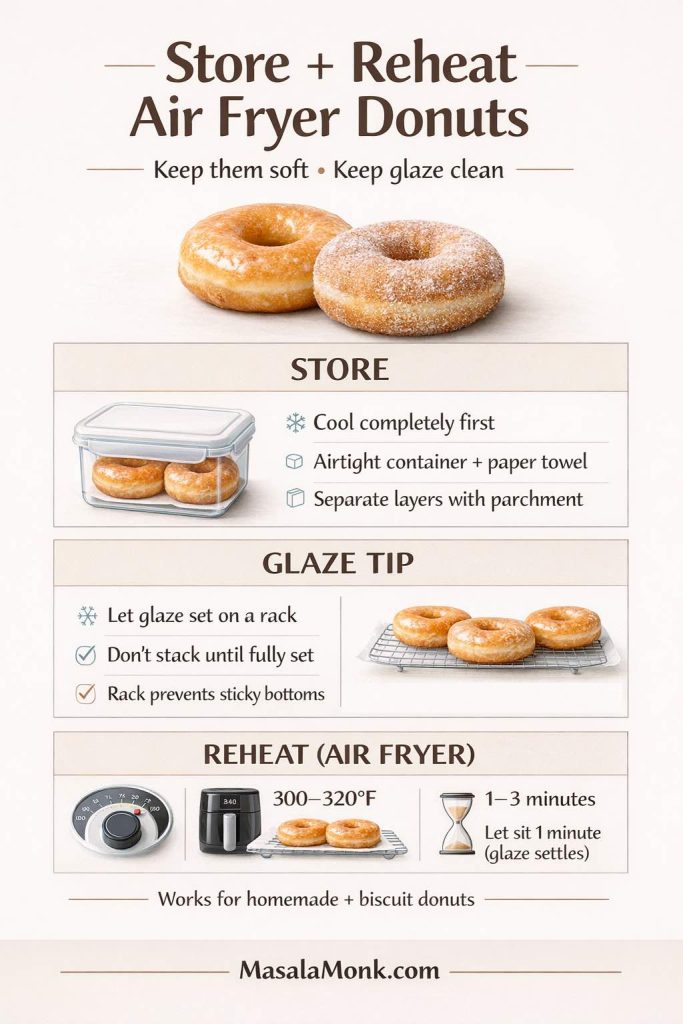
Infographic titled “Store + Reheat Air Fryer Donuts” showing how to store donuts (cool completely, airtight container with paper towel, parchment between layers), a glaze tip (let glaze set on a rack, don’t stack until fully set), and how to reheat donuts in the air fryer at 300–320°F for 1–3 minutes.
Want air fryer donuts that stay soft the next day? Use this storage and reheat guide: cool completely, store in an airtight container with a paper towel, separate layers with parchment, and reheat donuts in the air fryer at 300–320°F for 1–3 minutes. For glazed donuts, let the glaze set on a rack first so it stays clean instead of sticky.

How to store air fryer donuts

  • Let donuts cool fully first.
  • Store in an airtight container with a paper towel underneath.
  • If your kitchen is humid, crack the lid slightly to prevent condensation.

Glazed donuts can get sticky if they’re stacked. If you need to stack them, separate layers with parchment.

How to reheat donuts in the air fryer

Reheating donuts in the air fryer works beautifully when you keep the temperature low:

  • 300–320°F for 1–3 minutes

That’s enough to warm the interior without drying it out. If the donuts are glazed, they may look slightly melty right away. Give them a minute and they’ll settle.

A simple safety note for parties

If you’re serving donuts with dairy-based toppings and they sit out during a long brunch, it’s smart to follow basic food safety guidance about time at room temperature. The USDA explains the “danger zone” concept and timing here: 40°F–140°F Danger Zone.

Also Read: Easy Lemon Pepper Chicken Wings (Air Fryer, Oven & Fried Recipe)


Air Fryer Donuts: Finishes That Make Them Feel New Every Time

Once you’ve got the base method down—whether it’s homemade air fryer donuts or biscuit donuts in air fryer form—you can keep things interesting by changing the finish.
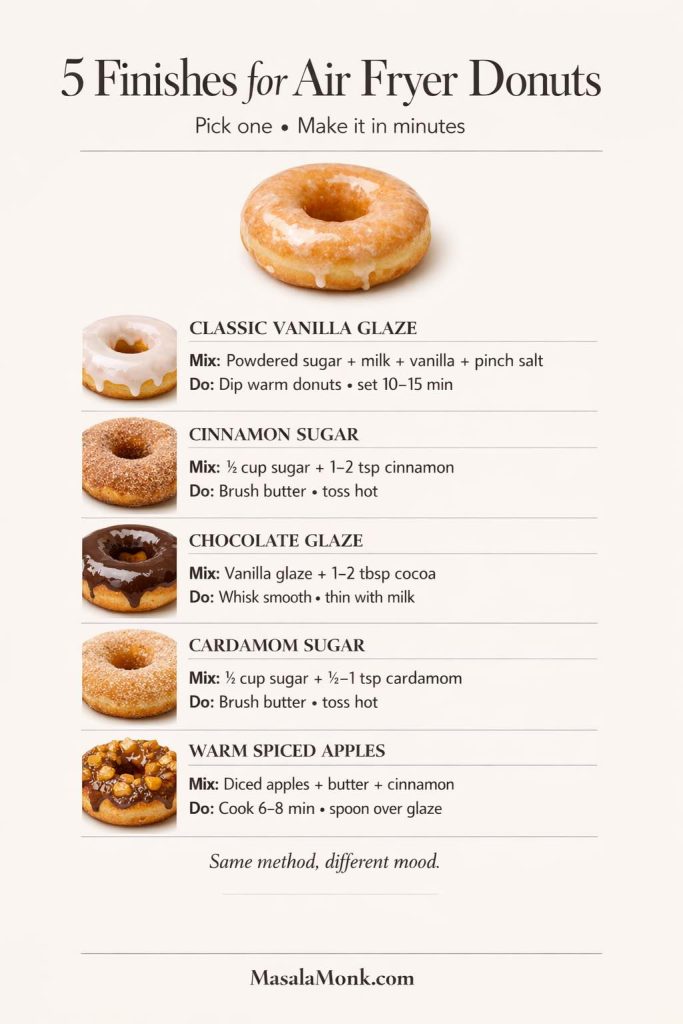
Keep air fryer donuts exciting with quick finishes you can do in minutes. This guide gives five easy topping ideas—classic glaze, cinnamon sugar, chocolate glaze, cardamom sugar, and warm spiced apples—each with a simple mix + do method so your homemade air fryer donuts or biscuit donuts feel new every time.

Classic vanilla glaze (the everyday favorite)

Use the glaze recipe above. Keep it thick enough to cling, and dip while warm.

Cinnamon sugar (fast, cozy, impossible to hate)

Brush hot donuts with melted butter, then toss in cinnamon sugar. The butter matters—it gives the coating depth and keeps the bite tender.

Chocolate glaze (for the “dessert” version)

Turn your vanilla glaze into chocolate by whisking in cocoa powder. Thin with milk a little at a time until smooth.

If you’re also building a chocolate dessert theme on the table, a natural companion can be vegan chocolate cake recipes, especially if you want extra frosting ideas that can translate into donut drizzles or dips.
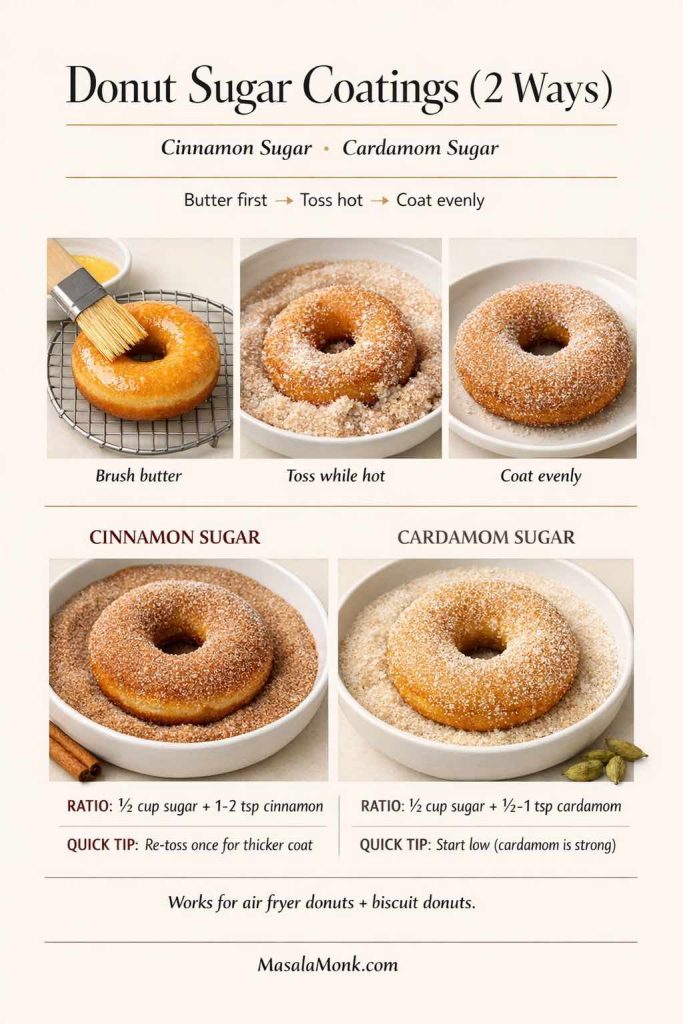
For cinnamon sugar air fryer donuts that taste donut-shop good, timing matters: brush with butter first, toss while hot, and coat evenly. Use this quick ratio guide for cinnamon sugar or cardamom sugar so homemade air fryer donuts and biscuit donuts get a perfect, fragrant coating every time.

Cardamom sugar (quietly luxe)

Swap cinnamon for ground cardamom in your sugar coating. It’s fragrant and a little unexpected, yet still comforting.

Warm spiced fruit topping (brunch energy)

If you want something that feels a little more “special occasion,” spoon warm spiced apples over glazed donuts. Our stewed cinnamon apples pancake recipe fits that flavor direction beautifully and makes a natural add-on without forcing anything.

Also Read: 19 Essential Kitchen Tools That Make Cooking Easier


A Simple Brunch Spread Built Around Air Fryer Donuts

Air fryer donuts can stand alone, yet they also shine as part of a spread. With a few thoughtful additions, you can turn one batch into a whole “help yourself” table.
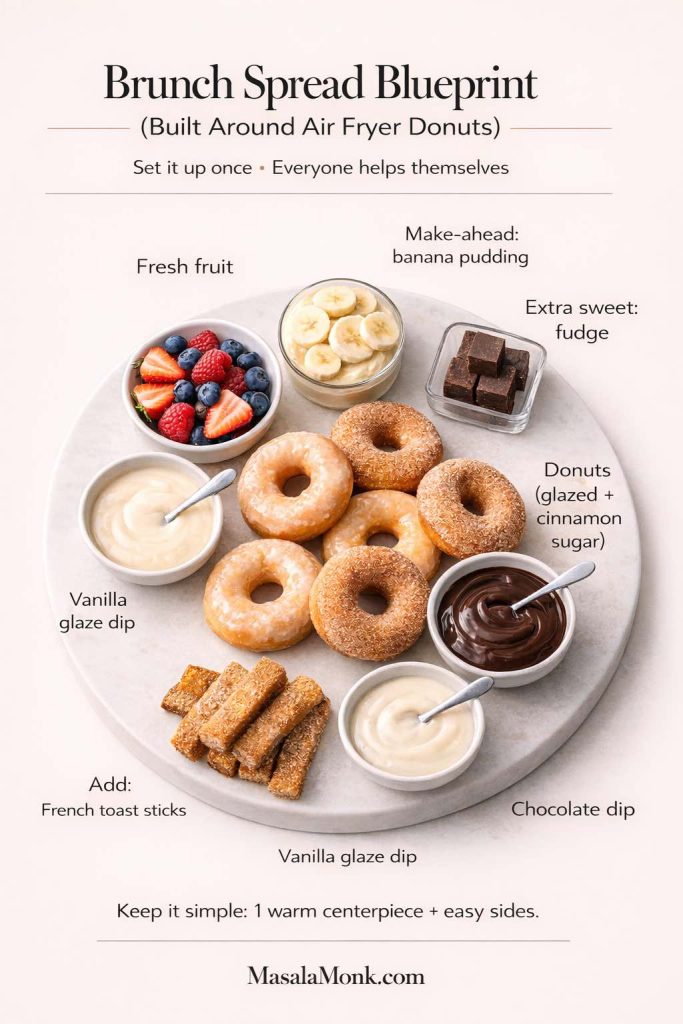
Turning air fryer donuts into a full brunch spread is easier than it looks. Use this simple donut board blueprint—glazed and cinnamon sugar donuts in the center, vanilla glaze and chocolate dips, fresh fruit, and easy add-ons like French toast sticks, banana pudding, and fudge—so guests can snack and serve themselves.

That way, donuts become the warm centerpiece rather than the only thing you’re responsible for.


Air Fryer Donuts: A Calm First-Time Game Plan

If you’re making doughnuts in the air fryer for the first time, the most helpful approach is treating the first batch like a gentle calibration.
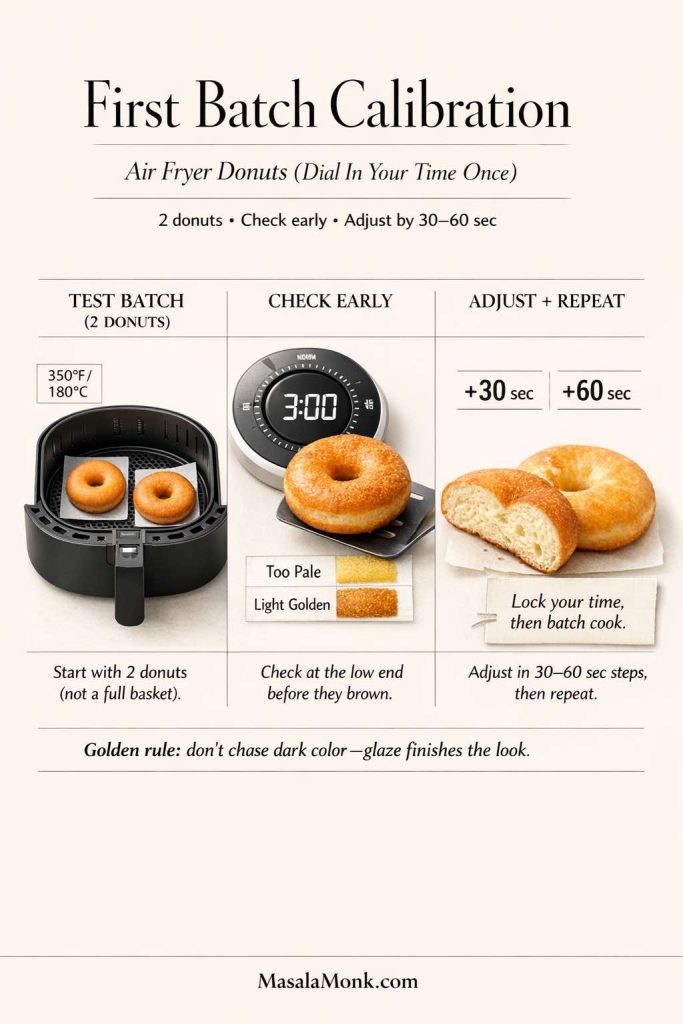
First time making air fryer donuts? Use this simple calibration method: start with just 2 donuts, check early for a light golden finish, then adjust by 30–60 seconds until you lock in the perfect cook time for your air fryer. Once you dial it in, every batch gets easier—and glaze finishes the look without overcooking.
Infographic titled “First Batch Calibration” for air fryer donuts showing a 3-step method: cook a test batch of 2 donuts at 350°F/180°C, check early for light golden color, then adjust cook time by 30–60 seconds and repeat to lock in the ideal timing.

Start with a small batch. Check early. Pull one donut and look at the inside. Adjust time by 30–60 seconds. Then repeat.

After that, everything becomes automatic. The recipe stops feeling like a “special event,” and it becomes the kind of thing you can do on a random afternoon—because you already know what your air fryer donut method looks like when it’s right.

Also Read: How to Cook Tortellini (Fresh, Frozen, Dried) + Easy Dinner Ideas


Full Recipe: Homemade Air Fryer Donuts (Glazed)

Makes: about 10–12 donuts
Air fryer temp: 350°F / 180°C
Cook time: 3–5 minutes per batch

Ingredients

Dough

  • 2 ¾ cups (330 g) all-purpose flour
  • 2 ¼ tsp instant yeast
  • ¼ cup (50 g) sugar
  • ¾ tsp fine salt
  • ¼ tsp nutmeg (optional)
  • ¾ cup (180 ml) warm milk
  • 1 egg
  • 3 tbsp melted butter
  • 1 tsp vanilla (optional)

Glaze

  • 1 ½ cups powdered sugar
  • 2–3 tbsp milk
  • 1 tbsp melted butter
  • ½ tsp vanilla
  • Pinch of salt
This homemade air fryer donuts recipe gives you the real glazed-donut feel without deep frying. Follow the yeast-raised method, cook at 350°F for 3–5 minutes, then glaze while warm so the coating sets smooth and glossy. Use the proofing cues and glaze rule on the card to keep donuts soft, fluffy, and donut-shop good.

Instructions

  1. Whisk flour, yeast, sugar, salt, and nutmeg in a bowl.
  2. Whisk warm milk, egg, butter, and vanilla in another bowl.
  3. Combine wet and dry until a shaggy dough forms.
  4. Knead until smooth and elastic.
  5. Cover and rise until doubled and puffy.
  6. Roll to ½–¾ inch thick and cut donuts.
  7. Rise again until airy.
  8. Preheat air fryer to 350°F / 180°C and lightly oil the basket.
  9. Air fry donuts in a single layer for 3–5 minutes, until set and lightly golden.
  10. Whisk glaze; dip warm donuts; set on a rack until glaze firms.

Also Read: Easy and Healthy Oat Cookies- No Sugar | No Butter | No Refined Flour


Full Recipe: Air Fryer Biscuit Doughnuts (Canned Dough)

Makes: depends on the can
Air fryer temp: 350–360°F
Cook time: 4–6 minutes total, flipping halfway

Ingredients

  • 1 can biscuit dough
  • Oil spray (optional)
  • Melted butter (for coating)

Cinnamon sugar

  • ½ cup sugar
  • 1–2 tsp cinnamon

Optional glaze
Use the glaze recipe above.
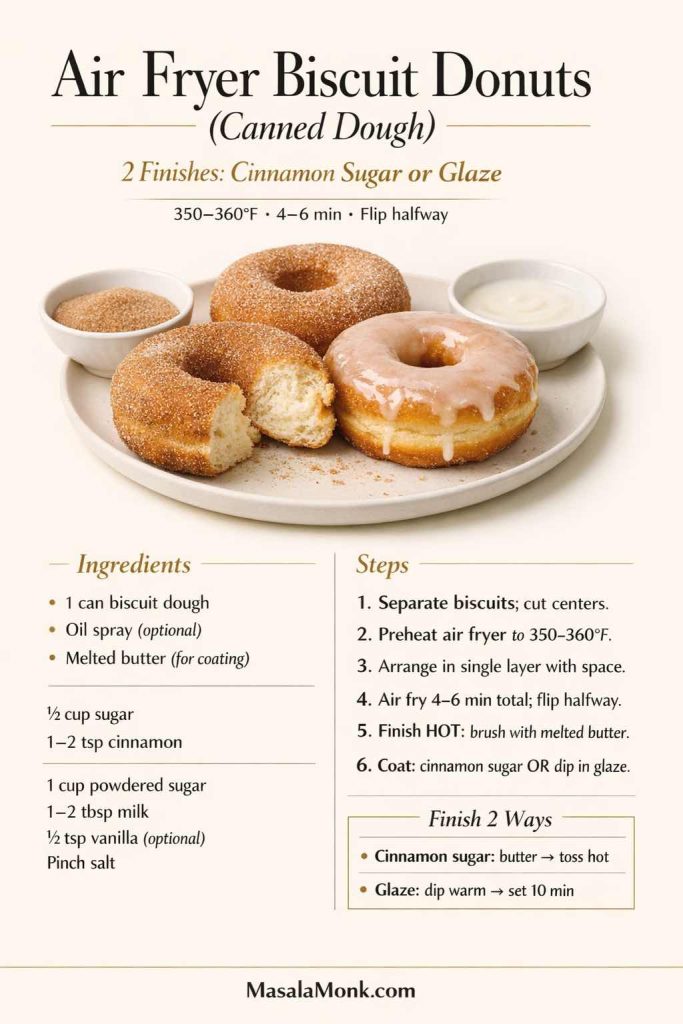
This is the fastest way to make donuts from canned biscuit dough in the air fryer. Follow the recipe card for air fryer biscuit donuts—cook at 350–360°F for 4–6 minutes and flip halfway—then finish hot with melted butter and either cinnamon sugar or a simple glaze for a donut-shop style bite.

Instructions

  1. Separate biscuits and cut centers to form rings. Save holes.
  2. Preheat air fryer to 350–360°F.
  3. Arrange donuts in a single layer with space.
  4. Air fry 4–6 minutes total, flipping halfway.
  5. While hot, brush with melted butter and toss in cinnamon sugar, or dip in glaze.

A Sweet Finish

Air fryer donuts are one of those rare recipes that feel both comforting and practical. On one day, you can make homemade donuts in the air fryer—yeasted, airy, and glazed. On another, you can throw together biscuit donuts in the air fryer in minutes and still get that warm, fresh treat experience.

Either way, once you’ve made them once, you’ll start seeing all the possibilities: glazed, cinnamon sugar, chocolate, spiced, topped, shared. Then, before you know it, air fryer donuts stop being a novelty and start becoming a simple habit—one you’ll be genuinely happy to repeat.

Also Read: Sourdough Recipe: 10 Easy Bread Bakes (Loaves, Rolls & Bagels)
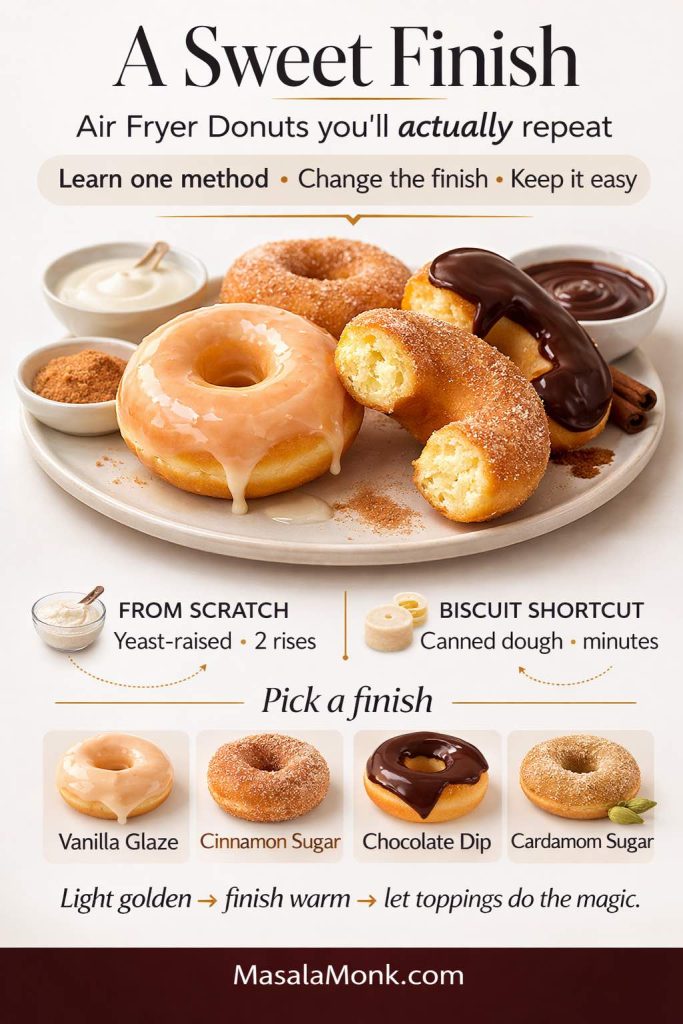
Closing infographic titled “A Sweet Finish” for air fryer donuts, showing a plate of donuts with four finish options—vanilla glaze, cinnamon sugar, chocolate dip, and cardamom sugar—plus a two-path choice between from-scratch yeast-raised donuts (two rises) and biscuit shortcut donuts (canned dough, minutes), with the takeaway “Light golden → finish warm → let toppings do the magic.”
Air fryer donuts are the kind of treat you can actually repeat: go from scratch (yeast-raised, two rises) when you want the “real deal,” or take the biscuit shortcut when you want donuts in minutes. Either way, pull them light golden, finish while warm, and pick a mood—vanilla glaze, cinnamon sugar, chocolate dip, or cardamom sugar—for that donut-shop feeling without deep frying.

FAQs

1) What is the best temperature for air fryer donuts?

For most air fryers, air fryer donuts cook best at 350°F / 180°C. That temperature helps the dough puff and set without drying out. If your air fryer runs hot, drop slightly toward 340–345°F; if it runs cool, extend the cook time instead of cranking heat.

2) How long do donuts cook in the air fryer?

Timing depends on thickness and your machine, yet typical ranges are:

  • Homemade air fryer donuts (yeast dough): about 3–5 minutes
  • Air fryer biscuit donuts: about 4–6 minutes, flipping halfway
    Rather than relying only on time, stop when the donuts look set, feel light, and turn a soft golden color.

3) How do I know when air fried doughnuts are done?

Look for a donut that’s puffed, set on top, and light golden. In addition, it should feel lighter than it looks when you lift it. If the surface is getting dark but the center seems underdone, lower the temperature next batch and add a minute.

4) Can I make doughnuts in the air fryer without a donut pan?

Absolutely. In fact, most donut in air fryer recipe methods use a standard basket or tray. As long as you leave space for airflow and cook in batches, you can make air fryer doughnuts without any specialty tools.

5) Do I need an air fryer donut pan or donut pan for air fryer donuts?

Not necessarily. A donut pan for air fryer cooking can help with uniform shapes in batter-style donuts, but it isn’t required for yeast donuts or donuts from biscuit dough. For many kitchens, the basket method is simpler and just as effective.

6) Why are my homemade air fryer donuts dry?

Most often, homemade air fryer donuts turn dry when they cook too long or at too high a temperature. Instead, pull them when they’re just set and lightly golden, then finish with glaze, butter, or cinnamon sugar while warm.

7) Why did my air fryer donuts come out dense instead of fluffy?

Typically, density comes from under-proofing (not rising long enough) or adding too much flour during kneading/rolling. For fluffier air fryer donuts, keep the dough soft, allow a full second rise, and roll gently without pressing out the air.

8) Can I make air fryer doughnuts from canned biscuits?

Yes—air fryer donuts from canned biscuits are one of the quickest versions. Simply cut centers, air fry at about 350–360°F, flip halfway, then coat immediately. This approach covers canned biscuit donuts in air fryer style with minimal effort.

9) How do I make donuts from biscuits in air fryer without them turning tough?

First, avoid overcooking—biscuit donuts air fryer batches can go from tender to firm quickly. Next, coat while warm (butter + cinnamon sugar or glaze) so the outside stays soft. Finally, don’t overcrowd the basket, because uneven airflow can dry edges.

10) What’s the easiest biscuit donuts recipe for the air fryer?

The simplest biscuit donuts recipe is: cut rings from biscuit dough, air fry 4–6 minutes total (flip halfway), then brush with melted butter and toss in cinnamon sugar. As a result, you get donuts made from biscuits with a classic, cozy finish.

11) Can I make air fryer biscuit donuts with biscuit dough that has no layers?

Yes. Even non-layered biscuit dough works for air fryer biscuit donuts. However, layered dough tends to puff more dramatically. If your dough is thicker, stretch the ring slightly so it cooks evenly.

12) Why are my canned biscuit doughnut in air fryer unevenly browned?

Usually it’s spacing. If donuts touch, airflow can’t circulate, so browning becomes patchy. Additionally, some air fryers heat more strongly in certain zones, so rotating the basket once mid-cook can help.

13) Should I flip doughnut in the air fryer?

For biscuit donuts in the air fryer, flipping halfway usually improves even browning. For homemade yeast donuts, flipping may or may not be needed depending on your air fryer; if the tops color faster than the bottoms, flip gently near the end.

14) Can I cook doughnut holes in the air fryer too?

Definitely. Donut holes cook faster, so check them early. Because they’re small, they’re also perfect for glazing, cinnamon sugar, or quick chocolate dip—especially when you want variety without extra work.

15) Can I make air fried donuts ahead of time?

You can, although they’re best fresh. If you need to plan ahead, make the donuts, cool completely, and store airtight. For the best texture later, reheat briefly in the air fryer and glaze afterward.

16) How do I reheat donuts in the air fryer without drying them out?

Use a lower temperature—around 300–320°F—for 1–3 minutes. That warms the center without toughening the outside. If the donuts are glazed, let them sit a minute after reheating so the glaze settles.

17) How do I store air fried donuts so the glaze doesn’t get sticky?

Let glazed donuts set fully on a rack, then store in a container with a paper towel underneath. Also, avoid stacking unless you separate layers with parchment. If your kitchen is humid, cracking the lid slightly can reduce condensation.

18) What’s the difference between air fryer doughnut and air fryer donut?

They’re the same food—just two common spellings. You’ll see air fryer doughnuts recipe and air fryer donut recipe used interchangeably, and both refer to donuts made in an air fryer.

19) Can I use a deep fryer donut recipe dough in the air fryer?

Sometimes, but results vary. Deep fryer donuts are built for fast oil cooking, so they may brown differently in hot air. Even so, a yeast-raised dough can still work well as air fried doughnuts if you cook gently and finish with glaze.

20) Is an air fryer for donuts worth it if I also deep fry?

If you enjoy deep fried donuts, you’ll still love frying for that classic crust. On the other hand, an air fryer for donuts is great when you want fewer steps, less cleanup, and a repeatable treat you can make more often.
Posted on 16 Comments

French Toast Sticks (Air Fryer + Oven Recipe) — Crispy Outside, Custardy Inside

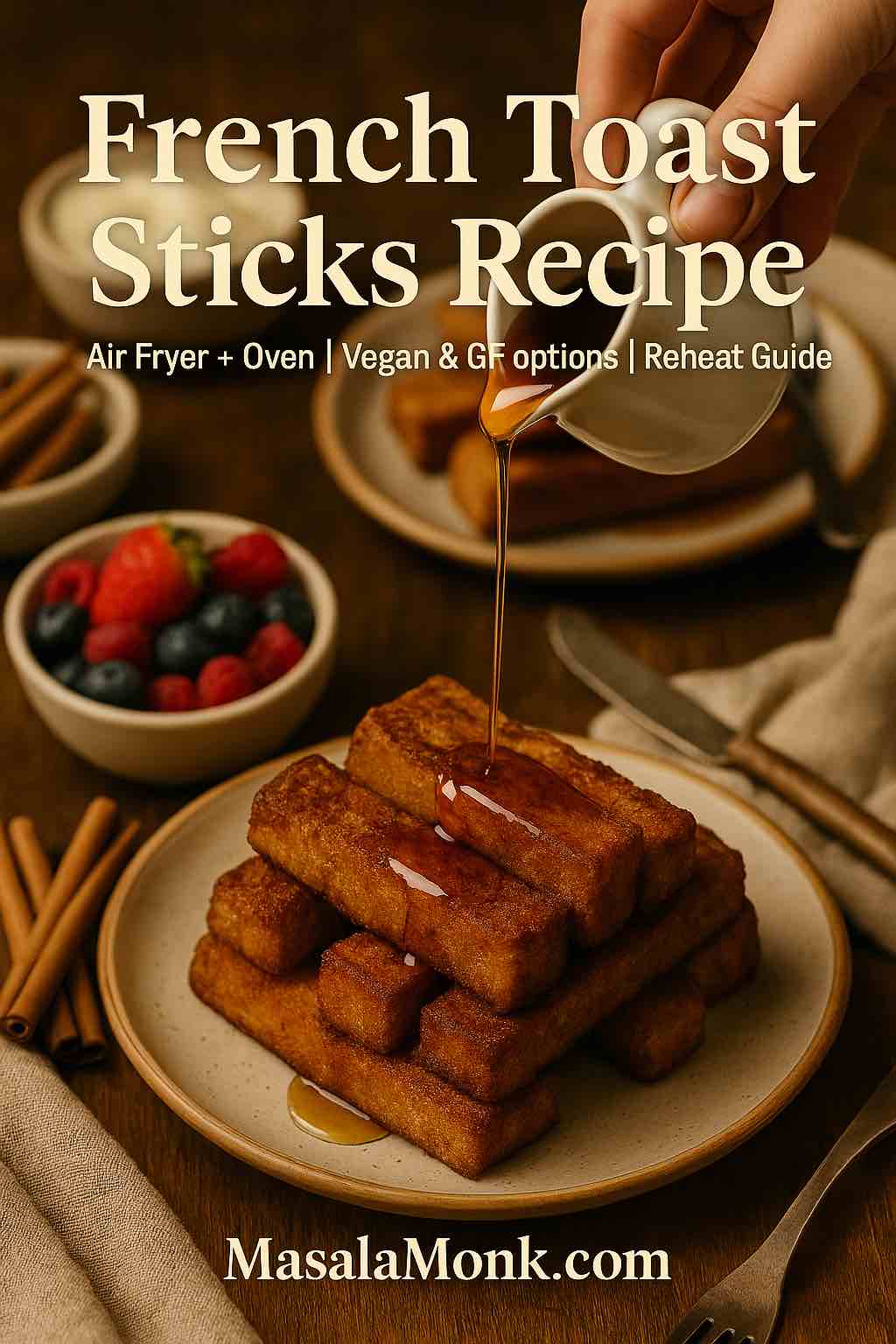
French toast sticks recipe cover with maple syrup poured over a crispy stack; air fryer and oven methods with vegan and gluten-free options.

There are breakfasts you make on autopilot and there are breakfasts that pull everyone to the table. This french toast sticks recipe sits firmly in the second camp: shatteringly crisp edges, a custardy middle that stays tender, and dippable batons that feel festive on a Tuesday and right at home on a holiday brunch board. The method is wonderfully forgiving once you understand three levers—custard ratio, heat management, and evaporation. We’ll walk through air fryer and oven paths, then branch into vegan, gluten-free, and protein-forward variations, plus copycat crunch coats, batch-freezing, and precise reheating. Along the way, when you need a plant-based base that already works, reach for the tried-and-true guide to Vegan French Toast: 6 Easy Recipes; it adapts to sticks beautifully with only a couple of tweaks.

Before we begin, a quick but important food-safety reminder: the center of an egg-based custard should reach about 71°C / 160°F; when you want belt-and-braces certainty, the USDA safe minimum temperature chart explains the number succinctly. With that in mind, let’s get cooking.


Core Ingredients (and Why They Work)

  • Bread (8 thick slices): Brioche, challah, or Texas toast excel because their enriched crumb absorbs custard without collapsing. Standard sandwich bread will do in a pinch if you lightly dry it first.
  • Eggs (3 large): Structure, gloss, and gentle richness.
  • Milk (¾ cup / 180 ml): Whole milk yields plush centers; almond or oat milk keep things dairy-free without losing crispness. If you love making your own nut milk, you can follow this simple primer on how to make almond milk at home for a clean, neutral base.
  • Sugar (1 tbsp): Quickens browning; keep it modest so the crust doesn’t scorch.
  • Vanilla (1 tsp) & Cinnamon (½ tsp): Aroma that plays well with maple, chocolate, or fruit.
  • Salt (pinch): Brightens everything.
  • Butter or neutral oil (1–2 tbsp): A whisper on the basket or pan dramatically boosts crunch.

As a north star for technique and proportions, the explainer at Serious Eats is an evergreen reference; we’ll echo the spirit while tuning for stick geometry and the speed of convection.


Classic French Toast Sticks Recipe — Air Fryer Method

Yield: 4 generous servings (20–24 sticks)
Active time: about 20 minutes

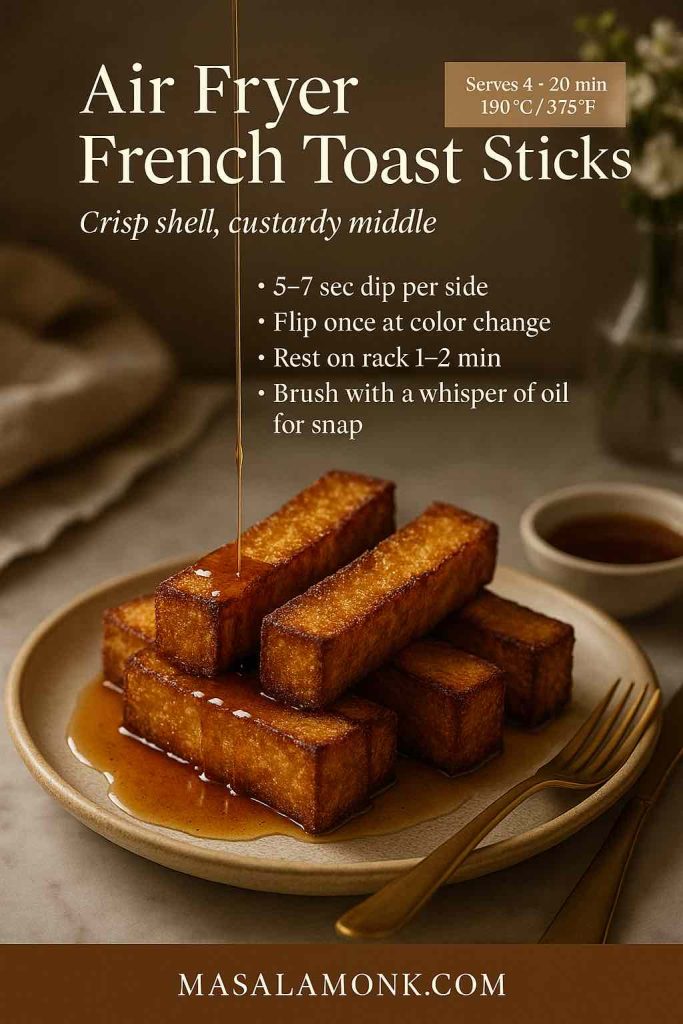
Air Fryer French Toast Sticks stacked on a stoneware plate as maple syrup drips—crisp edges, custardy centers; MasalaMonk recipe card.
Air Fryer French Toast Sticks—shatteringly crisp outside, custardy middle. Dip each stick 5–7 seconds per side, air-fry at 190°C / 375°F for 6–8 minutes, flip once when the color deepens, then rest 1–2 minutes on a rack. Brush a whisper of oil before the flip for extra snap; serve immediately with warm maple.

Step 1: Cut and Dry

Stack each slice and cut into thirds to form batons. Set them on a wire rack for 5–10 minutes while you mix the custard. Alternatively—and especially if the bread is very fresh—give the slices 2–3 minutes in a low oven to drive off a little surface moisture. This brief drying is your first insurance policy against sogginess.

Step 2: Whisk the Custard

In a shallow dish, whisk 3 eggs, ¾ cup (180 ml) milk, 1 tbsp sugar, 1 tsp vanilla, ½ tsp cinnamon, and a pinch of salt until perfectly smooth. The custard should coat the back of a spoon and leave a clean trail when you draw a finger through it.

Step 3: Quick Soak

Dip 6–8 sticks at a time for 5–7 seconds per side. Let excess drip until the coating thins to a glossy film. Because sticks have more edge area, they don’t need a deep soak; brevity yields better texture.

Step 4: Air Fry for Crunch

Preheat to 190°C / 375°F. Lightly brush or spray the basket with butter or oil. Arrange sticks with space between them—hot air needs room to circulate. Air fry 6–8 minutes total, flipping at the halfway point when the color deepens from gold to amber. For a dramatic shell, brush the exposed sides with a trace of oil just before the flip.

Step 5: Rest, Then Serve

Transfer to a wire rack for 1–2 minutes. That brief rest vents steam and sets the crust. Serve immediately with warm maple syrup, or go playful with a small bowl of 3-minute homemade chocolate syrup that turns glossy on contact.


Sheet-Pan French Toast Sticks — Oven Method (Batch-Friendly)

When you’re cooking for a crowd or stocking the freezer, the oven delivers consistency without babysitting.

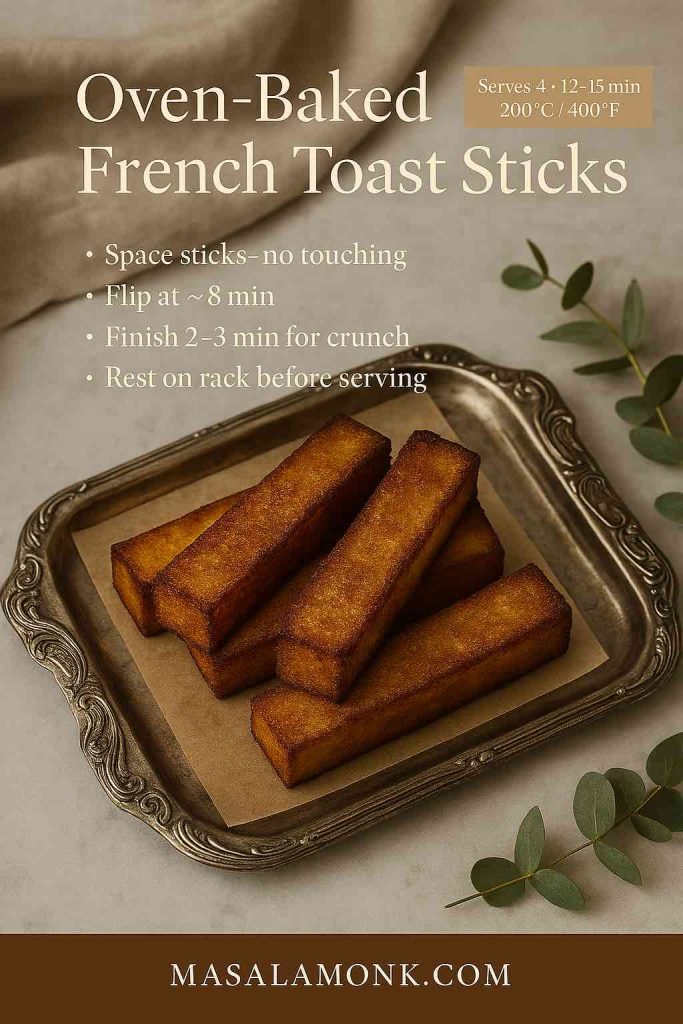
Oven-baked French toast sticks on an antique silver tray with parchment—golden, crisp edges and soft centers; MasalaMonk recipe card.
Oven-Baked French Toast Sticks—perfect for batches. Bake at 200°C / 400°F for 12–15 min on a lined rack, flip at ~8 min, then give 2–3 min extra for crunch. Space the sticks so they don’t touch and rest on a wire rack before serving for crisp bottoms.
  1. Heat oven to 200°C / 400°F. Line a rimmed sheet with parchment or set a rack over the sheet; brush with melted butter.
  2. Dip sticks as above and lay them out so they don’t touch.
  3. Bake 12–15 minutes, flipping around 8 minutes, until deeply golden.
  4. For extra crunch, give them 2–3 minutes more after the flip.
  5. Rest on a rack before plating or freezing.

Although times vary with ovens, color and feel tell the truth: crisp edges, bouncy centers. If the center indents and stays wet, a minute or two more will finish the set.


Stovetop Skillet Variation — When You Want Pan Caramelization

Sometimes you crave the scent of butter browning in a pan. In that case:

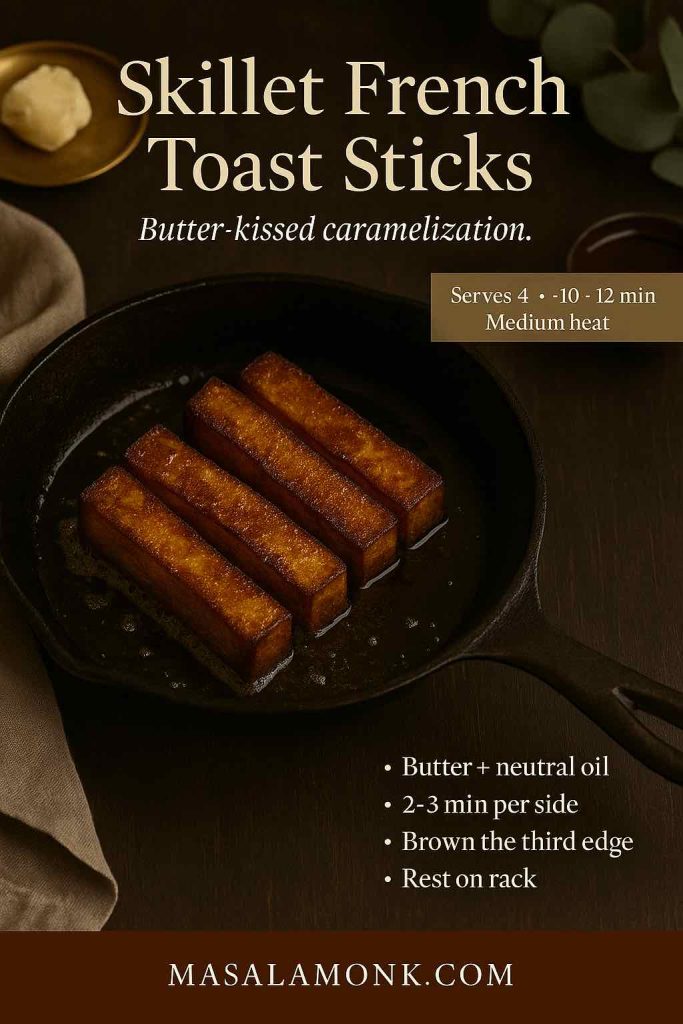
Skillet French toast sticks browning in a cast-iron pan with butter—golden, crisp edges and custardy centers; MasalaMonk stovetop recipe card.
Skillet French Toast Sticks—deep caramel notes from the pan. Heat medium with butter + a little neutral oil, cook 2–3 min per side, then brown the third edge. Work in small batches, wipe and refresh fat between rounds, and rest on a wire rack to keep bottoms crisp. Serve immediately with warm maple.
  • Heat a large nonstick or well-seasoned cast-iron skillet over medium.
  • Film the pan with a mix of butter and oil.
  • Cook sticks 2–3 minutes per side, turning to brown the third “edge” as needed.
  • Slide finished sticks onto a rack so the bottoms don’t steam.

This route gives you a slightly deeper caramel note and a touch more flexibility if your air fryer is busy with bacon or potatoes.


Vegan French Toast Sticks — Plant-Forward with Crisp Edges

If you’re cooking for vegans, egg allergies, or you simply like the flavor of plant-based custard, swap in the method from Vegan French Toast: 6 Easy Recipes and adapt it for sticks with two small upgrades:

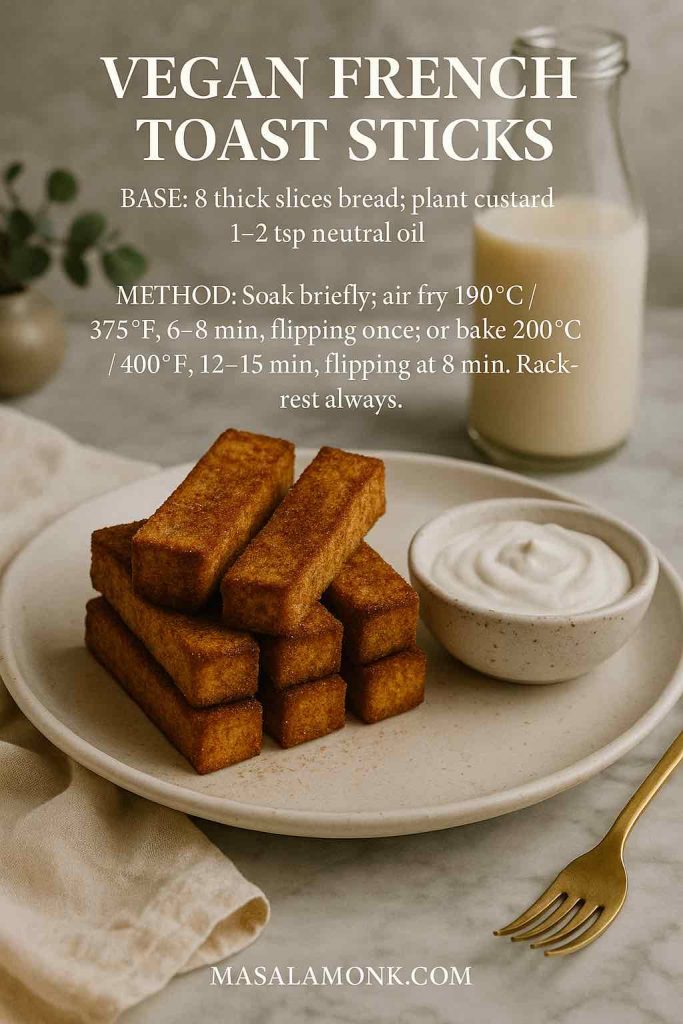
Vegan French toast sticks stacked on a stoneware plate with coconut yogurt and an almond-milk bottle—golden, crisp; MasalaMonk recipe card.
Vegan French Toast Sticks—crisp edges, tender middle without eggs. Enrich the plant custard with 1–2 tsp neutral oil, give each stick a brief soak, then air-fry at 190°C / 375°F for 6–8 min (flip once) or bake at 200°C / 400°F for 12–15 min (flip at 8). Rest on a wire rack to set the crust. Tip: use a tight-crumb loaf and keep the dip quick for best structure.
  • Add 1–2 tsp neutral oil directly to the vegan custard to enhance browning.
  • Keep the soak short (as above) so structure holds.
  • Air fry at 190°C / 375°F for 6–8 minutes total, flipping once, or bake per the oven method and extend a minute if edges look pale.

Because plant custards can set more gently, the rack rest is doubly important; it locks in crunch while the interior finishes.


Gluten-Free French Toast Sticks — Crisp Without Crumble

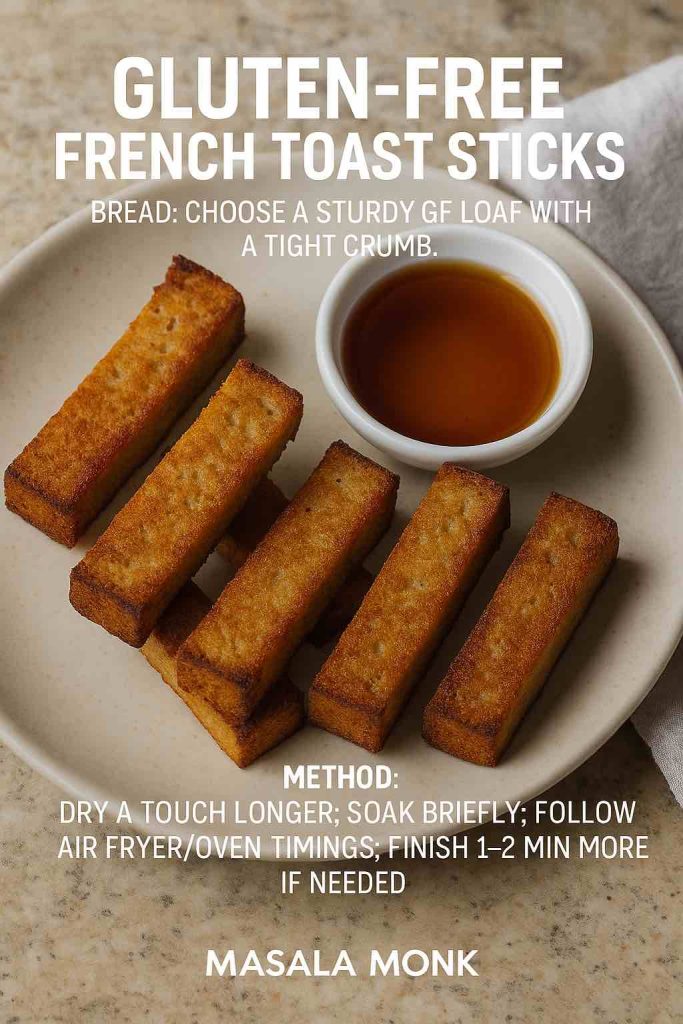
Gluten-free breads vary substantially, so choose a loaf with a close crumb and assertive structure—brioche-style GF loaves or thicker sandwich slices perform best. Dry the sticks slightly longer before dipping, and keep the soak short. Follow either the air fryer or oven timing above; add 1–2 minutes after the flip if the surface looks soft.

Gluten-free French toast sticks on a stoneware plate with a maple-syrup ramekin—golden, crisp edges and tender centers; MasalaMonk recipe card.
Gluten-Free French Toast Sticks—crisp without crumble. Pick a sturdy, tight-crumb GF loaf (brioche-style or thick sandwich). Dry 5–10 min, then brief soak so the sticks hold structure. Cook: Air fryer 190°C / 375°F, 6–8 min (flip once) or oven 200°C / 400°F, 12–15 min (flip at ~8). If the surface looks soft, finish 1–2 min more. Rest on a wire rack for crisp bottoms.

If gluten is new territory for you or your readers, a quick primer like What is Gluten? helps demystify labels. For a naturally GF side that complements sticks, consider a spoon of millet porridge or these ideas in millets as a gluten-free superfood—they round out the plate without competing on sweetness.


Protein French Toast Sticks — Higher Satiety, Same Crunch

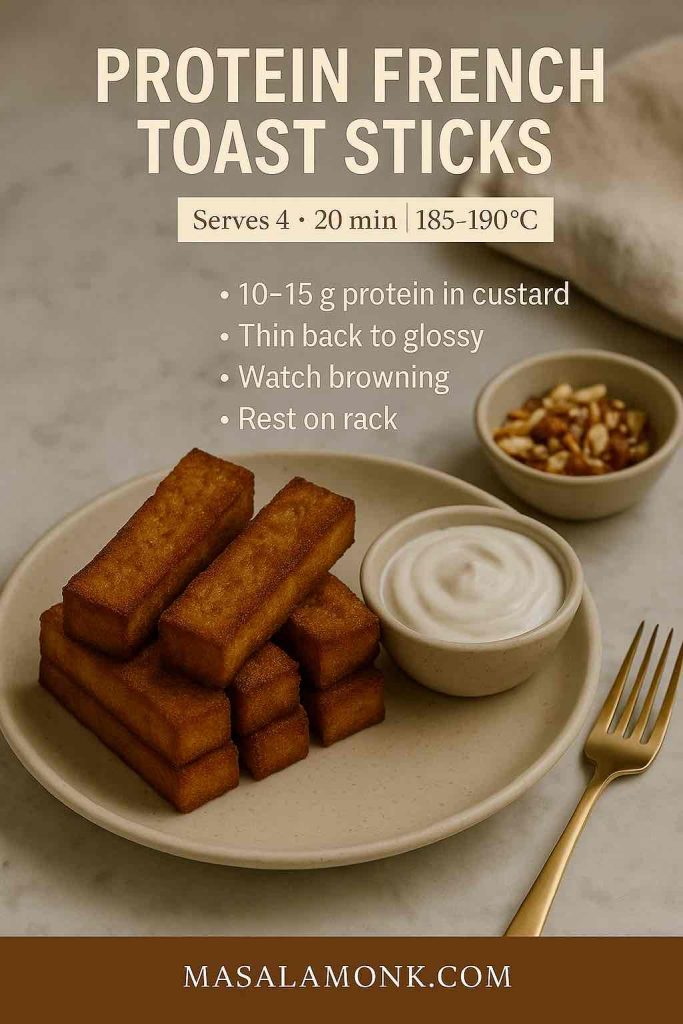
For a more filling breakfast without leaning on syrup, whisk 10–15 g unflavoured whey or plant protein into the custard, then thin with milk until it returns to that glossy, spoon-coating texture. Because added protein browns quickly, watch color closely and lower the air fryer temperature to 185°C / 365°F if necessary. Serve with thick yogurt and chopped nuts, or keep it light and pair a few sticks with keto chia pudding with almond milk so everyone at the table gets what they prefer.

Protein French toast sticks on a stoneware plate with yogurt dip and chopped nuts—golden and crisp; MasalaMonk high-protein recipe card.
Protein French Toast Sticks—more satiety, same crunch. Whisk 10–15 g unflavoured whey or plant protein into the custard, then thin with milk until glossy. Cook 185–190°C / 365–375°F for 6–8 min in the air fryer, flip once, and rest on a rack. Protein speeds browning—watch color and reduce sugar slightly. Serve with thick yogurt and toasted nuts.

Crunch Coats & Copycat Textures — From Churro Sugar to Cornflake Crust

Now and then, you want that fairground crunch or a drive-thru echo at home. Happily, sticks invite embellishment:

  • Cinnamon Sugar “Churro” Finish: Toss just-cooked sticks in a blend of 3 tbsp sugar + 1 tsp cinnamon. Do this while they’re still hot so the sugar clings.
  • Cornflake Crust: After dipping, press each stick into lightly crushed cornflakes. Air fry as usual. The shards add audible crunch without deep-frying.
  • Graham Dust: Blitz plain grahams into coarse crumbs; press on as with cornflakes for a cookie-like halo.
  • Nutty Edge: Roll one long side in finely chopped, lightly toasted almonds or pecans before cooking; it creates a textural contrast without overwhelming the custard.

For inspiration and a sense of what diners expect from a fast-food take, a quick skim of the Sonic Drive-In menu will reveal how they pair sticks and dips. You’ll find that a simple vanilla-maple dip (equal parts maple syrup and thick yogurt, scented with vanilla) outshines most chain versions at home.


Sauces, Dips, and Fruit — Keep the Party on the Plate

Maple syrup is non-negotiable for purists; nevertheless, little jars of toppings make breakfast feel abundant:

  • Warm Chocolate Spoon Sauce: Drizzle a ribbon of 3-minute homemade chocolate syrup over a stack and watch it set into a gloss as the sticks cool.
  • Cinnamon Apples: Spoon over stewed cinnamon apples for a diner-style plate without the cloying sweetness.
  • Yogurt-Maple Dip: Whisk ½ cup thick yogurt with 2 tbsp maple and a pinch of salt.
  • Berry Smash: Crush berries with a touch of sugar and lemon; strain or leave rustic.
  • Orange Zest Sugar: Microplane zest into sugar with a whisper of nutmeg; toss hot sticks lightly for a holiday finish.

Because sauces add sweetness, you can reduce sugar in the custard slightly and lean on caramelization for flavor.


Freezer-Friendly: How to Batch, Store, and Reheat Perfectly

Sticks freeze and reheat better than whole slices thanks to their surface area. Here’s the straightforward route:

  • Cook completely and rest on a rack until room-temp.
  • Freeze in a single layer on a parchment-lined sheet until firm.
  • Bag & label, pressing out air.
  • Reheat from frozen:
    • Air fryer 180°C / 356°F for 3–5 minutes (shake once).
    • Oven 200°C / 400°F for 6–8 minutes on a rack set over a sheet.

If you keep a box of store-bought sticks as a back-pocket option, use these ranges as a starting point and adjust by brand. For context, you can glance at Eggo French Toaster Sticks or Farm Rich French Toast Sticks to see packaging guidance, then dial toward your preferred crispness. Either way, trust color and firmness more than labels.


Ratio Sense — Cook by Feel When Measuring Cups Vanish

Holiday rentals and late-night cravings share one trait: missing measuring cups. Fortunately, this recipe scales by intuition:

  • For 2 slices (6 sticks): 1 large egg + a scant splash of milk (about 60–80 ml).
  • For 4 slices (12 sticks): 2 eggs + ~150 ml milk.
  • For 8 slices (24 sticks): 3 eggs + 180 ml milk (our base).

Aim for a custard that’s thicker than milk and thinner than cream, glossy, and clingy. If it runs like water, add part of another egg; if it clumps, thin with a splash of milk. This single cue—how the custard coats the back of a spoon—unlocks consistency regardless of brand or bread.


Troubleshooting French Toast Sticks Recipe

  • Edges browned, center wet: Shorten the soak next time; for this batch, give the sticks 1–2 extra minutes on a rack in a hot oven to finish.
  • Pale even after time: Preheat longer and add a teaspoon more sugar to the custard; sugar fuels browning.
  • Eggy streaks: Whisk the custard more thoroughly and avoid letting sticks lounge in the liquid.
  • Soft after resting: Always move finished sticks to a wire rack; the air gap prevents steam from softening the bottom.
  • GF bread crumbling: Choose a denser loaf, cut slightly thicker, and keep the dip brisk.
  • Overly sweet: Reduce sugar in the custard and switch to yogurt-maple dip for balance.

For doneness anxiety, an instant-read thermometer ends the guesswork; custard-based dishes earn their melt-in-the-middle texture right around that 71°C / 160°F sweet spot highlighted by the USDA chart.


Flavor Variations That Behave Well in Stick Form

Because the format is stable, you can dress it up or down without losing structure:

  • Orange–Cardamom: Zest one orange into the custard and add a pinch of cardamom; finish with icing sugar.
  • Maple–Brown Butter: Brown 1–2 tbsp butter; brush it on hot sticks and drizzle maple.
  • Coconut: Stir a spoon of coconut cream into the custard; sprinkle toasted coconut to finish.
  • Hazelnut: Thin chocolate-hazelnut spread with warm milk for a pourable gloss.
  • Spiced Sugar: Combine cinnamon, a hint of ginger, and nutmeg; toss lightly while hot.

If you lean into crunchy coats (cornflake or graham), reduce custard sugar slightly to avoid tipping into brittle sweetness.


Scaling Up or Down French Toast Sticks Recipe

  • For one: 1 egg + 60–80 ml milk + 2 slices (6 sticks) → air fryer 6–7 minutes total.
  • For two: 2 eggs + ~150 ml milk + 4 slices (12 sticks) → same heat; cook in two rounds.
  • For a crowd: Double the base and use two sheet pans on convection; rotate pans and flip at the 8-minute mark.

Meanwhile, if you’re running a mixed table—vegan, dairy-free, and classic—cook the vegan batch first, followed by gluten-free if needed, then the standard custard last. Separate racks keep everything crisp and tidy.


A Note on Bread, Moisture, and Timing

Bread is a living variable. Even within the same brand, dryness swings with storage and climate. Consequently, your soak time is the dial you turn most. Fresh, soft brioche? Dry slightly longer and dip quickly. Day-old challah? Dip a hair longer. Very dry loaf? Add a tablespoon of milk and extend the soak by a second or two. Ultimately, color and feel tell you more than the clock: aim for caramel edges and a buoyant middle that springs back when pressed.

If you enjoy tinkering, the classic ratio outlined by pros—roughly one egg per ¼–⅓ cup milk—gives you leeway; the granular reasoning in the Serious Eats overview is a useful mental model as you experiment.


Serving Boards and Balanced Plates

Because sticks are sweet-leaning, anchor the plate with freshness or creaminess. Citrus segments and mint keep things bright; a small bowl of salted yogurt reins in syrup. For a sweet-savory spread, add salty nuts or crisp bacon; for a fully plant-based board, go with fruit, maple, and a side of millet ideas for texture variety. If dessert-for-breakfast is the vibe, a warm ribbon of house chocolate syrup and cinnamon apples earns applause every single time.


Quick Reference Cards (Copy/Paste Friendly)

Air Fryer French Toast Sticks Recipe

  • Ingredients (serves 4): 8 thick slices bread; 3 eggs; ¾ cup (180 ml) milk; 1 tbsp sugar; 1 tsp vanilla; ½ tsp cinnamon; pinch salt; butter/oil.
  • Method: Cut each slice into thirds; dry briefly. Whisk custard smooth. Dip 5–7 s/side. Air fry 190°C / 375°F, 6–8 min, flipping halfway. Rest on a rack. Serve immediately.

Oven-Baked French Toast Sticks Recipe

  • Ingredients: Same as above.
  • Method: Heat oven 200°C / 400°F. Line/rack pan; butter lightly. Dip quickly; arrange with space. Bake 12–15 min, flip at 8 min; add 2–3 min for extra crunch. Rest and serve.

Vegan French Toast Sticks (No Egg, No Dairy)

  • Base: Use plant custard from this vegan guide; add 1–2 tsp neutral oil to the mix.
  • Method: Soak briefly; air fry 190°C / 375°F, 6–8 min (flip once) or bake as above; extend a minute if pale. Rack-rest always.

Gluten-Free French Toast Sticks

  • Bread: Choose a sturdy GF loaf with a tight crumb.
  • Method: Dry a touch longer; soak briefly; follow air fryer/oven timings; finish 1–2 min more if needed.

Make-Ahead & Reheat

  • Freeze fully cooked sticks in a single layer; bag when firm.
  • Reheat from frozen: Air fryer 180°C / 356°F, 3–5 min; Oven 200°C / 400°F, 6–8 min on a rack.

Closing Thoughts

Once you’ve made this french toast sticks recipe a couple of times, you’ll feel the controls in your hands: how quickly to dip, when to flip, and exactly how deep a golden you prefer. From there, variations are easy—vegan when you need it, gluten-free for guests, a protein twist for longer mornings, a churro dust when nostalgia calls. And because the methods scale without drama, you can cook a few sticks for a sleepy kiddo or line up two trays for a party brunch without changing anything but the pan.

When you want the plant-based path that just works, lean on Vegan French Toast: 6 Easy Recipes. If you’re curious about the science of ratios and why small tweaks matter, browse the Serious Eats technique explainer for clarity. And whenever you want precise safety numbers, the USDA chart is the last word. Beyond that, trust your senses: the scent of browning butter, the feel of a springy center, and the sound of a crisp edge snapping are the only cues you really need.

FAQs

1) How long do I air fry french toast sticks, and at what temperature?

For a classic french toast sticks recipe, preheat the air fryer to 190°C / 375°F; cook 6–8 minutes total, flipping halfway. Moreover, if the bread is extra thick, add 1–2 minutes until edges are deeply golden and the center springs back.

2) What’s the best oven time and temperature for french toast sticks?

Bake at 200°C / 400°F for 12–15 minutes, turning at the 8-minute mark. Additionally, for an extra-crisp shell, finish 2–3 minutes more; the interior should feel bouncy rather than wet.

3) What is the ideal egg-to-milk ratio for the custard?

Generally, aim for about 1 large egg per ¼–⅓ cup (60–80 ml) milk. Conversely, if using very stale bread, increase milk slightly so the custard stays silky. This balance keeps the french toast sticks recipe tender without turning soggy.

4) How do I keep french toast sticks crispy instead of soggy?

Firstly, dry the bread briefly before dipping. Secondly, dip quickly (5–7 seconds per side), allowing excess custard to drip off. Furthermore, cook with space between sticks and rest them on a wire rack for a minute before serving.

5) Which bread works best for a french toast sticks recipe?

Brioche, challah, and Texas toast consistently shine thanks to sturdy crumbs and gentle sweetness. Nevertheless, thick-cut sandwich bread succeeds if you dry it slightly beforehand.

6) Can I make french toast sticks without eggs?

Yes. Use a vegan custard base (e.g., plant milk plus thickener and flavorings) and proceed with the same timings. Importantly, add a teaspoon of neutral oil to the batter to encourage browning.

7) How do I make dairy-free french toast sticks?

Simply replace milk with almond, oat, or coconut milk at a 1:1 ratio. Additionally, brush or spray the basket/pan lightly with oil to enhance crisp edges, since non-dairy custards brown a touch slower.

8) What if I have no vanilla or cinnamon?

Omit both and rely on butter browning and maple for aroma. Alternatively, use orange zest, cardamom, or a whisper of nutmeg. Notably, the french toast sticks recipe still tastes great with just salt and sugar.

9) How many eggs per slice (or per batch) should I plan?

As a rule of thumb, 1 egg covers 1–2 slices (3–6 sticks) depending on thickness. Accordingly, for 8 slices (about 24 sticks), 3 eggs plus ¾ cup milk is a dependable starting point.

10) How long should french toast sticks cook on each side in a skillet?

Use medium heat and cook about 2–3 minutes per side. Meanwhile, rotate briefly to brown the “third edge”; transfer to a rack so the bottoms don’t steam.

11) Can I freeze french toast sticks? How do I reheat them later?

Absolutely. Freeze fully cooked sticks in a single layer, then bag. Subsequently, reheat from frozen: air fryer 180°C / 356°F for 3–5 minutes, or oven 200°C / 400°F for 6–8 minutes on a rack.

12) What internal cues tell me the sticks are done?

Look for deep golden edges and a springy center that rebounds with a gentle press. Additionally, the custard should not ooze when cut; if it does, cook 1–2 minutes more.

13) How do I scale this french toast sticks recipe for one person or for a crowd?

For one, use 1 egg + 60–80 ml milk and 2 slices (6 sticks). For a crowd, double or triple the base; use two sheet pans and rotate them, flipping at 8 minutes. Likewise, hold finished sticks on a rack in a warm oven.

14) Can I add protein powder without making the texture chalky?

Yes—whisk in 10–15 g unflavoured whey or plant protein per 1–2 eggs, then thin with milk until the custard coats a spoon. However, because added protein browns faster, reduce heat slightly or watch carefully.

15) What are smart gluten-free adaptations?

Choose a dense GF loaf with a tight crumb, dry the sticks a bit longer, and keep the soak brisk. Moreover, add 1–2 minutes after the flip if the surface looks soft; the extra time sets structure.

16) How do I get a “crunch coat” like churro or cereal-crusted sticks?

Immediately after dipping, press sticks lightly into crushed cornflakes or graham crumbs. Afterward, air fry or bake as usual. Gently dust hot sticks with cinnamon sugar to finish if desired.

17) Can I make the custard richer with cream or half-and-half?

Certainly. Replace up to half the milk with heavy cream or half-and-half. Nevertheless, to prevent a greasy feel, keep cook temperature moderate and avoid over-soaking.

18) What’s the easiest way to avoid eggy streaks in the batter?

Whisk thoroughly until the custard is homogenous and glossy. Additionally, stir between batches, since spices can settle; a smooth custard gives even browning.

19) How do I keep the flavor balanced if I’m using very sweet dips?

Reduce sugar in the custard by a teaspoon and rely on caramelization for depth. Ultimately, the french toast sticks recipe should taste gently sweet on its own, with sauces providing the accent.

20) Can I make french toast sticks ahead for brunch service?

Yes. Cook completely, cool on a rack, and refrigerate up to 4 days. Then, just before serving, re-crisp: air fryer 180°C / 356°F for 3–4 minutes or oven 200°C / 400°F for 5–7 minutes.

21) What pan fat is best—butter or oil?

Butter delivers aroma and browning; a small blend with neutral oil raises the smoke point. Consequently, use butter for flavor and a touch of oil for resilience, especially on the second batch.

22) How do I adapt the french toast sticks recipe for very fresh, soft bread?

Dry the slices lightly in a low oven for 2–3 minutes per side, cool 1 minute, then dip quickly. Conversely, if the loaf is quite dry, increase milk slightly and extend the soak by a second or two.

23) What toppings pair well without overwhelming the texture?

Thick yogurt with a pinch of salt, warm berries, cinnamon apples, peanut-maple, or a restrained chocolate drizzle. Additionally, finish with citrus zest to brighten richer combinations.

24) How do I know I’ve nailed the texture every time?

Color, feel, and sound guide you: amber edges, a gentle spring in the center, and a faint crackle after a brief rack rest. In short, when those cues align, your french toast sticks recipe is spot on.