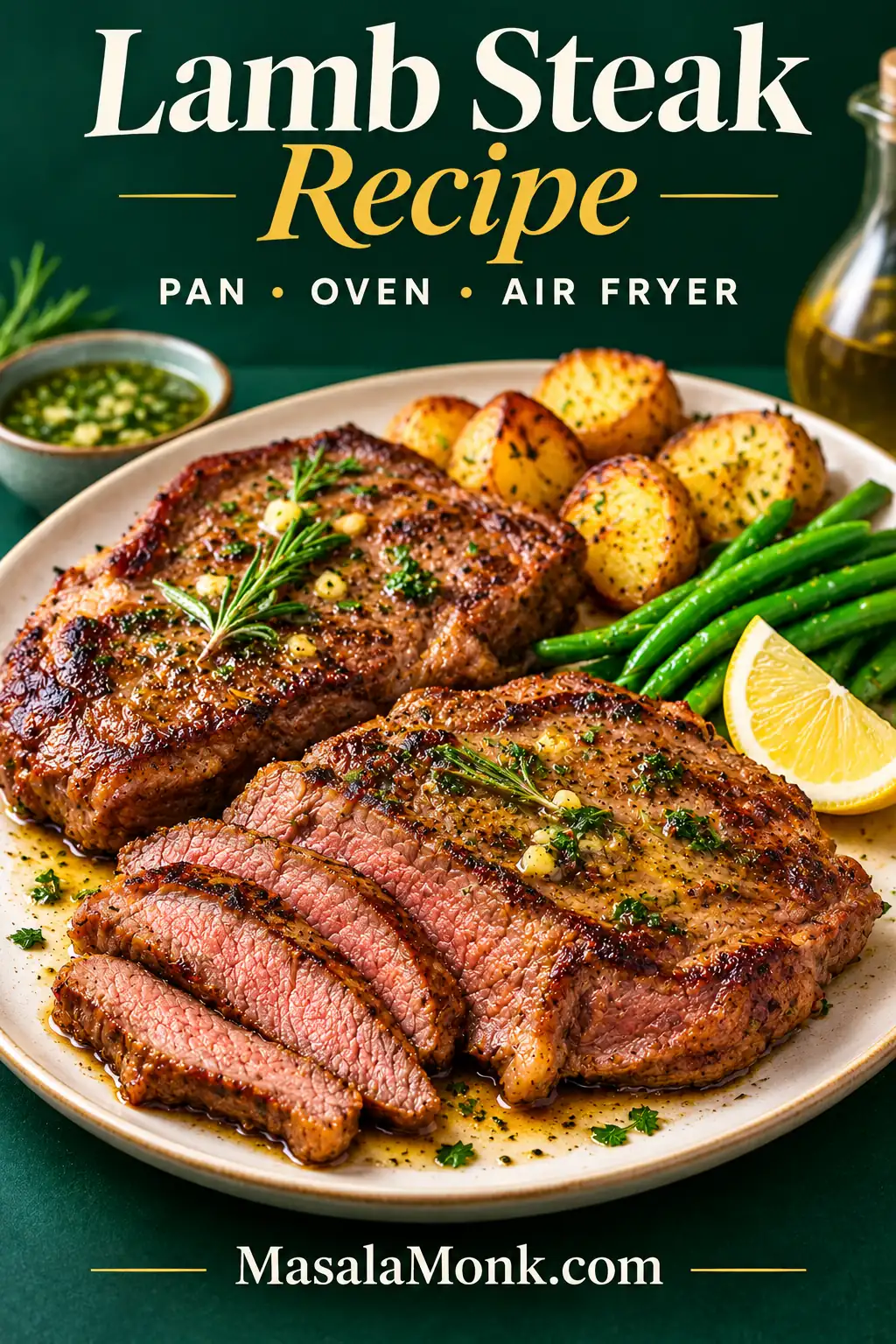
A simple garlic-rosemary lamb steak recipe brings the comforts of a roast dinner without cooking an entire joint. Add crisp roast potatoes, green beans and a squeeze of lemon, and most of dinner is sorted.
Cook the steaks in a frying pan, oven or air fryer, with no marinating required. Boneless leg steaks around 2 cm (¾ inch) thick take roughly 6–10 minutes in a hot skillet. While the meat rests, there’s time to warm the garlic and rosemary in butter.
Choose the skillet for a browned crust, the oven when vegetables are already roasting, or the air fryer for an easy dinner for two. Shoulder steaks need a different approach: cook them slowly with onions and stock until the meat gives way under a fork and there’s gravy to spoon over the potatoes.
Choose your method: Pan · Oven · Air fryer · Grill · Braised shoulder
Marinades · Sauces · Plan dinner · Fix tough lamb · Full cooking guide
Which Lamb Steak Have You Bought?
The cut tells you how to cook the lamb. Its thickness tells you when to start checking, and a thermometer tells you when the meat is safely cooked.
| Cut | What to look for | Best cooking approach |
|---|---|---|
| Boneless leg | Broad, often lean, with several muscle sections | Everyday steaks for the pan, oven or air fryer |
| Loin | Compact, relatively uniform meat | Naturally tender; quick searing or grilling |
| Rump or chump | Often a prominent outer fat edge | Brown the fat, sear and finish gently |
| Bone-in leg or gigot | Often a round bone surrounded by meat | Quick cooking; check around the bone |
| Shoulder or blade | Irregular muscles, sometimes with thick seams | Braise tougher pieces until fork-tender |
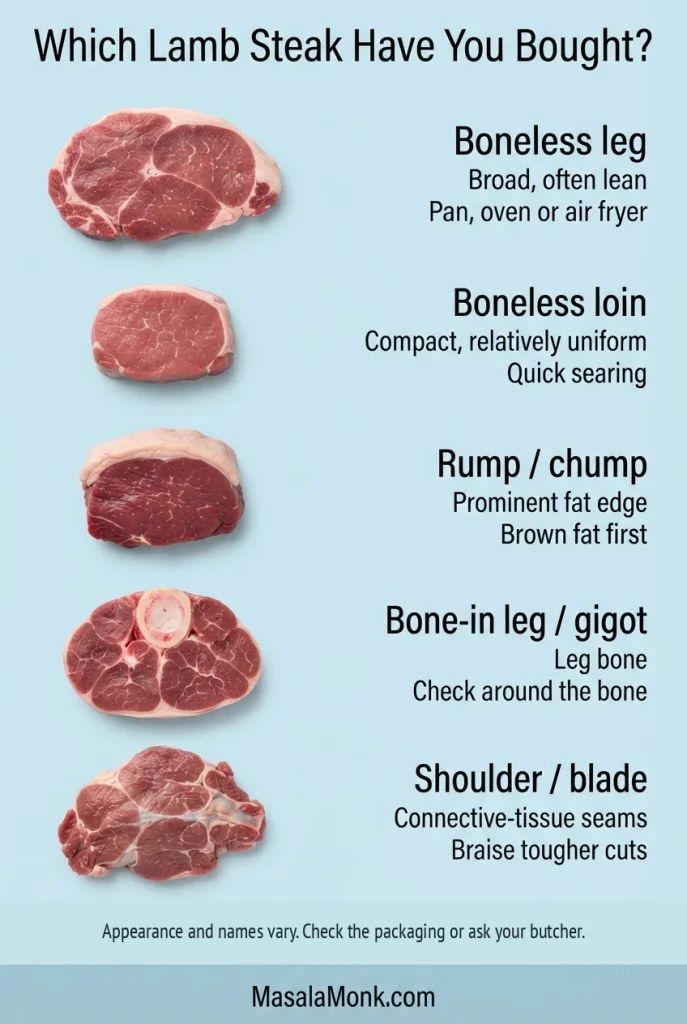
The garlic-rosemary recipe below is made for boneless leg steaks. When shopping, look for steaks around 2 cm (¾ inch) thick. They give you more time to develop a crust than the very thin ones often sold in supermarket packs.
For smaller rib chops or T-shaped loin chops, use our lamb chops recipe.
Garlic and Rosemary Lamb Steak Recipe
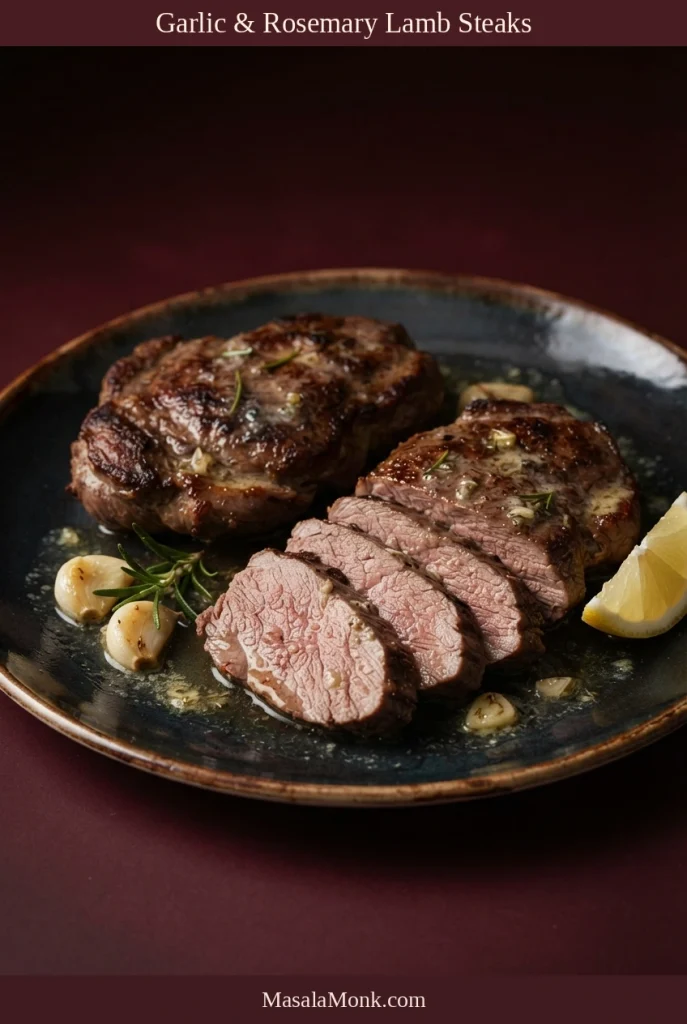
A browned crust, fragrant garlic-rosemary butter and a squeeze of lemon. Make the butter while the lamb rests.
Ingredients
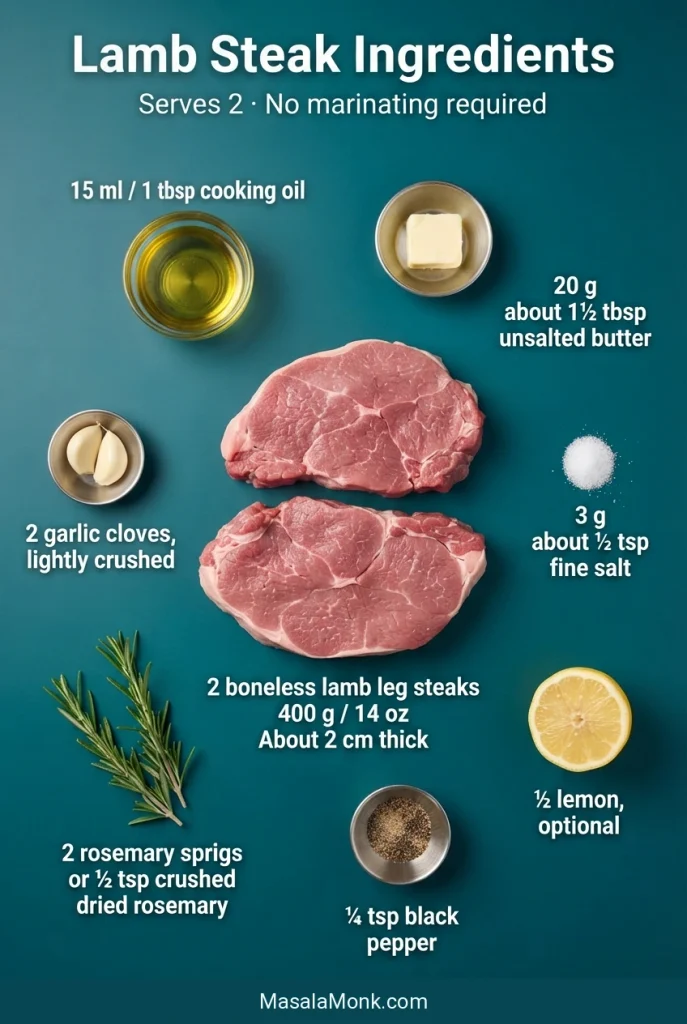
- 2 boneless lamb leg steaks, about 400 g (14 oz) total
- 15 ml (1 tbsp) cooking oil, such as refined olive oil, sunflower oil or avocado oil
- 20 g (about 1½ tbsp) unsalted butter
- 2 garlic cloves, peeled and lightly crushed
- 2 sprigs fresh rosemary, or ½ tsp crushed dried rosemary
- 3 g (about ½ tsp) fine salt, adjusted to taste
- ¼ tsp freshly ground black pepper
- ½ lemon, optional, for serving
Ingredient swaps: Thyme can replace rosemary, and ghee works in place of butter. Instead of fresh garlic, use ¼–½ tsp garlic powder in the meat’s seasoning. Reduce the salt when using salted butter. For coarse or kosher salt, use the weight rather than the teaspoon measurement.
Prefer mint sauce or red wine pan sauce? Omit the herb-butter ingredients. Make mint sauce before cooking, or start the wine-and-stock reduction ahead to shorten the final pan-sauce cooking time.
Equipment: A heavy 26–30 cm (10–12 inch) skillet, tongs, kitchen paper, a thin-tip instant-read thermometer, a serving plate and a small saucepan. Both steaks should fit in the skillet without touching or overlapping.
Quick Pan-Fried Lamb Steaks
Use fully thawed, intact whole-muscle lamb steaks and the ingredients above. Keep raw and cooked meat on separate plates, and wash your hands, utensils and thermometer probe after contact with raw or partially cooked lamb.
Prefer skillet-basting? Read that technique before searing; it replaces the separate herb butter.
Check your steak thickness first: For 1 cm (⅜ inch) steaks, begin with about one minute per side. At 1.5 cm (⅝ inch), check the center after 2–3 minutes in total. Use these shorter timings instead of the standard sear in Step 3.
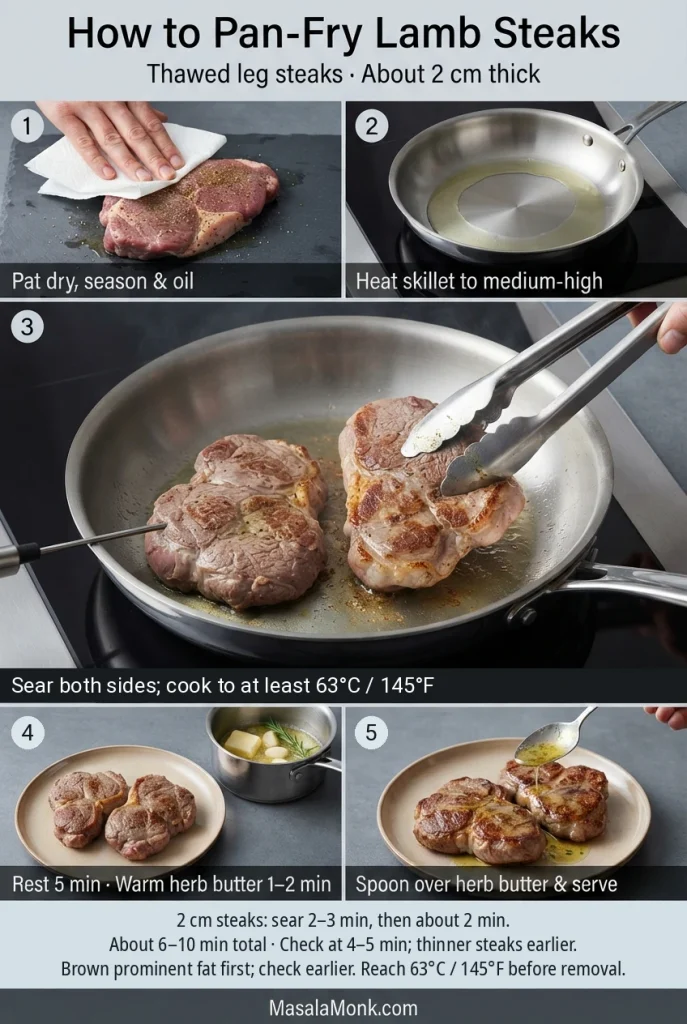
- Prepare the lamb. Use fully thawed steaks. For plain lamb, pat dry, trim unwanted fat or membrane, season with salt and pepper (and garlic powder if using), then rub with 10 ml (2 tsp) oil. For marinated steaks, remove excess coating and skip the basic oil, salt and pepper. Reserve any additional oil specified in your marinade for cooking.
- Heat the skillet. Set a heavy skillet over medium-high heat for plain steaks, or use the heat specified in your marinade recipe. Add the remaining teaspoon of oil for plain steaks if needed, or the extra cooking oil specified in your marinade. The oil should flow freely without smoking heavily. Follow the heating limits of nonstick cookware.
Steaks with a thick fat edge: Before laying them flat, hold the fat against the hot skillet with tongs for about 30–60 seconds, until it begins to brown and release fat. Start checking the meat’s temperature earlier afterward.
Sear, Check and Rest the Lamb
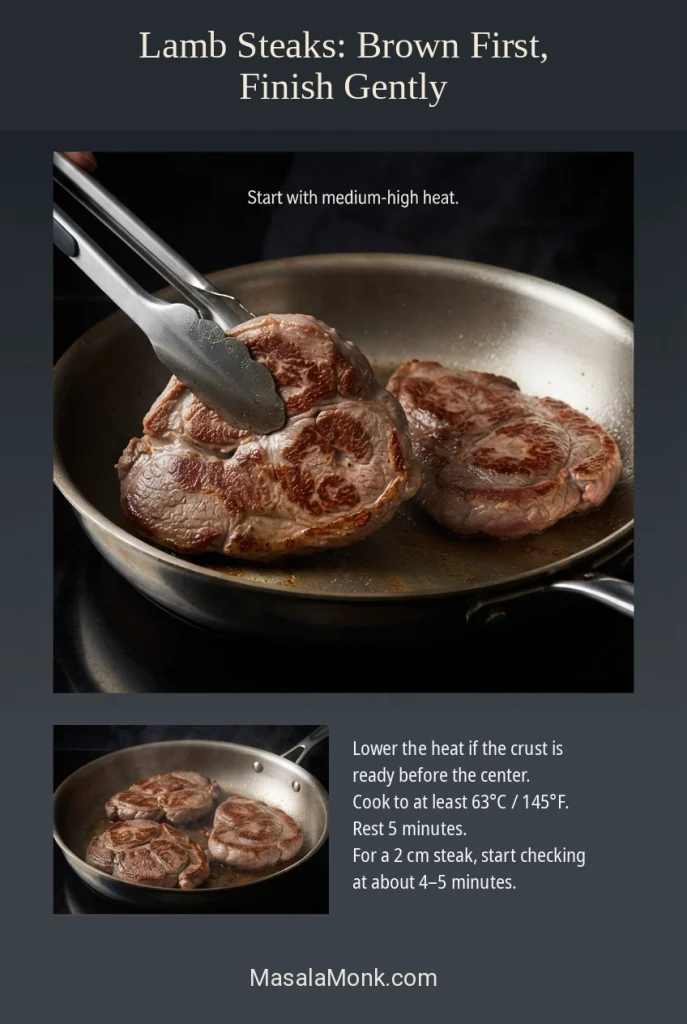
- Sear the steaks. Lay the lamb flat in the skillet; it should sizzle. For 2 cm steaks, sear for 2–3 minutes on the first side and about two on the second. Look for browned patches as you turn. Use the earlier timings for thin or fat-rendered steaks.
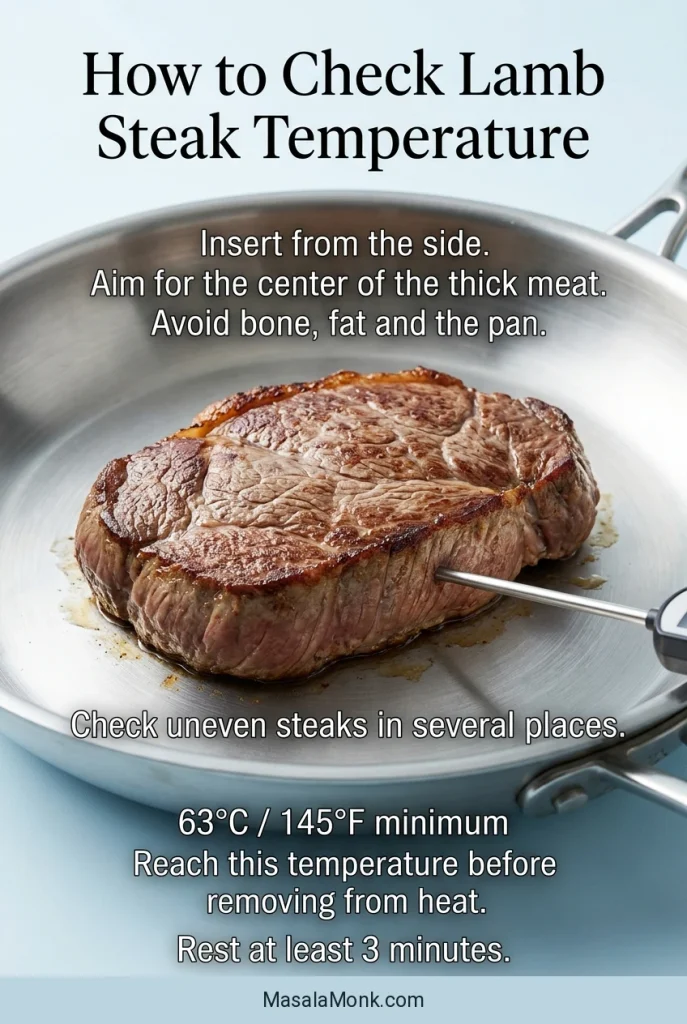
- Check and finish. Slide the thermometer into the thick meat from the side, avoiding bone and fat. Check uneven steaks in several places. Lower the heat if they need longer. Take each steak out when the coolest of those thick sections reaches at least 63°C (145°F).
- Rest and finish. Leave each steak on a clean warm plate for five minutes. Meanwhile, gently warm the butter, garlic and rosemary in a small saucepan over low heat for 1–2 minutes, until fragrant. Use ghee or thyme if making the ingredient substitutions, and omit fresh garlic if using garlic powder. Remove woody stems and large herb pieces. Skip the butter if serving another sauce.
- Serve. Spoon the garlic-rosemary butter or your chosen sauce over the rested lamb. Add the collected resting juices unless they are already incorporated into the sauce. Serve the infused garlic alongside if desired, and add lemon to taste if using.
Prefer the Oven or Air Fryer?
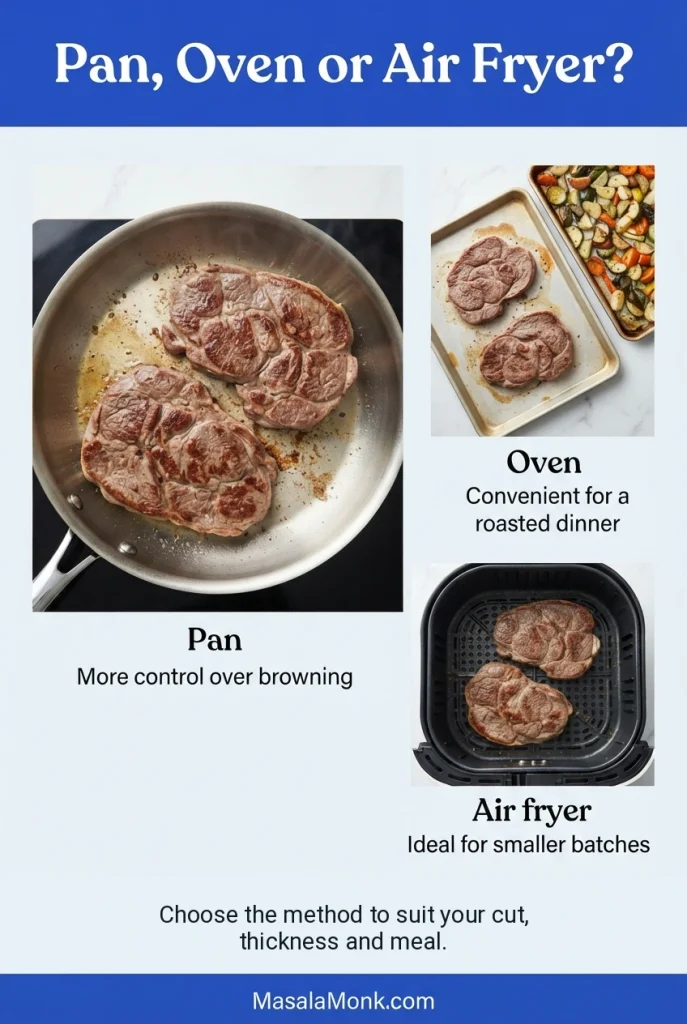
| Method | Choose it for | Prep + cook + rest |
|---|---|---|
| Pan-frying | Greater control over browning | 16–25 min |
| Oven | Roasting alongside vegetables | 20–33 min |
| Air fryer | A smaller, less hands-on meal | 18–29 min |
Lamb Steak Cooking Times and Internal Temperatures
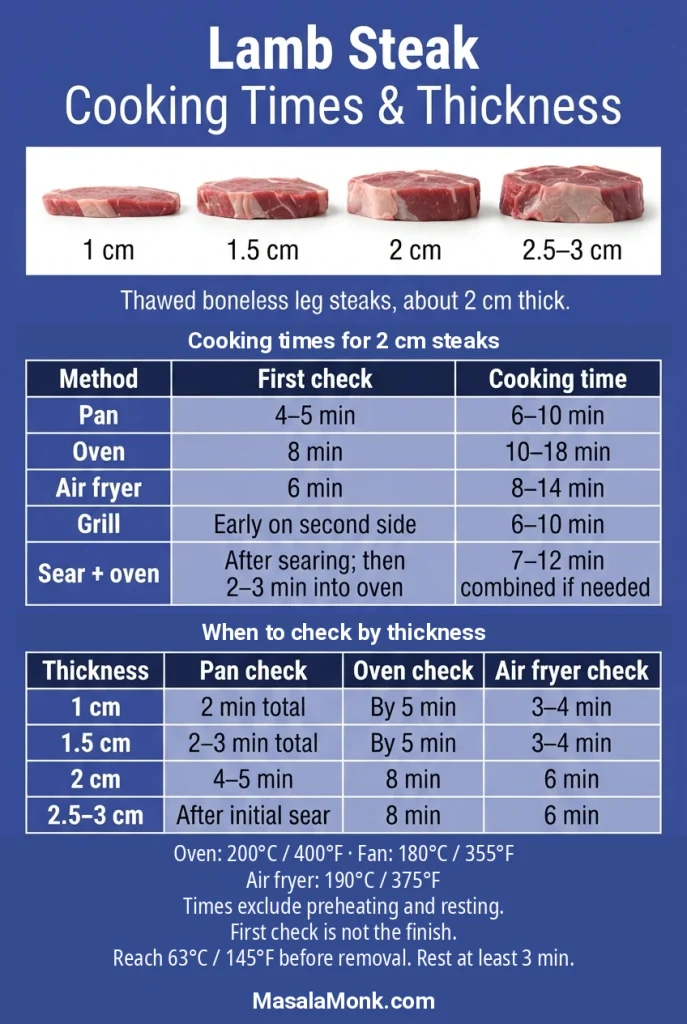
These estimates are for thawed boneless leg steaks around 2 cm (¾ inch) thick. The first check tells you when to take out the thermometer, not necessarily when the steak will be ready.
| Method and heat | First check | Cooking time |
|---|---|---|
| Pan: medium-high, then reduce | 4–5 min | 6–10 min |
| Oven: 200°C / 400°F conventional 180°C / 355°F fan | 8 min | 10–18 min |
| Sear + oven finish | After searing; again after 2–3 min in oven | 7–12 min combined* |
| Air fryer: 190°C / 375°F | 6 min | 8–14 min |
| Grill: medium-high direct heat | Early on second side | 6–10 min |
When to Check Thin and Thick Lamb Steaks
| Steak thickness | First temperature check |
|---|---|
| 1 cm (⅜ inch) | Pan: about 2 min total Oven: by 5 min Air fryer: 3–4 min |
| 1.5 cm (⅝ inch) | Pan: 2–3 min total Oven: around 5 min Air fryer: 3–4 min |
| 2 cm (¾ inch) | Pan: 4–5 min Oven: 8 min Air fryer: 6 min |
| 2.5–3 cm (1–1¼ inches) | Pan: after initial sear Direct oven: 8 min Air fryer: 6 min |
Once a thick steak has browned, gentler heat gives the center time to cook without drying out the outer layers. Turn it periodically over lower heat, or use the sear-and-oven method.
What Temperature Should Lamb Steaks Reach?
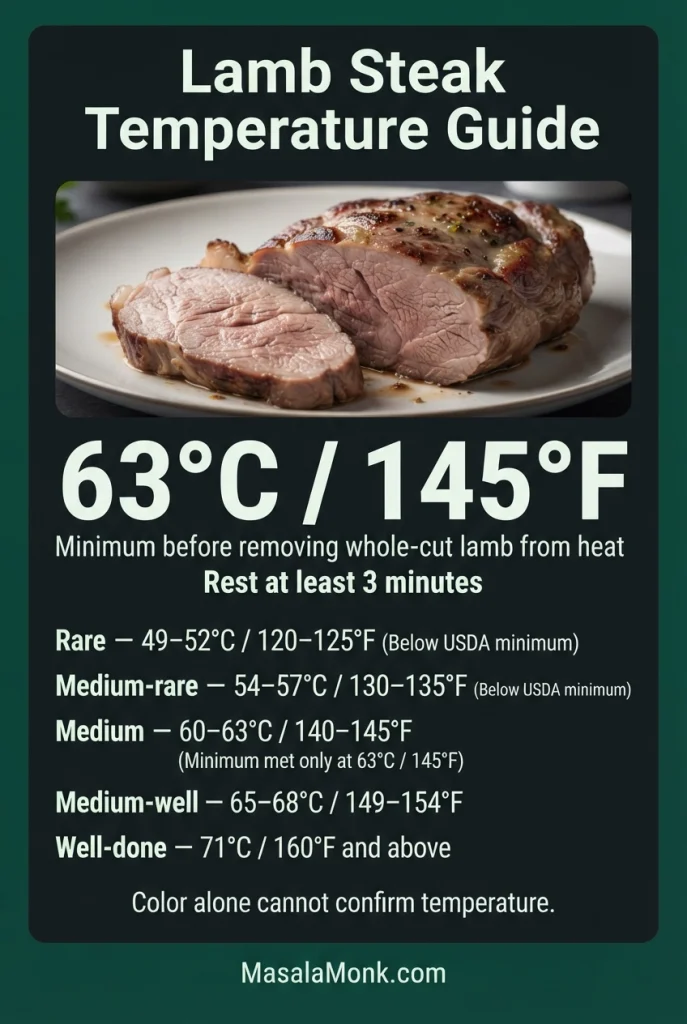
According to FoodSafety.gov, whole-cut lamb steaks should reach at least 63°C (145°F) before leaving the heat, followed by a minimum three-minute rest. This lamb steak recipe uses a five-minute rest.
| Doneness terminology | Approximate temperature | USDA temp. minimum |
|---|---|---|
| Rare | 49–52°C / 120–125°F | No |
| Medium-rare | 54–57°C / 130–135°F | No |
| Medium | 60–63°C / 140–145°F | Only at 63°C / 145°F |
| Medium-well | 65–68°C / 149–154°F | Yes |
| Well-done | 71°C / 160°F or higher | Yes |
These cooking instructions are for intact whole-muscle steaks, rather than ground or reformed meat. Ground lamb requires 71°C (160°F). Follow applicable cooking instructions on the pack for mechanically tenderized or other processed lamb products.
Where to Insert the Meat Thermometer
With a thin steak, slide the thermometer horizontally into the meat from the side. This helps position the thermometer’s sensing area in the center without touching the hot skillet.
Avoid bone and large pockets of fat. On an uneven steak, check the center of the thick meat in several places. The coolest of those areas must reach at least 63°C (145°F) before removing the lamb. Clean the probe after contact with raw or partially cooked lamb.
Resting, Carryover Cooking and Pink Lamb
The temperature can rise while a steak rests, especially with thick cuts. This is called carryover cooking. However, don’t rely on that rise to reach the minimum safe temperature after removing the meat.
Safely cooked lamb can still have a pink center. Neither the color of the meat nor its juices reliably indicates its internal temperature.
A warm plate helps limit heat loss during resting. Cover the steaks loosely if necessary; tightly wrapping them traps steam and can soften the crust.
More Help With Lamb Steaks
Choose & Cook
Quick reference: Main recipe · Cooking times · Thickness guide
How to Prepare Lamb Steaks for Better Browning
Thickness, Fat and Silver Skin
Two steaks can weigh exactly 200 g (7 oz) each, yet cook at different speeds. In the thinner piece, heat has less distance to travel before reaching the center.
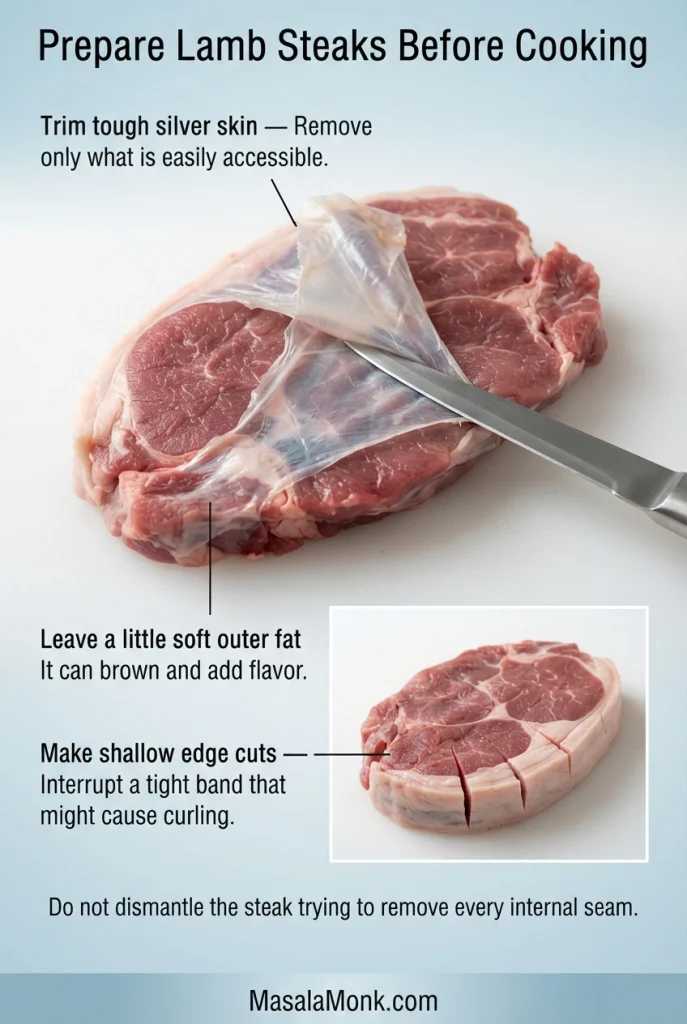
Look for silver skin, the shiny, tough membrane on the surface of the meat. Trim what you can easily reach, leaving some soft outer fat for flavor. Don’t try to cut out every seam inside a leg steak. You’ll end up dismantling the meat.
A tight membrane around the edge can contract and pull the steak into a curved shape during cooking. A few shallow cuts through that band, without slicing deeply into the meat, help the steak stay flat against the skillet.
Drying and Seasoning the Meat
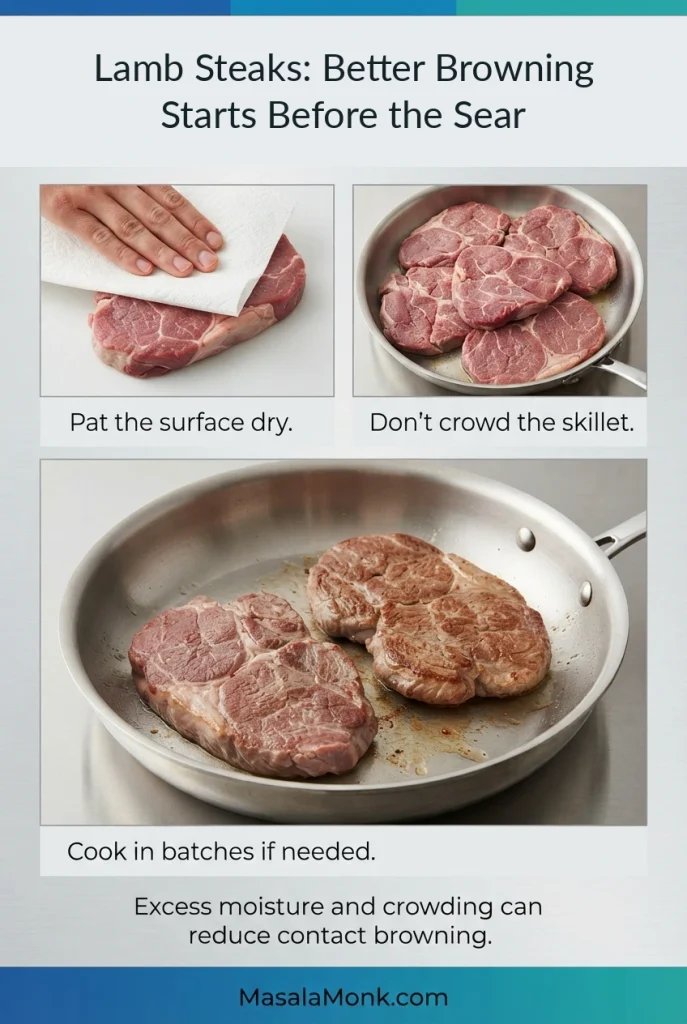
Surface moisture must evaporate before the meat can brown efficiently. That’s why patting the lamb dry makes such a difference, especially with steaks straight from a supermarket pack.
For a quick dinner, dry and salt the steaks immediately before cooking. Alternatively, salt them well ahead and refrigerate them, allowing the surface time to dry again. Blot away any remaining moisture before adding oil. You can cook thawed lamb straight from the refrigerator; there’s no need to leave it sitting out.
Pan-Fried Lamb Steaks: Getting the Sear Right
The main pan-fried lamb steak recipe gives you the complete method. A few adjustments to the cookware and heat will help with steaks that are especially thin, thick or fatty.
Choosing a Pan
Cast iron and heavy stainless steel retain heat well when cold meat goes into the skillet. You want a steady sizzle, not sustained clouds of smoke.
Meat sometimes sticks to stainless steel during the initial sear. As a crust develops, it often releases more easily. Give it a little longer if it’s still browning, but don’t wait indefinitely if the surface is burning or the center is nearly cooked.
Pan-Frying Thin and Thick Lamb Steaks
Very thin steaks may reach temperature before developing a dark crust. A lighter surface is preferable to dry meat.
With thicker steaks, reduce the heat after searing and turn periodically. Check every 30–60 seconds as the center approaches 63°C (145°F). For an oven finish, follow the sear-and-oven technique, remembering to preheat the oven before the lamb goes into the skillet.
Butter-Basting Without Burning the Garlic
Butter belongs near the end of the cooking process. It picks up the flavor of the browned bits and rendered lamb fat, making a particularly savory finish.
Check the steaks after searing. If both need more cooking, lower the heat. A heavy skillet stays hot even after you turn down the burner, so move it off the heat briefly if it’s still fiercely hot before adding the recipe’s butter and herbs, plus fresh garlic unless you used garlic powder.
As the butter foams, tilt the skillet slightly and spoon it over the meat. Keep checking the temperature, remove each steak at 63°C (145°F) or above, and rest for five minutes. Spoon the cooked butter over the rested meat; do not make a second batch.
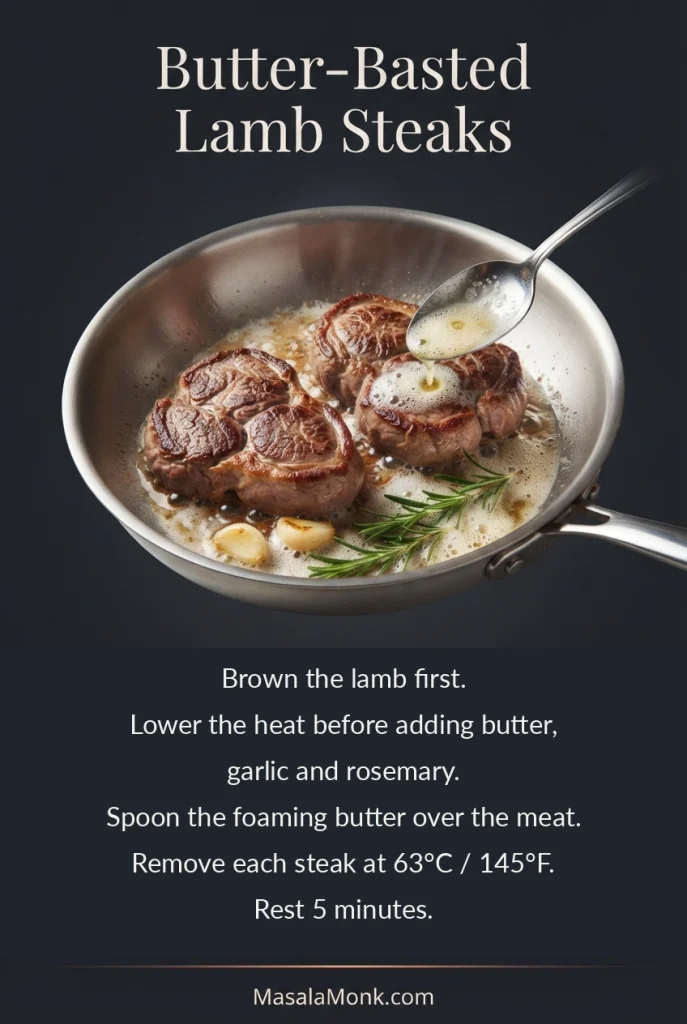
When one or both steaks are ready before basting begins, remove the finished meat and complete any remaining cooking without the butter. Make the finishing butter separately for both.
To make a sauce using the browned bits left in the skillet, prepare the red wine or stock pan sauce instead.
Cooking Multiple Lamb Steaks
When one steak finishes first: Take it out and start its five-minute rest rather than waiting for the thicker one. Keep it loosely covered on a warm plate. For longer hot holding, maintain at least 60°C (140°F).
To cook four steaks, double the ingredients and work in batches if the pan is crowded. Make one saucepan of herb butter for everyone, or divide the butter and garlic between batches for skillet-basting.
Adjust your next sear: Steak thickness guide · Fix tough or dry lamb
How to Cook Lamb Steaks in the Oven
Bake thawed boneless leg steaks around 2 cm thick, uncovered, at 200°C (400°F) conventional or 180°C (355°F) fan-assisted for approximately 10–18 minutes. Begin checking the center after eight minutes. Give these crispy roasted potatoes a generous head start and add the lamb when they are nearly tender.
Oven-Baked Lamb Steaks Without Searing
For an oven-only dinner, roast the lamb on a shallow metal tray without covering or searing it first.
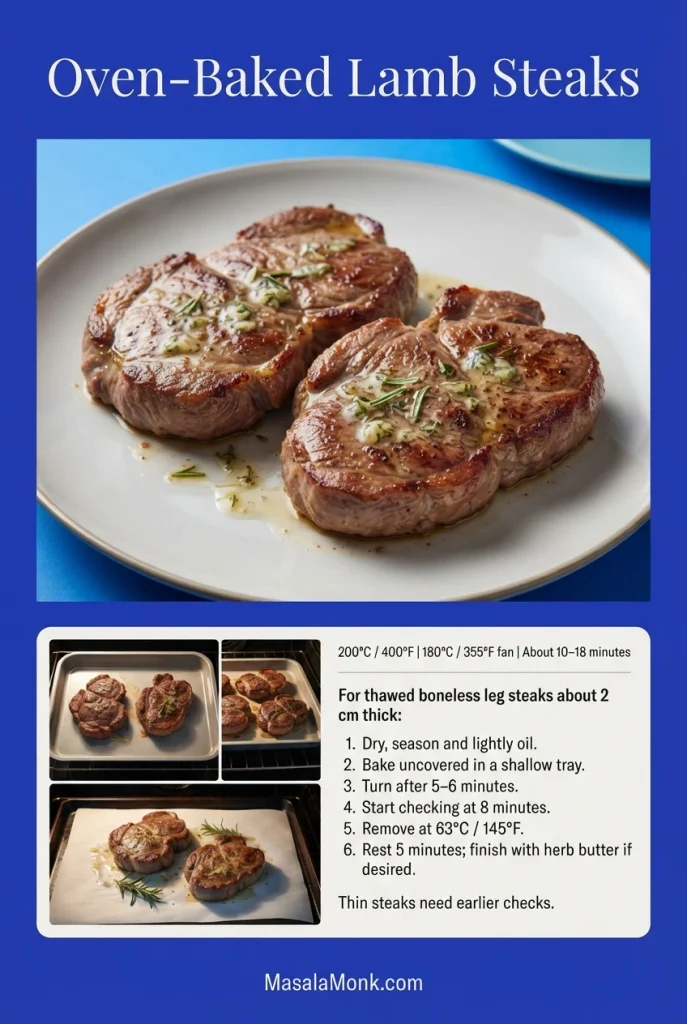
1. Prepare the oven and lamb. Preheat to 200°C (400°F) conventional or 180°C (355°F) fan-assisted. Dry, season and lightly oil plain steaks using the main recipe ingredients. Keep the butter, garlic and rosemary aside. For marinated meat, remove excess coating, skip the basic oil, salt and pepper, and follow the additional cooking-oil instructions in your marinade.
2. Bake uncovered. Arrange the steaks on a shallow, rimmed metal tray with space around them. Place it on the middle rack of the preheated oven.
- 1–1.5 cm steaks: Turn after about 3 minutes and check the center by 5 minutes.
- 2 cm steaks: Turn after 5–6 minutes and begin checking at 8 minutes.
Continue cooking in short intervals. Check uneven steaks in several places and remove each steak when its coolest thick section reaches at least 63°C (145°F). Directly baked lamb may have a lighter crust than skillet-seared meat.
3. Rest and serve. Rest the steaks on a clean warm plate for five minutes. Meanwhile, prepare the garlic-rosemary butter or finish another sauce. Add the resting juices unless they are already in the sauce, and finish with fresh lemon to taste if using.
Sear Lamb Steaks Before Finishing in the Oven
For thicker loin or rump steaks, sear for a browned crust, then finish more gently in the oven.
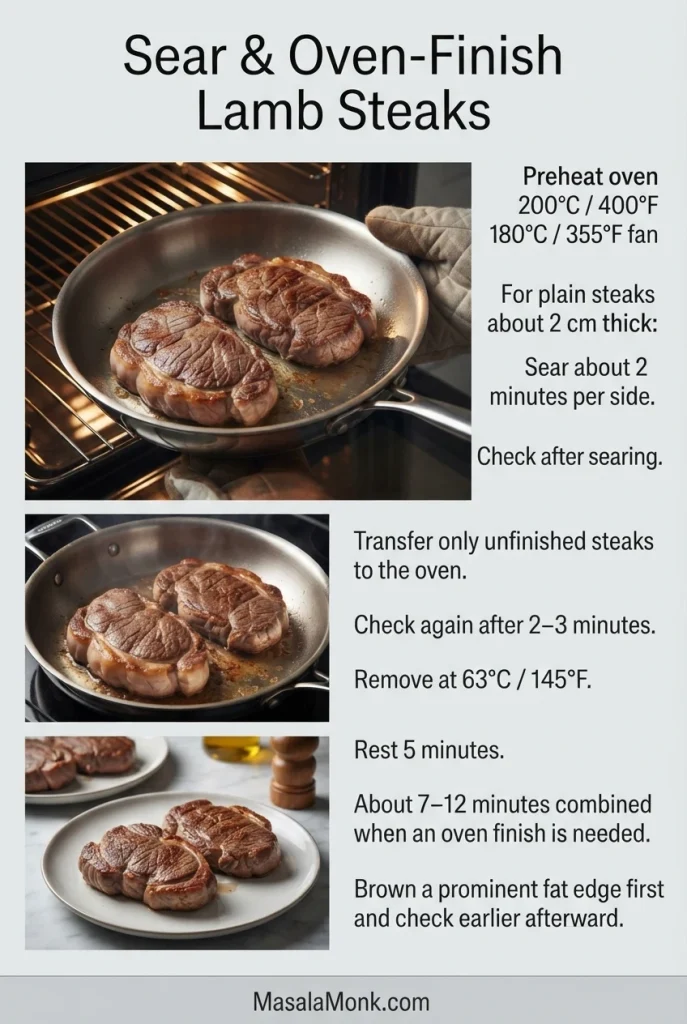
- Preheat the oven to 200°C (400°F) conventional or 180°C (355°F) fan-assisted. Dry, season and lightly oil plain steaks using the main recipe ingredients. For marinated steaks, remove excess coating and use only the cooking oil specified in your marinade.
- Heat an ovenproof skillet over medium-high heat. Brown a prominent fat edge first. For plain 2 cm steaks, begin with about two minutes per side, checking earlier after fat rendering or when cooking thinner meat. Use medium heat for spice coatings that scorch easily.
- Check the thick meat after searing, testing uneven steaks in several places. Remove steaks whose coolest thick section has reached at least 63°C (145°F). Transfer only the unfinished meat straight into the oven, using the skillet or a rimmed metal tray.
- Check again after 2–3 minutes in the oven. As a reference, a 2 cm steak may need 3–8 minutes in the oven in total after searing. For thicker cuts, continue checking in short intervals rather than relying on that range.
- Remove each steak when its coolest thick section reaches at least 63°C (145°F). Rest for five minutes, counted from when it leaves the heat, and serve with your chosen sauce.
Use oven gloves: the skillet handle stays hot after leaving the oven.
Should You Cover Lamb Steaks With Foil?
Leave quick-cooking leg, loin and rump steaks uncovered to encourage browning. Save the covered casserole dish for braising tough shoulder steaks with stock.
How to Cook Lamb Steaks in an Air Fryer
Air-fry thawed boneless leg steaks around 2 cm thick at 190°C (375°F) for approximately 8–14 minutes. It’s a handy way to cook dinner for one or two without heating a large oven.
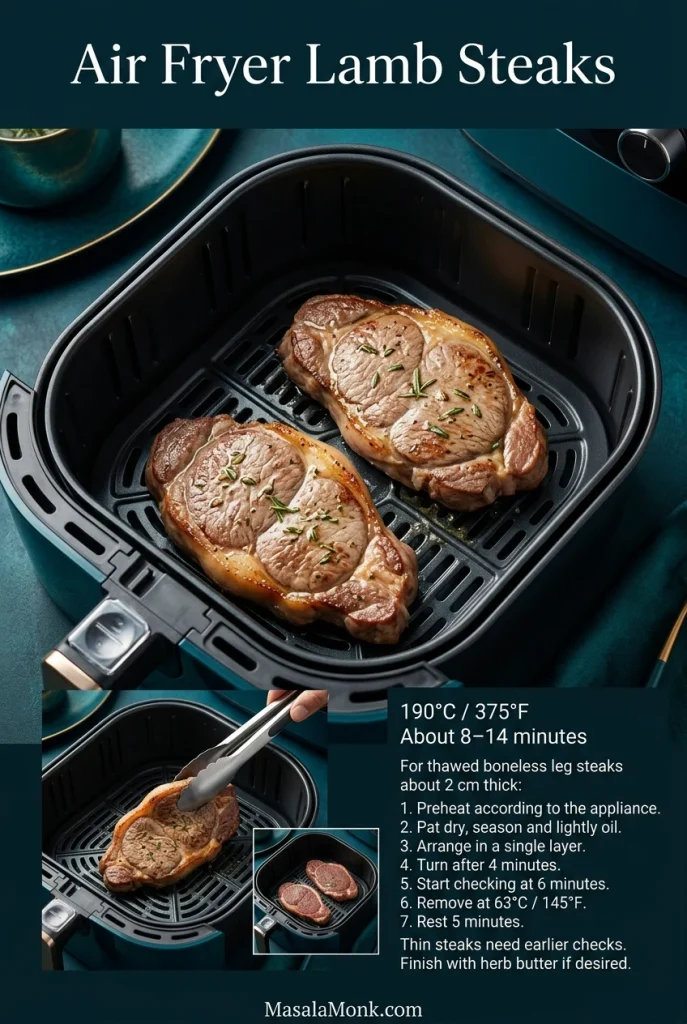
Step 1: Prepare the Lamb and Air Fryer
Set the air fryer to 190°C (375°F) and follow its preheating instructions. For plain thawed steaks, pat dry and trim unwanted thick fat, then use the oil, salt and pepper from the main recipe. Keep the butter and fresh aromatics aside.
For marinated lamb, remove loose herbs, garlic fragments and excess coating. Skip the basic seasoning and use only the cooking oil specified in your marinade.
Arrange the steaks in a single layer with room for hot air to circulate. Use the recommended rack position in an oven-style air fryer. If the steaks are still frozen, read the frozen steak guidance before cooking.
Step 2: Air-Fry, Turn and Check
- 1–1.5 cm steaks: Turn after about 2 minutes and start checking at 3–4 minutes.
- 2 cm steaks: Turn after about 4 minutes and start checking at 6 minutes.
Continue in 1–2-minute intervals, shortening them as the temperature approaches 63°C (145°F). Check uneven pieces in several places and remove each steak when its coolest thick section reaches at least 63°C (145°F). Air fryers vary, so the thermometer is more useful than the clock near the end.
Step 3: Rest and Serve
Rest each steak on a clean warm plate for five minutes. Make the garlic-rosemary butter separately, or serve another sauce.
Working in batches? Keep the finished steaks loosely covered. For a complete dinner using one appliance, cook these air fryer potato wedges first and refresh them briefly while the lamb rests.
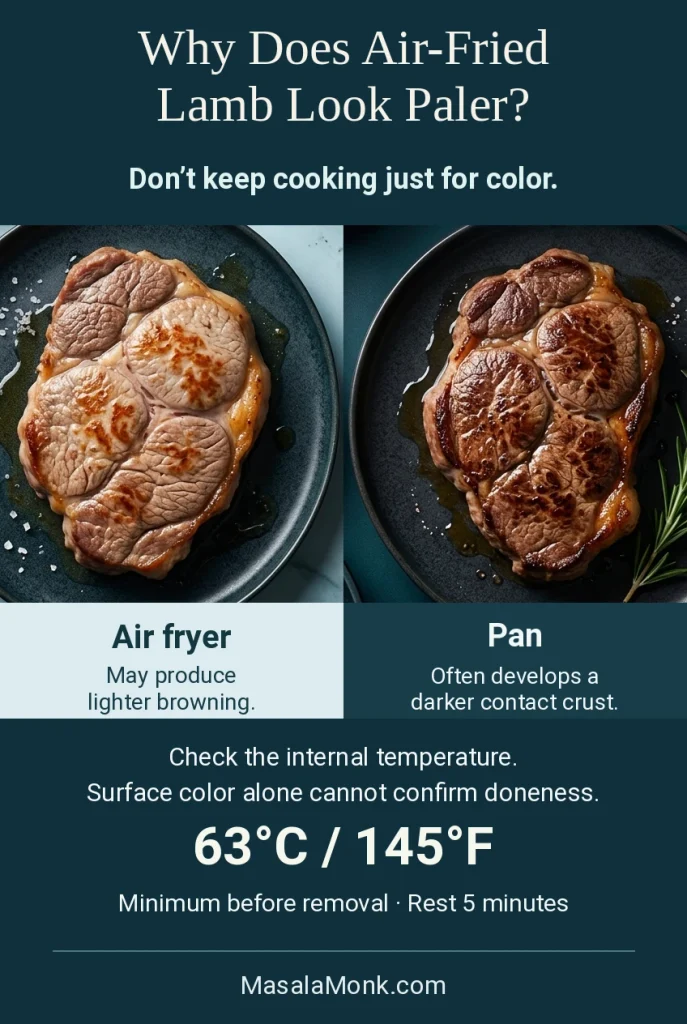
Why Aren’t My Air Fryer Lamb Steaks Browning?
Your lamb has reached the right temperature, but it looks paler than you expected. That’s fairly common with air frying. The meat doesn’t have the same contact with a hot cooking surface as it does in a heavy skillet.
Dry the surface, lightly oil the meat and leave space between steaks. Once the center is ready, take the lamb out. Another few minutes chasing a darker crust can leave it dry.
How to Grill or Barbecue Lamb Steaks
A hot grill gives leg, loin and rump steaks lightly charred edges and a smoky flavor. Allow roughly 6–10 minutes for thawed leg steaks around 2 cm thick, checking thin pieces sooner.
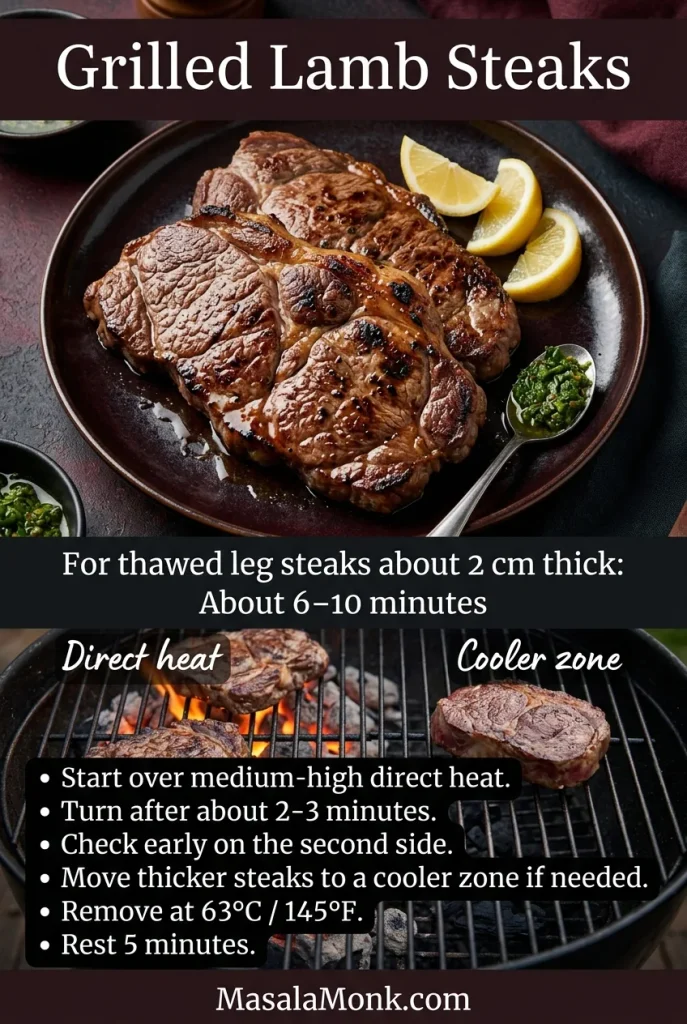
- Dry, season and lightly oil the lamb, or use the lemon-rosemary marinade. Drain excess marinade and remove loose garlic and herbs before grilling.
- Preheat the grill to medium-high heat, leaving a cooler area away from the direct flames or hot coals.
- Start over direct heat, turn after around 2–3 minutes and check the temperature early on the second side. Move the meat away from flare-ups and finish thicker steaks in the cooler area as needed.
- Remove the lamb at 63°C (145°F) or above and rest on a clean warm plate for five minutes.
Fresh parsley, garlic and sharp vinegar make homemade chimichurri an especially good match for those smoky edges.
For your next barbecue: Four marinades · Sauces for lamb · Dinner ideas
Lamb Leg, Loin, Rump or Shoulder: How to Cook Each Cut
Boneless Lamb Leg Steak Recipe
Boneless leg steaks are a good everyday choice. They’re often relatively lean and suit all three cooking methods in the main garlic-rosemary recipe.
Unlike a more uniform loin steak, a leg steak can contain several muscles with different grain directions. After cooking, slice each muscle across its own grain for an easier bite.
Bone-In Lamb Leg and Gigot Steaks
Gigot steaks are commonly cut across the lamb leg, leaving a visible bone. The surrounding meat isn’t always equally thick, so one muscle can finish cooking before another.
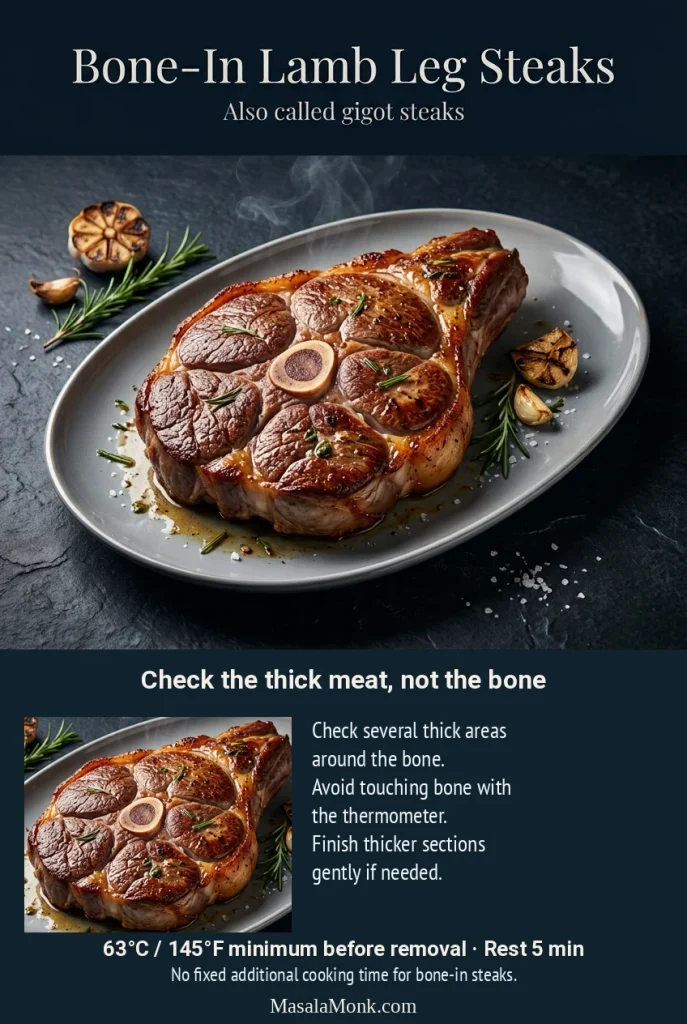
Use the pan, oven or grill method, or the air fryer when the steak fits comfortably. Check the thick meat in several places around the bone without letting the thermometer touch it. If the thinner sections brown first, position the thicker meat toward the hotter part of the pan or finish over gentler heat. Once the coolest thick section reaches at least 63°C (145°F), rest for five minutes.
There’s no fixed number of extra cooking minutes to add for the bone. Allow a slightly larger portion when shopping, since some of the weight isn’t edible meat.
Lamb Loin Steak Recipe
Loin needs very little fuss. This naturally tender cut rarely needs pounding or long marinating; salt, pepper and garlic butter are plenty. Use the main recipe ingredients for two boneless loin steaks weighing about 400 g (14 oz) in total.
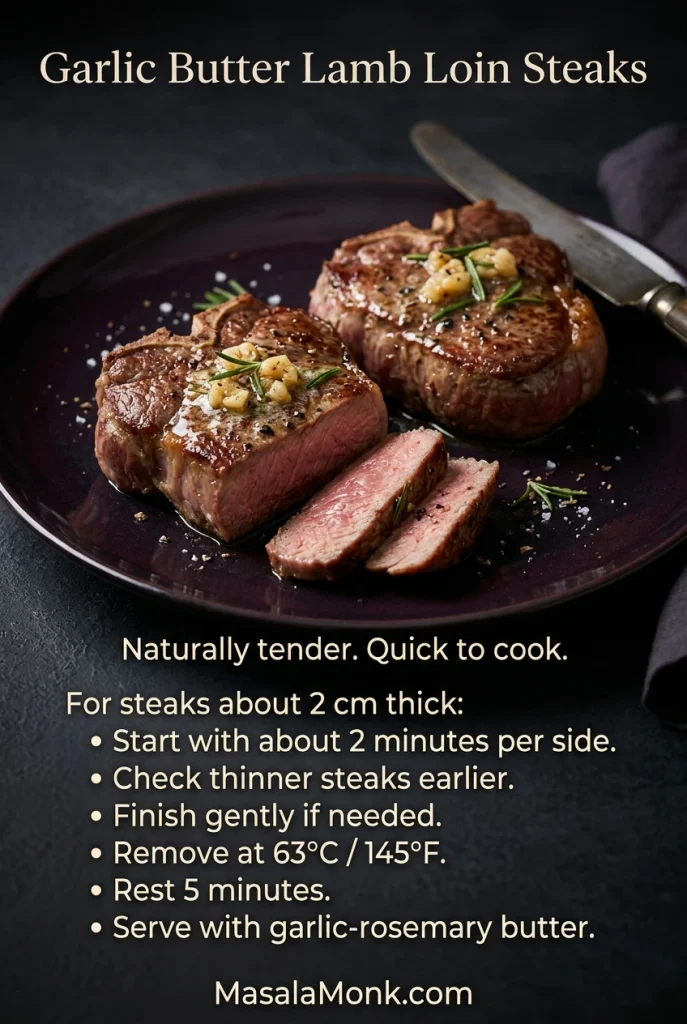
For thick loin steaks, preheat the oven first if using the sear-and-oven method. Otherwise, finish over lower skillet heat.
Dry, season and oil the meat. Sear 2 cm steaks for about two minutes per side, checking sooner for thin steaks or after browning a fat edge.
Continue only as needed to reach at least 63°C (145°F), then rest for five minutes and serve with your chosen sauce.
Lamb Rump or Chump Steak Recipe
Start with the fat edge. It contributes plenty of flavor, but a thick layer may remain chewy long after the lean meat has cooked. A skillet gives you more control over that edge than an air fryer.
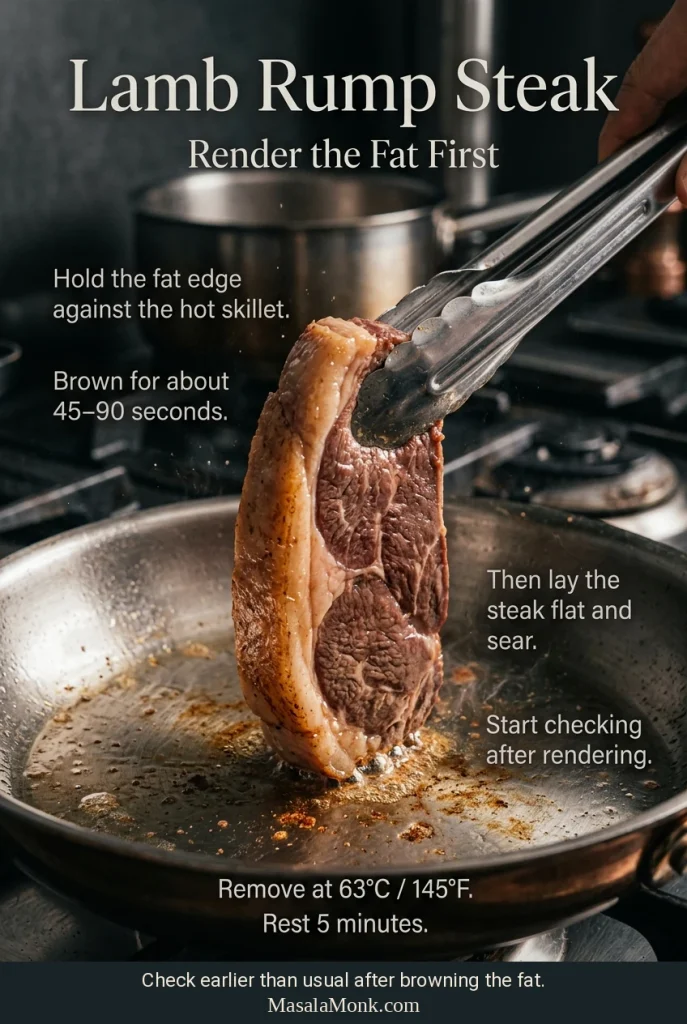
For particularly thick rump steaks, preheat the oven before starting if you plan to use the oven-finish method.
- Trim excessive fat, leaving a little outer fat. For 400 g (14 oz) of rump, use the main recipe’s oil and seasoning.
- Hold the fat edge against the hot skillet with tongs for about 45–90 seconds, until it begins browning and releasing fat. Lower the heat if it darkens too quickly.
- Lay the steak flat and sear both sides using the thickness-based checking guide. Begin checking sooner after rendering the fat edge.
- Finish over gentler heat or in the preheated oven. Remove at 63°C (145°F) or above and rest for five minutes.
Lamb fat won’t necessarily turn crisp like pork crackling. If the meat is ready but the fat remains rubbery, trim the unwanted layer instead of frying the whole steak for longer. Leaner rump steaks also work well in the air fryer.
Lamb Sirloin Steaks
Butchers use the term sirloin differently across regions. A lean, tender piece can cook much like loin, while one with a prominent fat edge benefits from the rump technique. Look at the steak itself as well as the name on the pack.
Lamb Shoulder and Blade Steaks
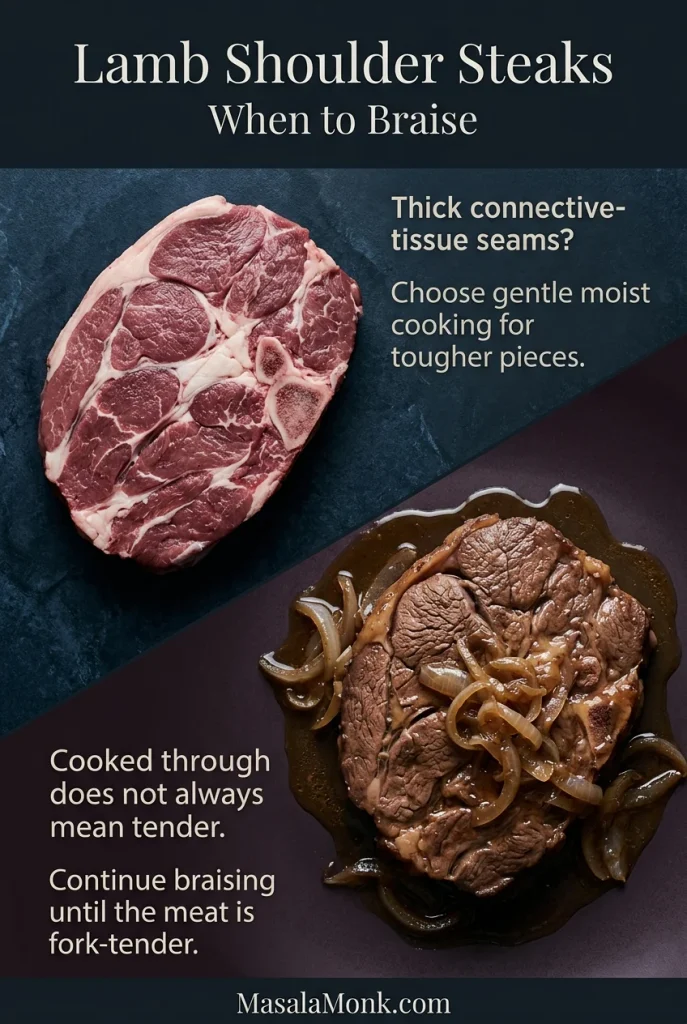
Some thin, relatively tender shoulder chops can be quick-cooked, although they tend to have a firmer texture than loin. Thick seams of connective tissue call for a different approach: shoulder can be safely cooked long before it becomes fork-tender. Braise tougher pieces using the recipe below, or choose its slow-cooker variation.
Lamb Flank and Skirt Steaks
The long muscle fibers in flank and skirt make slicing particularly important. Trim tough surface membranes, then quickly sear thin, tender pieces with a little oil and seasoning. Check early, cook to at least 63°C (145°F) and rest for at least three minutes before slicing thinly across the grain. Pieces with substantial connective tissue may need moist cooking instead.
Braised Lamb Shoulder Steaks With Onion Gravy
This is the lamb to serve over buttery mash or creamy polenta. As the shoulder softens, its juices enrich the stock, the onions become tender and the cooking liquid develops into a savory sauce. There’s no need to rush it.
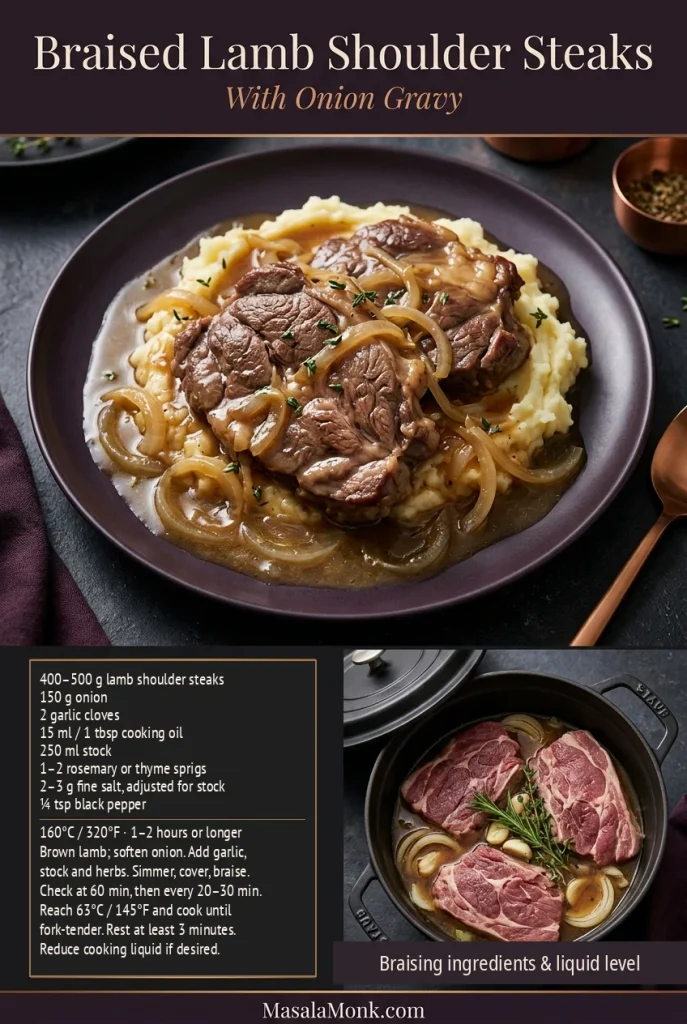
Serves: 2
Oven: 160°C (320°F) conventional
Prep and browning: 15–20 minutes
Braising: About 1–2 hours, sometimes longer
Total planning time: Approximately 1½–2½ hours, including time for gravy reduction if desired. Allow longer for particularly tough pieces.
Ingredients
- 400–500 g (14–18 oz) lamb shoulder steaks
- 150 g (about 5 oz) onion, roughly 1 medium onion, sliced
- 2 garlic cloves, chopped
- 15 ml (1 tbsp) cooking oil
- 250 ml (about 1 US cup plus 1 tbsp) low-salt lamb, beef or chicken stock, plus more if needed
- 1–2 sprigs rosemary or thyme
- 2–3 g (about ⅓–½ tsp) fine salt, reduced if using salted stock
- ¼ tsp black pepper
How to Braise Lamb Shoulder Steaks
Choose a Dutch oven or ovenproof casserole with a well-fitting lid and enough room for the steaks without excessive empty space. A very wide pot will need more stock.
- Preheat the oven to 160°C (320°F). Pat the lamb dry, season with salt and pepper, then brown both sides in the oil.
- Set the meat aside on a plate reserved for partially cooked lamb. Soften the onion in the same pot for 4–5 minutes, then add the garlic for another 30–60 seconds.
- Pour in the stock and scrape up the browned bits. Return the lamb and add the herbs. The liquid should reach partway up the meat, so add more stock if needed.
- Bring to a gentle simmer, cover tightly and transfer to the oven. Begin checking after about an hour.
- Continue cooking in 20–30-minute intervals until a fork slides into the meat easily. Add hot stock or water if the liquid runs low. The lamb must reach at least 63°C (145°F), but shoulder usually needs considerably more cooking to become tender.
- Transfer the cooked lamb to a clean warm plate and rest for at least three minutes. Keep it covered and warm while you reduce the cooking liquid, if desired. For longer holding, maintain at least 60°C (140°F).
Allow another 5–10 minutes or longer to simmer the cooking liquid uncovered. Taste before adding salt. Depending on the stock, the result may be a light, spoonable onion gravy rather than a thick sauce.
Start a pot of creamy Italian polenta before the lamb finishes. Spoon the soft onions, meat and gravy over it while everything is warm.
Slow Cooker Lamb Steaks
Shoulder steaks are a better choice than thin, lean leg steaks for slow cooking. Use the braising ingredients above and allow roughly 6–8 hours on LOW or 3–4 hours on HIGH.
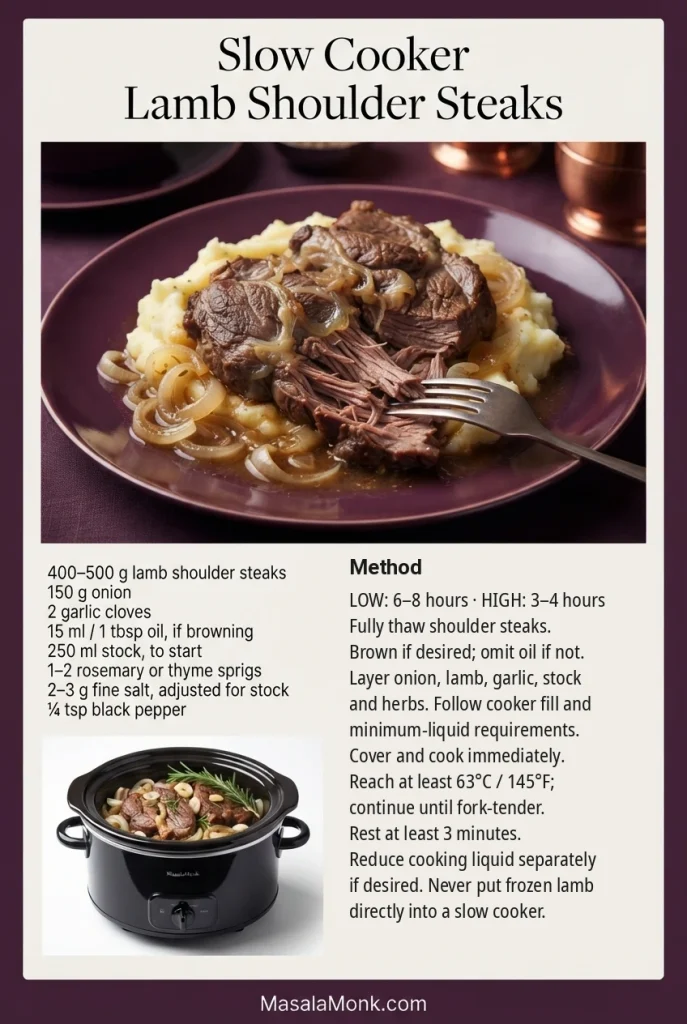
- Season fully thawed shoulder steaks. Brown them in the oil for extra flavor, or skip browning and omit the oil.
- Place the onion in the slow cooker, followed by the lamb, garlic, stock and herbs. Transfer browned meat straight into the cooker.
- Start with 250 ml stock, adjusting to your appliance’s instructions. Choose a cooker suitable for this small batch and its recommended fill range. Start cooking immediately.
- Cover and cook on LOW or HIGH, checking toward the earlier end of the time range. The meat must reach at least 63°C (145°F), but continue cooking until fork-tender.
- Rest for at least three minutes. For a more concentrated gravy, reduce some of the cooking liquid in a saucepan. Keep the remaining lamb covered and hot at 60°C (140°F) or above while the sauce reduces.
Expect soft, braised meat rather than a steak you can cut into neat slices. Never put frozen lamb directly into a slow cooker.
For a larger family meal, our slow cooker leg of lamb uses a whole joint with garlic, rosemary and gravy.
Choose your next cut or meal: Compare lamb cuts · Side dishes for lamb
How to Make Lamb Steaks Tender and Juicy
Once you’ve chosen the right cooking method for the cut, there are two more ways to improve the texture: evening out the thickness before cooking and slicing the meat correctly afterward.
Should You Tenderize Lamb Before Cooking?
If a boneless steak has one unusually thick end, gently flatten that area with the smooth side of a meat mallet. You’re aiming for even thickness, not crushing or piercing the meat.
A marinade adds flavor and can change the surface texture, but it won’t reliably remove tough internal membranes. A gristly shoulder steak is more likely to benefit from braising than from another day in a marinade.
Slice Lamb Against the Grain
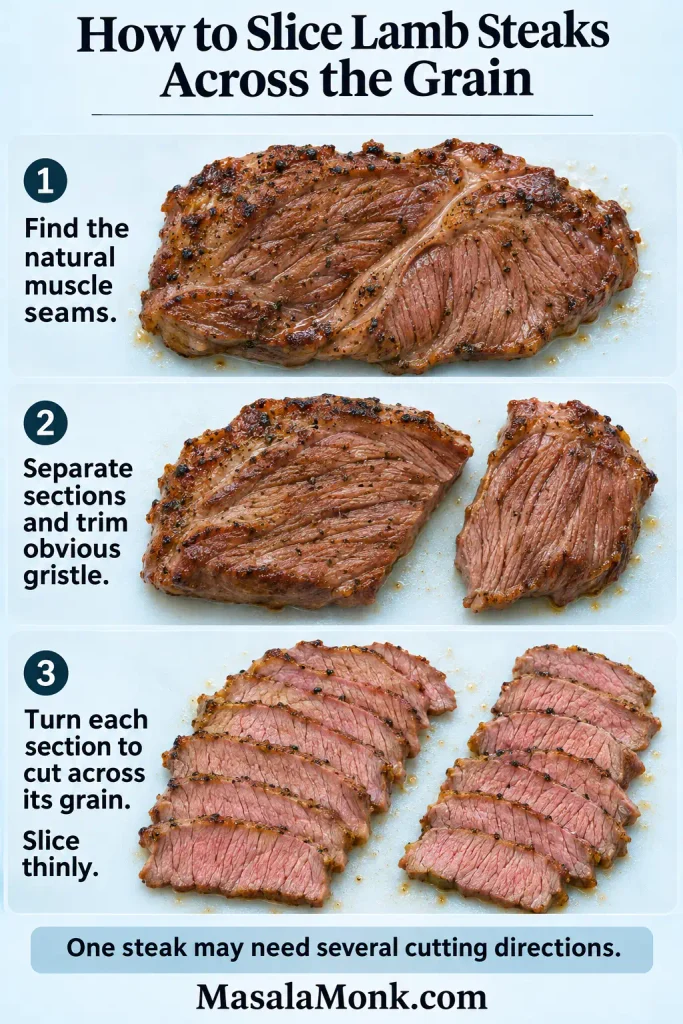
Look for the lines running through the cooked meat. Position your knife across them, rather than parallel to them, and cut thin slices. Shortening those muscle fibers makes each bite easier to chew.
With leg steaks, follow the natural seams between muscles. Separate the sections where necessary, trim obvious gristle and turn each piece before slicing.
You may need to cut one steak in several different directions.
Why Are My Lamb Steaks Tough, Dry or Chewy?
Before putting a tough lamb steak back on the heat, work out what you’re actually chewing.
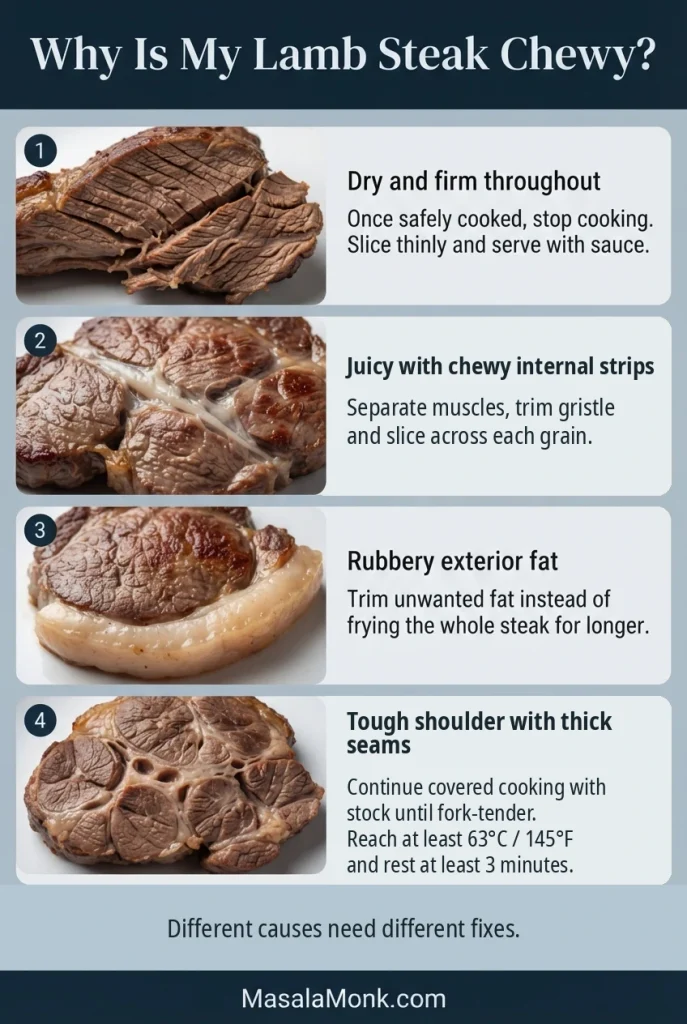
Why Juicy Lamb Can Still Be Chewy
Have you ever cut into a lamb steak with tender meat on either side of a strip that’s almost impossible to chew? It’s frustrating, particularly when you’ve taken the trouble to cook the steak carefully.
That strip could be gristle or a tough membrane. Even when the surrounding meat is juicy and properly cooked, the connective tissue may remain chewy. Meat that’s dry and firm throughout presents a different problem: its lean muscle may have lost too much moisture through overcooking.
Neither problem is likely to improve with more frying. Tough shoulder, on the other hand, can benefit from continued gentle cooking with stock.
Before cooking your next steak: Check for uneven thickness, tight membranes, thick outer fat and excess moisture. The preparation guide explains how to handle each.
What to Do When Lamb Isn’t Cooking Properly
| Problem | What to do |
|---|---|
| Meat is steaming | Separate crowded steaks. Let moisture evaporate while checking the center. |
| Steak curls upward | Hold it flat briefly with a spatula. Score tight outer membranes next time. |
| Pan smokes excessively | Reduce the heat or briefly take the pan off the burner. Improve ventilation. |
| Garlic or butter burns | Take the pan off the heat. Safely remove burnt garlic, or finish undercooked meat immediately in a clean pan if the butter has badly burnt. |
| Outside is dark but center isn’t ready | Lower the heat, turn periodically or finish in a preheated oven. |
| Yogurt coating scorches | Reduce the heat or finish straight away in another pan or preheated oven. |
| Air-fried lamb looks pale | Check the temperature. Remove at 63°C (145°F) or above. |
| One steak cooks faster | Rest the finished piece while the other continues cooking. |
If garlic begins burning, briefly take the skillet off the heat. Remove darkened garlic and herbs with tongs when safe, then resume cooking over lower heat. For badly burnt butter, finish undercooked steaks straight away in another pan or preheated oven. Make fresh butter for serving.
Too much rendered fat in the skillet? Take the pan off the heat and remove the excess into a heatproof container only when safe to do so. Let it cool before disposal. Continue cooking unfinished meat promptly in another pan if necessary.
Kitchen safety: Never pour water onto burning fat or carry a burning pan. Turn off the heat and slide a metal lid over a small grease fire only if safe. Leave it covered until cool. Otherwise, evacuate and contact emergency services.
Can You Save Tough or Overcooked Lamb?
| What the lamb is like | How to rescue it |
|---|---|
| Dry and firm throughout | Once safely cooked, stop cooking. Slice thinly and serve with sauce or gravy. |
| Juicy with chewy internal strips | Separate the muscles, trim obvious gristle and slice across each grain. |
| Rubbery exterior fat | Trim the unwanted fat instead of frying the whole steak for longer. |
| Tough shoulder with thick seams | Continue cooking straight away in a covered dish with stock until fork-tender, reaching at least 63°C (145°F) before removal and resting for at least three minutes. |
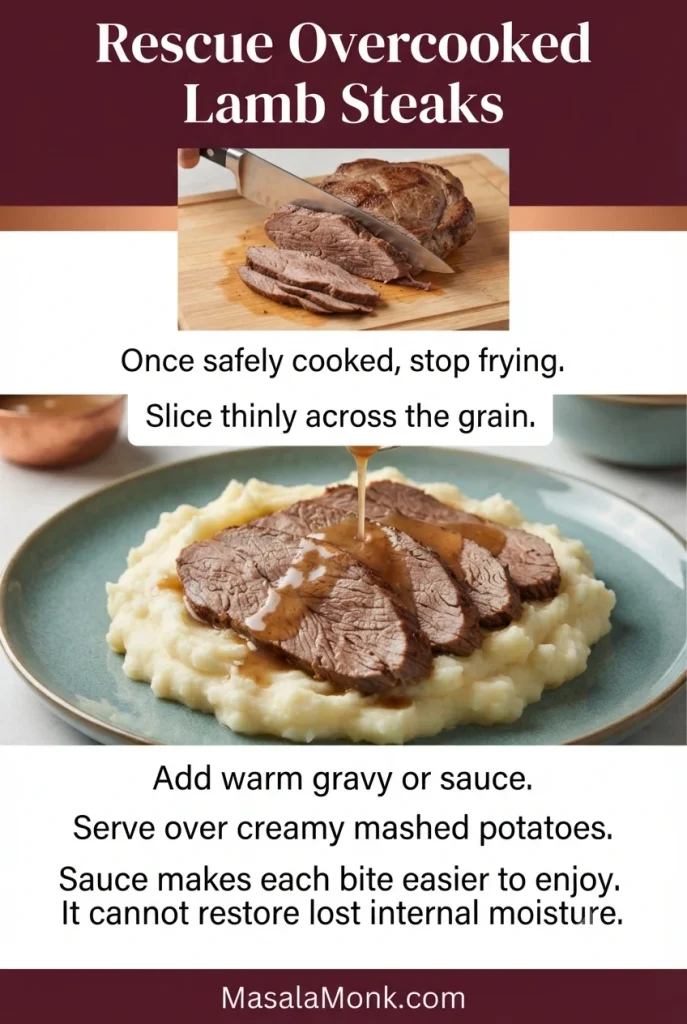
Even when a leg steak has gone a little too far, dinner needn’t end there. Slice it thinly, add warm gravy and serve over creamy mashed potatoes. The sauce won’t restore lost moisture, but it can make each bite easier to enjoy.
Never leave partially cooked lamb sitting out or refrigerate it to finish cooking later. For fully cooked leftovers, follow the storage and reheating guidance below.
Why Does My Lamb Taste or Smell So Strong?
Some of lamb’s distinctive aroma comes from its fat, and the strength varies with the animal, its diet and the cut. Choose leaner steaks or trim excess outer fat if you prefer a milder flavor.
Fresh mint, lemon and tangy yogurt give lamb a brighter, less rich-tasting finish. A crunchy Lebanese fattoush salad with sharp sumac dressing is a particularly refreshing accompaniment.
Suspected spoilage is different. Discard questionable or improperly stored meat rather than disguising its smell with seasoning. Even lamb that smells normal can be unsafe after improper storage.
Prevent the problem next time: Preparation guide · Thickness guide
Four Lamb Steak Marinades and Seasonings
Minted lamb with golden potatoes feels like a different dinner from cumin-spiced lamb tucked into warm flatbread.
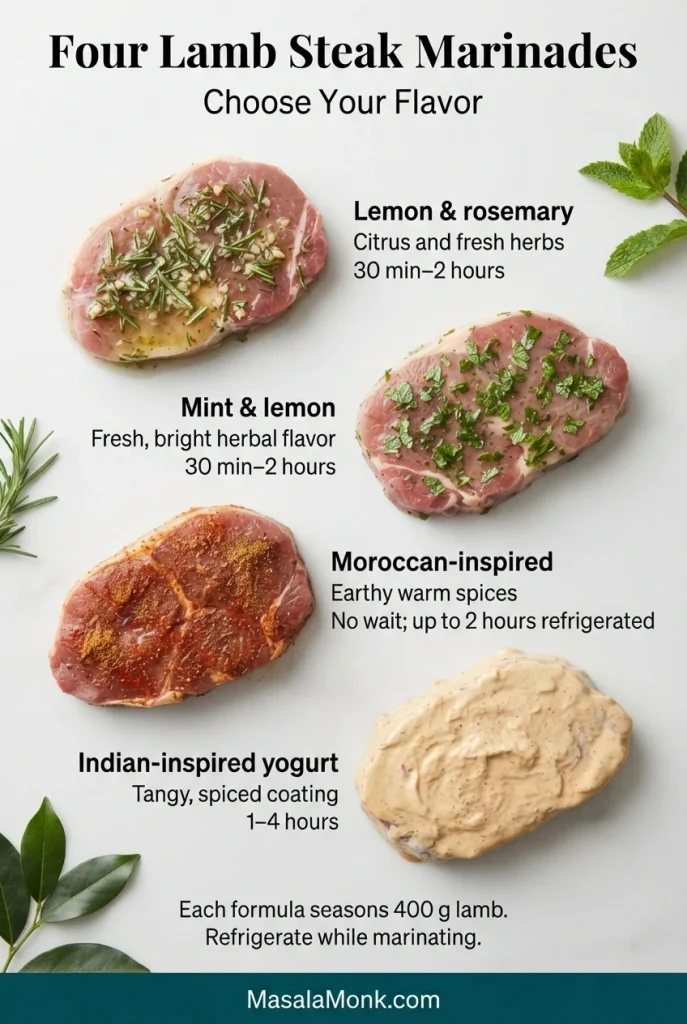
Each lamb steak marinade recipe seasons 400 g (14 oz) of meat, replacing the basic oil, salt and pepper. Use only the extra cooking oil specified. Finish with herb butter, or choose lemon, fresh herbs or yogurt for spiced lamb.
Marinate in the refrigerator for the time shown below.
| Seasoning | Choose it for | Marinating time |
|---|---|---|
| Lemon and rosemary | Citrus and fresh herbs | 30 min–2 hours |
| Mint and lemon | A lamb-and-potatoes dinner | 30 min–2 hours |
| Moroccan-inspired spice rub | Earthy spices without the wait | No wait; up to 2 hours refrigerated |
| Indian-inspired yogurt | A tangy, spiced coating | 1–4 hours |
Garlic, Lemon and Rosemary Marinade
- 15 ml (1 tbsp) olive oil
- 15 ml (1 tbsp) fresh lemon juice
- 2 crushed garlic cloves
- 1 tsp chopped fresh rosemary
- 3 g (about ½ tsp) fine salt
- ¼ tsp black pepper
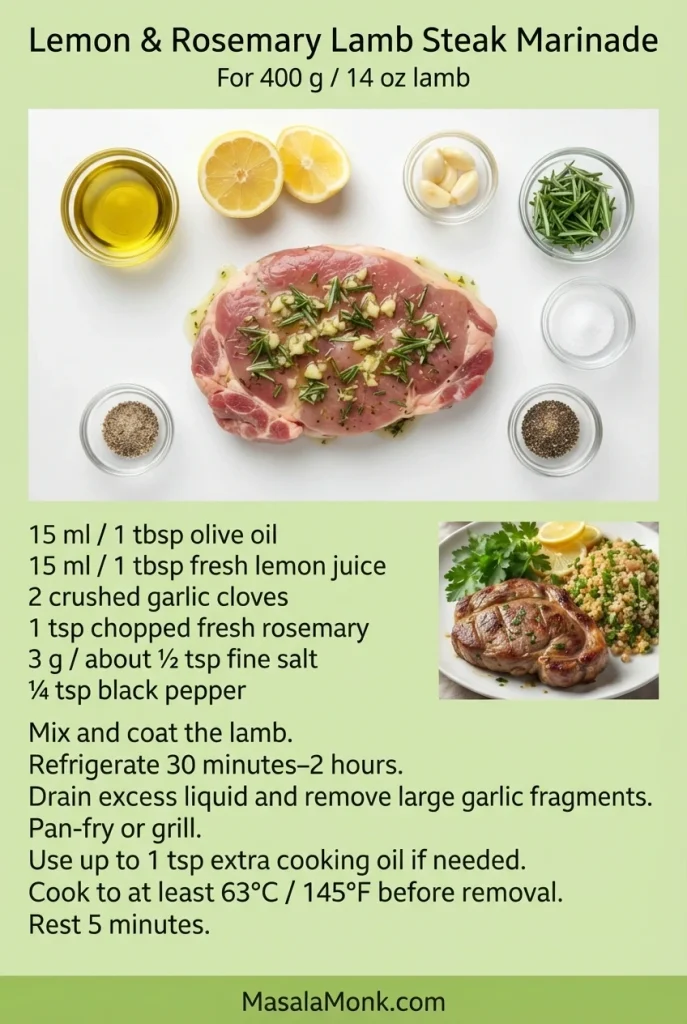
Mix the ingredients, coat the lamb and refrigerate for 30 minutes to 2 hours. Drain excess liquid and remove large garlic fragments before cooking, leaving a light coating on the meat.
Follow the pan-frying method from the skillet-heating stage, or grill the steaks. Use up to a teaspoon of extra oil on the cooking surface if needed; this replaces the main method’s pan oil. Turn down the heat if the herbs darken too quickly.
A bowl of lemon-dressed parsley and bulgur tabbouleh is all you need alongside for a light meal.
Minted Lamb Steaks
Try minted lamb with Greek lemon potatoes. Mint scattered over the cooked meat tastes brighter than mint exposed to cooking heat.
- 15 ml (1 tbsp) olive oil
- 10 ml (2 tsp) lemon juice
- 2 tbsp finely chopped fresh mint, plus extra for serving if desired
- 1 crushed garlic clove
- 3 g (about ½ tsp) fine salt
- ¼ tsp black pepper
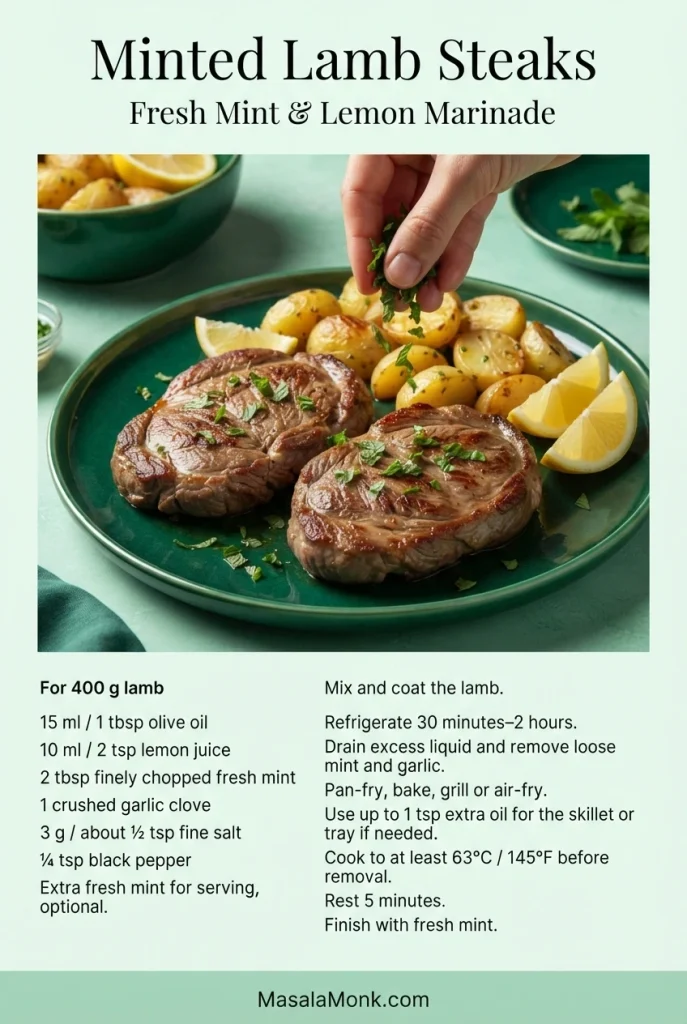
Combine the marinade ingredients and refrigerate the coated steaks for 30 minutes to 2 hours. Drain excess liquid and remove loose mint and garlic before pan-frying, baking or grilling. Use up to an extra teaspoon of oil for the skillet or tray if needed.
For minted lamb steaks in the air fryer, leave only a light coating and follow the air-fryer cooking method.
Already bought minted supermarket steaks? Skip the homemade marinade and follow the cooking instructions on the pack. Sweet coatings can darken quickly, so moderate skillet heat or oven cooking may be easier to manage. A dark coating doesn’t tell you whether the meat underneath is cooked; check the center with a thermometer.
Moroccan-Inspired Spiced Lamb Steaks
Earthy cumin, sweet paprika and coriander make an aromatic oil-based spice rub that needs no waiting time.
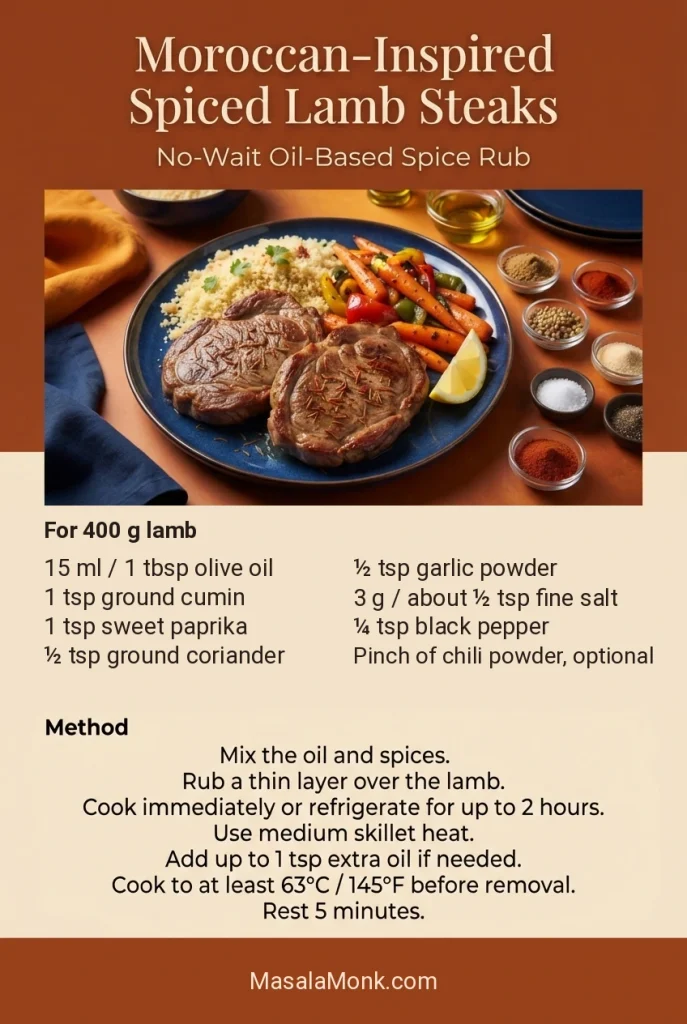
- 15 ml (1 tbsp) olive oil
- 1 tsp ground cumin
- 1 tsp sweet paprika
- ½ tsp ground coriander
- ½ tsp garlic powder
- 3 g (about ½ tsp) fine salt
- ¼ tsp black pepper
- A pinch of chili powder, optional
Mix the oil and spices and rub a thin layer over the lamb. Cook immediately or refrigerate for up to two hours. Follow the pan-frying method from heating the skillet, using medium rather than medium-high heat and turning as the spice coating browns. Add up to a teaspoon of extra oil if needed.
For a thin spice coating, the oven and air-fryer methods also work without re-seasoning. Cook to at least 63°C (145°F) and rest for five minutes. Serve with fluffy couscous, roasted carrots or peppers and fresh lemon.
For tougher shoulder meat, similar spices work well in our Moroccan lamb tagine with apricots.
Indian-Inspired Yogurt-Marinated Lamb
Tangy yogurt, ginger, garlic and garam masala give the lamb a warmly spiced coating. It needs gentler heat than a plain steak, especially when the meat is thick.
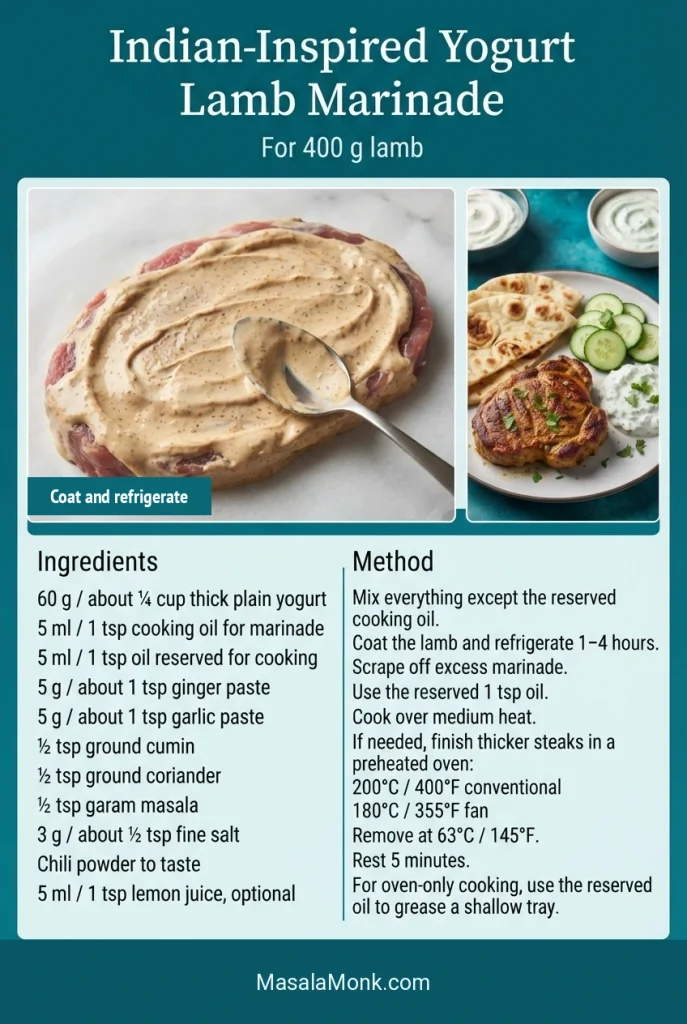
- Thick plain yogurt: 60 g (about ¼ cup)
- Cooking oil for the marinade: 5 ml (1 tsp)
- Oil for the skillet or baking tray: 5 ml (1 tsp)
- Ginger paste: 5 g (about 1 tsp)
- Garlic paste: 5 g (about 1 tsp)
- Ground cumin: ½ tsp
- Ground coriander: ½ tsp
- Garam masala: ½ tsp
- Fine salt: 3 g (about ½ tsp)
- Chili powder to taste
- Lemon juice: 5 ml (1 tsp), optional
Mix everything except the oil reserved for cooking. Coat the lamb, cover and refrigerate for 1–4 hours.
How to Cook Yogurt-Marinated Lamb Without Burning It
Yogurt and spices can brown long before the meat underneath is ready. For thick steaks, preheat the oven to 200°C (400°F) conventional or 180°C (355°F) fan-assisted before starting on the stovetop.
- Scrape away excess marinade, leaving a thin coating on the meat.
- Heat the reserved teaspoon of oil in a skillet over medium heat.
- Cook the steaks with space between them, turning as the coating browns. Start checking at the points in the thickness guide; reduce the heat if the spices darken too quickly.
- When the outside is browned but a thick steak needs longer, transfer it straight into the preheated oven using an ovenproof skillet or tray.
- Medium heat can change the finishing time. Remove at 63°C (145°F) or above and rest for five minutes.
Oven-only option: Preheat to 200°C (400°F) conventional or 180°C (355°F) fan-assisted. Scrape away excess marinade, oil a shallow tray with the reserved teaspoon of oil and follow the direct oven cooking stage. Skip the basic recipe’s seasoning and start checking the temperature early.
Serve with warm flatbread or rice, sliced cucumber and a generous spoonful of cool cucumber and yogurt tzatziki.
Can You Marinate Lamb Steaks Overnight?
Oil-and-herb marinades can work overnight, but prolonged citrus exposure can change the meat’s surface texture. Follow the shorter windows given for these recipes.
Always marinate in the refrigerator and stay within the meat’s recommended storage period. Discard used marinade unless you bring it to a full boil before reuse. If you’d like some as a serving sauce, reserve a clean portion before adding the raw lamb.
Marinated your lamb? Choose how to cook it: Pan-fry · Oven-bake · Air-fry · Grill
Three Simple Sauces for Lamb Steaks
Garlic butter for a freshly seared steak, sharp mint sauce for a traditional lamb dinner, or red wine pan sauce when there are mashed potatoes waiting to soak up the juices.
Garlic and Rosemary Butter
For two steaks, gently melt 20 g (about 1½ tbsp) unsalted butter with two crushed garlic cloves and two rosemary sprigs over low heat for 1–2 minutes, until fragrant.
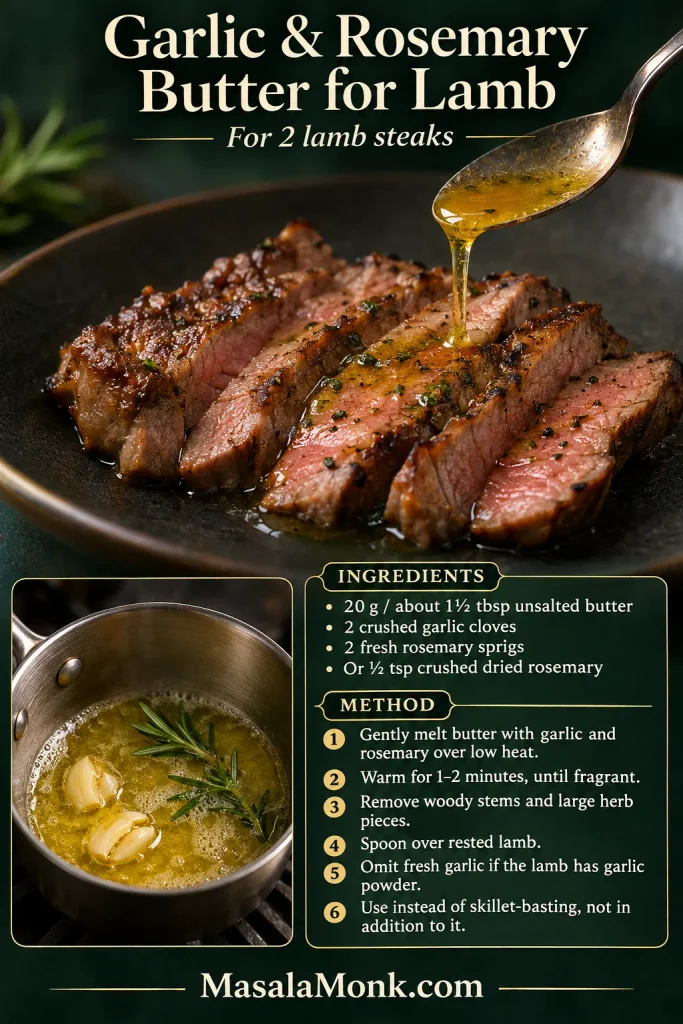
For dried rosemary, crush ½ tsp before adding. Omit fresh garlic if the lamb has garlic powder. Remove woody stems and large herb pieces before spooning over the rested meat.
Use this instead of, not in addition to, skillet-basting. For a cold, garlicky finish, try Lebanese toum.
Quick Homemade Mint Sauce
- 2 tbsp finely chopped fresh mint
- 15 ml (1 tbsp) white wine or cider vinegar
- 15 ml (1 tbsp) hot water
- 1–2 tsp sugar, to taste
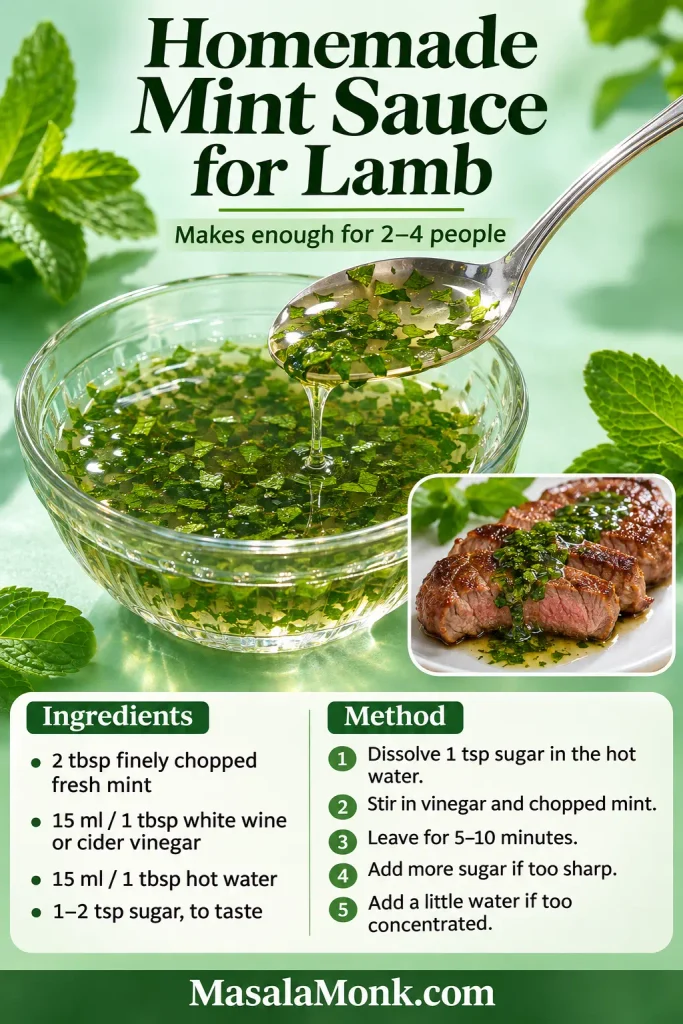
Dissolve one teaspoon of sugar in the hot water. Stir in the vinegar and mint, then leave for 5–10 minutes.
The mint should come through clearly, with just enough sweetness to soften the sharp vinegar. Add the remaining sugar if the vinegar tastes too sharp, or a little water if the flavor is too concentrated. Makes enough for two to four people.
Red Wine or Stock Pan Sauce
Don’t wash away those browned bits at the bottom of the skillet. A little wine, stock and butter can turn them into a deeply savory sauce.
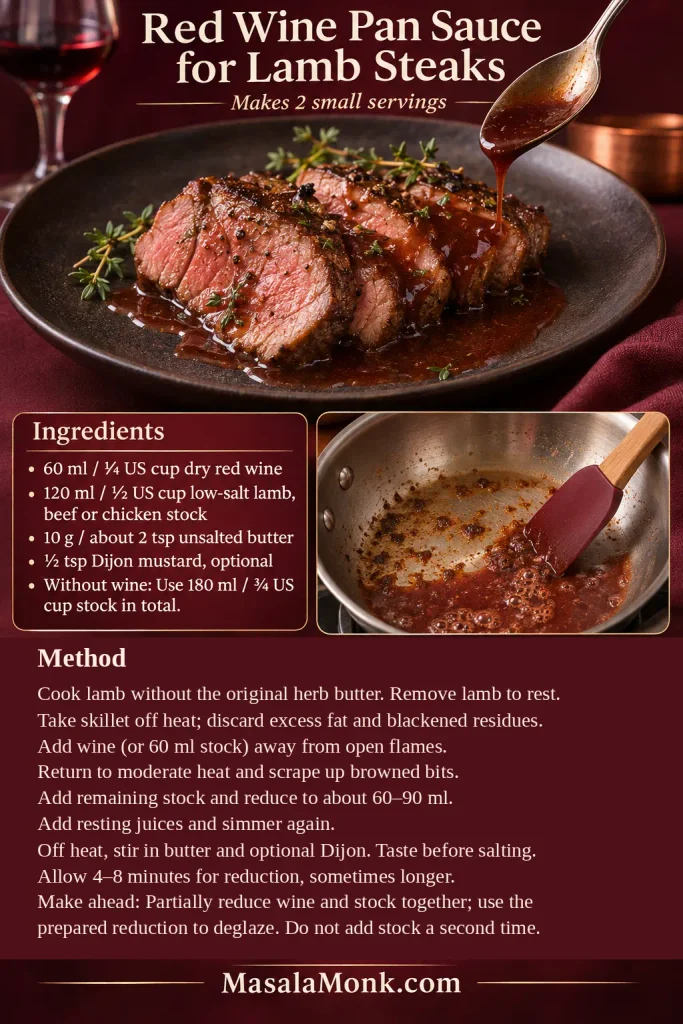
Allow around 4–8 minutes for reduction, sometimes longer. To avoid keeping the cooked lamb waiting, partially reduce the wine and stock together in a saucepan before searing the meat. Leave enough liquid to loosen the browned bits later.
- 60 ml (¼ US cup) dry red wine
- 120 ml (½ US cup) low-salt lamb, beef or chicken stock
- 10 g (about 2 tsp) unsalted butter
- ½ tsp Dijon mustard, optional
Without wine: Use 180 ml (¾ US cup) stock in total.
How to Make the Pan Sauce
- Cook the lamb without the original garlic-rosemary butter. Take the finished steaks out to rest on a clean warm plate.
- Take the skillet off the heat. Safely remove excessive fat and blackened residues, retaining the browned bits.
- Add liquids away from open flames. Use your prepared reduction, if made ahead; otherwise, pour in the wine or 60 ml stock. Return to moderate heat and scrape up the browned bits. Add the remaining stock only if you did not use a prepared reduction.
- Simmer until approximately 60–90 ml (¼–⅜ US cup) remains. Add the resting juices and bring back to a simmer, reducing a little further if needed. Keep the steaks loosely covered on a warm plate while the sauce finishes.
- Take off the heat and stir in the butter and optional Dijon mustard. Taste before adding salt.
The finished sauce should taste concentrated, although some stocks produce a thinner sauce than others. This makes two small servings.
Adjusting the sauce:
- Too salty: Dilute with unsalted stock or water.
- Too thin: Reduce further, provided it isn’t already too salty.
- Tastes flat: Add a few drops of lemon juice or vinegar.
For a sweet-tart variation, stir in 1–2 tsp redcurrant jelly during reduction.
For oven-baked or air-fried lamb, make the same sauce entirely in a saucepan, adding the resting juices before the final simmer. Alternatively, our creamy mushroom sauce makes a richer, steakhouse-style accompaniment.
Put the sauce to work: Main recipe · Plan your dinner
What to Serve With Lamb Steaks
Roast potatoes, green beans and mint sauce are hard to beat with simply seasoned lamb. Crisp potatoes contrast with the tender meat, while the mint and vinegar keep the plate from feeling too heavy.

Save the buttery mash or soft polenta for shoulder steaks with onion gravy. A piece of bread is useful for mopping up what’s left.
For a Mediterranean-style dinner, serve grilled lamb with lemon potatoes, cucumber salad and a small spoonful of salty, savory homemade olive tapenade.
Spiced lamb flatbreads make a good shared meal. Put sliced cucumber, yogurt, fresh herbs and a bowl of smoky baba ganoush on the table. Slice the rested steaks and let everyone build their own bites.
Oven-Baked Lamb Steaks With Potatoes and Vegetables
This two-tray lamb steak recipe brings together baby potatoes, sweet cherry tomatoes and roasted red onion. Give the vegetables a head start and cook the meat separately, so each tray can come out of the oven as soon as it’s ready.
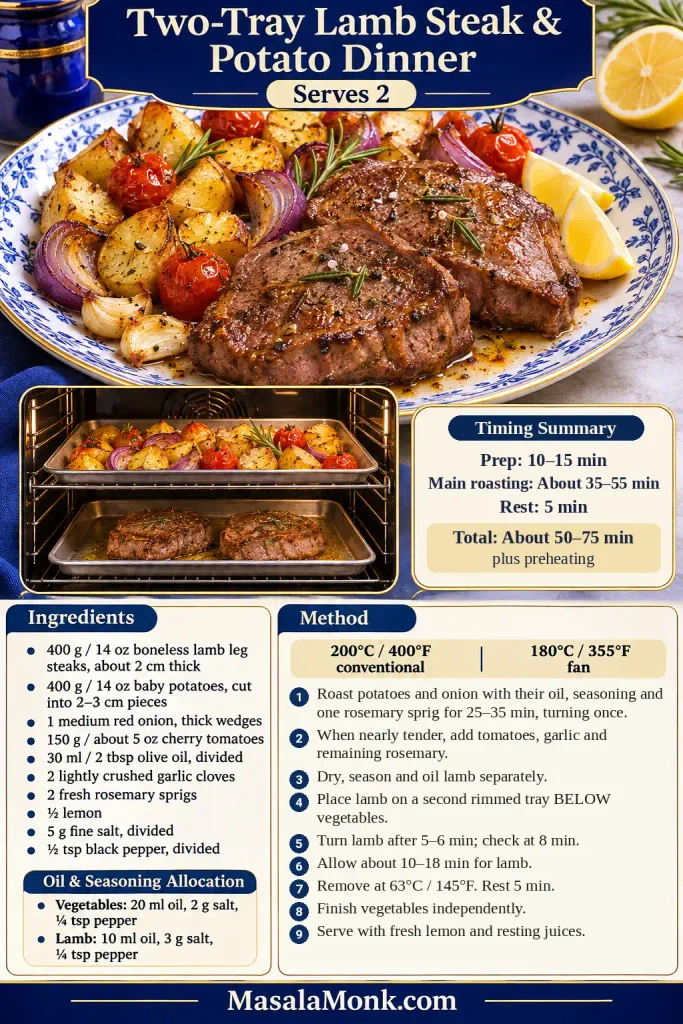
Serves: 2
Oven: 200°C (400°F) conventional or 180°C (355°F) fan-assisted
Prep: 10–15 minutes · Main roasting period: About 35–55 minutes
Rest: 5 minutes
Total: Allow about 50–75 minutes, plus additional preheating or roasting time if needed
Ingredients
- 400 g (14 oz) boneless lamb leg steaks, about 2 cm thick
- 400 g (14 oz) baby potatoes, cut into 2–3 cm (¾–1¼ inch) pieces
- 1 medium red onion, cut into thick wedges
- 150 g (about 5 oz) cherry tomatoes
- 30 ml (2 tbsp) olive oil, divided
- 2 garlic cloves, lightly crushed
- 2 sprigs fresh rosemary
- ½ lemon
- 5 g (about ¾–1 tsp) fine salt, divided
- ½ tsp black pepper, divided
How to Make the Lamb Steak and Potato Dinner
- Preheat the oven to 200°C (400°F) conventional or 180°C (355°F) fan-assisted.
- Toss the potatoes and onion with 20 ml (4 tsp) olive oil, one rosemary sprig, 2 g salt and half the pepper. Spread over a large rimmed metal tray.
- Roast for 25–35 minutes, turning once. Give the potatoes longer if they are still firm in the middle when pierced with a knife.
- Once the potatoes are nearly tender, pat the lamb dry and season with the remaining 3 g salt and pepper. Rub over the remaining 10 ml (2 tsp) oil.
- Add the tomatoes, garlic and remaining rosemary to the vegetables. Arrange the steaks on a second rimmed metal tray and place it below the vegetables to prevent raw lamb juices from dripping onto them. Two trays can affect heat circulation, so check each independently.
- Turn the steaks after about 5–6 minutes and begin checking at 8 minutes. Allow approximately 10–18 minutes, removing each steak when the thickest sections reach at least 63°C (145°F).
- Rest the lamb on a clean warm plate for five minutes. Finish roasting the vegetables until the potatoes are golden and tender and the tomatoes have softened. Remove them sooner if they’re ready.
- Serve together using clean utensils, with fresh lemon and the juices from the rested lamb.
Getting the Whole Dinner Ready Together
Let the slowest side dish determine when the steak goes on. Lamb cooks so quickly that starting everything together often leaves the meat waiting for the potatoes.
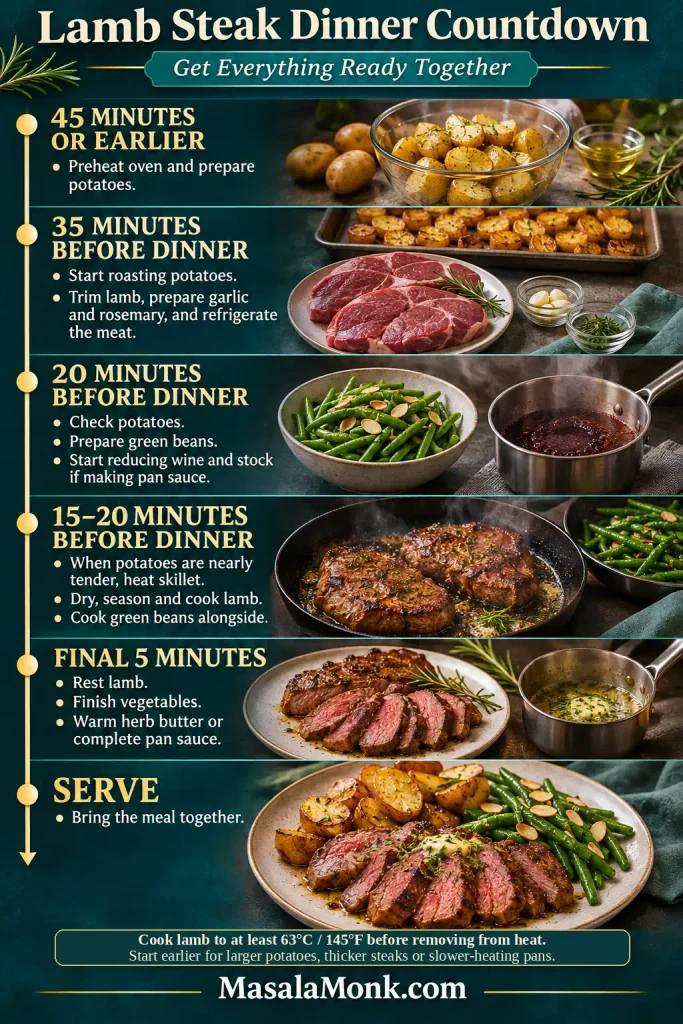
For pan-fried lamb with small roast potatoes and green vegetables, work backward from serving time:
- 45 minutes or earlier: Preheat the oven and prepare the potatoes.
- 35 minutes before dinner: Start roasting the potatoes. Trim the lamb, prepare the garlic and rosemary, and keep the meat refrigerated.
- 20 minutes before: Check the potatoes. Prepare the ingredients for green beans almondine and start reducing the wine and stock if making pan sauce.
- 15–20 minutes before: Once the potatoes are nearly tender, heat the skillet, dry and season the lamb, then start cooking. Allow closer to 20 minutes for thicker steaks or a heavy pan that takes longer to heat. Cook the beans alongside according to their recipe.
- Final five minutes: Rest the lamb, finish the vegetables and warm the garlic-rosemary butter or complete the pan sauce.
Larger potatoes or thicker steaks need an earlier start, so adjust the serving time as necessary. It’s better to give the potatoes a few extra minutes before the lamb goes on than to keep a finished steak waiting beside the stove.
Ready to cook? Main recipe · Cooking times and temperatures
How to Store, Freeze and Reheat Lamb Steaks
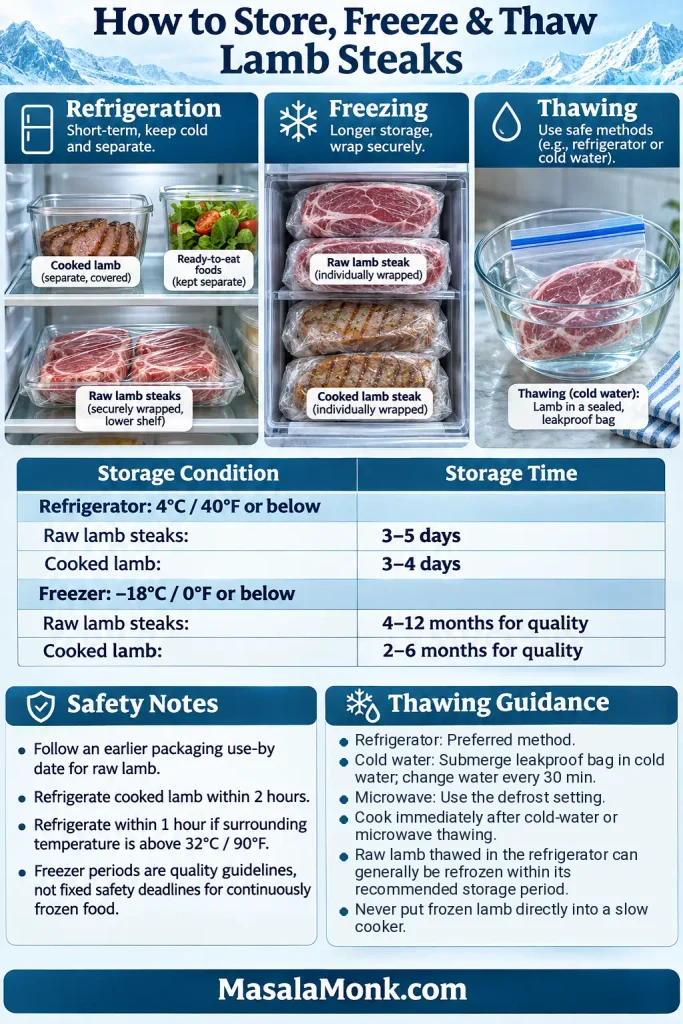
Separate raw steaks from cooked leftovers when planning storage. The guide below distinguishes safe refrigerator storage, freezer quality and thawing methods.
Refrigerating Lamb Steaks
Keep raw lamb at 4°C (40°F) or below and use within 3–5 days, or sooner if the packaging specifies an earlier use-by date. Store securely wrapped on a lower refrigerator shelf, away from ready-to-eat food.
Refrigerate cooked lamb within two hours, or within one hour when the room or outdoor temperature is above 32°C (90°F). Store in a covered container and use within 3–4 days. Keep leftover steaks whole when convenient; they’re easier to slice thinly once cold.
Freezing and Thawing
Wrap individual steaks securely so you can thaw only what you need. The official cold food storage chart gives freezer quality ranges of 4–12 months for raw steaks and 2–6 months for cooked meat leftovers. These are quality guidelines, not fixed safety deadlines for food kept continuously frozen at -18°C (0°F) or below.
Thaw lamb in the refrigerator whenever possible. For faster thawing, put it in a leakproof bag in cold water, changing the water every 30 minutes, or use the microwave’s defrost setting. Cook immediately after either faster method.
Raw lamb thawed in the refrigerator can generally be refrozen within its recommended storage period, although the texture may suffer.
Can You Cook Lamb Steaks From Frozen?
Yes, some oven and air-fryer methods allow you to cook individual steaks from frozen. However, the timings in this lamb steak recipe are for thawed meat. Thawing first also makes it easier to inspect, trim and season the steaks.
When following frozen-steak instructions from your appliance or meat packaging, check that intact whole-cut lamb reaches at least 63°C (145°F) before removal, followed by a minimum three-minute rest. Follow any additional instructions on the pack. Never put frozen lamb directly into a slow cooker.
Reheating Without Drying Out the Meat
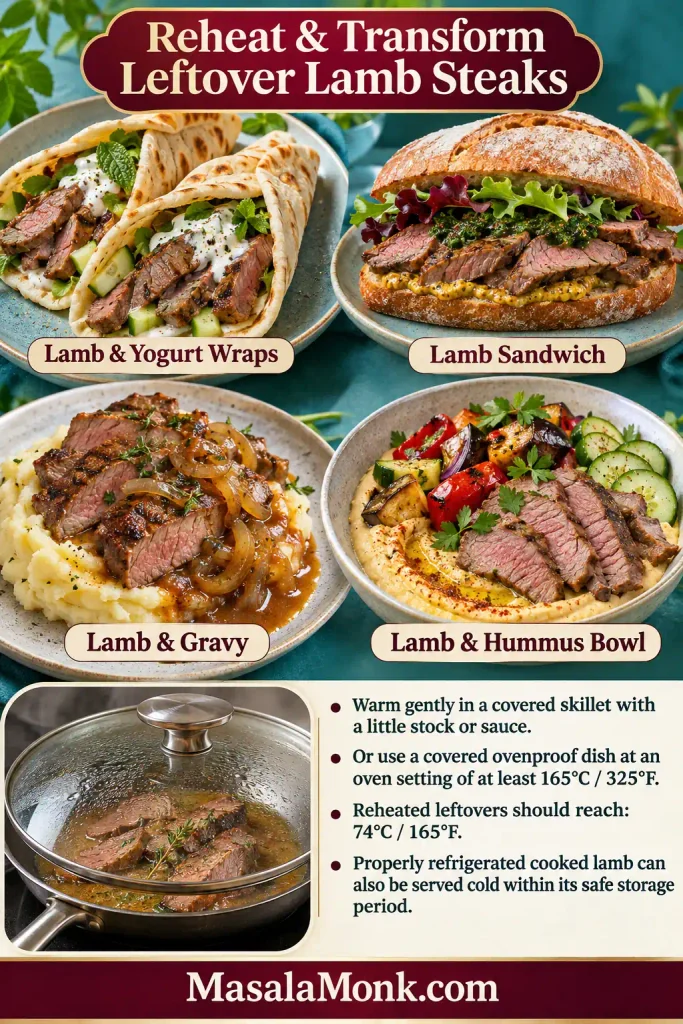
Warm leftover lamb in a covered skillet with a little stock or sauce, or use a covered ovenproof dish at an oven setting of at least 165°C (325°F). Reheated leftovers should reach 74°C (165°F).
Since reheating can dry out lean steaks, you may enjoy them more served cold. Properly refrigerated cooked lamb works well in sandwiches, salads and wraps within its safe storage period.
What to Do With Leftover Lamb Steaks
- Yogurt and lamb wraps: Tuck thin slices into soft homemade pita bread with cucumber, mint and yogurt.
- Steak sandwich: Add mustard, mint sauce and crisp salad leaves.
- Onion gravy and lamb: Reheat the meat safely in the gravy and spoon over mashed potatoes.
- Hummus bowl with lamb: Spread creamy homemade hummus across a bowl and add cold sliced lamb, cucumber, leftover roasted vegetables and parsley.
Frequently Asked Questions About Lamb Steaks
Are lamb steaks the same as lamb chops?
Not necessarily. Steaks commonly come from the leg, rump or shoulder, whereas chops often come from the rib, loin or shoulder. Naming varies between butchers and regions, and both can be sold bone-in or boneless.
Should you wash lamb steaks before cooking?
No. Washing raw meat can spread contamination through splashing. Pat it dry with disposable kitchen paper, discard the paper and wash your hands, utensils and affected surfaces.
Can you cook lamb steaks without oil?
Fatty cuts may release enough fat for cooking, particularly when you render the outer edge first. Lean leg and loin steaks generally benefit from a light coating of oil for browning and to help prevent sticking.
Why do lamb steaks shrink when cooked?
Muscle fibers contract, moisture escapes and fat renders. Some shrinkage is normal. Excessive cooking increases moisture loss, while tight outer membranes can cause additional curling.
How much lamb steak do you need per person?
Allow about 175–225 g (6–8 oz) raw boneless lamb per adult, with sides. Buy a little more for bone-in cuts or steaks with substantial fat you intend to trim. For a larger gathering, it may be easier to prepare a whole roast leg of lamb rather than cook individual steaks in several batches.
Whether you finish your lamb with warm garlic-rosemary butter, a spoonful of mint sauce or a rich pan gravy, a few well-chosen sides are all you need to turn it into a satisfying dinner.