Posted on — Leave a comment

Reuben Sandwich Recipe: Crispy Rye, Melty Swiss & Classic Deli Flavor

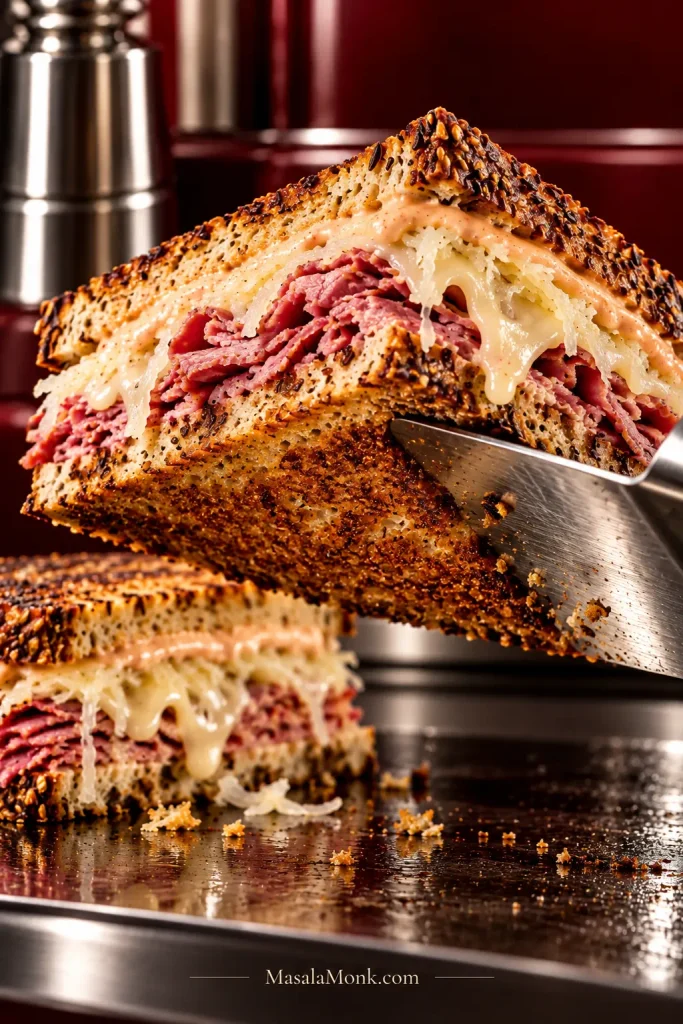
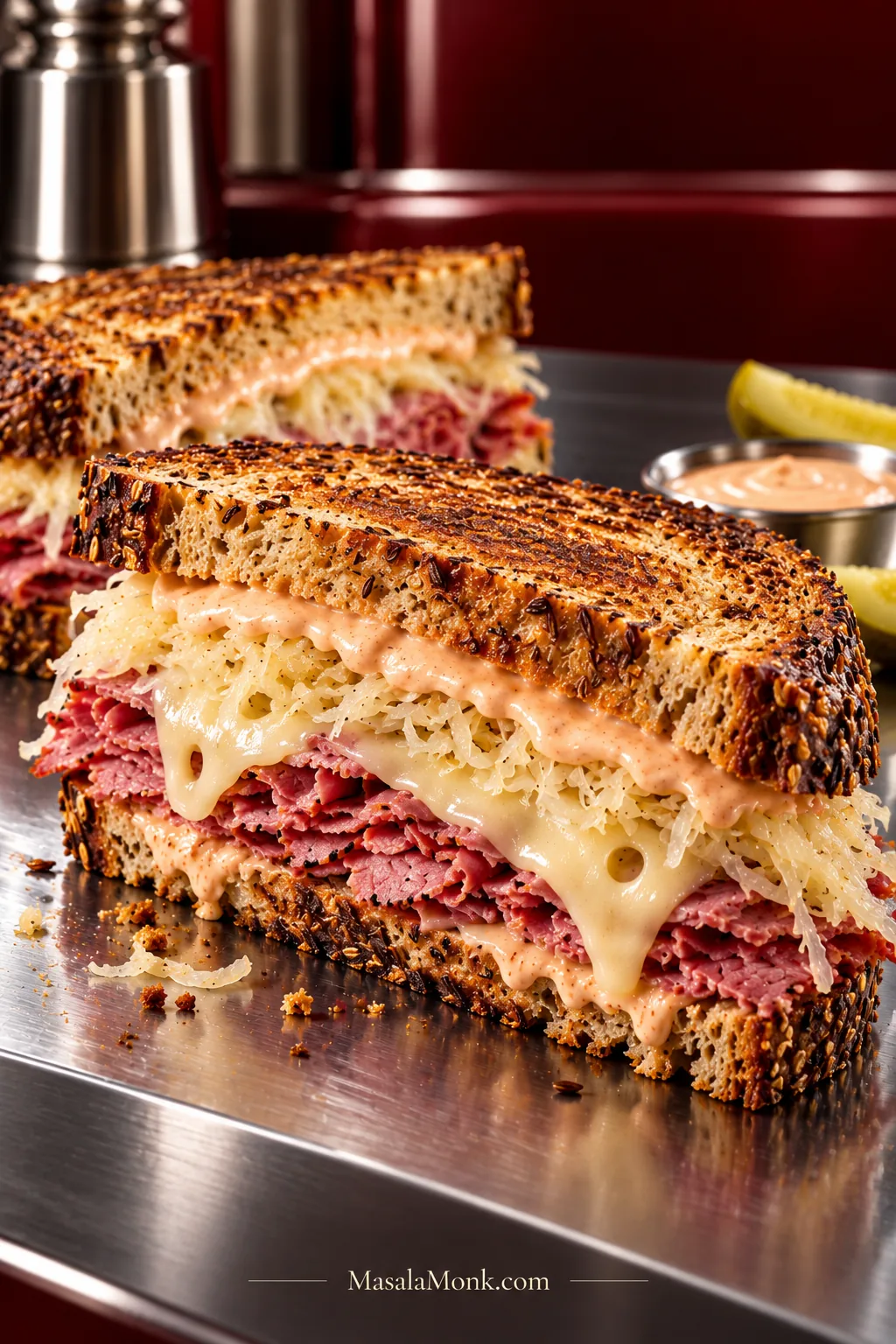
Toasted rye Reuben cut open to show folded corned beef, melted Swiss cheese, sauerkraut and Russian dressing on a polished deli-style set.

A Reuben can look finished before it actually is. The rye turns beautifully golden, then you cut through the middle and find cool corned beef, barely melted Swiss or enough sauerkraut steam to soften the crust.

When it works, the contrast is immediate: crisp rye first, then hot, supple corned beef, melted Swiss, sharp sauerkraut and creamy Russian dressing all arriving together.

This Reuben sandwich recipe gets there by warming the fillings before the sandwich reaches the skillet. The classic stack stays familiar—corned beef, Swiss cheese, sauerkraut and Russian dressing on rye—but now the bread can brown properly without racing against a refrigerator-cold middle. Thousand Island is the sweeter alternative if that is the Reuben you prefer.

DRY
Squeeze the sauerkraut until pressing it no longer releases obvious brine.

WARM
Get the corned beef and kraut warm through before they go between the bread.

BROWN
Use the final skillet cook to crisp the rye and finish melting the Swiss.
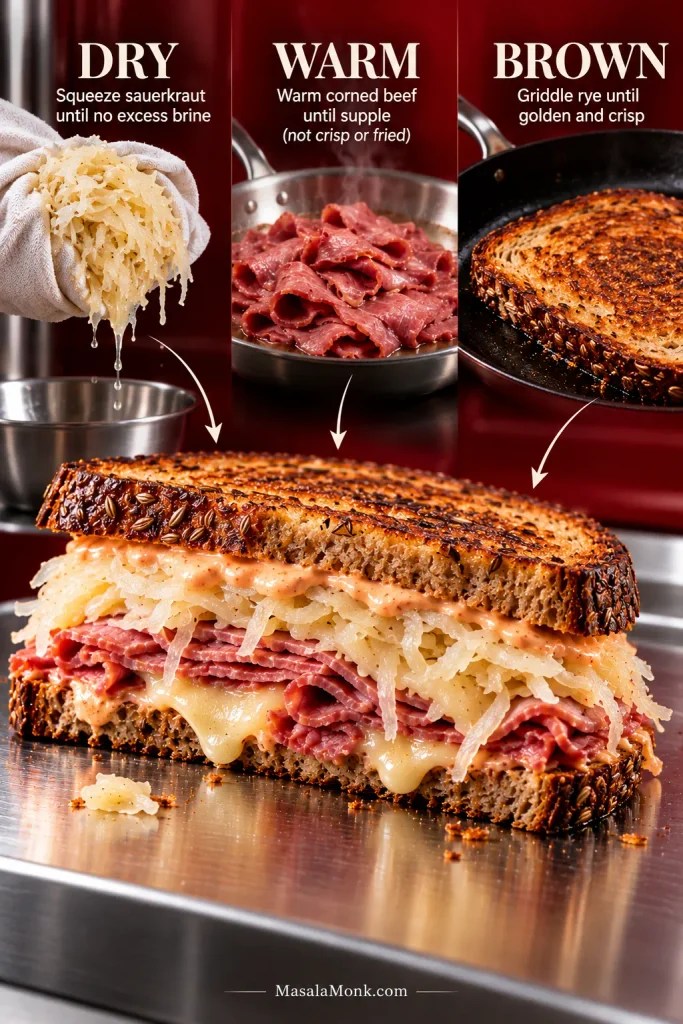
Cooking guide labeled Dry, Warm and Brown, showing squeezed sauerkraut, warmed corned beef, browned rye and a finished Reuben sandwich.
Three jobs, one result: dry filling, warm center, crisp rye.

Make the Reuben: Classic Skillet Method

This makes four Reubens, with the rye turning crisp and golden at about the same time the center becomes hot, soft and melty.

Yield
4 sandwiches

Prep
About 15 minutes

Cook
About 20 minutes

Total
About 35 minutes

Per sandwich
2 sturdy rye slices
4 oz / 113 g corned beef
2 slices / about 40–50 g Swiss
about 1¾ oz / 50 g well-drained, firmly squeezed sauerkraut
1½ tbsp / 22 ml Russian dressing
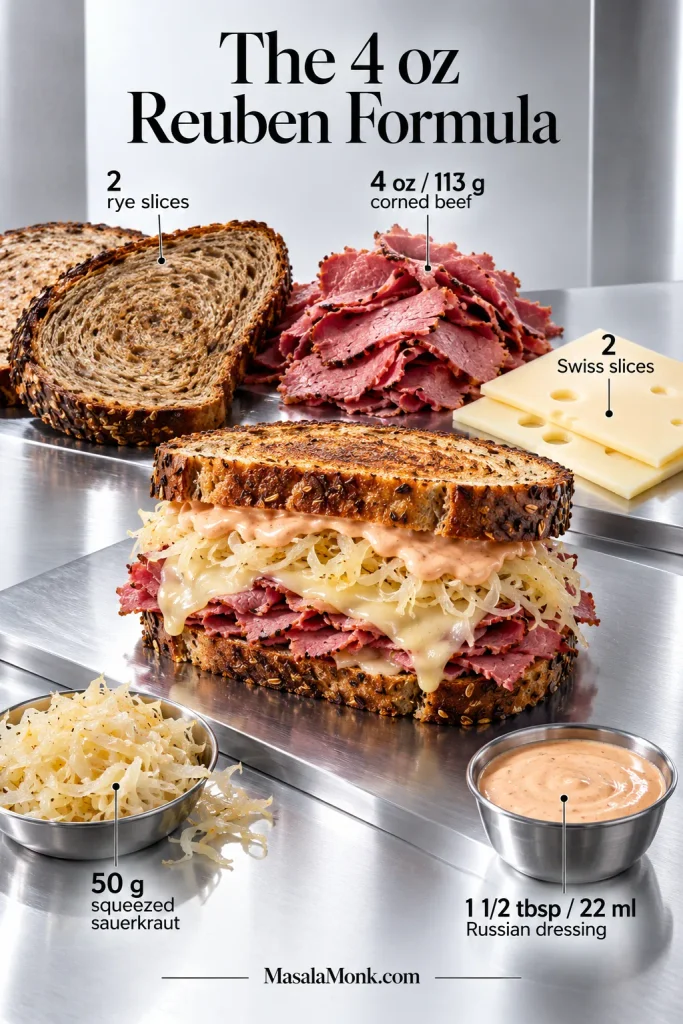
Ingredient guide for one Reuben showing two rye slices, 4 ounces or 113 grams of corned beef, two Swiss slices, 50 grams of sauerkraut and 1½ tablespoons of Russian dressing.
These Reuben sandwich ingredients are also a heat-management system. Keeping the filling proportionate means less mass for the skillet to warm, so the bread can crisp before the center becomes a problem.

Useful equipment: a 12-inch / 30 cm heavy skillet or large griddle, a wide spatula and a lid large enough to cover the sandwiches.

Quick Russian Dressing

  • Mayonnaise — ½ cup / 120 ml
  • Heinz-style bottled chili sauce — 2 tbsp / 30 ml, the tomato-based kind, not sweet Asian chili sauce
  • Ketchup — 1 tbsp / 15 ml
  • Prepared horseradish — 2 tsp / 10 ml, not creamy horseradish sauce, plus more to taste
  • Finely chopped dill pickle or dill relish — 1 tbsp / 15 ml
  • Worcestershire sauce — 1 tsp / 5 ml
  • Fresh lemon juice — 1 tsp / 5 ml
  • Sweet paprika — ¼ tsp
  • Freshly ground black pepper — to taste

This makes about ¾–⅞ cup / roughly 200 ml, with plenty left for dipping. Taste before adding salt; corned beef, Swiss, sauerkraut and Worcestershire already bring plenty.

For the Reuben Sandwiches

  • 8 slices sturdy rye bread, preferably about ⅜–½ inch / 1–1.3 cm thick
  • 16 oz / 454 g thinly sliced cooked corned beef, roughly 1/16–1/8 inch / 2–3 mm thick when slicing it yourself
  • 8 slices Swiss cheese / about 160–200 g total
  • About 7 oz / 200 g well-drained, firmly squeezed sauerkraut
  • 6 tbsp / 90 ml Russian dressing for the sandwiches, plus extra for serving
  • 3 tbsp / 42 g unsalted butter, softened, plus more as needed for unusually large bread

1. Mix the Russian dressing

Stir the mayonnaise, bottled chili sauce, ketchup, horseradish, pickle, Worcestershire, lemon juice, paprika and black pepper until smooth.

Taste, then add a little more horseradish or black pepper if needed. It should be creamy and tangy, with the horseradish clearly present but not dominating the beef and Swiss.
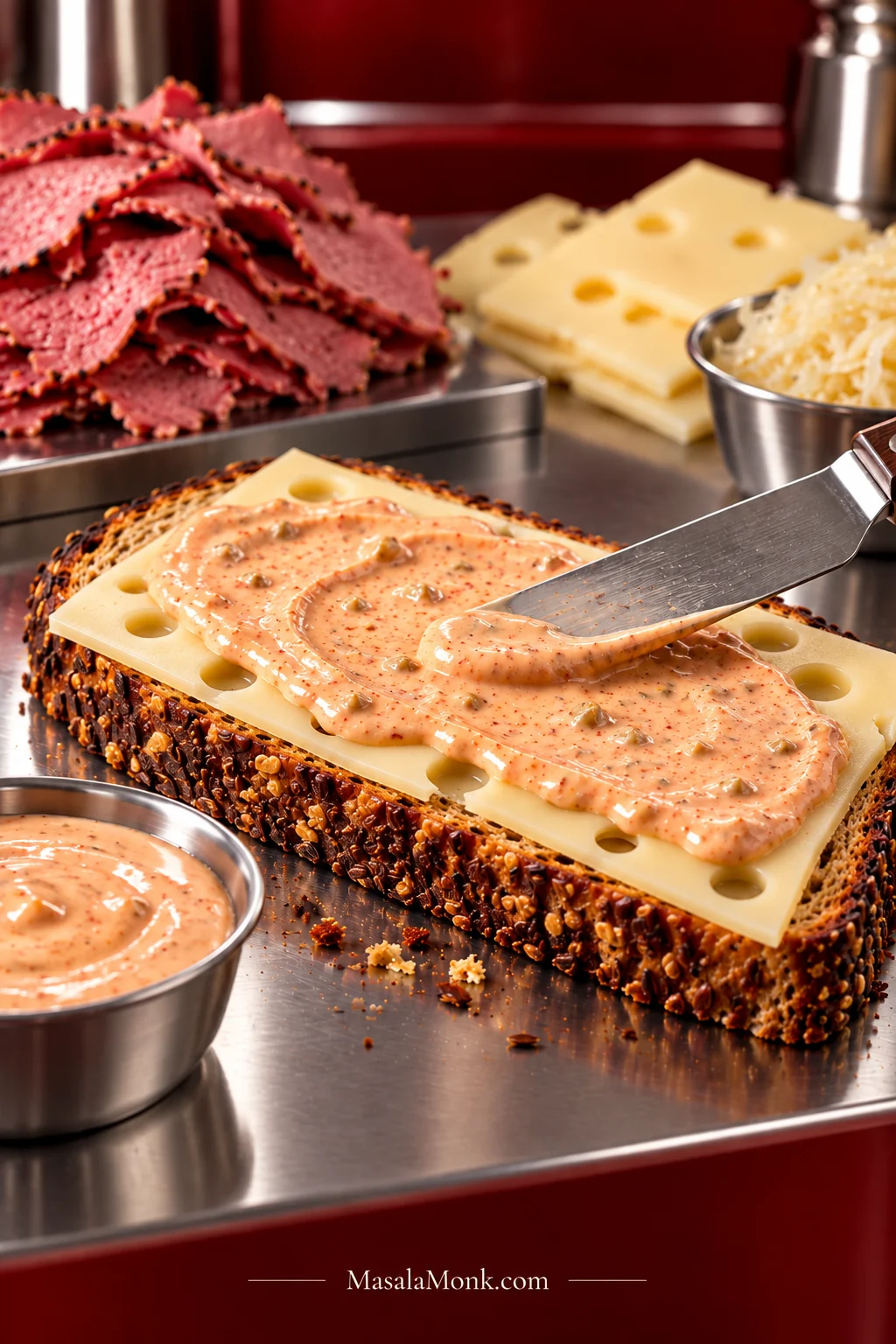
Russian dressing being spread in a thin layer over Swiss cheese on seeded rye bread during Reuben sandwich assembly.
Spread the Russian dressing over the Swiss rather than directly onto the rye. The cheese helps keep the wetter filling one layer away from the bread.

2. Squeeze the sauerkraut, then warm it

Drain the sauerkraut thoroughly, then squeeze it firmly with clean hands, paper towels or a clean kitchen towel. If obvious brine still comes out when you press it, keep squeezing.
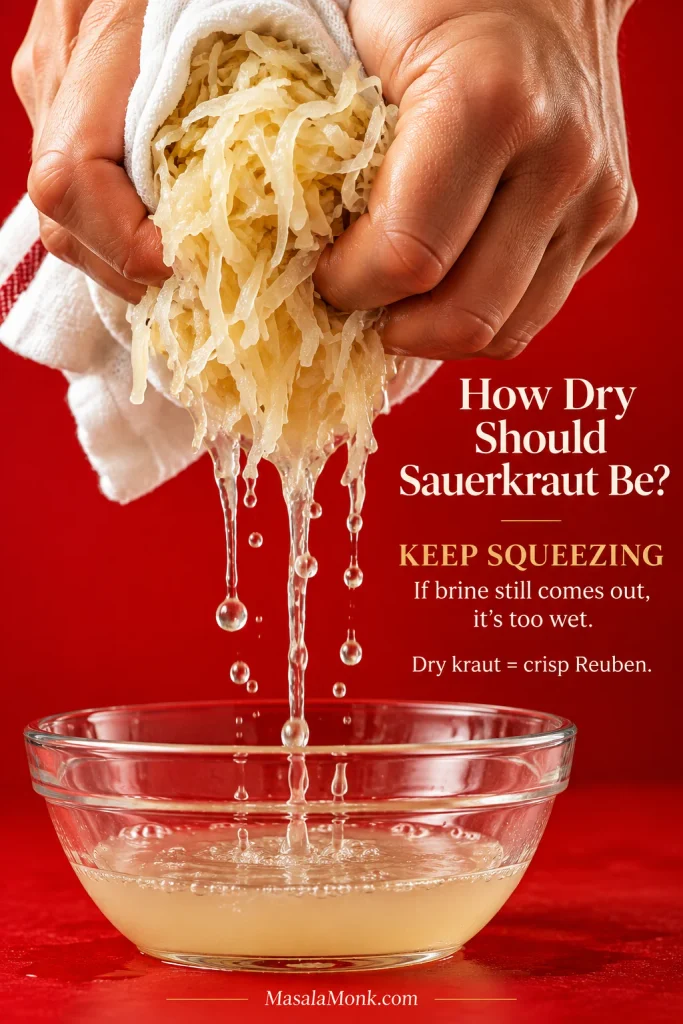
Hands squeezing pale shredded sauerkraut in a clean cloth while visible brine drips out beneath it.
The goal is not dry cabbage. Sauerkraut should still look juicy and flexible, yet firm pressure should release no obvious liquid—the useful middle ground between jar-wet and overcooked.

Measure about 7 oz / 200 g after squeezing. Warm it in the skillet over medium heat for about 1–2 minutes, stirring once or twice, until the refrigerator chill is gone and the surface no longer looks wet.

Keep some life in it. The kraut should stay sharp and juicy rather than turning dry or fried.

3. Warm the corned beef without drying it

Move the kraut to a plate and wipe away any visible liquid from the skillet. Add the corned beef in loose folds instead of one compact mound.

A crowded skillet warms the beef unevenly, so work in two loose batches when necessary. Give each batch about 1 minute, turning gently, until the slices are supple and have lost their refrigerator chill. Meat that seems dry can use about 1 tsp / 5 ml water added to an empty area of the skillet; cover briefly and let the steam do the work.

That quick warm-up assumes ready-to-eat deli corned beef; previously cooked leftovers should be reheated to 165°F / 74°C before assembly.

Warm corned beef should bend and fold easily. Crisp, fried edges are a sign it has gone farther than a Reuben needs.
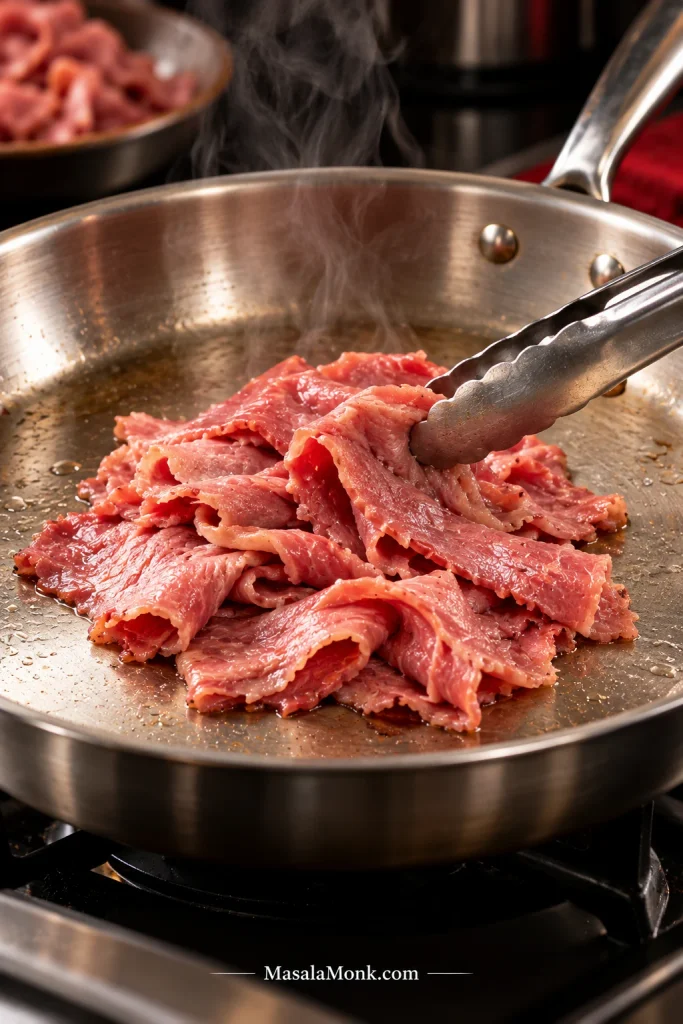
Thin slices of pink corned beef warming in loose folds in a stainless-steel skillet while metal tongs lift and separate the meat.
Use flexibility as the checkpoint: properly warmed corned beef should drape easily from the tongs. Once the edges stiffen or crisp, reheating has started turning into frying.

4. Build every sandwich in the same order

For each Reuben, stack:

  1. 1 slice rye bread
  2. 1 slice Swiss cheese
  3. About half of the 1½ tbsp / 22 ml Russian dressing
  4. 4 oz / 113 g corned beef
  5. About 1¾ oz / 50 g firmly squeezed sauerkraut
  6. The remaining half of the dressing
  7. 1 more slice Swiss cheese
  8. Second slice rye bread

Spread a thin, even layer of softened butter over the two outside bread surfaces.

5. Brown the rye over moderate heat

Wipe the skillet clean and dry, then return it to medium-low to medium heat. For an electric griddle, start around 350°F / 177°C.

Add the sandwiches without crowding the pan. A 12-inch / 30 cm skillet will usually hold two comfortably. For four at once, use a large griddle or two skillets so the first sandwiches are not sitting around while the last ones cook.

Press gently with a wide spatula so the bread makes good contact. There is no need to flatten the sandwich.
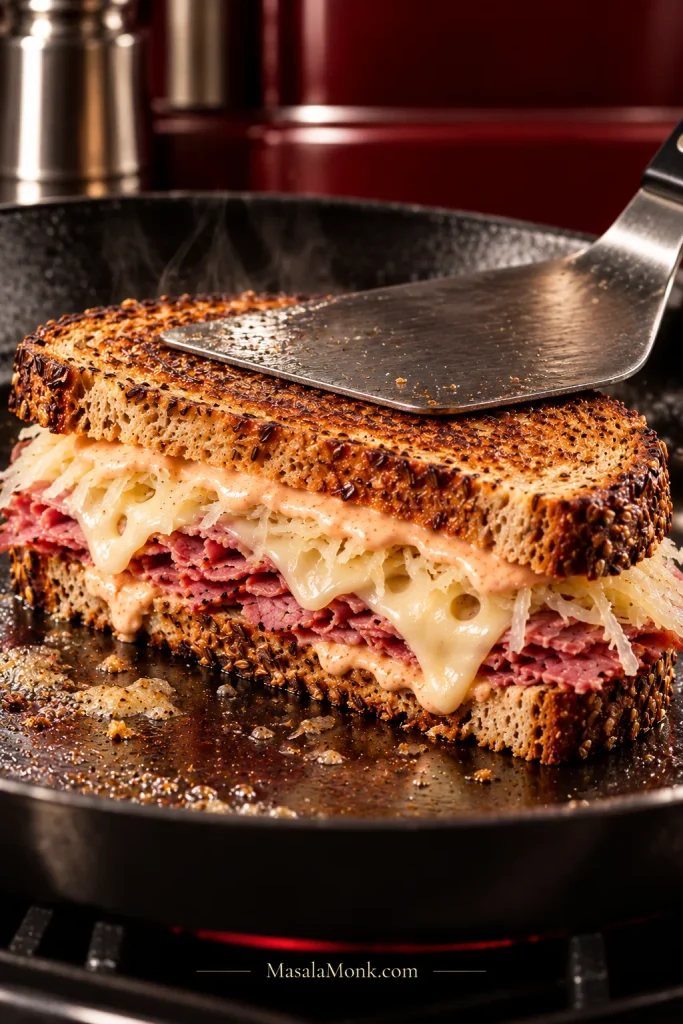
A Reuben browning in a skillet while a wide metal spatula applies light pressure to the seeded rye bread.
Watch the sandwich edges while pressing. If cheese, kraut or beef begins squeezing outward, ease off; better skillet contact should improve the crust without compressing the filling.

Cook the first side for roughly 3–4 minutes. Flip when the rye is evenly golden, then cook the second side for another 2–4 minutes.

Ideally, the rye reaches deep gold just as the Swiss sinks into the folds of beef. When the bread gets there first, lower the heat and cover for 30–60 seconds. Two rubbery squares of cheese mean the center still needs help; rapidly darkening rye means the pan is running too hot.

6. Check the center, then rest for one minute

The Reuben is ready when the rye is crisp and deeply browned, the Swiss has melted into the filling, and the corned beef in the center is properly hot.

Transfer to a cutting board and rest for about 1 minute. Then cut in half and serve. Wait much longer and steam begins stealing back some of that crisp crust.
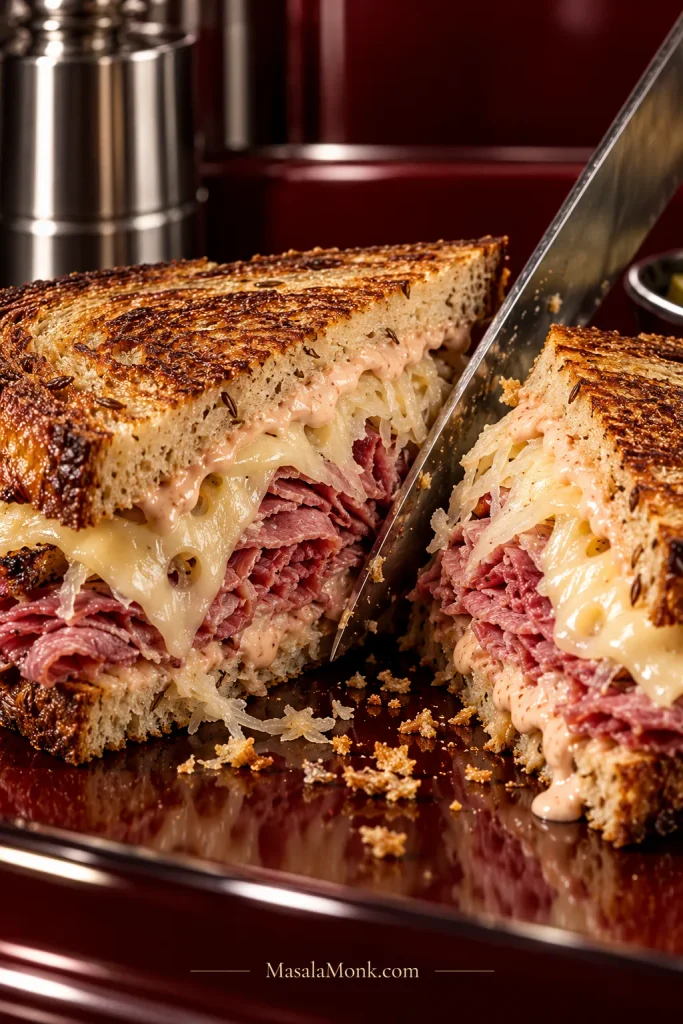
Freshly cut Reuben showing toasted rye, folded corned beef, melted Swiss cheese, sauerkraut and Russian dressing with crumbs along the cut edge.
The cut face gives another doneness check: Swiss should melt into the folds of corned beef rather than sit as two firm slices, while the sauerkraut should remain visibly defined.

Recipe Notes

  • Want a larger deli stack? Increase the corned beef to 5–6 oz / 142–170 g per sandwich, but use sturdy bread and give the extra meat more time to lose its refrigerator chill before assembly.
  • Using mayonnaise outside? Replace the butter with a very thin coating of mayonnaise for easy, even browning.
  • Very sour kraut? Rinse an unusually sharp or salty batch briefly in cold water, then squeeze it thoroughly before warming.
  • Do not overpress. Gentle pressure improves pan contact; crushing the sandwich compresses the bread and pushes filling out around the edges.

Cooking now? You can stop here. The guide below is for choosing the best rye and corned beef, understanding why the proportions matter, fixing a Reuben that comes out soggy or cold, or adapting the sandwich without losing what makes it a Reuben.

Why 4 oz / 113 g of Corned Beef Works

Four ounces / 113 g is deliberate. It gives you a generous fold of corned beef without turning the center into a dense block that takes much longer to heat than the rye takes to brown.

Reuben recipes vary widely. Lighter versions sit around 3 oz / 85 g of meat, while large deli sandwiches can climb past 6 oz / 170 g. Bigger stacks have their fans, but they become harder to heat evenly, hold and bite through.

The best Reuben is not necessarily the tallest one. At 4 oz / 113 g, beef, sharp kraut, melted Swiss, dressing and rye can still meet in the same bite instead of making you chew through a wall of meat first.
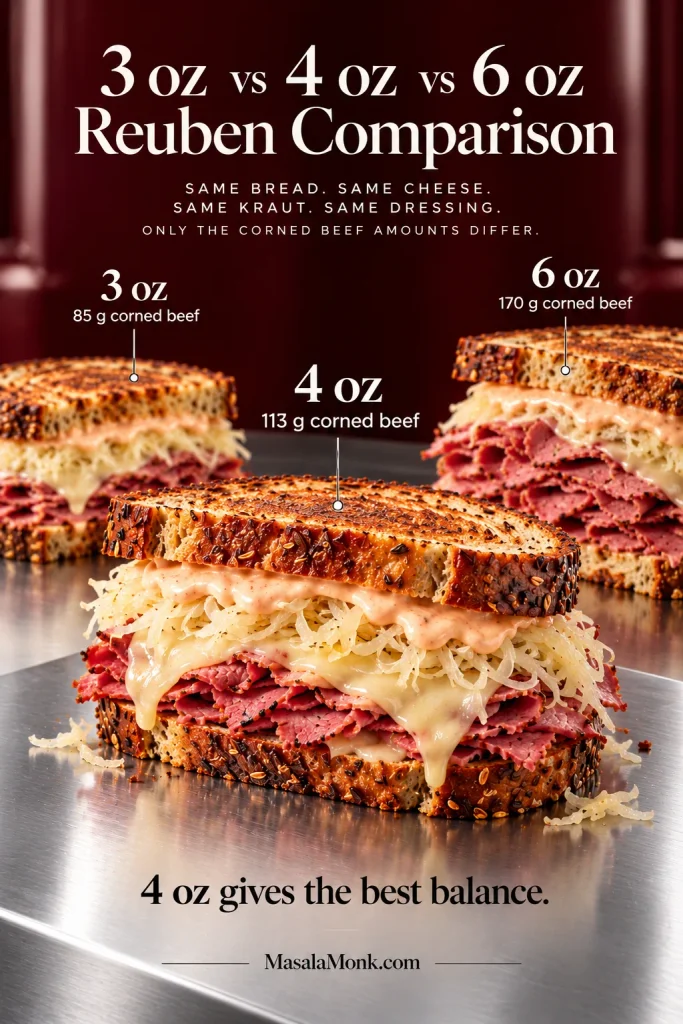
Three Reuben sandwiches comparing 3-ounce, 4-ounce and 6-ounce portions of corned beef, with the 4-ounce sandwich emphasized in the center.
Look at the cross-sections rather than only the numbers. Around 4 oz / 113 g corned beef, the Swiss, kraut and rye still read clearly; at 6 oz, meat begins to dominate the sandwich’s height.

Cooking now? Jump to the exact per-sandwich formula.

Best Rye Bread for a Reuben Sandwich

Seeded or Jewish rye is the clearest choice for a classic Reuben. It has familiar deli character and enough structure for the filling without making the bread the loudest flavor in the sandwich.

Marble rye works beautifully too, especially if you like that dark swirl against the corned beef when the sandwich is cut on the diagonal. Dark rye pushes the rye flavor harder; pumpernickel makes the whole sandwich denser and earthier.

Aim for slices around ⅜–½ inch / 1–1.3 cm thick. Thin, soft bread can bend under the filling, while very thick slices need gentler cooking so the center and crust finish together.
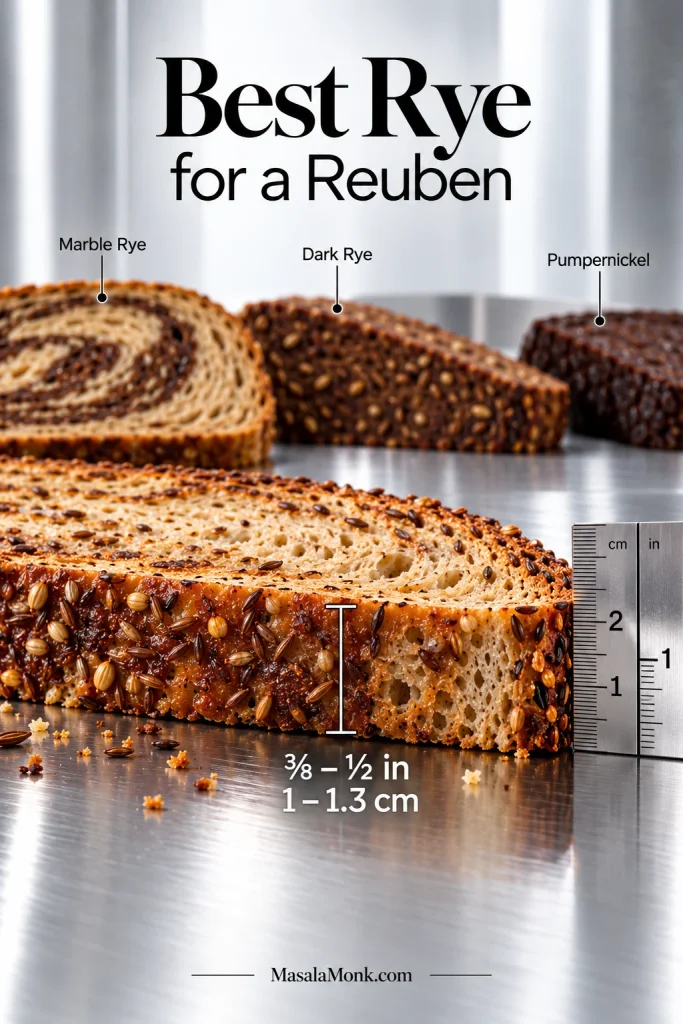
Seeded rye shown beside a ruler at about ⅜ to ½ inch thick, with marble rye, dark rye and pumpernickel displayed as smaller alternatives behind it.
Whichever rye you prefer, structure matters more than color. Seeded rye, marble rye, dark rye and pumpernickel taste different, but a sturdy slice near the target thickness carries the filling more cleanly.

When rye is not available, sturdy sourdough can still make an excellent grilled corned beef sandwich. Our sourdough bread guide includes a sandwich loaf designed to slice cleanly and toast well.

Corned Beef for Reuben Sandwiches: Deli, Leftover or Homemade?

Thin deli corned beef is the practical starting point

Around 1/16–1/8 inch / 2–3 mm gives you slices that still taste substantial but heat quickly and bite cleanly.
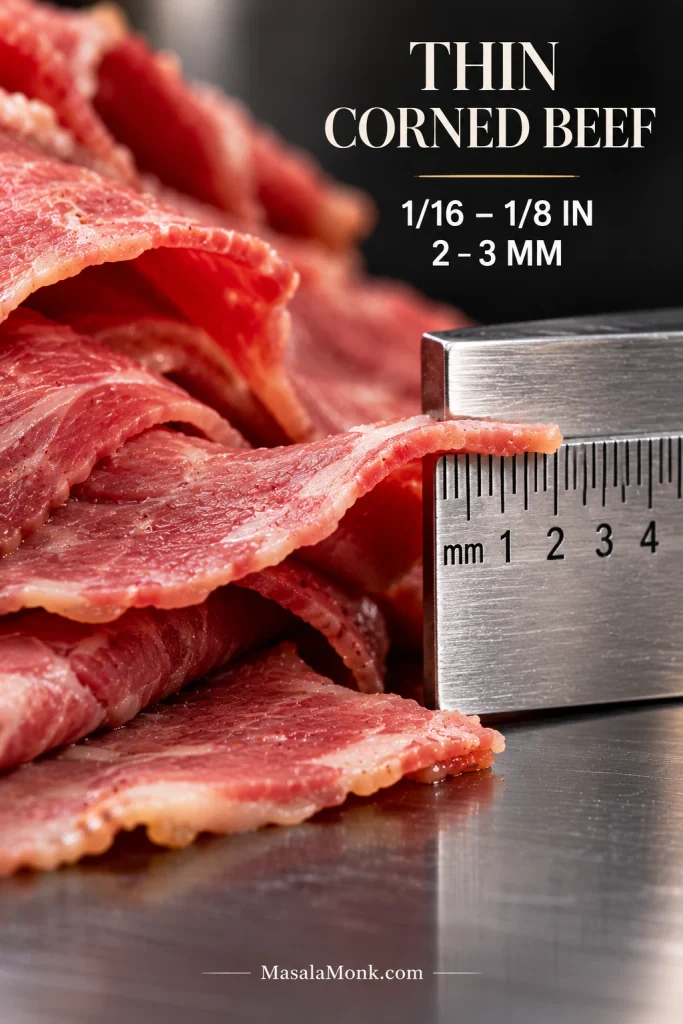
Macro view of thin pink corned beef slices beside a stainless-steel ruler showing a target thickness of about 2 to 3 millimeters or 1/16 to 1/8 inch.
The ruler is a reference; the practical cue is foldability. Corned beef for Reuben sandwiches should be thin enough to bend and layer loosely rather than stand upright as a rigid slab.

Fold the meat loosely. Those folds leave a softer, less compact center than pressing the slices into one dense rectangle.

Using deli corned beef now? Jump to the warming step.

For leftover homemade corned beef, cool first and slice across the grain

Very tender hot brisket can fall apart as soon as the knife reaches it. Let leftover corned beef cool enough to firm up, then slice across the grain.

For sandwich meat, aim for tender but sliceable. Neat slices are easier to stack, heat and eat than brisket that falls apart into shreds.

Choosing raw corned beef for Reuben sandwiches

If sandwiches are the goal, the flat cut is usually the better raw choice because its even shape gives you cleaner slices. The point cut is fattier, richer and less regular, so expect a looser stack.

Follow the package directions or a trusted full corned-beef recipe for cooking. Once done, cool the brisket enough to firm it up, slice across the grain and reheat those slices gently for the sandwich.

“Drained” and “Ready for a Reuben” Are Not the Same Thing

For one sandwich, use about 1¾ oz / 50 g sauerkraut after draining and squeezing. By eye, that is roughly a generous ¼ cup, although the volume changes with the kraut and how firmly you pack it.
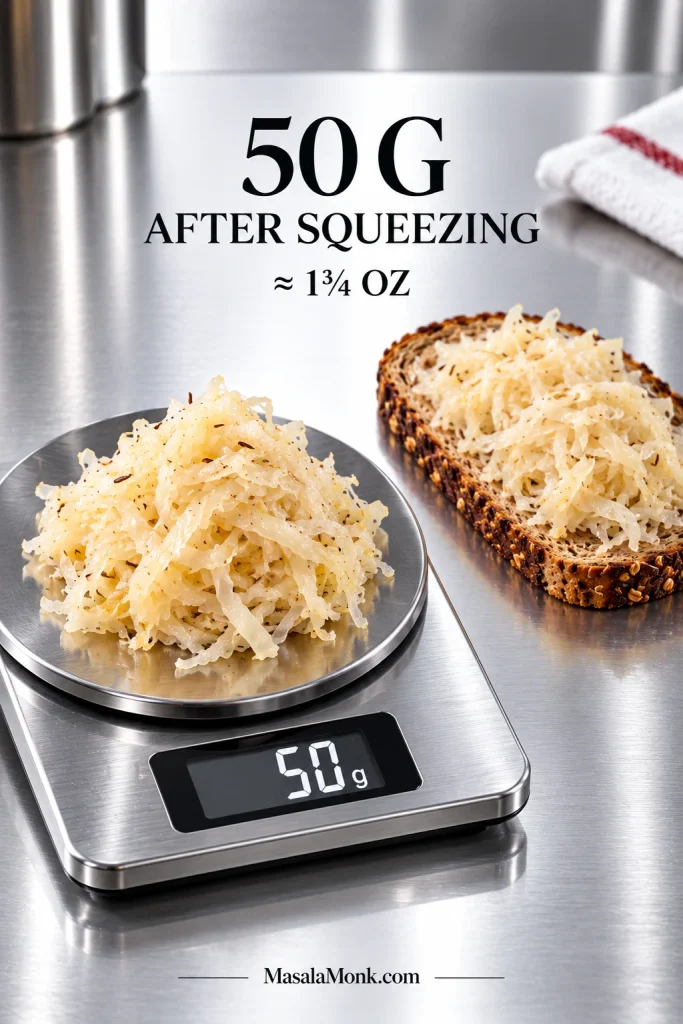
Digital kitchen scale reading 50 grams beneath squeezed sauerkraut, with another portion spread over rye bread to show approximate sandwich coverage.
Because sauerkraut volume changes with the cut and how tightly it is packed, post-squeeze weight is more repeatable than judging the Reuben portion by cups alone.

A spoonful of jar-wet kraut brings more brine than the rye can afford. What you want is cabbage that still tastes sharp and juicy but no longer sheds obvious liquid when pressed.

An unusually sour or salty batch can be rinsed briefly before another thorough squeeze. For deeper flavor, let a few strands begin to brown during warming; stop before the kraut turns dry.

Ready to cook it? Go to the squeeze-and-warm step.

Cheese and Dressing for a Reuben

Why Swiss Works So Well

Swiss melts easily without taking over the corned beef and kraut. Use about 2 slices / 40–50 g per Reuben, with one slice beside each piece of bread.

Emmental is an especially natural choice when available. Gruyère melts beautifully too, though its nuttier flavor changes the sandwich more noticeably.

Russian Dressing or Thousand Island?

Russian dressing is the default here because its sharper horseradish profile cuts through the corned beef and Swiss. Thousand Island gives you a sweeter, milder sandwich.

Use about 1½ tbsp / 22 ml per sandwich. The dressing should show up in the bite without leaking onto the plate. Extra can go at the table for dipping.

For homemade Russian dressing from the ground up, our homemade mayonnaise recipe gives you a neutral creamy base for the horseradish, pickle and tomato.

The Reuben Layer Order Is Doing Real Work

Build the sandwich in this order:

Rye → Swiss → Russian dressing → corned beef → sauerkraut → Russian dressing → Swiss → rye
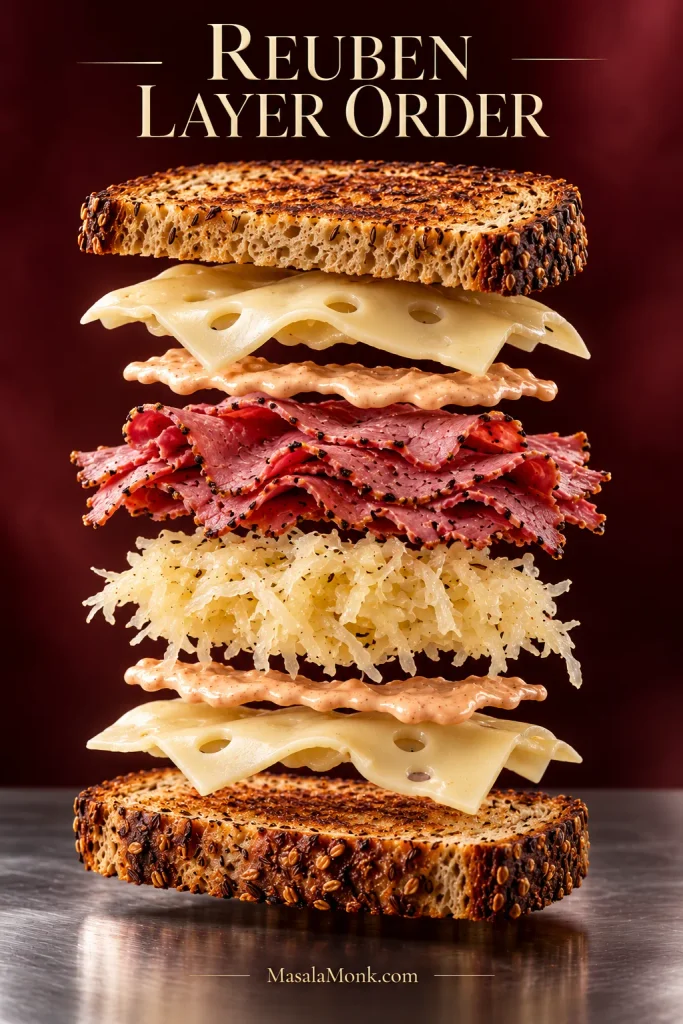
Exploded Reuben showing, from top to bottom, rye bread, Swiss cheese, Russian dressing, folded corned beef, sauerkraut, more dressing, Swiss cheese and rye bread.
Notice what does not sit directly against the rye: the sauerkraut. Keeping the wettest filling one layer inward gives the crust another small buffer against moisture.

The Swiss sits beside the bread, the wetter dressing and kraut stay farther inside, and the meat remains loose rather than compressed into a dense slab.

Building the sandwich now? Jump to the assembly step.

If the Skillet Has to Heat a Cold Center, the Rye Usually Loses

By the time the sandwich reaches the skillet, most of the difficult work is already done. Now you are watching for two things to happen together: well-browned rye and Swiss melting into the beef.
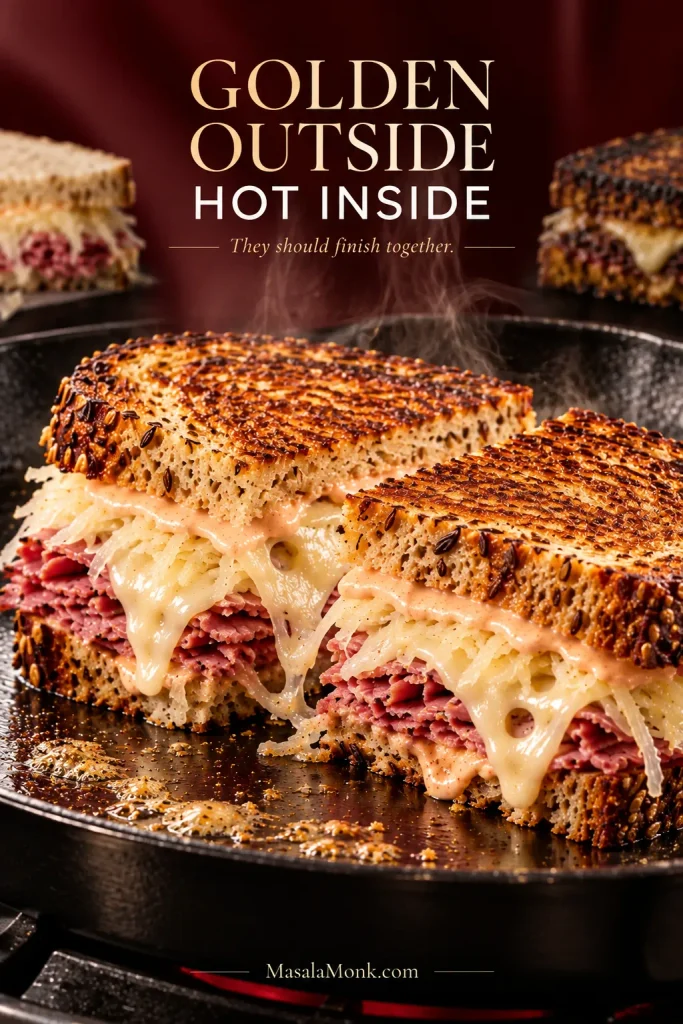
Golden Reuben in a skillet with melted Swiss and hot filling, accompanied by the words “Golden Outside, Hot Inside — They should finish together.”
Use a mismatch as a diagnostic clue: if the rye is already dark while the Swiss still looks firm, the pan is outrunning the center and the heat needs to come down.

On an electric griddle, about 350°F / 177°C is a useful starting point. On the stovetop, steady, even browning is the better guide. Rapid dark spots while the cheese stays firm mean the pan is too hot.

A lid can finish stubborn cheese without forcing the rye to keep frying. When necessary, add about a teaspoon of water to an empty area of the skillet—not onto the sandwich—and cover briefly for a burst of steam.

Pan already hot? Go straight to the skillet step.

Reuben Troubleshooting: What Went Wrong?

If your Reuben looks right but eats wrong, the symptom usually tells you what happened.

Moisture & Heat Problems

Problem What happened + how to fix it
The rye is soggy immediately The sauerkraut was still wet or there was too much dressing. Squeeze the kraut harder, warm off the surface moisture and use less dressing inside.
The bread was crisp, then softened Steam was trapped after cooking. Serve promptly and do not wrap a piping-hot Reuben tightly.
The bread is golden but the center is cold The fillings started too cold. Give the beef and sauerkraut more of a head start before assembly.
The Swiss is still firm The middle needs more gentle heat. Lower the burner and cover the skillet briefly so the cheese can catch up.
The rye burns before the cheese melts The pan is running too hot. Turn it down and let color, rather than a fixed timer, tell you when to flip.
The corned beef is dry It was fried rather than gently reheated. Use loose folds and a little steam instead of browning the meat.

Structure, Balance & Flavor Problems

Problem What happened + how to fix it
The filling slides out There is too much wet filling or the stack is oversized. Pull back on the dressing or kraut and keep the sandwich easy to pick up.
The rye bends, tears or collapses The bread is too thin for the filling. Use sturdier rye that can carry the sandwich without folding underneath it.
Every bite tastes mostly of beef The sandwich is overstuffed. Pull the meat back toward the recipe amount so the rye, Swiss, kraut and dressing still show up.
The kraut dominates everything There is too much of it or the batch is unusually sour. Use a little less and rinse only when the flavor truly needs taming.
The sandwich tastes too salty The beef, kraut and Swiss are stacking salt on top of one another. Taste the components before assembly and adjust the kraut or corned-beef preparation rather than automatically seasoning more.
The dressing feels too sweet Switch from a sweet Thousand Island-style sauce to sharper Russian dressing with horseradish.
A metal spatula lifts a Reuben to reveal a deeply browned, dry rye underside while the open edge shows corned beef, sauerkraut and melted Swiss.
The underside reveals what the top can hide. An evenly browned, dry crust shows that the rye made good skillet contact instead of quietly steaming against a wet filling.

Reuben Variations That Actually Change the Sandwich

Pastrami Reuben. Pastrami makes the sandwich smokier and more peppery. Keep the slices thin and the stack manageable.

Rachel sandwich. A Rachel usually swaps the corned beef for turkey and commonly replaces sauerkraut with coleslaw. Our creamy coleslaw recipe can be chopped a little finer for sandwich use. Expect a sweeter, crunchier sandwich.

Mustard. A very thin swipe of spicy brown or Dijon mustard gives the Reuben another sharp edge.

Without sauerkraut. The sandwich will still be good, but it stops tasting fully Reuben-like once that sharp fermented cabbage disappears.

Other Ways to Cook a Reuben

Keep the same dry-kraut and prewarmed-filling setup. Only the final browning method changes. The skillet remains the primary method; these are useful alternatives when another appliance suits the situation better.

Prefer the classic version? Return to the skillet method.

Electric griddle

Use about 350°F / 177°C and cook as you would in the skillet. A broad griddle is particularly useful when several sandwiches need to finish together.

Air fryer

Air fry around 375–390°F / 190–200°C, turning halfway. Start checking at about 5–6 minutes and continue until the rye is well browned and the cheese has softened; many machines land around 6–8 minutes total. Secure the top slice with a toothpick if strong airflow lifts it.

Oven or toaster oven

Heat to around 375°F / 190°C. Build the sandwich as two open halves, with both bread slices butter-side down on the baking sheet.

On the bottom slice, layer Swiss → half the dressing → corned beef → sauerkraut. On the second slice, put the Swiss directly against the bread, then spread the remaining dressing over it.

Start checking after about 3 minutes. Once the meat is hot and the Swiss is visibly softening, close the sandwich and return it to the oven until the bread edges are golden and crisp and the cheese is fully melted into the filling.

Using a panini press? Moderate heat and light pressure are enough. Good contact is useful; crushing the sandwich is not.

Make Ahead, Store and Reheat Without Sacrificing the Rye

Make the components ahead, not the complete sandwich. Russian dressing can be mixed a day ahead and refrigerated. Corned beef can be portioned, and sauerkraut can be drained and squeezed before you need it.
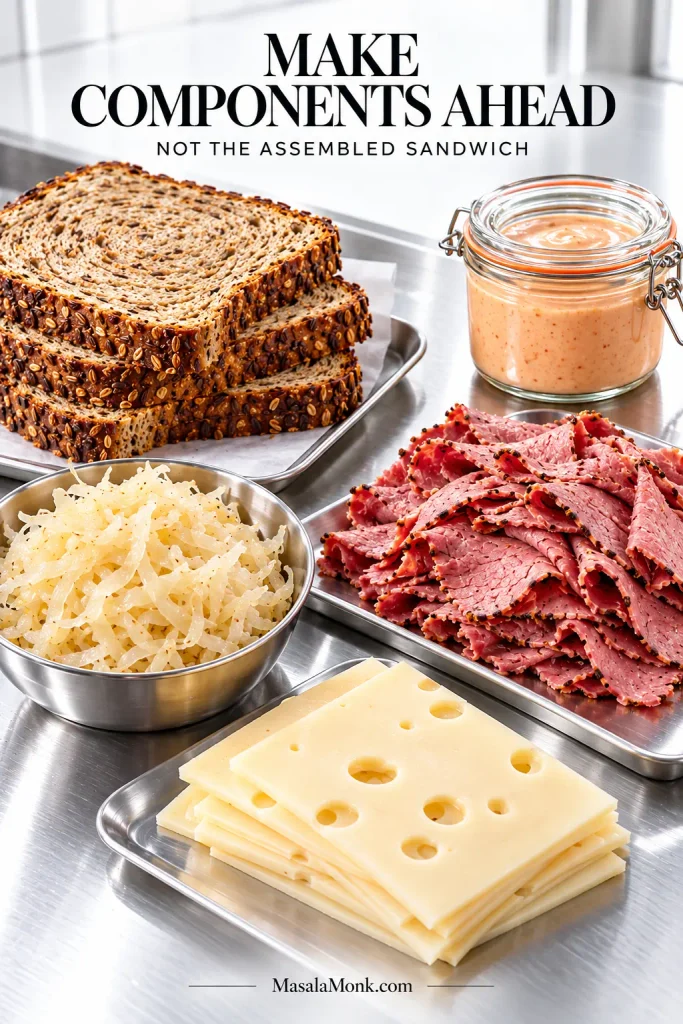
Rye bread, sliced corned beef, Swiss cheese, sauerkraut and Russian dressing arranged separately on a bright stainless-steel counter with no assembled sandwich.
Keep the rye completely separate from refrigerated filling components until assembly. Otherwise, dressing or moisture released by the kraut can begin softening the bread before the sandwich ever reaches the skillet.

Prepared kraut sometimes releases more liquid while it sits. Give it another squeeze before warming whenever moisture has collected underneath.

Reheating a leftover Reuben

Use a skillet, toaster oven or air fryer when possible. They can heat the middle while giving the rye a chance to crisp again. A microwave is fast, but trapped steam softens the bread.

The gentle warming in the main recipe assumes ready-to-eat deli corned beef. When reheating previously cooked leftovers, the USDA Food Safety and Inspection Service advises prompt refrigeration, generally using refrigerated leftovers within 3–4 days, and reheating them to 165°F / 74°C.

What to Serve With a Reuben

A Reuben is rich, salty and tangy, so crisp or acidic sides make sense beside it. Dill pickles and potato chips need almost no thought. For a larger deli-style plate, add crispy homemade French fries, or serve potato salad when you want something cool beside the hot sandwich.
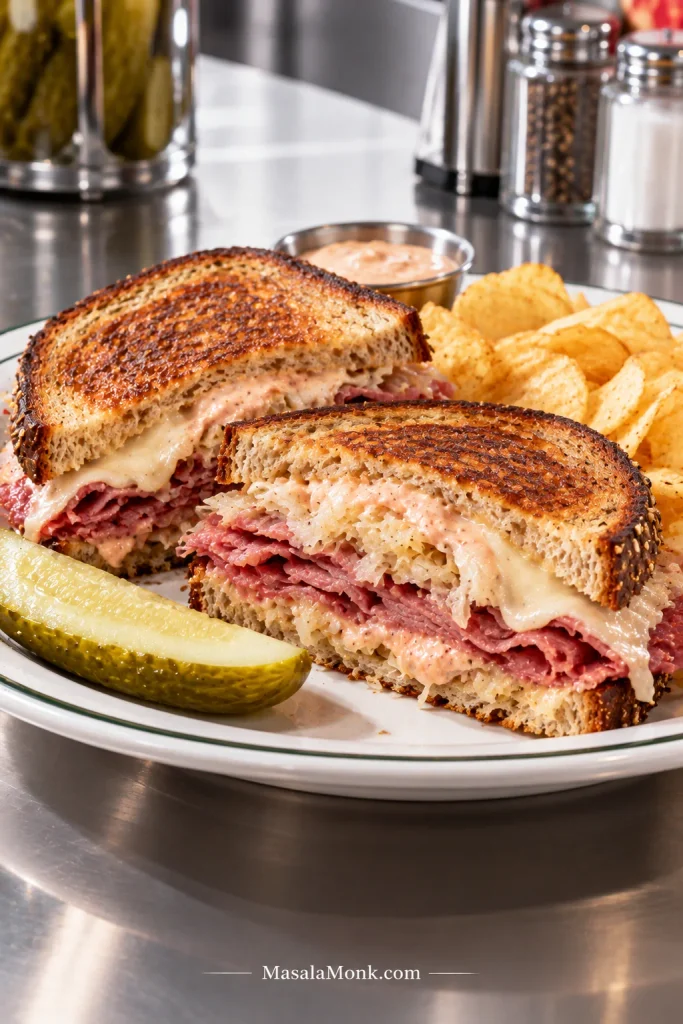
Two toasted Reuben halves on a white diner plate with potato chips, a dill pickle spear and a small metal cup of Russian dressing on a stainless-steel table.
The sides solve different problems: pickle acidity cuts through rich corned beef and Swiss, while potato chips add a dry crunch beside the hot, soft center of the Reuben.

A Brief Note on the Reuben’s Origins

The Reuben’s origin is disputed. One prominent account places an early version at Omaha’s Blackstone Hotel and connects it with Reuben Kulakofsky; another tradition points to New York restaurateur Arnold Reuben.

History Nebraska documents the Omaha account and surviving early menu evidence while also discussing the competing New York claim.

However the sandwich got its name, the goal on the plate is simpler: golden rye and a genuinely hot center arriving together.

Posted on — 2 Comments

Carbs in Cheese: Keto Diet Perspective

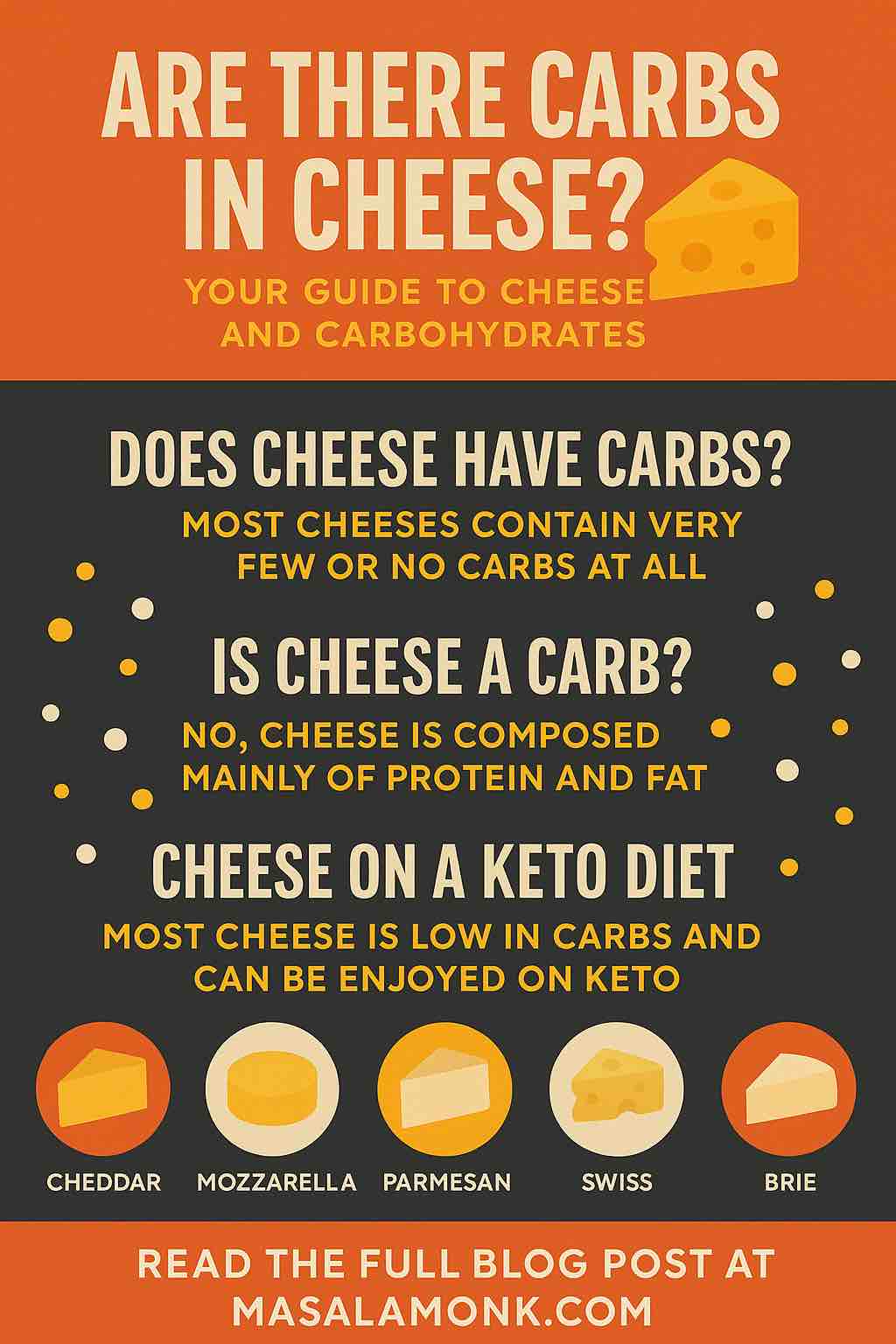
ARE THERE CARBS IN CHEESE? YOUR GUIDE TO CHEESE AND CARBOHYDRATES

Cheese lovers who are following a ketogenic diet, you’re in for a treat! Cheese, with its rich flavors and varied textures, can be a delicious and satisfying part of your low-carb lifestyle. However, it’s essential to remember that not all cheeses are created equal, especially when it comes to their carbohydrate content. This detailed guide will delve into the carb counts of various types of cheese, their roles in a keto diet, and how to incorporate them into your meals.

is Cheese Keto and other Low Carb Diet friendly?

Cheese, with its high-fat, moderate-protein, and low-carb nutritional profile, is often a staple in ketogenic (keto) and other low-carb diets. The goal of these diets is to shift your body into a state of ketosis, where it burns fat for fuel instead of carbohydrates.

However, not all cheeses are created equal when it comes to carb content. Some cheeses, like Swiss and cheddar, have less than 1 gram of carbs per ounce, making them an excellent choice for those following a keto or low-carb diet. Others, like cottage cheese and Velveeta, have slightly higher carb counts and should be eaten in moderation.

For those following other types of low-carb diets, such as the Atkins or South Beach diets, cheese can also be a beneficial addition. These diets also limit carb intake, especially in the initial phases, and emphasize protein and fat intake. As such, the high protein and fat content of cheese can help to keep you feeling full and satisfied.

However, as with any food, it’s important to consume cheese in moderation. While it’s a nutritious food that can fit into various dietary patterns, it’s also high in calories and saturated fat, which can contribute to weight gain and other health issues if eaten in excess.

Carb Counts of Popular Cheeses

Cheese is a versatile food that can be incorporated into a variety of meals, from salads and sandwiches to gourmet dishes. It’s a rich source of protein and calcium, and many types of cheese also contain beneficial probiotics that support gut health. However, the carb content can vary significantly between different types of cheese, making some more suitable for certain diets than others.

The ketogenic, or keto, diet is a high-fat, moderate-protein, low-carb diet designed to put your body into a state of ketosis. In this metabolic state, your body burns fat for fuel instead of carbohydrates. Cheese, with its high fat and protein content and generally low carb count, is a natural fit for this diet. However, the carb content can vary between different types of cheese, so it’s crucial to choose wisely to stay within your daily carb limit.

But what about other diets? Whether you’re following a Mediterranean diet, a vegetarian diet, or simply trying to eat healthier, cheese can still have a place in your meal plan. Let’s take a closer look at the carb content in one ounce (28 grams) of some popular cheeses and explore some creative ways to incorporate them into various diets.

Cream Cheese

Cream cheese is a versatile option with only 1.6 grams of carbs per ounce. Its smooth texture and mild flavor make it a popular spread for bagels and a key ingredient in cheesecakes. For those on a keto diet, cream cheese can be used as a base for various dips and sauces, or added to a low-carb wrap for a creamy twist. For vegetarians, cream cheese can be spread on whole grain crackers and topped with fresh fruits or vegetables for a balanced snack.

Cottage Cheese

Cottage cheese contains about 3.4 grams of carbs per ounce, making it a higher-carb option compared to other cheeses. However, it’s a great source of protein, making it a popular choice for vegetarians and those following a Mediterranean diet. Consider pairing it with some fresh berries for a delicious and satisfying breakfast or snack. For those on a keto diet, remember to eat cottage cheese in moderation due to its higher carb content.

Feta Cheese

Feta cheese, known for its tangy flavor, contains 1.2 grams of carbs per ounce. It’s a staple in Greek cuisine and a great addition to salads and Mediterranean-inspired dishes. Try it with cucumber, olives, and a drizzle of olive oil for a quick and easy Greek salad. For those on a keto diet, the low carb content of feta cheese makes it a great choice.

Cheddar Cheese

Cheddar cheese, a classic choice, contains 0.4 grams of carbs per ounce, making it a great choice for snacking or topping off dishes. It’s a good source of calcium and protein, and its robust flavor makes it a favorite in many dishes. For those on a keto diet, cheddar cheese can be used in a variety of dishes, from omelets to keto-friendly grilled cheese sandwiches.

Mozzarella Cheese

Mozzarella cheese, with 0.6 grams of carbs per ounce, is a fantastic low-carb option. It’s a key ingredient in Italian cuisine, especially in dishes like pizza and caprese salad. For those on a keto diet, mozzarella is the perfect cheese for a keto-friendly pizza night. For vegetarians, fresh mozzarella can be paired with tomatoes and basil for a simple and delicious caprese salad.

American Cheese

American cheese contains about 2 grams of carbs per ounce. While it’s not the lowest carb option, it can still fit into a keto diet when used sparingly. It’s a classic choice for burgers or melted into an omelet. For those following a traditional American diet, this cheese can be used in a variety of dishes, from sandwiches to mac and cheese.

Parmesan Cheese

Parmesan cheese is very low in carbs, with only 0.9 grams per ounce. It’s a hard, aged cheese that’s packed with flavor, making it a great addition to a variety of dishes. For those on a keto diet, try it grated over zucchini noodles for a low-carb pasta alternative. For those following a Mediterranean diet, Parmesan can be used to add a burst of flavor to pasta dishes, salads, and soups.

Swiss Cheese

Swiss cheese contains 1.5 grams of carbs per ounce, making it a good option for sandwiches or as a snack. Its nutty flavor pairs well with fruits and whole grain bread, making it a good option for those following a balanced diet. For those on a keto diet, Swiss cheese can be enjoyed with cold cuts for a quick roll-up snack.

Ricotta Cheese

Ricotta cheese has about 2 grams of carbs per ounce. It’s a soft cheese that’s often used in Italian desserts and pasta dishes. For those on a keto diet, it can be used in moderation in dessert recipes, providing a creamy base for cheesecakes or as a filling for low-carb crepes. For vegetarians, ricotta can be used in a variety of dishes, from lasagna to stuffed shells.

Velveeta Cheese

Velveeta cheese contains about 3 grams of carbs per ounce. It’s a processed cheese product that’s known for its smooth melting properties, making it a popular choice for cheese sauces and dips. For those on a keto diet, it can be used sparingly due to its higher carb content. For those following a traditional American diet, Velveeta can be used in a variety of comfort food dishes, from mac and cheese to cheesy broccoli casserole.

Goat Cheese

Goat cheese contains about 0.2 grams of carbs per ounce, making it one of the lowest carb cheeses available. Its tangy flavor and creamy texture make it a great addition to salads and roasted vegetables. For those on a keto diet, goat cheese can be enjoyed as a snack with low-carb vegetables or added to salads for a burst of flavor. For vegetarians, goat cheese can be spread on whole grain crackers for a satisfying snack.

Queso

Queso, or cheese dip, can range from 1 to 3 grams of carbs per ounce, depending on the recipe. It’s a popular choice for a dip with tortilla chips or drizzled over Mexican dishes. For those on a keto diet, be sure to check the nutrition facts and choose a low-carb version. You can enjoy it as a dip with low-carb vegetables or drizzled over a plate of nachos made with low-carb tortilla chips.

Provolone Cheese

Provolone cheese contains about 0.6 grams of carbs per ounce, making it a good low-carb option. It’s a semi-hard cheese that’s often used in sandwiches and Italian dishes. For those on a keto diet, it can be used in sandwiches made with low-carb bread or melted over chicken for a satisfying dinner. For those following a Mediterranean diet, provolone can be used in a variety of dishes, from pasta bakes to stuffed peppers.

Pimento Cheese

Pimento cheese varies greatly depending on the recipe, but it typically contains about 2 grams of carbs per ounce. It’s a flavorful spread made with cheddar cheese, mayonnaise, and pimentos. For those on a keto diet, it can be used as a spread for celery sticks or cucumber slices. For those following a traditional Southern diet, pimento cheese can be enjoyed as a spread on crackers or in a sandwich.

American Cheese Slice

One slice of American cheese contains about 2 grams of carbs. It’s a convenient option for a quick snack or to melt over a burger. For those on a keto diet, it can be used to add a creamy element to burgers or omelets. For those following a traditional American diet, a slice of American cheese can be used in a variety of sandwiches or melted into a grilled cheese sandwich.

Here’s a more extensive breakdown of popular cheeses and their carbohydrate content per 1-ounce (28-gram) serving:

Cheese TypeCarbs (grams)
Cheddar0.4
Mozzarella1
Parmesan0.9
Swiss1.5
Brie0.1
Gouda0.6
Blue Cheese0.7
Feta1.2
Cream Cheese1.2
Ricotta3
Cottage Cheese3.4
Camembert0.1
Halloumi0.5
Provolone1
Neufchâtel1.1

Is Cheese a Carb?

No! Cheese is not a carbohydrate. It’s mostly composed of protein and fat. The tiny amount of carbohydrates in cheese mainly comes from residual lactose.

This is why cheese fits so well into low-carb and ketogenic diets — you’re getting energy mainly from fats and proteins without many carbs.


Is Cheese High in Carbs?

No. Cheese is considered a low-carb food. Even the soft cheeses that have more carbs are still quite low compared to bread, pasta, or sugary snacks.

For people on a ketogenic diet, where carb intake is typically limited to 20–50 grams per day, cheese is an ideal food to enjoy.


Cheese on a Low-Carb or Keto Diet

If you’re asking “is cheese keto?”, the answer is overwhelmingly yes.

Because most cheese has minimal carbohydrates, it’s a keto diet staple. Cheese provides:

  • Healthy fats
  • Moderate protein
  • Essential vitamins and minerals (calcium, vitamin A, B12)

Popular Keto-Friendly Cheeses

  • Cheddar
  • Mozzarella
  • Parmesan
  • Swiss
  • Brie
  • Gouda
  • Blue Cheese
  • Camembert
  • Halloumi

These cheeses tend to have very low carbs and are rich in fats, making them perfect for maintaining ketosis.

What About Velveeta Cheese?

Velveeta and other processed cheeses have slightly more carbs than natural cheeses due to added ingredients. It’s still relatively low-carb, but you’ll want to check the nutrition label to confirm if it fits your daily carb limits.


How Much Cheese Can You Eat on Keto?

While cheese is keto-friendly, it’s important to practice moderation. Cheese is calorie-dense and high in saturated fats, so:

  • Aim for 1–2 ounces (28-56 grams) of cheese per serving.
  • Keep track of total carbs to avoid exceeding your daily limits.
  • Combine cheese with non-starchy vegetables and proteins for balanced meals.

Are There Any Downsides to Eating Cheese?

While cheese is nutritious, here are a few considerations:

  • Sodium content: Some cheeses are high in salt, which can be a concern for blood pressure.
  • Lactose intolerance: If you’re lactose intolerant, you may want to avoid fresh cheeses and stick to aged varieties.
  • Calories: Cheese is calorie-rich, so portion control is key if weight loss is your goal.

Frequently Asked Questions about Carbs in Cheese

1. Is cheese keto-friendly?

Yes, most cheeses are keto-friendly due to their high-fat, moderate-protein, and low-carb content. However, some cheeses have slightly higher carb counts, so it’s important to check the nutritional information.

2. How many carbs are in cream cheese?

Cream cheese contains about 1.6 grams of carbs per ounce, making it a keto-friendly option.

3. Can I eat cottage cheese on a keto diet?

Cottage cheese contains about 3.4 grams of carbs per ounce. While it’s higher in carbs than some other cheeses, it can still be included in a keto diet when eaten in moderation.

4. What is the carb count in cheddar cheese?

Cheddar cheese contains about 0.4 grams of carbs per ounce, making it a great low-carb option.

5. Is mozzarella cheese low in carbs?

Yes, mozzarella cheese contains about 0.6 grams of carbs per ounce, making it a good choice for a low-carb diet.

6. How many carbs are in a slice of American cheese?

One slice of American cheese contains about 2 grams of carbs.

7. Can I eat parmesan cheese on a low-carb diet?

Yes, parmesan cheese is very low in carbs, with only 0.9 grams per ounce, making it a good choice for a low-carb diet.

8. Is Swiss cheese suitable for a keto diet?

Yes, Swiss cheese contains 1.5 grams of carbs per ounce, making it a good option for a keto diet.

9. How many carbs are in ricotta cheese?

Ricotta cheese contains about 2 grams of carbs per ounce. It’s slightly higher in carbs than some other cheeses, so it should be eaten in moderation on a keto diet.

10. Can I eat Velveeta cheese on a keto diet?

Velveeta cheese contains about 3 grams of carbs per ounce. While it’s not the lowest carb option, it can still fit into a keto diet when used sparingly.

11. Is goat cheese low in carbs?

Yes, goat cheese is one of the lowest carb cheeses available, with about 0.2 grams of carbs per ounce.

12. How many carbs are in provolone cheese?

Provolone cheese contains about 0.6 grams of carbs per ounce, making it a good low-carb option.

13. Can I include cheese in my diet if I’m trying to lose weight?

While cheese is high in protein and can be included in a balanced diet, it’s also high in calories and saturated fat. It’s important to consume cheese in moderation and as part of a balanced diet. Always consult with a healthcare provider or a registered dietitian before making any major changes to your diet.


Conclusion

Cheese can be a delicious and satisfying part of a ketogenic diet. However, it’s essential to be aware of the carb content in different types of cheese to ensure you stay within your daily carb limit. As always, moderation is key, and it’s important to balance your cheese intake with a variety of other nutrient-dense, low-carb foods. With this guide, you can navigate the cheese aisle with confidence and continue to enjoy the rich, creamy goodness of cheese while sticking to your keto goals.


Remember, this blog post is for informational purposes only and should not replace professional medical advice. Always consult with a healthcare provider before making changes to your diet or supplement regimen.