
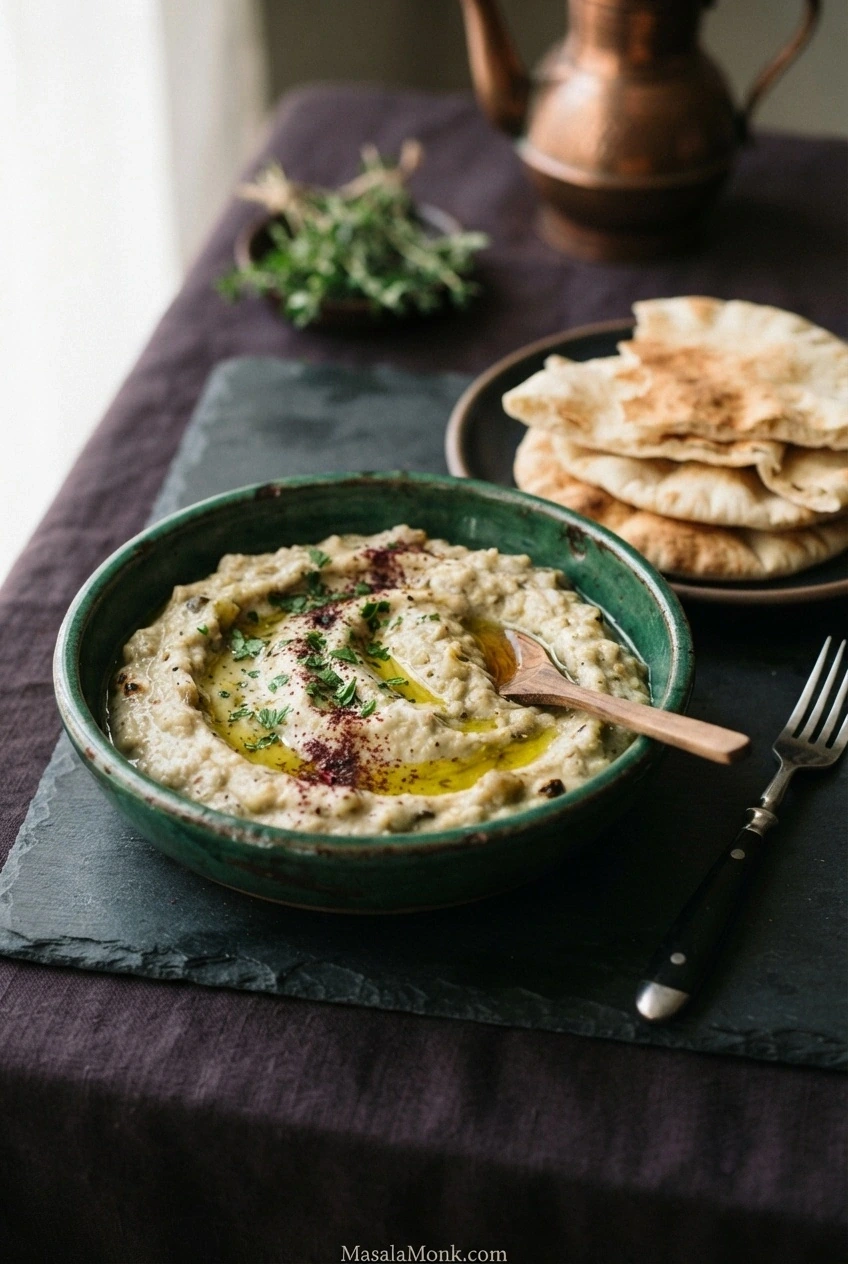
Baba ganoush is a smoky, creamy Middle Eastern eggplant dip made with roasted eggplant, tahini, lemon juice, garlic, and olive oil. Scoop it up with warm pita and you’ll taste tender roasted eggplant first, followed by nutty sesame and a fresh, lemony finish.
It starts with an eggplant that looks almost ruined. Its purple skin blisters and blackens over the heat, while the flesh inside becomes so soft that it nearly collapses. Beneath that charred skin is the part we’re after: tender eggplant with a deep roasted aroma. Once the excess moisture is drained, a little tahini, lemon, and garlic turn it into a dip that holds onto a piece of bread without losing its eggplant flavor.
For this baba ganoush recipe, roasting the eggplant over a gas flame or outdoor grill gives the strongest smoky flavor. The oven is an easier alternative, and an air fryer works well for smaller batches. Whichever method you choose, three things matter most: cook the eggplant completely, drain away excess water, and season the cooked flesh without overwhelming it. If you are cooking without an open flame, go directly to the oven-roasting instructions or air-fryer method.
Baba Ganoush Recipe: Ingredients and Method
| Servings | 4–6 small appetizer portions |
|---|---|
| Hands-on work | About 15–20 minutes, spread across preparation and finishing; monitor the eggplant while it roasts |
| Flame or grill cooking | Gas flame: about 20–35 minutes; outdoor grill: about 20–40 minutes, depending on eggplant size and heat |
| Resting and draining | Approximately 25–35 minutes |
| Total elapsed time | About 60–90 minutes when eggplants roast together; longer if cooking in batches |
| Equipment | Long tongs, heat-safe tray, knife, fine-mesh sieve, mixing bowl, fork |
| Dietary information | Vegan and dairy-free; contains sesame |
Yield: One medium bowl of dip, enough for four to six small portions alongside bread and other dishes. Eggplant loses substantial moisture during roasting and draining, so the finished amount varies. Roast an extra eggplant if you’re serving a crowd or want a generous bowl.
Ingredients
- 850 g / about 30 oz whole eggplants — usually 2–3 medium globe eggplants
- 40 g plain tahini paste — approximately 2½–3 tbsp, stirred before measuring
- 25 ml / 5 tsp fresh lemon juice
- 1 modest garlic clove — about 3–4 g, finely grated or crushed
- 30 ml / 2 tbsp extra-virgin olive oil — for mixing and serving
- 2 g fine salt — approximately ⅓ tsp fine table salt, plus more if needed
- ¼ tsp ground cumin — optional
- 1–2 tbsp chopped fresh parsley — for serving
- A pinch of sumac or Aleppo pepper — optional garnish
These quantities suit a typical yield of roughly 350–500 g cooked, peeled, drained eggplant. Have everything ready, but hold some tahini and lemon back until you’ve tasted the dip. If your eggplants produce substantially less or more flesh, use the cooked-weight seasoning guide before mixing.
How to Make Baba Ganoush
- Prepare the eggplants. Wash and dry them thoroughly, leaving the stems attached. Pierce each one several times with a fork or knife tip. Set out long tongs and a heat-safe tray before you begin.
- Roast until the centers are completely tender. Place the eggplants over a suitable medium to medium-high gas flame or on a preheated outdoor grill. Turn every few minutes as the skins blister, split, and blacken. On a gas flame, medium eggplants often take 20–35 minutes; on an outdoor grill, allow about 20–40 minutes. Either way, the flesh should collapse and a thin knife should pass through the thickest part with almost no resistance. The blackened skin is expected, but black skin alone doesn’t mean the center is cooked. If you have only one suitable burner, roast the eggplants in batches and allow extra time.
- Rest and scoop out the flesh. Transfer the eggplants to a heat-safe tray or bowl and leave for about 10 minutes, until comfortable to handle. Split them open and scoop out the soft flesh, leaving behind stems, tough blackened skin, and loose burnt fragments. Small, tender seeds can stay.
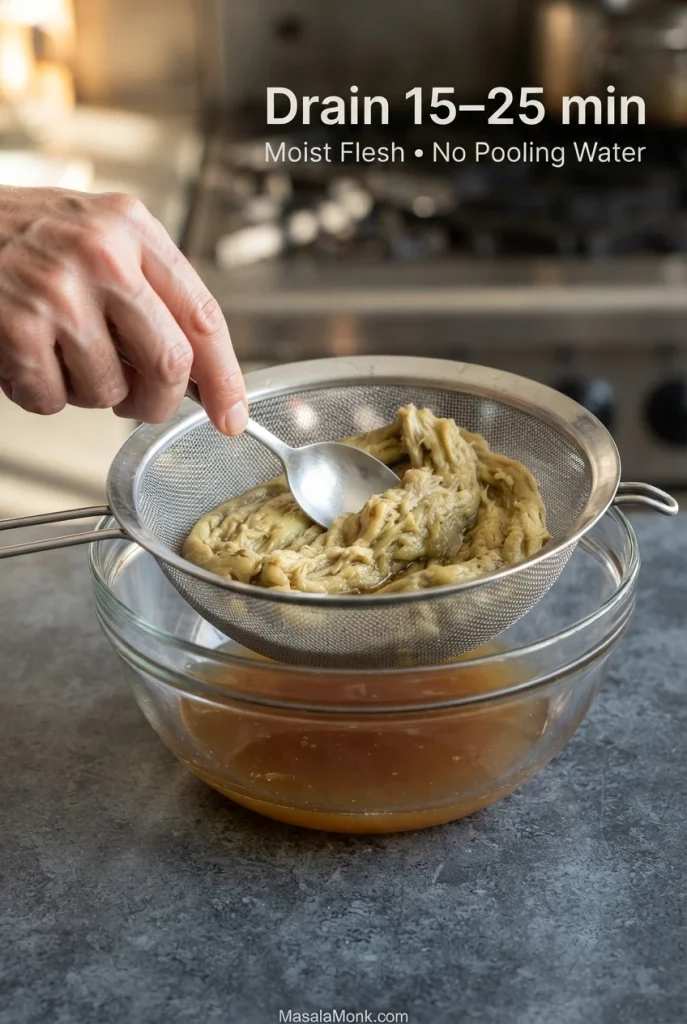
- Drain the extra moisture. Place the flesh in a fine-mesh sieve over a bowl for 15–25 minutes. Press gently if necessary; the eggplant should remain moist, without free liquid pooling among the pieces. Discard the excess juices.
Mash and Season the Eggplant
- Mash the eggplant. Chop through any long strands, then mash the flesh with a fork. A few soft pieces give the dip a pleasant texture, so there’s no need to make it perfectly smooth.
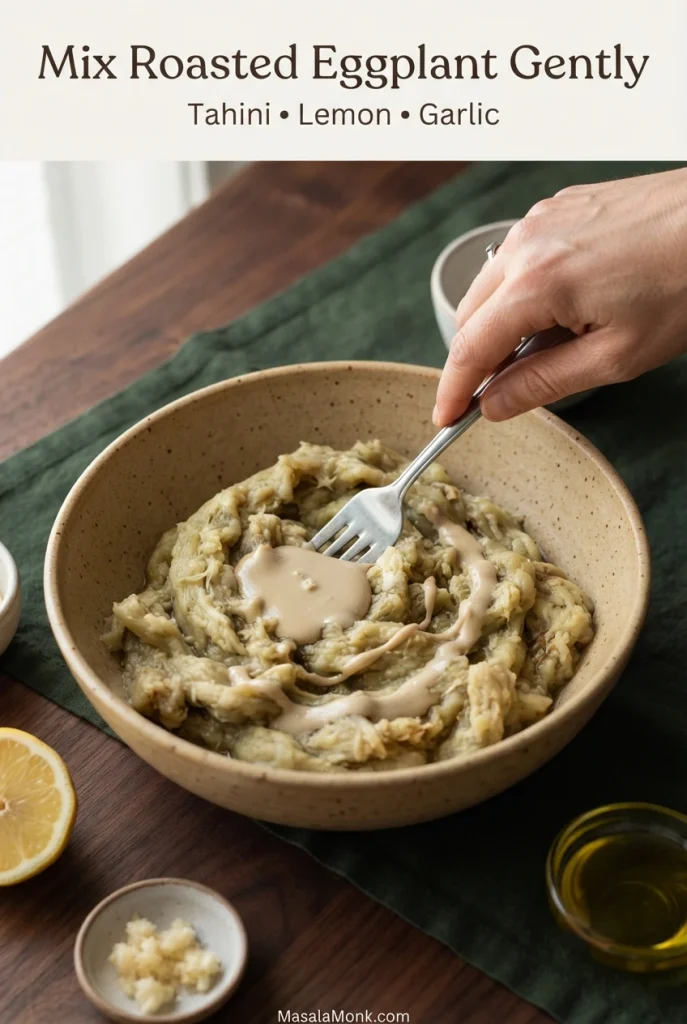
- Season, then taste. For a typical 350–500 g yield, stir in 30 g tahini, 20 ml lemon juice, the crushed garlic, and 2 g fine salt. Add cumin if using. Taste a little with pita; add some or all of the remaining 10 g tahini and 5 ml lemon if needed. For yields below 350 g or substantially above 500 g, start with the drained-weight ratios instead, adjusting garlic and salt carefully.
Finish and Serve the Dip
- Mix in the oil and serve—or save the garnish for later. Stir in up to 15 ml / 1 tbsp olive oil, using less for a smaller batch if appropriate. If too thick, add cold water one teaspoon at a time until the dip spreads easily. Taste once more, then spoon into a shallow bowl and make a few grooves with the back of a spoon. If serving now, drizzle with the remaining olive oil and add parsley and optional sumac or Aleppo pepper. If making ahead, cover and refrigerate the mixed dip without the finishing oil or herbs; add them just before serving.
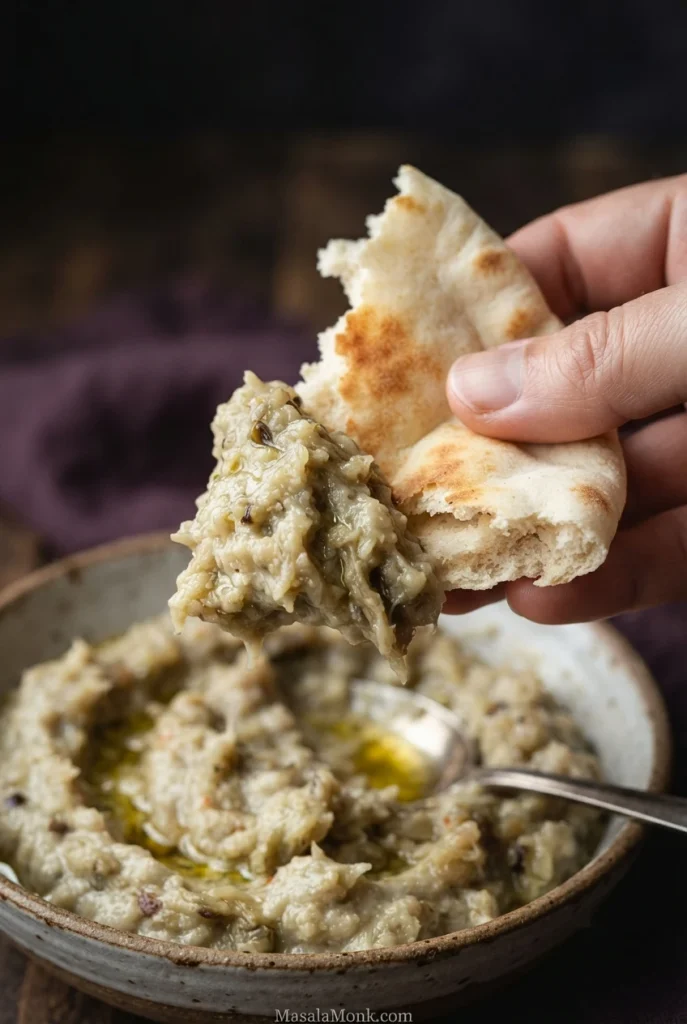
The finished dip should cling to warm pita without running off, and the roasted eggplant should remain the main flavor. Serve it slightly warm or cool. If it’s been refrigerated, stir and taste again before the final drizzle. For overnight preparation, see the make-ahead instructions.
Choosing Eggplant, Tahini, and Garlic
Which Eggplant Is Best for Baba Ganoush?
Choose an eggplant that gives you plenty of soft flesh without making peeling unnecessarily difficult. Medium globe eggplants are particularly convenient: they have a generous center and are easier to handle than a collection of tiny brinjals.
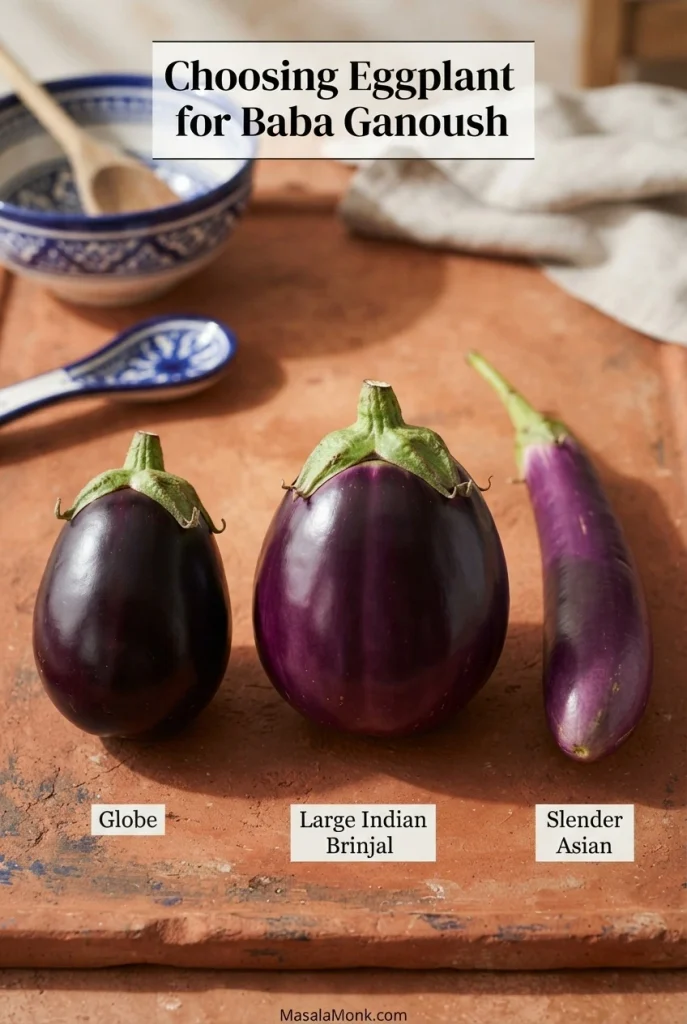
Look for smooth, glossy skin and a vegetable that feels firm and heavy for its size. Avoid soft patches, mold, and badly wrinkled skin. Italian eggplants work well too. Slender Japanese or Chinese varieties are suitable, although their thinner sections may soften sooner over direct heat.
In India, the large purple brinjal commonly used for baingan bharta is an excellent option. Its flesh becomes soft and smoky over a flame, much like the roasted brinjal used in Bihari litti chokha. Baba ganoush takes that familiar roasted flavor in a different direction with tahini and lemon.
Use Plain Tahini Paste
Stir the tahini before measuring. Its natural oil often separates in the jar, leaving thick sesame paste underneath. Scooping only from the bottom can make the dip heavier and pastier than intended.
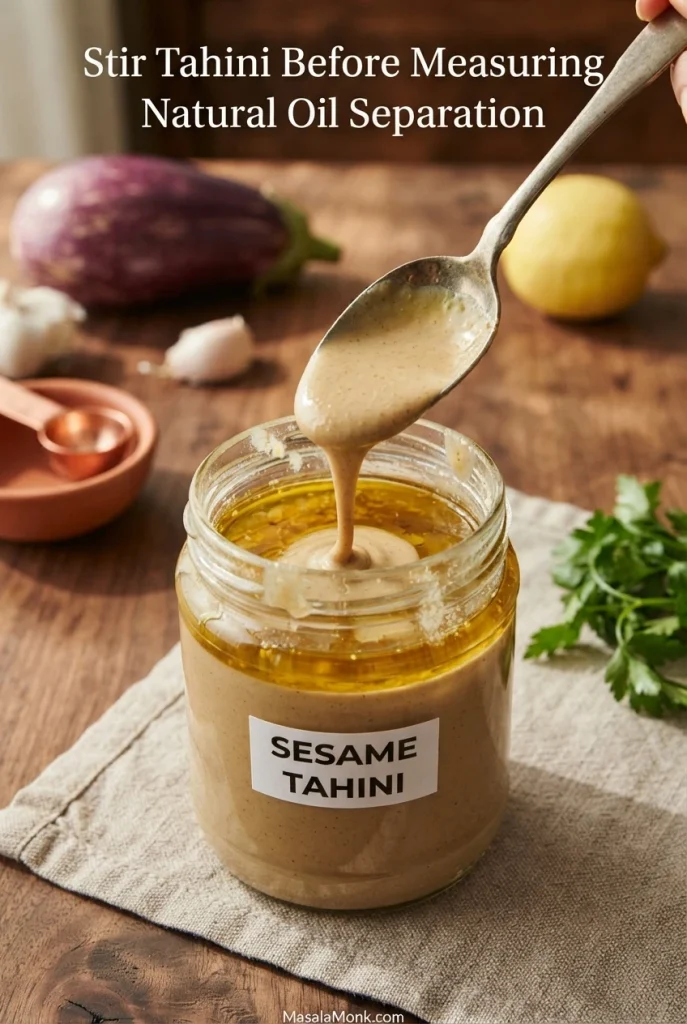
Use plain, unsweetened tahini rather than prepared tahini sauce, which may already contain lemon, garlic, salt, or water. Taste a little too. It should be pleasantly nutty, not stale or rancid. If you need to avoid sesame, see the tahini-free baba ganoush variation and its allergen guidance.
Tahini also gives homemade hummus much of its richness. The difference is what surrounds it: chickpeas create a thicker, starchier dip, while roasted eggplant stays softer.
Garlic, Lemon, and Olive Oil
Raw garlic has a strong presence in a simple dip. One modest clove is usually enough, particularly when finely grated. If your garlic is unusually pungent, start with less.
Fresh lemon juice sharpens the flavor of roasted eggplant, while olive oil adds richness. Choose an extra-virgin olive oil you enjoy eating, especially for the final drizzle.
How to Roast Eggplant for Baba Ganoush
For stronger smokiness, roast over a gas flame or outdoor grill; for convenience, use the oven. Both approaches make good baba ganoush, but they won’t taste identical. An air fryer works for smaller portions without heating a full oven.
Use the times as a guide, not a guarantee. A knife should slip easily through the thickest part of the eggplant. If the skin has already blackened but the middle is still firm, see how to finish an undercooked eggplant.
| Method | Heat and approximate cooking time |
|---|---|
| Gas flame, whole eggplant | Medium to medium-high; 20–35 minutes |
| Outdoor grill, whole eggplant | Medium-high direct heat; 20–40 minutes |
| Oven, halved eggplant | 230°C / 450°F; 35–45 minutes |
| Oven, whole eggplant | 260°C / 500°F; 45–60 minutes |
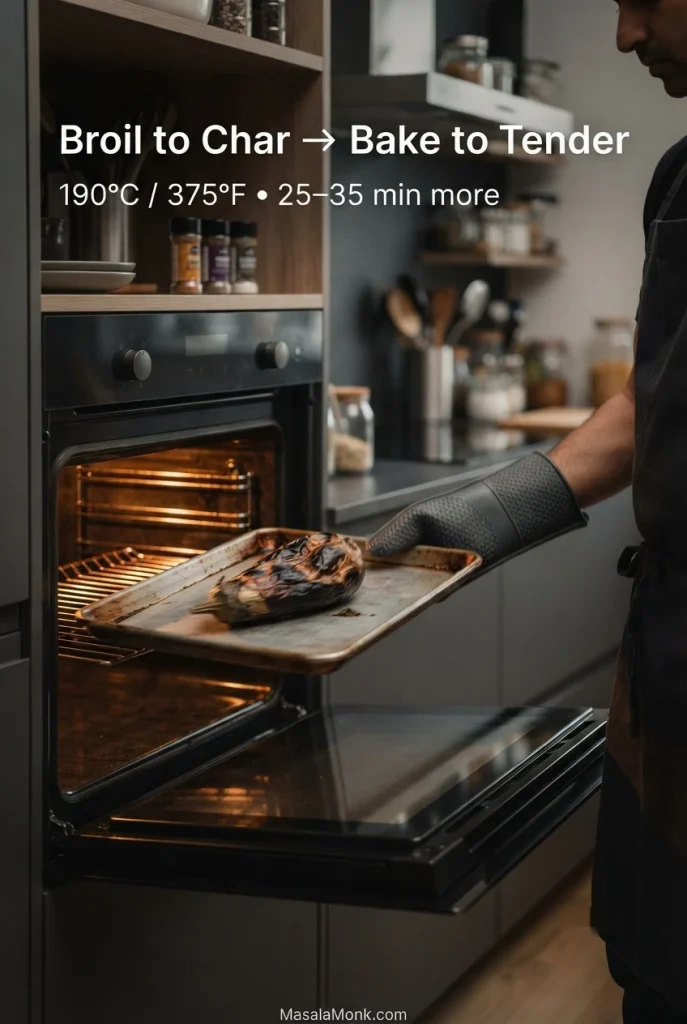
| Broiler followed by oven | Broil until skin blisters (time varies), then bake at 190°C / 375°F for another 25–35 minutes; broiling time is additional |
| Air fryer, halved eggplant | 200°C / 400°F; often 18–30 minutes, checking from 14–15 minutes |
Gas Flame or Outdoor Grill
For a gas burner, set a whole, pierced eggplant securely over the flame using stable, heat-compatible equipment. Turn with long tongs every few minutes. Its skin will crackle and split as the flesh softens and the vegetable begins to sag.
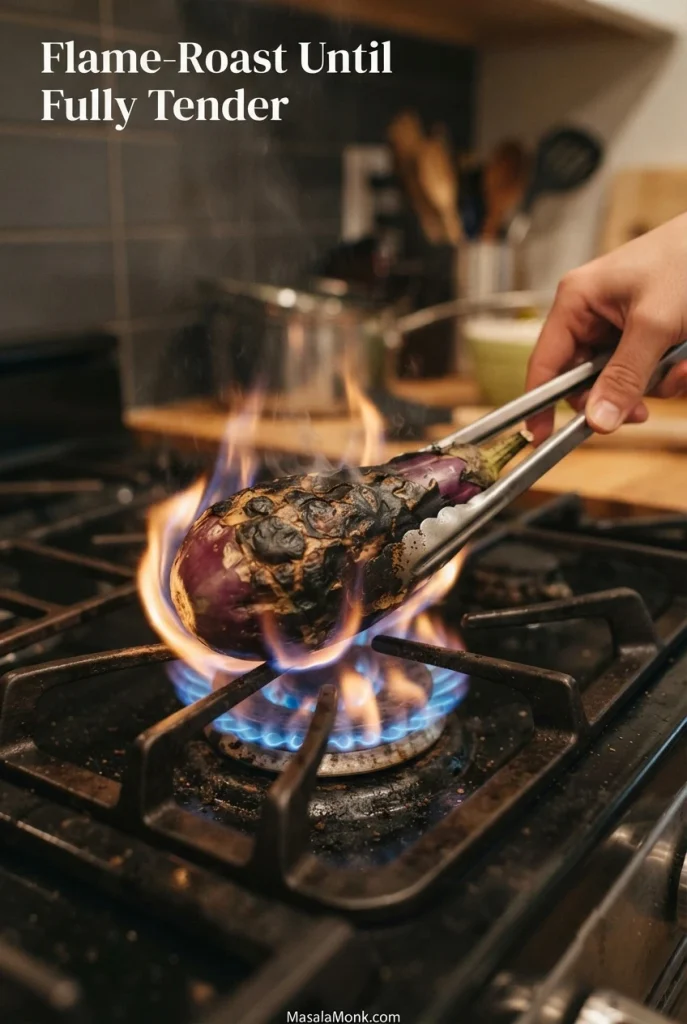
The aroma changes from faintly vegetal to deeply roasted. If the skin chars faster than the center softens, lower the heat and keep cooking. The edible flesh should taste smoky, not acrid.
On an outdoor grill, turn the eggplants regularly over medium-high heat. If the outside becomes deeply blackened too early, move them to a cooler part of the grill and close the lid if suitable. Gentler heat finishes the flesh without scorching the same spots.
Safety: Use long tongs, good ventilation, and equipment designed for open heat. Keep combustible materials away. Never place eggplants directly on induction or glass-ceramic cooktops.
Oven-Roasted Baba Ganoush
Oven roasting is the easiest choice when cooking several eggplants together. It produces tender, sweet-roasted flesh with less smokiness than direct-flame cooking.
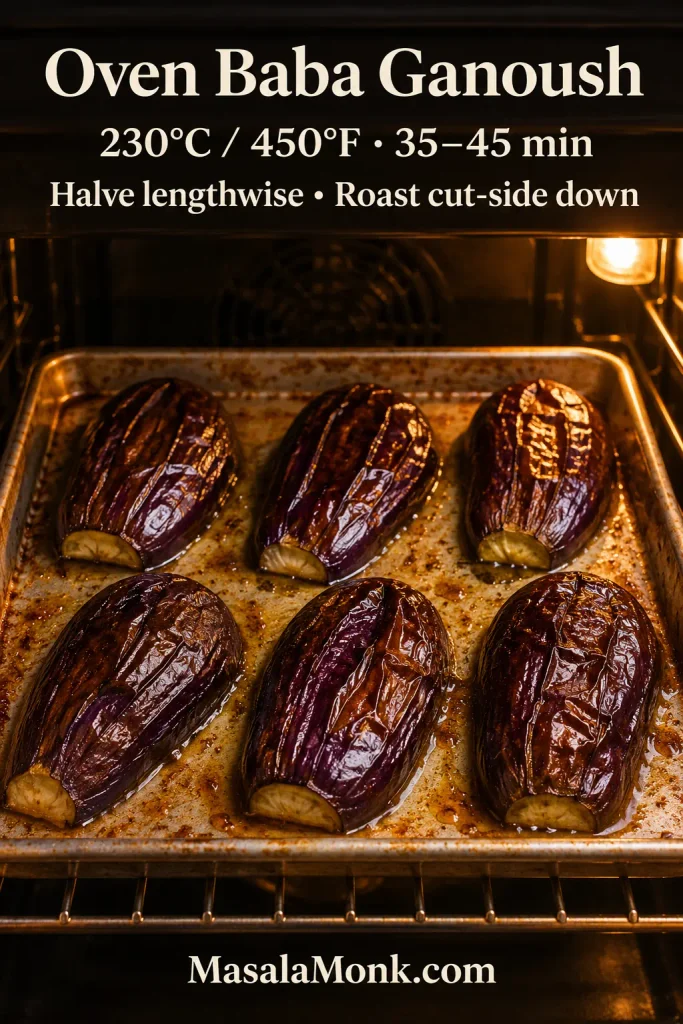
- Preheat a conventional oven to 230°C / 450°F. For a fan-assisted oven, follow the manufacturer’s recommendation; a reduction of around 20°C is common.
- Wash and dry the eggplants, then halve them lengthwise.
- Brush the cut sides lightly with 5 ml / 1 tsp olive oil taken from the 30 ml in the ingredients; use 15 ml for mixing and the remaining 10 ml for finishing.
- Arrange the halves cut side down on a rimmed metal tray, leaving space between them.
- Roast for approximately 35–45 minutes, checking sooner for small halves. The flesh should be soft from edge to center.
- Cool until comfortable to handle, scoop out the flesh, drain, and continue with the mashing and seasoning instructions in the main recipe.
Whole-eggplant oven option: Pierce and roast whole eggplants on a rimmed tray at 260°C / 500°F for approximately 45–60 minutes, turning as needed. This suits those who prefer roasting them whole, but the halved method is simpler and uses a lower oven setting. Only use 260°C if your oven and cookware are rated for it.
Broiler-Then-Oven Method
A broiler can blister the skin before regular oven heat finishes the center. It’s useful if you want some charred flavor without a suitable gas burner or outdoor grill.
- Pierce the whole eggplants and place them on a broiler-safe metal tray.
- Position the tray at the clearance recommended by your oven manufacturer.
- Broil on high, turning as the skins blister. Begin checking after a couple of minutes per side and remain nearby throughout.
- Once the skins have enough char, switch to conventional baking at 190°C / 375°F.
- Continue for approximately 25–35 additional minutes, or until the centers are tender. The preliminary broiling time is not included in this baking estimate.
- Rest, peel, drain, and mash as directed in the main recipe.
Air Fryer Baba Ganoush
An air fryer works well for one smaller eggplant weighing approximately 300–400 g / 11–14 oz. The flesh becomes tender and roasted, though it generally won’t develop the same smoky flavor as eggplant cooked over flame or charcoal.
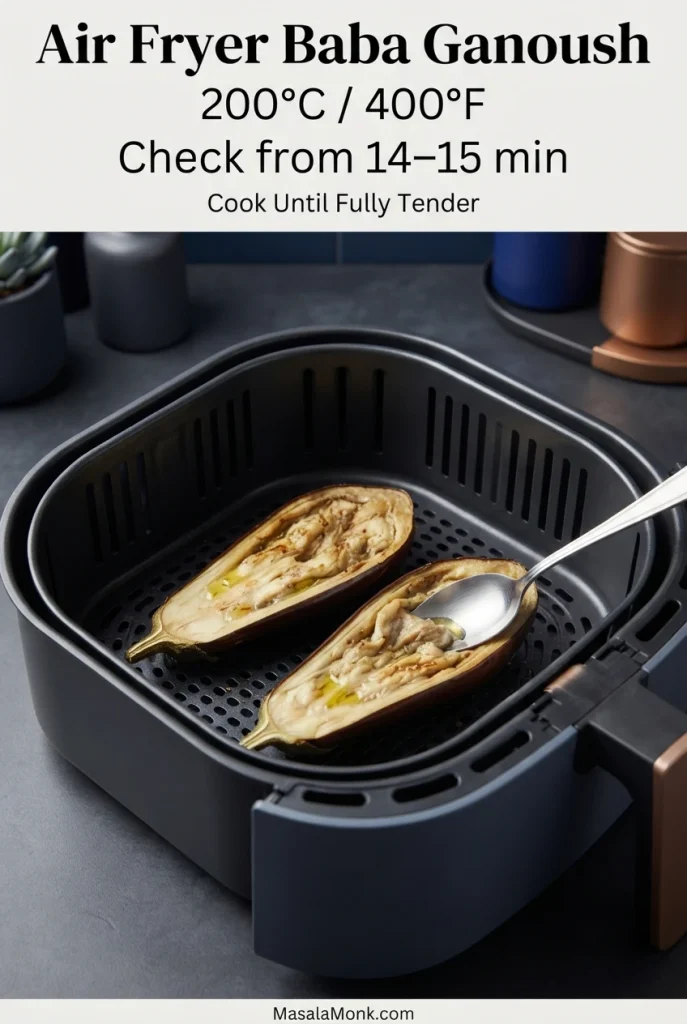
- Halve the eggplant lengthwise and brush the cut surfaces with approximately 5 ml / 1 tsp olive oil.
- Preheat the air fryer to 200°C / 400°F if your model requires it.
- Arrange the halves cut side up in a single layer. Cook separately if necessary, or cut the eggplant into smaller lengthwise pieces to fit.
- Begin checking after 14–15 minutes. Small-to-medium halves often take around 18–30 minutes, but thickness and appliance design make a considerable difference. Cook until soft throughout.
- Cool, scoop out the flesh, drain if necessary, and season using the small-batch quantities below.
For 200 g cooked, peeled, drained eggplant: Start with 16 g tahini, 10 ml lemon juice, a little crushed garlic, approximately 1 g fine salt, and 6 ml olive oil mixed into the dip. Use 5 ml olive oil for brushing during cooking and another 5 ml for finishing, if desired. For a larger or smaller batch, use the drained-eggplant seasoning ratios.
Finished roasting? Continue with the draining step in the main recipe, then mash and season the eggplant.
How to Get Creamy Baba Ganoush Without Losing the Eggplant Texture
A fork is usually all you need. It breaks apart the roasted flesh while leaving little pieces of eggplant in the dip. Those tender pieces keep the smoky vegetable recognizable beneath the tahini rather than letting it disappear into a completely smooth spread.
A food processor makes a more uniform dip. That’s fine if you prefer it, but prolonged processing removes the contrast between creamy base and soft pieces. If the flesh hasn’t drained well, blending may also make the mixture noticeably loose; the watery baba ganoush troubleshooting guide explains the different fixes.
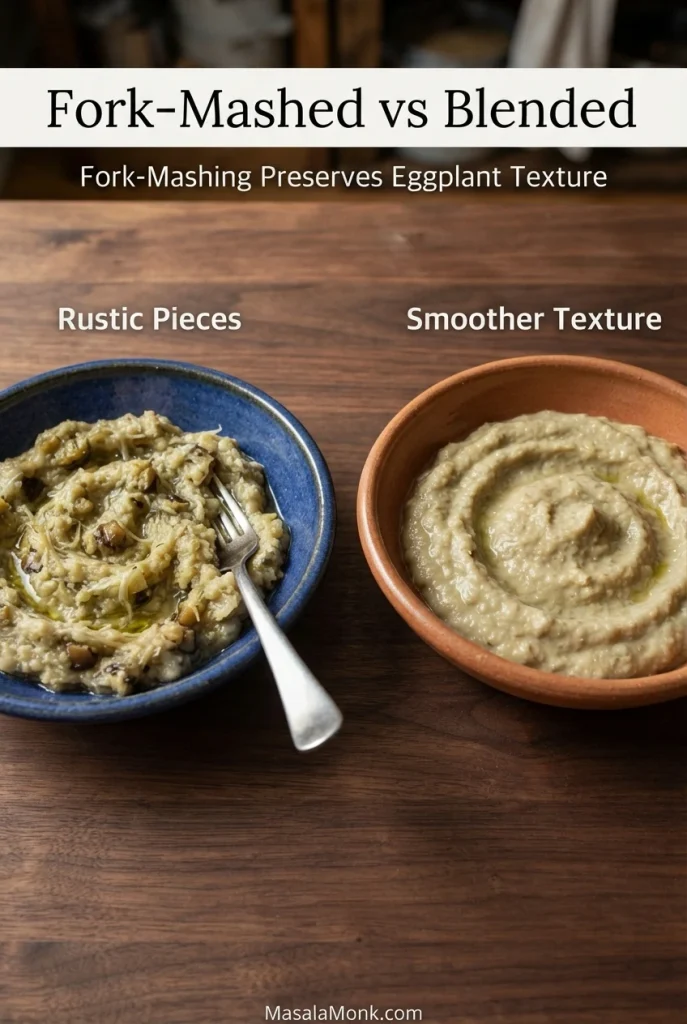
Hand-mashing is the better starting point here: it gives you control, and you can always process it more if you want. The finished dip should hold softly on a spoon rather than pour like a sauce.
How Much Tahini, Lemon, and Olive Oil Should You Use?
Season according to the cooked, peeled, drained eggplant. Raw weight is useful for shopping, but roasting changes the amount left and the strength of its flavor. The main recipe starts conservatively; use these quantities for especially small or large batches, or for previously roasted flesh.
Seasoning Ratios for Drained Eggplant
For every 100 g cooked, peeled, drained eggplant, begin with the following amounts:
| Ingredient | Start with | Adjust as needed |
|---|---|---|
| Tahini | 8 g | Increase toward 10 g for a richer dip |
| Lemon juice | 5 ml | Add more after tasting |
| Olive oil mixed in | 3 ml | Finishing oil is separate |
| Fine salt | 0.4–0.6 g | Adjust gradually |
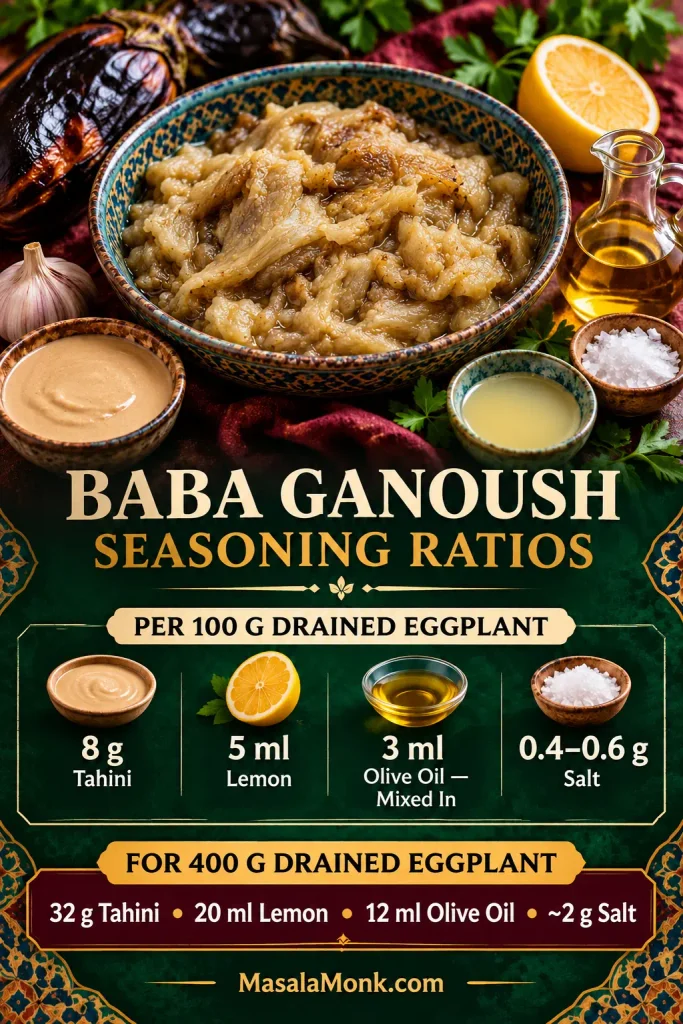
For 200 g drained eggplant, begin with 16 g tahini, 10 ml lemon juice, 6 ml olive oil mixed in, a little crushed garlic, and approximately 1 g fine salt.
For 400 g drained eggplant, start with 32 g tahini, 20 ml lemon juice, 12 ml olive oil mixed in, and about 2 g fine salt. Add a modest amount of garlic, then taste. Increase the tahini toward 40 g if you’d like a richer dip.
For 600 g drained eggplant, start with 48 g tahini, 30 ml lemon juice, and 18 ml olive oil mixed in. Add garlic and salt gradually rather than multiplying whole cloves automatically.
Tahini varies in strength, and a very smoky eggplant may need different seasoning from a mellow oven-roasted one. Treat the measurements as a reliable place to begin, then taste. If you accidentally add too much of one ingredient, see how to rebalance an over-seasoned dip.
Baba Ganoush Troubleshooting: Common Problems and Fixes
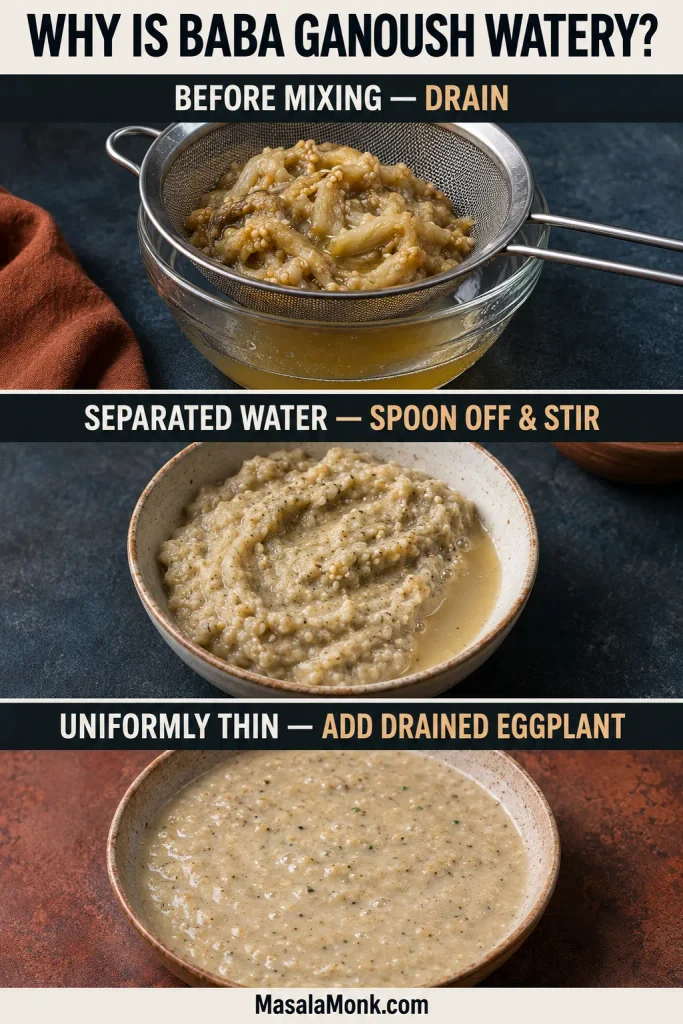
Why Is My Baba Ganoush Watery?
Before mixing: Leave the roasted flesh in the sieve longer, following the draining step in the main recipe. Removing free water before seasoning gives you the most control.
If water has separated from the finished dip: Let it settle, spoon away the visible liquid, and stir again.
If the entire dip is uniformly thin: More well-drained roasted eggplant will give it body. Otherwise, serve it a little softer rather than loading it with enough tahini to overwhelm the eggplant.
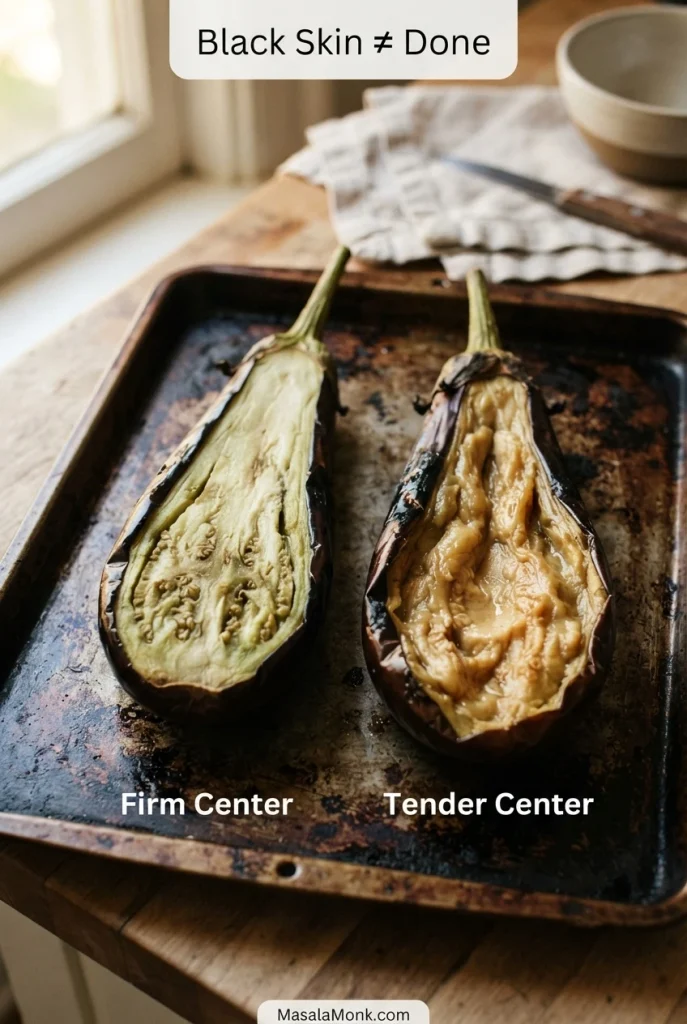
The Skin Is Black but the Middle Is Firm
The skin has charred before the flesh has finished cooking. Move the whole eggplant to gentler heat or a hot oven until a knife slips easily through the thickest part. If you’ve already opened it, finish roasting the firm, unseasoned pieces in an oven-safe dish, covering if necessary to prevent drying.
The Dip Is Stringy
Soft strands are normal in some eggplants. Chop the flesh more finely or give the dip a few short pulses in a food processor. Tough, rubbery strands usually mean the eggplant needed more cooking.
It Tastes Bitter
Check the tahini and roasted eggplant before adding more lemon or garlic. Tahini can be mildly bitter, but rancid paste, badly burnt flesh, or loose blackened fragments can make the dip unpleasant.
Mild bitterness may improve with more plain roasted eggplant and careful seasoning. Rancid tahini or severely scorched edible flesh is better replaced than disguised.
Not Smoky Enough—or Too Smoky?
Not smoky enough: Oven-roasted eggplant often tastes mellow rather than strongly smoky. A tiny pinch of smoked paprika adds a smoky note, although it won’t reproduce flame- or charcoal-roasted flavor. Choose direct heat next time if you prefer more smoke.
Too smoky or ashy: Remove loose blackened skin left in the dip. More plain roasted eggplant can soften an overly strong smoky flavor. If the edible flesh itself tastes acrid, it may not be worth rescuing.
Too Much Tahini, Garlic, Lemon, or Oil
Once too much tahini, garlic, lemon, or oil has been mixed into baba ganoush, adding another strong ingredient may create a second imbalance. Plain roasted eggplant is usually the most useful correction because it reduces the concentration of the overpowering seasoning. For smaller imbalances, try these adjustments:
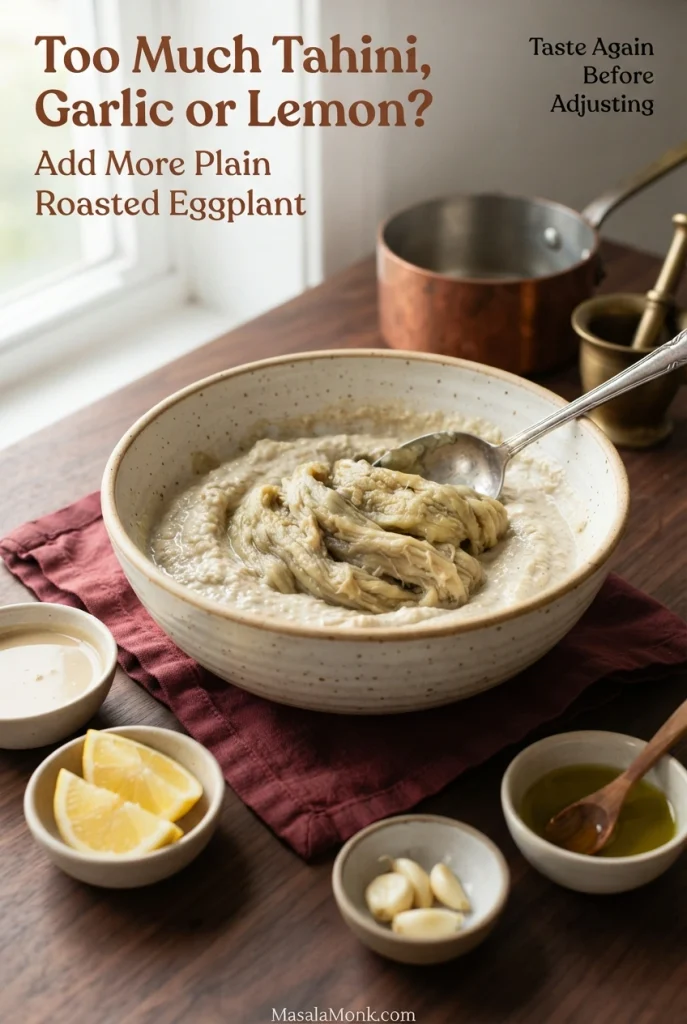
- Too much tahini: A few drops of lemon may improve the balance, but more eggplant is the more effective correction.
- Too garlicky: Let the dip rest briefly and taste again. More plain roasted eggplant can mellow a strong garlic flavor.
- Too sour: Add plain eggplant or a small amount of tahini, then taste again.
- Too oily: Spoon off any oil pooling on top. Oil already mixed through the dip is harder to remove, so additional eggplant is the practical option.
Too Thick, Too Smooth, or Too Bland
Too thick: Add cold water one teaspoon at a time until the dip spreads easily. If the dip is too smooth, fold in a little chopped roasted eggplant; for your next batch, compare the fork-mashed and blended textures. For a bland dip, try a pinch of salt first, then a few drops of lemon if needed.
Why Did My Eggplants Make So Little Dip?
Eggplant can look surprisingly small once you’ve removed the skin and drained the juices. That’s normal. Use the cooked-weight seasoning guide rather than stretching the dip with extra tahini, oil, or water. For a gathering, roasting one additional eggplant gives you more flexibility.
Back to the main recipe · Back to the introduction
Baba Ganoush Without Tahini and Other Variations
Baba Ganoush Without Tahini
Without tahini, roasted eggplant makes a lighter dip with a more direct smoky flavor. It’s also the starting point when sesame must be avoided.
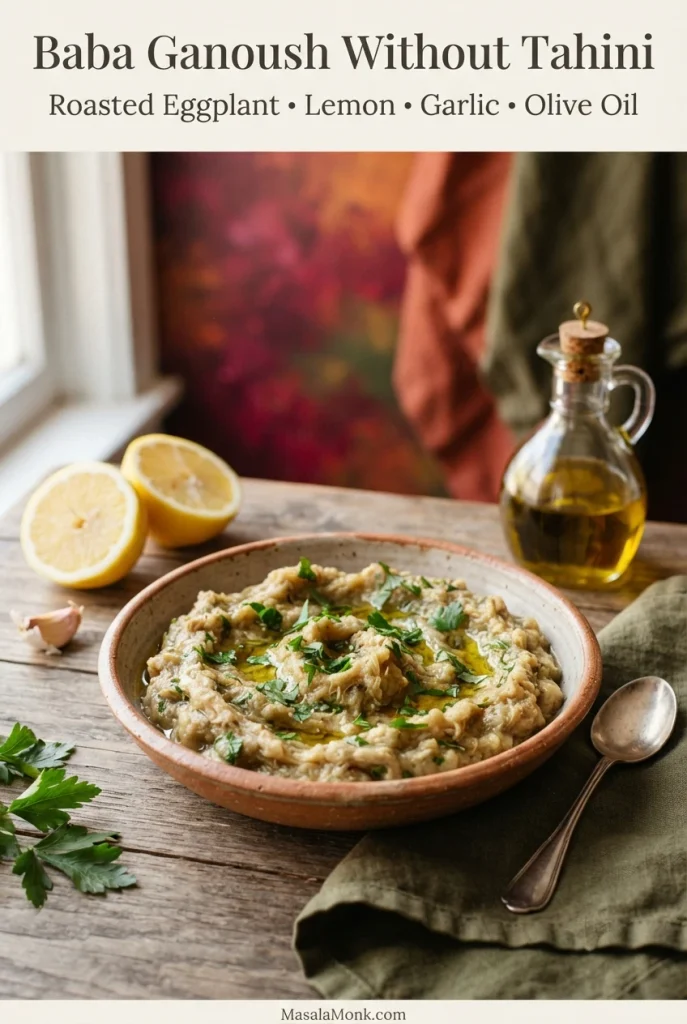
For 400 g cooked, peeled, drained eggplant, use 20 ml / 4 tsp lemon juice, 15 ml / 1 tbsp extra-virgin olive oil, one small crushed garlic clove, approximately 2 g fine salt, and 1–2 tbsp chopped parsley.
Mash the eggplant, stir in the seasonings, and taste. Leave a few soft pieces for a rustic finish or mash more thoroughly for a smoother dip.
This version also avoids sesame when prepared with suitable ingredients. However, if you’re cooking for someone with a sesame allergy, check packaged ingredients and prevent cross-contact with tahini, utensils, and preparation surfaces. Don’t substitute another nut or seed butter without checking their other allergies.
With Roasted Garlic
Roasted garlic gives a gentler flavor without leaving garlic out. Replace the raw clove with two small roasted cloves. Roast a garlic head in a covered oven-safe dish at 190°C / 375°F for approximately 30–45 minutes, until the cloves soften. Cool, squeeze out what you need, and mash it into the dip. A little oil from the measured quantity may be used during roasting.
With Yogurt
For a softer, tangier dip, stir 30–45 g / 2–3 tbsp thick plain yogurt into approximately 400 g drained eggplant. Taste before adding more lemon. This variation contains dairy and is no longer vegan.
For another cool accompaniment, Greek tzatziki with cucumber and herbs works well alongside grilled or roasted foods.
With Less Olive Oil
Leave the oil out of the mixture and use only 5–10 ml / 1–2 tsp as a finishing drizzle. The eggplant and tahini still give the dip body. Add a little cold water if it needs loosening.
Baba Ganoush vs Moutabal and Hummus
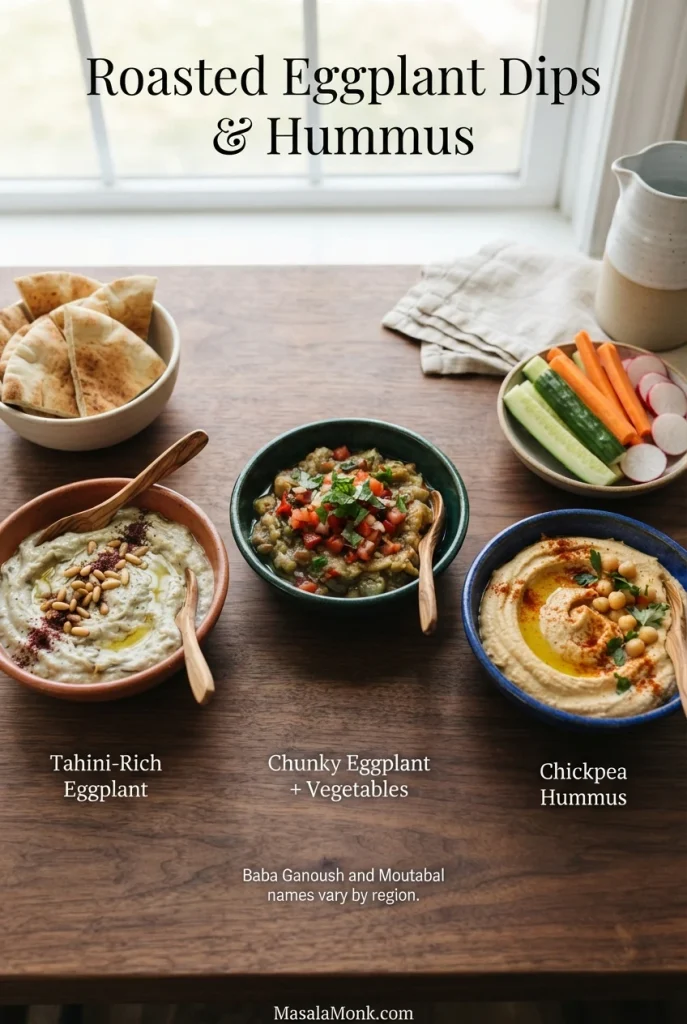
On many English-language menus, baba ganoush means a creamy dip made with roasted eggplant and tahini. In parts of the Levant, a similar tahini-rich preparation is called moutabal or mutabbal, while baba ghanouj may describe a chunkier roasted eggplant dish with vegetables, herbs, and sometimes pomegranate molasses.
You may encounter both preparations under the same name in restaurants, cookbooks, and family recipes. One might be creamy and sesame-rich; another may have distinct pieces of eggplant and chopped vegetables. Those differences are useful to know, but the names aren’t governed by one universal rule.
Terminology and ingredients vary between regions and families, and tahini-containing versions may also be called baba ghanouj. For more context, see Epicurious’s discussion of mutabbal and baba ghanoush.
What Does Baba Ganoush Mean?
The name comes from Arabic. Baba means or is used for “father,” while interpretations of the remaining expression vary. “Pampered father” is one English translation you’ll encounter, although it isn’t universally agreed.
A Chunkier Roasted Eggplant and Vegetable Version
For a vegetable-forward preparation inspired by regional baba ghanouj traditions, begin with 400 g cooked, peeled, drained eggplant. Chop the flesh rather than puréeing it.
Fold in 60 g chopped roasted red pepper, 80 g seeded and chopped tomato, 20 g finely chopped mild onion, 2 tbsp parsley, one small crushed garlic clove, 15 ml / 1 tbsp lemon juice, 15 ml / 1 tbsp olive oil, and salt to taste.
Add 5–10 ml / 1–2 tsp pomegranate molasses if you like a sweet-tart accent. The vegetables give this version a fresher, salad-like texture, while roasted eggplant provides the smoky base.
Roasted peppers and pomegranate molasses also feature in Syrian muhammara with walnuts, a richer, pepper-led dip that makes a useful contrast on a mezze table.
How Is Baba Ganoush Different from Hummus?
Baba ganoush uses roasted eggplant, while hummus uses cooked chickpeas. Both can contain tahini, lemon, garlic, and olive oil, but their main ingredients create different textures.
Eggplant gives baba ganoush its soft, often smoky character. Chickpeas make hummus thicker, starchier, and generally higher in protein for a comparable portion.
What to Eat with Baba Ganoush
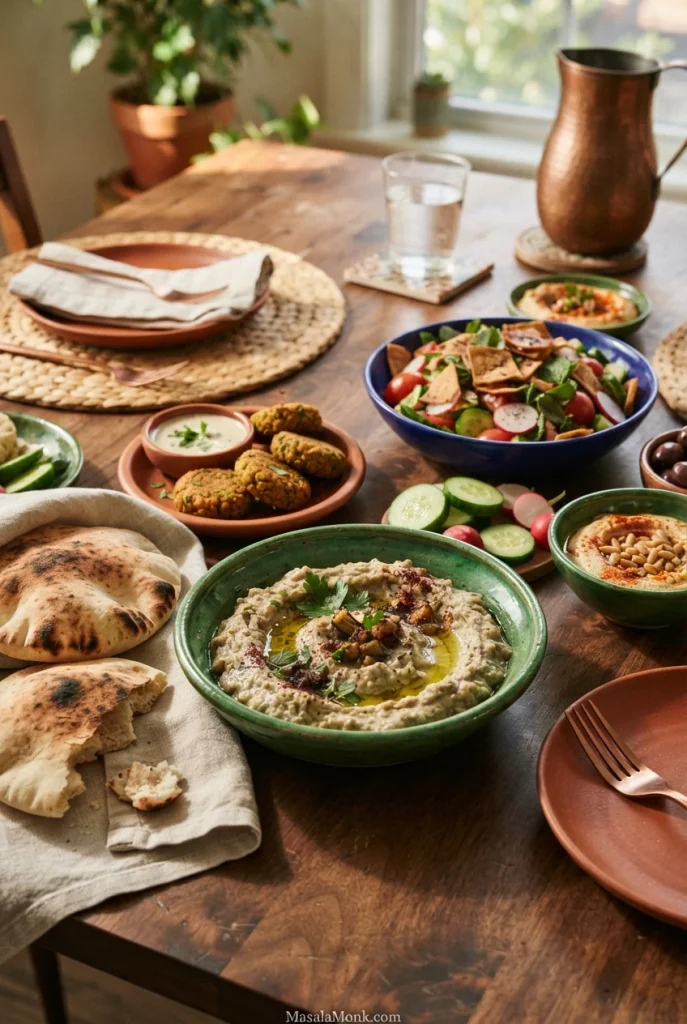
Spoon baba ganoush into a wide, shallow bowl and drag the back of a spoon through the surface. The grooves catch the olive oil. Add parsley, put warm pita alongside it, and let everyone scoop while the bread is still soft.
Warm Pita and Falafel
Fresh homemade pita bread is the simplest companion. Add a little cucumber or pickle for crunch.
For something more filling, serve crispy homemade falafel alongside it. The warm chickpea patties contrast with the soft eggplant.
Fresh Salads and Roasted Vegetables
Cucumber wedges, radishes, carrot sticks, and sweet pepper strips offer a fresh crunch, especially when the meal includes bread or fried foods.
Lebanese fattoush with toasted pita and sumac adds herbs and tangy dressing. For a warm vegetable side, try golden oven-roasted cauliflower or grilled peppers.
Wraps, Sandwiches, and Grilled Foods
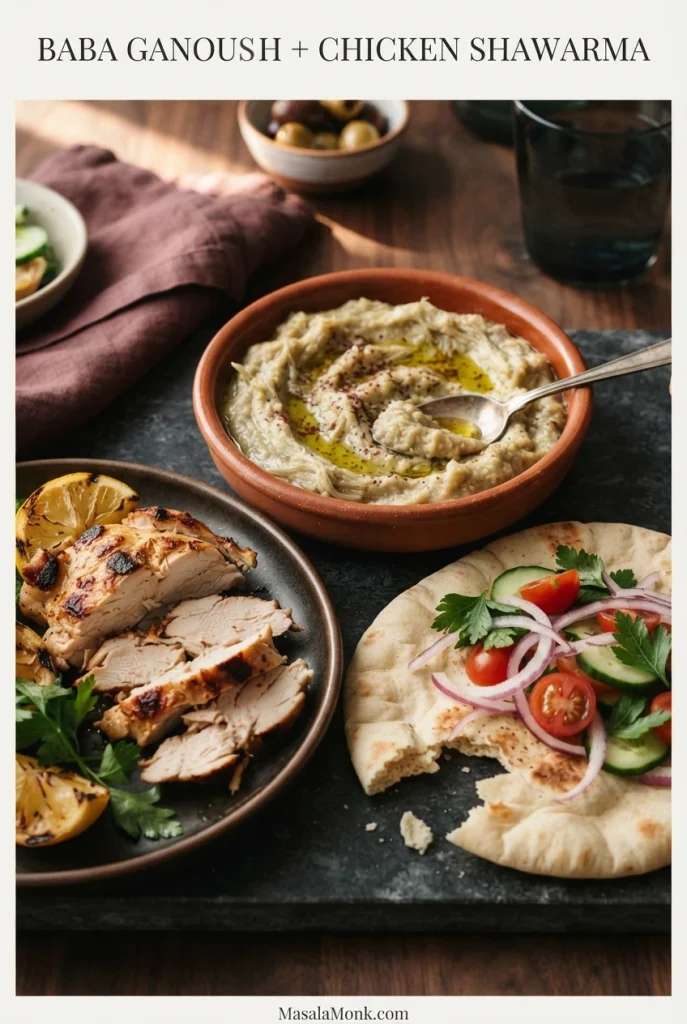
Spread baba ganoush inside pita pockets or wraps, then add grilled vegetables, herbs, and pickles. It brings roasted flavor and moisture without needing much extra sauce.
It also works with homemade chicken shawarma, spread inside a warm wrap or served separately.
Two Easy Ways to Make It a Meal
For a light mezze meal, put baba ganoush, pita, fattoush, and crisp vegetables on the table together. For a fuller dinner, pair the dip with chicken shawarma and roasted cauliflower. In both cases, the smoky, creamy eggplant gives the plate a useful contrast in flavor and texture.
How to Store, Freeze, and Make Baba Ganoush Ahead
How Long Does Baba Ganoush Last in the Fridge?
Keep baba ganoush in a clean, airtight container in the refrigerator at 4°C / 40°F or below. Use it within approximately 3–4 days as a conservative guideline for properly prepared and refrigerated leftovers.
Refrigerate promptly. Perishable food should generally not remain at room temperature for more than two hours, or one hour when temperatures exceed 32°C / 90°F. These limits are explained in FoodSafety.gov’s safe food-handling guidance.
Discard food that has been stored improperly, even if it still smells normal.
Can You Make Baba Ganoush the Day Before?
Yes. Mix the dip, cover, and refrigerate without the final olive-oil drizzle and herbs. Before serving, stir and taste again, then add the oil, parsley, and any other garnish. The garlic and lemon may seem less pronounced when the dip is refrigerator-cold.
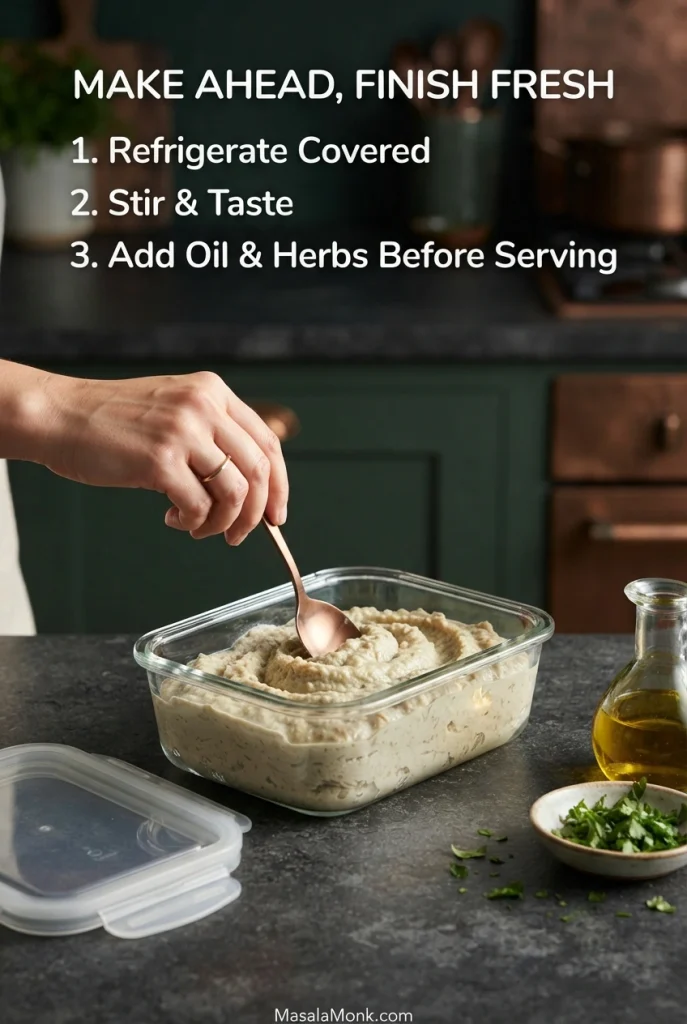
Baba ganoush is pleasant cool rather than ice-cold if you want its roasted aroma to come through. Set out only what you’re serving, and stay within the room-temperature food-safety limits above.
Can You Roast the Eggplant One Day and Mix It the Next?
Yes. Roast the eggplant, cool it promptly, peel, and refrigerate the flesh in a covered container. Drain any liquid collected overnight before mixing in the seasonings.
Can You Freeze Baba Ganoush?
You can freeze it in small airtight portions, although thawing may leave the texture looser or cause some separation. Thaw in the refrigerator and stir thoroughly before serving.
Using Jarred or Previously Roasted Eggplant
Drain the eggplant, weigh the usable flesh, and use the cooked-weight seasoning guide. For 300 g drained eggplant, begin with approximately 24 g tahini, 15 ml lemon juice, and 9 ml olive oil mixed in, adjusting garlic and salt gradually.
Read the jar’s ingredients first. Prepared roasted eggplant may already contain oil, garlic, salt, vinegar, or lemon, so it may need less seasoning.
Baba Ganoush Nutrition, Calories, and Dietary Information
Baba ganoush gets much of its fiber and volume from eggplant, while tahini and olive oil provide most of the fat and calories. For the main recipe divided into six small appetizer portions, an ingredient-based estimate is approximately 100–120 calories per serving, excluding pita and other accompaniments.
Raw eggplant provides roughly 25 calories per 100 g in commonly used food-composition records, although the peel and some liquid are discarded during preparation. The full 40 g tahini contributes approximately 235–245 calories, while 30 ml olive oil adds roughly 240 calories. Lemon juice and garlic contribute comparatively little.
Depending on the usable eggplant and how much tahini and oil you add, the batch is broadly around 600–700 calories. These are approximate recipe calculations, not laboratory measurements of the finished food. For ingredient composition, see USDA FoodData Central.
The main recipe is vegan and dairy-free, with no intentionally added wheat ingredients. It contains sesame because of the tahini. For someone with food allergies or celiac disease, check packaged ingredients and prevent cross-contact with allergen-containing foods and utensils.
Return to the ingredients and method · Back to the beginning








