Posted on Leave a comment

19 Essential Kitchen Tools That Make Cooking Easier

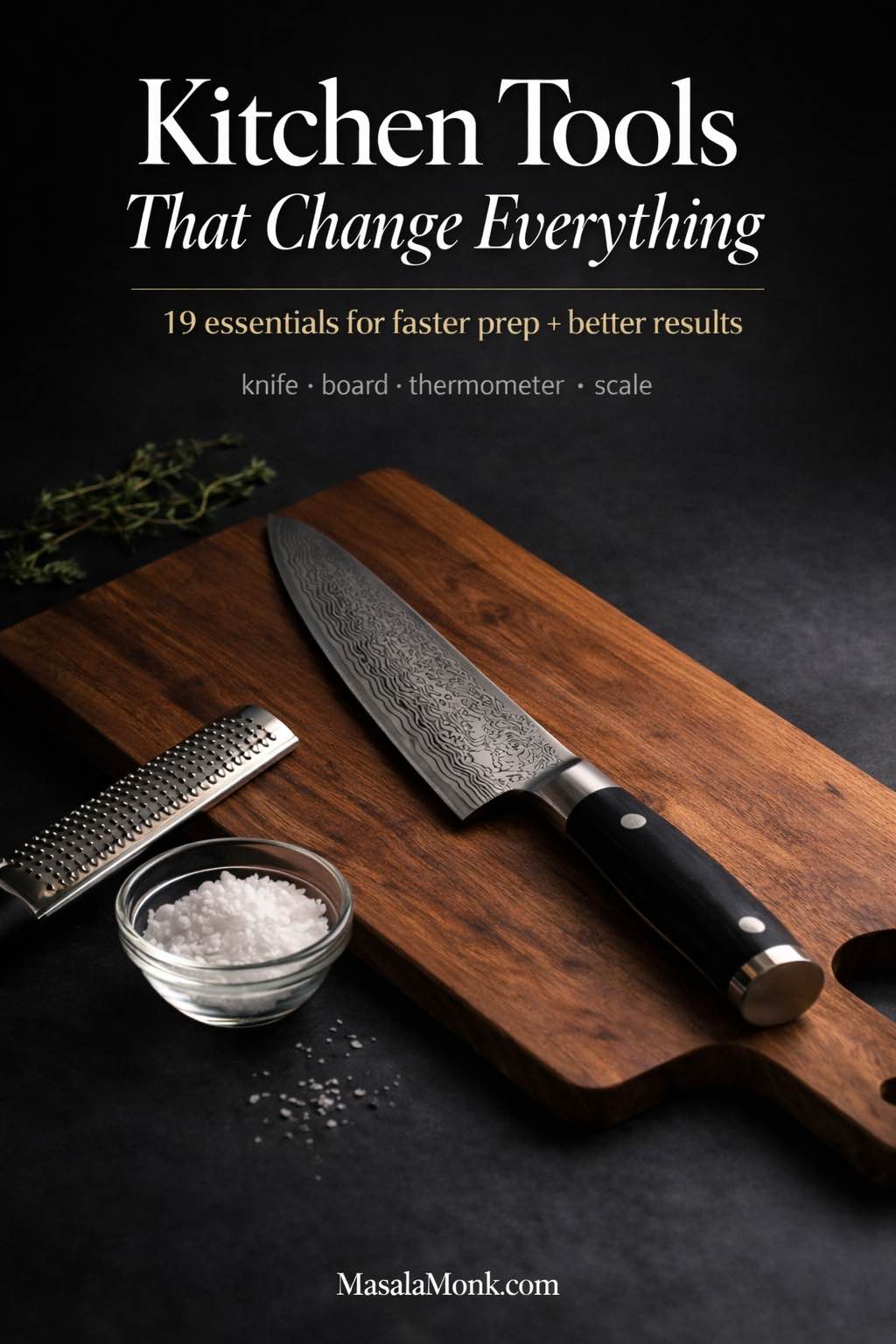
Photorealistic magazine-style cover showing premium kitchen tools on a dark stone surface: chef’s knife on a wooden cutting board with a microplane grater and bowl of flaky salt, titled “Kitchen Tools That Change Everything,” with MasalaMonk.com in the footer.

The fastest way to enjoy cooking more often isn’t a complicated recipe or a brand-new appliance—it’s having kitchen tools that remove friction from the moment you start. When the board stays put, the knife cuts cleanly, the pan heats predictably, and the utensils feel right in your hand, dinner stops feeling like a task you brace for. Instead, it becomes something you can begin without a deep breath first.

This guide is inspired by Joshua Weissman’s idea that the right tools make cooking smoother and more fun (his original “19 tools” video is here: 19 Tools To Make Cooking Easier). At the same time, what you’re reading is a fresh, independent list—built for real home kitchens, realistic storage, and tools you’ll actually use on a random Tuesday.

Along the way, you’ll also see how to choose between materials—stainless steel, silicone, wood—plus how to avoid the common trap of buying a huge utensil set that looks impressive but spends most of its life in a drawer.


Kitchen tools that earn their space every day

An “essential” isn’t just popular—it earns a permanent spot because it reliably does at least one of these things:

  • makes prep faster without making you rush
  • improves results in a way you can taste (or see)
  • reduces mess and cleanup
  • makes cooking safer by improving control
  • multitasks so you own fewer items overall
  • stays pleasant to use, even after months of washing
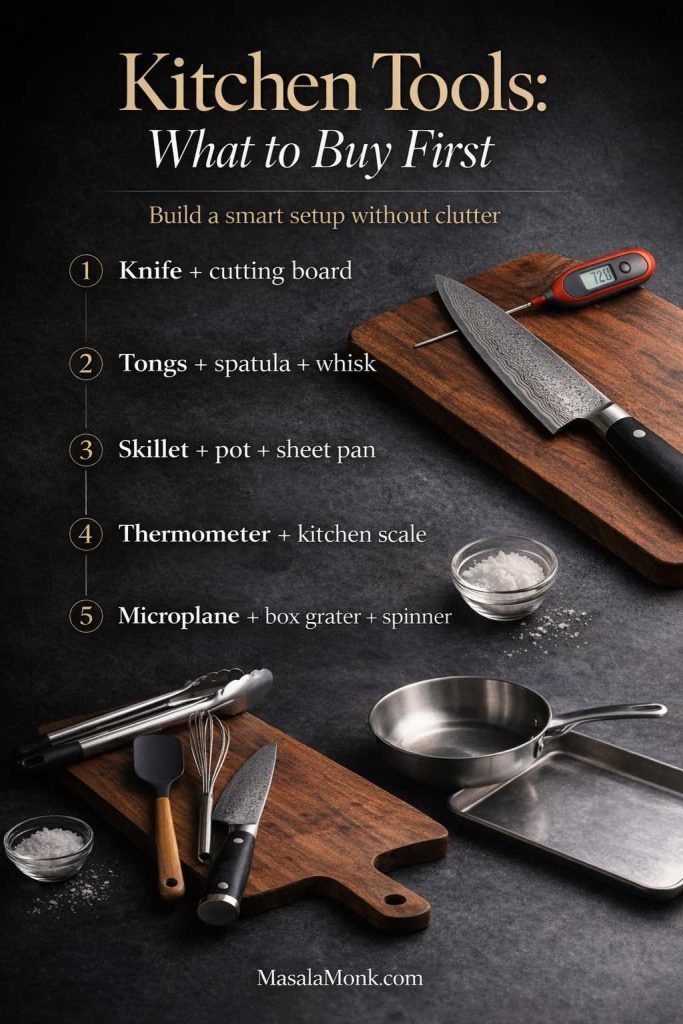
Infographic titled “Kitchen Tools: What to Buy First” on a dark countertop, listing a 5-step buying order (knife and cutting board; tongs, spatula, whisk; skillet, pot, sheet pan; thermometer and kitchen scale; microplane, box grater, salad spinner) with photoreal tools and MasalaMonk.com in the footer.
If you’re upgrading your kitchen tools slowly, this order gives the biggest impact first—without drawer clutter. Start with a great knife + stable cutting board, then add a few daily-use utensils, dependable cookware, and finally the accuracy tools (thermometer + kitchen scale) that make results repeatable. Save this checklist for the next time you’re tempted by a giant utensil set.

So, rather than collecting gadgets, this kitchen tools list focuses on workhorses—items that quietly lift everything you cook.

Also Read: Sourdough Starter Recipe: Make, Feed, Store & Fix Your Starter (Beginner Guide)


Kitchen tools list for prep: quicker chopping, cleaner counters, better flavor

1) A chef’s knife: kitchen tools that make prep feel effortless

A comfortable chef’s knife isRcy feels like an extension of your hand. Once you have that, chopping becomes calmer: onions are neater, herbs slice instead of bruising, and prep stops stealing your energy before cooking even begins.

If you want a practical reference for what makes a chef’s knife “worth it” (balance, handle comfort, blade shape), Epicurious has a helpful test-driven overview. The best chef’s knife (Epicurious)

2) A paring knife: kitchen tools for precise, small cuts

Even with a great chef’s knife, a paring knife is the tool that handles detail work without awkward angles—peeling ginger, trimming strawberries, coring tomatoes, cutting small garnishes, or cleaning up blemishes on produce.

It’s also the knife that helps you slow down and be precise when precision matters.

3) A cutting board: kitchen tools that keep prep stable and tidy

A big, stable cutting board makes prep feel organized. It gives you room to keep a “clean side” and a “scrap side,” and it prevents that cramped, messy feeling that happens when you’re constantly sweeping ingredients off the edge.

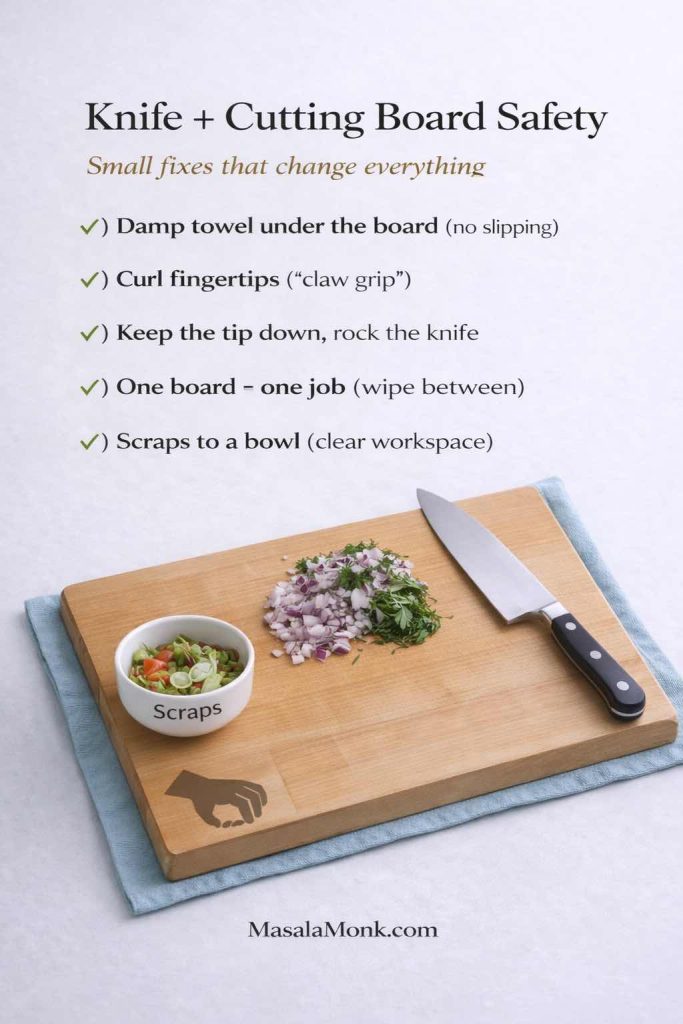
Infographic titled “Knife + Cutting Board Safety” listing five prep tips (damp towel under board, claw grip, keep tip down, one board one job, scraps to a bowl) with a chef’s knife on a wooden cutting board over a blue towel and a small “scraps” bowl, plus MasalaMonk.com in the footer.
These small knife and cutting board habits make prep faster, safer, and noticeably less messy. A damp towel stops slipping, the claw grip protects fingertips, and a scraps bowl keeps your workspace clear so cooking feels calmer from the first chop. Save this quick safety checklist—once it becomes routine, weeknight prep gets easier immediately.

If your board slides, add a damp towel underneath. That tiny change makes chopping more confident immediately.

4) Kitchen shears (cooking shears)

Kitchen shears are the underrated shortcut. You’ll reach for them for herbs, scallions, parchment, packaging, and quick trimming jobs that feel silly to do with a knife. They’re also useful for snipping bacon into pieces, cutting pizza, or trimming poultry skin.

If you’re comparing options, terms like “poultry shears,” “kitchen scissors,” and “kitchen shears” often point to the same category—what matters most is that they feel sturdy and easy to clean.

5) Bench scraper

A bench scraper is the tool that keeps your counter tidy while speeding up prep. Scoop chopped vegetables into a bowl in one clean motion. Scrape flour off the counter. Portion dough. Even if you don’t bake often, it turns “lots of tiny moves” into “one quick move.”

It’s one of those kitchen tools that feels minor until it becomes automatic.

6) Best vegetable peeler (for you)

A good peeler is smooth, fast, and predictable. With the right one, you peel carrots or potatoes without removing half the vegetable. It also makes quick ribbons for salads and garnishes with almost no effort.

You’ll see a few common styles—Y-peelers and swivel peelers are the big two. Whichever you choose, look for the same thing: a peeler that glides without chattering, feels secure in your hand, and doesn’t slip when the veggie is wet.

7) Best cheese grater (and why a box grater wins)

A box grater earns its spot because it does more than cheese. It shreds carrots for salads, potatoes for hash browns, chocolate for desserts, and even onion when you want it to melt into a sauce.

It’s also a reliable “texture tool”—it gives you consistent pieces that cook consistently, which often means better browning and more even seasoning.

8) Microplane / fine grater

If you want big flavor with minimal effort, this is the move. Citrus zest brightens everything. Garlic and ginger become smooth instead of chunky. Hard cheeses melt into dishes without gritty bits. Nutmeg becomes a soft, warm finish rather than a loud spice.

A microplane is one of those kitchen tools that quietly makes your cooking taste more intentional.

9) Best mandoline slicer (with safety first)

A mandoline slicer creates uniform slices quickly. Uniform slices cook at the same rate, which means fewer burnt edges and fewer undercooked centers—especially for potatoes, onions, cucumbers, and slaw vegetables.

Still, this tool has one rule: use the guard (or a cut-resistant glove) every time. Even if you’re careful, complacency is what catches people.

10) Salad spinner

A salad spinner is the difference between crisp salad and watery salad. Dry leaves hold dressing, so flavor clings instead of sliding off. It also helps with herbs: spin them dry, then chop—your cutting board stays cleaner, and your herbs stay brighter.

If you’re building a kitchen tools list that supports healthier, faster meals, this one surprisingly earns its place.

Also Read: How to make No-Bake Banana Pudding: No Oven Required Recipe


Kitchen tools for measuring and consistency: fewer guesses, better repeats

Not every meal needs precision. However, repeatable results—especially for sauces, baking, and “signature dishes”—often come from simple measuring tools.

11) Measuring cups

Measuring cups are foundational kitchen tools because they cover both dry and liquid measuring in everyday cooking. You might not measure everything, but you’ll measure often: rice, flour, sugar, milk, broth, and quick batters.

If you prefer a clean aesthetic, you’ll also notice options like white measuring cups or decorative sets. Style is fine—function matters more: easy to read, easy to wash, and comfortable to hold.

12) Measuring spoons

Measuring spoons control the “small but powerful” ingredients—salt, baking powder, vanilla, spices, vinegar, soy sauce. They’re also how you keep a dish balanced when you’re cooking without a recipe.

Once you get used to accurate spoons, you’ll be surprised how often they rescue a sauce from being too salty or too acidic.

13) Best kitchen scale for baking (and for cooking)

A digital kitchen scale makes baking easier because it removes the biggest variable: inconsistent measuring. Flour isn’t packed differently each time. Recipes are simpler to halve or double. Cleanup is lighter because you can weigh directly into one bowl.

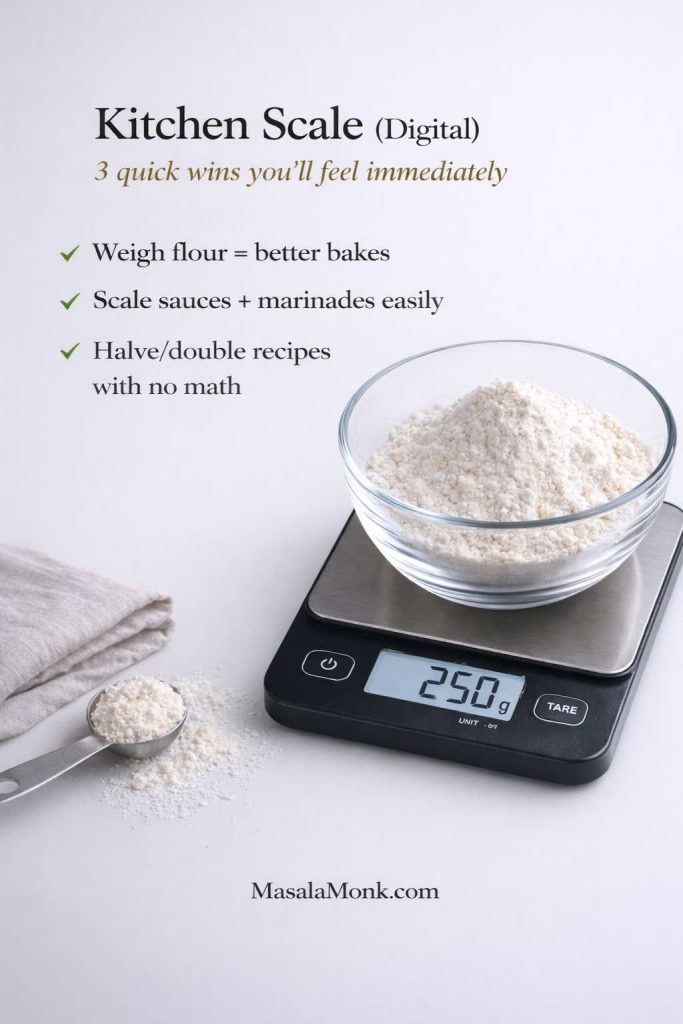
Infographic titled “Kitchen Scale (Digital)” showing a digital kitchen scale with a glass bowl of flour and text listing three benefits: weigh flour for better bakes, scale sauces and marinades, and halve or double recipes easily, with MasalaMonk.com in the footer.
A digital kitchen scale is one of those kitchen tools that pays you back fast: more consistent baking, easier scaling for sauces and marinades, and effortless halving or doubling without guesswork. Save this as a reminder—once you start weighing flour, recipes get noticeably more reliable and cleanup often gets simpler too.

King Arthur has a clear explanation of why a scale changes the way baking feels. Why a digital kitchen scale matters (King Arthur Baking)

If you want a natural way to use a scale more often, bread is perfect for it. This internal guide pairs beautifully with a scale-first approach: Sourdough bread recipes

14) Instant read food thermometer (digital thermometer cooking)

A thermometer is the tool that removes the most anxiety per rupee. Chicken breast stays juicy because you stop guessing. Roasts get pulled at the right moment. Leftovers reheat more confidently. Even oil temperature becomes easier to manage.

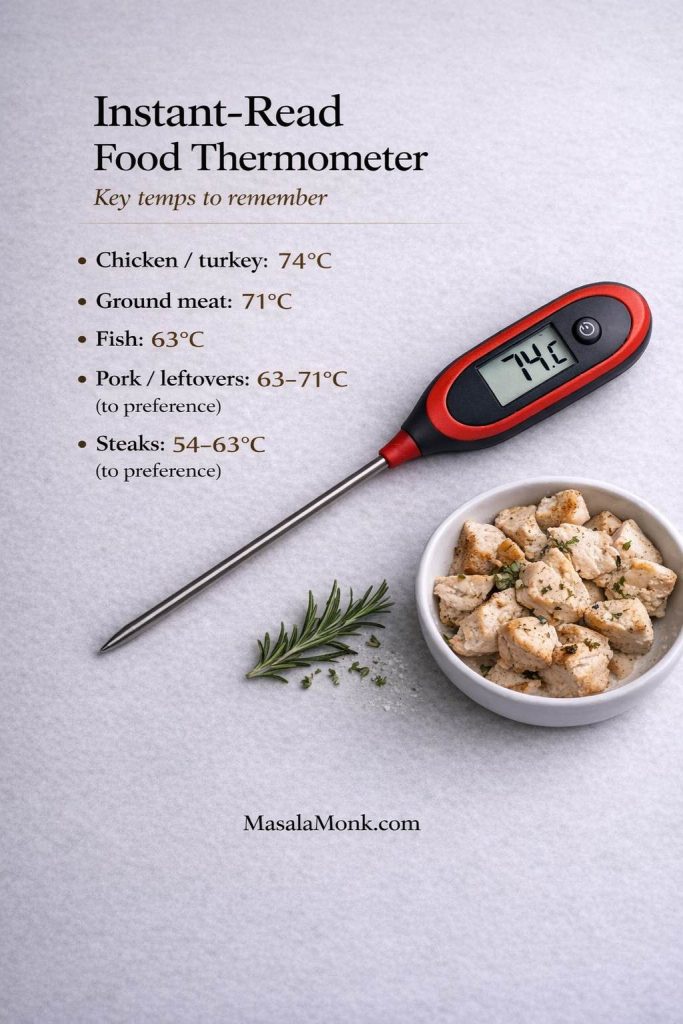
Infographic titled “Instant-Read Food Thermometer” listing key internal cooking temperatures in °C (chicken/turkey 74°C, ground meat 71°C, fish 63°C, pork/leftovers 63–71°C, steaks 54–63°C) beside a digital instant-read thermometer on a light stone surface, with MasalaMonk.com in the footer.
An instant-read food thermometer is the fastest way to stop guessing and start getting repeatable results—juicy chicken, properly cooked ground meat, and fish that doesn’t dry out. This quick Celsius cheat sheet keeps the key temps in one place, so you can cook with confidence on busy weeknights. Save it for later (you’ll use it more than you expect).

For safe internal temperatures, keep a reliable chart bookmarked: USDA safe temperature chart or FoodSafety.gov internal temperature chart.

Also Read: Chicken Adobo — Step-by-Step Recipe — Classic Filipino Adobong Manok


Kitchen tools and equipment for cooking: buy workhorses, not clutter

Cookware can be the biggest source of frustration in a kitchen—especially when you have too many pieces that don’t do any one job well. Instead, choose a few dependable items and learn them deeply.

15) A skillet that matches how you cook

One great skillet outperforms five “okay” pans. The right choice depends on what you cook most often:

  • stainless steel for browning and pan sauces
  • cast iron or carbon steel for heat retention and long-term durability
  • nonstick for easy eggs and delicate food (with the understanding it’s a replaceable item over time)
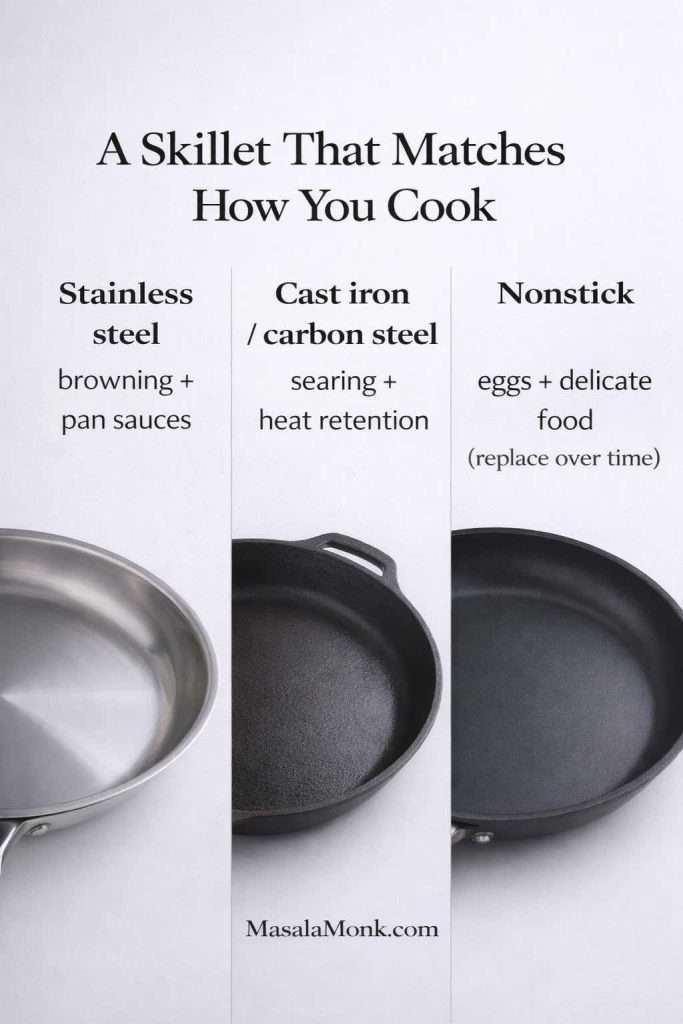
Infographic titled “A Skillet That Matches How You Cook” comparing stainless steel, cast iron/carbon steel, and nonstick skillets, with notes on best uses (browning and pan sauces; searing and heat retention; eggs and delicate food) and MasalaMonk.com in the footer.
Not every skillet cooks the same. This quick guide helps you choose the right skillet for how you cook: stainless steel for browning and pan sauces, cast iron or carbon steel for searing and heat retention, and nonstick for eggs and delicate food. Save it so your next pan upgrade actually fits your weeknight routine—and your cookware lasts longer.

If you’re leaning toward cast iron, this internal post is a strong reality check before you buy: Buying a cast iron skillet? 5 warnings before you invest

If your decision is more about coatings, this breakdown helps: Ceramic vs Teflon (PTFE) cookware

16) A dependable pot (saucepan or Dutch oven)

A good pot is where “real food” happens: dal, rice, pasta, soups, curries, beans, braises, and big batches that turn into leftovers. It also makes sauces calmer because heat is more stable and the bottom is less prone to scorching.

Sauces are the easiest proof that a pot matters. For example: Tomato sauce from fresh tomatoes and Marinara sauce recipe both benefit from steady simmering and easy stirring.

17) Baking tray / rimmed sheet pan

A rimmed sheet pan is one of the most versatile kitchen tools and utensils “adjacent” items you can own. Roast vegetables. Crisp tofu. Bake chicken. Reheat leftovers without turning the stove into a mess. Cook multiple components at once.

If you want a simple one-pan dinner that proves why this tool matters, try: Sheet pan chicken fajitas

18) Mixing bowls (nesting set)

Mixing bowls are a daily-use item that makes everything tidier: toss salad, marinate meat, mix batters, coat vegetables, hold chopped ingredients, and keep your counter organized.

You’ll come across recommendations like “mixing bowls with lids” or “best mixing bowls” in a lot of buying guides. The general idea is the same: bowls that stack neatly, don’t slide around, and wash easily.

19) Wire rack

A wire rack helps food stay crisp by letting steam escape underneath. It also cools baked goods properly, which matters more than people expect—cookies stay snappy, breads don’t turn gummy, and fried foods don’t soften as quickly.

If you want a satisfying use-case, oven bacon is perfect for it: How to cook bacon in the oven


Kitchen tools and utensils you’ll reach for constantly

Cookware handles the heat. Meanwhile, these hand tools handle the workflow—stirring, flipping, scraping, plating, serving, and keeping things clean.

Tongs: the “extra hand”

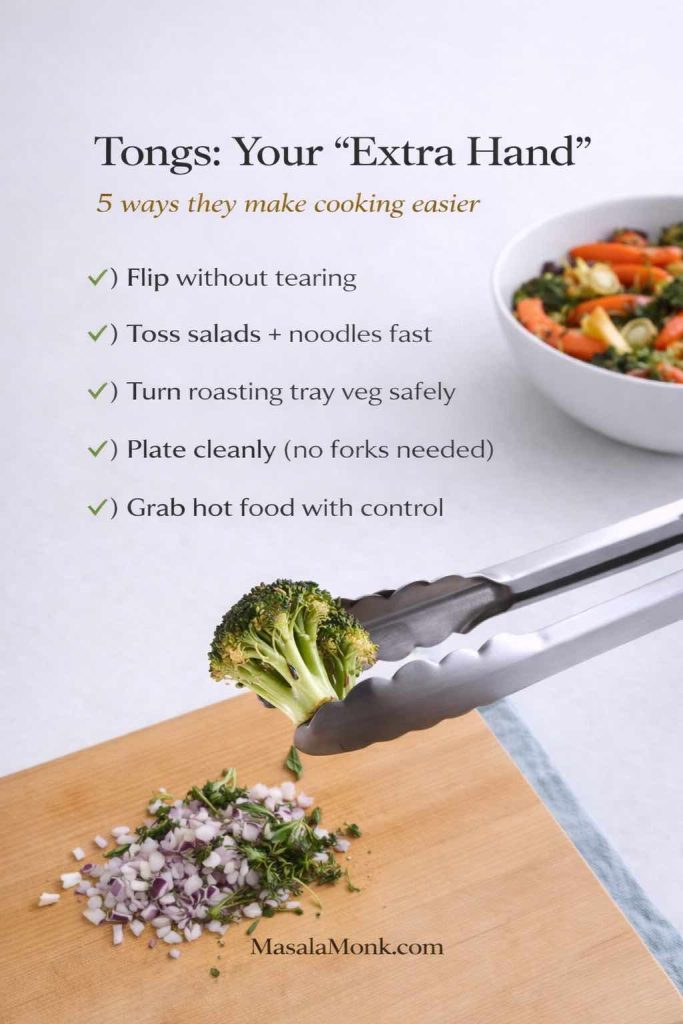
Tongs are the tool you reach for when you want control without fuss. They flip, toss, grab, and plate without tearing food or poking holes. They’re also excellent for mixing salads, turning roasted vegetables, and serving pasta.

Infographic titled “Tongs: Your ‘Extra Hand’” listing five uses for kitchen tongs—flip without tearing, toss salads and noodles, turn roasting tray vegetables, plate cleanly, and grab hot food—shown with stainless steel tongs holding a broccoli floret on a cutting board, with MasalaMonk.com in the footer.
Good kitchen tongs feel like an extra hand: they flip without tearing, toss salads and noodles fast, handle hot sheet-pan veggies safely, and plate food neatly without juggling forks. Save this quick guide—once you keep a solid pair of tongs within reach, weeknight cooking gets smoother and less messy.

If you see variants like chef tongs, catering tongs, plating tongs, or mini serving tongs, they’re all in the same family. For everyday cooking, choose a pair that feels comfortable and springy, with ends that grip well.

Spatulas: the right one for the job

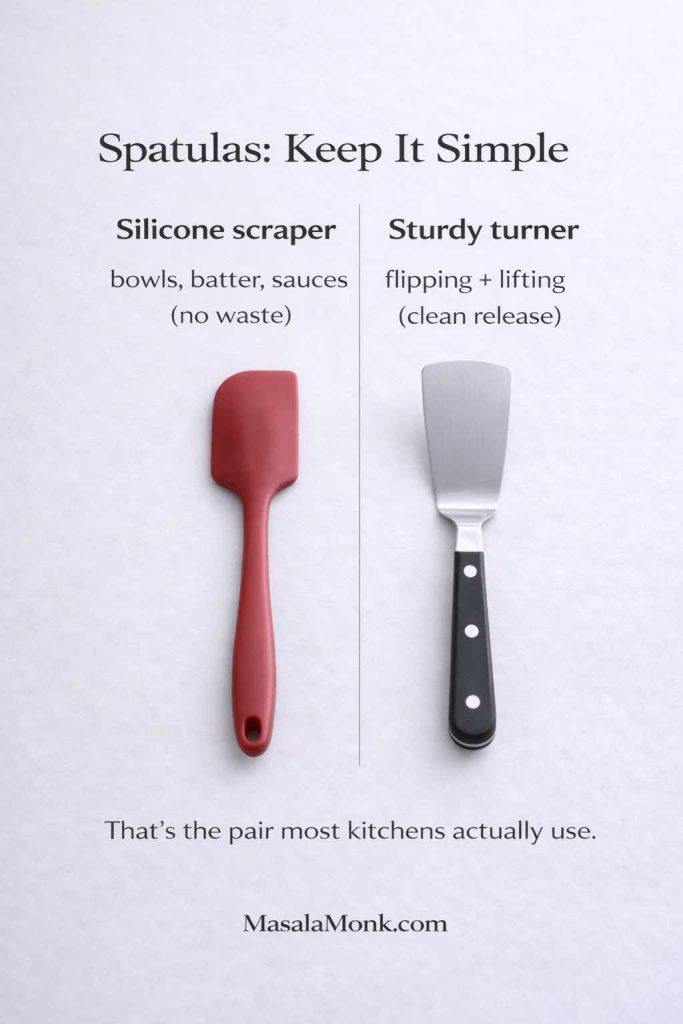
A spatula is not one thing, which is why kitchens end up with too many. A simpler approach works better:

  • a silicone spatula for scraping bowls and pots clean
  • a sturdy turner for flipping food confidently
Spatulas are where kitchens get cluttered fast—so keep it simple. A silicone scraper spatula handles bowls, batter, and sauces with almost zero waste, while a sturdy turner spatula makes flipping and lifting feel clean and confident. Save this pairing guide for your next kitchen tools upgrade (or the next time you’re tempted by a giant utensil set).

That second category includes slotted turner spatulas, fish spatulas, and thin metal spatulas. The shape matters less than the feeling: it should slide under food easily and feel stable when lifting.

If you cook with nonstick pans, keep a silicone tool for that surface. If you cook with cast iron or stainless steel, a sturdy metal turner can be a joy.

Whisk (including a balloon whisk)

A whisk is a sauce tool as much as it is a baking tool. It smooths gravies, fixes lumpy sauces, emulsifies dressings, and makes eggs more consistent. A balloon whisk is especially helpful when you want volume—whipped cream, airy eggs, or fluffy batters.

This is also where measuring spoons and a whisk pair beautifully: you can build a balanced dressing quickly without dirtying extra gadgets.

Ladle

A ladle is a small tool that instantly makes serving feel cleaner: soups, dal, curry, pasta sauce, stew. It reduces spills and makes portioning simpler, especially when you’re feeding family or serving guests.

Wood ladles, metal ladles, and stainless steel serving utensils all work—choose the material that fits your cookware and how you wash.

Also Read: Sweetened Condensed Milk Fudge: 10 Easy Recipes


Kitchen utensil set: stainless steel, silicone, or wooden cooking utensils?

A kitchen utensil set can be a smart buy, especially when you’re setting up a kitchen or replacing mismatched items. However, the material changes how you cook—and what cookware stays in good shape.

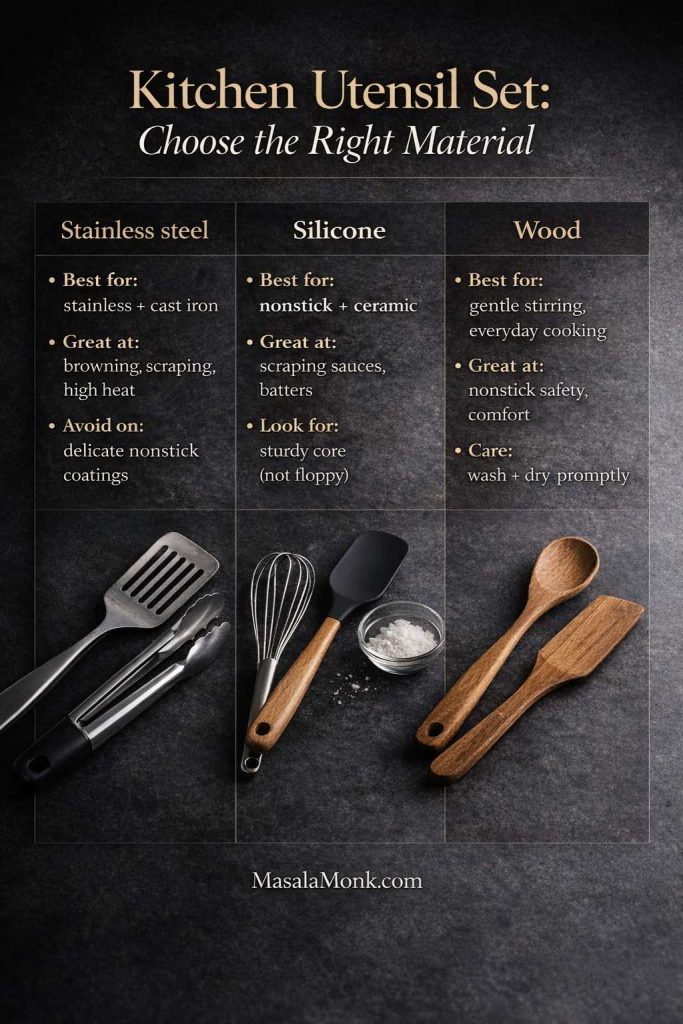
Infographic titled “Kitchen Utensil Set: Choose the Right Material” comparing stainless steel, silicone, and wood kitchen tools, with best uses and care tips, shown on a dark stone background with utensil photos and MasalaMonk.com in the footer.
Choosing a kitchen utensil set is easier when you match the material to your cookware. Stainless steel is ideal for stainless pans and cast iron, silicone protects nonstick and ceramic, and wooden cooking utensils stay comfortable for everyday stirring. Save this quick guide for your next upgrade so you buy the right tools once—and avoid scratches, flimsy spatulas, and clutter.

Stainless steel kitchen utensil set

A stainless steel utensil set is durable, easy to clean, and comfortable for high heat. It feels excellent on stainless steel and cast iron. It also looks “professional,” which is why you will often see people looking for high end kitchen utensils.

That said, stainless can scratch coatings, so if you cook mostly on nonstick, you’ll want to be gentle—or choose silicone for those pans.

Silicone kitchen utensils set

A silicone utensil set is kinder to coated pans and great for scraping thick sauces and batters. It’s also a good fit if you’re building toward “non toxic cooking utensils” and want tools that won’t chip, flake, or expose metal edges against delicate surfaces.

The key is sturdiness. A floppy spatula is frustrating, while a well-built silicone tool becomes a favorite.

Wooden utensil set (wooden kitchen utensil set / wooden cooking utensils set)

Wooden utensils feel warm and comfortable in the hand. They’re gentle on cookware, especially on nonstick or ceramic surfaces. They also stay cooler than metal during long stirring sessions.

If you’re shopping for a wooden utensil set—whether it’s a basic spatula-and-spoon combo or a nicer handmade set—aim for pieces that feel dense, smooth, and well-finished. Olive wood utensils and acacia wood utensils are popular because they’re sturdy, though any well-made wood can work if cared for properly.

Wood does ask for a little respect: wash and dry promptly, and don’t leave wooden spoons soaking in water.

If you want a broader cookware overview that connects tools to materials, this internal guide fits naturally here: How to choose the best cookware for your kitchen

Also Read: Peanut Butter Fudge: Recipes & Guide (8 Methods + Easy Variations)


Kitchen tools for healthier cooking and peace of mind

A lot of what people worry about with kitchen tools comes back to “health” and “safety”—non-toxic materials, coatings that hold up, and utensils that won’t chip, flake, or scratch cookware over time. While no single tool guarantees “healthy,” your choices can reduce common headaches.

Choose tools that don’t create avoidable problems

  • Use a thermometer so you don’t overcook lean proteins into dryness.
  • Use a scale for baking so you’re not adding extra flour and ending up with dense results.
  • Use cookware and utensils that fit your heat level, so you’re not accidentally stressing coatings.
  • Keep a scraping tool that doesn’t damage pans (silicone is helpful here).

If you want a simple anchor point for safe doneness, the USDA safe temperature chart is worth keeping handy.

Also Read: 10 Vegan Chocolate Cake Recipes (Easy, Moist, & Dairy-Free)


Kitchen tools list for cooking faster: how the right tools change weeknights

Kitchen tools matter most when you’re tired and hungry—when you want dinner without turning your kitchen into a disaster zone.

The sheet pan shortcut

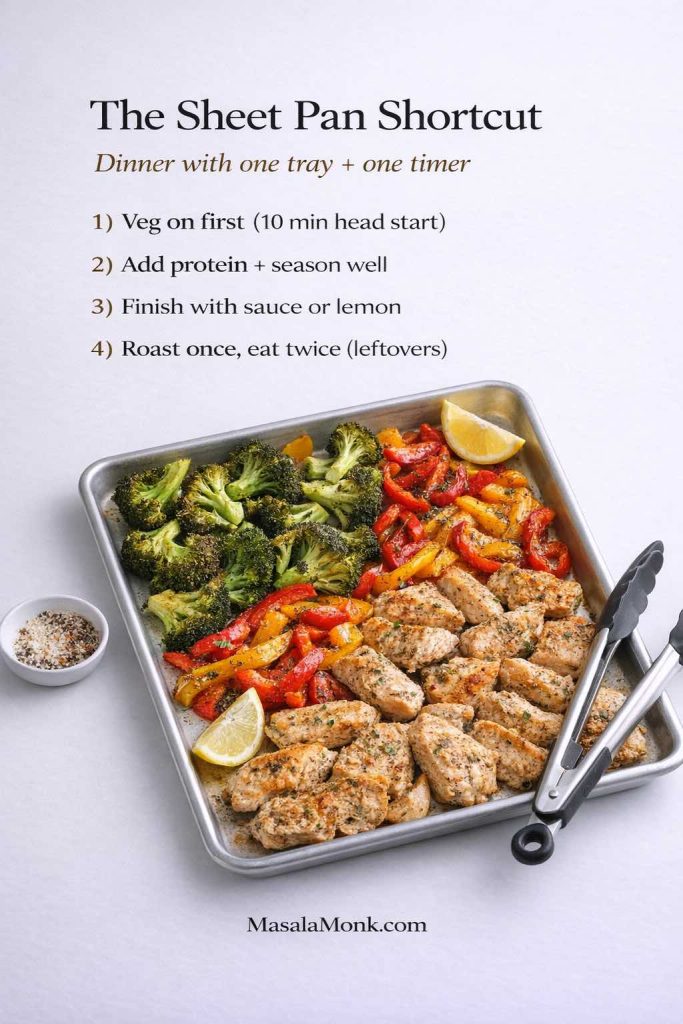
A sheet pan makes “one tray, one timer” cooking possible. Roast vegetables while a protein cooks beside them. Reheat leftovers without babysitting the stove. Crisp things quickly.

If you want a simple starting point, Sheet pan chicken fajitas is a great “proof recipe” because it shows how a single pan can carry a full meal.

Infographic titled “The Sheet Pan Shortcut” showing a rimmed sheet pan with roasted chicken, broccoli, and peppers plus tongs and lemon wedges, with four steps for one-tray cooking and MasalaMonk.com in the footer.
This is the fastest way to make weeknight cooking feel easy: one sheet pan, one timer, and a simple order that actually works. Start the veggies first, add protein, then finish with sauce or lemon for big flavor without extra pots. Save this “sheet pan shortcut” for busy nights—and use it anytime you want dinner plus leftovers with minimal cleanup.

The skillet rhythm

A good skillet simplifies cooking because it’s predictable. Once you know how your pan browns onions, you can build meals quickly: sauté aromatics, add vegetables, season well, finish with a sauce or a squeeze of citrus.

Here’s an easy internal skillet example that makes good use of a sturdy pan and tongs: Skillet mushroom and zucchini stir fry

The sauce pot advantage

A dependable pot is what turns “ingredients” into “dinner.” It’s also what makes meal prep feel realistic—one big pot means multiple meals.

If you want sauces that become weekly staples, these internal links are natural fits:


Kitchen planning tools: when layout affects how you cook

Not all “kitchen tools” are handheld. Sometimes, the biggest improvement is planning how your kitchen works—especially if you’re moving into a new home, renovating, or simply reorganizing.

A kitchen planning tool or online kitchen design tool can help you visualize work zones so cooking flows naturally: prep near the sink, cooking near the stove, and storage where you actually need it. If you’ve ever walked across the room five times just to grab salt, you already know why layout matters.

People use different planners depending on region and store—Wickes kitchen planner, Wren kitchen planner, IKEA kitchen planner (including SEKTION), Howdens kitchen planner, and similar cabinet layout planner tools. The brand matters less than the principle: get the triangle (sink–stove–fridge) working, then keep daily tools within arm’s reach of where you use them.

Kitchen mood board: make your tools fit your space

A kitchen mood board sounds aesthetic—and it can be—but it also helps you choose finishes and storage that make your tools accessible. If you love wooden utensils, maybe you want a utensil crock. If you use stainless steel utensils, you might prefer a hanging rail. And if you’re building a clean look, you might choose stackable measuring cups and keep them in one drawer.

Even a small “plan” reduces clutter because you’re buying with intention rather than impulse.

Also Read: Kahlua Drinks: 10 Easy Cocktail Recipes (Milk, Vodka, Coffee)


Commercial stainless steel benches, prep tables, and food prep tables at home

It’s surprisingly common to see home cooks borrow ideas from commercial kitchens—stainless prep tables, workbenches, and simple food-prep stations—because they solve a real problem: easy cleanup and a durable surface for heavy chopping.

You don’t need a restaurant bench to benefit from the concept, though. The home version is simply this: create a dedicated prep surface that stays clear enough to use. Once you have a reliable place to chop, mix, and stage ingredients, cooking feels lighter.

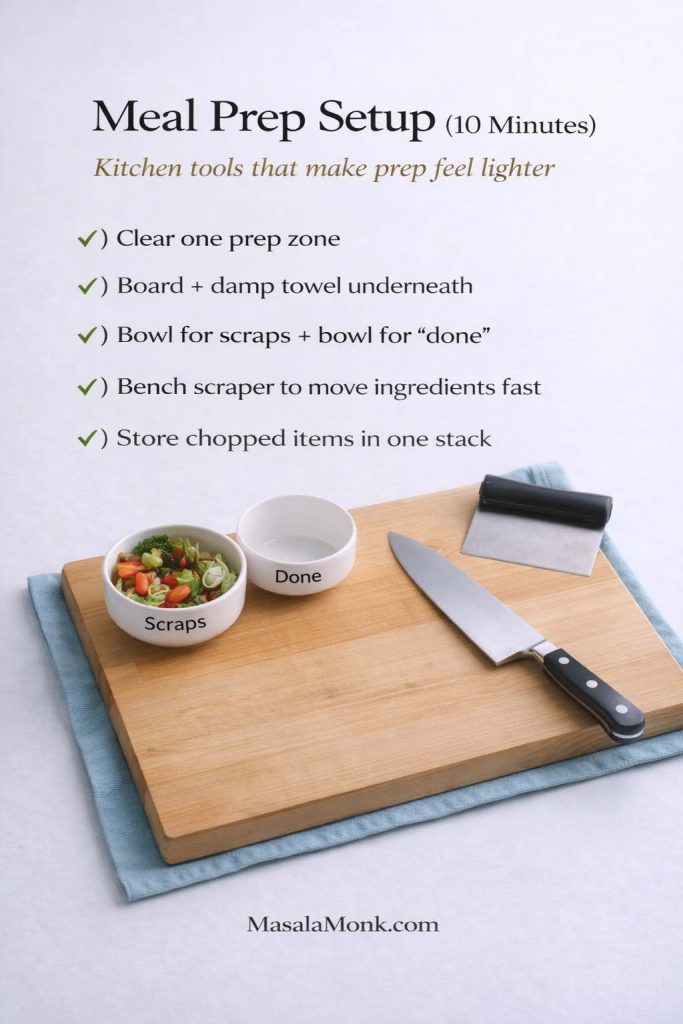
Infographic titled “Meal Prep Setup (10 Minutes)” showing a cutting board on a damp towel with a chef’s knife, bench scraper, and two labeled bowls (“Scraps” and “Done”), plus a checklist of five steps for faster prep, with MasalaMonk.com in the footer.
Meal prep gets easier when your kitchen tools support the workflow. This 10-minute setup keeps prep clean and fast: one clear zone, a stable board, a scraps bowl, a “done” bowl, and a bench scraper to move ingredients in one sweep. Save this checklist for busy weeknights—once you try it, chopping feels calmer and cleanup feels lighter.

If you have space for a small prep table, it can be transformative. If you don’t, the alternative is a large cutting board that can temporarily turn any counter into a “prep station.”

Also Read: Hot Chocolate Coffee: 3 Easy Recipes (Cocoa, Mix, or Espresso)


Sharpening kitchen knives: the kitchen tool that protects your hands

A sharp knife is safer than a dull knife because you use less force and get more control. That’s why you’ll see so many different sharpening options mentioned—magnetic sharpeners, whetstones, stone sets, guided systems, and classic pull-through sharpeners. The names vary, but the goal is the same: a sharp edge you can maintain consistently.

There are many ways to sharpen. The most important habit is consistency: a little maintenance more often beats a dramatic rescue once a year.

If you want a practical baseline, aim for two habits:

  • hone regularly (if you use a honing rod)
  • sharpen periodically (stone, system, or professional service)

Once your knife is sharp, everything else becomes easier—especially prep.

Also Read: Cranberry Moscow Mule Recipe: A Festive Holiday Cocktail With Easy Variations


Kitchen tools for baking: simple tools that unlock a lot of recipes

Even if you don’t think of yourself as “a baker,” a few tools make baking approachable—especially if your goal is to make breakfast or desserts without stress.

Scale + bowls + spatula = baking that repeats well

A scale keeps batters consistent. Nesting bowls keep prep tidy. A silicone spatula prevents waste and helps cleanup.

If you’re leaning into breads, this is where a scale becomes addictive: Sourdough bread recipes

Measuring cups and spoons: the calm version of baking

When measuring tools are solid, you stop second-guessing. That matters for pancakes, muffins, quick breads, and cookies.

For a breakfast-friendly recipe set that naturally uses measuring cups, whisk, and a good pan, this internal link fits well: Blueberry pancakes recipes


Professional kitchen essentials at home: what actually translates

It’s tempting to chase “professional chef tools,” “chef recommended kitchen tools,” and “must have kitchen items for chefs.” Some of that is useful; some of it is just marketing.

What genuinely translates from professional kitchens to home kitchens is simplicity and durability:

  • fewer items, better items
  • predictable work surfaces
  • tools that wash easily
  • a workflow that doesn’t require ten gadgets

This is why “boring” tools like tongs, a whisk, a good knife, and a stable cutting board often outperform flashy gadgets.

If you want a broader outside reference for what belongs in a starter kitchen, Serious Eats has a solid, practical list. Basic starter kitchen equipment (Serious Eats)

Also Read: Cold Brew Espresso Martini: How to Make It (Step-by-Step Recipe)


Eco kitchen products and sustainable kitchen products: the parts that matter

A lot of home cooks are trying to make their kitchens a little less wasteful—buying fewer things overall, choosing tools that last, and skipping gadgets that end up in a drawer for a month and the trash a year later. The good news is you don’t need a “perfect” eco setup. You just need a few habits that steer your buying in the right direction.

A simple approach helps:

  • buy fewer tools (and buy them once)
  • choose durable materials
  • avoid disposable or single-use gadgets
  • pick items that can handle daily washing without warping, cracking, or peeling

Wooden utensils can be a sustainable choice when cared for properly—wash, dry, and don’t leave them soaking. Stainless steel is durable and long-lasting, especially for tools that take heat and pressure. Silicone can be practical for nonstick cookware and for scraping batters and sauces, as long as you choose sturdier pieces that won’t tear at the edges.

If your goal is to reduce waste, the best “eco upgrade” is usually replacing one frustrating, flimsy tool with one you’ll happily use for years—rather than buying a whole new set because it looks nice.

Also Read: Baked Ziti Recipe Collection: 15 Easy Variations


Kitchen tools list: what to buy first so you feel the difference immediately

If you’re upgrading gradually, this order gives the fastest improvement without overwhelming your kitchen.

First wave (instant improvement):

  1. chef’s knife + large cutting board
  2. skillet + dependable pot
  3. tongs + silicone spatula + whisk
  4. measuring cups + measuring spoons

Second wave (consistency and confidence):
5) instant-read thermometer
6) digital scale
7) sheet pan

Third wave (speed and finishing touches):
8) microplane
9) box grater
10) kitchen shears
11) bench scraper
12) salad spinner
13) mandoline slicer (if you’ll use it weekly)

Once you’ve built that foundation, buying becomes calmer because you’re filling real gaps rather than chasing trends.

Also Read: Sandwich for Breakfast: Breakfast Sandwich Recipe + 10 Variations


A few “skip for now” kitchen tools (unless you know you’ll use them)

A lot of kitchen gadget sets look helpful, yet they create clutter quickly. Unless you’re sure you’ll use them weekly, consider waiting on:

  • single-use slicers that only cut one shape
  • novelty spatulas that don’t feel good to use
  • oversized utensil sets where half the pieces never get touched
  • complicated can openers or grinders that are hard to clean

If you do need something specific—like an easy can opener for arthritis or a rechargeable salt and pepper grinder—buy it because it solves a real problem in your kitchen, not because it looks cool.

Also Read: Manhattan Cocktail Recipe (Classic + 6 Variations)


Closing thought: the best kitchen tools make you cook more

The “perfect” kitchen isn’t the one with the most stuff. It’s the one where you can start cooking without resistance—where the tools support you instead of slowing you down.

When your kitchen tools are right, you chop faster, season more confidently, cook with fewer surprises, and clean up without dread. As a result, cooking becomes something you do more often—simply because it’s easier to begin.

And once you’re cooking more often, everything else gets better too: sauces become second nature, weeknights feel lighter, and even simple meals start tasting like you meant them.

If you want a quick next step after this tools list, pick one recipe category that rewards good tools immediately:

FAQs

1) What kitchen tools do I need to start cooking at home?

If you’re starting from scratch, focus on kitchen tools that cover prep, heat, and serving. A chef’s knife, a stable cutting board, a skillet, a pot, measuring cups and measuring spoons, a spatula, tongs, and a whisk will handle most meals. After that, add a sheet pan, a kitchen scale, and an instant-read thermometer to improve consistency.

2) What are the most important kitchen tools for beginners?

Beginners benefit most from kitchen tools that reduce effort and mistakes. Start with a sharp knife, a large board, and one reliable pan. Next, add measuring tools for repeatable results. Finally, pick a few utensils that feel comfortable—tongs, a silicone spatula, and a whisk—so cooking stays simple rather than fussy.

3) Is it better to buy a kitchen utensil set or individual utensils?

It depends on your cookware and how you cook. A kitchen utensil set can be convenient when you’re setting up a new kitchen. However, buying individual pieces often gives better quality for the tools you’ll use daily. If you do choose a set, aim for sturdy essentials rather than a large bundle with lots of rarely used items.

4) Which kitchen tools and utensils are best for nonstick pans?

For nonstick cookware, choose kitchen tools made from silicone, wood, or nylon so you don’t scratch the coating. A silicone spatula, silicone spoon, and silicone tongs are especially useful. Even so, avoid sharp-edged metal turners on nonstick, because small scratches add up over time.

5) What are the best kitchen tools for stainless steel cookware?

Stainless steel cookware can handle tougher kitchen tools. Stainless steel utensils, a thin metal spatula or turner, and sturdy tongs work well. Since stainless is often used for browning, tools that scrape and flip confidently can be helpful, especially when you want good sear and clean release.

6) Are wooden cooking utensils a good choice?

Yes—wooden cooking utensils are comfortable, gentle on cookware, and great for stirring sauces and curries. Still, they need basic care: wash promptly, dry well, and don’t soak them. If you want a set, a wooden utensil set with a spoon, flat spatula, and ladle covers most needs.

7) Which is better: silicone kitchen utensils or wooden kitchen utensils?

Silicone kitchen utensils are excellent for scraping batters, stirring thick sauces, and protecting nonstick pans. Wooden kitchen utensils feel natural, stay cooler in the hand, and work well for long simmering dishes. Ultimately, many kitchens do best with both: silicone for scraping and wood for everyday stirring.

8) What kitchen tools are considered “non toxic” or safer for everyday cooking?

Many people choose stainless steel, wood, or high-quality silicone for everyday kitchen tools. Stainless steel is durable and stable, wood is simple and long-lasting with care, and silicone is useful for nonstick cookware. Rather than chasing a label, prioritize tools that don’t flake, chip, or degrade quickly under heat.

9) What’s the best kitchen knife set, or should I buy single knives?

If you cook often, buying a few excellent knives usually beats buying a large knife set. A chef’s knife plus a paring knife covers most tasks. If you prefer a knife set, choose one with fewer pieces and a reputation for comfort and durability, rather than a massive block with duplicates.

10) How do I sharpen kitchen knives at home?

There are several reliable methods: whetstone sharpening, guided sharpening systems, and quality pull-through sharpeners. Whichever method you choose, consistency matters more than complexity. Additionally, keeping knives dry and stored properly helps them stay sharp longer between sharpening sessions.

11) Do I really need a kitchen scale?

A kitchen scale isn’t mandatory, yet it quickly becomes one of the most useful kitchen tools—especially for baking. It helps you measure flour accurately, scale recipes without hassle, and repeat results more easily. Moreover, it can reduce dishes because you weigh ingredients into one bowl.

12) What’s the best instant-read thermometer for cooking?

The best instant-read thermometer is the one you’ll actually use—quick to read, easy to hold, and accurate. Look for a fast response time and a clear display. If you grill, a grill meat thermometer can be useful too, but an instant-read thermometer is still the everyday workhorse.

13) Do I need a mandoline slicer in my kitchen tools list?

A mandoline slicer is optional, but it’s very helpful if you make salads, slaws, chips, or layered bakes. It gives even slices quickly, which helps food cook evenly. That said, safety is non-negotiable—use the guard and slow down, because speed is not worth injuries.

14) What are the best kitchen tools for meal prep?

For meal prep, prioritize kitchen tools that speed up chopping and storage: a large cutting board, a sharp knife, mixing bowls, measuring cups, and sheet pans. Then add tools that reduce repetition, such as a salad spinner, bench scraper, and food storage containers that stack neatly.

15) Are mixing bowls with lids worth it?

Yes, especially if you meal prep or like keeping the counter tidy. Mixing bowls with lids help you store chopped ingredients, marinate without mess, and cover leftovers quickly. As a result, your workflow feels smoother and your fridge stays more organized.

16) What kitchen tools make the biggest difference for healthy cooking?

A few kitchen tools make healthier cooking easier: a sheet pan for roasting, a nonstick-friendly utensil set for quick eggs and vegetables, a thermometer to avoid overcooking lean proteins, and measuring tools to keep portions consistent. Meanwhile, a salad spinner makes it easier to eat more greens because salads taste better.

17) What are the best kitchen tools for small kitchens?

In small kitchens, choose kitchen tools that multitask and store easily: a nesting mixing bowl set, stackable measuring cups, a compact utensil crock, and one excellent skillet and pot. Also, tools like a bench scraper and microplane take very little space while adding a lot of usefulness.

18) Are commercial stainless steel benches or prep tables useful at home?

They can be, particularly if you bake often or do heavy meal prep. A food prep table provides a dedicated, easy-to-clean surface. However, many home cooks get similar benefits by keeping one counter zone clear and using a large cutting board as a portable prep station.

19) What’s the difference between cooking utensils and serving utensils?

Cooking utensils are designed for heat and stirring—spatulas, tongs, whisks, ladles. Serving utensils are designed for plating and presentation—serving spoons, salad tongs, pie servers, and larger ladles. Having both makes hosting easier, yet you can start with cooking tools and add serving pieces later.

20) Which kitchen tools are worth upgrading first?

If you want the fastest improvement, upgrade the tools you touch most: the knife, cutting board, skillet, and tongs. Next, add a kitchen scale and instant-read thermometer for consistency. After that, upgrade comfort tools like mixing bowls, a sturdy spatula, and a reliable peeler.

Posted on 1 Comment

Ceramic vs Teflon (PTFE) Cookware: Safety, Heat Limits, Durability & Which to Buy

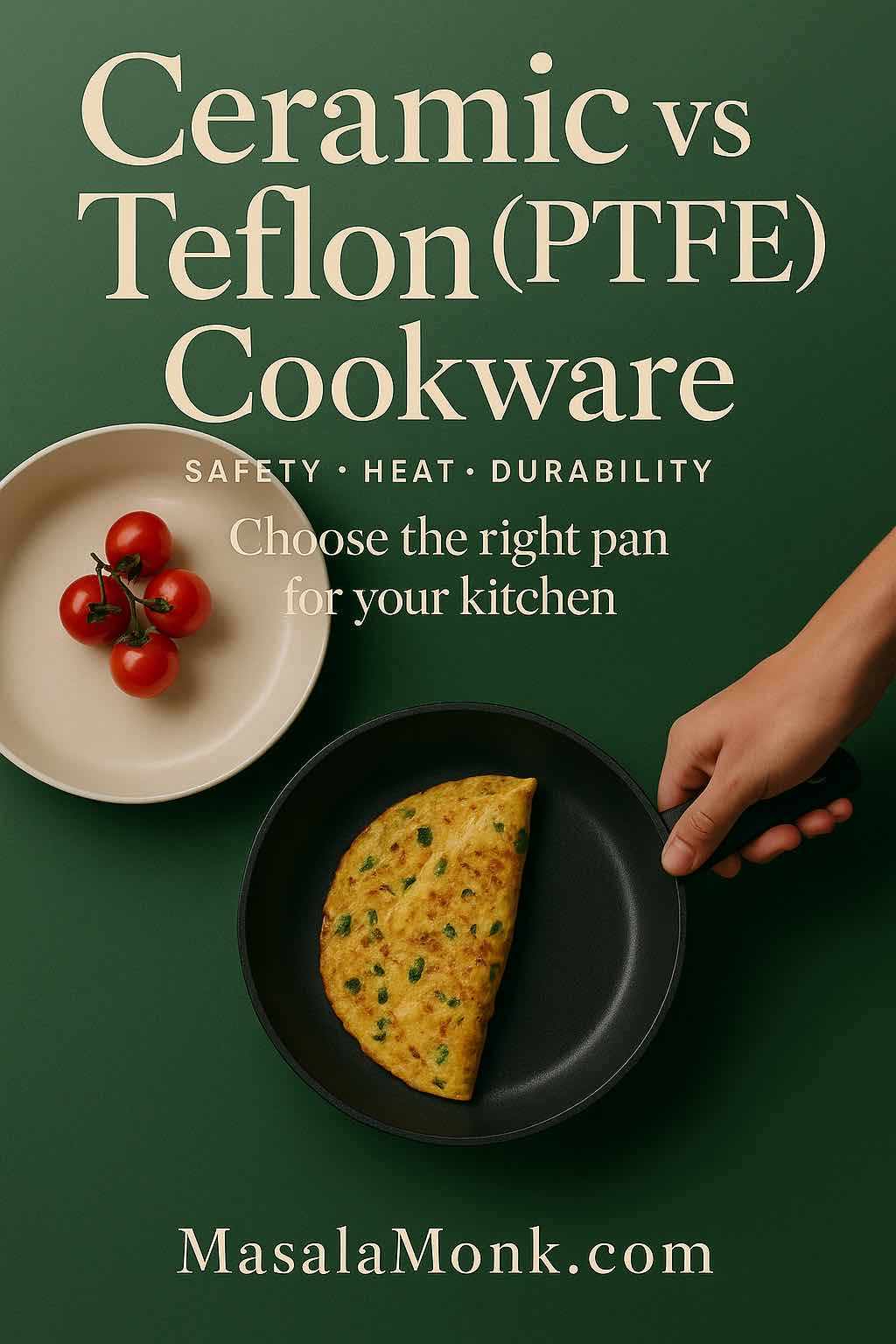
Ceramic vs Teflon (PTFE) cookware cover—hand holding a PTFE pan with omelette, beige ceramic plate with tomatoes on a green background.

Choosing between ceramic vs Teflon (PTFE) cookware shouldn’t feel like a chemistry exam, yet it often does. From the first search—ceramic vs nonstick, is ceramic better than non stick, which is better: non stick or ceramic?—you meet a maze of claims, temperature myths, and durability debates. Let’s clear the air immediately: at everyday heat, PTFE delivers the slickest glide and usually lasts longer; meanwhile, ceramic-coated (sol-gel) provides a PFAS/PTFE-free surface that many cooks prefer, even if it needs replacing sooner. Either way, respect the basic rules: avoid empty preheats and keep the pan at or below 260 °C / 500 °F (see the Teflon™ safety guidance from Chemours for practical limits and care advice: safety page).


Plain-English Glossary: what we mean by “ceramic,” “PTFE,” and “PFAS”

Before we get deeper into this blog post, it’s important to clarify and explain a few terms which are often used in the industry.

Also Read: How to Choose The Best Cookware For Your Kitchen

PTFE (often marketed as Teflon™)

  • What it is: A fluoropolymer that creates the classic low-friction non-stick surface many people call “Teflon.” (“Teflon™” is a brand; the material is PTFE.)
  • What it feels like in use: Very slick, needs little oil, and—at sensible heat—keeps releasing food for a long time.
  • Care basics: Keep it ≤ 260 °C / 500 °F, don’t preheat empty, use soft tools, hand-wash. See the brand’s safety guidance on everyday use via the Teflon™ safety page (Chemours).
  • What it is not: PFOA (an older processing aid, now phased out by major U.S. producers under the EPA program). PTFE is the coating; PFOA was a past aid, not the cooking surface.

PFAS (the big chemical family)

  • What it is: An umbrella group of fluorinated chemicals with many members; PTFE is one of them. The term covers a wide range of substances, not just cookware coatings.
  • Why you see it on labels: Policy and consumer interest have pushed brands to declare whether a product’s coating contains any fluorinated chemistry.
  • Where to learn more: The ECHA PFAS hub gives a practical overview of the family and the EU’s restriction process.

PTFE-free non-stick (what many “ceramic” pans mean)

  • What it is: A non-stick coating that does not use PTFE. Most modern examples are ceramic-coated surfaces made with a silica-based sol-gel.
  • What it feels like in use: Glass-smooth when new; over time, it usually needs a little more oil as the film wears.
  • Why choose it: You want non-stick without a fluoropolymer coating.
  • What to check: Packaging should state “PTFE-free” or “no fluoropolymer coating.” If it only says “PFOA-free,” that doesn’t automatically mean it’s PTFE-free.

Ceramic-coated / sol-gel (not pottery)

  • What it is: A thin, glass-like film baked onto a metal pan (aluminum or steel). Think of it as a hard, slick clearcoat—not a clay pot.
  • How it cooks: Responsive and smooth at first; with repeated high heat or abrasive scrubbing, the surface can become less slippery sooner than PTFE.
  • Care basics: Moderate heat, soft tools, gentle cleaning. Treat it like a finish, not armor.
  • What it is not: Traditional ceramic cookware (stoneware, porcelain). Those are thick ceramic bodies; “ceramic-coated” skillets are metal with a thin coating.

Why this glossary matters:

  • When a label says “PFAS-free,” it claims no fluorinated chemicals in the coating.
  • When it says “PTFE-free,” it means no fluoropolymer coating—but other PFAS may or may not be present unless the brand states PFAS-free explicitly.
  • When it says “PFOA-free,” that tells you a past processing aid isn’t used, but it doesn’t tell you whether the pan’s coating is PTFE or ceramic. Read the spec sheet so you’re comparing like-for-like.

Ceramic vs Teflon: the quick picture you can cook with

Non stick should make food move on your terms. Ceramic pans vs nonstick (PTFE) cookware feel similar when new; both are smooth and forgiving. However, after months of breakfasts and hurried cleanups, differences show. Ceramic’s silica-based sol-gel film can lose slickness faster with repeated heat and abrasion. Conversely, PTFE’s ultra-low surface energy keeps eggs, dosas, and crêpes gliding with less oil—so long as you keep the heat sensible. Thus, for everyday breakfast duty and delicate fish, ceramic vs Teflon typically tilts toward PTFE for longevity.

Still, the difference between ceramic and non stick isn’t only performance. It’s also chemistry and comfort level. If you want to avoid PFAS entirely, ceramic makes that easier. If you care most about a low-friction glide that stays stable, PTFE is the pragmatic choice.

Also Read: Perfect Dosa Idly Batter: Your Guide to Fluffy Idlis and Crispy Dosas


What these coatings really are (and why that matters)

Ceramic vs nonstick: the materials story

Ceramic non stick isn’t pottery. It’s a thin sol-gel coating—think a glass-like network—applied over metal. Because it cures into a hard film, it feels crisp and clean out of the box. Even so, the film ages: repeated heating and scouring raise surface roughness, and the pan demands a touch more oil. That’s why you often hear ceramic frying pan vs non stick stories that begin with “amazing at first” and end with “fine, but less slippery.”

PTFE vs ceramic: the low-friction advantage

PTFE is a fluoropolymer known for exceptionally low surface energy. Consequently, food releases with minimal force and keeps doing so across many cycles. Respect its ceiling—260 °C / 500 °F—and never preheat empty. Follow those habits and a PTFE skillet usually retains slickness longer than a comparable ceramic pan. For brand-side clarity on limits and myths, see Teflon™ Myths & FAQ (here).

Also Read: The Copper Cookware Journey


Safety made plain: heat, PFOA, and what changed recently

Heat sanity check: Keep any non-stick at or below 260 °C / 500 °F. Don’t preheat empty. Use ventilation. Those three habits keep you well below temperatures where PTFE begins to fume and where any coating—PTFE or ceramic—ages fast.

Ceramic vs Teflon safety: first principles

Two points simplify the anxiety. First, PTFE ≠ PFOA. PTFE is the non stick coating; PFOA was a legacy processing aid. In the United States, major producers phased out PFOA under the EPA’s 2010/2015 PFOA Stewardship Program; the agency’s summary sits here: EPA fact sheet. Hence, modern branded PTFE cookware is generally made without PFOA.

Second, classification headlines need context. In December 2023, the International Agency for Research on Cancer (IARC) evaluated PFOA as carcinogenic to humans (Group 1) and PFOS as possibly carcinogenic (Group 2B). The 2025 Volume 135 page expands details (see IARC’s news note and Volume 135). That assessment addresses PFOA/PFOS exposure, not typical use of today’s PFOA-free PTFE pans.

Also Read: Buying a Cast Iron Skillet? 5 Warnings Before You Invest

Heat control: where ceramic vs non stick actually converges

In practice, both coatings demand moderate burners. Clinical and manufacturer sources align: PTFE can begin to fume near 260 °C / 500 °F; polymer-fume fever in people typically appears around 350 °C / 662 °F, and pyrolysis accelerates above ~400 °C / 752 °F. Therefore, cook low-to-medium, use your hood, and avoid empty preheats. A concise clinical summary lives on StatPearls / NCBI Bookshelf: polymer fume fever. Ceramic coatings, while PFAS-free, also suffer with sustained high heat; their film roughens and release declines. In short, ceramic vs non stick is less about “which survives abuse” than “which you treat kindly.”


Ceramic pans vs nonstick in real kitchens: how performance ages

Ceramic non stick vs non stick (PTFE): month-two and beyond

The first weeks often feel close. A ceramic pan vs non stick PTFE skillet both flip omelettes and glide pancakes. Gradually, though, ceramic’s sol-gel surface needs more fat to prevent micro-sticking. Meanwhile, PTFE keeps its advantage—provided you stick to the basics: ≤ 260 °C / 500 °F, soft tools, and hand-washing. That’s why ceramic nonstick vs regular nonstick discussions usually land on a simple conclusion: ceramic for PFAS-free, PTFE for long-term glide.

Ceramic coated pans vs Teflon: searing, saucing, and fond

What about dinner? Searing steaks or using a broiler is rough on any non stick. Here, ceramic cookware vs Teflon vs stainless steel becomes an easy triangle: stainless (or carbon steel) for the high-heat sear and fond, then PTFE (or ceramic) for sticky sauces and delicate finishes. Rather than forcing one pan to do everything, assign roles and watch the coatings last longer.


Substrate matchups: ceramic non stick vs stainless steel, aluminum, and more

Ceramic non stick pans vs stainless steel

Uncoated stainless excels at browning, Maillard depth, and pan sauces. It does not promise effortless release. Consequently, ceramic vs non stick cookware is really a choice between coated convenience and uncoated versatility. Many cooks keep both: a stainless sauté for fond and a PTFE skillet for eggs.

Ceramic non stick vs aluminum non stick (and vs stainless steel)

Bare aluminum spreads heat evenly but typically receives a coating to become non stick. Therefore, ceramic non stick vs aluminum non stick usually reduces to coating type (sol-gel vs PTFE) and quality. If you want a PFAS-free message, pick ceramic; if you want longevity, PTFE still tends to prevail—again, at sensible heat.

Also Read: Classic vs. Authentic Alfredo: 5 Essential Recipes


Air fryers, griddles, and specialty appliances

Ceramic vs Teflon air fryer: respect the hotspots

Air fryers introduce another variable: proximity to heating elements. Local hotspots can exceed your setting near the coil. Consequently, ceramic vs Teflon air fryer comparisons need caution. Choose PTFE for the slickest cleanup if you run conservative temps; choose ceramic for PFAS-free peace of mind. In both cases, stick to the appliance rating, avoid metal tools, and clean with non-abrasive pads.

Ceramic griddle vs nonstick griddle; ceramic vs non stick skillet

Flatbreads, pancakes, and sandwiches highlight small technique differences. A nonstick griddle with PTFE often keeps a wider comfort zone over months of use. A ceramic griddle works well early and still performs later with a bit more oil. Likewise, a ceramic vs non stick skillet shows the same arc: similar at first, diverging slowly as cycles accumulate.

Also Read: 12 Common Air Fryer Mistakes You Could Be Making


Marketing language, decoded without the hype

Ceramic coated cookware vs Teflon; ceramic vs Teflon vs granite; titanium and friends

Labels sound fancy. “Granite,” “diamond,” and “titanium” often refer to reinforcements or brand families—not necessarily different base chemistries. Hence, ceramic coated vs non stick is a structural question: Is this sol-gel ceramic or PTFE? Read the tech sheet, not just the box.

GreenPan vs Teflon; Greblon coating vs Teflon; George Foreman ceramic vs Teflon

Brand lines evolve across years and models. Some Greblon lines are PTFE; others are ceramic. Some “eco-ceramic” lines are sol-gel. Even George Foreman grills have used different finishes. Therefore, confirm the current coating on the exact model you plan to buy.

Ceramic coated vs ceramic cookware; ceramic vs ceramic coated cookware; ceramic vs non ceramic

Strictly speaking, “ceramic cookware” might mean pottery or stoneware. Most “ceramic non stick” skillets are metal pans with a ceramic-like sol-gel film. Meanwhile, ceramic vs non ceramic usually means “coated vs uncoated.” As a result, define your terms first, then compare like-for-like.


Heat habits that actually extend lifespan (for both coatings)

Because routine beats marketing, build a short ritual that protects either surface:

  1. Preheat briefly on low–medium, not full blast. Give the pan 10–20 seconds, then add fat and food.
  2. Respect the ceiling—≤ 260 °C / 500 °F. The figure appears in manufacturer guidance and plain-language explainers; see Teflon™ safety for the brand view (safety page).
  3. Cool before cleaning. Thermal shock fatigues both coating and base.
  4. Use soft tools. Wood, silicone, or nylon on the cooktop; non-abrasive pads in the sink.
  5. Retire damaged pans. Deep scratches, flaking, or rough patches signal the end of the line.

With those habits, ceramic vs Teflon becomes a calm, predictable choice rather than a noisy argument.

Also Read: 10 Examples of Egg Dishes, with 2 Eggs


Regulations in 2025: why labels keep shifting

Policy never flips your omelette, yet it shapes packaging and claims. In the European Union, a broad PFAS restriction continues to advance. The European Chemicals Agency (ECHA) announced a timeline in August 2025 and aims to complete the scientific evaluation by end-2026; track updates via the timeline announcement and the PFAS hot-topics hub.

In the United States, the federal anchor is the earlier PFOA phase-out, but states diverge. In October 2025, California’s governor vetoed a bill that would have broadly banned PFAS in cookware and several other product categories, citing concerns over affordability and scope. For coverage and reactions, see The Guardian’s reporting (story 1, story 2). Expect more “PFAS-free” claims, stricter documentation requests from retailers, and a steady shift in brand language.


Buying quickly, but wisely (without turning it into a spreadsheet)

Here’s a simple, narrative way to decide—no checkboxes, just honest alignment with how you cook:

  • If your day starts with eggs or crêpes, and you want results with little oil, PTFE is the path of least resistance. Months later, it still glides—assuming you respect heat.
  • If you value PFAS/PTFE-free cookware above all, ceramic fits your priorities. You’ll likely add a little more fat after a while and replace the pan sooner; nonetheless, you’ll feel good about the chemistry profile.
  • If you sear hard or broil often, neither coating is ideal for that step. Use uncoated cast iron or carbon steel for the high-heat moment, then move to PTFE vs ceramic for sticky sauces and gentle finishes.
  • If you love one-pan dinners, PTFE gives you the widest margin for error at moderate heat. Ceramic can do it too; it simply rewards a gentler burner and softer cleaning.
  • If you batch-cook on a griddle, a nonstick (PTFE) griddle tends to keep a forgiving surface across months of use. A ceramic griddle works well early and remains useful later with slightly more oil.

In short, the answer to is ceramic cookware better than nonstick or is ceramic better than Teflon becomes personal: do you prize chemistry or longevity?

Also Read: Top 10 Iron Rich Vegetables to Help Cure Anemia & Boost Hemoglobin


Final word: put your pan where it performs

After all the research, ceramic vs Teflon (PTFE) cookware comes down to how you cook, not just what the box promises. For the slickest glide and the longest non stick life at everyday heat, PTFE remains the practical winner. For a PFAS/PTFE-free option that shines on low–medium burners, ceramic delivers—just expect a shorter slickness window. Either way, technique beats hype. Preheat with patience. Ventilate. Use soft tools. Hand-wash. Retire tired pans. With that rhythm, ceramic vs non stick stops being a debate and becomes a calm, confident choice that fits your kitchen.


FAQs

1) Is ceramic cookware better than nonstick?

In short, it depends on what you value. Ceramic (sol-gel) is PTFE-free and feels glass-smooth when new; however, it usually loses slickness sooner. Traditional nonstick (PTFE) stays slippery longer at everyday heat; conversely, it isn’t ideal for very high-heat searing. Choose chemistry preference (ceramic) or longevity/slickness (PTFE).

2) Which is better: non stick or ceramic?

Generally, for eggs, crêpes, and delicate fish, PTFE wins on effortless release and lifespan. Ceramic still works beautifully at low–medium heat; nonetheless, expect to use a touch more oil as months pass.

3) Ceramic vs Teflon (PTFE) Cookware: what’s the real difference?

Ceramic uses a silica-based sol-gel film baked onto metal; Teflon (PTFE) is a fluoropolymer coating. Moreover, ceramic is PTFE-free; PTFE is the classic ultra-low-friction surface that tends to last longer when used within temperature limits.

4) Ceramic pans vs nonstick: which lasts longer?

Typically, PTFE lasts longer in day-to-day kitchens. Ceramic can still serve well; even so, repeated high heat and abrasive cleaning shorten its slickness window faster.

5) PTFE vs ceramic: which is safer?

Both are considered safe at normal cooking temperatures when used correctly. Therefore, keep heat moderate, avoid empty preheats, ventilate, and retire damaged pans. Safety hinges more on how you cook than on the logo.

6) Ceramic coated pans vs Teflon: do I need different care?

Yes—though there’s overlap. Use soft tools, hand-wash, and avoid harsh scourers. Additionally, keep either type at sensible heat; ceramic, especially, benefits from gentle burners and non-abrasive cleaning.

7) Are ceramic frying pans better than Teflon for breakfast?

Often not over time. PTFE’s lower sticking threshold helps omelettes glide with less oil month after month; ceramic works early on, yet gradually needs more fat. Consequently, many breakfast-heavy cooks prefer PTFE.

8) Ceramic cookware vs non stick: which handles searing?

Neither coating loves intense searing or broilers. Instead, use uncoated cast iron or carbon steel for high-heat tasks; then, return to ceramic or PTFE for sticky sauces and gentle finishes.

9) Does ceramic cookware have Teflon?

No—“ceramic-coated” typically means PTFE-free. Importantly, confirm you’re buying a ceramic (sol-gel) coating rather than a ceramic-sounding marketing name over PTFE.

10) Ceramic cookware vs Teflon vs stainless steel: when should I use each?

Think in roles. Stainless excels at browning and fond; PTFE rules easy release; ceramic offers a PTFE-free option for moderate heat. Ultimately, a mixed toolkit covers every job.

11) Ceramic frying pan vs non stick pan: which is more heat tolerant?

Marketing can imply high tolerance; however, real-world guidance for both is similar: moderate burners, no empty preheats, and avoid direct flames licking the sides. Exceeding limits ages any coating quickly.

12) Ceramic non stick vs aluminum non stick vs stainless steel—what’s the difference?

Aluminum is a great heat conductor but needs a coating (ceramic or PTFE) for release. Stainless is uncoated and excels at searing; similarly, it demands technique to prevent sticking. Consequently, pick based on recipe and cleanup needs.

13) Ceramic or non stick: which is better for low-oil cooking?

For sustained low-oil cooking, PTFE usually maintains glide with less fat. Ceramic can deliver low-oil results when new; nonetheless, a little extra oil may be needed as the coating ages.

14) Ceramic vs Teflon (PTFE) cookware: which coating is more durable with daily use?

PTFE generally resists sticking for longer under repeated cooking and gentle cleaning. Ceramic durability improves if you keep heat modest, avoid stacking scratches, and wash softly.

15) Ceramic nonstick vs regular nonstick: is there a taste or odor difference?

Usually no. However, overheating any coating can produce off-odors and faster wear. Therefore, stay within recommended temperatures for clean flavors and longer life.

16) Ceramic vs non stick skillet: what size and base should I buy?

Choose a flat, thick base for even heat—28–30 cm suits most homes. Additionally, ensure the base matches your cooktop (including induction if needed). A snug lid helps with gentle finishes on either coating.

17) Ceramic vs Teflon air fryer baskets: which cleans easier?

PTFE baskets often wipe clean with less effort, especially after months of use. Ceramic baskets clean well when new; even so, avoid abrasives and keep temps within the appliance rating to preserve slickness.

18) Ceramic coated cookware vs Teflon: will acidic foods damage them?

At moderate heat, tomato sauces and citrus are fine on both. Conversely, prolonged high heat is tougher on any coating—keep flames reasonable and stir often.

19) Is ceramic coating better than Teflon for health?

If your priority is avoiding fluoropolymer coatings altogether, ceramic aligns with that preference. Otherwise, at everyday temperatures and with good ventilation, both are considered safe when used as directed.

20) Ceramic vs non stick griddle: which is best for pancakes and dosa?

Over months, a PTFE griddle usually keeps a wider margin for error and needs less oil. Ceramic still works; nonetheless, expect to refresh with a light oil film as the surface ages.

21) Ceramic vs Teflon vs “granite” or “titanium”: are those different chemistries?

Often those words are brand lines or reinforcements, not a new base chemistry. Consequently, verify whether the pan uses PTFE or ceramic underneath the marketing term.

22) Ceramic coated vs ceramic cookware: are they the same?

No. “Ceramic-coated” skillets are metal pans with a thin glass-like film. “Ceramic cookware” can also mean pottery/stoneware. Different materials, different behavior.

23) Is ceramic non stick better than Teflon for beginners?

Beginners often find PTFE more forgiving because it releases with less oil and tolerates small timing errors. Even so, ceramic suits beginners who keep heat modest and clean gently.

24) Which lasts longer: ceramic non stick pan vs Teflon (PTFE) cookware pan?

All else equal, PTFE pans tend to outlast ceramic in non-stick performance at everyday heat. Therefore, if longevity is your top priority, PTFE is the safer bet.

25) Ceramic vs non stick cookware: what’s the smartest combo for a small kitchen?

Go with a PTFE skillet for breakfast and quick, sticky dishes; add one uncoated pan (stainless or cast iron) for searing and oven work. Meanwhile, if you want a PTFE-free option, keep a ceramic skillet for low–medium tasks. This trio covers nearly everything without clutter.


Further reading (already linked inline)

Posted on 5 Comments

12 Common Air Fryer Mistakes You Could Be Making

12 COMMON AIR FRYER MISTAKES YOU COULD BE MAKING

Air fryers have gone from trendy gadgets to everyday essentials in just a few short years. They promise the best of both worlds — crisp, golden fries and snacks with a fraction of the oil. Whether it’s fries, samosas, pakoras, or even roasted vegetables, the air fryer has become the go-to tool for anyone who wants indulgent flavors without the guilt of deep frying.

But here’s the reality check: owning an air fryer doesn’t automatically guarantee perfect results. Many first-time users — and even seasoned home cooks — find themselves frustrated. Instead of crunchy fries, they end up with soggy sticks. Instead of juicy chicken, they pull out pieces that are dry outside and raw inside. Sometimes the fryer smokes, smells odd, or just doesn’t deliver the promised magic.

Sound familiar? If so, you’re not alone. The truth is that air fryers aren’t foolproof. They’re powerful tools, but like any tool, they only shine when you use them correctly. The smallest mistakes can have a big impact — from overcrowding the basket to skipping the preheat, from choosing the wrong oils to ignoring safety basics.

The good news? These mistakes are easy to fix. With a little know-how, you’ll start producing crispy, delicious, healthy results every time. That’s why we’ve put together this guide: to walk you through the 12 most common air fryer mistakes and, more importantly, show you how to avoid them.

So let’s start by understanding how this kitchen wonder actually works.


🍳 Understanding Your Air Fryer: How It Works & Why Mistakes Happen

To get the best out of your air fryer, it helps to know what’s happening inside it. Unlike deep frying, where food is submerged in hot oil, or baking, where heat radiates slowly from oven walls, air fryers use a powerful heating element and a high-speed fan to push hot air around your food.

This process mimics frying by creating the Maillard reaction — the browning effect that gives fries their crunch and roasted chicken its golden color. The magic lies in air circulation. When food is surrounded by rapidly moving hot air, the surface crisps while the inside stays moist.

But this efficiency also makes air fryers less forgiving:

  • Airflow is everything. Block it, and food won’t crisp.
  • Moisture matters. Extra water leads to steaming, not frying.
  • Temperature precision is key. Air fryers heat fast, so even small mistakes can overcook food.
  • Surface contact counts. Oil, seasonings, and basket setup affect results.

Understanding these principles makes the common mistakes much clearer. Overcrowding stops airflow. Skipping preheating delays crisping. Using too much oil smothers food instead of helping it brown.

Now, let’s dive into the 12 biggest mistakes air fryer users make — and the simple fixes that will change your cooking game forever.


❌ Mistake #1: Overcrowding the Basket

The Problem: Many try to save time by piling food into the fryer basket.

The Consequence: Overcrowding blocks air circulation. Fries end up limp, chicken undercooked, and veggies taste steamed instead of roasted.

The Fix: Cook in smaller batches. Keep food in a single layer with space between pieces. If you need to cook a lot, it’s better to do two quick rounds than one disappointing big batch. Racks can help you layer food while keeping air flowing.

Pro Tip: Shake the basket halfway through to give every piece a chance at golden crispness.


❌ Mistake #2: Skipping the Preheat

The Problem: People assume air fryers don’t need preheating because they’re small.

The Consequence: Without preheating, food cooks unevenly. Fries go limp, breading won’t set, and meats release moisture before crisping.

The Fix: Preheat your fryer for 3–5 minutes before adding food. Many models have a preheat function; if not, run it empty at your target temperature.

Pro Tip: Preheating shortens cooking time and ensures consistent results.


❌ Mistake #3: Forgetting to Shake or Flip

The Problem: Air fryers push hot air from the top down, so the bottom layer cooks slower.

The Consequence: Food ends up browned on one side and pale on the other. Fries clump together, and proteins cook unevenly.

The Fix: Shake or flip food halfway through. Smaller foods like fries just need a quick shake; larger foods like chicken thighs need flipping with tongs.

Pro Tip: Use your fryer’s halfway timer beep (if it has one) as a reminder.


❌ Mistake #4: Using the Wrong Amount of Oil

The Problem: Some avoid oil entirely, while others overdo it.

The Consequence: No oil = dry, baked texture. Too much oil = soggy, greasy results that smoke.

The Fix: Use just 1–2 teaspoons per batch. Toss food in oil before cooking or mist with a refillable spray bottle for even coverage.

Pro Tip: Apply oil to the food, not the basket — it’s more effective.


❌ Mistake #5: Not Cleaning After Every Use

The Problem: People assume the fryer only needs occasional cleaning.

The Consequence: Grease and crumbs burn during the next use, causing smoke, bad smells, and bitter flavors. Over time, residue damages the coating.

The Fix: Clean after every session. Let it cool, then wash or wipe the basket and drawer. Do a deep clean weekly. Avoid metal scrubbers that scratch.

Pro Tip: Use parchment liners or silicone mats to make cleanup easier, but don’t skip cleaning.


❌ Mistake #6: Cooking at the Wrong Temperature

The Problem: Many crank the fryer to max heat or play it too safe with low temps.

The Consequence: Too hot burns the outside while leaving the inside raw. Too low makes food limp and chewy.

The Fix: Follow tested air fryer recipes. As a general rule, reduce oven temps by 20°C and cooking times by 20–25%. Use a thermometer for meat.

Pro Tip: Start hot for searing, then lower the temperature to finish cooking evenly.


❌ Mistake #7: Not Drying Food First

The Problem: Damp veggies, potatoes, or marinated meats go straight into the fryer.

The Consequence: Extra moisture turns to steam, preventing crisping. Fries taste boiled, meats go rubbery, veggies soften instead of roasting.

The Fix: Pat food dry before seasoning and cooking. For marinated items, let them rest so excess liquid drains.

Pro Tip: Dry food holds seasonings better, giving more flavor and crunch.


❌ Mistake #8: Using Aerosol Spray Cans

The Problem: Aerosol sprays like PAM are convenient but contain propellants.

The Consequence: These chemicals break down nonstick coatings, causing sticking and shortening your fryer’s life.

The Fix: Use a refillable oil mister with natural oils like olive, avocado, or ghee.

Pro Tip: Mist food lightly, not heavily — a thin coat is enough.


❌ Mistake #9: Ignoring Food Size & Cut

The Problem: Ingredients are cut into random shapes and sizes.

The Consequence: Thin pieces burn while thick pieces stay raw. Fries, for example, turn out uneven if sizes vary.

The Fix: Cut food into uniform sizes. Use slicers or cutters for consistency.

Pro Tip: Smaller, evenly cut pieces crisp faster — adjust time accordingly.


❌ Mistake #10: Limiting Yourself to Frozen Foods

The Problem: Many only use fryers for frozen fries or nuggets.

The Consequence: This limits the fryer’s true versatility. It can roast, bake, toast, and even dehydrate.

The Fix: Try new recipes — roasted veggies, chickpeas, paneer tikka, muffins, or reheating leftovers.

Pro Tip: Air fryers reheat pizza or parathas far better than a microwave — crisp, not soggy.


❌ Mistake #11: Neglecting Safety Setup

The Problem: Fryers are often placed against walls, under cabinets, or on unstable surfaces.

The Consequence: Poor ventilation risks overheating. Weak surfaces can warp or melt.

The Fix: Place on a flat, stable, heat-safe surface with 6 inches of clearance on all sides. Always unplug after use.

Pro Tip: Allow it to cool fully before cleaning or moving to prevent accidents.


❌ Mistake #12: Skipping Accessories

The Problem: Many stick to the basket alone.

The Consequence: Without racks, skewers, or liners, you miss out on layered cooking, kebabs, muffins, and easier cleanup.

The Fix: Invest in simple accessories. Racks let you cook more at once, liners keep things tidy, and silicone molds expand your options.

Pro Tip: Skewers make kebabs or veggie sticks effortless in the fryer.


⚡ Health Tips for Smarter Air Frying

  • Choose the right oils: Avocado, olive, mustard oil, or ghee work best for health and high smoke points.
  • Avoid over-relying on frozen foods: Whole foods like veggies, beans, and proteins give better nutrition.
  • Watch your portions: Air-fried food is lighter, but calories still add up. Balance with roasted vegetables or salads.

🔥 Safety Tips Every User Should Know

  • Leave 6 inches of clearance around the fryer.
  • Place it on a flat, heat-resistant surface.
  • Let it cool before cleaning.
  • Always unplug after use.

🚫 What NOT to Air Fry

  • Wet batters → they drip and burn.
  • Leafy greens → they blow around and scorch.
  • Uncoated cheese → melts into a mess.
  • Popcorn → cooks unevenly, risks burning.

🎯 Conclusion: Master Your Air Fryer

The air fryer is one of the most versatile tools in your kitchen — but only if you use it right. By avoiding these 12 common mistakes, following smart health tips, and respecting basic safety rules, you’ll transform soggy, disappointing batches into crispy, golden, healthy meals.

Air frying isn’t just about convenience — it’s about unlocking new possibilities. From snacks to mains to reheated leftovers, your fryer can do far more than you think. Once you master these basics, you’ll wonder how you ever lived without it.

So go ahead, preheat that basket, spread out those fries, and give your food the space and care it deserves. Perfect crunch is waiting.


❓ Frequently Asked Questions (FAQs) About Air Fryers

1. Do you need to preheat an air fryer every time?

Yes, most recipes benefit from preheating. It ensures the basket is hot before food goes in, which helps create a crispy outer layer and reduces cooking time. Skipping preheat often leads to soggy or uneven results.


2. Can you put aluminum foil or parchment paper in an air fryer?

Yes, but with care. Use perforated parchment paper or poke holes in foil so air can circulate freely. Avoid covering the entire basket surface, or you’ll block airflow and reduce crisping.


3. Why does my air fryer smoke?

Excess oil, greasy foods, or leftover crumbs from previous cooking are the usual culprits. Clean the basket regularly, avoid using too much oil, and choose oils with high smoke points like avocado or peanut oil.


4. Can you cook raw meat in an air fryer?

Absolutely. Chicken, fish, kebabs, and even steak can be cooked from raw in the fryer. Just ensure you use a food thermometer to check the internal temperature for safety.


5. Why are my fries soggy in the air fryer?

The most common reasons are overcrowding, skipping preheating, or not drying the potatoes before cooking. Always cut evenly, pat them dry, toss with a little oil, and spread them in a single layer for the crispiest fries.


6. What foods should not be cooked in an air fryer?

Avoid wet batters (like tempura), leafy greens (they fly around and burn), loose cheese, and popcorn. These either don’t cook well or can damage your fryer.


7. How much oil do you really need in an air fryer?

Usually 1–2 teaspoons per batch. A light misting or toss is enough to help food crisp without making it greasy. Too much oil creates smoke and soggy textures.


8. Can you bake in an air fryer?

Yes! Muffins, cupcakes, small cakes, and cookies all bake beautifully in air fryers. Use silicone molds or small pans that fit in the basket. Just remember, cooking time will usually be shorter than in an oven.


9. Do air fryers use a lot of electricity?

No, they’re energy efficient. Air fryers heat up quickly and cook faster than ovens, which means they generally use less power overall.


10. How often should you clean your air fryer?

Clean the basket and drawer after every use to prevent grease buildup. Do a deeper clean once a week, wiping down heating elements and the interior to keep it in top shape.

Posted on 2 Comments

Philips HD9200/90 Air Fryer Review

PHILIPS HD9200/90 AIR FRYER

If you’re looking for a compact, easy-to-use, and reliable air fryer for your Indian kitchen, the Philips HD9200/90 Air Fryer is one of the top-rated and best-selling choices on Amazon India. Is it worth the money? Let’s explore its real-world pros and cons, deep-dive into Indian recipes, address cleaning and maintenance, and reveal what everyday users think after months of use.


Philips HD9200/90 Air Fryer: Overview & Key Features

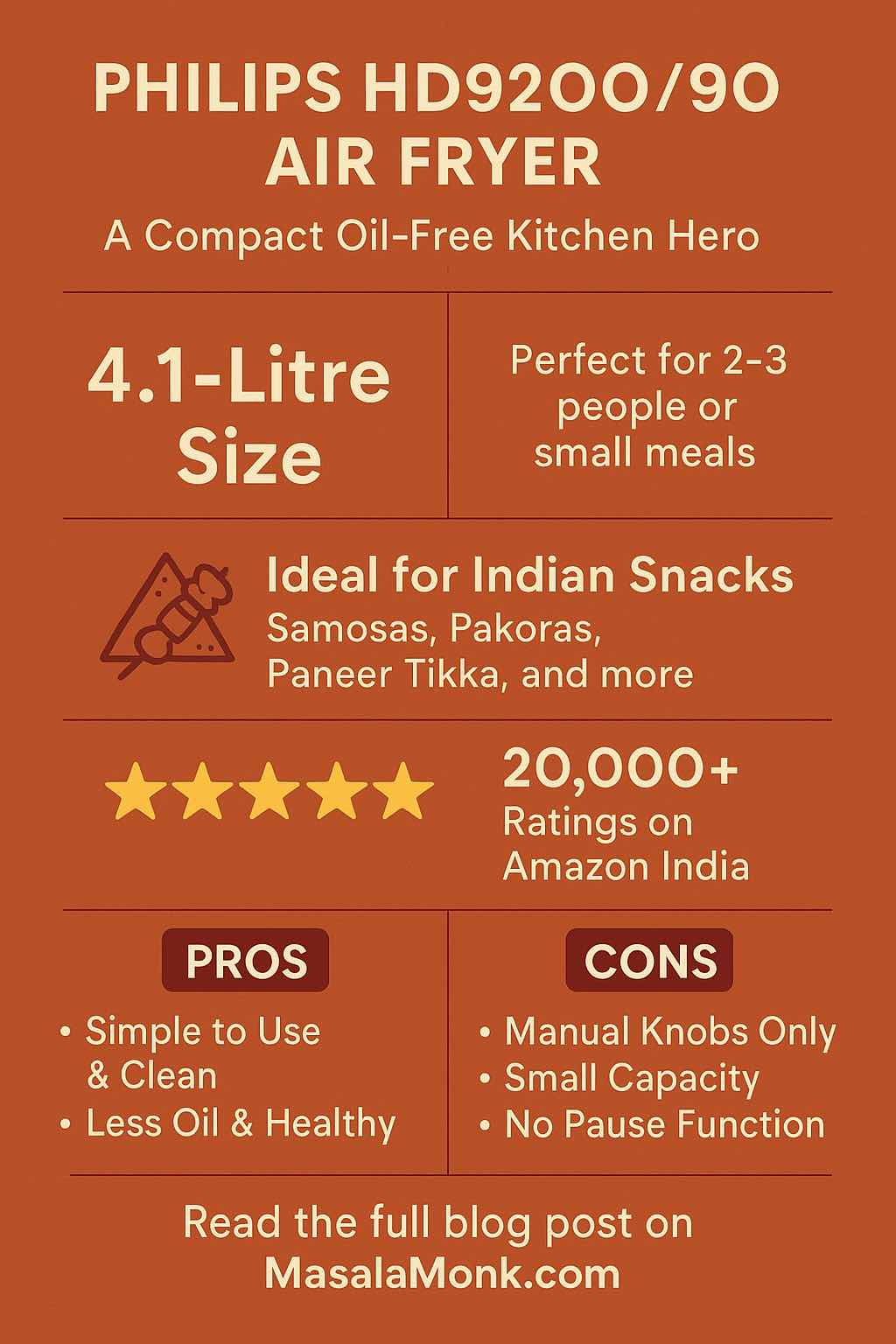
The Philips HD9200/90 Air Fryer is designed for small families and health-conscious individuals who want crispy snacks and meals with up to 90% less oil.
Here’s what stands out:

  • Capacity: 4.1 litres — enough for 2-3 people (about 8 samosas or 600g fries per batch)
  • Power: 1400W with Philips Rapid Air Technology for even cooking
  • Controls: Simple manual knobs for temperature (80–200°C) and timer (up to 60 min) with auto shut-off
  • Basket: Removable, non-stick, and dishwasher-safe
  • Cord: 1.8 meters for easy countertop placement
  • Warranty: 2 years (India-wide support)

Indian User Experiences: What Are Real Amazon Buyers Saying?

Highly Rated on Amazon India (4.3★, 6,000+ Ratings)

Best for Indian Snacks, Small Meals & Everyday Use

“This Philips HD9200/90 Air Fryer has become a staple in our kitchen for oil-free samosas, fries, and even chicken tikka. Quick and healthy!”
— Amazon Verified Purchase, April 2024

“You get perfectly crisp results with minimal oil. We made aloo tikki, paneer tikka, even reheated leftover pizza. It’s compact and fits well on a small counter.”
— Amazon Customer, Mumbai

Healthier Eating, Less Mess

“Kids love the fries and nuggets, and I love that I’m not deep-frying. Cleaning the basket is very easy—just a quick rinse or into the dishwasher.”
— Amazon Review, Bengaluru

Simple to Use, but Some Minor Gripes

“Manual knobs are basic but work fine. Markings are a bit small. Wish it had a pause function but for the price, it’s a steal.”
— Amazon Customer, Pune

“Perfect for a small family. If you have a big group, you’ll need to cook in batches. No oil smell in the kitchen, no greasy pans.”
— Amazon Review, Delhi


How the Philips HD9200/90 Air Fryer Performs for Indian Cooking

The Philips HD9200/90 Air Fryer is especially popular with Indian households because it handles a wide range of snacks and small meals, including:

  • Samosas & Pakoras: Get golden and crisp with just a brush or spray of oil. Pre-made frozen snacks cook beautifully.
  • Paneer Tikka & Tandoori Chicken: Marinated paneer or chicken turns out juicy inside and charred outside at 180-200°C.
  • French Fries & Potato Wedges: Soak, pat dry, toss with a spoon of oil, and you’ll get crispy fries every time.
  • Roasted Peanuts & Chana: 7-8 minutes at 180°C, stir once mid-way, and you get perfectly roasted munchies.
  • Reheating Parathas, Pizza, & Rolls: Far better than microwaving—restores the crunch!

Recipe Tip:

Always preheat the Philips HD9200/90 Air Fryer for 2-3 minutes for best results, especially with tikkis and fries. Don’t overcrowd the basket—single layer gives the best crunch.


Cleaning & Maintenance: Is It Easy?

This air fryer is designed for real Indian kitchens—where masalas, oil, and sticky batters are daily reality.

  • Basket is non-stick and dishwasher-safe.
  • Just wait 15-20 min after cooking, remove the basket, and wipe out any oil or crumbs.
  • If cooking heavily marinated items (like tandoori), wipe the heating coil area with a damp cloth once it’s cool.
  • Most users report it stays odor-free and grease-free with basic daily care.

“I just rinse the basket under water after every use—sometimes with a soft brush. Super easy, way easier than cleaning a kadhai or deep-fry pan.”
— Amazon User, Jaipur


Pros & Cons Table

ProsCons
Compact—perfect for 2-3 peopleManual timer/temperature controls only
Cooks Indian snacks, mains, and reheat dishesNo pause or alert mid-cycle
Up to 90% less oil—healthy, guilt-freeNot for large families or parties
Cleans easily—dishwasher safe and non-stick basketKnob markings are small for some users
2-year Philips India warranty, strong supportCan be noisy (timer “tick-tock” sound)
Highly rated—over 20,000+ reviews on Amazon IndiaBaking cakes/bread is possible but limited
Affordable compared to larger air fryer models
Pros and Cons of this Philips Air Fryer

Actionable Advice: How to Get the Most from Your Philips HD9200/90 Air Fryer

  1. Preheat for 2-3 minutes for best crispiness (especially with potatoes and tikkis).
  2. Toss or spray with a little oil for extra crunch—don’t overdo it, a teaspoon goes a long way!
  3. Don’t overcrowd—cook in a single layer for even browning.
  4. Flip or shake halfway—especially for paneer, fries, and nuggets. Just pull out the basket, shake, and continue.
  5. Wipe out any residue after each use—especially after cooking oily or marinated foods.
  6. Try new recipes! Many users have succeeded with roasted veggies, grilled fish, and even reheating rotis.

Who Should Buy the Philips HD9200/90 Air Fryer?

  • Perfect for: Students, working couples, health-conscious singles, or small families (2-3 people) who want fast, easy, and healthy snacks.
  • Not ideal for: Large families, party hosts, or those wanting digital controls and alerts.

Final Word: Why It’s a Best-Seller on Amazon India

With its compact design, healthy results, easy cleaning, and trusted brand backing, the Philips HD9200/90 Air Fryer is an excellent choice for most Indian households.
You can check hundreds of video reviews and recipe demos online—all pointing to the same verdict: it’s a genuine kitchen upgrade if you want to eat better, faster, and cleaner.

Ready to make the switch to oil-free, crispy snacking?
Buy the Philips HD9200/90 Air Fryer on Amazon India →


(Affiliate Disclosure: If you purchase through our link, we may earn a small commission at no extra cost to you—this helps us keep bringing you honest reviews and tips.)

Explore More Air Fryer Reviews You’ll Love:

FAQs for Philips HD9200/90 Air Fryer

1. What is the actual capacity of the Philips HD9200/90 Air Fryer?
It has a 4.1-litre basket, which is perfect for 2–3 people. You can cook about 8 samosas, a batch of fries, or several nuggets at once.


2. Can I make Indian snacks like samosas and paneer tikka in this air fryer?
Yes! The Philips HD9200/90 Air Fryer is well-loved for samosas, pakoras, paneer tikka, roasted peanuts, and more. Just use a light spray or brush of oil for best results.


3. Does the air fryer require preheating?
While not always necessary, a quick 2–3 minute preheat helps make snacks like tikkis, fries, and kebabs extra crisp.


4. Is the basket easy to clean?
Yes! The non-stick basket of the Philips HD9200/90 Air Fryer is dishwasher safe. Most users find it much easier to clean than a traditional kadhai or frying pan.


5. Can I bake cakes or bread in this model?
It’s mainly designed for snacks and roasting. Baking is possible for small cakes, but the manual controls and compact size make it less ideal for regular baking.


6. What kind of plug/outlet does it require?
It uses a standard Indian 16A power socket due to its 1400W rating. Avoid plugging into old or overloaded power strips.


7. Is there a pause button or digital display?
No, the Philips HD9200/90 Air Fryer uses manual knobs for time and temperature—simple, but without pause or alerts.


8. How do I avoid food sticking to the basket?
Use a little oil spray and don’t overcrowd the basket. For sticky batters, consider parchment paper or an air fryer liner.


9. Does it make noise or create a smell?
There’s a “tick-tock” sound from the timer, but it’s not very loud. No lingering oil smells if you clean regularly. Smoking only happens if grease builds up.


10. Is the Philips HD9200/90 Air Fryer worth it compared to cheaper brands?
Yes, if you want better durability, real warranty support, and trusted results. It’s a best-seller for a reason—most Indian users find it delivers healthy, tasty snacks with far less effort than traditional frying.

Posted on Leave a comment

Mastering the Art of Soft Serve Ice Cream

Diving into the world of soft serve ice cream is like embarking on a deliciously frosty adventure where science meets culinary art. For those of us who’ve always wondered why soft serve has that perfect creamy texture and how we can replicate it at home or in a professional setting, the answers lie in understanding the intricate balance of ingredients, temperature, and, surprisingly, physics. This post will explore the secrets behind crafting the perfect soft serve ice cream, combining expert insights and scientific studies to elevate your frozen dessert game.

The Role of Air: Soft Serve’s Secret Ingredient

One of the defining characteristics of soft serve is its light, airy texture, which is achieved by incorporating air into the ice cream mix during the freezing process. Unlike traditional ice cream, which contains less than 30% air, soft serve can consist of up to 60% air. This not only gives it a softer consistency but also makes it feel smoother on the palate. The trick is to keep the air bubbles small and evenly distributed, a feat achieved through the precise mechanics of soft serve machines.

The Science of Freezing: Temperature Precision

Soft serve’s texture is also a result of meticulous temperature control. The mix must be kept at a temperature just below the freezing point of water, allowing it to remain soft and pliable. This delicate balance is maintained by soft serve machines, which churn the mix while keeping it at the optimal temperature for serving. The freezing process is critical; too cold and the ice cream becomes hard, too warm and it turns into a liquid mess.

Crafting the Perfect Base: Milk Matters

The base of any ice cream, especially soft serve, starts with high-quality dairy. The choice of milk can dramatically affect the taste and texture of the final product. Jersey milk, known for its high fat and protein content, is often lauded for creating a richer, creamier ice cream. However, the fat content isn’t the only factor; the treatment of the milk, including pasteurization and homogenization, can also influence flavor. Non-homogenized, batch-pasteurized milk tends to retain a more complex flavor profile, adding depth to the ice cream.

Natural Ingredients for Flavorful Innovation

In the quest for the ultimate soft serve, the simplicity of ingredients cannot be overstated. A base made from fresh, natural ingredients not only offers a health advantage but also enhances the overall taste. Incorporating real vanilla bean, fresh fruit purees, or high-quality cocoa powder can transform your soft serve from a mere dessert to a gourmet experience. Moreover, experimenting with non-traditional flavors and ingredients, such as matcha or activated charcoal, can set your soft serve apart in a crowded market.

DIY Soft Serve: Tips for Home Enthusiasts

While professional soft serve machines are the gold standard for achieving that perfect texture, home enthusiasts aren’t out of luck. For those looking to try their hand at making soft serve at home, investing in a high-quality ice cream maker with an air incorporation feature is a good start. Remember, the key to success is maintaining the right temperature and incorporating air properly. Experiment with small batches, adjusting the air and temperature settings until you find the perfect balance for your taste.

Engaging with Your Audience

Soft serve ice cream isn’t just a treat; it’s an experience. Engaging with your audience by sharing behind-the-scenes looks at your process, experimenting with flavors based on customer feedback, and even hosting soft serve-making workshops can create a community around your brand. Encourage your readers or customers to share their own soft serve stories and preferences, fostering a sense of connection and community.

Conclusion: The Delightful Science of Soft Serve

Soft serve ice cream is more than just a summer staple; it’s a testament to the fascinating interplay of science and culinary skill. By understanding the principles behind air incorporation, temperature control, and ingredient selection, anyone from professional chefs to home cooks can master the art of making this beloved treat. So next time you enjoy a cone of soft serve, take a moment to appreciate the creamy science that makes it all possible. Whether you’re experimenting in your kitchen or dreaming up the next big flavor sensation, the world of soft serve is your oyster.

10 FAQs on Mastering Soft Serve Ice Cream

1. What makes soft serve different from regular ice cream?

Soft serve is lighter and softer due to its higher air content, sometimes up to 60% of its volume, compared to regular ice cream which contains less air.

2. Can I make soft serve at home without a professional machine?

Yes, while a professional machine can give you the best texture, high-quality home ice cream makers with air incorporation features can produce a close approximation.

3. Why is Jersey milk preferred for making soft serve?

Jersey milk has a higher fat and protein content, contributing to a creamier and richer tasting soft serve.

4. How important is the temperature in making soft serve?

Extremely important; maintaining the mix at a temperature just below freezing ensures it stays soft and doesn’t freeze solid.

5. Can I use plant-based milks for making soft serve?

Yes, plant-based milks can be used, but the texture and flavor might differ from dairy-based soft serve. Experiment with different types to find the best result.

6. What are some natural ingredients I can use to flavor soft serve?

Real vanilla bean, fresh fruit purees, high-quality cocoa powder, and even spices like cinnamon can add unique and natural flavors to your soft serve.

7. How do I achieve the perfect air incorporation at home?

Use an ice cream maker that allows for air to be mixed in as it freezes the soft serve, and follow the manufacturer’s instructions for the best results.

8. Is it safe to consume soft serve made from raw milk?

Consuming products made from raw milk carries a risk of foodborne illnesses. It’s advisable to use pasteurized milk for safety.

9. How can I prevent my soft serve from becoming too icy?

Ensure your mix is cold before churning, and if your machine allows, adjust settings to minimize ice crystal formation by churning at the correct speed and temperature.

10. What’s the best way to store homemade soft serve?

Soft serve is best enjoyed immediately after it’s made, but if you must store it, keep it in a tightly sealed container in the coldest part of your freezer for a few hours.

Blog Tags

soft serve, ice cream making, dairy science, Jersey milk, homemade ice cream, natural ingredients, dessert recipes, culinary science, kitchen gadgets, food safety