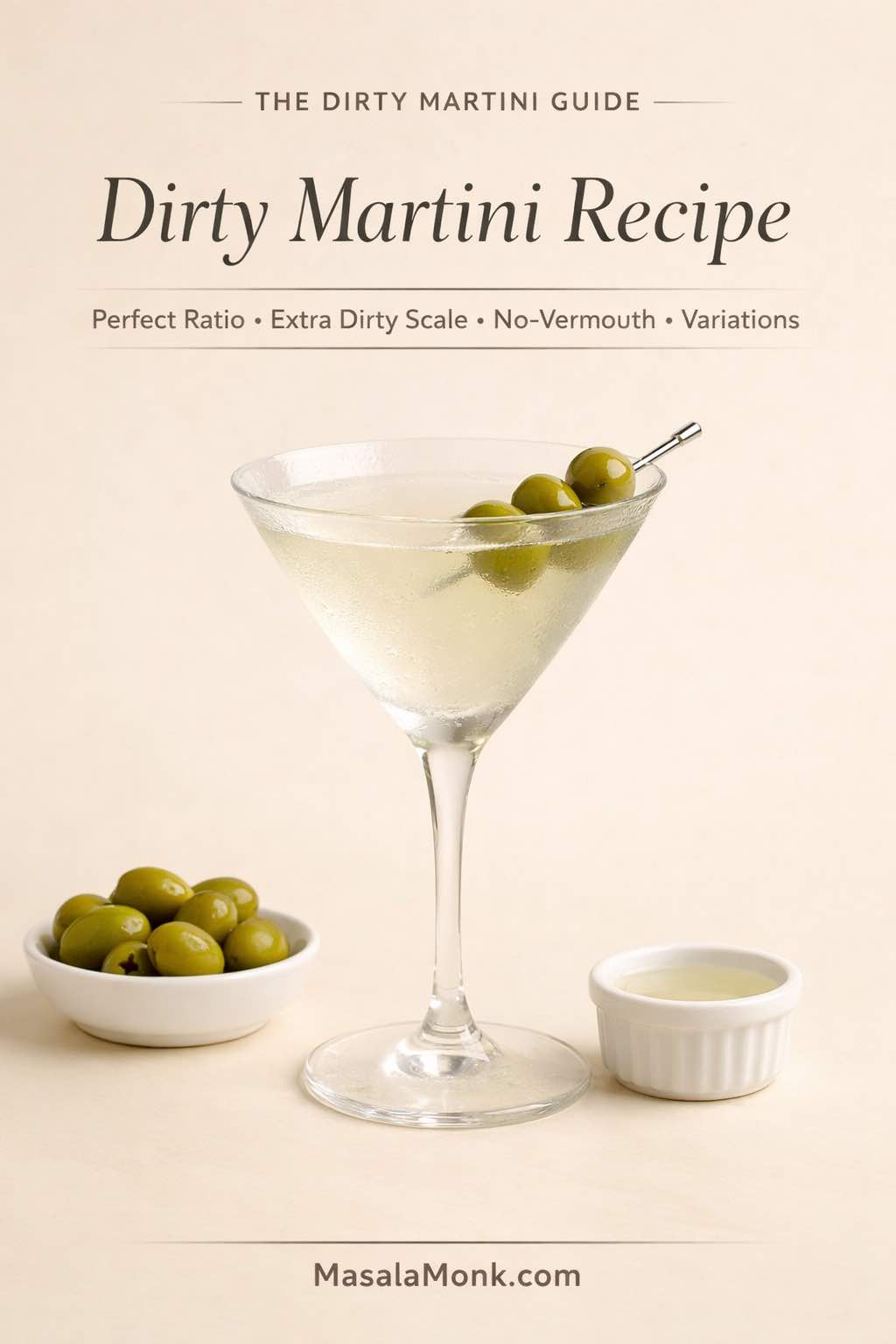
There’s a reason the dirty martini recipe has become the “order again” drink for so many people. It’s sharp but silky, salty but clean, and strangely calming once you dial in the balance. When it’s right, it doesn’t taste like “olive juice and vodka.” Instead, it tastes like a colder, sleeker version of savory snacks: briny, crisp, and oddly refreshing.
Olive brine is the loud ingredient, which is why first attempts sometimes land muddy instead of crisp. The whole game is learning to steer it: get the martini briny without going murky, and cold without watering it into sadness.
This post gives you a reliable base, then the versions people actually make at home: slightly dirty through filthy, extra dry and no-vermouth builds, shaken vs stirred, blue cheese olives, spicy dirty martinis, a tequila “dirty martini,” and a batched freezer bottle for parties. Along the way, you’ll get clear ratios, measurements, and the small details that turn “fine” into “make another.”
If you like grounding things in classic definitions first, the IBA Dry Martini spec is a useful reference point for what “martini” traditionally means before we make it dirty. Then we’ll do what everyone actually came here for: add brine.
What “Dirty” Really Means (And Why It’s So Easy to Overdo)
“Dirty” is not a single setting. It’s a sliding scale.
A slightly dirty martini can feel almost like a regular martini that took a walk past a bowl of olives. A really dirty martini can taste like a bold, salty snack in liquid form. Somewhere between those two is the version most people fall in love with—the one that’s briny enough to make your mouth water, yet still clean enough to feel crisp.
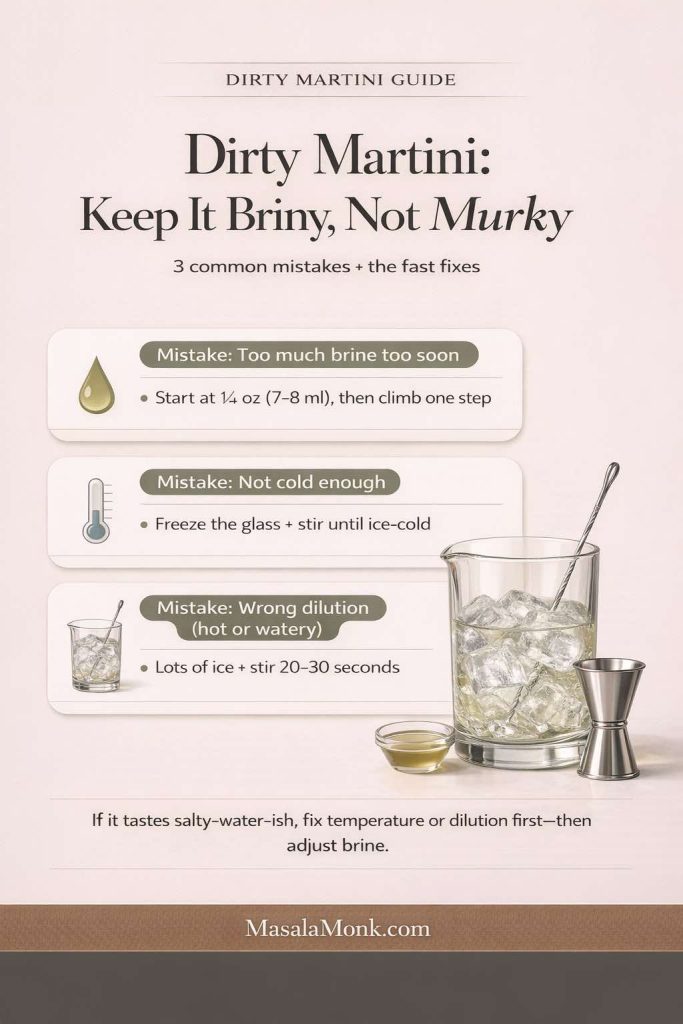
The tricky part is that olive brine is powerful. It’s salt, acidity, and flavor all concentrated into a small pour. That’s why so many first attempts end up tasting murky. Not because the idea is wrong, but because the brine took the wheel.
The good news is that once you learn a simple dirty martini ratio and a couple of “feel” cues, the drink becomes surprisingly consistent. Even better, you can tailor it to your exact preferences: vodka or gin, up and icy, shaken or stirred, with vermouth or without, extra dry or not, blue cheese olives or plain, spicy or classic.
Also Read: Keto Hot Chocolate Recipe (Sugar-Free Hot Cocoa) + Best Homemade Mix
The Core Dirty Martini Recipe (Vodka or Gin)
This is your anchor. Make this once, then tweak from there.
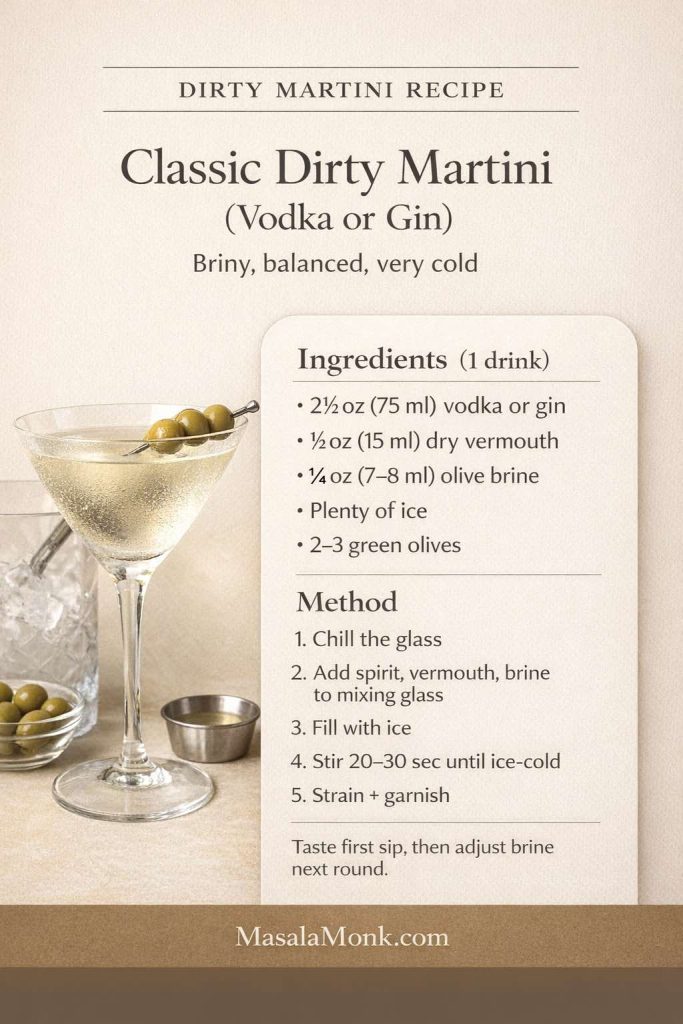
Ingredients (one drink)
- 2 ½ oz (75 ml) vodka or gin
- ½ oz (15 ml) dry vermouth
- ¼ oz (7–8 ml) olive brine (start here; you can always go dirtier)
- Plenty of ice
- Garnish: 2–3 green olives
Method (stirred, glossy, and freezer-cold)
- Chill your glass. A martini glass that’s already cold changes everything—less temperature shock, more silky texture.
- Add vodka or gin to a mixing glass.
- Add dry vermouth.
- Add olive brine.
- Fill the mixing glass with ice. More ice helps you chill efficiently without watering the drink into sadness.
- Stir until the outside of the mixing glass feels ice-cold—usually 20–30 seconds.
- Strain into your chilled glass.
- Garnish with olives and take a first sip before you do anything else.
If you want a classic external reference for this base structure, the Liquor.com Dirty Martini recipe follows the same fundamental idea: spirit, vermouth, brine, and a very cold serve.
Why this version works so reliably
It gives you a stable balance: enough brine to taste “dirty,” enough vermouth to soften the edges, and enough dilution from stirring to make the texture smooth rather than aggressive. From here, you can drift toward extra dirty, extra dry, no vermouth, or any other style without losing the plot.
Also Read: 10 Low Carb Chia Pudding Recipes for Weight Loss (Keto, High-Protein, Dairy-Free)
Dirty Martini Ratio (The Simple Formula You Can Remember)
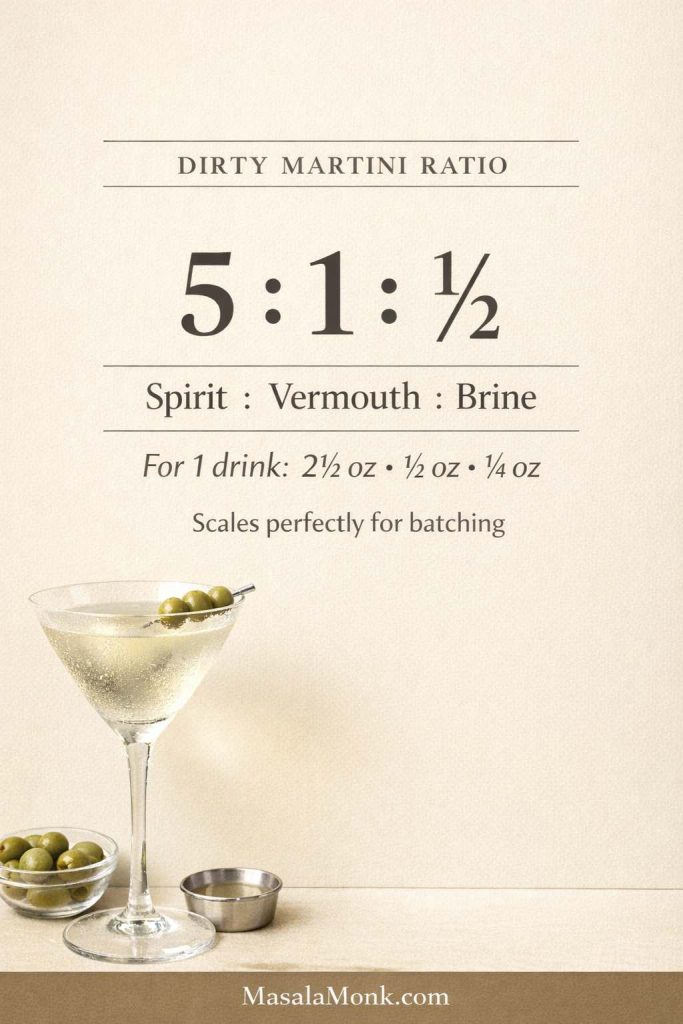
A dirty martini becomes easier when you stop thinking in absolutes and start thinking in proportions. The ratio is your friend because it scales naturally—one drink, two drinks, a batched bottle for the freezer.
A practical dirty martini ratio
- 5 parts vodka or gin
- 1 part dry vermouth
- ½ part olive brine (for classic dirty)
In real-world measurements for one drink, that lands neatly at:
- 2½ oz spirit
- ½ oz vermouth
- ¼ oz brine
From there, adjust brine like a dial.
Also Read: Garlic & Paprika Cabbage Rolls (Keto-Friendly Recipes) – 5 Bold Savory Twists
Slightly Dirty, Classic Dirty, Really Dirty: Pick Your Lane
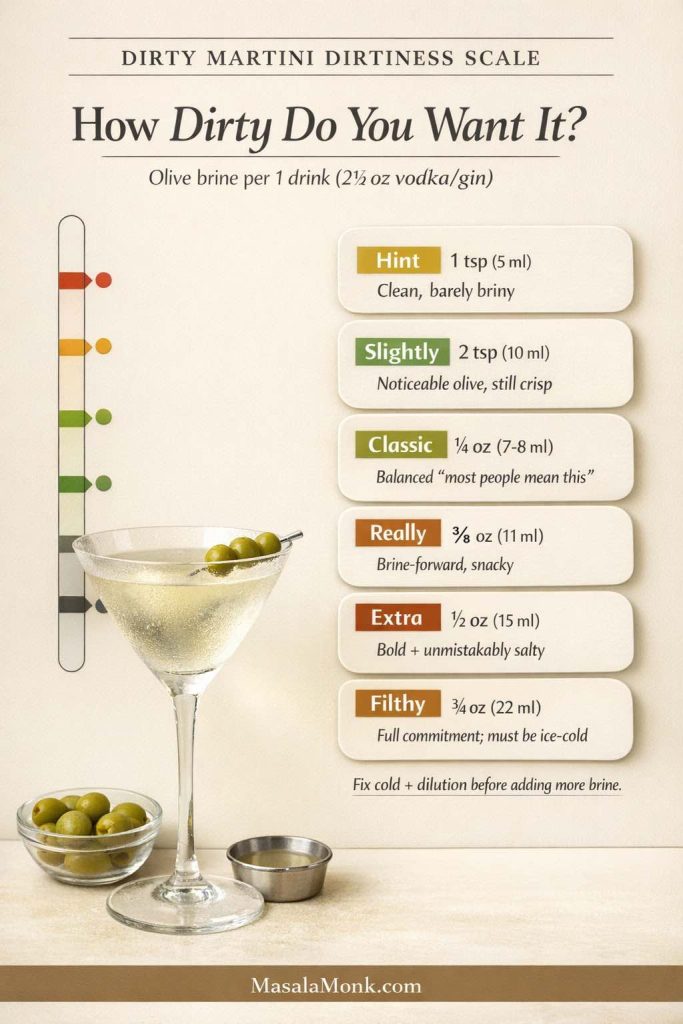
Olive brine is the loudest ingredient, so even a teaspoon can shift the whole drink. Use this scale with 2½ oz (75 ml) vodka or gin. Vermouth can stay at ½ oz (15 ml) unless you’re going extra dry.
Dirty Martini “Dirtiness” Scale (Olive Brine per 1 drink)
| Style | Olive brine | Flavor cue |
|---|---|---|
| Martini with a hint of olive | 1 tsp (5 ml) | Clean, barely briny |
| Slightly dirty | 2 tsp (10 ml) | Noticeable olive, still crisp |
| Classic dirty | ¼ oz (7–8 ml) | Balanced “most people mean this” |
| Really dirty | ⅜ oz (11 ml) | Brine-forward, snacky |
| Extra dirty | ½ oz (15 ml) | Bold + unmistakably salty |
| Extra extra dirty / Filthy | ¾ oz (22 ml) | Full commitment; must be ice-cold |
Quick rule: Go up one step, then taste. If it feels “salty-water-ish,” fix temperature or dilution first, not brine.
Slightly dirty martini
For the “hint of olive” crowd:
- 1–2 teaspoons olive brine
This is elegant and restrained. It still feels like a martini first, with the savory note tucked into the background.
Classic dirty martini
For the “yes, I want brine” crowd:
- ¼ oz olive brine
This is the version most people mean when they say “dirty martini.”
Really dirty martini
For the “make it taste like olives” crowd:
- ⅜ to ½ oz olive brine
Here, the brine becomes a headline. The drink turns snacky, bold, and unapologetically salty.
Also Read: Crock Pot Chicken Breast Recipes: 10 Easy Slow Cooker Dinners (Juicy Every Time)
Extra Dirty Martini, Very Dirty Martini, Filthy Martini: How to Go Big Without Going Muddy
This is where a lot of people end up: extra dirty, extra extra dirty, dirtiest martini, filthy dirty martini—whatever name you give it, the goal is obvious.
The challenge is that there’s a point where more brine doesn’t feel more luxurious. It just feels… watery and salty.
So if you want to make an extra dirty martini that still tastes composed, do it in a way that keeps texture and balance.
The extra dirty martini recipe (one drink)
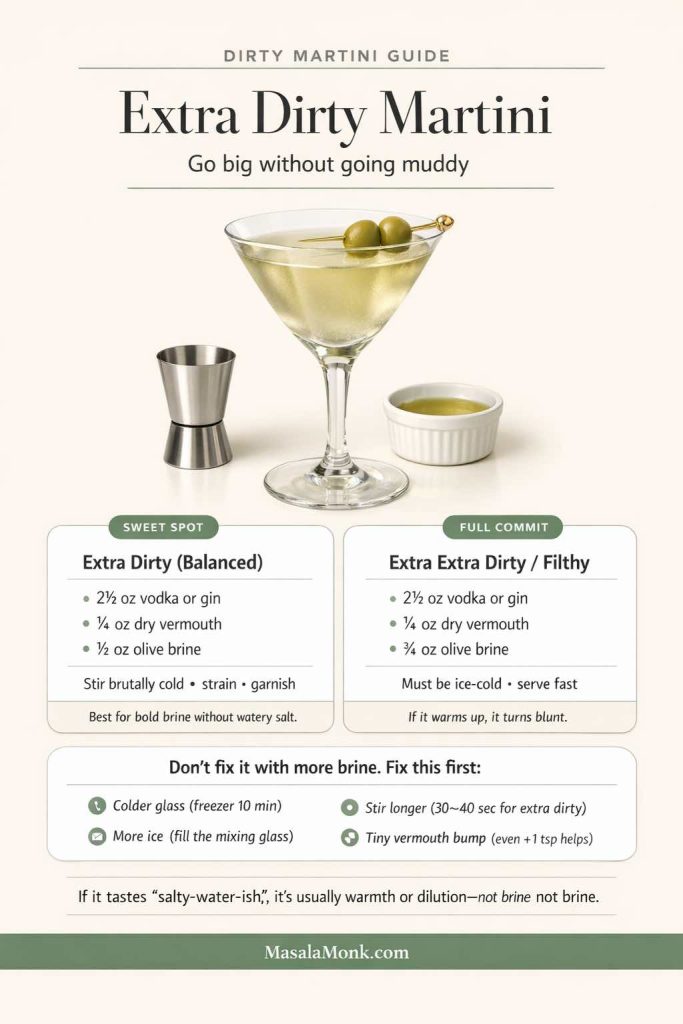
- 2½ oz vodka or gin
- ¼ oz dry vermouth (yes, less vermouth works well here)
- ½ oz olive brine
- Stir brutally cold, strain, garnish
Once you go extra dirty, the classic ratio becomes less useful—think of it as a separate template. This is the sweet spot for many people: unmistakably briny, still clean enough to sip without making a face.
The extra extra dirty martini recipe (if you truly want it)
- 2½ oz vodka or gin
- ¼ oz dry vermouth
- ¾ oz olive brine
At this point, you’re fully committing. It can be delicious, but it needs the drink to be extremely cold. If it warms even slightly, it turns blunt.
If you enjoy the philosophy of taking a martini into “very wet and very intense” territory, Serious Eats has a fun deep dive into the filthy end of the spectrum with their Filthy / Sopping-Wet Martini approach.
How to keep a super dirty martini from tasting flat
Here’s the move that quietly saves the drink: don’t add brine to fix a problem that’s actually temperature or dilution.
If your martini tastes too sharp or too intense, you usually need one of these:
- Stir a little longer (more controlled dilution)
- Use a colder glass
- Use bigger ice
- Use a touch more vermouth, even if you’re going extra dirty
That last one surprises people, yet it matters. A small amount of vermouth can make the brine taste savory instead of salty-water-ish.
Also Read: Eggless Yorkshire Pudding (No Milk) Recipe
Dirty Martini Without Vermouth (And How to Make It Taste Smooth)
Some people love vermouth. Then some people tolerate it. And then some people would rather drink a martini without vermouth and never look back.
If you’re in the no-vermouth camp, you can still make a delicious dirty martini. You just need to lean on cold temperature and gentle dilution even more, because vermouth is often the ingredient that rounds the drink.
Vodka martini no vermouth (dirty version)
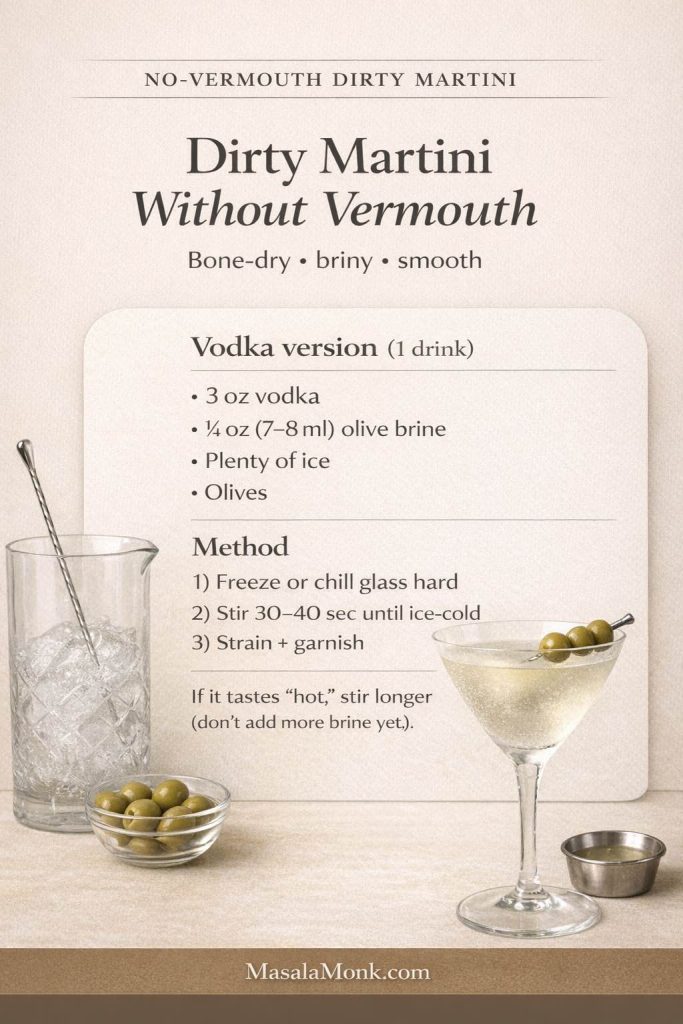
- 3 oz vodka
- ¼ oz olive brine
- Stir hard with plenty of ice
- Strain into a well-chilled glass
- Garnish with olives
Why 3 oz? Because if you’re skipping vermouth, increasing the vodka slightly gives you a fuller mouthfeel once the ice has done its job. Stir 30–40 seconds (or until very cold) because vermouth isn’t there to soften edges.
Dirty martini no vermouth (gin version)
- 2½ oz gin
- ¼ oz olive brine
- Stir very cold and strain.
- Olive garnish
Gin without vermouth can feel more angular than vodka without vermouth, because gin brings its own botanicals. Still, if you like gin martini with olives and you want it dry and direct, it can be a sharp, briny joy.
Extra Dry Dirty Martini (What It Means and How to Avoid a Salty Surprise)
“Extra dry” typically means “less vermouth.” When you combine extra dry with dirty, brine can take over fast—because you removed the ingredient that softens the salt.
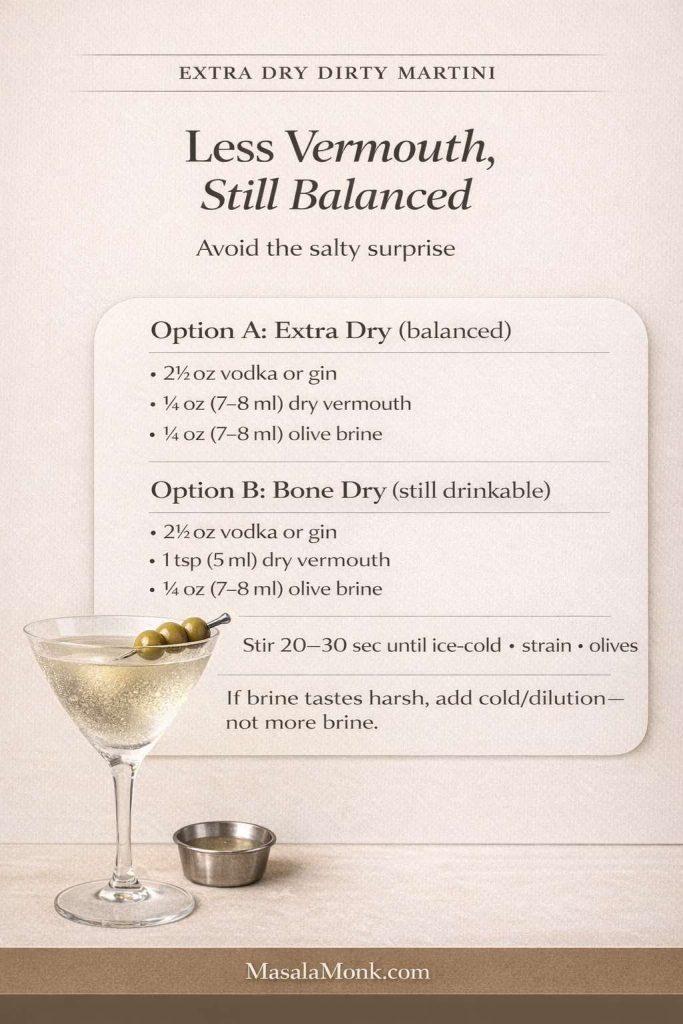
So if you want an extra dry dirty martini that still feels balanced, try one of these:
Extra dry dirty martini (balanced)
- 2½ oz vodka or gin
- ¼ oz dry vermouth
- ¼ oz olive brine
This stays crisp and clean, without turning salty.
Bone dry dirty martini (still drinkable)
- 2½ oz vodka or gin
- 1 teaspoon vermouth (yes, a teaspoon)
- ¼ oz olive brine
This is for the people who like the idea of vermouth, but barely.
A useful side note: vermouth behaves like a fortified wine. It changes over time once opened, so it’s worth treating it with care. Difford’s Guide has a straightforward explanation of how to store vermouth after opening, which matters more than most people expect.
Also Read: How to make No-Bake Banana Pudding: No Oven Required Recipe
Dirty Martini “Up,” Dirty Martini Straight Up, Dirty Vodka Martini Up: The Cold, Concentrated Style
“Up” simply means served chilled without ice in the glass. It’s the classic martini presentation. When it’s done right, it feels sleek and intense.
The key is temperature. An up martini needs to be colder than you think, because there’s no ice in the glass continuing the chill.
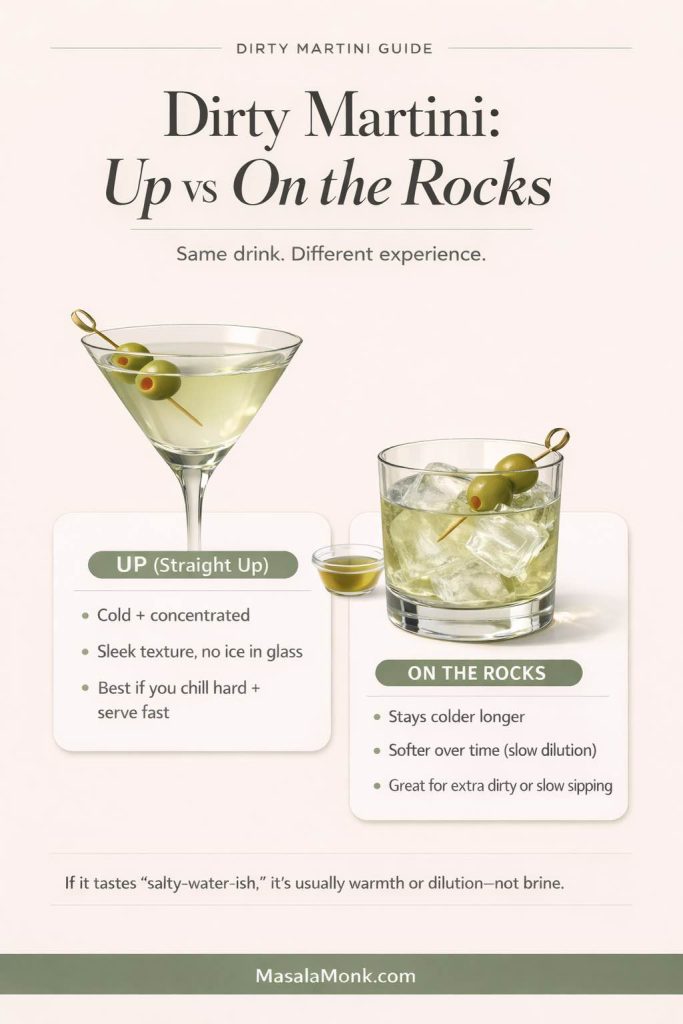
How to nail a dirty martini straight up
- Freeze your glass or chill it aggressively.
- Stir with lots of ice.
- Strain cleanly so you don’t get ice shards floating around.
This is also where you’ll hear people specify “dirty vodka martini straight up” or “dirty martini up.” They want that clean pour and that concentrated texture.
Also Read: Chicken Adobo — Step-by-Step Recipe — Classic Filipino Adobong Manok
Shaken Dirty Martini vs Stirred Dirty Martini (And Why People Disagree)
A lot of drink arguments are actually texture arguments disguised as tradition.
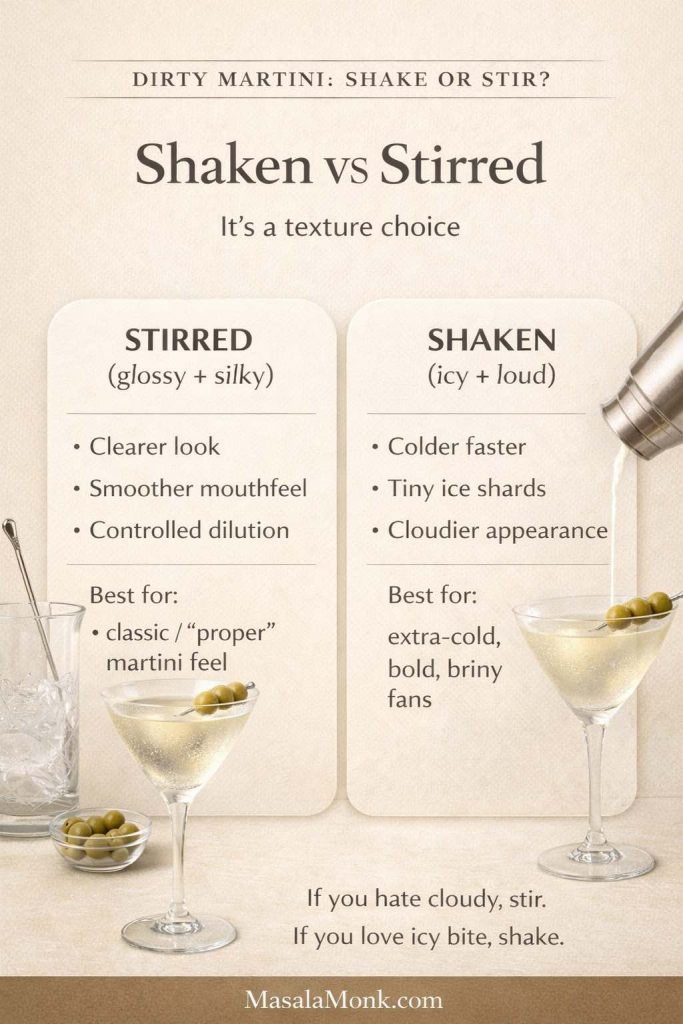
Stirring tends to give you:
- A clearer drink
- A smoother mouthfeel
- A calmer, silkier sip
Shaking tends to give you:
- More aeration
- Tiny ice shards
- A slightly more aggressive chill
- A cloudy look (especially with brine)
Some people love that icy, loud, “shaken dirty martini” feel. Others prefer the glossy calm of stirring.
If you’re making your first dirty martini recipe at home, stirring is usually the easier path to consistency. Meanwhile, if you love the theatrical coldness of a shaken drink, shake it and enjoy it—just know the texture will be different.
Also Read: Sweetened Condensed Milk Fudge: 10 Easy Recipes
The Olive Brine Question: Olive Juice, Olive Brine, Olive Juice Mixer
The language gets messy here. You’ll see “olive juice” in recipes, “olive brine” in cocktail circles, and “olive juice mixer” in product descriptions. In home practice, it usually means the liquid in a jar of olives.
The only real rule is this: use brine that tastes good.
If it tastes overly metallic, aggressively vinegary, or weirdly sweet, it will show up in the drink. That’s why “best olive brine for dirty martini” becomes such an obsession—because brine is not a neutral ingredient.
If you want a deeper look at how pros think about brine, Food & Wine has a good read on making DIY olive brine for dirty martinis, which helps explain why “jar brine” and “bar brine” can taste wildly different.
Also Read: Sourdough Recipe: 10 Easy Bread Bakes (Loaves, Rolls & Bagels)
Blue Cheese Dirty Martini (And the Blue Cheese Olive Moment)
There’s a reason “vodka martini blue cheese olives” and “dirty martini blue cheese olives” keep showing up in conversation. That garnish turns the drink into an appetizer.
The trick is restraint. Blue cheese is bold. If you add too much, it can dominate the martini and make it feel heavy.
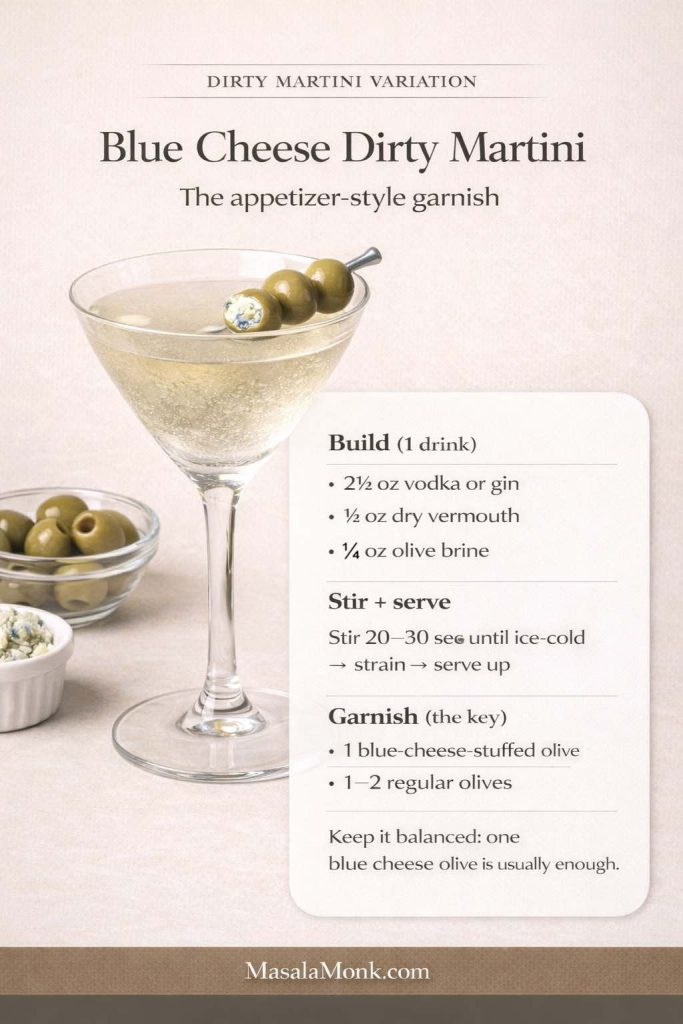
Dirty martini with blue cheese olives (one drink)
- Make your classic dirty martini recipe (vodka or gin)
- Garnish with:
- 1 blue-cheese-stuffed olive
- plus 1–2 regular olives
That gives you the creamy, funky hit without overwhelming the brine.
If you want food alongside this version, go in the same savory direction. A dip that matches the vibe can make the whole table feel intentional, especially something like MasalaMonk’s blue cheese dip guide for a snack spread that leans tangy and bold.
Also Read: 10 Vegan Chocolate Cake Recipes (Easy, Moist, & Dairy-Free)
Spicy Dirty Martini (Dirty Spicy Martini, Hot & Dirty Martini)
A spicy dirty martini works when the heat feels bright and clean—not bitter or overwhelming. The brine already has salt and acidity, so the spice should complement that rather than fight it.
Here are three ways to build a spicy dirty martini that still tastes like a martini, not a dare.
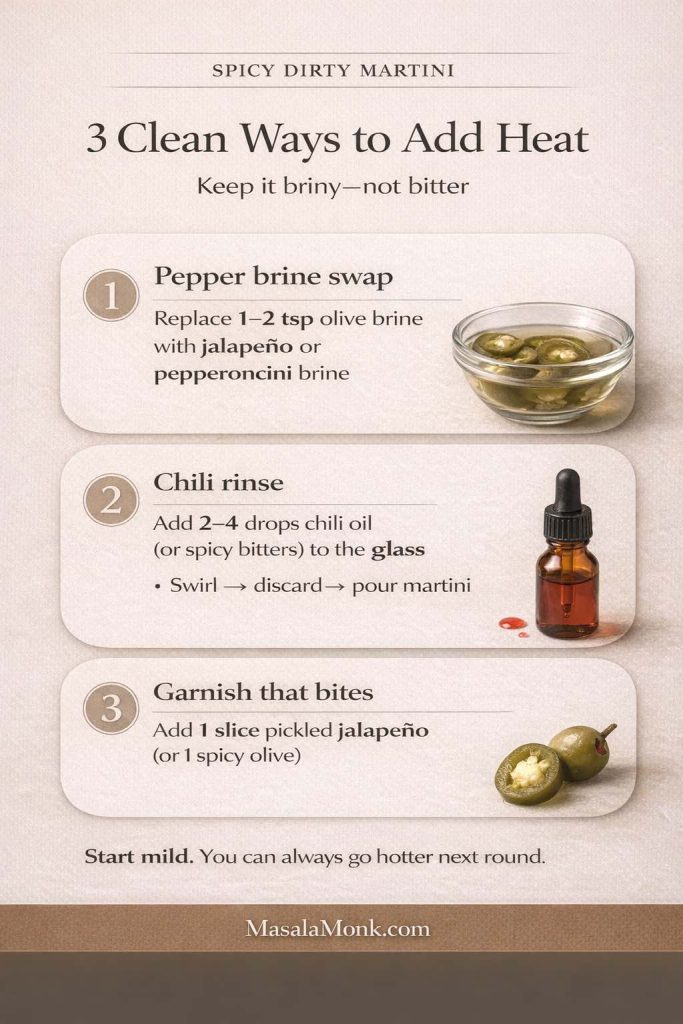
1) Dirty spicy martini with pickled pepper brine
- Make your classic dirty martini
- Replace 1–2 teaspoons of olive brine with pepper brine (jalapeño or pepperoncini)
This brings heat plus tang, and it layers well with olives.
2) Spicy dirty martini with a chili rinse
- Chill your glass
- Add a few drops of chili oil or spicy bitters
- Swirl, then discard the excess
- Pour the martini
This method gives you aroma and heat without changing the drink’s balance too much.
3) Hot and dirty martini with a garnish that bites
- Make your dirty martini
- Garnish with a pickled jalapeño slice or a spicy olive
This looks dramatic and it signals what’s coming before the first sip.
If you’re serving food with a spicy dirty martini, go for something cooling and creamy. A yogurt dip is the perfect counterbalance. For example, MasalaMonk’s Greek tzatziki sauce master recipe gives you a chilled, garlicky dip that works beautifully with spicy flavors, and it keeps the overall experience fresh rather than heavy.
For a richer pairing that still makes sense with heat, a warm, crowd-pleasing dip is hard to beat—especially MasalaMonk’s buffalo chicken dip, which lands in the same spicy-salty comfort zone, just in a different form.
Also Read: Kahlua Drinks: 10 Easy Cocktail Recipes (Milk, Vodka, Coffee)
Dirty Tequila ‘Martini’ (A Savory Tequila Cocktail in a Martini Glass)
Tequila in a “martini” glass can make people raise an eyebrow, yet it’s surprisingly good when you build it thoughtfully. This is not a classic martini in the traditional sense. Still, if you like tequila and you like brine, it can be a bright, savory drink that feels modern and a little mischievous.
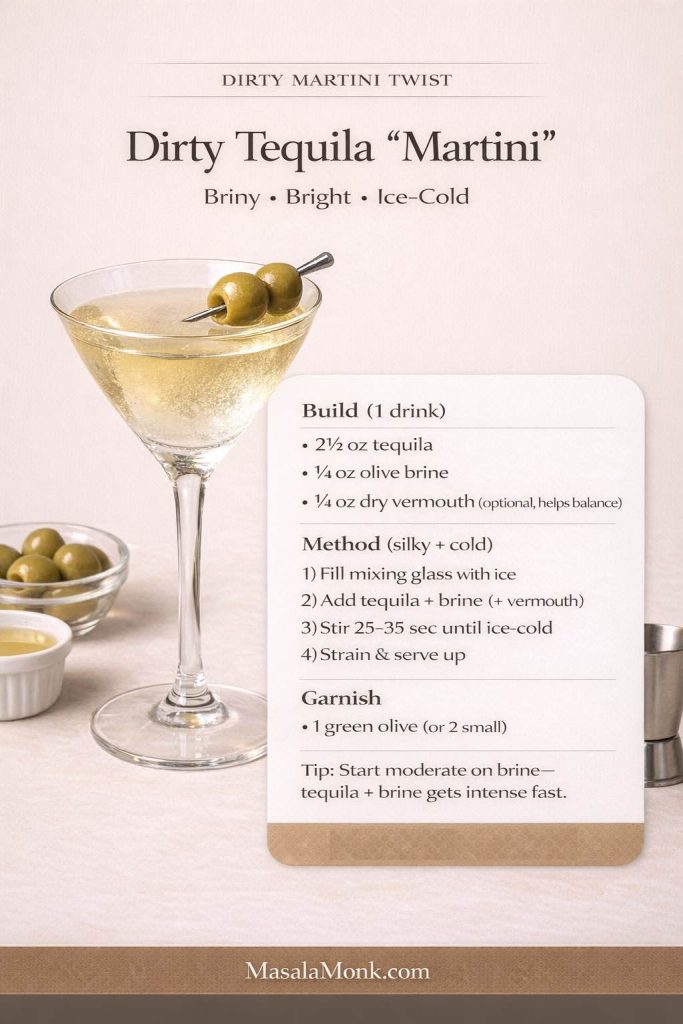
Dirty tequila martini (one drink)
- 2½ oz tequila (a clean, smooth style works best)
- ¼ oz olive brine
- ¼ oz dry vermouth (optional, but it helps)
- Stir super cold
- Garnish with a green olive
Because tequila has its own personality, this version benefits from keeping the brine moderate at first. Once you taste the first attempt, you can push it dirtier if you want.
If you’re building food around this tequila version, lean into crispy, salty bites. Fries are a natural partner, and a dip that cools things down makes it even better. A simple pairing is MasalaMonk’s crispy homemade french fries guide, especially if you want the whole setup to feel like a casual bar snack—just cleaner and fresher.
Also Read: 19 Essential Kitchen Tools That Make Cooking Easier
Dirty Gin Martini Template (How to Adjust for Any Gin)
People often ask for brand-specific dirty martini recipes (like Hendrick’s Dirty Martini, Tanqueray Dirty Martini, Bombay Sapphire Dirty Martini) because they’re trying to match the drink to a gin they already like. With gin, the differences can be noticeable because botanicals matter.
A gin-forward dirty martini tends to feel:
- more aromatic
- more layered
- sometimes more “herbal” against the brine
That can be wonderful if you love gin martinis. It can also be confusing if you’re expecting the clean neutrality of vodka.
So rather than treating each gin as a separate dirty martini recipe, use a stable base and adjust one dial: vermouth.
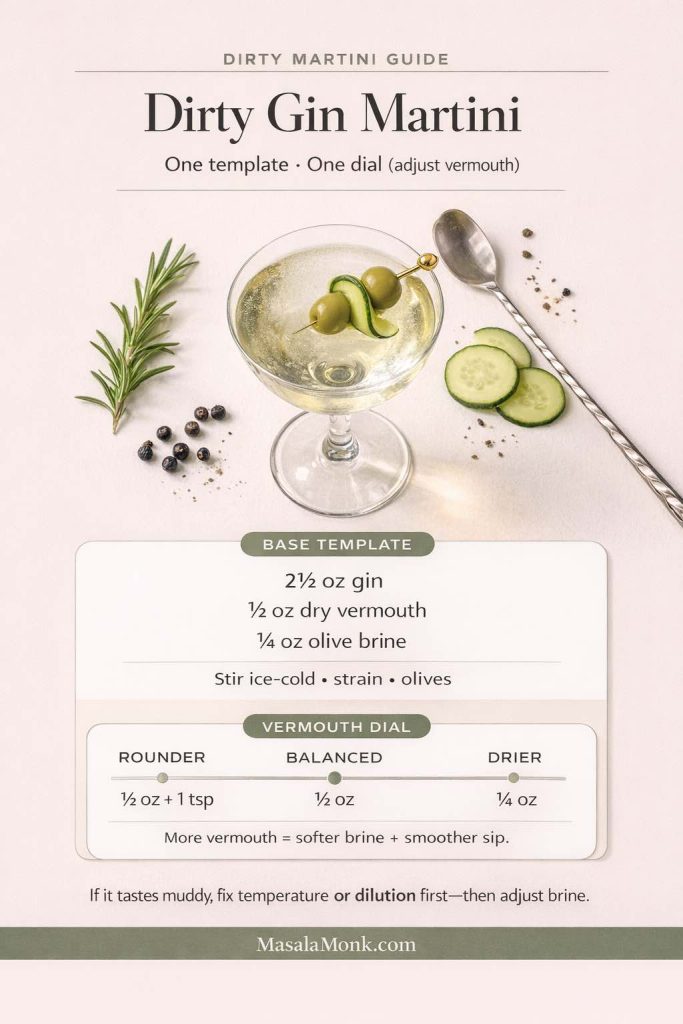
A clean dirty gin martini template
- 2½ oz gin
- ½ oz dry vermouth
- ¼ oz olive brine
- Stir and strain ice-cold
- Olives
Then, if your gin is especially aromatic and you want it to feel drier, drop vermouth to ¼ oz. If your gin feels sharp with brine, keep the vermouth at ½ oz to round it.
Also Read: How to Cook Tortellini (Fresh, Frozen, Dried) + Easy Dinner Ideas
Dirty Vodka Martini Template (How to Adjust for Any Vodka)
Vodka is often chosen for a dirty martini because it’s a clean stage for brine. That’s why vodka + olive juice becomes such a popular combination.
Once again, you don’t need a unique recipe per vodka (like Tito’s Dirty Martini, Grey Goose Dirty Martini, Ketel One Dirty Martini, etc). What you need is a method that keeps the drink cold and balanced. However, if you already have a vodka you like, it can feel satisfying to “pair” it with the right style:
- If your vodka is very clean and neutral, it’s great for extra dirty or filthy styles.
- If your vodka has a bit of sweetness or softness, it can make a no-vermouth dirty martini easier to enjoy.
Also Read: Cranberry Moscow Mule Recipe: A Festive Holiday Cocktail With Easy Variations
The Dirty Martini Mix Conversation (Premixed, Canned, Batched)
Some people want to make a dirty martini cocktail quickly and consistently. That’s where premixed and batched styles come in. Even if you love the ritual of stirring, it’s hard to deny the appeal of opening the freezer and pouring an already-perfectly-chilled martini.
The trick is dilution. When you stir a martini, you’re always adding a little water from the ice. If you batch and skip that, your martini can taste too hot and too sharp. So you add water on purpose.
Also Read: Baked Ziti Recipe Collection: 15 Easy Variations
Batched dirty martini (freezer bottle method)
This makes about 8 servings.
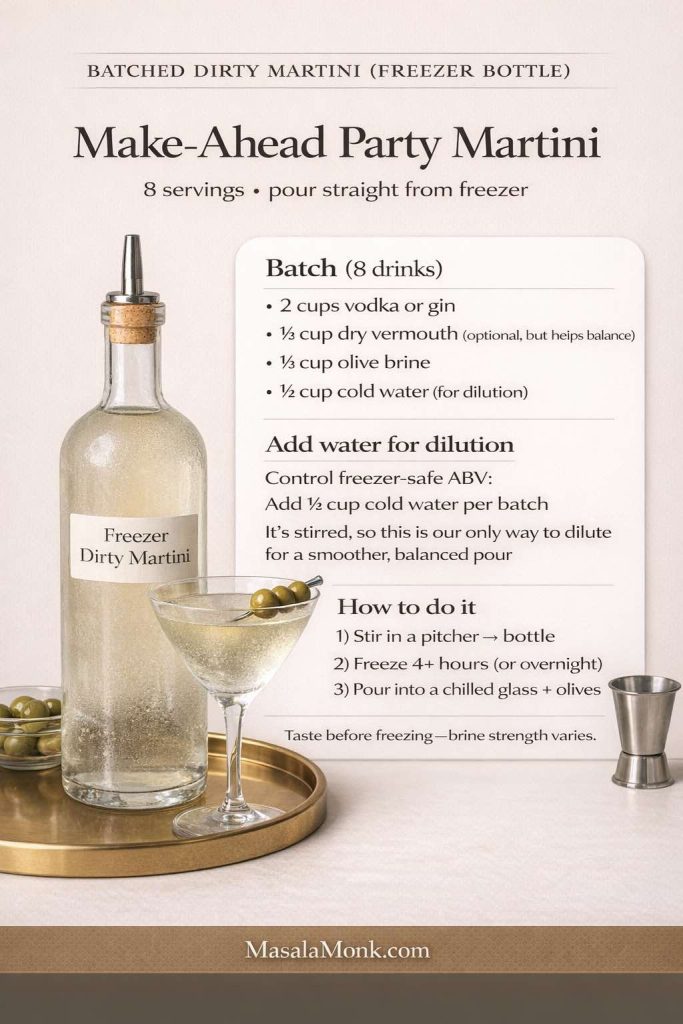
- 2 cups vodka or gin
- ⅓ cup dry vermouth (optional, but it helps the balance)
- ⅓ cup olive brine
- ½ cup cold water
Stir, bottle, freeze. When you’re ready, pour straight from the freezer into a chilled glass and garnish with olives. Taste and adjust brine before freezing (brine intensity varies wildly).
Freezer note: At typical vodka/gin strength, this won’t freeze solid—just gets syrupy-cold. If it thickens too much, add 1–2 tbsp water to the bottle and shake.
This method is also a surprisingly elegant party move. It turns the dirty martini into something you can serve quickly, like a house cocktail.
If you want another cocktail post from MasalaMonk that leans into easy ratios and straight-up serving, the Paper Plane cocktail guide is a fun companion. It’s not a martini, yet it shares the same appeal: simple structure, strong payoff.
Also Read: Iced Coffee: 15 Drink Recipes—Latte, Cold Brew, Frappe & More
How to Make a Dirty Martini Taste “Proper” at Home
A lot of people want a proper martini—not because they’re chasing rules, but because they’re chasing a feeling. They want the drink to feel deliberate, like something a good bar would serve, even if they made it in their own kitchen.
So here are the details that actually move the needle.
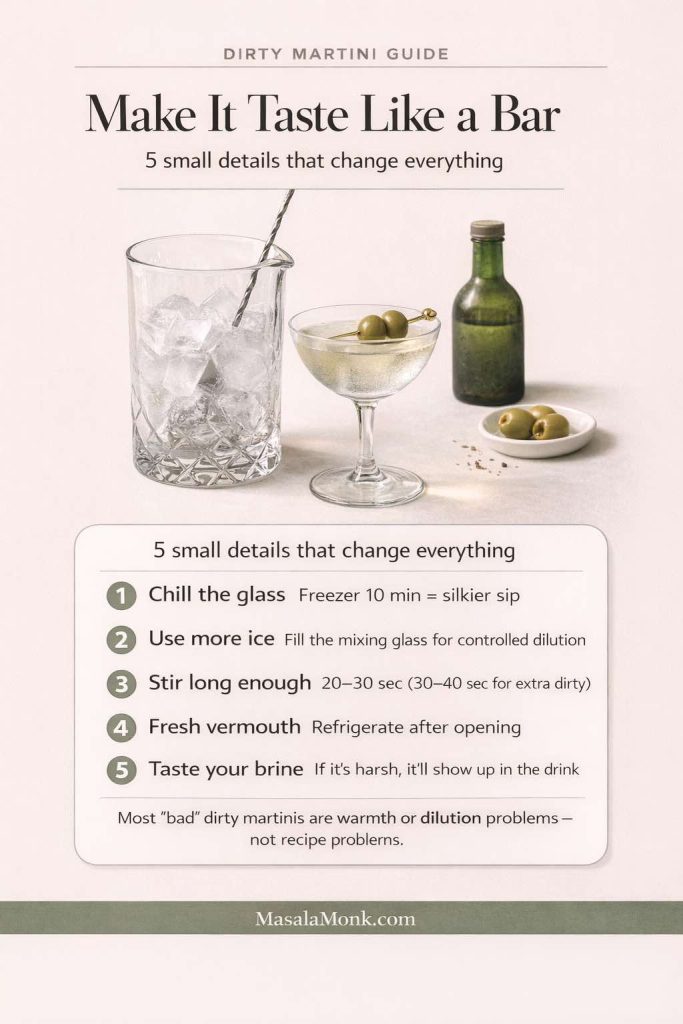
1) Cold glassware is not optional if you want a silky martini
A warm glass steals your chill instantly. Then the drink opens up too fast, and the brine starts to feel louder than it should. A cold glass makes everything feel tighter and more polished.
2) The right amount of ice is more ice than you think
A handful of ice melts too quickly and waters the drink unpredictably. A full mixing glass of ice chills efficiently and gives you controlled dilution. That control is what makes your second martini taste like your first.
3) Stirring time is not a personality test—it’s a texture tool
Stir less and your martini can taste harsh and hot. Stir longer and the drink becomes smoother. If your martini tastes “too strong,” it’s often not the alcohol—it’s the lack of dilution.
4) Vermouth freshness quietly matters
Even if you’re only adding a small amount, stale vermouth can taste dull or slightly off, and it can make the whole drink feel less clean. If you keep vermouth in the fridge after opening and treat it like the wine it is, your martinis tend to improve noticeably. Difford’s has a practical overview of vermouth storage and serving that explains why.
5) Brine is the star, so choose it like you mean it
If the brine tastes strange out of the jar, it will taste strange in the drink. If you want to understand brine beyond “whatever came with the olives,” Food & Wine’s piece on DIY brine for dirty martinis is a good way to see how layered it can be.
Also Read: How to Make Churros (Authentic + Easy Recipe)
What to Eat With a Dirty Martini (So It Feels Like a Whole Experience)
This is where dirty martinis shine. They don’t just tolerate food—they improve with it. Salt, fat, crunch, and tang all make the brine feel cleaner and the drink feel smoother.
Below are a few pairings that fit different dirty martini styles, using MasalaMonk recipes you can weave into a “martini night” without turning it into a full production.
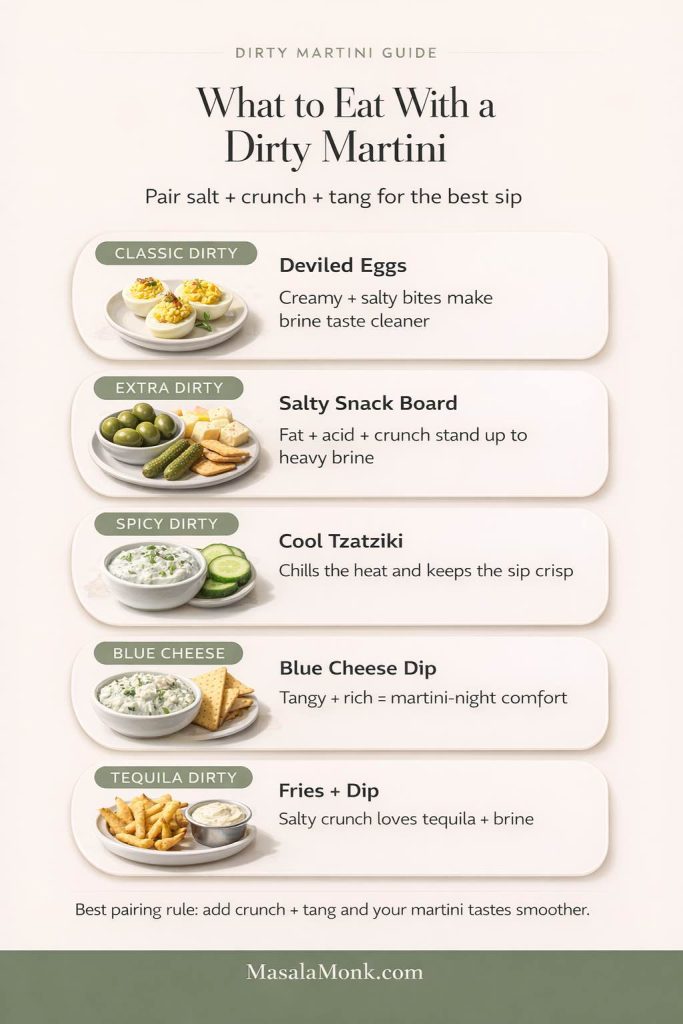
Classic dirty martini food pairing: deviled eggs
Deviled eggs are practically built for martinis: creamy, salty, and bite-sized. If you want a base recipe that’s easy to scale with variations, MasalaMonk’s deviled eggs guide gives you plenty of directions to keep things interesting without overthinking it.
Even better, deviled eggs work with almost every martini style—vodka, gin, extra dirty, no vermouth, up, straight up, all of it.
Extra dirty martini pairing: a snack board that leans salty
If your martini is really dirty, you want food that can keep up. A charcuterie board does that beautifully because it gives you salt, fat, and little bursts of acid. If you want a method that makes board-building feel easy rather than fussy, MasalaMonk’s 3-3-3-3 charcuterie board rule guide gives you a simple framework.
Add olives, pickles, a few cheeses, and something crunchy, and suddenly your martini feels like it belongs.
Spicy dirty martini pairing: cool tzatziki
Spice plus brine is exciting, but it can also feel intense. A cool dip balances it instantly. MasalaMonk’s Greek tzatziki sauce master recipe is especially helpful because it’s built as a base plus variations, which makes it easy to match different flavors—more dill, more garlic, more lemon, or a little mint.
Blue cheese olive martini pairing: blue cheese dip or mozzarella sticks
If you’ve gone full blue cheese olive, you’re already living in the land of savory comfort. Lean into it. MasalaMonk’s blue cheese dip guide can anchor a snack table, while their mozzarella sticks recipe gives you that hot-and-crunchy contrast that makes a cold martini feel even colder.
Tequila dirty martini pairing: fries + a dip
Tequila with brine tends to invite crisp, salty food. Fries are a natural fit, especially when you add something cool on the side. Start with MasalaMonk’s homemade french fries guide, then add tzatziki or any creamy dip you like.
Party pairing for any martini night: buffalo chicken dip
If you want one warm, bold centerpiece that makes everyone gather around the table, MasalaMonk’s buffalo chicken dip is built for that job. It’s rich, tangy, and spicy in a way that makes a salty martini feel even cleaner.
Also Read: Baked Jalapeño Poppers (Oven) — Time, Temp & Bacon Tips
A “Choose Your Own Dirty Martini” Flow That Actually Helps
Instead of trying to memorize every version, you can build the martini that matches your mood.
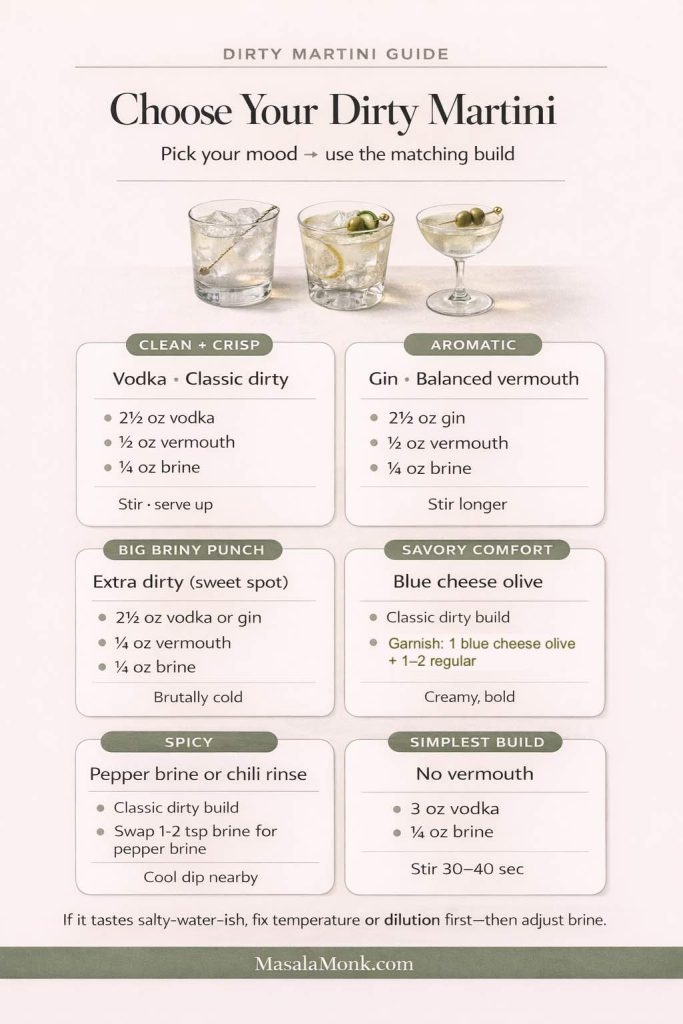
If you want the cleanest, crispest sip
Go vodka, classic brine, stir, serve up.
If you want a more aromatic martini
Go gin, keep vermouth at ½ oz, keep brine moderate, stir longer.
If you want a big briny punch
Go extra dirty, reduce vermouth slightly, keep everything brutally cold.
If you want savory comfort
Add blue cheese olives and serve with something creamy and tangy.
If you want heat
Use pepper brine or a chili rinse and balance it with a cool dip nearby.
If you want the simplest possible build
Skip vermouth, stir hard, keep brine moderate, and let cold do the smoothing.
Also Read: Classic Rum Punch + 9 Recipes (Pitcher & Party-Friendly)
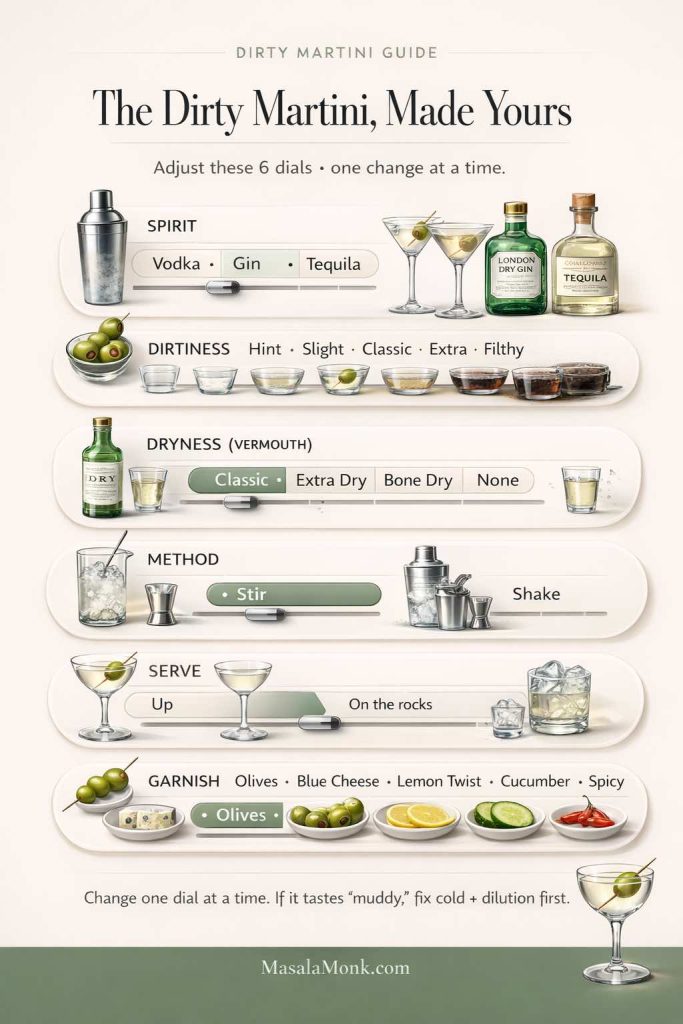
The Dirty Martini, Made Yours
A dirty martini is one of those drinks where personal preference isn’t a footnote—it’s the whole point. Some people want it barely dirty. Others want it filthy. Some want gin, some want vodka, some want tequila just because it sounds fun. Some want vermouth. Others want martini without vermouth and they’re perfectly happy there.
What matters is learning how to steer the drink so it tastes intentional instead of accidental. Start with the core dirty martini recipe, taste what you made, and adjust one thing at a time: a little more brine, a little less vermouth, a longer stir, a colder glass, a different garnish.
Then, once you’ve found your version, make it part of a small ritual. Put olives on a plate. Add a bowl of tzatziki. Make deviled eggs. Or throw mozzarella sticks in the oven. Suddenly it’s not just a cocktail—it’s a tiny, salty, cold celebration.
And that, honestly, is what the dirty martini has always been good at.
Also Read: Crock Pot Lasagna Soup (Easy Base + Cozy Slow-Cooker Recipes)
FAQs: Dirty Martini Recipe (Ratios, Variations, and Fixes)
1) What is a dirty martini?
At its core, a dirty martini is a martini made with vodka or gin plus olive brine (often called olive juice). As a result, it tastes saltier and more savory than a classic dry martini.
2) What’s the best dirty martini recipe for beginners?
To begin with, choose vodka or gin, add a small amount of dry vermouth, then measure in olive brine. Afterward, taste and adjust the brine on your next round if you want it bolder.
3) What is the best dirty martini ratio?
In general, a reliable ratio is 5 parts vodka or gin, 1 part dry vermouth, and about ½ part olive brine for a classic dirty style. From that baseline, you can nudge the brine up for a really dirty martini or down for a slightly dirty martini.
4) How much olive brine should I use in a dirty martini?
As a starting point, use 1–2 teaspoons for slightly dirty, or ¼ oz (7–8 ml) for classic dirty. For a really dirty martini, move closer to ⅜–½ oz.
5) Is olive brine the same as olive juice?
Most of the time, yes—olive “juice” usually means the brine in a jar of olives. That said, brines vary a lot by brand, so the best olive juice for a dirty martini is the one you actually like the taste of.
6) Can I make a dirty martini without vermouth?
Definitely. In fact, a dirty martini no vermouth style is common for people who want it extra dry. Even so, skipping vermouth often means you’ll want to chill harder and stir a bit longer for smoothness.
7) What’s a vodka martini no vermouth, dirty style?
Simply put, it’s vodka plus olive brine, chilled and served up. For many, that’s the whole appeal of a dirty vodka martini no vermouth—direct, briny, and uncomplicated.
8) What does “extra dry” mean in a dirty martini?
Typically, extra dry means less vermouth. Consequently, the olive brine can feel more prominent, so it helps to keep the brine measured and the drink extremely cold.
9) What’s the difference between a dirty martini and a dry martini?
A dry martini relies on dry vermouth for its classic profile; meanwhile, a dirty martini uses olive brine for savory salinity. Additionally, phrases like “dirty and dry martini” often imply both brine and a reduced vermouth pour.
10) What is a dirty martini “up”?
Put another way, “up” means chilled and strained into a glass with no ice. Therefore, a dirty martini up is served straight up after being stirred or shaken with ice.
11) What’s the difference between “straight up” and “on the rocks” for a dirty martini?
Straight up (or up) is strained into a glass without ice; on the rocks is served over ice in the glass. In turn, straight up tastes more concentrated, while rocks stays colder longer and softens gradually as it sits.
12) Should a dirty martini be shaken or stirred?
Either is valid, yet the feel changes. Stirring usually creates a clearer, silkier drink; shaking makes it colder fast, often cloudier, with tiny ice shards. Ultimately, a shaken dirty martini is a style preference, not a rule-break.
13) What’s the best way to make a dirty martini at home that tastes like a bar drink?
First, chill the glass well. Next, use plenty of ice while mixing. Then, stir long enough to reach a smooth dilution. Finally, measure the brine rather than eyeballing it, because a little extra can swing the flavor quickly.
14) Why does my dirty martini taste too salty?
More often than not, the brine amount is high for your palate, or the brine itself is intensely salty. With that in mind, reduce brine next time, keep the drink colder, and let the olives provide aroma without flooding the mix.
15) Why does my dirty martini taste watery?
Usually, it comes down to over-dilution from melting ice or using too little ice while mixing. Oddly enough, adding more ice can help because it chills faster and melts more predictably.
16) Why does my dirty martini taste harsh or “hot”?
In many cases, that’s under-dilution. Accordingly, stir a bit longer, chill the glass more, or add a small splash of vermouth if you use it to round the edges.
17) What are the best olives for a dirty martini?
Generally, firm green olives work well. If you want a buttery bite, choose a milder green olive; if you prefer a sharper pop, pick a more robust brined olive. Either way, the best olives are the ones you enjoy eating plain.
18) What are blue cheese olives, and do they work in a dirty martini?
Blue cheese stuffed olives add creamy, funky savoriness that pairs well with brine. For balance, many people use one blue cheese olive plus one or two regular olives so the garnish enhances rather than overwhelms.
19) How do I make a blue cheese dirty martini?
Make a classic dirty martini (vodka or gin), then garnish with a blue cheese stuffed olive. If you want more blue cheese intensity, add a second—however, the drink can start to feel heavier and saltier.
20) What’s a spicy dirty martini?
A spicy dirty martini adds heat to the briny base. Depending on your preference, you can add spice through pepper brine, a spicy garnish, or a light chili rinse in the glass.
21) How do I make a hot and dirty martini without ruining the flavor?
Rather than dumping in heat, add it in controlled increments—like a teaspoon of pepper brine or a spicy garnish—so the drink stays crisp instead of turning bitter or harsh.
22) What is a tequila dirty martini?
A tequila dirty martini swaps vodka or gin for tequila while keeping olive brine in the mix. As such, it becomes a savory tequila cocktail served martini-style, best when kept extremely cold and carefully measured.
23) Can I make a dirty martini with gin instead of vodka?
Yes, and it’s often more aromatic. Because gin brings botanicals, brine can feel more intense, so many people keep brine moderate and include at least a small amount of vermouth to pull it together.
24) What is a “perfect” dirty martini?
In practice, “perfect” means the ratio, temperature, and dilution are dialed in to your taste. In other words, it’s less about a single formula and more about repeatable balance.
25) What is the ultimate dirty martini recipe?
For most drinkers, “ultimate” means very cold, well-measured, and tailored to their preferred level of dirty—classic, very dirty, extra dry, or no vermouth. Above all, consistency is what makes it feel “ultimate.”
26) What is a very dirty martini recipe?
A very dirty martini generally means pushing olive brine to around ½ oz per drink, sometimes more. Because that’s a strong brine load, chilling and stirring technique become especially important.
27) What is an extra dirty martini recipe?
Typically, an extra dirty martini recipe uses about ½ oz olive brine, along with vodka or gin and often a reduced pour of vermouth. As a result, it tastes more intensely briny than a classic dirty martini.
28) What is an extra extra dirty martini?
It’s a step beyond extra dirty—often around ¾ oz brine. Even though some people love the punch, others find it too salty, so it’s best treated as a personal preference.
29) What’s the difference between “dirty” and “filthy” martinis?
Colloquially, “filthy” just means extremely dirty—more olive brine and a stronger savory profile. Put simply, filthy is dirtier.
30) Can I batch a dirty martini for a party?
Yes. A batched dirty martini is made ahead and stored very cold, often in the freezer. Crucially, you’ll want to add measured water to mimic the dilution you’d normally get from stirring with ice.
31) How do I keep a batched dirty martini from tasting too strong?
When batching, include enough water for dilution and keep the bottle deeply chilled. Otherwise, the drink can taste “hot” compared with a freshly stirred martini.
32) What are the basic ingredients to make a dirty martini?
At minimum: vodka or gin, olive brine, ice, and olives. Optionally, add dry vermouth, which can make the drink feel more rounded and cohesive.
33) What does “dirty martini means” in plain terms?
It means the martini includes olive brine. Hence, the drink shifts from crisp and botanical toward salty and savory.
34) What’s the difference between “dirty martini with a twist” and a classic dirty martini recipe?
A twist refers to citrus peel (often lemon). In a dirty martini, a twist can brighten the brine and make the sip feel lighter; meanwhile, the classic approach leans on olives as the main garnish.
35) Can I make a dirty martini without olives?
Yes. The drink is still dirty if it includes olive brine. Nevertheless, olives add aroma and that final savory bite, so many people find the drink feels more complete with at least one olive.
36) What’s the best dirty martini recipe if I’m sensitive to salt?
Start with a slightly dirty martini using 1–2 teaspoons brine, keep the drink very cold, and rely on olives for flavor rather than more brine. That approach keeps the character while lowering the salt impact.