Posted on Leave a comment

Tomato Pie Recipe: Southern-Style, Cheesy and Never Soggy

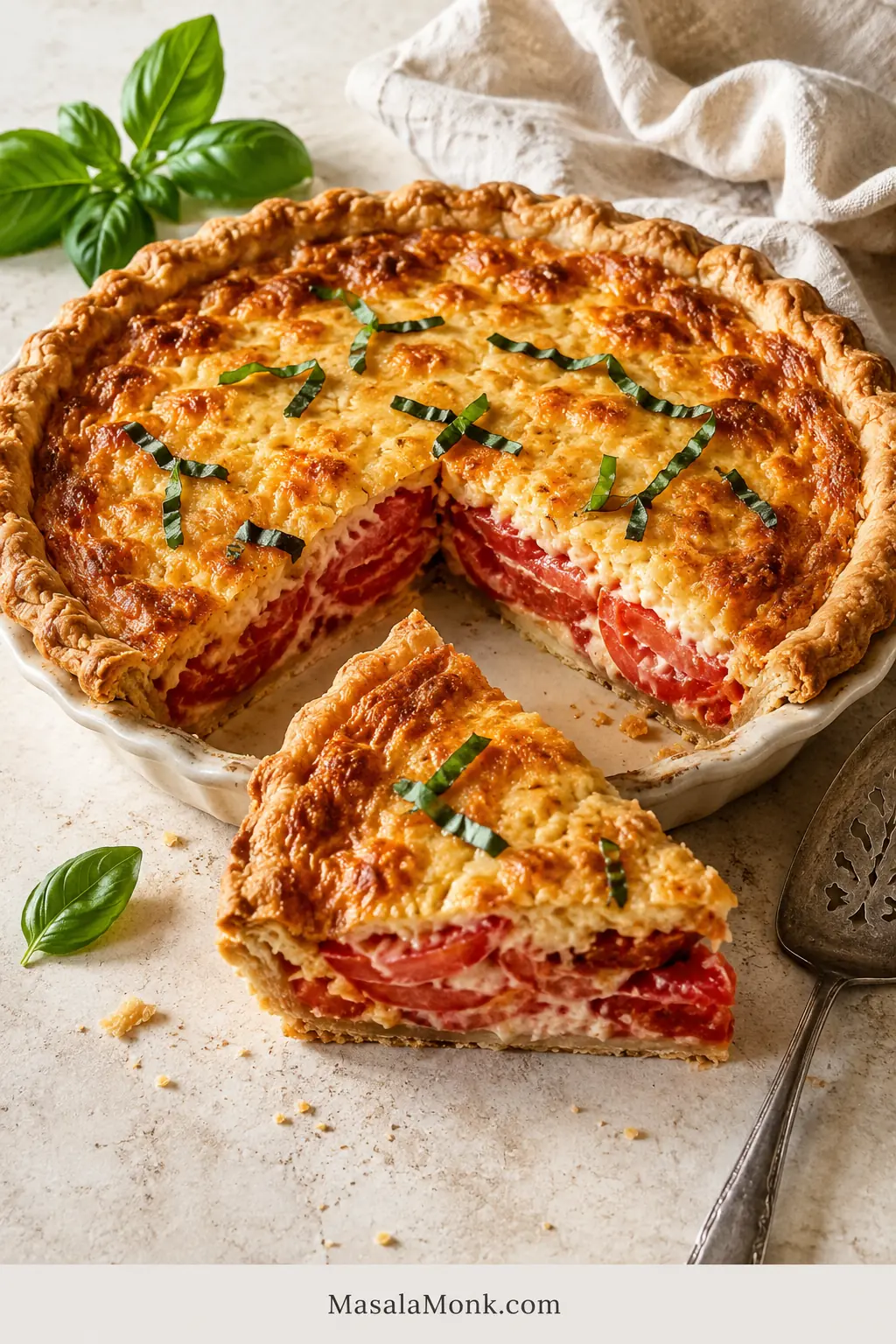
Whole Southern tomato pie with a golden crimped crust, browned cheese topping, fresh basil, and one wedge removed to reveal the red tomato filling.

The first slice tells you whether a tomato pie worked. The tomatoes should still taste unmistakably of summer, the cheese should be creamy and savory, and underneath it all there should be a crust flaky enough to matter—not pale pastry soaking in tomato juice.

This is the kind of pie to make when tomatoes are so ripe and fragrant that dinner can reasonably revolve around them. The aim is to concentrate that ripe tomato flavor while keeping enough water away from the pastry for the first wedge to come out looking—and eating—like a proper slice of pie.
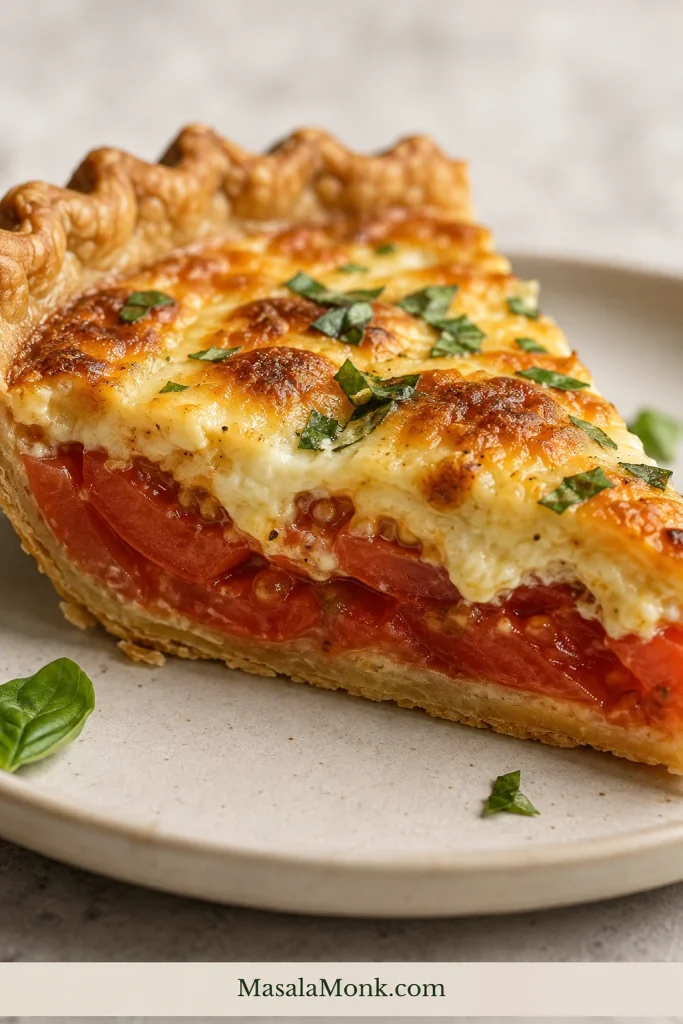
Close side view of a Southern tomato pie wedge showing an intact flaky bottom crust, red tomato layers, and browned creamy cheese topping.
A good slice keeps the flaky crust distinct beneath generous tomato and browned cheese.

So the tomatoes are lightly salted, blotted and roasted. The crust gets a head start in the oven and a thin layer of melted sharp cheddar before the tomatoes ever touch it. On top goes extra-sharp cheddar, Parmesan, fresh basil, Dijon and enough mayonnaise to make everything creamy while the tomatoes still taste like the reason you made the pie.

Jump to: Recipe · Keep It Crisp · Troubleshooting

Quick Answer: How to Make Tomato Pie Without a Soggy Crust

For a standard 9-inch / 23 cm pie, use about 2 lb / 900 g ripe tomatoes. Slice them ⅜–½ inch / 10–13 mm thick, lightly salt and blot them, then roast until slightly wrinkled and no longer wet-looking. Pre-bake the crust until the bottom is dry and lightly golden, then melt a thin layer of cheddar over it.

Arrange the tomatoes over the crust, add the cheese topping, and bake on the lower-third rack at 375°F / 190°C for about 30–35 minutes. Rest at least 30 minutes before slicing; closer to an hour gives cleaner wedges.

There are a few more steps here than in the quickest versions, but none is difficult. With one tomato tray, the tomatoes roast while the crust pre-bakes, so those two jobs finish at almost the same time.

Southern Tomato Pie Recipe With a Crisp Crust

This version keeps the tomatoes front and center: roasted just enough to deepen their flavor, layered over a pre-baked crust, then covered with a sharp, basil-flecked cheese topping that stays creamy without becoming heavy.

Yield: 1 standard 9-inch / 23 cm pie
Serves: 6 generous portions or 8 smaller portions
Hands-on time: about 30 minutes
Prep + bake: about 1¼–1½ hours
Rest: 30–60 minutes
Total time: about 2–2½ hours
Best served: warm or at room temperature
Timing note: Times assume you are starting with a prepared crust ready to blind-bake.

Equipment

  • Standard 9-inch / 23 cm pie plate, if using rolled dough
  • 1–2 large rimmed baking sheets
  • Parchment paper
  • Pie weights or dried beans, for rolled dough
  • Clean kitchen towels or paper towels
  • Wire cooling rack
  • Foil or a pie shield, optional

Ingredients
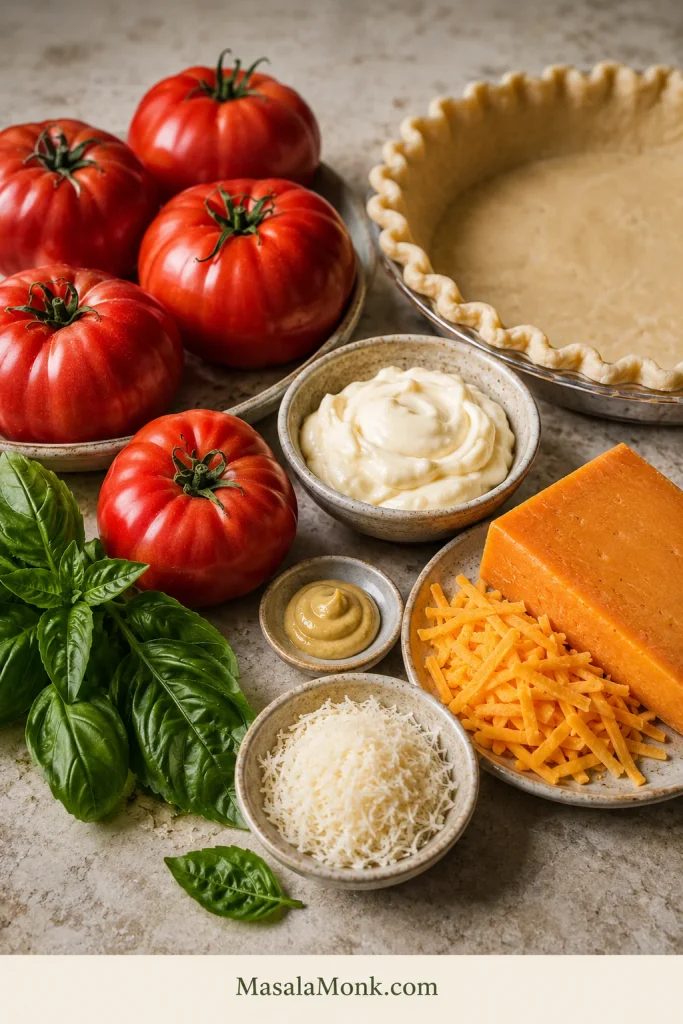
Ripe red tomatoes, pie crust, cheddar, Parmesan, mayonnaise, Dijon mustard, and fresh basil arranged together for Southern tomato pie.
Tomatoes bring the juiciness and acidity; cheddar, Parmesan and mayo add richness; Dijon and basil keep it bright.

For the Tomatoes

  • 2 lb / about 900 g ripe tomatoes, about 4–6 large tomatoes
  • ¾ teaspoon fine sea salt / about 4 g
  • ½ teaspoon freshly ground black pepper, divided

For the Crust and Bottom Cheese Layer

  • 1 prepared standard 9-inch / 23 cm pie crust, homemade or store-bought; not deep dish
  • 1½ oz / 40 g extra-sharp cheddar, finely grated

And for the Cheese Topping

  • 5½ oz / 160 g extra-sharp cheddar, freshly grated
  • 1 oz / 28 g Parmesan, finely grated; Pecorino Romano also works but is saltier
  • ½ cup / about 115 g mayonnaise
  • 1 teaspoon / 5 ml Dijon mustard
  • ¼ cup loosely packed fresh basil, torn or chopped, plus more for serving
  • Pinch of red-pepper flakes, optional

Shopping note: You need 7 oz / 200 g cheddar total. One standard 8 oz / 227 g block is enough for the whole pie with a little left over.

Instructions

Prep the Tomatoes and Crust

  1. Heat the oven. Position one rack in the upper half of the oven and another in the lower third. Heat to 425°F / 220°C conventional. Line a large rimmed baking sheet with parchment.
  2. Slice, salt and blot the tomatoes. Core them and cut into slices about ⅜–½ inch / 10–13 mm thick. Arrange them over clean kitchen towels or several layers of paper towel, sprinkle with the ¾ teaspoon / 4 g salt, and leave for 10–15 minutes. Blot firmly, then season with ¼ teaspoon black pepper. Very large rounds can be halved so the finished pie is easier to portion.
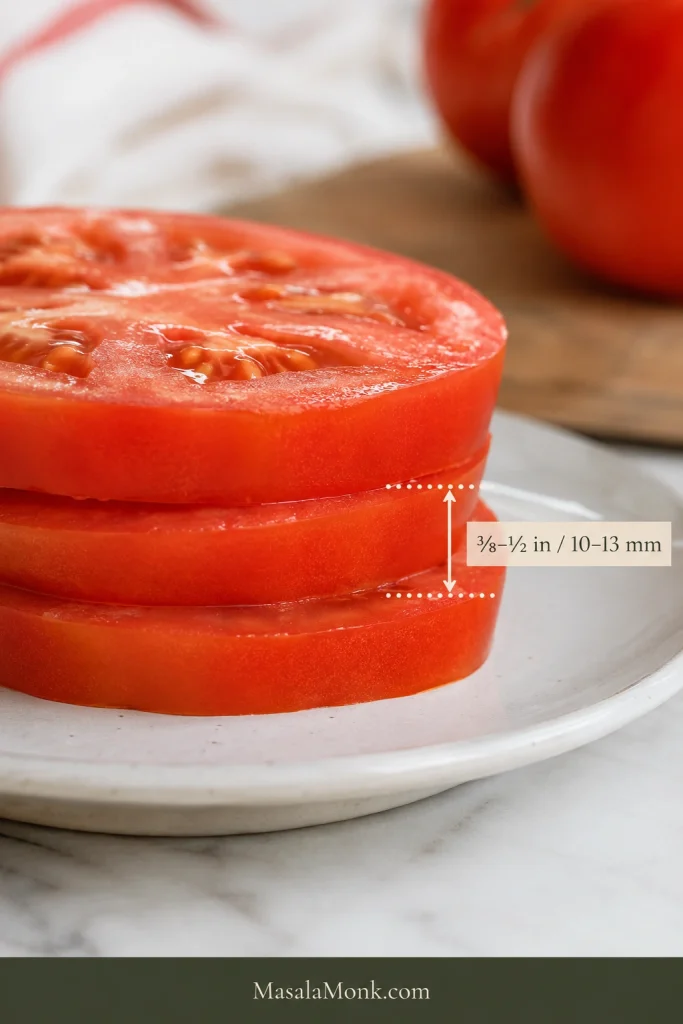
Side view of tomato slices with a measurement guide showing the target thickness of 3/8 to 1/2 inch, or 10 to 13 millimeters.
Aim for ⅜–½ inch / 10–13 mm: thick enough to stay substantial after roasting, but not so thick that moisture lingers.
  1. Prepare the crust and arrange the tomatoes.
    Using rolled dough? Fit it into a standard pie plate, crimp the edge, line it with parchment and fill with pie weights or dried beans.
    Using a preformed frozen shell? Keep it in its supplied pan. Follow its package directions for blind-baking; use weights only if those directions call for them.
    Arrange the blotted tomato slices on the baking sheet in one layer with a little breathing room between them. Avoid heavy overlap.
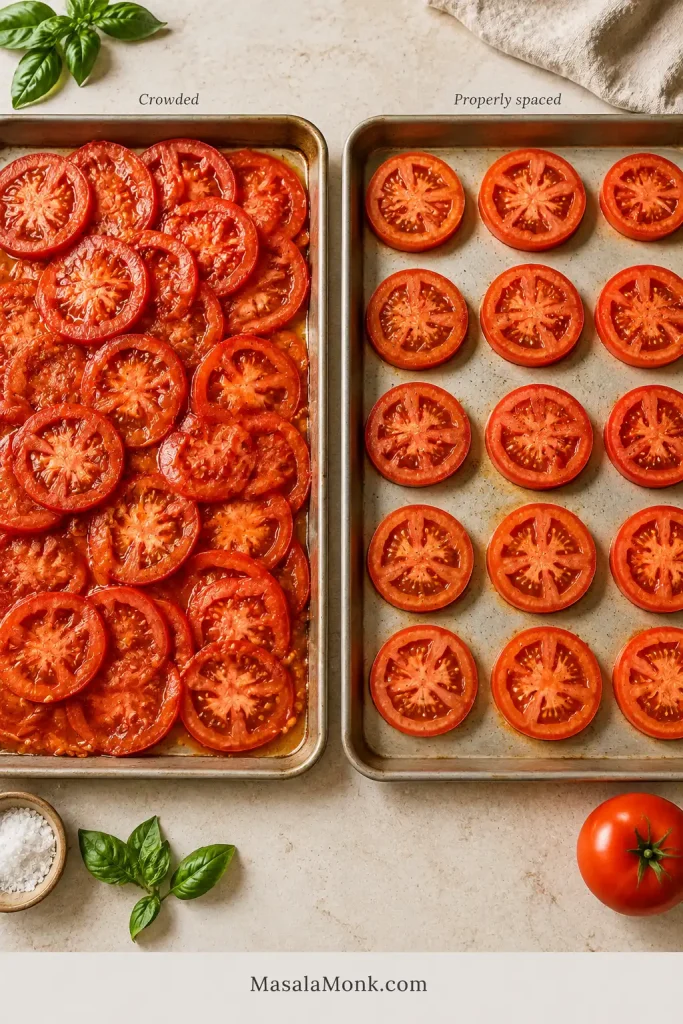
Two sheet pans compare overlapping tomato slices with tomato slices arranged in a single layer with space between them.
Leave breathing room between slices so steam can escape instead of collecting where tomatoes overlap.
  1. Roast the tomatoes while the crust pre-bakes. With one tomato tray, roast the tomatoes on the upper rack while the crust bakes below.
    Rolled crust: Bake it with the weights for 15–18 minutes.
    Preformed frozen shell: Follow its blind-baking time. It may finish before or after the tomatoes; that is fine.
    Need two tomato trays? Roast them first, rotating the pans if needed, then pre-bake the crust afterward. Giving the tomatoes space matters more than forcing the two jobs to overlap.
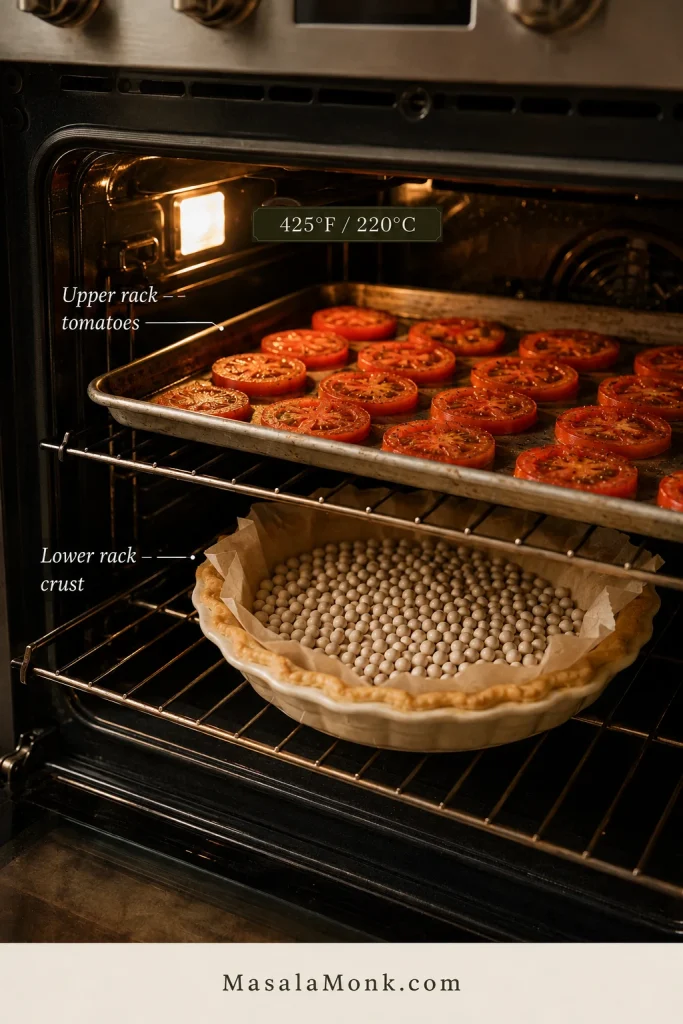
Home oven showing a tray of tomatoes roasting on the upper rack while a weighted pie crust blind-bakes on the lower rack at 425 degrees Fahrenheit.
With one tomato tray, use the upper rack for tomatoes and the lower rack for the crust so both jobs can happen at once.

Finish the Crust and Make the Topping

  1. Finish the crust and check the tomatoes.
    Crust: For rolled dough, carefully remove the parchment and weights, then return the empty shell to the lower rack for another 5–7 minutes. For a preformed frozen shell, continue according to its package directions as needed. Whichever crust you use, the base should be dry, set and lightly golden before filling. Pale, shiny or slightly translucent pastry needs more time.
    Tomatoes: Their color should be a little deeper, the edges slightly wrinkled and the cut surfaces more matte than glossy. Very little thin juice should remain on the pan. They should still look juicy, not dried out.
  2. Add the cheddar barrier and lower the oven. Scatter the 40 g cheddar over the hot crust and return it to the oven for about 3–5 minutes, until the cheese melts into a thin layer. Reduce the oven temperature to 375°F / 190°C conventional and keep one rack in the lower third.
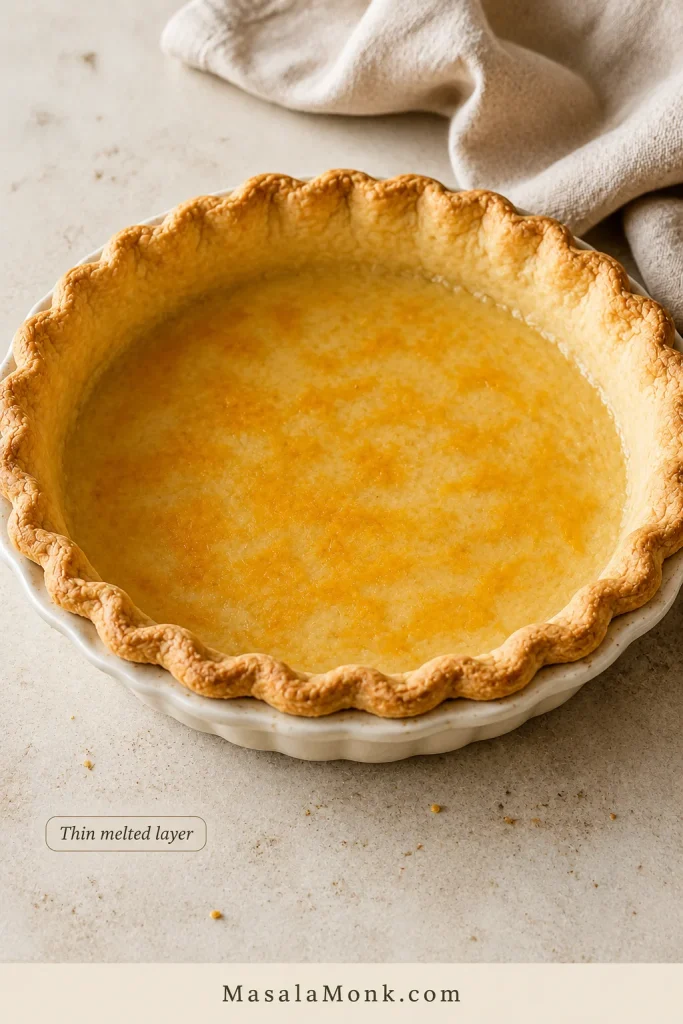
Close view inside an empty blind-baked pie shell with a thin layer of melted cheddar coating the bottom crust.
A thin melted cheddar layer adds another buffer between the pastry and the juicy tomato filling.
  1. Mix the topping. Combine the remaining 160 g cheddar, Parmesan, mayonnaise, Dijon, the remaining ¼ teaspoon black pepper and the basil. The mixture should be thick enough to hold its shape. Cheddar, Parmesan and mayonnaise already bring plenty of salt, so taste before adding any more.
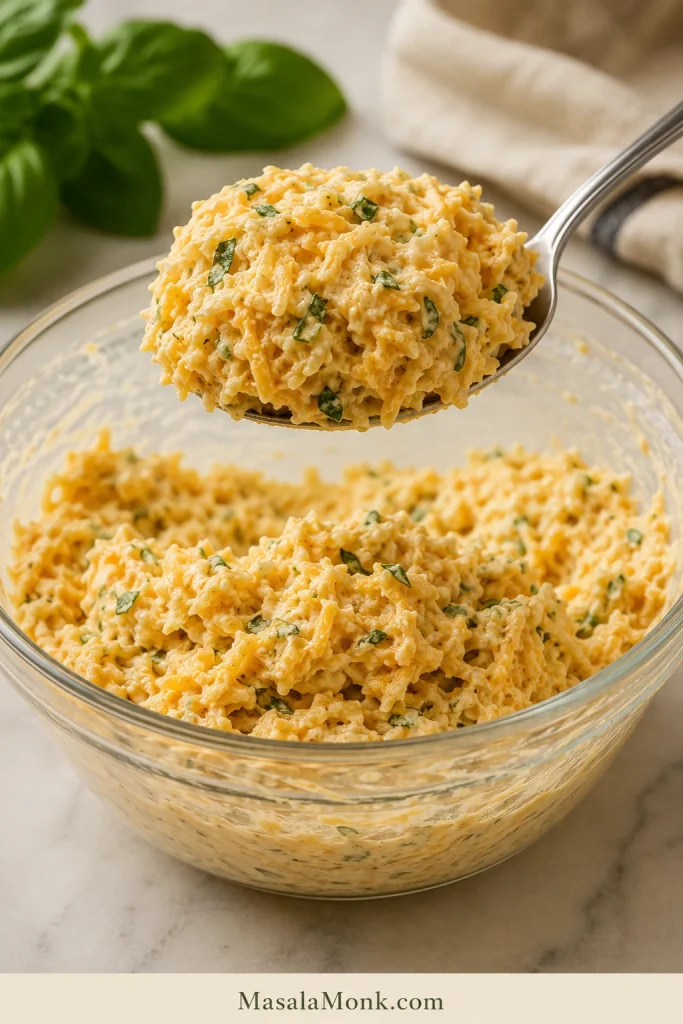
Spoon holding a thick mound of cheddar, Parmesan, mayonnaise, Dijon, and basil mixture above a bowl, with no dripping or cheese strands.
The topping should mound on the spoon and stay there—thick, cohesive and easy to dollop.

Assemble, Bake and Rest

  1. Assemble the pie. Arrange the roasted tomatoes over the cheese-lined base with light overlap. Blot any slice that has released a fresh puddle while waiting. Dollop the topping in small spoonfuls over the tomatoes, then gently spread or pat it into an even layer with the back of a spoon.
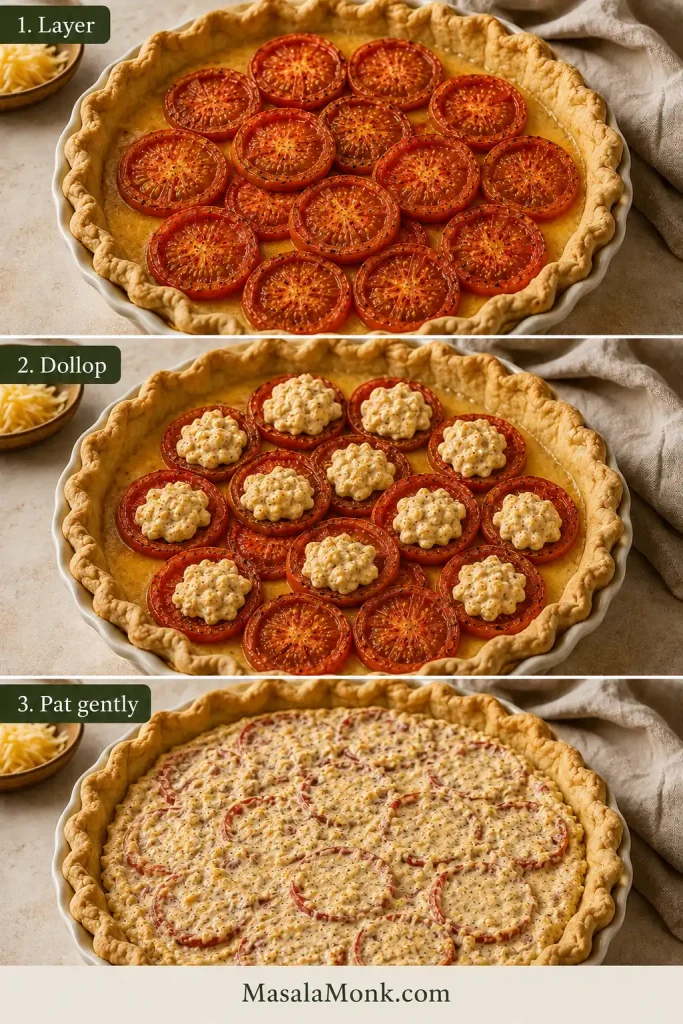
Three stages of tomato pie assembly showing roasted tomatoes layered in the crust, small spoonfuls of cheese topping added, and the topping gently spread.
Dollop first, then spread gently so the roasted tomato slices stay where you placed them.
  1. Bake until browned and set. Bake on the lower-third rack for about 30–35 minutes, beginning to check around 25 minutes. The crust should be deeply golden, the topping browned in patches, and small bubbles should appear around parts of the filling. Give the dish a gentle nudge. A little movement is fine; the filling should move together instead of sloshing. Shield the rim with foil if it browns before the center is ready.
  2. Rest and serve. Set the pie on a wire rack for at least 30 minutes. For cleaner wedges, give it closer to 45–60 minutes. Finish with a little fresh basil before serving.

Recipe Notes

  • Two-tray timing: Allow roughly another 20–30 minutes because the crust can no longer pre-bake alongside the tomatoes.
  • Using coarse kosher salt? Weigh it if possible; crystal size varies enough between brands to make a direct teaspoon conversion unreliable.
  • Very juicy heirlooms may need longer. Trust the tray rather than forcing every batch to finish at exactly 25 minutes.
  • Fan/convection ovens brown faster. Use your oven’s usual temperature adjustment and begin checking both tomatoes and crust early.
  • For cleaner slices, cut through the tomato skins first. A sharp serrated knife or very sharp chef’s knife helps keep a large slice from pulling the filling out with it.

Need something specific? Best Tomatoes · The Best Crust · Cheese & Mayo · Times & Doneness · Troubleshooting · Variations · Serving · Make Ahead

Why Tomato Pie Gets Soggy—and Five Ways to Keep the Crust Crisp

A soft crust can begin in several places. Too much water may come in with the tomatoes. The pastry may need more time before filling, or the bottom may not be browning strongly enough. Sometimes a well-baked pie is simply sliced while everything inside is still loose and steaming.

The crispest pies do not rely on one heroic trick. A handful of smaller choices add up.
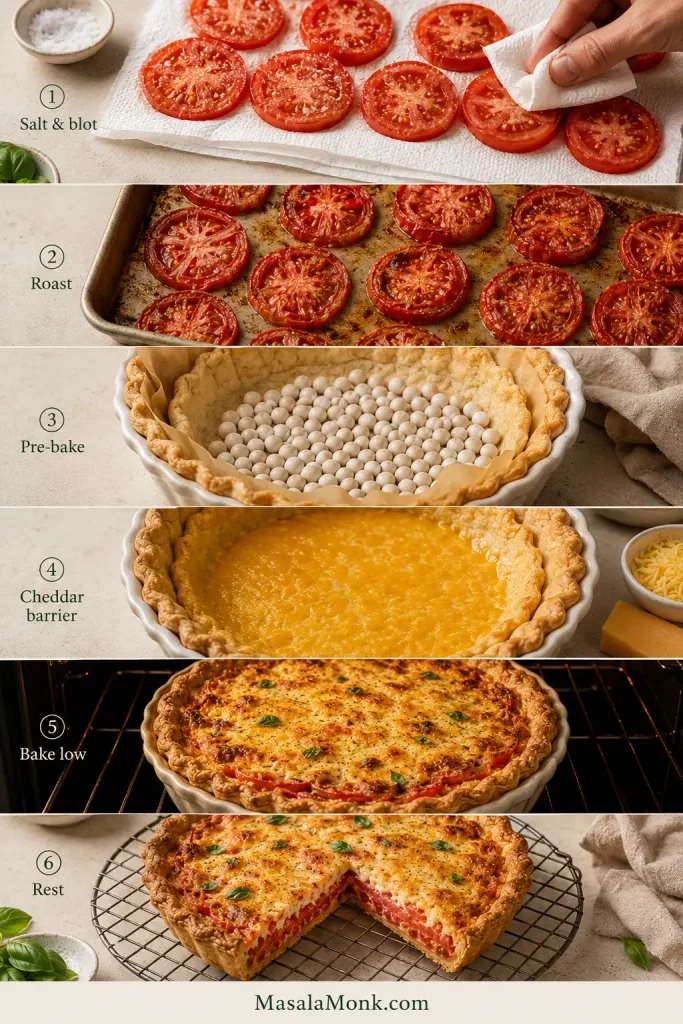
Tomato pie guide showing tomatoes salted and blotted, roasted, crust blind-baked, a thin cheddar barrier, a low-rack bake, and the finished pie resting.
Crispness comes from several small protections working together: blot, roast, pre-bake, add a thin cheese barrier, bake low and rest.
  1. Dry the tomatoes in two stages. A short salt-and-blot step removes easy surface water; roasting then drives off more moisture while concentrating the flavor.
  2. Give the crust a real head start. The base should already have color and structure before the tomatoes arrive.
  3. Add a thin cheese layer. Melted cheddar gives the crust another buffer against the tomato juices.
  4. Bake low in the oven. The lower rack encourages better browning underneath while the filling finishes.
  5. Let the pie rest. Cooling lets steam escape and gives the filling time to settle.

Together, those small choices make the difference between a pie that merely tastes good and one you can confidently lift from the dish and put on somebody’s plate.

Surface water is the easiest moisture to remove: salting draws it out, and blotting takes it away before roasting begins.
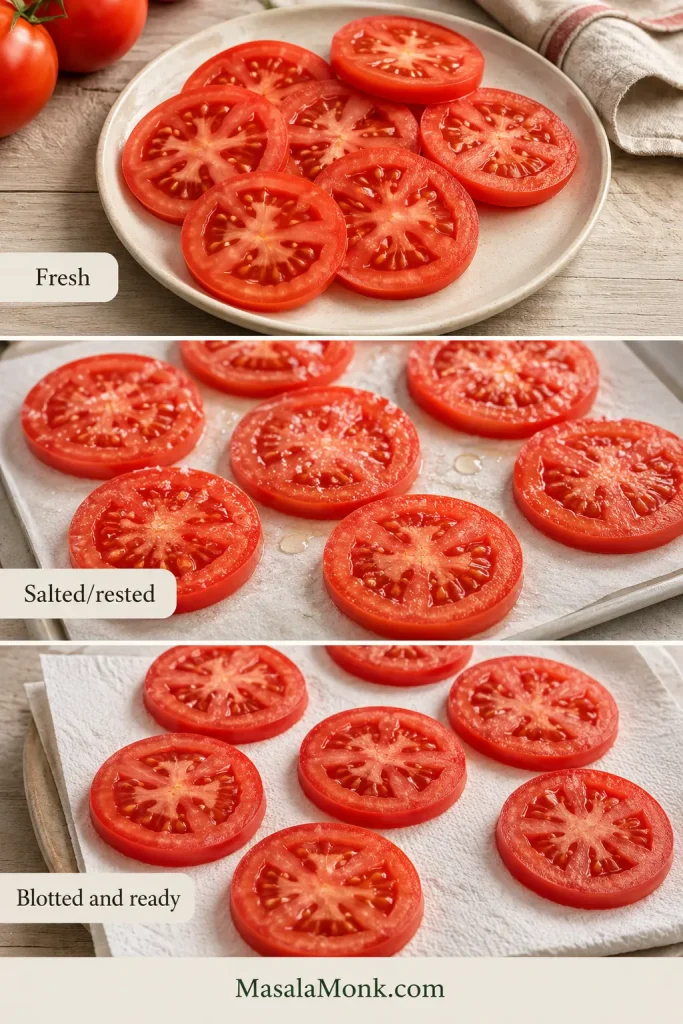
Three tomato-preparation stages showing fresh glossy slices, salted slices with beads of moisture, and blotted slices with visibly drier surfaces.
The beads that appear after salting are moisture you can blot away before the tomatoes ever reach the crust.

Best Tomatoes for Tomato Pie

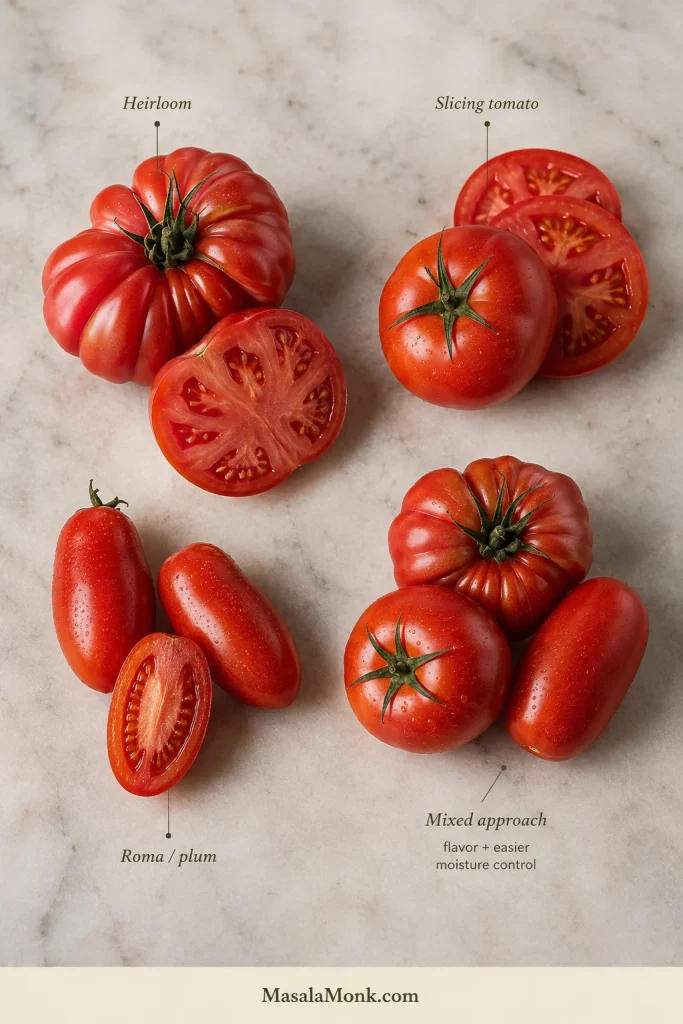
Four groups compare heirloom tomatoes, round slicing tomatoes, Roma or plum tomatoes, and a mixed combination of those tomato types.
Heirlooms bring big flavor but more juice; plum tomatoes are meatier; slicing tomatoes sit comfortably between the two.

For pie, tomato flavor matters—but so does how much water that tomato is carrying. Smell them. If they barely smell like tomatoes before you cut them, roasting will not suddenly give them peak-summer flavor.

TomatoBest ForMoisture RiskWhat to Know
HeirloomBig flavor and beautiful colorHighWonderful in season, but very juicy varieties may need extra roasting time.
Ripe slicing tomatoBest all-round choiceMediumGood balance of flavor, structure and availability.
Roma or plumEasiest moisture controlLowerMeatier flesh makes them forgiving, although flavor varies.
Mixed tomatoesFlavor plus reliabilityMediumMix flavorful heirlooms with firmer slicing or plum tomatoes when you want both character and easier moisture control.

What I Would Buy

If I were shopping specifically for this pie, I would choose ripe but still firm slicing tomatoes unless especially flavorful heirlooms were available.

A hand holds a ripe red tomato near the nose while several firm red tomatoes rest nearby on linen and in a paper produce bag.
Choose tomatoes that smell ripe and give slightly under pressure without feeling soft or collapsed.

Peak-season heirlooms are worth using; just let their juiciness decide the roasting time. Mixing a few with meatier plum tomatoes also works well when you want plenty of flavor with a little less water to manage.

Roasting does more than solve a water problem. As excess juice cooks away, the tomatoes taste sweeter, deeper and more intensely like themselves. That concentrated flavor becomes the heart of the finished pie.
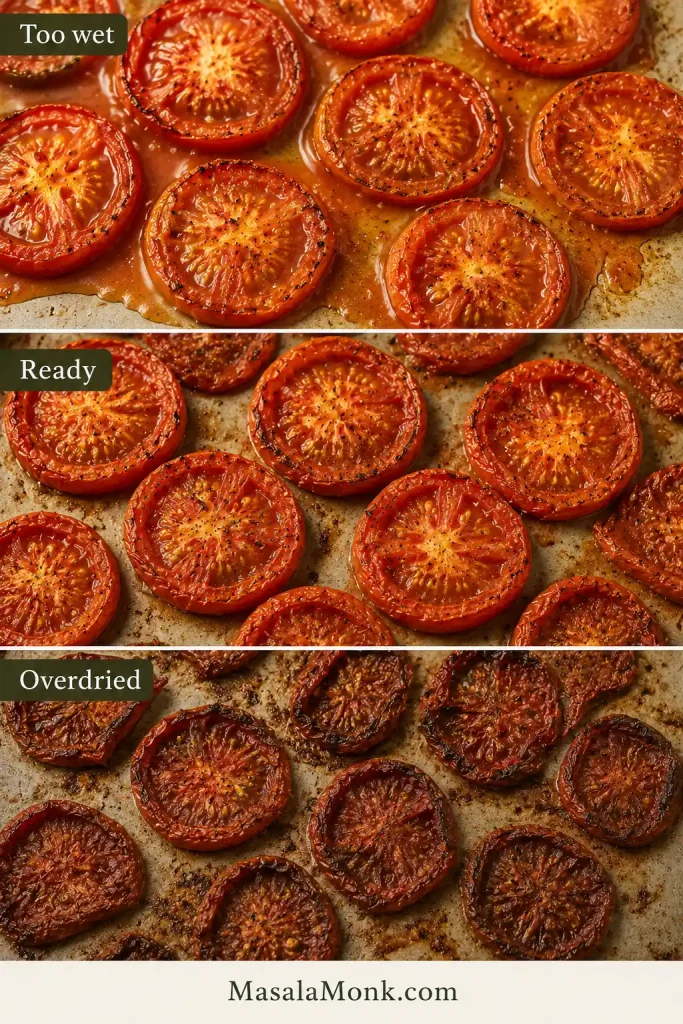
Three roasted tomato states labeled too wet, ready, and overdried, ranging from glossy and juicy to lightly wrinkled and then dark and shrunken.
Ready tomatoes stay red and plump with lightly wrinkled edges and a mostly matte surface—not glossy and watery, browned or shriveled.

If some of your tomatoes are already too soft or juicy to give you neat slices, they may be happier in fresh tomato soup, where their extra liquid can be cooked down instead of fought.

Cherry tomatoes can work, but they behave more like a variation than a direct substitute: once halved, they expose much more cut surface and do not create the same layered filling. Canned tomatoes are better saved for another recipe. This one really wants fresh tomatoes that can be sliced, roasted and layered.

The Best Crust

Use a standard 9-inch / 23 cm flaky pie crust, not deep dish. Homemade dough, refrigerated rolled pastry and a standard preformed frozen shell can all work. The base needs enough color and structure before the tomatoes arrive.
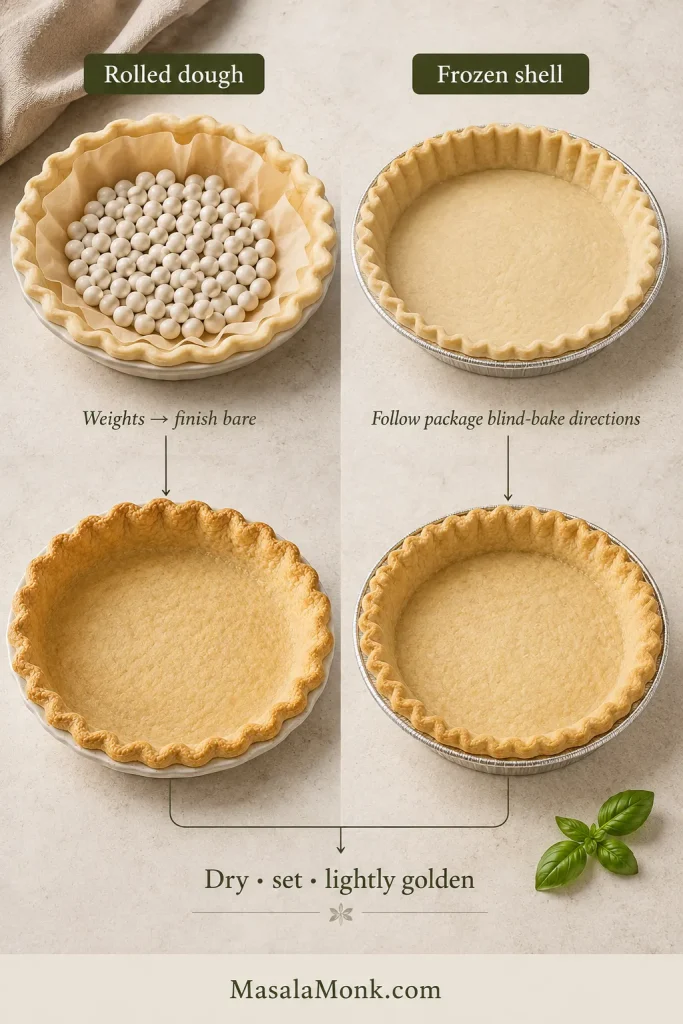
Two crust preparation routes compare rolled dough blind-baked with parchment and weights with a standard preformed frozen pie shell baked in its foil pan.
Rolled dough and a frozen shell can both work; what matters is a dry, well-set base before filling.

If store-bought crust gets tomato pie on the table, use it. The tomatoes matter much more here than whether you made the pastry yourself.

Do You Have to Blind-Bake the Crust?

For this recipe, yes. The shell gets a substantial head start so it is already baked across the bottom before it has to support a juicy filling.

Look underneath. Pale or slightly translucent pastry still needs more time. You want the bottom dry and lightly golden across the base, not just browned around the exposed rim.
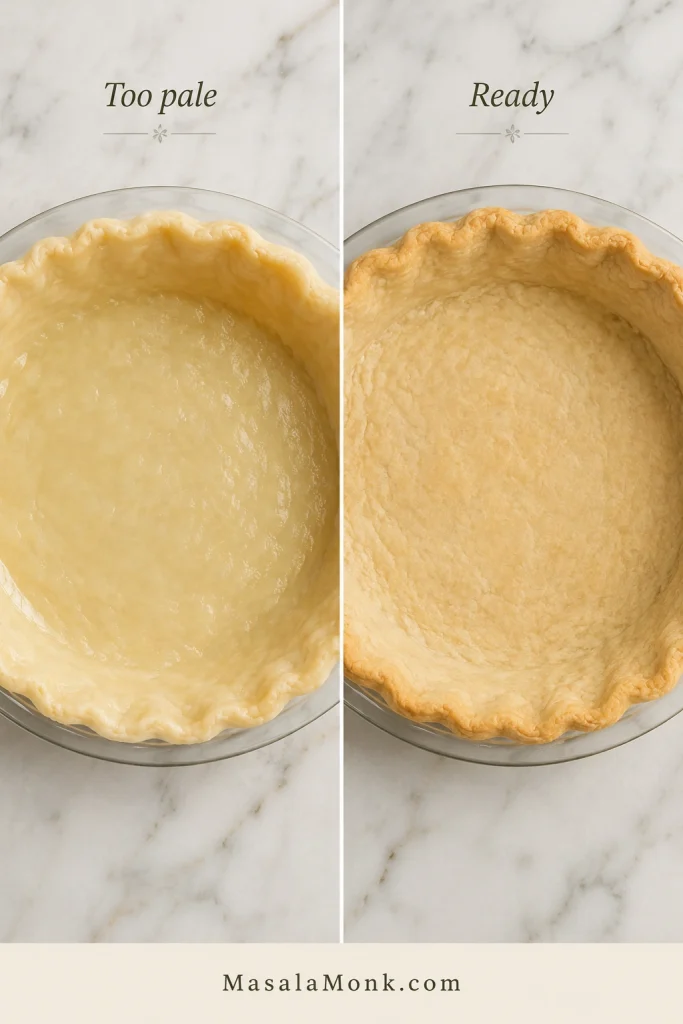
Two empty pie shells compared side by side: one pale and slightly glossy, the other dry, opaque, set, and lightly golden.
Look across the center, not just the rim: the base should be dry, opaque, firm and lightly golden, without shiny or translucent patches.

A crust baked this far does not disappear underneath the filling. You can still feel its flaky edge when you cut into the finished pie.

If you want to make the pastry yourself, this flaky homemade pie crust recipe makes enough dough for two single 9-inch crusts, so you can use one here and freeze the second.

Metal, glass and ceramic pie plates can all work. Metal heats quickly. Glass lets you inspect the underside. Thick ceramic usually heats more slowly, so follow the color of the pastry rather than the clock alone.

Best Cheese—and Why Mayo Matters

Extra-sharp cheddar gives the topping plenty of flavor without requiring an especially thick cheese layer. A little melts directly over the crust, while the rest forms the backbone of the topping. Parmesan adds a concentrated savory edge without bringing much extra water.

Pecorino Romano can stand in for Parmesan, but it is saltier. Taste before adding anything else salty, especially if bacon is also going into the pie.

Why Does Southern Tomato Pie Use Mayonnaise?

Bowl of cheddar and mayonnaise topping surrounded by mayonnaise, cheddar, Parmesan, Dijon, and basil, with callouts for fat, acidity, creaminess, and binding.
Mayo is part of the topping’s structure here, not a separate sauce or finishing condiment.

Mayonnaise brings fat, acidity, creaminess and enough binding to help the cheese topping hold together as it bakes. If you prefer making condiments from scratch, this homemade mayonnaise recipe explains the basic emulsion and gives you a classic mayo you can use here.

The creamy layer needs enough tang to sharpen the tomatoes. The topping should frame the filling, not bury it.

For more stretch, choose low-moisture mozzarella rather than fresh mozzarella. Treat it as a texture variation, not an exact cheddar substitution. Fresh mozzarella carries much more water. Gruyère gives the pie a nuttier, more savory character, while fontina melts into a softer, silkier layer.

How Long to Bake Tomato Pie: Times and Readiness Cues

The timer tells you when to start looking. The food tells you when to move on. Tomato variety, crust thickness, pie-dish material and oven calibration all affect the exact timing, so use the clock together with the visual cues below.
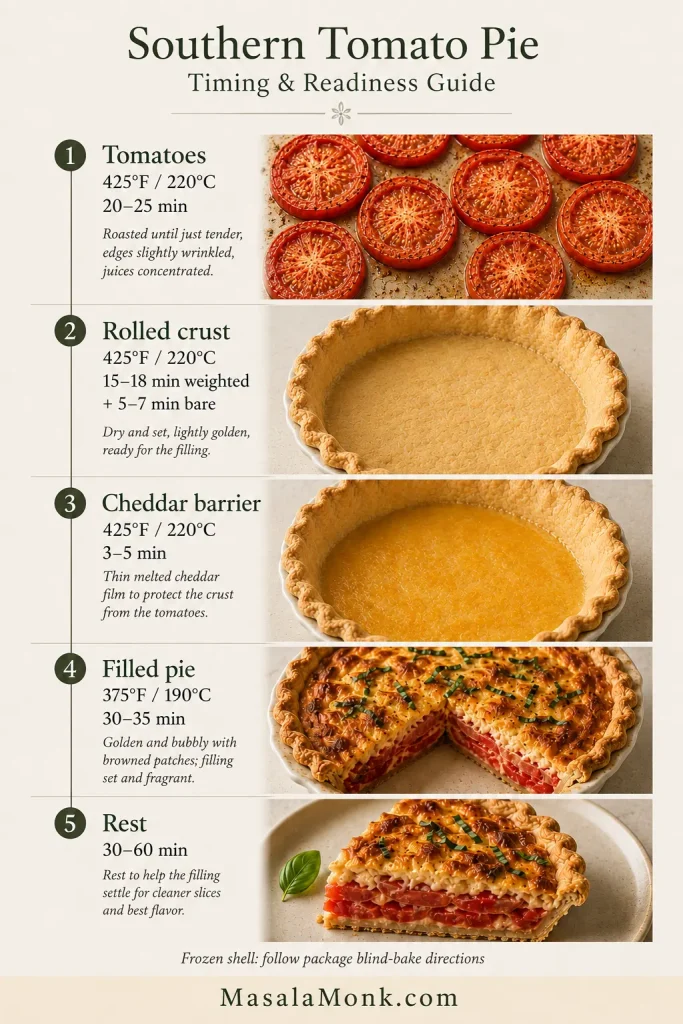
Vertical tomato pie timing guide showing roasted tomatoes, blind-baked crust, melted cheddar barrier, baked filled pie, and rested slice with temperatures and cooking times.
When your oven runs faster or slower than expected, these visual cues are the tie-breaker.
StageTemperatureStarting TimeReady When
Tomatoes425°F / 220°C20–25 minSlightly wrinkled, deeper in color, matte rather than wet-looking, very little thin juice
Weighted rolled crust425°F / 220°C15–18 minShell has set and the rim is beginning to color
Unweighted rolled crust425°F / 220°C5–7 minBase looks dry and lightly golden
Preformed frozen shellPer package directionsPer package directionsBase is dry, set and lightly golden
Cheddar barrier425°F / 220°C3–5 minCheese has melted into a thin layer
Filled pie375°F / 190°C30–35 minCrust deeply golden, topping browned in patches, gentle bubbling, center moves together
RestRoom temperature30–60 minFilling has settled enough for the kind of slice you want

By the end of the bake, the tomatoes should smell sweeter, the cheese will have browned in patches and the pastry should look unmistakably baked.
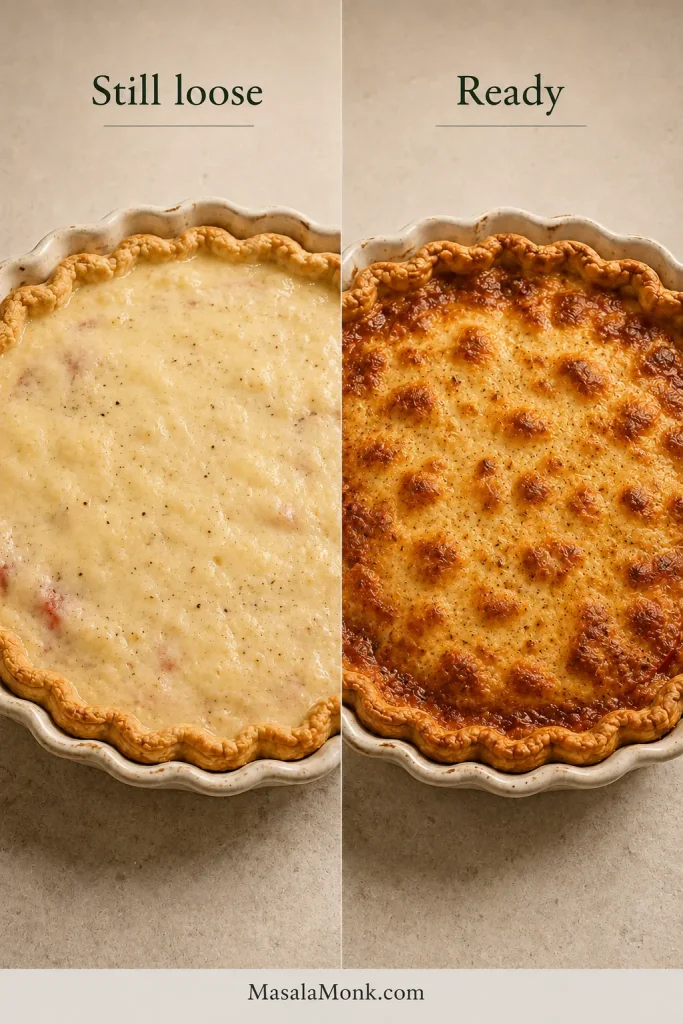
Two views of the same tomato pie during baking: one pale and glossy with a loose center, and one browned in patches with a cohesive, set filling.
A ready center may jiggle, but the filling should move together; loose liquid sloshing independently means it needs more time.

How Long Should It Cool?

The hardest part of this recipe may be leaving it alone once it comes out of the oven.

For a warm, softer wedge, about 30 minutes is enough. For clean slices at the table, give it closer to 45–60 minutes.
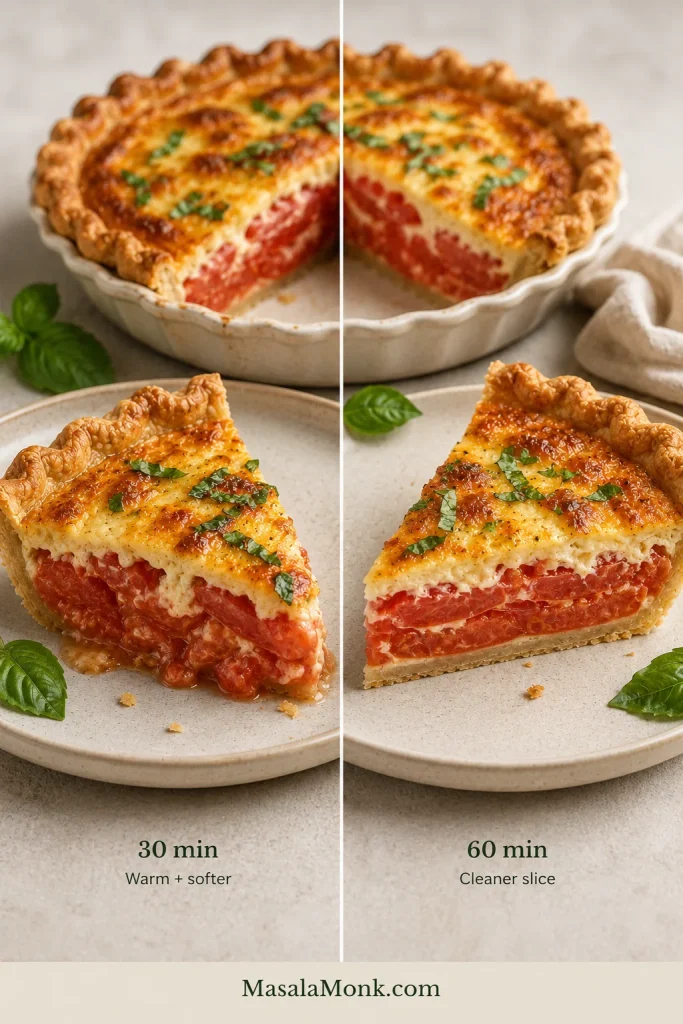
Two tomato pie wedges compare a warmer, softer slice after 30 minutes of resting with a cleaner, more firmly set slice after 60 minutes.
As the pie rests, the topping firms and the filling settles, so extra time buys a cleaner slice.

By then the kitchen will smell like toasted pastry, warm tomato, cheddar and basil, and the filling will have settled without going cold.

Tomato Pie Troubleshooting: What Went Wrong?

“Soggy” can mean several different things. Match the fix to what you actually see.
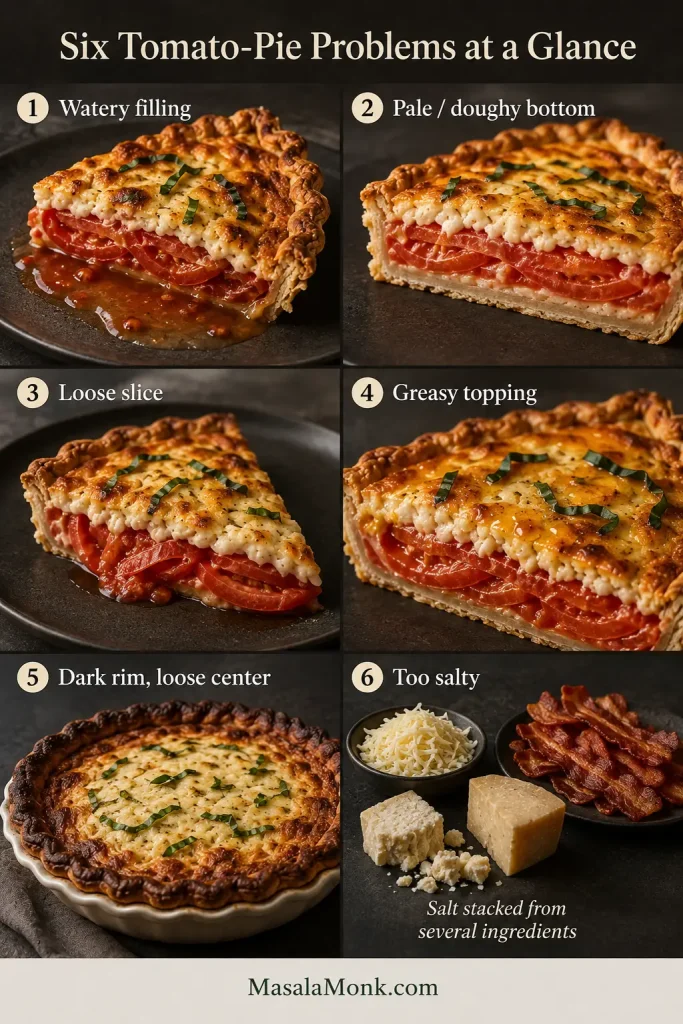
Six-panel tomato pie troubleshooting guide showing watery filling, pale bottom crust, loose filling, greasy topping, a dark rim with loose center, and several salty ingredients combined.
Start with where the problem appears—under the slice, in the filling, on top or around the rim—then match the fix.
What You SeeLikely CauseFix
Watery filling; tomato juice pools around the sliceTomatoes entered the pie too wetGive them more space or roasting time; blot slices that release juice while waiting
Pale, doughy bottom while the filling looks fineCrust needed more pre-baking or stronger bottom heatGive the base more color before filling and keep the filled pie low in the oven
Loose slice without much free liquidThe pie was cut too hotLet the filling settle longer before slicing
Clear or orange fat gathers on topToo many rich ingredients stacked togetherUse pesto modestly, drain bacon well and avoid another heavy cheese layer
Dark rim, loose centerCrust browned faster than the center cookedShield the rim with foil and keep baking
Harsh, overly salty toppingSalt from tomatoes, cheese and additions stacked upMeasure the tomato salt and taste before adding more when using Pecorino or bacon

Juice underneath? Think tomatoes. Oil on top? Think cheese, mayo, bacon or pesto. They can look similar once the pie is cut, but they need completely different fixes.
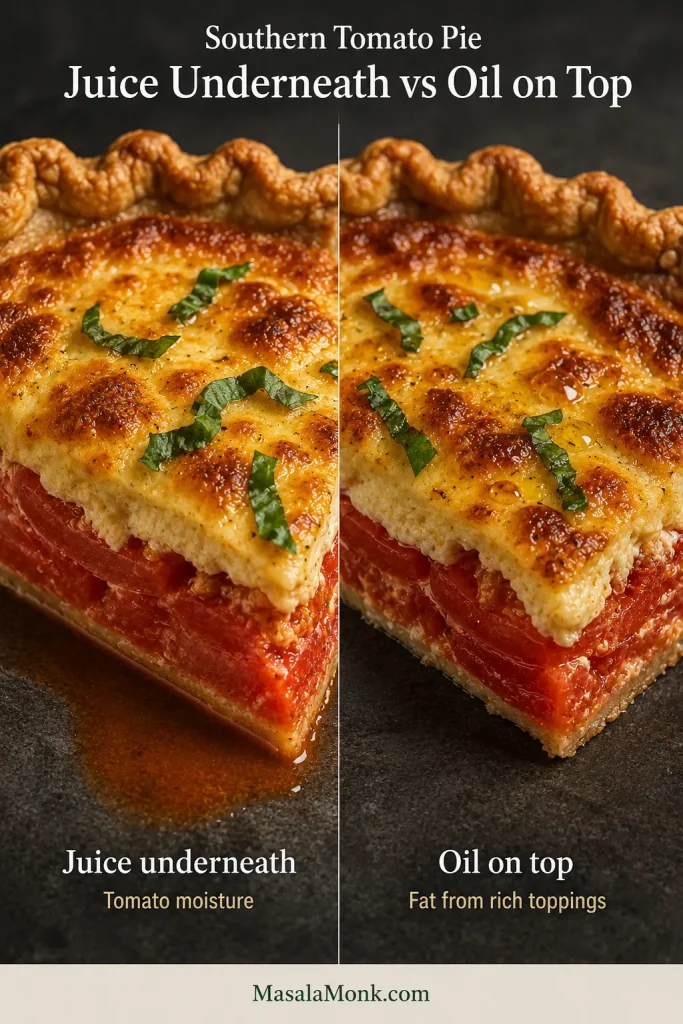
Close comparison of tomato pie with thin reddish juice pooling beneath a slice and amber oil droplets sitting on top of the browned cheese.
Tomato juice is usually thin and reddish; rendered fat looks clearer and amber-orange, often beading on the cheese first.

Ready to try again? Back to Recipe · Times & Doneness

What Makes This a Southern Tomato Pie?

Ripe fresh tomatoes, pastry and a creamy cheddar-mayo topping put this firmly in the Southern tomato-pie family. Basil, onion, bacon and other cheeses vary from one kitchen to another, but tomatoes, pastry and a rich cheese layer sit at the center of the dish.

The name can be confusing. Trenton/New Jersey and Utica tomato pies belong to pizza traditions, while green tomato pie can mean something entirely different: a sweet, spiced pie made with unripe tomatoes. This recipe is the Southern savory version.

Easy Variations

Every addition brings something besides flavor—especially water, fat or salt. Keep those three in mind and the basic balance of the pie is much easier to preserve.

With Bacon

Add crisp, well-drained bacon between the tomatoes and topping. If you want an easy small-batch method, this crispy air fryer bacon recipe renders the fat well and lets the strips firm up after cooking. Cool and drain the bacon before crumbling it into the pie, and remember that it brings plenty of salt of its own.
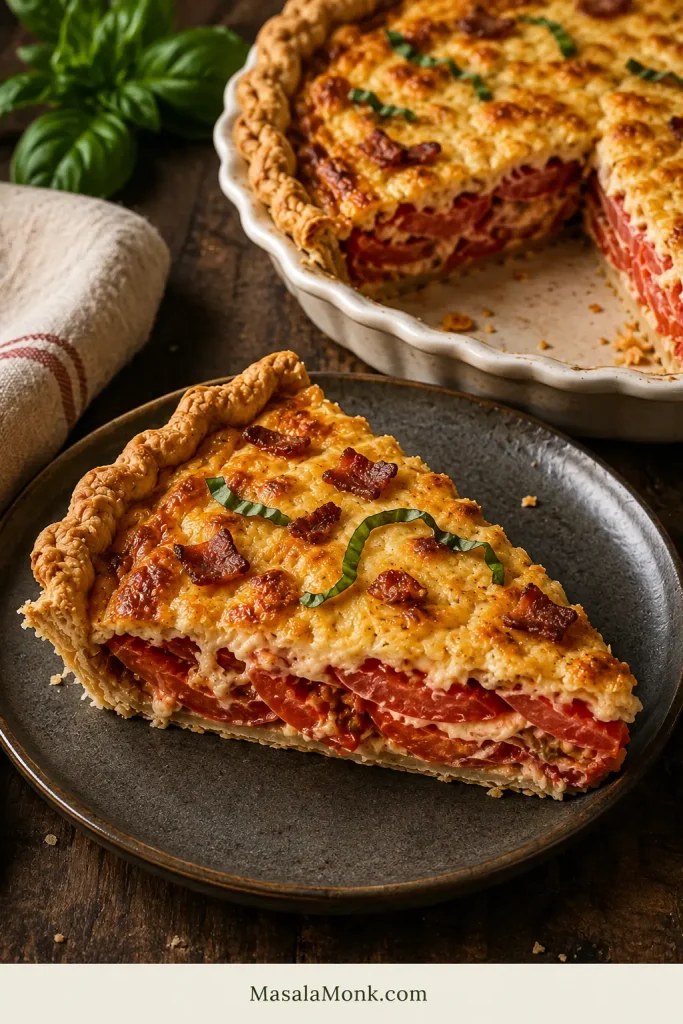
Southern tomato pie wedge with red tomato layers, creamy browned topping, flaky crust, basil, and a restrained amount of small crisp bacon pieces.
Scatter bacon so a few bites get a smoky, crisp accent without turning the whole pie heavy.

With Pesto

Use pesto sparingly. A classic basil pesto already contains olive oil, nuts and Parmesan, so a thick layer beneath the cheese topping can make the finished pie greasy. A thin smear is plenty. If what you mainly want is basil aroma, fresh leaves give you that lift with much less added fat.
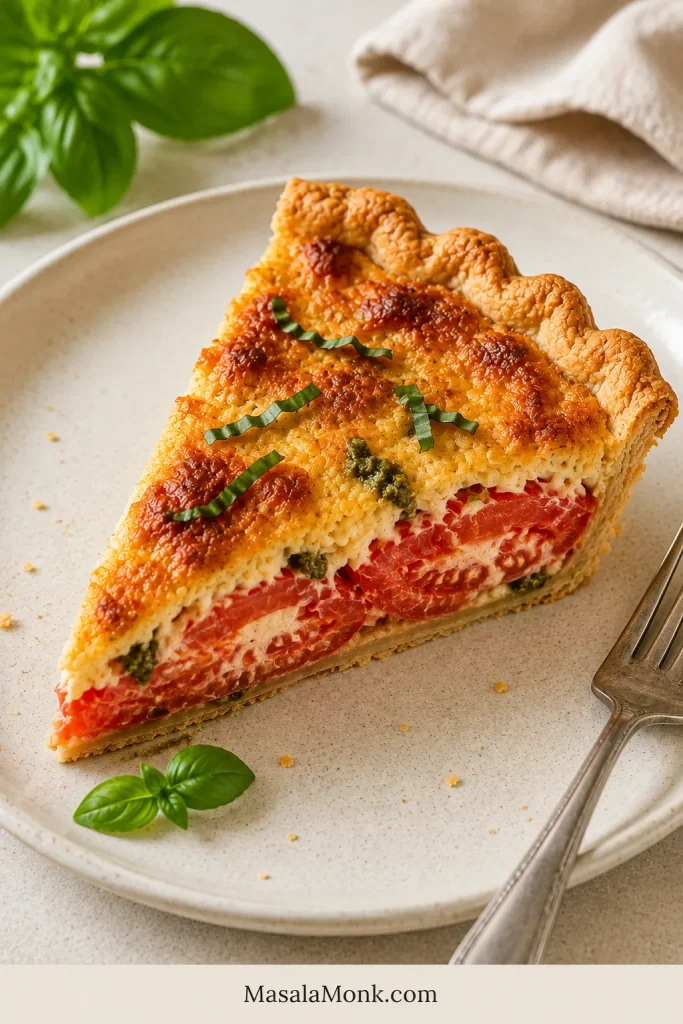
Southern tomato pie wedge with red tomato layers, browned cheese topping, flaky crust, basil, and a few small green pesto accents in the filling.
A little pesto goes a long way; keep it as a bright basil-garlic accent, not another rich layer.

Two smaller additions: Sautéed onion or shallot adds sweetness while shedding some of its moisture before it reaches the filling. A modest handful of fresh corn adds little bursts of sweetness and texture.

Can You Make It Without Mayo?

Yes, but do not simply leave the mayonnaise out of this recipe. Mayo supplies fat, acidity, creaminess and binding, so a completely mayo-free pie needs a topping formulated around another binder.

If it is mainly the mayo flavor you want to soften, sour cream can be part of a lower-mayo topping. I would not swap it cup for cup here, though; changing the binder changes the way the topping sets. For a completely mayo-free version, use a recipe built specifically for that style.

What to Serve With Tomato Pie

The pie is rich enough that something cool, crisp or sharp alongside it works especially well.

This cucumber salad with vinegar, dill and onion is a particularly good match because the crunch and acidity cut through the creamy cheese topping.
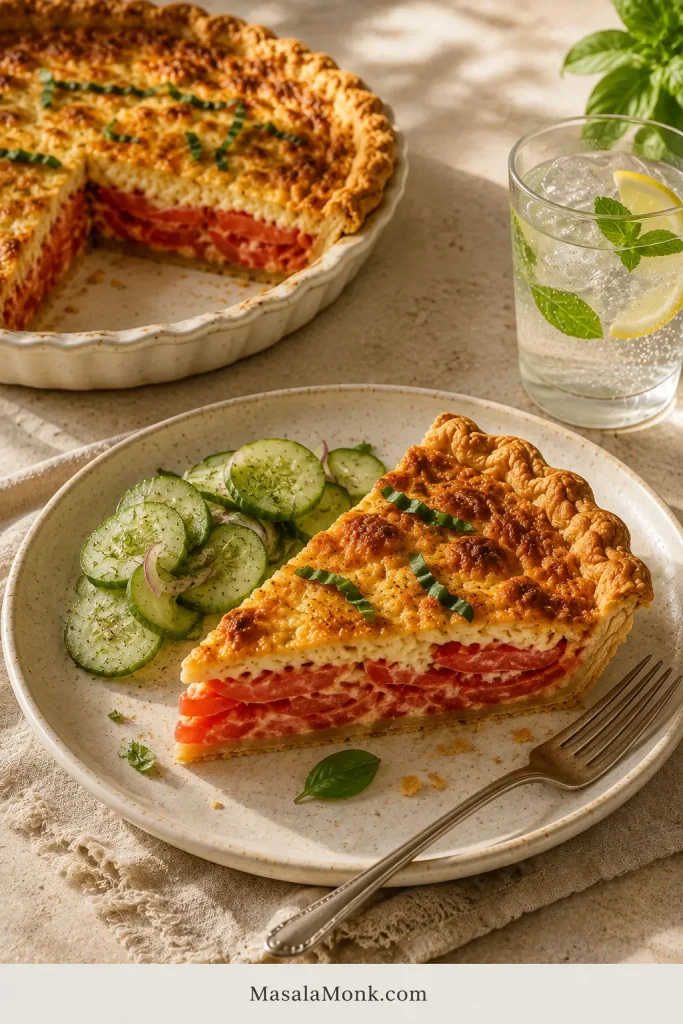
Southern tomato pie wedge served with cucumber salad and an iced lemon drink, with the remaining pie visible in the background under warm afternoon light.
Warm tomato pie, something crisp and cool, and a cold drink—that is summer lunch.
  • Green salad with a sharp vinaigrette
  • Green beans
  • Corn on the cob
  • Grilled chicken
  • Grilled shrimp
  • Fresh fruit or cold watermelon

For brunch, add eggs, fruit and a simple salad. For a summer lunch, a generous wedge and something cold and crunchy alongside it may be all you need.

Make Ahead, Store and Freeze

Make Ahead: What to Prep Early

If I were preparing this a day ahead, I would stop before assembly.

  • Roast the tomatoes and refrigerate them once cool.
  • Blind-bake the crust, let it cool completely and keep it covered.
  • Grate the cheddar and Parmesan and refrigerate them.
  • Stir the mayonnaise and Dijon together if you want one less job later, but leave the fresh basil whole until assembly.
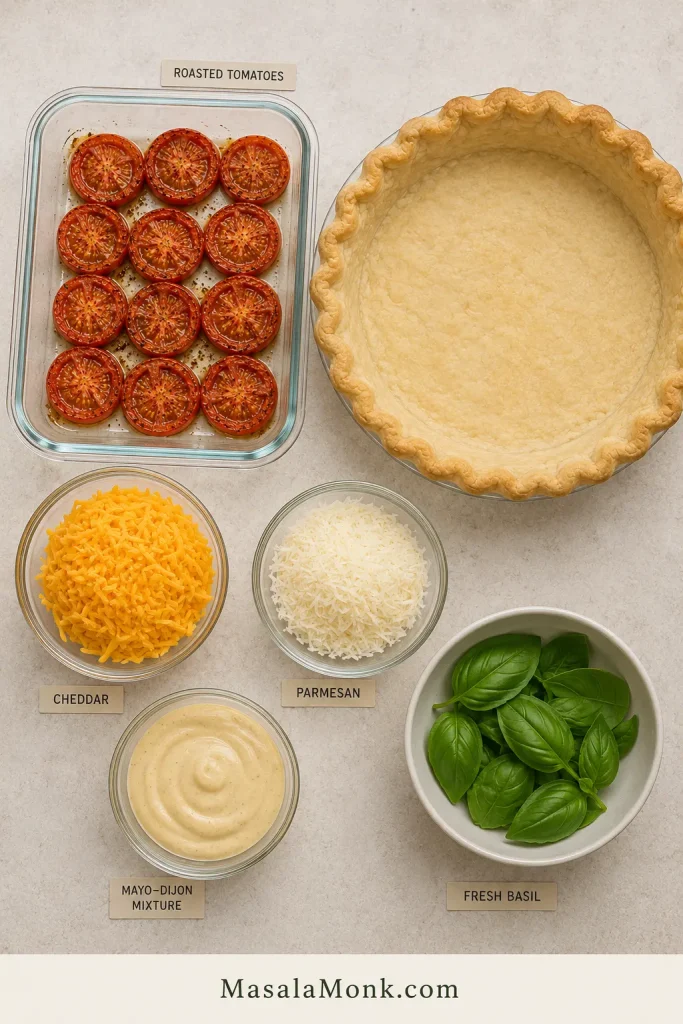
Overhead arrangement of lightly roasted tomato rounds, empty blind-baked crust, grated cheddar, Parmesan, mayo-Dijon mixture, and whole fresh basil kept separately.
Keep the components separate overnight so the crust stays dry and the basil stays fresh until assembly.

When you are ready to bake, take the roasted tomatoes from the refrigerator as you start preheating the oven so they can lose some of their chill. Melt the 40 g cheddar over the pre-baked crust, combine the remaining cheese and freshly cut basil with the mayo-Dijon mixture, then assemble the pie.

If the filling is still quite cold when it goes into the oven, the final bake may take a little longer. Follow the browned topping, gentle bubbling and center-movement cues rather than forcing it to finish at the usual minute mark.

Storing and Reheating Leftovers

After baking, keep the pie at room temperature for no more than 2 hours total, including cooling and serving time. If the surrounding temperature is above 90°F / 32°C, limit that to 1 hour. Refrigerate leftovers promptly, keep them covered and use them within 3–4 days. These timings follow USDA leftover-safety guidance.

For the best crust, warm slices in an oven or toaster oven at about 325–350°F / 165–175°C. Reheated leftovers should reach 165°F / 74°C in the center. A preheated sheet pan underneath the slice can help crisp the base again.
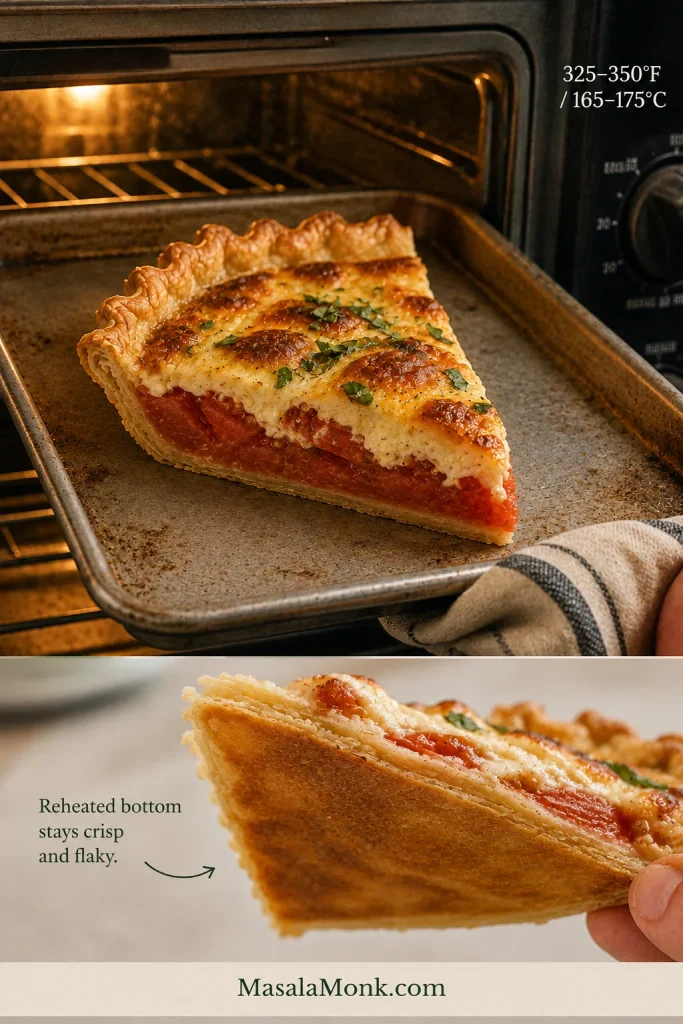
Leftover tomato pie wedge reheating on a metal sheet pan in the oven, with a close view of the thin golden, crisp pastry on the underside.
Reheat on a hot metal sheet pan to give the pastry direct bottom heat and help it crisp again.

The microwave is fine when speed matters, but expect softer pastry.

Freezing

You can freeze the pie, but it would not be my first choice if crust texture matters.

Tomatoes soften after freezing and thawing; Penn State Extension likewise recommends thawed frozen tomatoes for cooked uses rather than expecting fresh tomato texture. The pastry also tends to come back softer than it was freshly baked.

If you know in advance that you will not need the whole pie, preparing the components ahead and baking closer to serving usually gives you the better result.

Useful shortcuts: Back to Recipe · FAQ · Back to Top

FAQ

Do I need to peel the tomatoes? No. Roasting and baking soften the skins, and leaving them on helps the slices retain their shape. Peel them only if your tomatoes have unusually tough skins or you strongly dislike the texture.

Should I remove the seeds? Not routinely. The seed cavities contain plenty of juice, so removing some can help with exceptionally watery tomatoes, but roasting gives you a more consistent way to manage moisture.

Can I make it gluten-free? Yes. Use a reliable gluten-free pie crust and follow the same tomato-drying and pre-baking method. Check the crust manufacturer’s directions because gluten-free pastry can brown and handle differently from wheat-based pastry.

The Slice You Are Looking For

By the time the pie has rested, the cheese should have settled into the tomatoes and the crust underneath should still feel like part of the dish. Run the knife cleanly through the tomato skins and pastry, then lift the first wedge.

The bottom should come with it.
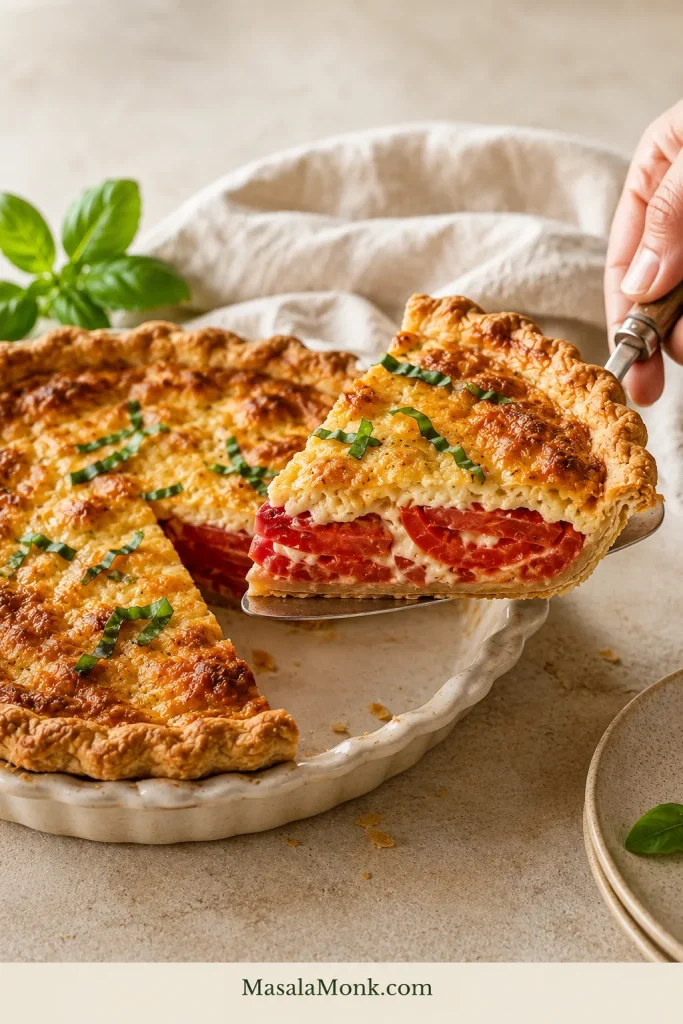
Hand lifting a clean wedge of Southern tomato pie on a server, with the thin flaky bottom crust attached and the remaining pie behind it.
The payoff: a clean wedge that lifts with its flaky bottom crust still attached.

You get flaky pastry underneath, concentrated ripe tomato through the middle, sharp creamy cheese on top and fresh basil cutting through the richness.

Nothing running across the plate. Nothing drowning anything else.

Just a very good Southern tomato pie.
Back to Recipe · Back to Top

Posted on Leave a comment

Peach Upside Down Cake Recipe: Caramelized, Moist and Easy to Flip

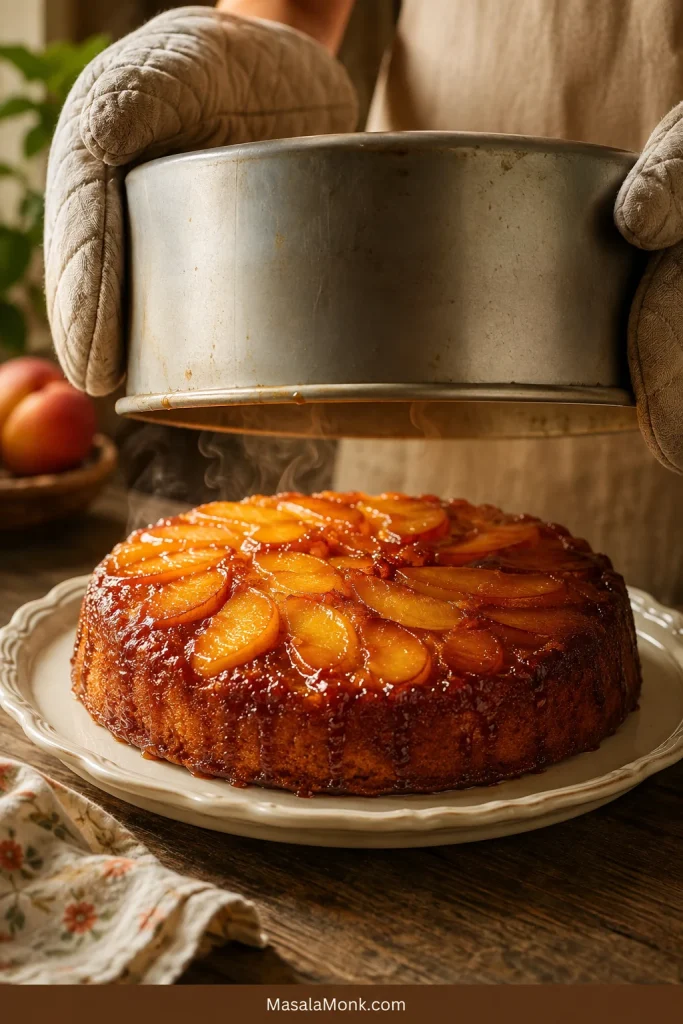
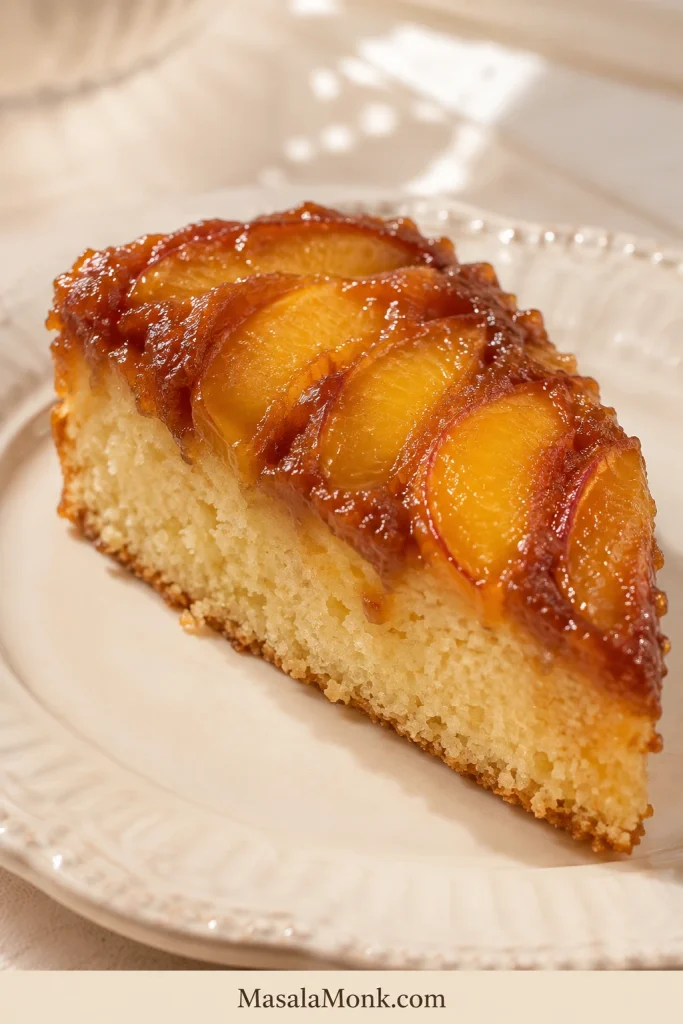
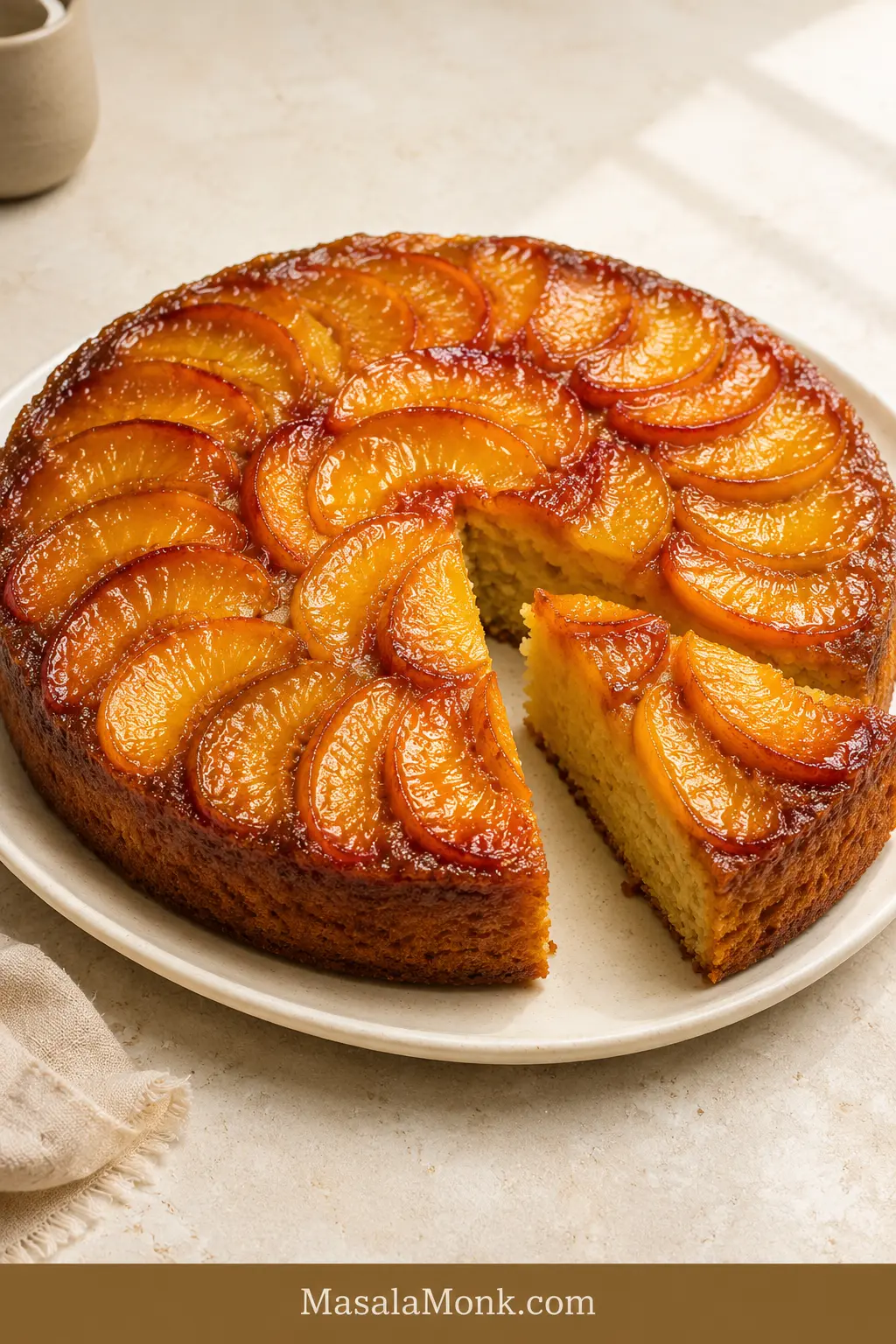
Round peach upside down cake on an ivory platter with glossy caramelized peach slices arranged across the top and one wedge removed to show the pale golden cake crumb.

The best moment in a peach upside down cake happens before the first slice. The pan lifts away, the caramel lets go, and the peaches appear on top—glossy, golden and arranged closely enough to look as though the cake planned it all along.

That reveal is also why this cake can feel more intimidating than an ordinary fruit bake. The peaches may release too much juice. The surface may brown before the middle is ready. Then, after all that, the whole cake has to be turned over without leaving its prettiest part inside the pan.

The cake itself is simpler than the reveal makes it look. This is a from-scratch butter cake: peaches go over butter and brown sugar, a soft sour cream batter goes on top, and the oven does the caramelizing for you. There is no boxed mix and no separate caramel to cook.

The MasalaMonk rule is simple: keep the peaches juicy, bake the center through and turn the cake out while the topping is still warm.

Start here

Peach Upside Down Cake in One Minute

Arrange 1 pound / 450 g prepared peach slices over melted butter and light brown sugar in a solid-bottom 9-inch / 23 cm light metal cake pan. Cover them with a thick sour cream butter-cake batter.

The topping caramelizes in the oven, so there is no saucepan of hot sugar to judge or pour.

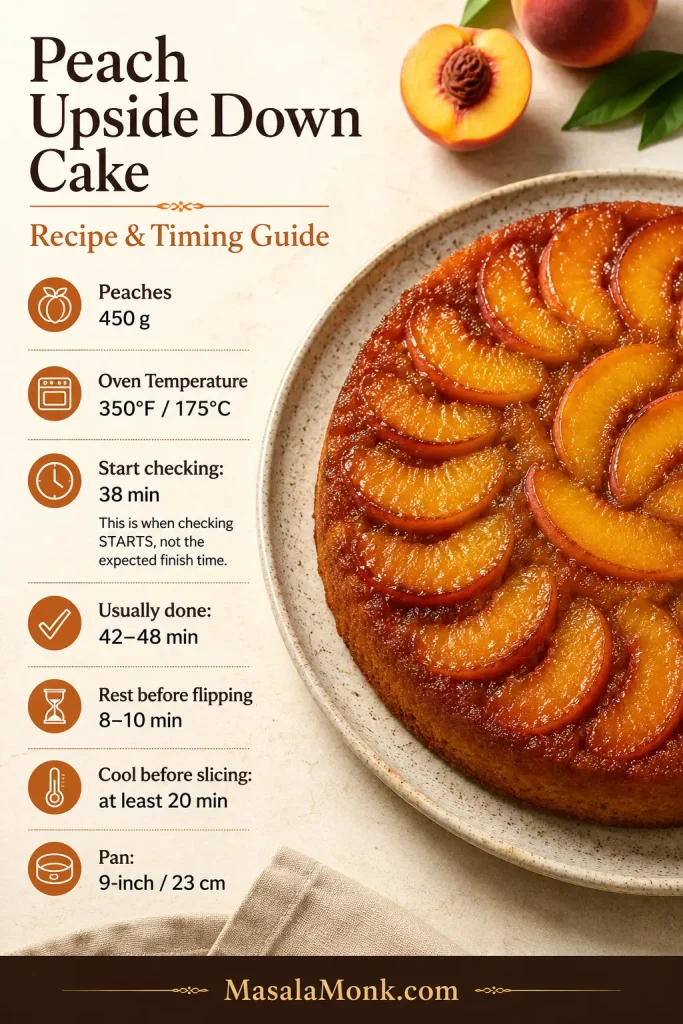
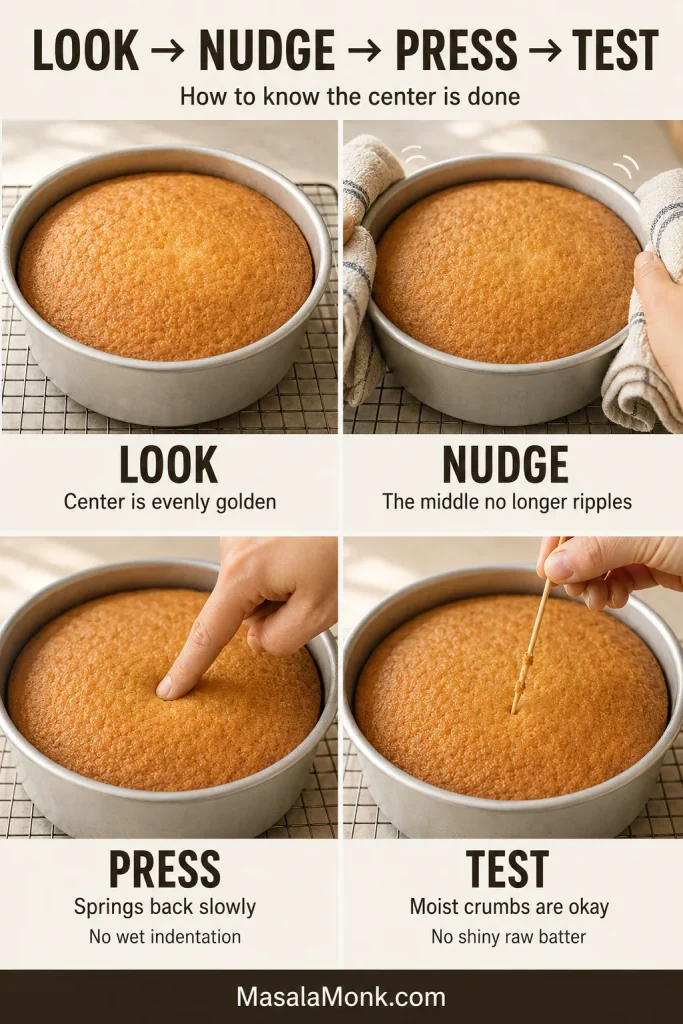
Bake at 350°F / 175°C and begin checking at 38 minutes. Look for a center that no longer ripples, springs back slowly and leaves moist crumbs—but no shiny batter—on a tester.

Rest the cake for 8–10 minutes, loosen the edge and turn it out in one steady movement. Let it cool for at least 20 minutes before slicing.

Peach upside down cake timing guide showing 450 g peaches, 350°F / 175°C, first doneness check at 38 minutes, usual bake time of 42–48 minutes, an 8–10 minute rest before flipping, at least 20 minutes of cooling and a 9-inch pan.
Treat the timeline as checkpoints, not deadlines: the first-check mark starts observation, while the later window shows where many cakes actually finish.

Fresh, Canned or Frozen Peaches?

For the brightest peach flavor and clearest pattern, start with firm-ripe yellow peaches. Canned and frozen fruit are useful alternatives when fresh peaches are not available.

On a phone, swipe sideways to compare the options.

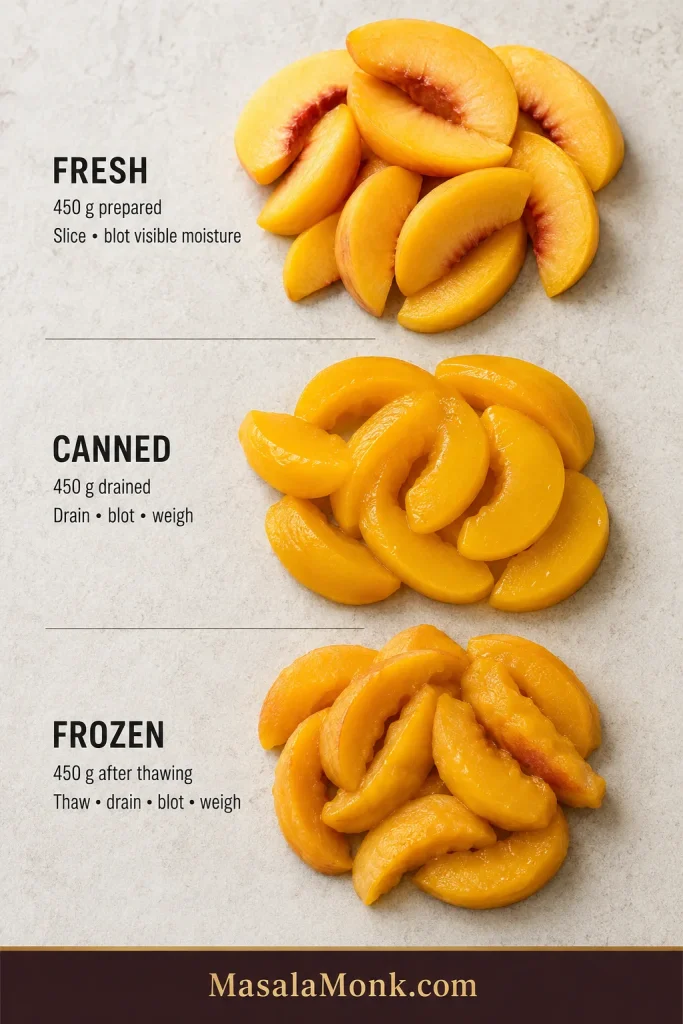
PeachesAmountBefore they go in the pan
Fresh, firm-ripe1 lb / 450 g prepared slicesPit and slice; peel only if the skin is tough; blot visibly wet surfaces
Canned in juice1 lb / 450 g drained slicesDrain thoroughly and blot before weighing
Canned in syrup1 lb / 450 g drained slicesDrain very well; rinse briefly only if heavily syrup-coated, then blot
Frozen1 lb / 450 g after thawingThaw completely, drain, blot and then weigh
Three groups of peach slices labeled fresh, canned and frozen, with fresh peaches shown firm, canned peaches drained and glossy, and frozen peaches thawed and softer.
Fresh peaches usually keep sharper edges, canned slices are more uniform, and frozen fruit softens after thawing; each can work, but the finished texture will not be identical.

The fresh-peach version

Caramelized Peach Upside Down Cake

A close layer of peaches bakes beneath a tender sour cream butter cake, then becomes the glossy caramelized top after the flip. Brown sugar and butter form a light caramel glaze around the fruit.

It looks dressed up, but the basic method is simple: arrange the peaches, mix the batter, bake, rest and flip.

Prep
About 25 minutes

Bake
42–48 minutes

Rest before flipping
8–10 minutes

Cool before slicing
At least 20 minutes

Total time
About 1 hour 40 minutes

Yield
8 generous or 10 smaller slices

Oven and pan
350°F / 175°C; 9-inch / 23 cm solid-bottom light metal cake pan, at least 2 inches / 5 cm deep

Equipment

  • 9-inch / 23 cm solid-bottom light metal cake pan
  • Parchment paper
  • Rimmed baking sheet
  • Kitchen scale
  • Mixing bowls
  • Hand mixer or stand mixer
  • Flexible spatula
  • Thin blunt knife or small offset spatula
  • Heat-safe serving platter wider than the cake pan

Ingredients

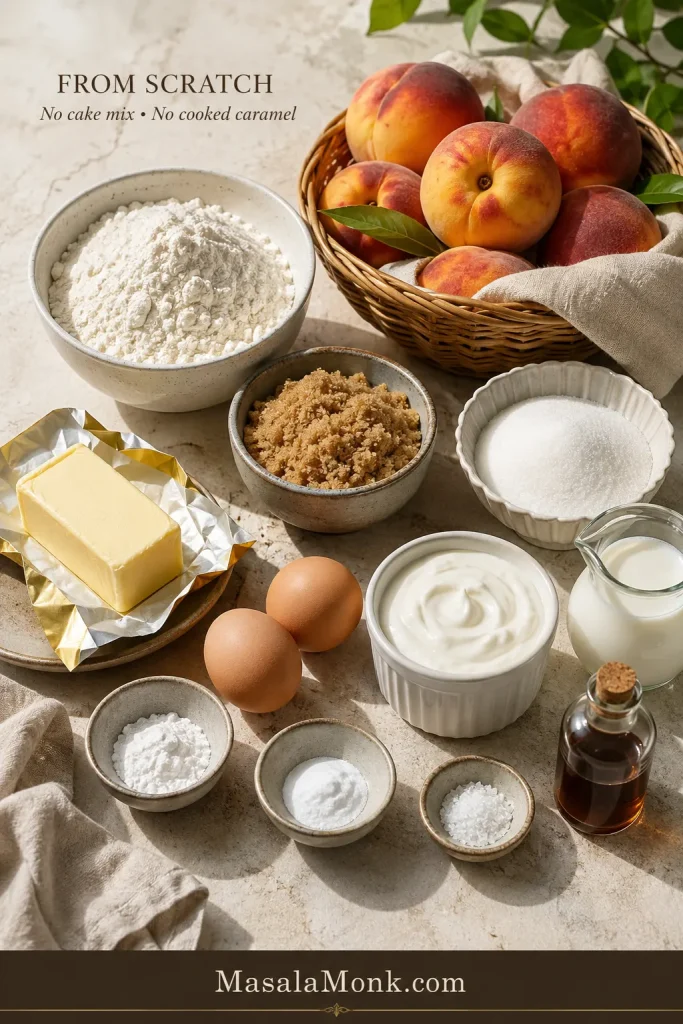
Fresh peaches, butter, brown sugar, granulated sugar, flour, two eggs, sour cream, milk and vanilla arranged on a light work surface for peach upside down cake.
Peaches, brown sugar and butter make the glossy top; the simple sour cream batter underneath is what turns it into a tender, sliceable cake.

Peach topping

  • 4 tablespoons / 56 g unsalted butter
  • ½ cup packed / 100 g light brown sugar
  • ¼ teaspoon fine salt
  • 1 pound / 450 g prepared peach slices, cut about ¼ inch / 6–8 mm thick

Sour cream cake

  • 190 g all-purpose flour, about 1½ cups when spooned and leveled
  • 1½ teaspoons baking powder
  • ¼ teaspoon baking soda
  • ½ teaspoon fine salt
  • ½ cup / 113 g unsalted butter, softened but still cool
  • ¾ cup / 150 g granulated sugar
  • 2 large eggs, at room temperature
  • 2 teaspoons vanilla extract
  • ½ cup / 120 g full-fat sour cream, at room temperature
  • ¼ cup / 60 ml whole milk, at room temperature

Instructions

Prepare the pan and peach base

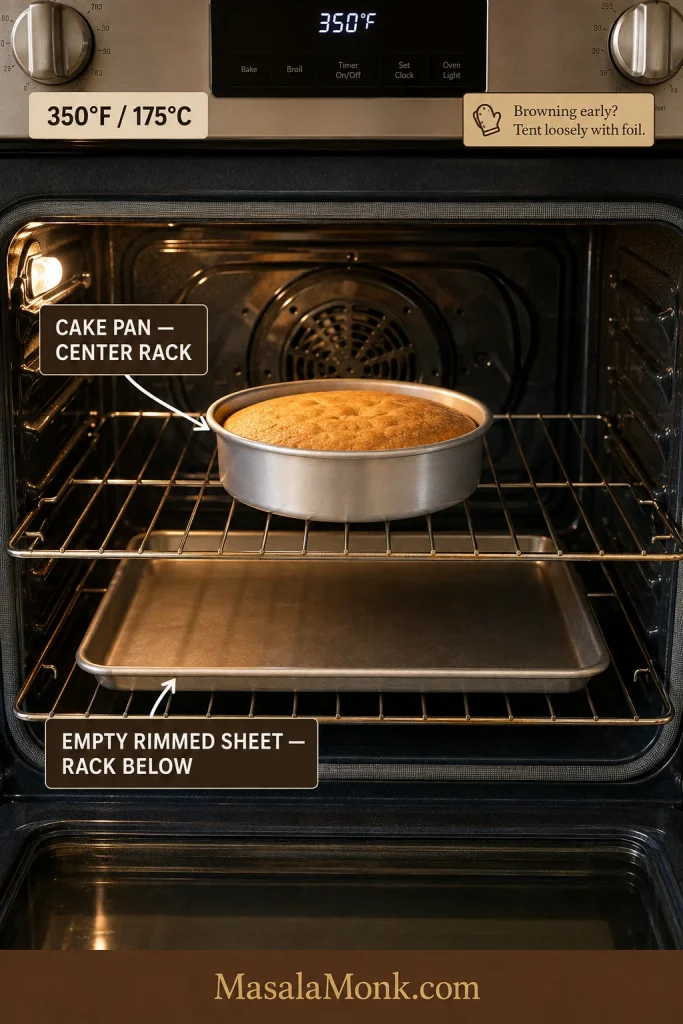
  1. Heat the oven and prepare the pan. Set a rack in the center and heat the oven to 350°F / 175°C. Lightly grease the base and sides of the cake pan. Press a fitted parchment round onto the base and grease it lightly. Place an empty rimmed baking sheet on the rack below to catch drips.
Open home oven with a round light-metal cake pan containing a plain golden cake on the center rack and an empty rimmed baking sheet on the rack below at 350°F / 175°C.
The lower baking sheet is insurance, not part of the cake’s baking stack. Keeping an air gap between sheet and pan leaves the cake directly exposed to the intended oven heat.
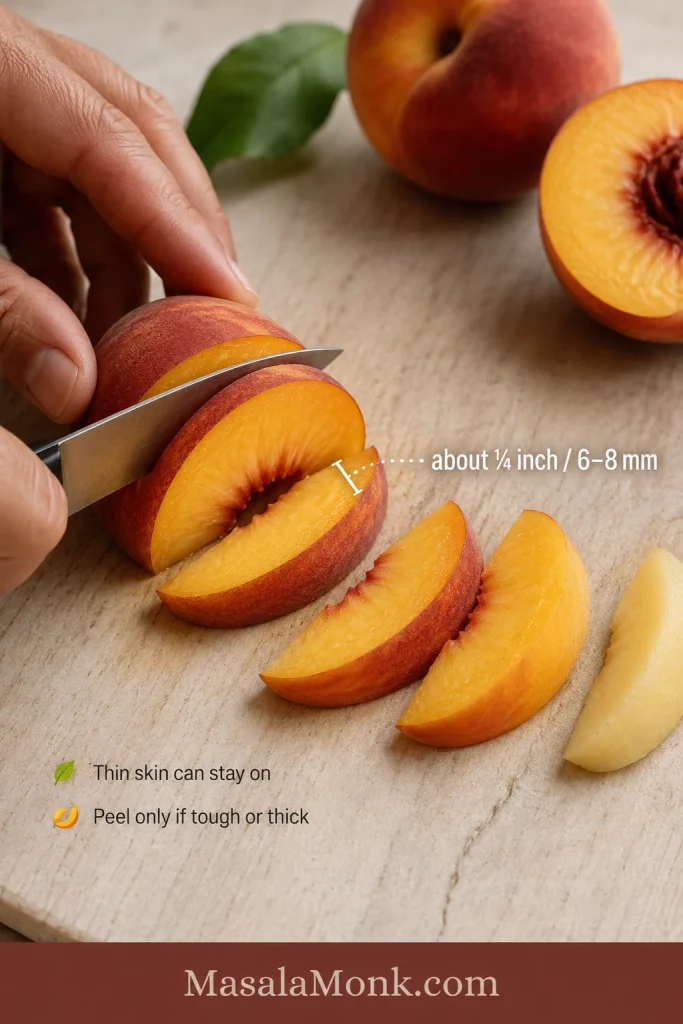
  1. Prepare the peaches. Halve and pit the fruit. Peel only if the skin is thick or tough. Cut into slices about ¼ inch / 6–8 mm thick, then weigh 1 pound / 450 g. Blot surfaces that are visibly wet.
  2. Add the butter and brown sugar. Melt the 4 tablespoons / 56 g butter and pour it into the pan. Tilt to coat the base. Mix the brown sugar with ¼ teaspoon salt and scatter it evenly over the butter.
  3. Arrange the peaches. Start near the outside edge and make one close overlapping layer, working toward the center. Use smaller pieces to fill the last gaps and save anything that does not fit comfortably.

Mix, bake and turn out the cake

  1. Whisk the dry ingredients. Combine the flour, baking powder, baking soda and ½ teaspoon salt.
  2. Cream the butter and sugar. Beat the softened butter and granulated sugar for about 3 minutes, scraping the bowl once or twice, until lighter and slightly fluffy.
  3. Add the eggs and dairy. Beat in the eggs one at a time. Mix in the vanilla and sour cream.
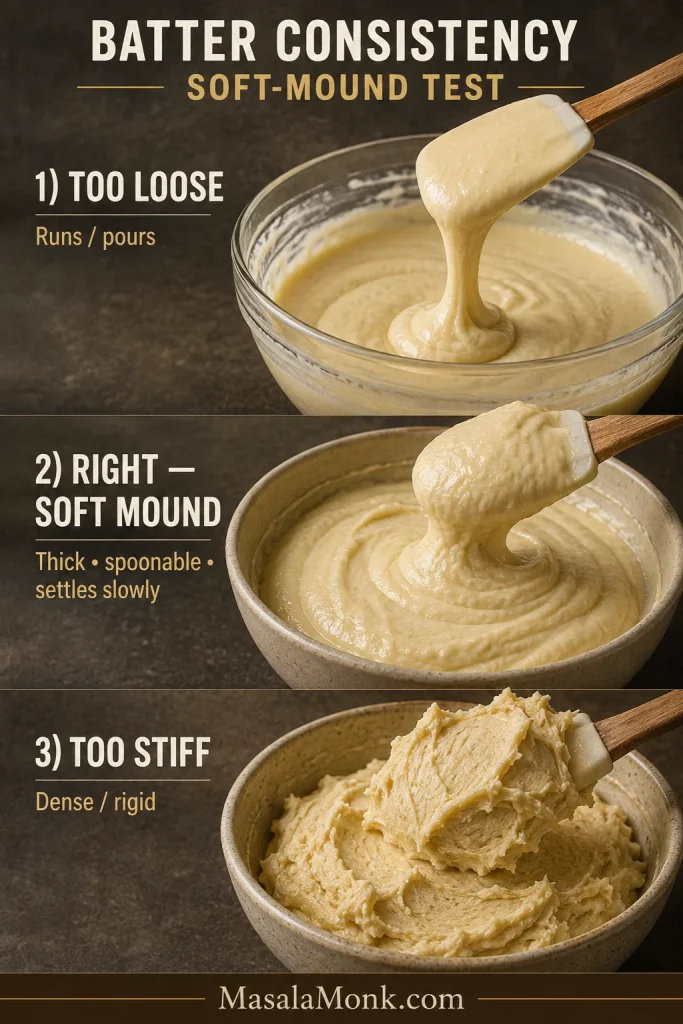
  4. Finish the batter. Mix in half of the flour mixture on low speed. Add the milk, then the remaining flour. Stop when the dry streaks disappear. The batter should form a soft mound rather than pour freely.
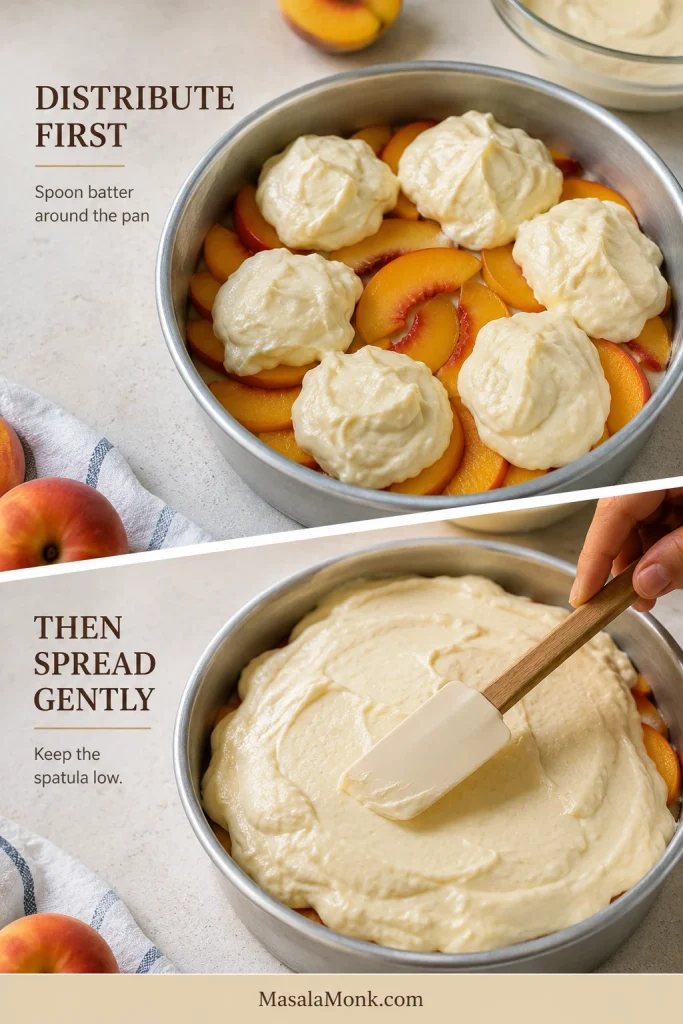
  5. Spread over the peaches. Spoon the batter around the pan and gently spread it to the edge, keeping the spatula low so the fruit stays in place.
  6. Bake and check the center. Put the cake pan directly on the center rack and bake for 42–48 minutes, beginning the first check at 38 minutes. The center should no longer ripple, should spring back slowly and should leave moist crumbs but no shiny batter on a tester. Tent loosely with foil if the surface darkens first.
  7. Rest, loosen and flip. Set the pan on a heatproof surface and immediately start an 8–10 minute timer. Run a thin blunt knife around the edge, place the heat-safe platter face-down over the pan and turn both over together in one smooth movement.
  8. Lift, repair and cool. Leave the inverted pan in place for about 30 seconds, then lift it straight up and peel away the parchment. Put back any peach that stayed behind while the topping is warm. Cool for at least 20 minutes before slicing.

Recipe Notes

  • Canned peaches: Drain and blot thoroughly before weighing. Juice-packed peaches give the most balanced result.
  • Frozen peaches: Thaw completely, drain, blot and weigh after thawing.
  • Dark metal pan: Begin checking several minutes earlier because the edge may brown faster.
  • Springform pan: Butter, sugar and peach juice may leak through the removable base, so a solid pan is safer.
  • Cleanest slices: Cool to room temperature and wipe the knife between cuts.

If your peaches are softer than expected, your oven browns quickly or the flip is the part making you nervous, the details below cover those exact moments.

Choose and Prepare the Peaches

Look for peaches that smell sweet before the knife touches them and yield slightly near the stem, yet remain firm enough to slice cleanly.

Judge ripeness by the yellow or cream background color rather than the red blush alone. For more help choosing and ripening peaches, see this peach selection and storage guide from Utah State University Extension.

Freestone peaches are easiest to prepare because the pit releases cleanly. Clingstone peaches still work; cut the flesh away from the pit instead of pulling hard enough to tear the fruit.

Buy about 1¼–1½ pounds / 570–680 g whole peaches to allow for pits, bruised spots and any skin you remove. Fruit count varies, so weigh the prepared slices.

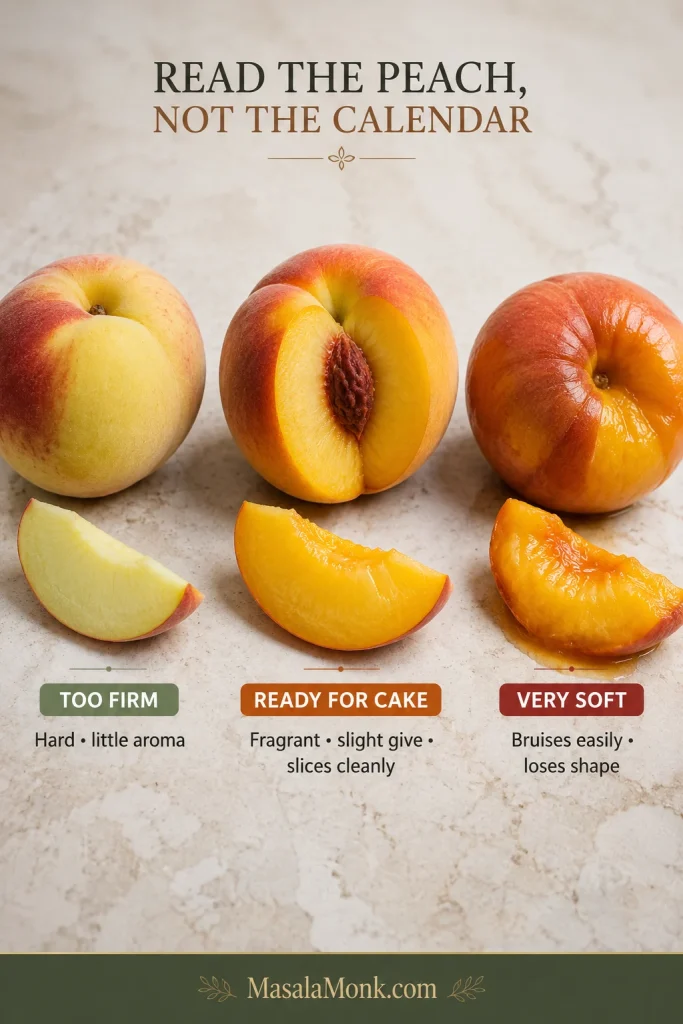
Read the peach, not the calendar

Too firm: Little aroma and hard around the stem. Let it ripen at room temperature in a loosely closed paper bag and check daily.

Ready: Fragrant, slightly yielding near the stem and easy to slice cleanly.

Very soft: Bruises under light pressure and releases juice as soon as it is cut. Handle gently, slice a little thicker and consider cobbler if the fruit will not hold its shape.

Three peaches showing different ripeness levels: a firm peach with pale flesh, a ripe peach with juicy orange-yellow flesh that slices cleanly, and a very soft peach with softer edges and more visible juice.
The cut edge is a useful ripeness clue: ready peaches look juicy yet hold a neat wedge, whereas very soft fruit begins slumping before it reaches the pan.

Thin peach skin softens in the oven and gives the finished slices a little more definition. Peel only when the skin is thick, tough or fuzzy enough to bother you.

A peach being cut into wedges about one-quarter inch thick beside several peach slices, including slices with the natural skin left on.
Uniformity matters as much as thickness. Similar-size slices soften at roughly the same pace, while a thin strip of peach skin can help preserve their outline after baking.

Using canned or frozen peaches

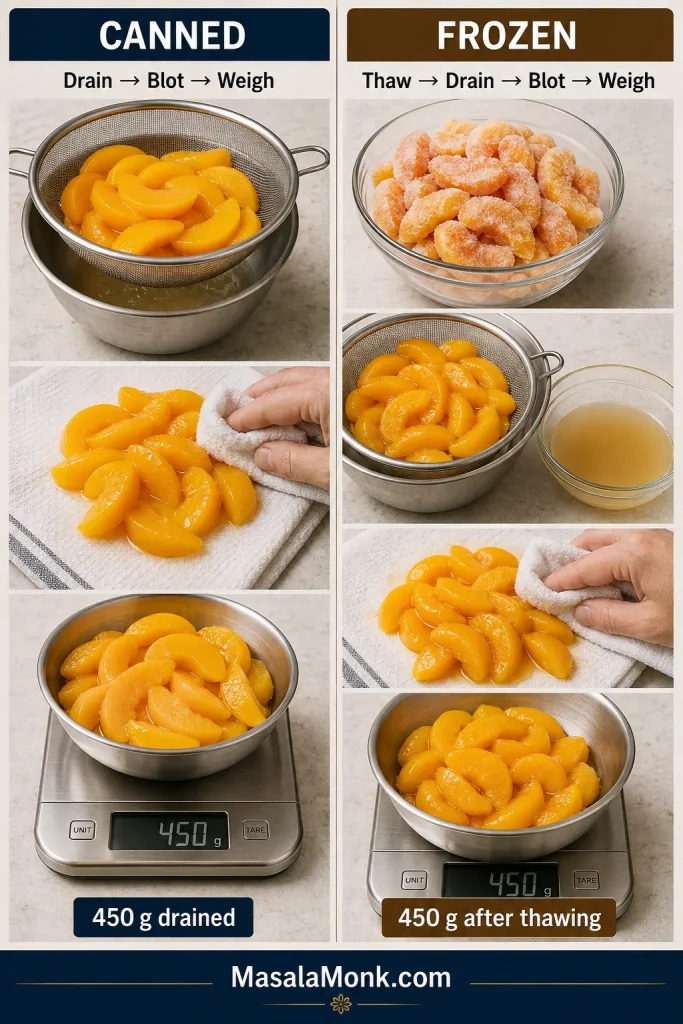
For canned peaches, fruit packed in juice is the easiest option to balance with the brown sugar topping. Drain the slices thoroughly, spread them over a clean towel and blot the exposed surfaces before weighing. A large 29-ounce / 820 g can is a sensible place to start, but drained yield varies by brand.

Syrup-packed peaches are sweeter and softer. Drain them especially well. If thick syrup coats the slices, give them a quick rinse under cool water and blot them dry.

If you would rather skip the flip altogether, this peach cobbler with canned peaches turns the same pantry fruit into a warm, scoopable dessert.

For frozen peaches, thaw the slices completely, drain away the released liquid, blot them and then weigh the fruit. Buy slightly more frozen fruit than the finished amount you need because some weight is lost with the liquid.

Icy peaches chill the bottom of the pan and release water into the caramel just as the cake is trying to set, so thawing first matters here.

Two peach preparation workflows showing canned peaches being drained, blotted and weighed, and frozen peaches being thawed, drained, blotted and weighed after thawing.
The important endpoint is the same: weigh the peaches after excess liquid is removed. Otherwise, part of that measured weight may be syrup or thaw water rather than fruit.

Keep them juicy, not watery

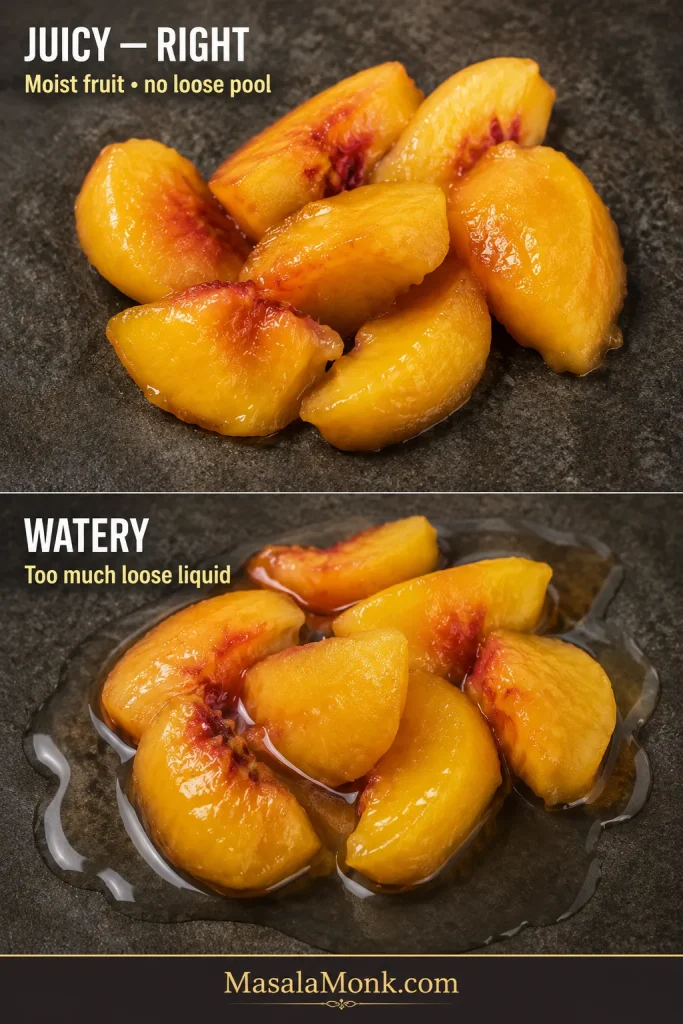
A ripe peach is supposed to contain juice. The aim is simply to keep loose liquid from pooling beneath the batter.

Close comparison of juicy peach slices with a moist sheen but no liquid pooling beside peach slices sitting in visible loose juice.
Look beneath the fruit: moisture clinging to the peach surface is desirable juice, whereas liquid collecting underneath is excess water headed for the caramel.

Cut the slices about ¼ inch / 6–8 mm thick. Blot surfaces that are visibly dripping, but do not squeeze the fruit dry. Slice close to assembly time too; sugar draws juice from cut peaches surprisingly quickly.

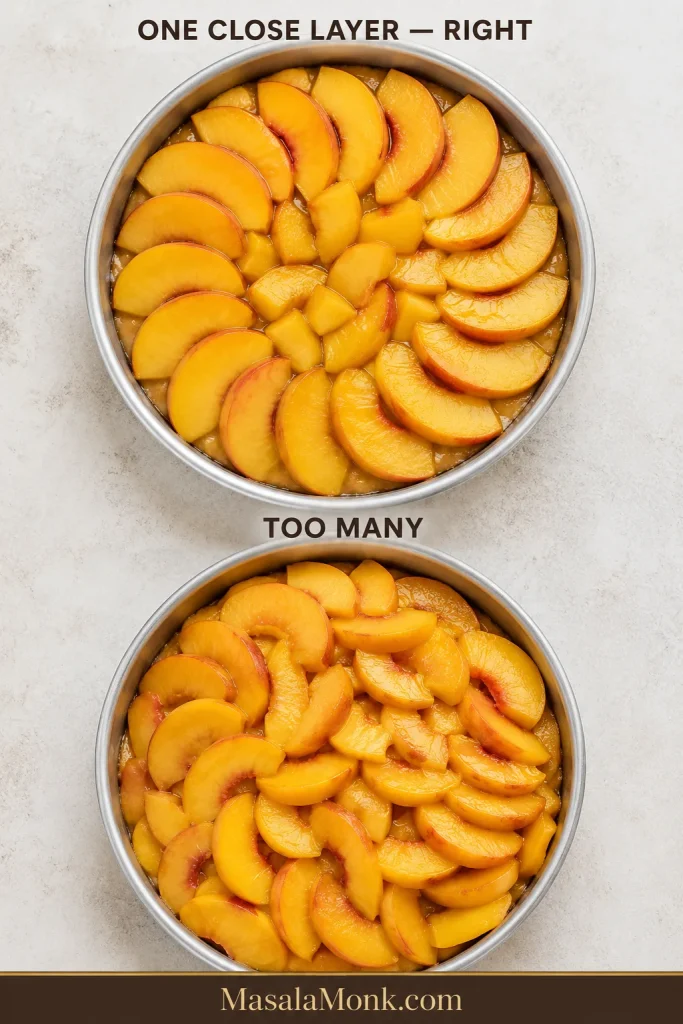
Build one close overlapping layer. Start around the outside and work toward the center. Once the last gap is filled, the pan should already hint at the pattern you are hoping to reveal later.

There is no prize for forcing every remaining peach slice into a full pan. Save the extras for yogurt, oatmeal or serving beside the cake.

Two round cake pans viewed from above: one filled with a single close layer of overlapping peach slices and another overloaded with peaches stacked in multiple layers.
From above, a full pan should still read as one peach layer. Once slices start hiding whole slices underneath, generous has become overloaded.

Peaches ready? Mix the batter·Return to the recipe

Mix a Tender Batter That Stays in Place

With the peaches settled in the pan, the batter needs enough body to cover them without pushing the pattern apart.

Softened butter should accept a fingertip impression without looking shiny or partly melted. Beat it with the sugar until lighter and a little fluffy, then add the eggs one at a time.

Once the flour goes in, slow the mixer down. Stop as soon as the last dry streaks disappear. The finished batter forms a soft mound; it does not pour like pancake batter or sit like cookie dough.

Three bowls showing cake batter that is too loose and runny, correctly thick and spoonable in a soft mound, and too stiff with rigid peaks.
Watch what happens after the spoon lifts: correct sour cream batter holds briefly, then relaxes at the edges instead of flowing flat or standing rigid.

Spoon the peach-cake batter around the pan before spreading it. A single heavy mound can push the fruit outward. Keep the spatula low and move gently toward the edge.

Two-step view of thick cake batter first spooned in several mounds over peaches in a round pan and then gently spread across the surface with a spatula.
Several smaller batter deposits shorten every spatula stroke, so less sideways force reaches the peach pattern hidden underneath.

Prefer fruit folded through the crumb instead? Try this fresh apple cake, which holds plenty of fruit in a thick, tender batter.

Know When the Center Is Fully Baked

A beautifully browned surface can hide a soft center. Peach juice also makes a tester harder to read than it would be in a plain butter cake.

When butter, vanilla and peach fill the kitchen, you are getting close. The center—not the smell or the clock—decides when the cake comes out.

  1. Look: The exposed surface is evenly golden, including the center.
  2. Nudge: The middle no longer ripples when the pan moves gently.
  3. Press: A light touch in the center springs back slowly instead of leaving a wet indentation.
  4. Test: A skewer inserted into central cake crumb may carry moist crumbs but shows no shiny raw batter.
Four-step doneness guide showing a golden cake surface, a pan being gently nudged with heat protection, a fingertip lightly pressing the center and a tester carrying moist crumbs but no raw batter.
No single doneness cue has to carry the whole decision. When appearance, movement, touch and tester all agree, the center becomes much easier to judge confidently.

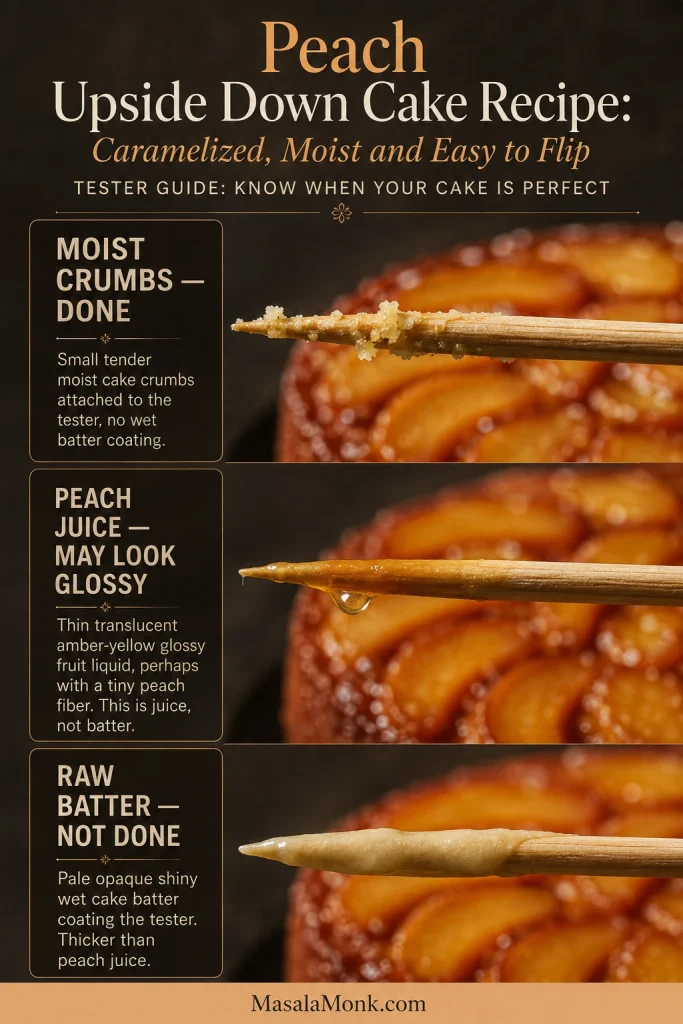
A tester that passes through a peach may come back glossy even when the cake is done. Angle it toward an area of central crumb when necessary.

Three cake testers showing small moist baked crumbs, thin translucent peach juice and thick pale shiny raw cake batter for comparison.
Opacity is the easiest visual distinction: peach juice looks translucent, baked crumbs look granular, while raw batter appears smooth, pale and opaque.

Begin checking at 38 minutes. Most cakes finish around 42–48 minutes, but every oven behaves a little differently. Trust what the center is doing more than the final minute on the clock.

Remember this

The clock tells you when to start checking. The center tells you when the cake is done. The warm topping tells you when to flip.

Center ready? Go straight to the flip·Something looks off?·Return to the recipe

How to Flip the Cake Cleanly

When the center is fully baked, it is time for the part everyone thinks about: the flip.

The cake needs a short rest first. Turn it out too soon and the crumb may split under the fruit. Leave it until cold and the caramel begins holding more firmly to the pan.

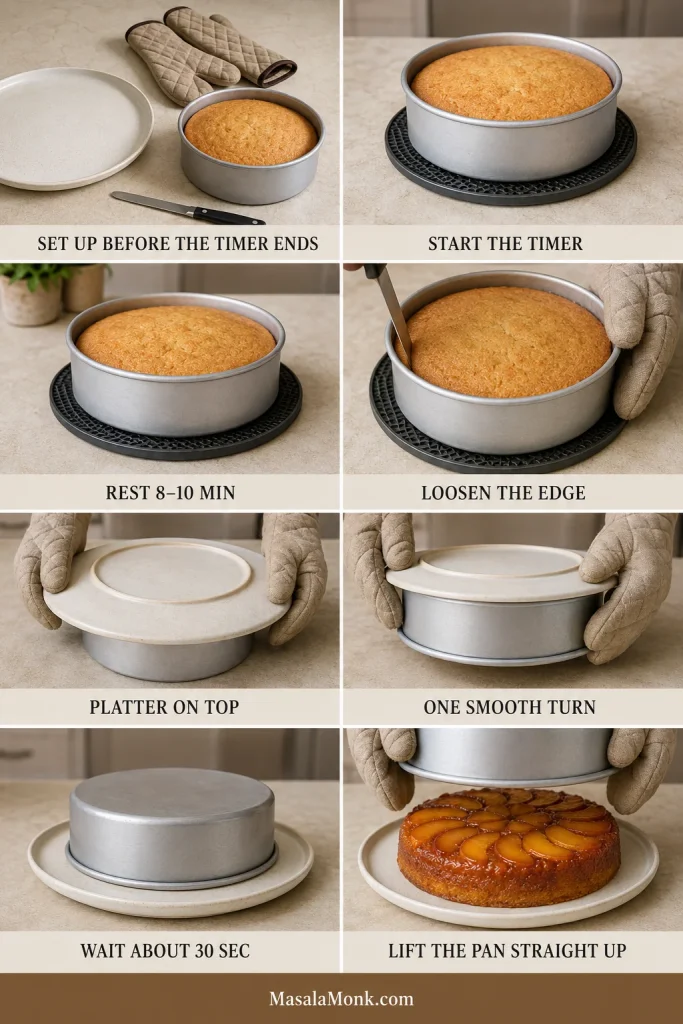
Set up the landing place before the timer ends. Clear the counter and set out a heat-safe platter wider than the cake pan, a thin knife and dry oven mitts. One calm turn is much easier when everything already fits.

Rest the cake for 8–10 minutes. Start the timer as soon as the pan leaves the oven. The short rest steadies the crumb before the caramel firms against the pan.

Step-by-step peach upside down cake flipping guide showing setup with platter and oven mitts, an 8–10 minute rest, loosening the edge, placing the platter over the pan, turning them together, waiting about 30 seconds and lifting the pan.
Each step controls a different risk: resting steadies the crumb, loosening frees the edge, the brief inverted pause lets gravity help, and the final lift protects the reveal.

Make one steady turn

  1. Run a thin blunt knife around the edge.
  2. Place the heat-safe serving platter face-down over the pan.
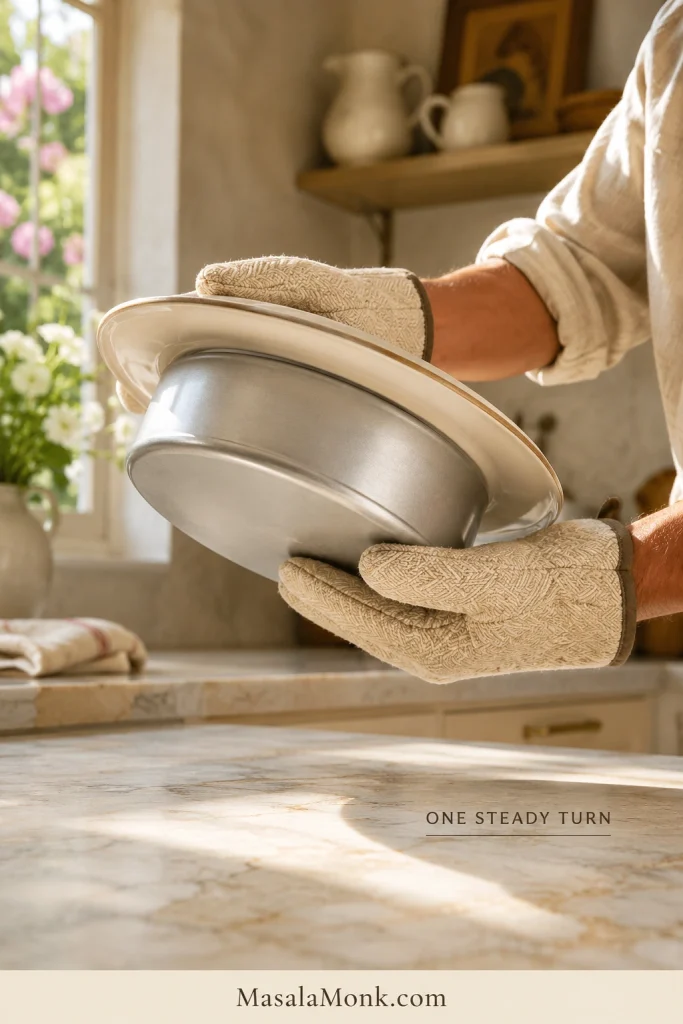
  3. Grip the platter and pan firmly together.
  4. Turn them over in one smooth movement and set the platter down.
  5. Leave the pan in place for about 30 seconds.
  6. Lift the pan straight up and peel away the parchment carefully.
Hands in oven mitts holding a round metal cake pan tightly against an ivory serving platter while turning them together to invert the cake.
During inversion, the pan and platter are safest when they behave like one object. Any gap between them gives the hot cake room to slide.

A little steam may rise from the peaches and the caramel may still move around the edge. Give it a moment before touching the pattern.

Two hands wearing oven mitts lifting a round metal cake pan straight upward to reveal a glossy caramelized peach upside down cake on an ivory platter.
A clean reveal does not need a perfect pattern—glossy peaches, intact cake edges and a cake that stays centered on the platter are enough.

If a peach stays behind, lift it gently with a small spatula, return it to the visible gap and spoon over any glaze left in the pan. Carry on; the cake is fine.

Finished peach upside down cake with one peach-shaped gap while a single caramelized peach slice is returned to the gap with a small offset spatula.
Use the empty shape on the cake as your map. Returning the peach to its original gap usually disguises the repair better than rearranging the topping.

Now give the cake at least 20 minutes before cutting. The topping needs warmth for the flip; the crumb needs a little more time before the knife goes through it.

What Success Looks Like

The peaches should look glossy rather than flooded, with individual slices visible. Their edges soften into the caramel, and the pattern can remain a little irregular.

Close-up wedge of peach upside down cake showing glossy caramelized peaches, a thin moist layer beneath the fruit and a fully baked pale golden cake crumb.
A good slice stays tender and moist but still stands cleanly beneath the peaches instead of slumping on the plate.

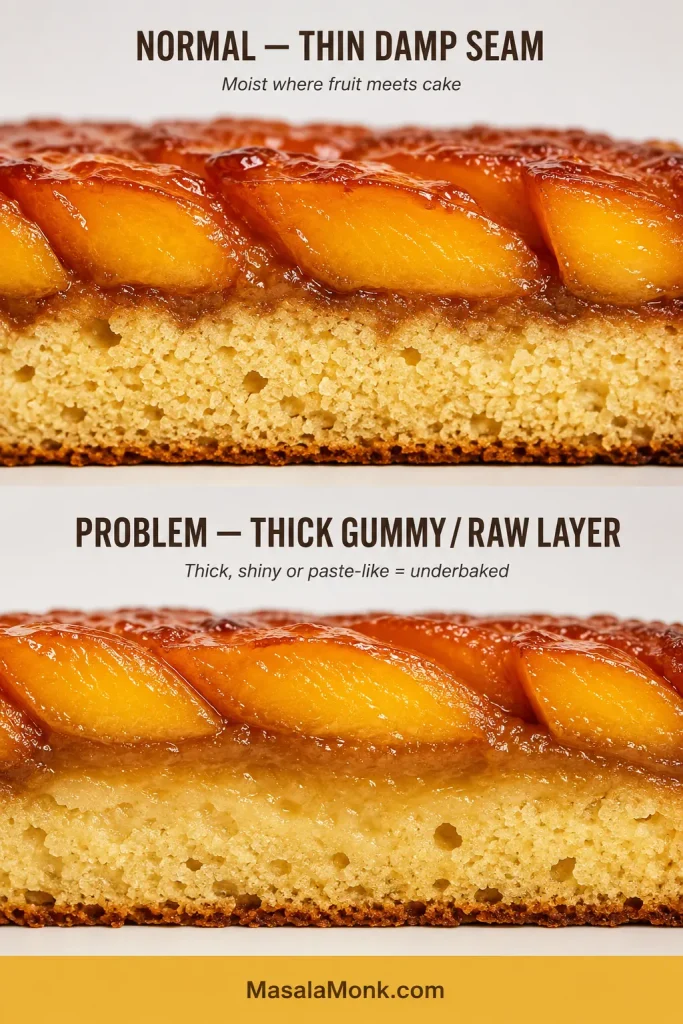
Beneath the fruit, the cake should feel soft and moist yet hold a clean wedge. A thin damp seam where peach, glaze and crumb meet is normal. A thick gummy layer or shiny raw center is not.

Two cake cross-sections comparing a thin moist seam directly beneath caramelized peaches with a much thicker shiny gummy layer in an underbaked cake.
The key distinction is depth, not moisture alone: normal peach moisture stays close to the topping, whereas underbaking affects a much thicker band of the interior.

Slight overlaps and darker caramel around the edge belong on a homemade upside-down cake. They are not signs that anything went wrong.

Checking the result? Troubleshoot a problem·See why it works·Return to the recipe

Troubleshooting: If Something Looks Off

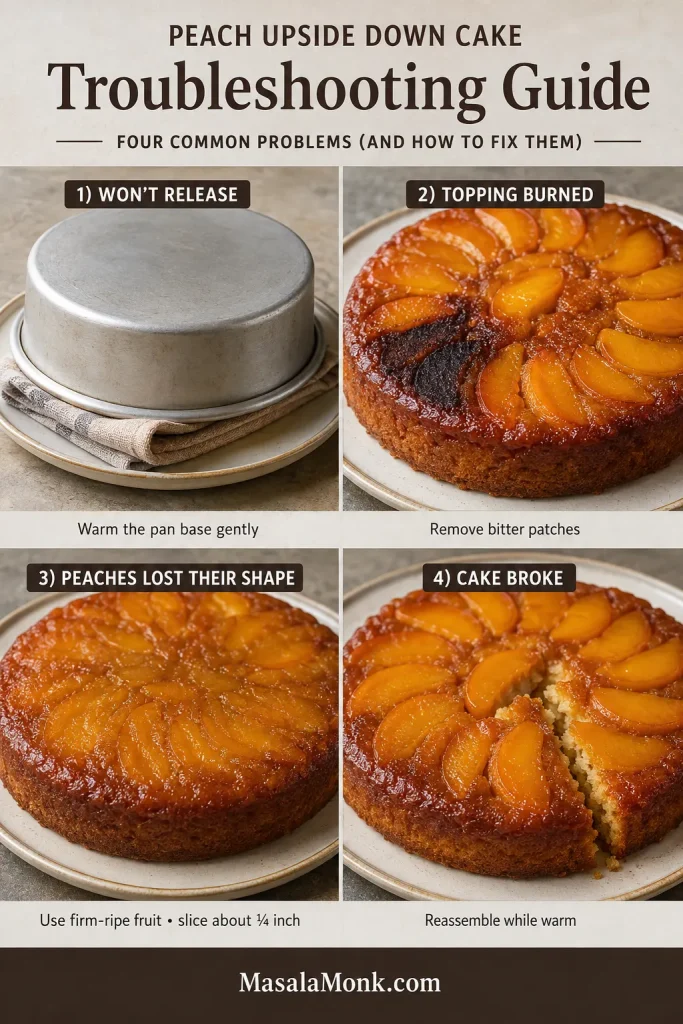
An uneven pattern or one stuck peach is mostly cosmetic. Pay closer attention to the things that change how the cake eats: a raw center, a pool of loose juice, a dry crumb or caramel that has genuinely burned.

Four-panel peach upside down cake troubleshooting guide showing a cake stuck beneath an inverted pan, a localized burned caramel patch, peach slices that have lost their shape and a cake with an accidental crack after flipping.
Peach upside down cake troubleshooting becomes simpler when you identify the system that failed first: release, caramel, fruit structure or cake structure.

On a phone, swipe sideways to see each cause and fix.

Release and topping problems

ProblemWhy it happenedFix now and next time
Cake will not come outThe caramel cooled too far or the edge is still attachedNow: Warm the pan base briefly with a hot towel and loosen the edge again.
Next time: Turn it out while the topping is still warm.
Peaches stayed in the panOne area held more firmly than the restNow: Put the slices back while warm.
Next time: Spread the butter and brown sugar evenly.
Topping looks wateryThe peaches carried too much loose juice into the panNow: Spoon away only obvious pools.
Next time: Drain and blot canned or frozen fruit before weighing.
Caramel hardened in the panThe cake rested too long before the flipNow: Warm the base gently before trying again.
Next time: Start the timer as soon as the cake leaves the oven.
Topping burnedThe pan was very dark, the rack was low or the cake baked too longNow: Remove bitter patches before serving.
Next time: Use a light pan on the center rack and check sooner.

Center, crumb and fruit problems

ProblemWhy it happenedFix now and next time
Center is rawThe cake came out by time or color aloneNow: If it has not been flipped, tent the top and return it to the oven.
Next time: Use the look, nudge, press and test cues together.
Dense or dry crumbToo much flour, overmixing or too much oven timeNow: Serve slightly warm with cream or ice cream.
Next time: Measure the flour carefully, mix gently and begin checking early.
Peach slices disappearedThe fruit was very soft or sliced too thinlyNow: Serve it as it is; the flavor may still be lovely.
Next time: Use firm-ripe peaches cut about ¼ inch / 6–8 mm thick.
Peach flavor seems faintThe fruit was underripe or heavy seasoning covered itNow: Serve with fresh peach slices and keep the accompaniments simple.
Next time: Choose fragrant fruit and season lightly.
Cake broke during the flipThe center was underbaked or the cake was turned too soonNow: Reassemble it while warm and serve in portions.
Next time: Confirm the center is baked and allow the full rest.

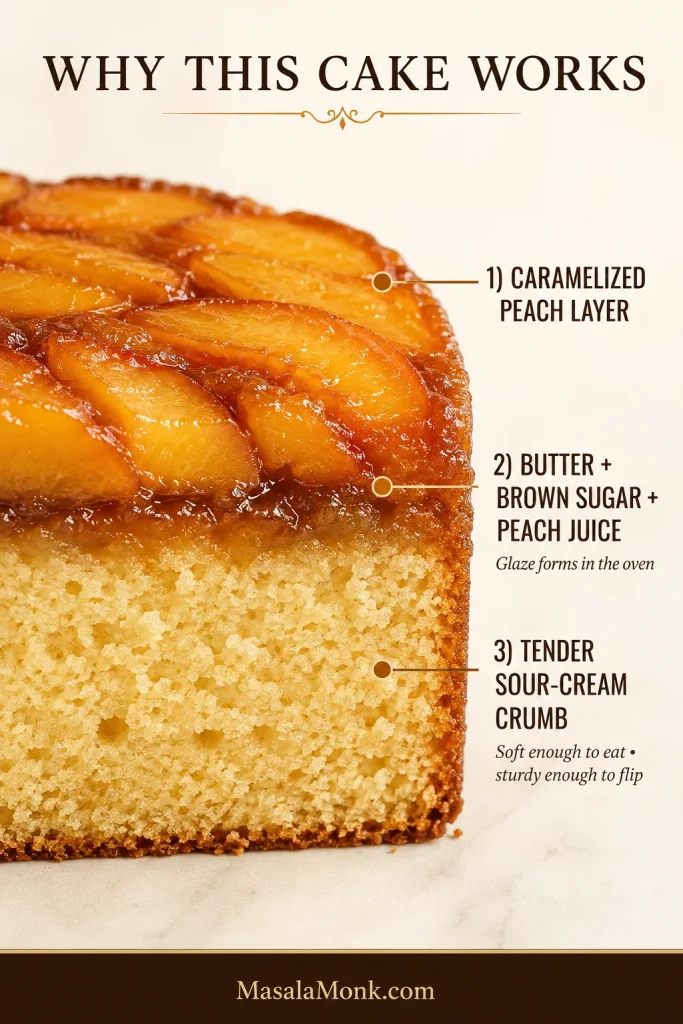
Why This Peach Upside Down Cake Works

One close layer gives the cake a generous peach top. The peach layer looks full after the flip while leaving the crumb room to bake through.

Butter, light brown sugar and peach juice make the glaze in the oven. The sugar adds gentle caramel depth, and the fruit supplies the juice that gathers into a soft glaze around the edges.

Sour cream gives the batter the body to stay over the fruit, then bakes into a tender crumb. Whole milk loosens the batter slightly, and the eggs help the cake hold together when it is turned out.

Annotated cross-section of peach upside down cake showing the caramelized peach layer, a thin butter-brown-sugar-and-peach-juice glaze, and the tender sour cream cake crumb beneath.
The cutaway shows why the cake can survive inversion: the wettest, softest zone stays near the peach topping, while most of the crumb remains structured enough to support it.

All-purpose flour gives the cake the support it needs. Weigh it whenever possible; flour packed heavily into a measuring cup can make the crumb drier and firmer than intended.

Baking with almond flour instead? Try this almond flour cake; almond flour changes the way a cake absorbs moisture and sets, so it is not a straight swap here.

Choose the Right Pan

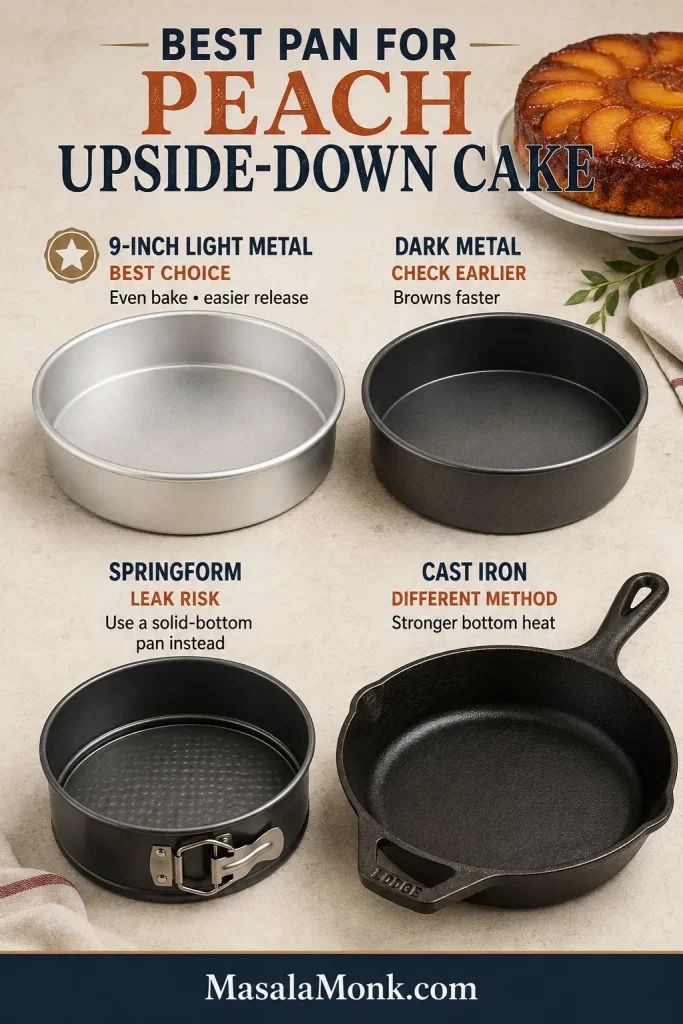
A solid-bottom 9-inch / 23 cm light metal cake pan is the easiest choice for this version. It gives the peaches enough room, bakes the center evenly and avoids the leakage risk of a removable base.

Four empty baking pans compared on a light surface: a 9-inch light-metal round pan marked as the best choice, a dark metal pan, a springform pan and a cast-iron skillet.
Notice the geometry as well as the material: straight sides and a solid base give peach upside down cake a simple release path, while seams and heavy cookware introduce extra variables.

On a phone, swipe sideways to compare the pan options.

PanBest approachWhat changes
9-inch light metalPreferredEven baking and the easiest shape to turn out cleanly
Dark nonstick metalCheck earlierThe edge and topping may brown faster
Cast-iron skilletUse a skillet-specific recipeStronger bottom heat and more carryover cooking
SpringformAvoid for this versionButter, sugar and peach juice may leak through the removable base
BundtUse a Bundt-specific recipeDeeper batter and a much larger surface to release
9×13-inchUse a recipe scaled for that panA shallower cake and a much more awkward flip

Small Variations

The best changes stay in the background and leave the peaches as the main flavor.

  • Almond peach: Add ⅛ teaspoon almond extract with the vanilla.
  • Lightly spiced: Mix ¼ teaspoon cinnamon or a small pinch of nutmeg into the brown sugar.
  • Lemon peach: Add 1 teaspoon finely grated lemon zest to the batter.
Peach upside down cake surrounded by three flavor variation cues: almond extract and almonds, cinnamon and nutmeg, and lemon with finely grated zest.
Almond, warm spice or lemon can nudge the flavor in a new direction without taking the peaches out of the spotlight.

Choose one direction and leave the rest alone. If cinnamon, ginger, nutmeg and deeper brown-sugar warmth are what you really want, this moist spice cake gives those flavors room to lead.

Cake mix, gluten-free or vegan substitutions, and substantially different pans such as a Bundt pan or cast-iron skillet need a recipe written for those changes.

How to Serve It

There is no frosting to make and nothing left to decorate. The peaches have already done that work in the oven.

Let the cake cool until it cuts cleanly, then serve once the fruit is faintly warm and fragrant. The caramel will be soft, the crumb settled and a plain slice already complete.

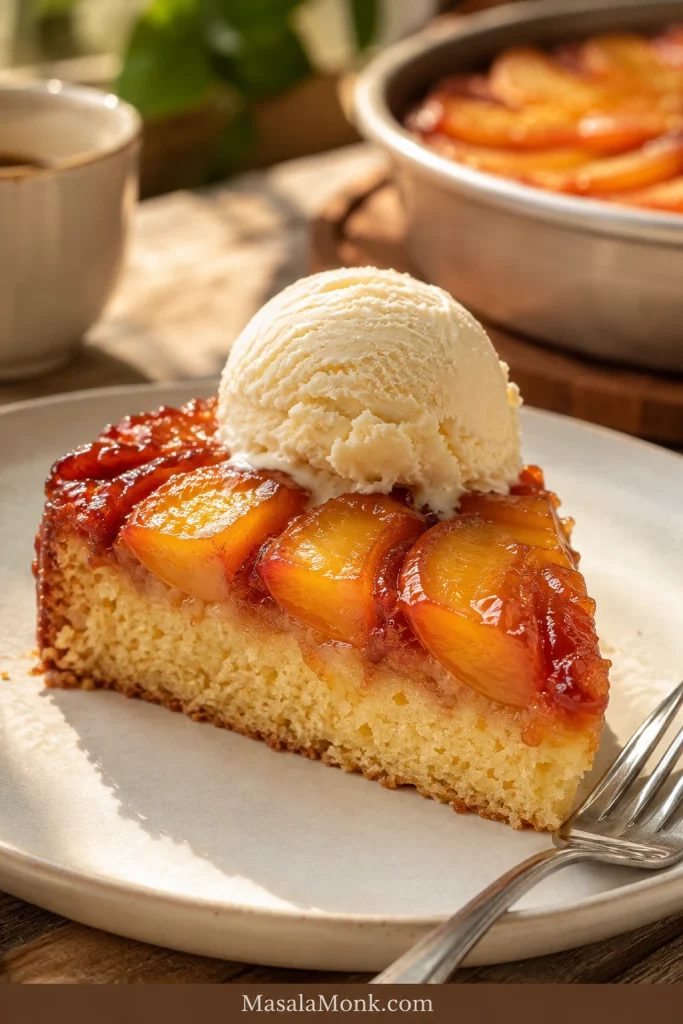
  • Classic: Add vanilla ice cream and let the cold scoop soften against the fruit.
  • Lighter: Add softly whipped cream with little or no extra sugar.
  • Tangy: Serve with crème fraîche or plain Greek yogurt.
  • Bright: Add fresh raspberries or a few extra peach slices.
  • Simple: Serve plain with coffee or black tea.
Slice of peach upside down cake on a cream plate topped with one scoop of vanilla ice cream beginning to soften over the glossy caramelized peaches.
Serve the cake faintly warm so vanilla ice cream softens into the caramel without disappearing into a puddle.

Making the vanilla ice cream too? This KitchenAid ice cream guide includes both eggless and custard-style vanilla bases.

Make Ahead, Store and Reheat

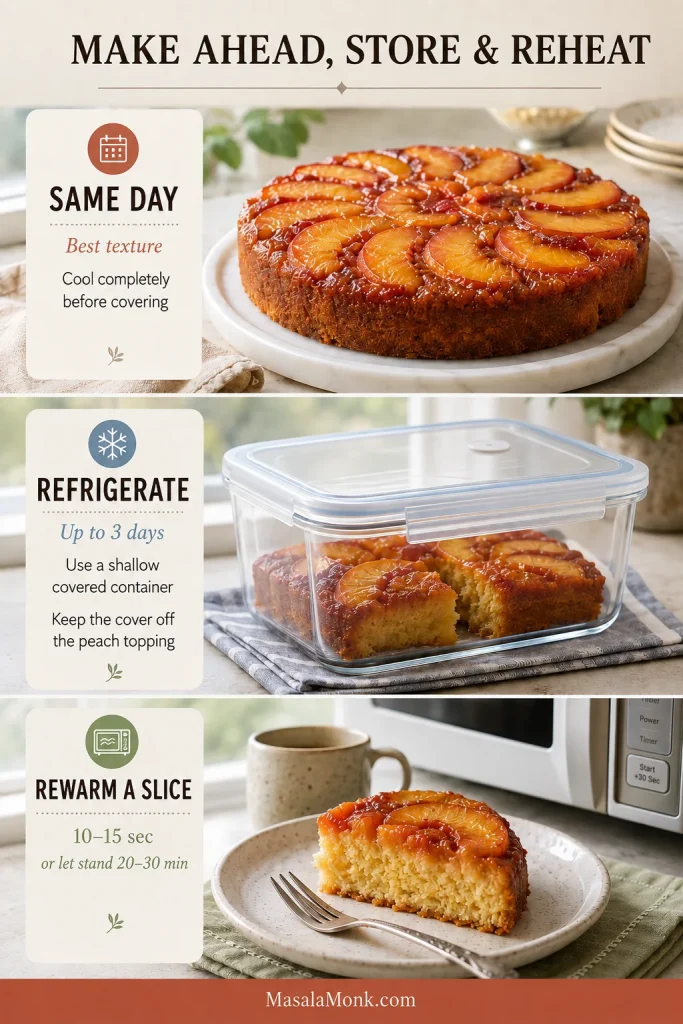
For the same day, bake the cake several hours ahead and cover it only after it has cooled completely. This is when the peaches are at their glossiest and the crumb beneath them is at its freshest.

For leftovers, place the fully cooled cake in a shallow covered container and refrigerate for up to three days. Avoid pressing plastic or foil against the peach topping. By the second and third day, the fruit softens further and more of its juice works into the cake beneath it.

To serve it again, let a refrigerated slice sit at room temperature for 20–30 minutes, or microwave it for about 10–15 seconds—just long enough to remove the chill.

Three-part storage guide showing a cooled whole peach upside down cake, leftover slices in a shallow covered container with space above the topping, and one plated slice beside a microwave for gentle reheating.
Good storage is visible in the spacing: the cover protects the cake without touching the peach topping. When reheating, restore softness rather than heating until the caramel bubbles.

Freezing is possible, but the peaches become softer and the topping may release more moisture after thawing. Refrigeration gives the better texture.

Where next? Serving ideas·Cake or cobbler?·Return to the recipe·Back to top

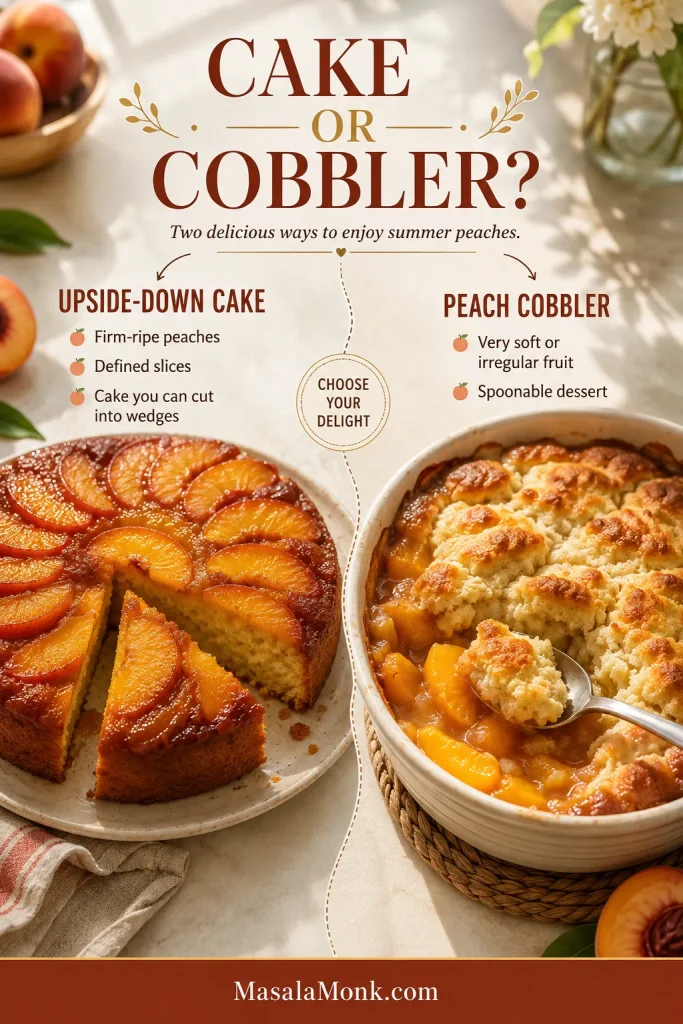
Cake or Cobbler?

Choose upside-down cake when the peaches can hold defined slices and you want a cake that cuts into wedges. Choose cobbler when the fruit is very soft, irregular or abundant and a spoonable dessert suits it better.

Side-by-side peach desserts showing a sliced peach upside down cake with defined caramelized fruit and a peach cobbler with soft peach filling and golden biscuit-style topping.
The visual difference is structural: upside-down cake asks peaches to hold a pattern, whereas cobbler lets the fruit relax into a spoonable filling. That makes the condition of the fruit a useful clue when choosing the dessert.

For that softer route, the MasalaMonk peach cobbler recipe explains how to work with fresh, frozen or canned peaches.

Frequently Asked Questions

Can I use canned or frozen peaches?

Yes. Drain canned peaches thoroughly before weighing. Thaw frozen peaches completely, drain the released liquid, blot the slices and then weigh them. The peach-preparation guide covers both options in more detail.

Why is the layer beneath the peaches soggy?

Very soft fruit, excess loose juice, too much fruit or an underbaked center are the usual causes. Check the troubleshooting table if the layer is thick or gummy rather than simply moist where fruit meets cake.

Can I use a different pan?

A dark 9-inch metal pan can work with an earlier check. For a cast-iron skillet, Bundt pan or 9×13-inch pan, use a method written for that shape and depth.

Can I use boxed cake mix?

This recipe is built around a from-scratch sour cream butter cake. A cake-mix version needs different liquid, fruit and pan quantities, especially when canned peach juice is involved, so use a recipe written specifically for boxed mix.

The reveal may be what everyone notices first, but the cake earns the second slice. Fragrant peaches, a soft caramelized top and a fully baked center matter more than a flawless pattern.

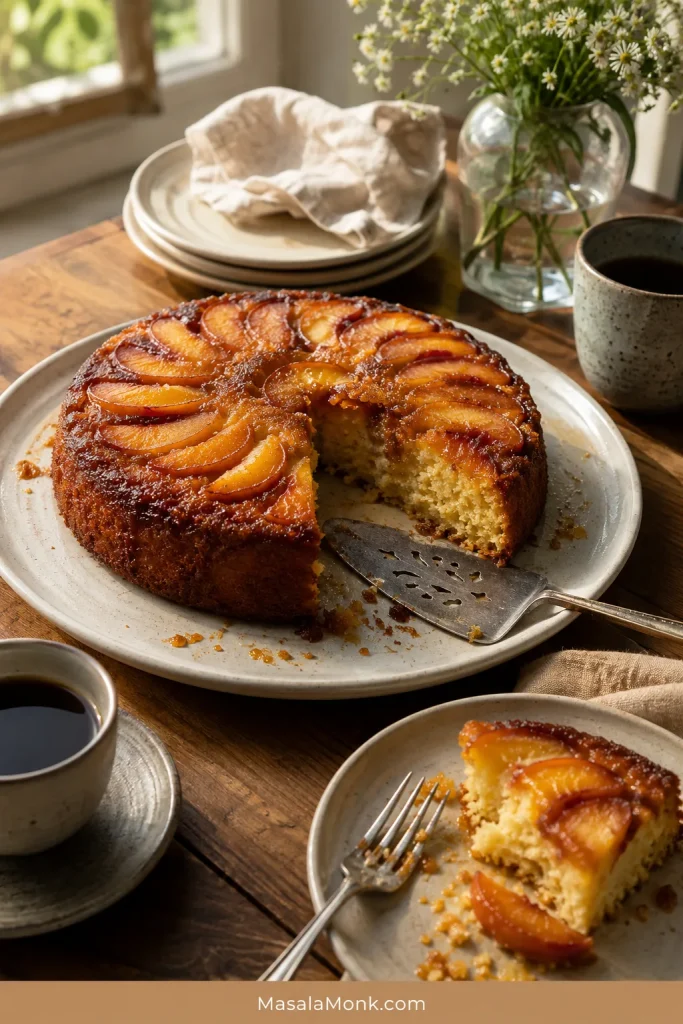
Partly served peach upside down cake on a platter with several wedges removed, a cake server, scattered crumbs, coffee and a partially eaten slice on a small plate with a fork.
Even after a few slices are gone, the cake should still hold neat wedges, a tender crumb and a glossy peach top.

Give the fruit enough room, trust the doneness cues and start the flip timer when the pan leaves the oven. When the pan finally lifts, the cake arrives at the table glossy, fragrant and worth the brief moment of suspense.

Back to top ↑

Posted on Leave a comment

Homemade Pita Bread Recipe: Soft, Puffy Pockets in the Oven or on the Stovetop

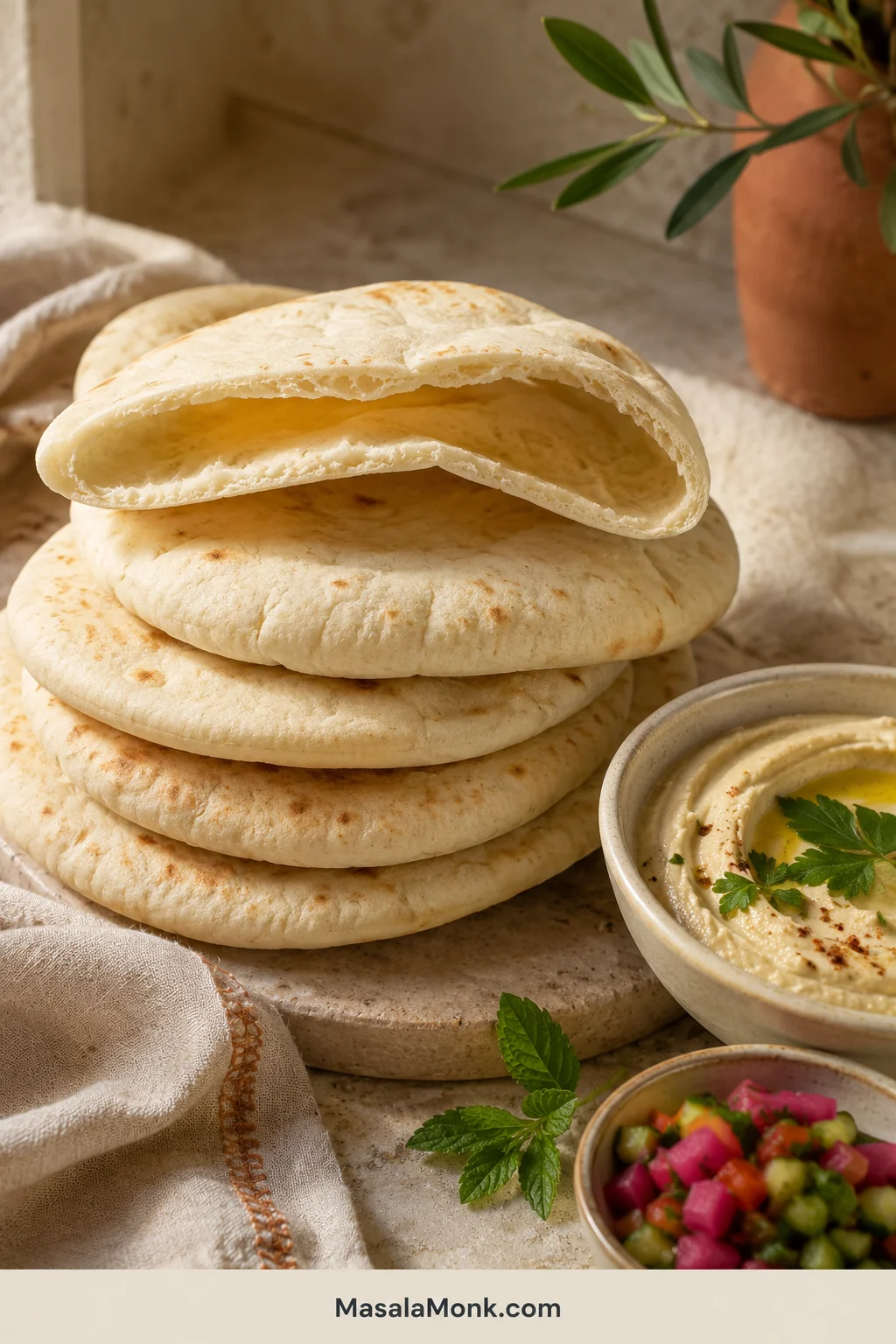
Stack of soft homemade pita with one bread cut open to show a hollow pocket beside a bowl of hummus.

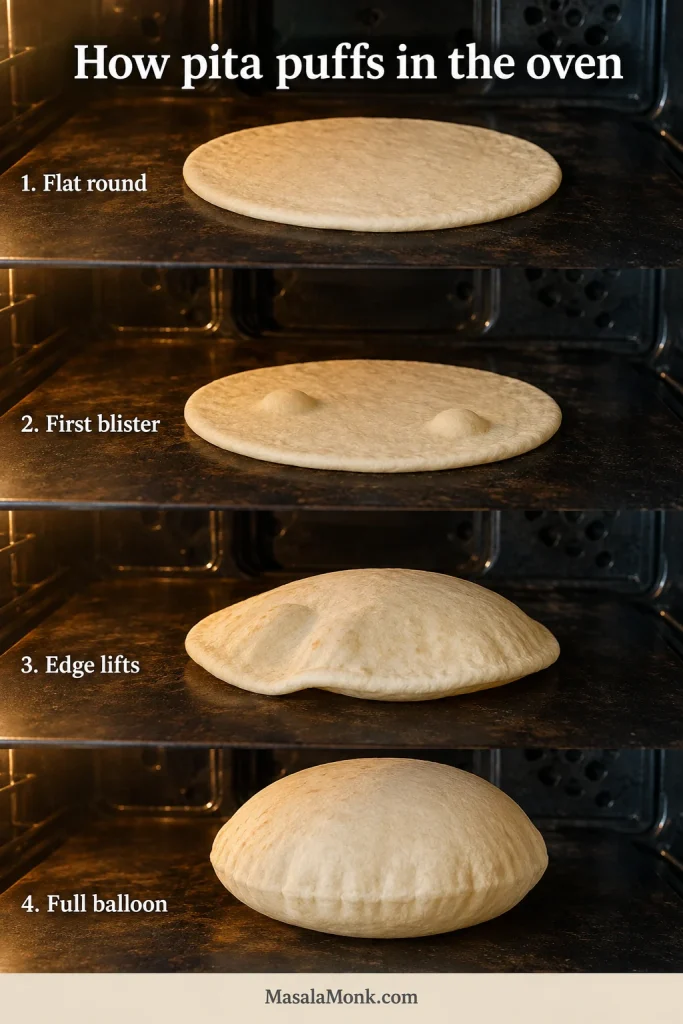
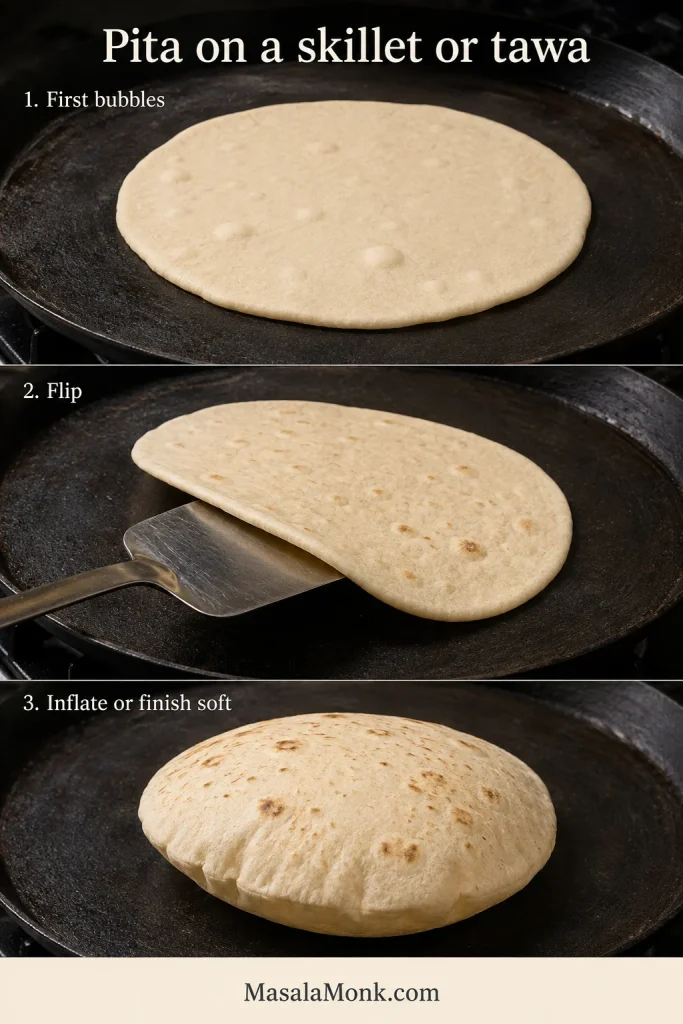
The best part of making pita happens quickly. A flat round lands on the hot surface, a few bubbles appear, and then the bread lifts into a pale balloon. Once it settles, that balloon becomes a pocket ready for falafel, chicken, crunchy salad or the vegetables already waiting in the fridge.

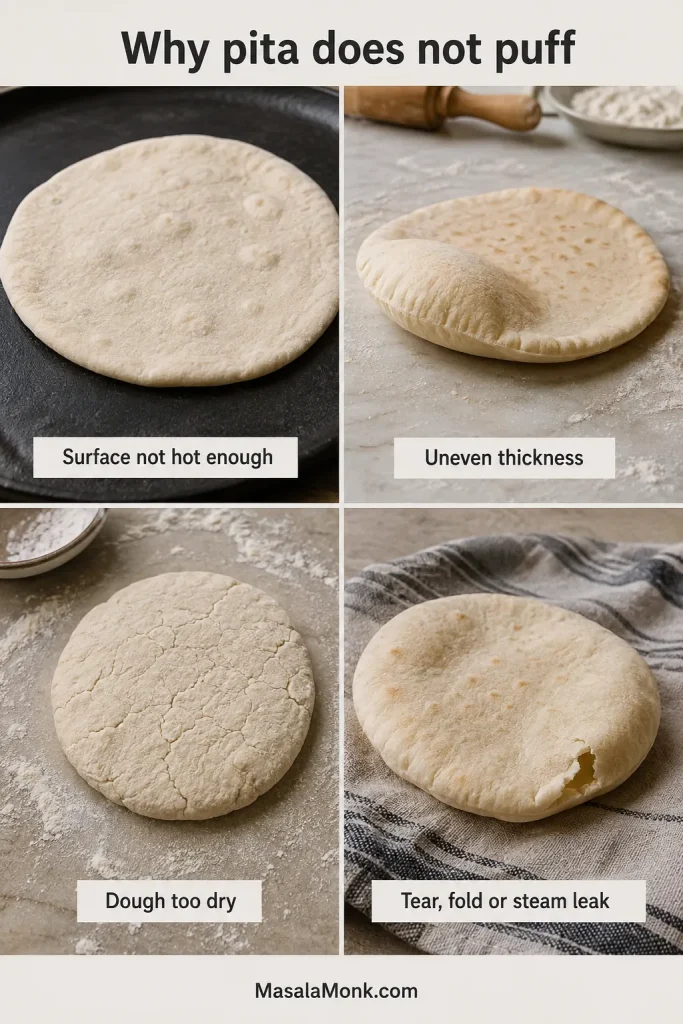
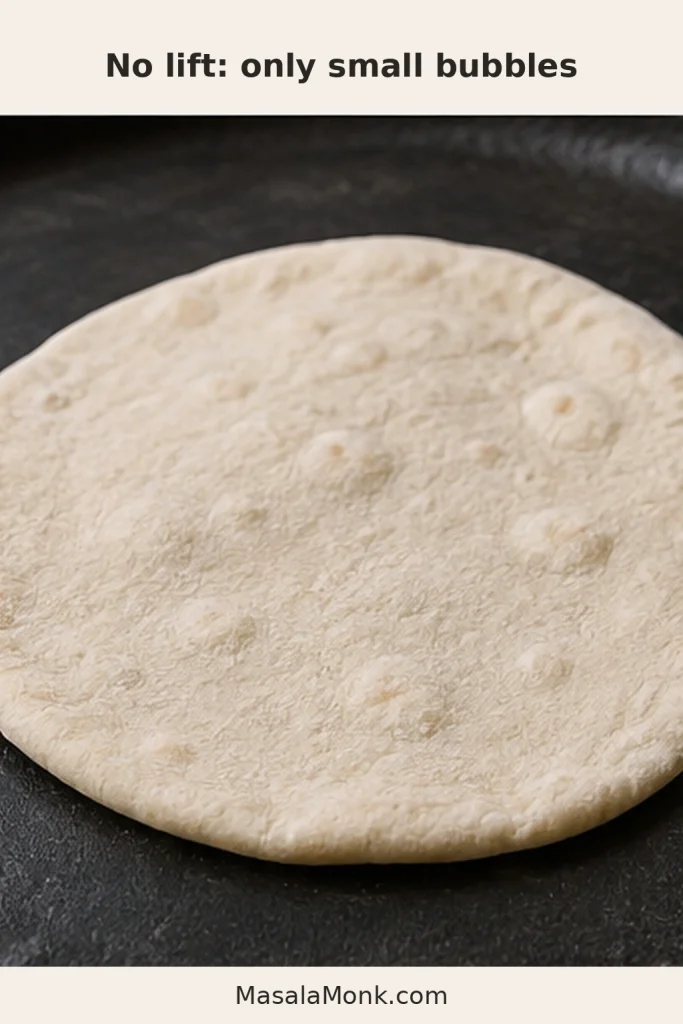
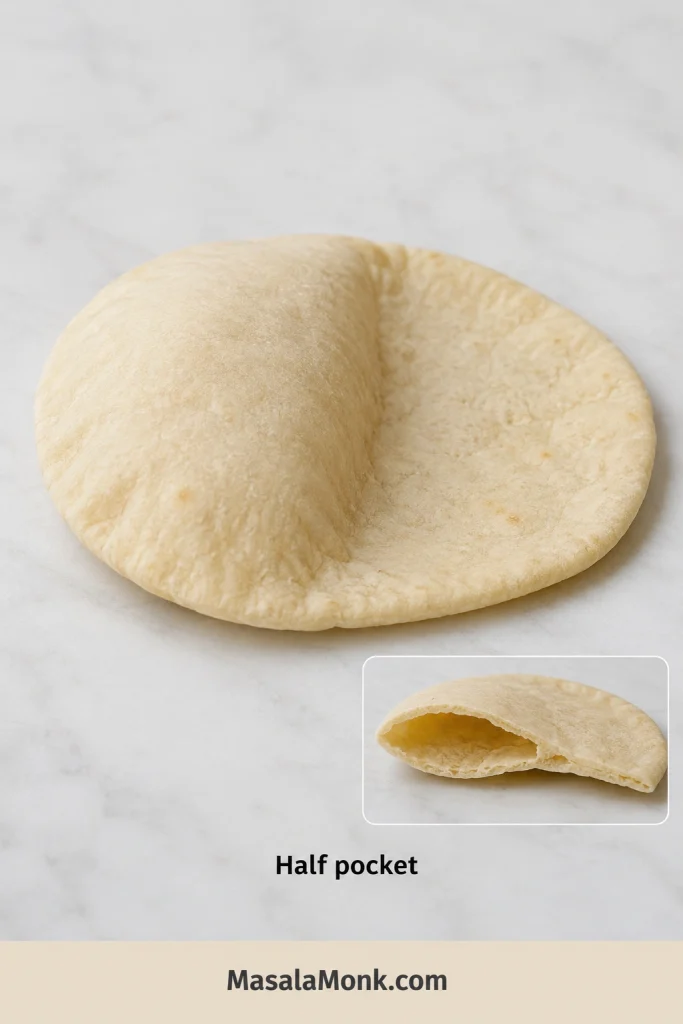
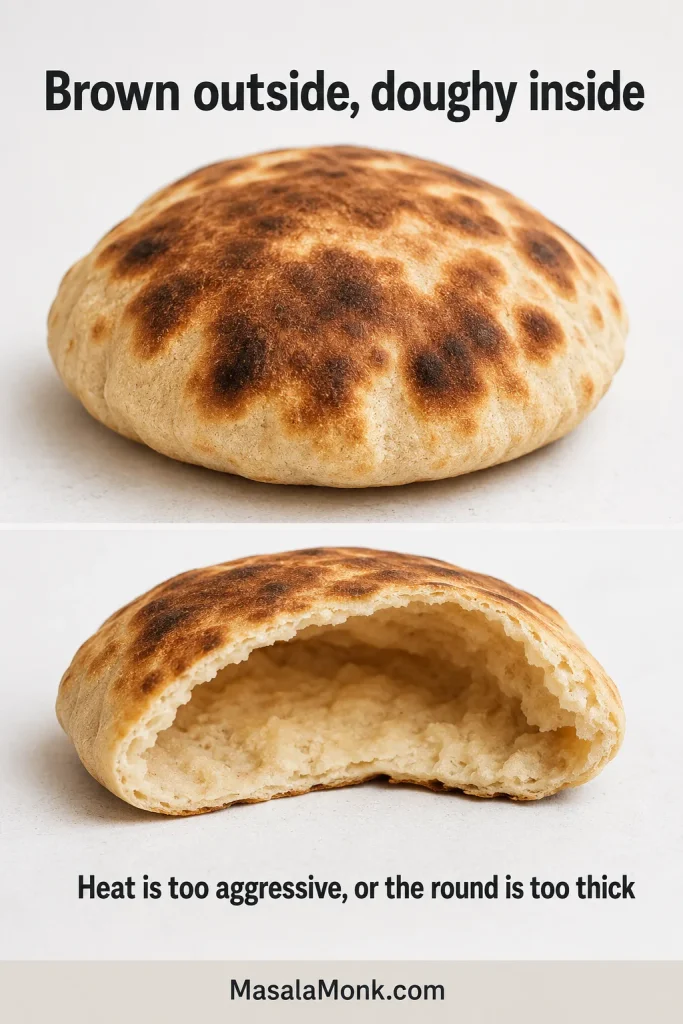
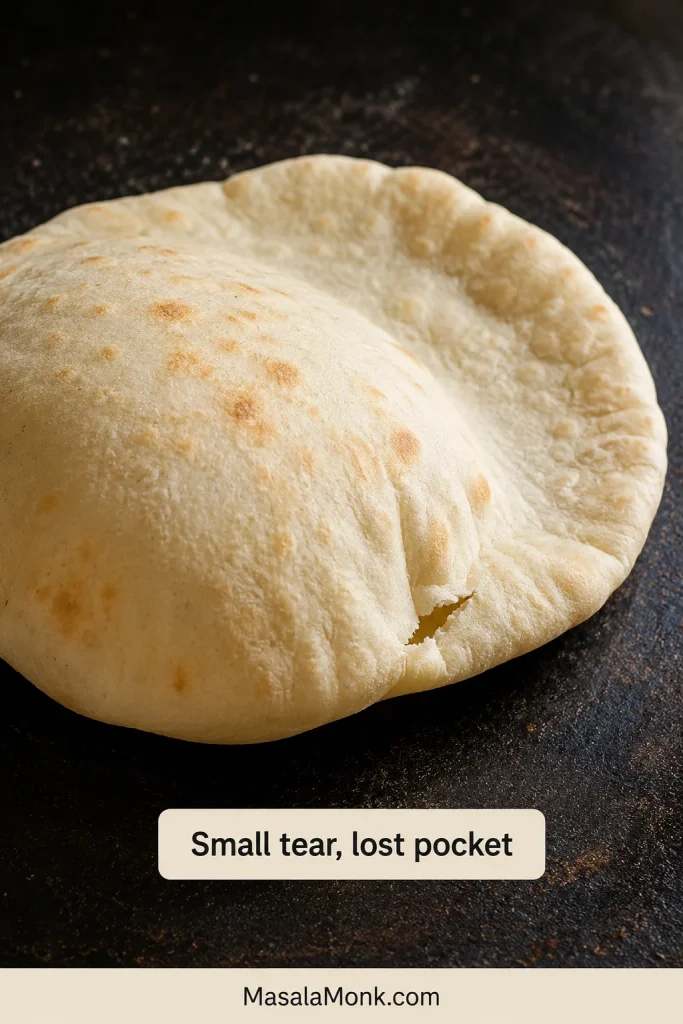
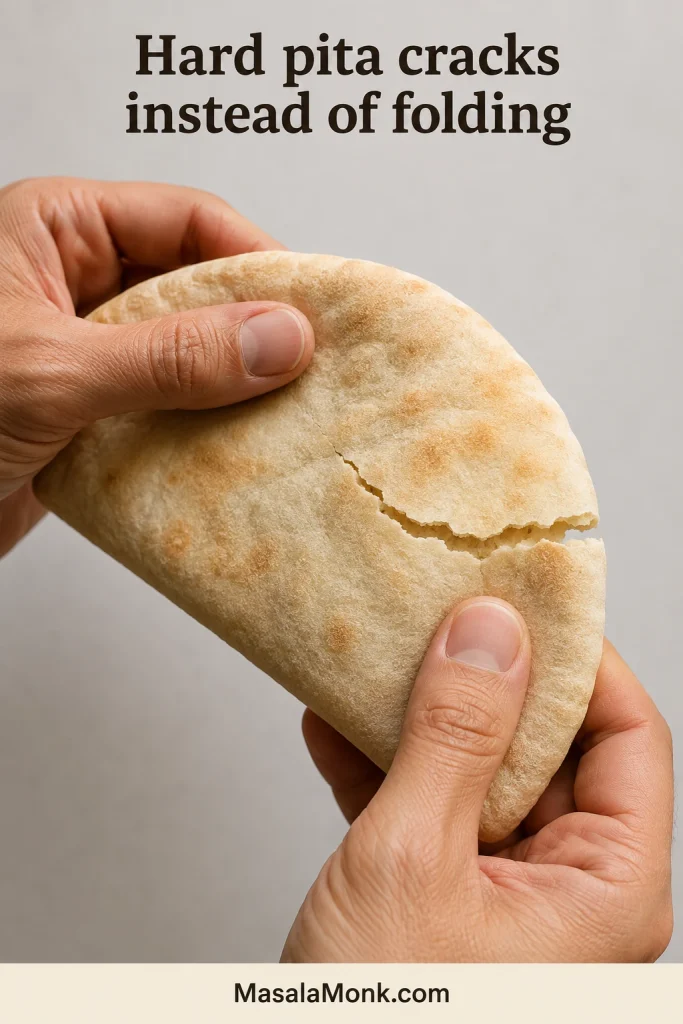
A frustrating batch begins almost the same way. The dough cooks, picks up a few spots and stays stubbornly flat. One half may inflate while the other remains attached. A pocket may also appear, yet the bread can become too crisp to open without tearing.

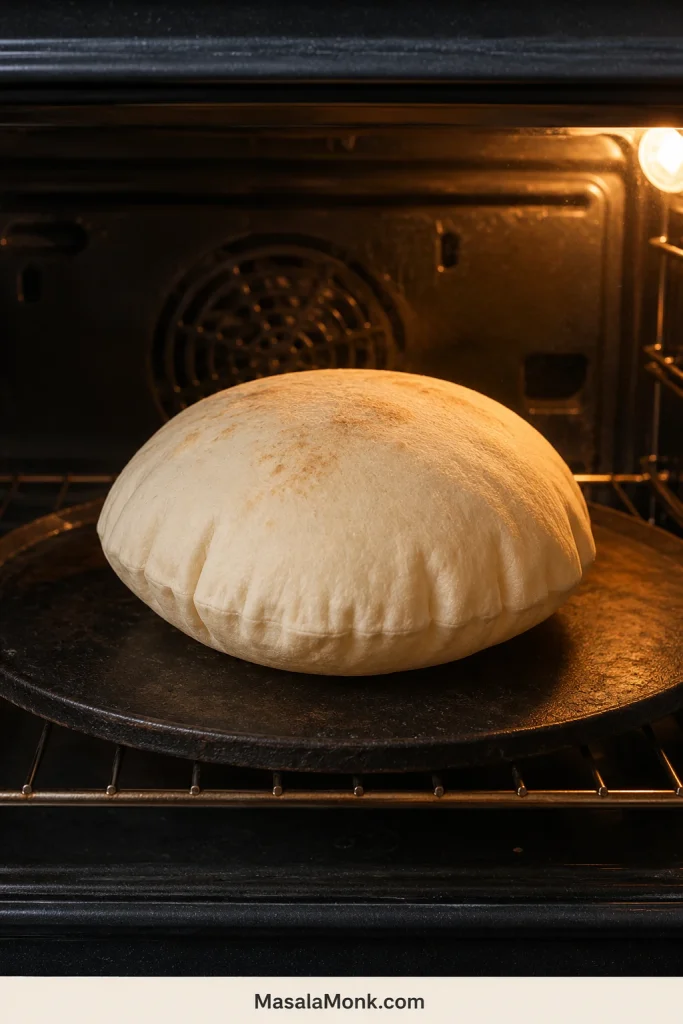
Whole pita fully inflated into a pale balloon on a dark baking surface inside an oven.
A perfectly symmetrical dome is unnecessary; once the lift travels across the round and the surface sets, remove it.

This recipe shows you how to make soft Middle Eastern-style pita that puffs into a pocket you can open and fill. The oven gives you the most reliable pocket; a skillet, griddle or tawa creates more browned flavor, although full pockets are less consistent. Soft dough, even rolling, a thoroughly heated surface and a towel beside the oven or stove do most of the work.

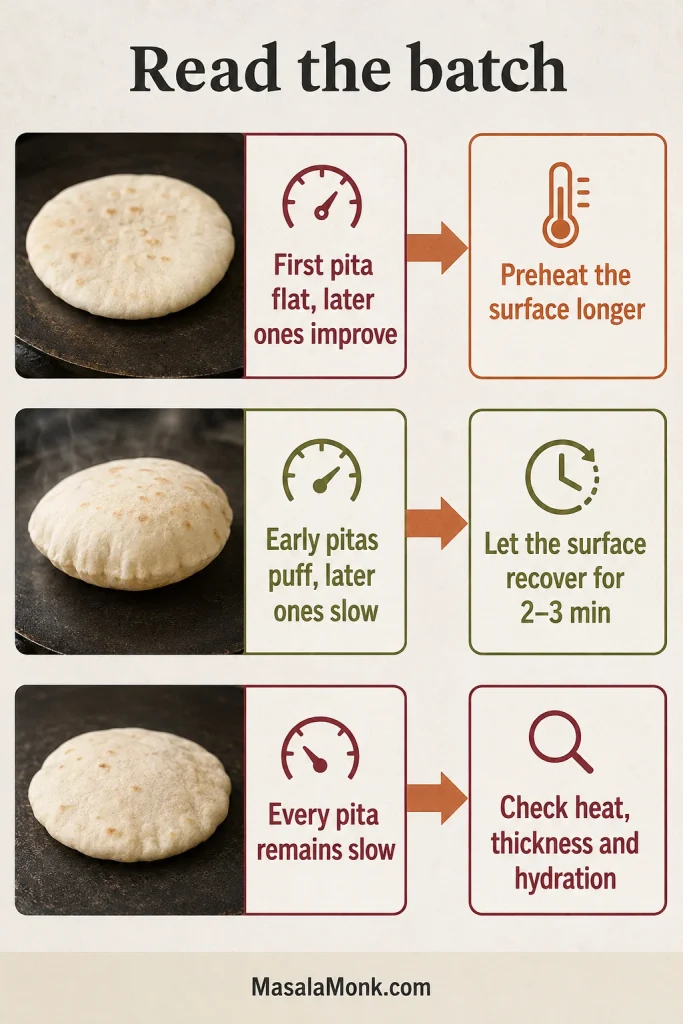
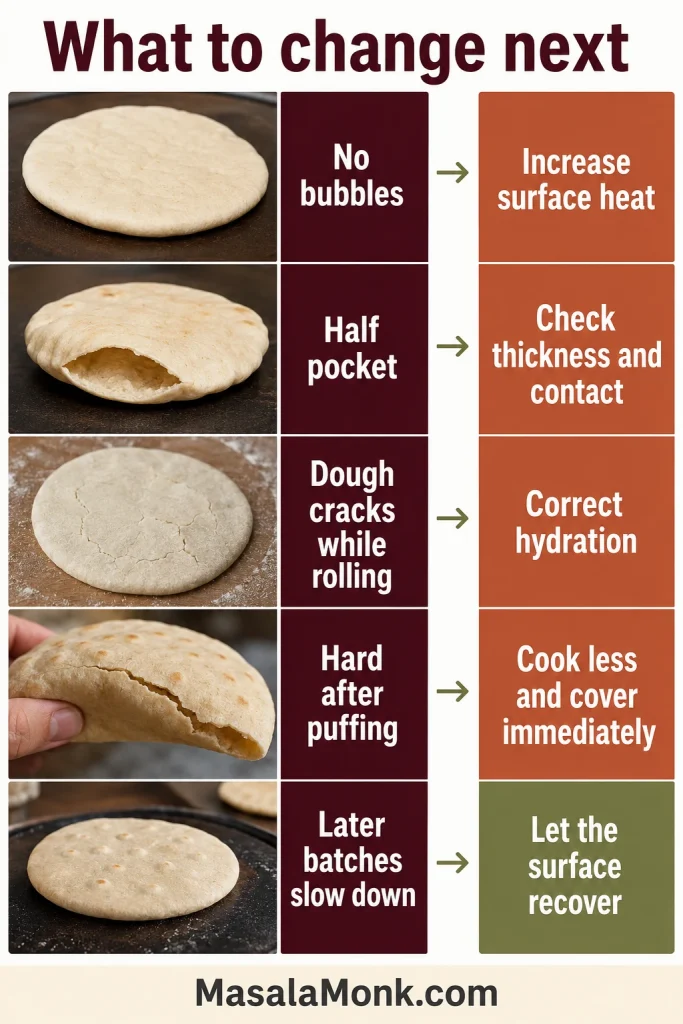
The first round gives you useful clues rather than a final verdict. Its bubbles, color and pocket show what to change before the next round: more heat, a longer rest or more even rolling.

Start here

The Pita Method in One Minute

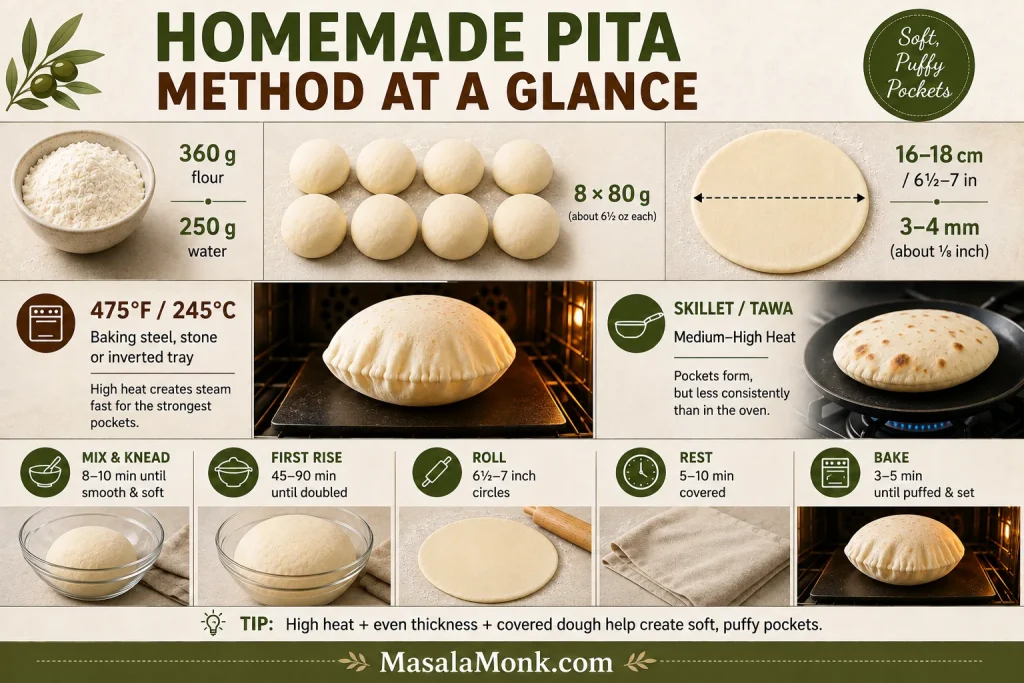
Make a soft dough with 360 g all-purpose flour and 250 g water. Knead until elastic, let it double, then divide it into eight pieces weighing about 80 g each. After a short rest, roll the pieces to roughly 6½–7 inches / 16–18 cm and 3–4 mm thick.

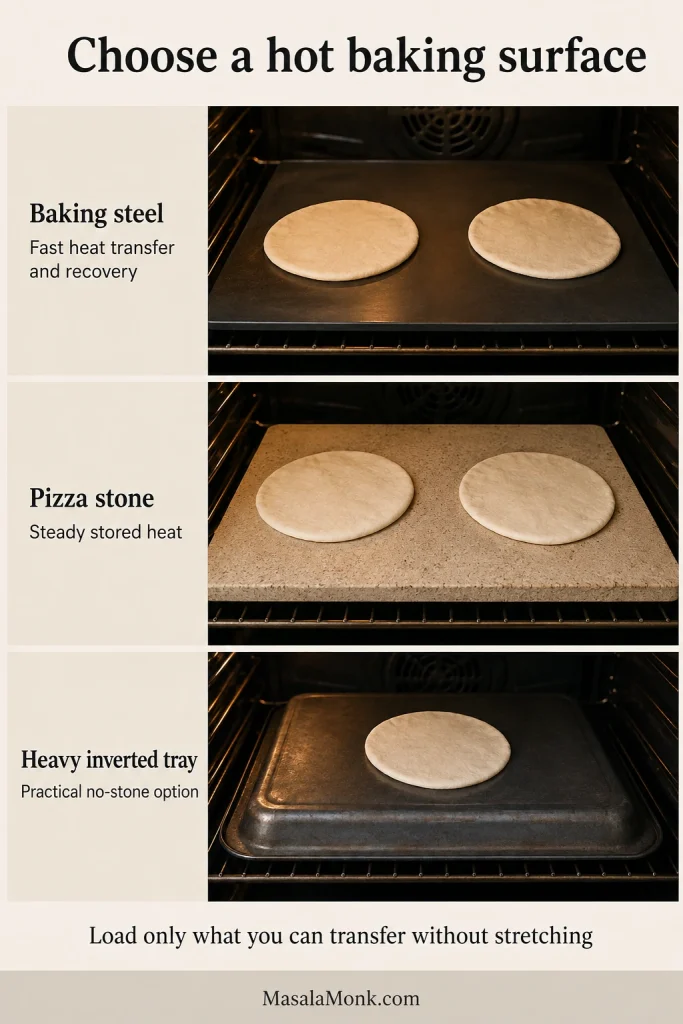
For the strongest pocket, bake on a steel, stone or heavy inverted tray that has heated for a full 30–45 minutes at 475°F / 245°C. Watch through the oven window from about 2½–3 minutes and remove the pita once it is inflated and set, before deep browning.

No stone or steel? Preheat a heavy uncoated baking sheet upside down and use it as the hot surface.

Roll evenly. Heat fully. Cover quickly. Those three decisions matter more than making a perfectly circular pita.

Pita method infographic showing flour and water weights, eight portions, rolling size, dough thickness and oven temperature.

Choose Your Cooking Method

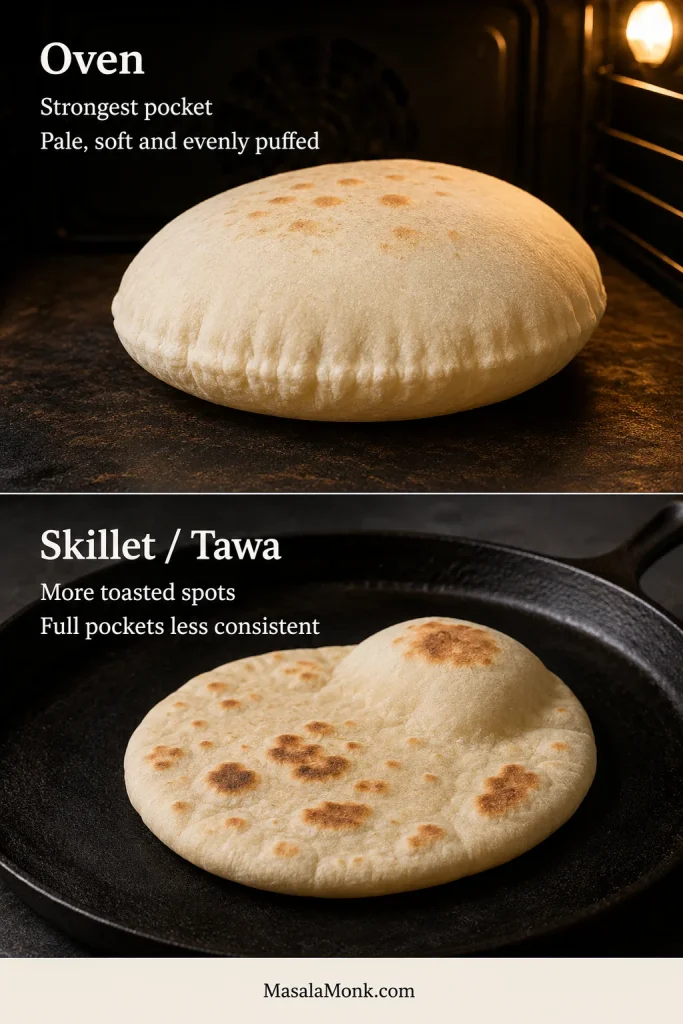
  • Choose the oven for the strongest pocket. Intense heat from below gives steam its best chance to separate the two sides before the bread dries.
  • A skillet, griddle or tawa gives more browned flavor. Expect darker toasted spots, but full pockets will be less consistent.
  • Without a stone or steel, preheat a heavy inverted tray. It provides a flat oven surface, although it may need more time to recover between batches.

Both methods are useful, but they do not produce identical pita: the oven favors a complete pocket, while direct pan contact develops more toasted color.

Comparison of a pale, evenly puffed oven pita and a more toasted pita cooked on a skillet or tawa.

Planning ahead? Use the reduced-yeast overnight schedule in the variations section.

Greek pita and quick yogurt flatbread are different breads, not two more cooking methods for this dough. Greek pita is thicker and deliberately pocketless; yogurt flatbread does not rely on yeast or promise a hollow center.

Making a folded Greek-style meal instead? The thicker pita used with chicken souvlaki is designed to bend around the filling; this thinner version is designed for stuffing.

Whichever method you choose, remove the bread before it becomes stiff. A flat pita is still dinner—it can be folded, dipped or toasted later.

Homemade Pita Bread Recipe

Soft, lightly chewy pita that puffs into a hollow pocket on a thoroughly heated surface. Use the oven for the strongest pocket or a skillet, griddle or tawa for a more browned finish.

Recipe at a glance

  • Yield: 8 whole pitas
  • Serves: About 4 as shared bread or 8 as sandwiches, using one pita per person
  • Active preparation: About 35–45 minutes
  • Rise and rest: About 65–115 minutes
  • Oven cooking: About 15–40 minutes, depending on whether the surface holds one or two pitas and how quickly it recovers between batches
  • Stovetop cooking: About 25–40 minutes
  • Oven-method total: About 2 hours to 2 hours 45 minutes
  • Stovetop-method total: About 2 hours 10 minutes to 3 hours
  • Oven temperature: 475°F / 245°C

Some stages overlap: Later rounds are rolled while earlier batches cook, so the preparation, resting and cooking ranges should not be added separately. Most of the elapsed time is hands-off rising, resting and preheating.

Equipment

  • Digital kitchen scale
  • Large mixing bowl
  • Dough scraper or sturdy spatula
  • Rolling pin
  • Clean kitchen towels
  • Baking steel, pizza stone or heavy uncoated baking sheet for the oven method
  • Heavy cast-iron skillet, carbon-steel pan, griddle or tawa for the stovetop method
  • Optional: Stand mixer with dough hook; infrared thermometer

Ingredients

Use the weights when possible. Flour and salt can vary noticeably by scooping method and crystal size.

  • 360 g all-purpose flour (12.7 oz / about 3 cups, spooned and leveled), plus a little for dusting
  • 250 g water (250 ml / about 1 cup plus 1 tablespoon)
  • 5 g instant yeast (about 1½ teaspoons)
  • 6 g granulated sugar (about 1½ teaspoons)
  • 8 g fine salt (about 1¼ teaspoons, depending on the salt)
  • 14 g olive oil (15 ml / 1 tablespoon), plus a few drops for the bowl

Using active dry yeast: Check the brand instructions before substituting. Some active dry yeasts can replace instant yeast 1:1 by weight; others recommend a slightly larger amount. Dissolve it first only when directed by the manufacturer, and allow more time if the dough rises slowly.

Make and shape the dough

Mix, rest and knead

  1. Mix the dry ingredients. Whisk together the flour, instant yeast, sugar and salt in a large bowl.
  2. Add the water and oil, then rest. Use room-temperature water in a hot kitchen or lukewarm water, about 90–105°F / 32–41°C, in a cool room. Stir until no dry flour remains. Cover and rest the rough dough for 10 minutes.
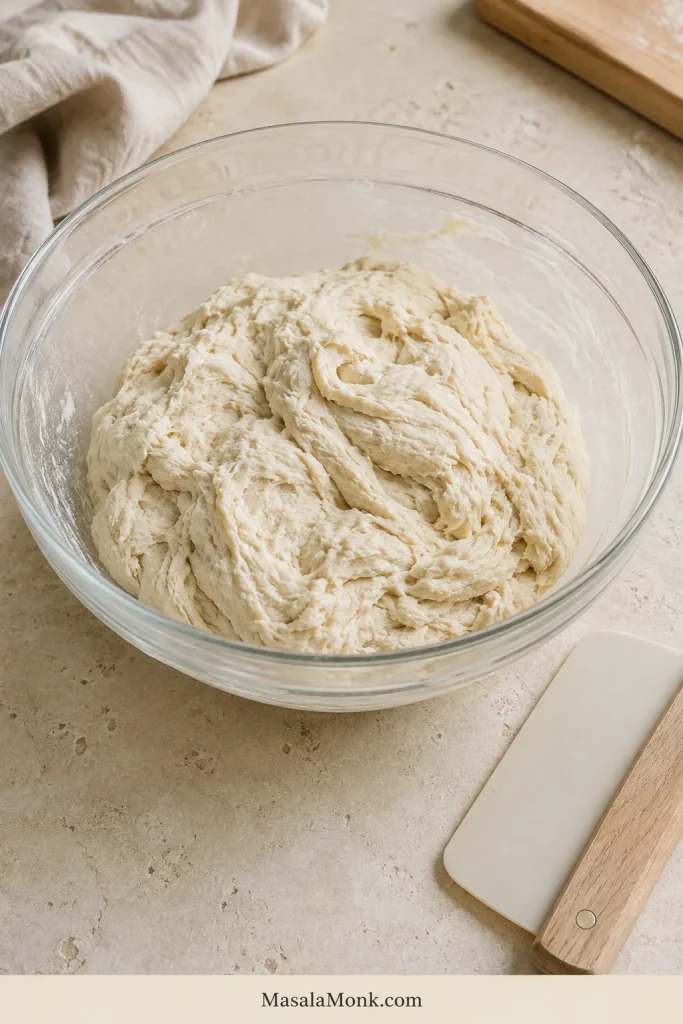
  3. Knead until elastic. Work the dough by hand for 8–10 minutes, or with a dough hook on low to medium-low speed for 6–8 minutes. It should become smooth, soft and slightly tacky.

Rise, divide and roll

  1. Let the dough double. Place it in a lightly oiled bowl, cover and leave until roughly twice its original volume, about 45–90 minutes. A clear or straight-sided bowl makes the increase easier to judge.
  2. Begin preheating early. For the oven method, start heating the steel, stone or inverted tray when the dough has risen by roughly half to two-thirds. Give the surface a full 30–45 minutes before the first pita goes in. For the stovetop method, begin heating the pan when the shaped rounds are nearly ready.
  3. Divide and shape. Cut or weigh the dough into eight portions of about 80 g each. Draw the edges underneath each portion to make a smooth ball, cover and rest for 15 minutes.
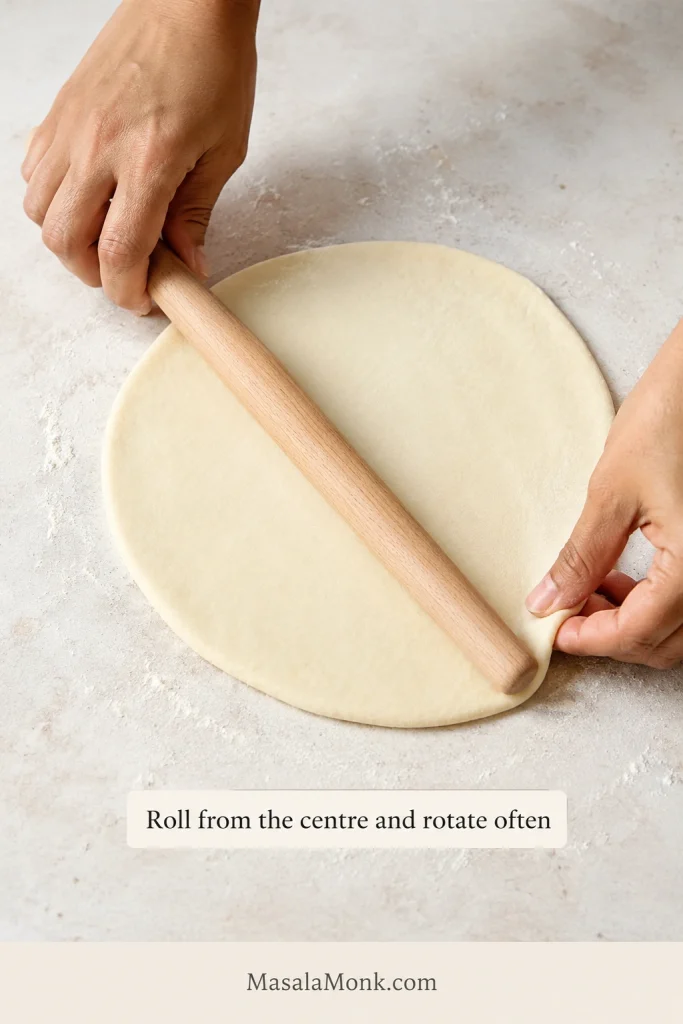
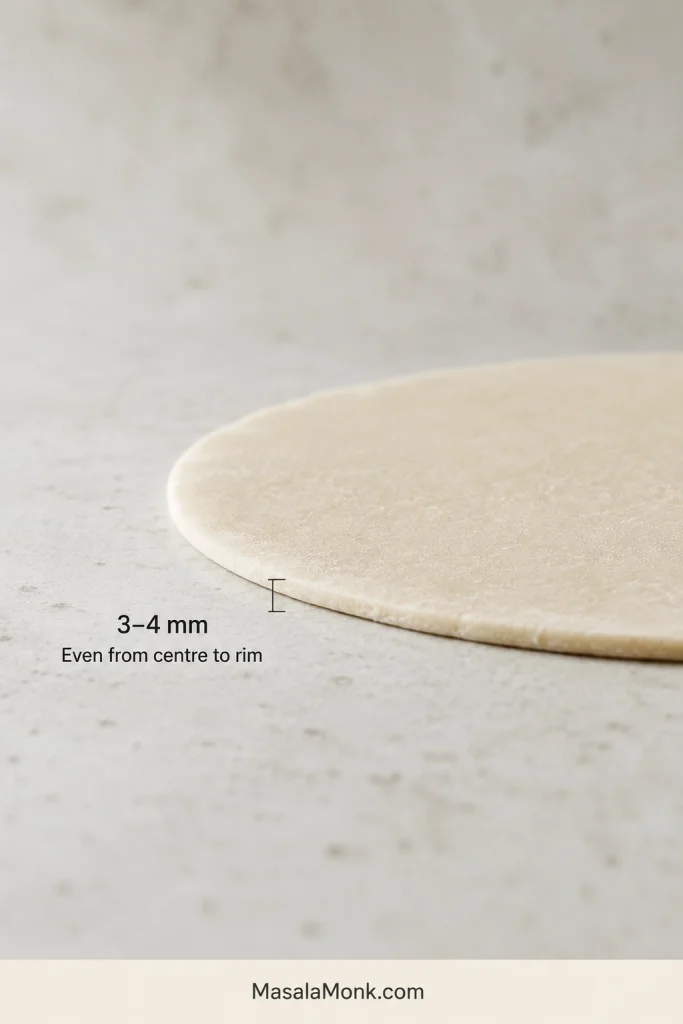
  4. Roll only enough for the next one or two batches. Working from the center outward, roll each ball while lifting and turning often, until it measures about 6½–7 inches / 16–18 cm and 3–4 mm thick.
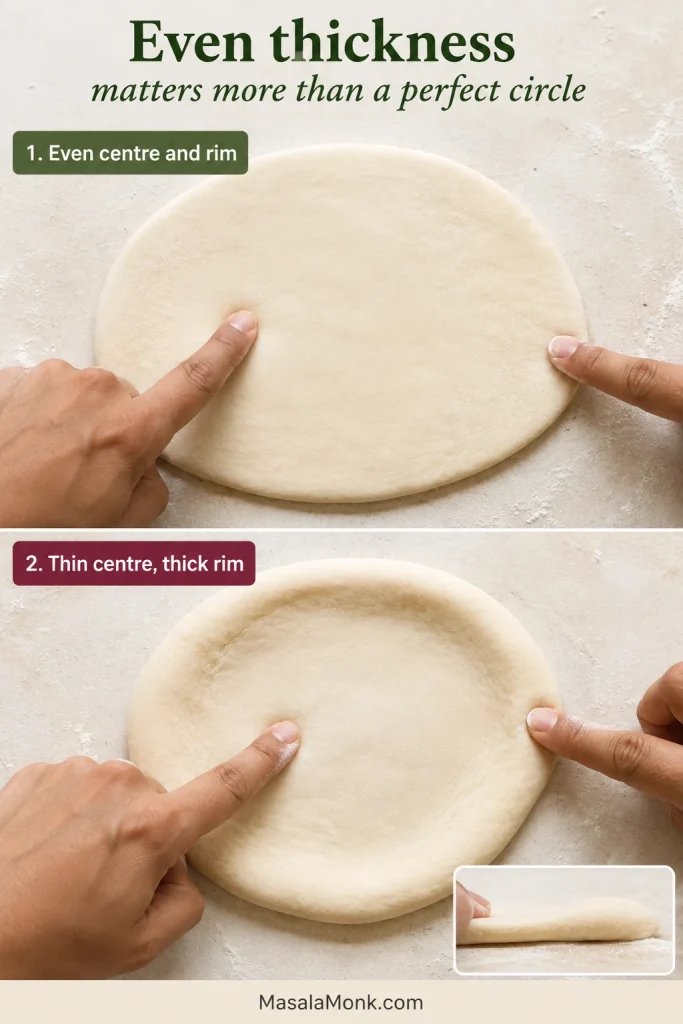
  5. Rest the rounds. Run your fingertips over the center and rim. Your pita does not need to be perfectly round, but it should feel evenly thin. Place each round on a lightly floured cloth, board or peel and cover for 5–10 minutes, until relaxed but not noticeably puffy.
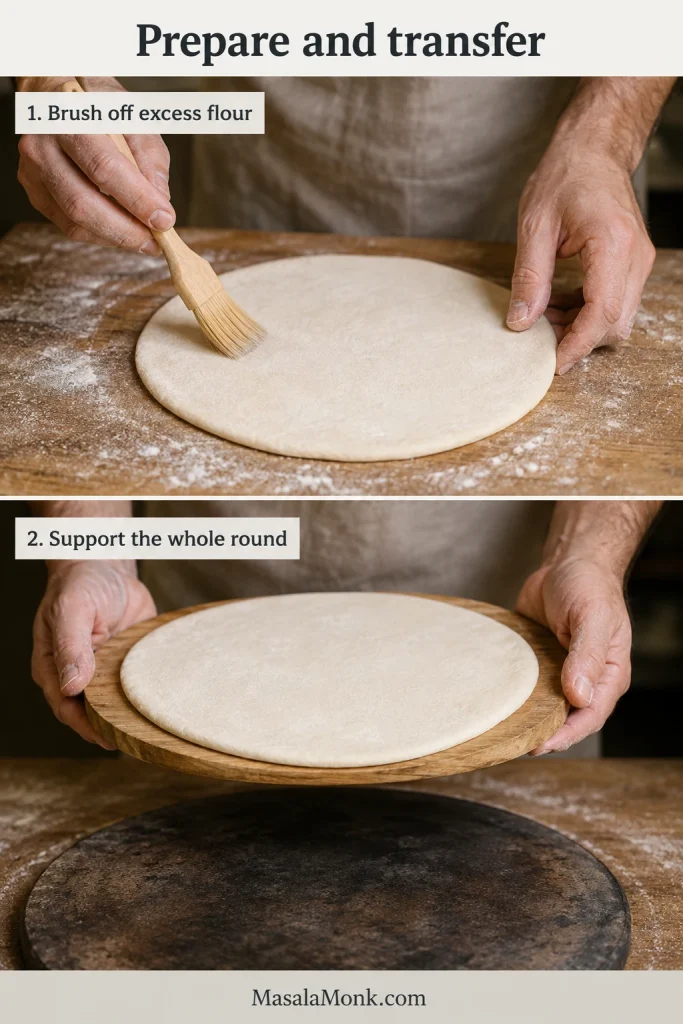
  6. Keep the remaining dough covered. Roll the next set while the first batch cooks. Before transferring a round, brush off visible excess flour so it does not scorch on the hot surface.

Cook the pita

Have the towel ready before the first round goes in; once the first blister appears, the batches can move quickly.

Oven method

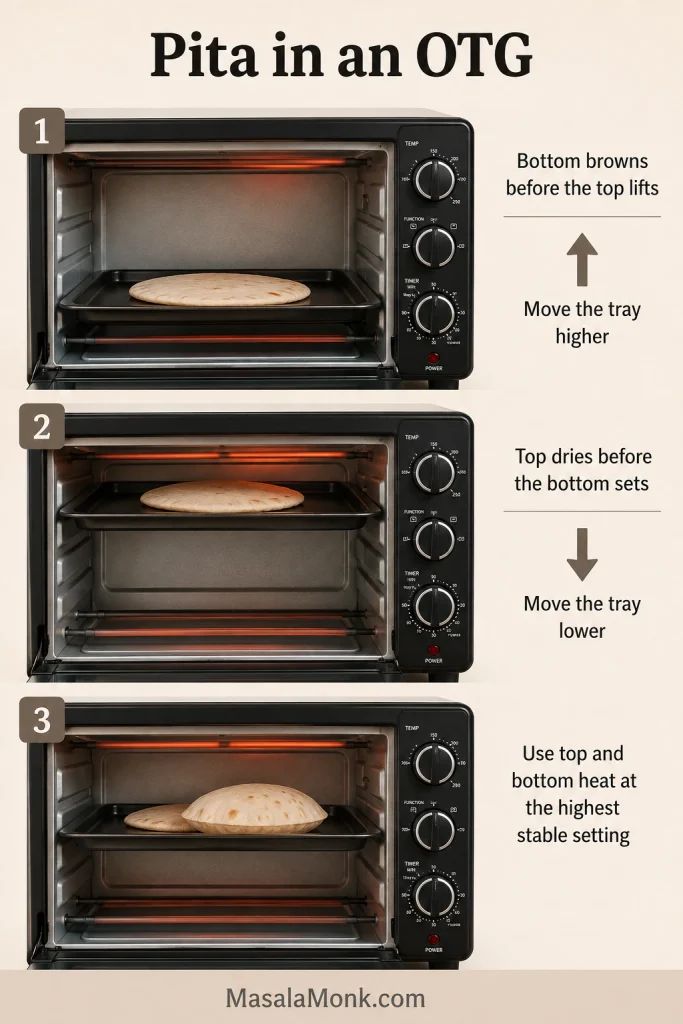
  1. Give the surface its full preheat. Place the steel, stone or inverted tray on the middle rack and heat the oven to 475°F / 245°C. Position it slightly below the middle when the top of your oven browns aggressively.
  2. Check parchment before using it at 475°F / 245°C. Follow the manufacturer’s maximum temperature and transfer the pita directly to the hot steel, stone or tray whenever possible.
  3. Transfer without stretching. Place one or two rounds on the hot surface, depending on its size. Leave enough room to load and remove each pita without pulling, folding or crowding it.
  4. Watch for the first lift. Begin watching through the oven window after about 2½–3 minutes. Avoid repeatedly opening the oven; when the view is poor, make one quick check at about 3 minutes.
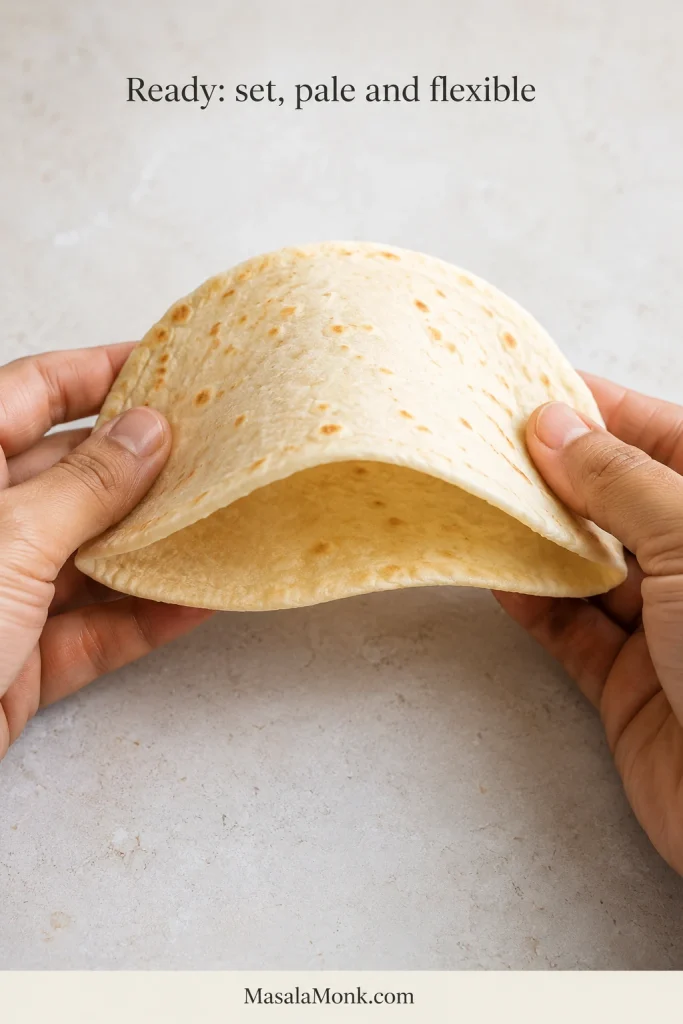
  5. Take it out before deep browning. Most pitas need about 3–5 minutes. Remove each one when most or all of the round has inflated and the surfaces look set but remain pale enough to bend.
  6. Cover immediately to keep it soft. Move each pita directly beneath a clean towel.

Stovetop, griddle or tawa method

  1. Preheat a heavy dry pan until evenly hot. Medium-high heat is a sensible starting point. When measured, aim for a surface temperature around 425–450°F / 218–232°C.
  2. Add one pita and watch for bubbles. Cook for 20–30 seconds, then flip when the first bubbles appear.
  3. Keep turning every 20–30 seconds. Cook until the pita inflates or the raw, damp-looking patches disappear. It should remain soft enough to bend, usually after about 2½–4 minutes in total.
  4. Cover before cooking the next round. Move the pita beneath the towel before it stiffens.

Pita bread guide

Pita Dough, Heat and Troubleshooting

You can begin with the recipe above. The guide below shows what to look for at each stage and what to change before the next round.

Why Pita Puffs Into a Pocket

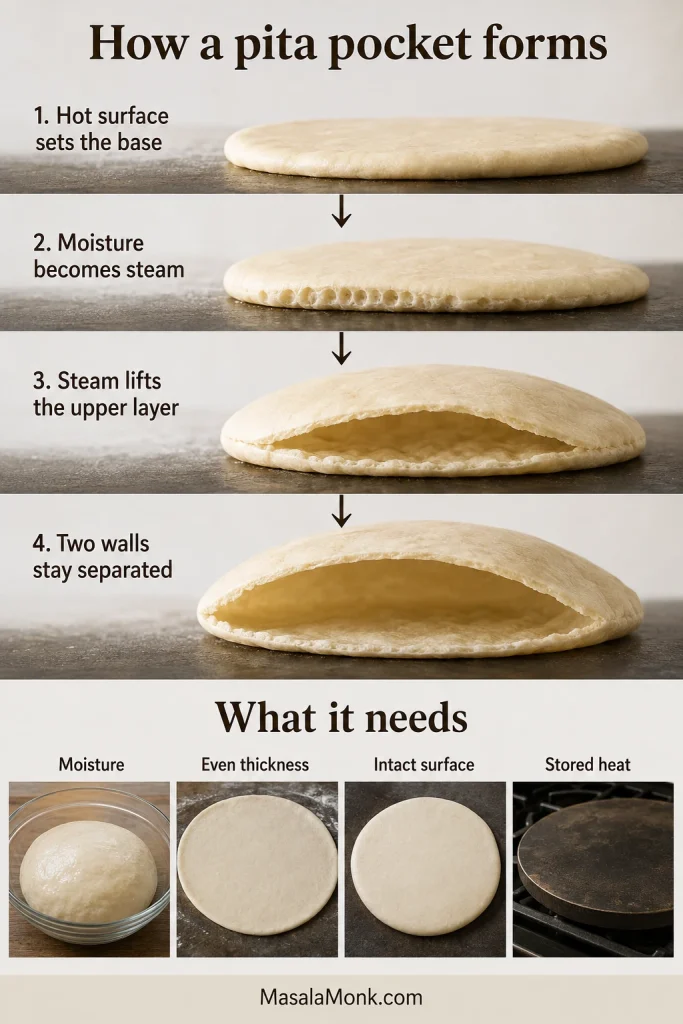
The pocket is created by steam. Fermentation makes the dough lighter and easier to stretch, but the dramatic balloon happens when moisture inside the thin round heats rapidly.

As the bottom touches the hot surface, it begins setting almost immediately. Moisture trapped inside turns to steam and lifts the upper layer away from it. Once both sides have set, the bread can hold the balloon long enough for the pocket to move across the round. The pita settles as the steam escapes, but the two layers remain separated.

Infographic showing heat setting the pita base, steam lifting the upper layer and two thin walls remaining separated.

Four things open the pocket

  • Moisture: Soft dough supplies the steam.
  • Even thickness: The round heats at a similar rate from edge to edge.
  • An intact surface: Steam remains inside instead of escaping through a tear.
  • Stored heat: The pan, stone or tray sets the bread before it slowly dries.

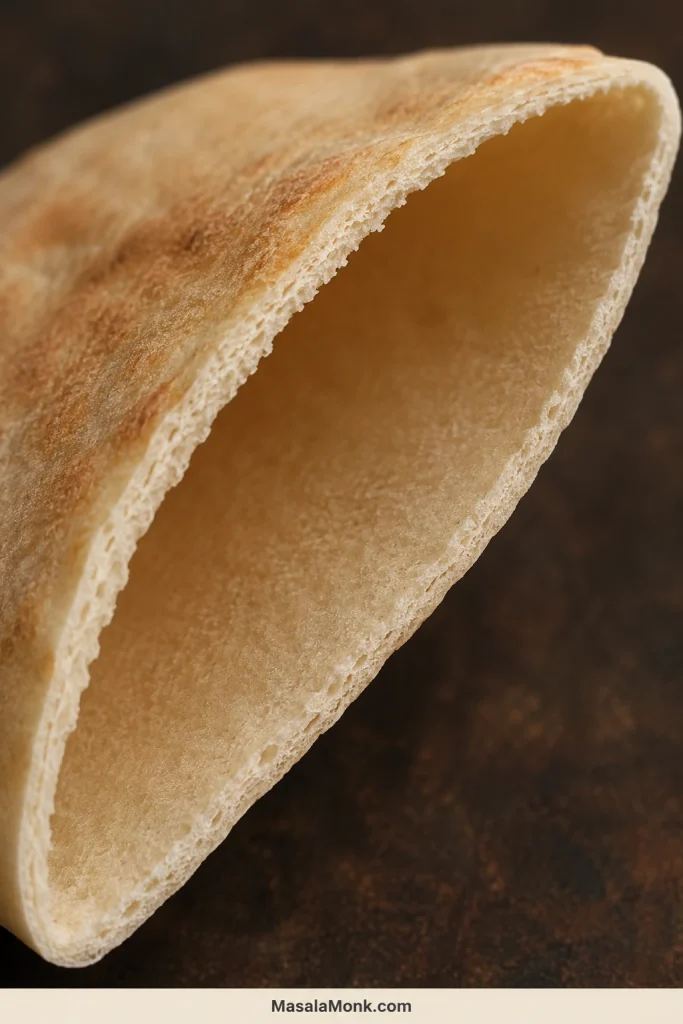
After the balloon settles, the two cooked layers should remain separated through most of the round; a few isolated bubbles are not the same as a usable pocket.

Close-up of a cut pita with two thin bread walls surrounding a continuous hollow center.
Look for one continuous cavity rather than isolated edge bubbles; that separation is what makes the bread easy to fill.

Pita Bread Ingredients and Dough Texture

Flour and water control structure and steam

All-purpose flour develops enough gluten for the dough to stretch and hold steam without making the bread excessively chewy. Bread flour can also work, although it may need a little more water and usually produces a firmer bite.

Milk Street’s pita troubleshooting identifies the same problem: excess flour creates a drier, thicker round with less moisture available for steam. Water hydrates the flour, helps the dough stretch and becomes the steam that opens the pocket. Its temperature mainly controls the pace of fermentation; it does not need to be hot.

Flour absorption varies by brand, climate and storage, so give the rough dough its 10-minute rest before deciding it needs more flour.

Rough, shaggy pita dough in a clear bowl with all visible flour hydrated.

Yeast, salt, sugar and oil shape fermentation and texture

Yeast produces gas and flavor during the first rise, but steam performs the final lift. Salt seasons the pita, strengthens the dough and steadies fermentation. Sugar supports light browning without making the bread sweet, while olive oil helps the cooled pita remain tender and flexible.

Both sugar and oil can be omitted for a leaner dough. The pita may color more slowly and feel less tender after cooling, but neither ingredient creates the pocket.

Soft dough is better than easy, dry dough

Sticky dough makes many bakers nervous. Stiff dough creates the harder problem here.

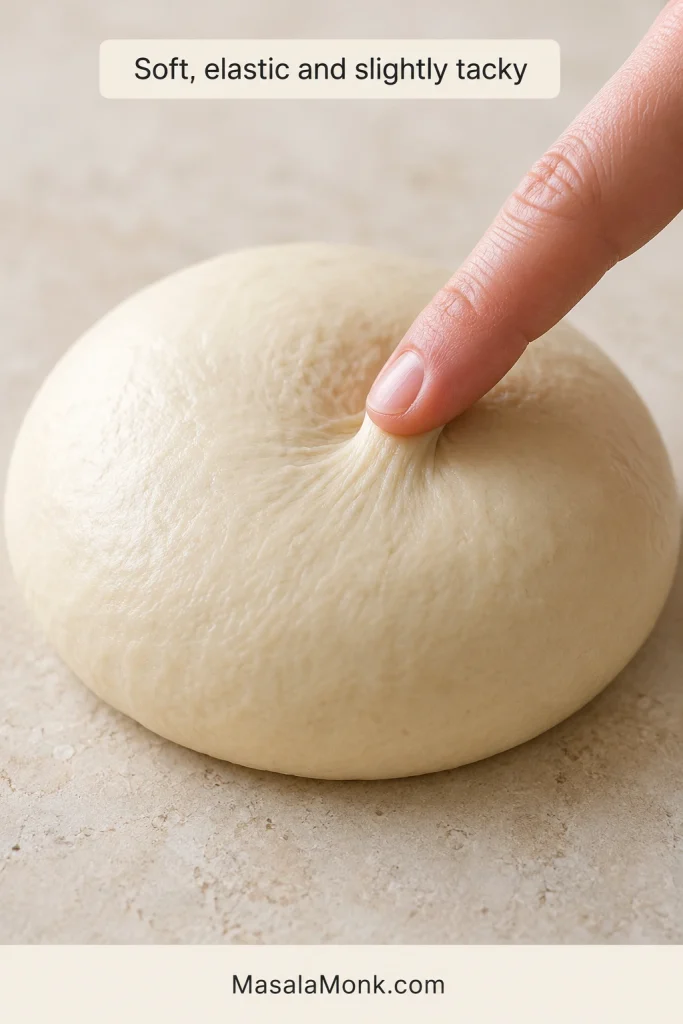
During the first minutes of mixing, the dough may cling to your fingers. After resting and kneading, it should gather into a smooth mass. If it clings lightly and then releases, you are closer than you may think. Do not make the dough dry simply because dry dough feels easier to handle.

A fingertip pressing into smooth pita dough and leaving a shallow indentation.
  • Correctly tacky: Soft, elastic and lightly clinging before releasing.
  • Too wet: Flowing, spreading quickly or coating the hands heavily after kneading. Add flour one teaspoon at a time.
  • Too dry: Stiff, resistant or cracking around folded edges. Add water one teaspoon at a time during early mixing.

This is usually where another handful of flour feels tempting. Give the dough its rest first; it may become far easier to handle without changing the formula. A dough can look lively in the bowl and reveal its dryness only beneath the rolling pin.

Comparison of wet pita dough coating the hands, correctly hydrated dough holding its shape and dry dough with cracks.

Let the dough double

Once the dough feels soft and elastic, give it enough time to rise and become airy. The rise may take 45–90 minutes. Move on when the dough has roughly doubled, the surface looks smooth and gently domed, and the dough feels lighter than it did after kneading.

The same bowl of pita dough before proofing and after expanding to roughly twice its original volume.
Mark the starting level on the bowl; the height change is easier to judge than the clock.

How to Roll Pita So the Pocket Can Open

Portion and rest the dough

Keeping each piece close to 80 g makes it easier to roll every pita to the same diameter and thickness. Draw the rough edges underneath, close the seam at the base and rest the covered balls for 15 minutes.

Seven smooth dough balls beside an eighth 80-gram portion being shaped on a digital scale.
Correct small weight differences while dividing; equal portions are easier to roll to the same size and cook at the same pace.

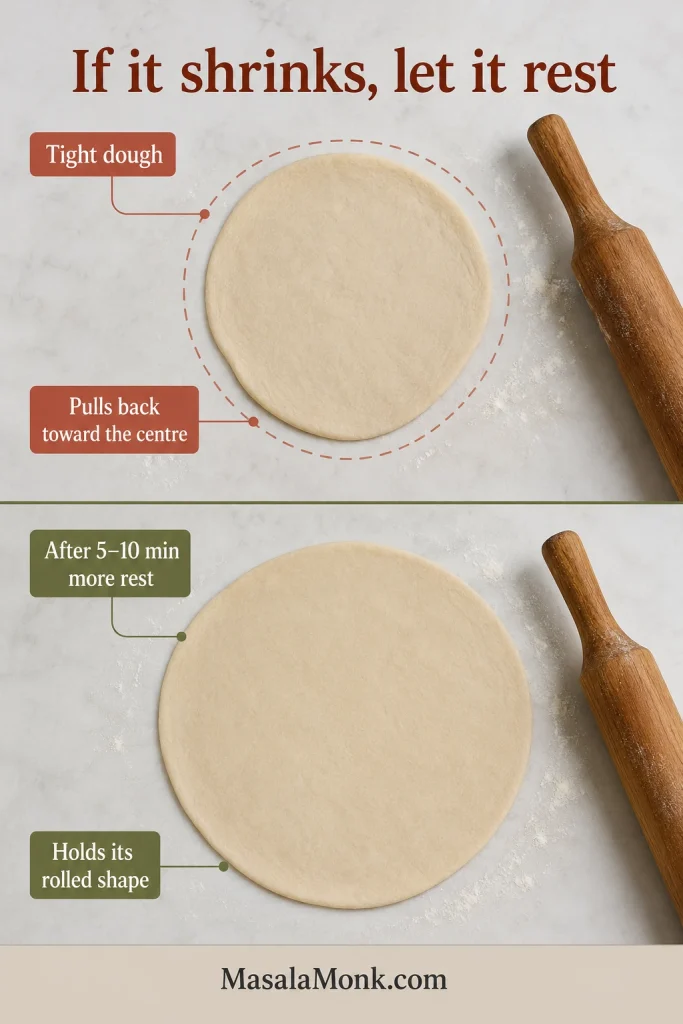
When a ball keeps shrinking toward the center, it is asking for more rest, not more force. Cover it, roll another piece and return in 5–10 minutes.

Comparison of tight pita dough shrinking after rolling and relaxed dough holding its larger shape after resting.

Roll to an even 3–4 mm thickness

Roll outward from the middle, rotate the dough and lift it frequently. Frequent turning spreads pressure more evenly than repeated passes in one direction.

Hands rolling pita dough outward from the center while lifting the edge to rotate the round.

Use light, consistent fingertip pressure to compare the center, middle and rim. The target is an even 3–4 mm round without a paper-thin weak spot.

Side view of a raw pita round with an even edge measuring approximately 3 to 4 millimeters.
Check the center, middle and rim with the same fingertip pressure; one thin patch can vent steam.

Shape matters less than thickness. A slightly irregular outline can still puff well, while a thin middle surrounded by a padded rim heats unevenly.

Comparison of evenly rolled pita dough and a round with a thin center and thicker outer rim.

Keep the rounds covered and intact

Roll only enough for the next one or two cooking batches. A large steel may hold two pitas; a small oven-toaster-grill (OTG), skillet or tawa may cook only one. Keeping the remaining dough as covered balls prevents later rounds from drying while they wait.

Keep each rolled surface smooth and intact. Dust lightly, brush away visible excess flour and support the round during transfer instead of pulling it from one edge.

Two-step sequence showing loose flour brushed from a rolled pita and the full round supported during transfer.

Pita Temperatures for Ovens, OTGs and Skillets

A modest oven can make excellent pita. The important question is how much heat the surface beneath the dough has stored. Begin with these settings, then watch the first round. Fast bubbles signal strong heat; slow drying means the surface needs more time.

EquipmentBegin withWatch fromRemove when
Conventional oven475°F / 245°C; steel, stone or heavy inverted tray heated for 30–45 minutes2½–3 minutes through the windowInflated, set and flexible
Fan or convection ovenAbout 450°F / 230°C; conventional mode when availableAbout 2½ minutesThe pocket opens before the exterior dries
Small OTGHighest stable setting near 230–250°C; top and bottom heat where availableAbout 3 minutesThe pita inflates before either side hardens
Oven limited to 220–230°CMaximum heat; warm the surface for the full 45 minutesAbout 3 minutesThe layers have separated and the bread remains flexible, even without a complete balloon
Skillet, griddle or tawaHeavy dry surface; approximately 425–450°F / 218–232°C when measuredFirst flip after 20–30 secondsNo raw-looking patches remain and the bread bends easily

In a small OTG, move the tray higher when the underside darkens before the top lifts. Move it lower when the upper surface dries while the underside remains pale.

OTG guide showing higher, lower and balanced tray positions based on which side of the pita cooks first.

For the oven, preheat the surface—not only the air

The oven may announce that it is ready while a thick stone or steel is still catching up. Give the surface the full 30–45 minutes before loading the first pita. Steel transfers heat quickly and recovers well, stone gives steadier heat, and a heavy inverted tray offers an affordable alternative that may need a little longer between loads.

Comparison of pita rounds arranged on a baking steel, pizza stone and heavy inverted baking tray.

Support the round with both hands, a peel or a wide spatula during transfer. With enough stored heat, the first blisters appear quickly and one edge may rise before a wave of inflation moves across the bread.

Four oven stages showing pita flat, developing blisters, lifting at one edge and inflating fully.
Watch the direction of the lift rather than waiting for a perfectly symmetrical balloon.

Remove the pita as soon as its surfaces are set and the bread still bends easily. Waiting for deep color can leave the pocket walls brittle.

Two hands gently bending a pale cooked pita without cracking it.
Pale is a texture cue here, not a sign of underbaking; extra color usually costs flexibility.

The order matters. A flat first pita and a slow final pita usually point to different problems. If the first round barely bubbles, remove it while soft and give the surface another 10 minutes before loading the next one. A flat first pita is disappointing, but the other seven are still covered and waiting. When the early pitas puff and later ones slow down, close the oven for 2–3 minutes so the surface can recover.

Decision guide linking a flat first pita, slowing later pitas and consistently weak puffing with different heat adjustments.

For the skillet, griddle or tawa, watch the bread

A surface around 425–450°F / 218–232°C is a useful starting range. King Arthur uses a similar measured range for its stovetop sourdough pita.

If the pita sits quietly and dries slowly, raise the heat. Dark spots appearing before the center cooks mean the heat should come down. Flip when the first bubbles appear and continue turning every 20–30 seconds.

Three-stage sequence showing bubbles forming on pita, the round being flipped and the bread finishing soft on a tawa.

When one section inflates while another stays attached, press briefly beside the flat portion with a spatula without pressing directly on the balloon. Half a pocket does not mean the recipe failed; one area of that round may simply have been thicker or made weaker contact with the pan.

Once the damp-looking patches disappear, several more minutes usually produce a cracker instead of a late pocket. Remove the bread while it bends easily.

Why Your Pita Did Not Puff—and What to Change Next

Most flat pitas come back to four things: heat, thickness, moisture or a steam leak. Match what you saw to the most likely cause, then change one thing on the next round.

Four pita problems showing insufficient heat, uneven thickness, dry cracked dough and a tear that releases steam.
What you sawLikely causeWhat to change
No lift: no bubbles, tiny bubbles or only the first pita stayed flatCool surface, thick round or dry doughPreheat longer, check thickness and weigh the flour and water
Uneven lift: half inflated or the pocket stopped partway acrossUneven rolling, padded rim, fold or steam leakCompare the center and rim and inspect the round for damage
Poor cooking: brown outside and doughy inside, or puffed but hardExcess heat, excessive thickness or too much cooking timeLower the heat, roll evenly and remove the next pita sooner
Dough trouble: shrinking, sticking, cracking or excessive stickinessInsufficient rest, kneading or hydration adjustmentRest tight dough and adjust flour or water one teaspoon at a time

Use the first visible symptom to choose one adjustment. Keeping the other variables steady makes the next pita a useful test rather than another guess.

Five-row troubleshooting guide pairing visible pita problems with changes to heat, thickness, hydration, cooking time and surface recovery.

When the surface is too cool

An underheated surface produces slow bubbles and gradual drying instead of a quick wave of inflation. Give the steel, stone or tray more time before loading the next round.

Pale cooked pita remaining flat on a dark surface with only a few small bubbles.

When the round is uneven

Only one half inflated. The tempting response is to keep cooking, but the problem probably began beneath the rolling pin. Compare the center and rim of the next round by touch, then rotate it more frequently as you roll.

Pita with one side inflated and the other side flat, plus a cut view showing partial internal separation.
One inflated side proves the dough can trap steam; inspect thickness and pan contact before blaming the yeast.

When the outside browns before the center cooks

Strong color with a damp or dense center means the exterior set before heat reached the thicker interior. Lower excessively aggressive heat, roll the next round more evenly or correct both problems together.

The same pita shown with strong exterior browning and a dense, damp center in its thicker section.
Exterior color is not proof the center is cooked; thickness controls whether heat reaches the middle in time.

When the dough is too dry

Dry dough may rise in the bowl but resist every pass of the rolling pin. Weigh the ingredients, allow the hydration rest and avoid adding large handfuls of flour simply to make the dough easier to handle.

When steam finds a way out

A small tear, dry crack, folded edge or stretched patch releases steam before the two sides separate. Loosen stuck dough gently instead of pulling it from one edge.

Partly inflated pita with a small tear near the rim and a flatter section beyond the damaged area.

When puffed pita turns hard

Hard pita usually points to excess cooking, overly dry dough or a delay before covering. Remove the next bread once it has puffed and set, then place it beneath a clean dry towel immediately.

Two hands bending a dry pita as a crack opens across its pale surface.
The first crack during a gentle bend is a better dryness warning than color alone.

A pocketless pita still earns its place at the table: fold it while soft, toast it into chips or tear it into salads and dips.

Three uses for pocketless pita: folded around filling, toasted into chips and torn for dips or salad.

Recheck the three stages most likely to change the next batch: dough texture, rolling thickness or surface heat.

Back to recipe cardBack to the top ↑

Keep Pita Soft, Then Store or Freeze It

The final texture is decided during the first few minutes after cooking. Lift the towel after a minute or two and the stack should feel warm, supple and lightly steamy, with the dry surfaces beginning to soften.

Freshly cooked pita being placed beneath a light towel over a warm stack of bread.
Use a dry towel, not a damp one; shared warmth softens the surface without making the stack wet.
  • Place each cooked pita directly beneath a clean dry towel.
  • Stack the pitas loosely so their shared warmth softens the surfaces.
  • Open the towel slightly once the completed stack stops steaming heavily.
  • Cool completely before sealing the bread in a bag or container.

Pita is one of those breads worth freezing on purpose. A brief reheat restores it more successfully than several days in the refrigerator.

Store at room temperature or freeze

Store completely cooled pita in an airtight bag or container at room temperature for up to two days for the best texture. Refrigeration may delay mold, but it also makes pita stale and firm more quickly. Freeze the bread instead when it will not be eaten within two days.

  1. Cool the pita completely.
  2. Place parchment between the rounds.
  3. Slide the stack into a freezer bag.
  4. Remove excess air and seal tightly.
  5. Freeze flat for up to three months.

Freezing the stack flat and separating the rounds prevents them from sticking together, so one pita can be removed without thawing the rest.

Cooled pita stacked with parchment between each bread inside a flat transparent freezer bag labeled Pita.

Reheat for the texture you want

  • Soft for opening and filling: Add a few drops of water to a skillet, add the pita, cover for 15–20 seconds, then uncover and heat for about 20 seconds per side.
  • Lightly browned: Heat in a dry skillet for about 20–30 seconds per side.
  • Several pitas together: Wrap the stack in foil and heat at 350°F / 175°C for about 5–8 minutes.
  • A fast single pita: Wrap it in a lightly damp towel and microwave for 10–20 seconds.
  • Crisp pita: Heat uncovered in the oven or air fryer, checking frequently.
  • Straight from frozen: Use gentle steam in a covered skillet or foil-wrapped oven first, followed by a short dry finish.

Begin with the shortest reheating time. Another ten seconds is easier to add than moisture is to put back.

Three reheating methods showing pita softened under a damp towel, browned in a skillet and baked into crisp wedges.
Reheating is a texture decision: add moisture for flexibility, use dry heat for browning and extend dry heat only for crispness.

How to Open a Pita Pocket Without Tearing It

Let the pita rest beneath the towel until it is warm and comfortable to handle. Cut the round in half with a sharp knife instead of pulling it apart from the edge.

Along the cut edge, you should see two thin walls with a clear space between them. Ease the sides open with your fingers. A small blunt knife can loosen one lightly attached patch, but do not force a section that never separated.

Three-step sequence showing a warm pita cut in half, its separated walls identified and the pocket gently opened.

When the cut edge separates cleanly beneath your fingertips, you know the pocket formed: two soft walls, open and ready to fill.

Partially puffed pita can still hold a compact filling. Use the open portion, fold the whole round around the food or cut it into wedges.

What to Serve With Homemade Pita

Fresh pita needs very little. Tear one while it is warm and drag it through hummus or olive oil, or cut it open while the bread is still soft enough to bend around the filling. Stuffing the bread rather than folding it? First see how to open a pita pocket without tearing it.

Fill or fold

Keep the filling compact when using a pocket. A thicker Greek-style pita is better suited to folding around a large gyro-style meal.

Pita pocket filled with falafel, cucumber, tomato, herbs, pickled turnip and tahini sauce.
Place sturdy fillings first, then add salad and sauce so pressure stays away from the cut edge.

For more sharpness, add a small spoonful of tangy amba sauce. Its sour mango, turmeric, chili and fenugreek work especially well with falafel, chickpeas, roasted vegetables, eggs and shawarma-style fillings.

Tear and share

  • Hummus
  • Baba ganoush
  • Labneh with olive oil and herbs
  • Olive oil with za’atar
  • Fresh tabbouleh with parsley, tomato, mint and lemon as part of a mezze plate

Use leftover pita

  • Cut it into wedges for pita chips
  • Toast pieces for fattoush
  • Spread a whole round lightly with pizza sauce, add cheese or vegetables and bake until the edges crisp
  • Toast and crush it over soup or salad

Pita Bread Variations and Scaling

Make the base recipe once before changing it. Once you know how the dough should feel, small variations become much easier to judge.

Flour variations

Use all-purpose flour as the baseline. Bread flour and partial whole wheat can work with small hydration adjustments, while fully whole-wheat pita needs a separately balanced formula.

Guide showing all-purpose flour, bread flour, partial whole wheat and fully whole-wheat flour with different pita dough adjustments.

Bread flour gives a slightly chewier pita; replace the all-purpose flour with the same weight. After the hydration rest, add a teaspoon or two of water only when the dough feels noticeably firm.

To make part-whole-wheat pita, replace 35–70 g of the all-purpose flour with fine whole-wheat flour. That gives roughly 10–20% whole wheat, with a nuttier flavor and slightly greater water absorption. A 100% whole-wheat pita needs its own water range, resting strategy and handling guidance.

Make-ahead starting point

An overnight schedule works better with less yeast, so reduce the instant yeast to about 2 g / ⅔ teaspoon. Knead the dough as usual, leave it covered at room temperature for 20–30 minutes, then refrigerate for about 8–16 hours.

The next day, let the dough stand until relaxed and no longer refrigerator-cold—often 45–75 minutes—before dividing. Refrigerator temperature and yeast activity vary, so judge its softness instead of relying only on the clock.

Scale the batch

Scale every ingredient by weight and keep each dough ball close to 80 g. The oven temperature remains the same. For a double batch, use a larger bowl, roll in small waves and pause when the baking surface begins losing heat.

Changes that need more than a simple substitution

No-yeast yogurt flatbread, Greek pocketless pita, sourdough pita, gluten-free pita and 100% whole-wheat pita behave differently enough to need separately balanced recipes. Removing the yeast or replacing the flour in this dough will not reliably produce the same pocket.

Baker’s percentages for scaling

Flour 100% · Water 69.4% · Salt 2.2% · Instant yeast 1.4% · Sugar 1.7% · Olive oil 3.9%

Frequently Asked Questions

Puffing, texture and equipment

Why did my pita not puff?

The usual causes are insufficient surface heat, uneven thickness, dry dough or a tear that releases steam. Use the troubleshooting guide to match what you saw to the next adjustment.

Why did my pita turn hard or crisp?

Pita usually turns hard because it was cooked too long, made from overly dry dough or left uncovered after cooking. Remove it once it has inflated and set, before deep browning, and place it beneath a clean towel while warm.

Can I make pita without a baking stone?

Yes. Preheat a heavy uncoated baking sheet upside down to create a flat loading surface. It may need more recovery time between batches than a stone or steel.

Make-ahead, ingredients and pita styles

Can pita dough be made ahead or frozen?

For make-ahead dough, use the reduced-yeast starting point in the variations section, then let the refrigerated dough soften and relax before dividing. Baked pita freezes more predictably than raw dough, so freeze the cooked and fully cooled bread unless you already know how your dough behaves after thawing.

Can I omit the sugar or olive oil?

Yes. The pocket can still form without either ingredient. With no sugar, fermentation and browning may be slower. Without oil, the pita will be leaner and may feel less tender after cooling.

Is pita bread the same as naan?

No. Pita is rolled thin and heated quickly so steam can separate it into two sides. Naan is usually softer, thicker and more enriched, often with yogurt, milk, butter or ghee. Both are flatbreads, but they are made for different textures.

Is Greek pita the same as pocket pita?

No. A Greek-style pita is generally thicker, softer and deliberately pocketless. It is normally cooked in a skillet and folded around fillings. Pocket pita is rolled thinner and exposed to intense heat so steam can push the two sides apart.


The First Pita Is Allowed to Teach You

The first round may rise cleanly, or it may show that the surface needs another ten minutes. Either result tells you something before the other seven reach the heat.

Keep the remaining dough covered, adjust one thing and try again. When everything lines up, the change happens in seconds: the bread lifts, the pocket travels from one edge to the other, and the towel begins filling with warm, soft pitas.

How did your first pita behave—full balloon, half pocket or stubbornly flat—and were you using an oven, OTG, skillet or tawa?

Roll evenly. Heat fully. Cover quickly. The pocket may be the dramatic part, but those three quiet decisions are what make it possible.

Back to recipe cardBack to the top ↑

Posted on Leave a comment

Chocolate Wafer Cookies for Icebox Cake: Best Substitutes and Homemade Recipe

Slice of chocolate wafer icebox cake with alternating dark cookie and cream layers on a glass plate beside a wafer and cake server.

Icebox cake is supposed to be the easy dessert: crisp chocolate cookies, whipped cream, and enough refrigerator time to turn the two into tender striped slices. Then an inherited recipe tells you to open one 9-ounce package of Famous Chocolate Wafers—a product that disappeared from store shelves.

The best chocolate wafer cookies for icebox cake have a surprisingly specific job. They cannot merely taste chocolatey. They need to start thin and crisp, take in moisture without collapsing into paste, and soften all the way through while leaving a clear dark line in every slice.

Choose a store-bought substitute or make the wafers below, then use our complete classic chocolate wafer icebox cake recipe for the whipped cream, assembly, chilling, clean slicing, and finished-cake storage.

Quick Answer: What Can Replace Chocolate Wafers in Icebox Cake?

  • Most practical mainstream option: Original Oreo Thins with lightly sweetened cream.
  • Closest plain structural match covered here: Dewey’s Brownie Crisp, when available.
  • Often the economical option: Chocolate Maria cookies.
  • Most control: homemade wafers rolled to about 3 mm—just under ⅛ inch.

Match the cookie’s job, not the missing brand name.

For a plain-wafer result, look for a cookie that is thin, completely crisp, reasonably flat, and uncoated. Match the weight and the way the cookies cover the pan before worrying about an old piece count.

Choose Your Chocolate Wafer Route

One cook needs a cake tonight; another is trying to recreate the birthday or holiday dessert they remember. Choose by the trade-off that matters least: added sweetness, cost, shape, availability, or time.

On a phone, swipe sideways to see all columns.

Your situationStart withPlan for
You need a mainstream shortcutOriginal Oreo ThinsA sweeter, cookies-and-cream-style slice
You want a plain, unfilled cookieDewey’s Brownie Crisp, when availableMany small cookies; match weight and pan coverage
You want an economical, easy-to-layer optionChocolate Maria cookiesA milder cocoa flavor; buy enough by weight
You are building in a loaf pan or baking dishChocolate graham crackersBroad rectangular layers and a clear graham flavor
You want control over flavor and thicknessHomemade wafersCool completely, then set aside the amount your old recipe needs
Choose by the result and trade-off that matter most to your cake.

Whichever route you choose, the goal is the same: enough cream contact to turn every crisp cookie into a tender stripe without erasing the layers.

Rectangular chocolate wafer icebox cake with one slice removed, showing many dark cookie and pale cream layers on a platter.
Regular wafer sizes leave fewer gaps, improving cream contact and producing cleaner slices across a loaf pan.

Homemade Chocolate Wafer Cookies for Icebox Cake

These are not thick chocolate refrigerator cookies. They are dark, dry, thin wafers built for one particular change: crisp enough to snap today, then tender enough to cut after a night between layers of cream. They may look plain when they leave the oven, but that clean snap gives the refrigerator exactly what it needs to create a tender striped slice.

Recipe note: The ingredient proportions and parchment-rolling method are adapted from King Arthur Baking’s chocolate wafers. The guidance here applies that dough specifically to icebox-cake thickness, old-package conversion, chilling, and troubleshooting.

For one old 9-ounce package, set aside 9 oz (255 g) of fully cooled wafers. Use enough to cover the intended layers; keep any extras for gaps, crumbs, or another dessert.

Stack of thin round homemade chocolate wafers on parchment, with one broken wafer showing its crisp edge.
Cool the wafers completely before stacking; trapped warmth can soften them before the cream ever does.

Recipe at a Glance

Prep timeAbout 30 minutes
Chilling30 minutes
Bake time14–17 minutes per batch
CoolingAbout 15–20 minutes, until completely cool
Total elapsed timeAbout 1½–2 hours, depending on tray capacity and whether scraps need another bake
Oven325°F (163°C)
ThicknessAbout 3 mm—just under ⅛ inch
Expected yieldRoughly 40 large rounds or 90 smaller squares; see the note below
For one old packageSet aside 9 oz (255 g) of fully cooled wafers

Yield note: The source recipe estimates about 40 rounds at 2½ inches or 90 smaller squares. Your count will change with thickness, cutter size, tray space, and rerolled scraps.

Equipment

Use a digital scale, medium mixing bowl, hand or stand mixer, rolling pin, parchment paper, and a 2½-inch (6.5 cm) cutter. You need at least two baking sheets, although three or four make the process smoother because the batch produces several trays and the wafers cool completely on the pans. A pizza wheel works well for squares; a separate cooling rack is unnecessary.

Useful extras include 3 mm rolling guides or spacer rings, a small offset spatula, and an oven thermometer.

Ingredients

  • 1 cup granulated sugar — 198 g
  • 8 tablespoons unsalted butter, softened — 113 g
  • Espresso powder, optional — 1 teaspoon
  • Fine table salt — ¾ teaspoon
  • Baking powder — ¼ teaspoon
  • 1 large egg
  • 1 teaspoon vanilla extract — 5 ml
  • 1½ cups all-purpose flour — 180 g
  • ¼ cup black cocoa powder — 21 g
  • ¼ cup Dutch-process cocoa powder — 21 g
Overhead arrangement of sugar, butter, egg, vanilla, flour, black cocoa, Dutch-process cocoa, espresso powder, salt, and baking powder.
Weigh the flour and cocoa powders; packed cups can make the wafers thicker and tougher.

Instructions

Mix, Roll, and Chill the Dough

  1. Make a smooth butter base. Beat the sugar, softened butter, optional espresso powder, salt, and baking powder on medium-low until smooth, about 1–2 minutes. The mixture only needs to look even; it does not need to become pale or fluffy.
  1. Add the egg and vanilla. Beat until the mixture is smooth, scraping the bowl so no streaks of butter remain.
  1. Mix in the flour and cocoa. Add the flour, black cocoa, and Dutch cocoa. Mix on low until no pale flour streaks remain and the dough looks evenly dark from edge to edge.
  1. Roll before chilling. Divide the dough in half, about 290 g per piece. Roll each piece between two sheets of parchment to about 3 mm—just under ⅛ inch—aiming for an 8 × 10-inch (20 × 25 cm) rectangle or a 10-inch (25 cm) oval.
Hands rolling dark chocolate wafer dough between parchment sheets with a wooden rolling pin and spacer rings.
Rotate the parchment packet as you roll; repeated pressure in one direction can leave the center thicker than the edges.
  1. Chill the sheets. Refrigerate the dough, still between parchment, for 30 minutes. Meanwhile, heat the oven to 325°F (163°C) with racks in the upper and lower thirds.
Dark chocolate wafer dough rolled on parchment to about 3 millimeters, with the upper parchment peeled back and a thickness guide at the edge.
Chilling firms the dough but cannot correct uneven thickness, so level the sheet first.

Cut, Bake, and Cool the Wafers

  1. Cut the wafers. Peel away the top sheet of parchment, leaving the chilled dough on the bottom sheet, then cut 2½-inch rounds. Arrange them at least ½ inch apart. For squares, score 1½- to 2-inch pieces directly on the parchment and leave them in place.
Chocolate wafer dough cut into rounds on one tray and scored into an intact grid of squares beside a pizza wheel.
Squares minimize rerolling; handle round-cookie scraps gently because repeated working can toughen the final wafers.
  1. Bake until dry and set. Bake two trays at a time for 14–17 minutes, rotating and switching their positions halfway through. The surface should look matte and the edges should feel set.
  1. Let the trays finish the job. If you made squares, retrace the cut lines immediately. Leave either shape on the baking sheets until completely cool; the clean snap develops as steam escapes.
Thin round chocolate wafers cooling on parchment-lined metal baking trays beside an offset spatula.
Let thin edges firm before lifting; hot wafers are fragile and do not yet show their final texture.
  1. Use every piece. Reroll scraps while the first trays bake, chilling the dough briefly if it becomes soft. Once everything is cool, set aside 9 oz (255 g) for one old package and save the remaining whole or broken wafers for another use.

Recipe Notes

  • Thickness decides the final cake. A ¼-inch (6 mm) refrigerator cookie is roughly twice as thick and may keep a hard center.
  • Judge crispness only when cool. The hot wafers are tender; their snap appears as they cool on the trays.
  • Espresso powder is optional. At this amount, it is intended to deepen the cocoa without making the wafers taste distinctly of coffee.
  • Save imperfect pieces. Broken wafers fill cake gaps, become crust crumbs, or add crunch to homemade mint chocolate chip ice cream.
Two hands snapping a cooled round chocolate wafer over a parchment-lined baking tray holding more wafers.
Test several cooled wafers when a tray baked unevenly; edge and center cookies may crisp at different times.

What Success Looks Like

Before assembly, a cooled wafer should look dry, snap cleanly, and taste dark but not aggressively bitter. After an overnight rest with cream, a thin knife should pass through the center without a crack. Each wafer should still leave a distinct chocolate stripe instead of dissolving into a gray-brown blur.

Clean slice of chocolate wafer icebox cake with even dark cookie stripes, pale cream layers, and a cake server behind it.
Slightly wavy stripes are fine; look for a tender center, visible dark layers, and cream that still holds.

Why the Homemade Wafers Work

Making the wafers yourself lets you control both their chocolate flavor and, crucially, their thickness. Rolled thin, cooled to a clean snap, and kept low in leavener, they hold together during assembly and soften evenly in the refrigerator.

  • Black and Dutch cocoa share the work: one supplies the near-black color; the other keeps the chocolate flavor round and familiar.
  • The dough uses a straightforward butter base: the thin roll and full tray cooling produce the crisp finish.
  • A small amount of baking powder limits puffing: the wafers stay flat enough to stack and soften evenly.
  • Parchment keeps the dough clean and even: no extra flour is worked into the sheet while rolling.
  • Tray cooling completes the texture: the fragile hot cookies firm as steam escapes.

Black Cocoa, Dutch Cocoa, and the Flavor You Want

Black cocoa gives the wafer its near-black color and a smooth, familiar note associated with Oreo-style shells. It contributes more color than deep cocoa flavor. Dutch-process cocoa supplies the rounder chocolate character that black cocoa can lack on its own.

The split keeps the cookie dark enough to draw sharp stripes through white cream without making color the only thing you taste. If the labels themselves feel confusing, our cacao, cocoa, and chocolate guide explains the broader terminology; for this dough, stay with the black-cocoa and Dutch-process choices given here.

Bowls of nearly black cocoa and reddish-brown Dutch-process cocoa with spoons and finished chocolate wafers between them.
Equal weights balance black cocoa’s near-black color with Dutch cocoa’s fuller chocolate flavor.

Can You Make the Wafers Without Black Cocoa?

Yes. Replace the 21 g black cocoa with 21 g additional Dutch-process cocoa. The wafers will be brown instead of nearly black and taste more like a traditional chocolate biscuit, while the thin roll and crisp finish still make them suitable for icebox cake.

Natural cocoa can work in a pinch, but the wafers will be lighter, tangier, and may behave somewhat differently. Replacing the black cocoa with additional Dutch-process cocoa stays closer to the intended color and rounded chocolate flavor.

Rolled Versus Slice-and-Bake Wafers

  • Rolled to about 3 mm: gives the most even thickness and the most dependable icebox-cake result.
  • A log sliced to about 3 mm: is faster and naturally round, but uneven slices and cracking are harder to avoid.
  • A log sliced to about 6 mm: is easier to handle but roughly twice the target thickness; save those cookies for snacking, sandwich cookies, or crumbs.

Rolling is the safer method because every part of the sheet can be checked against the same guide. Slice-and-bake works only when the slices are genuinely thin and even.

← Back to the homemade recipe · Compare store-bought substitutes · ↑ Back to the top

What Kind of Chocolate Cookie Works in Icebox Cake?

For this dessert, “wafer” means a thin, dry, crisp chocolate cookie—not a candy melt and not a layered wafer biscuit. It must be sturdy enough to spread with cream today and porous enough to become tender by tomorrow.

The 30-Second Package Test

  • Thin: ideally about 3 mm—just under ⅛ inch. Thick sandwich cookies soften much more slowly.
  • Crisp: look for thin, snappy, crisp, or crunchy—not soft-baked or chewy.
  • Mostly plain: a thin sandwich filling can work; a thick filling changes the cake substantially.
  • Uncoated: chocolate shells and glazes slow the moisture that needs to enter the cookie.
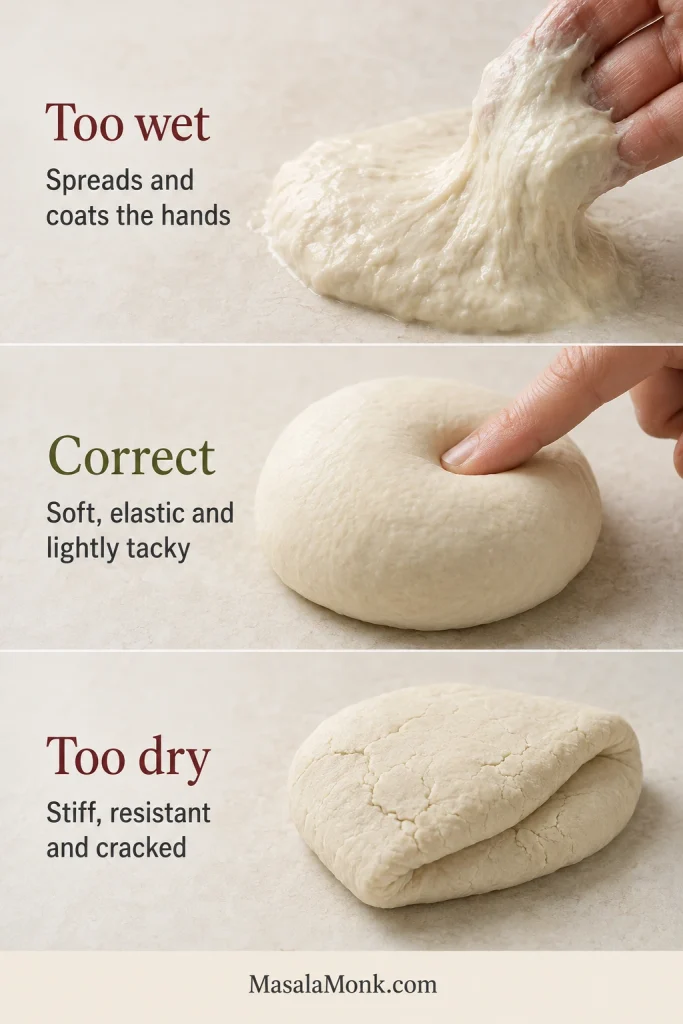
  • Flat: broad, even surfaces are easier to layer and soften more predictably.

At home, snap one before committing the package. It should break cleanly. A cookie that bends, feels cakey, or leaves a greasy coating on your fingers is less likely to form neat layers.
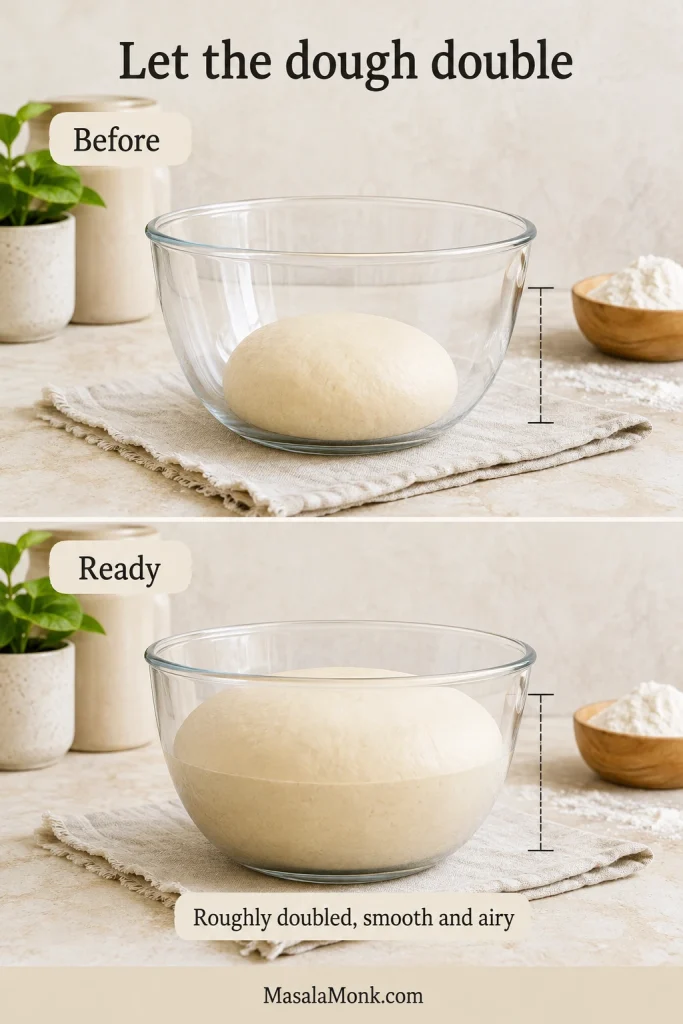
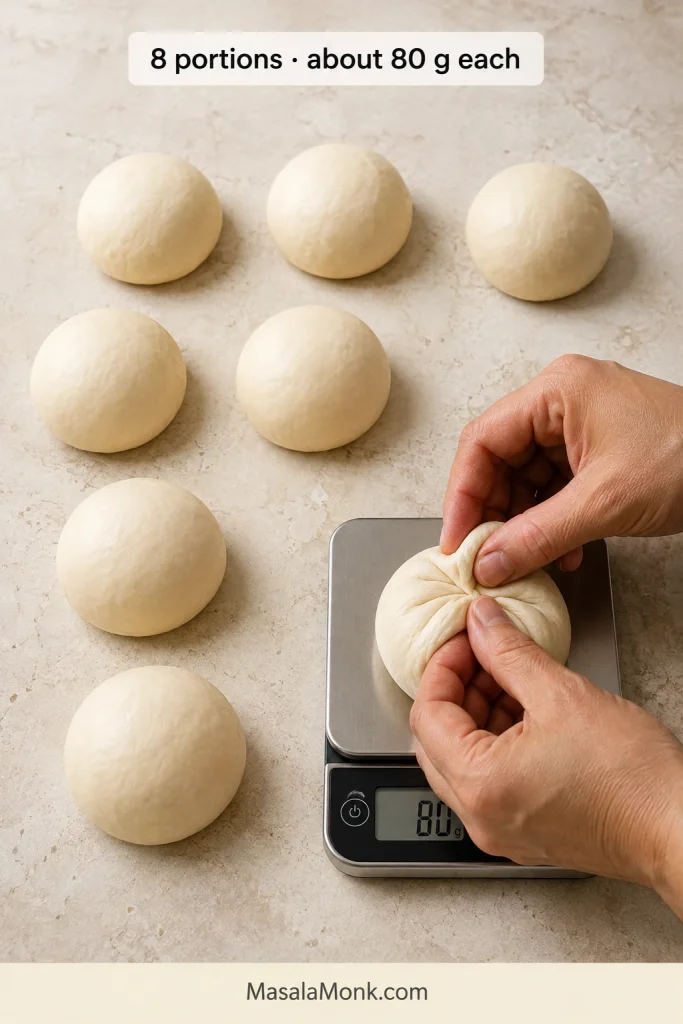
Annotated round chocolate wafer with callouts identifying its thin edge, crisp break, flat surface, dark cocoa color, and uncoated finish.
Perfectly smooth faces are unnecessary; broad, flat cream contact matters more.

What Works—and What Does Not

Swipe on mobile to view the full comparison.

Cookie styleUse it?Likely result
Thin, crisp, plain chocolate cookieYesThe closest route to classic cake-like layers
Thin chocolate sandwich cookieUsuallySoftens well but adds filling and sweetness
Chocolate Maria biscuit or graham crackerYes, as a variationEasy layers with a milder or graham-style flavor
Thick or soft-baked cookiePoor fitMay stay hard in the center or turn pasty
Coated, airy layered, or rolled wafer biscuitAvoidCoating or internal air gaps cause uneven softening
Candy-melting wafer or coating discNoIt is confectionery coating, not a baked cookie
Suitable thin cookies shown on the left and unsuitable candy discs, wafer rolls, layered wafers, soft cookies, and coated cookies on the right.
Inspect the cross-section and coating, not the word “wafer”; many products with that name are structurally wrong.

Fastest way to avoid the wrong product: if it sits beside candy melts or coating discs, it is not the wafer cookie your icebox cake needs.

Vanilla wafers can make a perfectly good but entirely different icebox cake. They are not a close replacement when dark chocolate stripes are the point.

Thickness, Crispness, Sweetness, and Pan Coverage

Thickness and crispness: Roll homemade dough to about 3 mm—just under ⅛ inch. A ¼-inch (6 mm) cookie is roughly twice as thick and often softens at the edges before the center is ready. Every cookie should begin fully crisp; humidity-softened wafers can lose definition too quickly.

Digital calipers comparing a 3-millimeter chocolate wafer with a thicker 6-millimeter cookie.
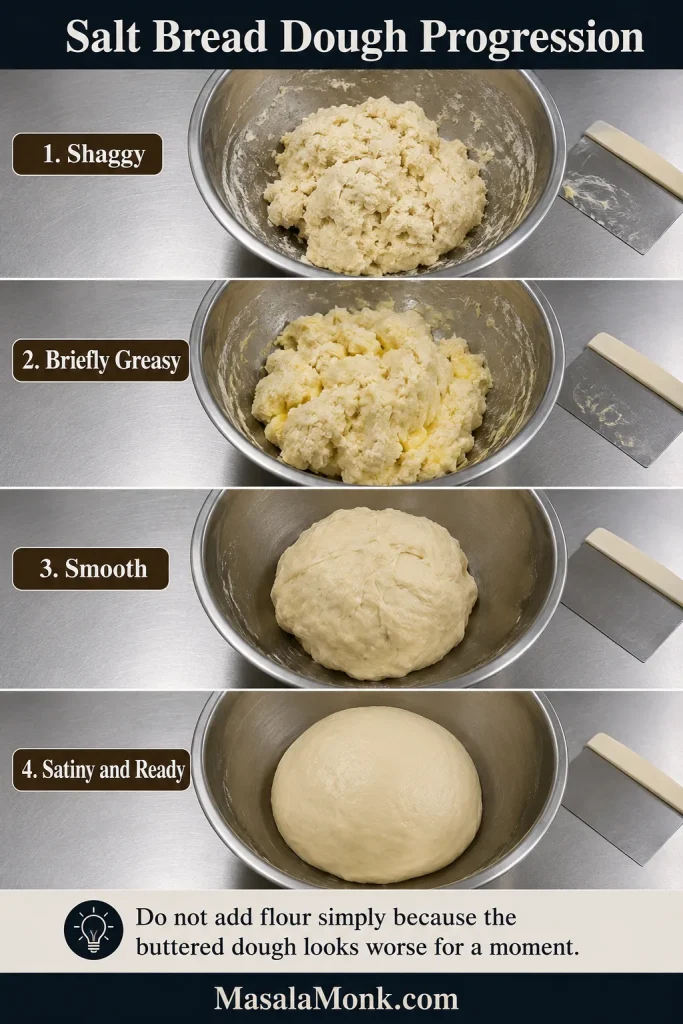
Check the edge and center of the sheet; dough can hide extra thickness in the middle.
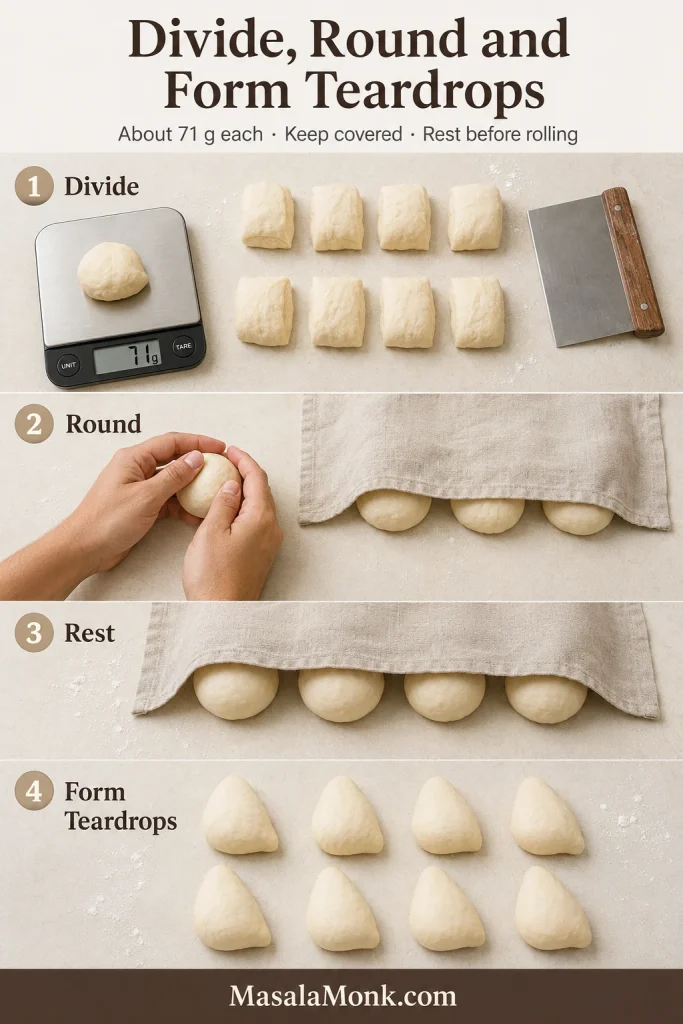
Cool before judging: Homemade wafers can feel tender while hot. Let them cool completely before deciding whether the bake was long enough.
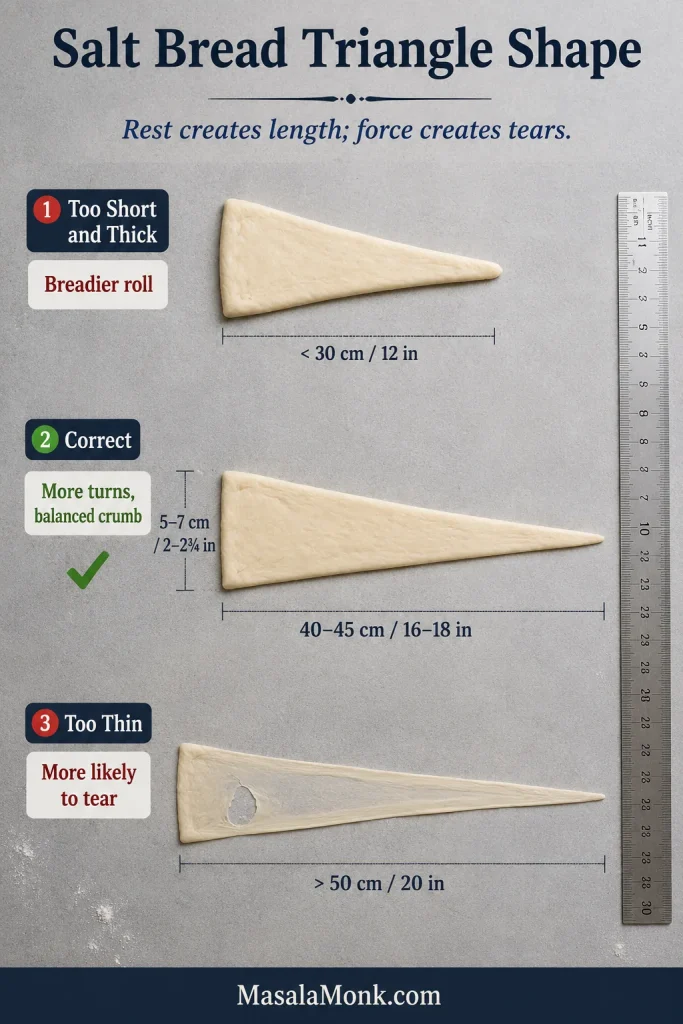
Sweetness and filling: Filled cookies bring sugar into every layer, so pair them with lightly sweetened cream. Plain wafers leave more room to sweeten the cream itself. Our homemade whipped cream recipe explains sugar levels and the peak stages to watch.

Shape and coverage: Rounds suit classic logs and circular stacks. Squares and rectangles reduce gaps in loaf pans and baking dishes, while broken pieces neatly fill edges and open spaces. Covering the layer matters more than recreating an old cookie count.

Read the finished texture

  • Crunchy center: the cookie is too thick, dense, coated, or has not chilled long enough.
  • Muddy layer: the cookie began soft or dissolved faster than the cream could set.
  • Vanishing stripe: the cookie was too fragile to remain distinct.
  • Clean knife and visible stripe: the cookie softened at the right rate.

What Happened to Nabisco Famous Chocolate Wafers?

Nabisco Famous Chocolate Wafers were discontinued in 2023 after generations of refrigerator-roll, pie-crust, cheesecake, and icebox-cake recipes had been written around them. The Washington Post’s replacement comparison documented both the discontinuation and the scramble for modern alternatives.

Canadian readers may remember Christie or Mr Christie chocolate wafers. Old Canadian retailer pages can remain searchable after a product disappears, so the familiar regional name alone does not confirm fresh stock or current production. Check the actual package, manufacturer, and date.

For many families, the goal is not to invent a new dessert. It is to recreate the birthday or holiday cake they remember without letting one discontinued package end the tradition.

What were Famous Chocolate Wafers like? Very thin, dry, crisp, dark but not candy-sweet, flat enough to spread with cream, and porous enough to soften while keeping a clean chocolate stripe. A modern replacement needs those same qualities, even if the cookie looks completely different.

The old box still gives us one useful number: 9 ounces (about 255 g) of thin chocolate cookies. Weight transfers more reliably than an old piece count because modern substitutes vary in size, thickness, and filling.

Should you buy an old package online?

Usually, no. A fresh cookie with the right structure is a better baking ingredient than an expensive discontinued package with uncertain heat, humidity, and storage history.

  • Look for a photograph of the actual sealed package, not only an archived product image.
  • Look for a readable best-before date and current ingredient label.
  • Identify the manufacturer and seller before trusting claims of a “revived” equivalent.

The box was convenient. The real standard is the finished slice: dark layers that soften cleanly without disappearing.

Best Store-Bought Chocolate Wafer Substitutes

Once you know the qualities that matter, the store-bought choice becomes simpler. Each option solves a different problem involving availability, sweetness, shape, or cost.

Four chocolate wafer substitute options arranged vertically: thin sandwich cookies, plain brownie crisps, chocolate Maria cookies, and homemade wafers.
Compare filling, thickness, cocoa strength, and diameter—not availability alone—because each changes sweetness, coverage, and softening.

Before buying: Package sizes, formulations, and availability were checked in August 2026 and can change. Read the current label, then compare thickness, filling, coating, and package weight before choosing. The product visuals are illustrative comparison guides rather than package photography or controlled test results.

Where to Buy Chocolate Wafer Cookies Now

Start in the ordinary cookie aisle, where Original Oreo Thins are a practical mainstream option in many US stores. Check Hispanic or international foods for chocolate Maria cookies and specialty-cookie shelves for thin cocoa snaps.

Shopping online? Search for thin chocolate cookies, chocolate cookie thins, chocolate snaps, or plain chocolate thins. The broader phrase “chocolate wafers” often returns candy melts and filled wafer bars, so check the filling, coating, thickness, and package weight before ordering.

  • Original Oreo Thins: the current US label lists 4 cookies as 29 g. Weigh out approximately 255 g and dry-fit one layer because the creme contributes to the total and the number needed depends on the pan.
  • Dewey’s Brownie Crisp: one 9-ounce box matches the old package weight, but the smaller cookies require more pieces to cover each layer.
  • Goya Chocolate Maria: one 7-ounce pack is about 198 g, roughly 57 g short. Buy two and use only what the pan needs.

Oreo Thins, Plain Shells, and Regular Oreos

Original chocolate Oreo Thins are thin, crisp, dark, and consistent. Their light creme filling softens into the whipped cream, creating a sweeter, more cookies-and-cream-like slice with a faint white line between the dark shells. Choose the original version unless another filling flavor is part of the plan.

Thin chocolate sandwich cookies beside whipped cream and a cut three-cookie stack showing dark shells and pale filling layers.
Taste one Oreo Thin with prepared cream before stacking; sweetness is easiest to correct at this stage.
RouteChoose it whenResult
Leave the fillingSpeed matters and you like a sweeter cakeEasy, cohesive, and clearly cookies-and-cream
Remove the fillingYou want more sweetness controlA plainer wafer effect, with extra work and some breakage

Most consumer Oreo packages include filling. For a plain-shell route, separate Original Oreo Thins at home and allow a few extras for shells that crack.

Side-by-side comparison of filled chocolate sandwich cookies and separated plain cookie shells, each used in a layered cream cake.
After removing the creme, weigh the shells and allow extras for breakage.

What about regular Oreos? Whole regular Oreos make a thicker, sweeter Oreo icebox cake and usually need a longer rest. Separated shells behave better, though they remain thicker than Oreo Thin shells and the old Famous Wafers.

Dewey’s Brownie Crisp: A Close Plain Structural Match

Dewey’s Brownie Crisp is thin, crisp, and unfilled. Among the products covered here, those qualities make it a close plain structural match when it is available.

The cookies are smaller than the discontinued wafers, so arrange enough pieces to cover every layer rather than chasing the old count. Their unfilled form may produce darker-looking layers than a sandwich cookie and will not add a separate line of creme.

Small thin plain chocolate brownie-crisp cookies arranged in groups, with one standing on edge and another broken open.
Smaller cookies create more seams, so dry-fit one layer before estimating the quantity.

Chocolate Maria Cookies: Economical and Easy to Layer

Flat, crisp, often economical, and easy to arrange, chocolate Maria cookies are a practical alternative. Their cocoa flavor is usually lighter and more biscuit-like than the discontinued wafers, so the finished cake has lighter chocolate stripes and a gentler biscuit flavor beside the cream.

These cookies are commonly sold in packages smaller than the old 9-ounce box. Check the current package guide above, buy enough to cover the planned layers, and let the pan determine how much you use.

Chocolate Maria-style round biscuits with a cut cream stack showing lighter brown cookie layers.
Broad rounds cover efficiently, and broken edges can fill narrow gaps without building thicker spots.

Chocolate Graham Crackers: A Natural Fit for Rectangular Cakes

Chocolate graham crackers are not a flavor replica, but their broad rectangular shape makes them easy to layer in loaf pans, square dishes, and 9 × 13-inch baking dishes. Expect fewer gaps, less fiddly arrangement, and a finished dessert that tastes unmistakably like chocolate graham crackers—delicious in its own right, but different from the old wafer cake.

Three-cookie cream stack shown before chilling and cut open after an overnight rest, revealing softened chocolate layers inside.
Use the exact cream and chill time planned for the cake; changing either can mislead the test.

How Long Do Replacement Cookies Need to Soften?

Thick or dense cookies take longer to soften, and deeper cakes usually need more time. Refrigerator temperature and the amount of cream can shift the finish too, so use these as starting checks rather than fixed guarantees.

  • Very thin plain wafers: begin checking after about 6–8 hours.
  • Thin filled sandwich cookies: plan on an overnight rest.
  • Flat biscuits and graham crackers: plan on an overnight rest.
  • Thicker cookies or regular sandwich cookies: allow closer to 12–24 hours.
  • Any unfamiliar cookie: run the three-cookie test before assembling the full cake.

The center decides: Let the clock guide you, then confirm readiness with a thin knife through the middle. The blade should pass through without meeting a hard cookie center, while the dark layers remain visible in the slice.

How to Convert and Adapt One Old 9-Ounce Package

One dependable number remains from the old box: 9 ounces (about 255 g). Begin with that weight, then dry-fit one cookie layer in the pan before whipping the cream. The test shows whether the cookies can cover the layer and where broken pieces will help.

Guide comparing Oreo Thins, Dewey’s Brownie Crisp, and chocolate Maria cookies beside a digital scale reading 255 grams.
The same package weight can cover a pan differently when filling, diameter, and shape change.

Dry-fit one complete layer after weighing the cookies. The same 255 g can cover a pan differently when filling, cookie diameter, and shape change.

Overhead view of a rectangular pan containing one dry layer of round chocolate wafers with broken pieces filling the edge gaps.
Photograph or count the test layer before removing it so final assembly moves quickly.

Coverage first, weight second, count last.

A filled sandwich cookie spends part of its weight on creme. Small cookies need more pieces to cover the pan, while broad rectangular crackers need fewer. Both the scale and the pan matter.

Rectangular pan covered with round chocolate wafers beside a bowl of wafers on a digital scale reading 255 grams.
Weighing one completed dry-fit layer gives a useful total estimate; keep a reserve for gaps, breakage, and uneven edges.

Old-Package Conversion Table

Swipe on mobile to view the full conversion table.

Old recipe wordingInitial guideCheck before assembly
1 package or box, 9 ozSet aside 255 g cookiesDry-fit a layer and confirm full coverage
2 packages, 9 oz eachSet aside about 510 g cookiesUse weight, not the old piece count
36 Famous WafersMatch the old recipe’s coverage and approximate weightModern cookie sizes can make 36 too many or too few
Original Oreo ThinsWeigh 255 g from the packageThe filling contributes part of that weight
One 7 oz (198 g) Maria-cookie packageIt is about 57 g shortBuy a second package and use only what the layers need
Homemade full batchSet aside 255 g after the wafers coolKeep the remaining whole and broken wafers

If you remove sandwich-cookie filling, weigh the shells after scraping. The unopened package includes filling you will discard, so its weight overstates the cookie left for the cake.

Running a little short does not mean the recipe is lost. Fill the final spaces with compatible pieces and let the finished slice—not an inherited cookie count—judge the replacement.

The old recipe assumed one predictable wafer. A modern substitute usually changes sweetness, thickness, size, or cocoa flavor. Adjust only what the new cookie changes.

What changedAdjust thisWhat to expect
Sweeter or filled cookieSweeten the cream less; taste one cookie with a spoonful of creamA balanced cake without an overly sugary finish
Thicker cookieSpread cream against both sides and allow more chilling timeA heavier, more cookie-forward slice
Smaller cookieUse more pieces to cover each layer and fill gaps with broken piecesA different count but the same cake shape
Milder cocoa flavorAccept the variation or finish with unsweetened cocoa or grated dark chocolateLighter stripes with a deliberate chocolate accent
Do not add a large amount of extra cream simply to force thick cookies to soften; the cake can slump before the centers are ready.

For the cream ratio, cake shapes, assembly, final chill, and slicing, continue with the chocolate wafer icebox cake recipe.

← Back to substitutes · Jump to the recipe · ↑ Back to the top

Troubleshooting Chocolate Wafer Cookies

Thin wafers leave less room for measuring and temperature errors than thick drop cookies, but the symptoms are usually clear. Start with what the dough or cooled wafer is doing, then change the most likely cause on the next tray. The visuals below are diagnostic guides; actual softening still varies with cookie thickness, cream consistency, pan depth, and refrigerator temperature.

Dough Problems

Dry and crumbly: Too much flour or cocoa is the most common cause, and cocoa brands vary in absorbency. Continue mixing and press a handful together before adding liquid. If it still falls apart, add milk ½ teaspoon at a time and stop as soon as the dough holds.

Sticky while rolling: Keep the dough between parchment and chill the sheet before peeling away the top layer. Repeated dusting with flour or cocoa changes the formula and dries later cookies.

Baking Problems

Puffing or bubbling: Excess aeration, too much leavener, warm dough, or uneven thickness are the usual causes. Mix the butter and sugar only until smooth and roll evenly. If cut wafers become soft or greasy while you reroll scraps, chill that tray briefly before baking.

Spreading: Use a cool baking sheet for each batch, keep the butter cool and pliable, and chill only trays whose cut dough has become soft or greasy. Measure the flour and any added liquid carefully.

Soft after cooling: Let the wafers cool completely before judging them. If they still bend, use that tray for crumbs and bake the next tray a little longer, checking within the 14–17-minute range. Dark cocoa makes overbrowning difficult to see, so extend the bake cautiously.

Bitter flavor: Too much black cocoa, packed cocoa measurements, overbaking, or missing salt and vanilla are the likely causes. Black cocoa contributes darkness and a distinctive flavor; a larger amount can make the wafer harsher.

Assembly and Chilling Problems

Breaking during assembly: Overbaking, an unevenly thin sheet, moving the wafers while warm, or pressing too firmly with the spatula can all cause breakage. Place a small spoonful of cream on each wafer and ease it outward with short, gentle strokes.

A crunchy cake center: The replacement is probably too thick, too dense, short on cream contact, or simply not chilled long enough. Return the cake to the refrigerator and test the middle again later.

Side-by-side icebox cake slices comparing wide thick cookie layers with narrow, evenly softened chocolate wafer layers.
A thicker cookie widens the stripe and slows the moisture path to the center.

Then check the cake itself: if the middle still resists after more chilling, use the dry center and softened edges as the deciding cues.

Landscape troubleshooting graphic showing an icebox cake slice with softened outer layers and a highlighted dry central cookie layer, alongside causes and fixes.
If 12–24 more hours do not soften the center, the cookie is probably too thick or insufficiently absorbent.

Muddy or disappearing layers: The cookies may have begun soft, the cream may be unusually loose, or the cookie may dissolve too readily. A suitable wafer begins crisp and softens without losing its identity completely.

Close-up of an over-softened chocolate wafer icebox cake with blurred dark layers mixing into the cream.
Serve an over-softened cake very cold; chilling can firm the cream but cannot restore dissolved stripes.

Jump to the recipe · Review the conversion guide · ↑ Back to the top

How to Store Dough and Baked Wafers

Cool baked wafers completely, then keep them in an airtight container at room temperature with parchment between fragile layers. Protect them from steam and humidity; for best texture, use them within several days or freeze them for longer storage. Room temperature is best for unassembled wafers because refrigerator humidity can soften the snap you worked to create.

Airtight container of round chocolate wafers separated by parchment, with bowls of broken wafer pieces and chocolate crumbs.
A rigid airtight container controls humidity while protecting thin wafers from bending and breakage.

For make-ahead dough, freeze flat rolled sheets between parchment, wrapped dough portions, or a carefully shaped log for a thin slice-and-bake variation. Thaw in the refrigerator until firm but cuttable.

Fully cooled baked wafers can also be frozen in a rigid airtight container with parchment between layers. Thaw them in the closed container so condensation collects on the container instead of the wafers, then check crispness before assembly.

If stored wafers lose their snap, save them for crumbs rather than putting softened cookies into the cake.

Save broken or extra wafers for cake gaps, ice cream, or chocolate crumbs. For a crust, follow the pan and butter guidance in our no-bake cheesecake recipe and add butter gradually because plain wafers do not contain sandwich filling.

Gluten-Free, Vegan, and Lower-Sugar Options

Dietary needs do not end the dessert, but they change which shortcut is safest. When the cake is needed soon, a commercially made thin chocolate cookie with the dietary certification you need is usually more dependable than rebuilding this precise wafer formula one ingredient at a time.

For a gluten-free cake, choose a clearly labelled thin chocolate cookie that begins fully crisp, check all nut, seed, coconut, and sesame warnings, and run the three-cookie overnight test before building the cake.

For a vegan cake, use a commercially made thin vegan chocolate cookie and a plant-based whipping cream you already trust. Replacing the butter and egg in the homemade formula requires a separately developed recipe.

For a lower-sugar version, start with plain unfilled cookies and reduce the sweetness of the cream. Large changes to the cookie sugar affect spread, crispness, browning, and dough handling.

For any unfamiliar dietary cookie, the small overnight test is the safest way to check whether it becomes tender without dissolving.

Frequently Asked Questions

Are Nabisco Famous Chocolate Wafers still made?

No. They were discontinued in 2023. Old recipes and archived retailer pages may still name them, but they are no longer a dependable store-bought ingredient.

Are Famous Chocolate Wafers back?

As of August 2026, the original Nabisco wafers had not returned. Some websites and marketplace listings use the familiar name or nostalgic package imagery, so check the named manufacturer, ingredient label, package date, and seller before assuming the original product is back.

What is the closest substitute for Famous Chocolate Wafers?

Dewey’s Brownie Crisp is the closest plain structural match covered here when available. Original Oreo Thins are easier to find, but their filling makes the cake sweeter and more Oreo-like.

Do I need to remove the filling from Oreo Thins?

No. Leave the filling in for the easiest route and sweeten the whipped cream lightly. Remove it when you want a plainer chocolate-wafer effect and more control over sweetness. If you scrape it out, weigh the shells afterward because the package weight includes the creme.

What if my replacement package is only 7 ounces?

A 7-ounce package weighs about 198 g, roughly 57 g short of the old 9-ounce box. Buy a second package and use only as much as the cake needs.

Can I use vanilla wafers?

Yes, but they create a vanilla icebox cake without the dark chocolate stripes. They are a different flavor route, not a close Famous Wafer replacement.

Are chocolate melting wafers the same as wafer cookies?

No. Melting wafers are chocolate or candy coating designed to liquefy. Icebox cake needs a thin, crisp baked cookie.

How long do replacement cookies need to soften?

Overnight is the safest general plan. Very thin plain wafers may be ready sooner, while thicker cookies or whole Oreos can need closer to 12–24 hours. Use the clock as a guide and confirm the center with a thin knife.

The Cookie Should Disappear Into the Cake—But Not Completely

A good chocolate wafer starts with a snap and ends with a fork. Today it should be dark, dry, and sturdy enough to spread. Tomorrow it should be tender all the way through, yet still draw a clean chocolate line across the slice.

Close-up of a chocolate wafer icebox cake slice with thin dark cookie stripes separated by pale cream layers.
A crisp wafer should soften into the cake while leaving a visible dark stripe and enough structure for a clean slice.

That is what an old family recipe was really preserving—not a particular cardboard box, but the quiet transformation that happens overnight and the familiar striped piece placed on the plate the next day.

If you use a replacement, leave a comment with the exact cookie, package weight, cake shape, whether you kept any filling, and how long the center needed to soften. Those details can help the next reader standing in the same cookie aisle.

← Back to the homemade wafer recipe · ↑ Back to the top

Posted on Leave a comment

Salt Bread Recipe (Shio Pan): Crispy-Bottomed Buttery Rolls

Golden crescent-shaped salt bread rolls on a cooling rack, with one roll torn open to show the crumb and another turned over to show the browned underside.

The first warm roll rarely waits for the rest to reach the table. Its underside is deep golden and lightly crisp, almost fried in the butter that escaped during baking. Pull it apart and the crumb stretches before it tears, revealing a small hollow where the cold butter used to be.

That contrast is the point of this salt bread recipe: a thin shell, a butter-crisped base, a soft middle with a gentle chew, and enough salt to sharpen the richness without turning the bread harsh.

Called shio pan in Japan and commonly known as sogeum-ppang in Korea, salt bread resembles a croissant but is much more approachable at home. It asks for patience more than advanced pastry skill: there is no lamination, and a short rest usually solves dough that resists the rolling pin.

Keep one rule in mind: the butter may soften during proofing, but it should remain wrapped inside the dough until the rolls begin rising in the oven. Once it melts, steam opens the hollow and some butter slips beneath the bread to crisp the base. A little butter on the tray is not defeat.

Salt bread feels special enough to tear open beside coffee, yet simple enough to serve with soup or turn into a small breakfast sandwich. What looks like a bakery showpiece is really an everyday pleasure: warm bread, melted butter, a little salt and an underside worth turning over to inspect.

Hands holding a freshly torn salt bread roll with a pale soft crumb, thin crust and small hollow, with more rolls blurred in the background.
Once the roll is torn open, look for bread-like softness rather than croissant layers: a thin crust, pale crumb and modest butter pocket.

Start here

Make the Crisp-Bottomed Bakery Style First

This is the classic version to make first and the clearest place to learn how the dough, butter and hot tray work together before exploring softer milk-bread or no-knead variations.

  • Use 200 g water first; add the reserved 10 g only after the dough has rested and begun developing strength, and only when it still feels unusually firm.
  • Keep the final proof moderate; the rolls should become puffy without a greasy sheen or butter seeping onto the tray.
  • Lift first, butter second; let the rolls begin expanding before a substantial butter pool appears, then bake until the underside is deeply browned.

For a softer roll that stays tender longer, use a separate tangzhong- or egg-enriched version.

Most of the time is hands-off. Pay closest attention when deciding on the final water, rolling the long triangles and judging the proof; uneven first crescents and a modest hollow can still make excellent salt bread.

Make it now

Salt Bread Recipe (Shio Pan)

This eggless dough uses water and milk powder rather than fresh milk. It makes eight rolls with crisp buttered bases and soft, lightly chewy centres. Use the gram measurements for the most dependable dough; cup and spoon measures are included for convenience.

Recipe at a Glance

  • Yield: 8 rolls
  • Preparation and shaping: About 55–75 minutes, including short rests
  • Skill level: Beginner-friendly; allow time for shaping
  • First rise: About 60–90 minutes
  • Final proof: About 60–120 minutes; begin checking at 60
  • Bake: About 17–20 minutes; begin checking at 15
  • Total time: About 3¾–5½ hours

Ingredients

Overhead ingredient board showing bread flour, cake flour, water, milk powder, sugar, salt, instant yeast, butter, neutral oil and flaky salt.
Weigh the salt bread ingredients before mixing so the flour blend, water, dough butter and 13 g filling batons stay balanced from the start.

For the Dough

  • 240 g bread flour (about 2 cups, spooned and levelled)
  • 60 g cake flour (about ½ cup)
  • 18 g non-fat milk powder (about 2½ tablespoons)
  • 15 g granulated sugar (about 1 tablespoon plus ½ teaspoon)
  • 4 g instant yeast (about 1¼ teaspoons)
  • 6 g fine sea salt (about 1 teaspoon, depending on crystal size)
  • 200–210 g water
    Start with 200 g / 200 ml (about ¾ cup plus 1½ tablespoons); reserve the final 10 g / 10 ml (about 2 teaspoons).
  • 22 g unsalted butter, softened but not greasy (about 1½ tablespoons)

Choose the water temperature for your kitchen: chilled in a hot room, cool in a moderate room or mildly warm in a cold room. The goal is a finished dough near 24–26°C / 75–79°F.

For the Filling and Finish

  • 104 g cold salted butter, divided into eight 13 g pieces, about 3.7 oz total
  • 1–2 teaspoons neutral oil, for the rising bowl and a bare metal baking sheet
  • Water for lightly misting the shaped rolls
  • About ½ teaspoon flaky sea salt, or enough for a restrained finish
  • Optional: butter collected from the hot tray, for brushing over the baked rolls

The 13 g filling is deliberate: it is intended to create a modest hollow and help brown the base without making cavity size the main measure of success.

Essential Equipment

  • Digital kitchen scale
  • Stand mixer with dough hook, or a clean work surface for hand kneading; the full hand method appears beneath the main instructions
  • Large bowl and cover for fermentation
  • Bench scraper or flexible dough scraper
  • Rolling pin
  • Large rimmed, light-coloured metal baking sheet, about 33 × 46 cm / 13 × 18 inches
  • Wire cooling rack

Helpful, but not required: an instant-read thermometer, oven thermometer, fine-mist spray bottle, pastry brush and ruler. Without a thermometer, the finished dough should feel cool to neutral against the inside of your wrist—not distinctly warm.

Instructions

Prepare and Mix

  1. Prepare the filling butter. Divide it into eight 13 g / 0.46 oz pieces and shape short batons roughly 4 cm / 1½ inches long. Aim for 13 g each; the batons do not need to look identical. Refrigerate until firm but not frozen hard.
Butter batons arranged on a tray, with one piece on a digital scale reading 13 g and another piece beside a ruler.
The 13 g butter baton is intentionally moderate; it encourages a small hollow and browned base without turning the tray greasy.
  1. Begin the dough. Place the bread flour, cake flour, milk powder, sugar and instant yeast in the mixer bowl. Add 200 g water at the temperature suited to your kitchen and mix on low until no dry flour remains. Cover and rest for 15 minutes.
  2. Add salt, build strength and decide on the final water. Knead with the fine salt on low to medium-low for about 5 minutes. If the dough still feels unusually firm, add the reserved water 2–3 g at a time, allowing each addition to disappear before adding more. Do not worry if the dough still looks sticky and uneven.
  1. Work in the dough butter. Add the softened butter gradually. The dough may briefly look greasy and broken; keep kneading instead of adding flour. Continue for 7–10 minutes, until smooth, elastic and able to pass a windowpane test: a small piece stretches into a thin film before tearing. Once it turns smooth again, the hardest mixing stage is over.
  2. Check the temperature. A useful final dough temperature is 24–26°C / 75–79°F. If it is much warmer, cover and refrigerate for 10–15 minutes. Without a thermometer, it should feel cool to neutral against your wrist, not distinctly warm.
Four-stage board showing salt bread dough changing from shaggy to briefly greasy, then smooth, then satiny and ready.
At first the dough looks shaggy; after butter is added, it may briefly look worse. Keep kneading until it turns smooth, satiny and elastic.

Rise, Divide and Shape

  1. Let the dough rise. Place it in a lightly oiled bowl, cover and leave at about 24–26°C / 75–79°F until noticeably fuller, close to doubled and lighter when you lift an edge, commonly 60–90 minutes.
  2. Gently deflate, divide and round. Turn out the dough and press out only the largest gas pockets; do not flatten it aggressively. Divide into eight pieces of about 70–72 g / 2.5 oz, shape into balls and cover. Rest for 15 minutes, keeping pieces covered whenever they are waiting.
  1. Form tapered pieces. Roll each ball into a short carrot or teardrop about 10–12 cm / 4–5 inches long. Cover and rest another 10 minutes if the dough pulls back strongly.
Four-stage guide showing dough divided into eight portions, rounded by hand, rested under a cloth and shaped into teardrops.
After the first rise, divide evenly, keep each piece covered and shape short teardrops before rolling them into long triangles.
  1. Roll long triangles. Aim for 40–45 cm / 16–18 inches long and 5–7 cm / 2–2¾ inches wide at the base. Use only enough flour to prevent sticking. If the dough pulls back, cover it for five minutes before continuing.
    Why the length matters: A longer triangle creates more turns; a short, thick one produces a breadier roll, while translucent dough is more likely to tear. Rest creates length; force creates tears. Shaping usually feels easier by the third or fourth roll.
Comparison board showing a short thick dough triangle, a correct long triangle with measurements and an over-thin triangle with a tear.
For classic salt bread shaping, length matters more than force. A rested 40–45 cm triangle gives more turns without thin, tear-prone patches.
  1. Enclose the butter. Place one cold baton across the broad end, leaving enough dough at both sides to cover it. Roll forward with light tension, keep the butter centred and finish with the pointed tip beneath the roll.
Five-step salt bread rolling guide showing butter placed on the dough, covered, sealed at the sides, rolled and finished tip-side down.
Before rolling, cover the butter completely and close the sides gently; then finish with the final dough tip underneath.

Proof and Bake

  1. Arrange and proof. Lightly oil a bare 33 × 46 cm / 13 × 18-inch metal sheet, or use parchment for gentler browning. Stagger the rolls 5–7 cm / 2–3 inches apart, cover and proof at 23–25°C / 73–77°F. Begin checking at 60 minutes. Ready rolls feel lighter and softer, jiggle gently and return slowly and partly after a light press; dramatic doubling is unnecessary.
    Butter warning: The tray should ideally remain dry during proofing. A faint greasy sheen means the butter is becoming too warm; visible puddling or butter running from an end means it has begun escaping.
Eight unbaked crescent rolls spaced on a light metal baking tray with labels for tip underneath, spacing and staggered arrangement.
Before proofing, check two things: the tip should sit underneath, and the rolls need enough space to expand without crowding.
  1. Preheat while the rolls finish proofing. When they are visibly fuller but still spring back quickly—usually 30–40 minutes before readiness—set a rack in the middle or slightly below. Heat to 220°C / 425°F conventional or 205°C / 400°F fan.
  2. Mist and salt. Once the rolls are ready and the oven is fully heated, mist them lightly so the surfaces look evenly damp, not wet. Add a restrained pinch of flaky salt. If the filling butter tastes distinctly salty, use only a few flakes—or skip the topping on the first batch.
  1. Bake. Load the tray and immediately reduce to 205°C / 400°F conventional or 190°C / 375°F fan. Watch through the door during the early rise. Begin checking at 15 minutes; most batches finish in 17–20. Near the end, lift one: the underside should be firm and browned. As an optional backup, the crumb beside the hollow should reach about 91–93°C / 195–200°F.
  2. Cool correctly. Rest on the pan for 3–5 minutes, brush with pooled butter if desired, then move the rolls to a wire rack before trapped steam softens the bottoms.
Board comparing a golden salt bread top, a browned underside and a pale underside that needs more bottom heat.
A golden top is not enough for shio pan. Turn one roll over and confirm the underside is firm, browned and crisp.

Hand-Kneading Method

Making the dough by hand

Mix the flours, milk powder, sugar, yeast and 200 g water until shaggy; cover and rest for 20 minutes. Add the salt and knead briefly. If the dough remains firm, add the reserved water a teaspoon or less at a time before adding the softened butter.

Knead the butter in gradually for 10–15 minutes, using short covered rests when the dough becomes slippery or tight. A bench scraper and lightly damp hands are better than extra flour. Stop when the dough is elastic and passes the same windowpane test.

Four-panel hand-kneading guide showing dough being mixed, rested, combined with butter and kneaded until smooth and elastic.
If kneading by hand, use short rests instead of extra flour. The enriched dough becomes easier to handle without drying out.

Five Signs the Batch Worked

  • Top: deep golden, not merely blond.
  • Underside: browned, crisp and glossy from the butter.
  • Inside: soft and airy with a gentle chew, not cakey or dense.
  • Hollow: modest and butter-made; it does not need to occupy half the roll.
  • Flavour: buttery and savoury, with flaky salt appearing in small bright bursts.

Prioritise a browned base and light crumb over an oversized cavity.

Five-part board showing close-ups of a golden top, browned base, soft crumb, modest hollow and light flaky salt on salt bread.
A successful salt bread batch does not need a giant cavity. Judge the top, base, crumb, hollow and salt balance together.

The recipe above is enough to begin. The guide below explains how the flour, butter, proofing and tray work together—and what to change when your batch looks different.

What Is Salt Bread?

Japanese salt bread, or shio pan, is a lightly enriched yeast roll wrapped around cold butter. In the oven, steam opens a small space inside while some butter reaches the metal sheet and browns the underside. King Arthur Baking’s guide shows the same classic crescent-and-butter structure.

The flavour should be buttery and savoury, not sharply salty. Developed dough holds the butter long enough to create the hollow, while direct tray heat turns later leakage into a crisp base. Despite the similar name, shio pan is unrelated to American salt-rising bread.

Shio Pan, Sogeum-Ppang and Croissants

Shio pan is the Japanese name most often used in English-language recipes; Korean salt bread is commonly called sogeum-ppang. The styles overlap, though Korean café versions often lean softer, milkier or more heavily filled. This recipe targets the classic crisp-bottomed style associated most closely with Japanese shio pan. Eater’s account of the Korean salt-bread boom follows its spread through bakeries and cafés.

The crescent shape resembles a croissant, but the method is simpler. Croissants use repeated folds of dough and butter; salt bread is rolled once around one butter baton and has no laminated flaky layers.

Cutaway diagram of salt bread with labels for thin crust, soft crumb, butter hollow, butter-crisped base and flaky salt, plus a small croissant inset.
Salt bread is not laminated like a croissant. Instead, wrapped butter melts inside soft dough while the base fries against the tray.

Choose the Texture You Want

Salt bread recipes can look contradictory because they are aiming at different textures. The same crescent can feel chewy and crusty or milky and pillowy, depending on the dough beneath it.

Three-column board comparing classic crisp-bottomed salt bread, soft café-style salt bread and a no-knead salt bread route.
This recipe targets classic crisp-bottomed salt bread. However, softer café-style rolls and no-knead versions need different formulas or workflows.

The Classic Crisp-Bottomed Style

This lightly enriched dough is soft inside but keeps more chew and crust than a pillowy milk roll. Some bakeries describe that balance as semi-hard salt bread.

When to Choose a Softer Version

Tangzhong, milk, egg or more sugar can produce a softer Korean café-style roll, but they also change hydration, proofing and browning. Use a formula built for that result. Our soft cinnamon roll recipe shows how richer dough trades crust contrast for a plush crumb.

When to Choose No-Knead

No-knead salt bread relies on time, folds and usually refrigeration to build strength. It is a separate method, not this dough with the mixer step removed.

Ingredients, Swaps and What Changes

Once you know the texture you want, most first batches involve three decisions: which flour you have, whether milk powder is available and how salty the filling butter tastes. For the intended result, use the listed flour blend, plain milk powder and firm salted butter.

Bread Flour and Cake Flour

Bread flour supplies the strength needed for long shaping and butter containment; roughly 11.5–13 percent protein is useful when the package lists it. Our guide to what gluten is explains why that protein network gives dough its stretch.

Cake flour softens the dough and makes it easier to lengthen. All-purpose flour can replace it, though the roll may be slightly firmer.

Can You Use Only All-Purpose Flour?

Yes, but all-purpose flour varies widely. Begin with 195–200 g water, let the dough rest and start developing strength before deciding whether it needs more.

Milk Powder: What It Adds and How to Omit It

Plain non-fat milk powder adds dairy flavour, browning and tenderness without much extra liquid. Whole-milk powder is usually workable; malted or sweetened powders are not direct gram-for-gram substitutes.

You can omit it without replacing its weight with flour. Begin with 195–200 g water because the dough may feel looser, then add more only after the rest if needed. Expect less dairy flavour and lighter browning. A milk- or tangzhong-based roll needs its own balanced formula.

Sugar, Salt and Yeast

The small sugar quantity supports fermentation and browning without making the bread sweet. Fine salt seasons the dough evenly; flaky salt belongs on top.

Using active dry yeast: use 4 g and follow the packet. Many modern products can be mixed directly with the flour; when proofing is required, dissolve the yeast in 30 g / 2 tablespoons of the recipe water at the manufacturer’s stated temperature and count it in the total.

Butter in the Dough and Butter Inside

Softened unsalted butter tenderises the dough; add it only after some gluten has developed. Salted filling butter gives stronger savoury contrast, while unsalted butter gives tighter salt control. Avoid whipped, tub and spreadable butters because they melt and leak differently.

ChangeWhat to Expect
Use only bread flourA stronger, chewier roll that may resist shaping
Replace cake flour with all-purposeA slightly firmer inside, depending on protein level
Use only all-purpose flourVariable strength and water absorption; begin with less water
Omit milk powderA looser dough, less dairy flavour and lighter browning; begin with less water
Use a balanced milk-based doughA softer, richer roll with different liquid needs and faster browning
Use a tangzhong-based formulaA more pillowy crumb that stays soft longer
Each substitution changes dough strength, softness, browning or butter behaviour.
Decision board showing the listed flour blend, an all-purpose flour option with less water and a no-milk-powder option with adjusted hydration.
The listed flour blend is the most dependable path. If using all-purpose flour or skipping milk powder, adjust water slowly instead of guessing.

Equipment and Baking-Tray Choices

For a first batch, use a light-coloured bare metal sheet brushed with a thin film of oil. A scale keeps the rolls balanced; the tray determines whether escaped butter browns the base or leaves it greasy.

Baking SurfaceLikely ResultBest Use
Dark metalFast, strong base browningCheck early to prevent burning
Light metalCrispness with more controlled colourMost forgiving first choice
Parchment on metalEasy release with a slightly paler, less crisp baseWhen sticking is a concern
Silicone or insulated sheetPaler, softer baseNot preferred for this recipe
Tray material changes how quickly leaked butter browns the underside.
Four-way comparison board showing salt bread baked on light metal, parchment on metal, dark metal and silicone or insulated surfaces with different underside results.
The baking surface changes the underside first. Light metal gives controlled browning, while parchment, dark metal and insulated surfaces shift the texture.

A 33 × 46 cm / 13 × 18-inch sheet fits eight staggered rolls with roughly 5–7 cm / 2–3 inches between them. Use two batches on a smaller tray.

A light mist helps the salt adhere and slows early surface drying. Aim for evenly damp, not dripping; elaborate steam methods vary too much between home ovens to be necessary here.

Four Cues That Decide the Batch

The recipe gives the sequence. These four moments tell you whether the dough is ready to move on.

1. The Buttered Dough Turns Satiny Again

The dough may look greasy after the butter goes in. Keep kneading rather than adding flour. It is ready when the greasy film disappears, the surface becomes smooth and satiny, and a small piece stretches into a thin windowpane.

Hands stretching salt bread dough into a thin windowpane, with insets showing a dough thermometer range of 24–26°C and a wrist-touch cue.
Once the buttered dough turns smooth again, check for a thin windowpane and a cool-to-neutral feel before moving on.

2. The Triangle Stops Fighting the Rolling Pin

If the dough still shrinks, cover it for five minutes. It is tense, not failed; the triangle should lengthen without becoming translucent. More pressure usually stretches one weak patch, while rest relaxes the whole piece more evenly.

Split image showing forced dough with a weak torn patch beside rested dough stretched into a longer, smoother triangle.
If the triangle fights back, pause. Rest relaxes the whole piece, while extra pressure often stretches one weak patch.

Wrap the cold butter with light tension and tuck the pointed tail underneath. Once all eight are shaped, the difficult handwork is finished; the dough now needs time.

3. The Rolls Feel Light and Alive

Ready rolls feel lighter and softer, not merely larger. Dramatic doubling is unnecessary.

StageWhat the Press DoesWhat You SeeNext Move
UnderproofedSprings back quicklyCompact, firm and barely jigglyCover and continue proofing
ReadyReturns slowly and partlyClearly fuller, soft and gently jiggly; tray ideally dryMist, salt and bake
Warm but not readyStill returns with resilienceNeeds more lift, but butter is softening or a faint sheen appearsChill 5–10 minutes, then continue cooler
OverproofedDent remainsVery swollen, fragile and easy to deflateBake promptly
Begin checking at 60 minutes; dough condition matters more than strict doubling.
Four-stage proofing board showing underproofed, ready, too-warm and overproofed salt bread rolls on a metal tray.
Ready salt bread rolls look fuller and softer, not dramatically doubled. If the tray turns shiny, the butter is warming faster than the dough is proofing.

4. The Underside Turns Firm and Brown

The rolls should lift before butter begins hissing around their bases. Near the finish, lift one carefully: the underside should be firm, brown and glossy rather than pale and soft.

Extreme close-up of the deeply browned butter-fried underside of a salt bread roll on a dark surface.
The defining shio pan texture is underneath: a firm, browned base where melted butter crisps the dough against the hot tray.

Leave the rolls on the hot sheet for 3–5 minutes, then move them to a rack. Cutting immediately compresses the crumb; lingering on the tray lets condensation soften the base.

When Butter on the Tray Is Normal—and When It Is Not

Once baking begins, the tray does not need to remain dry. During this stage, the useful question is when the butter appeared: later leakage helps build the crisp base, while butter lost during proofing escaped before the roll could hold it.

Lift First, Butter Second

The butter rule

Lift first, butter second. The tray should ideally stay dry during proofing. A faint sheen is a warning to cool the rolls; visible puddling or butter running from an end means the filling is escaping too early. Once the rolls have lifted in the oven, later sizzling is usually doing useful work.

Two-stage board showing salt bread rolls rising cleanly early in baking and later browning as butter bubbles lightly around the bases.
The key is timing. If the rolls lift first and butter appears later, that butter can help crisp the base instead of ruining the batch.

Proofing Leakage Cues

Three-stage proofing board showing unbaked salt bread rolls on a dry tray, then with a faint greasy sheen, then with visible butter leakage.
During proofing, a dry tray is ideal. A faint greasy sheen is a warning; visible butter running from the roll means leakage has started.

Use Timing to Diagnose the Butter

When the Butter AppearsWhat It Probably MeansWhat to Do
During final proofingToo early. The room or filling is too warm, the dough is overproofed, thin or open at one side.Move the tray somewhere cooler. If the rolls still need time, chill for 5–10 minutes, then continue proofing more moderately.
In a large rush immediately after loadingUsually too early. Look for exposed butter, a tear, warm dough, loose wrapping or an oven that was not fully heated.Continue baking this batch, then correct the weak spot, temperature or preheat on the next one.
Later, after the rolls expand and begin colouringUsually desirable. The dough has begun setting and the later butter pool is browning the base.Let the butter sizzle around the rolls, but watch that it does not turn black or smoke.
A large greasy pool with no hollowThe butter escaped before producing enough steam inside, often because the filling was warm, the dough weak or the wrapping loose.Keep the filling colder, develop the dough fully and cover the butter more securely. Do not add more butter simply to chase a larger hollow.
No visible leakageNot necessarily a problem; more butter may have remained inside the roll.Check the crumb and underside. A pale base and greasy interior point to insufficient tray heat or bake depth.
A useful butter pool appears after expansion, not while the shaped rolls are still proofing. Watch through the oven door where possible; repeated opening during the early rise costs heat.

Butter Timing Visual Guide

Five-stage butter timing guide showing leakage during proofing, early bake, after oven lift, late bake and a large butter pool.
Butter leakage means different things at different stages. So before changing the recipe, first check when the butter appeared.

Salt Bread in a Hot or Cold Kitchen

Three-zone guide showing water choices for hot, moderate and cold kitchens with dough bowls and temperature cues.
Water temperature is one of the easiest ways to control enriched dough. Start cooler in a hot kitchen and use only mild warmth in a cold one.
Split guide showing hot-kitchen controls with chilled tools and covered dough, and cold-kitchen controls with mildly warm water and longer proofing.
Instead of relying only on the clock, adjust the workflow: keep butter firm in a hot kitchen and give dough gentler time in a cold kitchen.

Hot-Kitchen Guidance

In a room above about 27°C / 81°F, fixed times become much less useful. Dough ferments faster, mixer friction matters more and the filling can soften while the next roll is still being shaped.

  • Start with cold water; chill the mixer bowl as well when the room is especially hot.
  • Keep unused butter refrigerated and shape in two batches when working slowly.
  • Check the dough temperature after mixing and proof in the coolest practical place.
  • Briefly chill shaped rolls if a greasy sheen begins appearing.
  • Avoid aggressively warm oven-proofing settings.

A hot room is not a reason to add handfuls of flour. Cool the dough first, then reassess it.

Cold-Kitchen Guidance

  • Use mildly warm—not hot—water.
  • Allow fermentation to take longer.
  • Use a gently warm location away from direct heat.
  • Let expansion and softness decide the timing; a cool kitchen may simply need longer.

A slower rise is usually safer than overheating the dough. Give the yeast time to work while the butter stays neatly inside the rolls.

Salt Bread Troubleshooting: Dough, Butter and Browning Problems

An imperfect first tray rarely means the whole recipe is wrong. The earliest moment it differed from the cues above usually gives the clearest clue.

Match the First Visible Problem to the Fix

ProblemWhat Probably HappenedWhat to Change Next Time
Dough is extremely stickyGluten is underdeveloped or the dough is too warmRest it, continue mixing and cool it before adding flour
Dough snaps backThe gluten is tenseCover and rest for 10–15 minutes
Dough tears into thin patchesIt was rolled too quickly or still lacks strengthRoll gradually and allow another rest
Rolls unwindLoose shaping or the pointed tip faces upwardRoll with light tension and place the tip underneath
Bread is denseUnderproofing, weak yeast, underdeveloped gluten or too much flourDevelop the dough fully, then let volume, softness and feel guide the timing
Bread spreads instead of risingWeak gluten, overproofing or warm doughDevelop the dough fully and shorten or cool the final proof
Bottom stays paleInsulated tray, low heat, insufficient contact or a rack set too highUse a non-insulated metal sheet that browns the base more readily, or move the tray lower. If the top is already brown, shield it loosely while the underside finishes.
Bottom burnsVery dark tray, low rack or too much exposed butterRaise the tray, use light metal or reduce heat slightly
Inside feels greasyUnderbaking, premature leakage or filling pieces larger than 13 gBake more fully and confirm the filling weight. Reduce the butter only when larger pieces were used or a particular butter repeatedly leaves an excessively greasy crumb.

For butter leakage or a missing hollow, use the timing guide above. When a correctly baked base softens later, move to the storage and reheating section.

Visual Troubleshooting Guide

Six-panel troubleshooting board showing sticky dough, torn triangle, unwinding roll, dense crumb, pale base and burnt base with short corrections.
Salt bread troubleshooting starts with the first visible clue: sticky dough, tearing, unwinding, dense crumb, pale base or burnt base.

Make-Ahead, Storage and Reheating

An Example Four-and-a-Half-Hour Timeline

  • 0:00–0:30: portion the butter, mix and knead
  • 0:30–1:45: first rise, ending when the dough is close to doubled and lighter
  • 1:45–2:30: divide, rest and shape
  • 2:30–4:00: final proof, looking for soft, gently jiggly rolls
  • Around 3:20: begin preheating while the rolls finish proofing
  • 4:00–4:20: mist, salt and bake
  • 4:20–4:30: settle briefly, rack and serve warm

This example assumes a 75-minute first rise and a 90-minute final proof. Use the clock to plan your day, not to overrule the dough. Move the later times according to how quickly the dough develops.

Vertical timeline showing final proof beginning, when to start preheating, ready-to-bake rolls and baked salt bread with browned bases.
Begin preheating when the rolls are fuller but not ready yet; the oven should be hot before proofed, butter-filled dough has to wait.

Making the Dough the Night Before

For morning shaping and baking, reduce the yeast so the dough does not outrun the refrigerator. As a cautious starting point, use 1.5 g instant yeast for a warmer refrigerator or a hold approaching 12 hours, and up to 2 g for a reliably cold refrigerator and a hold closer to 8 hours.

  1. Mix and knead, then leave the covered dough at room temperature for 15–20 minutes.
  2. Refrigerate for 8–12 hours at about 4°C / 40°F or colder.
  3. Divide while cool and rest until the pieces relax enough to shape.
  4. Use freshly chilled filling butter and proof by the same readiness cues; expect a longer final proof.
Timeline showing evening mixing, overnight dough in the refrigerator, morning dough portions and bake-day shaped and baked salt bread rolls.
For overnight salt bread, chill the dough before shaping. In the morning, divide, shape, proof until light and bake fresh.

Keep the butter-filled final proof on the day of baking. Shaped rolls held overnight leave less room between a good proof and softened filling.

Doubling the Recipe

Check the mixer’s dough capacity before doubling; when uncertain, mix two batches. Shape and proof the 16 rolls in staggered groups so the first tray does not finish proofing while the second is still being rolled.

Storage

  • Best texture: within the first hour
  • Room temperature: airtight for one day, or two days with some loss of crispness
  • Refrigerator: not preferred because bread stales faster
  • Freezer: freeze fully cooled rolls airtight while fresh
  • Day-old rolls: toast or turn into French-toast-style slices

How to Reheat Salt Bread

MethodStarting GuidanceResult
Air fryer175°C / 350°F for 2–4 minutesFast, strong recrisping
Toaster oven175°C / 350°F for 4–6 minutesEven warming and crispness
Conventional oven175°C / 350°F for 5–8 minutesBest for several rolls
MicrowaveUse a very brief intervalWarm and soft, not crisp
Times are starting ranges; compact appliances may brown the salt and thin ends sooner.
Reheating guide showing salt bread warmed in an oven, toaster oven and air fryer, with close-ups of crisp browned undersides.
Reheat salt bread with dry heat, not steam. The goal is a warm crumb while the butter-crisped underside firms back up.

Serving Ideas and Easy Variations

Salt bread is at its best before it becomes a serving suggestion at all—torn open beside coffee while the underside still crackles. Once it reaches the table, its savoury butteriness makes it just as comfortable beside soup, eggs or something sweet.

  • Serve with coffee or tea.
  • Pair with a creamy bowl such as tomato bisque, keeping the roll above the broth until the moment you eat.
  • Split for a small egg sandwich while the crumb is still soft and the base remains crisp.
  • Add a thin layer of orange marmalade for a bright sweet-salty contrast that cuts through the butter.
  • Toast a day-old roll for a compact savoury sandwich.

Once the classic batch feels familiar, these are the easiest ways to change the flavour without losing the crescent shape and crisp base.

  • Garlic butter: use a firm, chilled garlic-herb butter; exposed garlic can scorch.
  • Cheese: tuck in a small piece of low-moisture cheese and resist overfilling.
  • Red bean and butter: use a modest spoonful of sweet red-bean paste and slightly less butter so the filling stays balanced.
  • Softer milk-bread style: use a separately balanced dough with milk, egg or tangzhong; those additions change hydration, proofing and browning together.

Frequently Asked Questions

Why Did My Salt Bread Not Form a Hollow?

A modest hollow is enough. When there is no hollow and a large greasy pool forms, use the butter-timing guide, then review dough strength, wrapping and proofing.

Diagnostic board showing three salt bread outcomes: no hollow with a large butter pool, no hollow with little leakage, and a small hollow with good bread.
No hollow does not automatically mean failure. Check leakage, butter position and dough strength, then judge the crumb and base before chasing a bigger cavity.

Can You Make Salt Bread Without a Stand Mixer?

Yes. Use the hand-kneading instructions beneath the main method, adding covered rests whenever the dough becomes slippery or tight. A true no-knead version needs its own fold-and-refrigerate formula.

Can the Dough Be Refrigerated Overnight?

Yes. Use the reduced-yeast method above, keep the refrigerator near 4°C / 40°F or colder and shape the cool dough the next day.

Can Salt Bread Be Frozen Before or After Baking?

Baked rolls are the dependable option: cool, wrap airtight and freeze while fresh. Shaped butter-filled dough needs a method developed specifically for freezing because yeast activity, proofing and leakage can change.

Is This Salt Bread Dairy-Free?

No. Milk powder and butter both affect flavour, browning and filling behaviour. Use a dedicated dairy-free formula instead of replacing both casually.

Can Salt Bread Be Baked in an Air Fryer?

Some air fryers can bake small trial batches, but basket size, element distance and fan strength vary too widely for one dependable timing. This formula is designed for a conventional oven and metal tray; use the air fryer primarily for reheating.


When the First Batch Comes Together

The first batch teaches you more than the timer can. Notice whether the dough relaxed under the rolling pin, whether the shaped rolls reached a light, resilient proof, and whether the underside browned before the top became too dark. Those moments tell you what to adjust next time.

Your first tray will tell its own story. Did the butter appear during proofing, immediately after loading, or only once the rolls had lifted? Share what you saw and which tray you used; those details may help another baker understand their batch.

Then pull one roll apart while it is still warm. The crumb should stretch before it tears, the warm centre should release a deep butter aroma, and the underside should give a light crackle between your fingers. That is the moment the extra rests, careful shaping and patient proofing stop feeling fussy and start feeling worthwhile.